WO2024251855A1 - Heteroaryl derivatives as ddrs inhibitors - Google Patents
Heteroaryl derivatives as ddrs inhibitors Download PDFInfo
- Publication number
- WO2024251855A1 WO2024251855A1 PCT/EP2024/065550 EP2024065550W WO2024251855A1 WO 2024251855 A1 WO2024251855 A1 WO 2024251855A1 EP 2024065550 W EP2024065550 W EP 2024065550W WO 2024251855 A1 WO2024251855 A1 WO 2024251855A1
- Authority
- WO
- WIPO (PCT)
- Prior art keywords
- azaspiro
- heptan
- methyl
- carbonyl
- urea
- Prior art date
- Legal status (The legal status is an assumption and is not a legal conclusion. Google has not performed a legal analysis and makes no representation as to the accuracy of the status listed.)
- Ceased
Links
Classifications
-
- C—CHEMISTRY; METALLURGY
- C07—ORGANIC CHEMISTRY
- C07D—HETEROCYCLIC COMPOUNDS
- C07D471/00—Heterocyclic compounds containing nitrogen atoms as the only ring hetero atoms in the condensed system, at least one ring being a six-membered ring with one nitrogen atom, not provided for by groups C07D451/00 - C07D463/00
- C07D471/02—Heterocyclic compounds containing nitrogen atoms as the only ring hetero atoms in the condensed system, at least one ring being a six-membered ring with one nitrogen atom, not provided for by groups C07D451/00 - C07D463/00 in which the condensed system contains two hetero rings
- C07D471/04—Ortho-condensed systems
-
- A—HUMAN NECESSITIES
- A61—MEDICAL OR VETERINARY SCIENCE; HYGIENE
- A61K—PREPARATIONS FOR MEDICAL, DENTAL OR TOILETRY PURPOSES
- A61K31/00—Medicinal preparations containing organic active ingredients
- A61K31/33—Heterocyclic compounds
- A61K31/395—Heterocyclic compounds having nitrogen as a ring hetero atom, e.g. guanethidine or rifamycins
- A61K31/435—Heterocyclic compounds having nitrogen as a ring hetero atom, e.g. guanethidine or rifamycins having six-membered rings with one nitrogen as the only ring hetero atom
- A61K31/4353—Heterocyclic compounds having nitrogen as a ring hetero atom, e.g. guanethidine or rifamycins having six-membered rings with one nitrogen as the only ring hetero atom ortho- or peri-condensed with heterocyclic ring systems
- A61K31/437—Heterocyclic compounds having nitrogen as a ring hetero atom, e.g. guanethidine or rifamycins having six-membered rings with one nitrogen as the only ring hetero atom ortho- or peri-condensed with heterocyclic ring systems the heterocyclic ring system containing a five-membered ring having nitrogen as a ring hetero atom, e.g. indolizine, beta-carboline
-
- A—HUMAN NECESSITIES
- A61—MEDICAL OR VETERINARY SCIENCE; HYGIENE
- A61K—PREPARATIONS FOR MEDICAL, DENTAL OR TOILETRY PURPOSES
- A61K31/00—Medicinal preparations containing organic active ingredients
- A61K31/33—Heterocyclic compounds
- A61K31/395—Heterocyclic compounds having nitrogen as a ring hetero atom, e.g. guanethidine or rifamycins
- A61K31/495—Heterocyclic compounds having nitrogen as a ring hetero atom, e.g. guanethidine or rifamycins having six-membered rings with two or more nitrogen atoms as the only ring heteroatoms, e.g. piperazine or tetrazines
- A61K31/4985—Pyrazines or piperazines ortho- or peri-condensed with heterocyclic ring systems
-
- A—HUMAN NECESSITIES
- A61—MEDICAL OR VETERINARY SCIENCE; HYGIENE
- A61P—SPECIFIC THERAPEUTIC ACTIVITY OF CHEMICAL COMPOUNDS OR MEDICINAL PREPARATIONS
- A61P11/00—Drugs for disorders of the respiratory system
-
- A—HUMAN NECESSITIES
- A61—MEDICAL OR VETERINARY SCIENCE; HYGIENE
- A61P—SPECIFIC THERAPEUTIC ACTIVITY OF CHEMICAL COMPOUNDS OR MEDICINAL PREPARATIONS
- A61P13/00—Drugs for disorders of the urinary system
- A61P13/12—Drugs for disorders of the urinary system of the kidneys
-
- A—HUMAN NECESSITIES
- A61—MEDICAL OR VETERINARY SCIENCE; HYGIENE
- A61P—SPECIFIC THERAPEUTIC ACTIVITY OF CHEMICAL COMPOUNDS OR MEDICINAL PREPARATIONS
- A61P43/00—Drugs for specific purposes, not provided for in groups A61P1/00-A61P41/00
-
- C—CHEMISTRY; METALLURGY
- C07—ORGANIC CHEMISTRY
- C07D—HETEROCYCLIC COMPOUNDS
- C07D205/00—Heterocyclic compounds containing four-membered rings with one nitrogen atom as the only ring hetero atom
- C07D205/02—Heterocyclic compounds containing four-membered rings with one nitrogen atom as the only ring hetero atom not condensed with other rings
- C07D205/04—Heterocyclic compounds containing four-membered rings with one nitrogen atom as the only ring hetero atom not condensed with other rings having no double bonds between ring members or between ring members and non-ring members
-
- C—CHEMISTRY; METALLURGY
- C07—ORGANIC CHEMISTRY
- C07D—HETEROCYCLIC COMPOUNDS
- C07D401/00—Heterocyclic compounds containing two or more hetero rings, having nitrogen atoms as the only ring hetero atoms, at least one ring being a six-membered ring with only one nitrogen atom
- C07D401/02—Heterocyclic compounds containing two or more hetero rings, having nitrogen atoms as the only ring hetero atoms, at least one ring being a six-membered ring with only one nitrogen atom containing two hetero rings
- C07D401/06—Heterocyclic compounds containing two or more hetero rings, having nitrogen atoms as the only ring hetero atoms, at least one ring being a six-membered ring with only one nitrogen atom containing two hetero rings linked by a carbon chain containing only aliphatic carbon atoms
-
- C—CHEMISTRY; METALLURGY
- C07—ORGANIC CHEMISTRY
- C07D—HETEROCYCLIC COMPOUNDS
- C07D403/00—Heterocyclic compounds containing two or more hetero rings, having nitrogen atoms as the only ring hetero atoms, not provided for by group C07D401/00
- C07D403/02—Heterocyclic compounds containing two or more hetero rings, having nitrogen atoms as the only ring hetero atoms, not provided for by group C07D401/00 containing two hetero rings
- C07D403/06—Heterocyclic compounds containing two or more hetero rings, having nitrogen atoms as the only ring hetero atoms, not provided for by group C07D401/00 containing two hetero rings linked by a carbon chain containing only aliphatic carbon atoms
-
- C—CHEMISTRY; METALLURGY
- C07—ORGANIC CHEMISTRY
- C07D—HETEROCYCLIC COMPOUNDS
- C07D487/00—Heterocyclic compounds containing nitrogen atoms as the only ring hetero atoms in the condensed system, not provided for by groups C07D451/00 - C07D477/00
- C07D487/02—Heterocyclic compounds containing nitrogen atoms as the only ring hetero atoms in the condensed system, not provided for by groups C07D451/00 - C07D477/00 in which the condensed system contains two hetero rings
- C07D487/04—Ortho-condensed systems
-
- C—CHEMISTRY; METALLURGY
- C07—ORGANIC CHEMISTRY
- C07D—HETEROCYCLIC COMPOUNDS
- C07D495/00—Heterocyclic compounds containing in the condensed system at least one hetero ring having sulfur atoms as the only ring hetero atoms
- C07D495/02—Heterocyclic compounds containing in the condensed system at least one hetero ring having sulfur atoms as the only ring hetero atoms in which the condensed system contains two hetero rings
- C07D495/04—Ortho-condensed systems
-
- C—CHEMISTRY; METALLURGY
- C07—ORGANIC CHEMISTRY
- C07D—HETEROCYCLIC COMPOUNDS
- C07D498/00—Heterocyclic compounds containing in the condensed system at least one hetero ring having nitrogen and oxygen atoms as the only ring hetero atoms
- C07D498/02—Heterocyclic compounds containing in the condensed system at least one hetero ring having nitrogen and oxygen atoms as the only ring hetero atoms in which the condensed system contains two hetero rings
- C07D498/04—Ortho-condensed systems
-
- C—CHEMISTRY; METALLURGY
- C07—ORGANIC CHEMISTRY
- C07D—HETEROCYCLIC COMPOUNDS
- C07D513/00—Heterocyclic compounds containing in the condensed system at least one hetero ring having nitrogen and sulfur atoms as the only ring hetero atoms, not provided for in groups C07D463/00, C07D477/00 or C07D499/00 - C07D507/00
- C07D513/02—Heterocyclic compounds containing in the condensed system at least one hetero ring having nitrogen and sulfur atoms as the only ring hetero atoms, not provided for in groups C07D463/00, C07D477/00 or C07D499/00 - C07D507/00 in which the condensed system contains two hetero rings
- C07D513/04—Ortho-condensed systems
Definitions
- the present invention relates to compounds inhibiting Discoidin Domain Receptors (DDR inhibitors), methods of preparing such compounds, intermediate compounds useful in such preparations, pharmaceutical compositions containing them and therapeutic use thereof.
- DDR inhibitors Discoidin Domain Receptors
- the compounds of the invention may be useful for instance in the treatment of many disorders associated with DDR mechanisms.
- DDRs Discoidin Domain Receptors
- RTKs transmembrane receptor tyrosine kinase
- DDRs are unique receptors among the other members of the RTK superfamily, in that DDRs are activated by collagen whereas other members of the RTK superfamily are typically activated by soluble peptide-like growth factors (see Vogel, W. (1997) Mol. Cell 1, 13-23; Shrivastava A. Mol Cell. 1997; 1 :25-34). Moreover, DDRs are unusual RTKs also because they form ligandindependent stable dimers that are non-covalently linked (see Noordeen, N. A. (2006) J. Biol. Chem. 281, 22744-22751; Mihai C. J Mol Biol. 2009; 385:432-445).
- the DDR1 subfamily is composed of five membrane-anchored isoforms, and the DDR2 subfamily is represented by a single protein.
- the five DDR1 isoforms all have in common the extracellular and transmembrane domains but differ in the cytoplasmic region (see Valiathan, R. R. (2012) Cancer Metastasis Rev. 31, 295-321; Alves, F. (2001) FASEB J. 15, 1321-1323).
- DDR receptor family has been found involved in a series of fibrotic diseases, such as pulmonary fibrosis, and in particular idiopathic pulmonary fibrosis (IPF), or kidney fibrosis.
- pulmonary fibrosis and in particular idiopathic pulmonary fibrosis (IPF), or kidney fibrosis.
- IPF idiopathic pulmonary fibrosis
- the first evidence for a protective role of DDR1 deletion in lung fibrosis was generated in 2006 by the research group of Dr. Vogel (see Avivi-Green C, Am J Respir Crit Care Med 2006;174:420-427). The authors demonstrated that DDRl-null mice were largely protected against bleomycin (BLM)- induced injury. Furthermore, myofibroblast expansion and apoptosis were much lower in these animals compared with their wild-type counterparts. Absence of inflammation in knockout mice was confirmed by lavage cell count and cytokines ELISA. These results indicated that DDR1 expression is a prerequisite for the
- DDR2 deficiency or downregulation reduces bleomycin-induced lung fibrosis (see Zhao H, Bian H, Bu X, Zhang S, Zhang P, Yu J, et al Mol Ther 2016; 24: 1734-1744).
- Zhao et al demonstrated that DDR2 plays a critical role in the induction of fibrosis and angiogenesis in the lung, in particular that DDR2 synergizes with transforming growth factor (TGF)-P to induce myofibroblast differentiation. Furthermore, they showed that treatment of injured mice with specific siRNA against DDR2 exhibited therapeutic efficacy against lung fibrosis.
- TGF transforming growth factor
- DDR1 Discoidin Domain Receptor 1
- MCP-1 and TGF- ⁇ are also a key factor of renal disease by promoting inflammation and fibrosis, and blocking the expression of DDR1 after the initiation of renal disease can delay or arrest the progression of this pathology.
- DDR1 contributes to acute and chronic kidney injury by regulating BCR and STAT3 phosphorylation and in turn the production of MCP-1 and TGF- ⁇ .
- a DDR1-null mice model had reduced acute tubular injury, inflammation and tubulointerstitial fibrosis with overall decreased renal monocyte chemoattractant protein (MCP-1) levels and STAT3 activation.
- MCP-1 renal monocyte chemoattractant protein
- US 2018/148450 A1 discloses triaza-spirodecanones as DDR1 inhibitors.
- US 2019/374526 A1 discloses inhibitors of PR domain-containing protein 9. It discloses the conversion of 1-(3,5-dichlorophenyl)-3-(2-azaspiro[3.3]heptan-6-yl)urea HCl salt into 1-(3,5- dichlorophenyl)-3-(2-(2-methylpyridin-4-yl)-2-azaspiro[3.3]heptan-6-yl)urea (compound 239).
- WO2023064370A1 discloses epoxide hydrolase (sEH) inhibitors.
- both receptors DDR1 and DDR2 useful for the treatment of diseases, disorders or conditions associated with a dysregulation of DDR receptors, in the respiratory field, in particular idiopathic pulmonary fibrosis (IPF), and in the field of fibrosis diseases in general, in particular kidney fibrosis.
- New selective inhibitors of both receptors DDR1 and DDR2 could be administered by the inhalation route when characterized by a good inhalatory profile, corresponding to a good activity in the lung, a good lung retention and to a low metabolic stability in order to minimize the systemic exposure and correlated safety issues.
- new inhibitors could be administered by the oral route when charachterized by a good oral profile, high oral bioavailability and low clearance with suitable physical-chemical properties.
- a new series of compounds of general formula (I), as herebelow reported, has been surprisingly found, which solves the problem of providing inhibitors for receptors DDR1 and DDR2 for administration by inhalation, which act as selective inhibitors of DDR1 and DDR2 receptors with respect to other human protein kinases.
- Such compounds show high potency, good inhalatory profile, low metabolic stability, low systemic exposure, improved safety and tolerability.
- the present invention relates to a compound of formula (I) wherein A is a ring selected from the group consisting of: wherein indicates a direct bond to NH; W1, W2 and W3 are substituents of ring A independently selected from the group consisting of hydrogen, (C 1 -C 4 )alkyl, (C 1 -C 4 )haloalkyl, (C 1 -C 4 )halohydroxyalkyl, (C 1 -C 4 )alkoxy, (C 1 - C4)alkoxy-(C1-C4)alkyl, (C1-C4)haloalkoxy, (C1-C4)hydroxyalkyl, halogen, cyano, SF5, NR1R2- (C 1 -C 4 )alkyl, CONR1R2, NHCOR1, NR1R2, heterocycloalkyl, (C 3 -C 7 )cycloalkyl, (C 1 -C 4 )
- the invention refers to a pharmaceutical composition comprising a compound of formula (I), or pharmaceutically acceptable salts thereof, in admixture with at least one or more pharmaceutically acceptable carrier and/or excipient.
- the invention refers to a compound of formula (I), or pharmaceutically acceptable salts thereof, or to a pharmaceutical composition comprising a compound of formula (I), or pharmaceutically acceptable salts thereof, for use as a medicament.
- the invention refers to a compound of formula (I), or pharmaceutically acceptable salts thereof, or to a pharmaceutical composition comprising a compound of formula (I), or pharmaceutically acceptable salts thereof, for use in preventing and/or treating a disease, disorder or condition associated with dysregulation of DDR.
- the invention refers to a compound of formula (I), or pharmaceutically acceptable salts thereof, or to a pharmaceutical composition comprising a compound of formula (I), or pharmaceutically acceptable salts thereof, for use in preventing and/or treating fibrosis and/or diseases, disorders or conditions that involve fibrosis.
- the invention refers to a compound of formula (I), or pharmaceutically acceptable salts thereof, or to a pharmaceutical composition comprising a compound of formula (I), or pharmaceutically acceptable salts thereof, for use in preventing and/or treating idiopathic pulmonary fibrosis (IPF).
- IPF idiopathic pulmonary fibrosis
- the invention refers to processes for the preparation of compounds of formula (I) and to intermediate compounds that are useful in their preparation.
- the compounds of formula (I) of the present invention are intended to include stereoisomers, tautomers, solvates and pharmaceutically acceptable salts thereof.
- the compounds of formula (I) of the present invention are intended to include the compounds of formula (la), (lb), (Ic), (Id) and (le).
- salts refers to derivatives of compounds of formula (I) wherein the parent compound is suitably modified by converting any of the free acid or basic groups, if present, into the corresponding addition salt with any base or acid conventionally intended as being pharmaceutically acceptable.
- Suitable examples of said salts may thus include mineral or organic acid addition salts of basic residues such as amino groups, as well as mineral or organic basic addition salts of acid residues such as carboxylic groups.
- Cations of inorganic bases which can be suitably used to prepare salts comprise ions of alkali or alkaline earth metals, such as potassium, sodium, calcium or magnesium.
- the salts obtained by reacting the main compound, functioning as a base, with an inorganic or organic acid comprise, for example, salts of hydrochloric acid, hydrobromic acid, sulfuric acid, phosphoric acid, methanesulfonic acid, camphorsulfonic acid, acetic acid, oxalic acid, maleic acid, fumaric acid, succinic acid and citric acid.
- the term "stereoisomer” refers to isomers of identical constitution that differ in the arrangement of their atoms in space. Enantiomers and diastereomers are examples of stereoisomers.
- the term “enantiomer” refers to one of a pair of molecular species that are mirror images of each other and are not superimposable.
- racemate or “racemic mixture” refers to a composition composed of equimolar quantities of two enantiomeric species, wherein the composition is devoid of optical activity.
- the compounds of formula (I) of the present invention comprise one or more stereogenic carbons, all stereoisomers thereof are included in the scope of the invention, both as racemic mixtures and as other stereoisomer mixtures in all proportions.
- halogen or “halogen atoms” or “halo” as used herein includes fluorine (F), chlorine (Cl), bromine and iodine atom.
- (C 1 -C 4 )alkyl refers to a straight or branched chain alkyl group having from 1 to 4 carbon atoms.
- Said term comprises methyl, ethyl, n-propyl, isopropyl, n-butyl, isobutyl, sec- butyl, and t-butyl.
- groups are herein indicated also by their atoms arrangement, i.e. as CH3, CH 2 CH 3 , etc.
- (C1-C4)haloalkyl refers to a straight or branched chain alkyl group having from 1 to 4 carbon atoms, comprising at least one halogen substituent.
- the term comprises CF 3 and C(CH 3 ) 2 CF 3 .
- (C 1 -C 4 )alkoxy refers to a straight or branched chain alkyl group having from 1 to 4 carbon atoms, comprising at least one oxygen atom, in particular, but not only, an oxygen atom directly linked to ring A or ring B, i.e. when W1, W2, W3, Y1 or Y2, respectively and independently, are (C 1 -C 4 )alkoxy. Examples include OCH 3 and OCH 2 CH 3 .
- (C1-C4)haloalkoxy refers to a (C1-C4)alkoxy comprising at least one halogen substituent. Examples include OCF3 and OCF2H.
- (C 1 -C 4 )hydroxyalkyl refers to a (C 1 -C 4 )alkyl comprising at least one hydroxy substituent. Examples include CH2OH, CH(OH)CH3 and CH2CH2OH.
- (C3-C7)cycloalkyl refers to a saturated hydrocarbon ring comprising a number of ring carbon atoms from 3 to 7. Examples include cyclopropyl, cyclobutyl, cyclopentyl, cyclohexyl, and cycloheptyl.
- oxy refers to an oxygen atom as the point of attachment to ring A or ring B of the substituent indicated right before “oxy”.
- heterocycloalkyl-oxy refers to a heterocycloalkyl substituent attached to ring A or ring B through an oxygen atom.
- deuterated refers to a substituent wherein one or more hydrogen atoms are replaced with deuterium, like for instance CDs.
- mono- or bi-cyclic heteroaryl refers to a mono- or bi-cyclic aromatic group, comprising a number of ring atoms from 5 to 10 and comprising from 1 to 4, or 1 to 3, heteroatoms independently selected from N, S and O, and includes groups having two such monocyclic rings, or one such monocyclic ring and one monocyclic aryl ring, such as a phenyl ring, which are fused through a common bond or linked by a single bond.
- the mono- or bi-cyclic heteroaryl rings comprise pyrazolyl, furanyl, tiophenyl, oxazolyl, isoxazolyl, isothiazolyl, thiazolyl, imidazolyl, benzofuranyl, lH-benzo[d]imidazolyl, IH-indazolyl, benzothiophenyl, benzo[c]thiophenyl, quinazolinyl, pteridinyl, lH-pyrazolo[5,l-c][l,2,4]triazolyl, pyrrolizinyl, indolizinyl, benzothiazolyl, pyrazolo[5,l-b]thiazolyl, lH-imidazo[l,2-b]pyrazolyl, 1H- pyrazolo[3,4-b]pyridinyl, lH-pyrazolo[3,4-d]pyrimidinyl, l,6
- bi-cyclic semisaturated heteroaryl ring refers to a bicyclic group, comprising a number of ring atoms from 7 to 11, and comprising from 1 to 4, or 1 to 3, heteroatoms independently selected from N, S and O, and comprising a mono-cyclic heteroaryl or phenyl ring condensed to a mono-cyclic heterocycloalkyl or (C3-C7)cycloalkyl.
- bi-cyclic semisaturated heteroaryl ring examples include, for instance, 2,3-dihydro-lH-pyrrolo[2,3-b]pyridinyl, 6,7- dihydro-5H-pyrrolo[2,3-b]pyrazinyl, 4,5,6,7-tetrahydrooxazolo[4,5-c]pyridinyl, 4, 5,6,7- tetrahydro-lH-pyrazolo[4,3-b]pyridinyl, 2,3,4,5-tetrahydro-lH-pyrrolo[2,3-b]pyrazinyl, 5,6- dihydro-8H-imidazo[2,l-c][l,4]oxazinyl, 6,7-dihydro-5H-pyrazolo[5,l-b][l,3]thiazinyl and 1- (4, 5 ,6, 7 -tetrahy dropyrazolof 1 , 5 -a]pyridinyl) .
- heterocycloalkyl refers to a saturated or partly unsaturated mono-, bi- or spiro- cyclic ring system of 3 to 12 ring atoms comprising one or more, for instance 1 to 3, heteroatoms independently selected from N, S and O.
- S may be in different oxidation states, such as for instance S, SO or SO2.
- S may be in different oxidation states, such as for instance S, SO or SO2.
- any ring carbon atom may be in different oxidation states, such as for instance CH2, CH(OH) or CO.
- heterocycloalkyl examples include piperazinyl, pyrrolidinyl, azetidinyl, morpholinyl, S,S-dioxido-thiomorpholinyl, oxopiperazinyl and piperidinyl.
- spiro-cyclic ring system refers to a saturated or partly unsaturated bi-cyclic ring system of 5 to 12 ring atoms, comprising one or more, for instance 1 to 3, heteroatoms selected from N, S and O, wherein the two rings have only one common carbon atom.
- spiro- cyclic ring systems include spiro[3.5]nonanyl, spiro[2.3]hexanyl, spiro[2.4]heptanyl, 2- azaspiro[3.3]heptanyl, 71 2 -azaspiro[3.5]nonanyl and 21 2 -azaspiro[3.5]nonanyl.
- any composite term like for instance “(Ci-C4)alkyl-heterocycloalkyl-carbonyl”, should be intended as conventionally construed by the groups from which it derives; in this example, it has to be construed by a (Ci-C4)alkyl, a heterocycloalkyl and a carbonyl group which are linked together in the indicated sequence, and wherein the last group in the sequence, the carbonyl group in this example, is the point of attachment to the residual part of the compound of formula (I).
- the carbonyl group when not indicated in words, is herein represented as CO.
- physiologically acceptable anions may be present, selected among chloride, bromide, iodide, trifluoroacetate, formate, sulfate, phosphate, methanesulfonate, nitrate, maleate, acetate, citrate, fumarate, tartrate, oxalate, succinate, benzoate, p-toluenesulfonate, pamoate and naphthalene disulfonate.
- corresponding physiological cations may be present as well, for instance including alkaline or alkaline earth metal ions.
- Ki indicates the dissociation constant for the enzyme-inhibitor complex, expressed in molar units. It is an indicator of the binding affinity between inhibitor and DDR1 or DDR2 receptors.
- the present invention refers to a series of compounds represented by the general formula (I) as herein below described in detail, which are endowed with an inhibitory activity on receptors DDR1 and DDR2.
- Antagonizing receptors DDR1 and DDR2 can be particularly effective in the treatment of those diseases where the DDR receptors play a role, such as fibrosis and any other disease, disorder or condition related to fibrosis.
- the compounds of formula (I) of the present invention are able to act as inhibitors of both DDR1 and DDR2 receptors in a substantive and effective way.
- Table 44 further below shows that for representative compounds of the present invention the inhibitory activity against either DDR1 and/or DDR2 receptors, expressed as Ki, is lower than 100 nM in the binding assay.
- Ki the inhibitory activity against either DDR1 and/or DDR2 receptors
- the compounds of formula (I) are able to inhibit the two isoforms of DDR receptor mainly involved in fibrosis and diseases resulting from fibrosis.
- the compounds of formula (I) can be used in the treatment of fibrosis, in particular pulmonary fibrosis or kidney fibrosis, when DDR1 and DDR2 are involved.
- comparative compounds section in particular in Table 7, conversely to compounds Cl and C2, characterized by having different linkers replacing the - NH-CO-L1- linker of the compounds of the invention, and conversely to compound C3, characterized by a flipped central core, the presence of said -NH-CO-L1- linker and of a central core as defined above in the compounds of the present invention unexpectedly and remarkably determines a high inhibitory activity on the DDR1 and DDR2 receptors.
- the compounds of the present invention are endowed with a very high potency and could be administered in humans at very low dosages, thus potentially reducing the adverse events that typically may occur when administering drugs.
- the compounds of the present invention are also characterized by being selective inhibitors of DDR1 and DDR2 receptors with respect to other human protein kinases, and by a good inhalatory profile, that allows to act effectively on the lung compartment and have, at the same time, a low metabolic stability, that allows to minimize the drawbacks associated with systemic exposure, such as safety and tolerability issues.
- the compounds of the present invention may be particularly appreciated when looking at suitable and efficacious compounds useful for the treatment of fibrosis, in particular idiopathic pulmonary fibrosis, administered by the inhalation route and characterized by a good inhalatory profile, that corresponds to a good activity on the lung, a good lung retention and a low metabolic stability, that minimizes the systemic exposure and correlated safety issues.
- the compounds of the present invention may be administered by the oral route for the treatment of fibrosis, when charachterized by a good oral profile, high oral bioavailability and low clearance with suitable physical-chemical properties.
- the present invention relates to a compound of formula (I) wherein A is a ring selected from the group consisting of: wherein indicates a direct bond to NH; W1, W2 and W3 are substituents of ring A independently selected from the group consisting of hydrogen, (C1-C4)alkyl, (C1-C4)haloalkyl, (C1-C4)halohydroxyalkyl, (C1-C4)alkoxy, (C1- C4)alkoxy-(C1-C4)alkyl, (C1-C4)haloalkoxy, (C1-C4)hydroxyalkyl, halogen, cyano, SF5, NR1R2- (C 1 -C 4 )alkyl, CONR1R2, NHCOR1, NR1R2, heterocycloalkyl, (C 3 -C 7 )cycloalkyl, (C 1 -C 4 )alkyl- heterocycloalkyl, (C 1 -C 4 )alkyl--
- R1 and R2 are independently selected from the group consisting of hydrogen, (C 1 -C 4 )alkyl, (C1-C4)hydroxyalkyl, (C1-C4)alkoxy-(C1-C4)alkyl, (C1-C4)alkylamino-(C1-C4)alkyl, di-(C1- C4)alkylamino-(C1-C4)alkyl, optionally substituted (C3-C7)cycloalkyl, optionally substituted heterocycloalkyl and optionally substituted heterocycloalkyl-(C 1 -C 4 )alkoxy, wherein optional substituents are from 1 to 3 and are selected from the group consisting of (C 1 -C 4 )alkyl, (C 1 - C4)alkoxy, (C1-C4)haloalkyl, (C1-C4)haloalkoxy and carbamoyl; optional substituents are preferably selected from the group consisting of CH 3 , OCH 3 ,
- R3 is selected from the group consisting of (C 1 -C 4 )alkyl, (C 1 -C 4 )haloalkyl, (C 1 -C 4 )alkyl- phenyl and monocyclic heteroaryl; preferably, R3 is CH 3 or p-tolyl; or a stereoisomer, tautomer, solvate and pharmaceutically acceptable salt thereof; wherein the compound of formula (I) is not 1-(3,5-dichlorophenyl)-3-(2-(2-methylpyridin-4-yl)-2-azaspiro[3.3]heptan-6-yl)urea.
- variable moieties A, B, L, L1, R, W1, W2, W3, Y1, Y2, R1, R2, R3 and Rs of the compound of formula (I) of the invention have to be intended as alternatives and may be combined with each other in embodiments which are included in the scope of the invention.
- Preferred halogens, as such and in groups comprising them, such as, for instance, (C1- C 4 )haloalkyl and (C 1 -C 4 )haloalkoxy substituents, are fluorine and chlorine, wherein fluorine is more preferred.
- W1, W2 and W3 are substituents of ring A which can be attached to A at any available position. Ortho and meta are preferred positions.
- W1, W2 and W3 are independently selected from the group consisting of hydrogen, (C1-C4)alkyl, (C1-C4)haloalkyl, (C1- C4)halohydroxyalkyl, (C1-C4)alkoxy, (C1-C4)alkoxy-(C1-C4)alkyl, (C1-C4)haloalkoxy, (C1- C 4 )hydroxyalkyl, fluorine, bromine, iodine, cyano, SF 5 , NR1R2-(C 1 -C 4 )alkyl, CONR1R2, NHCOR1, NR1R2, heterocycloalkyl, (C3-C7)cycloalkyl, (C1-C4)alkyl-heterocycloalkyl, (C1- C4)alkyl-heterocycloalkyl-(C1-C4)alkyl, (C1-C4)
- W1, W2 and W3 are independently selected from the group consisting of hydrogen, (C1-C4)alkyl, (C1-C4)haloalkyl, (C1-C4)halohydroxyalkyl, (C1-C4)alkoxy, (C 1 -C 4 )alkoxy-(C 1 -C 4 )alkyl, (C 1 -C 4 )haloalkoxy, (C 1 -C 4 )hydroxyalkyl, fluorine, bromine, iodine, cyano, SF5, NR1R2-(C1-C4)alkyl, CONR1R2, NHCOR1, NR1R2, heterocycloalkyl, (C3- C7)cycloalkyl, (C1-C4)alkyl-heterocycloalkyl, (C1-C4)alkyl-heterocycloalkyl-(C1-C4)alkyl, (C1- C 4 )haloalkyl-cycloal
- L is a linker and may be selected from CO and CH 2 or is absent.
- L1 is a linker and may be selected from NR, CH2 and O, wherein R is preferably selected from the group consisting of hydrogen, CD3, cyclopropylmethyl, cyclopropyl, CH2CF3, CH2CH3 and CH 3 .
- Rs is hydrogen or methyl when L1 is NR;
- RS is hydrogen when L1 is CH2 or O.
- B is preferably selected from the group consisting of pyridinyl, pyrimidinyl, pyrazinyl, pyridazinyl, imidazolyl, pyrazolyl, pyrazolo[1,5-a]pyrazinyl, pyrazolo[1,5-a]pyridinyl, pyrazolo[3,4-d]pyrimidinyl, pyrazolo[1,5-a]pyrimidinyl, 1H-pyrazolo[3,4-b]pyridinyl, imidazo[1,2-b]pyridazinyl, imidazo[1,2-a]pyrazinyl, 1H-imidazo[1,2-b]pyrazolyl, imidazo[2,1- b]thiazolyl, pyrrolo[2,3-c]pyrimidinyl, pyrrolo[3,2-b]pyridinyl, 1H-pyrrolo[2,3-b]pyridinyl, pyrazol
- Any ring B may be attached to the L moiety at any available position of its mono- or bi-cyclic ring system.
- Y1 is a substituent of ring B which can be attached to B at any available position.
- Y1 is preferably selected from the group consisting of hydrogen, CH3, OCH3, OCF3, CF3, C(CH3)3, C(CH3)2CF3, CONH2, OCF2H, CF2H, CF2CH3, CF2CF3, CH2CF3, CH2OH, CH2CH2OH, CH 2 CH 2 OCH 3 , CH 2 CH 2 SCH 3 , CH 2 CH 2 F, CH 2 SCH 3 , SCF 3 , SO 2 CF 3 , CD 3 , cyano, NHCOCH 3 , NH 2, (C 1 -C 4 )alkyl-piperazinyl, 4-methylpiperazin-1-yl, piperazinyl, morpholinyl, pyrrolidinyl, hydroxypyrrolidinyl, N-methyl-
- Y2 is a substituent of ring B which can be attached to B at any available position. Y2 may have the same preferred meanings as Y1, independently. In more preferred embodiments Y2 is hydrogen. R1 and R2 are preferably independently selected from the group consisting of hydrogen, (C1-C4)alkyl and optionally substituted heterocycloalkyl; more preferably, R1 and R2 are independently selected from the group consisting of hydrogen, methyl and oxetanyl.
- R3 is selected from the group consisting of (C 1 -C 4 )alkyl, (C 1 -C 4 )haloalkyl, (C 1 -C 4 )alkyl- phenyl and monocyclic heteroaryl, being preferably CH 3 or p-tolyl.
- the invention relates to a compound of formula (I) wherein A is a ring selected from the group consisting of : ; even more preferably, A is selected from the group consisting of phenyl, 3-pyridinyl, 2- pyridinyl, 3-pyridazinyl, 3-isoxazolyl and pyrazolyl, wherein R3 is CH 3 or p-tolyl; W1, W2 and W3 are selected from the group consisting of hydrogen, CH 3 , OCH 3 , OCF 3 , CF3, CHF2, C(CH3)3, CH2CF3, CF2CH3, CF2CF3, C(CH3)2CF3, OCF2H, CH2OH, cyano, CF3SO2, SCF 3 , SF 5 , F, Br, I, cyclopropyl, morpholino-N-ethoxy, N-acetylpiperidinyl-oxy, N- acetylazetidinyl
- L is selected from CO and CH 2 or is absent, being preferably CO;
- L1 is selected from NR, CH2 and O, being preferably NR, wherein R is preferably selected from the group consisting of hydrogen, CD3, cyclopropylmethyl, cyclopropyl, CH2CF3, CH2CH3 and CH 3 ;
- B is selected from the group consisting of pyridinyl, pyrimidinyl, pyrazinyl, pyridazinyl, imidazolyl, pyrazolyl, pyrazolo[1,5-a]pyrazinyl, pyrazolo[1,5-a]pyridinyl, pyrazolo[3,4- d]pyrimidinyl, pyrazolo[1,5-a]pyrimidinyl, 1H-pyrazolo[3,4-b]pyridinyl, imidazo[1,2- b]pyridazinyl, imidazo[1,2-a]pyrazinyl
- the present invention relates to a compound of formula (I) wherein L is CO and L1 is NR, which is represented by formula (Ia) wherein Wl, W2, W3, A, B, R, Rs, Y1 and Y2 are as defined above.
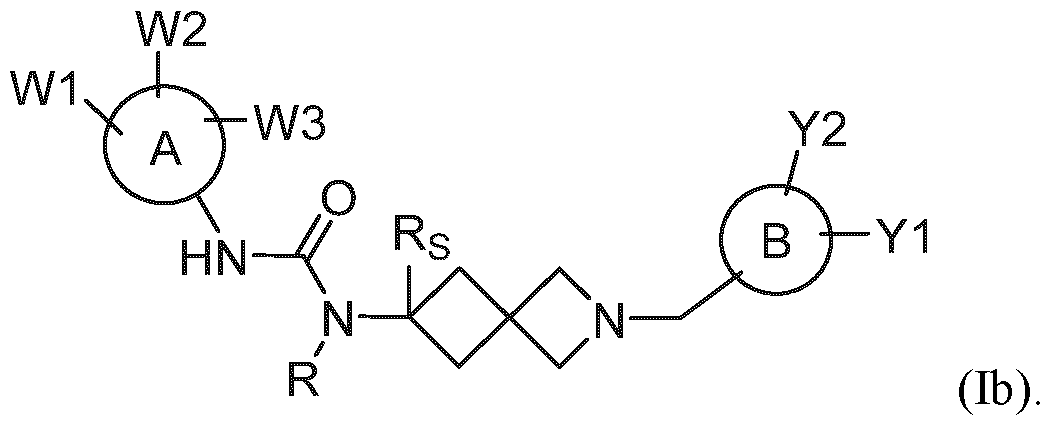
- the present invention relates to a compound of formula (I), wherein L is CH2 and LI is NR, which is represented by formula (lb) wherein Wl, W2, W3, A, B, R, Rs, Y1 and Y2 are as defined above.
- the present invention relates to a compound of formula (I), wherein L is absent and LI is NR, which is represented by formula (Ic) wherein Wl, W2, W3, A, B, R, Rs, Y1 and Y2 are as defined above.
- the present invention relates to a compound of formula (I), wherein LI is CH2, which is represented by formula (Id) wherein Wl, W2, W3, A, B, L, Y1 and Y2 are as defined above and Rs is hydrogen.
- the present invention relates to a compound of formula (Id) wherein L is CO.
- the present invention relates to a compound of formula (I), wherein LI is O, which is represented by formula (le) wherein Wl, W2, W3, A, B, L, Y1 and Y2 are as defined above and Rs is hydrogen.
- the present invention relates to a compound of formula (le) wherein L is CO.
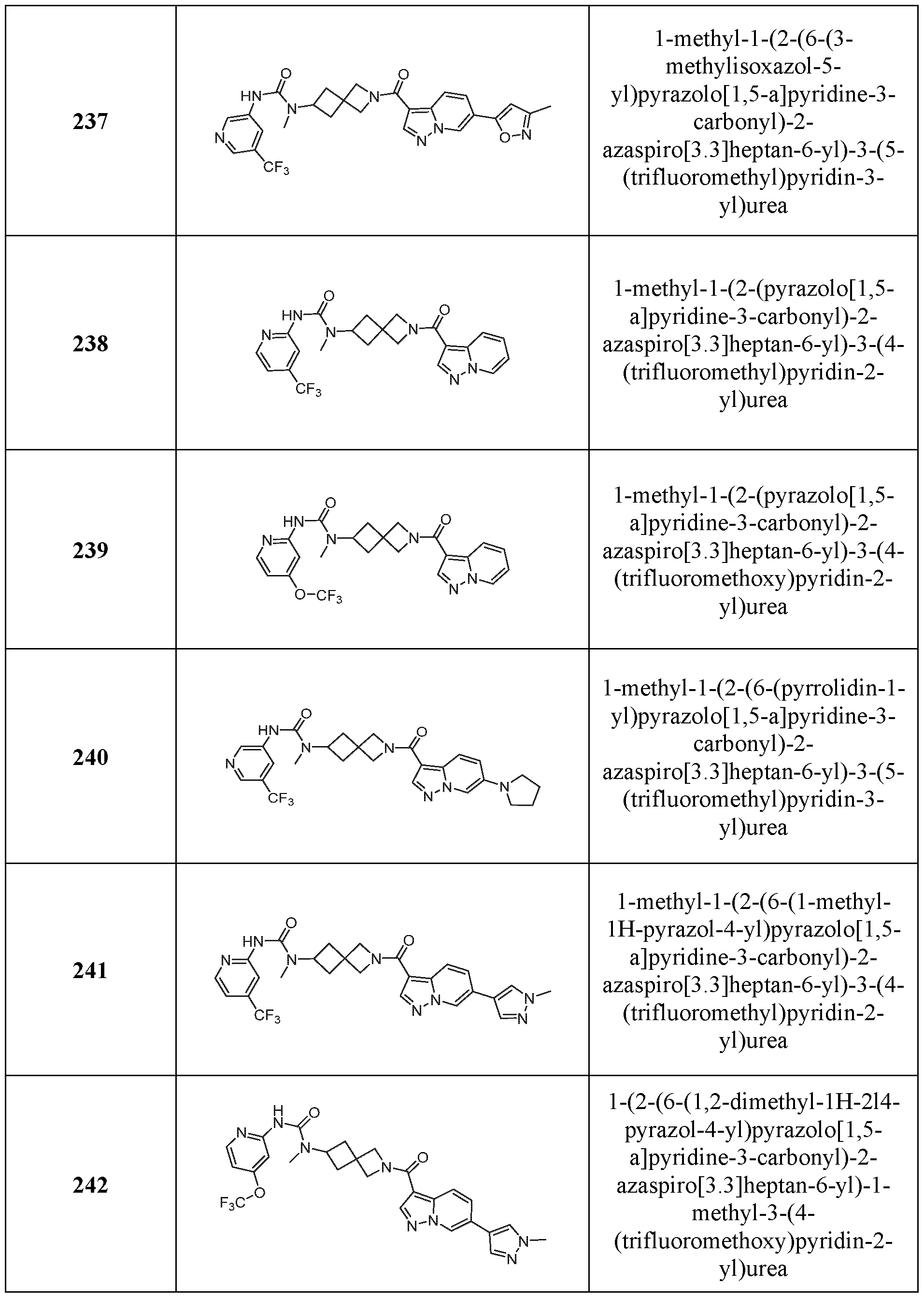
- Particularly preferred embodiments of the invention are the compounds of formula (la) listed in Table 1 below, and pharmaceutically acceptable salts thereof. These compounds are particularly active on receptors DDR1 and DDR2, as shown in Table 44 further below.
- Particularly preferred embodiments of the invention are the compounds of formula (lb) as defined above, wherein A is optionally substituted phenyl, LI is NH and B is selected from imidazo[l,2-a]pyrazinyl and lH-pyrazolo[3,4-b]pyridinyl.
- Further particularly preferred compounds of formula (lb) are those listed in Table 2 below, and pharmaceutically acceptable salts thereof. These compounds are particularly active on receptors DDR1 and DDR2, as shown in Table 44 further below.
- Table 2 List of representative compounds of Formula (lb) Additional particularly preferred embodiments of the invention are the compounds of formula (Ic) as defined above, wherein A is optionally substituted phenyl or pyridinyl and B is selected from lH-pyrazolo[3,4-b]pyridinyl, imidazo[l,5-a]pyrazinyl and lH-pyrrolo[2,3- b]pyridinyl, and wherein R is preferably hydrogen or CH3.
- More particularly preferred compounds of formula (Ic) are those listed in Table 3 below, and pharmaceutically acceptable salts thereof. These compounds are particularly active on receptors DDR1 and DDR2, as shown in Table 44 further below.
- Additional particularly preferred embodiments of the invention are the compounds of formula (Id) as defined above, wherein A is optionally substituted phenyl or pyridinyl, L is CO and B is selected from pyrazolo[5,l-b]thiazolyl, imidazo[l,2-a]pyridinyl, pyrazolo[l,5- a]pyrazinyl, imidazo[l,5-a]pyrazinyl, thieno[3,2-b]pyridinyl, lH-imidazo[l,2-b]pyrazolyl and pyrazolo[5,l-b]thiazolyl.
- Also particularly preferred embodiments of the invention are the compounds of formula (le) as defined above, wherein A is selected from the group consisting of optionally substituted phenyl, optionally substituted pyridinyl and optionally substituted isoxazolyl, L is CO and B is selected from pyrazolo[5,l-b]thiazolyl and lH-imidazo[l,2-b]pyrazolyl.
- A is selected from the group consisting of optionally substituted phenyl, optionally substituted pyridinyl and optionally substituted isoxazolyl
- L is CO
- B is selected from pyrazolo[5,l-b]thiazolyl and lH-imidazo[l,2-b]pyrazolyl.
- Further particularly preferred compounds of formula (le) are those listed in Table 5 below, and pharmaceutically acceptable salts thereof. These compounds are particularly active on receptors DDR1 and DDR2, as shown in Table 44 further below.
- Table 5 List of representative compounds of Formula (le)
- the compounds of the invention including all the compounds here above listed, can be prepared from readily available starting materials using the following general methods and procedures or by using slightly modified processes readily available to those of ordinary skill in the art. Although a particular embodiment of the present invention may be shown or described herein, those skilled in the art will recognize that all embodiments or aspects of the present invention can be obtained using the methods described herein or by using other known methods, reagents and starting materials. When typical or preferred process conditions (i.e. reaction temperatures, times, mole ratios of reactants, solvents, pressures, etc.) are given, other process conditions can also be used unless otherwise stated.
- PG protective groups
- intermediate urea III may be prepared from amine II, wherein Rs is hydrogen or methyl, by reaction with the isocyanate X in a suitable solvent, such as DCM, at rt.
- Intermediate compound IVa may then be obtained from intermediate III by Boc-deprotection in acidic conditions, for instance by using TFA in a suitable solvent, such as DCM, at rt.
- intermediate urea III may be prepared from amine II by reaction with the suitable 2,2,2-trichloroethyl carbamate (Troc carbamate) XXII, which can be obtained from the suitable amine XV and 2,2,2-trichloroethyl chloroformate, in a suitable solvent mixture, such as ACN, in the presence of a base, such as DIPEA, and at a temperature varying from 80 °C to 150 °C in a microwave oven.
- a suitable solvent mixture such as ACN
- a base such as DIPEA
- carboxylic acid XI and intermediate compound IVa may be reacted to give a compound of formula (la) under suitable amide coupling reaction conditions, in the presence of an activating agent, such as for instance HATU or TBTU, with an organic base, such as DIPEA or TEA, in a suitable organic solvent, such as DCM or DMF, at a temperature generally around rt for a time ranging from a few hours to overnight.
- an activating agent such as for instance HATU or TBTU
- organic base such as DIPEA or TEA
- suitable organic solvent such as DCM or DMF
- a compound of formula (la) may be prepared from amine IVa and acyl chloride XIV, which can be obtained from carboxylic acid XI in the presence of an appropriate chlorinating reagent, such as POCh, thionyl chloride or oxalyl chloride, in a solvent, such as DCM and, if needed, in the presence of a catalytic amount of DMF, at a temperature ranging from 5 °C to 50 °C.
- an appropriate chlorinating reagent such as POCh, thionyl chloride or oxalyl chloride
- a compound of formula (la) may be prepared via direct amidation of carboxylic acid XI, by conversion into the transient activated acylimidazolinium intermediate in the presence of TCFH and 1 -methylimidazole and subsequent reaction with the amine IVa in a solvent, such as DMF, generally around RT.
- a compound of formula (la), wherein Y1 is bromine, may be converted into a different compound of formula (la), wherein Y1 is optionally substituted phenyl or optionally substituted heteroaryl, by reaction with a phenyl or heteroaryl boronic ester/acid by a palladium-catalyzed cross-coupling.
- the reaction may be carried out by the usual Suzuki protocol, in a suitable organic solvent, such as dioxane, in the presence of an inorganic base, such as potassium carbonate, with an appropriate palladium catalytic system, such as Pd(dppf)C12, at high temperature (around 100°C) for few hours.
- a compound of formula (la), wherein Y1 is bromine, may be converted into a different compound of formula (la), wherein Y1 is heterocycloalkyl, by reaction with an heterocycloalkylamine (i.e. a heterocycloalkyl wherein a group NH is part of the ring) by means of an electrochemical reaction, in the presence of dibromonickel and an electrolyte, such as TBAB, in an appropriate solvent, such as DMA.
- an heterocycloalkylamine i.e. a heterocycloalkyl wherein a group NH is part of the ring
- intermediate compound IVa may be converted into a compound of formula (lb) by applying reductive amination conditions with the appropriate aldehyde XII, with a suitable reducing agent, such as STAB or NaCNBH?, in a suitable solvent, such as DCM or EtOH, in the presence of an acid, such as acetic acid, and in the presence of a dehydrating agent, such as magnesium sulfate, if needed, at a temperature ranging from rt to 50 °C.
- a suitable reducing agent such as STAB or NaCNBH?
- a suitable solvent such as DCM or EtOH
- an acid such as acetic acid
- a dehydrating agent such as magnesium sulfate
- a palladium catalyst such as Pd(dppf)C12
- organic solvent such as DMA
- a suitable base such as CS2CO3.
- a compound of formula (I) may be obtained after an additional step of removal of the protecting group in the required conditions, such as acidic conditions, by using TFA or HC1 in 4-di oxane, or with TBAF.
- intermediate compound XXIII can be obtained by protection of amine II, as defined above, with phenyl chloroformate, in a suitable solvent, such as for instance DCM or EtOAc and/or water, at a temperature varying from -5 °C to rt, optionally in the presence of TEA.
- a suitable solvent such as for instance DCM or EtOAc and/or water
- N-(benzyloxycarbonyloxy)succinimide or 4-nitrophenyl chloroformate may be used for protection of amine II.
- Intermediate compound XXIV may then be prepared from intermediate compound XXIII by Boc-deprotection in acidic conditions, for instance by using TFA in a suitable solvent, such as DCM, at rt.
- Intermediate compound XXIV may be converted into intermediate compound XXV by cross-coupling reactions, like for instance Buchwald coupling, with a suitable aryl halide XIIF, in the presence of a palladium catalyst, such as Pd-175 or Pd(dppf)C12, or another palladium source/phosphine-based ligand, at high temperature (around 100 °C) for a few hours, in an organic solvent, such as DMA or Me-THF, with a suitable base, such as CS2CO3, and wherein Y17Y2’ may be Y1/Y2 or may bear protecting groups, such as Boc or SEM, and wherein the halide X is preferably bromide.
- a palladium catalyst such as Pd-175 or Pd(dppf)C12
- another palladium source/phosphine-based ligand at high temperature (around 100 °C) for a few hours
- organic solvent such as DMA or Me-THF
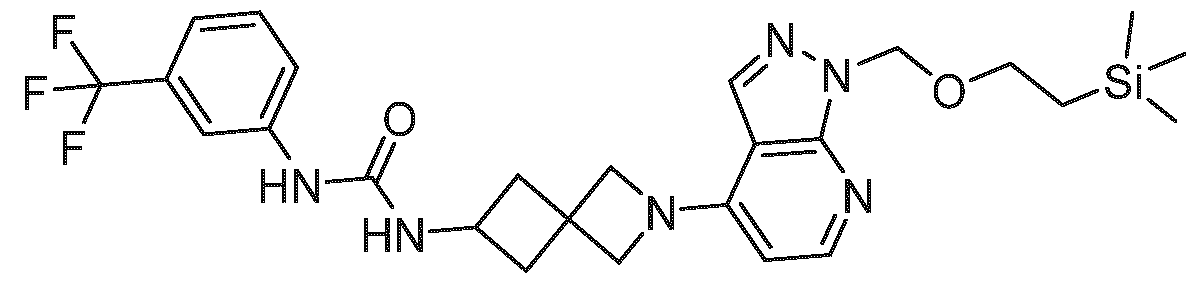
- compounds of formula XXVI may be prepared by amine deprotection reaction of the intermediate compound XXV in the presence of a palladium catalyst and tri ethylsilane or Pd/C 10% and hydrogen, in a suitable solvent, such as ethanol, at a temperature generally around rt for a few hours, optionally followed by deprotection of any protecting group on the Y substituents, if present, in acidic conditions, for instance by using TFA in a suitable solvent, such as DCM, or using TBAF in THF, at rt.
- a suitable solvent such as ethanol
- compounds of formula (Ic) may be prepared by reaction of the intermediate compound XXVI either with the suitable 2,2,2-trichloroethyl carbamate (Troc carbamate) XXII, which can be obtained from the suitable amine XV and 2,2,2-trichloroethyl chloroformate, or with intermediate compound XVI, which can be obtained from the suitable amine XV and phenyl chloroformate, in a suitable solvent mixture, such as ACN or THF, in the presence of a base, such as DIPEA, and at a temperature varying from rt to 150 °C, in a few cases in a microwave oven, followed by deprotection of any protecting group on the Wl, W2 or W3 substituents.
- a suitable solvent mixture such as ACN or THF
- a base such as DIPEA
- acidic conditions may be used for cleavage of SEM protecting group, such as TFA in DCM or TBAF in THF, at rt.
- Intermediate VI may be prepared from amine V and acyl chloride XIV (as defined in SCHEME 1), which can be obtained from carboxylic acid XI (as defined in SCHEME 1) in the presence of an appropriate chlorinating reagent, such as POCh, thionyl chloride or oxalyl chloride, in a solvent, such as DCM and, if needed, in the presence of a catalytic amount of DMF at a temperature ranging from 5 °C to 50 °C; the amine V and the acyl chloride XIV may undergo an amide coupling in the presence of a suitable base, such as TEA, in a suitable solvent, such as DCM, at rt.
- a suitable base such as TEA
- intermediate VI may be prepared via direct amidation of carboxylic acid XI, by conversion into the transient activated acylimidazolinium intermediate in the presence of TCFH and 1 -methylimidazole and subsequent reaction with the amine V in a solvent, such as DMF, generally at rt.
- Intermediate VII may then be obtained from intermediate VI by Boc-deprotection in acidic conditions, for instance by using TFA in a suitable solvent, such as DCM, at rt.
- Compounds of formula (la) may be prepared from intermediate VII by reaction with the isocyanate X (see SCHEME 1) in a suitable solvent, such as DCM, at rt.
- compounds of formula (la) may be prepared from intermediate VII by reaction with amine XV (see SCHEME 1) and triphosgene in a suitable solvent, such as DCM, at a temperature varying from 0 °C to rt.
- compounds of formula (Ic) may be prepared according to SCHEME 3a as described hereinafter.
- Intermediate compound XXVIII may then be obtained from intermediate XXVII by Boc-deprotection in acidic conditions, for instance by using TFA in a suitable solvent, such as DCM, at rt.
- Compounds of formula (Ic) may be prepared from intermediate XXVIII by reaction with the suitable 2,2,2-trichloroethyl carbamate (Troc carbamate) XXII, which can be obtained from the suitable amine XV (see SCHEME 1) and 2,2,2-trichloroethyl chloroformate, in a suitable solvent mixture, such as ACN, in the presence of a base, such as DIPEA, and at a temperature varying from 80 °C to 150 °C in a micro wave oven.
- a suitable solvent mixture such as ACN
- a base such as DIPEA
- Compounds of formula (la) may be prepared from intermediate VII by reaction with the suitable phenyl carbamate XVI, which can be obtained from the suitable amine XV (see SCHEME 1) and phenyl chloroformate in a suitable solvent mixture, such as a mixture of EtOAc, DCM and water, at a temperature varying from 0 °C to rt.
- a suitable solvent mixture such as a mixture of EtOAc, DCM and water
- the suitable amine XV may be reacted with N-(benzyloxycarbonyloxy)succinimide, in a suitable solvent, such as DCM, at a temperature varying from -5 °C to rt, in the presence of TEA to afford the benzyloxycarbonyl protected amine XV.
- Compounds of formula (la) may also be prepared from intermediate VII by reaction with the suitable 2, 2, 2-tri chloroethyl carbamate (Troc carbamate) XXII (see SCHE
- compounds of formula (la) may be prepared by reaction of the suitable amine XV with intermediate VIII, which may be obtained from intermediate VII and phenyl chloroformate in a suitable solvent mixture, such as a mixture of EtOAc, DCM and water, at a temperature varying from 0 °C to rt.
- a suitable solvent mixture such as a mixture of EtOAc, DCM and water
- intermediate XVIII may be prepared from commercially available carboxylic acid XVII, wherein Rs is hydrogen, by reaction with the suitable amine XV (see SCHEME 1) under suitable amide coupling reaction conditions, in the presence of an activating agent, such as for instance HATU or TBTU, and an organic base, such as DIPEA or TEA, in a suitable organic solvent, such as DCM or DMF, and at a temperature generally around rt for a time ranging from a few hours to overnight.
- an activating agent such as for instance HATU or TBTU
- an organic base such as DIPEA or TEA
- a suitable organic solvent such as DCM or DMF
- a compound XVIII may be prepared via direct amidation of carboxylic acid XVII, i.e. by its conversion into the transient activated acylimidazolinium intermediate in the presence of TCFH and 1 -methylimidazole and subsequent reaction with the amine XV in a solvent, such as
- Intermediate compound IVb may then be obtained from intermediate XVIII by Boc- deprotection in acidic conditions, for instance by using TFA in a suitable solvent, such as DCM, at rt. Subsequently, intermediate compound IVb may be reacted with either a carboxylic acid XI, as described for SCHEME 1, or an aldehyde XII or an aryl halide XIII, as described for SCHEME 2, to obtain a compound of formula (Id), wherein L is CO, or CH2, or absent, respectively.
- a carboxylic acid XI as described for SCHEME 1
- an aldehyde XII or an aryl halide XIII as described for SCHEME 2
- Intermediate compound IVb may also be reacted with an aryl halide XIIF, followed by a deprotection reaction, as described for the synthetic pathway of SCHEME 2a, wherein XIIF is defined, to finally provide a compound of formula (Id).
- compounds of formula (le) may be prepared from intermediate compound XIX by reaction with isocyanate X (see SCHEME 1) in a suitable solvent, such as DCM, and in the presence of a base, such as DIPEA, at rt.
- compound XX may be reacted with isocyanate X in a suitable solvent, such as DCM, and in the presence of a base, such as DIPEA, at rt, or compound XX may be reacted with a suitable chloroformate and amine XV, in the presence of a base, such as pyridine, in a suitable solvent, such as DCM, at rt, thus affording intermediate compound XXI.
- Intermediate IVc may then be obtained from intermediate XXI by Boc-deprotection in acidic conditions, for instance by using TFA in a suitable solvent, such as DCM, at rt.
- intermediate IVc may be reacted with either a carboxylic acid XI or an aldehyde XII or an aryl halide XIII, as described for SCHEME 1 and 2, to obtain a compound of formula (le), wherein L is CO, or CH2, or absent, respectively.
- Intermediate compound IVc may also be reacted with an aryl halide XIII’, followed by a deprotection reaction, as described for the synthetic pathway of SCHEME 2a, wherein XIII’ is defined, to finally provide a compound of formula (le).
- the present invention provides an intermediate compound IV wherein A is a ring selected from the group consisting of: wherein indicates a direct bond to NH; W1, W2 and W3 are substituents of ring A independently selected from the group consisting of hydrogen, (C 1 -C 4 )alkyl, (C 1 -C 4 )haloalkyl, (C 1 -C 4 )halohydroxyalkyl, (C 1 -C 4 )alkoxy, (C 1 - C 4 )alkoxy-(C 1 -C 4 )alkyl, (C 1 -C 4 )haloalkoxy, (C 1 -C 4 )hydroxyalkyl, halogen, cyano, SF 5 , NR1R2- (C1-C4)alkyl, CONR1R2, NHCOR1, NR1R2, heterocycloalkyl, (C3-C7)cycloalkyl, (C1-C4)alkyl- heterocycloalkyl, (C3-
- the intermediate compound IV is not 1-(2-azaspiro[3.3]heptan-6-yl)-3-(4- (trifluoromethoxy)phenyl)urea.
- the intermediate compound IV corresponds to an intermediate compound IVa when L1 is NR, to an intermediate compound IVb when L1 is CH 2 and to an intermediate compound IVc when L1 is O.
- substituents W1, W2 and W3 (indicated also as W substituents) in the intermediate compound IV occupy ortho and/or meta positions on ring A. More preferred W substituents are hydrogen, CH 3 , OCH 3 , OCF 3 , CF 3, CHF 2 , CH 2 CF 3 , OCF 2 H, CH 2 OH, SF 5 , F, Br and I.
- substituents occupy ortho and/or meta positions.
- W1 and W2 are both hydrogen and W3 is OCF3, W3 preferably occupies ortho or meta position.
- W3 is not para-OCF3.
- a ring is phenyl, L1 is NH and W1 is hydrogen, W2 and W3 are not both Cl in meta positions.
- W1, W2 and W3 are independently selected from the group consisting of hydrogen, (C 1 -C 4 )alkyl, (C 1 -C 4 )haloalkyl, (C 1 -C 4 )halohydroxyalkyl, (C 1 -C 4 )alkoxy, (C 1 -C 4 )alkoxy-(C 1 -C 4 )alkyl, (C 1 -C 4 )haloalkoxy, (C 1 - C4)hydroxyalkyl, fluorine, bromine, iodine, cyano, SF5, NR1R2-(C1-C4)alkyl, CONR1R2, NHCOR1, NR1R2, heterocycloalkyl, (C 3 -C 7 )cycloalkyl, (C 1 -C 4 )alkyl-heterocycloalkyl, (C 1 - C 4 )alkyl-
- the invention further provides the use of the intermediate compound IV as defined above in the preparation of a compound of formula (I), or pharmaceutically acceptable salts thereof.
- the present invention provides a process for the preparation of a compound of formula (I), or a pharmaceutically acceptable salt thereof, comprising the step of: a) reacting an intermediate compound IV with either a carboxylic acid XI or an aldehyde XII or an aryl halide XIII, as defined above, to obtain a compound of formula (I), as defined above, wherein A, L1, Rs, W1, W2 and W3 are as defined above and wherein X in the aryl halide XIII is a halogen, preferably bromine.
- the process may comprise an additional deprotection step in case any substituent on A or B rings bears a protecting group, which the skilled in the art would envisage to use to accomplish the synthesis of a compound of formula (I).
- the present invention provides intermediate compounds III, IV, IVa, IVb, IVc, VI, VII, VIII, XVIII, XIX, XXI, XXIII, XXIV, XXV, XXVI, XXVII and XXVIII, as defined above, and their use in the preparation of compounds of formula (I).
- the compounds of formula (I) of the present invention have surprisingly been found to effectively inhibit both receptor DDR1 and DDR2.
- the inhibition of receptors DDR1 and DDR2 may result in efficacious treatment of the diseases or conditions wherein the DDR receptors are involved.
- the compounds of formula (I) of the present invention have a very high antagonist drug potency on DDR1 and DDR2.
- Table 44 in the present experimental part reports such potency expressed as inhibition constant Ki for representative compounds of formula (I) of the invention.
- Preferred compounds of the invention have a Ki on DDR1 and DDR2 which is lower than 100 nM. More preferred compounds have a Ki between 25 and 5 nM. Even more preferred compounds of the invention have a Ki on DDR1 and DDR2 lower than 5 nM.
- the present invention refers to a compound of formula (I) according to any of the embodiments disclosed above for use as a medicament.
- the invention refers to a compound of formula (I), and pharmaceutically acceptable salts thereof, for use in treating diseases, disorders, or conditions associated with dysregulation of DDR.
- the invention refers to the use of a compound of formula (I) as above described, and pharmaceutically acceptable salts thereof, in the preparation of a medicament for the treatment of disorders associated with dysregulation of DDR.
- the invention refers to a compound of formula (I), and pharmaceutically acceptable salts thereof, for use in the prevention and/or treatment of a disease, disorder or condition associated with DDR receptor mechanism.
- the present invention refers to a compound of formula (I) for use in the prevention and/or treatment of fibrosis and/or diseases, disorders or conditions that involve fibrosis.
- fibrosis refers to conditions that are associated with the abnormal accumulation of cells and/or fibronectin and/or collagen and/or increased fibroblast recruitment and include, but are not limited to, fibrosis of individual organs or tissues such as the heart, kidney, liver, joints, lung, pleural tissue, peritoneal tissue, skin, cornea, retina, musculoskeletal and digestive tract.
- the compounds of formula (I) as above described are useful for the treatment and/or prevention of fibrosis, such as pulmonary fibrosis, idiopathic pulmonary fibrosis (IPF), hepatic fibrosis, progressive pulmonary fibrosis, sarcoidosis, familiar pulmonary fibrosis, chronic hypersensitivity pneumonitis (CHP), kidney or renal fibrosis, ocular fibrosis, cardiac fibrosis, arterial fibrosis and systemic sclerosis. More preferably, the compounds of formula (I) as above described are useful for the treatment of idiopathic pulmonary fibrosis (IPF).
- IPF idiopathic pulmonary fibrosis
- the compounds of formula (I) as above described are useful for the treatment of kidney fibrosis.
- the invention refers to a compound of formula (I) or its pharmaceutical composition for use in the prevention and/or treatment of IPF.
- the invention refers to the use of the compounds of formula (I) or its pharmaceutical composition for the preparation of a medicament for the treatment and/or prevention of IPF.
- the invention refers to a method for the treatment and/or prevention of IPF, the method comprising administering a compound of formula (I) or a pharmaceutical composition comprising a compound of formula (I) and one or more pharmaceutically acceptable carriers and/or excipients.
- the invention refers to a compound of formula (I) or its pharmaceutical composition for use in the prevention and/or treatment of kidney fibrosis.
- the invention refers to the use of the compounds of formula (I) or its pharmaceutical composition for the preparation of a medicament for the treatment and/or prevention of kidney fibrosis.
- the invention refers to a method for the treatment and/or prevention of kidney fibrosis, the method comprising administering a compound of formula (I) or a pharmaceutical composition comprising a compound of formula (I) and one or more pharmaceutically acceptable carriers and/or excipients.
- the invention also refers to a method for the prevention and/or treatment of diseases, disorders or conditions associated with DDR receptors mechanisms, said method comprising the step of administering to a patient in need thereof a therapeutically effective amount of a compound of formula (I) as above described.
- the invention refers to the use of a compound of formula (I) as above described for the treatment of diseases, disorders or conditions associated with DDR receptors mechanism.
- the invention refers to the use of a compound of formula (I) as above described in the preparation of a medicament for the treatment of diseases, disorders or conditions associated with DDR receptors mechanism.
- the invention refers to a method for the prevention and/or treatment of a disease, disorder or condition associated with the dysregulation of DDR receptors 1 and 2, said method comprising administering to a patient in need of such treatment a therapeutically effective amount of a compound of formula (I) as above described.
- the present invention refers to the use of a compound of formula (I) as above described for the treatment of a disease, disorder or condition associated with dysregulation of DDR receptors 1 and 2.
- safety and effective amount in reference to a compound of formula (I) or a pharmaceutically acceptable salt thereof or other pharmaceutically active agent means an amount of the compound sufficient to treat the patient's condition but low enough to avoid serious side effects and that can nevertheless be routinely determined by the skilled artisan.
- the compounds of formula (I) may be administered once or according to a dosing regimen wherein a number of doses are administered at varying intervals of time for a given period of time. Typical daily dosages may vary depending upon the route of administration chosen.
- the present invention also refers to a pharmaceutical composition
- a pharmaceutical composition comprising a compound of formula (I) according to any of its embodiment in admixture with at least one or more pharmaceutically acceptable carrier and/or excipient.
- the invention refers to a pharmaceutical composition of compounds of formula (I) in admixture with at least one or more pharmaceutically acceptable carrier and/or excipient, for example those described in Remington’s Pharmaceutical Sciences Handbook, XVII Ed., Mack Pub., N.Y., U.S.A.
- Administration of the compounds of the invention and their pharmaceutical compositions may be accomplished according to patient needs, for example, orally, nasally, parenterally (subcutaneously, intravenously, intramuscularly, intrasternally and by infusion) and by inhalation.
- the compounds of the present invention are administered orally or by inhalation.
- the pharmaceutical composition comprising the compound of formula (I) is a solid oral dosage form such as tablets, gelcaps, capsules, caplets, granules, lozenges and bulk powders.
- the pharmaceutical composition comprising the compound of formula (I) is a tablet.
- the compounds of the invention can be administered alone or combined with various pharmaceutically acceptable carriers, diluents (such as sucrose, mannitol, lactose, starches) and known excipients, including suspending agents, solubilizers, buffering agents, binders, disintegrants, preservatives, colorants, flavorants, lubricants and the like.
- diluents such as sucrose, mannitol, lactose, starches
- excipients including suspending agents, solubilizers, buffering agents, binders, disintegrants, preservatives, colorants, flavorants, lubricants and the like.
- the pharmaceutical composition comprising a compound of formula (I) is a liquid oral dosage form such as aqueous and non-aqueous solutions, emulsions, suspensions, syrups, and elixirs.
- a liquid oral dosage form such as aqueous and non-aqueous solutions, emulsions, suspensions, syrups, and elixirs.
- Such liquid dosage forms can also contain suitable known inert diluents such as water and suitable known excipients such as preservatives, wetting agents, sweeteners, flavorants, as well as agents for emulsifying and/or suspending the compounds of the invention.
- the pharmaceutical composition comprising the compound of formula (I) is an inhalable preparation such as inhalable powders, propellant-containing metering aerosols or propellant-free inhalable formulations.
- the powder may be filled in gelatine, plastic or other capsules, cartridges or blister packs or in a reservoir.
- a diluent or carrier chemically inert to the compounds of the invention e.g. lactose or any other additive suitable for improving the respirable fraction may be added to the powdered compounds of the invention.
- Inhalation aerosols containing propellant gas such as hydrofluoroalkanes may contain the compounds of the invention either in solution or in dispersed form.
- the propellant-driven formulations may also contain other ingredients such as co-solvents, stabilizers and optionally other excipients.
- the propellant-free inhalable formulations comprising the compounds of the invention may be in form of solutions or suspensions in an aqueous, alcoholic or hydroalcoholic medium and they may be delivered by jet or ultrasonic nebulizers known from the prior art or by soft-mist nebulizers.
- the compounds of the invention can be administered as the sole active agent or in combination with other pharmaceutical active ingredients.
- the dosages of the compounds of the invention depend upon a variety of factors including among others the particular disease to be treated, the severity of the symptoms, the route of administration and the like.
- the invention is also directed to a device comprising a pharmaceutical composition comprising a compound of Formula (I) according to the invention, in form of a single- or multidose dry powder inhaler or a metered dose inhaler.
- UPLC Ultra Performance Liquid Chromatography
- TBAF tetrabutylammonium fluoride
- TBAB Tetrabutylammonium bromide
- DBU 1,8- diazabiciclo[5.4.0]undec-7-ene
- CPME cyclopentyl methyl ether
- mCPBA 3- Chloroperbenzoic acid
- CDI l,l'-Carbonyldiimidazole
- Xantphos 4,5-
- signals NH from amide bond or amine bond are not visible. In a few cases, some signals could be hidden or partly covered by the signal of water or under the DMSO peak or other residual solvents.
- Method 1 Agilent Zorbax column 4.6x50mm, 3.5 pm, maintained at 40 °C. Mobile phase: MeCN (0.1% formic acid) in water (0.1% formic acid), from 5% to 95% within 2 min. Flow rate: 3.0 ml/min. Wavelength: 210-400 nm DAD. WatersTM 2795/2695 separations module + WatersTM DAD + Micromass ZQ, single quadrupole LCMS.
- Method 2 WatersTM Acquity UPLC HSS C18 column, 100 * 2.1mm, 1.8 pm (Plus guard cartridge), maintained at 40°C.
- Mobile phase MeCN (0.1% formic acid) in water (0.1% formic acid) from 5% to 95% within 5.6 min.
- Flow rate 0.4 ml/min.
- Wavelength 210-400 nm DAD.
- Method 3 WatersTM Acquity UPLC BEH Shield RP 18 column, 100 * 2.1mm, 1.72pm (Plus guard cartridge), maintained at 40 °C.
- Mobile phase MeCN in water + 10 nM ammonium bicarbonate from 5% to 95% within 5.6 min.
- Wavelength 210-400 nm DAD.
- Method 4 WatersTM Sunfire C18 column, 4.6x50mm, 3.5 pm, maintained at 40 °C. Mobile phase MeCN in water + lOmM ammonium bicarbonate, from 5 to 95% within 2.5 min. Flow rate: 2.0 mL/min. Wavelength: 210-400 nm DAD. WatersTM 2795 separations module + WatersTM DAD + Micromass ZQ, single quadrupole LCMS.
- Method 6 WatersTM Acquity QSM, Acquity UPLC CSH Cl 8 column 50mm x 2.1mm 1.7 pm, maintained at 50°C; Mobile Phase: Eluent A (HCOONH4 0.025M pH 3), Eluent B (ACN+0.1% FA). Gradient mode: from 0 to 5.50 min. eluent B is increased from 20% to 80%, from 5.50 to 7.50 min. is kept at 80%, from 7.50 to 8 min. is decreased from 80% to 20%, and from 8 min. it is kept at 20% till the end at 10 min. Flow rate: 0.35 mL/min. Wavelength: 210- 400 nm DAD. UPLC + WatersTM PDA + Xevo TQS MS instrument.
- Method 7 Acquity CSH C18 column 50mm x 2.1mm 1.7pm, maintained at 40°C; Mobile Phase: Eluent B (ACN) in Eluent A (water +0.1% HCOOH) from 1% to 99.9% within 1.5 min. Flow rate: 1 mL/min. Wavelength: 210-400 nm DAD. UPLC + Waters PDA + Waters QDA.
- Method 8 Kinetex® XB-C18 column, 4.6x50 mm, 2.6 pm maintained at 25 °C.
- Mobile phase water (0.1% formic acid) in MeCN (0.1% formic acid), from 80% to 5% within 3.90 min;
- Flow rate 1.0 ml/min; wavelength: 190-340 nm DAD.
- Method 9 Kinetex® XB-C18 column, 4.6x50 mm, 2.6 pm maintained at 25 °C.
- Mobile phase water (0.1% formic acid) in MeCN (0.1% formic acid), from 90% to 5% within 3.90 min;
- Flow rate 1.0 ml/min; wavelength: 190-340 nm DAD.
- Method 10 Acquity UPLC BEH - Waters, 1.7 pm Cl 8 (2.1 x 100 mm), 130 A, maintained at 25 °C. Mobile phase: water (0.1% formic acid) in MeCN (0.1% formic acid), from 80% to 5% within 2.70 min; Flow rate: 0.5 ml/min; wavelength: 254 nm. Shimadzu LCMS-2020 Single Quadrupole Liquid Chromatograph Mass Spectrometer.
- Method 11 Waters Acquity UPLC BEH C18 column 2.1x100mm, 1.7um, (Plus guard cartridge), maintained at 40 °C.
- Mobile phase MeCN (0.1% formic acid) in water (0.1% formic acid), from 5% to 95% within 8 min.
- Flow rate 0.4 ml/min.
- Wavelength 200-400 nm DAD, Waters Aquity PDA, separations module + Waters PDA + Micromass ZQ, single quadrapole LCMS.
- Method 12 Waters Acquity UPLC BEH C18 column 2.1x100mm, 1.7um, (Plus guard cartridge), maintained at 40 °C.
- Mobile phase MeCN (0.1% Ammonium Hydroxide) in water (0.1% Ammonium Hydroxide), from 5% to 95% within 8 min.
- Flow rate 0.4 ml/min.
- Wavelength 200-400 nm DAD, Waters Acquity PDA, separations module + Waters PDA + Micromass ZQ, single quadrapole LC-MS.
- Method 13 Acquity CSH C18 column 50mm x 2.1mm 1.7pm, maintained at 40°C; Mobile Phase: Eluent B (ACN) in Eluent A (water +0.1% HCOOH) from 1% to 99.9% within 3.5 min. Flow rate: 1 mL/min. Wavelength: 210-400 nm DAD. UPLC + Waters PDA + Waters QDA.g
- Method 15 Phenomenex Kinetex EVO C18 HPLC column, 4.6x50 mm, 5 pm, operating at room temperature: Mobile phase: MeCN (0.1% NH4OH) in water (0.1% NH4OH), from 5 to 95% within 2.5 min. Flow rate: 1.5 mL/min. Wavelength: 210-400 nm DAD. Acquity H-Class UPLC with PDA detector and QDa.
- Method 18 Waters Aquity UPLC BEH Cl 8 column 2.1x100 mm, 1.7 pm, (Plus guard cartridge), maintained at 40 °C. Mobile phase: MeCN (0.1% FA) in water (0.1% FA), from 10% to 50% within 8 min. Flow rate: 0.4 mL/min. Wavelength: 200-400 nm DAD, Waters Aquity PDA, separations module + Waters PDA + Micromass ZQ, single quadrapole LCMS.
- Method 20 YMC Amylose-C MeOH, WATERS VIRIDIS 2-EP 20x250 mm, 5 pm 5-15% MeOH (0.1% NH4OH) / CO2, 100 mL/min, 120 bar, 40 °C, DAD 235 nm.
- Flash chromatography was performed on Biotage® Isol eraTM system or similar instruments.
- Example 1 l-(2-(imidazo [1,2-a] pyridine-3-carbonyl)-2-azaspiro [3.3] heptan-6-yl)-3-(3- (trifluoromethyl)phenyl)urea
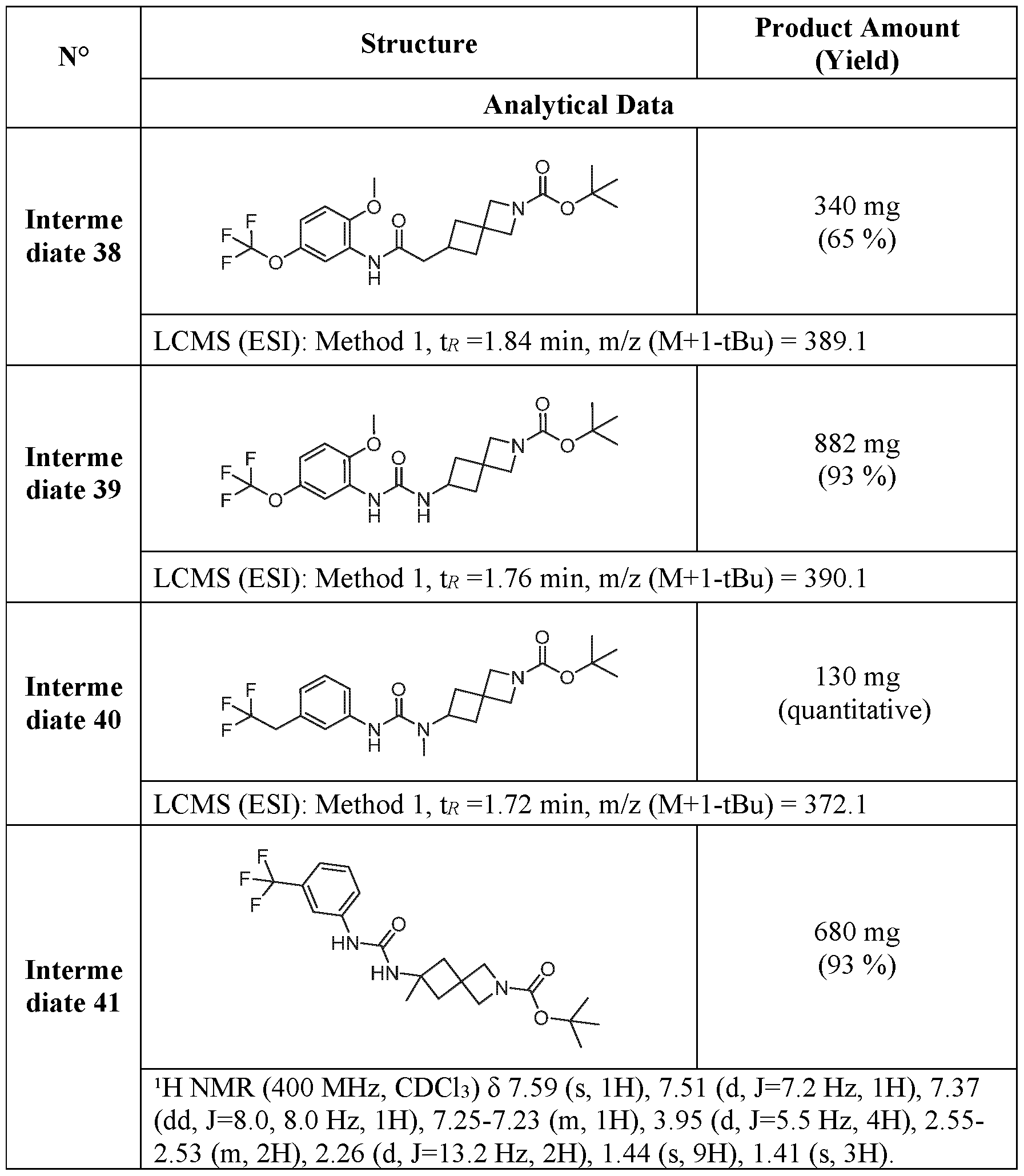
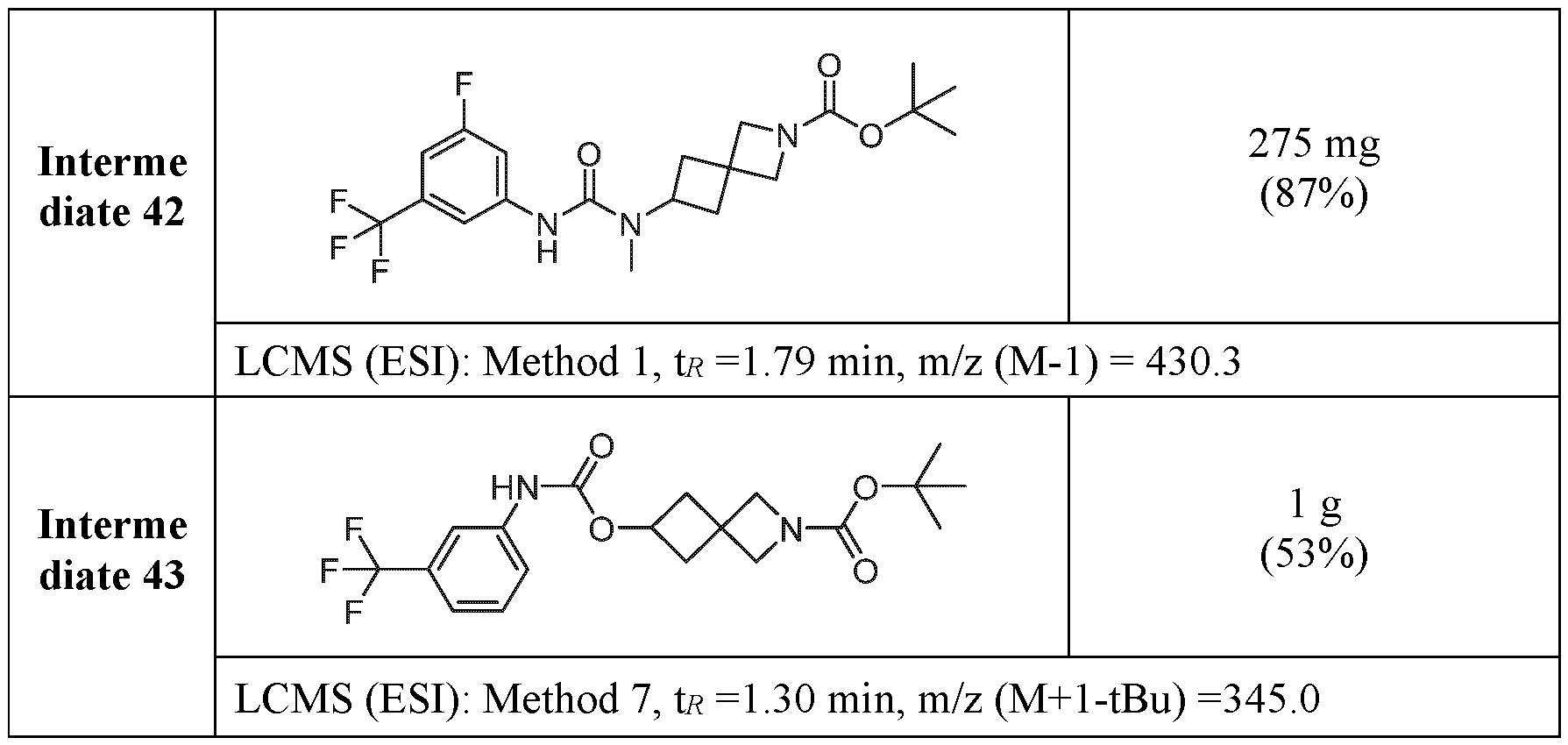
- Step 1 tert-butyl 6-(3-(3-(trifluoromethyl)phenyl)ureido)-2-azaspiro[3.3] heptane-2- carboxylate (Intermediate 6)
- Example 16 1-(3-fluoro-5-(trifluoromethyl)phenyl)-3-(2-(pyrazolo[1,5-a]pyrazine-3- carbonyl)-2-azaspiro [3.3]heptan-6-yl)urea
- Step 1 - tert-butyl (2-(pyrazolo[1,5-a]pyrazine-3-carbonyl)-2-azaspiro[3.3] heptan-6- yl)carbamate (Intermediate 9)
- a solution of pyrazolo[1,5-a]pyrazine-3-carboxylic acid (384 mg, 2.36 mmol) and thionyl chloride (1.7 mL, 23.6 mmol) was stirred at reflux for 6 h.
- Example 18 1-(5-(tert-butyl)isoxazol-3-yl)-3-(2-(pyrazolo[1,5-a]pyrazine-3-carbonyl)- 2-azaspiro[3.3]heptan-6-yl)urea
- Example 18 A solution of Intermediate 10 (50 mg, 0.194 mmol) and Intermediate 3 (51 mg, 0.194 mmol) in pyridine (1.00 mL) was stirred at 80 °C for 6 h.
- reaction mixture was concentrated in vacuo and purified by preparative HPLC (Sunfire C1819x150 mm, 10 ⁇ m 5-60% ACN/H2O (10 mM NH 4 CO 3 ), 20 mL/min, RT) to give the title compound (19 mg, 0.0458 mmol, 24 % yield).
- Example 20 1-(5-(tert-butyl)isoxazol-3-yl)-3-(2-(pyrazolo[5,1-b]thiazole-7-carbonyl)- 2-azaspiro[3.3]heptan-6-yl)urea
- Example 20 Step 1 tert-butyl (2-(pyrazolo[5,1-b]thiazole-7-carbonyl)-2-azaspiro[3.3] heptan-6- yl)carbamate (Intermediate 11) To a solution of tert-butyl (2-azaspiro[3.3]heptan-6-yl)carbamate (350 mg, 1.65 mmol), pyrazolo[5,1-b]thiazole-7-carboxylic acid (277 mg, 1.65 mmol) and TCFH (463 mg, 1.65 mmol) in DMF (2.00 mL) 1-methyl-1
- Example 21 1-(2-(pyrazolo[5,1-b]thiazole-7-carbonyl)-2-azaspiro[3.3]heptan-6-yl)-3- (3-(trifluoromethoxy) phenyl)urea Step 1 - phenyl (2-(pyrazolo[5,1-b]thiazole-7-carbonyl)-2-azaspiro[3.3]heptan-6- 15 yl)carbamate (Intermediate 13) To a suspension of Intermediate 12 (250 mg, 0.953 mmol) and Na 2 CO 3 (61 mg, 0.572 mmol) in EtOAc (20.00 mL), THF (4.00 mL) and water (4.00 mL) cooled to 0 °C, phenyl chloroformate (0.13 mL, 1.05 mmol) was added dropwise.
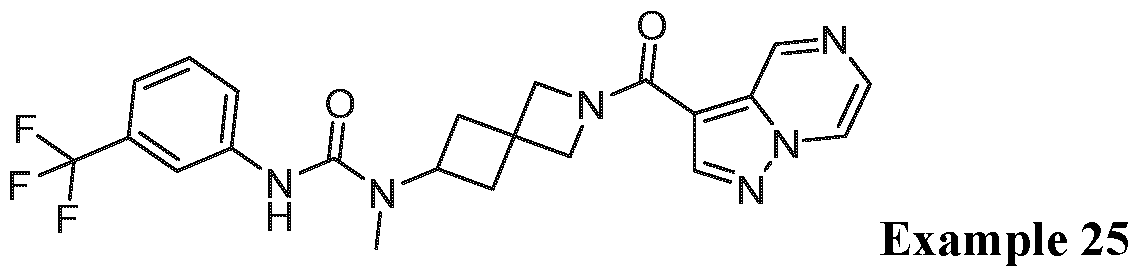
- Example 25 was prepared by following the procedure described for the synthesis of Example 1, step 3.
- Example 27 was prepared by following the procedure described for the synthesis of Example 1, step 3.
- Example 146 2-(1-methyl-1H-imidazo[1,2-b]pyrazole-7-carbonyl)-2- azaspiro[3.3]heptan-6-yl (5-(trifluoromethyl)pyridin-3-yl)carbamate
- Example 146 Intermediate 56 (120 mg, 0.46 mmol) was dissolved in DCM (2 mL) and added to 4- nitrophenyl chloroformate (112 mg, 0.553 mmol) and pyridine (0.056 mL). Solution was stirred at rt for 2 h, then solvent was removed under vacuum.
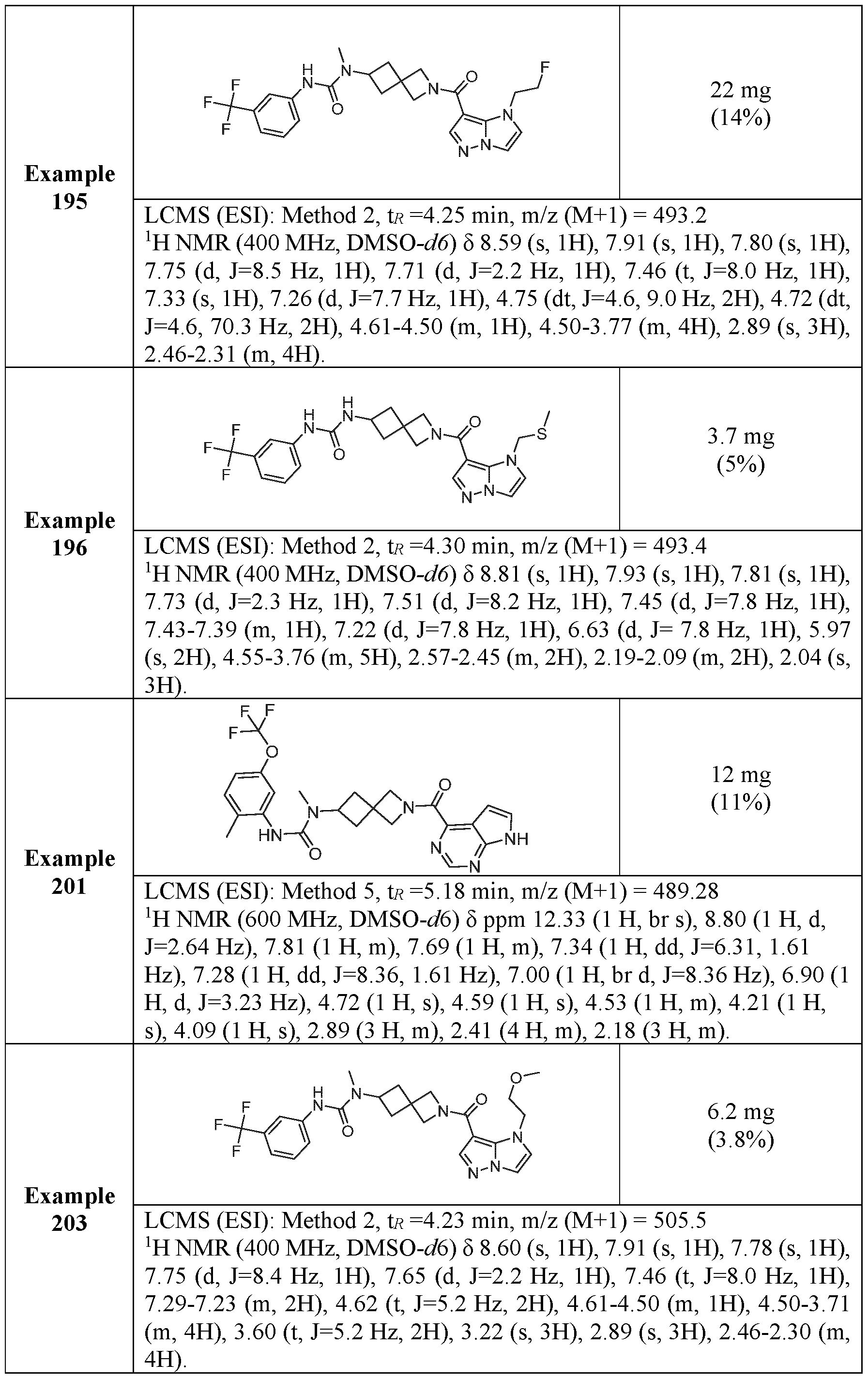
- Intermediate 154 (benzyl (2-(1-(2-methoxyethyl)-1H-imidazo[1,2-b]pyrazole-7- carbonyl)-2-azaspiro[3.3]heptan-6-yl)(methyl)carbamate)
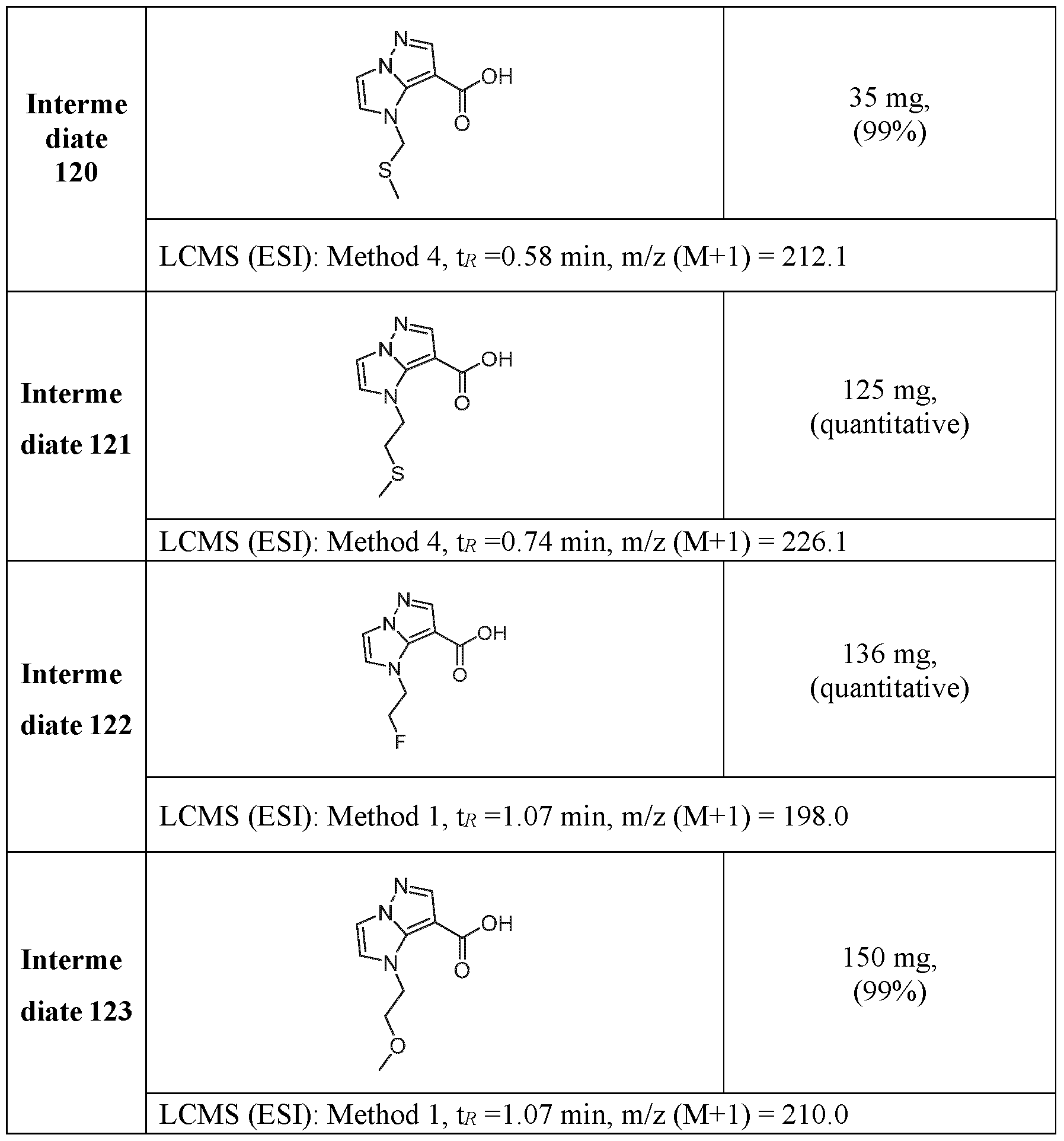
- Intermediate 154 was prepared by following the procedure for Intermediate 30, starting from Intermediate 132 (860 mg, 3.6 mmol) and 2-bromoethyl methyl ether (0.3 ml, 5.5 mmol).
- reaction mixture was stirred at rt until completion, then it was washed with sol. NH4Cl and HCl 0.5N, the organic layer was dried over MgSO4, filtered and essicated to afford title compound (48 g, 139 mmol, 98 % yield).
- Example 202 1-(2-(1-(2-methoxyethyl)-1H-imidazo[1,2-b]pyrazole-7-carbonyl)-2- azaspiro[3.3]heptan-6-yl)-1-methyl-3-(4-(trifluoromethoxy)pyridin-2-yl)urea
- Intermediate 155 was dissolved in DMF (1 mL) then DIPEA (0.235 mL, 1.34 mmol) was added, followed by addition of phenyl (4-(trifluoromethoxy)pyridin-2-yl)carbamate (66.8 mg, 0.22 mmol) at 0° C. The reaction was stirred at rt for 12h.
- Example 182 1-(2-(6-(1-methyl-1H-pyrazol-4-yl)pyrazolo[1,5-a]pyridine-3-carbonyl)- 2-azaspiro[3.3]heptan-6-yl)-3-(3-(trifluoromethyl)phenyl)urea
- Example 182 In a reactor, Intermediate 53 (0.100 g, 0.19 mmol), 1-methyl-4-(4,4,5,5-tetramethyl-1,3,2- dioxaborolan-2-yl)-1H-pyrazole (0.040 g, 0.19 mmol) and K2CO3 (0.066 g, 0.48 mmol) were placed and dioxane (0.55 mL) was added via syringe under argon atmosphere.
- Example 192 1-(2-(1-methyl-3-morpholino-1H-imidazo[1,2-b]pyrazole-7-carbonyl)-2- azaspiro[3.3]heptan-6-yl)-3-(3-(trifluoromethyl)phenyl)urea
- An ElectraSyn vial (5 mL) with a stir bar was charged with dibromonickel;1-methoxy-2-(2- methoxyethoxy)ethane (84 mg, 0.24 mmol), 2,2'-bipyridine (111 mg, 0.71 mmol), TBAB (2.38 ml, 0.48 mmol), Intermediate 52 (250 mg, 0.48 mmol), morpholine (0.062 ml, 0.71 mmol), DBU (0.143 ml, 0.95 mmol) and DMA (6 mL).
- the vial was closed with an ElectraSyn 2.0 vial cap equipped with anode ((+)RVC, 47 mm x 8 mm x 2 mm) and cathode ((-)Ni foam, 0.8 cm x 4.7 x 0.1 cm) inserted into the mixture.
- the vial was then evacuated and backfilled with an argon balloon.
- the reaction mixture was electrolyzed under a constant current of 4 mA until complete consumption of the starting material as judged by LC-MS.
- Example 227 1-(2-(6-(1-(2-methoxyethyl)-1H-pyrazol-4-yl)pyrazolo[1,5-a]pyridine- 3-carbonyl)-2-azaspiro[3.3]heptan-6-yl)-1-methyl-3-(5-(trifluoromethyl)pyridin-3-yl)urea
- Intermediate 129 70 mg, 0.13 mmol
- 1-(2-methoxyethyl)-4-(4,4,5,5- tetramethyl-1,3,2-dioxaborolan-2-yl)pyrazole 49.3 mg, 0.195 mmol
- Me-THF 1.5 mL
- potassium phosphate tribasic 69 mg, 0.33 mmol
- Comparative newly synthesized compounds C1, C2 and C3 were prepared as described below.
- C1 is characterized by having a -CO-NH- linker replacing the -NH-CO-L1- linker of the compounds of the invention.
- C2 is characterized by having a -CH 2 -CO-NH- linker replacing the -NH-CO-L1- linker of the compounds of the invention.
- C3 is characterized by having a structure XXIII wherein the central core of the compounds of formula (I) has been flipped (for Rs being hydrogen).
- Compound C2 (N-(2-(pyrazolo[1,5-a]pyrazine-3-carbonyl)-2-azaspiro[3.3] heptan-6- yl)-2-(3-(trifluoromethyl)phenyl)acetamide) was prepared analogously to what described for Compound C1 by starting from commercially available 2-(3-(trifluoromethyl)phenyl)acetic acid (see Table 43).
- the compounds were incubated with 5 nM DDR1 (Carna Biosciences) or 5 nM DDR2 (Life Technologies) for 1 h at rt in white 384-well OptiPlate (PerkinElmer), containing 20 nM or 10 nM Kinase Tracer 178 respectively and 2 nM Europium labelled anti-GST antibody (Life Technologies) in assay buffer (50 mM HEPES pH 7.5, 10 mM MgCI 2 , 1 mM EGTA and 0.01% BRIJ35). The ratio of fluorescence emission 665 nm/ 615 nm after excitation at 340 nm was obtained using the Tecan Spark 20M plate reader.
- the results for representative compounds of the invention are provided in Table 44, wherein the compounds are classified in term of potency (Ki, nM) in binding with respect to their inhibitory activity on DDR1 and DDR2: Table 44 -: Ki higher than 100 nM +: Ki between 25 and 100 nM ++: Ki between 5 nM and 25 nM +++: Ki lower than 5 nM
- the compounds of Table 44 i.e.
- the compounds according to the invention show a good activity as antagonist of DDR1 and DDR2. Accordingly, the compounds of the invention can be effectively used for treating diseases, disorders or conditions associated with DDR receptors, such as fibrosis, e.g. pulmonary fibrosis, idiopathic pulmonary fibrosis (IPF), hepatic fibrosis, progressive pulmonary fibrosis, sarcoidosis, familiar pulmonary fibrosis, chronic hypersensitivity pneumonitis (CHP), kidney or renal fibrosis, ocular fibrosis, cardiac fibrosis, arterial fibrosis and systemic sclerosis.
- fibrosis e.g. pulmonary fibrosis, idiopathic pulmonary fibrosis (IPF), hepatic fibrosis, progressive pulmonary fibrosis, sarcoidosis, familiar pulmonary fibrosis, chronic hypersensitivity pneumonitis (CHP), kidney or renal fibrosis, ocular fibrosis, cardiac fibros
- Comparative Compounds Compounds C1, C2 and C3 were tested in the same binding assay described above and their Ki(nM) is reported in Table 45.
- Table 45 The compounds of the present invention whose activity is reported in Table 44 have a binding affinity for DDR1 and DDR2 receptors, expressed as Ki, which is lower than 100 nM, in several cases lower than 25 nM or even lower than 5 nM. To the contrary, as it can be seen in Table 45, the comparative compounds C1, C2 and C3 did not show a binding affinity for DDR1 and DDR2 receptors, being their Ki over the detectable limit of the binding assay.
Landscapes
- Chemical & Material Sciences (AREA)
- Organic Chemistry (AREA)
- Health & Medical Sciences (AREA)
- Veterinary Medicine (AREA)
- Pharmacology & Pharmacy (AREA)
- Public Health (AREA)
- General Health & Medical Sciences (AREA)
- Medicinal Chemistry (AREA)
- Animal Behavior & Ethology (AREA)
- Life Sciences & Earth Sciences (AREA)
- Nuclear Medicine, Radiotherapy & Molecular Imaging (AREA)
- Bioinformatics & Cheminformatics (AREA)
- General Chemical & Material Sciences (AREA)
- Chemical Kinetics & Catalysis (AREA)
- Engineering & Computer Science (AREA)
- Epidemiology (AREA)
- Pulmonology (AREA)
- Urology & Nephrology (AREA)
- Pharmaceuticals Containing Other Organic And Inorganic Compounds (AREA)
- Nitrogen Condensed Heterocyclic Rings (AREA)
- Plural Heterocyclic Compounds (AREA)
Abstract
Description
























Claims




Priority Applications (5)
| Application Number | Priority Date | Filing Date | Title |
|---|---|---|---|
| AU2024284017A AU2024284017A1 (en) | 2023-06-07 | 2024-06-06 | Heteroaryl derivatives as ddrs inhibitors |
| CN202480037172.8A CN121285552A (en) | 2023-06-07 | 2024-06-06 | heteroaryl derivatives as DDR inhibitors |
| EP24731930.4A EP4724439A1 (en) | 2023-06-07 | 2024-06-06 | Heteroaryl derivatives as ddrs inhibitors |
| KR1020267000329A KR20260022383A (en) | 2023-06-07 | 2024-06-06 | Heteroaryl derivatives as DDR inhibitors |
| MX2025014449A MX2025014449A (en) | 2023-06-07 | 2025-12-02 | Heteroaryl derivatives as ddrs inhibitors |
Applications Claiming Priority (2)
| Application Number | Priority Date | Filing Date | Title |
|---|---|---|---|
| EP23177905 | 2023-06-07 | ||
| EP23177905.9 | 2023-06-07 |
Publications (1)
| Publication Number | Publication Date |
|---|---|
| WO2024251855A1 true WO2024251855A1 (en) | 2024-12-12 |
Family
ID=86732124
Family Applications (1)
| Application Number | Title | Priority Date | Filing Date |
|---|---|---|---|
| PCT/EP2024/065550 Ceased WO2024251855A1 (en) | 2023-06-07 | 2024-06-06 | Heteroaryl derivatives as ddrs inhibitors |
Country Status (8)
| Country | Link |
|---|---|
| EP (1) | EP4724439A1 (en) |
| KR (1) | KR20260022383A (en) |
| CN (1) | CN121285552A (en) |
| AR (1) | AR132880A1 (en) |
| AU (1) | AU2024284017A1 (en) |
| MX (1) | MX2025014449A (en) |
| TW (1) | TW202510866A (en) |
| WO (1) | WO2024251855A1 (en) |
Citations (6)
| Publication number | Priority date | Publication date | Assignee | Title |
|---|---|---|---|---|
| WO2017038873A1 (en) | 2015-08-31 | 2017-03-09 | 東レ株式会社 | Urea derivative and use therefor |
| US20180148450A1 (en) | 2015-07-03 | 2018-05-31 | Hoffmann La-Roche Inc. | Triaza-spirodecanones as ddr1 inhibitors |
| US20190374526A1 (en) | 2018-06-06 | 2019-12-12 | Merck Sharp & Dohme Corp. | Substituted Heterocyclic Compounds as Inhibitors of PRDM9 |
| WO2023021278A1 (en) | 2021-08-16 | 2023-02-23 | Redx Pharma Plc | Phenyl- and pyridopyrazole derivatives as inhibitors of ddr1 |
| WO2023064370A1 (en) | 2021-10-13 | 2023-04-20 | Board Of Trustees Of Michigan State University | Soluble epoxide hydrolase inhibitors and use thereof |
| WO2023079291A1 (en) | 2021-11-04 | 2023-05-11 | Redx Pharma Plc | Ddr1 and ddr2 inhibitors for the treatement of cancer and fibrotic diseases |
-
2024
- 2024-06-06 CN CN202480037172.8A patent/CN121285552A/en active Pending
- 2024-06-06 KR KR1020267000329A patent/KR20260022383A/en active Pending
- 2024-06-06 TW TW113121043A patent/TW202510866A/en unknown
- 2024-06-06 AU AU2024284017A patent/AU2024284017A1/en active Pending
- 2024-06-06 AR ARP240101442A patent/AR132880A1/en unknown
- 2024-06-06 EP EP24731930.4A patent/EP4724439A1/en active Pending
- 2024-06-06 WO PCT/EP2024/065550 patent/WO2024251855A1/en not_active Ceased
-
2025
- 2025-12-02 MX MX2025014449A patent/MX2025014449A/en unknown
Patent Citations (7)
| Publication number | Priority date | Publication date | Assignee | Title |
|---|---|---|---|---|
| US20180148450A1 (en) | 2015-07-03 | 2018-05-31 | Hoffmann La-Roche Inc. | Triaza-spirodecanones as ddr1 inhibitors |
| WO2017038873A1 (en) | 2015-08-31 | 2017-03-09 | 東レ株式会社 | Urea derivative and use therefor |
| US10280145B2 (en) | 2015-08-31 | 2019-05-07 | Toray Industries, Inc. | Urea derivative and use therefor |
| US20190374526A1 (en) | 2018-06-06 | 2019-12-12 | Merck Sharp & Dohme Corp. | Substituted Heterocyclic Compounds as Inhibitors of PRDM9 |
| WO2023021278A1 (en) | 2021-08-16 | 2023-02-23 | Redx Pharma Plc | Phenyl- and pyridopyrazole derivatives as inhibitors of ddr1 |
| WO2023064370A1 (en) | 2021-10-13 | 2023-04-20 | Board Of Trustees Of Michigan State University | Soluble epoxide hydrolase inhibitors and use thereof |
| WO2023079291A1 (en) | 2021-11-04 | 2023-05-11 | Redx Pharma Plc | Ddr1 and ddr2 inhibitors for the treatement of cancer and fibrotic diseases |
Non-Patent Citations (14)
| Title |
|---|
| "Remington's Pharmaceutical Sciences Handbook", MACK PUB. |
| ALVES, F., FASEB J, vol. 15, 2001, pages 1321 - 1323 |
| AVIVI-GREEN C, AM J RESPIR CRIT CARE MED, vol. 174, 2006, pages 420 - 427 |
| C.M. BORZA ET AL., JCI INSIGHT., vol. 7, no. 3, 2022, pages e150887 |
| GUO JING ET AL., EXPERT OPIN. THER. PATENTS, vol. 30, no. 5, 2020, pages 341 - 350 |
| GUO JING ET AL.: "A patent review of discoidin domain receptor 1 (DDR1) modulators (2014-present)", vol. 30, no. 5, 3 May 2020 (2020-05-03), GB, pages 341 - 350, XP055827937, ISSN: 1354-3776, Retrieved from the Internet <URL:https://www.tandfonline.com/doi/pdf/10.1080/13543776.2020.1732925?needAccess=true> DOI: 10.1080/13543776.2020.1732925 * |
| JIA S, AM J RESPIR CELL MOL BIOL, vol. 59, 2018, pages 295 - 305 |
| KERROCH ET AL., SCI REP, vol. 6, 2016, pages 21262 |
| MIHAI C., J MOL BIOL., vol. 385, 2009, pages 432 - 445 |
| NOORDEEN, N. A., J. BIOL. CHEM., vol. 281, 2006, pages 22744 - 22751 |
| SHRIVASTAVA A, MOL CELL, vol. 1, 1997, pages 25 - 34 |
| VALIATHAN, R. R., CANCER METASTASIS REV, vol. 31, 2012, pages 295 - 321 |
| VOGEL, W, MOL. CELL, vol. 1, 1997, pages 13 - 23 |
| ZHAO HBIAN HBU XZHANG SZHANG PYU J ET AL., MOL THER, vol. 24, 2016, pages 1734 - 1744 |
Also Published As
| Publication number | Publication date |
|---|---|
| AU2024284017A1 (en) | 2026-01-22 |
| CN121285552A (en) | 2026-01-06 |
| MX2025014449A (en) | 2026-01-07 |
| KR20260022383A (en) | 2026-02-19 |
| TW202510866A (en) | 2025-03-16 |
| EP4724439A1 (en) | 2026-04-15 |
| AR132880A1 (en) | 2025-08-06 |
Similar Documents
| Publication | Publication Date | Title |
|---|---|---|
| JP7576552B2 (en) | Imidazo[1,2-a]pyridinyl derivatives and their use in the treatment of diseases - Patents.com | |
| IL274938B1 (en) | Novel compounds and pharmaceutical compositions thereof for the treatment of diseases | |
| SG11202110401WA (en) | Hexahydro-1h-pyrazino[1,2-a]pyrazine compounds for the treatment of autoimmune disease | |
| EP4081296A1 (en) | Dihydrocyclopenta-isoquinoline-sulfonamide derivatives compounds | |
| WO2024251855A1 (en) | Heteroaryl derivatives as ddrs inhibitors | |
| HK40130026A (en) | Heteroaryl derivatives as ddrs inhibitors | |
| RU2855267C2 (en) | Tetrahydrothienopyridine derivatives as ddr inhibitors | |
| WO2024017877A1 (en) | HETEROARYL DERIVATIVES AS DDRs INHIBITORS | |
| ES3036380T3 (en) | Tetrahydrothieno pyridine derivatives as ddrs inhibitors | |
| CA3235345A1 (en) | Pyrrolidine derivatives as ddrs inhibitors | |
| EA047993B1 (en) | TETRAHYDROTHIENOPYRIDINE DERIVATIVES AS DDR INHIBITORS | |
| EA052533B1 (en) | TETRAHYDROTHIENOPYRIDINE DERIVATIVES AS DDR INHIBITORS | |
| HK40116317A (en) | Heteroaryl derivatives as ddrs inhibitors | |
| HK40116621A (en) | Heteroaryl derivatives as ddrs inhibitors | |
| BR122025025337A2 (en) | Processes, intermediates and uses for the preparation of tetrahydrothiene pyridine derivatives. | |
| JP2024510849A (en) | Tetrahydrothienopyridine derivatives as DDR inhibitors |
Legal Events
| Date | Code | Title | Description |
|---|---|---|---|
| 121 | Ep: the epo has been informed by wipo that ep was designated in this application |
Ref document number: 24731930 Country of ref document: EP Kind code of ref document: A1 |
|
| WWE | Wipo information: entry into national phase |
Ref document number: MX/A/2025/014449 Country of ref document: MX |
|
| ENP | Entry into the national phase |
Ref document number: 2025571210 Country of ref document: JP Kind code of ref document: A |
|
| WWE | Wipo information: entry into national phase |
Ref document number: 2025571210 Country of ref document: JP |
|
| REG | Reference to national code |
Ref country code: BR Ref legal event code: B01A Ref document number: 112025026040 Country of ref document: BR |
|
| WWE | Wipo information: entry into national phase |
Ref document number: 202517133058 Country of ref document: IN |
|
| ENP | Entry into the national phase |
Ref document number: 1020267000329 Country of ref document: KR Free format text: ST27 STATUS EVENT CODE: A-0-1-A10-A15-NAP-PA0105 (AS PROVIDED BY THE NATIONAL OFFICE) |
|
| WWE | Wipo information: entry into national phase |
Ref document number: AU2024284017 Country of ref document: AU Ref document number: 1020267000329 Country of ref document: KR |
|
| WWE | Wipo information: entry into national phase |
Ref document number: 2024731930 Country of ref document: EP |
|
| WWP | Wipo information: published in national office |
Ref document number: MX/A/2025/014449 Country of ref document: MX |
|
| NENP | Non-entry into the national phase |
Ref country code: DE |
|
| WWE | Wipo information: entry into national phase |
Ref document number: 2025138686 Country of ref document: RU |
|
| ENP | Entry into the national phase |
Ref document number: 2024731930 Country of ref document: EP Effective date: 20260107 |
|
| WWP | Wipo information: published in national office |
Ref document number: 202517133058 Country of ref document: IN |
|
| ENP | Entry into the national phase |
Ref document number: 2024731930 Country of ref document: EP Effective date: 20260107 |
|
| ENP | Entry into the national phase |
Ref document number: 2024284017 Country of ref document: AU Date of ref document: 20240606 Kind code of ref document: A |
|
| ENP | Entry into the national phase |
Ref document number: 2024731930 Country of ref document: EP Effective date: 20260107 |
|
| ENP | Entry into the national phase |
Ref document number: 2024731930 Country of ref document: EP Effective date: 20260107 |
|
| ENP | Entry into the national phase |
Ref document number: 2024731930 Country of ref document: EP Effective date: 20260107 |
|
| WWP | Wipo information: published in national office |
Ref document number: 1020267000329 Country of ref document: KR |
|
| WWP | Wipo information: published in national office |
Ref document number: 2024731930 Country of ref document: EP |