WO2024251939A2 - Ccr1 modulators and methods of use - Google Patents
Ccr1 modulators and methods of use Download PDFInfo
- Publication number
- WO2024251939A2 WO2024251939A2 PCT/EP2024/065720 EP2024065720W WO2024251939A2 WO 2024251939 A2 WO2024251939 A2 WO 2024251939A2 EP 2024065720 W EP2024065720 W EP 2024065720W WO 2024251939 A2 WO2024251939 A2 WO 2024251939A2
- Authority
- WO
- WIPO (PCT)
- Prior art keywords
- polypeptide
- cell
- amino acid
- peptide
- ccr1
- Prior art date
- Legal status (The legal status is an assumption and is not a legal conclusion. Google has not performed a legal analysis and makes no representation as to the accuracy of the status listed.)
- Ceased
Links
Classifications
-
- C—CHEMISTRY; METALLURGY
- C07—ORGANIC CHEMISTRY
- C07K—PEPTIDES
- C07K14/00—Peptides having more than 20 amino acids; Gastrins; Somatostatins; Melanotropins; Derivatives thereof
- C07K14/435—Peptides having more than 20 amino acids; Gastrins; Somatostatins; Melanotropins; Derivatives thereof from animals; from humans
- C07K14/52—Cytokines; Lymphokines; Interferons
- C07K14/521—Chemokines
- C07K14/523—Beta-chemokines, e.g. RANTES, I-309/TCA-3, MIP-1alpha, MIP-1beta/ACT-2/LD78/SCIF, MCP-1/MCAF, MCP-2, MCP-3, LDCF-1, LDCF-2
-
- A—HUMAN NECESSITIES
- A61—MEDICAL OR VETERINARY SCIENCE; HYGIENE
- A61K—PREPARATIONS FOR MEDICAL, DENTAL OR TOILETRY PURPOSES
- A61K38/00—Medicinal preparations containing peptides
Definitions
- the present invention relates to polypeptides, peptides, and conjugates with CCR1 modulatory activity.
- CCR1 is a receptor for the chemokine CCL3 (MIP-1 alpha) as well as CCL5 (RANTES), CCL7 (MCP-3), and CCL23 (MPIF-1).
- CCL3 binds to the receptor CCR1 and mediates various cellular behaviors.
- CCR1 antagonists have been clinically developed for diseases including multiple sclerosis, psoriasis, endometriosis, rheumatoid arthritis, chronic obstructive pulmonary disease, and multiple myeloma.
- the present invention provides polypeptides, peptides, and conjugates with CCR1 modulatory activity (antagonism or agonism).
- a polypeptide comprising an N-terminal portion and a C-terminal portion, wherein the N-terminal portion comprises an amino acid sequence with 0, 1, 2, 3, 4, 5, or 6 amino acid substitutions relative to any one of SEQ ID NO: 3-86, and wherein the C-terminal portion comprises an amino acid sequence at least 70% identical to SEQ ID NO: 2.
- a peptide comprising an amino acid sequence with 0, 1, 2, 3, 4, 5, or 6 amino acid substitutions relative to any one of SEQ ID NO: 3-86.
- a conjugate comprising the polypeptide as described herein or the peptide as described herein conjugated to a moiety.
- nucleic acid molecule encoding the polypeptide, the peptide, or the conjugate as described herein.
- a host cell comprising the nucleic acid molecule or the vector as described herein.
- a pharmaceutical composition comprising the polypeptide, the peptide, the conjugate, the nucleic acid molecule, or the vector as described herein, and a pharmaceutically acceptable carrier, excipient, and/or stabilizer.
- a method of modulating CCR1 signaling in a cell comprising contacting the cell with the polypeptide, the peptide, the conjugate, the nucleic acid molecule, the vector, or the pharmaceutical composition as described herein.
- a method of treating or preventing a disease or disorder associated with CCR1 signaling in a subject comprising administering to the subject the polypeptide, the peptide, the conjugate, the nucleic acid molecule, the vector, or the pharmaceutical composition as described herein.
- FIG. 2 shows CCR1 signaling as measured calcium flux in Fluo-8 -loaded THP-1 cells (relative fluorescence) in response to wild type CCL3 after the cells were first incubated with small molecule CCR1 antagonists BMS-817399, CCX354, and BX471 or the exemplary CCL3 variant 1P31-CCL3.
- Four- parameter dose-inhibition curves were fitted to the data using GraphPad Prism, from which pICso values (-log(ICso) were derived.
- variant CCL3 polypeptides according to the invention exhibit differential agonist and/or antagonist activity to CCR1 relative to wild type CCL3.
- many of the CCL3 variant polypeptides of the invention exhibit significantly higher antagonism of CCR1 as compared to known antagonists BX471, CCX354, and BMS- 817399.
- a polypeptide comprising an N-terminal portion and a C-terminal portion, wherein the polypeptide is a CCL3 variant and is a CCR1 modulator (antagonist or agonist).
- a “CCL3 variant”, “CCL3 variant polypeptide”, “CCL3 derivative”, or “CCL3 derivative polypeptide” according to the present invention refers to a polypeptide derived from CCL3, for example human CCL3 (SEQ ID NO: 1), in which the N-terminal portion comprises a peptide of the invention as described herein and the C-terminal portion comprises an amino acid sequence at least 70% identical to SEQ ID NO: 2 or 87.
- the N-terminal portion comprises or consists of an amino acid sequence with 0, 1, 2, 3, 4, 5, or 6 amino acid substitutions relative to any one of SEQ ID NO: 3- 86 and the C-terminal portion comprises or consists of an amino acid sequence at least 70% identical to SEQ ID NO: 2.
- the N-terminal portion comprises or consists of an amino acid sequence with 0, 1, 2, or 3 amino acid substitutions relative to any one of SEQID NO: 88-171 and the C-terminal portion comprises or consists of an amino acid sequence at least 70% identical to SEQ ID NO: 87.
- methionine residues can be conservatively substituted with non-oxidizable amino acid analogs or amino acid derivatives to reduce complications from methionine oxidation during synthesis.
- one or more methionine residues in the polypeptides, peptides, and conjugates of the present invention are conservatively substituted with an amino acid analog or an amino acid derivative such as, but not limited to, norleucine.
- Molecules of the invention may provide different modulatory effects such as, for example agonism and/or antagonism of CCR1.
- CCR1 inhibitor and “CCR1 antagonist” may be used interchangeably to mean a polypeptide, peptide, conjugate, small molecule, or other compound that inhibits one or more biological and/or pathological activities induced by the agonism, activation, or signaling of CCR1.
- CCR1 inhibitors may prevent the binding of ligands or pathogens by achieving partial or complete occupation of the site or sites on CCR1 that they require for interaction (orthosteric inhibitors).
- a CCR1 inhibitor may block the binding of native CCL3 ligand to CCR1, preventing normal activation of CCR1, or block the binding of a synthetic CCR1 agonist to CCR1.
- CCR1 inhibitors may prevent the binding of ligands or pathogens by engaging sites on CCR1 and inducing CCR1 to adopt a conformation or conformations that cannot be recognized by the ligands or pathogens (allosteric inhibitors).
- CCR1 inhibitors may inhibit the entire repertoire or only a subset of CCR1 intracellular signaling pathways and pathogenic interactions.
- agonist or “agonism” carries the ordinary meaning in the art of activating a receptor to induce a biological function of the receptor.
- a ligand that activates a receptor is an agonist.
- An antagonist is a ligand that inhibits one or more biological activities induced by the agonism, activation, or signaling of a receptor.
- the amount of agonism provided by a ligand is typically measured by its ECso value.
- the EC50 can be measured for a given agonist ligand by determining the concentration of agonist ligand needed to elicit half of the maximum biological response of the agonist ligand. Smaller EC50 values, as measured in concentration of agonist ligand, indicate increased agonism because a lower concentration of the agonist ligand is required to elicit the maximum biological response.
- the antagonism of an antagonist ligand may be measured in the terms of IC50 values obtained from an inhibitory potency assay.
- the IC50 is typically defined as the concentration of the agent at which 50% of a signal elicited via the receptor by a natural agonist is inhibited by the agent.
- IC50 may sometimes be reported as pICso, which is the negative log of the IC50 value in moles per liter (molar or M).
- agonism may be measured by signaling efficacy. Signaling efficacy is usually measured by determining the maximum biological activity elicited by the ligand (Emax). Receptors may exhibit more than one biological response when activated by an agonist ligand. The magnitude of the agonism or antagonism of a ligand may be measured with respect to one or more of the biological responses exhibited by the activated receptor.
- Agonism may be measured by one or more of increased phosphorylation of the receptor when bound by the ligand; increased G protein signaling through the receptor when bound by the ligand; increased arrestin recruitment to the receptor when bound by the ligand; increased induction of intracellular calcium flux when the receptor is bound by the ligand; and/or increased receptor internalization when the receptor is bound by the ligand. Measurements of agonism or antagonism may be determined using routine methods known in the art. [0032] In some embodiments, the polypeptide, the peptide, or the conjugate of the present invention inhibits CCR1 with an IC50 of less than 1 nM, less than 3 nM, less than 10 nM, less than 25 nM, or less than 50 nM.
- the polypeptide, the peptide, or the conjugate of the present invention agonizes CCR1 with at least 20%, at least 30%, at least 60%, or at least 70% of the signaling activity of wild type CCL3.
- the polypeptide of the present invention comprises an amino acid sequence with 0, 1, 2, 3, 4, 5, or 6 amino acid substitutions relative to any one of SEQ ID NO: 3-86 or with 0, 1, 2, or 3 amino acid substitutions relative to any one of SEQ ID NO: 88- 171.
- the amino acid sequence is located near the N terminus of the polypeptide. In some embodiments, the amino acid sequence is located such that the beginning of the amino acid sequence lies within 15 residues of the N terminus of the polypeptide, such as within 12, 10, 8, 6, 5, 4, 3, 2, 1 residues of the N terminus, or consists of the N terminus of the polypeptide.
- the polypeptide according to the present invention comprises an N-terminal portion and a C terminal portion, wherein said N-terminal portion comprises an amino acid sequence with 0, 1, 2, 3, 4, 5, or 6 amino acid substitutions relative to any one of SEQ ID NO: 3-86 and the C-terminal portion comprises an amino acid sequence at least 70% identical to SEQ ID NO: 2, or with 0, 1, 2, or 3 amino acid substitutions relative to any one of SEQID NO: 88-171 and the C-terminal portion comprises an amino acid sequence at least 70% identical to SEQ ID NO: 87.
- the N-terminal portion consists of no more than 11, 10, 9, 8, 7, or 6 amino acids.
- the N- terminus of the C-terminal portion adjoins directly to the C-terminus of the N-terminal portion, i.e. the N-terminal portion and the C terminal portion are directly adjoined.
- the N-terminal portion is adjoined to the C-terminal portion via a peptide linker.
- the N-terminal portion is located at the extreme N terminus of the polypeptide.
- a peptide comprising an amino acid sequence with 0, 1, 2, 3, 4, 5, or 6 amino acid substitutions relative to any one of SEQ ID NO: 3- 86 or with 0, 1 , 2, or 3 amino acid substitutions relative to any one of SEQ ID NO: 88-171.
- a conjugate comprising the polypeptide, such as a CCL3 variant polypeptide, or the peptide as described herein conjugated to a moiety.
- the term “moiety” refers to an atom, molecule, or compound that is conjugated to the polypeptide or the peptide of the present invention.
- conjugation of the moiety to the polypeptide or peptide allows delivery of the moiety to CCR1 -expressing cells, tissues, and/or tumors with or without inducing CCR1 signaling.
- the moiety is an immunoglobulin domain such as an Fc domain of an IgG, IgM, IgE, IgD, or IgA heavy chain, or an Fc domain of a lambda or kappa light chain.
- the moiety is a chemokine domain, such as a domain of a wild type CCL3.
- the moiety is a toxin such as a toxin that enables the killing of a CCR1 -expressing cell or the killing of a pathogen inside a CCR1 -expressing cell.
- the toxin is a cytotoxic agent, an anti-tumor agent, a chemotherapeutic agent, an antiviral agent, or an antibacterial agent.
- the toxin is pseudomonas exotoxin A, diptheria toxin, a ribosome inactivating protein, or saporin.
- the moiety is a carrier protein such as albumin.
- the moiety is a polymer such as polyethylene glycol.
- the moiety is a lipid.
- the moiety is a detectable marker such as a fluorescent molecule (e.g.
- the moiety may be conjugated to the polypeptide or peptide by a variety of means known in the art.
- conjugated it is meant that the polypeptide or peptide of the invention is associated with the moiety by a covalent or non-covalent bond.
- the polypeptide or peptide of the invention may be conjugated to the moiety by a peptide bond, optionally through a linker amino acid sequence and/or through a disulfide bond.
- the present invention provides polypeptides, peptides, and conjugates as disclosed above and, moreover, nucleic acid molecules encoding said polypeptides, peptides and conjugates.
- the nucleic acid molecules encoding polypeptides, peptides, and/or conjugates of the present invention are RNA or DNA.
- the skilled person is able to design or identify nucleic acid molecules encoding said polypeptides, peptides, and conjugates of the present invention using methods known in the art.
- the nucleic acid molecules encoding polypeptides, peptides, and/or conjugates of the present invention are incorporated into a vector, such as a plasmid, episome, artificial chromosome, virus, or a viral vector.
- a vector such as a plasmid, episome, artificial chromosome, virus, or a viral vector.
- the nucleic acid molecules encoding polypeptides, peptides, and/or conjugates of the present invention or the vector comprising said nucleic acid molecule are comprised within a host cell to enable expression of the polypeptides, peptides, and/or conjugates of the present invention.
- the host cell is a bacterial cell, a yeast cell, a vertebrate cell, a mammalian cell, a human cell, or a cell of an immortalized cell line such as a CHO cell, a HEK cell, or a HeLa cell.
- Polypeptides and peptides are polymers that comprise amino acids linked by peptide bonds.
- amino acid is used to describe any amino acid, natural or otherwise, that can be incorporated into a polypeptide or a peptide.
- Amino acids are small molecules comprising an amine (-NH2) group, a carboxyl (-COOH), and a variable side chain (R-group) specific to each amino acid.
- Amino acids are covalently linked by peptide bonds between the amine group of one amino acid to the carboxyl group of another amino acid to form polypeptides.
- Amino acids within a polypeptide are often referred to in the art as “residues”.
- Polypeptides and peptides may comprise post-translational modifications such as, for example, phosphorylation, glycosylation, ubiquitination, nitrosylation, methylation, acetylation, lipidation, acylation, prenylation, alkylation, oxidation, or other modifications known in the art.
- Polypeptides and peptides may comprise amino acid analogs.
- amino acid analogs describes artificial, synthetic, or unnatural amino acids beyond the 20 genetically-encoded amino acids, such as for example the amino acid analogs described in Zou et al. (2018, Biotechnology Advances 36(7), 1917-1927).
- amino acid analogs that can be incorporated into polypeptides, peptides, and conjugates of the present invention include, but are not limited to, norleucine, P-amino acids, homo-amino acids, synthetic proline and pyruvic acid derivatives, 3 -substituted alanine derivatives, glycine derivatives, ring-substituted phenylalanine and tyrosine derivatives, linear core amino acids, N-methyl amino acids, and amino acids with synthetic R-groups.
- Polypeptides and peptides may also comprise amino acid derivatives.
- amino acid derivatives describes amino acids that have been derived from the modification of one of the 20 genetically-encoded amino acids.
- Amino acid derivatives can be synthetic, e.g. made in vitro by chemical reaction, or they can be naturally occurring in organisms, e.g. in vivo metabolites.
- An example of an amino acid derivative is pyroglutamate/pyroglutamic acid, a cyclized derivative of glutamine in which the free amino group of glutamic acid cyclizes to form a lactam.
- a sequence is said to bear similarity to, or to be a homologue of, SEQ ID NO: 2 or 87 if said sequence is more than 70% identical to SEQ ID NO: 2 or 87.
- said sequence is a C-terminal portion having more than 70%, more than 75%, more than 80%, more than 85%, more than 90%, more than 95%, more than 99%, or 99.9% sequence identity to SEQ ID NO: 2 or 87.
- identity or “similarity” refers to sequence similarity between two polypeptides. Identity can be determined by comparing each position in the aligned sequences.
- a degree of identity between amino acid sequences is a function of the number of identical or matching amino acids at positions shared by the sequences, for example, over a specified region.
- Optimal alignment of sequences for comparisons of identity may be conducted using a variety of algorithms, as are known in the art, including the ClustalW program, the local homology algorithm of Smith and Waterman, 1981, Adv. Appl. Math 2: 482, the homology alignment algorithm of Needleman and Wunsch, 1970, J. Mol. Biol. 48:443, the search for similarity method of Pearson and Lipman, 1988, Proc. Natl. Acad. Sci.
- Sequence identity may also be determined using the BLAST algorithm, described in Altschul et al., 1990, J. Mol. Biol. 215:403-10 (using the published default settings). For example, the "BLAST 2 Sequences” tool, available through the National Center for Biotechnology Information may be used, selecting the "blastp” program at the following default settings: expect threshold 10; word size 3; matrix BLOSUM 62; gap costs existence 11, extension 1.
- the person skilled in the art can readily and properly align any given sequence and deduce sequence identity, similarity, and/or homology by mere visual inspection.
- a sequence is also said to bear similarity to or to be a homologue of SEQ ID NO: 2 or 87 if it contains one or more conservative substitutions with respect to SEQ ID NO: 2 or 87.
- the peptides or polypeptides of the invention comprises substitutions relative to another sequence, such as conservative substitutions. Conservative substitutions are substitutions in the sequence of a peptide or polypeptide that do not lead to a significant loss of function or which lead only to a small loss of function.
- Such a loss of function due to one or more conservative substitutions may be considered not to be significant if said loss amounts to less than 20%, less than 15%, less than 10%, less than 6%, or less than 4% with respect to the function of the polypeptide having the unsubstituted sequence.
- Conservative substitutions are often substitutions wherein an amino acid side chain is replaced by an amino acid side chain that is related, or similar in physicochemical properties, to the replaced residue.
- Such conservative substitutions may be made, for example, using one of the 20 natural amino acids according to Table 2 wherein amino acids in the same block in the middle column and preferably in the same line in the right-hand column may be substituted for each other.
- Conservative substitutions may also be made using amino acid analogs or amino acid derivatives such as, for example, a substitution of methionine with norleucine.
- the invention provides polypeptides comprising fragments of SEQ ID NO: 2 or 87.
- the fragments should comprise at least ‘n’ consecutive amino acids from SEQ ID NO: 2 or 87 and, depending on the particular sequence, ‘n’ is 5 or more (such as 6, 8, 10, 12, 14, 16, 18, 20, 22, 24, 26, 28, 30, 32, 34, 36, 38, 40, 42, 44, 46, 48, 50, 52, 54, 55, 56, 57, 58, or 59).
- Polypeptides and peptides of the present invention isolated or for inclusion in a conjugate, can be prepared in many ways, for example, using known techniques of protein chemistry (for example, chemical peptide synthesis) or molecular biology (i.e. genetic engineering and fermentation — in general, biotechnology).
- polypeptides, peptides, and conjugates of the present invention may be prepared using the known techniques of protein chemistry as described, for example, in Gaertner etal., (PNAS, 2008, 105(46):17706-17711).
- a method of preparing polypeptides, peptides, and conjugates of the present invention involves in vitro chemical synthesis.
- the polypeptides, peptides, and conjugates may be synthesized in part or in whole using chemical means.
- solid-phase peptide synthesis such as methods based on tBoc or Fmoc chemistry, may be used. Enzymatic synthesis may also be used in part or in full.
- the polypeptides, peptides, and conjugates of the present invention can be prepared using genetic engineering.
- the peptides, polypeptides, and conjugates of the present invention may be produced by culturing a host cell comprising a nucleic acid molecule expressing the peptides, polypeptides, or conjugates (or the amino acid portions of the conjugates) of the present invention under conditions which induce expression of the peptides, polypeptides, or conjugates.
- the host cell is a bacterial cell (e.g. E.coli), a yeast cell (e.g. Saccharomyces cerevisiae), or a mammalian cell (e.g. a human cell, a mouse cell, a CHO cell, a HEK cell, a HeLa cell).
- Biosynthesis other than by expression in a host cell may be used, e.g. the polypeptides, peptides, or conjugates (or the amino acid portions of the conjugates) of the present invention may be produced by translation from RNA in vitro.
- Polypeptides, peptides, or conjugates (or the amino acid portions of the conjugates) of the present invention can, for example, also be prepared by digesting longer polypeptides using proteases.
- Bio methods including genetic engineering, fermentation, and expression are in general restricted to the production of polypeptides based on L-amino acids, but manipulation of translation machinery in vivo or in vitro (e.g. of aminoacyl tRNA molecules) can be used to allow the introduction of D-amino acids (or of other non-natural amino acids, such as iodotyrosine or methylphenylalanine, azidohomoalanine, etc.). Where D-amino acids are included, however, it is preferred to use chemical synthesis. Polypeptides, peptides, or conjugates of the present invention may have covalent modifications at the C-terminus and/or N- terminus.
- the present invention provides pharmaceutical compositions comprising polypeptides, peptides, conjugates, or a nucleic acid or vector encoding said polypeptides, peptides, or conjugates according to the present invention, and a pharmaceutically acceptable carrier, excipient, and/or stabilizer.
- the pharmaceutical compositions of the present invention may be provided for use as a medicament.
- Pharmaceutical compositions according to the present invention may comprise any embodiment of the present invention, i.e., a polypeptide, peptide, conjugate, or a nucleic acid or vector encoding said polypeptide, peptide, or conjugate according to the present invention.
- the preparation of pharmaceutical compositions is well known to the person skilled in the art.
- a pharmaceutical composition of the present invention may be administered to a subject in a therapeutically effective amount.
- a "therapeutically effective amount” means an amount of the composition or therapeutic agent effective to provide a therapeutic, prophylactic or diagnostic benefit to a subject.
- a therapeutically effective amount of the composition is an amount capable of inducing a clinical response in a subject in the treatment of a particular disease or disorder. Determination of a therapeutically effective amount of the composition is well within the capability of those skilled in the art, especially in light of the disclosure provided herein.
- the therapeutically effective amount may vary according to a variety of factors such as the subject’s condition, weight, sex and age.
- a pharmaceutical composition of the present invention may comprise more than one polypeptide, peptide, conjugate, or a nucleic acid or vector encoding said polypeptide, peptide, or conjugate of the present invention.
- the pharmaceutical composition of the present invention may comprise (a) at least one polypeptide, peptide, conjugate, or a nucleic acid or vector encoding said polypeptide, peptide, or conjugate of the present invention; and (b) at least one second pharmaceutical agent or therapeutic agent.
- the second pharmaceutical agent or therapeutic agent may be an anti-inflammatory drug, an immunosuppressant, an antibiotic, an antiviral agent, a small molecule drug, or an antibody.
- the second pharmaceutical agent or therapeutic agent is formulated in admixture with, or in a separate pharmaceutical composition from, the at least one polypeptide, peptide, conjugate, or a nucleic acid or vector encoding said polypeptide, peptide, or conjugate, e.g. for simultaneous or for sequential administration.
- compositions provided herein may be prepared in various pharmaceutical dosage forms, such as an instant release, controlled release, sustained release, or target drug-delivery system.
- dosage forms include, for example, solutions and suspensions, (micro-) emulsions, ointments, gels, creams, pastes, foams, suppositories, ovules, implants, patches, liposomes, tablets, dragees, lozenges, soft or hard shell capsules, amorphous or crystalline powders, effervescent powders or tablets, aerosols, and lyophilized formulations.
- a dosage form such as syringes and needles, inhalers, pumps, injection pens, applicators, special flasks, or other devices for administration, which may also be implanted within a body.
- Pharmaceutical dosage forms provided herein may be manufactured by any of the methods well-known in the art, such as, for example, by conventional mixing, sieving, dissolving, melting, granulating, dragee-making, tabletting, suspending, extruding, spray-drying, levigating, emulsifying, (nano/micro-) encapsulating, entrapping, or lyophilization processes.
- compositions provided herein may further comprise a pharmaceutically acceptable carrier, excipient, and/or stabilizer (Remington: The Science and practice of Pharmacy 20th Ed., 2000, Lippincott Williams and Wilkins, Ed. K. E. Hoover).
- Acceptable carriers, excipients, or stabilizers are nontoxic to recipients at the dosages and concentrations, and may comprise, for example but not limited to, buffers such as phosphate, citrate, and other organic acids; antioxidants including ascorbic acid and methionine; preservatives (such as octadecyldimethylbenzyl ammonium chloride; hexamethonium chloride; benzalkonium chloride, benzethonium chloride; phenol, butyl or benzyl alcohol; alkyl parabens such as methyl or propyl paraben; catechol; resorcinol; cyclohexanol; 3-pentanol; and m-cresol); low molecular weight (less than about 10 residues) polypeptides; proteins, such as serum albumin, gelatin, or immunoglobulins; hydrophilic polymers such as polyvinylpyrrolidone; amino acids such as glycine, glutamine, aspara
- Pharmaceutical dosage forms provided herein may be manufactured by any of the methods well-known in the art, such as, for example, by conventional mixing, sieving, dissolving, melting, granulating, dragee-making, tabletting, suspending, extruding, spray-drying, levigating, emulsifying, (nano/micro-) encapsulating, entrapping, or lyophilization processes.
- Polypeptides, peptides, conjugates, or nucleic acids or vectors encoding said polypeptides, peptides or conjugates, or pharmaceutical compositions of the present invention may be used for modulating CCR1 signaling in a cell.
- the cell is a monocyte, memory T cell, basophil, dendritic cell, neutrophil, lung airway smooth muscle cell, neuron, astrocyte, endothelial cell, osteoclast, a CCR1 -expressing immortalized cell, or a cancer cell.
- Polypeptides, peptides, conjugates, or nucleic acids or vectors encoding said polypeptides, peptides or conjugates, or pharmaceutical compositions of the present invention may be used in the treatment or prevention of diseases or disorders including inflammatory diseases or cancer such as multiple sclerosis, psoriasis, endometriosis, rheumatoid arthritis, chronic obstructive pulmonary disease, or multiple myeloma in a subject.
- the subject is a human subject.
- the present invention provides the use of polypeptides, peptides, conjugates, or nucleic acids or vectors encoding said polypeptides, peptides or conjugates, or pharmaceutical compositions of the present invention for the treatment and/or prophylaxis (prevention) of diseases or disorders that may be treated by modulating the activity of CCR1 or modulating the activity of cells expressing CCR1 , such as by agonizing or antagonizing CCR1.
- conjugates of the present invention may also be used to carry moieties into cells expressing CCR1.
- the moiety is an immunoglobulin domain, a chemokine domain, a toxin, a carrier protein, a polymer, a lipid, or a detectable marker.
- polypeptides, peptides, conjugates, or nucleic acids or vectors encoding said polypeptides, peptides or conjugates of the present invention may be administered to a subject. When more than one is administered, they may be administered together (as an admixture or separately though substantially simultaneously) or sequentially. They may be administered in combination with one or more other pharmaceutical or therapeutic agent that are not comprised within the polypeptides, peptides, conjugates, or nucleic acids or vectors encoding said polypeptides, peptides or conjugates of the present invention.
- polypeptides, peptides, conjugates, or nucleic acids or vectors encoding said polypeptides, peptides or conjugates of the present invention may then also be administered together (as an admixture or separately though substantially simultaneously) with said one or more other pharmaceutical or therapeutic agent, or sequentially.
- Treating” or “treatment of’, or “preventing” or “prevention of’, as used herein, refers to an approach for obtaining beneficial or desired results.
- Beneficial or desired results can include, but are not limited to, alleviation or amelioration of one or more symptoms or conditions, diminishment of extent of disease, stabilization of the state of disease, prevention of development of disease, prevention of spread of disease, delay or slowing of disease progression, suppression of disease, delay or slowing of disease onset, conferring protective immunity against a disease-causing agent and amelioration or palliation of the disease state.
- “Treating” or “preventing” can also mean prolonging survival of a patient beyond that expected in the absence of treatment and can also mean inhibiting the progression of disease temporarily or preventing the occurrence of disease, such as by preventing infection in a subject.
- Treating may be distinguished from “preventing” in that “treating” typically occurs in a subject who already has a disease or disorder, or is known to have already been exposed to an infectious agent, whereas “preventing” typically occurs in a subject who does not have a disease or disorder, or is not known to have been exposed to an infectious agent.
- preventing typically occurs in a subject who does not have a disease or disorder, or is not known to have been exposed to an infectious agent.
- polypeptides, peptides, conjugates, or nucleic acids or vectors encoding said polypeptides, peptides or conjugates of the present invention can be delivered directly or in pharmaceutical compositions containing carriers, excipients, and/or stabilizers, as is known in the art.
- the present methods of treatment include administration of a therapeutically effective amount of the polypeptides, peptides, conjugates, or nucleic acids or vectors encoding said polypeptides, peptides or conjugates of the present invention to a subject.
- polypeptides, peptides, conjugates, or nucleic acids or vectors encoding said polypeptides, peptides, conjugates, or pharmaceutical compositions of the present invention may be administered to a subject by conventional techniques, such as intravenously (as a bolus or by continuous infusion over a period of time), intramuscularly, transmucosally, intraperitoneally, intra-cerebrally, subcutaneously, intra-articularly, intrasynovially, intrathecally, nasally, orally, topically, or by inhalation.
- Other suitable administration routes may include intra-lesional or peri-lesional routes.
- polypeptides, peptides, conjugates, or nucleic acids or vectors encoding said polypeptides, peptides, conjugates, or pharmaceutical compositions of the present invention may be formulated in aqueous solution, if necessary using physiologically compatible buffers, including, for example, phosphate, histidine, or citrate for adjustment of the formulation pH, and a tonicity agent, such as, for example, sodium chloride or dextrose.
- physiologically compatible buffers including, for example, phosphate, histidine, or citrate for adjustment of the formulation pH
- a tonicity agent such as, for example, sodium chloride or dextrose.
- semisolid, liquid formulations, or patches may be preferred, possibly containing penetration enhancers.
- penetration enhancers are generally known in the art.
- compositions formulated for parenteral administration by injection are usually sterile and, can be presented in unit dosage forms, e.g., in ampoules, syringes, injection pens, or in multi-dose containers, the latter usually containing a preservative.
- Pharmaceutical compositions suitable for parenteral administration may take such forms as suspensions, solutions, or emulsions in oily or aqueous vehicles, and may contain buffers, tonicity agents, viscosity enhancing agents, surfactants, suspending and dispersing agents, antioxidants, biocompatible polymers, chelating agents, and preservatives.
- the vehicle may contain water, a synthetic or vegetable oil, and/or organic co-solvents.
- Formulations providing controlled or sustained release of an active agent, may include injectable suspensions of nano/micro particles or nano/micro or non-micronized crystals.
- Polymers such as poly(lactic acid), poly(gly colic acid), or copolymers thereof, can serve as controlled/sustained release matrices, in addition to others well known in the art.
- Other sustained delivery systems may be presented in form of implants and pumps requiring incision.
- Suitable carriers for intravenous injection include water-based solutions containing a base, such as, for example, sodium hydroxide, to form an ionized agent, sucrose or sodium chloride as a tonicity agent.
- a water-based solution may comprise a buffer containing phosphate or histidine.
- Co-solvents such as polyethylene glycols, may be added.
- low-toxicity surfactants such as polysorbates or poloxamers
- polyethylene glycol or other co-solvents polyethylene glycol or other co-solvents
- biocompatible polymers such as polyvinyl pyrrolidone may be added, and other sugars and polyols may substitute for dextrose.
- a polypeptide comprising an N-terminal portion and a C-terminal portion, wherein the C- terminal portion comprises an amino acid sequence at least 70% identical to SEQ ID NO: 2.
- polypeptide of embodiment 1, wherein the N-terminal portion comprises an amino acid sequence with 0, 1, 2, 3, 4, 5, or 6 amino acid substitutions relative to any one of SEQ ID NO: 3-86.
- polypeptide of any one of embodiments 1-3 wherein the polypeptide inhibits CCR1 with an IC50 of less than 1 nM, less than 3 nM, less than 10 nM, less than 25 nM, or less than 50 nM.
- polypeptide of any one of embodiments 1-3 wherein the polypeptide agonizes CCR1 with at least 20%, at least 30%, at least 60%, or at least 70% of the signaling activity of wild type CCL3.
- polypeptide of any one of embodiments 1-5, wherein the N-terminal portion comprises the amino acid sequence of any one of SEQ ID NO: 3-86. 1 7. The polypeptide of any one of embodiments 1-6, wherein the N-terminal portion consists of 10-11 amino acids and/or the C-terminal portion consists of 50-150 amino acids.
- a polypeptide comprising an N-terminal portion and a C-terminal portion, wherein the C- terminal portion comprises an amino acid sequence at least 70% identical to SEQ ID NO: 87.
- polypeptide of embodiment 9 wherein the N-terminal portion comprises an amino acid sequence with 0, 1, 2, or 3 amino acid substitutions relative to any one of SEQ ID NO: 88- 171.
- polypeptide of any one of embodiments 9-13, wherein the N-terminal portion comprises the amino acid sequence of any one of SEQ ID NO: 88-171.
- a conjugate comprising the polypeptide of any one of embodiments 1 -16 or the peptide of any one of embodiments 17-22 conjugated to a moiety.
- conjugate of embodiment 23, wherein moiety comprises an immunoglobulin domain, a chemokine domain, a toxin, a carrier protein, a polymer, a lipid, or a detectable marker.
- a vector comprising the nucleic acid molecule of embodiment 25.
- a host cell comprising the nucleic acid molecule of embodiment 25 or the vector of embodiment 26.
- a pharmaceutical composition comprising the polypeptide of any one of embodiments 1- 16, the peptide of any one of embodiments 17-22, the conjugate of embodiment 23 or 24, the nucleic acid molecule of embodiment 25, or the vector of embodiment 26, and a pharmaceutically acceptable carrier, excipient, and/or stabilizer. 29.
- modulating CCR1 signaling in a cell comprises inducing CCR1 signaling in a cell.
- a method of modulating CCR1 signaling in a cell comprising contacting the cell with the polypeptide of any one of embodiments 1-16, the peptide of any one of embodiments 17-22, the conjugate of embodiment 23 or 24, the nucleic acid molecule of embodiment 25, the vector of embodiment 26, or the pharmaceutical composition of embodiment 28 or 29.
- the cell is a monocyte, memory T cell, basophil, dendritic cell, neutrophil, lung airway smooth muscle cell, neuron, astrocyte, endothelial cell, osteoclast, a CCR1 -expressing immortalized cell, or a cancer cell.
- modulating CCR1 signaling in a cell comprises inducing CCR1 signaling in a cell.
- modulating CCR1 signaling in a cell comprises inhibiting CCR1 signaling in a cell.
- a method of treating or preventing a disease or disorder associated with CCR1 signaling in a subject comprising administering to the subject the polypeptide of any one of embodiments 1-16, the peptide of any one of embodiments 17-22, the conjugate of embodiment 23 or 24, the nucleic acid molecule of embodiment 25, the vector of embodiment 26, or the pharmaceutical composition of embodiment 28 or 29.
- test samples 100 pM were diluted in PBS supplemented with 1% BSA and 25 mM HEPES to generate dilution series for dose-response experiments: 8-point doseresponse starting at 300 nM with a 3 -fold dilution interval for each treatment).
- THP-1 cells were loaded with a calcium-sensitive fluorescent dye (Screen QuestTM Fluo-8 No Wash Calcium Assay Kit, AAT Bioquest) according to the manufacturer’s instructions, then a first addition of either test sample dilutions or vehicle alone were added. 5 minutes later, cells were stimulated with 33.3 nM CCL3.
- Fluorescence signals (ex. 490 nm, em. 525 nm) were recorded during the full course of the experiment.
- Variant N-terminal portions of CCL3 were synthesized (SEQ ID NOs: 3-86) and each were ligated to a C-terminal portion of CCL3 (SEQ ID NO: 2).
- the resulting variant polypeptides were assayed for modulatory activity (agonism and antagonism) of CCR1 as compared to the small molecule CCR1 antagonists BMS-817399, BX471, CCX354 and cenicriviroc and to wild type CCL3.
- the measured agonist activity (Av Ag Score) and antagonist activity (Av Antag pIC50) of each assayed molecule are shown in Table 3 below.
- agonism Av Ag Score
- the polypeptides were added to Fluo-8-loaded THP-1 cells at increasing concentrations, and CCR1 signaling activity (Ca 2+ flux, relative fluorescence) was measured using a multiwell fluorimeter.
- Agonist activity of compounds across independent experiments was expressed relative to that of the native ligand, CCL3, tested over the same concentration range in the same experiment [area under curve (test compound) divided by area under curve (CCL3) x 100],
- the measurement of agonism by the exemplary polypeptides 2P35- CCL3 and 1P31-CCL3 is shown in FIG. 1 as examples of signaling and non-signaling molecules, respectively.
- antagonism (Av Antag pIC50)
- the polypeptides were added to Fluo-8-loaded THP-1 cells at increasing concentrations, and CCR1 signaling activity induced by the addition of a fixed concentration of native CCL3 (Ca 2+ flux, relative fluorescence) was measured using a multiwell fluorimeter.
- the measurement of antagonism by the exemplary polypeptide 1P31- CCL3 is shown in FIG. 2.
- the CCL3 variants are sorted into antagonists (Table 4) or agonists (Table 5) of
Landscapes
- Chemical & Material Sciences (AREA)
- Health & Medical Sciences (AREA)
- Life Sciences & Earth Sciences (AREA)
- Organic Chemistry (AREA)
- General Health & Medical Sciences (AREA)
- Gastroenterology & Hepatology (AREA)
- Biochemistry (AREA)
- Biophysics (AREA)
- Zoology (AREA)
- Genetics & Genomics (AREA)
- Medicinal Chemistry (AREA)
- Molecular Biology (AREA)
- Proteomics, Peptides & Aminoacids (AREA)
- Toxicology (AREA)
- Peptides Or Proteins (AREA)
- Medicines That Contain Protein Lipid Enzymes And Other Medicines (AREA)
Abstract
The disclosure provides polypeptides, peptides, and conjugates relating to CCL3 N-terminal variants comprising an N-terminal portion and a C-terminal portion, wherein the N-terminal portion comprises an amino acid sequence with 0, 1, 2, 3, 4, 5, or 6 amino acid substitutions relative to any one of SEQ ID NO: 3-86, and wherein the C-terminal portion comprises an amino acid sequence at least 70% identical to SEQ ID NO: 2, and methods of use thereof.
Description
CCR1 MODULATORS AND METHODS OF USE
[0001] CROSS-REFERENCE TO RELATED APPLICATIONS
[0002] This application claims priority to U.S. provisional application No. 63/507,297 filed June 9, 2023.
[0003] FIELD
[0004] The present invention relates to polypeptides, peptides, and conjugates with CCR1 modulatory activity.
[0005] BACKGROUND
[0006] CCR1 is a receptor for the chemokine CCL3 (MIP-1 alpha) as well as CCL5 (RANTES), CCL7 (MCP-3), and CCL23 (MPIF-1). CCL3 binds to the receptor CCR1 and mediates various cellular behaviors.
[0007] CCR1 antagonists have been clinically developed for diseases including multiple sclerosis, psoriasis, endometriosis, rheumatoid arthritis, chronic obstructive pulmonary disease, and multiple myeloma.
[0008] Given the potential applications for CCR1 modulators, there is a need for alternative CCR1 inhibitors with different pharmacological properties such as reduced toxicity and/or improved modulatory potency.
[0009] SUMMARY
[0010] The present invention provides polypeptides, peptides, and conjugates with CCR1 modulatory activity (antagonism or agonism).
[0011] In an embodiment of the present invention, there is provided a polypeptide comprising an N-terminal portion and a C-terminal portion, wherein the N-terminal portion comprises an amino acid sequence with 0, 1, 2, 3, 4, 5, or 6 amino acid substitutions relative to any one of SEQ ID NO: 3-86, and wherein the C-terminal portion comprises an amino acid sequence at least 70% identical to SEQ ID NO: 2.
[0012] In an embodiment of the present invention, there is provided a peptide comprising an amino acid sequence with 0, 1, 2, 3, 4, 5, or 6 amino acid substitutions relative to any one of SEQ ID NO: 3-86.
[0013] In an embodiment of the present invention, there is provided a conjugate comprising the polypeptide as described herein or the peptide as described herein conjugated to a moiety.
[0014] In an embodiment of the present invention, there is provided a nucleic acid molecule encoding the polypeptide, the peptide, or the conjugate as described herein.
[0015] In an embodiment of the present invention, there is provided a host cell comprising the nucleic acid molecule or the vector as described herein.
[0016] In an embodiment of the present invention, there is provided a pharmaceutical composition comprising the polypeptide, the peptide, the conjugate, the nucleic acid molecule, or the vector as described herein, and a pharmaceutically acceptable carrier, excipient, and/or stabilizer.
[0017] In an embodiment of the present invention, there is provided a method of modulating CCR1 signaling in a cell, comprising contacting the cell with the polypeptide, the peptide, the conjugate, the nucleic acid molecule, the vector, or the pharmaceutical composition as described herein.
[0018] In an embodiment of the present invention, there is provided a method of treating or preventing a disease or disorder associated with CCR1 signaling in a subject, comprising administering to the subject the polypeptide, the peptide, the conjugate, the nucleic acid molecule, the vector, or the pharmaceutical composition as described herein.
[0019] The advantages and features of the present invention will become better understood with reference to the following more detailed description and claims taken in conjunction with the accompanying drawings, tables and sequence listings.
[0020] BRIEF DESCRIPTION OF THE DRAWINGS
[0021] Embodiments will be described, by way of example only, with reference to the accompanying figures wherein:
[0022] FIG. 1 shows CCR1 signaling as measured by calcium flux in Fluo-8-loaded THP-1 cells (relative fluorescence) in response to native CCL3 or the exemplary CCL3 variants 2P35-CCL3 and 1P31-CCL3. Data points represent mean signaling activity ± S.D. (n=3).
[0023] FIG. 2 shows CCR1 signaling as measured calcium flux in Fluo-8 -loaded THP-1 cells (relative fluorescence) in response to wild type CCL3 after the cells were first incubated with small molecule CCR1 antagonists BMS-817399, CCX354, and BX471 or the exemplary CCL3 variant 1P31-CCL3. Data points represent mean signaling activity ± S.D. (n=3). Four- parameter dose-inhibition curves were fitted to the data using GraphPad Prism, from which pICso values (-log(ICso) were derived.
[0024] DETAILED DESCRIPTION
[0025] The present inventors have discovered peptides that are variants of the N-terminal region of CCL3 that can be used to create variants of CCL3 with CCR1 -modulatory activity. The peptides may be used to replace the native N-terminal portion of CCL3 or a CCL3 analog to produce a CCL3 variant polypeptide with CCR1 -modulatory activity (antagonism or agonism). As demonstrated herein in Tables 3-5, variant CCL3 polypeptides according to the invention exhibit differential agonist and/or antagonist activity to CCR1 relative to wild type CCL3. As shown in Table 4, many of the CCL3 variant polypeptides of the invention exhibit significantly higher antagonism of CCR1 as compared to known antagonists BX471, CCX354, and BMS- 817399.
[0026] Sequences, compositions, and methods for carrying out the invention are presented in terms of examples and embodiments in the present disclosure. However, the invention is not limited to the described examples and embodiments, and a person skilled in the art will appreciate that many other embodiments of the invention are possible without deviating from the basic concept of the invention, and that any such work around will also fall under scope of this invention. It is envisioned that other styles and configurations of the present invention can be easily incorporated into the teachings of the present invention, and the configurations shall be shown and described for purposes of clarity and disclosure and not by way of limitation of scope.
[0027] Molecules of the Invention
[0028] Peptides providing CCR1 -modulatory activity and which may be incorporated into polypeptides, such as CCL3 variants, and into conjugates are provided.
[0029] In some embodiments, there is provided a polypeptide comprising an N-terminal portion and a C-terminal portion, wherein the polypeptide is a CCL3 variant and is a CCR1 modulator (antagonist or agonist). As used herein, a “CCL3 variant”, “CCL3 variant polypeptide”, “CCL3 derivative”, or “CCL3 derivative polypeptide” according to the present invention refers to a polypeptide derived from CCL3, for example human CCL3 (SEQ ID NO: 1), in which the N-terminal portion comprises a peptide of the invention as described herein and the C-terminal portion comprises an amino acid sequence at least 70% identical to SEQ ID NO: 2 or 87. In some embodiments, the N-terminal portion comprises or consists of an amino acid sequence with 0, 1, 2, 3, 4, 5, or 6 amino acid substitutions relative to any one of SEQ ID NO: 3- 86 and the C-terminal portion comprises or consists of an amino acid sequence at least 70% identical to SEQ ID NO: 2. In some embodiments, the N-terminal portion comprises or consists of an amino acid sequence with 0, 1, 2, or 3 amino acid substitutions relative to any one of SEQID NO: 88-171 and the C-terminal portion comprises or consists of an amino acid sequence at least 70% identical to SEQ ID NO: 87. As described herein, methionine residues can be conservatively substituted with non-oxidizable amino acid analogs or amino acid derivatives to reduce complications from methionine oxidation during synthesis. In some embodiments, one or more methionine residues in the polypeptides, peptides, and conjugates of the present invention are conservatively substituted with an amino acid analog or an amino acid derivative such as, but not limited to, norleucine.
[0030] Molecules of the invention may provide different modulatory effects such as, for example agonism and/or antagonism of CCR1.
[0031] As used herein, the term “CCR1 inhibitor” and “CCR1 antagonist” may be used interchangeably to mean a polypeptide, peptide, conjugate, small molecule, or other compound that inhibits one or more biological and/or pathological activities induced by the agonism, activation, or signaling of CCR1. CCR1 inhibitors may prevent the binding of ligands or pathogens by achieving partial or complete occupation of the site or sites on CCR1 that they
require for interaction (orthosteric inhibitors). For example, a CCR1 inhibitor may block the binding of native CCL3 ligand to CCR1, preventing normal activation of CCR1, or block the binding of a synthetic CCR1 agonist to CCR1. Alternatively, CCR1 inhibitors may prevent the binding of ligands or pathogens by engaging sites on CCR1 and inducing CCR1 to adopt a conformation or conformations that cannot be recognized by the ligands or pathogens (allosteric inhibitors). CCR1 inhibitors may inhibit the entire repertoire or only a subset of CCR1 intracellular signaling pathways and pathogenic interactions. As used herein, the term “agonist” or “agonism” carries the ordinary meaning in the art of activating a receptor to induce a biological function of the receptor. A ligand that activates a receptor is an agonist. An antagonist is a ligand that inhibits one or more biological activities induced by the agonism, activation, or signaling of a receptor. The amount of agonism provided by a ligand is typically measured by its ECso value. The EC50 can be measured for a given agonist ligand by determining the concentration of agonist ligand needed to elicit half of the maximum biological response of the agonist ligand. Smaller EC50 values, as measured in concentration of agonist ligand, indicate increased agonism because a lower concentration of the agonist ligand is required to elicit the maximum biological response. By contrast, the antagonism of an antagonist ligand may be measured in the terms of IC50 values obtained from an inhibitory potency assay. The IC50 is typically defined as the concentration of the agent at which 50% of a signal elicited via the receptor by a natural agonist is inhibited by the agent. IC50 may sometimes be reported as pICso, which is the negative log of the IC50 value in moles per liter (molar or M). Alternatively, agonism may be measured by signaling efficacy. Signaling efficacy is usually measured by determining the maximum biological activity elicited by the ligand (Emax). Receptors may exhibit more than one biological response when activated by an agonist ligand. The magnitude of the agonism or antagonism of a ligand may be measured with respect to one or more of the biological responses exhibited by the activated receptor. Agonism may be measured by one or more of increased phosphorylation of the receptor when bound by the ligand; increased G protein signaling through the receptor when bound by the ligand; increased arrestin recruitment to the receptor when bound by the ligand; increased induction of intracellular calcium flux when the receptor is bound by the ligand; and/or increased receptor internalization when the receptor is bound by the ligand. Measurements of agonism or antagonism may be determined using routine methods known in the art.
[0032] In some embodiments, the polypeptide, the peptide, or the conjugate of the present invention inhibits CCR1 with an IC50 of less than 1 nM, less than 3 nM, less than 10 nM, less than 25 nM, or less than 50 nM.
[0033] In some embodiments, the polypeptide, the peptide, or the conjugate of the present invention agonizes CCR1 with at least 20%, at least 30%, at least 60%, or at least 70% of the signaling activity of wild type CCL3.
[0034] In an embodiment, the polypeptide of the present invention comprises an amino acid sequence with 0, 1, 2, 3, 4, 5, or 6 amino acid substitutions relative to any one of SEQ ID NO: 3-86 or with 0, 1, 2, or 3 amino acid substitutions relative to any one of SEQ ID NO: 88- 171. In some embodiments, the amino acid sequence is located near the N terminus of the polypeptide. In some embodiments, the amino acid sequence is located such that the beginning of the amino acid sequence lies within 15 residues of the N terminus of the polypeptide, such as within 12, 10, 8, 6, 5, 4, 3, 2, 1 residues of the N terminus, or consists of the N terminus of the polypeptide.
[0035] In some embodiments, the polypeptide according to the present invention comprises an N-terminal portion and a C terminal portion, wherein said N-terminal portion comprises an amino acid sequence with 0, 1, 2, 3, 4, 5, or 6 amino acid substitutions relative to any one of SEQ ID NO: 3-86 and the C-terminal portion comprises an amino acid sequence at least 70% identical to SEQ ID NO: 2, or with 0, 1, 2, or 3 amino acid substitutions relative to any one of SEQID NO: 88-171 and the C-terminal portion comprises an amino acid sequence at least 70% identical to SEQ ID NO: 87.
[0036] In some embodiments of polypeptides of the present invention, the N-terminal portion consists of no more than 11, 10, 9, 8, 7, or 6 amino acids. In an embodiment, the N- terminus of the C-terminal portion adjoins directly to the C-terminus of the N-terminal portion, i.e. the N-terminal portion and the C terminal portion are directly adjoined. In some embodiments, the N-terminal portion is adjoined to the C-terminal portion via a peptide linker. In some embodiments, the N-terminal portion is located at the extreme N terminus of the polypeptide.
[0037] In some embodiments, there is provided a peptide comprising an amino acid sequence with 0, 1, 2, 3, 4, 5, or 6 amino acid substitutions relative to any one of SEQ ID NO: 3- 86 or with 0, 1 , 2, or 3 amino acid substitutions relative to any one of SEQ ID NO: 88-171.
[0038] In some embodiments, there is provided a conjugate comprising the polypeptide, such as a CCL3 variant polypeptide, or the peptide as described herein conjugated to a moiety. As used in reference to a conjugate, the term “moiety” refers to an atom, molecule, or compound that is conjugated to the polypeptide or the peptide of the present invention. In some embodiments, conjugation of the moiety to the polypeptide or peptide allows delivery of the moiety to CCR1 -expressing cells, tissues, and/or tumors with or without inducing CCR1 signaling. In some embodiments, the moiety is an immunoglobulin domain such as an Fc domain of an IgG, IgM, IgE, IgD, or IgA heavy chain, or an Fc domain of a lambda or kappa light chain. In some embodiments, the moiety is a chemokine domain, such as a domain of a wild type CCL3. In some embodiments, the moiety is a toxin such as a toxin that enables the killing of a CCR1 -expressing cell or the killing of a pathogen inside a CCR1 -expressing cell. In some embodiments, the toxin is a cytotoxic agent, an anti-tumor agent, a chemotherapeutic agent, an antiviral agent, or an antibacterial agent. In some embodiments, the toxin is pseudomonas exotoxin A, diptheria toxin, a ribosome inactivating protein, or saporin. In some embodiments, the moiety is a carrier protein such as albumin. In some embodiments, the moiety is a polymer such as polyethylene glycol. In some embodiments, the moiety is a lipid. In some embodiments, the moiety is a detectable marker such as a fluorescent molecule (e.g. green fluorescent protein, red fluorescent protein, yellow fluorescent protein, or an AlexaFluor™), a dye, or a radioisotope. The moiety may be conjugated to the polypeptide or peptide by a variety of means known in the art. By “conjugated”, it is meant that the polypeptide or peptide of the invention is associated with the moiety by a covalent or non-covalent bond. In embodiments wherein the moiety is an amino acid polymer, then the polypeptide or peptide of the invention may be conjugated to the moiety by a peptide bond, optionally through a linker amino acid sequence and/or through a disulfide bond.
[0039] Sequences referred to herein are set out in Table 1 below. The residues denoted as “J” are norleucine. In all sequences provided herein, norleucine may be substituted with methionine.


[0040] The present invention provides polypeptides, peptides, and conjugates as disclosed above and, moreover, nucleic acid molecules encoding said polypeptides, peptides and conjugates. In some embodiments, the nucleic acid molecules encoding polypeptides, peptides, and/or conjugates of the present invention are RNA or DNA. The skilled person is able to design or identify nucleic acid molecules encoding said polypeptides, peptides, and conjugates of the present invention using methods known in the art. In some embodiments, the nucleic acid molecules encoding polypeptides, peptides, and/or conjugates of the present invention are incorporated into a vector, such as a plasmid, episome, artificial chromosome, virus, or a viral vector. In some embodiments, the nucleic acid molecules encoding polypeptides, peptides, and/or conjugates of the present invention or the vector comprising said nucleic acid molecule are comprised within a host cell to enable expression of the polypeptides, peptides, and/or conjugates of the present invention. In some embodiments, the host cell is a bacterial cell, a yeast cell, a vertebrate cell, a mammalian cell, a human cell, or a cell of an immortalized cell line such as a CHO cell, a HEK cell, or a HeLa cell.
[0041] Polypeptides and peptides are polymers that comprise amino acids linked by peptide bonds. As used herein, the term “amino acid” is used to describe any amino acid, natural or otherwise, that can be incorporated into a polypeptide or a peptide. Amino acids are small molecules comprising an amine (-NH2) group, a carboxyl (-COOH), and a variable side chain (R-group) specific to each amino acid. Amino acids are covalently linked by peptide bonds between the amine group of one amino acid to the carboxyl group of another amino acid to form polypeptides. Amino acids within a polypeptide are often referred to in the art as “residues”.
[0042] Polypeptides and peptides may comprise post-translational modifications such as, for example, phosphorylation, glycosylation, ubiquitination, nitrosylation, methylation, acetylation, lipidation, acylation, prenylation, alkylation, oxidation, or other modifications known in the art.
[0043] Polypeptides and peptides may comprise amino acid analogs. As used herein, the term “amino acid analogs” describes artificial, synthetic, or unnatural amino acids beyond the 20 genetically-encoded amino acids, such as for example the amino acid analogs described in Zou et al. (2018, Biotechnology Advances 36(7), 1917-1927). Examples of amino acid analogs that can be incorporated into polypeptides, peptides, and conjugates of the present invention include, but are not limited to, norleucine, P-amino acids, homo-amino acids, synthetic proline and pyruvic acid derivatives, 3 -substituted alanine derivatives, glycine derivatives, ring-substituted phenylalanine and tyrosine derivatives, linear core amino acids, N-methyl amino acids, and amino acids with synthetic R-groups. Polypeptides and peptides may also comprise amino acid derivatives. As used herein, the term “amino acid derivatives” describes amino acids that have been derived from the modification of one of the 20 genetically-encoded amino acids. Amino acid derivatives can be synthetic, e.g. made in vitro by chemical reaction, or they can be naturally occurring in organisms, e.g. in vivo metabolites. An example of an amino acid derivative is pyroglutamate/pyroglutamic acid, a cyclized derivative of glutamine in which the free amino group of glutamic acid cyclizes to form a lactam.
[0044] According to the present invention, a sequence is said to bear similarity to, or to be a homologue of, SEQ ID NO: 2 or 87 if said sequence is more than 70% identical to SEQ ID NO: 2 or 87. In some embodiments, said sequence is a C-terminal portion having more than 70%, more than 75%, more than 80%, more than 85%, more than 90%, more than 95%, more than 99%, or 99.9% sequence identity to SEQ ID NO: 2 or 87. The terms “identity” or “similarity” refers to sequence similarity between two polypeptides. Identity can be determined by comparing each position in the aligned sequences. A degree of identity between amino acid sequences is a function of the number of identical or matching amino acids at positions shared by the sequences, for example, over a specified region. Optimal alignment of sequences for comparisons of identity may be conducted using a variety of algorithms, as are known in the art, including the ClustalW program, the local homology algorithm of Smith and Waterman, 1981, Adv. Appl. Math 2: 482, the homology alignment algorithm of Needleman and Wunsch, 1970, J. Mol. Biol. 48:443, the search for similarity method of Pearson and Lipman, 1988, Proc. Natl. Acad. Sci. USA 85:2444, and the computerised implementations of these algorithms (such as GAP, BESTFIT, FASTA and TFASTA in the Wisconsin Genetics Software Package, Genetics Computer Group, Madison, WI, U.S.A.). Sequence identity may also be determined using the
BLAST algorithm, described in Altschul et al., 1990, J. Mol. Biol. 215:403-10 (using the published default settings). For example, the "BLAST 2 Sequences" tool, available through the National Center for Biotechnology Information may be used, selecting the "blastp" program at the following default settings: expect threshold 10; word size 3; matrix BLOSUM 62; gap costs existence 11, extension 1. In another embodiment, the person skilled in the art can readily and properly align any given sequence and deduce sequence identity, similarity, and/or homology by mere visual inspection.
[0045] A sequence is also said to bear similarity to or to be a homologue of SEQ ID NO: 2 or 87 if it contains one or more conservative substitutions with respect to SEQ ID NO: 2 or 87. In some embodiments, the peptides or polypeptides of the invention comprises substitutions relative to another sequence, such as conservative substitutions. Conservative substitutions are substitutions in the sequence of a peptide or polypeptide that do not lead to a significant loss of function or which lead only to a small loss of function. Such a loss of function due to one or more conservative substitutions may be considered not to be significant if said loss amounts to less than 20%, less than 15%, less than 10%, less than 6%, or less than 4% with respect to the function of the polypeptide having the unsubstituted sequence. Conservative substitutions are often substitutions wherein an amino acid side chain is replaced by an amino acid side chain that is related, or similar in physicochemical properties, to the replaced residue. Such conservative substitutions may be made, for example, using one of the 20 natural amino acids according to Table 2 wherein amino acids in the same block in the middle column and preferably in the same line in the right-hand column may be substituted for each other. Conservative substitutions may also be made using amino acid analogs or amino acid derivatives such as, for example, a substitution of methionine with norleucine.
Fable 2

[0046] In some embodiments, the invention provides polypeptides comprising fragments of SEQ ID NO: 2 or 87. The fragments should comprise at least ‘n’ consecutive amino acids from SEQ ID NO: 2 or 87 and, depending on the particular sequence, ‘n’ is 5 or more (such as 6, 8, 10, 12, 14, 16, 18, 20, 22, 24, 26, 28, 30, 32, 34, 36, 38, 40, 42, 44, 46, 48, 50, 52, 54, 55, 56, 57, 58, or 59).
[0047] Preparation of Polypeptides. Peptides, and Conjugates
[0048] Polypeptides and peptides of the present invention, isolated or for inclusion in a conjugate, can be prepared in many ways, for example, using known techniques of protein chemistry (for example, chemical peptide synthesis) or molecular biology (i.e. genetic engineering and fermentation — in general, biotechnology).
[0049] The polypeptides, peptides, and conjugates of the present invention may be prepared using the known techniques of protein chemistry as described, for example, in Gaertner etal., (PNAS, 2008, 105(46):17706-17711).
[0050] A method of preparing polypeptides, peptides, and conjugates of the present invention involves in vitro chemical synthesis. The polypeptides, peptides, and conjugates may be synthesized in part or in whole using chemical means. For example, solid-phase peptide synthesis, such as methods based on tBoc or Fmoc chemistry, may be used. Enzymatic synthesis may also be used in part or in full.
[0051] In addition, the polypeptides, peptides, and conjugates of the present invention can be prepared using genetic engineering. The peptides, polypeptides, and conjugates of the present invention may be produced by culturing a host cell comprising a nucleic acid molecule expressing the peptides, polypeptides, or conjugates (or the amino acid portions of the conjugates) of the present invention under conditions which induce expression of the peptides, polypeptides, or conjugates. In some embodiments, the host cell is a bacterial cell (e.g. E.coli), a yeast cell (e.g. Saccharomyces cerevisiae), or a mammalian cell (e.g. a human cell, a mouse cell, a CHO cell, a HEK cell, a HeLa cell).
[0052] Biological synthesis other than by expression in a host cell may be used, e.g. the polypeptides, peptides, or conjugates (or the amino acid portions of the conjugates) of the present invention may be produced by translation from RNA in vitro. Polypeptides, peptides, or conjugates (or the amino acid portions of the conjugates) of the present invention can, for example, also be prepared by digesting longer polypeptides using proteases.
[0053] Biological methods, including genetic engineering, fermentation, and expression are in general restricted to the production of polypeptides based on L-amino acids, but manipulation of translation machinery in vivo or in vitro (e.g. of aminoacyl tRNA molecules) can be used to allow the introduction of D-amino acids (or of other non-natural amino acids, such as iodotyrosine or methylphenylalanine, azidohomoalanine, etc.). Where D-amino acids are included, however, it is preferred to use chemical synthesis. Polypeptides, peptides, or conjugates of the present invention may have covalent modifications at the C-terminus and/or N- terminus.
[0054] Pharmaceutical Compositions
[0055] The present invention provides pharmaceutical compositions comprising polypeptides, peptides, conjugates, or a nucleic acid or vector encoding said polypeptides, peptides, or conjugates according to the present invention, and a pharmaceutically acceptable carrier, excipient, and/or stabilizer. The pharmaceutical compositions of the present invention may be provided for use as a medicament. Pharmaceutical compositions according to the present invention may comprise any embodiment of the present invention, i.e., a polypeptide, peptide, conjugate, or a nucleic acid or vector encoding said polypeptide, peptide, or conjugate according
to the present invention. The preparation of pharmaceutical compositions is well known to the person skilled in the art.
[0056] A pharmaceutical composition of the present invention may be administered to a subject in a therapeutically effective amount. As used herein, a "therapeutically effective amount" means an amount of the composition or therapeutic agent effective to provide a therapeutic, prophylactic or diagnostic benefit to a subject. In some embodiments, a therapeutically effective amount of the composition is an amount capable of inducing a clinical response in a subject in the treatment of a particular disease or disorder. Determination of a therapeutically effective amount of the composition is well within the capability of those skilled in the art, especially in light of the disclosure provided herein. The therapeutically effective amount may vary according to a variety of factors such as the subject’s condition, weight, sex and age.
[0057] In an embodiment, a pharmaceutical composition of the present invention may comprise more than one polypeptide, peptide, conjugate, or a nucleic acid or vector encoding said polypeptide, peptide, or conjugate of the present invention. In an embodiment, the pharmaceutical composition of the present invention may comprise (a) at least one polypeptide, peptide, conjugate, or a nucleic acid or vector encoding said polypeptide, peptide, or conjugate of the present invention; and (b) at least one second pharmaceutical agent or therapeutic agent.
[0058] In an embodiment, the second pharmaceutical agent or therapeutic agent may be an anti-inflammatory drug, an immunosuppressant, an antibiotic, an antiviral agent, a small molecule drug, or an antibody. In some embodiments, the second pharmaceutical agent or therapeutic agent is formulated in admixture with, or in a separate pharmaceutical composition from, the at least one polypeptide, peptide, conjugate, or a nucleic acid or vector encoding said polypeptide, peptide, or conjugate, e.g. for simultaneous or for sequential administration.
[0059] Pharmaceutical compositions provided herein may be prepared in various pharmaceutical dosage forms, such as an instant release, controlled release, sustained release, or target drug-delivery system. Commonly used dosage forms include, for example, solutions and suspensions, (micro-) emulsions, ointments, gels, creams, pastes, foams, suppositories, ovules, implants, patches, liposomes, tablets, dragees, lozenges, soft or hard shell capsules, amorphous
or crystalline powders, effervescent powders or tablets, aerosols, and lyophilized formulations. Depending on the route of administration used, special devices may be required for application or administration of a dosage form, such as syringes and needles, inhalers, pumps, injection pens, applicators, special flasks, or other devices for administration, which may also be implanted within a body. Pharmaceutical dosage forms provided herein may be manufactured by any of the methods well-known in the art, such as, for example, by conventional mixing, sieving, dissolving, melting, granulating, dragee-making, tabletting, suspending, extruding, spray-drying, levigating, emulsifying, (nano/micro-) encapsulating, entrapping, or lyophilization processes.
[0060] Pharmaceutical compositions provided herein may further comprise a pharmaceutically acceptable carrier, excipient, and/or stabilizer (Remington: The Science and practice of Pharmacy 20th Ed., 2000, Lippincott Williams and Wilkins, Ed. K. E. Hoover). Acceptable carriers, excipients, or stabilizers are nontoxic to recipients at the dosages and concentrations, and may comprise, for example but not limited to, buffers such as phosphate, citrate, and other organic acids; antioxidants including ascorbic acid and methionine; preservatives (such as octadecyldimethylbenzyl ammonium chloride; hexamethonium chloride; benzalkonium chloride, benzethonium chloride; phenol, butyl or benzyl alcohol; alkyl parabens such as methyl or propyl paraben; catechol; resorcinol; cyclohexanol; 3-pentanol; and m-cresol); low molecular weight (less than about 10 residues) polypeptides; proteins, such as serum albumin, gelatin, or immunoglobulins; hydrophilic polymers such as polyvinylpyrrolidone; amino acids such as glycine, glutamine, asparagine, histidine, arginine, or lysine; monosaccharides, disaccharides, and other carbohydrates including glucose, mannose, or dextrans; chelating agents such as EDTA; sugars such as sucrose, mannitol, trehalose or sorbitol; salt-forming counter-ions such as sodium; metal complexes (e.g., Zn-protein complexes); and/or non-ionic surfactants such as TWEEN™, PLURONICS™ or polyethylene glycol (PEG).
[0061] Pharmaceutical dosage forms provided herein may be manufactured by any of the methods well-known in the art, such as, for example, by conventional mixing, sieving, dissolving, melting, granulating, dragee-making, tabletting, suspending, extruding, spray-drying, levigating, emulsifying, (nano/micro-) encapsulating, entrapping, or lyophilization processes.
[0062] Methods and Uses
[0063] Polypeptides, peptides, conjugates, or nucleic acids or vectors encoding said polypeptides, peptides or conjugates, or pharmaceutical compositions of the present invention may be used for modulating CCR1 signaling in a cell. In some embodiments, the cell is a monocyte, memory T cell, basophil, dendritic cell, neutrophil, lung airway smooth muscle cell, neuron, astrocyte, endothelial cell, osteoclast, a CCR1 -expressing immortalized cell, or a cancer cell.
[0064] Polypeptides, peptides, conjugates, or nucleic acids or vectors encoding said polypeptides, peptides or conjugates, or pharmaceutical compositions of the present invention may be used in the treatment or prevention of diseases or disorders including inflammatory diseases or cancer such as multiple sclerosis, psoriasis, endometriosis, rheumatoid arthritis, chronic obstructive pulmonary disease, or multiple myeloma in a subject. In some embodiments, the subject is a human subject.
[0065] The present invention provides the use of polypeptides, peptides, conjugates, or nucleic acids or vectors encoding said polypeptides, peptides or conjugates, or pharmaceutical compositions of the present invention for the treatment and/or prophylaxis (prevention) of diseases or disorders that may be treated by modulating the activity of CCR1 or modulating the activity of cells expressing CCR1 , such as by agonizing or antagonizing CCR1. Moreover, conjugates of the present invention may also be used to carry moieties into cells expressing CCR1. In some embodiments, the moiety is an immunoglobulin domain, a chemokine domain, a toxin, a carrier protein, a polymer, a lipid, or a detectable marker.
[0066] One or more of the polypeptides, peptides, conjugates, or nucleic acids or vectors encoding said polypeptides, peptides or conjugates of the present invention may be administered to a subject. When more than one is administered, they may be administered together (as an admixture or separately though substantially simultaneously) or sequentially. They may be administered in combination with one or more other pharmaceutical or therapeutic agent that are not comprised within the polypeptides, peptides, conjugates, or nucleic acids or vectors encoding said polypeptides, peptides or conjugates of the present invention. The polypeptides, peptides, conjugates, or nucleic acids or vectors encoding said polypeptides, peptides or conjugates of the present invention may then also be administered together (as an admixture or separately though
substantially simultaneously) with said one or more other pharmaceutical or therapeutic agent, or sequentially.
[0067] “Treating” or “treatment of’, or “preventing” or “prevention of’, as used herein, refers to an approach for obtaining beneficial or desired results. Beneficial or desired results can include, but are not limited to, alleviation or amelioration of one or more symptoms or conditions, diminishment of extent of disease, stabilization of the state of disease, prevention of development of disease, prevention of spread of disease, delay or slowing of disease progression, suppression of disease, delay or slowing of disease onset, conferring protective immunity against a disease-causing agent and amelioration or palliation of the disease state. “Treating” or “preventing” can also mean prolonging survival of a patient beyond that expected in the absence of treatment and can also mean inhibiting the progression of disease temporarily or preventing the occurrence of disease, such as by preventing infection in a subject.
[0068] “Treating” may be distinguished from “preventing” in that “treating” typically occurs in a subject who already has a disease or disorder, or is known to have already been exposed to an infectious agent, whereas “preventing” typically occurs in a subject who does not have a disease or disorder, or is not known to have been exposed to an infectious agent. As will be appreciated, there may be overlap in treatment and prevention. For example, it is possible to be “treating” a disease in a subject, while at same time “preventing” symptoms or progression of the disease.
[0069] Modes of Administration
[0070] The polypeptides, peptides, conjugates, or nucleic acids or vectors encoding said polypeptides, peptides or conjugates of the present invention can be delivered directly or in pharmaceutical compositions containing carriers, excipients, and/or stabilizers, as is known in the art. The present methods of treatment include administration of a therapeutically effective amount of the polypeptides, peptides, conjugates, or nucleic acids or vectors encoding said polypeptides, peptides or conjugates of the present invention to a subject.
[0071] For the methods and uses of the present invention, polypeptides, peptides, conjugates, or nucleic acids or vectors encoding said polypeptides, peptides, conjugates, or pharmaceutical compositions of the present invention may be administered to a subject by
conventional techniques, such as intravenously (as a bolus or by continuous infusion over a period of time), intramuscularly, transmucosally, intraperitoneally, intra-cerebrally, subcutaneously, intra-articularly, intrasynovially, intrathecally, nasally, orally, topically, or by inhalation. Other suitable administration routes may include intra-lesional or peri-lesional routes.
[0072] For intravenous injection, polypeptides, peptides, conjugates, or nucleic acids or vectors encoding said polypeptides, peptides, conjugates, or pharmaceutical compositions of the present invention may be formulated in aqueous solution, if necessary using physiologically compatible buffers, including, for example, phosphate, histidine, or citrate for adjustment of the formulation pH, and a tonicity agent, such as, for example, sodium chloride or dextrose. For transmucosal or nasal administration, semisolid, liquid formulations, or patches may be preferred, possibly containing penetration enhancers. Such penetrants are generally known in the art.
[0073] Compositions formulated for parenteral administration by injection are usually sterile and, can be presented in unit dosage forms, e.g., in ampoules, syringes, injection pens, or in multi-dose containers, the latter usually containing a preservative. Pharmaceutical compositions suitable for parenteral administration may take such forms as suspensions, solutions, or emulsions in oily or aqueous vehicles, and may contain buffers, tonicity agents, viscosity enhancing agents, surfactants, suspending and dispersing agents, antioxidants, biocompatible polymers, chelating agents, and preservatives. Depending on the injection site, the vehicle may contain water, a synthetic or vegetable oil, and/or organic co-solvents. In certain instances, such as with a lyophilized product or a concentrate, the parenteral formulation would be reconstituted or diluted prior to administration. Formulations, providing controlled or sustained release of an active agent, may include injectable suspensions of nano/micro particles or nano/micro or non-micronized crystals. Polymers such as poly(lactic acid), poly(gly colic acid), or copolymers thereof, can serve as controlled/sustained release matrices, in addition to others well known in the art. Other sustained delivery systems may be presented in form of implants and pumps requiring incision.
[0074] Suitable carriers for intravenous injection are well-known in the art and include water-based solutions containing a base, such as, for example, sodium hydroxide, to form an
ionized agent, sucrose or sodium chloride as a tonicity agent. A water-based solution may comprise a buffer containing phosphate or histidine. Co-solvents, such as polyethylene glycols, may be added. These water-based systems are effective at dissolving agents and produce low toxicity upon systemic administration. The proportions of the components of a solution system may be varied considerably, without destroying solubility and toxicity characteristics. Furthermore, the identity of the components may be varied. For example, low-toxicity surfactants, such as polysorbates or poloxamers, may be used, as can polyethylene glycol or other co-solvents, biocompatible polymers such as polyvinyl pyrrolidone may be added, and other sugars and polyols may substitute for dextrose.
[0075] Particular embodiments of the disclosure include, without limitation, the following:
1. A polypeptide comprising an N-terminal portion and a C-terminal portion, wherein the C- terminal portion comprises an amino acid sequence at least 70% identical to SEQ ID NO: 2.
2. The polypeptide of embodiment 1, wherein the N-terminal portion comprises an amino acid sequence with 0, 1, 2, 3, 4, 5, or 6 amino acid substitutions relative to any one of SEQ ID NO: 3-86.
3. The polypeptide of embodiment 2, wherein the amino acid substitution is a conservative substitution.
4. The polypeptide of any one of embodiments 1-3, wherein the polypeptide inhibits CCR1 with an IC50 of less than 1 nM, less than 3 nM, less than 10 nM, less than 25 nM, or less than 50 nM.
5. The polypeptide of any one of embodiments 1-3, wherein the polypeptide agonizes CCR1 with at least 20%, at least 30%, at least 60%, or at least 70% of the signaling activity of wild type CCL3.
6. The polypeptide of any one of embodiments 1-5, wherein the N-terminal portion comprises the amino acid sequence of any one of SEQ ID NO: 3-86. 1
7. The polypeptide of any one of embodiments 1-6, wherein the N-terminal portion consists of 10-11 amino acids and/or the C-terminal portion consists of 50-150 amino acids.
8. The polypeptide of any one of embodiments 1-7, wherein the C-terminal portion comprises the amino acid sequence of SEQ ID NO: 2.
9. A polypeptide comprising an N-terminal portion and a C-terminal portion, wherein the C- terminal portion comprises an amino acid sequence at least 70% identical to SEQ ID NO: 87.
10. The polypeptide of embodiment 9, wherein the N-terminal portion comprises an amino acid sequence with 0, 1, 2, or 3 amino acid substitutions relative to any one of SEQ ID NO: 88- 171.
11. The polypeptide of embodiment 10, wherein the amino acid substitution is a conservative substitution.
12. The polypeptide of any one of embodiments 9-11, wherein the polypeptide inhibits CCR1 with an IC50 of less than 1 nM, less than 3 nM, less than 10 nM, less than 25 nM, or less than 50 nM.
13. The polypeptide of any one of embodiments 9-11, wherein the polypeptide agonizes CCR1 with at least 20%, at least 30%, at least 60%, or at least 70% of the signaling activity of wild type CCL3.
14. The polypeptide of any one of embodiments 9-13, wherein the N-terminal portion comprises the amino acid sequence of any one of SEQ ID NO: 88-171.
15. The polypeptide of any one of embodiments 9-14, wherein the N-terminal portion consists of 6-7 amino acids and/or the C-terminal portion consists of 50-150 amino acids.
16. The polypeptide of any one of embodiments 9-15, wherein the C-terminal portion comprises the amino acid sequence of SEQ ID NO: 87.
17. A peptide comprising an amino acid sequence with 0, 1, 2, 3, 4, 5, or 6 amino acid substitutions relative to any one of SEQ ID NO: 3-86.
18. A peptide comprising an amino acid sequence with 0, 1, 2, or 3 amino acid substitutions relative to any one of SEQ ID NO: 88-171.
19. The peptide of embodiment 17 or 18, wherein the amino acid substitution is a conservative substitution.
20. The peptide of any one of embodiments 17-19, wherein the polypeptide inhibits CCR1 with an IC50 of less than 1 nM, less than 3 nM, less than 10 nM, less than 25 nM, or less than 50 nM.
21 The peptide of any one of embodiments 17-19, wherein the polypeptide agonizes CCR1 with at least 20%, at least 30%, at least 60%, or at least 70% of the signaling activity of wild type CCL3.
22. The peptide of any one of embodiments 17-21, comprising the amino acid sequence of any one of SEQ ID NO: 3-86 and 88-171.
23. A conjugate comprising the polypeptide of any one of embodiments 1 -16 or the peptide of any one of embodiments 17-22 conjugated to a moiety.
24. The conjugate of embodiment 23, wherein moiety comprises an immunoglobulin domain, a chemokine domain, a toxin, a carrier protein, a polymer, a lipid, or a detectable marker.
25. A nucleic acid molecule encoding the polypeptide of any one of embodiments 1-16, the peptide of any one of embodiments 17-22, or the conjugate of embodiment 23 or 24.
26. A vector comprising the nucleic acid molecule of embodiment 25.
27. A host cell comprising the nucleic acid molecule of embodiment 25 or the vector of embodiment 26.
28. A pharmaceutical composition comprising the polypeptide of any one of embodiments 1- 16, the peptide of any one of embodiments 17-22, the conjugate of embodiment 23 or 24, the nucleic acid molecule of embodiment 25, or the vector of embodiment 26, and a pharmaceutically acceptable carrier, excipient, and/or stabilizer.
29. The pharmaceutical composition of embodiment 28, further comprising a therapeutic agent.
30. The polypeptide of any one of embodiments 1-16, the peptide of any one of embodiments 17-22, the conjugate of embodiment 23 or 24, the nucleic acid molecule of embodiment 25, the vector of embodiment 26, or the pharmaceutical composition of embodiment 28 or 29 for use in modulating CCR1 signaling in a cell.
31. The polypeptide, peptide, conjugate, nucleic acid molecule, vector, or pharmaceutical composition of embodiment 30, wherein the cell is a monocyte, memory T cell, basophil, dendritic cell, neutrophil, lung airway smooth muscle cell, neuron, astrocyte, endothelial cell, osteoclast, a CCR1 -expressing immortalized cell, or a cancer cell.
32. The polypeptide, peptide, conjugate, nucleic acid molecule, vector, or pharmaceutical composition of embodiment 30 or 31, wherein the cell is in in vitro.
33. The polypeptide, peptide, conjugate, nucleic acid molecule, vector, or pharmaceutical composition of embodiment 30 or 31, wherein the cell is in a subject.
34. The polypeptide, peptide, conjugate, nucleic acid molecule, vector, or pharmaceutical composition of any one of embodiments 30-33, wherein modulating CCR1 signaling in a cell comprises inducing CCR1 signaling in a cell.
35. The polypeptide, peptide, conjugate, nucleic acid molecule, vector, or pharmaceutical composition of any one of embodiments 30-33, wherein modulating CCR1 signaling in a cell comprises inhibiting CCR1 signaling in a cell.
36. The polypeptide of any one of embodiments 1-16, the peptide of any one of embodiments 17-22, the conjugate of embodiment 23 or 24, the nucleic acid molecule of embodiment 25, the vector of embodiment 26, or the pharmaceutical composition of embodiment 28 or 29 for use in treating or preventing a disease or disorder associated with CCR1 signaling in a subject.
37. The polypeptide, peptide, conjugate, nucleic acid molecule, vector, or pharmaceutical composition of embodiment 36, wherein the disease or disorder is an inflammatory disease or cancer.
38. The polypeptide, peptide, conjugate, nucleic acid molecule, vector, or pharmaceutical composition of embodiment 36, wherein the disease or disorder is multiple sclerosis, psoriasis, endometriosis, rheumatoid arthritis, chronic obstructive pulmonary disease, or multiple myeloma.
39. A method of modulating CCR1 signaling in a cell, comprising contacting the cell with the polypeptide of any one of embodiments 1-16, the peptide of any one of embodiments 17-22, the conjugate of embodiment 23 or 24, the nucleic acid molecule of embodiment 25, the vector of embodiment 26, or the pharmaceutical composition of embodiment 28 or 29.
40. The method of embodiment 39, wherein the cell is a monocyte, memory T cell, basophil, dendritic cell, neutrophil, lung airway smooth muscle cell, neuron, astrocyte, endothelial cell, osteoclast, a CCR1 -expressing immortalized cell, or a cancer cell.
41. The method of embodiment 40, wherein the cell is in vitro.
42. The method of embodiment 40, wherein the cell is in a subject.
43. The method of any one of claims 39-42, wherein modulating CCR1 signaling in a cell comprises inducing CCR1 signaling in a cell.
44. The method of any one of claims 39-42, wherein modulating CCR1 signaling in a cell comprises inhibiting CCR1 signaling in a cell.
45. A method of treating or preventing a disease or disorder associated with CCR1 signaling in a subject, comprising administering to the subject the polypeptide of any one of embodiments 1-16, the peptide of any one of embodiments 17-22, the conjugate of embodiment 23 or 24, the nucleic acid molecule of embodiment 25, the vector of embodiment 26, or the pharmaceutical composition of embodiment 28 or 29.
46. The method of embodiment 45, wherein the disease or disorder is an inflammatory disease or cancer.
47. The method of embodiment 45, wherein the disease or disorder is multiple sclerosis, psoriasis, endometriosis, rheumatoid arthritis, chronic obstructive pulmonary disease, or multiple myeloma.
[0076] In understanding the scope of the present disclosure, the term “comprising” and its derivatives, as used herein, are intended to be open ended terms that specify the presence of the stated features, elements, components, groups, integers, and/or steps, but do not exclude the presence of other unstated features, elements, components, groups, integers and/or steps. The foregoing also applies to words having similar meanings such as the terms, “including”, “having” and their derivatives. The term “consisting” and its derivatives, as used herein, are intended to be closed terms that specify the presence of the stated features, elements, components, groups, integers, and/or steps, but exclude the presence of other unstated features, elements, components, groups, integers and/or steps. The term “consisting essentially of’, as used herein, is intended to specify the presence of the stated features, elements, components, groups, integers, and/or steps as well as those that do not materially affect the basic and novel characteristic(s) of features, elements, components, groups, integers, and/or steps.
[0077] All publications and patents cited herein are incorporated by reference in their entirety as if each individual publication or patent were specifically and individually indicated to be incorporated by reference. In the case of any conflict between a definition of a term in the present disclosure and a definition in a cited publication or patent, the definition provided in the present disclosure is to be used in describing the present invention.
[0078] The present invention will now be described by way of non-limiting examples having regard to the appended drawings.
[0079] EXAMPLES
[0080] Materials and Methods
[0081] Stimulation of CCR1 assay was determined using the calcium flux method.
[0082] Ca2+ flux measurements were performed using an FDSS micro-cell device (HAMAMATSIJ). On the day of the experiment, THP-1 cells were seeded 40000 cells/well) to wells of black-walled clear-bottom 384-well plates.
[0083] Synthesized test samples (100 pM) were diluted in PBS supplemented with 1% BSA and 25 mM HEPES to generate dilution series for dose-response experiments: 8-point doseresponse starting at 300 nM with a 3 -fold dilution interval for each treatment).
[0084] THP-1 cells were loaded with a calcium-sensitive fluorescent dye (Screen Quest™ Fluo-8 No Wash Calcium Assay Kit, AAT Bioquest) according to the manufacturer’s instructions, then a first addition of either test sample dilutions or vehicle alone were added. 5 minutes later, cells were stimulated with 33.3 nM CCL3.
[0085] Fluorescence signals (ex. 490 nm, em. 525 nm) were recorded during the full course of the experiment.
[0086] Example 1
[0087] Variant N-terminal portions of CCL3 were synthesized (SEQ ID NOs: 3-86) and each were ligated to a C-terminal portion of CCL3 (SEQ ID NO: 2). The resulting variant polypeptides were assayed for modulatory activity (agonism and antagonism) of CCR1 as compared to the small molecule CCR1 antagonists BMS-817399, BX471, CCX354 and cenicriviroc and to wild type CCL3. The measured agonist activity (Av Ag Score) and antagonist activity (Av Antag pIC50) of each assayed molecule are shown in Table 3 below.
TABLE 3


[0088] For agonism (Av Ag Score), the polypeptides were added to Fluo-8-loaded THP-1 cells at increasing concentrations, and CCR1 signaling activity (Ca2+ flux, relative fluorescence) was measured using a multiwell fluorimeter. Agonist activity of compounds across independent experiments was expressed relative to that of the native ligand, CCL3, tested over the same concentration range in the same experiment [area under curve (test compound) divided by area under curve (CCL3) x 100], The measurement of agonism by the exemplary polypeptides 2P35-
CCL3 and 1P31-CCL3 is shown in FIG. 1 as examples of signaling and non-signaling molecules, respectively.
[0089] For antagonism (Av Antag pIC50), the polypeptides were added to Fluo-8-loaded THP-1 cells at increasing concentrations, and CCR1 signaling activity induced by the addition of a fixed concentration of native CCL3 (Ca2+ flux, relative fluorescence) was measured using a multiwell fluorimeter. The measurement of antagonism by the exemplary polypeptide 1P31- CCL3 is shown in FIG. 2.
[0090] The CCL3 variants are sorted into antagonists (Table 4) or agonists (Table 5) of
CCR1 according to these results:
TABLE 4 - Antagonist Polypeptides

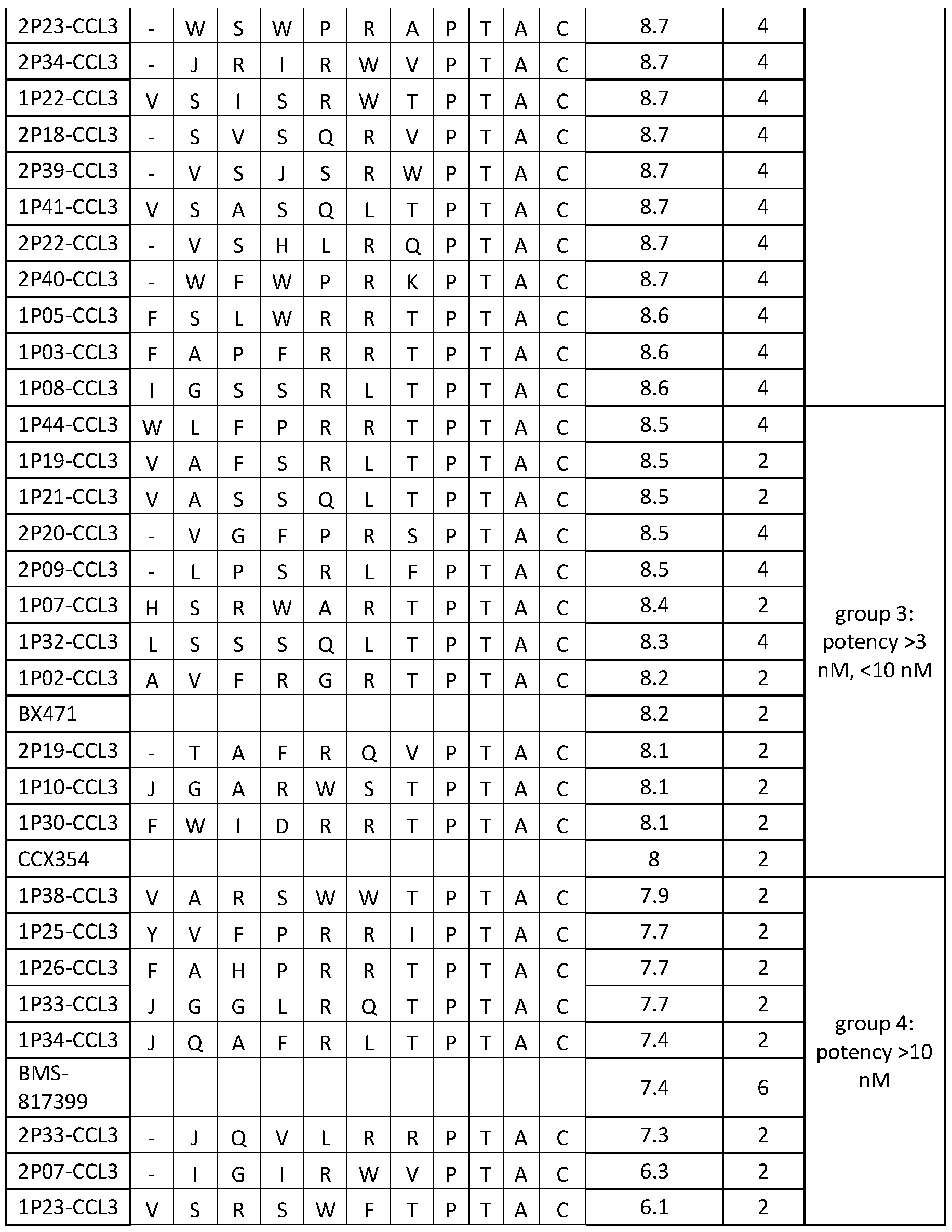


[0091] The foregoing descriptions of specific embodiments of the present invention have been presented for purposes of illustration and description. They are not intended to be exhaustive or to limit the invention and method of use to the precise forms disclosed. Many modifications and variations are possible in light of the above teaching. The embodiments described were chosen and described in order to best explain the principles of the invention and its practical application, and to thereby enable others skilled in the art to best utilize the invention and various embodiments with various modifications as are suited to the particular use contemplated. It is understood that various omissions or substitutions of equivalents are contemplated as circumstance may suggest or render expedient, but is intended to cover the application or implementation without departing from the spirit or scope of the claims of the present invention.
Claims
1. A polypeptide comprising an N-terminal portion and a C-terminal portion, wherein the N-terminal portion comprises an amino acid sequence with 0, 1, 2, 3, 4, 5, or 6 amino acid substitutions relative to any one of SEQ ID NO: 3-86, and wherein the C-terminal portion comprises an amino acid sequence at least 70% identical to SEQ ID NO: 2.
2. The polypeptide of claim 1, wherein the amino acid substitution is a conservative substitution.
3. The polypeptide of any one of claims 1-2, wherein the N-terminal portion comprises the amino acid sequence of any one of SEQ ID NO: 3-86.
4. The polypeptide of any one of claims 1-3, wherein the C-terminal portion comprises the amino acid sequence of SEQ ID NO: 2.
5. A peptide comprising an amino acid sequence with 0, 1, 2, 3, 4, 5, or 6 amino acid substitutions relative to any one of SEQ ID NO: 3-86.
6. The peptide of claim 5, wherein the amino acid substitution is a conservative substitution.
7. The peptide of any one of claims 5-6, comprising the amino acid sequence of any one of SEQ ID NO: 3-86.
8. The polypeptide of any one of claims 1-4 or the peptide of any one of claims 5-7, wherein the polypeptide or peptide inhibits CCR1 with an IC50 of less than 1 nM, less than 3 nM, less than 10 nM, less than 25 nM, or less than 50 nM.
9. The polypeptide of any one of claims 1-4 or the peptide of any one of claims 5-7, wherein the polypeptide of peptide agonizes CCR1 with at least 20%, at least 30%, at least 60%, or at least 70% of the signaling activity of wild type CCL3.
10. A conjugate comprising the polypeptide of any one of claims 1-4 or the peptide of any one of claims 5-7 conjugated to a moiety.
11. The conjugate of claim 10, wherein moiety comprises an immunoglobulin domain, a chemokine domain, a toxin, a carrier protein, a polymer, a lipid, or a detectable marker.
12. A nucleic acid molecule encoding the polypeptide of any one of claims 1-4, the peptide of any one of claims 5-7, or the conjugate of claim 10 or 11.
13. A pharmaceutical composition comprising the polypeptide of any one of claims 1 -4, the peptide of any one of claims 5-7, the conjugate of claim 10 or 11, or the nucleic acid molecule of claim 12, and a pharmaceutically acceptable carrier, excipient, and/or stabilizer.
14. The pharmaceutical composition of claim 13, further comprising a therapeutic agent.
15. A method of modulating CCR1 signaling in a cell, comprising contacting the cell with the polypeptide of any one of claims 1 -4, the peptide of any one of claims 5-7, the conjugate of claim 10 or 11, the nucleic acid molecule of claim 12, or the pharmaceutical composition of claim 13 or 14.
16. The method of claim 15, wherein the cell is a monocyte, memory T cell, basophil, dendritic cell, neutrophil, lung airway smooth muscle cell, neuron, astrocyte, endothelial cell, osteoclast, a CCR1 -expressing immortalized cell, or a cancer cell.
17. The method of any one of claims 15-16, wherein modulating CCR1 signaling in a cell comprises inducing CCR1 signaling in a cell.
18. The method of any one of claims 15-16, wherein modulating CCR1 signaling in a cell comprises inhibiting CCR1 signaling in a cell.
19. A method of treating or preventing a disease or disorder associated with CCR1 signaling in a subject, comprising administering to the subject the polypeptide of any one of claims 1-4, the peptide of any one of claims 5-7, the conjugate of claim 10 or 11, the nucleic acid molecule of claim 12, or the pharmaceutical composition of claim 13 or 14.
20. The method of claim 19 wherein the disease or disorder is an inflammatory disease, cancer.
Applications Claiming Priority (2)
| Application Number | Priority Date | Filing Date | Title |
|---|---|---|---|
| US202363507297P | 2023-06-09 | 2023-06-09 | |
| US63/507,297 | 2023-06-09 |
Publications (2)
| Publication Number | Publication Date |
|---|---|
| WO2024251939A2 true WO2024251939A2 (en) | 2024-12-12 |
| WO2024251939A3 WO2024251939A3 (en) | 2025-01-16 |
Family
ID=91530190
Family Applications (1)
| Application Number | Title | Priority Date | Filing Date |
|---|---|---|---|
| PCT/EP2024/065720 Ceased WO2024251939A2 (en) | 2023-06-09 | 2024-06-07 | Ccr1 modulators and methods of use |
Country Status (1)
| Country | Link |
|---|---|
| WO (1) | WO2024251939A2 (en) |
Family Cites Families (2)
| Publication number | Priority date | Publication date | Assignee | Title |
|---|---|---|---|---|
| US6057123A (en) * | 1991-12-23 | 2000-05-02 | British Biotech Pharmaceuticals Limited | Stem cell inhibiting proteins |
| US7091310B2 (en) * | 2002-09-13 | 2006-08-15 | Chemokine Therapeutics Corporation | Chemokine analogs for the treatment of human disease |
-
2024
- 2024-06-07 WO PCT/EP2024/065720 patent/WO2024251939A2/en not_active Ceased
Non-Patent Citations (7)
| Title |
|---|
| "Remington: The Science and practice of Pharmacy", 2000, LIPPINCOTT WILLIAMS AND WILKINS |
| ALTSCHUL ET AL., J. MOL. BIOL., vol. 215, 1990, pages 403 - 10 |
| GAERTNER ET AL., PNAS, vol. 105, no. 46, 2008, pages 17706 - 17711 |
| NEEDLEMANWUNSCH, J. MOL. BIOL., vol. 48, 1970, pages 443 |
| PEARSONLIPMAN, PROC. NATL. ACAD. SCI. USA, vol. 85, 1988, pages 2444 |
| SMITHWATERMAN, ADV. APPL. MATH, vol. 2, 1981, pages 482 |
| ZOU ET AL., BIOTECHNOLOGY ADVANCES, vol. 36, no. 7, 2018, pages 1917 - 1927 |
Also Published As
| Publication number | Publication date |
|---|---|
| WO2024251939A3 (en) | 2025-01-16 |
Similar Documents
| Publication | Publication Date | Title |
|---|---|---|
| US11952432B2 (en) | Cell-permeable stapled peptide modules for cellular delivery | |
| TW202309063A (en) | Cyclic compounds with selective kras inhibitory effects over hras and nras | |
| US12252523B2 (en) | Erythropoietin-derived peptides and methods of protecting cells from oxidative damage induced by reactive oxygen species | |
| US12115224B2 (en) | Polypeptide conjugates for intracellular delivery of stapled peptides | |
| US12528846B2 (en) | BH4 stabilized peptides and uses thereof | |
| JP2021514183A (en) | Modified immunomodulatory peptide | |
| US20080153753A1 (en) | Method of treating side effects induced by therapeutic agents | |
| US8697651B2 (en) | Amyloid β fibrillogenesis-inhibiting peptide | |
| WO2024251939A2 (en) | Ccr1 modulators and methods of use | |
| ES2719137T3 (en) | Cyclic Apeline Analogs | |
| EP1501535A1 (en) | Antagonists of megalin or cubilin for use in preventing organ damage induced by therapeutic agents | |
| EP4646232A1 (en) | Variant ligand conjugates for payload delivery | |
| KR102043992B1 (en) | Novel staple peptides for inhibiting NCOA1/STAT6 protein-protein interaction and uses thereof | |
| WO2025186255A1 (en) | Gipr inhibitors and methods of use | |
| EP4611787A1 (en) | Ccr2 inhibitors and methods of use | |
| JP2023524558A (en) | Use of peptides containing PCNA interaction motifs in the treatment of solid tumors | |
| Gellman et al. | αβ-PEPTIDE MIMICS OF Z-DOMAIN PEPTIDES | |
| HK1223556B (en) | Use of il-22 dimers in manufacture of medicaments for treating pancreatitis |
Legal Events
| Date | Code | Title | Description |
|---|---|---|---|
| 121 | Ep: the epo has been informed by wipo that ep was designated in this application |
Ref document number: 24732570 Country of ref document: EP Kind code of ref document: A2 |
|
| NENP | Non-entry into the national phase |
Ref country code: DE |