WO2024252086A1 - Compositions reticulables a l'humidite et articles auto-adhesifs les contenant - Google Patents
Compositions reticulables a l'humidite et articles auto-adhesifs les contenant Download PDFInfo
- Publication number
- WO2024252086A1 WO2024252086A1 PCT/FR2024/050704 FR2024050704W WO2024252086A1 WO 2024252086 A1 WO2024252086 A1 WO 2024252086A1 FR 2024050704 W FR2024050704 W FR 2024050704W WO 2024252086 A1 WO2024252086 A1 WO 2024252086A1
- Authority
- WO
- WIPO (PCT)
- Prior art keywords
- composition
- adhesive composition
- moisture
- adhesive
- composition according
- Prior art date
- Legal status (The legal status is an assumption and is not a legal conclusion. Google has not performed a legal analysis and makes no representation as to the accuracy of the status listed.)
- Ceased
Links
Classifications
-
- C—CHEMISTRY; METALLURGY
- C09—DYES; PAINTS; POLISHES; NATURAL RESINS; ADHESIVES; COMPOSITIONS NOT OTHERWISE PROVIDED FOR; APPLICATIONS OF MATERIALS NOT OTHERWISE PROVIDED FOR
- C09J—ADHESIVES; NON-MECHANICAL ASPECTS OF ADHESIVE PROCESSES IN GENERAL; ADHESIVE PROCESSES NOT PROVIDED FOR ELSEWHERE; USE OF MATERIALS AS ADHESIVES
- C09J7/00—Adhesives in the form of films or foils
- C09J7/30—Adhesives in the form of films or foils characterised by the adhesive composition
- C09J7/38—Pressure-sensitive adhesives [PSA]
-
- C—CHEMISTRY; METALLURGY
- C08—ORGANIC MACROMOLECULAR COMPOUNDS; THEIR PREPARATION OR CHEMICAL WORKING-UP; COMPOSITIONS BASED THEREON
- C08L—COMPOSITIONS OF MACROMOLECULAR COMPOUNDS
- C08L101/00—Compositions of unspecified macromolecular compounds
- C08L101/02—Compositions of unspecified macromolecular compounds characterised by the presence of specified groups, e.g. terminal or pendant functional groups
- C08L101/10—Compositions of unspecified macromolecular compounds characterised by the presence of specified groups, e.g. terminal or pendant functional groups containing hydrolysable silane groups
-
- C—CHEMISTRY; METALLURGY
- C08—ORGANIC MACROMOLECULAR COMPOUNDS; THEIR PREPARATION OR CHEMICAL WORKING-UP; COMPOSITIONS BASED THEREON
- C08L—COMPOSITIONS OF MACROMOLECULAR COMPOUNDS
- C08L83/00—Compositions of macromolecular compounds obtained by reactions forming in the main chain of the macromolecule a linkage containing silicon with or without sulfur, nitrogen, oxygen or carbon only; Compositions of derivatives of such polymers
- C08L83/02—Polysilicates
-
- C—CHEMISTRY; METALLURGY
- C08—ORGANIC MACROMOLECULAR COMPOUNDS; THEIR PREPARATION OR CHEMICAL WORKING-UP; COMPOSITIONS BASED THEREON
- C08L—COMPOSITIONS OF MACROMOLECULAR COMPOUNDS
- C08L83/00—Compositions of macromolecular compounds obtained by reactions forming in the main chain of the macromolecule a linkage containing silicon with or without sulfur, nitrogen, oxygen or carbon only; Compositions of derivatives of such polymers
- C08L83/04—Polysiloxanes
-
- C—CHEMISTRY; METALLURGY
- C08—ORGANIC MACROMOLECULAR COMPOUNDS; THEIR PREPARATION OR CHEMICAL WORKING-UP; COMPOSITIONS BASED THEREON
- C08L—COMPOSITIONS OF MACROMOLECULAR COMPOUNDS
- C08L83/00—Compositions of macromolecular compounds obtained by reactions forming in the main chain of the macromolecule a linkage containing silicon with or without sulfur, nitrogen, oxygen or carbon only; Compositions of derivatives of such polymers
- C08L83/04—Polysiloxanes
- C08L83/08—Polysiloxanes containing silicon bound to organic groups containing atoms other than carbon, hydrogen and oxygen
-
- C—CHEMISTRY; METALLURGY
- C09—DYES; PAINTS; POLISHES; NATURAL RESINS; ADHESIVES; COMPOSITIONS NOT OTHERWISE PROVIDED FOR; APPLICATIONS OF MATERIALS NOT OTHERWISE PROVIDED FOR
- C09J—ADHESIVES; NON-MECHANICAL ASPECTS OF ADHESIVE PROCESSES IN GENERAL; ADHESIVE PROCESSES NOT PROVIDED FOR ELSEWHERE; USE OF MATERIALS AS ADHESIVES
- C09J183/00—Adhesives based on macromolecular compounds obtained by reactions forming in the main chain of the macromolecule a linkage containing silicon, with or without sulfur, nitrogen, oxygen, or carbon only; Adhesives based on derivatives of such polymers
- C09J183/04—Polysiloxanes
-
- C—CHEMISTRY; METALLURGY
- C08—ORGANIC MACROMOLECULAR COMPOUNDS; THEIR PREPARATION OR CHEMICAL WORKING-UP; COMPOSITIONS BASED THEREON
- C08G—MACROMOLECULAR COMPOUNDS OBTAINED OTHERWISE THAN BY REACTIONS ONLY INVOLVING UNSATURATED CARBON-TO-CARBON BONDS
- C08G65/00—Macromolecular compounds obtained by reactions forming an ether link in the main chain of the macromolecule
- C08G65/02—Macromolecular compounds obtained by reactions forming an ether link in the main chain of the macromolecule from cyclic ethers by opening of the heterocyclic ring
- C08G65/32—Polymers modified by chemical after-treatment
- C08G65/329—Polymers modified by chemical after-treatment with organic compounds
- C08G65/336—Polymers modified by chemical after-treatment with organic compounds containing silicon
-
- C—CHEMISTRY; METALLURGY
- C08—ORGANIC MACROMOLECULAR COMPOUNDS; THEIR PREPARATION OR CHEMICAL WORKING-UP; COMPOSITIONS BASED THEREON
- C08K—Use of inorganic or non-macromolecular organic substances as compounding ingredients
- C08K5/00—Use of organic ingredients
- C08K5/54—Silicon-containing compounds
- C08K5/541—Silicon-containing compounds containing oxygen
- C08K5/5415—Silicon-containing compounds containing oxygen containing at least one Si—O bond
-
- C—CHEMISTRY; METALLURGY
- C09—DYES; PAINTS; POLISHES; NATURAL RESINS; ADHESIVES; COMPOSITIONS NOT OTHERWISE PROVIDED FOR; APPLICATIONS OF MATERIALS NOT OTHERWISE PROVIDED FOR
- C09J—ADHESIVES; NON-MECHANICAL ASPECTS OF ADHESIVE PROCESSES IN GENERAL; ADHESIVE PROCESSES NOT PROVIDED FOR ELSEWHERE; USE OF MATERIALS AS ADHESIVES
- C09J2301/00—Additional features of adhesives in the form of films or foils
- C09J2301/40—Additional features of adhesives in the form of films or foils characterized by the presence of essential components
- C09J2301/408—Additional features of adhesives in the form of films or foils characterized by the presence of essential components additives as essential feature of the adhesive layer
-
- C—CHEMISTRY; METALLURGY
- C09—DYES; PAINTS; POLISHES; NATURAL RESINS; ADHESIVES; COMPOSITIONS NOT OTHERWISE PROVIDED FOR; APPLICATIONS OF MATERIALS NOT OTHERWISE PROVIDED FOR
- C09J—ADHESIVES; NON-MECHANICAL ASPECTS OF ADHESIVE PROCESSES IN GENERAL; ADHESIVE PROCESSES NOT PROVIDED FOR ELSEWHERE; USE OF MATERIALS AS ADHESIVES
- C09J2483/00—Presence of polysiloxane
Definitions
- Moisture-curable compositions and self-adhesive articles containing them are provided.
- the present invention relates to a novel moisture-crosslinkable adhesive composition, based on a silylated polymer.
- a self-adhesive article in particular a self-adhesive support which comprises a support layer coated with a self-adhesive layer consisting of said composition in the crosslinked state.
- a method of manufacturing said article relates to a self-adhesive article, in particular a self-adhesive support which comprises a support layer coated with a self-adhesive layer consisting of said composition in the crosslinked state.
- Pressure sensitive adhesives also called self-adhesive glues or PSA are substances that give the backing layer coated with them an immediate adhesive power at room temperature. Often referred to by the English term “tack” or sometimes by the term “tackiness”, this immediate adhesive power allows the instant adhesion of said self-adhesive support to all kinds of substrates, under the effect of light and brief pressure. Due to its adhesive power, usually evaluated by a peel test, said self-adhesive support is then firmly fixed to said substrate, by means of an adhesive seal.
- PSA Pressure sensitive adhesives
- PSAs are widely used for the manufacture of self-adhesive articles, such as for example self-adhesive labels which are attached to articles for the purpose of displaying information (such as barcode, name, price) and/or for decorative purposes, whether in permanent or temporary bonding.
- PSAs are also used to manufacture self-adhesive tapes for a variety of uses.
- the transparent adhesive tape widely used in everyday life: the shaping and assembly of cardboard packaging; the protection of surfaces for painting work, in construction; the fixing and holding of various elements such as panels, bricks, protruding objects, in the construction of buildings or edifices; the fixing and holding of metal or plastic or glass parts, flat or with specific profiles, such as electric cables, plastic films, windows, sheet metal, inscriptions, logos, parts of seats, dashboards, plastic or textile walls, conduits or fluid circulation pipes, particularly in the transport industry; the bonding of carpets with double-sided adhesive tape in the construction sector.
- PSAs are generally applied by continuous coating processes to the entire surface of a large (if applicable printable) support layer, in a quantity (generally expressed in g/m 2 ) and hereinafter referred to as the "grammage".
- the support layer is, for example, paper or a film made of a polymer material with one or more layers.
- the layer of self-adhesive composition covering the support layer may itself be covered with a protective release layer (often referred to as a "release liner"), for example made of a silicone film.
- release liner for example made of a silicone film.
- multi-layer systems can be subsequently converted into self-adhesive labels applicable by the end user, by means of transformation processes that include printing the desired informative and/or decorative elements on the printable side of the support layer, then cutting them to the desired shape and dimensions.
- the protective release layer can be easily removed without modifying the adhesive layer that remains fixed on the support layer. After separation from its protective release layer, the label is applied to the article to be coated either manually or using labeling machines on automated packaging lines.
- These multilayer systems can also be transformed into self-adhesive tapes by cutting and packaging in rolls of determined widths and lengths with cutting or pre-cutting of particular shapes useful for their final use, such as for the assembly of parts of variable size and variable shape, in the electronics industry, whether for applications in industry or by the general public.
- Self-adhesive labels or tapes can be used in applications involving high temperatures, such as for example for protecting, masking, labeling or decorating parts in car engines or exhaust pipes, for protecting electronic or electrical components during manufacturing processes, for wrapping cables in cars, or for assembling products in the transportation industry.
- high temperatures such as for example for protecting, masking, labeling or decorating parts in car engines or exhaust pipes, for protecting electronic or electrical components during manufacturing processes, for wrapping cables in cars, or for assembling products in the transportation industry.
- self-adhesive labels/tapes are required that are resistant to high temperatures.
- the present invention relates to a moisture-curable adhesive composition
- a moisture-curable adhesive composition comprising:
- R° is independently selected from alkyl and aryl
- 2 u is an integer ranging from 3 to 5000, o aminopolysiloxane compounds; and o mixtures thereof; said composition being characterized in that it has a glass transition temperature ranging from -25°C to 20°C.
- the glass transition temperature (Tg) can be measured by dynamic mechanical analysis (DMA).
- DMA dynamic mechanical analysis
- the adhesive composition is such that it has a glass transition temperature ranging from -25°C to 20°C, preferably from -20°C to 15°C.
- the silylated polymer (A) is preferably a polymer comprising at least one, preferably at least two hydrolyzable groups of formula (I), in particular terminal (aux):
- R 4 represents a linear or branched alkyl group comprising from 1 to 4 carbon atoms, with the possibility that when there are several R 4 radicals, these are identical or different
- R 5 represents a linear or branched alkyl group comprising from 1 to 4 carbon atoms, with the possibility that when there are several R 5 radicals, the latter are identical or different, with the possibility that two OR 5 groups can be engaged in the same cycle
- p is an integer equal to 0, 1 or 2, preferably equal to 0 or 1.
- the silylated polymer may have a polyether main chain, a polyester main chain, a polyester-polyether-polyester main chain, a polyether-polyester-polyether main chain, a polyolefin main chain, a polycaprolactone main chain, a polyacrylate main chain, a polycarbonate main chain, a polyether-polycarbonate main chain, a polyester-polycarbonate main chain, a polyacetal main chain, a polyester-polyamide main chain, a polythioether main chain, a polyurethane main chain, a polyester-polyurethane main chain, a polyether-polyurethane main chain, a polyether-polyester-polyurethane main chain, a polyolefin-polyurethane main chain, a polyether-polyolefin-polyurethane main chain.
- the number average molecular weight of the silylated polymers (A) can be measured by methods well known to those skilled in the art, for example by size exclusion chromatography using polystyrene standards.
- the silylated polymer (A) corresponds to one of the following formulas (II), (III) or (IV): in which:
- R 4 , R 5 and p have the same meaning as in formula (I) described above,
- P represents a saturated or unsaturated, linear or branched polymeric radical optionally comprising one or more heteroatoms, such as oxygen, nitrogen, sulfur, silicon, and preferably having a number-average molar mass ranging from 100 g/mol to 50,000 g/mol, more particularly from 500 g/mol to 40,000 g/mol ⁇
- R 3 represents a linear or branched divalent alkylene radical comprising from 1 to 6 carbon atoms, preferably from 1 to 3 carbon atoms,
- R 7 represents a linear or branched alkyl group comprising from 1 to 20 carbon atoms and which may also comprise one or more heteroatoms, and f is an integer ranging from 1 to 6, preferably ranging from 2 to 5, preferably from 2 to 4, more preferably ranging from 2 to 3.
- P represents a polymeric radical chosen in a non-limiting manner from polyethers, polycarbonates, polyesters, polyolefins, polyacrylates, polyether polyurethanes, polyester polyurethanes, polyolefin polyurethanes, polyacrylate polyurethanes, polycarbonate polyurethanes, polyether/polyester block polyurethanes.
- the silylated polymers (A) are chosen from silylated polyurethanes, silylated polyethers, and their mixtures.
- the silylated polymer (A) corresponds to one of the formulas (IT), (III') or (IV'): in which:
- R 1 , R 3 , R 4 , R 5 , X, R 7 and p have the same meaning as in formulas (II), (III) and (IV) described above
- R 2 represents a saturated or unsaturated, linear or branched, divalent hydrocarbon radical optionally comprising one or more heteroatoms, such as oxygen, nitrogen, sulfur, silicon, and preferably having a number-average molar mass ranging from 100 g/mol to 48,600 g/mol, more particularly from 300 g/mol to 38,600 g/mol, and n is an integer greater than or equal to 0.
- the radical R 2 comprises one or more heteroatoms
- said heteroatoms are not present at the end of the chain.
- the free valences of the divalent radical R 2 linked to the oxygen atoms adjacent to the silylated polymer each come from a carbon atom.
- the main chain of the radical R 2 is terminated by a carbon atom at each of the two ends, said carbon atom then having a free valence.
- such diols may be represented by the formula HO-R 2 -OH where R 2 has the same meaning as in formulae (II'), (HT) or (IV').
- - q represents an integer such that the number-average molecular mass of the radical R 2 ranges from 100 g/mol to 48600 g/mol, preferably from 300 g/mol to 18600 g/mol, more preferably from 500 g/mol to 12600 g/mol,
- - r and s represent zero or a non-zero integer such that the number-average molecular mass of the radical R 2 ranges from 100 g/mol to 48600 g/mol, preferably from 300 g/mol to 18600 g/mol, more preferably from 500 g/mol to 12600 g/mol, it being understood that the sum r+s is different from zero,
- Q 1 represents a linear or branched, saturated or unsaturated, aromatic or aliphatic divalent alkylene radical, preferably having from 1 to 18 carbon atoms, more preferably from 1 to 8 carbon atoms,
- Q 2 represents a linear or branched divalent alkylene radical preferably having from 2 to 36 carbon atoms, more preferably from 1 to 8 carbon atoms,
- Q 3 , Q 4 , Q 5 , Q 6 , Q 7 and Q 8 represent, independently of one another, a hydrogen atom or an alkyl, alkenyl or aromatic radical, preferably having from 1 to 12 carbon atoms, preferably from 2 to 12 carbon atoms, more preferably from 2 to 8 carbon atoms.
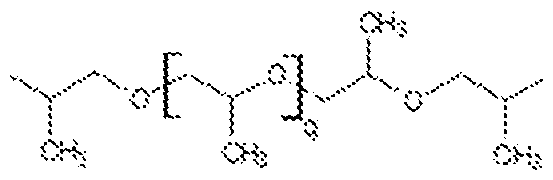
- the silylated polymer (A) is such that the radical R 2 which appears in the formulae (IT), (III') and (IV') represents a polyether radical, preferably a poly(oxyalkylene) radical, and even more preferably a radical derived from a polypropylene glycol corresponding to the formula indicated above.
- GENIOSIL® STP-E30 polypropylene glycol with 2 alpha silane functions of the methyl dimethoxy type with a number-average molar mass of 24000 g/mol;
- SPUR+® 1050MM (available from MOMENTIVE): polyurethane comprising two groups (I) of the trimethoxy type (n different from 0, p equal to 0 and R 5 represents a methyl group) having a number-average molar mass of 16393 g/mol where R 3 represents an n-propyl group;
- SPUR+® Y-19116 available from MOMENTIVE: polyurethane comprising two groups (I) of the trimethoxy type (n different from 0 and R 5 represents a methyl group) having a number average molar mass ranging from 15000 to 17000 g/mol g/mol where R 3 represents an n-propyl group;
- DESMOSEAL® S XP 2636 (available from BAYER): polyurethane comprising two groups (I) of the trimethoxy type (n different from 0, p equal to 0 and R 5 represents a methyl group) having a number-average molar mass of 15038 g/mol where R 3 represents an n-propylene group.
- the polymers (A) of formula (III) or (III’) can be obtained by hydrosilylation of polyether diallyl ether according to a process described for example in document EP 1829928.
- the MS SAX® 530 polymer (available from KANEKA) corresponding to a polyether comprising two groups (I) of the trimethoxy type (p equal to 1 and R 4 and R 5 represent a methyl group) having a weight-average molar mass ranging from 14,000 to 16,000 g/mole;
- the MS SAX® 260 polymer (available from KANEKA) corresponding to a polyether comprising two groups (I) of dimethoxy type (p equal to 1, R 4 and R 5 represent a methyl group) having a weight-average molar mass of 16000 to 18000 g/mol where R 3 represents an ethyl group;
- the MS S303H polymer (available from KANEKA) corresponding to a polyether comprising three groups (I) of dimethoxy type (p is equal to 1 and R 4 represents a methyl group) having a weight average molecular mass of approximately 22,000 Dalton.
- silylated polymers (A) of formula (IV) or (IV') can for example be obtained by reaction of polyol(s) with one or more diisocyanate(s) followed by a reaction with aminosilanes or mercaptosilanes.
- a process for the preparation of polymers of formula (IV) or (IV') is described in document EP 2 583 988. A person skilled in the art will be able to adapt the manufacturing process described in this document in the case of the use of different types of polyols.
- the adhesive composition comprises at least one silylated polymer (A) of formula (II) and/or (II’) or at least one silylated polymer of formula (III) and/or (III’).
- the silylated polymer is a silylated polymer of formula (II') in which R 2 is a divalent radical derived from a polyether, preferably from a poly(oxyalkylene) diol, and even more particularly from a polypropylene glycol.
- the adhesive composition according to the invention comprises from 5% to 80% by weight of silylated polymer(s) (A), preferably from 15% to 70% by weight, and even more preferably from 20% to 60% by weight relative to the total weight of said composition.
- the adhesive composition according to the invention also comprises at least one tackifying resin (B).
- Said resin may be any resin compatible with the silylated polymer(s) (A).
- compatible tackifying resin is intended to mean a tackifying resin which, when mixed in proportions 50%/50% with the silylated polymer(s) (A), gives a substantially homogeneous mixture.
- the softening temperature (or point) is determined in accordance with the standardized ASTM E28 test, the principle of which is as follows: a brass ring with a diameter of approximately 2 cm is filled with the resin to be tested in the molten state. After cooling to room temperature, the ring and the solid resin are placed horizontally in a glycerin or other thermostatically controlled bath whose temperature can vary by 5°C per minute. A steel ball with a diameter of approximately 9.5 mm is centered on the solid resin disk. The softening temperature is - during the temperature rise phase of the bath at a rate of 5°C per minute - the temperature at which the resin disk creeps by a height of 25.4 mm under the weight of the ball.
- the tackifying resin (B) preferably has a softening temperature ranging from 60°C to 115°C, more preferably from 80°C to 110°C.
- the resins (B) are advantageously chosen from:
- rosins of natural or modified origin such as, for example, rosin extracted from pine gum, wood rosin extracted from tree roots and their derivatives hydrogenated, dimerized, polymerized or esterified by monoalcohols or polyols, such as glycerol or pentaerythritol;
- Terpene resins include, in particular, resins synthesized by (co)-polymerization of one or more terpene monomers such as, for example, ⁇ -pinene, 0-pinene, D-Limonene; resins synthesized by copolymerization of one or more terpene monomers with one or more non-terpene monomers, for example chosen from styrene, methylstyrene, isoprene, etc.; terpene-phenolic resins; and their partially or fully hydrogenated derivatives.
- terpene monomers such as, for example, ⁇ -pinene, 0-pinene, D-Limonene
- resins synthesized by copolymerization of one or more terpene monomers with one or more non-terpene monomers for example chosen from styrene, methylstyrene, isoprene, etc.
- terpene-phenolic resins and their partially or fully hydrogen
- Resins synthesized by (co)polymerization of one or more terpene monomers are known as polyterpenes.
- Terpene-phenolic resins also called terpene-phenols
- Terpene-phenols are typically obtained by polymerization of terpene hydrocarbons and phenols, in the presence of a Friedel-Crafts catalyst.
- terpene resins terpene-phenolic resins are preferred.
- Dercolyte® M105 available from the company “Dérivés Résiniques et Tercherniques or DRT” (which is a polyterpene resin having a softening temperature of 105°C), Dertophene® T105 marketed by DRT (which is a terpene-phenolic resin having a softening temperature of 105°C), Dertophene® H150 available from the same company with a molar mass Mn equal to approximately 630 D, Sylvalite 1105 marketed by Kraton (which is a terpene-phenolic resin having a softening temperature of 105°C), PICCO® AR-85 available from the company EASTMAN (having a softening point 85°C), the “PICCO® AR-100” also available from the EASTMAN company (having a softening point of 100°C).
- Sylvalite® RE 100 which is an ester of rosin and pentaerythritol available from the Arizona Chemical company and with a molar mass Mn of approximately 1700 Da.
- Aliphatic hydrocarbon resins which may be partially or completely hydrogenated, are well known to those skilled in the art. These are resins resulting from the polymerization of mixtures of unsaturated aliphatic hydrocarbons having, for example, 5 carbon atoms (which may, for example, be derived from petroleum or other fractions), followed by a possible hydrogenation step (total or partial).
- cycloaliphatic hydrocarbon resins are well known to those skilled in the art. These are resins resulting from the polymerization of mixtures of unsaturated cycloaliphatic hydrocarbons having, for example, 10 carbon atoms (which may for example be derived from petroleum or other fractions), followed by a possible hydrogenation step (total or partial). They can in particular be obtained from dicyclopentadiene and their derivatives (methyldicyclopentadiene, dimethyldicyclopentadiene, etc.). Among the cycloaliphatic hydrocarbon resins, DCPD (dicyclopentadiene) resins are particularly preferred.
- Aromatic modified aliphatic or cycloaliphatic hydrocarbon resins can be derived from the copolymerization of aliphatic olefins (e.g. C5) or cycloaliphatic olefins and aromatic olefins (e.g. C9), followed by a possible hydrogenation step (total or partial), the content of aliphatic or cycloaliphatic olefins being in the majority compared to aromatic olefins.
- Examples include Eastotac® H100W (hydrogenated C5 resin) from Eastman with a softening point of 100°C, Escorez® 5400 resin from Exxon Chemicals (hydrogenated DCPD resin) with a softening point of 100°C, and Sukorez® SU 100 (hydrogenated DCPD resin) from Kolon with a softening point of 105°C.
- the tackifying resin (B) is chosen from terpene resins, and even more preferably from terpene-phenolic resins.
- the adhesive composition according to the invention comprises from 15% to 90% by weight of tackifying resin(s) (B), preferably from 30% to 80% by weight, and even more preferably from 40% to 70% by weight relative to the total weight of said composition.
- Compound (C) is selected from the group consisting of: o compounds of formula (F1) and their oligomeric/polymeric derivatives: R 0 -O-[-Si(OR°) 2 -O-]tR 0 (F1) in which:
- R° is independently selected from alkyl and aryl
- R’° is independently selected from alkyl groups comprising from 1 to 10 carbon atoms
- 2 u is an integer ranging from 3 to 5000, o aminopolysiloxane compounds; and o mixtures thereof.
- the groups R° can be the same or different. This is also true for different repeating units t, R° can be the same or different.
- Oligomeric/polymeric derivatives of compounds of formula (F1) can typically be obtained by partial hydrolysis and partial condensation of compounds of formula (F1). This can be accomplished by the addition of water and catalytic amounts of acid (such as e.g. HCl). Some hydrolyzed -OR groups then release water and the intermediate silanols react by condensation to form Si-O-Si bonds and water.
- acid such as e.g. HCl
- the compounds of formula (F1), and their oligomeric/polymeric derivatives are those in which:
- - R° is chosen from ethyl, n-propyl, butyl, or isopropyl; and/or - 1 represents an integer ranging from 1 to 20.
- the compounds of formula (F1), and their oligomeric/polymeric derivatives are those in which:
- - 1 is an integer ranging from 2 to 7.
- Compounds (C) may be chosen from tetra-ethoxyorthosilicates, tetra-propoxyorthosilicates, tetra-isopropoxyorthosilicates, tetra-butoxyorthosilicates, their oligomeric/polymeric derivatives, and their mixtures.
- the compounds (C) are chosen from tetra-ethoxyorthosilicates, their oligomeric/polymeric derivatives, and their mixtures.
- R’° groups can be the same or different. This is also true for different repeating units u, R’° can be the same or different.
- the compound of formula (F2) may have a number-average molecular weight ranging from 100 to 300,000 g/mol, preferably from 200 to 100,000 g/mol, and even more preferably from 500 to 50,000 g/mol.
- the number-average molecular mass of the compounds of formula (F2) can be measured by methods well known to those skilled in the art, for example by size exclusion chromatography using standards, for example of the polystyrene type.
- the compounds of formula (F2) are preferably those in which:
- 2 R’° is independently selected from alkyl groups comprising from 1 to 2 carbon atoms
- 2 u is an integer ranging from 5 to 3000.
- the compounds of formula (F2) are notably marketed by the company CHT under the name HANSA SFA 92135 or HANSA SFA 92013.
- Aminopolysiloxanes are notably marketed by the company CHT under the name HANSA SFA 92135 or HANSA SFA 92013.
- Aminopolysiloxanes are polysiloxanes functionalized with at least one amino group.
- amino group includes a primary amine, secondary amine or tertiary amine functional group.
- Aminopolysiloxanes preferably have the following formula (F3): in which:
- R a , R b , R c , R d , R e , R f , R 9 , R h , R', or R j independently of one another, represent a linear or branched alkyl group, an aryl group, a cycloaliphatic group, an alkoxy group, a group -NR p R q with R p and R 9 representing, independently of one another, a hydrogen atom, an optionally substituted alkyl radical, an aryl radical;
- 2 x represents an integer from 1 to 100;
- 2 y represents an integer ranging from 1 to 1,000. characterized in that at least one of the groups R a , R b , R c , R d , R e , R f , R 9 , R h , R', or Rj, represents a group -NR p R 9 with R p and R 9 representing, independently of one another, a hydrogen atom, an optionally substituted alkyl radical, an aryl radical.
- aminopolysiloxanes of formula (F3) are preferably those in which:
- R a , R b , R c , R d , R e , R f , R 9 , R h , R', or R j independently of one another represent a linear or branched alkyl group having from 1 to 6 carbon atoms, preferably from one to two carbon atoms, an alkoxy group, a group -NR p R 9 with R p and R 9 representing, independently of one another, a hydrogen atom, an optionally substituted alkyl radical, an aryl radical;
- 2 x represents an integer from 1 to 100;
- 2 y represents an integer ranging from 1 to 1000.
- aminopolysiloxanes we can for example cite (2-aminoethyl)methylpolysiloxane, (3-aminopropyl)methylpolysiloxane, (2-aminoethyl-3- aminopropyl)methylpolysiloxane, (3-2-aminoethylamino)propyl)methylsiloxane, (6-aminohexyl)methylpolysiloxane, and mixtures thereof.
- the compound (C) is chosen from the compounds of formula (F1) above and their oligomeric/polymeric derivatives.
- the compounds (C) are chosen from tetra-ethoxyorthosilicates, their oligomeric/polymeric derivatives, and their mixtures.
- the latter may be any catalyst known to those skilled in the art for the condensation of silanol.
- the crosslinking catalyst (D) can be chosen from the group consisting of:
- organometallic compounds means compounds comprising an organic radical and at least one metal.
- organic radical means a radical comprising at least one carbon atom.
- Organometallic compounds may include organometallic compounds (compounds comprising at least one metal-carbon covalent bond), metal alkoxides, metal carboxylates, and metal coordination complexes with organic ligand(s).
- organic ligands include acetylacetonate and oximes.
- the metal atom of the organometallic compounds may be any metal atom known to those skilled in the art, and may in particular be chosen from tin, aluminum, zinc, cobalt, iron, nickel, bismuth, titanium, or zirconium.
- the organometallic compounds may also comprise several metal atoms.
- Organometallic compounds may be carboxylates of organometallic compounds, selected from the group consisting of dibutyltin dilaurate (DBTL), dibutyltin diacetate, dibutyltin diethylhexanoate, dioctyltin dineodecanoate (for example available under the name TIB KAT® 223 from TIB CHEMICALS), dibutyltin dioleate, dibutyltin benzylmaleate, diphenyltin diacetate, and mixtures thereof.
- DBTL dibutyltin dilaurate
- dibutyltin diacetate dibutyltin diethylhexanoate
- dioctyltin dineodecanoate for example available under the name TIB KAT® 223 from TIB CHEMICALS
- dibutyltin dioleate dibutyltin benzylmaleate
- the metal alcoholates may be selected from the group consisting of titanium tetrabutanolate, titanium tetraisopropylate, zirconium tetrabutanolate, zirconium tetratisopropylate, and mixtures thereof.
- the metal carboxylates may be selected from the group consisting of zinc 2-ethylcaproate, zinc diacetate, zinc dineodecanoate, zinc diundecenoate, zinc dimethacrylate, cobalt acetylacetonate, cobalt diacetate, iron acetylacetonate, iron diacetate, nickel acetylacetonate, nickel diacetate, bismuth acetate, bismuth trioctanoate, bismuth dineodecanoate, zinc bismuth dineodecanoate, and mixtures thereof.
- the metal coordination complexes with an organic ligand(s) may be selected from the group consisting of zinc acetylacetonate, titanium acetylacetonate (for example commercially available under the name TYZOR ® AA75 from the company DORF KETAL), titanium tetraacetylacetonate, aluminum trisacetylacetonate, aluminum chelates such as for example mono-acetylacetonate bis-(ethylacetoacetate) (for example commercially available under the name K-KAT ® 5218 from the company KING INDUSTRIES), zirconium tetraacetylacetonate, diisopropoxybis(ethylacetonato)titanium, and mixtures thereof.
- zinc acetylacetonate for example commercially available under the name TYZOR ® AA75 from the company DORF KETAL
- titanium tetraacetylacetonate aluminum trisacetylacetonate
- Amines can be primary amines, secondary amines, or tertiary amines.
- the amines are selected from the group consisting of triethylamine, tributylamine, tetramethylguanidine, 1,8-diazabicyclo[5.4.0]-7-undecene, 1,4-diazabicyclo[2.2.2]octane, 1,5-diazabicyclo[4.3.0]non-5-ene, N,N-bis(N,N-dimethyl-2-aminoethyl)methylamine, N,N-dimethylcyclohexaylamine, N,N-dimethylphenylamine, N-ethylmorpholine, and mixtures thereof.
- the acid catalysts may be selected from inorganic acid catalysts, organic acid catalysts, and mixtures thereof.
- inorganic acid catalysts we can for example cite phosphoric or orthophosphoric acid, phosphorous acid, hypophosphorous acid, or sulfuric acid.
- the organic acid catalysts may be selected from sulfonic acids, carboxylic acids, acid organophosphates, acid organophosphonates, phosphonic acids, and mixtures thereof.
- the organic and inorganic acid catalysts have a pKa less than or equal to 6, preferably less than or equal to 4, advantageously less than or equal to 2, advantageously less than or equal to 0.
- the sulfonic acids may be aliphatic or aromatic, optionally substituted (for example substituted by at least one substituent selected from halogens (such as fluorine), hydroxyls, alkyls, amines, and mixtures thereof), and may be mono- or disulfonic.
- the sulfonic acids may be selected from N-alkylaminoalkylsulfonic acids and N,N-dialkylaminoalkylsulfonic acids (zwitterions), such as, for example, 2-(N-morpholino)ethanesulfonic acid, 3-(N-morpholino)propanesulfonic acid, 4-[N-morpholino]butanesulfonic acid, 1,4-piperazinediethanesulfonic acid, N-2-hydroxyethylpiperazine-N'-2-ethanesulfonic acid, 2-(N-morpholino)ethanesulfonic acid, N -Morpholinomethanesulfonic acid, N-(2-hydroxyethyl)piperazine-N'-methanesulfonic acid, piperazine-N,N'-bis(methanesulfonic acid), cyclohexylaminomethanesulfonic acid, N- [tris(hydroxymethyl)methyl]-
- the sulfonic acids are chosen from para-toluenesulfonic acid, benzenesulfonic acid, methanesulfonic acid, dodecylbenzenesulfonic acid, dodecylbenzene disulfonic acid, dinonylnaphthalene disulfonic acid, dinonylnaphthalene sulfonic acid, trifluoromethylsulfonic acid, and mixtures thereof.
- carboxylic acid catalysts examples include malonic acid, succinic acid, maleic acid, oxalic acid, acetic acid, lactic acid, benzoic acid, citric acid, glycolic acid, and mixtures thereof.
- acid organophosphate means an ester of phosphoric acid comprising at least one -OH radical.
- methyl phosphate is an acid organophosphate comprising two -OH radicals and has the following structure:
- acid organophosphates have the following formula:
- the acid organophosphates may, for example, be selected from the group consisting of mono- or dialkyl acid phosphates 01-022 and mixtures thereof, such as, for example, butyl phosphate, dibutyl phosphate, di-(2-ethylhexyl) phosphate, 2-ethylhexyl phosphate and mixtures thereof; mono- or diaryl phosphates and mixtures thereof, such as, for example, monophenyl phosphate, diphenyl phosphate and mixtures thereof; alkyl-phenyl phosphates; and mixtures thereof.
- mono- or dialkyl acid phosphates 01-022 and mixtures thereof such as, for example, butyl phosphate, dibutyl phosphate, di-(2-ethylhexyl) phosphate, 2-ethylhexyl phosphate and mixtures thereof
- mono- or diaryl phosphates and mixtures thereof such as, for example, monophenyl phosphat
- organophosphonate acid means a phosphorus compound having the following general formula:
- R'-(P O)-(OH)(OR”) in which R’ and R” are organic radicals, preferably chosen independently of one another, from linear or branched C1-C22 alkyls, cycloalkyls, aryls, and mixtures thereof (said alkyl, cycloalkyl and aryl groups being optionally substituted).
- N-alkylaminoalkylphosphonic acids zwitterions
- N,N-dialkylaminoalkylphosphonic acids zwitterions
- C1-C20 alkylphosphonic acids such as for example methylphosphonic acid, ethylphosphonic acid, propylphosphonic acid, butylphosphonic acid, t-butylphosphonic acid, isobutylphosphonic acid, hexylphosphonic acid, ethyl-2-hexylphosphonic acid and higher linear or branched homologues, benzylphosphonic acid, phenylphosphonic acid, toluylphosphonic acid, xylylphosphonic acid.
- organic acid catalysts examples include NACIIRE ® 155 (dinonylnaphthalene disulfonic acid, 55% active matter in isobutanol) marketed by KING INDUSTRIES, NACURE ® 1051 (dinonylnaphthalene sulfonic acid, 50% active matter in 2-butoxyethanol) marketed by KING INDUSTRIES, NACURE ® 5076 (dodecylbenzene sulfonic acid, 70% active matter in isopropanol) marketed by KING INDUSTRIES, K-CURE ® 1040 (para-toluene sulfonic acid, 40% active matter in isopropanol) marketed by KING INDUSTRIES, NACURE ® 4000 (mixture of mono and dialkyl acid phosphates, 100% active matter) marketed by KING INDUSTRIES.
- the acid derivatives according to the invention may be acid anhydrides, acid esters, acid ammonium salts, the acid being as described above.
- the acid derivatives are in particular so-called “blocked” or “latent” acids which advantageously allow the acid to be released by thermal activation (for example at a temperature ranging from 70°C to 170°C, preferably at a temperature ranging from 90°C to 120°C) or by hydrolysis, or by photoactivation, preferably by thermal activation.
- the blocked acid advantageously allows the acid which is the entity having the catalytic activity to be released.
- the ammonium salt formed between amino methyl propanol and para-toluenesulfonic acid is a blocked acid (acid derivative) which, upon thermal activation, releases para-toluenesulfonic acid.
- the acid derivatives may be prepared by any means known to those skilled in the art from the corresponding acid, for example by using typical acid/base reactions.
- the method for making an ester typically involves the condensation of an acidic compound with a compound comprising a hydroxyl group such as for example an alcohol, or with an oxirane-type compound.
- Ammonium salts can be prepared from any of the above-mentioned acids, with ammonia or with a primary, secondary or tertiary amine.
- the amines can optionally comprise at least one functional group such as a hydroxy group (alkanolamines), a C1-C4 alkyl group.
- Ammonium salts can also be prepared by changing the pH of a solution containing for example N-alkylaminoalkylphosphonic acids, N,N-dialkylaminoalkylphosphonic acids, N-alkylaminoalkylsulfonic acids or N,N-dialkylaminoalkylsulfonic acids.
- the catalyst is an ammonium salt of a sulfonic acid (the sulfonic acid being as described above), an ammonium salt of a phosphonic acid (the phosphonic acid being as described above), an ammonium salt of an acidic organophosphonate (the acidic organophosphonate being as described above), or an ammonium salt of an acidic organophosphate (the acidic organophosphate being as described above).
- amines for the preparation of ammonium salts mention may be made, for example, of 2-amino-2-methyl-1-propanol, triethylamine, aniline, pyridine, dimethylaminoethanol, alkylpyridines, diisopropanolamine, dimethylethanolamine, triethanolamine, oxazolidines, bicyclic oxazolidines, amidines, diazabicyclooctanes, guanidines, N-alkyl morpholine, aminopyridine, aminoalkylpyridines, aminopyrrolidines, indazole, imidazole, pyrazole, pyrazine, pyrimidine, purine, imidazoline, pyrazoline, piperazine, aminomorpholine, aminoalkylmorpholines, and mixtures thereof.
- the amines are tertiary amines.
- acid derivatives examples include NACURE ® 3327 or NACURE ® 3525 (amine-blocked dinonylnaphthalene disulfonic acid, 25% active material in isopropanol and isobutanol) marketed by KING INDUSTRIES, NACURE ® 1557 or NACURE ® 1953 (amine-blocked dinonylnaphthalene sulfonic acid, 25% active material in a butanol and 2-butoxyethanol mixture) marketed by KING INDUSTRIES, NACURE ® 5225 or NACURE ® 5528 or NACURE ® 5925 (amine-blocked dodecylbenzene sulfonic acid, 25% active material in isopropanol) marketed by KING INDUSTRIES, NACURE ® 2107 or NACURE ® 2500 (amine-blocked para-toluenesulfonic acid, 25% or 26% active matter in isopropanol) marketed by KING INDUSTRIES
- the catalyst is selected from the group consisting of organometallic compounds, and more preferably from the group consisting of metal alcoholates.
- composition according to the invention may comprise from 0.001% to 5% by weight, preferably from 0.01% to 3% by weight, and even more preferably from 0.05% to 1% by weight of catalyst (D) relative to the total weight of said composition.
- the moisture-crosslinkable adhesive composition according to the invention may also comprise one or more additives chosen from the group consisting of moisture absorbers, plasticizers, antioxidants, pigments, dyes, adhesion promoters, UV stabilizers, solvents, flame retardant additives or even fillers.
- the moisture absorber may be, for example, selected from non-polymeric, hydrolyzable alkoxysilane derivatives with a molecular weight of less than 500 g/mol, preferably selected from trimethoxysilane and triethoxysilane derivatives. Such an agent may typically extend the shelf life of the composition during storage and transportation prior to use.
- Examples include gamma-methacryloxypropyltrimethoxysilane (for example available under the trade name SILQUEST ® A-174 from MOMENTIVE), methacryloxymethyltrimethoxysilane (for example available under the name GENIOSIL ® XL33 from WACKER), vinyltrimethoxysilane, isooctyltrimethoxysilane, or phenyltrimethoxysilane.
- SILQUEST ® A-174 from MOMENTIVE
- methacryloxymethyltrimethoxysilane for example available under the name GENIOSIL ® XL33 from WACKER
- vinyltrimethoxysilane isooctyltrimethoxysilane
- phenyltrimethoxysilane examples include gamma-methacryloxypropyltrimethoxysilane (for example available under the trade name SILQUEST ® A-174 from MOMENTIVE), methacryloxymethyltrimethoxysi
- the moisture absorber content is preferably less than or equal to 3% by weight, more preferably less than or equal to 2% by weight relative to the total weight of composition A.
- the moisture absorber may for example represent from 0.1% to 3% by weight or from 1% to 2% by weight relative to the total weight of the composition according to the invention.
- composition according to the invention may also comprise a plasticizing agent.
- any plasticizing agent commonly used in the field of adhesives can be used, such as, for example, phthalates, benzoates, trimethylolpropane esters, trimethylolethane esters, trimethylolmethane esters, glycerol esters, pentaerythritol esters, naphthenic mineral oils, adipates, cyclohexyldicarboxylates, paraffinic oils, natural oils (optionally epoxidized), polypropylenes, polybutylenes, hydrogenated polyisoprenes, and mixtures thereof.
- phthalates benzoates
- trimethylolpropane esters trimethylolethane esters
- trimethylolmethane esters trimethylolmethane esters
- glycerol esters pentaerythritol esters
- naphthenic mineral oils naphthenic mineral oils
- adipates cyclohexyldicarboxylates
- paraffinic oils natural oils
- phthalates examples include diisononyl phthalate, diisobutyl phthalate, dioctyl phthalate, dicyclohexyl phthalate, diisooctyl phthalate, diisododecyl phthalate, dibenzyl phthalate or butylbenzyl phthalate.
- benzoates include: neopentyl glycol dibenzoate (e.g. available under the name UNIPLEX ® 512 from LANXESS), dipropylene glycol dibenzoate (e.g. available under the name BENZOFLEX ® 9-88SG from EASTMAN), a mixture of diethylene glycol dibenzoate and dipropylene glycol dibenzoate (e.g. available under the name K-FLEX ® 850 S from KALAMA CHEMICAL), or a mixture of diethylene glycol dibenzoate, dipropylene glycol dibenzoate and triethylene glycol dibenzoate (e.g. available under the name BENZOFLEX ® 2088 from EASTMAN).
- neopentyl glycol dibenzoate e.g. available under the name UNIPLEX ® 512 from LANXESS
- dipropylene glycol dibenzoate e.g. available under the name BENZOFLEX ®
- pentaerythritol esters we can for example cite pentaerythritol tetravalerate (for example available under the name PEVALENTM from the company PESTORP).
- cyclohexanedicarboxylates we can for example cite diisononyl 1,2-cyclohexanedicarboxylate (for example available under the name HEXAMOLL DINCH ® from BASF).
- the total content of plasticizer(s) in the composition according to the invention may range from 0% to 30% by weight, preferably from 0% to 30% by weight, or even for example from 0% to 15% by weight relative to the total weight of said composition.
- the composition does not comprise a plasticizer.
- composition according to the invention may also comprise an antioxidant (also referred to as a UV stabilizing agent).
- an antioxidant also referred to as a UV stabilizing agent.
- Antioxidants are compounds that may be introduced to protect the composition from degradation resulting from a reaction with oxygen that is likely to form by the action of heat or light. These compounds may include primary antioxidants that scavenge free radicals. Primary antioxidants may be used alone or in combination with other secondary antioxidants or UV stabilizers.
- IRGANOX ® 1010 we can cite IRGANOX ® 1010, IRGANOX ® B561, IRGANOX ® 245, IRGANOX ® 1076, IRGAFOS ® 168 marketed by BASF.
- An amount of antioxidant ranging from 0.1% to 3%, preferably from 1% to 3% by weight, based on the total weight of the composition according to the invention is generally used.
- the solvents are preferably non-reactive solvents.
- solvents examples include polyols, alcohols, esters, ketones, and mixtures thereof.
- the polyols may be chosen from diols, triols, and mixtures thereof.
- they are polyester polyols, such as for example those described above.
- the composition according to the invention comprises a carbonated filler content of less than or equal to 15% by weight, more preferably less than or equal to 10% by weight, and even more preferably less than or equal to 5% by weight, relative to the total weight of said composition.
- the composition comprises less than 2% by weight of carbonated filler relative to the total weight of said composition, and in particular it does not comprise carbonated filler.
- the composition does not comprise a (meth)acrylate polymer.
- the composition comprises less than 10% by weight of additives.
- composition according to the invention is advantageously a pressure-sensitive self-adhesive (PSA) composition.
- PSA pressure-sensitive self-adhesive
- the adhesive composition according to the invention advantageously leads, after crosslinking, to good adhesive properties at 23°C initially, but also good resistance to aging, particularly under restrictive temperature and humidity conditions.
- composition according to the invention advantageously has high resistance to wet poultice.
- the adhesive composition according to the invention preferably has, after crosslinking, an adhesive power at 180° (peel at 180°) at 23°C greater than or equal to 0.4N/cm, determined according to the FINAT method No. 1 of 2001, preferably with a PET support.
- the adhesive composition according to the invention may be in the form of a single-component adhesive composition or a multi-component adhesive composition, preferably two-component.
- the adhesive composition according to the invention is in the form of a single-component composition.
- said single-component composition preferably comprises:
- crosslinking catalyst (D) from 0% to 10%, preferably from 0.001% to 5%, preferentially from 0.01% to 3% by weight of crosslinking catalyst (D); these percentages by weight being indicated on the basis of the total weight of single-component composition.
- the one-component composition may be prepared by a process which comprises:
- the adhesive composition according to the invention is in the form of a multi-component composition comprising:
- composition II (as 1st component) comprising:
- composition V (as 2nd component) comprising:
- composition V the compound(s) (C) as defined above; the optional catalyst (D) being included in composition V or in a composition W ( 3rd component).
- the various components of said multi-component adhesive composition are intended to be mixed at the time of implementation of the crosslinking reaction, in accordance with the method for manufacturing a self-adhesive support described below.
- the multi-component adhesive composition may comprise one or more additional compositions in addition to compositions U and V, said additional composition(s) may comprise any type of compound(s).
- the multi-component adhesive composition may comprise an additional composition W comprising water.
- the water may be in liquid or gaseous form, or encapsulated, or absorbed, or contained in the chemical structure of a component.
- the water may be derived from one or more components that can make it free and available at a later time.
- the compositions U and V included in said adhesive composition are advantageously stable to storage, temperature and/or humidity. The greater stability over time advantageously allows for longer storage and handling with a lower risk of reaction, degradation or crosslinking of the compositions U and V, between their production and their hot application.
- the multi-component adhesive composition according to the invention advantageously allows the formation of a uniform adhesive layer which does not present any problem of uncontrolled and inhomogeneous formation of grains or gels, and/or advantageously allows homogeneous crosslinking over the entire support layer.
- the multi-component adhesive composition according to the invention is a two-component adhesive composition consisting of the abovementioned compositions U and V.
- the present invention also relates to a kit comprising at least the abovementioned composition U and composition V in two separate compartments.
- the compartments may for example be drums, cartridges, bags.
- the multi-component composition comprises other compositions (such as for example a composition W), these are contained in other compartments of the kit.
- the present invention also relates to a self-adhesive article comprising a support layer coated with a self-adhesive layer, characterized in that said self-adhesive layer consists of the adhesive composition according to the invention in the crosslinked state.
- self-adhesive article includes any article that can be adhered to a surface only by the action of pressure with the hand or equipment, without the use of additional glues or adhesives.
- the self-adhesive article is a pressure-sensitive self-adhesive article.
- the backing layer coated with a self-adhesive layer is also referred to as "self-adhesive backing".
- These articles are intended in particular to be applied to a surface to be bonded in order to bring together, maintain, fix, or simply immobilize, expose shapes, logos, images or information.
- These articles can be used in many fields, such as the medical field, clothing, packaging, automotive (for example for the installation of logos, lettering, interior soundproofing, interior trim, interior bonding) or construction (e.g. for sound and heat insulation, window assembly). They can be shaped according to their final application, for example in the form of tapes, such as industrial tapes, DIY tapes or tapes for fixing on construction sites, single or double-sided tapes, or in the form of labels, bandages, plasters, patches or graphic films.
- the self-adhesive article is a self-adhesive multilayer system, and in particular a self-adhesive label or tape, which may be single or double-sided.
- the material that can be used for the support layer can, for example, be any type of rigid or flexible support.
- supports such as foams, felts, non-woven supports, plastics, membranes, papers or a film of a polymer material with one or more layers, in particular a non-stick protective paper or plastic film.
- the support layer is made of a material chosen, for example, from polyolefins, such as polyethylene, including high-density polyethylene, low-density polyethylene, linear low-density polyethylene and linear ultra-low-density polyethylene, polypropylene and polybutylenes; polystyrene; natural or synthetic rubber; vinyl copolymers, such as polyvinyl chloride, plasticized or unplasticized, and poly(vinyl acetate); olefinic copolymers, such as ethylene/methacrylate copolymers, ethylene/vinyl acetate copolymers, acrylonitrile/butadiene/styrene copolymers, and ethylene/propylene copolymers; acrylic polymers and copolymers; polyurethanes; polyethers; polyesters; and mixtures thereof.
- the support layer is based on acrylic polymers, Polyethylene (PE), oriented, non-oriented or bi-oriented Polypropylene (PP), Poly
- the self-adhesive article obtained from the adhesive composition according to the invention comprises a permanent support layer coated with an adhesive layer.
- the adhesive layer is further coated with a non-stick protective plastic film or paper, preferably silicone-coated.
- the self-adhesive article obtained from the adhesive composition according to the invention comprises a non-permanent support layer which is constituted by a first plastic film or non-stick protective paper, preferably silicone-coated, said layer being coated with an adhesive layer, itself also being able to be coated with a second plastic film or non-stick protective paper.
- a non-permanent support layer which is constituted by a first plastic film or non-stick protective paper, preferably silicone-coated, said layer being coated with an adhesive layer, itself also being able to be coated with a second plastic film or non-stick protective paper.
- the back side of the permanent carrier layer which is not coated with the adhesive layer may have a release surface, for example a silicone release liner.
- the permanent support layer is coated on both sides with an adhesive composition, which may be identical or different, at least one of the two adhesive compositions being according to the invention, advantageously leading to the manufacture of so-called double-sided tapes.
- the support layer has a thickness ranging from 10 microns to 50 mm, more preferably ranging from 10 microns to 20 mm, more preferably ranging from 20 microns to 10 mm, more preferably ranging from 20 microns to 1 mm.
- the self-adhesive article according to the invention can thus bond two substrates.
- the substrate on which the self-adhesive article is intended to be applied (referred to as the “substrate to be bonded”) can be flexible or rigid. In particular, it can have the same flexibility properties as the support layer described above, so as to be wound and packaged in the form of a reel, for example as described above.
- the substrate to be bonded may be rigid. In this case, the substrate may not be rolled up and packaged in the form of a reel, for example as described above.
- the substrate to be bonded may for example be selected from concrete, paper, polyolefin substrates, glass, ceramics and metals, in particular aluminium.
- the self-adhesive layer which consists of the adhesive composition according to the invention in the crosslinked state, and which covers the support layer, in the self-adhesive article according to the invention can have a very variable thickness, ranging from 10 ⁇ m to 5000 ⁇ m, preferably.
- a thickness ranging from 10 pm to 100 pm, preferably from 20 to 50 pm is more particularly preferred in the case of self-adhesive labels; while a thickness ranging in a much wider range from 3 to 5000 pm can be encountered for self-adhesive tapes.
- the self-adhesive article further comprises a protective release liner.
- said anti-adhesive layer is applied to the adhesive layer, after crosslinking of the adhesive composition.
- the carrier layer can be covered on one of its two sides, the back side which is not coated with the adhesive layer, with a non-stick protective layer, for example with a silicone film.
- a non-stick protective layer for example with a silicone film.
- the present invention also relates to a method of manufacturing the self-adhesive article as defined above, said method being characterized in that it comprises:
- the adhesive composition is, in accordance with the first embodiment described in point L, a single-component composition
- it is said single-component composition which is, in accordance with step (a), preheated then in accordance with step (b), applied to the carrier surface, and finally, in accordance with step (c), crosslinked.
- the preheating in accordance with step (a) relates to at least composition U, and optionally composition V depending on the nature of the ingredients present in said composition V.
- step (a) is then followed by a step (a') of mixing compositions U and V at a temperature ranging from 40 to 130°C, the composition resulting from the mixture formed then being applied, in accordance with step (b) to the carrier surface, then crosslinked in accordance with step (c).
- carrier surface for the purposes of the present invention, it is meant either a conveyor belt covered with a non-stick layer, or a non-stick protective film ("release liner" in English), or a support layer.
- the method of manufacturing the self-adhesive article according to the invention may comprise step (d) of transferring the crosslinked adhesive layer onto a support layer.
- the method of manufacturing the self-adhesive article according to the invention may also comprise the step (d) of laminating the adhesive layer onto a non-stick protective film.
- step (d) of the above-described method consists of transferring the crosslinked adhesive layer onto a flexible support layer (which may be a plastic film) after cooling the crosslinked adhesive layer to a temperature below the degradation or softening temperature of the material making up the support layer.
- the method for manufacturing the self-adhesive article according to the invention further comprises a step (e) of coating a second layer of adhesive composition according to the invention on the support layer followed by a step (f) of crosslinking the adhesive composition coated in step (e) by heating to a temperature ranging from 20 to 200°C.
- a double-sided self-adhesive article is obtained.
- Coating step (b) may be carried out using known coating devices, such as a lip or curtain nozzle, or by roller. It uses an adhesive composition weight ranging from 10 g/m 2 to 5000 g/m 2 .
- the grammage of adhesive composition required for the manufacture of self-adhesive labels may range from 10 to 100 g/m 2 , preferably from 20 to 50 g/m 2 . That required for the manufacture of self-adhesive tapes may vary in a much wider range from 3 to 5000 g/m 2 , preferably from 15 to 250 g/m 2 per side.
- the coated adhesive composition is further subjected, during step (c), to treatment in a humid atmosphere characterized by its humidity level and, in particular, in a gaseous environment where water molecules are present between 10 and 200 g per m3 of gas.
- the humid atmosphere is an atmosphere in which from 2 to 100% of the molecules are water molecules, preferably from 3 to 50%, more preferably from 3 to 10% of the molecules are water molecules.
- Moisture content is expressed as a percentage of water per unit volume, which is the number of water molecules divided by the total number of molecules in a unit of volume. Due to the linear nature of this scale, the moisture content is easily measured and controlled using, for example, PID (Proportional-Integral-Derivative) monitors. The weight percentage can be calculated by multiplying the percentage of the number of water molecules to the total number of molecules by a factor of 0.622. General information on the moisture content in various environments is described by W. Wagner et al., in “International Steam Tables - Properties of Water and Steam based on the Industrial Formulation IAPWS-IF97'.
- the thermal crosslinking step has the effect in particular of creating - between the polymer chains with a hydrolyzable alkoxysilane end group of the adhesive composition and under the action of atmospheric humidity and possibly a crosslinking agent - siloxane-type bonds which lead to the formation of a three-dimensional polymer network.
- the adhesive composition thus crosslinked is in particular a pressure-sensitive adhesive which gives the support layer coated therewith the desirable adhesive power and tack.
- the coating is carried out uniformly on the support layer or on the protective release layer but the coating can also be adapted to the desired shape of the final self-adhesive article.
- the coating with the adhesive composition is carried out on at least a portion of both faces of the support layer. If both faces of the support layer are coated, the adhesive composition may be identical or different on both faces, and the grammage may be identical or different on both faces.
- the self-adhesive article comprises an adhesive layer on at least part of one face or on at least part of both faces of the support layer, said adhesive layer(s) being optionally coated with a non-stick protective layer.
- the self-adhesive article comprises two non-stick protective layers on each of the two adhesive layers.
- the two protective layers may be made of identical or different materials and/or they may have an identical or different thickness.
- step (b) of application by coating on the carrier surface, for example on the support layer (96), is carried out by means of a hot application installation (20) of said adhesive composition, the installation comprising:
- step (b) comprising:
- the mixer can be a static mixer or a dynamic mixer.
- the static or dynamic mixer must be able to be temperature-regulated.
- the mixer (30) is a dynamic mixer, advantageously allowing high-shear mixing, and obtaining better homogeneity of the adhesive composition resulting from the mixing of at least compositions U and V of the multi-component composition.
- the mixer (30) can be arranged between the supply lines of at least the compositions U (88a) and V (66a), and the supply line (88), and can allow the homogeneous mixing of the compositions constituting the multi-component adhesive composition, in particular two-component.
- the method according to the invention comprises mixing at least composition U and composition V of the multi-component composition using a mixer (30).
- the mixing step may be a mixing of composition U with composition V, and optionally with one or more additional composition(s) of the multi-component composition (for example a composition W).
- the installation may comprise heating means (44) capable of being arranged at a storage tank (82) comprising composition U or composition V or another additional composition of the multi-component composition, to raise said composition to a pumping temperature, preferably at least composition U is raised to a pumping temperature of between 50°C and 140°C, preferably of between 80°C and 120°C, more preferably between 90°C and 110°C.
- the multi-component adhesive composition is applied (after mixing at least compositions II and V) at a temperature between 50°C and 140°C, preferably between 60°C and 120°C, more preferably between 75°C and 110°C.
- Figure 1 shows a schematic representation of an embodiment of an installation 20 capable of implementing the method of manufacturing the self-adhesive article, according to the invention.
- the composition V (66) is separated from the composition II (68) up to the mixer (30) arranged between the supply lines of at least the compositions U (88a) and V (66a) on the one hand and the supply line (88) of the multi-component adhesive composition to be applied, on the other hand.
- the mixer (30) is in line and allows the performance of a homogeneous mixing step of the compositions (66) and (68) supplied separately.
- the injection of the composition V (66) into the composition U (68) is carried out at the mixer (30), as illustrated for example in FIG. 1, to allow the immediate mixing of these compositions.
- compositions constituting the multi-component adhesive composition according to the invention can be completely separated, that is to say that each composition is supplied separately to the hot application installation (20).
- injection of composition U (68), composition V (66), and any additional composition(s) of the multi-component adhesive composition is carried out at the mixer (30).
- the composition U (68) can be heated in the storage tank (82) using a heating means (44), without causing the crosslinking of the composition U (68) due to the separation of the composition V (66), comprising at least the crosslinking catalyst.
- the heating in the storage tank (82), preferably represented in the form of a barrel, makes it possible in particular to reduce the viscosity of the composition U (68), to facilitate pumping into the installation (20), such as using a pump (46), before any contact with the separated composition V (66).
- This heating means (44) (preferably being a heating plate) contributes in particular to bringing the composition U (68) to the application temperature.
- the application temperature corresponds in particular to a temperature where the adhesive composition to be applied has a viscosity that is sufficiently low to allow the application, in other words the coating, of the mixed multi-component adhesive composition (80) on the surface (96).
- the multi-component adhesive composition (80) is formed and can be applied hot to the support (96) using an application nozzle (50).
- An application temperature of the adhesive composition multi-component adhesive composition (80) can thus correspond to a temperature where the viscosity of the multi-component adhesive composition is less than or equal to 50 Pa.s, preferably less than or equal to 10 Pa.s.
- the multi-component adhesive composition (80) can have a viscosity of 5 ⁇ 1 Pa.s at an application temperature ranging from 60°C to 120°C.
- the coated support (98) is subjected to a controlled temperature, and optionally to a controlled humidity level, to allow the crosslinking of the multi-component adhesive composition.
- the controlled temperature can be obtained using an oven or an enclosure.
- the controlled temperature corresponds to a crosslinking temperature of the multi-component adhesive composition (80) and is for example between 50°C and 200°C, preferably between 80°C and 160°C, in particular between 100°C and 150°C.
- composition V (66) can also be heated before mixing with composition U (68) without risk of crosslinking before mixing them.
- composition V (66) can also be heated before mixing with composition U (68) without risk of crosslinking before mixing them.
- composition U (68) without risk of crosslinking before mixing them.
- the self-adhesive article according to the invention can finally be used in a bonding method which is also the subject of the invention, characterized in that it comprises the following steps: a) removing the non-stick protective layer, when such a layer is present; b) applying the self-adhesive article to a surface of a product; and c) applying pressure to said article.
- step b the self-adhesive article is applied so that the self-adhesive part of the article (formed by the self-adhesive layer) faces the surface of the product.
- the bonding method further comprises a step in which either a second surface of a product is applied to the article bonded to the first surface of a product, or the article bonded to the first surface of a product is applied to a second surface of a product.
- the present invention also relates to the use of a compound (C) as defined above, in an adhesive composition comprising: a silylated polymer (A) as defined above, a tackifying resin (B) as defined previously; to improve the resistance to aging of the composition after crosslinking.
- ingredients and characteristics (including preferred modes) described above for the composition also apply for the aforementioned use, without it being necessary to repeat everything.
- between x and y or “ranging from x to y”, we mean an interval in which the limits x and y are included.
- the range “between 1% and 10%” includes in particular the values 1% and 10%.
- IRGANOX ® 1010 available from BASF: hindered phenol type antioxidant
- the glass transition temperature (Tg) was measured by dynamic mechanical analysis (DMA).
- the sample consists of a 500 gsm monolayer of the adhesive composition after aging for 7 days at 50°C;
- a gap is defined by the thickness of the sample, between 500 and 1000 microns - the samples are placed at 40°C in the rheometer with a pressure between 1 and 2 N;
- Composition C1 of Table 1 is prepared in two steps.
- composition C1 is prepared by first introducing the tackifying resin Dertophene® T105 into a glass reactor and mixing with the antioxidant for approximately one hour (reactor temperature rise time including at least 30 minutes at a temperature 15-40°C above the softening point of the tackifying resin, i.e. approximately 130°C)
- part of the GENIOSIL® STP-E30 silane modified polymer
- part of the GENIOSIL® STP-E30 is added at 140°C under vacuum (0 mbar). Then the temperature is reduced by 20°C, before adding the second part of the GENIOSIL® STP-E30.
- the mixture is then gradually cooled to 90°C under vacuum to extract all traces of water and avoid hydrolysis of the silane modified polymer.
- the polymer additions are carried out under nitrogen flow.
- the mixture is stirred under vacuum for 10 minutes, then cooled for storage in a cartridge before use.
- Composition C1 is prepared by preheating Part A above to 100°C for at least 30 minutes.
- the Tyzor TnBT catalyst is added with stirring (2000 rpm) for 5 minutes.
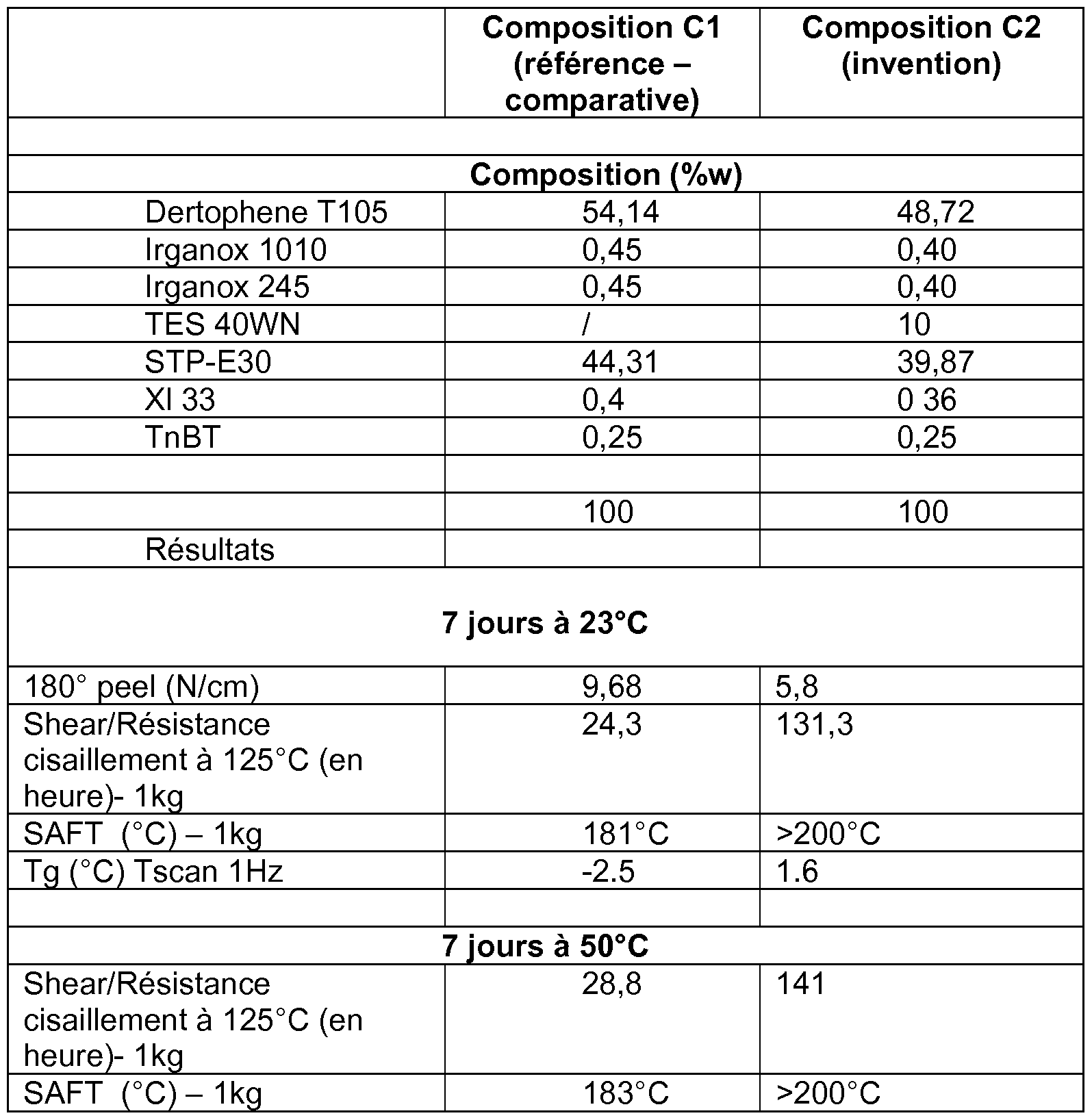
- composition C1 is detailed in Table 1 below.
- Composition C2 is prepared according to the same protocol as reference composition C1 (example 1), except that TES40WN is added with the Tyzor TnBT catalyst (without initial premix).
- the C2 composition is detailed in Table 1 below.
- Example 3 preparation of PET support layer coated with the crosslinked composition at a grammage of 60 g/m 2
- PET PolyEthylene Terephthalate
- Composition C1 (or C2) is preheated to a temperature close to 100°C and introduced into a cartridge from which a bead is extruded which is deposited near the edge of the sheet parallel to its width.
- composition contained in this bead is then distributed over the entire surface of the sheet, so as to obtain a uniform layer of substantially constant thickness.
- a film puller also called a filmograph
- a layer of composition corresponding to a weight of 60 g/m 2 is thus deposited, which represents a thickness of approximately 60 ⁇ m.
- PET sheet thus coated is then placed in an oven at 140°C and in a humid atmosphere (2.4% relative humidity) for 5 minutes to crosslink the composition, then laminated onto a layer of PolyEthylene Terephthalate (PET) 50 ⁇ m thick (Mylar) and measuring 21 cm by 29.7 cm. consisting of a sheet of rectangular silicone film of the same dimensions.
- PET PolyEthylene Terephthalate
- the resulting three-layer is subjected to the 3 tests described below.
- the coating After the coating has crosslinked, it is covered with a release liner (non-stick protection) and placed either at 23°C or in an oven at 50°C for 7 days (to evaluate the final performance of the coating whose crosslinking has been optimized).
- a release liner non-stick protection
- the adhesive power is evaluated by the 180° peel test on stainless steel plate as described in FINAT method No. 1, published in the FINAT Technical Manual 6th edition, 2001.
- FINAT is the international federation of manufacturers and converters of self-adhesive labels. The principle of this test is as follows.
- a test piece in the form of a rectangular strip (2.54 cm x 15 cm) is cut from the three-layer obtained previously. It is then fixed over half of its length (after removal of the corresponding portion of protective anti-adhesive layer) on a substrate made of a stainless steel plate. The assembly obtained is left for 10 minutes at room temperature (23°C) ("dwell time" or wettability time). It is then placed in a traction device capable, from the end that remains free of the rectangular strip, of peeling or detaching the strip at an angle of 180° and with a separation speed of 300 mm per minute. The device measures the force required to detach the strip under these conditions.
- the temperature retention of the adhesive power is assessed by the test for determining the temperature causing the adhesive joint to break under static shear. This test is also known by its English name of “Shear Adhesion Failure Temperature” (or SAFT).
- test piece in the form of a square strip (2.54 cm x 7.5 cm) is cut from each of the three-layer film above. After removing the entire protective layer (or "release liner" in English), a square portion of 2.54 cm on each side located at the end of the adhesive strip is fixed to a sanded stainless steel plate, the unglued part of the 5 cm long strip being located below the plate. After thermal equilibration at 23 ° C for 1 h, the test plate thus obtained is placed, using an appropriate support, in a substantially vertical position (2 ° from the vertical) in an oven at 23 ° C. The part of the strip that remains free is connected to a mass of 1 kg, the entire device then remaining in the study for the entire duration of the test. The SAFT value is then measured in accordance with the Finat 8 test method with an oven temperature increase of 0.5 ° C per minute. The temperature at which the strip detaches from the plate following the rupture of the glue joint under the effect of this stress is noted.
- the internal cohesion of the adhesive is evaluated by the shear test at 125°C.
- the preparation of the test piece is done exactly as for a SAFT.
- the difference between the 125°C shear and the SAFT is that the sample subjected to a weight of 1 kg is placed in a temperature-controlled oven at 125°C.
- the result of the shear test corresponds to the time of resistance to the stress (weight and temperature) before the weight is no longer retained by the adhesive.
- composition C2 according to the invention advantageously provides a high shear strength compared to the reference composition C1 (131 h for C2 compared to 24.3 h for C1), even after aging at 50°C.
- the table also shows that the adhesive tape resulting from composition C2 advantageously resists up to more than 200°C compared to the adhesive tape resulting from composition C1 (181/183°C).
Landscapes
- Chemical & Material Sciences (AREA)
- Organic Chemistry (AREA)
- Chemical Kinetics & Catalysis (AREA)
- Health & Medical Sciences (AREA)
- Medicinal Chemistry (AREA)
- Polymers & Plastics (AREA)
- Compositions Of Macromolecular Compounds (AREA)
- Adhesives Or Adhesive Processes (AREA)
Abstract
Description




Claims


Priority Applications (2)
| Application Number | Priority Date | Filing Date | Title |
|---|---|---|---|
| CN202480038045.XA CN121311526A (zh) | 2023-06-06 | 2024-06-03 | 可湿交联组合物以及包含其的自粘制品 |
| EP24736048.0A EP4724515A1 (fr) | 2023-06-06 | 2024-06-03 | Compositions reticulables a l'humidite et articles auto-adhesifs les contenant |
Applications Claiming Priority (2)
| Application Number | Priority Date | Filing Date | Title |
|---|---|---|---|
| FR2305668A FR3149617A1 (fr) | 2023-06-06 | 2023-06-06 | Compositions réticulables à l’humidité et articles auto-adhésifs les contenant |
| FRFR2305668 | 2023-06-06 |
Publications (1)
| Publication Number | Publication Date |
|---|---|
| WO2024252086A1 true WO2024252086A1 (fr) | 2024-12-12 |
Family
ID=87889325
Family Applications (1)
| Application Number | Title | Priority Date | Filing Date |
|---|---|---|---|
| PCT/FR2024/050704 Ceased WO2024252086A1 (fr) | 2023-06-06 | 2024-06-03 | Compositions reticulables a l'humidite et articles auto-adhesifs les contenant |
Country Status (4)
| Country | Link |
|---|---|
| EP (1) | EP4724515A1 (fr) |
| CN (1) | CN121311526A (fr) |
| FR (1) | FR3149617A1 (fr) |
| WO (1) | WO2024252086A1 (fr) |
Citations (9)
| Publication number | Priority date | Publication date | Assignee | Title |
|---|---|---|---|---|
| EP1829928A1 (fr) | 2004-11-01 | 2007-09-05 | Kaneka Corporation | Procédé de synthèse de polyéthers et préparations contenant lesdits polyéthers |
| WO2009106699A2 (fr) | 2007-12-21 | 2009-09-03 | Bostik Sa | Adhesifs sensibles a la pression a pouvoir adhesif stable en temperature |
| US20100120931A1 (en) * | 2007-03-21 | 2010-05-13 | Avery Dennison Corporation | Pressure sensitive adhesives |
| EP2336208A1 (fr) | 2009-12-21 | 2011-06-22 | Bostik S.A. | Composition adhésive réticulable par chauffage |
| DE102010002808A1 (de) * | 2010-03-12 | 2011-09-15 | Henkel Ag & Co. Kgaa | Fliesenkleber auf Basis Silan-modifizierter Polymere |
| EP2468783A1 (fr) | 2010-12-22 | 2012-06-27 | Bostik SA | Polyuréthane à blocs polyéther et polyester et groupe terminal alkoxysilane |
| EP2583988A1 (fr) | 2011-10-21 | 2013-04-24 | Bostik SA | Composition adhésive de polyuréthanne pour la fabrication d'agglomérés |
| US20130281591A1 (en) * | 2010-12-13 | 2013-10-24 | Kaneka Corporation | Reactive plasticizer and curable composition containing same |
| WO2020234342A1 (fr) * | 2019-05-21 | 2020-11-26 | Coroplast Fritz Müller Gmbh & Co. Kg | Procédé de fabrication d'un adhésif autocollant sensible à la pression à base d'un polymère alkoxylé, en particulier éthoxylé, contenant du silane, adhésif fabriqué selon ledit procédé et son utilisation |
-
2023
- 2023-06-06 FR FR2305668A patent/FR3149617A1/fr active Pending
-
2024
- 2024-06-03 EP EP24736048.0A patent/EP4724515A1/fr active Pending
- 2024-06-03 WO PCT/FR2024/050704 patent/WO2024252086A1/fr not_active Ceased
- 2024-06-03 CN CN202480038045.XA patent/CN121311526A/zh active Pending
Patent Citations (9)
| Publication number | Priority date | Publication date | Assignee | Title |
|---|---|---|---|---|
| EP1829928A1 (fr) | 2004-11-01 | 2007-09-05 | Kaneka Corporation | Procédé de synthèse de polyéthers et préparations contenant lesdits polyéthers |
| US20100120931A1 (en) * | 2007-03-21 | 2010-05-13 | Avery Dennison Corporation | Pressure sensitive adhesives |
| WO2009106699A2 (fr) | 2007-12-21 | 2009-09-03 | Bostik Sa | Adhesifs sensibles a la pression a pouvoir adhesif stable en temperature |
| EP2336208A1 (fr) | 2009-12-21 | 2011-06-22 | Bostik S.A. | Composition adhésive réticulable par chauffage |
| DE102010002808A1 (de) * | 2010-03-12 | 2011-09-15 | Henkel Ag & Co. Kgaa | Fliesenkleber auf Basis Silan-modifizierter Polymere |
| US20130281591A1 (en) * | 2010-12-13 | 2013-10-24 | Kaneka Corporation | Reactive plasticizer and curable composition containing same |
| EP2468783A1 (fr) | 2010-12-22 | 2012-06-27 | Bostik SA | Polyuréthane à blocs polyéther et polyester et groupe terminal alkoxysilane |
| EP2583988A1 (fr) | 2011-10-21 | 2013-04-24 | Bostik SA | Composition adhésive de polyuréthanne pour la fabrication d'agglomérés |
| WO2020234342A1 (fr) * | 2019-05-21 | 2020-11-26 | Coroplast Fritz Müller Gmbh & Co. Kg | Procédé de fabrication d'un adhésif autocollant sensible à la pression à base d'un polymère alkoxylé, en particulier éthoxylé, contenant du silane, adhésif fabriqué selon ledit procédé et son utilisation |
Non-Patent Citations (1)
| Title |
|---|
| "Manuel Technique FINAT", 2001 |
Also Published As
| Publication number | Publication date |
|---|---|
| EP4724515A1 (fr) | 2026-04-15 |
| FR3149617A1 (fr) | 2024-12-13 |
| CN121311526A (zh) | 2026-01-09 |
Similar Documents
| Publication | Publication Date | Title |
|---|---|---|
| EP3898748B1 (fr) | Nouvelles compositions reticulables par chauffage et articles auto-adhesifs correspondants | |
| EP2889349B1 (fr) | Article auto-adhésif supporté sur mousse | |
| EP2889348B1 (fr) | Article auto-adhèsif supporté sur mousse | |
| EP3532108B1 (fr) | Composition auto-adhésive pour le collage de substrats de basse énergie de surface | |
| EP3724291B1 (fr) | Composition adhesive multicomposante et ses utilisations | |
| EP4198100B1 (fr) | Composition adhesive reticulable par chauffage formant un joint adhesif stable en temperature | |
| FR3058153A1 (fr) | Composition auto-adhesive pour le collage de substrats de basse energie de surface | |
| EP4367194B1 (fr) | Nouvelle composition reticulable de polymere a terminaison silyl et article auto-adhesif correspondant | |
| EP3658604B1 (fr) | Composition adhesive reticulable par chauffage | |
| WO2024252086A1 (fr) | Compositions reticulables a l'humidite et articles auto-adhesifs les contenant | |
| EP3497144B1 (fr) | Procede de synthese de polyurethanes silyles et composition de polyurethanes silyles | |
| EP4185652A1 (fr) | Composition adhesive pour la fabrication des articles imper-respirants | |
| EP4367195B1 (fr) | Composition reticulable de polymere a terminaison silyl et procede d'assemblage de substrats la mettant en oeuvre |
Legal Events
| Date | Code | Title | Description |
|---|---|---|---|
| 121 | Ep: the epo has been informed by wipo that ep was designated in this application |
Ref document number: 24736048 Country of ref document: EP Kind code of ref document: A1 |
|
| ENP | Entry into the national phase |
Ref document number: 2025570029 Country of ref document: JP Kind code of ref document: A |
|
| WWE | Wipo information: entry into national phase |
Ref document number: 2025570029 Country of ref document: JP |
|
| WWE | Wipo information: entry into national phase |
Ref document number: 2024736048 Country of ref document: EP |
|
| NENP | Non-entry into the national phase |
Ref country code: DE |
|
| ENP | Entry into the national phase |
Ref document number: 2024736048 Country of ref document: EP Effective date: 20260107 |
|
| ENP | Entry into the national phase |
Ref document number: 2024736048 Country of ref document: EP Effective date: 20260107 |
|
| ENP | Entry into the national phase |
Ref document number: 2024736048 Country of ref document: EP Effective date: 20260107 |
|
| ENP | Entry into the national phase |
Ref document number: 2024736048 Country of ref document: EP Effective date: 20260107 |
|
| ENP | Entry into the national phase |
Ref document number: 2024736048 Country of ref document: EP Effective date: 20260107 |
|
| WWP | Wipo information: published in national office |
Ref document number: 2024736048 Country of ref document: EP |