WO2024252327A1 - Solid forms of n-(methoxycarbonyl)-3-methyl-l-valyl-(4 r)- n-{(1 s)-1-cyano-2-[(3 s)-2-oxopyrrolidin-3-yl]ethyl}-4-(trifluoromethyl)-l-prolinamide and solvates thereof - Google Patents

Solid forms of n-(methoxycarbonyl)-3-methyl-l-valyl-(4 r)- n-{(1 s)-1-cyano-2-[(3 s)-2-oxopyrrolidin-3-yl]ethyl}-4-(trifluoromethyl)-l-prolinamide and solvates thereof Download PDF

Info

Publication number
WO2024252327A1
WO2024252327A1 PCT/IB2024/055548 IB2024055548W WO2024252327A1 WO 2024252327 A1 WO2024252327 A1 WO 2024252327A1 IB 2024055548 W IB2024055548 W IB 2024055548W WO 2024252327 A1 WO2024252327 A1 WO 2024252327A1
Authority
WO
WIPO (PCT)
Prior art keywords
ppm
peaks
peak
ethyl
methyl
Prior art date
Legal status (The legal status is an assumption and is not a legal conclusion. Google has not performed a legal analysis and makes no representation as to the accuracy of the status listed.)
Ceased
Application number
PCT/IB2024/055548
Other languages
French (fr)
Other versions
WO2024252327A8 (en
Inventor
Kapildev Kashmirilal ARORA
Maria GONZALEZ ESGUEVILLAS
Samir Kulkarni
Aifang Li
Paul Anthony MEENAN
Nandini PATEL
Jeanene Elizabeth Tickner
Xiaojing Yang
Current Assignee (The listed assignees may be inaccurate. Google has not performed a legal analysis and makes no representation or warranty as to the accuracy of the list.)
Pfizer Inc
Original Assignee
Pfizer Inc
Priority date (The priority date is an assumption and is not a legal conclusion. Google has not performed a legal analysis and makes no representation as to the accuracy of the date listed.)
Filing date
Publication date
Application filed by Pfizer Inc filed Critical Pfizer Inc
Priority to EP24733330.5A priority Critical patent/EP4724423A1/en
Priority to AU2024285970A priority patent/AU2024285970A1/en
Priority to MX2025014633A priority patent/MX2025014633A/en
Priority to KR1020267000360A priority patent/KR20260021033A/en
Priority to CN202480038170.0A priority patent/CN121311467A/en
Publication of WO2024252327A1 publication Critical patent/WO2024252327A1/en
Publication of WO2024252327A8 publication Critical patent/WO2024252327A8/en
Anticipated expiration legal-status Critical
Ceased legal-status Critical Current

Links

Classifications

    • CCHEMISTRY; METALLURGY
    • C07ORGANIC CHEMISTRY
    • C07DHETEROCYCLIC COMPOUNDS
    • C07D207/00Heterocyclic compounds containing five-membered rings not condensed with other rings, with one nitrogen atom as the only ring hetero atom
    • C07D207/02Heterocyclic compounds containing five-membered rings not condensed with other rings, with one nitrogen atom as the only ring hetero atom with only hydrogen or carbon atoms directly attached to the ring nitrogen atom
    • C07D207/18Heterocyclic compounds containing five-membered rings not condensed with other rings, with one nitrogen atom as the only ring hetero atom with only hydrogen or carbon atoms directly attached to the ring nitrogen atom having one double bond between ring members or between a ring member and a non-ring member
    • C07D207/22Heterocyclic compounds containing five-membered rings not condensed with other rings, with one nitrogen atom as the only ring hetero atom with only hydrogen or carbon atoms directly attached to the ring nitrogen atom having one double bond between ring members or between a ring member and a non-ring member with hetero atoms or with carbon atoms having three bonds to hetero atoms with at the most one bond to halogen, e.g. ester or nitrile radicals, directly attached to ring carbon atoms
    • C07D207/24Oxygen or sulfur atoms
    • AHUMAN NECESSITIES
    • A61MEDICAL OR VETERINARY SCIENCE; HYGIENE
    • A61KPREPARATIONS FOR MEDICAL, DENTAL OR TOILETRY PURPOSES
    • A61K31/00Medicinal preparations containing organic active ingredients
    • A61K31/33Heterocyclic compounds
    • A61K31/395Heterocyclic compounds having nitrogen as a ring hetero atom, e.g. guanethidine or rifamycins
    • A61K31/40Heterocyclic compounds having nitrogen as a ring hetero atom, e.g. guanethidine or rifamycins having five-membered rings with one nitrogen as the only ring hetero atom, e.g. sulpiride, succinimide, tolmetin, buflomedil
    • A61K31/401Proline; Derivatives thereof, e.g. captopril
    • AHUMAN NECESSITIES
    • A61MEDICAL OR VETERINARY SCIENCE; HYGIENE
    • A61KPREPARATIONS FOR MEDICAL, DENTAL OR TOILETRY PURPOSES
    • A61K9/00Medicinal preparations characterised by special physical form
    • A61K9/14Particulate form, e.g. powders, Processes for size reducing of pure drugs or the resulting products, Pure drug nanoparticles
    • A61K9/16Agglomerates; Granulates; Microbeadlets ; Microspheres; Pellets; Solid products obtained by spray drying, spray freeze drying, spray congealing,(multiple) emulsion solvent evaporation or extraction
    • A61K9/1605Excipients; Inactive ingredients
    • A61K9/1629Organic macromolecular compounds
    • A61K9/1652Polysaccharides, e.g. alginate, cellulose derivatives; Cyclodextrin
    • AHUMAN NECESSITIES
    • A61MEDICAL OR VETERINARY SCIENCE; HYGIENE
    • A61PSPECIFIC THERAPEUTIC ACTIVITY OF CHEMICAL COMPOUNDS OR MEDICINAL PREPARATIONS
    • A61P31/00Antiinfectives, i.e. antibiotics, antiseptics, chemotherapeutics
    • A61P31/12Antivirals
    • A61P31/14Antivirals for RNA viruses
    • CCHEMISTRY; METALLURGY
    • C07ORGANIC CHEMISTRY
    • C07DHETEROCYCLIC COMPOUNDS
    • C07D403/00Heterocyclic compounds containing two or more hetero rings, having nitrogen atoms as the only ring hetero atoms, not provided for by group C07D401/00
    • C07D403/02Heterocyclic compounds containing two or more hetero rings, having nitrogen atoms as the only ring hetero atoms, not provided for by group C07D401/00 containing two hetero rings
    • C07D403/12Heterocyclic compounds containing two or more hetero rings, having nitrogen atoms as the only ring hetero atoms, not provided for by group C07D401/00 containing two hetero rings linked by a chain containing hetero atoms as chain links
    • CCHEMISTRY; METALLURGY
    • C07ORGANIC CHEMISTRY
    • C07BGENERAL METHODS OF ORGANIC CHEMISTRY; APPARATUS THEREFOR
    • C07B2200/00Indexing scheme relating to specific properties of organic compounds
    • C07B2200/13Crystalline forms, e.g. polymorphs

Definitions

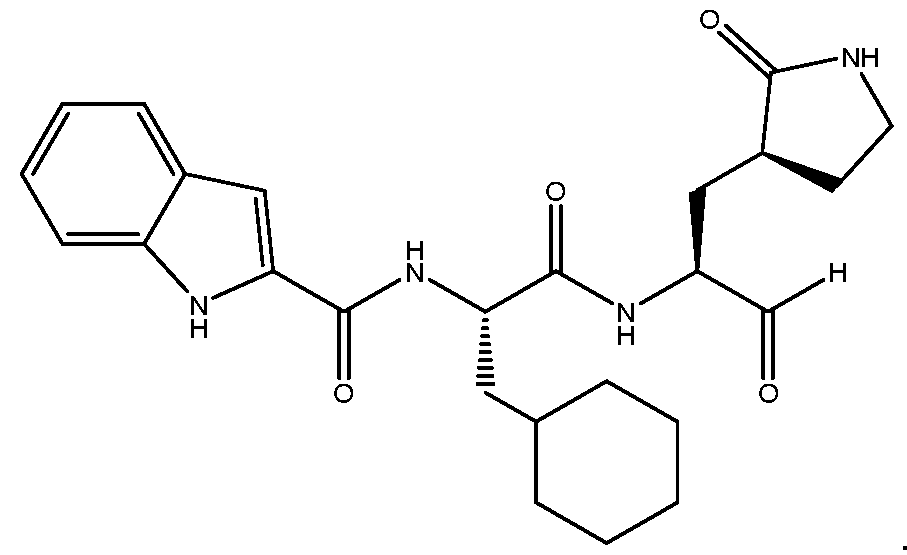
  • This invention relates to solid forms of /V-(Methoxycarbonyl)-3-methyl-L-valyl- (4R)-/V- ⁇ (1S)-1-cyano-2-[(3S)-2-oxopyrrolidin-3-yl]ethyl ⁇ -4-(trifluoromethyl)-L- prolinamide and solvates thereof, pharmaceutical compositions comprising the solid forms, and methods of preparing and using the solid forms and pharmaceutical compositions.
  • the compound of Formula I inhibits viral proteases such as coronavirus main proteases and thereby inhibits the viral replication process.
  • the compound of Formula I is for use in the treatment of coronavirus infections such as SARS-CoV-2 infections (COVID-19).
  • Solid forms are of interest to the pharmaceutical industry and especially to those involved in the development of suitable dosage forms. If the solid form is not held constant during clinical or stability studies, the exact dosage form used or studied may not be comparable from one lot to another. It is also desirable to have processes for producing a compound with the selected solid form in high purity when the compound is used in clinical studies or commercial products since impurities present may produce undesired toxicological effects. Certain solid forms may also exhibit enhanced stability or may be more readily manufactured in high purity in large quantities, and thus are more suitable for inclusion in pharmaceutical formulations. Certain solid forms may display other advantageous physical properties such as lack of hygroscopic tendencies, filterability, improved solubility, and enhanced rates of dissolution due to different lattice energies.
  • Solid forms of the compound of Formula I and solid forms of certain solvates thereof are disclosed herein, wherein each solid form can be uniquely identified by several different analytical parameters, alone or in combination, such as, but not limited to powder X-ray diffraction pattern peaks or combinations of two or more peaks; single crystal X-ray diffraction pattern; solid state NMR 13 C chemical shifts or combinations of two or more chemical shifts; solid state NMR 19 F chemical shifts; Thermogravimetric Infra-red Analysis (TGA-IR); and Modulated differential scanning calorimetry (mDSC).
  • Fig. 1 is a PXRD pattern of Form 1.
  • Fig. 2 is a PXRD pattern of Form 5.
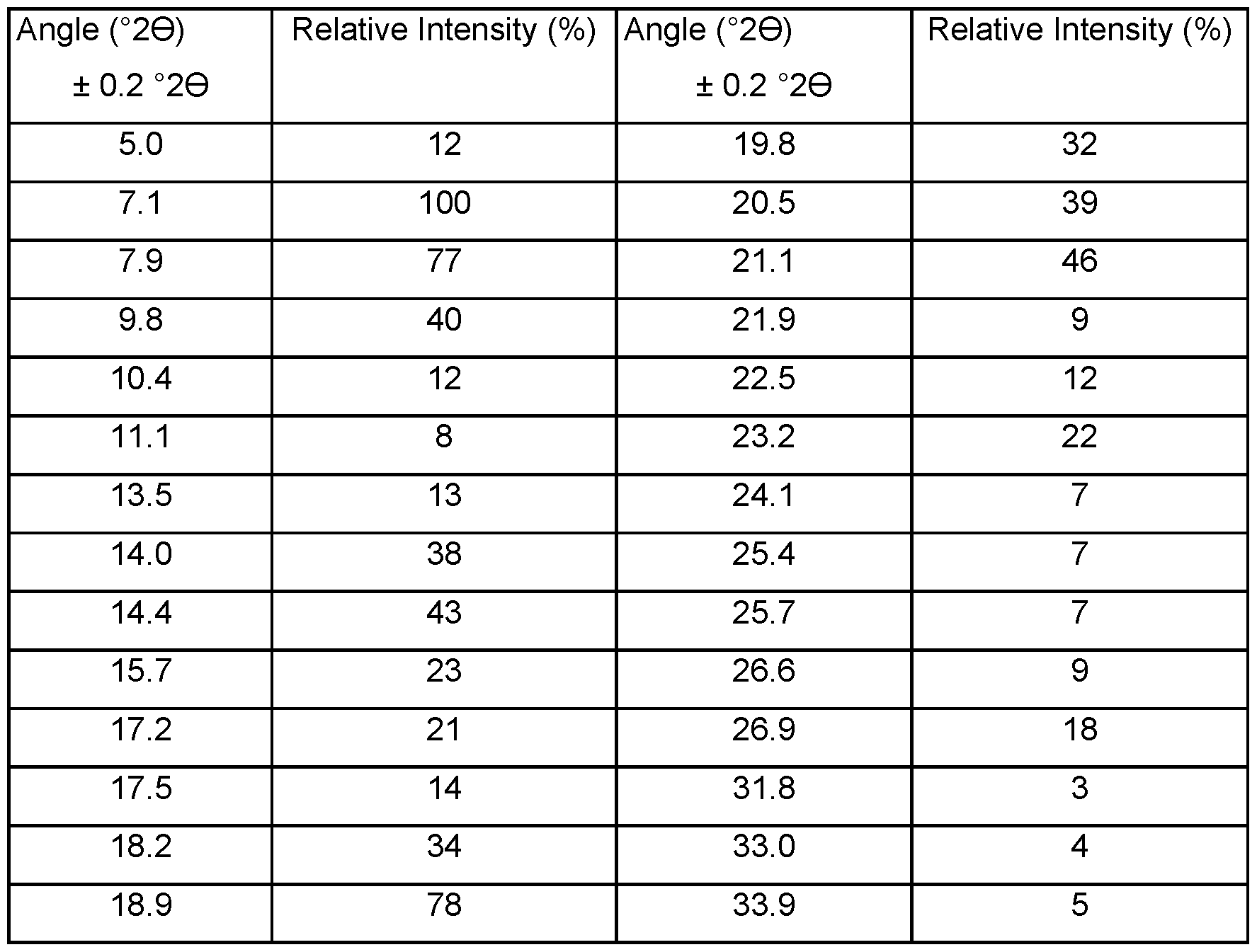
  • Fig. 3 is a PXRD pattern of the cyclopentyl methyl ether (CPME) solvate, Form 9.
  • Fig. 4 is a PXRD pattern of amorphous free form, Form 10.
  • Fig. 5 is a PXRD of the isopropyl acetate solvate, Form 11.
  • Fig. 6 is a PXRD pattern of the 750 mg/g spray dried dispersion (SDD).
  • Fig. 7 is an ORTEP diagram drawn with displacement parameters at 50% for the Form 1 asymmetric unit.
  • Fig. 8 is the calculated Form 1 PXRD pattern derived from the single crystal (SXRD) data.
  • Fig. 9 is an ORTEP diagram drawn with displacement parameters at 50% for the Form 5 asymmetric unit.
  • Fig. 10 is a calculated PXRD pattern of Form 5 anhydrous free form.
  • Fig. 11 is an ORTEP diagram drawn with displacement parameters at 50% for the CPME solvate, Form 8 asymmetric unit.
  • Fig. 12 is a calculated PXRD pattern of the CPME solvate, Form 8.
  • Fig. 13 is an ORTEP diagram drawn with displacement parameters at 50% for the isopropyl acetate solvate, Form 12 asymmetric unit.
  • Fig. 14 is a calculated PXRD pattern of the isopropyl acetate solvate, Form 12.
  • Fig. 15 is a 13 C solid-state NMR spectrum of Form 1 and the peaks marked by hashes are spinning side bands.
  • Fig. 16 is a 19 F solid-state NMR spectrum of Form 1 and the peaks marked by hashes are spinning side bands.
  • Fig. 17 is a 13 C solid-state NMR spectrum of Form 5 and the peaks marked by hashes are spinning side bands.
  • Fig. 18 is a 19 F solid-state NMR spectrum of Form 5 and the peaks marked by hashes are spinning side bands.
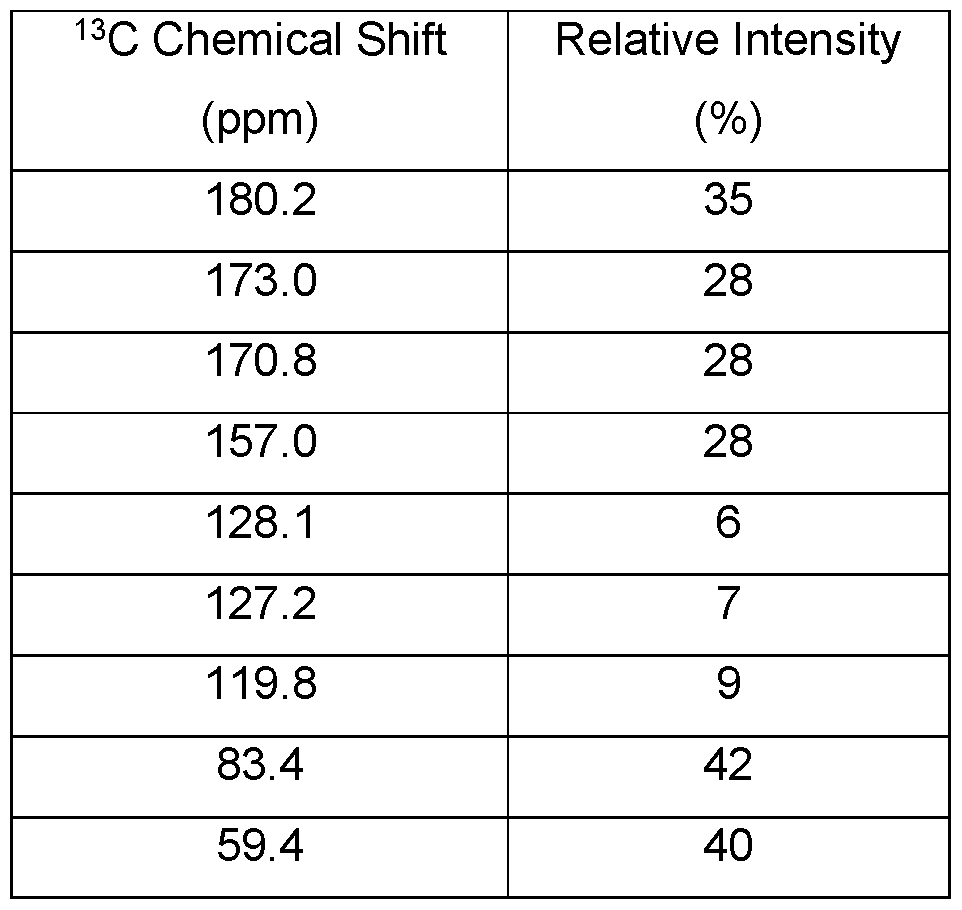
  • Fig. 19 is a 13 C solid-state NMR spectrum of CPME solvate Form 9 and the peaks marked by hashes are spinning side bands.
  • Fig. 20 is a 19 F solid-state NMR spectrum of CPME solvate Form 9 and the peaks marked by hashes are spinning side bands.
  • Fig. 21 is a 13 C solid-state NMR spectrum of amorphous free form, Form 10 and the peaks marked by hashes are spinning side bands.
  • Fig. 22 is a 19 F solid-state NMR spectrum of amorphous free form, Form 10 and the peaks marked by hashes are spinning side bands.
  • Fig. 23 is a 13 C solid-state NMR spectrum of the isopropyl acetate solvate Form 11 and the peaks marked by hashes are spinning side bands.
  • Fig. 24 is a 19 F solid-state NMR spectrum of the isopropyl acetate solvate Form 11 and the peaks marked by hashes are spinning side bands.
  • Fig. 25 is a 13 C solid-state NMR spectrum of the 750 mg/g spray dried dispersion (SDD).
  • Fig. 26 is a 19 F solid-state NMR spectrum of the 750 mg/g SDD and the peaks marked by hashes are spinning side bands.
  • Fig. 27 is a thermal gravimetric infrared analysis (TGA-IR) thermogram of the CPME solvate Form 9.
  • Fig. 28 is a Gram-Schmidt and IR of the CPME solvate, Form 9 (TGA-IR) at 9.056 min.
  • Fig. 29 is an overlay of IR spectra of the CPME solvate, Form 9 (top) and cyclopentyl methyl ether solvent (bottom).
  • Fig. 30 is a thermal gravimetric infrared analysis (TGA-IR) thermogram of the isopropyl acetate solvate, Form 11 .
  • Fig. 31 is a Gram-Schmidt and IR of the isopropyl acetate solvate, Form 11 (TGA-IR) at 10.321 min.
  • Fig. 32 is an overlay of IR spectra of the isopropyl acetate solvate, Form 11 (top) and isopropyl acetate solvent (bottom).
  • Fig. 33 is modulated differential scanning calorimetry (DSC) data of Form 10 amorphous free form, showing a glass transition temperature (Tg) of about 95 °C.
  • Fig. 34 is modulated DSC data of the 750 mg/g spray dried dispersion (SDD), showing a Tg of about 92 °C.
  • Fig. 35 is partial asymmetric unit diagram with representative labeling scheme and anisotropic displacement parameters drawn at 50% probability for Form 14.
  • Fig. 36 is a calculated powder pattern of N-(Methoxycarbonyl)-3-methyl-L-valyl-(4R)-N- ⁇ (1S)-1-cyano-2-[(3S)-2-oxopyrrolidin-3-yl]ethyl ⁇ -4-(trifluoromethyl)-L-prolinamide, ethyl acetate solvate, Form 14.
  • Figure 37 is a PXRD pattern of N-(Methoxycarbonyl)-3-methyl-L-valyl-(4R)-N- ⁇ (1S)-1- cyano-2-[(3S)-2-oxopyrrolidin-3-yl]ethyl ⁇ -4-(trifluoromethyl)-L-prolinamide, Form 22.
  • Figure 38 is a PXRD pattern of N-(Methoxycarbonyl)-3-methyl-L-valyl-(4R)-N- ⁇ (1S)-1- cyano-2-[(3S)-2-oxopyrrolidin-3-yl]ethyl ⁇ -4-(trifluoromethyl)-L-prolinamide, Form 22 with peak picking for peaks over 3% relative intensity.
  • Figure 39 is an ORTEP diagram (color) drawn with displacement parameters at 50% for N-(Methoxycarbonyl)-3-methyl-L-valyl-(4R)-N- ⁇ (1S)-1-cyano-2-[(3S)-2-oxopyrrolidin-3- yl]ethyl ⁇ -4-(trifluoromethyl)-L-prolinamide, Form 22 asymmetric unit.
  • Figure 40 is an overlay of powder pattern obtained for N-(Methoxycarbonyl)-3-methyl-L- valyl-(4R)-N- ⁇ (1S)-1-cyano-2-[(3S)-2-oxopyrrolidin-3-yl]ethyl ⁇ -4-(trifluoromethyl)-L- prolinamide, Form 22 (bottom) and calculated powder pattern from single crystal data (top).
  • Figure 41 is a 13 C solid-state NMR spectrum of N-(Methoxycarbonyl)-3-methyl-L-valyl- (4R)-N- ⁇ (1S)-1-cyano-2-[(3S)-2-oxopyrrolidin-3-yl]ethyl ⁇ -4-(trifluoromethyl)-L- prolinamide, Form 22 - the peaks marked by hashes are spinning side bands.
  • Figure 42 is an 19 F solid-state NMR spectrum of N-(Methoxycarbonyl)-3-methyl-L-valyl- (4R)-N- ⁇ (1S)-1-cyano-2-[(3S)-2-oxopyrrolidin-3-yl]ethyl ⁇ -4-(trifluoromethyl)-L- prolinamide Form 22.
  • the peaks marked by hashes are spinning side bands.
  • the present disclosure describes forms of an anhydrous crystalline form of /V- (Methoxycarbonyl)-3-methyl-L-valyl-(4R)-/ ⁇ /- ⁇ (1 S)-1-cyano-2-[(3S)-2-oxopyrrolidin-3- yl]ethyl ⁇ -4-(trifluoromethyl)-L-prolinamide which are designated herein as Form 1 and Form 5, respectively.
  • Form 1 is a particularly advantageous form of anhydrous crystalline form of /V-(Methoxycarbonyl)-3-methyl-L-valyl-(4R)-/ ⁇ /- ⁇ (1 S)-1-cyano-2-[(3S)- 2-oxopyrrolidin-3-yl]ethyl ⁇ -4-(trifluoromethyl)-L-prolinamide which exhibits good stability and a lack of hygroscopicity and therefore is suitable for use in pharmaceutical compositions.
  • Form 22 is also a particularly advantageous form of anhydrous crystalline form of /V-(Methoxycarbonyl)-3-methyl-L-valyl-(4 ?)-/ ⁇ /- ⁇ (1 S)-1-cyano-2-[(3S)- 2-oxopyrrolidin-3-yl]ethyl ⁇ -4-(trifluoromethyl)-L-prolinamide which exhibits good stability and a lack of hygroscopicity and therefore is suitable for use in pharmaceutical compositions.
  • Both Form 1 and Form 22 are non-solvated (ansolvate) forms of the compound.
  • the present disclosure also describes amorphous /V-(Methoxycarbonyl)-3- methyl-L-valyl-(4F?)-/ ⁇ /- ⁇ (1 S)-1-cyano-2-[(3S)-2-oxopyrrolidin-3-yl]ethyl ⁇ -4- (trifluoromethyl)-L-prolinamide and solid forms of /V-(Methoxycarbonyl)-3-methyl-L-valyl- (4F?)-/V- ⁇ (1 S)-1-cyano-2-[(3S)-2-oxopyrrolidin-3-yl]ethyl ⁇ -4-(trifluoromethyl)-L- prolinamide, cyclopentyl methyl ether solvate, /V-(Methoxycarbonyl)-3-methyl-L-valyl- (4F?)-/V- ⁇ (1 S)-1-cyano-2-[(3S)-2-oxopyrrolidin-3-yl]ethyl
  • the following embodiments of the invention are designated as E1 to E.
  • E1 is a compound which is an anhydrous crystalline form of /V-(Methoxycarbonyl)-3- methyl-L-valyl-(4F?)-/ ⁇ /- ⁇ (1 S)-1-cyano-2-[(3S)-2-oxopyrrolidin-3-yl]ethyl ⁇ -4- (trifluoromethyl)-L-prolinamide.
  • E2 is the compound of E1 which is anhydrous crystalline /V-(Methoxycarbonyl)-3- methyl-L-valyl-(4F?)-/ ⁇ /- ⁇ (1 S)-1-cyano-2-[(3S)-2-oxopyrrolidin-3-yl]ethyl ⁇ -4- (trifluoromethyl)-L-prolinamide, Form 1 characterized by a 13 C solid state NMR peak at 50.8 ppm ⁇ 0.2 ppm.
  • E3 is the compound of E1 which is anhydrous crystalline /V-(Methoxycarbonyl)-3- methyl-L-valyl-(4F?)-/ ⁇ /- ⁇ (1 S)-1-cyano-2-[(3S)-2-oxopyrrolidin-3-yl]ethyl ⁇ -4- (trifluoromethyl)-L-prolinamide, Form 1 characterized by 13 C solid state NMR peaks at
  • E4 is the compound of E1 which is anhydrous crystalline /V-(Methoxycarbonyl)-3- methyl-L-valyl-(4R)-/ ⁇ /- ⁇ (1 S)-1-cyano-2-[(3S)-2-oxopyrrolidin-3-yl]ethyl ⁇ -4- (trifluoromethyl)-L-prolinamide, Form 1 characterized by 13 C solid state NMR peaks at
  • E5 is the compound of E1 which is anhydrous crystalline /V-(Methoxycarbonyl)-3- methyl-L-valyl-(4R)-/ ⁇ /- ⁇ (1 S)-1-cyano-2-[(3S)-2-oxopyrrolidin-3-yl]ethyl ⁇ -4- (trifluoromethyl)-L-prolinamide, Form 1 characterized by 13 C solid state NMR peaks at
  • E6 is the compound of E1 which is anhydrous crystalline /V-(Methoxycarbonyl)-3- methyl-L-valyl-(4R)-/ ⁇ /- ⁇ (1 S)-1-cyano-2-[(3S)-2-oxopyrrolidin-3-yl]ethyl ⁇ -4- (trifluoromethyl)-L-prolinamide, Form 1 characterized by a 13 C solid state NMR peak at
  • E7 is the compound of E1 which is anhydrous crystalline /V-(Methoxycarbonyl)-3- methyl-L-valyl-(4R)-/ ⁇ /- ⁇ (1 S)-1-cyano-2-[(3S)-2-oxopyrrolidin-3-yl]ethyl ⁇ -4- (trifluoromethyl)-L-prolinamide, Form 1 characterized by 13 C solid state NMR peaks at
  • E8 is the compound of E1 which is anhydrous crystalline /V-(Methoxycarbonyl)-3- methyl-L-valyl-(4R)-/ ⁇ /- ⁇ (1 S)-1-cyano-2-[(3S)-2-oxopyrrolidin-3-yl]ethyl ⁇ -4- (trifluoromethyl)-L-prolinamide, Form 1 characterized by 13 C solid state NMR peaks at
  • each peak is ⁇ 0.2 ppm and a 19 F solid state NMR peak at -70.7 ppm ⁇ 0.2 ppm.
  • E9 is the compound of E1 which is anhydrous crystalline /V-(Methoxycarbonyl)-3- methyl-L-valyl-(4R)-/ ⁇ /- ⁇ (1 S)-1-cyano-2-[(3S)-2-oxopyrrolidin-3-yl]ethyl ⁇ -4- (trifluoromethyl)-L-prolinamide, Form 1 characterized by 13 C solid state NMR peaks at
  • E10 is the compound of E1 which is anhydrous crystalline /V-(Methoxycarbonyl)-3- methyl-L-valyl-(4R)-/ ⁇ /- ⁇ (1 S)-1-cyano-2-[(3S)-2-oxopyrrolidin-3-yl]ethyl ⁇ -4- (trifluoromethyl)-L-prolinamide, Form 1 characterized by a 13 C solid state NMR peak at
  • E11 is the compound of E1 which is anhydrous crystalline /V-(Methoxycarbonyl)-3- methyl-L-valyl-(4R)-/ ⁇ /- ⁇ (1 S)-1-cyano-2-[(3S)-2-oxopyrrolidin-3-yl]ethyl ⁇ -4- (trifluoromethyl)-L-prolinamide, Form 1 characterized by 13 C solid state NMR peaks at
  • each peak is ⁇ 0.2 ppm and one to four powder X-ray diffraction peaks (Cu Ka radiation) selected from the group consisting of peaks at 9.1 , 9.6, 10.3 and 16.2 degrees 20 wherein each peak is ⁇ 0.2 degrees 20.
  • E12 is the compound of E1 which is anhydrous crystalline /V-(Methoxycarbonyl)-3- methyl-L-valyl-(4R)-/ ⁇ /- ⁇ (1 S)-1-cyano-2-[(3S)-2-oxopyrrolidin-3-yl]ethyl ⁇ -4- (trifluoromethyl)-L-prolinamide, Form 1 characterized by 13 C solid state NMR peaks at
  • each peak is ⁇ 0.2 ppm and one to four powder X-ray diffraction peaks (Cu Ka radiation) selected from the group consisting of peaks at 9.1 , 9.6, 10.3 and 16.2 degrees 20 wherein each peak is ⁇ 0.2 degrees 20.
  • E13 is the compound of E1 which is anhydrous crystalline /V-(Methoxycarbonyl)-3- methyl-L-valyl-(4R)-/ ⁇ /- ⁇ (1 S)-1-cyano-2-[(3S)-2-oxopyrrolidin-3-yl]ethyl ⁇ -4- (trifluoromethyl)-L-prolinamide, Form 1 characterized by 13 C solid state NMR peaks at
  • each peak is ⁇ 0.2 ppm and one to four powder X-ray diffraction peaks (Cu Ka radiation) selected from the group consisting of peaks at 9.1 , 9.6, 10.3 and 16.2 degrees 20 wherein each peak is ⁇ 0.2 degrees 20.
  • E14 is the compound of E1 which is anhydrous crystalline /V-(Methoxycarbonyl)-3- methyl-L-valyl-(4R)-/ ⁇ /- ⁇ (1 S)-1-cyano-2-[(3S)-2-oxopyrrolidin-3-yl]ethyl ⁇ -4- (trifluoromethyl)-L-prolinamide, Form 1 characterized by a 13 C solid state NMR peak at
  • E15 is the compound of E1 which is anhydrous crystalline /V-(Methoxycarbonyl)-3- methyl-L-valyl-(4R)-/ ⁇ /- ⁇ (1 S)-1-cyano-2-[(3S)-2-oxopyrrolidin-3-yl]ethyl ⁇ -4- (trifluoromethyl)-L-prolinamide, Form 1 characterized by 13 C solid state NMR peaks at
  • each peak is ⁇ 0.2 ppm, a 19 F solid state NMR peak at -70.7 ppm ⁇ 0.2 ppm and one to four powder X-ray diffraction peaks (Cu Ka radiation) selected from the group consisting of peaks at 9.1 , 9.6, 10.3 and 16.2 degrees 20 wherein each peak is ⁇ 0.2 degrees 20.
  • E16 is the compound of E1 which is anhydrous crystalline /V-(Methoxycarbonyl)-3- methyl-L-valyl-(4R)-/ ⁇ /- ⁇ (1 S)-1-cyano-2-[(3S)-2-oxopyrrolidin-3-yl]ethyl ⁇ -4- (trifluoromethyl)-L-prolinamide, Form 1 characterized by 13 C solid state NMR peaks at 50.8 ppm and 43.5 ppm wherein each peak is ⁇ 0.2 ppm, a 19 F solid state NMR peak at -70.7 ppm ⁇ 0.2 ppm and one to four powder X-ray diffraction peaks (Cu Ka radiation) selected from the group consisting of peaks at 9.1 , 9.6, 10.3 and 16.2 degrees 20 wherein each peak is ⁇ 0.2 degrees 20.
  • Cu Ka radiation powder X-ray diffraction peaks
  • E17 is the compound of E1 which is anhydrous crystalline /V-(Methoxycarbonyl)-3- methyl-L-valyl-(4R)-/ ⁇ /- ⁇ (1 S)-1-cyano-2-[(3S)-2-oxopyrrolidin-3-yl]ethyl ⁇ -4- (trifluoromethyl)-L-prolinamide, Form 1 characterized by 13 C solid state NMR peaks at 50.8 ppm, 58.3 ppm and 43.5 ppm wherein each peak is ⁇ 0.2 ppm, a 19 F solid state NMR peak at -70.7 ppm ⁇ 0.2 ppm and one to four powder X-ray diffraction peaks (Cu Ka radiation) selected from the group consisting of peaks at 9.1 , 9.6, 10.3 and 16.2 degrees 20 wherein each peak is ⁇ 0.2 degrees 20.
  • Cu Ka radiation powder X-ray diffraction peaks
  • E18 is /V-(Methoxycarbonyl)-3-methyl-L-valyl-(4R)-/ ⁇ /- ⁇ (1 S)-1-cyano-2-[(3S)-2- oxopyrrolidin-3-yl]ethyl ⁇ -4-(trifluoromethyl)-L-prolinamide, Form 1 which is substantially pure.
  • E19 is the compound of E1 which is anhydrous crystalline /V-(Methoxycarbonyl)-3- methyl-L-valyl-(4R)-/ ⁇ /- ⁇ (1 S)-1-cyano-2-[(3S)-2-oxo pyrrolidin-3-yl]ethyl ⁇ -4-
  • E20 is the compound of claim 1 which is anhydrous crystalline /V-(Methoxycarbonyl)- 3-methyl-L-valyl-(4R)-/ ⁇ /- ⁇ (1 S)-1-cyano-2-[(3S)-2-oxo pyrrolidin-3-yl]ethyl ⁇ -4-
  • E21 is the compound of E1 which is anhydrous crystalline /V-(Methoxycarbonyl)-3- methyl-L-valyl-(4R)-/ ⁇ /- ⁇ (1 S)-1-cyano-2-[(3S)-2-oxo pyrrolidin-3-yl]ethyl ⁇ -4-
  • E22 is a solid form of /V-(Methoxycarbonyl)-3-methyl-L-valyl-(4R)-/ ⁇ /- ⁇ (1 S)-1-cyano-2- [(3S)-2-oxopyrrolidin-3-yl]ethyl ⁇ -4-(trifluoromethyl)-L-prolinamide, comprising Form 1 according to any one of E2 to E21 and wherein the solid form comprises less than 95%, less than 90%, less than 80%, less than 70%, less than 60%, less than 50%, less than 40%, less than 30%, less than 20%, less than 10%, less than 5%, less than 3%, or less than 1 % by weight of any other solid form or solid forms of the compound /V- (Methoxycarbonyl)-3-methyl-L-valyl
  • E23 is the solid form of E22 wherein the solid form comprises less than 10% by weight of any other solid form or solid forms of /V-(Methoxycarbonyl)-3-methyl-L-valyl-(4F?)-/ ⁇ /- ⁇ (1 S)-1-cyano-2-[(3S)-2-oxopyrrolidin-3-yl]ethyl ⁇ -4-(trifluoromethyl)-L-prolinamide.
  • E24 is the solid form of E22 which comprises less than 5% by weight of any other solid form or solid forms of /V-(Methoxycarbonyl)-3-methyl-L-valyl-(4 ?)-/ ⁇ /- ⁇ (1 S)-1-cyano- 2-[(3S)-2-oxopyrrolidin-3-yl]ethyl ⁇ -4-(trifluoromethyl)-L-prolinamide.
  • E25 is the solid form of E22 which comprises less than 2% by weight of any other solid form or solid forms of /V-(Methoxycarbonyl)-3-methyl-L-valyl-(4 ?)-/ ⁇ /- ⁇ (1 S)-1-cyano- 2-[(3S)-2-oxopyrrolidin-3-yl]ethyl ⁇ -4-(trifluoromethyl)-L-prolinamide.
  • E26 is the solid form of E22 which comprises less than 1% by weight of any other solid form or solid forms of /V-(Methoxycarbonyl)-3-methyl-L-valyl-(4 ?)-/ ⁇ /- ⁇ (1 S)-1-cyano- 2-[(3S)-2-oxopyrrolidin-3-yl]ethyl ⁇ -4-(trifluoromethyl)-L-prolinamide.
  • E27 is the solid form of any one of E22 to E26 wherein the other solid form or solid forms are selected from Form 5, Form 10, and Form 5 and Form 10.
  • E28 is a pharmaceutical composition comprising a therapeutically effective amount of Form 1 according to any one of E2 to E21 or of the solid form of any one of E22 to E27 and a pharmaceutically acceptable carrier.
  • E29 is the pharmaceutical composition of E28 comprising 100 mg to 1000 mg of Form 1.
  • E30 is the pharmaceutical composition of E29 comprising 100 mg, 200 mg, 300 mg, 400 mg, 500 mg, 600 mg, 700 mg 800 mg, 900 mg or 1000 mg of Form 1.
  • E31 is the pharmaceutical composition of E29 comprising 300 mg to 600 mg of Form 1.
  • E32 is a method of treating a coronavirus infection in a patient the method comprising administering a therapeutically effective amount of anhydrous crystalline /V- (Methoxycarbonyl)-3-methyl-L-valyl-(4F?)-/ ⁇ /- ⁇ (1 S)-1-cyano-2-[(3S)-2-oxo pyrrolidin-3- yl]ethyl ⁇ -4-(trifluoromethyl)-L-prolinamide, Form 1 according to any one any one of claims 2 to 21 or the solid form of any one of E22 to E26 to a patient in need thereof.
  • anhydrous crystalline /V- (Methoxycarbonyl)-3-methyl-L-valyl-(4F?)-/ ⁇ /- ⁇ (1 S)-1-cyano-2-[(3S)-2-oxo pyrrolidin-3- yl]ethyl ⁇ -4-(trifluoromethyl)-L-prolinamide Form 1 according to any one any
  • E33 is a method of treating a coronavirus infection in a patient the method comprising administering a pharmaceutical composition according to any one of E28 to E31.
  • E34 is the method of E32 or E33 wherein the coronavirus infection is a SARS-CoV-2 infection.
  • E35 is anhydrous crystalline /V-(Methoxycarbonyl)-3-methyl-L-valyl-(4R)-/ ⁇ /- ⁇ (1 S)-1- cyano-2-[(3S)-2-oxopyrrolidin-3-yl]ethyl ⁇ -4-(trifluoromethyl)-L-prolinamide, Form 1 according to any one of E2 to E21 for use in the treatment of a coronavirus infection.
  • E36 is a pharmaceutical composition according to any one of E28 to E31 for use in the treatment of a coronavirus infection.
  • E37 is the use of E35 or E36 wherein the coronavirus infection is a SARS-CoV-2 infection.
  • E38 is the compound of E1 which is anhydrous crystalline /V-(Methoxycarbonyl)-3- methyl-L-valyl-(4R)-/ ⁇ /- ⁇ (1 S)-1-cyano-2-[(3S)-2-oxopyrrolidin-3-yl]ethyl ⁇ -4- (trifluoromethyl)-L-prolinamide, Form 5 characterized by 19 F solid state NMR peaks at -
  • E39 is the compound of E1 which is anhydrous crystalline /V-(Methoxycarbonyl)-3- methyl-L-valyl-(4R)-/ ⁇ /- ⁇ (1 S)-1-cyano-2-[(3S)-2-oxopyrrolidin-3-yl]ethyl ⁇ -4- (trifluoromethyl)-L-prolinamide, Form 5 characterized by 19 F solid state NMR peaks at -
  • E40 is the compound of E1 which is anhydrous crystalline /V-(Methoxycarbonyl)-3- methyl-L-valyl-(4R)-/ ⁇ /- ⁇ (1 S)-1-cyano-2-[(3S)-2-oxopyrrolidin-3-yl]ethyl ⁇ -4- (trifluoromethyl)-L-prolinamide, Form 5 characterized by 19 F solid state NMR peaks at -
  • E41 is the compound of E1 which is anhydrous crystalline /V-(Methoxycarbonyl)-3- methyl-L-valyl-(4R)-/ ⁇ /- ⁇ (1 S)-1-cyano-2-[(3S)-2-oxopyrrolidin-3-yl]ethyl ⁇ -4- (trifluoromethyl)-L-prolinamide, Form 5 characterized by 19 F solid state NMR peaks at -
  • E42 is the compound of E1 which is anhydrous crystalline /V-(Methoxycarbonyl)-3- methyl-L-valyl-(4R)-/ ⁇ /- ⁇ (1 S)-1-cyano-2-[(3S)-2-oxopyrrolidin-3-yl]ethyl ⁇ -4- (trifluoromethyl)-L-prolinamide, Form 5 characterized by 19 F solid state NMR peaks at -
  • E43 is the compound of E1 which is anhydrous crystalline /V-(Methoxycarbonyl)-3- methyl-L-valyl-(4R)-/ ⁇ /- ⁇ (1 S)-1-cyano-2-[(3S)-2-oxopyrrolidin-3-yl]ethyl ⁇ -4- (trifluoromethyl)-L-prolinamide, Form 5 characterized by 19 F solid state NMR peaks at -
  • E44 is the compound of E1 which is anhydrous crystalline /V-(Methoxycarbonyl)-3- methyl-L-valyl-(4R)-/ ⁇ /- ⁇ (1 S)-1-cyano-2-[(3S)-2-oxopyrrolidin-3-yl]ethyl ⁇ -4- (trifluoromethyl)-L-prolinamide, Form 5 characterized by 19 F solid state NMR peaks at -
  • E45 is the compound of E1 which is anhydrous crystalline /V-(Methoxycarbonyl)-3- methyl-L-valyl-(4R)-/ ⁇ /- ⁇ (1 S)-1-cyano-2-[(3S)-2-oxopyrrolidin-3-yl]ethyl ⁇ -4- (trifluoromethyl)-L-prolinamide, Form 5 characterized by 19 F solid state NMR peaks at -
  • E46 is the compound of E1 which is anhydrous crystalline /V-(Methoxycarbonyl)-3- methyl-L-valyl-(4R)-/ ⁇ /- ⁇ (1 S)-1-cyano-2-[(3S)-2-oxopyrrolidin-3-yl]ethyl ⁇ -4- (trifluoromethyl)-L-prolinamide, Form 5 characterized by 19 F solid state NMR peaks at -
  • E47 is the compound of E1 which is anhydrous crystalline /V-(Methoxycarbonyl)-3- methyl-L-valyl-(4R)-/ ⁇ /- ⁇ (1 S)-1-cyano-2-[(3S)-2-oxopyrrolidin-3-yl]ethyl ⁇ -4- (trifluoromethyl)-L-prolinamide, Form 5 characterized by 19 F solid state NMR peaks at -
  • E49 is the compound of E1 which is anhydrous crystalline /V-(Methoxycarbonyl)-3- methyl-L-valyl-(4R)-/ ⁇ /- ⁇ (1 S)-1-cyano-2-[(3S)-2-oxo pyrrolidin-3-yl]ethyl ⁇ -4-
  • E50 is /V-(Methoxycarbonyl)-3-methyl-L-valyl-(4R)-/ ⁇ /- ⁇ (1 S)-1-cyano-2-[(3S)-2- oxopyrrolidin-3-yl]ethyl ⁇ -4-(trifluoromethyl)-L-prolinamide, Form 5 which is substantially pure.
  • E51 is a solid form of /V-(Methoxycarbonyl)-3-methyl-L-valyl-(4R)-/ ⁇ /- ⁇ (1 S)-1-cyano-2- [(3S)-2-oxopyrrolidin-3-yl]ethyl ⁇ -4-(trifluoromethyl)-L-prolinamide, comprising Form 5 and wherein the solid form comprises less than 95%, less than 90%, less than 80%, less than 70%, less than 60%, less than 50%, less than 40%, less than 30%, less than 20%, less than 10%, less than 5%, less than 3%, or less than 1 % by weight of any other solid forms of the compound /V-(Methoxycarbonyl)-3-methyl-L-valyl-(4R)-/ ⁇ /- ⁇ (1 S)-1-cyano-2-[(3S)-2- oxopyrrolidin-3-yl]ethyl ⁇ -4-(trifluoromethyl)-L-prolinamide.
  • E52 is the solid form of E51 wherein the other solid form or solid forms are selected from Form 1 , Form 10, and Form 1 and Form 10.
  • E53 is a pharmaceutical composition
  • a pharmaceutical composition comprising a therapeutically effective amount of anhydrous crystalline /V-(Methoxycarbonyl)-3-methyl-L-valyl-(4R)-/ ⁇ /- ⁇ (1 S)-1-cyano-2- [(3S)-2-oxopyrrolidin-3-yl]ethyl ⁇ -4-(trifluoromethyl)-L-prolinamide, Form 5 according to any one of E38 to E50 and a pharmaceutically acceptable carrier.
  • E54 is a method of treating a coronavirus infection in a patient the method comprising administering a therapeutically effective amount of anhydrous crystalline /V- (Methoxycarbonyl)-3-methyl-L-valyl-(4R)-/ ⁇ /- ⁇ (1 S)-1-cyano-2-[(3S)-2-oxo pyrrolidin-3- yl]ethyl ⁇ -4-(trifluoromethyl)-L-prolinamide, Form 5 according to any one of E38 to E50 to a patient in need thereof.
  • anhydrous crystalline /V- (Methoxycarbonyl)-3-methyl-L-valyl-(4R)-/ ⁇ /- ⁇ (1 S)-1-cyano-2-[(3S)-2-oxo pyrrolidin-3- yl]ethyl ⁇ -4-(trifluoromethyl)-L-prolinamide Form 5 according to any one of E38 to E50 to a patient in need thereof.
  • E55 is a method of treating a coronavirus infection in a patient the method comprising administering a pharmaceutical composition according to E53.
  • E56 is the method of E54 or E55 wherein the coronavirus infection is a SARS-CoV-2 infection.
  • E57 is anhydrous crystalline /V-(Methoxycarbonyl)-3-methyl-L-valyl-(4R)-/ ⁇ /- ⁇ (1 S)-1- cyano-2-[(3S)-2-oxopyrrolidin-3-yl]ethyl ⁇ -4-(trifluoromethyl)-L-prolinamide, Form 5 according to any one of E38 to E50 for use in the treatment of a coronavirus infection.
  • E58 is a pharmaceutical composition according to E53 for use in the treatment of a coronavirus infection.
  • E59 is the use of E57 or E58 wherein the coronavirus infection is a SARS-CoV-2 infection.
  • E60 is crystalline /V-(Methoxycarbonyl)-3-methyl-L-valyl-(4R)-/ ⁇ /- ⁇ (1 S)-1-cyano-2- [(3S)-2-oxopyrrolidin-3-yl]ethyl ⁇ -4-(trifluoromethyl)-L-prolinamide, cyclopentyl methyl ether solvate.
  • E62 is the compound of E60 which is crystalline /V-(Methoxycarbonyl)-3-methyl-L- valyl-(4R)-/V- ⁇ (1 S)-1-cyano-2-[(3S)-2-oxopyrrolidin-3-yl]ethyl ⁇ -4-(trifluoromethyl)-L- prolinamide, cyclopentyl methyl ether solvate, Form 8 characterized by an ORTEP diagram drawn with displacement parameters at 50% for the Form 8 asymmetric unit which is substantially the same to that in Fig. 11.
  • E63 is the compound of E60 which is crystalline /V-(Methoxycarbonyl)-3-methyl-L- valyl-(4R)-/V- ⁇ (1 S)-1-cyano-2-[(3S)-2-oxopyrrolidin-3-yl]ethyl ⁇ -4-(trifluoromethyl)-L- prolinamide, cyclopentyl methyl ether solvate, Form 9 characterized by 19 F solid state NMR peaks at -70.2 ppm and -70.5 ppm wherein each peak is ⁇ 0.2 ppm and one to three 13 C solid state NMR peaks selected from the group of peaks at 32.7 ppm, 24.2 ppm and 56.0 ppm wherein each peak is ⁇ 0.2 ppm.
  • E64 is the compound of E60 which is crystalline /V-(Methoxycarbonyl)-3-methyl-L- valyl-(4R)-/V- ⁇ (1 S)-1-cyano-2-[(3S)-2-oxopyrrolidin-3-yl]ethyl ⁇ -4-(trifluoromethyl)-L- prolinamide, cyclopentyl methyl ether solvate, Form 9 characterized by 19 F solid state NMR peaks at -70.2 ppm and -70.5 ppm wherein each peak is ⁇ 0.2 ppm and one to three powder X-ray diffraction peaks (Cu Ka radiation) selected from peaks at 7.1 , 7.9 and 19.8 degrees 20 wherein each peak is ⁇ 0.2 degrees 20.
  • E65 is the compound of E60 which is crystalline /V-(Methoxycarbonyl)-3-methyl-L- valyl-(4R)-/V- ⁇ (1 S)-1-cyano-2-[(3S)-2-oxopyrrolidin-3-yl]ethyl ⁇ -4-(trifluoromethyl)-L- prolinamide, cyclopentyl methyl ether solvate, Form 9 characterized by one to three 13 C solid state NMR peaks selected from the group of peaks at 32.7 ppm, 24.2 ppm and 56.0 ppm wherein each peak is ⁇ 0.2 ppm and one to three powder X-ray diffraction peaks (Cu Ka radiation) selected from peaks at 7.1 , 7.9 and 19.8 degrees 20 wherein each peak is ⁇ 0.2 degrees 20.
  • Cu Ka radiation powder X-ray diffraction peaks
  • E66 is the compound of E60 which is crystalline /V-(Methoxycarbonyl)-3-methyl-L- valyl-(4R)-/V- ⁇ (1 S)-1-cyano-2-[(3S)-2-oxopyrrolidin-3-yl]ethyl ⁇ -4-(trifluoromethyl)-L- prolinamide, cyclopentyl methyl ether solvate, Form 9 characterized by 19 F solid state NMR peaks at -70.2 ppm and -70.5 ppm wherein each peak is ⁇ 0.2 ppm, one to three 13 C solid state NMR peaks selected from the group of peaks at 32.7 ppm, 24.2 ppm and 56.0 ppm wherein each peak is ⁇ 0.2 ppm and one to three powder X-ray diffraction peaks (Cu Ka radiation) selected from peaks at 7.1 , 7.9 and 19.8 degrees 20 wherein each peak is ⁇ 0.2 degrees 20.
  • E67 is the compound according to E60 which is crystalline /V-(Methoxycarbonyl)-3- methyl-L-valyl-(4R)-/ ⁇ /- ⁇ (1 S)-1-cyano-2-[(3S)-2-oxopyrrolidin-3-yl]ethyl ⁇ -4- (trifluoromethyl)-L-prolinamide, cyclopentyl methyl ether solvate, Form 9 characterized by 19 F solid state NMR peaks at -70.2 ppm and -70.5 ppm wherein each peak is ⁇ 0.2 ppm.
  • E68 is the compound according to E60 which is crystalline /V-(Methoxycarbonyl)-3- methyl-L-valyl-(4R)-/ ⁇ /- ⁇ (1 S)-1-cyano-2-[(3S)-2-oxopyrrolidin-3-yl]ethyl ⁇ -4- (trifluoromethyl)-L-prolinamide, cyclopentyl methyl ether solvate, Form 9 characterized by one to three 13 C solid state NMR peaks selected from the group of peaks at 32.7 ppm, 24.2 ppm and 56.0 ppm wherein each peak is ⁇ 0.2 ppm.
  • E69 is crystalline /V-(Methoxycarbonyl)-3-methyl-L-valyl-(4R)-/ ⁇ /- ⁇ (1 S)-1-cyano-2- [(3S)-2-oxopyrrolidin-3-yl]ethyl ⁇ -4-(trifluoromethyl)-L-prolinamide, isopropyl acetate solvate, Form 11.
  • E70 is the compound according to E69 characterized by a 13 C solid state NMR peak at 20.9 ppm ⁇ 0.2 ppm.
  • E71 is the compound according to E69 characterized by 19 F solid state NMR peaks at -69.8 ppm, -71.9 ppm and -72.4 ppm wherein each peak is ⁇ 0.2 ppm.
  • E72 is the compound according to E69 characterized by 13 C solid state NMR peaks at 20.9 ppm ⁇ 0.2 ppm, 38.7 ppm ⁇ 0.2 ppm and 52.0 ppm ⁇ 0.2 ppm.
  • E73 is the compound according to E69 characterized by 19 F solid state NMR peaks at -69.8 ppm, -71.9 ppm and -72.4 ppm wherein each peak is ⁇ 0.2 ppm, and a 13 C solid state NMR peak at 20.9 ppm ⁇ 0.2 ppm.
  • E74 is the compound according to E69 characterized by 19 F solid state NMR peaks at -69.8 ppm, -71.9 ppm and -72.4 ppm wherein each peak is ⁇ 0.2 ppm, and one to three 13 C solid state NMR peaks selected from the group of peaks at 20.9 ppm ⁇ 0.2 ppm, 38.7 ppm ⁇ 0.2 ppm and 52.0 ppm ⁇ 0.2 ppm.
  • E75 is the compound according to E69 characterized by 19 F solid state NMR peaks at -69.8 ppm, -71.9 ppm and -72.4 ppm wherein each peak is ⁇ 0.2 ppm, and one to four powder X-ray diffraction peaks (Cu Ka radiation) selected from the group of peaks at 8.5, 6.3, 10.7, and 19.1 degrees 20 wherein each peak is ⁇ 0.2 degrees 20.
  • E76 is the compound according to E69 characterized by 19 F solid state NMR peaks at -69.8 ppm, -71.9 ppm and -72.4 ppm wherein each peak is ⁇ 0.2 ppm, a 13 C solid state NMR peak at 20.9 ppm ⁇ 0.2 ppm and one to four powder X-ray diffraction peaks (Cu Ka radiation) selected from the group of peaks at 8.5, 6.3, 10.7, and 19.1 degrees 20 wherein each peak is ⁇ 0.2 degrees 20.
  • E77 is the compound according to E69 characterized by 19 F solid state NMR peaks at -69.8 ppm, -71.9 ppm and -72.4 ppm wherein each peak is ⁇ 0.2 ppm, one to three 13 C solid state NMR peaks selected from the group of peaks at 20.9 ppm ⁇ 0.2 ppm, 38.7 ppm ⁇ 0.2 ppm and 52.0 ppm ⁇ 0.2 ppm and one to four powder X-ray diffraction peaks (Cu Ka radiation) selected from the group of peaks at 8.5, 6.3, 10.7, and 19.1 degrees 20 wherein each peak is ⁇ 0.2 degrees 20.
  • Cu Ka radiation powder X-ray diffraction peaks
  • E78 is the compound according to E69 characterized by a 13 C solid state NMR peak at 20.9 ppm ⁇ 0.2 ppm, and one to four powder X-ray diffraction peaks (Cu Ka radiation) selected from the group of peaks at 8.5, 6.3, 10.7, and 19.1 degrees 20 wherein each peak is ⁇ 0.2 degrees 20.
  • E79 is the compound according to E69 characterized by 13 C solid state NMR peaks at 20.9 ppm ⁇ 0.2 ppm, 38.7 ppm ⁇ 0.2 ppm and 52.0 ppm ⁇ 0.2 ppm and one to four powder X-ray diffraction peaks (Cu Ka radiation) selected from the group of peaks at 8.5, 6.3, 10.7 and 19.1 degrees 20 wherein each peak is ⁇ 0.2 degrees 20.
  • E80 is a spray dried dispersion comprising /V-(Methoxycarbonyl)-3-methyl-L-valyl- (4R)-/V- ⁇ (1 S)-1-cyano-2-[(3S)-2-oxopyrrolidin-3-yl]ethyl ⁇ -4-(trifluoromethyl)-L- prolinamide and a pharmaceutically acceptable excipient.
  • E81 is the spray dried dispersion according to E80 comprising amorphous /V- (Methoxycarbonyl)-3-methyl-L-valyl-(4R)-/ ⁇ /- ⁇ (1 S)-1-cyano-2-[(3S)-2-oxopyrrolidin-3- yl]ethyl ⁇ -4-(trifluoromethyl)-L-prolinamide.
  • E82 is the spray dried dispersion according to E81 comprising hydroxypropyl methylcellulose acetate succinate - M grade.
  • E83 is the spray dried dispersion according to E82 consisting of 750 mg/g of amorphous /V-(Methoxycarbonyl)-3-methyl-L-valyl-(4R)-/ ⁇ /- ⁇ (1 S)-1-cyano-2-[(3S)-2- oxopyrrolidin-3-yl]ethyl ⁇ -4-(trifluoromethyl)-L-prolinamide and 250 mg/g of hydroxypropyl methylcellulose acetate succinate - M grade.
  • E84 is a pharmaceutical composition comprising the spray dried dispersion of any one of E80 to E83.
  • E85 is a method of treating a coronavirus infection in a patient the method comprising administering a therapeutically effective amount of a pharmaceutical composition according to E84 to a patient in need thereof.
  • E86 is the method of E85 wherein the coronavirus infection is a SARS-CoV-2 infection.
  • E87 is crystalline /V-(Methoxycarbonyl)-3-methyl-L-valyl-(4R)-/ ⁇ /- ⁇ (1 S)-1-cyano-2- [(3S)-2-oxopyrrolidin-3-yl]ethyl ⁇ -4-(trifluoromethyl)-L-prolinamide, ethyl acetate solvate, Form 14.
  • E89 is the compound according to E87 which is crystalline /V-(Methoxycarbonyl)-3- methyl-L-valyl-(4R)-/ ⁇ /- ⁇ (1 S)-1-cyano-2-[(3S)-2-oxopyrrolidin-3-yl]ethyl ⁇ -4- (trifluoromethyl)-L-prolinamide, ethyl acetate solvate, Form 14 characterized by an ORTEP diagram drawn with displacement parameters at 50% for the Form 14 asymmetric unit which is substantially the same to that in Fig. 35.
  • E90 is crystalline /V-(Methoxycarbonyl)-3-methyl-L-valyl-(4R)-/ ⁇ /- ⁇ (1 S)-1-cyano-2- [(3S)-2-oxopyrrolidin-3-yl]ethyl ⁇ -4-(trifluoromethyl)-L-prolinamide, Form 22.
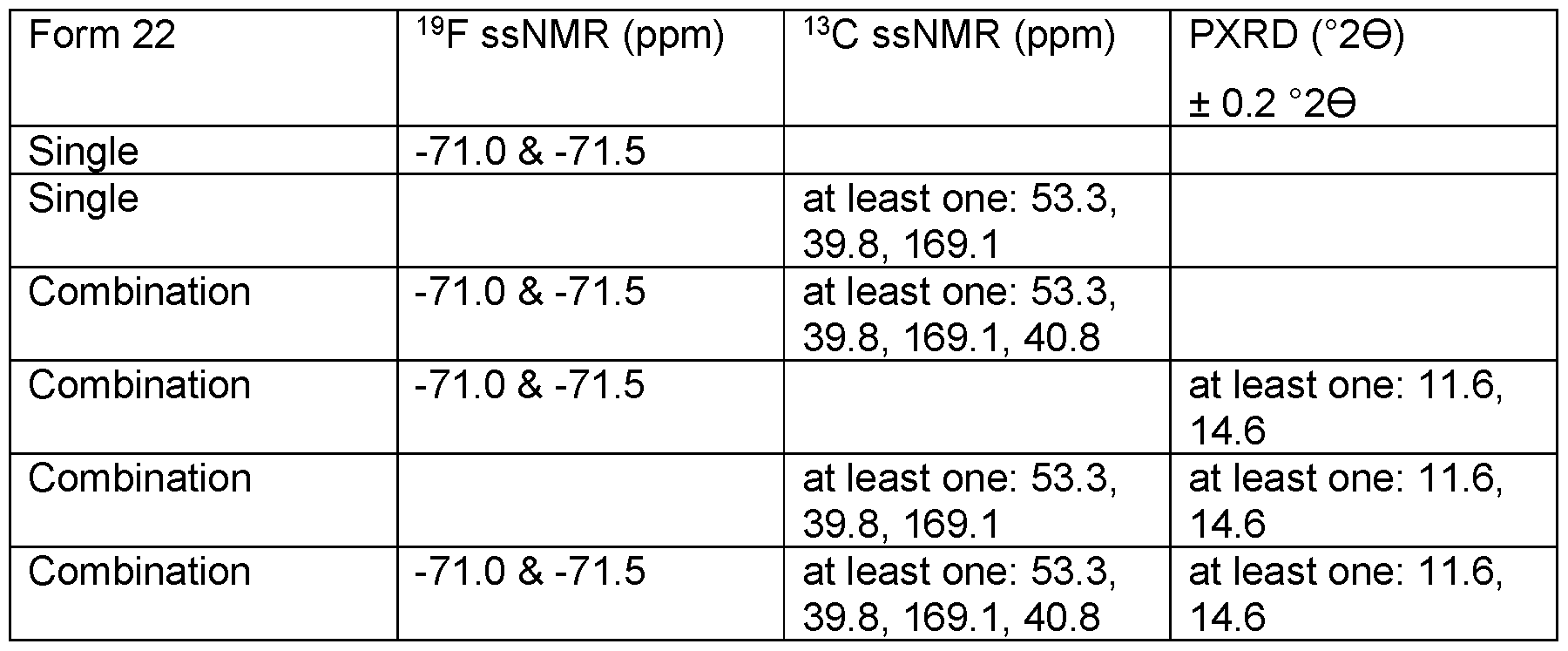
  • E91 is the compound according to E90 characterized by 19 F solid state NMR peaks at -71.0 and -71.5 ppm, each ⁇ 0.2 ppm.
  • E92 is the compound according to E90 characterized by one to three 13 C solid state NMR peaks selected from the group of peaks at 53.3 ppm, 39.8 ppm and 169.1 ppm wherein each peak is ⁇ 0.2 ppm.
  • E93 is the compound according to E90 characterized by 19 F solid state NMR peaks at -71.0 and -71.5 ppm, each ⁇ 0.2 ppm and one to four 13 C solid state NMR peaks selected from the group of peaks at 53.3 ppm, 39.8 ppm, 169.1 ppm and 40.8 ppm, wherein each peak is ⁇ 0.2 ppm.
  • E94 is the compound according to E90 characterized by 19 F solid state NMR peaks at -71.0 ppm and -71.5 ppm wherein each peak is ⁇ 0.2 ppm, and one to two powder X- ray diffraction peaks (Cu Ka radiation) selected from peaks at 11.6 and 14.6 degrees 20 wherein each peak is ⁇ 0.2 degrees 20.
  • E95 is the compound according to E90 characterized by one to three 13 C solid state NMR peaks selected from the group of peaks at 53.3 ppm, 39.8 ppm and 169.1 ppm wherein each peak is ⁇ 0.2 ppm, and one to two powder X-ray diffraction peaks (Cu Ka radiation) selected from peaks at 11.6 and 14.6 degrees 20 wherein each peak is ⁇ 0.2 degrees 20.
  • E96 is the compound according to E90 characterized by 19 F solid state NMR peaks at -71.0 ppm and -71.5 ppm wherein each peak is ⁇ 0.2 ppm, one to four 13 C solid state NMR peaks selected from the group of peaks at 53.3 ppm, 39.8 ppm, 169.1 ppm and 40.8 ppm wherein each peak is ⁇ 0.2 ppm, and one to two powder X-ray diffraction peaks (Cu Ka radiation) selected from peaks at 11.6 and 14.6 degrees 20 wherein each peak is ⁇ 0.2 degrees 20.
  • the present invention contemplates that the individual solid forms of the compounds of the invention can exist in the presence of other solid forms of the compounds of the invention.
  • Form 1 can exist in the presence of the any other of the solid forms described herein (e.g., Forms 5, 8, 9, 10, 11 , 12, 14 or 22) or mixtures thereof.
  • the present invention contemplates that Form 1 can exist in the presence of the any other of the solid forms (e.g. Forms 5, 8, 9, 10, 11 , 12, 14 or 22) or mixtures thereof.
  • the present invention provides Form 1 , wherein Form 1 is present in a solid form that includes less than 95%, less than 90%, less than 80%, less than 70%, less than 60%, less than 50%, less than 40%, less than 30%, less than 20%, less than 10%, less than 5%, less than 3%, or less than 1 % by weight of any other physical forms of the compound of Formula I.
  • a solid form of the compound of Formula I comprising Form 1 that has any one of the powder X-ray diffraction patterns, NMR spectra described above, wherein said solid form includes less than 95%, less than 90%, less than 80%, less than 70%, less than 60%, less than 50%, less than 40%, less than 30%, less than 20%, less than 10%, less than 5%, less than 3%, or less than 1 % by weight of any other physical forms of the compound of Formula I.
  • the present invention relates to Form 1 , wherein said form is substantially pure crystalline form.
  • the present invention contemplates that Form 22 can exist in the presence of the any other of the solid forms (e.g. Forms 5, 8, 9, 10, 11 , 12, 14 or 1) or mixtures thereof. Accordingly, in one embodiment, the present invention provides Form 1 , wherein Form 1 is present in a solid form that includes less than 95%, less than 90%, less than 80%, less than 70%, less than 60%, less than 50%, less than 40%, less than 30%, less than 20%, less than 10%, less than 5%, less than 3%, or less than 1 % by weight of any other physical forms of the compound of Formula I.
  • a solid form of the compound of Formula I comprising Form 1 that has any one of the powder X-ray diffraction patterns, NMR spectra described above, wherein said solid form includes less than 95%, less than 90%, less than 80%, less than 70%, less than 60%, less than 50%, less than 40%, less than 30%, less than 20%, less than 10%, less than 5%, less than 3%, or less than 1 % by weight of any other physical forms of the compound of Formula I.
  • the present invention relates to Form 22, wherein said form is substantially pure crystalline form.
  • the present invention contemplates that one of Forms 5, 8, 9, 10, 11 , 12 or 14 can exist in the presence of any other of the solid forms of the compound of Formula I or mixtures thereof. Accordingly, in one embodiment, the present invention provides one of Forms 5, 8, 9, 10, 11 , 12 or 14 , wherein said Form is present in a solid form that includes less than 95%, less than 90%, less than 80%, less than 70%, less than 60%, less than 50%, less than 40%, less than 30%, less than 20%, less than 10%, less than 5%, less than 3%, or less than 1 % by weight of any other physical forms of the compound of Formula I .
  • a solid form of the compound of Formula I comprising Form 12 that has any one of the powder X-ray diffraction patterns, NMR spectra described above, wherein said solid form includes less than 95%, less than 90%, less than 80%, less than 70%, less than 60%, less than 50%, less than 40%, less than 30%, less than 20%, less than 10%, less than 5%, less than 3%, or less than 1% by weight of any other physical forms of the compound of Formula I.
  • the present invention relates to any one of Forms 5, 8, 9, 10, 11 , 12 and 14, wherein said form is a substantially pure form.
  • the invention comprises pharmaceutical compositions.
  • a “pharmaceutical composition” refers to a mixture of one or more of the compounds of the invention and one or more pharmaceutically acceptable excipient.
  • excipient is used herein to describe any ingredient other than the compound(s) of the invention.
  • excipient will to a large extent depend on factors such as the mode of administration, the effect of the excipient on solubility and stability, and the nature of the dosage form.
  • excipient includes any and all solvents, dispersion media, coatings, antibacterial and antifungal agents, isotonic and absorption delaying agents, carriers, diluents and the like that are physiologically compatible.
  • excipients include one or more of water, saline, phosphate buffered saline, dextrose, glycerol, ethanol and the like, as well as combinations thereof, and may include isotonic agents, for example, sugars, sodium chloride, or polyalcohols such as mannitol, or sorbitol in the composition.
  • excipients also include various organic solvents (such as hydrates and solvates).
  • the pharmaceutical compositions may, if desired, contain additional excipients such as flavorings, binders/binding agents, lubricating agents, disintegrants, sweetening or flavoring agents, coloring matters or dyes, and the like.
  • excipients such as citric acid
  • disintegrants such as starch, alginic acid and certain complex silicates
  • binding agents such as sucrose, gelatin and acacia.
  • excipients include calcium carbonate, calcium phosphate, various sugars and types of starch, cellulose derivatives, gelatin, vegetable oils and polyethylene glycols.
  • lubricating agents such as magnesium stearate, sodium lauryl sulfate and talc are often useful for tableting purposes.
  • Solid compositions of a similar type may also be employed in soft and hard filled gelatin capsules.
  • excipients therefore, also include lactose or milk sugar and high molecular weight polyethylene glycols.
  • the active compound therein may be combined with various sweetening or flavoring agents, coloring matters or dyes and, if desired, emulsifying agents or suspending agents, together with additional excipients such as water, ethanol, propylene glycol, glycerin, or combinations thereof.
  • excipients also include pharmaceutically acceptable substances such as wetting agents or minor amounts of auxiliary substances such as wetting or emulsifying agents, preservatives, or buffers, which enhance the shelf life or effectiveness of the compound.
  • compositions of this invention may be in a variety of forms. These include, for example, liquid, semi-solid and solid dosage forms, such as liquid solutions (e.g., injectable, and infusible solutions), dispersions or suspensions, tablets, capsules, pills, powders, liposomes, and suppositories.
  • liquid solutions e.g., injectable, and infusible solutions
  • dispersions or suspensions tablets, capsules, pills, powders, liposomes, and suppositories.
  • the form depends on the intended mode of administration and therapeutic application.
  • compositions are in the form of injectable or infusible solutions, such as compositions similar to those used for passive immunization of humans with antibodies in general.
  • One mode of administration is parenteral (e.g., intravenous, subcutaneous, intraperitoneal, intramuscular).
  • the compound is administered by intravenous infusion or injection.
  • the compound is administered by intramuscular or subcutaneous injection.
  • Oral administration of a solid dose form may be, for example, presented in discrete units, such as hard or soft capsules, pills, cachets, lozenges, or tablets, each containing a predetermined amount of at least one compound of the invention.
  • the oral administration may be in a powder or granule form.
  • the oral dose form is sub-lingual, such as, for example, a lozenge.
  • the compounds of the invention are ordinarily combined with one or more adjuvants.
  • Such capsules or tablets may contain a controlled release formulation.
  • the dosage forms also may comprise buffering agents or may be prepared with enteric coatings.
  • oral administration may be in a liquid dose form.
  • Liquid dosage forms for oral administration include, for example, pharmaceutically acceptable emulsions, solutions, suspensions, syrups, and elixirs containing inert diluents commonly used in the art (e.g., water).
  • Such compositions also may comprise adjuvants, such as wetting, emulsifying, suspending, flavoring (e.g., sweetening), and/or perfuming agents.
  • the invention comprises a parenteral dose form.
  • Parenteral administration includes, for example, subcutaneous injections, intravenous injections, intraperitoneally, intramuscular injections, intrasternal injections, and infusion.
  • injectable preparations i.e. , sterile injectable aqueous or oleaginous suspensions
  • suitable dispersing, wetting agents, and/or suspending agents may be formulated according to the known art using suitable dispersing, wetting agents, and/or suspending agents.
  • the invention comprises a topical dose form.
  • Topical administration includes, for example, transdermal administration, such as via transdermal patches or iontophoresis devices, intraocular administration, or intranasal or inhalation administration.
  • Compositions for topical administration also include, for example, topical gels, sprays, ointments, and creams.
  • a topical formulation may include a compound which enhances absorption or penetration of the active ingredient through the skin or other affected areas. When the compounds of this invention are administered by a transdermal device, administration will be accomplished using a patch either of the reservoir and porous membrane type or of a solid matrix variety.
  • Typical formulations for this purpose include gels, hydrogels, lotions, solutions, creams, ointments, dusting powders, dressings, foams, films, skin patches, wafers, implants, sponges, fibers, bandages and microemulsions. Liposomes may also be used.
  • Typical excipients include alcohol, water, mineral oil, liquid petrolatum, white petrolatum, glycerin, polyethylene glycol and propylene glycol.
  • Penetration enhancers may be incorporated - see, for example, B. C. Finnin, and T. M. Morgan, J. Pharm. Sci. , vol. 88, pp. 955-958, 1999.
  • Formulations suitable for topical administration to the eye include, for example, eye drops wherein the compound of this invention is dissolved or suspended in a suitable excipient.
  • a typical formulation suitable for ocular or aural administration may be in the form of drops of a micronized suspension or solution in isotonic, pH-adjusted, sterile saline.
  • Other formulations suitable for ocular and aural administration include ointments, biodegradable (i.e. , absorbable gel sponges, collagen) and non- biodegradable (i.e., silicone) implants, wafers, lenses and particulate or vesicular systems, such as niosomes or liposomes.
  • a polymer such as crossed linked polyacrylic acid, polyvinyl alcohol, hyaluronic acid, a cellulosic polymer, for example, hydroxypropylmethylcellulose, hydroxyethylcellulose, or methylcellulose, or a heteropolysaccharide polymer, for example, gelan gum, may be incorporated together with a preservative, such as benzalkonium chloride.
  • a preservative such as benzalkonium chloride.
  • Such formulations may also be delivered by iontophoresis.
  • the compounds of the invention are conveniently delivered in the form of a solution or suspension from a pump spray container that is squeezed or pumped by the patient or as an aerosol spray presentation from a pressurized container or a nebulizer, with the use of a suitable propellant.
  • Formulations suitable for intranasal administration are typically administered in the form of a dry powder (either alone, as a mixture, for example, in a dry blend with lactose, or as a mixed component particle, for example, mixed with phospholipids, such as phosphatidylcholine) from a dry powder inhaler or as an aerosol spray from a pressurized container, pump, spray, atomizer (preferably an atomizer using electrohydrodynamics to produce a fine mist), or nebulizer, with or without the use of a suitable propellant, such as 1,1,1,2-tetrafluoroethane or 1 , 1,1, 2, 3,3,3- heptafluoropropane.
  • the powder may comprise a bioadhesive agent, for example, chitosan or cyclodextrin.
  • the invention comprises a rectal dose form.
  • rectal dose form may be in the form of, for example, a suppository. Cocoa butter is a traditional suppository base, but various alternatives may be used as appropriate.
  • compositions of the invention may be prepared by any of the well-known techniques of pharmacy, such as effective formulation and administration procedures.
  • effective formulations and administration procedures are well known in the art and are described in standard textbooks.
  • Formulation of drugs is discussed in, for example, Hoover, John E., Remington’s Pharmaceutical Sciences, Mack Publishing Co., Easton, Pennsylvania, 1975; Liberman et al., Eds., Pharmaceutical Dosage Forms, Marcel Decker, New York,
  • Acceptable excipients are nontoxic to recipients at the dosages and concentrations employed, and may comprise buffers such as phosphate, citrate, and other organic acids; salts such as sodium chloride; antioxidants including ascorbic acid and methionine; preservatives (such as octadecyldimethylbenzyl ammonium chloride; hexamethonium chloride; benzalkonium chloride, benzethonium chloride; phenol, butyl or benzyl alcohol; alkyl parabens, such as methyl or propyl paraben; catechol; resorcinol; cyclohexanol; 3-pentanol; and m-cresol); low molecular weight (less than about 10 residues) polypeptides; proteins, such as serum albumin, gelatin, or Igs; hydrophilic polymers such as polyvinylpyrrolidone; amino acids such as glycine, glutamine, asparagine, histidine,
  • compositions may be provided in the form of tablets or capsules containing 0.01 , 0.05, 0.1 , 0.5, 1.0, 2.5, 5.0, 10.0, 15.0, 25.0, 50.0, 75.0, 100, 125, 150, 175, 200, 250,300, 350, 400, 450, 500, 600, 750 or 1000 milligrams of the active ingredient for the symptomatic adjustment of the dosage to the patient.
  • a medicament typically contains from about 0.01 mg to about 500 mg of the active ingredient, or in another embodiment, from about 1 mg to about 100 mg of active ingredient or from 50 to 500 milligrams. Intravenously, doses may range from about
  • Liposomes containing compounds of the invention may be prepared by methods known in the art, such as described in U.S. Pat. Nos. 4,485,045 and 4,544,545. Liposomes with enhanced circulation time are disclosed in U.S. Patent No. 5,013,556. Particularly useful liposomes can be generated by the reverse phase evaporation method with a lipid composition comprising phosphatidylcholine, cholesterol and PEG- derivatized phosphatidylethanolamine (PEG-PE). Liposomes are extruded through filters of defined pore size to yield liposomes with the desired diameter.
  • PEG-PE PEG- derivatized phosphatidylethanolamine
  • microcapsules prepared, for example, by coacervation techniques or by interfacial polymerization, for example, hydroxymethylcellulose or gelatin-microcapsules and poly-(methylmethacrylate) microcapsules, respectively, in colloidal drug delivery systems (for example, liposomes, albumin microspheres, microemulsions, nano-particles and nanocapsules) or in macroemulsions.
  • colloidal drug delivery systems for example, liposomes, albumin microspheres, microemulsions, nano-particles and nanocapsules
  • sustained-release preparations may be used. Suitable examples of sustained- release preparations include semi-permeable matrices of solid hydrophobic polymers containing a compound of the invention, which matrices are in the form of shaped articles, e.g., films, or microcapsules. Examples of sustained-release matrices include polyesters, hydrogels (for example, poly(2-hydroxyethyl-methacrylate), or 'poly(vinylalcohol)), polylactides (U.S. Pat. No.
  • copolymers of L-glutamic acid and 7 ethyl-L-glutamate copolymers of L-glutamic acid and 7 ethyl-L-glutamate, non-degradable ethylene-vinyl acetate, degradable lactic acid-glycolic acid copolymers such as those used in LUPRON DEPOTTM (injectable microspheres composed of lactic acid-glycolic acid copolymer and leuprolide acetate), sucrose acetate isobutyrate, and poly-D-(-)-3-hydroxybutyric acid.
  • LUPRON DEPOTTM injectable microspheres composed of lactic acid-glycolic acid copolymer and leuprolide acetate
  • sucrose acetate isobutyrate sucrose acetate isobutyrate
  • poly-D-(-)-3-hydroxybutyric acid poly-D-(-)-3-hydroxybutyric acid.
  • the formulations to be used for intravenous administration must be sterile. This is readily accomplished by, for example, filtration through sterile filtration membranes.
  • Compounds of the invention are generally placed into a container having a sterile access port, for example, an intravenous solution bag or vial having a stopper pierceable by a hypodermic injection needle.
  • Suitable emulsions may be prepared using commercially available fat emulsions, such as IntralipidTM, LiposynTM, InfonutrolTM, LipofundinTM and LipiphysanTM.
  • the active ingredient may be either dissolved in a pre-mixed emulsion composition or alternatively it may be dissolved in an oil (e.g., soybean oil, safflower oil, cottonseed oil, sesame oil, corn oil or almond oil) and an emulsion formed upon mixing with a phospholipid (e.g., egg phospholipids, soybean phospholipids or soybean lecithin) and water.
  • an oil e.g., soybean oil, safflower oil, cottonseed oil, sesame oil, corn oil or almond oil
  • a phospholipid e.g., egg phospholipids, soybean phospholipids or soybean lecithin
  • other ingredients may be added, for example glycerol or glucose, to adjust the tonicity of the emul
  • Suitable emulsions will typically contain up to 20% oil, for example, between 5 and 20%.
  • the fat emulsion can comprise fat droplets between 0.1 and 1.0 pm, particularly 0.1 and 0.5 pm, and have a pH in the range of 5.5 to 8.0.
  • the emulsion compositions can be those prepared by mixing a compound of the invention with IntralipidTM or the components thereof (soybean oil, egg phospholipids, glycerol and water).
  • compositions for inhalation or insufflation include solutions and suspensions in pharmaceutically acceptable, aqueous or organic solvents, or mixtures thereof, and powders.
  • the liquid or solid compositions may contain suitable pharmaceutically acceptable excipients as set out above.
  • the compositions are administered by the oral or nasal respiratory route for local or systemic effect.
  • Compositions in preferably sterile pharmaceutically acceptable solvents may be nebulized by use of gases. Nebulized solutions may be breathed directly from the nebulizing device, or the nebulizing device may be attached to a face mask, tent or intermittent positive pressure breathing machine.
  • Solution, suspension, or powder compositions may be administered, preferably orally or nasally, from devices which deliver the formulation in an appropriate manner.
  • treating embraces both preventative, i.e., prophylactic, and palliative treatment, i.e., relieve, alleviate, or slow the progression of the patient’s disease (or condition) or any tissue damage associated with the disease.
  • the terms, “subject, “individual” or “patient,” used interchangeably, refer to any animal, including mammals. Mammals according to the invention include canine, feline, bovine, caprine, equine, ovine, porcine, rodents, lagomorphs, primates, humans and the like, and encompass mammals in utero. In an embodiment, humans are suitable subjects. Human subjects may be of any gender and at any stage of development.
  • the phrase “therapeutically effective amount” refers to the amount of active compound or pharmaceutical agent that elicits the biological or medicinal response in a tissue, system, animal, individual or human that is being sought by a researcher, veterinarian, medical doctor, or other clinician, which may include one or more of the following:
  • preventing the disease for example, preventing a disease, condition or disorder in an individual that may be predisposed to the disease, condition or disorder but does not yet experience or display the pathology or symptomatology of the disease; (2) inhibiting the disease; for example, inhibiting a disease, condition or disorder in an individual that is experiencing or displaying the pathology or symptomatology of the disease, condition, or disorder (i.e., arresting or slowing further development of the pathology and/or symptomatology); and
  • ameliorating the disease for example, ameliorating a disease, condition or disorder in an individual that is experiencing or displaying the pathology or symptomatology of the disease, condition, or disorder (i.e., reversing the pathology and/or symptomatology).
  • a compound of the invention is administered in an amount effective to treat a condition as described herein.
  • the compounds of the invention can be administered as compound per se, or alternatively, as a solvate thereof.
  • the compound per se or solvate thereof will simply be referred to as the compounds of the invention.
  • the compounds of the invention are administered by any suitable route in the form of a pharmaceutical composition adapted to such a route, and in a dose effective for the treatment intended.
  • the compounds of the invention may be administered orally, rectally, vaginally, parenterally, topically, intranasally, or by inhalation.
  • the compounds of the invention may be administered orally.
  • Oral administration may involve swallowing, so that the compound enters the gastrointestinal tract, or buccal or sublingual administration may be employed by which the compound enters the bloodstream directly from the mouth.
  • the compounds of the invention may also be administered parenterally, for example directly into the bloodstream, into muscle, or into an internal organ.
  • suitable means for parenteral administration include intravenous, intraarterial, intraperitoneal, intrathecal, intraventricular, intraurethral, intrasternal, intracranial, intramuscular, and subcutaneous.
  • Suitable devices for parenteral administration include needle (including microneedle) injectors, needle-free injectors, and infusion techniques.
  • the compounds of the invention may also be administered topically to the skin or mucosa, that is, dermally or transdermally.
  • the compounds of the invention can also be administered intranasally or by inhalation.
  • the compounds of the invention may be administered rectally or vaginally.
  • the compounds of the invention may also be administered directly to the eye or ear.
  • the dosage regimen for the compounds of the invention and/or compositions containing said compounds is based on a variety of factors, including the type, age, weight, sex and medical condition of the patient; the severity of the condition; the route of administration; and the activity of the particular compound employed. Thus, the dosage regimen may vary widely.
  • the total daily dose of a compound of the invention is typically from about 0.01 to about 100 mg/kg (i.e. , mg compound of the invention per kg body weight) for the treatment of the indicated conditions discussed herein.
  • total daily dose of the compound of the invention is from about 0.1 to about 50 mg/kg, and in another embodiment, from about 0.5 to about 30 mg/kg. It is not uncommon that the administration of the compounds of the invention will be repeated a plurality of times in a day (typically no greater than 4 times). Multiple doses per day typically may be used to increase the total daily dose, if desired.
  • the compounds of the invention inhibit viral proteases, particularly coronavirus viral proteases such as the 3CL (Mpro) protease of SARS-CoV-2 which is the causative virus of COVID-19.
  • the compounds of the invention may inhibit the activity of the main viral protease and may be useful in the treatment, prevention, suppression, and amelioration of viral infections including coronavirus infections such as SARS-CoV-2 infections and COVID-19.
  • the compounds of the invention may also be useful in the treatment or amelioration of sequelae of coronavirus infections such as use or treatment of long COVID.
  • the compounds of the invention can be used alone, or in combination with one or more other therapeutic agents.
  • the invention provides any of the uses, methods or compositions as defined herein wherein the compound of the invention is used in combination with one or more other therapeutic agent discussed herein.
  • the compounds of the present invention can be used in the methods of the invention in combination with other drugs.
  • a SARS-CoV-2 coronavirus- infected patient i.e., a patient with COVID-19
  • an interferon such as interferon alpha
  • a pegylated interferon such as PEG-lntron or Pegasus
  • Other additional agents that can be used in the methods of the present invention include dexamethasone, azithromycin and remdesivir.
  • Examples of greater clinical benefits could include a larger reduction in COVID-19 symptoms, a faster time to alleviation of symptoms, reduced lung pathology, a larger reduction in the amount of SARS-CoV-2 coronavirus in the patient (viral load), and decreased mortality.
  • the SARS-CoV-2 coronavirus infects cells which express P-glycoprotein.
  • Some of the SARS-CoV-2 coronavirus 3CL protease inhibitors of the invention may be P- glycoprotein substrates.
  • Compounds which inhibit the SARS-CoV-2 coronavirus which are also P-glycoprotein substrates may be dosed with a P-glycoprotein inhibitor.
  • P-glycoprotein inhibitors are verapamil, vinblastine, ketoconazole, nelfinavir, ritonavir, or cyclosporine.
  • the P-glycoprotein inhibitors act by inhibiting the efflux of the SARS-CoV-2 coronavirus inhibitors of the invention out of the cell.
  • the inhibition of the P-glycoprotein-based efflux will prevent reduction of intracellular concentrations of the SARS-CoV-2 coronavirus inhibitor due to P-glycoprotein efflux. Inhibition of the P-glycoprotein efflux will result in larger intracellular concentrations of the SARS-CoV-2 coronavirus inhibitors.
  • Dosing a SARS-CoV-2 coronavirus-infected patient with the SARS-CoV-2 coronavirus 3CL protease inhibitors of the invention and a P-glycoprotein inhibitor may lower the amount of SARS-CoV-2 coronavirus 3CL protease inhibitor required to achieve an efficacious dose by increasing the intracellular concentration of the SARS-CoV-2 coronavirus 3CL protease inhibitor.
  • agents that may be used to increase the exposure of a mammal to a compound of the present invention are those that can act as inhibitors of at least one isoform of the cytochrome P450 (CYP450) enzymes.
  • the isoforms of CYP450 that may be beneficially inhibited include, but are not limited to CYP1A2, CYP2D6, CYP2C9, CYP2C19 and CYP3A4.
  • the compounds used in the methods of the invention include compounds that may be CYP3A4 substrates and are metabolized by CYP3A4.
  • a SARS-CoV-2 coronavirus inhibitor which is a CYP3A4 substrate, such as SARS-CoV-2 coronavirus 3CL protease inhibitor, and a CYP3A4 inhibitor, such as ritonavir, nelfinavir or delavirdine will reduce the metabolism of the SARS-CoV-2 coronavirus inhibitor by CYP3A4. This will result in reduced clearance of the SARS-CoV-2 coronavirus inhibitor and increased SARS-CoV- 2 coronavirus inhibitor plasma concentrations. The reduced clearance and higher plasma concentrations may result in a lower efficacious dose of the SARS-CoV-2 coronavirus inhibitor.
  • Additional therapeutic agents that can be used in combination with the SARS-CoV-2 inhibitors in the methods of the present invention include the following:
  • PLpro inhibitors Apilomod, EIDD-2801, Ribavirin, Valganciclovir, /3-Thymidine, Aspartame, Oxprenolol, Doxycycline, Acetophenazine, lopromide, Riboflavin, Reproterol, 2,2'-Cyclocytidine, Chloramphenicol, Chlorphenesin carbamate, Levodropropizine, Cefamandole, Floxuridine, Tigecycline, Pemetrexed, L(+)-Ascorbic acid, Glutathione, Hesperetin, Ademetionine, Masoprocol, Isotretinoin, Dantrolene, Sulfasalazine Anti-bacterial, Silybin, Nicardipine, Sildenafil, Platycodin, Chrysin, Neohesperidin, Baicalin, Sugetriol-3,9-diacetate, (-)-Epigallocatechin gall
  • 3CLpro inhibitors Lymecycline, Chlorhexidine, Alfuzosin, Cilastatin, Famotidine, Almitrine, Progabide, Nepafenac, Carvedilol, Amprenavir, Tigecycline, Montelukast, Carminic acid, Mimosine, Flavin, Lutein, Cefpiramide, Phenethicillin, Candoxatril, Nicardipine, Estradiol valerate, Pioglitazone, Conivaptan, Telmisartan, Doxycycline, Oxytetracycline, (1 S,2R,4aS,5R,8aS)-1-Formamido-1 ,4a-dimethyl-6-methylene-5-((E)- 2-(2-oxo-2,5-dihydrofuran-3-yl)ethenyl)decahydronaphthalen-2-yl5-((R)-1,2-dithiolan-3- yl) pentan
  • RdRp inhibitors Valganciclovir, Chlorhexidine, Ceftibuten, Fenoterol, Fludarabine, Itraconazole, Cefuroxime, Atovaquone, Chenodeoxycholic acid, Cromolyn, Pancuronium bromide, Cortisone, Tibolone, Novobiocin, Silybin, Idarubicin Bromocriptine, Diphenoxylate, Benzylpenicilloyl G, Dabigatran etexilate, Betulonal, Gnidicin, 2/3,30/3-Dihydroxy-3,4-seco-friedelolactone-27-lactone, 14-Deoxy-11 ,12-didehydroandrographolide, Gniditrin, Theaflavin 3,3'-di-O-gallate, (R)- ((1R,5aS,6R,9aS)-1 ,5a-Dimethyl-7-methylene-3-oxo-6-((E)
  • Additional therapeutic agents that can be used in the methods of the invention include Diosmin, Hesperidin, MK-3207, Venetoclax, Dihydroergocristine, Bolazine, R428, Ditercalinium, Etoposide, Teniposide, UK-432097, Irinotecan, Lumacaftor, Velpatasvir, Eluxadoline, Ledipasvir, Lopinavir / Ritonavir + Ribavirin, Alferon, and prednisone.
  • Other additional agents useful in the methods of the present invention include dexamethasone, azithromycin and remdesivir as well as boceprevir, umifenovir and favipiravir.
  • RIG 1 pathway activators such as those described in US Patent No. 9,884,876.
  • protease inhibitors such as those described in Dai W, Zhang B, Jiang X-M, et al. Structure-based design of antiviral drug candidates targeting the SARS-CoV-2 main protease. Science. 2020;368(6497):1331- 1335 including compounds such as the compound shown below and a compound designated as DC402234
  • Another embodiment of the present invention is a method of treating COVID-19 in a patient wherein in addition to administering a compound of the present invention (i.e. Form 1 , Form 5, Form 8, Form 9, Form 10, Form 11 , Form 12 or Form 14) an additional agent is administered and the additional agent is selected from antivirals such as nirmatrelvir, remdesivir, galidesivir, favilavir/avifavir, molnupiravir (MK- 4482/EIDD 2801), AT-527, AT-301 , BLD-2660, favipiravir, camostat, SLV213 emtrictabine/tenofivir, clevudine, dalcetrapib, boceprevir, PBI-0451 , EDP-235 and ABX464, glucocorticoids such as dexamethasone and hydrocortisone, convalescent plasma, a recombinant human plasma such as gelsolin (Rhu-p65
  • SARS-CoV-2 inhibiting agent means any SARS-CoV-2-related coronavirus 3C-like protease inhibitor compound described herein which inhibits replication of SARS-CoV-2 in any manner.
  • SARS-CoV-2 SARS-CoV-2-related coronavirus
  • the term “interfering with or preventing” SARS-CoV-2-related coronavirus (“SARS-CoV-2”) viral replication in a cell means to reduce SARS-CoV-2 replication or production of SARS-CoV-2 components necessary for progeny virus in a cell treated with a compound of this invention as compared to a cell not being treated with a compound of this invention.
  • Simple and convenient assays to determine if SARS-CoV- 2 viral replication has been reduced include an ELISA assay for the presence, absence, or reduced presence of anti-SARS-CoV-2 antibodies in the blood of the subject (Nasoff, et al., PNAS 88:5462-5466, 1991), RT-PCR (Yu, et al., in Viral Hepatitis and Liver Disease 574-577, Nishioka, Suzuki and Mishiro (Eds.); Springer-Verlag, Tokyo, 1994). Such methods are well known to those of ordinary skill in the art.
  • total RNA from transduced and infected “control” cells can be isolated and subjected to analysis by dot blot or northern blot and probed with SARS-CoV-2-specific DNA to determine if SARS-CoV-2 replication is reduced.
  • reduction of SARS-CoV- 2 protein expression can also be used as an indicator of inhibition of SARS-CoV-2 replication. A greater than fifty percent reduction in SARS-CoV-2 replication as compared to control cells typically quantitates a prevention of SARS-CoV-2 replication.
  • the administration of two or more compounds “in combination” means that all of the compounds are administered closely enough in time to affect treatment of the subject.
  • the two or more compounds may be administered simultaneously or sequentially, via the same or different routes of administration, on same or different administration schedules and with or without specific time limits depending on the treatment regimen. Additionally, simultaneous administration may be carried out by mixing the compounds prior to administration or by administering the compounds at the same point in time but as separate dosage forms at the same or different site of administration.
  • a compound of the invention and the one or more other therapeutic agents may be administered as a fixed or non-fixed combination of the active ingredients.
  • the term "fixed combination” means a compound of the invention, or a pharmaceutically acceptable salt thereof, and the one or more therapeutic agents, are both administered to a subject simultaneously in a single composition or dosage.
  • the term “non-fixed combination” means that a compound of the invention, or a pharmaceutically acceptable salt thereof, and the one or more therapeutic agents are formulated as separate compositions or dosages such that they may be administered to a subject in need thereof simultaneously or sequentially with variable intervening time limits, wherein such administration provides effective levels of the two or more compounds in the body of the subject.
  • the compounds of this invention are administered in combination with additional therapeutic agents useful in treatment of viral infections including the pharmaceutically acceptable salts of the specifically named agents and the pharmaceutically acceptable solvates of said agents and salts.
  • agents and compounds of the invention can be combined with pharmaceutically acceptable vehicles such as saline, Ringer’s solution, dextrose solution, and the like.
  • pharmaceutically acceptable vehicles such as saline, Ringer’s solution, dextrose solution, and the like.
  • the particular dosage regimen, i.e. , dose, timing and repetition, will depend on the particular individual and that individual’s medical history.
  • kits comprising the compound of the invention or pharmaceutical compositions comprising the compound of the invention.
  • a kit may include, in addition to the compound of the invention or pharmaceutical composition thereof, diagnostic or therapeutic agents.
  • a kit may also include instructions for use in a diagnostic or therapeutic method.
  • the kit includes the compound or a pharmaceutical composition thereof and a diagnostic agent.
  • the kit includes the compound or a pharmaceutical composition thereof and one or more therapeutic agents, such as another antiviral agent such as nirmatrelvir, remdesivir or molnupiravir.
  • the invention comprises kits that are suitable for use in performing the methods of treatment described herein.
  • the kit contains a first dosage form comprising one or more of the compounds of the invention in quantities sufficient to carry out the methods of the invention.
  • the kit comprises one or more compounds of the invention in quantities sufficient to carry out the methods of the invention and a container for the dosage and a container for the dosage.
  • Powder X-Ray Diffraction was determined for N-(Methoxycarbonyl)-3-methyl-L- valyl-(4R)-N- ⁇ (1S)-1-cyano-2-[(3S)-2-oxopyrrolidin-3-yl]ethyl ⁇ -4-(trifluoromethyl)-L- prolinamide or solvate thereof (Forms 1 , 5, 9, 10, 11 and 750 mg/g SDD) according to the method below.
  • the divergence slit was set at 15 mm continuous illumination.
  • Diffracted radiation was detected by a PSD-Lynx Eye detector, with the detector PSD opening set at 4.11 degrees.
  • the X-ray tube voltage and amperage were set to 40 kV and 40 mA respectively.
  • the energy dispersive detector a nickel filter was used to screen out unwanted wavelengths.
  • Data was collected in the Theta-Theta goniometer at the Cu wavelength from 3.0 to 40.0 degrees 2-Theta using a step size of 0.01 degrees and a step time of 1.0 second.
  • the anti-scatter screen was set to a fixed distance of 1.5 mm. Samples were rotated at 15/min during collection. Samples were prepared by placing them in a silicon low background sample holder and rotated during collection. Data were collected using Bruker DIFFRAC Plus software and analysis was performed by EVA diffract plus software.
  • the PXRD data file was not processed prior to peak searching.
  • peaks selected with a threshold value of 1 were used to make preliminary peak assignments. To ensure validity, adjustments were manually made; the output of automated assignments was visually checked, and peak positions were adjusted to the peak maximum. Peaks with relative intensity of > 3 % were generally chosen. The peaks which were not resolved or were consistent with noise were not selected. A typical error associated with the peak position from PXRD stated in USP up to +/- 0.2° 2-Theta (USP-941).
  • Solid-state NMR (ssNMR) analysis was conducted on a CPMAS probe positioned into a Bruker-BioSpin Avance III 600 MHz ( 1 H frequency) NMR spectrometer. Material was packed into a ZrO2 rotor. A magic angle spinning rate of 15 kHz was used. Spectra were collected at ambient temperature (probe temperature of 25°C.)
  • 13 C ssNMR spectra were collected using a proton decoupled cross-polarization magic angle spinning (CPMAS) experiment.
  • CPMAS proton decoupled cross-polarization magic angle spinning
  • a phase modulated proton decoupling field of 80- 100 kHz was applied during spectral acquisition.
  • the cross-polarization contact time was set to 2 ms and the recycle delay to 3.5 seconds for Form 1 , Form 5, Form 9, Form 10, Form 11 , and 750 mg/g SDD.
  • the number of scans was adjusted to obtain an adequate signal to noise ratio.
  • the 13 C chemical shift scale was referenced using a 13 C CPMAS experiment on an external standard of crystalline adamantane, setting its up-field resonance to 29.5 ppm.
  • 19 F ssNMR spectra were collected using a proton decoupled magic angle spinning (MAS) experiment.
  • a phase modulated proton decoupling field of 80-100 kHz was applied during spectral acquisition.
  • Spectra were collected with a recycle delay of 3.5 seconds for Form 1 , Form 5, Form 9, Form 10, Form 11 , and 750 mg/g SDD. The number of scans was adjusted to obtain an adequate signal to noise ratio.
  • the 19 F chemical shift scale was referenced using a 19 F MAS experiment on an external standard of trifluoroacetic acid (50%/50% v/v in H2O), setting its resonance to -76.54 ppm.
  • a TA Instruments TGA 5500 is used for the thermal analysis portion of the instrument. Samples of approximately 5 mg to 10 mg were weighed into aluminum pans and heated from ambient temperature to 275 °C (for Form 9) or to 200 °C (for Form 11) at 10 °C/minute heating rate under nitrogen purge (10 mL/min for balance and 25 mL/min for sample chamber).
  • a Thermo Nicolet IS20 FT-IR spectrometer equipped with a KBr beamsplitter and a DTGS KBr detector was utilized for TGA-IR analysis.
  • the collection range was 4000 - 400 cm -1 and Happ-Genzel apodization was used for data collection.
  • Background spectra were collected at 8 cm -1 resolution with 64 co-added scans.
  • the IR background is collected with the TGA furnace closed and purged for 2 to 3 minutes.
  • the sample method is set up for a quick spectral collection, as the evolved gases are swept quickly through the gas cell.
  • Each sample spectral data point is a co-added spectrum of five spectra, collected with 8 cm -1 resolution.
  • the total IR collection time is adjusted based on the run length of the TGA.
  • Modulated Differential scanning calorimetry measurement was performed with Discovery DSC 2500 (TA instruments) equipped with a refrigerated cooling accessory. All the experiments were performed in standard/Tzero aluminum pans. The cell constant was determined using indium and temperature calibration was performed using indium and tin as standards. All the measurements were done under continuous dry nitrogen purge (50 mL/min). Approximately 1-5 mg of solid sample was weighed into a Tzero aluminum pan, sealed non-hermetically and heated with heat-cool-heat program.
  • the heat-cool- heat program was heated from -50 to 120°C using a modulate temperature amplitude of ⁇ 1.0°C, a modulation period of 100s, and a ramp rate of 2°C/min, then ramp to -50 °C with a ramp rate of 10°C/min, followed second heating from -50 to 200°C using a modulate temperature amplitude of ⁇ 1.0°C, a modulation period of 100s, and a ramp rate of 2°C/min.
  • the experimental data were analyzed using commercially available software (TA Universal Analysis 2000/Trios software, TA Instruments).
  • Step 1 Preparation of methyl ((S)-1-((2S,4R)-2-(((S)-1-amino-1-oxo-3-((S)-2- oxopyrrolidin-3-yl)propan-2-yl)carbamoyl)-4-(trifluoromethyl) pyrrolidin-1-yl)-3,3- dimethyl-1-oxobutan-2-yl)carbamate, compound II (as an organic solution)
  • the compound of formula IV, (2S,4R)-1-((S)-2-((methoxycarbonyl)amino)-3,3- dimethylbutanoyl)-4-(trifluoromethyl)pyrrolidine-2-carboxylic acid (25.4 g, 69.7 mmol, 1.0 equivalent) and methyl ethyl ketone (200 mL, 8 L/kg of compound IV) were combined and stirred at 25 °C.
  • reaction was quenched by the addition of aqueous NaCI (100 mL of a 14 wt% brine solution, 4.0 L/kg of compound IV), stirred 15-30 minutes and phases were separated.
  • the organic phase was washed with a second portion of aqueous NaCI (100 mL of a 14 wt% brine solution).
  • Both aqueous phases were combined and extracted with methyl ethyl ketone (125 mL, 5 L/kg of compound IV) twice. All organic phases were combined and then concentrated by vacuum distillation at 0.3 bar (internal temperature of reaction mixture approximately 30°C) to a concentration of approximately 5L/kg of product.
  • Isopropyl acetate 200 mL, 8 L/kg of compound IV was then added to the mixture and distillation continued to reach approximately 5L/kg of product compound II reaction volume. A second addition of isopropyl acetate (200 mL, 8 L/kg of compound IV) was added, and the distillation process was repeated following the same protocol, ending the distillation at a concentration of 5 L/kg of product compound II. Isopropyl acetate (125 mL, 5 L/kg of compound IV) was added and stirred at 25 °C. A sample was analyzed for water content (Karl- Fischer) with a target of not more than 0.2 wt% water.
  • Step 2 The isopropyl acetate solution of methyl ((S)-1-((2S,4R)-2-(((S)-1-amino-1-oxo- 3-((S)-2-oxopyrrolidin-3-yl)propan-2-yl)carbamoyl)-4-(trifluoromethyl)pyrrolidin-1-yl)-3,3- dimethyl-1-oxobutan-2-yl)carbamate, compound II, prepared above (assumed quantitative conversion, 69.7 mmol, 1.0 equivalent) was combined with N- methylmorpholine (36.7 g, 40 mL, 0.36 mol, 5.2 equivalents) and stirred at 10 °C.
  • Trifluoroacetic anhydride (38.1 g, 25.5 mL, 0.18 mol, 2.6 equivalents) was charged over 30-60 minutes dropwise, maintaining the reaction temperature at not more than 15 °C. The resulting mixture was stirred for 1 hour at 10 °C. A sample was analyzed for reaction completion (not more than 0.5% compound II present). [NOTE: If the reaction was not complete, maintain stirring for another 60 minutes, and charge additional N- methylmorpholine and trifluoroacetic anhydride (maintaining a 2:1 ratio) if needed]. The reaction was quenched by addition of aq.
  • ammonium hydroxide (28 wt%) (10.7 mL, 76 mmol, 1.1 equivalents) in water (74.1 mL water, 3.0 L/kg of compound IV from previous step). Mixture was stirred for 15-30 min, then stopped and the layers allowed to settle. The aqueous phase was removed, and the organic phase was sampled for internal process control (target of not more than 0.1% methyl ((S)-1-((2S,4R)-2-(((S)-1-cyano-2- ((S)-2-oxopyrrolidin-3-yl)ethyl)carbamoyl)-4-(trifluoromethyl)pyrrolidin-1-yl)-3,3-dimethyl-
  • Step 3 Compound I, CPME solvate (30.09 g, 51.03 mmol, 100 mass%) and Heptane (300 mL, 2047.9 mmol, 100 mass%) was added into a 1000 mL two-piece OptiMax reactor with overhead stirring at 350 rpm and baffle. The mixture was stirred at 20 °C and heated to 70 °C. The mixture was stirred at 70 °C for 12 hours then the mixture was cooled to 25 °C in 5 hours and stirred overnight. The resulting slurry was filtered and washed with Heptane (60 mL, 409.58 mmol, 100 mass%).
  • PXRD was determined for N-(Methoxycarbonyl)-3-methyl-L-valyl-(4R)-N- ⁇ (1S)-1-cyano- 2-[(3S)-2-oxopyrrolidin-3-yl]ethyl ⁇ -4-(trifluoromethyl)-L-prolinamide, Form 1 and the PXRD pattern is provided in Figures 1 and 2.
  • Crystals were grown from a solution of N-(Methoxycarbonyl)-3-methyl-L-valyl- (4R)-N- ⁇ (1S)-1-cyano-2-[(3S)-2-oxopyrrolidin-3-yl]ethyl ⁇ -4-(trifluoromethyl)-L- prolinamide, Form 1 dissolved in 1 -Chlorobutane by slow evaporation of the solution at room temperature.
  • PXRD was determined for N-(Methoxycarbonyl)-3-methyl-L-valyl-(4R)-N- ⁇ (1S)-1-cyano- 2-[(3S)-2-oxopyrrolidin-3-yl]ethyl ⁇ -4-(trifluoromethyl)-L-prolinamide, Form 5 anhydrous free form.
  • TGA-IR Thermogravimetric Infra-red Analysis
  • 19 F solid-state NMR peak is ⁇ 0.2 ppm.
  • Form 1 565.0 mg of N-(Methoxycarbonyl)-3-methyl-L-valyl-(4R)-N- ⁇ (1S)-1-cyano-2-[(3S)-2- oxopyrrolidin-3-yl]ethyl ⁇ -4-(trifluoromethyl)-L-prolinamide, Form 1 was weighed into a 2- dram vial equipped with stirring bar and 2.5 mL of isopropyl acetate was pipetted into the vial. The mixture was stirred at approximately 25 °C in a heat block for approximately 2 days. The mixture was vacuum filtered, and the solids were allowed to sit in ambient air for 3 days.
  • TGA-IR Thermogravimetric Infra-red Analysis
  • Form 12 shows that the structure contains residual void space of 1666 A 3 , which account for 26.9% of the unit cell volume.
  • a solvent mask was calculated, and 420 electrons were found in a volume of 1772 A A 3 in 1 void per unit cell. This is consistent with the presence of 1[C5H10O2] per Asymmetric Unit which account for 448 electrons per unit cell.
  • Table 8-1 Crystal structure data of crystalline N-(Methoxycarbonyl)-3-methyl-L-valyl- (4R)-N- ⁇ (1S)-1-cyano-2-[(3S)-2-oxopyrrolidin-3-yl]ethyl ⁇ -4-(trifluoromethyl)-L- prolinamide, isopropyl acetate solvate, Form 12.
  • the resulting solution which has a weight percent of API I polymer I acetone 7.5/2.5/90 was atomized into a co-current stream of heated nitrogen, during which the solvent was removed to form SDD particles.
  • the SDD particles were subjected to a secondary drying step in a vacuum tray dryer to remove residual acetone solvent from the SDD to an acceptable level (acceptable level is ⁇ 5000 ppm (acetone) by guidance, Test per USBD-334 which is usually below 0.05%).
  • N-(Methoxycarbonyl)-3-methyl-L-valyl-(4R)-N- ⁇ (1S)-1-cyano-2-[(3S)-2-oxo pyrrolidin-3-yl]ethyl ⁇ -4-(trifluoromethyl)-L-prolinamide/HPMCAS-MG SDD was characterized by PXRD (Fig. 6), 13 C and 19 F solid state NMR (Figs. 25-26) and modulated differential scanning calorimetry (mDSC) (Fig. 34).
  • Powder X-ray diffraction analysis was conducted using a Bruker AXS D8 Endeavor diffractometer equipped with a Cu radiation source (K-a average).
  • the divergence slit was set at 15 mm continuous illumination.
  • Diffracted radiation was detected by a PSD- Lynx Eye detector, with the detector PSD opening set at 4.10 degrees.
  • the X-ray tube voltage and amperage were set to 40 kV and 40 mA respectively.
  • Data was collected in the Theta-Theta goniometer at the Cu wavelength from 3.0 to 40.0 degrees 2-Theta using a step size of 0.01 degrees and a step time of 1.0 second.
  • the antiscatter screen was set to a fixed distance of 3.0 mm. Samples were rotated at 15/min during collection. Samples were prepared by placing them in a silicon low background sample holder and rotated during collection. Data were collected using Bruker DIFFRAC Plus software and analysis was performed by EVA diffract plus software.
  • the PXRD data file was not processed prior to peak searching.
  • peaks selected with a threshold value of 1 were used to make preliminary peak assignments. To ensure validity, adjustments were manually made; the output of automated assignments was visually checked and peak positions were adjusted to the peak maximum. Peaks with relative intensity of > 3 % were generally chosen. The peaks which were not resolved or were consistent with noise were not selected. A typical error associated with the peak position from PXRD stated in USP up to +/- 0.2° 2-Theta (USP-941).
  • a sample of Form 22 single crystal was examined by SXRD.
  • SXRD was performed on a Bruker D8 Venture diffractometer at 298K. Data collection consisted of omega and phi scans.
  • the structure was solved by intrinsic phasing using SHELX software suite in the monoclinic space group P2i.
  • the structure was subsequently refined by the full-matrix least squares method. All non-hydrogen atoms were found and refined using anisotropic displacement parameters. The final R-index was 4.8 %.
  • Table 2 contains structural data from the SXRD analysis of Form 22.
  • the ORTEP diagram for the asymmetric unit for Form 22 is presented in Figure 3, with displacement parameters at 50% probability.
  • 13 C ssNMR spectra were collected using a proton decoupled cross-polarization magic angle spinning (CPMAS) experiment.
  • CPMAS proton decoupled cross-polarization magic angle spinning
  • a phase modulated proton decoupling field of 80- 100 kHz was applied during spectral acquisition.
  • the cross-polarization contact time was set to 2 ms and the recycle delay to 3.5 seconds.
  • the number of scans was adjusted to obtain an adequate signal to noise ratio.
  • the 13 C chemical shift scale was referenced using a 13 C CPMAS experiment on an external standard of crystalline adamantane, setting its up-field resonance to 29.5 ppm.
  • 19 F ssNMR spectra were collected using a proton decoupled magic angle spinning (MAS) experiment.
  • a phase modulated proton decoupling field of 80-100 kHz was applied during spectral acquisition.
  • Spectra were collected with a recycle delay of 3.5 seconds. The number of scans was adjusted to obtain an adequate signal to noise ratio.
  • the 19 F chemical shift scale was referenced using a 19 F MAS experiment on an external standard of trifluoroacetic acid (50%/50% v/v in H2O), setting its resonance to -76.54 ppm.
  • Automatic peak picking was performed using Bruker-BioSpin TopSpin version 4.1 software. Generally, a threshold value of 5% relative intensity was used for preliminary peak selection.
  • Table 11-2 contains structural data from the SXRD analysis of Form 22.
  • the ORTEP diagram for the asymmetric unit for Form 22 is presented in Figure 39, with displacement parameters at 50% probability.
  • Table 11-2 Crystal structure data of crystalline Form 22 of N-(Methoxycarbonyl)-3- methyl-L-valyl-(4R)-N- ⁇ (1S)-1-cyano-2-[(3S)-2-oxopyrrolidin-3-yl]ethyl ⁇ -4- (trifluoromethyl)-L-prolinamide.

Landscapes

  • Health & Medical Sciences (AREA)
  • Chemical & Material Sciences (AREA)
  • Organic Chemistry (AREA)
  • Life Sciences & Earth Sciences (AREA)
  • Medicinal Chemistry (AREA)
  • Veterinary Medicine (AREA)
  • General Health & Medical Sciences (AREA)
  • Public Health (AREA)
  • Pharmacology & Pharmacy (AREA)
  • Animal Behavior & Ethology (AREA)
  • Virology (AREA)
  • Bioinformatics & Cheminformatics (AREA)
  • Engineering & Computer Science (AREA)
  • Epidemiology (AREA)
  • Oncology (AREA)
  • Nuclear Medicine, Radiotherapy & Molecular Imaging (AREA)
  • General Chemical & Material Sciences (AREA)
  • Chemical Kinetics & Catalysis (AREA)
  • Communicable Diseases (AREA)
  • Molecular Biology (AREA)
  • Peptides Or Proteins (AREA)
  • Medicines That Contain Protein Lipid Enzymes And Other Medicines (AREA)

Abstract

The present disclosure is directed to solid forms of N-(Methoxycarbonyl)-3-methyl-L- valyl-(4R)-N-{(1S)-1-cyano-2-[(3S)-2-oxopyrrolidin-3-yl]ethyl}-4-(trifluoromethyl)-L- prolinamide, I, such as anhydrous forms thereof, an amorphous form thereof, a cyclopentyl methyl ether solvate thereof, an isopropyl acetate solvate thereof, and an 5 ethyl acetate solvate thereof formula (I) and to pharmaceutical compositions comprising the solid forms and methods of treatment employing the solid forms.

Description

SOLID FORMS OF /V-(METHOXYCARBONYL)-3-METHYL-L-VALYL-(4R)-/V-{(1S)-1- CYANO-2-[(3S)-2-OXOPYRROLIDIN-3-YL]ETHYL}-4-(TRIFLUOROMETHYL)-L- PROLINAMIDE AND SOLVATES THEREOF
This invention relates to solid forms of /V-(Methoxycarbonyl)-3-methyl-L-valyl- (4R)-/V-{(1S)-1-cyano-2-[(3S)-2-oxopyrrolidin-3-yl]ethyl}-4-(trifluoromethyl)-L- prolinamide and solvates thereof, pharmaceutical compositions comprising the solid forms, and methods of preparing and using the solid forms and pharmaceutical compositions.
BACKGROUND
Synthetic routes for preparing /V-(Methoxycarbonyl)-3-methyl-L-valyl-(4R)-/\/- {(1 S)-1-cyano-2-[(3S)-2-oxopyrrolidin-3-yl]ethyl}-4-(trifluoromethyl)-L-prolinamide which is also known by its synonym Methyl {(2S)-1-[(2S,4R)-2-({(1S)-1-cyano-2-[(3S)-2- oxopyrrolidin-3-yl]ethyl}carbamoyl)-4-(trifluoromethyl)pyrrolidin-1-yl]-3,3-dimethyl-1- oxobutan-2-yl}carbamate (hereinafter "the compound of Formula I") are described in U.S. Patent Nos. 11,351,149 and 11,452,711 and in International Application No. PCT/IB2021/057281 , all of which are hereby incorporated herein by reference in their entireties for all purposes, and has the structure shown below.
Figure imgf000003_0001
The compound of Formula I inhibits viral proteases such as coronavirus main proteases and thereby inhibits the viral replication process. The compound of Formula I is for use in the treatment of coronavirus infections such as SARS-CoV-2 infections (COVID-19).
Solid forms are of interest to the pharmaceutical industry and especially to those involved in the development of suitable dosage forms. If the solid form is not held constant during clinical or stability studies, the exact dosage form used or studied may not be comparable from one lot to another. It is also desirable to have processes for producing a compound with the selected solid form in high purity when the compound is used in clinical studies or commercial products since impurities present may produce undesired toxicological effects. Certain solid forms may also exhibit enhanced stability or may be more readily manufactured in high purity in large quantities, and thus are more suitable for inclusion in pharmaceutical formulations. Certain solid forms may display other advantageous physical properties such as lack of hygroscopic tendencies, filterability, improved solubility, and enhanced rates of dissolution due to different lattice energies.
The discussion of the background to the invention herein is included to explain the context of the present invention. This is not to be taken as an admission that any of the material referred to was published, known, or part of the common general knowledge in any country as of the priority date of the instant invention.
SUMMARY OF THE INVENTION
Solid forms of the compound of Formula I
Figure imgf000004_0001
and solid forms of certain solvates thereof are disclosed herein, wherein each solid form can be uniquely identified by several different analytical parameters, alone or in combination, such as, but not limited to powder X-ray diffraction pattern peaks or combinations of two or more peaks; single crystal X-ray diffraction pattern; solid state NMR 13C chemical shifts or combinations of two or more chemical shifts; solid state NMR 19F chemical shifts; Thermogravimetric Infra-red Analysis (TGA-IR); and Modulated differential scanning calorimetry (mDSC).
Based on the disclosure provided herein, one of ordinary skill in the art would appreciate that various solid forms of the compound of Formula I or a specified solvate thereof (referred to herein as "Form 1", “Form 5”, “Form 8”, “Form 9”, “Form 10”, “Form 11”, “Form 12”, and “Form 14” as well as “Form 22”) and spray dried dispersions prepared therefrom can be uniquely identified by several different spectral peaks, patterns or techniques in varying combinations. Any of the exemplary combinations of characteristic peak values that can be used to identify the solid forms of the compound of Formula I in no way should be viewed as limiting other peak value combinations disclosed herein. BRIEF DESCRIPTION OF THE DRAWINGS
Fig. 1 is a PXRD pattern of Form 1.
Fig. 2 is a PXRD pattern of Form 5.
Fig. 3 is a PXRD pattern of the cyclopentyl methyl ether (CPME) solvate, Form 9.
Fig. 4 is a PXRD pattern of amorphous free form, Form 10.
Fig. 5 is a PXRD of the isopropyl acetate solvate, Form 11.
Fig. 6 is a PXRD pattern of the 750 mg/g spray dried dispersion (SDD).
Fig. 7 is an ORTEP diagram drawn with displacement parameters at 50% for the Form 1 asymmetric unit.
Fig. 8 is the calculated Form 1 PXRD pattern derived from the single crystal (SXRD) data.
Fig. 9 is an ORTEP diagram drawn with displacement parameters at 50% for the Form 5 asymmetric unit.
Fig. 10 is a calculated PXRD pattern of Form 5 anhydrous free form.
Fig. 11 is an ORTEP diagram drawn with displacement parameters at 50% for the CPME solvate, Form 8 asymmetric unit.
Fig. 12 is a calculated PXRD pattern of the CPME solvate, Form 8.
Fig. 13 is an ORTEP diagram drawn with displacement parameters at 50% for the isopropyl acetate solvate, Form 12 asymmetric unit.
Fig. 14 is a calculated PXRD pattern of the isopropyl acetate solvate, Form 12.
Fig. 15 is a 13C solid-state NMR spectrum of Form 1 and the peaks marked by hashes are spinning side bands.
Fig. 16 is a 19F solid-state NMR spectrum of Form 1 and the peaks marked by hashes are spinning side bands.
Fig. 17 is a 13C solid-state NMR spectrum of Form 5 and the peaks marked by hashes are spinning side bands. Fig. 18 is a 19F solid-state NMR spectrum of Form 5 and the peaks marked by hashes are spinning side bands.
Fig. 19 is a 13C solid-state NMR spectrum of CPME solvate Form 9 and the peaks marked by hashes are spinning side bands.
Fig. 20 is a 19F solid-state NMR spectrum of CPME solvate Form 9 and the peaks marked by hashes are spinning side bands.
Fig. 21 is a 13C solid-state NMR spectrum of amorphous free form, Form 10 and the peaks marked by hashes are spinning side bands.
Fig. 22 is a 19F solid-state NMR spectrum of amorphous free form, Form 10 and the peaks marked by hashes are spinning side bands.
Fig. 23 is a 13C solid-state NMR spectrum of the isopropyl acetate solvate Form 11 and the peaks marked by hashes are spinning side bands.
Fig. 24 is a 19F solid-state NMR spectrum of the isopropyl acetate solvate Form 11 and the peaks marked by hashes are spinning side bands.
Fig. 25 is a 13C solid-state NMR spectrum of the 750 mg/g spray dried dispersion (SDD).
Fig. 26 is a 19F solid-state NMR spectrum of the 750 mg/g SDD and the peaks marked by hashes are spinning side bands.
Fig. 27 is a thermal gravimetric infrared analysis (TGA-IR) thermogram of the CPME solvate Form 9.
Fig. 28 is a Gram-Schmidt and IR of the CPME solvate, Form 9 (TGA-IR) at 9.056 min.
Fig. 29 is an overlay of IR spectra of the CPME solvate, Form 9 (top) and cyclopentyl methyl ether solvent (bottom).
Fig. 30 is a thermal gravimetric infrared analysis (TGA-IR) thermogram of the isopropyl acetate solvate, Form 11 .
Fig. 31 is a Gram-Schmidt and IR of the isopropyl acetate solvate, Form 11 (TGA-IR) at 10.321 min.
Fig. 32 is an overlay of IR spectra of the isopropyl acetate solvate, Form 11 (top) and isopropyl acetate solvent (bottom).
Fig. 33 is modulated differential scanning calorimetry (DSC) data of Form 10 amorphous free form, showing a glass transition temperature (Tg) of about 95 °C. Fig. 34 is modulated DSC data of the 750 mg/g spray dried dispersion (SDD), showing a Tg of about 92 °C. Fig. 35 is partial asymmetric unit diagram with representative labeling scheme and anisotropic displacement parameters drawn at 50% probability for Form 14.
Fig. 36 is a calculated powder pattern of N-(Methoxycarbonyl)-3-methyl-L-valyl-(4R)-N- {(1S)-1-cyano-2-[(3S)-2-oxopyrrolidin-3-yl]ethyl}-4-(trifluoromethyl)-L-prolinamide, ethyl acetate solvate, Form 14.
Figure 37 is a PXRD pattern of N-(Methoxycarbonyl)-3-methyl-L-valyl-(4R)-N-{(1S)-1- cyano-2-[(3S)-2-oxopyrrolidin-3-yl]ethyl}-4-(trifluoromethyl)-L-prolinamide, Form 22.
Figure 38 is a PXRD pattern of N-(Methoxycarbonyl)-3-methyl-L-valyl-(4R)-N-{(1S)-1- cyano-2-[(3S)-2-oxopyrrolidin-3-yl]ethyl}-4-(trifluoromethyl)-L-prolinamide, Form 22 with peak picking for peaks over 3% relative intensity.
Figure 39 is an ORTEP diagram (color) drawn with displacement parameters at 50% for N-(Methoxycarbonyl)-3-methyl-L-valyl-(4R)-N-{(1S)-1-cyano-2-[(3S)-2-oxopyrrolidin-3- yl]ethyl}-4-(trifluoromethyl)-L-prolinamide, Form 22 asymmetric unit.
Figure 40 is an overlay of powder pattern obtained for N-(Methoxycarbonyl)-3-methyl-L- valyl-(4R)-N-{(1S)-1-cyano-2-[(3S)-2-oxopyrrolidin-3-yl]ethyl}-4-(trifluoromethyl)-L- prolinamide, Form 22 (bottom) and calculated powder pattern from single crystal data (top).
Figure 41 is a 13C solid-state NMR spectrum of N-(Methoxycarbonyl)-3-methyl-L-valyl- (4R)-N-{(1S)-1-cyano-2-[(3S)-2-oxopyrrolidin-3-yl]ethyl}-4-(trifluoromethyl)-L- prolinamide, Form 22 - the peaks marked by hashes are spinning side bands.
Figure 42 is an 19F solid-state NMR spectrum of N-(Methoxycarbonyl)-3-methyl-L-valyl- (4R)-N-{(1S)-1-cyano-2-[(3S)-2-oxopyrrolidin-3-yl]ethyl}-4-(trifluoromethyl)-L- prolinamide Form 22. The peaks marked by hashes are spinning side bands.
DETAILED DESCRIPTION
The present disclosure describes forms of an anhydrous crystalline form of /V- (Methoxycarbonyl)-3-methyl-L-valyl-(4R)-/\/-{(1 S)-1-cyano-2-[(3S)-2-oxopyrrolidin-3- yl]ethyl}-4-(trifluoromethyl)-L-prolinamide which are designated herein as Form 1 and Form 5, respectively. Form 1 is a particularly advantageous form of anhydrous crystalline form of /V-(Methoxycarbonyl)-3-methyl-L-valyl-(4R)-/\/-{(1 S)-1-cyano-2-[(3S)- 2-oxopyrrolidin-3-yl]ethyl}-4-(trifluoromethyl)-L-prolinamide which exhibits good stability and a lack of hygroscopicity and therefore is suitable for use in pharmaceutical compositions. Form 22 is also a particularly advantageous form of anhydrous crystalline form of /V-(Methoxycarbonyl)-3-methyl-L-valyl-(4 ?)-/\/-{(1 S)-1-cyano-2-[(3S)- 2-oxopyrrolidin-3-yl]ethyl}-4-(trifluoromethyl)-L-prolinamide which exhibits good stability and a lack of hygroscopicity and therefore is suitable for use in pharmaceutical compositions. Both Form 1 and Form 22 are non-solvated (ansolvate) forms of the compound. The present disclosure also describes amorphous /V-(Methoxycarbonyl)-3- methyl-L-valyl-(4F?)-/\/-{(1 S)-1-cyano-2-[(3S)-2-oxopyrrolidin-3-yl]ethyl}-4- (trifluoromethyl)-L-prolinamide and solid forms of /V-(Methoxycarbonyl)-3-methyl-L-valyl- (4F?)-/V-{(1 S)-1-cyano-2-[(3S)-2-oxopyrrolidin-3-yl]ethyl}-4-(trifluoromethyl)-L- prolinamide, cyclopentyl methyl ether solvate, /V-(Methoxycarbonyl)-3-methyl-L-valyl- (4F?)-/V-{(1 S)-1-cyano-2-[(3S)-2-oxopyrrolidin-3-yl]ethyl}-4-(trifluoromethyl)-L- prolinamide, isopropyl acetate solvate and /V-(Methoxycarbonyl)-3-methyl-L-valyl-(4 ?)- /V-{(1 S)-1-cyano-2-[(3S)-2-oxopyrrolidin-3-yl]ethyl}-4-(trifluoromethyl)-L-prolinamide, ethyl acetate solvate. The /V-(Methoxycarbonyl)-3-methyl-L-valyl-(4 ?)-/\/-{(1 S)-1- cyano-2-[(3S)-2-oxopyrrolidin-3-yl]ethyl}-4-(trifluoromethyl)-L-prolinamide, cyclopentyl methyl ether solvate, /V-(Methoxycarbonyl)-3-methyl-L-valyl-(4 ?)-/\/-{(1 S)-1-cyano-2- [(3S)-2-oxopyrrolidin-3-yl]ethyl}-4-(trifluoromethyl)-L-prolinamide, isopropyl acetate solvate and /V-(Methoxycarbonyl)-3-methyl-L-valyl-(4 ?)-/\/-{(1 S)-1-cyano-2-[(3S)-2- oxopyrrolidin-3-yl]ethyl}-4-(trifluoromethyl)-L-prolinamide, ethyl acetate solvate can be advantageously used as intermediates to prepare the Form 1 solid form. Also disclosed is a spray dried dispersion of /V-(Methoxycarbonyl)-3-methyl-L-valyl-(4 ?)-/\/-{(1 S)-1- cyano-2-[(3S)-2-oxopyrrolidin-3-yl]ethyl}-4-(trifluoromethyl)-L-prolinamide. The following embodiments of the invention are designated as E1 to E.
E1 is a compound which is an anhydrous crystalline form of /V-(Methoxycarbonyl)-3- methyl-L-valyl-(4F?)-/\/-{(1 S)-1-cyano-2-[(3S)-2-oxopyrrolidin-3-yl]ethyl}-4- (trifluoromethyl)-L-prolinamide.
E2 is the compound of E1 which is anhydrous crystalline /V-(Methoxycarbonyl)-3- methyl-L-valyl-(4F?)-/\/-{(1 S)-1-cyano-2-[(3S)-2-oxopyrrolidin-3-yl]ethyl}-4- (trifluoromethyl)-L-prolinamide, Form 1 characterized by a 13C solid state NMR peak at 50.8 ppm ± 0.2 ppm.
E3 is the compound of E1 which is anhydrous crystalline /V-(Methoxycarbonyl)-3- methyl-L-valyl-(4F?)-/\/-{(1 S)-1-cyano-2-[(3S)-2-oxopyrrolidin-3-yl]ethyl}-4- (trifluoromethyl)-L-prolinamide, Form 1 characterized by 13C solid state NMR peaks at
50.8 ppm and 58.3 ppm, wherein each peak is ± 0.2 ppm.
E4 is the compound of E1 which is anhydrous crystalline /V-(Methoxycarbonyl)-3- methyl-L-valyl-(4R)-/\/-{(1 S)-1-cyano-2-[(3S)-2-oxopyrrolidin-3-yl]ethyl}-4- (trifluoromethyl)-L-prolinamide, Form 1 characterized by 13C solid state NMR peaks at
50.8 ppm and 43.5 ppm, wherein each peak is ± 0.2 ppm.
E5 is the compound of E1 which is anhydrous crystalline /V-(Methoxycarbonyl)-3- methyl-L-valyl-(4R)-/\/-{(1 S)-1-cyano-2-[(3S)-2-oxopyrrolidin-3-yl]ethyl}-4- (trifluoromethyl)-L-prolinamide, Form 1 characterized by 13C solid state NMR peaks at
50.8 ppm, 58.3 ppm and 43.5 ppm, wherein each peak is ± 0.2 ppm.
E6 is the compound of E1 which is anhydrous crystalline /V-(Methoxycarbonyl)-3- methyl-L-valyl-(4R)-/\/-{(1 S)-1-cyano-2-[(3S)-2-oxopyrrolidin-3-yl]ethyl}-4- (trifluoromethyl)-L-prolinamide, Form 1 characterized by a 13C solid state NMR peak at
50.8 ppm ± 0.2 ppm and a 19F solid state NMR peak at -70.7 ppm ± 0.2 ppm.
E7 is the compound of E1 which is anhydrous crystalline /V-(Methoxycarbonyl)-3- methyl-L-valyl-(4R)-/\/-{(1 S)-1-cyano-2-[(3S)-2-oxopyrrolidin-3-yl]ethyl}-4- (trifluoromethyl)-L-prolinamide, Form 1 characterized by 13C solid state NMR peaks at
50.8 ppm and 58.3 ppm, wherein each peak is ± 0.2 ppm and a 19F solid state NMR peak at -70.7 ppm ± 0.2 ppm.
E8 is the compound of E1 which is anhydrous crystalline /V-(Methoxycarbonyl)-3- methyl-L-valyl-(4R)-/\/-{(1 S)-1-cyano-2-[(3S)-2-oxopyrrolidin-3-yl]ethyl}-4- (trifluoromethyl)-L-prolinamide, Form 1 characterized by 13C solid state NMR peaks at
50.8 ppm and 43.5 ppm, wherein each peak is ± 0.2 ppm and a 19F solid state NMR peak at -70.7 ppm ± 0.2 ppm.
E9 is the compound of E1 which is anhydrous crystalline /V-(Methoxycarbonyl)-3- methyl-L-valyl-(4R)-/\/-{(1 S)-1-cyano-2-[(3S)-2-oxopyrrolidin-3-yl]ethyl}-4- (trifluoromethyl)-L-prolinamide, Form 1 characterized by 13C solid state NMR peaks at
50.8 ppm, 58.3 ppm and 43.5 ppm, wherein each peak is ± 0.2 ppm and a 19F solid state NMR peak at -70.7 ppm ± 0.2 ppm.
E10 is the compound of E1 which is anhydrous crystalline /V-(Methoxycarbonyl)-3- methyl-L-valyl-(4R)-/\/-{(1 S)-1-cyano-2-[(3S)-2-oxopyrrolidin-3-yl]ethyl}-4- (trifluoromethyl)-L-prolinamide, Form 1 characterized by a 13C solid state NMR peak at
50.8 ppm ± 0.2 ppm and one to four powder X-ray diffraction peaks (Cu Ka radiation) selected from the group consisting of peaks at 9.1 , 9.6, 10.3, and 16.2 degrees 20 wherein each peak is ± 0.2 degrees 20.
E11 is the compound of E1 which is anhydrous crystalline /V-(Methoxycarbonyl)-3- methyl-L-valyl-(4R)-/\/-{(1 S)-1-cyano-2-[(3S)-2-oxopyrrolidin-3-yl]ethyl}-4- (trifluoromethyl)-L-prolinamide, Form 1 characterized by 13C solid state NMR peaks at
50.8 ppm and 58.3 ppm wherein each peak is ± 0.2 ppm and one to four powder X-ray diffraction peaks (Cu Ka radiation) selected from the group consisting of peaks at 9.1 , 9.6, 10.3 and 16.2 degrees 20 wherein each peak is ± 0.2 degrees 20.
E12 is the compound of E1 which is anhydrous crystalline /V-(Methoxycarbonyl)-3- methyl-L-valyl-(4R)-/\/-{(1 S)-1-cyano-2-[(3S)-2-oxopyrrolidin-3-yl]ethyl}-4- (trifluoromethyl)-L-prolinamide, Form 1 characterized by 13C solid state NMR peaks at
50.8 ppm and 43.5 ppm wherein each peak is ± 0.2 ppm and one to four powder X-ray diffraction peaks (Cu Ka radiation) selected from the group consisting of peaks at 9.1 , 9.6, 10.3 and 16.2 degrees 20 wherein each peak is ± 0.2 degrees 20.
E13 is the compound of E1 which is anhydrous crystalline /V-(Methoxycarbonyl)-3- methyl-L-valyl-(4R)-/\/-{(1 S)-1-cyano-2-[(3S)-2-oxopyrrolidin-3-yl]ethyl}-4- (trifluoromethyl)-L-prolinamide, Form 1 characterized by 13C solid state NMR peaks at
50.8 ppm, 58.3 ppm and 43.5 ppm wherein each peak is ± 0.2 ppm and one to four powder X-ray diffraction peaks (Cu Ka radiation) selected from the group consisting of peaks at 9.1 , 9.6, 10.3 and 16.2 degrees 20 wherein each peak is ± 0.2 degrees 20.
E14 is the compound of E1 which is anhydrous crystalline /V-(Methoxycarbonyl)-3- methyl-L-valyl-(4R)-/\/-{(1 S)-1-cyano-2-[(3S)-2-oxopyrrolidin-3-yl]ethyl}-4- (trifluoromethyl)-L-prolinamide, Form 1 characterized by a 13C solid state NMR peak at
50.8 ppm ± 0.2 ppm, a 19F solid state NMR peak at -70.7 ppm ± 0.2 ppm and one to four powder X-ray diffraction peaks (Cu Ka radiation) selected from the group consisting of peaks at 9.1 , 9.6, 10.3 and 16.2 degrees 20 wherein each peak is ± 0.2 degrees 20.
E15 is the compound of E1 which is anhydrous crystalline /V-(Methoxycarbonyl)-3- methyl-L-valyl-(4R)-/\/-{(1 S)-1-cyano-2-[(3S)-2-oxopyrrolidin-3-yl]ethyl}-4- (trifluoromethyl)-L-prolinamide, Form 1 characterized by 13C solid state NMR peaks at
50.8 ppm and 58.3 ppm wherein each peak is ± 0.2 ppm, a 19F solid state NMR peak at -70.7 ppm ± 0.2 ppm and one to four powder X-ray diffraction peaks (Cu Ka radiation) selected from the group consisting of peaks at 9.1 , 9.6, 10.3 and 16.2 degrees 20 wherein each peak is ± 0.2 degrees 20. E16 is the compound of E1 which is anhydrous crystalline /V-(Methoxycarbonyl)-3- methyl-L-valyl-(4R)-/\/-{(1 S)-1-cyano-2-[(3S)-2-oxopyrrolidin-3-yl]ethyl}-4- (trifluoromethyl)-L-prolinamide, Form 1 characterized by 13C solid state NMR peaks at 50.8 ppm and 43.5 ppm wherein each peak is ± 0.2 ppm, a 19F solid state NMR peak at -70.7 ppm ± 0.2 ppm and one to four powder X-ray diffraction peaks (Cu Ka radiation) selected from the group consisting of peaks at 9.1 , 9.6, 10.3 and 16.2 degrees 20 wherein each peak is ± 0.2 degrees 20.
E17 is the compound of E1 which is anhydrous crystalline /V-(Methoxycarbonyl)-3- methyl-L-valyl-(4R)-/\/-{(1 S)-1-cyano-2-[(3S)-2-oxopyrrolidin-3-yl]ethyl}-4- (trifluoromethyl)-L-prolinamide, Form 1 characterized by 13C solid state NMR peaks at 50.8 ppm, 58.3 ppm and 43.5 ppm wherein each peak is ± 0.2 ppm, a 19F solid state NMR peak at -70.7 ppm ± 0.2 ppm and one to four powder X-ray diffraction peaks (Cu Ka radiation) selected from the group consisting of peaks at 9.1 , 9.6, 10.3 and 16.2 degrees 20 wherein each peak is ± 0.2 degrees 20.
E18 is /V-(Methoxycarbonyl)-3-methyl-L-valyl-(4R)-/\/-{(1 S)-1-cyano-2-[(3S)-2- oxopyrrolidin-3-yl]ethyl}-4-(trifluoromethyl)-L-prolinamide, Form 1 which is substantially pure.
E19 is the compound of E1 which is anhydrous crystalline /V-(Methoxycarbonyl)-3- methyl-L-valyl-(4R)-/\/-{(1 S)-1-cyano-2-[(3S)-2-oxo pyrrolidin-3-yl]ethyl}-4-
(trifluoromethyl)-L-prolinamide, Form 1 characterized by an X-ray powder diffraction pattern that is substantially the same to that in Fig. 1.
E20 is the compound of claim 1 which is anhydrous crystalline /V-(Methoxycarbonyl)- 3-methyl-L-valyl-(4R)-/\/-{(1 S)-1-cyano-2-[(3S)-2-oxo pyrrolidin-3-yl]ethyl}-4-
(trifluoromethyl)-L-prolinamide, Form 1 characterized by a single crystal X-ray diffraction pattern (SXRD) wherein the crystal system is orthorhombic, the space group is C222i, the unit cell dimensions are a = 9.6317(4) A, a = 90°, b = 19.6368(8) A, = 90° and c = 28.2776(11) A, y = 90°, volume is 5348.3(4) A^, Z is 8, calculated density is 1 .216 Mg/rnS, Goodness-of-fit on F2 is 1.061 , Final R indices [l>2sigma(l)] are Ri = 0.0754, wR2 = 0.2246 and R indices (all data) are Ri = 0.0907, WR2 = 0.2392.
E21 is the compound of E1 which is anhydrous crystalline /V-(Methoxycarbonyl)-3- methyl-L-valyl-(4R)-/\/-{(1 S)-1-cyano-2-[(3S)-2-oxo pyrrolidin-3-yl]ethyl}-4-
(trifluoromethyl)-L-prolinamide, Form 1 characterized by an ORTEP diagram drawn with displacement parameters at 50% for the Form 1 asymmetric unit which is substantially the same to that in Fig. 7. E22 is a solid form of /V-(Methoxycarbonyl)-3-methyl-L-valyl-(4R)-/\/-{(1 S)-1-cyano-2- [(3S)-2-oxopyrrolidin-3-yl]ethyl}-4-(trifluoromethyl)-L-prolinamide, comprising Form 1 according to any one of E2 to E21 and wherein the solid form comprises less than 95%, less than 90%, less than 80%, less than 70%, less than 60%, less than 50%, less than 40%, less than 30%, less than 20%, less than 10%, less than 5%, less than 3%, or less than 1 % by weight of any other solid form or solid forms of the compound /V- (Methoxycarbonyl)-3-methyl-L-valyl-(4F?)-/\/-{(1 S)-1-cyano-2-[(3S)-2-oxopyrrolidin-3- yl]ethyl}-4-(trifluoromethyl)-L-prolinamide.
E23 is the solid form of E22 wherein the solid form comprises less than 10% by weight of any other solid form or solid forms of /V-(Methoxycarbonyl)-3-methyl-L-valyl-(4F?)-/\/- {(1 S)-1-cyano-2-[(3S)-2-oxopyrrolidin-3-yl]ethyl}-4-(trifluoromethyl)-L-prolinamide.
E24 is the solid form of E22 which comprises less than 5% by weight of any other solid form or solid forms of /V-(Methoxycarbonyl)-3-methyl-L-valyl-(4 ?)-/\/-{(1 S)-1-cyano- 2-[(3S)-2-oxopyrrolidin-3-yl]ethyl}-4-(trifluoromethyl)-L-prolinamide.
E25 is the solid form of E22 which comprises less than 2% by weight of any other solid form or solid forms of /V-(Methoxycarbonyl)-3-methyl-L-valyl-(4 ?)-/\/-{(1 S)-1-cyano- 2-[(3S)-2-oxopyrrolidin-3-yl]ethyl}-4-(trifluoromethyl)-L-prolinamide.
E26 is the solid form of E22 which comprises less than 1% by weight of any other solid form or solid forms of /V-(Methoxycarbonyl)-3-methyl-L-valyl-(4 ?)-/\/-{(1 S)-1-cyano- 2-[(3S)-2-oxopyrrolidin-3-yl]ethyl}-4-(trifluoromethyl)-L-prolinamide.
E27 is the solid form of any one of E22 to E26 wherein the other solid form or solid forms are selected from Form 5, Form 10, and Form 5 and Form 10.
E28 is a pharmaceutical composition comprising a therapeutically effective amount of Form 1 according to any one of E2 to E21 or of the solid form of any one of E22 to E27 and a pharmaceutically acceptable carrier.
E29 is the pharmaceutical composition of E28 comprising 100 mg to 1000 mg of Form 1.
E30 is the pharmaceutical composition of E29 comprising 100 mg, 200 mg, 300 mg, 400 mg, 500 mg, 600 mg, 700 mg 800 mg, 900 mg or 1000 mg of Form 1.
E31 is the pharmaceutical composition of E29 comprising 300 mg to 600 mg of Form 1.
E32 is a method of treating a coronavirus infection in a patient the method comprising administering a therapeutically effective amount of anhydrous crystalline /V- (Methoxycarbonyl)-3-methyl-L-valyl-(4F?)-/\/-{(1 S)-1-cyano-2-[(3S)-2-oxo pyrrolidin-3- yl]ethyl}-4-(trifluoromethyl)-L-prolinamide, Form 1 according to any one any one of claims 2 to 21 or the solid form of any one of E22 to E26 to a patient in need thereof.
E33 is a method of treating a coronavirus infection in a patient the method comprising administering a pharmaceutical composition according to any one of E28 to E31.
E34 is the method of E32 or E33 wherein the coronavirus infection is a SARS-CoV-2 infection.
E35 is anhydrous crystalline /V-(Methoxycarbonyl)-3-methyl-L-valyl-(4R)-/\/-{(1 S)-1- cyano-2-[(3S)-2-oxopyrrolidin-3-yl]ethyl}-4-(trifluoromethyl)-L-prolinamide, Form 1 according to any one of E2 to E21 for use in the treatment of a coronavirus infection.
E36 is a pharmaceutical composition according to any one of E28 to E31 for use in the treatment of a coronavirus infection.
E37 is the use of E35 or E36 wherein the coronavirus infection is a SARS-CoV-2 infection.
E38 is the compound of E1 which is anhydrous crystalline /V-(Methoxycarbonyl)-3- methyl-L-valyl-(4R)-/\/-{(1 S)-1-cyano-2-[(3S)-2-oxopyrrolidin-3-yl]ethyl}-4- (trifluoromethyl)-L-prolinamide, Form 5 characterized by 19F solid state NMR peaks at -
72.6 ppm and -73.8 ppm wherein each peak is ± 0.2 ppm.
E39 is the compound of E1 which is anhydrous crystalline /V-(Methoxycarbonyl)-3- methyl-L-valyl-(4R)-/\/-{(1 S)-1-cyano-2-[(3S)-2-oxopyrrolidin-3-yl]ethyl}-4- (trifluoromethyl)-L-prolinamide, Form 5 characterized by 19F solid state NMR peaks at -
72.6 ppm and -73.8 ppm wherein each peak is ± 0.2 ppm and a 13C solid state NMR peak at 182.6 ppm ± 0.2 ppm.
E40 is the compound of E1 which is anhydrous crystalline /V-(Methoxycarbonyl)-3- methyl-L-valyl-(4R)-/\/-{(1 S)-1-cyano-2-[(3S)-2-oxopyrrolidin-3-yl]ethyl}-4- (trifluoromethyl)-L-prolinamide, Form 5 characterized by 19F solid state NMR peaks at -
72.6 ppm and -73.8 ppm wherein each peak is ± 0.2 ppm and a 13C solid state NMR peak at 156.1 ppm ± 0.2 ppm.
E41 is the compound of E1 which is anhydrous crystalline /V-(Methoxycarbonyl)-3- methyl-L-valyl-(4R)-/\/-{(1 S)-1-cyano-2-[(3S)-2-oxopyrrolidin-3-yl]ethyl}-4- (trifluoromethyl)-L-prolinamide, Form 5 characterized by 19F solid state NMR peaks at -
72.6 ppm and -73.8 ppm wherein each peak is ± 0.2 ppm and a 13C solid state NMR peak at 52.6 ppm ± 0.2 ppm.
E42 is the compound of E1 which is anhydrous crystalline /V-(Methoxycarbonyl)-3- methyl-L-valyl-(4R)-/\/-{(1 S)-1-cyano-2-[(3S)-2-oxopyrrolidin-3-yl]ethyl}-4- (trifluoromethyl)-L-prolinamide, Form 5 characterized by 19F solid state NMR peaks at -
72.6 ppm and -73.8 ppm wherein each peak is ± 0.2 ppm and 13C solid state NMR peaks at 182.6 ppm and 156.1 ppm wherein each peak is ± 0.2 ppm.
E43 is the compound of E1 which is anhydrous crystalline /V-(Methoxycarbonyl)-3- methyl-L-valyl-(4R)-/\/-{(1 S)-1-cyano-2-[(3S)-2-oxopyrrolidin-3-yl]ethyl}-4- (trifluoromethyl)-L-prolinamide, Form 5 characterized by 19F solid state NMR peaks at -
72.6 ppm and -73.8 ppm wherein each peak is ± 0.2 ppm and 13C solid state NMR peaks at 182.6 ppm and 52.6 ppm wherein each peak is ± 0.2 ppm.
E44 is the compound of E1 which is anhydrous crystalline /V-(Methoxycarbonyl)-3- methyl-L-valyl-(4R)-/\/-{(1 S)-1-cyano-2-[(3S)-2-oxopyrrolidin-3-yl]ethyl}-4- (trifluoromethyl)-L-prolinamide, Form 5 characterized by 19F solid state NMR peaks at -
72.6 ppm and -73.8 ppm wherein each peak is ± 0.2 ppm and 13C solid state NMR peaks at 156.1 ppm and 52.6 ppm wherein each peak is ± 0.2 ppm.
E45 is the compound of E1 which is anhydrous crystalline /V-(Methoxycarbonyl)-3- methyl-L-valyl-(4R)-/\/-{(1 S)-1-cyano-2-[(3S)-2-oxopyrrolidin-3-yl]ethyl}-4- (trifluoromethyl)-L-prolinamide, Form 5 characterized by 19F solid state NMR peaks at -
72.6 ppm and -73.8 ppm wherein each peak is ± 0.2 ppm and 13C solid state NMR peaks at 182.6 ppm, 156.1 ppm and 52.6 ppm wherein each peak is ± 0.2 ppm.
E46 is the compound of E1 which is anhydrous crystalline /V-(Methoxycarbonyl)-3- methyl-L-valyl-(4R)-/\/-{(1 S)-1-cyano-2-[(3S)-2-oxopyrrolidin-3-yl]ethyl}-4- (trifluoromethyl)-L-prolinamide, Form 5 characterized by 19F solid state NMR peaks at -
72.6 ppm ± 0.2 ppm and -73.8 ppm ± 0.2 ppm and one to four powder X-ray diffraction peaks (Cu Ka radiation) selected from the group consisting of peaks at 3.6, 7.1 , 10.7 and 17.1 degrees 20 wherein each peak is ± 0.2 degrees 20.
E47 is the compound of E1 which is anhydrous crystalline /V-(Methoxycarbonyl)-3- methyl-L-valyl-(4R)-/\/-{(1 S)-1-cyano-2-[(3S)-2-oxopyrrolidin-3-yl]ethyl}-4- (trifluoromethyl)-L-prolinamide, Form 5 characterized by 19F solid state NMR peaks at -
72.6 ppm ± 0.2 ppm and -73.8 ppm ± 0.2 ppm, one to three 13C solid state NMR peaks selected from the group consisting of peaks at 182.6 ppm, 156.1 ppm and 52.6 ppm wherein each peak is ± 0.2 ppm and one to four powder X-ray diffraction peaks (Cu Ka radiation) selected from the group consisting of peaks at 3.6, 7.1 , 10.7 and 17.1 degrees 20 wherein each peak is ± 0.2 degrees 20.
E48 is the compound of E1 which is anhydrous crystalline /V-(Methoxycarbonyl)-3- methyl-L-valyl-(4R)-/\/-{(1 S)-1-cyano-2-[(3S)-2-oxopyrrolidin-3-yl]ethyl}-4- (trifluoromethyl)-L-prolinamide, Form 5 characterized by a single crystal X-ray diffraction pattern (SXRD) wherein the crystal system is monoclinic, the space group is P 2i, the unit cell has dimensions a = 17.8885(16) A, a = 90°, b = 9.2624(8) A, = 106.851 (4)° and c = 25.291 (2) A, y = 90°, the volume is 4.010.5(6) A^, Z is 6, calculated density is 1.216 Mg/m3, Goodness-of-fit on F2 is 1.138, Final R indices [l>2sigma(l)] are Ri = 0.0881 , WR2 = 0.2492 and R indices (all data) are Ri = 0.1088, WR2 = 0.2779.
E49 is the compound of E1 which is anhydrous crystalline /V-(Methoxycarbonyl)-3- methyl-L-valyl-(4R)-/\/-{(1 S)-1-cyano-2-[(3S)-2-oxo pyrrolidin-3-yl]ethyl}-4-
(trifluoromethyl)-L-prolinamide, Form 5 characterized by an ORTEP diagram drawn with displacement parameters at 50% for the Form 5 asymmetric unit which is substantially the same to that in Fig. 9.
E50 is /V-(Methoxycarbonyl)-3-methyl-L-valyl-(4R)-/\/-{(1 S)-1-cyano-2-[(3S)-2- oxopyrrolidin-3-yl]ethyl}-4-(trifluoromethyl)-L-prolinamide, Form 5 which is substantially pure.
E51 is a solid form of /V-(Methoxycarbonyl)-3-methyl-L-valyl-(4R)-/\/-{(1 S)-1-cyano-2- [(3S)-2-oxopyrrolidin-3-yl]ethyl}-4-(trifluoromethyl)-L-prolinamide, comprising Form 5 and wherein the solid form comprises less than 95%, less than 90%, less than 80%, less than 70%, less than 60%, less than 50%, less than 40%, less than 30%, less than 20%, less than 10%, less than 5%, less than 3%, or less than 1 % by weight of any other solid forms of the compound /V-(Methoxycarbonyl)-3-methyl-L-valyl-(4R)-/\/-{(1 S)-1-cyano-2-[(3S)-2- oxopyrrolidin-3-yl]ethyl}-4-(trifluoromethyl)-L-prolinamide.
E52 is the solid form of E51 wherein the other solid form or solid forms are selected from Form 1 , Form 10, and Form 1 and Form 10.
E53 is a pharmaceutical composition comprising a therapeutically effective amount of anhydrous crystalline /V-(Methoxycarbonyl)-3-methyl-L-valyl-(4R)-/\/-{(1 S)-1-cyano-2- [(3S)-2-oxopyrrolidin-3-yl]ethyl}-4-(trifluoromethyl)-L-prolinamide, Form 5 according to any one of E38 to E50 and a pharmaceutically acceptable carrier.
E54 is a method of treating a coronavirus infection in a patient the method comprising administering a therapeutically effective amount of anhydrous crystalline /V- (Methoxycarbonyl)-3-methyl-L-valyl-(4R)-/\/-{(1 S)-1-cyano-2-[(3S)-2-oxo pyrrolidin-3- yl]ethyl}-4-(trifluoromethyl)-L-prolinamide, Form 5 according to any one of E38 to E50 to a patient in need thereof.
E55 is a method of treating a coronavirus infection in a patient the method comprising administering a pharmaceutical composition according to E53. E56 is the method of E54 or E55 wherein the coronavirus infection is a SARS-CoV-2 infection.
E57 is anhydrous crystalline /V-(Methoxycarbonyl)-3-methyl-L-valyl-(4R)-/\/-{(1 S)-1- cyano-2-[(3S)-2-oxopyrrolidin-3-yl]ethyl}-4-(trifluoromethyl)-L-prolinamide, Form 5 according to any one of E38 to E50 for use in the treatment of a coronavirus infection.
E58 is a pharmaceutical composition according to E53 for use in the treatment of a coronavirus infection.
E59 is the use of E57 or E58 wherein the coronavirus infection is a SARS-CoV-2 infection.
E60 is crystalline /V-(Methoxycarbonyl)-3-methyl-L-valyl-(4R)-/\/-{(1 S)-1-cyano-2- [(3S)-2-oxopyrrolidin-3-yl]ethyl}-4-(trifluoromethyl)-L-prolinamide, cyclopentyl methyl ether solvate.
E61 is the compound of E60 which is crystalline /V-(Methoxycarbonyl)-3-methyl-L- valyl-(4R)-/V-{(1 S)-1-cyano-2-[(3S)-2-oxopyrrolidin-3-yl]ethyl}-4-(trifluoromethyl)-L- prolinamide, cyclopentyl methyl ether solvate, Form 8 characterized by a single crystal X-ray diffraction pattern (SXRD) wherein the crystal system is orthorhombic, the space group is P2i2i2, the unit cell has dimensions a = 24.8092(16) A, a = 90°, b = 25.1091 (13) A, p = 90° and c = 9.5991 (6) A, y = 90°, volume is 5979.6(6) A3, Z is 8, calculated density is 1.199 g/cm3, Goodness-of-fit on F2 is 1.049, Final R indexes [l>=2o (I)] are Ri = 0.0858, WR2 = 0.2270, Final R indexes [all data] are Ri = 0.0892, WR2 = 0.2340.
E62 is the compound of E60 which is crystalline /V-(Methoxycarbonyl)-3-methyl-L- valyl-(4R)-/V-{(1 S)-1-cyano-2-[(3S)-2-oxopyrrolidin-3-yl]ethyl}-4-(trifluoromethyl)-L- prolinamide, cyclopentyl methyl ether solvate, Form 8 characterized by an ORTEP diagram drawn with displacement parameters at 50% for the Form 8 asymmetric unit which is substantially the same to that in Fig. 11.
E63 is the compound of E60 which is crystalline /V-(Methoxycarbonyl)-3-methyl-L- valyl-(4R)-/V-{(1 S)-1-cyano-2-[(3S)-2-oxopyrrolidin-3-yl]ethyl}-4-(trifluoromethyl)-L- prolinamide, cyclopentyl methyl ether solvate, Form 9 characterized by 19F solid state NMR peaks at -70.2 ppm and -70.5 ppm wherein each peak is ± 0.2 ppm and one to three 13C solid state NMR peaks selected from the group of peaks at 32.7 ppm, 24.2 ppm and 56.0 ppm wherein each peak is ± 0.2 ppm.
E64 is the compound of E60 which is crystalline /V-(Methoxycarbonyl)-3-methyl-L- valyl-(4R)-/V-{(1 S)-1-cyano-2-[(3S)-2-oxopyrrolidin-3-yl]ethyl}-4-(trifluoromethyl)-L- prolinamide, cyclopentyl methyl ether solvate, Form 9 characterized by 19F solid state NMR peaks at -70.2 ppm and -70.5 ppm wherein each peak is ± 0.2 ppm and one to three powder X-ray diffraction peaks (Cu Ka radiation) selected from peaks at 7.1 , 7.9 and 19.8 degrees 20 wherein each peak is ± 0.2 degrees 20.
E65 is the compound of E60 which is crystalline /V-(Methoxycarbonyl)-3-methyl-L- valyl-(4R)-/V-{(1 S)-1-cyano-2-[(3S)-2-oxopyrrolidin-3-yl]ethyl}-4-(trifluoromethyl)-L- prolinamide, cyclopentyl methyl ether solvate, Form 9 characterized by one to three 13C solid state NMR peaks selected from the group of peaks at 32.7 ppm, 24.2 ppm and 56.0 ppm wherein each peak is ± 0.2 ppm and one to three powder X-ray diffraction peaks (Cu Ka radiation) selected from peaks at 7.1 , 7.9 and 19.8 degrees 20 wherein each peak is ± 0.2 degrees 20.
E66 is the compound of E60 which is crystalline /V-(Methoxycarbonyl)-3-methyl-L- valyl-(4R)-/V-{(1 S)-1-cyano-2-[(3S)-2-oxopyrrolidin-3-yl]ethyl}-4-(trifluoromethyl)-L- prolinamide, cyclopentyl methyl ether solvate, Form 9 characterized by 19F solid state NMR peaks at -70.2 ppm and -70.5 ppm wherein each peak is ± 0.2 ppm, one to three 13C solid state NMR peaks selected from the group of peaks at 32.7 ppm, 24.2 ppm and 56.0 ppm wherein each peak is ± 0.2 ppm and one to three powder X-ray diffraction peaks (Cu Ka radiation) selected from peaks at 7.1 , 7.9 and 19.8 degrees 20 wherein each peak is ± 0.2 degrees 20.
E67 is the compound according to E60 which is crystalline /V-(Methoxycarbonyl)-3- methyl-L-valyl-(4R)-/\/-{(1 S)-1-cyano-2-[(3S)-2-oxopyrrolidin-3-yl]ethyl}-4- (trifluoromethyl)-L-prolinamide, cyclopentyl methyl ether solvate, Form 9 characterized by 19F solid state NMR peaks at -70.2 ppm and -70.5 ppm wherein each peak is ± 0.2 ppm.
E68 is the compound according to E60 which is crystalline /V-(Methoxycarbonyl)-3- methyl-L-valyl-(4R)-/\/-{(1 S)-1-cyano-2-[(3S)-2-oxopyrrolidin-3-yl]ethyl}-4- (trifluoromethyl)-L-prolinamide, cyclopentyl methyl ether solvate, Form 9 characterized by one to three 13C solid state NMR peaks selected from the group of peaks at 32.7 ppm, 24.2 ppm and 56.0 ppm wherein each peak is ± 0.2 ppm.
E69 is crystalline /V-(Methoxycarbonyl)-3-methyl-L-valyl-(4R)-/\/-{(1 S)-1-cyano-2- [(3S)-2-oxopyrrolidin-3-yl]ethyl}-4-(trifluoromethyl)-L-prolinamide, isopropyl acetate solvate, Form 11.
E70 is the compound according to E69 characterized by a 13C solid state NMR peak at 20.9 ppm ± 0.2 ppm. E71 is the compound according to E69 characterized by 19F solid state NMR peaks at -69.8 ppm, -71.9 ppm and -72.4 ppm wherein each peak is ± 0.2 ppm.
E72 is the compound according to E69 characterized by 13C solid state NMR peaks at 20.9 ppm ± 0.2 ppm, 38.7 ppm ± 0.2 ppm and 52.0 ppm ± 0.2 ppm.
E73 is the compound according to E69 characterized by 19F solid state NMR peaks at -69.8 ppm, -71.9 ppm and -72.4 ppm wherein each peak is ± 0.2 ppm, and a 13C solid state NMR peak at 20.9 ppm ± 0.2 ppm.
E74 is the compound according to E69 characterized by 19F solid state NMR peaks at -69.8 ppm, -71.9 ppm and -72.4 ppm wherein each peak is ± 0.2 ppm, and one to three 13C solid state NMR peaks selected from the group of peaks at 20.9 ppm ± 0.2 ppm, 38.7 ppm ± 0.2 ppm and 52.0 ppm ± 0.2 ppm.
E75 is the compound according to E69 characterized by 19F solid state NMR peaks at -69.8 ppm, -71.9 ppm and -72.4 ppm wherein each peak is ± 0.2 ppm, and one to four powder X-ray diffraction peaks (Cu Ka radiation) selected from the group of peaks at 8.5, 6.3, 10.7, and 19.1 degrees 20 wherein each peak is ± 0.2 degrees 20.
E76 is the compound according to E69 characterized by 19F solid state NMR peaks at -69.8 ppm, -71.9 ppm and -72.4 ppm wherein each peak is ± 0.2 ppm, a 13C solid state NMR peak at 20.9 ppm ± 0.2 ppm and one to four powder X-ray diffraction peaks (Cu Ka radiation) selected from the group of peaks at 8.5, 6.3, 10.7, and 19.1 degrees 20 wherein each peak is ± 0.2 degrees 20.
E77 is the compound according to E69 characterized by 19F solid state NMR peaks at -69.8 ppm, -71.9 ppm and -72.4 ppm wherein each peak is ± 0.2 ppm, one to three 13C solid state NMR peaks selected from the group of peaks at 20.9 ppm ± 0.2 ppm, 38.7 ppm ± 0.2 ppm and 52.0 ppm ± 0.2 ppm and one to four powder X-ray diffraction peaks (Cu Ka radiation) selected from the group of peaks at 8.5, 6.3, 10.7, and 19.1 degrees 20 wherein each peak is ± 0.2 degrees 20.
E78 is the compound according to E69 characterized by a 13C solid state NMR peak at 20.9 ppm ± 0.2 ppm, and one to four powder X-ray diffraction peaks (Cu Ka radiation) selected from the group of peaks at 8.5, 6.3, 10.7, and 19.1 degrees 20 wherein each peak is ± 0.2 degrees 20.
E79 is the compound according to E69 characterized by 13C solid state NMR peaks at 20.9 ppm ± 0.2 ppm, 38.7 ppm ± 0.2 ppm and 52.0 ppm ± 0.2 ppm and one to four powder X-ray diffraction peaks (Cu Ka radiation) selected from the group of peaks at 8.5, 6.3, 10.7 and 19.1 degrees 20 wherein each peak is ± 0.2 degrees 20. E80 is a spray dried dispersion comprising /V-(Methoxycarbonyl)-3-methyl-L-valyl- (4R)-/V-{(1 S)-1-cyano-2-[(3S)-2-oxopyrrolidin-3-yl]ethyl}-4-(trifluoromethyl)-L- prolinamide and a pharmaceutically acceptable excipient.
E81 is the spray dried dispersion according to E80 comprising amorphous /V- (Methoxycarbonyl)-3-methyl-L-valyl-(4R)-/\/-{(1 S)-1-cyano-2-[(3S)-2-oxopyrrolidin-3- yl]ethyl}-4-(trifluoromethyl)-L-prolinamide.
E82 is the spray dried dispersion according to E81 comprising hydroxypropyl methylcellulose acetate succinate - M grade.
E83 is the spray dried dispersion according to E82 consisting of 750 mg/g of amorphous /V-(Methoxycarbonyl)-3-methyl-L-valyl-(4R)-/\/-{(1 S)-1-cyano-2-[(3S)-2- oxopyrrolidin-3-yl]ethyl}-4-(trifluoromethyl)-L-prolinamide and 250 mg/g of hydroxypropyl methylcellulose acetate succinate - M grade.
E84 is a pharmaceutical composition comprising the spray dried dispersion of any one of E80 to E83.
E85 is a method of treating a coronavirus infection in a patient the method comprising administering a therapeutically effective amount of a pharmaceutical composition according to E84 to a patient in need thereof.
E86 is the method of E85 wherein the coronavirus infection is a SARS-CoV-2 infection.
E87 is crystalline /V-(Methoxycarbonyl)-3-methyl-L-valyl-(4R)-/\/-{(1 S)-1-cyano-2- [(3S)-2-oxopyrrolidin-3-yl]ethyl}-4-(trifluoromethyl)-L-prolinamide, ethyl acetate solvate, Form 14.
E88 is the compound according to E87 which is crystalline /V-(Methoxycarbonyl)-3- methyl-L-valyl-(4R)-/\/-{(1 S)-1-cyano-2-[(3S)-2-oxopyrrolidin-3-yl]ethyl}-4- (trifluoromethyl)-L-prolinamide, ethyl acetate solvate, Form 14 characterized by a single crystal X-ray diffraction pattern (SXRD) wherein the crystal system is orthorhombic, the space group is P2i2i2, the unit cell has dimensions a = 24.7926(16) A, a = 90°, b = 25.0341 (15) A, p = 90° and c = 9.6240(6) A, y = 90°, volume is 5973.2(6) A3, Z is 8, calculated density is 1.187 g/cm3, Goodness-of-fit on F2 is 1.077, Final R indexes [l>=2o (I)] are Ri = 0.0880, WR2 = 0.2433, Final R indexes [all data] are Ri = 0.1056, WR2 = 0.2666.
E89 is the compound according to E87 which is crystalline /V-(Methoxycarbonyl)-3- methyl-L-valyl-(4R)-/\/-{(1 S)-1-cyano-2-[(3S)-2-oxopyrrolidin-3-yl]ethyl}-4- (trifluoromethyl)-L-prolinamide, ethyl acetate solvate, Form 14 characterized by an ORTEP diagram drawn with displacement parameters at 50% for the Form 14 asymmetric unit which is substantially the same to that in Fig. 35.
E90 is crystalline /V-(Methoxycarbonyl)-3-methyl-L-valyl-(4R)-/\/-{(1 S)-1-cyano-2- [(3S)-2-oxopyrrolidin-3-yl]ethyl}-4-(trifluoromethyl)-L-prolinamide, Form 22.
E91 is the compound according to E90 characterized by 19F solid state NMR peaks at -71.0 and -71.5 ppm, each ± 0.2 ppm.
E92 is the compound according to E90 characterized by one to three 13C solid state NMR peaks selected from the group of peaks at 53.3 ppm, 39.8 ppm and 169.1 ppm wherein each peak is ± 0.2 ppm.
E93 is the compound according to E90 characterized by 19F solid state NMR peaks at -71.0 and -71.5 ppm, each ± 0.2 ppm and one to four 13C solid state NMR peaks selected from the group of peaks at 53.3 ppm, 39.8 ppm, 169.1 ppm and 40.8 ppm, wherein each peak is ± 0.2 ppm.
E94 is the compound according to E90 characterized by 19F solid state NMR peaks at -71.0 ppm and -71.5 ppm wherein each peak is ± 0.2 ppm, and one to two powder X- ray diffraction peaks (Cu Ka radiation) selected from peaks at 11.6 and 14.6 degrees 20 wherein each peak is ± 0.2 degrees 20.
E95 is the compound according to E90 characterized by one to three 13C solid state NMR peaks selected from the group of peaks at 53.3 ppm, 39.8 ppm and 169.1 ppm wherein each peak is ± 0.2 ppm, and one to two powder X-ray diffraction peaks (Cu Ka radiation) selected from peaks at 11.6 and 14.6 degrees 20 wherein each peak is ± 0.2 degrees 20.
E96 is the compound according to E90 characterized by 19F solid state NMR peaks at -71.0 ppm and -71.5 ppm wherein each peak is ± 0.2 ppm, one to four 13C solid state NMR peaks selected from the group of peaks at 53.3 ppm, 39.8 ppm, 169.1 ppm and 40.8 ppm wherein each peak is ± 0.2 ppm, and one to two powder X-ray diffraction peaks (Cu Ka radiation) selected from peaks at 11.6 and 14.6 degrees 20 wherein each peak is ± 0.2 degrees 20.
In a further aspect, the present invention contemplates that the individual solid forms of the compounds of the invention can exist in the presence of other solid forms of the compounds of the invention. For example, Form 1 can exist in the presence of the any other of the solid forms described herein (e.g., Forms 5, 8, 9, 10, 11 , 12, 14 or 22) or mixtures thereof. In a further aspect, the present invention contemplates that Form 1 can exist in the presence of the any other of the solid forms (e.g. Forms 5, 8, 9, 10, 11 , 12, 14 or 22) or mixtures thereof. Accordingly, in one embodiment, the present invention provides Form 1 , wherein Form 1 is present in a solid form that includes less than 95%, less than 90%, less than 80%, less than 70%, less than 60%, less than 50%, less than 40%, less than 30%, less than 20%, less than 10%, less than 5%, less than 3%, or less than 1 % by weight of any other physical forms of the compound of Formula I. For example, in one embodiment is a solid form of the compound of Formula I comprising Form 1 that has any one of the powder X-ray diffraction patterns, NMR spectra described above, wherein said solid form includes less than 95%, less than 90%, less than 80%, less than 70%, less than 60%, less than 50%, less than 40%, less than 30%, less than 20%, less than 10%, less than 5%, less than 3%, or less than 1 % by weight of any other physical forms of the compound of Formula I.
In certain embodiments, the present invention relates to Form 1 , wherein said form is substantially pure crystalline form.
In a further aspect, the present invention contemplates that Form 22 can exist in the presence of the any other of the solid forms (e.g. Forms 5, 8, 9, 10, 11 , 12, 14 or 1) or mixtures thereof. Accordingly, in one embodiment, the present invention provides Form 1 , wherein Form 1 is present in a solid form that includes less than 95%, less than 90%, less than 80%, less than 70%, less than 60%, less than 50%, less than 40%, less than 30%, less than 20%, less than 10%, less than 5%, less than 3%, or less than 1 % by weight of any other physical forms of the compound of Formula I. For example, in one embodiment is a solid form of the compound of Formula I comprising Form 1 that has any one of the powder X-ray diffraction patterns, NMR spectra described above, wherein said solid form includes less than 95%, less than 90%, less than 80%, less than 70%, less than 60%, less than 50%, less than 40%, less than 30%, less than 20%, less than 10%, less than 5%, less than 3%, or less than 1 % by weight of any other physical forms of the compound of Formula I.
In certain embodiments, the present invention relates to Form 22, wherein said form is substantially pure crystalline form.
In a further aspect, the present invention contemplates that one of Forms 5, 8, 9, 10, 11 , 12 or 14 can exist in the presence of any other of the solid forms of the compound of Formula I or mixtures thereof. Accordingly, in one embodiment, the present invention provides one of Forms 5, 8, 9, 10, 11 , 12 or 14 , wherein said Form is present in a solid form that includes less than 95%, less than 90%, less than 80%, less than 70%, less than 60%, less than 50%, less than 40%, less than 30%, less than 20%, less than 10%, less than 5%, less than 3%, or less than 1 % by weight of any other physical forms of the compound of Formula I . For example, in one embodiment is a solid form of the compound of Formula I comprising Form 12 that has any one of the powder X-ray diffraction patterns, NMR spectra described above, wherein said solid form includes less than 95%, less than 90%, less than 80%, less than 70%, less than 60%, less than 50%, less than 40%, less than 30%, less than 20%, less than 10%, less than 5%, less than 3%, or less than 1% by weight of any other physical forms of the compound of Formula I.
In certain embodiments, the present invention relates to any one of Forms 5, 8, 9, 10, 11 , 12 and 14, wherein said form is a substantially pure form.
Pharmaceutical Compositions
In another embodiment, the invention comprises pharmaceutical compositions. For pharmaceutical composition purposes, the solid forms of /V-(Methoxycarbonyl)-3- methyl-L-valyl-(4F?)-/\/-{(1 S)-1-cyano-2-[(3S)-2-oxopyrrolidin-3-yl]ethyl}-4- (trifluoromethyl)-L-prolinamide or cyclopentyl methyl ether solvate, isopropyl acetate solvate or ethyl acetate solvate as described herein (Forms 1 , 5, 8, 9, 10, 11 , 12 or 14) are referred to as the compounds of the invention.
A "pharmaceutical composition" refers to a mixture of one or more of the compounds of the invention and one or more pharmaceutically acceptable excipient.
The term ’excipient’ is used herein to describe any ingredient other than the compound(s) of the invention. The choice of excipient will to a large extent depend on factors such as the mode of administration, the effect of the excipient on solubility and stability, and the nature of the dosage form.
As used herein, "excipient” includes any and all solvents, dispersion media, coatings, antibacterial and antifungal agents, isotonic and absorption delaying agents, carriers, diluents and the like that are physiologically compatible. Examples of excipients include one or more of water, saline, phosphate buffered saline, dextrose, glycerol, ethanol and the like, as well as combinations thereof, and may include isotonic agents, for example, sugars, sodium chloride, or polyalcohols such as mannitol, or sorbitol in the composition. Examples of excipients also include various organic solvents (such as hydrates and solvates). The pharmaceutical compositions may, if desired, contain additional excipients such as flavorings, binders/binding agents, lubricating agents, disintegrants, sweetening or flavoring agents, coloring matters or dyes, and the like. For example, for oral administration, tablets containing various excipients, such as citric acid may be employed together with various disintegrants such as starch, alginic acid and certain complex silicates and with binding agents such as sucrose, gelatin and acacia. Examples, without limitation, of excipients include calcium carbonate, calcium phosphate, various sugars and types of starch, cellulose derivatives, gelatin, vegetable oils and polyethylene glycols. Additionally, lubricating agents such as magnesium stearate, sodium lauryl sulfate and talc are often useful for tableting purposes. Solid compositions of a similar type may also be employed in soft and hard filled gelatin capsules. Non-limiting examples of excipients, therefore, also include lactose or milk sugar and high molecular weight polyethylene glycols. When aqueous suspensions or elixirs are desired for oral administration the active compound therein may be combined with various sweetening or flavoring agents, coloring matters or dyes and, if desired, emulsifying agents or suspending agents, together with additional excipients such as water, ethanol, propylene glycol, glycerin, or combinations thereof.
Examples of excipients also include pharmaceutically acceptable substances such as wetting agents or minor amounts of auxiliary substances such as wetting or emulsifying agents, preservatives, or buffers, which enhance the shelf life or effectiveness of the compound.
The compositions of this invention may be in a variety of forms. These include, for example, liquid, semi-solid and solid dosage forms, such as liquid solutions (e.g., injectable, and infusible solutions), dispersions or suspensions, tablets, capsules, pills, powders, liposomes, and suppositories. The form depends on the intended mode of administration and therapeutic application.
Typical compositions are in the form of injectable or infusible solutions, such as compositions similar to those used for passive immunization of humans with antibodies in general. One mode of administration is parenteral (e.g., intravenous, subcutaneous, intraperitoneal, intramuscular). In another embodiment, the compound is administered by intravenous infusion or injection. In yet another embodiment, the compound is administered by intramuscular or subcutaneous injection.
Oral administration of a solid dose form may be, for example, presented in discrete units, such as hard or soft capsules, pills, cachets, lozenges, or tablets, each containing a predetermined amount of at least one compound of the invention. In another embodiment, the oral administration may be in a powder or granule form. In another embodiment, the oral dose form is sub-lingual, such as, for example, a lozenge. In such solid dosage forms, the compounds of the invention are ordinarily combined with one or more adjuvants. Such capsules or tablets may contain a controlled release formulation. In the case of capsules, tablets, and pills, the dosage forms also may comprise buffering agents or may be prepared with enteric coatings.
In another embodiment, oral administration may be in a liquid dose form. Liquid dosage forms for oral administration include, for example, pharmaceutically acceptable emulsions, solutions, suspensions, syrups, and elixirs containing inert diluents commonly used in the art (e.g., water). Such compositions also may comprise adjuvants, such as wetting, emulsifying, suspending, flavoring (e.g., sweetening), and/or perfuming agents.
In another embodiment, the invention comprises a parenteral dose form. "Parenteral administration" includes, for example, subcutaneous injections, intravenous injections, intraperitoneally, intramuscular injections, intrasternal injections, and infusion. Injectable preparations (i.e. , sterile injectable aqueous or oleaginous suspensions) may be formulated according to the known art using suitable dispersing, wetting agents, and/or suspending agents.
In another embodiment, the invention comprises a topical dose form. "Topical administration" includes, for example, transdermal administration, such as via transdermal patches or iontophoresis devices, intraocular administration, or intranasal or inhalation administration. Compositions for topical administration also include, for example, topical gels, sprays, ointments, and creams. A topical formulation may include a compound which enhances absorption or penetration of the active ingredient through the skin or other affected areas. When the compounds of this invention are administered by a transdermal device, administration will be accomplished using a patch either of the reservoir and porous membrane type or of a solid matrix variety. Typical formulations for this purpose include gels, hydrogels, lotions, solutions, creams, ointments, dusting powders, dressings, foams, films, skin patches, wafers, implants, sponges, fibers, bandages and microemulsions. Liposomes may also be used. Typical excipients include alcohol, water, mineral oil, liquid petrolatum, white petrolatum, glycerin, polyethylene glycol and propylene glycol. Penetration enhancers may be incorporated - see, for example, B. C. Finnin, and T. M. Morgan, J. Pharm. Sci. , vol. 88, pp. 955-958, 1999. Formulations suitable for topical administration to the eye include, for example, eye drops wherein the compound of this invention is dissolved or suspended in a suitable excipient. A typical formulation suitable for ocular or aural administration may be in the form of drops of a micronized suspension or solution in isotonic, pH-adjusted, sterile saline. Other formulations suitable for ocular and aural administration include ointments, biodegradable (i.e. , absorbable gel sponges, collagen) and non- biodegradable (i.e., silicone) implants, wafers, lenses and particulate or vesicular systems, such as niosomes or liposomes. A polymer such as crossed linked polyacrylic acid, polyvinyl alcohol, hyaluronic acid, a cellulosic polymer, for example, hydroxypropylmethylcellulose, hydroxyethylcellulose, or methylcellulose, or a heteropolysaccharide polymer, for example, gelan gum, may be incorporated together with a preservative, such as benzalkonium chloride. Such formulations may also be delivered by iontophoresis.
For intranasal administration or administration by inhalation, the compounds of the invention are conveniently delivered in the form of a solution or suspension from a pump spray container that is squeezed or pumped by the patient or as an aerosol spray presentation from a pressurized container or a nebulizer, with the use of a suitable propellant. Formulations suitable for intranasal administration are typically administered in the form of a dry powder (either alone, as a mixture, for example, in a dry blend with lactose, or as a mixed component particle, for example, mixed with phospholipids, such as phosphatidylcholine) from a dry powder inhaler or as an aerosol spray from a pressurized container, pump, spray, atomizer (preferably an atomizer using electrohydrodynamics to produce a fine mist), or nebulizer, with or without the use of a suitable propellant, such as 1,1,1,2-tetrafluoroethane or 1 , 1,1, 2, 3,3,3- heptafluoropropane. For intranasal use, the powder may comprise a bioadhesive agent, for example, chitosan or cyclodextrin.
In another embodiment, the invention comprises a rectal dose form. Such rectal dose form may be in the form of, for example, a suppository. Cocoa butter is a traditional suppository base, but various alternatives may be used as appropriate.
Other excipients and modes of administration known in the pharmaceutical art may also be used. Pharmaceutical compositions of the invention may be prepared by any of the well-known techniques of pharmacy, such as effective formulation and administration procedures. The above considerations in regard to effective formulations and administration procedures are well known in the art and are described in standard textbooks. Formulation of drugs is discussed in, for example, Hoover, John E., Remington’s Pharmaceutical Sciences, Mack Publishing Co., Easton, Pennsylvania, 1975; Liberman et al., Eds., Pharmaceutical Dosage Forms, Marcel Decker, New York,
N.Y., 1980; and Kibbe et al., Eds., Handbook of Pharmaceutical Excipients (3rd Ed.), American Pharmaceutical Association, Washington, 1999.
Acceptable excipients are nontoxic to recipients at the dosages and concentrations employed, and may comprise buffers such as phosphate, citrate, and other organic acids; salts such as sodium chloride; antioxidants including ascorbic acid and methionine; preservatives (such as octadecyldimethylbenzyl ammonium chloride; hexamethonium chloride; benzalkonium chloride, benzethonium chloride; phenol, butyl or benzyl alcohol; alkyl parabens, such as methyl or propyl paraben; catechol; resorcinol; cyclohexanol; 3-pentanol; and m-cresol); low molecular weight (less than about 10 residues) polypeptides; proteins, such as serum albumin, gelatin, or Igs; hydrophilic polymers such as polyvinylpyrrolidone; amino acids such as glycine, glutamine, asparagine, histidine, arginine, or lysine; monosaccharides, disaccharides, and other carbohydrates including glucose, mannose, or dextrins; chelating agents such as EDTA; sugars such as sucrose, mannitol, trehalose or sorbitol; salt-forming counter-ions such as sodium; metal complexes (e.g., Zn-protein complexes); and/or non-ionic surfactants such as TWEEN™, PLURONICS™ or polyethylene glycol (PEG). For oral administration, the compositions may be provided in the form of tablets or capsules containing 0.01 , 0.05, 0.1 , 0.5, 1.0, 2.5, 5.0, 10.0, 15.0, 25.0, 50.0, 75.0, 100, 125, 150, 175, 200, 250,300, 350, 400, 450, 500, 600, 750 or 1000 milligrams of the active ingredient for the symptomatic adjustment of the dosage to the patient. A medicament typically contains from about 0.01 mg to about 500 mg of the active ingredient, or in another embodiment, from about 1 mg to about 100 mg of active ingredient or from 50 to 500 milligrams. Intravenously, doses may range from about
O.01 to about 10 mg/kg/minute during a constant rate infusion.
Liposomes containing compounds of the invention may be prepared by methods known in the art, such as described in U.S. Pat. Nos. 4,485,045 and 4,544,545. Liposomes with enhanced circulation time are disclosed in U.S. Patent No. 5,013,556. Particularly useful liposomes can be generated by the reverse phase evaporation method with a lipid composition comprising phosphatidylcholine, cholesterol and PEG- derivatized phosphatidylethanolamine (PEG-PE). Liposomes are extruded through filters of defined pore size to yield liposomes with the desired diameter. Compounds of the invention may also be entrapped in microcapsules prepared, for example, by coacervation techniques or by interfacial polymerization, for example, hydroxymethylcellulose or gelatin-microcapsules and poly-(methylmethacrylate) microcapsules, respectively, in colloidal drug delivery systems (for example, liposomes, albumin microspheres, microemulsions, nano-particles and nanocapsules) or in macroemulsions. Such techniques are disclosed in Remington, The Science and Practice of Pharmacy, 20th Ed., Mack Publishing (2000).
Sustained-release preparations may be used. Suitable examples of sustained- release preparations include semi-permeable matrices of solid hydrophobic polymers containing a compound of the invention, which matrices are in the form of shaped articles, e.g., films, or microcapsules. Examples of sustained-release matrices include polyesters, hydrogels (for example, poly(2-hydroxyethyl-methacrylate), or 'poly(vinylalcohol)), polylactides (U.S. Pat. No. 3,773,919), copolymers of L-glutamic acid and 7 ethyl-L-glutamate, non-degradable ethylene-vinyl acetate, degradable lactic acid-glycolic acid copolymers such as those used in LUPRON DEPOT™ (injectable microspheres composed of lactic acid-glycolic acid copolymer and leuprolide acetate), sucrose acetate isobutyrate, and poly-D-(-)-3-hydroxybutyric acid.
The formulations to be used for intravenous administration must be sterile. This is readily accomplished by, for example, filtration through sterile filtration membranes. Compounds of the invention are generally placed into a container having a sterile access port, for example, an intravenous solution bag or vial having a stopper pierceable by a hypodermic injection needle.
Suitable emulsions may be prepared using commercially available fat emulsions, such as Intralipid™, Liposyn™, Infonutrol™, Lipofundin™ and Lipiphysan™. The active ingredient may be either dissolved in a pre-mixed emulsion composition or alternatively it may be dissolved in an oil (e.g., soybean oil, safflower oil, cottonseed oil, sesame oil, corn oil or almond oil) and an emulsion formed upon mixing with a phospholipid (e.g., egg phospholipids, soybean phospholipids or soybean lecithin) and water. It will be appreciated that other ingredients may be added, for example glycerol or glucose, to adjust the tonicity of the emulsion. Suitable emulsions will typically contain up to 20% oil, for example, between 5 and 20%. The fat emulsion can comprise fat droplets between 0.1 and 1.0 pm, particularly 0.1 and 0.5 pm, and have a pH in the range of 5.5 to 8.0. The emulsion compositions can be those prepared by mixing a compound of the invention with Intralipid™ or the components thereof (soybean oil, egg phospholipids, glycerol and water).
Compositions for inhalation or insufflation include solutions and suspensions in pharmaceutically acceptable, aqueous or organic solvents, or mixtures thereof, and powders. The liquid or solid compositions may contain suitable pharmaceutically acceptable excipients as set out above. In some embodiments, the compositions are administered by the oral or nasal respiratory route for local or systemic effect. Compositions in preferably sterile pharmaceutically acceptable solvents may be nebulized by use of gases. Nebulized solutions may be breathed directly from the nebulizing device, or the nebulizing device may be attached to a face mask, tent or intermittent positive pressure breathing machine. Solution, suspension, or powder compositions may be administered, preferably orally or nasally, from devices which deliver the formulation in an appropriate manner.
Administration and Dosing
The term "treating", "treat" or "treatment" as used herein embraces both preventative, i.e., prophylactic, and palliative treatment, i.e., relieve, alleviate, or slow the progression of the patient’s disease (or condition) or any tissue damage associated with the disease.
As used herein, the terms, “subject, “individual” or “patient,” used interchangeably, refer to any animal, including mammals. Mammals according to the invention include canine, feline, bovine, caprine, equine, ovine, porcine, rodents, lagomorphs, primates, humans and the like, and encompass mammals in utero. In an embodiment, humans are suitable subjects. Human subjects may be of any gender and at any stage of development.
As used herein, the phrase “therapeutically effective amount” refers to the amount of active compound or pharmaceutical agent that elicits the biological or medicinal response in a tissue, system, animal, individual or human that is being sought by a researcher, veterinarian, medical doctor, or other clinician, which may include one or more of the following:
(1) preventing the disease; for example, preventing a disease, condition or disorder in an individual that may be predisposed to the disease, condition or disorder but does not yet experience or display the pathology or symptomatology of the disease; (2) inhibiting the disease; for example, inhibiting a disease, condition or disorder in an individual that is experiencing or displaying the pathology or symptomatology of the disease, condition, or disorder (i.e., arresting or slowing further development of the pathology and/or symptomatology); and
(3) ameliorating the disease; for example, ameliorating a disease, condition or disorder in an individual that is experiencing or displaying the pathology or symptomatology of the disease, condition, or disorder (i.e., reversing the pathology and/or symptomatology).
Typically, a compound of the invention is administered in an amount effective to treat a condition as described herein. The compounds of the invention can be administered as compound per se, or alternatively, as a solvate thereof. For administration and dosing purposes, the compound per se or solvate thereof will simply be referred to as the compounds of the invention.
The compounds of the invention are administered by any suitable route in the form of a pharmaceutical composition adapted to such a route, and in a dose effective for the treatment intended. The compounds of the invention may be administered orally, rectally, vaginally, parenterally, topically, intranasally, or by inhalation.
The compounds of the invention may be administered orally. Oral administration may involve swallowing, so that the compound enters the gastrointestinal tract, or buccal or sublingual administration may be employed by which the compound enters the bloodstream directly from the mouth.
In another embodiment, the compounds of the invention may also be administered parenterally, for example directly into the bloodstream, into muscle, or into an internal organ. Suitable means for parenteral administration include intravenous, intraarterial, intraperitoneal, intrathecal, intraventricular, intraurethral, intrasternal, intracranial, intramuscular, and subcutaneous. Suitable devices for parenteral administration include needle (including microneedle) injectors, needle-free injectors, and infusion techniques.
In another embodiment, the compounds of the invention may also be administered topically to the skin or mucosa, that is, dermally or transdermally. In another embodiment, the compounds of the invention can also be administered intranasally or by inhalation. In another embodiment, the compounds of the invention may be administered rectally or vaginally. In another embodiment, the compounds of the invention may also be administered directly to the eye or ear. The dosage regimen for the compounds of the invention and/or compositions containing said compounds is based on a variety of factors, including the type, age, weight, sex and medical condition of the patient; the severity of the condition; the route of administration; and the activity of the particular compound employed. Thus, the dosage regimen may vary widely. In one embodiment, the total daily dose of a compound of the invention is typically from about 0.01 to about 100 mg/kg (i.e. , mg compound of the invention per kg body weight) for the treatment of the indicated conditions discussed herein. In another embodiment, total daily dose of the compound of the invention is from about 0.1 to about 50 mg/kg, and in another embodiment, from about 0.5 to about 30 mg/kg. It is not uncommon that the administration of the compounds of the invention will be repeated a plurality of times in a day (typically no greater than 4 times). Multiple doses per day typically may be used to increase the total daily dose, if desired.
Therapeutic Methods and Uses
The compounds of the invention inhibit viral proteases, particularly coronavirus viral proteases such as the 3CL (Mpro) protease of SARS-CoV-2 which is the causative virus of COVID-19. The compounds of the invention may inhibit the activity of the main viral protease and may be useful in the treatment, prevention, suppression, and amelioration of viral infections including coronavirus infections such as SARS-CoV-2 infections and COVID-19. The compounds of the invention may also be useful in the treatment or amelioration of sequelae of coronavirus infections such as use or treatment of long COVID.
Co-administration
The compounds of the invention can be used alone, or in combination with one or more other therapeutic agents. The invention provides any of the uses, methods or compositions as defined herein wherein the compound of the invention is used in combination with one or more other therapeutic agent discussed herein. The compounds of the present invention can be used in the methods of the invention in combination with other drugs. For example, dosing a SARS-CoV-2 coronavirus- infected patient (i.e., a patient with COVID-19) with the SARS-CoV-2 coronavirus 3CL protease inhibitor of the invention and an interferon, such as interferon alpha, or a pegylated interferon, such as PEG-lntron or Pegasus, may provide a greater clinical benefit than dosing either the interferon, pegylated interferon or the SARS-CoV-2 coronavirus inhibitor alone. Other additional agents that can be used in the methods of the present invention include dexamethasone, azithromycin and remdesivir. Examples of greater clinical benefits could include a larger reduction in COVID-19 symptoms, a faster time to alleviation of symptoms, reduced lung pathology, a larger reduction in the amount of SARS-CoV-2 coronavirus in the patient (viral load), and decreased mortality.
The SARS-CoV-2 coronavirus infects cells which express P-glycoprotein. Some of the SARS-CoV-2 coronavirus 3CL protease inhibitors of the invention may be P- glycoprotein substrates. Compounds which inhibit the SARS-CoV-2 coronavirus which are also P-glycoprotein substrates may be dosed with a P-glycoprotein inhibitor. Examples of P-glycoprotein inhibitors are verapamil, vinblastine, ketoconazole, nelfinavir, ritonavir, or cyclosporine. The P-glycoprotein inhibitors act by inhibiting the efflux of the SARS-CoV-2 coronavirus inhibitors of the invention out of the cell. The inhibition of the P-glycoprotein-based efflux will prevent reduction of intracellular concentrations of the SARS-CoV-2 coronavirus inhibitor due to P-glycoprotein efflux. Inhibition of the P-glycoprotein efflux will result in larger intracellular concentrations of the SARS-CoV-2 coronavirus inhibitors. Dosing a SARS-CoV-2 coronavirus-infected patient with the SARS-CoV-2 coronavirus 3CL protease inhibitors of the invention and a P-glycoprotein inhibitor may lower the amount of SARS-CoV-2 coronavirus 3CL protease inhibitor required to achieve an efficacious dose by increasing the intracellular concentration of the SARS-CoV-2 coronavirus 3CL protease inhibitor.
Among the agents that may be used to increase the exposure of a mammal to a compound of the present invention are those that can act as inhibitors of at least one isoform of the cytochrome P450 (CYP450) enzymes. The isoforms of CYP450 that may be beneficially inhibited include, but are not limited to CYP1A2, CYP2D6, CYP2C9, CYP2C19 and CYP3A4. The compounds used in the methods of the invention include compounds that may be CYP3A4 substrates and are metabolized by CYP3A4. Dosing a SARS-CoV-2 coronavirus-infected patient with a SARS-CoV-2 coronavirus inhibitor which is a CYP3A4 substrate, such as SARS-CoV-2 coronavirus 3CL protease inhibitor, and a CYP3A4 inhibitor, such as ritonavir, nelfinavir or delavirdine, will reduce the metabolism of the SARS-CoV-2 coronavirus inhibitor by CYP3A4. This will result in reduced clearance of the SARS-CoV-2 coronavirus inhibitor and increased SARS-CoV- 2 coronavirus inhibitor plasma concentrations. The reduced clearance and higher plasma concentrations may result in a lower efficacious dose of the SARS-CoV-2 coronavirus inhibitor.
Additional therapeutic agents that can be used in combination with the SARS-CoV-2 inhibitors in the methods of the present invention include the following:
PLpro inhibitors, Apilomod, EIDD-2801, Ribavirin, Valganciclovir, /3-Thymidine, Aspartame, Oxprenolol, Doxycycline, Acetophenazine, lopromide, Riboflavin, Reproterol, 2,2'-Cyclocytidine, Chloramphenicol, Chlorphenesin carbamate, Levodropropizine, Cefamandole, Floxuridine, Tigecycline, Pemetrexed, L(+)-Ascorbic acid, Glutathione, Hesperetin, Ademetionine, Masoprocol, Isotretinoin, Dantrolene, Sulfasalazine Anti-bacterial, Silybin, Nicardipine, Sildenafil, Platycodin, Chrysin, Neohesperidin, Baicalin, Sugetriol-3,9-diacetate, (-)-Epigallocatechin gallate, Phaitanthrin D, 2-(3,4-Dihydroxyphenyl)-2-[[2-(3,4-dihydroxyphenyl)-3,4-dihydro-5,7- dihydroxy-2/7-1-benzopyran-3-yl]oxy]-3,4-dihydro-2/7-1-benzopyran-3,4,5,7-tetrol, 2,2- di(3-indolyl)-3-indolone, (S)-(1 S,2R,4aS,5R,8aS)-1-Formamido-1 ,4a-dimethyl-6- methylene-5-((E)-2-(2-oxo-2,5-dihydrofuran-3-yl)ethenyl)decahydronaphthalen-2-yl-2- amino-3-phenylpropanoate, Piceatannol, Rosmarinic acid, and Magnolol.
3CLpro inhibitors, Lymecycline, Chlorhexidine, Alfuzosin, Cilastatin, Famotidine, Almitrine, Progabide, Nepafenac, Carvedilol, Amprenavir, Tigecycline, Montelukast, Carminic acid, Mimosine, Flavin, Lutein, Cefpiramide, Phenethicillin, Candoxatril, Nicardipine, Estradiol valerate, Pioglitazone, Conivaptan, Telmisartan, Doxycycline, Oxytetracycline, (1 S,2R,4aS,5R,8aS)-1-Formamido-1 ,4a-dimethyl-6-methylene-5-((E)- 2-(2-oxo-2,5-dihydrofuran-3-yl)ethenyl)decahydronaphthalen-2-yl5-((R)-1,2-dithiolan-3- yl) pentanoate, Betulonal, Chrysin-7-O-/3-glucuronide, Andrographiside, (1S,2R,4aS,5R,8aS)-1-Formamido-1,4a-dimethyl-6-methylene-5-((E)-2-(2-oxo-2,5- dihydrofuran-3-yl)ethenyl)decahydronaphthalen-2-yl 2-nitrobenzoate, 2/3-Hydroxy-3,4- seco-friedelolactone-27-oic acid (S)-(1 S,2R,4aS,5R,8aS)-1-Formamido-1 ,4a-dimethyl- 6-methylene-5-((E)-2-(2-oxo-2,5-dihydrofuran-3-yl)ethenyl) decahydronaphthalen-2-yl- 2-amino-3-phenylpropanoate, Isodecortinol, Cerevisterol, Hesperidin, Neohesperidin, Andrograpanin, 2-((1R,5R,6R,8aS)-6-Hydroxy-5-(hydroxymethyl)-5,8a-dimethyl-2- methylenedecahydronaphthalen-1-yl)ethyl benzoate, Cosmosiin, Cleistocaltone A,2,2- Di(3-indolyl)-3-indolone, Biorobin, Gnidicin, Phyllaemblinol, Theaflavin 3,3'-di-O-gallate, Rosmarinic acid, Kouitchenside I, Oleanolic acid, Stigmast-5-en-3-ol, Deacetylcentapicrin, and Berchemol. RdRp inhibitors, Valganciclovir, Chlorhexidine, Ceftibuten, Fenoterol, Fludarabine, Itraconazole, Cefuroxime, Atovaquone, Chenodeoxycholic acid, Cromolyn, Pancuronium bromide, Cortisone, Tibolone, Novobiocin, Silybin, Idarubicin Bromocriptine, Diphenoxylate, Benzylpenicilloyl G, Dabigatran etexilate, Betulonal, Gnidicin, 2/3,30/3-Dihydroxy-3,4-seco-friedelolactone-27-lactone, 14-Deoxy-11 ,12-didehydroandrographolide, Gniditrin, Theaflavin 3,3'-di-O-gallate, (R)- ((1R,5aS,6R,9aS)-1 ,5a-Dimethyl-7-methylene-3-oxo-6-((E)-2-(2-oxo-2,5-dihydrofuran- 3-yl)ethenyl)decahydro-1/7-benzo[c]azepin-1-yl)methyl2-amino-3-phenylpropanoate, 2/3-Hydroxy-3,4-seco-friedelolactone-27-oic acid, 2-(3,4-Dihydroxyphenyl)-2-[[2-(3,4- dihydroxyphenyl)-3,4-dihydro-5,7-dihydroxy-2H-1-benzopyran-3-yl]oxy]-3,4-dihydro-2H- 1-benzopyran-3,4,5,7-tetrol, Phyllaemblicin B, 14-hydroxycyperotundone, Andrographiside, 2-((1R,5R,6R,8aS)-6-Hydroxy-5-(hydroxymethyl)-5,8a-dimethyl-2- methylenedecahydro naphthalen-1-yl)ethyl benzoate, Andrographolide, Sugetriol-3,9- diacetate, Baicalin, (1 S,2R,4aS,5R,8aS)-1-Formamido-1 ,4a-dimethyl-6-methylene-5- ((E)-2-(2-oxo-2,5-dihydrofuran-3-yl)ethenyl)decahydronaphthalen-2-yl 5-((R)-1 ,2-dithiolan-3-yl)pentanoate, 1 ,7-Dihydroxy-3-methoxyxanthone, 1 ,2,6- Trimethoxy-8-[(6-O-/3-D-xylopyranosyl-/3-D-glucopyranosyl)oxy]-9/7-xanthen-9-one, and 1 ,8-Dihydroxy-6-methoxy-2-[(6-O-/3-D-xylopyranosyl-/3-D-glucopyranosyl)oxy]-9/7- xanthen-9-one, 8-(/3-D-Glucopyranosyloxy)-1 ,3,5-trihydroxy-9/7-xanthen-9-one,
Additional therapeutic agents that can be used in the methods of the invention include Diosmin, Hesperidin, MK-3207, Venetoclax, Dihydroergocristine, Bolazine, R428, Ditercalinium, Etoposide, Teniposide, UK-432097, Irinotecan, Lumacaftor, Velpatasvir, Eluxadoline, Ledipasvir, Lopinavir / Ritonavir + Ribavirin, Alferon, and prednisone. Other additional agents useful in the methods of the present invention include dexamethasone, azithromycin and remdesivir as well as boceprevir, umifenovir and favipiravir.
Other additional agents that can be used in the methods of the present invention include a-ketoamides compounds designated as 11 r, 13a and 13b, shown below, as described in Zhang, L.; Lin, D.; Sun, X.; Rox, K.; Hilgenfeld, R.; X-ray Structure of Main Protease of the Novel Coronavirus SARS-CoV-2 Enables Design of a-Ketoamide Inhibitors; bioRxiv preprint doi: https://doi.org/10.1101/2020.02.17.952879
Figure imgf000034_0001
Additional agents that can be used in the methods of the present invention include RIG 1 pathway activators such as those described in US Patent No. 9,884,876.
Other additional therapeutic agents include protease inhibitors such as those described in Dai W, Zhang B, Jiang X-M, et al. Structure-based design of antiviral drug candidates targeting the SARS-CoV-2 main protease. Science. 2020;368(6497):1331- 1335 including compounds such as the compound shown below and a compound designated as DC402234
Figure imgf000034_0002
Another embodiment of the present invention is a method of treating COVID-19 in a patient wherein in addition to administering a compound of the present invention (i.e. Form 1 , Form 5, Form 8, Form 9, Form 10, Form 11 , Form 12 or Form 14) an additional agent is administered and the additional agent is selected from antivirals such as nirmatrelvir, remdesivir, galidesivir, favilavir/avifavir, molnupiravir (MK- 4482/EIDD 2801), AT-527, AT-301 , BLD-2660, favipiravir, camostat, SLV213 emtrictabine/tenofivir, clevudine, dalcetrapib, boceprevir, PBI-0451 , EDP-235 and ABX464, glucocorticoids such as dexamethasone and hydrocortisone, convalescent plasma, a recombinant human plasma such as gelsolin (Rhu-p65N), monoclonal antibodies such as regdanvimab (Regkirova), ravulizumab (Ultomiris), VIR-7831/VIR- 7832, BRII-196/BRII-198, CO I-AMG/CO I DROPS (STI-2020), bamlanivimab (LY- CoV555), mavrilimab, leronlimab (PRO140), AZD7442, lenzilumab, infliximab, adalimumab, JS 016, STI-1499 (COVIGUARD), lanadelumab (Takhzyro), canakinumab (Haris), gimsilumab and otilimab, antibody cocktails such as casirivimab/imdevimab (REGN-Cov2), recombinant fusion protein such as MK-7110 (CD24Fc/SACCOVID), anticoagulants such as heparin and apixaban, IL-6 receptor agonists such as tocilizumab (Actemra) and sarilumab (Kevzara), PlKfyve inhibitors such as apilimod dimesylate, RIPK1 inhibitors such as DNL758, DC402234, VIP receptor agonists such as PB1046, SGLT2 inhibitors such as dapaglifozin, TYK inhibitors such as abivertinib, kinase inhibitors such as ATR-002, bemcentinib, acalabrutinib, losmapimod, baricitinib and tofacitinib, H2 blockers such as famotidine, anthelmintics such as niclosamide, furin inhibitors such as diminazene.
The term “SARS-CoV-2 inhibiting agent” means any SARS-CoV-2-related coronavirus 3C-like protease inhibitor compound described herein which inhibits replication of SARS-CoV-2 in any manner.
The term “interfering with or preventing” SARS-CoV-2-related coronavirus (“SARS-CoV-2”) viral replication in a cell means to reduce SARS-CoV-2 replication or production of SARS-CoV-2 components necessary for progeny virus in a cell treated with a compound of this invention as compared to a cell not being treated with a compound of this invention. Simple and convenient assays to determine if SARS-CoV- 2 viral replication has been reduced include an ELISA assay for the presence, absence, or reduced presence of anti-SARS-CoV-2 antibodies in the blood of the subject (Nasoff, et al., PNAS 88:5462-5466, 1991), RT-PCR (Yu, et al., in Viral Hepatitis and Liver Disease 574-577, Nishioka, Suzuki and Mishiro (Eds.); Springer-Verlag, Tokyo, 1994). Such methods are well known to those of ordinary skill in the art. Alternatively, total RNA from transduced and infected “control” cells can be isolated and subjected to analysis by dot blot or northern blot and probed with SARS-CoV-2-specific DNA to determine if SARS-CoV-2 replication is reduced. Alternatively, reduction of SARS-CoV- 2 protein expression can also be used as an indicator of inhibition of SARS-CoV-2 replication. A greater than fifty percent reduction in SARS-CoV-2 replication as compared to control cells typically quantitates a prevention of SARS-CoV-2 replication.
The administration of two or more compounds “in combination” means that all of the compounds are administered closely enough in time to affect treatment of the subject. The two or more compounds may be administered simultaneously or sequentially, via the same or different routes of administration, on same or different administration schedules and with or without specific time limits depending on the treatment regimen. Additionally, simultaneous administration may be carried out by mixing the compounds prior to administration or by administering the compounds at the same point in time but as separate dosage forms at the same or different site of administration.
The phrases “concurrent administration,” “co-administration,” “simultaneous administration,” “sequential administration” and “administered simultaneously” mean that the compounds are administered in combination.
A compound of the invention and the one or more other therapeutic agents may be administered as a fixed or non-fixed combination of the active ingredients. The term "fixed combination" means a compound of the invention, or a pharmaceutically acceptable salt thereof, and the one or more therapeutic agents, are both administered to a subject simultaneously in a single composition or dosage. The term "non-fixed combination" means that a compound of the invention, or a pharmaceutically acceptable salt thereof, and the one or more therapeutic agents are formulated as separate compositions or dosages such that they may be administered to a subject in need thereof simultaneously or sequentially with variable intervening time limits, wherein such administration provides effective levels of the two or more compounds in the body of the subject.
In one embodiment, the compounds of this invention are administered in combination with additional therapeutic agents useful in treatment of viral infections including the pharmaceutically acceptable salts of the specifically named agents and the pharmaceutically acceptable solvates of said agents and salts.
These agents and compounds of the invention can be combined with pharmaceutically acceptable vehicles such as saline, Ringer’s solution, dextrose solution, and the like. The particular dosage regimen, i.e. , dose, timing and repetition, will depend on the particular individual and that individual’s medical history.
Kits
Another aspect of the invention provides kits comprising the compound of the invention or pharmaceutical compositions comprising the compound of the invention. A kit may include, in addition to the compound of the invention or pharmaceutical composition thereof, diagnostic or therapeutic agents. A kit may also include instructions for use in a diagnostic or therapeutic method. In some embodiments, the kit includes the compound or a pharmaceutical composition thereof and a diagnostic agent. In other embodiments, the kit includes the compound or a pharmaceutical composition thereof and one or more therapeutic agents, such as another antiviral agent such as nirmatrelvir, remdesivir or molnupiravir.
In yet another embodiment, the invention comprises kits that are suitable for use in performing the methods of treatment described herein. In one embodiment, the kit contains a first dosage form comprising one or more of the compounds of the invention in quantities sufficient to carry out the methods of the invention. In another embodiment, the kit comprises one or more compounds of the invention in quantities sufficient to carry out the methods of the invention and a container for the dosage and a container for the dosage.
GENERAL EXPERIMENTAL METHODS
Powder X-Ray Diffraction (PXRD) Method
Powder X-Ray Diffraction (PXRD) was determined for N-(Methoxycarbonyl)-3-methyl-L- valyl-(4R)-N-{(1S)-1-cyano-2-[(3S)-2-oxopyrrolidin-3-yl]ethyl}-4-(trifluoromethyl)-L- prolinamide or solvate thereof (Forms 1 , 5, 9, 10, 11 and 750 mg/g SDD) according to the method below.
Powder X-ray diffraction analysis was conducted using a Bruker AXS D8 Endeavor diffractometer equipped with a Cu radiation source (CuKa A = 1.5418 A). The divergence slit was set at 15 mm continuous illumination. Diffracted radiation was detected by a PSD-Lynx Eye detector, with the detector PSD opening set at 4.11 degrees. The X-ray tube voltage and amperage were set to 40 kV and 40 mA respectively. In addition, the energy dispersive detector, a nickel filter was used to screen out unwanted wavelengths. Data was collected in the Theta-Theta goniometer at the Cu wavelength from 3.0 to 40.0 degrees 2-Theta using a step size of 0.01 degrees and a step time of 1.0 second. The anti-scatter screen was set to a fixed distance of 1.5 mm. Samples were rotated at 15/min during collection. Samples were prepared by placing them in a silicon low background sample holder and rotated during collection. Data were collected using Bruker DIFFRAC Plus software and analysis was performed by EVA diffract plus software.
The PXRD data file was not processed prior to peak searching. Using the peak search algorithm in the EVA software, peaks selected with a threshold value of 1 were used to make preliminary peak assignments. To ensure validity, adjustments were manually made; the output of automated assignments was visually checked, and peak positions were adjusted to the peak maximum. Peaks with relative intensity of > 3 % were generally chosen. The peaks which were not resolved or were consistent with noise were not selected. A typical error associated with the peak position from PXRD stated in USP up to +/- 0.2° 2-Theta (USP-941).
Single Crystal X-ray Diffraction (SXRD) Method
Single Crystal X-ray Diffraction (SXRD): Forms 1 , 5, 8, 12 and 14
Samples of Forms 1 , 5, 8, 12 and 14 single crystals were examined by SXRD. SXRD were performed on a Bruker D8 Quest diffractometer at 298K for Forms 1 , 5 and 12. SXRD of Forms 8 and 14 were performed on a Bruker D8 Venture diffractometer at 100K. Data collection consisted of omega and phi scans. The structures of Forms 1 , 5, 8, 12 and 14 were solved by intrinsic phasing using SHELX software suite in the space group C222i, P2i, P2i2i2, P2i2i2 and P2i2i2 respectively. The structures were subsequently refined by the full-matrix least squares method. All non-hydrogen atoms were found and refined using anisotropic displacement parameters. The final Ri values for Forms 1 , 5, 8, 12 and 14 were 7.5%, 8.8%, 8.6%, 4.1% and 8.8% respectively.
13C and 19F Solid State Nuclear Magnetic Resonance (ssNMR) Methods
Solid-State Nuclear Magnetic Resonance (ssNMR): Forms 1 , 5, 9, 10, 11 and 750 mg/g SDD
Solid-state NMR (ssNMR) analysis was conducted on a CPMAS probe positioned into a Bruker-BioSpin Avance III 600 MHz (1H frequency) NMR spectrometer. Material was packed into a ZrO2 rotor. A magic angle spinning rate of 15 kHz was used. Spectra were collected at ambient temperature (probe temperature of 25°C.)
13C ssNMR spectra were collected using a proton decoupled cross-polarization magic angle spinning (CPMAS) experiment. A phase modulated proton decoupling field of 80- 100 kHz was applied during spectral acquisition. The cross-polarization contact time was set to 2 ms and the recycle delay to 3.5 seconds for Form 1 , Form 5, Form 9, Form 10, Form 11 , and 750 mg/g SDD. The number of scans was adjusted to obtain an adequate signal to noise ratio. The 13C chemical shift scale was referenced using a 13C CPMAS experiment on an external standard of crystalline adamantane, setting its up-field resonance to 29.5 ppm. 19F ssNMR spectra were collected using a proton decoupled magic angle spinning (MAS) experiment. A phase modulated proton decoupling field of 80-100 kHz was applied during spectral acquisition. Spectra were collected with a recycle delay of 3.5 seconds for Form 1 , Form 5, Form 9, Form 10, Form 11 , and 750 mg/g SDD. The number of scans was adjusted to obtain an adequate signal to noise ratio. The 19F chemical shift scale was referenced using a 19F MAS experiment on an external standard of trifluoroacetic acid (50%/50% v/v in H2O), setting its resonance to -76.54 ppm.
Automatic peak picking was performed using Bruker-BioSpin TopSpin version 3.6 software. Generally, a threshold value of 5% relative intensity was used for preliminary peak selection. The output of the automated peak picking was visually checked to ensure validity and adjustments were manually made if necessary. Although specific solid-state NMR peak values are reported herein there does exist a range for these peak values due to differences in instruments, samples, and sample preparation. This is common practice in the art of solid-state NMR because of the variation inherent in peak positions. A typical variability for the chemical shift x-axis value is on the order of plus or minus 0.2 ppm for a crystalline solid and plus or minus 0.5 ppm for an amorphous solid. The solid-state NMR peak heights reported herein are relative intensities. Solid-state NMR intensities can vary depending on the actual setup of the experimental parameters and the thermal history of the sample.
Thermogravimetric Infra-red Analysis (TGA-IR) Methods
Thermogravimetric Infra-red Analysis (TGA-IR): Forms 9 and 11
A TA Instruments TGA 5500 is used for the thermal analysis portion of the instrument. Samples of approximately 5 mg to 10 mg were weighed into aluminum pans and heated from ambient temperature to 275 °C (for Form 9) or to 200 °C (for Form 11) at 10 °C/minute heating rate under nitrogen purge (10 mL/min for balance and 25 mL/min for sample chamber).
A Thermo Nicolet IS20 FT-IR spectrometer equipped with a KBr beamsplitter and a DTGS KBr detector was utilized for TGA-IR analysis. The collection range was 4000 - 400 cm-1 and Happ-Genzel apodization was used for data collection. Background spectra were collected at 8 cm-1 resolution with 64 co-added scans. The IR background is collected with the TGA furnace closed and purged for 2 to 3 minutes. The sample method is set up for a quick spectral collection, as the evolved gases are swept quickly through the gas cell. Each sample spectral data point is a co-added spectrum of five spectra, collected with 8 cm-1 resolution. The total IR collection time is adjusted based on the run length of the TGA.
Modulated Differential Scanning Calorimetry (mDSC) Method
Modulated Differential Scanning Calorimetry: Form 10 and 750 mg/g SDD
Modulated Differential scanning calorimetry measurement was performed with Discovery DSC 2500 (TA instruments) equipped with a refrigerated cooling accessory. All the experiments were performed in standard/Tzero aluminum pans. The cell constant was determined using indium and temperature calibration was performed using indium and tin as standards. All the measurements were done under continuous dry nitrogen purge (50 mL/min). Approximately 1-5 mg of solid sample was weighed into a Tzero aluminum pan, sealed non-hermetically and heated with heat-cool-heat program. The heat-cool- heat program was heated from -50 to 120°C using a modulate temperature amplitude of ± 1.0°C, a modulation period of 100s, and a ramp rate of 2°C/min, then ramp to -50 °C with a ramp rate of 10°C/min, followed second heating from -50 to 200°C using a modulate temperature amplitude of ± 1.0°C, a modulation period of 100s, and a ramp rate of 2°C/min. The experimental data were analyzed using commercially available software (TA Universal Analysis 2000/Trios software, TA Instruments).
EXAMPLES
EXAMPLE 1
/V-(Methoxycarbonyl)-3-methyl-L-valyl-(4R)-/\/-{(1 S)-1-cyano-2-[(3S)-2-oxopyrrolidin-3- yl]ethyl}-4-(trifluoromethyl)-L-prolinamide, Form 1 (anhydrous free form)
Figure imgf000040_0001
Step 1 : Preparation of methyl ((S)-1-((2S,4R)-2-(((S)-1-amino-1-oxo-3-((S)-2- oxopyrrolidin-3-yl)propan-2-yl)carbamoyl)-4-(trifluoromethyl) pyrrolidin-1-yl)-3,3- dimethyl-1-oxobutan-2-yl)carbamate, compound II (as an organic solution) The compound of formula IV, (2S,4R)-1-((S)-2-((methoxycarbonyl)amino)-3,3- dimethylbutanoyl)-4-(trifluoromethyl)pyrrolidine-2-carboxylic acid (25.4 g, 69.7 mmol, 1.0 equivalent) and methyl ethyl ketone (200 mL, 8 L/kg of compound IV) were combined and stirred at 25 °C. 2-Hydroxypyridine N-oxide (7.91 g, 69.7 mmol, 1.0 equivalent) and triethylamine (17.6 g, 24.3 mL, 0.174 mol, 2.50 equivalents) were added, and the resulting solution was stirred for 5 minutes. The compound of Formula III, (S)-2-amino-3- ((S)-2-oxopyrrolidin-3-yl)propenamide hydrochloride (17.2 g, 80.2 mmol, 1.15 equivalents) and 1-(3-dimethylaminopropyl)-3-ethyl-carbodiimide hydrochloride (EDC, 20.1 g, 0.105 mol, 1.50 equivalents) were charged, rinse with methyl ethyl ketone (50 mL, 2 L/kg of IV) and stirring was maintained at 25 °C for 16 hours. The reaction was sampled for completion (target of not more than 0.5% compound IV). [NOTE: If the reaction was not complete, the mixture was stirred for additional time]. The reaction was quenched by the addition of aqueous NaCI (100 mL of a 14 wt% brine solution, 4.0 L/kg of compound IV), stirred 15-30 minutes and phases were separated. The organic phase was washed with a second portion of aqueous NaCI (100 mL of a 14 wt% brine solution). Both aqueous phases were combined and extracted with methyl ethyl ketone (125 mL, 5 L/kg of compound IV) twice. All organic phases were combined and then concentrated by vacuum distillation at 0.3 bar (internal temperature of reaction mixture approximately 30°C) to a concentration of approximately 5L/kg of product. Isopropyl acetate (200 mL, 8 L/kg of compound IV) was then added to the mixture and distillation continued to reach approximately 5L/kg of product compound II reaction volume. A second addition of isopropyl acetate (200 mL, 8 L/kg of compound IV) was added, and the distillation process was repeated following the same protocol, ending the distillation at a concentration of 5 L/kg of product compound II. Isopropyl acetate (125 mL, 5 L/kg of compound IV) was added and stirred at 25 °C. A sample was analyzed for water content (Karl- Fischer) with a target of not more than 0.2 wt% water. The resulting organic isopropyl acetate solution of methyl ((S)-1-((2S,4R)-2-(((S)-1-amino-1-oxo-3-((S)-2- oxopyrrolidin-3-yl)propan-2-yl)carbamoyl)-4-(trifluoromethyl) pyrrolidin-1-yl)-3,3- dimethyl-1-oxobutan-2-yl)carbamate, compound II, was used in next step without further purification.
Step 2: The isopropyl acetate solution of methyl ((S)-1-((2S,4R)-2-(((S)-1-amino-1-oxo- 3-((S)-2-oxopyrrolidin-3-yl)propan-2-yl)carbamoyl)-4-(trifluoromethyl)pyrrolidin-1-yl)-3,3- dimethyl-1-oxobutan-2-yl)carbamate, compound II, prepared above (assumed quantitative conversion, 69.7 mmol, 1.0 equivalent) was combined with N- methylmorpholine (36.7 g, 40 mL, 0.36 mol, 5.2 equivalents) and stirred at 10 °C. Trifluoroacetic anhydride (38.1 g, 25.5 mL, 0.18 mol, 2.6 equivalents) was charged over 30-60 minutes dropwise, maintaining the reaction temperature at not more than 15 °C. The resulting mixture was stirred for 1 hour at 10 °C. A sample was analyzed for reaction completion (not more than 0.5% compound II present). [NOTE: If the reaction was not complete, maintain stirring for another 60 minutes, and charge additional N- methylmorpholine and trifluoroacetic anhydride (maintaining a 2:1 ratio) if needed]. The reaction was quenched by addition of aq. ammonium hydroxide (28 wt%) (10.7 mL, 76 mmol, 1.1 equivalents) in water (74.1 mL water, 3.0 L/kg of compound IV from previous step). Mixture was stirred for 15-30 min, then stopped and the layers allowed to settle. The aqueous phase was removed, and the organic phase was sampled for internal process control (target of not more than 0.1% methyl ((S)-1-((2S,4R)-2-(((S)-1-cyano-2- ((S)-2-oxopyrrolidin-3-yl)ethyl)carbamoyl)-4-(trifluoromethyl)pyrrolidin-1-yl)-3,3-dimethyl-
1-oxobutan-2-yl)(2,2,2-trifluoroacetyl)carbamate also known as Methyl {(2S)-1-[(2S,4R)-
2-({(1 S)-1-cyano-2-[(3S)-2-oxopyrrolidin-3-yl]ethyl}carbamoyl)-4-(trifluoromethyl) pyrrolidin-1-yl]-3,3-dimethyl-1-oxobutan-2-yl}(trifluoroacetyl)carbamate). [NOTE: If internal process control target was not achieved, a second basic wash was required (1.1 equiv. NH4OH 28 wt% mixed with and 74.1 mL of water (3.0 L/kg), following the same protocol]. The organic phase was washed with water (74.1 mL, 3.0 L/kg of compound IV from previous step). The organic phase was then concentrated by vacuum distillation (0.3 bar and (internal temperature ~30°C)) to a volume of 200 mL (8 L/kg of compound IV from previous step). Cyclopentyl methyl ether (CPME, 375 mL, 15.0 L/kg of compound IV from previous step) was added, and the solution was concentrated by vacuum distillation to a volume of 200 mL (8 L/kg of compound IV from previous step). A sample was analyzed for water content (Karl-Fischer) with a target of not more than 0.2 wt% water and isopropyl acetate content (not more than 1%). [NOTE: If target failed continue with the distillation process following the same protocol]. This solution/slurry was stirred at 40 °C for 30-60 minutes and cooled to 10 °C at a rate of 0.1 K/min and stirred at 10 °C for at least 1 hour. Solids were collected by filtration, rinsed with 2.5 L/kg and 1 L/kg of CPME, and dried in a vacuum oven at 70 °C for 12 hours providing 21.1 g of compound I, CPME solvate.
Figure imgf000043_0001
Step 3: Compound I, CPME solvate (30.09 g, 51.03 mmol, 100 mass%) and Heptane (300 mL, 2047.9 mmol, 100 mass%) was added into a 1000 mL two-piece OptiMax reactor with overhead stirring at 350 rpm and baffle. The mixture was stirred at 20 °C and heated to 70 °C. The mixture was stirred at 70 °C for 12 hours then the mixture was cooled to 25 °C in 5 hours and stirred overnight. The resulting slurry was filtered and washed with Heptane (60 mL, 409.58 mmol, 100 mass%). The solids were dried at 50 °C under vacuum overnight to provide the anhydrous free form of /V-(Methoxycarbonyl)- 3-methyl-L-valyl-(4R)-/\/-{(1 S)-1-cyano-2-[(3S)-2-oxopyrrolidin-3-yl]ethyl}-4- (trifluoromethyl)-L-prolinamide, Form 1.
PXRD was determined for N-(Methoxycarbonyl)-3-methyl-L-valyl-(4R)-N-{(1S)-1-cyano- 2-[(3S)-2-oxopyrrolidin-3-yl]ethyl}-4-(trifluoromethyl)-L-prolinamide, Form 1 and the PXRD pattern is provided in Figures 1 and 2.
Table 1-1. PXRD peak list with relative intensities for N-(Methoxycarbonyl)-3-methyl-L- valyl-(4R)-N-{(1S)-1-cyano-2-[(3S)-2-oxopyrrolidin-3-yl]ethyl}-4-(trifluoromethyl)-L- prolinamide, Form 1. PXRD peaks are in degrees 20 each ± 0.2 0.
Figure imgf000043_0002
Figure imgf000044_0001
Single Crystal X-ray Diffraction (SXRD) was determined for N-(Methoxycarbonyl)-3- methyl-L-valyl-(4R)-N-{(1S)-1-cyano-2-[(3S)-2-oxopyrrolidin-3-yl]ethyl}-4- (trifluoromethyl)-L-prolinamide, Form 1 and the data is provided in Table 1-2. Table 1-2. Crystal structure data of crystalline N-(Methoxycarbonyl)-3-methyl-L-valyl- (4R)-N-{(1S)-1-cyano-2-[(3S)-2-oxopyrrolidin-3-yl]ethyl}-4-(trifluoromethyl)-L- prolinamide, Form 1.
Figure imgf000044_0002
13C solid-state NMR was determined for N-(Methoxycarbonyl)-3-methyl-L-valyl-(4R)-N- {(1S)-1-cyano-2-[(3S)-2-oxopyrrolidin-3-yl]ethyl}-4-(trifluoromethyl)-L-prolinamide, Form 1.
Table 1-3. 13C solid-state NMR peak list for N-(Methoxycarbonyl)-3-methyl-L-valyl-(4R)- N-{(1S)-1-cyano-2-[(3S)-2-oxopyrrolidin-3-yl]ethyl}-4-(trifluoromethyl)-L-prolinamide,
Form 1 . Each peak is ± 0.2 ppm.
Figure imgf000045_0001
19F solid-state NMR was determined for N-(Methoxycarbonyl)-3-methyl-L-valyl-(4R)-N- {(1S)-1-cyano-2-[(3S)-2-oxopyrrolidin-3-yl]ethyl}-4-(trifluoromethyl)-L-prolinamide, Form
Table 1-4. 19F solid-state NMR peak list for N-(Methoxycarbonyl)-3-methyl-L-valyl-(4R)- N-{(1S)-1-cyano-2-[(3S)-2-oxopyrrolidin-3-yl]ethyl}-4-(trifluoromethyl)-L-prolinamide, Form 1.
Figure imgf000045_0002
Table 1-5. Examples of characterizing identifiers for N-(Methoxycarbonyl)-3-methyl-L- valyl-(4R)-N-{(1S)-1-cyano-2-[(3S)-2-oxopyrrolidin-3-yl]ethyl}-4-(trifluoromethyl)-L- prolinamide, Form 1 , using a single method or a combination of instrument methods.
Figure imgf000046_0001
EXAMPLE 2
Alternative Preparation of N-(Methoxycarbonyl)-3-methyl-L-valyl-(4R)-N-{(1S)-1-cyano- 2-[(3S)-2-oxopyrrolidin-3-yl]ethyl}-4-(trifluoromethyl)-L-prolinamide, Form 1 (anhydrous free form) 150.7 mg of amorphous N-(Methoxycarbonyl)-3-methyl-L-valyl-(4R)-N-{(1S)-1- cyano-2-[(3S)-2-oxopyrrolidin-3-yl]ethyl}-4-(trifluoromethyl)-L-prolinamide was weighed into a one-dram vial with a small stir bar. 0.5 mL of Ethyl Acetate (EtOAc) was added, and the mixture was heated at approximately 60 °C for about 5 min to get it fully dissolved. 0.5 mL of Heptane was added slowly into the clear solution. The mixture was heated at about 60 °C for about 10 min and it was a clear solution. The mixture was cooled back to room temperature (RT) and was stirred at RT for about 4 days. The resulting white solids were collected by vacuum filtration and air dried for about 30 min. 108.8 mg of white solids were collected and transferred into a one-dram vial with a small stir bar. 1.09 mL of Heptane was added into the vial. The mixture was slurried at about 70°C overnight. Then the mixture was vacuum filtered, and the resulting white solids were air dried for about 30 min. 87.1 mg of white solids were collected and analyzed by PXRD and solution 1H NMR. The results of the analysis were consistent with N-(Methoxycarbonyl)-3-methyl- L-valyl-(4R)-N-{(1S)-1-cyano-2-[(3S)-2-oxopyrrolidin-3-yl]ethyl}-4-(trifluoromethyl)-L- prolinamide, Form 1 (anhydrous free form).
EXAMPLE 3
Preparation of N-(Methoxycarbonyl)-3-methyl-L-valyl-(4R)-N-{(1S)-1-cyano-2-[(3S)-2- oxopyrrolidin-3-yl]ethyl}-4-(trifluoromethyl)-L-prolinamide, Form 5 anhydrous free form
Crystals were grown from a solution of N-(Methoxycarbonyl)-3-methyl-L-valyl- (4R)-N-{(1S)-1-cyano-2-[(3S)-2-oxopyrrolidin-3-yl]ethyl}-4-(trifluoromethyl)-L- prolinamide, Form 1 dissolved in 1 -Chlorobutane by slow evaporation of the solution at room temperature.
Alternative Preparation of Form 5
N-(Methoxycarbonyl)-3-methyl-L-valyl-(4R)-N-{(1S)-1-cyano-2-[(3S)-2-oxopyrrolidin-3- yl]ethyl}-4-(trifluoromethyl)-L-prolinamide, Form 1 (373.6 mg) was combined with 1- chlorobutane (2.5 mL) and stirred at 50°C for approximately 15 hours. During this time, the mixture became very thick and was not stirring well. Additional 1 -chlorobutane (1.5 mL) was added and the mixture stirred for 6 additional days. The solid was then collected with vacuum filtration and dried in ambient air.
A single crystal was obtained, and the single crystal structure was determined. Data collection was performed on a Bruker D8 Quest diffractometer at 298K and was determined to be N-(Methoxycarbonyl)-3-methyl-L-valyl-(4R)-N-{(1S)-1-cyano-2-[(3S)-2- oxopyrrolidin-3-yl]ethyl}-4-(trifluoromethyl)-L-prolinamide, Form 5 anhydrous free form. PXRD was determined for N-(Methoxycarbonyl)-3-methyl-L-valyl-(4R)-N-{(1S)-1-cyano- 2-[(3S)-2-oxopyrrolidin-3-yl]ethyl}-4-(trifluoromethyl)-L-prolinamide, Form 5 anhydrous free form.
Table 3-1. PXRD peak list for N-(Methoxycarbonyl)-3-methyl-L-valyl-(4R)-N-{(1S)-1- cyano-2-[(3S)-2-oxopyrrolidin-3-yl]ethyl}-4-(trifluoromethyl)-L-prolinamide, Form 5 anhydrous free form. PXRD peaks are in degrees 20 each ± 0.2 0.
Figure imgf000047_0001
Figure imgf000048_0001
Table 3-2. SXRD crystal structure data for N-(Methoxycarbonyl)-3-methyl-L-valyl-(4R)- N-{(1S)-1-cyano-2-[(3S)-2-oxopyrrolidin-3-yl]ethyl}-4-(trifluoromethyl)-L-prolinamide, Form 5
Figure imgf000048_0002
Figure imgf000049_0001
13C solid state NMR was determined for N-(Methoxycarbonyl)-3-methyl-L-valyl-(4R)-N- {(1S)-1-cyano-2-[(3S)-2-oxopyrrolidin-3-yl]ethyl}-4-(trifluoromethyl)-L-prolinamide, Form 5 anhydrous free form. Peaks (in ppm) are each ± 0.2 ppm. Table 3-3. 13C solid-state NMR peak list for N-(Methoxycarbonyl)-3-methyl-L-valyl-(4R)- N-{(1S)-1-cyano-2-[(3S)-2-oxopyrrolidin-3-yl]ethyl}-4-(trifluoromethyl)-L-prolinamide, Form 5.
Figure imgf000049_0002
Figure imgf000050_0001
19F solid-state NMR spectrum was determined for N-(Methoxycarbonyl)-3-methyl-L- valyl-(4R)-N-{(1S)-1-cyano-2-[(3S)-2-oxopyrrolidin-3-yl]ethyl}-4-(trifluoromethyl)-L- prolinamide, Form 5. Peaks (in ppm) are each ± 0.2 ppm. Table 3-4. 19F solid-state NMR peak list for N-(Methoxycarbonyl)-3-methyl-L-valyl-(4R)- N-{(1S)-1-cyano-2-[(3S)-2-oxopyrrolidin-3-yl]ethyl}-4-(trifluoromethyl)-L-prolinamide, Form 5.
Figure imgf000050_0002
Table 3-5. Examples of characteristic identifiers for N-(Methoxycarbonyl)-3-methyl-L- valyl-(4R)-N-{(1S)-1-cyano-2-[(3S)-2-oxopyrrolidin-3-yl]ethyl}-4-(trifluoromethyl)-L- prolinamide, Form 5, using a single or a combination of instrument methods. NMR peaks are each ± 0.2 ppm and PXRD peaks are each ± 0.2 °20.
Figure imgf000051_0001
EXAMPLE 4
Preparation of N-(Methoxycarbonyl)-3-methyl-L-valyl-(4R)-N-{(1S)-1-cyano-2-[(3S)-2- oxopyrrolidin-3-yl]ethyl}-4-(trifluoromethyl)-L-prolinamide, cyclopentyl methyl ether (CPME) solvate, Form 8
To a 20 mL vial containing about 30-40 mg of N-(Methoxycarbonyl)-3-methyl-L-valyl- (4R)-N-{(1S)-1-cyano-2-[(3S)-2-oxopyrrolidin-3-yl]ethyl}-4-(trifluoromethyl)-L- prolinamide, Form 1 , was added 5.0 mL of cyclopentyl methyl ether (CPME). The resulting solution was filtered into a clean 20 mL vial for slow evaporation at 5 °C with a needle inserted through the vial cap. A single crystal was obtained, and data collection was performed on a Bruker D8 Venture diffractometer at 100K SXRD (See Fig. 11). The resulting crystalline form was designated as N-(Methoxycarbonyl)-3-methyl-L-valyl-(4R)- N-{(1S)-1-cyano-2-[(3S)-2-oxopyrrolidin-3-yl]ethyl}-4-(trifluoromethyl)-L-prolinamide, cyclopentyl methyl ether (CPME) solvate, Form 8.
SXRD analysis of N-(Methoxycarbonyl)-3-methyl-L-valyl-(4R)-N-{(1S)-1-cyano-2-[(3S)- 2-oxopyrrolidin-3-yl]ethyl}-4-(trifluoromethyl)-L-prolinamide, cyclopentyl methyl ether solvate Form 8 shows that the structure contains residual void space of 771.6 A3, which account for 12.9% of the unit cell volume. A solvent mask was calculated, and 142 electrons were found in a volume of 836 A3 in 2 voids per unit cell. This is consistent with the presence of 0.6 CPME molecules per Asymmetric Unit which account for 134 electrons per unit cell.
Table 4-1. Crystal structure data of crystalline Form 8.
Figure imgf000051_0002
Figure imgf000052_0001
EXAMPLE 5
Preparation of N-(Methoxycarbonyl)-3-methyl-L-valyl-(4R)-N-{(1S)-1-cyano-2-[(3S)-2- oxopyrrolidin-3-yl]ethyl}-4-(trifluoromethyl)-L-prolinamide, cyclopentyl methyl ether (CPME) solvate, Form 9
259.4 mg of N-(Methoxycarbonyl)-3-methyl-L-valyl-(4R)-N-{(1S)-1-cyano-2-[(3S)- 2-oxopyrrolidin-3-yl]ethyl}-4-(trifluoromethyl)-L-prolinamide, Form 1 was added into a 20 mL vial with a stir bar. To it was added 10 mL of cyclopentyl methyl ether (CPME) and the mixture was heated at about 60°C for about 2 hours. The resulting solution was cooled down to room temperature, and then allowed to slowly evaporate from the vial which was loosely capped. After 1 week, the resulting solids were collected by vacuum filtration and air dried at room temperature for about 3 hours. Approximately 160.9 mg of white solids were collected. The resulting solids were analyzed by PXRD (Fig. 3), ssNMR (Figs. 19-20), TGA-IR (Figs. 27-29).
Table 5-1. PXRD peak list for N-(Methoxycarbonyl)-3-methyl-L-valyl-(4R)-N-{(1S)-1- cyano-2-[(3S)-2-oxopyrrolidin-3-yl]ethyl}-4-(trifluoromethyl)-L-prolinamide, cyclopentyl methyl ether (CPME) solvate, Form 9. PXRD peaks are each °20 ± 0.2 °20.
Figure imgf000053_0001
Table 5-2. 13C solid-state NMR peak list for N-(Methoxycarbonyl)-3-methyl-L-valyl-(4R)- N-{(1S)-1-cyano-2-[(3S)-2-oxopyrrolidin-3-yl]ethyl}-4-(trifluoromethyl)-L-prolinamide, cyclopentyl methyl ether (CPME) solvate, Form 9. 13C solid-state NMR peaks are each ± 0.2 ppm.
Figure imgf000053_0002
Figure imgf000054_0001
Table 5-3. 19F solid-state NMR peak list for N-(Methoxycarbonyl)-3-methyl-L-valyl-(4R)- N-{(1S)-1-cyano-2-[(3S)-2-oxopyrrolidin-3-yl]ethyl}-4-(trifluoromethyl)-L-prolinamide, cyclopentyl methyl ether (CPME) solvate, Form 9. 19F solid-state NMR peaks are each ± 0.2 ppm.
Figure imgf000054_0002
Thermogravimetric Infra-red Analysis (TGA-IR): TGA-IR data for N-(Methoxycarbonyl)- 3-methyl-L-valyl-(4R)-N-{(1S)-1-cyano-2-[(3S)-2-oxopyrrolidin-3-yl]ethyl}-4- (trifluoromethyl)-L-prolinamide, cyclopentyl methyl ether (CPME) solvate, Form 9 is shown in Figs. 27-29. The observed weight loss of 10.8 % is consistent with a theoretical weight loss of 10.9 % for Form 9 (0.6 equivalent CPME solvate). Analyses of the infrared spectra indicates the presence of cyclopentyl methyl ether.
For CPME solvates, it has been found that the amount of CPME can be different between different lots ranging from - 8 wt% (~0.4 mol eq.) to 14 wt% (-0.8 mol eq.). The PXRD patterns of CPME solvates can change slightly due to different amounts of CPME in the crystal lattice of different lots of this form. REFERENCE EXAMPLE 6
Preparation of N-(Methoxycarbonyl)-3-methyl-L-valyl-(4R)-N-{(1S)-1-cyano-2-[(3S)-2- oxopyrrolidin-3-yl]ethyl}-4-(trifluoromethyl)-L-prolinamide, amorphous free form, Form 10
Approximately 2 g of N-(Methoxycarbonyl)-3-methyl-L-valyl-(4R)-N-{(1S)-1- cyano-2-[(3S)-2-oxopyrrolidin-3-yl]ethyl}-4-(trifluoromethyl)-L-prolinamide, Form 1 was added to a 250 mL round bottom flask (RBF). 30 mL of acetonitrile (ACN) was added to the 250 mL RBF and sonicated for 5 min. 100 mL of water was then added to the RBF. The mixture was then sonicated for 5 min to ensure there were no crystals present. The mixture was then frozen by cooling it in a dry ice/acetone bath and the resulting frozen mixture was freeze dried. The resulting solids were analyzed by PXRD, ssNMR and mDSC. Table 6-1. 13C solid-state NMR peak list for N-(Methoxycarbonyl)-3-methyl-L-valyl-(4R)- N-{(1S)-1-cyano-2-[(3S)-2-oxopyrrolidin-3-yl]ethyl}-4-(trifluoromethyl)-L-prolinamide, amorphous free form, Form 10. 13C solid-state NMR peaks are each ± 0.2 ppm.
Figure imgf000055_0001
Table 6-2. 19F solid-state NMR peak list for N-(Methoxycarbonyl)-3-methyl-L-valyl-(4R)- N-{(1S)-1-cyano-2-[(3S)-2-oxopyrrolidin-3-yl]ethyl}-4-(trifluoromethyl)-L-prolinamide, amorphous free form, Form 10. 19F solid-state NMR peak is ± 0.2 ppm.
Figure imgf000056_0001
Modulated Differential Scanning Calorimetry (mDSC): The glass transition temperatures of N-(Methoxycarbonyl)-3-methyl-L-valyl-(4R)-N-{(1S)-1-cyano-2-[(3S)-2- oxopyrrolidin-3-yl]ethyl}-4-(trifluoromethyl)-L-prolinamide, amorphous free form, Form 10 is approximately 95°C as determined by mDSC analysis (see Fig. 33).
EXAMPLE 7
Preparation of N-(Methoxycarbonyl)-3-methyl-L-valyl-(4R)-N-{(1S)-1-cyano-2-[(3S)-2- oxopyrrolidin-3-yl]ethyl}-4-(trifluoromethyl)-L-prolinamide, isopropyl acetate solvate, Form 11
565.0 mg of N-(Methoxycarbonyl)-3-methyl-L-valyl-(4R)-N-{(1S)-1-cyano-2-[(3S)-2- oxopyrrolidin-3-yl]ethyl}-4-(trifluoromethyl)-L-prolinamide, Form 1 was weighed into a 2- dram vial equipped with stirring bar and 2.5 mL of isopropyl acetate was pipetted into the vial. The mixture was stirred at approximately 25 °C in a heat block for approximately 2 days. The mixture was vacuum filtered, and the solids were allowed to sit in ambient air for 3 days. 280.7 mg of white solids, N-(Methoxycarbonyl)-3-methyl-L-valyl-(4R)-N-{(1S)- 1-cyano-2-[(3S)-2-oxopyrrolidin-3-yl]ethyl}-4-(trifluoromethyl)-L-prolinamide, isopropyl acetate solvate, Form 11 , were collected. The solids were analyzed by PXRD, solid-state 13C and 19F NMR and thermogravimetric infrared analysis (TGA-IR).
Table 7-1. PXRD peak list for N-(Methoxycarbonyl)-3-methyl-L-valyl-(4R)-N-{(1S)-1- cyano-2-[(3S)-2-oxopyrrolidin-3-yl]ethyl}-4-(trifluoromethyl)-L-prolinamide, isopropyl acetate solvate, Form 11. PXRD peaks are each °2O ± 0.2 °2O.
Figure imgf000056_0002
Figure imgf000057_0001
Table 7-2. 13C solid-state NMR peak list for N-(Methoxycarbonyl)-3-methyl-L-valyl-(4R)-N- {(1S)-1-cyano-2-[(3S)-2-oxopyrrolidin-3-yl]ethyl}-4-(trifluoromethyl)-L-prolinamide, isopropyl acetate solvate, Form 11. 13C solid-state NMR peaks are each ± 0.2 ppm.
Figure imgf000057_0002
Figure imgf000058_0001
Table 7-3. 19F solid-state NMR peak list for N-(Methoxycarbonyl)-3-methyl-L-valyl-(4R)- N-{(1S)-1-cyano-2-[(3S)-2-oxopyrrolidin-3-yl]ethyl}-4-(trifluoromethyl)-L-prolinamide, isopropyl acetate solvate, Form 11. 19F solid-state NMR peaks are each ± 0.2 ppm.
Figure imgf000058_0002
Thermogravimetric Infra-red Analysis (TGA-IR): TGA-IR data for N-(Methoxycarbonyl)- 3-methyl-L-valyl-(4R)-N-{(1S)-1-cyano-2-[(3S)-2-oxopyrrolidin-3-yl]ethyl}-4- (trifluoromethyl)-L-prolinamide, isopropyl acetate solvate, Form 11 is shown in Figures 30-32. The observed weight loss of 5.8 % is consistent with a theoretical weight loss of 5.9 % for 0.3 equivalent isopropyl acetate solvate. Analyses of the infrared spectra indicates the presence of isopropyl acetate.
EXAMPLE 8
Preparation of N-(Methoxycarbonyl)-3-methyl-L-valyl-(4R)-N-{(1S)-1-cyano-2-[(3S)-2- oxopyrrolidin-3-yl]ethyl}-4-(trifluoromethyl)-L-prolinamide, isopropyl acetate solvate, Form 12
To a one-dram vial containing 5 mg to 10 mg of N-(Methoxycarbonyl)-3-methyl-L-valyl- (4R)-N-{(1S)-1-cyano-2-[(3S)-2-oxopyrrolidin-3-yl]ethyl}-4-(trifluoromethyl)-L- prolinamide, Form 1 , was added approximately 0.5 mL to 1.0 mL of isopropyl acetate I heptane (1 :1 , v:v). It was fully dissolved and the resulting solution was filtered into a clean 20 mL vial for slow evaporation at room temperature with the vial loosely capped. A resulting single crystal of N-(Methoxycarbonyl)-3-methyl-L-valyl-(4R)-N-{(1S)-1-cyano-2- [(3S)-2-oxopyrrolidin-3-yl]ethyl}-4-(trifluoromethyl)-L-prolinamide, isopropyl acetate solvate, Form 12 was obtained, and the single crystal structure determination and data collection was performed on a Bruker D8 Quest diffractometer at 298K.
SXRD analysis of N-(Methoxycarbonyl)-3-methyl-L-valyl-(4R)-N-{(1S)-1-cyano-2-[(3S)- 2-oxopyrrolidin-3-yl]ethyl}-4-(trifluoromethyl)-L-prolinamide, isopropyl acetate solvate, Form 12 shows that the structure contains residual void space of 1666 A3, which account for 26.9% of the unit cell volume. A solvent mask was calculated, and 420 electrons were found in a volume of 1772 AA3 in 1 void per unit cell. This is consistent with the presence of 1[C5H10O2] per Asymmetric Unit which account for 448 electrons per unit cell.
Table 8-1. Crystal structure data of crystalline N-(Methoxycarbonyl)-3-methyl-L-valyl- (4R)-N-{(1S)-1-cyano-2-[(3S)-2-oxopyrrolidin-3-yl]ethyl}-4-(trifluoromethyl)-L- prolinamide, isopropyl acetate solvate, Form 12.
Figure imgf000059_0001
Figure imgf000060_0001
EXAMPLE 9
Preparation of N-(Methoxycarbonyl)-3-methyl-L-valyl-(4R)-N-{(1S)-1-cyano-2-[(3S)-2- oxopyrrolidin-3-yl]ethyl}-4-(trifluoromethyl)-L-prolinamide I HPMAS-MG 750 mg/g spray dried dispersion (SDD) N-(Methoxycarbonyl)-3-methyl-L-valyl-(4R)-N-{(1S)-1-cyano-2-[(3S)-2-oxopyrrolidin-3- yl]ethyl}-4-(trifluoromethyl)-L-prolinamide 750 mg/g spray dried dispersion (SDD) was prepared by dissolving the active pharmaceutical ingredient (API) N-(Methoxycarbonyl)- 3-methyl-L-valyl-(4R)-N-{(1S)-1-cyano-2-[(3S)-2-oxopyrrolidin-3-yl]ethyl}-4- (trifluoromethyl)-L-prolinamide and HPMCAS-MG polymer [75/25 N-(Methoxycarbonyl)- 3-methyl-L-valyl-(4R)-N-{(1S)-1-cyano-2-[(3S)-2-oxopyrrolidin-3-yl]ethyl}-4- (trifluoromethyl)-L-prolinamide I hydroxypropyl methylcellulose acetate succinate - M grade] in acetone. The resulting solution which has a weight percent of API I polymer I acetone 7.5/2.5/90 was atomized into a co-current stream of heated nitrogen, during which the solvent was removed to form SDD particles. The SDD particles were subjected to a secondary drying step in a vacuum tray dryer to remove residual acetone solvent from the SDD to an acceptable level (acceptable level is < 5000 ppm (acetone) by guidance, Test per USBD-334 which is usually below 0.05%).
The N-(Methoxycarbonyl)-3-methyl-L-valyl-(4R)-N-{(1S)-1-cyano-2-[(3S)-2-oxo pyrrolidin-3-yl]ethyl}-4-(trifluoromethyl)-L-prolinamide/HPMCAS-MG SDD was characterized by PXRD (Fig. 6), 13C and 19F solid state NMR (Figs. 25-26) and modulated differential scanning calorimetry (mDSC) (Fig. 34).
EXAMPLE 10
Preparation of N-(Methoxycarbonyl)-3-methyl-L-valyl-(4R)-N-{(1S)-1-cyano-2-[(3S)-2- oxopyrrolidin-3-yl]ethyl}-4-(trifluoromethyl)-L-prolinamide, ethyl acetate solvate, Form 14
210.4 mg of N-(Methoxycarbonyl)-3-methyl-L-valyl-(4R)-N-{(1S)-1-cyano-2-[(3S)-2- oxopyrrolidin-3-yl]ethyl}-4-(trifluoromethyl)-L-prolinamide, Form 1 was weighed into a 2- dram vial equipped with stirring bar and 4.0 mL of ethyl acetate I heptane (3/2, v/v) was added into the vial. The mixture was stirred at room temperature for approximately 4 hours.
SXRD analysis of N-(Methoxycarbonyl)-3-methyl-L-valyl-(4R)-N-{(1S)-1-cyano-2-[(3S)- 2-oxopyrrolidin-3-yl]ethyl}-4-(trifluoromethyl)-L-prolinamide, ethyl acetate solvate, Form 14 shows that the asymmetric unit is comprised of two molecules of N- (Methoxycarbonyl)-3-methyl-L-valyl-(4R)-N-{(1S)-1-cyano-2-[(3S)-2-oxopyrrolidin-3- yl]ethyl}-4-(trifluoromethyl)-L-prolinamide, one ordered ethyl acetate molecule, and an additional disordered ethyl acetate molecule identified using a solvent mask (Z’=2). This gives an overall API : solvent ratio of 1 :1.
Table 10. Crystal structure data of crystalline Form 14 of PF-07817883-00.
Figure imgf000061_0001
Figure imgf000062_0001
EXAMPLE 11
Preparation of N-(Methoxycarbonyl)-3-methyl-L-valyl-(4R)-N-{(1S)-1-cyano-2-[(3S)-2- oxopyrrolidin-3-yl]ethyl}-4-(trifluoromethyl)-L-prolinamide, Form 22
98.9 mg of N-(Methoxycarbonyl)-3-methyl-L-valyl-(4R)-N-{(1S)-1-cyano-2-[(3S)-2- oxopyrrolidin-3-yl]ethyl}-4-(trifluoromethyl)-L-prolinamide, Form 1 and 1 mL of isopropanol (IPA) was slurred at room temperature (RT) for - 1 hour (98.9 mg/mL). The mixture was in clear solution. 0.5 mL of the mixture was pipetted and filtered by syringe with Acrodisc 0.2 pm syringe filter into a 2-dram vial. 2.83 mL of Heptane was slowly charged by syringe into the vial in - 7.5 minutes. The mixture was heated up to 60°C overnight then cooled down to RT and slurred at RT for - 3 hours. The solid was then collected with vacuum filtration and analyzed by PXRD and solution 1H NMR. 26.4 mg of white solid was collected (yield: -53.4 %).
Instrumentation
Powder X-Ray Diffraction (PXRD):
Powder X-ray diffraction analysis was conducted using a Bruker AXS D8 Endeavor diffractometer equipped with a Cu radiation source (K-a average). The divergence slit was set at 15 mm continuous illumination. Diffracted radiation was detected by a PSD- Lynx Eye detector, with the detector PSD opening set at 4.10 degrees. The X-ray tube voltage and amperage were set to 40 kV and 40 mA respectively. Data was collected in the Theta-Theta goniometer at the Cu wavelength from 3.0 to 40.0 degrees 2-Theta using a step size of 0.01 degrees and a step time of 1.0 second. The antiscatter screen was set to a fixed distance of 3.0 mm. Samples were rotated at 15/min during collection. Samples were prepared by placing them in a silicon low background sample holder and rotated during collection. Data were collected using Bruker DIFFRAC Plus software and analysis was performed by EVA diffract plus software.
The PXRD data file was not processed prior to peak searching. Using the peak search algorithm in the EVA software, peaks selected with a threshold value of 1 were used to make preliminary peak assignments. To ensure validity, adjustments were manually made; the output of automated assignments was visually checked and peak positions were adjusted to the peak maximum. Peaks with relative intensity of > 3 % were generally chosen. The peaks which were not resolved or were consistent with noise were not selected. A typical error associated with the peak position from PXRD stated in USP up to +/- 0.2° 2-Theta (USP-941).
Single Crystal X-ray Diffraction (SXRD):
A sample of Form 22 single crystal was examined by SXRD. SXRD was performed on a Bruker D8 Venture diffractometer at 298K. Data collection consisted of omega and phi scans. The structure was solved by intrinsic phasing using SHELX software suite in the monoclinic space group P2i. The structure was subsequently refined by the full-matrix least squares method. All non-hydrogen atoms were found and refined using anisotropic displacement parameters. The final R-index was 4.8 %.
Table 2 contains structural data from the SXRD analysis of Form 22. The ORTEP diagram for the asymmetric unit for Form 22 is presented in Figure 3, with displacement parameters at 50% probability.
Solid-State Nuclear Magnetic Resonance (ssNMR):
13C solid-state NMR (ssNMR) analysis was conducted on a CPMAS probe positioned into a Bruker-BioSpin Avance NEO 500 MHz (1H frequency) NMR spectrometer. 19F solid-state NMR (ssNMR) analysis was conducted on a CPMAS probe positioned into a Bruker-BioSpin Avance III 600 MHz (1H frequency) NMR spectrometer. Material was packed into a ZrO2 rotor. A magic angle spinning rate of 15 kHz was used. Spectra were collected at ambient temperature (probe temperature of 25°C.)
13C ssNMR spectra were collected using a proton decoupled cross-polarization magic angle spinning (CPMAS) experiment. A phase modulated proton decoupling field of 80- 100 kHz was applied during spectral acquisition. The cross-polarization contact time was set to 2 ms and the recycle delay to 3.5 seconds. The number of scans was adjusted to obtain an adequate signal to noise ratio. The 13C chemical shift scale was referenced using a 13C CPMAS experiment on an external standard of crystalline adamantane, setting its up-field resonance to 29.5 ppm.
19F ssNMR spectra were collected using a proton decoupled magic angle spinning (MAS) experiment. A phase modulated proton decoupling field of 80-100 kHz was applied during spectral acquisition. Spectra were collected with a recycle delay of 3.5 seconds. The number of scans was adjusted to obtain an adequate signal to noise ratio. The 19F chemical shift scale was referenced using a 19F MAS experiment on an external standard of trifluoroacetic acid (50%/50% v/v in H2O), setting its resonance to -76.54 ppm. Automatic peak picking was performed using Bruker-BioSpin TopSpin version 4.1 software. Generally, a threshold value of 5% relative intensity was used for preliminary peak selection. The output of the automated peak picking was visually checked to ensure validity and adjustments were manually made if necessary. Although specific solid-state NMR peak values are reported herein there does exist a range for these peak values due to differences in instruments, samples, and sample preparation. This is common practice in the art of solid-state NMR because of the variation inherent in peak positions. A typical variability for the chemical shift x-axis value is on the order of plus or minus 0.2 ppm for a crystalline solid. The solid-state NMR peak heights reported herein are relative intensities. Solid-state NMR intensities can vary depending on the actual setup of the experimental parameters and the thermal history of the sample.
Table 11-1. PXRD peak list for N-(Methoxycarbonyl)-3-methyl-L-valyl-(4R)-N-{(1S)-1- cyano-2-[(3S)-2-oxopyrrolidin-3-yl]ethyl}-4-(trifluoromethyl)-L-prolinamide, Form 22
Figure imgf000064_0001
Figure imgf000065_0001
Single Crystal X-ray Diffraction (SXRD)
Table 11-2 contains structural data from the SXRD analysis of Form 22. The ORTEP diagram for the asymmetric unit for Form 22 is presented in Figure 39, with displacement parameters at 50% probability.
Table 11-2. Crystal structure data of crystalline Form 22 of N-(Methoxycarbonyl)-3- methyl-L-valyl-(4R)-N-{(1S)-1-cyano-2-[(3S)-2-oxopyrrolidin-3-yl]ethyl}-4- (trifluoromethyl)-L-prolinamide.
Figure imgf000065_0002
Solid-State Nuclear Magnetic Resonance (ssNMR): The 13C and 19F ssNMR spectra for N-(Methoxycarbonyl)-3-methyl-L-valyl-(4R)-N-{(1S)- 1-cyano-2-[(3S)-2-oxopyrrolidin-3-yl]ethyl}-4-(trifluoromethyl)-L-prolinamide Form 22 are shown in Figures 41 and 42, and the corresponding peak lists (in ppm) are shown in Tables 11-3 and 11-4 with each peak ± 0.2 ppm. Selected characteristic peaks for Form 22 are shown in Table 11-5.
Table 11-3. 13C solid-state NMR peak list for N-(Methoxycarbonyl)-3-methyl-L-valyl- (4R)-N-{(1S)-1-cyano-2-[(3S)-2-oxopyrrolidin-3-yl]ethyl}-4-(trifluoromethyl)-L- prolinamide Form 22 (in ppm ± 0.2 ppm).
Figure imgf000066_0001
Table 11-4. 19F solid-state NMR peak list for N-(Methoxycarbonyl)-3-methyl-L-valyl- (4R)-N-{(1S)-1-cyano-2-[(3S)-2-oxopyrrolidin-3-yl]ethyl}-4-(trifluoromethyl)-L- prolinamide Form 22 (in ppm ± 0.2 ppm).
Figure imgf000066_0002
Table 11-5. Characteristic peaks for Form 22. An asterisk indicates that the peak is characteristic for Form 22 in combination with the 19F peaks at -71.0 and -71.5 ppm and/or the 13C peaks at 53.3 and/or 39.8 and/or 169.1 ppm.
Figure imgf000067_0001
Table 11-6. Examples of key characterization identifiers for N-(Methoxycarbonyl)-3- methyl-L-valyl-(4R)-N-{(1S)-1-cyano-2-[(3S)-2-oxopyrrolidin-3-yl]ethyl}-4- (trifluoromethyl)-L-prolinamide Form 22, using a single or a combination of instrument methods.
Figure imgf000067_0002

Claims

CLAIMS What is claimed is:
1. A compound which is an anhydrous crystalline form of /V-(Methoxycarbonyl)-3- methyl-L-valyl-(4R)-/\/-{(1 S)-1-cyano-2-[(3S)-2-oxopyrrolidin-3-yl]ethyl}-4- (trifluoromethyl)-L-prolinamide.
2. The compound of claim 1 which is anhydrous crystalline /V-(Methoxycarbonyl)-3- methyl-L-valyl-(4R)-/\/-{(1 S)-1-cyano-2-[(3S)-2-oxopyrrolidin-3-yl]ethyl}-4- (trifluoromethyl)-L-prolinamide, Form 1 characterized by 13C solid state NMR peaks at 50.8 ppm, 58.3 ppm and 43.5 ppm, wherein each peak is ± 0.2 ppm.
3. The compound of claim 1 which is anhydrous crystalline /V-(Methoxycarbonyl)-3- methyl-L-valyl-(4R)-/\/-{(1 S)-1-cyano-2-[(3S)-2-oxopyrrolidin-3-yl]ethyl}-4- (trifluoromethyl)-L-prolinamide, Form 1 characterized by 13C solid state NMR peaks at 50.8 ppm and 58.3 ppm, wherein each peak is ± 0.2 ppm and a 19F solid state NMR peak at -70.7 ppm ± 0.2 ppm.
4. The compound of claim 1 which is anhydrous crystalline /V-(Methoxycarbonyl)-3- methyl-L-valyl-(4R)-/\/-{(1 S)-1-cyano-2-[(3S)-2-oxopyrrolidin-3-yl]ethyl}-4- (trifluoromethyl)-L-prolinamide, Form 1 characterized by 13C solid state NMR peaks at 50.8 ppm and 43.5 ppm, wherein each peak is ± 0.2 ppm and a 19F solid state NMR peak at -70.7 ppm ± 0.2 ppm.
5. The compound of claim 1 which is anhydrous crystalline /V-(Methoxycarbonyl)-3- methyl-L-valyl-(4R)-/\/-{(1 S)-1-cyano-2-[(3S)-2-oxopyrrolidin-3-yl]ethyl}-4- (trifluoromethyl)-L-prolinamide, Form 1 characterized by 13C solid state NMR peaks at 50.8 ppm, 58.3 ppm and 43.5 ppm, wherein each peak is ± 0.2 ppm and a 19F solid state NMR peak at -70.7 ppm ± 0.2 ppm.
6. The compound of claim 1 which is anhydrous crystalline /V-(Methoxycarbonyl)-3- methyl-L-valyl-(4R)-/\/-{(1 S)-1-cyano-2-[(3S)-2-oxopyrrolidin-3-yl]ethyl}-4- (trifluoromethyl)-L-prolinamide, Form 1 characterized by 13C solid state NMR peaks at 50.8 ppm and 58.3 ppm wherein each peak is ± 0.2 ppm and one to four powder X-ray diffraction peaks (Cu Ka radiation) selected from the group consisting of peaks at 9.1 , 9.6, 10.3 and 16.2 degrees 20 wherein each peak is ± 0.2 degrees 20.
7. The compound of claim 1 which is anhydrous crystalline /V-(Methoxycarbonyl)-3- methyl-L-valyl-(4R)-/\/-{(1 S)-1-cyano-2-[(3S)-2-oxopyrrolidin-3-yl]ethyl}-4- (trifluoromethyl)-L-prolinamide, Form 1 characterized by 13C solid state NMR peaks at 50.8 ppm and 43.5 ppm wherein each peak is ± 0.2 ppm and one to four powder X-ray diffraction peaks (Cu Ka radiation) selected from the group consisting of peaks at 9.1 , 9.6, 10.3 and 16.2 degrees 20 wherein each peak is ± 0.2 degrees 20.
8. The compound of claim 1 which is anhydrous crystalline /V-(Methoxycarbonyl)- 3-methyl-L-valyl-(4R)-/\/-{(1 S)-1-cyano-2-[(3S)-2-oxopyrrolidin-3-yl]ethyl}-4- (trifluoromethyl)-L-prolinamide, Form 1 characterized by 13C solid state NMR peaks at 50.8 ppm, 58.3 ppm and 43.5 ppm wherein each peak is ± 0.2 ppm and one to four powder X-ray diffraction peaks (Cu Ka radiation) selected from the group consisting of peaks at 9.1 , 9.6, 10.3 and 16.2 degrees 20 wherein each peak is ± 0.2 degrees 20.
9. The compound of claim 1 which is anhydrous crystalline /V-(Methoxycarbonyl)-3- methyl-L-valyl-(4R)-/\/-{(1 S)-1-cyano-2-[(3S)-2-oxopyrrolidin-3-yl]ethyl}-4- (trifluoromethyl)-L-prolinamide, Form 1 characterized by 13C solid state NMR peaks at 50.8 ppm and 58.3 ppm wherein each peak is ± 0.2 ppm, a 19F solid state NMR peak at -70.7 ppm ± 0.2 ppm and one to four powder X-ray diffraction peaks (Cu Ka radiation) selected from the group consisting of peaks at 9.1 , 9.6, 10.3 and 16.2 degrees 20 wherein each peak is ± 0.2 degrees 20.
10. The compound of claim 1 which is anhydrous crystalline /V-(Methoxycarbonyl)-3- methyl-L-valyl-(4R)-/\/-{(1 S)-1-cyano-2-[(3S)-2-oxopyrrolidin-3-yl]ethyl}-4- (trifluoromethyl)-L-prolinamide, Form 1 characterized by 13C solid state NMR peaks at 50.8 ppm and 43.5 ppm wherein each peak is ± 0.2 ppm, a 19F solid state NMR peak at -70.7 ppm ± 0.2 ppm and one to four powder X-ray diffraction peaks (Cu Ka radiation) selected from the group consisting of peaks at 9.1 , 9.6, 10.3 and 16.2 degrees 20 wherein each peak is ± 0.2 degrees 20.
11. The compound of claim 1 which is anhydrous crystalline /V-(Methoxycarbonyl)-3- methyl-L-valyl-(4R)-/\/-{(1 S)-1-cyano-2-[(3S)-2-oxopyrrolidin-3-yl]ethyl}-4- (trifluoromethyl)-L-prolinamide, Form 1 characterized by 13C solid state NMR peaks at 50.8 ppm, 58.3 ppm and 43.5 ppm wherein each peak is ± 0.2 ppm, a 19F solid state NMR peak at -70.7 ppm ± 0.2 ppm and one to four powder X-ray diffraction peaks (Cu Ka radiation) selected from the group consisting of peaks at 9.1 , 9.6, 10.3 and 16.2 degrees 20 wherein each peak is ± 0.2 degrees 20.
12. /V-(Methoxycarbonyl)-3-methyl-L-valyl-(4R)-/\/-{(1 S)-1-cyano-2-[(3S)-2- oxopyrrolidin-3-yl]ethyl}-4-(trifluoromethyl)-L-prolinamide, Form 1 according to any one of claims 2 to 11 which is substantially pure.
13. A solid form of /V-(Methoxycarbonyl)-3-methyl-L-valyl-(4R)-/\/-{(1 S)-1-cyano-2- [(3S)-2-oxopyrrolidin-3-yl]ethyl}-4-(trifluoromethyl)-L-prolinamide, comprising Form 1 according to any one of claims 2 to 11 and wherein the solid form comprises less than 95%, less than 90%, less than 80%, less than 70%, less than 60%, less than 50%, less than 40%, less than 30%, less than 20%, less than 10%, less than 5%, less than 3%, or less than 1 % by weight of any other solid form or solid forms of the compound /V-(Methoxycarbonyl)-3-methyl-L-valyl-(4R)-/\/-{(1 S)-1-cyano-2-[(3S)-2-oxopyrrolidin- 3-yl]ethyl}-4-(trifluoromethyl)-L-prolinamide.
14. A pharmaceutical composition comprising a therapeutically effective amount of Form 1 according to any one of claims 2 to 12 or of the solid form of claim 13 and a pharmaceutically acceptable carrier.
15. The compound of claim 1 which is anhydrous crystalline /V-(Methoxycarbonyl)-3- methyl-L-valyl-(4R)-/\/-{(1 S)-1-cyano-2-[(3S)-2-oxopyrrolidin-3-yl]ethyl}-4- (trifluoromethyl)-L-prolinamide, Form 5 characterized by 19F solid state NMR peaks at -72.6 ppm and -73.8 ppm wherein each peak is ± 0.2 ppm and 13C solid state NMR peaks at 182.6 ppm, 156.1 ppm and 52.6 ppm wherein each peak is ± 0.2 ppm.
16. The compound of claim 1 which is anhydrous crystalline /V-(Methoxycarbonyl)-3- methyl-L-valyl-(4R)-/\/-{(1 S)-1-cyano-2-[(3S)-2-oxopyrrolidin-3-yl]ethyl}-4- (trifluoromethyl)-L-prolinamide, Form 5 characterized by 19F solid state NMR peaks at -72.6 ppm ± 0.2 ppm and -73.8 ppm ± 0.2 ppm and one to four powder X-ray diffraction peaks (Cu Ka radiation) selected from the group consisting of peaks at 3.6, 7.1 , 10.7 and 17.1 degrees 20 wherein each peak is ± 0.2 degrees 20.
17. The compound of claim 1 which is anhydrous crystalline /V-(Methoxycarbonyl)-3- methyl-L-valyl-(4R)-/\/-{(1 S)-1-cyano-2-[(3S)-2-oxopyrrolidin-3-yl]ethyl}-4- (trifluoromethyl)-L-prolinamide, Form 5 characterized by 19F solid state NMR peaks at -72.6 ppm ± 0.2 ppm and -73.8 ppm ± 0.2 ppm, one to three 13C solid state NMR peaks selected from the group consisting of peaks at 182.6 ppm, 156.1 ppm and 52.6 ppm wherein each peak is ± 0.2 ppm and one to four powder X-ray diffraction peaks (Cu Ka radiation) selected from the group consisting of peaks at 3.6, 7.1 , 10.7 and 17.1 degrees 20 wherein each peak is ± 0.2 degrees 20.
18. /V-(Methoxycarbonyl)-3-methyl-L-valyl-(4R)-/\/-{(1 S)-1-cyano-2-[(3S)-2- oxopyrrolidin-3-yl]ethyl}-4-(trifluoromethyl)-L-prolinamide, Form 5 which is substantially pure.
19. A solid form of /V-(Methoxycarbonyl)-3-methyl-L-valyl-(4R)-/\/-{(1 S)-1-cyano-2- [(3S)-2-oxopyrrolidin-3-yl]ethyl}-4-(trifluoromethyl)-L-prolinamide, comprising Form 5 and wherein the solid form comprises less than 95%, less than 90%, less than 80%, less than 70%, less than 60%, less than 50%, less than 40%, less than 30%, less than 20%, less than 10%, less than 5%, less than 3%, or less than 1 % by weight of any other solid forms of the compound /V-(Methoxycarbonyl)-3-methyl-L-valyl-(4R)- /V-{(1 S)-1-cyano-2-[(3S)-2-oxopyrrolidin-3-yl]ethyl}-4-(trifluoromethyl)-L-prolinamide.
20. A pharmaceutical composition comprising a therapeutically effective amount of anhydrous crystalline /V-(Methoxycarbonyl)-3-methyl-L-valyl-(4R)-/\/-{(1 S)-1-cyano-2- [(3S)-2-oxopyrrolidin-3-yl]ethyl}-4-(trifluoromethyl)-L-prolinamide, Form 5 according to any one of claims 15 to 19 and a pharmaceutically acceptable carrier.
21. Crystalline /V-(Methoxycarbonyl)-3-methyl-L-valyl-(4R)-/\/-{(1 S)-1-cyano-2-[(3S)- 2-oxopyrrolidin-3-yl]ethyl}-4-(trifluoromethyl)-L-prolinamide, cyclopentyl methyl ether solvate.
22. The compound of claim 21 which is crystalline /V-(Methoxycarbonyl)-3-methyl-L- valyl-(4R)-/V-{(1 S)-1-cyano-2-[(3S)-2-oxopyrrolidin-3-yl]ethyl}-4-(trifluoromethyl)-L- prolinamide, cyclopentyl methyl ether solvate, Form 9 characterized by 19F solid state NMR peaks at -70.2 ppm and -70.5 ppm wherein each peak is ± 0.2 ppm and one to three 13C solid state NMR peaks selected from the group of peaks at 32.7 ppm, 24.2 ppm and 56.0 ppm wherein each peak is ± 0.2 ppm.
23. The compound of claim 21 which is crystalline /V-(Methoxycarbonyl)-3-methyl-L- valyl-(4R)-/V-{(1 S)-1-cyano-2-[(3S)-2-oxopyrrolidin-3-yl]ethyl}-4-(trifluoromethyl)-L- prolinamide, cyclopentyl methyl ether solvate, Form 9 characterized by 19F solid state NMR peaks at -70.2 ppm and -70.5 ppm wherein each peak is ± 0.2 ppm and one to three powder X-ray diffraction peaks (Cu Ka radiation) selected from peaks at 7.1 , 7.9 and 19.8 degrees 20 wherein each peak is ± 0.2 degrees 20.
24. The compound of claim 21 which is crystalline /V-(Methoxycarbonyl)-3-methyl-L- valyl-(4R)-/V-{(1 S)-1-cyano-2-[(3S)-2-oxopyrrolidin-3-yl]ethyl}-4-(trifluoromethyl)-L- prolinamide, cyclopentyl methyl ether solvate, Form 9 characterized by 19F solid state NMR peaks at -70.2 ppm and -70.5 ppm wherein each peak is ± 0.2 ppm, one to three 13C solid state NMR peaks selected from the group of peaks at 32.7 ppm, 24.2 ppm and 56.0 ppm wherein each peak is ± 0.2 ppm and one to three powder X-ray diffraction peaks (Cu Ka radiation) selected from peaks at 7.1 , 7.9 and 19.8 degrees 20 wherein each peak is ± 0.2 degrees 20.
25. Crystalline /V-(Methoxycarbonyl)-3-methyl-L-valyl-(4R)-/\/-{(1 S)-1-cyano-2-[(3S)- 2-oxopyrrolidin-3-yl]ethyl}-4-(trifluoromethyl)-L-prolinamide, isopropyl acetate solvate, Form 11.
26. The compound according to claim 25 characterized by 19F solid state NMR peaks at -69.8 ppm, -71.9 ppm and -72.4 ppm wherein each peak is ± 0.2 ppm, and one to three 13C solid state NMR peaks selected from the group of peaks at 20.9 ppm ± 0.2 ppm, 38.7 ppm ± 0.2 ppm and 52.0 ppm ± 0.2 ppm.
27. The compound according to claim 25 characterized by 19F solid state NMR peaks at -69.8 ppm, -71.9 ppm and -72.4 ppm wherein each peak is ± 0.2 ppm, and one to four powder X-ray diffraction peaks (Cu Ka radiation) selected from the group of peaks at 8.5, 6.3, 10.7, and 19.1 degrees 20 wherein each peak is ± 0.2 degrees 20.
28. The compound according to claim 25 characterized by 19F solid state NMR peaks at -69.8 ppm, -71.9 ppm and -72.4 ppm wherein each peak is ± 0.2 ppm, one to three 13C solid state NMR peaks selected from the group of peaks at 20.9 ppm ± 0.2 ppm, 38.7 ppm ± 0.2 ppm and 52.0 ppm ± 0.2 ppm and one to four powder X-ray diffraction peaks (Cu Ka radiation) selected from the group of peaks at 8.5, 6.3, 10.7, and 19.1 degrees 20 wherein each peak is ± 0.2 degrees 20.
29. A spray dried dispersion comprising /V-(Methoxycarbonyl)-3-methyl-L-valyl-(4R)- /V-{(1 S)-1-cyano-2-[(3S)-2-oxopyrrolidin-3-yl]ethyl}-4-(trifluoromethyl)-L-prolinamide and a pharmaceutically acceptable excipient.
30. The spray dried dispersion according to claim 29 comprising hydroxypropyl methylcellulose acetate succinate - M grade.
31. The spray dried dispersion according to claim 30 consisting of 750 mg/g of amorphous /V-(Methoxycarbonyl)-3-methyl-L-valyl-(4R)-/\/-{(1 S)-1-cyano-2-[(3S)-2- oxopyrrolidin-3-yl]ethyl}-4-(trifluoromethyl)-L-prolinamide and 250 mg/g of hydroxypropyl methylcellulose acetate succinate - M grade.
32. A pharmaceutical composition comprising the spray dried dispersion of any one of claims 29 to 31.
33. Crystalline /V-(Methoxycarbonyl)-3-methyl-L-valyl-(4R)-/\/-{(1 S)-1-cyano-2-[(3S)- 2-oxopyrrolidin-3-yl]ethyl}-4-(trifluoromethyl)-L-prolinamide, ethyl acetate solvate.
34. The compound according to claim 33 which is crystalline /V-(Methoxycarbonyl)- 3-methyl-L-valyl-(4R)-/\/-{(1 S)-1-cyano-2-[(3S)-2-oxopyrrolidin-3-yl]ethyl}-4- (trifluoromethyl)-L-prolinamide, ethyl acetate solvate, Form 14 characterized by a single crystal X-ray diffraction pattern (SXRD) wherein the crystal system is orthorhombic, the space group is P2i2i2, the unit cell has dimensions a = 24.7926(16) A, a = 90°, b = 25.0341 (15) A, p = 90° and c = 9.6240(6) A, y = 90°, volume is 5973.2(6) A3, Z is 8, calculated density is 1.187 g/cm3, Goodness-of-fit on F2 is 1.077, Final R indexes [l>=2o (I)] are Ri = 0.0880, WR2 = 0.2433, Final R indexes [all data] are Ri = 0.1056, WR2 = 0.2666.
35. The compound of claim 1 which is anhydrous crystalline /V-(Methoxycarbonyl)-3- methyl-L-valyl-(4R)-/\/-{(1 S)-1-cyano-2-[(3S)-2-oxopyrrolidin-3-yl]ethyl}-4- (trifluoromethyl)-L-prolinamide, Form 22.
36. The compound according to claim 35 characterized by 19F solid state NMR peaks at -71.0 and -71.5 ppm, each ± 0.2 ppm.
37. The compound according to claim 35 characterized by one to three 13C solid state NMR peaks selected from the group of peaks at 53.3 ppm, 39.8 ppm and 169.1 ppm wherein each peak is ± 0.2 ppm.
38. The compound according to claim 35 characterized by 19F solid state NMR peaks at -71.0 and -71.5 ppm, each ± 0.2 ppm and one to four 13C solid state NMR peaks selected from the group of peaks at 53.3 ppm, 39.8 ppm, 169.1 ppm and 40.8 ppm, wherein each peak is ± 0.2 ppm.
39. The compound according to claim 35 characterized by 19F solid state NMR peaks at -71.0 ppm and -71.5 ppm wherein each peak is ± 0.2 ppm, and one to two powder X-ray diffraction peaks (Cu Ka radiation) selected from peaks at 11.6 and 14.6 degrees 20 wherein each peak is ± 0.2 degrees 20.
40. The compound according to claim 35 characterized by one to three 13C solid state NMR peaks selected from the group of peaks at 53.3 ppm, 39.8 ppm and 169.1 ppm wherein each peak is ± 0.2 ppm, and one to two powder X-ray diffraction peaks (Cu Ka radiation) selected from peaks at 11 .6 and 14.6 degrees 20 wherein each peak is ± 0.2 degrees 20.
41. The compound according to claim 35 characterized by 19F solid state NMR peaks at -71.0 ppm and -71.5 ppm wherein each peak is ± 0.2 ppm, one to four 13C solid state NMR peaks selected from the group of peaks at 53.3 ppm, 39.8 ppm, 169.1 ppm and 40.8 ppm wherein each peak is ± 0.2 ppm, and one to two powder X-ray diffraction peaks (Cu Ka radiation) selected from peaks at 11.6 and 14.6 degrees 20 wherein each peak is ± 0.2 degrees 20.
PCT/IB2024/055548 2023-06-09 2024-06-06 Solid forms of n-(methoxycarbonyl)-3-methyl-l-valyl-(4 r)- n-{(1 s)-1-cyano-2-[(3 s)-2-oxopyrrolidin-3-yl]ethyl}-4-(trifluoromethyl)-l-prolinamide and solvates thereof Ceased WO2024252327A1 (en)

Priority Applications (5)

Application Number Priority Date Filing Date Title
EP24733330.5A EP4724423A1 (en) 2023-06-09 2024-06-06 Solid forms of n-(methoxycarbonyl)-3-methyl-l-valyl-(4 r)- n-{(1 s)-1-cyano-2-[(3 s)-2-oxopyrrolidin-3-yl]ethyl}-4-(trifluoromethyl)-l-prolinamide and solvates thereof
AU2024285970A AU2024285970A1 (en) 2023-06-09 2024-06-06 Solid forms of n-(methoxycarbonyl)-3-methyl-l-valyl-(4r)- n-{(1s)-1-cyano-2-[(3s)-2-oxopyrrolidin-3-yl]ethyl}-4-(trifluoromethyl)-l-prolinamide and solvates thereof
MX2025014633A MX2025014633A (en) 2023-06-09 2024-06-06 SOLID FORMS OF N-(METHOXYCARBONYL)-3-METHYL-L-VALLYL-(4R)-N-{(1S)-1-CYANO-2-[(3S)-2-OXOPYRROLIDIN-3-YL]ETHYL}-4-(TRIFLUOROMETHYL)-L-PROLINAMIDE AND SOLVATES THEREOF
KR1020267000360A KR20260021033A (en) 2023-06-09 2024-06-06 Solid form of N-(methoxycarbonyl)-3-methyl-L-valyl-(4R)-N-{(1S)-1-cyano-2-[(3S)-2-oxopyrrolidin-3-yl]ethyl}-4-(trifluoromethyl)-L-prolinamide and solvates thereof
CN202480038170.0A CN121311467A (en) 2023-06-09 2024-06-06 N-(methoxycarbonyl)-3-methyl-L-valinel-(4R)-N-{(1S)-1-cyano-2-[(3S)-2-oxopyrrolid-3-yl]ethyl}-4-(trifluoromethyl)-L-prolylamide and its solvates in solid form

Applications Claiming Priority (4)

Application Number Priority Date Filing Date Title
US202363507347P 2023-06-09 2023-06-09
US63/507,347 2023-06-09
US202463647157P 2024-05-14 2024-05-14
US63/647,157 2024-05-14

Publications (2)

Publication Number Publication Date
WO2024252327A1 true WO2024252327A1 (en) 2024-12-12
WO2024252327A8 WO2024252327A8 (en) 2025-06-26

Family

ID=91581111

Family Applications (1)

Application Number Title Priority Date Filing Date
PCT/IB2024/055548 Ceased WO2024252327A1 (en) 2023-06-09 2024-06-06 Solid forms of n-(methoxycarbonyl)-3-methyl-l-valyl-(4 r)- n-{(1 s)-1-cyano-2-[(3 s)-2-oxopyrrolidin-3-yl]ethyl}-4-(trifluoromethyl)-l-prolinamide and solvates thereof

Country Status (6)

Country Link
EP (1) EP4724423A1 (en)
KR (1) KR20260021033A (en)
CN (1) CN121311467A (en)
AU (1) AU2024285970A1 (en)
MX (1) MX2025014633A (en)
WO (1) WO2024252327A1 (en)

Citations (7)

* Cited by examiner, † Cited by third party
Publication number Priority date Publication date Assignee Title
US3773919A (en) 1969-10-23 1973-11-20 Du Pont Polylactide-drug mixtures
US4485045A (en) 1981-07-06 1984-11-27 Research Corporation Synthetic phosphatidyl cholines useful in forming liposomes
US4544545A (en) 1983-06-20 1985-10-01 Trustees University Of Massachusetts Liposomes containing modified cholesterol for organ targeting
US5013556A (en) 1989-10-20 1991-05-07 Liposome Technology, Inc. Liposomes with enhanced circulation time
US9884876B2 (en) 2014-05-09 2018-02-06 Kineta, Inc. Anti-viral compounds, pharmaceutical compositions, and methods of use thereof
WO2021057281A1 (en) 2019-09-24 2021-04-01 周星 Puncture rod and trocar
WO2021250648A1 (en) * 2020-09-03 2021-12-16 Pfizer Inc. Nitrile-containing antiviral compounds

Patent Citations (9)

* Cited by examiner, † Cited by third party
Publication number Priority date Publication date Assignee Title
US3773919A (en) 1969-10-23 1973-11-20 Du Pont Polylactide-drug mixtures
US4485045A (en) 1981-07-06 1984-11-27 Research Corporation Synthetic phosphatidyl cholines useful in forming liposomes
US4544545A (en) 1983-06-20 1985-10-01 Trustees University Of Massachusetts Liposomes containing modified cholesterol for organ targeting
US5013556A (en) 1989-10-20 1991-05-07 Liposome Technology, Inc. Liposomes with enhanced circulation time
US9884876B2 (en) 2014-05-09 2018-02-06 Kineta, Inc. Anti-viral compounds, pharmaceutical compositions, and methods of use thereof
WO2021057281A1 (en) 2019-09-24 2021-04-01 周星 Puncture rod and trocar
WO2021250648A1 (en) * 2020-09-03 2021-12-16 Pfizer Inc. Nitrile-containing antiviral compounds
US11351149B2 (en) 2020-09-03 2022-06-07 Pfizer Inc. Nitrile-containing antiviral compounds
US11452711B2 (en) 2020-09-03 2022-09-27 Pfizer Inc. Nitrile-containing antiviral compounds

Non-Patent Citations (10)

* Cited by examiner, † Cited by third party
Title
"Handbook of Pharmaceutical Excipients", 1999, AMERICAN PHARMACEUTICAL ASSOCIATION
"Pharmaceutical Dosage Forms", 1980, MARCEL DECKER
"Remington, The Science and Practice of Pharmacy", 2000, MACK PUBLISHING
B. C. FINNINT. M. MORGAN, J. PHARM. SCI., vol. 88, 1999, pages 955 - 958
DAI WZRLANG 8JIANG X-M ET AL.: "Structure-based design of antiviral drug candidates targeting the SARS-CoV-2 main protease", SCIENCE, vol. 368, no. 6497, 2020, pages 1331 - 1335
HILFIKER R (EDITOR) ED - HILFIKER R: "Polymorphism in the Pharmaceutical Industry", 1 January 2006, 20060101, PAGE(S) 1 - 19, ISBN: 978-3-527-31146-0, XP002528052 *
HOOVER, JOHN E.: "Remington's Pharmaceutical Sciences", 1975, MACK PUBLISHING CO.
NASOFF ET AL., PNAS, vol. 88, 1991, pages 5462 - 5466
YU ET AL.: "Viral Hepatitis and Liver Disease", 1994, SPRINGER-VERLAG, pages: 574 - 577
ZHANG, L.LIN, D.SUN, X.ROX, K.HILGENFELD, R.: "bioRxiv", article "X-ray Structure of Main Protease of the Novel Coronavirus SARS-CoV-2 Enables Design of α-Ketoamide Inhibitors"

Also Published As

Publication number Publication date
CN121311467A (en) 2026-01-09
WO2024252327A8 (en) 2025-06-26
MX2025014633A (en) 2026-02-03
TW202513557A (en) 2025-04-01
EP4724423A1 (en) 2026-04-15
AU2024285970A1 (en) 2025-12-11
KR20260021033A (en) 2026-02-12

Similar Documents

Publication Publication Date Title
JP7126628B2 (en) Nitrile-containing antiviral compounds
KR102840599B1 (en) Pyridazine compounds for inhibiting Nav1.8
ES2402791T3 (en) Crystalline form of the hydrochloride salt of ((1S) -1 - (((2S) -2- (5- (4 &#39;- (2 - ((2S) -1 - ((2S) -2 - ((methoxycarbonyl) amino) -3-methylbutanoyl) -2-pyrrolidinyl) -1H-imidazol-5-yl) -4-biphenylyl) -1H-imidazol-2-yl) -1-pyrrolidinyl) carbonyl) -2-methylpropyl) methyl carbamate
CN103827108B (en) Hepatitis c virus inhibitors
AU2008343423A1 (en) Crystalline forms of N- (tert-butoxycarbonyl)-3-methyl-L-valyl- (4R)-4-((7-chloro-4-methoxy-1-isoquinolinyl)oxy)-N- ((1R,2S)-1-((cyclopropylsulfonyl)carbamoyl)-2-vinylcyclopropyl)-L-prolinamide
JP2012167113A (en) 3-ether and 3-thioether substituted cyclosporin derivative for treatment and prevention of hepatitis c infection
UA61902C2 (en) Vx-478 as active ingredient of pharmaceutical composition for decreasing virus infection in central nervous system and method for treatment using this composition
CN110520124A (en) For treating the Compounds and methods for of primary biliary cholangitis
AU2015321654A1 (en) Heterocyclic compounds and use thereof
JP2024123117A (en) Dihydrochromene Derivatives
US20150258091A1 (en) Cyclic glycyl-2-allyl proline improves cognitive performance in impaired animals
CN111620815B (en) Chiral chloroquine, hydroxychloroquine and derivatives thereof and their preparation method and use
WO2024252327A1 (en) Solid forms of n-(methoxycarbonyl)-3-methyl-l-valyl-(4 r)- n-{(1 s)-1-cyano-2-[(3 s)-2-oxopyrrolidin-3-yl]ethyl}-4-(trifluoromethyl)-l-prolinamide and solvates thereof
JP2000309598A (en) Multidrug-bound-type new compound, its production and use
US20060160866A1 (en) Anti-coronavirus compounds
TWI916846B (en) Solid forms of n-(methoxycarbonyl)-3-methyl-l-valyl-(4r)-n-{(1s)-1-cyano-2-[(3s)-2-oxopyrrolidin-3-yl]ethyl}-4-(trifluoromethyl)-l-prolinamide and solvates thereof
WO2024120464A1 (en) Nucleotide analog, and composition and use thereof
CN115485265B (en) Co-crystals and salts of 8-chloro-N- (4- (trifluoromethoxy) phenyl) quinolin-2-amine
CN118510771A (en) IRAK inhibitors for the treatment of conditions associated with cytokine release associated with respiratory viral infection
RU2845865C2 (en) Nitrile-containing antiviral compounds
RU2820150C2 (en) Nitrile-containing antiviral compounds
JPH08259532A (en) Peptide-like compound or pharmaceutically acceptable salt thereof
WO2025037206A1 (en) Deuterated antiviral compounds
WO2026088120A1 (en) Lipidated tlr7/8 modulators as adjuvants and uses thereof
HK40060534B (en) Use of aminothiol compounds as cerebral nerve or heart protective agent

Legal Events

Date Code Title Description
121 Ep: the epo has been informed by wipo that ep was designated in this application

Ref document number: 24733330

Country of ref document: EP

Kind code of ref document: A1

WWE Wipo information: entry into national phase

Ref document number: 827537

Country of ref document: NZ

WWE Wipo information: entry into national phase

Ref document number: AU2024285970

Country of ref document: AU

WWP Wipo information: published in national office

Ref document number: 827537

Country of ref document: NZ

WWE Wipo information: entry into national phase

Ref document number: 202517121896

Country of ref document: IN

Ref document number: MX/A/2025/014633

Country of ref document: MX

ENP Entry into the national phase

Ref document number: 2025571171

Country of ref document: JP

Kind code of ref document: A

WWE Wipo information: entry into national phase

Ref document number: 2025571171

Country of ref document: JP

WWE Wipo information: entry into national phase

Ref document number: P2025-03955

Country of ref document: AE

REG Reference to national code

Ref country code: BR

Ref legal event code: B01A

Ref document number: 112025026134

Country of ref document: BR

ENP Entry into the national phase

Ref document number: 2024285970

Country of ref document: AU

Date of ref document: 20240606

Kind code of ref document: A

WWP Wipo information: published in national office

Ref document number: 202517121896

Country of ref document: IN

ENP Entry into the national phase

Ref document number: 1020267000360

Country of ref document: KR

Free format text: ST27 STATUS EVENT CODE: A-0-1-A10-A15-NAP-PA0105 (AS PROVIDED BY THE NATIONAL OFFICE)

WWE Wipo information: entry into national phase

Ref document number: 1020267000360

Country of ref document: KR

WWE Wipo information: entry into national phase

Ref document number: 2024733330

Country of ref document: EP

NENP Non-entry into the national phase

Ref country code: DE

ENP Entry into the national phase

Ref document number: 2024733330

Country of ref document: EP

Effective date: 20260109

WWE Wipo information: entry into national phase

Ref document number: 2025134554

Country of ref document: RU

ENP Entry into the national phase

Ref document number: 2024733330

Country of ref document: EP

Effective date: 20260109

ENP Entry into the national phase

Ref document number: 2024733330

Country of ref document: EP

Effective date: 20260109

ENP Entry into the national phase

Ref document number: 2024733330

Country of ref document: EP

Effective date: 20260109

WWP Wipo information: published in national office

Ref document number: MX/A/2025/014633

Country of ref document: MX

ENP Entry into the national phase

Ref document number: 2024733330

Country of ref document: EP

Effective date: 20260109

WWP Wipo information: published in national office

Ref document number: 1020267000360

Country of ref document: KR

WWP Wipo information: published in national office

Ref document number: 2025134554

Country of ref document: RU

WWP Wipo information: published in national office

Ref document number: 2024733330

Country of ref document: EP