WO2024252367A2 - Novel glp-1/gip dual and glp-1/gcg dual receptor agonists - Google Patents
Novel glp-1/gip dual and glp-1/gcg dual receptor agonists Download PDFInfo
- Publication number
- WO2024252367A2 WO2024252367A2 PCT/IB2024/055620 IB2024055620W WO2024252367A2 WO 2024252367 A2 WO2024252367 A2 WO 2024252367A2 IB 2024055620 W IB2024055620 W IB 2024055620W WO 2024252367 A2 WO2024252367 A2 WO 2024252367A2
- Authority
- WO
- WIPO (PCT)
- Prior art keywords
- moiety
- amino
- absent
- group
- spil
- Prior art date
- Legal status (The legal status is an assumption and is not a legal conclusion. Google has not performed a legal analysis and makes no representation as to the accuracy of the status listed.)
- Ceased
Links
Classifications
-
- C—CHEMISTRY; METALLURGY
- C07—ORGANIC CHEMISTRY
- C07K—PEPTIDES
- C07K14/00—Peptides having more than 20 amino acids; Gastrins; Somatostatins; Melanotropins; Derivatives thereof
- C07K14/435—Peptides having more than 20 amino acids; Gastrins; Somatostatins; Melanotropins; Derivatives thereof from animals; from humans
- C07K14/575—Hormones
- C07K14/605—Glucagons
-
- A—HUMAN NECESSITIES
- A61—MEDICAL OR VETERINARY SCIENCE; HYGIENE
- A61K—PREPARATIONS FOR MEDICAL, DENTAL OR TOILETRY PURPOSES
- A61K47/00—Medicinal preparations characterised by the non-active ingredients used, e.g. carriers or inert additives; Targeting or modifying agents chemically bound to the active ingredient
- A61K47/50—Medicinal preparations characterised by the non-active ingredients used, e.g. carriers or inert additives; Targeting or modifying agents chemically bound to the active ingredient the non-active ingredient being chemically bound to the active ingredient, e.g. polymer-drug conjugates
- A61K47/51—Medicinal preparations characterised by the non-active ingredients used, e.g. carriers or inert additives; Targeting or modifying agents chemically bound to the active ingredient the non-active ingredient being chemically bound to the active ingredient, e.g. polymer-drug conjugates the non-active ingredient being a modifying agent
- A61K47/54—Medicinal preparations characterised by the non-active ingredients used, e.g. carriers or inert additives; Targeting or modifying agents chemically bound to the active ingredient the non-active ingredient being chemically bound to the active ingredient, e.g. polymer-drug conjugates the non-active ingredient being a modifying agent the modifying agent being an organic compound
- A61K47/542—Carboxylic acids, e.g. a fatty acid or an amino acid
-
- A—HUMAN NECESSITIES
- A61—MEDICAL OR VETERINARY SCIENCE; HYGIENE
- A61K—PREPARATIONS FOR MEDICAL, DENTAL OR TOILETRY PURPOSES
- A61K9/00—Medicinal preparations characterised by special physical form
- A61K9/0012—Galenical forms characterised by the site of application
- A61K9/0019—Injectable compositions; Intramuscular, intravenous, arterial, subcutaneous administration; Compositions to be administered through the skin in an invasive manner
-
- A—HUMAN NECESSITIES
- A61—MEDICAL OR VETERINARY SCIENCE; HYGIENE
- A61P—SPECIFIC THERAPEUTIC ACTIVITY OF CHEMICAL COMPOUNDS OR MEDICINAL PREPARATIONS
- A61P1/00—Drugs for disorders of the alimentary tract or the digestive system
- A61P1/16—Drugs for disorders of the alimentary tract or the digestive system for liver or gallbladder disorders, e.g. hepatoprotective agents, cholagogues, litholytics
-
- A—HUMAN NECESSITIES
- A61—MEDICAL OR VETERINARY SCIENCE; HYGIENE
- A61P—SPECIFIC THERAPEUTIC ACTIVITY OF CHEMICAL COMPOUNDS OR MEDICINAL PREPARATIONS
- A61P25/00—Drugs for disorders of the nervous system
- A61P25/28—Drugs for disorders of the nervous system for treating neurodegenerative disorders of the central nervous system, e.g. nootropic agents, cognition enhancers, drugs for treating Alzheimer's disease or other forms of dementia
-
- A—HUMAN NECESSITIES
- A61—MEDICAL OR VETERINARY SCIENCE; HYGIENE
- A61P—SPECIFIC THERAPEUTIC ACTIVITY OF CHEMICAL COMPOUNDS OR MEDICINAL PREPARATIONS
- A61P3/00—Drugs for disorders of the metabolism
- A61P3/04—Anorexiants; Antiobesity agents
-
- A—HUMAN NECESSITIES
- A61—MEDICAL OR VETERINARY SCIENCE; HYGIENE
- A61P—SPECIFIC THERAPEUTIC ACTIVITY OF CHEMICAL COMPOUNDS OR MEDICINAL PREPARATIONS
- A61P3/00—Drugs for disorders of the metabolism
- A61P3/06—Antihyperlipidemics
-
- A—HUMAN NECESSITIES
- A61—MEDICAL OR VETERINARY SCIENCE; HYGIENE
- A61P—SPECIFIC THERAPEUTIC ACTIVITY OF CHEMICAL COMPOUNDS OR MEDICINAL PREPARATIONS
- A61P3/00—Drugs for disorders of the metabolism
- A61P3/08—Drugs for disorders of the metabolism for glucose homeostasis
- A61P3/10—Drugs for disorders of the metabolism for glucose homeostasis for hyperglycaemia, e.g. antidiabetics
-
- A—HUMAN NECESSITIES
- A61—MEDICAL OR VETERINARY SCIENCE; HYGIENE
- A61K—PREPARATIONS FOR MEDICAL, DENTAL OR TOILETRY PURPOSES
- A61K38/00—Medicinal preparations containing peptides
Definitions
- the present disclosure relates to glucagon-like peptide-1 (GLP-1) mono receptor agonists, GLP-1/glucose-dependent insulinotropic polypeptide or gastrointestinal peptide (GIP) dual receptor agonists, and GLP-1/glucagon (GCG) dual receptor agonists.
- GLP-1/GIP and GLP-1/GCG dual receptor agonists comprising incretin analog polypeptides.
- the polypeptides as described herein have structural features that provide balanced activity and an extended duration of action at each of these receptors.
- a person suffering from T2DM is more likely to develop comorbidities such as hyperlipidemia/dyslipidemia, metabolic syndromes, metabolic dysfunction-associated steatotic liver disease (MASLD), metabolic dysfunction-associated steatohepatitis (MASH), neurodegenerative disorders, fibrosis, cardiovascular risks, and/or obesity.
- comorbidities such as hyperlipidemia/dyslipidemia, metabolic syndromes, metabolic dysfunction-associated steatotic liver disease (MASLD), metabolic dysfunction-associated steatohepatitis (MASH), neurodegenerative disorders, fibrosis, cardiovascular risks, and/or obesity.
- MASLD metabolic dysfunction-associated steatotic liver disease
- MASH metabolic dysfunction-associated steatohepatitis
- neurodegenerative disorders fibrosis
- cardiovascular risks cardiovascular risks, and/or obesity.
- the current therapies for T2DM include diet and exercise as well as treatment with oral medications and injectable glucose-lowering drugs including incretin-based therapies, such as GLP-1 mono receptor agonists and/or G
- Cotadutide SEQ ID NO: 6
- MK-1462 SEQ ID NO: 7
- Mazdutide SEQ ID NO: 8
- GLP-1 mono receptor agonist compounds WIPO publication numbers WO2019/193576, WO2006/097537 and WO1998/008871 disclose GLP-1 mono receptor agonist compounds.
- WIPO publication numbers WO2022/079639, WO2021/260530, WO2017/74714A1, WO2020/23386, WO2020/023388, WO2015/067715, WO2016/111971, WO2014/192284, WO2011/119657, and WO2013/164483 disclose GLP-1/GIP dual receptor agonist compounds.
- WIPO publication numbers WO2011/075393, WO2012/177444, WO2014/091316, and WO2017/153575 disclose GLP-1/GCG dual receptor agonist compounds.
- the present disclosure provides a polypeptide or a pharmaceutically acceptable salt thereof comprising the amino acid sequence: X1-X2-X3-G-T-F-T-S-D-X10-S-X12-X13-L-D-X16-X17-X18-X19-X20-X21-F-X23- X24-X25-L-X27-X28-X29-X30-X31-X32-X33-X34-X35-X36-X37-X38-X39 (SEQ ID NO: 1) wherein: X1 is H; X2 is D-Ser(OMe), Aib or D-S; X3 is Q; X10 is K or Y; X12 is E, K or I; X13 is Y, S(OMe), nor-V, nor-L, or ⁇ Me-L; X16 is S, E or
- the present disclosure provides a polypeptide or a pharmaceutically acceptable salt thereof comprising the amino acid sequence: X1-X2-X3-G-T-F-T-S-D-X10-S-X12-X13-L-D-X16-X17-X18-X19-X20-X21-F-X23- X24-X25-L-X27-X28-X29-X30-X31-X32-X33-X34-X35-X36-X37-X38-X39 (SEQ ID NO: 2) wherein: X1 is H; X2 is S, D-Ser(OMe), Aib, or D-S; X3 is Q; X10 is K or Y; X12 is E,
- the present disclosure relates to an incretin analog comprising: a peptide residue having the sequence X 1 -Gln-Gly-Thr-Phe-Thr-Ser-Asp-Lys (SEQ ID NO:29), wherein X 1 represents Aib or Ser(OMe), and wherein the lysine comprises a fatty acid protracting group attached to the lysine ⁇ -nitrogen; and a Gly-Gly-OH peptide residue indirectly attached to the carboxy of the lysine.
- the present disclosure provides an incretin analog comprising: a peptide residue having the sequence X 1 -Gln-Gly-Thr-Phe-Thr-Ser-Asp-Lys (SEQ ID NO:29), wherein X 1 represents Aib or Ser(OMe), and wherein the lysine comprises a group of formula (I) attached to the lysine ⁇ - nitrogen, (I) wherein: U is absent or represents –C(O)-CH2-O-(CH2)2-O-(CH2)2-NH- ⁇ , wherein ⁇ is point of attachment to W; W represents: –C(O)-CH2-O-(CH2)2-O-(CH2)2-NH-], -C(O)-NH-(CH2)3-4-NH-], -C(O)-C(CH3)2-NH-], or C NH N ] to Y; Y is absent or represents –C(O)-(CH2)2-CH(CO2H)NH--- or
- Suitable pharmaceutically acceptable salts of the compounds of the present disclosure include acid addition salts which may be salts of inorganic acids such as hydrochloric acid, hydrobromic acid, phosphoric acid, or the like, or of organic acids such as acetic acid, benzenesulfonic acid, methanesulfonic acid, benzoic acid, citric acid, lactic acid, fumaric acid, succinic acid, adipic acid, pimelic acid, suberic acid, azelaic acid, malic acid, tartaric acid, amino acids (e.g., glutamic acid or aspartic acid), or the like.
- inorganic acids such as hydrochloric acid, hydrobromic acid, phosphoric acid, or the like
- organic acids such as acetic acid, benzenesulfonic acid, methanesulfonic acid, benzoic acid, citric acid, lactic acid, fumaric acid, succinic acid, adipic acid, pimelic acid, suberic acid,
- the pharmaceutically acceptable acid addition salts of the compounds of the present disclosure include salts formed with the addition of one or more equivalents of acids, such as monohydrochloride or dihydrochloride salts.
- Salts can be prepared by any process under the purview of an ordinary person skilled in the art. See, Berge et al., J. Pharm. Sci., 1977, 66, 1-19; and "Handbook of Pharmaceutical Salts: Properties, Selection, and Use,” edited by Stahl et al., Verlag Helv. Chim. Acta, Zurich, Switzerland, and Wiley-VCH, Weinheim, Germany, 2002.
- a therapeutically effective amount refers to an amount of a compound which is sufficient, upon single or multiple dose administration(s) to a subject, in curing, alleviating, relieving, or partially addressing the clinical manifestation of a given disease or state and its complications beyond that expected in the absence of such treatment.
- the result can be reduction and/or alleviation of the signs, symptoms, or 13 Ref. Nos: SPIL-1799WO-B; 24-0805-WO causes of a disease, or any other desired alteration of a biological system.
- a therapeutically effective amount can vary from subject to subject depending on age, weight, general condition of the subject, the condition being treated, the severity of the condition being treated, and the judgment of the prescribing physician.
- amino acid “Aib” as used herein can be represented by structure: O H 2 N OH and can also be defined by the chemical name of “2-aminoisobutyric acid.”
- amino acid “S(OMe)” or “Ser(OMe)” as used herein can be represented by structure: O H 2 N OH and can also be defined by the chemical name of “serine methyl ether.”
- D-Ser(OMe) refer to “L” and “D” isomers of Ser(OMe), respectively.
- the present disclosure provides stable, long-acting GLP-1 mono, GLP-1/GIP dual, and/or GLP-1/GCG dual receptor agonists which may be useful for treating T2DM, hyperlipidemia/dyslipidemia, metabolic syndromes, non-alcoholic fatty liver diseases (NAFLD), non-alcoholic steatohepatitis (NASH), neurodegenerative disorders, fibrosis, and/or obesity, and reducing cardiovascular risks.
- GLP-1 mono, GLP-1/GIP dual, and/or GLP-1/GCG dual receptor agonists which may be useful for treating T2DM, hyperlipidemia/dyslipidemia, metabolic syndromes, non-alcoholic fatty liver diseases (NAFLD), non-alcoholic steatohepatitis (NASH), neurodegenerative disorders, fibrosis, and/or obesity, and reducing cardiovascular risks.
- the present disclosure provides a polypeptide or a pharmaceutically acceptable salt thereof comprising the amino acid sequence: X1-X2-X3-G-T-F-T-S-D-X10-S-X12-X13-L-D-X16-X17-X18-X19-X20-X21-F-X23- X24-X25-L-X27-X28-X29-X30-X31-X32-X33-X34-X35-X36-X37-X38-X39 (SEQ ID NO: 1) wherein: X1 is H; X2 is D-Ser(OMe), Aib or D-S; X3 is Q; X10 is K or Y; X12 is E, K or I; X13 is Y, S(OMe), nor-V, nor-L, or ⁇ Me-L; X16 is S, E or A; X17 is E, R or K; X18 is R, K or
- the polypeptide of SEQ ID NO: 1 comprises the following sequence: X2 is D-Ser(OMe) or Aib; X10 is K; X12 is E; X13 is Y; X16 is S; X17 is E; X18 is R; X20 is R; X21 is D; X24 is A; X27 is E; X28 is A; X29 is G; X30 is G; and X31, X32, X33 and X34 are absent; 17 Ref.
- the polypeptide of SEQ ID NO: 1 or SEQ ID NO: 2 comprises the following sequence: X2 is D-S; X10 is K; X12 is K; X13 is Y; X16 is A; X17 is R; X18 is A; X20 is Q; X21 is D; X24 is Q; 20 Ref.
- polypeptide of SEQ ID NO: 1 or SEQ ID NO: 2 comprises the following sequence: X2 is Aib; X10 is Y; X12 is K or I; X13 is Y, nor-V, nor-L, or ⁇ Me-L; 21 Ref.
- D O H O N N O N O H X2 is S; wherein the side chain amino ( ⁇ amino) group of K at position X10 is acylated with a moiety of the formula selected from: Moiety A O H O N O N O H O H O N H O OH O O ; and Moiety C O H O N N O N O H H O H O N H O OH O O .
- X2 is D-Ser(OMe); wherein the side chain amino ( ⁇ amino) group of K at position X10 is acylated with a moiety of the formula: 24 Ref.
- the present disclosure provides a polypeptide or a pharmaceutically acceptable salt thereof comprising the amino acid sequence: H-Aib-Q-G-T-F-T-S-D-Y-S-X12-X13-L-D-E-K-K-A-X20-E-F-V-E-W-L-L-E-G-G-P-S- S-G (SEQ ID NO: 4) wherein: X12 is K or I; X13 is Y or nor-V; and X20 is K; wherein the acid group of the C-terminal amino acid is a free carboxylic acid group or is amidated as C-terminal primary amide; and wherein the side chain amino ( ⁇ amino) group of K at position X20 is acylated with a moiety of the formula selected from: 25 Ref.
- the incretin analog has lysine attached to the Gly-Gly-OH residue by a peptide residue comprising 18 amino acids.
- the present disclosure provides an incretin analog comprising: a peptide residue having the sequence X 1 -Gln-Gly-Thr-Phe-Thr-Ser-Asp-Lys (SEQ ID NO:29), wherein X 1 represents Aib or Ser(OMe), and wherein the lysine comprises a group of formula (I) attached to the lysine ⁇ - nitrogen, (I) wherein: U is absent or represents –C(O)-CH 2 -O-(CH 2 ) 2 -O-(CH 2 ) 2 -NH- ⁇ , wherein ⁇ is point of attachment to W; W represents: –C(O)-CH2-O-(CH2)2-O-(CH2)2-NH-], -C(O)-NH-(CH 2 ) 3-4 -NH-], -C(O)-C(CH 3 ) 2 -NH-], or N H N ] , to Y; Y is absent or represents –C
- the incretin analog has lysine attached to the Gly-Gly-OH residue by a peptide residue comprising 18 amino acids.
- the present disclosure provides an incretin analog comprising: a peptide residue having the sequence Aib-Gln-Gly-Thr-Phe-Thr-Ser-Asp (SEQ ID NO:30); a lysine residue indirectly attached to the carboxy of the Aib-Gln-Gly-Thr-Phe-Thr-Ser- Asp (SEQ ID NO:30) residue, wherein the lysine comprises a group of formula (I) attached to the lysine ⁇ -nitrogen; (I) wherein: U is absent or represents –C(O)-CH2-O-(CH2)2-O-(CH2)2-NH- ⁇ , wherein ⁇ is point of attachment to W; W represents –C(O)
- the incretin analog has lysine attached to the Aib-Gln-Gly- Thr-Phe-Thr-Ser-Asp (SEQ ID NO:30) residue by a peptide residue comprising 10 amino acids.
- the polypeptide as described herein excludes the polypeptides of SEQ ID NO: 6, SEQ ID NO: 7, SEQ ID NO: 8, and SEQ ID NO: 27.
- the present disclosure provides a polypeptide or pharmaceutically acceptable salt thereof comprising an amino acid sequence selected from the group consisting of: i.) HSQGTFTSDK*SEYLDSERARDFVAWLEAGG-OH (SEQ ID NO: 9); 30 Ref.
- polypeptides as described herein are represented by either the single-letter code or the three-letter code of the amino acids as approved by the International Union of Pure and Applied Chemistry (IUPAC).
- IUPAC International Union of Pure and Applied Chemistry
- the present disclosure intends to cover both L and D isomers of the amino acids in the sequences as described herein. However, in certain preferred embodiments, all the amino acids are in the “L” configuration unless indicated otherwise.
- the present disclosure provides a polypeptide or pharmaceutically acceptable salt thereof selected from one of the representative compounds in Table 1. Table 1. Representative Polypeptide Compounds Compound Structure SEQ No.
- compositions comprising a pharmaceutically acceptable carrier and an incretin analog or a polypeptide as described herein.
- the present disclosure provides a method of treating obesity, Type 2 diabetes mellitus (T2DM), metabolic syndrome, metabolic dysfunction-associated steatotic liver disease (MASLD), metabolic dysfunction-associated steatohepatitis (MASH), fibrosis, cardiovascular diseases, and/or hyperlipidemia/dyslipidemia, the method comprising administering to a patient in need of such treatment an incretin analog or a polypeptide as described herein.
- T2DM Type 2 diabetes mellitus
- the present disclosure provides a method of treating or preventing hyperlipidemia/dyslipidemia.
- the present disclosure provides a method of treating or preventing obesity.
- the present disclosure provides a method of treating or preventing metabolic syndromes, non-alcoholic fatty liver diseases (NAFLD), non-alcoholic steatohepatitis (NASH), neurodegenerative disorders, fibrosis, and/or cardiovascular risks.
- the method of treatment comprises administering to a patient in need thereof an effective amount of a polypeptide as described herein or a pharmaceutically acceptable salt thereof.
- the present disclosure provides a method of treatment of Type 2 diabetes mellitus (T2DM), the method comprising administering to a patient in need of such treatment an effective amount of a polypeptide as described herein or a pharmaceutically acceptable salt thereof.
- T2DM Type 2 diabetes mellitus
- the present disclosure provides a method of treatment of obesity, the method comprising administering to a patient in need of such treatment an effective amount of a polypeptide as described herein or a pharmaceutically acceptable salt thereof.
- the present disclosure provides a method of treatment of hyperlipidemia/dyslipidemia, the method comprising administering to a patient in need of 37 Ref.
- the present disclosure provides a pharmaceutical composition comprising a polypeptide as described herein or a pharmaceutically acceptable salt thereof with one or more of a pharmaceutically acceptable carrier, diluent, or excipient.
- the compounds of the invention are preferably formulated as pharmaceutical compositions administered by parenteral routes (e.g., subcutaneous, intravenous, intraperitoneal, intramuscular, or transdermal). Such pharmaceutical compositions and processes for preparing the same are well known in the art.
- the present disclosure provides the polypeptides as described herein or the pharmaceutically acceptable salts thereof for use as a medicament.
- the present disclosure provides the polypeptides as described herein or the pharmaceutically acceptable salts thereof for use in the treatment or prevention of Type 2 diabetes mellitus (T2DM).
- T2DM Type 2 diabetes mellitus
- the present disclosure provides the polypeptides as described herein or the pharmaceutically acceptable salts thereof for use in the treatment or prevention of hyperlipidemia/dyslipidemia.
- the present disclosure provides the polypeptides as described herein or the pharmaceutically acceptable salts thereof for use in the treatment or prevention of obesity.
- the present disclosure provides the polypeptides as described herein or the pharmaceutically acceptable salts thereof for use in the treatment or prevention of a disease selected from the group consisting of metabolic syndromes, non-alcoholic fatty liver diseases (NAFLD), non-alcoholic steatohepatitis (NASH), neurodegenerative disorders, fibrosis, and cardiovascular risks.
- a disease selected from the group consisting of metabolic syndromes, non-alcoholic fatty liver diseases (NAFLD), non-alcoholic steatohepatitis (NASH), neurodegenerative disorders, fibrosis, and cardiovascular risks.
- the polypeptide as described herein or the pharmaceutically acceptable salts thereof may be administered simultaneously, separately or sequentially in combination with an effective amount of one or more additional therapeutic agents. 38 Ref.
- the pharmaceutical composition according to the present disclosure comprises a polypeptide as described herein or a pharmaceutically acceptable salt thereof for use as a medicament.
- the pharmaceutical composition according to the present disclosure comprises a polypeptide as described herein or a pharmaceutically acceptable salt thereof for use in the treatment or prevention of Type 2 diabetes mellitus (T2DM).
- T2DM Type 2 diabetes mellitus
- the pharmaceutical composition according to the present disclosure comprises a polypeptide as described herein or a pharmaceutically acceptable salt thereof for use in the treatment or prevention of hyperlipidemia/dyslipidemia.
- the pharmaceutical composition according to the present disclosure comprises a polypeptide as described herein or a pharmaceutically acceptable salt thereof for use in the treatment or prevention of obesity.
- the pharmaceutical composition according to the present disclosure comprises a polypeptide as described herein or a pharmaceutically acceptable salt thereof for use in the treatment or prevention of a disease selected from the group consisting of metabolic syndromes, non-alcoholic fatty liver diseases (NAFLD), non-alcoholic steatohepatitis (NASH), neurodegenerative disorders, fibrosis, and cardiovascular risks.
- a disease selected from the group consisting of metabolic syndromes, non-alcoholic fatty liver diseases (NAFLD), non-alcoholic steatohepatitis (NASH), neurodegenerative disorders, fibrosis, and cardiovascular risks.
- the pharmaceutical composition according to the present disclosure comprises a polypeptide as described herein or a pharmaceutically acceptable salt thereof which is provided simultaneously, separately or sequentially in combination with an effective amount of one or more additional therapeutic agents.
- the present disclosure may involve one or more embodiments as described herein. It is to be understood that the embodiments as described herein are illustrative of the present disclosure and are not intended to limit the claims to the specific embodiments exemplified. It is also to be understood that the embodiments as defined herein may be used independently or in conjunction with any definition or any other embodiment as defined herein. Thus, the present disclosure may contemplate all possible combinations and permutations of various independently described embodiments.
- Preparative HPLC WATERS 2555 Quaternary gradient module (Max Total Flow: 300 mL/min, Max Pressure: 3000 psi) or Shimadzu LC-8A (Max Total Flow: 150 mL, Max Pressure: 30 Mpa), Column: Phenyl, 10 ⁇ Flow: 75 mL/min [0090]
- Mobile Phases: For first purification For second purification Mobile Phase A pH 8.0 phosphate buffer 1% acetic acid in water M obile Phase B Acetonitrile 1% acetic acid in acetonitrile:n- p ropanol (50:50) Gradient 15 to 45% Mobile Phase B in 20 to 50 % Mobile Phase B in 250 3 00 min min [0091] The purity of the compounds as described herein were analyzed by one of the RP- HPLC methods as outlined below.
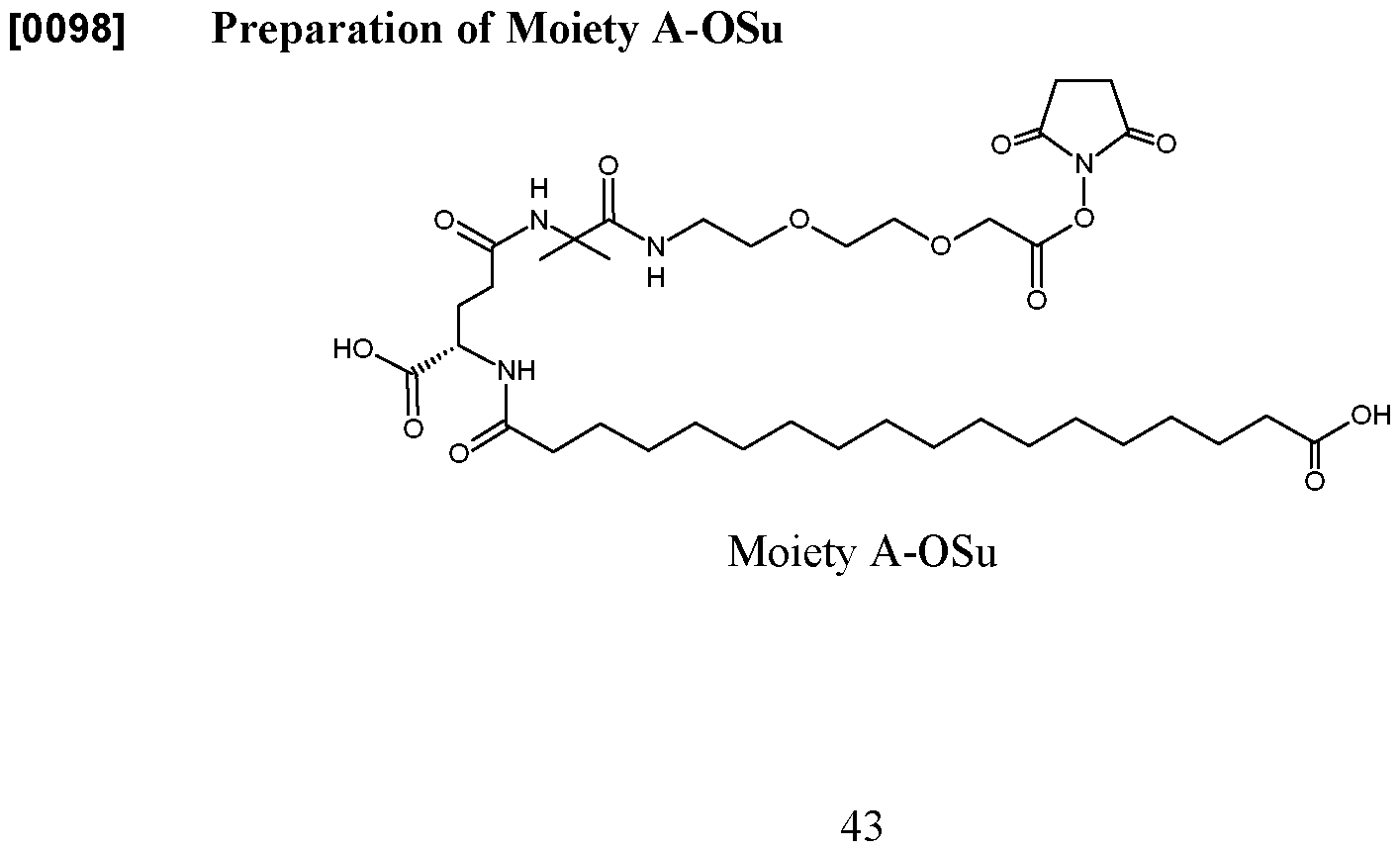
- the Fmoc protecting group was removed by selective de-blocking of amino group using piperidine followed by coupling with Fmoc-Aib-OH in THF using DIPC and HOBt which yielded 2-[2-[2-[(2-Fmoc-amino-2-methyl-propanoyl)amino]ethoxy]ethoxy]acetic acid-2-chlorotrityl-resin.
- the Fmoc group was removed by selective de-blocking using piperidine and the free amino group was coupled with Fmoc-Glu-OtBu using HOBt and DIPC to yield 2-[2-[[2-[[(4S)-4-Fmoc-amino-5-tert-butoxy-5-oxo-pentanoyl]amino]-2-methyl- propanoyl] amino]ethoxy]ethoxy]acetic acid-2-chlorotrityl-resin.
- the Fmoc group of the resultant compound was selectively de-blocked using piperidine, and the free amino group was then coupled with octadecanedioic acid mono tert butyl ester to give 2-[2-[[2-[[(4S)-5- tert-butoxy-4-[(18-tert-butoxy-18-oxo-octadecanoyl)amino]-5-oxo-pentanoyl]amino]-2- methyl-propanoyl]- amino]ethoxy]ethoxy]acetic acid-2-chlorotrityl-resin.
- Example B Preparation of Moiety B-di-tert-butyl ester O H O N O OH N O [0101] Moiety B-di-tert-butyl ester was prepared using the analogous process given in Example A, wherein 20-(tert-butoxy)-20-oxoicosanoic acid was used instead of octadecanedioic acid mono tert butyl ester to give 2-[2-[2-[[2-[[[[(4S)-5-tert-butoxy-4-[(20-tert- butoxy-20-oxo-icosanoyl)amino]-5-oxo-pentanoyl]amino]-2-methyl- propanoyl]amino]ethoxy]ethoxy]acetic acid-2-chlorotrityl-resin.
- the Fmoc protecting group was removed by selective de-blocking of amino group using piperidine, and the free amino group was then activated using p- nitrophenylchlroformate in THF and DIPEA followed by reaction with Fmoc-amino butylamine hydrochloride salt in THF:DMAc and DIPEA, which yielded 2-[2-[2-(4-Fmoc- aminobutylcarbamoylamino)ethoxy]ethoxy]acetic acid-2-chlorotrityl-resin.
- the Fmoc group was removed by selective de-blocking using piperidine, and the free amino group was then coupled to Fmoc-Glu-OtBu using of HOBt and DIPC, which yielded 2-[2-[2-[4-[[(4S)-4- Fmoc-amino-5-tert-butoxy-5-oxo-pentanoyl]amino]butylcarbamoylamino] ethoxy]ethoxy]acetic acid-2-chlorotrityl-resin.
- Example D Preparation of Moiety D-di-tert-butyl ester O H O N N O OH N O
- Moiety B-di-tert-butyl ester was prepared using the analogous process given in Example C, wherein 20-(tert-butoxy)-20-oxoicosanoic acid was used instead of octadecanedioic acid mono tert butyl ester to give intermediate 2-[2-[2-[4-[[5-tert-butoxy-4- [(20-tert-butoxy-20-oxo-icosanoyl)amino]-5-oxo- pentanoyl]amino]butylcarbamoylamino]ethoxy]ethoxy]acetic acid-2-chlorotrityl-resin.
- Example E Preparation of Moiety E-OSu O N O
- L-Glutamic acid alpha-tert-butyl ester H-Glu-OtBu
- palmitic acid in the presence of IBCF and NMM
- CH 3 -(CH 2 ) 14 -C(O)-Glu-OtBu was then reacted with HOSu in the presence of IBCF and NMM to yield CH3-(CH2)14-C(O)- Glu(OSu)-OtBu, which was then de-protected with trifluoroacetic acid to yield Moiety E- OSu.
- Example F Preparation of Moiety F-di-tert-butyl ester O H O N O O O OH
- Moiety F-di-tert-butyl ester was prepared using solid phase synthesis. 2-[2-(2- Fmoc-aminoethoxy)ethoxy]acetic acid was attached to 2-chlorotrityl chloride resin in the presence of DIPEA to yield 2-[2-(2-Fmoc-aminoethoxy)ethoxy]acetic acid-2-chlorotrityl- 47 Ref. Nos: SPIL-1799WO-B; 24-0805-WO resin.
- the Fmoc protecting group was removed by selective de-blocking of amino group using piperidine followed by coupling with 2-[2-(2-Fmoc-aminoethoxy)ethoxy]acetic acid in THF using DIPC and HOBt, which yielded ⁇ (Fmoc-amino-ethoxy)-ethoxy ⁇ -acetyl- ⁇ (-amino- ethoxy)-ethoxy ⁇ -acetic acid-2-chlorotrityl-resin.
- Example H Preparation Moiety H-di-tert-butyl ester O H O N O [0123] Moiety H-di-tert-butyl ester was prepared using solid phase synthesis using 2- chlorotrityl chloride resin.2-[2-(2-Fmoc-aminoethoxy)ethoxy]acetic acid was attached to 2- chlorotrityl chloride resin in the presence of DIPEA to yield 2-[2-(2-Fmoc- aminoethoxy)ethoxy]acetic acid-2-chlorotrityl-resin.
- the Fmoc protecting group was removed by selective de-blocking of amino group using piperidine followed by coupling with Fmoc-Glu-OtBu using HOBt and DIPC to yield 2-[2-[2-[[(4S)-5-tert-butoxy-4-(9H-fluoren-9- 49 Ref. Nos: SPIL-1799WO-B; 24-0805-WO ylmethoxycarbonylamino)-5-oxo-pentanoyl]amino]ethoxy]ethoxy]acetic acid-2-chlorotrityl- resin.
- the Fmoc group of the resultant compound was selectively de-blocked using piperidine and the free amino group was then coupled with octadecanedioic acid mono tert butyl ester to give 2-[2-[[(4S)-5-tert-butoxy-4-[(18-tert-butoxy-18-oxo- octadecanoyl)amino]-5-oxo-pentanoyl]amino]ethoxy]ethoxy]acetic acid 2-chlorotrityl-resin.
- the coupling was performed by using diisopropylcarbodiimide, N- hydroxybenzotriazole (DIC-HOBt) as coupling reagent in the presence of 4- dimethylaminopyridine (DMAP), which yielded Fmoc-Gly-Wang Resin.
- DMAP 4- dimethylaminopyridine
- Acetic anhydride and diisopropylethyl amine/pyridine were used to terminate the uncoupled amino groups at every amino acid coupling.
- Selective de-blocking of amino group of Fmoc-Gly-Wang Resin using piperidine followed by coupling with Fmoc-Gly-OH using HOBt and DIPC yielded Fmoc-Gly-Gly-Wang Resin. This completes one cycle.
- the side chain of the Fmoc-protected amino acids were protected orthogonally (hydroxyl group of Serine, Tyrosine or Threonine were protected with tert-butyl(-tBu) group; amino and guanido group of Lysine and Arginine were protected with tert-butyloxycarbonyl (-Boc) and 2,2,4,6,7- pentamethyldihydrobenzofuran-5-sulfonyl (-Pbf) group, respectively, the imidazole of 51 Ref.
- Part B Grafting of Activated Fatty Acid Chain Over Liner Peptide
- the activated fatty acid chain Moiety C-Osu was grafted on the purified linear peptide as obtained in Part A in water:acetonitrile at pH about 11 to yield crude title peptide Compound 1, which was purified by preparative HPLC.
- Example 2 Synthesis of Compound 2 [0139]
- Part A Synthesis of Linear Peptide Backbone [0140]
- the linear peptide backbone of Compound 2 was prepared by solid phase method as per the analogous process given in Example 1 Part A, wherein Fmoc-D-Ser(OMe)-OH was used at position 2 instead of Fmoc-Ser(tBu)-OH.
- Part B Grafting of Activated Fatty Acid Chain Over Liner Ppeptide
- the activated fatty acid chain Moiety E-OSu was grafted on purified linear peptide: H-His-D-Ser(OMe)-Gln-Gly-Thr-Phe-Thr-Ser-Asp-Lys( ⁇ -NH 2 )-Ser-Glu-Tyr-Leu- Asp-Ser-Glu-Arg-Ala-Arg-Asp-Phe-Val-Ala-Trp-Leu-Glu-Ala-Gly-Gly-OH as obtained in Part A, in water:acetonitrile at pH about 11 to yield crude title peptide Compound 2, which was purified by preparative HPLC.
- Example 3 Synthesis of Compound 3 [0145] Part A: Synthesis of Linear Peptide Backbone [0146] The linear peptide backbone of Compound 3 was prepared by solid phase method as per the analogous process given in Example 1 Part A, wherein Fmoc-Aib-OH was used at position 2 instead of Fmoc-Ser(tBu)-OH.
- Part B Grafting of Activated Fatty Acid Chain Over Liner Peptide
- the activated fatty acid chain Moiety E-OSu was grafted on purified linear peptide: H-His-Aib-Gln-Gly-Thr-Phe-Thr-Ser-Asp-Lys( ⁇ -NH 2 )-Ser-Glu-Tyr-Leu-Asp-Ser- Glu-Arg-Ala-Arg-Asp-Phe-Val-Ala-Trp-Leu-Glu-Ala-Gly-Gly-OH as obtained in Part A, in water:acetonitrile at pH about 11 to yield crude title peptide Compound 3, which was purified by preparative HPLC.
- Part B Grafting of Activated Fatty Acid Chain Over Liner Peptide
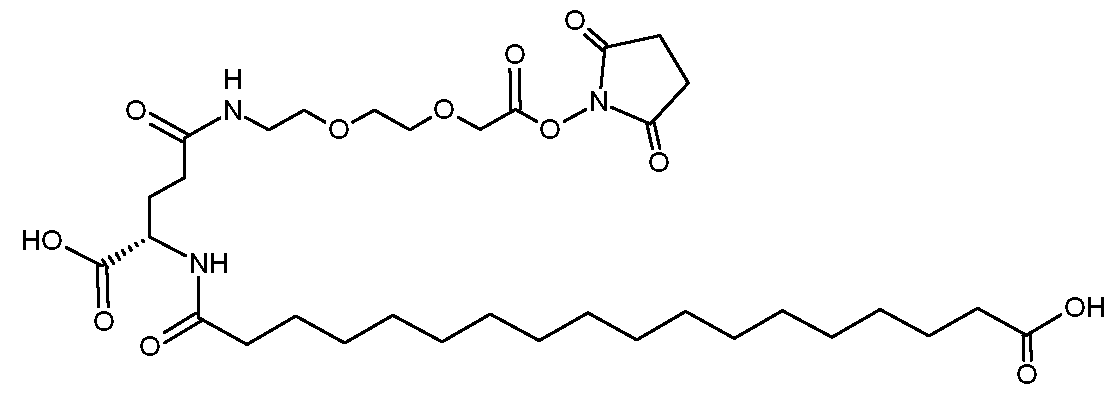
- the activated fatty acid chain Moiety A-OSu was grafted on purified linear peptide: H-His-Aib-Gln-Gly-Thr-Phe-Thr-Ser-Asp-Lys( ⁇ -NH2)-Ser-Glu-Tyr-Leu-Asp-Ser- Glu-Arg-Ala-Arg-Asp-Phe-Val-Ala-Trp-Leu-Glu-Ala-Gly-Gly-OH as obtained in Part A, in water:acetonitrile at pH about 11 to yield crude title peptide Compound 4, which was purified by preparative HPLC.
- Part B Grafting of Activated Fatty Acid Chain Over Liner Peptide
- the activated fatty acid chain Moiety A-OSu was grafted on purified linear peptide: H-His-Ser-Gln-Gly-Thr-Phe-Thr-Ser-Asp-Lys( ⁇ -NH2)-Ser-Glu-Tyr-Leu-Asp-Ser- Glu-Arg-Ala-Arg-Asp-Phe-Val-Ala-Trp-Leu-Glu-Ala-Gly-Gly-OH as obtained in Part A, in water:acetonitrile at pH about 11 to yield crude title peptide Compound 5, which was purified by preparative HPLC.
- the coupling was performed by using diisopropylcarbodiimide, N- hydroxybenzotriazole (DIPC-HOBt) as coupling reagent to yield Fmoc-Gly-Rink amide Resin, which completes the first cycle.
- DIPC-HOBt diisopropylcarbodiimide, N- hydroxybenzotriazole
- Acetic anhydride and diisopropylethyl amine were used to terminate/cap the uncoupled amino groups at every amino acid coupling.
- Selective de-blocking of amino group of Fmoc-Gly-Rink amide Resin using piperidine Then coupling with Fmoc-Ser(tBu)-OH using HOBt and DIPC yield Fmoc-Ser(tBu)-Gly-Rink amide Resin, which completes the second cycle.
- Boc protection of the resulting peptide-resin using Boc anhydride was carried out to yield Boc-His(Boc)-Aib- Gln(Trt)-Gly-Thr(tBu)-Phe-Thr(tBu)-Ser(tBu)-Asp(OtBu)-Tyr(tBu)-Ser(tBu)-Lys(Boc)- Tyr(tBu)-Leu-Asp(OtBu)-Glu(OtBu)-Lys(Boc)-Lys(Boc)-Ala-Lys(IVDde)-Glu(OtBu)-Phe- Val-Glu(OtBu)-Trp-Leu-Leu-Glu(OtBu)-Gly-Gly-Pro-Ser(tBu)-Ser(tBu)-Gly-resin.
- Example 7 Synthesis of Compound 7 [0171] Compound 7 was prepared by solid phase method as per the analogous process given for Example 6, wherein IVDde de-protection was followed by coupling of Moiety A-di- tert-butyl ester, instead of Moiety B-di-tert-butyl ester coupling.
- Example 8 Synthesis of Compound 8 [0174] Compound 8 was prepared by solid phase method as per the analogous process given for Example 6, wherein IVDde de-protection was followed by coupling of Moiety D-di- tert-butyl ester, instead of Moiety B-di-tert-butyl ester coupling.
- Example 10 Synthesis of Compound 10 [0180]
- Compound 9 was prepared by solid phase method as per the analogous process given for Example 6, wherein Fmoc-norvaline-OH was used at position 13 instead of Fmoc- Tyr(tBu)-OH and IVDde de-protection was followed by coupling of Moiety A-di-tert-butyl ester, instead of Moiety B-di-tert-butyl ester coupling.
- Example 1 Oral Glucose Tolerance Test (OGTT) in Rats; Single Injection; 1 mg/kg Dose [0189]
- Blood glucose was measured at 20, 40, 60, 90 and 120 minutes following glucose challenge. Body weight and food consumption were recorded at 48 hr and 154 hr.
- Baseline blood glucose was measured from all the animals. All the animals were administered with test item subcutaneously. Blood glucose was measured at 4 hr, 8 hr, 24 hr, 48 hr, 72 hr, and 96 hr post treatment. Delta blood glucose (mM) was calculated. 59 Ref. Nos: SPIL-1799WO-B; 24-0805-WO Table 7.
- Blood glucose was measured at 4 hr, 8 hr, 12 hr, 24 hr, 48 hr, 72 hr, and 96 hr post treatment. Delta blood glucose (mM) was calculated. Body weight changes and cumulative food consumption was measured at 48 hr and 96 hr post treatment. 60 Ref. Nos: SPIL-1799WO-B; 24-0805-WO Table 8.
- Baseline blood glucose was measured from all the animals. All the animals were administered with test item subcutaneously. Blood glucose was measured at 4 hr, 8 hr, 12 hr, 24 hr, 48 hr, 72 hr, and 96 61 Ref. Nos: SPIL-1799WO-B; 24-0805-WO hr post treatment.
- Mazdutide 10 nM/kg/s.c/single d ose -6.9*** 0.6 -5.9*** 0.8 Compound 6, 10 nM/kg/s.c/single d ose -6.6*** 1.0 -4.1*** 1.4 Compound 7, 10 nM/kg/s.c/single d ose -6.1*** 0.8 -12.6*** 1.0 Compound 25, 10 n M/kg/s.c/single dose -5.1*** 0.5 -2.3*** 1.3 Tirzepatide, 10 nM/kg/s.c/single d ose -8.3*** 1.8 -2.8*** 1.4 *p ⁇ 0.05, **p ⁇ 0.01,
- Example 5 In-Vitro Assays [0198] Stably expressing GLP-1R, GIPR or GCGR cell lines were used to determine in- vitro potency of the compounds as described herein. Signaling by the GLP-1R, GIP-R, and GCG-R involves activation of adenylate cyclase and cAMP production.
- Hit Hunter® cAMP assays monitor the activation of GLP-1R, GIPR or GCGR via Gi and Gs secondary messenger signaling using a technology developed by DiscoverX which is called Enzyme Fragment Complementation (EFC) with ⁇ -galactosidase ( ⁇ -Gal) as the functional reporter.
- EFC Enzyme Fragment Complementation
- ⁇ -Gal ⁇ -galactosidase
- the enzyme is split into two complementary portions: EA for Enzyme Acceptor and ED for Enzyme Donor.
- ED is fused to cAMP and in the assay competes with cAMP generated by cells for binding to a cAMP-specific antibody.
- Active ⁇ -Gal is formed by complementation of exogenous EA to any unbound ED cAMP.
- Active enzyme can then convert a chemiluminescent substrate, generating an output signal detectable on a standard microplate reader.
- Three different assays were performed using cells expressing either of the three receptors. cAMP Hunter cell lines were expanded from freezer stocks according to standard procedures. Cells were seeded in a total volume of 20 ⁇ L into white walled, 384-well microplates and incubated at 37 °C for the appropriate time prior to testing. Media was aspirated and cells were then treated with 15 uL of cAMP conjugated antibody and 5 uL of test compound. After appropriate compound incubation, assay signal was generated through incubation with 20 ⁇ L cAMP-ED cell lysis cocktail for one hour followed by incubation with 63 Ref.
Landscapes
- Health & Medical Sciences (AREA)
- Chemical & Material Sciences (AREA)
- Life Sciences & Earth Sciences (AREA)
- Medicinal Chemistry (AREA)
- General Health & Medical Sciences (AREA)
- Bioinformatics & Cheminformatics (AREA)
- Pharmacology & Pharmacy (AREA)
- Animal Behavior & Ethology (AREA)
- Public Health (AREA)
- Veterinary Medicine (AREA)
- Engineering & Computer Science (AREA)
- Organic Chemistry (AREA)
- Nuclear Medicine, Radiotherapy & Molecular Imaging (AREA)
- Chemical Kinetics & Catalysis (AREA)
- General Chemical & Material Sciences (AREA)
- Diabetes (AREA)
- Hematology (AREA)
- Obesity (AREA)
- Epidemiology (AREA)
- Gastroenterology & Hepatology (AREA)
- Neurology (AREA)
- Neurosurgery (AREA)
- Endocrinology (AREA)
- Biomedical Technology (AREA)
- Proteomics, Peptides & Aminoacids (AREA)
- Emergency Medicine (AREA)
- Biophysics (AREA)
- Dermatology (AREA)
- Psychiatry (AREA)
- Toxicology (AREA)
- Zoology (AREA)
- Biochemistry (AREA)
- Child & Adolescent Psychology (AREA)
- Genetics & Genomics (AREA)
- Molecular Biology (AREA)
- Hospice & Palliative Care (AREA)
- Medicines That Contain Protein Lipid Enzymes And Other Medicines (AREA)
- Peptides Or Proteins (AREA)
- Acyclic And Carbocyclic Compounds In Medicinal Compositions (AREA)
- Pharmaceuticals Containing Other Organic And Inorganic Compounds (AREA)
Abstract
Description






Claims


Priority Applications (2)
| Application Number | Priority Date | Filing Date | Title |
|---|---|---|---|
| CN202480038209.9A CN121263433A (en) | 2023-06-09 | 2024-06-07 | GLP-1/GIP dual, GLP-1/GCG dual and GLP-1/GIP/GCG triple receptor agonists |
| EP24734139.9A EP4724472A2 (en) | 2023-06-09 | 2024-06-07 | Glp-1/gip dual, glp-1/gcg dual and glp-1/gip/gcg triple receptor agonists |
Applications Claiming Priority (2)
| Application Number | Priority Date | Filing Date | Title |
|---|---|---|---|
| IN202321039646 | 2023-06-09 | ||
| IN202321039646 | 2023-06-09 |
Publications (2)
| Publication Number | Publication Date |
|---|---|
| WO2024252367A2 true WO2024252367A2 (en) | 2024-12-12 |
| WO2024252367A3 WO2024252367A3 (en) | 2025-02-13 |
Family
ID=91585443
Family Applications (2)
| Application Number | Title | Priority Date | Filing Date |
|---|---|---|---|
| PCT/IB2024/055620 Ceased WO2024252367A2 (en) | 2023-06-09 | 2024-06-07 | Novel glp-1/gip dual and glp-1/gcg dual receptor agonists |
| PCT/IB2024/055618 Ceased WO2024252366A1 (en) | 2023-06-09 | 2024-06-07 | Glp-1/gip dual, glp-1/gcg dual and glp-1/gip/gcg triple receptor agonists |
Family Applications After (1)
| Application Number | Title | Priority Date | Filing Date |
|---|---|---|---|
| PCT/IB2024/055618 Ceased WO2024252366A1 (en) | 2023-06-09 | 2024-06-07 | Glp-1/gip dual, glp-1/gcg dual and glp-1/gip/gcg triple receptor agonists |
Country Status (6)
| Country | Link |
|---|---|
| EP (2) | EP4724471A1 (en) |
| KR (1) | KR20260022948A (en) |
| CN (2) | CN121263433A (en) |
| AU (1) | AU2024284396A1 (en) |
| MX (1) | MX2025014772A (en) |
| WO (2) | WO2024252367A2 (en) |
Citations (17)
| Publication number | Priority date | Publication date | Assignee | Title |
|---|---|---|---|---|
| WO1998008871A1 (en) | 1996-08-30 | 1998-03-05 | Novo Nordisk A/S | Glp-1 derivatives |
| WO2006097537A2 (en) | 2005-03-18 | 2006-09-21 | Novo Nordisk A/S | Acylated glp-1 compounds |
| WO2011075393A2 (en) | 2009-12-18 | 2011-06-23 | Indiana University Research And Technology Corporation | Glucagon/glp-1 receptor co-agonists |
| WO2011119657A1 (en) | 2010-03-26 | 2011-09-29 | Eli Lilly And Company | Novel peptides and methods for their preparation and use |
| WO2012177444A2 (en) | 2011-06-22 | 2012-12-27 | Indiana University Research And Technology Corporation | Glucagon/glp-1 receptor co-agonists |
| WO2013164483A1 (en) | 2012-05-03 | 2013-11-07 | Zealand Pharma A/S | Gip-glp-1 dual agonist compounds and methods |
| WO2014091316A2 (en) | 2012-12-11 | 2014-06-19 | Medimmune Limited | Glucagon/glp-1 agonists for the treatment of obesity |
| WO2014192284A1 (en) | 2013-05-28 | 2014-12-04 | Takeda Pharmaceutical Company Limited | Peptide compound |
| WO2015067715A2 (en) | 2013-11-06 | 2015-05-14 | Zealand Pharma A/S | Gip-glp-1 dual agonist compounds and methods |
| WO2016111971A1 (en) | 2015-01-09 | 2016-07-14 | Eli Lilly And Company | Gip and glp-1 co-agonist compounds |
| WO2017074714A1 (en) | 2015-10-26 | 2017-05-04 | Eli Lilly And Company | Glucagon receptor agonists |
| WO2017153575A1 (en) | 2016-03-10 | 2017-09-14 | Medimmune Limited | Glucagon and glp-1 co-agonists for the treatment of obesity |
| WO2019193576A1 (en) | 2018-04-05 | 2019-10-10 | Sun Pharmaceutical Industries Limited | Novel glp-1 analogues |
| WO2020023388A1 (en) | 2018-07-23 | 2020-01-30 | Eli Lilly And Company | Method of using a gip/glp1 co-agonist for diabetes |
| WO2020023386A1 (en) | 2018-07-23 | 2020-01-30 | Eli Lilly And Company | Gip/glp1 co-agonist compounds |
| WO2021260530A1 (en) | 2020-06-22 | 2021-12-30 | Sun Pharmaceutical Industries Limited | Long acting glp-1/gip dual agonists |
| WO2022079639A1 (en) | 2020-10-17 | 2022-04-21 | Sun Pharmaceutical Industries Limited | Glp-1/gip dual agonists |
Family Cites Families (11)
| Publication number | Priority date | Publication date | Assignee | Title |
|---|---|---|---|---|
| RS56173B1 (en) * | 2011-06-22 | 2017-11-30 | Univ Indiana Res & Tech Corp | GLUCAGON / GLP-1 RECEPTOR RECEPTOR COAGONISTS |
| AR092873A1 (en) | 2012-09-26 | 2015-05-06 | Cadila Healthcare Ltd | PEPTIDES AS TRIPLE AGONISTS OF GIP, GLP-1 AND GLUGAGON RECEPTORS |
| CN105829339B (en) | 2013-11-06 | 2021-03-12 | 西兰制药公司 | glucagon-GLP-1-GIP triple agonist compounds |
| WO2016198624A1 (en) | 2015-06-12 | 2016-12-15 | Sanofi | Exendin-4 derivatives as trigonal glp-1/glucagon/gip receptor agonists |
| TWI700291B (en) * | 2015-06-22 | 2020-08-01 | 美國禮來大藥廠 | Glucagon and glp-1 co-agonist compounds |
| SG11201805586SA (en) | 2015-12-31 | 2018-07-30 | Hanmi Pharmaceutical Co Ltd | Triple glucagon/glp-1/gip receptor agonist |
| US11566057B2 (en) * | 2017-09-25 | 2023-01-31 | Merck Sharp & Dohme Llc | Long-acting co-agonists of the glucagon and GLP-1 receptors |
| CN109836488B (en) * | 2017-11-24 | 2022-08-23 | 浙江道尔生物科技有限公司 | Glucagon analogues for treating metabolic diseases |
| AR113486A1 (en) * | 2017-12-21 | 2020-05-06 | Lilly Co Eli | INCRETINE ANALOGUES AND ITS USES |
| TW202313974A (en) * | 2021-06-08 | 2023-04-01 | 瑞典商阿斯特捷利康公司 | Combination therapies for treatment of liver diseases |
| CN115975057B (en) * | 2023-03-16 | 2023-05-16 | 杭州信海医药科技有限公司 | Solid phase synthesis method of trastuzumab |
-
2024
- 2024-06-07 KR KR1020257041460A patent/KR20260022948A/en active Pending
- 2024-06-07 WO PCT/IB2024/055620 patent/WO2024252367A2/en not_active Ceased
- 2024-06-07 EP EP24734138.1A patent/EP4724471A1/en active Pending
- 2024-06-07 EP EP24734139.9A patent/EP4724472A2/en active Pending
- 2024-06-07 CN CN202480038209.9A patent/CN121263433A/en active Pending
- 2024-06-07 CN CN202480038210.1A patent/CN121285571A/en active Pending
- 2024-06-07 AU AU2024284396A patent/AU2024284396A1/en active Pending
- 2024-06-07 WO PCT/IB2024/055618 patent/WO2024252366A1/en not_active Ceased
-
2025
- 2025-12-08 MX MX2025014772A patent/MX2025014772A/en unknown
Patent Citations (17)
| Publication number | Priority date | Publication date | Assignee | Title |
|---|---|---|---|---|
| WO1998008871A1 (en) | 1996-08-30 | 1998-03-05 | Novo Nordisk A/S | Glp-1 derivatives |
| WO2006097537A2 (en) | 2005-03-18 | 2006-09-21 | Novo Nordisk A/S | Acylated glp-1 compounds |
| WO2011075393A2 (en) | 2009-12-18 | 2011-06-23 | Indiana University Research And Technology Corporation | Glucagon/glp-1 receptor co-agonists |
| WO2011119657A1 (en) | 2010-03-26 | 2011-09-29 | Eli Lilly And Company | Novel peptides and methods for their preparation and use |
| WO2012177444A2 (en) | 2011-06-22 | 2012-12-27 | Indiana University Research And Technology Corporation | Glucagon/glp-1 receptor co-agonists |
| WO2013164483A1 (en) | 2012-05-03 | 2013-11-07 | Zealand Pharma A/S | Gip-glp-1 dual agonist compounds and methods |
| WO2014091316A2 (en) | 2012-12-11 | 2014-06-19 | Medimmune Limited | Glucagon/glp-1 agonists for the treatment of obesity |
| WO2014192284A1 (en) | 2013-05-28 | 2014-12-04 | Takeda Pharmaceutical Company Limited | Peptide compound |
| WO2015067715A2 (en) | 2013-11-06 | 2015-05-14 | Zealand Pharma A/S | Gip-glp-1 dual agonist compounds and methods |
| WO2016111971A1 (en) | 2015-01-09 | 2016-07-14 | Eli Lilly And Company | Gip and glp-1 co-agonist compounds |
| WO2017074714A1 (en) | 2015-10-26 | 2017-05-04 | Eli Lilly And Company | Glucagon receptor agonists |
| WO2017153575A1 (en) | 2016-03-10 | 2017-09-14 | Medimmune Limited | Glucagon and glp-1 co-agonists for the treatment of obesity |
| WO2019193576A1 (en) | 2018-04-05 | 2019-10-10 | Sun Pharmaceutical Industries Limited | Novel glp-1 analogues |
| WO2020023388A1 (en) | 2018-07-23 | 2020-01-30 | Eli Lilly And Company | Method of using a gip/glp1 co-agonist for diabetes |
| WO2020023386A1 (en) | 2018-07-23 | 2020-01-30 | Eli Lilly And Company | Gip/glp1 co-agonist compounds |
| WO2021260530A1 (en) | 2020-06-22 | 2021-12-30 | Sun Pharmaceutical Industries Limited | Long acting glp-1/gip dual agonists |
| WO2022079639A1 (en) | 2020-10-17 | 2022-04-21 | Sun Pharmaceutical Industries Limited | Glp-1/gip dual agonists |
Non-Patent Citations (3)
| Title |
|---|
| "Remington: The Science and 50 Practice of Pharmacy", 2006, LIPPINCOTT, WILLIAMS & WILKINS |
| BERGE ET AL., J. PHARM. SCI., vol. 66, 1977, pages 1 - 19 |
| STAHL ET AL.: "Handbook of Pharmaceutical Salts: Properties, Selection, and Use", 2002, VERLAG HELV. CHIM. ACTA |
Also Published As
| Publication number | Publication date |
|---|---|
| EP4724471A1 (en) | 2026-04-15 |
| WO2024252366A1 (en) | 2024-12-12 |
| CN121285571A (en) | 2026-01-06 |
| WO2024252367A3 (en) | 2025-02-13 |
| EP4724472A2 (en) | 2026-04-15 |
| AU2024284396A1 (en) | 2026-01-08 |
| MX2025014772A (en) | 2026-01-07 |
| CN121263433A (en) | 2026-01-02 |
| KR20260022948A (en) | 2026-02-20 |
Similar Documents
| Publication | Publication Date | Title |
|---|---|---|
| RU2559320C2 (en) | Novel glucagon analogues | |
| CA3195155A1 (en) | Glp-1/gip dual agonists | |
| JP7250814B2 (en) | Novel GLP-1 analogues | |
| EP2124974B1 (en) | Glucagon analogs exhibiting enhanced solubility in physiological ph buffers | |
| US20240424063A1 (en) | Long acting glp-1/gip dual agonists | |
| SG172170A1 (en) | Glucagon analogues | |
| WO2012167744A1 (en) | Glucose dependent insulinotropic polypeptide analogs, pharmaceutical compositions and use thereof | |
| WO2014049610A2 (en) | Peptides as gip, glp-1 and glucagon receptors triple-agonist | |
| WO2007049941A1 (en) | Bioactive substance carrier for in vivo stable delivery tehreof, conjugate containing the same, and method of in vivo stable delivery of the bioactive substance | |
| EP4724472A2 (en) | Glp-1/gip dual, glp-1/gcg dual and glp-1/gip/gcg triple receptor agonists | |
| CN115873096B (en) | Glucagon glycopeptide-1 and glucagon receptor dual-agonism polypeptide and application thereof | |
| EP4638481A1 (en) | Glp1/gip/npy2 receptor triple agonists | |
| CA2606894A1 (en) | Novel compounds as glp-i agonists | |
| CN116589536B (en) | A class of long-acting GLP-1/GIP receptor dual agonists and their applications | |
| CN115232200B (en) | Long-acting Exendin-4 analogue and application thereof | |
| CN116514952B (en) | GLP-1 analogues and application thereof | |
| EA053025B1 (en) | Dual GLP-1/GIP Agonists | |
| CN117186189A (en) | A GLP-1/CCK-1 receptor dual agonist polypeptide with both hypoglycemic and weight loss effects and its application | |
| CN115819619A (en) | GLP-1/Y 2 Receptor dual agonist and application thereof |
Legal Events
| Date | Code | Title | Description |
|---|---|---|---|
| 121 | Ep: the epo has been informed by wipo that ep was designated in this application |
Ref document number: 24734139 Country of ref document: EP Kind code of ref document: A2 |
|
| ENP | Entry into the national phase |
Ref document number: 2025571481 Country of ref document: JP Kind code of ref document: A |
|
| WWE | Wipo information: entry into national phase |
Ref document number: 2025571481 Country of ref document: JP |
|
| WWE | Wipo information: entry into national phase |
Ref document number: 2024734139 Country of ref document: EP |
|
| NENP | Non-entry into the national phase |
Ref country code: DE |
|
| ENP | Entry into the national phase |
Ref document number: 2024734139 Country of ref document: EP Effective date: 20260109 |
|
| ENP | Entry into the national phase |
Ref document number: 2024734139 Country of ref document: EP Effective date: 20260109 |
|
| ENP | Entry into the national phase |
Ref document number: 2024734139 Country of ref document: EP Effective date: 20260109 |
|
| ENP | Entry into the national phase |
Ref document number: 2024734139 Country of ref document: EP Effective date: 20260109 |
|
| WWP | Wipo information: published in national office |
Ref document number: 2024734139 Country of ref document: EP |