WO2024252703A1 - Agent for imparting hydrophilicity-sustaining effect and/or water sliding properties - Google Patents
Agent for imparting hydrophilicity-sustaining effect and/or water sliding properties Download PDFInfo
- Publication number
- WO2024252703A1 WO2024252703A1 PCT/JP2023/047171 JP2023047171W WO2024252703A1 WO 2024252703 A1 WO2024252703 A1 WO 2024252703A1 JP 2023047171 W JP2023047171 W JP 2023047171W WO 2024252703 A1 WO2024252703 A1 WO 2024252703A1
- Authority
- WO
- WIPO (PCT)
- Prior art keywords
- group
- monomer
- mass
- water
- hydrophilicity
- Prior art date
- Legal status (The legal status is an assumption and is not a legal conclusion. Google has not performed a legal analysis and makes no representation as to the accuracy of the status listed.)
- Ceased
Links
Images

Classifications
-
- C—CHEMISTRY; METALLURGY
- C09—DYES; PAINTS; POLISHES; NATURAL RESINS; ADHESIVES; COMPOSITIONS NOT OTHERWISE PROVIDED FOR; APPLICATIONS OF MATERIALS NOT OTHERWISE PROVIDED FOR
- C09D—COATING COMPOSITIONS, e.g. PAINTS, VARNISHES OR LACQUERS; FILLING PASTES; CHEMICAL PAINT OR INK REMOVERS; INKS; CORRECTING FLUIDS; WOODSTAINS; PASTES OR SOLIDS FOR COLOURING OR PRINTING; USE OF MATERIALS THEREFOR
- C09D133/00—Coating compositions based on homopolymers or copolymers of compounds having one or more unsaturated aliphatic radicals, each having only one carbon-to-carbon double bond, and at least one being terminated by only one carboxyl radical, or of salts, anhydrides, esters, amides, imides, or nitriles thereof; Coating compositions based on derivatives of such polymers
- C09D133/04—Homopolymers or copolymers of esters
- C09D133/06—Homopolymers or copolymers of esters of esters containing only carbon, hydrogen and oxygen, the oxygen atom being present only as part of the carboxyl radical
- C09D133/062—Copolymers with monomers not covered by C09D133/06
- C09D133/066—Copolymers with monomers not covered by C09D133/06 containing -OH groups
-
- C—CHEMISTRY; METALLURGY
- C08—ORGANIC MACROMOLECULAR COMPOUNDS; THEIR PREPARATION OR CHEMICAL WORKING-UP; COMPOSITIONS BASED THEREON
- C08F—MACROMOLECULAR COMPOUNDS OBTAINED BY REACTIONS ONLY INVOLVING CARBON-TO-CARBON UNSATURATED BONDS
- C08F220/00—Copolymers of compounds having one or more unsaturated aliphatic radicals, each having only one carbon-to-carbon double bond, and only one being terminated by only one carboxyl radical or a salt, anhydride ester, amide, imide or nitrile thereof
- C08F220/02—Monocarboxylic acids having less than ten carbon atoms; Derivatives thereof
- C08F220/10—Esters
- C08F220/26—Esters containing oxygen in addition to the carboxy oxygen
- C08F220/28—Esters containing oxygen in addition to the carboxy oxygen containing no aromatic rings in the alcohol moiety
-
- C—CHEMISTRY; METALLURGY
- C08—ORGANIC MACROMOLECULAR COMPOUNDS; THEIR PREPARATION OR CHEMICAL WORKING-UP; COMPOSITIONS BASED THEREON
- C08F—MACROMOLECULAR COMPOUNDS OBTAINED BY REACTIONS ONLY INVOLVING CARBON-TO-CARBON UNSATURATED BONDS
- C08F265/00—Macromolecular compounds obtained by polymerising monomers on to polymers of unsaturated monocarboxylic acids or derivatives thereof as defined in group C08F20/00
- C08F265/04—Macromolecular compounds obtained by polymerising monomers on to polymers of unsaturated monocarboxylic acids or derivatives thereof as defined in group C08F20/00 on to polymers of esters
- C08F265/06—Polymerisation of acrylate or methacrylate esters on to polymers thereof
-
- C—CHEMISTRY; METALLURGY
- C08—ORGANIC MACROMOLECULAR COMPOUNDS; THEIR PREPARATION OR CHEMICAL WORKING-UP; COMPOSITIONS BASED THEREON
- C08F—MACROMOLECULAR COMPOUNDS OBTAINED BY REACTIONS ONLY INVOLVING CARBON-TO-CARBON UNSATURATED BONDS
- C08F8/00—Chemical modification by after-treatment
- C08F8/12—Hydrolysis
-
- C—CHEMISTRY; METALLURGY
- C08—ORGANIC MACROMOLECULAR COMPOUNDS; THEIR PREPARATION OR CHEMICAL WORKING-UP; COMPOSITIONS BASED THEREON
- C08L—COMPOSITIONS OF MACROMOLECULAR COMPOUNDS
- C08L101/00—Compositions of unspecified macromolecular compounds
- C08L101/12—Compositions of unspecified macromolecular compounds characterised by physical features, e.g. anisotropy, viscosity or electrical conductivity
-
- C—CHEMISTRY; METALLURGY
- C08—ORGANIC MACROMOLECULAR COMPOUNDS; THEIR PREPARATION OR CHEMICAL WORKING-UP; COMPOSITIONS BASED THEREON
- C08L—COMPOSITIONS OF MACROMOLECULAR COMPOUNDS
- C08L33/00—Compositions of homopolymers or copolymers of compounds having one or more unsaturated aliphatic radicals, each having only one carbon-to-carbon double bond, and only one being terminated by only one carboxyl radical, or of salts, anhydrides, esters, amides, imides or nitriles thereof; Compositions of derivatives of such polymers
-
- C—CHEMISTRY; METALLURGY
- C09—DYES; PAINTS; POLISHES; NATURAL RESINS; ADHESIVES; COMPOSITIONS NOT OTHERWISE PROVIDED FOR; APPLICATIONS OF MATERIALS NOT OTHERWISE PROVIDED FOR
- C09D—COATING COMPOSITIONS, e.g. PAINTS, VARNISHES OR LACQUERS; FILLING PASTES; CHEMICAL PAINT OR INK REMOVERS; INKS; CORRECTING FLUIDS; WOODSTAINS; PASTES OR SOLIDS FOR COLOURING OR PRINTING; USE OF MATERIALS THEREFOR
- C09D151/00—Coating compositions based on graft polymers in which the grafted component is obtained by reactions only involving carbon-to-carbon unsaturated bonds; Coating compositions based on derivatives of such polymers
- C09D151/003—Coating compositions based on graft polymers in which the grafted component is obtained by reactions only involving carbon-to-carbon unsaturated bonds; Coating compositions based on derivatives of such polymers grafted on to macromolecular compounds obtained by reactions only involving unsaturated carbon-to-carbon bonds
-
- C—CHEMISTRY; METALLURGY
- C09—DYES; PAINTS; POLISHES; NATURAL RESINS; ADHESIVES; COMPOSITIONS NOT OTHERWISE PROVIDED FOR; APPLICATIONS OF MATERIALS NOT OTHERWISE PROVIDED FOR
- C09D—COATING COMPOSITIONS, e.g. PAINTS, VARNISHES OR LACQUERS; FILLING PASTES; CHEMICAL PAINT OR INK REMOVERS; INKS; CORRECTING FLUIDS; WOODSTAINS; PASTES OR SOLIDS FOR COLOURING OR PRINTING; USE OF MATERIALS THEREFOR
- C09D201/00—Coating compositions based on unspecified macromolecular compounds
-
- C—CHEMISTRY; METALLURGY
- C09—DYES; PAINTS; POLISHES; NATURAL RESINS; ADHESIVES; COMPOSITIONS NOT OTHERWISE PROVIDED FOR; APPLICATIONS OF MATERIALS NOT OTHERWISE PROVIDED FOR
- C09D—COATING COMPOSITIONS, e.g. PAINTS, VARNISHES OR LACQUERS; FILLING PASTES; CHEMICAL PAINT OR INK REMOVERS; INKS; CORRECTING FLUIDS; WOODSTAINS; PASTES OR SOLIDS FOR COLOURING OR PRINTING; USE OF MATERIALS THEREFOR
- C09D201/00—Coating compositions based on unspecified macromolecular compounds
- C09D201/02—Coating compositions based on unspecified macromolecular compounds characterised by the presence of specified groups, e.g. terminal or pendant functional groups
- C09D201/06—Coating compositions based on unspecified macromolecular compounds characterised by the presence of specified groups, e.g. terminal or pendant functional groups containing oxygen atoms
- C09D201/08—Carboxyl groups
-
- C—CHEMISTRY; METALLURGY
- C09—DYES; PAINTS; POLISHES; NATURAL RESINS; ADHESIVES; COMPOSITIONS NOT OTHERWISE PROVIDED FOR; APPLICATIONS OF MATERIALS NOT OTHERWISE PROVIDED FOR
- C09D—COATING COMPOSITIONS, e.g. PAINTS, VARNISHES OR LACQUERS; FILLING PASTES; CHEMICAL PAINT OR INK REMOVERS; INKS; CORRECTING FLUIDS; WOODSTAINS; PASTES OR SOLIDS FOR COLOURING OR PRINTING; USE OF MATERIALS THEREFOR
- C09D5/00—Coating compositions, e.g. paints, varnishes or lacquers, characterised by their physical nature or the effects produced; Filling pastes
-
- C—CHEMISTRY; METALLURGY
- C09—DYES; PAINTS; POLISHES; NATURAL RESINS; ADHESIVES; COMPOSITIONS NOT OTHERWISE PROVIDED FOR; APPLICATIONS OF MATERIALS NOT OTHERWISE PROVIDED FOR
- C09D—COATING COMPOSITIONS, e.g. PAINTS, VARNISHES OR LACQUERS; FILLING PASTES; CHEMICAL PAINT OR INK REMOVERS; INKS; CORRECTING FLUIDS; WOODSTAINS; PASTES OR SOLIDS FOR COLOURING OR PRINTING; USE OF MATERIALS THEREFOR
- C09D7/00—Features of coating compositions, not provided for in group C09D5/00; Processes for incorporating ingredients in coating compositions
- C09D7/40—Additives
- C09D7/65—Additives macromolecular
-
- C—CHEMISTRY; METALLURGY
- C09—DYES; PAINTS; POLISHES; NATURAL RESINS; ADHESIVES; COMPOSITIONS NOT OTHERWISE PROVIDED FOR; APPLICATIONS OF MATERIALS NOT OTHERWISE PROVIDED FOR
- C09K—MATERIALS FOR MISCELLANEOUS APPLICATIONS, NOT PROVIDED FOR ELSEWHERE
- C09K3/00—Materials not provided for elsewhere
-
- C—CHEMISTRY; METALLURGY
- C09—DYES; PAINTS; POLISHES; NATURAL RESINS; ADHESIVES; COMPOSITIONS NOT OTHERWISE PROVIDED FOR; APPLICATIONS OF MATERIALS NOT OTHERWISE PROVIDED FOR
- C09K—MATERIALS FOR MISCELLANEOUS APPLICATIONS, NOT PROVIDED FOR ELSEWHERE
- C09K3/00—Materials not provided for elsewhere
- C09K3/18—Materials not provided for elsewhere for application to surfaces to minimize adherence of ice, mist or water thereto; Thawing or antifreeze materials for application to surfaces
-
- F—MECHANICAL ENGINEERING; LIGHTING; HEATING; WEAPONS; BLASTING
- F28—HEAT EXCHANGE IN GENERAL
- F28F—DETAILS OF HEAT-EXCHANGE AND HEAT-TRANSFER APPARATUS, OF GENERAL APPLICATION
- F28F13/00—Arrangements for modifying heat-transfer, e.g. increasing, decreasing
- F28F13/04—Arrangements for modifying heat-transfer, e.g. increasing, decreasing by preventing the formation of continuous films of condensate on heat-exchange surfaces, e.g. by promoting droplet formation
-
- F—MECHANICAL ENGINEERING; LIGHTING; HEATING; WEAPONS; BLASTING
- F28—HEAT EXCHANGE IN GENERAL
- F28F—DETAILS OF HEAT-EXCHANGE AND HEAT-TRANSFER APPARATUS, OF GENERAL APPLICATION
- F28F17/00—Removing ice or water from heat-exchange apparatus
- F28F17/005—Means for draining condensates from heat exchangers, e.g. from evaporators
-
- C—CHEMISTRY; METALLURGY
- C08—ORGANIC MACROMOLECULAR COMPOUNDS; THEIR PREPARATION OR CHEMICAL WORKING-UP; COMPOSITIONS BASED THEREON
- C08F—MACROMOLECULAR COMPOUNDS OBTAINED BY REACTIONS ONLY INVOLVING CARBON-TO-CARBON UNSATURATED BONDS
- C08F212/00—Copolymers of compounds having one or more unsaturated aliphatic radicals, each having only one carbon-to-carbon double bond, and at least one being terminated by an aromatic carbocyclic ring
- C08F212/34—Monomers containing two or more unsaturated aliphatic radicals
- C08F212/36—Divinylbenzene
-
- F—MECHANICAL ENGINEERING; LIGHTING; HEATING; WEAPONS; BLASTING
- F28—HEAT EXCHANGE IN GENERAL
- F28F—DETAILS OF HEAT-EXCHANGE AND HEAT-TRANSFER APPARATUS, OF GENERAL APPLICATION
- F28F21/00—Constructions of heat-exchange apparatus characterised by the selection of particular materials
- F28F21/08—Constructions of heat-exchange apparatus characterised by the selection of particular materials of metal
- F28F21/081—Heat exchange elements made from metals or metal alloys
- F28F21/084—Heat exchange elements made from metals or metal alloys from aluminium or aluminium alloys
-
- F—MECHANICAL ENGINEERING; LIGHTING; HEATING; WEAPONS; BLASTING
- F28—HEAT EXCHANGE IN GENERAL
- F28F—DETAILS OF HEAT-EXCHANGE AND HEAT-TRANSFER APPARATUS, OF GENERAL APPLICATION
- F28F2245/00—Coatings; Surface treatments
- F28F2245/02—Coatings; Surface treatments hydrophilic
Definitions
- the present invention relates to an agent that provides sustained hydrophilicity and/or water slippage.
- Heat exchangers have heat exchange plates, such as aluminum fins (aluminum fins), for exchanging heat between the heat medium and the air.
- heat exchanger When the heat exchanger is in operation, moisture in the air can condense on the surface of the aluminum fins. If this causes the condensed water to turn into droplets and form bridges between the fins, problems such as increased power consumption due to ventilation resistance and water droplets scattering can occur.
- the surface of the fin material is often treated to make it hydrophilic.
- hydrophilization treatment a method is known in which a resin composition containing hydrophilic particles is applied to the surface of the fin material to form a hydrophilic coating film.
- inorganic particles such as silica and organic particles such as acrylic particles have been used as hydrophilic particles.
- Patent Documents 1 and 2 describe the use of hydrophilic cross-linked polymer fine particles as hydrophilic particles, which are made of a copolymer of (a) 2 to 50% by weight of a hydrophilic monomer having a polymerizable double bond and a polyoxyalkylene chain or a polyvinylpyrrolidone chain, (b) 20 to 97% by weight of a (meth)acrylamide monomer, (c) 1 to 30% by weight of a cross-linkable unsaturated monomer, (d) 2 to 50% by weight of a carboxyl group-containing polymerizable unsaturated monomer, and (e) 0 to 50% by weight of other polymerizable monomers.
- the aluminum fin surface may cause various problems such as a decrease in heat exchange efficiency, corrosion of the aluminum fin, proliferation of bacteria, frosting, etc.
- it is important that the condensation water on the aluminum fin surface is easily drained, that is, it is important to increase the water slippage of the aluminum fin surface.
- the aluminum fin surface is subjected to a water-repellent treatment in order to improve the drainage (water sliding) of the condensed water.
- Patent Document 3 discloses that a super water-repellent and oil-repellent heat exchanger member with excellent water sliding properties can be obtained by providing a plurality of confetti-shaped protrusions made of silica or the like on the surface of a substrate, and then forming a water-repellent, oil-repellent and dirt-resistant thin film on the surface of the substrate on which the confetti-shaped protrusions are formed.
- Patent Document 4 discloses that a heat exchanger member with excellent water repellency and water sliding properties can be obtained by applying a structure having a water-repellent layer containing a polymer having a polyethyleneimine skeleton, a fluorine-containing compound, and silica on a substrate.
- Patent Document 5 describes that by using a treatment agent obtained by mixing a specific water-soluble resin (A), colloidal silica (B), organoalkoxysilane and/or its hydrolyzate (C), a crosslinking agent (D) capable of crosslinking with the water-soluble resin (A), and water (E) in a specific ratio as a surface treatment agent for aluminum-containing metal heat exchangers, it is possible to make the aluminum fin surface hydrophilic, prevent bridges caused by condensed water, and also improve drainage.
- a treatment agent obtained by mixing a specific water-soluble resin (A), colloidal silica (B), organoalkoxysilane and/or its hydrolyzate (C), a crosslinking agent (D) capable of crosslinking with the water-soluble resin (A), and water (E) in a specific ratio as a surface treatment agent for aluminum-containing metal heat exchangers
- an object of the present invention is to achieve the following first and/or second problems.
- the hydrophilic coating film is required to have high hydrophilicity (initial hydrophilicity) immediately after the coating film is formed, and also to maintain the hydrophilicity.
- various tangible objects themselves or their surfaces may be required to have hydrophilicity (initial hydrophilicity) in various applications, and the hydrophilicity may also be required to be maintained.
- the fin material of a heat exchanger repeats a wet state in which condensed water is present on the fin material surface and a dry state in which the condensed water evaporates through long-term use. Therefore, it is required that the hydrophilicity of the tangible object, such as the hydrophilic coating film applied to the fin material of the heat exchanger, is maintained even after repeated adhesion and drying of condensed water.
- Patent documents 1 and 2 also state that hydrophilicity is maintained even after repeated application of tap water and drying.
- the condensed water that adheres to the fins of a heat exchanger has a low content of ionic components, similar to pure water (hereinafter referred to as "low ion water"), and when the hydrophilic particles described in Patent documents 1 and 2 are used, the hydrophilicity is not maintained sufficiently after repeated application of low ion water and drying.
- Patent Documents 1 and 2 require the use of an organic solvent in their production, and the (meth)acrylamide monomer that is the main component of the hydrophilic particles is highly toxic, which is undesirable from the viewpoints of reducing the environmental load and safety. Furthermore, since the techniques disclosed in Patent Documents 3 and 4 relate to a water-repellent treatment, the effect of sustained hydrophilicity cannot be expected. In addition, Patent Document 5 makes no consideration whatsoever about the sustainability of hydrophilicity after repeated adhesion and drying of condensed water.
- a first object of the present invention is to provide a hydrophilicity sustaining effect imparting agent capable of forming a hydrophilized tangible object (e.g., a coating film) having good hydrophilicity sustaining properties even after repeated application and drying of low ion water such as pure water (hereinafter sometimes referred to as "after wet/dry cycles").
- a hydrophilicity sustaining effect imparting agent capable of forming a hydrophilized tangible object (e.g., a coating film) having good hydrophilicity sustaining properties even after repeated application and drying of low ion water such as pure water (hereinafter sometimes referred to as "after wet/dry cycles").
- tangible objects placed in an indoor environment may have oily stains, the main components of which are oily components (e.g., higher fatty acids and higher alcohols) derived from floating matter volatilized and scattered from building materials, food, daily necessities, etc., attached to the surface of the tangible object, and it is required that the tangible object can exhibit good hydrophilicity even after such oily stains have attached to the surface of the tangible object. Therefore, a preferred but not essential object of the present invention is to provide a hydrophilicity sustaining effect imparting agent that provides good hydrophilicity to the surface of the tangible object (e.g., fin materials) even after the oily stains have attached to it.
- oily stains the main components of which are oily components (e.g., higher fatty acids and higher alcohols) derived from floating matter volatilized and scattered from building materials, food, daily necessities, etc.
- Patent Documents 1 and 2 make no consideration whatsoever about the water sliding properties of droplets.
- the water sliding property of droplets can be increased by increasing the water repellency of the substrate surface, but the large contact angle makes it easier for tall droplets to form in the direction perpendicular to the substrate, which causes the problem of bridging between the fins caused by the droplets.
- the fin spacing has become extremely narrow in order to improve the heat dissipation efficiency or cooling efficiency of heat exchangers, and it is necessary to achieve both hydrophilicity to suppress bridging between fins and water sliding to improve the drainage of droplets.
- the surface treatment agent described in Patent Document 5 is said to have achieved both hydrophilicity and drainage (water sliding) properties, but uses colloidal silica as hydrophilic particles, which tends to result in insufficient hydrophilicity.
- the second objective of the present invention is to provide a new water-slipping agent capable of forming a tangible object (e.g., a coating film) with good hydrophilicity and water-slipping properties.
- the present invention aims to solve at least one of the first and second problems, and in a preferred embodiment, to solve both the first and second problems.
- the inventors have found that the use of particles containing a crosslinked polymer having a specific functional group can enhance the sustained hydrophilicity after wet/dry cycles.
- the present inventors have also found that by using the particles, it is possible to enhance not only hydrophilicity but also water slippage.
- An agent for imparting hydrophilicity sustaining effect and/or water slipping comprising, as a constituent, particles containing a crosslinked polymer having a -COOR group (R represents a hydrocarbon group, a hydrogen atom, an alkali metal atom, or ammonium) and a hydroxyl group.
- R represents a hydrocarbon group, a hydrogen atom, an alkali metal atom, or ammonium
- the crosslinked polymer contains a structural unit derived from a monomer (AB1) having one or more -COOR groups, one or more hydroxyl groups, and one polymerizable group in one molecule, and a structural unit derived from a monomer (C) having two or more polymerizable groups in one molecule.
- [5] The agent for imparting hydrophilicity sustaining effect and/or water slipping property according to any one of [2] to [4], wherein the content of the structural unit derived from the monomer (AB1) in the crosslinked polymer is 5 mass% or more.
- [6] The agent for imparting hydrophilicity sustaining effect and/or water slipping property according to any one of [2] to [5], wherein the content of the structural unit derived from the monomer (C) in the crosslinked polymer is 0.01 to 70 mass%.
- a resin composition comprising the agent for imparting hydrophilicity sustaining effect and/or water slipping effect according to any one of [1] to [11] and a hydrophilic resin.
- the hydrophilic resin is a resin having at least one polar functional group selected from the group consisting of a carboxy group and a salt of a carboxy group, in a side chain.
- a method for imparting sustained hydrophilicity and/or water slippage to a tangible object comprising incorporating into the tangible object particles containing a crosslinked polymer having a -COOR group (R represents a hydrocarbon group, a hydrogen atom, an alkali metal atom, or ammonium) and a hydroxyl group.
- R represents a hydrocarbon group, a hydrogen atom, an alkali metal atom, or ammonium
- a method for imparting sustained hydrophilicity and/or water slippage to a substrate surface comprising applying to the substrate a composition containing particles comprising a crosslinked polymer having a -COOR group (R represents a hydrocarbon group, a hydrogen atom, an alkali metal atom, or ammonium) and a hydroxyl group, thereby forming a coating film containing the particles on the substrate surface.
- the substrate is a fin material of a heat exchanger.
- the composition further contains a hydrophilic resin.
- the hydrophilic resin is a resin having at least one polar functional group selected from the group consisting of a carboxy group and a salt of a carboxy group, on a side chain.
- the composition further contains a crosslinking agent.
- crosslinked polymer contains a structural unit derived from a monomer (AB1) having one or more -COOR groups, one or more hydroxyl groups, and one polymerizable group in one molecule, and a structural unit derived from a monomer (C) having two or more polymerizable groups in one molecule.
- the present invention can provide the following first and/or second effects.
- First effect By using the particles of the present invention, the hydrophilicity of the resulting shaped object can be improved after wet/dry cycles, and preferably, the hydrophilicity of the shaped object after the adhesion of oily stains can also be improved.
- Second effect By using the particles of the present invention, it is possible to impart hydrophilicity and water-slip properties to the resulting tangible object.
- the agent for imparting hydrophilicity sustaining effect and/or water slipping property which comprises the particles of the present invention as a constituent component, is also preferable in that the production thereof does not necessarily require the use of organic solvents (particularly organic solvents that are immiscible with water) or highly toxic monomers.
- FIG. 1 is a schematic diagram showing a method for measuring a sliding angle.
- a coating film will be used as an example of a tangible object, but as will be described later, the tangible object is not limited to a coating film.
- the hydrophilicity sustaining effect and/or water slipping agent of the present invention is composed of particles (hereinafter, sometimes simply referred to as "polymer particles") containing a crosslinked polymer having a -COOR group (R represents a hydrocarbon group, a hydrogen atom, an alkali metal atom, or ammonium) and a hydroxyl group.
- polymer particles containing a crosslinked polymer having a -COOR group (R represents a hydrocarbon group, a hydrogen atom, an alkali metal atom, or ammonium) and a hydroxyl group.
- the crosslinked polymer constituting the polymer particles has a -COOR group and a hydroxyl group, which makes it possible to exhibit excellent hydrophilic properties (initial hydrophilicity, hydrophilicity sustaining after wet/dry cycles, hydrophilicity after oil stain adhesion, etc.).
- the crosslinked polymer has a -COOR group and a hydroxyl group, which makes it possible to exhibit excellent hydrophilicity as well as excellent water slipping.
- the polymer having a -COOR group and a hydroxyl group is a crosslinked polymer, which makes it possible to prevent the hydrophilicity sustaining effect and/or water slipping agent from dissolving into water, and makes it possible to increase the sustaining of the hydrophilic properties and water slipping.
- the hydrophilicity sustaining effect and/or water slipping agent of the present invention is also preferable in that the above effects can be obtained without using silica particles that are likely to cause odor or mold wear.
- crosslinked polymer refers to a polymer having a crosslinked structure, and the crosslinked structure can be introduced into the crosslinked polymer by (co)polymerizing a monomer having two or more polymerizable groups in one molecule.
- a crosslinked polymer can be said to be a polymer containing structural units derived from a monomer having two or more polymerizable groups in one molecule.
- the hydrocarbon group represented by R may be an aliphatic hydrocarbon group, an aromatic hydrocarbon group, or a combination thereof.
- Examples of the aliphatic hydrocarbon group include Alkyl groups (preferably alkyl groups having 1 to 4 carbon atoms), such as a methyl group, an ethyl group, an n-propyl group, an isopropyl group, an n-butyl group, an isobutyl group, or a tert-butyl group; alkenyl groups (preferably alkenyl groups having 2 to 6 carbon atoms) such as a vinyl group, an n-propenyl group, an isopropenyl group, a 1-butenyl group, a 2-butenyl group, a 1-pentenyl group, a 2-pentenyl group, a 2-methyl-1-butenyl group, a 2-methyl-2-butenyl group, or a 3-methyl-1-butenyl group; cycloalkyl groups (preferably cycloalkyl groups having 3 to 8 carbon atoms) such as cyclopropyl group, cyclobutyl group
- the aromatic hydrocarbon group may, for example, be a phenyl group, a methylphenyl group, a dimethylphenyl group, a trimethylphenyl group, a 4-tert-butylphenyl group, a naphthyl group, etc., and is preferably an aromatic hydrocarbon group having 6 to 10 carbon atoms.
- groups that combine an aliphatic hydrocarbon group and an aromatic hydrocarbon group include aralkyl groups such as benzyl and phenethyl groups, and preferably aralkyl groups having 7 to 12 carbon atoms.
- the hydrocarbon group represented by R is preferably an alkyl group, more preferably an alkyl group having 1 to 4 carbon atoms, even more preferably an alkyl group having 1 to 2 carbon atoms, and particularly preferably a methyl group.
- the alkali metal atom represented by R includes lithium, sodium, potassium, etc., with sodium and potassium being preferred, and sodium being more preferred.
- the ammonium represented by R is not limited to NH4 + , but is defined to include organic ammonium.
- organic ammonium include quaternary ammonium such as tetraalkylammonium (preferably tetra- C1-10 alkylammonium) such as tetramethylammonium and tetrabutylammonium; and ammonium (primary to tertiary ammonium) formed by protonating an amine.
- the amine examples include trialkylamine (preferably tri- C1-10 alkylamine) such as trimethylamine, triethylamine, tributylamine; and hydroxyalkylamine (preferably mono-, di- or tri-(hydroxy- C1-10 alkyl)amine) such as monoethanolamine, diethanolamine, triethanolamine.
- the ammonium represented by R includes NH4 + and primary to quaternary ammonium, and preferably includes tetraalkylammonium such as tetramethylammonium, tetrabutylammonium, etc.
- trialkylammonium such as trimethylammonium, triethylammonium, tributylammonium, etc. (preferably tri- C1-10 alkylammonium), hydroxyalkylammonium such as monoethanolammonium, diethanolammonium, triethanolammonium, etc. (preferably mono-, di- or tri-(hydroxy- C1-10 alkyl)ammonium), or NH4 + .
- the crosslinked polymer may have one type of -COOR group alone or multiple types.
- the R is preferably a hydrogen atom, an alkali metal atom, or ammonium, and more preferably an alkali metal atom or ammonium.
- the R is preferably a combination of one or more selected from hydrogen atoms, alkali metal atoms, and ammonium with a hydrocarbon group (particularly, an alkyl group having 1 to 4 carbon atoms), and more preferably a combination of one or more selected from alkali metal atoms and ammonium with a hydrocarbon group (particularly, an alkyl group having 1 to 4 carbon atoms).
- the total ratio of R that is a hydrogen atom, an alkali metal atom, or ammonium out of the total R 100 mol % contained in the crosslinked polymer (hereinafter referred to as the ionization rate) is, for example, 20 to 100 mol %, preferably 40 to 100 mol %, and more preferably 50 to 100 mol %.
- the upper limit of the ionization rate may be 95 mol% or less, or may be 90 mol% or less.
- the hydroxyl value of the crosslinked polymer is preferably from 20 to 500 mgKOH/g, more preferably from 40 to 480 mgKOH/g, and further preferably from 70 to 450 mgKOH/g.
- the hydroxyl value means the amount (mg) of potassium hydroxide having the same substance amount as the substance amount of hydroxyl groups contained in 1 g of the crosslinked polymer.
- the hydroxyl value of the crosslinked polymer can be calculated by determining the amount of hydroxyl groups contained in the monomer component used as the raw material of the crosslinked polymer.
- the hydroxyl value can also be determined by determining the amount (mg) of potassium hydroxide (KOH) required to neutralize acetic acid bonded to hydroxyl groups when 1 g of the crosslinked polymer is acetylated in accordance with JIS K0070.
- KOH potassium hydroxide
- the hydroxyl value of the crosslinked polymer can be easily adjusted by adjusting the amount of the hydroxyl-containing monomer contained in the monomer component used as the raw material for the crosslinked polymer.
- the proportion of -COOR groups contained in the crosslinked polymer is preferably 10 to 300 moles, more preferably 30 to 200 moles, even more preferably 50 to 150 moles, and particularly preferably 80 to 120 moles, per 100 moles of hydroxyl groups contained in the crosslinked polymer.
- the crosslinked polymer contains a structural unit derived from a monomer having two or more polymerizable groups in one molecule.
- the monomer having two or more polymerizable groups in one molecule includes a monomer having two or more ethylenically unsaturated bonds, and is preferably a monomer having two or more ethylenically unsaturated bonds at the terminal, that is, a monomer having two or more CH 2 ⁇ C ⁇ groups. That is, the polymerizable group is preferably an ethylenically unsaturated bond-containing group such as a vinyl group, an allyl group, or a (meth)acryloyl group.
- monomers having two or more polymerizable groups in one molecule include the monomers exemplified below as monomer (A2), monomer (B2), monomer (AB2), and monomer (C), with monomer (C) being preferred.
- the content of structural units derived from a monomer having two or more polymerizable groups in one molecule (preferably structural units derived from monomer (C)) in the crosslinked polymer is, for example, 0.01 to 70% by mass, preferably 0.01 to 35% by mass, more preferably 1 to 25% by mass, and even more preferably 5 to 20% by mass.
- the crosslinked polymer is preferably a crosslinked polymer of any one of the following aspects 1 to 4, more preferably a crosslinked polymer of aspect 1, aspect 2, or aspect 4, and particularly preferably a crosslinked polymer of aspect 4.
- R in the -COOR group is the same as above, and the preferred aspects are also the same.
- a crosslinked polymer comprising a structural unit derived from a monomer having one or more -COOR groups and one polymerizable group in one molecule and no hydroxyl group (hereinafter, monomer (A1)), a structural unit derived from a monomer having one or more hydroxyl groups and one polymerizable group in one molecule and no -COOR group (hereinafter, monomer (B1)), and a structural unit derived from a monomer (C) having two or more polymerizable groups in one molecule (hereinafter, monomer (C)).
- a crosslinked polymer containing a structural unit derived from a monomer having one or more -COOR groups, one or more hydroxyl groups, and two or more polymerizable groups in one molecule hereinafter, monomer (AB2)).
- a crosslinked polymer comprising a structural unit derived from a monomer having one or more -COOR groups, one or more hydroxyl groups, and one polymerizable group in one molecule hereinafter, referred to as monomer (AB1)
- monomer (AB1) monomer
- C monomer
- structural unit derived from a specified monomer refers to a structural unit having the same structure as the structure formed by polymerization of the specified monomer, and is usually a structure in which the carbon-carbon double bond contained in the specified monomer is replaced with a carbon-carbon single bond and two bonds bonded to each carbon.
- the structural unit derived from the specified monomer does not necessarily have to be a structural unit formed by the actual polymerization of the specified monomer, and even if it is a structural unit formed by a method other than polymerization of the specified monomer (for example, a structural unit formed through a reaction such as hydrolysis or neutralization after polymerization) that has the same structure as the structure formed by polymerization of the specified monomer, it is included in the structural unit derived from the specified monomer.
- the number of --COOR groups contained in one molecule of the monomer (A1) is preferably 1 to 3, and more preferably 1.
- the polymerizable group contained in the monomer (A1) is preferably an ethylenically unsaturated bond-containing group such as a vinyl group, an allyl group, or a (meth)acryloyl group, and more preferably a (meth)acryloyl group.
- Examples of the monomer (A1) include carboxyl group-containing monofunctional monomers, salts of carboxyl group-containing monofunctional monomers, (meth)acrylate monomers, etc.
- carboxyl group-containing monofunctional monomer examples include unsaturated monocarboxylic acids such as (meth)acrylic acid and crotonic acid; unsaturated dicarboxylic acids such as maleic acid, fumaric acid, and itaconic acid; and among these, unsaturated monocarboxylic acids are preferred, (meth)acrylic acid is more preferred, and acrylic acid is particularly preferred.
- unsaturated monocarboxylic acids such as (meth)acrylic acid and crotonic acid
- unsaturated dicarboxylic acids such as maleic acid, fumaric acid, and itaconic acid
- unsaturated monocarboxylic acids are preferred, (meth)acrylic acid is more preferred, and acrylic acid is particularly preferred.
- Examples of the salt of the carboxyl group-containing monofunctional monomer include alkali metal salts of the carboxyl group-containing monofunctional monomer and ammonium salts of the carboxyl group-containing monofunctional monomer.
- specific examples of the alkali metal atom or ammonium that forms a salt with the carboxyl group-containing monofunctional monomer are the same as the examples of the alkali metal atom or ammonium represented by R described above, and the preferred embodiments are also the same.
- salts of unsaturated monocarboxylic acids are preferred, and salts of acrylic acid are more preferred.
- the (meth)acrylate monomer examples include (meth)acrylic acid alkyl esters such as methyl (meth)acrylate, ethyl (meth)acrylate, n-propyl (meth)acrylate, isopropyl (meth)acrylate, n-butyl (meth)acrylate, isobutyl (meth)acrylate, t-butyl (meth)acrylate, 2-ethylhexyl (meth)acrylate, and lauryl (meth)acrylate; (meth)acrylic acid aryl esters such as phenyl (meth)acrylate; and (meth)acrylic acid aralkyl esters such as benzyl (meth)acrylate.
- (meth)acrylic acid alkyl esters are preferred, (meth)acrylic acid C1-10 alkyl esters are more preferred, and (meth)acrylic acid C1-4 alkyl esters are even more preferred.
- the number of --COOR groups contained in one molecule of the monomer (A2) is preferably 1 to 3, and more preferably 1.
- the number of polymerizable groups contained in the monomer (A2) is preferably 2 to 6, and more preferably 2.
- the polymerizable group contained in the monomer (A2) is preferably an ethylenically unsaturated bond-containing group such as a vinyl group, an allyl group, or a (meth)acryloyl group, and more preferably a (meth)acryloyl group.
- Examples of the monomer (A2) include 1-benzyl-3,4-divinyl-1H-pyrrole-2,5-dimethyl dicarboxylate, 1,1'-[2-[(ethoxycarbonyl)oxy]-1,3-propanediyl]bis(2-methyl-2-propenoic acid ester), etc.
- the number of hydroxyl groups contained in one molecule of the monomer (B1) is preferably 1 to 3, and more preferably 1.
- the polymerizable group contained in the monomer (B1) is preferably an ethylenically unsaturated bond-containing group such as a vinyl group, an allyl group, or a (meth)acryloyl group, and more preferably a (meth)acryloyl group.
- the monomer (B1) include (meth)acrylic acid hydroxyalkyl esters such as 2-hydroxyethyl (meth)acrylate, 2-hydroxypropyl (meth)acrylate, 3-hydroxypropyl (meth)acrylate, 2-hydroxybutyl (meth)acrylate, and 4-hydroxybutyl (meth)acrylate.
- (meth)acrylic acid C 1-8 hydroxyalkyl esters are preferred, and (meth)acrylic acid C 1-4 hydroxyalkyl esters are more preferred.
- the number of hydroxyl groups contained in one molecule of the monomer (B2) is preferably 1 to 3, and more preferably 1.
- the number of polymerizable groups contained in one molecule of the monomer (B2) is preferably 2 to 6, and more preferably 2.
- the polymerizable group contained in the monomer (B2) is preferably an ethylenically unsaturated bond-containing group such as a vinyl group, an allyl group, or a (meth)acryloyl group, and more preferably a (meth)acryloyl group.
- the monomer (B2) examples include esters of polyols having n hydroxyl groups (n is an integer of 3 or more, preferably an integer of 3 to 6), such as pentaerythritol tri(meth)acrylate and dipentaerythritol penta(meth)acrylate, with 2 to n-1 (meth)acrylic acids, and divinyl compounds having hydroxyl groups as represented by the following formula:
- the polymerizable group contained in the monomer (C) is preferably an ethylenically unsaturated bond-containing group such as a vinyl group, an allyl group, or a (meth)acryloyl group, more preferably a vinyl group or a methacryloyl group, and particularly preferably a vinyl group.
- the molecular weight of the monomer (C) is preferably 50 or more and 1,000 or less, and more preferably 100 or more and 400 or less.
- the monomer (C) is preferably a polyfunctional ethylenically unsaturated monomer having two or more ethylenically unsaturated bond-containing groups, such as a hydrocarbon crosslinkable monomer, a divinyl ether monomer, a diallyl ether monomer, or a polyvalent (meth)acrylic acid ester.
- a polyfunctional ethylenically unsaturated monomer having two or more ethylenically unsaturated bond-containing groups such as a hydrocarbon crosslinkable monomer, a divinyl ether monomer, a diallyl ether monomer, or a polyvalent (meth)acrylic acid ester.
- hydrocarbon cross-linking monomers examples include aromatic hydrocarbon cross-linking monomers such as divinylbenzene, trivinylbenzene, divinylnaphthalene, divinyltoluene, and divinylxylene; alicyclic hydrocarbon cross-linking monomers such as trivinylcyclohexane; and linear hydrocarbon cross-linking monomers such as 1,3-butadiene.
- divinyl ether monomers include dialkylene glycol divinyl ethers such as diethylene glycol divinyl ether, dipropylene glycol divinyl ether, dibutylene glycol divinyl ether (preferably diC 1-4 alkylene glycol divinyl ether); polyalkylene glycol divinyl ethers such as polyethylene glycol divinyl ether, polypropylene glycol divinyl ether, polybutylene glycol divinyl ether (preferably polyC 1-4 alkylene glycol divinyl ether); etc.
- the number of repeating alkylene glycol units in the polyalkylene glycol divinyl ether is not particularly limited, but is preferably 3 to 10, and more preferably 3 to 5.
- diallyl ether monomers include dialkylene glycol diallyl ethers such as diethylene glycol diallyl ether, dipropylene glycol diallyl ether, dibutylene glycol diallyl ether (preferably di-C 1-4 alkylene glycol diallyl ether); polyalkylene glycol diallyl ethers such as polyethylene glycol diallyl ether, polypropylene glycol diallyl ether, polybutylene glycol diallyl ether (preferably poly-C 1-4 alkylene glycol diallyl ether); etc.
- the number of repeating alkylene glycol units in the polyalkylene glycol diallyl ether is not particularly limited, but is preferably 3 to 10, and more preferably 3 to 5.
- polyfunctional (meth)acrylic acid esters include (meth)acrylic acid diesters of mono-, di-, or polyalkylene glycols such as ethylene glycol di(meth)acrylate, diethylene glycol di(meth)acrylate, triethylene glycol di(meth)acrylate, tetraethylene glycol di(meth)acrylate, 1,6-hexanediol di(meth)acrylate, and neopentyl glycol di(meth)acrylate (preferably mono-, di-, or poly-C
- the (meth)acrylic acid diester of 2-4 alkylene glycol (meth)acrylic acid triesters of polyols such as trimethylolpropane tri(meth)acrylate and pentaerythritol tri(meth)acrylate, (meth)acrylic acid tetraesters of polyols such as pentaerythritol tetra(meth)acrylate, (meth)acryl
- the number of repeating alkylene glycol units in the (meth)acrylic acid diester of polyalkylene glycol is not particularly limited, but is preferably 3 to 10, and more preferably 3 to 5.
- polyvalent methacrylic acid esters such as methacrylic acid diesters of mono-, di-, or polyalkylene glycols, methacrylic acid triesters of polyols, methacrylic acid tetraesters of polyols, methacrylic acid pentaesters of polyols, and methacrylic acid hexaesters of polyols are preferred because they have high resistance to hydrolysis, prevent the elution of particle components such as hydrophilic components, and tend to enhance the hydrophilicity sustaining effect and/or water slipping property.
- hydrocarbon cross-linkable monomers and polyvalent (meth)acrylic acid esters are preferred.
- Hydrocarbon cross-linkable monomers and polyvalent methacrylic acid esters are more preferred because they are particularly resistant to hydrolysis and tend to further enhance the sustained hydrophilic effect and/or water slippage, while aromatic hydrocarbon cross-linkable monomers and methacrylic acid diesters of mono-, di-, or polyalkylene glycols are even more preferred, with divinylbenzene being particularly preferred.
- the number of --COOR groups contained in one molecule of the monomer (AB1) is preferably 1 to 3, and more preferably 1.
- the number of hydroxyl groups contained in one molecule of the monomer (AB1) is preferably 1 to 3, and more preferably 1.
- the monomer (AB1) is preferably a hydroxymethylacrylic acid monomer represented by the following formula (2):
- R 1 represents an alkyl group having 1 to 4 carbon atoms, a hydrogen atom, an alkali metal atom, or ammonium.
- Examples of the alkyl group having 1 to 4 carbon atoms represented by R 1 in the above formula (2) include a methyl group, an ethyl group, an n-propyl group, an isopropyl group, an n-butyl group, an isobutyl group, a sec-butyl group, a tert-butyl group, etc.
- an alkyl group having 1 to 2 carbon atoms is preferred, and a methyl group is more preferred.
- the alkali metal atom and ammonium represented by R 1 in the above formula (2) are the same as those exemplified for the alkali metal atom and ammonium represented by R above, and preferred embodiments thereof are also the same.
- the number of --COOR groups contained in one molecule of the monomer (AB2) is preferably 1 to 3, and more preferably 1.
- the number of hydroxyl groups contained in one molecule of the monomer (AB2) is preferably 1 to 3, and more preferably 1.
- the number of polymerizable groups contained in one molecule of the monomer (AB2) is preferably 2 to 6, and more preferably 2.
- the polymerizable group contained in the monomer (AB2) is preferably an ethylenically unsaturated bond-containing group such as a vinyl group, an allyl group, or a (meth)acryloyl group, and more preferably a (meth)acryloyl group.
- the monomer (AB2) examples include methyl 3,4-diethenyl-5-(hydroxymethyl)-1-(phenylmethyl)-1H-pyrrole-2-carboxylate, methyl 3-hydroxy-3-(2-propen-1-yl)-5-hexenoate, etc.
- the crosslinked polymer of the embodiment 1 may contain one or more structural units derived from the monomer (A1).
- the crosslinked polymer of the embodiment 1 may contain one or more structural units derived from the monomer (B1).
- the crosslinked polymer of the embodiment 1 may contain one or more structural units derived from the monomer (C).
- the content of the structural unit derived from the monomer (A1) in the crosslinked polymer of the embodiment 1 is preferably 1 to 98.99 mass %, more preferably 10 to 90 mass %, and even more preferably 10 to 50 mass %.
- the content of the structural unit derived from the monomer (B1) in the crosslinked polymer of the embodiment 1 is preferably 1 to 98.99 mass %, more preferably 10 to 90 mass %, and even more preferably 10 to 50 mass %.
- the content of the structural unit derived from the monomer (C) (preferably a polyfunctional ethylenically unsaturated monomer) in the crosslinked polymer of Aspect 1 is preferably 0.01 to 70 mass%, more preferably 0.01 to 35 mass%, and even more preferably 5 to 20 mass%.
- the total content of the structural units derived from the monomer (A1), the structural units derived from the monomer (B1), and the structural units derived from the monomer (C) is preferably 20 to 100 mass%, more preferably 30 to 100 mass%, and even more preferably 50 to 100 mass%.
- the crosslinked polymer of the embodiment 1 may further contain a structural unit derived from another monomer other than the monomer (A1), the monomer (B1), and the monomer (C).
- Examples of the other monomer include, in addition to the monomer (AB1), a polyoxyalkylene group-containing ethylenically unsaturated monomer, a styrene-based monomer, a vinyl ester-based monomer, a silane group-containing monomer, a nitrogen atom-containing monomer, an oxo group-containing monomer, a fluorine atom-containing monomer, an epoxy group-containing monomer, a light stabilizing monomer, and an ultraviolet absorbing monomer, which will be described later.
- the crosslinked polymer of the aspect 2 may contain one or more types of structural units derived from the monomer (A1).
- the crosslinked polymer of the aspect 2 may contain one or more types of structural units derived from the monomer (A2).
- the crosslinked polymer of the aspect 2 may contain one or more types of structural units derived from the monomer (B1).
- the crosslinked polymer of the aspect 2 may contain one or more types of structural units derived from the monomer (B2).
- the total content of the structural units derived from the monomer (A2) and the structural units derived from the monomer (B2) is preferably 0.01 to 70 mass%, more preferably 0.01 to 35 mass%, and even more preferably 5 to 20 mass%.
- the total content of the structural units derived from the monomer (A1), the structural units derived from the monomer (A2), the structural units derived from the monomer (B1) and the structural units derived from the monomer (B2) is preferably 20 to 100 mass%, more preferably 30 to 100 mass%, and even more preferably 50 to 100 mass%.
- the crosslinked polymer of the embodiment 2 may further contain a structural unit derived from another monomer other than the monomer (A1), the monomer (A2), the monomer (B1), and the monomer (B2).
- the other monomer may be a monomer (C) not included in the monomer (A2) and the monomer (B2), a monomer (AB1), a monomer (AB2), or a polyoxyalkylene group-containing ethylenically unsaturated monomer, a styrene-based monomer, a vinyl ester-based monomer, a silane group-containing monomer, a nitrogen atom-containing monomer, an oxo group-containing monomer, a fluorine atom-containing monomer, an epoxy group-containing monomer, a light stabilizing monomer, an ultraviolet absorbing monomer, or the like, which will be described later.
- a monomer (C) not included in the monomer (A2) and the monomer (B2) a monomer (AB1), a monomer (AB2), or a polyoxyalkylene group-containing ethylenically unsaturated monomer, a styrene-based monomer, a vinyl ester-based
- the crosslinked polymer of the embodiment 3 may contain one type of structural unit derived from the monomer (AB2) alone or two or more types.
- the content of the structural unit derived from the monomer (AB2) in the crosslinked polymer of the third embodiment is preferably 0.01 to 100% by mass, more preferably 5 to 70% by mass, and even more preferably 10 to 50% by mass.
- the crosslinked polymer of the third aspect may further contain a structural unit derived from a monomer other than the monomer (AB2).
- the monomer examples include the monomer (A1), the monomer (A2), the monomer (B1), the monomer (B2), the monomer (C), and the monomer (AB1), as well as a polyoxyalkylene group-containing ethylenically unsaturated monomer, a styrene-based monomer, a vinyl ester-based monomer, a silane group-containing monomer, a nitrogen atom-containing monomer, an oxo group-containing monomer, a fluorine atom-containing monomer, an epoxy group-containing monomer, a light stabilizing monomer, and an ultraviolet absorbing monomer, which will be described later.
- the crosslinked polymer of the present invention is preferably a crosslinked polymer of embodiment 4 containing a structural unit derived from monomer (AB1) and a structural unit derived from monomer (C), and particularly preferably a crosslinked polymer containing a structural unit derived from a hydroxymethylacrylic acid monomer represented by formula (2) and a structural unit derived from a polyfunctional ethylenically unsaturated monomer.
- the crosslinked polymer of embodiment 4 may contain one type of structural unit derived from monomer (AB1) alone or two or more types.
- the crosslinked polymer of embodiment 4 may contain one type of structural unit derived from monomer (C) alone or two or more types.
- the structural unit derived from the hydroxymethylacrylic acid monomer represented by formula (2) can be rephrased as the structural unit represented by the following formula (1), that is, among the crosslinked polymers of embodiment 4, a crosslinked polymer containing a structural unit represented by formula (1) and a structural unit derived from a polyfunctional ethylenically unsaturated monomer is particularly preferred.
- R 1 represents an alkyl group having 1 to 4 carbon atoms, a hydrogen atom, an alkali metal atom, or ammonium.
- the alkyl group having 1 to 4 carbon atoms, the alkali metal atom, and ammonium represented by R 1 in the above formula (1) are the same as R 1 in the above formula (2), and preferred embodiments thereof are also the same.
- R 1 is an alkali metal atom, it is contained in the crosslinked polymer as an alkali metal salt of a carboxylic acid, and when R 1 is ammonium, it is contained in the crosslinked polymer as an ammonium salt of a carboxylic acid.
- the crosslinked polymer of the fourth aspect preferably has a plurality of structural units represented by formula (1), and the R 1s contained in the plurality of formulas (1) may be the same or different.
- R 1 is preferably a hydrogen atom, an alkali metal atom, or ammonium, and more preferably an alkali metal atom or ammonium.
- R 1 is preferably a combination of at least one selected from a hydrogen atom, an alkali metal atom, and ammonium with an alkyl group having 1 to 4 carbon atoms, and more preferably a combination of at least one selected from an alkali metal atom and ammonium with an alkyl group having 1 to 4 carbon atoms.
- the total ratio of R 1s that are hydrogen atoms, alkali metal atoms, or ammonium (hereinafter referred to as the ionization rate) in 100 mol % of all R 1s contained in the crosslinked polymer of the fourth aspect is, for example, 20 to 100 mol %, preferably 40 to 100 mol %, and more preferably 50 to 100 mol %.
- the upper limit of the ionization rate may be 95 mol % or less, or may be 90 mol % or less.
- the content of the structural unit derived from the above monomer (AB1) (particularly, the structural unit represented by formula (1)) in the crosslinked polymer of Aspect 4 is, for example, 5 to 99.9 mass%, preferably 10 to 99 mass%, more preferably 15 to 95 mass%, and even more preferably 15 to 90 mass%.
- the content of the structural unit derived from the above monomer (AB1) (particularly, the structural unit represented by formula (1)) in the crosslinked polymer of Aspect 4 is preferably 45 to 99.9 mass%, more preferably 65 to 99 mass%, and even more preferably 75 to 95 mass%.
- the structural unit represented by the formula (1) may be formed by polymerization of the hydroxymethylacrylic acid monomer represented by the formula (2), or may be formed by other methods.
- a monomer in which R 1 is an alkyl group having 1 to 4 carbon atoms is polymerized, and then a basic substance such as an alkali metal hydroxide, ammonia, or amine is added to hydrolyze the ester group, thereby forming a structural unit in which R 1 is an alkali metal or a structural unit in which ammonium is present in the formula (1).
- an acid may be appropriately added to neutralize the resulting mixture, thereby forming a structural unit in which R 1 is a hydrogen atom in the formula (1).
- the monomer represented by the formula (2) may be one type or two or more types.
- the crosslinked polymer of the embodiment 4 contains two or more types of structural units represented by the formula (1), it may be formed by polymerizing two or more types of monomers represented by the formula (2), or it may be formed by polymerizing a monomer represented by the formula (2) in which R 1 is an alkyl group having 1 to 4 carbon atoms, and then partially hydrolyzing the ester group or hydrolyzing it with two or more types of basic substances.
- the crosslinked polymer of aspect 4 has a structural unit derived from monomer (C), and preferably has a structural unit derived from a polyfunctional ethylenically unsaturated monomer.
- the crosslinked polymer of aspect 4 may contain one type of structural unit derived from monomer (C) alone, or may contain two or more types.
- Monomer (C) is as described above, and the preferred aspects thereof are also the same.
- the content of the structural unit derived from the monomer (C) is, for example, 0.01 to 70 mass%, preferably 0.01 to 35 mass%, more preferably 1 to 25 mass%, and even more preferably 5 to 20 mass%, in the crosslinked polymer of Aspect 4.
- the content of the structural unit derived from the monomer (C) (particularly, a polyfunctional ethylenically unsaturated monomer) in the crosslinked polymer of Aspect 4 may be 0.01 to 10 mass%, 0.02 to 8 mass%, or 0.04 to 6 mass%.
- the content of the structural unit derived from monomer (C) (particularly, the polyfunctional ethylenically unsaturated monomer) relative to 100 parts by mass of the structural unit derived from monomer (AB1) (particularly, the structural unit represented by formula (1)) is preferably 0.1 to 36 parts by mass, more preferably 2 to 26 parts by mass, and even more preferably 6 to 21 parts by mass.
- the total content of the structural units derived from monomer (AB1) and the structural units derived from monomer (C) is preferably 50 to 100% by mass, more preferably 70 to 100% by mass, and even more preferably 80 to 100% by mass.
- the upper limit of the total content may be 99.9% by mass or 99% by mass.
- the crosslinked polymer of aspect 4 may further contain one or more structural units derived from a polyoxyalkylene group-containing ethylenically unsaturated monomer.
- structural units derived from a polyoxyalkylene group-containing ethylenically unsaturated monomer.
- polyoxyalkylene group-containing ethylenically unsaturated monomers examples include compounds having a polyoxyalkylene group with two or more repeating oxyalkylene units and an ethylenically unsaturated bond-containing group, and among these, compounds represented by the following formula (3) are preferred.
- R 31 represents a hydrogen atom or a methyl group
- R 32 represents a hydrogen atom, an alkyl group having 1 to 4 carbon atoms, or an aromatic hydrocarbon group having 6 to 20 carbon atoms
- m represents an integer of 1 to 4
- n represents an integer of 2 to 20.
- R 31 is preferably a methyl group
- R 32 is preferably an alkyl group having 1 to 4 carbon atoms.
- the alkyl group having 1 to 4 carbon atoms represented by R 32 is the same as that explained for the alkyl group having 1 to 4 carbon atoms represented by R 1 .
- Examples of the aromatic hydrocarbon group having 6 to 20 carbon atoms represented by R 32 include a phenyl group which may have one or more alkyl groups having 1 to 10 carbon atoms (provided that the total number of carbon atoms is 20 or less), and a naphthyl group which may have one or more alkyl groups having 1 to 10 carbon atoms (provided that the total number of carbon atoms is 20 or less).
- Examples of the alkyl group having 1 to 10 carbon atoms include a methyl group, an ethyl group, a propyl group, an isopropyl group, a butyl group, a tert-butyl group, a pentyl group, a hexyl group, a heptyl group, an octyl group, a nonyl group, and a decyl group.
- an alkyl group having 4 to 10 carbon atoms is preferable, and a nonyl group is more preferable.
- R 32 is preferably a hydrogen atom, an alkyl group having 1 to 2 carbon atoms, or a phenyl group which may have an alkyl group having 1 to 10 carbon atoms, and more preferably a hydrogen atom, a methyl group, or a phenyl group which may have a nonyl group.
- the structure represented by C m H 2m in formula (3) refers to an alkylene group, and the alkylene group may be linear or branched, but is preferably linear.
- the structures represented by multiple C m H 2m in formula (3) may be the same or different.
- -(C m H 2m O) n - in formula (3) is preferably a structure in which one or more -C 2 H 4 O- and one or more -C 3 H 6 O- are bonded in any order.
- n is preferably an integer from 2 to 4, more preferably 2 or 3, and even more preferably 2.
- n is preferably an integer from 2 to 15, and more preferably an integer from 2 to 10.
- the content thereof in the crosslinked polymer of Aspect 4 is preferably 0.1 to 30 mass %, more preferably 1 to 20 mass %, and further preferably 3 to 15 mass %.
- the content of the structural unit derived from the polyoxyalkylene group-containing ethylenically unsaturated monomer relative to 100 parts by mass of the structural unit derived from the monomer (AB1) (particularly, the structural unit represented by formula (1)) is preferably 0.2 to 30 parts by mass, more preferably 2 to 20 parts by mass, and even more preferably 5 to 16 parts by mass.
- the total content of the structural units derived from the monomer (AB1), the structural units derived from the monomer (C), and the structural units derived from the polyoxyalkylene group-containing ethylenically unsaturated monomer is preferably 60 to 100% by mass, more preferably 80 to 100% by mass, and even more preferably 90 to 100% by mass.
- the upper limit of the total content may be 99.9% by mass or 99% by mass.
- the crosslinked polymer of the above-mentioned embodiment 4 may contain one or more structural units derived from a monomer having one polymerizable group such as a carbon-carbon double bond-containing group in one molecule (hereinafter referred to as "other monomer") other than the structural units derived from monomer (AB1), the structural units derived from monomer (C), and the structural units derived from the polyoxyalkylene group-containing ethylenically unsaturated monomer.
- other monomer a monomer having one polymerizable group such as a carbon-carbon double bond-containing group in one molecule
- Other monomers include, but are not limited to, (meth)acrylic monomers, styrene monomers, carboxyl group-containing monomers, salts of carboxyl group-containing monomers, vinyl ester monomers, silane group-containing monomers, hydroxyl group-containing monomers, nitrogen atom-containing monomers, oxo group-containing monomers, fluorine atom-containing monomers, epoxy group-containing monomers, light stabilizing monomers, ultraviolet absorbing monomers, etc.
- Examples of the (meth)acrylic monomer include (meth)acrylic acid alkyl esters such as methyl (meth)acrylate, ethyl (meth)acrylate, n-propyl (meth)acrylate, isopropyl (meth)acrylate, n-butyl (meth)acrylate, isobutyl (meth)acrylate, t-butyl (meth)acrylate, 2-ethylhexyl (meth)acrylate, and lauryl (meth)acrylate.
- (meth)acrylic acid C1-10 alkyl esters are preferred, and (meth)acrylic acid C1-5 alkyl esters are more preferred.
- styrene-based monomer examples include styrene which may have one or more substituents such as a halogen atom (e.g., a fluorine atom, a chlorine atom, a bromine atom, an iodine atom), an alkyl group (e.g., a C1-4 alkyl group such as a methyl group, an ethyl group, an n-propyl group, an isopropyl group, an n-butyl group, a tert-butyl group, etc.), etc.
- a halogen atom e.g., a fluorine atom, a chlorine atom, a bromine atom, an iodine atom
- an alkyl group e.g., a C1-4 alkyl group such as a methyl group, an ethyl group, an n-propyl group, an isopropyl group, an n-butyl
- styrene-based monomer examples include styrene, ⁇ -methylstyrene, p-methylstyrene, tert-butylstyrene, chlorostyrene, vinyltoluene, etc., and among these, styrene is preferable.
- carboxyl group-containing monomers examples include unsaturated monocarboxylic acids such as (meth)acrylic acid and crotonic acid; unsaturated dicarboxylic acids such as maleic acid, fumaric acid and itaconic acid; and anhydrides of unsaturated dicarboxylic acids such as maleic anhydride; among these, unsaturated monocarboxylic acids are preferred, (meth)acrylic acid is more preferred, and acrylic acid is particularly preferred.
- Examples of the salt of the carboxyl group-containing monomer include an alkali metal salt of the carboxyl group-containing monomer and an ammonium salt of the carboxyl group-containing monomer.
- specific examples of the alkali metal atom or ammonium that forms a salt with the carboxyl group-containing monomer are the same as the examples of the alkali metal atom or ammonium represented by R1 above, and the preferred embodiments are also the same.
- the salt of acrylic acid is preferred.
- vinyl ester monomers examples include esters of saturated fatty acids such as vinyl acetate and vinyl propionate with vinyl alcohol, and among these, esters of C1-5 saturated fatty acids with vinyl alcohol are preferred.
- silane group-containing monomers examples include alkoxysilyl group-containing silane coupling agents such as vinyltrimethoxysilane, vinyltriethoxysilane, vinyltri(methoxyethoxy)silane, ⁇ -(meth)acryloyloxypropyltrimethoxysilane, and 2-styrylethyltrimethoxysilane, halogenated silyl group-containing silane coupling agents such as vinyltrichlorosilane, and silanol group-containing silane coupling agents such as ⁇ -(meth)acryloyloxypropylhydroxysilane and ⁇ -(meth)acryloyloxypropylmethylhydroxysilane.
- alkoxysilyl group-containing silane coupling agents such as vinyltrimethoxysilane, vinyltriethoxysilane, vinyltri(methoxyethoxy)silane, ⁇ -(meth)acryloyloxypropyltrimethoxysilane, and
- hydroxyl group-containing monomer examples include (meth)acrylic acid hydroxyalkyl esters such as 2-hydroxyethyl (meth)acrylate, 2-hydroxypropyl (meth)acrylate, 3-hydroxypropyl (meth)acrylate, 2-hydroxybutyl (meth)acrylate, and 4-hydroxybutyl (meth)acrylate.
- (meth)acrylic acid C 1-8 hydroxyalkyl esters are preferred, and (meth)acrylic acid C 1-4 hydroxyalkyl esters are more preferred.
- nitrogen atom-containing monomers examples include (meth)acrylamide, N,N-dimethyl(meth)acrylamide, dimethylaminoethyl(meth)acrylamide, N-vinylpyrrolidone, (meth)acrylonitrile, etc.
- An example of an oxo group-containing monomer is ethylene glycol methoxy(meth)acrylate.
- fluorine atom-containing monomer examples include (meth)acrylic acid fluorinated alkyl esters such as trifluoroethyl (meth)acrylate, tetrafluoropropyl (meth)acrylate, and octafluoropentyl (meth)acrylate.
- (meth)acrylic acid C1-10 fluorinated alkyl esters are preferred, and (meth)acrylic acid C1-5 fluorinated alkyl esters are more preferred.
- epoxy group-containing monomers examples include epoxy group-containing (meth)acrylates such as glycidyl (meth)acrylate and 2-glycidyloxyethyl (meth)acrylate.
- Examples of light stabilizing monomers include monomers having a 2,2,6,6-tetramethylpiperidine ring structure and a polymerizable group (e.g., an ethylenically unsaturated bond-containing group such as a (meth)acryloyl group or a vinyl group), such as 2,2,6,6-tetramethylpiperidine-4-(meth)acrylate and 1,2,2,6,6-pentamethyl-4-piperidyl(meth)acrylate.
- a polymerizable group e.g., an ethylenically unsaturated bond-containing group such as a (meth)acryloyl group or a vinyl group
- ultraviolet absorbing monomers examples include benzotriazole-based ultraviolet absorbing monomers and benzophenone-based ultraviolet absorbing monomers.
- a (meth)acrylic monomer, a styrene-based monomer, a carboxy group-containing monomer, a salt of a carboxy group-containing monomer, or a hydroxy group-containing monomer is preferable, a (meth)acrylic acid alkyl ester, (meth)acrylic acid, a salt of (meth)acrylic acid, or a styrene-based monomer is more preferable, an acrylic acid alkyl ester, acrylic acid, or a salt of acrylic acid is further preferable, and acrylic acid or a salt of acrylic acid is particularly preferable.
- the total content of the structural units derived from acrylic acid and the structural units derived from a salt of acrylic acid (in particular, the content of the structural units derived from a salt of acrylic acid) in the crosslinked polymer of Aspect 4 may be 0 to 40% by mass or may be 5 to 20% by mass.
- the content of structural units derived from other monomers in the crosslinked polymer of embodiment 4 is, for example, 40% by mass or less, preferably 30% by mass or less, more preferably 20% by mass or less or 10% by mass or less, and even more preferably 5% by mass or less or 3% by mass or less.
- the polymer particles may be entirely composed of the crosslinked polymer described above, or part of the polymer particles may be composed of the crosslinked polymer described above. That is, the polymer particles may have a single-layer structure or a multi-layer structure.
- the entire particle is composed of the crosslinked polymer described above
- the polymer particles have a multi-layer structure
- the outermost shell layer is composed of the crosslinked polymer described above.
- Making the polymer particles into a multi-layer structure, preferably a core-shell structure is also effective in further enhancing hydrophilicity and water slippage.
- the particles can be given high hydrophilicity and the resulting tangible object can be given water slippage, while by lowering the hydrophilicity of the inner layer such as the core part, the particles can be given low solubility and low swelling in water, and as a result, the deterioration and elution of the resulting coating film (tangible object) can be suppressed.
- the core-shell structure it is possible to give the particles higher hydrophilicity (especially initial hydrophilicity) and water slippage than in the case of a single layer.
- the fin material of the heat exchanger used in the outdoor unit, the car air conditioner, etc. may be exposed to pollutants such as carbon black contained in the exhaust gas of the automobile, etc., and the adhesion of such pollutants leads to a decrease in the hydrophilicity of the coating film (tangible object).
- the polymer particles have a multilayer structure such as a core-shell structure, the pollutants attached to the surface of the coating film (tangible object) tend to be more easily removed.
- the second polymer constituting layers other than the outermost shell is different from the cross-linked polymer.
- the second polymer preferably has one or more structural units composed of a non-aqueous monomer that does not have an acidic proton-containing group such as a carboxy group, a hydroxyl group, a thiol group, or a silanol group, and an amino group. This can reduce the hydrophilicity of the inner layer such as the core portion.
- the non-aqueous monomer is preferably a monomer composed of a hydrocarbon that may have one or more selected from an ester group, an ether group, an amide group, and a halogeno group, and more preferably a monomer composed of a hydrocarbon that may have an ester group.
- non-aqueous monomer examples include (meth)acrylic monomers, styrene monomers, vinyl ester monomers, oxo group-containing monomers, fluorine atom-containing monomers, and epoxy group-containing monomers.
- the (meth)acrylic monomers, styrene monomers, vinyl ester monomers, oxo group-containing monomers, fluorine atom-containing monomers, and epoxy group-containing monomers are the same as the monomers described in the crosslinked polymer above, and the preferred aspects of each monomer are also the same.
- the non-aqueous monomer is preferably a (meth)acrylic monomer or a styrene monomer, more preferably a (meth)acrylic acid alkyl ester or a styrene monomer, and even more preferably a (meth)acrylic acid C 1-5 alkyl ester or styrene.
- the content of structural units derived from non-aqueous monomers in the second polymer is preferably 40 to 99% by mass, more preferably 50 to 90% by mass, and even more preferably 60 to 80% by mass.
- the second polymer preferably further has one or more structural units derived from a polyfunctional ethylenically unsaturated monomer. This is expected to have the effect of further increasing the initial hydrophilicity, sustained hydrophilicity, and water slippage of the coating film (tangible object) surface.
- the polyfunctional ethylenically unsaturated monomer include the same monomers as the polyfunctional ethylenically unsaturated monomers described in the crosslinked polymer.
- hydrocarbon crosslinkable monomers and polyvalent (meth)acrylic acid esters are preferred, aromatic hydrocarbon crosslinkable monomers and (meth)acrylic acid diesters of mono-, di-, or polyalkylene glycols are more preferred, and divinylbenzene is even more preferred.
- the content of the structural unit derived from the polyfunctional ethylenically unsaturated monomer in the second polymer is preferably 1 to 50% by mass, more preferably 10 to 45% by mass, and further preferably 20 to 40% by mass.
- the content of the structural units derived from the polyfunctional ethylenically unsaturated monomer relative to 100 parts by mass of the structural units derived from the non-aqueous monomer is preferably 10 to 70 parts by mass, more preferably 20 to 60 parts by mass, and even more preferably 20 to 50 parts by mass.
- the total content of the structural units derived from the non-aqueous monomer and the structural units derived from the polyfunctional ethylenically unsaturated monomer is preferably 60 to 100% by mass, more preferably 80 to 100% by mass, and even more preferably 90 to 100% by mass.
- the upper limit of the total content may be 99.9% by mass or 99% by mass.
- the second polymer may contain one or more structural units derived from the above-mentioned monomer (AB1) (particularly, the structural unit represented by formula (1)), but preferably does not contain any.
- the content (content ratio) of the structural unit derived from the monomer (AB1) (particularly, the structural unit represented by formula (1)) is preferably less than the content (content ratio) of the structural unit derived from the monomer (AB1) (particularly, the structural unit represented by formula (1)) in the crosslinked polymer, specifically, 10% by mass or less is preferable, and 5% by mass or less is more preferable.
- the second polymer may contain one or more structural units derived from a monomer having one polymerizable group, such as a carbon-carbon double bond-containing group, in one molecule other than the structural units derived from a non-aqueous monomer, the structural units derived from a polyfunctional ethylenically unsaturated monomer, and the structural units derived from the monomer (AB1) (hereinafter, "second other monomer").
- a monomer having one polymerizable group such as a carbon-carbon double bond-containing group
- the second other monomer may be a monomer having a carboxy group, a thiol group, a silanol group, an amino group, or the like, such as a carboxy group-containing monomer, a silane group-containing monomer, a hydroxyl group-containing monomer, a nitrogen atom-containing monomer, a light stabilizing monomer, or an ultraviolet absorbing monomer.
- a carboxy group-containing monomer, a silane group-containing monomer, a hydroxyl group-containing monomer, a nitrogen atom-containing monomer, a light stabilizing monomer, or an ultraviolet absorbing monomer are the same as the monomers described in the crosslinked polymer described above, and the preferred aspects of each monomer are also the same.
- the content of structural units derived from the second other monomer in the second polymer is preferably 30% by mass or less, more preferably 10% by mass or less, and even more preferably 5% by mass or less or 3% by mass or less.
- the volume average particle diameter of the polymer particles is, for example, 10 nm to 10 ⁇ m, preferably 10 nm to 5 ⁇ m, more preferably 20 nm to 1 ⁇ m, and even more preferably 30 nm to 500 nm. From the viewpoint of further increasing hydrophilicity after adhesion of oil stains, it is preferably 10 nm to 500 nm, more preferably 15 nm to 300 nm, and even more preferably 20 nm to 100 nm.
- the volume average particle diameter can be measured, for example, by dynamic light scattering.
- the method for producing the polymer particles is not particularly limited, and a conventionally known method may be adopted, but it is preferable to produce the polymer particles by polymerizing the monomers constituting the polymer particles (hereinafter, these may be collectively referred to as "raw monomer components") in an aqueous solvent, and partially or completely hydrolyzing them as necessary.
- hydroxymethylacrylic acid monomers represented by formula (2) in which R 1 is an alkyl group having 1 to 4 carbon atoms (hereinafter, referred to as hydroxymethylacrylic acid ester), a polyfunctional ethylenically unsaturated monomer, a polyoxyalkylene group-containing ethylenically unsaturated monomer used as required, other monomers, non-aqueous monomers, and a second other monomer, in an aqueous solvent, and partially or completely hydrolyzing them as required.
- the product can be made into a particulate form even when polymerized in an aqueous solvent that does not require an organic solvent, which is preferable from the viewpoint of reducing environmental load.
- Polymerization methods include suspension polymerization, emulsion polymerization, dispersion polymerization, etc. Among them, emulsion polymerization is preferred in which the raw material monomer components are dispersed in an aqueous solvent in the presence of an emulsifier and a (radical) polymerization reaction is carried out. Emulsion polymerization may be carried out in only one stage or in multiple stages.
- a non-aqueous monomer, a polyfunctional ethylenically unsaturated monomer used as needed, a monomer (AB) (particularly a monomer represented by formula (2)), and a second other monomer are polymerized in an aqueous solvent to synthesize seed particles that become the core (i.e., the second polymer), and then in the second stage, monomers that constitute the crosslinked polymer (preferably hydroxymethyl acrylic acid ester, a polyfunctional ethylenically unsaturated monomer, and a polyoxyalkylene group-containing ethylenically unsaturated monomer and other monomers used as needed) are polymerized to synthesize a shell (i.e., the crosslinked polymer), thereby producing polymer particles having a core-shell structure.
- a crosslinked polymer preferably hydroxymethyl acrylic acid ester, a polyfunctional ethylenically unsaturated monomer, and a polyoxyalkylene group-containing ethylenically unsaturated
- the emulsifier may be one or more kinds, and may be a non-reactive surfactant that does not have a radically polymerizable group in the molecule, or a reactive surfactant that has a radically polymerizable group (e.g., an ethylenically unsaturated group) in the molecule.
- Non-reactive surfactants include anionic and non-ionic surfactants.
- non-reactive anionic surfactants include fatty acid salts, alkyl (aryl) sulfonates, alkyl sulfate ester salts, polyoxyethylene alkyl (phenyl) ether sulfate salts, etc.
- non-reactive nonionic surfactants include polyoxyethylene alkyl (phenyl) ethers, polyoxyethylene sorbitan fatty acid esters, polyoxyethylene fatty acid esters, polyoxyethylene polyoxypropylene block polymers, etc.
- Reactive surfactants include anionic and nonionic surfactants.
- Anionic reactive surfactants include, but are not limited to, ether sulfate reactive surfactants and phosphate ester reactive surfactants.
- the amount of emulsifier used is preferably 0.05 to 20 parts by mass, more preferably 0.1 to 10 parts by mass, even more preferably 0.2 to 5 parts by mass, and particularly preferably 0.3 to 3 parts by mass, per 100 parts by mass of the total raw monomer components.
- the aqueous solvent may be water alone or a mixture of water and a water-miscible organic solvent.
- the aqueous solvent typically refers to a solvent having a water content of more than 50% by volume.
- water ion-exchanged water (deionized water), distilled water, pure water, etc.
- water-miscible organic solvent an organic solvent that can be mixed uniformly with water (for example, a lower alcohol such as a C 1-4 alkyl alcohol) can be used.
- an aqueous solvent in which 80% by volume or more of the aqueous solvent is water is preferred, an aqueous solvent in which 90% by volume or more of the aqueous solvent is water is more preferred, an aqueous solvent in which 95% by volume or more of the aqueous solvent is water is even more preferred, an aqueous solvent substantially composed of water (an aqueous solvent in which 99.5% by volume or more of water) is particularly preferred, and water alone is most preferred.
- a polymerization initiator for example, a polymerization initiator, irradiation with ultraviolet rays or radiation, application of heat, etc. are used. It is preferable to use a polymerization initiator, and from the viewpoint of efficiently reacting the raw monomer components and sufficiently reducing the remaining monomer, a polymerization initiator combining an oxidizing agent and a reducing agent (redox type polymerization initiator) is preferable.
- oxidizing agent examples include persulfates such as ammonium persulfate and potassium persulfate, and peroxide-based polymerization initiators such as hydrogen peroxide, benzoyl peroxide, parachlorobenzoyl peroxide, lauroyl peroxide, and ammonium peroxide.
- peroxide-based polymerization initiators such as hydrogen peroxide, benzoyl peroxide, parachlorobenzoyl peroxide, lauroyl peroxide, and ammonium peroxide.
- reducing agent examples include soluble sulfites and ascorbic acid.
- additives such as chain transfer agents, pH buffers, and chelating agents may be added in appropriate amounts to the reaction system in the above emulsion polymerization.
- the amount of additive varies depending on the type and cannot be determined in general, but is usually preferably 0.01 to 5 parts by mass, and more preferably 0.1 to 3 parts by mass, per 100 parts by mass of the raw material monomer components.
- the hydrolysis of the polymer particles can be carried out by adding an aqueous solution of an alkali metal hydroxide such as an aqueous solution of sodium hydroxide, an aqueous solution of an amine such as an aqueous solution of cyclohexylamine, or an aqueous solution containing a basic substance such as an aqueous solution of ammonia. Furthermore, partial or complete neutralization can be carried out by adding an appropriate acid to the solution after hydrolysis. By carrying out hydrolysis and neutralization, the group corresponding to R in the -COOR group contained in the polymer particles (particularly, the group corresponding to R 1 in formula (1)) can be converted to a hydrogen atom, an alkali metal atom, or ammonium.
- an alkali metal hydroxide such as an aqueous solution of sodium hydroxide
- an aqueous solution of an amine such as an aqueous solution of cyclohexylamine
- an aqueous solution containing a basic substance such as an
- the hydrolysis rate of the polymer particles of the present disclosure is, for example, 20 to 100%, preferably 40 to 100%, more preferably 50 to 100%, from the viewpoint of further enhancing hydrophilic properties and water sliding properties.
- the hydrolysis rate may be 95% or less, or may be 90% or less.
- the hydrolysis rate can be calculated from the amount (amount of substance) of the basic substance added to 100 mol% of the structural unit derived from the hydrolyzable monomer contained in the crosslinked polymer.
- the hydrolyzable monomer include acrylic monomers such as acrylic acid alkyl esters, and monomers represented by general formula (2).
- the hydrolysis rate can be calculated by assuming that all of the carboxylic acid groups in the hydrolyzable monomers such as the acrylic monomers and the monomers represented by formula (2) are present as esters.
- the agent for imparting hydrophilicity sustaining effect and/or water slipping property of the present invention essentially contains the polymer particles.
- the content of the polymer particles in the agent for imparting hydrophilicity sustaining effect and/or water slipping property of the present invention is, for example, 0.01% by mass or more, preferably 10% by mass or more, more preferably 30% by mass or more, even more preferably 50% by mass or more, even more preferably 90% by mass or more, particularly preferably 98% by mass or more, and may be 100% by mass or 99.8% by mass or less.
- the hydrophilicity sustaining effect and/or water slipping agent of the present invention may contain components other than the polymer particles.
- components other than the polymer particles include, but are not limited to, solvents such as aqueous solvents.
- the obtained tangible object can be made hydrophilic for a sustained period of time.
- a tangible object having sustained hydrophilicity on the surface of the fin material in a heat exchanger it is possible to suppress bridges between fins caused by condensed water for a long period of time.
- the shaped object is preferably produced from a composition containing the above-mentioned polymer particles (i.e., a composition containing an agent for imparting hydrophilicity sustaining effect and/or water slipping).
- a composition containing an agent for imparting hydrophilicity sustaining effect and/or water slipping The composition and the shaped object will be described below in order.
- the composition of the present invention contains the above-mentioned polymer particles, i.e., contains the above-mentioned agent for imparting hydrophilicity sustaining effect and/or water slipping property.
- the content of the solid content of the agent for imparting hydrophilicity sustaining effect and/or water slipping property (preferably the above-mentioned polymer particles) in the composition is not particularly limited, but is, for example, 1 to 80 mass%, preferably 5 to 50 mass%, and more preferably 8 to 30 mass%, relative to 100 mass% of the solid content of the composition.
- the composition preferably further contains a resin different from the polymer particles.
- a composition containing a hydrophilicity sustaining effect and/or water slipping agent and a resin may be referred to as a resin composition.
- various resin compositions and tangible objects are included as described below, but here, a case where a hydrophilic coating film is formed using a resin composition containing a hydrophilicity sustaining effect and/or water slipping agent and a hydrophilic resin will be described.
- the hydrophilic resin is not particularly limited, but is preferably a resin having a polar functional group such as a carboxy group, a salt of a carboxy group, a hydroxy group, a sulfonic acid group, an amide group, or an amino group on the side chain, or a resin having a polyether skeleton and/or a polyamine skeleton on the main chain, and more preferably a resin having a polar functional group on the side chain.
- a polar functional group such as a carboxy group, a salt of a carboxy group, a hydroxy group, a sulfonic acid group, an amide group, or an amino group on the side chain
- a resin having a polyether skeleton and/or a polyamine skeleton on the main chain and more preferably a resin having a polar functional group on the side chain.
- the resin having a polar functional group in a side chain may have one type of polar functional group alone or two or more types.
- salt of a carboxy group refers to a functional group in which a hydrogen ion contained in a carboxy group (-COOH) is replaced with a monovalent cation, and is preferably -COOR a (R a represents an alkali metal atom or ammonium).
- R a represents an alkali metal atom or ammonium.
- the alkali metal atom and ammonium represented by R a are the same as the alkali metal atom and ammonium represented by R 1 in the above formula (1).
- R a is preferably an alkali metal atom or hydroxyalkylammonium, more preferably an alkali metal atom or mono-, di- or tri-(hydroxyC 1-10 alkyl)ammonium, and even more preferably sodium or mono(hydroxyC 1-5 alkyl)ammonium.
- the polar functional group is preferably a carboxy group or a salt of a carboxy group, more preferably a carboxy group or an alkali metal salt of a carboxy group, and further preferably a carboxy group or a sodium salt of a carboxy group.
- hydrophilic resin examples include carboxyl group-containing polymers such as (co)polymers of (meth)acrylic acid and (co)polymers of maleic acid; carboxyl group salt-containing polymers such as (co)polymers of (meth)acrylic acid salts and (co)polymers of maleic acid salts; hydroxyl group-containing polymers such as (co)polymers of hydroxy(meth)acrylate and (co)polymers of polyvinyl alcohol; sulfonic acid group-containing polymers such as (co)polymers of 2-acrylamido-2-methylpropanesulfonic acid; amide group-containing polymers such as (co)polymers of acrylamide and (co)polymers of N-vinyl-2-pyrrolidone; amino group-containing polymers such as (co)polymers of diethylaminoethyl(meth)acrylate; polyether-based (co)polymers such as polyethylene glycol; polyamine-based (co)
- the (co)polymer may be either a homopolymer or a copolymer.
- the hydrophilic resin may be a thermoplastic resin or a thermosetting resin, but is preferably a thermosetting resin. Since thermosetting resins have excellent mechanical strength and heat resistance, by using a thermosetting resin as the hydrophilic resin, the uneven shape of the surface of the resulting tangible object tends to be maintained, and the effect of improving the hydrophilic properties and water slippage tends to be further enhanced.
- the hydrophilic resins may be used alone or in combination of two or more types.
- the hydrophilic resin is more preferably a resin having at least one polar functional group selected from the group consisting of a carboxy group and a salt of a carboxy group in the side chain, and is even more preferably a (co)polymer of (meth)acrylic acid (salt).
- (meth)acrylic acid (salt) refers to (meth)acrylic acid and/or a salt of (meth)acrylic acid
- a copolymer of (meth)acrylic acid (salt) refers to a copolymer of (meth)acrylic acid (salt) and other copolymerizing monomers.
- other copolymerizing monomers include monomers other than (meth)acrylic acid and polyfunctional ethylenically unsaturated monomers among the other monomers constituting the polymer particles.
- (meth)acrylic monomers, styrene-based monomers, and hydroxyl group-containing monomers are preferred, and (meth)acrylic acid alkyl esters and styrene-based monomers are more preferred.
- the other copolymerizable monomers may be used alone or in combination of two or more.
- the total proportion of structural units derived from (meth)acrylic acid and salts of (meth)acrylic acid is, for example, 30% by mass or more, preferably 50% by mass or more, more preferably 70% by mass or more, even more preferably 90% by mass or more, and may be 100% by mass.
- the content of the solid content (preferably the polymer particles) of the hydrophilicity sustaining effect and/or water slipping agent in the resin composition is not particularly limited, but is preferably 0.1 parts by mass or more, more preferably 5 parts by mass or more, and even more preferably 15 parts by mass or more, relative to 100 parts by mass of the hydrophilic resin. By setting it within the above range, the hydrophilicity sustaining effect and/or water slipping property of the hydrophilic coating film tends to be further improved.
- the content of the solid content (preferably the polymer particles) of the hydrophilicity sustaining effect and/or water slipping property of the agent is preferably 40 parts by mass or more, more preferably 60 parts by mass or more, and even more preferably 80 parts by mass or more, relative to 100 parts by mass of the hydrophilic resin.
- the upper limit of the content is not particularly limited, but is preferably 200 parts by mass or less, and more preferably 150 parts by mass or less, per 100 parts by mass of the hydrophilic resin.
- the content is preferably 0.1 to 200 parts by mass, more preferably 5 to 200 parts by mass, even more preferably 15 to 200 parts by mass, still more preferably 40 to 200 parts by mass, particularly preferably 60 to 200 parts by mass, and most preferably 80 to 150 parts by mass, relative to 100 parts by mass of the hydrophilic resin.
- the weight average molecular weight of the hydrophilic resin is not particularly limited, but is, for example, 1,000 to 100,000, preferably 1,500 to 500,000, and more preferably 2,000 to 200,000.
- the composition preferably a resin composition
- the composition further contains a crosslinking agent.
- a crosslinking agent By containing a crosslinking agent, the strength of the hydrophilic coating film can be increased. Furthermore, by containing a crosslinking agent, the durability of the hydrophilic coating film is increased, and as a result, the hydrophilicity sustaining effect and the water slippage of the hydrophilic coating film after a heat cycle as shown in the examples described later are improved.
- the crosslinking agent may be used alone or in combination of two or more types.
- the crosslinking agent is preferably a compound having two or more groups in one molecule that can react with the polar functional group of the hydrophilic resin.
- Examples of the group that can react with the polar functional group include an epoxy group, an oxazoline group, a carbodiimide group, an isocyanate group, etc., and may be selected appropriately depending on the hydrophilic resin to be used.
- a resin having at least one polar functional group selected from the group consisting of carboxy groups and salts of carboxy groups in the side chain as the hydrophilic resin preferably a (co)polymer of (meth)acrylic acid (salt)
- it is preferable to use a crosslinking agent having two or more oxazoline groups in one molecule hereinafter, sometimes referred to as an oxazoline-based crosslinking agent
- an oxazoline-based crosslinking agent a crosslinking agent having two or more oxazoline groups in one molecule
- a crosslinking agent having two or more oxazoline groups in one molecule a water-soluble oxazoline compound is preferred from the viewpoint of excellent crosslinking performance, and an oxazoline group-containing polymer is also preferred.
- the oxazoline group-containing polymer can be produced by a conventionally known production method. For example, a method of polymerizing one or more types of addition polymerizable oxazolines, or a monomer component containing an addition polymerizable oxazoline and a monomer copolymerizable with the addition polymerizable oxazoline can be mentioned.
- addition-polymerizable oxazoline examples include compounds having a polymerizable unsaturated group and an oxazoline group in the molecule, such as 2-vinyl-2-oxazoline, 2-vinyl-4-methyl-2-oxazoline, 2-vinyl-5-methyl-2-oxazoline, 2-isopropenyl-2-oxazoline, 2-isopropenyl-4-methyl-2-oxazoline, 2-isopropenyl-5-methyl-2-oxazoline, and 2-isopropenyl-5-ethyl-2-oxazoline.
- 2-vinyl-2-oxazoline 2-vinyl-4-methyl-2-oxazoline
- 2-vinyl-5-methyl-2-oxazoline 2-isopropenyl-2-oxazoline
- 2-isopropenyl-4-methyl-2-oxazoline 2-isopropenyl-5-methyl-2-oxazoline
- the monomer copolymerizable with the addition-polymerizable oxazoline is preferably a monomer that does not have a functional group that reacts with an oxazoline group and is copolymerizable with the addition-polymerizable oxazoline, such as (meth)acrylic monomers such as alkyl (meth)acrylates, styrene-based monomers such as styrene, ⁇ -methylstyrene, and chloromethylstyrene, vinyl-based monomers such as vinyl acetate, vinyl chloride, and vinyl benzoate, acrylonitrile, (meth)acrylamide-based monomers such as acrylamide, and olefin-based monomers such as ethylene and propylene.
- (meth)acrylic monomers such as alkyl (meth)acrylates
- styrene-based monomers such as styrene, ⁇ -methylstyrene, and chloromethylst
- water-soluble oxazoline group-containing polymers are preferred, and can be produced by the same method as the above-mentioned method for producing oxazoline group-containing polymers.
- water-soluble oxazoline group-containing polymers include polymers that have a (meth)acrylic resin or the like as the main chain and contain oxazoline groups in the side chains.
- Oxazoline group-containing polymers can also be commercially available products. Examples include water-soluble polymers such as EPOCROS WS-500 and EPOCROS WS-700 manufactured by Nippon Shokubai Co., Ltd., and emulsion-type polymers such as EPOCROS K-2010E, EPOCROS K-2020E, and EPOCROS K-2035E.
- water-soluble polymers such as EPOCROS WS-500 and EPOCROS WS-700 manufactured by Nippon Shokubai Co., Ltd.
- emulsion-type polymers such as EPOCROS K-2010E, EPOCROS K-2020E, and EPOCROS K-2035E.
- the content of the crosslinking agent is not particularly limited, but is preferably 0.1 to 50 parts by mass, more preferably 1 to 40 parts by mass, and even more preferably 5 to 30 parts by mass, relative to 100 parts by mass of the hydrophilic resin.
- the total content of the solids of the hydrophilicity sustaining effect and/or water slipping agent (preferably the polymer particles), the hydrophilic resin, and the crosslinking agent in 100% by mass of the solids of the composition (preferably the resin composition) is, for example, 80% by mass or more, preferably 90% by mass or more, more preferably 97% by mass or more, and may be 100% by mass.
- the composition may further contain a solvent.
- a solvent By containing a solvent, the composition (preferably a resin composition) has good coatability.
- the solvent is preferably an aqueous solvent.
- the aqueous solvent is the same as the aqueous solvent used in emulsion polymerization, and the preferred aspects thereof are also the same.
- the content of the solvent in the composition may be 0% by mass, preferably 0.1% by mass or more, more preferably 40% by mass or more, even more preferably 60% by mass or more, and particularly preferably 80% by mass or more, and is preferably 99.9% by mass or less, and more preferably 99% by mass or less.
- the content of the solvent in the composition may be 0 to 99.9% by mass, preferably 0.1 to 99.9% by mass, more preferably 40 to 99.9% by mass, even more preferably 60 to 99.9% by mass, and particularly preferably 80 to 99% by mass.
- the composition may contain other additives within a range that does not impair the effects of the present invention.
- additives commonly used in this technical field may be used, and examples thereof include water-soluble low molecular weight compounds having a hydroxyl group, such as L-ascorbic acid, gallic acid, tannic acid, glucono- ⁇ -lactone, and gluconic acid, and compounds having a hydroxyl group, such as polymer compounds having a hydroxyl group, such as polyvinyl alcohol.
- the molecular weight of the water-soluble low molecular weight compound having a hydroxyl group is not particularly limited, but is, for example, 50 to 2,000, and preferably 100 to 2,000.
- the weight average molecular weight of the polymer compound having a hydroxyl group is not particularly limited, but is, for example, 3,000 to 100,000.
- the compound having a hydroxyl group is preferably a compound (A) that satisfies the following requirements 1 to 4.
- the composition preferably a resin composition
- the compound (A) contains the compound (A)
- the resulting tangible object is likely to have better hydrophilicity durability.
- the effect of improving hydrophilicity durability by the compound (A) is more likely to be exhibited when the composition contains the crosslinking agent described above, that is, the compound (A) is preferably used in combination with the crosslinking agent.
- the compound (A) is used in combination with the oxazoline-based crosslinking agent, the effect of improving hydrophilic properties is more likely to be greater.
- Requirement 1 Water solubility.
- Requirement 2 The acid dissociation constant pKa A (temperature: room temperature (25° C.), solvent: water) is 12 or less.
- Requirement 3 The compound has at least one hydroxyl group, and the total number of hydroxyl groups and carboxyl groups contained in one molecule is two or more.
- Requirement 4 The compound has at least one highly acidic group selected from a hydroxyl group and a carboxyl group, the acid dissociation constant of which is 12 or less (temperature: room temperature (25° C.), solvent: water).
- the compound (A) is a water-soluble compound.
- water-soluble means that the water solubility at 20°C (hereinafter, water solubility (20°C)) is 20 g/L or more, that is, the compound (A) can be said to have a water solubility (20°C) of 20 g/L or more.
- compound (A) in the present invention can be said to be a compound that, when 1 g of the compound is used in the measurement of the water solubility (20°C), the resulting solution is uniformly transparent. Note that uniform transparency means that no phase separation is observed by visual inspection and no cloudiness is observed.
- the acid dissociation constant pKa A in requirement 2 refers to a value measured at room temperature (25° C.) using water as a solvent.
- the acid dissociation constant pKa 1 of the first stage is taken as the acid dissociation constant pKa A.
- the pKa A of the compound (A) is preferably 11 or less, more preferably 10 or less, and even more preferably 5 or less.
- the compound (A) is a compound having at least one hydroxyl group, and the total number of hydroxyl groups and carboxyl groups contained in one molecule of the compound (A) is at least 2. That is, the compound (A) can be said to be a compound having two or more hydroxyl groups, or a compound having at least one hydroxyl group and at least one carboxyl group.
- the total number of hydroxyl groups and carboxy groups in one molecule of the compound (A) is, for example, 2 to 30, preferably 2 to 6, and more preferably 3 to 6.
- the compound (A) has at least one highly acidic group selected from a hydroxyl group (hereinafter sometimes referred to as a hydroxyl group (1)) having a pKa of 12 or less and a carboxy group.
- a hydroxyl group (1) having a pKa of 12 or less and a carboxy group.
- the compound (A) can react with the crosslinking agent (preferably an oxazoline-based crosslinking agent), and the compound (A) can easily achieve an effect of improving the sustained hydrophilicity.
- the pKa of the highly acidic group is preferably 11 or less, more preferably 10 or less, and further preferably 5 or less.
- the number of the highly acidic groups contained in one molecule of the compound (A) is preferably 1 to 3, and more preferably 1.
- the compound (A) satisfies the following requirement 5 in addition to the requirements 1 to 4.
- Requirement 5 The compound has at least one hydroxyl group having an acid dissociation constant pKa (temperature: room temperature (25° C.), solvent: water) of more than 12.
- the initial hydrophilicity and sustained hydrophilicity of the resulting tangible object can be further improved.
- the pKa of the hydroxyl group (2) is more preferably 14 or more, and further preferably 15 or more.
- the upper limit of the pKa of the hydroxyl group (2) is not particularly limited, but is preferably 20 or less.
- the number of the hydroxyl groups (2) per molecule of the compound (A) is preferably 1 to 20, and more preferably 3 to 5.
- L-ascorbic acid, gallic acid, tannic acid, and gluconic acid are preferred, L-ascorbic acid, gallic acid, and gluconic acid are more preferred, and L-ascorbic acid is particularly preferred.
- compound (A) When compound (A) is added to the composition, compound (A) may be added as is, or compound (B) that is modified to compound (A) in the composition may be added to the composition, thereby allowing compound (A) to be included in the composition.
- compound (B) include compounds that are modified to compound (A) by reacting with water at room temperature (25°C) and being hydrolyzed, such as glucono- ⁇ -lactone.
- the content of the compound having a hydroxyl group is not particularly limited, but is, for example, 0 to 100 parts by mass, preferably 0.1 to 100 parts by mass, more preferably 1 to 50 parts by mass, and even more preferably 5 to 30 parts by mass, relative to 100 parts by mass of the hydrophilic resin.
- the amounts of the compound (A) and compound (B) added are not particularly limited, but are, for example, 0 to 100 parts by mass, preferably 0.1 to 100 parts by mass, more preferably 1 to 50 parts by mass, and even more preferably 5 to 30 parts by mass, relative to 100 parts by mass of the hydrophilic resin.
- the total content of the solid content of the hydrophilicity sustaining effect and/or water slipping agent (preferably the polymer particles), the hydrophilic resin, the crosslinking agent (preferably the oxazoline-based crosslinking agent), and the compound having a hydroxyl group (preferably compound (A)) in 100% by mass of the solid content of the composition (preferably a resin composition) is, for example, 80% by mass or more, preferably 90% by mass or more, more preferably 97% by mass or more, and may be 100% by mass.
- the method for producing the composition of the present invention is not particularly limited, but may include, for example, a step of mixing a hydrophilicity sustaining effect and/or water slipping agent, as well as a hydrophilic resin, a crosslinking agent, a solvent, and other additives that are used as needed (also referred to as mixing step (A)).
- mixing step (A) for example, mixing may be performed in the presence of a solvent (preferably an aqueous solvent) or in the absence of a solvent.
- the crosslinking agent may be added after film formation, which will be described later.
- hydrophilic coating film as a tangible object
- the hydrophilic coating film as a tangible object formed from the composition contains the above-mentioned hydrophilicity sustaining effect and/or water slipping agent (particularly the above-mentioned polymer particles), and therefore has not only good hydrophilicity but also hydrophilicity sustaining effect and/or good water slipping property. Also preferably, the hydrophilicity of the coating film (tangible object) after the oil stain is attached is improved.
- the hydrophilicity sustaining effect and/or water slipping agent of the present invention is preferably used for tangible objects that require hydrophilicity as well as hydrophilicity sustaining effect and/or water slipping property, and is particularly preferably used for hydrophilic coating films applied to fin materials of heat exchangers.
- the tangible object when a tangible object such as a coating film exhibits a hydrophilicity sustaining effect, it is preferable that the tangible object satisfies, for example, the following (a) and (b).
- the initial contact angle ( ⁇ 0) measured by the method described in ⁇ Evaluation of initial hydrophilicity> in the Examples below is less than 40°.
- the contact angle ( ⁇ 2) after wet/dry cycles measured by the method described in ⁇ Evaluation 2 of hydrophilicity sustaining effect after wet/dry cycles> in the Examples below is less than 40°.
- the initial contact angle ( ⁇ 0) of the tangible object is preferably less than 35°, more preferably 30° or less, even more preferably 20° or less, and particularly preferably 15° or less or less than 15°. There is no particular lower limit to the initial contact angle ( ⁇ 0), but it is, for example, 5° or more.
- the contact angle ( ⁇ 2) of the tangible object is preferably less than 35°, more preferably 30° or less, even more preferably 26° or less, even more preferably 20° or less, and particularly preferably 15° or less or less than 15°.
- the lower limit of the contact angle ( ⁇ 2) is not particularly limited, but is, for example, 2° or more or 8° or more.
- the relationship between the initial contact angle ( ⁇ 0) and the contact angle ( ⁇ 2) on the tangible object satisfies the following (c) or (d).
- (d) Contact angle ( ⁇ 2)>initial contact angle ( ⁇ 0) and the absolute value of the difference between the contact angle ( ⁇ 2) and the initial contact angle ( ⁇ 0) is 20° or less.
- the absolute value of the difference between the contact angle ( ⁇ 2) and the initial contact angle ( ⁇ 0) is preferably any value, more preferably 1° or more, and even more preferably 3° or more.
- the upper limit of the absolute value of the difference is not particularly limited, but is, for example, 15° or less.
- the relationship between the initial contact angle ( ⁇ 0) and the contact angle ( ⁇ 2) on the tangible object satisfies (d) above, the smaller the absolute value of the difference between the contact angle ( ⁇ 2) and the initial contact angle ( ⁇ 0) the better, and specifically, it is 20° or less, preferably 15° or less, and more preferably 10° or less.
- the contact angle ( ⁇ 1) after wet/dry cycles measured by the method described in ⁇ Evaluation 1 of hydrophilicity sustaining effect after wet/dry cycles> in the examples described later is, for example, less than 40°, preferably less than 35°, more preferably 30° or less, even more preferably 26° or less, even more preferably 20° or less, and particularly preferably 15° or less or less than 15°.
- the lower limit of the contact angle ( ⁇ 1) is not particularly limited, but is, for example, 2° or more or 8° or more. Note that evaluation 1 of hydrophilicity sustaining effect after wet/dry cycles is performed under stricter conditions than evaluation 2 of hydrophilicity sustaining effect after wet/dry cycles, so the contact angle ( ⁇ 1) tends to be larger than the contact angle ( ⁇ 2).
- the relationship between the initial contact angle ( ⁇ 0) and the contact angle ( ⁇ 1) on the tangible object satisfies the following (e) or (f).
- (f) Contact angle ( ⁇ 1)>initial contact angle ( ⁇ 0) and the absolute value of the difference between the contact angle ( ⁇ 1) and the initial contact angle ( ⁇ 0) is 20° or less.
- the absolute value of the difference between the contact angle ( ⁇ 1) and the initial contact angle ( ⁇ 0) is preferably any value, more preferably 1° or more, and even more preferably 3° or more.
- the upper limit of the absolute value of the difference is not particularly limited, but is, for example, 15° or less.
- the absolute value of the difference between the contact angle ( ⁇ 1) and the initial contact angle ( ⁇ 0) is, the more preferable; specifically, it is 20° or less, preferably 15° or less, and more preferably 10° or less.
- the contact angle ( ⁇ 3) after adhesion of oil stains is preferably less than 35°, more preferably 30° or less, even more preferably 26° or less, and particularly preferably 15° or less or less than 15°.
- the lower limit of the contact angle ( ⁇ 3) is not particularly limited, but is, for example, 3° or more.
- the relationship between the initial contact angle ( ⁇ 0) and the contact angle ( ⁇ 3) on the tangible object satisfies the following (g) or (h).
- (h) Contact angle ( ⁇ 3)>initial contact angle ( ⁇ 0) and the absolute value of the difference between the contact angle ( ⁇ 3) and the initial contact angle ( ⁇ 0) is 20° or less.
- the absolute value of the difference between the contact angle ( ⁇ 3) and the initial contact angle ( ⁇ 0) is preferably any value, but more preferably 0.1° or more.
- the upper limit of the absolute value of the difference is not particularly limited, but is, for example, 15° or less.
- the absolute value of the difference between the contact angle ( ⁇ 3) of the tangible object and the initial contact angle ( ⁇ 0) is, the more preferable; specifically, it is 20° or less, preferably 15° or less, and more preferably 10° or less.
- the tangible object when a tangible object such as a coating film exhibits hydrophilicity as well as water-slip properties, for example, it is preferable that the tangible object satisfies the above-mentioned initial contact angle ( ⁇ 0) and the following (i).
- the sliding angle ( ⁇ s) measured by the method described in the ⁇ Evaluation of Water Slippage> in the Examples below is less than 30°.
- the sliding angle ( ⁇ s) of the material object is preferably 20° or less, more preferably 15° or less or less than 15°, even more preferably 12° or less, and particularly preferably 10° or less.
- the conventional measurement of the sliding angle did not take into account the influence of the wetting and spreading of the droplet due to the hydrophilicity of the measurement substrate surface. Therefore, in a hydrophilic tangible object, even if the sliding angle measured by the conventional measurement method is good, it does not necessarily mean that the water-slip property is good. That is, in the conventional method, the sliding angle was determined as the inclination angle of the tangible object when the droplet was placed on the tangible object and the droplet moved a certain distance in the sliding direction.
- an evaluation method is adopted that aims to extract the end point movement due to sliding by excluding the influence of the end point movement due to wetting and spreading from the end point movement of the water droplet in the sliding direction.
- the tangible object of the present invention that can reduce the sliding angle can be said to have good water sliding property while being hydrophilic.
- the present invention by incorporating the above-mentioned polymer particles into a tangible object, it is possible to impart good hydrophilicity to the tangible object as well as sustained hydrophilicity and/or water slippage. That is, in the present invention, by incorporating the above-mentioned polymer particles into a tangible object, it is possible to impart sustained hydrophilicity and/or water slippage to the tangible object.
- the shape of the tangible object does not have to be the above-mentioned coating film shape and is not particularly limited, but examples thereof include planar shapes (film-like, sheet-like, plate-like), granular, powder-like, block-like, particle aggregate-like, spherical, elliptical sphere-like, lenticular, columnar, rod-like, cone-like, cylindrical, needle-like, fibrous, fibrous aggregate-like (e.g., woven fabric, nonwoven fabric, etc.), hollow fiber-like, porous, etc. It is preferable that the tangible object of the present invention is a coating film.
- the thickness is not particularly limited, but is, for example, 0.1 to 80 ⁇ m, preferably 0.1 to 50 ⁇ m, more preferably 0.1 to 10 ⁇ m, and even more preferably 0.3 to 5 ⁇ m.
- the method for producing the tangible object is not particularly limited, and a conventionally known method may be appropriately adopted.
- the tangible object can be obtained by molding or forming the above-mentioned composition (preferably a resin composition). Even when a resin composition is used, the resin contained in the resin composition is not limited to the hydrophilic resin described above, and various resins selected from thermoplastic resins and thermosetting resins can be used.
- a tangible object containing the polymer particles present on the surface of a tangible object that does not contain the above-mentioned polymer particles
- the molding or forming method is not particularly limited, and may be appropriately selected according to the type of composition used and the shape of the desired tangible object.
- molding or forming methods include a method of forming a film by applying a composition containing the polymer particles (preferably a resin composition) to a substrate by a method such as coating, spraying, printing, or impregnation; a method of forming a molded body by injection molding, extrusion molding, vacuum molding, compression molding, blow molding, or the like of a composition containing polymer particles (preferably a resin composition); and a method of laminating a tangible object containing polymer particles (such as a molded body) on the surface of a substrate.
- the resins constituting the resin composition used in the molding or formation include, in addition to the hydrophilic resins described above, for example, polyester, polyethylene, polypropylene, triacetyl cellulose, polystyrene, polycarbonate, polyether sulfone, cellophane, polyamide, polyvinyl alcohol, polyacetal, polyphenylene ether, polyphenylene sulfide, polyimide, polyamideimide, polyetherimide, polyether ether ketone, fluororesins such as polytetrafluoroethylene, ABS resin, Noryl resin, acrylic resin, epoxy resin, cellophane, etc.
- polyester polyethylene, polypropylene, triacetyl cellulose, polystyrene, polycarbonate, polyether sulfone, cellophane, polyamide, polyvinyl alcohol, polyacetal, polyphenylene ether, polyphenylene sulfide, polyimide, polyamideimide, polyetherimide, polyether ether ket
- materials constituting the substrate include inorganic materials such as glass, slate, and mortar; metals such as stainless steel plate, iron, copper, aluminum, magnesium, and zinc, and alloys thereof; and the like, but the present invention is not limited to only these examples.
- the substrate may be composed of only a single layer, or may have a laminated structure in which multiple layers are laminated.
- the substrate is preferably a fin material of a heat exchanger, and more preferably the fin material is made of aluminum.
- composition preferably a resin composition
- hydrophilic coating film a coating film
- a crosslinking agent if a crosslinking agent is applied to the hydrophilic coating film, it may be mixed in advance with the composition or may be added after the film is formed.
- the film When the shaped product (preferably a coating film) of the present invention is applied to a fin material (particularly an aluminum fin material) of a heat exchanger, the film may be formed directly on the surface of the fin material (particularly an aluminum plate constituting the aluminum fin material) (i.e., the fin material (particularly an aluminum plate constituting the aluminum fin material) and the shaped product may be directly laminated), or the film may be formed via a base layer such as a chemical conversion layer and/or a resin coating layer provided on the surface of the fin material (particularly an aluminum plate constituting the aluminum fin material) for the purpose of preventing corrosion of the fin material (particularly the aluminum constituting the aluminum fin material) (i.e., the fin material (particularly the aluminum plate constituting the aluminum fin material) and the shaped product may be laminated via a base layer).
- a base layer such as a chemical conversion layer and/or a resin coating layer provided on the surface of the fin material (particularly an aluminum plate constituting the aluminum fin material) for the purpose of preventing corrosion of the fin material (particularly
- the chemical conversion layer may be a layer made of an inorganic oxide or an inorganic-organic composite compound.
- the inorganic material constituting the inorganic oxide or inorganic-organic composite compound is preferably mainly composed of chromium, zirconium or titanium.
- the layer made of an inorganic oxide may be formed, for example, by subjecting the fin material (particularly the aluminum plate constituting the aluminum fin material) to a chromate phosphate treatment, a zirconium phosphate treatment, a zirconium oxide treatment, a chromate chromate treatment, a zinc phosphate treatment, a titanic acid phosphate treatment, or the like.
- the layer made of an inorganic-organic composite compound may be formed, for example, by subjecting the fin material (particularly the aluminum plate constituting the aluminum fin material) to a coating type chromate treatment or a coating type zirconium treatment.
- specific examples of such inorganic-organic composite compounds include, for example, acrylic-zirconium composites.
- the resin coating layer can be formed, for example, by applying a resin-containing resin paint to the fin material (particularly onto the aluminum plate or chemical conversion layer that constitutes the aluminum fin material) and solidifying it by drying or the like.
- a resin-containing resin paint to the fin material (particularly onto the aluminum plate or chemical conversion layer that constitutes the aluminum fin material) and solidifying it by drying or the like.
- the resin a conventionally known material can be used, and examples of the resin include various polyester-based, polyolefin-based, epoxy-based, urethane-based, and (meth)acrylic-based resins, and a mixture of one or more of these can be used.
- (meth)acrylic resins are preferred, and a polymer having a (meth)acrylic resin or the like as the main chain and containing an oxazoline group in the side chain can also be used.
- the resin coating layer may contain other optional components within the scope of the present invention, so long as the effects of the present invention are not impaired.
- Optional components include various paint additives for improving the paintability, workability, and physical properties of the coating, such as water-based solvents, crosslinking agents, surfactants, film-forming aids, surface conditioners, wetting and dispersing agents, anti-settling agents, antioxidants, defoamers, rust inhibitors, antibacterial agents, and anti-fungal agents.
- paint additives may be used alone or in combination of two or more types.
- the method for producing the hydrophilic coating film is not particularly limited, but may include a drying step or a curing step after the film-forming step such as coating, spraying, printing, or impregnation.
- the tangible objects were then removed, and excess moisture was removed by blowing air onto the contact angle measurement surface until no water droplets were visible to the naked eye, and the objects were dried at 80°C for 12 hours in an air atmosphere using a constant temperature incubator (Yamato Scientific Co., Ltd. "DNF400"). These operations were repeated five times to obtain tangible objects (film-formed samples) after wet/dry cycles.
- a 2 ⁇ L droplet of pure water was prepared under the condition of 25° C., and the droplet was placed on the surface of the tangible object (the coating surface of the film-formed sample) after the wet/dry cycle, and the contact angle was calculated by the ⁇ /2 method.
- the contact angle value 30 seconds after the droplet was placed was taken as the measured value, and five measurements were taken, and the average value of the three points excluding the maximum and minimum values was taken as the contact angle after the wet/dry cycle.
- the hydrophilicity sustaining effect of the tangible object (coating film) after the wet/dry cycle was quantitatively evaluated according to the following criteria. ⁇ : Contact angle after wet/dry cycle is less than 15° ⁇ : Contact angle after wet/dry cycle is 15° or more and less than 40° ⁇ : Contact angle after wet/dry cycle is 40° or more
- a 2 ⁇ L droplet of pure water was prepared under the condition of 25° C., and the droplet was placed on the surface of the tangible object (the coating surface of the film-formed sample) after the wet/dry cycle, and the contact angle was calculated by the ⁇ /2 method.
- the contact angle value 30 seconds after the droplet was placed was taken as the measured value, and five measurements were taken, and the average of the three measurements excluding the maximum and minimum values was taken as the contact angle after the submersion treatment.
- the hydrophilicity sustaining effect of the tangible object (coating film) after the wet/dry cycle was quantitatively evaluated according to the following criteria.
- ⁇ Contact angle after wet/dry cycle is less than 15°.
- ⁇ Contact angle after wet/dry cycle is 15° or more and less than 40°.
- ⁇ Contact angle after wet/dry cycle is 40° or more.
- the tangible object (specifically, the film-formed sample) prepared in Examples 1-1 to 1-5, 1-8 or Reference Example 1-1 was immersed in pure water for 6 hours, and then, in an environment of 25°C and 50% humidity, the removed tangible object (film-formed sample) was placed on a Kimwipe so that the contact angle measurement surface (if it was a film-formed sample, the coated surface of the sample) was the upper surface, and another Kimwipe was covered from above and maintained in that state for 5 seconds.
- the tangible object was then removed, and excess moisture was removed by blowing air onto the contact angle measurement surface until no water droplets were visible to the naked eye, and the tangible object (film-formed sample) was dried for 12 hours at 80°C in an air atmosphere using a constant temperature incubator (Yamato Scientific Co., Ltd. "DNF400") to obtain a tangible object (film-formed sample) after submersion treatment.
- a constant temperature incubator Yamato Scientific Co., Ltd. "DNF400"
- a constant temperature incubator manufactured by Yamato Scientific Co., Ltd., "DNF400
- RHMA 2-hydroxymethylmethyl methacrylate
- DVD810 divinylbenzene
- a polymer particle water dispersion (a1-2) in which hydrolyzed polymer particles (1-2) were dispersed was obtained in the same manner as in Production Example 1-1, except that the basic aqueous solution was changed to 1.4 parts by mass of an aqueous sodium hydroxide solution (concentration 20.0%).
- the volume average particle diameter of the obtained polymer particles (1-2) was 399 nm.
- ⁇ Production Example 1-3> In a stainless steel first reaction kettle equipped with a stirrer, a thermometer, and a cooler, 1128 parts by mass of deionized water and 1.05 parts by mass of ADEKA REASOAP SR-20 (active ingredient 100% by mass, manufactured by ADEKA Corporation), an anionic reactive emulsifier mainly composed of ether sulfate-type ammonium salt, diluted with ion-exchanged water to 10% by mass of active ingredient (hereinafter referred to as "SR-20 (active ingredient 10% by mass)”) were added, and the internal temperature was raised to 75°C and maintained at the same temperature.
- SR-20 active ingredient 10% by mass
- MMA methyl methacrylate
- DVB810 30 parts by mass of DVB810 were mixed to prepare 100 parts by mass of monomer composition A.
- 90 parts by mass of RHMA and 10 parts by mass of DVB810 were mixed to prepare 100 parts by mass of monomer composition B.
- the internal temperature of the first reaction kettle was kept at 75° C., and the reaction solution was kept at the same temperature for 2 hours for aging, and then cooled to obtain a polymer water dispersion 1-3 in which polymer particles were dispersed.
- 10 parts by mass of the polymer water dispersion 1-3 obtained above and 1.1 parts by mass of an aqueous ammonia solution (concentration: 25.0% by mass) as a basic aqueous solution were added to a first reaction kettle and stirred overnight at 25° C. to obtain an aqueous polymer particle dispersion (a1-3) in which partially hydrolyzed polymer particles (1-3) were dispersed.
- the volume average particle diameter of the obtained polymer particles (1-3) was 331 nm.
- the volume average particle diameter of the obtained polymer particles (1-4) was 58.4 nm.
- a polymer particle aqueous dispersion (a1-5) in which hydrolyzed polymer particles (1-5) are dispersed was obtained in the same manner as in Production Example 1-3, except that the monomer composition B was changed to 80 parts by mass of RHMA, 10 parts by mass of DVB810, and 10 parts of NOF Corp.'s Blenmer PME400 (hereinafter, PME400), the basic aqueous solution was changed to 1.2 parts by mass of an aqueous sodium hydroxide solution (concentration 20%), and the amount of reactive emulsifier was appropriately adjusted to obtain a target particle diameter.
- the volume average particle diameter of the obtained polymer particles (1-5) was 64.6 nm.
- ⁇ Production Example 1-6> In a stainless steel reaction kettle equipped with a stirrer, a thermometer, and a cooler, 832.0 parts by mass of deionized water and 0.96 parts by mass of SR-20 (active ingredient 25.0% by mass) were added, and the internal temperature was raised to 75° C. and maintained at that temperature. Meanwhile, in a vessel different from the reaction kettle, 180.0 parts by mass of RHMA and 20.0 parts by mass of DVB810 were mixed to prepare 200.0 parts by mass of a monomer composition.
- SR-20 active ingredient 25.0% by mass
- the remaining 160.0 parts by mass of the monomer composition, 479.0 parts by mass of hydrogen peroxide solution (hydrogen peroxide concentration 0.22% by mass), and 486.04 parts by mass of a mixed composition of 479.0 parts by mass of an aqueous L-ascorbic acid solution (L-ascorbic acid concentration 0.33% by mass) and 7.04 parts by mass of SR-20 (active ingredient 25.0% by mass) were uniformly dropped into the reactor from different inlets over 4 hours.
- the internal temperature was kept at 75° C. and the reaction solution was aged at the same temperature for 2 hours, and then cooled to obtain a polymer water dispersion 1-6 in which polymer particles were dispersed.
- the volume average particle diameter of the polymer particles was 221 nm. 100 parts by mass of the polymer particle aqueous dispersion 1-6 and 15 parts by mass of an aqueous sodium hydroxide solution (concentration: 20.0% by mass) as a basic aqueous solution were mixed and stirred overnight at 25° C. to obtain an aqueous polymer particle dispersion (a1-6) in which partially hydrolyzed polymer particles (1-6) were dispersed. The volume average particle diameter of the obtained polymer particles (1-6) was 389 nm.
- a polymer particle aqueous dispersion (a1-7) in which partially hydrolyzed polymer particles (1-7) were dispersed was obtained in the same manner as in Production Example 1-6, except that the sodium hydroxide aqueous solution was changed to 5 parts by mass of an aqueous ammonia solution (concentration: 25.0%).
- the volume average particle diameter of the obtained polymer particles (1-7) was 379 nm.
- the amount of basic aqueous solution added represents the number of moles of added base when the number of moles of RHMA in the polymer particles is taken as 100 mol%, i.e., it corresponds to the ionization rate and hydrolysis rate.
- Example 1-1 ⁇ Preparation of Film-Deposited Sample A1-1> Epocross K-2035E (manufactured by Nippon Shokubai Co., Ltd.; solid content 40 mass%) as a water-based resin and CS-12 (manufactured by JNC Corporation; active ingredient 100 mass%) as a film-forming aid were mixed in an active ingredient ratio (mass basis) of 100:25, and diluted with pure water to a final solid content of 10 mass%, to obtain a base coating composition.
- the base coating composition was applied to an aluminum plate (length: 150 mm, width: 60 mm, thickness: 0.100 mm) using a bar coater so that the film thickness after coating would be 1.1 ⁇ m, and the plate was dried at 160° C. for 11 seconds in an automatic discharge dryer (Tojo Netsugaku Co., Ltd.'s "AT-101 (standard type)") to obtain an aluminum plate with a base layer coating.
- an automatic discharge dryer Tojo Netsugaku Co., Ltd.'s "AT-101 (standard type)
- aqueous polyacrylic resin (weight average molecular weight: about 5000) which is a hydrophilic resin, an aqueous dispersion of polymer particles (a1-1), and an aqueous crosslinking agent ("Epocross WS-700" manufactured by Nippon Shokubai Co., Ltd.; solid content: 25% by mass) were mixed in a solid content ratio of 100:25:18 (by mass), and the mixture was diluted with pure water to a final solid content of 5% by mass, to obtain a coating composition A1-1.
- the coating composition A1-1 was applied to the undercoat layer coated surface of the undercoat layer coated aluminum plate prepared above using a bar coater so that the coating thickness after coating was 0.70 ⁇ m, and then dried at 200° C.
- Example 1-2 to 1-5 ⁇ Preparation of Film-Deposited Samples A1-2 to A1-5> Film-formed samples A1-2 to A1-5 were prepared in the same manner as in Example 1-1, except that the polymer particle aqueous dispersion to be blended was changed to that shown below, and the amount of each polymer particle added to 100 parts of the solid content of the aqueous polyacrylic acid resin was changed to that shown in Table 2. The evaluation results of the obtained film-formed samples are shown in Table 2.
- Example 1-3 Polymer particle water dispersion (a1-3)
- Comparative Examples 1-1 and 1-2 Film-formed samples B1-1 and B1-2 were prepared in the same manner as in Example 1-1, except that the polymer particle aqueous dispersion to be blended was changed to the following: Evaluation results of the obtained film-formed samples are shown in Table 2.
- Comparative Example 1-1 Silica particles (Nissan Chemical Industries, Ltd. "Snowtex N", average particle size 12 nm)
- Comparative Example 1-2 Acrylic particles ("Eposter MX100W” manufactured by Nippon Shokubai Co., Ltd., average particle size 150 nm)
- Example 1-1 A film-formed sample C1-1 was prepared in the same manner as in Example 1-1, except that the aqueous dispersion of polymer particles was not blended in. The evaluation results of the obtained film-formed sample are shown in Table 2.
- DNF400 To prepare an aluminum test panel with a modified surface.
- the coating composition was applied to the modified surface of the aluminum test panel prepared above with a bar coater so that the coating thickness after coating was 45.8 ⁇ m, and then dried at 200 ° C. for 1 minute in a constant temperature incubator (Yamato Scientific Co., Ltd. "DNF400”) to obtain a coating film-formed sample A1-6.
- the evaluation results of the obtained coating sample are shown in Table 2.
- Examples 1 to 7 A film-formed sample A1-7 was obtained in the same manner as in Example 1-6, except that the polymer particle aqueous dispersion was changed to the polymer particle aqueous dispersion (a1-7) and the polycarboxylic acid resin aqueous solution (Z-1a) and the polymer particle aqueous dispersion (a1-7) were blended so that the ratio of the resin (Z-1) to the polymer particles (1-7) was 100:20 in terms of solid content.
- the evaluation results of the obtained film-formed sample are shown in Table 2.
- Example 1-8 A film-forming sample A1-8 was obtained in the same manner as in Example 1-1, except that a film-forming composition A1-8 was used in place of the film-forming composition A1-1, which was a composition obtained by blending a hydrophilic resin, an aqueous polyacrylic acid resin (weight average molecular weight about 5000), a polymer particle aqueous dispersion (a1-5), an aqueous crosslinking agent ("Epocross WS-700" manufactured by Nippon Shokubai Co., Ltd.; solid content 25% by mass), and L-ascorbic acid in a solid content ratio of 100:100:18:20 (by mass), and diluting with pure water to a final solid content of 5% by mass.
- the evaluation results of the obtained film-forming sample are shown in Table 2.
- Example 1-2 A film-formed sample C-2 was prepared in the same manner as in Example 1-6, except that the aqueous dispersion of polymer particles was not blended in. The evaluation results of the obtained film-formed sample are shown in Table 2.
- particle addition amount refers to the amount of particles added (converted into solids) when the solids content of the hydrophilic resin is taken as 100 parts.
- the results in Table 2 show that the hydrophilicity sustaining effect and/or water slipping agent of the present invention, which contains specific particles as components, can provide a hydrophilicity sustaining effect to tangible objects such as coatings, such that hydrophilicity is sustained even after wet/dry cycles. It can also provide the effect of exhibiting good hydrophilicity even after the adhesion of oily stains.
- ⁇ Evaluation of hydrophilicity> The initial contact angle of the material (coating film) was determined in the same manner as in ⁇ Evaluation of initial hydrophilicity> in Experimental Example 1, and the hydrophilicity of the material (coating film) was quantitatively evaluated according to the following criteria.
- the sliding angle of a water droplet with respect to the surface of a material object was measured.
- the tangible object (film-formed sample) was immersed in running pure water for 1 hour under the condition of 25°C, and then, in an environment of 25°C and 50% humidity, the removed tangible object (film-formed sample) was placed on a Kimwipe so that the sliding angle measurement surface (if it was a film-formed sample, the coated surface of the sample) was the upper surface, and covered with another Kimwipe from above, and maintained in that state for 5 seconds.
- the tangible object was then removed, and the sliding angle measurement surface was subjected to air blowing until no water droplets were visible to the naked eye, thereby removing excess moisture, and the tangible object was dried at 80°C for 2 hours using a constant temperature incubator (Yamato Scientific Co., Ltd.'s "DNF400") to obtain a tangible object (film-formed sample) that reproduced the fin material (fin material after adhesion of condensed water and heat drying) when used in a heat exchanger.
- the tangible object subjected to the above treatment is referred to as the "tangible object after heat cycle" (specifically, the film-formed sample after heat cycle).
- a 10 ⁇ L droplet of pure water was prepared under the condition of 25° C., and the droplet was placed on the surface of a horizontally placed tangible object after heat cycle (the coating surface of a film-formed sample after heat cycle), and 0.1 seconds after the droplet was placed, the object was gradually tilted at a rate of 2°/sec in increments of 0.5°, and the angle at which the droplet started to move was taken as the measured value. Five measurements were taken, and the average of the three points excluding the maximum and minimum values was taken as the sliding angle ⁇ s.
- the water sliding property of the tangible object (coating) was quantitatively evaluated according to the following criteria.
- ⁇ sliding angle ⁇ s is less than 15°.
- ⁇ sliding angle ⁇ s is 15° or more and less than 30°.
- ⁇ sliding angle ⁇ s is 30° or more.
- the movement of the water droplet was determined as follows: as shown in FIG. 1, the end point of the water droplet (2a) on the opposite side to the sliding direction 0.1 seconds after it landed on the surface of the tangible object 1 was R0, and the end point on the sliding direction side was L0. The end point of the water droplet (2b) on the opposite side to the sliding direction at the inclination angle ⁇ was R ⁇ , and the end point on the sliding direction side was L ⁇ .
- , and the movement distance of the end point on the sliding direction side of the water droplet was dL
- the water droplet was determined to have moved when dR+dL>1.00 mm was first satisfied, and the inclination angle ⁇ at that time was defined as the sliding angle ⁇ s.
- This definition is an evaluation method intended to extract the end point movement due to sliding by excluding the effect of end point movement due to wetting and spreading from the end point movement of the water droplet in the sliding direction.
- ⁇ Production Example 2-2> A polymer particle aqueous dispersion (a2-2) in which hydrolyzed polymer particles (2-2) were dispersed was obtained in the same manner as in Production Example 2-1, except that the monomer composition B was changed to 80 parts by mass of RHMA, 10 parts by mass of DVB810, and 10 parts by mass of PME400, and the basic aqueous solution was changed to 1.2 parts by mass of an aqueous sodium hydroxide solution (concentration 20%). The volume average particle diameter of the obtained polymer particles (2-2) was 302 nm.
- the amount of basic aqueous solution added represents the number of moles of added base when the number of moles of RHMA in the polymer particles is taken as 100 mol%, i.e., it corresponds to the ionization rate and hydrolysis rate.
- Example 2-1 ⁇ Preparation of Film-Deposited Sample A2-1> An aqueous polyacrylic resin (weight average molecular weight: about 5000) which is a hydrophilic resin, an aqueous dispersion of polymer particles (a2-1), and an aqueous crosslinking agent ("Epocross WS-700" manufactured by Nippon Shokubai Co., Ltd.; solid content: 25% by mass) were mixed in a solid content ratio of 100:100:18 (by mass), and the mixture was diluted with pure water to a final solid content of 5.45% by mass, to obtain a coating composition A2-1.
- aqueous polyacrylic resin weight average molecular weight: about 5000
- a2-1 aqueous dispersion of polymer particles
- an aqueous crosslinking agent (“Epocross WS-700" manufactured by Nippon Shokubai Co., Ltd.; solid content: 25% by mass) were mixed in a solid content ratio of 100:100:18 (by mass), and the mixture was
- the coating composition A2-1 was applied to the surface of an aluminum plate (length: 150 mm, width: 60 mm, thickness: 0.100 mm) using a bar coater so that the coating thickness after coating would be 1.00 ⁇ m, and then dried at 200° C. for 1 minute in an automatic discharge dryer (Tojo Netsugaku Co., Ltd.'s "AT-101 (standard type)") to obtain a coating sample A2-1 having a coating layer.
- the evaluation results of the obtained coating sample are shown in Table 4.
- Example 2-2 ⁇ Film-formed sample A2-2> A film-formed sample A2-2 was prepared in the same manner as in Example 2-1, except that the polymer particle aqueous dispersion to be blended was changed to the polymer particle aqueous dispersion (a2-2). The evaluation results of the obtained film-formed sample are shown in Table 4.
- Example 2-1 A film-formed sample C2-1 was prepared in the same manner as in Example 2-1, except that the aqueous dispersion of polymer particles was not blended in. The evaluation results of the obtained film-formed sample are shown in Table 4.
- particle addition amount refers to the amount of particles added (converted into solids) when the solids content of the hydrophilic resin is taken as 100 parts.
Landscapes
- Chemical & Material Sciences (AREA)
- Engineering & Computer Science (AREA)
- Organic Chemistry (AREA)
- Materials Engineering (AREA)
- Life Sciences & Earth Sciences (AREA)
- Wood Science & Technology (AREA)
- Chemical Kinetics & Catalysis (AREA)
- Health & Medical Sciences (AREA)
- Polymers & Plastics (AREA)
- Medicinal Chemistry (AREA)
- Physics & Mathematics (AREA)
- Thermal Sciences (AREA)
- Mechanical Engineering (AREA)
- General Engineering & Computer Science (AREA)
- General Chemical & Material Sciences (AREA)
- Combustion & Propulsion (AREA)
- Addition Polymer Or Copolymer, Post-Treatments, Or Chemical Modifications (AREA)
- Paints Or Removers (AREA)
Abstract
Description
本発明は、親水性持続効果及び/又は滑水性付与剤に関するものである。 The present invention relates to an agent that provides sustained hydrophilicity and/or water slippage.
熱交換器は、熱媒体と空気との間で熱交換するためのアルミニウム製のフィン(アルミフィン)などの熱交換用プレートを有している。熱交換器の作動時に、空気中の水分がアルミフィン表面に凝結することがあり、これにより発生した凝縮水が水滴となってフィン間をブリッジすると、通風抵抗による消費電力の増加や、水滴の飛散などの不具合が発生する場合がある。こうした凝結水によるブリッジを防止するために、フィン材表面には、親水化処理が施されている場合が多い。 Heat exchangers have heat exchange plates, such as aluminum fins (aluminum fins), for exchanging heat between the heat medium and the air. When the heat exchanger is in operation, moisture in the air can condense on the surface of the aluminum fins. If this causes the condensed water to turn into droplets and form bridges between the fins, problems such as increased power consumption due to ventilation resistance and water droplets scattering can occur. To prevent such bridges caused by condensed water, the surface of the fin material is often treated to make it hydrophilic.
上記親水化処理としては、親水性粒子を樹脂に含有させた樹脂組成物をフィン材表面に塗工して、親水性塗膜を形成する方法が知られている。従来親水性粒子としては、シリカ等の無機系粒子やアクリル系粒子等の有機系粒子が使用されてきた。また、特許文献1及び2には、親水性粒子として、(a)重合性二重結合とポリオキシアルキレン鎖又はポリビニルピロリドン鎖を有する親水性モノマー2~50重量%、(b)(メタ)アクリルアミド系モノマー20~97重量%、(c)架橋性不飽和モノマー1~30重量%、(d)カルボキシル基含有重合性不飽和モノマー2~50重量%、及び(e)その他の重合性モノマー0~50重量%の共重合体からなる親水性架橋重合体微粒子を用いることが記載されている。
As the above-mentioned hydrophilization treatment, a method is known in which a resin composition containing hydrophilic particles is applied to the surface of the fin material to form a hydrophilic coating film. Conventionally, inorganic particles such as silica and organic particles such as acrylic particles have been used as hydrophilic particles. In addition,
また、凝縮水によりアルミフィン表面が濡れたままになると、熱交換効率の低下や、アルミフィンの腐食、細菌等の繁殖、着霜等の諸問題を引き起こす場合がある。当該問題を解決するためには、アルミフィン表面の凝縮水が排水されやすくなることが重要であり、すなわちアルミフィン表面の滑水性を高めることが重要である。
この凝結水の排水性(滑水性)を高めるために、アルミフィン表面に撥水処理を行うことも知られている。例えば特許文献3には、基材の表面に、シリカ等からなる複数の金平糖状の突起を設け、その後金平糖状の突起が形成された前記基材の表面に撥水撥油防汚性薄膜を形成することで、滑水性に優れた超撥水撥油性熱交換部材が得られることが開示されている。また特許文献4には、基材上にポリエチレンイミン骨格を有するポリマーと、含フッ素化合物と、シリカとを含む滑落撥水層を有する構造体を適用することで、撥水性と滑水性の両方に優れる熱交換機用部材が得られることが開示されている。
Furthermore, if the aluminum fin surface remains wet due to condensation water, it may cause various problems such as a decrease in heat exchange efficiency, corrosion of the aluminum fin, proliferation of bacteria, frosting, etc. In order to solve these problems, it is important that the condensation water on the aluminum fin surface is easily drained, that is, it is important to increase the water slippage of the aluminum fin surface.
It is also known that the aluminum fin surface is subjected to a water-repellent treatment in order to improve the drainage (water sliding) of the condensed water. For example, Patent Document 3 discloses that a super water-repellent and oil-repellent heat exchanger member with excellent water sliding properties can be obtained by providing a plurality of confetti-shaped protrusions made of silica or the like on the surface of a substrate, and then forming a water-repellent, oil-repellent and dirt-resistant thin film on the surface of the substrate on which the confetti-shaped protrusions are formed. Patent Document 4 discloses that a heat exchanger member with excellent water repellency and water sliding properties can be obtained by applying a structure having a water-repellent layer containing a polymer having a polyethyleneimine skeleton, a fluorine-containing compound, and silica on a substrate.
一方で、特許文献5には、特定の水溶性樹脂(A)と、コロイダルシリカ(B)と、オルガノアルコキシシラン及び/又はその加水分解物(C)と、水溶性樹脂(A)と架橋可能な架橋剤(D)と、水(E)とを所定の量比で配合してなる処理剤をアルミニウム含有金属製熱交換器の表面処理剤として用いることで、アルミフィン表面を親水化して凝結水によるブリッジを防止でき、且つ排水性も高めることができると記載されている。 On the other hand, Patent Document 5 describes that by using a treatment agent obtained by mixing a specific water-soluble resin (A), colloidal silica (B), organoalkoxysilane and/or its hydrolyzate (C), a crosslinking agent (D) capable of crosslinking with the water-soluble resin (A), and water (E) in a specific ratio as a surface treatment agent for aluminum-containing metal heat exchangers, it is possible to make the aluminum fin surface hydrophilic, prevent bridges caused by condensed water, and also improve drainage.
本発明は以下の第1の課題及び/又は第2の課題を解決することを目的とする。
(第1の課題)
ところで上記親水性塗膜には、塗膜形成直後の塗膜の親水性(初期親水性)が高められていることはもちろんのこと、当該親水性が持続することも求められる。また、フィン材及びその表面に適用される塗膜等(以下、これら形状を有するものを有形物と称する)の親水化に限らず、様々な用途で各種有形物自体またはその表面の親水性(初期親水性)が求められることがあり、当該親水性が持続することも求められることがある。特に、熱交換器のフィン材は、長期間の使用を通して、凝縮水がフィン材表面に存在しているウェット状態と、該凝結水が蒸発するドライ状態とを繰り返すことになる。従って、熱交換器のフィン材に適用される親水性塗膜等の親水性有形物には、凝結水の付着及び乾燥を繰り返した後であっても、有形物の親水性が持続されることが求められる。
An object of the present invention is to achieve the following first and/or second problems.
(First issue)
Incidentally, the hydrophilic coating film is required to have high hydrophilicity (initial hydrophilicity) immediately after the coating film is formed, and also to maintain the hydrophilicity. In addition to the hydrophilization of the fin material and the coating film applied to its surface (hereinafter, these shapes are referred to as tangible objects), various tangible objects themselves or their surfaces may be required to have hydrophilicity (initial hydrophilicity) in various applications, and the hydrophilicity may also be required to be maintained. In particular, the fin material of a heat exchanger repeats a wet state in which condensed water is present on the fin material surface and a dry state in which the condensed water evaporates through long-term use. Therefore, it is required that the hydrophilicity of the tangible object, such as the hydrophilic coating film applied to the fin material of the heat exchanger, is maintained even after repeated adhesion and drying of condensed water.
しかしながら、上記親水化処理における親水性粒子として従来のシリカやアクリル系粒子を用いた場合、凝結水の付着及び乾燥を繰り返した後の有形物の親水持続性が不十分であることがあった。
また、特許文献1~2には、水道水の付着及び乾燥を繰り返した後であっても親水性が持続することが記載されている。しかし、熱交換器のフィンに付着する凝結水は、純水と同様、イオン成分の含有量が少ないもの(以下、「低イオン水」という)であり、特許文献1~2に記載の親水性粒子を用いた場合には、低イオン水の付着及び乾燥を繰り返した後の親水持続性は不十分であった。
さらに、特許文献1~2に記載の親水性粒子は、その製造において有機溶媒を使用することが必須であり、また該親水性粒子の主成分である(メタ)アクリルアミド系モノマーは毒性が高く、環境負荷低減の観点及び安全性の観点からも好ましくない。
また、特許文献3~4は撥水処理に関する技術であるため、親水持続性の効果は見込めない。
加えて、特許文献5では、凝結水の付着及び乾燥を繰り返した後の親水持続性について一切検討されていない。
However, when conventional silica or acrylic particles are used as the hydrophilic particles in the above-mentioned hydrophilization treatment, the hydrophilicity of the material is often insufficient after repeated adhesion of condensed water and drying.
Furthermore, the hydrophilic particles described in
Furthermore, since the techniques disclosed in Patent Documents 3 and 4 relate to a water-repellent treatment, the effect of sustained hydrophilicity cannot be expected.
In addition, Patent Document 5 makes no consideration whatsoever about the sustainability of hydrophilicity after repeated adhesion and drying of condensed water.
そこで、本発明の第1の課題は、純水などの低イオン水の付着及び乾燥を繰り返した後(以下「ウェット/ドライサイクル後」という場合がある)の親水持続性が良好な、親水化された有形物(例えば、塗膜)を形成可能な親水性持続効果付与剤を提供することにある。
また、室内環境下に置かれる有形物(例えば熱交換器のフィン材)は、建材、食物、生活用品等から揮発、飛散した浮遊物に由来する油性成分(例えば、高級脂肪酸や高級アルコールなど)を主成分とする油汚れが前記有形物表面に付着する場合があり、このような油汚れが有形物表面に付着した後であっても、良好な親水性を発現できることが求められる。そのため、本発明の必須ではない好ましい課題は、油汚れ付着後であっても有形物(例えば、フィン材)表面の親水性が良好となる親水性持続効果付与剤を提供することにある。
Therefore, a first object of the present invention is to provide a hydrophilicity sustaining effect imparting agent capable of forming a hydrophilized tangible object (e.g., a coating film) having good hydrophilicity sustaining properties even after repeated application and drying of low ion water such as pure water (hereinafter sometimes referred to as "after wet/dry cycles").
Furthermore, tangible objects (e.g., fin materials of heat exchangers) placed in an indoor environment may have oily stains, the main components of which are oily components (e.g., higher fatty acids and higher alcohols) derived from floating matter volatilized and scattered from building materials, food, daily necessities, etc., attached to the surface of the tangible object, and it is required that the tangible object can exhibit good hydrophilicity even after such oily stains have attached to the surface of the tangible object. Therefore, a preferred but not essential object of the present invention is to provide a hydrophilicity sustaining effect imparting agent that provides good hydrophilicity to the surface of the tangible object (e.g., fin materials) even after the oily stains have attached to it.
(第2の課題)
上述の通り、熱交換器におけるアルミフィンには、液滴の排水性(滑水性)が良好であることが求められる場合がある。
しかしながら、特許文献1~2では、液滴の滑水性について一切検討されていない。
また、特許文献3~4に記載のように、基材表面の撥水性を高めることにより液滴の滑水性は高められるが、接触角が大きくなることで基材に対して垂直方向に背の高い液滴が生じやすくなり、該液滴によるフィン間のブリッジの問題が発生する。特に、近年、熱交換器の放熱効率或いは冷却効率の向上を目的として、フィン間隔が極めて狭くなっており、フィン間のブリッジ抑制のための親水性と、液滴の排水性向上のための滑水性との両立が求められる。
また、特許文献5に記載の表面処理剤は、親水性及び排水性(滑水性)の両立が達成できたとされているものの、親水性粒子としてコロイダルシリカを使用しており、この場合親水持続性が不足しやすい。また、シリカ特有の臭気や、硬質な無機系材料であるシリカに起因する金型摩耗性の懸念もあるため、新たな表面処理剤の開発が求められている。
(Second issue)
As described above, there are cases where the aluminum fins in a heat exchanger are required to have good drainage properties (water sliding properties) for liquid droplets.
However,
In addition, as described in Patent Documents 3 and 4, the water sliding property of droplets can be increased by increasing the water repellency of the substrate surface, but the large contact angle makes it easier for tall droplets to form in the direction perpendicular to the substrate, which causes the problem of bridging between the fins caused by the droplets. In particular, in recent years, the fin spacing has become extremely narrow in order to improve the heat dissipation efficiency or cooling efficiency of heat exchangers, and it is necessary to achieve both hydrophilicity to suppress bridging between fins and water sliding to improve the drainage of droplets.
In addition, the surface treatment agent described in Patent Document 5 is said to have achieved both hydrophilicity and drainage (water sliding) properties, but uses colloidal silica as hydrophilic particles, which tends to result in insufficient hydrophilicity. In addition, there are concerns about the odor peculiar to silica and the abrasion of molds caused by silica, which is a hard inorganic material, and therefore the development of a new surface treatment agent is required.
そこで、本発明の第2の課題は、親水性及び滑水性が良好な有形物(例えば、塗膜)を形成可能な新たな滑水性付与剤を提供することにある。 The second objective of the present invention is to provide a new water-slipping agent capable of forming a tangible object (e.g., a coating film) with good hydrophilicity and water-slipping properties.
本発明は、前記第1の課題と第2の課題の少なくとも一方を解決することを目的とし、好ましい態様では、第1の課題と第2の課題の両方を解決することを目的とする。 The present invention aims to solve at least one of the first and second problems, and in a preferred embodiment, to solve both the first and second problems.
本発明者らは、前記課題を解決するために鋭意研究を重ねた結果、特定の官能基を有する架橋重合体を含む粒子を用いることで、ウェット/ドライサイクル後の親水持続性を高めることができることを見出した。
また本発明者らは、当該粒子を用いることで、親水性と共に滑水性も高めることができることを見出した。
As a result of extensive research to solve the above problems, the inventors have found that the use of particles containing a crosslinked polymer having a specific functional group can enhance the sustained hydrophilicity after wet/dry cycles.
The present inventors have also found that by using the particles, it is possible to enhance not only hydrophilicity but also water slippage.
すなわち、本発明は、以下の発明を含む。
[1] -COOR基(Rは炭化水素基、水素原子、アルカリ金属原子、又はアンモニウムを表す)および水酸基を有する架橋重合体を含む粒子を構成成分とする親水性持続効果及び/又は滑水性付与剤。
[2] 前記架橋重合体が、1分子中に1つ以上の-COOR基と1つ以上の水酸基と1つの重合性基とを有する単量体(AB1)に由来する構造単位と、1分子中に2つ以上の重合性基を有する単量体(C)に由来する構造単位とを含む、[1]に記載の親水性持続効果及び/又は滑水性付与剤。
[3] 前記単量体(AB1)に由来する構造単位が、下記式(1)で表される構造単位であり、前記単量体(C)に由来する構造単位が、多官能エチレン性不飽和単量体に由来する構造単位である、[2]に記載の親水性持続効果及び/又は滑水性付与剤。
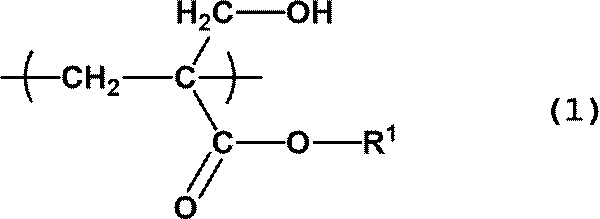
[式(1)中、R1は、炭素数1~4のアルキル基、水素原子、アルカリ金属原子、又はアンモニウムを表す。]
[4] 前記架橋重合体が、前記式(1)で表される構造単位であって、R1がアルカリ金属原子又はアンモニウムであるものを含有する、[3]に記載の親水性持続効果及び/又は滑水性付与剤。
[5] 前記単量体(AB1)に由来する構造単位の含有量が、前記架橋重合体中、5質量%以上である、[2]~[4]のいずれかに記載の親水性持続効果及び/又は滑水性付与剤。
[6] 前記単量体(C)に由来する構造単位の含有量が、前記架橋重合体中、0.01~70質量%である、[2]~[5]のいずれかに記載の親水性持続効果及び/又は滑水性付与剤。
[7] 前記架橋重合体が、さらにポリオキシアルキレン基含有エチレン性不飽和単量体に由来する構造単位を含む、[2]~[6]のいずれかに記載の親水性持続効果及び/又は滑水性付与剤。
[8] 前記粒子の体積平均粒子径が、10nm~10μmである、[1]~[7]のいずれかに記載の親水性持続効果及び/又は滑水性付与剤。
[9] 前記粒子が前記架橋重合体を含む単層粒子であるか、前記架橋重合体をシェル層に含むコアシェル構造の粒子である、[1]~[8]のいずれかに記載の親水性持続効果及び/又は滑水性付与剤。
[10] 熱交換器のフィン材用である、[1]~[9]のいずれかに記載の親水性持続効果及び/又は滑水性付与剤。
[11] 前記フィン材がアルミニウム製のフィン材用である、[10]に記載の親水性持続効果及び/又は滑水性付与剤。
[12] [1]~[11]のいずれかに記載の親水性持続効果及び/又は滑水性付与剤と、親水性樹脂とを有する樹脂組成物。
[13] 前記親水性樹脂が、カルボキシ基及びカルボキシ基の塩よりなる群から選択される少なくとも1種の極性官能基を側鎖に有する樹脂である、[12]に記載の樹脂組成物。
[14] さらに架橋剤を含有する、[12]又は[13]に記載の樹脂組成物。
[15] -COOR基(Rは炭化水素基、水素原子、アルカリ金属原子、又はアンモニウムを表す)および水酸基を有する架橋重合体を含む粒子を有形物に含有させる、有形物に、持続的親水化及び/又は滑水化を施す方法。
[16] -COOR基(Rは炭化水素基、水素原子、アルカリ金属原子、又はアンモニウムを表す)および水酸基を有する架橋重合体を含む粒子を含有する組成物を、基材に塗工することにより、前記粒子を含む塗膜を基材表面に形成させる、基材表面に持続的親水化及び/又は滑水化を施す方法。
[17] 前記基材が、熱交換器のフィン材である、[16]に記載の方法。
[18] 前記組成物が、さらに親水性樹脂を含有する、[16]又は[17]に記載の方法。
[19] 前記親水性樹脂が、カルボキシ基及びカルボキシ基の塩よりなる群から選択される少なくとも1種の極性官能基を側鎖に有する樹脂である、[18]に記載の方法。
[20] 前記組成物がさらに架橋剤を含有する、[16]~[19]のいずれかに記載の方法。
[21] 前記架橋重合体が、1分子中に1つ以上の-COOR基と1つ以上の水酸基と1つの重合性基とを有する単量体(AB1)に由来する構造単位と、1分子中に2つ以上の重合性基を有する単量体(C)に由来する構造単位とを含む、[15]~[20]のいずれかに記載の方法。
[22] 前記単量体(AB1)に由来する構造単位が、下記式(1)で表される構造単位であり、前記単量体(C)に由来する構造単位が、多官能エチレン性不飽和単量体に由来する構造単位である、[21]に記載の方法。

[式(1)中、R1は、炭素数1~4のアルキル基、水素原子、アルカリ金属原子、又はアンモニウムを表す。]
[23] 前記架橋重合体が、前記式(1)で表される構造単位であって、R1がアルカリ金属原子又はアンモニウムであるものを含有する、[22]に記載の方法。
[24] 前記単量体(AB1)に由来する構造単位の含有量が、前記架橋重合体中、5質量%以上である、[21]~[23]のいずれかに記載の方法。
[25] 前記単量体(C)に由来する構造単位の含有量が、前記架橋重合体中、0.01~70質量%である、[21]~[24]のいずれかに記載の方法。
[26] 前記架橋重合体が、さらにポリオキシアルキレン基含有エチレン性不飽和単量体に由来する構造単位を含む、[21]~[25]のいずれかに記載の方法。
[27] 前記粒子の体積平均粒子径が、10nm~10μmである、[15]~[26]のいずれかに記載の方法。
[28] 前記粒子が前記架橋重合体を含む単層粒子であるか、前記架橋重合体をシェル層に含むコアシェル構造の粒子である、[15]~[27]のいずれかに記載の方法。
That is, the present invention includes the following inventions.
[1] An agent for imparting hydrophilicity sustaining effect and/or water slipping, comprising, as a constituent, particles containing a crosslinked polymer having a -COOR group (R represents a hydrocarbon group, a hydrogen atom, an alkali metal atom, or ammonium) and a hydroxyl group.
[2] The agent for imparting hydrophilicity sustaining effect and/or water slipping property according to [1], wherein the crosslinked polymer contains a structural unit derived from a monomer (AB1) having one or more -COOR groups, one or more hydroxyl groups, and one polymerizable group in one molecule, and a structural unit derived from a monomer (C) having two or more polymerizable groups in one molecule.
[3] The agent for imparting hydrophilicity sustaining effect and/or water slipping property according to [2], wherein the structural unit derived from the monomer (AB1) is a structural unit represented by the following formula (1), and the structural unit derived from the monomer (C) is a structural unit derived from a polyfunctional ethylenically unsaturated monomer:
[In formula (1), R 1 represents an alkyl group having 1 to 4 carbon atoms, a hydrogen atom, an alkali metal atom, or ammonium.]
[4] The agent for imparting hydrophilicity sustaining effect and/or water slipping property according to [3], wherein the crosslinked polymer contains a structural unit represented by the formula (1) in which R 1 is an alkali metal atom or ammonium.
[5] The agent for imparting hydrophilicity sustaining effect and/or water slipping property according to any one of [2] to [4], wherein the content of the structural unit derived from the monomer (AB1) in the crosslinked polymer is 5 mass% or more.
[6] The agent for imparting hydrophilicity sustaining effect and/or water slipping property according to any one of [2] to [5], wherein the content of the structural unit derived from the monomer (C) in the crosslinked polymer is 0.01 to 70 mass%.
[7] The agent for imparting hydrophilicity sustaining effect and/or water slipping property according to any one of [2] to [6], wherein the crosslinked polymer further contains a structural unit derived from a polyoxyalkylene group-containing ethylenically unsaturated monomer.
[8] The agent for imparting hydrophilicity sustaining effect and/or water slipping property according to any one of [1] to [7], wherein the particles have a volume average particle size of 10 nm to 10 μm.
[9] The agent for imparting hydrophilicity sustaining effect and/or water slipping property according to any one of [1] to [8], wherein the particles are single-layer particles containing the crosslinked polymer, or particles having a core-shell structure containing the crosslinked polymer in a shell layer.
[10] The agent for imparting hydrophilicity sustaining effect and/or water slipping property according to any one of [1] to [9], which is for use in a fin material of a heat exchanger.
[11] The hydrophilicity sustaining effect and/or water slipping property imparting agent according to [10], wherein the fin material is for an aluminum fin material.
[12] A resin composition comprising the agent for imparting hydrophilicity sustaining effect and/or water slipping effect according to any one of [1] to [11] and a hydrophilic resin.
[13] The resin composition according to [12], wherein the hydrophilic resin is a resin having at least one polar functional group selected from the group consisting of a carboxy group and a salt of a carboxy group, in a side chain.
[14] The resin composition according to [12] or [13], further comprising a crosslinking agent.
[15] A method for imparting sustained hydrophilicity and/or water slippage to a tangible object, comprising incorporating into the tangible object particles containing a crosslinked polymer having a -COOR group (R represents a hydrocarbon group, a hydrogen atom, an alkali metal atom, or ammonium) and a hydroxyl group.
[16] A method for imparting sustained hydrophilicity and/or water slippage to a substrate surface, comprising applying to the substrate a composition containing particles comprising a crosslinked polymer having a -COOR group (R represents a hydrocarbon group, a hydrogen atom, an alkali metal atom, or ammonium) and a hydroxyl group, thereby forming a coating film containing the particles on the substrate surface.
[17] The method according to [16], wherein the substrate is a fin material of a heat exchanger.
[18] The method according to [16] or [17], wherein the composition further contains a hydrophilic resin.
[19] The method according to [18], wherein the hydrophilic resin is a resin having at least one polar functional group selected from the group consisting of a carboxy group and a salt of a carboxy group, on a side chain.
[20] The method according to any one of [16] to [19], wherein the composition further contains a crosslinking agent.
[21] The method according to any one of [15] to [20], wherein the crosslinked polymer contains a structural unit derived from a monomer (AB1) having one or more -COOR groups, one or more hydroxyl groups, and one polymerizable group in one molecule, and a structural unit derived from a monomer (C) having two or more polymerizable groups in one molecule.
[22] The method according to [21], wherein the structural unit derived from the monomer (AB1) is a structural unit represented by the following formula (1), and the structural unit derived from the monomer (C) is a structural unit derived from a polyfunctional ethylenically unsaturated monomer:
[In formula (1), R 1 represents an alkyl group having 1 to 4 carbon atoms, a hydrogen atom, an alkali metal atom, or ammonium.]
[23] The method according to [22], wherein the crosslinked polymer contains a structural unit represented by formula (1) in which R 1 is an alkali metal atom or ammonium.
[24] The method according to any one of [21] to [23], wherein the content of the structural unit derived from the monomer (AB1) in the crosslinked polymer is 5 mass% or more.
[25] The method according to any one of [21] to [24], wherein the content of the structural unit derived from the monomer (C) in the crosslinked polymer is 0.01 to 70 mass%.
[26] The method according to any one of [21] to [25], wherein the crosslinked polymer further contains a structural unit derived from a polyoxyalkylene group-containing ethylenically unsaturated monomer.
[27] The method according to any one of [15] to [26], wherein the particles have a volume average particle size of 10 nm to 10 μm.
[28] The method according to any one of [15] to [27], wherein the particles are single-layer particles containing the crosslinked polymer, or particles having a core-shell structure containing the crosslinked polymer in a shell layer.
本発明は以下の第1及び/又は第2の効果を奏することができる。
第1の効果:本発明の粒子を用いることで、得られる有形物のウェット/ドライサイクル後の親水持続性を高めることができる。また、好ましくは油汚れ付着後の有形物の親水性も高めることができる。
第2の効果:本発明の粒子を用いることで、得られる有形物に親水性を付与すると共に、滑水性を付与することができる。
さらに本発明の粒子を構成成分とする親水性持続効果及び/又は滑水性付与剤は、その製造において有機溶媒(特に水と混和しない有機溶媒)や毒性の高いモノマーの使用が必須でない点でも好ましい。
The present invention can provide the following first and/or second effects.
First effect: By using the particles of the present invention, the hydrophilicity of the resulting shaped object can be improved after wet/dry cycles, and preferably, the hydrophilicity of the shaped object after the adhesion of oily stains can also be improved.
Second effect: By using the particles of the present invention, it is possible to impart hydrophilicity and water-slip properties to the resulting tangible object.
Furthermore, the agent for imparting hydrophilicity sustaining effect and/or water slipping property, which comprises the particles of the present invention as a constituent component, is also preferable in that the production thereof does not necessarily require the use of organic solvents (particularly organic solvents that are immiscible with water) or highly toxic monomers.
以下、本発明について詳細に説明する。以下では、有形物として塗膜を例にとって説明するが、後述する様に有形物は塗膜に限定されない。 The present invention will be described in detail below. In the following, a coating film will be used as an example of a tangible object, but as will be described later, the tangible object is not limited to a coating film.
1.親水性持続効果及び/又は滑水性付与剤
<重合体粒子>
本発明の親水性持続効果及び/又は滑水性付与剤は、-COOR基(Rは炭化水素基、水素原子、アルカリ金属原子、又はアンモニウムを表す)および水酸基を有する架橋重合体を含む粒子(以下、単に「重合体粒子」という場合がある)を構成成分とする。前記重合体粒子を構成する架橋重合体が、-COOR基および水酸基を有することによって、優れた親水特性(初期親水性、ウェット/ドライサイクル後の親水性持続性、油汚れ付着後の親水性など)を示すことが可能となる。また、前記架橋重合体が-COOR基および水酸基を有することによって、優れた親水性と共に、優れた滑水性を示すことが可能となる。さらに、前記-COOR基および水酸基を有する重合体が架橋重合体であることによって、親水性持続効果及び/又は滑水性付与剤の水への溶出を防止でき、前記親水特性の持続性や滑水性を高めることが可能となる。加えて、本発明の親水性持続効果及び/又は滑水性付与剤は、臭気や金型摩耗の懸念のあるシリカ粒子を使用せずとも、上記効果が得られる点においても好ましい。
1. Agent for imparting hydrophilicity sustaining effect and/or water slipping property <Polymer particles>
The hydrophilicity sustaining effect and/or water slipping agent of the present invention is composed of particles (hereinafter, sometimes simply referred to as "polymer particles") containing a crosslinked polymer having a -COOR group (R represents a hydrocarbon group, a hydrogen atom, an alkali metal atom, or ammonium) and a hydroxyl group. The crosslinked polymer constituting the polymer particles has a -COOR group and a hydroxyl group, which makes it possible to exhibit excellent hydrophilic properties (initial hydrophilicity, hydrophilicity sustaining after wet/dry cycles, hydrophilicity after oil stain adhesion, etc.). In addition, the crosslinked polymer has a -COOR group and a hydroxyl group, which makes it possible to exhibit excellent hydrophilicity as well as excellent water slipping. Furthermore, the polymer having a -COOR group and a hydroxyl group is a crosslinked polymer, which makes it possible to prevent the hydrophilicity sustaining effect and/or water slipping agent from dissolving into water, and makes it possible to increase the sustaining of the hydrophilic properties and water slipping. In addition, the hydrophilicity sustaining effect and/or water slipping agent of the present invention is also preferable in that the above effects can be obtained without using silica particles that are likely to cause odor or mold wear.
なお、本発明において「架橋重合体」とは、架橋構造を有する重合体のことを指し、該架橋構造は、1分子中に重合性基を2つ以上有する単量体を(共)重合することで架橋重合体に導入することができ、すなわち、架橋重合体は、1分子中に重合性基を2つ以上有する単量体に由来する構造単位を含む重合体であるといえる。 In the present invention, the term "crosslinked polymer" refers to a polymer having a crosslinked structure, and the crosslinked structure can be introduced into the crosslinked polymer by (co)polymerizing a monomer having two or more polymerizable groups in one molecule. In other words, a crosslinked polymer can be said to be a polymer containing structural units derived from a monomer having two or more polymerizable groups in one molecule.
Rで表される炭化水素基としては、脂肪族炭化水素基であってもよく、芳香族炭化水素基であってもよく、それらを組み合わせた基であってもよい。 The hydrocarbon group represented by R may be an aliphatic hydrocarbon group, an aromatic hydrocarbon group, or a combination thereof.
脂肪族炭化水素基としては、例えば、
メチル基、エチル基、n-プロピル基、イソプロピル基、n-ブチル基、イソブチル基、tert-ブチル基等のアルキル基(好ましくは炭素数1~4のアルキル基);
ビニル基、n-プロペニル基、イソプロペニル基、1-ブテニル基、2-ブテニル基、1-ペンテニル基、2-ペンテニル基、2-メチル-1-ブテニル基、2-メチル-2-ブテニル基、3-メチル-1-ブテニル基等のアルケニル基(好ましくは炭素数2~6のアルケニル基);
シクロプロピル基、シクロブチル基、シクロペンチル基、シクロヘキシル基、3-メチルシクロヘキシル基、4-メチルシクロヘキシル基、4-エチルシクロヘキシル基等のシクロアルキル基(好ましくは炭素数3~8のシクロアルキル基);等が挙げられる。
Examples of the aliphatic hydrocarbon group include
Alkyl groups (preferably alkyl groups having 1 to 4 carbon atoms), such as a methyl group, an ethyl group, an n-propyl group, an isopropyl group, an n-butyl group, an isobutyl group, or a tert-butyl group;
alkenyl groups (preferably alkenyl groups having 2 to 6 carbon atoms) such as a vinyl group, an n-propenyl group, an isopropenyl group, a 1-butenyl group, a 2-butenyl group, a 1-pentenyl group, a 2-pentenyl group, a 2-methyl-1-butenyl group, a 2-methyl-2-butenyl group, or a 3-methyl-1-butenyl group;
cycloalkyl groups (preferably cycloalkyl groups having 3 to 8 carbon atoms) such as cyclopropyl group, cyclobutyl group, cyclopentyl group, cyclohexyl group, 3-methylcyclohexyl group, 4-methylcyclohexyl group, and 4-ethylcyclohexyl group; and the like.
前記芳香族炭化水素基としては、例えば、フェニル基、メチルフェニル基、ジメチルフェニル基、トリメチルフェニル基、4-tert-ブチルフェニル基、ナフチル基等が挙げられ、好ましくは炭素数6~10の芳香族炭化水素基である。 The aromatic hydrocarbon group may, for example, be a phenyl group, a methylphenyl group, a dimethylphenyl group, a trimethylphenyl group, a 4-tert-butylphenyl group, a naphthyl group, etc., and is preferably an aromatic hydrocarbon group having 6 to 10 carbon atoms.
脂肪族炭化水素基と芳香族炭化水素基とを組み合わせた基としては、例えば、ベンジル基、フェネチル基等のアラルキル基等が挙げられ、好ましくは炭素数7~12のアラルキル基である。 Examples of groups that combine an aliphatic hydrocarbon group and an aromatic hydrocarbon group include aralkyl groups such as benzyl and phenethyl groups, and preferably aralkyl groups having 7 to 12 carbon atoms.
Rで表される炭化水素基としては、アルキル基が好ましく、より好ましくは炭素数1~4のアルキル基、さらに好ましくは炭素数1~2のアルキル基、特に好ましくはメチル基である。 The hydrocarbon group represented by R is preferably an alkyl group, more preferably an alkyl group having 1 to 4 carbon atoms, even more preferably an alkyl group having 1 to 2 carbon atoms, and particularly preferably a methyl group.
Rで表されるアルカリ金属原子としては、リチウム、ナトリウム、カリウム等が挙げられ、ナトリウム、カリウムが好ましく、ナトリウムがより好ましい。 The alkali metal atom represented by R includes lithium, sodium, potassium, etc., with sodium and potassium being preferred, and sodium being more preferred.
Rで表されるアンモニウムは、NH4 +に限られず、有機アンモニウムを含む意味であると定義される。有機アンモニウムとしては、テトラメチルアンモニウム、テトラブチルアンモニウムなどのテトラアルキルアンモニウム(好ましくはテトラC1-10アルキルアンモニウム)などの4級アンモニウム;アミンをプロトン化することによって形成されるアンモニウム(1~3級アンモニウム)などが挙げられる。前記アミンとしては、トリメチルアミン、トリエチルアミン、トリブチルアミンなどのトリアルキルアミン(好ましくはトリC1-10アルキルアミン);モノエタノールアミン、ジエタノールアミン、トリエタノールアミンなどのヒドロキシアルキルアミン(好ましくはモノ、ジ又はトリ(ヒドロキシC1-10アルキル)アミン)などが挙げられる。すなわち、Rで表されるアンモニウムとしては、NH4 +、1~4級アンモニウムが挙げられ、テトラメチルアンモニウム、テトラブチルアンモニウムなどのテトラアルキルアンモニウム(好ましくはテトラC1-10アルキルアンモニウム)、トリメチルアンモニウム、トリエチルアンモニウム、トリブチルアンモニウムなどのトリアルキルアンモニウム(好ましくはトリC1-10アルキルアンモニウム)、モノエタノールアンモニウム、ジエタノールアンモニウム、トリエタノールアンモニウムなどのヒドロキシアルキルアンモニウム(好ましくはモノ、ジ又はトリ(ヒドロキシC1-10アルキル)アンモニウム)、又はNH4 +が好ましい。 The ammonium represented by R is not limited to NH4 + , but is defined to include organic ammonium. Examples of organic ammonium include quaternary ammonium such as tetraalkylammonium (preferably tetra- C1-10 alkylammonium) such as tetramethylammonium and tetrabutylammonium; and ammonium (primary to tertiary ammonium) formed by protonating an amine. Examples of the amine include trialkylamine (preferably tri- C1-10 alkylamine) such as trimethylamine, triethylamine, tributylamine; and hydroxyalkylamine (preferably mono-, di- or tri-(hydroxy- C1-10 alkyl)amine) such as monoethanolamine, diethanolamine, triethanolamine. That is, the ammonium represented by R includes NH4 + and primary to quaternary ammonium, and preferably includes tetraalkylammonium such as tetramethylammonium, tetrabutylammonium, etc. (preferably tetra- C1-10 alkylammonium), trialkylammonium such as trimethylammonium, triethylammonium, tributylammonium, etc. (preferably tri- C1-10 alkylammonium), hydroxyalkylammonium such as monoethanolammonium, diethanolammonium, triethanolammonium, etc. (preferably mono-, di- or tri-(hydroxy- C1-10 alkyl)ammonium), or NH4 + .
前記架橋重合体は、-COOR基を1種単独で有していてもよく、複数種有していてもよい。前記架橋重合体が-COOR基を1種単独で有している場合、前記Rとしては水素原子、アルカリ金属原子、又はアンモニウムが好ましく、アルカリ金属原子、又はアンモニウムがより好ましい。また、前記架橋重合体が複数種の-COOR基を有している場合、前記Rとしては、水素原子、アルカリ金属原子、及びアンモニウムから選ばれる1種以上と炭化水素基(特に、炭素数1~4のアルキル基)との組み合わせが好ましく、アルカリ金属原子及びアンモニウムから選ばれる1種以上と炭化水素基(特に、炭素数1~4のアルキル基)との組み合わせがより好ましい。前記架橋重合体に含まれる全R100モル%中、水素原子、アルカリ金属原子、又はアンモニウムであるRの合計割合(以下、イオン化率という)は、例えば20~100モル%、好ましくは40~100モル%、より好ましくは50~100モル%である。イオン化率を上記範囲に調整することで、親水特性や滑水性がより良好になる。なお、イオン化率の上限は95モル%以下であってもよく、90モル%以下であってもよい。 The crosslinked polymer may have one type of -COOR group alone or multiple types. When the crosslinked polymer has one type of -COOR group alone, the R is preferably a hydrogen atom, an alkali metal atom, or ammonium, and more preferably an alkali metal atom or ammonium. When the crosslinked polymer has multiple types of -COOR groups, the R is preferably a combination of one or more selected from hydrogen atoms, alkali metal atoms, and ammonium with a hydrocarbon group (particularly, an alkyl group having 1 to 4 carbon atoms), and more preferably a combination of one or more selected from alkali metal atoms and ammonium with a hydrocarbon group (particularly, an alkyl group having 1 to 4 carbon atoms). The total ratio of R that is a hydrogen atom, an alkali metal atom, or ammonium out of the total R 100 mol % contained in the crosslinked polymer (hereinafter referred to as the ionization rate) is, for example, 20 to 100 mol %, preferably 40 to 100 mol %, and more preferably 50 to 100 mol %. By adjusting the ionization rate to the above range, the hydrophilic properties and water slipping properties are improved. The upper limit of the ionization rate may be 95 mol% or less, or may be 90 mol% or less.
前記架橋重合体の水酸基価は、20~500mgKOH/gであることが好ましく、より好ましくは40~480mgKOH/g、さらに好ましくは70~450mgKOH/gである。
前記水酸基価は、架橋重合体1gに含まれている水酸基の物質量と同じ物質量を有する水酸化カリウムの量(mg)を意味する。
架橋重合体の水酸基価は、その組成が判明している場合には、架橋重合体の原料として用いられる単量体成分に含まれる水酸基の量を求めることで算出することができる。例えば、水酸基を有する単量体として2-ヒドロキシエチルメタクリレート1質量%を含有する単量体成分を重合させることによって調製された架橋重合体を例にとると、当該架橋重合体の水酸基価は、
式:〔架橋重合体の水酸基価〕=〔0.01(架橋重合体の原料として用いられる単量体成分における2-ヒドロキシエチルメタクリレートの質量基準の含有率)/130(2-ヒドロキシエチルメタクリレートの分子量)×1(2-ヒドロキシエチルメタクリレート1分子中の水酸基の数)〕×56.1(水酸化カリウムの物質量)×1000=4.3mgKOH/gに基づいて求めることができる。
また、架橋重合体の組成が判明していない場合には、JIS K0070に準拠して、当該架橋重合体1gをアセチル化させたとき、水酸基と結合した酢酸を中和するのに必要とする水酸化カリウム(KOH)の量(mg)を求めることで水酸基価を決定することもできる。
架橋重合体の水酸基価は、当該架橋重合体の原料として用いられる単量体成分に含まれる水酸基を有する単量体の量を調節することによって容易に調整することができる。
The hydroxyl value of the crosslinked polymer is preferably from 20 to 500 mgKOH/g, more preferably from 40 to 480 mgKOH/g, and further preferably from 70 to 450 mgKOH/g.
The hydroxyl value means the amount (mg) of potassium hydroxide having the same substance amount as the substance amount of hydroxyl groups contained in 1 g of the crosslinked polymer.
When the composition of a crosslinked polymer is known, the hydroxyl value of the crosslinked polymer can be calculated by determining the amount of hydroxyl groups contained in the monomer component used as the raw material of the crosslinked polymer. For example, in the case of a crosslinked polymer prepared by polymerizing a monomer component containing 1% by mass of 2-hydroxyethyl methacrylate as a monomer having a hydroxyl group, the hydroxyl value of the crosslinked polymer is given by:
It can be calculated based on the formula: [hydroxyl value of crosslinked polymer] = [0.01 (mass-based content of 2-hydroxyethyl methacrylate in the monomer component used as a raw material for the crosslinked polymer) / 130 (molecular weight of 2-hydroxyethyl methacrylate) × 1 (number of hydroxyl groups in one molecule of 2-hydroxyethyl methacrylate)] × 56.1 (substance amount of potassium hydroxide) × 1000 = 4.3 mg KOH/g.
In addition, when the composition of the crosslinked polymer is unknown, the hydroxyl value can also be determined by determining the amount (mg) of potassium hydroxide (KOH) required to neutralize acetic acid bonded to hydroxyl groups when 1 g of the crosslinked polymer is acetylated in accordance with JIS K0070.
The hydroxyl value of the crosslinked polymer can be easily adjusted by adjusting the amount of the hydroxyl-containing monomer contained in the monomer component used as the raw material for the crosslinked polymer.
前記架橋重合体に含まれる-COOR基の割合は、前記架橋重合体に含まれる水酸基100モルに対して、10~300モルが好ましく、より好ましくは30~200モル、さらに好ましくは50~150モル、特に好ましくは80~120モルである。 The proportion of -COOR groups contained in the crosslinked polymer is preferably 10 to 300 moles, more preferably 30 to 200 moles, even more preferably 50 to 150 moles, and particularly preferably 80 to 120 moles, per 100 moles of hydroxyl groups contained in the crosslinked polymer.
上述の通り、前記架橋重合体は、1分子中に重合性基を2つ以上有する単量体に由来する構造単位を含む。1分子中に重合性基を2つ以上有する単量体としては、エチレン性不飽和結合を2つ以上有する単量体が挙げられ、末端にエチレン性不飽和結合を2つ以上有する単量体であること、すなわちCH2=C<基を2つ以上有する単量体であることが好ましい。すなわち、前記重合性基としては、ビニル基、アリル基、(メタ)アクリロイル基等のエチレン性不飽和結合含有基が好ましい。 As described above, the crosslinked polymer contains a structural unit derived from a monomer having two or more polymerizable groups in one molecule. The monomer having two or more polymerizable groups in one molecule includes a monomer having two or more ethylenically unsaturated bonds, and is preferably a monomer having two or more ethylenically unsaturated bonds at the terminal, that is, a monomer having two or more CH 2 ═C< groups. That is, the polymerizable group is preferably an ethylenically unsaturated bond-containing group such as a vinyl group, an allyl group, or a (meth)acryloyl group.
1分子中に重合性基を2つ以上有する単量体としては、具体的に、後述の単量体(A2)、単量体(B2)、単量体(AB2)、及び単量体(C)として例示する単量体が例示され、中でも、単量体(C)が好ましい。 Specific examples of monomers having two or more polymerizable groups in one molecule include the monomers exemplified below as monomer (A2), monomer (B2), monomer (AB2), and monomer (C), with monomer (C) being preferred.
1分子中に重合性基を2つ以上有する単量体に由来する構造単位(好ましくは、単量体(C)に由来する構造単位)の含有量は、前記架橋重合体中、例えば0.01~70質量%であり、好ましくは0.01~35質量%、より好ましくは1~25質量%、さらに好ましくは5~20質量%である。1分子中に重合性基を2つ以上有する単量体に由来する構造単位の含有量を上記範囲に調整することで、親水性持続効果や滑水性がより高められる傾向にある。 The content of structural units derived from a monomer having two or more polymerizable groups in one molecule (preferably structural units derived from monomer (C)) in the crosslinked polymer is, for example, 0.01 to 70% by mass, preferably 0.01 to 35% by mass, more preferably 1 to 25% by mass, and even more preferably 5 to 20% by mass. By adjusting the content of structural units derived from a monomer having two or more polymerizable groups in one molecule to within the above range, the sustained hydrophilic effect and water slipping property tend to be further improved.
前記架橋重合体は、以下の態様1~4のいずれかの架橋重合体であることが好ましく、態様1、態様2、又は態様4の架橋重合体であることがより好ましく、態様4の架橋重合体であることが特に好ましい。なお、以下の態様1~4における-COOR基中のRは、前記と同様であり、その好ましい態様も同様である。
態様1:1分子中に1つ以上の-COOR基と1つの重合性基とを有し且つ水酸基を有さない単量体(以下、単量体(A1))に由来する構造単位と、1分子中に1つ以上の水酸基と1つの重合性基とを有し且つ-COOR基を有さない単量体(以下、単量体(B1))に由来する構造単位と、1分子中に2つ以上の重合性基を有する単量体(C)(以下、単量体(C))に由来する構造単位とを含む架橋重合体
態様2:単量体(A1)及び/又は1分子中に1つ以上の-COOR基と2つ以上の重合性基とを有し且つ水酸基を有さない単量体(以下、単量体(A2))に由来する構造単位と、単量体(B1)及び/又は1分子中に1つ以上の水酸基と2つ以上の重合性基とを有し且つ-COOR基を有さない単量体(以下、単量体(B2))に由来する構造単位とを含む架橋重合体であって、少なくとも単量体(A2)及び/又は単量体(B2)に由来する構造単位を含む架橋重合体
態様3:1分子中に1つ以上の-COOR基と1つ以上の水酸基と2つ以上の重合性基とを有する単量体(以下、単量体(AB2))に由来する構造単位を含む架橋重合体
態様4:1分子中に1つ以上の-COOR基と1つ以上の水酸基と1つの重合性基とを有する単量体(以下、単量体(AB1))に由来する構造単位と、単量体(C)に由来する構造単位とを含む架橋重合体
The crosslinked polymer is preferably a crosslinked polymer of any one of the following
Aspect 1: A crosslinked polymer comprising a structural unit derived from a monomer having one or more -COOR groups and one polymerizable group in one molecule and no hydroxyl group (hereinafter, monomer (A1)), a structural unit derived from a monomer having one or more hydroxyl groups and one polymerizable group in one molecule and no -COOR group (hereinafter, monomer (B1)), and a structural unit derived from a monomer (C) having two or more polymerizable groups in one molecule (hereinafter, monomer (C)). Aspect 2: A crosslinked polymer containing a structural unit derived from a monomer (A1) and/or a monomer having one or more -COOR groups and two or more polymerizable groups in one molecule and no hydroxyl group (hereinafter, monomer (A2)), and a structural unit derived from a monomer (B1) and/or a monomer having one or more hydroxyl groups and two or more polymerizable groups in one molecule and no -COOR group (hereinafter, monomer (B2)), the crosslinked polymer containing at least a structural unit derived from the monomer (A2) and/or monomer (B2). Aspect 3: A crosslinked polymer containing a structural unit derived from a monomer having one or more -COOR groups, one or more hydroxyl groups, and two or more polymerizable groups in one molecule (hereinafter, monomer (AB2)). Aspect 4: A crosslinked polymer comprising a structural unit derived from a monomer having one or more -COOR groups, one or more hydroxyl groups, and one polymerizable group in one molecule (hereinafter, referred to as monomer (AB1)) and a structural unit derived from monomer (C).
なお、本明細書において「所定の単量体に由来する構造単位」とは、所定の単量体が重合して形成される構造と同じ構造を有する構造単位を言い、通常は、所定の単量体に含まれる炭素炭素二重結合が、炭素炭素単結合とそれぞれの炭素に結合する2つの結合手とに置き換わった構造である。なお、所定の単量体に由来する構造単位は、実際に所定の単量体が重合することにより形成された構造単位である必要は無く、所定の単量体が重合して形成される構造と同じ構造であれば、所定の単量体が重合する以外の方法で形成された構造単位(例えば重合後に加水分解や中和などの反応を経て形成された構造単位)であっても、所定の単量体に由来する構造単位に含まれる。 In this specification, "structural unit derived from a specified monomer" refers to a structural unit having the same structure as the structure formed by polymerization of the specified monomer, and is usually a structure in which the carbon-carbon double bond contained in the specified monomer is replaced with a carbon-carbon single bond and two bonds bonded to each carbon. The structural unit derived from the specified monomer does not necessarily have to be a structural unit formed by the actual polymerization of the specified monomer, and even if it is a structural unit formed by a method other than polymerization of the specified monomer (for example, a structural unit formed through a reaction such as hydrolysis or neutralization after polymerization) that has the same structure as the structure formed by polymerization of the specified monomer, it is included in the structural unit derived from the specified monomer.
前記単量体(A1)1分子に含まれる-COOR基の数は、1~3個であることが好ましく、1個であることがより好ましい。
前記単量体(A1)に含まれる重合性基は、ビニル基、アリル基、(メタ)アクリロイル基等のエチレン性不飽和結合含有基が好ましく、より好ましくは(メタ)アクリロイル基である。
The number of --COOR groups contained in one molecule of the monomer (A1) is preferably 1 to 3, and more preferably 1.
The polymerizable group contained in the monomer (A1) is preferably an ethylenically unsaturated bond-containing group such as a vinyl group, an allyl group, or a (meth)acryloyl group, and more preferably a (meth)acryloyl group.
前記単量体(A1)としては、カルボキシ基含有単官能性単量体、カルボキシ基含有単官能性単量体の塩、(メタ)アクリレート系単量体等が挙げられる。 Examples of the monomer (A1) include carboxyl group-containing monofunctional monomers, salts of carboxyl group-containing monofunctional monomers, (meth)acrylate monomers, etc.
前記カルボキシ基含有単官能性単量体としては、具体的に、(メタ)アクリル酸、クロトン酸等の不飽和モノカルボン酸;マレイン酸、フマル酸、イタコン酸等の不飽和ジカルボン酸;等が例示され、中でも不飽和モノカルボン酸が好ましく、(メタ)アクリル酸がより好ましく、アクリル酸が特に好ましい。 Specific examples of the carboxyl group-containing monofunctional monomer include unsaturated monocarboxylic acids such as (meth)acrylic acid and crotonic acid; unsaturated dicarboxylic acids such as maleic acid, fumaric acid, and itaconic acid; and among these, unsaturated monocarboxylic acids are preferred, (meth)acrylic acid is more preferred, and acrylic acid is particularly preferred.
前記カルボキシ基含有単官能性単量体の塩としては、カルボキシ基含有単官能性単量体のアルカリ金属塩、カルボキシ基含有単官能性単量体のアンモニウム塩等が挙げられる。なお、カルボキシ基含有単官能性単量体の塩において、カルボキシ基含有単官能性単量体と塩を形成するアルカリ金属原子やアンモニウムの具体例は、前述のRで表されるアルカリ金属原子やアンモニウムの例示と同様であり、その好ましい態様も同様である。中でも、不飽和モノカルボン酸の塩が好ましく、アクリル酸の塩がより好ましい。 Examples of the salt of the carboxyl group-containing monofunctional monomer include alkali metal salts of the carboxyl group-containing monofunctional monomer and ammonium salts of the carboxyl group-containing monofunctional monomer. In the salt of the carboxyl group-containing monofunctional monomer, specific examples of the alkali metal atom or ammonium that forms a salt with the carboxyl group-containing monofunctional monomer are the same as the examples of the alkali metal atom or ammonium represented by R described above, and the preferred embodiments are also the same. Among them, salts of unsaturated monocarboxylic acids are preferred, and salts of acrylic acid are more preferred.
前記(メタ)アクリレート系単量体としては、具体的に、メチル(メタ)アクリレート、エチル(メタ)アクリレート、n-プロピル(メタ)アクリレート、イソプロピル(メタ)アクリレート、n-ブチル(メタ)アクリレート、イソブチル(メタ)アクリレート、t-ブチル(メタ)アクリレート、2-エチルヘキシル(メタ)アクリレート、ラウリル(メタ)アクリレート等の(メタ)アクリル酸アルキルエステル;(メタ)アクリル酸フェニル等の(メタ)アクリル酸アリールエステル;(メタ)アクリル酸ベンジル等の(メタ)アクリル酸アラルキルエステル;等が例示され、中でも、(メタ)アクリル酸アルキルエステルが好ましく、(メタ)アクリル酸C1-10アルキルエステルがより好ましく、(メタ)アクリル酸C1-4アルキルエステルがさらに好ましい。 Specific examples of the (meth)acrylate monomer include (meth)acrylic acid alkyl esters such as methyl (meth)acrylate, ethyl (meth)acrylate, n-propyl (meth)acrylate, isopropyl (meth)acrylate, n-butyl (meth)acrylate, isobutyl (meth)acrylate, t-butyl (meth)acrylate, 2-ethylhexyl (meth)acrylate, and lauryl (meth)acrylate; (meth)acrylic acid aryl esters such as phenyl (meth)acrylate; and (meth)acrylic acid aralkyl esters such as benzyl (meth)acrylate. Among these, (meth)acrylic acid alkyl esters are preferred, (meth)acrylic acid C1-10 alkyl esters are more preferred, and (meth)acrylic acid C1-4 alkyl esters are even more preferred.
前記単量体(A2)1分子に含まれる-COOR基の数は、1~3個であることが好ましく、1個であることがより好ましい。
前記単量体(A2)に含まれる重合性基の数は、2~6個であることが好ましく、2個であることがより好ましい。
前記単量体(A2)に含まれる重合性基は、ビニル基、アリル基、(メタ)アクリロイル基等のエチレン性不飽和結合含有基が好ましく、より好ましくは(メタ)アクリロイル基である。
The number of --COOR groups contained in one molecule of the monomer (A2) is preferably 1 to 3, and more preferably 1.
The number of polymerizable groups contained in the monomer (A2) is preferably 2 to 6, and more preferably 2.
The polymerizable group contained in the monomer (A2) is preferably an ethylenically unsaturated bond-containing group such as a vinyl group, an allyl group, or a (meth)acryloyl group, and more preferably a (meth)acryloyl group.
前記単量体(A2)としては、1-ベンジル-3,4-ジビニル-1H-ピロール-2,5-ジカルボン酸ジメチル、1,1’-[2-[(エトキシカルボニル)オキシ]―1,3-プロパンジイル]ビス(2-メチルー2-プロペン酸エステル)等が挙げられる。 Examples of the monomer (A2) include 1-benzyl-3,4-divinyl-1H-pyrrole-2,5-dimethyl dicarboxylate, 1,1'-[2-[(ethoxycarbonyl)oxy]-1,3-propanediyl]bis(2-methyl-2-propenoic acid ester), etc.
前記単量体(B1)1分子に含まれる水酸基の数は、1~3個であることが好ましく、1個であることがより好ましい。
前記単量体(B1)に含まれる重合性基は、ビニル基、アリル基、(メタ)アクリロイル基等のエチレン性不飽和結合含有基が好ましく、より好ましくは(メタ)アクリロイル基である。
The number of hydroxyl groups contained in one molecule of the monomer (B1) is preferably 1 to 3, and more preferably 1.
The polymerizable group contained in the monomer (B1) is preferably an ethylenically unsaturated bond-containing group such as a vinyl group, an allyl group, or a (meth)acryloyl group, and more preferably a (meth)acryloyl group.
前記単量体(B1)としては、具体的に、2-ヒドロキシエチル(メタ)アクリレート、2-ヒドロキシプロピル(メタ)アクリレート、3-ヒドロキシプロピル(メタ)アクリレート、2-ヒドロキシブチル(メタ)アクリレート、4-ヒドロキシブチル(メタ)アクリレート等の(メタ)アクリル酸ヒドロキシアルキルエステルが例示され、中でも、(メタ)アクリル酸C1-8ヒドロキシアルキルエステルが好ましく、(メタ)アクリル酸C1-4ヒドロキシアルキルエステルがより好ましい。 Specific examples of the monomer (B1) include (meth)acrylic acid hydroxyalkyl esters such as 2-hydroxyethyl (meth)acrylate, 2-hydroxypropyl (meth)acrylate, 3-hydroxypropyl (meth)acrylate, 2-hydroxybutyl (meth)acrylate, and 4-hydroxybutyl (meth)acrylate. Among these, (meth)acrylic acid C 1-8 hydroxyalkyl esters are preferred, and (meth)acrylic acid C 1-4 hydroxyalkyl esters are more preferred.
前記単量体(B2)1分子に含まれる水酸基の数は、1~3個であることが好ましく、1個であることがより好ましい。
前記単量体(B2)1分子に含まれる重合性基の数は、2~6個であることが好ましく、2個であることがより好ましい。
前記単量体(B2)に含まれる重合性基は、ビニル基、アリル基、(メタ)アクリロイル基等のエチレン性不飽和結合含有基が好ましく、より好ましくは(メタ)アクリロイル基である。
The number of hydroxyl groups contained in one molecule of the monomer (B2) is preferably 1 to 3, and more preferably 1.
The number of polymerizable groups contained in one molecule of the monomer (B2) is preferably 2 to 6, and more preferably 2.
The polymerizable group contained in the monomer (B2) is preferably an ethylenically unsaturated bond-containing group such as a vinyl group, an allyl group, or a (meth)acryloyl group, and more preferably a (meth)acryloyl group.
前記単量体(B2)としては、具体的に、ペンタエリスリトールトリ(メタ)アクリレート、ジペンタエリスリトールペンタ(メタ)アクリレートなどのn個(nは3以上の整数であり、好ましくは3~6の整数)の水酸基を有するポリオールと2個以上n-1個以下の(メタ)アクリル酸とのエステル、下記式で表されるような水酸基を有するジビニル化合物等が例示される。 Specific examples of the monomer (B2) include esters of polyols having n hydroxyl groups (n is an integer of 3 or more, preferably an integer of 3 to 6), such as pentaerythritol tri(meth)acrylate and dipentaerythritol penta(meth)acrylate, with 2 to n-1 (meth)acrylic acids, and divinyl compounds having hydroxyl groups as represented by the following formula:

前記単量体(C)に含まれる重合性基は、ビニル基、アリル基、(メタ)アクリロイル基等のエチレン性不飽和結合含有基が好ましく、ビニル基、メタクリロイル基がより好ましく、ビニル基が特に好ましい。 The polymerizable group contained in the monomer (C) is preferably an ethylenically unsaturated bond-containing group such as a vinyl group, an allyl group, or a (meth)acryloyl group, more preferably a vinyl group or a methacryloyl group, and particularly preferably a vinyl group.
前記単量体(C)としては、分子量が50以上、1000以下であることが好ましく、100以上、400以下であることがより好ましい。 The molecular weight of the monomer (C) is preferably 50 or more and 1,000 or less, and more preferably 100 or more and 400 or less.
前記単量体(C)としては、炭化水素架橋性単量体、ジビニルエーテル系単量体、ジアリルエーテル系単量体、多価(メタ)アクリル酸エステル等の、エチレン性不飽和結合含有基を2つ以上有する多官能エチレン性不飽和単量体であることが好ましい。 The monomer (C) is preferably a polyfunctional ethylenically unsaturated monomer having two or more ethylenically unsaturated bond-containing groups, such as a hydrocarbon crosslinkable monomer, a divinyl ether monomer, a diallyl ether monomer, or a polyvalent (meth)acrylic acid ester.
炭化水素架橋性単量体としては、例えば、ジビニルベンゼン、トリビニルベンゼン、ジビニルナフタレン、ジビニルトルエン、ジビニルキシレンなどの芳香族炭化水素架橋性単量体;トリビニルシクロヘキサンなどの脂環式炭化水素架橋性単量体;1,3-ブタジエンなど鎖状炭化水素架橋性単量体などが挙げられる。 Examples of hydrocarbon cross-linking monomers include aromatic hydrocarbon cross-linking monomers such as divinylbenzene, trivinylbenzene, divinylnaphthalene, divinyltoluene, and divinylxylene; alicyclic hydrocarbon cross-linking monomers such as trivinylcyclohexane; and linear hydrocarbon cross-linking monomers such as 1,3-butadiene.
ジビニルエーテル系単量体としては、例えば、ジエチレングリコールジビニルエーテル、ジプロピレングリコールジビニルエーテル、ジブチレングリコールジビニルエーテル等のジアルキレングリコールジビニルエーテル(好ましくは、ジC1-4アルキレングリコールジビニルエーテル);ポリエチレングリコールジビニルエーテル、ポリプロピレングリコールジビニルエーテル、ポリブチレングリコールジビニルエーテル等のポリアルキレングリコールジビニルエーテル(好ましくは、ポリC1-4アルキレングリコールジビニルエーテル);などが挙げられる。なお、前記ポリアルキレングリコールジビニルエーテルにおけるアルキレングリコール単位の繰り返し数は特に限定されないが、3~10が好ましく、3~5がより好ましい。 Examples of divinyl ether monomers include dialkylene glycol divinyl ethers such as diethylene glycol divinyl ether, dipropylene glycol divinyl ether, dibutylene glycol divinyl ether (preferably diC 1-4 alkylene glycol divinyl ether); polyalkylene glycol divinyl ethers such as polyethylene glycol divinyl ether, polypropylene glycol divinyl ether, polybutylene glycol divinyl ether (preferably polyC 1-4 alkylene glycol divinyl ether); etc. The number of repeating alkylene glycol units in the polyalkylene glycol divinyl ether is not particularly limited, but is preferably 3 to 10, and more preferably 3 to 5.
ジアリルエーテル系単量体としては、例えば、ジエチレングリコールジアリルエーテル、ジプロピレングリコールジアリルエーテル、ジブチレングリコールジアリルエーテル等のジアルキレングリコールジアリルエーテル(好ましくは、ジC1-4アルキレングリコールジアリルエーテル);ポリエチレングリコールジアリルエーテル、ポリプロピレングリコールジアリルエーテル、ポリブチレングリコールジアリルエーテル等のポリアルキレングリコールジアリルエーテル(好ましくは、ポリC1-4アルキレングリコールジアリルエーテル);などが挙げられる。なお、前記ポリアルキレングリコールジアリルエーテルにおけるアルキレングリコール単位の繰り返し数は特に限定されないが、3~10が好ましく、3~5がより好ましい。 Examples of diallyl ether monomers include dialkylene glycol diallyl ethers such as diethylene glycol diallyl ether, dipropylene glycol diallyl ether, dibutylene glycol diallyl ether (preferably di-C 1-4 alkylene glycol diallyl ether); polyalkylene glycol diallyl ethers such as polyethylene glycol diallyl ether, polypropylene glycol diallyl ether, polybutylene glycol diallyl ether (preferably poly-C 1-4 alkylene glycol diallyl ether); etc. The number of repeating alkylene glycol units in the polyalkylene glycol diallyl ether is not particularly limited, but is preferably 3 to 10, and more preferably 3 to 5.
多価(メタ)アクリル酸エステルとしては、例えば、エチレングリコールジ(メタ)アクリレート、ジエチレングリコールジ(メタ)アクリレート、トリエチレングリコールジ(メタ)アクリレート、テトラエチレングリコールジ(メタ)アクリレート、1,6-ヘキサンジオールジ(メタ)アクリレート、ネオペンチルグリコールジ(メタ)アクリレート等のモノ、ジ、又はポリアルキレングリコールの(メタ)アクリル酸ジエステル(好ましくは、モノ、ジ、又はポリC2-4アルキレングリコールの(メタ)アクリル酸ジエステル)、トリメチロールプロパントリ(メタ)アクリレート、ペンタエリトリトールトリ(メタ)アクリレートなどのポリオールの(メタ)アクリル酸トリエステル、ペンタエリトリトールテトラ(メタ)アクリレートなどのポリオールの(メタ)アクリル酸テトラエステル、ジペンタエリスリトールペンタ(メタ)アクリレートなどのポリオールの(メタ)アクリル酸ペンタエステル、ジペンタエリスリトールヘキサ(メタ)アクリレートなどのポリオールの(メタ)アクリル酸ヘキサエステルなどが挙げられる。なお、前記ポリアルキレングリコールの(メタ)アクリル酸ジエステルにおけるアルキレングリコール単位の繰り返し数は特に限定されないが、3~10が好ましく、3~5がより好ましい。
中でも、加水分解への耐性が高く、親水成分等の粒子の構成成分の溶出を防ぎ、親水性持続効果及び/又は滑水性を高める傾向にあることから、モノ、ジ、又はポリアルキレングリコールのメタクリル酸ジエステル、ポリオールのメタクリル酸トリエステル、ポリオールのメタクリル酸テトラエステル、ポリオールのメタクリル酸ペンタエステル、ポリオールのメタクリル酸ヘキサエステル等の多価メタクリル酸エステルが好ましい。
Examples of polyfunctional (meth)acrylic acid esters include (meth)acrylic acid diesters of mono-, di-, or polyalkylene glycols such as ethylene glycol di(meth)acrylate, diethylene glycol di(meth)acrylate, triethylene glycol di(meth)acrylate, tetraethylene glycol di(meth)acrylate, 1,6-hexanediol di(meth)acrylate, and neopentyl glycol di(meth)acrylate (preferably mono-, di-, or poly-C Examples of the (meth)acrylic acid diester of 2-4 alkylene glycol, (meth)acrylic acid triesters of polyols such as trimethylolpropane tri(meth)acrylate and pentaerythritol tri(meth)acrylate, (meth)acrylic acid tetraesters of polyols such as pentaerythritol tetra(meth)acrylate, (meth)acrylic acid pentaesters of polyols such as dipentaerythritol penta(meth)acrylate, and (meth)acrylic acid hexaesters of polyols such as dipentaerythritol hexa(meth)acrylate. The number of repeating alkylene glycol units in the (meth)acrylic acid diester of polyalkylene glycol is not particularly limited, but is preferably 3 to 10, and more preferably 3 to 5.
Among these, polyvalent methacrylic acid esters such as methacrylic acid diesters of mono-, di-, or polyalkylene glycols, methacrylic acid triesters of polyols, methacrylic acid tetraesters of polyols, methacrylic acid pentaesters of polyols, and methacrylic acid hexaesters of polyols are preferred because they have high resistance to hydrolysis, prevent the elution of particle components such as hydrophilic components, and tend to enhance the hydrophilicity sustaining effect and/or water slipping property.
前記多官能エチレン性不飽和単量体の中でも、炭化水素架橋性単量体、多価(メタ)アクリル酸エステルが好ましい。特に加水分解への耐性が高く、親水性持続効果及び/又は滑水性をより高める傾向にあることから、炭化水素架橋性単量体、多価メタクリル酸エステルがより好ましく、芳香族炭化水素架橋性単量体、モノ、ジ、又はポリアルキレングリコールのメタクリル酸ジエステルがさらに好ましく、ジビニルベンゼンが特に好ましい。 Among the polyfunctional ethylenically unsaturated monomers, hydrocarbon cross-linkable monomers and polyvalent (meth)acrylic acid esters are preferred. Hydrocarbon cross-linkable monomers and polyvalent methacrylic acid esters are more preferred because they are particularly resistant to hydrolysis and tend to further enhance the sustained hydrophilic effect and/or water slippage, while aromatic hydrocarbon cross-linkable monomers and methacrylic acid diesters of mono-, di-, or polyalkylene glycols are even more preferred, with divinylbenzene being particularly preferred.
前記単量体(AB1)1分子に含まれる-COOR基の数は、1~3個であることが好ましく、1個であることがより好ましい。
前記単量体(AB1)1分子に含まれる水酸基の数は、1~3個であることが好ましく、1個であることがより好ましい。
前記単量体(AB1)に含まれる重合性基は、ビニル基、アリル基、(メタ)アクリロイル基等のエチレン性不飽和結合含有基が好ましく、より好ましくは末端にエチレン性不飽和基を有する基(CH2=C<を有する基)、さらに好ましくは(メタ)アクリロイル基である。
The number of --COOR groups contained in one molecule of the monomer (AB1) is preferably 1 to 3, and more preferably 1.
The number of hydroxyl groups contained in one molecule of the monomer (AB1) is preferably 1 to 3, and more preferably 1.
The polymerizable group contained in the monomer (AB1) is preferably an ethylenically unsaturated bond-containing group such as a vinyl group, an allyl group, or a (meth)acryloyl group, more preferably a group having an ethylenically unsaturated group at the end (a group having CH2 =C<), and even more preferably a (meth)acryloyl group.
前記単量体(AB1)としては、下記式(2)で表されるヒドロキシメチルアクリル酸系単量体が好ましい。 The monomer (AB1) is preferably a hydroxymethylacrylic acid monomer represented by the following formula (2):
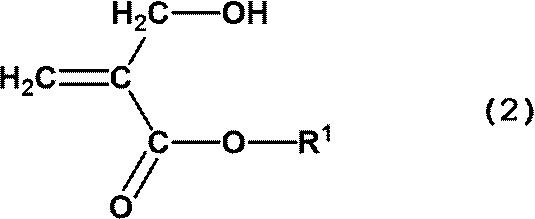
[式(2)中、R1は、炭素数1~4のアルキル基、水素原子、アルカリ金属原子、又はアンモニウムを表す。]
[In formula (2), R 1 represents an alkyl group having 1 to 4 carbon atoms, a hydrogen atom, an alkali metal atom, or ammonium.]
上記式(2)におけるR1で表される炭素数1~4のアルキル基としては、メチル基、エチル基、n-プロピル基、イソプロピル基、n-ブチル基、イソブチル基、sec-ブチル基、tert-ブチル基等が挙げられる。中でも、炭素数1~2のアルキル基であることが好ましく、メチル基であることがより好ましい。 Examples of the alkyl group having 1 to 4 carbon atoms represented by R 1 in the above formula (2) include a methyl group, an ethyl group, an n-propyl group, an isopropyl group, an n-butyl group, an isobutyl group, a sec-butyl group, a tert-butyl group, etc. Among these, an alkyl group having 1 to 2 carbon atoms is preferred, and a methyl group is more preferred.
上記式(2)におけるR1で表されるアルカリ金属原子及びアンモニウムとしては、上記Rで表されるアルカリ金属原子及びアンモニウムで例示したものと同様であり、その好ましい態様も同様である。 The alkali metal atom and ammonium represented by R 1 in the above formula (2) are the same as those exemplified for the alkali metal atom and ammonium represented by R above, and preferred embodiments thereof are also the same.
前記単量体(AB2)1分子に含まれる-COOR基の数は、1~3個であることが好ましく、1個であることがより好ましい。
前記単量体(AB2)1分子に含まれる水酸基の数は、1~3個であることが好ましく、1個であることがより好ましい。
前記単量体(AB2)1分子に含まれる重合性基の数は、2~6個であることが好ましく、2個であることがより好ましい。
前記単量体(AB2)に含まれる重合性基は、ビニル基、アリル基、(メタ)アクリロイル基等のエチレン性不飽和結合含有基が好ましく、より好ましくは(メタ)アクリロイル基である。
The number of --COOR groups contained in one molecule of the monomer (AB2) is preferably 1 to 3, and more preferably 1.
The number of hydroxyl groups contained in one molecule of the monomer (AB2) is preferably 1 to 3, and more preferably 1.
The number of polymerizable groups contained in one molecule of the monomer (AB2) is preferably 2 to 6, and more preferably 2.
The polymerizable group contained in the monomer (AB2) is preferably an ethylenically unsaturated bond-containing group such as a vinyl group, an allyl group, or a (meth)acryloyl group, and more preferably a (meth)acryloyl group.
前記単量体(AB2)としては、具体的に、3,4-ジエテニル-5-(ヒドロキシメチル)-1-(フェニルメチル)1H-ピロール-2-カルボン酸メチル、3-ヒドロキシ-3-(2-プロペン-1-イル)-5-ヘキセン酸メチル等が例示される。 Specific examples of the monomer (AB2) include methyl 3,4-diethenyl-5-(hydroxymethyl)-1-(phenylmethyl)-1H-pyrrole-2-carboxylate, methyl 3-hydroxy-3-(2-propen-1-yl)-5-hexenoate, etc.
前記態様1の架橋重合体は、単量体(A1)に由来する構造単位を1種単独で含んでもよく、2種以上含んでいてもよい。また、前記態様1の架橋重合体は、単量体(B1)に由来する構造単位を1種単独で含んでもよく、2種以上含んでいてもよい。また、前記態様1の架橋重合体は、単量体(C)に由来する構造単位を1種単独で含んでもよく、2種以上含んでいてもよい。
前記単量体(A1)に由来する構造単位の含有量は、前記態様1の架橋重合体中、好ましくは1~98.99質量%、より好ましくは10~90質量%、さらに好ましくは10~50質量%である。
前記単量体(B1)に由来する構造単位の含有量は、前記態様1の架橋重合体中、好ましくは1~98.99質量%、より好ましくは10~90質量%、さらに好ましくは10~50質量%である。
前記単量体(C)(好ましくは多官能エチレン性不飽和単量体)に由来する構造単位の含有量は、前記態様1の架橋重合体中、好ましくは0.01~70質量%、より好ましくは0.01~35質量%、さらに好ましくは5~20質量%である。
前記態様1の架橋重合体中、単量体(A1)に由来する構造単位と、単量体(B1)に由来する構造単位と、単量体(C)に由来する構造単位との合計含有量は、好ましくは20~100質量%、より好ましくは30~100質量%、さらに好ましくは50~100質量%である。
前記態様1の架橋重合体は、さらに単量体(A1)、単量体(B1)、及び単量体(C)以外のその他単量体に由来する構造単位を含んでいてもよい。前記その他単量体としては、単量体(AB1)の他、後述のポリオキシアルキレン基含有エチレン性不飽和単量体、スチレン系単量体、ビニルエステル系単量体、シラン基含有単量体、窒素原子含有単量体、オキソ基含有単量体、フッ素原子含有単量体、エポキシ基含有単量体、光安定化単量体、紫外線吸収性単量体等が挙げられる。
The crosslinked polymer of the
The content of the structural unit derived from the monomer (A1) in the crosslinked polymer of the
The content of the structural unit derived from the monomer (B1) in the crosslinked polymer of the
The content of the structural unit derived from the monomer (C) (preferably a polyfunctional ethylenically unsaturated monomer) in the crosslinked polymer of
In the crosslinked polymer of the above-mentioned
The crosslinked polymer of the
前記態様2の架橋重合体は、単量体(A1)に由来する構造単位を1種単独で含んでもよく、2種以上含んでいてもよい。また、前記態様2の架橋重合体は、単量体(A2)に由来する構造単位を1種単独で含んでもよく、2種以上含んでいてもよい。また、前記態様2の架橋重合体は、単量体(B1)に由来する構造単位を1種単独で含んでもよく、2種以上含んでいてもよい。また、前記態様2の架橋重合体は、単量体(B2)に由来する構造単位を1種単独で含んでもよく、2種以上含んでいてもよい。
前記態様2の架橋重合体中、単量体(A2)に由来する構造単位と単量体(B2)に由来する構造単位との合計含有量は、好ましくは0.01~70質量%、より好ましくは0.01~35質量%、さらに好ましくは5~20質量%である。
前記態様2の架橋重合体中、単量体(A1)に由来する構造単位と、単量体(A2)に由来する構造単位と、単量体(B1)に由来する構造単位と、単量体(B2)に由来する構造単位との合計含有量は、好ましくは20~100質量%、より好ましくは30~100質量%、さらに好ましくは50~100質量%である。
前記態様2の架橋重合体は、さらに単量体(A1)、単量体(A2)、単量体(B1)、及び単量体(B2)以外のその他単量体に由来する構造単位を含んでいてもよい。前記その他単量体としては、単量体(A2)及び単量体(B2)に包含されない単量体(C)や、単量体(AB1)、単量体(AB2)の他、後述のポリオキシアルキレン基含有エチレン性不飽和単量体、スチレン系単量体、ビニルエステル系単量体、シラン基含有単量体、窒素原子含有単量体、オキソ基含有単量体、フッ素原子含有単量体、エポキシ基含有単量体、光安定化単量体、紫外線吸収性単量体等が挙げられる。
The crosslinked polymer of the aspect 2 may contain one or more types of structural units derived from the monomer (A1). The crosslinked polymer of the aspect 2 may contain one or more types of structural units derived from the monomer (A2). The crosslinked polymer of the aspect 2 may contain one or more types of structural units derived from the monomer (B1). The crosslinked polymer of the aspect 2 may contain one or more types of structural units derived from the monomer (B2).
In the crosslinked polymer of the above-mentioned embodiment 2, the total content of the structural units derived from the monomer (A2) and the structural units derived from the monomer (B2) is preferably 0.01 to 70 mass%, more preferably 0.01 to 35 mass%, and even more preferably 5 to 20 mass%.
In the crosslinked polymer of Aspect 2, the total content of the structural units derived from the monomer (A1), the structural units derived from the monomer (A2), the structural units derived from the monomer (B1) and the structural units derived from the monomer (B2) is preferably 20 to 100 mass%, more preferably 30 to 100 mass%, and even more preferably 50 to 100 mass%.
The crosslinked polymer of the embodiment 2 may further contain a structural unit derived from another monomer other than the monomer (A1), the monomer (A2), the monomer (B1), and the monomer (B2). The other monomer may be a monomer (C) not included in the monomer (A2) and the monomer (B2), a monomer (AB1), a monomer (AB2), or a polyoxyalkylene group-containing ethylenically unsaturated monomer, a styrene-based monomer, a vinyl ester-based monomer, a silane group-containing monomer, a nitrogen atom-containing monomer, an oxo group-containing monomer, a fluorine atom-containing monomer, an epoxy group-containing monomer, a light stabilizing monomer, an ultraviolet absorbing monomer, or the like, which will be described later.
前記態様3の架橋重合体は、単量体(AB2)に由来する構造単位を1種単独で含んでもよく、2種以上含んでいてもよい。
単量体(AB2)に由来する構造単位の含有量は、前記態様3の架橋重合体中、好ましくは0.01~100質量%、より好ましくは5~70質量%、さらに好ましくは10~50質量%である。
前記態様3の架橋重合体は、さらに単量体(AB2)以外のその他単量体に由来する構造単位を含んでいてもよい。前記その他単量体としては、単量体(A1)、単量体(A2)、単量体(B1)、単量体(B2)、単量体(C)、及び単量体(AB1)の他、後述のポリオキシアルキレン基含有エチレン性不飽和単量体、スチレン系単量体、ビニルエステル系単量体、シラン基含有単量体、窒素原子含有単量体、オキソ基含有単量体、フッ素原子含有単量体、エポキシ基含有単量体、光安定化単量体、紫外線吸収性単量体等が挙げられる。
The crosslinked polymer of the embodiment 3 may contain one type of structural unit derived from the monomer (AB2) alone or two or more types.
The content of the structural unit derived from the monomer (AB2) in the crosslinked polymer of the third embodiment is preferably 0.01 to 100% by mass, more preferably 5 to 70% by mass, and even more preferably 10 to 50% by mass.
The crosslinked polymer of the third aspect may further contain a structural unit derived from a monomer other than the monomer (AB2). Examples of the monomer include the monomer (A1), the monomer (A2), the monomer (B1), the monomer (B2), the monomer (C), and the monomer (AB1), as well as a polyoxyalkylene group-containing ethylenically unsaturated monomer, a styrene-based monomer, a vinyl ester-based monomer, a silane group-containing monomer, a nitrogen atom-containing monomer, an oxo group-containing monomer, a fluorine atom-containing monomer, an epoxy group-containing monomer, a light stabilizing monomer, and an ultraviolet absorbing monomer, which will be described later.
本発明の架橋重合体としては、単量体(AB1)に由来する構造単位と単量体(C)に由来する構造単位とを含む態様4の架橋重合体であることが好ましく、中でも式(2)で表されるヒドロキシメチルアクリル酸系単量体に由来する構造単位と、多官能エチレン性不飽和単量体に由来する構造単位とを含む架橋重合体が特に好ましい。なお、態様4の架橋重合体は、単量体(AB1)に由来する構造単位を1種単独で含んでもよく、2種以上含んでいてもよい。また、態様4の架橋重合体は、単量体(C)に由来する構造単位を1種単独で含んでもよく、2種以上含んでいてもよい。 The crosslinked polymer of the present invention is preferably a crosslinked polymer of embodiment 4 containing a structural unit derived from monomer (AB1) and a structural unit derived from monomer (C), and particularly preferably a crosslinked polymer containing a structural unit derived from a hydroxymethylacrylic acid monomer represented by formula (2) and a structural unit derived from a polyfunctional ethylenically unsaturated monomer. The crosslinked polymer of embodiment 4 may contain one type of structural unit derived from monomer (AB1) alone or two or more types. The crosslinked polymer of embodiment 4 may contain one type of structural unit derived from monomer (C) alone or two or more types.
式(2)で表されるヒドロキシメチルアクリル酸系単量体に由来する構造単位とは、下記式(1)で表される構造単位であると言い換えることができ、すなわち、態様4の架橋重合体の中でも、式(1)で表される構造単位と、多官能エチレン性不飽和単量体に由来する構造単位とを含む架橋重合体であることが特に好ましい。 The structural unit derived from the hydroxymethylacrylic acid monomer represented by formula (2) can be rephrased as the structural unit represented by the following formula (1), that is, among the crosslinked polymers of embodiment 4, a crosslinked polymer containing a structural unit represented by formula (1) and a structural unit derived from a polyfunctional ethylenically unsaturated monomer is particularly preferred.

上記式(1)におけるR1で表される炭素数1~4のアルキル基、アルカリ金属原子、及びアンモニウムとしては、上記式(2)におけるR1と同様であり、その好ましい態様も同様である。 The alkyl group having 1 to 4 carbon atoms, the alkali metal atom, and ammonium represented by R 1 in the above formula (1) are the same as R 1 in the above formula (2), and preferred embodiments thereof are also the same.
なお、R1がアルカリ金属原子である場合は、カルボン酸のアルカリ金属塩として前記架橋重合体に含まれており、R1がアンモニウムである場合は、カルボン酸のアンモニウム塩として前記架橋重合体に含まれている。 When R 1 is an alkali metal atom, it is contained in the crosslinked polymer as an alkali metal salt of a carboxylic acid, and when R 1 is ammonium, it is contained in the crosslinked polymer as an ammonium salt of a carboxylic acid.
前記態様4の架橋重合体は、式(1)で表される構造単位を複数有していることが好ましく、複数の式(1)に含まれるR1は、それぞれ同一であってもよく、異なっていてもよい。全て同一の場合、R1としては水素原子、アルカリ金属原子、又はアンモニウムが好ましく、アルカリ金属原子、又はアンモニウムがより好ましい。異なるR1が存在する場合、R1としては、水素原子、アルカリ金属原子、及びアンモニウムから選ばれる1種以上と炭素数1~4のアルキル基との組み合わせが好ましく、アルカリ金属原子及びアンモニウムから選ばれる1種以上と炭素数1~4のアルキル基との組み合わせがより好ましい。態様4の架橋重合体に含まれる全R1100モル%中、水素原子、アルカリ金属原子、又はアンモニウムであるR1の合計割合(以下、イオン化率という)は、例えば20~100モル%、好ましくは40~100モル%、より好ましくは50~100モル%である。イオン化率を上記範囲に調整することで、親水特性や滑水性がより良好になる。なお、イオン化率の上限は95モル%以下であってもよく、90モル%以下であってもよい。 The crosslinked polymer of the fourth aspect preferably has a plurality of structural units represented by formula (1), and the R 1s contained in the plurality of formulas (1) may be the same or different. When all are the same, R 1 is preferably a hydrogen atom, an alkali metal atom, or ammonium, and more preferably an alkali metal atom or ammonium. When different R 1s are present, R 1 is preferably a combination of at least one selected from a hydrogen atom, an alkali metal atom, and ammonium with an alkyl group having 1 to 4 carbon atoms, and more preferably a combination of at least one selected from an alkali metal atom and ammonium with an alkyl group having 1 to 4 carbon atoms. The total ratio of R 1s that are hydrogen atoms, alkali metal atoms, or ammonium (hereinafter referred to as the ionization rate) in 100 mol % of all R 1s contained in the crosslinked polymer of the fourth aspect is, for example, 20 to 100 mol %, preferably 40 to 100 mol %, and more preferably 50 to 100 mol %. By adjusting the ionization rate to the above range, the hydrophilic properties and water sliding properties are improved. The upper limit of the ionization rate may be 95 mol % or less, or may be 90 mol % or less.
上記単量体(AB1)に由来する構造単位(特に、式(1)で表される構造単位)の含有量は、前記態様4の架橋重合体中、例えば5~99.9質量%であり、好ましくは10~99質量%、より好ましくは15~95質量%、さらに好ましくは15~90質量%である。
特に親水特性をより高める観点、或いは親水性及び滑水性のバランスをより良好なものとする観点からは、上記単量体(AB1)に由来する構造単位(特に、式(1)で表される構造単位)の含有量は、前記態様4の架橋重合体中、45~99.9質量%であることが好ましく、より好ましくは65~99質量%、さらに好ましくは75~95質量%である。
The content of the structural unit derived from the above monomer (AB1) (particularly, the structural unit represented by formula (1)) in the crosslinked polymer of Aspect 4 is, for example, 5 to 99.9 mass%, preferably 10 to 99 mass%, more preferably 15 to 95 mass%, and even more preferably 15 to 90 mass%.
In particular, from the viewpoint of further enhancing hydrophilic properties or achieving a better balance between hydrophilicity and water slippage, the content of the structural unit derived from the above monomer (AB1) (particularly, the structural unit represented by formula (1)) in the crosslinked polymer of Aspect 4 is preferably 45 to 99.9 mass%, more preferably 65 to 99 mass%, and even more preferably 75 to 95 mass%.
上記式(1)で表される構造単位は、上記式(2)で表されるヒドロキシメチルアクリル酸系単量体が重合反応を経由することにより形成されてもよいが、他の方法で形成されてもよい。例えば、式(2)において、R1が炭素数1~4のアルキル基である単量体を重合し、その後アルカリ金属水酸化物やアンモニアやアミン等の塩基性物質を添加することでエステル基を加水分解することにより、上記式(1)においてR1がアルカリ金属の構造単位、またはアンモニウムの構造単位を形成してもよい。加水分解後に適宜酸を添加して中和を行うことで、上記式(1)においてR1が水素原子の構造単位を形成してもよい。 The structural unit represented by the formula (1) may be formed by polymerization of the hydroxymethylacrylic acid monomer represented by the formula (2), or may be formed by other methods. For example, in the formula (2), a monomer in which R 1 is an alkyl group having 1 to 4 carbon atoms is polymerized, and then a basic substance such as an alkali metal hydroxide, ammonia, or amine is added to hydrolyze the ester group, thereby forming a structural unit in which R 1 is an alkali metal or a structural unit in which ammonium is present in the formula (1). After hydrolysis, an acid may be appropriately added to neutralize the resulting mixture, thereby forming a structural unit in which R 1 is a hydrogen atom in the formula (1).
なお、上記式(2)で表される単量体は、1種であってもよく、2種以上であってもよい。前記態様4の架橋重合体が、式(1)で表される構造単位を2種以上含む場合、2種以上の上記式(2)で表される単量体を重合して形成してもよく、R1が炭素数1~4のアルキル基である上記式(2)で表される単量体を重合した後に、エステル基を部分加水分解したり、2種以上の塩基性物質で加水分解することにより形成してもよい。 The monomer represented by the formula (2) may be one type or two or more types. When the crosslinked polymer of the embodiment 4 contains two or more types of structural units represented by the formula (1), it may be formed by polymerizing two or more types of monomers represented by the formula (2), or it may be formed by polymerizing a monomer represented by the formula (2) in which R 1 is an alkyl group having 1 to 4 carbon atoms, and then partially hydrolyzing the ester group or hydrolyzing it with two or more types of basic substances.
上述の通り、態様4の架橋重合体は、単量体(C)に由来する構造単位を有しており、好ましくは多官能エチレン性不飽和単量体に由来する構造単位を有する。前記態様4の架橋重合体は、単量体(C)に由来する構造単位を1種単独で含んでもよく、2種以上含んでいてもよい。単量体(C)は、上述の通りであり、その好ましい態様も同様である。 As described above, the crosslinked polymer of aspect 4 has a structural unit derived from monomer (C), and preferably has a structural unit derived from a polyfunctional ethylenically unsaturated monomer. The crosslinked polymer of aspect 4 may contain one type of structural unit derived from monomer (C) alone, or may contain two or more types. Monomer (C) is as described above, and the preferred aspects thereof are also the same.
単量体(C)(特に、多官能エチレン性不飽和単量体)に由来する構造単位の含有量は、前記態様4の架橋重合体中、例えば0.01~70質量%であり、好ましくは0.01~35質量%、より好ましくは1~25質量%、さらに好ましくは5~20質量%である。単量体(C)(特に、多官能エチレン性不飽和単量体)に由来する構造単位の含有量を上記範囲に調整することで、親水性持続効果や滑水性がより高められる傾向にある。
また、単量体(C)(特に、多官能エチレン性不飽和単量体)に由来する構造単位の含有量は、前記態様4の架橋重合体中、0.01~10質量%であってもよく、0.02~8質量%であってもよく、0.04~6質量%であってもよい。
The content of the structural unit derived from the monomer (C) (particularly, the polyfunctional ethylenically unsaturated monomer) is, for example, 0.01 to 70 mass%, preferably 0.01 to 35 mass%, more preferably 1 to 25 mass%, and even more preferably 5 to 20 mass%, in the crosslinked polymer of Aspect 4. By adjusting the content of the structural unit derived from the monomer (C) (particularly, the polyfunctional ethylenically unsaturated monomer) to the above range, the hydrophilicity sustaining effect and water slipping property tend to be further improved.
The content of the structural unit derived from the monomer (C) (particularly, a polyfunctional ethylenically unsaturated monomer) in the crosslinked polymer of Aspect 4 may be 0.01 to 10 mass%, 0.02 to 8 mass%, or 0.04 to 6 mass%.
また、前記態様4の架橋重合体において、単量体(AB1)に由来する構造単位(特に、式(1)で表される構造単位)100質量部に対する、単量体(C)(特に、多官能エチレン性不飽和単量体)に由来する構造単位の含有量は、0.1~36質量部であることが好ましく、より好ましくは2~26質量部、さらに好ましくは6~21質量部である。 In addition, in the crosslinked polymer of the above-mentioned aspect 4, the content of the structural unit derived from monomer (C) (particularly, the polyfunctional ethylenically unsaturated monomer) relative to 100 parts by mass of the structural unit derived from monomer (AB1) (particularly, the structural unit represented by formula (1)) is preferably 0.1 to 36 parts by mass, more preferably 2 to 26 parts by mass, and even more preferably 6 to 21 parts by mass.
前記態様4の架橋重合体中、単量体(AB1)に由来する構造単位及び単量体(C)に由来する構造単位の合計含有量(特に、式(1)で表される構造単位及び多官能エチレン性不飽和単量体に由来する構造単位の合計含有量)は、50~100質量%であることが好ましく、より好ましくは70~100質量%、さらに好ましくは80~100質量%である。また前記合計含有量の上限は、99.9質量%又は99質量%であってもよい。 In the crosslinked polymer of aspect 4, the total content of the structural units derived from monomer (AB1) and the structural units derived from monomer (C) (particularly, the total content of the structural units represented by formula (1) and the structural units derived from the polyfunctional ethylenically unsaturated monomer) is preferably 50 to 100% by mass, more preferably 70 to 100% by mass, and even more preferably 80 to 100% by mass. The upper limit of the total content may be 99.9% by mass or 99% by mass.
前記態様4の架橋重合体は、さらにポリオキシアルキレン基含有エチレン性不飽和単量体に由来する構造単位を1種または2種以上含んでいてもよい。このような構造単位を含むことにより、樹脂組成物における粒子の分散安定性が向上し、その結果親水特性のさらなる向上が期待できる。また、このような構造単位を含むことにより、滑水性がより高められる傾向にある。 The crosslinked polymer of aspect 4 may further contain one or more structural units derived from a polyoxyalkylene group-containing ethylenically unsaturated monomer. By containing such structural units, the dispersion stability of the particles in the resin composition is improved, and as a result, further improvement in hydrophilic properties can be expected. Furthermore, by containing such structural units, water slippage tends to be further improved.
ポリオキシアルキレン基含有エチレン性不飽和単量体としては、オキシアルキレン単位の繰り返し数が2以上であるポリオキシアルキレン基及びエチレン性不飽和結合含有基を有する化合物が挙げられ、中でも、下記式(3)で表される化合物が好ましい。 Examples of polyoxyalkylene group-containing ethylenically unsaturated monomers include compounds having a polyoxyalkylene group with two or more repeating oxyalkylene units and an ethylenically unsaturated bond-containing group, and among these, compounds represented by the following formula (3) are preferred.
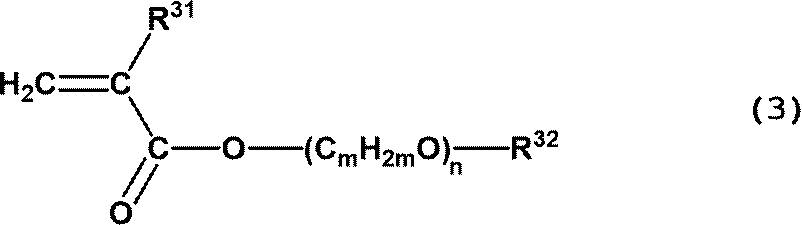
[式(3)中、R31は水素原子又はメチル基を表し、R32は水素原子、炭素数1~4のアルキル基、又は炭素数6~20の芳香族炭化水素基を表し、mは1~4の整数を表し、nは2~20の整数を表す。]
[In formula (3), R 31 represents a hydrogen atom or a methyl group, R 32 represents a hydrogen atom, an alkyl group having 1 to 4 carbon atoms, or an aromatic hydrocarbon group having 6 to 20 carbon atoms, m represents an integer of 1 to 4, and n represents an integer of 2 to 20.]
R31としてはメチル基が好ましく、R32としては炭素数1~4のアルキル基が好ましい。 R 31 is preferably a methyl group, and R 32 is preferably an alkyl group having 1 to 4 carbon atoms.
R32で表される炭素数1~4のアルキル基としては、R1で表される炭素数1~4のアルキル基として説明したものと同様である。
R32で表される炭素数6~20の芳香族炭化水素基としては、1又は2以上の炭素数1~10のアルキル基を有していてもよいフェニル基(ただし、炭素数の合計は20以下)、1又は2以上の炭素数1~10のアルキル基を有していてもよいナフチル基(ただし、炭素数の合計は20以下)等が挙げられる。前記炭素数1~10のアルキル基としては、メチル基、エチル基、プロピル基、イソプロピル基、ブチル基、tert-ブチル基、ペンチル基、ヘキシル基、ヘプチル基、オクチル基、ノニル基、デシル基等が挙げられる。中でも、炭素数4~10のアルキル基が好ましく、ノニル基がより好ましい。
R32としては、水素原子、炭素数1~2のアルキル基、炭素数1~10のアルキル基を有していてもよいフェニル基であることが好ましく、水素原子、メチル基、ノニル基を有していてもよいフェニル基であることがより好ましい。
The alkyl group having 1 to 4 carbon atoms represented by R 32 is the same as that explained for the alkyl group having 1 to 4 carbon atoms represented by R 1 .
Examples of the aromatic hydrocarbon group having 6 to 20 carbon atoms represented by R 32 include a phenyl group which may have one or more alkyl groups having 1 to 10 carbon atoms (provided that the total number of carbon atoms is 20 or less), and a naphthyl group which may have one or more alkyl groups having 1 to 10 carbon atoms (provided that the total number of carbon atoms is 20 or less). Examples of the alkyl group having 1 to 10 carbon atoms include a methyl group, an ethyl group, a propyl group, an isopropyl group, a butyl group, a tert-butyl group, a pentyl group, a hexyl group, a heptyl group, an octyl group, a nonyl group, and a decyl group. Among these, an alkyl group having 4 to 10 carbon atoms is preferable, and a nonyl group is more preferable.
R 32 is preferably a hydrogen atom, an alkyl group having 1 to 2 carbon atoms, or a phenyl group which may have an alkyl group having 1 to 10 carbon atoms, and more preferably a hydrogen atom, a methyl group, or a phenyl group which may have a nonyl group.
式(3)におけるCmH2mで表される構造は、アルキレン基を指し、該アルキレン基は直鎖状であっても分岐鎖状であってもよいが、直鎖状であることが好ましい。なお、式(3)における複数のCmH2mで表される構造は、同一であっても異なっていてもよい。複数のCmH2mで表される構造が異なっている場合、式(3)における-(CmH2mO)n-は、1又は複数の-C2H4O-と、1又は複数の-C3H6O-が任意の順で結合した構造であることが好ましい。 The structure represented by C m H 2m in formula (3) refers to an alkylene group, and the alkylene group may be linear or branched, but is preferably linear. The structures represented by multiple C m H 2m in formula (3) may be the same or different. When the structures represented by multiple C m H 2m are different, -(C m H 2m O) n - in formula (3) is preferably a structure in which one or more -C 2 H 4 O- and one or more -C 3 H 6 O- are bonded in any order.
mは、2~4の整数が好ましく、より好ましくは2又は3、さらに好ましくは2である。 m is preferably an integer from 2 to 4, more preferably 2 or 3, and even more preferably 2.
nは、2~15の整数が好ましく、2~10の整数がより好ましい。 n is preferably an integer from 2 to 15, and more preferably an integer from 2 to 10.
前記態様4の架橋重合体がポリオキシアルキレン基含有エチレン性不飽和単量体に由来する構造単位を含む場合、その含有量は、前記態様4の架橋重合体中、0.1~30質量%であることが好ましく、より好ましくは1~20質量%、さらに好ましくは3~15質量%である。
また、単量体(AB1)に由来する構造単位(特に、式(1)で表される構造単位)100質量部に対する、ポリオキシアルキレン基含有エチレン性不飽和単量体に由来する構造単位の含有量は、0.2~30質量部であることが好ましく、より好ましくは2~20質量部、さらに好ましくは5~16質量部である。
また、前記態様4の架橋重合体中、単量体(AB1)に由来する構造単位、単量体(C)に由来する構造単位、及びポリオキシアルキレン基含有エチレン性不飽和単量体に由来する構造単位の合計含有量(特に、式(1)で表される構造単位、多官能エチレン性不飽和単量体に由来する構造単位、及びポリオキシアルキレン基含有エチレン性不飽和単量体に由来する構造単位の合計含有量)は、60~100質量%であることが好ましく、より好ましくは80~100質量%、さらに好ましくは90~100質量%である。また前記合計含有量の上限は、99.9質量%又は99質量%であってもよい。
When the crosslinked polymer of Aspect 4 contains a structural unit derived from a polyoxyalkylene group-containing ethylenically unsaturated monomer, the content thereof in the crosslinked polymer of Aspect 4 is preferably 0.1 to 30 mass %, more preferably 1 to 20 mass %, and further preferably 3 to 15 mass %.
The content of the structural unit derived from the polyoxyalkylene group-containing ethylenically unsaturated monomer relative to 100 parts by mass of the structural unit derived from the monomer (AB1) (particularly, the structural unit represented by formula (1)) is preferably 0.2 to 30 parts by mass, more preferably 2 to 20 parts by mass, and even more preferably 5 to 16 parts by mass.
In the crosslinked polymer of Aspect 4, the total content of the structural units derived from the monomer (AB1), the structural units derived from the monomer (C), and the structural units derived from the polyoxyalkylene group-containing ethylenically unsaturated monomer (particularly, the total content of the structural units represented by formula (1), the structural units derived from the polyfunctional ethylenically unsaturated monomer, and the structural units derived from the polyoxyalkylene group-containing ethylenically unsaturated monomer) is preferably 60 to 100% by mass, more preferably 80 to 100% by mass, and even more preferably 90 to 100% by mass. The upper limit of the total content may be 99.9% by mass or 99% by mass.
前記態様4の架橋重合体は、単量体(AB1)に由来する構造単位、単量体(C)に由来する構造単位、およびポリオキシアルキレン基含有エチレン性不飽和単量体に由来する構造単位以外の、炭素炭素二重結合含有基などの重合性基を1分子中に1つ有する単量体(以下、「その他の単量体」)に由来する構造単位を1種または2種以上含んでいてもよい。 The crosslinked polymer of the above-mentioned embodiment 4 may contain one or more structural units derived from a monomer having one polymerizable group such as a carbon-carbon double bond-containing group in one molecule (hereinafter referred to as "other monomer") other than the structural units derived from monomer (AB1), the structural units derived from monomer (C), and the structural units derived from the polyoxyalkylene group-containing ethylenically unsaturated monomer.
その他の単量体としては、特に限定されず、(メタ)アクリル系単量体、スチレン系単量体、カルボキシ基含有単量体、カルボキシ基含有単量体の塩、ビニルエステル系単量体、シラン基含有単量体、水酸基含有単量体、窒素原子含有単量体、オキソ基含有単量体、フッ素原子含有単量体、エポキシ基含有単量体、光安定化単量体、紫外線吸収性単量体等が挙げられる。 Other monomers include, but are not limited to, (meth)acrylic monomers, styrene monomers, carboxyl group-containing monomers, salts of carboxyl group-containing monomers, vinyl ester monomers, silane group-containing monomers, hydroxyl group-containing monomers, nitrogen atom-containing monomers, oxo group-containing monomers, fluorine atom-containing monomers, epoxy group-containing monomers, light stabilizing monomers, ultraviolet absorbing monomers, etc.
(メタ)アクリル系単量体としては、メチル(メタ)アクリレート、エチル(メタ)アクリレート、n-プロピル(メタ)アクリレート、イソプロピル(メタ)アクリレート、n-ブチル(メタ)アクリレート、イソブチル(メタ)アクリレート、t-ブチル(メタ)アクリレート、2-エチルヘキシル(メタ)アクリレート、ラウリル(メタ)アクリレート等の(メタ)アクリル酸アルキルエステルが例示され、中でも、(メタ)アクリル酸C1-10アルキルエステルが好ましく、(メタ)アクリル酸C1-5アルキルエステルがより好ましい。 Examples of the (meth)acrylic monomer include (meth)acrylic acid alkyl esters such as methyl (meth)acrylate, ethyl (meth)acrylate, n-propyl (meth)acrylate, isopropyl (meth)acrylate, n-butyl (meth)acrylate, isobutyl (meth)acrylate, t-butyl (meth)acrylate, 2-ethylhexyl (meth)acrylate, and lauryl (meth)acrylate. Among these, (meth)acrylic acid C1-10 alkyl esters are preferred, and (meth)acrylic acid C1-5 alkyl esters are more preferred.
スチレン系単量体としては、ハロゲン原子(例えば、フッ素原子、塩素原子、臭素原子、ヨウ素原子)、アルキル基(例えば、メチル基、エチル基、n-プロピル基、イソプロピル基、n-ブチル基、tert-ブチル基等のC1-4アルキル基)等の置換基を1つ以上有していてもよいスチレンが挙げられる。具体的に、スチレン系単量体としては、スチレン、α-メチルスチレン、p-メチルスチレン、tert-ブチルスチレン、クロロスチレン、ビニルトルエンなどが例示され、中でもスチレンが好ましい。 Examples of the styrene-based monomer include styrene which may have one or more substituents such as a halogen atom (e.g., a fluorine atom, a chlorine atom, a bromine atom, an iodine atom), an alkyl group (e.g., a C1-4 alkyl group such as a methyl group, an ethyl group, an n-propyl group, an isopropyl group, an n-butyl group, a tert-butyl group, etc.), etc. Specific examples of the styrene-based monomer include styrene, α-methylstyrene, p-methylstyrene, tert-butylstyrene, chlorostyrene, vinyltoluene, etc., and among these, styrene is preferable.
カルボキシ基含有単量体としては、(メタ)アクリル酸、クロトン酸等の不飽和モノカルボン酸;マレイン酸、フマル酸、イタコン酸等の不飽和ジカルボン酸;無水マレイン酸等の不飽和ジカルボン酸の無水物;などが例示され、中でも不飽和モノカルボン酸が好ましく、(メタ)アクリル酸がより好ましく、アクリル酸が特に好ましい。 Examples of carboxyl group-containing monomers include unsaturated monocarboxylic acids such as (meth)acrylic acid and crotonic acid; unsaturated dicarboxylic acids such as maleic acid, fumaric acid and itaconic acid; and anhydrides of unsaturated dicarboxylic acids such as maleic anhydride; among these, unsaturated monocarboxylic acids are preferred, (meth)acrylic acid is more preferred, and acrylic acid is particularly preferred.
カルボキシ基含有単量体の塩としては、カルボキシ基含有単量体のアルカリ金属塩、カルボキシ基含有単量体のアンモニウム塩等が挙げられる。なお、カルボキシ基含有単量体の塩において、カルボキシ基含有単量体と塩を形成するアルカリ金属原子やアンモニウムの具体例は、前述のR1で表されるアルカリ金属原子やアンモニウムの例示と同様であり、その好ましい態様も同様である。中でも、アクリル酸の塩が好ましい。 Examples of the salt of the carboxyl group-containing monomer include an alkali metal salt of the carboxyl group-containing monomer and an ammonium salt of the carboxyl group-containing monomer. In the salt of the carboxyl group-containing monomer, specific examples of the alkali metal atom or ammonium that forms a salt with the carboxyl group-containing monomer are the same as the examples of the alkali metal atom or ammonium represented by R1 above, and the preferred embodiments are also the same. Among them, the salt of acrylic acid is preferred.
ビニルエステル系単量体としては、酢酸ビニル、プロピオン酸ビニルなどの飽和脂肪酸とビニルアルコールとのエステルなどが例示され、中でも、C1-5の飽和脂肪酸とビニルアルコールとのエステルが好ましい。 Examples of vinyl ester monomers include esters of saturated fatty acids such as vinyl acetate and vinyl propionate with vinyl alcohol, and among these, esters of C1-5 saturated fatty acids with vinyl alcohol are preferred.
シラン基含有単量体としては、ビニルトリメトキシシラン、ビニルトリエトキシシラン、ビニルトリ(メトキシエトキシ)シラン、γ-(メタ)アクリロイルオキシプロピルトリメトキシシラン、2-スチリルエチルトリメトキシシラン等のアルコキシシリル基含有シランカップリング剤、ビニルトリクロロシラン等のハロゲン化シリル基含有シランカップリング剤、γ-(メタ)アクリロイルオキシプロピルヒドロキシシラン、γ-(メタ)アクリロイルオキシプロピルメチルヒドロキシシラン等のシラノール基含有シランカップリング剤などが例示される。 Examples of silane group-containing monomers include alkoxysilyl group-containing silane coupling agents such as vinyltrimethoxysilane, vinyltriethoxysilane, vinyltri(methoxyethoxy)silane, γ-(meth)acryloyloxypropyltrimethoxysilane, and 2-styrylethyltrimethoxysilane, halogenated silyl group-containing silane coupling agents such as vinyltrichlorosilane, and silanol group-containing silane coupling agents such as γ-(meth)acryloyloxypropylhydroxysilane and γ-(meth)acryloyloxypropylmethylhydroxysilane.
水酸基含有単量体としては、2-ヒドロキシエチル(メタ)アクリレート、2-ヒドロキシプロピル(メタ)アクリレート、3-ヒドロキシプロピル(メタ)アクリレート、2-ヒドロキシブチル(メタ)アクリレート、4-ヒドロキシブチル(メタ)アクリレート等の(メタ)アクリル酸ヒドロキシアルキルエステルが例示され、中でも、(メタ)アクリル酸C1-8ヒドロキシアルキルエステルが好ましく、(メタ)アクリル酸C1-4ヒドロキシアルキルエステルがより好ましい。 Examples of the hydroxyl group-containing monomer include (meth)acrylic acid hydroxyalkyl esters such as 2-hydroxyethyl (meth)acrylate, 2-hydroxypropyl (meth)acrylate, 3-hydroxypropyl (meth)acrylate, 2-hydroxybutyl (meth)acrylate, and 4-hydroxybutyl (meth)acrylate. Among these, (meth)acrylic acid C 1-8 hydroxyalkyl esters are preferred, and (meth)acrylic acid C 1-4 hydroxyalkyl esters are more preferred.
窒素原子含有単量体としては、(メタ)アクリルアミド、N,N-ジメチル(メタ)アクリルアミド、ジメチルアミノエチル(メタ)アクリルアミド、N-ビニルピロリドン、(メタ)アクリロニトリル等が例示される。 Examples of nitrogen atom-containing monomers include (meth)acrylamide, N,N-dimethyl(meth)acrylamide, dimethylaminoethyl(meth)acrylamide, N-vinylpyrrolidone, (meth)acrylonitrile, etc.
オキソ基含有単量体としては、エチレングリコールメトキシ(メタ)アクリレートなどが例示される。 An example of an oxo group-containing monomer is ethylene glycol methoxy(meth)acrylate.
フッ素原子含有単量体としては、トリフルオロエチル(メタ)アクリレート、テトラフルオロプロピル(メタ)アクリレート、オクタフルオロペンチル(メタ)アクリレートなどの(メタ)アクリル酸フッ化アルキルエステルが例示され、中でも、(メタ)アクリル酸C1-10フッ化アルキルエステルが好ましく、(メタ)アクリル酸C1-5フッ化アルキルエステルがより好ましい。 Examples of the fluorine atom-containing monomer include (meth)acrylic acid fluorinated alkyl esters such as trifluoroethyl (meth)acrylate, tetrafluoropropyl (meth)acrylate, and octafluoropentyl (meth)acrylate. Among these, (meth)acrylic acid C1-10 fluorinated alkyl esters are preferred, and (meth)acrylic acid C1-5 fluorinated alkyl esters are more preferred.
エポキシ基含有単量体としては、グリシジル(メタ)アクリレート、2-グリシジルオキシエチル(メタ)アクリレートなどのエポキシ基含有(メタ)アクリレートなどが例示される。 Examples of epoxy group-containing monomers include epoxy group-containing (meth)acrylates such as glycidyl (meth)acrylate and 2-glycidyloxyethyl (meth)acrylate.
光安定化単量体としては、2,2,6,6-テトラメチルピペリジン-4-(メタ)アクリレート、1,2,2,6,6-ペンタメチル-4-ピペリジル(メタ)アクリレート等の2,2,6,6-テトラメチルピペリジン環構造と重合性基(例えば、(メタ)アクリロイル基、ビニル基等のエチレン性不飽和結合含有基)とを有する単量体等が例示される。 Examples of light stabilizing monomers include monomers having a 2,2,6,6-tetramethylpiperidine ring structure and a polymerizable group (e.g., an ethylenically unsaturated bond-containing group such as a (meth)acryloyl group or a vinyl group), such as 2,2,6,6-tetramethylpiperidine-4-(meth)acrylate and 1,2,2,6,6-pentamethyl-4-piperidyl(meth)acrylate.
紫外線吸収性単量体としては、ベンゾトリアゾール系紫外線吸収性単量体、ベンゾフェノン系紫外線吸収性単量体などが例示される。 Examples of ultraviolet absorbing monomers include benzotriazole-based ultraviolet absorbing monomers and benzophenone-based ultraviolet absorbing monomers.
その他単量体としては、(メタ)アクリル系単量体、スチレン系単量体、カルボキシ基含有単量体、カルボキシ基含有単量体の塩、水酸基含有単量体が好ましく、(メタ)アクリル酸アルキルエステル、(メタ)アクリル酸、(メタ)アクリル酸の塩、スチレン系単量体がより好ましく、アクリル酸アルキルエステル、アクリル酸、アクリル酸の塩がさらに好ましく、アクリル酸、アクリル酸の塩が特に好ましい。
特に、アクリル酸由来の構造単位、及びアクリル酸の塩由来の構造単位の合計含有量(特に、アクリル酸の塩由来の構造単位の含有量)は、前記態様4の架橋重合体中、0~40質量%であってもよく、5~20質量%であってもよい。
As the other monomer, a (meth)acrylic monomer, a styrene-based monomer, a carboxy group-containing monomer, a salt of a carboxy group-containing monomer, or a hydroxy group-containing monomer is preferable, a (meth)acrylic acid alkyl ester, (meth)acrylic acid, a salt of (meth)acrylic acid, or a styrene-based monomer is more preferable, an acrylic acid alkyl ester, acrylic acid, or a salt of acrylic acid is further preferable, and acrylic acid or a salt of acrylic acid is particularly preferable.
In particular, the total content of the structural units derived from acrylic acid and the structural units derived from a salt of acrylic acid (in particular, the content of the structural units derived from a salt of acrylic acid) in the crosslinked polymer of Aspect 4 may be 0 to 40% by mass or may be 5 to 20% by mass.
その他単量体に由来する構造単位の含有量は、前記態様4の架橋重合体中、例えば40質量%以下であり、好ましくは30質量%以下、より好ましくは20質量%以下又は10質量%以下、さらに好ましくは5質量%以下又は3質量%以下である。 The content of structural units derived from other monomers in the crosslinked polymer of embodiment 4 is, for example, 40% by mass or less, preferably 30% by mass or less, more preferably 20% by mass or less or 10% by mass or less, and even more preferably 5% by mass or less or 3% by mass or less.
前記重合体粒子は、その全体が前述の架橋重合体で構成されていてもよく、重合体粒子の一部が前述の架橋重合体で構成されていてもよい。すなわち、前記重合体粒子は、単層構造であっても多層構造であってもよい。前記重合体粒子が単層構造の場合は粒子全体が、多層構造の場合は最外殻層が前述の架橋重合体で構成されることが好ましい。このような構成とすることにより、所望の親水特性や滑水性を付与することができる。 The polymer particles may be entirely composed of the crosslinked polymer described above, or part of the polymer particles may be composed of the crosslinked polymer described above. That is, the polymer particles may have a single-layer structure or a multi-layer structure. When the polymer particles have a single-layer structure, it is preferable that the entire particle is composed of the crosslinked polymer described above, and when the polymer particles have a multi-layer structure, it is preferable that the outermost shell layer is composed of the crosslinked polymer described above. By adopting such a structure, it is possible to impart the desired hydrophilic properties and water slip properties.
前記重合体粒子を多層構造、好ましくはコアシェル構造にすることは、親水特性や滑水性をさらに高めることにも有効である。例えば、シェル部などの最外殻層を前記架橋重合体で構成することで粒子としての高い親水性を持たせたり、得られる有形物に滑水性を付与できる一方で、コア部などの内層の親水性を下げると、粒子へ水に対する低溶解特性及び低膨潤性を付与することができ、その結果、得られる塗膜(有形物)の劣化、溶出を抑えることができる。従って、コアシェル構造とすることで、単層の場合よりも高い親水性(特に初期親水性)及び滑水性を持たせることができる。
また室外機やカーエアコン等に用いられる熱交換器のフィン材は、都市媒塵、自動車等の排気ガスに含有されるカーボンブラック等の汚染物質にさらされる場合があり、このような汚染物質の付着は塗膜(有形物)の親水性低下に繋がる。前記重合体粒子をコアシェル構造などの多層構造にすると、塗膜(有形物)表面に付着した汚染物質をより簡単に除去できる傾向にある。
Making the polymer particles into a multi-layer structure, preferably a core-shell structure, is also effective in further enhancing hydrophilicity and water slippage. For example, by making the outermost shell layer such as the shell part from the crosslinked polymer, the particles can be given high hydrophilicity and the resulting tangible object can be given water slippage, while by lowering the hydrophilicity of the inner layer such as the core part, the particles can be given low solubility and low swelling in water, and as a result, the deterioration and elution of the resulting coating film (tangible object) can be suppressed. Therefore, by making the core-shell structure, it is possible to give the particles higher hydrophilicity (especially initial hydrophilicity) and water slippage than in the case of a single layer.
In addition, the fin material of the heat exchanger used in the outdoor unit, the car air conditioner, etc. may be exposed to pollutants such as carbon black contained in the exhaust gas of the automobile, etc., and the adhesion of such pollutants leads to a decrease in the hydrophilicity of the coating film (tangible object). When the polymer particles have a multilayer structure such as a core-shell structure, the pollutants attached to the surface of the coating film (tangible object) tend to be more easily removed.
前記重合体粒子が多層構造である場合、最外殻の層以外(例えばコアシェル粒子である場合は、コア部)を構成する第2重合体は前記架橋重合体と異なることが好ましい。 If the polymer particles have a multi-layer structure, it is preferable that the second polymer constituting layers other than the outermost shell (for example, the core portion in the case of core-shell particles) is different from the cross-linked polymer.
前記第2重合体は、カルボキシ基、水酸基、チオール基、シラノールなどの酸性プロトン含有基、及びアミノ基を有さない非水性単量体から構成される構造単位を1種又は2種以上有することが好ましい。これにより、コア部などの内層の親水性を下げることができる。前記非水性単量体としては、エステル基、エーテル基、アミド基、及びハロゲノ基から選ばれる1種以上を有していてもよい炭化水素から構成される単量体であることが好ましく、エステル基を有していてもよい炭化水素から構成される単量体であることがより好ましい。 The second polymer preferably has one or more structural units composed of a non-aqueous monomer that does not have an acidic proton-containing group such as a carboxy group, a hydroxyl group, a thiol group, or a silanol group, and an amino group. This can reduce the hydrophilicity of the inner layer such as the core portion. The non-aqueous monomer is preferably a monomer composed of a hydrocarbon that may have one or more selected from an ester group, an ether group, an amide group, and a halogeno group, and more preferably a monomer composed of a hydrocarbon that may have an ester group.
前記非水性単量体としては、具体的に、(メタ)アクリル系単量体、スチレン系単量体、ビニルエステル系単量体、オキソ基含有単量体、フッ素原子含有単量体、エポキシ基含有単量体などが挙げられる。これら、(メタ)アクリル系単量体、スチレン系単量体、ビニルエステル系単量体、オキソ基含有単量体、フッ素原子含有単量体、及びエポキシ基含有単量体は、前述の架橋重合体において説明した単量体と同様の単量体が例示され、各々の単量体における好ましい態様も同様である。 Specific examples of the non-aqueous monomer include (meth)acrylic monomers, styrene monomers, vinyl ester monomers, oxo group-containing monomers, fluorine atom-containing monomers, and epoxy group-containing monomers. The (meth)acrylic monomers, styrene monomers, vinyl ester monomers, oxo group-containing monomers, fluorine atom-containing monomers, and epoxy group-containing monomers are the same as the monomers described in the crosslinked polymer above, and the preferred aspects of each monomer are also the same.
前記非水性単量体としては、(メタ)アクリル系単量体、スチレン系単量体が好ましく、より好ましくは(メタ)アクリル酸アルキルエステル、スチレン系単量体であり、さらに好ましくは(メタ)アクリル酸C1-5アルキルエステル、スチレンである。 The non-aqueous monomer is preferably a (meth)acrylic monomer or a styrene monomer, more preferably a (meth)acrylic acid alkyl ester or a styrene monomer, and even more preferably a (meth)acrylic acid C 1-5 alkyl ester or styrene.
非水性単量体に由来する構造単位の含有量は、前記第2重合体中、40~99質量%であることが好ましく、より好ましくは50~90質量%、さらに好ましくは60~80質量%である。 The content of structural units derived from non-aqueous monomers in the second polymer is preferably 40 to 99% by mass, more preferably 50 to 90% by mass, and even more preferably 60 to 80% by mass.
前記第2重合体は、さらに多官能エチレン性不飽和単量体に由来する構造単位を1種又は2種以上有することが好ましい。これにより、塗膜(有形物)表面の初期親水性、親水持続性、及び滑水性をより高める効果が期待できる。前記多官能エチレン性不飽和単量体としては、前記架橋重合体において説明した多官能エチレン性不飽和単量体と同様の単量体が例示され、中でも、炭化水素架橋性単量体、多価(メタ)アクリル酸エステルが好ましく、芳香族炭化水素架橋性単量体、モノ、ジ、又はポリアルキレングリコールの(メタ)アクリル酸ジエステルがより好ましく、ジビニルベンゼンがさらに好ましい。 The second polymer preferably further has one or more structural units derived from a polyfunctional ethylenically unsaturated monomer. This is expected to have the effect of further increasing the initial hydrophilicity, sustained hydrophilicity, and water slippage of the coating film (tangible object) surface. Examples of the polyfunctional ethylenically unsaturated monomer include the same monomers as the polyfunctional ethylenically unsaturated monomers described in the crosslinked polymer. Among them, hydrocarbon crosslinkable monomers and polyvalent (meth)acrylic acid esters are preferred, aromatic hydrocarbon crosslinkable monomers and (meth)acrylic acid diesters of mono-, di-, or polyalkylene glycols are more preferred, and divinylbenzene is even more preferred.
多官能エチレン性不飽和単量体に由来する構造単位の含有量は、前記第2重合体中、1~50質量%であることが好ましく、より好ましくは10~45質量%、さらに好ましくは20~40質量%である。
また、前記第2重合体において、非水性単量体に由来する構造単位100質量部に対する、多官能エチレン性不飽和単量体に由来する構造単位の含有量は、10~70質量部であることが好ましく、より好ましくは20~60質量部、さらに好ましくは20~50質量部である。
また、前記第2重合体中、非水性単量体に由来する構造単位及び多官能エチレン性不飽和単量体に由来する構造単位の合計含有量は、60~100質量%であることが好ましく、より好ましくは80~100質量%、さらに好ましくは90~100質量%である。また前記合計含有量の上限は、99.9質量%又は99質量%であってもよい。
The content of the structural unit derived from the polyfunctional ethylenically unsaturated monomer in the second polymer is preferably 1 to 50% by mass, more preferably 10 to 45% by mass, and further preferably 20 to 40% by mass.
In the second polymer, the content of the structural units derived from the polyfunctional ethylenically unsaturated monomer relative to 100 parts by mass of the structural units derived from the non-aqueous monomer is preferably 10 to 70 parts by mass, more preferably 20 to 60 parts by mass, and even more preferably 20 to 50 parts by mass.
In the second polymer, the total content of the structural units derived from the non-aqueous monomer and the structural units derived from the polyfunctional ethylenically unsaturated monomer is preferably 60 to 100% by mass, more preferably 80 to 100% by mass, and even more preferably 90 to 100% by mass. The upper limit of the total content may be 99.9% by mass or 99% by mass.
前記第2重合体は、前述の単量体(AB1)に由来する構造単位(特に、式(1)で表される構造単位)を1種又は2種以上含んでいてもよいが、含まないことが好ましい。前記第2重合体中、単量体(AB1)に由来する構造単位(特に、式(1)で表される構造単位)の含有量(含有割合)は、前記架橋重合体中における単量体(AB1)に由来する構造単位(特に、式(1)で表される構造単位)の含有量(含有割合)よりも少ないことが好ましく、具体的には10質量%以下が好ましく、より好ましくは5質量%以下である。 The second polymer may contain one or more structural units derived from the above-mentioned monomer (AB1) (particularly, the structural unit represented by formula (1)), but preferably does not contain any. In the second polymer, the content (content ratio) of the structural unit derived from the monomer (AB1) (particularly, the structural unit represented by formula (1)) is preferably less than the content (content ratio) of the structural unit derived from the monomer (AB1) (particularly, the structural unit represented by formula (1)) in the crosslinked polymer, specifically, 10% by mass or less is preferable, and 5% by mass or less is more preferable.
前記第2重合体は、非水性単量体に由来する構造単位、多官能エチレン性不飽和単量体に由来する構造単位、及び単量体(AB1)に由来する構造単位以外の、炭素炭素二重結合含有基などの重合性基を1分子中に1つ有する単量体(以下、「第2のその他の単量体」)に由来する構造単位を1種または2種以上含んでいてもよい。 The second polymer may contain one or more structural units derived from a monomer having one polymerizable group, such as a carbon-carbon double bond-containing group, in one molecule other than the structural units derived from a non-aqueous monomer, the structural units derived from a polyfunctional ethylenically unsaturated monomer, and the structural units derived from the monomer (AB1) (hereinafter, "second other monomer").
第2のその他単量体としては、カルボキシ基、チオール基、シラノール基、アミノ基などを有する単量体が挙げられ、例えば、カルボキシ基含有単量体、シラン基含有単量体、水酸基含有単量体、窒素原子含有単量体、光安定化単量体、紫外線吸収性単量体等が挙げられる。これら、カルボキシ基含有単量体、シラン基含有単量体、水酸基含有単量体、窒素原子含有単量体、光安定化単量体、及び紫外線吸収性単量体は、前述の架橋重合体において説明した単量体と同様の単量体が例示され、各々の単量体における好ましい態様も同様である。 The second other monomer may be a monomer having a carboxy group, a thiol group, a silanol group, an amino group, or the like, such as a carboxy group-containing monomer, a silane group-containing monomer, a hydroxyl group-containing monomer, a nitrogen atom-containing monomer, a light stabilizing monomer, or an ultraviolet absorbing monomer. Examples of the carboxy group-containing monomer, the silane group-containing monomer, the hydroxyl group-containing monomer, the nitrogen atom-containing monomer, the light stabilizing monomer, and the ultraviolet absorbing monomer are the same as the monomers described in the crosslinked polymer described above, and the preferred aspects of each monomer are also the same.
第2のその他単量体に由来する構造単位の含有量は、前記第2重合体中、30質量%以下であることが好ましく、より好ましくは10質量%以下、さらに好ましくは5質量%以下又は3質量%以下である。 The content of structural units derived from the second other monomer in the second polymer is preferably 30% by mass or less, more preferably 10% by mass or less, and even more preferably 5% by mass or less or 3% by mass or less.
前記重合体粒子の体積平均粒子径は、例えば10nm~10μmであり、10nm~5μmであることが好ましく、20nm~1μmであることがより好ましく、30nm~500nmであることがさらに好ましい。油汚れ付着後の親水性をより高める観点からは、10nm~500nmであることが好ましく、15nm~300nmであることがより好ましく、20nm~100nmであることがさらに好ましい。なお、体積平均粒子径は、たとえば動的光散乱法により測定することができる。 The volume average particle diameter of the polymer particles is, for example, 10 nm to 10 μm, preferably 10 nm to 5 μm, more preferably 20 nm to 1 μm, and even more preferably 30 nm to 500 nm. From the viewpoint of further increasing hydrophilicity after adhesion of oil stains, it is preferably 10 nm to 500 nm, more preferably 15 nm to 300 nm, and even more preferably 20 nm to 100 nm. The volume average particle diameter can be measured, for example, by dynamic light scattering.
<重合体粒子の製造方法>
前記重合体粒子の製造方法は、特に限定されず、従来公知の方法を採用すればよいが、重合体粒子を構成する単量体(以下、これらをまとめて「原料単量体成分」という場合がある)を水系溶媒中で重合し、必要に応じ、部分的に又は完全に加水分解することにより製造することが好ましい。例えば、態様4の架橋重合体を含む重合体粒子を製造する場合、原料単量体成分である、式(2)で表されるヒドロキシメチルアクリル酸系単量体のうちR1が炭素数1~4のアルキル基であるもの(以下、ヒドロキシメチルアクリル酸エステルという)と、多官能エチレン性不飽和単量体と、必要に応じて用いられるポリオキシアルキレン基含有エチレン性不飽和単量体、その他単量体、非水性単量体、及び第2のその他の単量体を水系溶媒中で重合し、必要に応じ、部分的に又は完全に加水分解することにより製造することが好ましい。ヒドロキシメチルアクリル酸エステルを用いることで、有機溶媒を必須としない水系溶媒中で重合しても、生成物を粒子状にできるため、環境負荷低減の観点から好ましい。
<Method of producing polymer particles>
The method for producing the polymer particles is not particularly limited, and a conventionally known method may be adopted, but it is preferable to produce the polymer particles by polymerizing the monomers constituting the polymer particles (hereinafter, these may be collectively referred to as "raw monomer components") in an aqueous solvent, and partially or completely hydrolyzing them as necessary. For example, when producing polymer particles containing the crosslinked polymer of embodiment 4, it is preferable to produce the polymer particles by polymerizing the raw monomer components, which are hydroxymethylacrylic acid monomers represented by formula (2) in which R 1 is an alkyl group having 1 to 4 carbon atoms (hereinafter, referred to as hydroxymethylacrylic acid ester), a polyfunctional ethylenically unsaturated monomer, a polyoxyalkylene group-containing ethylenically unsaturated monomer used as required, other monomers, non-aqueous monomers, and a second other monomer, in an aqueous solvent, and partially or completely hydrolyzing them as required. By using a hydroxymethylacrylic acid ester, the product can be made into a particulate form even when polymerized in an aqueous solvent that does not require an organic solvent, which is preferable from the viewpoint of reducing environmental load.
重合方法としては、懸濁重合、乳化重合、分散重合等が挙げられる。中でも、乳化剤の存在下、上記原料単量体成分を水系溶媒に分散させて(ラジカル)重合反応を行う乳化重合が好ましい。乳化重合は、1段階のみで行ってもよく多段階で行ってもよい。例えば、1段階目に非水性単量体と、必要に応じて用いられる多官能エチレン性不飽和単量体、単量体(AB)(特に、式(2)で表される単量体)、及び第2のその他の単量体とを水系溶媒中で重合してコア(すなわち上記第2重合体)となるシード粒子を合成してから、2段階目に上記架橋重合体を構成する単量体(好ましくは、ヒドロキシメチルアクリル酸エステルと、多官能エチレン性不飽和単量体と、必要に応じて用いられるポリオキシアルキレン基含有エチレン性不飽和単量体及びその他単量体)とを重合してシェル(すなわち上記架橋重合体)を合成することで、コアシェル構造を有する重合体粒子を製造することができる。 Polymerization methods include suspension polymerization, emulsion polymerization, dispersion polymerization, etc. Among them, emulsion polymerization is preferred in which the raw material monomer components are dispersed in an aqueous solvent in the presence of an emulsifier and a (radical) polymerization reaction is carried out. Emulsion polymerization may be carried out in only one stage or in multiple stages. For example, in the first stage, a non-aqueous monomer, a polyfunctional ethylenically unsaturated monomer used as needed, a monomer (AB) (particularly a monomer represented by formula (2)), and a second other monomer are polymerized in an aqueous solvent to synthesize seed particles that become the core (i.e., the second polymer), and then in the second stage, monomers that constitute the crosslinked polymer (preferably hydroxymethyl acrylic acid ester, a polyfunctional ethylenically unsaturated monomer, and a polyoxyalkylene group-containing ethylenically unsaturated monomer and other monomers used as needed) are polymerized to synthesize a shell (i.e., the crosslinked polymer), thereby producing polymer particles having a core-shell structure.
前記乳化剤としては、1種又は2種以上を用いることができ、ラジカル重合可能な重合性基を分子中に有さない非反応型界面活性剤であっても、ラジカル重合可能な重合性基(例えばエチレン性不飽和基)を分子中に有する反応型界面活性剤であってもよい。 The emulsifier may be one or more kinds, and may be a non-reactive surfactant that does not have a radically polymerizable group in the molecule, or a reactive surfactant that has a radically polymerizable group (e.g., an ethylenically unsaturated group) in the molecule.
非反応型界面活性剤には、アニオン性、ノニオン性の界面活性剤が包含される。非反応型アニオン性界面活性剤としては、脂肪酸塩、アルキル(アリール)スルホン酸塩、アルキル硫酸エステル塩、ポリオキシエチレンアルキル(フェニル)エーテル硫酸塩等が挙げられ、非反応型ノニオン性界面活性剤としては、ポリオキシエチレンアルキル(フェニル)エーテル、ポリオキシエチレンソルビタン脂肪酸エステル、ポリオキシエチレン脂肪酸エステル、ポリオキシエチレンポリオキシプロピレンブロックポリマー等が挙げられる。 Non-reactive surfactants include anionic and non-ionic surfactants. Examples of non-reactive anionic surfactants include fatty acid salts, alkyl (aryl) sulfonates, alkyl sulfate ester salts, polyoxyethylene alkyl (phenyl) ether sulfate salts, etc., and examples of non-reactive nonionic surfactants include polyoxyethylene alkyl (phenyl) ethers, polyoxyethylene sorbitan fatty acid esters, polyoxyethylene fatty acid esters, polyoxyethylene polyoxypropylene block polymers, etc.
反応型界面活性剤には、アニオン性、ノニオン性の界面活性剤が包含される。アニオン性反応型界面活性剤としては、エーテルサルフェート型反応型界面活性剤、リン酸エステル系反応型界面活性剤が挙げられるが、これに限定されない。 Reactive surfactants include anionic and nonionic surfactants. Anionic reactive surfactants include, but are not limited to, ether sulfate reactive surfactants and phosphate ester reactive surfactants.
乳化剤の使用量は、原料単量体成分の合計100質量部に対して、0.05~20質量部であることが好ましく、より好ましくは0.1~10質量部、さらに好ましくは0.2~5質量部、特に好ましくは0.3~3質量部である。 The amount of emulsifier used is preferably 0.05 to 20 parts by mass, more preferably 0.1 to 10 parts by mass, even more preferably 0.2 to 5 parts by mass, and particularly preferably 0.3 to 3 parts by mass, per 100 parts by mass of the total raw monomer components.
前記水系溶媒とは、水単独、または水と水混和性有機溶媒との混合溶媒が挙げられる。水系溶媒とは、典型的には、水の含有量が50体積%を超える溶媒を指す。水としては、イオン交換水(脱イオン水)、蒸留水、純水等を用いることができる。水混和性有機溶媒としては、水と均一に混合し得る有機溶媒(例えば、C1-4アルキルアルコール等の低級アルコール)を用いることができる。重合体粒子中に水混和性有機溶媒が極力残存しないようにする観点から、水系溶媒の80体積%以上が水である水系溶媒が好ましく、水系溶媒の90体積%以上が水である水系溶媒がより好ましく、水系溶媒の95体積%以上が水である水系溶媒がさらに好ましく、実質的に水からなる水系溶媒(99.5体積%以上が水である水系溶媒)が特に好ましく、水単独であることが最も好ましい。 The aqueous solvent may be water alone or a mixture of water and a water-miscible organic solvent. The aqueous solvent typically refers to a solvent having a water content of more than 50% by volume. As the water, ion-exchanged water (deionized water), distilled water, pure water, etc. can be used. As the water-miscible organic solvent, an organic solvent that can be mixed uniformly with water (for example, a lower alcohol such as a C 1-4 alkyl alcohol) can be used. From the viewpoint of minimizing the amount of water-miscible organic solvent remaining in the polymer particles, an aqueous solvent in which 80% by volume or more of the aqueous solvent is water is preferred, an aqueous solvent in which 90% by volume or more of the aqueous solvent is water is more preferred, an aqueous solvent in which 95% by volume or more of the aqueous solvent is water is even more preferred, an aqueous solvent substantially composed of water (an aqueous solvent in which 99.5% by volume or more of water) is particularly preferred, and water alone is most preferred.
原料単量体成分を重合する際には、例えば、重合開始剤、紫外線や放射線の照射、熱の印加等の手段が用いられ、重合開始剤を使用することが好ましく、原料単量体成分を効率よく反応させ、残存するモノマーを十分に低減させる観点から、酸化剤及び還元剤を組み合わせた重合開始剤(レドックス型重合開始剤)が好ましい。前記酸化剤としては、過硫酸アンモニウム、過硫酸カリウムなどの過硫酸塩、過酸化水素、ベンゾイルパーオキサイド、パラクロロベンゾイルパーオキサイド、ラウロイルパーオキサイド、過酸化アンモニウムなどの過酸化物系重合開始剤などが挙げられる。前記還元剤としては、可溶性亜硫酸塩やアスコルビン酸等が挙げられる。 When polymerizing the raw monomer components, for example, a polymerization initiator, irradiation with ultraviolet rays or radiation, application of heat, etc. are used. It is preferable to use a polymerization initiator, and from the viewpoint of efficiently reacting the raw monomer components and sufficiently reducing the remaining monomer, a polymerization initiator combining an oxidizing agent and a reducing agent (redox type polymerization initiator) is preferable. Examples of the oxidizing agent include persulfates such as ammonium persulfate and potassium persulfate, and peroxide-based polymerization initiators such as hydrogen peroxide, benzoyl peroxide, parachlorobenzoyl peroxide, lauroyl peroxide, and ammonium peroxide. Examples of the reducing agent include soluble sulfites and ascorbic acid.
上記乳化重合における反応系内には、必要により、例えば、連鎖移動剤、pH緩衝剤、キレート剤などの添加剤を適量で添加してもよい。添加剤の量は、その種類によって異なるので一概には決定することができないが、通常、原料単量体成分100質量部に対し、好ましくは0.01~5質量部、より好ましくは0.1~3質量部である。 If necessary, additives such as chain transfer agents, pH buffers, and chelating agents may be added in appropriate amounts to the reaction system in the above emulsion polymerization. The amount of additive varies depending on the type and cannot be determined in general, but is usually preferably 0.01 to 5 parts by mass, and more preferably 0.1 to 3 parts by mass, per 100 parts by mass of the raw material monomer components.
重合体粒子の加水分解は、例えば、水酸化ナトリウム水溶液等のアルカリ金属水酸化物の水溶液、シクロヘキシルアミン水溶液等のアミンの水溶液、アンモニア水溶液等の塩基性物質含有水溶液を添加することで加水分解を行うことができる。さらに、加水分解後の溶液に適宜酸を添加することで、部分中和又は完全中和を行うことができる。加水分解及び中和を行うことで、重合体粒子に含まれる-COOR基におけるRに該当する基(特に、式(1)のR1に該当する基)を水素原子、アルカリ金属原子、またはアンモニウムにできる。重合時、加水分解時、及び中和時に用いる酸や塩基の量を調整したり、R(特に、R1)が水素原子である単量体単位の割合を調整することで、重合体のpHや親水性を調整することができ、親水性塗膜等の有形物の親水持続性や滑水性をより高める傾向にある。
本開示の重合体粒子の加水分解率は、親水特性や滑水性をより高める観点から、例えば20~100%、好ましくは40~100%、より好ましくは50~100%である。また、前記加水分解率は、95%以下であってもよく、90%以下であってもよい。なお、加水分解率は、架橋重合体に含まれる加水分解し得る単量体由来の構造単位100モル%に対して添加した塩基性物質の添加量(物質量)により算出することができる。加水分解し得る単量体としては、アクリル酸アルキルエステル等のアクリル系単量体、一般式(2)で表される単量体等が挙げられる。なお重合体から加水分解率を逆算する場合は、アクリル系単量体及び式(2)で表される単量体等の加水分解し得る単量体においてカルボン酸基の全てがエステルとして存在していたと仮定して、加水分解率を計算することができる。
The hydrolysis of the polymer particles can be carried out by adding an aqueous solution of an alkali metal hydroxide such as an aqueous solution of sodium hydroxide, an aqueous solution of an amine such as an aqueous solution of cyclohexylamine, or an aqueous solution containing a basic substance such as an aqueous solution of ammonia. Furthermore, partial or complete neutralization can be carried out by adding an appropriate acid to the solution after hydrolysis. By carrying out hydrolysis and neutralization, the group corresponding to R in the -COOR group contained in the polymer particles (particularly, the group corresponding to R 1 in formula (1)) can be converted to a hydrogen atom, an alkali metal atom, or ammonium. By adjusting the amount of acid or base used during polymerization, hydrolysis, and neutralization, or by adjusting the proportion of monomer units in which R (particularly R 1 ) is a hydrogen atom, the pH and hydrophilicity of the polymer can be adjusted, which tends to further increase the hydrophilicity sustainability and water slippage of tangible objects such as hydrophilic coating films.
The hydrolysis rate of the polymer particles of the present disclosure is, for example, 20 to 100%, preferably 40 to 100%, more preferably 50 to 100%, from the viewpoint of further enhancing hydrophilic properties and water sliding properties. The hydrolysis rate may be 95% or less, or may be 90% or less. The hydrolysis rate can be calculated from the amount (amount of substance) of the basic substance added to 100 mol% of the structural unit derived from the hydrolyzable monomer contained in the crosslinked polymer. Examples of the hydrolyzable monomer include acrylic monomers such as acrylic acid alkyl esters, and monomers represented by general formula (2). When calculating the hydrolysis rate backward from the polymer, the hydrolysis rate can be calculated by assuming that all of the carboxylic acid groups in the hydrolyzable monomers such as the acrylic monomers and the monomers represented by formula (2) are present as esters.
本発明の親水性持続効果及び/又は滑水性付与剤は、前記重合体粒子を必須に含む。本発明の親水性持続効果及び/又は滑水性付与剤における前記重合体粒子の含有量は、例えば0.01質量%以上、好ましくは10質量%以上、より好ましくは30質量%以上、さらに好ましくは50質量%以上、よりさらに好ましくは90質量%以上、特に好ましくは98質量%以上であり、また100質量%であってもよく、99.8質量%以下であってもよい。 The agent for imparting hydrophilicity sustaining effect and/or water slipping property of the present invention essentially contains the polymer particles. The content of the polymer particles in the agent for imparting hydrophilicity sustaining effect and/or water slipping property of the present invention is, for example, 0.01% by mass or more, preferably 10% by mass or more, more preferably 30% by mass or more, even more preferably 50% by mass or more, even more preferably 90% by mass or more, particularly preferably 98% by mass or more, and may be 100% by mass or 99.8% by mass or less.
本発明の親水性持続効果及び/又は滑水性付与剤は、前記重合体粒子以外の成分を含んでいてもよい。前記重合体粒子以外の成分としては、特に制限されないが、水系溶媒などの溶媒が例示される。 The hydrophilicity sustaining effect and/or water slipping agent of the present invention may contain components other than the polymer particles. Examples of components other than the polymer particles include, but are not limited to, solvents such as aqueous solvents.
前述の重合体粒子を用いることで、前記塗膜に代表される有形物に親水持続性を付与することができ、すなわち得られる有形物を持続的に親水化することができる。また、前述の重合体粒子を用いることで、前記塗膜に代表される有形物に親水性とともに滑水性を付与することができ、すなわち得られる有形物に親水化を施すだけでなく、滑水化を施すことができる。たとえば熱交換器におけるフィン材表面に親水持続性を有する有形物を形成することで、凝結水によるフィン間のブリッジを長期的に抑制することが可能となる。また、熱交換器におけるフィン材表面に親水性とともに滑水性を有する有形物が形成されることで、フィン材表面に撥水性を付与することで滑水性を高める技術を採用するよりもフィン間のブリッジを抑制することが可能となる。
前記有形物は、前述の重合体粒子を含有する組成物(すなわち、親水性持続効果及び/又は滑水性付与剤を含有する組成物)から製造することが好ましい。以下、前記組成物及び有形物について順に説明する。
By using the above-mentioned polymer particles, it is possible to impart sustained hydrophilicity to the tangible object, such as the coating film, i.e., the obtained tangible object can be made hydrophilic for a sustained period of time. In addition, by using the above-mentioned polymer particles, it is possible to impart hydrophilicity and water-slipping properties to the tangible object, such as the coating film, i.e., the obtained tangible object can be made hydrophilic as well as water-slipping. For example, by forming a tangible object having sustained hydrophilicity on the surface of the fin material in a heat exchanger, it is possible to suppress bridges between fins caused by condensed water for a long period of time. In addition, by forming a tangible object having both hydrophilicity and water-slipping properties on the surface of the fin material in a heat exchanger, it is possible to suppress bridges between fins more effectively than by adopting a technology that increases water-slippage by imparting water repellency to the surface of the fin material.
The shaped object is preferably produced from a composition containing the above-mentioned polymer particles (i.e., a composition containing an agent for imparting hydrophilicity sustaining effect and/or water slipping). The composition and the shaped object will be described below in order.
2.組成物
本発明の組成物は、前述の重合体粒子を含有し、すなわち前述の親水性持続効果及び/又は滑水性付与剤を含有する。組成物における前記親水性持続効果及び/又は滑水性付与剤の固形分(好ましくは前記重合体粒子)の含有量は特に限定されないが、組成物の固形分100質量%中、例えば1~80質量%であり、好ましくは5~50質量%、より好ましくは8~30質量%である。
The composition of the present invention contains the above-mentioned polymer particles, i.e., contains the above-mentioned agent for imparting hydrophilicity sustaining effect and/or water slipping property. The content of the solid content of the agent for imparting hydrophilicity sustaining effect and/or water slipping property (preferably the above-mentioned polymer particles) in the composition is not particularly limited, but is, for example, 1 to 80 mass%, preferably 5 to 50 mass%, and more preferably 8 to 30 mass%, relative to 100 mass% of the solid content of the composition.
前記組成物は、さらに前記重合体粒子とは異なる樹脂を有することが好ましい。以下、親水性持続効果及び/又は滑水性付与剤と樹脂とを含有する組成物を、樹脂組成物という場合がある。本発明において、樹脂組成物及び有形物は、後述する様に種々のものが含まれるが、ここでは親水性持続効果及び/又は滑水性付与剤と親水性樹脂とを含有する樹脂組成物を用いて親水性塗膜を形成する場合について説明する。 The composition preferably further contains a resin different from the polymer particles. Hereinafter, a composition containing a hydrophilicity sustaining effect and/or water slipping agent and a resin may be referred to as a resin composition. In the present invention, various resin compositions and tangible objects are included as described below, but here, a case where a hydrophilic coating film is formed using a resin composition containing a hydrophilicity sustaining effect and/or water slipping agent and a hydrophilic resin will be described.
前記親水性樹脂としては、特に限定されないが、カルボキシ基、カルボキシ基の塩、ヒドロキシ基、スルホン酸基、アミド基、アミノ基等の極性官能基を側鎖に有する樹脂、主鎖にポリエーテル骨格及び/又はポリアミン骨格を有する樹脂が好ましく、極性官能基を側鎖に有する樹脂がより好ましい。 The hydrophilic resin is not particularly limited, but is preferably a resin having a polar functional group such as a carboxy group, a salt of a carboxy group, a hydroxy group, a sulfonic acid group, an amide group, or an amino group on the side chain, or a resin having a polyether skeleton and/or a polyamine skeleton on the main chain, and more preferably a resin having a polar functional group on the side chain.
極性官能基を側鎖に有する樹脂は、前記極性官能基を1種単独で有していてもよく、2種以上を有していてもよい。なお、本明細書において「カルボキシ基の塩」とは、カルボキシ基(-COOH)に含まれている水素イオンを、1価の陽イオンで置換した官能基のことをいい、好ましくは-COORa(Raは、アルカリ金属原子、又はアンモニウムを表す)である。Raで表されるアルカリ金属原子及びアンモニウムとしては、前述の式(1)におけるR1で表されるアルカリ金属原子及びアンモニウムと同様である。中でも、Raとしては、アルカリ金属原子、ヒドロキシアルキルアンモニウムが好ましく、アルカリ金属原子、モノ、ジ又はトリ(ヒドロキシC1-10アルキル)アンモニウムがより好ましく、ナトリウム、モノ(ヒドロキシC1-5アルキル)アンモニウムがさらに好ましい。
前記極性官能基としては、カルボキシ基、カルボキシ基の塩が好ましく、カルボキシ基、カルボキシ基のアルカリ金属塩がより好ましく、カルボキシ基、カルボキシ基のナトリウム塩がさらに好ましい。
The resin having a polar functional group in a side chain may have one type of polar functional group alone or two or more types. In this specification, the term "salt of a carboxy group" refers to a functional group in which a hydrogen ion contained in a carboxy group (-COOH) is replaced with a monovalent cation, and is preferably -COOR a (R a represents an alkali metal atom or ammonium). The alkali metal atom and ammonium represented by R a are the same as the alkali metal atom and ammonium represented by R 1 in the above formula (1). Among them, R a is preferably an alkali metal atom or hydroxyalkylammonium, more preferably an alkali metal atom or mono-, di- or tri-(hydroxyC 1-10 alkyl)ammonium, and even more preferably sodium or mono(hydroxyC 1-5 alkyl)ammonium.
The polar functional group is preferably a carboxy group or a salt of a carboxy group, more preferably a carboxy group or an alkali metal salt of a carboxy group, and further preferably a carboxy group or a sodium salt of a carboxy group.
前記親水性樹脂としては、具体的に、(メタ)アクリル酸の(共)重合体、マレイン酸の(共)重合体等のカルボキシ基含有重合体;(メタ)アクリル酸塩の(共)重合体、マレイン酸塩の(共)重合体等のカルボキシ基の塩含有重合体;ヒドロキシ(メタ)アクリレートの(共)重合体、ポリビニルアルコールの(共)重合体等のヒドロキシ基含有重合体;2-アクリルアミド-2-メチルプロパンスルホン酸の(共)重合体等のスルホン酸基含有重合体;アクリルアミドの(共)重合体、N-ビニル-2-ピロリドンの(共)重合体等のアミド基含有重合体;ジエチルアミノエチル(メタ)アクリレートの(共)重合体等のアミノ基含有重合体;ポリエチレングリコール等のポリエーテル系(共)重合体等;ポリエチレンイミン等のポリアミン系(共)重合体;等が例示される。なお、(共)重合体とは、ホモポリマーである重合体およびコポリマーである共重合体のいずれであってもよいことを表す。なお、前記親水性樹脂としては、熱可塑性樹脂であってもよく、熱硬化性樹脂であってもよいが、熱硬化性樹脂であることが好ましい。熱硬化性樹脂は機械的強度や耐熱性に優れているため、上記親水性樹脂として熱硬化性樹脂を用いることで、得られる有形物の表面の凹凸形状が維持されやすく、親水特性や滑水性の向上効果がより高められる傾向にある。前記親水性樹脂は、1種単独で用いてもよく、2種以上を併用してもよい。 Specific examples of the hydrophilic resin include carboxyl group-containing polymers such as (co)polymers of (meth)acrylic acid and (co)polymers of maleic acid; carboxyl group salt-containing polymers such as (co)polymers of (meth)acrylic acid salts and (co)polymers of maleic acid salts; hydroxyl group-containing polymers such as (co)polymers of hydroxy(meth)acrylate and (co)polymers of polyvinyl alcohol; sulfonic acid group-containing polymers such as (co)polymers of 2-acrylamido-2-methylpropanesulfonic acid; amide group-containing polymers such as (co)polymers of acrylamide and (co)polymers of N-vinyl-2-pyrrolidone; amino group-containing polymers such as (co)polymers of diethylaminoethyl(meth)acrylate; polyether-based (co)polymers such as polyethylene glycol; polyamine-based (co)polymers such as polyethyleneimine; and the like. The (co)polymer may be either a homopolymer or a copolymer. The hydrophilic resin may be a thermoplastic resin or a thermosetting resin, but is preferably a thermosetting resin. Since thermosetting resins have excellent mechanical strength and heat resistance, by using a thermosetting resin as the hydrophilic resin, the uneven shape of the surface of the resulting tangible object tends to be maintained, and the effect of improving the hydrophilic properties and water slippage tends to be further enhanced. The hydrophilic resins may be used alone or in combination of two or more types.
特に、上記親水性持続効果及び/又は滑水性付与剤の効果(得られる有形物の親水特性や滑水性の向上効果)をより高める観点から、前記親水性樹脂としては、カルボキシ基及びカルボキシ基の塩よりなる群から選択される少なくとも1種の極性官能基を側鎖に有する樹脂であることがより好ましく、(メタ)アクリル酸(塩)の(共)重合体がさらに好ましい。なお、(メタ)アクリル酸(塩)は、(メタ)アクリル酸及び/又は(メタ)アクリル酸の塩を指し、(メタ)アクリル酸(塩)の共重合体は、(メタ)アクリル酸(塩)とその他の共重合単量体とのコポリマーを指す。その他の共重合単量体としては、上記重合体粒子を構成するその他単量体のうち、(メタ)アクリル酸を除く単量体や多官能エチレン性不飽和単量体が例示される。中でも、(メタ)アクリル系単量体、スチレン系単量体、水酸基含有単量体が好ましく、(メタ)アクリル酸アルキルエステル、スチレン系単量体がより好ましい。その他の共重合単量体は1種単独で用いてもよく、2種以上を併用してもよい。 In particular, from the viewpoint of further enhancing the hydrophilicity sustaining effect and/or the effect of the water slipping agent (the effect of improving the hydrophilic properties and water slipping of the resulting tangible object), the hydrophilic resin is more preferably a resin having at least one polar functional group selected from the group consisting of a carboxy group and a salt of a carboxy group in the side chain, and is even more preferably a (co)polymer of (meth)acrylic acid (salt). Note that (meth)acrylic acid (salt) refers to (meth)acrylic acid and/or a salt of (meth)acrylic acid, and a copolymer of (meth)acrylic acid (salt) refers to a copolymer of (meth)acrylic acid (salt) and other copolymerizing monomers. Examples of other copolymerizing monomers include monomers other than (meth)acrylic acid and polyfunctional ethylenically unsaturated monomers among the other monomers constituting the polymer particles. Among them, (meth)acrylic monomers, styrene-based monomers, and hydroxyl group-containing monomers are preferred, and (meth)acrylic acid alkyl esters and styrene-based monomers are more preferred. The other copolymerizable monomers may be used alone or in combination of two or more.
(メタ)アクリル酸(塩)の(共)重合体中、(メタ)アクリル酸及び(メタ)アクリル酸の塩由来の構造単位の合計割合(特に、(メタ)アクリル酸の塩由来の構造単位の割合)は、例えば30質量%以上、好ましくは50質量%以上、より好ましくは70質量%以上、さらに好ましくは90質量%以上であり、100質量%であってもよい。 In the (co)polymer of (meth)acrylic acid (salt), the total proportion of structural units derived from (meth)acrylic acid and salts of (meth)acrylic acid (particularly the proportion of structural units derived from salts of (meth)acrylic acid) is, for example, 30% by mass or more, preferably 50% by mass or more, more preferably 70% by mass or more, even more preferably 90% by mass or more, and may be 100% by mass.
前記樹脂組成物における、前記親水性持続効果及び/又は滑水性付与剤の固形分(好ましくは前記重合体粒子)の含有量としては、特に制限はないが、親水性樹脂100質量部に対して、0.1質量部以上であることが好ましく、より好ましくは5質量部以上、さらに好ましくは15質量部以上である。前記範囲とすることにより、親水性塗膜の親水性持続効果及び/又は滑水性がより向上する傾向にある。特に、親水性塗膜の滑水性をさらに高める観点からは、前記親水性持続効果及び/又は滑水性付与剤の固形分(好ましくは前記重合体粒子)の含有量は、親水性樹脂100質量部に対して、40質量部以上であることが好ましく、より好ましくは60質量部以上、さらに好ましくは80質量部以上である。
前記含有量の上限としては、特に制限はないが、親水性樹脂100質量部に対して、200質量部以下であることが好ましく、150質量部以下であることがより好ましい。
すなわち、前記含有量は、親水性樹脂100質量部に対して、0.1~200質量部であることが好ましく、より好ましくは5~200質量部、さらに好ましくは15~200質量部、よりさらに好ましくは40~200質量部、特に好ましくは60~200質量部、最も好ましくは80~150質量部である。
The content of the solid content (preferably the polymer particles) of the hydrophilicity sustaining effect and/or water slipping agent in the resin composition is not particularly limited, but is preferably 0.1 parts by mass or more, more preferably 5 parts by mass or more, and even more preferably 15 parts by mass or more, relative to 100 parts by mass of the hydrophilic resin. By setting it within the above range, the hydrophilicity sustaining effect and/or water slipping property of the hydrophilic coating film tends to be further improved. In particular, from the viewpoint of further improving the water slipping property of the hydrophilic coating film, the content of the solid content (preferably the polymer particles) of the hydrophilicity sustaining effect and/or water slipping property of the agent is preferably 40 parts by mass or more, more preferably 60 parts by mass or more, and even more preferably 80 parts by mass or more, relative to 100 parts by mass of the hydrophilic resin.
The upper limit of the content is not particularly limited, but is preferably 200 parts by mass or less, and more preferably 150 parts by mass or less, per 100 parts by mass of the hydrophilic resin.
That is, the content is preferably 0.1 to 200 parts by mass, more preferably 5 to 200 parts by mass, even more preferably 15 to 200 parts by mass, still more preferably 40 to 200 parts by mass, particularly preferably 60 to 200 parts by mass, and most preferably 80 to 150 parts by mass, relative to 100 parts by mass of the hydrophilic resin.
前記親水性樹脂の重量平均分子量は特に限定されないが、例えば1,000~100,000、好ましくは1,500~500,000、より好ましくは2,000~200,000である。 The weight average molecular weight of the hydrophilic resin is not particularly limited, but is, for example, 1,000 to 100,000, preferably 1,500 to 500,000, and more preferably 2,000 to 200,000.
前記組成物(好ましくは樹脂組成物)は、さらに架橋剤を含むことが好ましい。架橋剤を含むことで、親水性塗膜の強度を高めることができる。また、架橋剤を含むことで、親水性塗膜の耐久性が高められ、その結果、親水性持続効果や、後述の実施例に示すようなヒートサイクル後の親水性塗膜の滑水性が高められる。架橋剤は、1種単独で用いてもよく、2種以上を併用してもよい。前記架橋剤としては、前記親水性樹脂が有する極性官能基と反応し得る基を1分子中に2以上有する化合物であることが好ましい。極性官能基と反応し得る基としては、エポキシ基、オキサゾリン基、カルボジイミド基、イソシアネート基等が挙げられ、使用する親水性樹脂によって適宜選択すればよい。例えば、親水性樹脂としてカルボキシ基及びカルボキシ基の塩よりなる群から選択される少なくとも1種の極性官能基を側鎖に有する樹脂(好ましくは、(メタ)アクリル酸(塩)の(共)重合体)を用いる場合には、オキサゾリン基を1分子中に2以上有する架橋剤(以下、オキサゾリン系架橋剤という場合がある)を用いることが好ましく、この組み合わせを採用することで、より上述の耐久性向上効果が高められる傾向にある。 It is preferable that the composition (preferably a resin composition) further contains a crosslinking agent. By containing a crosslinking agent, the strength of the hydrophilic coating film can be increased. Furthermore, by containing a crosslinking agent, the durability of the hydrophilic coating film is increased, and as a result, the hydrophilicity sustaining effect and the water slippage of the hydrophilic coating film after a heat cycle as shown in the examples described later are improved. The crosslinking agent may be used alone or in combination of two or more types. The crosslinking agent is preferably a compound having two or more groups in one molecule that can react with the polar functional group of the hydrophilic resin. Examples of the group that can react with the polar functional group include an epoxy group, an oxazoline group, a carbodiimide group, an isocyanate group, etc., and may be selected appropriately depending on the hydrophilic resin to be used. For example, when using a resin having at least one polar functional group selected from the group consisting of carboxy groups and salts of carboxy groups in the side chain as the hydrophilic resin (preferably a (co)polymer of (meth)acrylic acid (salt)), it is preferable to use a crosslinking agent having two or more oxazoline groups in one molecule (hereinafter, sometimes referred to as an oxazoline-based crosslinking agent), and by employing this combination, the above-mentioned durability improvement effect tends to be further enhanced.
オキサゾリン基を1分子中に2以上有する架橋剤としては、架橋性能に優れる観点から、水溶性のオキサゾリン化合物が好ましく、また、オキサゾリン基含有ポリマーが好ましい。上記オキサゾリン基含有ポリマーは、従来公知の製造方法で製造することができる。例えば、付加重合性オキサゾリンの1種または2種以上、或いは付加重合性オキサゾリンと付加重合性オキサゾリンと共重合可能な単量体を含む単量体成分を重合させる方法が挙げられる。 As a crosslinking agent having two or more oxazoline groups in one molecule, a water-soluble oxazoline compound is preferred from the viewpoint of excellent crosslinking performance, and an oxazoline group-containing polymer is also preferred. The oxazoline group-containing polymer can be produced by a conventionally known production method. For example, a method of polymerizing one or more types of addition polymerizable oxazolines, or a monomer component containing an addition polymerizable oxazoline and a monomer copolymerizable with the addition polymerizable oxazoline can be mentioned.
上記付加重合性オキサゾリンとしては、例えば、2-ビニル-2-オキサゾリン、2-ビニル-4-メチル-2-オキサゾリン、2-ビニル-5-メチル-2-オキサゾリン、2-イソプロペニル-2-オキサゾリン、2-イソプロペニル-4-メチル-2-オキサゾリン、2-イソプロペニル-5-メチル-2-オキサゾリン、2-イソプロペニル-5-エチル-2-オキサゾリンなどの分子内に重合性不飽和基とオキサゾリン基を有する化合物が挙げられる。
付加重合性オキサゾリンと共重合可能な単量体としては、オキサゾリン基と反応する官能基をもたず、付加重合性オキサゾリンと共重合可能な単量体が好ましい。例えば、アルキル(メタ)アクリレート等の(メタ)アクリル系モノマー;スチレン、α-メチルスチレン、クロロメチルスチレン等のスチレン系モノマー;酢酸ビニル、塩化ビニル、安息香酸ビニル等のビニル系モノマー;アクリロニトリル;アクリルアミド等の(メタ)アクリルアミド系モノマー;エチレン、プロピレン等のオレフィン系モノマー;等が挙げられる。
Examples of the addition-polymerizable oxazoline include compounds having a polymerizable unsaturated group and an oxazoline group in the molecule, such as 2-vinyl-2-oxazoline, 2-vinyl-4-methyl-2-oxazoline, 2-vinyl-5-methyl-2-oxazoline, 2-isopropenyl-2-oxazoline, 2-isopropenyl-4-methyl-2-oxazoline, 2-isopropenyl-5-methyl-2-oxazoline, and 2-isopropenyl-5-ethyl-2-oxazoline.
The monomer copolymerizable with the addition-polymerizable oxazoline is preferably a monomer that does not have a functional group that reacts with an oxazoline group and is copolymerizable with the addition-polymerizable oxazoline, such as (meth)acrylic monomers such as alkyl (meth)acrylates, styrene-based monomers such as styrene, α-methylstyrene, and chloromethylstyrene, vinyl-based monomers such as vinyl acetate, vinyl chloride, and vinyl benzoate, acrylonitrile, (meth)acrylamide-based monomers such as acrylamide, and olefin-based monomers such as ethylene and propylene.
オキサゾリン基含有ポリマーの中でも水溶性のオキサゾリン基含有ポリマーが好ましく、上記オキサゾリン基含有ポリマーの製造方法と同様の方法により製造することができる。上記水溶性のオキサゾリン基含有ポリマーとしては、例えば、(メタ)アクリル系樹脂等を主鎖とし、側鎖にオキサゾリン基を含有するポリマーが挙げられる。 Among the oxazoline group-containing polymers, water-soluble oxazoline group-containing polymers are preferred, and can be produced by the same method as the above-mentioned method for producing oxazoline group-containing polymers. Examples of the water-soluble oxazoline group-containing polymers include polymers that have a (meth)acrylic resin or the like as the main chain and contain oxazoline groups in the side chains.
オキサゾリン基含有ポリマーとしては市販品を用いることもできる。例えば、(株)日本触媒製、商品名:エポクロスWS-500、エポクロスWS-700等の水溶性タイプのポリマー、エポクロスK-2010E、エポクロスK-2020E、エポクロスK-2035E等のエマルションタイプのポリマーが挙げられる。 Oxazoline group-containing polymers can also be commercially available products. Examples include water-soluble polymers such as EPOCROS WS-500 and EPOCROS WS-700 manufactured by Nippon Shokubai Co., Ltd., and emulsion-type polymers such as EPOCROS K-2010E, EPOCROS K-2020E, and EPOCROS K-2035E.
前記架橋剤の含有量は、特に限定されるものではないが、前記親水性樹脂100質量部に対し、0.1~50質量部であることが好ましく、1~40質量部であることがより好ましく、5~30質量部であることがさらに好ましい。 The content of the crosslinking agent is not particularly limited, but is preferably 0.1 to 50 parts by mass, more preferably 1 to 40 parts by mass, and even more preferably 5 to 30 parts by mass, relative to 100 parts by mass of the hydrophilic resin.
前記組成物(好ましくは樹脂組成物)の固形分100質量%中、前記親水性持続効果及び/又は滑水性付与剤の固形分(好ましくは前記重合体粒子)、前記親水性樹脂、及び前記架橋剤の合計含有率は、例えば80質量%以上、好ましくは90質量%以上、より好ましくは97質量%以上であり、100質量%であってもよい。 The total content of the solids of the hydrophilicity sustaining effect and/or water slipping agent (preferably the polymer particles), the hydrophilic resin, and the crosslinking agent in 100% by mass of the solids of the composition (preferably the resin composition) is, for example, 80% by mass or more, preferably 90% by mass or more, more preferably 97% by mass or more, and may be 100% by mass.
前記組成物(好ましくは樹脂組成物)は、さらに溶媒を含んでいてもよい。溶媒を含むことで、組成物(好ましくは樹脂組成物)の塗工性が良好となる。溶媒としては環境負荷低減の観点から、水系溶媒が好ましい。前記水系溶媒としては、乳化重合の際に用いられる水系溶媒と同様であり、その好ましい態様も同様である。 The composition (preferably a resin composition) may further contain a solvent. By containing a solvent, the composition (preferably a resin composition) has good coatability. From the viewpoint of reducing the environmental load, the solvent is preferably an aqueous solvent. The aqueous solvent is the same as the aqueous solvent used in emulsion polymerization, and the preferred aspects thereof are also the same.
溶媒の含有量は、前記組成物(好ましくは樹脂組成物)中、0質量%であってもよく、好ましくは0.1質量%以上、より好ましくは40質量%以上、さらに好ましくは60質量%以上、特に好ましくは80質量%以上であり、99.9質量%以下であることが好ましく、99質量%以下であることがより好ましい。すなわち、前記溶媒の含有量は、前記組成物(好ましくは樹脂組成物)中、0~99.9質量%であってもよく、好ましくは0.1~99.9質量%、より好ましくは40~99.9質量%、さらに好ましくは60~99.9質量%、特に好ましくは80~99質量%である。 The content of the solvent in the composition (preferably a resin composition) may be 0% by mass, preferably 0.1% by mass or more, more preferably 40% by mass or more, even more preferably 60% by mass or more, and particularly preferably 80% by mass or more, and is preferably 99.9% by mass or less, and more preferably 99% by mass or less. In other words, the content of the solvent in the composition (preferably a resin composition) may be 0 to 99.9% by mass, preferably 0.1 to 99.9% by mass, more preferably 40 to 99.9% by mass, even more preferably 60 to 99.9% by mass, and particularly preferably 80 to 99% by mass.
前記組成物(好ましくは樹脂組成物)は、本発明の効果を損なわない範囲で、その他添加剤を含むことができる。その他添加剤としては、本技術分野において通常用いられる添加剤を使用することができ、例えば、L-アスコルビン酸、没食子酸、タンニン酸、グルコノ-δ-ラクトン、グルコン酸などの水酸基を有する水溶性の低分子化合物、あるいはポリビニルアルコールなどの水酸基を有する高分子化合物等の水酸基を有する化合物が挙げられる。
前記水酸基を有する水溶性の低分子化合物の分子量は、特に限定されないが、例えば50~2,000であり、好ましくは100~2,000である。
前記水酸基を有する高分子化合物の重量平均分子量は、特に限定されないが、例えば3,000~100,000である。
The composition (preferably a resin composition) may contain other additives within a range that does not impair the effects of the present invention. As the other additives, additives commonly used in this technical field may be used, and examples thereof include water-soluble low molecular weight compounds having a hydroxyl group, such as L-ascorbic acid, gallic acid, tannic acid, glucono-δ-lactone, and gluconic acid, and compounds having a hydroxyl group, such as polymer compounds having a hydroxyl group, such as polyvinyl alcohol.
The molecular weight of the water-soluble low molecular weight compound having a hydroxyl group is not particularly limited, but is, for example, 50 to 2,000, and preferably 100 to 2,000.
The weight average molecular weight of the polymer compound having a hydroxyl group is not particularly limited, but is, for example, 3,000 to 100,000.
前記水酸基を有する化合物としては、以下の要件1~要件4を満たす化合物(A)であることが好ましい。前記組成物(好ましくは樹脂組成物)が前記化合物(A)を含むことにより、得られる有形物の親水持続性がより優れるものとなり易い。なお、化合物(A)による上記親水持続性向上効果は、前記組成物が前述の架橋剤を含む場合により発揮され易く、すなわち、前記化合物(A)は前記架橋剤と組み合わせて用いることが好ましい。特に、前記化合物(A)と前記オキサゾリン系架橋剤とを組み合わせて用いた場合に、上記親水特性向上効果がより高いものとなり易い。
The compound having a hydroxyl group is preferably a compound (A) that satisfies the following
要件1:水溶性である。
要件2:酸解離定数pKaA(温度:室温(25℃)、溶媒:水)が12以下である。
要件3:少なくとも水酸基を1個有し、1分子中に含まれる水酸基およびカルボキシ基の総数が2個以上である。
要件4:酸解離定数pKa(温度:室温(25℃)、溶媒:水)が12以下の水酸基及びカルボキシ基から選択される高酸性度基を少なくとも1個有する。
Requirement 1: Water solubility.
Requirement 2: The acid dissociation constant pKa A (temperature: room temperature (25° C.), solvent: water) is 12 or less.
Requirement 3: The compound has at least one hydroxyl group, and the total number of hydroxyl groups and carboxyl groups contained in one molecule is two or more.
Requirement 4: The compound has at least one highly acidic group selected from a hydroxyl group and a carboxyl group, the acid dissociation constant of which is 12 or less (temperature: room temperature (25° C.), solvent: water).
要件1に記載の通り、前記化合物(A)は水溶性の化合物である。本明細書において、「水溶性」とは、20℃での水溶解度(以下、水溶解度(20℃))が20g/L以上であることを意味し、すなわち前記化合物(A)は、水溶解度(20℃)が20g/L以上であるといえる。本明細書においては、温度20℃の恒温恒湿室において、100ccのスクリュー管中で、イオン交換水50cc(温度:20℃)に化合物Xg(温度:20℃)を添加し、マグネチックスターラー(回転子:長さ10mm×φ4mmを使用)を用いて、5分間攪拌した後、10分間静置した溶液を目視により確認した際、得られた溶液が均一透明となった場合、該化合物の水溶解度(20℃)はYg/L以上である(Y=20X)と判断され、得られた溶液が均一透明とならなかった場合に、該化合物の水溶解度(20℃)はYg/L未満である(Y=20X)と判断される。すなわち、本発明における化合物(A)は、上記水溶解度(20℃)の測定において、1gの化合物を使用した際に、得られる溶液が均一透明となる化合物であるといえる。なお、均一透明とは、目視により相分離が認められず、且つ、白濁が認められないことを意味する。
As described in
要件2における酸解離定数pKaAとは、溶媒として水を用いて、室温(25℃)で測定された値を指す。複数電離する化合物については、第1段階の酸解離定数pKa1を、酸解離定数pKaAとする。前記化合物(A)のpKaAは、11以下であることが好ましく、より好ましくは10以下、さらに好ましくは5以下である。 The acid dissociation constant pKa A in requirement 2 refers to a value measured at room temperature (25° C.) using water as a solvent. For a compound that undergoes multiple ionization, the acid dissociation constant pKa 1 of the first stage is taken as the acid dissociation constant pKa A. The pKa A of the compound (A) is preferably 11 or less, more preferably 10 or less, and even more preferably 5 or less.
要件3に記載の通り、前記化合物(A)は少なくとも1個の水酸基を有する化合物であり、化合物(A)1分子中に含まれる水酸基およびカルボキシ基の総数が2個以上である。すなわち、前記化合物(A)は、水酸基を2個以上有する化合物、或いは、少なくとも1個の水酸基と少なくとも1個のカルボキシ基を有する化合物であるといえる。
前記化合物(A)1分子における、水酸基及びカルボキシ基の総数は、例えば2~30個であり、2~6個が好ましく、3~6個がより好ましい。
As described in requirement 3, the compound (A) is a compound having at least one hydroxyl group, and the total number of hydroxyl groups and carboxyl groups contained in one molecule of the compound (A) is at least 2. That is, the compound (A) can be said to be a compound having two or more hydroxyl groups, or a compound having at least one hydroxyl group and at least one carboxyl group.
The total number of hydroxyl groups and carboxy groups in one molecule of the compound (A) is, for example, 2 to 30, preferably 2 to 6, and more preferably 3 to 6.
要件4に記載の通り、前記化合物(A)は、pKaが12以下の水酸基(以下、水酸基(1)という場合がある)及びカルボキシ基から選択される高酸性度基を少なくとも1個有する。化合物(A)が有する水酸基及びカルボキシ基のうち、少なくとも1つが上記高酸性度基であることにより、前述の架橋剤(好ましくはオキサゾリン系架橋剤)との反応が可能となり、上記化合物(A)による親水持続性の向上効果が得られやすくなる。
前記高酸性度基のpKaは、11以下であることが好ましく、より好ましくは10以下、さらに好ましくは5以下である。
前記化合物(A)1分子が有する前記高酸性度基の個数は、1~3個が好ましく、1個がより好ましい。
As described in requirement 4, the compound (A) has at least one highly acidic group selected from a hydroxyl group (hereinafter sometimes referred to as a hydroxyl group (1)) having a pKa of 12 or less and a carboxy group. When at least one of the hydroxyl group and the carboxy group of the compound (A) is the highly acidic group, the compound (A) can react with the crosslinking agent (preferably an oxazoline-based crosslinking agent), and the compound (A) can easily achieve an effect of improving the sustained hydrophilicity.
The pKa of the highly acidic group is preferably 11 or less, more preferably 10 or less, and further preferably 5 or less.
The number of the highly acidic groups contained in one molecule of the compound (A) is preferably 1 to 3, and more preferably 1.
前記化合物(A)は、前記要件1~要件4に加えて、下記要件5も満たすことが好ましい。
要件5:酸解離定数pKa(温度:室温(25℃)、溶媒:水)が12超えの水酸基を少なくとも1個有する。
It is preferable that the compound (A) satisfies the following requirement 5 in addition to the
Requirement 5: The compound has at least one hydroxyl group having an acid dissociation constant pKa (temperature: room temperature (25° C.), solvent: water) of more than 12.
前記化合物(A)が、pKa12超えの水酸基(以下、水酸基(2)という場合がある)を含むことで、得られる有形物の初期親水性や親水持続性がより高められる。
前記水酸基(2)のpKaは、14以上がより好ましく、15以上がさらに好ましい。また前記水酸基(2)のpKaの上限は特に限定されないが、20以下が好ましい
前記化合物(A)1分子が有する前記水酸基(2)の個数は、1~20個が好ましく、3~5個がより好ましい。
When the compound (A) contains a hydroxyl group having a pKa of more than 12 (hereinafter, sometimes referred to as hydroxyl group (2)), the initial hydrophilicity and sustained hydrophilicity of the resulting tangible object can be further improved.
The pKa of the hydroxyl group (2) is more preferably 14 or more, and further preferably 15 or more. The upper limit of the pKa of the hydroxyl group (2) is not particularly limited, but is preferably 20 or less. The number of the hydroxyl groups (2) per molecule of the compound (A) is preferably 1 to 20, and more preferably 3 to 5.
前記化合物(A)としては、L-アスコルビン酸、没食子酸、タンニン酸、グルコン酸が好ましく、L-アスコルビン酸、没食子酸、グルコン酸がより好ましく、L-アスコルビン酸が特に好ましい。 As the compound (A), L-ascorbic acid, gallic acid, tannic acid, and gluconic acid are preferred, L-ascorbic acid, gallic acid, and gluconic acid are more preferred, and L-ascorbic acid is particularly preferred.
なお、前記化合物(A)を前記組成物に含ませるあたっては、化合物(A)をそのまま添加してもよいし、前記組成物中で化合物(A)に変性する化合物(B)を添加することで、前記組成物中に化合物(A)を含ませてもよい。前記化合物(B)としては、例えば室温(25℃)で水と反応して加水分解されることで化合物(A)に変性する化合物などが挙げられ、具体的にはグルコノ-δ-ラクトン等が挙げられる。 When compound (A) is added to the composition, compound (A) may be added as is, or compound (B) that is modified to compound (A) in the composition may be added to the composition, thereby allowing compound (A) to be included in the composition. Examples of compound (B) include compounds that are modified to compound (A) by reacting with water at room temperature (25°C) and being hydrolyzed, such as glucono-δ-lactone.
上記水酸基を有する化合物(好ましくは化合物(A))の含有量は、特に制限はないが、前記親水性樹脂100質量部に対し、例えば0~100質量部であり、好ましくは0.1~100質量部、より好ましくは1~50質量部、さらに好ましくは5~30質量部である。
また、上記化合物(A)及び化合物(B)の添加量は、特に制限はないが、前記親水性樹脂100質量部に対し、例えば0~100質量部であり、好ましくは0.1~100質量部、より好ましくは1~50質量部、さらに好ましくは5~30質量部である。
The content of the compound having a hydroxyl group (preferably compound (A)) is not particularly limited, but is, for example, 0 to 100 parts by mass, preferably 0.1 to 100 parts by mass, more preferably 1 to 50 parts by mass, and even more preferably 5 to 30 parts by mass, relative to 100 parts by mass of the hydrophilic resin.
The amounts of the compound (A) and compound (B) added are not particularly limited, but are, for example, 0 to 100 parts by mass, preferably 0.1 to 100 parts by mass, more preferably 1 to 50 parts by mass, and even more preferably 5 to 30 parts by mass, relative to 100 parts by mass of the hydrophilic resin.
前記組成物(好ましくは樹脂組成物)の固形分100質量%中、前記親水性持続効果及び/又は滑水性付与剤の固形分(好ましくは前記重合体粒子)、前記親水性樹脂、前記架橋剤(好ましくはオキサゾリン系架橋剤)、及び前記水酸基を有する化合物(好ましくは化合物(A))の合計含有率は、例えば80質量%以上、好ましくは90質量%以上、より好ましくは97質量%以上であり、100質量%であってもよい。すなわち、前記樹脂組成物の固形分100質量%における、前記重合体粒子、前記親水性樹脂、前記オキサゾリン系架橋剤、及び前記化合物(A)の合計含有率を上記範囲に調整することが特に好ましい。 The total content of the solid content of the hydrophilicity sustaining effect and/or water slipping agent (preferably the polymer particles), the hydrophilic resin, the crosslinking agent (preferably the oxazoline-based crosslinking agent), and the compound having a hydroxyl group (preferably compound (A)) in 100% by mass of the solid content of the composition (preferably a resin composition) is, for example, 80% by mass or more, preferably 90% by mass or more, more preferably 97% by mass or more, and may be 100% by mass. In other words, it is particularly preferable to adjust the total content of the polymer particles, the hydrophilic resin, the oxazoline-based crosslinking agent, and the compound (A) in 100% by mass of the solid content of the resin composition to be within the above range.
本発明の組成物の製造方法は、特に限定されないが、例えば、親水性持続効果及び/又は滑水性付与剤、並びに必要に応じて用いられる親水性樹脂、架橋剤、溶媒及びその他添加剤とを混合する工程(混合工程(A)とも言う)を含んでいてもよい。混合工程(A)は、例えば溶媒(好ましくは水系溶媒)の存在下、または無溶媒下で混合してもよい。なお、架橋剤は、後述する成膜後に添加してもよい。 The method for producing the composition of the present invention is not particularly limited, but may include, for example, a step of mixing a hydrophilicity sustaining effect and/or water slipping agent, as well as a hydrophilic resin, a crosslinking agent, a solvent, and other additives that are used as needed (also referred to as mixing step (A)). In the mixing step (A), for example, mixing may be performed in the presence of a solvent (preferably an aqueous solvent) or in the absence of a solvent. The crosslinking agent may be added after film formation, which will be described later.
3.有形物としての親水性塗膜
前記組成物(好ましくは樹脂組成物)から形成される有形物としての親水性塗膜は、前述の親水性持続効果及び/又は滑水性付与剤(特に、前述の重合体粒子)を含んでいるため、良好な親水性だけでなく、親水持続効果及び/又は良好な滑水性を有する。また好ましくは、油汚れ付着後の塗膜(有形物)の親水性も向上する。従って、本発明の親水性持続効果及び/又は滑水性付与剤は、親水性と共に親水持続性及び/又は滑水性が求められる有形物に好適に用いられ、特に熱交換器のフィン材に適用される親水性塗膜に好適に用いられる。
3. Hydrophilic coating film as a tangible object The hydrophilic coating film as a tangible object formed from the composition (preferably a resin composition) contains the above-mentioned hydrophilicity sustaining effect and/or water slipping agent (particularly the above-mentioned polymer particles), and therefore has not only good hydrophilicity but also hydrophilicity sustaining effect and/or good water slipping property. Also preferably, the hydrophilicity of the coating film (tangible object) after the oil stain is attached is improved. Therefore, the hydrophilicity sustaining effect and/or water slipping agent of the present invention is preferably used for tangible objects that require hydrophilicity as well as hydrophilicity sustaining effect and/or water slipping property, and is particularly preferably used for hydrophilic coating films applied to fin materials of heat exchangers.
なお、塗膜などの有形物が親水性持続効果を示す場合、例えば、該有形物が以下の(a)及び(b)を満たすことが好ましい。
(a)後述の実施例における<初期親水性の評価>に記載した方法で測定された初期接触角(θ0)が40°未満
(b)後述の実施例における<ウェット/ドライサイクル後の親水性持続効果の評価2>に記載した方法で測定されたウェット/ドライサイクル後の接触角(θ2)が40°未満
In addition, when a tangible object such as a coating film exhibits a hydrophilicity sustaining effect, it is preferable that the tangible object satisfies, for example, the following (a) and (b).
(a) The initial contact angle (θ0) measured by the method described in <Evaluation of initial hydrophilicity> in the Examples below is less than 40°. (b) The contact angle (θ2) after wet/dry cycles measured by the method described in <Evaluation 2 of hydrophilicity sustaining effect after wet/dry cycles> in the Examples below is less than 40°.
前記有形物の初期接触角(θ0)は、35°未満が好ましく、より好ましくは30°以下、さらに好ましくは20°以下、特に好ましくは15°以下又は15°未満である。初期接触角(θ0)の下限は特に限定されないが、例えば5°以上である。 The initial contact angle (θ0) of the tangible object is preferably less than 35°, more preferably 30° or less, even more preferably 20° or less, and particularly preferably 15° or less or less than 15°. There is no particular lower limit to the initial contact angle (θ0), but it is, for example, 5° or more.
前記有形物の接触角(θ2)は、35°未満が好ましく、より好ましくは30°以下、さらに好ましくは26°以下、よりさらに好ましくは20°以下、特に好ましくは15°以下又は15°未満である。接触角(θ2)の下限は特に限定されないが、例えば2°以上又は8°以上である。 The contact angle (θ2) of the tangible object is preferably less than 35°, more preferably 30° or less, even more preferably 26° or less, even more preferably 20° or less, and particularly preferably 15° or less or less than 15°. The lower limit of the contact angle (θ2) is not particularly limited, but is, for example, 2° or more or 8° or more.
より好ましい態様においては、前記有形物における初期接触角(θ0)と接触角(θ2)との関係が、以下の(c)又は(d)を満たす。
(c)接触角(θ2)≦初期接触角(θ0)
(d)接触角(θ2)>初期接触角(θ0)であって、接触角(θ2)と初期接触角(θ0)との差の絶対値が20°以下
前記有形物における初期接触角(θ0)と接触角(θ2)との関係が、前記(c)を満たす場合、前記接触角(θ2)と初期接触角(θ0)との差の絶対値はいずれであっても好ましいが、1°以上がより好ましく、3°以上がさらに好ましい。また前記差の絶対値の上限は特に限定されないが、例えば15°以下である。
前記有形物における初期接触角(θ0)と接触角(θ2)との関係が、前記(d)を満たす場合、前記接触角(θ2)と初期接触角(θ0)との差の絶対値は小さいほど好ましく、具体的には20°以下、好ましくは15°以下、より好ましくは10°以下である。
In a more preferred embodiment, the relationship between the initial contact angle (θ0) and the contact angle (θ2) on the tangible object satisfies the following (c) or (d).
(c) Contact angle (θ2)≦Initial contact angle (θ0)
(d) Contact angle (θ2)>initial contact angle (θ0), and the absolute value of the difference between the contact angle (θ2) and the initial contact angle (θ0) is 20° or less. When the relationship between the initial contact angle (θ0) and the contact angle (θ2) in the tangible object satisfies (c), the absolute value of the difference between the contact angle (θ2) and the initial contact angle (θ0) is preferably any value, more preferably 1° or more, and even more preferably 3° or more. The upper limit of the absolute value of the difference is not particularly limited, but is, for example, 15° or less.
When the relationship between the initial contact angle (θ0) and the contact angle (θ2) on the tangible object satisfies (d) above, the smaller the absolute value of the difference between the contact angle (θ2) and the initial contact angle (θ0) the better, and specifically, it is 20° or less, preferably 15° or less, and more preferably 10° or less.
後述の実施例における<ウェット/ドライサイクル後の親水性持続効果の評価1>に記載した方法で測定されたウェット/ドライサイクル後の接触角(θ1)は、例えば40°未満であり、35°未満が好ましく、より好ましくは30°以下、さらに好ましくは26°以下、よりさらに好ましくは20°以下、特に好ましくは15°以下又は15°未満である。接触角(θ1)の下限は特に限定されないが、例えば2°以上又は8°以上である。なお、ウェット/ドライサイクル後の親水性持続効果の評価1は、ウェット/ドライサイクル後の親水性持続効果の評価2よりも厳しい条件下で評価を行っているため、接触角(θ1)は接触角(θ2)よりも大きくなる傾向にある。
The contact angle (θ1) after wet/dry cycles measured by the method described in <
より好ましい態様においては、前記有形物における初期接触角(θ0)と接触角(θ1)との関係が、以下の(e)又は(f)を満たす。
(e)接触角(θ1)≦初期接触角(θ0)
(f)接触角(θ1)>初期接触角(θ0)であって、接触角(θ1)と初期接触角(θ0)との差の絶対値が20°以下
前記有形物における初期接触角(θ0)と接触角(θ1)との関係が、前記(e)を満たす場合、前記接触角(θ1)と初期接触角(θ0)との差の絶対値はいずれであっても好ましいが、1°以上がより好ましく、3°以上がさらに好ましい。また前記差の絶対値の上限は特に限定されないが、例えば15°以下である。
前記有形物における初期接触角(θ0)と接触角(θ1)との関係が、前記(f)を満たす場合、前記接触角(θ1)と初期接触角(θ0)との差の絶対値は小さいほど好ましく、具体的には20°以下、好ましくは15°以下、より好ましくは10°以下である。
In a more preferred embodiment, the relationship between the initial contact angle (θ0) and the contact angle (θ1) on the tangible object satisfies the following (e) or (f).
(e) Contact angle (θ1)≦Initial contact angle (θ0)
(f) Contact angle (θ1)>initial contact angle (θ0), and the absolute value of the difference between the contact angle (θ1) and the initial contact angle (θ0) is 20° or less. When the relationship between the initial contact angle (θ0) and the contact angle (θ1) in the tangible object satisfies (e), the absolute value of the difference between the contact angle (θ1) and the initial contact angle (θ0) is preferably any value, more preferably 1° or more, and even more preferably 3° or more. The upper limit of the absolute value of the difference is not particularly limited, but is, for example, 15° or less.
When the relationship between the initial contact angle (θ0) and the contact angle (θ1) on the tangible object satisfies (f) above, the smaller the absolute value of the difference between the contact angle (θ1) and the initial contact angle (θ0) is, the more preferable; specifically, it is 20° or less, preferably 15° or less, and more preferably 10° or less.
後述の実施例における<油汚れ付着後の親水性の評価>に記載した方法で測定された油汚れ付着後の接触角(θ3)は、35°未満が好ましく、より好ましくは30°以下、さらに好ましくは26°以下、特に好ましくは15°以下又は15°未満である。接触角(θ3)の下限は特に限定されないが、例えば3°以上である。 The contact angle (θ3) after adhesion of oil stains, measured by the method described in "Evaluation of hydrophilicity after adhesion of oil stains" in the Examples below, is preferably less than 35°, more preferably 30° or less, even more preferably 26° or less, and particularly preferably 15° or less or less than 15°. The lower limit of the contact angle (θ3) is not particularly limited, but is, for example, 3° or more.
より好ましい態様においては、前記有形物における初期接触角(θ0)と接触角(θ3)との関係が、以下の(g)又は(h)を満たす。
(g)接触角(θ3)≦初期接触角(θ0)
(h)接触角(θ3)>初期接触角(θ0)であって、接触角(θ3)と初期接触角(θ0)との差の絶対値が20°以下
前記有形物における初期接触角(θ0)と接触角(θ3)との関係が、前記(g)を満たす場合、前記接触角(θ3)と初期接触角(θ0)との差の絶対値はいずれであっても好ましいが、0.1°以上がより好ましい。また前記差の絶対値の上限は特に限定されないが、例えば15°以下である。
前記有形物における初期接触角(θ0)と接触角(θ3)との関係が、前記(h)を満たす場合、前記有形物の接触角(θ3)と初期接触角(θ0)との差の絶対値は小さいほど好ましく、具体的には20°以下、好ましくは15°以下、より好ましくは10°以下である。
In a more preferred embodiment, the relationship between the initial contact angle (θ0) and the contact angle (θ3) on the tangible object satisfies the following (g) or (h).
(g) Contact angle (θ3)≦Initial contact angle (θ0)
(h) Contact angle (θ3)>initial contact angle (θ0), and the absolute value of the difference between the contact angle (θ3) and the initial contact angle (θ0) is 20° or less. When the relationship between the initial contact angle (θ0) and the contact angle (θ3) in the tangible object satisfies (g), the absolute value of the difference between the contact angle (θ3) and the initial contact angle (θ0) is preferably any value, but more preferably 0.1° or more. The upper limit of the absolute value of the difference is not particularly limited, but is, for example, 15° or less.
When the relationship between the initial contact angle (θ0) and the contact angle (θ3) of the tangible object satisfies (h) above, the smaller the absolute value of the difference between the contact angle (θ3) of the tangible object and the initial contact angle (θ0) is, the more preferable; specifically, it is 20° or less, preferably 15° or less, and more preferably 10° or less.
また、塗膜などの有形物が親水性と共に滑水性を示す場合、例えば、該有形物が上述の初期接触角(θ0)及び以下の(i)を満たすことが好ましい。
(i)後述の実施例における<滑水性の評価>に記載した方法で測定された滑落角(θs)が30°未満
Furthermore, when a tangible object such as a coating film exhibits hydrophilicity as well as water-slip properties, for example, it is preferable that the tangible object satisfies the above-mentioned initial contact angle (θ0) and the following (i).
(i) The sliding angle (θs) measured by the method described in the <Evaluation of Water Slippage> in the Examples below is less than 30°.
前記有形物の滑落角(θs)は、20°以下が好ましく、より好ましくは15°以下または15°未満、さらに好ましくは12°以下、特に好ましくは10°以下である。
なお、従来の滑落角の測定は、測定基材表面が親水性であることによる液滴の濡れ広がりの影響が考慮されていないものであった。従って、親水性の有形物においては、従来の測定方法で測定された滑落角が良好であるからといって必ずしも滑水性が良好であるとは限らなかった。すなわち、従来の方法では、水滴を置いた有形物を傾けて当該水滴が滑落方向に一定距離動いた際の有形物の傾斜角度を滑落角としていたが、親水化された有形物上に水滴を置いた際には、水滴が濡れ広がる運動が観察される。この状態で滑落角の測定を行うと、滑落と濡れの両方の運動が同時に観測されることになり、正確に滑水性を評価できない場合があった。また濡れ広がる運動が平衡点に達してから滑落角を測定することも考えられるが、平衡点に達するまでに液滴の水分が蒸発することもあり、好ましくない。従って、親水性の特性を有する有形物が良好な滑水性有するというためには、水滴の濡れ広がりの影響が考慮された測定系において、滑落角が小さいことが求められる。
一方で、本発明の滑水性の評価では、後述の通り、滑落方向の水滴の端点移動から、濡れ広がりによる端点移動の影響を排除して、滑落による端点移動を抽出することを意図した評価方法を採用している。この評価方法において、滑落角を小さくすることができる本発明の有形物は、親水性でありながらも滑水性が良好であるといえる。
The sliding angle (θs) of the material object is preferably 20° or less, more preferably 15° or less or less than 15°, even more preferably 12° or less, and particularly preferably 10° or less.
In addition, the conventional measurement of the sliding angle did not take into account the influence of the wetting and spreading of the droplet due to the hydrophilicity of the measurement substrate surface. Therefore, in a hydrophilic tangible object, even if the sliding angle measured by the conventional measurement method is good, it does not necessarily mean that the water-slip property is good. That is, in the conventional method, the sliding angle was determined as the inclination angle of the tangible object when the droplet was placed on the tangible object and the droplet moved a certain distance in the sliding direction. However, when a droplet was placed on a hydrophilized tangible object, the wetting and spreading movement of the droplet was observed. If the sliding angle was measured in this state, both the sliding and wetting movements were observed at the same time, and there were cases where the water-slip property could not be accurately evaluated. It is also possible to measure the sliding angle after the wetting and spreading movement reaches an equilibrium point, but this is not preferable because the water in the droplet may evaporate before the equilibrium point is reached. Therefore, in order to say that a tangible object with hydrophilic properties has good water-slip property, it is required that the sliding angle is small in a measurement system that takes into account the influence of the wetting and spreading of the droplet.
On the other hand, in the evaluation of water sliding property of the present invention, as described later, an evaluation method is adopted that aims to extract the end point movement due to sliding by excluding the influence of the end point movement due to wetting and spreading from the end point movement of the water droplet in the sliding direction. In this evaluation method, the tangible object of the present invention that can reduce the sliding angle can be said to have good water sliding property while being hydrophilic.
本発明では、有形物に上記重合体粒子を含ませることで、有形物に良好な親水性と共に、親水性持続効果及び/又は滑水性を付与できる。すなわち、本発明では、有形物に上記重合体粒子を含ませることで、有形物に、持続的親水化及び/又は滑水化を施すことができる。前記有形物の形状は、上記塗膜形状でなくてもよく、特に限定されるものではないが、面状(フィルム状、シート状、板状)、粒状、粉状、塊状、粒子凝集体状、球状、楕円球状、レンズ状、柱状、棒状、錐形状、筒状、針状、繊維状、繊維集合体状(例えば織布、不織布等)、中空糸状、多孔質状等が挙げられる。なお、本発明の有形物は塗膜であることが好ましい。 In the present invention, by incorporating the above-mentioned polymer particles into a tangible object, it is possible to impart good hydrophilicity to the tangible object as well as sustained hydrophilicity and/or water slippage. That is, in the present invention, by incorporating the above-mentioned polymer particles into a tangible object, it is possible to impart sustained hydrophilicity and/or water slippage to the tangible object. The shape of the tangible object does not have to be the above-mentioned coating film shape and is not particularly limited, but examples thereof include planar shapes (film-like, sheet-like, plate-like), granular, powder-like, block-like, particle aggregate-like, spherical, elliptical sphere-like, lenticular, columnar, rod-like, cone-like, cylindrical, needle-like, fibrous, fibrous aggregate-like (e.g., woven fabric, nonwoven fabric, etc.), hollow fiber-like, porous, etc. It is preferable that the tangible object of the present invention is a coating film.
例えば前記有形物が面状(好ましくは、前述の組成物(特に樹脂組成物)から形成される塗膜)である場合、その膜厚は特に限定されないが、例えば0.1~80μm、好ましくは0.1~50μm、より好ましくは0.1~10μm、さらに好ましくは0.3~5μmである。 For example, when the tangible object is a surface (preferably a coating film formed from the above-mentioned composition (particularly a resin composition)), the thickness is not particularly limited, but is, for example, 0.1 to 80 μm, preferably 0.1 to 50 μm, more preferably 0.1 to 10 μm, and even more preferably 0.3 to 5 μm.
前記有形物の製造方法は特に限定されず、従来公知の方法を適宜採用すればよい。例えば前述の組成物(好ましくは樹脂組成物)を成形乃至形成することで、有形物を得ることができる。また樹脂組成物とする場合においても、樹脂組成物に含まれる樹脂は、上述した親水性樹脂に限定されず、熱可塑性樹脂及び熱硬化性樹脂から選択される種々の樹脂が使用できる。 The method for producing the tangible object is not particularly limited, and a conventionally known method may be appropriately adopted. For example, the tangible object can be obtained by molding or forming the above-mentioned composition (preferably a resin composition). Even when a resin composition is used, the resin contained in the resin composition is not limited to the hydrophilic resin described above, and various resins selected from thermoplastic resins and thermosetting resins can be used.
また本発明によれば、上記重合体粒子を含まない有形物(以下、基材という)の表面に、上記重合体粒子を含む有形物を存在させることで、基材の表面に親水性持続効果及び/又は滑水性を付与することもできる。すなわち、本発明によれば、基材の表面に、上記重合体粒子を含む有形物を存在させることで、基材表面に持続的親水化及び/又は滑水化を施すことができる。重合体粒子を含む有形物を成形する場合、及び重合体粒子を含む有形物を基材表面に形成する場合のいずれにおいても、成形乃至形成の方法は特に限定されず、使用する組成物の種類や、目的とする有形物の形状に応じて適宜選択すればよい。成形乃至形成方法としては、例えば、前記重合体粒子を含む組成物(好ましくは樹脂組成物)を基材に塗布、吹付け、印刷、含侵などの方法で塗工することにより成膜する方法;重合体粒子を含む組成物(好ましくは樹脂組成物)を射出成形、押出成形、真空成形、圧縮成形、ブロー成形等して成形体とする方法;重合体粒子を含む有形物(成形体など)を基材の表面に積層する方法などが挙げられる。中でも、前記重合体粒子を含む組成物(好ましくは樹脂組成物)を基材に塗工することにより、重合体粒子を含む塗膜を基材表面に形成することが好ましい。 Furthermore, according to the present invention, by having a tangible object containing the polymer particles present on the surface of a tangible object (hereinafter referred to as a substrate) that does not contain the above-mentioned polymer particles, it is also possible to impart a sustained hydrophilic effect and/or water slippage to the surface of the substrate. That is, according to the present invention, by having a tangible object containing the above-mentioned polymer particles present on the surface of the substrate, it is possible to provide sustained hydrophilicity and/or water slippage to the surface of the substrate. In both cases of molding a tangible object containing polymer particles and forming a tangible object containing polymer particles on the surface of a substrate, the molding or forming method is not particularly limited, and may be appropriately selected according to the type of composition used and the shape of the desired tangible object. Examples of molding or forming methods include a method of forming a film by applying a composition containing the polymer particles (preferably a resin composition) to a substrate by a method such as coating, spraying, printing, or impregnation; a method of forming a molded body by injection molding, extrusion molding, vacuum molding, compression molding, blow molding, or the like of a composition containing polymer particles (preferably a resin composition); and a method of laminating a tangible object containing polymer particles (such as a molded body) on the surface of a substrate. In particular, it is preferable to form a coating film containing polymer particles on the surface of a substrate by applying a composition containing the polymer particles (preferably a resin composition) to the substrate.
前記成形乃至形成に利用する樹脂組成物を構成する樹脂としては、前述の親水性樹脂の他、例えば、ポリエステル、ポリエチレン、ポリプロピレン、トリアセチルセルロース、ポリスチレン、ポリカーボネート、ポリエーテルスルホン、セロファン、ポリアミド、ポリビニルアルコール、ポリアセタール、ポリフェニレンエーテル、ポリフェニレンサルファイド、ポリイミド、ポリアミドイミド、ポリエーテルイミド、ポリエーテルエーテルケトン、ポリテトラフルオロエチレンなどのフッ素樹脂、ABS樹脂、ノリル樹脂、アクリル樹脂、エポキシ樹脂、セロファンなどが挙げられる。また基材を構成する材料としては、前記樹脂の他、ガラス、スレート、モルタルなどの無機系材料;ステンレス鋼板、鉄、銅、アルミニウム、マグネシウム、亜鉛などの金属およびそれらの合金;などが挙げられるが、本発明は、かかる例示のみに限定されるものではない。前記基材は、単層のみで構成されていてもよく、複数の層が積層された積層構造を有していてもよい。特に、前記基材としては、熱交換器のフィン材であることが好ましく、前記フィン材がアルミニウム製のフィン材であることがより好ましい。 The resins constituting the resin composition used in the molding or formation include, in addition to the hydrophilic resins described above, for example, polyester, polyethylene, polypropylene, triacetyl cellulose, polystyrene, polycarbonate, polyether sulfone, cellophane, polyamide, polyvinyl alcohol, polyacetal, polyphenylene ether, polyphenylene sulfide, polyimide, polyamideimide, polyetherimide, polyether ether ketone, fluororesins such as polytetrafluoroethylene, ABS resin, Noryl resin, acrylic resin, epoxy resin, cellophane, etc. In addition to the above-mentioned resins, materials constituting the substrate include inorganic materials such as glass, slate, and mortar; metals such as stainless steel plate, iron, copper, aluminum, magnesium, and zinc, and alloys thereof; and the like, but the present invention is not limited to only these examples. The substrate may be composed of only a single layer, or may have a laminated structure in which multiple layers are laminated. In particular, the substrate is preferably a fin material of a heat exchanger, and more preferably the fin material is made of aluminum.
前記組成物(好ましくは樹脂組成物)を、基材に塗工、吹付け、印刷、含侵などの方法で塗工することにより成膜して塗膜(以下、親水性塗膜)を作製するにあたって、親水性塗膜に架橋剤を適用する場合には、前記組成物に予め混合していてもよいし、成膜後に添加してもよい。なお、本発明の有形物(好ましくは塗膜)を熱交換器のフィン材(特にアルミフィン材)に適用する場合には、フィン材(特にアルミフィン材を構成するアルミニウム板)の表面に直接成膜してもよく(すなわち、フィン材(特にアルミフィン材を構成するアルミニウム板)と前記有形物が直接積層されていてもよく)、フィン材(特にアルミフィン材を構成するアルミニウム)の腐食防止などを目的としてフィン材(特にアルミフィン材を構成するアルミニウム板)表面に設けられる化成処理層及び/又は樹脂被膜層等の下地層を介して成膜(すなわち、下地層を介してフィン材(特にアルミフィン材を構成するアルミニウム板)と前記有形物を積層)してもよい。 When the composition (preferably a resin composition) is applied to a substrate by coating, spraying, printing, impregnation or other methods to form a coating film (hereinafter referred to as a hydrophilic coating film), if a crosslinking agent is applied to the hydrophilic coating film, it may be mixed in advance with the composition or may be added after the film is formed. When the shaped product (preferably a coating film) of the present invention is applied to a fin material (particularly an aluminum fin material) of a heat exchanger, the film may be formed directly on the surface of the fin material (particularly an aluminum plate constituting the aluminum fin material) (i.e., the fin material (particularly an aluminum plate constituting the aluminum fin material) and the shaped product may be directly laminated), or the film may be formed via a base layer such as a chemical conversion layer and/or a resin coating layer provided on the surface of the fin material (particularly an aluminum plate constituting the aluminum fin material) for the purpose of preventing corrosion of the fin material (particularly the aluminum constituting the aluminum fin material) (i.e., the fin material (particularly the aluminum plate constituting the aluminum fin material) and the shaped product may be laminated via a base layer).
前記化成処理層としては、従来公知のものを用いることができ、たとえば、無機酸化物又は無機-有機複合化合物からなる層を用いることができる。無機酸化物や無機-有機複合化合物を構成する無機材料としては、主成分がクロム、ジルコニウム又はチタンであることが好ましい。無機酸化物からなる層は、例えば、フィン材(特にアルミフィン材を構成するアルミニウム板)にリン酸クロメート処理、リン酸ジルコニウム処理、酸化ジルコニウム処理、クロム酸クロメート処理、リン酸亜鉛処理、リン酸チタン酸処理等を行うことによって形成できる。また、無機-有機複合化合物からなる層は、例えば、フィン材(特にアルミフィン材を構成するアルミニウム板)に塗布型クロメート処理や、塗布型ジルコニウム処理等を行うことによって形成できる。このような無機-有機複合化合物の具体例としては、例えば、アクリル-ジルコニウム複合体などが挙げられる。 The chemical conversion layer may be a layer made of an inorganic oxide or an inorganic-organic composite compound. The inorganic material constituting the inorganic oxide or inorganic-organic composite compound is preferably mainly composed of chromium, zirconium or titanium. The layer made of an inorganic oxide may be formed, for example, by subjecting the fin material (particularly the aluminum plate constituting the aluminum fin material) to a chromate phosphate treatment, a zirconium phosphate treatment, a zirconium oxide treatment, a chromate chromate treatment, a zinc phosphate treatment, a titanic acid phosphate treatment, or the like. The layer made of an inorganic-organic composite compound may be formed, for example, by subjecting the fin material (particularly the aluminum plate constituting the aluminum fin material) to a coating type chromate treatment or a coating type zirconium treatment. Specific examples of such inorganic-organic composite compounds include, for example, acrylic-zirconium composites.
前記樹脂被膜層は、例えば樹脂を含有する樹脂塗料をフィン材(特にアルミフィン材を構成するアルミニウム板上又は化成処理層上)に塗布し、乾燥等により固化することで形成できる。前記樹脂としては、従来公知の物を用いることができ、ポリエステル系、ポリオレフィン系、エポキシ系、ウレタン系、(メタ)アクリル系の各種樹脂が挙げられ、これらの1種または2種以上を混合したものを適用できる。中でも、(メタ)アクリル系樹脂が好ましく、(メタ)アクリル系樹脂等を主鎖とし、側鎖にオキサゾリン基を含有するポリマーを用いてもよい。 The resin coating layer can be formed, for example, by applying a resin-containing resin paint to the fin material (particularly onto the aluminum plate or chemical conversion layer that constitutes the aluminum fin material) and solidifying it by drying or the like. As the resin, a conventionally known material can be used, and examples of the resin include various polyester-based, polyolefin-based, epoxy-based, urethane-based, and (meth)acrylic-based resins, and a mixture of one or more of these can be used. Among these, (meth)acrylic resins are preferred, and a polymer having a (meth)acrylic resin or the like as the main chain and containing an oxazoline group in the side chain can also be used.
前記樹脂被膜層には、上記の他に、本発明の効果を損なわない範囲において、他の任意成分を含有させてもよい。任意成分としては、塗装性、作業性、皮膜の物性などを改善するための各種塗料添加物が挙げられ、例えば、水系溶剤、架橋剤、界面活性剤、成膜助剤、表面調整剤、湿潤分散剤、沈降防止剤、酸化防止剤、消泡剤、防錆剤、抗菌剤、防カビ剤等が挙げられる。これらの塗料添加物は、1種又は2種以上用いてもよい。 In addition to the above, the resin coating layer may contain other optional components within the scope of the present invention, so long as the effects of the present invention are not impaired. Optional components include various paint additives for improving the paintability, workability, and physical properties of the coating, such as water-based solvents, crosslinking agents, surfactants, film-forming aids, surface conditioners, wetting and dispersing agents, anti-settling agents, antioxidants, defoamers, rust inhibitors, antibacterial agents, and anti-fungal agents. These paint additives may be used alone or in combination of two or more types.
前記親水性塗膜の製造方法は、特に制限されないが、上記塗工、吹付け、印刷、含侵などの成膜工程の後に、乾燥工程や硬化工程を含んでもよい。 The method for producing the hydrophilic coating film is not particularly limited, but may include a drying step or a curing step after the film-forming step such as coating, spraying, printing, or impregnation.
本願は、2023年6月8日に出願された日本国特許出願第2023-094540号及び2023年9月26日に出願された日本国特許出願第2023-162888号に基づく優先権の利益を主張するものである。2023年6月8日に出願された日本国特許出願第2023-094540号及び2023年9月26日に出願された日本国特許出願第2023-162888号の明細書の全内容が、本願に参考のため援用される。 This application claims the benefit of priority based on Japanese Patent Application No. 2023-094540 filed on June 8, 2023, and Japanese Patent Application No. 2023-162888 filed on September 26, 2023. The entire contents of the specifications of Japanese Patent Application No. 2023-094540 filed on June 8, 2023, and Japanese Patent Application No. 2023-162888 filed on September 26, 2023 are incorporated by reference into this application.
以下、実施例を挙げて本発明をより具体的に説明するが、本発明はもとより下記実施例によって制限を受けるものではなく、前・後記の趣旨に適合し得る範囲で適当に変更を加えて実施することも勿論可能であり、それらはいずれも本発明の技術的範囲に包含される。なお、以下においては、特に断りのない限り、「部」は「質量部」を、「%」は「質量%」を意味する。 The present invention will be explained in more detail below with reference to examples, but the present invention is not limited to the following examples, and it is of course possible to carry out the invention with appropriate modifications within the scope of the intent described above and below, all of which are included in the technical scope of the present invention. In the following, unless otherwise specified, "parts" means "parts by mass" and "%" means "% by mass".
[実験例1]
<体積平均粒子径の測定>
重合体粒子水分散体をイオン交換水で重合体粒子の濃度が0.01~0.05質量%となるように希釈したものを光散乱粒度分布測定機(スペクトリス社製「Zetasizer Ultra」)を用いて測定して、動的光散乱法により、重合体粒子の体積平均粒子径(nm)を求めた。
[Experimental Example 1]
<Measurement of volume average particle size>
The aqueous dispersion of polymer particles was diluted with ion-exchanged water so that the concentration of the polymer particles was 0.01 to 0.05% by mass, and the diluted solution was measured using a light scattering particle size distribution measuring device ("Zetasizer Ultra" manufactured by Spectris Corporation) to determine the volume average particle size (nm) of the polymer particles by a dynamic light scattering method.
<初期親水性の評価>
自動接触角計(協和界面科学社製、「CA-X」)を用いて、25℃の条件下、純水2μLの液滴を作製し、実施例、比較例又は参考例で作製した有形物の表面(成膜試料の塗膜表面)に着液させ、接触角をθ/2法により算出した。なお、着液後30秒後の接触角値を測定値とし、5回測定を行い、最大値と最小値の2点を除く3点の平均値を、有形物(塗膜)の初期接触角とした。なお、以下の基準により有形物(塗膜)の初期親水性を定量的に評価した。
◎:初期接触角が15°未満
○:初期接触角が15°以上40°未満
×:初期接触角が40°以上
<Evaluation of initial hydrophilicity>
Using an automatic contact angle meter (Kyowa Interface Science Co., Ltd., "CA-X"), 2 μL of pure water was prepared at 25° C. and applied to the surface of the tangible object (coating surface of the film-formed sample) prepared in the Examples, Comparative Examples, or Reference Examples, and the contact angle was calculated by the θ/2 method. The contact angle value 30 seconds after application was taken as the measured value, and five measurements were taken, and the average value of the three points excluding the maximum and minimum values was taken as the initial contact angle of the tangible object (coating). The initial hydrophilicity of the tangible object (coating) was quantitatively evaluated according to the following criteria.
◎: Initial contact angle is less than 15°. ○: Initial contact angle is 15° or more and less than 40°. ×: Initial contact angle is 40° or more.
<ウェット/ドライサイクル後の親水性持続効果の評価1>
実施例1-1~1-5、実施例1-8、比較例1-1~1-2、参考例1-1で作製した有形物(具体的には成膜試料)を純水に6時間浸漬させた後、25℃50%湿度の環境下で、取り出した有形物(成膜試料)を接触角測定面(成膜試料であれば、試料の塗工面)が上面になるようにキムワイプ上に置き、上から別のキムワイプを覆い、5秒間その状態を維持した。その後有形物を取出し、接触角測定面に対し、目視で確認できる水滴がなくなるまでエアブローを行うことで、余分な水分を除去し、送風定温恒温器(ヤマト科学社製「DNF400」)を用いて空気雰囲気下80℃で12時間乾燥させた。これらの操作を5回繰り返し行い、ウェット/ドライサイクル後の有形物(成膜試料)を得た。
自動接触角計(協和界面科学社製、「CA-X」)を用いて、25℃の条件下、純水2μLの液滴を作製し、ウェット/ドライサイクル後の有形物の表面(成膜試料の塗膜表面)に着液させ、接触角をθ/2法により算出した。なお、着液後30秒後の接触角値を測定値とし、5回測定を行い、最大値と最小値の2点を除く3点の平均値を、ウェット/ドライサイクル後の接触角とした。なお、以下の基準により有形物(塗膜)のウェット/ドライサイクル後の親水性持続効果を定量的に評価した。
◎:ウェット/ドライサイクル後の接触角が15°未満
○:ウェット/ドライサイクル後の接触角が15°以上40°未満
×:ウェット/ドライサイクル後の接触角が40°以上
<
The tangible objects (specifically, film-formed samples) prepared in Examples 1-1 to 1-5, Example 1-8, Comparative Examples 1-1 to 1-2, and Reference Example 1-1 were immersed in pure water for 6 hours, and then, in an environment of 25°C and 50% humidity, the removed tangible objects (film-formed samples) were placed on a Kimwipe so that the contact angle measurement surface (if a film-formed sample, the coated surface of the sample) was on top, and covered with another Kimwipe from above, and the state was maintained for 5 seconds. The tangible objects were then removed, and excess moisture was removed by blowing air onto the contact angle measurement surface until no water droplets were visible to the naked eye, and the objects were dried at 80°C for 12 hours in an air atmosphere using a constant temperature incubator (Yamato Scientific Co., Ltd. "DNF400"). These operations were repeated five times to obtain tangible objects (film-formed samples) after wet/dry cycles.
Using an automatic contact angle meter (Kyowa Interface Science Co., Ltd., "CA-X"), a 2 μL droplet of pure water was prepared under the condition of 25° C., and the droplet was placed on the surface of the tangible object (the coating surface of the film-formed sample) after the wet/dry cycle, and the contact angle was calculated by the θ/2 method. The contact angle value 30 seconds after the droplet was placed was taken as the measured value, and five measurements were taken, and the average value of the three points excluding the maximum and minimum values was taken as the contact angle after the wet/dry cycle. The hydrophilicity sustaining effect of the tangible object (coating film) after the wet/dry cycle was quantitatively evaluated according to the following criteria.
⊚: Contact angle after wet/dry cycle is less than 15° ◯: Contact angle after wet/dry cycle is 15° or more and less than 40° ×: Contact angle after wet/dry cycle is 40° or more
<ウェット/ドライサイクル後の親水性持続効果の評価2>
実施例1-6~1-7及び参考例1-2で作製した有形物(成膜試料)を純水に12時間浸漬させた後、取り出した有形物(成膜試料)の余分な水分を拭き取り、風乾させた。これらの操作を5回繰り返し行い、ウェット/ドライサイクル後の有形物(成膜試料)を得た。なお、ウェット/ドライサイクル後の有形物の作製において、余分な水分を拭き取るにあたっては、25℃50%湿度の環境下で、含浸後の有形物を、接触角測定面(成膜試料であれば、試料の塗工面)が上面になるようにキムワイプ上に置き、上から別のキムワイプを覆い、5秒間その状態を維持して余分な水分を拭き取ることが推奨される。また、風乾にあたっては、接触角測定面(成膜試料であれば、試料の塗工面)に対し、目視で確認できる水滴がなくなるまでエアブローを行い、その後25℃50%湿度環境下で、12時間風乾(静置)することが推奨される。
自動接触角計(協和界面科学社製、「CA-X」)を用いて、25℃の条件下、純水2μLの液滴を作製し、ウェット/ドライサイクル後の有形物の表面(成膜試料の塗膜表面)に着液させ、接触角をθ/2法により算出した。なお、着液後30秒後の接触角値を測定値とし、5回測定を行い、最大値と最小値の2点を除く3点の平均値を、水没処理後の接触角とした。なお、以下の基準により有形物(塗膜)のウェット/ドライサイクル後の親水性持続効果を定量的に評価した。
◎:ウェット/ドライサイクル後の接触角が15°未満
○:ウェット/ドライサイクル後の接触角が15°以上40°未満
×:ウェット/ドライサイクル後の接触角が40°以上
<Evaluation 2 of hydrophilicity retention effect after wet/dry cycle>
The tangible objects (film-formed samples) prepared in Examples 1-6 to 1-7 and Reference Example 1-2 were immersed in pure water for 12 hours, and then the excess water from the removed tangible objects (film-formed samples) was wiped off and air-dried. These operations were repeated five times to obtain tangible objects (film-formed samples) after wet/dry cycles. In addition, in the preparation of tangible objects after wet/dry cycles, it is recommended to wipe off excess water by placing the tangible object after impregnation on a Kimwipe in an environment of 25°C and 50% humidity so that the contact angle measurement surface (the coated surface of the sample in the case of a film-formed sample) is the upper surface, covering it with another Kimwipe from above, and maintaining this state for 5 seconds to wipe off excess water. In addition, in the air-drying, it is recommended to blow air onto the contact angle measurement surface (the coated surface of the sample in the case of a film-formed sample) until no water droplets are visible to the naked eye, and then air-drying (standing still) for 12 hours in an environment of 25°C and 50% humidity.
Using an automatic contact angle meter (Kyowa Interface Science Co., Ltd., "CA-X"), a 2 μL droplet of pure water was prepared under the condition of 25° C., and the droplet was placed on the surface of the tangible object (the coating surface of the film-formed sample) after the wet/dry cycle, and the contact angle was calculated by the θ/2 method. The contact angle value 30 seconds after the droplet was placed was taken as the measured value, and five measurements were taken, and the average of the three measurements excluding the maximum and minimum values was taken as the contact angle after the submersion treatment. The hydrophilicity sustaining effect of the tangible object (coating film) after the wet/dry cycle was quantitatively evaluated according to the following criteria.
⊚: Contact angle after wet/dry cycle is less than 15°. ◯: Contact angle after wet/dry cycle is 15° or more and less than 40°. ×: Contact angle after wet/dry cycle is 40° or more.
<油汚れ付着後の親水性の評価>
実施例1-1~1-5、1-8又は参考例1-1で作製した有形物(具体的には成膜試料)を純水に6時間浸漬させた後、25℃50%湿度の環境下で、取り出した有形物(成膜試料)を接触角測定面(成膜試料であれば、試料の塗工面)が上面になるようにキムワイプ上に置き、上から別のキムワイプを覆い、5秒間その状態を維持した。その後有形物を取出し、接触角測定面に対し、目視で確認できる水滴がなくなるまでエアブローを行うことで、余分な水分を除去し、送風定温恒温器(ヤマト科学社製「DNF400」)を用いて空気雰囲気下80℃で12時間乾燥させて、水没処理後の有形物(成膜試料)を得た。水没処理後の有形物(成膜試料)と模擬汚染物質(油汚れ)であるステアリン酸10gとを、ステンレス角型容器(ロックタイプ、3400mL、アズワン製)内で互いが直接触れないように設置して容器を密閉し、送風定温恒温器(ヤマト科学社製「DNF400」)を用いて100℃で24時間加熱することで、油汚れ付着後の有形物(成膜試料)を得た。自動接触角計(協和界面科学社製、「CA-X」)を用いて、25℃の条件下、純水2μLの液滴を作製し、油汚れ付着後の有形物の表面(成膜試料の塗膜表面)に着液させ、接触角をθ/2法により算出した。なお、着液後30秒後の接触角値を測定値とし、5回測定を行い、最大値と最小値の2点を除く3点の平均値を、油汚れ付着後の接触角とした。なお、以下の基準により有形物(塗膜)の油汚れ付着後の親水性を定量的に評価した。
◎:油汚れ付着後後の接触角が15°未満
○:油汚れ付着後後の接触角が15°以上35°未満
×:油汚れ付着後後の接触角が35°以上
<Evaluation of hydrophilicity after oil stain adhesion>
The tangible object (specifically, the film-formed sample) prepared in Examples 1-1 to 1-5, 1-8 or Reference Example 1-1 was immersed in pure water for 6 hours, and then, in an environment of 25°C and 50% humidity, the removed tangible object (film-formed sample) was placed on a Kimwipe so that the contact angle measurement surface (if it was a film-formed sample, the coated surface of the sample) was the upper surface, and another Kimwipe was covered from above and maintained in that state for 5 seconds. The tangible object was then removed, and excess moisture was removed by blowing air onto the contact angle measurement surface until no water droplets were visible to the naked eye, and the tangible object (film-formed sample) was dried for 12 hours at 80°C in an air atmosphere using a constant temperature incubator (Yamato Scientific Co., Ltd. "DNF400") to obtain a tangible object (film-formed sample) after submersion treatment. The tangible object (film-formed sample) after the submersion treatment and 10 g of stearic acid, which is a simulated contaminant (oil stain), were placed in a stainless steel square container (lock type, 3400 mL, manufactured by AS ONE) so that they did not come into direct contact with each other, the container was sealed, and the container was heated at 100°C for 24 hours using a constant temperature incubator (manufactured by Yamato Scientific Co., Ltd., "DNF400") to obtain a tangible object (film-formed sample) after the oil stain was attached. Using an automatic contact angle meter (manufactured by Kyowa Interface Science Co., Ltd., "CA-X"), a 2 μL droplet of pure water was prepared under a condition of 25°C, and the liquid was applied to the surface of the tangible object after the oil stain was attached (the coating surface of the film-formed sample), and the contact angle was calculated by the θ/2 method. The contact angle value 30 seconds after the liquid was applied was taken as the measured value, and five measurements were performed, and the average value of the three points excluding the maximum and minimum values was taken as the contact angle after the oil stain was attached. The hydrophilicity of the material (coating film) after adhesion of oil stains was quantitatively evaluated according to the following criteria.
◎: The contact angle after the oil stain was attached was less than 15°. ○: The contact angle after the oil stain was attached was 15° or more and less than 35°. ×: The contact angle after the oil stain was attached was 35° or more.
[重合体の合成]
<製造例1-1>
攪拌機、温度計および冷却機を備えたステンレス製の反応釜に、脱イオン水1101質量部およびエーテルサルフェート型アンモニウム塩を主成分とするアニオン性反応性乳化剤アデカリアソープSR-20(有効成分100質量%、ADEKA社製)をイオン交換水で有効成分25質量%に希釈したもの(以下「SR-20(有効成分25質量%)」という)1.92質量部を加え、内温を75℃まで昇温し、同温度に保った。他方、上記反応釜とは異なる容器で、2-ヒドロキシメチルメタクリル酸メチル(以下「RHMA」と称する)180.0質量部とジビニルベンゼン(新日鉄住金化学社製 以下「DVB810」と称する)20.0質量部を混合して、単量体組成物200.0質量部を調製した。上記反応釜内を窒素ガスで置換した後、上記単量体組成物40.0質量部、過酸化水素水(過酸化水素濃度1.28質量%)21.0質量部、およびL-アスコルビン酸水溶液(L-アスコルビン酸濃度1.90質量%)21.0質量部を上記反応釜内に添加して、内温を75℃に保持し、2時間かけて初期重合反応を行った。次いで、上記単量体組成物の残部160.0質量部、過酸化水素水(過酸化水素濃度0.22質量%)479.0質量部、およびL-アスコルビン酸水溶液(L-アスコルビン酸濃度0.33質量%)479.0質量部とSR-20(有効成分25質量%)7.04質量部の混合組成物486.04質量部を、各々異なる投入口より反応釜へ4時間かけて均一に滴下した。滴下終了後、内温を85℃まで昇温し、同温度で2時間保持して熟成した後、反応溶液を冷却して、重合体粒子が分散した重合体水分散体1-1を得た。
前記で得られた重合体水分散体1-1 10質量部、及び塩基性水溶液としてアンモニア水溶液(濃度25.0質量%)1.1質量部を反応釜に加え、25℃で終夜撹拌することにより、部分的に加水分解された重合体粒子(1-1)が分散した重合体粒子水分散体(a1-1)を得た。得られた重合体粒子(1-1)の体積平均粒子径は393nmであった。
[Synthesis of polymer]
<Production Example 1-1>
In a stainless steel reaction kettle equipped with a stirrer, a thermometer, and a cooler, 1101 parts by mass of deionized water and 1.92 parts by mass of ADEKA REASOAP SR-20 (active ingredient 100% by mass, manufactured by ADEKA Corporation), an anionic reactive emulsifier mainly composed of ether sulfate-type ammonium salt, diluted with ion-exchanged water to 25% by mass of active ingredient (hereinafter referred to as "SR-20 (active ingredient 25% by mass)") were added, and the internal temperature was raised to 75°C and maintained at the same temperature. Meanwhile, in a vessel different from the reaction kettle, 180.0 parts by mass of 2-hydroxymethylmethyl methacrylate (hereinafter referred to as "RHMA") and 20.0 parts by mass of divinylbenzene (manufactured by Nippon Steel & Sumikin Chemical Co., Ltd., hereinafter referred to as "DVB810") were mixed to prepare 200.0 parts by mass of a monomer composition. After replacing the inside of the reaction vessel with nitrogen gas, 40.0 parts by mass of the monomer composition, 21.0 parts by mass of hydrogen peroxide solution (hydrogen peroxide concentration 1.28% by mass), and 21.0 parts by mass of an aqueous L-ascorbic acid solution (L-ascorbic acid concentration 1.90% by mass) were added to the reaction vessel, and the internal temperature was maintained at 75° C., and an initial polymerization reaction was carried out over 2 hours. Next, the remaining 160.0 parts by mass of the monomer composition, 479.0 parts by mass of hydrogen peroxide solution (hydrogen peroxide concentration 0.22% by mass), and 479.0 parts by mass of an aqueous L-ascorbic acid solution (L-ascorbic acid concentration 0.33% by mass) and 486.04 parts by mass of a mixed composition of 479.0 parts by mass of an aqueous L-ascorbic acid solution (L-ascorbic acid concentration 0.33% by mass) and 7.04 parts by mass of SR-20 (active ingredient 25% by mass) were uniformly dropped into the reaction vessel from different inlets over 4 hours. After the dropwise addition was completed, the internal temperature was raised to 85° C. and the reaction solution was aged by maintaining it at that temperature for 2 hours, and then cooled to obtain a polymer water dispersion 1-1 in which polymer particles were dispersed.
10 parts by mass of the polymer water dispersion 1-1 obtained above and 1.1 parts by mass of an aqueous ammonia solution (concentration: 25.0% by mass) as a basic aqueous solution were added to a reaction vessel and stirred overnight at 25° C. to obtain an aqueous polymer particle dispersion (a1-1) in which partially hydrolyzed polymer particles (1-1) were dispersed. The volume average particle diameter of the obtained polymer particles (1-1) was 393 nm.
<製造例1-2>
塩基性水溶液を水酸化ナトリウム水溶液(濃度20.0%)1.4質量部に変更した以外は製造例1-1と同様にして、加水分解された重合体粒子(1-2)が分散した重合体粒子水分散体(a1-2)を得た。得られた重合体粒子(1-2)の体積平均粒子径は399nmであった。
<Production Example 1-2>
A polymer particle water dispersion (a1-2) in which hydrolyzed polymer particles (1-2) were dispersed was obtained in the same manner as in Production Example 1-1, except that the basic aqueous solution was changed to 1.4 parts by mass of an aqueous sodium hydroxide solution (concentration 20.0%). The volume average particle diameter of the obtained polymer particles (1-2) was 399 nm.
<製造例1-3>
攪拌機、温度計及び冷却機を備えたステンレス製の第1の反応釜に、脱イオン水1128質量部、及びエーテルサルフェート型アンモニウム塩を主成分とするアニオン性反応性乳化剤アデカリアソープSR-20(有効成分100質量%、ADEKA社製)をイオン交換水で有効成分10質量%に希釈したもの(以下「SR-20(有効成分10質量%)」という)1.05質量部を加え、内温を75℃まで昇温し、同温度に保った。他方、第1の反応釜とは異なる第2の反応釜で、メタクリル酸メチル(以下「MMA」と称する)70質量部とDVB810 30質量部とを混合して、単量体組成物A100質量部を調製した。さらに、第1の反応釜、第2の反応釜とは異なる第3の反応釜で、RHMA90質量部と、DVB810 10質量部とを混合して、単量体組成物B100質量部を調製した。次に、第1の反応釜内を窒素ガスで置換した後、前記単量体組成物A100質量部、過酸化水素水(濃度3.35質量%)20質量部、及びL-アスコルビン酸水溶液(濃度5.0質量%)20質量部を第1の反応釜内に添加して、内温を75℃に保持し、2時間かけて初期重合反応を行った。続いて、前記単量体組成物B100質量部、過酸化水素水(濃度0.83質量%)100質量部、L-アスコルビン酸水溶液(濃度1.25質量%)100質量部、及びSR-20(有効成分10質量%)7.04質量部とアンモニア水溶液(濃度28質量%)0.36質量部とイオン交換水92.6質量%との混合組成物100質量部を、各々異なる投入口より、第1の反応釜へ3時間かけて均一に滴下した。滴下終了後、第1の反応釜の内温を75℃に保持し、同温度で2時間保持して熟成した後、反応溶液を冷却して、重合体粒子が分散した重合体水分散体1-3を得た。
前記で得られた重合体水分散体1-3 10質量部、及び塩基性水溶液としてアンモニア水溶液(濃度25.0質量%)1.1質量部を第1の反応釜に加え、25℃で終夜撹拌することにより、部分的に加水分解された重合体粒子(1-3)が分散した重合体粒子水分散体(a1-3)を得た。得られた重合体粒子(1-3)の体積平均粒子径は331nmであった。
<Production Example 1-3>
In a stainless steel first reaction kettle equipped with a stirrer, a thermometer, and a cooler, 1128 parts by mass of deionized water and 1.05 parts by mass of ADEKA REASOAP SR-20 (active ingredient 100% by mass, manufactured by ADEKA Corporation), an anionic reactive emulsifier mainly composed of ether sulfate-type ammonium salt, diluted with ion-exchanged water to 10% by mass of active ingredient (hereinafter referred to as "SR-20 (active ingredient 10% by mass)") were added, and the internal temperature was raised to 75°C and maintained at the same temperature. Meanwhile, in a second reaction kettle different from the first reaction kettle, 70 parts by mass of methyl methacrylate (hereinafter referred to as "MMA") and 30 parts by mass of DVB810 were mixed to prepare 100 parts by mass of monomer composition A. Further, in a third reaction vessel different from the first reaction vessel and the second reaction vessel, 90 parts by mass of RHMA and 10 parts by mass of DVB810 were mixed to prepare 100 parts by mass of monomer composition B. Next, after the inside of the first reaction vessel was replaced with nitrogen gas, 100 parts by mass of the monomer composition A, 20 parts by mass of hydrogen peroxide solution (concentration 3.35% by mass), and 20 parts by mass of an aqueous L-ascorbic acid solution (concentration 5.0% by mass) were added to the first reaction vessel, and the inside temperature was kept at 75° C., and an initial polymerization reaction was carried out over 2 hours. Subsequently, 100 parts by mass of the monomer composition B, 100 parts by mass of hydrogen peroxide solution (concentration 0.83% by mass), 100 parts by mass of L-ascorbic acid aqueous solution (concentration 1.25% by mass), and 100 parts by mass of a mixed composition of 7.04 parts by mass of SR-20 (active ingredient 10% by mass), 0.36 parts by mass of an aqueous ammonia solution (concentration 28% by mass), and 92.6% by mass of ion-exchanged water were uniformly dropped into the first reaction kettle from different inlets over 3 hours. After the dropwise addition was completed, the internal temperature of the first reaction kettle was kept at 75° C., and the reaction solution was kept at the same temperature for 2 hours for aging, and then cooled to obtain a polymer water dispersion 1-3 in which polymer particles were dispersed.
10 parts by mass of the polymer water dispersion 1-3 obtained above and 1.1 parts by mass of an aqueous ammonia solution (concentration: 25.0% by mass) as a basic aqueous solution were added to a first reaction kettle and stirred overnight at 25° C. to obtain an aqueous polymer particle dispersion (a1-3) in which partially hydrolyzed polymer particles (1-3) were dispersed. The volume average particle diameter of the obtained polymer particles (1-3) was 331 nm.
<製造例1-4>
塩基性水溶液を水酸化ナトリウム水溶液(濃度20%)1.4質量部に変更し、反応性乳化剤の量を目的の粒子径になるように適宜調整した以外は製造例1-3と同様にして、加水分解された重合体粒子(1-4)が分散した重合体粒子水分散体(a1-4)を得た。得られた重合体粒子(1-4)の体積平均粒子径は58.4nmであった。
<Production Example 1-4>
Except for changing the basic aqueous solution to 1.4 parts by mass of an aqueous sodium hydroxide solution (concentration 20%) and appropriately adjusting the amount of the reactive emulsifier to obtain a target particle diameter, the same procedure as in Production Example 1-3 was repeated to obtain a polymer particle aqueous dispersion (a1-4) in which hydrolyzed polymer particles (1-4) were dispersed. The volume average particle diameter of the obtained polymer particles (1-4) was 58.4 nm.
<製造例1-5>
単量体組成物BをRHMA80質量部とDVB810 10質量部と日油社製のブレンマーPME400(以下、PME400)10部に、塩基性水溶液を水酸化ナトリウム水溶液(濃度20%)1.2質量部に変更し、反応性乳化剤の量を目的の粒子径になるように適宜調整した以外は製造例1-3と同様にして、加水分解された重合体粒子(1-5)が分散した重合体粒子水分散体(a1-5)を得た。得られた重合体粒子(1-5)の体積平均粒子径は64.6nmであった。
<Production Example 1-5>
A polymer particle aqueous dispersion (a1-5) in which hydrolyzed polymer particles (1-5) are dispersed was obtained in the same manner as in Production Example 1-3, except that the monomer composition B was changed to 80 parts by mass of RHMA, 10 parts by mass of DVB810, and 10 parts of NOF Corp.'s Blenmer PME400 (hereinafter, PME400), the basic aqueous solution was changed to 1.2 parts by mass of an aqueous sodium hydroxide solution (concentration 20%), and the amount of reactive emulsifier was appropriately adjusted to obtain a target particle diameter. The volume average particle diameter of the obtained polymer particles (1-5) was 64.6 nm.
<製造例1-6>
攪拌機、温度計および冷却機を備えたステンレス製の反応釜に、脱イオン水832.0質量部およびSR-20(有効成分25.0質量%)0.96質量部加え、内温を75℃まで昇温し、同温度に保った。他方、上記反応釜とは異なる容器で、RHMA180.0質量部とDVB810 20.0質量部を混合して、単量体組成物200.0質量部を調製した。
上記反応釜内を窒素ガスで置換した後、上記単量体組成物40.0質量部、過酸化水素水(過酸化水素濃度1.28質量%)21.0質量部、およびL-アスコルビン酸水溶液(L-アスコルビン酸濃度1.90質量%)21.0質量部を上記反応釜内に添加して、初期重合反応を行った。次いで、上記単量体組成物の残部160.0質量部、過酸化水素水(過酸化水素濃度0.22質量%)479.0質量部、およびL-アスコルビン酸水溶液(L-アスコルビン酸濃度0.33質量%)479.0質量部とSR-20(有効成分25.0質量%)7.04質量部との混合組成物486.04質量部を、各々異なる投入口より反応釜へ4時間かけて均一に滴下した。滴下終了後、内温を75℃に保持し、同温度で2時間保持して熟成した後、反応溶液を冷却して、重合体粒子が分散した重合体水分散体1-6を得た。前記重合体粒子の体積平均粒子径は221nmであった。
前記重合体粒子水分散体1-6 100質量部、及び塩基性水溶液として水酸化ナトリウム水溶液(濃度20.0質量%)15質量部を混合し、25℃で終夜撹拌することにより、部分的に加水分解された重合体粒子(1-6)が分散した重合体粒子水分散体(a1-6)を得た。この際、得られた重合体粒子(1-6)の体積平均粒子径は389nmであった。
<Production Example 1-6>
In a stainless steel reaction kettle equipped with a stirrer, a thermometer, and a cooler, 832.0 parts by mass of deionized water and 0.96 parts by mass of SR-20 (active ingredient 25.0% by mass) were added, and the internal temperature was raised to 75° C. and maintained at that temperature. Meanwhile, in a vessel different from the reaction kettle, 180.0 parts by mass of RHMA and 20.0 parts by mass of DVB810 were mixed to prepare 200.0 parts by mass of a monomer composition.
After replacing the inside of the reactor with nitrogen gas, 40.0 parts by mass of the monomer composition, 21.0 parts by mass of hydrogen peroxide solution (hydrogen peroxide concentration 1.28% by mass), and 21.0 parts by mass of an aqueous L-ascorbic acid solution (L-ascorbic acid concentration 1.90% by mass) were added to the reactor to carry out an initial polymerization reaction. Next, the remaining 160.0 parts by mass of the monomer composition, 479.0 parts by mass of hydrogen peroxide solution (hydrogen peroxide concentration 0.22% by mass), and 486.04 parts by mass of a mixed composition of 479.0 parts by mass of an aqueous L-ascorbic acid solution (L-ascorbic acid concentration 0.33% by mass) and 7.04 parts by mass of SR-20 (active ingredient 25.0% by mass) were uniformly dropped into the reactor from different inlets over 4 hours. After the dropwise addition, the internal temperature was kept at 75° C. and the reaction solution was aged at the same temperature for 2 hours, and then cooled to obtain a polymer water dispersion 1-6 in which polymer particles were dispersed. The volume average particle diameter of the polymer particles was 221 nm.
100 parts by mass of the polymer particle aqueous dispersion 1-6 and 15 parts by mass of an aqueous sodium hydroxide solution (concentration: 20.0% by mass) as a basic aqueous solution were mixed and stirred overnight at 25° C. to obtain an aqueous polymer particle dispersion (a1-6) in which partially hydrolyzed polymer particles (1-6) were dispersed. The volume average particle diameter of the obtained polymer particles (1-6) was 389 nm.
<製造例1-7>
製造例1-6において水酸化ナトリウム水溶液を、アンモニア水溶液(濃度25.0%)5質量部に変更する以外は、同様にして部分的に加水分解された重合体粒子(1-7)が分散した重合体粒子水分散体(a1-7)を得た。この際、得られた重合体粒子(1-7)の体積平均粒子径は379nmであった。
<Production Example 1-7>
A polymer particle aqueous dispersion (a1-7) in which partially hydrolyzed polymer particles (1-7) were dispersed was obtained in the same manner as in Production Example 1-6, except that the sodium hydroxide aqueous solution was changed to 5 parts by mass of an aqueous ammonia solution (concentration: 25.0%). The volume average particle diameter of the obtained polymer particles (1-7) was 379 nm.
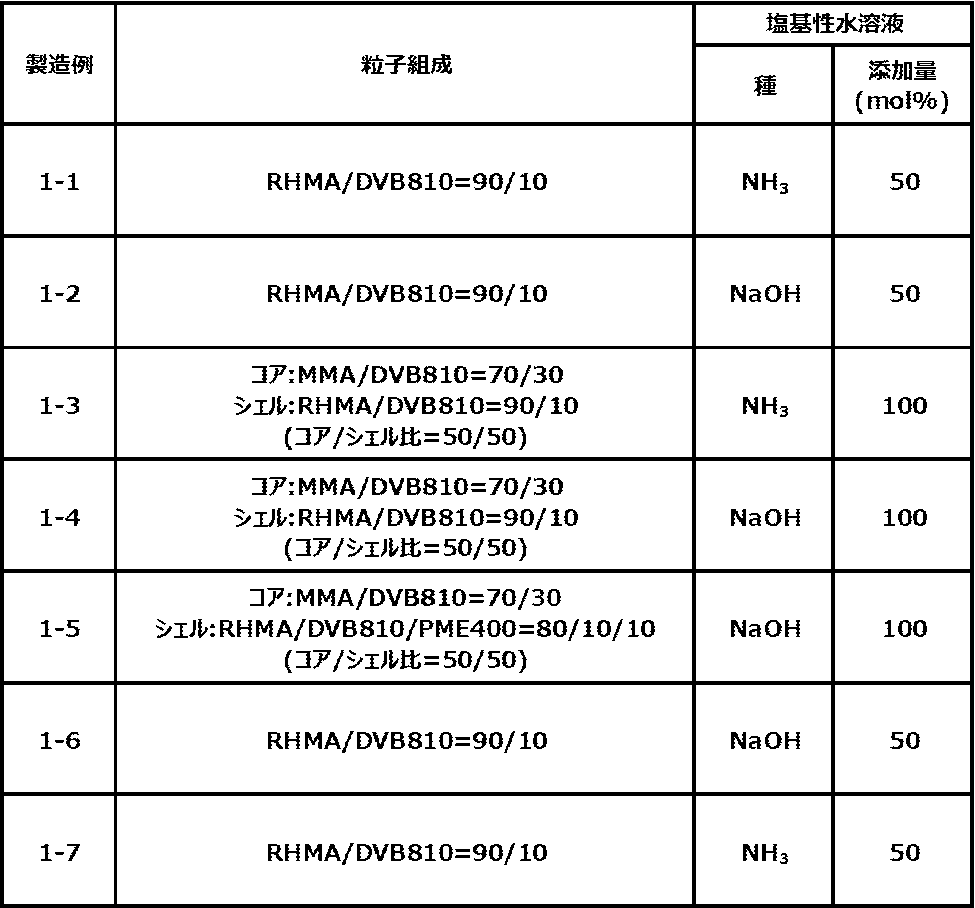
表1中、塩基性水溶液の添加量は、重合体粒子中のRHMAのモル数を100mol%とした際の、添加塩基のモル数を表し、すなわちイオン化率及び加水分解率に相当する。 In Table 1, the amount of basic aqueous solution added represents the number of moles of added base when the number of moles of RHMA in the polymer particles is taken as 100 mol%, i.e., it corresponds to the ionization rate and hydrolysis rate.
[実施例1-1]
<成膜試料A1-1の調製>
水系樹脂としてのエポクロスK-2035E((株)日本触媒製;固形分40質量%)と成膜助剤としてのCS-12(JNC社製;有効成分100質量%)とを、有効成分比(質量基準)で100:25の比率になるように配合し、最終固形分が10質量%となるように純水で希釈して、下地塗膜用組成物を得た。
次にアルミ板(縦:150mm、横:60mm、厚さ:0.100mm)に、下地塗膜用組成物を塗工後の膜厚が1.1μmとなるようにバーコーターで塗布し、自動排出型乾燥器(東上熱学社製「AT-101(標準型)」)にて160℃で11秒間乾燥して、下地層塗工済みアルミ板を得た。
親水性樹脂である水系ポリアクリル酸樹脂(重量平均分子量約5000)と重合体粒子水分散体(a1-1)と水系架橋剤((株)日本触媒製「エポクロスWS-700」;固形分25質量%)とを、固形分で100:25:18の比率(質量基準)になるように配合し、最終固形分が5質量%となるように純水で希釈して、塗膜用組成物A1-1を得た。
次に上記で作製した下地層塗工済みアルミ板の下地層塗工面に、塗膜用組成物A1-1を塗工後の膜厚が0.70μmとなるようにバーコーターで塗布し、自動排出型乾燥器(東上熱学社製「AT-101(標準型)」)にて200℃で11秒間乾燥して、塗膜が積層された成膜試料A1-1を得た。得られた成膜試料の評価結果を表2に示す。
[Example 1-1]
<Preparation of Film-Deposited Sample A1-1>
Epocross K-2035E (manufactured by Nippon Shokubai Co., Ltd.; solid content 40 mass%) as a water-based resin and CS-12 (manufactured by JNC Corporation; active ingredient 100 mass%) as a film-forming aid were mixed in an active ingredient ratio (mass basis) of 100:25, and diluted with pure water to a final solid content of 10 mass%, to obtain a base coating composition.
Next, the base coating composition was applied to an aluminum plate (length: 150 mm, width: 60 mm, thickness: 0.100 mm) using a bar coater so that the film thickness after coating would be 1.1 μm, and the plate was dried at 160° C. for 11 seconds in an automatic discharge dryer (Tojo Netsugaku Co., Ltd.'s "AT-101 (standard type)") to obtain an aluminum plate with a base layer coating.
An aqueous polyacrylic resin (weight average molecular weight: about 5000) which is a hydrophilic resin, an aqueous dispersion of polymer particles (a1-1), and an aqueous crosslinking agent ("Epocross WS-700" manufactured by Nippon Shokubai Co., Ltd.; solid content: 25% by mass) were mixed in a solid content ratio of 100:25:18 (by mass), and the mixture was diluted with pure water to a final solid content of 5% by mass, to obtain a coating composition A1-1.
Next, the coating composition A1-1 was applied to the undercoat layer coated surface of the undercoat layer coated aluminum plate prepared above using a bar coater so that the coating thickness after coating was 0.70 μm, and then dried at 200° C. for 11 seconds in an automatic discharge type dryer ("AT-101 (standard type)" manufactured by Tojo Netsugaku Co., Ltd.) to obtain a coating sample A1-1 with a coating layer laminated thereon. The evaluation results of the obtained coating sample are shown in Table 2.
[実施例1-2~1-5]
<成膜試料A1-2~A1-5の調製>
配合する重合体粒子水分散体を以下に記載のものに変更し、水系ポリアクリル酸樹脂の固形分100部に対する各重合体粒子の添加量が表2に記載のものとなるように変更した以外は、実施例1-1と同様にして成膜試料A1-2~A1-5を調製した。得られた成膜試料の評価結果を表2に示す。
実施例1-2…重合体粒子水分散体(a1-2)
実施例1-3…重合体粒子水分散体(a1-3)
実施例1-4…重合体粒子水分散体(a1-4)
実施例1-5…重合体粒子水分散体(a1-5)
[Examples 1-2 to 1-5]
<Preparation of Film-Deposited Samples A1-2 to A1-5>
Film-formed samples A1-2 to A1-5 were prepared in the same manner as in Example 1-1, except that the polymer particle aqueous dispersion to be blended was changed to that shown below, and the amount of each polymer particle added to 100 parts of the solid content of the aqueous polyacrylic acid resin was changed to that shown in Table 2. The evaluation results of the obtained film-formed samples are shown in Table 2.
Example 1-2: Water dispersion of polymer particles (a1-2)
Example 1-3: Polymer particle water dispersion (a1-3)
Example 1-4...Polymer particle water dispersion (a1-4)
Example 1-5...Polymer particle water dispersion (a1-5)
[比較例1-1、1-2]
配合する重合体粒子水分散体を以下のものに変更した以外は、実施例1-1と同様にして成膜試料B1-1およびB1-2を調製した。得られた成膜試料の評価結果を表2に示す。
比較例1-1…シリカ粒子(日産化学社製「スノーテックスN」、平均粒子径12nm)
比較例1-2…アクリル粒子((株)日本触媒製「エポスターMX100W」、平均粒子径150nm)
[Comparative Examples 1-1 and 1-2]
Film-formed samples B1-1 and B1-2 were prepared in the same manner as in Example 1-1, except that the polymer particle aqueous dispersion to be blended was changed to the following: Evaluation results of the obtained film-formed samples are shown in Table 2.
Comparative Example 1-1: Silica particles (Nissan Chemical Industries, Ltd. "Snowtex N", average particle size 12 nm)
Comparative Example 1-2: Acrylic particles ("Eposter MX100W" manufactured by Nippon Shokubai Co., Ltd., average particle size 150 nm)
[参考例1-1]
重合体粒子水分散体を配合しなかった以外は、実施例1-1と同様にして成膜試料C1-1を調製した。得られた成膜試料の評価結果を表2に示す。
[Reference Example 1-1]
A film-formed sample C1-1 was prepared in the same manner as in Example 1-1, except that the aqueous dispersion of polymer particles was not blended in. The evaluation results of the obtained film-formed sample are shown in Table 2.
[実施例1-6]
(1)親水性樹脂の作製
重量平均分子量4000のポリアクリル酸水溶液にモノエタノールアミンを投入し、pHを7.0に調整後、純水で調整することによりポリカルボン酸系樹脂(Z-1)を固形分濃度54%で含むポリカルボン酸系樹脂水溶液(Z-1a)を得た。
(2)塗工用組成物の調製
ポリカルボン酸系樹脂水溶液(Z-1a)と重合体粒子水分散体(a1-6)とを、樹脂(Z-1)と重合体粒子(1-6)が固形分で100:10の比率になるように配合し、最終固形分が5質量%となるように純粋で希釈した後、スターラーチップで十分に攪拌し、塗工用組成物を得た。
(3)成膜試料A1-6の調製
アルミテストパネル(日本テストパネル社製、A1050P、縦:150mm、横:70mm、厚さ:0.800mm)の塗工面をアセトンを含ませたキムワイプで、キムワイプに黒い汚れがつかなくなるまで拭いた。次に、ウルトラシーラーIII(日本ペイント社製)をアセトン洗浄したアルミテストパネルに、塗工後の膜厚が11.5μmとなるようにバーコーターで塗布し、送風定温恒温器(ヤマト科学社製「DNF400」)にて100℃で10分間乾燥して、表面が改質されたアルミテストパネルを準備した。
塗工用組成物を上記で作製したアルミテストパネルの改質面に塗工後の膜厚が45.8μmとなるようにバーコーターで塗布し、送風定温恒温器(ヤマト科学社製「DNF400」)にて200℃1分間乾燥して、塗膜が積層された成膜試料A1-6を得た。得られた成膜試料の評価結果を表2に示す。
[Examples 1 to 6]
(1) Preparation of Hydrophilic Resin Monoethanolamine was added to an aqueous solution of polyacrylic acid having a weight average molecular weight of 4000, and the pH was adjusted to 7.0. Then, the solution was adjusted with pure water to obtain an aqueous solution of polycarboxylic acid resin (Z-1a) containing polycarboxylic acid resin (Z-1) at a solid content concentration of 54%.
(2) Preparation of Coating Composition The polycarboxylic acid resin aqueous solution (Z-1a) and the polymer particle aqueous dispersion (a1-6) were mixed so that the resin (Z-1) and the polymer particle (1-6) were in a solid content ratio of 100:10, and the mixture was diluted with pure water to a final solid content of 5 mass %, and then thoroughly stirred with a stirrer tip to obtain a coating composition.
(3) Preparation of film-formed sample A1-6 The coated surface of an aluminum test panel (A1050P, manufactured by Nippon Test Panel Co., Ltd., length: 150 mm, width: 70 mm, thickness: 0.800 mm) was wiped with a Kimwipe soaked in acetone until the Kimwipe was no longer stained black. Next, Ultra Sealer III (manufactured by Nippon Paint Co., Ltd.) was applied to the aluminum test panel washed with acetone using a bar coater so that the film thickness after coating was 11.5 μm, and the panel was dried at 100 ° C. for 10 minutes in a constant temperature incubator (manufactured by Yamato Scientific Co., Ltd. "DNF400") to prepare an aluminum test panel with a modified surface.
The coating composition was applied to the modified surface of the aluminum test panel prepared above with a bar coater so that the coating thickness after coating was 45.8 μm, and then dried at 200 ° C. for 1 minute in a constant temperature incubator (Yamato Scientific Co., Ltd. "DNF400") to obtain a coating film-formed sample A1-6. The evaluation results of the obtained coating sample are shown in Table 2.
[実施例1-7]
配合する重合体粒子水分散体を重合体粒子水分散体(a1-7)に変更し、ポリカルボン酸系樹脂水溶液(Z-1a)と重合体粒子水分散体(a1-7)とを樹脂(Z-1)と重合体粒子(1-7)が固形分で100:20の比率になるように配合した以外は、実施例1-6と同様にして成膜試料A1-7を得た。得られた成膜試料の評価結果を表2に示す。
[Examples 1 to 7]
A film-formed sample A1-7 was obtained in the same manner as in Example 1-6, except that the polymer particle aqueous dispersion was changed to the polymer particle aqueous dispersion (a1-7) and the polycarboxylic acid resin aqueous solution (Z-1a) and the polymer particle aqueous dispersion (a1-7) were blended so that the ratio of the resin (Z-1) to the polymer particles (1-7) was 100:20 in terms of solid content. The evaluation results of the obtained film-formed sample are shown in Table 2.
[実施例1-8]
塗膜用組成物A1-1に代えて、親水性樹脂である水系ポリアクリル酸樹脂(重量平均分子量約5000)と重合体粒子水分散体(a1-5)と水系架橋剤((株)日本触媒製「エポクロスWS-700」;固形分25質量%)とL-アスコルビン酸とを、固形分で100:100:18:20の比率(質量基準)になるように配合し、最終固形分が5質量%となるように純水で希釈して得られた塗膜用組成物A1-8を用いたこと以外は、実施例1-1と同様にして成膜試料A1-8を得た。得られた成膜試料の評価結果を表2に示す。
[Examples 1 to 8]
A film-forming sample A1-8 was obtained in the same manner as in Example 1-1, except that a film-forming composition A1-8 was used in place of the film-forming composition A1-1, which was a composition obtained by blending a hydrophilic resin, an aqueous polyacrylic acid resin (weight average molecular weight about 5000), a polymer particle aqueous dispersion (a1-5), an aqueous crosslinking agent ("Epocross WS-700" manufactured by Nippon Shokubai Co., Ltd.; solid content 25% by mass), and L-ascorbic acid in a solid content ratio of 100:100:18:20 (by mass), and diluting with pure water to a final solid content of 5% by mass. The evaluation results of the obtained film-forming sample are shown in Table 2.
[参考例1-2]
重合体粒子水分散体を配合しなかった以外は、実施例1-6と同様にして成膜試料C-2を調製した。得られた成膜試料の評価結果を表2に示す。
[Reference Example 1-2]
A film-formed sample C-2 was prepared in the same manner as in Example 1-6, except that the aqueous dispersion of polymer particles was not blended in. The evaluation results of the obtained film-formed sample are shown in Table 2.
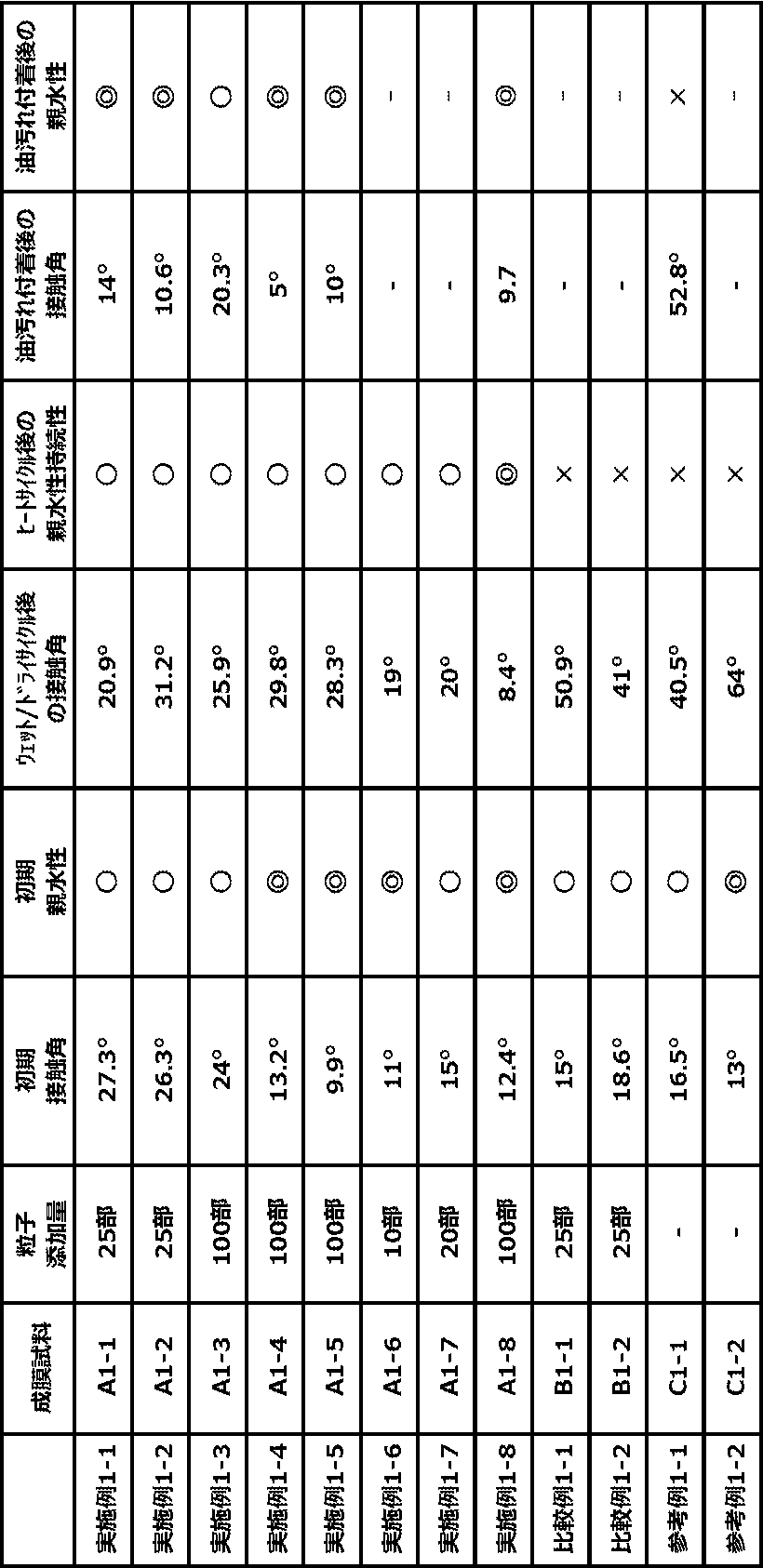
なお表2中、「粒子添加量」は、親水性樹脂の固形分を100部とした際の、粒子の添加量(固形分換算)を指す。 In Table 2, "particle addition amount" refers to the amount of particles added (converted into solids) when the solids content of the hydrophilic resin is taken as 100 parts.
表2の結果から、特定の粒子を構成成分とする本発明の親水性持続効果及び/又は滑水性付与剤は、塗膜などの有形物に対し、ウェット/ドライサイクル後であっても親水が持続するという親水性持続効果を付与できる。また油汚れが付着した後であっても、良好な親水性を発現できるという効果を付与することができる。 The results in Table 2 show that the hydrophilicity sustaining effect and/or water slipping agent of the present invention, which contains specific particles as components, can provide a hydrophilicity sustaining effect to tangible objects such as coatings, such that hydrophilicity is sustained even after wet/dry cycles. It can also provide the effect of exhibiting good hydrophilicity even after the adhesion of oily stains.
[実験例2]
<体積平均粒子径の測定>
実験例1における<体積平均粒子径の測定>と同様の手法にて、重合体粒子の体積平均粒子径(nm)を求めた。
[Experimental Example 2]
<Measurement of volume average particle size>
The volume average particle diameter (nm) of the polymer particles was determined in the same manner as in <Measurement of volume average particle diameter> in Experimental Example 1.
<親水性の評価>
実験例1における<初期親水性の評価>と同様の手法にて、有形物(塗膜)の初期接触角を求め、以下の基準により有形物(塗膜)の親水性を定量的に評価した。
◎:初期接触角が15°未満
○:初期接触角が15°以上40°未満
×:初期接触角が40°以上
<Evaluation of hydrophilicity>
The initial contact angle of the material (coating film) was determined in the same manner as in <Evaluation of initial hydrophilicity> in Experimental Example 1, and the hydrophilicity of the material (coating film) was quantitatively evaluated according to the following criteria.
◎: Initial contact angle is less than 15°. ○: Initial contact angle is 15° or more and less than 40°. ×: Initial contact angle is 40° or more.
<滑水性の評価>
滑落性評価として、有形物の表面(成膜試料の塗膜表面)に対する水滴の滑落角を測定した。
具体的には、有形物(成膜試料)を25℃の条件下、純水流水中に1時間浸漬させた後、25℃50%湿度の環境下で、取り出した有形物(成膜試料)を滑落角測定面(成膜試料であれば、試料の塗工面)が上面になるようにキムワイプ上に置き、上から別のキムワイプを覆い、5秒間その状態を維持した。その後有形物を取出し、滑落角測定面に対し、目視で確認できる水滴がなくなるまでエアブローを行うことで、余分な水分を除去し、送風定温恒温器(ヤマト科学社製「DNF400」)を用いて80℃で2時間乾燥させて、熱交換器使用時のフィン材(凝結水の付着及び加熱乾燥後のフィン材)を再現した有形物(成膜試料)を得た。以下、上記処理が施された有形物を「ヒートサイクル後の有形物」(具体的には、ヒートサイクル後の成膜試料)という。
自動接触角計(協和界面科学社製、「CA-X」)を用いて、25℃の条件下、純水10μLの水滴を作製し、水平に配置したヒートサイクル後の有形物の表面(ヒートサイクル後の成膜試料の塗膜表面)に着液させ、着滴後0.1秒後から0.5°ずつ2°/秒の速度で徐々に傾け、水滴が移動し始める角度を測定値とし、5回測定を行い、最大値と最小値の2点を除く3点の平均値を、滑落角θsとした。そして、以下の基準により有形物(塗膜)の滑水性を定量的に評価した。
◎:滑落角θsが15°未満
○:滑落角θsが15°以上30°未満
×:滑落角θsが30°以上
なお、水滴の移動判定は、図1に示すように、有形物1の表面に着滴してから0.1秒後の水滴(2a)における滑落方向と反対側の端点をR0、滑落方向側の端点をL0とし、傾斜角θの時の水滴(2b)の滑落方向と反対側の端点をRθ、滑落方向側の端点をLθとし、水滴の滑落方向と反対側の端点移動距離dR=-|Rθ-R0|、水滴の滑落方向側の端点移動距離dL=|Lθ-L0|とした時、dR+dL>1.00mmを初めて満たした時に水滴が移動したと判定し、その時の傾斜角θを滑落角θsと定義した。この定義は、滑落方向の水滴の端点移動から、濡れ広がりによる端点移動の影響を排除して、滑落による端点移動を抽出することを意図した評価方法である。
<Evaluation of water sliding>
To evaluate the sliding property, the sliding angle of a water droplet with respect to the surface of a material object (the coating surface of the film-formed sample) was measured.
Specifically, the tangible object (film-formed sample) was immersed in running pure water for 1 hour under the condition of 25°C, and then, in an environment of 25°C and 50% humidity, the removed tangible object (film-formed sample) was placed on a Kimwipe so that the sliding angle measurement surface (if it was a film-formed sample, the coated surface of the sample) was the upper surface, and covered with another Kimwipe from above, and maintained in that state for 5 seconds. The tangible object was then removed, and the sliding angle measurement surface was subjected to air blowing until no water droplets were visible to the naked eye, thereby removing excess moisture, and the tangible object was dried at 80°C for 2 hours using a constant temperature incubator (Yamato Scientific Co., Ltd.'s "DNF400") to obtain a tangible object (film-formed sample) that reproduced the fin material (fin material after adhesion of condensed water and heat drying) when used in a heat exchanger. Hereinafter, the tangible object subjected to the above treatment is referred to as the "tangible object after heat cycle" (specifically, the film-formed sample after heat cycle).
Using an automatic contact angle meter (Kyowa Interface Science Co., Ltd., "CA-X"), a 10 μL droplet of pure water was prepared under the condition of 25° C., and the droplet was placed on the surface of a horizontally placed tangible object after heat cycle (the coating surface of a film-formed sample after heat cycle), and 0.1 seconds after the droplet was placed, the object was gradually tilted at a rate of 2°/sec in increments of 0.5°, and the angle at which the droplet started to move was taken as the measured value. Five measurements were taken, and the average of the three points excluding the maximum and minimum values was taken as the sliding angle θs. The water sliding property of the tangible object (coating) was quantitatively evaluated according to the following criteria.
◎: sliding angle θs is less than 15°. ○: sliding angle θs is 15° or more and less than 30°. ×: sliding angle θs is 30° or more. The movement of the water droplet was determined as follows: as shown in FIG. 1, the end point of the water droplet (2a) on the opposite side to the sliding direction 0.1 seconds after it landed on the surface of the
[重合体の合成]
<製造例2-1>
攪拌機、温度計及び冷却機を備えたステンレス製の第1の反応釜に、脱イオン水1128質量部、SR-20(有効成分10質量%)1.05質量部を加え、内温を75℃まで昇温し、同温度に保った。他方、第1の反応釜とは異なる第2の反応釜で、MMA70質量部とDVB810 30質量部とを混合して、単量体組成物A100質量部を調製した。さらに、第1の反応釜、第2の反応釜とは異なる第3の反応釜で、RHMA90質量部と、DVB810 10質量部とを混合して、単量体組成物B100質量部を調製した。次に、第1の反応釜内を窒素ガスで置換した後、前記単量体組成物A100質量部、過酸化水素水(濃度3.35質量%)20質量部、及びL-アスコルビン酸水溶液(濃度5.0質量%)20質量部を第1の反応釜内に添加して、内温を75℃に保持し、2時間かけて初期重合反応を行った。続いて、前記単量体組成物B100質量部、過酸化水素水(濃度0.83質量%)100質量部、L-アスコルビン酸水溶液(濃度1.25質量%)100質量部、及びSR-20(有効成分10質量%)7.04質量部とアンモニア水溶液(濃度28質量%)0.36質量部とイオン交換水92.6質量部との混合組成物100質量部を、各々異なる投入口より、第1の反応釜へ3時間かけて均一に滴下した。滴下終了後、第1の反応釜の内温を75℃に保持し、同温度で2時間保持して熟成した後、反応溶液を冷却して、重合体粒子が分散した重合体水分散体2-1を得た。
前記で得られた重合体水分散体2-1 10質量部、及び塩基性水溶液として水酸化ナトリウム水溶液(濃度20%)1.4質量部を第1の反応釜に加え、25℃で終夜撹拌することにより、加水分解された重合体粒子(2-1)が分散した重合体粒子水分散体(a2-1)を得た。得られた重合体粒子(2-1)の体積平均粒子径は330nmであった。
[Synthesis of polymer]
<Production Example 2-1>
In a stainless steel first reaction kettle equipped with a stirrer, a thermometer, and a cooler, 1128 parts by mass of deionized water and 1.05 parts by mass of SR-20 (active ingredient 10% by mass) were added, and the internal temperature was raised to 75° C. and maintained at that temperature. On the other hand, in a second reaction kettle different from the first reaction kettle, 70 parts by mass of MMA and 30 parts by mass of DVB810 were mixed to prepare 100 parts by mass of monomer composition A. Furthermore, in a third reaction kettle different from the first and second reaction kettle, 90 parts by mass of RHMA and 10 parts by mass of DVB810 were mixed to prepare 100 parts by mass of monomer composition B. Next, after replacing the inside of the first reaction vessel with nitrogen gas, 100 parts by mass of the monomer composition A, 20 parts by mass of hydrogen peroxide (concentration 3.35% by mass), and 20 parts by mass of an aqueous L-ascorbic acid solution (concentration 5.0% by mass) were added to the first reaction vessel, and the internal temperature was maintained at 75° C., and an initial polymerization reaction was carried out over 2 hours. Subsequently, 100 parts by mass of the monomer composition B, 100 parts by mass of hydrogen peroxide (concentration 0.83% by mass), 100 parts by mass of an aqueous L-ascorbic acid solution (concentration 1.25% by mass), and 100 parts by mass of a mixed composition of 7.04 parts by mass of SR-20 (active ingredient 10% by mass), 0.36 parts by mass of an aqueous ammonia solution (concentration 28% by mass), and 92.6 parts by mass of ion-exchanged water were uniformly dropped into the first reaction vessel over 3 hours from different inlets. After the dropwise addition was completed, the internal temperature of the first reaction vessel was maintained at 75° C. and the reaction solution was aged at the same temperature for 2 hours, and then cooled to obtain a polymer water dispersion 2-1 in which polymer particles were dispersed.
10 parts by mass of the polymer water dispersion 2-1 obtained above and 1.4 parts by mass of an aqueous sodium hydroxide solution (concentration 20%) as a basic aqueous solution were added to a first reaction kettle and stirred overnight at 25° C. to obtain an aqueous polymer particle dispersion (a2-1) in which hydrolyzed polymer particles (2-1) were dispersed. The volume average particle diameter of the obtained polymer particles (2-1) was 330 nm.
<製造例2-2>
単量体組成物BをRHMA80質量部とDVB810 10質量部とPME400 10部に変更し、塩基性水溶液を水酸化ナトリウム水溶液(濃度20%)1.2質量部に変更した以外は製造例2-1と同様にして、加水分解された重合体粒子(2-2)が分散した重合体粒子水分散体(a2-2)を得た。得られた重合体粒子(2-2)の体積平均粒子径は302nmであった。
<Production Example 2-2>
A polymer particle aqueous dispersion (a2-2) in which hydrolyzed polymer particles (2-2) were dispersed was obtained in the same manner as in Production Example 2-1, except that the monomer composition B was changed to 80 parts by mass of RHMA, 10 parts by mass of DVB810, and 10 parts by mass of PME400, and the basic aqueous solution was changed to 1.2 parts by mass of an aqueous sodium hydroxide solution (concentration 20%). The volume average particle diameter of the obtained polymer particles (2-2) was 302 nm.
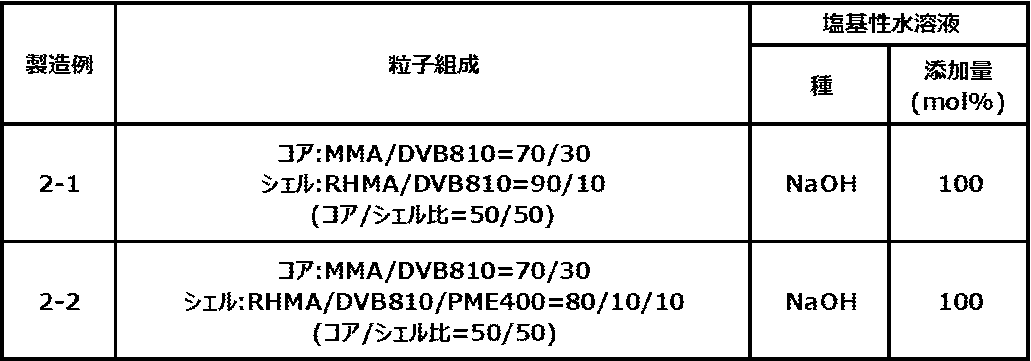
表3中、塩基性水溶液の添加量は、重合体粒子中のRHMAのモル数を100mol%とした際の、添加塩基のモル数を表し、すなわちイオン化率及び加水分解率に相当する。 In Table 3, the amount of basic aqueous solution added represents the number of moles of added base when the number of moles of RHMA in the polymer particles is taken as 100 mol%, i.e., it corresponds to the ionization rate and hydrolysis rate.
[実施例2-1]
<成膜試料A2-1の調製>
親水性樹脂である水系ポリアクリル酸樹脂(重量平均分子量約5000)と重合体粒子水分散体(a2-1)と水系架橋剤((株)日本触媒製「エポクロスWS-700」;固形分25質量%)とを、固形分で100:100:18の比率(質量基準)になるように配合し、最終固形分が5.45質量%となるように純水で希釈して、塗膜用組成物A2-1を得た。
次にアルミ板(縦:150mm、横:60mm、厚さ:0.100mm)の表面に、塗膜用組成物A2-1を塗工後の膜厚が1.00μmとなるようにバーコーターで塗布し、自動排出型乾燥器(東上熱学社製「AT-101(標準型)」)にて200℃で1分間乾燥して、塗膜が積層された成膜試料A2-1を得た。得られた成膜試料の評価結果を表4に示す。
[Example 2-1]
<Preparation of Film-Deposited Sample A2-1>
An aqueous polyacrylic resin (weight average molecular weight: about 5000) which is a hydrophilic resin, an aqueous dispersion of polymer particles (a2-1), and an aqueous crosslinking agent ("Epocross WS-700" manufactured by Nippon Shokubai Co., Ltd.; solid content: 25% by mass) were mixed in a solid content ratio of 100:100:18 (by mass), and the mixture was diluted with pure water to a final solid content of 5.45% by mass, to obtain a coating composition A2-1.
Next, the coating composition A2-1 was applied to the surface of an aluminum plate (length: 150 mm, width: 60 mm, thickness: 0.100 mm) using a bar coater so that the coating thickness after coating would be 1.00 μm, and then dried at 200° C. for 1 minute in an automatic discharge dryer (Tojo Netsugaku Co., Ltd.'s "AT-101 (standard type)") to obtain a coating sample A2-1 having a coating layer. The evaluation results of the obtained coating sample are shown in Table 4.
[実施例2-2]
<成膜試料A2-2>
配合する重合体粒子水分散体を重合体粒子水分散体(a2-2)に変更した以外は、実施例2-1と同様にして成膜試料A2-2を調製した。得られた成膜試料の評価結果を表4に示す。
[Example 2-2]
<Film-formed sample A2-2>
A film-formed sample A2-2 was prepared in the same manner as in Example 2-1, except that the polymer particle aqueous dispersion to be blended was changed to the polymer particle aqueous dispersion (a2-2). The evaluation results of the obtained film-formed sample are shown in Table 4.
[参考例2-1]
重合体粒子水分散体を配合しなかった以外は、実施例2-1と同様にして成膜試料C2-1を調製した。得られた成膜試料の評価結果を表4に示す。
[Reference Example 2-1]
A film-formed sample C2-1 was prepared in the same manner as in Example 2-1, except that the aqueous dispersion of polymer particles was not blended in. The evaluation results of the obtained film-formed sample are shown in Table 4.
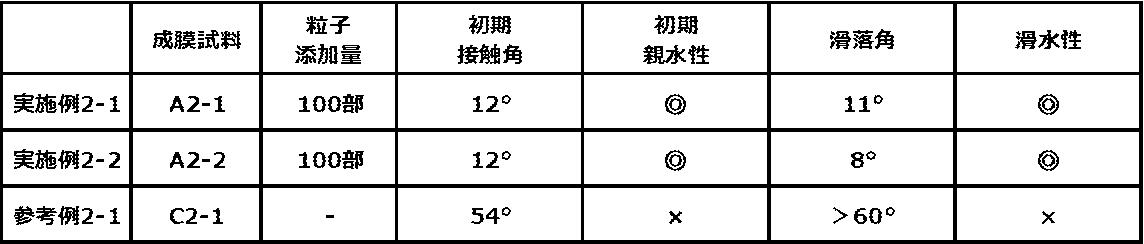
なお表4中、「粒子添加量」は、親水性樹脂の固形分を100部とした際の、粒子の添加量(固形分換算)を指す。 In Table 4, "particle addition amount" refers to the amount of particles added (converted into solids) when the solids content of the hydrophilic resin is taken as 100 parts.
表4の結果から、特定の粒子を構成成分とする本発明の親水性持続効果及び/又は滑水性付与剤は、塗膜などの有形物に対し、良好な親水性を付与しながら、良好な滑水性も付与できる。 The results in Table 4 show that the hydrophilicity sustaining effect and/or water slippage imparting agent of the present invention, which is composed of specific particles, can impart good hydrophilicity to tangible objects such as coatings while also imparting good water slippage.
1 有形物
2a 着滴してから0.1秒後の水滴
2b 傾斜角θ時の水滴
R0 着滴してから0.1秒後の水滴における滑落方向と反対側の端点
L0 着滴してから0.1秒後の水滴における滑落方向側の端点
Rθ 傾斜角θ時の水滴の滑落方向と反対側の端点
Lθ 傾斜角θ時の水滴の滑落方向側の端点
1
Claims (17)
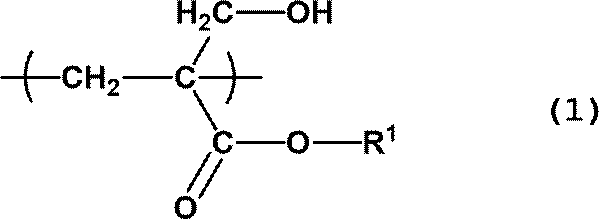
[式(1)中、R1は、炭素数1~4のアルキル基、水素原子、アルカリ金属原子、又はアンモニウムを表す。] The agent for imparting hydrophilicity sustaining effect and/or water slipping property according to claim 2, wherein the structural unit derived from the monomer (AB1) is a structural unit represented by the following formula (1), and the structural unit derived from the monomer (C) is a structural unit derived from a polyfunctional ethylenically unsaturated monomer:
[In formula (1), R 1 represents an alkyl group having 1 to 4 carbon atoms, a hydrogen atom, an alkali metal atom, or ammonium.]
Priority Applications (4)
| Application Number | Priority Date | Filing Date | Title |
|---|---|---|---|
| EP23940796.8A EP4726008A1 (en) | 2023-06-08 | 2023-12-28 | Agent for imparting hydrophilicity-sustaining effect and/or water sliding properties |
| KR1020257040333A KR20260004509A (en) | 2023-06-08 | 2023-12-28 | Hydrophilic lasting effect and/or hydrophilicity imparting agent |
| JP2025525937A JPWO2024252703A1 (en) | 2023-06-08 | 2023-12-28 | |
| CN202380099026.3A CN121241114A (en) | 2023-06-08 | 2023-12-28 | Hydrophilicity retention effect and/or hydrophobicity imparting agent |
Applications Claiming Priority (4)
| Application Number | Priority Date | Filing Date | Title |
|---|---|---|---|
| JP2023094540 | 2023-06-08 | ||
| JP2023-094540 | 2023-06-08 | ||
| JP2023162888 | 2023-09-26 | ||
| JP2023-162888 | 2023-09-26 |
Publications (1)
| Publication Number | Publication Date |
|---|---|
| WO2024252703A1 true WO2024252703A1 (en) | 2024-12-12 |
Family
ID=93795794
Family Applications (1)
| Application Number | Title | Priority Date | Filing Date |
|---|---|---|---|
| PCT/JP2023/047171 Ceased WO2024252703A1 (en) | 2023-06-08 | 2023-12-28 | Agent for imparting hydrophilicity-sustaining effect and/or water sliding properties |
Country Status (5)
| Country | Link |
|---|---|
| EP (1) | EP4726008A1 (en) |
| JP (1) | JPWO2024252703A1 (en) |
| KR (1) | KR20260004509A (en) |
| CN (1) | CN121241114A (en) |
| WO (1) | WO2024252703A1 (en) |
Citations (12)
| Publication number | Priority date | Publication date | Assignee | Title |
|---|---|---|---|---|
| JPH0987576A (en) | 1995-09-22 | 1997-03-31 | Kansai Paint Co Ltd | Composition for hydrophilization treatment and method for hydrophilization treatment |
| JP2000328038A (en) | 1999-05-18 | 2000-11-28 | Kansai Paint Co Ltd | Composition and method for improving hydrophilicity |
| JP2013092289A (en) | 2011-10-25 | 2013-05-16 | Kagawa Univ | Super-hydrophobic and oleophobic heat exchanger member, method for manufacturing the same, and heat exchanger manufactured by using them |
| WO2014147782A1 (en) | 2013-03-21 | 2014-09-25 | 日本パーカライジング株式会社 | Hydrophilic surface treatment agent for aluminum-containing metal heat exchangers having excellent drainage |
| CN104262552A (en) * | 2014-09-22 | 2015-01-07 | 玉林师范学院 | Silica sol/silicone acrylate core-shell nanocomposite emulsion and preparation method thereof |
| CN105199049A (en) * | 2015-08-28 | 2015-12-30 | 中国海洋石油总公司 | Hydroxyl acrylic emulsion of core-shell structure and preparing method thereof |
| WO2020213485A1 (en) | 2019-04-18 | 2020-10-22 | Dic株式会社 | Structure body, structure body production method, heat exchanger member and heat exchanger |
| JP7162125B2 (en) * | 2019-03-29 | 2022-10-27 | 株式会社日本触媒 | Resin particles, method for producing the same, and hydrophilicity-imparting agent containing the resin particles |
| JP2023058950A (en) * | 2021-10-14 | 2023-04-26 | 株式会社日本触媒 | Antiblocking agent |
| JP2023094540A (en) | 2021-12-23 | 2023-07-05 | エルジー ディスプレイ カンパニー リミテッド | Display device |
| JP2023162888A (en) | 2022-04-27 | 2023-11-09 | セイコーエプソン株式会社 | Reflective optical devices, light sources and projectors |
| JP2024009825A (en) * | 2022-07-11 | 2024-01-23 | 株式会社日本触媒 | Hydrophilic lasting effect agent |
-
2023
- 2023-12-28 JP JP2025525937A patent/JPWO2024252703A1/ja active Pending
- 2023-12-28 KR KR1020257040333A patent/KR20260004509A/en active Pending
- 2023-12-28 EP EP23940796.8A patent/EP4726008A1/en active Pending
- 2023-12-28 WO PCT/JP2023/047171 patent/WO2024252703A1/en not_active Ceased
- 2023-12-28 CN CN202380099026.3A patent/CN121241114A/en active Pending
Patent Citations (12)
| Publication number | Priority date | Publication date | Assignee | Title |
|---|---|---|---|---|
| JPH0987576A (en) | 1995-09-22 | 1997-03-31 | Kansai Paint Co Ltd | Composition for hydrophilization treatment and method for hydrophilization treatment |
| JP2000328038A (en) | 1999-05-18 | 2000-11-28 | Kansai Paint Co Ltd | Composition and method for improving hydrophilicity |
| JP2013092289A (en) | 2011-10-25 | 2013-05-16 | Kagawa Univ | Super-hydrophobic and oleophobic heat exchanger member, method for manufacturing the same, and heat exchanger manufactured by using them |
| WO2014147782A1 (en) | 2013-03-21 | 2014-09-25 | 日本パーカライジング株式会社 | Hydrophilic surface treatment agent for aluminum-containing metal heat exchangers having excellent drainage |
| CN104262552A (en) * | 2014-09-22 | 2015-01-07 | 玉林师范学院 | Silica sol/silicone acrylate core-shell nanocomposite emulsion and preparation method thereof |
| CN105199049A (en) * | 2015-08-28 | 2015-12-30 | 中国海洋石油总公司 | Hydroxyl acrylic emulsion of core-shell structure and preparing method thereof |
| JP7162125B2 (en) * | 2019-03-29 | 2022-10-27 | 株式会社日本触媒 | Resin particles, method for producing the same, and hydrophilicity-imparting agent containing the resin particles |
| WO2020213485A1 (en) | 2019-04-18 | 2020-10-22 | Dic株式会社 | Structure body, structure body production method, heat exchanger member and heat exchanger |
| JP2023058950A (en) * | 2021-10-14 | 2023-04-26 | 株式会社日本触媒 | Antiblocking agent |
| JP2023094540A (en) | 2021-12-23 | 2023-07-05 | エルジー ディスプレイ カンパニー リミテッド | Display device |
| JP2023162888A (en) | 2022-04-27 | 2023-11-09 | セイコーエプソン株式会社 | Reflective optical devices, light sources and projectors |
| JP2024009825A (en) * | 2022-07-11 | 2024-01-23 | 株式会社日本触媒 | Hydrophilic lasting effect agent |
Also Published As
| Publication number | Publication date |
|---|---|
| CN121241114A (en) | 2025-12-30 |
| EP4726008A1 (en) | 2026-04-15 |
| JPWO2024252703A1 (en) | 2024-12-12 |
| KR20260004509A (en) | 2026-01-08 |
Similar Documents
| Publication | Publication Date | Title |
|---|---|---|
| JP2024009825A (en) | Hydrophilic lasting effect agent | |
| JP5600081B2 (en) | Pre-coated fin material for heat exchanger and heat exchanger | |
| JP6618903B2 (en) | Method for coating hydrophilic film on aluminum fin material, aluminum fin material and aluminum heat exchanger | |
| JP2009126948A (en) | Hydrophilic treatment agent | |
| CN112262041B (en) | pre-coated aluminum | |
| JP2011148889A (en) | Hydrophilicizing treatment agent | |
| JP2016222879A (en) | Hydrophilic treatment agent, hydrophilic film forming method and hydrophilic film | |
| JP6110777B2 (en) | Water-based paint composition and coated article | |
| WO2024252703A1 (en) | Agent for imparting hydrophilicity-sustaining effect and/or water sliding properties | |
| JP4999137B2 (en) | Hydrophilic hard coat composition, hard coat material, and method of forming hard coat film | |
| KR102636889B1 (en) | Composition for aqueous coating solution containing polymer of N-vinylcarboxylic acid amide | |
| WO2017123881A1 (en) | Permanently grafted glaciophobic nanomaterials and methods of making | |
| WO2025225528A1 (en) | Hydrophilized composition | |
| JP5881496B2 (en) | Undercoat for release substrate | |
| JP7455320B2 (en) | Vibration damping coating | |
| CN100572470C (en) | Coating film, water-based coating material, method for producing a coating film using the same, and coated article forming a coating film | |
| WO2018132069A1 (en) | A polymer dispersion | |
| WO2025225527A1 (en) | Hydrophilization treatment composition | |
| TWI822211B (en) | Anti-fog layer and its use | |
| CN107969132A (en) | Water system surface conditioning agent, the manufacture method of overlay film and surface treated material | |
| TWI822201B (en) | Anti-fog layer and its use | |
| TWI822212B (en) | Anti-fog layer and its use | |
| JP5545860B2 (en) | Aqueous resin composition | |
| JP7825670B2 (en) | Acrylic resin, its manufacturing method, and acrylic resin composition | |
| JP2019112515A (en) | Coating composition and hydrophilic member |
Legal Events
| Date | Code | Title | Description |
|---|---|---|---|
| 121 | Ep: the epo has been informed by wipo that ep was designated in this application |
Ref document number: 23940796 Country of ref document: EP Kind code of ref document: A1 |
|
| ENP | Entry into the national phase |
Ref document number: 2025525937 Country of ref document: JP Kind code of ref document: A |
|
| WWE | Wipo information: entry into national phase |
Ref document number: 2025525937 Country of ref document: JP |
|
| ENP | Entry into the national phase |
Ref document number: 1020257040333 Country of ref document: KR Free format text: ST27 STATUS EVENT CODE: A-0-1-A10-A15-NAP-PA0105 (AS PROVIDED BY THE NATIONAL OFFICE) |
|
| WWE | Wipo information: entry into national phase |
Ref document number: 2501008244 Country of ref document: TH Ref document number: 1020257040333 Country of ref document: KR |
|
| WWE | Wipo information: entry into national phase |
Ref document number: 2023940796 Country of ref document: EP |
|
| WWP | Wipo information: published in national office |
Ref document number: 1020257040333 Country of ref document: KR |
|
| NENP | Non-entry into the national phase |
Ref country code: DE |
|
| ENP | Entry into the national phase |
Ref document number: 2023940796 Country of ref document: EP Effective date: 20260108 |
|
| ENP | Entry into the national phase |
Ref document number: 2023940796 Country of ref document: EP Effective date: 20260108 |
|
| ENP | Entry into the national phase |
Ref document number: 2023940796 Country of ref document: EP Effective date: 20260108 |
|
| ENP | Entry into the national phase |
Ref document number: 2023940796 Country of ref document: EP Effective date: 20260108 |
|
| WWP | Wipo information: published in national office |
Ref document number: 2023940796 Country of ref document: EP |