WO2024252820A1 - 自動分析装置 - Google Patents
自動分析装置 Download PDFInfo
- Publication number
- WO2024252820A1 WO2024252820A1 PCT/JP2024/016305 JP2024016305W WO2024252820A1 WO 2024252820 A1 WO2024252820 A1 WO 2024252820A1 JP 2024016305 W JP2024016305 W JP 2024016305W WO 2024252820 A1 WO2024252820 A1 WO 2024252820A1
- Authority
- WO
- WIPO (PCT)
- Prior art keywords
- liquid
- nozzle
- air
- amount
- container
- Prior art date
- Legal status (The legal status is an assumption and is not a legal conclusion. Google has not performed a legal analysis and makes no representation as to the accuracy of the status listed.)
- Ceased
Links
Images





Classifications
-
- G—PHYSICS
- G01—MEASURING; TESTING
- G01N—INVESTIGATING OR ANALYSING MATERIALS BY DETERMINING THEIR CHEMICAL OR PHYSICAL PROPERTIES
- G01N35/00—Automatic analysis not limited to methods or materials provided for in any single one of groups G01N1/00 - G01N33/00; Handling materials therefor
- G01N35/10—Devices for transferring samples or any liquids to, in, or from, the analysis apparatus, e.g. suction devices, injection devices
- G01N35/1002—Reagent dispensers
-
- G—PHYSICS
- G01—MEASURING; TESTING
- G01N—INVESTIGATING OR ANALYSING MATERIALS BY DETERMINING THEIR CHEMICAL OR PHYSICAL PROPERTIES
- G01N35/00—Automatic analysis not limited to methods or materials provided for in any single one of groups G01N1/00 - G01N33/00; Handling materials therefor
- G01N35/08—Automatic analysis not limited to methods or materials provided for in any single one of groups G01N1/00 - G01N33/00; Handling materials therefor using a stream of discrete samples flowing along a tube system, e.g. flow injection analysis
-
- G—PHYSICS
- G01—MEASURING; TESTING
- G01N—INVESTIGATING OR ANALYSING MATERIALS BY DETERMINING THEIR CHEMICAL OR PHYSICAL PROPERTIES
- G01N35/00—Automatic analysis not limited to methods or materials provided for in any single one of groups G01N1/00 - G01N33/00; Handling materials therefor
- G01N35/10—Devices for transferring samples or any liquids to, in, or from, the analysis apparatus, e.g. suction devices, injection devices
- G01N35/1009—Characterised by arrangements for controlling the aspiration or dispense of liquids
- G01N35/1011—Control of the position or alignment of the transfer device
-
- G—PHYSICS
- G01—MEASURING; TESTING
- G01N—INVESTIGATING OR ANALYSING MATERIALS BY DETERMINING THEIR CHEMICAL OR PHYSICAL PROPERTIES
- G01N35/00—Automatic analysis not limited to methods or materials provided for in any single one of groups G01N1/00 - G01N33/00; Handling materials therefor
- G01N35/10—Devices for transferring samples or any liquids to, in, or from, the analysis apparatus, e.g. suction devices, injection devices
- G01N35/1009—Characterised by arrangements for controlling the aspiration or dispense of liquids
- G01N35/1016—Control of the volume dispensed or introduced
-
- G—PHYSICS
- G01—MEASURING; TESTING
- G01N—INVESTIGATING OR ANALYSING MATERIALS BY DETERMINING THEIR CHEMICAL OR PHYSICAL PROPERTIES
- G01N35/00—Automatic analysis not limited to methods or materials provided for in any single one of groups G01N1/00 - G01N33/00; Handling materials therefor
- G01N35/10—Devices for transferring samples or any liquids to, in, or from, the analysis apparatus, e.g. suction devices, injection devices
- G01N2035/1027—General features of the devices
- G01N2035/1034—Transferring microquantities of liquid
Definitions
- the present invention relates to an automatic analyzer.
- Automated analyzers react blood, urine, and other biological samples (specimens) with reagents that react specifically with the components to be measured in the samples, and quantitatively detect the complexes formed by this reaction, automatically carrying out the process from measuring the components to outputting the results.
- a predetermined amount of specimen and reagent is dispensed into a reaction vessel using a dispensing nozzle, the mixed reaction liquid in the reaction vessel is sucked up by a nozzle and introduced into the detection section, where the target components are detected using techniques such as electrochemiluminescence.
- Patent Document 1 the technology described in Patent Document 1 is known as a technology related to an automatic analyzer that detects whether the amount of liquid in a reaction vessel is appropriate.
- Patent Document 1 discloses a liquid volume measurement method that includes a reaction vessel that dispenses liquid, a syringe that aspirates the liquid, a flow path connected to the syringe, a nozzle connected to the flow path, a nozzle holding mechanism that moves the nozzle within the reaction vessel, and a control unit that controls the operation of the syringe and the nozzle holding mechanism, and measures the amount of liquid dispensed into the reaction vessel by comparing the transit time from the front end to the end of the liquid passing through a fixed point in the flow path when the liquid dispensed into the reaction vessel is aspirated by the syringe with a predicted time that has been obtained in advance.
- the present invention was made in consideration of the above, and aims to provide an automatic analyzer that can more accurately detect excess or deficiency of liquid in a reaction vessel.
- the present application includes multiple means for solving the above problems, but one example includes a nozzle that is immersed in a liquid contained in a container and sucks it up, a detection unit that detects the inflow of air into the nozzle when sucking up the liquid contained in the container, and a control unit that controls each of the operations of inserting the nozzle into the container, immersing it in the liquid, sucking up the liquid by the nozzle, and detecting the air by the detection unit, and the control unit inserts the nozzle into the container to a position where the tip of the nozzle is exposed from the liquid when the nozzle is immersed in the liquid in the container and the amount of liquid required for analysis is sucked up.
- the present invention makes it possible to more accurately detect whether there is an excess or deficiency of liquid in a reaction vessel.
- FIG. 1 is a diagram illustrating an overall configuration of an automatic analyzer.
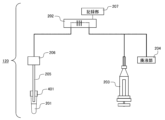
- FIG. 2 is a schematic diagram illustrating the configuration of an immune detection mechanism.
- 10 is a flowchart showing the contents of a liquid volume determination process.
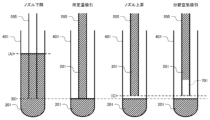
- FIG. 13 is a diagram showing the positional relationship between the amount of reaction liquid in a reaction vessel and the nozzle when the amount of reaction liquid is normal.
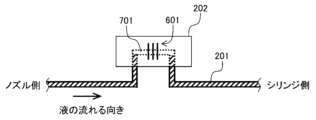
- FIG. 13 is a diagram showing the state of the detection unit when the liquid volume is normal.
- FIG. 13 is a diagram showing the state of the detection unit when the liquid volume is normal.
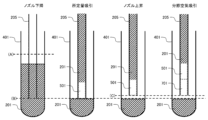
- FIG. 13 is a diagram showing the relationship between the amount of reaction liquid in a reaction vessel and the position of the nozzle when the amount of liquid is insufficient.
- FIG. 13 is a diagram showing the state of the detection unit when the amount of liquid is insufficient.
- FIG. 13 is a diagram showing the state of the detection unit when the amount of liquid is insufficient.
- FIG. 13 is a diagram showing the state of the detection unit when the amount of liquid is in
- FIG. 13 is a diagram showing the relationship between the amount of reaction liquid in a reaction vessel and the position of the nozzle when the amount of liquid is excessive.
- FIG. 13 is a diagram showing the state of the detection unit when the amount of liquid is excessive.
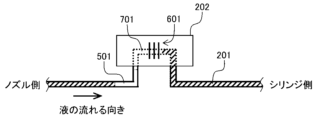
- 11 is a diagram showing a comparison of air detection conditions at the detection unit in the cases of a normal liquid amount, a liquid shortage, and an excess liquid amount.
- FIG. 1 is a diagram showing the overall configuration of an automatic analyzer according to this embodiment.
- the automatic analyzer 100 is roughly composed of an analysis unit 101 including a sample disk 102, a sample dispensing mechanism 104, a reagent storage 105, a reagent disk 106, a reagent dispensing mechanism 108, an incubator disk 110, a magnetic particle stirring arm 112, a reaction vessel disposal hole 113, an incubator block 114, a reaction liquid stirring mechanism 115, a reaction vessel tray 116, a first reaction vessel transport mechanism 117, a second reaction vessel transport mechanism 119, an immune detection mechanism 120, etc., and a control unit 125.
- an analysis unit 101 including a sample disk 102, a sample dispensing mechanism 104, a reagent storage 105, a reagent disk 106, a reagent dispensing mechanism 108, an incubator disk 110, a magnetic particle stirring arm 112, a reaction vessel disposal hole 113, an incubator block 114, a reaction liquid stirring mechanism 115, a reaction vessel tray 116, a first reaction vessel transport mechanism 117, a
- the control unit 125 controls the overall operation of the automatic analysis device 100, and is composed of, for example, a hardware board and a computer, and is connected to a storage device such as a hard disk.
- a number of sample containers 103 are arranged in a ring shape on the sample disk 102.
- the disk rotates clockwise and counterclockwise to transport the sample containers 103 to the access position of the sample dispensing mechanism 104.
- an identification barcode is attached to the sample container 103 in order to simplify sample management.
- the barcode contains information about the sample ID and sample type.
- the barcode attached to the sample container 103 is read by a barcode reader.
- the sample dispensing mechanism 104 is composed of a rotation drive mechanism, a vertical drive mechanism, and a dispensing nozzle.
- the dispensing nozzle of the sample dispensing mechanism 104 moves between the sample suction position and the sample discharge position 118 by the rotation drive mechanism and the vertical drive mechanism.
- the reagent storage 105 includes a reagent disk 106 having multiple reagent container holders 107 arranged in a ring shape.
- the reagent storage 105 includes, for example, a cooling function to increase the on-board stability of the reagent properties.
- Each of the multiple reagent container holders 107 on the reagent disk 106 holds a reagent container containing a reagent to be used in the analysis.
- the reagent disk 106 includes a rotation drive mechanism, and uses rotational motion to move each reagent container to a predetermined position on the circumference.
- the reagent dispensing mechanism 108 is composed of a rotation drive mechanism, a vertical drive mechanism, and a dispensing nozzle.
- the dispensing nozzle of the reagent dispensing mechanism 108 rotates and descends to the position of a predetermined type of reagent container on the reagent disk 106, aspirates a predetermined amount of reagent, then rises, and then rotates and descends to the reagent ejection position 111, ejecting the reagent into a reaction container placed at the reagent ejection position 111.
- a magnetic particle stirring arm 112 (also called a stirrer) having a magnetic particle stirring element as a stirring means is set on the reagent disk 106.
- the magnetic particle stirring arm 112 moves to the upper region of the reagent container containing the magnetic particle solution to be stirred, lowers the magnetic particle stirring element, and stirs the magnetic particle solution by rotating the magnetic particle stirring element.
- the magnetic particle stirring arm 112 stirs the magnetic particle solution immediately before the reagent is dispensed.
- sample dispensing process In the immunoanalysis process by the automated analyzer 100, the following steps are carried out in order: sample dispensing process, reagent dispensing process, reaction process, and detection process.
- the first reaction vessel transport mechanism 117 has drive mechanisms in the X-axis, Y-axis, and Z-axis directions, and moves above the reaction vessel disposal hole 113, incubator block 114, reaction liquid stirring mechanism 115, and reaction vessel tray 116.
- the first reaction vessel transport mechanism 117 moves the reaction vessel from the reaction vessel tray 116 to the sample dispensing position 118.
- the sample dispensing mechanism 104 dispenses a predetermined amount of sample into the reaction vessel placed at the sample dispensing position 118.
- the reaction vessel from which the sample has been discharged is then moved to the reagent dispensing position 111 by the second reaction vessel transport mechanism 119.
- the second reaction vessel transport mechanism 119 has a rotation drive mechanism, a vertical drive mechanism, and a reaction vessel gripping mechanism, and has the function of moving the reaction vessel to each reaction vessel installation position (reagent dispensing position 111, incubator block 114, reaction liquid stirring mechanism 115, sample dispensing position 118, reaction liquid suction position 121, etc.) placed on the rotation orbit.
- the reagent dispensing mechanism 108 dispenses a predetermined amount of reagent into a reaction vessel placed in the reagent discharge position 111.
- the reaction vessel is then moved to the reaction liquid mixing mechanism 115 by the second reaction vessel transport mechanism 119.
- the reaction vessel is moved to the incubator block 114 by the first reaction vessel transport mechanism 117.
- the reaction process is carried out in an incubator block 114, whose temperature is adjusted to an appropriate level in order to promote the reaction between the sample and the reagent.
- the reaction vessel is moved to the sample discharge position 118 by a first reaction vessel transport mechanism 117.
- the reaction vessel is then moved to the reaction liquid suction position 121, which is provided below the immunodetection mechanism 120, by a second reaction vessel transport mechanism 119.
- the reaction liquid is sucked into the detection section in the immunodetection mechanism 120 and measurement is performed.
- the reaction vessel is moved to the sample discharge position 118 by the second reaction vessel transport mechanism 119, and then discarded into the reaction vessel disposal hole 113 by the first reaction vessel transport mechanism 117.
- Figure 2 is a schematic diagram showing the configuration of the immune detection mechanism.
- the immune detection mechanism 120 is roughly composed of a dispensing mechanism consisting of a nozzle 205 and a vertical drive mechanism 206, a detection unit 202, a syringe 203, and a waste liquid unit 204.
- the dispensing mechanism is for sending the reaction liquid 201 contained in the reaction vessel 401 to the detection unit 202, and has a nozzle 205 inserted into the reaction vessel 401, and a vertical drive mechanism 206 capable of moving the nozzle 205 to a predetermined height (for example, a predetermined height from the bottom surface of the reaction vessel 401).
- a predetermined height for example, a predetermined height from the bottom surface of the reaction vessel 401.
- the nozzle 205 is inserted into the reaction vessel 401 to a predetermined height, that is, to a position where the tip of the nozzle 205 is just exposed from the reaction liquid 201 when the nozzle 205 is immersed in the reaction liquid 201 in the reaction vessel 401 and the amount of liquid required for analysis is aspirated.
- the syringe 203 is connected to the nozzle 205 via a liquid transfer path (pipe), and the detection unit 202 is disposed on the pipe.
- the nozzle 205 is immersed in the reaction liquid 201, which is a liquid contained in the reaction vessel 401, the nozzle 205 is suctioned in the reaction liquid 201, and the reaction liquid 201 is transferred to the detection unit 202.
- the syringe 203 is also connected to the waste liquid unit 204 via a liquid transfer path (pipe) separately from the detection unit 202.
- the connection of the liquid transfer path is switched to the waste liquid unit 204 side by opening and closing a valve (not shown) and the syringe 203 is retracted, and the reaction liquid 201 is transferred to the waste liquid unit 204.
- the detection unit 202 is a flow cell that converts the target substance in the reaction solution 201 into a detectable signal (reaction signal) through an electrochemical reaction.
- the flow cell is equipped with multiple electrodes, such as a working electrode, a reference electrode, and a counter electrode, and a recording unit 207 that records the voltage between the electrodes.
- the recording unit 207 records time-series data on the voltage between the electrodes.
- the operation of inserting the nozzle 205 into the reaction vessel 401, the operation of immersing it in the reaction liquid 201 (liquid), the operation of aspirating the reaction liquid 201 (liquid) by the nozzle 205, and the operation of detecting the target component and air by the detection unit 202 are controlled by the control unit 125.
- a liquid volume determination process is performed to detect a shortage or excess of the reaction liquid 201 contained in the reaction vessel 401.
- Figure 3 is a flowchart showing the liquid volume determination process.
- the immune detection mechanism 120 first lowers the nozzle 205 from the bottom of the reaction vessel 401 to a predetermined height and inserts it into the reaction vessel 401 (step S100).
- reaction liquid 201 in the reaction vessel 401 is aspirated by the nozzle 205 (step S110).
- the detection unit 202 determines whether or not there has been a change in voltage indicating the suction of air at a predetermined timing (a predetermined time) from when the nozzle 205 starts suctioning the reaction liquid 201 (step S120), and if the determination result is YES, it is determined that air has flowed in (step S130), and as a result, it is determined that the amount of liquid is insufficient (step S140).
- step S120 determines whether the determination result in step S120 is NO, or if the processing of step S140 is completed. If the determination result in step S120 is NO, or if the processing of step S140 is completed, the nozzle 205 is then raised to a predetermined height from the bottom of the reaction vessel 401 (step S150).
- step S160 the segmented air is sucked in by the nozzle 205 (step S160).
- the detection unit 202 determines whether there has been a change in voltage indicating air suction at a predetermined timing (a predetermined time) from when the nozzle 205 starts suctioning the segmented air (step S170), and if the determination result is YES, it is determined that no air has flowed in (step S180), and as a result, it is determined that there is an excess amount of liquid (step S190), and the process ends.
- step S170 If the determination result in step S170 is NO, the process ends.
- step S140 If neither a liquid shortage (step S140) nor an excess of liquid (step S190) is detected in the liquid volume determination process, it is determined that the liquid volume is normal. If both a liquid shortage (step S140) and an excess of liquid (step S190) are detected, an abnormality other than an excess or shortage of reaction liquid is suspected.
- an abnormality could be a leak in the flow path from the nozzle 205 to the detection unit 202, causing air to flow in at an unintended time.
- Figure 4 shows the positional relationship between the amount of reaction liquid in the reaction vessel and the nozzle when the amount of liquid is normal.
- Figures 5 and 6 show the state of the detection unit when the amount of liquid is normal.
- the liquid level of the reaction liquid 201 contained in the reaction vessel 401 is at position (A).
- the nozzle 205 is lowered to a predetermined position (B), i.e., to a predetermined height from the bottom of the reaction vessel 401 (step S100 in Figure 3).
- the predetermined position (B) is the position where the tip of the nozzle 205 is just exposed from the reaction liquid 201 when the nozzle 205 is immersed in the reaction liquid 201 in the reaction vessel 401 and the amount of liquid required for analysis (prescribed amount) is aspirated.
- the reaction liquid 201 is aspirated by the nozzle 205 (step S110 in FIG. 3). After aspirating, the tip of the nozzle 205 is just exposed from the reaction liquid 201. At this time, as shown in FIG. 5, at a predetermined timing (the time from when a specified amount of reaction liquid 201 is delivered until the arrival of segmented air 701), only the reaction liquid 201 passes over the electrode 601 in the flow cell of the detection unit 202. Therefore, if the amount of liquid is normal, no voltage change occurs due to the inflow of air (NO in step S120 in FIG. 3).
- the nozzle 205 is raised a predetermined amount to suck in the segmented air 701 (step S150 in FIG. 3). At this time, the nozzle 205 is raised to a position (C) where the tip of the nozzle 205 is not immersed in the reaction liquid.
- the position (C) can be determined according to the required accuracy of the amount of reaction liquid 201 produced (in other words, the required accuracy of the liquid volume determination process), and the higher the required accuracy, the closer the position (C) is set to position (B).
- the segmented air 701 is aspirated (step S160 in FIG. 3).
- the segmented air passes over the electrode 601 in the flow cell of the detection unit 202 at a predetermined timing (the time when a specified amount of reaction liquid 201 is delivered and the segmented air 701 arrives). Therefore, if the liquid volume is normal, a voltage change occurs due to the segmented air (NO in step S170 in FIG. 3).
- Figure 7 shows the positional relationship between the nozzle and the amount of reaction liquid in the reaction vessel when the amount of liquid is insufficient.
- Figure 8 shows the state of the detection unit when the amount of liquid is insufficient.
- the reaction liquid 201 is aspirated by the nozzle 205 (step S110 in FIG. 3).
- the tip of the nozzle 205 is completely exposed from the reaction liquid 201, and air 501 other than the segmented air is aspirated into the nozzle 205.
- air 501 passes over the electrode 601 in the flow cell of the detection unit 202 at a predetermined timing (between when a specified amount of reaction liquid 201 is delivered and when the segmented air 701 arrives). Therefore, if there is an insufficient amount of liquid, a voltage change occurs due to the inflow of air 501 (YES in step S120 in FIG. 3).
- the nozzle 205 is raised a predetermined amount to suck in the segmented air 701 (step S150 in FIG. 3). At this time, the tip of the nozzle 205 is raised to position (C).
- step S160 in FIG. 3 the segmented air 701 is sucked in.
- air 501 other than the segmented air 701 is sucked into the nozzle 205. Therefore, if there is a shortage of liquid, a voltage change due to air 501 occurs before a voltage change due to the segmented air 701 (YES in step S120 in FIG. 3).
- Figure 9 shows the relationship between the amount of reaction liquid in the reaction vessel and the position of the nozzle when there is an excess amount of liquid.
- Figure 10 shows the state of the detection unit when there is an excess amount of liquid.
- the liquid level of the reaction liquid 201 contained in the reaction vessel 401 is higher than the position (A) when the liquid volume is normal.
- the nozzle 205 is lowered to a predetermined position (B), that is, to a predetermined height from the bottom of the reaction vessel 401 (step S100 in Figure 3).
- the reaction liquid 201 is aspirated by the nozzle 205 (step S110 in FIG. 3). After aspirating, the tip of the nozzle 205 is immersed in the reaction liquid 201. At this time, as shown in FIG. 10, at a predetermined timing (between when a specified amount of reaction liquid 201 is delivered and when segmented air 701 arrives), only the reaction liquid 201 passes over the electrode 601 in the flow cell of the detection unit 202. Therefore, even if there is an excess amount of liquid, no voltage change occurs due to the inflow of air (NO in step S120 in FIG. 3).
- the nozzle 205 is raised a predetermined amount to suck in the segmented air 701 (step S150 in FIG. 3). At this time, the tip of the nozzle 205 is raised to position (C), but the tip of the nozzle 205 is immersed in the reaction liquid 201.
- Figure 11 shows a comparison of the air detection status in the detection section when there is a normal amount of liquid, a shortage of liquid, and an excess of liquid.
- the present embodiment includes a nozzle 205 that is immersed in and aspirates a liquid (e.g., reaction liquid 201) contained in a vessel (e.g., reaction vessel 401), a detection unit 202 that detects the inflow of air into the nozzle when aspirating the liquid contained in the vessel, and a control unit 125 that controls each operation of inserting the nozzle into the vessel, immersing it in the liquid, aspirating the liquid by the nozzle, and detecting air by the detection unit.
- the control unit is configured to insert the nozzle into the vessel to a position where the tip of the nozzle is exposed from the liquid when the nozzle is immersed in the liquid in the vessel and the amount of liquid required for analysis is aspirated.
- air detection conditions such as air (segmented air) that is detected at a specified timing with a normal liquid volume, but is detected at a timing other than the specified timing when the liquid volume is insufficient, or is not detected at the specified timing when the liquid volume is excessive.
- the present invention is not limited to the above-described embodiment, and includes various modifications and combinations that do not deviate from the gist of the present invention. Furthermore, the present invention is not limited to those having all of the configurations described in the above-described embodiment, and includes those in which some of the configurations are omitted.
- a detection unit having an electrochemical flow cell consisting of multiple electrodes is used as the air detection means, but this is not limited to the above.
- an optical sensor consisting of a light-emitting unit and a light-receiving unit may be used as the air detection means, and the inflow of air into the nozzle may be detected based on the amount of light irradiated from the light-emitting unit and detected by the light-receiving unit, or a pressure sensor that detects the pressure inside the nozzle may be used as the air detection means, and the inflow of air into the nozzle may be detected based on the pressure inside the nozzle.
- the present invention can be applied to any process that involves aspirating a predetermined amount of liquid, and is not limited to detection processes, as long as the process involves the aspirating flow path being equipped with a means for detecting the inflow of air.
- a specified amount of reagent to react with a specimen is filled into a reagent bottle by the manufacturing equipment when the reagent is manufactured.
- reaction liquid aspirate by appropriately controlling the height of the aspirating nozzle when aspirating the reagent from the reagent bottle, it is possible to detect whether the amount of reagent liquid is excessive or insufficient.
- each of the above configurations, functions, etc. may be realized in part or in whole by designing, for example, an integrated circuit. Furthermore, each of the above configurations, functions, etc. may be realized in software by a processor interpreting and executing a program that realizes each function.
Landscapes
- Physics & Mathematics (AREA)
- Health & Medical Sciences (AREA)
- Life Sciences & Earth Sciences (AREA)
- Chemical & Material Sciences (AREA)
- Analytical Chemistry (AREA)
- Biochemistry (AREA)
- General Health & Medical Sciences (AREA)
- General Physics & Mathematics (AREA)
- Immunology (AREA)
- Pathology (AREA)
- Automatic Analysis And Handling Materials Therefor (AREA)
Abstract
Description
なお、本発明は上記の実施の形態に限定されるものではなく、その要旨を逸脱しない範囲内の様々な変形例や組み合わせが含まれる。また、本発明は、上記の実施の形態で説明した全ての構成を備えるものに限定されず、その構成の一部を削除したものも含まれる。
Claims (6)
- 容器に収容された液体に浸漬して吸引するノズルと、
前記容器に収容された液体の吸引の際の前記ノズル内への空気の流入を検知する検知部と、
前記ノズルの前記容器への挿入、前記液体への浸漬、前記ノズルによる前記液体の吸引、及び、前記検知部による前記空気の検知の各動作を制御する制御部とを備え、
前記制御部は、前記ノズルを前記容器の液体に浸漬して分析に必要な量の液体を吸引した場合に前記ノズルの先端が前記液体から露出する位置まで、前記ノズルを前記容器内に挿入することを特徴とする自動分析装置。 - 請求項1記載の自動分析装置において、
前記制御部は、
前記ノズルを前記容器の液体に浸漬して分析に必要な量の液体を吸引するよりも前のタイミングで前記ノズル内への空気の流入が検知された場合に、前記容器内の液体の量が不足していると判定することを特徴とする自動分析装置。 - 請求項1記載の自動分析装置において、
前記制御部は、
前記ノズルを前記容器の液体に浸漬して分析に必要な量の液体を吸引した後、前記ノズルを予め定めた高さだけ上昇させて吸引動作を行い、前記検知部が前記ノズル内への空気の流入を検知しない場合に、前記容器内の液量が過剰であると判定することを特徴とする自動分析装置。 - 請求項1記載の自動分析装置において、
前記検知部は、複数の電極からなるフローセルであり、前記複数の電極間の電位差に基づいて、前記ノズル内への空気の流入を検知することを特徴とする自動分析装置。 - 請求項1記載の自動分析装置において、
前記検知部は、発光部と受光部とからなる光センサであり、前記発光部から照射されて前記受光部で検知される光量に基づいて、前記ノズル内への空気の流入を検知することを特徴とする自動分析装置。 - 請求項1記載の自動分析装置において、
前記検知部は、前記ノズル内の圧力を検出する圧力センサであり、前記ノズル内の圧力に基づいて、前記ノズル内への空気の流入を検知することを特徴とする自動分析装置。
Priority Applications (3)
| Application Number | Priority Date | Filing Date | Title |
|---|---|---|---|
| CN202480014264.4A CN120752538A (zh) | 2023-06-05 | 2024-04-25 | 自动分析装置 |
| EP24819057.1A EP4722734A1 (en) | 2023-06-05 | 2024-04-25 | Automatic analysis device |
| JP2025525986A JPWO2024252820A1 (ja) | 2023-06-05 | 2024-04-25 |
Applications Claiming Priority (2)
| Application Number | Priority Date | Filing Date | Title |
|---|---|---|---|
| JP2023-092515 | 2023-06-05 | ||
| JP2023092515 | 2023-06-05 |
Publications (1)
| Publication Number | Publication Date |
|---|---|
| WO2024252820A1 true WO2024252820A1 (ja) | 2024-12-12 |
Family
ID=93795361
Family Applications (1)
| Application Number | Title | Priority Date | Filing Date |
|---|---|---|---|
| PCT/JP2024/016305 Ceased WO2024252820A1 (ja) | 2023-06-05 | 2024-04-25 | 自動分析装置 |
Country Status (4)
| Country | Link |
|---|---|
| EP (1) | EP4722734A1 (ja) |
| JP (1) | JPWO2024252820A1 (ja) |
| CN (1) | CN120752538A (ja) |
| WO (1) | WO2024252820A1 (ja) |
Citations (4)
| Publication number | Priority date | Publication date | Assignee | Title |
|---|---|---|---|---|
| JP2004333439A (ja) | 2003-05-12 | 2004-11-25 | Hitachi High-Technologies Corp | 液量測定方法および装置 |
| JP2006010484A (ja) * | 2004-06-25 | 2006-01-12 | Hitachi Koki Co Ltd | 自動分注装置 |
| JP2010025858A (ja) * | 2008-07-23 | 2010-02-04 | Aloka Co Ltd | 分注装置 |
| JP2011158258A (ja) * | 2010-01-29 | 2011-08-18 | Hitachi High-Technologies Corp | 分析装置 |
-
2024
- 2024-04-25 CN CN202480014264.4A patent/CN120752538A/zh active Pending
- 2024-04-25 JP JP2025525986A patent/JPWO2024252820A1/ja active Pending
- 2024-04-25 WO PCT/JP2024/016305 patent/WO2024252820A1/ja not_active Ceased
- 2024-04-25 EP EP24819057.1A patent/EP4722734A1/en active Pending
Patent Citations (4)
| Publication number | Priority date | Publication date | Assignee | Title |
|---|---|---|---|---|
| JP2004333439A (ja) | 2003-05-12 | 2004-11-25 | Hitachi High-Technologies Corp | 液量測定方法および装置 |
| JP2006010484A (ja) * | 2004-06-25 | 2006-01-12 | Hitachi Koki Co Ltd | 自動分注装置 |
| JP2010025858A (ja) * | 2008-07-23 | 2010-02-04 | Aloka Co Ltd | 分注装置 |
| JP2011158258A (ja) * | 2010-01-29 | 2011-08-18 | Hitachi High-Technologies Corp | 分析装置 |
Non-Patent Citations (1)
| Title |
|---|
| See also references of EP4722734A1 |
Also Published As
| Publication number | Publication date |
|---|---|
| EP4722734A1 (en) | 2026-04-08 |
| CN120752538A (zh) | 2025-10-03 |
| JPWO2024252820A1 (ja) | 2024-12-12 |
Similar Documents
| Publication | Publication Date | Title |
|---|---|---|
| JP5178830B2 (ja) | 自動分析装置 | |
| US11754580B2 (en) | Sample measurement method and sample measurement device | |
| JP4913284B2 (ja) | 臨床分析を行う分析器における不良を検出する方法 | |
| EP2703819B1 (en) | Sample processing apparatus and sample processing method | |
| EP0793100A2 (en) | Method and device for automatic chemical analysis | |
| CN110291405B (zh) | 自动分析装置和自动分析装置中的清洗机构 | |
| EP2019321A1 (en) | Cleaning equipment and automatic analyzer | |
| CN104769439A (zh) | 试剂容器及自动分析装置 | |
| US20220268796A1 (en) | Method of Operating a Laboratory Instrument | |
| US11846632B2 (en) | Sample measurement device and sample measurement method | |
| CN116724238A (zh) | 自动分析装置以及自动分析装置中的检体的吸取方法 | |
| JP2009175132A (ja) | 自動分析装置及びその分注方法 | |
| CN116034277A (zh) | 自动分析装置 | |
| JP2004151087A (ja) | 臨床分析装置と共に使用される反応容器内における流体測定の改良 | |
| JP4045211B2 (ja) | 自動分析装置 | |
| WO2007132632A1 (ja) | 洗浄装置および自動分析装置 | |
| JP4110082B2 (ja) | 自動分析装置 | |
| EP4722734A1 (en) | Automatic analysis device | |
| JP5046804B2 (ja) | 自動分析装置 | |
| JP2007322394A (ja) | 分注装置および自動分析装置 | |
| JP2003254983A (ja) | 液面検知装置及びこれを用いた自動分析装置 | |
| WO2010150502A1 (ja) | 自動分析装置 | |
| WO2025052832A1 (ja) | 自動分析装置及び分析方法 | |
| JP2025125903A (ja) | 試薬容器及び自動分析装置自動分析装置 | |
| JP2025035385A (ja) | 測定チップ、自動分析装置、及び、自動分析システム |
Legal Events
| Date | Code | Title | Description |
|---|---|---|---|
| 121 | Ep: the epo has been informed by wipo that ep was designated in this application |
Ref document number: 24819057 Country of ref document: EP Kind code of ref document: A1 |
|
| WWE | Wipo information: entry into national phase |
Ref document number: 202480014264.4 Country of ref document: CN |
|
| ENP | Entry into the national phase |
Ref document number: 2025525986 Country of ref document: JP Kind code of ref document: A |
|
| WWE | Wipo information: entry into national phase |
Ref document number: 2025525986 Country of ref document: JP |
|
| WWP | Wipo information: published in national office |
Ref document number: 202480014264.4 Country of ref document: CN |
|
| ENP | Entry into the national phase |
Ref document number: 2024819057 Country of ref document: EP Effective date: 20260105 |
|
| WWE | Wipo information: entry into national phase |
Ref document number: 2024819057 Country of ref document: EP |
|
| NENP | Non-entry into the national phase |
Ref country code: DE |
|
| ENP | Entry into the national phase |
Ref document number: 2024819057 Country of ref document: EP Effective date: 20260105 |
|
| ENP | Entry into the national phase |
Ref document number: 2024819057 Country of ref document: EP Effective date: 20260105 |
|
| ENP | Entry into the national phase |
Ref document number: 2024819057 Country of ref document: EP Effective date: 20260105 |
|
| ENP | Entry into the national phase |
Ref document number: 2024819057 Country of ref document: EP Effective date: 20260105 |
|
| ENP | Entry into the national phase |
Ref document number: 2024819057 Country of ref document: EP Effective date: 20260105 |
|
| WWP | Wipo information: published in national office |
Ref document number: 2024819057 Country of ref document: EP |