WO2024252826A1 - Procédé de calcul de quantité de transport - Google Patents
Procédé de calcul de quantité de transport Download PDFInfo
- Publication number
- WO2024252826A1 WO2024252826A1 PCT/JP2024/016821 JP2024016821W WO2024252826A1 WO 2024252826 A1 WO2024252826 A1 WO 2024252826A1 JP 2024016821 W JP2024016821 W JP 2024016821W WO 2024252826 A1 WO2024252826 A1 WO 2024252826A1
- Authority
- WO
- WIPO (PCT)
- Prior art keywords
- belt
- point cloud
- cloud data
- amount calculation
- calculating
- Prior art date
- Legal status (The legal status is an assumption and is not a legal conclusion. Google has not performed a legal analysis and makes no representation as to the accuracy of the status listed.)
- Ceased
Links
Images


Classifications
-
- G—PHYSICS
- G01—MEASURING; TESTING
- G01G—WEIGHING
- G01G11/00—Apparatus for weighing a continuous stream of material during flow; Conveyor belt weighers
- G01G11/003—Details; specially adapted accessories
-
- G—PHYSICS
- G01—MEASURING; TESTING
- G01B—MEASURING LENGTH, THICKNESS OR SIMILAR LINEAR DIMENSIONS; MEASURING ANGLES; MEASURING AREAS; MEASURING IRREGULARITIES OF SURFACES OR CONTOURS
- G01B11/00—Measuring arrangements characterised by the use of optical techniques
- G01B11/02—Measuring arrangements characterised by the use of optical techniques for measuring length, width or thickness
-
- B—PERFORMING OPERATIONS; TRANSPORTING
- B65—CONVEYING; PACKING; STORING; HANDLING THIN OR FILAMENTARY MATERIAL
- B65G—TRANSPORT OR STORAGE DEVICES, e.g. CONVEYORS FOR LOADING OR TIPPING, SHOP CONVEYOR SYSTEMS OR PNEUMATIC TUBE CONVEYORS
- B65G43/00—Control devices, e.g. for safety, warning or fault-correcting
- B65G43/02—Control devices, e.g. for safety, warning or fault-correcting detecting dangerous physical condition of load carriers, e.g. for interrupting the drive in the event of overheating
-
- B—PERFORMING OPERATIONS; TRANSPORTING
- B65—CONVEYING; PACKING; STORING; HANDLING THIN OR FILAMENTARY MATERIAL
- B65G—TRANSPORT OR STORAGE DEVICES, e.g. CONVEYORS FOR LOADING OR TIPPING, SHOP CONVEYOR SYSTEMS OR PNEUMATIC TUBE CONVEYORS
- B65G43/00—Control devices, e.g. for safety, warning or fault-correcting
- B65G43/08—Control devices operated by article or material being fed, conveyed or discharged
-
- G—PHYSICS
- G01—MEASURING; TESTING
- G01B—MEASURING LENGTH, THICKNESS OR SIMILAR LINEAR DIMENSIONS; MEASURING ANGLES; MEASURING AREAS; MEASURING IRREGULARITIES OF SURFACES OR CONTOURS
- G01B11/00—Measuring arrangements characterised by the use of optical techniques
- G01B11/24—Measuring arrangements characterised by the use of optical techniques for measuring contours or curvatures
-
- G—PHYSICS
- G01—MEASURING; TESTING
- G01B—MEASURING LENGTH, THICKNESS OR SIMILAR LINEAR DIMENSIONS; MEASURING ANGLES; MEASURING AREAS; MEASURING IRREGULARITIES OF SURFACES OR CONTOURS
- G01B11/00—Measuring arrangements characterised by the use of optical techniques
- G01B11/28—Measuring arrangements characterised by the use of optical techniques for measuring areas
-
- G—PHYSICS
- G01—MEASURING; TESTING
- G01G—WEIGHING
- G01G11/00—Apparatus for weighing a continuous stream of material during flow; Conveyor belt weighers
- G01G11/14—Apparatus for weighing a continuous stream of material during flow; Conveyor belt weighers using totalising or integrating devices
- G01G11/16—Apparatus for weighing a continuous stream of material during flow; Conveyor belt weighers using totalising or integrating devices being electrical or electronic means
Definitions
- the present invention relates to a method for calculating the amount of transport that measures the amount of transported goods transported by a belt conveyor.
- a volume measurement system described in Patent Document 1 is a technology for measuring the volume of transported objects (transported objects) such as soil, sand, gravel, and aggregates transported by a belt conveyor.
- This volume measurement system is for measuring the volume of transported objects flowing on a belt conveyor, and includes at least a line laser that irradiates the transported object with laser light from above, a digital camera that photographs the contour line of the transported object drawn by the irradiation of the laser light from an angle different from the irradiation direction of the line laser, a movement amount sensor that measures the amount of movement of the belt conveyor, and an analysis device that calculates the volume of the transported object from the image data captured by the digital camera and the amount of movement of the belt conveyor.
- the volume measurement system described in Patent Document 1 it is possible to measure the volume with an accuracy according to the resolution of the digital camera.
- a line laser and a digital camera are used as sensors, the cost is high, including the labor required for installation and adjustment.
- the contour line drawn on the transported object by the laser light is photographed by the digital camera, and the cross-sectional area of the transported object is calculated by image analysis, which makes the processing complicated and costly.
- the present invention has been made in consideration of the above background, and has an object to provide a conveying amount calculation method that enables low-cost, highly accurate calculation of the conveying amount of an object conveyed by a belt conveyor.
- the transport amount calculation method executes the steps of: a transport amount calculation device calculating a cross-sectional area of the transported object based on belt point cloud data indicating the shape of the belt of a belt conveyor that transports the transported object and transported object point cloud data indicating the shape of the transported object; and calculating the volume transport amount of the transported object based on the cross-sectional area and the belt speed of the belt conveyor.
- the present invention provides a method for calculating the amount of transport that allows for the calculation of the amount of transport of an object transported by a belt conveyor at low cost and with high accuracy. Problems, configurations, and effects other than those described above will become clear from the description of the embodiments below.
- FIG. 1 is an overall configuration diagram of a transport amount calculation system according to an embodiment of the present invention.
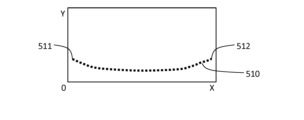
- FIG. 13 is a diagram showing an output of a sensor when there is no article to be conveyed according to the embodiment.
- FIG. 13 is a diagram showing an output of a sensor when an object is present according to the embodiment.
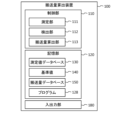
- 2 is a functional block diagram of a transport amount calculation device according to the embodiment.
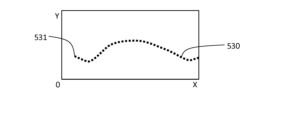
- FIG. 5A to 5C are diagrams for explaining deviation of a belt according to the embodiment. 4 is a diagram for explaining a cross-sectional area of a transported object according to the embodiment;
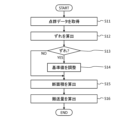
- FIG. 10 is a flowchart of a transport amount calculation process according to the embodiment.
- the following describes a transport amount calculation device in a form (embodiment) for implementing the present invention.
- Two-dimensional point cloud data acquired by a sensor installed on the belt conveyor is input to the transport amount calculation device.
- the sensor is, for example, LiDAR (Light Detection And Ranging or Laser Imaging Detection and Ranging), and can measure the distance to an object using laser light and acquire the (cross-sectional) shape of the transported object as two-dimensional point cloud data. Note that the cross section is in the width direction (transverse section).
- the conveying amount calculation device calculates the cross-sectional area of the conveyed object by calculating the difference with two-dimensional point cloud data showing the shape of the belt when there is no conveyed object, and then calculates the conveying amount (volume) by multiplying this by the belt speed of the belt conveyor.
- the belt of a belt conveyor can be made of rubber, resin, metal, etc., but unlike roller conveyors, the belt can "deflect” and in some cases “shift left and right.” This will be described later.
- the belt of a conveyor belt may shift left and right (horizontally) relative to the direction of travel.
- the transport amount calculation device detects the belt's shift by detecting the belt's endpoints based on two-dimensional point cloud data, and corrects the two-dimensional point cloud data (point cloud data showing the belt's shape) when there is no transported object, thereby calculating point cloud data showing the shape of the shifted belt and obtaining the cross-sectional area. In this way, the transport amount calculation device can calculate the transport amount with high accuracy even if the belt is shifted.
- ⁇ Overall configuration of the transport amount calculation system> 1 is an overall configuration diagram of a transport amount calculation system 10 according to this embodiment.
- the transport amount calculation system 10 includes a transport amount calculation device 100 and a sensor 200.
- a three-dimensional coordinate system 380 is referred to.
- the Z axis is the traveling direction of a belt conveyor 300 (belt 310)
- the X axis is the horizontal (left-right) direction
- the Y axis is the up-down direction.
- the sensor 200 is installed on the belt conveyor 300, measures the shape of the surface of the object being transported by the belt conveyor 300 as seen from above, and outputs the measurement results, that is, two-dimensional point cloud data, to the transport amount calculation device 100.
- the two-dimensional point cloud data indicates the shape of the surface of the object in the X-Y plane including the sensor 200 (a plane that is parallel to the plane including the X-axis and Y-axis and includes the sensor 200).
- the amount of deflection of the belt 310 increases according to the weight (transport amount) of the transported object.
- the sensor 200 is installed on a portion (support portion 320 supporting the belt 310 from below) where no deflection occurs (the amount of deflection does not change) even if the weight increases, and two-dimensional point cloud data of the cross-sectional shape is acquired. Misalignment data is also acquired.
- ⁇ 2D point cloud data> 2 is a diagram showing an output of the sensor 200 when there is no transported object according to the present embodiment.
- a dotted line 510 indicates a two-dimensional point cloud (two-dimensional point cloud data) corresponding to the surface of the belt 310. End points 511 and 512 of the dotted line 510 indicate the ends of the belt 310.
- 3 is a diagram showing the output of the sensor 200 when an object is present according to this embodiment.
- the dotted line 520 indicates a two-dimensional point cloud corresponding to the surface of the object on the belt 310.
- each point in the two-dimensional point cloud is shown using a coordinate system with the lower left corner as the origin, the lower side as the X-axis, and the left side as the Y-axis.
- the X-axis and Y-axis correspond to the X-axis and Y-axis, respectively, of the three-dimensional coordinate system 380 (see FIG. 1).
- the transport amount calculation device 100 is a computer, and includes a control unit 110, a storage unit 120, and an input/output unit 180.
- User interface devices such as a display, keyboard, and mouse are connected to the input/output unit 180.
- the input/output unit 180 includes a communication device, and is capable of transmitting and receiving data to and from the sensor 200.
- the storage unit 120 includes storage devices such as a read only memory (ROM), a random access memory (RAM), a solid state drive (SSD), etc.
- the storage unit 120 stores a measurement value database 130, a reference value 140, a transport amount database 150, and a program 128.
- the program 128 includes a description of a transport amount calculation process (see FIG. 7) to be described later.
- the measurement value database 130 stores the time series data of the two-dimensional point cloud data acquired from the sensor 200 in association with the acquisition time.
- the two-dimensional point cloud data is acquired, for example, at one-second intervals, and is a collection (group of coordinates) of coordinates of points (X-Y coordinates) that indicate the shape of the surface of the transported object or belt 310.
- the reference value 140 is two-dimensional point cloud data (see FIG. 2) when there is no load, and is a coordinate group of points indicating the dotted line 510. As described later, the reference value 140 is (a coordinate group of) two-dimensional point cloud data indicating the surface of the belt 310 when the belt 310 is not misaligned left or right (in the X-axis direction).
- the transport amount database 150 is time-series data of the calculated transport amounts (transport amounts per unit time).
- the control unit 110 includes a CPU (Central Processing Unit), and is provided with a measurement unit 111 , a detection unit 112 , and a transport amount calculation unit 113 .
- the measurement unit 111 stores the two-dimensional point cloud data, which is the output of the sensor 200, in the measurement value database 130.
- Detection unit The detector 112 detects deviation in the left-right direction (X-axis direction) with respect to the traveling direction (Z-axis direction) of the belt 310.
- Fig. 5 is a diagram for explaining deviation of the belt 310 according to the present embodiment. The position in the X-axis direction of an end point 531 of a dotted line 530 indicating the surface of the belt 310 or the conveyed object is deviated from the position of the end point 511 at the reference value 140 (see Fig. 2).
- This state occurs when belt 310 is misaligned in the positive direction on the X-axis.
- the end of belt 310 on the negative side of the X-axis is detected as end point 531 of dotted line 530.
- Detection unit 112 detects this misalignment of belt 310 and calculates the amount of misalignment.
- the amount of misalignment can be calculated by comparing the X-coordinate of end point 531 with the X-coordinate of end point 511 at reference value 140.
- the conveyance amount calculation device 100 includes the detection unit 112 that calculates the position of the belt 310 in the horizontal direction (X-axis direction) perpendicular to the traveling direction of the belt 310 .
- the detection unit 112 calculates the position of the belt 310 in the horizontal direction (X-axis direction) perpendicular to the traveling direction of the belt 310 based on point cloud data (see end points 531) indicating the end points of the belt 310 contained in the transported item point cloud data (see dotted line 530 in Figure 5).
- the conveyance amount calculation unit 113 calculates the cross-sectional area of the conveyed object, and calculates the conveyance amount by multiplying the cross-sectional area by the belt speed of the belt 310.
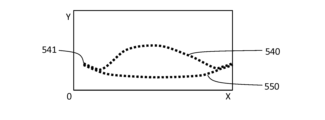
- Fig. 6 is a diagram for explaining the cross-sectional area of the conveyed object according to this embodiment.
- a dotted line 540 indicates a two-dimensional point cloud corresponding to the surface of the conveyed object on the belt 310. Note that a left end point 541 of the dotted line 540 is shifted to the right (the positive side of the X-axis) compared to the X-coordinate of the end point 511 at the reference value 140.
- Dotted line 550 is a two-dimensional point cloud obtained by shifting the two-dimensional point cloud indicated by reference value 140 (see dotted line 510) in the X-axis direction in accordance with the position of belt 310 calculated by detection unit 112 based on dotted line 540.
- dotted line 550 indicates a two-dimensional point cloud corresponding to the surface of belt 310 when there is no transported object at the time the two-dimensional point cloud indicated by dotted line 540 is acquired.
- the area sandwiched between dotted lines 510 and 540 then becomes the cross section of the transported object.
- the transport amount calculation unit 113 calculates the area of this cross section and regards it as the cross section of the transported object.
- the conveying amount calculation device 100 includes a conveying amount calculation unit 113 that calculates the cross-sectional area of the conveyed object based on belt point cloud data (see dotted line 550) indicating the shape of the belt 310 of the belt conveyor 300 that conveys the conveyed object, and conveyed object point cloud data (see dotted line 540) indicating the shape of the conveyed object.
- the conveyance amount calculation unit 113 calculates the volume conveyance amount of the conveyed object based on the cross-sectional area and the belt speed of the belt conveyor 300.
- the conveyance amount calculation unit 113 calculates belt point cloud data (see dotted line 550 ) based on the position of the belt 310 .
- the conveying amount calculation unit 113 calculates belt point cloud data (see dotted line 550) based on point cloud data indicating a predetermined belt shape (reference value 140, see dotted line 510) and the belt position calculated by the detection unit 112.
- the method for calculating the cross-sectional area is described below.
- the conveying amount calculation unit 113 regards the dotted lines 510 and 540 as line graphs, calculates the area between the two line graphs, and determines the cross-sectional area.
- the conveying amount calculation unit 113 multiplies the cross-sectional area by the belt speed of the belt 310 to calculate the conveying amount per unit time at the time when the dotted line 540 was obtained.
- the belt speed can be obtained from the control device of the belt conveyor 300.
- the conveyance amount calculation unit 113 may calculate the difference between the average values of the heights (Y coordinate values) of the dotted lines 510 and 540, and multiply this by the width of the belt 310 to obtain the cross-sectional area.
- the width of the belt 310 is the width of the dotted lines 510 and 540 (the length on the X coordinate).
- the conveyance amount calculation unit 113 may calculate the weight conveyance amount by multiplying the conveyance amount by the specific gravity of the conveyed object.
- the specific gravity means the bulk specific gravity (bulk density) in the case of an object having voids therein, such as a powder or granular material.
- the conveying amount calculation unit 113 calculates the area between the polygonal line indicated by the conveyed object point cloud data (see dotted line 540) and the polygonal line indicated by the belt point cloud data (see dotted line 510) as the cross-sectional area.
- the conveying amount calculation unit 113 calculates the cross-sectional area as the product of the difference between the average height calculated from the conveyed item point cloud data (see dotted line 540) and the average height calculated from the belt point cloud data (see dotted line 510) and the width of the belt 310 (the width of dotted lines 510, 540 (length on the X-coordinate)).
- the conveyance amount calculation unit 113 calculates the weight conveyance amount by multiplying the volume conveyance amount by the specific gravity of the object to be conveyed.
- ⁇ Transport amount calculation process> 7 is a flowchart of the transport amount calculation process according to the present embodiment.
- the process in FIG. In step S ⁇ b>11 the measurement unit 111 acquires two-dimensional point cloud data that is the output of the sensor 200 and stores it in the measurement value database 130 .
- step S ⁇ b>12 the detection unit 112 detects the end points of the two-dimensional point cloud indicated by the two-dimensional point cloud data and compares them with the reference value 140 to calculate the deviation of the belt 310 .
- step S13 if the deviation calculated in step S12 is equal to or smaller than a predetermined value, the detection unit 112 determines that there is no deviation (step S13 ⁇ NO) and proceeds to step S15. If the deviation exceeds the predetermined value, the detection unit 112 determines that there is a deviation (step S13 ⁇ YES) and proceeds to step S14.
- step S14 the transport amount calculation unit 113 adjusts the reference value 140.
- the transport amount calculation unit 113 shifts the reference value 140 in the X-axis direction in accordance with the deviation.
- step S15 the transport amount calculation unit 113 calculates a cross-sectional area based on the two-dimensional point cloud (see dotted line 510) of the reference value 140 adjusted in step S14 and the two-dimensional point cloud (see dotted line 540) acquired in step S11.
- step S16 the conveying amount calculation unit 113 multiplies the cross-sectional area calculated in step S15 by the belt speed of the belt 310 to calculate the conveying amount per unit time (volume conveying amount), and stores this in the conveying amount database 150 in association with the acquisition time of the two-dimensional point cloud data (see step S11).
- the conveying amount calculation unit 113 may also multiply the conveying amount per unit time by the specific gravity of the conveyed object to calculate the weight conveying amount per unit time, and store this in the conveying amount database 150 together with the volume conveying amount.
- the conveyance amount calculation device 100 calculates the cross-sectional area of the conveyed object based on a two-dimensional point cloud (see dotted line 540) showing the shape of the conveyed object surface and a two-dimensional point cloud (see dotted line 550) showing the shape of the belt 310 without the conveyed object, and calculates the volume by multiplying it by the belt speed. Furthermore, the conveyance amount calculation device 100 calculates the weight. In this way, the conveyance amount calculation device 100 can calculate the conveyance amount with simpler equipment than the conventional technology.
- the transport amount calculation device 100 also detects the end points of the belt 310, calculates the deviation in the left-right direction (X-axis direction), and adjusts the two-dimensional point cloud (see reference value 140, dotted line 510) that indicates the shape of the belt 310, which is the basis for calculating the cross-sectional area. In this way, the transport amount calculation device 100 can calculate the transport amount with high accuracy even if the belt 310 is misaligned.
- the conveyance amount calculation device 100 calculates the conveyance amount by calculating the cross-sectional area of the conveyed object, but the conveyance amount may be calculated without calculating the cross-sectional area.
- the conveyance amount calculation unit 113 may calculate the conveyance weight using a correlation equation created from the relationship between the average height of the conveyed object calculated from the conveyed object point cloud data (see dotted line 530) and the conveyance weight (weight conveyance amount) measured by another means such as a Merrick belt scale.
- the following linear equation (1) is created from the conveyance weight per unit time measured by the Merrick belt scale and the average value per unit time of the average height of the conveyed object calculated from the conveyed object point cloud data.
- the conveyance amount calculation unit 113 calculates the conveyance weight based on the average height of the conveyed object using the equation (1).
- Transport weight per unit time (average height of transported goods per unit time) x A + B (1)
- the constants A and B in formula (1) are constants that differ depending on the type of transported object and the moving speed of the belt conveyor 300.
- the formula does not need to be a linear formula as long as it can obtain the correlation between the average height and the transported weight of the transported objects. By using such a method, it is possible to calculate the conveyance amount without calculating the cross-sectional area of the conveyed object.
- the conveying amount calculation unit 113 calculates the average height of the transported object based on the transported object point cloud data (see dotted line 530) that indicates the shape of the transported object transported by the belt conveyor 300, and calculates the weight conveying amount or volume conveying amount of the transported object based on the calculated average height using the correlation between the average height of the transported object and the weight conveying amount or volume conveying amount of the transported object (see formula (1)).
- Conveyance amount calculation device 111 Measurement unit 112: Detection unit 113: Conveyance amount calculation unit 128: Program 130: Measurement value database 140: Reference value (point cloud data indicating a preset belt shape) 150 Transport amount database 200 Sensor 300 Belt conveyor 310 Belt 510 Dotted line (point cloud data showing a preset belt shape) 540 Dotted line (transport point cloud data) 550 Dotted line (Belt point cloud data)
Landscapes
- Physics & Mathematics (AREA)
- General Physics & Mathematics (AREA)
- Control Of Conveyors (AREA)
- Length Measuring Devices By Optical Means (AREA)
Abstract
Priority Applications (4)
| Application Number | Priority Date | Filing Date | Title |
|---|---|---|---|
| US19/490,938 US20260287414A1 (en) | 2023-06-08 | 2024-05-01 | Method for calculating conveyance amount |
| KR1020257042636A KR20260015879A (ko) | 2023-06-08 | 2024-05-01 | 반송량 산출방법 |
| AU2024283780A AU2024283780A1 (en) | 2023-06-08 | 2024-05-01 | Method for calculating conveyance amount |
| EP24819063.9A EP4726325A1 (fr) | 2023-06-08 | 2024-05-01 | Procédé de calcul de quantité de transport |
Applications Claiming Priority (2)
| Application Number | Priority Date | Filing Date | Title |
|---|---|---|---|
| JP2023095067A JP2024176502A (ja) | 2023-06-08 | 2023-06-08 | 搬送量算出方法 |
| JP2023-095067 | 2023-06-08 |
Publications (1)
| Publication Number | Publication Date |
|---|---|
| WO2024252826A1 true WO2024252826A1 (fr) | 2024-12-12 |
Family
ID=93795263
Family Applications (1)
| Application Number | Title | Priority Date | Filing Date |
|---|---|---|---|
| PCT/JP2024/016821 Ceased WO2024252826A1 (fr) | 2023-06-08 | 2024-05-01 | Procédé de calcul de quantité de transport |
Country Status (7)
| Country | Link |
|---|---|
| US (1) | US20260287414A1 (fr) |
| EP (1) | EP4726325A1 (fr) |
| JP (1) | JP2024176502A (fr) |
| KR (1) | KR20260015879A (fr) |
| AU (1) | AU2024283780A1 (fr) |
| TW (1) | TWI894990B (fr) |
| WO (1) | WO2024252826A1 (fr) |
Citations (6)
| Publication number | Priority date | Publication date | Assignee | Title |
|---|---|---|---|---|
| JP2002081987A (ja) * | 2000-09-08 | 2002-03-22 | Taisei Corp | ベルトコンベアの積載量測定方法およびその装置 |
| JP2005282265A (ja) * | 2004-03-30 | 2005-10-13 | Ohbayashi Corp | シールド掘進機 |
| JP2016133478A (ja) | 2015-01-22 | 2016-07-25 | 大成建設株式会社 | 体積測定システム |
| JP2018105590A (ja) * | 2016-12-28 | 2018-07-05 | 川崎重工業株式会社 | ごみ焼却設備 |
| CN110926331A (zh) * | 2019-10-28 | 2020-03-27 | 中交第二航务工程局有限公司 | 土压平衡盾构机出渣方量动态测量方法 |
| CN115479637A (zh) * | 2022-09-13 | 2022-12-16 | 北京华能新锐控制技术有限公司 | 一种物料传输的体积流量检测方法 |
Family Cites Families (3)
| Publication number | Priority date | Publication date | Assignee | Title |
|---|---|---|---|---|
| CN112945323A (zh) * | 2019-11-26 | 2021-06-11 | 大唐环境产业集团股份有限公司 | 一种上煤流量检测方法 |
| CN113295226A (zh) * | 2021-05-19 | 2021-08-24 | 中冶南方工程技术有限公司 | 一种皮带输送机流量非接触式测量方法 |
| CN115564738A (zh) * | 2022-10-17 | 2023-01-03 | 国家能源集团宿迁发电有限公司 | 基于主动双目立体视觉的干排渣机渣量检测方法及装置 |
-
2023
- 2023-06-08 JP JP2023095067A patent/JP2024176502A/ja active Pending
-
2024
- 2024-05-01 US US19/490,938 patent/US20260287414A1/en active Pending
- 2024-05-01 KR KR1020257042636A patent/KR20260015879A/ko active Pending
- 2024-05-01 EP EP24819063.9A patent/EP4726325A1/fr active Pending
- 2024-05-01 AU AU2024283780A patent/AU2024283780A1/en active Pending
- 2024-05-01 WO PCT/JP2024/016821 patent/WO2024252826A1/fr not_active Ceased
- 2024-06-04 TW TW113120590A patent/TWI894990B/zh active
Patent Citations (6)
| Publication number | Priority date | Publication date | Assignee | Title |
|---|---|---|---|---|
| JP2002081987A (ja) * | 2000-09-08 | 2002-03-22 | Taisei Corp | ベルトコンベアの積載量測定方法およびその装置 |
| JP2005282265A (ja) * | 2004-03-30 | 2005-10-13 | Ohbayashi Corp | シールド掘進機 |
| JP2016133478A (ja) | 2015-01-22 | 2016-07-25 | 大成建設株式会社 | 体積測定システム |
| JP2018105590A (ja) * | 2016-12-28 | 2018-07-05 | 川崎重工業株式会社 | ごみ焼却設備 |
| CN110926331A (zh) * | 2019-10-28 | 2020-03-27 | 中交第二航务工程局有限公司 | 土压平衡盾构机出渣方量动态测量方法 |
| CN115479637A (zh) * | 2022-09-13 | 2022-12-16 | 北京华能新锐控制技术有限公司 | 一种物料传输的体积流量检测方法 |
Also Published As
| Publication number | Publication date |
|---|---|
| TW202449356A (zh) | 2024-12-16 |
| KR20260015879A (ko) | 2026-02-03 |
| TWI894990B (zh) | 2025-08-21 |
| EP4726325A1 (fr) | 2026-04-15 |
| AU2024283780A1 (en) | 2025-12-11 |
| US20260287414A1 (en) | 2026-09-24 |
| JP2024176502A (ja) | 2024-12-19 |
Similar Documents
| Publication | Publication Date | Title |
|---|---|---|
| US6603563B1 (en) | Apparatus for determining measurements of an object utilizing negative imaging | |
| EP3040678B1 (fr) | Système et procédé de photogrammétrie | |
| CN103278225B (zh) | 基于图像技术检测的皮带称重装置 | |
| CN113324483B (zh) | 一种用于中厚板尺寸的测量装置及其测量方法 | |
| CN108474644A (zh) | 体积估计方法、设备和系统 | |
| CN113281777B (zh) | 一种货物体积动态测量方法及其测量装置 | |
| WO2015135015A1 (fr) | Profileur 3d de wagons de train | |
| JP6510246B2 (ja) | 体積測定システム | |
| JP2021025853A (ja) | サイズ測定装置、サイズ測定方法、プログラム | |
| CN117422777A (zh) | 安检机标定方法及相关方法、装置、设备和存储介质 | |
| CN117686041A (zh) | 一种基于激光阵列辅助的煤流量高频次检测方法及系统 | |
| CN114295516A (zh) | 物料的密度测量方法及其装置 | |
| Guedri et al. | Bulk material flow measurement based only on a smart camera fixed above a moving belt conveyor | |
| JP2024176502A (ja) | 搬送量算出方法 | |
| JP2004144643A (ja) | ベルトコンベア搬送物の搬送量自動計測装置及びその方法並びにベルトコンベアの移動速度測定方法 | |
| CN116839475A (zh) | 一种输送带料流检测方法和装置 | |
| CN120383145B (zh) | 具有校准功能的料流智能监测系统 | |
| JP6757952B2 (ja) | 体積測定システム | |
| KR101328696B1 (ko) | 형상측정장치 및 형상측정방법 | |
| KR20030053075A (ko) | 3차원 영상측정을 통한 중량측정장치 | |
| CN112833983A (zh) | 一种基于激光扫描的煤量检测方法 | |
| CN115265370A (zh) | 一种面向航空托盘的多维度检测设备及方法 | |
| Aleksandrović et al. | VOLUME FLOW MEASUREMENT OF BULK SOLIDS ON CONVEYOR BELTS. | |
| CN120427091B (zh) | 输送设备上的物料的重量监测方法和监测装置 | |
| RU2790801C1 (ru) | Способ определения объема сырья |
Legal Events
| Date | Code | Title | Description |
|---|---|---|---|
| 121 | Ep: the epo has been informed by wipo that ep was designated in this application |
Ref document number: 24819063 Country of ref document: EP Kind code of ref document: A1 |
|
| WWE | Wipo information: entry into national phase |
Ref document number: AU2024283780 Country of ref document: AU |
|
| WWE | Wipo information: entry into national phase |
Ref document number: 2501008321 Country of ref document: TH |
|
| ENP | Entry into the national phase |
Ref document number: 2024283780 Country of ref document: AU Date of ref document: 20240501 Kind code of ref document: A |
|
| REG | Reference to national code |
Ref country code: BR Ref legal event code: B01A Ref document number: 112025026833 Country of ref document: BR |
|
| ENP | Entry into the national phase |
Ref document number: 1020257042636 Country of ref document: KR Free format text: ST27 STATUS EVENT CODE: A-0-1-A10-A15-NAP-PA0105 (AS PROVIDED BY THE NATIONAL OFFICE) |
|
| WWE | Wipo information: entry into national phase |
Ref document number: 202617001704 Country of ref document: IN |
|
| WWE | Wipo information: entry into national phase |
Ref document number: 2024819063 Country of ref document: EP |
|
| NENP | Non-entry into the national phase |
Ref country code: DE |
|
| ENP | Entry into the national phase |
Ref document number: 2024819063 Country of ref document: EP Effective date: 20260108 |
|
| ENP | Entry into the national phase |
Ref document number: 2024819063 Country of ref document: EP Effective date: 20260108 |
|
| ENP | Entry into the national phase |
Ref document number: 2024819063 Country of ref document: EP Effective date: 20260108 |
|
| ENP | Entry into the national phase |
Ref document number: 2024819063 Country of ref document: EP Effective date: 20260108 |
|
| ENP | Entry into the national phase |
Ref document number: 2024819063 Country of ref document: EP Effective date: 20260108 |
|
| WWP | Wipo information: published in national office |
Ref document number: 2024819063 Country of ref document: EP |