WO2024252856A1 - Display device and electronic device - Google Patents
Display device and electronic device Download PDFInfo
- Publication number
- WO2024252856A1 WO2024252856A1 PCT/JP2024/017708 JP2024017708W WO2024252856A1 WO 2024252856 A1 WO2024252856 A1 WO 2024252856A1 JP 2024017708 W JP2024017708 W JP 2024017708W WO 2024252856 A1 WO2024252856 A1 WO 2024252856A1
- Authority
- WO
- WIPO (PCT)
- Prior art keywords
- light
- color
- filter
- pixels
- display device
- Prior art date
- Legal status (The legal status is an assumption and is not a legal conclusion. Google has not performed a legal analysis and makes no representation as to the accuracy of the status listed.)
- Ceased
Links
Images














Classifications
-
- G—PHYSICS
- G02—OPTICS
- G02B—OPTICAL ELEMENTS, SYSTEMS OR APPARATUS
- G02B5/00—Optical elements other than lenses
- G02B5/20—Filters
-
- G—PHYSICS
- G09—EDUCATION; CRYPTOGRAPHY; DISPLAY; ADVERTISING; SEALS
- G09F—DISPLAYING; ADVERTISING; SIGNS; LABELS OR NAME-PLATES; SEALS
- G09F9/00—Indicating arrangements for variable information in which the information is built-up on a support by selection or combination of individual elements
- G09F9/30—Indicating arrangements for variable information in which the information is built-up on a support by selection or combination of individual elements in which the desired character or characters are formed by combining individual elements
-
- G—PHYSICS
- G09—EDUCATION; CRYPTOGRAPHY; DISPLAY; ADVERTISING; SEALS
- G09F—DISPLAYING; ADVERTISING; SIGNS; LABELS OR NAME-PLATES; SEALS
- G09F9/00—Indicating arrangements for variable information in which the information is built-up on a support by selection or combination of individual elements
- G09F9/30—Indicating arrangements for variable information in which the information is built-up on a support by selection or combination of individual elements in which the desired character or characters are formed by combining individual elements
- G09F9/302—Indicating arrangements for variable information in which the information is built-up on a support by selection or combination of individual elements in which the desired character or characters are formed by combining individual elements characterised by the form or geometrical disposition of the individual elements
-
- H—ELECTRICITY
- H10—SEMICONDUCTOR DEVICES; ELECTRIC SOLID-STATE DEVICES NOT OTHERWISE PROVIDED FOR
- H10K—ORGANIC ELECTRIC SOLID-STATE DEVICES
- H10K50/00—Organic light-emitting devices
- H10K50/80—Constructional details
- H10K50/85—Arrangements for extracting light from the devices
- H10K50/852—Arrangements for extracting light from the devices comprising a resonant cavity structure, e.g. Bragg reflector pair
-
- H—ELECTRICITY
- H10—SEMICONDUCTOR DEVICES; ELECTRIC SOLID-STATE DEVICES NOT OTHERWISE PROVIDED FOR
- H10K—ORGANIC ELECTRIC SOLID-STATE DEVICES
- H10K50/00—Organic light-emitting devices
- H10K50/80—Constructional details
- H10K50/85—Arrangements for extracting light from the devices
- H10K50/858—Arrangements for extracting light from the devices comprising refractive means, e.g. lenses
-
- H—ELECTRICITY
- H10—SEMICONDUCTOR DEVICES; ELECTRIC SOLID-STATE DEVICES NOT OTHERWISE PROVIDED FOR
- H10K—ORGANIC ELECTRIC SOLID-STATE DEVICES
- H10K50/00—Organic light-emitting devices
- H10K50/80—Constructional details
- H10K50/86—Arrangements for improving contrast, e.g. preventing reflection of ambient light
-
- H—ELECTRICITY
- H10—SEMICONDUCTOR DEVICES; ELECTRIC SOLID-STATE DEVICES NOT OTHERWISE PROVIDED FOR
- H10K—ORGANIC ELECTRIC SOLID-STATE DEVICES
- H10K59/00—Integrated devices, or assemblies of multiple devices, comprising at least one organic light-emitting element covered by group H10K50/00
- H10K59/10—OLED displays
- H10K59/12—Active-matrix OLED [AMOLED] displays
- H10K59/121—Active-matrix OLED [AMOLED] displays characterised by the geometry or disposition of pixel elements
-
- H—ELECTRICITY
- H10—SEMICONDUCTOR DEVICES; ELECTRIC SOLID-STATE DEVICES NOT OTHERWISE PROVIDED FOR
- H10K—ORGANIC ELECTRIC SOLID-STATE DEVICES
- H10K59/00—Integrated devices, or assemblies of multiple devices, comprising at least one organic light-emitting element covered by group H10K50/00
- H10K59/30—Devices specially adapted for multicolour light emission
- H10K59/38—Devices specially adapted for multicolour light emission comprising colour filters or colour changing media [CCM]
Definitions
- This disclosure relates to a display device and an electronic device equipped with the same.
- Patent Document 1 describes that a display device in which the first, second, and third subpixels are arranged in a square has the problem that the viewing angle characteristics deteriorate due to differences in aperture ratio. Patent Document 1 also describes that, in order to solve this problem, the viewing angle of the third subpixel is limited by a black matrix (light-shielding portion).
- the purpose of this disclosure is to provide a display device that can improve viewing angle characteristics and an electronic device equipped with the same.
- a display device includes: a plurality of first pixels capable of emitting light of a first color; a plurality of second pixels capable of emitting light of a second color; The second pixels are arranged in a plurality of columns, The second column of pixels is A plurality of first light-emitting elements arranged in a column direction of a column of second pixels; a first filter portion provided above the first light-emitting elements and having a second color; a plurality of second filter portions having a color different from the second color, the second filter portions being provided above the plurality of first light-emitting elements and at each boundary between adjacent second pixels in the column direction.
- a display device includes: a plurality of first pixels capable of emitting light of a first color; a plurality of second pixels capable of emitting light of a second color; The second pixels are arranged in a plurality of columns, The second column of pixels is A plurality of first light-emitting elements arranged in a column direction of a column of second pixels; a color conversion unit provided above the first light-emitting elements and capable of converting light emitted from the first light-emitting elements into light of a second color; a filter portion provided above the plurality of first light-emitting elements and at a boundary portion between adjacent second pixels in the column direction, the filter portion having a color different from the second color.
- An electronic device includes a display device according to the first aspect of the present disclosure or a display device according to the second aspect of the present disclosure.
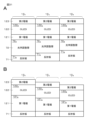
- FIG. 1 is a plan view of sub-pixels arranged in a stripe pattern.
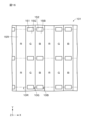
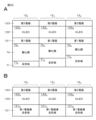
- FIG. 2 is a plan view of the display device according to the first embodiment.
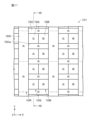
- FIG. 3 is an enlarged plan view showing a part of the effective pixel region of FIG.
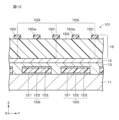
- FIG. 4 is a cross-sectional view taken along line IV-IV in FIG.
- FIG. 5 is a cross-sectional view taken along line VV in FIG.
- FIG. 6 is a cross-sectional view taken along line VI-VI in FIG.
- FIG. 7 is a plan view of sub-pixels arranged in a square shape.
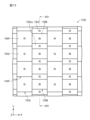
- FIG. 8 is an enlarged plan view showing a part of an effective pixel region of the display device according to the second embodiment.
- FIG. 8 is an enlarged plan view showing a part of an effective pixel region of the display device according to the second embodiment.
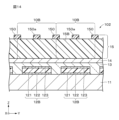
- FIG. 9 is a cross-sectional view taken along line IX-IX in FIG.
- FIG. 10 is a cross-sectional view taken along line XX in FIG.
- FIG. 11 is an enlarged plan view showing a part of the effective pixel region.
- FIG. 12 is a cross-sectional view taken along line XII-XII in FIG.
- FIG. 13 is an enlarged plan view showing a part of the effective pixel region.
- FIG. 14 is a cross-sectional view taken along line XIV-XIV in FIG.
- FIG. 15 is an enlarged plan view showing a part of the effective pixel region.
- FIG. 16 is an enlarged plan view showing a part of the effective pixel region.
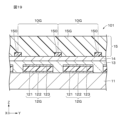
- FIG. 17 is an enlarged cross-sectional view of the effective pixel region.
- FIG. 18 is an enlarged cross-sectional view of the effective pixel region.
- FIG. 19 is an enlarged cross-sectional view of the effective pixel region.
- FIG. 20 is an enlarged cross-sectional view of the effective pixel region.
- FIG. 21 is an enlarged cross-sectional view of the effective pixel region.
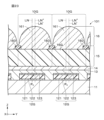
- FIG. 22 is an enlarged cross-sectional view (XZ cross-sectional view) of the effective pixel area.
- FIG. 23 is an enlarged cross-sectional view (YZ cross-sectional view) of the effective pixel region.
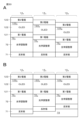
- Fig. 24A is a schematic diagram of an analytical model of Simulation 1.
- Fig. 24B is a schematic diagram of an analytical model of Simulation 2.
- Fig. 24C is a schematic diagram of an analytical model of Simulation 3.
- FIG. 24D is a schematic diagram of an analytical model of Simulation 4.
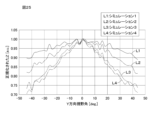
- FIG. 25 is a graph showing the results of simulations 1 to 4.
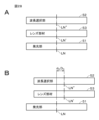
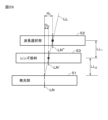
- 26A, 26B, and 26C are conceptual diagrams for explaining the relationship between a normal line LN passing through the center of the light-emitting portion, a normal line LN' passing through the center of the lens member, and a normal line LN" passing through the center of the wavelength selection portion, respectively.
- FIG. 27 is a conceptual diagram for explaining the relationship between a normal line LN passing through the center of the light emitting portion, a normal line LN' passing through the center of the lens member, and a normal line LN" passing through the center of the wavelength selecting portion.
- FIG. 28A and 28B are conceptual diagrams for explaining the relationship between a normal line LN passing through the center of the light-emitting portion, a normal line LN' passing through the center of the lens member, and a normal line LN" passing through the center of the wavelength selection portion, respectively.
- FIG. 29 is a conceptual diagram for explaining the relationship between a normal line LN passing through the center of the light emitting portion, a normal line LN' passing through the center of the lens member, and a normal line LN" passing through the center of the wavelength selecting portion.
- Fig. 30A is a schematic cross-sectional view for explaining a first example of a resonator structure
- Fig. 30B is a schematic cross-sectional view for explaining a second example of a resonator structure.
- Fig. 31A is a schematic cross-sectional view for explaining a third example of the resonator structure
- Fig. 31B is a schematic cross-sectional view for explaining a fourth example of the resonator structure
- 32A and 32B are schematic cross-sectional views for explaining a fifth example of the resonator structure and a sixth example of the resonator structure, respectively.
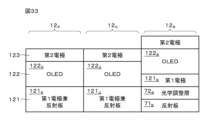
- FIG. 33 is a schematic cross-sectional view for explaining a seventh example of the resonator structure.
- 34A and 34B are front and rear views of the digital still camera.
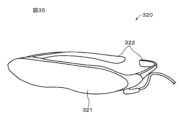
- FIG. 35 is a perspective view of a head mounted display.
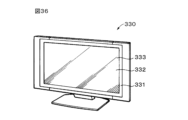
- FIG. 36 is a perspective view of a television device.
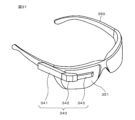
- FIG. 37 is a perspective view of a see-through head mounted display.
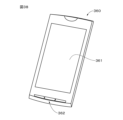
- FIG. 38 is a perspective view of a smartphone.
- Fig. 39A is a diagram showing the interior of the vehicle from the rear to the front
- Fig. 39B is a diagram showing the interior of the vehicle from the
- a display device comprises a plurality of first pixels capable of emitting light of a first color and a plurality of second pixels capable of emitting light of a second color, the plurality of second pixels being arranged in a plurality of columns, and the columns of second pixels include a plurality of first light-emitting elements aligned in a column direction of the column of second pixels, a first filter section having a second color and provided above the plurality of first light-emitting elements, and a plurality of second filter sections having a color different from the second color and provided above the plurality of first light-emitting elements and at each boundary between adjacent second pixels in the column direction.
- a second filter section having a color different from the second color is provided at each boundary between adjacent second pixels in the column direction, so that at least a portion of the light emitted from the first light-emitting element toward the boundary can be absorbed by the second filter section.
- the display device includes a plurality of first pixels capable of emitting light of a first color and a plurality of second pixels capable of emitting light of a second color, the plurality of second pixels being arranged in a plurality of columns, and the columns of the second pixels include a plurality of first light-emitting elements aligned in the column direction of the columns of the second pixels, a color conversion unit provided above the plurality of first light-emitting elements and capable of converting light emitted from the plurality of first light-emitting elements into light of the second color, and a plurality of filter units provided above the plurality of first light-emitting elements and at each boundary between adjacent second pixels in the column direction, and having a color different from the second color.
- a filter section having a color different from the second color is provided at each boundary between second pixels adjacent in the column direction. This allows at least a portion of the light emitted from the light-emitting element toward the boundary to be absorbed by the filter section. This narrows the viewing angle of the second pixel in the column direction, and suppresses the difference in viewing angle characteristics between the first pixel and the second pixel. This makes it possible to suppress the occurrence of differences in color between an image viewed from the front direction and an image viewed obliquely from the column direction. This makes it possible to improve the viewing angle characteristics in the column direction.
- the column direction of the columns of second pixels may be any direction within the plane of the display surface of the display device, and may be, for example, the vertical or horizontal direction of the display surface of the display device.
- the column direction of the columns of second pixels refers to the direction in which the columns of second pixels extend.
- the second filter section may be provided on the first filter section or may be provided within the first filter section.
- the thickness of the second filter section may be substantially the same as the thickness of the first filter section.
- the first filter section may have a surface opposite to the side of the first light-emitting element, and a part of the second filter section may protrude above the surface of the first filter section.
- the first filter section may cover the second filter section.
- the filter section may be provided on the wavelength selection section or may be provided within the wavelength selection section.
- the thickness of the filter section may be substantially the same as the thickness of the wavelength selection section.
- the wavelength selection section may have a surface opposite to the side of the first light-emitting element, and a part of the filter section may protrude onto the above-mentioned surface of the wavelength selection section.
- the wavelength selection section may cover the filter section.
- the column of second pixels may further include a plurality of lenses provided above the plurality of first light-emitting elements. At least some of the plurality of lenses may be shifted in an in-plane direction of the display device with respect to the first light-emitting elements.
- the in-plane direction in which the plurality of lenses are shifted is arbitrary and can be selected according to the desired characteristics.
- the second filter sections may be shifted in an in-plane direction of the display device with respect to the first light-emitting element.
- the in-plane direction in which the second filter sections are shifted is arbitrary and can be selected according to the desired characteristics.
- At least some of the multiple filter sections may be shifted in an in-plane direction of the display device with respect to the first light-emitting element.
- the in-plane direction in which the filter sections are shifted is arbitrary and can be selected according to the desired characteristics.
- the size of the second pixel in the column direction may be larger than the size of the first pixel in the column direction.
- the size of the second pixel in the column direction may be larger than the size of the first pixel in the column direction.
- the first color may be red
- the first pixel may have a resonator structure capable of resonating and emphasizing red light.
- a second filter section having a color different from the second color is provided at each boundary between adjacent second pixels in the column direction, thereby suppressing a decrease in viewing angle characteristics caused by the resonator structure.
- the first color may be red
- the first pixel may have a resonator structure capable of resonating and emphasizing red light.
- a filter section having a color different from the second color is provided at each boundary between adjacent second pixels in the column direction, thereby suppressing the degradation of the viewing angle characteristics caused by the resonator structure.
- the display device may further include a plurality of third pixels capable of emitting light of a third color.
- the second filter section may have the first color or the third color.
- the second filter section can be formed using the same filter material as the first pixels or the third pixels, thereby reducing the number of types of materials used to form the display device.
- the display device may further include a plurality of third pixels capable of emitting light of a third color.
- the filter portion may have the first color or the third color.
- the filter portion can be formed using the same filter material as the first pixels or the third pixels, so that the number of types of materials used to form the display device can be reduced.
- the first, second and third colors may be different from each other, and each of the first, second and third colors may be a color selected from the group consisting of red, blue and green.
- the tristimulus values X, Y and Z of the CIE 1931 color system obtained by measuring a white image displayed on the display device from the column direction are approximately equal.
- the plurality of third pixels when a plurality of third pixels capable of emitting light of a third color are provided, the plurality of third pixels may form a plurality of columns, and the column of third pixels may include a plurality of second light-emitting elements aligned in the column direction, and a third filter section having the third color and provided above the plurality of second light-emitting elements.
- the plurality of third pixels further include a plurality of fourth filter sections having a color different from the third color and provided above the plurality of second light-emitting elements and at each boundary between adjacent third pixels in the column direction.
- the first, second and third pixels when a plurality of third pixels capable of emitting light of a third color are provided, the first, second and third pixels may be arranged in a stripe array or a square array. When the first, second and third pixels are arranged in a square array, the second pixel may be arranged adjacent to the first and third pixels.
- the column of second pixels may further include a fifth filter portion that is provided within the second pixels in a plan view and has a color different from the second color.
- the viewing angle of the second pixels can be further narrowed.
- the column of third pixels may further include a sixth filter portion that is provided within the third pixels in a plan view and has a color different from the third color.
- the viewing angle of the third pixels can be further narrowed.
- the first light-emitting elements may be configured to emit white light or a second color light.
- the color conversion section may be a filter section or a wavelength conversion section.
- the wavelength conversion section may be a quantum dot section.
- the display device may be provided in an electronic device.
- the display device may be provided in an eyewear device such as a VR (Virtual Reality) device, an MR (Mixed Reality) device, or an AR (Augmented Reality) device, or may be provided in an electronic viewfinder (EVF) or a small projector, etc.
- an eyewear device such as a VR (Virtual Reality) device, an MR (Mixed Reality) device, or an AR (Augmented Reality) device
- EMF electronic viewfinder
- object B is above object A
- object B refers to the relative positional relationship between object A and object B, and is a concept that includes not only a state in which object B is located directly above object A with no other objects in between, but also a state in which object B is located above object A with at least one other object in between.
- on object A in expressions such as "object B is provided on object A” indicates the relative positional relationship between object A and object B, and is a concept that includes not only a state in which object B is located directly on object A without any other object in between, but also a state in which object B is located on object A with at least one other object in between.
- First embodiment> [Background to the creation of the display device 101 according to the first embodiment]
- the sub-pixels 10R, 10G, and 10B are arranged in a stripe pattern
- the sub-pixels 10R, 10R, the sub-pixels 10G, 10G, and the sub-pixels 10B, 10B having the same emission color may be arranged adjacent to each other in the Y-axis direction.
- the viewing angle characteristics may be deteriorated because the tristimulus values X, Y, and Z obtained by measuring obliquely from the Y-axis direction are different.
- a difference in color may occur between the image viewed from the Z-axis direction (front direction) and the image viewed obliquely from the Y-axis direction.
- the tristimulus values X, Y, and Z generally correspond to the three primary colors R, G, and B, i.e., the emission colors of the sub-pixels 10R, 10G, and 10B.
- Patent Document 1 describes that when the subpixels are arranged in a square, the viewing angle characteristics are degraded due to differences in the aperture ratio of the subpixels. However, as described above, even when the subpixels are arranged in a stripe and there is no difference in the aperture ratio of the subpixels 10R, 10G, and 10B, the viewing angle characteristics may be degraded. For example, in a display device in which the subpixels 10R, 10G, and 10B have a resonator structure (cavity structure), the resonator structure of the subpixel 10R is likely to extract not only red light (e.g., light with a wavelength of about 600 nm) but also blue light (e.g., light with a wavelength of about 400 nm).
- red light e.g., light with a wavelength of about 600 nm
- blue light e.g., light with a wavelength of about 400 nm
- the viewing angle characteristics of the subpixel 10R in the Y-axis direction are more likely to be degraded than the viewing angle characteristics of the subpixels 10G and 10B in the Y-axis direction.
- a display device 101 that can suppress the difference between the viewing angle characteristics of the subpixel 10R in the Y-axis direction and the viewing angle characteristics of the subpixels 10G and 10B in the Y-axis direction, even when the subpixels 10R, 10G, and 10B have a resonator structure.
- differences in the viewing angle characteristics of subpixels 10R, 10G, and 10B in the Y-axis direction i.e., differences in the tristimulus values X, Y, and Z of subpixels 10R, 10G, and 10B in the Y-axis direction
- differences in characteristics due to the film thickness of the organic EL of subpixels 10R, 10G, and 10B, and differences in the concentration and film thickness of the color filters of subpixels 10R, 10G, and 10B may also cause differences in the viewing angle characteristics of subpixels 10R, 10G, and 10B in the Y-axis direction. Therefore, the present disclosure is not limited to display device 101 having a resonator structure.
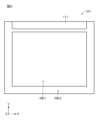
- FIG. 1 is a plan view of a display device 101 according to a first embodiment.
- the display device 101 may be a top-emission OLED display device.
- the display device 101 has an effective pixel region RE1 and a peripheral region RE2 provided around the effective pixel region RE1.
- a first direction and a second direction perpendicular to the display surface of the display device 101 are referred to as an X-axis direction and a Y-axis direction, respectively, and a direction perpendicular to the display surface of the display device 101 is referred to as a Z-axis direction.
- the X-axis direction is the horizontal direction in the display surface
- the Y-axis direction is the vertical direction in the display surface.
- FIG. 2 is a plan view showing an enlarged portion of the effective pixel region RE1.
- a plurality of sub-pixels 10R, 10G, 10B are two-dimensionally arranged in a prescribed array within the effective pixel region RE1.
- the prescribed array is a stripe array
- a pad section 111 and a driver (not shown) for displaying images, etc. are provided in the peripheral region RE2.
- a flexible printed circuit (FPC) (not shown) may be connected to the pad section 111.
- Subpixel 10R can emit red light (first color light).
- Subpixel 10G can emit green light (second color light).
- Subpixel 10B can emit blue light (third color light).
- subpixels 10R, 10G, and 10B may be referred to as subpixels 10.
- One pixel is composed of, for example, a plurality of adjacent subpixels 10R, 10G, and 10B.
- the configuration of one pixel is not limited to this example.
- Subpixel 10R may have a rectangular shape in a plan view.
- one of subpixels 10G and 10B is an example of a second pixel in the first aspect and the second aspect of the present disclosure, and the other is an example of a third pixel in the first aspect and the second aspect of the present disclosure.
- Subpixel 10R is an example of a first pixel in the first aspect of the present disclosure and the second aspect of the present disclosure.
- the multiple sub-pixels 10R form a column of multiple sub-pixels 10R.
- the column of sub-pixels 10R is formed by multiple sub-pixels 10R lined up in the Y-axis direction.
- the multiple sub-pixels 10G form a column of multiple sub-pixels 10G.
- the column of sub-pixels 10G is formed by multiple sub-pixels 10G lined up in the Y-axis direction.
- the multiple sub-pixels 10B form a column of multiple sub-pixels 10B.
- the column of sub-pixels 10B is formed by multiple sub-pixels 10B lined up in the Y-axis direction.
- the tristimulus values X, Y, and Z of the CIE 1931 color system obtained by measuring a white image displayed on the display device 101 from the Y-axis direction (column direction) are preferably approximately equal within a viewing angle range of ⁇ 50°, and more preferably approximately equal within a viewing angle range of ⁇ 70°, from the viewpoint of improving the viewing angle characteristics in the Y-axis direction (column direction).
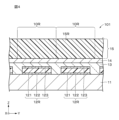
- Fig. 4 is a cross-sectional view taken along line IV-IV in Fig. 3.
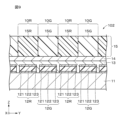
- Fig. 5 is a cross-sectional view taken along line V-V in Fig. 3.
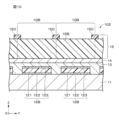
- Fig. 6 is a cross-sectional view taken along line VI-VI in Fig. 3.
- the display device 101 includes a drive substrate 11, a plurality of light-emitting elements 12R, a plurality of light-emitting elements 12G, a plurality of light-emitting elements 12B, a protective layer 13, a planarization layer 14, and a color filter 15.
- the light-emitting elements 12R, 12G, and 12B may be referred to as light-emitting elements 12.
- planar view refers to the planar view when an object is viewed from a direction perpendicular to the first surface.
- the driving substrate 11 is a so-called backplane, and can drive a plurality of light-emitting elements 12.
- the driving substrate 11 includes, for example, a substrate and an insulating layer in this order.
- a plurality of driving circuits (not shown), a plurality of wirings (not shown), and the like may be provided on the first surface side of the substrate.
- the substrate may be, for example, a semiconductor substrate on which transistors and the like can be easily formed, or a glass substrate or resin substrate with low moisture and oxygen permeability.
- Semiconductor substrates include, for example, amorphous silicon, polycrystalline silicon, or single crystal silicon.
- Glass substrates include, for example, high strain point glass, soda glass, borosilicate glass, forsterite, lead glass, or quartz glass.
- Resin substrates include, for example, at least one selected from the group consisting of polymethyl methacrylate, polyvinyl alcohol, polyvinyl phenol, polyether sulfone, polyimide, polycarbonate, polyethylene terephthalate, and polyethylene naphthalate.
- the insulating layer is provided on the first surface of the substrate and covers the multiple drive circuits and multiple wirings.
- the insulating layer includes multiple contact portions (not shown) therein.
- the multiple contact portions electrically connect the light-emitting elements 12 to the wiring or drive circuits.
- the contact portions include at least one metal selected from the group consisting of, for example, copper (Cu) and titanium (Ti).
- the insulating layer may be an organic insulating layer, an inorganic insulating layer, or a laminate thereof.
- the organic insulating layer includes at least one selected from the group consisting of, for example, polyimide resin, acrylic resin, and novolac resin.
- the inorganic insulating layer includes at least one selected from the group consisting of, for example, silicon oxide (SiO x ), silicon nitride (SiN x ), and silicon oxynitride (SiO x N y ).
- the light-emitting element 12 may be an organic light-emitting diode element (OLED element).
- the light-emitting element 12 has a first electrode 121, an OLED layer 122, and a second electrode 123, which are arranged in this order on a first surface of the driving substrate 11.
- the light-emitting element 12R is included in the sub-pixel 10R.
- the light-emitting element 12G is included in the sub-pixel 10G.
- the light-emitting element 12B is included in the sub-pixel 10B.
- the light-emitting element 12R can emit red light based on the control of a drive circuit, etc. More specifically, the light-emitting element 12R has a resonator structure, and the red light component contained in the white light emitted by the OLED layer 122 can be resonated by the resonator structure, emphasized, and emitted.
- the light-emitting element 12G can emit green light based on the control of a drive circuit, etc. More specifically, the light-emitting element 12G has a resonator structure, and the green light component contained in the white light emitted by the OLED layer 122 can be resonated by the resonator structure, and can be emphasized and emitted.
- the light-emitting element 12B can emit blue light based on the control of a drive circuit, etc. More specifically, the light-emitting element 12B has a resonator structure, and the blue light component contained in the white light emitted by the OLED layer 122 can be resonated by the resonator structure, emphasized, and emitted. Details of the resonator structure are explained in ⁇ 7. Examples of resonator structures>.
- the multiple light-emitting elements 12 are two-dimensionally arranged in a specified array on the first surface of the drive substrate 11.
- the specified array is as described above as the specified array of the multiple sub-pixels 10.
- the multiple light-emitting elements 12R form a row of multiple light-emitting elements 12R.
- the row is formed by multiple light-emitting elements 12R lined up in the Y-axis direction.
- the multiple light-emitting elements 12G form a row of multiple light-emitting elements 12G.
- the row is formed by multiple light-emitting elements 12G lined up in the Y-axis direction.
- the multiple light-emitting elements 12B form a row of multiple light-emitting elements 12B.
- the row is formed by multiple light-emitting elements 12B lined up in the Y-axis direction.
- the first electrode 121 is provided on the second surface side of the OLED layer 122.
- the first electrode 121 is an individual electrode provided for each of the light-emitting elements 12 in the effective pixel region RE1. That is, the first electrode 121 is divided between the light-emitting elements 12 adjacent to each other in the in-plane direction of the first surface of the drive substrate 11 in the effective pixel region RE1.
- the first electrode 121 is an anode. When a voltage is applied between the first electrode 121 and the second electrode 123, holes are injected from the first electrode 121 to the OLED layer 122.
- the first electrode 121 may be composed of, for example, a metal layer, or may be composed of a metal layer and a transparent conductive oxide layer.
- the transparent conductive oxide layer is provided on the OLED layer 122 side, from the viewpoint of having a layer having a high work function adjacent to the OLED layer 122.
- the metal layer may function as a reflective layer that reflects light emitted by the OLED layer 122.
- the metal layer contains at least one metal element selected from the group consisting of, for example, chromium (Cr), gold (Au), platinum (Pt), nickel (Ni), copper (Cu), molybdenum (Mo), titanium (Ti), tantalum (Ta), aluminum (Al), magnesium (Mg), iron (Fe), tungsten (W) and silver (Ag).
- the metal layer may contain at least one metal element as a constituent element of an alloy. Specific examples of the alloy include an aluminum alloy or a silver alloy. Specific examples of the aluminum alloy include, for example, AlNd or AlCu.
- a base layer may be provided adjacent to the second surface side of the metal layer.
- the base layer may be capable of improving the crystal orientation of the metal layer when the metal layer is formed.
- the base layer may contain at least one metal element selected from the group consisting of titanium (Ti) and tantalum (Ta), for example.
- the base layer may contain the at least one metal element as a constituent element of an alloy.
- the transparent conductive oxide layer includes a transparent conductive oxide.
- the transparent conductive oxide includes at least one type selected from the group consisting of transparent conductive oxides containing indium (hereinafter referred to as "indium-based transparent conductive oxides"), transparent conductive oxides containing tin (hereinafter referred to as “tin-based transparent conductive oxides”), and transparent conductive oxides containing zinc (hereinafter referred to as “zinc-based transparent conductive oxides").
- Indium-based transparent conductive oxides include, for example, indium tin oxide (ITO), indium zinc oxide (IZO), indium gallium oxide (IGO), indium gallium zinc oxide (IGZO) or fluorine-doped indium oxide (IFO).
- ITO indium tin oxide
- ITO indium tin oxide
- Tin-based transparent conductive oxides include, for example, tin oxide, antimony-doped tin oxide (ATO) or fluorine-doped tin oxide (FTO).
- Zinc-based transparent conductive oxides include, for example, zinc oxide, aluminum-doped zinc oxide (AZO), boron-doped zinc oxide or gallium-doped zinc oxide (GZO).
- the OLED layer 122 can emit white light.
- the OLED layer 122 is provided between a first electrode 121 and a second electrode 123.
- the OLED layer 122 has a plurality of light-emitting elements in the effective pixel region RE1.
- the OLED layer 122 is provided individually for each element 12. That is, the OLED layer 122 is divided between adjacent light emitting elements 12 in the in-plane direction of the first surface of the drive substrate 11 within the effective pixel region RE1.
- the OLED layer 122 may be composed of a laminate including an organic light-emitting layer, and in that case, some layers of the laminate (e.g., an electron injection layer) may be inorganic layers.
- the OLED layer 122 may be an OLED layer having a single light-emitting unit, an OLED layer having two light-emitting units (tandem structure), or an OLED layer having a structure other than these.
- An OLED layer having a single light-emitting unit has a structure in which, for example, a hole injection layer, a hole transport layer, a red light-emitting layer, a light-emitting separation layer, a blue light-emitting layer, a green light-emitting layer, an electron transport layer, and an electron injection layer are stacked in this order from the first electrode 121 to the second electrode 123.
- An OLED layer having two light-emitting units has a structure in which, for example, a hole injection layer, a hole transport layer, a blue light-emitting layer, an electron transport layer, a charge generation layer, a hole transport layer, a yellow light-emitting layer, an electron transport layer, and an electron injection layer are stacked in this order from the first electrode 121 to the second electrode 123.
- the hole injection layer can increase the efficiency of hole injection into each light-emitting layer and suppress leakage.
- the hole transport layer can increase the efficiency of hole transport into each light-emitting layer.
- the electron injection layer can increase the efficiency of electron injection into each light-emitting layer.
- the electron transport layer can increase the efficiency of electron transport into each light-emitting layer.
- the light-emitting separation layer is a layer for adjusting the injection of carriers into each light-emitting layer, and the light emission balance of each color is adjusted by injecting electrons and holes into each light-emitting layer through the light-emitting separation layer.
- the charge generation layer can supply electrons and holes to the two light-emitting layers arranged to sandwich the charge generation layer.
- red, green, blue, and yellow light-emitting layers When an electric field is applied to the red, green, blue, and yellow light-emitting layers, recombination occurs between holes injected from the first electrode 121 or the charge generation layer and electrons injected from the second electrode 123 or the charge generation layer, and the red, green, blue, and yellow light-emitting layers can emit light, green, blue, and yellow, respectively.
- the second electrodes 123 are provided on the first surface side of the OLED layer 122.
- the second electrodes 123 are individual electrodes provided individually for the plurality of light-emitting elements 12 in the effective pixel region RE1. That is, the second electrodes 123 are separated between the light-emitting elements 12 adjacent to each other in the in-plane direction of the first surface of the drive substrate 11 in the effective pixel region RE1.
- the second electrode 123 is a cathode.
- a voltage is applied between the first electrode 121 and the second electrode 123, electrons are injected from the second electrode 123 into the OLED layer 122.
- the second electrode 123 is transparent to visible light and is configured to be able to extract light resonated by the resonator structure.
- visible light refers to light in the wavelength range of 360 nm to 830 nm.
- the second electrode 123 is preferably made of a material having high light transmittance and a small work function in order to increase the light emission efficiency.
- the second electrode 123 is made of, for example, at least one of a metal layer and a transparent conductive oxide layer. More specifically, the second electrode 123 is made of a single layer film of a metal layer or a transparent conductive oxide layer, or a laminated film of a metal layer and a transparent conductive oxide layer. In order to increase the light resonance effect due to the resonator structure, it is preferable that the second electrode 123 includes a metal layer.
- the metal layer may be provided on the OLED layer 122 side, or the transparent conductive oxide layer may be provided on the OLED layer 122 side. However, from the viewpoint of having a layer having a low work function adjacent to the OLED layer 122, it is preferable that the metal layer is provided on the OLED layer 122 side.
- the metal layer contains at least one metal element selected from the group consisting of magnesium (Mg), aluminum (Al), silver (Ag), calcium (Ca) and sodium (Na).
- the metal layer may contain at least one metal element as a constituent element of an alloy. Specific examples of the alloy include an MgAg alloy, an MgAl alloy, and an AlLi alloy.
- the transparent conductive oxide layer contains a transparent conductive oxide. Examples of the transparent conductive oxide include materials similar to the transparent conductive oxide of the first electrode 121 described above.
- the protective layer 13 is provided on the first surface of the driving substrate 11 so as to cover the plurality of light-emitting elements 12.
- the protective layer 13 is translucent to light emitted from the light-emitting elements 12.
- the protective layer 13 can protect the plurality of light-emitting elements 12 and the like.
- the protective layer 13 can suppress the intrusion of moisture from the external environment into the plurality of light-emitting elements 12 and the like.
- the protective layer 13 may have a function of suppressing oxidation of this metal layer.
- the protective layer 13 includes, for example, at least one of an inorganic material and an organic material having low hygroscopicity.
- the protective layer 13 may have a single-layer structure or a multi-layer structure. When the thickness of the protective layer 13 is increased, it is preferable to use a multi-layer structure. This is to relieve internal stress in the protective layer 13.
- the inorganic material includes, for example, at least one selected from the group consisting of silicon oxide (SiO x ), silicon nitride (SiN x ), silicon oxynitride (SiO x N y ), titanium oxide (TiO x ), and aluminum oxide (AlO x ).
- the organic material includes, for example, a cured product of at least one resin selected from the group consisting of a thermosetting resin and a photosensitive resin.
- the photosensitive resin includes, for example, an ultraviolet-curable resin.
- the organic material includes, for example, at least one selected from the group consisting of an acrylic resin, a polyimide resin, a novolac resin, an epoxy resin, a norbornene resin, and a parylene resin.
- the protective layer 13 preferably includes a deposition layer in which an atomic layer is deposited.
- the deposition layer may be an ALD (Atomic Layer Deposition) layer.
- ALD Advanced Layer Deposition
- the deposition layer includes, for example, a metal oxide or a metal nitride.
- the metal oxide includes, for example, aluminum oxide (AlO x ) or titanium oxide (TiO x ).
- the metal nitride includes, for example, titanium nitride (TiN x ).
- the planarization layer 14 is provided on the first surface of the protective layer 13.
- the planarization layer 14 fills in the irregularities on the first surface of the protective layer 13, and can form a flat first surface on the upper side of the protective layer 13.
- the planarization layer 14 is translucent to the light emitted from the light-emitting element 12.
- the planarization layer 14 includes, for example, at least one of an organic material and an inorganic material.
- the organic material includes, for example, a cured product of a photosensitive resin.
- the photosensitive resin may include either a positive-type photosensitive resin or a negative-type photosensitive resin.
- the photosensitive resin includes, for example, at least one selected from the group consisting of polyimide, polyimide precursor, polybenzoxazole, polybenzoxazole precursor, acrylic resin, phenolic resin, and siloxane resin.
- the inorganic material include the same materials as the inorganic material of the protective layer 13.
- the color filter 15 is a so-called on-chip color filter (OCCF).
- OCCF on-chip color filter
- the color filter 15 is provided above the plurality of light-emitting elements 12. More specifically, the color filter 15 is provided on a first surface of the planarization layer 14.
- the color filter 15 includes a plurality of filter portions 15R, a plurality of filter portions 15G, a plurality of filter portions 15B, and a plurality of filter portions 150.
- One of filter portion 15G and filter portion 15B is an example of a first filter portion in the first aspect of the present disclosure and an example of a color conversion portion in the second aspect of the present disclosure, and the other is an example of a third filter portion in the first aspect of the present disclosure.
- Filter portion 150 is an example of a second filter portion and a fourth filter portion in the first aspect of the present disclosure, and an example of a filter portion in the second aspect of the present disclosure.
- the multiple filter portions 15R, 15G, and 15B are arranged in a stripe pattern, similar to the multiple sub-pixels 10R, 10G, and 10B.
- the filter portions 15R, 15G, and 15B have a linear shape extending in the Y-axis direction (the direction of the columns formed by the sub-pixels 10R, 10G, and 10B, respectively).
- Filter section 15R is provided above the row of light-emitting elements 12R.
- Filter section 15G is provided above the row of light-emitting elements 12G.
- Filter section 15B is provided above the row of light-emitting elements 12B.
- the row of sub-pixels 10R is composed of the row of light-emitting elements 12R and filter section 15R provided above the row of light-emitting elements 12R.
- the row of sub-pixels 10G is composed of the row of light-emitting elements 12G and filter section 15G provided above the row of light-emitting elements 12G.
- the row of sub-pixels 10B is composed of the row of light-emitting elements 12B and filter section 15B provided above the row of light-emitting elements 12B.
- Filter section 15R has a red color. Filter section 15R transmits the red light component of the light emitted from light-emitting element 12R, but can absorb visible light components other than red light.
- Filter section 15G has a green color. Filter section 15G transmits the green light component of the light emitted from light-emitting element 12G, but can absorb visible light components other than green light.
- Filter section 15B has a blue color. Filter section 15B transmits the blue light component of the light emitted from light-emitting element 12B, but can absorb visible light components other than blue light.
- the light emitted from light-emitting elements 12R, 12G, and 12B transmits through filter sections 15R, 15G, and 15B, thereby improving the color purity of sub-pixels 10R, 10G, and 10B.
- Filter portion 15R includes, for example, a red color resist.
- Filter portion 15G includes, for example, a green color resist.
- Filter portion 15B includes, for example, a blue color resist.
- the multiple filter sections 150 are provided on a first surface of the filter section 15G and on the first surface of the filter section 15G.
- the filter sections 150 are located in the boundaries between the sub-pixels 10G adjacent in the Y-axis direction and the boundaries between the sub-pixels 10B adjacent in the Y-axis direction in a plan view.
- the filter sections 150 may be configured to separate the sub-pixels 10G adjacent in the Y-axis direction and the sub-pixels 10B adjacent in the Y-axis direction in a plan view.
- Filter section 150 may have an elongated shape in a plan view.
- the longitudinal direction of the elongated shape may approximately coincide with the X-axis direction.
- the length of filter section 151 in the X-axis direction may be approximately equal to the sum of the width of filter section 15G in the X-axis direction and the width of filter section 15B in the X-axis direction.
- the long filter section 150 has, for example, a substantially rectangular or oval shape.
- a substantially rectangular shape is not limited to a rectangle in the strict sense, but includes shapes that are visually recognized as being close to a rectangle. For example, it may be a rectangle that is distorted or deformed within the range of tolerances, errors, etc.
- a substantially rectangular shape includes a rectangular shape with rounded corners and a rectangular shape with notched corners.
- An oval shape includes an oval shape, an ellipse, an egg shape, etc.
- Filter section 150 has a different color from filter section 15G and filter section 15R.
- Filter section 151 has a different color from filter section 15G and filter section 15R, so that it is possible to block light incident on the boundary between light-emitting element 12 and sub-pixel 10G and on the boundary between light-emitting element 12 and sub-pixel 10B. This makes it possible to narrow the viewing angle of sub-pixel 10G and sub-pixel 10B, and to suppress the difference in the viewing angle characteristics of the tristimulus values, i.e., the difference in the viewing angle characteristics between sub-pixels 10G, 10B and sub-pixel 10R.
- the filter section 150 preferably has the same red color as the filter section 15R. Since the filter section 150 has the same red color as the filter section 15R, the combination of the filter section 150 and the filter section 15G makes it possible to block light in the substantially entire visible light range at the boundary between the sub-pixels 10G, and the combination of the filter section 150 and the filter section 15B makes it possible to block light in the substantially entire visible light range at the boundary between the sub-pixels 10B. Therefore, the viewing angle characteristics in the Y-axis direction can be further improved. Furthermore, since the filter section 150 has the same red color as the filter section 15R, the filter section 150 can be formed using the same material as the filter section 15R. Therefore, the number of types of materials required for manufacturing the display device 101 can be reduced.
- Filter unit 150 includes a color resist of a different color from filter unit 15G and filter unit 15B.
- Filter unit 150 preferably includes a red color resist of the same color as filter unit 15R, or may include the same color resist as filter unit 15R.
- a plurality of light emitting elements 12 are formed on the first surface of the driving substrate 11.
- a method for forming the light emitting elements 12 for example, a known method can be used.
- Step of forming protective layer 13 Next, a layer is formed on the first surface of the drive substrate 11 so as to cover the plurality of light emitting elements 12, for example, by a CVD method.
- Step of forming the planarizing layer 14 Next, for example, a photosensitive resin is applied onto the first surface of the protective layer 13, and then the photosensitive resin is irradiated with light to harden the photosensitive resin. As a result, the planarization layer 14 is formed on the first surface of the protective layer 13.
- a green color resist is applied to the first surface of the planarization layer 14, and is irradiated with ultraviolet light through a photomask for pattern exposure, followed by development to form a plurality of filter portions 15G.
- a red color resist is applied to the first surface of the planarization layer 14 so as to cover the plurality of filter portions 15G, and is irradiated with ultraviolet light through a photomask for pattern exposure, followed by development to form a plurality of filter portions 15R.
- a blue color resist is applied to the first surface of the planarization layer 14 so as to cover the plurality of filter portions 15G and the plurality of filter portions 15R, and is irradiated with ultraviolet light through a photomask for pattern exposure, followed by development to form a plurality of filter portions 15B.
- a color resist of a different color from filter portion 15G and filter portion 15B is applied onto the first surfaces of filter portion 15R, filter portion 15G, and filter portion 152, and then exposed to ultraviolet light through a photomask for pattern exposure, followed by development to form a plurality of filter portions 150 at the boundaries between sub-pixels 10G and the boundaries between sub-pixels 10B.
- a color filter 15 is formed on the first surface of planarization layer 14.
- the resist used to form filter portion 150 is preferably a red color resist, the same color as filter portion 15R. In this case, the number of types of color resist required to manufacture display device 101 can be reduced.
- the filter unit 150 is provided at the boundary between the sub-pixels 10G adjacent to each other in the Y-axis direction and at the boundary between the sub-pixels 10B adjacent to each other in the Y-axis direction.
- the filter unit 150 has a color different from that of the sub-pixels 10G and 10B. This narrows the viewing angle of the sub-pixels 10G and 10B in the Y-axis direction, and suppresses the difference in viewing angle characteristics between the sub-pixels 10G and 10B and the sub-pixel 10R.
- Second embodiment> [Background to the creation of the display device 102 according to the second embodiment]
- the sub-pixels 10R and 10G are arranged alternately in the Y-axis direction, whereas the sub-pixels 10B may be arranged continuously in the Y-axis direction, as shown in Fig. 7.
- the tristimulus values X, Y, and Z obtained by measuring obliquely from the Y-axis direction differ, and the viewing angle characteristics deteriorate.
- a display device 102 that can improve the viewing angle characteristics in the Y-axis direction even when the sub-pixels 10R, 10G, and 10B are arranged in a square.
- Fig. 8 is an enlarged plan view showing a part of the effective pixel region RE1 of the display device 102 according to the second embodiment.
- Fig. 9 is a cross-sectional view taken along line IX-IX in Fig. 9.
- Fig. 10 is a cross-sectional view taken along line X-X in Fig. 10.
- the display device 102 differs from the display device 101 according to the first embodiment in that the sub-pixels 10R, 10G, and 10B are arranged in a square, and the filter portion 150 is provided in the boundary between the sub-pixels 10B adjacent in the Y-axis direction.
- the sub-pixels 10R and the sub-pixels 10G are arranged alternately in the Y-axis direction, forming multiple columns extending in the Y-axis direction.
- the sub-pixels 10R and 10G have a square shape in a plan view.
- Sub-pixels 10B are arranged consecutively in the Y-axis direction to form multiple columns extending in the Y-axis direction.
- Sub-pixels 10B have a rectangular shape in a plan view.
- One sub-pixel 10B is disposed adjacent to a pair of sub-pixels 10R and 10G.
- the size of sub-pixel 10B in the Y-axis direction is larger than the sizes of sub-pixels 10R and 10G in the Y-axis direction.
- the display device 102 may include a plurality of light-emitting elements 12R, 12G, and 12B having a resonator structure, or may include a light-emitting element 12 that does not have a resonator structure and can emit white light instead of these light-emitting elements 12R, 12G, and 12B.
- the filter unit 150 is provided at the boundary between the sub-pixels 10B adjacent to each other in the Y-axis direction.
- the filter unit 150 has a color different from that of the sub-pixels 10B. This narrows the viewing angle of the sub-pixel 10B in the Y-axis direction, and suppresses the difference in viewing angle characteristics between the sub-pixels 10R and 10G and the sub-pixel 10B. This makes it possible to suppress the occurrence of a difference in color between an image viewed from the Z-axis direction (front direction) and an image viewed obliquely from the Y-axis direction.
- the sub-pixels 10R, 10G, and 10B are arranged in a square shape, the viewing angle characteristics in the Y-axis direction can be improved.
- the display device 101 may further include a filter unit 150a, as shown in Fig. 11 and Fig. 12.
- the filter unit 150a is disposed in the sub-pixels 10G and 10B, i.e., between the filter units 150 adjacent to each other in the Y-axis direction.
- the filter unit 150a may be located at the center of the sub-pixels 10G and 10B in the Y-axis direction.
- the filter unit 150a may be similar to the filter unit 150 in other respects than the arrangement position.
- the filter unit 150a is an example of a fifth filter unit in the first aspect and the second aspect of the present disclosure.
- the viewing angle of the sub-pixels 10G and 10B in the Y-axis direction can be further narrowed.
- the configuration of the filter section 150a is not limited to the above example, and for example, the filter section 150a may be provided only in the subpixel 10G or only in the subpixel 10B. In this case, the viewing angle of the subpixel 10G in the Y-axis direction or the viewing angle of the subpixel 10B in the Y-axis direction can be further narrowed.
- the display device 102 may further include a filter unit 150a.
- the filter unit 150a is disposed in the subpixel 10B, that is, between the filter units 150 adjacent to each other in the Y-axis direction.
- the filter unit 150a may be located at the center of the subpixel 10B in the Y-axis direction.
- the viewing angle of the subpixel 10B in the Y-axis direction can be further narrowed.
- the color filter 15 includes a plurality of filter portions 150 (see FIG. 3).
- the configuration of the color filter 15 is not limited to this example.
- the color filter 15 may include a plurality of filter portions 151 and a plurality of filter portions 152, instead of the plurality of filter portions 150, as shown in FIG.
- the multiple filter sections 151 are provided on a first surface of the filter section 15G.
- the filter sections 151 are arranged in the boundary between the sub-pixels 10G adjacent in the Y-axis direction in a planar view.
- the multiple filter sections 152 are provided on a first surface of the filter section 152.
- the filter sections 152 are arranged in the boundary between the sub-pixels 10B adjacent in the Y-axis direction in a planar view.
- the filter section 151 may be configured to separate adjacent sub-pixels 10G in the Y-axis direction in a planar view.
- the filter section 152 may be configured to separate adjacent sub-pixels 10B in the Y-axis direction in a planar view.
- Filter portions 151 and 152 may have an elongated shape.
- the longitudinal direction of the elongated shape may approximately coincide with the X-axis direction.
- the length of filter portion 151 in the longitudinal direction of filter portion 151 may be approximately the same as the width of filter portion 15G in the X-axis direction.
- the length of filter portion 152 in the longitudinal direction of filter portion 152 may be approximately the same as the width of filter portion 152 in the X-axis direction.
- An example of the shape of elongated filter portions 151 and 152 is a shape similar to that of elongated filter portion 150.
- the shapes of filter portions 151 and 152 may be the same or different.
- Filter portion 151 has a different color from filter portion 15G. By having filter portion 151 have a different color from filter portion 15G, it is possible to block light that is incident from light-emitting element 12G to the boundary portion between sub-pixels 10G. This makes it possible to narrow the viewing angle of sub-pixel 10G and suppress the difference in viewing angle characteristics between sub-pixels 10G and 10R.
- filter section 151 has the same red color as filter section 15R or the same blue color as filter section 15B.
- filter section 151 has the same red color as filter section 15R or the same blue color as filter section 15B, it becomes possible to block light of almost the entire visible light range at the boundary between sub-pixels 10G by combining filter section 151 with filter section 15R or filter section 15B. Therefore, the viewing angle characteristics in the Y-axis direction can be further improved.
- filter portion 151 has the same red color as filter portion 15R or the same blue color as filter portion 15B, filter portion 151 can be formed using the same material as filter portion 15R or filter portion 15B. Therefore, the number of types of materials required to manufacture display device 101 can be reduced.
- Filter portion 152 has a different color from filter portion 15B. By having filter portion 152 have a different color from filter portion 15B, it is possible to block light from light-emitting element 12B that is incident on the boundary between sub-pixels 10B. This makes it possible to narrow the viewing angle of sub-pixel 10B and suppress the difference in viewing angle characteristics between sub-pixels 10B and 10R.
- filter section 152 has the same red color as filter section 15R or the same green color as filter section 15G.
- filter section 152 has the same red color as filter section 15R or the same green color as filter section 15G.
- filter portion 151 has the same red color as filter portion 15R or the same green color as filter portion 15G
- filter portion 152 can be formed using the same material as filter portion 15R or filter portion 15G. Therefore, the number of types of materials required to manufacture display device 101 can be reduced.
- Filter portion 151 includes a color resist of a different color from filter portion 15G.
- Filter portion 151 preferably includes a red color resist of the same color as filter portion 15R, or a blue color resist of the same color as filter portion 15B, and may include the same color resist as filter portion 15R or filter portion 15B.
- Filter portion 152 includes a color resist of a different color from filter portion 15B.
- Filter portion 152 preferably includes a red color resist of the same color as filter portion 15R, or a green color resist of the same color as filter portion 15G, and may include the same color resist as filter portion 15R or filter portion 15G.
- the filter portions 151 and 152 are formed as follows. After the filter portions 15R, 15G, and 15B are formed, a color resist of a different color than that of filter portion 15G is applied to the first surfaces of filter portions 15R, 15G, and 15B, which are then irradiated with ultraviolet light through a photomask and pattern-exposed, and then developed, thereby forming a plurality of filter portions 151 at the boundaries between subpixels 10G.
- a color resist of a different color than that of filter portion 15B is applied to the first surfaces of filter portions 15R, 15G, and 15B, which are then irradiated with ultraviolet light through a photomask and pattern-exposed, and then developed, thereby forming a plurality of filter portions 152 at the boundaries between subpixels 10B.
- the configuration of the filter units 151 and 152 is not limited to the above example.
- sub-pixels 10G adjacent to each other in the Y-axis direction may be partially connected in a planar view. That is, the length of the filter unit 151 in the X-axis direction may be shorter than the width of the filter unit 15G in the X-axis direction.
- sub-pixels 10B adjacent to each other in the Y-axis direction may be partially connected in a planar view. That is, the length of the filter unit 152 in the X-axis direction may be shorter than the width of the filter unit 15B in the X-axis direction.
- filter portion 150 may be provided in filter portion 15G and filter portion 15B.
- the bottom of filter portion 150 may be located on the first surface of planarization layer 14, and the top of filter portion 150 may have substantially the same height as the first surface of filter portion 15G and/or the first surface of filter portion 15B.
- the thickness of filter portion 150 may be substantially the same as the thickness of filter portion 15G and/or filter portion 15B.
- "and/or” means at least one of the following.
- X and/or Y means X only, Y only, or both X and Y.
- the bottom of filter portion 150 may be located on the first surface of planarization layer 14, and the height of the top of filter portion 150 may be greater than the height of the first surface of filter portion 15G and/or the height of the first surface of filter portion 15B. That is, the thickness of filter portion 150 may be greater than the thickness of filter portion 15G and/or the thickness of filter portion 15B.
- the top of filter portion 150 may protrude onto the first surface of filter portion 15G and/or the first surface of filter portion 15B.
- the bottom of filter portion 150 may be located on the first surface of planarization layer 14, and the height of the top of filter portion 150 may be lower than the height of the first surface of filter portion 15G and/or the height of the first surface of filter portion 15B. That is, the thickness of filter portion 150 may be thinner than the thickness of filter portion 15G and/or the thickness of filter portion 15B.
- the top of filter portion 150 may be covered by filter portion 15G and/or filter portion 15B.
- a modified example of the filter unit 150 in the first embodiment has been described, but the configuration of the above modified example 4 may be applied to the filter unit 150 in the second embodiment.
- the configuration of the above modified example 4 may be applied to the filter unit 150a in modified examples 1 and 2, or to the filter units 151 and 152 in modified example 3.
- the color conversion layer includes a plurality of filter portions 15R, a plurality of filter portions 15G, a plurality of filter portions 15B, and a plurality of filter portions 150.
- the configuration of the color conversion layer is not limited to this example.
- the color conversion layer may include at least one of a plurality of first wavelength conversion portions, a plurality of second wavelength conversion portions, and a plurality of third wavelength conversion portions, instead of at least one of the plurality of filter portions 15R, the plurality of filter portions 15G, and the plurality of filter portions 15B.
- the light-emitting elements 12 included in the sub-pixels 10R, 10G, and 10B may be configured to be capable of emitting light of the same color.
- the light-emitting elements 12 included in the sub-pixels 10R, 10G, and 10B may be light-emitting elements 12B configured to be capable of emitting blue light.
- the first wavelength conversion section is included in the subpixel 10R in place of the filter section 15R.
- the first wavelength conversion section can convert the light emitted from the light-emitting element 12 of the subpixel 10R into red light and emit the red light.
- the second wavelength conversion section is included in the subpixel 10G in place of the filter section 15G.
- the second wavelength conversion section can convert the light emitted from the light-emitting element 12 of the subpixel 10G into green light and emit the green light.
- the third wavelength conversion section is included in the subpixel 10B in place of the filter section 15B.
- the third wavelength conversion section can convert the light emitted from the light-emitting element 12 of the subpixel 10B into blue light and emit the blue light.
- the wavelength conversion in the first wavelength conversion section, the second wavelength conversion section, and the third wavelength conversion section may be either up-conversion or down-conversion.
- subpixel 10B may include a filter portion 15B instead of the third wavelength conversion portion, or may not include either the filter portion 15B or the third wavelength conversion portion.
- the first wavelength conversion section, the second wavelength conversion section, and the third wavelength conversion section include an upconversion material or a downconversion material.
- the first wavelength conversion section, the second wavelength conversion section, and the third wavelength conversion section include, for example, quantum dots (semiconductor particles).
- the color conversion layer includes at least one of a plurality of first wavelength conversion sections, a plurality of second wavelength conversion sections, and a plurality of third wavelength conversion sections, instead of at least one of a plurality of filter sections 15R, a plurality of filter sections 15G, and a plurality of filter sections 15B.
- the configuration of the color conversion layer is not limited to this, and the color conversion layer may include a plurality of first wavelength conversion sections, a plurality of second wavelength conversion sections, and a plurality of third wavelength conversion sections, together with at least one of a plurality of filter sections 15R, a plurality of filter sections 15G, and a plurality of filter sections 15B.
- the color conversion layer may include both filter portion 15R and the first wavelength conversion portion, in which case filter portion 15R may be provided above the first wavelength conversion portion.
- the color conversion layer may include both filter portion 15G and the second wavelength conversion portion, in which case filter portion 15G may be provided above the second wavelength conversion portion.
- the color conversion layer may include both filter portion 15B and the third wavelength conversion portion, in which case filter portion 15B may be provided above the third wavelength conversion portion.
- the color filter 15 is an on-chip color filter.
- the configuration of the display devices 101 and 102 is not limited to this example.
- the display devices 101 and 102 may include a filled resin layer, a color filter 15, and a substrate on the protective layer 13 in this order.
- the filled resin layer includes, for example, a cured product of a curable resin.
- the curable resin includes, for example, at least one type selected from the group consisting of thermosetting resins and ultraviolet curable resins. Note that the filled resin layer is not limited to thermosetting resins and ultraviolet curable resins, and may include types of curable resins other than thermosetting resins and ultraviolet curable resins.
- the substrate seals the first surface of the drive substrate 11 on which the multiple light emitting elements 12 and the like are provided.
- the substrate is translucent to the light of each color emitted from the color filter 15.
- the substrate is, for example, a glass substrate.
- the display device 101 having the above configuration is manufactured, for example, as follows.
- the color filter 15 is formed on the second surface of the substrate.
- a filling resin is applied to the first surface of the protective layer 13, and the substrate is placed on the filling resin so that the color filter 15 is on the filling resin side.
- the filling resin is cured by, for example, applying heat to the filling resin or irradiating it with ultraviolet light, thereby bonding the drive substrate 11 and the substrate via the filling resin. This seals the display device 101.
- the filling resin contains both a thermosetting resin and an ultraviolet-curing resin, the filling resin may be temporarily cured by irradiating it with ultraviolet light, and then heated to fully cure it.
- the color filter 15 includes a plurality of filter portions 150
- the configuration of the color filter 15 is not limited to this example.
- the color filter 15 may include a black light-shielding portion instead of the plurality of filter portions 150.
- the color filter 15 in the second embodiment may include a black light-shielding portion instead of the plurality of filter portions 150.
- the color filter 15 in the first and second modifications may include a black light-shielding portion instead of the plurality of filter portions 150 and the plurality of filter portions 150a.
- the color filter 15 in the third modification may include a black light-shielding portion instead of the plurality of filter portions 150 and the plurality of filter portions 151 and 152.
- the OLED layer 122 and the second electrode 123 are separated between the light emitting elements 12 adjacent in the in-plane direction of the first surface of the drive substrate 11.
- the configurations of the OLED layer 122 and the second electrode 123 are not limited to this example.
- the OLED layer 122 may be connected between the light emitting elements 12 adjacent in the in-plane direction of the first surface of the drive substrate 11 and may be a layer common to the plurality of light emitting elements 12.
- the second electrode 123 may be connected between the light emitting elements 12 adjacent in the in-plane direction of the first surface of the drive substrate 11 and may be an electrode common to the plurality of light emitting elements 12.
- the light-emitting elements 12R, 12G, and 12B include an OLED layer 122 capable of emitting white light.
- the configuration of the light-emitting elements 12R, 12G, and 12B is not limited to this example.
- the light-emitting element 12R may include an OLED layer 122 capable of emitting red light
- the light-emitting element 12G may include an OLED layer 122 capable of emitting green light
- the light-emitting element 12B may include an OLED layer 122 capable of emitting blue light.
- the light-emitting elements 12R, 12G, and 12B may or may not have a resonator structure.
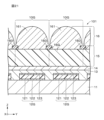
- the display device 101 may further include a lens array 16 as shown in FIG. 21 .
- the lens array 16 is provided on a first surface of the color filter 15.
- a planarization layer may be provided between the color filter 15 and the lens array 16.
- the lens array 16 includes a plurality of lenses 161.
- the lenses 161 can condense light emitted upward from the light-emitting element 12 in a front direction.
- the plurality of lenses 161 are so-called on-chip microlenses (OCLs), and are two-dimensionally arranged in a prescribed array on the first surface of the color filter 15.
- the prescribed array may be an array similar to that of the sub-pixels 10 in the first embodiment.
- One lens 161 may be provided above one light-emitting element 12, or two or more lenses 161 may be provided above one light-emitting element 12.
- FIG. 21 shows an example in which one lens 161 is provided above one light-emitting element 12.
- the lens 161 may have a curved surface on the emission surface side that emits light incident from the light-emitting element 12.
- the curved surface is preferably a convex curved surface that protrudes in a direction away from the light-emitting element 12, but is not limited to a convex curved surface. Examples of curved surfaces include an approximately parabolic shape, an approximately hemispherical shape, and an approximately semi-ellipsoidal shape, but are not limited to these shapes.
- the lens array 16 includes, for example, an inorganic material or an organic material that is translucent to the light emitted from the light emitting element 12.
- the inorganic material includes, for example, silicon oxide (SiO x ).
- the organic material may be a polymer resin.
- the organic material includes, for example, a photosensitive resin such as an ultraviolet curing resin.
- the display device 101 according to the first embodiment includes a lens array 16, but the display device 102 according to the second embodiment may also include a lens array 16.
- FIG. 22 is an XZ cross-sectional view showing an enlarged part of the effective pixel region RE1.
- FIG. 23 is a YZ cross-sectional view showing an enlarged part of the effective pixel region RE1.
- at least some of the filter parts 15R, 15G, 15B among the plurality of filter parts 15R, 15G, 15B and at least some of the filter parts 150 among the plurality of filter parts 150 may be shifted in the in-plane direction of the first surface of the drive substrate 11 with respect to the center position P 0 of the light emitting element 12.
- the emission direction of light from the sub-pixel 10 can be controlled.
- the shift direction of the color filter 15 is selected according to the desired display characteristics.
- the center position P 0 of the light emitting element 12 represents the geometric center position of the light emitting element 12 in a planar view.
- the display device 101 includes the lens array 16
- at least some of the lenses 161 may be shifted in an in-plane direction of the first surface of the drive substrate 11 with reference to the central position P0 of the light-emitting element 12.
- the lenses 161 in the in-plane direction in this manner, the emission direction of light from the sub-pixels 10 can be controlled.
- a modified example of the display device 101 according to the first embodiment has been described, but the configuration of this modified example may be applied to the display device 102 according to the second embodiment, or to the display devices 101 and 102 according to modified examples 1 to 10 and 12. Specifically, for example, it may be applied to the filter unit 150a in modified examples 1 and 2, or to the filter units 151 and 152 in modified example 3.
- the light-emitting element 12 is an OLED element
- the light-emitting element is not limited to this example, and may be, for example, a self-luminous light-emitting element such as an LED (Light Emitting Diode), an inorganic electro-luminescence (IEL) element, a quantum dot light-emitting diode (QLED), or a semiconductor laser element.
- a self-luminous light-emitting element such as an LED (Light Emitting Diode), an inorganic electro-luminescence (IEL) element, a quantum dot light-emitting diode (QLED), or a semiconductor laser element.
- IEL inorganic electro-luminescence
- QLED quantum dot light-emitting diode
- Two or more types of light-emitting elements may be provided in the display device.
- the display devices 101 and 102 include pixels of three colors.
- the pixel configuration of the display devices 101 and 102 is not limited to this example, and the display devices 101 and 102 may include pixels of two colors or four or more colors.
- the display devices 101 and 102 according to the first and second embodiments may include a light-emitting element 12 capable of emitting white light, instead of the plurality of light-emitting elements 12R, 12G, and 12B.
- first embodiment, the second embodiment, and modified examples thereof (hereinafter referred to as the "first embodiment, etc.") of the present disclosure have been specifically described above, but the present disclosure is not limited to the first embodiment, etc., and various modifications based on the technical ideas of the present disclosure are possible.
- the configurations, methods, processes, shapes, materials, and values given in the first embodiment are merely examples, and different configurations, methods, processes, shapes, materials, and values may be used as necessary.
- the materials exemplified in the first embodiment etc. can be used alone or in combination of two or more types.
- the present disclosure may also employ the following configuration.
- the second pixels are arranged in a plurality of columns,
- the second column of pixels includes: A plurality of first light-emitting elements arranged in a column direction of the column of the second pixels; a first filter portion provided above the plurality of first light-emitting elements and having the second color; a plurality of second filter units provided on the upper side of the plurality of first light-emitting elements and at each boundary between the second pixels adjacent in the column direction, the second filter units having a color different from the second color; Display device.
- the second filter unit is provided on the first filter unit.
- a display device (1). (3) The second filter unit is provided within the first filter unit. A display device according to (1). (4) The thickness of the second filter portion is substantially the same as the thickness of the first filter portion. The display device according to (3). (5) the first filter portion has a surface opposite to a side of the first light emitting element, A part of the second filter portion protrudes onto the surface of the first filter portion. The display device according to (3). (6) The first filter portion covers the second filter portion. The display device according to (3). (7) The second pixel column further includes a plurality of lenses disposed above the plurality of first light-emitting elements. The display device according to any one of (1) to (6).
- At least a portion of the plurality of second filter sections is shifted in an in-plane direction with respect to the first light-emitting element.
- the display device according to any one of (1) to (7). (9) a size of the second pixel in the column direction is larger than a size of the first pixel in the column direction;
- the display device according to any one of (1) to (8). (10) the first color is red;
- the first pixel has a resonator structure.
- (11) Further comprising a plurality of third pixels capable of emitting light of a third color.
- the display device according to any one of (1) to (10). (12)
- the second filter portion has the first color or the third color.
- the display device (11).
- the first color, the second color, and the third color are different from one another; each of the first color, the second color, and the third color is a color selected from the group consisting of red, blue, and green;
- the tristimulus values X, Y, and Z of the CIE 1931 color system obtained by measuring a white image displayed on the display device from the column direction are approximately equal to each other.
- the third pixels are arranged in a plurality of columns,
- the third column of pixels includes: A plurality of second light-emitting elements arranged in the column direction; a third filter portion provided above the plurality of second light-emitting elements and having the third color; a plurality of fourth filter units provided on the upper side of the plurality of second light-emitting elements and at each boundary between the third pixels adjacent to each other in the column direction, the fourth filter units having a color different from the third color;
- the display device according to any one of (11) to (13).
- the first pixel, the second pixel, and the third pixel are arranged in a stripe pattern;
- the display device according to any one of (11) to (14).
- the first pixel, the second pixel, and the third pixel are arranged in a square; The second pixel is disposed adjacent to the first pixel and the third pixel.
- the column of second pixels further includes a fifth filter portion that is provided within the second pixels in a plan view and has a color different from the second color;
- the plurality of first light-emitting elements are configured to be capable of emitting white light or the second color light.
- the second pixels are arranged in a plurality of columns,
- the second column of pixels includes: A plurality of first light-emitting elements arranged in a column direction of the column of the second pixels; a color conversion unit provided above the first light-emitting elements and capable of converting light emitted from the first light-emitting elements into light of the second color; a plurality of filter units provided on the upper side of the plurality of first light-emitting elements and at each boundary between the second pixels adjacent in the column direction, the filter units having a color different from the second color; Display device. (20) An electronic device comprising the display device according to any one of (1) to (19).
- the results of simulations 1 to 4 reveal the following:
- the viewing angle of the Z value of the tristimulus values can be narrowed.
- the viewing angle characteristics of the Z value of the tristimulus values can be changed by changing the arrangement position and thickness of the filter section 150 .
- the light-emitting portion is, for example, the light-emitting element 12 in the first embodiment, the second embodiment, or their modified examples.
- the lens member is, for example, the lens 161 in the modified example 10 or the modified example 11.
- the wavelength selection portion is, for example, the filter units 15R, 15G, 15B in the first embodiment, the second embodiment, or their modified examples.
- the size of the wavelength selection section may be changed as appropriate in response to the light emitted by the light emitting section, or in the case where a light absorbing section (e.g., a black matrix section) is provided between the wavelength selection sections of adjacent light emitting sections, the size of the light absorbing section may be changed as appropriate in response to the light emitted by the light emitting section.
- the size of the wavelength selection section may be changed as appropriate in response to the distance (offset amount) d 0 between the normal line passing through the center of the light emitting section and the normal line passing through the center of the wavelength selection section.
- the planar shape of the wavelength selection section may be the same as, similar to, or different from the planar shape of the lens member.
- a configuration may be adopted in which the normal line LN passing through the center of the light-emitting section 51, the normal line LN′′ passing through the center of the wavelength selecting section 52, and the normal line LN′ passing through the center of the lens member 53 do not all coincide. That is, D 0 >0, d 0 >0, and D 0 ⁇ d 0 may be satisfied.
- the center of the wavelength selecting section 52 (the position indicated by the black square in FIG. 27 ) is located on a straight line LL connecting the center of the light-emitting section 51 and the center of the lens member 53 (the position indicated by the black circle in FIG. 27 ). Specifically, when the distance in the thickness direction (vertical direction in FIG.
- the thickness direction refers to the thickness direction of the light emitting section 51 , the wavelength selecting section 52 , and the lens member 53 .
- a configuration may be adopted in which the normal line LN passing through the center of the light-emitting section 51, the normal line LN′′ passing through the center of the wavelength selecting section 52, and the normal line LN′ passing through the center of the lens member 53 do not all coincide.
- the center of the lens member 53 (the position indicated by a black circle in FIG. 29 ) is located on a straight line LL connecting the center of the light-emitting section 51 and the center of the wavelength selecting section 52 (the position indicated by a black square in FIG. 29 ).
- the distance in the thickness direction vertical direction in FIG.
- the thickness direction refers to the thickness direction of the light emitting section 51 , the wavelength selecting section 52 , and the lens member 53 .
- the filter sections 150, 150a, 151, and 152 in the first embodiment, the second embodiment, and their modified examples may be shifted in the same direction as the wavelength selection section 52 and by the same distance (offset amount) as the wavelength selection section 52.
- the sub-pixels included in the display device 101 according to the first embodiment, the display device 102 according to the first embodiment, and the display devices 101 and 102 according to their modified examples may be configured to have a resonator structure that resonates light generated by a light-emitting element.
- the resonator structure will be described below with reference to the drawings.
- the first surface of each layer may be referred to as the upper surface.
- FIG. 30A is a schematic cross-sectional view for explaining a first example of a resonator structure.
- the light emitting elements 12 R , 12 G , and 12 B are the same as those in the first embodiment.
- the OLED layer 122 of the sub-pixel 10R, the OLED layer 122 of the sub-pixel 10G, and the OLED layer 122 of the sub-pixel 10B are respectively referred to as an OLED layer 122 R and an OLED layer 122 B.
- Layer 122G may be referred to as OLED layer 122B .
- the first electrode 121 is formed with a common film thickness in each light-emitting element 12. The same is true for the second electrode 123.
- a reflector 71 is disposed under the first electrode 121 of the light-emitting element 12 with an optical adjustment layer 72 sandwiched therebetween.
- a resonator structure that resonates light generated by the OLED layer 122 is formed between the reflector 71 and the second electrode 123.
- the optical adjustment layers 72 provided corresponding to the sub-pixels 10R, 10G, and 10B, respectively, may be referred to as optical adjustment layers 72R , 72G , and 72B .
- the reflector 71 is formed to have a common thickness for each light-emitting element 12.
- the thickness of the optical adjustment layer 72 varies depending on the color to be displayed by the subpixel. By having the optical adjustment layers 72R , 72G , and 72B have different thicknesses, it is possible to set an optical distance that produces optimal resonance for the wavelength of light corresponding to the color to be displayed.
- the upper surfaces of the reflectors 71 in the light-emitting elements 12R , 12G , and 12B are arranged so as to be aligned.
- the film thickness of the optical adjustment layer 72 differs depending on the color to be displayed by the subpixel, and therefore the position of the upper surface of the second electrode 123 differs depending on the type of the light-emitting element 12R , 12G , and 12B .
- the reflector 71 can be formed using metals such as aluminum (Al), silver (Ag), copper (Cu), etc., or alloys containing these as main components.
- the optical adjustment layer 72 can be made of inorganic insulating materials such as silicon nitride (SiN x ), silicon oxide (SiO x ), silicon oxynitride (SiO x N y ), or organic resin materials such as acrylic resins and polyimide resins.
- the optical adjustment layer 72 may be a single layer or a laminated film of a plurality of these materials. The number of layers may vary depending on the type of the light emitting element 12.
- the first electrode 121 can be formed using a transparent conductive material such as indium tin oxide (ITO), indium zinc oxide (IZO), or zinc oxide (ZnO).
- ITO indium tin oxide
- IZO indium zinc oxide
- ZnO zinc oxide
- the second electrode 123 must function as a semi-transmissive reflective film.
- the second electrode 123 can be formed using magnesium (Mg) or silver (Ag), or a magnesium-silver alloy (MgAg) containing these as the main components, or an alloy containing an alkali metal or an alkaline earth metal.
- FIG. 30B is a schematic cross-sectional view for explaining the second example of the resonator structure.
- the first electrode 121 and the second electrode 123 are also formed with a common film thickness in each light-emitting element 12.
- a reflector 71 is also disposed under the first electrode 121 of the light-emitting element 12, with the optical adjustment layer 72 sandwiched between them.
- a resonator structure that resonates the light generated by the OLED layer 122 is formed between the reflector 71 and the second electrode 123.
- the reflector 71 is formed with a common thickness for each light-emitting element 12, and the thickness of the optical adjustment layer 72 differs depending on the color to be displayed by the subpixel.
- the upper surfaces of the reflectors 71 in the light-emitting elements 12R , 12G , and 12B are arranged so as to be aligned, and the position of the upper surface of the second electrode 123 differs depending on the type of the light-emitting element 12R , 12G , and 12B .
- the upper surfaces of the second electrodes 123 are arranged to be aligned for the light-emitting elements 12R , 12G , and 12B .
- the upper surfaces of the reflectors 71 for the light-emitting elements 12R , 12G , and 12B are arranged to be different depending on the type of the light-emitting element 12R , 12G , and 12B .
- the lower surface of the reflector 71 (in other words, the upper surface of the base layer (insulating layer) 73) has a stepped shape depending on the type of the light-emitting element 12.
- the materials constituting the reflector 71, the optical adjustment layer 72, the first electrode 121, and the second electrode 123 are the same as those described in the first example, so the description will be omitted.
- (Resonator structure: 3rd example) 31A is a schematic cross-sectional view for explaining a third example of the resonator structure.
- the reflectors 71 provided corresponding to the sub-pixels 10R, 10G, and 10B are These reflectors are sometimes referred to as 71R , 71G , and 71B .
- the first electrode 121 and the second electrode 123 are also formed with a common film thickness in each light-emitting element 12.
- a reflector 71 is disposed under the first electrode 121 of the light-emitting element 12 with an optical adjustment layer 72 sandwiched therebetween.
- a resonator structure that resonates the light generated by the OLED layer 122 is formed between the reflector 71 and the second electrode 123.
- the film thickness of the optical adjustment layer 72 varies depending on the color to be displayed by the subpixel.
- the upper surface of the second electrode 123 is disposed so as to be aligned with the light-emitting elements 12R , 12G , and 12B .
- the bottom surface of the reflector 71 has a stepped shape according to the type of light-emitting element 12 in order to align the top surface of the second electrode 123.
- the film thickness of the reflector 71 is set to be different depending on the types of the light-emitting elements 12R , 12G , and 12B . More specifically, the film thickness is set so that the bottom surfaces of the reflectors 71R , 71G , and 71B are aligned.
- the materials constituting the reflector 71, the optical adjustment layer 72, the first electrode 121, and the second electrode 123 are the same as those described in the first example, so a description thereof will be omitted.
- (Resonator structure: 4th example) 31B is a schematic cross-sectional view for explaining the fourth example of the resonator structure.
- the first electrodes 121 provided corresponding to the sub-pixels 10R, 10G, and 10B are , first electrodes 121R , 121G , and 121B .
- the first electrodes 121 and second electrodes 123 of each light-emitting element 12 are formed to have the same film thickness.
- a reflector 71 is disposed under the first electrodes 121 of the light-emitting elements 12 with an optical adjustment layer 72 sandwiched therebetween.
- the optical adjustment layer 72 is omitted, and the film thickness of the first electrode 121 is set to be different depending on the type of the light emitting elements 12R , 12G , and 12B .
- the reflector 71 is formed to have a common thickness for each light-emitting element 12.
- the thickness of the first electrode 121 varies depending on the color to be displayed by the subpixel. By having the first electrodes 121R , 121G , and 121B have different thicknesses, it is possible to set an optical distance that produces optimal resonance for the wavelength of light corresponding to the color to be displayed.
- the materials constituting the reflector 71, the optical adjustment layer 72, the first electrode 121, and the second electrode 123 are the same as those described in the first example, so the description will be omitted.
- FIG. 32A is a schematic cross-sectional view for explaining a fifth example of the resonator structure.
- the first electrode 121 and the second electrode 123 are formed to a common thickness in each light-emitting element 12.
- a reflector 71 is disposed under the first electrode 121 of the light-emitting element 12 with an optical adjustment layer 72 sandwiched therebetween.
- the optical adjustment layer 72 is omitted, and instead, an oxide film 74 is formed on the surface of the reflector 71.
- the thickness of the oxide film 74 is set to be different depending on the type of the light-emitting elements 12R , 12G, and 12B .
- the oxide films 74 provided corresponding to the sub-pixels 10R, 10G, and 10B, respectively, may be referred to as oxide films 74R , 74G , and 74B .
- the thickness of the oxide film 74 varies depending on the color to be displayed by the sub-pixel. By having the oxide films 74R , 74G , and 74B have different thicknesses, it is possible to set an optical distance that produces optimal resonance for the wavelength of light corresponding to the color to be displayed.
- the oxide film 74 is a film formed by oxidizing the surface of the reflector 71, and is made of, for example, aluminum oxide, tantalum oxide, titanium oxide, magnesium oxide, zirconium oxide, etc.
- the oxide film 74 functions as an insulating film for adjusting the optical path length (optical distance) between the reflector 71 and the second electrode 123.
- the oxide film 74 having a thickness that varies depending on the type of the light emitting elements 12 R , 12 G , and 12 B can be formed, for example, as follows.
- a positive voltage is applied to the reflector 71 with the electrode as a reference, and the reflector 71 is anodized.
- the thickness of the oxide film formed by anodization is proportional to the voltage value to the electrode. Therefore, anodization is performed while a voltage according to the type of light-emitting element 12 is applied to each of the reflectors 71R , 71G , and 71B . This allows oxide films 74 with different thicknesses to be formed all at once.
- the materials constituting the reflector 71, the first electrode 121, and the second electrode 123 are the same as those described in the first example, so a description thereof will be omitted.
- FIG. 32B is a schematic cross-sectional view for explaining the sixth example of the resonator structure.
- the light-emitting element 12 is configured by laminating a first electrode 121, an OLED layer 122, and a second electrode 123.
- the first electrode 121 is formed so as to function both as an electrode and a reflector.
- the first electrode (doubles as a reflector) 121 is formed of a material having an optical constant selected according to the type of the light-emitting elements 12R , 12G , and 12B . By varying the phase shift caused by the first electrode (doubles as a reflector) 121, it is possible to set an optical distance that generates an optimal resonance for the wavelength of light according to the color to be displayed.
- the first electrode (doubles as a reflector) 121 can be made of a single metal such as aluminum (Al), silver (Ag), gold (Au), copper (Cu), or an alloy mainly made of these metals.
- the first electrode (doubles as a reflector) 121R of the light-emitting element 12R can be made of copper (Cu)
- the first electrode (doubles as a reflector) 121G of the light-emitting element 12G and the first electrode (doubles as a reflector) 121B of the light-emitting element 12B can be made of aluminum.
- the materials constituting the second electrode 123 are the same as those described in the first example, so the description will be omitted.
- FIG. 33 is a schematic cross-sectional view for explaining a seventh example of the resonator structure.
- the seventh example is basically a configuration in which the sixth example is applied to the light emitting elements 12 R and 12 G , and the first example is applied to the light emitting element 12 B. Even in this configuration, it is possible to set an optical distance that produces optimal resonance for the wavelength of light corresponding to the color to be displayed.
- the first electrodes (which also serve as reflectors) 121R , 121G used in the light-emitting elements 12R , 12G can be made of a single metal such as aluminum (Al), silver (Ag), gold (Au), copper (Cu), or an alloy containing these as its main component.
- the materials constituting the reflector 71B , the optical adjustment layer 72B and the first electrode 121B used in the light emitting element 12B are similar to those described in the first example, and therefore description thereof will be omitted.
- the display device 101 according to the first embodiment may be provided in various electronic devices.
- the display device 101 according to the first embodiment is particularly suitable for eyewear devices such as head-mounted displays, or electronic viewfinders for video cameras or single-lens reflex cameras that require high resolution and are used in a magnified state near the eyes.
- 34A and 34B show an example of the external appearance of a digital still camera 310.
- This digital still camera 310 is a lens-interchangeable single-lens reflex type, and has an interchangeable photographing lens unit (interchangeable lens) 312 approximately in the center of the front of a camera main body (camera body) 311, and a grip part 313 for the photographer to hold on the left side of the front.
- interchangeable photographing lens unit interchangeable lens
- a monitor 314 is provided at a position shifted to the left from the center of the back of the camera body 311.
- An electronic viewfinder (eyepiece window) 315 is provided at the top of the monitor 314. By looking through the electronic viewfinder 315, the photographer can visually confirm the optical image of the subject guided by the photographing lens unit 312 and determine the composition.
- the electronic viewfinder 315 is equipped with any of the display devices 101 and the like according to the first embodiment.
- the head mounted display 320 is an example of an eyewear device.
- the head mounted display 320 has, for example, ear hooks 322 for wearing on the user's head on both sides of a glasses-shaped display unit 321.
- the display unit 321 includes any one of the display devices 101 according to the first embodiment.
- This television device 330 has, for example, an image display screen unit 331 including a front panel 332 and a filter glass 333, and this image display screen unit 331 includes any one of the display devices 101 according to the first embodiment, etc.
- the see-through head mounted display 340 is an example of an eyewear device.
- the see-through head mounted display 340 includes a main body 341, an arm 342, and a lens barrel 343.
- Main body 341 is connected to arm 342 and glasses 350. Specifically, the end of the long side of main body 341 is connected to arm 342, and one side of main body 341 is connected to glasses 350 via a connecting member. Note that main body 341 may also be worn directly on the head of the human body.
- Main body 341 incorporates a control board for controlling the operation of see-through head mounted display 340, and a display unit.
- Arm 342 connects main body 341 to barrel 343 and supports barrel 343. Specifically, arm 342 is coupled to an end of main body 341 and an end of barrel 343, respectively, and fixes barrel 343.
- Arm 342 also incorporates a signal line for communicating data related to images provided from main body 341 to barrel 343.
- the telescope tube 343 projects image light provided from the main body 341 via the arm 342 through the eyepiece 351 toward the eye of the user wearing the see-through head mounted display 340.
- the display unit of the main body 341 includes any one of the display devices 101 according to the first embodiment.
- the smartphone 360 includes a display unit 361 that displays various information, an operation unit 362 that includes buttons that accept operation inputs by a user, and the like.
- the display unit 361 includes any one of the display devices 101 and the like according to the first embodiment.
- the display device 101 according to the first embodiment and the like may be provided in various displays provided in vehicles.
- FIGS. 39A and 39B are diagrams showing an example of the internal configuration of a vehicle 500 equipped with various displays. Specifically, FIG. 39A is a diagram showing an example of the interior of the vehicle 500 from the rear to the front, and FIG. 39B is a diagram showing an example of the interior of the vehicle 500 from diagonally rear to diagonally front.
- the vehicle 500 includes a center display 501, a console display 502, a head-up display 503, a digital rear mirror 504, a steering wheel display 505, and a rear entertainment display 506. At least one of these displays includes any of the display devices 101, etc., according to the first embodiment. For example, all of these displays may include any of the display devices 101, etc., according to the first embodiment.
- the center display 501 is disposed in a portion of the dashboard facing the driver's seat 508 and the passenger seat 509.
- Figs. 39A and 39B show an example of a horizontally elongated center display 501 extending from the driver's seat 508 side to the passenger seat 509 side
- the screen size and location of the center display 501 are arbitrary.
- the center display 501 can display information detected by various sensors.
- the center display 501 can display an image captured by an image sensor, an image of the distance to an obstacle in front of or to the side of the vehicle 500 measured by a ToF sensor, the body temperature of a passenger detected by an infrared sensor, and the like.
- the center display 501 can be used to display, for example, at least one of safety-related information, operation-related information, a life log, health-related information, authentication/identification-related information, and entertainment-related information.
- the safety-related information includes information such as detection of dozing, looking away, mischief by children in the vehicle, whether or not a seat belt is fastened, and detection of an occupant being left behind, and is information detected, for example, by a sensor arranged on the back side of the center display 501.
- the operation-related information is obtained by detecting gestures related to the operation of the occupant using a sensor.
- the detected gestures may include operations of various facilities in the vehicle 500. For example, operations of the air conditioning equipment, navigation device, AV device, lighting device, etc. are detected.
- the life log includes the life log of all occupants. For example, the life log includes a record of the actions of each occupant while on board.
- the health-related information is obtained by detecting the body temperature of the occupant using a sensor such as a temperature sensor, and inferring the health condition of the occupant based on the detected body temperature.
- a sensor such as a temperature sensor
- the face of the occupant may be captured using an image sensor, and the health condition of the occupant may be inferred from the facial expression captured in the image.
- the occupant may be spoken to by an automated voice and the occupant's health condition may be inferred based on the occupant's responses.
- Authentication/identification related information includes a keyless entry function that uses a sensor to perform face authentication, a function for automatically adjusting the seat height and position by face recognition, etc.
- Entertainment related information includes a function for detecting operation information of an AV device by an occupant using a sensor, a function for recognizing the occupant's face using a sensor and providing content suitable for the occupant via an AV device, etc.
- the console display 502 can be used, for example, to display life log information.
- the console display 502 is disposed near the shift lever 511 on the center console 510 between the driver's seat 508 and the passenger seat 509.
- the console display 502 can also display information detected by various sensors.
- the console display 502 may also display an image of the surroundings of the vehicle captured by an image sensor, or an image showing the distance to obstacles around the vehicle.
- the head-up display 503 is virtually displayed behind the windshield 512 in front of the driver's seat 508.
- the head-up display 503 can be used to display, for example, at least one of safety-related information, operation-related information, a life log, health-related information, authentication/identification-related information, and entertainment-related information. Since the head-up display 503 is often virtually positioned in front of the driver's seat 508, it is suitable for displaying information directly related to the operation of the vehicle 500, such as the speed of the vehicle 500 and the remaining fuel (battery) level.
- the digital rear-view mirror 504 can not only display the rear of the vehicle 500, but can also display the state of passengers in the back seats, so by placing a sensor on the back side of the digital rear-view mirror 504, it can be used to display life log information, for example.
- the steering wheel display 505 is disposed near the center of the steering wheel 513 of the vehicle 500.
- the steering wheel display 505 can be used to display, for example, at least one of safety-related information, operation-related information, life log, health-related information, authentication/identification-related information, and entertainment-related information.
- the steering wheel display 505 since the steering wheel display 505 is located near the driver's hands, it is suitable for displaying life log information such as the driver's body temperature, and for displaying information related to the operation of AV equipment, air conditioning equipment, etc.
- the rear entertainment display 506 is attached to the rear side of the driver's seat 508 and passenger seat 509, and is intended for viewing by rear seat passengers.
- the rear entertainment display 506 can be used to display at least one of safety-related information, operation-related information, life log, health-related information, authentication/identification-related information, and entertainment-related information, for example.
- information related to the rear seat passengers is displayed on the rear entertainment display 506.
- the rear entertainment display 506 may display information related to the operation of AV equipment or air conditioning equipment, or may display the results of measuring the body temperature of the rear seat passengers using a temperature sensor.
- a sensor may be arranged on the back side of the display device 101, etc., so that the distance to an object in the vicinity can be measured.
- Optical distance measurement methods are broadly divided into passive and active types. Passive types measure distance by receiving light from an object without projecting light from the sensor onto the object. Passive types include the lens focusing method, the stereo method, and the monocular vision method. Active types measure distance by projecting light onto an object and receiving the light reflected from the object with a sensor. Active types include the optical radar method, the active stereo method, the photometric stereo method, the moire topography method, and the interference method.
- the display device 101, etc. according to the first embodiment can be applied to any of these distance measurement methods. By using a sensor arranged on the back side of the display device 101, the above-mentioned passive or active distance measurement can be performed.
Landscapes
- Physics & Mathematics (AREA)
- Optics & Photonics (AREA)
- Engineering & Computer Science (AREA)
- General Physics & Mathematics (AREA)
- Theoretical Computer Science (AREA)
- Geometry (AREA)
- Microelectronics & Electronic Packaging (AREA)
- Electroluminescent Light Sources (AREA)
Abstract
Description
本開示は、表示装置およびそれを備える電子機器に関する。 This disclosure relates to a display device and an electronic device equipped with the same.
近年では、表示装置の視野角特性を向上させる技術が求められている。例えば特許文献1には、第1の副画素、第2の副画素および第3の副画素が正方配列された表示装置は、開口率の違いにより視野角特性が低下するという問題を有していることが記載されている。また、特許文献1には、この問題を解決するために、ブラックマトリクス(遮光部)により、第3の副画素の視野角を制限すること記載されている。 In recent years, there has been a demand for technology to improve the viewing angle characteristics of display devices. For example, Patent Document 1 describes that a display device in which the first, second, and third subpixels are arranged in a square has the problem that the viewing angle characteristics deteriorate due to differences in aperture ratio. Patent Document 1 also describes that, in order to solve this problem, the viewing angle of the third subpixel is limited by a black matrix (light-shielding portion).
上記のように、近年では、表示装置の視野角特性を向上させる技術が求められている。 As mentioned above, in recent years there has been a demand for technology to improve the viewing angle characteristics of display devices.
本開示の目的は、視野角特性を向上させることができる表示装置およびそれを備える電子機器に関する。 The purpose of this disclosure is to provide a display device that can improve viewing angle characteristics and an electronic device equipped with the same.
上記課題を解決するために、本開示の第1の態様に係る表示装置は、
第1色の光を発光可能な複数の第1画素と、
第2色の光を発光可能な複数の第2画素と
を備え、
複数の第2画素は、複数の列を構成しており、
第2画素の列は、
第2画素の列の列方向に並ぶ複数の第1発光素子と、
複数の第1発光素子の上側に設けられ、第2色を有する第1フィルタ部と、
複数の第1発光素子の上側、かつ、列方向に隣接する第2画素間の各境界部に設けられ、第2色とは異なる色を有する複数の第2フィルタ部と
を含む。
In order to solve the above problems, a display device according to a first aspect of the present disclosure includes:
a plurality of first pixels capable of emitting light of a first color;
a plurality of second pixels capable of emitting light of a second color;
The second pixels are arranged in a plurality of columns,
The second column of pixels is
A plurality of first light-emitting elements arranged in a column direction of a column of second pixels;
a first filter portion provided above the first light-emitting elements and having a second color;
a plurality of second filter portions having a color different from the second color, the second filter portions being provided above the plurality of first light-emitting elements and at each boundary between adjacent second pixels in the column direction.
本開示の第2の態様に係る表示装置は、
第1色の光を発光可能な複数の第1画素と、
第2色の光を発光可能な複数の第2画素と
を備え、
複数の第2画素は、複数の列を構成しており、
第2画素の列は、
第2画素の列の列方向に並ぶ複数の第1発光素子と、
複数の第1発光素子の上側に設けられ、複数の第1発光素子から出射された光を第2色の光に変換することが可能な色変換部と、
複数の第1発光素子の上側、かつ、列方向に隣接する第2画素間の境界部に設けられ、第2色とは異なる色を有するフィルタ部と
を含む。
A display device according to a second aspect of the present disclosure includes:
a plurality of first pixels capable of emitting light of a first color;
a plurality of second pixels capable of emitting light of a second color;
The second pixels are arranged in a plurality of columns,
The second column of pixels is
A plurality of first light-emitting elements arranged in a column direction of a column of second pixels;
a color conversion unit provided above the first light-emitting elements and capable of converting light emitted from the first light-emitting elements into light of a second color;
a filter portion provided above the plurality of first light-emitting elements and at a boundary portion between adjacent second pixels in the column direction, the filter portion having a color different from the second color.
本開示の一態様に係る電子機器は、本開示の第1の態様に係る表示装置または本開示の第2の態様に係る表示装置を備える。 An electronic device according to one aspect of the present disclosure includes a display device according to the first aspect of the present disclosure or a display device according to the second aspect of the present disclosure.
本開示の実施形態等について以下の順序で説明する。
1 本開示の第1の態様および第2の態様に係る表示装置の全般に関する説明
2 第1の実施形態(表示装置の例)
3 第2の実施形態(表示装置の例)
4 変形例
5 シミュレーション
6 発光部、レンズ部材、波長選択部のそれぞれの中心を通る法線の関係
7 共振器構造の例
8 応用例(電子機器の例)
以下に説明する実施形態等は本開示の好適な具体例であり、本開示の内容がこれらの実施形態等に限定されるものではない。なお、以下の説明において、実質的に同一の機能構成を有するものについては同一の符号を付し、重複説明を適宜省略する。また、図示が煩雑になることを防止するために、一部の構成のみに参照符号を付す場合や、図示を簡略化したり、拡大または縮小する場合もある。
The embodiments of the present disclosure will be described in the following order.
1. General Description of Display Devices According to the First and Second Aspects of the Present Disclosure 2. First Embodiment (Example of Display Device)
3. Second embodiment (example of display device)
4 Modifications 5 Simulation 6 Relationship between normals passing through the centers of the light emitting portion, the lens member, and the wavelength selecting portion 7 Example of resonator structure 8 Application example (example of electronic device)
The embodiments and the like described below are preferred specific examples of the present disclosure, and the contents of the present disclosure are not limited to these embodiments and the like. In the following description, the same reference numerals are used for components having substantially the same functional configurations, and duplicated descriptions are omitted as appropriate. In addition, in order to prevent the illustrations from becoming complicated, reference numerals may be used only for some components, or the illustrations may be simplified or enlarged or reduced.
<1 本開示の第1の態様および第2の態様に係る表示装置の全般に関する説明>
本開示の第1の態様に係る表示装置は、第1色の光を発光可能な複数の第1画素と、第2色の光を発光可能な複数の第2画素とを備え、複数の第2画素は、複数の列を構成しており、第2画素の列は、第2画素の列の列方向に並ぶ複数の第1発光素子と、複数の第1発光素子の上側に設けられ、第2色を有する第1フィルタ部と、複数の第1発光素子の上側、かつ、列方向に隣接する第2画素間の各境界部に設けられ、第2色とは異なる色を有する複数の第2フィルタ部とを含む。
<1 General Description of Display Devices According to the First and Second Aspects of the Present Disclosure>
A display device according to a first aspect of the present disclosure comprises a plurality of first pixels capable of emitting light of a first color and a plurality of second pixels capable of emitting light of a second color, the plurality of second pixels being arranged in a plurality of columns, and the columns of second pixels include a plurality of first light-emitting elements aligned in a column direction of the column of second pixels, a first filter section having a second color and provided above the plurality of first light-emitting elements, and a plurality of second filter sections having a color different from the second color and provided above the plurality of first light-emitting elements and at each boundary between adjacent second pixels in the column direction.
本開示の第1の態様に係る表示装置では、第2色とは異なる色を有する第2フィルタ部が、列方向に隣接する第2画素間の各境界部に設けられているため、第1発光素子から境界部に向けて出射された光の少なくとも一部を第2フィルタ部により吸収することができる。これにより、列方向における第2画素の視野角を絞り、第1画素と第2画素の視野角特性の違いを抑制することができる。したがって、正面方向から見られた画像と、列方向から斜めに見られた画像とで色味に違いが発生するのを抑制することができる。よって、列方向の視野角特性を向上させることができる。 In the display device according to the first aspect of the present disclosure, a second filter section having a color different from the second color is provided at each boundary between adjacent second pixels in the column direction, so that at least a portion of the light emitted from the first light-emitting element toward the boundary can be absorbed by the second filter section. This narrows the viewing angle of the second pixel in the column direction, and suppresses the difference in viewing angle characteristics between the first pixel and the second pixel. Therefore, it is possible to suppress the occurrence of a difference in color between an image viewed from the front direction and an image viewed obliquely from the column direction. This makes it possible to improve the viewing angle characteristics in the column direction.
本開示の第2の態様に係る表示装置は、第1色の光を発光可能な複数の第1画素と、第2色の光を発光可能な複数の第2画素とを備え、複数の第2画素は、複数の列を構成しており、第2画素の列は、第2画素の列の列方向に並ぶ複数の第1発光素子と、複数の第1発光素子の上側に設けられ、複数の第1発光素子から出射された光を第2色の光に変換することが可能な色変換部と、複数の第1発光素子の上側、かつ、列方向に隣接する第2画素間の各境界部に設けられ、第2色とは異なる色を有する複数のフィルタ部とを含む。 The display device according to the second aspect of the present disclosure includes a plurality of first pixels capable of emitting light of a first color and a plurality of second pixels capable of emitting light of a second color, the plurality of second pixels being arranged in a plurality of columns, and the columns of the second pixels include a plurality of first light-emitting elements aligned in the column direction of the columns of the second pixels, a color conversion unit provided above the plurality of first light-emitting elements and capable of converting light emitted from the plurality of first light-emitting elements into light of the second color, and a plurality of filter units provided above the plurality of first light-emitting elements and at each boundary between adjacent second pixels in the column direction, and having a color different from the second color.
本開示に第2の態様に係る表示装置では、第2色とは異なる色を有するフィルタ部が、列方向に隣接する第2画素間の各境界部に設けられている。これにより、発光素子から境界部に向けて出射された光の少なくとも一部をフィルタ部により吸収することができる。これにより、列方向における第2画素の視野角を絞り、第1画素と第2画素の視野角特性の違いを抑制することができる。したがって、正面方向から見られた画像と、列方向から斜めに見られた画像とで色味に違いが発生するのを抑制することができる。よって、列方向の視野角特性を向上させることができる。 In a display device according to a second aspect of the present disclosure, a filter section having a color different from the second color is provided at each boundary between second pixels adjacent in the column direction. This allows at least a portion of the light emitted from the light-emitting element toward the boundary to be absorbed by the filter section. This narrows the viewing angle of the second pixel in the column direction, and suppresses the difference in viewing angle characteristics between the first pixel and the second pixel. This makes it possible to suppress the occurrence of differences in color between an image viewed from the front direction and an image viewed obliquely from the column direction. This makes it possible to improve the viewing angle characteristics in the column direction.
本開示の第1の態様および第2の態様に係る表示装置において、第2画素の列の列方向は、表示装置の表示面の面内の任意の方向であってもよく、例えば、表示装置の表示面の垂直方向または水平方向であってもよい。第2画素の列の列方向とは、第2画素の列が延びる方向を表す。 In the display devices according to the first and second aspects of the present disclosure, the column direction of the columns of second pixels may be any direction within the plane of the display surface of the display device, and may be, for example, the vertical or horizontal direction of the display surface of the display device. The column direction of the columns of second pixels refers to the direction in which the columns of second pixels extend.
本開示の第1の態様に係る表示装置において、第2フィルタ部は、第1フィルタ部上に設けられていてもよいし、第1フィルタ部内に設けられていてもよい。第2フィルタ部が第1フィルタ部内に設けられている場合、第2フィルタ部の厚さは、第1フィルタ部の厚さと略同一であってもよい。第2フィルタ部が第1フィルタ部内に設けられている場合、第1フィルタ部は、第1発光素子の側とは反対側となる面を有し、第2フィルタ部の一部が、第1フィルタ部の上記面上に迫り出していてもよい。第2フィルタ部が第1フィルタ部内に設けられている場合、第1フィルタ部が、第2フィルタ部上を覆っていてもよい。 In the display device according to the first aspect of the present disclosure, the second filter section may be provided on the first filter section or may be provided within the first filter section. When the second filter section is provided within the first filter section, the thickness of the second filter section may be substantially the same as the thickness of the first filter section. When the second filter section is provided within the first filter section, the first filter section may have a surface opposite to the side of the first light-emitting element, and a part of the second filter section may protrude above the surface of the first filter section. When the second filter section is provided within the first filter section, the first filter section may cover the second filter section.
本開示の第2の態様に係る表示装置において、フィルタ部は、波長選択部上に設けられていてもよいし、波長選択部内に設けられていてもよい。フィルタ部が波長選択部内に設けられている場合、フィルタ部の厚さは、波長選択部の厚さと略同一であってもよい。フィルタ部が波長選択部内に設けられている場合、波長選択部は、第1発光素子の側とは反対側となる面を有し、フィルタ部の一部が、波長選択部の上記面上に迫り出していてもよい。フィルタ部が波長選択部内に設けられている場合、波長選択部が、フィルタ部上を覆っていてもよい。 In the display device according to the second aspect of the present disclosure, the filter section may be provided on the wavelength selection section or may be provided within the wavelength selection section. When the filter section is provided within the wavelength selection section, the thickness of the filter section may be substantially the same as the thickness of the wavelength selection section. When the filter section is provided within the wavelength selection section, the wavelength selection section may have a surface opposite to the side of the first light-emitting element, and a part of the filter section may protrude onto the above-mentioned surface of the wavelength selection section. When the filter section is provided within the wavelength selection section, the wavelength selection section may cover the filter section.
本開示の第1の態様および第2の態様に係る表示装置において、第2画素の列は、複数の第1発光素子の上側に設けられた複数のレンズをさらに含んでもよい。複数のレンズのうち少なくとも一部は、第1発光素子を基準にして表示装置の面内方向にシフトしていてもよい。複数のレンズをシフトさせる面内方向は任意であり、所望とする特性に応じて選択することが可能である。 In the display device according to the first and second aspects of the present disclosure, the column of second pixels may further include a plurality of lenses provided above the plurality of first light-emitting elements. At least some of the plurality of lenses may be shifted in an in-plane direction of the display device with respect to the first light-emitting elements. The in-plane direction in which the plurality of lenses are shifted is arbitrary and can be selected according to the desired characteristics.
本開示の第1の態様に係る表示装置において、複数の第2フィルタ部のうち少なくとも一部は、第1発光素子を基準にして表示装置の面内方向にシフトしていてもよい。第2フィルタ部をシフトさせる面内方向は任意であり、所望とする特性に応じて選択することが可能である。 In the display device according to the first aspect of the present disclosure, at least some of the second filter sections may be shifted in an in-plane direction of the display device with respect to the first light-emitting element. The in-plane direction in which the second filter sections are shifted is arbitrary and can be selected according to the desired characteristics.
本開示の第2の態様に係る表示装置において、複数のフィルタ部のうち少なくとも一部は、第1発光素子を基準にして表示装置の面内方向にシフトしていてもよい。フィルタ部をシフトさせる面内方向は任意であり、所望とする特性に応じて選択することが可能である。 In the display device according to the second aspect of the present disclosure, at least some of the multiple filter sections may be shifted in an in-plane direction of the display device with respect to the first light-emitting element. The in-plane direction in which the filter sections are shifted is arbitrary and can be selected according to the desired characteristics.
本開示の第1の態様に係る表示装置において、列方向における第2画素のサイズは、列方向における第1画素のサイズ比べて大きくてもよい。第2色とは異なる色を有する第2フィルタ部が、列方向に隣接する第2画素間の各境界部に設けられていることで、上記の第1画素と第2画素のサイズの違いに起因する視野角特性の低下を抑制することができる。 In the display device according to the first aspect of the present disclosure, the size of the second pixel in the column direction may be larger than the size of the first pixel in the column direction. By providing a second filter portion having a color different from the second color at each boundary between adjacent second pixels in the column direction, it is possible to suppress a decrease in the viewing angle characteristics caused by the difference in size between the first pixel and the second pixel.
本開示の第2の態様に係る表示装置において、列方向における第2画素のサイズは、列方向における第1画素のサイズ比べて大きくてもよい。第2色とは異なる色を有するフィルタ部が、列方向に隣接する第2画素間の各境界部に設けられていることで、上記の第1画素と第2画素のサイズの違いに起因する視野角特性の低下を抑制することができる。 In the display device according to the second aspect of the present disclosure, the size of the second pixel in the column direction may be larger than the size of the first pixel in the column direction. By providing a filter portion having a color different from the second color at each boundary between adjacent second pixels in the column direction, it is possible to suppress a decrease in the viewing angle characteristics caused by the difference in size between the first pixel and the second pixel.
本開示の第1の態様に係る表示装置において、第1色は、赤色であり、第1画素は、赤色光を共振させ強調することが可能な共振器構造を有していてもよい。第2色とは異なる色を有する第2フィルタ部が、列方向に隣接する第2画素間の各境界部に設けられていることで、上記共振器構造に起因する視野角特性の低下を抑制することができる。 In the display device according to the first aspect of the present disclosure, the first color may be red, and the first pixel may have a resonator structure capable of resonating and emphasizing red light. A second filter section having a color different from the second color is provided at each boundary between adjacent second pixels in the column direction, thereby suppressing a decrease in viewing angle characteristics caused by the resonator structure.
本開示の第2の態様に係る表示装置において、第1色は、赤色であり、第1画素は、赤色光を共振させ強調することが可能な共振器構造を有していてもよい。第2色とは異なる色を有するフィルタ部が、列方向に隣接する第2画素間の各境界部に設けられていることで、上記共振器構造に起因する視野角特性の低下を抑制することができる。 In the display device according to the second aspect of the present disclosure, the first color may be red, and the first pixel may have a resonator structure capable of resonating and emphasizing red light. A filter section having a color different from the second color is provided at each boundary between adjacent second pixels in the column direction, thereby suppressing the degradation of the viewing angle characteristics caused by the resonator structure.
本開示の第1の態様に係る表示装置において、第3色の光を発光可能な複数の第3画素がさらに備えられていてもよい。上記複数の第3画素が備えられる場合、第2フィルタ部は、第1色または第3色を有してもよい。この場合、第1画素または第3画素と同様のフィルタ材料を用いて第2フィルタ部を形成することができるので、表示装置の形成材料の種類を減らすことができる。 The display device according to the first aspect of the present disclosure may further include a plurality of third pixels capable of emitting light of a third color. When the plurality of third pixels are included, the second filter section may have the first color or the third color. In this case, the second filter section can be formed using the same filter material as the first pixels or the third pixels, thereby reducing the number of types of materials used to form the display device.
本開示の第2の態様に係る表示装置において、第3色の光を発光可能な複数の第3画素がさらに備えられていてもよい。上記複数の第3画素が備えられる場合、フィルタ部は、第1色または第3色を有してもよい。この場合、第1画素または第3画素と同様のフィルタ材料を用いてフィルタ部を形成することができるので、表示装置の形成材料の種類を減らすことができる。 The display device according to the second aspect of the present disclosure may further include a plurality of third pixels capable of emitting light of a third color. When the plurality of third pixels are included, the filter portion may have the first color or the third color. In this case, the filter portion can be formed using the same filter material as the first pixels or the third pixels, so that the number of types of materials used to form the display device can be reduced.
本開示の第1の態様および第2の態様に係る表示装置において、第1色、第2色および第3色は、互いに異なる色であり、第1色、第2色および第3色はそれぞれ、赤色、青色および緑色からなる群より選ばれた一色であってもよい。この場合、列方向における視野角特性の向上の観点から、表示装置に表示される白色画像を列方向から測定して求められたCIE1931表色系の三刺激値X、Y、Zが略等しいことが好ましい。 In the display devices according to the first and second aspects of the present disclosure, the first, second and third colors may be different from each other, and each of the first, second and third colors may be a color selected from the group consisting of red, blue and green. In this case, from the viewpoint of improving the viewing angle characteristics in the column direction, it is preferable that the tristimulus values X, Y and Z of the CIE 1931 color system obtained by measuring a white image displayed on the display device from the column direction are approximately equal.
本開示の第1の態様および第2の態様に係る表示装置において、第3色の光を発光可能な複数の第3画素が備えられる場合、複数の第3画素は、複数の列を構成しており、第3画素の列は、列方向に並ぶ複数の第2発光素子と、複数の第2発光素子の上側に設けられ、第3色を有する第3フィルタ部とを含んでもよい。この場合、列方向の視野角特性の向上の観点から、複数の第3画素は、複数の第2発光素子の上側、かつ、列方向に隣接する第3画素間の各境界部に設けられ、第3色とは異なる色を有する複数の第4フィルタ部をさらに含むことが好ましい。 In the display device according to the first and second aspects of the present disclosure, when a plurality of third pixels capable of emitting light of a third color are provided, the plurality of third pixels may form a plurality of columns, and the column of third pixels may include a plurality of second light-emitting elements aligned in the column direction, and a third filter section having the third color and provided above the plurality of second light-emitting elements. In this case, from the viewpoint of improving the viewing angle characteristics in the column direction, it is preferable that the plurality of third pixels further include a plurality of fourth filter sections having a color different from the third color and provided above the plurality of second light-emitting elements and at each boundary between adjacent third pixels in the column direction.
本開示の第1の態様および第2の態様に係る表示装置において、第3色の光を発光可能な複数の第3画素が備えられる場合、第1画素、第2画素および第3画素は、ストライプ配列または正方配列されていてもよい。第1画素、第2画素および第3画素が正方配列されている場合、第2画素が、第1画素および第3画素に対して隣接配置されていてもよい。 In the display device according to the first and second aspects of the present disclosure, when a plurality of third pixels capable of emitting light of a third color are provided, the first, second and third pixels may be arranged in a stripe array or a square array. When the first, second and third pixels are arranged in a square array, the second pixel may be arranged adjacent to the first and third pixels.
本開示の第1の態様および第2の態様に係る表示装置において、第2画素の列は、平面視において第2画素内に設けられ、第2色とは異なる色を有する第5フィルタ部をさらに含んでもよい。この場合、第2画素の視野角をさらに絞ることができる。 In the display device according to the first and second aspects of the present disclosure, the column of second pixels may further include a fifth filter portion that is provided within the second pixels in a plan view and has a color different from the second color. In this case, the viewing angle of the second pixels can be further narrowed.
本開示の第1の態様および第2の態様に係る表示装置において、第3画素の列は、平面視において第3画素内に設けられ、第3色とは異なる色を有する第6フィルタ部をさらに含んでもよい。この場合、第3画素の視野角をさらに絞ることができる。 In the display device according to the first and second aspects of the present disclosure, the column of third pixels may further include a sixth filter portion that is provided within the third pixels in a plan view and has a color different from the third color. In this case, the viewing angle of the third pixels can be further narrowed.
本開示の第1の態様および第2の態様に係る表示装置において、複数の第1発光素子は、白色光または第2色の光を発光可能に構成さていてもよい。 In the display device according to the first and second aspects of the present disclosure, the first light-emitting elements may be configured to emit white light or a second color light.
本開示の第2の態様に係る表示装置において、色変換部は、フィルタ部または波長変換部であってもよい。波長変換部は、量子ドット部であってもよい。 In the display device according to the second aspect of the present disclosure, the color conversion section may be a filter section or a wavelength conversion section. The wavelength conversion section may be a quantum dot section.
本開示の第1の態様および第2の態様に係る表示装置は、電子機器に備えられてもよい。例えば、当該表示装置は、VR(Virtual Reality)装置、MR(Mixed Reality)装置またはAR(Augmented Reality)装置等のアイウェアデバイスに備えられてもよいし、電子ビューファインダ(Electronic View Finder:EVF)または小型プロジェクタ等に備えられてもよい。 The display device according to the first and second aspects of the present disclosure may be provided in an electronic device. For example, the display device may be provided in an eyewear device such as a VR (Virtual Reality) device, an MR (Mixed Reality) device, or an AR (Augmented Reality) device, or may be provided in an electronic viewfinder (EVF) or a small projector, etc.
本開示の第1の態様および第2の態様に係る表示装置において、「対象物Bが対象物Aの上側」とは、対象物Aと対象物Bとの相対的な位置関係を示すものであり、対象物Bが他の対象物を間に挟まずに直接対象物Aの上に位置している状態のみならず、対象物Bが少なくとも1つの他の対象物を間に挟んで対象物Aの上に位置している状態も含む概念である。 In the display devices according to the first and second aspects of the present disclosure, "object B is above object A" refers to the relative positional relationship between object A and object B, and is a concept that includes not only a state in which object B is located directly above object A with no other objects in between, but also a state in which object B is located above object A with at least one other object in between.
本開示の第1の態様および第2の態様に係る表示装置において、「対象物Bが対象物A上に設けられている」等の表現にて「対象物A上」とは、対象物Aと対象物Bとの相対的な位置関係を示すものであり、対象物Bが他の対象物を間に挟まずに直接対象物Aの上に位置している状態のみならず、対象物Bが少なくとも1つの他の対象物を間に挟んで対象物Aの上に位置している状態も含む概念である。 In the display devices according to the first and second aspects of the present disclosure, "on object A" in expressions such as "object B is provided on object A" indicates the relative positional relationship between object A and object B, and is a concept that includes not only a state in which object B is located directly on object A without any other object in between, but also a state in which object B is located on object A with at least one other object in between.
<2 第1の実施形態>
[第1の実施形態に係る表示装置101を創作するに至る背景]
図1に示されるように、副画素10R、10G、10Bがストライプ配列されている場合、同一の発光色を有する副画素10R、10R、副画素10G、10Gおよび副画素10B、10BがY軸方向に隣接して配置されることがある。このように副画素10R、10G、10Bが配置された表示装置101Aでは、Y軸方向から斜めに測定して得られる三刺激値X、Y、Zが異なるため、視野角特性が悪化することがある。具体的には、表示装置101Aに白色画像を表示させた場合に、Z軸方向(正面方向)から見られた画像と、Y軸方向から斜めに見られた画像とで色味に違いが発生することがある。なお、三刺激値X、Y、Zはおおむね、三原色R、G、B、すなわち副画素10R、10G、10Bの発光色に対応している。
<2. First embodiment>
[Background to the creation of the
As shown in Fig. 1, when the sub-pixels 10R, 10G, and 10B are arranged in a stripe pattern, the sub-pixels 10R, 10R, the sub-pixels 10G, 10G, and the sub-pixels 10B, 10B having the same emission color may be arranged adjacent to each other in the Y-axis direction. In the
特許文献1には、副画素が正方配列されている場合に、副画素の開口率の違いにより視野角特性が低下することが記載されている。しかしながら、上記のように、副画素がストライプ配列されており、副画素10R、10G、10Bの開口率に違いがない場合にも、視野角特性が低下することがある。例えば、副画素10R、10G、10Bが共振器構造(キャビティ構造)有する表示装置では、副画素10Rの共振器構造では、赤色光(例えば約600nmの波長の光)のみではなく、青色光(例えば約400nmの波長の光)も取り出されやすい。OLED層から正面ではなく斜めに出射された光は、干渉距離にズレが発生しやすく、より赤の色味が悪くなりやすい。このため、Y軸方向における副画素10Rの視野角特性が、Y軸方向における副画素10G、10Bの視野角特性に比べて低下しやすい。
Patent Document 1 describes that when the subpixels are arranged in a square, the viewing angle characteristics are degraded due to differences in the aperture ratio of the subpixels. However, as described above, even when the subpixels are arranged in a stripe and there is no difference in the aperture ratio of the
第1の実施形態においては、副画素10R、10G、10Bが共振器構造を有する場合であっても、Y軸方向における副画素10Rの視野角特性と、Y軸方向における副画素10G、10Bの視野角特性の違いを抑制することができる表示装置101について説明する。
In the first embodiment, a
なお、Y軸方向における副画素10R、10G、10Bの視野角特性の違い、すなわち、Y軸方向における副画素10R、10G、10Bの三刺激値X、Y、Zの違いは、共振器構造以外の要因によっても発生することがある。例えば、副画素10R、10G、10Bが有する有機ELの膜厚等による特性の違い、および副画素10R、10G、10Bが有するカラーフィルタの濃度や膜厚の違い等でも、Y軸方向における副画素10R、10G、10Bの視野角特性の違いは発生することがある。したがって、本開示は、共振器構造を有する表示装置101に限定されるものではない。
Note that differences in the viewing angle characteristics of
[表示装置101の概略構成]
図1は、第1の実施形態に係る表示装置101の平面図である。表示装置101は、トップエミッション方式のOLED表示装置であってもよい。表示装置101は、図1に示されるように、有効画素領域RE1と、有効画素領域RE1の周辺に設けられた周辺領域RE2とを有する。本明細書において、表示装置101の表示面内において直行する第1方向および第2方向をそれぞれ、X軸方向およびY軸方向といい、表示装置101の表示面に対して垂直な方向をZ軸方向という。第1の実施形態においては、X軸方向が表示面内の水平方向であり、Y軸方向が表示面内の垂直方向である例について説明する。
[Schematic configuration of display device 101]
FIG. 1 is a plan view of a
図2は、有効画素領域RE1の一部を拡大して表す平面図である。複数の副画素10R、10G、10Bが、有効画素領域RE1内に規定配列で2次元配列されている。第1の実施形態では、規定配列がストライプ配列である例について説明する。パッド部111および映像表示用のドライバ(図示せず)等が、周辺領域RE2に設けられている。図示しないフレキシブルプリント配線基板(Flexible Printed Circuit:FPC)が、パッド部111に接続されてもよい。
FIG. 2 is a plan view showing an enlarged portion of the effective pixel region RE1. A plurality of sub-pixels 10R, 10G, 10B are two-dimensionally arranged in a prescribed array within the effective pixel region RE1. In the first embodiment, an example in which the prescribed array is a stripe array will be described. A
副画素10Rは、赤色光(第1色の光)を発光可能である。副画素10Gは、緑色光(第2色の光)を発光可能である。副画素10Bは、青色光(第3色の光)を発光可能である。以下の説明において、副画素10R、10G、10Bを特に区別せず総称する場合には、副画素10R、10G、10Bを副画素10ということがある。1画素(1ピクセル)は、例えば、隣接する複数の副画素10R、10G、10Bにより構成されている。但し、1画素の構成はこの例に限定されるものではない。副画素10Rは、平面視において長方形状を有していてもよい。第1の実施形態では、副画素10Gおよび副画素10Bのうちの一方が、本開示の第1の態様および本開示の第2の態様における第2画素の一例であり、他方が、本開示の第1の態様および本開示の第2の態様における第3画素の一例である。副画素10Rが、本開示の第1の態様および本開示の第2の態様における第1画素の一例である。
複数の副画素10Rは、複数の副画素10Rの列を構成している。当該副画素10Rの列は、複数の副画素10RがY軸方向に並ぶことにより構成されている。複数の副画素10Gは、複数の副画素10Gの列を構成している。当該副画素10Gの列は、複数の副画素10GがY軸方向に並ぶことにより構成されている。複数の副画素10Bは、複数の副画素10Bの列を構成している。当該副画素10Bの列は、複数の副画素10BがY軸方向に並ぶことにより構成されている。
The
表示装置101に表示される白色画像をY軸方向(列方向)から測定して求められたCIE1931表色系の三刺激値X、Y、Zが、Y軸方向(列方向)における視野角特性の向上の観点から、視野角±50°の範囲内において略等しいことが好ましく、視野角±70°の範囲内において略等しいことがより好ましい。
The tristimulus values X, Y, and Z of the CIE 1931 color system obtained by measuring a white image displayed on the
[表示装置101の層構成]
図4は、図3のIV-IV線に沿った断面図である。図5は、図3のV-V線に沿った断面図である。図6は、図3のVI-VI線に沿った断面図である。表示装置101は、駆動基板11と、複数の発光素子12Rと、複数の発光素子12Gと、複数の発光素子12Bと、保護層13と、平坦化層14と、カラーフィルタ15とを備える。以下の説明において、発光素子12R、12G、12Bを特に区別せず総称する場合には、発光素子12R、12G、12Bを発光素子12ということがある。
[Layer configuration of display device 101]
Fig. 4 is a cross-sectional view taken along line IV-IV in Fig. 3. Fig. 5 is a cross-sectional view taken along line V-V in Fig. 3. Fig. 6 is a cross-sectional view taken along line VI-VI in Fig. 3. The
本明細書において、表示装置101を構成する各層の両面のうち、表示装置101の表示面側(トップ側)となる面を第1面といい、表示装置101の表示面とは反対側(ボトム側)となる面を第2面ということがある。本明細書において、平面視とは、第1面に垂直な方向から対象物が見られたときの平面視を意味する。
In this specification, of the two surfaces of each layer constituting
(駆動基板11)
駆動基板11は、いわゆるバックプレーンであり、複数の発光素子12を駆動することができる。駆動基板11は、例えば、基板と、絶縁層とを順に備える。複数の駆動回路(図示せず)および複数の配線(図示せず)等が、基板の第1面側に設けられていてもよい。
(Drive substrate 11)
The driving
基板は、例えば、トランジスタ等の形成が容易な半導体基板であってもよいし、水分および酸素の透過性が低いガラス基板または樹脂基板であってもよい。半導体基板は、例えば、アモルファスシリコン、多結晶シリコンまたは単結晶シリコン等を含む。ガラス基板は、例えば、高歪点ガラス、ソーダガラス、ホウケイ酸ガラス、フォルステライト、鉛ガラスまたは石英ガラス等を含む。樹脂基板は、例えば、ポリメチルメタクリレート、ポリビニルアルコール、ポリビニルフェノール、ポリエーテルスルホン、ポリイミド、ポリカーボネート、ポリエチレンテレフタラートおよびポリエチレンナフタレート等からなる群より選ばれた少なくとも1種を含む。 The substrate may be, for example, a semiconductor substrate on which transistors and the like can be easily formed, or a glass substrate or resin substrate with low moisture and oxygen permeability. Semiconductor substrates include, for example, amorphous silicon, polycrystalline silicon, or single crystal silicon. Glass substrates include, for example, high strain point glass, soda glass, borosilicate glass, forsterite, lead glass, or quartz glass. Resin substrates include, for example, at least one selected from the group consisting of polymethyl methacrylate, polyvinyl alcohol, polyvinyl phenol, polyether sulfone, polyimide, polycarbonate, polyethylene terephthalate, and polyethylene naphthalate.
絶縁層は、基板の第1面上に設けられ、複数の駆動回路および複数の配線等を覆っている。絶縁層は、複数のコンタクト部(図示せず)を内部に含む。複数のコンタクト部は、発光素子12と配線または駆動回路とを電気的に接続する。コンタクト部は、例えば、銅(Cu)およびチタン(Ti)等からなる群より選ばれた少なくとも1種の金属を含む。 The insulating layer is provided on the first surface of the substrate and covers the multiple drive circuits and multiple wirings. The insulating layer includes multiple contact portions (not shown) therein. The multiple contact portions electrically connect the light-emitting elements 12 to the wiring or drive circuits. The contact portions include at least one metal selected from the group consisting of, for example, copper (Cu) and titanium (Ti).
絶縁層は、有機絶縁層であってもよいし、無機絶縁層であってもよし、これらの積層体であってもよい。有機絶縁層は、例えば、ポリイミド系樹脂、アクリル系樹脂およびノボラック系樹脂等からなる群より選ばれた少なくとも1種を含む。無機絶縁層は、例えば、酸化シリコン(SiOx)、窒化シリコン(SiNx)および酸窒化シリコン(SiOxNy)等からなる群より選ばれた少なくとも1種を含む。 The insulating layer may be an organic insulating layer, an inorganic insulating layer, or a laminate thereof. The organic insulating layer includes at least one selected from the group consisting of, for example, polyimide resin, acrylic resin, and novolac resin. The inorganic insulating layer includes at least one selected from the group consisting of, for example, silicon oxide (SiO x ), silicon nitride (SiN x ), and silicon oxynitride (SiO x N y ).
(発光素子12R、12G、12B)
発光素子12は、有機発光ダイオード素子(OLED素子)であってもよい。発光素子12は、第1電極121と、OLED層122と、第2電極123とを駆動基板11の第1面上に順に有する。発光素子12Rは、副画素10Rに含まれている。発光素子12Gは、副画素10Gに含まれている。発光素子12Bは、副画素10Bに含まれている。
(Light-emitting
The light-emitting element 12 may be an organic light-emitting diode element (OLED element). The light-emitting element 12 has a
発光素子12Rは、駆動回路等の制御に基づき、赤色光を出射することができる。より具体的には、発光素子12Rは、共振器構造を有し、OLED層122で発光された白色光に含まれる赤色光の成分を共振器構造により共振させ強調し出射することができる。
The light-emitting
発光素子12Gは、駆動回路等の制御に基づき、緑色光を出射することができる。より具体的には、発光素子12Gは、共振器構造を有し、OLED層122で発光された白色光に含まれる緑色光の成分を共振器構造により共振させ強調し出射することができる。
The light-emitting
発光素子12Bは、駆動回路等の制御に基づき、青色光を出射することができる。より具体的には、発光素子12Bは、共振器構造を有し、OLED層122で発光された白色光に含まれる青色光の成分を共振器構造により共振させ強調し出射することができる。共振器構造の詳細については、<7 共振器構造の例>にて説明される。
The light-emitting
複数の発光素子12は、規定配列で駆動基板11の第1面上に2次元配列されている。規定配列は、複数の副画素10の規定配列として説明したとおりである。複数の発光素子12Rは、複数の発光素子12Rの列を構成している。当該列は、複数の発光素子12RがY軸方向に並ぶことにより構成されている。複数の発光素子12Gは、複数の発光素子12Gの列を構成している。当該列は、複数の発光素子12GがY軸方向に並ぶことにより構成されている。複数の発光素子12Bは、複数の発光素子12Bの列を構成している。当該列は、複数の発光素子12BがY軸方向に並ぶことにより構成されている。
The multiple light-emitting elements 12 are two-dimensionally arranged in a specified array on the first surface of the
(第1電極121)
第1電極121は、OLED層122の第2面側に設けられている。第1電極121は、有効画素領域RE1内において複数の発光素子12で個別に設けられている個別電極である。すなわち、第1電極121は、有効画素領域RE1内において、駆動基板11の第1面の面内方向に隣接する発光素子12の間で分断されている。第1の実施形態においては、第1電極121は、アノードである。第1電極121と第2電極123の間に電圧が加えられると、第1電極121からOLED層122にホールが注入される。
(First electrode 121)
The
第1電極121は、例えば、金属層により構成されてもよいし、金属層と透明導電性酸化物層により構成されてもよい。第1電極121が金属層と透明導電性酸化物層により構成されている場合には、高い仕事関数を有する層をOLED層122に隣接させる観点からすると、透明導電性酸化物層がOLED層122側に設けられることが好ましい。
The
金属層は、OLED層122で発光された光を反射する反射層としての機能を有していてもよい。金属層は、例えば、クロム(Cr)、金(Au)、白金(Pt)、ニッケル(Ni)、銅(Cu)、モリブデン(Mo)、チタン(Ti)、タンタル(Ta)、アルミニウム(Al)、マグネシウム(Mg)、鉄(Fe)、タングステン(W)および銀(Ag)からなる群より選ばれた少なくとも1種の金属元素を含む。金属層は、上記少なくとも1種の金属元素を合金の構成元素として含んでいてもよい。合金の具体例としては、アルミニウム合金または銀合金が挙げられる。アルミニウム合金の具体例としては、例えば、AlNdまたはAlCuが挙げられる。
The metal layer may function as a reflective layer that reflects light emitted by the
下地層(図示せず)が、金属層の第2面側に隣接して設けられていてもよい。下地層は、金属層の成膜時に、金属層の結晶配向性を向上させることができてもよい。下地層は、例えば、チタン(Ti)およびタンタル(Ta)からなる群より選ばれた少なくとも1種の金属元素を含む。下地層は、上記少なくとも1種の金属元素を合金の構成元素として含んでいてもよい。 A base layer (not shown) may be provided adjacent to the second surface side of the metal layer. The base layer may be capable of improving the crystal orientation of the metal layer when the metal layer is formed. The base layer may contain at least one metal element selected from the group consisting of titanium (Ti) and tantalum (Ta), for example. The base layer may contain the at least one metal element as a constituent element of an alloy.
透明導電性酸化物層は、透明導電性酸化物を含む。透明導電性酸化物は、例えば、インジウムを含む透明導電性酸化物(以下「インジウム系透明導電性酸化物」という。)、錫を含む透明導電性酸化物(以下「錫系透明導電性酸化物」という。)および亜鉛を含む透明導電性酸化物(以下「亜鉛系透明導電性酸化物」という。)からなる群より選ばれた少なくとも1種を含む。 The transparent conductive oxide layer includes a transparent conductive oxide. The transparent conductive oxide includes at least one type selected from the group consisting of transparent conductive oxides containing indium (hereinafter referred to as "indium-based transparent conductive oxides"), transparent conductive oxides containing tin (hereinafter referred to as "tin-based transparent conductive oxides"), and transparent conductive oxides containing zinc (hereinafter referred to as "zinc-based transparent conductive oxides").
インジウム系透明導電性酸化物は、例えば、酸化インジウム錫(ITO)、酸化インジウム亜鉛(IZO)、酸化インジウムガリウム(IGO)、酸化インジウムガリウム亜鉛(IGZO)またはフッ素ドープ酸化インジウム(IFO)を含む。これらの透明導電性酸化物のうちでも酸化インジウム錫(ITO)が特に好ましい。酸化インジウム錫(ITO)は、仕事関数的にOLED層122へのホール注入障壁が特に低いため、表示装置101の駆動電圧を特に低電圧化することができるからである。錫系透明導電性酸化物は、例えば、酸化錫、アンチモンドープ酸化錫(ATO)またはフッ素ドープ酸化錫(FTO)を含む。亜鉛系透明導電性酸化物は、例えば、酸化亜鉛、アルミニウムドープ酸化亜鉛(AZO)、ホウ素ドープ酸化亜鉛またはガリウムドープ酸化亜鉛(GZO)を含む。
Indium-based transparent conductive oxides include, for example, indium tin oxide (ITO), indium zinc oxide (IZO), indium gallium oxide (IGO), indium gallium zinc oxide (IGZO) or fluorine-doped indium oxide (IFO). Among these transparent conductive oxides, indium tin oxide (ITO) is particularly preferred. This is because indium tin oxide (ITO) has a particularly low work function barrier for hole injection into the
(OLED層122)
OLED層122は、白色光を発光することができる。OLED層122は、第1電極121と第2電極123の間に設けられている。OLED層122は、有効画素領域RE1内において複数の発光素子12で個別に設けられている。すなわち、OLED層122は、有効画素領域RE1内において、駆動基板11の第1面の面内方向に隣接する発光素子12の間で分断されている。
(OLED layer 122)
The
OLED層122は、有機発光層を含む積層体により構成されてもよく、その場合、積層体のうちの一部の層(例えば電子注入層)は無機層であってもよい。OLED層122は、単層の発光ユニットを備えるOLED層であってもよいし、2層の発光ユニットを備えるOLED層(タンデム構造)であってもよいし、これら以外の構造のOLED層であってもよい。単層の発光ユニットを備えるOLED層は、例えば、第1電極121から第2電極123に向かって、正孔注入層、正孔輸送層、赤色発光層、発光分離層、青色発光層、緑色発光層、電子輸送層、電子注入層がこの順序で積層された構成を有する。2層の発光ユニットを備えるOLED層は、例えば、第1電極121から第2電極123に向かって、正孔注入層、正孔輸送層、青色発光層、電子輸送層、電荷発生層、正孔輸送層、黄色発光層、電子輸送層と、電子注入層がこの順序で積層された構成を有する。
The
正孔注入層は、各発光層への正孔注入効率を高めると共に、リークを抑制することができる。正孔輸送層は、各発光層への正孔輸送効率を高めることができる。電子注入層は、各発光層への電子注入効率を高めることができる。電子輸送層は、各発光層への電子輸送効率を高めることができる。発光分離層は、各発光層へのキャリアの注入を調整するための層であり、発光分離層を介して各発光層に電子やホールが注入されることにより各色の発光バランスが調整される。電荷発生層は、当該電荷発生層を挟むように設けられた2つの発光層に電子と正孔をそれぞれ供給することができる。 The hole injection layer can increase the efficiency of hole injection into each light-emitting layer and suppress leakage. The hole transport layer can increase the efficiency of hole transport into each light-emitting layer. The electron injection layer can increase the efficiency of electron injection into each light-emitting layer. The electron transport layer can increase the efficiency of electron transport into each light-emitting layer. The light-emitting separation layer is a layer for adjusting the injection of carriers into each light-emitting layer, and the light emission balance of each color is adjusted by injecting electrons and holes into each light-emitting layer through the light-emitting separation layer. The charge generation layer can supply electrons and holes to the two light-emitting layers arranged to sandwich the charge generation layer.
赤色発光層、緑色発光層、青色発光層、黄色発光層はそれぞれ、電界をかけることにより、第1電極121または電荷発生層から注入された正孔と第2電極123または電荷発生層から注入された電子との再結合が起こり、赤色光、緑色光、青色光、黄色光を発光することができる。
When an electric field is applied to the red, green, blue, and yellow light-emitting layers, recombination occurs between holes injected from the
(第2電極123)
第2電極123は、OLED層122の第1面側に設けられている。第2電極123は、有効画素領域RE1内において複数の発光素子12で個別に設けられている個別電極である。すなわち、第2電極123は、有効画素領域RE1内において、駆動基板11の第1面の面内方向に隣接する発光素子12の間で分断されている。
(Second electrode 123)
The
第1の実施形態においては、第2電極123は、カソードである。第1電極121と第2電極123の間に電圧が加えられると、第2電極123からOLED層122に電子が注入される。第2電極123は、可視光に対して透光性を有し、共振器構造により共振された光を取り出し可能に構成されている。本明細書において、可視光とは、360nm以上830nmの波長域の光をいう。
In the first embodiment, the
第2電極123は、透光性が高く、かつ、仕事関数が小さい材料によって構成されることが、発光効率を高める上で好ましい。第2電極123は、例えば、金属層および透明導電性酸化物層のうちの少なくとも一層により構成されている。より具体的には、第2電極123は、金属層もしくは透明導電性酸化物層の単層膜、または金属層と透明導電性酸化物層の積層膜により構成されている。共振器構造による光の共振効果を高めるためには、第2電極123は、金属層を含むことが好ましい。第2電極123が積層膜により構成されている場合、金属層がOLED層122側に設けられてもよいし、透明導電性酸化物層がOLED層122側に設けられてもよいが、低い仕事関数を有する層をOLED層122に隣接させる観点からすると、金属層がOLED層122側に設けられていることが好ましい。
The
金属層は、例えば、マグネシウム(Mg)、アルミニウム(Al)、銀(Ag)、カルシウム(Ca)およびナトリウム(Na)からなる群より選ばれた少なくとも1種の金属元素を含む。金属層は、上記少なくとも1種の金属元素を合金の構成元素として含んでいてもよい。合金の具体例としては、MgAg合金、MgAl合金またはAlLi合金等が挙げられる。透明導電性酸化物層は、透明導電性酸化物を含む。当該透明導電性酸化物としては、上記の第1電極121の透明導電性酸化物と同様の材料を例示することができる。
The metal layer contains at least one metal element selected from the group consisting of magnesium (Mg), aluminum (Al), silver (Ag), calcium (Ca) and sodium (Na). The metal layer may contain at least one metal element as a constituent element of an alloy. Specific examples of the alloy include an MgAg alloy, an MgAl alloy, and an AlLi alloy. The transparent conductive oxide layer contains a transparent conductive oxide. Examples of the transparent conductive oxide include materials similar to the transparent conductive oxide of the
(保護層13)
保護層13は、複数の発光素子12を覆うように、駆動基板11の第1面上に設けられている。保護層13は、発光素子12から発せられる光に対して透光性を有している。保護層13は、複数の発光素子12等を保護することができる。例えば、保護層13は、外部環境から複数の発光素子12等への水分浸入を抑制することができる。また、第2電極123が金属層により構成されている場合には、保護層13は、この金属層の酸化を抑制する機能を有していてもよい。
(Protective Layer 13)
The
保護層13は、例えば、吸湿性が低い無機材料および有機材料の少なくとも一方を含む。保護層13は、単層構造であってもよいし、多層構造であってもよい。保護層13の厚さを厚くする場合には、多層構造とすることが好ましい。保護層13における内部応力を緩和するためである。無機材料は、例えば、酸化シリコン(SiOx)、窒化シリコン(SiNx)、酸化窒化シリコン(SiOxNy)、酸化チタン(TiOx)および酸化アルミニウム(AlOx)等からなる群より選ばれた少なくとも1種を含む。有機材料は、例えば、熱硬化性樹脂および感光性樹脂等からなる群より選ばれた少なくとも1種の樹脂の硬化物を含む。感光性樹脂は、例えば、紫外線硬化性樹脂を含む。有機材料は、具体的には例えば、アクリル系樹脂、ポリイミド系樹脂、ノボラック系樹脂、エポキシ系樹脂、ノルボルネン系樹脂およびパリレン系樹脂等からなる群より選ばれた少なくとも1種を含む。
The
保護層13は、原子層が堆積された堆積層を含むことが好ましい。堆積層は、ALD(Atomic Layer Deposition)層であってもよい。保護層13が堆積層を含むことにより、保護層13による水分浸入の抑制効果を向上させることができる。堆積層は、例えば、金属酸化物または金属窒化物を含む。金属酸化物は、例えば、酸化アルミニウム(AlOx)または酸化チタン(TiOx)を含む。金属窒化物は、例えば、窒化チタン(TiNx)を含む。
The
(平坦化層14)
平坦化層14は、保護層13の第1面上に設けられている。平坦化層14は、保護層13の第1面の凹凸を埋め、平坦な第1面を保護層13の上側に形成することができる。平坦化層14は、発光素子12から発せられる光に対して透光性を有している。平坦化層14は、例えば、有機材料および無機材料の少なくとも一方を含む。
(Planarization Layer 14)
The
有機材料は、例えば、感光性樹脂の硬化物を含む。感光性樹脂は、ポジ型の感光性樹脂およびネガ型の感光性樹脂のいずれを含んでもよい。感光性樹脂は、具体的には例えば、ポリイミド、ポリイミド前駆体、ポリベンゾオキサゾール、ポリベンゾオキサゾール前駆体、アクリル系樹脂、フェノール系樹脂およびシロキサン系樹脂等からなる群より選ばれた少なくとも1種を含む。無機材料としては、保護層13の無機材料と同様の材料を例示することができる。
The organic material includes, for example, a cured product of a photosensitive resin. The photosensitive resin may include either a positive-type photosensitive resin or a negative-type photosensitive resin. Specifically, the photosensitive resin includes, for example, at least one selected from the group consisting of polyimide, polyimide precursor, polybenzoxazole, polybenzoxazole precursor, acrylic resin, phenolic resin, and siloxane resin. Examples of the inorganic material include the same materials as the inorganic material of the
(カラーフィルタ15)
カラーフィルタ15は、いわゆるオンチップカラーフィルタ(On Chip Color Filter:OCCF)である。カラーフィルタ15は、複数の発光素子12の上方に設けられている。より具体的には、カラーフィルタ15は、平坦化層14の第1面上に設けられている。
(Color filter 15)
The
カラーフィルタ15は、複数のフィルタ部15Rと、複数のフィルタ部15G、複数のフィルタ部15Bと、複数のフィルタ部150とを含む。フィルタ部15Gおよびフィルタ部15Bのうちの一方が、本開示の第1の態様における第1フィルタ部の一例および本開示の第2の態様における色変換部の一例であり、他方が、本開示の第1の態様における第3フィルタ部の一例である。フィルタ部150が、本開示の第1の態様における第2フィルタ部および第4フィルタ部の一例、ならびに本開示の第2の態様におけるフィルタ部の一例である。
The
(フィルタ部15R、15G、15B)
複数のフィルタ部15R、15G、15Bは、複数の副画素10R、10G、10Bと同様に、ストライプ配列されている。フィルタ部15R、フィルタ部15Gおよびフィルタ部15Bは、Y軸方向(副画素10R、10G、10Bがそれぞれ構成する列の方向)に延びる線状を有している。
(
The
フィルタ部15Rは、発光素子12Rの列の上方に設けられている。フィルタ部15Gは、発光素子12Gの列の上方に設けられている。フィルタ部15Bは、発光素子12Bの列の上方に設けられている。副画素10Rの列は、発光素子12Rの列と当該発光素子12Rの列の上方に設けられたフィルタ部15Rとにより構成される。副画素10Gの列は、発光素子12Gの列と当該発光素子12Gの列の上方に設けられたフィルタ部15Gとにより構成される。副画素10Bの列は、発光素子12Bの列と当該発光素子12Bの列の上方に設けられたフィルタ部15Bとにより構成される。
フィルタ部15Rは、赤色を有する。フィルタ部15Rは、発光素子12Rから出射された光のうち赤色光の成分を透過するのに対して、赤色光以外の可視光成分を吸収することができる。フィルタ部15Gは、緑色を有する。フィルタ部15Gは、発光素子12Gから出射された光のうち緑色光の成分を透過するのに対して、緑色光以外の可視光成分を吸収することができる。フィルタ部15Bは、青色を有する。フィルタ部15Bは、発光素子12Bから出射された光のうち青色光の成分を透過するのに対して、青色光以外の可視光成分を吸収することができる。上記のように、発光素子12R、12G、12Bからそれぞれ出射された光がフィルタ部15R、15G、15Bを透過することにより、副画素10R、10G、10Bの色純度を向上させることができる。
フィルタ部15Rは、例えば、赤色のカラーレジストを含む。フィルタ部15Gは、例えば、緑色のカラーレジストを含む。フィルタ部15Bは、例えば、青色のカラーレジストを含む。
(フィルタ部150)
複数のフィルタ部150は、フィルタ部15Gの第1面上およびフィルタ部15Gの第1面上に設けられている。フィルタ部150は、平面視において、Y軸方向に隣接する副画素10G間の境界部およびY軸方向に隣接する副画素10B間の境界部に位置している。フィルタ部150は、平面視において、Y軸方向に隣接する副画素10G間およびY軸方向に隣接する副画素10B間を分断するように構成されていてもよい。
(Filter section 150)
The
フィルタ部150は、平面視において長尺状を有していてもよい。このようにフィルタ部150が長尺状を有する場合、該長尺状の長手方向がX軸方向と略一致していてもよい。X軸方向におけるフィルタ部151の長さは、X軸方向にけるフィルタ部15Gの幅およびX軸方向にけるフィルタ部15Bの幅の合計値に略等しくてもよい。
長尺状のフィルタ部150は、例えば、略長方形状またはオーバル形状を有している。本実施形態において略長方形状とは、厳密な意味での長方形に限られず、長方形に近いと視認される程度の形状を含むものである。例えば、公差や誤差等の範囲内で歪んだり変形したりした長方形であってもよい。略長方形状には、長方形の角が丸くなった形状、および長方形の角が切り欠かされた形状が含まれる。オーバル形状には、長円形、楕円形および卵形等の形状が含まれる。
The
フィルタ部150は、フィルタ部15Gおよびフィルタ部15Rとは異なる色を有している。フィルタ部151がフィルタ部15Gおよびフィルタ部15Rとは異なる色を有することで、発光素子12から副画素10G間の境界部および発光素子12から副画素10B間の境界部に入射する光を遮光することができる。したがって、副画素10Gおよび副画素10Bの視野角を絞ることができ、三刺激値の視野角特性の違い、すなわち、副画素10G、10Bと副画素10Rの視野角特性の違いを抑制することができる。
フィルタ部150は、フィルタ部15Rと同色の赤色を有していることが好ましい。フィルタ部150がフィルタ部15Rと同色の赤色を有していることで、フィルタ部150とフィルタ部15Gの組み合わせにより略可視光全域の光を副画素10G間の境界部で遮光することが可能となり、かつ、フィルタ部150とフィルタ部15Bの組み合わせにより略可視光全域の光を副画素10B間の境界部で遮光することが可能となる。したがって、Y軸方向の視野角特性をさらに向上させることができる。また、フィルタ部150がフィルタ部15Rと同色の赤色を有していることで、フィルタ部15Rと同一の材料を使用してフィルタ部150を形成することができる。したがって、表示装置101の製造に要する材料の種類を減らすことができる。
The
フィルタ部150は、フィルタ部15Gおよびフィルタ部15Bとは異なる色のカラーレジストを含む。フィルタ部150は、フィルタ部15Rと同色の赤色のカラーレジストを含むことが好ましく、フィルタ部15Rと同一のカラーレジストを含んでもよい。
[表示装置101の製造方法]
以下、第1の実施形態に係る表示装置101の製造方法の一例について説明する。
[Manufacturing method of display device 101]
An example of a method for manufacturing the
(発光素子12の形成工程)
まず、複数の発光素子12を駆動基板11の第1面上に形成する。発光素子12の形成方法としては、例えば、公知の方法を用いることができる。
(Process for forming light emitting element 12)
First, a plurality of light emitting elements 12 are formed on the first surface of the driving
(保護層13の形成工程)
次に、例えばCVD法により、複数の発光素子12を覆うように、駆動基板11の第1面上に形成する。
(Step of forming protective layer 13)
Next, a layer is formed on the first surface of the
(平坦化層14の形成工程)
次に、例えば、感光性樹脂を保護層13の第1面上に塗布した後、感光性樹脂に光を照射し、感光性樹脂を硬化させる。これにより、平坦化層14が、保護層13の第1面上に形成される。
(Step of forming the planarizing layer 14)
Next, for example, a photosensitive resin is applied onto the first surface of the
(カラーフィルタ15の形成工程)
次に、平坦化層14の第1面上に緑色のカラーレジストを塗布し、フォトマスクを介して紫外線を照射しパターン露光した後、現像することにより、複数のフィルタ部15Gを形成する。次に、複数のフィルタ部15Gを覆うように、平坦化層14の第1面上に赤色のカラーレジストを塗布し、フォトマスクを介して紫外線を照射しパターン露光した後、現像することにより、複数のフィルタ部15Rを形成する。次に、複数のフィルタ部15Gおよび複数のフィルタ部15Rを覆うように、平坦化層14の第1面上に青色のカラーレジストを塗布し、フォトマスクを介して紫外線を照射しパターン露光した後、現像することにより、複数のフィルタ部15Bを形成する。
(Process for forming color filter 15)
Next, a green color resist is applied to the first surface of the
次に、フィルタ部15Gおよびフィルタ部15Bとは異なる色のカラーレジストをフィルタ部15R、フィルタ部15Gおよびフィルタ部152の第1面上に塗布し、フォトマスクを介して紫外線を照射しパターン露光した後、現像することにより、複数のフィルタ部150をそれぞれ副画素10G間の境界部および副画素10B間の境界部に形成する。これにより、カラーフィルタ15が平坦化層14の第1面上に形成される。フィルタ部150形成用のレジストは、フィルタ部15Rと同色の赤色のカラーレジストであることが好ましい。この場合、表示装置101の製造に要するカラーレジストの種類を減らすことができる。
Next, a color resist of a different color from
[作用効果]
上記のように、第1の実施形態に係る表示装置101では、フィルタ部150が、Y軸方向に隣接する副画素10G間の境界部およびY軸方向に隣接する副画素10B間の境界部に設けられている。フィルタ部150は、副画素10Gおよび副画素10Bとは異なる色を有している。これにより、Y軸方向における副画素10G、10Bの視野角を絞り、副画素10G、10Bと副画素10Rの視野角特性の違いを抑制することができる。したがって、Z軸方向(正面方向)から見られた画像と、Y軸方向から斜めに見られた画像とで色味に違いが発生するのを抑制することができる。よって、共振器構造を有する副画素10R、10G、10Bがストライプ配列された表示装置101において、Y軸方向の視野角特性を向上させることができる。
[Action and Effect]
As described above, in the
<3 第2の実施形態>
[第2の実施形態に係る表示装置102を創作するに至る背景]
副画素10R、10G、10Bが正方配列された表示装置102Aでは、図7に示されるように、副画素10R、10GはY軸方向に交互に配列されるのに対して、副画素10BはY軸方向に連続して配列されることがある。このような画素配列を有する表示装置102Aでは、Y軸方向から斜めに測定して得られる三刺激値X、Y、Zが異なり、視野角特性が悪化する。
<3. Second embodiment>
[Background to the creation of the
In a
第2の実施形態においては、副画素10R、10G、10Bが正方配列されている場合にも、Y軸方向の視野角特性を向上させることができる表示装置102について説明する。
In the second embodiment, a
[表示装置102の構成]
図8は、第2の実施形態に係る表示装置102の有効画素領域RE1の一部を拡大して表す平面図である。図9は、図9のIX-IX線に沿った断面図である。図10は、図10のX-X線に沿った断面図である。表示装置102は、副画素10R、10G、10Bが正方配列され、フィルタ部150がY軸方向に隣接する副画素10B間の境界部に設けられている点において、第1の実施形態に係る表示装置101とは異なっている。
[Configuration of display device 102]
Fig. 8 is an enlarged plan view showing a part of the effective pixel region RE1 of the
複数の副画素10Rおよび複数の副画素10Gは、副画素10Rおよび副画素10GがY軸方向に交互に配列され、Y軸方向に延びる複数の列をしている。副画素10R、10Gは、平面視において、正方形状を有している。 The sub-pixels 10R and the sub-pixels 10G are arranged alternately in the Y-axis direction, forming multiple columns extending in the Y-axis direction. The sub-pixels 10R and 10G have a square shape in a plan view.
複数の副画素10Bは、Y軸方向に連続して配列され、Y軸方向に延びる複数の列を構成している。副画素10Bは、平面視において、長方形状を有している。1つの副画素10Bが、一組の副画素10Rおよび副画素10Gに隣接して配置されている。Y軸方向(副画素10Bの列の列方向)における副画素10Bのサイズは、Y軸方向における副画素10R、10Gのサイズに比べて大きい。
Multiple sub-pixels 10B are arranged consecutively in the Y-axis direction to form multiple columns extending in the Y-axis direction.
第2の実施形態においては、表示装置102は、共振器構造を有する複数の発光素子12R、12G、12Bを備えてもよいし、これらの発光素子12R、12G、12Bに代えて、共振器構造を有せず、白色光を出射することができる発光素子12を備えてもよい。
In the second embodiment, the
[作用効果]
上記のように、第2の実施形態に係る表示装置102では、フィルタ部150が、Y軸方向に隣接する副画素10B間の境界部に設けられている。フィルタ部150は、副画素10Bとは異なる色を有している。これにより、Y軸方向における副画素10Bの視野角を絞り、副画素10R、10Gと副画素10Bの視野角特性の違いを抑制することができる。したがって、Z軸方向(正面方向)から見られた画像と、Y軸方向から斜めに見られた画像とで色味に違いが発生するのを抑制することができる。よって、副画素10R、10G、10Bが正方配列された表示装置102において、Y軸方向の視野角特性を向上させることができる。
[Action and Effect]
As described above, in the
<4 変形例>
[変形例1]
第1の実施形態に係る表示装置101が、図11および図12に示されるように、フィルタ部150aをさらに含んでもよい。フィルタ部150aは、副画素10G、10B内、すなわち、Y軸方向に隣り合うフィルタ部150の間に配置されている。フィルタ部150aは、Y軸方向における副画素10G、10Bの中央に位置していてもよい。フィルタ部150aは、配置位置以外の点においては、フィルタ部150と同様であってもよい。フィルタ部150aは、本開示の第1の態様および本開示の第2の態様における第5フィルタ部の一例である。
<4. Modifications>
[Modification 1]
The
表示装置101がフィルタ部150aをさらに含むことで、Y軸方向における副画素10G、10Bの視野角をさらに絞ることができる。
By including the
フィルタ部150aの構成は上記例に限定されるものではなく、例えば、フィルタ部150aが、副画素10G内または副画素10B内にのみ設けられていてもよい。この場合、Y軸方向における副画素10Gの視野角、またはY軸方向における副画素10Bの視野角をさらに絞ることができる。
The configuration of the
[変形例2]
第2の実施形態に係る表示装置102が、図13および図14に示されるように、フィルタ部150aをさらに含んでもよい。フィルタ部150aは、副画素10B内、すなわち、Y軸方向に隣り合うフィルタ部150の間に配置されている。フィルタ部150aは、Y軸方向における副画素10Bの中央に位置していてもよい。
[Modification 2]
13 and 14, the
表示装置101がフィルタ部150aをさらに含むことで、Y軸方向における副画素10Bの視野角をさらに絞ることができる。
By including the
[変形例3]
第1の実施形態では、カラーフィルタ15が、複数のフィルタ部150を含む例について説明した(図3参照)。しかしながら、カラーフィルタ15の構成はこの例に限定されるものではない。例えば、カラーフィルタ15が、複数のフィルタ部150に代えて、図15に示されるように、複数のフィルタ部151と複数のフィルタ部152を含んでもよい。
[Modification 3]
In the first embodiment, an example has been described in which the
複数のフィルタ部151は、フィルタ部15Gの第1面上に設けられている。フィルタ部151は、平面視において、Y軸方向に隣接する副画素10G間の境界部に配置されている。複数のフィルタ部152は、フィルタ部152の第1面上に設けられている。フィルタ部152は、平面視において、Y軸方向に隣接する副画素10B間の境界部に配置されている。
The
フィルタ部151は、平面視において、Y軸方向に隣接する副画素10G間を分断するように構成されていてもよい。フィルタ部152は、平面視において、Y軸方向に隣接する副画素10B間を分断するように構成されていてもよい。
The
フィルタ部151、152は、長尺状を有していてもよい。フィルタ部151、152が長尺状を有する場合、該長尺状の長手方向がX軸方向と略一致していてもよい。フィルタ部151の長手方向におけるフィルタ部151の長さは、フィルタ部15GのX軸方向にける幅と略同一であってもよい。フィルタ部152の長手方向におけるフィルタ部152の長さは、フィルタ部152のX軸方向にける幅と略同一であってもよい。長尺状のフィルタ部151、152の形状例としては、長尺状のフィルタ部150と同様の形状が挙げられる。フィルタ部151、152の形状は同一であってもよいし、異なっていてもよい。
フィルタ部151は、フィルタ部15Gとは異なる色を有している。フィルタ部151がフィルタ部15Gとは異なる色を有することで、発光素子12Gから副画素10G間の境界部に入射する光を遮光することができる。したがって、副画素10Gの視野角を絞り、副画素10Gと副画素10Rの視野角特性の違いを抑制することができる。
フィルタ部151は、フィルタ部15Rと同色の赤色、またはフィルタ部15Bと同色の青色を有していることが好ましい。フィルタ部151がフィルタ部15Rと同色の赤色、またはフィルタ部15Bと同色の青色を有していることで、フィルタ部151とフィルタ部15Rまたはフィルタ部15Bとの組み合わせにより略可視光全域の光を副画素10G間の境界部で遮光することが可能となる。したがって、Y軸方向の視野角特性をさらに向上させることができる。
It is preferable that
また、フィルタ部151がフィルタ部15Rと同色の赤色、またはフィルタ部15Bと同色の青色を有していることで、フィルタ部15Rまたはフィルタ部15Bと同一の材料を使用してフィルタ部151を形成することができる。したがって、表示装置101の製造に要する材料の種類を減らすことができる。
Furthermore, since
フィルタ部152は、フィルタ部15Bとは異なる色を有している。フィルタ部152がフィルタ部15Bとは異なる色を有することで、発光素子12Bから副画素10B間の境界部に入射する光を遮光することができる。したがって、副画素10Bの視野角を絞り、副画素10Bと副画素10Rの視野角特性の違いを抑制することができる。
フィルタ部152は、フィルタ部15Rと同色の赤色、またはフィルタ部15Gと同色の緑色を有していることが好ましい。フィルタ部152がフィルタ部15Rと同色の赤色、またはフィルタ部15Gと同色の緑色を有していることで、フィルタ部151とフィルタ部15Rまたはフィルタ部15Gとの組み合わせにより略可視光全域の光を副画素10B間の境界部で遮光することが可能となる。したがって、Y軸方向の視野角特性をさらに向上させることができる。
It is preferable that
また、フィルタ部151がフィルタ部15Rと同色の赤色、またはフィルタ部15Gと同色の緑色を有していることで、フィルタ部15Rまたはフィルタ部15Gと同一の材料を使用してフィルタ部152を形成することができる。したがって、表示装置101の製造に要する材料の種類を減らすことができる。
Furthermore, since
フィルタ部151は、フィルタ部15Gとは異なる色のカラーレジストを含む。フィルタ部151は、フィルタ部15Rと同色の赤色のカラーレジスト、またはフィルタ部15Bと同色の青色のカラーレジストを含むことが好ましく、フィルタ部15Rまたはフィルタ部15Bと同一のカラーレジストを含んでもよい。フィルタ部152は、フィルタ部15Bとは異なる色のカラーレジストを含む。フィルタ部152は、フィルタ部15Rと同色の赤色のカラーレジスト、またはフィルタ部15Gと同色の緑色のカラーレジストを含むことが好ましく、フィルタ部15Rまたはフィルタ部15Gと同一のカラーレジストを含んでもよい。
上記フィルタ部151、152は以下のようにして形成される。フィルタ部15R、15G、15Bの形成後、フィルタ部15Gとは異なる色のカラーレジストをフィルタ部15R、15G、15Bの第1面上に塗布し、フォトマスクを介して紫外線を照射しパターン露光した後、現像することにより、複数のフィルタ部151をそれぞれ副画素10G間の境界部に形成する。次に、フィルタ部15Bとは異なる色のカラーレジストをフィルタ部15R、15G、15Bの第1面上に塗布し、フォトマスクを介して紫外線を照射しパターン露光した後、現像することにより、複数のフィルタ部152をそれぞれ副画素10B間の境界部に形成する。
The
フィルタ部151、152の構成は上記例に限定されるものではなく、例えば、図16に示されるように、平面視において、Y軸方向に隣接する副画素10G間が部分的に繋がっていてもよい。すなわち、X軸方向におけるフィルタ部151の長さは、X軸方向にけるフィルタ部15Gの幅よりも短くてもよい。同様に、図16に示されるように、平面視において、Y軸方向に隣接する副画素10B間が部分的に繋がっていてもよい。すなわち、X軸方向におけるフィルタ部152の長さは、X軸方向にけるフィルタ部15Bの幅よりも短くてもよい。
The configuration of the
[変形例4]
第1の実施形態では、フィルタ部150がフィルタ部15Gの第1面上およびフィルタ部15Bの第1面上に設けられている例について説明した(図5および図6参照)。しかしながら、カラーフィルタ15の構成はこの例に限定されるものではない。
[Modification 4]
In the first embodiment, an example in which the
例えば、図17に示されるように、フィルタ部150がフィルタ部15G内およびフィルタ部15B内に設けられていてもよい。この場合、フィルタ部150の底部は、平坦化層14の第1面上に位置し、かつ、フィルタ部150の頂部は、フィルタ部15Gの第1面および/またはフィルタ部15Bの第1面と略同一の高さを有していてもよい。すなわち、フィルタ部150の厚さが、フィルタ部15Gおよび/またはフィルタ部15Bの厚さと略同一であってもよい。本明細書において「および/または」とは、少なくとも一方を意味し、例えば、「Xおよび/またはY」の場合、Xのみ、Yのみ、XおよびYの三通りを意味するものである。
17,
例えば、図18に示されるように、フィルタ部150の底部は、平坦化層14の第1面上に位置し、かつ、フィルタ部150の頂部の高さは、フィルタ部15Gの第1面の高さおよび/またはフィルタ部15Bの第1面の高さよりも高くてもよい。すなわち、フィルタ部150の厚さが、フィルタ部15Gの厚さおよび/またはフィルタ部15Bの厚さに比べて厚くてもよい。フィルタ部150の頂部が、フィルタ部15Gの第1面上および/またはフィルタ部15Bの第1面上に迫り出していてもよい。
For example, as shown in FIG. 18, the bottom of
例えば、図19に示されるように、フィルタ部150の底部は、平坦化層14の第1面上に位置し、かつ、フィルタ部150の頂部の高さは、フィルタ部15Gの第1面の高さおよび/またはフィルタ部15Bの第1面の高さよりも低くてもよい。すなわち、フィルタ部150の厚さが、フィルタ部15Gの厚さおよび/またはフィルタ部15Bの厚さに比べて薄くてもよい。フィルタ部150の頂部が、フィルタ部15Gおよび/またはフィルタ部15Bにより覆われていてもよい。
For example, as shown in FIG. 19, the bottom of
上記説明では、第1の実施形態におけるフィルタ部150の変形例について説明したが、上記の変形例4の構成が、第2の実施形態におけるフィルタ部150に適用されてもよい。また、上記の変形例4の構成が、変形例1および変形例2におけるフィルタ部150aに適用されてもよいし、変形例3におけるフィルタ部151、152に適用されてもよい。
In the above explanation, a modified example of the
[変形例5]
第1の実施形態では、色変換層(カラーフィルタ15)が、複数のフィルタ部15Rと複数のフィルタ部15Gと複数のフィルタ部15Bと複数のフィルタ部150とを含む例について説明した。しかしながら、色変換層の構成はこの例に限定されるものではない。例えば、色変換層が、複数のフィルタ部15R、複数のフィルタ部15Gおよび複数のフィルタ部15Bのうちの少なくとも1種に代えて、複数の第1波長変換部、複数の第2波長変換部および複数の第3波長変換部のうちの少なくとも1種を含んでもよい。変形例8においては、副画素10R、副画素10Gおよび副画素10Bに含まれる発光素子12は、同色の光を発光可能に構成されていてもよい。例えば、副画素10R、副画素10Gおよび副画素10Bに含まれる発光素子12は、青色光を発光可能に構成された発光素子12Bであってもよい。
[Modification 5]
In the first embodiment, an example was described in which the color conversion layer (color filter 15) includes a plurality of
第1波長変換部は、フィルタ部15Rに代えて副画素10Rに含まれる。第1波長変換部は、副画素10Rの発光素子12から出射された光を赤色光に変換し出射することができる。第2波長変換部は、フィルタ部15Gに代えて副画素10Gに含まれる。第2波長変換部は、副画素10Gの発光素子12から出射された光を緑色光に変換し出射することができる。第3波長変換部は、フィルタ部15Bに代えて副画素10Bに含まれる。第3波長変換部は、副画素10Bの発光素子12から出射された光を青色光に変換し出射することができる。第1波長変換部、第2波長変換部および第3波長変換部における波長変換は、アップコンバージョンおよびダウンコンバージョンのいずれであってもよい。
The first wavelength conversion section is included in the
副画素10R、副画素10Gおよび副画素10Bに含まれる発光素子12が、青色光を発光可能に構成された発光素子12Bである場合には、副画素10Bは、第3波長変換部に代えずにフィルタ部15Bを含んでもよいし、フィルタ部15Bおよび第3波長変換部のいずれも含まなくてもよい。
If the light-emitting element 12 included in
第1波長変換部、第2波長変換部および第3波長変換部は、アップコンバージョン材料またはダウンコンバージョン材料を含む。第1波長変換部、第2波長変換部および第3波長変換部は、具体的には例えば、量子ドット(半導体粒子)を含む。 The first wavelength conversion section, the second wavelength conversion section, and the third wavelength conversion section include an upconversion material or a downconversion material. Specifically, the first wavelength conversion section, the second wavelength conversion section, and the third wavelength conversion section include, for example, quantum dots (semiconductor particles).
上記説明では、色変換層が、複数のフィルタ部15R、複数のフィルタ部15Gおよび複数のフィルタ部15Bのうちの少なくとも1種に代えて、複数の第1波長変換部、複数の第2波長変換部および複数の第3波長変換部のうちの少なくとも1種を含む例について説明した。しかしながら、色変換層の構成はこれに限定されるものではなく、色変換層が、複数のフィルタ部15R、複数のフィルタ部15Gおよび複数のフィルタ部15Bのうちの少なくとも1種と共に、複数の第1波長変換部、複数の第2波長変換部および複数の第3波長変換部を含んでもよい。
In the above description, an example has been described in which the color conversion layer includes at least one of a plurality of first wavelength conversion sections, a plurality of second wavelength conversion sections, and a plurality of third wavelength conversion sections, instead of at least one of a plurality of
例えば、色変換層がフィルタ部15Rと第1波長変換部の両方を含んでもよく、この場合、第1波長変換部の上側にフィルタ部15Rが設けられてもよい。色変換層がフィルタ部15Gと第2波長変換部の両方を含んでもよく、この場合、第2波長変換部の上側にフィルタ部15Gが設けられてもよい。色変換層がフィルタ部15Bと第3波長変換部の両方を含んでもよく、この場合、第3波長変換部の上側にフィルタ部15Bが設けられてもよい。
For example, the color conversion layer may include both
上記説明では、第1の実施形態における波長変換層(フィルタ部150)の変形例について説明したが、上記の変形例5の構成が、第2の実施形態における波長変換層(フィルタ部150)に適用されてもよい。また、上記の変形例5の構成が、変形例1から変形例4における波長変換層(フィルタ部150)に適用されてもよい。 In the above explanation, a modified example of the wavelength conversion layer (filter section 150) in the first embodiment has been described, but the configuration of the above modified example 5 may be applied to the wavelength conversion layer (filter section 150) in the second embodiment. Also, the configuration of the above modified example 5 may be applied to the wavelength conversion layer (filter section 150) in modified examples 1 to 4.
[変形例6]
第1の実施形態および第2の実施形態では、カラーフィルタ15がオンチップカラーフィルタである例について説明した。しかしながら、表示装置101、102の構成はこの例に限定されるものではない。例えば、表示装置101、102が、保護層13上に充填樹脂層、カラーフィルタ15および基板を順に備えてもよい。
[Modification 6]
In the first and second embodiments, an example in which the
充填樹脂層は、例えば、硬化性樹脂の硬化物を含む。硬化性樹脂は、例えば、熱硬化性樹脂および紫外線硬化性樹脂等からなる群より選ばれた少なくとも1種を含む。なお、充填樹脂層は、熱硬化性樹脂および紫外線硬化性樹脂に限定されるものではなく、熱硬化性樹脂および紫外線硬化性樹脂以外の種類の硬化性樹脂を含んでもよい。 The filled resin layer includes, for example, a cured product of a curable resin. The curable resin includes, for example, at least one type selected from the group consisting of thermosetting resins and ultraviolet curable resins. Note that the filled resin layer is not limited to thermosetting resins and ultraviolet curable resins, and may include types of curable resins other than thermosetting resins and ultraviolet curable resins.
基板は、複数の発光素子12等が設けられた駆動基板11の第1面を封止する。基板は、カラーフィルタ15から出射される各色の光に対して透光性を有している。基板は、例えば、ガラス基板である。
The substrate seals the first surface of the
上記構成を有する表示装置101は、例えば、以下のようにして作製される。カラーフィルタ15を基板の第2面上に形成する。複数の発光素子12を覆うように保護層13を駆動基板11の第1面上に形成した後、保護層13の第1面に充填樹脂を塗布し、カラーフィルタ15が充填樹脂側となるように、基板を充填樹脂上に載置する。載置後、例えば充填樹脂に熱を加えるか、または充填樹脂に紫外線を照射し、充填樹脂を硬化させることにより、充填樹脂を介して駆動基板11と基板とを貼り合せる。これにより、表示装置101が封止される。なお、充填樹脂が熱硬化性樹脂および紫外線硬化性樹脂の両方を含む場合には、充填樹脂に紫外線を照射し仮硬化させた後、充填樹脂に熱を加えて本硬化させるようにしてもよい。
The
[変形例7]
第1の実施形態では、カラーフィルタ15が複数のフィルタ部150を含む例について説明した。しかしながら、カラーフィルタ15の構成はこの例に限定されるものではない。例えば、カラーフィルタ15が、複数のフィルタ部150に代えて黒色の遮光部を備えてもよい。同様に、第2の実施形態におけるカラーフィルタ15が、複数のフィルタ部150に代えて黒色の遮光部を備えてもよい。変形例1、2におけるカラーフィルタ15が、複数のフィルタ部150および複数のフィルタ部150aに代えて黒色の遮光部を備えてもよい。変形例3におけるカラーフィルタ15が、複数のフィルタ部150および複数のフィルタ部151、152に代えて黒色の遮光部を備えてもよい。
[Modification 7]
In the first embodiment, an example in which the
[変形例8]
第1の実施形態では、OLED層122および第2電極123が、駆動基板11の第1面の面内方向に隣接する発光素子12の間で分断されている例について説明した。しかしながら、OLED層122および第2電極123の構成はこの例に限定されるものではない。例えば、図20に示されるように、OLED層122は、駆動基板11の第1面の面内方向に隣接する発光素子12間で繋がり、複数の発光素子12で共通の層であってもよい。第2電極123も同様に、駆動基板11の第1面の面内方向に隣接する発光素子12間で繋がり、複数の発光素子12で共通の電極であってもよい。
[Modification 8]
In the first embodiment, an example has been described in which the
上記説明では、第1の実施形態におけるOLED層122および第2電極123の変形例について説明したが、上記の変形例5の構成が、第2の実施形態におけるOLED層122および第2電極123に適用されてもよい。
In the above explanation, a modified example of the
[変形例9]
第1の実施形態および第2の実施形態では、発光素子12R、12G、12Bが、白色光を発光することができるOLED層122を含む例について説明した。しかしながら、発光素子12R、12G、12Bの構成はこの例に限定されるものではない。例えば、発光素子12Rが赤色光を発光することができるOLED層122を含み、発光素子12Gが緑色光を発光することができるOLED層122を含み、発光素子12Bが青色光を発光することができるOLED層122を含んでもよい。この場合、発光素子12R、12G、12Bは共振器構造を有していてもよいし、有していなくてもよい。
[Modification 9]
In the first and second embodiments, an example has been described in which the light-emitting
[変形例10]
第1の実施形態に係る表示装置101が、図21に示されるように、レンズアレイ16をさらに備えてもよい。レンズアレイ16は、カラーフィルタ15の第1面上に設けられている。平坦化層が、カラーフィルタ15とレンズアレイ16の間に備えられていてもよい。レンズアレイ16は、複数のレンズ161を含む。レンズ161は、発光素子12から上方に出射された光を正面方向に集光することができる。複数のレンズ161は、いわゆるオンチップマイクロレンズ(On Chip Microlens:OCL)であり、規定配列でカラーフィルタ15の第1面上に2次元配列されている。規定配列は、第1の実施形態における副画素10と同様の配列であってもよい。
[Modification 10]
The
1つのレンズ161が、1つの発光素子12の上方に設けられていてもよいし、2つ以上のレンズ161が、1つの発光素子12の上方に設けられていてもよい。図21では、1つのレンズ161が1つの発光素子12の上方に設けられる例が示されている。レンズ161は、発光素子12から入射した光を出射する出射面側に曲面を有していてもよい。当該曲面は、発光素子12から遠ざかる方向に突出した凸状の湾曲面であることが好ましいが、凸状の湾曲面に限定されるものではない。湾曲面としては、例えば、略放物面状、略半球面状および略半楕円面状等が挙げられるが、これらの形状に限定されるものではない。
One
レンズアレイ16は、例えば、発光素子12から出射される光に対して透光性を有する無機材料または有機材料を含む。無機材料は、例えば、酸化シリコン(SiOx)を含む。有機材料は、高分子樹脂であってもよい。有機材料は、例えば、紫外線硬化樹脂等の感光性樹脂を含む。
The
上記説明では、第1の実施形態に係る表示装置101がレンズアレイ16を備える例について説明したが、第2の実施形態に係る表示装置102がレンズアレイ16を備えてもよい。
In the above description, an example has been described in which the
[変形例11]
図22は、有効画素領域RE1の一部を拡大して表すXZ断面図である。図23は、有効画素領域RE1の一部を拡大して表すYZ断面図である。図22および図23に示されるように、複数のフィルタ部15R、15G、15Bのうち少なくとも一部のフィルタ部15R、15G、15Bおよび複数のフィルタ部150のうち少なくとも一部のフィルタ部150が、発光素子12の中心位置P0を基準にして駆動基板11の第1面の面内方向にシフトしていてもよい。このようにフィルタ部15R、15G、15Bおよびフィルタ部150が面内方向にシフトしていることで、副画素10からの光の出射方向を制御することができる。カラーフィルタ15のシフトの方向は、所望とする表示特性に応じて選択される。ここで、発光素子12の中心位置P0とは、平面視における発光素子12の幾何中心位置を表す。
[Modification 11]
FIG. 22 is an XZ cross-sectional view showing an enlarged part of the effective pixel region RE1. FIG. 23 is a YZ cross-sectional view showing an enlarged part of the effective pixel region RE1. As shown in FIG. 22 and FIG. 23, at least some of the
表示装置101がレンズアレイ16を備える場合には、複数のレンズ161のうち少なくとも一部のレンズ161が、発光素子12の中心位置P0を基準にして駆動基板11の第1面の面内方向にシフトしていてもよい。このようにレンズ161が面内方向にシフトしていることで、副画素10からの光の出射方向を制御することができる。
When the
フィルタ部15R、15G、15B、フィルタ部150およびレンズ161のシフトの詳細については、<6 発光部、レンズ部材、波長選択部のそれぞれの中心を通る法線の関係>にて説明される。
Details about the shifting of
上記説明では、第1の実施形態に係る表示装置101の変形例について説明したが、当該変形例の構成が、第2の実施形態に係る表示装置102に適用されてもよいし、変形例1~10、12に係る表示装置101、102に適用されてもよい。具体的には例えば、変形例1および変形例2におけるフィルタ部150aに適用されてもよいし、変形例3におけるフィルタ部151、152に適用されてもよい。
In the above explanation, a modified example of the
[変形例12]
第1の実施形態および第2の実施形態では、発光素子12がOLED素子である例について説明したが、発光素子はこの例に限定されるものではなく、例えば、LED(Light Emitting Diode(発光ダイオード))、無機エレクトロルミネッセンス(Inorganic Electro-Luminescence:IEL)素子、量子ドット発光ダイオード(Quantum Dot Light Emitting Diode:QLED)または半導体レーザー素子等の自発光型の発光素子等であってもよい。2種以上の発光素子が表示装置に備えられてもよい。
[Modification 12]
In the first and second embodiments, an example in which the light-emitting element 12 is an OLED element has been described, but the light-emitting element is not limited to this example, and may be, for example, a self-luminous light-emitting element such as an LED (Light Emitting Diode), an inorganic electro-luminescence (IEL) element, a quantum dot light-emitting diode (QLED), or a semiconductor laser element. Two or more types of light-emitting elements may be provided in the display device.
[変形例13]
第1の実施形態および第2の実施形態では、表示装置101、102が3色の画素を備える例について説明した。しかしながら、表示装置101、102の画素構成はこの例に限定されるものではなく、表示装置101、102が2色または4色以上の画素を備えてもよい。
[Modification 13]
In the first and second embodiments, an example has been described in which the
[変形例14]
第1の実施形態および第2の実施形態に係る表示装置101、102が、複数の発光素子12R、12G、12Bに代えて、白色光を出射することができる発光素子12を備えてもよい。
[Modification 14]
The
[その他の変形例]
以上、本開示の第1実施形態、第2の実施形態およびそれらの変形例(以下「第1の実施形態等」という。)について具体的に説明したが、本開示は、第1の実施形態等に限定されるものではなく、本開示の技術的思想に基づく各種の変形が可能である。
[Other Modifications]
The first embodiment, the second embodiment, and modified examples thereof (hereinafter referred to as the "first embodiment, etc.") of the present disclosure have been specifically described above, but the present disclosure is not limited to the first embodiment, etc., and various modifications based on the technical ideas of the present disclosure are possible.
例えば、第1の実施形態等において挙げた構成、方法、工程、形状、材料および数値等はあくまでも例に過ぎず、必要に応じてこれと異なる構成、方法、工程、形状、材料および数値等を用いてもよい。 For example, the configurations, methods, processes, shapes, materials, and values given in the first embodiment are merely examples, and different configurations, methods, processes, shapes, materials, and values may be used as necessary.
第1の実施形態等の構成、方法、工程、形状、材料および数値等は、本開示の主旨を逸脱しない限り、互いに組み合わせることが可能である。 The configurations, methods, processes, shapes, materials, and numerical values of the first embodiment and the like can be combined with each other without departing from the spirit of this disclosure.
第1の実施形態等に例示した材料は、特に断らない限り、1種を単独でまたは2種以上を組み合わせて用いることができる。 Unless otherwise specified, the materials exemplified in the first embodiment etc. can be used alone or in combination of two or more types.
また、本開示は以下の構成を採用することもできる。
(1)
第1色の光を発光可能な複数の第1画素と、
第2色の光を発光可能な複数の第2画素と
を備え、
前記複数の第2画素は、複数の列を構成しており、
前記第2画素の列は、
前記第2画素の列の列方向に並ぶ複数の第1発光素子と、
前記複数の第1発光素子の上側に設けられ、前記第2色を有する第1フィルタ部と、
前記複数の第1発光素子の上側、かつ、前記列方向に隣接する前記第2画素間の各境界部に設けられ、前記第2色とは異なる色を有する複数の第2フィルタ部と
を含む、
表示装置。
(2)
前記第2フィルタ部は、前記第1フィルタ部上に設けられている、
(1)に記載の表示装置。
(3)
前記第2フィルタ部は、前記第1フィルタ部内に設けられている、
(1)に記載の表示装置。
(4)
前記第2フィルタ部の厚さは、前記第1フィルタ部の厚さと略同一である、
(3)に記載の表示装置。
(5)
前記第1フィルタ部は、前記第1発光素子の側とは反対側となる面を有し、
前記第2フィルタ部の一部が、前記第1フィルタ部の前記面上に迫り出している、
(3)に記載の表示装置。
(6)
前記第1フィルタ部が、前記第2フィルタ部上を覆っている、
(3)に記載の表示装置。
(7)
前記第2画素の列は、前記複数の第1発光素子の上側に設けられた複数のレンズをさらに含む、
(1)から(6)のいずれか1項に記載の表示装置。
(8)
前記複数の第2フィルタ部のうち少なくとも一部は、前記第1発光素子を基準にして面内方向にシフトしている、
(1)から(7)のいずれか1項に記載の表示装置。
(9)
前記列方向における前記第2画素のサイズは、前記列方向における前記第1画素のサイズ比べて大きい、
(1)から(8)のいずれか1項に記載の表示装置。
(10)
前記第1色は、赤色であり、
前記第1画素は、共振器構造を有する、
(1)から(9)のいずれか1項に記載の表示装置。
(11)
第3色の光を発光可能な複数の第3画素をさらに備える、
(1)から(10)のいずれか1項に記載の表示装置。
(12)
前記第2フィルタ部は、前記第1色または前記第3色を有する、
(11)に記載の表示装置。
(13)
前記第1色、前記第2色および前記第3色は、互いに異なる色であり、
前記第1色、前記第2色および前記第3色はそれぞれ、赤色、青色および緑色からなる群より選ばれた一色であり、
表示装置に表示される白色画像を前記列方向から測定して求められたCIE1931表色系の三刺激値X、Y、Zが略等しい、
(11)または(12)に記載の表示装置。
(14)
前記複数の第3画素は、複数の列を構成しており、
前記第3画素の列は、
前記列方向に並ぶ複数の第2発光素子と、
前記複数の第2発光素子の上側に設けられ、前記第3色を有する第3フィルタ部と、
前記複数の第2発光素子の上側、かつ、前記列方向に隣接する前記第3画素間の各境界部に設けられ、前記第3色とは異なる色を有する複数の第4フィルタ部と
を含む、
(11)から(13)のいずれか1項に記載の表示装置。
(15)
前記第1画素、前記第2画素および前記第3画素は、ストライプ配列されている、
(11)から(14)のいずれか1項に記載の表示装置。
(16)
前記第1画素、前記第2画素および前記第3画素は、正方配列され、
前記第2画素が、前記第1画素および前記第3画素に対して隣接配置されている、
(11)から(14)のいずれか1項に記載の表示装置。
(17)
前記第2画素の列は、平面視において前記第2画素内に設けられ、前記第2色とは異なる色を有する第5フィルタ部をさらに含む、
(1)から(16)のいずれか1項に記載の表示装置。
(18)
前記複数の第1発光素子は、白色光または前記第2色の光を発光可能に構成されている、
(1)から(17)のいずれか1項に記載の表示装置。
(19)
第1色の光を発光可能な複数の第1画素と、
第2色の光を発光可能な複数の第2画素と
を備え、
前記複数の第2画素は、複数の列を構成しており、
前記第2画素の列は、
前記第2画素の列の列方向に並ぶ複数の第1発光素子と、
前記複数の第1発光素子の上側に設けられ、前記複数の第1発光素子から出射された光を前記第2色の光に変換することが可能な色変換部と、
前記複数の第1発光素子の上側、かつ、前記列方向に隣接する前記第2画素間の各境界部に設けられ、前記第2色とは異なる色を有する複数のフィルタ部と
を含む、
表示装置。
(20)
(1)から(19)のいずれか1項に記載の表示装置を備える電子機器。
The present disclosure may also employ the following configuration.
(1)
a plurality of first pixels capable of emitting light of a first color;
a plurality of second pixels capable of emitting light of a second color;
The second pixels are arranged in a plurality of columns,
The second column of pixels includes:
A plurality of first light-emitting elements arranged in a column direction of the column of the second pixels;
a first filter portion provided above the plurality of first light-emitting elements and having the second color;
a plurality of second filter units provided on the upper side of the plurality of first light-emitting elements and at each boundary between the second pixels adjacent in the column direction, the second filter units having a color different from the second color;
Display device.
(2)
The second filter unit is provided on the first filter unit.
A display device according to (1).
(3)
The second filter unit is provided within the first filter unit.
A display device according to (1).
(4)
The thickness of the second filter portion is substantially the same as the thickness of the first filter portion.
The display device according to (3).
(5)
the first filter portion has a surface opposite to a side of the first light emitting element,
A part of the second filter portion protrudes onto the surface of the first filter portion.
The display device according to (3).
(6)
The first filter portion covers the second filter portion.
The display device according to (3).
(7)
The second pixel column further includes a plurality of lenses disposed above the plurality of first light-emitting elements.
The display device according to any one of (1) to (6).
(8)
At least a portion of the plurality of second filter sections is shifted in an in-plane direction with respect to the first light-emitting element.
The display device according to any one of (1) to (7).
(9)
a size of the second pixel in the column direction is larger than a size of the first pixel in the column direction;
The display device according to any one of (1) to (8).
(10)
the first color is red;
The first pixel has a resonator structure.
The display device according to any one of (1) to (9).
(11)
Further comprising a plurality of third pixels capable of emitting light of a third color.
The display device according to any one of (1) to (10).
(12)
The second filter portion has the first color or the third color.
The display device according to (11).
(13)
the first color, the second color, and the third color are different from one another;
each of the first color, the second color, and the third color is a color selected from the group consisting of red, blue, and green;
The tristimulus values X, Y, and Z of the CIE 1931 color system obtained by measuring a white image displayed on the display device from the column direction are approximately equal to each other.
The display device according to (11) or (12).
(14)
The third pixels are arranged in a plurality of columns,
The third column of pixels includes:
A plurality of second light-emitting elements arranged in the column direction;
a third filter portion provided above the plurality of second light-emitting elements and having the third color;
a plurality of fourth filter units provided on the upper side of the plurality of second light-emitting elements and at each boundary between the third pixels adjacent to each other in the column direction, the fourth filter units having a color different from the third color;
The display device according to any one of (11) to (13).
(15)
the first pixel, the second pixel, and the third pixel are arranged in a stripe pattern;
The display device according to any one of (11) to (14).
(16)
the first pixel, the second pixel, and the third pixel are arranged in a square;
The second pixel is disposed adjacent to the first pixel and the third pixel.
The display device according to any one of (11) to (14).
(17)
the column of second pixels further includes a fifth filter portion that is provided within the second pixels in a plan view and has a color different from the second color;
The display device according to any one of (1) to (16).
(18)
The plurality of first light-emitting elements are configured to be capable of emitting white light or the second color light.
The display device according to any one of (1) to (17).
(19)
a plurality of first pixels capable of emitting light of a first color;
a plurality of second pixels capable of emitting light of a second color;
The second pixels are arranged in a plurality of columns,
The second column of pixels includes:
A plurality of first light-emitting elements arranged in a column direction of the column of the second pixels;
a color conversion unit provided above the first light-emitting elements and capable of converting light emitted from the first light-emitting elements into light of the second color;
a plurality of filter units provided on the upper side of the plurality of first light-emitting elements and at each boundary between the second pixels adjacent in the column direction, the filter units having a color different from the second color;
Display device.
(20)
An electronic device comprising the display device according to any one of (1) to (19).
<5 シミュレーション>
以下、シミュレーションにより本開示を具体的に説明するが、本開示はこれらのシミュレーションに限定されるものではない。なお、図24Aから図24Dに示される解析モデルにおいて、第1の実施形態に係る表示装置101に対応する部分には同一の符号を付している。
<5 Simulation>
Hereinafter, the present disclosure will be specifically described using simulations, but the present disclosure is not limited to these simulations. In the analysis models shown in Figures 24A to 24D, the same reference numerals are used to denote parts corresponding to the
[シミュレーション1]
解析モデルとして図24Aに示す構成を設定し、三刺激値のZ値の視野角特性を求めた。その結果を図25(曲線L1)に示す。
[Simulation 1]
The configuration shown in Fig. 24A was set as an analytical model, and the viewing angle characteristics of the tristimulus Z value were obtained. The results are shown in Fig. 25 (curve L1).
[シミュレーション2]
解析モデルとして図24Bに示す構成を設定し、三刺激値のZ値の視野角特性を求めた。その結果を図25(曲線L2)に示す。
[Simulation 2]
The configuration shown in Fig. 24B was set as an analytical model, and the viewing angle characteristics of the tristimulus Z value were obtained. The results are shown in Fig. 25 (curve L2).
[シミュレーション3]
解析モデルとして図24Cに示す構成を設定し、三刺激値のZ値の視野角特性を求めた。その結果を図25(曲線L3)に示す。
[Simulation 3]
The configuration shown in Fig. 24C was set as an analytical model, and the viewing angle characteristics of the tristimulus Z value were obtained. The results are shown in Fig. 25 (curve L3).
[シミュレーション4]
解析モデルとして図24Dに示す構成を設定し、三刺激値のZ値の視野角特性を求めた。その結果を図25(曲線L4)に示す。
[Simulation 4]
The configuration shown in Fig. 24D was set as an analytical model, and the viewing angle characteristics of the tristimulus Z value were obtained. The results are shown in Fig. 25 (curve L4).
シミュレーション1~4の結果から以下のことがわかる。
Y軸方向に隣接する副画素10B間にフィルタ部150が設けられることにより、三刺激値のZ値の視野角を絞ることができる。
フィルタ部150の配置位置および厚さにより、三刺激値のZ値の視野角特性を変化させることができる。
The results of simulations 1 to 4 reveal the following:
By providing the
The viewing angle characteristics of the Z value of the tristimulus values can be changed by changing the arrangement position and thickness of the
<6 発光部、レンズ部材、波長選択部のそれぞれの中心を通る法線の関係>
以下、発光部の中心を通る法線LNと、レンズ部材の中心を通る法線LN’と、波長選択部の中心を通る法線LN”との関係を説明する。ここで、発光部は、例えば、第1実施形態、第2の実施形態またはそれらの変形例等における発光素子12である。レンズ部材は、例えば、変形例10または変形例11等におけるレンズ161である。波長選択部は、例えば、第1実施形態、第2の実施形態またはそれらの変形例におけるフィルタ部15R、15G、15Bである。
<6. Relationship between normals passing through the centers of the light emitting unit, the lens member, and the wavelength selecting unit>
Below, the relationship between the normal line LN passing through the center of the light-emitting portion, the normal line LN' passing through the center of the lens member, and the normal line LN" passing through the center of the wavelength selection portion will be described. Here, the light-emitting portion is, for example, the light-emitting element 12 in the first embodiment, the second embodiment, or their modified examples. The lens member is, for example, the
なお、発光部が出射する光に対応して、波長選択部の大きさを、適宜、変えてもよいし、隣接する発光部の波長選択部の間に光吸収部(例えば、ブラックマトリクス部)が設けられている場合、発光部が出射する光に対応して、光吸収部の大きさを、適宜、変えてもよい。また、波長選択部の大きさを、発光部の中心を通る法線と波長選択部の中心を通る法線との間の距離(オフセット量)d0に応じて、適宜、変えてもよい。波長選択部の平面形状は、レンズ部材の平面形状と同じであってもよいし、相似であってもよいし、異なっていてもよい。 The size of the wavelength selection section may be changed as appropriate in response to the light emitted by the light emitting section, or in the case where a light absorbing section (e.g., a black matrix section) is provided between the wavelength selection sections of adjacent light emitting sections, the size of the light absorbing section may be changed as appropriate in response to the light emitted by the light emitting section. The size of the wavelength selection section may be changed as appropriate in response to the distance (offset amount) d 0 between the normal line passing through the center of the light emitting section and the normal line passing through the center of the wavelength selection section. The planar shape of the wavelength selection section may be the same as, similar to, or different from the planar shape of the lens member.
以下、図26A、図26B、図26C、図27を参照して、発光部51と、波長選択部52、レンズ部材53が、この順序で配置されている場合の各部の中心を通る法線の関係について説明する。
Below, with reference to Figures 26A, 26B, 26C, and 27, we will explain the relationship between the normals passing through the centers of the light-emitting
図26Aに示されるように、発光部51の中心を通る法線LNと、波長選択部52の中心を通る法線LN”と、レンズ部材53の中心を通る法線LN’とは、一致していてもよい。すなわち、D0=0、d0=0であってもよい。但し、D0は、発光部51の中心を通る法線LNとレンズ部材53の中心を通る法線LN’との間の距離(オフセット量)を表し、d0は、発光部51の中心を通る法線LNと波長選択部52の中心を通る法線LN”との間の距離(オフセット量)を表す。
As shown in FIG. 26A , the normal LN passing through the center of the light-emitting
図26Bに示されるように、発光部51の中心を通る法線LNと、波長選択部52の中心を通る法線LN”とは、一致しているが、発光部51の中心を通る法線LNおよび波長選択部52の中心を通る法線LN”と、レンズ部材53の中心を通る法線LN’とは、一致していない構成としてもよい。すなわち、D0>0、d0=0であってもよい。
As shown in FIG. 26B , the normal line LN passing through the center of the light-emitting
図26Cに示されるように、発光部51の中心を通る法線LNと、波長選択部52の中心を通る法線LN”およびレンズ部材53の中心を通る法線LN’とは、一致しておらず、波長選択部52の中心を通る法線LN”と、レンズ部材53の中心を通る法線LN’とは、一致している構成としてもよい。すなわち、D0>0、d0>0、D0=d0であってもよい。
As shown in FIG. 26C , the normal line LN passing through the center of the light-emitting
図27に示されるように、発光部51の中心を通る法線LNと、波長選択部52の中心を通る法線LN”と、レンズ部材53の中心を通る法線LN’とがいずれも、一致していない構成としてもよい。すなわち、D0>0、d0>0、D0≠d0であってもよい。ここで、発光部51の中心とレンズ部材53の中心(図27において黒丸で示される位置)とを結ぶ直線LL上に、波長選択部52の中心(図27において黒四角で示される位置)が位置することが好ましい。具体的には、発光部51の中心と波長選択部52の中心との間の、厚さ方向(図27中、垂直方向)における距離をLL1、波長選択部52の中心とレンズ部材53の中心との間の、厚さ方向における距離をLL2としたとき、
D0>d0>0
であり、製造上のバラツキを考慮した上で、
d0:D0=LL1:(LL1+LL2)
を満足することが好ましい。
ここで、厚さ方向とは、発光部51、波長選択部52、レンズ部材53の厚さ方向を表す。
As shown in FIG. 27 , a configuration may be adopted in which the normal line LN passing through the center of the light-emitting
D 0 >d 0 >0
Taking into account manufacturing variations,
d 0 :D 0 =LL 1 :(LL 1 +LL 2 )
It is preferable to satisfy the following:
Here, the thickness direction refers to the thickness direction of the
以下、図28A、図28B、図29を参照して、発光部51と、レンズ部材53、波長選択部52が、この順序で配置されている場合の各部の中心を通る法線の関係について説明する。
Below, with reference to Figures 28A, 28B, and 29, we will explain the relationship between the normals passing through the centers of the light-emitting
図28Aに示されるように、発光部51の中心を通る法線LNと、波長選択部52の中心を通る法線LN”と、レンズ部材53の中心を通る法線LN’とは、一致している構成としてもよい。すなわち、D0>0、d0=0であってもよい。
As shown in FIG. 28A , a normal line LN passing through the center of the
図28Bに示されるように、発光部51の中心を通る法線LNと、波長選択部52の中心を通る法線LN”およびレンズ部材53の中心を通る法線LN’とは、一致しておらず、波長選択部52の中心を通る法線LN”と、レンズ部材53の中心を通る法線LN’とは、一致している構成としてもよい。すなわち、D0>0、d0>0、D0=d0であってもよい。
As shown in FIG. 28B , the normal line LN passing through the center of the light-emitting
図29に示されるように、発光部51の中心を通る法線LNと、波長選択部52の中心を通る法線LN”と、レンズ部材53の中心を通る法線LN’とがいずれも、一致していない構成としてもよい。ここで、発光部51の中心と波長選択部52の中心(図29において黒四角で示される位置)とを結ぶ直線LL上に、レンズ部材53の中心(図29において黒丸で示される位置)が位置することが好ましい。具体的には、発光部51の中心とレンズ部材53の中心との間の、厚さ方向(図29中、垂直方向)における距離をLL2、レンズ部材53の中心と波長選択部52の中心との間の、厚さ方向における距離をLL1としたとき、
d0>D0>0
であり、製造上のバラツキを考慮した上で、
D0:d0=LL2:(LL1+LL2)
を満足することが好ましい。
ここで、厚さ方向とは、発光部51、波長選択部52、レンズ部材53の厚さ方向を表す。
As shown in FIG. 29 , a configuration may be adopted in which the normal line LN passing through the center of the light-emitting
d0 > D0 >0
Taking into account manufacturing variations,
D 0 :d 0 =LL 2 :(LL 1 +LL 2 )
It is preferable to satisfy the following:
Here, the thickness direction refers to the thickness direction of the
第1の実施形態、第2の実施形態およびそれらの変形例におけるフィルタ部150、150a、151、152が、上記波長選択部52と同一の方向に、上記波長選択部52と同一の距離(オフセット量)シフトされていてもよい。
The
<7 共振器構造の例>
第1の実施形態に係る表示装置101、第1の実施形態に係る表示装置102およびその変形例に係る表示装置101、102(以下「第1の実施形態に係る表示装置101等」という。)に含まれる副画素は、発光素子で発生した光を共振させる共振器構造を備えている構成とすることができる。以下、図面を参照しながら、共振器構造について説明する。なお、以下の説明において、各層の第1面を上面ということがある。
<7. Examples of resonator structures>
The sub-pixels included in the
(共振器構造:第1例)
図30Aは、共振器構造の第1例を説明するための模式的な断面図である。また、以下の説明において、発光素子12R、12G、12Bはそれぞれ、第1の実施形態に係る表示装置101等における発光素子12R、12G、12Bを表す。また、副画素10RのOLED層122、副画素10GのOLED層122、副画素10BのOLED層122をそれぞれ、OLED層122R、OLED層122G、OLED層122Bということがある。
(Resonator structure: 1st example)
30A is a schematic cross-sectional view for explaining a first example of a resonator structure. In the following description, the light emitting elements 12 R , 12 G , and 12 B are the same as those in the first embodiment. The
第1例において、第1電極121は各発光素子12において共通の膜厚で形成されている。第2電極123においても同様である。
In the first example, the
発光素子12の第1電極121の下に、光学調整層72を挟んだ状態で、反射板71が配されている。反射板71と第2電極123との間にOLED層122が発生する光を共振させる共振器構造が形成される。以下の説明において、副画素10R、10G、10Bにそれぞれに対応して設けられた光学調整層72を、光学調整層72R、72G、72Bということがある。
A
反射板71は各発光素子12において共通の膜厚で形成されている。光学調整層72の膜厚は、副画素が表示すべき色に応じて異なっている。光学調整層72R、72G、72Bが異なる膜厚を有することにより、表示すべき色に応じた光の波長に最適な共振を生ずる光学的距離を設定することができる。
The
図30Aに示す例では、発光素子12R、12G、12Bにおける反射板71の上面は揃うように配置されている。上述したように、光学調整層72の膜厚は、副画素が表示すべき色に応じて異なっているので、第2電極123の上面の位置は、発光素子12R、12G、12Bの種類に応じて相違する。
30A, the upper surfaces of the
反射板71は、例えば、アルミニウム(Al)、銀(Ag)、銅(Cu)等の金属、あるいは、これらを主成分とする合金を用いて形成することができる。
The
光学調整層72は、シリコン窒化物(SiNx)、シリコン酸化物(SiOx)、シリコン酸窒化物(SiOxNy)等の無機絶縁材料や、アクリル系樹脂やポリイミド系樹脂等といった有機樹脂材料を用いて構成することができる。光学調整層72は単層でも良いし、これら複数の材料の積層膜であってもよい。また、発光素子12の種類に応じて積層数が異なっても良い。
The
第1電極121は、インジウムスズ酸化物(ITO)やインジウム亜鉛酸化物(IZO)、亜鉛酸化物(ZnO)等の透明導電材料を用いて形成することができる。
The
第2電極123は、半透過反射膜として機能する必要がある。第2電極123は、マグネシウム(Mg)や銀(Ag)、またはこれらを主成分とするマグネシウム銀合金(MgAg)、さらには、アルカリ金属やアルカリ土類金属を含んだ合金等を用いて形成することができる。
The
(共振器構造:第2例)
図30Bは、共振器構造の第2例を説明するための模式的な断面図である。
(Resonator structure: second example)
FIG. 30B is a schematic cross-sectional view for explaining the second example of the resonator structure.
第2例においても、第1電極121や第2電極123は各発光素子12において共通の膜厚で形成されている。
In the second example, the
そして、第2例においても、発光素子12の第1電極121の下に、光学調整層72を挟んだ状態で、反射板71が配される。反射板71と第2電極123との間にOLED層122が発生する光を共振させる共振器構造が形成される。第1例と同様に、反射板71は各発光素子12において共通の膜厚で形成されており、光学調整層72の膜厚は、副画素が表示すべき色に応じて異なっている。
In the second example, a
図30Aに示す第1例においては、発光素子12R、12G、12Bにおける反射板71の上面は揃うように配置され、第2電極123の上面の位置は、発光素子12R、12G、12Bの種類に応じて相違していた。
In the first example shown in FIG. 30A , the upper surfaces of the
これに対し、図30Bに示す第2例において、第2電極123の上面は、発光素子12R、12G、12Bで揃うように配置されている。第2電極123の上面を揃えるために、発光素子12R、12G、12Bにおいて反射板71の上面は、発光素子12R、12G、12Bの種類に応じて異なるように配置されている。このため、反射板71の下面(換言すれば、下地層(絶縁層)73の上面)は、発光素子12の種類に応じた階段形状となる。
30B, the upper surfaces of the
反射板71、光学調整層72、第1電極121および第2電極123を構成する材料等については、第1例において説明した内容と同様であるので、説明を省略する。
The materials constituting the
(共振器構造:第3例)
図31Aは、共振器構造の第3例を説明するための模式的な断面図である。以下の説明において、副画素10R、10G、10Bにそれぞれに対応して設けられた反射板71を、反射板71R、71G、71Bということがある。
(Resonator structure: 3rd example)
31A is a schematic cross-sectional view for explaining a third example of the resonator structure. In the following description, the
第3例においても、第1電極121や第2電極123は各発光素子12において共通の膜厚で形成されている。
In the third example, the
そして、第3例においても、発光素子12の第1電極121の下に、光学調整層72を挟んだ状態で、反射板71が配される。反射板71と第2電極123との間に、OLED層122が発生する光を共振させる共振器構造が形成される。第1例や第2例と同様に、光学調整層72の膜厚は、副画素が表示すべき色に応じて異なっている。そして、第2例と同様に、第2電極123の上面の位置は、発光素子12R、12G、12Bで揃うように配置されている。
Also in the third example, a
図31Bに示す第2例にあっては、第2電極123の上面を揃えるために、反射板71の下面は、発光素子12の種類に応じた階段形状であった。
In the second example shown in FIG. 31B, the bottom surface of the
これに対し、図31Aに示す第3例において、反射板71の膜厚は、発光素子12R、12G、12Bの種類に応じて異なるように設定されている。より具体的には、反射板71R、71G、71Bの下面が揃うように膜厚が設定されている。
31A, the film thickness of the
反射板71、光学調整層72、第1電極121および第2電極123を構成する材料等については、第1例において説明した内容と同様であるので、説明を省略する。
The materials constituting the
(共振器構造:第4例)
図31Bは、共振器構造の第4例を説明するための模式的な断面図である。以下の説明において、副画素10R、10G、10Bにそれぞれに対応して設けられた第1電極121を、第1電極121R、121G、121Bということがある。
(Resonator structure: 4th example)
31B is a schematic cross-sectional view for explaining the fourth example of the resonator structure. In the following explanation, the
図31Aに示す第1例において、各発光素子12の第1電極121や第2電極123は、共通の膜厚で形成されている。そして、発光素子12の第1電極121の下に、光学調整層72を挟んだ状態で、反射板71が配されている。
In the first example shown in FIG. 31A, the
これに対し、図31Bに示す第4例では、光学調整層72を省略し、第1電極121の膜厚を、発光素子12R、12G、12Bの種類に応じて異なるように設定した。
In contrast, in a fourth example shown in FIG. 31B, the
反射板71は各発光素子12において共通の膜厚で形成されている。第1電極121の膜厚は、副画素が表示すべき色に応じて異なっている。第1電極121R、121G、121Bが異なる膜厚を有することにより、表示すべき色に応じた光の波長に最適な共振を生ずる光学的距離を設定することができる。
The
反射板71、光学調整層72、第1電極121および第2電極123を構成する材料等については、第1例において説明した内容と同様であるので、説明を省略する。
The materials constituting the
(共振器構造:第5例)
図32Aは、共振器構造の第5例を説明するための模式的な断面図である。
(Resonator structure: 5th example)
FIG. 32A is a schematic cross-sectional view for explaining a fifth example of the resonator structure. FIG.
図30Aに示す第1例において、第1電極121や第2電極123は各発光素子12において共通の膜厚で形成されている。そして、発光素子12の第1電極121の下に、光学調整層72を挟んだ状態で、反射板71が配されている。
In the first example shown in FIG. 30A, the
これに対し、図32Aに示す第5例にあっては、光学調整層72を省略し、代わりに、反射板71の表面に酸化膜74を形成した。酸化膜74の膜厚は、発光素子12R、12G、12Bの種類に応じて異なるように設定した。以下の説明において、副画素10R、10G、10Bにそれぞれに対応して設けられた酸化膜74を、酸化膜74R、74G、74Bということがある。
32A , the
酸化膜74の膜厚は、副画素が表示すべき色に応じて異なっている。酸化膜74R、74G、74Bが異なる膜厚を有することにより、表示すべき色に応じた光の波長に最適な共振を生ずる光学的距離を設定することができる。
The thickness of the
酸化膜74は、反射板71の表面を酸化した膜であって、例えば、アルミニウム酸化物、タンタル酸化物、チタン酸化物、マグネシウム酸化物、ジルコニウム酸化物等から構成される。酸化膜74は、反射板71と第2電極123との間の光路長(光学的距離)を調整するための絶縁膜として機能する。
The
発光素子12R、12G、12Bの種類に応じて膜厚が異なる酸化膜74は、例えば、以下のようにして形成することができる。
The
先ず、容器の中に電解液を充填し、反射板71が形成された基板を電解液の中に浸漬する。また、反射板71と対向するように電極を配置する。
First, fill the container with an electrolyte, and immerse the substrate on which the
そして、電極を基準として正電圧を反射板71に印加して、反射板71を陽極酸化する。陽極酸化による酸化膜の膜厚は、電極に対する電圧値に比例する。そこで、反射板71R、71G、71Bのそれぞれに発光素子12の種類に応じた電圧を印加した状態で陽極酸化を行う。これによって、膜厚の異なる酸化膜74を一括して形成することができる。
Then, a positive voltage is applied to the
反射板71、第1電極121および第2電極123を構成する材料等については、第1例において説明した内容と同様であるので、説明を省略する。
The materials constituting the
(共振器構造:第6例)
図32Bは、共振器構造の第6例を説明するための模式的な断面図である。
(Resonator structure: 6th example)
FIG. 32B is a schematic cross-sectional view for explaining the sixth example of the resonator structure.
第6例において、発光素子12は、第1電極121とOLED層122と第2電極123とが積層されて構成されている。但し、第6例において、第1電極121は、電極と反射板の機能を兼ねるように形成されている。第1電極(兼反射板)121は、発光素子12R、12G、12Bの種類に応じて選択された光学定数を有する材料によって形成されている。第1電極(兼反射板)121による位相シフトが異なることによって、表示すべき色に応じた光の波長に最適な共振を生ずる光学的距離を設定することができる。
In the sixth example, the light-emitting element 12 is configured by laminating a
第1電極(兼反射板)121は、アルミニウム(Al)、銀(Ag)、金(Au)、銅(Cu)等の単体金属や、これらを主成分とする合金から構成することができる。例えば、発光素子12Rの第1電極(兼反射板)121Rを銅(Cu)で形成し、発光素子12Gの第1電極(兼反射板)121Gと発光素子12Bの第1電極(兼反射板)121Bとをアルミニウムで形成するといった構成とすることができる。 The first electrode (doubles as a reflector) 121 can be made of a single metal such as aluminum (Al), silver (Ag), gold (Au), copper (Cu), or an alloy mainly made of these metals. For example, the first electrode (doubles as a reflector) 121R of the light-emitting element 12R can be made of copper (Cu), and the first electrode (doubles as a reflector) 121G of the light-emitting element 12G and the first electrode (doubles as a reflector) 121B of the light-emitting element 12B can be made of aluminum.
第2電極123を構成する材料等については、第1例において説明した内容と同様であるので、説明を省略する。
The materials constituting the
(共振器構造:第7例)
図33は、共振器構造の第7例を説明するための模式的な断面図である。
(Resonator structure: 7th example)
FIG. 33 is a schematic cross-sectional view for explaining a seventh example of the resonator structure.
第7例は、基本的には、発光素子12R、12Gについては第6例を適用し、発光素子12Bについては第1例を適用したといった構成である。この構成においても、表示すべき色に応じた光の波長に最適な共振を生ずる光学的距離を設定することができる。 The seventh example is basically a configuration in which the sixth example is applied to the light emitting elements 12 R and 12 G , and the first example is applied to the light emitting element 12 B. Even in this configuration, it is possible to set an optical distance that produces optimal resonance for the wavelength of light corresponding to the color to be displayed.
発光素子12R、12Gに用いられる第1電極(兼反射板)121R、121Gは、アルミニウム(Al)、銀(Ag)、金(Au)、銅(Cu)等の単体金属や、これらを主成分とする合金から構成することができる。 The first electrodes (which also serve as reflectors) 121R , 121G used in the light-emitting elements 12R , 12G can be made of a single metal such as aluminum (Al), silver (Ag), gold (Au), copper (Cu), or an alloy containing these as its main component.
発光素子12Bに用いられる、反射板71B、光学調整層72Bおよび第1電極121Bを構成する材料等については、第1例において説明した内容と同様であるので、説明を省略する。 The materials constituting the reflector 71B , the optical adjustment layer 72B and the first electrode 121B used in the light emitting element 12B are similar to those described in the first example, and therefore description thereof will be omitted.
<8 応用例>
(電子機器)
第1の実施形態に係る表示装置101等は、各種の電子機器に備えられてもよい。第1の実施形態に係る表示装置101等は、特にヘッドマウント型ディスプレイ等のアイウェアデバイス、またはビデオカメラもしくは一眼レフカメラの電子ビューファインダ等の高解像度が要求され、目の近くで拡大して使用されるものに適する。
<8 Application Examples>
(Electronic devices)
The
(具体例1)
図34A、図34Bは、デジタルスチルカメラ310の外観の一例を示す。このデジタルスチルカメラ310は、レンズ交換式一眼レフレックスタイプのものであり、カメラ本体部(カメラボディ)311の正面略中央に交換式の撮影レンズユニット(交換レンズ)312を有し、正面左側に撮影者が把持するためのグリップ部313を有している。
(Specific Example 1)
34A and 34B show an example of the external appearance of a digital
カメラ本体部311の背面中央から左側にずれた位置には、モニタ314が設けられている。モニタ314の上部には、電子ビューファインダ(接眼窓)315が設けられている。撮影者は、電子ビューファインダ315を覗くことによって、撮影レンズユニット312から導かれた被写体の光像を視認して構図決定を行うことが可能である。電子ビューファインダ315は、第1の実施形態に係る表示装置101等のうちいずれかを備える。
A
(具体例2)
図35は、ヘッドマウントディスプレイ320の外観の一例を示す。ヘッドマウントディスプレイ320は、アイウェアデバイスの一例である。ヘッドマウントディスプレイ320は、例えば、眼鏡形の表示部321の両側に、使用者の頭部に装着するための耳掛け部322を有している。表示部321は、第1の実施形態に係る表示装置101等のうちいずれかを備える。
(Specific Example 2)
35 shows an example of the appearance of the head mounted
(具体例3)
図36は、テレビジョン装置330の外観の一例を示す。このテレビジョン装置330は、例えば、フロントパネル332およびフィルターガラス333を含む映像表示画面部331を有しており、この映像表示画面部331は、第1の実施形態に係る表示装置101等のうちいずれかを備える。
(Specific Example 3)
36 shows an example of the appearance of a
(具体例4)
図37は、シースルーヘッドマウントディスプレイ340の外観の一例を示す。シースルーヘッドマウントディスプレイ340は、アイウェアデバイスの一例である。シースルーヘッドマウントディスプレイ340は、本体部341と、アーム342と、鏡筒343とを備える。
(Specific Example 4)
37 shows an example of the appearance of a see-through head mounted
本体部341は、アーム342および眼鏡350と接続される。具体的には、本体部341の長辺方向の端部はアーム342と結合され、本体部341の側面の一側は接続部材を介して眼鏡350と連結される。なお、本体部341は、直接的に人体の頭部に装着されてもよい。
本体部341は、シースルーヘッドマウントディスプレイ340の動作を制御するための制御基板や、表示部を内蔵する。アーム342は、本体部341と鏡筒343とを接続させ、鏡筒343を支える。具体的には、アーム342は、本体部341の端部および鏡筒343の端部とそれぞれ結合され、鏡筒343を固定する。また、アーム342は、本体部341から鏡筒343に提供される画像に係るデータを通信するための信号線を内蔵する。
鏡筒343は、本体部341からアーム342を経由して提供される画像光を、接眼レンズ351を通じて、シースルーヘッドマウントディスプレイ340を装着するユーザの目に向かって投射する。このシースルーヘッドマウントディスプレイ340において、本体部341の表示部は、第1の実施形態に係る表示装置101等のうちいずれかを備える。
The
(具体例5)
図38は、スマートフォン360の外観の一例を示す。スマートフォン360は、各種情報を表示する表示部361、およびユーザによる操作入力を受け付けるボタン等から構成される操作部362等を備える。表示部361は、第1の実施形態に係る表示装置101等のうちいずれかを備える。
(Specific Example 5)
38 shows an example of the appearance of a
(具体例6)
第1の実施形態に係る表示装置101等は、乗物に備えられる各種のディスプレイに備えられてもよい。
(Specific Example 6)
The
図39Aおよび図39Bは、各種のディスプレイが備えられた乗物500の内部の構成の一例を示す図である。具体的には、図39Aは、乗物500の後方から前方にかけての乗物500の内部の様子の一例を示す図、図39Bは、乗物500の斜め後方から斜め前方にかけての乗物500の内部の様子の一例を示す図である。
FIGS. 39A and 39B are diagrams showing an example of the internal configuration of a
乗物500は、センターディスプレイ501と、コンソールディスプレイ502と、ヘッドアップディスプレイ503と、デジタルリアミラー504と、ステアリングホイールディスプレイ505と、リアエンタテイメントディスプレイ506とを備える。これらのディスプレイの少なくとも1つが、第1の実施形態に係る表示装置101等のうちいずれかを備える。例えば、これらのディスプレイのすべてが、第1の実施形態に係る表示装置101等のうちいずれかを備えてもよい。
The
センターディスプレイ501は、運転席508および助手席509に対向するダッシュボードの部分に配置されている。図39Aおよび図39Bでは、運転席508側から助手席509側まで延びる横長形状のセンターディスプレイ501の例を示すが、センターディスプレイ501の画面サイズや配置場所は任意である。センターディスプレイ501には、種々のセンサで検知された情報を表示可能である。具体的な一例として、センターディスプレイ501には、イメージセンサで撮影した撮影画像、ToFセンサで計測された乗物500の前方や側方の障害物までの距離画像、赤外線センサで検出された乗客の体温等を表示可能である。センターディスプレイ501は、例えば、安全関連情報、操作関連情報、ライフログ、健康関連情報、認証/識別関連情報、およびエンタテイメント関連情報の少なくとも一つを表示するために用いることができる。
The
安全関連情報は、居眠り検知、よそ見検知、同乗している子供のいたずら検知、シートベルト装着有無、乗員の置き去り検知等の情報であり、例えばセンターディスプレイ501の裏面側に重ねて配置されたセンサにて検知される情報である。操作関連情報は、センサを用いて乗員の操作に関するジェスチャを検知する。検知されるジェスチャは、乗物500内の種々の設備の操作を含んでもよい。例えば、空調設備、ナビゲーション装置、AV装置、照明装置等の操作を検知する。ライフログは、乗員全員のライフログを含む。例えば、ライフログは、乗車中の各乗員の行動記録を含む。ライフログを取得および保存することで、事故時に乗員がどのような状態であったかを確認できる。健康関連情報は、温度センサ等のセンサを用いて乗員の体温を検知し、検知した体温に基づいて乗員の健康状態を推測する。あるいは、イメージセンサを用いて乗員の顔を撮像し、撮像した顔の表情から乗員の健康状態を推測してもよい。さらに、乗員に対して自動音声で会話を行って、乗員の回答内容に基づいて乗員の健康状態を推測してもよい。認証/識別関連情報は、センサを用いて顔認証を行うキーレスエントリ機能や、顔識別でシート高さや位置の自動調整機能等を含む。エンタテイメント関連情報は、センサを用いて乗員によるAV装置の操作情報を検出する機能や、センサで乗員の顔を認識して、乗員に適したコンテンツをAV装置にて提供する機能等を含む。
The safety-related information includes information such as detection of dozing, looking away, mischief by children in the vehicle, whether or not a seat belt is fastened, and detection of an occupant being left behind, and is information detected, for example, by a sensor arranged on the back side of the
コンソールディスプレイ502は、例えば、ライフログ情報の表示に用いることができる。コンソールディスプレイ502は、運転席508と助手席509の間のセンターコンソール510のシフトレバー511の近くに配置されている。コンソールディスプレイ502にも、種々のセンサで検知された情報を表示可能である。また、コンソールディスプレイ502には、イメージセンサで撮像された車両周辺の画像を表示してもよいし、車両周辺の障害物までの距離画像を表示してもよい。
The
ヘッドアップディスプレイ503は、運転席508の前方のフロントガラス512の奥に仮想的に表示される。ヘッドアップディスプレイ503は、例えば、安全関連情報、操作関連情報、ライフログ、健康関連情報、認証/識別関連情報、およびエンタテイメント関連情報の少なくとも一つを表示するために用いることができる。ヘッドアップディスプレイ503は、運転席508の正面に仮想的に配置されることが多いため、乗物500の速度や燃料(バッテリ)残量等の乗物500の操作に直接関連する情報を表示するのに適している。
The head-up
デジタルリアミラー504は、乗物500の後方を表示できるだけでなく、後部座席の乗員の様子も表示できるため、デジタルリアミラー504の裏面側に重ねてセンサを配置することで、例えばライフログ情報の表示に用いることができる。
The digital rear-
ステアリングホイールディスプレイ505は、乗物500のハンドル513の中心付近に配置されている。ステアリングホイールディスプレイ505は、例えば、安全関連情報、操作関連情報、ライフログ、健康関連情報、認証/識別関連情報、およびエンタテイメント関連情報の少なくとも一つを表示するために用いることができる。特に、ステアリングホイールディスプレイ505は、運転者の手の近くにあるため、運転者の体温等のライフログ情報を表示したり、AV装置や空調設備等の操作に関する情報等を表示するのに適している。
The
リアエンタテイメントディスプレイ506は、運転席508や助手席509の背面側に取り付けられており、後部座席の乗員が視聴するためのものである。リアエンタテイメントディスプレイ506は、例えば、安全関連情報、操作関連情報、ライフログ、健康関連情報、認証/識別関連情報、およびエンタテイメント関連情報の少なくとも一つを表示するために用いることができる。特に、リアエンタテイメントディスプレイ506は、後部座席の乗員の目の前にあるため、後部座席の乗員に関連する情報が表示される。例えば、AV装置や空調設備の操作に関する情報を表示したり、後部座席の乗員の体温等を温度センサで計測した結果を表示してもよい。
The
表示装置101等の裏面側に重ねてセンサを配置し、周囲に存在する物体までの距離を計測することができる構成としてもよい。光学的な距離計測の手法には、大きく分けて、受動型と能動型がある。受動型は、センサから物体に光を投光せずに、物体からの光を受光して距離計測を行うものである。受動型には、レンズ焦点法、ステレオ法、および単眼視法等がある。能動型は、物体に光を投光して、物体からの反射光をセンサで受光して距離計測を行うものである。能動型には、光レーダ方式、アクティブステレオ方式、照度差ステレオ法、モアレトポグラフィ法、干渉法等がある。第1の実施形態に係る表示装置101等は、これらのどの方式の距離計測にも適用可能である。表示装置101の裏面側に重ねて配置されるセンサを用いることで、上述した受動型または能動型の距離計測を行うことができる。
A sensor may be arranged on the back side of the
10R、10G、10B 副画素(第1画素、第2画素、第3画素)
11 駆動基板
111 パッド部
12R、12G、12B 発光素子(第1発光素子、第2発光素子)
121 第1電極
122 OLED層
123 第2電極
13 保護層
14 平坦化層
15 カラーフィルタ
15R フィルタ部(第1フィルタ部または第3フィルタ部)
15G フィルタ部(第1フィルタ部または第3フィルタ部)
15B フィルタ部(第1フィルタ部または第3フィルタ部)
150、151、152 フィルタ部(第2フィルタ部または第4フィルタ部)
150a フィルタ部(第5フィルタ部)
16 レンズアレイ
161 レンズ
101、102 表示装置
310 デジタルスチルカメラ
320 ヘッドマウントディスプレイ
330 テレビジョン装置
340 シースルーヘッドマウントディスプレイ
360 スマートフォン
500 乗物
RE1 有効画素領域
RE2 周辺領域
10R, 10G, 10B Sub-pixels (first pixel, second pixel, third pixel)
11
121
15G Filter section (first filter section or third filter section)
15B Filter section (first filter section or third filter section)
150, 151, 152 Filter section (second filter section or fourth filter section)
150a Filter section (fifth filter section)
16
Claims (20)
第2色の光を発光可能な複数の第2画素と
を備え、
前記複数の第2画素は、複数の列を構成しており、
前記第2画素の列は、
前記第2画素の列の列方向に並ぶ複数の第1発光素子と、
前記複数の第1発光素子の上側に設けられ、前記第2色を有する第1フィルタ部と、
前記複数の第1発光素子の上側、かつ、前記列方向に隣接する前記第2画素間の各境界部に設けられ、前記第2色とは異なる色を有する複数の第2フィルタ部と
を含む、
表示装置。 a plurality of first pixels capable of emitting light of a first color;
a plurality of second pixels capable of emitting light of a second color;
The second pixels are arranged in a plurality of columns,
The second column of pixels includes:
A plurality of first light-emitting elements arranged in a column direction of the column of the second pixels;
a first filter portion provided above the plurality of first light-emitting elements and having the second color;
a plurality of second filter units provided on the upper side of the plurality of first light-emitting elements and at each boundary between the second pixels adjacent in the column direction, the second filter units having a color different from the second color;
Display device.
請求項1に記載の表示装置。 The second filter unit is provided on the first filter unit.
The display device according to claim 1 .
請求項1に記載の表示装置。 The second filter unit is provided within the first filter unit.
The display device according to claim 1 .
請求項3に記載の表示装置。 The thickness of the second filter portion is substantially the same as the thickness of the first filter portion.
The display device according to claim 3 .
前記第2フィルタ部の一部が、前記第1フィルタ部の前記面上に迫り出している、
請求項3に記載の表示装置。 the first filter portion has a surface opposite to a side of the first light emitting element,
A part of the second filter portion protrudes onto the surface of the first filter portion.
The display device according to claim 3 .
請求項3に記載の表示装置。 The first filter portion covers the second filter portion.
The display device according to claim 3 .
請求項1に記載の表示装置。 The second pixel column further includes a plurality of lenses disposed above the plurality of first light-emitting elements.
The display device according to claim 1 .
請求項1に記載の表示装置。 At least a portion of the plurality of second filter sections is shifted in an in-plane direction with respect to the first light-emitting element.
The display device according to claim 1 .
請求項1に記載の表示装置。 a size of the second pixel in the column direction is larger than a size of the first pixel in the column direction;
The display device according to claim 1 .
前記第1画素は、共振器構造を有する、
請求項1に記載の表示装置。 the first color is red;
The first pixel has a resonator structure.
The display device according to claim 1 .
請求項1に記載の表示装置。 Further comprising a plurality of third pixels capable of emitting light of a third color.
The display device according to claim 1 .
請求項11に記載の表示装置。 The second filter portion has the first color or the third color.
The display device according to claim 11.
前記第1色、前記第2色および前記第3色はそれぞれ、赤色、青色および緑色からなる群より選ばれた一色であり、
表示装置に表示される白色画像を前記列方向から測定して求められたCIE1931表色系の三刺激値X、Y、Zが略等しい、
請求項11に記載の表示装置。 the first color, the second color, and the third color are different from one another;
each of the first color, the second color, and the third color is a color selected from the group consisting of red, blue, and green;
The tristimulus values X, Y, and Z of the CIE 1931 color system obtained by measuring a white image displayed on the display device from the column direction are approximately equal to each other.
The display device according to claim 11.
前記第3画素の列は、
前記列方向に並ぶ複数の第2発光素子と、
前記複数の第2発光素子の上側に設けられ、前記第3色を有する第3フィルタ部と、
前記複数の第2発光素子の上側、かつ、前記列方向に隣接する前記第3画素間の各境界部に設けられ、前記第3色とは異なる色を有する複数の第4フィルタ部と
を含む、
請求項11に記載の表示装置。 The third pixels are arranged in a plurality of columns,
The third column of pixels includes:
A plurality of second light-emitting elements arranged in the column direction;
a third filter portion provided above the plurality of second light-emitting elements and having the third color;
a plurality of fourth filter units provided on the upper side of the plurality of second light-emitting elements and at each boundary between the third pixels adjacent to each other in the column direction, the fourth filter units having a color different from the third color;
The display device according to claim 11.
請求項11に記載の表示装置。 the first pixel, the second pixel, and the third pixel are arranged in a stripe pattern;
The display device according to claim 11.
前記第2画素が、前記第1画素および前記第3画素に対して隣接配置されている、
請求項11に記載の表示装置。 the first pixel, the second pixel, and the third pixel are arranged in a square;
The second pixel is disposed adjacent to the first pixel and the third pixel.
The display device according to claim 11.
請求項1に記載の表示装置。 the column of second pixels further includes a fifth filter portion that is provided within the second pixels in a plan view and has a color different from the second color;
The display device according to claim 1 .
請求項1に記載の表示装置。 The plurality of first light-emitting elements are configured to be capable of emitting white light or the second color light.
The display device according to claim 1 .
第2色の光を発光可能な複数の第2画素と
を備え、
前記複数の第2画素は、複数の列を構成しており、
前記第2画素の列は、
前記第2画素の列の列方向に並ぶ複数の第1発光素子と、
前記複数の第1発光素子の上側に設けられ、前記複数の第1発光素子から出射された光を前記第2色の光に変換することが可能な色変換部と、
前記複数の第1発光素子の上側、かつ、前記列方向に隣接する前記第2画素間の各境界部に設けられ、前記第2色とは異なる色を有する複数のフィルタ部と
を含む、
表示装置。 a plurality of first pixels capable of emitting light of a first color;
a plurality of second pixels capable of emitting light of a second color;
The second pixels are arranged in a plurality of columns,
The second column of pixels includes:
A plurality of first light-emitting elements arranged in a column direction of the column of the second pixels;
a color conversion unit provided above the first light-emitting elements and capable of converting light emitted from the first light-emitting elements into light of the second color;
a plurality of filter units provided on the upper side of the plurality of first light-emitting elements and at each boundary between the second pixels adjacent in the column direction, the filter units having a color different from the second color;
Display device.
Applications Claiming Priority (2)
| Application Number | Priority Date | Filing Date | Title |
|---|---|---|---|
| JP2023-094283 | 2023-06-07 | ||
| JP2023094283 | 2023-06-07 |
Publications (1)
| Publication Number | Publication Date |
|---|---|
| WO2024252856A1 true WO2024252856A1 (en) | 2024-12-12 |
Family
ID=93795306
Family Applications (1)
| Application Number | Title | Priority Date | Filing Date |
|---|---|---|---|
| PCT/JP2024/017708 Ceased WO2024252856A1 (en) | 2023-06-07 | 2024-05-14 | Display device and electronic device |
Country Status (1)
| Country | Link |
|---|---|
| WO (1) | WO2024252856A1 (en) |
Citations (9)
| Publication number | Priority date | Publication date | Assignee | Title |
|---|---|---|---|---|
| JP2003234186A (en) * | 2001-12-06 | 2003-08-22 | Sony Corp | Display device and method of manufacturing the same |
| WO2014129067A1 (en) * | 2013-02-19 | 2014-08-28 | Jsr株式会社 | Wavelength conversion film, wavelength conversion substrate, wavelength conversion element and display element |
| JP2015018131A (en) * | 2013-07-11 | 2015-01-29 | Jsr株式会社 | Radiation-sensitive resin composition, cured film, light-emitting element, wavelength conversion film, and method for forming light-emitting layer |
| JP2015146304A (en) * | 2014-02-04 | 2015-08-13 | ソニー株式会社 | Display device and electronic device |
| JP2019204763A (en) * | 2017-11-30 | 2019-11-28 | 株式会社半導体エネルギー研究所 | Display panel, display device, display module, electronic device, and manufacturing method of display panel |
| WO2020162355A1 (en) * | 2019-02-08 | 2020-08-13 | ソニー株式会社 | Light emitting element and display device |
| JP2021152599A (en) * | 2020-03-24 | 2021-09-30 | キヤノン株式会社 | Display device and electronic device |
| WO2021261262A1 (en) * | 2020-06-25 | 2021-12-30 | ソニーセミコンダクタソリューションズ株式会社 | Display device |
| US20230093816A1 (en) * | 2021-09-27 | 2023-03-30 | Samsung Display Co., Ltd. | Light emitting display device |
-
2024
- 2024-05-14 WO PCT/JP2024/017708 patent/WO2024252856A1/en not_active Ceased
Patent Citations (9)
| Publication number | Priority date | Publication date | Assignee | Title |
|---|---|---|---|---|
| JP2003234186A (en) * | 2001-12-06 | 2003-08-22 | Sony Corp | Display device and method of manufacturing the same |
| WO2014129067A1 (en) * | 2013-02-19 | 2014-08-28 | Jsr株式会社 | Wavelength conversion film, wavelength conversion substrate, wavelength conversion element and display element |
| JP2015018131A (en) * | 2013-07-11 | 2015-01-29 | Jsr株式会社 | Radiation-sensitive resin composition, cured film, light-emitting element, wavelength conversion film, and method for forming light-emitting layer |
| JP2015146304A (en) * | 2014-02-04 | 2015-08-13 | ソニー株式会社 | Display device and electronic device |
| JP2019204763A (en) * | 2017-11-30 | 2019-11-28 | 株式会社半導体エネルギー研究所 | Display panel, display device, display module, electronic device, and manufacturing method of display panel |
| WO2020162355A1 (en) * | 2019-02-08 | 2020-08-13 | ソニー株式会社 | Light emitting element and display device |
| JP2021152599A (en) * | 2020-03-24 | 2021-09-30 | キヤノン株式会社 | Display device and electronic device |
| WO2021261262A1 (en) * | 2020-06-25 | 2021-12-30 | ソニーセミコンダクタソリューションズ株式会社 | Display device |
| US20230093816A1 (en) * | 2021-09-27 | 2023-03-30 | Samsung Display Co., Ltd. | Light emitting display device |
Similar Documents
| Publication | Publication Date | Title |
|---|---|---|
| WO2025070503A1 (en) | Display device and electronic device | |
| WO2024117213A1 (en) | Display device and electronic apparatus | |
| WO2024034502A1 (en) | Light-emitting device and electronic equipment | |
| CN118805453A (en) | Display device and electronic equipment | |
| WO2024048559A1 (en) | Light-emitting device and electronic equipment | |
| US20250248287A1 (en) | Display device | |
| WO2024252856A1 (en) | Display device and electronic device | |
| WO2024014214A1 (en) | Display device and electronic apparatus | |
| WO2023095857A1 (en) | Light-emitting device and electronic apparatus | |
| WO2024116879A1 (en) | Light emitting device, manufacturing method therefor, and electronic device | |
| WO2024185733A1 (en) | Display device and electronic device | |
| WO2024204580A1 (en) | Display apparatus and electronic device | |
| WO2025206155A1 (en) | Display device and electronic equipment | |
| WO2024247697A1 (en) | Display apparatus and electronic device | |
| WO2024053611A1 (en) | Light-emitting device and electronic equipment | |
| WO2025094849A1 (en) | Display device, optical system, and electronic apparatus | |
| WO2025258266A1 (en) | Display device and electronic apparatus | |
| WO2025023242A1 (en) | Display device and electronic apparatus | |
| WO2025028395A1 (en) | Light-emitting device and electronic equipment | |
| US20260076080A1 (en) | Light emitting device and eyewear device | |
| WO2025018077A1 (en) | Display apparatus and electronic device | |
| WO2024237201A1 (en) | Display device and electronic apparatus | |
| WO2024080039A1 (en) | Display device, electronic apparatus, and method for manufacturing display device | |
| US20250280690A1 (en) | Light emitting device, electronic device, and method of manufacturing light emitting device | |
| WO2025134639A1 (en) | Display device and method for manufacturing same, and electronic apparatus |
Legal Events
| Date | Code | Title | Description |
|---|---|---|---|
| 121 | Ep: the epo has been informed by wipo that ep was designated in this application |
Ref document number: 24819093 Country of ref document: EP Kind code of ref document: A1 |
|
| NENP | Non-entry into the national phase |
Ref country code: DE |