WO2024252955A1 - 空調機 - Google Patents
空調機 Download PDFInfo
- Publication number
- WO2024252955A1 WO2024252955A1 PCT/JP2024/019187 JP2024019187W WO2024252955A1 WO 2024252955 A1 WO2024252955 A1 WO 2024252955A1 JP 2024019187 W JP2024019187 W JP 2024019187W WO 2024252955 A1 WO2024252955 A1 WO 2024252955A1
- Authority
- WO
- WIPO (PCT)
- Prior art keywords
- air
- tank
- housing
- pipe
- wall
- Prior art date
- Legal status (The legal status is an assumption and is not a legal conclusion. Google has not performed a legal analysis and makes no representation as to the accuracy of the status listed.)
- Ceased
Links
Images







Classifications
-
- F—MECHANICAL ENGINEERING; LIGHTING; HEATING; WEAPONS; BLASTING
- F24—HEATING; RANGES; VENTILATING
- F24F—AIR-CONDITIONING; AIR-HUMIDIFICATION; VENTILATION; USE OF AIR CURRENTS FOR SCREENING
- F24F5/00—Air-conditioning systems or apparatus not covered by F24F1/00 or F24F3/00, e.g. using solar heat or combined with household units such as an oven or water heater
- F24F5/0007—Air-conditioning systems or apparatus not covered by F24F1/00 or F24F3/00, e.g. using solar heat or combined with household units such as an oven or water heater cooling apparatus specially adapted for use in air-conditioning
- F24F5/0035—Air-conditioning systems or apparatus not covered by F24F1/00 or F24F3/00, e.g. using solar heat or combined with household units such as an oven or water heater cooling apparatus specially adapted for use in air-conditioning using evaporation
-
- F—MECHANICAL ENGINEERING; LIGHTING; HEATING; WEAPONS; BLASTING
- F24—HEATING; RANGES; VENTILATING
- F24F—AIR-CONDITIONING; AIR-HUMIDIFICATION; VENTILATION; USE OF AIR CURRENTS FOR SCREENING
- F24F1/00—Room units for air-conditioning, e.g. separate or self-contained units or units receiving primary air from a central station
- F24F1/0007—Indoor units, e.g. fan coil units
-
- F—MECHANICAL ENGINEERING; LIGHTING; HEATING; WEAPONS; BLASTING
- F24—HEATING; RANGES; VENTILATING
- F24F—AIR-CONDITIONING; AIR-HUMIDIFICATION; VENTILATION; USE OF AIR CURRENTS FOR SCREENING
- F24F1/00—Room units for air-conditioning, e.g. separate or self-contained units or units receiving primary air from a central station
- F24F1/0007—Indoor units, e.g. fan coil units
- F24F1/0059—Indoor units, e.g. fan coil units characterised by heat exchangers
- F24F1/0063—Indoor units, e.g. fan coil units characterised by heat exchangers by the mounting or arrangement of the heat exchangers
-
- F—MECHANICAL ENGINEERING; LIGHTING; HEATING; WEAPONS; BLASTING
- F24—HEATING; RANGES; VENTILATING
- F24F—AIR-CONDITIONING; AIR-HUMIDIFICATION; VENTILATION; USE OF AIR CURRENTS FOR SCREENING
- F24F1/00—Room units for air-conditioning, e.g. separate or self-contained units or units receiving primary air from a central station
- F24F1/02—Self-contained room units for air-conditioning, i.e. with all apparatus for treatment installed in a common casing
- F24F1/032—Self-contained room units for air-conditioning, i.e. with all apparatus for treatment installed in a common casing characterised by heat exchangers
- F24F1/0323—Self-contained room units for air-conditioning, i.e. with all apparatus for treatment installed in a common casing characterised by heat exchangers by the mounting or arrangement of the heat exchangers
-
- F—MECHANICAL ENGINEERING; LIGHTING; HEATING; WEAPONS; BLASTING
- F24—HEATING; RANGES; VENTILATING
- F24F—AIR-CONDITIONING; AIR-HUMIDIFICATION; VENTILATION; USE OF AIR CURRENTS FOR SCREENING
- F24F13/00—Details common to, or for air-conditioning, air-humidification, ventilation or use of air currents for screening
- F24F13/22—Means for preventing condensation or evacuating condensate
- F24F13/222—Means for preventing condensation or evacuating condensate for evacuating condensate
-
- F—MECHANICAL ENGINEERING; LIGHTING; HEATING; WEAPONS; BLASTING
- F24—HEATING; RANGES; VENTILATING
- F24F—AIR-CONDITIONING; AIR-HUMIDIFICATION; VENTILATION; USE OF AIR CURRENTS FOR SCREENING
- F24F13/00—Details common to, or for air-conditioning, air-humidification, ventilation or use of air currents for screening
- F24F13/28—Arrangement or mounting of filters
-
- F—MECHANICAL ENGINEERING; LIGHTING; HEATING; WEAPONS; BLASTING
- F24—HEATING; RANGES; VENTILATING
- F24F—AIR-CONDITIONING; AIR-HUMIDIFICATION; VENTILATION; USE OF AIR CURRENTS FOR SCREENING
- F24F1/00—Room units for air-conditioning, e.g. separate or self-contained units or units receiving primary air from a central station
- F24F1/0007—Indoor units, e.g. fan coil units
- F24F1/0043—Indoor units, e.g. fan coil units characterised by mounting arrangements
- F24F1/005—Indoor units, e.g. fan coil units characterised by mounting arrangements mounted on the floor; standing on the floor
Definitions
- the present invention relates to an air conditioner having a heat exchanger.
- a conventional air conditioner has a housing, a first flow path, a second flow path, a tank unit, a cooling unit, a supply water path, and a recovery water path.
- a first outlet and a second outlet are formed in the housing.
- the first flow path is connected to the first outlet.
- the second flow path is connected to the second outlet.
- the tank unit holds water for cooling the first air flowing through the first flow path and the second air flowing through the second flow path.
- the cooling unit cools the first air by the heat of vaporization of the water held in the tank unit.
- the cooling unit includes a heat exchanger and an evaporation filter.
- the heat exchanger cools the second air by heat exchange with the water supplied from the tank unit, and cools the first air by heat exchange between the cooled second air and the first air.
- the evaporation filter cools the first air by the latent heat of the water supplied from the tank unit.
- the supply water path supplies the water held in the tank unit to the cooling unit.
- the second air flows along the second flow path from above to below the heat exchanger, passes below the heat exchanger, flows upward, and is blown out from a second outlet provided on the top surface of the housing. Because the second flow path includes a U-shaped folded portion, there is concern that the pressure loss of the second air will be large.
- the object of the present invention is to provide an air conditioner that reduces the pressure loss of the secondary air flowing through the heat exchanger compared to conventional air conditioners.
- An air conditioner comprises a housing, a first inlet arranged on a first side wall of the housing for taking in a first air into the housing, a second inlet arranged on the first side wall for taking in a second air into the housing, a heat exchanger having a first heat exchange flow path through which the first air taken in from the first inlet flows, and a second heat exchange flow path through which the second air taken in from the second inlet flows in an upward direction and through which water is supplied, an evaporative filter that cools the first air by the latent heat of water, a first outlet arranged on the housing through which the first air taken in from the first inlet and flowing through the first heat exchange flow path and the evaporative filter of the heat exchanger is blown out of the housing, and a second outlet arranged in the housing at a position above the outlet of the second heat exchange flow path of the heat exchanger, through which the second air taken in from the second inlet and flowing in the upward direction through the second heat exchange flow path is blown out of
- the air conditioner can flow the second air upward from the second heat exchange passage to the second outlet, and the pressure loss of the second air can be reduced compared to the conventional case. Because the first inlet and the second inlet are disposed on the same first side wall, the configuration inside the housing can be simplified compared to when the first inlet and the second inlet are disposed on different side walls, which contributes to reducing the size of the housing.
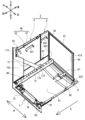
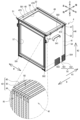
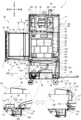
- FIG. 1 is a perspective view of the air conditioner 1 with the drawer body 7 in the storage position Q1.
- FIG. 1 is a perspective view of the air conditioner 1 with the drawer body 7 in the drawn-out position Q2.
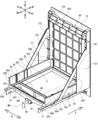
- FIG. 1 is a perspective view of the air conditioner 1 with the air filter 60, heat exchanger 4, and evaporation filter 6 removed from the drawer body 7 in the drawn-out position Q2, with the third side wall 23 omitted.
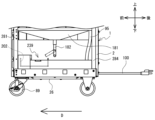
- FIG. FIG. 2 is a right side view of the drawer body 7 on which the air filter 60, the heat exchanger 4, and the evaporation filter 6 are mounted.
- 1 is a plan view of a drawer body 7 on which an air filter 60, a heat exchanger 4, and an evaporation filter 6 are mounted.
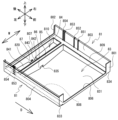
- FIG. 1 is a perspective view of a drawer body 7 on which an air filter 60, a heat exchanger 4, and an evaporation filter 6 are mounted.
- FIG. FIG. 1 is a perspective view of the drawer body 7 with the air filter 60 mounted thereon and the heat exchanger 4 and the evaporation filter 6 removed.
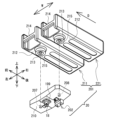
- FIG. 2 is a perspective view of a first drain pan 81.
- 11 is a cross-sectional view taken along line 11-11 in FIG. 2 .
- FIG. 12 is a cross-sectional view taken along line 12-12 in FIG.
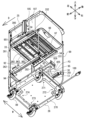
- FIG. 2 is a perspective view of the air conditioner 1 with a first tank 201 and a second tank 202 removed.
- 14 is a cross-sectional view taken along line 14-14 in FIG. 13 .
- FIG. 2 is a perspective view of a first tank 201 and a second tank 202.
- FIG. FIG. 2 is a perspective view of the air conditioner 1 with a first tank 201 and a second tank 202 removed.
- 2 is a perspective view showing the arrangement of the water supply unit 13 and the power supply harness 99 within the housing 2.
- FIG. 1 is a perspective view of a first pipe 96, a second pipe 97, and a third pipe 98.
- FIG. 13 is a right side view of a second drain pan 181 and a second tank accommodating portion 239 of a modified example.
- each member of the air conditioner 1 may be appropriately selected, and for example, they may be fixed by welding, adhesive, or fixing members.
- Fixing members are, for example, screws, bolts, and rivets.
- the air conditioner 1 shown in FIG. 1 is an evaporative cooling type air conditioner that is installed on the floor of a space to be air-conditioned, such as a factory. As shown in FIGS. 1 to 3, the air conditioner 1 includes a housing 2, rails 91, 92, a drawer body 7, an air filter 60, and a cooling unit 3.
- the cooling unit 3 of this embodiment includes a heat exchanger 4 and an evaporative filter 6. As shown in FIGS.
- the air conditioner 1 further includes a water storage container 20, a first tank storage section 140, a second tank storage section 39, an outlet pipe 19, a drain pan 8, a flow path forming section 37, a water supply unit 13, pressing members 331, 332, a first wall 35, a second wall 36, a first fan 101, a second fan 102, a fan motor 103, and a partition plate 105.
- the housing 2 has a rectangular parallelepiped shape that is long in the vertical direction and has a first side wall 21, a second side wall 22, a third side wall 23, a fourth side wall 24, an upper wall 25, and a lower wall 26.
- the housing 2 is made of resin or metal.
- the first side wall 21 is a front wall that forms the front surface of the housing 2
- the second side wall 22 is a rear wall opposite the first side wall 21 and forms the back surface of the housing 2.
- the third side wall 23 is a right wall that is connected to the first side wall 21 and the second side wall 22 and forms the right side surface of the housing 2.
- the fourth side wall 24 is a left wall opposite the third side wall 23 and forms the left side surface of the housing 2.
- the housing 2 houses the heat exchanger 4 and the water storage container 20.
- the first side wall 21 of the housing 2 is formed with an outlet 27 for removing the first tank 201 and the second tank 202 of the water storage container 20 described below from the housing 2.
- the first side wall 21 of the housing 2 is further formed with a drawer outlet 28.
- the drawer outlet 28 is formed above the drawer outlet 27 and is continuous with the drawer outlet 27.
- the drawer outlet 28 and the drawer outlet 27 are openings formed in the first side wall 21 that are generally rectangular in front view and elongated in the vertical direction.
- the drawer body 7 described below is attached to the drawer outlet 28.
- the first side wall 21 of the housing 2 is formed with an inlet 74.
- the housing 2 of this embodiment has the inlet 74 arranged in the decorative panel 73 of the drawer body 7 attached to the drawer outlet 28.
- the inlet 74 is an example of a first inlet, and is arranged in the first side wall 21 of the housing 2, through which the first air taken into the housing 2 circulates.
- the inlet 74 is also an example of a second inlet, and is arranged in the first side wall 21, through which the second air taken into the housing 2 flows.
- the inlet 74 is a common inlet for the first air and the second air.
- the first air and the second air before being taken into the housing 2 are air in the air-conditioned space in which the air conditioner 1 is installed.
- the inlet 74 takes in the air of the air-conditioned space as the first air and the second air into the housing 2.
- the inlet 74 as the first inlet is an opening provided in the first side wall 21 to take in the air of the air-conditioned space as the first air.
- the inlet 74 as the second inlet is an opening provided in the first side wall 21 to take in the air of the air-conditioned space as the second air.
- a first air outlet 29 and a second air outlet 30 are formed in the upper wall 25 of the housing 2.
- the first air outlet 29 is disposed in the housing 2.
- the first air outlet 29 is an opening through which the first air taken in from the inlet 74 and flowing through the first heat exchange flow passage R1 and the vaporization filter 6 of the heat exchanger 4 of the cooling unit 3 described later is blown out to the outside of the housing 2.
- the second air outlet 30 is disposed in a position in the housing 2 that is higher than the outlet 50 of the second heat exchange flow passage R2 of the heat exchanger 4 described later and shown in FIG. 5.
- the second air outlet 30 is an opening through which the second air taken in from the inlet 74 and flowing upward through the second heat exchange flow passage R2 is blown out to the outside of the housing 2.
- the second air outlet 30 is disposed in a position closer to the first side wall 21 than the first air outlet 29 in the front-rear direction along the first direction K1 in which the first air flows through the first heat exchange flow passage R1.
- the second air outlet 30 is arranged at a position overlapping with the first air outlet 29 in a width direction W perpendicular to the first direction K1 in which the first air flows through the first heat exchange flow passage R1 and the vertical direction, that is, in the left-right direction.
- a flexible cylindrical air duct 291 is connected to the first air outlet 29. The orientation of the air duct 291 can be changed. Casters 89 are fixed to the four corners of the lower wall 26. As shown in FIG. 3 and FIG.
- the inside of the housing 2 is provided with pillars 281 to 284 extending in the vertical direction.
- the pillar 281 is provided at the right front corner
- the pillar 282 is provided at the left front corner
- the pillar 283 is provided at the right rear corner
- the pillar 284 is provided at the left rear corner.
- the upper wall 25 and the lower wall 26 each extend horizontally.
- the lower wall 26 is connected to the lower ends of the pillars 281 to 284.
- the upper wall 25 connects to the upper ends of each of the pillars 281 to 284.
- the rails 91, 92 guide the movement of the drawer body 7.
- the rails 91, 92 are metal plates extending in the front-rear direction.
- the rail 91 is arranged on the fourth side wall 24 side, i.e., on the left side, in the width direction W.
- the front end of the rail 91 is fixed to the support 282 via a fixing plate 261
- the rear end of the rail 91 is fixed to the support 284 via the fixing plate 261.
- the fixing plate 261 is a metal plate extending in the front-rear direction to the left of the rail 91.
- the rail 92 is arranged on the third side wall 23 side, i.e., on the right side, in the width direction W.
- the front end of the rail 92 is fixed to the support 281 via the fixing plate 262, and the rear end of the rail 92 is fixed to the support 283 via the fixing plate 262.
- the fixing plate 262 is a metal plate extending in the front-rear direction to the right of the rail 92.
- An engagement portion 93 is fixed to the front end of the fixed plate 261. As shown in FIG. 12, the engagement portion 93 is a metal plate that protrudes to the right from the front end of the fixed plate 261, and the right end of the engagement portion 93 is bent upward.
- An engagement portion 94 is fixed to the front end of the fixed plate 262.
- the engagement portion 94 is a metal plate that protrudes to the left from the front end of the fixed plate 262, and the left end of the engagement portion 94 is bent upward.
- the engagement portions 93 and 94 form part of a restricting member 78 that restricts the movement of the drawer body 7 from the storage position Q1 toward the drawer position Q2.
- the drawer body 7 is equipped with a heat exchanger 4 and moves between a storage position Q1 shown in FIG. 1 where the heat exchanger 4 is disposed inside the housing 2, and a drawer position Q2 shown in FIG. 2 where the heat exchanger 4 is disposed outside the housing 2.
- the drawer body 7 has frames 71, 72, a decorative panel 73, and beam members 76, 77.
- the drawer body 7 is provided with engaged portions 79, 80.
- the frames 71 and 72 are metal plates elongated in the front-rear direction, with the ends on the center WM side in the width direction W bent downward.
- the frame 71 fits into the rail 91, and the frame 72 fits into the rail 92.
- the decorative plate 73 is connected to the downstream end of the frames 71 and 72 in the drawing direction D in which the drawer body 7 moves from the storage position Q1 to the drawing position Q2.
- the drawing direction D is a direction from the rear to the front, and the upstream side of the drawing direction D is the rear, and the downstream side of the drawing direction D is the front.
- the decorative plate 73 extends in the longitudinal direction of the frames 71 and 72, that is, in a direction intersecting with the front-rear direction. As shown in FIG.
- the decorative plate 73 forms the outer peripheral surface 200 of the air conditioner 1 together with the housing 2.
- the decorative plate 73 is formed with an intake port 74 through which the first air taken into the housing 2 flows.
- the intake port 74 is in the shape of a lattice frame. In the vertical direction, the frames 71 and 72 are connected to the rear surface of the decorative plate 73 below the position where the intake port 74 is formed.
- Flanges 731 and 732 protruding rearward are formed on the rear surface of the decorative plate 73.
- the flange 731 extends rearward from the left end of the rear surface of the decorative plate 73.
- the flange 732 extends rearward from the right end of the rear surface of the decorative plate 73.
- the upper ends of the flanges 731 and 732 are inclined downward toward the rear.
- the lower ends of the flanges 731 and 732 are bent toward the center WM side in the width direction W.
- the length of the flanges 731 and 732 in the front-rear direction is shorter than half the length of the frames 71 and 72 in the front-rear direction.
- a support plate 734 is formed at the rear of the upper ends of the flanges 731 and 732.
- the support plate 734 extends parallel to the decorative plate 73, separated from the decorative plate 73, above the intake port 74 in the vertical direction.
- the drawer handle 70 is provided below the intake port 74 of the decorative panel 73, and is operated when moving the drawer body 7.
- the drawer handle 70 is rectangular in shape, elongated in the left-right direction when viewed from the front, and is concave at the rear. In the up-down direction, the drawer handle 70 is located below the frames 71, 72.
- the drawer handle 70 is connected to the engaged parts 79, 80 via a switching mechanism 701.
- the switching mechanism 701 transmits the operation of the drawer handle 70 to the engaged parts 79, 80.
- the drawer handle 70 switches the position of the engaged parts 79, 80 provided on the drawer body 7 between an engaged position in which the engaged parts 79, 80 come into contact with and can engage with the engaging parts 93, 94, and a non-engaged position in which the engaged parts are separated from and cannot engage with the engaging parts 93, 94.
- the engaged parts 79, 80 form part of the regulating member 78. That is, the regulating member 78 includes engaging portions 93, 94 arranged on the housing 2 and engaged portions 79, 80 arranged on the drawer body 7.
- the engaged portions 79, 80 are metal plates having an L-shape in a plan view. The rear end of the engaged portion 79 is bent to the left.
- the rear end of the engaged portion 80 is bent to the right.
- the engaged portions 79, 80 are located below the first drain pan 81 and below the upper ends of the frames 71, 72.
- the front end of the engaged portion 79 is supported to the left of the drawer handle 70 so as to be swingable about an axis extending in the vertical direction.
- the front end of the engaged portion 80 is supported to the right of the drawer handle 70 so as to be swingable about an axis extending in the vertical direction.
- the engaged portions 79, 80 in the engaged position are indicated by solid lines
- the engaged portions 79, 80 in the engaged position are indicated by dotted lines. As shown in FIG.
- the beam members 76, 77 connect the frames 71, 72 and the decorative panel 73.
- the beam members 76, 77 are metal plates.
- the longitudinal direction of the beam members 76, 77 extends in a direction intersecting with the extension surface of the decorative panel 73 and the longitudinal direction of the frames 71, 72, specifically, diagonally downward and rearward, becoming lower toward the rear.
- the beam member 76 is disposed between the flange 731 and the first drain pan 81.
- the front end 761 of the beam member 76 is bent toward the center MW of the width direction W, that is, to the right, and fixed to the back surface of the decorative panel 73.
- the rear end 762 of the beam member 76 is bent toward the center MW of the width direction W and fixed to the frame 71.
- the beam member 77 is disposed between the flange 732 and the first drain pan 81.
- the front end 771 of the beam member 77 is bent toward the center MW in the width direction W, i.e., to the left, and is fixed to the back surface of the decorative panel 73.
- the rear end 772 of the beam member 77 is bent toward the center MW in the width direction W, and is fixed to the frame 72.
- the drawer body 7 of this embodiment is equipped with the heat exchanger 4, the vaporization filter 6, the air filter 60, and the opposing wall 803.
- the opposing wall 803 faces the first outer wall 54 of the heat exchanger 4 and the second outer wall 65 of the vaporization filter 6.
- the opposing wall 803 of this embodiment is the right wall of the first drain pan 81.
- the heat exchanger 4, the vaporization filter 6, the air filter 60, and the opposing wall 803 are each disposed between the flanges 731, 732 and between the beam members 76, 77 in the width direction W.
- the upper ends of the heat exchanger 4, the vaporization filter 6, and the air filter 60 are each located below the upper end of the decorative plate 73.
- the lower ends of the heat exchanger 4, the vaporization filter 6, and the air filter 60 are each located above the lower end of the decorative plate 73.
- the air filter 60 is a rectangular filter in plan view, and includes a filter 601, a frame 602, and a pair of left and right knobs 603.
- the filter 601 collects dust in the air sucked in from the air inlet 74, and prevents the dust from adhering to the inside of the housing 2.
- the frame 602 is rectangular and holds the filter 601.
- Each of the pair of knobs 603 bends backward from the upper end of the frame 602.
- the air filter 60 is mounted on the drawer body 7, and is disposed between the air inlet 74 and the heat exchanger 4. More specifically, the air filter 60 is inserted from above into a rectangular space in plan view, surrounded by the decorative plate 73, the support plate 734, and the flanges 731 and 732.
- each of the pair of knobs 603 abuts against the upper end of the support plate 734.
- the left and right ends of the frame 602 are sandwiched in the front-rear direction between the support claws 737 provided on the back surface of the decorative plate 73 and the decorative plate 73.
- the cooling unit 3 is disposed within the housing 2, and cools the air taken in from outside the housing 2 by the heat of vaporization of water supplied from an outlet pipe 19 shown in FIG. 11 and described below.
- the outlet pipe 19 is connected to a second tank 202 of the water storage container 20, described below.
- the heat exchanger 4 uses water supplied from the water storage container 20 to lower the ambient temperature and cool the space to be air-conditioned.
- the heat exchanger 4 has a partition wall 42 that separates a first heat exchange flow path R1 through which the first air flows and a second heat exchange flow path R2 through which the second air and the water supplied from the water storage container flow.
- the partition wall 42 forms a first heat exchange flow path R1 through which the first air taken in from the intake port 74 flows, and a second heat exchange flow path R2 through which the second air taken in from the intake port 74 flows upward and through which water is supplied.
- the first heat exchange flow path R1 forms a part of the first flow path P1 from the intake port 74 to the first air outlet 29.
- the second heat exchange flow path R2 forms a part of the second flow path P2 from the intake port 74 to the second air outlet 30.
- the heat exchanger 4 of this embodiment includes a heat exchanger body 41 and a heat exchange case 46 that houses the heat exchanger body 41.
- the heat exchanger body 41 has a partition 42 that includes a plurality of sheets 45, a plurality of spacers 43, and a plurality of spacers 44.
- Each of the plurality of sheets 45 is formed of a resin or metal having thermal conductivity.
- the pair of spacers 43 extend in the front-rear direction from the front end to the rear end of the sheet 45 at the upper and lower ends of the pair of adjacent sheets 45.
- the space surrounded by the pair of adjacent sheets 45 and the pair of spacers 43 arranged between the pair of adjacent sheets 45 is the first heat exchange flow path R1.
- the pair of spacers 44 extend in the up-down direction from the upper end to the lower end of the sheet 45 at the front and rear ends of the pair of adjacent sheets 45 other than the pair of adjacent sheets 45 between which the pair of spacers 43 are arranged.
- the space surrounded by the pair of adjacent sheets 45 and the pair of spacers 44 arranged between the pair of adjacent sheets 45 is the second heat exchange flow path R2.
- Each of the multiple sheets 45 is arranged at a predetermined interval in the left-right direction with the surface with the largest area facing rightward, so that the first heat exchange flow path R1 and the second heat exchange flow path R2 are formed alternately in the left-right direction.
- the predetermined interval of the first heat exchange flow path R1 is determined by the left-right thickness of the spacer 43.
- the predetermined interval of the second heat exchange flow path R2 is determined by the left-right thickness of the spacer 44.
- the heat exchanger case 46 houses the heat exchanger main body 41.
- the heat exchanger case 46 has a lid portion 47 and a box body 53.
- the lid portion 47 is a rectangular frame in plan view with an outlet 50 of the second heat exchange flow path R2 formed therein.
- the outlet 50 is formed rectangular in plan view.
- the box body 53 is box-shaped with an open upper portion.
- the four corners of the lid portion 47 are each removably fixed to the upper end of the box body 53 by fixing members 471 to 474.
- the heat exchanger 4 has a first abutment portion 51 and a second abutment portion 52 on the lid portion 47 of the heat exchanger case 46.
- the first abutment portion 51 is an upwardly protruding portion arranged at the downstream end of the upper surface 48 of the heat exchanger 4 in the pull-out direction D, that is, at the front end of the lid portion 47.
- the second contact portion 52 is an upwardly protruding portion disposed at an upstream end of the upper surface 48 of the heat exchanger 4 in the drawing direction D, i.e., at the rear end of the cover portion 47. More specifically, the first contact portion 51 and the second contact portion 52 each protrude upward from the upper surface 48 of the heat exchanger 4 and incline upward toward the front.
- the first contact portion 51 and the second contact portion 52 each extend in the left-right direction from the left end to the right end of the heat exchanger 4.
- the first contact portion 51 is provided in front of the outlet 50, and the second contact portion 52 is provided behind the outlet 50.
- the first contact portion 51 comes into contact with the cushioning material 361 of the first wall 35 formed in the housing 2.
- the second abutment portion 52 abuts against the cushioning material 361 of the second wall 36 formed in the housing 2.
- the first abutment portion 51 and the second abutment portion 52 determine the position of the heat exchanger 4 in the front-rear direction and prevent the second air flowing through the outlet 50 of the second heat exchange flow passage R2 from mixing with other air. As shown in FIGS.
- the heat exchanger 4 has a flange portion 49 that contacts an upper surface 69 of the vaporization filter 6 described later, upstream of the drawing direction D, that is, at the rear end of the heat exchanger 4.
- the flange portion 49 in this embodiment is provided at the rear end of the lid portion 47 of the heat exchange case 46. More specifically, the flange portion 49 extends rearward from the rear end of the second abutment portion 52 along the upper surface 69 of the vaporization filter 6. The rear end of the flange portion 49 is located rearward of the rear end of the box body 53.
- the flange 49 extends in the left-right direction from the left end to the right end of the heat exchanger 4.
- Flanges 581 and 582 are formed on the lid 47.
- the flange 581 is a portion disposed on the left end of the lid 47 and protruding diagonally upward to the left.
- the flange 582 is a portion disposed on the right end of the lid 47 and protruding diagonally upward to the right. In the left-right direction, the left end of the flange 581 is located to the left of the heat exchange case 46, and the right end of the flange 582 is located to the right of the heat exchange case 46.
- the flanges 581 and 582 prevent the second air that flows through the outlet 50 of the second heat exchange flow path R2 from mixing with other air.
- the heat exchanger 4 has a first outer wall 54.
- the first outer wall 54 is the right wall of the box body 53 of the heat exchange case 46.
- the first outer wall 54 has a first groove 55 into which the first ribs 851, 852 of the opposing wall 803 described below fit.
- the first groove 55 is formed by ribs 551, 552.
- the ribs 551, 552 are convex portions that extend upward from the lower end of the rear part of the first outer wall 54 and protrude to the right.
- the rib 551 extends in the vertical direction.
- the rib 552 is disposed behind the rib 551 and extends at an angle to the vertical direction so that the lower the rib 552 is located further rearward.
- the distance between the ribs 551, 552 in the front-to-rear direction is greater the further downward the ribs are.
- a plurality of ribs 553 extending in the front-to-rear direction are connected to the front end of the rib 551 at equal intervals in the vertical direction.
- a number of ribs 554 extending in the front-rear direction are connected to the rear end of the rib 552 at equal intervals in the up-down direction.
- the vertical spacing of the multiple ribs 553 and the vertical spacing of the multiple ribs 554 are each smaller than the minimum of the front-rear spacing of the ribs 551 and 552.
- the heat exchanger 4 is provided with gripping portions 541, 542 on the box body 53 of the heat exchange case 46.
- the gripping portion 541 is an inverted U-shape that opens downward when viewed from the right side, and is formed in the center of the first outer wall 54 in the front-rear direction.
- the gripping portion 542 is formed on the left wall of the box body 53.
- the gripping portions 541, 542 are gripped by the user of the air conditioner 1 when attaching or detaching the heat exchanger 4 to the drawer body 7.
- On the front surface of the box body 53, an inlet 57 of the first heat exchange flow path R1 is formed in a rectangular shape when viewed from the front. As shown in FIG.
- an outlet 58 of the first heat exchange flow path R1 is formed in a rectangular shape when viewed from the rear.
- an inlet 56 of the second heat exchange flow path R2 is formed in a rectangular shape when viewed from the bottom.
- the first direction K1 from the inlet 57 toward the outlet 58 of the first heat exchange flow path R1 is rearward.
- the second direction K2 from the inlet 56 to the outlet 50 of the second heat exchange passage R2 is upward.
- the left wall lower end 591 and the right wall lower end 592 of the box body 53 each abut against the first drain pan 81 described below.
- the heat exchanger 4 has a shorter length in the width direction W perpendicular to the drawer direction D and the vertical direction, as compared to the downstream side, toward the upstream side in the drawer direction D in which the drawer body 7 moves from the storage position Q1 to the drawer position Q2.
- the length L2 in the width direction W of the rear end of the heat exchanger 4 is shorter than the length L1 in the width direction W of the front end of the heat exchanger 4.
- the heat exchanger 4 has a trapezoidal shape in a plan view.
- the heat exchanger 4 has a quadrangular pyramid shape with the front of the front wall of the heat exchange case 46 as the bottom surface.
- the heat exchanger 4 has a shorter length in the vertical direction, as compared to the downstream side, toward the upstream side in the drawer direction D in which the drawer body 7 moves from the storage position Q1 to the drawer position Q2. Specifically, as shown in FIG. 4, the vertical length H2 of the rear end of the heat exchanger 4 is shorter than the vertical length H1 of the front end of the heat exchanger 4. In the vertical direction, the vertical position of the rear end of the heat exchanger 4 is located lower than the vertical position of the front end of the heat exchanger 4.
- the evaporation filter 6 is mounted on the pull-out body 7 and is located upstream of the heat exchanger 4, i.e., rearward of the heat exchanger 4, in the pull-out direction D in which the pull-out body 7 moves from the storage position Q1 to the pull-out position Q2.
- Water is supplied from the water storage container 20 and the first air that has flowed through the first heat exchange flow path R1 flows through the evaporation filter 6.
- the evaporation filter 6 cools the first air by the latent heat of the water.
- the vaporization filter 6 has a case 61 and a filter 68.
- the case 61 is a rectangular parallelepiped that is long in the vertical direction.
- the case 61 of the vaporization filter 6 has an upper wall 613, a second outer wall 65, a left wall 611, a lower wall 612, a front wall 617, a rear wall 618, and grip portions 641, 642.
- Four openings 62 are formed in the upper wall 613 of the case 61.
- Each of the four openings 62 is formed in a rectangular shape that is long in the left-right direction when viewed from above.
- the four openings 62 are lined up in the left-right direction at a predetermined interval.
- Flanges 614 to 616 are formed on the upper wall 613.
- the flange 614 protrudes diagonally upward to the left from the left end of the upper wall 613.
- the flange 615 protrudes diagonally upward to the right from the right end of the upper wall 613. In the left-right direction, the left end of the flange 614 is located to the left of the left wall 611, and the right end of the flange 615 is located to the right of the second outer wall 65.
- the flange 615 protrudes diagonally upward and forward in front of the four openings 62.
- a recess 619 that is recessed downward is formed in the lower wall 612.
- a drain hole is formed at the lower end of the recess 619. Water inside the case 61 is drained through the drain hole into the second receiving portion 84 of the first drain pan 81, which will be described later.
- the second outer wall 65 is the right wall of the case 61.
- the second outer wall 65 has a second groove 66 into which second ribs 853, 854 of the opposing wall 803 described below fit.
- the second groove 66 is formed by ribs 661, 662.
- the ribs 661, 662 are convex portions that extend upward from the lower end of the right front portion of the second outer wall 65 and protrude to the right.
- the portion of the rib 661 above the center in the vertical direction extends in the vertical direction, and the lower portion extends at an incline forward as it descends.
- the rib 662 is disposed behind the rib 661 and extends linearly in the vertical direction.
- the distance between the ribs 661, 662 in the front-to-rear direction is greater the further downward.
- the minimum and maximum distance between the ribs 661, 662 in the front-to-rear direction is smaller than the minimum distance between the ribs 551, 552 in the front-to-rear direction.
- the vaporization filter 6 also has a second groove 66 in the left wall 611, which is opposite the second outer wall 65.
- the front wall 617 of the case 61 is formed with an inlet 63 having a rectangular shape when viewed from the front. In the front-rear direction, the front wall 617 is located rearward of the front ends of the upper wall 613, the second outer wall 65, the left wall 611, and the lower wall 612.
- the front ends of the upper wall 613, the second outer wall 65, the left wall 611, and the lower wall 612 each abut against the rear surface of the heat exchanger 4.
- the upper wall 613, the second outer wall 65, the left wall 611, and the lower wall 612, the rear surface of the heat exchanger 4, and the front wall 617 of the vaporization filter 6 form the downstream portion of the first heat exchange flow path R1 of the first flow path P1, and prevent the first air from mixing with other air.
- the rear wall 618 of the case 61 is formed with an outlet 64 having a rectangular shape when viewed from the rear.
- the direction from the inlet 63 to the outlet 64 of the vaporization filter 6 is the rear, the same as the first direction K1 from the inlet 57 to the outlet 58 of the first heat exchange flow path R1 of the heat exchanger 4.
- the grip portion 641 is formed in the center of the second outer wall 65 in the front-to-rear direction in an inverted U-shape that is open downward when viewed from the right side.
- the grip portion 642 is formed on the left wall 611.
- the grip portions 641, 642 are gripped by the user of the air conditioner 1 when attaching or detaching the vaporization filter 6 to or from the drawer body 7.
- the evaporation filter 6 has a water receiving rib 67 at its lower end in the vertical direction that protrudes upstream in the pull-out direction D, i.e., rearward, from the first drain pan 81 and extends along a width direction W perpendicular to the pull-out direction D and the vertical direction. In the width direction W, the water receiving rib 67 extends between the frames 71, 72. As shown in Figure 6, an outlet 64 is formed above the water receiving rib 67 in the rear wall 618 of the case 61.
- the water receiving rib 67 is inserted into a rearward recess 38 formed below the flow path forming portion 37 described below, and receives water discharged from the flow path forming portion 37.
- the vaporization filter 6 has a shorter length in a width direction W perpendicular to the pull-out direction D and the vertical direction, as compared to the downstream side, toward the upstream side in the pull-out direction D in which the pull-out body 7 moves from the storage position Q1 to the pull-out position Q2.
- the length L4 in the width direction W of the rear end of the vaporization filter 6 is shorter than the length L3 in the width direction W of the front end of the vaporization filter 6.
- the vaporization filter 6 has a trapezoidal shape in a plan view.
- the vaporization filter 6 has a quadrangular pyramid shape with the front of the front wall 617 of the vaporization filter 6 as the bottom surface.
- the vaporization filter 6 has a shorter length in the vertical direction, as compared to the downstream side, toward the upstream side in the pull-out direction D in which the pull-out body 7 moves from the storage position Q1 to the pull-out position Q2. Specifically, the vertical length H4 of the rear end of the vaporization filter 6 is shorter than the vertical length H3 of the front end of the vaporization filter 6. In the vertical direction, the vertical position of the rear end of the vaporization filter 6 is located lower than the vertical position of the front end of the vaporization filter 6.
- the user of the air conditioner 1 operates the drawer handle 70 to move the engaged portions 79, 80 from the engaged position to the disengaged position, and moves the drawer body 7 from the storage position Q1 to the drawer position Q2.
- the air filter 60, heat exchanger 4, and evaporative filter 6 are located outside the housing 2.
- the user of the air conditioner 1 can remove each of the air filter 60, heat exchanger 4, and evaporative filter 6 from the drawer body 7.
- the flange 49 of the heat exchanger 4 abuts against the upper surface 69 of the vaporization filter 6 from above, so when removing the vaporization filter 6 from the drawer body 7, the user removes the heat exchanger 4 from the drawer body 7, and then removes the vaporization filter 6 from the drawer body 7.
- the user When mounting the air filter 60 in the drawer body 7, the user places the air filter 60 between the decorative plate 73 and the support plate 734 in the front-to-rear direction.
- the user first mounts the vaporization filter 6 in the drawer body 7.
- the opposing wall 803 has second ribs 853, 854.
- the second outer wall 65 has a second groove 66. The user positions the second ribs 853, 854 of the opposing wall 803 between the ribs 661, 662 of the vaporization filter 6 in the front-to-rear direction, and mounts the vaporization filter 6 in the drawer body 7.
- the second ribs 853, 854 of the opposing wall 803 are positioned between the ribs 661, 662.
- the upper front end of the second rib 853 abuts the upper rear end of the rib 661.
- the rear end of the second rib 854 abuts the front end of the rib 552.
- the second ribs 853, 854 formed on the left wall 804 are arranged in the second groove 66 formed on the left wall 611 of the vaporization filter 6.
- the user mounts the heat exchanger 4 on the drawer body 7 next to the vaporization filter 6.
- the facing wall 803 has first ribs 851, 852.
- the first outer wall 54 has a first groove 55.
- the first ribs 851, 852 of the facing wall 803 are arranged between the ribs 551, 552.
- the user mounts the heat exchanger 4 on the drawer body by arranging the first ribs 851, 852 of the facing wall 803 between the ribs 551, 552 in the front-rear direction.
- the front end of the first rib 851 abuts against the rear end of the rib 551.
- the upper rear end of the first rib 852 abuts against the upper front end of the rib 552.
- the user moves the drawer body 7, which contains the air filter 60, heat exchanger 4, and evaporation filter 6, from the drawer position Q2 to the storage position Q1.
- the engaged parts 79 and 80 move from the engaged position to the disengaged position, and then move to the engaged position and engage with the engaging parts 93 and 94.
- the water storage container 20 stores water.
- the water storage container 20 of this embodiment includes a first tank 201 and a second tank 202.
- the first tank 201 stores water.
- the first tank 201 of this embodiment includes first tanks 211 and 221 that have the same configuration. Below, the configuration of the first tank 211 will be described, and the configuration of the first tank 221 will be omitted.
- the first tank 211 has a rectangular parallelepiped shape that is long in the front-rear direction, and includes a first tank handle 214, a water supply port 213, and a check valve 215.
- the first tank handle 214 is an H-shaped part in front view provided at the front end of the first tank 211.
- the water supply port 213 is provided on the bottom surface 212 of the first tank 211, and is an opening through which water supplied from inside the first tank 211 to the second tank 202 flows.
- the water supply port 213 is formed in a cylindrical shape downward from the bottom surface 212.
- the check valve 215 is disposed inside the water supply port 213. When the check valve 215 of the first tank 211 is pushed upward by a convex portion 207 of the second tank 202 described later, the check valve 215 opens a flow path through which the water of the first tank 211 flows from the water supply port 213 to the outside of the first tank 211.
- the check valve 215 When the check valve 215 is separated from the second tank 202 and is not pushed upward, the check valve 215 blocks a flow path through which the water of the first tank 211 flows from the water supply port 213 to the outside of the first tank 211.
- the check valve 215 of the first tank 221 When the check valve 215 of the first tank 221 is pushed upward by a convex portion 208 of the second tank 202 described later, the check valve 215 opens a flow path through which the water of the first tank 221 flows from the water supply port 213 to the outside of the first tank 221.
- the first tank 211 is removed from the housing 2 and refilled with tap water or the like, and then accommodated in the housing 2.
- the bottom surface 212 of the first tank 211 is located above the bottom wall 210 of the second tank 202 described below. When the water level of the second tank 202 falls below a predetermined value, water in the first tank 211 is supplied to the second tank 202 through the water supply port 213.
- the second tank 202 is a rectangular box with an opening formed at the top, and is provided below the evaporation filter 6 and the drain pan 8.
- the second tank 202 stores water to be supplied to the evaporation filter 6 and the heat exchanger 4.
- the second tank 202 is removably arranged in the housing 2, and stores water supplied from the first tank 201.
- the second tank 202 is provided with a second tank handle 204, an inline filter 205, a water level sensor 206, and protrusions 207, 208 in an area R surrounded by the inner surface 209 of the second tank 202.
- the second tank handle 204 is arranged in the center of the second tank 202 in the longitudinal direction, that is, in the left-right direction.
- the second tank handle 204 is long in the left-right direction and has an inverted U-shape that is open downward when viewed from the front.
- the longitudinal center of the second tank handle 204 and the longitudinal center of the second tank 202 coincide with each other.
- the second tank handle 204 is located in the short direction of the second tank 202, i.e., in the center in the front-to-rear direction, more specifically, slightly rearward of the center in the front-to-rear direction.
- the inline filter 205 collects dust contained in the water in the second tank 202 and prevents the dust from flowing into the water supply flow path P3 described below downstream of the second tank 202.
- the inline filter 205 is removably attached to the second tank 202.
- the inline filter 205 is disposed closer to the first side wall 21 than the second side wall 22 opposite the first side wall 21.
- the water level sensor 206 is disposed to the right rear of the second tank handle 204, detects the water level of the water stored in the second tank 202, and outputs a detection signal to the controller 300 of the air conditioner 1.
- the controller 300 controls the operation of the pump 9 based on the detection signal of the water level sensor 206.
- the controller 300 is configured, for example, by a microcomputer, and is disposed in a position opposite the front left part of the third side wall 23.
- the protrusions 207 and 208 are cylindrical protrusions protruding upward from the bottom wall 210 of the second tank 202.
- the protrusion 207 is disposed to the left of the second tank handle 204, and the protrusion 208 is disposed to the right of the second tank handle 204.
- the second tank handle 204 is located between the protrusions 207 and 208.
- the second tank check valve 18 is disposed in the second tank 202.
- the second tank check valve 18 is disposed downstream of the in-line filter 205 in the water supply flow path P3.
- the second tank check valve 18 is connected to an outlet forming portion 199 that protrudes downward from the lower surface of the bottom wall 210 of the second tank 202.
- the second tank check valve 18 When the second tank check valve 18 is pushed upward by a connection portion 399 of the second tank accommodating portion 39 described below, it opens the flow path through which the water in the second tank 202 flows to the outside of the second tank 202.
- the second tank check valve 18 is separated from the connection portion 399 and is not pushed upward, it blocks the flow path through which the water in the second tank 202 flows to the outside of the second tank 202.
- the first tank storage section 140 is disposed within the housing 2 and stores the first tank 201. In the vertical direction, the first tank storage section 140 is disposed below the rails 91, 92 and above the bottom wall 26 of the housing 2. More specifically, the first tank storage section 140 includes a lid 10, a plate portion 155, and partition walls 141 to 144. The plate portion 155 extends horizontally behind the lid 10 of the second tank storage section 39 described below. The partition walls 141 to 144 are plate-shaped and protrude upward from the plate portion 155, and separate the space in which the first tank 211 is stored from the space in which the first tank 221 is stored. In the horizontal direction, the first tank 211 is disposed between the partition walls 141, 142, and the first tank 221 is disposed between the partition walls 143, 144. The front ends of the first tanks 211, 221 are located above the lid 10.
- the second tank storage section 39 is disposed in the housing 2 and stores the second tank 202.
- the second tank storage section 39 is disposed closer to the first side wall 21 than the second side wall 22 opposite the first side wall 21, that is, forward of the center of the housing 2 in the front-rear direction.
- the second tank storage section 39 includes a lid 10, a hinge 15, a recess 341, and a seal member 16.
- the hinge 15 fixes the lid 10 in the housing 2 so as to be rotatable between a closed position Q3 that covers the upper part of the second tank 202 disposed in the second tank storage section 39 and an open position Q4 that opens the upper part of the second tank 202 disposed in the second tank storage section 39.
- the lid 10 When the lid 10 is in the closed position Q3, the lid 10 extends horizontally forward relative to the hinge 15.
- the lid 10 When the lid 10 is in the open position Q4, the lid 10 extends upward relative to the hinge 15.
- the lid 10 has a lid body 110 and a hollow cylindrical body 111.
- the lid body 110 has a lid body protrusion 112 that protrudes upward from the upper surface 115 of the lid body 110 in a portion between the cylindrical body 111 and the outlet 27 of the upper surface 115 of the lid body 110 when the lid 10 is in the closed position.
- the lid body protrusion 112 is disposed between the cylindrical body 111 and the outlet 27 in the front-rear direction.
- the lid body 110 is formed with insertion holes 113 and 114 through which the water supply port 213 of the first tank 201 is inserted.
- the outer periphery of the insertion holes 113 and 114 is tapered so that it becomes more upward as it moves away from the outer periphery.
- the insertion hole 113 is formed to the left of the lid body protrusion 112, and the insertion hole 114 is formed to the right of the lid body protrusion 112. In other words, in the left-right direction, the lid body protrusion 112 is formed between the insertion holes 113 and 114.
- the water supply port 213 of the first tank 211 is inserted into the insertion hole 113, and the water supply port 213 of the first tank 221 is inserted into the insertion hole 114.
- the front end of the lid body projection 112 is inclined so as to approach the center WM in the width direction W as it moves forward.
- the lid body projection 112 and the cylindrical body 111 are disposed at the center WM in the width direction W.
- the lid body projection 112 is located in front of the cylindrical body 111.
- the cylinder 111 has a cylinder inlet 118 to which the inlet pipe 17 is connected, and a cylinder outlet 119 to which the lid body 110 is connected.
- the cylinder outlet 119 of the cylinder 111 is located above the cylinder inlet 118.
- the cylinder outlet 119 is located below the cylinder inlet 118.
- the upper end of the lid body protrusion 112 is located above the upper end of the cylinder 111.
- a pair of left and right claws 131 are formed at the front end of the lid body 110.
- the claws 131 engage with recesses 135 provided at the front end of the second tank storage section 39 described below.
- the recess 341 has a hexagonal shape that is long in the left-right direction in a plan view.
- the bottom wall 390 of the recess 341 is provided with a connection portion 399, a recess 398 recessed downward at the rear end, and external communication holes 391 to 397 that communicate with the external space of the housing 2.
- the connection portion 399 is formed in the center of the recess 341 in the left-right direction.
- the connection portion 399 abuts against the second tank check valve 18 when the second tank 202 is accommodated in the second tank accommodation portion 39.
- the recess 398 is a recessed portion recessed downward at the rear end of the recess 341, and corresponds to the water level sensor 206 of the second tank 202.
- the external communication hole 394 is formed in the left front part of the bottom wall 390, and the external communication hole 395 is formed in the right front part of the bottom wall 390.
- the external communication hole 396 is formed in the left rear part of the recess 398, and the external communication hole 397 is formed in the right front part of the recess 398.
- the seal member 16 is a member having a hexagonal shape in a plan view, which is arranged on the outer periphery of the opening 400 of the recess 341.
- the sealing member 16 is disposed between the lid 10 and the second tank 202 when the lid 10 is in the closed position Q3.
- the sealing member 16 is made of an elastic material such as rubber.
- the outlet pipe 19 is disposed within the housing 2 and is connected to the second tank 202 via the second tank check valve 18. One end of the outlet pipe 19 is connected to the connection portion 399 of the second tank storage portion 39 above the bottom wall 26 of the housing 2. The other end of the outlet pipe 19 is connected to the pump 9.
- the user moves the lid 10 from the open position Q4 to the closed position Q3.
- the user places the first tanks 211, 221 in the first tank housing portion 140.
- a lid body protrusion 112 is formed on the cylinder 111 of the upper surface 115 of the lid 10.
- the lid body protrusion 112 guides the movement of the first tank 211 so that the first tank 211 is placed between the partition walls 141, 142 of the first tank housing portion 140.
- the lid protrusion 112 guides the movement of the first tank 221 so that the first tank 221 is disposed between the partition walls 143 and 144 of the first tank storage section 140.
- the lid protrusion 112 is located in front of the cylindrical body 111.
- the extension range of the cylindrical body 111 in the width direction W is included in the extension range of the lid protrusion 112 in the width direction W. Therefore, the lid protrusion 112 prevents the first tanks 211 and 221 from accidentally hitting the cylindrical body 111 when the first tanks 211 and 221 are attached.
- the lid protrusion 112 separates the first tank 211 and the first tank 221 in the left-right direction forward of the partition walls 141 to 144.
- the drain pan 8 receives water discharged from the cooling unit 3. More specifically, the drain pan 8 is disposed directly below the heat exchanger 4, receives water discharged from the second heat exchange flow path R2, and forms a part of the second flow path P2 upstream of the second heat exchange flow path R2.
- the drain pan 8 of this embodiment has a first drain pan 81 and a second drain pan 82.
- the first drain pan 81 is a rectangular dish-shaped pan disposed below the heat exchanger 4 and above the second tank 202.
- the first drain pan 81 is disposed in the drawer body 7 and receives water discharged from the second heat exchange flow path R2.
- the first drain pan 81 is fixed to the frames 71 and 72. More specifically, as shown in FIG.
- the lower surface 833 of the support portion 808 abuts against the frame 71 and is fixed to the frame 71 together with the rear end portion 762 of the beam member 76 disposed between the first drain pan 81 and the frame 71.
- the lower surface 834 of the support portion 809 abuts against the frame 72 and is fixed to the frame 72 by a fixing member 773 together with the rear end 772 of the beam member 77 disposed between the first drain pan 81 and the frame 72.
- the front end of the first drain pan 81 abuts against the upper rear portion of the pull-out handle 70.
- the first drain pan 81 has a front wall 801, a rear wall 802, an opposing wall 803, a left wall 804, a first receiving portion 83, a second receiving portion 84, support portions 808 to 810, a drain wall 85, and a drain hole 87.
- the first drain pan 81 is connected to the drain piping 90.
- the front wall 801 faces the rear surface of the decorative panel 73.
- the front wall 801 is formed with a notch 806 cut downward from the upper end of the front wall 801.
- the lower end of the notch 806 is located lower than the lower end of the intake port 74.
- the rear wall 802 is formed with a notch 807 cut downward from the upper end of the rear wall 802.
- the opposing wall 803 is an example of the first opposing wall and the second opposing wall of the present invention.
- the opposing wall 803 is the right wall of the first drain pan 81, connecting the right end of the front wall 801 to the right end of the rear wall 802 in the front-to-rear direction.
- the left wall 804 connects the left end of the front wall 801 to the left end of the rear wall 802 in the front-to-rear direction.
- the first receiving portion 83 receives water discharged from the second heat exchange passage R2.
- the bottom wall 831 of the first receiving portion 83 slopes downward as it approaches the rear.
- the front wall 832 of the first receiving portion 83 slopes downward as it approaches the rear.
- the front end of the front wall 832 is connected to the front wall 801 below the notch 806, and the rear end of the front wall 832 is connected to the front end of the bottom wall 831.
- the second receiving portion 84 is disposed behind the first receiving portion 83 and receives water discharged from the evaporation filter 6.
- the bottom wall 841 of the second receiving portion 84 slopes downward as it approaches the center MW in the width direction W.
- the bottom wall 841 of the second receiving portion 84 slopes in a V-shape when viewed from behind.
- the bottom wall 841 has a groove portion 820 extending in the front-to-rear direction and recessed downward in the center of the width direction W.
- the bottom end 835 of the bottom wall 831 of the first receiving portion 83 is located below the bottom end 842 of the bottom wall 841 of the second receiving portion 84 and above the bottom end 843 of the groove portion 820 of the second receiving portion 84.
- the drain wall 85 separates the first receiving portion 83 and the second receiving portion 84.
- a communication hole 86 is formed at the lower end of the drain wall 85, connecting the first receiving portion 83 and the second receiving portion 84 in the front-rear direction.
- the front lower end of the communication hole 86 is connected to the lower end of the upper surface of the bottom wall 831 of the first receiving portion 83.
- the length in the width direction W of the communication hole 86 is narrower than the width direction length of the groove portion 820.
- the vertical length of the communication hole 86 on the back surface of the drain wall 85 is longer than the vertical length of the communication hole 86 on the front surface of the drain wall 85.
- the support portions 808 and 809 function as the first support portion of the present invention, and the support portions 808 to 810 function as the second support portion of the present invention.
- the support portion 808 in the width direction W, is a portion extending in the front-rear direction and disposed between the left wall 804 and the first and second receiving portions 83 and 84.
- the support portion 809 is a portion extending in the front-rear direction and disposed between the opposing wall 803 and the first and second receiving portions 83 and 84.
- the support portion 810 is a portion extending in the left-right direction connecting the rear end of the support portion 808 and the rear end of the support portion 809.
- the support portions 808 and 809 support the heat exchanger 4 from below.
- the support portion 808 abuts against the left wall lower end 591 of the heat exchanger 4.
- the support portion 809 abuts against the right wall lower end 592 of the heat exchanger 4.
- the support portions 808 and 809 support the heat exchanger 4 from below, and the air conditioner 1 prevents air from entering between the first receiving portion 83 and the heat exchanger 4 from the width direction W.
- the support portions 808 to 810 support the vaporization filter 6 from below together with the drain wall 85. More specifically, the support portion 808 abuts against the lower end of the left wall 611 of the vaporization filter 6.
- the support portion 809 abuts against the lower end of the second outer wall 65 of the vaporization filter 6.
- the support portion 810 abuts against the lower end of the rear wall 618 of the vaporization filter 6.
- the drain wall 85 abuts against the front wall 617 of the vaporization filter 6.
- the portion where the vaporization filter 6 and the second receiving portion 84 abut is annular in plan view.
- the support portions 808 to 810 support the vaporization filter 6 from below together with the drain wall 85, and the air conditioner 1 prevents air from entering between the second receiving portion 84 and the vaporization filter 6.
- the first receiving portion 83 and the second receiving portion 84 are connected to each other through a communication hole 86 formed in the drain wall 85, but because the communication hole 86 is relatively small, air other than the second air is prevented from mixing with the second heat exchange passage R2.
- the drain hole 87 is located upstream of the first receiving portion 83 in the pull-out direction D in which the pull-out body 7 moves from the storage position Q1 to the pull-out position Q2, and drains the water received by the first receiving portion 83.
- the drain hole 87 is a circular hole in a front view formed in the rear wall 802, and communicates with the rear lower end of the groove portion 820.
- the drain pipe 90 is connected to the rear end of the first drain pan 81, more specifically, to the drain hole 87 of the first drain pan 81.
- the drain pipe 90 is an L-shaped pipe that extends rearward from the rear end of the first drain pan 81 and then bends downward.
- the drain pipe 90 abuts against the front end 822 of the second drain pan 82. Therefore, the second drain pan 82 receives water that has flowed through the drain pipe 90 when the pull-out body 7 is in the storage position Q1 and when it is in the pull-out position Q2.
- the second drain pan 82 is provided in the housing 2.
- the second drain pan 82 is a dish-shaped pan that is long in the front-rear direction. In the front-rear direction, the second drain pan 82 is disposed below the rails 91, 92 and above the first tank 201. In the left-right direction, the second drain pan 82 is disposed between the rails 91, 92 and between the first tanks 211, 221.
- the length of the width direction W of the second drain pan 82 is shorter than the length of the width direction W of the first drain pan 81, and more specifically, shorter than half the length of the width direction W of the first drain pan 81.
- the rear end portion 821 of the second drain pan 82 extends rearward beyond the front end of the flow path forming portion 37.
- the right side shape of the second drain pan 82 is V-shaped.
- the lower end portion 823 of the second drain pan 82 is located rearward of the center of the front-rear direction of the second drain pan 82.
- the lower end 823 of the second drain pan 82 is connected to the piping 88.
- the rear end 826 of the second drain pan 82 is bent upward along the second side wall 22 and fixed to the second side wall 22.
- the inlet pipe 17 is flexible and connects the lid 10 of the second tank storage section 39 to the second drain pan 82 of the drain pan 8.
- the inlet pipe 17 is, for example, a hose made of resin.
- the upper end 171 of the inlet pipe 17 is connected to the pipe 88 of the second drain pan 82, and the lower end 172 of the inlet pipe 17 is connected to the cylindrical body 111 of the lid 10.
- the length of the inlet pipe 17 is set taking into consideration the range in which the lid 10 can be opened and closed.
- the water stored in the second tank 202 includes water recovered in the second tank 202 via the drain pan 8 and the inlet pipe 17.
- the flow path forming portion 37 is disposed inside the housing 2 and forms a first flow path P1 for the first air that has flowed through the vaporization filter 6.
- the flow path forming portion 37 is formed above the rails 91, 92.
- the flow path forming portion 37 is formed in a cylindrical shape extending in the vertical direction along the second side wall 22 of the housing 2 behind the vaporization filter 6.
- An inlet 371 is formed in a rectangular shape in a plan view on the front surface 370 of the flow path forming portion 37.
- the lower end of the rear wall 373 of the flow path forming portion 37 is inclined downward as it approaches the front.
- a recess 38 that is long in the left-right direction and recessed rearward is formed below the flow path forming portion 37.
- the water supply unit 13 supplies the water stored in the second tank 202 to the heat exchanger 4 and the evaporative filter 6.
- the water supply unit 13 includes a pump 9, a controller 300, an outlet pipe 19, a fourth pipe 95, a third pipe 98, a first pipe 96, and a second pipe 97.
- the water supply flow path P3 from the second tank 202 to the cooling unit 3 includes the outlet pipe 19, the pump 9, the fourth pipe 95, the third pipe 98, the first pipe 96, and the second pipe 97, which are connected in this order from upstream to downstream in the water flow direction in the water supply flow path P3.
- the pump 9 sends water to each of the first pipe 96 and the second pipe 97.
- the pump 9 is disposed between the second side wall 22 and the second tank 202, more specifically, at a position adjacent to the second side wall 22.
- the controller 300 is connected to the pump 9 by a communication line.
- the pump 9 is driven or stopped based on a control signal output from the controller 300 in response to a detection signal from the water level sensor 206.
- the outlet pipe 19 extends in the front-rear direction below the plate portion 155 of the first tank storage portion 140, and connects the second tank 202 and the pump 9.
- the fourth pipe 95 is connected to the pump 9 and extends upward from the pump 9.
- the fourth pipe 95 is inserted into a vertically penetrating hole 825 formed in the rear end portion 821 of the second drain pan 82.
- the fourth pipe 95 bends to the left near the upper end of the second drain pan 82 to the vicinity of the third side wall 23.
- the right end of the fourth pipe 95 connects to the lower end of the third pipe 98 near the third side wall 23.
- the third pipe 98 is arranged along the third side wall 23 and connected to the first pipe 96.
- the third pipe 98 has a first portion 981 extending upward from the right end of the fourth pipe 95 along the third side wall 23, more specifically, along the support 284, a second portion 982 extending forward from the upper end of the first portion 981 along the third side wall 23, a third portion 983 extending leftward from the front end of the second portion 982, and a fourth portion 984 extending rearward from the left end of the third portion 983.
- the planar shape of the third pipe 98 is J-shaped. The rear end of the fourth portion 984 connects to the first pipe 96.
- the first pipe 96 is disposed directly above the heat exchanger 4, and water supplied to the second heat exchange flow path R2 flows through it.
- the first pipe 96 is disposed between the first fan case 107 and the second fan case 108, which will be described later, in the front-rear direction.
- the first pipe 96 is disposed in the second flow path P2, upstream of the fan motor 103, which will be described later, and downstream of the heat exchanger 4.
- the first pipe 96 includes water supply pipes 961 to 963 that are long in the left-right direction.
- the water supply pipes 961 to 963 are arranged in the front-rear direction at a predetermined interval X3.
- the water supply pipes 961 to 963 each have the same shape as each other.
- the water supply pipe 961 includes a support plate portion 964 at the right end of the water supply pipe 961, and the support plate portion 964 is fixed to a support plate 951 fixed to the underside of the first fan case 107.
- the support plate 951 extends in the front-rear direction along the third side wall 23.
- the water supply pipe 962 has a support plate portion 965 at the right end of the water supply pipe 962, and the support plate portion 965 is fixed to the support plate 951.
- the water supply pipe 963 has a support plate portion 966 at the right end of the water supply pipe 963, and the support plate portion 966 is fixed to the support plate 951.
- a plurality of nozzles 921 are formed on the lower surface of each of the water supply pipes 961 to 963, and are arranged in the left-right direction at an interval X1.
- Each of the plurality of nozzles 921 of the first pipe 96 faces the outlet 50 of the second heat exchange flow path R2.
- the water supply pipes 961 and 962 are connected by a connecting pipe 985 extending in the front-rear direction.
- the water supply pipes 962 and 963 are connected by a connecting pipe 986 extending in the front-rear direction.
- the second pipe 97 is disposed behind the first pipe 96 and directly above the vaporization filter 6, through which water is supplied to the vaporization filter 6.
- the second pipe 97 extends in the left-right direction.
- the front-rear distance X4 between the second pipe 97 and the first pipe 96 is longer than the distance X3.
- the water supply pipe 963 and the second pipe 97 are connected by a connecting pipe 987 extending in the front-rear direction.
- the connecting pipe 987 is gently bent in a Z-shape when viewed from the right side.
- the connecting pipes 985 to 987 are disposed in the same line as the fourth portion 984 of the third pipe 98.
- the second pipe 97 is provided with a support plate portion 967 at the right end of the second pipe 97, and the support plate portion 967 is fixed to the support plate 951.
- a plurality of nozzles 922 are formed on the underside of the second pipe 97, arranged at a distance X2 in the left-right direction. Each of the nozzles 922 of the second pipe 97 faces the upper surface 69 or the opening 62 of the vaporization filter 6.
- the interval X2 is larger than the interval X1.
- the interval X2 is 1.5 to 2.5 times the interval X1.
- the total number of the nozzles 921 of the first pipe 96 is larger than the total number of the nozzles 922 of the second pipe 97.
- the second pipe 97 is disposed vertically below the first pipe 96.
- the water pumped up by the pump 9 flows upward through the first portion 981 of the third pipe 98 in the direction C1 along the third side wall 23, and then flows forward through the second portion 982 of the third pipe 98 in the direction C2 along the third side wall 23.
- the pressing members 331 and 332 are plate-shaped and long in the front-rear direction.
- the pressing members 331 and 332 come into contact with the upper surface 48 of the heat exchanger 4 and press the upper surface 48 of the heat exchanger 4 downward.
- the pressing members 331 and 332 are symmetrical to each other.
- the pressing members 331 and 332 are arranged above the heat exchanger 4 and below the first fan 101.
- the pressing member 331 is arranged to the left of the first pipe 96 and the second pipe 97
- the pressing member 332 is arranged to the right of the first pipe 96 and the second pipe 97.
- the first pipe 96 and the second pipe 97 are arranged between the pressing members 331 and 332. Below, the pressing member 331 will be described, and the description of the pressing member 332 will be omitted.
- the pressing member 331 faces the left part of the upper surface 48 of the heat exchanger 4, and the pressing member 332 faces the right part of the upper surface 48 of the heat exchanger 4.
- the pressing member 331 has a first protrusion 33 and a second protrusion 34.
- the first protrusion 33 protrudes downward inside the housing 2 and contacts the upper surface 48 of the heat exchanger 4 when the drawer body 7 is in the storage position Q1. In the front-rear direction, the formation range of the first protrusion 33 and the formation range of the water supply pipe 961 of the first piping 96 overlap each other.
- the second protrusion 34 protrudes downward from the lower end of the first protrusion 33 upstream of the drawer body 7 from the storage position Q1 to the drawer position Q2 inside the housing 2, and contacts the upper surface 48 of the heat exchanger 4 when the drawer body 7 is in the storage position Q1.
- the second protrusion 34 is disposed below the front end of the first fan case 107 described later. In the front-rear direction, the second protrusion 34 contacts the rear end of the upper surface 48 of the heat exchanger 4. That is, the pressing member 331 contacts the left part of the upper surface 48 of the heat exchanger 4 at two points, the first protrusion 33 and the second protrusion 34, which are spaced apart in the front-rear direction, and presses the heat exchanger 4 downward.
- the pressing member 332 contacts the right part of the upper surface 48 of the heat exchanger 4 at two points, the first protrusion 33 and the second protrusion 34, which are spaced apart in the front-rear direction, and presses the heat exchanger 4 downward. That is, the pressing members 331 and 332 press the upper surface 48 of the heat exchanger 4 downward at four points.
- the first wall 35 is a V-shaped plate that protrudes downward inside the housing 2.
- the first wall 35 extends in the left-right direction and is fixed to the underside of the second fan case 108 by a fixing member.
- a cushioning material 351 is fixed to the front side of the first wall 35.
- the second wall 36 is a V-shaped plate that protrudes downward upstream, i.e., rearward, of the first wall 35 in the drawer direction D in which the drawer body 7 moves from the storage position Q1 to the drawer position Q2.
- the second wall 36 extends in the left-right direction and is fixed to the underside of the first fan case 107 by a fixing member.
- a cushioning material 361 is fixed to the front side of the second wall 36.
- the first fan 101 circulates the first air through the first flow path P1 including the first heat exchange flow path R1 from the intake 74 to the first outlet 29.
- the first fan 101 is disposed near the first outlet 29, more specifically, in a first fan case 107 at the rear upper part of the housing 2. In the direction in which the first air flows through the first heat exchange flow path R1, that is, at the rear, the first fan 101 is disposed at a position overlapping with the vaporization filter 6.
- the second fan 102 is disposed near the second outlet 30, more specifically, in a second fan case 108 at the front upper part of the housing 2.
- the second fan 102 circulates the second air through the second flow path P2 including the second heat exchange flow path R2 from the intake 74 to the second outlet 30.
- the second fan 102 In the direction in which the first air flows through the first heat exchange flow path R1, the second fan 102 is disposed at a position overlapping with the heat exchanger 4.
- the second fan 102 circulates the second air through the second heat exchange passage R2 and has a smaller output than the first fan 101. More specifically, the diameter Y2 of the second fan 102 is smaller than the diameter Y1 of the first fan 101.
- the fan motor 103 drives the first fan 101 and the second fan 102.
- the rotating shaft 104 of the fan motor 103 is parallel to the direction in which the first air flows through the first heat exchange passage R1.
- the rear end of the rotating shaft 104 of the fan motor 103 is connected to the first fan 101, and the front end of the rotating shaft 104 is connected to the second fan 102.
- the power supply harness 99 is arranged along the fourth side wall 24, more specifically, the support 283, and supplies power to the fan motor 103.
- the cord 100 is inserted into a hole provided at the rear end of the second side wall 22 of the housing 2 and connects to the power supply harness 99. Power from the power supply harness 99 is supplied to at least the pump 9, the microcomputer, and the fan motor 103.
- the partition plate 105 is disposed between the first fan 101 and the second fan 102, and prevents the first air transported by the first fan 101 from mixing with the second air transported by the second fan 102.
- the partition plate 105 is the front wall of the first fan case 107.
- the fan motor 103 is disposed between the partition plate 105 and the first fan 101.
- the fan motor 103 is disposed in the second flow path P2, and the second air transported by the second fan 102 cools the fan motor 103. Therefore, the air conditioner 1 can efficiently cool the fan motor 103 by using the cold energy of the second air without increasing the temperature of the first air transported by the first fan 101.
- the air conditioner 1 drives the fan motor 103 to draw in air from the air-conditioned space through the intake port 74.
- the drawn-in air passes through the air filter 60 and flows into the heat exchanger 4.
- the air that flows into the heat exchanger 4 is divided into second air flowing through the second flow path P2 and first air flowing through the first flow path P1.
- the air conditioner 1 drives the pump 9 to supply water stored in the second tank 202 to both the second heat exchange passage R2 and the evaporation filter 6. A portion of the water supplied to the second heat exchange passage R2 and the evaporation filter 6 is collected in the second tank 202 via the drain pan 8. The first pipe 96 drips the water supplied from the second tank 202 by the pump 9 into the second heat exchange passage R2.
- the second air flows downward from the intake port 74, then turns upward at the first receiving portion 83 of the first drain pan 81, and flows upward through the second heat exchange flow passage R2.
- the second air and the water dripping from the first pipe 96 are mixed. More specifically, the second direction K2 from the inlet 56 to the outlet 50 of the second heat exchange flow passage R2, which is the upward direction, is opposite to the downward direction, which is the flow direction of the water supplied from the first pipe 96, so the water stays in the second heat exchange flow passage R2 for a longer period of time than when the second direction K2 and the flow direction of the water are the same.
- the water that accumulates in the second tank 202 includes water that has been recovered from the evaporative filter 6 after the air conditioner 1 is operated and has been cooled by the heat of evaporation. Therefore, the temperature of the water supplied from the second tank 202 becomes lower than the temperature of the second air immediately after it flows into the second heat exchange flow passage R2, depending on the operating status of the air conditioner 1.
- the second air is cooled by exchanging sensible heat with the water dripped from the first pipe 96.
- the second air is also cooled by the heat of vaporization when the water dripped from the first pipe 96 into the second heat exchange flow path R2 vaporizes.
- a first direction K1 from the inlet 57 to the outlet 58 of the first heat exchange flow path R1 of the heat exchanger 4 and a second direction K2 from the inlet 56 to the outlet 50 of the second heat exchange flow path R2 are perpendicular to each other.
- the second air flowing through the second heat exchange flow path R2 is cooled by water supplied from the second tank 202, and the first air is cooled by the second air.
- sensible heat exchange occurs between the first air and the second air via the sheet 45 of the partition wall 42.
- the second air After flowing upward through the second heat exchange flow path R2, the second air passes near the fan motor 103 arranged in the second flow path P2 and is discharged outside the air conditioner 1 from the second outlet 30.
- the second air cools the fan motor 103.
- a system that does not cool the second air using heat of vaporization such as air conditioner 1
- the second air may warm the blower duct 291 of the first air, causing the temperature of the first air to rise.
- the second air is also evaporatively cooled by heat exchanger 4, so there is a low possibility that the first air will be heated by the second air, compared to a cooling system that does not use evaporative cooling.
- Water supplied from the second tank 202 is dripped onto the vaporization filter 6 through the second pipe 97 provided on the top of the vaporization filter 6. Since the first flow passage P1 is kept at negative pressure, the water supplied from the second tank 202 is sucked into the vaporization filter 6 through the nozzle 922 of the second pipe 97 and permeates into the vaporization filter 6.
- the second vertical distance between the nozzle 922 and the vaporization filter 6 is 0, and air is unlikely to flow into the vaporization filter 6 through the opening 62 formed on the upper surface 69 of the vaporization filter 6.
- the water that permeates the vaporization filter 6 is vaporized by the passage of the first air through the vaporization filter 6, i.e., evaporated into water vapor, which is contained in the first air.
- the first air is cooled by the heat of vaporization at this time, and the temperature of the first air decreases.
- the cooled first air flows upward through the flow path forming portion 37, and is then blown out by the first fan 101 from the first air outlet 29 into the space to be air-conditioned.
- the air conditioner 1 can perform two-stage cooling of the first air blown into the conditioned space, including primary cooling by the heat exchanger 4 and secondary cooling by the evaporative filter 6. Therefore, the air conditioner 1 can further reduce the temperature of the first air compared to, for example, a direct evaporation method that uses only the evaporative filter 6.
- the air conditioner of the above embodiment includes a water storage container, a heat exchanger, a housing, and a drawer body.
- the water storage container stores water.
- the heat exchanger has a partition wall that separates a first heat exchange flow path through which a first air flows and a second heat exchange flow path through which a second air and water supplied from the water storage container flow.
- the housing houses the heat exchanger and the water storage container.
- the drawer body is equipped with the heat exchanger and moves between a housing position where the heat exchanger is disposed inside the housing and a drawer position where the heat exchanger is disposed outside the housing. When the drawer body of the air conditioner is moved to the drawer position, the heat exchanger can be disposed outside the housing.
- the drawer body of the air conditioner contributes to improving the ease of maintenance of the heat exchanger by users of the air conditioner.
- the air conditioner is provided with a first drain pan that is provided in the drawer body and receives water discharged from the second heat exchange flow path.
- the first drain pan of the air conditioner contributes to preventing water discharged from the second heat exchange flow path of the heat exchanger from adhering to unintended locations within the housing when the drawer body is moved to the drawer position.
- the first drain pan of the air conditioner contributes to preventing water discharged from the second flow path of the heat exchanger from leaking around the housing when the drawer body is moved to the drawer position.
- the air conditioner includes a second drain pan provided in the housing, and drain piping connected to the first drain pan, through which water received by the first drain pan flows toward the second drain pan when the drawer body is in the storage position and when it is in the drawer position.
- the second drain pan and drain piping of the air conditioner contribute to preventing water overflowing from the first drain pan and water discharged from the second heat exchange flow path of the heat exchanger from adhering to unintended locations within the housing as the drawer body moves to the drawer position.
- the second drain pan and drain piping of the air conditioner contribute to preventing the drawer body from becoming heavy due to water received in the first drain pan, making it difficult to move the drawer body between the storage position and the drawer position.
- the first drain pan of the air conditioner has a first receiving portion that receives water discharged from the second heat exchange flow path, and a drain hole that is located upstream of the first receiving portion in the pull-out direction in which the pull-out body moves from the storage position to the pull-out position and through which the water received by the first receiving portion is discharged.
- the drain piping is connected to the drain hole.
- the drain piping of the air conditioner is shorter in length and contributes to a simpler configuration than when the drain piping is connected to the part of the first drain pan downstream in the pull-out direction.
- the air conditioner is mounted in the drawer body, is located upstream of the heat exchanger in the drawer direction in which the drawer body moves from the storage position to the drawer position, and is equipped with an evaporation filter through which water is supplied from a water storage container and through which the first air that has circulated through the first heat exchange flow path flows.
- the drawer body of the air conditioner contributes to improving the maintainability of the heat exchanger and the evaporation filter compared to a case in which the evaporation filter is not mounted in the drawer body.
- the air conditioner is mounted on the drawer body, is located upstream of the heat exchanger in the drawer direction in which the drawer body moves from the storage position to the drawer position, and is equipped with an evaporation filter through which water is supplied from a water storage container and through which the first air that has circulated through the first heat exchange flow path flows.
- the first drain pan has a first receiving portion that receives water discharged from the second heat exchange flow path, a second receiving portion that receives water discharged from the evaporation filter, and a drain wall that separates the first receiving portion from the second receiving portion.
- a communication hole is formed at the lower end of the drain wall to communicate between the first receiving portion and the second receiving portion.
- the first drain pan of the air conditioner can prevent the second air flowing through the first drain pan from mixing with other air.
- the first drain pan of the air conditioner has a first support portion that supports the heat exchanger from below.
- the first drain pan of the air conditioner allows for a simpler configuration of the drawer body compared to when the first support portion is provided outside the first drain pan.
- the first drain pan of the air conditioner has a second support portion that supports the evaporative filter from below together with the drain wall.
- the first drain pan of the air conditioner allows for a simpler configuration of the drawer body compared to when the second support portion is provided apart from the first drain pan.
- the air conditioner is equipped with rails that guide the movement of the drawer body.
- the drawer body has a frame that fits onto the rails and a decorative panel.
- the decorative panel is connected to the downstream end of the frame in the drawer direction in which the drawer body moves from the storage position to the drawer position, extends in a direction intersecting the longitudinal direction of the frame, and forms the outer peripheral surface of the air conditioner together with the housing when the drawer body is in the storage position, forming an intake port through which the first air taken into the housing flows.
- the air conditioner is equipped with an air filter that is mounted on the drawer body and disposed between the intake port and the heat exchanger. The drawer body of the air conditioner contributes to improving the maintainability of the heat exchanger and the air filter compared to when the air filter is not mounted on the drawer body.
- the air conditioner is equipped with rails that guide the movement of the drawer body.
- the first drain pan is arranged on the frame.
- the drawer body is equipped with a frame that fits onto the rails, a decorative panel, and a beam member.
- the decorative panel is connected to the downstream end of the frame in the drawer direction in which the drawer body moves from the storage position to the drawer position, extends in a direction intersecting the longitudinal direction of the frame, and forms the outer periphery of the air conditioner together with the housing when the drawer body is in the storage position.
- the beam member connects the frame and the decorative panel. The beam member of the air conditioner contributes to dispersing the force applied to the decorative panel when the drawer body moves.
- the decorative panel is formed with an intake port through which the first air taken into the housing flows.
- the frame is connected to the decorative panel below the intake port.
- the decorative panel has a pull-out handle that is operated when moving the pull-out body below the intake port.
- the pull-out handle of the air conditioner contributes to making the decorative panel less likely to bend in response to the operation of the pull-out handle, compared to when the pull-out handle is provided above the intake port.
- the air conditioner is equipped with a restricting member that restricts the movement of the drawer body from the stored position toward the drawn-out position.
- the restricting member of the air conditioner contributes to preventing the drawer body, which is in the stored position, from moving toward the drawn-out position at an unintended timing.
- the regulating member comprises an engaging part arranged on the housing, and an engaged part arranged on the drawer body that regulates the movement of the drawer body when engaged with the engaging part.
- the drawer body has a drawer handle that switches the position of the engaged part between an engaging position where it can engage with the engaging part, and a non-engaged position where it cannot engage with the engaging part.
- the air conditioner's regulating member has a relatively simple configuration of an engaging part and an engaged part, and contributes to preventing the drawer body in the stored position from moving towards the drawer position at an unintended time.
- the heat exchanger has a first outer wall.
- the drawer body is equipped with a first opposing wall that faces the first outer wall of the heat exchanger.
- One of the first outer wall and the first opposing wall has a first rib.
- the other of the first outer wall and the first opposing wall has a first groove into which the first rib fits.
- the first rib and the first groove of the air conditioner contribute to facilitating the task of placing the heat exchanger in a designated position in the drawer body during maintenance.
- the evaporation filter has a second outer wall.
- the drawer body is equipped with a second opposing wall that faces the second outer wall of the evaporation filter.
- One of the second outer wall and the second opposing wall has a second rib.
- the other of the second outer wall and the second opposing wall has a second groove into which the second rib fits.
- the second rib and the second groove of the air conditioner make it easy to place the evaporation filter in a designated position in the drawer body during maintenance.
- the air conditioner has a first protrusion and a second protrusion.
- the first protrusion protrudes downward inside the housing and contacts the top surface of the heat exchanger when the drawer body is in the storage position.
- the second protrusion protrudes downward beyond the lower end of the first protrusion inside the housing, upstream in the drawer direction in which the drawer body moves from the storage position to the drawer position, and contacts the top surface of the heat exchanger when the drawer body is in the storage position.
- the first and second protrusions of the air conditioner make it easier to move the drawer body to the drawer position, while contributing to pressing the top surface of the heat exchanger downward with each of the first and second protrusions when moved to the storage position.
- the heat exchanger has a shorter width, perpendicular to the drawer direction and the up-down direction, the further upstream in the drawer direction in which the drawer body moves from the storage position to the drawer position, compared to the downstream.
- the heat exchanger of an air conditioner contributes to improving the operability of the drawer body the further upstream in the drawer direction, compared to when the heat exchanger has a longer width than the downstream.
- the heat exchanger has a shorter vertical length the further upstream in the drawer direction, when the drawer body moves from the stored position to the drawer position, compared to the downstream.
- the heat exchanger of an air conditioner contributes to improving the operability of the drawer body the further upstream in the drawer direction, compared to when the heat exchanger has a longer vertical length the further upstream in the drawer direction, compared to the downstream.
- the heat exchanger has a flange that contacts the top surface of the evaporative filter upstream in the pull-out direction.
- the flange of the air conditioner helps to prevent air other than the first air from mixing in the first flow path of the first air between the heat exchanger and the evaporative filter.
- the air conditioner includes a first wall protruding downward inside the housing, and a second wall protruding downward further upstream than the first wall in the drawer direction in which the drawer body moves from the storage position to the drawer position.
- the heat exchanger has a first abutment portion at the downstream end of the upper surface of the heat exchanger in the drawer direction that protrudes upward and abuts the first wall when the drawer body is located in the storage position, and a second abutment portion at the upstream end of the upper surface of the heat exchanger in the drawer direction that protrudes upward and abuts the second wall when the drawer body is located in the storage position.
- the first wall, second wall, first abutment portion, and second abutment portion of the air conditioner are of a relatively simple configuration and contribute to preventing mixing of the first air and the second air.
- the air conditioner is provided with a flow path forming section disposed inside the housing and forming a flow path for the first air that has flowed through the vaporization filter.
- the vaporization filter has a water receiving rib at its lower end in the vertical direction that protrudes upstream in the pull-out direction from the first drain pan and extends along the width direction perpendicular to the pull-out direction and the vertical direction.
- the water receiving rib provided at the lower end of the vaporization filter of the air conditioner can guide water discharged from the vaporization filter to the flow path forming section as the first air flows through it, to the first drain pan, contributing to reducing the water remaining in the housing.
- the air conditioner of the above embodiment includes a housing, a first inlet, a second inlet, a heat exchanger, an evaporation filter, a first outlet, and a second outlet.
- the first inlet is arranged on a first side wall of the housing, and the first air is taken into the housing.
- the second inlet is arranged on the first side wall, and the second air is taken into the housing.
- the heat exchanger has a first heat exchange flow path through which the first air taken in from the first inlet flows, and a second heat exchange flow path through which the second air taken in from the second inlet flows upward and to which water is supplied.
- the evaporation filter cools the first air by the latent heat of the water.
- the first outlet blows out the first air taken in from the first inlet and flowing through the first heat exchange flow path and the evaporation filter of the heat exchanger to the outside of the housing.
- the first outlet is arranged on the housing.
- the second outlet blows out the second air taken in from the second inlet and flowing upward through the second heat exchange flow path to the outside of the housing.
- the second air outlet is disposed in a position in the housing that is higher than the outlet of the second heat exchange flow path of the heat exchanger. In the heat exchanger of the air conditioner, the direction in which the second air flows through the second heat exchange flow path coincides with the direction in which the second air outlet is disposed relative to the outlet of the second heat exchange flow path of the heat exchanger.
- the air conditioner can flow the second air upward from the second heat exchange flow path to the second air outlet, and the pressure loss of the second air can be reduced compared to the conventional case. Since the first inlet and the second inlet are disposed on the same first side wall, the configuration inside the housing can be simplified compared to the case in which the first inlet and the second inlet are disposed on different side walls, which contributes to reducing the size of the housing.
- the air conditioner further includes a first pipe disposed directly above the heat exchanger, through which the water supplied to the second heat exchange passage flows. Because the direction in which the water supplied to the second heat exchange passage flows is opposite to the direction in which the second air flows, the air conditioner has a higher heat exchange efficiency due to the heat of vaporization of the water flowing through the second heat exchange passage than when the two directions are not opposite to each other.
- the air conditioner is provided with a second pipe arranged directly above the evaporative filter through which water supplied to the evaporative filter flows, and a pump that sends water to each of the first pipe and the second pipe.
- a water supply flow path including the pump, the first pipe, and the second pipe the pump, the first pipe, and the second pipe are connected in this order from upstream to downstream in the direction of water flow in the water supply flow path.
- the second pipe is arranged vertically lower than the first pipe.
- water flows more easily through the second pipe than if the second pipe were arranged higher than the first pipe.
- the first vertical distance between the first pipe and the heat exchanger is larger than the second vertical distance between the second pipe and the vaporization filter.
- the air conditioner can simultaneously suppress leakage of the first air from the vaporization filter and allow the second air to flow smoothly downstream of the second heat exchange passage.
- the housing includes a second side wall opposite the first side wall, a third side wall connected to the first and second side walls, and a fourth side wall opposite the third side wall.
- the air conditioner includes a first fan that circulates a first air through a first flow path including a first heat exchange flow path from the first inlet to the first outlet, a fan motor that drives the first fan, a third pipe that is arranged along the third side wall and connected to the first pipe, and a power supply harness that is arranged along the fourth side wall and supplies power to the fan motor.
- the second heat exchange passage forms part of the second passage from the second inlet to the second outlet.
- the air conditioner is provided with a drain pan that is disposed directly below the heat exchanger, receives water discharged from the second heat exchange passage, and forms part of the second passage upstream of the second heat exchange passage.
- the drain pan of the air conditioner can cool the second air before it enters the heat exchanger by the heat of vaporization of the water stored in the drain pan.
- the drain pan has a first receiving portion that contacts the heat exchanger and receives water discharged from the second heat exchange flow path, a second receiving portion that contacts the evaporation filter and receives water discharged from the evaporation filter, and a drain wall that separates the first receiving portion from the second receiving portion.
- the drain pan of an air conditioner makes it less likely for the second air that passes through the drain pan, which forms part of the second flow path, to mix with other air.
- the first and second inlets are a common inlet. Compared to when the first and second inlets are provided separately, the air conditioner does not need to have two separate inlets, so the housing can be made smaller.
- the air conditioner is equipped with a first fan that circulates the first air through the first heat exchange passage, and a second fan that circulates the second air through the second heat exchange passage and has a smaller output than the first fan.
- the air conditioner can reduce pressure loss of the second air, so the heat exchange rate of the entire air conditioner can be kept high even if the output of the second fan is smaller than that of the first fan.
- the housing has an upper wall in which the first air outlet and the second air outlet are arranged.
- the second air outlet is arranged in a position closer to the first side wall than the first air outlet in the direction in which the first air flows through the first heat exchange flow path.
- the air conditioner housing can simplify the flow path of the first air and the flow path of the second air within the housing, which contributes to making the housing more compact.
- the second air outlet is positioned so as to overlap with the first air outlet in a direction perpendicular to the direction in which the first air flows through the first heat exchange passage. This allows the air conditioner housing to further simplify the flow path of the first air and the flow path of the second air within the housing, contributing to making the housing more compact.
- the air conditioner includes a first fan that circulates a first air through a first flow path that includes a first heat exchange flow path from a first inlet to a first outlet, a second fan that circulates a second air through a second flow path that includes a second heat exchange flow path from a second inlet to a second outlet, and a fan motor that drives the first and second fans.
- the rotation axis of the fan motor is parallel to the direction in which the first air flows through the first heat exchange flow path.
- the flow path of the first air and the flow path of the second air within the housing can be further simplified, and the housing can be made smaller.
- the first fan is positioned so that it overlaps with the vaporization filter in the direction in which the first air flows through the first heat exchange flow path.
- the first flow path of the first air within the housing can be made shorter, and the housing can be made smaller.
- the second fan is disposed in a position overlapping the heat exchanger in the direction in which the first air flows through the first heat exchange flow path. Compared to a case in which the second fan is disposed in a different, i.e., offset, position from the heat exchanger in the direction in which the first air flows through the first heat exchange flow path, the flow path of the second air within the housing can be shortened, and the housing can be made smaller.
- the air conditioner of the above embodiment includes a housing, a first tank, a first tank housing, a second tank, a second tank check valve, a second tank housing, an outlet pipe, and a cooling unit.
- the first tank stores water.
- the first tank housing is disposed within the housing and houses the first tank.
- the second tank is disposed removably relative to the housing and stores water supplied from the first tank.
- the second tank check valve is disposed in the second tank.
- the second tank housing is disposed within the housing and houses the second tank.
- the outlet pipe is disposed within the housing and is connected to the second tank via the second tank check valve.
- the cooling unit is disposed within the housing and cools air taken in from outside the housing by the heat of vaporization of water supplied from the outlet pipe.
- the second tank of the air conditioner can be removed from the housing, which contributes to improving the ease of maintenance of the second tank compared to conventional methods.
- the second tank check valve of the air conditioner contributes to preventing water stored in the second tank from flowing outside the second tank during the process of removing the second tank from the housing.
- the second tank storage section includes a lid and a hinge.
- the hinge rotatably fixes the lid within the housing between a closed position that covers the top of the second tank disposed in the second tank storage section and an open position that releases the top of the second tank disposed in the second tank storage section.
- the air conditioner lid helps prevent water from splashing out of the second tank when the second tank is removed from inside the housing.
- the air conditioner is equipped with a drain pan that receives water discharged from the cooling unit, and an inlet pipe.
- the inlet pipe is a flexible pipe that connects the lid and the drain pan. Because the inlet pipe of the air conditioner connects the lid and the drain pan, it helps to eliminate the need for the pipe that supplies water from the drain pan to the second tank to interfere with the second tank when attaching or detaching the second tank to the housing, or for the pipe to have to be moved individually to avoid interference.
- the lid has a lid body, a hollow cylinder having a cylinder inlet to which the inlet pipe is connected, and a cylinder outlet connected to the lid body.
- the cylinder outlet When the lid is in the open position, the cylinder outlet is located above the cylinder inlet.
- the cylinder outlet of the air conditioner When the lid is in the open position, the cylinder outlet of the air conditioner is located above the cylinder inlet, so when the second tank is attached or detached, the water supplied from the drain pan can be retained between the cylinder inlet and the cylinder outlet, which helps to prevent water from reaching the outlet.
- the side wall of the housing is formed with removal openings for removing the first tank and the second tank from the housing.
- the lid body has a lid protrusion that protrudes upward from the upper surface of the lid body between the cylinder and the removal opening when the lid is in the closed position.
- the lid protrusion of the air conditioner helps to guide the first tank when it is moved to the first tank storage section.
- the lid protrusion of the air conditioner helps to prevent the first tank from coming into contact with the cylinder when the first tank is attached to the housing.
- the first tank has a water supply port through which water flows to be supplied from inside the first tank to the second tank.
- the lid body has an insertion hole through which the water supply port passes.
- the lid body of the air conditioner can be configured relatively simply to supply water from the first tank to the second tank.
- a sealing member is provided between the lid and the second tank when the lid is in the closed position.
- the sealing member of the air conditioner can make the space enclosed by the second tank and the lid nearly airtight.
- the air conditioner helps to prevent the water stored in the second tank from evaporating and the temperature of the water from changing.
- the second tank is provided with a second tank handle in an area surrounded by the inner surface of the second tank.
- the second tank handle of the air conditioner contributes to improving operability when attaching and detaching the second tank from the housing.
- the second tank handle of the air conditioner contributes to making the second tank more compact than if it were located outside the area surrounded by the inner surface of the second tank.
- the second tank handle is located in the center of the second tank in the longitudinal direction.
- the second tank handle of the air conditioner contributes to making it easier to balance the second tank when removing it from the housing, compared to when the second tank handle is located at the end of the second tank in the longitudinal direction.
- the second tank is equipped with an in-line filter in the area surrounded by the inner surface of the second tank. Even if a foreign object gets into the second tank, the air conditioner's in-line filter helps prevent the foreign object from getting into the piping connected to the second tank.
- the housing has a first side wall in which an outlet is formed for removing the first tank from the housing.
- the second tank storage section is disposed closer to the first side wall than to a second side wall opposite the first side wall.
- the second tank storage section of the air conditioner makes it easier to remove the second tank from the housing compared to when the second tank is disposed closer to the second side wall.
- the housing has a first side wall in which an outlet for removing the first tank from the housing is formed.
- the inline filter is disposed closer to the first side wall than to a second side wall opposite the first side wall.
- the inline filter of the air conditioner contributes to making it easier to replace the inline filter while the first tank is disposed in the first tank housing section, compared to when the inline filter is disposed closer to the second side wall.
- An external communication hole that communicates with the external space of the housing is formed in the bottom wall of the second tank housing.
- the external communication hole of the air conditioner helps to discharge water that is not intended to enter the second tank housing outside the housing of the air conditioner.
- the air conditioner of the present invention is not limited to the above-described embodiment, and various modifications may be made without departing from the spirit of the present invention. For example, the following modifications may be made as appropriate.
- the configuration, shape, size, arrangement, and number of each component of the air conditioner may be changed as appropriate.
- the shape of the housing may be changed as appropriate, such as a cylindrical shape or a polygonal prism shape.
- the drawer body may be omitted as appropriate, or the configuration may be changed.
- At least one of the first inlet, the second inlet, the first outlet, and the second outlet formed in the housing may be changed in arrangement, shape, and size.
- the first inlet and the second inlet may each be formed individually in a different portion of the first side wall.
- the first outlet and the second outlet may be formed in a side wall other than the upper wall of the housing.
- the second outlet When the first outlet and the second outlet are each formed in the upper wall of the housing, the second outlet may be disposed at a position farther from the first side wall than the first outlet in the direction in which the first air flows through the first heat exchange passage.
- the second outlet may be disposed at a position that does not overlap with the first outlet in a direction perpendicular to the direction in which the first air flows through the first heat exchange passage and the vertical direction.
- the size, shape, and arrangement of the outlet may be changed as appropriate.
- the air conditioner may not have a rail to guide the movement of the drawer body.
- the air conditioner may have one rail, or may have three or more rails.
- the arrangement of the drawer body relative to the housing may be changed as appropriate.
- the vertical arrangement of the pair of drawers may be changed, and the lower end of the drawer body may be arranged at the lower end of the housing.
- the connection position of the frame to the decorative panel may be changed as appropriate.
- the drawer handle may be formed above, to the left, or to the right of the intake port.
- the drawer body may not have a beam member, and the configuration, shape, number, and arrangement of the beam member may be changed as appropriate.
- the drawer body may be box-shaped.
- the regulating member may be omitted as necessary, or the size, configuration, arrangement, number, etc. may be changed.
- the air conditioner may have, as the regulating member, a magnet provided on the decorative panel and a magnetic body provided at the drawer opening.
- the restricting member does not have to be connected to the drawer handle, and may, for example, be composed of a hook provided on the decorative panel and a hole provided in the first side wall, and the hook may be engaged with the hole when the drawer body is in the storage position to restrict the movement of the drawer body in the pull-out direction.
- the restricting member is composed of an engaging portion and an engaged portion, the arrangement, configuration, number, etc. of the engaging portion and the engaged portion may be changed as appropriate, and the engaged portion may be provided on the housing.
- the configuration of the cooling unit may be changed as appropriate.
- the cooling unit may include only one of the heat exchanger and the vaporization filter.
- the configuration of the heat exchanger may be changed as appropriate.
- the heat exchanger may not include a heat exchange case and may include only a heat exchanger body.
- the partition of the heat exchanger may be formed of a plurality of sheets and a plurality of spacers, may be formed of only a plurality of sheets, or may be formed by arranging a plurality of cylindrical bodies.
- the first direction from the inlet to the outlet of the first heat exchange flow path and the second direction from the inlet to the outlet of the second heat exchange flow path may be perpendicular to each other, may intersect each other, or may be parallel.
- the heat exchanger may not have a first outer wall.
- a first rib may be formed on the first outer wall, and a first groove into which the first rib fits may be formed on the first opposing wall.
- One of the first rib and the first groove may not be formed on the first outer wall.
- the shape, size, and arrangement of the first rib and the first groove may be changed as appropriate.
- the shape of the heat exchanger may be changed as appropriate.
- the heat exchanger may have a longer widthwise length perpendicular to the pull-out direction and the vertical direction, as compared to the downstream side, in the pull-out direction in which the pull-out body moves from the storage position to the pull-out position.
- the heat exchanger may have a longer vertical length upstream in the pull-out direction in which the pull-out body moves from the storage position to the pull-out position, as compared to the downstream side. At least one of the flange, the first contact portion, and the second contact portion may be omitted from the heat exchanger, and the arrangement, configuration, number, etc. may be appropriately changed. If the heat exchanger does not have a flange, the evaporation filter may have a flange that contacts the upper surface of the heat exchanger.
- the air conditioner may not have the first protrusion and the second protrusion, or may have only the first protrusion and the second protrusion.
- the shape and arrangement of the first protrusion and the second protrusion may be changed as appropriate.
- the first protrusion and the second protrusion may abut against the upper surface of the evaporation filter.
- the first protrusion and the second protrusion are formed integrally, but may be formed separately.
- the air conditioner may omit at least one of the air filters, or the configuration and arrangement of the air filter may be changed.
- the air filter may not be mounted on the drawer body.
- the configuration of the vaporization filter may be changed as appropriate.
- the vaporization filter may be disposed inside the housing without being mounted on the drawer body.
- the vaporization filter may be mounted on a drawer body other than the drawer body on which the heat exchanger is mounted.
- the arrangement of the vaporization filter may be changed as appropriate, for example, the drawer body may be disposed downstream in the drawer direction from the heat exchanger.
- the intake port may be formed in the decorative panel, or may be formed in any one of the first to fourth side walls of the housing, or may be formed in the upper or lower wall of the housing.
- the vaporization filter may not have a water receiving rib.
- the vaporization filter may not have a second outer wall.
- a second rib may be formed on the second outer wall, and a second groove into which the second rib fits may be formed on the second opposing wall. Neither the second rib nor the second groove may be formed on the second outer wall. The shape, size, and arrangement of the second rib and second groove may be changed as appropriate.
- the drain pan may be omitted, or the configuration of the drain pan may be changed as appropriate.
- the drain pan may include only one of the first drain pan and the second drain pan.
- the size, shape, and arrangement of the first drain pan and the second drain pan may each be changed as appropriate.
- the first drain pan may not be provided in the drawer body. When the first drain pan is provided in the drawer, the first drain pan may not be fixed to the frame, and may be fixed to the decorative panel.
- the first drain pan may have the function of the frame and may engage with the rail.
- the first drain pan may omit the drain piping, or the shape, size, and arrangement of the drain piping may each be changed as appropriate.
- the drain piping may be connected to the bottom wall of the first drain pan, may be a flexible piping, or may be a contracting piping.
- the drain piping may be directly connected to the cylindrical body of the second tank.
- the first drain pan may not have a second receiving portion and a drain wall, and may only receive water discharged from the second heat exchange flow path of the heat exchanger.
- the drain wall may abut against the rear lower end of the heat exchanger without abutting against the vaporization filter.
- the drain wall may not have a communication hole.
- the first receiving portion and the second receiving portion may be connected to separate drain pipes.
- the first drain pan may not have at least one of the first support portion and the second support portion, and for example, at least one of the heat exchanger and the vaporization filter may be supported by the frame of the drawer body.
- the first drain pan may not function as at least one of the first opposing wall and the second opposing wall. At least one of the first opposing wall and the second opposing wall may be formed separately from the first drain pan. At least one of the first opposing wall and the second opposing wall may be a flange connected to the decorative plate, or a frame.
- the configuration of the water storage container may be changed as appropriate.
- the water storage container may include only the first tank or the second tank, and the size, shape, number, and arrangement of each tank may be changed as appropriate.
- the second tank may be non-removable from the housing. In that case, the second tank does not need to include a second tank check valve.
- a plurality of second tanks may be provided according to the number of first tanks.
- the second tank may omit at least one of the in-line filter and the second tank handle, and the configuration, arrangement, and number of the in-line filter and the second tank handle may be changed as appropriate.
- the second tank handle may be disposed at one end of the second tank in the longitudinal direction.
- the in-line filter may be disposed near the second side wall opposite the first side wall.
- the second tank may have a second tank handle outside the area surrounded by the inner surface. External communication hole
- the configuration of the water supply unit may be changed as appropriate.
- the air conditioner may not have a pump and the first to fourth pipes, and may instead use a highly absorbent water-replenishment cloth such as a nonwoven fabric to suck up water and supply it to the cooling unit.
- the arrangement of the first, second, and third pipes may be changed as appropriate.
- the arrangement of the pump, the first, and second pipes in the water supply flow path may be changed as appropriate.
- the pump, the second, and the first pipes may be connected in this order from upstream to downstream.
- the vertical position of the second pipe may be the same as the vertical position of the first pipe, or the second pipe may be arranged vertically above the first pipe.
- the first vertical distance between the first pipe and the heat exchanger may be equal to or smaller than the second vertical distance between the second pipe and the evaporative filter.
- the arrangement of the third pipe may be changed as appropriate, for example, it may be arranged close to the power supply harness.
- a pipe that supplies water to the first pipe and a pipe that supplies water to the second pipe may be provided separately.
- the inlet pipe may be omitted as appropriate, or the configuration may be changed.
- the inlet pipe may be a contractible pipe.
- the first fan, the second fan, and the fan motor may be omitted, or the configuration, arrangement, and size may be changed as appropriate.
- the output of the second fan may be equal to or greater than the output of the first fan.
- the fan motor may be provided in the first flow path, or may be provided outside the housing. In the direction in which the first air flows through the first heat exchange flow path, the first fan may be disposed in a position that does not overlap with the evaporation filter. In the direction in which the first air flows through the first heat exchange flow path, the second fan may be disposed in a position that does not overlap with the heat exchanger.
- the configuration and arrangement of the second tank storage section may be modified as appropriate.
- the second tank storage section may be disposed near a second side wall opposite the first side wall.
- the configuration of the lid of the second tank storage section of the air conditioner may be modified as appropriate.
- the second tank storage section may not be provided with a sealing member.
- the lid may not have at least one of a lid body protrusion and a cylinder body, and an insertion hole may not be formed.
- the configuration of the cylinder body may be modified as appropriate, and when the cylinder body is in the open position, the cylinder body outlet may be located lower than the cylinder body inlet.
- the second tank storage section may not be provided with a lid and a hinge.
- the second drain pan may not be connected to the inlet piping.
- An external communication hole may not be formed in the bottom wall of the second tank storage section, and the number, arrangement, shape, etc. of the external communication holes may be modified as appropriate.
- the bottom wall of the second tank storage section may constitute a part of the lower wall of the housing, and the external communication hole may directly communicate with the external space of the housing.
- the external communication hole may also communicate with the external space via a hole provided at the bottom end of the side wall of the housing.
- FIG. 19 a modified second tank storage section 239 not having a lid and hinges, and a second drain pan 181 not connected to the inlet pipe 17 will be described.
- the modified second tank storage section 239 shown in FIG. 19 has the same configuration as the second tank storage section of the above embodiment, except that it does not have a lid and hinges.
- the lower end of the second drain pan 181 of the modified air conditioner 1 is located near the center in the front-to-rear direction and is connected to the bent pipe 182.
- the bent pipe 182 is an L-shaped pipe and is connected to the second drain pan 181 so as to be rotatable around an axis extending in the up-down direction.
- the user of the air conditioner 1 positions the lower end of the bent pipe 182 facing forward. At this time, the lower end of the bent pipe 182 is located forward of the rear end of the second tank 202, so the water flowing from the second drain pan 181 flows through the bent pipe 182 and then into the second tank 202.
- the user of the air conditioner 1 positions the lower end of the bent pipe 182 so that it faces right or left. At this time, the lower end of the bent pipe 182 is located rearward of the rear end of the second tank 202, so the user can easily remove the second tank 202 from the housing 2.
- the above modifications may be combined as appropriate as long as there are no contradictions.
Landscapes
- Engineering & Computer Science (AREA)
- Chemical & Material Sciences (AREA)
- Combustion & Propulsion (AREA)
- Mechanical Engineering (AREA)
- General Engineering & Computer Science (AREA)
- Physics & Mathematics (AREA)
- Thermal Sciences (AREA)
- Life Sciences & Earth Sciences (AREA)
- Sustainable Development (AREA)
- Air Filters, Heat-Exchange Apparatuses, And Housings Of Air-Conditioning Units (AREA)
- Devices For Blowing Cold Air, Devices For Blowing Warm Air, And Means For Preventing Water Condensation In Air Conditioning Units (AREA)
Abstract
Description
Claims (15)
- 筐体と、
前記筐体の第一側壁に配され、第一空気を前記筐体内に取り込む第一取込口と、
前記第一側壁に配され、第二空気を前記筐体内に取り込む第二取込口と、
前記第一取込口から取り込まれる前記第一空気が流通する第一熱交換流路と、
前記第二取込口から取り込まれる前記第二空気が上方向に向かって流通し、且つ、水が供給される第二熱交換流路と、
が形成される熱交換器と、
水の潜熱によって前記第一空気を冷却する気化フィルタと、
前記第一取込口から取り込まれ、前記熱交換器の前記第一熱交換流路及び前記気化フィルタを流通する前記第一空気が前記筐体外に吹き出される、前記筐体に配される第一吹出口と、
前記第二取込口から取り込まれ、前記第二熱交換流路を前記上方向に向かって流通する前記第二空気が前記筐体外に吹き出され、前記筐体のうちの、前記熱交換器の前記第二熱交換流路の出口よりも上方となる位置に配される第二吹出口と
を備えることを特徴とする空調機。 - 前記熱交換器の直上に配され、前記第二熱交換流路に供給される水が流通する第一配管を更に備えることを特徴とする請求項1に記載の空調機。
- 前記気化フィルタの直上に配され、前記気化フィルタに供給される水が流通する第二配管と、
前記第一配管及び前記第二配管の各々に水を送るポンプと
を備え、
前記ポンプ、前記第一配管、及び前記第二配管を含む給水流路において、前記給水流路における水の流通方向の上流から下流に向けて、前記ポンプ、前記第一配管、及び前記第二配管の順番で接続されることを特徴とする請求項2に記載の空調機。 - 前記第二配管は、前記第一配管よりも鉛直方向の下方に配されることを特徴とする請求項3に記載の空調機。
- 前記第一配管と前記熱交換器との鉛直方向の第一間隔は、前記第二配管と前記気化フィルタとの前記鉛直方向の第二間隔よりも大きいことを特徴とする請求項3に記載の空調機。
- 前記筐体は、前記第一側壁の反対の第二側壁と、前記第一側壁及び前記第二側壁に接続される第三側壁と、前記第三側壁の反対の第四側壁とを備え、
前記第一取込口から前記第一吹出口までの、前記第一熱交換流路を含む第一流路に、前記第一空気を流通させる第一ファンと、
前記第一ファンを駆動するファンモータと、
前記第三側壁に沿って配され、前記第一配管に接続される第三配管と、
前記第四側壁に沿って配され、前記ファンモータに電力を供給する給電ハーネスとを備えることを特徴とする請求項3に記載の空調機。 - 前記第二熱交換流路は、前記第二取込口から前記第二吹出口までの第二流路の一部を形成し、
前記熱交換器の直下に配され、前記第二熱交換流路から排出される水を受け、前記第二熱交換流路の上流において前記第二流路の一部を形成するドレンパンを備えることを特徴とする請求項1に記載の空調機。 - 前記ドレンパンは、
前記熱交換器と当接し、前記第二熱交換流路から排出される前記水を受ける第一受部と、
前記気化フィルタと当接し、前記気化フィルタから排出される水を受ける第二受部と、
前記第一受部と、前記第二受部とを隔てるドレン壁と
を有することを特徴とする請求項7に記載の空調機。 - 前記第一取込口と、前記第二取込口とは、共通の取込口であることを特徴とする請求項1に記載の空調機。
- 前記第一熱交換流路に前記第一空気を流通させる第一ファンと、
前記第二熱交換流路に前記第二空気を流通させる、前記第一ファンに比べて出力が小さい第二ファンと
を備えることを特徴とする請求項1に記載の空調機。 - 前記筐体は、前記第一吹出口と前記第二吹出口とが配される上壁を備え、
前記第二吹出口は、前記第一空気が前記第一熱交換流路を流通する方向において、前記第一吹出口よりも前記第一側壁に近い位置に配されることを特徴とする請求項1から3の何れかに記載の空調機。 - 前記第二吹出口は、前記第一空気が前記第一熱交換流路を流通する方向と鉛直方向とに垂直な方向において、前記第一吹出口と重なる位置に配されることを特徴とする請求項11に記載の空調機。
- 前記第一取込口から前記第一吹出口までの、前記第一熱交換流路を含む第一流路に、前記第一空気を流通させる第一ファンと、
前記第二取込口から前記第二吹出口までの、前記第二熱交換流路を含む第二流路に、前記第二空気を流通させる第二ファンと、
前記第一ファンと前記第二ファンとを駆動するファンモータとを備え、
前記ファンモータの回転軸は、前記第一空気が前記第一熱交換流路を流通する方向と平行であることを特徴とする請求項11に記載の空調機。 - 水を溜める第一タンクと、
前記第一タンクに接続され、前記第一タンクから供給される水を溜める第二タンクと、
前記第二タンクに配される第二タンク逆止弁と、
前記第二タンクに接続される出口配管と、を備え、
前記出口配管の一端は、前記第二タンク逆止弁を介して前記第二タンクに接続され、
前記出口配管の他端は、前記ポンプに接続されることを特徴とする請求項3に記載の空調機。 - 前記筐体内に配され、前記第二タンクを収容する第二タンク収容部を備え、
前記第二タンク収容部は、前記第一側壁の反対の第二側壁よりも、前記第一側壁の近くに配されることを特徴とする請求項14に記載の空調機。
Priority Applications (1)
| Application Number | Priority Date | Filing Date | Title |
|---|---|---|---|
| EP24819187.6A EP4715276A1 (en) | 2023-06-09 | 2024-05-24 | Air conditioner |
Applications Claiming Priority (2)
| Application Number | Priority Date | Filing Date | Title |
|---|---|---|---|
| JP2023095618A JP2024176808A (ja) | 2023-06-09 | 2023-06-09 | 空調機 |
| JP2023-095618 | 2023-06-09 |
Publications (1)
| Publication Number | Publication Date |
|---|---|
| WO2024252955A1 true WO2024252955A1 (ja) | 2024-12-12 |
Family
ID=93795488
Family Applications (1)
| Application Number | Title | Priority Date | Filing Date |
|---|---|---|---|
| PCT/JP2024/019187 Ceased WO2024252955A1 (ja) | 2023-06-09 | 2024-05-24 | 空調機 |
Country Status (3)
| Country | Link |
|---|---|
| EP (1) | EP4715276A1 (ja) |
| JP (1) | JP2024176808A (ja) |
| WO (1) | WO2024252955A1 (ja) |
Citations (5)
| Publication number | Priority date | Publication date | Assignee | Title |
|---|---|---|---|---|
| JPS52125154U (ja) * | 1976-03-22 | 1977-09-22 | ||
| JPH05296490A (ja) * | 1992-04-17 | 1993-11-09 | Daikin Ind Ltd | 空気調和機 |
| JP2011038661A (ja) * | 2009-08-07 | 2011-02-24 | Ohbayashi Corp | 散水スクリーン装置 |
| JP2021113652A (ja) | 2020-01-20 | 2021-08-05 | ブラザー工業株式会社 | 空調機 |
| WO2023026974A1 (ja) * | 2021-08-23 | 2023-03-02 | ブラザー工業株式会社 | 空調機 |
-
2023
- 2023-06-09 JP JP2023095618A patent/JP2024176808A/ja active Pending
-
2024
- 2024-05-24 EP EP24819187.6A patent/EP4715276A1/en active Pending
- 2024-05-24 WO PCT/JP2024/019187 patent/WO2024252955A1/ja not_active Ceased
Patent Citations (5)
| Publication number | Priority date | Publication date | Assignee | Title |
|---|---|---|---|---|
| JPS52125154U (ja) * | 1976-03-22 | 1977-09-22 | ||
| JPH05296490A (ja) * | 1992-04-17 | 1993-11-09 | Daikin Ind Ltd | 空気調和機 |
| JP2011038661A (ja) * | 2009-08-07 | 2011-02-24 | Ohbayashi Corp | 散水スクリーン装置 |
| JP2021113652A (ja) | 2020-01-20 | 2021-08-05 | ブラザー工業株式会社 | 空調機 |
| WO2023026974A1 (ja) * | 2021-08-23 | 2023-03-02 | ブラザー工業株式会社 | 空調機 |
Also Published As
| Publication number | Publication date |
|---|---|
| JP2024176808A (ja) | 2024-12-19 |
| EP4715276A1 (en) | 2026-03-25 |
Similar Documents
| Publication | Publication Date | Title |
|---|---|---|
| JP2005083742A (ja) | 空調機の室内機 | |
| JP2005127695A (ja) | 空調機の室内機 | |
| JP2005249374A (ja) | 空調機の室内機 | |
| JP2005127696A (ja) | 空調機の室内機 | |
| CN116103891B (zh) | 连接横梁、衣物处理设备及其支撑框架 | |
| AU2005283580B2 (en) | Indoor machine of air conditioner | |
| JPWO2019030861A1 (ja) | 空気調和機の室内機、及びこの室内機を備えた空気調和機 | |
| JP2025137692A (ja) | 冷却ユニット及び空調機 | |
| JP2024176808A (ja) | 空調機 | |
| JP2024176812A (ja) | 空調機 | |
| JP2024176810A (ja) | 空調機 | |
| JP2024011860A (ja) | 空調機 | |
| US20250155144A1 (en) | Air conditioner | |
| CN214009453U (zh) | 新风部件和具有其的空调器 | |
| WO2025187326A1 (ja) | 空調機 | |
| WO2025187467A1 (ja) | 空調機 | |
| WO2025187327A1 (ja) | 空調機 | |
| WO2025187466A1 (ja) | 空調機 | |
| WO2025187468A1 (ja) | 空調機 | |
| CN117836563A (zh) | 空调机 | |
| CN116241947A (zh) | 空调子机及具有其的空调器组件 | |
| US20250314388A1 (en) | Air conditioning device | |
| JP2025150994A (ja) | 空調機 | |
| JP7558415B2 (ja) | 中継機および中継機を備えた空気調和機 | |
| JP2024012050A (ja) | 空調機 |
Legal Events
| Date | Code | Title | Description |
|---|---|---|---|
| 121 | Ep: the epo has been informed by wipo that ep was designated in this application |
Ref document number: 24819187 Country of ref document: EP Kind code of ref document: A1 |
|
| WWE | Wipo information: entry into national phase |
Ref document number: 2024819187 Country of ref document: EP |
|
| NENP | Non-entry into the national phase |
Ref country code: DE |
|
| ENP | Entry into the national phase |
Ref document number: 2024819187 Country of ref document: EP Effective date: 20251217 |
|
| ENP | Entry into the national phase |
Ref document number: 2024819187 Country of ref document: EP Effective date: 20251217 |
|
| ENP | Entry into the national phase |
Ref document number: 2024819187 Country of ref document: EP Effective date: 20251217 |
|
| ENP | Entry into the national phase |
Ref document number: 2024819187 Country of ref document: EP Effective date: 20251217 |
|
| ENP | Entry into the national phase |
Ref document number: 2024819187 Country of ref document: EP Effective date: 20251217 |
|
| WWP | Wipo information: published in national office |
Ref document number: 2024819187 Country of ref document: EP |