WO2024253018A1 - リチウムコバルト系複合酸化物粒子の製造方法 - Google Patents
リチウムコバルト系複合酸化物粒子の製造方法 Download PDFInfo
- Publication number
- WO2024253018A1 WO2024253018A1 PCT/JP2024/019900 JP2024019900W WO2024253018A1 WO 2024253018 A1 WO2024253018 A1 WO 2024253018A1 JP 2024019900 W JP2024019900 W JP 2024019900W WO 2024253018 A1 WO2024253018 A1 WO 2024253018A1
- Authority
- WO
- WIPO (PCT)
- Prior art keywords
- cobalt
- lithium
- composite oxide
- based composite
- oxide particles
- Prior art date
- Legal status (The legal status is an assumption and is not a legal conclusion. Google has not performed a legal analysis and makes no representation as to the accuracy of the status listed.)
- Ceased
Links
Classifications
-
- H—ELECTRICITY
- H01—ELECTRIC ELEMENTS
- H01M—PROCESSES OR MEANS, e.g. BATTERIES, FOR THE DIRECT CONVERSION OF CHEMICAL ENERGY INTO ELECTRICAL ENERGY
- H01M10/00—Secondary cells; Manufacture thereof
- H01M10/05—Accumulators with non-aqueous electrolyte
- H01M10/052—Li-accumulators
-
- C—CHEMISTRY; METALLURGY
- C01—INORGANIC CHEMISTRY
- C01G—COMPOUNDS CONTAINING METALS NOT COVERED BY SUBCLASSES C01D OR C01F
- C01G51/00—Compounds of cobalt
- C01G51/40—Complex oxides containing cobalt and at least one other metal element
- C01G51/42—Complex oxides containing cobalt and at least one other metal element containing alkali metals, e.g. LiCoO2
-
- H—ELECTRICITY
- H01—ELECTRIC ELEMENTS
- H01M—PROCESSES OR MEANS, e.g. BATTERIES, FOR THE DIRECT CONVERSION OF CHEMICAL ENERGY INTO ELECTRICAL ENERGY
- H01M4/00—Electrodes
- H01M4/02—Electrodes composed of, or comprising, active material
- H01M4/36—Selection of substances as active materials, active masses, active liquids
- H01M4/48—Selection of substances as active materials, active masses, active liquids of inorganic oxides or hydroxides
- H01M4/52—Selection of substances as active materials, active masses, active liquids of inorganic oxides or hydroxides of nickel, cobalt or iron
- H01M4/525—Selection of substances as active materials, active masses, active liquids of inorganic oxides or hydroxides of nickel, cobalt or iron of mixed oxides or hydroxides containing iron, cobalt or nickel for inserting or intercalating light metals, e.g. LiNiO2, LiCoO2 or LiCoOxFy
-
- C—CHEMISTRY; METALLURGY
- C01—INORGANIC CHEMISTRY
- C01P—INDEXING SCHEME RELATING TO STRUCTURAL AND PHYSICAL ASPECTS OF SOLID INORGANIC COMPOUNDS
- C01P2002/00—Crystal-structural characteristics
- C01P2002/80—Crystal-structural characteristics defined by measured data other than those specified in group C01P2002/70
- C01P2002/85—Crystal-structural characteristics defined by measured data other than those specified in group C01P2002/70 by XPS, EDX or EDAX data
-
- C—CHEMISTRY; METALLURGY
- C01—INORGANIC CHEMISTRY
- C01P—INDEXING SCHEME RELATING TO STRUCTURAL AND PHYSICAL ASPECTS OF SOLID INORGANIC COMPOUNDS
- C01P2004/00—Particle morphology
- C01P2004/01—Particle morphology depicted by an image
- C01P2004/03—Particle morphology depicted by an image obtained by SEM
-
- C—CHEMISTRY; METALLURGY
- C01—INORGANIC CHEMISTRY
- C01P—INDEXING SCHEME RELATING TO STRUCTURAL AND PHYSICAL ASPECTS OF SOLID INORGANIC COMPOUNDS
- C01P2004/00—Particle morphology
- C01P2004/60—Particles characterised by their size
- C01P2004/61—Micrometer sized, i.e. from 1-100 micrometer
-
- H—ELECTRICITY
- H01—ELECTRIC ELEMENTS
- H01M—PROCESSES OR MEANS, e.g. BATTERIES, FOR THE DIRECT CONVERSION OF CHEMICAL ENERGY INTO ELECTRICAL ENERGY
- H01M4/00—Electrodes
- H01M4/02—Electrodes composed of, or comprising, active material
- H01M2004/026—Electrodes composed of, or comprising, active material characterised by the polarity
- H01M2004/028—Positive electrodes
-
- Y—GENERAL TAGGING OF NEW TECHNOLOGICAL DEVELOPMENTS; GENERAL TAGGING OF CROSS-SECTIONAL TECHNOLOGIES SPANNING OVER SEVERAL SECTIONS OF THE IPC; TECHNICAL SUBJECTS COVERED BY FORMER USPC CROSS-REFERENCE ART COLLECTIONS [XRACs] AND DIGESTS
- Y02—TECHNOLOGIES OR APPLICATIONS FOR MITIGATION OR ADAPTATION AGAINST CLIMATE CHANGE
- Y02E—REDUCTION OF GREENHOUSE GAS [GHG] EMISSIONS, RELATED TO ENERGY GENERATION, TRANSMISSION OR DISTRIBUTION
- Y02E60/00—Enabling technologies; Technologies with a potential or indirect contribution to GHG emissions mitigation
- Y02E60/10—Energy storage using batteries
Definitions
- the present invention relates to a method for producing lithium-cobalt composite oxide particles that are useful as positive electrode materials for non-aqueous lithium secondary batteries, all-solid-state batteries, etc.
- Non-aqueous lithium secondary batteries are used as power sources for portable devices, notebook computers, electric vehicles, industrial robots, and the like.
- all-solid-state batteries that use safe solid electrolytes instead of non-aqueous lithium secondary batteries that use electrolytes containing flammable organic solvents.
- Patent Document 1 discloses an electrode member having a thin-film cathode active material layer formed of fine particles made of an oxide-based cathode active material having a 10% particle size (D 10 ) of 0.01 ⁇ m to 0.5 ⁇ m, a 50% particle size (D 50 ) of 0.01 ⁇ m to 1.0 ⁇ m in a cumulative particle size distribution based on volume, and a content of particles having a particle size of 0.12 ⁇ m or less of 0.5 volume % or more.
- D 10 10% particle size
- D 50 50% particle size
- Patent Document 1 does not disclose the specific manufacturing method by which the cathode active material was obtained, it is clear that the use of a nano-level cathode active material makes it possible to thin the electrode member.
- Patent Document 2 describes the synthesis of nano-level lithium-based composite oxides using molten salt as a reactant and reaction medium, along with a drying process. This is said to enable the synthesis of improved functionality and the development of new functions compared to conventional larger materials, while also aiming to miniaturize electronic devices.
- Patent Document 2 utilizes the fact that the raw metal ions are present in a completely dissociated state in the molten salt, and are mixed at the ionic level, so that even with heat treatment at a relatively low temperature, a stable substance is easily formed due to a thermodynamic equilibrium.
- lithium-cobalt-based composite oxides are usually obtained by mixing and sintering multiple raw material powders, a process known as the solid-phase method, and the sintering temperature must be high to cause the raw material powders to react sufficiently. This promotes crystallization, but at the same time causes grain growth, which increases the particle size of the lithium-cobalt-based composite oxide particles, making it difficult to make the cathode material lighter and thinner.
- the object of the present invention is therefore to provide a method for producing lithium-cobalt-based composite oxide particles obtained by a solid-phase method, which, when used as a positive electrode active material in non-aqueous lithium secondary batteries or all-solid-state batteries, can reduce the weight and thickness of the positive electrode material.
- the present invention (1) is a process for obtaining an oxide of cobalt by thermally decomposing a raw material cobalt compound having an average particle size of 0.05 to 1.00 ⁇ m as determined by SEM observation, in which the raw material cobalt is cobalt hydroxide or a salt of cobalt; a mixture preparation step of preparing a mixture containing at least a lithium compound and the oxide of cobalt obtained by the thermal decomposition step; a firing step of firing the mixture prepared by the mixture preparation step at 500 to 850°C;
- the present invention provides a method for producing lithium-cobalt-based composite oxide particles, which is characterized by having the above-mentioned.
- the present invention (2) also provides a method for producing lithium-cobalt-based composite oxide particles as described in (1), characterized in that the raw material cobalt compound is cobalt hydroxide.
- the present invention (3) also provides a method for producing lithium-cobalt-based composite oxide particles according to (1) or (2), characterized in that the lithium compound is at least one selected from the group consisting of lithium carbonate, hydroxide, acetate, and nitrate.
- the present invention (4) also provides a method for producing lithium-cobalt-based composite oxide particles according to (1) or (2), characterized in that in the thermal decomposition step, thermal decomposition is carried out at 200 to 1000°C.
- the present invention (5) also provides a method for producing lithium-cobalt-based composite oxide particles according to (1) or (2), characterized in that the cobalt oxide has an average particle size of 0.05 to 4.00 ⁇ m as determined by SEM observation.
- the present invention (6) also provides a method for producing lithium-cobalt-based composite oxide particles according to (1) or (2), characterized in that after the calcination step, a calcined product crushing step is carried out to crush the lithium-cobalt-based composite oxide particles obtained by the calcination step.
- the present invention (8) also provides a method for producing lithium-cobalt-based composite oxide particles according to (1) or (2), characterized in that the amount of residual alkali in the lithium-cobalt-based composite oxide particles obtained by carrying out the method for producing lithium-cobalt-based composite oxide according to claim 1 or 2 is 2.0% or less.
- the present invention (9) also provides a method for producing lithium-cobalt-based composite oxide particles according to (1) or (2), characterized in that the lithium-cobalt-based composite oxide particles obtained by carrying out the method for producing lithium-cobalt-based composite oxide according to claim 1 or 2 have a CV value of the average particle size as determined by SEM observation of 0.60 or less, and when analyzed by X-ray diffraction, no impurity phases other than the hexagonal crystal phase (R-3m) derived from the lithium-cobalt-based composite oxide are observed.
- the present invention (10) also provides a method for producing lithium-cobalt-based composite oxide particles according to (1) or (2), characterized in that the lithium-cobalt-based composite oxide particles obtained by carrying out the method for producing lithium-cobalt-based composite oxide according to claim 1 or 2 are obtained by a solid-phase method.
- the present invention provides a method for producing lithium-cobalt-based composite oxide particles obtained by a solid-phase method, which, when used as a positive electrode active material in non-aqueous lithium secondary batteries or all-solid-state batteries, can reduce the weight and thickness of the positive electrode material.
- 1 is an X-ray diffraction chart of the lithium-cobalt composite oxide particles obtained in Examples 1 to 6.
- 1 is an X-ray diffraction chart of the lithium-cobalt composite oxide particles obtained in Examples 7 to 10.
- 1 is an X-ray diffraction chart of the lithium-cobalt composite oxide particles obtained in Comparative Examples 1 and 2.
- the method for producing lithium-cobalt-based composite oxide particles of the present invention includes a step of thermally decomposing a raw material cobalt compound having an average particle size of 0.05 to 1.00 ⁇ m as determined by SEM observation to obtain an oxide of cobalt, the raw material cobalt being cobalt hydroxide or a salt of cobalt; A mixture preparation step of preparing a mixture containing at least a lithium compound and an oxide of a cobalt compound obtained as a thermal decomposition product by the thermal decomposition step; a firing step of firing the mixture prepared in the mixture preparation step at 500 to 850°C;
- the present invention is characterized by having the following.
- the thermal decomposition step in the method for producing lithium-cobalt-based composite oxide particles of the present invention is a step in which cobalt hydroxide or a cobalt salt is used as the raw cobalt compound, and the raw cobalt compound is thermally decomposed to obtain cobalt oxide.
- it is a step in which the raw cobalt compound, cobalt hydroxide or a cobalt salt, is heated to thermally decompose the raw cobalt compound, and cobalt oxide is obtained as the thermal decomposition product.
- Examples of the raw material cobalt compound in the thermal decomposition step include cobalt hydroxide and cobalt salts such as cobalt carbonate, cobalt organic acid salts, and cobalt nitrate.
- cobalt hydroxide raw cobalt compounds obtained as a thermal decomposition product of cobalt oxides such as tricobalt tetroxide are preferred, since there is almost no gas generation, which is thought to be one of the factors that inhibit the calcination reaction when the cobalt compound is calcined, and the cobalt compounds used result in nano-level fine particles.
- Cobalt hydroxide is particularly preferred, since it has a small particle size as a single particle and does not require any adjustment of the particle size by prior crushing or the like.
- the raw material cobalt compound used in the thermal decomposition process does not need to have a specific manufacturing history, but in order to produce high-purity lithium-cobalt composite oxide particles, it is preferable that the impurity content be as low as possible.
- the average particle size of the raw cobalt compound in the thermal decomposition step as determined by SEM observation is 0.05 to 1.00 ⁇ m, preferably 0.05 to 0.50 ⁇ m.
- lithium-cobalt-based composite oxide particles of the present invention by using an oxide of cobalt having a small CV value, there is no variation in reactivity, and therefore, even when the firing temperature is relatively low, lithium-cobalt-based composite oxide particles can be obtained that are free of impurity phases other than the hexagonal crystal phase (R-3m) derived from the lithium-cobalt-based composite oxide when analyzed by X-ray diffraction using CuK ⁇ radiation as a radiation source.
- the impurity phase refers to diffraction peaks other than the diffraction peaks due to LiCoO 2 .
- Specific examples of such impurity phases include cobalt oxide ( Co3O4 ) having a main peak at about 36.8° (36.8 ⁇ 0.2°), lithium carbonate ( Li2CO3 ) having a main peak at about 31.8° (31.8 ⁇ 0.2°), and cubic lithium-cobalt composite oxide ( LiCoO2 cubic ) having a main peak at about 19.2° (19.2 ⁇ 0.2°).
- the decomposition temperature in the decomposition step is 200 to 1000°C, preferably 200 to 850°C, more preferably 200 to 700°C.
- the method for producing lithium-cobalt-based composite oxide particles of the present invention by using the decomposition temperature in the decomposition step in the above range, when the lithium-cobalt-based composite oxide particles obtained by the solid phase method are used as a positive electrode active material for a non-aqueous lithium secondary battery or an all-solid-state battery, the effect of making the positive electrode material less likely to cause defects in the positive electrode material production step and making it easier to make the positive electrode material lighter and thinner is enhanced.
- the thermal decomposition temperature in the thermal decomposition step is, for example, 200 to 700 ° C.
- it is easy to obtain cobalt oxide while suppressing the coarsening of the raw cobalt compound so that it is possible to obtain a cobalt oxide having a small average particle size of 0.05 to 1.50 ⁇ m, preferably 0.05 to 1.00 ⁇ m, as measured by SEM observation.
- the method for producing lithium-cobalt composite oxide particles of the present invention can obtain lithium-cobalt composite oxide particles having a small average particle size of 0.10 to 2.00 ⁇ m, preferably 0.10 to 1.00 ⁇ m, as measured by SEM observation.
- lithium-cobalt composite oxide particles are used as a positive electrode active material for a non-aqueous lithium secondary battery or an all-solid-state battery, it is possible to provide a method for producing lithium-cobalt composite oxide particles that can reduce the weight and thickness of the positive electrode material.
- the decomposition time in the decomposition step is 1 to 10 hours, preferably 2 to 5 hours.
- the decomposition atmosphere in the decomposition step is preferably an oxidizing atmosphere such as air or oxygen gas.
- the oxides of cobalt obtained by carrying out the thermal decomposition step include Co3O4 , CoO , Co2O3 , etc. , with Co3O4 being preferred.
- the average particle size of the cobalt oxide obtained by carrying out the thermal decomposition process, as determined by SEM observation, is 0.05 to 4.00 ⁇ m, preferably 0.05 to 3.00 ⁇ m.
- the average particle size of the cobalt oxide obtained by carrying out the thermal decomposition process fall within the above range, it is possible to obtain lithium-cobalt composite oxide particles, as determined by SEM observation, having an average particle size of 0.10 to 5.00 ⁇ m, preferably 0.10 to 3.50 ⁇ m, through the subsequent process.
- the CV value (standard deviation/average particle size) in the particle size distribution of the cobalt oxide obtained in the thermal decomposition process as observed with an SEM is 0.60 or less, preferably 0.50 or less, and particularly preferably 0.40 or less.
- the average particle diameters in SEM observation of the raw material cobalt compound in the thermal decomposition step, the lithium-cobalt-based composite oxide particles obtained by carrying out the method for producing lithium-cobalt-based composite oxide particles of the present invention, the cobalt oxide obtained by carrying out the thermal decomposition step, and the lithium compound are, unless otherwise specified, the average particle diameters of primary particles determined from scanning electron microscope (SEM) photographs, and 100 primary particles are arbitrarily extracted from the scanning electron microscope (SEM) observation, the horizontal Feret diameter of each particle is measured, and the average value of the 100 particles is determined as the average particle diameter of the primary particles.
- the standard deviation and CV value of the lithium-cobalt-based composite oxide particles obtained by carrying out the manufacturing method of the lithium-cobalt-based composite oxide particles of the present invention and the cobalt oxide obtained by carrying out the thermal decomposition step are the standard deviation and CV value of the primary particles obtained from a scanning electron microscope (SEM) photograph, unless otherwise specified, and are obtained by randomly extracting 100 primary particles from scanning electron microscope (SEM) observation, measuring the horizontal Feret diameter of each particle, determining the particle diameters of the 100 primary particles, and determining the average particle diameter, standard deviation and CV value from the particle size distribution of the obtained 100 particles.
- SEM scanning electron microscope
- the mixture preparation step in the method for producing lithium-cobalt-based composite oxide particles of the present invention is a step of preparing a mixture containing at least a lithium compound and an oxide of cobalt obtained by a thermal decomposition step.
- the lithium compound in the mixture preparation step is not particularly limited as long as it is a lithium compound that can be used as a raw material for producing lithium-cobalt composite oxide particles, and examples of the lithium compound include oxides, hydroxides, carbonates, nitrates, sulfates, and organic acid salts.
- the average particle size of the lithium compound observed by SEM in the mixture preparation process is 0.1 to 100.0 ⁇ m, preferably 0.1 to 10.0 ⁇ m, and particularly preferably 0.1 to 1.0 ⁇ m.
- the lithium compound and cobalt oxide are adjusted so that the atomic molar ratio of Li to Co in the mixture (Li/Co) is 0.90 to 1.20, preferably 0.95 to 1.15.
- the atomic molar ratio of Li to Co in the mixture (Li/Co) is within the above range, it becomes easier to obtain single-phase lithium-cobalt composite oxide particles.
- the mixture may contain a compound containing an M element, if necessary.
- compounds containing an M element include oxides, hydroxides, carbonates, nitrates, sulfates, fluorides, and organic acid salts containing an M element.
- Compounds containing two or more types of M elements may be used as compounds containing an M element.
- M elements include one or more of Mg, Al, Ti, Zr, Cu, Fe, Sr, Ca, V, Mo, Bi, Nb, Si, Zn, Ga, Ge, Sn, Ba, W, Na, K, Ni, and Mn.
- the mole percentage of the M element relative to the Co in the mixture ((M/Co) x 100) in atomic terms is adjusted to be preferably 0.01 to 5.00 mole percent, and particularly preferably 0.05 to 2.00 mole percent.
- the mole percentage of the M element relative to the Co in the mixture ((M/Co) x 100) in atomic terms is within the above range, lithium cobalt-based composite oxide particles can be obtained that can improve battery characteristics without impairing charge/discharge capacity.
- the number of moles of the M element in atomic terms that is the basis for calculating the above mole percentage refers to the sum of the number of moles of each M element.
- the lithium compound and the compound containing the M element may have any manufacturing history, but in order to produce high-purity lithium-cobalt composite oxide particles, it is preferable that the impurity content is as low as possible.
- a lithium compound, an oxide of cobalt, and an optionally used compound containing an M element are mixed in a dry or wet manner to prepare a mixture.
- the cobalt oxide in the mixture is present so that the average particle size as determined by SEM observation is 0.05 to 4.00 ⁇ m, preferably 0.05 to 3.00 ⁇ m, and the lithium compound and the compound containing the M element used as required are mixed by stirring, grinding, or other treatment.
- This mixing facilitates contact between the lithium compound, the cobalt oxide, and the compound containing the M element used as required.
- particle size adjustment may be performed when performing the mixing process in the mixture preparation step.
- the mixing process may also serve as a grinding process. For example, (i) before mixing the lithium compound, the cobalt oxide, and the compound containing the M element used as necessary, the cobalt oxide is pulverized to adjust the particle size, and then the pulverized cobalt oxide, the lithium compound, and the compound containing the M element used as necessary are mixed; (ii) before mixing the lithium compound, the cobalt oxide, and the compound containing the M element used as necessary, the lithium compound is pulverized to adjust the particle size, and then the pulverized lithium compound, the cobalt oxide, and the compound containing the M element used as necessary are mixed; (iii) before mixing the lithium compound, the cobalt oxide, and the compound containing the M element used as necessary, the cobalt oxide is pulverized, and the lithium compound and/or the compound containing the M element are pulverized, and the pulverized cobalt oxide, the lithium
- the grinding process of the cobalt oxide, the lithium compound, or the compound containing the M element, and the mixed grinding process of the cobalt oxide, the lithium compound, and the compound containing the M element used as needed, may be a dry process or a wet process.
- Examples of equipment for performing dry mixing, grinding, or mixed grinding include jet mills, pin mills, roll mills, ball mills, and bead mills. At the laboratory level, a tabletop mixer may also be used. Examples of equipment for performing wet mixing, grinding, or mixed grinding include ball mills and bead mills.
- the drying method is performed using a conventional method, but when mixing, grinding, or mixed-grinding is performed using a wet method, a method using a spray dryer, for example, can be applied.
- the calcination step in the method for producing lithium-cobalt-based composite oxide particles of the present invention is a step of obtaining lithium-cobalt-based composite oxide particles by calcining the mixture prepared in the mixture preparation step.
- the firing temperature in the firing step is 500 to 850° C., preferably 550 to 800° C.
- the firing temperature in the firing step within the above range, it is possible to obtain lithium-cobalt-based composite oxide particles that can reduce the weight and thickness of the positive electrode material when used as a positive electrode active material for a nonaqueous lithium secondary battery or an all-solid-state battery.
- the grain growth in the sintering step can be suppressed by lowering the sintering temperature in the sintering step, if the sintering temperature in the sintering step is too low in an attempt to suppress the grain growth, the reaction of the mixture becomes insufficient.
- the lithium-cobalt-based composite oxide particles obtained by carrying out the method for producing lithium-cobalt-based composite oxide particles of the present invention are produced by increasing the reactivity of the mixture in the sintering step through a thermal decomposition step and a mixture preparation step, so the reaction has progressed sufficiently, and there is no defect in the cathode material preparation step or a decrease in the charge/discharge capacity expected of the lithium-cobalt-based composite oxide particles.
- the firing time in the firing step is 1 to 30 hours, preferably 3 to 20 hours.
- the firing atmosphere in the firing step is an oxidizing atmosphere such as air or oxygen gas.
- the fired product obtained in the first firing may be fired multiple times as necessary.
- a calcination crushing process can be carried out in which the lithium-cobalt-based composite oxide particles obtained by the calcination step are crushed.
- the grinding process in the fired product grinding process may be a dry grinding process or a wet grinding process.
- wet grinding devices include ball mills and bead mills.
- dry grinding devices include known grinding devices such as jet mills, pin mills, roll mills, ball mills, and bead mills.
- Preferable physical properties of the lithium-cobalt-based composite oxide particles obtained by carrying out the method for producing lithium-cobalt-based composite oxide particles of the present invention are that, when analyzed by X-ray diffraction using CuK ⁇ radiation as a radiation source, the lithium-cobalt-based composite oxide particles are free of impurity phases other than the hexagonal crystal phase (R-3m) derived from the lithium-cobalt-based composite oxide, and that the average particle diameter as determined by SEM observation is 0.10 to 5.00 ⁇ m, preferably 0.10 to 3.50 ⁇ m.
- the average particle diameter of the lithium-cobalt-based composite oxide particles obtained by carrying out the method for producing lithium-cobalt-based composite oxide particles of the present invention is in the above range, it becomes easier to make the positive electrode material lighter and thinner, and therefore easier to make the battery smaller.
- the CV value of the lithium-cobalt-based composite oxide particles obtained by carrying out the method for producing lithium-cobalt-based composite oxide particles of the present invention is 0.60 or less, preferably 0.50 or less, and particularly preferably 0.45 or less.
- the CV value of the lithium-cobalt-based composite oxide particles obtained by carrying out the method for producing lithium-cobalt-based composite oxide particles of the present invention is in the above range, the variation in particle size is reduced, and therefore defects are less likely to occur in the positive electrode material production process, and the effect of making it easier to make the positive electrode material lighter and thinner is enhanced.
- the lithium-cobalt-based composite oxide particles obtained by carrying out the method for producing lithium-cobalt-based composite oxide particles of the present invention have a weight loss rate of 1.5 mass % or less, preferably 1.0 mass % or less, and particularly preferably 0.5 mass % or less when heated at 850°C. Since the weight loss rate of the lithium-cobalt-based composite oxide particles obtained by carrying out the method for producing lithium-cobalt-based composite oxide particles of the present invention when heated at 850°C is within the above range, the reaction has progressed sufficiently, and it is unlikely that malfunctions will occur in the positive electrode material production process or that the charge/discharge capacity expected of the lithium-cobalt-based composite oxide will decrease.
- the weight loss rate when heated at 850° C. is a value calculated by the following formula.
- Weight reduction rate (%) ((X-Y)/X) x 100
- X indicates the mass (g) of the lithium-cobalt composite oxide particles before heating at 850°C.
- Y indicates the mass (g) of the lithium-cobalt-based composite oxide particles which have been heated to 850° C. at a heating rate of 100° C./hour, held at 850° C. for 5 hours, and then cooled to room temperature by natural cooling.
- the lithium-cobalt-based composite oxide particles obtained by carrying out the method for producing lithium-cobalt-based composite oxide particles of the present invention have a residual alkali content of 2.0% or less, preferably 1.0% or less.
- the residual alkali content of the lithium-cobalt-based composite oxide particles obtained by carrying out the method for producing lithium-cobalt-based composite oxide particles of the present invention is in the above range, the slurry stability of the paint when applied to the electrode is improved, and the effect of making it easier to thin the positive electrode material is enhanced.
- the residual alkali amount refers to an alkali component that is dissolved in water when the lithium-cobalt composite oxide particles, which are the measurement sample, are dispersed in water at 25° C. and stirred.
- the alkali component include lithium carbonate (Li 2 CO 3 ) and lithium hydroxide (LiOH).
- the amount of residual alkali is calculated by measuring 2 g of lithium-cobalt composite oxide particles and 50 g of ultrapure water in a beaker, dispersing and stirring the mixture with a magnetic stirrer at 25° C. for 5 minutes, filtering the dispersion, and subjecting the amount of alkali present in the filtrate to neutralization titration.
- the amount of residual alkali is a value obtained by measuring the amount of lithium by titration and converting it into lithium carbonate (Li 2 CO 3 ).
- lithium-cobalt-based composite oxide particles obtained by carrying out the method for producing lithium-cobalt-based composite oxide particles of the present invention are lithium-cobalt-based composite oxide particles obtained by a solid-phase method.
- the lithium-cobalt-based composite oxide particles obtained by carrying out the method for producing lithium-cobalt-based composite oxide particles of the present invention are composed of primary particles of lithium-cobalt-based composite oxide, or secondary particles formed by agglomeration of primary particles of lithium-cobalt-based composite oxide, or a mixture of primary and secondary particles of lithium-cobalt-based composite oxide.
- lithium-cobalt-based composite oxide particles obtained by carrying out the method for producing lithium-cobalt-based composite oxide particles of the present invention are suitable for use as a positive electrode active material in lithium secondary batteries, all-solid-state batteries, and the like.
- the lithium-cobalt-based composite oxide particles obtained by carrying out the method for producing lithium-cobalt-based composite oxide particles of the present invention can be mixed with a lithium-containing compound to further improve sinterability, thereby forming a lithium-cobalt-based composite oxide particle composition containing the lithium-cobalt-based composite oxide particles of the present invention and the lithium-containing compound.
- lithium-containing compound in the lithium-cobalt-based composite oxide particle composition examples include lithium carbonate, lithium hydroxide, and lithium nitrate.
- the average particle size of the lithium-containing compound to be mixed with the lithium-cobalt-based composite oxide particles is 0.10 to 100.0 ⁇ m, preferably 0.10 to 10.0 ⁇ m, and more preferably 0.10 to 1.0 ⁇ m.
- the content of the lithium-containing compound is 0.01 to 10.0 mass %, preferably 0.05 to 5.0 mass %, calculated as lithium atoms relative to the mass of the lithium-cobalt-based composite oxide particles.
- the content of the lithium-containing compound in the above range is preferable from the viewpoint of enabling sintering at an even lower temperature.
- the method for mixing the lithium-cobalt-based composite oxide particles obtained by carrying out the method for producing lithium-cobalt-based composite oxide particles of the present invention with the lithium-containing compound is not particularly limited as long as the respective components can be mixed uniformly, and may be a dry or wet method.
- Weight reduction rate (%) ((X-Y)/X) x 100
- X Mass (g) of the lithium-cobalt composite oxide particles before heating at 850° C.
- Y Mass (g) of the lithium-cobalt-based composite oxide particles that have been heated to 850° C. at a heating rate of 100° C./hour, held at 850° C. for 5 hours, and then cooled to room temperature by natural cooling.
- this dispersion was filtered, and 30 ml of the filtrate was titrated with 0.1 N-HCl using an automatic titrator (Model COMTITE-2500) to calculate the amount of residual alkali present in the sample (a value obtained by measuring the amount of lithium and converting it into lithium carbonate).
- (4) Crystalline Phase The crystal phase was measured by an X-ray diffractometer (Ultima IV, manufactured by Rigaku Corporation) using Cu-K ⁇ radiation as a radiation source.
- D50 The particle size distribution of the particles to be measured was measured by a laser diffraction/scattering method using water as a measurement solvent. The particle size at 50% of the volumetric equivalent of the obtained particle size distribution was taken as D50 of the particles to be measured.
- Example 6 (Thermolysis process) Cobalt hydroxide (average particle size of 0.17 ⁇ m as determined by SEM observation) was thermally decomposed at 300° C. for 3 hours to obtain cobalt oxide (Co 3 O 4 ) having an average particle size of 0.16 ⁇ m as determined by SEM observation as a thermal decomposition product.
- the obtained lithium-cobalt-based composite oxide particles were subjected to airflow pulverization treatment in a jet mill (A-O jet mill, manufactured by Seishin Enterprise Co., Ltd.) with P pressure set at 0.65 MPa, J pressure set at 0.60 MPa, and a feeding rate of 2 g/min to obtain lithium-cobalt-based composite oxide particles.
- the physical properties of the obtained lithium-cobalt-based composite oxide particles are shown in Table 1. Furthermore, the weight loss rate of the obtained lithium-cobalt-based composite oxide particles when heated at 850° C. was 1.0 mass % or less in all cases.
- Cobalt hydroxide (average particle size of 0.17 ⁇ m as determined by SEM observation) was thermally decomposed at 300° C. for 3 hours to obtain cobalt oxide (Co 3 O 4 ) having an average particle size of 0.16 ⁇ m as determined by SEM observation as a thermal decomposition product.
- the obtained pyrolysate ( Co3O4 , average particle size as observed by SEM: 0.16 ⁇ m) and the obtained fine lithium carbonate (average particle size as observed by SEM: 0.48 ⁇ m) were weighed out so that the Li/Co ratio was 1.00, and were dry mixed and ground in a commercially available tabletop mixer to obtain 10.0 g of a mixture.
- the obtained mixture was calcined for 5 hours at the calcination temperature shown in Table 1 to obtain lithium-cobalt-based composite oxide particles.
- the obtained lithium-cobalt-based composite oxide particles were crushed for 30 seconds in a tabletop mixer to obtain lithium-cobalt-based composite oxide particles.
- the obtained lithium-cobalt-based composite oxide particles were subjected to airflow pulverization treatment in a jet mill (A-O jet mill, manufactured by Seishin Enterprise Co., Ltd.) with P pressure set at 0.65 MPa, J pressure set at 0.60 MPa, and a feeding rate of 2 g/min to obtain lithium-cobalt-based composite oxide particles.
- the physical properties of the obtained lithium-cobalt-based composite oxide particles are shown in Table 1. Furthermore, the weight loss rate of the obtained lithium-cobalt-based composite oxide particles when heated at 850° C. was 0.5 mass % or less in all cases.
- the obtained lithium-cobalt-based composite oxide particles were subjected to airflow pulverization treatment in a jet mill (A-O jet mill, manufactured by Seishin Enterprise Co., Ltd.) with P pressure set to 0.65 MPa and J pressure set to 0.60 MPa at a feed rate of 2 g/min to obtain lithium-cobalt-based composite oxide particles.
- the physical properties of the obtained lithium-cobalt-based composite oxide particles are shown in Table 1. That is, in Comparative Examples 1 and 2, the thermal decomposition step was not carried out.
- Cobalt oxide was obtained by carrying out the thermal decomposition step in the same manner as in Examples 1 to 6, except that in the thermal decomposition step, cobalt hydroxide (average particle size by SEM observation: 0.17 ⁇ m) was thermally decomposed at the temperature shown in Table 3.
- Lithium-cobalt-based composite oxide particles were then obtained by carrying out a mixture preparation step, a firing step (firing temperature: 700° C.), and a firing product pulverization treatment step. The physical properties of the obtained cobalt oxide and lithium-cobalt-based composite oxide particles are shown in Table 3.
- Comparative Example 3 Except for using commercially available cobalt oxide (average particle size of 0.62 ⁇ m, standard deviation of 0.46, CV value of 0.75, as determined by SEM observation) instead of cobalt hydroxide, the mixture preparation step, the firing step (firing temperature 700° C.) and the fired product pulverization step were carried out in the same manner as in Comparative Examples 1 and 2 to obtain lithium-cobalt-based composite oxide particles.
- the physical properties of the obtained lithium-cobalt-based composite oxide particles are shown in Table 3. That is, in Comparative Example 3, the thermal decomposition step was not carried out.
Landscapes
- Chemical & Material Sciences (AREA)
- Inorganic Chemistry (AREA)
- Organic Chemistry (AREA)
- Chemical Kinetics & Catalysis (AREA)
- Electrochemistry (AREA)
- General Chemical & Material Sciences (AREA)
- Engineering & Computer Science (AREA)
- Manufacturing & Machinery (AREA)
- Battery Electrode And Active Subsutance (AREA)
- Inorganic Compounds Of Heavy Metals (AREA)
Abstract
Description
少なくともリチウム化合物と、前記加熱分解工程により得られたコバルトの酸化物と、を含有する混合物を調製する混合物調製工程と、
前記混合物調製工程により調製された混合物を500~850℃で焼成する焼成工程と、
を有することを特徴とするリチウムコバルト系複合酸化物粒子の製造方法を提供するものである。
本発明のリチウムコバルト系複合酸化物粒子の製造方法は、SEM観察による平均粒子径が0.05~1.00μmである原料コバルト化合物を加熱分解して、コバルトの酸化物を得る工程であり、該原料コバルトが、水酸化コバルト又はコバルトの塩である加熱分解工程と、
少なくともリチウム化合物と、加熱分解工程により得られた加熱分解物のコバルト化合物の酸化物と、を含有する混合物を調製する混合物調製工程と、
混合物調製工程により調製された混合物を500~850℃で焼成する焼成工程と、
を有することを特徴とする。
これらの原料コバルト化合物としては、コバルト化合物を焼成する際に、焼成反応を抑制する要因の1つであると考えられるガス発生がほとんどなく、また、用いたコバルト化合物に起因してナノレベルの微粒子となる点で、例えば、四酸化三コバルト等のコバルトの酸化物を加熱分解物として得られる原料コバルト化合物が好ましく、単粒子としての粒子径が小さく、予め粉砕処理等をして粒子径を調節する必要がない点で、水酸化コバルトが特に好ましい。
また、本発明のリチウムコバルト系複合酸化物粒子の製造方法では、CV値が小さいコバルトの酸化物を用いることにより、反応性にばらつきが生じないため、焼成温度が比較的低温でも線源としてCuKα線を用いてX線回折分析したときに、リチウムコバルト系複合酸化物に由来する六方晶系結晶相(R-3m)以外の不純物相のないリチウムコバルト系複合酸化物粒子が得られる。
また、加熱分解工程における加熱分解温度が、例えば200~700℃である場合には、原料コバルト化合物の粗大化を抑制しつつコバルトの酸化物を得易くなるので、SEM観察による平均粒子径が、0.05~1.50μm、好ましくは0.05~1.00μmと小さいコバルトの酸化物を得ることができ、得られるコバルトの酸化物を用いて、その後の工程を経て、リチウムコバルト系複合酸化物粒子を得ることにより、本発明のリチウムコバルト系複合酸化物粒子の製造方法では、SEM観察による平均粒子径が、0.10~2.00μm、好ましくは0.10~1.00μmと小さいリチウムコバルト系複合酸化物粒子を得ることができる。そのため、該リチウムコバルト系複合酸化物粒子を、非水系リチウム二次電池や全固体電池の正極活物質として用いたときに、正極材の軽量化、薄型化が可能なリチウムコバルト系複合酸化物粒子の製造方法を提供することができる。
また、本発明において本発明のリチウムコバルト系複合酸化物粒子の製造方法を行い得られるリチウムコバルト系複合酸化物粒子、及び加熱分解工程を行い得られるコバルトの酸化物の標準偏差及びCV値は、特に断らない限り走査型電子顕微鏡(SEM)写真から求められる一次粒子の標準偏差及びCV値であり、走査型電子顕微鏡(SEM)観察から任意に一次粒子100個を抽出して、各々の粒子について水平フェレ径を測長し、100個分の一次粒子の粒子径を求め、得られる100個分の粒度分布から、平均粒子径、標準偏差及びCV値を求める。
このとき、混合物中のコバルトの酸化物のSEM観察による平均粒子径が、0.05~4.00μm、好ましくは0.05~3.00μmとなるように存在させ、リチウム化合物と、必要に応じて用いられるM元素を含有する化合物と、を撹拌、粉砕等の処理により混合する。この混合により、リチウム化合物、コバルトの酸化物及び必要に応じて用いられるM元素を含有する化合物との接触が容易なものとなる。混合物中のコバルトの酸化物のSEM観察による平均粒子径が、上記範囲にあることにより、焼成工程における混合物の反応性を高めることができ、例えば、500~850℃と低温で焼成しても、十分に反応を進行させることができる。
焼成工程における焼成温度を低くすることにより、焼成工程での粒成長を抑えることができるものの、粒成長を抑えようとし過ぎて、焼成工程における焼成温度を低くし過ぎると、混合物の反応が十分でなくなる。そして、そのような混合物の反応が十分でないリチウムコバルト系複合酸化物粒子を用いると、正極材作製工程の不具合を生じさせるだけでなく、リチウムコバルト系複合酸化物粒子に期待される充放電容量が減少してしまう。それに対して、本発明のリチウムコバルト系複合酸化物粒子の製造方法を行い得られるリチウムコバルト系複合酸化物粒子は、加熱分解工程と混合物調製工程を経ることにより、焼成工程での混合物の反応性を高めて製造されたものなので、十分に反応が進行しており、正極材作製工程の不具合が生じたり、リチウムコバルト系複合酸化物粒子に期待される充放電容量が減少したりするということは生じない。
重量減少率(%)=((X-Y)/X)×100
Xは、850℃で加熱する前のリチウムコバルト系複合酸化物粒子の質量(g)を指す。
Yは、昇温速度100℃/時で850℃まで昇温し、850℃に到達後、5時間保持し、次いで、室温まで自然降温により冷却したリチウムコバルト系複合酸化物粒子の質量(g)を指す。
そして、残留アルカリ量は、リチウムコバルト系複合酸化物粒子2g及び超純水50gをビーカーに計り採り、25℃で、マグネティックスターラーで5分間分散及び撹拌させ、次いで、この分散液をろ過して、得られるろ液中に存在するアルカリの量を中和滴定することによって算出される。なお、該残留アルカリ量は、滴定によりリチウム量を測定して炭酸リチウム(Li2CO3)に換算した値である。
測定対象粒子の走査型電子顕微鏡(SEM)観察から任意に一次粒子100個を抽出して、各々の粒子について水平フェレ径を測長し、100個分の平均値から、平均粒子径を求めた。
測定対象粒子の走査型電子顕微鏡(SEM)観察から任意に一次粒子100個を抽出して、各々の粒子について水平フェレ径を測長し、100個分の粒子径から得られる粒度分布に基づいて、標準偏差及びCV値を求めた。なお、CV値については、「CV値=標準偏差/平均粒子径」の式により算出した。
(2)850℃で加熱した際の重量減少率
次式により求めた。
重量減少率(%)=((X-Y)/X)×100
X:850℃で加熱する前のリチウムコバルト系複合酸化物粒子の質量(g)
Y:昇温速度100℃/時で850℃まで昇温し、850℃に到達後、5時間保持し、次いで、室温まで自然降温により冷却したリチウムコバルト系複合酸化物粒子の質量(g)
(3)リチウムコバルト系複合酸化物粒子の残留アルカリ量
リチウムコバルト系複合酸化物粒子2g、純水50gをビーカーに計り採り、マグネティックスターラーを用いて25℃で5分間分散させた。次いで、この分散液をろ過し、そのろ液30mlを自動滴定装置(型式COMTITE-2500)にて0.1N-HClで滴定し、試料中に存在している残留アルカリ量(リチウム量を測定して炭酸リチウムに換算した値)を算出した。
(4)結晶相
線源としてCu-Kα線を用いてX線回折装置(リガク社製、UltimaIV)により測定した。
(5)D50
レーザー回折・散乱法により、測定溶媒として水を用いて測定対象粒子の粒度分布を測定した。得られる粒度分布の体積換算50%の粒子径を、測定対象のD50とした。
(加熱分解工程)
水酸化コバルト(SEM観察による平均粒子径0.17μm)を300℃で3時間加熱分解し、熱分解物として、SEM観察による平均粒子径が0.16μmの酸化コバルト(Co3O4)を得た。
(混合物調製工程)
得られた加熱分解物(Co3O4、SEM観察による平均粒子径が0.16μm)及び炭酸リチウム(SEM観察による平均粒子径7.0μm)をLi/Co比が1.00となるように秤量し、市販の卓上ミキサーにて乾式で混合粉砕処理して、混合物10.0gを得た。
(焼成工程)
得られた混合物を表1に示す焼成温度にて5時間焼成し、リチウムコバルト系複合酸化物粒子を得た。得られたリチウムコバルト系複合酸化物粒子を卓上ミキサーにて30秒間解砕処理し、リチウムコバルト系複合酸化物粒子を得た。
(焼成物粉砕処理工程)
得られたリチウムコバルト系複合酸化物粒子をジェットミル(セイシン企業社製、A-Oジェットミル)にて、P圧0.65MPa、J圧0.60MPaに設定し、2g/分の投入速度にて気流粉砕処理を行い、リチウムコバルト系複合酸化物粒子を得た。得られたリチウムコバルト系複合酸化物粒子の諸物性を表1に示す。また、得られたリチウムコバルト系複合酸化物粒子を850℃で加熱した際の重量減少率は、いずれも1.0質量%以下であった。
(加熱分解工程)
水酸化コバルト(SEM観察による平均粒子径0.17μm)を300℃で3時間加熱分解し、熱分解物として、SEM観察による平均粒子径が0.16μmの酸化コバルト(Co3O4)を得た。
(混合物調製工程)
炭酸リチウム(SEM観察による平均粒子径7.0μm)に純水を加えてスラリー濃度20質量%とし、φ0.5mmのZrボールを使用したビーズミル(アシザワ・ファインテック社製、LMZ22)にて湿式で混合粉砕処理して、炭酸リチウムスラリーを得た。得られた炭酸リチウムスラリーをスプレードライヤー(大河原化工機社製、L-8)にて、入口温度250℃、出口温度120℃に設定し、60g/分の投入速度にて噴霧乾燥した後、ジェットミル(セイシン企業社製、A-Oジェットミル)にて、P圧0.65MPa、J圧0.60MPaに設定し、2g/分の投入速度にて気流粉砕処理を行うことにより、SEM観察による平均粒子径0.48μmの微粒炭酸リチウム粒子を得た。
次いで、得られた加熱分解物(Co3O4、SEM観察による平均粒子径が0.16μm)及び得られた微粒炭酸リチウム(SEM観察による平均粒子径0.48μm)をLi/Co比が1.00となるように秤量し、市販の卓上ミキサーにて乾式で混合粉砕処理して、混合物10.0gを得た。
(焼成工程)
得られた混合物を表1に示す焼成温度にて5時間焼成し、リチウムコバルト系複合酸化物粒子を得た。得られたリチウムコバルト系複合酸化物粒子を卓上ミキサーにて30秒間解砕処理し、リチウムコバルト系複合酸化物粒子を得た。
(焼成物粉砕処理工程)
得られたリチウムコバルト系複合酸化物粒子をジェットミル(セイシン企業社製、A-Oジェットミル)にて、P圧0.65MPa、J圧0.60MPaに設定し、2g/分の投入速度にて気流粉砕処理を行い、リチウムコバルト系複合酸化物粒子を得た。得られたリチウムコバルト系複合酸化物粒子の諸物性を表1に示す。また、得られたリチウムコバルト系複合酸化物粒子を850℃で加熱した際の重量減少率は、いずれも0.5質量%以下であった。
(混合物調製工程)
水酸化コバルト(SEM観察による平均粒子径0.17μm)及び炭酸リチウム(SEM観察による平均粒子径7.0μm)をLi/Co比が1.00となるように秤量し、市販の卓上ミキサーにて乾式で混合粉砕処理して、原料混合物10.0gを得た。
(焼成工程)
得られた原料混合物を表1に示す焼成温度にて5時間焼成し、リチウムコバルト系複合酸化物粒子を得た。得られたリチウムコバルト系複合酸化物粒子を卓上ミキサーにて30秒間解砕処理し、リチウムコバルト系複合酸化物粒子を得た。
(焼成物粉砕処理工程)
得られたリチウムコバルト系複合酸化物粒子をジェットミル(セイシン企業社製、A-Oジェットミル)にて、P圧0.65MPa、J圧0.60MPaに設定し、2g/分の投入速度にて気流粉砕処理を行い、リチウムコバルト系複合酸化物粒子を得た。得られたリチウムコバルト系複合酸化物粒子の諸物性を表1に示す。
つまり、比較例1~2では、加熱分解工程を行っていない。


一方、比較例1、2で得られたリチウムコバルト系複合酸化物粒子は、図3から、LCO六方晶と四酸化三コバルトとの混相であることが確認された。
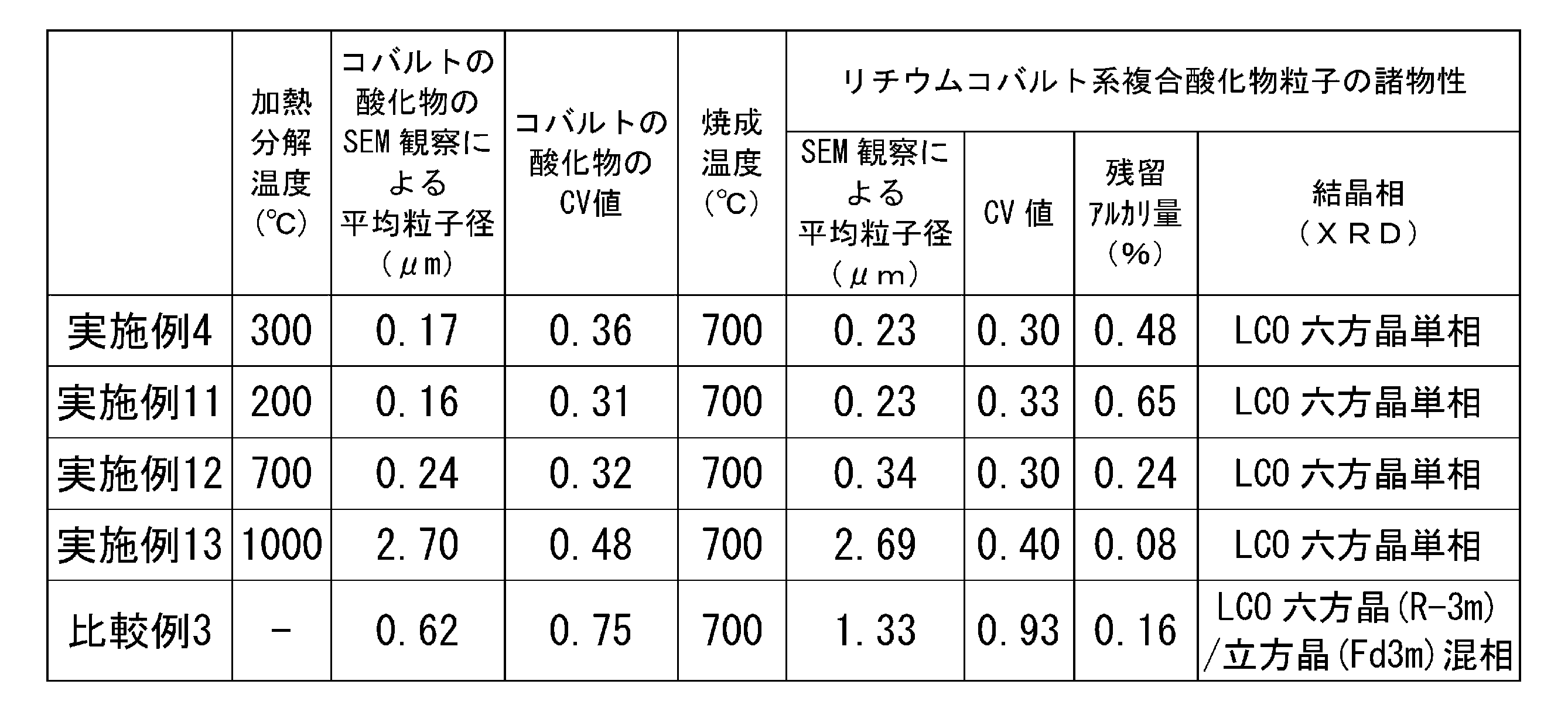
加熱分解工程において、水酸化コバルト(SEM観察による平均粒子径0.17μm)を表3に示す温度で加熱分解すること以外は、実施例1~6と同様に、加熱分解工程を行いコバルトの酸化物を得、次いで、混合物調製工程、焼成工程(焼成温度700℃)及び焼成物粉砕処理工程を行い、リチウムコバルト系複合酸化物粒子を得た。得られたコバルトの酸化物及びリチウムコバルト系複合酸化物粒子の諸物性を表3に示す。
水酸化コバルトに代えて、市販の酸化コバルト(SEM観察による平均粒子径0.62μm、標準偏差0.46、CV値0.75)を用いること以外は、比較例1~2と同様に、混合物調製工程、焼成工程(焼成温度700℃)及び焼成物粉砕処理工程を行い、リチウムコバルト系複合酸化物粒子を得た。得られたリチウムコバルト系複合酸化物粒子の諸物性を表3に示す。
つまり、比較例3では、加熱分解工程を行っていない。
Claims (10)
- SEM観察による平均粒子径が0.05~1.00μmである原料コバルト化合物を加熱分解して、コバルトの酸化物を得る工程であり、該原料コバルトが、水酸化コバルト又はコバルトの塩である加熱分解工程と、
少なくともリチウム化合物と、前記加熱分解工程により得られたコバルトの酸化物と、を含有する混合物を調製する混合物調製工程と、
前記混合物調製工程により調製された混合物を500~850℃で焼成する焼成工程と、
を有することを特徴とするリチウムコバルト系複合酸化物粒子の製造方法。 - 前記原料コバルト化合物が、水酸化コバルトであることを特徴とする請求項1記載のリチウムコバルト系複合酸化物粒子の製造方法。
- 前記リチウム化合物が、リチウムの炭酸塩、水酸化物、酢酸塩及び硝酸塩から選ばれる少なくとも1種であることを特徴とする請求項1又は2記載のリチウムコバルト系複合酸化物粒子の製造方法。
- 前記加熱分解工程において、200~1000℃で加熱分解することを特徴とする請求項1又は2記載のリチウムコバルト系複合酸化物粒子の製造方法。
- 前記コバルトの酸化物のSEM観察による平均粒子径が、0.05~4.00μmであることを特徴とする請求項1又は2記載のリチウムコバルト系複合酸化物粒子の製造方法。
- 前記焼成工程の後に、前記焼成工程を行い得られるリチウムコバルト系複合酸化物粒子を粉砕処理する焼成物粉砕処理工程を行うことを特徴とする請求項1又は2記載のリチウムコバルト系複合酸化物粒子の製造方法。
- 請求項1又は2のリチウムコバルト系複合酸化物の製造方法を行って得られるリチウムコバルト系複合酸化物粒子のSEM観察による平均粒子径が0.10~5.00μmであり、850℃で加熱した際の重量減少率が1.5質量%以下であることを特徴とする請求項1又は2記載のリチウムコバルト系複合酸化物粒子の製造方法。
- 請求項1又は2のリチウムコバルト系複合酸化物の製造方法を行って得られるリチウムコバルト系複合酸化物粒子の残留アルカリ量が2.0%以下であることを特徴とする請求項1又は2記載のリチウムコバルト系複合酸化物粒子の製造方法。
- 請求項1又は2のリチウムコバルト系複合酸化物の製造方法を行って得られるリチウムコバルト系複合酸化物粒子は、SEM観察による平均粒子径のCV値が0.60以下であり、X線回折分析した際に、リチウムコバルト系複合酸化物に由来する六方晶系結晶相(R-3m)以外の不純物相が現れないことを特徴とする請求項1又は2記載のリチウムコバルト系複合酸化物粒子の製造方法。
- 請求項1又は2のリチウムコバルト系複合酸化物の製造方法を行って得られるリチウムコバルト系複合酸化物粒子は、固相法により得られたものであることを特徴とする請求項1又は2記載のリチウムコバルト系複合酸化物粒子の製造方法。
Priority Applications (3)
| Application Number | Priority Date | Filing Date | Title |
|---|---|---|---|
| EP24819248.6A EP4725909A1 (en) | 2023-06-08 | 2024-05-30 | Method for producing lithium cobalt-based composite oxide particles |
| CN202480037424.7A CN121285526A (zh) | 2023-06-08 | 2024-05-30 | 锂钴系复合氧化物颗粒的制造方法 |
| KR1020267000204A KR20260020265A (ko) | 2023-06-08 | 2024-05-30 | 리튬 코발트계 복합 산화물 입자의 제조 방법 |
Applications Claiming Priority (2)
| Application Number | Priority Date | Filing Date | Title |
|---|---|---|---|
| JP2023094848A JP2024176362A (ja) | 2023-06-08 | 2023-06-08 | リチウムコバルト系複合酸化物粒子の製造方法 |
| JP2023-094848 | 2023-06-08 |
Publications (1)
| Publication Number | Publication Date |
|---|---|
| WO2024253018A1 true WO2024253018A1 (ja) | 2024-12-12 |
Family
ID=93795943
Family Applications (1)
| Application Number | Title | Priority Date | Filing Date |
|---|---|---|---|
| PCT/JP2024/019900 Ceased WO2024253018A1 (ja) | 2023-06-08 | 2024-05-30 | リチウムコバルト系複合酸化物粒子の製造方法 |
Country Status (6)
| Country | Link |
|---|---|
| EP (1) | EP4725909A1 (ja) |
| JP (1) | JP2024176362A (ja) |
| KR (1) | KR20260020265A (ja) |
| CN (1) | CN121285526A (ja) |
| TW (1) | TW202506562A (ja) |
| WO (1) | WO2024253018A1 (ja) |
Citations (5)
| Publication number | Priority date | Publication date | Assignee | Title |
|---|---|---|---|---|
| JPH10324522A (ja) * | 1997-03-25 | 1998-12-08 | Toda Kogyo Corp | リチウムコバルト酸化物粒子粉末の製造方法 |
| WO2004088776A1 (ja) * | 2003-03-31 | 2004-10-14 | Seimi Chemical Co. Ltd. | リチウム二次電池用の正極活物質の製造方法 |
| JP2008105912A (ja) | 2006-10-27 | 2008-05-08 | National Institute Of Advanced Industrial & Technology | ナノ複酸化物AxMyOzの製造方法 |
| WO2012029730A1 (ja) * | 2010-09-02 | 2012-03-08 | 日本化学工業株式会社 | コバルト酸リチウム、その製造方法、リチウム二次電池用正極活物質及びリチウム二次電池 |
| JP2019220468A (ja) | 2018-06-15 | 2019-12-26 | 株式会社豊島製作所 | 電極部材、全固体電池、電極部材用粉末、電極部材の製造方法及び全固体電池の製造方法 |
-
2023
- 2023-06-08 JP JP2023094848A patent/JP2024176362A/ja active Pending
-
2024
- 2024-05-30 EP EP24819248.6A patent/EP4725909A1/en active Pending
- 2024-05-30 CN CN202480037424.7A patent/CN121285526A/zh active Pending
- 2024-05-30 KR KR1020267000204A patent/KR20260020265A/ko active Pending
- 2024-05-30 WO PCT/JP2024/019900 patent/WO2024253018A1/ja not_active Ceased
- 2024-06-06 TW TW113120997A patent/TW202506562A/zh unknown
Patent Citations (5)
| Publication number | Priority date | Publication date | Assignee | Title |
|---|---|---|---|---|
| JPH10324522A (ja) * | 1997-03-25 | 1998-12-08 | Toda Kogyo Corp | リチウムコバルト酸化物粒子粉末の製造方法 |
| WO2004088776A1 (ja) * | 2003-03-31 | 2004-10-14 | Seimi Chemical Co. Ltd. | リチウム二次電池用の正極活物質の製造方法 |
| JP2008105912A (ja) | 2006-10-27 | 2008-05-08 | National Institute Of Advanced Industrial & Technology | ナノ複酸化物AxMyOzの製造方法 |
| WO2012029730A1 (ja) * | 2010-09-02 | 2012-03-08 | 日本化学工業株式会社 | コバルト酸リチウム、その製造方法、リチウム二次電池用正極活物質及びリチウム二次電池 |
| JP2019220468A (ja) | 2018-06-15 | 2019-12-26 | 株式会社豊島製作所 | 電極部材、全固体電池、電極部材用粉末、電極部材の製造方法及び全固体電池の製造方法 |
Also Published As
| Publication number | Publication date |
|---|---|
| TW202506562A (zh) | 2025-02-16 |
| JP2024176362A (ja) | 2024-12-19 |
| EP4725909A1 (en) | 2026-04-15 |
| CN121285526A (zh) | 2026-01-06 |
| KR20260020265A (ko) | 2026-02-10 |
Similar Documents
| Publication | Publication Date | Title |
|---|---|---|
| JP6391857B2 (ja) | スピネル型リチウムマンガン含有複合酸化物 | |
| CN103080010B (zh) | 钛酸锂颗粒粉末及其制造方法、含Mg钛酸锂颗粒粉末及其制造方法、非水电解质二次电池用负极活性物质颗粒粉末以及非水电解质二次电池 | |
| KR102728561B1 (ko) | 높은 탭 밀도의 리튬 양극 활성 물질, 중간체 및 제조 방법 | |
| KR20190009323A (ko) | 전고체형 리튬 이차전지용 양극 활물질 | |
| CN111033828A (zh) | 全固态型锂二次电池用正极活性物质 | |
| WO2017146248A1 (ja) | 層構造を有するリチウム金属複合酸化物 | |
| US20230178795A1 (en) | Lithium-ion conductive ceramic material and process | |
| WO2016148096A1 (ja) | 層構造を有するリチウム金属複合酸化物の製造方法 | |
| US20250263307A1 (en) | Methods for preparing lithium nickel manganese cobalt oxide particulate | |
| JP7464102B2 (ja) | 金属複合水酸化物とその製造方法、非水電解質二次電池用正極活物質とその製造方法、及び、それを用いた非水電解質二次電池 | |
| WO2024253018A1 (ja) | リチウムコバルト系複合酸化物粒子の製造方法 | |
| JP7473713B2 (ja) | リチウムコバルト系複合酸化物粒子及びその製造方法、リチウムコバルト系複合酸化物粒子組成物及びそれらの製造方法 | |
| EP4573053A1 (en) | Methods for preparing lithium transition metal oxide from elemental metal feedstocks and products thereof | |
| EP4541771A1 (en) | Lithium-cobalt-based composite oxide particles and method for producing same, and lithium-cobalt-based composite oxide particle composition and method for producing same | |
| WO2024154638A1 (ja) | リチウムコバルト系複合酸化物粒子及びその製造方法 | |
| JP2025018308A (ja) | Nasicon構造を有するナトリウム化合物 | |
| JP2008123815A (ja) | 正極活物質及びその製造法、並びに非水電解質二次電池 | |
| JP2024173646A (ja) | 二次電池用正極活物質 | |
| WO2024096028A1 (ja) | 活物質、電極合剤、塗布用組成物、電極、電池及び活物質の製造方法 |
Legal Events
| Date | Code | Title | Description |
|---|---|---|---|
| 121 | Ep: the epo has been informed by wipo that ep was designated in this application |
Ref document number: 24819248 Country of ref document: EP Kind code of ref document: A1 |
|
| ENP | Entry into the national phase |
Ref document number: 1020267000204 Country of ref document: KR Free format text: ST27 STATUS EVENT CODE: A-0-1-A10-A15-NAP-PA0105 (AS PROVIDED BY THE NATIONAL OFFICE) |
|
| WWE | Wipo information: entry into national phase |
Ref document number: 1020267000204 Country of ref document: KR |
|
| WWE | Wipo information: entry into national phase |
Ref document number: 2024819248 Country of ref document: EP |
|
| NENP | Non-entry into the national phase |
Ref country code: DE |
|
| ENP | Entry into the national phase |
Ref document number: 2024819248 Country of ref document: EP Effective date: 20260108 |
|
| ENP | Entry into the national phase |
Ref document number: 2024819248 Country of ref document: EP Effective date: 20260108 |
|
| ENP | Entry into the national phase |
Ref document number: 2024819248 Country of ref document: EP Effective date: 20260108 |
|
| WWP | Wipo information: published in national office |
Ref document number: 1020267000204 Country of ref document: KR |
|
| WWP | Wipo information: published in national office |
Ref document number: 2024819248 Country of ref document: EP |