WO2024253205A1 - 酸化ガリウム基板用研磨剤及び研磨方法 - Google Patents
酸化ガリウム基板用研磨剤及び研磨方法 Download PDFInfo
- Publication number
- WO2024253205A1 WO2024253205A1 PCT/JP2024/020948 JP2024020948W WO2024253205A1 WO 2024253205 A1 WO2024253205 A1 WO 2024253205A1 JP 2024020948 W JP2024020948 W JP 2024020948W WO 2024253205 A1 WO2024253205 A1 WO 2024253205A1
- Authority
- WO
- WIPO (PCT)
- Prior art keywords
- polishing composition
- ions
- polishing
- composition according
- silica sol
- Prior art date
- Legal status (The legal status is an assumption and is not a legal conclusion. Google has not performed a legal analysis and makes no representation as to the accuracy of the status listed.)
- Ceased
Links
Classifications
-
- B—PERFORMING OPERATIONS; TRANSPORTING
- B24—GRINDING; POLISHING
- B24B—MACHINES, DEVICES, OR PROCESSES FOR GRINDING OR POLISHING; DRESSING OR CONDITIONING OF ABRADING SURFACES; FEEDING OF GRINDING, POLISHING, OR LAPPING AGENTS
- B24B37/00—Lapping machines or devices; Accessories
-
- C—CHEMISTRY; METALLURGY
- C01—INORGANIC CHEMISTRY
- C01B—NON-METALLIC ELEMENTS; COMPOUNDS THEREOF; METALLOIDS OR COMPOUNDS THEREOF NOT COVERED BY SUBCLASS C01C
- C01B33/00—Silicon; Compounds thereof
- C01B33/113—Silicon oxides; Hydrates thereof
- C01B33/12—Silica; Hydrates thereof, e.g. lepidoic silicic acid
- C01B33/14—Colloidal silica, e.g. dispersions, gels, sols
- C01B33/152—Preparation of hydrogels
-
- C—CHEMISTRY; METALLURGY
- C09—DYES; PAINTS; POLISHES; NATURAL RESINS; ADHESIVES; COMPOSITIONS NOT OTHERWISE PROVIDED FOR; APPLICATIONS OF MATERIALS NOT OTHERWISE PROVIDED FOR
- C09G—POLISHING COMPOSITIONS; SKI WAXES
- C09G1/00—Polishing compositions
- C09G1/02—Polishing compositions containing abrasives or grinding agents
-
- C—CHEMISTRY; METALLURGY
- C09—DYES; PAINTS; POLISHES; NATURAL RESINS; ADHESIVES; COMPOSITIONS NOT OTHERWISE PROVIDED FOR; APPLICATIONS OF MATERIALS NOT OTHERWISE PROVIDED FOR
- C09K—MATERIALS FOR MISCELLANEOUS APPLICATIONS, NOT PROVIDED FOR ELSEWHERE
- C09K3/00—Materials not provided for elsewhere
- C09K3/14—Anti-slip materials; Abrasives
-
- H—ELECTRICITY
- H10—SEMICONDUCTOR DEVICES; ELECTRIC SOLID-STATE DEVICES NOT OTHERWISE PROVIDED FOR
- H10P—GENERIC PROCESSES OR APPARATUS FOR THE MANUFACTURE OR TREATMENT OF DEVICES COVERED BY CLASS H10
- H10P52/00—Grinding, lapping or polishing of wafers, substrates or parts of devices
Definitions
- the present invention relates to a polishing composition for oxide-based substrates such as gallium oxide.
- Compound semiconductor substrates such as silicon carbide, gallium nitride, and gallium oxide have been proposed as alternatives to silicon substrates for power devices.
- gallium oxide is superior in terms of the magnitude of the dielectric breakdown field and the cost of crystal growth.
- Compound semiconductor substrates are manufactured through processes that include polishing. In the polishing process, there is a demand for improving productivity by increasing the polishing speed. As gallium oxide has a strong cleavage tendency, it is also required to polish it with low frictional resistance to prevent damage.
- Patent Document 1 describes a polishing composition containing abrasive grains and water for gallium oxide.
- a polishing composition containing colloidal silica and deionized water is described.
- Many commercially available colloidal silicas contain anions, but this document does not specifically state whether or not the anions are present, or the amount or type of anion.
- Patent document 2 describes a polishing slurry for gallium oxide substrates that contains manganese dioxide particles and water.
- the present invention provides a polishing composition and a polishing method for polishing gallium oxide substrates at a high polishing rate.
- a polishing composition for a gallium oxide substrate comprising silica particles, water, and a polyvalent anion, the content of the polyvalent anion being 0.002 mol/L or less in the polishing composition;
- the polishing composition according to the first aspect wherein the polyvalent anion is at least one polyvalent anion selected from the group consisting of a sulfate ion, an oxalate ion, a citrate ion, and a phosphate ion;
- the polishing composition according to the first aspect further containing a monovalent anion, the content of the monovalent anion in the polishing composition being 0.04 mol/L or less.
- the polishing composition according to any one of the third aspect wherein the monovalent anion is at least one kind of monovalent anion selected from the group consisting of nitrate ion, chloride ion, bromide ion, chlorate ion, bromate ion, acetate ion, formate ion, propionate ion, and butyrate ion.
- the polishing composition according to any one of the third aspect wherein the monovalent anion is at least one kind of monovalent anion selected from the group consisting of a nitrate ion, a chloride ion, and an acetate ion.
- the polishing composition according to the first aspect which has a pH of 5.0 or more and 9.5 or less.
- the polishing composition according to the first aspect in which the silica particles have an average primary particle diameter of 5 to 100 nm.
- the polishing composition according to the first aspect in which the silica particles have an average secondary particle diameter of 30 nm to 150 nm.
- the polishing composition according to the first aspect in which the silica particles have a true density of 2.15 g/cm 3 to 2.30 g/cm 3.
- the polishing composition according to the first aspect in which the silica particles have a heating loss rate of 3.0% or less at 200° C. to 700° C.;
- the present invention relates to a method for producing a method comprising the steps of: Step (A): preparing an aqueous silica sol; Step (B): A step of contacting the aqueous silica sol obtained in step (A) with a strongly acidic ion exchange resin to obtain an acidic silica sol;
- the method for producing a polishing composition according to the eleventh aspect wherein the aqueous silica sol in the step (A) is produced by heating an active silicic acid
- gallium oxide As a substrate for power devices, precision polishing is required, and it is necessary to polish the workpiece without causing surface irregularities or atomic-level defects in the compounds.
- polishing To remove processing damage from the previous process, a certain thickness must be removed by polishing, and polishing must be performed at a high polishing speed in order to reduce this time and improve processing damage and productivity.
- Silica particles dispersed in a solvent such as water is called colloidal silica, also known as silica sol.
- the present invention has discovered that in a polishing composition containing water, silica particles, and polyvalent anions, the polishing speed can be improved by setting the amount of a specific polyvalent anion below a certain level. It has also discovered that the polishing speed can be further improved by setting the amount of a specific monovalent anion below a certain level.
- colloidal silica which is one of the raw materials of the polishing composition
- the present invention is a polishing composition for gallium oxide substrates that contains silica particles, water, and polyvalent anions, and the content of polyvalent anions in the polishing composition is 0.002 mol/L or less.
- the silica particles are dispersed in water and are colloidal silica particles
- the water in the silica sol can be used in the polishing composition.
- water can be added to the silica sol and used as the water in the polishing composition.
- the polishing composition can contain silica particles in the range of 0.1 to 50% by mass, but when used for polishing a gallium oxide substrate, it can be used in the range of 1 to 40% by mass, 5 to 40% by mass, 5 to 35% by mass, 5 to 30% by mass, 10 to 30% by mass, or 10 to 25% by mass.
- the polyvalent anion may be at least one polyvalent anion selected from the group consisting of sulfate ion, oxalate ion, citrate ion, and phosphate ion, sulfite ion, carbonate ion, phosphite ion, borate ion, malonate ion, and tartrate ion.
- the polyvalent anions sulfate ions, oxalate ions, citrate ions, and phosphate ions affect the polishing rate, and it is preferable to reduce the content of these polyvalent anions in the polishing composition to a certain amount or less.
- the content of the polyvalent anion is 0.002 mol/L or less.
- the upper limit of the content of the polyvalent anion can be in the range of 0.001 mol/L or less, 0.0008 mol/L or less, or 0.0006 mol/L or less.
- the content of the polyvalent anion is 0.000001 mol/L or more, and the lower limit can be in the range of 0.000002 mol/L or more, 0.000003 mol/L or more, 0.000005 mol/L or more, or 0.000007 mol/L or more, 0.00001 mol/L or more.
- the polishing composition preferably contains a monovalent anion, and the content of the monovalent anion in the polishing composition is preferably 0.04 mol/L or less.
- the monovalent anion may be at least one type of monovalent anion selected from the group consisting of nitrate ion, chloride ion, bromide ion, chlorate ion, bromate ion, acetate ion, formate ion, propionate ion, butyrate ion, hydrogen sulfate ion, and hydrogen carbonate ion.
- the monovalent anion may further be at least one type of monovalent anion selected from the group consisting of nitrate ion, chloride ion, and acetate ion.
- the content of monovalent anions is 0.04 mol/L or less.
- the upper limit of the content of monovalent anions can be in the range of 0.03 mol/L or less, 0.02 mol/L or less, or 0.01 mol/L or less.
- the content of monovalent anions can be in the range of 0.00001 mol/L or more, 0.0001 mol/L or more, 0.001 mol/L or more, or 0.002 mol/L or more.
- the pH of the polishing composition is preferably 5.0 or more and 9.5 or less in order to obtain a high polishing rate.
- the upper limit of the pH can be in the range of 9.1, 9.0, 8.9, 8.8, or 8.7.
- the lower limit of the pH can be in the range of 6.0, 6.2, 6.5, 6.8, or 7.0.
- the average secondary particle diameter of the silica particles is 30 nm or more.
- the lower limit of the average secondary particle diameter can be in the range of 50 nm, 55 nm, or 60 nm.
- the average secondary particle diameter of the silica particles is less than 500 nm, and the upper limit can be in the range of 300 nm, 200 nm, or 150 nm.
- the average secondary particle diameter (D DLS ) of the silica particles can be determined from the particle size distribution of the silica particles measured by dynamic light scattering, which is a method of irradiating silica particles with laser light and determining the particle size distribution from the scattering intensity by utilizing the fact that the scattering intensity of the scattered light obtained varies depending on the particle diameter of the silica particles.
- An example of a measuring device used to measure the particle size distribution of silica microparticles by dynamic light scattering is a dynamic light scattering particle size distribution measuring device (manufactured by Malvern Panalytical).
- the average primary particle diameter (D BET ) of the silica particles contained in the polishing composition of the present invention can be measured as the sphere-equivalent particle diameter (nm) calculated from the surface area (or specific surface area) measured using a nitrogen gas adsorption method (BET method).
- the content of the above polyvalent anions and monovalent anions can be determined using ion chromatography.
- the true density of the silica particles is 2.15 g/cm 3 or more.
- the lower limit of the true density of the silica particles may be in the range of 2.16 g/cm 3 , 2.17 g/cm 3 , 2.18 g/cm 3 , or 2.19 g/cm 3 .
- the upper limit may be in the range of 2.30 g/cm 3 , 2.28 g/cm 3 , 2.26 g/cm 3 , or 2.25 g / cm 3 .
- the true density of the silica particles can be calculated using a measuring device capable of measuring the volume and mass of an equivalent amount of silica microparticles.
- An example of a density measuring device used to measure the volume and mass of silica particles and calculate the true density from the measured values is a dry automatic density measuring device (AccuPyc II TEC, manufactured by Micromeritics). When using this density meter, a specified amount of silica particles can be placed in the density meter to automatically measure the true density.
- the weight loss rate of the silica particles when heated at 200°C to 700°C is 3.0% or less.
- the upper limit of the weight loss rate of the silica particles when heated at 700°C can be in the range of 2.0% or 1.8%, and the lower limit can be in the range of 0.6%, 0.8%, 1.0%, 1.2%, or 1.4%.
- the heat loss rate of the silica particles can be measured by simultaneous thermogravimetry and differential thermal analysis (TGDTA).
- thermogravimetric differential thermal analyzer product name TG-DTA2000SA, manufactured by Bruker.
- silica particles (silica powder) extracted from the colloidal silica dispersion contained in the polishing composition of the present invention can be used.
- the silica particles (silica powder) are obtained by drying the colloidal silica.
- the drying method is not particularly limited. Specific drying methods include hot air drying, air blowing drying, far-infrared heating drying, dehumidified air drying, natural drying (including sun drying), vacuum reduced pressure drying, indirect heating drying, microwave heating drying, and vacuum freeze drying. One or more drying methods can be combined.
- impurities such as metal cations can be removed from the colloidal silica dispersion by contacting the colloidal silica dispersion with a strong acid cation exchange resin and/or a strong base anion exchange resin, and further with a weak acid (carboxylic acid) chelating resin and/or a weak base (amine) chelating resin as a pretreatment.
- Strong acid cation exchange resins include, for example, Amberlite IR-120B, Amberjet 1020, and DOWEX MARATHONGH, manufactured by Dow Chemical Company; Diaion SK104 and Diaion PK208, manufactured by Mitsubishi Chemical Holdings Corporation; and Duolite C20J, manufactured by Sumika Chemtech Co., Ltd.
- strong base anion exchange resins examples include Amberlite IRA400J, Amberlite IRA410J, and Amberjet 4400, manufactured by Dow Chemical Company; Diaion SA10A and Diaion SA20A, manufactured by Mitsubishi Chemical Holdings Corporation; and Duolite UBA120, manufactured by Sumika Chemtech Co., Ltd.
- the colloidal silica dispersion preferably has a SiO 2 solid content concentration of 1 to 50% by mass.
- the lower limit of the SiO 2 solid content concentration can be in the range of 2 mass%, 5 mass%, 10 mass%, 15 mass%, or 20 mass%.
- the upper limit of the SiO 2 solid content concentration can be in the range of 40 mass%, 35 mass%, 30 mass%, or 25 mass%.
- SF1 is preferably less than 1.60, and the upper limit of SF1 can be 1.53, 1.35, 1.30, 1.25, 1.22, 1.19, or 1.18.
- SF1 >25 is preferably 1.16 or more, more preferably 1.23 or more, or more preferably 1.25 or more, still more preferably 1.30 or more, and still more preferably 1.40 or more.
- the shape factor SF1 is calculated as (area of a circle having the maximum diameter of the particle as its diameter)/(projected area). That is,
- DL is the maximum diameter of the particle (nm), the maximum length (nm) of the silica particle obtained from the transmission electron microscope photograph, and the maximum length between any two points on the circumference of the image.
- S is the projected area (nm 2 ) of the silica particle.
- the transmission electron microscope photograph taken at a magnification of 10,000 times or 30,000 times is taken as electronic data into an image analyzer (manufactured by Nireco Corporation, product name LUZEX) with a resolution of 146 dpi, and the projected area is calculated by converting the number of pixels occupied by the silica particle into an area.
- SF1 was determined by determining the maximum length DL and projected area S of each of 2000 particles recognized by an image analyzer, calculating the values according to the above formula for each particle, and averaging these values to obtain SF1.
- the shape factor SF1 > 25 is the average value of SF1 of particles having an equivalent circle diameter of 25 nm or more. That is, it is determined by extracting only particles having an equivalent circle diameter of 25 nm or more, which is determined by image analysis of the transmission electron microscope photograph, and calculating the average value of their SF1.
- the equivalent circle diameter is the diameter (nm) of a perfect circle having the same projected area as the projected area S ( nm2 ) of the silica particle. That is,
- a silica sol produced by the alkoxide method can be used, but a silica sol containing silica particles obtained by heating an aqueous silicic acid solution obtained by removing alkali metal ions from an aqueous alkali silicate solution can be preferably used.
- the silica sol produced by the alkoxide method typically has a true density of less than 2.15 g/ cm3 and a heat loss rate of 2.0% or more.
- a pH adjuster can be added to the polishing composition of the present invention to adjust the pH.
- the pH adjuster can be an alkaline substance added to the acidic aqueous silica sol to adjust the pH to 5.0 to 9.5, or 6.0 to 9.5, or 6.0 to 9.1, or 6.0 to 9.0, or 6.0 to 8.9, or 6.5 to 8.8, or 7.0 to 8.7.
- the alkaline substance is an alkali metal hydroxide or ammonia, and sodium hydroxide, potassium hydroxide, or ammonia are preferably used, and can be added as a 0.1 to 30% by mass aqueous solution, for example.
- the polishing composition of the present invention can use water-soluble compounds.
- water-soluble compounds include monomers having carboxylic acid groups such as acrylic acid, methacrylic acid, and maleic acid, and their polymers such as polyacrylic acid and polymethacrylic acid, and their salts such as ammonium polyacrylate, potassium polyacrylate, ammonium polymethacrylate, and potassium polymethacrylate.
- alginic acid, pectinic acid, carboxymethylcellulose, polyaspartic acid, polyglutamic acid, polyamic acid, ammonium polyamic acid, polyvinylpyrrolidone, hydroxyethylcellulose, glycerin, polyglycerin, polyvinyl alcohol, or carboxyl group or sulfonic acid group modified polyvinyl alcohol can be used.
- the water-soluble compound can be contained in an amount of 0.01 to 10% by mass based on the silica particles.
- the silica particles used in the polishing composition of the present invention can be used as a silica sol.
- the polishing composition is produced by a production method including the following steps (A) to (C).
- the aqueous silica sol used in the step (A) can be obtained, for example, by any one of the following methods (a1) to (a4).
- Step (a1) A silica sol obtained by subjecting an aqueous solution of sodium silicate to ion exchange, removing alkali metal ions, and then heat-treating the resulting aqueous solution of active silicic acid;
- Step (a2) Silica sol obtained by hydrolysis of alkoxysilane;
- Step (a3) A silica sol obtained by wet-grinding a silica powder in an aqueous medium;
- step (a1) can be broadly divided into a step (a-I) for obtaining active silicic acid, a step (a-II) for heating and granulating the active silicic acid, and a step (a-III) for adjusting the concentration of the obtained silica sol.
- the step (a-I) of obtaining active silicic acid is a step of contacting an aqueous solution of an alkali metal silicate in which a water-soluble alkali metal silicate containing metal oxides other than silica in a ratio of 300 to 500,000 ppm relative to silica is dissolved at a concentration of 0.5 to 10.0 mass % or 1 to 6 mass % as SiO2 content derived from the silicate, with a hydrogen-type strongly acidic cation exchange resin to produce an aqueous solution of active silicic acid having a SiO2 concentration of 1 to 6 mass %, and recovering the product liquid.
- the step (a-II) of heating and sieving active silicic acid includes the following steps (a-II-I) and (a-II-II).
- Step (a-II-II) includes a step of producing an aqueous solution containing a silicate compound obtained by adding an aqueous solution containing at least one selected from the group consisting of an alkali metal hydroxide, ammonia, or an organic base to the aqueous solution of active silicic acid recovered in step (a-II-I), or a step of producing an aqueous solution containing a silicate compound having a pH of 10 to 12.5 and a SiO2 concentration of 0.1 to 8 mass% by concentrating or diluting this aqueous solution.
- step (a-I) or (a-II-I) there is a step of supplying an aqueous solution of active silicic acid obtained in the same manner as in step (a-I) or (a-II-I) to the aqueous solution containing the silicate compound produced by the above method, while maintaining the temperature of the resulting mixed solution at 110 to less than 150°C, or 110 to 145°C, or 110 to 140°C, or 110 to 135°C, or 110 to 130°C, and stirring sufficiently, for 1 to 30 hours until the pH of the mixed solution becomes 9 to 12.
- the process (a-III) of adjusting the concentration of the obtained silica sol is a process of concentrating the silica sol to 10 to 50 mass %, but impurities can be removed before or after the concentration. This process (a-III) is not essential, but is performed if desired.
- step (B) the aqueous silica sol can be contacted with a hydrogen-type strong acid cation exchange resin.
- step (C) an alkali metal hydroxide or ammonia is added to the acidic silica sol obtained in step (B) so that its pH becomes 6.0 to 9.5, or 6.0 to 9.1, or 6.0 to 9.0, thereby producing a stable aqueous silica sol having a SiO 2 concentration of 10 to 50% by mass, or 30 to 50% by mass, substantially free of polyvalent metal oxides other than silica, and having an average primary particle size of colloidal silica of 5 to 100 nm.
- silica sols can be contained in the range of 0.1 to 50% by mass to make a polishing composition, but when used for polishing a gallium oxide substrate by adding water to adjust the silica concentration, it can be used in the range of 0.1 to 40% by mass, 1 to 40% by mass, 5 to 40% by mass, 5 to 35% by mass, 5 to 30% by mass, 10 to 30% by mass, or 10 to 25% by mass.
- polishing composition obtained in step (C) can be subjected to an additional step (D) in which anion exchange is performed.
- the polishing composition is produced by a production method including the following steps (A), (B), (E) and (F).
- the present invention is a method for polishing a gallium oxide substrate, which includes a step of polishing the gallium oxide substrate using the above-mentioned polishing composition.
- the polishing speed of the gallium oxide substrate can be 3.0 ⁇ m/hour to 10.0 ⁇ m/hour, or 4.0 ⁇ m/hour to 10.0 ⁇ m/hour.
- the average secondary particle size of the silica sol was determined by dynamic light scattering using a particle size measuring device Zetasizer Nano (manufactured by Malvern Panalytical Co., Ltd.) The average secondary particle size was determined as the Z-average particle size measured by dynamic light scattering.
- silica sol sample 75.0 g of pure water was added to 25.0 g of silica sol ( SiO2 concentration 40% by mass) to prepare a silica sol sample with an SiO2 concentration adjusted to 10% by mass.
- the obtained silica sol sample was then subjected to hydrogen-type strongly acidic cation exchange resin Amberlite (trade name) IR-120B and hydroxyl-type strongly basic anion exchange resin Amberlite (trade name) IRA-410 to remove cations and anions as much as possible, and then freeze-dried under a vacuum pressure of 5 Pa or less using a freeze-drying device (trade name FDU-2100, manufactured by Tokyo Rikakikai Co., Ltd.).
- the dried powder was thoroughly ground in an agate mortar to obtain a freeze-dried powder sample.
- Specific surface area diameter by BET method nitrogen gas adsorption method: average primary particle diameter by BET method, also called BET particle diameter
- the heat-dried powder of each silica sol was used as a measurement sample.
- the specific surface area of the measurement sample was measured by a nitrogen adsorption method (BET method) using a specific surface area measurement device (product name: Monosorb, manufactured by Quantachrome Instruments Japan, LLC), and the average primary particle size was calculated from the obtained specific surface area value.
- pH Measurement This shows the value obtained from the pH measurement result, and was measured using a pH meter (product name: Multi Water Quality Meter MM-60R, product name: pH Electrode GST-5741C, manufactured by DKK-TOA Corporation).
- the above heat-dried powder of each silica sol was used as a measurement sample.
- the true density was measured using a dry automatic density measuring device (product name AccuPyc II TEC, manufactured by Micromeritics Co., Ltd.) by filling 80% of a 1 cm3 cell with the sample.
- thermogravimetric differential thermal analyzer product name TG-DTA2000SA, manufactured by Bruker Corporation
- a specified amount of the freeze-dried powder of each silica sol was placed in a platinum container and heated in a nitrogen atmosphere from room temperature to 700°C at a heating rate of 10°C/min.
- the flow rate of nitrogen gas was 100cc/min.
- the thermal weight loss rate of the silica powder was calculated using the following formula from the values of the mass M1 of the sample when it reached 200°C and the mass M2 of the sample when it reached 700°C.
- Heating loss rate (%) (M1-M2) ⁇ M1 x 100
- the vessel was kept at 100-120°C, and the active silicic acid aqueous solution (a1) (3.5% by mass as SiO 2 ) was continuously supplied as a supply liquid until the pH of the reaction liquid reached 11.0 and the electrical conductivity reached 3.6 mS/cm. Subsequently, the resulting reaction liquid was heated for 1 hour while being kept at 100 to 120° C. to obtain colloidal silica.
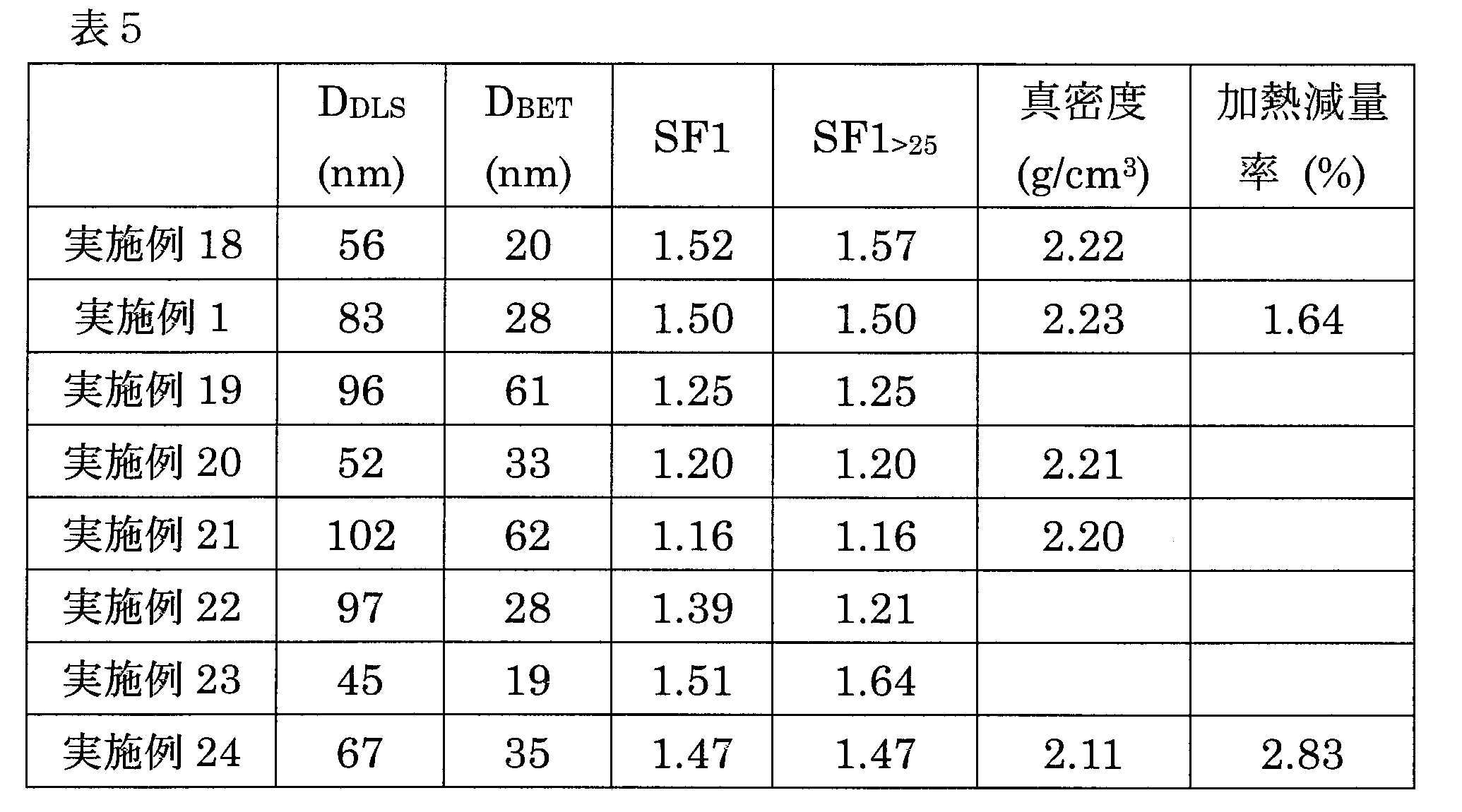
- the obtained colloidal silica was concentrated to a SiO2 concentration of 40 mass% at room temperature using a commercially available ultrafiltration device equipped with a tubular ultrafiltration membrane made of polysulfone and having a pore size of about 5 nm, to obtain colloidal silica A (pH 10.8, sulfate ion concentration 2 ppm, D DLS 83 nm, D BET 28 nm, SF1 was 1.50, SF1 > 25 was 1.50).
- the vessel was kept at 100-120°C, and an active silicic acid aqueous solution (a1) (3.5% by mass as SiO2) was continuously supplied as a supply liquid until the pH of the reaction liquid reached 10.5 and electrical conductivity reached 1.1 mS/cm.
- a1 active silicic acid aqueous solution
- the obtained colloidal silica was concentrated to a SiO2 concentration of 40 mass% at room temperature using a commercially available ultrafiltration device equipped with a tubular ultrafiltration membrane made of polysulfone and having a pore size of about 5 nm, to obtain colloidal silica B (pH 10.5, sulfate ion concentration 46 ppm, D DLS 52 nm, D BET 33 nm, SF1 was 1.20, SF1 > 25 was 1.20).
- Synthesis Example C A reaction apparatus was used, which was a SUS pressure vessel with an internal volume of 3 L, equipped with a stirrer, a heating device, and the like. Using colloidal silica B obtained in Synthesis Example B, a 10% by mass aqueous potassium hydroxide solution, and pure water, pH was adjusted to 11.4 and electrical conductivity to 8.9 mS/cm, and then the liquid temperature in the vessel was adjusted to 100 to 120°C by heating.
- an aqueous active silicic acid solution (a1) (3.0 to 4.0 % by mass as SiO2) and an aqueous 10% by mass potassium hydroxide solution were continuously fed as feed liquids while maintaining the vessel at 100 to 120°C, until the pH of the reaction liquid reached 10.7 and the electrical conductivity reached 1.7 mS/cm.
- the obtained colloidal silica was concentrated to a SiO2 concentration of 40 mass% at room temperature using a commercially available ultrafiltration device equipped with a tubular ultrafiltration membrane made of polysulfone and having a pore size of about 5 nm, to obtain colloidal silica C (pH 10.8, sulfate ion concentration 2 ppm, D DLS 102 nm, D BET 62 nm, SF1 was 1.16, SF1 > 25 was 1.16).
- the active silicic acid aqueous solution (a1) (3.5% by mass as SiO 2 ) was continuously supplied as a supply liquid until the pH of the reaction liquid reached 11.0 and the electrical conductivity reached 3.3 mS/cm while maintaining the vessel at 100-120°C.
- the obtained colloidal silica was concentrated to a SiO2 concentration of 40 mass% at room temperature using a commercially available ultrafiltration device equipped with a tubular ultrafiltration membrane made of polysulfone and having a pore size of about 5 nm, to obtain colloidal silica D (pH 10.8, sulfate ion concentration 6 ppm, D DLS 45 nm, D BET 19 nm, SF1 was 1.51, SF1 > 25 was 1.64).
- the stabilized active silicic acid aqueous solution (a2) (SiO 2 3.2% by mass) was continuously supplied as a supply liquid until the pH of the reaction liquid reached 10.9 and the electrical conductivity reached 3.5 mS/cm while maintaining the vessel at 110-130°C.
- the obtained colloidal silica was concentrated to a SiO2 concentration of 40 mass% at room temperature using a commercially available ultrafiltration device equipped with a tubular ultrafiltration membrane made of polysulfone and having a pore size of about 5 nm, to obtain colloidal silica E (pH 9.8, sulfate ion concentration 1100 ppm, D DLS 56 nm, D BET 20 nm, SF1 was 1.52, SF1 > 25 was 1.57).
- Example 2 Colloidal silica B prepared in Synthesis Example B was passed through a column packed with hydrogen-type strongly acidic cation exchange resin Amberlite IR-120B at a space velocity of 4.5 per hour, and the resulting acidic colloidal silica B(+) was collected in a container. Hydroxyl-type strongly basic anion exchange resin Amberlite (trade name) IRA-410 was added to the container containing the acidic colloidal silica B(+), and after stirring for 30 minutes, the IRA-410 was removed using a #100 nylon mesh, thereby obtaining colloidal silica B(+-) from which anions had been removed.
- Amberlite trade name
- Example 6 Nissan Chemical Co., Ltd.'s product name ST-YL (product name Snowtex YL, pH 9.6, silica concentration 40 mass%, sulfate ion concentration 1000 ppm, D DLS 98 nm, D BET 60 nm, SF1 1.25, SF1 >25 1.25) was passed through a column packed with hydrogen type strong acid cation exchange resin Amberlite IR-120B at a space velocity of 4.5 per hour, and the obtained acid colloidal silica YL (+) was collected in a container.
- product name ST-YL product name Snowtex YL, pH 9.6, silica concentration 40 mass%, sulfate ion concentration 1000 ppm, D DLS 98 nm, D BET 60 nm, SF1 1.25, SF1 >25 1.25
- Amberlite IR-120B Amberlite IR-120B
- Amberlite (product name) IRA-410 was placed in the container containing colloidal silica YL (+), and after stirring for 30 minutes, IRA-410 was removed using a #100 nylon mesh to obtain colloidal silica YL (+-) from which anions had been removed.
- Example 7 The colloidal silica C(+) prepared in Experimental Example 3 and Nissan Chemical Industries, Ltd.'s product name ST-O (product name Snowtex O, pH 2.6, silica concentration 20 mass%, sulfate ion concentration less than 1 ppm, D DLS 19 nm, D BET 12 nm, SF1 1.39) (colloidal silica O) were mixed in a silica solids weight ratio of 7:3 to obtain a mixture C(+)+O of colloidal silica C(+) and colloidal silica O.
- product name ST-O product name Snowtex O, pH 2.6, silica concentration 20 mass%, sulfate ion concentration less than 1 ppm, D DLS 19 nm, D BET 12 nm, SF1 1.39
- Example 1 The colloidal silica A(+) prepared in Experimental Example 1 was mixed and stirred with pure water to adjust the silica concentration to 22% by mass, and then an aqueous potassium hydroxide solution in an amount to adjust the pH to 8.4 was added under stirring, and pure water was further added to adjust the silica concentration to 20% by mass, thereby producing the polishing composition of Example 1.
- Example 2 Colloidal silica A(+) prepared in Experimental Example 1 was mixed with pure water and stirred to adjust the silica concentration to 22% by mass. Then, sulfuric acid (concentration: 8% by mass) was added with stirring in an amount to adjust the sulfate ion concentration to 0.28 ⁇ 10 ⁇ 3 M. Further, an aqueous potassium hydroxide solution (concentration: 10% by mass) was added with stirring to adjust the pH to 8.3. Pure water was then added to adjust the silica concentration to 20% by mass and the sulfate ion concentration to 0.25 ⁇ 10 ⁇ 3 M, thereby producing the polishing composition of Example 1.
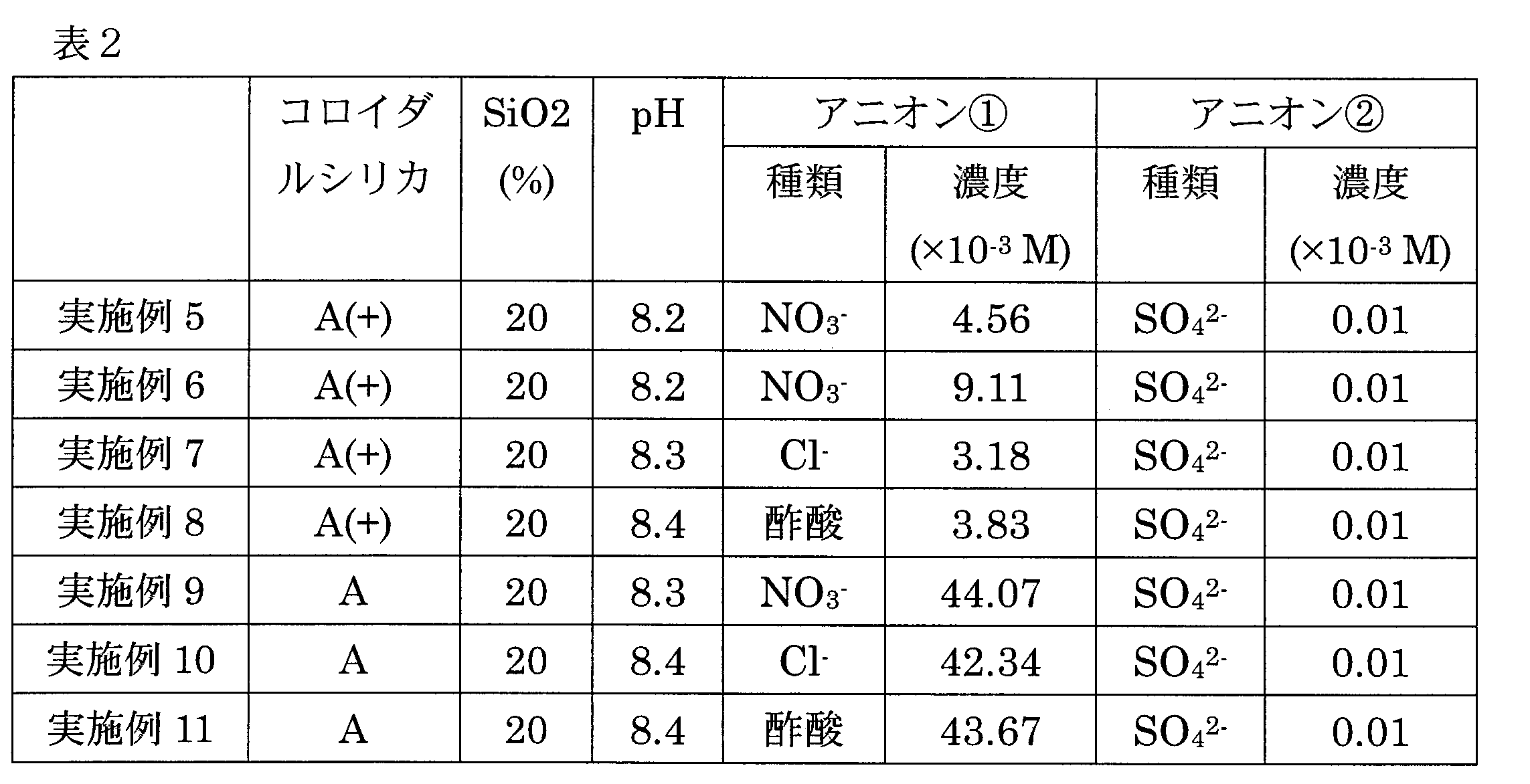
- Example 3 A polishing composition of Example 3 was produced in the same manner as in Example 2, except that the amount of sulfuric acid added was changed so as to give the concentration shown in Table 1.
- Example 4 A polishing composition of Example 4 was produced in the same manner as in Example 2, except that an aqueous oxalic acid solution (concentration: 10% by mass) was added in place of sulfuric acid so as to have the concentration shown in Table 1.
- polishing compositions were manufactured in the same manner as in Example 2, except that the type and amount of acid added instead of sulfuric acid (sulfuric acid (concentration 8% by mass), aqueous oxalic acid solution (concentration 10% by mass), hydrochloric acid (concentration 3.7% by mass), or acetic acid (concentration 6% by mass)) were changed as shown in Table 2.
- Comparative Example 1 A polishing composition of Comparative Example 1 was produced in the same manner as in Example 2, except that the amount of sulfuric acid added was changed so as to give the concentration shown in Table 1.
- Comparative Example 2 Colloidal silica A prepared in Synthesis Example A was mixed with pure water and stirred to adjust the silica concentration to 22% by mass. Then, sulfuric acid (concentration 8% by mass) was added under stirring in an amount to adjust the pH to 8.4, and pure water was further added to adjust the silica concentration to 20% by mass, thereby producing the polishing composition of Comparative Example 2.
- the polishing compositions were prepared in the same manner as Comparative Example 2, except that the types and amounts of acids added instead of sulfuric acid (oxalic acid aqueous solution (concentration 10% by mass), citric acid aqueous solution (concentration 10% by mass), phosphoric acid (concentration 9.8% by mass)) were as shown in Table 1.
- polishing compositions were prepared in the same manner as in Comparative Example 2, except that the type and amount of acid added in place of sulfuric acid was as shown in Table 2.
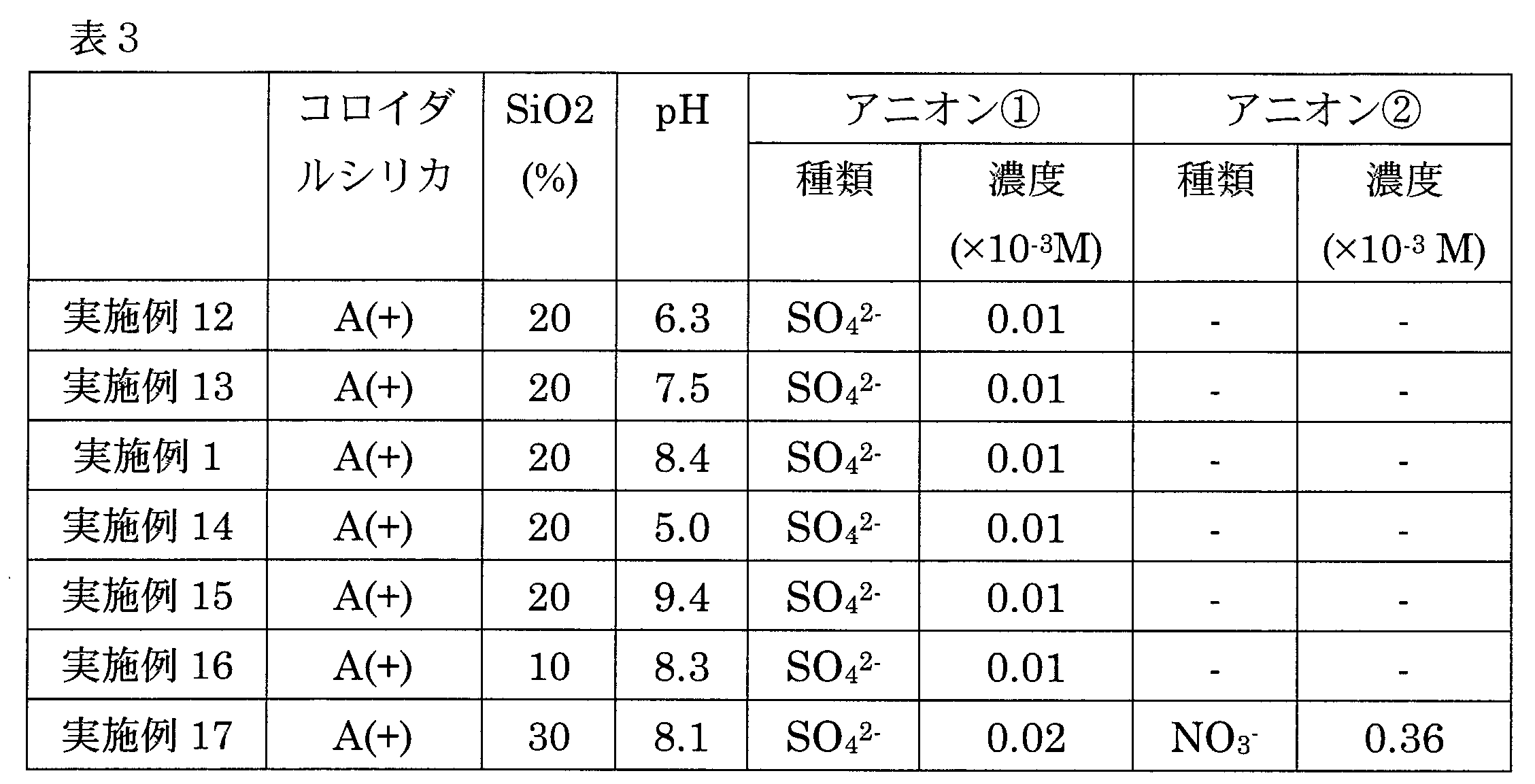
- polishing compositions were prepared in the same manner as in Example 1, except that the amount of potassium hydroxide solution added was changed to the amount that gave the pH shown in Table 3.
- Example 16 The colloidal silica A(+) prepared in Experimental Example 1 was mixed and stirred with pure water to adjust the silica concentration to 12% by mass, and then an aqueous potassium hydroxide solution was added under stirring to adjust the pH to 8.4. Pure water was then added to adjust the silica concentration to 10% by mass, thereby producing the polishing composition of Example 1.
- Example 17 The colloidal silica A(+) prepared in Experimental Example 1 was mixed with pure water and stirred to adjust the silica concentration to 32% by mass. Then, nitric acid was added under stirring to adjust the nitrate ion concentration to 0.38 ⁇ 10 ⁇ 3 M. An aqueous potassium hydroxide solution was further added under stirring to adjust the pH to 8.1. Pure water was further added to adjust the silica concentration to 30% by mass, thereby producing the polishing composition of Example 17.
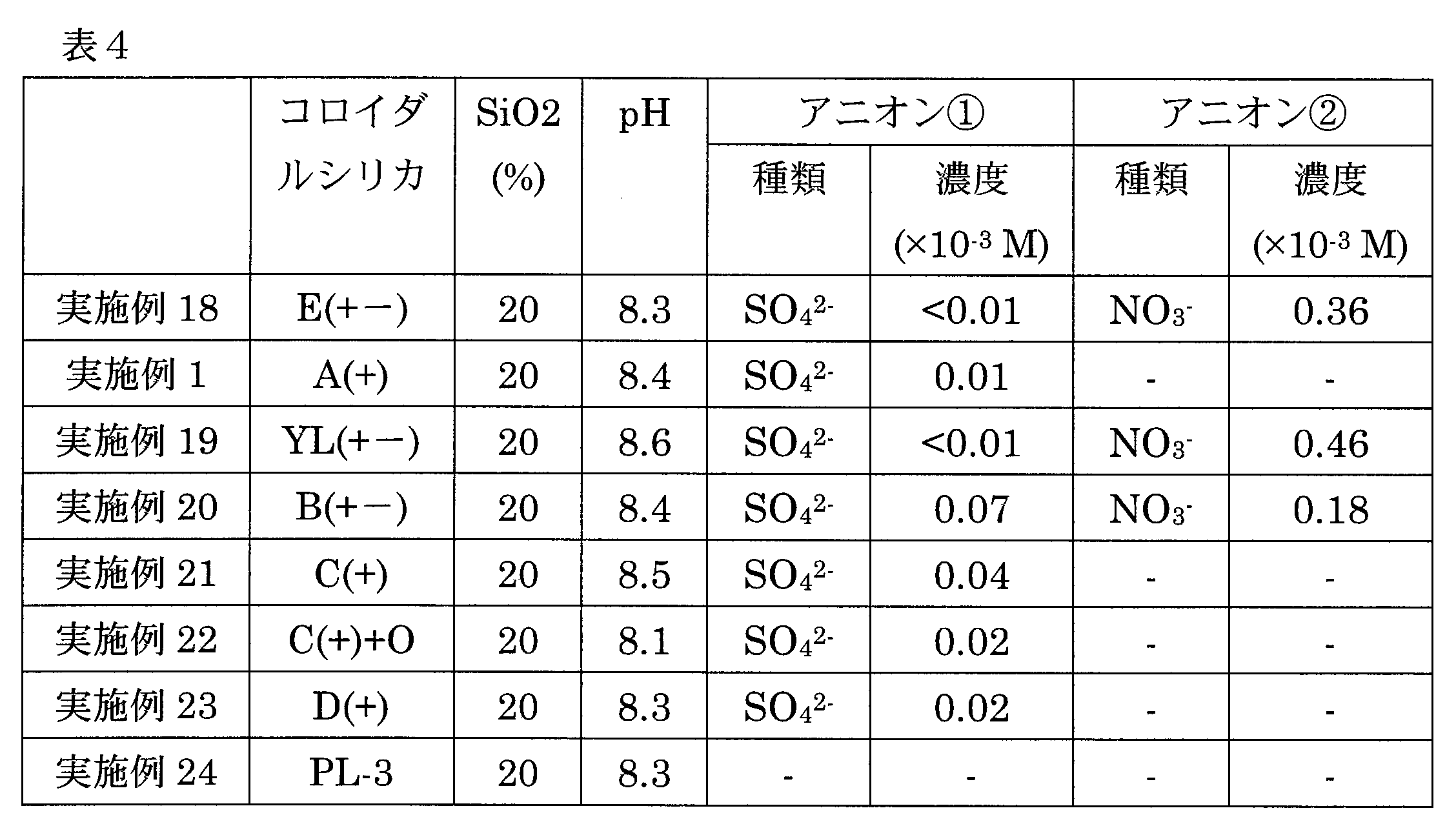
- Example 18 Colloidal silica E(+-) prepared in Experimental Example 5 was mixed with pure water and stirred to adjust the silica concentration to 22% by mass. Then, nitric acid was added under stirring to adjust the nitrate ion concentration to 0.38 ⁇ 10 ⁇ 3 M. An aqueous potassium hydroxide solution was added under stirring in an amount to adjust the pH to 8.3. Pure water was then added to adjust the silica concentration to 20% by mass and the nitrate ion concentration to 0.36 ⁇ 10 ⁇ 3 M, thereby producing the polishing composition of Example 18.
- Example 19 The colloidal silica YL(+-) prepared in Experimental Example 6 was mixed with pure water and stirred to adjust the silica concentration to 22 mass%, then nitric acid was added under stirring to adjust the nitrate ion concentration to 0.51 ⁇ 10 ⁇ 3 M, and further an aqueous potassium hydroxide solution was added under stirring to adjust the pH to 8.6. Further pure water was added to adjust the silica concentration to 20 mass% and the nitrate ion concentration to 0.46 ⁇ 10 ⁇ 3 M, thereby producing the polishing composition of Example 19.
- Example 20 Colloidal silica B(+-) prepared in Experimental Example 2 was mixed with pure water and stirred to adjust the silica concentration to 22% by mass. Nitric acid was then added with stirring to adjust the nitrate ion concentration to 0.20 ⁇ 10 ⁇ 3 M. An aqueous potassium hydroxide solution was then added with stirring to adjust the pH to 8.4. Pure water was then added to adjust the silica concentration to 20% by mass and the nitrate ion concentration to 0.18 ⁇ 10 ⁇ 3 M, thereby producing the polishing composition of Example 19.
- polishing compositions were prepared in the same manner as in Example 1, except that the type of colloidal silica and the pH after addition of the potassium hydroxide aqueous solution were changed as shown in Table 4.
- PL-3 represents a commercially available alkoxide-processed colloidal silica
- product name PL-3 manufactured by Fuso Chemical Co., Ltd.
- C(+)+O represents a mixture of colloidal silica C(+) and colloidal silica O.
- a commercially available gallium oxide single crystal substrate was polished by the following method. Polishing machine: TriboLabCMP, manufactured by Bruker Pressure: 250g/ cm2 Rotation speed of the platen: 80 rpm Substrate rotation speed: 80 rpm Polishing pad: Nitta DuPont product name SUBA600 Amount of polishing composition used: 0.9 L Supply rate of polishing composition: 100 mL/min (circulation) Polishing time: 1 hour Substrate: ⁇ -gallium oxide, diameter 2 inches Number of substrates: 1
- polishing rate was calculated from the weight loss of the substrate before and after polishing, assuming the density of the substrate to be 5.88 g/cm 3 .
- the polishing rate ⁇ m/h indicates micrometers/hour.
- the content of polyvalent anions is set to 0.002 mol / liter or less, as shown in the polishing rates in Tables 6 to 9.
- a high polishing rate can be obtained.
- a higher polishing rate can be obtained by balancing other parameters.
- the removal rate can be increased when the true density of the silica particles, the heating weight loss rate at 200° C. to 700° C., the average secondary particle size, SF1 >25 , and SF1 also satisfy certain conditions.
- the polishing compositions shown in Examples 18 to 24 by further increasing the true density of the silica particles to 2.15 g/ cm3 or more, as shown in the polishing rates in Table 9, an even higher polishing rate can be obtained.
Landscapes
- Chemical & Material Sciences (AREA)
- Organic Chemistry (AREA)
- Engineering & Computer Science (AREA)
- Dispersion Chemistry (AREA)
- Materials Engineering (AREA)
- Inorganic Chemistry (AREA)
- Mechanical Engineering (AREA)
- Mechanical Treatment Of Semiconductor (AREA)
- Silicon Compounds (AREA)
Abstract
【課題】酸化ガリウム基板を高い研磨速度で研磨する研磨用組成物と、その研磨方法を提供する。
【解決手段】シリカ粒子と水と多価アニオンとを含む酸化ガリウム基板の研磨用組成物であって、該多価アニオンの含有量が該研磨用組成物中で0.002モル/リットル以下である、上記研磨用組成物。多価アニオンが硫酸イオン、シュウ酸イオン、クエン酸イオン、及びリン酸イオンからなる群より選ばれる少なくとも1種の多価アニオンを含む多価アニオンである。1価アニオンをさらに含み、該1価アニオンの含有量が該研磨用組成物中で0.04モル/リットル以下である。1価アニオンが硝酸イオン、塩化物イオン、臭化物イオン、塩素酸イオン、臭化物イオン、酢酸イオン、ギ酸イオン、プロピオン酸イオン、及び酪酸イオンからなる群より選ばれる少なくとも1種の1価アニオンを含む1価アニオンである研磨用組成物。pHが5.0以上9.5以下である。
Description
本発明は酸化ガリウム等の酸化物系基板の研磨用組成物に関する。
シリコンに代わるパワーデバイス用基板として、炭化ケイ素、窒化ガリウム、酸化ガリウム等の化合物半導体基板が提案されている。中でも酸化ガリウムは、絶縁破壊電界の大きさと結晶成長のコストに関して優れている。化合物半導体基板は研磨を含む工程を経て製造される。研磨工程においては研磨速度の向上による生産性向上が求められている。酸化ガリウムはへき開性が強いことから、破損防止のために小さな摩擦抵抗で研磨することも求められる。
特許文献1には酸化ガリウム向けに砥粒と水とを含む研磨用組成物が記載されている。実施例ではコロイダルシリカと脱イオン水とを含む研磨用組成物の記載がある。市販のコロイダルシリカはアニオンを含む物が多いが、そのアニオンの有無や量、種類は本文献において特に記載されていない。
特許文献2には二酸化マンガンの粒子と水とを含む酸化ガリウム基板の研磨スラリーが記載されている。
本発明は酸化ガリウム基板を高い研磨速度で研磨する研磨用組成物と、その研磨方法を提供する。
本発明は第1観点として、シリカ粒子と水と多価アニオンとを含む酸化ガリウム基板の研磨用組成物であって、該多価アニオンの含有量が該研磨用組成物中で0.002モル/リットル以下である、上記研磨用組成物、
第2観点として、多価アニオンが硫酸イオン、シュウ酸イオン、クエン酸イオン、及びリン酸イオンからなる群より選ばれる少なくとも1種の多価アニオンである第1観点に記載の研磨用組成物、
第3観点として、1価アニオンをさらに含み、該1価アニオンの含有量が該研磨用組成物中で0.04モル/リットル以下である、第1観点に記載の研磨用組成物、
第4観点として、1価アニオンが硝酸イオン、塩化物イオン、臭化物イオン、塩素酸イオン、臭素酸イオン、酢酸イオン、ギ酸イオン、プロピオン酸イオン、及び酪酸イオンからなる群より選ばれる少なくとも1種の1価アニオンである第3観点のいずれか一つに記載の研磨用組成物、
第5観点として、1価アニオンが硝酸イオン、塩化物イオン、及び酢酸イオンからなる群より選ばれる少なくとも1種の1価アニオンである第3観点のいずれか一つに記載の研磨用組成物、
第6観点として、pHが5.0以上9.5以下である、第1観点に記載の研磨用組成物、
第7観点として、該シリカ粒子の平均一次粒子径が5~100nmである第1観点に記載の研磨用組成物、
第8観点として、該シリカ粒子の平均二次粒子径が30nm~150nmである、第1観点に記載の研磨用組成物、
第9観点として、該シリカ粒子の真密度が2.15g/cm3~2.30g/cm3である、第1観点に記載の研磨用組成物、
第10観点として、該シリカ粒子の200℃~700℃加熱減量率が3.0%以下である、第1観点に記載の研磨用組成物、
第11観点として、下記(A)乃至(C)工程:
(A)工程:水性シリカゾルを準備する工程、
(B)工程:(A)工程で得られた水性シリカゾルを強酸性イオン交換樹脂に接触し酸性シリカゾルを得る工程、
(C)工程:(B)工程で得られた 酸性シリカゾルにアルカリ金属水酸化物又はアンモニアでpH調整する工程、を含む第1観点乃至第10観点のいずれか一つに記載の研磨用組成物の製造方法、
第12観点として、(A)工程の水性シリカゾルがケイ酸アルカリ水溶液からアルカリ金属を除去して得られた活性ケイ酸水溶液を加熱して製造されたものである第11観点に記載の研磨用組成物の製造方法、
第13観点として、更に(D)工程:
(D)工程:(C)工程で得られた研磨用組成物を陰イオン交換を行う工程を付加する第11観点に記載の研磨用組成物の製造方法、
第14観点として、更に(D)工程:
(D)工程:(C)工程で得られた研磨用組成物に陰イオン交換を行う工程を付加する第12観点に記載の研磨用組成物の製造方法、
第15観点として、 下記(A)、(B)、(E)及び(F)工程:
(A)工程:水性シリカゾルを準備する工程、
(B)工程:(A)工程で得られた水性シリカゾルを強酸性イオン交換樹脂に接触し酸性シリカゾルを得る工程、
(E)工程:(B)工程で得られた酸性シリカゾルに陰イオン交換を行い、アルカリ性シリカゾルを得る工程、
(F)工程:(E)工程で得られたアルカリ性シリカゾルに1価の酸を加えpH調整する工程、を含む第1観点乃至第10観点のいずれか1つに記載の研磨用組成物の製造方法、
第16観点として、(A)工程の水性シリカゾルがケイ酸アルカリ水溶液からアルカリ金属を除去して得られた活性ケイ酸水溶液を加熱して製造されたものである第15観点に記載の研磨用組成物の製造方法、
第17観点として、第1観点乃至第10観点のいずれか一つに記載の研磨用組成物を用いて酸化ガリウム基板を研磨する工程を含む、酸化ガリウム基板の研磨方法、及び
第18観点として、酸化ガリウム基板の研磨速度が3.0μm/時間~10.0μm/時間である第17観点に記載の酸化ガリウム基板の研磨方法である。
第2観点として、多価アニオンが硫酸イオン、シュウ酸イオン、クエン酸イオン、及びリン酸イオンからなる群より選ばれる少なくとも1種の多価アニオンである第1観点に記載の研磨用組成物、
第3観点として、1価アニオンをさらに含み、該1価アニオンの含有量が該研磨用組成物中で0.04モル/リットル以下である、第1観点に記載の研磨用組成物、
第4観点として、1価アニオンが硝酸イオン、塩化物イオン、臭化物イオン、塩素酸イオン、臭素酸イオン、酢酸イオン、ギ酸イオン、プロピオン酸イオン、及び酪酸イオンからなる群より選ばれる少なくとも1種の1価アニオンである第3観点のいずれか一つに記載の研磨用組成物、
第5観点として、1価アニオンが硝酸イオン、塩化物イオン、及び酢酸イオンからなる群より選ばれる少なくとも1種の1価アニオンである第3観点のいずれか一つに記載の研磨用組成物、
第6観点として、pHが5.0以上9.5以下である、第1観点に記載の研磨用組成物、
第7観点として、該シリカ粒子の平均一次粒子径が5~100nmである第1観点に記載の研磨用組成物、
第8観点として、該シリカ粒子の平均二次粒子径が30nm~150nmである、第1観点に記載の研磨用組成物、
第9観点として、該シリカ粒子の真密度が2.15g/cm3~2.30g/cm3である、第1観点に記載の研磨用組成物、
第10観点として、該シリカ粒子の200℃~700℃加熱減量率が3.0%以下である、第1観点に記載の研磨用組成物、
第11観点として、下記(A)乃至(C)工程:
(A)工程:水性シリカゾルを準備する工程、
(B)工程:(A)工程で得られた水性シリカゾルを強酸性イオン交換樹脂に接触し酸性シリカゾルを得る工程、
(C)工程:(B)工程で得られた 酸性シリカゾルにアルカリ金属水酸化物又はアンモニアでpH調整する工程、を含む第1観点乃至第10観点のいずれか一つに記載の研磨用組成物の製造方法、
第12観点として、(A)工程の水性シリカゾルがケイ酸アルカリ水溶液からアルカリ金属を除去して得られた活性ケイ酸水溶液を加熱して製造されたものである第11観点に記載の研磨用組成物の製造方法、
第13観点として、更に(D)工程:
(D)工程:(C)工程で得られた研磨用組成物を陰イオン交換を行う工程を付加する第11観点に記載の研磨用組成物の製造方法、
第14観点として、更に(D)工程:
(D)工程:(C)工程で得られた研磨用組成物に陰イオン交換を行う工程を付加する第12観点に記載の研磨用組成物の製造方法、
第15観点として、 下記(A)、(B)、(E)及び(F)工程:
(A)工程:水性シリカゾルを準備する工程、
(B)工程:(A)工程で得られた水性シリカゾルを強酸性イオン交換樹脂に接触し酸性シリカゾルを得る工程、
(E)工程:(B)工程で得られた酸性シリカゾルに陰イオン交換を行い、アルカリ性シリカゾルを得る工程、
(F)工程:(E)工程で得られたアルカリ性シリカゾルに1価の酸を加えpH調整する工程、を含む第1観点乃至第10観点のいずれか1つに記載の研磨用組成物の製造方法、
第16観点として、(A)工程の水性シリカゾルがケイ酸アルカリ水溶液からアルカリ金属を除去して得られた活性ケイ酸水溶液を加熱して製造されたものである第15観点に記載の研磨用組成物の製造方法、
第17観点として、第1観点乃至第10観点のいずれか一つに記載の研磨用組成物を用いて酸化ガリウム基板を研磨する工程を含む、酸化ガリウム基板の研磨方法、及び
第18観点として、酸化ガリウム基板の研磨速度が3.0μm/時間~10.0μm/時間である第17観点に記載の酸化ガリウム基板の研磨方法である。
酸化ガリウムをパワーデバイス用基板として使用するには精密研磨加工が必要であり、被研磨物の表面の凹凸や、化合物が原子レベルでの欠陥を生じさせることなく研磨することが必要である。また前工程由来の加工ダメージを除去するために、研磨加工により所定の厚みを除去する必要があり、その時間を短縮し加工ダメージと生産性を向上させるために、高い研磨速度で研磨加工を行うことが求められる。
シリカ粒子が水などの溶媒に分散された状態でコロイダルシリカと呼ばれ、シリカゾルとも称する。本発明は、水とシリカ粒子と多価アニオンとを含む研磨用組成物において、その特定の多価アニオンの量を一定以下にすることで、研磨速度を向上させることが可能であることを見出した。また更に特定の1価アニオンの量を一定以下にすることで、研磨速度を更に向上させることが可能であることを見出した。
多価アニオン及び1価アニオンは研磨用組成物の原料の一つであるコロイダルシリカに含まれる場合が多いため、研磨用組成物のpH調整のために添加する酸又は塩を一定量以下にするだけでなく、アニオンの含有量が一定量以下であるコロイダルシリカを使用する、或いはアニオン交換樹脂等を用いてコロイダルシリカに含まれるアニオンの量を減らす等の手法により、研磨用組成物に含まれるアニオン量を一定以下に抑えることが重要である。
本発明では酸化ガリウム基板を研磨する上で特定の多価アニオン及び特定の1価アニオンが研磨速度に影響を与えることが判明し、それらのイオンを特定量以下に減量することで高い研磨速度が得られることを見出した。
本発明はシリカ粒子と水と多価アニオンとを含む酸化ガリウム基板の研磨用組成物であって、多価アニオンの含有量が該研磨用組成物中で0.002モル/リットル以下である、上記研磨用組成物である。
シリカ粒子が水に分散され、コロイダルシリカ粒子である場合は、シリカゾル中の水が研磨用組成物に用いることができる。また、シリカゾルに水を添加して研磨組成物中の水として利用することができる。
研磨組成物中のシリカ粒子は0.1~50質量%の範囲で含有することができるが、酸化ガリウム基板の研磨に使用する場合は1~40質量%、5~40質量%、5~35質量%、5~30質量%、10~30質量%、又は10~25質量%の範囲で使用することができる。
多価アニオンとしては硫酸イオン、シュウ酸イオン、クエン酸イオン、及びリン酸イオン、亜硫酸イオン、炭酸イオン、亜リン酸イオン、ホウ酸イオン、マロン酸イオン、及び酒石酸イオンからなる群より選ばれる少なくとも1種の多価アニオンを挙げることができる。
多価アニオンとして、硫酸イオン、シュウ酸イオン、クエン酸イオン、及びリン酸イオンが研磨速度に影響を与えることが判り研磨組成物中でのこれらの多価アニオンの含有量を一定量以下に低減することが好ましい。
多価アニオンとしては硫酸イオン、シュウ酸イオン、クエン酸イオン、及びリン酸イオン、亜硫酸イオン、炭酸イオン、亜リン酸イオン、ホウ酸イオン、マロン酸イオン、及び酒石酸イオンからなる群より選ばれる少なくとも1種の多価アニオンを挙げることができる。
多価アニオンとして、硫酸イオン、シュウ酸イオン、クエン酸イオン、及びリン酸イオンが研磨速度に影響を与えることが判り研磨組成物中でのこれらの多価アニオンの含有量を一定量以下に低減することが好ましい。
上記多価アニオンの含有量は0.002モル/リットル以下であることが高研磨速度を得る上で好ましい。上記多価アニオンの含有量の上限値は0.001モル/リットル以下、0.0008モル/リットル以下、又は0.0006モル/リットル以下の範囲を有することができる。またシリカゾルの安定性を得る上で、上記多価アニオンの含有量は0.000001モル/リットル以上が好ましく、下限値は0.000002モル/リットル以上、0.000003モル/リットル以上、0.000005モル/リットル以上、又は0.000007モル/リットル以上、0.00001モル/リットル以上の範囲を有することができる。
更に該研磨用組成物は1価アニオンを含み、1価アニオンの含有量が該研磨用組成物中で0.04モル/リットル以下である上記研磨用組成物とすることが好ましい。
1価アニオンが硝酸イオン、塩化物イオン、臭化物イオン、塩素酸イオン、臭素酸イオン、酢酸イオン、ギ酸イオン、プロピオン酸イオン、酪酸イオン、硫酸水素イオン、及び炭酸水素イオンからなる群より選ばれる少なくとも1種の1価アニオンを挙げることができる。更に1価アニオンが硝酸イオン、塩化物イオン、及び酢酸イオンからなる群より選ばれる少なくとも1種の1価アニオンを挙げることができる。
1価のアニオンの含有量が0.04モル/リットル以下であることが好ましい。また高い研磨速度を得る上で、1価のアニオンの含有量の上限値は0.03モル/リットル以下、0.02モル/リットル以下、又は0.01モル/リットル以下の範囲を有することができる。またシリカゾルの安定性を得る上で、1価のアニオンの含有量は0.00001モル/リットル以上、0.0001モル/リットル以上、0.001モル/リットル以上、又は0.002モル/リットル以上の範囲を有することができる。
上記研磨用組成物のpHは5.0以上9.5以下であることが、高研磨速度を得る上で好ましい。pHの上限値は9.1、9.0、8.9、8.8、又は8.7の範囲を有することができる。またpHの下限値は6.0、6.2、6.5、6.8、又は7.0の範囲を有することができる。
上記シリカ粒子の該シリカ粒子の平均二次粒子径が30nm以上であることが、高い研磨速度を得る上で好ましい。平均二次粒子径の下限値は50nm、55nm、又は60nmの範囲を有することができる。また高い研磨品質を得る上で、上記シリカ粒子の平均二次粒子径は500nm未満が好ましく、上限値は300nm、200nm、又は150nmの範囲を有することができる。
上記シリカ粒子の平均二次粒子径(DDLS)は、動的光散乱法によって測定されるシリカ粒子の粒度分布から求めることができる。動的光散乱法は、レーザー光をシリカ粒子に照射し、得られた散乱光の散乱強度がシリカ粒子の粒子径によって変わることを利用して、散乱強度から粒度分布を求める方法である。
動的光散乱法によってシリカ微粒子の粒度分布を測定するために使用される測定装置としては、例えば、動的光散乱粒度分布測定装置(Malvern Panalytical社製)を挙げることができる。
本件の研磨組成物に含まれるシリカ粒子の平均一次粒子径(DBET)は、窒素ガス吸着法(BET法)を用いて測定した表面積(又は比表面積)から算出した球相当粒子径(nm)を平均一次粒子径として測定することが可能である。
窒素ガス吸着法(BET法)によってシリカ粒子の平均一次粒子径を測定するために使用される装置としては、窒素ガス吸着法比表面積測定装置(Quantachrome社製Monosorb)を挙げることができる。具体的には、上記の装置で得られた窒素吸着法で測定される比表面積S(m2/g)と球相当粒子径の式((DBET)=2720/S)から得られた数値をBET法で測定される平均一次粒子径(DBET)とした。
上記多価のアニオン及び1価値アニオンの含有量は、イオンクロマトグラフィーを用いて求めることができる。
本発明はさらに上記シリカ粒子の真密度が2.15g/cm3以上であることが好ましい。高い研磨速度を得る上で、上記シリカ粒子の真密度の下限値は2.16g/cm3、2.17g/cm3、2.18g/cm3、又は2.19g/cm3の範囲を有することができる。また上限値は2.30g/cm3、2.28g/cm3、2.26g/cm3、又は2.25g/cm3の範囲を有することができる。
上記シリカ粒子の真密度は、相当量のシリカ微粒子の体積とその質量を測定できる測定装置によって算出することができる。
シリカ粒子の体積とその質量を測定し、その測定値から真密度を算出するために使用される密度測定装置としては、例えば、乾式自動密度測定装置(AccuPyc II TEC、マイクロメリティックス製)を挙げることができる。この密度計を用いた場合、所定量のシリカ粒子を密度計内に入れて真密度を自動測定することができる。
本発明はさらに上記シリカ粒子の200℃~700℃加熱減量率が3.0%以下であることが好ましい。高い研磨速度を得る上で、上記シリカ粒子の700℃加熱減量率の上限値は2.0%、又は1.8%の範囲を有することができ、下限値は0.6%、0.8%、1.0%、1.2%、又は1.4%の範囲を有することができる。
上記シリカ粒子の加熱減量率は、示差熱・熱重量同時測定法(TGDTA)によって測定することができる。
示差熱・熱重量同時測定法によってシリカ粒子の加熱減量を測定するために使用される測定装置としては、例えば、熱重量示差熱分析装置(商品名TG-DTA2000SA、Bruker社製)を挙げることができる。
上述の真密度、加熱減量の測定には本件の研磨組成物に含まれるコロイダルシリカ分散液から取り出したシリカ粒子(シリカ粉末)を用いることができる。
当該シリカ粒子(シリカ粉末)は当該コロイダルシリカを乾燥することで得られる。乾燥方法としては、特に限定されない。具体的な乾燥方法としては、熱風乾燥、送風乾燥、遠赤外線加熱乾燥、除湿空気乾燥、自然乾燥(天日乾燥を含む)、真空減圧乾燥、間接加熱乾燥、マイクロ波加熱乾燥、真空凍結乾燥などが挙げられる。1種又は2種以上の乾燥方法を組み合わせて行うことができる。
当該シリカ粒子(シリカ粉末)は当該コロイダルシリカを乾燥することで得られる。乾燥方法としては、特に限定されない。具体的な乾燥方法としては、熱風乾燥、送風乾燥、遠赤外線加熱乾燥、除湿空気乾燥、自然乾燥(天日乾燥を含む)、真空減圧乾燥、間接加熱乾燥、マイクロ波加熱乾燥、真空凍結乾燥などが挙げられる。1種又は2種以上の乾燥方法を組み合わせて行うことができる。
また、上述の乾燥工程に関して、前処理として、当該コロイダルシリカ分散液を強酸型陽イオン交換樹脂及び/又は強塩基型陰イオン交換樹脂、更に弱酸型(カルボン酸型)キレート樹脂及び/又は弱塩基型(アミン型)キレート樹脂に接触させることにより、当該コロイダルシリカ分散液から金属カチオンなどの不純物を取り除くことが可能である。
尚、強アルカリ水溶液を通液して水酸基型に変換した陰イオン交換樹脂を用いることができ、強酸型陽イオン交換樹脂としては、例えばダウ・ケミカル社製、商品名アンバーライトIR-120B、アンバージェット1020、DOWEX MARATHONGH、三菱ケミカルホールディングス社製、商品名ダイヤイオンSK104、ダイヤイオンPK208、住化ケムテック社製、商品名デュオライトC20J等が挙げられる。強塩基型陰イオン交換樹脂としては、例えばダウ・ケミカル社製、商品名アンバーライトIRA400J、アンバーライトIRA410J、アンバージェット4400、三菱ケミカルホールディングス社製、商品名ダイヤイオンSA10A、ダイヤイオンSA20A、住化ケムテック社製、商品名 デュオライトUBA120等が挙げられる。
当該コロイダルシリカ分散液は、SiO2の固形分濃度が1~50質量%であることが好ましい。高い研磨速度を得る上で、上記SiO2の固形分濃度の下限値は2質量%、5質量%、10質量%、15質量%、20質量%の範囲を有することができる。また粒子の分散安定性を得る上で、上記SiO2の固形分濃度の上限値は40質量%、35質量%、30質量%、25質量%の範囲を有することができる。
上記シリカ粒子の粒子形状の異形度を示す形状パラメータSF1は、小さい方が研磨時の基板と研磨パッドの間の摩擦係数が小さくなり、基板の割れるリスクが低減される。摩擦係数を小さくする観点から、SF1は1.60未満が好ましく、SF1の上限値は1.53、1.35、1.30、1.25、1.22、1.19、又は1.18の値を取ることができる。
上記シリカ粒子の粒子形状の異形度を示す形状パラメータSF1>25は、大きい方が研磨速度が高くなる。研磨速度を高くする観点から、SF1>25は1.16以上が好ましく、1.23以上、又は1.25以上が更に好ましく、1.30以上が更に好ましく、1.40以上が更に好ましい。
(透過型電子顕微鏡画像解析による粒子径、形状係数の測定)
上記形状係数SF1は、(粒子の最大径を直径とする円の面積)/(投影面積)として求められる。即ち、
上記形状係数SF1は、(粒子の最大径を直径とする円の面積)/(投影面積)として求められる。即ち、
SF1=(DL2×π/4)/S 式(1)
である。
である。
DLは粒子の最大径nmであり、透過型電子顕微鏡写真から求められるシリカ粒子の最大長(nm)であり、画像の周上の任意の2点間のうち最大の長さである。Sは、そのシリカ粒子の投影面積(nm2)である。詳細には倍率1万倍、又は3万倍で撮影した透過型電子顕微鏡写真を電子データで画像解析装置(株式会社ニレコ製、商品名LUZEX)に解像度146dpiで取り込み、シリカ粒子の占める画素数から面積に換算したものを投影面積としている。例えば、1万倍の写真においては、1画素の一辺の長さは17.8nmとなり、従って1画素当たりの面積は319nm2と換算される。また、3万倍の写真においては、1画素の一辺の長さは6.0nmとなり、従って、1画素当たりの面積は36nm2と換算される。SF1は、画像解析装置で認識した2000個の粒子について、それぞれ最大長DLと投影面積Sを求め、粒子それぞれについて、前記式の計算値を算出し、それらの平均値をSF1とした。
上記形状係数SF1>25は、円相当径25nm以上の粒子のSF1の平均値である。すなわち、上記の透過型電子顕微鏡写真の画像解析により求められる円相当径が25nm以上の粒子のみを抽出し、それらのSF1の平均値を算出することにより求められる。円相当径とは、シリカ粒子の投影面積S(nm2)と同じ投影面積を持つ真円の直径(nm)である。即ち、
D=2×(S/π)0.5 式(2)
である。
である。
本願の研磨用組成物に用いられるコロイダルシリカ分散液としては、アルコキシド法によるシリカゾルも使用できるが、ケイ酸アルカリ水溶液からアルカリ金属イオンを除去して得られたケイ酸水溶液を加熱して得られたシリカ粒子を含むシリカゾルが好適に使用できる。アルコキシド法によるシリカゾルは典型的には上記真密度が2.15g/cm3未満、上記加熱減量率が2.0%以上である。
本発明の研磨用組成物にはpH調整のためにpH調整剤を添加することができる。pH調整剤は酸性水性シリカゾルにアルカリ性物質を添加して、pH5.0~9.5、又はpH6.0~9.5、又はpH6.0~9.1、又は6.0~9.0、又は6.0~8.9、又は6.5~8.8、又は7.0~8.7に調整することができる。
アルカリ性物質としてはアルカリ金属水酸化物又はアンモニアであり、水酸化ナトリウム、水酸化カリウム、アンモニアが好ましく用いられ、例えば0.1~30質量%水溶液で添加することができる。
本発明の研磨用組成物は水溶性化合物を用いることができる。水溶性化合物としては、例えばアクリル酸、メタクリル酸、マレイン酸等のカルボン酸基を有するモノマー、及びそれらの重合物としてポリアクリル酸、ポリメタクリル酸、そしてそれらの塩類としてポリアクリル酸アンモニウム、ポリアクリル酸カリウム、ポリメタクリル酸アンモニウム、ポリメタクリル酸カリウムが挙げられる。また、アルギン酸、ペクチン酸、カルボキシメチルセルロース、ポリアスパラギン酸、ポリグルタミン酸、ポリアミド酸、ポリアミド酸アンモニウム、ポリビニルピロリドン、ヒドロキシエチルセルロース、グリセリン、ポリグリセリン、ポリビニルアルコール、又はカルボキシル基若しくはスルホン酸基変性ポリビニルアルコールを用いることができる。
水溶性化合物はシリカ粒子に対して0.01~10質量%の割合で含有することができる。
水溶性化合物はシリカ粒子に対して0.01~10質量%の割合で含有することができる。
本発明の研磨組成物に用いられるシリカ粒子は、シリカゾルとして使用することができる。
上記研磨組成物は下記(A)乃至(C)工程を含む製造方法により製造される。
(A)工程:水性シリカゾルを準備する工程、
(B)工程:(A)工程で得られた水性シリカゾルを強酸性イオン交換樹脂に接触し酸性シリカゾルを得る工程、
(C)工程:(B)工程で得られた酸性シリカゾルにアルカリ金属水酸化物又はアンモニアでpH調整する工程、を含み製造することができる。
上記研磨組成物は下記(A)乃至(C)工程を含む製造方法により製造される。
(A)工程:水性シリカゾルを準備する工程、
(B)工程:(A)工程で得られた水性シリカゾルを強酸性イオン交換樹脂に接触し酸性シリカゾルを得る工程、
(C)工程:(B)工程で得られた酸性シリカゾルにアルカリ金属水酸化物又はアンモニアでpH調整する工程、を含み製造することができる。
(A)工程に使用する水性シリカゾルは例えば下記(a1)~(a4)のいずれかの方法で得ることができる。
(a1)工程:ケイ酸ナトリウム水溶液をイオン交換し、アルカリ金属イオンを除去して得られた活性ケイ酸水溶液を加熱処理して得られるシリカゾル、
(a2)工程:アルコキシシランの加水分解により得られるシリカゾル、
(a3)工程:シリカパウダーを水性媒体中で湿式粉砕する方法により得られるシリカゾル、
(a4)工程:四塩化珪素の火炎中での燃焼加水分解によって得られるシリカパウダーを水性媒体に分散する方法で得られたシリカゾル。
(a1)工程:ケイ酸ナトリウム水溶液をイオン交換し、アルカリ金属イオンを除去して得られた活性ケイ酸水溶液を加熱処理して得られるシリカゾル、
(a2)工程:アルコキシシランの加水分解により得られるシリカゾル、
(a3)工程:シリカパウダーを水性媒体中で湿式粉砕する方法により得られるシリカゾル、
(a4)工程:四塩化珪素の火炎中での燃焼加水分解によって得られるシリカパウダーを水性媒体に分散する方法で得られたシリカゾル。
(a1)工程の方法は、活性ケイ酸を得る工程(a-I)、活性ケイ酸を加熱し整粒する工程(a-II)、得られたシリカゾルを濃度調整する工程(a-III)に大別することができる。
活性ケイ酸を得る工程(a-I)は、シリカ以外の金属酸化物をシリカに対し、300~500000ppmの比率に含有する水溶性のアルカリ金属ケイ酸塩がこのケイ酸塩に由来するSiO2分として、0.5~10.0質量%、又は1~6質量%の濃度に溶解しているアルカリ金属ケイ酸塩の水溶液を、水素型強酸性陽イオン交換樹脂と接触させることによりSiO2濃度1~6質量%の活性ケイ酸の水溶液を生成させ、この生成液を回収する工程である。
活性ケイ酸を加熱し整粒する工程(a-II)は、以下の(a-II-I)、(a-II-II)工程が挙げられる。
(a-II-I)工程:(a-I)工程で回収された活性ケイ酸の水溶液に、アルカリ金属水酸化物、アンモニア、及び有機塩基からなる群より選ばれた少なくとも1種を含む水溶液を安定化剤として添加し、0.5~10.0質量%、又は1~6質量%のSiO2濃度と7~9のpHを有する安定化された活性ケイ酸の水溶液を生成させる工程、又は無機酸、及び有機酸からなる群より選ばれた少なくとも1種を安定化剤として添加し、0.5~10.0質量%、又は1~6質量%のSiO2濃度と1~4のpHを有する安定化された活性ケイ酸の水溶液を生成させる工程である。
(a-II-I)工程:(a-I)工程で回収された活性ケイ酸の水溶液に、アルカリ金属水酸化物、アンモニア、及び有機塩基からなる群より選ばれた少なくとも1種を含む水溶液を安定化剤として添加し、0.5~10.0質量%、又は1~6質量%のSiO2濃度と7~9のpHを有する安定化された活性ケイ酸の水溶液を生成させる工程、又は無機酸、及び有機酸からなる群より選ばれた少なくとも1種を安定化剤として添加し、0.5~10.0質量%、又は1~6質量%のSiO2濃度と1~4のpHを有する安定化された活性ケイ酸の水溶液を生成させる工程である。
(a-II-II)工程:(a-II-I)工程で回収された活性ケイ酸の水溶液に、アルカリ金属水酸化物、アンモニア、又は有機塩基からなる群より選ばれた少なくとも1種を含む水溶液を加えることにより得られるケイ酸塩化合物を含む水溶液、又はこの水溶液を濃縮又は希釈することにより得られるpH10~12.5、及びSiO2濃度0.1~8質量%を有するケイ酸塩化合物を含む水溶液を生成させる工程を含む。
更に、上記の方法で生成させたケイ酸塩化合物を含む水溶液に対して、上記(a-I)、又は(a-II-I)工程と同様にして得られた活性ケイ酸の水溶液を、得られる混合液の温度を110~150℃未満、又は110~145℃、又は110~140℃、又は110~135℃、又は110~130℃に保って充分な攪拌下に、この混合液中のpHが9~12になるまで1~30時間の間に供給する工程が挙げられる。
得られたシリカゾルを濃度調整する工程(a-III)は、シリカゾルを10~50質量%まで濃縮する工程であるが、濃縮前後で不純物の除去を行うことができる。この工程(a-III)は必須ではないが所望により行われる。
(B)工程では水性シリカゾルを水素型強酸性陽イオン交換樹脂と接触させることができる。
(C)工程では(B)工程で得られた酸性シリカゾルはそのpHが6.0~9.5、又は6.0~9.1、又は6.0~9.0になるようにアルカリ金属水酸化物又はアンモニアを加えることにより、10~50質量%、又は30~50質量%のSiO2濃度を有し、シリカ以外の多価金属酸化物を実質的に含まず、そしてコロイダルシリカの平均一次粒子径が5~100nmである安定な水性シリカゾルを生成させる工程が挙げられる。これらのシリカゾルは研磨用組成物にするために、0.1~50質量%の範囲で含有することができるが、水を添加してシリカ濃度調整することにより酸化ガリウム基板の研磨に使用する場合は0.1~40質量%、1~40質量%、5~40質量%、5~35質量%、5~30質量%、10~30質量%、又は10~25質量%の範囲で使用することができる。
更に、(C)工程で得られた研磨用組成物が、陰イオン交換を行う付加の(D)工程に処理されることができる。
また、上記研磨組成物は下記(A)、(B)、(E)及び(F)工程を含む製造方法により製造される。
(A)工程:水性シリカゾルを準備する工程、
(B)工程:(A)工程で得られた水性シリカゾルを強酸性イオン交換樹脂に接触し酸性シリカゾルを得る工程、
(E)工程:(B)工程で得られた酸性シリカゾルに陰イオン交換を行い、アルカリ性シリカゾルを得る工程、
(F)工程:(E)工程で得られたアルカリ性シリカゾルに1価の酸を加えてpH調整する工程、を含み製造することができる。
(A)工程:水性シリカゾルを準備する工程、
(B)工程:(A)工程で得られた水性シリカゾルを強酸性イオン交換樹脂に接触し酸性シリカゾルを得る工程、
(E)工程:(B)工程で得られた酸性シリカゾルに陰イオン交換を行い、アルカリ性シリカゾルを得る工程、
(F)工程:(E)工程で得られたアルカリ性シリカゾルに1価の酸を加えてpH調整する工程、を含み製造することができる。
本発明は上記研磨用組成物を用いて酸化ガリウム基板を研磨する工程を含む、酸化ガリウム基板の研磨方法である。
上記研磨方法では、酸化ガリウム基板の研磨速度が3.0μm/時間~10.0μm/時間、又は4.0μm/時間~10.0μm/時間とすることができる。
(DLS法(動的光散乱法)による平均二次粒子径:DLS粒子径とも称する)
粒子径測定装置 ゼータサイザーナノ(Malvern Panalytical社製)を用い、動的光散乱法によりシリカゾルの平均二次粒子径を求めた。また、平均二次粒子径は、動的光散乱法により測定されるZ平均粒子径を採用した。
粒子径測定装置 ゼータサイザーナノ(Malvern Panalytical社製)を用い、動的光散乱法によりシリカゾルの平均二次粒子径を求めた。また、平均二次粒子径は、動的光散乱法により測定されるZ平均粒子径を採用した。
(加熱乾燥粉末サンプルの作製)
シリカゾル(SiO2濃度40質量%)25.0gに純水75.0gを添加し、SiO2濃度を10質量%に調整したシリカゾルサンプルを作製した。次いで得られたシリカゾルサンプルを水素型強酸性陽イオン交換樹脂アンバーライト(商品名)IR-120B、及び水酸基型強塩基性陰イオン交換樹脂アンバーライト(商品名)IRA-410を用いて、可能な限り陽イオンと陰イオンを除去した後、電気炉(商品名DX302、ヤマト科学株式会社製)を用いて大気雰囲気下290℃で1時間加熱し乾燥させた。乾燥後の粉末をメノー乳鉢で十分すりつぶすことにより、加熱乾燥粉末サンプルを得た。
シリカゾル(SiO2濃度40質量%)25.0gに純水75.0gを添加し、SiO2濃度を10質量%に調整したシリカゾルサンプルを作製した。次いで得られたシリカゾルサンプルを水素型強酸性陽イオン交換樹脂アンバーライト(商品名)IR-120B、及び水酸基型強塩基性陰イオン交換樹脂アンバーライト(商品名)IRA-410を用いて、可能な限り陽イオンと陰イオンを除去した後、電気炉(商品名DX302、ヤマト科学株式会社製)を用いて大気雰囲気下290℃で1時間加熱し乾燥させた。乾燥後の粉末をメノー乳鉢で十分すりつぶすことにより、加熱乾燥粉末サンプルを得た。
(凍結乾燥粉末サンプルの作製)
シリカゾル(SiO2濃度40質量%)25.0gに純水75.0gを添加し、SiO2濃度を10質量%に調整したシリカゾルサンプルを作製した。次いで得られたシリカゾルサンプルを水素型強酸性陽イオン交換樹脂アンバーライト(商品名)IR-120B、及び水酸基型強塩基性陰イオン交換樹脂アンバーライト(商品名)IRA-410を用いて、可能な限り陽イオンと陰イオンを除去した後、凍結乾燥装置(商品名FDU-2100、東京理化器械株式会社製)を用いて圧力5Pa以下の真空化で凍結乾燥させた。乾燥後の粉末をメノー乳鉢で十分すりつぶすことにより、凍結乾燥粉末サンプルを得た。
シリカゾル(SiO2濃度40質量%)25.0gに純水75.0gを添加し、SiO2濃度を10質量%に調整したシリカゾルサンプルを作製した。次いで得られたシリカゾルサンプルを水素型強酸性陽イオン交換樹脂アンバーライト(商品名)IR-120B、及び水酸基型強塩基性陰イオン交換樹脂アンバーライト(商品名)IRA-410を用いて、可能な限り陽イオンと陰イオンを除去した後、凍結乾燥装置(商品名FDU-2100、東京理化器械株式会社製)を用いて圧力5Pa以下の真空化で凍結乾燥させた。乾燥後の粉末をメノー乳鉢で十分すりつぶすことにより、凍結乾燥粉末サンプルを得た。
(BET法(窒素ガス吸着法)による比表面積径:BET法による平均一次粒子径、BET粒子径とも称する)
各シリカゾルの上記加熱乾燥粉末を測定試料とした。比表面積測定装置 商品名Monosorb(カンタクローム・インスツルメンツ・ジャパン合同会社製)を用い、窒素吸着法(BET法)により測定試料の比表面積値を測定し、得られた比表面積値より平均一次粒子径を求めた。
各シリカゾルの上記加熱乾燥粉末を測定試料とした。比表面積測定装置 商品名Monosorb(カンタクローム・インスツルメンツ・ジャパン合同会社製)を用い、窒素吸着法(BET法)により測定試料の比表面積値を測定し、得られた比表面積値より平均一次粒子径を求めた。
(pH測定)
pH測定結果から得られる値を示すものであり、pHメーター(東亜ディーケーケー社製商品名マルチ水質計MM-60R、商品名pH電極GST-5741C)を用いて測定した。
pH測定結果から得られる値を示すものであり、pHメーター(東亜ディーケーケー社製商品名マルチ水質計MM-60R、商品名pH電極GST-5741C)を用いて測定した。
(真密度の測定)
各シリカゾルの上記加熱乾燥粉末を測定試料とした。乾式自動密度測定装置(商品名AccuPyc II TEC、マイクロメリティックス社製)を用い、試料を1cm3セルの8割を満たすように入れて、その真密度を測定した。
各シリカゾルの上記加熱乾燥粉末を測定試料とした。乾式自動密度測定装置(商品名AccuPyc II TEC、マイクロメリティックス社製)を用い、試料を1cm3セルの8割を満たすように入れて、その真密度を測定した。
(加熱減量率の測定)
熱重量示差熱分析装置(商品名TG-DTA2000SA、Bruker社製)を用いて、以下のようにしてシリカ粉末を室温から700℃まで昇温させて加熱したときの加熱減量(%)を測定した。
熱重量示差熱分析装置(商品名TG-DTA2000SA、Bruker社製)を用いて、以下のようにしてシリカ粉末を室温から700℃まで昇温させて加熱したときの加熱減量(%)を測定した。
各シリカゾルの上記凍結乾燥粉末をプラチナ製容器に所定量入れ、窒素雰囲気中で室温から700℃まで、10℃/分の昇温速度で加熱した。なお、窒素ガスの流量は100cc/分とした。200℃に到達した時点のサンプルの質量M1および700℃に到達した時点でのサンプルの質量M2の値から、下記式を用いてシリカ粉末の加熱減量率を算出した。
加熱減量率(%)=(M1-M2)÷M1×100
(活性ケイ酸水溶液(a1)の製造)
原料の水溶性アルカリ金属ケイ酸塩として、JIS3号のケイ酸ナトリウム水溶液を用意した。このケイ酸ナトリウム水溶液の水以外の主な成分は、SiO2は28.8質量%、Na2Oは9.47質量%であった。上記ケイ酸ナトリウム水溶液478gを純水2992gに溶かし、ケイ酸ナトリウム水溶液3500gを調製した。次いで、上記ケイ酸ナトリウム水溶液を、水素型強酸性陽イオン交換樹脂アンバーライトIR-120B充填のカラムに1時間当たりの空間速度4.5で通液した後、得られた活性ケイ酸水溶液(a1)3000gを容器に回収した。
原料の水溶性アルカリ金属ケイ酸塩として、JIS3号のケイ酸ナトリウム水溶液を用意した。このケイ酸ナトリウム水溶液の水以外の主な成分は、SiO2は28.8質量%、Na2Oは9.47質量%であった。上記ケイ酸ナトリウム水溶液478gを純水2992gに溶かし、ケイ酸ナトリウム水溶液3500gを調製した。次いで、上記ケイ酸ナトリウム水溶液を、水素型強酸性陽イオン交換樹脂アンバーライトIR-120B充填のカラムに1時間当たりの空間速度4.5で通液した後、得られた活性ケイ酸水溶液(a1)3000gを容器に回収した。
(合成例A)
内容積3LのSUS製耐圧容器に、攪拌機、加熱装置等が具備された反応装置が用いられた。活性ケイ酸水溶液(a1)(SiO2分として3.5質量%)、10質量%の水酸化カリウム水溶液、及び純水を用いて、pH=11.1、電気伝導度14.8mS/cmに調整後、加熱によって容器内液温を100~120℃に調節した。容器内の温度が100~120℃に達した後、容器内を100~120℃に保ったまま、更に活性ケイ酸水溶液(a1)(SiO2分として3.5質量%)を供給液として、反応液のpHを11.0、電気伝導度3.6mS/cmに達するまで、連続的に供給した。
引続き、得られた反応液を100~120℃に保ちながら1時間加熱を続け、コロイダルシリカを得た。
内容積3LのSUS製耐圧容器に、攪拌機、加熱装置等が具備された反応装置が用いられた。活性ケイ酸水溶液(a1)(SiO2分として3.5質量%)、10質量%の水酸化カリウム水溶液、及び純水を用いて、pH=11.1、電気伝導度14.8mS/cmに調整後、加熱によって容器内液温を100~120℃に調節した。容器内の温度が100~120℃に達した後、容器内を100~120℃に保ったまま、更に活性ケイ酸水溶液(a1)(SiO2分として3.5質量%)を供給液として、反応液のpHを11.0、電気伝導度3.6mS/cmに達するまで、連続的に供給した。
引続き、得られた反応液を100~120℃に保ちながら1時間加熱を続け、コロイダルシリカを得た。
得られたコロイダルシリカを、孔径約5nmのポリサルホン製の管状限外ろ過膜が装着された市販の限外ろ過装置を用いて、室温でSiO2濃度40質量%となるまで濃縮し、コロイダルシリカA(pH10.8、硫酸イオン濃度2ppm、DDLS83nm、DBET 28nm、SF1は1.50、SF1>25は1.50)とした。
(合成例B)
内容積3LのSUS製耐圧容器に、攪拌機、加熱装置等が具備された反応装置が用いられた。日産化学株式会社製のコロイダルシリカ商品名ST-50T、10質量%の水酸化カリウム水溶液、及び純水を用いて、pH=11.2、電気伝導度3.7mS/cmに調整後、加熱によって容器内液温を100~120℃に調節した。容器内の温度が100~120℃に達した後、容器内を100~120℃に保ったまま、更に活性ケイ酸水溶液(a1)(SiO2分として3.5質量%)を供給液として、反応液のpHを10.5、電気伝導度1.1mS/cmに達するまで、連続的に供給した。
内容積3LのSUS製耐圧容器に、攪拌機、加熱装置等が具備された反応装置が用いられた。日産化学株式会社製のコロイダルシリカ商品名ST-50T、10質量%の水酸化カリウム水溶液、及び純水を用いて、pH=11.2、電気伝導度3.7mS/cmに調整後、加熱によって容器内液温を100~120℃に調節した。容器内の温度が100~120℃に達した後、容器内を100~120℃に保ったまま、更に活性ケイ酸水溶液(a1)(SiO2分として3.5質量%)を供給液として、反応液のpHを10.5、電気伝導度1.1mS/cmに達するまで、連続的に供給した。
引続き、得られた反応液を100~120℃に保ちながら1時間加熱を続け、コロイダルシリカを得た。
得られたコロイダルシリカを、孔径約5nmのポリサルホン製の管状限外ろ過膜が装着された市販の限外ろ過装置を用いて、室温でSiO2濃度40質量%となるまで濃縮し、コロイダルシリカB(pH10.5、硫酸イオン濃度46ppm、DDLS52nm、DBET 33nm、SF1は1.20、SF1>25は1.20)とした。
(合成例C)
内容積3LのSUS製耐圧容器に、攪拌機、加熱装置等が具備された反応装置が用いられた。合成例Bで得られたコロイダルシリカB、10質量%の水酸化カリウム水溶液、及び純水を用いて、pH=11.4、電気伝導度8.9mS/cmに調整後、加熱によって容器内液温を100~120℃に調節した。容器内の温度が100~120℃に達した後、容器内を100~120℃に保ったまま、更に活性ケイ酸水溶液(a1)(SiO2分として3.0~4.0質量%)、及び10質量%の水酸化カリウム水溶液を供給液として、反応液のpHを10.7、電気伝導度1.7mS/cmに達するまで、連続的に供給した。
内容積3LのSUS製耐圧容器に、攪拌機、加熱装置等が具備された反応装置が用いられた。合成例Bで得られたコロイダルシリカB、10質量%の水酸化カリウム水溶液、及び純水を用いて、pH=11.4、電気伝導度8.9mS/cmに調整後、加熱によって容器内液温を100~120℃に調節した。容器内の温度が100~120℃に達した後、容器内を100~120℃に保ったまま、更に活性ケイ酸水溶液(a1)(SiO2分として3.0~4.0質量%)、及び10質量%の水酸化カリウム水溶液を供給液として、反応液のpHを10.7、電気伝導度1.7mS/cmに達するまで、連続的に供給した。
引続き、得られた反応液を100~120℃に保ちながら1時間加熱を続け、コロイダルシリカを得た。
得られたコロイダルシリカを、孔径約5nmのポリサルホン製の管状限外ろ過膜が装着された市販の限外ろ過装置を用いて、室温でSiO2濃度40質量%となるまで濃縮し、コロイダルシリカC(pH10.8、硫酸イオン濃度2ppm、DDLS102nm、DBET 62nm、SF1は1.16、SF1>25は1.16)とした。
(合成例D)
内容積3LのSUS製耐圧容器に、攪拌機、加熱装置等が具備された反応装置が用いられた。活性ケイ酸水溶液(a1)(SiO2分として3.5質量%)、10質量%の水酸化カリウム水溶液、及び純水を用いて、pH=11.1、電気伝導度11.3mS/cmに調整後、加熱によって容器内液温を100~120℃に調節した。容器内の温度が100~120℃に達した後、容器内を100~120℃に保ったまま、更に活性ケイ酸水溶液(a1)(SiO2分として3.5質量%)を供給液として、反応液のpHを11.0、電気伝導度3.3mS/cmに達するまで、連続的に供給した。
内容積3LのSUS製耐圧容器に、攪拌機、加熱装置等が具備された反応装置が用いられた。活性ケイ酸水溶液(a1)(SiO2分として3.5質量%)、10質量%の水酸化カリウム水溶液、及び純水を用いて、pH=11.1、電気伝導度11.3mS/cmに調整後、加熱によって容器内液温を100~120℃に調節した。容器内の温度が100~120℃に達した後、容器内を100~120℃に保ったまま、更に活性ケイ酸水溶液(a1)(SiO2分として3.5質量%)を供給液として、反応液のpHを11.0、電気伝導度3.3mS/cmに達するまで、連続的に供給した。
引続き、得られた反応液を100~120℃に保ちながら1時間加熱を続け、コロイダルシリカを得た。
得られたコロイダルシリカを、孔径約5nmのポリサルホン製の管状限外ろ過膜が装着された市販の限外ろ過装置を用いて、室温でSiO2濃度40質量%となるまで濃縮し、コロイダルシリカD(pH10.8、硫酸イオン濃度6ppm、DDLS45nm、DBET 19nm、SF1は1.51、SF1>25は1.64)とした。
(活性ケイ酸水溶液(a2)の製造)
活性ケイ酸水溶液(a1)(SiO2分として3.2質量%)に、安定化剤である硫酸の含有量が0.313質量%/SiO2となるように8%硫酸水溶液を添加し、安定化された活性ケイ酸水溶液(a2)を得た。
活性ケイ酸水溶液(a1)(SiO2分として3.2質量%)に、安定化剤である硫酸の含有量が0.313質量%/SiO2となるように8%硫酸水溶液を添加し、安定化された活性ケイ酸水溶液(a2)を得た。
(合成例E)
内容積3LのSUS製耐圧容器に、攪拌機、加熱装置等が具備された反応装置が用いられた。上記安定化された活性ケイ酸水溶液(a2)(SiO2分として3.2質量%)、10質量%の水酸化カリウム水溶液、及び純水を用いて、pH=11.0、電気伝導度10.1mS/cmに調整後、加熱によって容器内液温を110~130℃に調節した。容器内の温度が100~130℃に達した後、容器内を110~130℃に保ったまま、更に安定化された活性ケイ酸水溶液(a2)(SiO2分として3.2質量%)供給液として、反応液のpHを10.9、電気伝導度3.5mS/cmに達するまで、連続的に供給した。
内容積3LのSUS製耐圧容器に、攪拌機、加熱装置等が具備された反応装置が用いられた。上記安定化された活性ケイ酸水溶液(a2)(SiO2分として3.2質量%)、10質量%の水酸化カリウム水溶液、及び純水を用いて、pH=11.0、電気伝導度10.1mS/cmに調整後、加熱によって容器内液温を110~130℃に調節した。容器内の温度が100~130℃に達した後、容器内を110~130℃に保ったまま、更に安定化された活性ケイ酸水溶液(a2)(SiO2分として3.2質量%)供給液として、反応液のpHを10.9、電気伝導度3.5mS/cmに達するまで、連続的に供給した。
引続き、得られた反応液を110~130℃に保ちながら2時間加熱を続け、コロイダルシリカを得た。
得られたコロイダルシリカを、孔径約5nmのポリサルホン製の管状限外ろ過膜が装着された市販の限外ろ過装置を用いて、室温でSiO2濃度40質量%となるまで濃縮し、コロイダルシリカE(pH9.8、硫酸イオン濃度1100ppm、DDLS56nm、DBET 20nm、SF1は1.52、SF1>25は1.57)とした。
(実験例1)
合成例Aにて作製したコロイダルシリカAを、水素型強酸性陽イオン交換樹脂アンバーライトIR-120B充填のカラムに1時間当たりの空間速度4.5で通液した後、得られた酸性コロイダルシリカA(+)を容器に回収した。
合成例Aにて作製したコロイダルシリカAを、水素型強酸性陽イオン交換樹脂アンバーライトIR-120B充填のカラムに1時間当たりの空間速度4.5で通液した後、得られた酸性コロイダルシリカA(+)を容器に回収した。
(実験例2)
合成例Bにて作製したコロイダルシリカBを、水素型強酸性陽イオン交換樹脂アンバーライトIR-120B充填のカラムに1時間当たりの空間速度4.5で通液した後、得られた酸性コロイダルシリカB(+)を容器に回収した。酸性コロイダルシリカB(+)の入った容器に水酸基型強塩基性陰イオン交換樹脂アンバーライト(商品名)IRA-410を入れ、30分間撹拌した後にIRA-410を#100ナイロンメッシュを用いて除去することで、陰イオンを除去したコロイダルシリカB(+-)を得た。
合成例Bにて作製したコロイダルシリカBを、水素型強酸性陽イオン交換樹脂アンバーライトIR-120B充填のカラムに1時間当たりの空間速度4.5で通液した後、得られた酸性コロイダルシリカB(+)を容器に回収した。酸性コロイダルシリカB(+)の入った容器に水酸基型強塩基性陰イオン交換樹脂アンバーライト(商品名)IRA-410を入れ、30分間撹拌した後にIRA-410を#100ナイロンメッシュを用いて除去することで、陰イオンを除去したコロイダルシリカB(+-)を得た。
(実験例3)
合成例Cにて作製したコロイダルシリカCを、水素型強酸性陽イオン交換樹脂アンバーライトIR-120B充填のカラムに1時間当たりの空間速度4.5で通液した後、得られた酸性コロイダルシリカC(+)を容器に回収した。
合成例Cにて作製したコロイダルシリカCを、水素型強酸性陽イオン交換樹脂アンバーライトIR-120B充填のカラムに1時間当たりの空間速度4.5で通液した後、得られた酸性コロイダルシリカC(+)を容器に回収した。
(実験例4)
合成例Dにて作製したコロイダルシリカDを、水素型強酸性陽イオン交換樹脂アンバーライトIR-120B充填のカラムに1時間当たりの空間速度4.5で通液した後、得られた酸性コロイダルシリカD(+)を容器に回収した。
合成例Dにて作製したコロイダルシリカDを、水素型強酸性陽イオン交換樹脂アンバーライトIR-120B充填のカラムに1時間当たりの空間速度4.5で通液した後、得られた酸性コロイダルシリカD(+)を容器に回収した。
(実験例5)
合成例Eにて作製したコロイダルシリカEを、水素型強酸性陽イオン交換樹脂アンバーライトIR-120B充填のカラムに1時間当たりの空間速度4.5で通液した後、得られた酸性コロイダルシリカE(+)を容器に回収した。酸性コロイダルシリカE(+)の入った容器に水酸基型強塩基性陰イオン交換樹脂アンバーライト(商品名)IRA-410を入れ、30分間撹拌した後にIRA-410を#100ナイロンメッシュを用いて除去することで、陰イオンを除去したコロイダルシリカE(+-)を得た。
合成例Eにて作製したコロイダルシリカEを、水素型強酸性陽イオン交換樹脂アンバーライトIR-120B充填のカラムに1時間当たりの空間速度4.5で通液した後、得られた酸性コロイダルシリカE(+)を容器に回収した。酸性コロイダルシリカE(+)の入った容器に水酸基型強塩基性陰イオン交換樹脂アンバーライト(商品名)IRA-410を入れ、30分間撹拌した後にIRA-410を#100ナイロンメッシュを用いて除去することで、陰イオンを除去したコロイダルシリカE(+-)を得た。
(実験例6)
日産化学株式会社製商品名ST-YL(商品名スノーテックスYL、pH9.6、シリカ濃度40質量%、硫酸イオン濃度1000ppm、DDLS98nm、DBET 60nm、SF1 1.25、SF1>25 1.25)を水素型強酸性陽イオン交換樹脂アンバーライトIR-120B充填のカラムに1時間当たりの空間速度4.5で通液した後、得られた酸性コロイダルシリカYL(+)を容器に回収した。コロイダルシリカYL(+)の入った容器に水酸基型強塩基性陰イオン交換樹脂アンバーライト(商品名)IRA-410を入れ、30分間撹拌した後にIRA-410を#100ナイロンメッシュを用いて除去することで、陰イオンを除去したコロイダルシリカYL(+-)を得た。
日産化学株式会社製商品名ST-YL(商品名スノーテックスYL、pH9.6、シリカ濃度40質量%、硫酸イオン濃度1000ppm、DDLS98nm、DBET 60nm、SF1 1.25、SF1>25 1.25)を水素型強酸性陽イオン交換樹脂アンバーライトIR-120B充填のカラムに1時間当たりの空間速度4.5で通液した後、得られた酸性コロイダルシリカYL(+)を容器に回収した。コロイダルシリカYL(+)の入った容器に水酸基型強塩基性陰イオン交換樹脂アンバーライト(商品名)IRA-410を入れ、30分間撹拌した後にIRA-410を#100ナイロンメッシュを用いて除去することで、陰イオンを除去したコロイダルシリカYL(+-)を得た。
(実験例7)
実験例3にて作製したコロイダルシリカC(+)と日産化学株式会社製商品名ST-O(商品名スノーテックスO、pH2.6、シリカ濃度20質量%、硫酸イオン濃度1ppm未満、DDLS19nm、DBET 12nm、SF1 1.39)(コロイダルシリカO)を、シリカ固形分重量比で7:3の割合で混合することで、コロイダルシリカC(+)とコロイダルシリカOの混合物C(+)+Oを得た。
実験例3にて作製したコロイダルシリカC(+)と日産化学株式会社製商品名ST-O(商品名スノーテックスO、pH2.6、シリカ濃度20質量%、硫酸イオン濃度1ppm未満、DDLS19nm、DBET 12nm、SF1 1.39)(コロイダルシリカO)を、シリカ固形分重量比で7:3の割合で混合することで、コロイダルシリカC(+)とコロイダルシリカOの混合物C(+)+Oを得た。
(実施例1)
実験例1にて作製したコロイダルシリカA(+)と、純水とを混合し撹拌してシリカ濃度22質量%とし、さらにpH8.4となる量の水酸化カリウム水溶液を撹拌下で添加し、さらに純水を加えてシリカ濃度20質量%に調製して、実施例1の研磨用組成物を製造した。
実験例1にて作製したコロイダルシリカA(+)と、純水とを混合し撹拌してシリカ濃度22質量%とし、さらにpH8.4となる量の水酸化カリウム水溶液を撹拌下で添加し、さらに純水を加えてシリカ濃度20質量%に調製して、実施例1の研磨用組成物を製造した。
(実施例2)
実験例1にて作製したコロイダルシリカA(+)と、純水とを混合し撹拌してシリカ濃度22質量%とし、次いで硫酸(濃度8質量%)を硫酸イオン濃度0.28×10⁻³Mとなる量を撹拌下で添加し、さらに水酸化カリウム水溶液(濃度10質量%)をpH8.3となるようを撹拌下で添加し、さらに純水を加えてシリカ濃度20質量%、硫酸イオン濃度0.25×10⁻³Mに調製して、実施例1の研磨用組成物を製造した。
実験例1にて作製したコロイダルシリカA(+)と、純水とを混合し撹拌してシリカ濃度22質量%とし、次いで硫酸(濃度8質量%)を硫酸イオン濃度0.28×10⁻³Mとなる量を撹拌下で添加し、さらに水酸化カリウム水溶液(濃度10質量%)をpH8.3となるようを撹拌下で添加し、さらに純水を加えてシリカ濃度20質量%、硫酸イオン濃度0.25×10⁻³Mに調製して、実施例1の研磨用組成物を製造した。
(実施例3)
添加する硫酸の量を表1に示す濃度になるように変えた以外は実施例2と同様にして、実施例3の研磨用組成物を製造した。
添加する硫酸の量を表1に示す濃度になるように変えた以外は実施例2と同様にして、実施例3の研磨用組成物を製造した。
(実施例4)
硫酸に代えてシュウ酸水溶液(濃度10質量%)を表1に示す濃度になるように加えた以外は実施例2と同様にして、実施例4の研磨用組成物を製造した。
硫酸に代えてシュウ酸水溶液(濃度10質量%)を表1に示す濃度になるように加えた以外は実施例2と同様にして、実施例4の研磨用組成物を製造した。
実施例5~実施例8についても、硫酸に代えて添加する酸の種類(硫酸(濃度8質量%)、シュウ酸水溶液(濃度10質量%)、塩酸(濃度3.7質量%)又は酢酸(濃度6質量%))と量を表2に示すとおりに変えた以外は実施例2と同様にして、各研磨用組成物を製造した。
(比較例1)
添加する硫酸の量を表1に示す濃度になるように変えた以外は実施例2と同様にして、比較例1の研磨用組成物を製造した。
添加する硫酸の量を表1に示す濃度になるように変えた以外は実施例2と同様にして、比較例1の研磨用組成物を製造した。
(比較例2)
合成例Aにて作製したコロイダルシリカAと、純水とを混合し撹拌してシリカ濃度22質量%とし、次いで硫酸(濃度8質量%)pH8.4となる量を撹拌下で添加し、さらに純水を加えてシリカ濃度20質量%に調製し、比較例2の研磨用組成物を製造した。
合成例Aにて作製したコロイダルシリカAと、純水とを混合し撹拌してシリカ濃度22質量%とし、次いで硫酸(濃度8質量%)pH8.4となる量を撹拌下で添加し、さらに純水を加えてシリカ濃度20質量%に調製し、比較例2の研磨用組成物を製造した。
比較例3~比較例5についても、硫酸に代えて添加する酸の種類(シュウ酸水溶液(濃度10質量%)、クエン酸水溶液(濃度10質量%)、リン酸(濃度9.8質量%)と量を表1に示すとおりにした以外は比較例2と同様にして、各研磨用組成物を製造した。
実施例9~実施例11についても、硫酸に代えて添加する酸の種類と量を表2に示すとおりにした以外は比較例2と同様にして、各研磨用組成物を製造した。
実施例12~実施例15についても、添加する水酸化カリウム水溶液の量を表3に示すpHとなる量に変えた以外は実施例1と同様にして、各研磨用組成物を製造した。
(実施例16)
実験例1にて作製したコロイダルシリカA(+)と、純水とを混合し撹拌してシリカ濃度12質量%とし、さらに水酸化カリウム水溶液をpH8.4となるよう撹拌下で添加し、さらに純水を加えてシリカ濃度10質量%に調製して、実施例1の研磨用組成物を製造した。
実験例1にて作製したコロイダルシリカA(+)と、純水とを混合し撹拌してシリカ濃度12質量%とし、さらに水酸化カリウム水溶液をpH8.4となるよう撹拌下で添加し、さらに純水を加えてシリカ濃度10質量%に調製して、実施例1の研磨用組成物を製造した。
(実施例17)
実験例1にて作製したコロイダルシリカA(+)と、純水とを混合し撹拌してシリカ濃度32質量%とし、次いで硝酸を硝酸イオン濃度0.38×10⁻³Mとなるよう撹拌下で添加し、さらに水酸化カリウム水溶液をpH8.1となるよう撹拌下で添加し、さらに純水を加えてシリカ濃度30質量%に調製して、実施例17の研磨用組成物を製造した。
実験例1にて作製したコロイダルシリカA(+)と、純水とを混合し撹拌してシリカ濃度32質量%とし、次いで硝酸を硝酸イオン濃度0.38×10⁻³Mとなるよう撹拌下で添加し、さらに水酸化カリウム水溶液をpH8.1となるよう撹拌下で添加し、さらに純水を加えてシリカ濃度30質量%に調製して、実施例17の研磨用組成物を製造した。
(実施例18)
実験例5にて作製したコロイダルシリカE(+-)と、純水とを混合し撹拌してシリカ濃度22質量%とし、次いで硝酸を硝酸イオン濃度0.38×10⁻³Mとなるよう撹拌下で添加し、さらにpH8.3となる量の水酸化カリウム水溶液を撹拌下で添加し、さらに純水を加えてシリカ濃度20質量%、硝酸イオン濃度0.36×10⁻³Mに調製して、実施例18の研磨用組成物を製造した。
実験例5にて作製したコロイダルシリカE(+-)と、純水とを混合し撹拌してシリカ濃度22質量%とし、次いで硝酸を硝酸イオン濃度0.38×10⁻³Mとなるよう撹拌下で添加し、さらにpH8.3となる量の水酸化カリウム水溶液を撹拌下で添加し、さらに純水を加えてシリカ濃度20質量%、硝酸イオン濃度0.36×10⁻³Mに調製して、実施例18の研磨用組成物を製造した。
(実施例19)
実験例6にて作製したコロイダルシリカYL(+-)と、純水とを混合し撹拌してシリカ濃度22質量%とし、次いで硝酸を硝酸イオン濃度0.51×10⁻³Mとなるよう撹拌下で添加し、さらに水酸化カリウム水溶液をpH8.6となるよう撹拌下で添加し、さらに純水を加えてシリカ濃度20質量%、硝酸イオン濃度0.46×10⁻³Mに調製して、実施例19の研磨用組成物を製造した。
実験例6にて作製したコロイダルシリカYL(+-)と、純水とを混合し撹拌してシリカ濃度22質量%とし、次いで硝酸を硝酸イオン濃度0.51×10⁻³Mとなるよう撹拌下で添加し、さらに水酸化カリウム水溶液をpH8.6となるよう撹拌下で添加し、さらに純水を加えてシリカ濃度20質量%、硝酸イオン濃度0.46×10⁻³Mに調製して、実施例19の研磨用組成物を製造した。
(実施例20)
実験例2にて作製したコロイダルシリカB(+-)と、純水とを混合し撹拌してシリカ濃度22質量%とし、次いで硝酸を硝酸イオン濃度0.20×10⁻³Mとなるよう撹拌下で添加し、さらに水酸化カリウム水溶液をpH8.4となるよう撹拌下で添加し、さらに純水を加えてシリカ濃度20質量%、硝酸イオン濃度0.18×10⁻³Mに調製して、実施例19の研磨用組成物を製造した。
実験例2にて作製したコロイダルシリカB(+-)と、純水とを混合し撹拌してシリカ濃度22質量%とし、次いで硝酸を硝酸イオン濃度0.20×10⁻³Mとなるよう撹拌下で添加し、さらに水酸化カリウム水溶液をpH8.4となるよう撹拌下で添加し、さらに純水を加えてシリカ濃度20質量%、硝酸イオン濃度0.18×10⁻³Mに調製して、実施例19の研磨用組成物を製造した。
実施例21~実施例24についても、コロイダルシリカの種類と水酸化カリウム水溶液添加後のpHを表4に示すとおりに変えた以外は実施例1と同様にして、各研磨用組成物を製造した。
なお、実施例1及び実施例5~23に含まれる微量の硫酸イオン0.01×10⁻³Mは全て原料のコロイダルシリカA由来で、追加での添加ではない。そして、表4中のPL-3は市販のアルコキシド法コロイダルシリカ、商品名PL-3(扶桑化学工業(株)製)を示し、C(+)+OはコロイダルシリカC(+)とコロイダルシリカOの混合物を示した。

市販の酸化ガリウム単結晶基板を以下の方法で研磨した。
研磨機:Bruker製 商品名TriboLabCMP
圧力:250g/cm2
定盤回転数:80rpm
基板回転数:80rpm
研磨パッド:ニッタ・デュポン社製 商品名SUBA600
研磨用組成物の使用量:0.9L
研磨用組成物の供給速度:100mL/min(循環使用)
研磨時間:1時間
基板:β-酸化ガリウム、直径2インチ
基板枚数:1枚
研磨機:Bruker製 商品名TriboLabCMP
圧力:250g/cm2
定盤回転数:80rpm
基板回転数:80rpm
研磨パッド:ニッタ・デュポン社製 商品名SUBA600
研磨用組成物の使用量:0.9L
研磨用組成物の供給速度:100mL/min(循環使用)
研磨時間:1時間
基板:β-酸化ガリウム、直径2インチ
基板枚数:1枚
(研磨速度の測定方法)
研磨速度は基板の研磨前後での重量減少量から、基板の密度を5.88g/cm3として算出した。
下記表6~9中の研磨速度μm/hはマイクロメートル/時間を示す。
研磨速度は基板の研磨前後での重量減少量から、基板の密度を5.88g/cm3として算出した。
下記表6~9中の研磨速度μm/hはマイクロメートル/時間を示す。

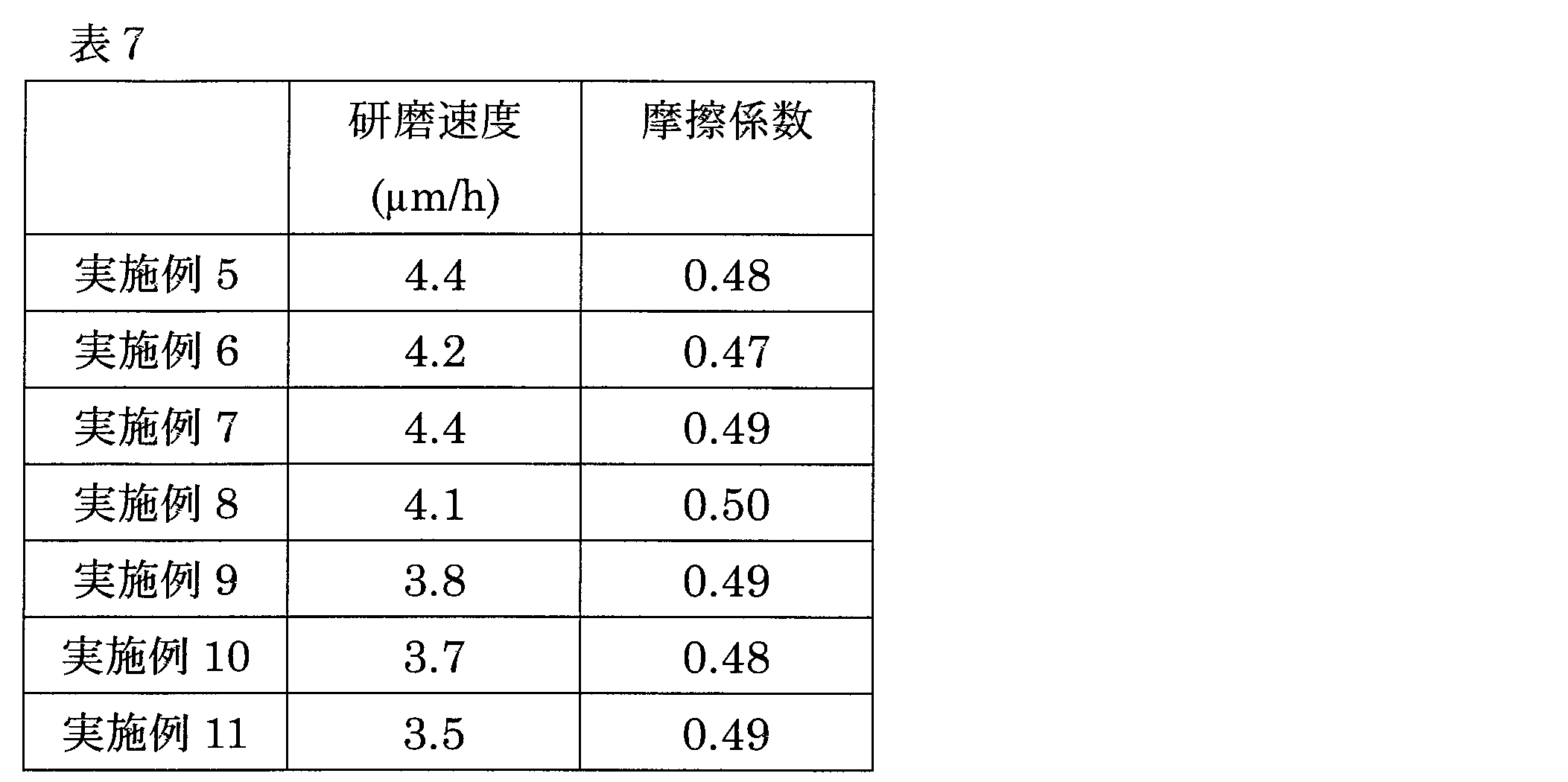


上記実施例のように、シリカ粒子と水とを含む酸化ガリウム基板の研磨用組成物において、多価アニオンの含有量を0.002モル/リットル以下にすることで、表6~9の研磨速度の示す通り、高い研磨速度を得ることができる。
さらに、他のパラメータと兼ね合いでより高い研磨速度を得ることができる。
さらに、他のパラメータと兼ね合いでより高い研磨速度を得ることができる。
多価アニオンの含有量を0.002モル/リットル以下にし、更に1価のアニオンの含有量を0.04モル/リットル以下にすることで、表7の研磨速度の示す通り、更に高い研磨速度を得ることができる。
多価アニオンの含有量を0.002モル/リットル以下に、更にpHを6.0~9.1にすることで、表8の研磨速度の示す通り、更に高い研磨速度を得ることができる。
さらに、シリカ粒子の真密度、200℃~700℃加熱減量率、平均二次粒子径、SF1>25及びSF1も一定条件に満足すると、研磨速度を高めることができると見出した。
例えば、実施例18~実施例24で表される研磨用組成物において、更にシリカ粒子の真密度を2.15g/cm3以上にすることで、表9の研磨速度の示す通り、更に高い研磨速度を得ることができる。
例えば、実施例18~実施例24で表される研磨用組成物において、更にシリカ粒子の真密度を2.15g/cm3以上にすることで、表9の研磨速度の示す通り、更に高い研磨速度を得ることができる。
更にシリカ粒子の200℃~700℃加熱減量率を2.0%以下にすることで、表9の研磨速度の示す通り、更に高い研磨速度を得ることができる。
更にシリカ粒子の平均二次粒子径を50nm以上にすることで、表9の研磨速度の示す通り、更に高い研磨速度を得ることができる。
更にシリカ粒子のSF1>25を1.23以上にすることで、表9の研磨速度の示す通り、更に高い研磨速度を得ることができる。またシリカ粒子のSF1を1.35未満にすることで、表9の摩擦係数の示す通り摩擦抵抗を小さく抑えることができる。
酸化ガリウム基板を高い研磨速度で研磨する研磨用組成物と、その研磨方法を提供することができる。
Claims (18)
- シリカ粒子と水と多価アニオンとを含む酸化ガリウム基板の研磨用組成物であって、該多価アニオンの含有量が該研磨用組成物中で0.002モル/リットル以下である、上記研磨用組成物。
- 多価アニオンが硫酸イオン、シュウ酸イオン、クエン酸イオン、及びリン酸イオンからなる群より選ばれる少なくとも1種の多価アニオンである請求項1に記載の研磨用組成物。
- 1価アニオンをさらに含み、該1価アニオンの含有量が該研磨用組成物中で0.04モル/リットル以下である、請求項1に記載の研磨用組成物。
- 1価アニオンが硝酸イオン、塩化物イオン、臭化物イオン、塩素酸イオン、臭素酸イオン、酢酸イオン、ギ酸イオン、プロピオン酸イオン、及び酪酸イオンからなる群より選ばれる少なくとも1種の1価アニオンである請求項3に記載の研磨用組成物。
- 1価アニオンが硝酸イオン、塩化物イオン、及び酢酸イオンからなる群より選ばれる少なくとも1種の1価アニオンである請求項3に記載の研磨用組成物。
- pHが5.0以上9.5以下である、請求項1に記載の研磨用組成物。
- 該シリカ粒子の平均一次粒子径が5~100nmである請求項1に記載の研磨用組成物。
- 該シリカ粒子の平均二次粒子径が30nm~150nmである、請求項1に記載の研磨用組成物。
- 該シリカ粒子の真密度が2.15g/cm3~2.30g/cm3である、請求項1に記載の研磨用組成物。
- 該シリカ粒子の200℃~700℃加熱減量率が3.0%以下である、請求項1に記載の研磨用組成物。
- 下記(A)乃至(C)工程:
(A)工程:水性シリカゾルを準備する工程、
(B)工程:(A)工程で得られた水性シリカゾルを強酸性イオン交換樹脂に接触し酸性シリカゾルを得る工程、
(C)工程:(B)工程で得られた酸性シリカゾルにアルカリ金属水酸化物又はアンモニアでpH調整する工程、を含む請求項1乃至請求項10のいずれか1項に記載の研磨用組成物の製造方法。 - (A)工程の水性シリカゾルがケイ酸アルカリ水溶液からアルカリ金属を除去して得られた活性ケイ酸水溶液を加熱して製造されたものである請求項11に記載の研磨用組成物の製造方法。
- 更に(D)工程:
(D)工程:(C)工程で得られた研磨用組成物に陰イオン交換を行う工程を付加する請求項11に記載の研磨用組成物の製造方法。 - 更に(D)工程:
(D)工程:(C)工程で得られた研磨用組成物に陰イオン交換を行う工程を付加する請求項12に記載の研磨用組成物の製造方法。 - 下記(A)、(B)、(E)及び(F)工程:
(A)工程:水性シリカゾルを準備する工程、
(B)工程:(A)工程で得られた水性シリカゾルを強酸性イオン交換樹脂に接触し酸性シリカゾルを得る工程、
(E)工程:(B)工程で得られた酸性シリカゾルに陰イオン交換を行い、アルカリ性シリカゾルを得る工程、
(F)工程:(E)工程で得られたアルカリ性シリカゾルに1価の酸を加えてpH調整する工程、を含む請求項1乃至請求項10のいずれか1項に記載の研磨用組成物の製造方法。 - (A)工程の水性シリカゾルがケイ酸アルカリ水溶液からアルカリ金属を除去して得られた活性ケイ酸水溶液を加熱して製造されたものである請求項15に記載の研磨用組成物の製造方法。
- 請求項1~請求項10のいずれか1項に記載の研磨用組成物を用いて酸化ガリウム基板を研磨する工程を含む、酸化ガリウム基板の研磨方法。
- 酸化ガリウム基板の研磨速度が3.0μm/時間~10.0μm/時間である請求項17に記載の酸化ガリウム基板の研磨方法。
Priority Applications (2)
| Application Number | Priority Date | Filing Date | Title |
|---|---|---|---|
| CN202480037856.8A CN121359626A (zh) | 2023-06-08 | 2024-06-07 | 氧化镓基板用研磨剂及研磨方法 |
| JP2025526175A JPWO2024253205A1 (ja) | 2023-06-08 | 2024-06-07 |
Applications Claiming Priority (2)
| Application Number | Priority Date | Filing Date | Title |
|---|---|---|---|
| JP2023-094939 | 2023-06-08 | ||
| JP2023094939 | 2023-06-08 |
Publications (1)
| Publication Number | Publication Date |
|---|---|
| WO2024253205A1 true WO2024253205A1 (ja) | 2024-12-12 |
Family
ID=93795589
Family Applications (1)
| Application Number | Title | Priority Date | Filing Date |
|---|---|---|---|
| PCT/JP2024/020948 Ceased WO2024253205A1 (ja) | 2023-06-08 | 2024-06-07 | 酸化ガリウム基板用研磨剤及び研磨方法 |
Country Status (3)
| Country | Link |
|---|---|
| JP (1) | JPWO2024253205A1 (ja) |
| CN (1) | CN121359626A (ja) |
| WO (1) | WO2024253205A1 (ja) |
Citations (6)
| Publication number | Priority date | Publication date | Assignee | Title |
|---|---|---|---|---|
| JP2007145633A (ja) * | 2005-11-25 | 2007-06-14 | Catalysts & Chem Ind Co Ltd | 異方形状シリカゾルの製造方法 |
| JP2010245148A (ja) * | 2009-04-02 | 2010-10-28 | Jsr Corp | 化学機械研磨方法およびそれを使用した半導体デバイス、化学機械研磨用水系分散体調製用キット |
| WO2020067057A1 (ja) * | 2018-09-28 | 2020-04-02 | 株式会社フジミインコーポレーテッド | 酸化ガリウム基板研磨用組成物 |
| WO2020262406A1 (ja) * | 2019-06-24 | 2020-12-30 | 日産化学株式会社 | キレート剤含有水ガラス及びシリカゾルの製造方法 |
| JP2022154454A (ja) * | 2021-03-30 | 2022-10-13 | 株式会社フジミインコーポレーテッド | 研磨用組成物、研磨方法、および半導体基板の製造方法 |
| JP7170944B1 (ja) * | 2022-05-31 | 2022-11-14 | 扶桑化学工業株式会社 | コロイダルシリカおよびその製造方法 |
-
2024
- 2024-06-07 CN CN202480037856.8A patent/CN121359626A/zh active Pending
- 2024-06-07 JP JP2025526175A patent/JPWO2024253205A1/ja active Pending
- 2024-06-07 WO PCT/JP2024/020948 patent/WO2024253205A1/ja not_active Ceased
Patent Citations (6)
| Publication number | Priority date | Publication date | Assignee | Title |
|---|---|---|---|---|
| JP2007145633A (ja) * | 2005-11-25 | 2007-06-14 | Catalysts & Chem Ind Co Ltd | 異方形状シリカゾルの製造方法 |
| JP2010245148A (ja) * | 2009-04-02 | 2010-10-28 | Jsr Corp | 化学機械研磨方法およびそれを使用した半導体デバイス、化学機械研磨用水系分散体調製用キット |
| WO2020067057A1 (ja) * | 2018-09-28 | 2020-04-02 | 株式会社フジミインコーポレーテッド | 酸化ガリウム基板研磨用組成物 |
| WO2020262406A1 (ja) * | 2019-06-24 | 2020-12-30 | 日産化学株式会社 | キレート剤含有水ガラス及びシリカゾルの製造方法 |
| JP2022154454A (ja) * | 2021-03-30 | 2022-10-13 | 株式会社フジミインコーポレーテッド | 研磨用組成物、研磨方法、および半導体基板の製造方法 |
| JP7170944B1 (ja) * | 2022-05-31 | 2022-11-14 | 扶桑化学工業株式会社 | コロイダルシリカおよびその製造方法 |
Also Published As
| Publication number | Publication date |
|---|---|
| JPWO2024253205A1 (ja) | 2024-12-12 |
| CN121359626A (zh) | 2026-01-16 |
Similar Documents
| Publication | Publication Date | Title |
|---|---|---|
| US10160894B2 (en) | Non-spherical silica sol, process for producing the same, and composition for polishing | |
| JP5213720B2 (ja) | 炭酸セリウム粉末の製造方法 | |
| JP4768601B2 (ja) | 金属酸化物及びメタロイド酸化物分散液の製造方法 | |
| US8118898B2 (en) | Spinous silica-based sol and method of producing the same | |
| JP5253124B2 (ja) | 多孔質シリカ粒子及びその製造方法 | |
| JP5334385B2 (ja) | ポリシリケート粒子状材料の製造および使用 | |
| JP5084670B2 (ja) | シリカゾルおよびその製造方法 | |
| WO2010052945A1 (ja) | 非球状シリカゾル、その製造方法および研磨用組成物 | |
| KR20050120772A (ko) | 나노다공성 초미세 α-알루미나 분말 및 이의 졸-겔제조방법 | |
| JP6358899B2 (ja) | 金属酸化物粒子およびその製造方法 | |
| KR20200135772A (ko) | 실리카 입자 분산액, 연마 조성물 및 실리카 입자 분산액의 제조 방법 | |
| JP6207345B2 (ja) | シリカ粒子の製造方法 | |
| US20020086909A1 (en) | Method of preparing a fumed metal oxide dispersion | |
| JPWO2006123562A1 (ja) | 研磨用組成物の製造方法 | |
| KR20110014486A (ko) | 화학적, 기계적 연마용 콜로이달 실리카졸의 제조방법 | |
| WO2024253205A1 (ja) | 酸化ガリウム基板用研磨剤及び研磨方法 | |
| JP2022152370A (ja) | コロイダルシリカの製造方法及びコロイダルシリカ | |
| JP3754986B2 (ja) | 研磨剤用組成物およびその調製方法 | |
| US20030113251A1 (en) | Method for preparing shape-changed nanosize colloidal silica | |
| JP5377135B2 (ja) | コロイダルシリカの製造方法 | |
| JP4846193B2 (ja) | 易分散性沈降シリカケーク及びその製造方法 | |
| JP7482699B2 (ja) | 異形シリカ粒子分散液の製造方法 | |
| JP6722026B2 (ja) | 研磨用シリカ及びそれを用いた方法 | |
| US20240002712A1 (en) | Irregularly-shaped silica-based fine particle dispersion, method for producing same, particle-linked silica fine particle dispersion, method for producing same, and abrasive grain dispersion for polishing | |
| JP7470079B2 (ja) | 金平糖状アルミナ-シリカ複合微粒子分散液の製造方法 |
Legal Events
| Date | Code | Title | Description |
|---|---|---|---|
| 121 | Ep: the epo has been informed by wipo that ep was designated in this application |
Ref document number: 24819432 Country of ref document: EP Kind code of ref document: A1 |
|
| ENP | Entry into the national phase |
Ref document number: 2025526175 Country of ref document: JP Kind code of ref document: A |
|
| WWE | Wipo information: entry into national phase |
Ref document number: 2025526175 Country of ref document: JP |
|
| NENP | Non-entry into the national phase |
Ref country code: DE |