WO2024253724A1 - Pharmaceutical oral solid dosage forms including liothyronine and levothyroxine salts and methods of making and using the same - Google Patents
Pharmaceutical oral solid dosage forms including liothyronine and levothyroxine salts and methods of making and using the same Download PDFInfo
- Publication number
- WO2024253724A1 WO2024253724A1 PCT/US2024/019414 US2024019414W WO2024253724A1 WO 2024253724 A1 WO2024253724 A1 WO 2024253724A1 US 2024019414 W US2024019414 W US 2024019414W WO 2024253724 A1 WO2024253724 A1 WO 2024253724A1
- Authority
- WO
- WIPO (PCT)
- Prior art keywords
- solid dosage
- oral solid
- dosage form
- pharmaceutical oral
- liothyronine
- Prior art date
- Legal status (The legal status is an assumption and is not a legal conclusion. Google has not performed a legal analysis and makes no representation as to the accuracy of the status listed.)
- Ceased
Links
Classifications
-
- A—HUMAN NECESSITIES
- A61—MEDICAL OR VETERINARY SCIENCE; HYGIENE
- A61P—SPECIFIC THERAPEUTIC ACTIVITY OF CHEMICAL COMPOUNDS OR MEDICINAL PREPARATIONS
- A61P5/00—Drugs for disorders of the endocrine system
- A61P5/14—Drugs for disorders of the endocrine system of the thyroid hormones, e.g. T3, T4
-
- A—HUMAN NECESSITIES
- A61—MEDICAL OR VETERINARY SCIENCE; HYGIENE
- A61K—PREPARATIONS FOR MEDICAL, DENTAL OR TOILETRY PURPOSES
- A61K9/00—Medicinal preparations characterised by special physical form
- A61K9/20—Pills, tablets, discs, rods
- A61K9/2095—Tabletting processes
-
- A—HUMAN NECESSITIES
- A61—MEDICAL OR VETERINARY SCIENCE; HYGIENE
- A61K—PREPARATIONS FOR MEDICAL, DENTAL OR TOILETRY PURPOSES
- A61K31/00—Medicinal preparations containing organic active ingredients
- A61K31/185—Acids; Anhydrides, halides or salts thereof, e.g. sulfur acids, imidic, hydrazonic or hydroximic acids
- A61K31/19—Carboxylic acids, e.g. valproic acid
- A61K31/195—Carboxylic acids, e.g. valproic acid having an amino group
- A61K31/197—Carboxylic acids, e.g. valproic acid having an amino group the amino and the carboxyl groups being attached to the same acyclic carbon chain, e.g. gamma-aminobutyric acid [GABA], beta-alanine, epsilon-aminocaproic acid or pantothenic acid
- A61K31/198—Alpha-amino acids, e.g. alanine or edetic acid [EDTA]
Definitions
- the present disclosure relates to pharmaceutical oral solid dosage forms comprising liothyronine salt and levothyroxine salt and to methods of making and using the oral solid dosage forms.
- DESCRIPTION OF THE BACKGROUND OF THE TECHNOLOGY [002] Hypothyroidism is a common endocrine disorder characterized by a deficiency of thyroid hormone. Worldwide, iodine deficiency is the major cause of hypothyroidism.
- hypothyroidism In the United States and other areas in which iodine intake is adequate, autoimmune thyroid disease (Hashimoto’s disease) is the most common cause of hypothyroidism. Hypothyroidism may also be drug-induced or otherwise iatrogenic. [003] Hypothyroidism usually is a primary process in which the thyroid gland is unable to produce sufficient amounts of thyroid hormone. Hypothyroidism can also be a secondary process in which the thyroid gland is normal but receives insufficient stimulation because of low secretion of thyrotropin (i.e., thyroid-stimulating hormone or “TSH”) by the pituitary gland.
- TSH thyroid-stimulating hormone
- Thyroid hormone deficiency has a wide range of effects. Systemic effects result either from derangements in metabolic processes or directly by myxedematous infiltration (i.e., accumulation of glucosaminoglycans in the tissues). Hypothyroid changes in the heart result in decreased contractility, cardiac enlargement, pericardial effusion, decreased pulse, and decreased cardiac output. In the gastrointestinal tract, achlorhydria and prolonged intestinal transit time with gastric stasis can occur.
- TSH assays are readily available and are generally the most sensitive screening tool for primary hypothyroidism.
- the generally accepted reference range for normal serum TSH is 0.40-4.2 mIU/L. If TSH levels are above the reference range, the next step is to measure free thyroxine (T4).
- Subclinical hypothyroidism also referred to as mild hypothyroidism, is defined as normal serum levels of free T4 and triiodothyronine (T3) with a slightly high serum TSH concentration.
- T3 triiodothyronine
- T3 triiodothyronine
- TSH triiodothyronine
- LT4 constant daily dose of levothyroxine
- the typical human daily dosage of a levothyroxine drug is low, ranging from 25 to 300 ⁇ g.
- Symptoms of overtreatment can include, for example, tachycardia, palpitations, atrial fibrillation, nervousness, tiredness, headache, increased excitability, sleeplessness, tremors, and possible angina.
- Dosage resulting in under treatment of patients can result in, for example, fatigue, cold intolerance, dry skin, hair loss, muscle pain, joint pain, weakness in the extremities, mental impairment, decreased perspiration, paresthesia and nerve entrapment syndromes, blurred vision, and hearing impairment.
- Thyroid hormone replacement is commonly started at anticipated full replacement dosage level in young and otherwise healthy patients. In elderly patients and those with known ischemic heart disease, treatment often begins with one-quarter to one-half Docket No.210203PCT anticipated full replacement dosage, and dosage is adjusted upwardly in small increments after no less than 4 to 6 weeks. For most cases of mild to moderate hypothyroidism, a starting levothyroxine dosage is 50-75 ⁇ g/day. [009] All thyroid hormone preparations, natural or synthetic, are intended to replace a patient’s natural thyroid hormone.
- a normal human thyroid gland releases primarily tetraiodothyronine (levothyroxine or LT4), which is then converted to triiodothyronine (liothyronine or T3) in the target tissues.
- T3 is the actual active thyroid hormone.
- the thyroid gland forms LT4 (containing four iodine atoms) by coupling two molecules of diiodotyrosine (DIT).
- DIT diiodotyrosine
- T3 (containing three iodine atoms) is also formed in the thyroid gland by coupling one molecule of DIT with one molecule of monoiodotyrosine (MIT).
- the thyroid gland stores both T4 and T3 in the thyroid colloid as thyroglobulin.
- the normal thyroid gland contains approximately 200 ⁇ g of levothyroxine (T4) per gram of gland and 15 ⁇ g of liothyronine (T3) per gram.
- the ratio of these two hormones in the circulation does not represent the ratio in the thyroid gland since about 80 percent of peripheral liothyronine (T3) comes from monodeiodination of levothyroxine (T4).
- Peripheral monodeiodination of levothyroxine (T4) at the 5 positions (inner ring) also results in the formation of reverse liothyronine (T3), which is calorigenically inactive.
- Synthetic thyroid hormone preparations are commercially available for both T3 and T4 forms of thyroid hormone.
- liothyronine sodium is a synthetic version of the T3 thyroid hormone triiodothyronine available as CYTOMEL ® tablets from King Pharmaceuticals, St. Louis, MO.
- Levothyroxine (T4) sodium is available in several commercial products including LEVOXYL ® tablets (King Pharmaceuticals), UNITHROID ® tablets (Jerome Stevens Pharmaceuticals, Bohemia, NY), and SYNTHROID ® tablets (AbbVie, Chicago, IL).
- Levothyroxine (T4) sodium is also available in a veterinary preparation sold under the trademark SOLOXINE® (King Pharmaceuticals). [0012] Levothyroxine is relatively unstable and degrades over time.
- levothyroxine sodium is sensitive to irradiation, hydrolysis, oxidation, and heat. Degradation of the active ingredients in thyroxine dosage forms can lead to loss of potency, resulting in inadequate dosage delivery and under treatment of hypothyroidism. Docket No.210203PCT Some drug manufacturers have resorted to including an excess of the active ingredient in thyroxine dosage forms in anticipation of some degree of storage degradation. This practice can complicate accurate dosing and present the possibility of over dosing. Accordingly, storage stability of levothyroxine drugs is highly desirable to ensure accurate patient dosing and avoid the complications associated with under or over treatment.
- Levothyroxine sodium tablets are available in extremely low, microgram-level dosages (e.g., 25 ⁇ g, 50 ⁇ g, 75 ⁇ g, 88 ⁇ g, 100 ⁇ g, 112 ⁇ g, 125 ⁇ g, 137 ⁇ g, 150 ⁇ g, 175 ⁇ g, 200 ⁇ g, and 300 ⁇ g).
- commercially available tablets typically include a break-line allowing one to break tablets into two substantially equal halves. The possibility that a patient will utilize break-lines and administer only half of a tablet daily enhances the need for uniform distribution of active ingredients in tablets to avoid incorrect dosage and related complications.
- Preparations containing natural thyroid hormones also are available.
- Thyroid powder is a natural preparation derived from porcine thyroid glands containing thyroid hormones T3 (liothyronine) and T4 (levothyroxine).
- thyroid hormone replacement preparations As is the case with synthetic thyroid hormones, naturally derived liothyronine and levothyroxine can degrade over time, and natural thyroid hormone replacement preparations have a shelf life set to better ensure that individual dosage forms supply the desired amount of thyroid hormone to a patient. [0015] Accordingly, there is a need for a thyroid hormone replacement dosage form including liothyronine and levothyroxine and which exhibits advantageous stability and improved shelf life. SUMMARY [0016] It is understood that the inventions disclosed and described in this specification are not limited to the embodiments described in this Summary.
- a pharmaceutical oral solid dosage form comprising about 7.5 ⁇ g to about 300 ⁇ g levothyroxine salt; about 1.75 ⁇ g to about 75 ⁇ g liothyronine salt; about 74% to about 96%, by weight, microcrystalline cellulose; and at least one excipient selected from a lubricant, a glidant, a diluent, a disintegrant, and a coating.
- the present disclosure provides a packaged pharmaceutical oral solid dosage form product comprising a pharmaceutical oral solid dosage form comprising, by weight, about 7.5 ⁇ g to about 300 ⁇ g levothyroxine salt; about 1.75 ⁇ g to about 75 ⁇ g liothyronine salt; about 74% to about 96%, by weight, microcrystalline cellulose, and at least one excipient selected from a lubricant, a glidant, a diluent, a disintegrant, and a coating; and a container closure system comprising a container and a sealing closure; provided that a plurality of the pharmaceutical oral solid dosage forms and at least about 2 grams of desiccant and/or at least 2 grams of oxygen absorber are enclosed in the container and sealed with the sealing closure; and provided that each pharmaceutical oral solid dosage form enclosed in the container retains at least 90%, at least 92%, or at least 95% of an initial levothyroxine salt content in the pharmaceutical oral solid dosage form after the pharmaceutical
- the present disclosure provides a packaged pharmaceutical oral solid dosage form product comprising a pharmaceutical oral solid dosage form comprising, by weight, about 7.5 ⁇ g to about 300 ⁇ g levothyroxine salt; about 1.75 ⁇ g to about 75 ⁇ g liothyronine salt; about 74% to about 96%, by weight, microcrystalline cellulose, and at least one excipient selected from a lubricant, a glidant, a diluent, a disintegrant, and a coating; a container closure system comprising a container and a sealing closure; provided that a plurality of the pharmaceutical oral solid dosage forms and at least about 2 grams of desiccant and/or at least 2 grams of oxygen absorber are enclosed in the container and sealed with the sealing closure; and provided that each pharmaceutical oral solid dosage form enclosed in the container retains at least 90%, at least 92%, or at least 95% of an initial liothyronine salt content in the pharmaceutical oral solid dosage form after
- the present disclosure provides a method of treatment to address hypothyroidism.
- the method comprises administering a pharmaceutical oral solid dosage form to a subject in need thereof, wherein the pharmaceutical oral solid dosage form comprises, by weight: about 7.5 ⁇ g to about 300 ⁇ g levothyroxine salt; about 1.75 ⁇ g to about 75 ⁇ g liothyronine salt; about 74% to about 95%, by weight, microcrystalline cellulose; and at least one excipient selected from a lubricant, a glidant, a diluent, a disintegrant, and a coating.
- a pharmaceutical oral solid dosage form comprising: about 7.5 ⁇ g to about 300 ⁇ g levothyroxine salt; about 1.75 ⁇ g to about 75 ⁇ g liothyronine salt; about 66% to about 90%, by weight, microcrystalline cellulose; and at least one excipient selected from a lubricant, a glidant, a diluent, an antioxidant, and a coloring agent.
- the present disclosure provides a packaged pharmaceutical oral solid dosage form product comprising: a pharmaceutical oral solid dosage form comprising, by weight, about 7.5 ⁇ g to about 300 ⁇ g levothyroxine salt; about 1.75 ⁇ g to about 75 ⁇ g liothyronine salt; about 66% to about 90%, by weight, microcrystalline cellulose, and at least one excipient selected from a lubricant, a glidant, a diluent, an antioxidant, and a coloring agent; and a container closure system comprising a container and a sealing closure; provided that a plurality of the pharmaceutical oral solid dosage forms and at least about 2 grams of desiccant and/or at least 2 grams of oxygen absorber are enclosed in the container and sealed with the sealing closure; and provided that each pharmaceutical oral solid dosage form enclosed in the container retains at least 90%, at least 92%, or at least 95% of an initial levothyroxine salt content in the pharmaceutical oral solid dosage form after the pharmaceutical oral solid
- the present disclosure provides a packaged pharmaceutical oral solid dosage form product comprising: a pharmaceutical Docket No.210203PCT oral solid dosage form comprising, by weight, about 7.5 ⁇ g to about 300 ⁇ g levothyroxine salt; about 1.75 ⁇ g to about 75 ⁇ g liothyronine salt; about 66% to about 90%, by weight, microcrystalline cellulose, and at least one excipient selected from a lubricant, a glidant, a diluent, a disintegrant, and a coating; a container closure system comprising a container and a sealing closure; provided that a plurality of the pharmaceutical oral solid dosage forms and at least about 2 grams of desiccant and/or at least 2 grams of oxygen absorber are enclosed in the container and sealed with the sealing closure; and provided that each pharmaceutical oral solid dosage form enclosed in the container retains at least 90%, at least 92%, or at least 95% of an initial liothyronine salt
- the present disclosure provides a packaged pharmaceutical oral solid dosage form product comprising: a pharmaceutical oral solid dosage form comprising, by weight, about 7.5 ⁇ g to about 300 ⁇ g levothyroxine salt; about 1.75 ⁇ g to about 75 ⁇ g liothyronine salt; about 66% to about 90%, by weight, microcrystalline cellulose, and at least one excipient selected from a lubricant, a glidant, a diluent, an antioxidant, and a coloring agent; and a container closure system comprising a container and a sealing closure; provided that a plurality of the pharmaceutical oral solid dosage forms and at least about 2 grams of desiccant and/or at least 2 grams of oxygen absorber are enclosed in the container and sealed with the sealing closure; and provided that each pharmaceutical oral solid dosage form enclosed in the container retains at least 90%, at least 92%, or at least 95% of an initial levothyroxine salt content in the pharmaceutical oral solid dosage form after the pharmaceutical oral solid
- the present disclosure provides a a packaged pharmaceutical oral solid dosage form product comprising: a pharmaceutical oral solid dosage form comprising, by weight, about 7.5 ⁇ g to about 300 ⁇ g levothyroxine salt; about 1.75 ⁇ g to about 75 ⁇ g liothyronine salt; about 66% to about 90%, by weight, Docket No.210203PCT microcrystalline cellulose, and at least one excipient selected from a lubricant, a glidant, a diluent, a disintegrant, and a coating; a container closure system comprising a container and a sealing closure; provided that a plurality of the pharmaceutical oral solid dosage forms and at least about 2 grams of desiccant and/or at least 2 grams of oxygen absorber are enclosed in the container and sealed with the sealing closure; and provided that each pharmaceutical oral solid dosage form enclosed in the container retains at least 90%, at least 92%, or at least 95% of an initial liothyron
- the present disclosure provides a method of treatment to address hypothyroidism.
- the method comprises administering a pharmaceutical oral solid dosage form to a subject in need thereof, wherein the pharmaceutical oral solid dosage form comprises, by weight: about 7.5 ⁇ g to about 300 ⁇ g levothyroxine salt; about 1.75 ⁇ g to about 75 ⁇ g liothyronine salt; about 66% to about 90%, by weight, microcrystalline cellulose; and at least one excipient selected from a lubricant, a glidant, a diluent, an antioxidant, and a coloring agent.
- Figures 1A and 1B are side and section views of an embodiment of a 30 cm 3 (1.0 oz.) white high-density polyethylene (“HDPE”) bottle used to contain oral solid dosage forms, as described herein.
- Figure 1C is a side view of Detail “A” in Figure 1A.
- Figures 2A-2C are views of an embodiment of a container closure that can be used with the container shown in Figures 1A, 1B, and 1C, wherein Figure 2A is an exterior elevational view of a ribbed, threaded closure cap, Figure 2B is an exterior top view of the Docket No.210203PCT ribbed, threaded closure cap, and Figure 2C is a side sectional view of the cap shown in Figure 2B.
- Figures 3A and 3B respectively, are side and section views of an embodiment of a 75 cm 3 (2.5 oz.) white HDPE bottle used to contain oral solid dosage forms, as described herein.
- Figure 3C is a side view of Detail “A” in Figure 3A.
- Figures 4A and 4B are views of an embodiment of a container closure that can be used with the container shown in Figure 3A, 3B, and 3C, wherein Figure 4A is an exterior top view of a ribbed, threaded closure cap and Figure 4B is a side sectional view of the cap shown in Figure 4A.
- Figure 4A is an exterior top view of a ribbed, threaded closure cap
- Figure 4B is a side sectional view of the cap shown in Figure 4A.
- a range of "1.0 to 10.0" is intended to include all sub-ranges between (and including) the recited minimum value of 1.0 and the recited maximum value of 10.0, that is, having a minimum value equal to or greater than 1.0 and a maximum value equal to or less than 10.0, such as, for example, 2.4 to 7.6.
- Any maximum numerical limitation recited in this specification is intended to include all lower numerical limitations subsumed therein and any minimum numerical limitation recited in this specification is intended to include all higher numerical limitations subsumed therein. Applicant reserves the right to amend this specification, including the claims, to expressly recite any sub-range subsumed within the ranges expressly recited herein.
- the term “about” refers to an acceptable degree of error for the quantity measured, given the nature or precision of the measurement. Typical exemplary degrees of error may be within 20%, 10%, or 5% of a given value or range of values.
- the terms “subject” and “patient” are used interchangeably herein, and it is intended that both refer to a recipient on whom a method is conducted according to the present disclosure or another method, as the case may be.
- the term “ready to use” as used herein refers to a composition that is suitable for administration to a patient without further preparation.
- stable refers to each oral solid dosage form retaining at least 90%, at least 95%, at least 99%, or at least 100% of an initial levothyroxine salt content and/or an initial liothyronine salt content in the pharmaceutical Docket No.210203PCT oral solid dosage form after the pharmaceutical oral solid dosage form has been stored for a period of time under indicated conditions.
- Disclosed herein are storage stable, pharmaceutical oral solid dosage forms.
- the pharmaceutical oral solid dosage forms (e.g., tablets) comprise liothyronine salt, levothyroxine salt, microcrystalline cellulose, at least one excipient selected from a lubricant, a glidant, a diluent, and a disintegrant, and a coating.
- the present pharmaceutical oral solid dosage forms can comprise two active pharmaceutical ingredients: salts of levothyroxine (also known as thyroxine and L- thyroxine) and liothyronine (also known as (S)-triiodothyronine), which are both illustrated below.
- levothyroxine also known as thyroxine and L- thyroxine
- liothyronine also known as (S)-triiodothyronine
- the mass of liothyronine salt included in a pharmaceutical oral solid dosage form according to the present disclosure can range from about 1.75 ⁇ g to about 75 ⁇ g, such as, for example, from about 1.75 ⁇ g to about 2.75 ⁇ g, from about 2.45 ⁇ g to about 3.75 ⁇ g, from about 3.5 ⁇ g to about 5.5 ⁇ g, from about 5 ⁇ g to about 7.5 ⁇ g, from about 7 ⁇ g to about 11 ⁇ g, from about 10 ⁇ g to about 15 ⁇ g, from about 10 ⁇ g to about 16.5 ⁇ g, from about 14 ⁇ g to about 22 ⁇ g, from about 20 ⁇ g to about 30 ⁇ g, from about 30 ⁇ g to about 45 ⁇ g, from about 35 ⁇ g to about 55 ⁇ g, from about 50 ⁇ g to about 75 ⁇ g, or from about
- liothyronine salt may be present in the pharmaceutical oral solid dosage forms according to the present disclosure in a concentration of 0.0015% to 0.055%, such as, for example, 0.002% to 0.055%, 0.0025% to 0.055%, 0.005% to 0.055%, 0.0075% to 0.055%, 0.01% to 0.055%, 0.015% to 0.055%, 0.02% to 0.055%, 0.025% to 0.055%, 0.03% to 0.055%, 0.035% to 0.055%, 0.04% to 0.055%, 0.045% to 0.055%, 0.050% to 0.055%, 0.01% to 0.045%, 0.01% to 0.035%, 0.01% to 0.025%, 0.02% to 0.045%, 0.02% to 0.035%, 0.02% to 0.025%, 0.025% to 0.035%, 0.0015% to 0.01%, 0.0015% to 0.0075%, 0.0015% to 0.005%,
- the liothyronine salt may be present in the pharmaceutical oral solid dosage form in a concentration of about 0.0015%, about 0.002%, about 0.0022%, about 0.0023%, about 0.0024%, about 0.0025%, about 0.003%, about 0.004%, about 0.005%, about 0.006%, about 0.007%, about 0.008%, about 0.009%, about 0.01%, about 0.011%, about 0.012%, about 0.013%, about 0.014%, about 0.015%, about 0.016%, about 0.017%, about 0.018%, about 0.019%, about 0.02%, about 0.021%, about 0.022%, about 0.023%, about 0.024%, about 0.025%, about 0.026%, about 0.027%, about 0.028%, about 0.029%, about 0.03%, about 0.031%, about 0.032%, about 0.033%, about 0.034%, about 0.035%, about 0.036%, about 0.037%, about 0.038%, about 0.039%, about 0.04%
- the mass of levothyroxine salt included in a pharmaceutical oral solid dosage form according to the present disclosure can range from about 7.5 ⁇ g to about 300 ⁇ g, such as, for example, from about 7.5 ⁇ g to about 11.5 ⁇ g, from about 10 ⁇ g to about 15 ⁇ g, from about 15 ⁇ g to about 23 ⁇ g, from about 20 ⁇ g to about 30 ⁇ g, from about 30 ⁇ g to about 46 ⁇ g, from about 40 ⁇ g to about 60 ⁇ g, from about 45 ⁇ g to about 69 ⁇ g, from about 60 ⁇ g to about 92 ⁇ g, from about 80 ⁇ g to about Docket No.210203PCT 120 ⁇ g, from about 120 ⁇ g to about 180 ⁇ g, from about 150 ⁇ g to about 230 ⁇ g, from about 200 ⁇ g to about 300 ⁇ g, or from about 8 ⁇ g to about 275 ⁇
- levothyroxine salt may be present in the pharmaceutical oral solid dosage form according to the present disclosure in a concentration of 0.005% to 0.25%, such as, for example, 0.01% to 0.25%, 0.015% to 0.25%, 0.02% to 0.25%, 0.025% to 0.25%, 0.03% to 0.25%, 0.035% to 0.25%, 0.04% to 0.25%, 0.045% to 0.25%, 0.05% to 0.25%, 0.055% to 0.25%, 0.06% to 0.25%, 0.065% to 0.25%, 0.07% to 0.25%, 0.075% to 0.25%, 0.08% to 0.25%, 0.085% to 0.25%, 0.09% to 0.25%, 0.1% to 0.25%, 0.11% to 0.25%, 0.12% to 0.25%, 0.13% to 0.25%, 0.14% to 0.25%, 0.15% to 0.25%, 0.16% to 0.25%, 0.17% to 0.25%, 0.18% to
- the weight ratio of levothyroxine salt to liothyronine salt in the oral solid dosage form is about 3.5:1 to about 4.5:1, such as for example, about 3.75:1 to about 4.5:1, about 4.0:1 to about 4.5:1, or about 4.25:1 to about 4.5:1.
- a pharmaceutical oral solid dosage form according to the present disclosure can comprise one or more diluents. Diluents may be included as fillers in the pharmaceutical oral solid dosage form (e.g., tablet) to increase dosage form weight and improve content uniformity.
- Non-limiting examples of suitable diluents that can be used in the pharmaceutical oral solid dosage forms disclosed herein include at least one of microcrystalline cellulose (MCC) (e.g., AVICEL ® PH-102 MCC powder), AVICEL ® HFE-102 powder (a blend of microcrystalline cellulose and mannitol, available from FMC BioPolymer, Philadelphia, PA), confectioner’s sugar (including corn starch), croscarmellose sodium, dicalcium phosphate, inulin, carbohydrates (for example, arabinose, sucrose, dextrose, fructose, maltose, lactose, lactose monohydrate, trehalose, Docket No.210203PCT isomalt, starch, monosaccharides, disaccharides, polysaccharides, and sugar alcohols (e.g., sorbitol, mannitol, erythritol, xylitol, lactitol)), derivatives of the
- diluent may be present in pharmaceutical oral solid dosage forms according to the present disclosure in a concentration of about 74% to about 96%, such as, for example, 74% to 93%, 74% to 90%, 74% to 87%, 74% to 84%, 74% to 81%, 74% to 78%, 78% to 93%, 78% to 90%, 78% to 87%, 78% to 86%, 78% to 84%, 80% to 93, 80% to 90%, 80% to 87%, 80% to 84%, 81% to 93%, 81% to 90%, 81% to 87%, 81% to 84%, 82% to 93%, 82% to 90%, 82% to 87%, 82% to 84%, 83% to 93%, 83% to 90%, or 83% to 87%, all in weight percent based on total weight of the pharmaceutical oral solid dosage form.
- diluent may be present in the pharmaceutical oral solid dosage forms according to the present disclosure in a concentration of about 74%, about 75%, about 76%, about 77%, about 78%, about 79%, about 80%, about 81%, about 82%, about 83%, about 84%, about 85%, about 86%, about 87%, about 88%, about 89%, about 90%, about 91%, about 92%, about 93%, about 94%, about 95%, or about 96%, all in weight percent based on total weight of the pharmaceutical oral solid dosage form.
- diluent may be present in pharmaceutical oral solid dosage forms according to the present disclosure in a concentration of about 66% to about 90%, such as, for example, 66% to 87%, 66% to 84%, 70% to 90%, 70% to 87%, 70% to 86%, 70% to 84%, 70% to 81%, 74% to 87%, 74% to 84%, 74% to 82%, 76% to 90%, 76% to 87%, 76% to 84%, or 76% to 82%, all in weight percent based on total weight of the pharmaceutical oral solid dosage form.
- 66% to about 90% such as, for example, 66% to 87%, 66% to 84%, 70% to 90%, 70% to 87%, 70% to 86%, 70% to 84%, 70% to 81%, 74% to 87%, 74% to 84%, 74% to 82%, 76% to 90%, 76% to 87%, 76% to 84%, or 76% to 82%, all in weight percent based on total weight of the pharmaceutical oral solid dosage form.
- diluent may be present in the pharmaceutical oral solid dosage forms according to the present disclosure in a concentration of about 66%, about 67%, about 68%, about 69%, about 70%, about 71%, about 72%, about 73%, about 74%, about 75%, about 76%, about 77%, about 78%, about 79%, about 80%, about 81%, about 82%, about 83%, about 84%, about 85%, about 86%, about 87%, about 88%, about 89%, or about 90%, all in weight percent based on total weight of the pharmaceutical oral solid dosage form.
- the amount of diluent included in a pharmaceutical oral solid dosage form can range from about 85 mg to about 130 mg, such as from about 88 mg to about 130 mg, from about 92 mg to about 130 mg, from about 95 mg to about 130 mg, from about 100 mg to about 130 mg, from about 105 mg to about 130 mg, from about 95 mg to about 115 mg, from about 97.5 mg to about 115 mg, from about 100 mg to about 115 mg, from about 102.5 mg to about 115 mg, from about 105 mg to about 115 mg, from about 105 mg to about 112.5 mg, or from about 105 mg to about 110 mg.
- microcrystalline cellulose may be present in pharmaceutical oral solid dosage forms according to the present disclosure in a concentration of about 74% to about 96%, such as, for example, 74% to 93%, 74% to 90%, 74% to 87%, 74% to 84%, 74% to 81%, 74% to 78%, 78% to 93%, 78% to 90%, 78% to 87%, 78% to 86%, 78% to 84%, 80% to 93, 80% to 90%, 80% to 87%, 80% to 84%, 81% to 93%, 81% to 90%, 81% to 87%, 81% to 84%, 82% to 93%, 82% to 90%, 82% to 87%, 82% to 84%, 83% to 93%, 83% to 90%, or 83% to 87%, all in weight percent based on total weight of the pharmaceutical oral solid dosage form.
- MCC may be present in the pharmaceutical oral solid dosage forms according to the present disclosure in a concentration of about 74%, about 75%, about 76%, about 77%, about 78%, about 79%, about 80%, about 81%, about 82%, about 83%, about 84%, about 85%, about 86%, about 87%, about 88%, about 89%, about 90%, about 91%, about 92%, about 93%, about 94%, about 95%, or about 96%, all in weight percent based on total weight of the pharmaceutical oral solid dosage form.
- microcrystalline cellulose may be present in pharmaceutical oral solid dosage forms according to the present disclosure in a concentration of about 66% to about 90%, such as, for example, 66% to 87%, 66% to 84%, 70% to 90%, 70% to 87%, 70% to 86%, 70% to 84%, 70% to 81%, 74% to 87%, 74% to 84%, 74% to 82%, 76% to 90%, 76% to 87%, 76% to 84%, or 76% to 82% all in weight percent based on total weight of the pharmaceutical oral solid dosage form.
- MCC may be present in the pharmaceutical oral solid dosage forms according to the present disclosure in a concentration of about 66%, about 67%, about Docket No.210203PCT 68%, about 69%, about 70%, about 71%, about 72%, about 73%, about 74%, about 75%, about 76%, about 77%, about 78%, about 79%, about 80%, about 81%, about 82%, about 83%, about 84%, about 85%, about 86%, about 87%, about 88%, about 89% or about 90%, all in weight percent based on total weight of the pharmaceutical oral solid dosage form.
- the amount of MCC included in a pharmaceutical oral solid dosage form can range from about 85 mg to about 130 mg, such as from about 88 mg to about 130 mg, from about 92 mg to about 130 mg, from about 95 mg to about 130 mg, from about 100 mg to about 130 mg, from about 105 mg to about 130 mg, from about 95 mg to about 115 mg, from about 97.5 mg to about 115 mg, from about 100 mg to about 115 mg, from about 102.5 mg to about 115 mg, from about 105 mg to about 115 mg, from about 105 mg to about 112.5 mg, or from about 105 mg to about 110 mg.
- AVICEL ® HFE-102 powder is a pharmaceutical diluent that is a spray dried blend of about 90 weight percent microcrystalline cellulose and about 10 weight percent mannitol.
- AVICEL ® HFE-102 powder may be present in pharmaceutical oral solid dosage forms according to the present disclosure in a concentration of about 74% to about 96%, such as, for example, 74% to 93%, 74% to 90%, 74% to 87%, 74% to 84%, 74% to 81%, 74% to 78%, 78% to 93%, 78% to 90%, 78% to 87%, 78% to 86%, 78% to 84%, 80% to 93, 80% to 90%, 80% to 87%, 80% to 84%, 81% to 93%, 81% to 90%, 81% to 87%, 81% to 84%, 82% to 93%, 82% to 90%, 82% to 87%, 82% to 84%, 83% to 93%, 83% to 90%, or 83% to 87%, all
- AVICEL ® HFE-102 powder may be present in the pharmaceutical oral solid dosage forms according to the present disclosure in a concentration of about 74%, about 75%, about 76%, about 77%, about 78%, about 79%, about 80%, about 81%, about 82%, about 83%, about 84%, about 85%, about 86%, about 87%, about 88%, about 89%, about 90%, about 91%, about 92%, about 93%, about 94%, about 95%, or about 96%, all in weight percent based on total weight of the pharmaceutical oral solid dosage form.
- the amount of AVICEL ® HFE-102 powder included in a pharmaceutical oral solid dosage form can range from about 85 mg to about 130 mg, such as from about 88 mg to about 130 mg, from about 92 mg to about 130 mg, from about 95 mg to about 130 mg, from about 100 mg to about 130 mg, from about 105 mg to about 130 mg, from about 95 mg to about 115 mg, from about 97.5 mg to about 115 mg, from about 100 mg to about 115 mg, from about 102.5 mg to about 115 mg, from about 105 mg to about 115 mg, from about 105 mg to about 112.5 mg, or from about 105 mg to about 110 mg.
- AVICEL ® PH-102 powder is a powdered form of MCC commonly used as a pharmaceutical diluent.
- AVICEL ® PH-102 powder may be present in pharmaceutical oral solid dosage forms according to the present disclosure in a concentration of about 66% to about 90%, such as, for example, 66% to 87%, 66% to 84%, 70% to 90%, 70% to 87%, 70% to 86%, 70% to 84%, 70% to 81%, 74% to 87%, 74% to 84%, 74% to 82%, 76% to 90%, 76% to 87%, 76% to 84%, or 76% to 82%, all in weight percent based on total weight of the pharmaceutical oral solid dosage form.
- AVICEL ® PH-102 powder may be present in the pharmaceutical oral solid dosage forms according to the present disclosure in a concentration of about 66%, about 67%, about 68%, about 69%, about 70%, about 71%, about 72%, about 73%, about 74%, about 75%, about 76%, about 77%, about 78%, about 79%, about 80%, about 81%, about 82%, about 83%, about 84%, about 85%, about 86%, about 87%, about 88%, about 89%, or about 90%, all in weight percent based on total weight of the pharmaceutical oral solid dosage form.
- the amount of AVICEL ® PH-102 powder included in a pharmaceutical oral solid dosage form according to the present disclosure can range from about 85 mg to about 130 mg, such as from about 88 mg to about 130 mg, from about 92 mg to about 130 mg, from about 95 mg to about 130 mg, from about 100 mg to about 130 mg, from about 105 mg to about 130 mg, from about 95 mg to about 115 mg, from about 97.5 mg to about 115 mg, from about 100 mg to about 115 mg, from about 102.5 mg to about 115 mg, from about 105 mg to about 115 mg, from about 105 mg to about 112.5 mg, or from about 105 mg to about 110 mg.
- mannitol may be present in pharmaceutical oral solid dosage forms according to the present disclosure in a concentration of about 9% to about 14%, such as, for example, 9.25% to 14%, 9.5% to 14%, 9.75% to 14%, 10% to 14%, 10.25% to 14%, 10.5% to 14%, 11% to 14%, 9.25% to 13.75%, 9.25% to 13.5%, 9.25% to 13%, 9.25% to 12.5%, 9.25% to 12%, 9.25% to 11.75%, or 9.25% to 11.5%, all in weight percent based on total weight of the pharmaceutical oral solid dosage form.
- a concentration of about 9% to about 14% such as, for example, 9.25% to 14%, 9.5% to 14%, 9.75% to 14%, 10% to 14%, 10.25% to 14%, 10.5% to 14%, 11% to 14%, 9.25% to 13.75%, 9.25% to 13.5%, 9.25% to 13%, 9.25% to 12.5%, 9.25% to 12%, 9.25% to
- mannitol may be present in the pharmaceutical oral solid dosage forms according to the present disclosure in a concentration of about 9%, about 9.25%, about 9.5%, about 9.75%, about 10%, about 10.25%, about 10.5%, about 10.75%, about 11%, about 11.25%, about 11.5%, about 11.75%, about 12%, about 12.25%, about 12.5%, about 13%, about 13.25%, about 13.5%, about 13.75%, or about 14%, all in weight percent based on total weight of the pharmaceutical oral solid dosage form.
- the amount of mannitol included in a pharmaceutical oral solid dosage form can range from about 5 mg to about 20 mg, such as from about 7.5 mg to about 20 mg, from about 10 mg to about 20 mg, from about 12.5 mg to about 20 mg, from about 14 mg to about 20 mg, from about 7.5 mg to about 18 mg, from about 7.5 mg to about 16 mg, from about 7.5 mg to about 15 mg, from about 10 mg to about 16 mg, from about 12 mg to about 16 mg, from about 14 mg to about 16 mg, or from about 13 mg to about 15 mg.
- mannitol may be present in pharmaceutical oral solid dosage forms according to the present disclosure in a concentration of about 16% to about 24%, such as, for example, 16.5% to 24%, 17% to 24%, 17.5% to 24%, 18% to 24%, 18.5% to 24%, 19% to 24%, 16% to 23.5%, 16% to 23%, 16% to 22.5%, 16% to 22%, 16% to 21.5%, 16% to 21%, 17% to 23%, 17.5% to 22.5%, 18% to 22%, 19% to 22%, or 18% to 21%, all in weight percent based on total weight of the pharmaceutical oral solid dosage form.
- 16% to about 24% such as, for example, 16.5% to 24%, 17% to 24%, 17.5% to 24%, 18% to 24%, 18.5% to 24%, 19% to 24%, 16% to 23.5%, 16% to 23%, 16% to 22.5%, 16% to 22%, 16% to 21.5%, 16% to 21%, 17% to
- mannitol may be present in the pharmaceutical oral solid dosage forms according to the present disclosure in a concentration of about 16%, about 16.5%, about 17%, about 17.5%, about 18%, about 18.5%, about 19%, about 19.5%, about 20%, about 20.5%, about 21%, about Docket No.210203PCT 21.5%, about 22%, about 22.5%, about 23%, about 23.5%, or about 24%, all in weight percent based on total weight of the pharmaceutical oral solid dosage form.
- the amount of mannitol included in a pharmaceutical oral solid dosage form can range from about 15 mg to about 30 mg, such as from about 17.5 mg to about 30 mg, from about 20 mg to about 30 mg, from about 22.5 mg to about 30 mg, from about 24 mg to about 30 mg, from about 15 mg to about 28 mg, from about 18 mg to about 28 mg, from about 20 mg to about 28 mg, from about 22 mg to about 28 mg, or from about 24 mg to about 28 mg.
- hydroxypropyl methylcellulose may be present in pharmaceutical oral solid dosage forms according to the present disclosure in a concentration of about 2% to about 7%, such as, for example, 2.25% to 7%, 2.5% to 7%, 2.75% to 7%, 3% to 7%, 3.25% to 7% ,3.5% to 7%, 3.75% to 7% , 4% to 7%, 4.25% to 7%, 4.5% to 7%, 2% to 6.75%, 2% to 6.5%, 2% to 6%, 2% to 5.5%, 2% to 5%, or 2% to 4.75%, all in weight percent based on total weight of the pharmaceutical oral solid dosage form.
- hydroxypropyl methylcellulose may be present in the pharmaceutical oral solid dosage forms according to the present disclosure in a concentration of about 2%, about 2.25%, about 2.5%, about 2.75%, about 3%, about 3.25%, about 3.5%, about 3.75%, about 4%, about 4.25%, about 4.5%, about 4.75%, about 5%, about 5.25%, about 5.5%, about 5.75%, about 6%, about 6.25%, about 6.5%, about 6.75%, or about 7%, all in weight percent based on total weight of the pharmaceutical oral solid dosage form.
- the amount of hydroxypropyl methylcellulose included in a pharmaceutical oral solid dosage form can range from about 1 mg to about 10 mg, such as from about 2 mg to about 10 mg, from about 3 mg to about 10 mg, from about 4 mg to about 10 mg, from about 5 mg to about 10 mg, from about 2 mg to about 9 mg, from about 2 mg to about 8 mg, from about 2 mg to about 7 mg, from about 3 mg to about 7 mg, from about 4 mg to about 7 mg, from about 2 mg to about 5 mg, or from about 2 mg to about 4 mg.
- butylhydroxyanisole may be present in pharmaceutical oral solid dosage forms according to the present disclosure in a concentration of about 0.001% to about 0.009%, such as, for example, 0.0015% to 0.009%, 0.002% to 0.009%, 0.0025% to 0.009%, 0.003% to 0.009%, 0.0035% to 0.009%, 0.0015% to 0.0085%, 0.0015% to 0.008%, 0.0015% to 0.0075%, 0.0015% to 0.007%, 0.0015% to 0.0065%, 0.0015% to 0.006%, 0.0015% to 0.0055%, 0.0015% to 0.005%, 0.0015% to 0.0045%, or 0.0015% to 0.004%, all in weight percent based on total weight of the pharmaceutical oral solid dosage form.
- butylhydroxyanisole may be present in the pharmaceutical oral solid dosage forms according to the present disclosure in a concentration of about 0.001%, about 0.0015%, about 0.002%, about 0.0025%, about 0.003%, about 0.0035%, about 0.004%, about 0.0045%, about 0.005%, about 0.0055%, about 0.006%, about 0.0065%, about 0.007%, about 0.0075%, about 0.008%, about 0.0085%, or about 0.009%, all in weight percent based on total weight of the pharmaceutical oral solid dosage form.
- the amount of butylhydroxyanisole included in a pharmaceutical oral solid dosage form can range from about 0.001 mg to about 0.01 mg, such as from about 0.0015 mg to about 0.01 mg, about 0.002 mg to about 0.01 mg, about 0.0025 mg to about 0.01 mg, about 0.003 mg to about 0.01 mg, about 0.0035 mg to about 0.01 mg, about 0.004 mg to about 0.01 mg, about 0.0045 mg to about 0.01 mg, about 0.001 mg to about 0.0095 mg, about 0.001 mg to about 0.009 mg, about 0.001 mg to about 0.0085 mg, about 0.001 mg to about 0.008 mg, about 0.001 mg to about 0.0075 mg, about 0.001 mg to about 0.007 mg, about 0.001 mg to about 0.0065 mg, about 0.001 mg to about 0.006 mg, about 0.001 mg to about 0.0055 mg, about 0.003 mg to about 0.008 mg, about 0.003 mg to
- Lubricants may be included in the pharmaceutical oral solid dosage forms, for example, to improve powder processing properties of the formulation when manufacturing the pharmaceutical solid dosage forms.
- suitable lubricants that can be used in the Docket No.210203PCT pharmaceutical oral solid dosage forms according to the present disclosure include sodium stearyl fumarate, polyethylene glycols, mineral oil, medium chain triglycerides, sodium stearyl sulfate, cocoa butter, sodium benzoate, stearic acid (and its derivatives or esters such as, for example, sodium stearate, magnesium stearate, calcium stearate), and combinations of any thereof.
- the concentration of lubricant in a pharmaceutical oral solid dosage form in certain non-limiting embodiments according to the present disclosure can range from about 0.6% to about 1%, from about 0.65% to about 1%, from about 0.6% to about 0.95%, from about 0.7% to about 1%, from about 0.7% to about 0.95%, from about 0.75% to about 1%, from about 0.75% to about 0.95%, from about 0.75% to about 0.90%, from about 0.7% to about 0.95%, from about 0.7% to about 0.85%, or from about 0.75% to about 0.85%, all in weight percent based on total weight of the oral solid dosage form.
- the amount of lubricant included in a pharmaceutical oral solid dosage form according to the present disclosure can range from about 0.20 mg to about 0.32 mg, from about 0.21 mg to about 0.32 mg, from about 0.22 mg to about 0.32 mg, from about 0.23 mg to about 0.32 mg, from about 0.24 mg to about 0.32 mg, from about 0.20 mg to about 0.30 mg, from about 0.20 mg to about 0.28 mg, from about 0.40 mg to about 0.64 mg, from about 0.42 mg to about 0.64 mg, from about 0.44 mg to about 0.64 mg, from about 0.46 mg to about 0.64 mg, from about 0.48 mg to about 0.64 mg, from about 0.4 mg to about 0.60 mg, from about 0.40 mg to about 0.56 mg, from about 0.48 mg to about 0.56 mg; from about 0.80 mg to about 1.28 mg, from about 0.84 mg to about 1.28 mg, from about 0.88 mg to about 1.28 mg, from about 0.92 mg to about 1.28 mg, from about 0.96 mg to about 1.28 mg,
- a pharmaceutical oral solid dosage form according to the present disclosure can comprise one or more glidants.
- Glidants may be included in the pharmaceutical oral solid dosage forms, for example, to enhance flowability of the powder ingredients by reducing interparticle friction, particle surface charge, and/or particle cohesion.
- suitable glidants include talc, silicon dioxide, colloidal silicon dioxide, and combinations of any thereof.
- the concentration of glidant in a pharmaceutical oral solid dosage form can range from about 0.6% to about 1%, from about 0.65% to about 1%, from about 0.6% to about 0.95%, from about 0.7% to about 1%, from about 0.7% to about 0.95%, from about 0.75% to about 1%, from about 0.75% to about 0.95%, from about 0.75% to about 0.90%, from about 0.7% to about 0.95%, from about 0.7% to about 0.85%, or from about 0.75% to about 0.85%, all in weight percent based on total weight of the pharmaceutical oral solid dosage form.
- the amount of glidant included in a pharmaceutical oral solid dosage form according to the present disclosure can range from about 0.20 mg to about 0.32 mg, from about 0.21 mg to about 0.32 mg, from about 0.22 mg to about 0.32 mg, from about 0.23 mg to about 0.32 mg, from about 0.24 mg to about 0.32 mg, from about 0.20 mg to about 0.30 mg, from about 0.20 mg to about 0.28 mg, from about 0.40 mg to about 0.64 mg, from about 0.42 mg to about 0.64 mg, from about 0.44 mg to about 0.64 mg, from about 0.46 mg to about 0.64 mg, from about 0.48 mg to Docket No.210203PCT about 0.64 mg, from about 0.4 mg to about 0.60 mg, from about 0.40 mg to about 0.56 mg, from about 0.48 mg to about 0.56 mg, from about 0.80 mg to about 1.28 mg, from about 0.84 mg to about 1.28 mg, from about 0.88 mg to about 1.28 mg, from about 0.92 mg to about 1.28 mg, from about
- a pharmaceutical oral solid dosage form according to the present disclosure can comprise one or more disintegrant.
- Disintegrants may be included in the pharmaceutical oral solid dosage forms, for example, to facilitate disintegration after oral administration.
- suitable disintegrants that can be used in pharmaceutical oral solid dosage forms according to the present disclosure include sodium starch glycolate and/or croscarmellose sodium.
- Various non-limiting embodiments of a pharmaceutical oral solid dosage form according to the present disclosure optionally can comprise one or more antioxidant.
- antioxidants examples include, but are not limited to, butylated hydroxyanisole (BHA), butylated hydroxytoluene (BHT), ethylenediaminetetraacetic acid (EDTA), sodium metabisulfite, ascorbic acid, citric acid, ascorbyl palmitate, sodium isoascorbate, dihydroguaretic acid, Docket No.210203PCT potassium sorbate, sodium bisulfate, sorbic acid, potassium ascorbate, vitamin E, 4-chloro- 2,6-diteriarybutylphenol, alphatocopherol, propylgallate, and combinations of two or more thereof.
- BHA butylated hydroxyanisole
- BHT butylated hydroxytoluene
- EDTA ethylenediaminetetraacetic acid
- sodium metabisulfite sodium metabisulfite
- ascorbic acid citric acid
- ascorbyl palmitate sodium isoascorbate
- a pharmaceutical oral solid dosage form according to the present disclosure optionally can comprise one or more coloring agents.
- a coloring agent that may be used in oral dosage forms according to the present disclosure include, but are not limited to, FD&C Blue #1 Aluminum Lake, D&C Yellow #10 Aluminum Lake, FD&C Red #40 Aluminum Lake, FD&C Yellow #6 Aluminum Lake, D&C Red #27 Aluminum Lake, D&C Red #30 Helendon Pink Aluminum Lake, FD&C Blue #2 Aluminum Lake.
- Various non-limiting embodiments of a pharmaceutical oral solid dosage form according to the present disclosure optionally can further comprise one or more coatings.
- Coatings may be included on the pharmaceutical oral solid dosage forms to, for example, mask taste, facilitate swallowing, and/or protect active pharmaceutical ingredients.
- suitable coatings that can be applied to various non-limiting embodiments of the pharmaceutical oral solid dosage forms according to the present disclosure include OPADRY ® white coating and OPADRY ® II 85F19316 clear coating.
- the pharmaceutical oral solid dosage forms according to the present disclosure may be provided as tablets, caplets, capsules, powders, lozenges, or other suitable solid dosage forms.
- a pharmaceutical oral solid dosage form comprises levothyroxine salt, liothyronine salt, microcrystalline cellulose, and at least one excipient selected from a lubricant, a glidant, a diluent, a disintegrant, and a coating.
- the pharmaceutical oral solid dosage form is prepared by a method comprising a dry blending process.
- the pharmaceutical oral solid dosage form retains at least 90% of an initial levothyroxine salt content in the solid dosage form when the dosage form is stored under one or more of the following storage conditions: stored for nine months under standard testing conditions (25 o C ⁇ 2 o C and 60% ⁇ 5% relative humidity); stored for nine months Docket No.210203PCT under refrigerated conditions (2 o C ⁇ 8 o C); stored for 6 months under accelerated testing conditions (40 o C ⁇ 2 o C and 75% ⁇ 5% relative humidity); stored for 15 days under extreme testing conditions (60 o C ⁇ 2 o C).
- a pharmaceutical oral solid dosage form comprises levothyroxine salt, liothyronine salt, microcrystalline cellulose, and at least one excipient selected from a lubricant, a glidant, a diluent, a disintegrant, and a coating.
- the pharmaceutical oral solid dosage form is prepared by a method comprising a dry blending process.
- the pharmaceutical oral solid dosage form retains at least 90% of an initial liothyronine salt content in the solid dosage form when the dosage form is stored under one or more of the following storage conditions: stored for nine months under standard testing conditions (25 o C ⁇ 2 o C and 60% ⁇ 5% relative humidity); stored for nine months under refrigerated conditions (2 o C ⁇ 8 o C); stored for 6 months under accelerated testing conditions (40 o C ⁇ 2 o C and 75% ⁇ 5% relative humidity); stored for 15 days under extreme testing conditions (60 o C ⁇ 2 o C).
- a pharmaceutical oral solid dosage form comprises levothyroxine salt, liothyronine salt, microcrystalline cellulose, and at least one excipient selected from a lubricant, a glidant, a diluent, a disintegrant, and a coating.
- the pharmaceutical oral solid dosage form is prepared by a method comprising a dry blending process.
- the pharmaceutical oral solid dosage form retains at least 95% of an initial levothyroxine salt content in the solid dosage form when the dosage form is stored under one or more of the following storage conditions: stored for nine months under standard testing conditions (25 o C ⁇ 2 o C and 60% ⁇ 5% relative humidity); stored for nine months under refrigerated conditions (2 o C ⁇ 8 o C); stored for 6 months under accelerated testing conditions (40 o C ⁇ 2 o C and 75% ⁇ 5% relative humidity); stored for 15 days under extreme testing conditions (60 o C ⁇ 2 o C).
- a pharmaceutical oral solid dosage form comprises levothyroxine salt, liothyronine salt, microcrystalline Docket No.210203PCT cellulose, and at least one excipient selected from a lubricant, a glidant, a diluent, a disintegrant, and a coating.
- the pharmaceutical oral solid dosage form is prepared by a method comprising a dry blending process.
- the pharmaceutical solid dosage form retains at least 95% of an initial liothyronine salt content in the solid dosage form when the dosage form is stored under one or more of the following storage conditions: stored for nine months under standard testing conditions (25 o C ⁇ 2 o C and 60% ⁇ 5% relative humidity); stored for nine months under refrigerated conditions (2 o C ⁇ 8 o C); stored for 6 months under accelerated testing conditions (40 o C ⁇ 2 o C and 75% ⁇ 5% relative humidity); stored for 15 days under extreme testing conditions (60 o C ⁇ 2 o C).
- a pharmaceutical oral solid dosage form comprises levothyroxine salt, liothyronine salt, microcrystalline cellulose, and at least one excipient selected from a lubricant, a glidant, a diluent, a disintegrant, and a coating.
- the pharmaceutical oral solid dosage form is prepared by a method comprising a dry blending process.
- the pharmaceutical oral solid dosage form retains at least 99% of an initial levothyroxine content in the solid dosage form when the dosage form is stored under one or more of the following storage conditions: stored for nine months under standard testing conditions (25 o C ⁇ 2 o C and 60% ⁇ 5% relative humidity); stored for nine months under refrigerated conditions (2 o C ⁇ 8 o C); stored for 6 months under accelerated testing conditions (40 o C ⁇ 2 o C and 75% ⁇ 5% relative humidity); stored for 15 days under extreme testing conditions (60 o C ⁇ 2 o C).
- a pharmaceutical oral solid dosage form prepared by a dry uniform blending process comprises levothyroxine salt, liothyronine salt, microcrystalline cellulose, and at least one excipient selected from a lubricant, a glidant, a diluent, a disintegrant, and a coating.
- the pharmaceutical oral solid dosage form is prepared by a method comprising a dry blending process.
- the pharmaceutical oral solid dosage form retains at least 99% of an initial liothyronine content in the solid dosage form when the dosage form is stored for nine months under standard testing Docket No.210203PCT conditions (25 o C ⁇ 2 o C and 60% ⁇ 5% relative humidity) and/or nine months under refrigerated conditions (2 o C ⁇ 8 o C) and/or 6 months under accelerated testing conditions (40 o C ⁇ 2 o C and 75% ⁇ 5% relative humidity) and/or 15 days under extreme testing conditions (60 o C ⁇ 2 o C).
- a pharmaceutical oral solid dosage form comprises levothyroxine salt, liothyronine salt, microcrystalline cellulose, and at least one excipient selected from a lubricant, a glidant, a diluent, an antioxidant, and a coloring agent.
- the pharmaceutical oral solid dosage form is prepared by a method comprising a dry blending process.
- the pharmaceutical oral solid dosage form retains at least 90% of an initial levothyroxine salt content in the solid dosage form when the dosage form is stored under one or more of the following storage conditions: stored for 6 months under standard testing conditions (25 o C ⁇ 2 o C and 60% ⁇ 5% relative humidity); stored for 6 months under accelerated testing conditions (40 o C ⁇ 2 o C and 75% ⁇ 5% relative humidity).
- a pharmaceutical oral solid dosage form comprises levothyroxine salt, liothyronine salt, microcrystalline cellulose, and at least one excipient selected from a lubricant, a glidant, a diluent, an antioxidant, and a coloring agent.
- the pharmaceutical oral solid dosage form is prepared by a method comprising a dry blending process.
- the pharmaceutical oral solid dosage form retains at least 90% of an initial liothyronine salt content in the solid dosage form when the dosage form is stored under one or more of the following storage conditions: stored for 6 months under standard testing conditions (25 o C ⁇ 2 o C and 60% ⁇ 5% relative humidity); stored for 6 months under accelerated testing conditions (40 o C ⁇ 2 o C and 75% ⁇ 5% relative humidity).
- a pharmaceutical oral solid dosage form comprises levothyroxine salt, liothyronine salt, microcrystalline cellulose, and at least one excipient selected from a lubricant, a glidant, a diluent, an antioxidant, and a coloring agent.
- the pharmaceutical oral solid dosage form is prepared by a method comprising a dry blending process.
- the pharmaceutical oral solid dosage form retains at least 95% of an initial levothyroxine salt content in the solid dosage form when the dosage form is stored under one or more of the following storage conditions: stored for 6 months under standard testing conditions (25 o C ⁇ 2 o C and 60% ⁇ 5% relative humidity); stored for 6 months under accelerated testing conditions (40 o C ⁇ 2 o C and 75% ⁇ 5% relative humidity).
- a pharmaceutical oral solid dosage form comprises levothyroxine salt, liothyronine salt, microcrystalline cellulose, and at least one excipient selected from a lubricant, a glidant, a diluent, an antioxidant, and a coloring agent.
- the pharmaceutical oral solid dosage form is prepared by a method comprising a dry blending process.
- the pharmaceutical oral solid dosage form retains at least 95% of an initial liothyronine salt content in the solid dosage form when the dosage form is stored under one or more of the following storage conditions: stored for 6 months under standard testing conditions (25 o C ⁇ 2 o C and 60% ⁇ 5% relative humidity); stored for 6 months under accelerated testing conditions (40 o C ⁇ 2 o C and 75% ⁇ 5% relative humidity).
- pharmaceutical oral solid dosage forms according to the present disclosure can be prepared by a method comprising a dry blending process that provides for uniform blending of ingredients.
- a prepackaged drug product comprising pharmaceutical oral solid dosage forms according to the present disclosure contained in a container closure system including a container and a sealing closure.
- the container has an internal volume of about 15 cm 3 to about 45 cm 3 and includes therein about 10 to about 20 oral solid dosage forms according to the present disclosure and, optionally, at least one silica gel desiccant canister containing, for example, about 2 grams of desiccant per canister.
- the container closure system can also include at least one oxygen absorber containing, for example, Docket No.210203PCT about 2 grams of oxygen absorbing material.
- a prepackaged drug product according to the present disclosure comprises a container closure system wherein the container has an internal volume of about 15 cm 3 to about 45 cm 3 and in which are contained about 10 to about 20 oral solid dosage forms according to the present disclosure, at least one silica gel desiccant canister (including, for example, about 2 grams of desiccant per canister), and at least one oxygen absorber (including, for example, about 2 grams of oxygen absorbing material).
- a prepackaged drug product comprising oral solid dosage forms according to the present disclosure contained in a container closure system including a container and a sealing closure.
- the container has an internal volume of about 60 cm 3 to about 90 cm 3 and includes therein about 90 to about 110 oral solid dosage forms according to the present disclosure and, optionally, at least one silica gel desiccant canister containing, for example, about 2 grams of desiccant per canister.
- the container closure system can also include therein at least one oxygen absorber containing, for example, about 2 grams of oxygen absorbing material.
- a prepackaged drug product according to the present disclosure comprises a container closure system wherein the container has an internal volume of about 60 cm 3 to about 90 cm 3 and in which are contained about 90 to about 110 oral solid dosage forms according to the present disclosure, at least one silica gel desiccant canister (including, for example, about 2 grams of desiccant per canister), and at least one oxygen absorber (including, for example, about 2 grams of oxygen absorbing material).
- the container of the container closure system of certain non-limiting embodiments of a prepackaged drug product according to the present disclosure can comprise at least one of glass, plastic, or other suitable polymer material.
- the container of the container closure system of certain non- limiting embodiments of a prepackaged drug product according to the present disclosure can comprise polypropylene or high-density polyethylene.
- the pharmaceutical oral solid dosage forms can be stored in a container of a container closure system that has been purged with an inert gas to replace at least a portion of environmental oxygen within the container prior to sealing the container with the closure.
- the inert gas used to purge the container can comprise nitrogen, argon, a mixture of nitrogen and argon, or another inert gas.
- the pharmaceutical oral solid dosage forms can be stored in a container of a container closure system that has not been purged with an inert gas prior to sealing the container with the closure.
- at least a portion of air space within the container may be filled with a pill packing material such as, for example, rayon or cotton, prior to sealing the container with the closure.
- An aspect of the present disclosure is directed to methods of administering a pharmaceutical oral solid dosage form comprising levothyroxine and liothyronine according to the present disclosure to a patient or human subject in need thereof.
- a pharmaceutical oral solid dosage form according to the present disclosure is administered to a patient or human subject in need thereof such that that the patient/subject receives about 7.5 ⁇ g to about 300 ⁇ g of levothyroxine and about 1.75 ⁇ g to about 75 ⁇ g of liothyronine per dosage.
- pharmaceutical oral solid dosage forms according to the present disclosure may be prepared using a dry layering/mixing process generally including the following steps.
- a dry layered blend is prepared by first screening a diluent (e.g., AVICEL® HFE-102 powder or MCC) through a #30 mesh screen and then mixing the diluent using a high shear mixer granulator (HSMG) to form a first layer in the HSMG.
- a screened blend is prepared by screening together the remaining diluent, additional diluent (e.g. butylhydroxyanisole, mannitol, hydroxypropyl methylcellulose), a glidant (e.g., talc), and active pharmaceutical ingredients (levothyroxine sodium, liothyronine sodium) to form a screened blend.
- a diluent e.g., AVICEL® HFE-102 powder or MCC
- HSMG high shear mixer granulator
- the screened blend is deposited on the first layer to form a second layer in the HSMG.
- a dry lubricant e.g. magnesium stearate
- a #30 mesh screen and Docket No.210203PCT added to the mixed and screened dry blend, and the combined ingredients are uniformly mixed in the HSMG to form a substantially uniform dry pharmaceutical mixture.
- Predetermined quantities of the dry mixture are compressed to form tableted dosage forms having a desired mass and including desired quantities of levothyroxine and liothyronine salts per tablet.
- predetermined quantities of the dry pharmaceutical mixture may be, for example, disposed in capsules such as, for example, hard gelatin capsules, or used to prepare other suitable pharmaceutical oral solid dosage forms.
- pharmaceutical oral solid dosage forms according to the present disclosure may be prepared using a dry layering/mixing process generally including the following steps.
- a dry layered blend is prepared by first screening a diluent (e.g., AVICEL ® PH-102 MCC powder) through a #30 mesh screen and then mixing the diluent using a high shear mixer granulator (HSMG) to form a first layer in the HSMG.
- a screened blend is prepared by screening together the remaining diluent, additional diluent (e.g.
- a screened blend is deposited on the first layer to form a second layer in the HSMG.
- a dry lubricant e.g. magnesium stearate
- the combined ingredients are uniformly mixed in the HSMG to form a substantially uniform dry pharmaceutical mixture.
- Predetermined quantities of the dry mixture are compressed to form tableted dosage forms having a desired mass and including desired quantities of levothyroxine and liothyronine salts per tablet.
- predetermined quantities of the dry pharmaceutical mixture may be, for example, disposed in capsules such as, for example, hard gelatin capsules, or used to prepare other suitable pharmaceutical oral solid dosage forms [0096]
- the present inventors observed that embodiments of pharmaceutical oral solid dosage forms according to the present disclosure including levothyroxine and liothyronine salts exhibit advantageous stability.
- the present inventors observed that certain non-limiting embodiments of pharmaceutical oral solid dosage forms according to Docket No.210203PCT the present disclosure retained at least 90% of an initial amount of levothyroxine salt after storage for one month, two months, three months, six months, or nine months under standard testing conditions including a temperature of about 23°C to about 27°C and a relative humidity from about 55% to about 65%.
- the present inventors also observed that certain embodiments of pharmaceutical oral solid dosage forms according to the present disclosure retained at least 90% of an initial amount of levothyroxine salt after storage for one month, two months, three months, or six months under accelerated testing conditions including a temperature of about 38°C to about 42°C and a relative humidity from about 70% to about 80%.
- the present inventors also observed that certain non- limiting embodiments of pharmaceutical oral solid dosage forms according to the present disclosure retained at least 90% of an initial amount of levothyroxine salt after storage for one month, three months, six months, or nine months under refrigerated testing conditions including a temperature of about 2°C to about 8°C.
- the present inventors also observed that certain non-limiting embodiments of pharmaceutical oral solid dosage forms according to the present disclosure retained at least 90% of an initial amount of levothyroxine salt after storage for 15 days at a temperature of about 58°C to about 62°C.
- compositions according to the present disclosure retained at least 92% of an initial amount of levothyroxine salt after storage for one month, two months, three months, six months, or nine months under standard testing conditions including a temperature of about 23°C to about 27°C and a relative humidity from about 55% to about 65%.
- present inventors also observed that certain embodiments of pharmaceutical oral solid dosage forms according to the present disclosure retained at least 92% of an initial amount of levothyroxine salt after storage for one month, two months, three months, or six months under accelerated testing conditions including a temperature of about 38°C to about 42°C and a relative humidity from about 70% to about 80%.
- the present inventors also observed that certain non-limiting embodiments of pharmaceutical oral solid dosage forms according to the present disclosure retained at least 92% of an initial amount of levothyroxine salt after storage for one month, three months, six months, or nine months under refrigerated testing conditions including a temperature of about 2°C to about 8°C.
- the present inventors also observed that certain Docket No.210203PCT non-limiting embodiments of pharmaceutical oral solid dosage forms according to the present disclosure retained at least 92% of an initial amount of levothyroxine salt after storage for 15 days at a temperature of about 58°C to about 62°C.
- compositions according to the present disclosure retained at least 95% of an initial amount of levothyroxine salt after storage for one month, two months, three months, six months, or nine months under standard testing conditions including a temperature of about 23°C to about 27°C and a relative humidity from about 55% to about 65%.
- present inventors also observed that certain embodiments of pharmaceutical oral solid dosage forms according to the present disclosure retained at least 95% of an initial amount of levothyroxine salt after storage for one month, two months, three months, or six months under accelerated testing conditions including a temperature of about 38°C to about 42°C and a relative humidity from about 70% to about 80%.
- present inventors also observed that certain non-limiting embodiments of pharmaceutical oral solid dosage forms according to the present disclosure retained at least 95% of an initial amount of levothyroxine salt after storage for one month, three months, six months, or nine months under refrigerated testing conditions including a temperature of about 2°C to about 8°C.
- present inventors also observed that certain non-limiting embodiments of pharmaceutical oral solid dosage forms according to the present disclosure retained at least 95% of an initial amount of levothyroxine salt after storage for 15 days at a temperature of about 58°C to about 62°C.
- the present inventors observed that certain non-limiting embodiments of pharmaceutical oral solid dosage forms according to the present disclosure retained at least 90% of an initial amount of liothyronine salt after storage for one month, two months, three months, six months, or nine months under standard testing conditions including a temperature of about 23°C to about 27°C and a relative humidity from about 55% to about 65%.
- the present inventors also observed that certain embodiments of pharmaceutical oral solid dosage forms according to the present disclosure retained at least 90% of an initial amount of liothyronine salt after storage for one month, two months, three months, or six months under accelerated testing conditions including a temperature of about 38°C Docket No.210203PCT to about 42°C and a relative humidity from about 70% to about 80%.
- the present inventors also observed that certain non-limiting embodiments of pharmaceutical oral solid dosage forms according to the present disclosure retained at least 90% of an initial amount of liothyronine salt after storage for one month, three months, six months, or nine months under refrigerated testing conditions including a temperature of about 2°C to about 8°C.
- the present inventors also observed that certain non-limiting embodiments of pharmaceutical oral solid dosage forms according to the present disclosure retained at least 90% of an initial amount of liothyronine salt after storage for 15 days at a temperature of about 58°C to about 62°C.
- the present inventors observed that certain non-limiting embodiments of pharmaceutical oral solid dosage forms according to the present disclosure retained at least 92% of an initial amount of liothyronine salt after storage for one month, two months, three months, six months, or nine months under standard testing conditions including a temperature of about 23°C to about 27°C and a relative humidity from about 55% to about 65%.
- the present inventors also observed that certain embodiments of pharmaceutical oral solid dosage forms according to the present disclosure retained at least 92% of an initial amount of liothyronine salt after storage for one month, two months, three months, or six months under accelerated testing conditions including a temperature of about 38°C to about 42°C and a relative humidity from about 70% to about 80%.
- the present inventors also observed that certain non-limiting embodiments of pharmaceutical oral solid dosage forms according to the present disclosure retained at least 92% of an initial amount of liothyronine salt after storage for one month, three months, six months, or nine months under refrigerated testing conditions including a temperature of about 2°C to about 8°C.
- the present inventors also observed that certain non-limiting embodiments of pharmaceutical oral solid dosage forms according to the present disclosure retained at least 92% of an initial amount of liothyronine salt after storage for 15 days at a temperature of about 58°C to about 62°C.
- compositions according to the present disclosure retained at least 95% of an initial amount of liothyronine salt after storage for one month, two months, Docket No.210203PCT three months, six months, or nine months under standard testing conditions including a temperature of about 23°C to about 27°C and a relative humidity from about 55% to about 65%.
- the present inventors also observed that certain embodiments of pharmaceutical oral solid dosage forms according to the present disclosure retained at least 95% of an initial amount of liothyronine salt after storage for one month, two months, three months, or six months under accelerated testing conditions including a temperature of about 38°C to about 42°C and a relative humidity ranging from about 70% to about 80%.
- certain non-limiting embodiments of pharmaceutical oral solid dosage forms according to the present disclosure retained at least 95% of an initial amount of liothyronine salt after storage for one month, three months, six months, or nine months under refrigerated testing conditions including a temperature of about 2°C to about 8°C.
- AVICEL® HFE-102 material Twenty-five percent of a total required amount of AVICEL® HFE-102 material was screened through a #30 mesh screen, and the screened material was then mixed in a high shear mixer granulator (HSMG) (Glatt VG PRO) for thirty seconds at a power setting of 5 (500 rpms per minute) with amperage at 3-4 amperes.
- HSMG high shear mixer granulator
- the screened and mixed portion of the AVICEL® HFE-102 material formed a first layer in the HSMG.
- a screened blend was prepared by dry screening through a #30 mesh screen into a vessel the remaining 75% of the total needed amount of AVICEL® HFE 102 material, levothyroxine sodium (previously screened through a #60 mesh screen), liothyronine sodium (previously screened through a #200 mesh screen), butylhydroxyanisole (previously screened through a #200 mesh screen), mannitol (previously screened through a #60 mesh screen), hydroxypropyl methylcellulose (HPMC) K-100 LV CR LH and talc (previously screened through a #30 mesh screen).
- levothyroxine sodium previously screened through a #60 mesh screen
- liothyronine sodium previously screened through a #200 mesh screen
- butylhydroxyanisole previously screened through a #200 mesh screen
- mannitol previously screened through a #60 mesh screen
- HPMC
- the screened levothyroxine sodium and liothyronine sodium were sandwiched in the HSMG between the layers of screened AVICEL® HFE 102. Screened butylhydroxyanisole was then added, followed by screened mannitol, and screened talc and HPMC K-100 LV CR LH. This screened blend was positioned in the HSMG to form a second layer adjacent to the first (AVICEL® HFE-102 material) layer. [00106] The assembly of two layers disposed in the HSMG constituted a dry layered blend.
- the HSMG was activated to uniformly mix the dry layered blend for eight minutes using an HSMG power setting of 5 (500 rpms per minute) with amperage at 3-4 amperes.
- the HSMG was operated under low purge air pressure of 0.02 psi.
- the mixed dry layered blend was removed from the HSMG and screened through a #30 mesh screen and returned to the HSMG for further uniform mixing for 8 minutes using an HSMG power setting of 5 (500 rpm per minute) with amperage at 3-4 amperes.
- Magnesium stearate was screened through a #30 mesh screen and added to the doubly mixed and screened dry layered blend, and the materials were uniformly mixed for 30 seconds using an HSMG power setting of 5 (500 rpms per minute) with amperage at 3-4 amperes to form a final oral dosage mixture.
- Portions of the final oral dosage mixture were removed from the HSMG using a cradle discharge method. The cradle discharge method removed multiple small quantities of the final oral dosage mixture from the HSMG over short time periods to prevent segregation of the ingredients. Finally, measured portions of the dry oral dosage mixture were compressed into 130 mg tablets using a Piccola/Globe pharma tablet press.
- the 30 cm 3 containers including about 10 to 20 tablets, 0, 1, or 2 PHARMAKEEP ® oxygen absorber canisters (commercially available from Clariant International) (each canister including about 2g of oxygen absorber) also were disposed.
- the 30 cm 3 containers were sealed with a sealing closure (depicted in Figures 2A, 2B, and 2C), providing a packaged pharmaceutical oral solid dosage form product.
- About 90 to about 110 the tablets and 0, 1, or 2 of the silica gel desiccant canisters were disposed in the 75 cm 3 containers (shown in Figures 3A, 3B, and 3C).
- Example 2 [00112] Tablets individually including about 2.25 ⁇ g to about 62.5 ⁇ g liothyronine sodium and about 9.5 ⁇ g to about 250 ⁇ g levothyroxine sodium were prepared by compressing portions of several uniform mixtures made using the method generally described in Example 1.
- Each of the tablets included liothyronine sodium, levothyroxine sodium, microcrystalline cellulose (MCC), mannitol, hydroxypropyl methylcellulose, butylhydroxyanisole, talc, and magnesium stearate.
- Table 1 below provides the mass of the ingredients in individual tablets comprising about 2.25 ⁇ g to about 62.5 ⁇ g liothyronine sodium and about 9.5 ⁇ g to about 250 levothyroxine sodium per tablet, which contents are referred to as the “strength” of the individual tablets.
- Docket No.210203PCT Table 1 Composition of tablets Example 3 [00113] A study was conducted to assess the stability of certain embodiments of pharmaceutical oral solid dosage forms according to the present disclosure.
- Tablets including about 3.1 ⁇ g liothyronine sodium and about 12.5 ⁇ g levothyroxine sodium were prepared by compressing portions of several uniform mixtures made using the method generally described in Example 1. Each of the mixtures included liothyronine sodium, levothyroxine sodium, MCC, mannitol, hydroxypropyl methylcellulose, butylhydroxyanisole, talc, and magnesium stearate.
- the MCC was included as a component of Avicel ® HFE 102 powder.
- Table 2 below provides the mass Docket No.210203PCT and weight/weight concentration of the ingredients in individual tablets comprising about 3.1 ⁇ g liothyronine sodium and about 12.5 ⁇ g levothyroxine sodium per tablet produced in Batch NB543-050.
- Table 2 Composition of tablets in Batch NB543-050 [00115] Solid dosage forms including different amounts of the active agents (levothyroxine sodium and liothyronine sodium) may be formed in a dose similar manner by adjusting the amount of the active ingredient, along with the amount of inactive ingredients to keep the mass of the dosage forms the same.
- the tablets of Batch NB543-050 were disposed in container closure systems including a container comprising an internal volume of either about 30 cm 3 (including 10 to 20 tablets) or about 75 cm 3 (including 90 Docket No.210203PCT to 100 tablets) and a sealing closure.
- a container comprising an internal volume of either about 30 cm 3 (including 10 to 20 tablets) or about 75 cm 3 (including 90 Docket No.210203PCT to 100 tablets) and a sealing closure.
- 0, 1, or 2 silica gel desiccant canisters including, respectively, 0, 2, or 4 g of silica gel
- 0, 1, or 2 PHARMAKEEP® oxygen absorber canisters including, respectively, 0, 2, or 4 g of oxygen absorber
- air may be displaced within a container by disposing an inert pill packing material, for example, rayon or cotton, in the container after tablet loading and before induction sealing.
- an inert pill packing material for example, rayon or cotton
- the stability studies involved the following testing periods and conditions: • Storing under refrigerated conditions (2 o C to 8 o C) for up to nine months. • Storing under standard testing conditions (25 o C ⁇ 2 o C and 60% ⁇ 5% relative humidity) for up to nine months. • Storing under accelerated testing conditions (40 o C ⁇ 2 o C and 75% ⁇ 5% relative humidity) for up to six months.
- each tablet was disposed in the sealed container containing either 10 to 20 or 90 to 100 tablets from Batch NB543-050, and each tablet included about 3.1 ⁇ g liothyronine sodium and about 12.5 ⁇ g levothyroxine sodium per tablet.
- the sealed containers were maintained at 2 o C to 8 o C, uninterrupted, (except for the addition or withdrawal of test samples) for a period of one month, three months, six months, or nine Docket No.210203PCT months. Tablets were removed from the storage conditions at the specified time points and tested for levothyroxine sodium and liothyronine sodium contents using high pressure liquid chromatography.
- shelf life of tablets of Batch NB543- 050 was estimated to be at least nine months when stored under refrigerated testing conditions.
- Table 3 provides the nine-month stability assay results for tablets of Batch NB543-050 stored under refrigerated testing conditions. The stability assay showed that greater than 95 percent of the original levothyroxine sodium content was retained in tablets stored under refrigerated testing conditions for nine months.
- shelf life of tablets of Batch NB543- 050 was estimated to be at least nine months when stored under refrigerated testing conditions.
- the stability assay showed that greater than 95 percent of the original liothyronine sodium content was retained in tablets stored under refrigerated testing conditions for nine months.
- a standard testing conditions stability study of the tablets of Batch NB543-050 contained in the container closure system was conducted over a period of nine months to determine the rate of physical or chemical degradation of the levothyroxine sodium and liothyronine sodium included in tablets when stored under the standard environmental conditions.
- Container closure systems prepared as described above containing tablets including about 3.1 ⁇ g liothyronine sodium and about 12.5 ⁇ g levothyroxine sodium per tablet were placed upright in a calibrated environmental chamber and maintained in an upright position during the stability study.
- the sealed containers including either 10 to 20 or 90 to 100 tablets were maintained at 25 o C ⁇ 2 o C and 60% ⁇ 5% relative humidity, uninterrupted (except for the addition or withdrawal of test samples), for a period of one month, two months, three months, six months, or nine months. Tablets were removed from the storage conditions at the specified time points and tested for levothyroxine sodium and liothyronine sodium contents using high pressure liquid chromatography. Docket No.210203PCT [00124] Considering levothyroxine sodium content, shelf life of tablets of Batch NB543- 050 was estimated to be at least nine months when stored under standard testing conditions. Table 3 provides the nine-month stability assay results for tablets of Batch NB543-050.
- the stability assay showed that greater than 95 percent of the original levothyroxine sodium content was retained in tablets stored under standard testing conditions for nine months. [00125] Considering liothyronine sodium content, shelf life of tablets of Batch NB543- 050 was estimated to be at least nine months when stored under standard testing conditions. As shown in Table 3, the stability assay showed that greater than 95 percent of the original liothyronine sodium content was retained in tablets stored under standard testing conditions for nine months. [00126] Accelerated condition stability samples were placed upright in an environmental chamber and maintained in an upright position during the stability testing.
- each tablet was disposed in the sealed container containing either 10 to 20 or 90 to 100 tablets from Batch NB543-050, and each tablet included about 3.1 ⁇ g liothyronine sodium and about 12.5 ⁇ g levothyroxine sodium per tablet.
- the sealed containers were maintained at 40 o C ⁇ 2 o C and 75% ⁇ 5% relative humidity, uninterrupted, (except for the addition or withdrawal of test samples) for a period of one month, two months, three months, or six months. Tablets were removed from the storage conditions at the specified time points and tested for levothyroxine sodium and liothyronine sodium contents using high pressure liquid chromatography.
- shelf life of tablets of Batch NB543- 050 was estimated to be at least six months when stored under accelerated testing conditions.
- Table 3 provides the six-month stability assay results for tablets of Batch NB543-050 stored under accelerated testing conditions. The stability assay showed that greater than 95 percent of the original levothyroxine sodium content was retained in tablets stored under accelerated testing conditions for six months.
- shelf life of tablets of Batch NB543- 050 was estimated to be at least six months when stored under accelerated testing Docket No.210203PCT conditions.
- shelf life of tablets of Batch NB543- 050 was estimated to be at least fifteen days when stored under extreme testing conditions. As shown in Table 3, the stability assay showed that greater than 95 percent of the original liothyronine sodium content was retained in tablets stored under extreme testing conditions for fifteen days. [00132] Table 3 reports stability data for the pharmaceutical oral solid dosage form samples (Batch NB543-050) tested under refrigerated, standard, accelerated, and extreme conditions.
- the assay percentages listed in Table 2 are based on expected Docket No.210203PCT (“label claim”) contents of about 3.1 ⁇ g liothyronine sodium and about 12.5 ⁇ g levothyroxine sodium per tablet of Batch NB543-050.
- Table 3 Stability assay results for tablets of Batch NB543-050 [00133] With reference to the results shown in Table 3, the present inventors surprisingly observed that pharmaceutical oral solid dosage forms produced in Batch NB543-050 retained 100% of the original content of levothyroxine sodium when stored under refrigerated testing conditions at 2°C to 8 o C for a period of nine months, and also retained about 99% of the original content of levothyroxine sodium when stored under standard testing conditions at 25°C ⁇ 2 o C and 60% ⁇ 5% relative humidity for a period of nine months.
- Tablets including about 37.5 ⁇ g liothyronine sodium and about 150 ⁇ g levothyroxine sodium were prepared by compressing portions of several uniform mixtures made using the method generally described in Example 1.
- Each of the mixtures included liothyronine sodium, levothyroxine sodium, MCC, mannitol, hydroxypropyl methylcellulose, butylhydroxyanisole, talc, and magnesium stearate.
- the MCC was included as a component of Avicel ® HFE 102 powder. Table 4 below provides the mass and weight/weight concentration of the ingredients in individual tablets comprising about 37.5 ⁇ g liothyronine sodium and about 150 ⁇ g levothyroxine sodium per tablet produced in Batch NB543-051.
- Solid dosage forms including different amounts of the active agents may be formed in a dose similar manner by adjusting the amount of the active ingredient, along with the amount of inactive ingredients to keep the mass of the dosage forms the same.
- the tablets of Batch NB543-051 were disposed in container closure systems including a container comprising an internal volume of either about 30 cm 3 (including 10 to 20 tablets) or about 75 cm 3 (including 90 to 100 tablets) and a sealing closure.
- silica gel desiccant canisters including, respectively, 0, 2, or 4 g of silica gel
- PHARMAKEEP® oxygen absorber canisters including, respectively, 0, 2, or 4 g of oxygen absorber
- air may be displaced within a container by disposing an inert pill packing material, for example, rayon or cotton, in the container after tablet loading and before induction sealing.
- a refrigerated testing conditions stability study of the tablets of Batch NB543- 051 contained in the container closure system was conducted over a period of nine months to determine the rate of physical or chemical degradation of the levothyroxine sodium and liothyronine sodium included in tablets when stored under the refrigerated environmental conditions.
- Refrigerated condition stability samples were placed upright in an environmental chamber and maintained in an upright position during the stability testing. As discussed, each tablet was disposed in the sealed container containing either 10 to 20 or 90 to 100 tablets from Batch NB543-051, and each tablet included about 37.5 ⁇ g liothyronine sodium and about 150 ⁇ g levothyroxine sodium per tablet.
- the sealed containers were maintained at 2 o C to 8 o C, uninterrupted, (except for the addition or withdrawal of test samples) for a period of one month, three months, six months, or nine months. Tablets were removed from the storage conditions at the specified time points and tested for levothyroxine and liothyronine content using high pressure liquid chromatography. Docket No.210203PCT [00142] Considering levothyroxine sodium content, shelf life of tablets of Batch NB543- 051 was estimated to be at least nine months when stored under refrigerated testing conditions. Table 5 provides the nine-month stability assay results for tablets of Batch NB543-051 stored under refrigerated testing conditions.
- the stability assay showed that greater than 95 percent of the original levothyroxine sodium content was retained in tablets stored under refrigerated testing conditions for nine months.
- shelf life of tablets of Batch NB543- 051 was estimated to be at least nine months when stored under refrigerated testing conditions.
- the stability assay showed that greater than 95 percent of the original liothyronine sodium content was retained in tablets stored under refrigerated testing conditions for nine months.
- a standard testing conditions stability study of the tablets of Batch NB543-051 contained in the container closure system was conducted over a period of nine months to determine the rate of physical or chemical degradation of the levothyroxine sodium and liothyronine sodium included in tablets when stored under the standard environmental conditions.
- Container closure systems prepared as described above containing tablets including about 37.5 ⁇ g liothyronine sodium and about 150 ⁇ g levothyroxine sodium per tablet were placed upright in a calibrated environmental chamber and maintained in an upright position during the stability study.
- the sealed containers including either 10 to 20 or 90 to 100 tablets were maintained at 25 o C ⁇ 2 o C and 60% ⁇ 5% relative humidity, uninterrupted (except for the addition or withdrawal of test samples), for a period of one month, two months, three months, six months, or nine months. Tablets were removed from the storage conditions at the specified time points and tested for levothyroxine sodium and liothyronine sodium content using high pressure liquid chromatography. [00146] Considering levothyroxine sodium content, shelf life of tablets of Batch NB543- 051 was estimated to be at least nine months when stored under standard testing conditions. Table 5 provides the nine-month stability assay results for tablets of Batch NB543-051.
- the stability assay showed that greater than 95 percent of the original Docket No.210203PCT levothyroxine sodium content was retained in tablets stored under standard testing conditions for nine months.
- shelf life of tablets of Batch NB543- 051 was estimated to be at least nine months when stored under standard testing conditions.
- the stability assay showed that greater than 95 percent of the original liothyronine sodium content was retained in tablets stored under standard testing conditions for nine months.
- Accelerated condition stability samples were placed upright in an environmental chamber and maintained in an upright position during the stability testing.
- each tablet was disposed in the sealed container containing either 10 to 20 or 90 to 100 tablets from Batch NB543-051, and each tablet included about 37.5 ⁇ g liothyronine sodium and about 150 ⁇ g levothyroxine sodium per tablet.
- the sealed containers were maintained at 40 o C ⁇ 2 o C and 75% ⁇ 5% relative humidity, uninterrupted, (except for the addition or withdrawal of test samples) for a period of one month, two months, three months, or six months. Tablets were removed from the storage conditions at the specified time points and tested for levothyroxine sodium and liothyronine sodium contents using high pressure liquid chromatography.
- shelf life of tablets of Batch NB543- 051 was estimated to be at least six months when stored under accelerated testing conditions.
- Table 5 provides the six-month stability assay results for tablets of Batch NB543-051 stored under accelerated testing conditions. The stability assay showed that greater than 95 percent of the original levothyroxine sodium content was retained in tablets stored under accelerated testing conditions for six months.
- shelf life of tablets of Batch NB543- 051 was estimated to be at least six months when stored under accelerated testing conditions.
- shelf life of tablets of Batch NB543- 051 was estimated to be at least fifteen days when stored under extreme testing conditions. As shown in Table 5, the stability assay showed that greater than 95 percent of the original liothyronine sodium content was retained in tablets stored under extreme testing conditions for fifteen days.
- Table 5 reports stability data for the pharmaceutical oral solid dosage form samples (Batch NB543-051) tested under refrigerated, standard, accelerated, and extreme conditions. The assay percentages listed in Table 4 are based on expected (“label claim”) contents of about 37.5 ⁇ g liothyronine sodium and about 150 ⁇ g levothyroxine sodium per tablet of Batch NB543-051.
- Each of the mixtures included liothyronine sodium, levothyroxine sodium, MCC, mannitol, hydroxypropyl methylcellulose, butylhydroxyanisole, talc, and magnesium stearate.
- the MCC was included as a component of the Avicel ® HFE 102 powder in the mixture.
- Table 6 below provides the mass and weight/weight concentration of the ingredients in individual tablets comprising about 62.5 ⁇ g liothyronine sodium and about 250 ⁇ g levothyroxine sodium per tablet produced in Batch NB543-098.
- Table 6 Composition of tablets in Batch NB543-098 Docket No.210203PCT
- Solid dosage forms including different amounts of the active agents may be formed in a dose similar manner by adjusting the amount of the active ingredient, along with the amount of inactive ingredients to keep the mass of the dosage forms the same.
- the tablets of Batch NB543-098 were disposed in container closure systems including a container comprising an internal volume of either about 30 cm 3 (including 10 to 20 tablets) or about 75 cm 3 (including 90 to 100 tablets) and a sealing closure.
- silica gel desiccant canisters including, respectively, 0, 2, or 4 g of silica gel
- PHARMAKEEP® oxygen absorber canisters including, respectively, 0, 2, or 4 g of oxygen absorber
- the sealed containers including either 10 to 20 or 90 to 100 tablets were maintained at 40 o C ⁇ 2 o C and 75% ⁇ 5% relative humidity, uninterrupted (except for the addition or withdrawal of test samples), for a period of one month or two months. Tablets were removed from the storage conditions at the specified time points and tested for levothyroxine sodium and liothyronine sodium contents using high pressure liquid chromatography. [00164] Considering levothyroxine sodium content, shelf life of tablets of Batch NB543- 098 was estimated to be at least two months when stored under accelerated testing conditions. Table 7 provides the two month stability assay results for tablets of Batch NB543-098 stored under accelerated testing conditions.
- the stability assay showed that greater than 95 percent of the original levothyroxine sodium content was retained in tablets stored under accelerated testing conditions for two months.
- shelf life of tablets of Batch NB543- 098 was estimated to be at least two months when stored under accelerated testing conditions.
- the stability assay showed that greater than 95 percent Docket No.210203PCT of the original liothyronine sodium content was retained in tablets stored under accelerated testing conditions for two months.
- Table 7 reports stability data for the pharmaceutical oral solid dosage form samples (Batch NB543-098) tested under accelerated conditions.
- the assay percentages listed in Table 7 are based on expected (“label claim”) contents of about 62.5 ⁇ g liothyronine sodium and about 250 ⁇ g levothyroxine sodium per tablet of Batch NB543- 098.
- Table 7 Stability assay results for tablets of Batch NB543-098 [00167] With reference to the results shown in Table 7, the present inventors surprisingly observed that pharmaceutical oral solid dosage forms produced in Batch NB543-098 retained about 96% to about 99% of the original content of levothyroxine sodium when stored under accelerated conditions (40°C ⁇ 2°C and 75% ⁇ 5% relative humidity) for two months.
- Example 6 This example describes a non-limiting embodiment of a dry layering/mixing and tableting process that may be used to make embodiments of pharmaceutical oral solid dosage forms according to the present disclosure.
- AVICEL ® PH-102 MCC powder Thirty-three percent of a total required amount of AVICEL ® PH-102 MCC powder was screened through a #30 mesh screen, and the screened material was then mixed in a high shear mixer granulator (HSMG) (Glatt VG PRO) for thirty seconds at 250 rpm per minute with amperage at 3-4 amperes. The screened and mixed portion of the AVICEL ® PH-102 powder formed a first layer in the HSMG.
- HSMG high shear mixer granulator
- a screened blend was prepared by dry screening through a #30 mesh screen into a vessel the remaining 75% of the total needed amount of AVICEL ® PH-102 powder, levothyroxine sodium (previously screened through a #60 mesh screen), liothyronine sodium (previously screened through a #200 mesh screen), butylhydroxyanisole (previously screened through a #200 mesh screen), mannitol (previously screened through a #60 mesh screen), coloring agents (previously screened through a #60 mesh screen), and talc (previously screened through a #30 mesh screen).
- the screened levothyroxine sodium and liothyronine sodium were sandwiched in the HSMG between the layers of screened AVICEL ® PH-102 powder. Screened butylhydroxyanisole was then added, followed by screened mannitol, screen coloring agents, and screened talc. This screened blend was positioned in the HSMG to form a second layer adjacent to the first (AVICEL ® PH-102 powder) layer. [00172] The assembly of two layers disposed in the HSMG constituted a dry layered blend.
- the HSMG was activated to uniformly mix the dry layered blend for five minutes Docket No.210203PCT using an HSMG at 250 rpm per minute with amperage at 3-4 amperes.
- the HSMG was operated under low purge air pressure of 0.02 psi.
- the mixed dry layered blend was removed from the HSMG and screened through a #30 mesh screen and returned to the HSMG for further uniform mixing for 4 minutes using an HSMG at 250 rpm per minute with amperage at 3-4 amperes.
- the 30 cm 3 containers were sealed with a sealing closure (depicted in Figures 2A, 2B, and 2C), providing a packaged pharmaceutical oral solid dosage form product.
- a sealing closure (depicted in Figures 2A, 2B, and 2C), providing a packaged pharmaceutical oral solid dosage form product.
- About 90 to about 110 the tablets and 0, 1, or 2 of the silica gel desiccant canisters were disposed in the 75 cm 3 containers (shown in Figures 3A, 3B, and 3C).
- certain of the 75 cm 3 containers including about 90 to 110 tablets, 0, 1, or 2 of the PHARMAKEEP ® oxygen absorber canisters also were disposed.
- the 75 cm 3 containers were sealed with a sealing closure (shown in Figures 4A and 4B), providing a packaged pharmaceutical oral solid dosage form product.
- Example 7 Tablets individually including about 2.25 ⁇ g to about 62.5 ⁇ g liothyronine sodium and about 9.5 ⁇ g to about 250 ⁇ g levothyroxine sodium were prepared by compressing portions of several uniform mixtures made using the method generally described in Example 6. Each of the tablets included liothyronine sodium, levothyroxine sodium, microcrystalline cellulose (MCC), mannitol, butylhydroxyanisole, talc, a coloring agent, and magnesium stearate.
- MMC microcrystalline cellulose
- Table 8 below provides the mass of the ingredients in individual tablets comprising about 2.25 ⁇ g to about 62.5 ⁇ g liothyronine sodium and about 9.5 ⁇ g to about 250 levothyroxine sodium per tablet, which contents are referred to as the “strength” of the individual tablets.
- Each of the mixtures included liothyronine sodium, levothyroxine sodium, MCC, mannitol, butylhydroxyanisole, talc, a coloring agent, and magnesium stearate.
- Table 9 below provides the mass and weight/weight concentration of the ingredients in individual tablets comprising about 25 ⁇ g liothyronine sodium and about 100 ⁇ g levothyroxine sodium per tablet produced in Batch NB543-134.
- Table 9 Composition of tablets in Batch NB543-134
- Solid dosage forms including different amounts of the active agents may be formed in a dose similar manner Docket No.210203PCT by adjusting the amount of the active ingredient, along with the amount of inactive ingredients to keep the mass of the dosage forms the same.
- the tablets of Batch NB543-134 were disposed in container closure systems including a container comprising an internal volume of either about 30 cm 3 (including 10 to 20 tablets) or about 75 cm 3 (including 90 to 110 tablets) and a sealing closure.
- silica gel desiccant canisters including, respectively, 0, 2, or 4 g of silica gel
- PHARMAKEEP® oxygen absorber canisters including, respectively, 0, 2, or 4 g of oxygen absorber
- each container was induction sealed with a closure.
- air may be displaced within a container by disposing an inert pill packing material, for example, rayon or cotton, in the container after tablet loading and before induction sealing.
- Container closure systems prepared as described above containing tablets including about 25 ⁇ g liothyronine sodium and about 100 ⁇ g levothyroxine sodium per tablet were placed upright in a calibrated environmental chamber and maintained in an upright position during the stability study.
- the sealed containers including either 10 to 20 Docket No.210203PCT or 90 to 110 tablets were maintained at 25 o C ⁇ 2 o C and 60% ⁇ 5% relative humidity, uninterrupted (except for the addition or withdrawal of test samples), for a period of three months or six months. Tablets were removed from the storage conditions at the specified time points and tested for levothyroxine sodium and liothyronine sodium contents using high pressure liquid chromatography.
- shelf life of tablets of Batch NB543- 134 was estimated to be at least six months when stored under standard testing conditions.
- Table 10 provides the six-month stability assay results for tablets of Batch NB543-134. The stability assay showed that at least 98 percent of the original levothyroxine sodium content was retained in tablets stored under standard testing conditions for six months.
- shelf life of tablets of Batch NB543- 134 was estimated to be at least six months when stored under standard testing conditions. As shown in Table 10, the stability assay showed that at least 99 percent of the original liothyronine sodium content was retained in tablets stored under standard testing conditions for six months.
- Accelerated condition stability samples were placed upright in an environmental chamber and maintained in an upright position during the stability testing.
- each tablet was disposed in the sealed container containing either 10 to 20 or 90 to 110 tablets from Batch NB543-134, and each tablet included about 25 ⁇ g liothyronine sodium and about 100 ⁇ g levothyroxine sodium per tablet.
- the sealed containers were maintained at 40 o C ⁇ 2 o C and 75% ⁇ 5% relative humidity, uninterrupted, (except for the addition or withdrawal of test samples) for a period of one month, two months, three months, or six months.
- Tablets were removed from the storage conditions at the specified time points and tested for levothyroxine sodium and liothyronine sodium contents using high pressure liquid chromatography.
- shelf life of tablets of Batch NB543- 134 was estimated to be at least six months when stored under accelerated testing conditions.
- Table 10 provides the six-month stability assay results for tablets of Batch Docket No.210203PCT NB543-134 stored under accelerated testing conditions. The stability assay showed that at least 95 percent of the original levothyroxine sodium content was retained in tablets stored under accelerated testing conditions for six months.
- shelf life of tablets of Batch NB543- 134 was estimated to be at least six months when stored under accelerated testing conditions.
- the stability assay showed that at least 97 percent of the original liothyronine sodium content was retained in tablets stored under accelerated testing conditions for six months.
- Table 10 reports stability data for the pharmaceutical oral solid dosage form samples (Batch NB543-134) tested under standard and accelerated conditions. The assay percentages listed in Table 10 are based on expected (“label claim”) contents of about 25 ⁇ g liothyronine sodium and about 100 ⁇ g levothyroxine sodium per tablet of Batch NB543-134.
- Table 10 Stability assay results for tablets of Batch NB543-134
- the present inventors surprisingly observed that pharmaceutical oral solid dosage forms produced in Batch Docket No.210203PCT NB543-134 retained at least about 98% of the original content of levothyroxine sodium when stored under standard testing conditions at 25°C ⁇ 2 o C and 60% ⁇ 5% relative humidity for a period of six months. Even when tablets were stored under accelerated conditions (40°C ⁇ 2°C and 75% ⁇ 5% relative humidity) for six months, tablets produced in Batch NB543-134 retained at least about 95% of the original levothyroxine sodium content (a decrease in the levothyroxine sodium content in the tablets of about five percent).
- a pharmaceutical oral solid dosage form comprising: about 7.5 ⁇ g to about 300 ⁇ g levothyroxine salt; about 1.75 ⁇ g to about 75 ⁇ g liothyronine salt; about 74% to about 96%, by weight, microcrystalline cellulose; and at least one excipient selected from a lubricant, a glidant, a diluent, a disintegrant, and a coating.
- the pharmaceutical oral solid dosage form of Clause 1 comprising about 10 ⁇ g to about 15 ⁇ g levothyroxine salt and about 2.45 ⁇ g to about 3.75 ⁇ g liothyronine salt. 4.
- the pharmaceutical oral solid dosage form of Clause 1, comprising about 15 ⁇ g to about 23 ⁇ g levothyroxine salt and about 3.5 ⁇ g to about 5.5 ⁇ g liothyronine salt. 5.
- the pharmaceutical oral solid dosage form of Clause 1, comprising about 20 ⁇ g to about 30 ⁇ g levothyroxine salt and about 5 ⁇ g to about 7.5 ⁇ g liothyronine salt. 6.
- the pharmaceutical oral solid dosage form of Clause 1 comprising about 30 ⁇ g to about 46 ⁇ g levothyroxine salt and about 7 ⁇ g to about 11 ⁇ g liothyronine salt. 7.
- the pharmaceutical oral solid dosage form of Clause 1, comprising about 40 ⁇ g to about 60 ⁇ g levothyroxine salt and about 10 ⁇ g to about 15 ⁇ g liothyronine salt.
- the pharmaceutical oral solid dosage form of Clause 1, comprising about 45 ⁇ g to about 69 ⁇ g levothyroxine salt and about 10 ⁇ g to about 16.5 ⁇ g liothyronine salt.
- the pharmaceutical oral solid dosage form of Clause 1 comprising about 60 ⁇ g to about 92 ⁇ g levothyroxine salt and about 14 ⁇ g to about 22 ⁇ g liothyronine salt. 10.
- the pharmaceutical oral solid dosage form of Clause 1, comprising about 80 ⁇ g to about 120 ⁇ g levothyroxine salt and about 20 ⁇ g to about 30 ⁇ g liothyronine salt.
- the pharmaceutical oral solid dosage form of Clause 1 comprising about 150 ⁇ g to about 230 ⁇ g levothyroxine salt and about 35 ⁇ g to about 55 ⁇ g liothyronine salt. 13.
- the pharmaceutical oral solid dosage form of any of Clauses 1-14 comprising, by weight, about 78% to about 86% microcrystalline cellulose. 16.
- the pharmaceutical oral solid dosage form of any of Clauses 1-15 further comprising mannitol.
- the pharmaceutical oral solid dosage form of any of Clauses 1-16 further comprising, by weight, about 9% to about 14% mannitol.
- the pharmaceutical oral solid dosage form of any of Clauses 1-17 further comprising hydroxypropyl methylcellulose.
- the pharmaceutical oral solid dosage form of any of Clauses 1-17 further comprising, by weight, about 2% to about 7% hydroxypropyl methylcellulose.
- 20. The pharmaceutical oral solid dosage form of any of Clauses 1-19, further comprising butylhydroxyanisole. 21.
- the pharmaceutical oral solid dosage form of Clause 1 comprising: Docket No.210203PCT about 7.5 ⁇ g to about 300 ⁇ g levothyroxine salt; about 1.75 ⁇ g to about 75 ⁇ g liothyronine salt; about 74% to about 96%, by weight, microcrystalline cellulose; and mannitol.
- the pharmaceutical oral solid dosage form of Clause 1 comprising: about 10 ⁇ g to about 15 ⁇ g levothyroxine salt; about 2.45 ⁇ g to about 3.75 ⁇ g liothyronine salt; about 74% to about 96%, by weight, microcrystalline cellulose; and mannitol.
- the pharmaceutical oral solid dosage form of Clause 1 comprising: about 120 ⁇ g to about 180 ⁇ g levothyroxine salt; about 30 ⁇ g to about 45 ⁇ g liothyronine salt; about 74% to about 96%, by weight, microcrystalline cellulose; and mannitol.
- the pharmaceutical oral solid dosage form of Clause 1 comprising: about 200 ⁇ g to about 300 ⁇ g levothyroxine salt; about 50 ⁇ g to about 75 ⁇ g liothyronine salt; about 74% to about 96%, by weight, microcrystalline cellulose; and mannitol. Docket No.210203PCT 29.
- a liothyronine salt content in the pharmaceutical oral solid dosage form is at least 90%, at least 92%, or at least 95% of an initial liothyronine salt content in the pharmaceutical oral solid dosage form after the pharmaceutical oral solid dosage form has been stored for 3 months at a temperature of about 23°C to about 27°C and a relative humidity of about 55% to about 65%. 42.
- the pharmaceutical oral solid dosage form of any of Clauses 1-40 provided that the liothyronine salt content in the pharmaceutical oral solid dosage form is at least 90%, at least 92, or at least 95% of an initial liothyronine salt content in the pharmaceutical oral solid dosage form after the pharmaceutical oral solid dosage form has been stored for 6 months at a temperature of about 23°C to about 27°C and a relative humidity of about 55% to about 65%. 43.
- the pharmaceutical oral solid dosage form of any of Clauses 1-40 provided that the liothyronine salt content in the pharmaceutical oral solid dosage form is at least 90%, at least 92, or at least 95% of an initial liothyronine salt content in the pharmaceutical oral solid dosage form after the pharmaceutical oral solid dosage form has been stored for 9 months at a temperature of about 23°C to about 27°C and a relative humidity of about 55% to about 65%. 44.
- a liothyronine salt content in the pharmaceutical oral solid dosage form is at least 90%, at least 92%, or at least 95% of an initial liothyronine salt content in the pharmaceutical oral solid dosage form after the pharmaceutical oral solid dosage form has been stored for 2 months at a temperature of about 38°C to about 42°C and a relative humidity of about 70% to about 80%. 45.
- the pharmaceutical oral solid dosage form of any of Clauses 1-40 provided that the liothyronine salt content in the pharmaceutical oral solid dosage form Docket No.210203PCT is at least 90%, at least 92%, or at least 95% of an initial liothyronine salt content in the pharmaceutical oral solid dosage form after the pharmaceutical oral solid dosage form has been stored for 3 months at a temperature of about 38°C to about 42°C and a relative humidity of about 70% to about 80%. 46.
- the pharmaceutical oral solid dosage form of any of Clauses 1-40 provided that the liothyronine salt content in the pharmaceutical oral solid dosage form is at least 90%, at least 92%, or at least 95% of an initial liothyronine salt content in the pharmaceutical oral solid dosage form after the pharmaceutical oral solid dosage form has been stored for 6 months at a temperature of about 38°C to about 42°C and a relative humidity of about 70% to about 80%. 47.
- the pharmaceutical oral solid dosage form of any of Clauses 1-40 provided that a liothyronine salt content in the pharmaceutical oral solid dosage form is at least 90%, at least 92%, or at least 95% of an initial liothyronine salt content in the pharmaceutical oral solid dosage form after the pharmaceutical oral solid dosage form has been stored for 6 months at a temperature of about 2°C to about 8°C. 48.
- the pharmaceutical oral solid dosage form of any of Clauses 1-40 provided that a liothyronine salt content in the pharmaceutical oral solid dosage form is at least 90%, at least 92%, or at least 95% of an initial liothyronine salt content in the pharmaceutical oral solid dosage form after the pharmaceutical oral solid dosage form has been stored for 9 months at a temperature of about 2°C to about 8°C. 49.
- a liothyronine salt content in the pharmaceutical oral solid dosage form is at least 90%, at least 92%, or at least 95% of an initial liothyronine salt content in the pharmaceutical oral solid dosage form after the pharmaceutical oral solid dosage form has been stored for 15 days at a temperature of about 58°C to about 62°C. 50.
- each pharmaceutical oral solid dosage form retains at least 90%, at least 92%, or at least 95% of an initial levothyroxine salt content in the pharmaceutical oral solid dosage form after the pharmaceutical oral solid dosage form has been stored for 1 month at a temperature of about 38°C to about 42°C and a relative humidity of about 70% to about 80%. 51.
- each pharmaceutical oral solid dosage form retains at least 90%, at least 92%, or at least 95% of an initial levothyroxine salt content in the pharmaceutical oral solid dosage form after the pharmaceutical oral solid dosage form has been stored for 2 months at a temperature of about 38°C to about 42°C and a relative humidity of about 70% to about 80%. 52.
- each pharmaceutical oral solid dosage form retains at least 90%, at least 92%, or at least 95% of an initial liothyronine salt content in the pharmaceutical oral solid dosage form after the pharmaceutical oral solid dosage form has been stored for 1 month at a temperature of about 38°C to about 42°C and a relative humidity of about 70% to about 80%. 53.
- each pharmaceutical oral solid dosage form retains at least 90%, at least 92%, or at least 95% of an initial liothyronine salt content in the pharmaceutical oral solid dosage form after the pharmaceutical oral solid dosage form has been stored for 2 months at a temperature of about 38°C to about 42°C and a relative humidity of about 70% to about 80%. Docket No.210203PCT 54.
- the pharmaceutical oral solid dosage form of any of Clauses 50-53 wherein the container comprises an internal volume of about 15 cm 3 to about 45 cm 3 . 55.
- the pharmaceutical oral solid dosage form of Clause 54 wherein about 10 to about 20 of the pharmaceutical oral solid dosage forms are disposed in the container.
- 56. The pharmaceutical oral solid dosage form of any of Clauses 50-53, wherein the container comprises an internal volume of about 60 cm 3 to about 90 cm 3 .
- a packaged pharmaceutical oral solid dosage form product comprising: a pharmaceutical oral solid dosage form comprising, by weight, about 7.5 ⁇ g to about 300 ⁇ g levothyroxine salt; about 1.75 ⁇ g to about 75 ⁇ g liothyronine salt; about 74% to about 96%, by weight, microcrystalline cellulose, and at least one excipient selected from a lubricant, a glidant, a diluent, a disintegrant, and a coating; and a container closure system comprising a container and a sealing closure; provided that a plurality of the pharmaceutical oral solid dosage forms and at least about 2 grams of desiccant and/or at least 2 grams of oxygen absorber are enclosed in the container and sealed with the sealing closure; and provided that each pharmaceutical oral solid dosage form enclosed in the container retains at least 90%, at least 92%, or at least 95% of an initial levothyroxine salt content in the pharmaceutical oral solid dosage form after the pharmaceutical oral solid dosage form has been stored for 2 months at a temperature of
- the packaged pharmaceutical oral solid dosage form product of Clause 58 wherein the pharmaceutical oral solid dosage form has a composition as recited in any of Clauses 2-31.
- a packaged pharmaceutical oral solid dosage form product comprising: a pharmaceutical oral solid dosage form comprising, by weight, about 7.5 ⁇ g to about 300 ⁇ g levothyroxine salt; about 1.75 ⁇ g to about 75 ⁇ g liothyronine salt; about 74% to about 96%, by weight, microcrystalline cellulose, and at least one excipient selected from a lubricant, a glidant, a diluent, a disintegrant, and a coating; a container closure system comprising a container and a sealing closure; provided that a plurality of the pharmaceutical oral solid dosage forms and at least about 2 grams of desiccant and/or at least 2 grams of oxygen absorber are enclosed in the container and sealed with the sealing closure; and provided that each pharmaceutical oral solid dosage form enclosed in the container retains at least 90%, at least 92%, or at least 95% of an initial liothyronine salt content in the pharmaceutical oral solid dosage form after the pharmaceutical oral solid dosage form has been stored for 2 months at a
- the packaged pharmaceutical oral solid dosage form product of Clause 61 wherein the pharmaceutical oral solid dosage form has a composition as recited in any of claims 2-31. Docket No.210203PCT 63.
- the packaged pharmaceutical oral solid dosage form product of Clause 61 or 62 provided that each pharmaceutical oral solid dosage form enclosed in the container retains at least 90%, at least 92%, or at least 95% of an initial levothyroxine salt content in the pharmaceutical oral solid dosage form after the pharmaceutical oral solid dosage form has been stored for 2 months at a temperature of about 38°C to about 42°C and a relative humidity of about 70% to about 80%. 64.
- a method of treatment to address hypothyroidism comprising administering a pharmaceutical oral solid dosage form to a subject in need thereof, wherein the pharmaceutical oral solid dosage form comprises, by weight: about 7.5 ⁇ g to about 300 ⁇ g levothyroxine salt; about 1.75 ⁇ g to about 75 ⁇ g liothyronine salt; about 74% to about 95%, by weight, microcrystalline cellulose; and at least one excipient selected from a lubricant, a glidant, a diluent, a disintegrant, and a coating.
- a method of treatment to address hypothyroidism the method comprising administering to a subject in need thereof the pharmaceutical oral solid dosage form of any of Clauses 1-57. 66.
- a pharmaceutical oral solid dosage form comprising: about 7.5 ⁇ g to about 300 ⁇ g levothyroxine salt; about 1.75 ⁇ g to about 75 ⁇ g liothyronine salt; about 66% to about 90%, by weight, microcrystalline cellulose; and at least one excipient selected from a lubricant, a glidant, a diluent, an antioxidant, and a coloring agent.
- the pharmaceutical oral solid dosage form of Clause 66 comprising about 7.5 ⁇ g to about 11.5 ⁇ g levothyroxine salt and about 1.75 ⁇ g to about 2.75 ⁇ g liothyronine salt. Docket No.210203PCT 68.
- the pharmaceutical oral solid dosage form of Clause 66 comprising about 10 ⁇ g to about 15 ⁇ g levothyroxine salt and about 2.45 ⁇ g to about 3.75 ⁇ g liothyronine salt. 69. The pharmaceutical oral solid dosage form of Clause 66, comprising about 15 ⁇ g to about 23 ⁇ g levothyroxine salt and about 3.5 ⁇ g to about 5.5 ⁇ g liothyronine salt. 70. The pharmaceutical oral solid dosage form of Clause 66, comprising about 20 ⁇ g to about 30 ⁇ g levothyroxine salt and about 5 ⁇ g to about 7.5 ⁇ g liothyronine salt. 71.
- the pharmaceutical oral solid dosage form of Clause 66 comprising about 30 ⁇ g to about 46 ⁇ g levothyroxine salt and about 7 ⁇ g to about 11 ⁇ g liothyronine salt.
- the pharmaceutical oral solid dosage form of Clause 66 comprising about 40 ⁇ g to about 60 ⁇ g levothyroxine salt and about 10 ⁇ g to about 15 ⁇ g liothyronine salt.
- the pharmaceutical oral solid dosage form of Clause 66 comprising about 45 ⁇ g to about 69 ⁇ g levothyroxine salt and about 10 ⁇ g to about 16.5 ⁇ g liothyronine salt.
- the pharmaceutical oral solid dosage form of Clause 66 comprising about 60 ⁇ g to about 92 ⁇ g levothyroxine salt and about 14 ⁇ g to about 22 ⁇ g liothyronine salt.
- the pharmaceutical oral solid dosage form of Clause 66 comprising about 80 ⁇ g to about 120 ⁇ g levothyroxine salt and about 20 ⁇ g to about 30 ⁇ g liothyronine salt.
- the pharmaceutical oral solid dosage form of Clause 66 comprising about 120 ⁇ g to about 180 ⁇ g levothyroxine salt and about 30 ⁇ g to about 45 ⁇ g liothyronine salt. Docket No.210203PCT 77.
- the pharmaceutical oral solid dosage form of Clause 66 comprising about 150 ⁇ g to about 230 ⁇ g levothyroxine salt and about 35 ⁇ g to about 55 ⁇ g liothyronine salt.
- the pharmaceutical oral solid dosage form of Clause 66 comprising about 200 ⁇ g to about 300 ⁇ g levothyroxine salt and about 50 ⁇ g to about 75 ⁇ g liothyronine salt.
- 79. The pharmaceutical oral solid dosage form of any of Clauses 66-78, provided that a weight ratio of levothyroxine salt to liothyronine salt is about 3.5:1 to about 4.5:1. 80.
- the pharmaceutical oral solid dosage form of any of Clauses 66-79 comprising, by weight, about 70% to about 86% microcrystalline cellulose.
- the pharmaceutical oral solid dosage form of any of Clauses 66-79 comprising, by weight, about 74% to about 82% microcrystalline cellulose.
- the pharmaceutical oral solid dosage form of any of Clauses 66-81 further comprising mannitol.
- the pharmaceutical oral solid dosage form of Clause 66 comprising: Docket No.210203PCT about 7.5 ⁇ g to about 300 ⁇ g levothyroxine salt; about 1.75 ⁇ g to about 75 ⁇ g liothyronine salt; about 66% to about 90%, by weight, microcrystalline cellulose; and mannitol.
- the pharmaceutical oral solid dosage form of Clause 66 comprising: about 80 ⁇ g to about 120 ⁇ g levothyroxine salt; about 20 ⁇ g to about 30 ⁇ g liothyronine salt; about 66% to about 90%, by weight, microcrystalline cellulose; and mannitol.
- the pharmaceutical oral solid dosage form of Clause 90 further comprising butylhydroxyanisole.
- the pharmaceutical oral solid dosage form of any of Clauses 66-92 provided that a levothyroxine salt content in the pharmaceutical oral solid dosage form is at least 90%, at least 92%, or at least 95% of an initial levothyroxine salt content in the pharmaceutical oral solid dosage form after the pharmaceutical oral solid dosage form has been stored for 3 months at a temperature of about 23°C to about 27°C and a relative humidity of about 55% to about 65%. 94.
- the pharmaceutical oral solid dosage form of any of Clauses 66-92 provided that a levothyroxine salt content in the pharmaceutical oral solid dosage form Docket No.210203PCT is at least 90%, at least 92%, or at least 95% of an initial levothyroxine salt content in the pharmaceutical oral solid dosage form after the pharmaceutical oral solid dosage form has been stored for 6 months at a temperature of about 23°C to about 27°C and a relative humidity of about 55% to about 65%. 95.
- the pharmaceutical oral solid dosage form of any of Clauses 66-92 provided that a levothyroxine salt content in the pharmaceutical oral solid dosage form is at least 90%, at least 92%, or at least 95% of an initial levothyroxine salt content in the pharmaceutical oral solid dosage form after the pharmaceutical oral solid dosage form has been stored for 1 month at a temperature of about 38°C to about 42°C and a relative humidity of about 70% to about 80%. 96.
- the pharmaceutical oral solid dosage form of any of Clauses 66-92 provided that a levothyroxine salt content in the pharmaceutical oral solid dosage form is at least 90%, at least 92%, or at least 95% of an initial levothyroxine salt content in the pharmaceutical oral solid dosage form after the pharmaceutical oral solid dosage form has been stored for 2 months at a temperature of about 38°C to about 42°C and a relative humidity of about 70% to about 80%. 97.
- the pharmaceutical oral solid dosage form of any of Clauses 66-92 provided that a levothyroxine salt content in the pharmaceutical oral solid dosage form is at least 90%, at least 92%, or at least 95% of an initial levothyroxine salt content in the pharmaceutical oral solid dosage form after the pharmaceutical oral solid dosage form has been stored for 3 months at a temperature of about 38°C to about 42°C and a relative humidity of about 70% to about 80%. 98.
- the pharmaceutical oral solid dosage form of any of Clauses 66-92 provided that a levothyroxine salt content in the pharmaceutical oral solid dosage form is at least 90%, at least 92%, or at least 95% of an initial levothyroxine salt content in the pharmaceutical oral solid dosage form after the pharmaceutical oral solid dosage form has been stored for 6 months at a temperature of about 38°C to about 42°C and a relative humidity of about 70% to about 80%. Docket No.210203PCT 99.
- the pharmaceutical oral solid dosage form of any of Clauses 66-98 provided that a liothyronine salt content in the pharmaceutical oral solid dosage form is at least 90%, at least 92%, or at least 95% of an initial liothyronine salt content in the pharmaceutical oral solid dosage form after the pharmaceutical oral solid dosage form has been stored for 3 months at a temperature of about 23°C to about 27°C and a relative humidity of about 55% to about 65%. 100.
- the pharmaceutical oral solid dosage form of any of Clauses 66-98 provided that the liothyronine salt content in the pharmaceutical oral solid dosage form is at least 90%, at least 92, or at least 95% of an initial liothyronine salt content in the pharmaceutical oral solid dosage form after the pharmaceutical oral solid dosage form has been stored for 6 months at a temperature of about 23°C to about 27°C and a relative humidity of about 55% to about 65%. 101.
- the pharmaceutical oral solid dosage form of any of Clauses 66-98 provided that a liothyronine salt content in the pharmaceutical oral solid dosage form is at least 90%, at least 92%, or at least 95% of an initial liothyronine salt content in the pharmaceutical oral solid dosage form after the pharmaceutical oral solid dosage form has been stored for 1 month at a temperature of about 38°C to about 42°C and a relative humidity of about 70% to about 80%. 102.
- the pharmaceutical oral solid dosage form of any of Clauses 66-98 provided that the liothyronine salt content in the pharmaceutical oral solid dosage form is at least 90%, at least 92%, or at least 95% of an initial liothyronine salt content in the pharmaceutical oral solid dosage form after the pharmaceutical oral solid dosage form has been stored for 2 months at a temperature of about 38°C to about 42°C and a relative humidity of about 70% to about 80%. 103.
- the pharmaceutical oral solid dosage form of any of Clauses 66-98 provided that the liothyronine salt content in the pharmaceutical oral solid dosage form is at least 90%, at least 92%, or at least 95% of an initial liothyronine salt content in the pharmaceutical oral solid dosage form after the pharmaceutical oral solid dosage form Docket No.210203PCT has been stored for 3 months at a temperature of about 38°C to about 42°C and a relative humidity of about 70% to about 80%. 104.
- the pharmaceutical oral solid dosage form of any of Clauses 66-98 provided that the liothyronine salt content in the pharmaceutical oral solid dosage form is at least 90%, at least 92%, or at least 95% of an initial liothyronine salt content in the pharmaceutical oral solid dosage form after the pharmaceutical oral solid dosage form has been stored for 6 months at a temperature of about 38°C to about 42°C and a relative humidity of about 70% to about 80%. 105.
- each pharmaceutical oral solid dosage form retains at least 90%, at least 92%, or at least 95% of an initial levothyroxine salt content in the pharmaceutical oral solid dosage form after the pharmaceutical oral solid dosage form has been stored for 3 months at a temperature of about 23°C to about 27°C and a relative humidity of about 55% to about 65%. 106.
- each pharmaceutical oral solid dosage form retains at least 90%, at least 92%, or at least 95% of an initial levothyroxine salt content in the pharmaceutical oral solid dosage form after the pharmaceutical oral solid dosage form has been stored for 6 months at a temperature of about 23°C to about 27°C and a relative humidity of about 55% to about 65%. 107.
- each pharmaceutical oral solid dosage form retains at least 90%, at least 92%, or at least 95% of an initial liothyronine salt content in the Docket No.210203PCT pharmaceutical oral solid dosage form after the pharmaceutical oral solid dosage form has been stored for 3 months at a temperature of about 23°C to about 27°C and a relative humidity of about 55% to about 65%. 108.
- each pharmaceutical oral solid dosage form retains at least 90%, at least 92%, or at least 95% of an initial liothyronine salt content in the pharmaceutical oral solid dosage form after the pharmaceutical oral solid dosage form has been stored for 6 months at a temperature of about 23°C to about 27°C and a relative humidity of about 55% to about 65%. 109.
- each pharmaceutical oral solid dosage form retains at least 90%, at least 92%, or at least 95% of an initial levothyroxine salt content in the pharmaceutical oral solid dosage form after the pharmaceutical oral solid dosage form has been stored for 1 month at a temperature of about 38°C to about 42°C and a relative humidity of about 70% to about 80%. 110.
- each pharmaceutical oral solid dosage form retains at least 90%, at least 92%, or at least 95% of an initial levothyroxine salt content in the pharmaceutical oral solid dosage form after the pharmaceutical oral solid dosage form has been stored for 2 months at a temperature of about 38°C to about 42°C and a relative humidity of about 70% to about 80%. 111.
- each pharmaceutical oral solid dosage form retains at least 90%, at least 92%, or at least 95% of an initial levothyroxine salt content in the pharmaceutical oral solid dosage form after the pharmaceutical oral solid dosage form has been stored for 3 months at a temperature of about 38°C to about 42°C and a relative humidity of about 70% to about 80%. 112.
- each pharmaceutical oral solid dosage form retains at least 90%, at least 92%, or at least 95% of an initial levothyroxine salt content in the pharmaceutical oral solid dosage form after the pharmaceutical oral solid dosage form has been stored for 6 months at a temperature of about 38°C to about 42°C and a relative humidity of about 70% to about 80%. 113.
- each pharmaceutical oral solid dosage form retains at least 90%, at least 92%, or at least 95% of an initial liothyronine salt content in the pharmaceutical oral solid dosage form after the pharmaceutical oral solid dosage form has been stored for 1 month at a temperature of about 38°C to about 42°C and a relative humidity of about 70% to about 80%. 114.
- each pharmaceutical oral solid dosage form retains at least 90%, at least 92%, or at least 95% of an initial liothyronine salt content in the pharmaceutical oral solid dosage form after the pharmaceutical oral solid dosage form Docket No.210203PCT has been stored for 2 months at a temperature of about 38°C to about 42°C and a relative humidity of about 70% to about 80%. 115.
- each pharmaceutical oral solid dosage form retains at least 90%, at least 92%, or at least 95% of an initial liothyronine salt content in the pharmaceutical oral solid dosage form after the pharmaceutical oral solid dosage form has been stored for 3 months at a temperature of about 38°C to about 42°C and a relative humidity of about 70% to about 80%. 116.
- the pharmaceutical oral solid dosage form of any of Clauses 66-92 provided that when a plurality of the pharmaceutical oral solid dosage forms and at least about 2 grams of desiccant and/or at least 2 grams of oxygen absorber are placed in a container sealed with a closure, each pharmaceutical oral solid dosage form retains at least 90%, at least 92%, or at least 95% of an initial liothyronine salt content in the pharmaceutical oral solid dosage form after the pharmaceutical oral solid dosage form has been stored for 6 months at a temperature of about 38°C to about 42°C and a relative humidity of about 70% to about 80%.
- the pharmaceutical oral solid dosage form of Clause 117 wherein about 10 to about 20 of the pharmaceutical oral solid dosage forms are disposed in the container.
- a packaged pharmaceutical oral solid dosage form product comprising: a pharmaceutical oral solid dosage form comprising, by weight, about 7.5 ⁇ g to about 300 ⁇ g levothyroxine salt; about 1.75 ⁇ g to about 75 ⁇ g liothyronine salt; about 66% to about 90%, by weight, microcrystalline cellulose, and at least one excipient selected from a lubricant, a glidant, a diluent, an antioxidant, and a coloring agent; and a container closure system comprising a container and a sealing closure; provided that a plurality of the pharmaceutical oral solid dosage forms and at least about 2 grams of desiccant and/or at least 2 grams of oxygen absorber are enclosed in the container and sealed with the sealing closure; and provided that each pharmaceutical oral solid dosage form enclosed in the container retains at least 90%, at least 92%, or at least 95% of an initial levothyroxine salt content in the pharmaceutical oral solid dosage form after the pharmaceutical oral solid dosage form has been stored for 6 months at a temperature of about 25°
- the packaged pharmaceutical oral solid dosage form product of Clause 56 wherein the pharmaceutical oral solid dosage form has a composition as recited in any of Clauses 67-92.
- the packaged pharmaceutical oral solid dosage form product of Clause 121 or 122 provided that each pharmaceutical oral solid dosage form enclosed in the container retains at least 90%, at least 92%, or at least 95% of an initial liothyronine salt content in the pharmaceutical oral solid dosage form after the pharmaceutical oral solid dosage form has been stored for 6 months at a temperature of about 25°C to about 27°C and a relative humidity of about 55% to about 65%. 124.
- a packaged pharmaceutical oral solid dosage form product comprising: a pharmaceutical oral solid dosage form comprising, by weight, about 7.5 ⁇ g to about 300 ⁇ g levothyroxine salt; about 1.75 ⁇ g to about 75 ⁇ g liothyronine salt; Docket No.210203PCT about 66% to about 90%, by weight, microcrystalline cellulose, and at least one excipient selected from a lubricant, a glidant, a diluent, a disintegrant, and a coating; a container closure system comprising a container and a sealing closure; provided that a plurality of the pharmaceutical oral solid dosage forms and at least about 2 grams of desiccant and/or at least 2 grams of oxygen absorber are enclosed in the container and sealed with the sealing closure; and provided that each pharmaceutical oral solid dosage form enclosed in the container retains at least 90%, at least 92%, or at least 95% of an initial liothyronine salt content in the pharmaceutical oral solid dosage form after the pharmaceutical oral solid dosage form has
- a packaged pharmaceutical oral solid dosage form product comprising: a pharmaceutical oral solid dosage form comprising, by weight, about 7.5 ⁇ g to about 300 ⁇ g levothyroxine salt; about 1.75 ⁇ g to about 75 ⁇ g liothyronine salt; about 66% to about 90%, by weight, microcrystalline cellulose, and at least one excipient selected from a lubricant, a glidant, a diluent, an antioxidant, and a coloring agent; and a container closure system comprising a container and a sealing closure; Docket No.210203PCT provided that a plurality of the pharmaceutical oral solid dosage forms and at least about 2 grams of desiccant and/or at least 2 grams of oxygen absorber are enclosed in the container and sealed with the sealing closure; and provided that each pharmaceutical oral solid dosage form enclosed in the container retains at least 90%, at least 92%, or at least 95% of an initial levothyroxine salt content in the pharmaceutical oral solid dosage form after the pharmaceutical oral solid dosage form has been stored for 6
- the packaged pharmaceutical oral solid dosage form product of Clause 127 wherein the pharmaceutical oral solid dosage form has a composition as recited in any of Clauses 67-92. 129.
- a packaged pharmaceutical oral solid dosage form product comprising: a pharmaceutical oral solid dosage form comprising, by weight, about 7.5 ⁇ g to about 300 ⁇ g levothyroxine salt; about 1.75 ⁇ g to about 75 ⁇ g liothyronine salt; about 66% to about 90%, by weight, microcrystalline cellulose, and at least one excipient selected from a lubricant, a glidant, a diluent, a disintegrant, and a coating; a container closure system comprising a container and a sealing closure; provided that a plurality of the pharmaceutical oral solid dosage forms and at least about 2 grams of desiccant and/or at least 2 grams of oxygen absorber are enclosed in the container and sealed with the sealing closure; and Docket No.210203PCT provided that each pharmaceutical oral solid dosage form enclosed in the container retains at least 90%, at least 92%, or at least 95% of an initial liothyronine salt content in the pharmaceutical oral solid dosage form after the pharmaceutical oral solid dosage form has
- the packaged pharmaceutical oral solid dosage form product of Clause 65 wherein the pharmaceutical oral solid dosage form has a composition as recited in any of claims 67-92.
- the packaged pharmaceutical oral solid dosage form product of Clause 130 or 131 provided that each pharmaceutical oral solid dosage form enclosed in the container retains at least 90%, at least 92%, or at least 95% of an initial levothyroxine salt content in the pharmaceutical oral solid dosage form after the pharmaceutical oral solid dosage form has been stored for 6 months at a temperature of about 38°C to about 42°C and a relative humidity of about 70% to about 80%.
- a method of treatment to address hypothyroidism comprising administering a pharmaceutical oral solid dosage form to a subject in need thereof, wherein the pharmaceutical oral solid dosage form comprises, by weight: about 7.5 ⁇ g to about 300 ⁇ g levothyroxine salt; about 1.75 ⁇ g to about 75 ⁇ g liothyronine salt; about 66% to about 90%, by weight, microcrystalline cellulose; and at least one excipient selected from a lubricant, a glidant, a diluent, an antioxidant, and a coloring agent.
- a method of treatment to address hypothyroidism the method comprising administering to a subject in need thereof the pharmaceutical oral solid dosage form of any of Clauses 66-120.
Landscapes
- Health & Medical Sciences (AREA)
- Veterinary Medicine (AREA)
- Chemical & Material Sciences (AREA)
- Medicinal Chemistry (AREA)
- Pharmacology & Pharmacy (AREA)
- Life Sciences & Earth Sciences (AREA)
- Animal Behavior & Ethology (AREA)
- General Health & Medical Sciences (AREA)
- Public Health (AREA)
- Engineering & Computer Science (AREA)
- Epidemiology (AREA)
- Bioinformatics & Cheminformatics (AREA)
- Diabetes (AREA)
- Endocrinology (AREA)
- Chemical Kinetics & Catalysis (AREA)
- General Chemical & Material Sciences (AREA)
- Nuclear Medicine, Radiotherapy & Molecular Imaging (AREA)
- Organic Chemistry (AREA)
- Medicinal Preparation (AREA)
- Pharmaceuticals Containing Other Organic And Inorganic Compounds (AREA)
Abstract
Description


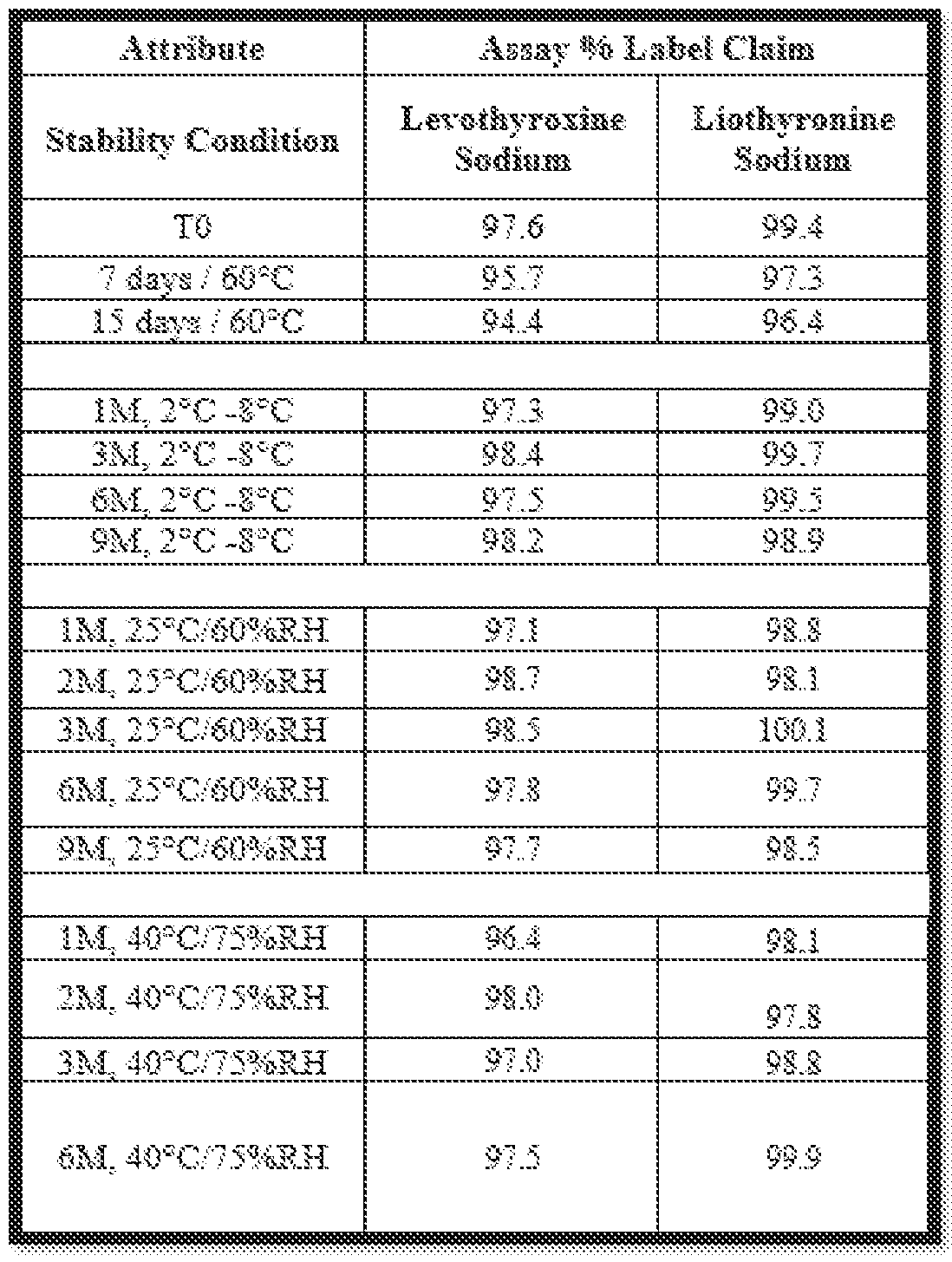


Claims
Priority Applications (1)
| Application Number | Priority Date | Filing Date | Title |
|---|---|---|---|
| CN202480038343.9A CN121311223A (en) | 2023-06-07 | 2024-03-11 | Oral solid dosage forms of drugs including iodine salt and levothyroxine salt, and their manufacturing and administration methods. |
Applications Claiming Priority (2)
| Application Number | Priority Date | Filing Date | Title |
|---|---|---|---|
| US202363506778P | 2023-06-07 | 2023-06-07 | |
| US63/506,778 | 2023-06-07 |
Publications (1)
| Publication Number | Publication Date |
|---|---|
| WO2024253724A1 true WO2024253724A1 (en) | 2024-12-12 |
Family
ID=93796373
Family Applications (1)
| Application Number | Title | Priority Date | Filing Date |
|---|---|---|---|
| PCT/US2024/019414 Ceased WO2024253724A1 (en) | 2023-06-07 | 2024-03-11 | Pharmaceutical oral solid dosage forms including liothyronine and levothyroxine salts and methods of making and using the same |
Country Status (2)
| Country | Link |
|---|---|
| CN (1) | CN121311223A (en) |
| WO (1) | WO2024253724A1 (en) |
Citations (3)
| Publication number | Priority date | Publication date | Assignee | Title |
|---|---|---|---|---|
| US6555581B1 (en) * | 2001-02-15 | 2003-04-29 | Jones Pharma, Inc. | Levothyroxine compositions and methods |
| US20170304246A1 (en) * | 2012-08-20 | 2017-10-26 | Merck Patent Gmbh | Solid pharmaceutical preparation containing levothyroxine |
| US10231931B1 (en) * | 2018-03-23 | 2019-03-19 | Genus Lifesciences Inc. | Thyroid hormone oral dosage forms and methods of using the same |
-
2024
- 2024-03-11 WO PCT/US2024/019414 patent/WO2024253724A1/en not_active Ceased
- 2024-03-11 CN CN202480038343.9A patent/CN121311223A/en active Pending
Patent Citations (3)
| Publication number | Priority date | Publication date | Assignee | Title |
|---|---|---|---|---|
| US6555581B1 (en) * | 2001-02-15 | 2003-04-29 | Jones Pharma, Inc. | Levothyroxine compositions and methods |
| US20170304246A1 (en) * | 2012-08-20 | 2017-10-26 | Merck Patent Gmbh | Solid pharmaceutical preparation containing levothyroxine |
| US10231931B1 (en) * | 2018-03-23 | 2019-03-19 | Genus Lifesciences Inc. | Thyroid hormone oral dosage forms and methods of using the same |
Also Published As
| Publication number | Publication date |
|---|---|
| CN121311223A (en) | 2026-01-09 |
Similar Documents
| Publication | Publication Date | Title |
|---|---|---|
| EP0312581B1 (en) | Pharmaceutical sustained release matrix and process | |
| KR960005706B1 (en) | Oral sustained-release acetaminophen formulations and preparation method thereof | |
| AU2001260212C1 (en) | Composition | |
| RU2355386C2 (en) | Complex medical form with controlled release for peroral introduction of medication against diabetes and method of obtainig it | |
| JP2011501736A (en) | Combination drug packaging for oral administration | |
| AU2003261560A1 (en) | Solid Oral Dosage Form Comprising a Combination of Metformin and Glibenclamide | |
| US12274790B1 (en) | Thyroid hormone oral dosage forms and methods of using the same | |
| EP3087975A1 (en) | Treatment with vildagliptin | |
| EP2538924B1 (en) | Solid pharmaceutical formulations of ramipril and amlodipine besylate, and their preparation | |
| RU2279273C2 (en) | Tablet preparing by direct pressing and comprising 4-amino-1-hydroxybutylidene-1,1-bisphosphonic acid as active component | |
| EP1353650A2 (en) | Process for preparing non-hygroscopic sodium valproate composition | |
| AU2014295098B2 (en) | Anti-tuberculosis stable pharmaceutical composition in a form of a coated tablet comprising granules of isoniazid and granules of rifapentine and its process of preparation | |
| CA2423572C (en) | Stabilization of solid thyroid drug formulations | |
| WO2024253724A1 (en) | Pharmaceutical oral solid dosage forms including liothyronine and levothyroxine salts and methods of making and using the same | |
| EP4662229A2 (en) | Solid dosage forms including porcine thyroid powder and methods of making and using the same | |
| Srinivas et al. | Formulation and evaluation of ibuprofen pulsin cap technique for controlled release | |
| RU2079301C1 (en) | Method of regulated active substance release from composition | |
| RS49962B (en) | Oral compositions that control the release of LEVOSIMENDAN | |
| CN121335697A (en) | This includes oral solid dosage forms of phenobarbital and their manufacturing and usage methods. | |
| WO2026053141A1 (en) | Composition comprising dapagliflozin and sitagliptin, and method of preparation thereof | |
| Rasheed et al. | Formulation of controlled release drug delivery of Lornoxicam | |
| Seshadri et al. | Formulation and evaluation of pulsatile delivery system of zolpidem tartrate | |
| Pati et al. | Formulation and Evaluation of Press-Coated Tablets of Tramadol | |
| NO175185B (en) | ||
| HK1053601B (en) | Pharmaceutical composition for the controlled release of paracetamol |
Legal Events
| Date | Code | Title | Description |
|---|---|---|---|
| 121 | Ep: the epo has been informed by wipo that ep was designated in this application |
Ref document number: 24819733 Country of ref document: EP Kind code of ref document: A1 |
|
| WWE | Wipo information: entry into national phase |
Ref document number: 2024819733 Country of ref document: EP |
|
| NENP | Non-entry into the national phase |
Ref country code: DE |
|
| ENP | Entry into the national phase |
Ref document number: 2024819733 Country of ref document: EP Effective date: 20260107 |
|
| ENP | Entry into the national phase |
Ref document number: 2024819733 Country of ref document: EP Effective date: 20260107 |
|
| ENP | Entry into the national phase |
Ref document number: 2024819733 Country of ref document: EP Effective date: 20260107 |
|
| ENP | Entry into the national phase |
Ref document number: 2024819733 Country of ref document: EP Effective date: 20260107 |
|
| ENP | Entry into the national phase |
Ref document number: 2024819733 Country of ref document: EP Effective date: 20260107 |