WO2024254008A1 - Natural killer cells with gene knock-ins using promoters that do not affect ipsc plueropotency and uses thereof - Google Patents
Natural killer cells with gene knock-ins using promoters that do not affect ipsc plueropotency and uses thereof Download PDFInfo
- Publication number
- WO2024254008A1 WO2024254008A1 PCT/US2024/032303 US2024032303W WO2024254008A1 WO 2024254008 A1 WO2024254008 A1 WO 2024254008A1 US 2024032303 W US2024032303 W US 2024032303W WO 2024254008 A1 WO2024254008 A1 WO 2024254008A1
- Authority
- WO
- WIPO (PCT)
- Prior art keywords
- cells
- promoter
- ipscs
- cell
- construct
- Prior art date
- Legal status (The legal status is an assumption and is not a legal conclusion. Google has not performed a legal analysis and makes no representation as to the accuracy of the status listed.)
- Ceased
Links
Classifications
-
- A—HUMAN NECESSITIES
- A61—MEDICAL OR VETERINARY SCIENCE; HYGIENE
- A61P—SPECIFIC THERAPEUTIC ACTIVITY OF CHEMICAL COMPOUNDS OR MEDICINAL PREPARATIONS
- A61P35/00—Antineoplastic agents
-
- A—HUMAN NECESSITIES
- A61—MEDICAL OR VETERINARY SCIENCE; HYGIENE
- A61K—PREPARATIONS FOR MEDICAL, DENTAL OR TOILETRY PURPOSES
- A61K40/00—Cellular immunotherapy
- A61K40/10—Cellular immunotherapy characterised by the cell type used
- A61K40/15—Natural-killer [NK] cells; Natural-killer T [NKT] cells
-
- A—HUMAN NECESSITIES
- A61—MEDICAL OR VETERINARY SCIENCE; HYGIENE
- A61K—PREPARATIONS FOR MEDICAL, DENTAL OR TOILETRY PURPOSES
- A61K40/00—Cellular immunotherapy
- A61K40/30—Cellular immunotherapy characterised by the recombinant expression of specific molecules in the cells of the immune system
- A61K40/35—Cytokines
-
- A—HUMAN NECESSITIES
- A61—MEDICAL OR VETERINARY SCIENCE; HYGIENE
- A61K—PREPARATIONS FOR MEDICAL, DENTAL OR TOILETRY PURPOSES
- A61K45/00—Medicinal preparations containing active ingredients not provided for in groups A61K31/00 - A61K41/00
- A61K45/06—Mixtures of active ingredients without chemical characterisation, e.g. antiphlogistics and cardiaca
-
- C—CHEMISTRY; METALLURGY
- C07—ORGANIC CHEMISTRY
- C07K—PEPTIDES
- C07K14/00—Peptides having more than 20 amino acids; Gastrins; Somatostatins; Melanotropins; Derivatives thereof
- C07K14/435—Peptides having more than 20 amino acids; Gastrins; Somatostatins; Melanotropins; Derivatives thereof from animals; from humans
- C07K14/52—Cytokines; Lymphokines; Interferons
- C07K14/54—Interleukins [IL]
- C07K14/5443—IL-15
-
- C—CHEMISTRY; METALLURGY
- C12—BIOCHEMISTRY; BEER; SPIRITS; WINE; VINEGAR; MICROBIOLOGY; ENZYMOLOGY; MUTATION OR GENETIC ENGINEERING
- C12N—MICROORGANISMS OR ENZYMES; COMPOSITIONS THEREOF; PROPAGATING, PRESERVING, OR MAINTAINING MICROORGANISMS; MUTATION OR GENETIC ENGINEERING; CULTURE MEDIA
- C12N5/00—Undifferentiated human, animal or plant cells, e.g. cell lines; Tissues; Cultivation or maintenance thereof; Culture media therefor
- C12N5/06—Animal cells or tissues; Human cells or tissues
- C12N5/0602—Vertebrate cells
- C12N5/0634—Cells from the blood or the immune system
- C12N5/0646—Natural killers cells [NK], NKT cells
-
- C—CHEMISTRY; METALLURGY
- C12—BIOCHEMISTRY; BEER; SPIRITS; WINE; VINEGAR; MICROBIOLOGY; ENZYMOLOGY; MUTATION OR GENETIC ENGINEERING
- C12N—MICROORGANISMS OR ENZYMES; COMPOSITIONS THEREOF; PROPAGATING, PRESERVING, OR MAINTAINING MICROORGANISMS; MUTATION OR GENETIC ENGINEERING; CULTURE MEDIA
- C12N5/00—Undifferentiated human, animal or plant cells, e.g. cell lines; Tissues; Cultivation or maintenance thereof; Culture media therefor
- C12N5/06—Animal cells or tissues; Human cells or tissues
- C12N5/0602—Vertebrate cells
- C12N5/0696—Artificially induced pluripotent stem cells, e.g. iPS
-
- C—CHEMISTRY; METALLURGY
- C12—BIOCHEMISTRY; BEER; SPIRITS; WINE; VINEGAR; MICROBIOLOGY; ENZYMOLOGY; MUTATION OR GENETIC ENGINEERING
- C12N—MICROORGANISMS OR ENZYMES; COMPOSITIONS THEREOF; PROPAGATING, PRESERVING, OR MAINTAINING MICROORGANISMS; MUTATION OR GENETIC ENGINEERING; CULTURE MEDIA
- C12N9/00—Enzymes; Proenzymes; Compositions thereof; Processes for preparing, activating, inhibiting, separating or purifying enzymes
- C12N9/14—Hydrolases (3)
- C12N9/16—Hydrolases (3) acting on ester bonds (3.1)
- C12N9/22—Ribonucleases [RNase]; Deoxyribonucleases [DNase]
-
- A—HUMAN NECESSITIES
- A61—MEDICAL OR VETERINARY SCIENCE; HYGIENE
- A61K—PREPARATIONS FOR MEDICAL, DENTAL OR TOILETRY PURPOSES
- A61K35/00—Medicinal preparations containing materials or reaction products thereof with undetermined constitution
- A61K35/12—Materials from mammals; Compositions comprising non-specified tissues or cells; Compositions comprising non-embryonic stem cells; Genetically modified cells
- A61K35/14—Blood; Artificial blood
- A61K35/17—Lymphocytes; B-cells; T-cells; Natural killer cells; Interferon-activated or cytokine-activated lymphocytes
-
- C—CHEMISTRY; METALLURGY
- C07—ORGANIC CHEMISTRY
- C07K—PEPTIDES
- C07K16/00—Immunoglobulins [IG], e.g. monoclonal or polyclonal antibodies
- C07K16/18—Immunoglobulins [IG], e.g. monoclonal or polyclonal antibodies against material from animals or humans
- C07K16/28—Immunoglobulins [IG], e.g. monoclonal or polyclonal antibodies against material from animals or humans against receptors, cell surface antigens or cell surface determinants
- C07K16/2803—Immunoglobulins [IG], e.g. monoclonal or polyclonal antibodies against material from animals or humans against receptors, cell surface antigens or cell surface determinants against the immunoglobulin superfamily
- C07K16/2818—Immunoglobulins [IG], e.g. monoclonal or polyclonal antibodies against material from animals or humans against receptors, cell surface antigens or cell surface determinants against the immunoglobulin superfamily against CD28 or CD152
-
- C—CHEMISTRY; METALLURGY
- C07—ORGANIC CHEMISTRY
- C07K—PEPTIDES
- C07K16/00—Immunoglobulins [IG], e.g. monoclonal or polyclonal antibodies
- C07K16/18—Immunoglobulins [IG], e.g. monoclonal or polyclonal antibodies against material from animals or humans
- C07K16/28—Immunoglobulins [IG], e.g. monoclonal or polyclonal antibodies against material from animals or humans against receptors, cell surface antigens or cell surface determinants
- C07K16/2803—Immunoglobulins [IG], e.g. monoclonal or polyclonal antibodies against material from animals or humans against receptors, cell surface antigens or cell surface determinants against the immunoglobulin superfamily
- C07K16/2827—Immunoglobulins [IG], e.g. monoclonal or polyclonal antibodies against material from animals or humans against receptors, cell surface antigens or cell surface determinants against the immunoglobulin superfamily against B7 molecules, e.g. CD80, CD86
-
- C—CHEMISTRY; METALLURGY
- C12—BIOCHEMISTRY; BEER; SPIRITS; WINE; VINEGAR; MICROBIOLOGY; ENZYMOLOGY; MUTATION OR GENETIC ENGINEERING
- C12N—MICROORGANISMS OR ENZYMES; COMPOSITIONS THEREOF; PROPAGATING, PRESERVING, OR MAINTAINING MICROORGANISMS; MUTATION OR GENETIC ENGINEERING; CULTURE MEDIA
- C12N2506/00—Differentiation of animal cells from one lineage to another; Differentiation of pluripotent cells
- C12N2506/45—Differentiation of animal cells from one lineage to another; Differentiation of pluripotent cells from artificially induced pluripotent stem cells
-
- C—CHEMISTRY; METALLURGY
- C12—BIOCHEMISTRY; BEER; SPIRITS; WINE; VINEGAR; MICROBIOLOGY; ENZYMOLOGY; MUTATION OR GENETIC ENGINEERING
- C12N—MICROORGANISMS OR ENZYMES; COMPOSITIONS THEREOF; PROPAGATING, PRESERVING, OR MAINTAINING MICROORGANISMS; MUTATION OR GENETIC ENGINEERING; CULTURE MEDIA
- C12N2510/00—Genetically modified cells
Definitions
- the present disclosure provides a cell population comprising induced pluripotent stem cells (iPSCs) or cells differentiated from such iPSCs, wherein the iPSCs or cells differentiated from the iPSCs comprise a knock-in of a construct comprising a endogenous or exogenous promoter that is not active or minimally active (e.g., ⁇ 10% of its full activity) in iPSCs but becomes active during or after differentiation of iPSCs that is operably linked to sequences encoding one or more genes or functional fragments thereof.
- the iPSCs or cells differentiated from the iPSCs cells can be used to treat cancer or autoimmune diseases in a subject.
- Lymphocytes such as natural killer (NK) cells are potent anti-tumor effectors that play an important role in innate and adaptive immunity.
- NK cells There are several activating receptors found on NK cells, including NKp30, NKp44, and NKp46, which are collectively known as Natural Cytotoxicity Receptors (NCRs), as well as NKG2D, CD 16 and TRAIL.
- NCRs Natural Cytotoxicity Receptors
- NKp46 is an established marker for the identification of NK cells.
- NKp46 is an NK cell specific triggering molecule found on both resting and activated NK cells. It is an important mediator in NK cell activation against numerous targets, including tumors and virally infected cells.
- NK cells are a subpopulation of lymphocytes that have spontaneous cytotoxicity against a variety of tumor cells, virus-infected cells, and some normal cells in the bone marrow and thymus.
- NK cells are critical effectors of the early innate immune response toward transformed and virus-infected cells.
- NK cells constitute about 10% of the lymphocytes in human peripheral blood.
- NK cells are effector cells known as large granular lymphocytes because of their larger size and the presence of characteristic azurophilic granules in their cytoplasm.
- NK cells differentiate and mature in the bone marrow, lymph nodes, spleen, tonsils, and thymus.
- NK cells can be detected by specific surface markers, such as CD56 and CD45 in humans.
- NK cells do not express T cell antigen receptors, the pan T marker CD3, or surface immunoglobulin B cell receptors.
- Activated NK cells can also secrete type I cytokines, such as interferon-y, tumor necrosis factor-a and granulocyte-macrophage colony-stimulating factor (GM-CSF), which activate both innate and adaptive immune cells as well as other cytokines and chemokines (Wu and Lanier, Adv Cancer Res. 2003; 90:127-56).
- GM-CSF granulocyte-macrophage colony-stimulating factor
- Production of these soluble factors by NK cells in early innate immune responses significantly influences the recruitment and function of other hematopoietic cells.
- NK cells are central players in a regulatory crosstalk network with dendritic cells and neutrophils to promote or restrain immune responses.
- NK cells have several characteristics which make them advantageous to use in therapeutic settings. For example, they do not require antigen priming and they are HLA agnostic, which decreases the risk of developing Graft vs. Host Disease in allogeneic use. Nonetheless, the use of immune cells for adoptive cell therapies remains challenging and there are unmet needs for improvement. There are significant opportunities that remain to harness the full potential of NK cells in adoptive immunotherapy.
- iPSC induced pluripotent stem cells
- iPSCs as a starting material can minimize the donor- to-donor and batch-to-batch variations.
- the biggest advantage of the iPSC-derived approach is in gene-editing. This is because, with the iPSC-derived approach, the gene-editing is performed at the iPSC level with a small number of cells, followed by screening for gene-edited iPSC single cell clones with rigorous characterizations.
- a master cell bank (MCB) of the clone will be produced to serve as the source of starting material for subsequent differentiation and expansion. Therefore, with an iPSC-derived approach, gene-editing is a one-time event for each edited product. More importantly, with an iPSC-derived approach, the final edited immune cell product is homogeneously gene-edited and therefore is consistent throughout the development cycle since all the edited immune cells are derived from a single iPSC clone. This advantage of the iPSC-derived approach amplifies when multiple rounds of gene-editing are needed.
- a cell population comprising induced pluripotent stem cells (iPSCs) or cells differentiated from such iPSCs, wherein the iPSCs or cells differentiated from the iPSCs comprise a knock-in of a construct comprising a promoter operably linked to sequences encoding one or more genes or functional fragments thereof, wherein the promoter is not active or minimally active (e.g., ⁇ 10% of its full activity) in iPSCs but becomes active during or after differentiation of the iPSCs.
- the promoter can be an exogenous or endogenous promoter.
- the cells differentiated from the iPSCs are immune cells.
- the immune cells comprise a knock-in construct comprising a promoter specific to the immune cells.
- the immune cells are NK cells.
- the NK cells comprise a knock-in construct comprising a NK cell-specific promoter, for example, a NKp46 promoter or a B2M promoter.
- the cells differentiated from the iPSCs are neuron cells.
- the neuron cells comprise a knock-in construct comprising a promoter specific to neuron cells.
- the cells differentiated from the iPSCs are cardiomyocytes.
- the cardiomyocytes comprise a knock-in construct comprising a promoter specific to cardiomyocytes.
- the cells differentiated from the iPSCs are hepatocytes.
- the hepatocytes comprise a knock-in construct comprising a promoter specific to hepatocytes.
- the cells differentiated from the iPSCs are endothelial cells.
- the endothelial cells comprise a knock-in construct comprising a promoter specific to endothelial cells.
- a method of producing a cell population comprising cells differentiated from induced pluripotent stem cells (iPSCs), the method comprising (i) genetically editing a population of iPSCs with a construct as disclosed herein, wherein the construct comprises a promoter operably linked to sequences encoding one or more genes or functional fragments thereof, wherein the promoter is not active or minimally active (e.g., ⁇ 10% of its full activity) in iPSCs but becomes active during or after differentiation of iPSCs into a specific cell type; (ii) generating a monoclonal population of edited iPSCs; and (iii) differentiating the edited iPSCs into a population of desired specific cell type.
- iPSCs induced pluripotent stem cells
- the promoter can be an exogenous or endogenous promoter.
- the promoter is active in the cells differentiated from the iPSCs.
- the cells differentiated from the iPSCs are immune cells, neurons, cardiomyocytes, hepatocytes, or endothelial cells.
- the immune cells are NK cells.
- the NK cells comprise a construct comprising a NK-cell specific promoter, for example, a NKp46 promoter or a B2M promoter.
- the present disclosure includes a cell population produced by the above method.
- composition comprising the cell population disclosed herein.
- Figure 1 shows a map of donor 107 plasmid.
- Figure 2 shows a map of donor 107ER plasmid.
- Figure 3 shows a map of donor 108 plasmid.
- Figure 4 shows a map of donor 108B2M plasmid.
- Figure 5 shows a map of donor 115 plasmid.
- Figure 6 shows a map of donor 109 plasmid.
- Figure 7 shows a map of donor 109B2M plasmid.
- Figures 9A-9C show expression of a knock-in construct in an edited iPSC clone.
- Figure 9A shows a map of the knock-in construct donor 109 plasmid. Soluble IL- 15 under the control of the NKp46 promoter can be detected by ELISA in the supernatant of edited iNK cells expressing the knock-in construct on day 7 ( Figure 9B) and day 21 ( Figure 9C).
- Clone #648 is a bi-knock- in clone carrying the 109 plasmid: RHA(TGFbR2)-Promoter(NKp46)-IL15Ra(codon opt)-P2A- IL15-bGHpA-LHA(TGFbR2).
- Figure 10 shows results of pluripotency assay for edited iPSC clones.
- Figure 11 shows results of karyotyping results for #107-12 iPSC clone.
- Figure 12 shows results of karyotyping results for #584 iPSC clone.
- Figure 13 shows results of karyotyping results for #600 iPSC clone.
- Figure 14 shows results of karyotyping results for #648 iPSC clone.
- Figure 15 shows results of karyotyping results for #859 iPSC clone.
- Figure 16 shows results of karyotyping results for #863 iPSC clone.
- Figure 17 shows results of karyotyping results for #902 iPSC clone.
- Figure 18 shows results of karyotyping results for #975 iPSC clone.
- Figure 19A shows a map of a knock-in construct that uses the endogenous B2M promoter to drive the expression of soluble IL- 15.
- Figure 19B shows soluble IL- 15 levels were measured by ELISA at 24 hours and 72 hours for WT iNKs and edited ILI 5 +/+ /TGFpR2- / ’ iNK cells expressing the knock-in construct.
- Enzymatic reactions and purification techniques are performed according to manufacturer's specifications or as commonly accomplished in the art or as described herein.
- the foregoing techniques and procedures are generally performed according to conventional methods well-known in the art and as described in various general and more specific references that are cited and discussed throughout the present specification. See e.g., Sambrook et al. Molecular Cloning: A Laboratory Manual (2d ed., Cold Spring Harbor Laboratory Press, Cold Spring Harbor, N.Y. (1989)).
- the nomenclatures utilized in connection with, and the laboratory procedures and techniques of, analytical chemistry, synthetic organic chemistry, and medicinal and pharmaceutical chemistry described herein are those well- known and commonly used in the art.
- Standard techniques are used for chemical syntheses, chemical analyses, pharmaceutical preparation, formulation, and delivery, and treatment of patients.
- the materials, methods, and examples disclosed herein are for illustrative purpose only and are not intended to be necessarily limiting. Each literature reference or other citation referred to herein is incorporated herein by reference in its entirety.
- a cell includes a plurality of cells, including mixtures thereof.
- the present disclosure provides a cell population comprising induced pluripotent stem cells (iPSCs) or cells differentiated from such iPSCs, wherein the iPSCs or cells differentiated from the iPSCs comprise a knock-in of a construct comprising a promoter operably linked to sequences encoding one or more genes or functional fragments thereof, wherein the promoter is not active or minimally active (e.g., ⁇ 10% of its full activity) in iPSCs but becomes active during or after differentiation of the iPSCs.
- the promoter can be an exogenous or endogenous promoter.
- the promoter can be expressed in common progenitor/precursor cells during stem cell differentiation, or expressed in many different cell types after differentiation, or can be cell-type specific.
- promoters include, but are not limited to, NKp46 that is active in NK cells; CD3y promoter that is active in T cells; CD 19 promoter for B cells; VEGFR promoter and ICAM1 promoter that are active in endothelial cells; B2M promoter that is active in many different cells types; IL2R[3 promoter that is active in many immune cells; Netin promoter, Sox 2 promoter, Olig 1 promoter, Olig 2 promoter, Olig3 promoter, MBP promoter, OSP promoter, MOG promoter, or Sox 10 promoter that is active in neural cells; Sca-1 promoter, CD27 promoter, CD34 promoter, CD38 promoter, CD43 promoter, CD48 promoter, CD117 promoter, or CD 150 promoter that is active in hematopoietic progenitor cells; IL
- the present disclosure provides modified Natural Killer (iNK) cells differentiated from induced pluripotent stem cells (iPSCs), wherein the iNK cells comprise a knock-in of a construct comprising a promoter that is not active or minimally active (e.g., ⁇ 10% of its full activity) in iPSCs but becomes active during differentiation of iPSCs, and the promoter is operably linked to sequences encoding one or more genes or functional fragments thereof. Examples of these promoters are described herein.
- the construct comprises sequences encoding IL- 15 or a functional fragment thereof and IL-2R0 or a functional fragment thereof.
- a cell population comprising differentiated cells derived from induced pluripotent stem cells (iPSCs), wherein the differentiated cells having a Natural Killer cell phenotype,
- iPSCs induced pluripotent stem cells
- iNK cells Natural Killer cell phenotype
- any suitable source of iPSC may be used to generate the iPSC-NK cells provided herein.
- a method of producing a cell population comprising iPSC-NK cells, wherein the iPSC-NK cells express novel IL-15 constructs as disclosed herein comprising (i) genetically editing a population of induced pluripotent stem cells (iPSCs); (ii) differentiating said population of iPSCs into a population of Natural Killer (NK) cells: and (iii) expanding the population of NK cells.
- iPSCs induced pluripotent stem cells
- NK Natural Killer
- iPSC may be produced by reprogramming somatic cells to induce pluripotency.
- the reprogramming involves the activation of pluripotency genes and repression of somatic genes.
- this process includes the expression of certain transcription factors in the somatic cells, in particular Octamer 3/4 (Oct3/4), SRY-box containing gene 2 (Sox2), Kriippel-like factor 4 (Klf4), and the protooncogene cytoplasmic Myc protein (c-Myc) (see Takahashi and Yamanaka, Cell 126:663-676).
- the delivery of these transcription factors into the somatic cells can be accomplished by any suitable method known in the art, for example, using viral vectors, mRNA transfection, or delivery of recombinant proteins (see, e.g., Chang et al., 2019, I Korean Neurosurg Soc.62(5):493-501).
- small molecules targeting cell signaling pathways, metabolic pathways, and epigenetic modifications may be used to induce pluripotency and reprogram somatic cells into iPSCs.
- repression of DNA methylation, activation of Wnt signaling, activation of MAPK/ERK signaling, and induction of glycolytic metabolism have been described as mechanisms to aid in reprogramming.
- Such small molecules include, for example, Gs l 3[3 inhibitors, transforming growth factor P ( TGF[3 ) inhibitors, TGFR inhibitors, MEK inhibitors, AMPK inhibitors, mTOR inhibitors, VEGF inhibitors, Wnt activators, cAMP activators, retinoic acid receptor (RAR) a agonists, RAR y agonists, pyruvate dehydrogenase kinase, isozyme 1 (PDK-1) activators, HMT inhibitors, DNMT inhibitors, KDM inhibitors, HDAC inhibitors, and others.
- TGF[3 ) inhibitors transforming growth factor P ( TGF[3 ) inhibitors, TGFR inhibitors, MEK inhibitors, AMPK inhibitors, mTOR inhibitors, VEGF inhibitors, Wnt activators, cAMP activators, retinoic acid receptor (RAR) a agonists, RAR y agonists, pyruvate dehydrogenase
- the iPSC-NK cells provided herein may be cultured under any suitable conditions described herein or known in the art.
- the NK cells are cultured on a feeder layer, i.e., in co-culture with another cell line. Such co-cultures can be effective in inducing proliferation in cell types that otherwise proliferate very slowly or not at all.
- a feeder layer that is capable of inducing proliferation of iPSC-NK cells.
- a feeder layer that is capable of activating iPSC-NK cells.
- Examples of feeder layers that may be used for the culture of NK cells provided herein include, without limitation, K562 cells and 221 cells.
- the feeder layer cells may be genetically modified, e.g. , the feeder layer cells may be transduced with IL- 15, IL21 and/or 4-1-BB. Prior to being used in the co-culture, the feeder layer cells may be irradiated with doses sufficient to induce cell cycle arrest, such that the feeder layer cells do not proliferate in the coculture.
- NK cell marker such as CD56 and/or CD45.
- the iNK cells comprise a construct comprising sequences encoding IL- 15 or a functional fragment thereof. In one embodiment, the iNK cells comprise a construct comprising sequences encoding IL-2R0 or a functional fragment thereof. In one embodiment, the iNK cells comprise a construct comprising sequences encoding IL- 15 or a functional fragment thereof and IL-2R0 or a functional fragment thereof. In one embodiment, the IL- 15 encoded by the construct is a cell membrane-bound form of IL- 15 (mbIL-15) or a functional fragment thereof. In another embodiment, the IL- 15 encoded by the construct is a soluble form of IL- 15 or a functional fragment thereof.
- the IL- 15 encoded by the construct is an IL- 15 trapped in the endoplasmic reticulum or a functional fragment thereof.
- the construct encodes a fusion protein comprising IL- 15 or a functional fragment thereof and IL-2R0 or a functional fragment thereof.
- the IL- 15 or a functional fragment thereof and IL-2RP or a functional fragment thereof are expressed as individual proteins.
- the construct further comprises sequences encoding IL- 15 Receptor alpha (IL-15Ra) or a functional fragment thereof. Accordingly, in one embodiment, the construct encodes a fusion protein comprising IL- 15 or a functional fragment thereof, IL-2R0 or a functional fragment thereof, and IL-15Ra or a functional fragment thereof. In another embodiment, the IL- 15 or a functional fragment thereof, IL-2R[3 or a functional fragment thereof, and IL-15Ra or a functional fragment thereof are expressed as individual proteins.
- the iPSC-NK cells provided herein cells are genetically modified by introducing (“integrating” or “knocking in”) or deleting (“knocking out”) one or more genes.
- knocking out or integrating genes of interest involved in NK cell exhaustion, activation, tolerance, and/or memory are thought to improve the clinical utility of the iPSC-NKs provided herein.
- the polynucleotide encoding the knocked-in gene is introduced in such a way that the polynucleotide is operatively linked to a promoter.
- operably linked refers to positions of components so described are in a relationship permitting them to function in their intended manner.
- a control sequence “operably linked” to a coding sequence is ligated in such a way that expression of the coding sequence is achieved under conditions compatible with the control sequences.
- the genetic modification of the iPSC-NK cells provided herein may be achieved by any suitable method known in the art or described herein.
- the genome of the iPSC-NK cells provided herein may be modified by introducing DNA double strand breaks, which are then repaired by the cell’s endogenous repair mechanisms, such as homologous recombination.
- DNA double strand breaks may be introduced using targeted endonucleases, such as Zinc-finger nucleases, transcription activation-like effector-nucleases (TALENs), meganucleases, or the CRISPR/Cas system, which relies on the Cas9 endonuclease for inducing the DNA breaks and a guide RNA (gRNA) for site-specificity.
- targeted endonucleases such as Zinc-finger nucleases, transcription activation-like effector-nucleases (TALENs), meganucleases, or the CRISPR/Cas system, which relies on the Cas9 endonuclease for inducing the DNA breaks and a guide RNA (gRNA) for site-specificity.
- gRNA guide RNA
- DualaseTM platform may be used to edit the iPSC cells described herein.
- the DualaseTM is a gene editing technology which cuts DNA twice and leaves non-compatible DNA ends, which is hypothesized to lead to higher fidelity repair than non-compatible ends.
- TALENs employ a bacterial DNA cleavage domain and specifically bind DNA via highly conserved 33-35 amino acid TALE repeats which resemble the DNA-binding domains of transcription factors.
- the TALE repeats each bind a single base pair of DNA.
- the specificity of TALEN DNA binding is dictated by two hypervariable residues.
- Multiple modular TALE repeats can be linked together into a longer array with custom DNA-binding specificities. See e.g., Maeder and Gersbach, 2016, Mol Ther.24(3): 430-446; Carrol, 2017, Yale J Biol Med 90:653-659.
- Methods for designing TALEN sequences targeting a desired locus are well known in the art and described in, e.g., Cermak el al., Nucleic Acids Res.2011 Jul;39(12):e82.
- Cas-based DNA editing systems are well known in the art. Any suitable Cas enzyme can be used to edit the iPSC-NK cells described herein, including, without limitation, Cas9 and Cas 12.
- the polynucleotide encoding the knocked-in gene is introduced in such a way that the polynucleotide is operatively linked to a promoter.
- the term “operably linked” as used herein refers to positions of components so described that are in a relationship permitting them to function in their intended manner.
- a control sequence “operably linked” to a coding sequence is ligated in such a way that expression of the coding sequence is achieved under conditions compatible with the control sequences.
- control sequence refers to polynucleotide sequences which are necessary to affect the expression and processing of coding sequences to which they are ligated. The nature of such control sequences differs depending upon the host organism. In prokaryotes, such control sequences generally include promoter, ribosomal binding site, and transcription termination sequence. In eukaryotes, generally, such control sequences include promoters and transcription termination sequence.
- control sequences is intended to include, at a minimum, all components whose presence is essential for expression and processing, and can also include additional components whose presence is advantageous, for example, leader sequences and fusion partner sequences.
- polynucleotide as referred to herein means a polymeric boron of nucleotides of at least 10 bases in length, either ribonucleotides or deoxynucleotides or a modified form of either type of nucleotide.
- the term includes single and double stranded forms of DNA.
- IL- 15 isoforms of IL- 15 are known in the art and may be used in the iPSC-NK cells provided herein.
- Exemplary sequences of IL- 15 isoforms are known in the art, e.g. , SEQ ID NOs: 1- 2.
- an iPSC-NK cells provided herein expresses a polypeptide comprising the sequence of human IL-15 isoform S48AA (SEQ ID NO:1).
- an iPSC- NK cells provided herein expresses a polypeptide comprising a sequence that is at least 70%, at least 75%, at least 80%, at least 85%, at least 90%, at least 95%, or at least 98% identical to the sequence of SEQ ID NO:1.
- an iPSC-NK cells provided herein expresses a polypeptide comprising the sequence of human IL- 15 isoform S21AA (SEQ ID NO:2).
- an iPSC-NK cells expresses a polypeptide comprising a sequence that is at least 70%, at least 75%, at least 80%, at least 85%, at least 90%, at least 95%, or at least 98% identical to the sequence of SEQ ID NO:2.
- an iPSC-NK cells provided herein comprises a polynucleotide encoding a sequence that is at least 70%, at least 75%, at least 80%, at least 85%, at least 90%, at least 95%, or at least 98% identical to the amino acid sequences of SEQ ID NO:2.
- the IL- 15 or functional fragment thereof may be a membrane bound form of IL-15 (mbIL-15) or a functional fragment thereof.
- Expression of a membrane-bound form of IL- 15 may be achieved by expressing a nucleic acid encoding a soluble form of IL- 15 (e.g., SEQ ID NO:41) as a fusion protein with the hinge and transmembrane domains of CD8.
- SEQ ID NO:41 a nucleic acid encoding a soluble form of IL- 15
- An illustrative nucleic acid sequence encoding the hinge and transmembrane domains of CD8 is set forth in SEQ ID NO:46.
- the IL- 15 or functional fragment thereof may be a form of IL- 15 that is trapped in the endoplasmic reticulum (ER). This may be achieved by, for example, expressing a polynucleotide encoding IL-15 or a functional fragment thereof (e.g., SEQ ID NO:41) as a fusion protein with an ER retention signal.
- ER retention signal sequence is set forth as SEQ ID NO:54.
- the IL- 15 or functional fragment thereof may be a form of IL- 15 (e.g., a membrane-bound form of IL-15, a soluble form of IL-15, or an ER-trapped form of IL-15) or functional fragment thereof fused to the IL- 15 receptor alpha (IL-15Ra).
- IL-15Ra IL- 15 receptor alpha
- This may be accomplished by expressing the IL- 15 or functional fragment thereof as a fusion protein with IL- 15Ra.
- An illustrative nucleic acid sequence encoding IL-15Ra is set forth in SEQ ID NO:43.
- the iPSC-NK cells provided herein are modified by knocking in an IL-15 construct encoding IL-2R[3 or a functional fragment thereof, and interleukin 15 (IL- 15) or a functional fragment thereof.
- the IL- 15 can be in a soluble form, a membrane-bound form, or an ER-trapped form.
- the IL- 15 construct disclosed herein may be knocked into the iPSC-NK cell genome at any suitable position.
- the IL- 15 construct comprises sequences encoding IL- 15, IL-15Ra and IL-2Rp.
- the integration locus is the B2M locus.
- the integration locus is the CD38 locus.
- the integration locus is the TGFPR2 locus.
- An illustrative gene editing strategy for a non-disruptive knock-in of IL-15 into the B2M locus is shown in FIG. 2A of WO 2023/060136.
- An illustrative gene editing strategy for a disruptive knock-in of IL- 15 into the TGF[3R2 locus is shown in FIG. 2B of WO 2023/060136.
- Exemplary gRNAs that may be used for the knock-in of the IL- 15 construct at the B2M locus are shown in SEQ ID NOs:3-4.
- nucleic acid donor constructs that may be used to deliver the IL- 15 construct disclosed herein to a target site in the genome.
- Illustrative donor sequences that may be used to insert the IL- 15 construct into a cell are set forth in SEQ ID NOs:27- 38.
- a construct that may be used to deliver the IL- 15 construct disclosed herein to a target site comprises a nucleic acid sequence encoding the desired polypeptide (e.g. IL-15 and IL-2Rp, or IL-15, IL-15Ra and IL-2RP), flanked by a left homology arm (LHA) and a right homology arm (RHA).
- LHA left homology arm
- RHA right homology arm
- the LHA and RHA of a given donor construct comprise nucleic acid sequences with homology to the target site (e.g., the B2M locus or the TGFPR2 locus).
- the sequence and length of the RHA and LHA sequences may vary based on the targeted site.
- the LHA sequence comprises a nucleic acid sequence that is homologous to the 5’ upstream sequence of the B2M gene.
- the RHA sequence comprises a nucleic acid sequence that is homologous to exon 1 and intron 1 of B2M.
- An illustrative LHA-RHA sequence pair that may be used for targeted insertion into the B2M locus is the pair of sequences set forth in SEQ ID NO:39 (LHA) and SEQ ID NO:45 (RHA).
- the LHA sequence comprises a nucleic acid sequence that is homologous to intron 2 and exon 3 of TGFPR2.
- the RHA sequence comprises a nucleic acid sequence that is homologous to exon3 and intron 3 of TGFPR2.
- An illustrative LHA-RHA sequence pair that may be used for targeted insertion into the TGFPR2 locus is the pair of sequences set forth in SEQ ID NO:52 (LHA) and SEQ ID NO:47 (RHA).
- the donor construct further comprises one or more of the following: spacer domains, one or more insulator domains, a CD8-hinge-transmembrane domain, a promoter, an endoplasmic reticulum (ER) retention signal sequence, a poly A sequence (e.g., a bGHpA sequence), and/or an IRES element (e.g., an IRES2 element).
- the elements of a nucleic acid construct may be separated by spacer elements, insulators, and/or 2A sequences (e.g., a P2A sequence).
- FIG. 1 An illustrative donor sequence (donor 107 plasmid) for inserting an IL- 15 construct into the TGF[3R2 locus of a cell is shown in Fig. 1: RHA(TGFpR2)-Promoter(NKp46)-CD8aSP-IL15- IL15Ra-IL2Rp-ICD-bGHpA-LHA(TGFpR2) (SEQ ID NO:55).
- FIG. 2 An illustrative donor sequence (donor 107ER plasmid) for inserting an IL- 15 construct (comprising an ER-trapped IL-15) into the TGF0R2 locus of a cell is shown in Fig. 2: RHA(TGFpR2)-Promoter(NKp46)-CD8aSP-GSEKDEL-IL15-IL15Ra-IL2Rp-ICD-bGHpA- LHA(TGFPR2) (SEQ ID NO:56).
- FIG. 3 An illustrative donor sequence (donor 108 plasmid) for inserting an IL- 15 construct into the TGFPR2 locus of a cell is shown in Fig. 3: RHA(TGFpR2)-Promoter(NKp46)-IL15Ra-P2A- IL2Rp-P2A-IL15-bGHpA-LHA(TGFpR2) (SEQ ID NO:57).
- FIG. 5 An illustrative donor sequence (donor 115 plasmid) for inserting an IL-15 construct into the B2M locus of a cell is shown in Fig. 5: LHA(B2M)-IL15(soluble)-IRES2-IL15Ra-P2A-IL2Rp- P2A-RHA(B2M) (SEQ ID NO:59).
- An illustrative donor sequence (donor 109 plasmid) for inserting an IL15Ra-P2A-IL15 under the control of NKp46 promoter into the TGFbR2 exon3 locus of a cell is shown in Fig. 6: RHA(TGFbR2)-NKp46 Promoter-IL15Ra-P2A-IL15-bGHpA-LHA(TGFbR2) (SEQ ID NO:60).
- An illustrative donor sequence (donor 109B2M plasmid) for inserting an IL15Ra-P2A- IL15 into the B2M locus of a cell is shown in Fig. 7: LHA(B2M)-B2M-IRES Promoter-IL15Ra- P2A-IL15-bGHpA-RHA(B2M) (SEQ ID NO:61)
- FIG. 8 An illustrative donor sequence (donor 116 plasmid) for inserting an mIL15-IL15Ra under the NKp46 promoter into the TGFbR2 exon3 locus of a cell is shown in Fig. 8: RHA(TGFbR2)- NKp46 Promoter-mIL15-IL15Ra-bGHpA-LHA(TGFbR2) (SEQ ID NO:62)
- the iPSC-NK cells comprise a knock-in of an IL- 15 construct disclosed herein into a gene of the iPSC-NK cells, wherein the IL- 15 construct is operably linked to a promoter that is not active or minimally active (e.g., ⁇ 10% of its full activity) in iPSC, but becomes active during iPSC differentiation as described herein.
- the NK cells are genetically modified by deleting or inactivating (or “knocking out”) a gene encoding TGF0 receptor 2 (TGF0R2).
- TGF0R2 TGF0 receptor 2
- such iNK cells comprising a deletion in TGF0R2 further comprise a knock-in of an IL- 15 construct as disclosed herein.
- a gene may be inactivated, for example, by introducing a homozygous or heterozygous inactivating mutation into said gene.
- a homozygous inactivating mutation results in complete loss of protein function and, in some cases, loss of protein expression.
- the NK cells provided herein are genetically modified by inactivating the TGE0R2 gene, e.g., by targeting an exon of TGFpR2.
- the TGFpR2 gene may be inactivated by introducing the IL- 15 construct as disclosed herein into the TGFPR2 locus.
- the TGEJ3R2 gene may be inactivated by introducing a dominant negative form of TGE[3R2 into the cell. Exemplary sequences of gRNAs that may be used to knockout TGFPR2 in the iPSC NK cells described herein are provided in WO 2023/06013.
- the iPSC-NK cells provided herein are modified such that they are deficient in TGFPR2 signaling, e.g., by deleting the intracellular signaling domain of TGFPR2. This may be accomplished by, e.g. , introducing a stop codon into a suitable position in the TGFPR2 amino acid sequence (for example, introducing a stop codon after the transmembrane domain).
- exemplary gRNA sequences and their corresponding donor DNA sequences that may be used to knockout the TGFPR2 signaling domain by introducing a stop codon after the TGFPR2 transmembrane domain are provided in WO 2023/06013.
- the method described herein result in a population of iPSC-NK cells wherein about 40% to about 45%, about 45% to about 50%, about 50% to about 55%, about 55% to about 60%, about 60% to about 65%, about 65% to about 70%, about 70% to about 75%, about 75% to about 80%, about 80% to about 85%, about 85% to about 90%, about 90 to about 95%, or about 95% to 100% of cells comprise an inactivating mutation in TGFBR2 and/or express detectable levels of IL- 15 or a functional fragment thereof.
- the method described herein result in a population of iPSC-NK cells wherein at least 50%, at least 55%, at least 60%, at least 65%, at last 70%, at least 75%, at least 80%, at least 85%, at least 90%, at least 95%, at least 98% or more than 98% of cells comprise an inactivating mutation in TGFBR2 and/or express detectable levels of IL- 15 or a functional fragment thereof.
- the expression level of IL- 15 or a functional fragment thereof may be determined using any suitable method known in the art or described herein, including, for example, flow cytometry, Western Blotting, Enzyme Linked Immunosorbent Assays (ELISA), quantitative real-time PCR (qPCR) and RNA sequencing.
- the iNK cells comprise an inactivating (e.g., a frameshift) mutation in TGEPR2 and express a truncated form of TGEPR2 protein.
- the inactivating mutation in TGEPR2 may be biallelic or monoallelic.
- the iNK cells provided herein are resistant to the suppressive effect of TGF0 signaling.
- the expression level of NKG2D, DNAM and/or NKp30 on the surface of an iNK cell may remain comparable after treatment with TGFpi to the levels before treatment.
- the iNK cells provided herein are able to survive without the stimulation of exogenous cytokines.
- Cell survival may be determined by measuring cell counts or cell viability.
- the iNK cells provided herein show higher cell killing ability than unmodified NK cells.
- Cell killing ability may be determined by incubating the iNK (and unmodified control NK) cells with target cells and measuring the disappearance of the target cells using, e.g., a fluorescent marker.
- the iNK cells provided herein kill target cells with an efficiency that is about 10% to about 20%, about 20% to about 30%, about 30% to about 40%, about 40% to about 50%, about 50% to about 60%, about 60% to about 70%, about 70% to about 80%, about 80% to about 90%, about 90% to about 100%, about 2-3 times, about 3- 4 times, about 4-5 times, about 5-6 times, about 6-7 times, about 7-8 times, about 8-9 times or about 9-10 times higher than that of NK cells not comprising the IL- 15 construct disclosed herein.
- the iNK cells described herein persist longer in the circulation after intravenous administration to a patient.
- the iNK cells comprising the IL- 15 construct disclosed herein persist in the circulation of a subject about 10% to about 20%, about 20% to about 30%, about 30% to about 40%, about 40% to about 50%, about 50% to about 60%, about 60% to about 70%, about 70% to about 80%, about 80% to about 90%, about 90% to about 100%, about 2-3 times, about 3-4 times, about 4-5 times, about 5-6 times, about 6-7 times, about 7-8 times, about 8-9 times or about 9-10 times longer than NK cells not comprising the IL-15 construct.
- the tumor microenvironment has a suppressive effect on NK cell function and inhibits NK cell function e.g., via soluble factors (e.g., cytokines), hypoxic conditions and/or low nutrient levels. See, e.g., Melaiu et al., Front. Immunol.10:3038.
- soluble factors e.g., cytokines
- hypoxic conditions e.g., hypoxic conditions
- low nutrient levels e.g., hypoxic conditions and/or low nutrient levels.
- the iNK cells described herein are resistant to the suppressive effects of the tumor microenvironment.
- the average expression level of TGF0R2 in a population of iNK cells provided herein is about 10% to about 20%, about 20% to about 30%, about 30% to about 40%, about 40% to about 50%, about 50% to about 60%, about 60% to about 70%, about 70% to about 80%, about 80% to about 90%, about 90% to about 95% or more than 95% lower than the average expression level of TGF0R2 in a population of unedited NK cells.
- the expression level of TGFPR2 in the iNK cells is about 10%, about 20%, about 30%, about 40%, about 50%, about 60%, about 70%, about 80%, about 90%, or about 95% lower than the expression level of TGFBR2 in unedited NK cells.
- iPSC-NK cells iPSC-NK cells
- Modified iPSC cells may be cryopreserved before differentiation into iNK cells.
- the iNK cells provided herein comprise polynucleotide sequences encoding IL-15 and IL-2RP, and a knockout of cytokine inducible SH2 containing protein (CISH).
- the IL- 15 can be a membrane-bound form of IL- 15, a soluble form of IL- 15, or an ER-trapped form of IL-15.
- the IL-15 is further expressed as fusion protein with an IL-15R or a functional fragment thereof, e.g., IL-15Ra or IL-15RP.
- Knockout of CISH can be accomplished by genetic editing.
- the genetic editing comprises using a TALEN construct or a Cas9 or Casl2 enzyme.
- the iNK cells provided herein comprise polynucleotide sequences encoding IL- 15 and IL-2RP, and a knockout of a NK cell inhibitory receptor, e.g., T-cell immunoglobulin and ITIM domain (TIGIT) receptor.
- a NK cell inhibitory receptor e.g., T-cell immunoglobulin and ITIM domain (TIGIT) receptor.
- the IL- 15 can be a membrane-bound formof IL- 15, a soluble form of IL- 15, or an ER-trapped form of IL-15.
- the IL-15 is further expressed as fusion protein with an IL-15R or a functional fragment thereof, e.g., IL-15Ra or IL-15R0.
- Knockout of TIGIT can be accomplished by genetic editing.
- the genetic editing comprises using a TALEN construct or a Cas9 or Casl2 enzyme.
- the iNK cells provided herein comprise polynucleotide sequences encoding IL- 15 and IL-2RP, and a knockout of CISH and a knockout of a NK cell inhibitory receptor, e.g., T-cell immunoglobulin and ITIM domain (TIGIT) receptor.
- the IL- 15 can be a membrane-bound form of IL- 15, a soluble form of IL- 15, or an ER-trapped form of IL- 15.
- the IL- 15 is further expressed as fusion protein with an IL- 15R or a functional fragment thereof, e.g., IL-15Ra or IL-15Rp.
- compositions and formulations comprising the induced pluripotent stem cells (iPSCs) or cells differentiated from such iPSCs as described herein.
- iPSCs induced pluripotent stem cells
- pharmaceutical compositions and formulations comprising the iNK cells described herein.
- a pharmaceutical composition comprises a dose ranging from about 1x10 s to about 5 x 10 5 iNK cells, about 5 x 10 5 to about 1 x 10 6 iNK cells, about 1 x 10 6 to about 5 x 10 6 iNK cells, about 5 x 10 6 iNK cells to about 1 x 10 7 iNK cells, about 1 x 10 7 to about 5 x 10 7 iNK cells, about 5 x 10 7 to 1 x 10 8 iNK cells, about 1 x 10 8 to about 5 x 10 8 iNK cells, about 5 x 10 8 to about 1 x 10 9 iNK cells, about 1 x 10 9 to about 5 x 10 9 iNK cells, about 5 x 10 9 to 1 x IO 10 iNK cells, about 1 x IO 10 to about 5 x IO 10 iNK cells, about 5 x IO 10 to about 1 x 10 11 iNK cell, about 1 x 10 11 to about 5 x 10 11 iNK cells
- a pharmaceutical composition is cryopreserved.
- a composition comprising iNK cells provided herein may be cryopreserved for about 1-3 months, about 3-6 months, about 6-9 months, or about 9-12 months.
- a composition comprising iPSC-NK cells provided herein may be cryopreserved for more than 3 months, more than 6 months, more than 9 months, more than 12 months, more than 18 months, more than 2 years, or more than 3 years before thawing and use in a method described herein.
- a formulation comprising the iPSC- NK cells described herein may further comprise a cryoprotectant.
- the cell population described herein can be incorporated into any pharmaceutical composition suitable for administration.
- the iNK cells described herein can be incorporated into any pharmaceutical composition suitable for administration.
- Such compositions typically comprise the iNK cells and a pharmaceutically acceptable carrier.
- pharmaceutically acceptable carrier is intended to include any and all solvents, dispersion media, coatings, antibacterial and antifungal agents, isotonic and absorption delaying agents, and the like, compatible with pharmaceutical administration. Suitable carriers are described in the most recent edition of Remington’s Pharmaceutical Sciences, a standard reference text in the field, which is incorporated herein by reference.
- Such carriers or diluents include, but are not limited to, water, saline, Ringer’s solutions, dextrose solution, and 5% human serum albumin.
- Liposomes and non-aqueous vehicles such as fixed oils may also be used.
- the use of such media and agents for pharmaceutically active substances is well known in the art. Except insofar as any conventional media or agent is incompatible with the active compound, use thereof in the compositions is contemplated. Supplementary active compounds can also be incorporated into the compositions.
- a pharmaceutical composition of the present disclosure is formulated to be compatible with its intended route of administration, e.g. , intravenous administration.
- Solutions or suspensions used for intravenous administration can include the following components: a sterile diluent such as water for injection, saline solution, fixed oils, polyethylene glycols, glycerin, propylene glycol or other synthetic solvents; antibacterial agents such as benzyl alcohol or methyl parabens; antioxidants such as ascorbic acid or sodium bisulfite; chelating agents such as ethylenediaminetetraacetic acid (EDTA); buffers such as acetates, citrates or phosphates, and agents for the adjustment of tonicity such as sodium chloride or dextrose.
- a sterile diluent such as water for injection, saline solution, fixed oils, polyethylene glycols, glycerin, propylene glycol or other synthetic solvents
- antibacterial agents such as benzyl alcohol or methyl
- the pH can be adjusted with acids or bases, such as hydrochloric acid or sodium hydroxide.
- the preparation can be enclosed in ampoules, disposable syringes or multiple dose vials made of glass or plastic. Prolonged absorption of the injectable compositions can be brought about by including in the composition an agent which delays absorption, for example, aluminum monostearate and gelatin.
- Dosage unit form as used herein refers to physically discrete units suited as unitary dosages for the subject to be treated; each unit containing a predetermined quantity of active compound calculated to produce the desired therapeutic effect in association with the required pharmaceutical carrier.
- the specification for the dosage unit forms of the invention are dictated by and directly dependent on the unique characteristics of the active compound and the particular therapeutic effect to be achieved, and the limitations inherent in the art of compounding such an active compound for the treatment of individuals.
- the formulation can also contain more than one active compound as necessary for the particular indication being treated, preferably those with complementary activities that do not adversely affect each other.
- the composition can comprise an agent that enhances its function, such as, for example, a cytotoxic agent, cytokine, chemotherapeutic agent, or growth-inhibitory agent.
- cytotoxic agent such as, for example, a cytotoxic agent, cytokine, chemotherapeutic agent, or growth-inhibitory agent.
- a medical disease or disorder in a subject by administering to the subject a therapeutically effective amount of the cell population provided herein.
- methods of treating a medical disease or disorder in a subject by administering to the subject a therapeutically effective amount of iNK cells provided herein are provided herein.
- Therapeutic formulations comprising the cell population provided herein e.g. the iPSC-NK cells
- cancers that may be treated with a method described herein include, without limitation, leukemias, lymphomas, breast cancer, colon cancer, ovarian cancer, bladder cancer, prostate cancer, glioma, lung & bronchial cancer, colorectal cancer, pancreatic cancer, esophageal cancer, liver cancer, urinary bladder cancer, kidney and renal pelvis cancer, oral cavity & pharynx cancer, uterine corpus cancer, and/or melanoma. Examples of cancers are also disclosed in WO 2023/060136.
- the present invention also provides methods of inhibiting the proliferation of tumor cells in a subject, comprising administering to the subject the cell population provided herein (e.g. the iPSC-NK cells).
- a therapeutic regimen can be carried out by identifying a subject, e.g., a human patient suffering from (or at risk of developing) a cancer, using standard methods.
- Efficaciousness of treatment is determined in association with any known method for diagnosing or treating the particular immune-related disorder. Alleviation of one or more symptoms of the disease or disorder indicates that the treatment confers a clinical benefit. In some embodiments, a method provided herein results in decreased tumor proliferation in the subject.
- the “administration” of an agent, e.g., a population of iPSC-NK cells), to a subject includes any route of introducing or delivering to a subject a compound to perform its intended function.
- the population of iPSC-NK cells is administered intravenously.
- the population of iPSC-NK cells provided herein is administered by intravenous infusion, e.g., an intravenous infusion over about 15min, about 30min, about 45min, about 60min, about 90min, about 2 hours, about 3 hours, about 4 hours, or about 5 hours, or an intravenous infusion over about 15min to about 30min, about 30min to about 45min, about 45 min to about 60min, about 60 min to about 90min, about 90min to about 2 hours, about 2 hours to about 3 hours, about 3 hours to about 4 hours, or about 4 hours to about 5 hours.
- the rate of infusion may vary with the number of cells being infused to the subject.
- a therapeutically effective amount of the iPSC-NK cells of the invention relates generally to the amount needed to achieve a therapeutic objective. It is also to be appreciated that the various modes of treatment or prevention of medical conditions as described are intended to mean “substantial”, which includes total but also less than total treatment or prevention, and wherein some biologically or medically relevant result is achieved.
- one or more doses of the iPSC-NK cells are administered. If two or more doses of the iPSC-NK cells are administered, the duration between the administrations should be sufficient to allow time for propagation of the cells in the individual. In specific embodiments the duration between doses is 1, 2, 3, 4, 5, 6, 7, 8, 9, 10, 11, or 12 or more weeks.
- “treating” or “treatment” of a disease in a subject refers to (1) inhibiting the disease or arresting its development; or (2) ameliorating or causing regression of the disease or the symptoms of the disease. As understood in the art, “treatment” is an approach for obtaining beneficial or desired results, including clinical results.
- beneficial or desired results can include one or more, but are not limited to, alleviation or amelioration of one or more symptoms, diminishment of extent of a condition (including a disease), stabilized (i.e., not worsening) state of a condition (including disease), delay or slowing of condition (including disease), progression, amelioration or palliation of the condition (including disease), states and remission (whether partial or total), whether detectable or undetectable.
- the cell population described herein may be administered in combination with one or more other anti-NK inhibitory receptor agents, such as antibody, RNAi- or small molecule-based agents.
- anti-NK inhibitory receptor agents include, but are not limited to, checkpoint inhibitors, such as PD-1/PD-L1 inhibitors, TIGIT inhibitors, TIM-3 inhibitors, and LAG-3 inhibitors.
- TIGIT/PVR inhibitors include, but are not limited to, Ociperlimab, BAT6005, BMS 986207, PH 804, AGEN 1777, TSRF-786C, liothyronine;
- TIM-3 inhibitors include but are not limited to Cobolimab BMS-986258, Sabatolimab.
- the anti-NK inhibitory receptor agents can also be inhibitors of therapeutic targets upstream of NK cell inhibitory receptor, such as Elraglusib, a selective small-molecule inhibitor of glycogen synthase kinase-3 beta that reduces expression of immune checkpoint molecules PD- 1, TIGIT and LAG-3.
- the subject can be administered nonmyeloablative lymphodepleting chemotherapy prior to administering the iNK cells provided herein.
- the nonmyeloablative lymphodepleting chemotherapy can be any suitable such therapy, which can be administered by any suitable route.
- the nonmyeloablative lymphodepleting chemotherapy can comprise, for example, the administration of cyclophosphamide and fludarabine.
- An exemplary route of administering cyclophosphamide and fludarabine is intravenous.
- any suitable dose of cyclophosphamide and fludarabine can be administered. For example, around 60 mg/kg of cyclophosphamide is administered for two days after which around 25 mg/m2 fludarabine is administered for five days.
- the nonmyeloablative lymphodepleting immunotherapy can comprise, for example, the administration of an anti-CD52 agent or anti-CD20 agent.
- the lymphodepleting immunotherapy is an anti-CD52 antibody.
- the anti-CD52 antibody is alemtuzumab.
- the lymphodepleting immunotherapy is an anti-CD20 antibody.
- Exemplary anti-CD20 antibodies include, but are not limited to rituximab, ofatumumab, ocrelizumab, obinutuzumab, ibritumomab or iodine 131 tositumomab.
- An exemplary route of administering anti-CD52 agent or anti-CD20 agent is intravenous. Likewise, any suitable dose of anti-CD52 agent or anti-agent can be administered.
- the additional therapy is the administration of small molecule enzymatic inhibitor or anti-metastatic agent.
- the additional therapy is the administration of side-effect limiting agents (e.g., agents intended to lessen the occurrence and/or severity of side effects of treatment, such as anti-nausea agents, etc.).
- the additional therapy is radiation therapy.
- the additional therapy is surgery.
- the additional therapy is a combination of radiation therapy and surgery.
- the additional therapy is gamma irradiation.
- the additional therapy is therapy targeting PBK/AKT/mTOR pathway, HSP90 inhibitor, tubulin inhibitor, apoptosis inhibitor, and/or chemopreventative agent.
- the additional therapy may be one or more of the chemotherapeutic agents known in the art.
- immunosuppressive or tolerogenic agents including but not limited to calcineurin inhibitors (e.g., cyclosporin and tacrolimus); mTOR inhibitors (e.g., Rapamycin); mycophenolate mofetil, antibodies (e.g., recognizing CD3, CD4, CD40, CD154, CD45, IVIG, or B cells); chemotherapeutic agents (e.g., Methotrexate, Treosulfan, Busulfan); irradiation; or chemokines, interleukins or their inhibitors (e.g., BAFF, IL-2, anti-IL- 2R, IL-4, JAK kinase inhibitors) can be administered.
- calcineurin inhibitors e.g., cyclosporin and tacrolimus
- mTOR inhibitors e.g., Rapamycin
- mycophenolate mofetil antibodies
- chemotherapeutic agents e.g., Methotrexate, Treosulfan, Bus
- Such additional pharmaceutical agents can be administered before, during, or after administration of the iNK cells provided herein, depending on the desired effect.
- This administration of the iNK cells and the agent can be by the same route or by different routes, and either at the same site or at a different site.
- the cell population provided herein may be administered before, during, or after, an additional therapeutic agent, such as an immune checkpoint inhibitor.
- the administrations may be in intervals ranging from concurrently to minutes to days to weeks.
- an additional therapeutic agent such as an immune checkpoint inhibitor.
- the iPSC-NK cell therapy is provided to a patient separately from an additional therapeutic agent, one would generally ensure that a significant period of time did not expire between the time of each delivery, such that the two compounds would still be able to exert an advantageously combined effect on the patient.
- the anti-cancer therapy e.g., an immune checkpoint inhibitor
- immunotherapies may be used in combination or in conjunction with methods of the embodiments described herein.
- immunotherapeutic s generally rely on the use of immune effector cells and molecules to target and destroy cancer cells.
- Rituximab (RITUXAN®) is such an example.
- the immune effector may be, for example, an antibody specific for some marker on the surface of a tumor cell.
- the antibody alone may serve as an effector of therapy or it may recruit other cells to actually affect cell killing.
- the antibody also may be conjugated to a drug or toxin (chemotherapeutic, radionuclide, ricin A chain, cholera toxin, pertussis toxin, etc.) and serve as a targeting agent.
- the effector may be a lymphocyte carrying a surface molecule that interacts, either directly or indirectly, with a tumor cell target. Examples of immunotherapies are described in WO 2023/060136.
- the immunotherapy may be an immune checkpoint inhibitor.
- Immune checkpoints either turn up a signal (e.g., co-stimulatory molecules) or turn down a signal.
- Inhibitory immune checkpoints that may be targeted by immune checkpoint blockade include adenosine A2A receptor (A2AR), B7-H3 (also known as CD276), B and T lymphocyte attenuator (BTLA), cytotoxic T-lymphocyte-associated protein 4 (CTLA-4, also known as CD152), indoleamine 2,3-dioxygenase (IDO), killer-cell immunoglobulin (KIR), lymphocyte activation gene-3 (LAG3), programmed death 1 (PD-1), T-cell immunoglobulin domain and mucin domain 3 (TIM-3) and V-domain Ig suppressor of T cell activation (VISTA).
- A2AR adenosine A2A receptor
- B7-H3 also known as CD276
- agents may be used in combination with certain aspects of the present embodiments to improve the therapeutic efficacy of treatment.
- additional agents include agents that affect the upregulation of cell surface receptors and GAP junctions, cytostatic and differentiation agents, inhibitors of cell adhesion, agents that increase the sensitivity of the hyperproliferative cells to apoptotic inducers, or other biological agents. Increases in intercellular signaling by elevating the number of GAP junctions would increase the anti-hyperproliferative effects on the neighboring hyperproliferative cell population.
- cytostatic or differentiation agents can be used in combination with certain aspects of the present embodiments to improve the anti-hyperproliferative efficacy of the treatments.
- Inhibitors of cell adhesion are contemplated to improve the efficacy of the present embodiments.
- Examples of cell adhesion inhibitors are focal adhesion kinase (FAKs) inhibitors and Lovastatin. It is further contemplated that other agents that increase the sensitivity of a hyperproliferative cell to apoptosis, such as the antibody c225, could be used in combination with certain aspects of the present embodiments to improve the treatment efficacy.
- An article of manufacture or a kit comprising the cell population described herein (e.g. the iPSC-NK cells) is also provided herein.
- the article of manufacture or kit can further comprise a package insert comprising instructions for using the cell population (e.g. the iPSC-NK cells) to treat or delay progression of cancer in an individual or to enhance immune function of an individual having cancer.
- Suitable containers include, for example, bottles, vials, bags and syringes.
- the container may be formed from a variety of materials such as glass, plastic (such as polyvinyl chloride or poly olefin), or metal alloy (such as stainless steel or hastelloy).
- the container holding the formulation and the label on, or associated with, the container may indicate directions for use.
- the article of manufacture or kit may further include other materials desirable from a commercial and user standpoint, including other buffers, diluents, filters, needles, syringes, and package inserts with instructions for use.
- the article of manufacture further includes one or more of another agent (e.g., a chemotherapeutic agent, and anti-neoplastic agent).
- Fig. 9A shows one embodiment of a knock-in construct, the donor 109 plasmid, comprising an exogenous NKp46 promoter that drives the expression of soluble IL- 15 in human iPSCs.
- Soluble IL- 15 under the driving of the NKp46 promoter can be detected by ELISA in the supernatant of edited iNK cells expressing the NKp46-IL15Ra-P2A-sIL-15 knock-in cassette in day 7 (Fig. 9B) and day 21 (Fig. 9C) of NK cells derived from the iPSC. Soluble IL- 15 was not detected in the supernatant of the wild- type or edited control human iPSCs.
- iNK cells expressing the knock-in constructs described herein maintain their pluripotency.
- Fig. 10 shows representative histogram figures and flow cytometry plots of pluripotency markers, SSEA4 and TRA-1-60, for the knock-in iPSC single clones.
- the antibodies APC anti-human SSEA-4, PE anti-human TRA-1-60-R, BioLegend, San Diego, CA
- the Flow cytometry analyses were performed with NovoCyte Flow Cytometer (Agilent Technologies, Santa Clara, CA). Cells in the lymphocyte gate were used for analysis. A total of 50,000 events were collected for each sample and the generated data were analyzed by the NovoExpress software (Agilent Technologies).
- results from the flow cytometry analysis revealed that 98% of the knock-in iPSC cell population are double positive for the two markers - SSEA4 and TRA-1-60. These results confirmed that the knock-in iPSC cells kept their pluripotency in the culture medium.
- Figure 11 shows results of karyotyping results for #107-12 iPSC clone, which is a monoknock-in clone carrying the 107 donor plasmid: RHA(TGFbR2)-Promoter(NKp46)-CD8asp- IL15-IL15Ra-ICD(Rb-gc)-bGHpA-LHA(TGFbR2).
- the cytogenetic analysis was performed on twenty G-banded metaphase cells from human cell line #107-12 p3, and all twenty cells demonstrated an apparently normal male karyotype.
- Figure 13 shows results of karyotyping results for #600 iPSC clone, which is a monoknock-in clone carrying the 107ER donor plasmid: RHA(TGFbR2)-Promoter(NKp46)-CD8asp- GSEKDEL-IL15-IL15Ra-ICD(Rb-gc)-bGHpA-LHA(TGFbR2).
- the cytogenetic analysis was performed on twenty G-banded metaphase cells from human cell line #600 p3. Eighteen cells demonstrated an apparently normal male karyotype, and two cells demonstrated non-clonal chromosome aberrations, which were most likely technical artifacts.
- Figure 14 shows results of karyotyping results for #648 iPSC clone, which is a bi-knock- in clone carrying the 109 donor plasmid: RHA(TGFbR2)-Promoter(NKp46)-IL15Ra(codon opt)- P2A-IL15-bGHpA-LHA(TGFbR2).
- the cytogenetic analysis was performed on twenty G-banded metaphase cells from human cell line #648 p3, and all twenty cells demonstrated an apparently normal male karyotype.
- Figure 15 shows results of karyotyping results for #859 iPSC clone, which is a bi-knock- in clone carrying the 108B2M donor plasmid: LHA(B2M)-B2M-IRES-IL15Ra(codon opt)-P2A- IL15Rb-P2A-IL15-bGHpA-RHA(B2M).
- the cytogenetic analysis was performed on twenty G- banded metaphase cells from human cell line #859 p3. Nineteen cells demonstrated an apparently normal male karyotype, and one cell demonstrated a non-clonal chromosome aberration, which was most likely technical artifacts.
- Figure 16 shows results of karyotyping results for #863 iPSC clone, which is a bi-knock- in clone carrying the 108B2M donor plasmid: LHA(B2M)-B2M-IRES-IL15Ra(codon opt)-P2A- IL15Rb-P2A-IL15-bGHpA-RHA(B2M).
- the cytogenetic analysis was performed on twenty G- banded metaphase cells from human cell line #863 p3. Nineteen cells demonstrated an apparently normal male karyotype, and one cell demonstrated a non-clonal chromosome aberration, which was most likely technical artifacts.
- Figure 17 shows results of karyotyping results for #902 iPSC clone, which is a bi-knock- in clone carrying the 109B2M donor plasmid: LHA(B2M)-B2M-IRES-IL15Ra(codon opt)-P2A- IL15-bGHpA-RHA(B2M).
- the cytogenetic analysis was performed on twenty G-banded metaphase cells from human cell line #902 p3, and all twenty cells demonstrated an apparently normal male karyotype.
- Figure 18 shows results of karyotyping results for #975 iPSC clone, which is a bi-knock- in clone carrying the 115 donor plasmid: LHA(B2M)-IL15(soluble)-IRES2-IL15Ra(codon opt)- P2A-IL2Rb-P2A-RHA(B2M).
- the cytogenetic analysis was performed on twenty G-banded metaphase cells from human cell line #975 p3, and all twenty cells demonstrated an apparently normal male karyotype.
- Figure 19A shows a map of a knock-in construct that uses the endogenous B2M promoter to drive the expression of soluble IL- 15.
- Figure 19B shows soluble IL- 15 was secreted by edited IL15 +/+ /TGFpR2' / " iNK cells expressing the knock-in construct at 24 hours and 72 hours, but not from wild type iNKs. Secretion of the soluble IL- 15 was quantified by measuring IL- 15 cytokine production at 24-hour and 72-hour timepoints following medium change.
- IL15 +/+ /TGFpR2' /_ iNK cells produced soluble IL-15 at 9.68 pg/ml per 1E6 live cells (range 7.8-10.6) at 24 hours post medium change, and 80.16 pg/ml per 1E6 live cells (range 67.6-90.7) at 72 hours post medium change.
- IL-15 was minimally expressed (0.2 pg/ml per 1E6 live cells at 24 hours post medium change; 2pg/ml per 1E6 live cells at 72 hours post medium change) in supernatants collected from the wild type iNK cells at both timepoints.
Landscapes
- Health & Medical Sciences (AREA)
- Life Sciences & Earth Sciences (AREA)
- Chemical & Material Sciences (AREA)
- Engineering & Computer Science (AREA)
- Organic Chemistry (AREA)
- General Health & Medical Sciences (AREA)
- Biomedical Technology (AREA)
- Genetics & Genomics (AREA)
- Zoology (AREA)
- Wood Science & Technology (AREA)
- Bioinformatics & Cheminformatics (AREA)
- Biotechnology (AREA)
- Biochemistry (AREA)
- Medicinal Chemistry (AREA)
- Veterinary Medicine (AREA)
- Public Health (AREA)
- Animal Behavior & Ethology (AREA)
- Epidemiology (AREA)
- General Engineering & Computer Science (AREA)
- Molecular Biology (AREA)
- Microbiology (AREA)
- Cell Biology (AREA)
- Pharmacology & Pharmacy (AREA)
- Hematology (AREA)
- Gastroenterology & Hepatology (AREA)
- Proteomics, Peptides & Aminoacids (AREA)
- Immunology (AREA)
- Toxicology (AREA)
- Biophysics (AREA)
- Developmental Biology & Embryology (AREA)
- Transplantation (AREA)
- Chemical Kinetics & Catalysis (AREA)
- General Chemical & Material Sciences (AREA)
- Nuclear Medicine, Radiotherapy & Molecular Imaging (AREA)
- Micro-Organisms Or Cultivation Processes Thereof (AREA)
Abstract
The present disclosure provides a cell population comprising induced pluripotent stem cells (iPSCs) or cells differentiated from such iPSCs, wherein the iPSCs or cells differentiated from the iPSCs comprise a knock-in of a construct comprising a promoter operably linked to sequences encoding one or more genes or functional fragments thereof, wherein the promoter is not active or minimally active in iPSCs but becomes active during or after differentiation of the iPSCs. In one embodiment, the cells differentiated from the iPSCs are NK cells with a knock-in construct comprising a NK cell-specific promoter.
Description
NATURAL KILLER CELLS WITH GENE KNOCK-INS USING PROMOTERS THAT DO NOT AFFECT IPSC PLUEROPOTENCY AND USES THEREOF
CROSS-REFERENCE TO RELATED APPLICATION
[0001] This application claims priority to U.S. provisional patent application serial no. 63/506,125, filed June 4, 2023, the entire contents of which is incorporated herein by reference.
SEQUENCE LISTING
[0002] A Sequence Listing conforming to the rules of WIPO Standard ST.26 is hereby incorporated by reference. Said Sequence Listing has been filed as an electronic document via PatentCenter in XML file format. The electronic document, created on May 31, 2024, is entitled “P-625312-PC-ST26.xml”, and is 156,798 bytes in size.
FIELD OF THE INVENTION
[0003] The present disclosure provides a cell population comprising induced pluripotent stem cells (iPSCs) or cells differentiated from such iPSCs, wherein the iPSCs or cells differentiated from the iPSCs comprise a knock-in of a construct comprising a endogenous or exogenous promoter that is not active or minimally active (e.g., <10% of its full activity) in iPSCs but becomes active during or after differentiation of iPSCs that is operably linked to sequences encoding one or more genes or functional fragments thereof. The iPSCs or cells differentiated from the iPSCs cells can be used to treat cancer or autoimmune diseases in a subject.
BACKGROUND OF THE INVENTION
[0004] Lymphocytes such as natural killer (NK) cells are potent anti-tumor effectors that play an important role in innate and adaptive immunity. There are several activating receptors found on NK cells, including NKp30, NKp44, and NKp46, which are collectively known as Natural Cytotoxicity Receptors (NCRs), as well as NKG2D, CD 16 and TRAIL. NKp46 is an established marker for the identification of NK cells. NKp46 is an NK cell specific triggering molecule found on both resting and activated NK cells. It is an important mediator in NK cell activation against numerous targets, including tumors and virally infected cells. NK cells are a subpopulation of lymphocytes that have spontaneous cytotoxicity against a variety of tumor cells, virus-infected cells, and some normal cells in the bone marrow and thymus. NK cells are critical effectors of the
early innate immune response toward transformed and virus-infected cells. NK cells constitute about 10% of the lymphocytes in human peripheral blood. NK cells are effector cells known as large granular lymphocytes because of their larger size and the presence of characteristic azurophilic granules in their cytoplasm. NK cells differentiate and mature in the bone marrow, lymph nodes, spleen, tonsils, and thymus. NK cells can be detected by specific surface markers, such as CD56 and CD45 in humans. NK cells do not express T cell antigen receptors, the pan T marker CD3, or surface immunoglobulin B cell receptors.
[0005] Stimulation of NK cells may be achieved through a cross-talk of signals derived from cell surface activating and inhibitory receptors. The activation status of NK cells is regulated by a balance of intracellular signals received from an array of germ-line-encoded activating and inhibitory receptors (MacFarlane and Campbell, Curr Top Microbiol Immunol. 2006; 298:23-57). When NK cells encounter an abnormal cell (e.g., tumor or virus-infected cell) and activating signals predominate, the NK cells can rapidly induce apoptosis of the target cell through directed secretion of cytolytic granules containing perforin and granzymes or engagement of death domaincontaining receptors. Activated NK cells can also secrete type I cytokines, such as interferon-y, tumor necrosis factor-a and granulocyte-macrophage colony-stimulating factor (GM-CSF), which activate both innate and adaptive immune cells as well as other cytokines and chemokines (Wu and Lanier, Adv Cancer Res. 2003; 90:127-56). Production of these soluble factors by NK cells in early innate immune responses significantly influences the recruitment and function of other hematopoietic cells. Also, through physical contacts and production of cytokines, NK cells are central players in a regulatory crosstalk network with dendritic cells and neutrophils to promote or restrain immune responses.
[0006] NK cells have several characteristics which make them advantageous to use in therapeutic settings. For example, they do not require antigen priming and they are HLA agnostic, which decreases the risk of developing Graft vs. Host Disease in allogeneic use. Nonetheless, the use of immune cells for adoptive cell therapies remains challenging and there are unmet needs for improvement. There are significant opportunities that remain to harness the full potential of NK cells in adoptive immunotherapy.
[0007] Stem cells, including induced pluripotent stem cells (iPSC) are a major source for allogeneic cell therapies. With their unlimited self-renewal capability, iPSCs as a starting material can minimize the donor- to-donor and batch-to-batch variations. In addition, the biggest advantage
of the iPSC-derived approach is in gene-editing. This is because, with the iPSC-derived approach, the gene-editing is performed at the iPSC level with a small number of cells, followed by screening for gene-edited iPSC single cell clones with rigorous characterizations. After an optimally gene- edited single iPSC clone is selected, a master cell bank (MCB) of the clone will be produced to serve as the source of starting material for subsequent differentiation and expansion. Therefore, with an iPSC-derived approach, gene-editing is a one-time event for each edited product. More importantly, with an iPSC-derived approach, the final edited immune cell product is homogeneously gene-edited and therefore is consistent throughout the development cycle since all the edited immune cells are derived from a single iPSC clone. This advantage of the iPSC-derived approach amplifies when multiple rounds of gene-editing are needed. However, there is some concern regarding the potential unforeseen effects of high exogenous gene expression on the expansion and differentiation of human iPSCs. Therefore, expressing the exogenous gene(s) under a promoter that has no or minimal activity in iPSC while has good activity in the final derived cells can minimize the potential effect(s) of these exogenous gene(s) on the quality of iPSC.
SUMMARY OF THE DISCLOSURE
[0008] In one embodiment, provided herein is a cell population comprising induced pluripotent stem cells (iPSCs) or cells differentiated from such iPSCs, wherein the iPSCs or cells differentiated from the iPSCs comprise a knock-in of a construct comprising a promoter operably linked to sequences encoding one or more genes or functional fragments thereof, wherein the promoter is not active or minimally active (e.g., <10% of its full activity) in iPSCs but becomes active during or after differentiation of the iPSCs. In some embodiments, the promoter can be an exogenous or endogenous promoter.
[0009] In some embodiments, the cells differentiated from the iPSCs are immune cells. In one embodiment, the immune cells comprise a knock-in construct comprising a promoter specific to the immune cells. In some embodiments, the immune cells are NK cells. In one embodiment, the NK cells comprise a knock-in construct comprising a NK cell- specific promoter, for example, a NKp46 promoter or a B2M promoter.
[0010] In some embodiments, the cells differentiated from the iPSCs are neuron cells. In one embodiment, the neuron cells comprise a knock-in construct comprising a promoter specific to neuron cells.
[0011] In some embodiments, the cells differentiated from the iPSCs are cardiomyocytes. In one
embodiment, the cardiomyocytes comprise a knock-in construct comprising a promoter specific to cardiomyocytes.
[0012] In some embodiments, the cells differentiated from the iPSCs are hepatocytes. In one embodiment, the hepatocytes comprise a knock-in construct comprising a promoter specific to hepatocytes.
[0013] In some embodiments, the cells differentiated from the iPSCs are endothelial cells. In one embodiment, the endothelial cells comprise a knock-in construct comprising a promoter specific to endothelial cells.
[0014] In another embodiment, there is provided a method of producing a cell population comprising cells differentiated from induced pluripotent stem cells (iPSCs), the method comprising (i) genetically editing a population of iPSCs with a construct as disclosed herein, wherein the construct comprises a promoter operably linked to sequences encoding one or more genes or functional fragments thereof, wherein the promoter is not active or minimally active (e.g., <10% of its full activity) in iPSCs but becomes active during or after differentiation of iPSCs into a specific cell type; (ii) generating a monoclonal population of edited iPSCs; and (iii) differentiating the edited iPSCs into a population of desired specific cell type. The promoter can be an exogenous or endogenous promoter. In one embodiment, the promoter is active in the cells differentiated from the iPSCs. In some embodiments, the cells differentiated from the iPSCs are immune cells, neurons, cardiomyocytes, hepatocytes, or endothelial cells. In one embodiment, the immune cells are NK cells. In one embodiment, the NK cells comprise a construct comprising a NK-cell specific promoter, for example, a NKp46 promoter or a B2M promoter.
[0015] In one embodiment, the genetic editing of the above method comprises using a TALEN construct or a Cas9 or Casl2 enzyme.
[0016] In one embodiment, the present disclosure includes a cell population produced by the above method.
[0017] In another embodiment, there is provided a pharmaceutical composition comprising the cell population disclosed herein.
[0018] In another embodiment, there is provided a method of treating cancer or autoimmune diseases in a subject in need thereof, comprising administering to the subject an effective amount of the pharmaceutical composition disclosed herein. In one embodiment, the cancer is a solid tumor or a hematological cancer. In another embodiment, the subject is further administered with
an immune checkpoint inhibitor, for example, an anti-PD-1 antibody, an anti-PDL-1 antibody, or an anti-CTLA-4 antibody.
[0019] These and other aspects of the invention will be appreciated from the ensuing descriptions of the figures and detailed description of the invention.
BRIEF DESCRIPTION OF THE DRAWINGS
[0020] Some embodiments of the invention are herein described, by way of example only, with reference to the accompanying drawings. With specific reference now to the drawings in detail, it is stressed that the particulars shown are by way of example and for purposes of illustrative discussion of embodiments of the invention. In this regard, the description taken with the drawings makes apparent to those skilled in the art how embodiments of the invention may be practiced.
[0021] Figure 1 shows a map of donor 107 plasmid.
[0022] Figure 2 shows a map of donor 107ER plasmid.
[0023] Figure 3 shows a map of donor 108 plasmid.
[0024] Figure 4 shows a map of donor 108B2M plasmid.
[0025] Figure 5 shows a map of donor 115 plasmid.
[0026] Figure 6 shows a map of donor 109 plasmid.
[0027] Figure 7 shows a map of donor 109B2M plasmid.
[0028] Figure 8 shows a map of donor 116 plasmid.
[0029] Figures 9A-9C show expression of a knock-in construct in an edited iPSC clone. Figure 9A shows a map of the knock-in construct donor 109 plasmid. Soluble IL- 15 under the control of the NKp46 promoter can be detected by ELISA in the supernatant of edited iNK cells expressing the knock-in construct on day 7 (Figure 9B) and day 21 (Figure 9C). Clone #648 is a bi-knock- in clone carrying the 109 plasmid: RHA(TGFbR2)-Promoter(NKp46)-IL15Ra(codon opt)-P2A- IL15-bGHpA-LHA(TGFbR2).
[0030] Figure 10 shows results of pluripotency assay for edited iPSC clones.
[0031] Figure 11 shows results of karyotyping results for #107-12 iPSC clone.
[0032] Figure 12 shows results of karyotyping results for #584 iPSC clone.
[0033] Figure 13 shows results of karyotyping results for #600 iPSC clone.
[0034] Figure 14 shows results of karyotyping results for #648 iPSC clone.
[0035] Figure 15 shows results of karyotyping results for #859 iPSC clone.
[0036] Figure 16 shows results of karyotyping results for #863 iPSC clone.
[0037] Figure 17 shows results of karyotyping results for #902 iPSC clone.
[0038] Figure 18 shows results of karyotyping results for #975 iPSC clone.
[0039] Figure 19A shows a map of a knock-in construct that uses the endogenous B2M promoter to drive the expression of soluble IL- 15. Figure 19B shows soluble IL- 15 levels were measured by ELISA at 24 hours and 72 hours for WT iNKs and edited ILI 5+/+/TGFpR2-/’ iNK cells expressing the knock-in construct.
DETAILED DESCRIPTION OF THE DISCLOSURE
[0040] Unless otherwise defined, scientific and technical terms used in connection with the present disclosure shall have the meanings that are commonly understood by those of ordinary skill in the art. Further, unless otherwise required by context, singular terms shall include pluralities and plural terms shall include the singular. Generally, nomenclatures utilized in connection with, and techniques of, cell and tissue culture, molecular biology, and protein and oligo- or polynucleotide chemistry and hybridization described herein are those well-known and commonly used in the art. Standard techniques are used for recombinant DNA, oligonucleotide synthesis, and tissue culture and transformation (e.g., electroporation, lipofection). Enzymatic reactions and purification techniques are performed according to manufacturer's specifications or as commonly accomplished in the art or as described herein. The foregoing techniques and procedures are generally performed according to conventional methods well-known in the art and as described in various general and more specific references that are cited and discussed throughout the present specification. See e.g., Sambrook et al. Molecular Cloning: A Laboratory Manual (2d ed., Cold Spring Harbor Laboratory Press, Cold Spring Harbor, N.Y. (1989)). The nomenclatures utilized in connection with, and the laboratory procedures and techniques of, analytical chemistry, synthetic organic chemistry, and medicinal and pharmaceutical chemistry described herein are those well- known and commonly used in the art. Standard techniques are used for chemical syntheses, chemical analyses, pharmaceutical preparation, formulation, and delivery, and treatment of patients. The materials, methods, and examples disclosed herein are for illustrative purpose only and are not intended to be necessarily limiting. Each literature reference or other citation referred to herein is incorporated herein by reference in its entirety.
[0041] As utilized in accordance with the present disclosure, the following terms, unless otherwise indicated, shall be understood to have the following meanings:
[0042] As used in the specification and claims, the singular form “a”, “an” and “the” include plural
references unless the context clearly dictates otherwise. For example, the term “a cell” includes a plurality of cells, including mixtures thereof.
CELL POPULATIONS OF THE PRESENT DISCLOSURE
[0043] In one embodiment, the present disclosure provides a cell population comprising induced pluripotent stem cells (iPSCs) or cells differentiated from such iPSCs, wherein the iPSCs or cells differentiated from the iPSCs comprise a knock-in of a construct comprising a promoter operably linked to sequences encoding one or more genes or functional fragments thereof, wherein the promoter is not active or minimally active (e.g., <10% of its full activity) in iPSCs but becomes active during or after differentiation of the iPSCs. The promoter can be an exogenous or endogenous promoter. The promoter can be expressed in common progenitor/precursor cells during stem cell differentiation, or expressed in many different cell types after differentiation, or can be cell-type specific. Examples for such promoters include, but are not limited to, NKp46 that is active in NK cells; CD3y promoter that is active in T cells; CD 19 promoter for B cells; VEGFR promoter and ICAM1 promoter that are active in endothelial cells; B2M promoter that is active in many different cells types; IL2R[3 promoter that is active in many immune cells; Netin promoter, Sox 2 promoter, Olig 1 promoter, Olig 2 promoter, Olig3 promoter, MBP promoter, OSP promoter, MOG promoter, or Sox 10 promoter that is active in neural cells; Sca-1 promoter, CD27 promoter, CD34 promoter, CD38 promoter, CD43 promoter, CD48 promoter, CD117 promoter, or CD 150 promoter that is active in hematopoietic progenitor cells; IL-7R promoter that is active lymphoid precursors; CD45RA promoter, IL-3R0C promoter, or thrombopoietin receptor promoter that is active in myeloid progenitors; Isll promoter, sarcomeric proteins cx-myosin heavy chain promoter, P-myosin heavy chain promoter, cTnl promoter, MYH7 promoter, MYH6 promoter, cTNNI promoter, MLC-2A promoter, CACNA1C promoter, CACNA1D promoter, hERG promoter, or HCN-2 promoter for cardiomyocyte precursors.
[0044] In one embodiment, the present disclosure provides modified Natural Killer (iNK) cells differentiated from induced pluripotent stem cells (iPSCs), wherein the iNK cells comprise a knock-in of a construct comprising a promoter that is not active or minimally active (e.g., <10% of its full activity) in iPSCs but becomes active during differentiation of iPSCs, and the promoter is operably linked to sequences encoding one or more genes or functional fragments thereof. Examples of these promoters are described herein. In one embodiment, the construct comprises sequences encoding IL- 15 or a functional fragment thereof and IL-2R0 or a functional fragment
thereof.
NK CELLS
[0045] In one aspect, provided herein is a cell population comprising differentiated cells derived from induced pluripotent stem cells (iPSCs), wherein the differentiated cells having a Natural Killer cell phenotype, These NK cells derived from iPSCs are also referred to interchangeably as “iPSC-NK cells” or “iNK cells.”
METHODS OF MAKING IPSC-NK CELLS
[0046] Any suitable source of iPSC may be used to generate the iPSC-NK cells provided herein. Thus, in one embodiment, provided herein is a method of producing a cell population comprising iPSC-NK cells, wherein the iPSC-NK cells express novel IL-15 constructs as disclosed herein, the method comprising (i) genetically editing a population of induced pluripotent stem cells (iPSCs); (ii) differentiating said population of iPSCs into a population of Natural Killer (NK) cells: and (iii) expanding the population of NK cells.
[0047] In one embodiment, iPSC may be produced by reprogramming somatic cells to induce pluripotency. The reprogramming involves the activation of pluripotency genes and repression of somatic genes. In its simplest form, this process includes the expression of certain transcription factors in the somatic cells, in particular Octamer 3/4 (Oct3/4), SRY-box containing gene 2 (Sox2), Kriippel-like factor 4 (Klf4), and the protooncogene cytoplasmic Myc protein (c-Myc) (see Takahashi and Yamanaka, Cell 126:663-676). The delivery of these transcription factors into the somatic cells can be accomplished by any suitable method known in the art, for example, using viral vectors, mRNA transfection, or delivery of recombinant proteins (see, e.g., Chang et al., 2019, I Korean Neurosurg Soc.62(5):493-501). Alternatively or additionally, small molecules targeting cell signaling pathways, metabolic pathways, and epigenetic modifications may be used to induce pluripotency and reprogram somatic cells into iPSCs. In particular, repression of DNA methylation, activation of Wnt signaling, activation of MAPK/ERK signaling, and induction of glycolytic metabolism have been described as mechanisms to aid in reprogramming. Such small molecules include, for example, Gs l 3[3 inhibitors, transforming growth factor P ( TGF[3 ) inhibitors, TGFR inhibitors, MEK inhibitors, AMPK inhibitors, mTOR inhibitors, VEGF inhibitors, Wnt activators, cAMP activators, retinoic acid receptor (RAR) a agonists, RAR y agonists, pyruvate dehydrogenase kinase, isozyme 1 (PDK-1) activators, HMT inhibitors, DNMT inhibitors, KDM inhibitors, HDAC inhibitors, and others. See, e.g., Eiu et al., 2019, Cell Chem Biol; 23:893-916,
which is incorporated herein in its entirety for examples of small molecules that may be used in the methods of generating iPSC.
[0048] Commercial iPSC lines are also available and may be used to generate the iPSC-NK cells described herein. In some embodiments, the iPSCs used to generate the iPSC-NK cells provided herein are generated, maintained and differentiated under Good Manufacturing Protocol (GMP) conditions.
[0049] iPSCs may be differentiated into NK cells using any suitable method known in the art or described herein. A description of such methods is described in, for example, Zhu, H., Kaufman, D.S. (2019). An Improved Method to Produce Clinical-Scale Natural Killer Cells from Human Pluripotent Stem Cells. In: Kaneko, S. (eds) In Vitro Differentiation of T-Cells. Methods in Molecular Biology, vol 2048. Humana, New York, NY. For example, the iNK cells may be activated for three days at high concentrations of IL-2 (100 unit/mL to 500 unit/mL), and with additional cytokines IL- 15 and IL-21 A.
[0050] The iPSC-NK cells provided herein may be cultured under any suitable conditions described herein or known in the art. In some embodiments, the NK cells are cultured on a feeder layer, i.e., in co-culture with another cell line. Such co-cultures can be effective in inducing proliferation in cell types that otherwise proliferate very slowly or not at all. In some embodiments, provided herein is a feeder layer that is capable of inducing proliferation of iPSC-NK cells. In some embodiments, provided herein is a feeder layer that is capable of activating iPSC-NK cells. [0051] Examples of feeder layers that may be used for the culture of NK cells provided herein include, without limitation, K562 cells and 221 cells. In some embodiments, the feeder layer cells may be genetically modified, e.g. , the feeder layer cells may be transduced with IL- 15, IL21 and/or 4-1-BB. Prior to being used in the co-culture, the feeder layer cells may be irradiated with doses sufficient to induce cell cycle arrest, such that the feeder layer cells do not proliferate in the coculture.
[0052] In some embodiments, about 40% to about 45%, about 45% to about 50%, about 50% to about 55%, about 55% to about 60%, about 60% to about 65%, about 65% to about 70%, about 70% to about 75%, about 75% to about 80%, about 80% to about 85%, about 85% to about 90%, about 90 to about 95%, or about 95% to 100% of cells in a population of iPSC-NK cells provided herein express one or more NK cell marker such as CD56 and/or CD45.
[0053] In one embodiment, the iNK cells comprise a construct comprising sequences encoding
IL- 15 or a functional fragment thereof. In one embodiment, the iNK cells comprise a construct comprising sequences encoding IL-2R0 or a functional fragment thereof. In one embodiment, the iNK cells comprise a construct comprising sequences encoding IL- 15 or a functional fragment thereof and IL-2R0 or a functional fragment thereof. In one embodiment, the IL- 15 encoded by the construct is a cell membrane-bound form of IL- 15 (mbIL-15) or a functional fragment thereof. In another embodiment, the IL- 15 encoded by the construct is a soluble form of IL- 15 or a functional fragment thereof. In another embodiment, the IL- 15 encoded by the construct is an IL- 15 trapped in the endoplasmic reticulum or a functional fragment thereof. In one embodiment, the construct encodes a fusion protein comprising IL- 15 or a functional fragment thereof and IL-2R0 or a functional fragment thereof. In another embodiment, the IL- 15 or a functional fragment thereof and IL-2RP or a functional fragment thereof are expressed as individual proteins.
[0054] In another embodiment, the construct further comprises sequences encoding IL- 15 Receptor alpha (IL-15Ra) or a functional fragment thereof. Accordingly, in one embodiment, the construct encodes a fusion protein comprising IL- 15 or a functional fragment thereof, IL-2R0 or a functional fragment thereof, and IL-15Ra or a functional fragment thereof. In another embodiment, the IL- 15 or a functional fragment thereof, IL-2R[3 or a functional fragment thereof, and IL-15Ra or a functional fragment thereof are expressed as individual proteins.
[0055] In some embodiments, the iPSC-NK cells provided herein cells are genetically modified by introducing (“integrating” or “knocking in”) or deleting (“knocking out”) one or more genes. Without wishing to be bound by theory, knocking out or integrating genes of interest involved in NK cell exhaustion, activation, tolerance, and/or memory are thought to improve the clinical utility of the iPSC-NKs provided herein.
[0056] In the cases of knock-in, the polynucleotide encoding the knocked-in gene is introduced in such a way that the polynucleotide is operatively linked to a promoter. The term “operably linked” as used herein refers to positions of components so described are in a relationship permitting them to function in their intended manner. A control sequence “operably linked” to a coding sequence is ligated in such a way that expression of the coding sequence is achieved under conditions compatible with the control sequences.
[0057] The genetic modification of the iPSC-NK cells provided herein may be achieved by any suitable method known in the art or described herein. For example, the genome of the iPSC-NK cells provided herein may be modified by introducing DNA double strand breaks, which are then
repaired by the cell’s endogenous repair mechanisms, such as homologous recombination. DNA double strand breaks may be introduced using targeted endonucleases, such as Zinc-finger nucleases, transcription activation-like effector-nucleases (TALENs), meganucleases, or the CRISPR/Cas system, which relies on the Cas9 endonuclease for inducing the DNA breaks and a guide RNA (gRNA) for site-specificity.
[0058] Alternatively, a Dualase™ platform may be used to edit the iPSC cells described herein. The Dualase™ is a gene editing technology which cuts DNA twice and leaves non-compatible DNA ends, which is hypothesized to lead to higher fidelity repair than non-compatible ends.
[0059] TALENs employ a bacterial DNA cleavage domain and specifically bind DNA via highly conserved 33-35 amino acid TALE repeats which resemble the DNA-binding domains of transcription factors. The TALE repeats each bind a single base pair of DNA. The specificity of TALEN DNA binding is dictated by two hypervariable residues. The repeats for a two-helix structure connected by a loop which presents the hypervariable residue into the major groove of the DNA. Multiple modular TALE repeats can be linked together into a longer array with custom DNA-binding specificities. See e.g., Maeder and Gersbach, 2016, Mol Ther.24(3): 430-446; Carrol, 2017, Yale J Biol Med 90:653-659. Methods for designing TALEN sequences targeting a desired locus are well known in the art and described in, e.g., Cermak el al., Nucleic Acids Res.2011 Jul;39(12):e82.
[0060] Cas-based DNA editing systems are well known in the art. Any suitable Cas enzyme can be used to edit the iPSC-NK cells described herein, including, without limitation, Cas9 and Cas 12. [0061] In the cases of knock-in, the polynucleotide encoding the knocked-in gene is introduced in such a way that the polynucleotide is operatively linked to a promoter. The term “operably linked” as used herein refers to positions of components so described that are in a relationship permitting them to function in their intended manner. A control sequence “operably linked” to a coding sequence is ligated in such a way that expression of the coding sequence is achieved under conditions compatible with the control sequences.
[0062] The term “control sequence” as used herein refers to polynucleotide sequences which are necessary to affect the expression and processing of coding sequences to which they are ligated. The nature of such control sequences differs depending upon the host organism. In prokaryotes, such control sequences generally include promoter, ribosomal binding site, and transcription termination sequence. In eukaryotes, generally, such control sequences include promoters and
transcription termination sequence. The term “control sequences” is intended to include, at a minimum, all components whose presence is essential for expression and processing, and can also include additional components whose presence is advantageous, for example, leader sequences and fusion partner sequences. The term “polynucleotide” as referred to herein means a polymeric boron of nucleotides of at least 10 bases in length, either ribonucleotides or deoxynucleotides or a modified form of either type of nucleotide. The term includes single and double stranded forms of DNA.
[0063] In some embodiments, the iPSC-NK cells are modified by knocking in an IL- 15 construct as disclosed herein. In some embodiments, the IL- 15 construct comprises (i) IL-2R0 or a functional fragment thereof, and (ii) a form of IL- 15 as disclosed herein, or a functional fragment thereof. In some embodiments, the IL- 15 construct comprises (i) IL-2RP or a functional fragment thereof, (ii) IL-15Ra or a functional fragment thereof, and (iii) a form of IL- 15 as disclosed herein, or a functional fragment thereof. By “functional fragment” is meant a fragment of a protein (e.g., IL- 15 or IL-2RP) which retains one or more desired activities of the parental protein.
[0064] Several isoforms of IL- 15 are known in the art and may be used in the iPSC-NK cells provided herein. Exemplary sequences of IL- 15 isoforms are known in the art, e.g. , SEQ ID NOs: 1- 2. In some embodiments, an iPSC-NK cells provided herein expresses a polypeptide comprising the sequence of human IL-15 isoform S48AA (SEQ ID NO:1). In some embodiments, an iPSC- NK cells provided herein expresses a polypeptide comprising a sequence that is at least 70%, at least 75%, at least 80%, at least 85%, at least 90%, at least 95%, or at least 98% identical to the sequence of SEQ ID NO:1. In some embodiments, an iPSC-NK cells provided herein expresses a polypeptide comprising the sequence of human IL- 15 isoform S21AA (SEQ ID NO:2). In some embodiments, an iPSC-NK cells provided herein expresses a polypeptide comprising a sequence that is at least 70%, at least 75%, at least 80%, at least 85%, at least 90%, at least 95%, or at least 98% identical to the sequence of SEQ ID NO:2.
[0065] In some embodiments, an iPSC-NK cells provided herein comprises a polynucleotide encoding the amino acid sequences of human IL- 15 isoform S48AA (SEQ ID NO:1). In some embodiments, an iPSC-NK cells provided herein comprises a polynucleotide encoding a sequence that is at least 70%, at least 75%, at least 80%, at least 85%, at least 90%, at least 95%, or at least 98% identical to the amino acid sequences of SEQ ID NO:1. In some embodiments, an iPSC-NK cells provided herein comprises a polynucleotide encoding the amino acid sequences of human IL-
15 isoform S21AA (SEQ ID NO:2). In some embodiments, an iPSC-NK cells provided herein comprises a polynucleotide encoding a sequence that is at least 70%, at least 75%, at least 80%, at least 85%, at least 90%, at least 95%, or at least 98% identical to the amino acid sequences of SEQ ID NO:2.
[0066] In some embodiments, the IL- 15 or functional fragment thereof may be a membrane bound form of IL-15 (mbIL-15) or a functional fragment thereof. Expression of a membrane-bound form of IL- 15 may be achieved by expressing a nucleic acid encoding a soluble form of IL- 15 (e.g., SEQ ID NO:41) as a fusion protein with the hinge and transmembrane domains of CD8. An illustrative nucleic acid sequence encoding the hinge and transmembrane domains of CD8 is set forth in SEQ ID NO:46.
[0067] In one embodiment, the IL- 15 or functional fragment thereof may be a form of IL- 15 that is trapped in the endoplasmic reticulum (ER). This may be achieved by, for example, expressing a polynucleotide encoding IL-15 or a functional fragment thereof (e.g., SEQ ID NO:41) as a fusion protein with an ER retention signal. An illustrative ER retention signal sequence is set forth as SEQ ID NO:54.
[0068] In one embodiment, the IL- 15 or functional fragment thereof may be a form of IL- 15 (e.g., a membrane-bound form of IL-15, a soluble form of IL-15, or an ER-trapped form of IL-15) or functional fragment thereof fused to the IL- 15 receptor alpha (IL-15Ra). This may be accomplished by expressing the IL- 15 or functional fragment thereof as a fusion protein with IL- 15Ra. An illustrative nucleic acid sequence encoding IL-15Ra is set forth in SEQ ID NO:43.
[0069] In some embodiments, the iPSC-NK cells provided herein are modified by knocking in an IL-15 construct encoding IL-2R[3 or a functional fragment thereof, and interleukin 15 (IL- 15) or a functional fragment thereof. The IL- 15 can be in a soluble form, a membrane-bound form, or an ER-trapped form.
[0070] In some embodiments, the iPSC-NK cells provided herein are modified by knocking in an IL- 15 construct encoding IL-2R0 or a functional fragment thereof, interleukin 15 (IL- 15) or a functional fragment thereof, and IL-15Ra or a functional fragment thereof. The IL- 15 can be in a soluble form, a membrane-bound form, or an ER-trapped form.
[0071] In another aspect, provided herein are polypeptides and vectors comprising the gRNAs and/or the donor DNA sequences provided herein. The gRNAs provided herein may be used in combination with any suitable DNA editing enzyme known in the art or described herein,
including, for example, Cas9 and Casl2.
[0072] The IL- 15 construct disclosed herein may be knocked into the iPSC-NK cell genome at any suitable position. In some embodiment, the IL- 15 construct comprises sequences encoding IL- 15, IL-15Ra and IL-2Rp. In certain embodiments the integration locus is the B2M locus. In certain embodiments, the integration locus is the CD38 locus. In certain embodiments, the integration locus is the TGFPR2 locus. An illustrative gene editing strategy for a non-disruptive knock-in of IL-15 into the B2M locus is shown in FIG. 2A of WO 2023/060136. An illustrative gene editing strategy for a disruptive knock-in of IL- 15 into the TGF[3R2 locus is shown in FIG. 2B of WO 2023/060136.
[0073] Exemplary gRNAs that may be used for the knock-in of the IL- 15 construct at the B2M locus are shown in SEQ ID NOs:3-4.
[0074] In some embodiments, provided herein are nucleic acid donor constructs that may be used to deliver the IL- 15 construct disclosed herein to a target site in the genome. Illustrative donor sequences that may be used to insert the IL- 15 construct into a cell are set forth in SEQ ID NOs:27- 38.
[0075] Generally, a construct that may be used to deliver the IL- 15 construct disclosed herein to a target site (e.g., a B2M target site or a TGF0R2 target site) comprises a nucleic acid sequence encoding the desired polypeptide (e.g. IL-15 and IL-2Rp, or IL-15, IL-15Ra and IL-2RP), flanked by a left homology arm (LHA) and a right homology arm (RHA). The LHA and RHA of a given donor construct comprise nucleic acid sequences with homology to the target site (e.g., the B2M locus or the TGFPR2 locus).
[0076] The sequence and length of the RHA and LHA sequences may vary based on the targeted site. In some embodiments, the LHA sequence comprises a nucleic acid sequence that is homologous to the 5’ upstream sequence of the B2M gene. In some embodiments, the RHA sequence comprises a nucleic acid sequence that is homologous to exon 1 and intron 1 of B2M. An illustrative LHA-RHA sequence pair that may be used for targeted insertion into the B2M locus is the pair of sequences set forth in SEQ ID NO:39 (LHA) and SEQ ID NO:45 (RHA).
[0077] In some embodiments, the LHA sequence comprises a nucleic acid sequence that is homologous to intron 2 and exon 3 of TGFPR2. In some embodiments, the RHA sequence comprises a nucleic acid sequence that is homologous to exon3 and intron 3 of TGFPR2. An illustrative LHA-RHA sequence pair that may be used for targeted insertion into the TGFPR2
locus is the pair of sequences set forth in SEQ ID NO:52 (LHA) and SEQ ID NO:47 (RHA).
[0078] In some embodiments, the donor construct further comprises one or more of the following: spacer domains, one or more insulator domains, a CD8-hinge-transmembrane domain, a promoter, an endoplasmic reticulum (ER) retention signal sequence, a poly A sequence (e.g., a bGHpA sequence), and/or an IRES element (e.g., an IRES2 element). In some embodiments, the elements of a nucleic acid construct may be separated by spacer elements, insulators, and/or 2A sequences (e.g., a P2A sequence).
[0079] An illustrative donor sequence (donor 107 plasmid) for inserting an IL- 15 construct into the TGF[3R2 locus of a cell is shown in Fig. 1: RHA(TGFpR2)-Promoter(NKp46)-CD8aSP-IL15- IL15Ra-IL2Rp-ICD-bGHpA-LHA(TGFpR2) (SEQ ID NO:55).
[0080] An illustrative donor sequence (donor 107ER plasmid) for inserting an IL- 15 construct (comprising an ER-trapped IL-15) into the TGF0R2 locus of a cell is shown in Fig. 2: RHA(TGFpR2)-Promoter(NKp46)-CD8aSP-GSEKDEL-IL15-IL15Ra-IL2Rp-ICD-bGHpA- LHA(TGFPR2) (SEQ ID NO:56).
[0081] An illustrative donor sequence (donor 108 plasmid) for inserting an IL- 15 construct into the TGFPR2 locus of a cell is shown in Fig. 3: RHA(TGFpR2)-Promoter(NKp46)-IL15Ra-P2A- IL2Rp-P2A-IL15-bGHpA-LHA(TGFpR2) (SEQ ID NO:57).
[0082] An illustrative donor sequence (donor 108B2M plasmid) for inserting an IL-15 construct into the B2M locus of a cell is shown in Fig. 4: LHA(B2M)-B2M-IRES-IL15Ra-P2A-IL2Rp-P2A- IL15-bGHpA-RHA(B2M) (SEQ ID NO:58).
[0083] An illustrative donor sequence (donor 115 plasmid) for inserting an IL-15 construct into the B2M locus of a cell is shown in Fig. 5: LHA(B2M)-IL15(soluble)-IRES2-IL15Ra-P2A-IL2Rp- P2A-RHA(B2M) (SEQ ID NO:59).
[0084] An illustrative donor sequence (donor 109 plasmid) for inserting an IL15Ra-P2A-IL15 under the control of NKp46 promoter into the TGFbR2 exon3 locus of a cell is shown in Fig. 6: RHA(TGFbR2)-NKp46 Promoter-IL15Ra-P2A-IL15-bGHpA-LHA(TGFbR2) (SEQ ID NO:60).
 [0085] An illustrative donor sequence (donor 109B2M plasmid) for inserting an IL15Ra-P2A- IL15 into the B2M locus of a cell is shown in Fig. 7: LHA(B2M)-B2M-IRES Promoter-IL15Ra- P2A-IL15-bGHpA-RHA(B2M) (SEQ ID NO:61)
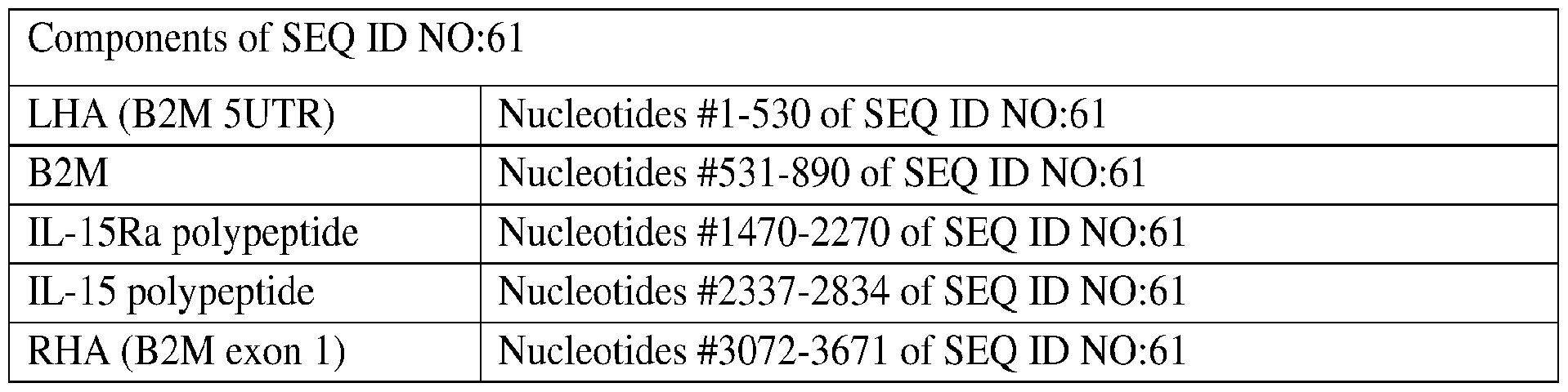
[0086] An illustrative donor sequence (donor 116 plasmid) for inserting an mIL15-IL15Ra under the NKp46 promoter into the TGFbR2 exon3 locus of a cell is shown in Fig. 8: RHA(TGFbR2)- NKp46 Promoter-mIL15-IL15Ra-bGHpA-LHA(TGFbR2) (SEQ ID NO:62)

[0087] In some embodiments, the iPSC-NK cells comprise a knock-in of an IL- 15 construct disclosed herein into a gene of the iPSC-NK cells, wherein the IL- 15 construct is operably linked to a promoter that is not active or minimally active (e.g., <10% of its full activity) in iPSC, but becomes active during iPSC differentiation as described herein.
[0088] In some embodiments, the promoter is a NK cell-specific promoter, such as NKp46 promoter, or a B2M promoter. In some embodiments, the promoter can be exogenous or endogenous.
[0089] In some embodiments, the NK cells are genetically modified by deleting or inactivating (or “knocking out”) a gene encoding TGF0 receptor 2 (TGF0R2). Optionally, such iNK cells comprising a deletion in TGF0R2 further comprise a knock-in of an IL- 15 construct as disclosed herein.
[0090] A gene may be inactivated, for example, by introducing a homozygous or heterozygous inactivating mutation into said gene. A homozygous inactivating mutation results in complete loss of protein function and, in some cases, loss of protein expression. In some embodiments, the NK
cells provided herein are genetically modified by inactivating the TGE0R2 gene, e.g., by targeting an exon of TGFpR2. In certain embodiments, the TGFpR2 gene may be inactivated by introducing the IL- 15 construct as disclosed herein into the TGFPR2 locus. In certain embodiments, the TGEJ3R2 gene may be inactivated by introducing a dominant negative form of TGE[3R2 into the cell. Exemplary sequences of gRNAs that may be used to knockout TGFPR2 in the iPSC NK cells described herein are provided in WO 2023/06013.
[0091] In some embodiments, the iPSC-NK cells provided herein are modified such that they are deficient in TGFPR2 signaling, e.g., by deleting the intracellular signaling domain of TGFPR2. This may be accomplished by, e.g. , introducing a stop codon into a suitable position in the TGFPR2 amino acid sequence (for example, introducing a stop codon after the transmembrane domain). Exemplary gRNA sequences and their corresponding donor DNA sequences that may be used to knockout the TGFPR2 signaling domain by introducing a stop codon after the TGFPR2 transmembrane domain are provided in WO 2023/06013.
[0092] In some embodiments, the method described herein result in a population of iPSC-NK cells wherein about 40% to about 45%, about 45% to about 50%, about 50% to about 55%, about 55% to about 60%, about 60% to about 65%, about 65% to about 70%, about 70% to about 75%, about 75% to about 80%, about 80% to about 85%, about 85% to about 90%, about 90 to about 95%, or about 95% to 100% of cells comprise an inactivating mutation in TGFBR2 and/or express detectable levels of IL- 15 or a functional fragment thereof. In some embodiments, the method described herein result in a population of iPSC-NK cells wherein at least 50%, at least 55%, at least 60%, at least 65%, at last 70%, at least 75%, at least 80%, at least 85%, at least 90%, at least 95%, at least 98% or more than 98% of cells comprise an inactivating mutation in TGFBR2 and/or express detectable levels of IL- 15 or a functional fragment thereof. The expression level of IL- 15 or a functional fragment thereof may be determined using any suitable method known in the art or described herein, including, for example, flow cytometry, Western Blotting, Enzyme Linked Immunosorbent Assays (ELISA), quantitative real-time PCR (qPCR) and RNA sequencing. In some embodiments, the iNK cells comprise an inactivating (e.g., a frameshift) mutation in TGEPR2 and express a truncated form of TGEPR2 protein. The inactivating mutation in TGEPR2 may be biallelic or monoallelic.
[0093] In some embodiments, the iNK cells provided herein are resistant to the suppressive effect of TGF0 signaling. Lor example, the expression level of NKG2D, DNAM and/or NKp30 on the
surface of an iNK cell may remain comparable after treatment with TGFpi to the levels before treatment.
[0094] In some embodiments, the iNK cells provided herein are able to survive without the stimulation of exogenous cytokines. Cell survival may be determined by measuring cell counts or cell viability.
[0095] In some embodiments, the iNK cells provided herein show higher cell killing ability than unmodified NK cells. Cell killing ability may be determined by incubating the iNK (and unmodified control NK) cells with target cells and measuring the disappearance of the target cells using, e.g., a fluorescent marker. In some embodiments, the iNK cells provided herein kill target cells with an efficiency that is about 10% to about 20%, about 20% to about 30%, about 30% to about 40%, about 40% to about 50%, about 50% to about 60%, about 60% to about 70%, about 70% to about 80%, about 80% to about 90%, about 90% to about 100%, about 2-3 times, about 3- 4 times, about 4-5 times, about 5-6 times, about 6-7 times, about 7-8 times, about 8-9 times or about 9-10 times higher than that of NK cells not comprising the IL- 15 construct disclosed herein. [0096] In some embodiments, the iNK cells described herein persist longer in the circulation after intravenous administration to a patient. In some embodiments, the iNK cells comprising the IL- 15 construct disclosed herein persist in the circulation of a subject about 10% to about 20%, about 20% to about 30%, about 30% to about 40%, about 40% to about 50%, about 50% to about 60%, about 60% to about 70%, about 70% to about 80%, about 80% to about 90%, about 90% to about 100%, about 2-3 times, about 3-4 times, about 4-5 times, about 5-6 times, about 6-7 times, about 7-8 times, about 8-9 times or about 9-10 times longer than NK cells not comprising the IL-15 construct.
[0097] The tumor microenvironment has a suppressive effect on NK cell function and inhibits NK cell function e.g., via soluble factors (e.g., cytokines), hypoxic conditions and/or low nutrient levels. See, e.g., Melaiu et al., Front. Immunol.10:3038. In some embodiments, the iNK cells described herein are resistant to the suppressive effects of the tumor microenvironment.
[0098] In some embodiments, the average expression level of TGF0R2 in a population of iNK cells provided herein is about 10% to about 20%, about 20% to about 30%, about 30% to about 40%, about 40% to about 50%, about 50% to about 60%, about 60% to about 70%, about 70% to about 80%, about 80% to about 90%, about 90% to about 95% or more than 95% lower than the average expression level of TGF0R2 in a population of unedited NK cells. In some embodiments,
the expression level of TGFPR2 in the iNK cells is about 10%, about 20%, about 30%, about 40%, about 50%, about 60%, about 70%, about 80%, about 90%, or about 95% lower than the expression level of TGFBR2 in unedited NK cells.
[0099] In the case of NK cells differentiated from iPSC, the genetic modifications described herein may be introduced before the differentiation of the iPSCs into iPSC-NK cells (“iNK cells”). Modified iPSC cells may be cryopreserved before differentiation into iNK cells.
[0100] In some embodiments, the iNK cells provided herein comprise polynucleotide sequences encoding IL-15 and IL-2RP, and a knockout of cytokine inducible SH2 containing protein (CISH). In some embodiments, the IL- 15 can be a membrane-bound form of IL- 15, a soluble form of IL- 15, or an ER-trapped form of IL-15. In some embodiments, the IL-15 is further expressed as fusion protein with an IL-15R or a functional fragment thereof, e.g., IL-15Ra or IL-15RP. Knockout of CISH can be accomplished by genetic editing. In one embodiment, the genetic editing comprises using a TALEN construct or a Cas9 or Casl2 enzyme.
[0101] In some embodiments, the iNK cells provided herein comprise polynucleotide sequences encoding IL- 15 and IL-2RP, and a knockout of a NK cell inhibitory receptor, e.g., T-cell immunoglobulin and ITIM domain (TIGIT) receptor. In some embodiments, the IL- 15 can be a membrane-bound formof IL- 15, a soluble form of IL- 15, or an ER-trapped form of IL-15. In some embodiments, the IL-15 is further expressed as fusion protein with an IL-15R or a functional fragment thereof, e.g., IL-15Ra or IL-15R0. Knockout of TIGIT can be accomplished by genetic editing. In one embodiment, the genetic editing comprises using a TALEN construct or a Cas9 or Casl2 enzyme.
[0102] In some embodiments, the iNK cells provided herein comprise polynucleotide sequences encoding IL- 15 and IL-2RP, and a knockout of CISH and a knockout of a NK cell inhibitory receptor, e.g., T-cell immunoglobulin and ITIM domain (TIGIT) receptor. In some embodiments, the IL- 15 can be a membrane-bound form of IL- 15, a soluble form of IL- 15, or an ER-trapped form of IL- 15. In some embodiments, the IL- 15 is further expressed as fusion protein with an IL- 15R or a functional fragment thereof, e.g., IL-15Ra or IL-15Rp.
PHARMACEUTICAL COMPOSITIONS
[0103] Also provided herein are pharmaceutical compositions and formulations comprising the induced pluripotent stem cells (iPSCs) or cells differentiated from such iPSCs as described herein. In one embodiment, provided herein are pharmaceutical compositions and formulations
comprising the iNK cells described herein. In some embodiments, a pharmaceutical composition comprises a dose ranging from about 1x10 s to about 5 x 10⁵ iNK cells, about 5 x 10⁵ to about 1 x 10⁶ iNK cells, about 1 x 10⁶ to about 5 x 10⁶ iNK cells, about 5 x 10⁶ iNK cells to about 1 x 10⁷ iNK cells, about 1 x 10⁷ to about 5 x 10⁷ iNK cells, about 5 x 10⁷ to 1 x 10⁸ iNK cells, about 1 x 10⁸ to about 5 x 10⁸ iNK cells, about 5 x 10⁸ to about 1 x 10⁹ iNK cells, about 1 x 10⁹ to about 5 x 10⁹ iNK cells, about 5 x 10⁹ to 1 x IO10 iNK cells, about 1 x IO10 to about 5 x IO10 iNK cells, about 5 x IO10 to about 1 x 10¹¹ iNK cell, about 1 x 10¹¹ to about 5 x 10¹¹ iNK cells, about 5 x 10¹¹ to 1 x 10¹² iNK cells, about 1 x 10¹² to about 5 x 10¹² iNK cells, about 5 x 10¹² to about 1 x 10¹³ iNK cells.
[0104] In some embodiments, a pharmaceutical composition is cryopreserved. A composition comprising iNK cells provided herein may be cryopreserved for about 1-3 months, about 3-6 months, about 6-9 months, or about 9-12 months. In some embodiments, a composition comprising iPSC-NK cells provided herein may be cryopreserved for more than 3 months, more than 6 months, more than 9 months, more than 12 months, more than 18 months, more than 2 years, or more than 3 years before thawing and use in a method described herein. A formulation comprising the iPSC- NK cells described herein may further comprise a cryoprotectant. In such embodiments wherein the iPSC NK cells are cryopreserved and thawed before use in a method described herein, the viability of the iPSC-NK cells is at least 30%, at least 50%, or at least 70% as determined by a suitable assay known in the art or described herein.
[0105] The cell population described herein can be incorporated into any pharmaceutical composition suitable for administration. In one embodiment, the iNK cells described herein can be incorporated into any pharmaceutical composition suitable for administration. Such compositions typically comprise the iNK cells and a pharmaceutically acceptable carrier. As used herein, the term “pharmaceutically acceptable carrier” is intended to include any and all solvents, dispersion media, coatings, antibacterial and antifungal agents, isotonic and absorption delaying agents, and the like, compatible with pharmaceutical administration. Suitable carriers are described in the most recent edition of Remington’s Pharmaceutical Sciences, a standard reference text in the field, which is incorporated herein by reference. Preferred examples of such carriers or diluents include, but are not limited to, water, saline, Ringer’s solutions, dextrose solution, and 5% human serum albumin. Liposomes and non-aqueous vehicles such as fixed oils may also be used. The use of such media and agents for pharmaceutically active substances is well known in the art. Except
insofar as any conventional media or agent is incompatible with the active compound, use thereof in the compositions is contemplated. Supplementary active compounds can also be incorporated into the compositions.
[0106] A pharmaceutical composition of the present disclosure is formulated to be compatible with its intended route of administration, e.g. , intravenous administration. Solutions or suspensions used for intravenous administration can include the following components: a sterile diluent such as water for injection, saline solution, fixed oils, polyethylene glycols, glycerin, propylene glycol or other synthetic solvents; antibacterial agents such as benzyl alcohol or methyl parabens; antioxidants such as ascorbic acid or sodium bisulfite; chelating agents such as ethylenediaminetetraacetic acid (EDTA); buffers such as acetates, citrates or phosphates, and agents for the adjustment of tonicity such as sodium chloride or dextrose. The pH can be adjusted with acids or bases, such as hydrochloric acid or sodium hydroxide. The preparation can be enclosed in ampoules, disposable syringes or multiple dose vials made of glass or plastic. Prolonged absorption of the injectable compositions can be brought about by including in the composition an agent which delays absorption, for example, aluminum monostearate and gelatin. [0107] It is especially advantageous to formulate compositions in dosage unit form for ease of administration and uniformity of dosage. Dosage unit form as used herein refers to physically discrete units suited as unitary dosages for the subject to be treated; each unit containing a predetermined quantity of active compound calculated to produce the desired therapeutic effect in association with the required pharmaceutical carrier. The specification for the dosage unit forms of the invention are dictated by and directly dependent on the unique characteristics of the active compound and the particular therapeutic effect to be achieved, and the limitations inherent in the art of compounding such an active compound for the treatment of individuals.
[0108] The formulation can also contain more than one active compound as necessary for the particular indication being treated, preferably those with complementary activities that do not adversely affect each other. Alternatively, or in addition, the composition can comprise an agent that enhances its function, such as, for example, a cytotoxic agent, cytokine, chemotherapeutic agent, or growth-inhibitory agent. Such molecules are suitably present in combination in amounts that are effective for the purpose intended.
METHODS OF TREATMENT
[0109] Further provided herein are methods of treating a medical disease or disorder in a subject by administering to the subject a therapeutically effective amount of the cell population provided herein. In one embodiment, provided herein are methods of treating a medical disease or disorder in a subject by administering to the subject a therapeutically effective amount of iNK cells provided herein. Therapeutic formulations comprising the cell population provided herein (e.g. the iPSC-NK cells) can be used to treat or alleviate a symptom associated with a cancer, including solid cancers and hematological cancers. Examples of cancers that may be treated with a method described herein include, without limitation, leukemias, lymphomas, breast cancer, colon cancer, ovarian cancer, bladder cancer, prostate cancer, glioma, lung & bronchial cancer, colorectal cancer, pancreatic cancer, esophageal cancer, liver cancer, urinary bladder cancer, kidney and renal pelvis cancer, oral cavity & pharynx cancer, uterine corpus cancer, and/or melanoma. Examples of cancers are also disclosed in WO 2023/060136.
[0110] The present invention also provides methods of inhibiting the proliferation of tumor cells in a subject, comprising administering to the subject the cell population provided herein (e.g. the iPSC-NK cells). A therapeutic regimen can be carried out by identifying a subject, e.g., a human patient suffering from (or at risk of developing) a cancer, using standard methods.
[0111] Efficaciousness of treatment is determined in association with any known method for diagnosing or treating the particular immune-related disorder. Alleviation of one or more symptoms of the disease or disorder indicates that the treatment confers a clinical benefit. In some embodiments, a method provided herein results in decreased tumor proliferation in the subject.
[0112] As used herein, the “administration” of an agent, e.g., a population of iPSC-NK cells), to a subject includes any route of introducing or delivering to a subject a compound to perform its intended function. In a preferred embodiment, the population of iPSC-NK cells is administered intravenously. In some embodiments, the population of iPSC-NK cells provided herein is administered by intravenous infusion, e.g., an intravenous infusion over about 15min, about 30min, about 45min, about 60min, about 90min, about 2 hours, about 3 hours, about 4 hours, or about 5 hours, or an intravenous infusion over about 15min to about 30min, about 30min to about 45min, about 45 min to about 60min, about 60 min to about 90min, about 90min to about 2 hours, about 2 hours to about 3 hours, about 3 hours to about 4 hours, or about 4 hours to about 5 hours. The rate of infusion may vary with the number of cells being infused to the subject.
[0113] A therapeutically effective amount of the iPSC-NK cells of the invention relates generally to the amount needed to achieve a therapeutic objective. It is also to be appreciated that the various modes of treatment or prevention of medical conditions as described are intended to mean “substantial”, which includes total but also less than total treatment or prevention, and wherein some biologically or medically relevant result is achieved. In some embodiments, about 1 x 10⁵ to about 5 x 10⁵ iNK cells, about 5 x 10⁵ to about 1 x 10⁶ iNK cells, about 1 x 10⁶ to about 5 x 10⁶ iNK cells, about 5 x 10⁶ iNK cells to about 1 x 10⁷ iNK cells, about 1 x 10⁷ to about 5 x 10⁷ iNK cells, about 5 x 10⁷ to 1 x 10⁸ iNK cells, about 1 x 10⁸ to about 5 x 10⁸ iNK cells, about 5 x 10⁸ to about 1 x 1091NK cells, about 1 x 10⁹ to about 5 x 10⁹ iNK cells, about 5 x 10⁹ to 1 x IO10 iNK cells, about 1 x IO10 to about 5 x IO10 iNK cells, about 5 x IO10 to about 1 x 10¹¹ iNK cell, about 1 x 10¹¹ to about 5 x 10¹¹ iNK cells, about 5 x 10¹¹ to 1 x 10¹² iNK cells, about 1 x 10¹² to about 5 x 10¹² iNK cells, about 5 x 10¹² to about 1 x 10¹³ iNK cells are administered to the subject.
[0114] In some embodiments, one or more doses of the iPSC-NK cells are administered. If two or more doses of the iPSC-NK cells are administered, the duration between the administrations should be sufficient to allow time for propagation of the cells in the individual. In specific embodiments the duration between doses is 1, 2, 3, 4, 5, 6, 7, 8, 9, 10, 11, or 12 or more weeks. [0115] As used herein, “treating” or “treatment” of a disease in a subject refers to (1) inhibiting the disease or arresting its development; or (2) ameliorating or causing regression of the disease or the symptoms of the disease. As understood in the art, “treatment” is an approach for obtaining beneficial or desired results, including clinical results. For the purposes of this disclosure, beneficial or desired results can include one or more, but are not limited to, alleviation or amelioration of one or more symptoms, diminishment of extent of a condition (including a disease), stabilized (i.e., not worsening) state of a condition (including disease), delay or slowing of condition (including disease), progression, amelioration or palliation of the condition (including disease), states and remission (whether partial or total), whether detectable or undetectable.
[0116] In certain embodiments of the present disclosure, iPSC-NK cells are delivered to an individual in need thereof, and the individual has been diagnosed with a cancer. Without wishing to be bound by theory, the cells then enhance the individual's immune system to attack or directly attack the respective cancer or pathogenic cells.
COMBINATION THERAPIES
[0117] The cell population described herein (e.g. the iPSC-NK cells) may be administered in combination with one or more other therapeutic agents. In some embodiments, the additional therapy may be radiation therapy, surgery (e.g., lumpectomy and a mastectomy), chemotherapy, gene therapy, DNA therapy, viral therapy, RNA therapy, immunotherapy, bone marrow transplantation, nanotherapy, monoclonal antibody therapy, or a combination of the foregoing. The additional therapy may be in the form of adjuvant or neoadjuvant therapy.
[0118] In some embodiments, the cell population described herein (e.g. the iPSC-NK cells) may be administered in combination with one or more other anti-NK inhibitory receptor agents, such as antibody, RNAi- or small molecule-based agents. The anti-NK inhibitory receptor agents include, but are not limited to, checkpoint inhibitors, such as PD-1/PD-L1 inhibitors, TIGIT inhibitors, TIM-3 inhibitors, and LAG-3 inhibitors. For example, TIGIT/PVR inhibitors include, but are not limited to, Ociperlimab, BAT6005, BMS 986207, PH 804, AGEN 1777, TSRF-786C, liothyronine; TIM-3 inhibitors include but are not limited to Cobolimab BMS-986258, Sabatolimab. The anti-NK inhibitory receptor agents can also be inhibitors of therapeutic targets upstream of NK cell inhibitory receptor, such as Elraglusib, a selective small-molecule inhibitor of glycogen synthase kinase-3 beta that reduces expression of immune checkpoint molecules PD- 1, TIGIT and LAG-3.
[0119] In some embodiments, the subject can be administered nonmyeloablative lymphodepleting chemotherapy prior to administering the iNK cells provided herein. The nonmyeloablative lymphodepleting chemotherapy can be any suitable such therapy, which can be administered by any suitable route. The nonmyeloablative lymphodepleting chemotherapy can comprise, for example, the administration of cyclophosphamide and fludarabine. An exemplary route of administering cyclophosphamide and fludarabine is intravenous. Likewise, any suitable dose of cyclophosphamide and fludarabine can be administered. For example, around 60 mg/kg of cyclophosphamide is administered for two days after which around 25 mg/m2 fludarabine is administered for five days.
[0120] In some embodiments, the nonmyeloablative lymphodepleting immunotherapy can comprise, for example, the administration of an anti-CD52 agent or anti-CD20 agent. In some embodiments, the lymphodepleting immunotherapy is an anti-CD52 antibody. In some embodiments, the anti-CD52 antibody is alemtuzumab. In some embodiments, the
lymphodepleting immunotherapy is an anti-CD20 antibody. Exemplary anti-CD20 antibodies include, but are not limited to rituximab, ofatumumab, ocrelizumab, obinutuzumab, ibritumomab or iodine 131 tositumomab. An exemplary route of administering anti-CD52 agent or anti-CD20 agent is intravenous. Likewise, any suitable dose of anti-CD52 agent or anti-agent can be administered.
[0121] In some embodiments, immune cell growth factor that promotes the growth and activation of the immune cells is administered to the subject either concomitantly with the iNK cells provided herein or subsequently to the iNK cells provided herein. The immune cell growth factor can be any suitable growth factor that promotes the growth and activation of the immune cells. Examples of suitable immune cell growth factors include, but are not limited to, interleukin (IL)-2, IL-7, IL- 15, and IL- 12, which can be used alone or in various combinations, such as IL-2 and IL-7, IL-2 and IL-15, IL-7 and IL-15, IL-2, IL-7 and IL-15, IL-12 and IL-7, IL-12 and IL-15, or IL-12 and IL2. In some embodiments, the iPSC-NK cells are not administered in combination with an interleukin.
[0122] In some embodiments, the additional therapy is the administration of small molecule enzymatic inhibitor or anti-metastatic agent. In some embodiments, the additional therapy is the administration of side-effect limiting agents (e.g., agents intended to lessen the occurrence and/or severity of side effects of treatment, such as anti-nausea agents, etc.). In some embodiments, the additional therapy is radiation therapy. In some embodiments, the additional therapy is surgery. In some embodiments, the additional therapy is a combination of radiation therapy and surgery. In some embodiments, the additional therapy is gamma irradiation. In some embodiments, the additional therapy is therapy targeting PBK/AKT/mTOR pathway, HSP90 inhibitor, tubulin inhibitor, apoptosis inhibitor, and/or chemopreventative agent. The additional therapy may be one or more of the chemotherapeutic agents known in the art.
[0123] Combination therapies can include, but are not limited to, one or more anti-microbial agents (for example, antibiotics, anti-viral agents and anti-fungal agents), anti-tumor agents (for example, fluorouracil, methotrexate, paclitaxel, fludarabine, etoposide, doxorubicin, or vincristine), immune-depleting agents (for example, fludarabine, etoposide, doxorubicin, or vincristine), immunosuppressive agents (for example, azathioprine, or glucocorticoids, such as dexamethasone or prednisone), anti-inflammatory agents (for example, glucocorticoids such as hydrocortisone, dexamethasone or prednisone, or non-steroidal anti-inflammatory agents such as
acetyls alicylic acid, ibuprofen or naproxen sodium), cytokine antagonists (for example, anti-TNF and anti- IL-6), cytokines (for example, interleukin- 10 or transforming growth factor-beta), hormones (for example, estrogen), or a vaccine. In addition, immunosuppressive or tolerogenic agents including but not limited to calcineurin inhibitors (e.g., cyclosporin and tacrolimus); mTOR inhibitors (e.g., Rapamycin); mycophenolate mofetil, antibodies (e.g., recognizing CD3, CD4, CD40, CD154, CD45, IVIG, or B cells); chemotherapeutic agents (e.g., Methotrexate, Treosulfan, Busulfan); irradiation; or chemokines, interleukins or their inhibitors (e.g., BAFF, IL-2, anti-IL- 2R, IL-4, JAK kinase inhibitors) can be administered. Such additional pharmaceutical agents can be administered before, during, or after administration of the iNK cells provided herein, depending on the desired effect. This administration of the iNK cells and the agent can be by the same route or by different routes, and either at the same site or at a different site.
[0124] The cell population provided herein (e.g. the iPSC-NK cells) may be administered before, during, or after, an additional therapeutic agent, such as an immune checkpoint inhibitor. The administrations may be in intervals ranging from concurrently to minutes to days to weeks. In embodiments where the iPSC-NK cell therapy is provided to a patient separately from an additional therapeutic agent, one would generally ensure that a significant period of time did not expire between the time of each delivery, such that the two compounds would still be able to exert an advantageously combined effect on the patient. In such instances, it is contemplated that one may provide a patient with the iPSC-NK cell therapy and the anti-cancer therapy (e.g., an immune checkpoint inhibitor) within about 12 to 24 or 72 h of each other and, more particularly, within about 6-12 h of each other. In some situations it may be desirable to extend the time period for treatment significantly where several days (2, 3, 4, 5, 6, or 7) to several weeks (1, 2, 3, 4, 5, 6, 7, or 8) lapse between respective administrations.
[0125] The skilled artisan will understand that immunotherapies may be used in combination or in conjunction with methods of the embodiments described herein. In the context of cancer treatment, immunotherapeutic s generally rely on the use of immune effector cells and molecules to target and destroy cancer cells. Rituximab (RITUXAN®) is such an example. The immune effector may be, for example, an antibody specific for some marker on the surface of a tumor cell. The antibody alone may serve as an effector of therapy or it may recruit other cells to actually affect cell killing. The antibody also may be conjugated to a drug or toxin (chemotherapeutic, radionuclide, ricin A chain, cholera toxin, pertussis toxin, etc.) and serve as a targeting agent.
Alternatively, the effector may be a lymphocyte carrying a surface molecule that interacts, either directly or indirectly, with a tumor cell target. Examples of immunotherapies are described in WO 2023/060136.
[0126] In some embodiments, the immunotherapy may be an immune checkpoint inhibitor. Immune checkpoints either turn up a signal (e.g., co-stimulatory molecules) or turn down a signal. Inhibitory immune checkpoints that may be targeted by immune checkpoint blockade include adenosine A2A receptor (A2AR), B7-H3 (also known as CD276), B and T lymphocyte attenuator (BTLA), cytotoxic T-lymphocyte-associated protein 4 (CTLA-4, also known as CD152), indoleamine 2,3-dioxygenase (IDO), killer-cell immunoglobulin (KIR), lymphocyte activation gene-3 (LAG3), programmed death 1 (PD-1), T-cell immunoglobulin domain and mucin domain 3 (TIM-3) and V-domain Ig suppressor of T cell activation (VISTA). In particular, the immune checkpoint inhibitors target the PD 1 axis and/or CTLA 4. Examples of immune checkpoint inhibitors are described in WO 2023/060136.
[0127] It is contemplated that other agents may be used in combination with certain aspects of the present embodiments to improve the therapeutic efficacy of treatment. These additional agents include agents that affect the upregulation of cell surface receptors and GAP junctions, cytostatic and differentiation agents, inhibitors of cell adhesion, agents that increase the sensitivity of the hyperproliferative cells to apoptotic inducers, or other biological agents. Increases in intercellular signaling by elevating the number of GAP junctions would increase the anti-hyperproliferative effects on the neighboring hyperproliferative cell population. In other embodiments, cytostatic or differentiation agents can be used in combination with certain aspects of the present embodiments to improve the anti-hyperproliferative efficacy of the treatments. Inhibitors of cell adhesion are contemplated to improve the efficacy of the present embodiments. Examples of cell adhesion inhibitors are focal adhesion kinase (FAKs) inhibitors and Lovastatin. It is further contemplated that other agents that increase the sensitivity of a hyperproliferative cell to apoptosis, such as the antibody c225, could be used in combination with certain aspects of the present embodiments to improve the treatment efficacy.
ARTICLES OF MANUFACTURE OR KITS
[0128] An article of manufacture or a kit comprising the cell population described herein (e.g. the iPSC-NK cells) is also provided herein. The article of manufacture or kit can further comprise a package insert comprising instructions for using the cell population (e.g. the iPSC-NK cells) to
treat or delay progression of cancer in an individual or to enhance immune function of an individual having cancer. Suitable containers include, for example, bottles, vials, bags and syringes. The container may be formed from a variety of materials such as glass, plastic (such as polyvinyl chloride or poly olefin), or metal alloy (such as stainless steel or hastelloy). In some embodiments, the container holding the formulation and the label on, or associated with, the container may indicate directions for use. The article of manufacture or kit may further include other materials desirable from a commercial and user standpoint, including other buffers, diluents, filters, needles, syringes, and package inserts with instructions for use. In some embodiments, the article of manufacture further includes one or more of another agent (e.g., a chemotherapeutic agent, and anti-neoplastic agent).
[0129] In the description presented herein, each of the steps of the invention and variations thereof are described. This description is not intended to be limiting and changes in the components, sequence of steps, and other variations would be understood to be within the scope of the present invention.
[0130] It is appreciated that certain features of the invention, which are, for clarity, described in the context of separate embodiments, may also be provided in combination in a single embodiment. Conversely, various features of the invention, which are, for brevity, described in the context of a single embodiment, may also be provided separately or in any suitable subcombination or as suitable in any other described embodiment of the invention. Certain features described in the context of various embodiments are not to be considered essential features of those embodiments, unless the embodiment is inoperative without those elements.
[0131] While certain features of the invention have been illustrated and described herein, many modifications, substitutions, changes, and equivalents will now occur to those of ordinary skill in the art. It is, therefore, to be understood that the appended claims are intended to cover all such modifications and changes as fall within the true spirit of the invention.
EXAMPLE 1 iNK Cells Expressing A Knock-In Construct
[0132] Fig. 9A shows one embodiment of a knock-in construct, the donor 109 plasmid, comprising an exogenous NKp46 promoter that drives the expression of soluble IL- 15 in human iPSCs. Soluble IL- 15 under the driving of the NKp46 promoter can be detected by ELISA in the supernatant of edited iNK cells expressing the NKp46-IL15Ra-P2A-sIL-15 knock-in cassette in
day 7 (Fig. 9B) and day 21 (Fig. 9C) of NK cells derived from the iPSC. Soluble IL- 15 was not detected in the supernatant of the wild- type or edited control human iPSCs.
[0133] iNK cells expressing the knock-in constructs described herein maintain their pluripotency. Fig. 10 shows representative histogram figures and flow cytometry plots of pluripotency markers, SSEA4 and TRA-1-60, for the knock-in iPSC single clones. The antibodies (APC anti-human SSEA-4, PE anti-human TRA-1-60-R, BioLegend, San Diego, CA) staining procedure was performed according to the manufacturer’s protocols and the cells were resuspended in 200ul BD staining buffer in 96-well plate. Flow cytometry analyses were performed with NovoCyte Flow Cytometer (Agilent Technologies, Santa Clara, CA). Cells in the lymphocyte gate were used for analysis. A total of 50,000 events were collected for each sample and the generated data were analyzed by the NovoExpress software (Agilent Technologies).
[0134] Results from the flow cytometry analysis revealed that 98% of the knock-in iPSC cell population are double positive for the two markers - SSEA4 and TRA-1-60. These results confirmed that the knock-in iPSC cells kept their pluripotency in the culture medium.
[0135] Figure 11 shows results of karyotyping results for #107-12 iPSC clone, which is a monoknock-in clone carrying the 107 donor plasmid: RHA(TGFbR2)-Promoter(NKp46)-CD8asp- IL15-IL15Ra-ICD(Rb-gc)-bGHpA-LHA(TGFbR2). The cytogenetic analysis was performed on twenty G-banded metaphase cells from human cell line #107-12 p3, and all twenty cells demonstrated an apparently normal male karyotype.
[0136] Figure 12 shows results of karyotyping results for #584 iPSC clone, which is a monoknock-in clone carrying the 116 donor plasmid: RHA(TGFbR2)-Promoter(NKp46)-CD8asp- mIL15-IL15Ra-bGHpA-LHA(TGFbR2). The cytogenetic analysis was performed on twenty G- banded metaphase cells from human cell line #584 p3. Fifteen cells demonstrated an apparently normal male karyotype, and five cells demonstrated non-clonal chromosome aberrations, which were most likely technical artifacts.
[0137] Figure 13 shows results of karyotyping results for #600 iPSC clone, which is a monoknock-in clone carrying the 107ER donor plasmid: RHA(TGFbR2)-Promoter(NKp46)-CD8asp- GSEKDEL-IL15-IL15Ra-ICD(Rb-gc)-bGHpA-LHA(TGFbR2). The cytogenetic analysis was performed on twenty G-banded metaphase cells from human cell line #600 p3. Eighteen cells demonstrated an apparently normal male karyotype, and two cells demonstrated non-clonal chromosome aberrations, which were most likely technical artifacts.
[0138] Figure 14 shows results of karyotyping results for #648 iPSC clone, which is a bi-knock- in clone carrying the 109 donor plasmid: RHA(TGFbR2)-Promoter(NKp46)-IL15Ra(codon opt)- P2A-IL15-bGHpA-LHA(TGFbR2). The cytogenetic analysis was performed on twenty G-banded metaphase cells from human cell line #648 p3, and all twenty cells demonstrated an apparently normal male karyotype.
[0139] Figure 15 shows results of karyotyping results for #859 iPSC clone, which is a bi-knock- in clone carrying the 108B2M donor plasmid: LHA(B2M)-B2M-IRES-IL15Ra(codon opt)-P2A- IL15Rb-P2A-IL15-bGHpA-RHA(B2M). The cytogenetic analysis was performed on twenty G- banded metaphase cells from human cell line #859 p3. Nineteen cells demonstrated an apparently normal male karyotype, and one cell demonstrated a non-clonal chromosome aberration, which was most likely technical artifacts.
[0140] Figure 16 shows results of karyotyping results for #863 iPSC clone, which is a bi-knock- in clone carrying the 108B2M donor plasmid: LHA(B2M)-B2M-IRES-IL15Ra(codon opt)-P2A- IL15Rb-P2A-IL15-bGHpA-RHA(B2M). The cytogenetic analysis was performed on twenty G- banded metaphase cells from human cell line #863 p3. Nineteen cells demonstrated an apparently normal male karyotype, and one cell demonstrated a non-clonal chromosome aberration, which was most likely technical artifacts.
[0141] Figure 17 shows results of karyotyping results for #902 iPSC clone, which is a bi-knock- in clone carrying the 109B2M donor plasmid: LHA(B2M)-B2M-IRES-IL15Ra(codon opt)-P2A- IL15-bGHpA-RHA(B2M). The cytogenetic analysis was performed on twenty G-banded metaphase cells from human cell line #902 p3, and all twenty cells demonstrated an apparently normal male karyotype.
[0142] Figure 18 shows results of karyotyping results for #975 iPSC clone, which is a bi-knock- in clone carrying the 115 donor plasmid: LHA(B2M)-IL15(soluble)-IRES2-IL15Ra(codon opt)- P2A-IL2Rb-P2A-RHA(B2M). The cytogenetic analysis was performed on twenty G-banded metaphase cells from human cell line #975 p3, and all twenty cells demonstrated an apparently normal male karyotype.
[0143] Figure 19A shows a map of a knock-in construct that uses the endogenous B2M promoter to drive the expression of soluble IL- 15. Figure 19B shows soluble IL- 15 was secreted by edited IL15+/+/TGFpR2'/" iNK cells expressing the knock-in construct at 24 hours and 72 hours, but not from wild type iNKs. Secretion of the soluble IL- 15 was quantified by measuring IL- 15 cytokine
production at 24-hour and 72-hour timepoints following medium change. It was found that IL15+/+/TGFpR2'/_ iNK cells produced soluble IL-15 at 9.68 pg/ml per 1E6 live cells (range 7.8-10.6) at 24 hours post medium change, and 80.16 pg/ml per 1E6 live cells (range 67.6-90.7) at 72 hours post medium change. In contrast, IL-15 was minimally expressed (0.2 pg/ml per 1E6 live cells at 24 hours post medium change; 2pg/ml per 1E6 live cells at 72 hours post medium change) in supernatants collected from the wild type iNK cells at both timepoints.
Claims
1. A cell population comprising induced pluripotent stem cells (iPSCs) or cells differentiated from said iPSCs, wherein the iPSCs or cells differentiated from said iPSCs comprise a knock-in of a construct comprising a promoter operably linked to sequences encoding one or more genes or functional fragments thereof, wherein said promoter is not active or minimally active in iPSCs but becomes active during or after differentiation of the iPSCs.
2. The cell population of claim 1, wherein the promoter is an exogenous or endogenous promoter.
3. The cell population of claim 1 , wherein the cells differentiated from said iPSCs are immune cells.
4. The cell population of claim 3, wherein the immune cells comprise a knock-in construct comprising a promoter specific to the immune cells.
5. The cell population of claim 3, wherein the immune cells are NK cells.
6. The cell population of claim 5, wherein the NK cells comprise a knock-in construct comprising a NK-cell specific promoter.
7. The cell population of claim 6, wherein the NK-cell specific promoter is a NKp46 promoter or a B2M promoter.
8. The cell population of claim 1, wherein the cells differentiated from said iPSCs are neuron cells.
9. The cell population of claim 8, wherein the neuron cells comprise a knock-in construct comprising a promoter specific to neuron cells.
10. The cell population of claim 1, wherein the cells differentiated from said iPSCs are cardiomyocytes.
11. The cell population of claim 10, wherein the cardio myocytes comprise a knock-in construct comprising a promoter specific to cardiomyocytes.
12. The cell population of claim 1, wherein the cells differentiated from said iPSCs are
hepatocytes.
13. The cell population of claim 12, wherein the hepatocytes comprise a knock-in construct comprising a promoter specific to hepatocytes.
14. The cell population of claim 1, wherein the cells differentiated from said iPSCs are endothelial cells.
15. The cell population of claim 14, wherein the endothelial cells comprise a knock-in construct comprising a promoter specific to endothelial cells.
16. A method of producing a cell population comprising cells differentiated from induced pluripotent stem cells (iPSCs), the method comprising
(i) genetically editing a population of iPSCs with a construct comprising a promoter operably linked to sequences encoding one or more genes or functional fragments thereof, wherein said promoter is not active or minimally active in iPSCs but becomes active during or after differentiation of iPSCs into a specific cell type ;
(ii) generating a monoclonal population of edited iPSCs; and
(iii) differentiating said edited iPSCs into a population of desired specific cell type.
17. The method of claim 16, wherein the promoter is an exogenous or endogenous promoter.
18. The method of claim 16, wherein the promoter is active in the cells differentiated from the iPSCs.
19. The method of claim 16, wherein the cells differentiated from the iPSCs are immune cells, neurons, cardiomyocytes, hepatocytes, or endothelial cells.
20. The method of claim 19, wherein the immune cells are NK cells.
21. The method of claim 20, wherein the NK cells comprise a construct comprising a NK-cell specific promoter.
22. The method of claim 21, wherein the NK-cell specific promoter is a NKp46 promoter or a B2M promoter.
23. The method of claim 16, wherein said genetic editing comprises using a TALEN construct
or a Cas9 or Casl2 enzyme.
24. A cell population produced by the method of claim 16.
25. A pharmaceutical composition comprising the cell population of claim 1 or claim 24.
26. A method of treating cancer or autoimmune diseases in a subject in need thereof, comprising administering to the subject an effective amount of the pharmaceutical composition of claim 25.
27. The method of claim 26, wherein the cancer is a solid tumor or a hematological cancer.
28. The method of claim 26, wherein the subject is further administered with an immune checkpoint inhibitor.
29. The method of claim 28, wherein the immune checkpoint inhibitor is an anti-PD-1 antibody, an anti-PDL-1 antibody, or an anti-CTLA-4 antibody.
Applications Claiming Priority (2)
| Application Number | Priority Date | Filing Date | Title |
|---|---|---|---|
| US202363506125P | 2023-06-04 | 2023-06-04 | |
| US63/506,125 | 2023-06-04 |
Publications (1)
| Publication Number | Publication Date |
|---|---|
| WO2024254008A1 true WO2024254008A1 (en) | 2024-12-12 |
Family
ID=93796081
Family Applications (1)
| Application Number | Title | Priority Date | Filing Date |
|---|---|---|---|
| PCT/US2024/032303 Ceased WO2024254008A1 (en) | 2023-06-04 | 2024-06-03 | Natural killer cells with gene knock-ins using promoters that do not affect ipsc plueropotency and uses thereof |
Country Status (1)
| Country | Link |
|---|---|
| WO (1) | WO2024254008A1 (en) |
Citations (4)
| Publication number | Priority date | Publication date | Assignee | Title |
|---|---|---|---|---|
| US20170226481A1 (en) * | 2009-10-19 | 2017-08-10 | Cellular Dynamics International, Inc. | Cardiomyocyte production |
| US20180021383A1 (en) * | 2014-03-21 | 2018-01-25 | Cellular Dynamics International, Inc. | Production of midbrain dopaminergic neurons and methods for the use thereof |
| WO2023019203A1 (en) * | 2021-08-11 | 2023-02-16 | Sana Biotechnology, Inc. | Inducible systems for altering gene expression in hypoimmunogenic cells |
| WO2023060136A1 (en) * | 2021-10-05 | 2023-04-13 | Cytovia Therapeutics, Llc | Natural killer cells and methods of use thereof |
-
2024
- 2024-06-03 WO PCT/US2024/032303 patent/WO2024254008A1/en not_active Ceased
Patent Citations (4)
| Publication number | Priority date | Publication date | Assignee | Title |
|---|---|---|---|---|
| US20170226481A1 (en) * | 2009-10-19 | 2017-08-10 | Cellular Dynamics International, Inc. | Cardiomyocyte production |
| US20180021383A1 (en) * | 2014-03-21 | 2018-01-25 | Cellular Dynamics International, Inc. | Production of midbrain dopaminergic neurons and methods for the use thereof |
| WO2023019203A1 (en) * | 2021-08-11 | 2023-02-16 | Sana Biotechnology, Inc. | Inducible systems for altering gene expression in hypoimmunogenic cells |
| WO2023060136A1 (en) * | 2021-10-05 | 2023-04-13 | Cytovia Therapeutics, Llc | Natural killer cells and methods of use thereof |
Similar Documents
| Publication | Publication Date | Title |
|---|---|---|
| US12503507B2 (en) | Defined composition gene modified T-cell products | |
| KR102883631B1 (en) | Therapeutic preparations of gamma-delta T cells and natural killer cells and methods for their manufacture and use | |
| Lamb et al. | Natural killer cell therapy for hematologic malignancies: successes, challenges, and the future | |
| US20190167720A1 (en) | Gene editing for immunological destruction of neoplasia | |
| Swan et al. | IL7 and IL7 Flt3L co-expressing CAR T cells improve therapeutic efficacy in mouse EGFRvIII heterogeneous glioblastoma | |
| JP2020054361A (en) | Screening methods for targets for cancer therapy | |
| KR20240116708A (en) | Natural Killer Cells and Methods of Using Them | |
| Hou et al. | Beyond CAR-T cells: exploring CAR-NK, CAR-M, and CAR-γδ T strategies in solid tumor immunotherapy | |
| Fang et al. | Unlocking the potential of iPSC-derived immune cells: engineering iNK and iT cells for cutting-edge immunotherapy | |
| TW202325320A (en) | Methods for generating primary immune cells | |
| Qi et al. | Natural killer cell‐related anti‐tumour adoptive cell immunotherapy | |
| US20220195441A1 (en) | Combinatorial car t cell and hematopoeitic stem cell genetic engineering for specific immunotherapy of myeloid leukemias | |
| WO2024254008A1 (en) | Natural killer cells with gene knock-ins using promoters that do not affect ipsc plueropotency and uses thereof | |
| TW202449162A (en) | Methods for generating primary immune cells | |
| WO2024254013A1 (en) | Natural killer cells with novel il-15 knock-in and methods of use thereof | |
| Kaur | Advancements and Challenges of Gamma Delta (γδ) T Cell-and Invariant Natural Killer T (iNKT) Cell-Based Cancer Immunotherapies. | |
| US20230374104A1 (en) | Methods and compositions comprising pd1 chimeric polypeptides | |
| US20230303643A1 (en) | Constitutively active tcf1 to promote memory-associated traits in car t cells | |
| EP4536687A1 (en) | Disruption of kdm4a in t cells to enhance immunotherapy | |
| WO2024220867A1 (en) | Chimeric receptors | |
| EP4572774A1 (en) | In vitro method for inhibiting hhv-6 infection | |
| CN118318034A (en) | Engineered effector cells for delivery of allogeneic cell therapies to solid tumors | |
| HK40055874B (en) | Therapeutic preparations of gamma-delta t cells and natural killer cells and methods for manufacture and use |
Legal Events
| Date | Code | Title | Description |
|---|---|---|---|
| 121 | Ep: the epo has been informed by wipo that ep was designated in this application |
Ref document number: 24819829 Country of ref document: EP Kind code of ref document: A1 |
|
| NENP | Non-entry into the national phase |
Ref country code: DE |