WO2024254091A1 - Treatment of fgg related diseases and disorders - Google Patents

Treatment of fgg related diseases and disorders Download PDF

Info

Publication number
WO2024254091A1
WO2024254091A1 PCT/US2024/032448 US2024032448W WO2024254091A1 WO 2024254091 A1 WO2024254091 A1 WO 2024254091A1 US 2024032448 W US2024032448 W US 2024032448W WO 2024254091 A1 WO2024254091 A1 WO 2024254091A1
Authority
WO
WIPO (PCT)
Prior art keywords
sequence
antisense strand
nucleoside
sense strand
modified
Prior art date
Legal status (The legal status is an assumption and is not a legal conclusion. Google has not performed a legal analysis and makes no representation as to the accuracy of the status listed.)
Ceased
Application number
PCT/US2024/032448
Other languages
French (fr)
Inventor
Omri GOTTESMAN
Shannon BRUSE
Paul BUSKE
Eric BUSS
Brian CAJES
David Lewis
David Rozema
John VEKICH
Darren H. Wakefield
Current Assignee (The listed assignees may be inaccurate. Google has not performed a legal analysis and makes no representation or warranty as to the accuracy of the list.)
Empirico Inc
Original Assignee
Empirico Inc
Priority date (The priority date is an assumption and is not a legal conclusion. Google has not performed a legal analysis and makes no representation as to the accuracy of the date listed.)
Filing date
Publication date
Application filed by Empirico Inc filed Critical Empirico Inc
Priority to EP24819874.9A priority Critical patent/EP4720298A1/en
Publication of WO2024254091A1 publication Critical patent/WO2024254091A1/en
Anticipated expiration legal-status Critical
Ceased legal-status Critical Current

Links

Classifications

    • CCHEMISTRY; METALLURGY
    • C12BIOCHEMISTRY; BEER; SPIRITS; WINE; VINEGAR; MICROBIOLOGY; ENZYMOLOGY; MUTATION OR GENETIC ENGINEERING
    • C12NMICROORGANISMS OR ENZYMES; COMPOSITIONS THEREOF; PROPAGATING, PRESERVING, OR MAINTAINING MICROORGANISMS; MUTATION OR GENETIC ENGINEERING; CULTURE MEDIA
    • C12N15/00Mutation or genetic engineering; DNA or RNA concerning genetic engineering, vectors, e.g. plasmids, or their isolation, preparation or purification; Use of hosts therefor
    • C12N15/09Recombinant DNA-technology
    • C12N15/11DNA or RNA fragments; Modified forms thereof; Non-coding nucleic acids having a biological activity
    • C12N15/113Non-coding nucleic acids modulating the expression of genes, e.g. antisense oligonucleotides; Antisense DNA or RNA; Triplex- forming oligonucleotides; Catalytic nucleic acids, e.g. ribozymes; Nucleic acids used in co-suppression or gene silencing
    • AHUMAN NECESSITIES
    • A61MEDICAL OR VETERINARY SCIENCE; HYGIENE
    • A61KPREPARATIONS FOR MEDICAL, DENTAL OR TOILETRY PURPOSES
    • A61K31/00Medicinal preparations containing organic active ingredients
    • A61K31/70Carbohydrates; Sugars; Derivatives thereof
    • A61K31/7088Compounds having three or more nucleosides or nucleotides
    • A61K31/713Double-stranded nucleic acids or oligonucleotides
    • AHUMAN NECESSITIES
    • A61MEDICAL OR VETERINARY SCIENCE; HYGIENE
    • A61PSPECIFIC THERAPEUTIC ACTIVITY OF CHEMICAL COMPOUNDS OR MEDICINAL PREPARATIONS
    • A61P25/00Drugs for disorders of the nervous system
    • A61P25/28Drugs for disorders of the nervous system for treating neurodegenerative disorders of the central nervous system, e.g. nootropic agents, cognition enhancers, drugs for treating Alzheimer's disease or other forms of dementia
    • CCHEMISTRY; METALLURGY
    • C12BIOCHEMISTRY; BEER; SPIRITS; WINE; VINEGAR; MICROBIOLOGY; ENZYMOLOGY; MUTATION OR GENETIC ENGINEERING
    • C12NMICROORGANISMS OR ENZYMES; COMPOSITIONS THEREOF; PROPAGATING, PRESERVING, OR MAINTAINING MICROORGANISMS; MUTATION OR GENETIC ENGINEERING; CULTURE MEDIA
    • C12N2310/00Structure or type of the nucleic acid
    • C12N2310/10Type of nucleic acid
    • C12N2310/14Type of nucleic acid interfering nucleic acids [NA]
    • CCHEMISTRY; METALLURGY
    • C12BIOCHEMISTRY; BEER; SPIRITS; WINE; VINEGAR; MICROBIOLOGY; ENZYMOLOGY; MUTATION OR GENETIC ENGINEERING
    • C12NMICROORGANISMS OR ENZYMES; COMPOSITIONS THEREOF; PROPAGATING, PRESERVING, OR MAINTAINING MICROORGANISMS; MUTATION OR GENETIC ENGINEERING; CULTURE MEDIA
    • C12N2310/00Structure or type of the nucleic acid
    • C12N2310/30Chemical structure
    • C12N2310/31Chemical structure of the backbone
    • C12N2310/315Phosphorothioates
    • CCHEMISTRY; METALLURGY
    • C12BIOCHEMISTRY; BEER; SPIRITS; WINE; VINEGAR; MICROBIOLOGY; ENZYMOLOGY; MUTATION OR GENETIC ENGINEERING
    • C12NMICROORGANISMS OR ENZYMES; COMPOSITIONS THEREOF; PROPAGATING, PRESERVING, OR MAINTAINING MICROORGANISMS; MUTATION OR GENETIC ENGINEERING; CULTURE MEDIA
    • C12N2310/00Structure or type of the nucleic acid
    • C12N2310/30Chemical structure
    • C12N2310/32Chemical structure of the sugar
    • C12N2310/3212'-O-R Modification
    • CCHEMISTRY; METALLURGY
    • C12BIOCHEMISTRY; BEER; SPIRITS; WINE; VINEGAR; MICROBIOLOGY; ENZYMOLOGY; MUTATION OR GENETIC ENGINEERING
    • C12NMICROORGANISMS OR ENZYMES; COMPOSITIONS THEREOF; PROPAGATING, PRESERVING, OR MAINTAINING MICROORGANISMS; MUTATION OR GENETIC ENGINEERING; CULTURE MEDIA
    • C12N2310/00Structure or type of the nucleic acid
    • C12N2310/30Chemical structure
    • C12N2310/32Chemical structure of the sugar
    • C12N2310/3222'-R Modification
    • CCHEMISTRY; METALLURGY
    • C12BIOCHEMISTRY; BEER; SPIRITS; WINE; VINEGAR; MICROBIOLOGY; ENZYMOLOGY; MUTATION OR GENETIC ENGINEERING
    • C12NMICROORGANISMS OR ENZYMES; COMPOSITIONS THEREOF; PROPAGATING, PRESERVING, OR MAINTAINING MICROORGANISMS; MUTATION OR GENETIC ENGINEERING; CULTURE MEDIA
    • C12N2310/00Structure or type of the nucleic acid
    • C12N2310/30Chemical structure
    • C12N2310/35Nature of the modification
    • C12N2310/351Conjugate

Definitions

  • compositions comprising an oligonucleotide that targets fibrinogen gamma gene (FGG).
  • FGG fibrinogen gamma gene
  • compositions comprising an oligonucleotide that targets FGG and when administered to a subject in an effective amount improves a mental disorder measurement of a mental disorder.
  • the mental disorder comprises a psychiatric disorder.
  • the psychiatric disorder comprises a depressive disorder (e.g., major depressive disorder, persistent depressive disorder, treatment resistant depression and signs or symptoms of depression), post-traumatic stress disorder, mood disorder, anxiety disorder, eating disorder, substance-use disorder, bipolar disorder, personality disorder, schizophrenia, or schizoaffective disorder.
  • the mental disorder measurement is chosen from the group consisting of a Montgomery-Asberg Depression Rating Scale (MADRS) score, a Hamilton Depression Rating Scale-17 score, anxiety signs and symptoms, eating disorder signs and symptoms, substance-use disorder signs and symptoms, post-traumatic stress disorder signs and symptoms, bipolar disorder signs and symptoms, schizophrenia signs and symptoms, and psychosis signs and symptoms.
  • the mental disorder comprises a neurological disorder.
  • the neurological disorder comprises Alzheimer’s disease, dementia, delirium, cognitive decline, vascular dementia, headache (e.g., migraine), chronic pain (e.g., fibromyalgia), chronic fatigue syndrome (e.g., myalgic encephalomyelitis), chronic traumatic encephalopathy, traumatic brain injury, or motor neuron disease (e.g., amyotrophic lateral sclerosis).
  • Alzheimer’s disease dementia, delirium, cognitive decline, vascular dementia, headache (e.g., migraine), chronic pain (e.g., fibromyalgia), chronic fatigue syndrome (e.g., myalgic encephalomyelitis), chronic traumatic encephalopathy, traumatic brain injury, or motor neuron disease (e.g., amyotrophic lateral sclerosis).
  • the mental disorder measurement is chosen from the group consisting of cognitive function, central nervous system (CNS) amyloid plaques, CNS tau accumulation, cerebrospinal Attorney Docket No.54462-754.601 fluid (CSF) or plasma beta-amyloid 42, beta-amyloid 40, the ratio of beta-amyloid 42 to beta-amyloid 40, tau, phospho-tau, neurofilament light chain (NfL), Lewy bodies, or alpha-synuclein, headache symptoms or signs, migraine symptoms or signs, chronic pain symptoms or signs, fibromyalgia symptoms or signs, chronic fatigue syndrome (e.g., myalgic encephalomyelitis) symptoms or signs, and motor neuron disease (e.g., amyotrophic lateral sclerosis) symptoms or signs.
  • CNS central nervous system
  • CSF cerebrospinal Attorney Docket No.54462-754.601 fluid
  • beta-amyloid 42 beta-amyloid 40
  • the oligonucleotide comprises a modified internucleoside linkage.
  • the modified internucleoside linkage comprises alkylphosphonate, phosphorothioate, methylphosphonate, phosphorodithioate, alkylphosphonothioate, phosphoramidate, carbamate, carbonate, phosphate triester, acetamidate, or carboxymethyl ester, or a combination thereof.
  • the modified internucleoside linkage comprises one or more phosphorothioate linkages.
  • the oligonucleotide comprises 1, 2, 3, 4, 5, 6, 7, 8, 9, 10, 11, 12, 13, 14, 15, 16, 17, 18, 19, or 20 modified internucleoside linkages.
  • the oligonucleotide comprises a modified nucleoside.
  • the modified nucleoside comprises a locked nucleic acid (LNA), hexitol nucleic acid (HNA), cyclohexene nucleic acid (CeNA), 2'-O-methoxyethyl, 2'-O-alkyl, 2’-O-allyl, 2’-C-allyl, 2'-fluoro, or 2'-deoxy, or a combination thereof.
  • the modified nucleoside comprises a LNA.
  • the modified nucleoside comprises a 2’,4’ constrained ethyl nucleic acid.
  • the modified nucleoside comprises a 2'-O-methyl nucleoside, 2'-deoxyfluoro nucleoside, 2'- O-N-methylacetamido (2'-O-NMA) nucleoside, a 2'-O-dimethylaminoethoxyethyl (2'-O-DMAEOE) nucleoside, 2'-O-aminopropyl (2'-O-AP) nucleoside, or 2'-ara-F, or a combination thereof.
  • the modified nucleoside comprises one or more 2’-fluoro modified nucleosides.
  • the modified nucleoside comprises a 2’-O-alkyl modified nucleoside.
  • the oligonucleotide comprises 1, 2, 3, 4, 5, 6, 7, 8, 9, 10, 11, 12, 13, 14, 15, 16, 17, 18, 19, 20, or 21 modified nucleosides.
  • the oligonucleotide comprises a lipid attached at a 3’ or 5’ terminus of the oligonucleotide.
  • the lipid comprises cholesterol, myristoyl, palmitoyl, stearoyl, lithocholoyl, docosanoyl, docosahexaenoyl, myristyl, palmityl stearyl, or ⁇ - tocopherol, or a combination thereof.
  • the oligonucleotide comprises a sugar moiety attached at a 3’ or 5’ terminus of the oligonucleotide.
  • the sugar comprises N- acetylgalactosamine (GalNAc), N-acetylglucosamine (GlcNAc), or mannose.
  • the sugar moiety may comprise ETL17.
  • the oligonucleotide comprises a small interfering RNA (siRNA) comprising a sense strand and an antisense strand.
  • the sense strand is 12-30 nucleosides in length.
  • the antisense strand is 12-30 nucleosides in length.
  • compositions comprising an oligonucleotide that inhibits the expression of FGG, wherein the oligonucleotide comprises an siRNA comprising a sense strand and an antisense strand, each strand is independently about 12-30 nucleosides in length, and at least one of the sense strand and the antisense strand comprises a nucleoside sequence comprising about 12-30 contiguous nucleosides of SEQ ID NO: 3621.
  • any one of the following is true with regard to the sense strand: all purines comprise 2’-fluoro modified purines, and all pyrimidines comprise a mixture of 2’-fluoro and 2’-O-methyl modified pyrimidines; all purines comprise 2’-O-methyl modified purines, Attorney Docket No.54462-754.601 and all pyrimidines comprise a mixture of 2’-fluoro and 2’-O-methyl modified pyrimidines; all purines comprise 2’-fluoro modified purines, and all pyrimidines comprise 2’-O-methyl modified pyrimidines; all pyrimidines comprise 2’-fluoro modified pyrimidines, and all purines comprise a mixture of 2’-fluoro and 2’-O-methyl modified purines; all pyrimidines comprise 2’-O-methyl modified pyrimidines, and all purines comprise a mixture of 2’-fluoro and 2’-O-methyl modified purines; all pyrimidines comprise 2
  • the sense strand comprises any one of modification patterns 1S, 2S, 3S, 4S, 5S, 6S, 7S, 8S, 9S, 10S, 11S, 12S, 13S, 14S, 15S, 16S, 17S, 18S, 19S, 20S, 21S, 22S, 23S, 24S, 25S, 26S, 27S, 28S, 29S, 30S, 31S, 32S, 33S, 34S, 35S, 36S, 37S, 38S, 39S, 40S, 41S, 42S, 43S, 44S, 45S, 46S, 47S, 48S, 49S, 50S, 51S, 52S, 53S, 54S, 55S, or 56S.
  • any one of the following is true with regard to the antisense strand: all purines comprise 2’-fluoro modified purines, and all pyrimidines comprise a mixture of 2’-fluoro and 2’-O-methyl modified pyrimidines; all purines comprise 2’-O-methyl modified purines, and all pyrimidines comprise a mixture of 2’-fluoro and 2’-O-methyl modified pyrimidines; all purines comprise 2’-O-methyl modified purines, and all pyrimidines comprise 2’-fluoro modified pyrimidines; all pyrimidines comprise 2’-fluoro modified pyrimidines, and all purines comprise a mixture of 2’-fluoro and 2’-O-methyl modified purines; all pyrimidines comprise 2’-O-methyl modified pyrimidines, and all purines comprise a mixture of 2’-fluoro and 2’-O-methyl modified purines; all pyrimidines comprise 2’-O-methyl modified pyrimidine
  • the antisense strand comprises any one of modification patterns 1AS, 2AS, 3AS, 4AS, 5AS, 6AS, 7AS, 8AS, 9AS, 10AS, 11AS, 12AS, 13AS, 14AS, 15AS, 16AS, 17AS, 18AS, 19AS, 20AS, 21AS, 22AS, 23AS, 24AS, 25AS, 26AS, 27AS, 28AS, 29AS, 30AS, 31AS, 32AS, 33AS, 34AS, 35AS, 36AS, 37AS, 38AS, 39AS, 40AS, or 41AS.
  • the sense strand comprises the nucleic acid sequence of any one of SEQ ID NOs: 1-1742 or 3713-3748, or a sequence thereof having 1 or 2 substitutions, additions, or deletions; and the antisense strand comprises the nucleic acid sequence of any one of SEQ ID NOs: 1743-3484 or 3749-3784, or a sequence thereof having 1 or 2 substitutions, additions, or deletions.
  • the sense strand comprises the nucleic acid sequence of any one of SEQ ID NOs: 1-1742 or 3713-3748, and the antisense strand comprises the nucleic acid sequence of any one of SEQ ID NOs: 1743-3484 or 3749-3784.
  • the sense strand comprises the nucleic acid sequence of any one of SEQ ID NOs: 3723, 3724, 3726, or 3747, or a sequence thereof having 1 or 2 substitutions, additions, or deletions; and the antisense strand comprises the nucleic acid sequence of any one of SEQ ID NOs: 3759, 3760, 3762, or 3783, or a sequence thereof having 1 or 2 substitutions, additions, or deletions.
  • the sense strand comprises the nucleic acid sequence of any one of SEQ ID NOs: 3723, 3724, 3726, or 3747, and the antisense strand comprises the nucleic acid sequence of any one of SEQ ID NOs: 3759, 3760, 3762, or 3783.
  • the sense strand comprises the nucleic acid sequence of any one of SEQ ID NOs: 352, 1003, 1011, or 1278, or a sequence thereof having 1 or 2 substitutions, additions, or deletions; and the antisense strand comprises the nucleic acid sequence of any one of SEQ ID NOs: 2094, 2745, 2753, or 3020, or a sequence thereof having 1 or 2 substitutions, additions, or deletions.
  • the sense strand comprises the nucleic acid sequence of any one of SEQ ID NOs: 352, 1003, 1011, or 1278
  • the antisense strand comprises the nucleic acid sequence of any one of SEQ ID NOs: 2094, 2745, 2753, or 3020.
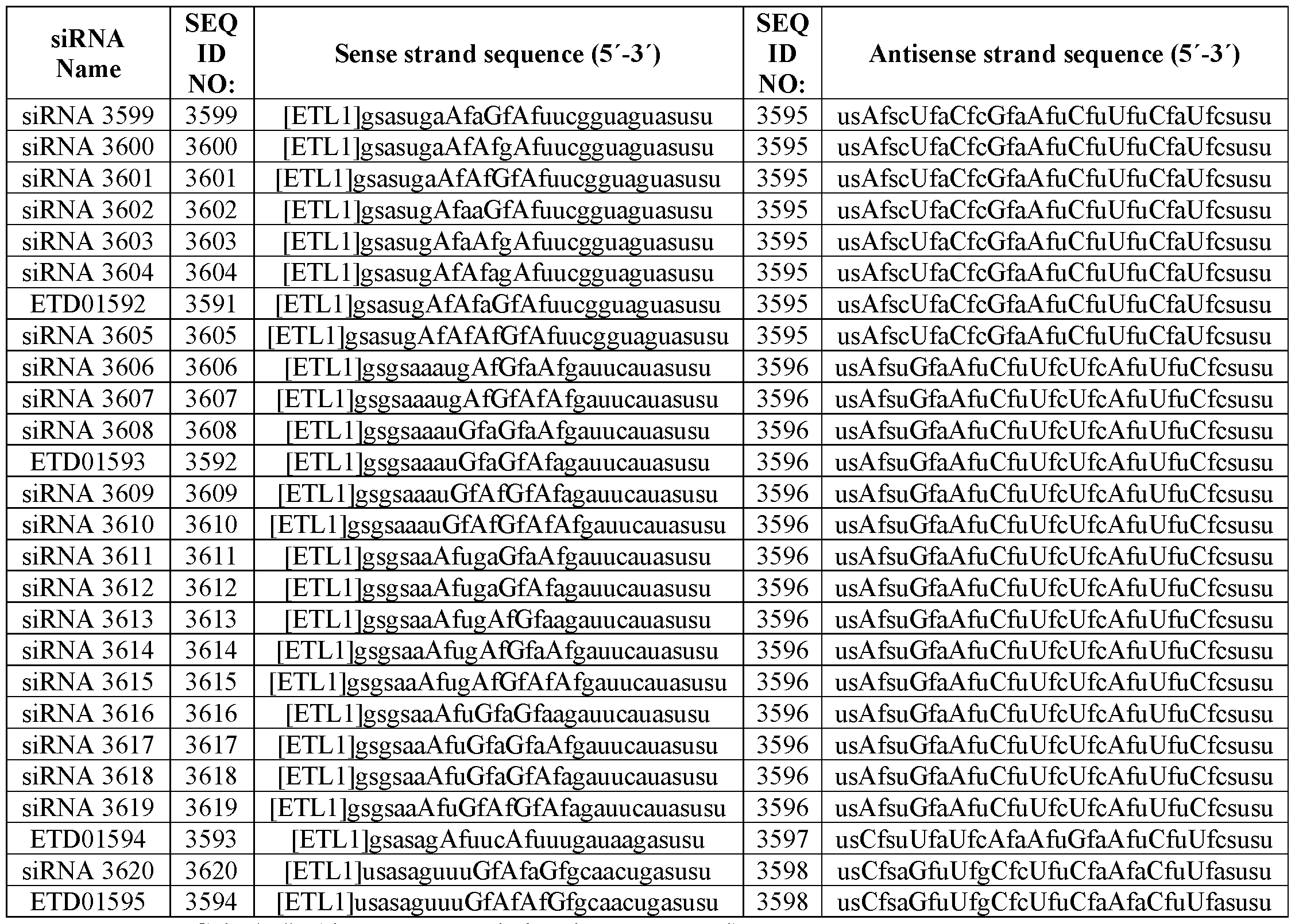
  • the sense strand comprises the nucleic acid sequence of any one of SEQ ID NOs: 3591-3594, or a sequence thereof having 1 or 2 substitutions, additions, or deletions
  • the antisense strand comprises the nucleic acid sequence of any one of SEQ ID NOs: 3595-3598, or a sequence thereof having 1 or 2 substitutions, additions, or deletions.
  • the sense strand comprises the nucleic acid sequence of any one of SEQ ID NOs: 3591- 3594
  • the antisense strand comprises the nucleic acid sequence of any one of SEQ ID NOs: 3595- 3598.
  • the oligonucleotide comprises an antisense oligonucleotide (ASO).
  • ASO is 12-30 nucleosides in length.
  • compositions comprising an oligonucleotide that inhibits the expression of FGG, wherein the oligonucleotide comprises an ASO about 12-30 nucleosides in length and a nucleoside sequence complementary to about 12-30 contiguous nucleosides of SEQ ID NO: 3621.
  • Some embodiments include a pharmaceutically acceptable carrier.
  • methods of treating a subject having a psychiatric disorder or a neurological disorder comprising administering an effective amount of the composition to the subject.
  • the psychiatric disorder comprises a depressive disorder (e.g., major depressive disorder, persistent depressive disorder, treatment resistant depression and signs or symptoms of depression), post-traumatic stress disorder, mood disorder, anxiety disorders, eating disorder, substance-use disorder, bipolar disorder, personality disorder, schizophrenia, or a schizoaffective disorder.
  • the neurological disorder comprises Alzheimer’s disease, dementia, delirium, cognitive decline, vascular dementia, headache (e.g., migraine), chronic pain (e.g., fibromyalgia), chronic fatigue syndrome (e.g., myalgic encephalomyelitis), chronic traumatic encephalopathy, traumatic brain injury, and motor neuron disease (e.g., amyotrophic lateral sclerosis).
  • compositions comprising an oligonucleotide that targets FGG.
  • FGG oligonucleotide that targets FGG.
  • some embodiments may include inhibiting or targeting a FGG protein or FGG RNA.
  • the FGG protein may be inhibited or targeted as a result of there being less production of the FGG protein by translation of the FGG RNA; or a FGG protein may be targeted or inhibited by an oligonucleotide that binds or interacts with a FGG RNA and reduces production of the FGG protein from the FGG RNA.
  • targeting FGG may refer to binding a FGG RNA and reducing FGG RNA or protein levels.
  • the oligonucleotide may include a small interfering RNA (siRNA) or an antisense oligonucleotide (ASO).
  • siRNA small interfering RNA
  • ASO antisense oligonucleotide
  • Administration of the oligonucleotide to a subject may improve psychiatric related traits, such as Montgomery-Asberg Depression Rating Scale (MADRS) (e.g., scale ranges from 0 to 60 with a higher score indicating worsening symptoms of depression), Hamilton Depression Rating Scale-17 (e.g., scale ranges from 0 to 52 with a higher score indicating worsening symptoms of depression), anxiety Attorney Docket No.54462-754.601 symptoms and signs, eating disorder symptoms and signs, substance-use disorder symptoms and signs, post-traumatic stress disorder symptoms and signs, bipolar disorder symptoms and signs, schizophrenia symptoms and signs, or psychosis symptoms and signs.
  • MADRS Montgomery-Asberg Depression Rating Scale
  • HVS Hamilton Depression Rating Scale-17
  • anxiety Attorney Docket No.54462-754.601 symptoms and signs eating disorder symptoms and signs, substance-use disorder symptoms and signs, post-traumatic stress disorder symptoms and signs, bipolar disorder symptoms and signs, schizophrenia symptoms and signs, or psychosis symptoms and signs.
  • administration of the oligonucleotide to a subject may improve neurological related traits, such as Cognitive function, central nervous system (CNS) amyloid plaques, CNS tau accumulation, cerebrospinal fluid (CSF) or plasma beta- amyloid 42, beta-amyloid 40, the ratio of beta-amyloid 42 to beta-amyloid 40, tau, phospho-tau, neurofilament light chain (NfL), glial fibrillary acidic protein (GFAP), Lewy bodies, or alpha-synuclein, headache symptoms and signs, migraine symptoms and signs, chronic pain symptoms and signs, fibromyalgia symptoms and signs, chronic fatigue syndrome (ME) symptoms and signs, or motor neuron disease (e.g., ALS) symptoms or signs.
  • CNS central nervous system
  • CSF cerebrospinal fluid
  • beta-amyloid 40 the ratio of beta-amyloid 42 to beta-amyloid 40
  • tau tau
  • phospho-tau neurofilament light chain
  • GFAP
  • a composition comprising an oligonucleotide that targets FGG and when administered to a subject in an effective amount improves a mental disorder measurement in the subject, relative to a baseline mental disorder measurement.
  • the mental disorder comprises a psychiatric disorder.
  • the psychiatric disorder comprises a depressive disorder, post-traumatic stress disorder, mood disorder, anxiety disorder, eating disorder, substance-use disorder, bipolar disorder, personality disorder, schizophrenia, or schizoaffective disorder.
  • the mental disorder measurement comprises a Montgomery-Asberg Depression Rating Scale score, a Hamilton Depression Rating Scale score, or a measurement of an anxiety disorder, depressive disorder, eating disorder, substance-use disorder, post-traumatic stress disorder, bipolar disorder, schizophrenia, or psychosis sign or symptom.
  • the mental disorder comprises a neurological disorder.
  • the neurological disorder comprises Alzheimer’s disease, dementia, delirium, cognitive decline, vascular dementia, headache, chronic pain, chronic fatigue syndrome, chronic traumatic encephalopathy, traumatic brain injury, or motor neuron disease.
  • the mental disorder measurement comprises a measurement of cognitive function, amyloid plaques, tau accumulation, beta-amyloid 42, beta-amyloid 40, the ratio of beta-amyloid 42 to beta-amyloid 40, tau, phospho-tau, neurofilament light chain (NfL), glial fibrillary acidic protein (GFAP), Lewy bodies, or alpha-synuclein, or a sign or symptom of headache, migraine, chronic pain, fibromyalgia, chronic fatigue syndrome, or motor neuron disease.
  • a composition comprising an oligonucleotide that targets FGG and when administered to a subject in an effective amount decreases fibrinogen.
  • the composition decreases circulating fibrinogen.
  • the subject has a clotting or coagulation disorder.
  • the subject has a thrombophilia.
  • the subject has a venous thromboembolism.
  • the composition further comprises an oligonucleotide that comprises a modified internucleoside linkage.
  • the modified internucleoside linkage comprises alkylphosphonate, phosphorothioate, methylphosphonate, phosphorodithioate, alkylphosphonothioate, phosphoramidate, carbamate, carbonate, phosphate triester, acetamidate, or carboxymethyl ester, or a combination thereof.
  • the modified internucleoside linkage comprises one or more phosphorothioate linkages.
  • the oligonucleotide Attorney Docket No.54462-754.601 comprises 1, 2, 3, 4, 5, 6, 7, 8, 9, 10, 11, 12, 13, 14, 15, 16, 17, 18, 19, or 20 modified internucleoside linkages.
  • the oligonucleotide comprises a modified nucleoside.
  • the modified nucleoside comprises a locked nucleic acid (LNA), hexitol nucleic acid (HNA), cyclohexene nucleic acid (CeNA), 2'-O-methoxyethyl, 2'-O-alkyl, 2’-O-allyl, 2’-C- allyl, 2'-fluoro, or 2'-deoxy, or a combination thereof.
  • the modified nucleoside comprises a LNA.
  • the modified nucleoside comprises a 2’,4’ constrained ethyl nucleic acid.
  • the modified nucleoside comprises 2'-O-methyl nucleoside, 2'- deoxyfluoro nucleoside, 2'-O-N-methylacetamido (2'-O-NMA) nucleoside, 2'-O- dimethylaminoethoxyethyl (2'-O-DMAEOE) nucleoside, 2'-O-aminopropyl’(2'-O-AP) nucleoside, or 2'- ara-F, or a combination thereof.
  • the modified nucleoside comprises one or more 2’-fluoro modified nucleosides.
  • the modified nucleoside comprises 2’-O-alkyl modified nucleoside.
  • the oligonucleotide comprises 1, 2, 3, 4, 5, 6, 7, 8, 9, 10, 11, 12, 13, 14, 15, 16, 17, 18, 19, 20, or 21 modified nucleosides.
  • the oligonucleotide comprises a sugar moiety attached at a 3’ or 5’ terminus of the oligonucleotide.
  • the sugar comprises N-acetylgalactosamine (GalNAc), N-acetylglucosamine (GlcNAc), or mannose.
  • the sugar comprises GalNAc.
  • the sugar moiety comprises ETL17.
  • the composition comprises an oligonucleotide that comprises a small interfering RNA (siRNA) comprising a sense strand and an antisense strand.
  • siRNA small interfering RNA
  • the sense strand is 12- 30 nucleosides in length.
  • the antisense strand is 12-30 nucleosides in length.
  • composition comprising an oligonucleotide that inhibits the expression of FGG, wherein the oligonucleotide comprises an siRNA comprising a sense strand and an antisense strand, each strand is independently about 12-30 nucleosides in length, and at least one of the sense strand and the antisense strand comprises a nucleoside sequence comprising about 12-30 contiguous nucleosides of SEQ ID NO: 3690.
  • any one of the following is true with regard to the sense strand: all purines comprise 2’-fluoro modified purines, and all pyrimidines comprise a mixture of 2’-fluoro and 2’-O-methyl modified pyrimidines; all purines comprise 2’-O-methyl modified purines, and all pyrimidines comprise a mixture of 2’-fluoro and 2’-O-methyl modified pyrimidines; all purines comprise 2’-fluoro modified purines, and all pyrimidines comprise 2’-O-methyl modified pyrimidines; all pyrimidines comprise 2’-fluoro modified pyrimidines, and all purines comprise a mixture of 2’-fluoro and 2’-O-methyl modified purines; all pyrimidines comprise 2’-O-methyl modified pyrimidines, and all purines comprise a mixture of 2’-fluoro and 2’-O-methyl modified purines; all pyrimidines comprise 2’-O-methyl modified pyrimidines,
  • the antisense strand comprises a mixture of 2’-fluoro and 2’-O-methyl modified nucleosides.
  • the oligonucleotide comprises an antisense oligonucleotide (ASO).
  • ASO antisense oligonucleotide
  • the ASO is 12-30 nucleosides in length.
  • disclosed herein is a composition comprising an oligonucleotide that inhibits the expression of FGG, wherein the oligonucleotide comprises an ASO about 12-30 nucleosides in length and a nucleoside sequence complementary to about 12-30 contiguous nucleosides of SEQ ID NO: 3621.
  • the composition further comprises a pharmaceutically acceptable carrier.
  • a method of treating a subject having a psychiatric disorder or a neurological disorder comprising administering an effective amount of a composition described herein.
  • the method comprises treating a psychiatric disorder that comprises a depressive disorder, persistent depressive disorder, treatment resistant depression, a sign or symptom of depression, post- traumatic stress disorder, mood disorder, anxiety disorders, eating disorder, substance-use disorder, bipolar disorder, personality disorder, schizophrenia, or a schizoaffective disorder.
  • the neurological disorder comprises Alzheimer’s disease, dementia, delirium, cognitive decline, vascular dementia, headache, chronic pain, chronic fatigue syndrome, chronic traumatic encephalopathy, traumatic brain injury, and motor neuron disease.
  • compositions comprising an oligonucleotide that targets fibrinogen gamma chain (FGG) and when administered to a cell decreases expression of FGG, wherein the oligonucleotide comprises a small interfering RNA (siRNA) comprising a sense strand and an antisense strand, and wherein: (i) the sense strand comprises any one of modification patterns 31S to 49S; or (ii) the antisense strand comprises any one of modification patterns 22AS to 41AS.
  • siRNA small interfering RNA
  • the oligonucleotide comprises a sugar moiety attached at a 3’ or 5’ terminus of the oligonucleotide. In some embodiments, the sugar moiety is attached at a 5’ terminus of the sense strand. In some embodiments, the sugar comprises N-acetylgalactosamine (GalNAc), N-acetylglucosamine (GlcNAc), or mannose. In some embodiments, the sugar comprises GalNAc. In some embodiments, the sugar moiety comprises ETL17. In some embodiments, the antisense strand is complementary or at least 90% complementary to a portion of SEQ ID NO: 3621.
  • the sense strand and the antisense strand each have 14 to 30 nucleotides.
  • the sense strand comprises a nucleoside sequence having at least 85% sequence identity to any one of SEQ ID NOs: 1-1742.
  • the sense strand comprises the nucleoside sequence of any one of: SEQ ID NOs: 1-1742, or a sequence thereof having 1 or 2 nucleoside substitutions, additions, or deletions.
  • the sense strand comprises the nucleoside sequence of any one of SEQ ID NOs: 1-1742.
  • the antisense strand comprises a nucleoside sequence having at least 85% sequence identity to any one of SEQ ID NOs: 1743-3484.
  • the antisense strand comprises the nucleoside sequence of any one of: SEQ ID NOs: 1743-3484, or a sequence thereof having 1 or 2 nucleoside substitutions, additions, or deletions. In some embodiments, the antisense strand comprises the nucleoside sequence of any one of SEQ ID NOs: 1743-3484.
  • the sense strand comprises the nucleobase sequence of a sense strand in any one of Tables 4-8, 9B, 9C, 18B, 22B, 26B, 31B, 33B, 37B, 42B, 47B, 67B, 79B, 85, 89, 93, 97, 101, 105, 109, 113, 117, 121, 125, 142, 183, 187, 190B or a nucleobase sequence thereof having 1 or 2 nucleoside substitutions, additions, or deletions.
  • the sense strand comprises the nucleobase sequence of a sense strand in any one of Tables 4-8, 9B, 9C, 18B, 22B, 26B, 31B, 33B, 37B, 42B, 47B, 67B, 79B, 85, 89, 93, 97, 101, 105, 109, 113, 117, 121, 125, 142, 183, 187, 190B.
  • the antisense strand comprises the nucleobase sequence of an antisense strand in any one of Tables 4-8, 9B, 9C, 18B, 22B, 26B, 31B, 33B, Attorney Docket No.54462-754.601 37B, 42B, 47B, 67B, 79B, 85, 89, 93, 97, 101, 105, 109, 113, 117, 121, 125, 142, 183, 187, 190B, or a nucleobase sequence thereof having 1 or 2 nucleoside substitutions, additions, or deletions.
  • the antisense strand comprises the nucleobase sequence of an antisense strand in any one of Tables 4-8, 9B, 9C, 18B, 22B, 26B, 31B, 33B, 37B, 42B, 47B, 67B, 79B, 85, 89, 93, 97, 101, 105, 109, 113, 117, 121, 125, 142, 183, 187, 190B.
  • pharmaceutical compositions comprising a composition described herein, and a pharmaceutically acceptable carrier.
  • the mental or neurological disorder comprises a neurodegenerative disease.
  • the mental or neurological disorder is selected from the group consisting of Alzheimer’s disease, dementia, delirium, cognitive decline, vascular dementia, headache, chronic pain, chronic fatigue syndrome, chronic traumatic encephalopathy, traumatic brain injury, and motor neuron disease.
  • headache comprises migraine.
  • chronic pain comprises fibromyalgia.
  • chronic fatigue syndrome comprises myalgic encephalomyelitis.
  • motor neuron disease comprises amyotrophic lateral sclerosis (ALS).
  • the mental or neurological disorder comprises a psychiatric disorder.
  • the psychiatric disorder is selected from the group consisting of post-traumatic stress disorder, mood disorders, anxiety disorders, eating disorders, substance-use disorders, bipolar disorder, personality disorders, schizophrenia and schizoaffective disorders.
  • methods of decreasing fibrinogen or fibrin in a subject’s central nervous system (CNS) comprising administering to the subject an effective amount of an FGG siRNA, thereby decreasing a quantity of fibrinogen or fibrin in the subject’s CNS.
  • the quantity of fibrinogen or fibrin is decreased by at least 10% relative to a baseline quantity, or by at least 10% relative to a control.
  • the FGG siRNA is administered to an area of the subject’s body other than the subject’s head or brain.
  • the quantity of fibrinogen or fibrin comprises a quantity of fibrinogen.
  • the quantity of fibrinogen or fibrin comprises a quantity of fibrin.
  • the CNS comprises a brain.
  • the FGG siRNA is included in a composition described herein.
  • a subject’s blood comprising administering to the subject an effective amount of an FGG siRNA, thereby decreasing a quantity of fibrinogen or fibrin in the subject’s blood.
  • the quantity of fibrinogen or fibrin is decreased by at least 10% relative to a baseline quantity, or by at least 10% relative to a control.
  • the FGG siRNA is administered to an area of the subject’s body other than the subject’s head or brain.
  • the quantity of fibrinogen or fibrin comprises a quantity of fibrinogen.
  • the quantity of fibrinogen or fibrin comprises a quantity of fibrin.
  • the blood comprises plasma.
  • the FGG siRNA is included in a composition described herein.
  • described herein is a method of treating a subject Attorney Docket No.54462-754.601 having a neurological disorder or who is at risk for developing the neurological disorder, the method comprising evaluating a subject’s risk for developing a neurological disorder and administering an effective amount of the composition described herein to the subject.
  • the subject has a genotype at risk for developing Alzheimer’s disease or dementia.
  • the subject is a heterozygous or homozygous carrier of APOE4.
  • the subject is a heterozygous or homozygous carrier of FGG rs148685782-G (A108) or FGG rs6063-C (G191).
  • evaluating a subject’s risk for developing a neurological disorder comprises calculating a polygenic risk score for developing Alzheimer’s disease or dementia.
  • the subject has a polygenic risk score in the 40 th percentile or higher, which is indicative of a high risk for developing Alzheimer’s disease or dementia.
  • the subject has a polygenic risk score in the 20 th percentile or higher, which is indicative of a high risk for developing Alzheimer’s disease or dementia.
  • calculating a polygenic risk score comprises providing genomic data comprising one or more genotypes of the subject, wherein the one or more genotypes is associated with a high risk for developing Alzheimer’s disease or dementia.
  • methods comprising administering an oligonucleotide that targets FGG and when administered to a subject in an effective amount reduces fibrinogen or fibrin in the subject.
  • the fibrinogen or fibrin is reduced by at least 5%, 10%, 20%, 30%, 40%, 50%, 60%, 75%, or at least 90% relative to baseline.
  • the fibrinogen or fibrin is reduced by at least 5%-90% relative to baseline.
  • one or more non-fibrinogen or fibrin coagulation measurements change by no more than 50%, 40%, 30%, 20%, 15%, 10%, 7% 5%, 4% 3%, 2% or no more than 1% relative to baseline.
  • the fibrinogen or fibrin is reduced without significant change to one or more non-fibrinogen or fibrin coagulation measurements.
  • the one or more coagulation measurements comprises von Willebrand Factor (VWF) antigen, VWF activity, factor VIII (FVIII), alpha-2 antiplasmin (A2AP), plasminogen activator inhibitor-1 (PAI-1), thrombin- antithrombin complex (TAT), D-dimer (DD), fibrinogen, prothrombin time (PT), international normalized ratio (INR), partial thromboplastin time (PTT), activated partial thromboplastin time (aPTT), or bleeding time assay.
  • the subject has a mental or neurological disorder.
  • FIG.1 is an example of a GalNAc ligand.
  • FIG.2 is an example of a GalNAc ligand.
  • FIG.3 includes a chart showing data from an ELISA (A), and a western blot (B) image.
  • a GWAS Genome Wide Association Study
  • a GWAS generally utilizes genotyping and/or sequencing data, and often involves an evaluation of millions of genetic variants that are relatively evenly distributed across the genome.
  • the Attorney Docket No.54462-754.601 most common GWAS design is the case-control study, which involves comparing variant frequencies in cases versus controls. If a variant has a significantly different frequency in cases versus controls, that variant is considered associated with disease.
  • Association statistics used in a GWAS include p-values, as a measure of statistical significance; odds ratios (OR), as a measure of effect size; or beta coefficients (beta), as a measure of effect size.
  • OR odds ratios
  • beta coefficients beta coefficients
  • the choice of therapeutic modality depends on factors such as the location of a target (for example, intracellular, extracellular, or secreted), a relevant tissue (for example, liver, brain, or neural tissue) and a relevant indication.
  • a target for example, intracellular, extracellular, or secreted
  • a relevant tissue for example, liver, brain, or neural tissue
  • the fibrinogen gamma chain gene also known as fibrinogen gamma gene (FGG)
  • FGG protein may be a gamma component of fibrinogen.
  • FGG protein may include 453 amino acids and have a mass of about 51.5 kDa.
  • An example of a FGG amino acid sequence, and further description of FGG is included at uniprot.org under accession no.
  • FGG may be secreted by the liver cells such as hepatocytes.
  • inhibition of FGG may serve as a therapeutic for treatment of psychiatric diseases and disorders such as depressive disorder (e.g., major depressive disorder, persistent depressive disorder, treatment resistant depression, or signs and symptoms of depression), post-traumatic stress disorder (PTSD), mood disorders, anxiety disorders, eating disorders, substance-use disorders, bipolar disorder, personality disorders, schizophrenia and schizoaffective disorders, and neurological diseases and disorders such as Alzheimer’s disease, dementia, delirium, Attorney Docket No.54462-754.601 cognitive decline, vascular dementia, headache, migraine, chronic pain, fibromyalgia, chronic fatigue syndrome (e.g., myalgic encephalomyelitis (ME)), chronic traumatic encephalopathy, traumatic brain injury, or motor neuron disease (e.g., amyotrophic lateral sclerosis).
  • depressive disorder e.g., major depressive disorder, persistent depressive disorder, treatment resistant depression, or signs and symptoms of depression
  • PTSD post-traumatic stress disorder
  • mood disorders anxiety disorders
  • eating disorders substance
  • a reduction of liver FGG expression may affect FGG, fibrinogen, or fibrin levels elsewhere in the body.
  • FGG may be expressed in liver cells, secreted into circulation, and accumulate in other tissues or areas of the body such as the central nervous system (CNS) or brain.
  • CNS central nervous system
  • a reduction in FGG mRNA or protein e.g., resultant from treatment with a FGG siRNA
  • may lead to reduced assembly and secretion of fibrinogen by the liver which may then also reduce the amount of fibrinogen or its degradation product, fibrin, that enters other tissues (e.g., that is able to cross the blood brain barrier and be deposited in the CNS or brain).
  • compositions comprising an oligonucleotide.
  • the composition comprises an oligonucleotide that targets FGG.
  • the composition consists of an oligonucleotide that targets FGG.
  • the oligonucleotide reduces FGG mRNA expression in the subject.
  • the oligonucleotide reduces FGG protein expression in the subject.
  • the oligonucleotide may include a small interfering RNA (siRNA) described herein.
  • the oligonucleotide may include an antisense oligonucleotide (ASO) described herein.
  • ASO antisense oligonucleotide
  • a composition described herein is used in a method of treating a disorder in a subject in need thereof.
  • Some embodiments relate to a composition comprising an oligonucleotide for use in a method of treating a disorder as described herein.
  • Some embodiments relate to use of a composition comprising an oligonucleotide, in a method of treating a disorder (e.g., psychiatric or neurological) as described herein.
  • Some embodiments include a composition comprising an oligonucleotide that targets FGG and when administered to a subject in an effective amount decreases FGG mRNA or protein levels in a cell (e.g., hepatocyte or neuron), fluid (e.g., blood, serum, plasma, or cerebrospinal fluid (CSF)), tissue (e.g., brain or liver tissue), or organ (e.g., the brain or liver).
  • the composition comprises an oligonucleotide that targets FGG and when administered to a subject in an effective amount decreases FGG mRNA levels in a cell or tissue.
  • the cell is a liver cell (e.g., hepatocyte).
  • the cell is a neuron.
  • the tissue is liver tissue.
  • the tissue is neural tissue.
  • the neural tissue is CNS tissue.
  • the neural tissue is brain tissue (e.g., neuronal, glia, or endothelial tissue).
  • the fluid is CSF.
  • the FGG mRNA levels are decreased by about 2.5% or more, about 5% or more, or about 7.5% or more, as compared to prior to administration. In some embodiments, the FGG mRNA levels are decreased by about 10% or more, as compared to prior to administration.
  • the FGG mRNA levels are decreased by about 20% or more, about 30% or more, about 40% or more, about 50% or more, about 60% or more, about 70% or more, about 80% or more, about 90% or more, or about 100%, as compared to Attorney Docket No.54462-754.601 prior to administration. In some embodiments, the FGG mRNA levels are decreased by no more than about 2.5%, no more than about 5%, or no more than about 7.5%, as compared to prior to administration. In some embodiments, the FGG mRNA levels are decreased by no more than about 10%, as compared to prior to administration.
  • the FGG mRNA levels are decreased by no more than about 20%, no more than about 30%, no more than about 40%, no more than about 50%, no more than about 60%, no more than about 70%, no more than about 80%, or no more than about 90%, as compared to prior to administration. In some embodiments, the FGG mRNA levels are decreased by 2.5%, 5%, 7.5%, 10%, 15%, 20%, 25%, 30%, 35%, 40%, 45%, 50%, 55%, 60%, 65%, 70%, 75%, 80%, 85%, 90%, 95%, or 100%, or by a range defined by any of the two aforementioned percentages.
  • the composition comprises an oligonucleotide that targets FGG and when administered to a subject in an effective amount decreases FGG protein levels in a cell, fluid (e.g., CSF) or tissue.
  • the cell is a hepatocyte.
  • the cell is a neural cell (e.g., CNS cell (e.g., brain cell)).
  • the cell is a neuronal cell.
  • the cell is a glial cell.
  • the cell is an endothelial cell.
  • the tissue is liver tissue.
  • the tissue is neural (e.g., CNS (e.g., brain)) tissue.
  • the fluid is CSF.
  • the FGG protein levels are decreased by about 2.5% or more, about 5% or more, or about 7.5% or more, as compared to prior to administration. In some embodiments, the FGG protein levels are decreased by about 10% or more, as compared to prior to administration. In some embodiments, the FGG protein levels are decreased by about 20% or more, about 30% or more, about 40% or more, about 50% or more, about 60% or more, about 70% or more, about 80% or more, about 90% or more, or about 100%, as compared to prior to administration. In some embodiments, the FGG protein levels are decreased by no more than about 2.5%, no more than about 5%, or no more than about 7.5%, as compared to prior to administration.
  • the FGG protein levels are decreased by no more than about 10%, as compared to prior to administration. In some embodiments, the FGG protein levels are decreased by no more than about 20%, no more than about 30%, no more than about 40%, no more than about 50%, no more than about 60%, no more than about 70%, no more than about 80%, or no more than about 90%, as compared to prior to administration. In some embodiments, the FGG protein levels are decreased by 2.5%, 5%, 7.5%, 10%, 15%, 20%, 25%, 30%, 35%, 40%, 45%, 50%, 55%, 60%, 65%, 70%, 75%, 80%, 85%, 90%, 95%, or 100%, or by a range defined by any of the two aforementioned percentages.
  • the composition comprises an oligonucleotide that targets FGG and when administered to a subject in an effective amount diminishes a mental disorder or disease phenotype, such as a psychiatric disorder or neurological disorder phenotype.
  • a disorder may include a disease.
  • the psychiatric disease or disorder may include depressive disorder (e.g., major depressive disorder, persistent depressive disorder, treatment resistant depression, or signs and symptoms of depression), post-traumatic stress disorder, mood disorders, anxiety disorders, eating disorders, substance-use disorders, bipolar disorder, personality disorders, schizophrenia and schizoaffective disorders.
  • the neurological disease or disorder may include such as Alzheimer’s disease, dementia, delirium, cognitive decline, vascular Attorney Docket No.54462-754.601 dementia, headache, migraine, chronic pain, fibromyalgia, chronic fatigue syndrome (e.g., myalgic encephalomyelitis (ME)), chronic traumatic encephalopathy, traumatic brain injury, or motor neuron disease (e.g., amyotrophic lateral sclerosis).
  • fibrinogen may be lowered enough to have a therapeutic effect on mental disorders but without significantly affecting coagulation parameters such as PT or aPTT.
  • the composition comprises an oligonucleotide that targets FGG and when administered to a subject in an effective amount improves (e.g. decreases) a psychiatric disease phenotype.
  • the psychiatric disease phenotype may include a Montgomery-Asberg Depression Rating Scale (MADRS) score.
  • the psychiatric disease phenotype may include a Hamilton Depression Rating Scale score.
  • the psychiatric disease phenotype may include a sign or symptom of anxiety.
  • the psychiatric disease phenotype may include a sign or symptom of an eating disorder.
  • the psychiatric disease phenotype may include a sign or symptom of a substance-use disorder.
  • the psychiatric disease phenotype may include a sign or symptom of post-traumatic stress disorder.
  • the psychiatric disease phenotype may include a sign or symptom of bipolar disorder.
  • the psychiatric disease phenotype may include a sign or symptom of schizophrenia.
  • the psychiatric disease phenotype may include a sign or symptom of psychosis.
  • the psychiatric disease phenotype is improved by about 2.5% or more, about 5% or more, or about 7.5% or more, as compared to prior to administration.
  • the psychiatric disease phenotype is improved by about 10% or more, as compared to prior to administration.
  • the psychiatric disease phenotype is improved by about 20% or more, about 30% or more, about 40% or more, about 50% or more, about 60% or more, about 70% or more, about 80% or more, about 90% or more, or about 100%, as compared to prior to administration. In some embodiments, the psychiatric disease phenotype is improved by no more than about 2.5%, no more than about 5%, or no more than about 7.5%, as compared to prior to administration. In some embodiments, the psychiatric disease phenotype is improved by no more than about 10%, as compared to prior to administration.
  • the psychiatric disease phenotype is improved by no more than about 20%, no more than about 30%, no more than about 40%, no more than about 50%, no more than about 60%, no more than about 70%, no more than about 80%, or no more than about 90%, as compared to prior to administration. In some embodiments, the psychiatric disease phenotype is improved by 2.5%, 5%, 7.5%, 10%, 15%, 20%, 25%, 30%, 35%, 40%, 45%, 50%, 55%, 60%, 65%, 70%, 75%, 80%, 85%, 90%, 95%, or 100%, or by a range defined by any of the two aforementioned percentages.
  • the composition comprises an oligonucleotide that targets FGG and when administered to a subject in an effective amount improves (e.g. decreases) a neurological disease phenotype.
  • the neurological disease phenotype may include cognitive dysfunction.
  • the neurological disease phenotype may include central nervous system (CNS) amyloid plaques.
  • the neurological disease phenotype may include CNS tau accumulation.
  • the neurological disease phenotype may include cerebrospinal fluid (CSF) or plasma beta-amyloid 42, beta-amyloid 40, or the ratio of beta-amyloid 42 to beta-amyloid 40.
  • the neurological disease phenotype may include CSF or plasma tau.
  • the neurological disease phenotype may include CSF or plasma phospho-tau (such as p-tau217).
  • the neurological disease Attorney Docket No.54462-754.601 phenotype may include CSF or plasma neurofilament light chain (NfL).
  • the neurological disease phenotype may include CSF or plasma glial fibrillary acidic protein (GFAP).
  • the neurological disease phenotype may include Lewy bodies.
  • the neurological disease phenotype may include CSF alpha- synuclein.
  • the neurological disease phenotype may include headache symptoms or signs.
  • the neurological disease phenotype may include migraine symptoms or signs.
  • the neurological disease phenotype may include chronic pain symptoms or signs.
  • the neurological disease phenotype may include fibromyalgia symptoms or signs.
  • the neurological disease phenotype may include chronic fatigue syndrome (e.g., myalgic encephalomyelitis) symptoms or signs.
  • the neurological disease phenotype may include motor neuron disease (e.g., amyotrophic lateral sclerosis) symptoms or signs.
  • the neurological disease phenotype is improved by about 2.5% or more, about 5% or more, or about 7.5% or more, as compared to prior to administration. In some embodiments, the neurological disease phenotype is improved by about 10% or more, as compared to prior to administration.
  • the neurological disease phenotype is improved by about 20% or more, about 30% or more, about 40% or more, about 50% or more, about 60% or more, about 70% or more, about 80% or more, about 90% or more, or about 100%, as compared to prior to administration. In some embodiments, the neurological disease phenotype is improved by no more than about 2.5%, no more than about 5%, or no more than about 7.5%, as compared to prior to administration. In some embodiments, the neurological disease phenotype is improved by no more than about 10%, as compared to prior to administration.
  • the neurological disease phenotype is improved by no more than about 20%, no more than about 30%, no more than about 40%, no more than about 50%, no more than about 60%, no more than about 70%, no more than about 80%, or no more than about 90%, as compared to prior to administration. In some embodiments, the neurological disease phenotype is improved by 2.5%, 5%, 7.5%, 10%, 15%, 20%, 25%, 30%, 35%, 40%, 45%, 50%, 55%, 60%, 65%, 70%, 75%, 80%, 85%, 90%, 95%, or 100%, or by a range defined by any of the two aforementioned percentages. [0032]
  • the composition may treat a clotting or coagulation disorder.
  • the composition may treat thrombophilia.
  • the composition may affect clotting or a clotting time.
  • the composition comprises an oligonucleotide that decreases Fibrinogen or fibrin.
  • a FGG siRNA composition may be useful as an anticoagulant, such as for treatment or prophylaxis of a coagulation or clotting disorders (e.g., venous thromboembolism, atrial fibrillation), given that significant FGG knockdown may lead to a prolonged clotting time (e.g., PT, INR or aPTT).
  • a clotting time e.g., PT, INR or aPTT
  • it is useful to lower Fibrinogen or fibrin significantly enough to prolong clotting times to clinically meaningful levels for these indications.
  • FGG knockdown may result in decreased circulating fibrinogen or fibrin.
  • Decreased circulating fibrinogen or fibrin may result in increased PT, INR and aPTT.
  • the compounds may be useful for reducing clotting.
  • Some aspects relate to a composition comprising an oligonucleotide that targets FGG and when administered to a subject in an effective amount decreases fibrinogen or fibrin.
  • Attorney Docket No.54462-754.601 [0033]
  • the prothrombin time (PT), International Normalized Ration (INR) and activated partial thromboplastin time (aPTT) levels are unchanged as compared to administration.
  • PT, INR or aPTT increases by no more than about 10%, as compared to prior to administration. In some embodiments, PT, INR or aPTT increase by no more than about 20%, no more than about 40%, no more than about 80%, no more than about 160%, no more than about 200%, no more than about 300%, no more than about 400%, or no more than about 600%, as compared to prior to administration. In some embodiments, the PT, INR or aPTT increases by 5%, 10%, 20%, 40%, 80%, 100%, 200%,400% or 600%, or by a range defined by any of the two aforementioned percentages. [0034] The composition may be used to reduce levels of fibrinogen or fibrin.
  • the fibrinogen or fibrin is reduced while leading to minimal or non-significant changes in other coagulation measurements. In some instances, the fibrinogen or fibrin is reduced by at least 5%, 10%, 20%, 30%, 40%, 50%, 60%, 75%, or at least 90% relative to baseline without significant change in other coagulation measurements. In some instances, the fibrinogen or fibrin is reduced by at least 5%, 10%, 20%, 30%, 40%, 50%, 60%, 75%, or at least 90% relative to baseline and one or more non-fibrinogen or fibrin coagulation measurements change by no more than 50%, 40%, 30%, 20%, 15%, 10%, 7% 5%, 4% 3%, 2% or no more than 1% relative to baseline.
  • the fibrinogen or fibrin is reduced by 5- 95% 5-90%, 5-80%, 5-70%, 5-50%, 5-40%, 5-30%, 10-90%, 10-80%, 10-70%, 10-50%, 10-30%, 20- 95%, 20-50%, 40-90%, 50-95%, 60-95%, or 70-90% relative to baseline and one or more non-fibrinogen or fibrin coagulation measurements change by no more than 50%, 40%, 30%, 20%, 15%, 10%, 7% 5%, 4% 3%, 2% or no more than 1% relative to baseline.
  • the fibrinogen or fibrin is reduced by 5-95% 5-90%, 5-80%, 5-70%, 5-50%, 5-40%, 5-30%, 10-90%, 10-80%, 10-70%, 10-50%, 10-30%, 20-95%, 20-50%, 40-90%, 50-95%, 60-95%, or 70-90% relative to baseline and one or more non- fibrinogen or fibrin coagulation measurements change by 1-75%, 1-50%, 1-40%, 1-30%, 1-20%, 1-15%, 1-10%, 1-%, 1-5%, 1-3%, or 1-2% relative to baseline.
  • the fibrinogen or fibrin is reduced by at least 5%, 10%, 20%, 30%, 40%, 50%, 60%, 75%, or at least 90% relative to baseline and one or more non-fibrinogen or fibrin coagulation measurements change by 1-75%, 1-50%, 1-40%, 1-30%, 1-20%, 1-15%, 1-10%, 1-%, 1-5%, 1-3%, or 1-2% relative to baseline.
  • coagulation measurements comprises von Willebrand Factor (VWF) antigen, VWF activity, factor VIII (FVIII), alpha- 2 antiplasmin (A2AP), plasminogen activator inhibitor-1 (PAI-1), thrombin-antithrombin complex (TAT), D-dimer (DD), fibrinogen, fibrin, prothrombin time (PT), international normalized ratio (INR), partial thromboplastin time (PTT), activated partial thromboplastin time (aPTT), or bleeding time assay.
  • VWF von Willebrand Factor
  • VIII von Willebrand Factor
  • A2AP alpha- 2 antiplasmin
  • PAI-1 plasminogen activator inhibitor-1
  • TAT thrombin-antithrombin complex
  • DD D-dimer
  • PT prothrombin time
  • ITR international normalized ratio
  • PTT partial thromboplastin time
  • aPTT activated partial thromboplastin time
  • bleeding time assay e.g.
  • the composition comprises an oligonucleotide that targets FGG, wherein the oligonucleotide comprises a small interfering RNA (siRNA) comprising a sense strand and an antisense strand.
  • siRNA small interfering RNA
  • the composition comprises an oligonucleotide that inhibits the expression of FGG, wherein the oligonucleotide comprises an siRNA comprising a sense strand and an antisense Attorney Docket No.54462-754.601 strand, wherein the sense strand is 12-30 nucleosides in length.
  • the composition comprises a sense strand that is 10, 11, 12, 13, 14, 15, 16, 17, 18,19, 20, 21, 22, 23, 24, 25, 26, 27, 28, 29, or 30 nucleosides in length, or a range defined by any of the two aforementioned numbers.
  • the sense strand may be 14-30 nucleosides in length.
  • the composition comprises an antisense strand is 12-30 nucleosides in length.
  • the composition comprises an antisense strand that is 10, 11, 12, 13, 14, 15, 16, 17, 18,19, 20, 21, 22, 23, 24, 25, 26, 27, 28, 29, or 30 nucleosides in length, or a range defined by any of the two aforementioned numbers.
  • the antisense strand may be 14- 30 nucleosides in length.
  • the composition comprises an oligonucleotide that inhibits the expression of FGG, wherein the oligonucleotide comprises an siRNA comprising a sense strand and an antisense strand, each strand is independently about 12-30 nucleosides in length, and at least one of the sense strand and the antisense strand comprises a nucleoside sequence comprising about 12-30 contiguous nucleosides of a full-length human FGG mRNA sequence such as SEQ ID NO: 3621.
  • thymine (T) may be replaced with Uracil (U).
  • the composition comprises an oligonucleotide that inhibits the expression of FGG, wherein the oligonucleotide comprises an siRNA comprising a sense strand and an antisense strand, wherein the sense strand and the antisense strand form a double-stranded RNA duplex.
  • the first base pair of the double-stranded RNA duplex is an AU base pair.
  • the sense strand further comprises a 3’ overhang.
  • the 3’ overhang comprises 1, 2, 3, 4, 5, 6, 7, 8, 9, or 10 nucleosides, or a range of nucleotides defined by any two of the aforementioned numbers.
  • the 3’ overhang comprises 1, 2, or more nucleosides.
  • the 3’ overhang comprises 2 nucleosides.
  • the sense strand further comprises a 5’ overhang.
  • the 5’ overhang comprises 1, 2, 3, 4, 5, 6, 7, 8, 9, or 10 nucleosides, or a range of nucleotides defined by any two of the aforementioned numbers.
  • the 5’ overhang comprises 1, 2, or more nucleosides. In some embodiments, the 5’ overhang comprises 2 nucleosides. [0040] In some embodiments, the antisense strand further comprises a 3’ overhang. In some embodiments, the 3’ overhang comprises 1, 2, 3, 4, 5, 6, 7, 8, 9, or 10 nucleosides, or a range of nucleotides defined by any two of the aforementioned numbers. In some embodiments, the 3’ overhang comprises 1, 2, or more nucleosides. In some embodiments, the 3’ overhang comprises 2 nucleosides. In some embodiments, the antisense strand further comprises a 5’ overhang.
  • the 5’ overhang comprises 1, 2, 3, 4, 5, 6, 7, 8, 9, or 10 nucleosides, or a range of nucleotides defined by any two of the aforementioned numbers. In some embodiments, the 5’ overhang comprises 1, 2, or more nucleosides. In some embodiments, the 5’ overhang comprises 2 nucleosides.
  • Attorney Docket No.54462-754.601 [0041]
  • the composition comprises an oligonucleotide that inhibits the expression of FGG, wherein the oligonucleotide comprises an siRNA comprising a sense strand and an antisense strand, wherein the siRNA binds with a 19mer in a human FGG mRNA.
  • the siRNA binds with a 12mer, a 13mer, a 14mer, a 15mer, a 16mer, a 17mer, a 18mer, a 19mer, a 20mer, a 21mer, a 22mer, a 23mer, a 24mer, or a 25mer in a human FGG mRNA.
  • the composition comprises an oligonucleotide that inhibits the expression of FGG, wherein the oligonucleotide comprises an siRNA comprising a sense strand and an antisense strand, wherein the siRNA binds with a 17mer in a non-human primate FGG mRNA.
  • the siRNA binds with a 12mer, a 13mer, a 14mer, a 15mer, a 16mer, a 17mer, a 18mer, a 19mer, a 20mer, a 21mer, a 22mer, a 23mer, a 24mer, or a 25mer in a non-human primate FGG mRNA.
  • the composition comprises an oligonucleotide that inhibits the expression of FGG, wherein the oligonucleotide comprises an siRNA comprising a sense strand and an antisense strand, wherein the siRNA binds with a human FGG mRNA and less than or equal to 20 human off- targets, with no more than 2 mismatches in the antisense strand.
  • the siRNA binds with a human FGG mRNA and less than or equal to 10 human off-targets, with no more than 2 mismatches in the antisense strand.
  • the siRNA binds with a human FGG mRNA and less than or equal to 30 human off-targets, with no more than 2 mismatches in the antisense strand. In some embodiments, the siRNA binds with a human FGG mRNA and less than or equal to 40 human off- targets, with no more than 2 mismatches in the antisense strand. In some embodiments, the siRNA binds with a human FGG mRNA and less than or equal to 50 human off-targets, with no more than 2 mismatches in the antisense strand.
  • the siRNA binds with a human FGG mRNA and less than or equal to 10 human off-targets, with no more than 3 mismatches in the antisense strand. In some embodiments, the siRNA binds with a human FGG mRNA and less than or equal to 20 human off- targets, with no more than 3 mismatches in the antisense strand. In some embodiments, the siRNA binds with a human FGG mRNA and less than or equal to 30 human off-targets, with no more than 3 mismatches in the antisense strand.
  • the siRNA binds with a human FGG mRNA and less than or equal to 40 human off-targets, with no more than 3 mismatches in the antisense strand. In some embodiments, the siRNA binds with a human FGG mRNA and less than or equal to 50 human off- targets, with no more than 3 mismatches in the antisense strand.
  • the composition comprises an oligonucleotide that inhibits the expression of FGG, wherein the oligonucleotide comprises an siRNA comprising a sense strand and an antisense strand, siRNA binds with a human FGG mRNA target site that does not harbor an SNP, with a minor allele frequency (MAF) greater or equal to 1% (pos.2-18).
  • siRNA minor allele frequency
  • the MAF is greater or equal to about 2%, about 3%, about 4%, about 5%, about 6%, about 7%, about 8%, about 9%, about 10%, about 11%, about 12%, about 13%, about 14%, about 15%, about 16%, about 17%, about 18%, about 19%, or about 20%.
  • the composition comprises an oligonucleotide that inhibits the expression of FGG, wherein the oligonucleotide comprises an siRNA comprising a sense strand and an antisense Attorney Docket No.54462-754.601 strand, wherein the sense strand comprises a nucleoside sequence comprising or consisting of the sequence of any one of SEQ ID NOs: 1-1742, or a nucleic acid sequence thereof having 1 or 2 nucleoside substitutions, additions, or deletions.
  • the sense strand comprises a nucleoside sequence comprising or consisting of the sequence of any one of SEQ ID NOs: 1-1742, or a nucleic acid sequence thereof having 3 or 4 nucleoside substitutions, additions, or deletions.
  • the sense strand further comprises a 3’ overhang.
  • the 3’ overhang comprises 1, 2, 3, 4, 5, 6, 7, 8, 9, or 10 nucleosides, or a range of nucleotides defined by any two of the aforementioned numbers.
  • the 3’ overhang comprises 1, 2, or more nucleosides.
  • the 3’ overhang comprises 2 nucleosides.
  • the sense strand further comprises a 5’ overhang.
  • the 5’ overhang comprises 1, 2, 3, 4, 5, 6, 7, 8, 9, or 10 nucleosides, or a range of nucleotides defined by any two of the aforementioned numbers. In some embodiments, the 5’ overhang comprises 1, 2, or more nucleosides. In some embodiments, the 5’ overhang comprises 2 nucleosides. In some embodiments, the sense strand comprises a nucleoside sequence comprising or consisting of the sequence of any one of SEQ ID NOs: 1-1742, or a nucleic acid sequence thereof having 1 or 2 nucleoside additions at the 3’ end.
  • the composition comprises an oligonucleotide that inhibits the expression of FGG, wherein the oligonucleotide comprises an siRNA comprising a sense strand and an antisense strand, wherein the sense strand comprises a nucleoside sequence comprising or consisting of the sequence of any one of SEQ ID NOs: 1-1742.
  • thymine (T) may be replaced with uracil (U).
  • U uracil
  • Any of the aforementioned siRNAs may include an antisense strand where the 5’ nucleoside has been modified to an A.
  • any one of the aforementioned siRNAs may include an antisense strand sequence wherein the 5’ nucleoside has been modified to a U or T.
  • position 1 (from the 5’ end) of any one of SEQ ID NOs: 1- 1742 is modified to an A, T, C, U, or G.
  • position 6 (from the 5’ end) of any one of SEQ ID NOs: 1-1742 is modified to an A, T, C, U, or G.
  • position 19 (from the 5’ end) of any one of SEQ ID NOs: 1-1742 is modified to an A, T, C, U, or G.
  • position 1 (from the 5’ end) of any one of SEQ ID NOs: 1-1742 is modified to an A.
  • position 6 (from the 5’ end) of any one of SEQ ID NOs: 1-1742 is modified to an A.
  • position 19 (from the 5’ end) of any one of SEQ ID NOs: 1-1742 is modified to an A.
  • position 1 and position 6, position 1 and position 19, position 6 and position 19, or position 1, position 6, and position 19 of any one of SEQ ID NOs: 1-1742 is modified to an A.
  • position 1 (from the 5’ end) of any one of SEQ ID NOs: 1-1742 is modified to an T or U.
  • position 6 (from the 5’ end) of any one of SEQ ID NOs: 1-1742 is modified to a T or U.
  • position 19 (from the 5’ end) of any one of SEQ ID NOs: 1-1742 is modified to a T or U.
  • position 1 and position 6, position 1 and position 19, position 6 and position 19, or position 1, position 6, and position 19 of any one of SEQ ID NOs: 1-1742 is modified to a T or U.
  • position 1 (from the 5’ end) of any one of SEQ ID NOs: 1-1742 is modified to an G.
  • position 6 (from the 5’ end) of any one of SEQ ID NOs: 1-1742 is modified to an G.
  • position 19 (from the 5’ end) of any one of SEQ ID NOs: 1- Attorney Docket No.54462-754.601 1742 is modified to an G.
  • position 1 and position 6, position 1 and position 19, position 6 and position 19, or position 1, position 6, and position 19 of any one of SEQ ID NOs: 1-1742 is modified to an G.
  • position 1 (from the 5’ end) of any one of SEQ ID NOs: 1-1742 is modified to an C.
  • position 6 (from the 5’ end) of any one of SEQ ID NOs: 1- 1742 is modified to an C.
  • position 19 (from the 5’ end) of any one of SEQ ID NOs: 1-1742 is modified to an C.
  • the composition comprises an oligonucleotide that inhibits the expression of FGG, wherein the oligonucleotide comprises an siRNA comprising a sense strand and an antisense strand, wherein the antisense strand comprises a nucleoside sequence comprising or consisting of the sequence of any one of SEQ ID NOs: 1743-3484, or a nucleic acid sequence thereof having 1 or 2 nucleoside substitutions, additions, or deletions.
  • the antisense strand sequence comprises a nucleoside sequence comprising or consisting of the sequence of any one of SEQ ID NOs: 1743-3484 or a nucleic acid sequence thereof having 3 or 4 nucleoside substitutions, additions, or deletions.
  • the antisense strand further comprises a 3’ overhang.
  • the 3’ overhang comprises 1, 2, 3, 4, 5, 6, 7, 8, 9, or 10 nucleosides, or a range of nucleotides defined by any two of the aforementioned numbers.
  • the 3’ overhang comprises 1, 2, or more nucleosides.
  • the 3’ overhang comprises 2 nucleosides.
  • the antisense strand further comprises a 5’ overhang.
  • the 5’ overhang comprises 1, 2, 3, 4, 5, 6, 7, 8, 9, or 10 nucleosides, or a range of nucleotides defined by any two of the aforementioned numbers.
  • the 5’ overhang comprises 1, 2, or more nucleosides.
  • the 5’ overhang comprises 2 nucleosides.
  • the antisense strand comprises a nucleoside sequence comprising or consisting of the sequence of any one of SEQ ID NOs: 1743-3484, or a nucleic acid sequence thereof having 1 or 2 nucleoside additions at the 3’ end.
  • the composition comprises an oligonucleotide that inhibits the expression of FGG, wherein the oligonucleotide comprises an siRNA comprising a sense strand and an antisense strand, wherein the antisense strand comprises a nucleoside sequence comprising or consisting of the sequence of any one of SEQ ID NOs: 1743-3484.
  • thymine (T) may be replaced with uracil (U).
  • Any of the aforementioned siRNAs may include a sense strand wherein the 3’ nucleoside has been modified to an A.
  • any one of the aforementioned siRNAs may include a sense strand sequence wherein the 5’ nucleoside has been modified to a T or U.
  • position 1 (from the 5’ end) of any one of SEQ ID NOs: 1743-3484 is modified to an A, T, C, U, or G.
  • position 14 (from the 5’ end) of any one of SEQ ID NOs: 1743-3484 is modified to an A, T, C, U, or G.
  • position 19 (from the 5’ end) of any one of SEQ ID NOs: 1743-3484 is modified to an A, T, C, U, or G.
  • position 1 and position 14, position 1 and position 19, position 14 and position 19, or position 1, position 14, and position 19 of any one of SEQ ID NOs: 1743-3484 is modified to an A, T, C, U, or G.
  • position 1 (from the 5’ end) of any one of SEQ ID Attorney Docket No.54462-754.601 NOs: 1743-3484 is modified to an A.
  • position 14 (from the 5’ end) of the sense strand of any one of SEQ ID NOs: 1743-3484 is modified to an A.
  • position 19 (from the 5’ end) of any one of SEQ ID NOs: 1743-3484 is modified to an A.
  • position 1 and position 14, position 1 and position 19, position 14 and position 19, or position 1, position 14, and position 19 of any one of SEQ ID NOs: 1743-3484 is modified to an A.
  • position 1 (from the 5’ end of any one of SEQ ID NOs: 1743-3484 is modified to a T or U.
  • position 14 (from the 5’ end) of any one of SEQ ID NOs: 1743-3484 is modified to a T or U.
  • position 19 (from the 5’ end) of any one of SEQ ID NOs: 1743-3484 is modified to a T or U.
  • position 1 and position 14, position 1 and position 19, position 14 and position 19, or position 1, position 14, and position 19 of any one of SEQ ID NOs: 1743- 3484 is modified to a T or U.
  • position 1 (from the 5’ end) of any one of SEQ ID NOs: 1743-3484 is modified to an G.
  • position 14 (from the 5’ end) of any one of SEQ ID NOs: 1743-3484 is modified to an G.
  • position 19 (from the 5’ end) of any one of SEQ ID NOs: 1743-3484 is modified to an G.
  • position 1 and position 14, position 1 and position 19, position 14 and position 19, or position 1, position 14, and position 19 of any one of SEQ ID NOs: 1743-3484 is modified to an G.
  • position 1 (from the 5’ end) of any one of SEQ ID NOs: 1743-3484 is modified to an C.
  • position 14 (from the 5’ end) of any one of SEQ ID NOs: 1743-3484 is modified to an C.
  • position 19 (from the 5’ end) of any one of SEQ ID NOs: 1743-3484 is modified to an C.
  • the composition comprises an oligonucleotide that inhibits the expression of FGG, wherein the oligonucleotide comprises an siRNA comprising a sense strand and an antisense strand, wherein the sense strand comprises a nucleoside sequence comprising or consisting of the sequence of any one of SEQ ID NOs: 3713-3748, or a nucleic acid sequence thereof having 1 or 2 nucleoside substitutions, additions, or deletions.
  • the sense strand comprises a nucleoside sequence comprising or consisting of the sequence of any one of SEQ ID NOs: 3713-3748, or a nucleic acid sequence thereof having 3 or 4 nucleoside substitutions, additions, or deletions.
  • the sense strand further comprises a 3’ overhang.
  • the 3’ overhang comprises 1, 2, 3, 4, 5, 6, 7, 8, 9, or 10 nucleosides, or a range of nucleotides defined by any two of the aforementioned numbers.
  • the 3’ overhang comprises 1, 2, or more nucleosides.
  • the 3’ overhang comprises 2 nucleosides.
  • the sense strand further comprises a 5’ overhang.
  • the 5’ overhang comprises 1, 2, 3, 4, 5, 6, 7, 8, 9, or 10 nucleosides, or a range of nucleotides defined by any two of the aforementioned numbers. In some embodiments, the 5’ overhang comprises 1, 2, or more nucleosides. In some embodiments, the 5’ overhang comprises 2 nucleosides. In some embodiments, the sense strand comprises a nucleoside sequence comprising or consisting of the sequence of any one of SEQ ID NOs: 3713-3748, or a nucleic acid sequence thereof having 1 or 2 nucleoside additions at the 3’ end.
  • the Attorney Docket No.54462-754.601 composition comprises an oligonucleotide that inhibits the expression of FGG, wherein the oligonucleotide comprises an siRNA comprising a sense strand and an antisense strand, wherein the sense strand comprises a nucleoside sequence comprising or consisting of the sequence of any one of SEQ ID NOs: 3713-3748.
  • thymine (T) may be replaced with uracil (U).
  • Any of the aforementioned siRNAs may include an antisense strand where the 5’ nucleoside has been modified to an A.
  • any one of the aforementioned siRNAs may include an antisense strand sequence wherein the 5’ nucleoside has been modified to a U or T.
  • position 1 (from the 5’ end) of any one of SEQ ID NOs: 3713-3748 is modified to an A, T, C, U, or G.
  • position 6 (from the 5’ end) of any one of SEQ ID NOs: 3713-3748 is modified to an A, T, C, U, or G.
  • position 19 (from the 5’ end) of any one of SEQ ID NOs: 3713-3748 is modified to an A, T, C, U, or G.
  • position 1 (from the 5’ end) of any one of SEQ ID NOs: 3713-3748 is modified to an A.
  • position 6 (from the 5’ end) of any one of SEQ ID NOs: 3713- 3748 is modified to an A.
  • position 19 (from the 5’ end) of any one of SEQ ID NOs: 3713-3748 is modified to an A.
  • position 1 and position 6, position 1 and position 19, position 6 and position 19, or position 1, position 6, and position 19 of any one of SEQ ID NOs: 3713-3748 is modified to an A.
  • position 1 (from the 5’ end) of any one of SEQ ID NOs: 3713-3748 is modified to an T or U.
  • position 6 (from the 5’ end) of any one of SEQ ID NOs: 3713-3748 is modified to a T or U.
  • position 19 (from the 5’ end) of any one of SEQ ID NOs: 3713-3748 is modified to a T or U.
  • position 1 and position 6, position 1 and position 19, position 6 and position 19, or position 1, position 6, and position 19 of any one of SEQ ID NOs: 3713-3748 is modified to a T or U.
  • position 1 (from the 5’ end) of any one of SEQ ID NOs: 3713-3748 is modified to an G.
  • position 6 (from the 5’ end) of any one of SEQ ID NOs: 3713-3748 is modified to an G.
  • position 19 (from the 5’ end) of any one of SEQ ID NOs: 3713-3748 is modified to an G.
  • position 1 and position 6, position 1 and position 19, position 6 and position 19, or position 1, position 6, and position 19 of any one of SEQ ID NOs: 3713-3748 is modified to an G.
  • position 1 (from the 5’ end) of any one of SEQ ID NOs: 3713-3748 is modified to an C.
  • position 6 (from the 5’ end) of any one of SEQ ID NOs: 3713-3748 is modified to an C.
  • position 19 (from the 5’ end) of any one of SEQ ID NOs: 3713- 3748 is modified to an C.
  • position 1 and position 6, position 1 and position 19, position 6 and position 19, or position 1, position 6, and position 19 of any one of SEQ ID NOs: 3713- 3748 is modified to an C.
  • the composition comprises an oligonucleotide that inhibits the expression of FGG, wherein the oligonucleotide comprises an siRNA comprising a sense strand and an antisense strand, wherein the antisense strand comprises a nucleoside sequence comprising or consisting of the sequence of any one of SEQ ID NOs: 3749-3784, or a nucleic acid sequence thereof having 1 or 2 nucleoside substitutions, additions, or deletions.
  • the antisense strand sequence comprises a nucleoside sequence comprising or consisting of the sequence of any one of SEQ ID NOs: Attorney Docket No.54462-754.601 3749-3784 or a nucleic acid sequence thereof having 3 or 4 nucleoside substitutions, additions, or deletions.
  • the antisense strand further comprises a 3’ overhang.
  • the 3’ overhang comprises 1, 2, 3, 4, 5, 6, 7, 8, 9, or 10 nucleosides, or a range of nucleotides defined by any two of the aforementioned numbers.
  • the 3’ overhang comprises 1, 2, or more nucleosides.
  • the 3’ overhang comprises 2 nucleosides.
  • the antisense strand further comprises a 5’ overhang.
  • the 5’ overhang comprises 1, 2, 3, 4, 5, 6, 7, 8, 9, or 10 nucleosides, or a range of nucleotides defined by any two of the aforementioned numbers.
  • the 5’ overhang comprises 1, 2, or more nucleosides.
  • the 5’ overhang comprises 2 nucleosides.
  • the antisense strand comprises a nucleoside sequence comprising or consisting of the sequence of any one of SEQ ID NOs: 3749-3784, or a nucleic acid sequence thereof having 1 or 2 nucleoside additions at the 3’ end.
  • the composition comprises an oligonucleotide that inhibits the expression of FGG, wherein the oligonucleotide comprises an siRNA comprising a sense strand and an antisense strand, wherein the antisense strand comprises a nucleoside sequence comprising or consisting of the sequence of any one of SEQ ID NOs: 3749-3784.
  • thymine (T) may be replaced with uracil (U).
  • Any of the aforementioned siRNAs may include a sense strand wherein the 3’ nucleoside has been modified to an A.
  • any one of the aforementioned siRNAs may include a sense strand sequence wherein the 5’ nucleoside has been modified to a T or U.
  • position 1 (from the 5’ end) of any one of SEQ ID NOs: 3749-3784 is modified to an A, T, C, U, or G.
  • position 14 (from the 5’ end) of any one of SEQ ID NOs: 3749-3784 is modified to an A, T, C, U, or G.
  • position 19 (from the 5’ end) of any one of SEQ ID NOs: 3749-3784 is modified to an A, T, C, U, or G.
  • position 1 and position 14, position 1 and position 19, position 14 and position 19, or position 1, position 14, and position 19 of any one of SEQ ID NOs: 3749-3784 is modified to an A, T, C, U, or G.
  • position 1 (from the 5’ end) of any one of SEQ ID NOs: 3749-3784 is modified to an A.
  • position 14 (from the 5’ end) of the sense strand of any one of SEQ ID NOs: 3749-3784 is modified to an A.
  • position 19 (from the 5’ end) of any one of SEQ ID NOs: 3749-3784 is modified to an A.
  • position 1 and position 14, position 1 and position 19, position 14 and position 19, or position 1, position 14, and position 19 of any one of SEQ ID NOs: 3749-3784 is modified to an A.
  • position 1 (from the 5’ end of any one of SEQ ID NOs: 3749-3784 is modified to a T or U.
  • position 14 (from the 5’ end) of any one of SEQ ID NOs: 3749-3784 is modified to a T or U.
  • position 19 (from the 5’ end) of any one of SEQ ID NOs: 3749-3784 is modified to a T or U.
  • position 1 and position 14, position 1 and position 19, position 14 and position 19, or position 1, position 14, and position 19 of any one of SEQ ID NOs: 3749- 3784 is modified to a T or U.
  • position 1 (from the 5’ end) of any one of SEQ ID NOs: 3749-3784 is modified to an G.
  • position 14 (from the 5’ end) of any one of SEQ ID NOs: 3749-3784 is modified to an G.
  • position 19 (from the 5’ end) of any one of SEQ ID NOs: 3749-3784 is modified to an G.
  • position 1 and position 14, Attorney Docket No.54462-754.601 position 1 and position 19, position 14 and position 19, or position 1, position 14, and position 19 of any one of SEQ ID NOs: 3749-3784 is modified to an G.
  • position 1 (from the 5’ end) of any one of SEQ ID NOs: 3749-3784 is modified to an C.
  • position 14 (from the 5’ end) of any one of SEQ ID NOs: 3749-3784 is modified to an C.
  • position 19 (from the 5’ end) of any one of SEQ ID NOs: 3749-3784 is modified to an C.
  • the composition comprises an oligonucleotide that inhibits the expression of FGG, wherein the oligonucleotide comprises an siRNA comprising a sense strand and an antisense strand, wherein the sense strand comprises a nucleoside sequence comprising or consisting of the sequence of any one of SEQ ID NOs: 3879-3941 or 4020-4021, or a nucleic acid sequence thereof having 1 or 2 nucleoside substitutions, additions, or deletions.
  • the sense strand comprises a nucleoside sequence comprising or consisting of the sequence of any one of SEQ ID NOs: 3879-3941 or 4020-4021, or a nucleic acid sequence thereof having 3 or 4 nucleoside substitutions, additions, or deletions.
  • the sense strand further comprises a 3’ overhang.
  • the 3’ overhang comprises 1, 2, 3, 4, 5, 6, 7, 8, 9, or 10 nucleosides, or a range of nucleotides defined by any two of the aforementioned numbers.
  • the 3’ overhang comprises 1, 2, or more nucleosides.
  • the 3’ overhang comprises 2 nucleosides.
  • the sense strand further comprises a 5’ overhang.
  • the 5’ overhang comprises 1, 2, 3, 4, 5, 6, 7, 8, 9, or 10 nucleosides, or a range of nucleotides defined by any two of the aforementioned numbers.
  • the 5’ overhang comprises 1, 2, or more nucleosides.
  • the 5’ overhang comprises 2 nucleosides.
  • the sense strand comprises a nucleoside sequence comprising or consisting of the sequence of any one of SEQ ID NOs: 3879-3941 or 4020-4021, or a nucleic acid sequence thereof having 1 or 2 nucleoside additions at the 3’ end.
  • the composition comprises an oligonucleotide that inhibits the expression of FGG, wherein the oligonucleotide comprises an siRNA comprising a sense strand and an antisense strand, wherein the sense strand comprises a nucleoside sequence comprising or consisting of the sequence of any one of SEQ ID NOs: 3879-3941 or 4020-4021.
  • thymine (T) may be replaced with Uracil (U).
  • Any of the aforementioned siRNAs may include an antisense strand where the 5’ nucleoside has been modified to an A.
  • any one of the aforementioned siRNAs may include an antisense strand sequence wherein the 5’ nucleoside has been modified to a U or T.
  • position 1 (from the 5’ end) of any one of SEQ ID NOs: 3879-3941 or 4020-4021 is modified to an A, T, C, U, or G.
  • position 6 (from the 5’ end) of any one of SEQ ID NOs: 3879-3941 or 4020-4021 is modified to an A, T, C, U, or G.
  • position 19 (from the 5’ end) of any one of SEQ ID NOs: 3879-3941 or 4020-4021 is modified to an A, T, C, U, or G.
  • position 1 (from the 5’ end) of any one of SEQ ID NOs: 3879-3941 or 4020-4021 is modified to an A.
  • position 6 (from the 5’ end) of any one of SEQ ID NOs: 3879-3941 or 4020-4021 is modified to an A.
  • position 19 (from the 5’ end) of any one of SEQ ID NOs: 3879- Attorney Docket No.54462-754.601 3941 or 4020-4021 is modified to an A.
  • position 1 and position 6, position 1 and position 19, position 6 and position 19, or position 1, position 6, and position 19 of any one of SEQ ID NOs: 3879-3941 or 4020-4021 is modified to an A.
  • position 1 (from the 5’ end) of any one of SEQ ID NOs: 3879-3941 or 4020-4021 is modified to an T or U.
  • position 6 (from the 5’ end) of any one of SEQ ID NOs: 3879-3941 or 4020-4021 is modified to a T or U.
  • position 19 (from the 5’ end) of any one of SEQ ID NOs: 3879-3941 or 4020-4021 is modified to a T or U.
  • position 1 and position 6, position 1 and position 19, position 6 and position 19, or position 1, position 6, and position 19 of any one of SEQ ID NOs: 3879- 3941 or 4020-4021 is modified to a T or U.
  • position 1 (from the 5’ end) of any one of SEQ ID NOs: 3879-3941 or 4020-4021 is modified to an G.
  • position 6 (from the 5’ end) of any one of SEQ ID NOs: 3879-3941 or 4020-4021 is modified to an G.
  • position 19 (from the 5’ end) of any one of SEQ ID NOs: 3879-3941 or 4020-4021 is modified to an G.
  • position 1 and position 6, position 1 and position 19, position 6 and position 19, or position 1, position 6, and position 19 of any one of SEQ ID NOs: 3879-3941 or 4020-4021 is modified to an G.
  • position 1 (from the 5’ end) of any one of SEQ ID NOs: 3879-3941 or 4020- 4021 is modified to an C.
  • position 6 (from the 5’ end) of any one of SEQ ID NOs: 3879-3941 or 4020-4021 is modified to an C.
  • position 19 (from the 5’ end) of any one of SEQ ID NOs: 3879-3941 or 4020-4021 is modified to an C.
  • position 1 and position 6, position 1 and position 19, position 6 and position 19, or position 1, position 6, and position 19 of any one of SEQ ID NOs: 3879-3941 or 4020-4021 is modified to an C.
  • the composition comprises an oligonucleotide that inhibits the expression of FGG, wherein the oligonucleotide comprises an siRNA comprising a sense strand and an antisense strand, wherein the antisense strand comprises a nucleoside sequence comprising or consisting of the sequence of any one of SEQ ID NOs: 3942-4002 or 4022-4023, or a nucleic acid sequence thereof having 1 or 2 nucleoside substitutions, additions, or deletions.
  • the antisense strand sequence comprises a nucleoside sequence comprising or consisting of the sequence of any one of SEQ ID NOs: 3942-4002 or 4022-4023 or a nucleic acid sequence thereof having 3 or 4 nucleoside substitutions, additions, or deletions.
  • the antisense strand further comprises a 3’ overhang.
  • the 3’ overhang comprises 1, 2, 3, 4, 5, 6, 7, 8, 9, or 10 nucleosides, or a range of nucleotides defined by any two of the aforementioned numbers.
  • the 3’ overhang comprises 1, 2, or more nucleosides.
  • the 3’ overhang comprises 2 nucleosides.
  • the antisense strand further comprises a 5’ overhang.
  • the 5’ overhang comprises 1, 2, 3, 4, 5, 6, 7, 8, 9, or 10 nucleosides, or a range of nucleotides defined by any two of the aforementioned numbers.
  • the 5’ overhang comprises 1, 2, or more nucleosides.
  • the 5’ overhang comprises 2 nucleosides.
  • the antisense strand comprises a nucleoside sequence comprising or consisting of the sequence of any one of SEQ ID NOs: 3942-4002 or 4022-4023, or a nucleic acid sequence thereof having 1 or 2 nucleoside additions at the 3’ end.
  • the composition comprises an Attorney Docket No.54462-754.601 oligonucleotide that inhibits the expression of FGG, wherein the oligonucleotide comprises an siRNA comprising a sense strand and an antisense strand, wherein the antisense strand comprises a nucleoside sequence comprising or consisting of the sequence of any one of SEQ ID NOs: 3942-4002 or 4022-4023.
  • thymine (T) may be replaced with Uracil (U).
  • Any of the aforementioned siRNAs may include a sense strand wherein the 3’ nucleoside has been modified to an A.
  • any one of the aforementioned siRNAs may include a sense strand sequence wherein the 5’ nucleoside has been modified to a T or U.
  • position 1 (from the 5’ end) of any one of SEQ ID NOs: 3942-4002 or 4022-4023 is modified to an A, T, C, U, or G.
  • position 14 (from the 5’ end) of any one of SEQ ID NOs: 3942-4002 or 4022-4023 is modified to an A, T, C, U, or G.
  • position 19 (from the 5’ end) of any one of SEQ ID NOs: 3942-4002 or 4022-4023 is modified to an A, T, C, U, or G.
  • position 1 and position 14, position 1 and position 19, position 14 and position 19, or position 1, position 14, and position 19 of any one of SEQ ID NOs: 3942-4002 or 4022-4023 is modified to an A, T, C, U, or G.
  • position 1 (from the 5’ end) of any one of SEQ ID NOs: 3942-4002 or 4022-4023 is modified to an A.
  • position 14 (from the 5’ end) of the sense strand of any one of SEQ ID NOs: 3942-4002 or 4022-4023 is modified to an A.
  • position 19 (from the 5’ end) of any one of SEQ ID NOs: 3942-4002 or 4022-4023 is modified to an A.
  • position 1 and position 14, position 1 and position 19, position 14 and position 19, or position 1, position 14, and position 19 of any one of SEQ ID NOs: 3942-4002 or 4022-4023 is modified to an A.
  • position 1 (from the 5’ end of any one of SEQ ID NOs: 3942-4002 or 4022-4023 is modified to a T or U.
  • position 14 (from the 5’ end) of any one of SEQ ID NOs: 3942-4002 or 4022-4023 is modified to a T or U.
  • position 19 (from the 5’ end) of any one of SEQ ID NOs: 3942-4002 or 4022-4023 is modified to a T or U.
  • position 1 and position 14, position 1 and position 19, position 14 and position 19, or position 1, position 14, and position 19 of any one of SEQ ID NOs: 3942-4002 or 4022-4023 is modified to a T or U.
  • position 1 (from the 5’ end) of any one of SEQ ID NOs: 3942-4002 or 4022-4023 is modified to an G.
  • position 14 (from the 5’ end) of any one of SEQ ID NOs: 3942-4002 or 4022-4023 is modified to an G.
  • position 19 (from the 5’ end) of any one of SEQ ID NOs: 3942- 4002 or 4022-4023 is modified to an G.
  • position 1 and position 14, position 1 and position 19, position 14 and position 19, or position 1, position 14, and position 19 of any one of SEQ ID NOs: 3942-4002 or 4022-4023 is modified to an G.
  • position 1 (from the 5’ end) of any one of SEQ ID NOs: 3942-4002 or 4022-4023 is modified to an C.
  • position 14 (from the 5’ end) of any one of SEQ ID NOs: 3942-4002 or 4022-4023 is modified to an C.
  • position 19 (from the 5’ end) of any one of SEQ ID NOs: 3942-4002 or 4022-4023 is modified to an C.
  • the sense and/or antisense strand comprises a nucleoside sequence at least 70% identical, at least 75% identical, at least 80% identical, at least 85% identical, at least 90% identical, or at least 95% identical, to a sense and/or antisense strand sequence in any of Tables 3-7.
  • the siRNA comprises the sense strand and/or the antisense strand sequence of an siRNA in any Tables 3-7, or a nucleic acid sequence thereof having 3 or 4 nucleoside substitutions, additions, or deletions. In some embodiments, the siRNA comprises the sense strand and/or the antisense strand sequence of an siRNA in any Tables 3-7, or a nucleic acid sequence thereof having 1 or 2 nucleoside substitutions, additions, or deletions. In some embodiments, the siRNA comprises the sense strand and/or the antisense strand sequence of an siRNA in any Tables 3-7. In some embodiments, the siRNA is cross- reactive with a non-human primate (NHP) FGG mRNA.
  • NHS non-human primate
  • the siRNA may include one or more internucleoside linkages and/or one or more nucleoside modifications.
  • a sense strand sequence of an siRNA in any one of Tables 3-7 is modified by substitution of the 3’ nucleoside to an A.
  • a sense strand sequence of an siRNA in any one of Tables 3-6 is modified by substitution of the nucleoside to an A at position 19 (from the 5’ end).
  • an antisense strand sequence of an siRNA in any one of Tables 3-7 is modified by substitution of the 3’ nucleoside to an U. Any of the aforementioned siRNAs may include a sense strand where the 3’ nucleoside has been modified to an A.
  • any of the aforementioned siRNAs may include a sense strand where the 3’ nucleoside has been modified to an A at position 19 (from the 5’ end). Any one of the aforementioned siRNAs may include an antisense strand sequence wherein the 5’ nucleoside has been modified to a U.
  • the sense and/or antisense strand comprises a nucleoside sequence at least 70% identical, at least 75% identical, at least 80% identical, at least 85% identical, at least 90% identical, or at least 95% identical, to a sense and/or antisense strand sequence in Table 66B.
  • the siRNA comprises the sense strand and/or the antisense strand sequence of an siRNA in Table 66B, or a nucleic acid sequence thereof having 3 or 4 nucleoside substitutions, additions, or deletions. In some embodiments, the siRNA comprises the sense strand and/or the antisense strand sequence of an siRNA in Table 66B, or a nucleic acid sequence thereof having 1 or 2 nucleoside substitutions, additions, or deletions. In some embodiments, the siRNA comprises the sense strand and/or the antisense strand sequence of an siRNA in Table 66B. In some embodiments, the siRNA is cross-reactive with a non- human primate (NHP) FGG mRNA.
  • NHS non- human primate
  • the siRNA may include one or more internucleoside linkages and/or one or more nucleoside modifications. Any of the aforementioned siRNAs may include a sense strand where the 3’ nucleoside has been modified to an A. Any of the aforementioned siRNAs may include a sense strand where the 3’ nucleoside has been modified to an A at position 19 (from the 5’ end). Any one of the aforementioned siRNAs may include an antisense strand sequence wherein the 5’ nucleoside has been modified to a U.
  • the sense and/or antisense strand comprises a nucleoside sequence at least 70% identical, at least 75% identical, at least 80% identical, at least 85% identical, at least 90% identical, or at least 95% identical, to a sense and/or antisense strand sequence in Table 79.
  • the siRNA comprises the sense strand and/or the antisense strand sequence of an siRNA in Attorney Docket No.54462-754.601 Table 79, or a nucleic acid sequence thereof having 3 or 4 nucleoside substitutions, additions, or deletions.
  • the siRNA comprises the sense strand and/or the antisense strand sequence of an siRNA in Table 79, or a nucleic acid sequence thereof having 1 or 2 nucleoside substitutions, additions, or deletions. In some embodiments, the siRNA comprises the sense strand and/or the antisense strand sequence of an siRNA in Table 79. In some embodiments, the siRNA is cross- reactive with a non-human primate (NHP) FGG mRNA. The siRNA may include one or more internucleoside linkages and/or one or more nucleoside modifications. Any of the aforementioned siRNAs may include a sense strand where the 3’ nucleoside has been modified to an A.
  • NEP non-human primate
  • any of the aforementioned siRNAs may include a sense strand where the 3’ nucleoside has been modified to an A at position 19 (from the 5’ end). Any one of the aforementioned siRNAs may include an antisense strand sequence wherein the 5’ nucleoside has been modified to a U.
  • the sense and/or antisense strand comprises a nucleoside sequence at least 70% identical, at least 75% identical, at least 80% identical, at least 85% identical, at least 90% identical, or at least 95% identical, to a sense and/or antisense strand sequence in any of Table 83.
  • the siRNA comprises the sense strand and/or the antisense strand sequence of an siRNA in any Table 83, or a nucleic acid sequence thereof having 3 or 4 nucleoside substitutions, additions, or deletions. In some embodiments, the siRNA comprises the sense strand and/or the antisense strand sequence of an siRNA in any Table 83, or a nucleic acid sequence thereof having 1 or 2 nucleoside substitutions, additions, or deletions. In some embodiments, the siRNA comprises the sense strand and/or the antisense strand sequence of an siRNA in any Table 83. In some embodiments, the siRNA is cross- reactive with a non-human primate (NHP) FGG mRNA.
  • NHS non-human primate
  • the siRNA may include one or more internucleoside linkages and/or one or more nucleoside modifications. Any of the aforementioned siRNAs may include a sense strand where the 3’ nucleoside has been modified to an A. Any of the aforementioned siRNAs may include a sense strand where the 3’ nucleoside has been modified to an A at position 19 (from the 5’ end). Any one of the aforementioned siRNAs may include an antisense strand sequence wherein the 5’ nucleoside has been modified to a U.
  • the sense and/or antisense strand comprises a nucleoside sequence at least 70% identical, at least 75% identical, at least 80% identical, at least 85% identical, at least 90% identical, or at least 95% identical, to a sense and/or antisense strand sequence in Table 87.
  • the siRNA comprises the sense strand and/or the antisense strand sequence of an siRNA in Table 87, or a nucleic acid sequence thereof having 3 or 4 nucleoside substitutions, additions, or deletions.
  • the siRNA comprises the sense strand and/or the antisense strand sequence of an siRNA in Table 87, or a nucleic acid sequence thereof having 1 or 2 nucleoside substitutions, additions, or deletions. In some embodiments, the siRNA comprises the sense strand and/or the antisense strand sequence of an siRNA in Table 87. In some embodiments, the siRNA is cross-reactive with a non-human primate (NHP) FGG mRNA. The siRNA may include one or more internucleoside linkages and/or one or more nucleoside modifications. Any of the aforementioned siRNAs may include a sense strand where the 3’ nucleoside has been modified to an A.
  • NEP non-human primate
  • any of the aforementioned siRNAs may include a sense strand Attorney Docket No.54462-754.601 where the 3’ nucleoside has been modified to an A at position 19 (from the 5’ end). Any one of the aforementioned siRNAs may include an antisense strand sequence wherein the 5’ nucleoside has been modified to a U.
  • the sense and/or antisense strand comprises a nucleoside sequence at least 70% identical, at least 75% identical, at least 80% identical, at least 85% identical, at least 90% identical, or at least 95% identical, to a sense and/or antisense strand sequence in Table 93.
  • the siRNA comprises the sense strand and/or the antisense strand sequence of an siRNA in Table 93, or a nucleic acid sequence thereof having 3 or 4 nucleoside substitutions, additions, or deletions. In some embodiments, the siRNA comprises the sense strand and/or the antisense strand sequence of an siRNA in Table 93, or a nucleic acid sequence thereof having 1 or 2 nucleoside substitutions, additions, or deletions. In some embodiments, the siRNA comprises the sense strand and/or the antisense strand sequence of an siRNA in Table 93. In some embodiments, the siRNA is cross-reactive with a non-human primate (NHP) FGG mRNA.
  • NHS non-human primate
  • the siRNA may include one or more internucleoside linkages and/or one or more nucleoside modifications. Any of the aforementioned siRNAs may include a sense strand where the 3’ nucleoside has been modified to an A. Any of the aforementioned siRNAs may include a sense strand where the 3’ nucleoside has been modified to an A at position 19 (from the 5’ end). Any one of the aforementioned siRNAs may include an antisense strand sequence wherein the 5’ nucleoside has been modified to a U.
  • the sense and/or antisense strand comprises a nucleoside sequence at least 70% identical, at least 75% identical, at least 80% identical, at least 85% identical, at least 90% identical, or at least 95% identical, to a sense and/or antisense strand sequence in Table 97.
  • the siRNA comprises the sense strand and/or the antisense strand sequence of an siRNA in Table 97, or a nucleic acid sequence thereof having 3 or 4 nucleoside substitutions, additions, or deletions.
  • the siRNA comprises the sense strand and/or the antisense strand sequence of an siRNA in Table 97, or a nucleic acid sequence thereof having 1 or 2 nucleoside substitutions, additions, or deletions. In some embodiments, the siRNA comprises the sense strand and/or the antisense strand sequence of an siRNA in Table 97. In some embodiments, the siRNA is cross-reactive with a non-human primate (NHP) FGG mRNA. The siRNA may include one or more internucleoside linkages and/or one or more nucleoside modifications. Any of the aforementioned siRNAs may include a sense strand where the 3’ nucleoside has been modified to an A.
  • NEP non-human primate
  • any of the aforementioned siRNAs may include a sense strand where the 3’ nucleoside has been modified to an A at position 19 (from the 5’ end). Any one of the aforementioned siRNAs may include an antisense strand sequence wherein the 5’ nucleoside has been modified to a U.
  • the sense and/or antisense strand comprises a nucleoside sequence at least 70% identical, at least 75% identical, at least 80% identical, at least 85% identical, at least 90% identical, or at least 95% identical, to a sense and/or antisense strand sequence in Table 101.
  • the siRNA comprises the sense strand and/or the antisense strand sequence of an siRNA in Table 101, or a nucleic acid sequence thereof having 3 or 4 nucleoside substitutions, additions, or deletions.
  • the siRNA comprises the sense strand and/or the antisense strand sequence of an siRNA in Table 101, or a nucleic acid sequence thereof having 1 or 2 nucleoside substitutions, additions, or deletions.
  • the siRNA comprises the sense strand and/or the antisense strand sequence of an siRNA in Table 101.
  • the siRNA is cross-reactive with a non- human primate (NHP) FGG mRNA.
  • the siRNA may include one or more internucleoside linkages and/or one or more nucleoside modifications. Any of the aforementioned siRNAs may include a sense strand where the 3’ nucleoside has been modified to an A. Any of the aforementioned siRNAs may include a sense strand where the 3’ nucleoside has been modified to an A at position 19 (from the 5’ end). Any one of the aforementioned siRNAs may include an antisense strand sequence wherein the 5’ nucleoside has been modified to a U.
  • the sense and/or antisense strand comprises a nucleoside sequence at least 70% identical, at least 75% identical, at least 80% identical, at least 85% identical, at least 90% identical, or at least 95% identical, to a sense and/or antisense strand sequence in Table 105.
  • the siRNA comprises the sense strand and/or the antisense strand sequence of an siRNA in Table 105, or a nucleic acid sequence thereof having 3 or 4 nucleoside substitutions, additions, or deletions.
  • the siRNA comprises the sense strand and/or the antisense strand sequence of an siRNA in Table 105, or a nucleic acid sequence thereof having 1 or 2 nucleoside substitutions, additions, or deletions. In some embodiments, the siRNA comprises the sense strand and/or the antisense strand sequence of an siRNA in Table 105. In some embodiments, the siRNA is cross-reactive with a non- human primate (NHP) FGG mRNA. The siRNA may include one or more internucleoside linkages and/or one or more nucleoside modifications. Any of the aforementioned siRNAs may include a sense strand where the 3’ nucleoside has been modified to an A.
  • any of the aforementioned siRNAs may include a sense strand where the 3’ nucleoside has been modified to an A at position 19 (from the 5’ end). Any one of the aforementioned siRNAs may include an antisense strand sequence wherein the 5’ nucleoside has been modified to a U.
  • the sense and/or antisense strand comprises a nucleoside sequence at least 70% identical, at least 75% identical, at least 80% identical, at least 85% identical, at least 90% identical, or at least 95% identical, to a sense and/or antisense strand sequence in Table 109.
  • the siRNA comprises the sense strand and/or the antisense strand sequence of an siRNA in Table 109, or a nucleic acid sequence thereof having 3 or 4 nucleoside substitutions, additions, or deletions. In some embodiments, the siRNA comprises the sense strand and/or the antisense strand sequence of an siRNA in Table 109, or a nucleic acid sequence thereof having 1 or 2 nucleoside substitutions, additions, or deletions. In some embodiments, the siRNA comprises the sense strand and/or the antisense strand sequence of an siRNA in Table 109. In some embodiments, the siRNA is cross-reactive with a non- human primate (NHP) FGG mRNA.
  • NHS non- human primate
  • the siRNA may include one or more internucleoside linkages and/or one or more nucleoside modifications. Any of the aforementioned siRNAs may include a sense strand where the 3’ nucleoside has been modified to an A. Any of the aforementioned siRNAs may include a sense strand where the 3’ nucleoside has been modified to an A at position 19 (from the 5’ end). Any one Attorney Docket No.54462-754.601 of the aforementioned siRNAs may include an antisense strand sequence wherein the 5’ nucleoside has been modified to a U.
  • the sense and/or antisense strand comprises a nucleoside sequence at least 70% identical, at least 75% identical, at least 80% identical, at least 85% identical, at least 90% identical, or at least 95% identical, to a sense and/or antisense strand sequence in Table 113.
  • the siRNA comprises the sense strand and/or the antisense strand sequence of an siRNA in Table 113, or a nucleic acid sequence thereof having 3 or 4 nucleoside substitutions, additions, or deletions.
  • the siRNA comprises the sense strand and/or the antisense strand sequence of an siRNA in Table 113, or a nucleic acid sequence thereof having 1 or 2 nucleoside substitutions, additions, or deletions. In some embodiments, the siRNA comprises the sense strand and/or the antisense strand sequence of an siRNA in Table 113. In some embodiments, the siRNA is cross-reactive with a non- human primate (NHP) FGG mRNA. The siRNA may include one or more internucleoside linkages and/or one or more nucleoside modifications. Any of the aforementioned siRNAs may include a sense strand where the 3’ nucleoside has been modified to an A.
  • any of the aforementioned siRNAs may include a sense strand where the 3’ nucleoside has been modified to an A at position 19 (from the 5’ end). Any one of the aforementioned siRNAs may include an antisense strand sequence wherein the 5’ nucleoside has been modified to a U.
  • the sense and/or antisense strand comprises a nucleoside sequence at least 70% identical, at least 75% identical, at least 80% identical, at least 85% identical, at least 90% identical, or at least 95% identical, to a sense and/or antisense strand sequence in Table 117.
  • the siRNA comprises the sense strand and/or the antisense strand sequence of an siRNA in Table 117, or a nucleic acid sequence thereof having 3 or 4 nucleoside substitutions, additions, or deletions. In some embodiments, the siRNA comprises the sense strand and/or the antisense strand sequence of an siRNA in Table 117, or a nucleic acid sequence thereof having 1 or 2 nucleoside substitutions, additions, or deletions. In some embodiments, the siRNA comprises the sense strand and/or the antisense strand sequence of an siRNA in Table 117. In some embodiments, the siRNA is cross-reactive with a non- human primate (NHP) FGG mRNA.
  • NHS non- human primate
  • the siRNA may include one or more internucleoside linkages and/or one or more nucleoside modifications. Any of the aforementioned siRNAs may include a sense strand where the 3’ nucleoside has been modified to an A. Any of the aforementioned siRNAs may include a sense strand where the 3’ nucleoside has been modified to an A at position 19 (from the 5’ end). Any one of the aforementioned siRNAs may include an antisense strand sequence wherein the 5’ nucleoside has been modified to a U.
  • the sense and/or antisense strand comprises a nucleoside sequence at least 70% identical, at least 75% identical, at least 80% identical, at least 85% identical, at least 90% identical, or at least 95% identical, to a sense and/or antisense strand sequence in Table 121.
  • the siRNA comprises the sense strand and/or the antisense strand sequence of an siRNA in Table 121, or a nucleic acid sequence thereof having 3 or 4 nucleoside substitutions, additions, or deletions.
  • the siRNA comprises the sense strand and/or the antisense strand sequence of an siRNA in Attorney Docket No.54462-754.601 Table 121, or a nucleic acid sequence thereof having 1 or 2 nucleoside substitutions, additions, or deletions.
  • the siRNA comprises the sense strand and/or the antisense strand sequence of an siRNA in Table 121.
  • the siRNA is cross-reactive with a non- human primate (NHP) FGG mRNA.
  • the siRNA may include one or more internucleoside linkages and/or one or more nucleoside modifications. Any of the aforementioned siRNAs may include a sense strand where the 3’ nucleoside has been modified to an A.
  • any of the aforementioned siRNAs may include a sense strand where the 3’ nucleoside has been modified to an A at position 19 (from the 5’ end). Any one of the aforementioned siRNAs may include an antisense strand sequence wherein the 5’ nucleoside has been modified to a U.
  • the sense and/or antisense strand comprises a nucleoside sequence at least 70% identical, at least 75% identical, at least 80% identical, at least 85% identical, at least 90% identical, or at least 95% identical, to a sense and/or antisense strand sequence in Table 125.
  • the siRNA comprises the sense strand and/or the antisense strand sequence of an siRNA in Table 125, or a nucleic acid sequence thereof having 3 or 4 nucleoside substitutions, additions, or deletions. In some embodiments, the siRNA comprises the sense strand and/or the antisense strand sequence of an siRNA in Table 125, or a nucleic acid sequence thereof having 1 or 2 nucleoside substitutions, additions, or deletions. In some embodiments, the siRNA comprises the sense strand and/or the antisense strand sequence of an siRNA in Table 125. In some embodiments, the siRNA is cross-reactive with a non- human primate (NHP) FGG mRNA.
  • NHS non- human primate
  • the siRNA may include one or more internucleoside linkages and/or one or more nucleoside modifications. Any of the aforementioned siRNAs may include a sense strand where the 3’ nucleoside has been modified to an A. Any of the aforementioned siRNAs may include a sense strand where the 3’ nucleoside has been modified to an A at position 19 (from the 5’ end). Any one of the aforementioned siRNAs may include an antisense strand sequence wherein the 5’ nucleoside has been modified to a U.
  • the sense and/or antisense strand comprises a nucleoside sequence at least 70% identical, at least 75% identical, at least 80% identical, at least 85% identical, at least 90% identical, or at least 95% identical, to a sense and/or antisense strand sequence in Table 166.
  • the siRNA comprises the sense strand and/or the antisense strand sequence of an siRNA in Table 166, or a nucleic acid sequence thereof having 3 or 4 nucleoside substitutions, additions, or deletions.
  • the siRNA comprises the sense strand and/or the antisense strand sequence of an siRNA in Table 166, or a nucleic acid sequence thereof having 1 or 2 nucleoside substitutions, additions, or deletions. In some embodiments, the siRNA comprises the sense strand and/or the antisense strand sequence of an siRNA in Table 166. In some embodiments, the siRNA is cross-reactive with a non- human primate (NHP) FGG mRNA. The siRNA may include one or more internucleoside linkages and/or one or more nucleoside modifications. Any of the aforementioned siRNAs may include a sense strand where the 3’ nucleoside has been modified to an A.
  • any of the aforementioned siRNAs may include a sense strand where the 3’ nucleoside has been modified to an A at position 19 (from the 5’ end). Any one Attorney Docket No.54462-754.601 of the aforementioned siRNAs may include an antisense strand sequence wherein the 5’ nucleoside has been modified to a U.
  • the sense and/or antisense strand comprises a nucleoside sequence at least 70% identical, at least 75% identical, at least 80% identical, at least 85% identical, at least 90% identical, or at least 95% identical, to a sense and/or antisense strand sequence in Table 170.
  • the siRNA comprises the sense strand and/or the antisense strand sequence of an siRNA in Table 170, or a nucleic acid sequence thereof having 3 or 4 nucleoside substitutions, additions, or deletions. In some embodiments, the siRNA comprises the sense strand and/or the antisense strand sequence of an siRNA in Table 170, or a nucleic acid sequence thereof having 1 or 2 nucleoside substitutions, additions, or deletions. In some embodiments, the siRNA comprises the sense strand and/or the antisense strand sequence of an siRNA in Table 170. In some embodiments, the siRNA is cross-reactive with a non- human primate (NHP) FGG mRNA.
  • NHS non- human primate
  • the siRNA may include one or more internucleoside linkages and/or one or more nucleoside modifications. Any of the aforementioned siRNAs may include a sense strand where the 3’ nucleoside has been modified to an A. Any of the aforementioned siRNAs may include a sense strand where the 3’ nucleoside has been modified to an A at position 19 (from the 5’ end). Any one of the aforementioned siRNAs may include an antisense strand sequence wherein the 5’ nucleoside has been modified to a U.
  • the siRNA comprises the sense strand and/or the antisense strand sequence of an siRNA of subset A, or a nucleic acid sequence thereof having 3 or 4 nucleoside substitutions, additions, or deletions. In some embodiments, the siRNA comprises the sense strand and/or the antisense strand sequence of an siRNA of subset A, or a nucleic acid sequence thereof having 1 or 2 nucleoside substitutions, additions, or deletions. In some embodiments, the siRNA comprises the sense strand and/or the antisense strand sequence of an siRNA of subset A.
  • the siRNA may include one or more internucleoside linkages and/or one or more nucleoside modifications.
  • any of the aforementioned siRNAs may include a sense strand where the 3’ nucleoside has been modified to an A. Any of the aforementioned siRNAs may include a sense strand where the 3’ nucleoside has been modified to an A at position 19 (from the 5’ end). Any one of the aforementioned siRNAs may include an antisense strand sequence wherein the 5’ nucleoside has been modified to a U. [0068] In some embodiments, the siRNA comprises the sense strand and/or the antisense strand sequence of an siRNA of subset B, or a nucleic acid sequence thereof having 3 or 4 nucleoside substitutions, additions, or deletions.
  • the siRNA comprises the sense strand and/or the antisense strand sequence of an siRNA of subset B, or a nucleic acid sequence thereof having 1 or 2 nucleoside substitutions, additions, or deletions. In some embodiments, the siRNA comprises the sense strand and/or the antisense strand sequence of an siRNA of subset B.
  • the siRNA may include one or more internucleoside linkages and/or one or more nucleoside modifications. Any of the aforementioned siRNAs may include a sense strand where the 3’ nucleoside has been modified to an A.
  • any of the aforementioned siRNAs may include a sense strand where the 3’ nucleoside has been modified to an A at position 19 Attorney Docket No.54462-754.601 (from the 5’ end). Any one of the aforementioned siRNAs may include an antisense strand sequence wherein the 5’ nucleoside has been modified to a U. [0069] In some embodiments, the siRNA comprises the sense strand and/or the antisense strand sequence of an siRNA of subset C, or a nucleic acid sequence thereof having 3 or 4 nucleoside substitutions, additions, or deletions.
  • the siRNA comprises the sense strand and/or the antisense strand sequence of an siRNA of subset C, or a nucleic acid sequence thereof having 1 or 2 nucleoside substitutions, additions, or deletions. In some embodiments, the siRNA comprises the sense strand and/or the antisense strand sequence of an siRNA of subset C.
  • the siRNA may include one or more internucleoside linkages and/or one or more nucleoside modifications. Any of the aforementioned siRNAs may include a sense strand where the 3’ nucleoside has been modified to an A. Any of the aforementioned siRNAs may include a sense strand where the 3’ nucleoside has been modified to an A at position 19 (from the 5’ end).
  • any one of the aforementioned siRNAs may include an antisense strand sequence wherein the 5’ nucleoside has been modified to a U.
  • the siRNA comprises the sense strand and/or the antisense strand sequence of an siRNA of subset D, or a nucleic acid sequence thereof having 3 or 4 nucleoside substitutions, additions, or deletions.
  • the siRNA comprises the sense strand and/or the antisense strand sequence of an siRNA of subset D, or a nucleic acid sequence thereof having 1 or 2 nucleoside substitutions, additions, or deletions.
  • the siRNA comprises the sense strand and/or the antisense strand sequence of an siRNA of subset D.
  • the siRNA may include one or more internucleoside linkages and/or one or more nucleoside modifications. Any of the aforementioned siRNAs may include a sense strand where the 3’ nucleoside has been modified to an A. Any of the aforementioned siRNAs may include a sense strand where the 3’ nucleoside has been modified to an A at position 19 (from the 5’ end). Any one of the aforementioned siRNAs may include an antisense strand sequence wherein the 5’ nucleoside has been modified to a U.
  • the siRNA comprises the sense strand and/or the antisense strand sequence of an siRNA of subset E, or a nucleic acid sequence thereof having 3 or 4 nucleoside substitutions, additions, or deletions. In some embodiments, the siRNA comprises the sense strand and/or the antisense strand sequence of an siRNA of subset E, or a nucleic acid sequence thereof having 1 or 2 nucleoside substitutions, additions, or deletions. In some embodiments, the siRNA comprises the sense strand and/or the antisense strand sequence of an siRNA of subset E.
  • the siRNA may include one or more internucleoside linkages and/or one or more nucleoside modifications.
  • any of the aforementioned siRNAs may include a sense strand where the 3’ nucleoside has been modified to an A. Any of the aforementioned siRNAs may include a sense strand where the 3’ nucleoside has been modified to an A at position 19 (from the 5’ end). Any one of the aforementioned siRNAs may include an antisense strand sequence wherein the 5’ nucleoside has been modified to a U. [0072] In some embodiments, the siRNA comprises the sense strand and/or the antisense strand sequence of an siRNA of subset G, or a nucleic acid sequence thereof having 3 or 4 nucleoside substitutions, additions, or deletions.
  • the siRNA comprises the sense strand and/or the antisense Attorney Docket No.54462-754.601 strand sequence of an siRNA of subset G, or a nucleic acid sequence thereof having 1 or 2 nucleoside substitutions, additions, or deletions.
  • the siRNA comprises the sense strand and/or the antisense strand sequence of an siRNA of subset G.
  • the siRNA may include one or more internucleoside linkages and/or one or more nucleoside modifications. Any of the aforementioned siRNAs may include a sense strand where the 3’ nucleoside has been modified to an A.
  • any of the aforementioned siRNAs may include a sense strand where the 3’ nucleoside has been modified to an A at position 19 (from the 5’ end). Any one of the aforementioned siRNAs may include an antisense strand sequence wherein the 5’ nucleoside has been modified to a U. [0073]
  • the siRNA comprises the sense strand and/or the antisense strand sequence of an siRNA of subset H, or a nucleic acid sequence thereof having 3 or 4 nucleoside substitutions, additions, or deletions.
  • the siRNA comprises the sense strand and/or the antisense strand sequence of an siRNA of subset H, or a nucleic acid sequence thereof having 1 or 2 nucleoside substitutions, additions, or deletions. In some embodiments, the siRNA comprises the sense strand and/or the antisense strand sequence of an siRNA of subset H.
  • the siRNA may include one or more internucleoside linkages and/or one or more nucleoside modifications. Any of the aforementioned siRNAs may include a sense strand where the 3’ nucleoside has been modified to an A. Any of the aforementioned siRNAs may include a sense strand where the 3’ nucleoside has been modified to an A at position 19 (from the 5’ end).
  • any one of the aforementioned siRNAs may include an antisense strand sequence wherein the 5’ nucleoside has been modified to a U.
  • the sense strand comprises a nucleoside sequence at least 70% identical, at least 75% identical, at least 80% identical, at least 85% identical, at least 90% identical, or at least 95% identical, to any one of SEQ ID NOs: 352, 1003, 1011, 1278, or 3785.
  • the sense strand comprises the nucleoside sequence of any one of SEQ ID NOs: 352, 1003, 1011, 1278, or 3785, or a sense strand sequence thereof having 1 or 2 nucleoside substitutions, additions, or deletions.
  • the sense strand comprises the nucleoside sequence of any one of SEQ ID NOs: 352, 1003, 1011, 1278, or 3785, and 3 or 4 nucleoside substitutions, additions, or deletions. In some embodiments, the sense strand comprises the nucleoside sequence of any one of SEQ ID NOs: 352, 1003, 1011, 1278, or 3785.
  • the sense strand may include any internucleoside linkages or nucleoside modifications described herein.
  • the sense strand may include an overhang (e.g., 2 bases on a 5’ or 3’ end when paired with an antisense strand).
  • the sense strand may include a GalNAc moiety connected at one of the ends (e.g., 5’ end).
  • the sense strand comprises a nucleoside sequence at least 85% identical to SEQ ID NO: 352. In some embodiments, the sense strand comprises the nucleoside sequence of SEQ ID NO: 352, or a sense strand sequence thereof having 1 or 2 nucleoside substitutions, additions, or deletions. In some embodiments, the sense strand comprises the nucleoside sequence of SEQ ID NO: 352, and 3 or 4 nucleoside substitutions, additions, or deletions. In some embodiments, the sense strand comprises the nucleoside sequence of SEQ ID NO: 352. The sense strand may include any internucleoside linkages or nucleoside modifications described herein.
  • the sense strand may include an overhang (e.g., 2 bases on a Attorney Docket No.54462-754.601 5’ or 3’ end when paired with an antisense strand).
  • the sense strand may include a GalNAc moiety connected at one of the ends (e.g., 5’ end).
  • the sense strand comprises a nucleoside sequence at least 85% identical to SEQ ID NO: 1003.
  • the sense strand comprises the nucleoside sequence of SEQ ID NO: 1003, or a sense strand sequence thereof having 1 or 2 nucleoside substitutions, additions, or deletions.
  • the sense strand comprises the nucleoside sequence of SEQ ID NO: 1003, and 3 or 4 nucleoside substitutions, additions, or deletions. In some embodiments, the sense strand comprises the nucleoside sequence of SEQ ID NO: 1003.
  • the sense strand may include any internucleoside linkages or nucleoside modifications described herein.
  • the sense strand may include an overhang (e.g., 2 bases on a 5’ or 3’ end when paired with an antisense strand).
  • the sense strand may include a GalNAc moiety connected at one of the ends (e.g., 5’ end).
  • the sense strand comprises a nucleoside sequence at least 85% identical to SEQ ID NO: 1011.
  • the sense strand comprises the nucleoside sequence of SEQ ID NO: 1011, or a sense strand sequence thereof having 1 or 2 nucleoside substitutions, additions, or deletions. In some embodiments, the sense strand comprises the nucleoside sequence of SEQ ID NO: 1011, and 3 or 4 nucleoside substitutions, additions, or deletions. In some embodiments, the sense strand comprises the nucleoside sequence of SEQ ID NO: 1011.
  • the sense strand may include any internucleoside linkages or nucleoside modifications described herein.
  • the sense strand may include an overhang (e.g., 2 bases on a 5’ or 3’ end when paired with an antisense strand).
  • the sense strand may include a GalNAc moiety connected at one of the ends (e.g., 5’ end).
  • the sense strand comprises a nucleoside sequence at least 85% identical to SEQ ID NO: 1278.
  • the sense strand comprises the nucleoside sequence of SEQ ID NO: 1278, or a sense strand sequence thereof having 1 or 2 nucleoside substitutions, additions, or deletions.
  • the sense strand comprises the nucleoside sequence of SEQ ID NO: 1278, and 3 or 4 nucleoside substitutions, additions, or deletions.
  • the sense strand comprises the nucleoside sequence of SEQ ID NO: 1278.
  • the sense strand may include any internucleoside linkages or nucleoside modifications described herein.
  • the sense strand may include an overhang (e.g., 2 bases on a 5’ or 3’ end when paired with an antisense strand).
  • the sense strand may include a GalNAc moiety connected at one of the ends (e.g., 5’ end).
  • the sense strand comprises a nucleoside sequence at least 85% identical to SEQ ID NO: 3785.
  • the sense strand comprises the nucleoside sequence of SEQ ID NO: 3785, or a sense strand sequence thereof having 1 or 2 nucleoside substitutions, additions, or deletions.
  • the sense strand comprises the nucleoside sequence of SEQ ID NO: 3785, and 3 or 4 nucleoside substitutions, additions, or deletions. In some embodiments, the sense strand comprises the nucleoside sequence of SEQ ID NO: 3785.
  • the sense strand may include any internucleoside linkages or nucleoside modifications described herein.
  • the sense strand may include an overhang (e.g., 2 bases on a 5’ or 3’ end when paired with an antisense strand).
  • the sense strand may include a GalNAc moiety connected at one of the ends (e.g., 5’ end).
  • the antisense strand comprises a nucleoside sequence at least 70% identical, at least 75% identical, at least 80% identical, at least 85% identical, at least 90% identical, or at least 95% identical, to any one of SEQ ID NOs: 2094, 2745, 2753, or 3020.
  • the antisense strand comprises the nucleoside sequence of any one of SEQ ID NOs: 2094, 2745, 2753, or 3020, or an antisense strand sequence thereof having 1 or 2 nucleoside substitutions, additions, or deletions.
  • the antisense strand comprises the nucleoside sequence of any one of SEQ ID NOs: 2094, 2745, 2753, or 3020, and 3 or 4 nucleoside substitutions, additions, or deletions. In some embodiments, the antisense strand comprises the nucleoside sequence of any one of SEQ ID NOs: 2094, 2745, 2753, or 3020.
  • the antisense strand may include any internucleoside linkages or nucleoside modifications described herein.
  • the antisense strand may include an overhang (e.g., 2 bases on a 5’ or 3’ end when paired with a sense strand).
  • the antisense strand may include a GalNAc moiety connected at one of the ends (e.g., 5’ end or 3’ end).
  • the antisense strand comprises a nucleoside sequence at least 85% identical to SEQ ID NO: 2094.
  • the antisense strand comprises the nucleoside sequence of SEQ ID NO: 2094, or an antisense strand sequence thereof having 1 or 2 nucleoside substitutions, additions, or deletions.
  • the antisense strand comprises the nucleoside sequence of SEQ ID NO: 2094, and 3 or 4 nucleoside substitutions, additions, or deletions.
  • the antisense strand comprises the nucleoside sequence of SEQ ID NO: 2094.
  • the antisense strand may include any internucleoside linkages or nucleoside modifications described herein.
  • the antisense strand may include an overhang (e.g., 2 bases on a 5’ or 3’ end when paired with a sense strand).
  • the sense strand may include a GalNAc moiety connected at one of the ends.
  • the antisense strand comprises a nucleoside sequence at least 85% identical to SEQ ID NO: 2745.
  • the antisense strand comprises the nucleoside sequence of SEQ ID NO: 2745, or an antisense strand sequence thereof having 1 or 2 nucleoside substitutions, additions, or deletions. In some embodiments, the antisense strand comprises the nucleoside sequence of SEQ ID NO: 2745, and 3 or 4 nucleoside substitutions, additions, or deletions. In some embodiments, the antisense strand comprises the nucleoside sequence of SEQ ID NO: 2745.
  • the antisense strand may include any internucleoside linkages or nucleoside modifications described herein.
  • the antisense strand may include an overhang (e.g., 2 bases on a 5’ or 3’ end when paired with a sense strand).
  • the sense strand may include a GalNAc moiety connected at one of the ends.
  • the antisense strand comprises a nucleoside sequence at least 85% identical to SEQ ID NO: 2753.
  • the antisense strand comprises the nucleoside sequence of SEQ ID NO: 2753, or an antisense strand sequence thereof having 1 or 2 nucleoside substitutions, additions, or deletions.
  • the antisense strand comprises the nucleoside sequence of SEQ ID NO: 2753, and 3 or 4 nucleoside substitutions, additions, or deletions.
  • the antisense strand comprises the nucleoside sequence of SEQ ID NO: 2753.
  • the antisense strand may include any internucleoside linkages or nucleoside modifications described herein.
  • the antisense strand Attorney Docket No.54462-754.601 may include an overhang (e.g., 2 bases on a 5’ or 3’ end when paired with a sense strand).
  • the sense strand may include a GalNAc moiety connected at one of the ends.
  • the antisense strand comprises a nucleoside sequence at least 85% identical to SEQ ID NO: 3020.
  • the antisense strand comprises the nucleoside sequence of SEQ ID NO: 3020, or an antisense strand sequence thereof having 1 or 2 nucleoside substitutions, additions, or deletions.
  • the antisense strand comprises the nucleoside sequence of SEQ ID NO: 3020, and 3 or 4 nucleoside substitutions, additions, or deletions. In some embodiments, the antisense strand comprises the nucleoside sequence of SEQ ID NO: 3020.
  • the antisense strand may include any internucleoside linkages or nucleoside modifications described herein.
  • the antisense strand may include an overhang (e.g., 2 bases on a 5’ or 3’ end when paired with a sense strand).
  • the sense strand may include a GalNAc moiety connected at one of the ends.
  • the sense strand comprises a nucleoside sequence at least 70% identical, at least 75% identical, at least 80% identical, at least 85% identical, at least 90% identical, or at least 95% identical, to any one of SEQ ID NOs: 3723, 3724, 3726, or 3747.
  • the sense strand comprises the nucleoside sequence of any one of SEQ ID NOs: 3723, 3724, 3726, or 3747, or a sense strand sequence thereof having 1 or 2 nucleoside substitutions, additions, or deletions.
  • the sense strand comprises the nucleoside sequence of any one of SEQ ID NOs: 3723, 3724, 3726, or 3747, and 3 or 4 nucleoside substitutions, additions, or deletions. In some embodiments, the sense strand comprises the nucleoside sequence of any one of SEQ ID NOs: 3723, 3724, 3726, or 3747.
  • the sense strand may include any internucleoside linkages or nucleoside modifications described herein.
  • the sense strand may include an overhang (e.g., 2 bases on a 5’ or 3’ end when paired with an antisense strand).
  • the sense strand may include a GalNAc moiety connected at one of the ends (e.g., 5’ end).
  • the sense strand comprises a nucleoside sequence at least 85% identical to SEQ ID NO: 3723. In some embodiments, the sense strand comprises the nucleoside sequence of SEQ ID NO: 3723, or a sense strand sequence thereof having 1 or 2 nucleoside substitutions, additions, or deletions. In some embodiments, the sense strand comprises the nucleoside sequence of SEQ ID NO: 3723, and 3 or 4 nucleoside substitutions, additions, or deletions. In some embodiments, the sense strand comprises the nucleoside sequence of SEQ ID NO: 3723. The sense strand may include any internucleoside linkages or nucleoside modifications described herein.
  • the sense strand may include an overhang (e.g., 2 bases on a 5’ or 3’ end when paired with an antisense strand).
  • the sense strand may include a GalNAc moiety connected at one of the ends (e.g., 5’ end).
  • the sense strand comprises a nucleoside sequence at least 85% identical to SEQ ID NO: 3724.
  • the sense strand comprises the nucleoside sequence of SEQ ID NO: 3724, or a sense strand sequence thereof having 1 or 2 nucleoside substitutions, additions, or deletions.
  • the sense strand comprises the nucleoside sequence of SEQ ID NO: 3724, and 3 or 4 nucleoside substitutions, additions, or deletions. In some embodiments, the sense strand comprises the nucleoside sequence of SEQ ID NO: 3724.
  • the sense strand may include any Attorney Docket No.54462-754.601 internucleoside linkages or nucleoside modifications described herein.
  • the sense strand may include an overhang (e.g., 2 bases on a 5’ or 3’ end when paired with an antisense strand).
  • the sense strand may include a GalNAc moiety connected at one of the ends (e.g., 5’ end).
  • the sense strand comprises a nucleoside sequence at least 85% identical to SEQ ID NO: 3726. In some embodiments, the sense strand comprises the nucleoside sequence of SEQ ID NO: 3726, or a sense strand sequence thereof having 1 or 2 nucleoside substitutions, additions, or deletions. In some embodiments, the sense strand comprises the nucleoside sequence of SEQ ID NO: 3726, and 3 or 4 nucleoside substitutions, additions, or deletions. In some embodiments, the sense strand comprises the nucleoside sequence of SEQ ID NO: 3726. The sense strand may include any internucleoside linkages or nucleoside modifications described herein.
  • the sense strand may include an overhang (e.g., 2 bases on a 5’ or 3’ end when paired with an antisense strand).
  • the sense strand may include a GalNAc moiety connected at one of the ends (e.g., 5’ end).
  • the sense strand comprises a nucleoside sequence at least 85% identical to SEQ ID NO: 3747.
  • the sense strand comprises the nucleoside sequence of SEQ ID NO: 3747, or a sense strand sequence thereof having 1 or 2 nucleoside substitutions, additions, or deletions.
  • the sense strand comprises the nucleoside sequence of SEQ ID NO: 3747, and 3 or 4 nucleoside substitutions, additions, or deletions. In some embodiments, the sense strand comprises the nucleoside sequence of SEQ ID NO: 3747.
  • the sense strand may include any internucleoside linkages or nucleoside modifications described herein.
  • the sense strand may include an overhang (e.g., 2 bases on a 5’ or 3’ end when paired with an antisense strand).
  • the sense strand may include a GalNAc moiety connected at one of the ends (e.g., 5’ end).
  • the antisense strand comprises a nucleoside sequence at least 70% identical, at least 75% identical, at least 80% identical, at least 85% identical, at least 90% identical, or at least 95% identical, to any one of SEQ ID NOs: 3759, 3760, 3762, 3783, or 3790.
  • the antisense strand comprises the nucleoside sequence of any one of SEQ ID NOs: 3759, 3760, 3762, 3783, or 3790, or an antisense strand sequence thereof having 1 or 2 nucleoside substitutions, additions, or deletions.
  • the antisense strand comprises the nucleoside sequence of any one of SEQ ID NOs: 3759, 3760, 3762, 3783, or 3790, and 3 or 4 nucleoside substitutions, additions, or deletions. In some embodiments, the antisense strand comprises the nucleoside sequence of any one of SEQ ID NOs: 3759, 3760, 3762, 3783, or 3790.
  • the antisense strand may include any internucleoside linkages or nucleoside modifications described herein.
  • the antisense strand may include an overhang (e.g., 2 bases on a 5’ or 3’ end when paired with a sense strand).
  • the antisense strand may include a GalNAc moiety connected at one of the ends (e.g., 5’ end or 3’ end).
  • the antisense strand comprises a nucleoside sequence at least 85% identical to SEQ ID NO: 3759.
  • the antisense strand comprises the nucleoside sequence of SEQ ID NO: 3759, or an antisense strand sequence thereof having 1 or 2 nucleoside substitutions, additions, or deletions.
  • the antisense strand comprises the nucleoside sequence of SEQ ID NO: 3759, and 3 or 4 nucleoside substitutions, additions, or deletions.
  • the Attorney Docket No.54462-754.601 antisense strand comprises the nucleoside sequence of SEQ ID NO: 3759.
  • the antisense strand may include any internucleoside linkages or nucleoside modifications described herein.
  • the antisense strand may include an overhang (e.g., 2 bases on a 5’ or 3’ end when paired with a sense strand).
  • the sense strand may include a GalNAc moiety connected at one of the ends.
  • the antisense strand comprises a nucleoside sequence at least 85% identical to SEQ ID NO: 3760.
  • the antisense strand comprises the nucleoside sequence of SEQ ID NO: 3760, or an antisense strand sequence thereof having 1 or 2 nucleoside substitutions, additions, or deletions. In some embodiments, the antisense strand comprises the nucleoside sequence of SEQ ID NO: 3760, and 3 or 4 nucleoside substitutions, additions, or deletions. In some embodiments, the antisense strand comprises the nucleoside sequence of SEQ ID NO: 3760.
  • the antisense strand may include any internucleoside linkages or nucleoside modifications described herein.
  • the antisense strand may include an overhang (e.g., 2 bases on a 5’ or 3’ end when paired with a sense strand).
  • the sense strand may include a GalNAc moiety connected at one of the ends.
  • the antisense strand comprises a nucleoside sequence at least 85% identical to SEQ ID NO: 3762.
  • the antisense strand comprises the nucleoside sequence of SEQ ID NO: 3762, or an antisense strand sequence thereof having 1 or 2 nucleoside substitutions, additions, or deletions.
  • the antisense strand comprises the nucleoside sequence of SEQ ID NO: 3762, and 3 or 4 nucleoside substitutions, additions, or deletions.
  • the antisense strand comprises the nucleoside sequence of SEQ ID NO: 3762.
  • the antisense strand may include any internucleoside linkages or nucleoside modifications described herein.
  • the antisense strand may include an overhang (e.g., 2 bases on a 5’ or 3’ end when paired with a sense strand).
  • the sense strand may include a GalNAc moiety connected at one of the ends.
  • the antisense strand comprises a nucleoside sequence at least 85% identical to SEQ ID NO: 3783.
  • the antisense strand comprises the nucleoside sequence of SEQ ID NO: 3783, or an antisense strand sequence thereof having 1 or 2 nucleoside substitutions, additions, or deletions.
  • the antisense strand comprises the nucleoside sequence of SEQ ID NO: 3783, and 3 or 4 nucleoside substitutions, additions, or deletions. In some embodiments, the antisense strand comprises the nucleoside sequence of SEQ ID NO: 3783.
  • the antisense strand may include any internucleoside linkages or nucleoside modifications described herein.
  • the antisense strand may include an overhang (e.g., 2 bases on a 5’ or 3’ end when paired with a sense strand).
  • the sense strand may include a GalNAc moiety connected at one of the ends.
  • the antisense strand comprises a nucleoside sequence at least 85% identical to SEQ ID NO: 3790. In some embodiments, the antisense strand comprises the nucleoside sequence of SEQ ID NO: 3790, or an antisense strand sequence thereof having 1 or 2 nucleoside substitutions, additions, or deletions. In some embodiments, the antisense strand comprises the nucleoside sequence of SEQ ID NO: 3790, and 3 or 4 nucleoside substitutions, additions, or deletions. In some embodiments, the antisense strand comprises the nucleoside sequence of SEQ ID NO: 3790. The antisense strand may include any internucleoside linkages or nucleoside modifications described herein.
  • the antisense strand Attorney Docket No.54462-754.601 may include an overhang (e.g., 2 bases on a 5’ or 3’ end when paired with a sense strand).
  • the sense strand may include a GalNAc moiety connected at one of the ends.
  • the siRNA comprises a sense strand having a sequence in accordance with any sequence of Table 1A.
  • the siRNA comprises a sense strand sequence as shown in Table 1A. Table 1A.
  • the sense strand sequence comprises or consists of sequence at least 75% identical to any one of Table 1A, at least 80% identical to any one of Table 1A, at least 85% identical to of any one of Table 1A, at least 90% identical to any one of Table 1A, or at least 95% identical to any one of Table 1A.
  • the sense strand sequence comprises or consists of the sequence of any one of Table 1A, or a sense strand sequence thereof having 1, 2, 3, or 4 nucleoside substitutions, additions, or deletions.
  • the sense strand sequence comprises or consists of the sequence of any one of Table 1A, or a sense strand sequence thereof having 1 or 2 nucleoside substitutions, additions, or deletions. In some embodiments, the sense strand sequence comprises or consists of a sequence 100% identical to Table 1A.
  • the sense strand may comprise a modification pattern described herein.
  • the sense strand may comprise a lipid moiety.
  • the sense strand may comprise a GalNAc moiety.
  • the siRNA comprises an antisense sense strand sequence as shown in Table 1B. Table 1B.
  • the siRNA comprises an antisense strand having a sequence in accordance with any of Table 1B.
  • the antisense strand sequence comprises or consists of sequence at least 75% identical to any one of Table 1B, at least 80% identical to any one of Table 1B, at least 85% identical to of any one of Table 1B, at least 90% identical to any one of Table 1B, or at least 95% identical to any one of Table 1B.
  • the antisense strand sequence comprises or consists of the sequence of any one of Table 1B, or an antisense strand sequence thereof having 1, 2, 3, or 4 nucleoside substitutions, additions, or deletions.
  • the antisense strand sequence comprises or consists of the sequence of any one of Table 1B, or an antisense strand sequence thereof having 1 or 2 nucleoside substitutions, additions, or deletions. In some embodiments, the antisense strand sequence comprises or consists of a sequence 100% identical to Table 1B. The antisense strand may comprise a modification pattern described herein.
  • the siRNA comprises a sense strand or antisense strand having a sequence in accordance with the sense strand or antisense strand sequence of an siRNA in Table 3.
  • the sense strand or antisense strand comprises a sequence at least 75% identical, at least 80% identical, at least 85% identical, at least 90% identical, or at least 95% identical, to a sense strand or antisense strand sequence in Table 3.
  • the sense strand or antisense strand comprises a sequence of a sense or antisense strand in Table 3, or a sequence thereof having 3 or 4 nucleoside substitutions, additions, or deletions.
  • the sense strand or antisense Attorney Docket No.54462-754.601 strand comprises a sequence of a sense or antisense strand in Table 3, or a sequence thereof having 1 or 2 nucleoside substitutions, additions, or deletions.
  • the sense strand or antisense sequence comprises or consists of a sequence 100% identical to a sense strand or antisense strand sequence in Table 3.
  • the sense strand or antisense strand may comprise any modifications described herein.
  • the sense strand or antisense strand may comprise a lipid moiety or a GalNAc moiety.
  • the siRNA comprises a sense strand or antisense strand having a sequence in accordance with the sense strand or antisense strand sequence of an siRNA in Table 4.
  • the sense strand or antisense strand comprises a sequence at least 75% identical, at least 80% identical, at least 85% identical, at least 90% identical, or at least 95% identical, to a sense strand or antisense strand sequence in Table 4.
  • the sense strand or antisense strand comprises a sequence of a sense or antisense strand in Table 4, or a sequence thereof having 3 or 4 nucleoside substitutions, additions, or deletions.
  • the sense strand or antisense strand comprises a sequence of a sense or antisense strand in Table 4, or a sequence thereof having 1 or 2 nucleoside substitutions, additions, or deletions.
  • the sense strand or antisense sequence comprises or consists of a sequence 100% identical to a sense strand or antisense strand sequence in Table 4.
  • the sense strand or antisense strand may comprise any modifications described herein.
  • the sense strand or antisense strand may comprise a lipid moiety or a GalNAc moiety.
  • the siRNA comprises a sense strand or antisense strand having a sequence in accordance with the sense strand or antisense strand sequence of an siRNA in Table 5.
  • the sense strand or antisense strand comprises a sequence at least 75% identical, at least 80% identical, at least 85% identical, at least 90% identical, or at least 95% identical, to a sense strand or antisense strand sequence in Table 5.
  • the sense strand or antisense strand comprises a sequence of a sense or antisense strand in Table 5, or a sequence thereof having 3 or 4 nucleoside substitutions, additions, or deletions.
  • the sense strand or antisense strand comprises a sequence of a sense or antisense strand in Table 5, or a sequence thereof having 1 or 2 nucleoside substitutions, additions, or deletions.
  • the sense strand or antisense sequence comprises or consists of a sequence 100% identical to a sense strand or antisense strand sequence in Table 5.
  • the sense strand or antisense strand may comprise any modifications described herein.
  • the sense strand or antisense strand may comprise a lipid moiety or a GalNAc moiety.
  • the siRNA comprises a sense strand or antisense strand having a sequence in accordance with the sense strand or antisense strand sequence of an siRNA in Table 6.
  • the sense strand or antisense strand comprises a sequence at least 75% identical, at least 80% identical, at least 85% identical, at least 90% identical, or at least 95% identical, to a sense strand or antisense strand sequence in Table 6.
  • the sense strand or antisense strand comprises a sequence of a sense or antisense strand in Table 6, or a sequence thereof having 3 or 4 nucleoside substitutions, additions, or deletions.
  • the sense strand or antisense strand comprises a sequence of a sense or antisense strand in Table 6, or a sequence thereof having 1 or 2 nucleoside substitutions, additions, or deletions.
  • the sense strand or antisense Attorney Docket No.54462-754.601 sequence comprises or consists of a sequence 100% identical to a sense strand or antisense strand sequence in Table 6.
  • the sense strand or antisense strand may comprise any modifications described herein.
  • the sense strand or antisense strand may comprise a lipid moiety or a GalNAc moiety.
  • the siRNA comprises a sense strand or antisense strand having a sequence in accordance with the sense strand or antisense strand sequence of an siRNA in Table 7.
  • the sense strand or antisense strand comprises a sequence at least 75% identical, at least 80% identical, at least 85% identical, at least 90% identical, or at least 95% identical, to a sense strand or antisense strand sequence in Table 7.
  • the sense strand or antisense strand comprises a sequence of a sense or antisense strand in Table 7, or a sequence thereof having 3 or 4 nucleoside substitutions, additions, or deletions.
  • the sense strand or antisense strand comprises a sequence of a sense or antisense strand in Table 7, or a sequence thereof having 1 or 2 nucleoside substitutions, additions, or deletions.
  • the sense strand or antisense sequence comprises or consists of a sequence 100% identical to a sense strand or antisense strand sequence in Table 7.
  • the sense strand or antisense strand may comprise any modifications described herein.
  • the sense strand or antisense strand may comprise a lipid moiety or a GalNAc moiety.
  • the siRNA comprises a sense strand or antisense strand having a sequence in accordance with the sense strand or antisense strand sequence of an siRNA in Table 8.
  • the sense strand or antisense strand comprises a sequence at least 75% identical, at least 80% identical, at least 85% identical, at least 90% identical, or at least 95% identical, to a sense strand or antisense strand sequence in Table 8.
  • the sense strand or antisense strand comprises a sequence of a sense or antisense strand in Table 8, or a sequence thereof having 3 or 4 nucleoside substitutions, additions, or deletions.
  • the sense strand or antisense strand comprises a sequence of a sense or antisense strand in Table 8, or a sequence thereof having 1 or 2 nucleoside substitutions, additions, or deletions.
  • the sense strand or antisense sequence comprises or consists of a sequence 100% identical to a sense strand or antisense strand sequence in Table 8.
  • the sense strand or antisense strand may comprise any modifications described herein.
  • the sense strand or antisense strand may comprise a lipid moiety or a GalNAc moiety.
  • the siRNA comprises a sense strand or antisense strand having a sequence in accordance with the sense strand or antisense strand sequence of an siRNA in Table 9B.
  • the sense strand or antisense strand comprises a sequence at least 75% identical, at least 80% identical, at least 85% identical, at least 90% identical, or at least 95% identical, to a sense strand or antisense strand sequence in Table 9B.
  • the sense strand or antisense strand comprises a sequence of a sense or antisense strand in Table 9B, or a sequence thereof having 3 or 4 nucleoside substitutions, additions, or deletions.
  • the sense strand or antisense strand comprises a sequence of a sense or antisense strand in Table 9B, or a sequence thereof having 1 or 2 nucleoside substitutions, additions, or deletions.
  • the sense strand or antisense sequence comprises or consists of a sequence 100% identical to a sense strand or antisense strand Attorney Docket No.54462-754.601 sequence in Table 9B.
  • the sense strand or antisense strand may comprise any modifications described herein.
  • the sense strand or antisense strand may comprise a lipid moiety or a GalNAc moiety.
  • the siRNA comprises a sense strand or antisense strand having a sequence in accordance with the sense strand or antisense strand sequence of an siRNA in Table 9C.
  • the sense strand or antisense strand comprises a sequence at least 75% identical, at least 80% identical, at least 85% identical, at least 90% identical, or at least 95% identical, to a sense strand or antisense strand sequence in Table 9C.
  • the sense strand or antisense strand comprises a sequence of a sense or antisense strand in Table 9C, or a sequence thereof having 3 or 4 nucleoside substitutions, additions, or deletions.
  • the sense strand or antisense strand comprises a sequence of a sense or antisense strand in Table 9C, or a sequence thereof having 1 or 2 nucleoside substitutions, additions, or deletions.
  • the sense strand or antisense sequence comprises or consists of a sequence 100% identical to a sense strand or antisense strand sequence in Table 9C.
  • the sense strand or antisense strand may comprise any modifications described herein.
  • the sense strand or antisense strand may comprise a lipid moiety or a GalNAc moiety.
  • the siRNA comprises a sense strand or antisense strand having a sequence in accordance with the sense strand or antisense strand sequence of an siRNA in Table 18B.
  • the sense strand or antisense strand comprises a sequence at least 75% identical, at least 80% identical, at least 85% identical, at least 90% identical, or at least 95% identical, to a sense strand or antisense strand sequence in Table 18B.
  • the sense strand or antisense strand comprises a sequence of a sense or antisense strand in Table 18B, or a sequence thereof having 3 or 4 nucleoside substitutions, additions, or deletions.
  • the sense strand or antisense strand comprises a sequence of a sense or antisense strand in Table 18B, or a sequence thereof having 1 or 2 nucleoside substitutions, additions, or deletions.
  • the sense strand or antisense sequence comprises or consists of a sequence 100% identical to a sense strand or antisense strand sequence in Table 18B.
  • the sense strand or antisense strand may comprise any modifications described herein.
  • the sense strand or antisense strand may comprise a lipid moiety or a GalNAc moiety.
  • the siRNA comprises a sense strand or antisense strand having a sequence in accordance with the sense strand or antisense strand sequence of an siRNA in Table 22B.
  • the sense strand or antisense strand comprises a sequence at least 75% identical, at least 80% identical, at least 85% identical, at least 90% identical, or at least 95% identical, to a sense strand or antisense strand sequence in Table 22B.
  • the sense strand or antisense strand comprises a sequence of a sense or antisense strand in Table 22B, or a sequence thereof having 3 or 4 nucleoside substitutions, additions, or deletions.
  • the sense strand or antisense strand comprises a sequence of a sense or antisense strand in Table 22B, or a sequence thereof having 1 or 2 nucleoside substitutions, additions, or deletions.
  • the sense strand or antisense sequence comprises or consists of a sequence 100% identical to a sense strand or antisense strand sequence in Table 22B.
  • the sense strand or antisense strand may comprise any modifications described herein.
  • the sense strand or antisense strand may comprise a lipid moiety or a GalNAc moiety.
  • Attorney Docket No.54462-754.601 [00110]
  • the siRNA comprises a sense strand or antisense strand having a sequence in accordance with the sense strand or antisense strand sequence of an siRNA in Table 26B.
  • the sense strand or antisense strand comprises a sequence at least 75% identical, at least 80% identical, at least 85% identical, at least 90% identical, or at least 95% identical, to a sense strand or antisense strand sequence in Table 26B.
  • the sense strand or antisense strand comprises a sequence of a sense or antisense strand in Table 26B, or a sequence thereof having 3 or 4 nucleoside substitutions, additions, or deletions.
  • the sense strand or antisense strand comprises a sequence of a sense or antisense strand in Table 26B, or a sequence thereof having 1 or 2 nucleoside substitutions, additions, or deletions.
  • the sense strand or antisense sequence comprises or consists of a sequence 100% identical to a sense strand or antisense strand sequence in Table 26B.
  • the sense strand or antisense strand may comprise any modifications described herein.
  • the sense strand or antisense strand may comprise a lipid moiety or a GalNAc moiety.
  • the siRNA comprises a sense strand or antisense strand having a sequence in accordance with the sense strand or antisense strand sequence of an siRNA in Table 31B.
  • the sense strand or antisense strand comprises a sequence at least 75% identical, at least 80% identical, at least 85% identical, at least 90% identical, or at least 95% identical, to a sense strand or antisense strand sequence in Table 31B.
  • the sense strand or antisense strand comprises a sequence of a sense or antisense strand in Table 31B, or a sequence thereof having 3 or 4 nucleoside substitutions, additions, or deletions.
  • the sense strand or antisense strand comprises a sequence of a sense or antisense strand in Table 31B, or a sequence thereof having 1 or 2 nucleoside substitutions, additions, or deletions.
  • the sense strand or antisense sequence comprises or consists of a sequence 100% identical to a sense strand or antisense strand sequence in Table 31B.
  • the sense strand or antisense strand may comprise any modifications described herein.
  • the sense strand or antisense strand may comprise a lipid moiety or a GalNAc moiety.
  • the siRNA comprises a sense strand or antisense strand having a sequence in accordance with the sense strand or antisense strand sequence of an siRNA in Table 33B.
  • the sense strand or antisense strand comprises a sequence at least 75% identical, at least 80% identical, at least 85% identical, at least 90% identical, or at least 95% identical, to a sense strand or antisense strand sequence in Table 33B.
  • the sense strand or antisense strand comprises a sequence of a sense or antisense strand in Table 33B, or a sequence thereof having 3 or 4 nucleoside substitutions, additions, or deletions.
  • the sense strand or antisense strand comprises a sequence of a sense or antisense strand in Table 33B, or a sequence thereof having 1 or 2 nucleoside substitutions, additions, or deletions.
  • the sense strand or antisense sequence comprises or consists of a sequence 100% identical to a sense strand or antisense strand sequence in Table 33B.
  • the sense strand or antisense strand may comprise any modifications described herein.
  • the sense strand or antisense strand may comprise a lipid moiety or a GalNAc moiety.
  • the siRNA comprises a sense strand or antisense strand having a sequence in accordance with the sense strand or antisense strand sequence of an siRNA in Table 37B.
  • the sense strand or antisense strand comprises a sequence at least 75% identical, at least 80% identical, at least 85% identical, at least 90% identical, or at least 95% identical, to a sense strand or antisense strand sequence in Table 37B.
  • the sense strand or antisense strand comprises a sequence of a sense or antisense strand in Table 37B, or a sequence thereof having 3 or 4 nucleoside substitutions, additions, or deletions.
  • the sense strand or antisense strand comprises a sequence of a sense or antisense strand in Table 37B, or a sequence thereof having 1 or 2 nucleoside substitutions, additions, or deletions.
  • the sense strand or antisense sequence comprises or consists of a sequence 100% identical to a sense strand or antisense strand sequence in Table 37B.
  • the sense strand or antisense strand may comprise any modifications described herein.
  • the sense strand or antisense strand may comprise a lipid moiety or a GalNAc moiety.
  • the siRNA comprises a sense strand or antisense strand having a sequence in accordance with the sense strand or antisense strand sequence of an siRNA in Table 42B.
  • the sense strand or antisense strand comprises a sequence at least 75% identical, at least 80% identical, at least 85% identical, at least 90% identical, or at least 95% identical, to a sense strand or antisense strand sequence in Table 42B.
  • the sense strand or antisense strand comprises a sequence of a sense or antisense strand in Table 42B, or a sequence thereof having 3 or 4 nucleoside substitutions, additions, or deletions.
  • the sense strand or antisense strand comprises a sequence of a sense or antisense strand in Table 42B, or a sequence thereof having 1 or 2 nucleoside substitutions, additions, or deletions.
  • the sense strand or antisense sequence comprises or consists of a sequence 100% identical to a sense strand or antisense strand sequence in Table 42B.
  • the sense strand or antisense strand may comprise any modifications described herein.
  • the sense strand or antisense strand may comprise a lipid moiety or a GalNAc moiety.
  • the siRNA comprises a sense strand or antisense strand having a sequence in accordance with the sense strand or antisense strand sequence of an siRNA in Table 42B.
  • the sense strand or antisense strand comprises a sequence at least 75% identical, at least 80% identical, at least 85% identical, at least 90% identical, or at least 95% identical, to a sense strand or antisense strand sequence in Table 42B.
  • the sense strand or antisense strand comprises a sequence of a sense or antisense strand in Table 42B, or a sequence thereof having 3 or 4 nucleoside substitutions, additions, or deletions.
  • the sense strand or antisense strand comprises a sequence of a sense or antisense strand in Table 42B, or a sequence thereof having 1 or 2 nucleoside substitutions, additions, or deletions.
  • the sense strand or antisense sequence comprises or consists of a sequence 100% identical to a sense strand or antisense strand sequence in Table 42B.
  • the sense strand or antisense strand may comprise any modifications described herein.
  • the sense strand or antisense strand may comprise a lipid moiety or a GalNAc moiety.
  • the siRNA comprises a sense strand or antisense strand having a sequence in accordance with the sense strand or antisense strand sequence of an siRNA in Table 47B.
  • the sense strand or antisense strand comprises a sequence at least 75% identical, at least 80% identical, at least 85% identical, at least 90% identical, or at least 95% identical, to a sense strand or Attorney Docket No.54462-754.601 antisense strand sequence in Table 47B.
  • the sense strand or antisense strand comprises a sequence of a sense or antisense strand in Table 47B, or a sequence thereof having 3 or 4 nucleoside substitutions, additions, or deletions.
  • the sense strand or antisense strand comprises a sequence of a sense or antisense strand in Table 47B, or a sequence thereof having 1 or 2 nucleoside substitutions, additions, or deletions.
  • the sense strand or antisense sequence comprises or consists of a sequence 100% identical to a sense strand or antisense strand sequence in Table 47B.
  • the sense strand or antisense strand may comprise any modifications described herein.
  • the sense strand or antisense strand may comprise a lipid moiety or a GalNAc moiety.
  • the siRNA comprises a sense strand or antisense strand having a sequence in accordance with the sense strand or antisense strand sequence of an siRNA in Table 67B.
  • the sense strand or antisense strand comprises a sequence at least 75% identical, at least 80% identical, at least 85% identical, at least 90% identical, or at least 95% identical, to a sense strand or antisense strand sequence in Table 67B.
  • the sense strand or antisense strand comprises a sequence of a sense or antisense strand in Table 67B, or a sequence thereof having 3 or 4 nucleoside substitutions, additions, or deletions.
  • the sense strand or antisense strand comprises a sequence of a sense or antisense strand in Table 67B, or a sequence thereof having 1 or 2 nucleoside substitutions, additions, or deletions.
  • the sense strand or antisense sequence comprises or consists of a sequence 100% identical to a sense strand or antisense strand sequence in Table 67B.
  • the sense strand or antisense strand may comprise any modifications described herein.
  • the sense strand or antisense strand may comprise a lipid moiety or a GalNAc moiety.
  • the siRNA comprises a sense strand or antisense strand having a sequence in accordance with the sense strand or antisense strand sequence of an siRNA in Table 79B.
  • the sense strand or antisense strand comprises a sequence at least 75% identical, at least 80% identical, at least 85% identical, at least 90% identical, or at least 95% identical, to a sense strand or antisense strand sequence in Table 79B.
  • the sense strand or antisense strand comprises a sequence of a sense or antisense strand in Table 79B, or a sequence thereof having 3 or 4 nucleoside substitutions, additions, or deletions.
  • the sense strand or antisense strand comprises a sequence of a sense or antisense strand in Table 79B, or a sequence thereof having 1 or 2 nucleoside substitutions, additions, or deletions.
  • the sense strand or antisense sequence comprises or consists of a sequence 100% identical to a sense strand or antisense strand sequence in Table 79B.
  • the sense strand or antisense strand may comprise any modifications described herein.
  • the sense strand or antisense strand may comprise a lipid moiety or a GalNAc moiety.
  • the siRNA comprises a sense strand or antisense strand having a sequence in accordance with the sense strand or antisense strand sequence of an siRNA in Table 85.
  • the sense strand or antisense strand comprises a sequence at least 75% identical, at least 80% identical, at least 85% identical, at least 90% identical, or at least 95% identical, to a sense strand or antisense strand sequence in Table 85.
  • the sense strand or antisense strand comprises a sequence of a sense or antisense strand in Table 85, or a sequence thereof having 3 or 4 Attorney Docket No.54462-754.601 nucleoside substitutions, additions, or deletions.
  • the sense strand or antisense strand comprises a sequence of a sense or antisense strand in Table 85, or a sequence thereof having 1 or 2 nucleoside substitutions, additions, or deletions.
  • the sense strand or antisense sequence comprises or consists of a sequence 100% identical to a sense strand or antisense strand sequence in Table 85.
  • the sense strand or antisense strand may comprise any modifications described herein.
  • the sense strand or antisense strand may comprise a lipid moiety or a GalNAc moiety.
  • the siRNA comprises a sense strand or antisense strand having a sequence in accordance with the sense strand or antisense strand sequence of an siRNA in Table 89.
  • the sense strand or antisense strand comprises a sequence at least 75% identical, at least 80% identical, at least 85% identical, at least 90% identical, or at least 95% identical, to a sense strand or antisense strand sequence in Table 89.
  • the sense strand or antisense strand comprises a sequence of a sense or antisense strand in Table 89, or a sequence thereof having 3 or 4 nucleoside substitutions, additions, or deletions.
  • the sense strand or antisense strand comprises a sequence of a sense or antisense strand in Table 89, or a sequence thereof having 1 or 2 nucleoside substitutions, additions, or deletions.
  • the sense strand or antisense sequence comprises or consists of a sequence 100% identical to a sense strand or antisense strand sequence in Table 89.
  • the sense strand or antisense strand may comprise any modifications described herein.
  • the sense strand or antisense strand may comprise a lipid moiety or a GalNAc moiety.
  • the siRNA comprises a sense strand or antisense strand having a sequence in accordance with the sense strand or antisense strand sequence of an siRNA in Table 93.
  • the sense strand or antisense strand comprises a sequence at least 75% identical, at least 80% identical, at least 85% identical, at least 90% identical, or at least 95% identical, to a sense strand or antisense strand sequence in Table 93.
  • the sense strand or antisense strand comprises a sequence of a sense or antisense strand in Table 93, or a sequence thereof having 3 or 4 nucleoside substitutions, additions, or deletions.
  • the sense strand or antisense strand comprises a sequence of a sense or antisense strand in Table 93, or a sequence thereof having 1 or 2 nucleoside substitutions, additions, or deletions.
  • the sense strand or antisense sequence comprises or consists of a sequence 100% identical to a sense strand or antisense strand sequence in Table 93.
  • the sense strand or antisense strand may comprise any modifications described herein.
  • the sense strand or antisense strand may comprise a lipid moiety or a GalNAc moiety.
  • the siRNA comprises a sense strand or antisense strand having a sequence in accordance with the sense strand or antisense strand sequence of an siRNA in Table 97.
  • the sense strand or antisense strand comprises a sequence at least 75% identical, at least 80% identical, at least 85% identical, at least 90% identical, or at least 95% identical, to a sense strand or antisense strand sequence in Table 97.
  • the sense strand or antisense strand comprises a sequence of a sense or antisense strand in Table 97, or a sequence thereof having 3 or 4 nucleoside substitutions, additions, or deletions.
  • the sense strand or antisense strand comprises a sequence of a sense or antisense strand in Table 97, or a sequence thereof having 1 or Attorney Docket No.54462-754.601 2 nucleoside substitutions, additions, or deletions.
  • the sense strand or antisense sequence comprises or consists of a sequence 100% identical to a sense strand or antisense strand sequence in Table 97.
  • the sense strand or antisense strand may comprise any modifications described herein.
  • the sense strand or antisense strand may comprise a lipid moiety or a GalNAc moiety.
  • the siRNA comprises a sense strand or antisense strand having a sequence in accordance with the sense strand or antisense strand sequence of an siRNA in Table 101.
  • the sense strand or antisense strand comprises a sequence at least 75% identical, at least 80% identical, at least 85% identical, at least 90% identical, or at least 95% identical, to a sense strand or antisense strand sequence in Table 101.
  • the sense strand or antisense strand comprises a sequence of a sense or antisense strand in Table 101, or a sequence thereof having 3 or 4 nucleoside substitutions, additions, or deletions.
  • the sense strand or antisense strand comprises a sequence of a sense or antisense strand in Table 101, or a sequence thereof having 1 or 2 nucleoside substitutions, additions, or deletions.
  • the sense strand or antisense sequence comprises or consists of a sequence 100% identical to a sense strand or antisense strand sequence in Table 101.
  • the sense strand or antisense strand may comprise any modifications described herein.
  • the sense strand or antisense strand may comprise a lipid moiety or a GalNAc moiety.
  • the siRNA comprises a sense strand or antisense strand having a sequence in accordance with the sense strand or antisense strand sequence of an siRNA in Table 105.
  • the sense strand or antisense strand comprises a sequence at least 75% identical, at least 80% identical, at least 85% identical, at least 90% identical, or at least 95% identical, to a sense strand or antisense strand sequence in Table 105.
  • the sense strand or antisense strand comprises a sequence of a sense or antisense strand in Table 105, or a sequence thereof having 3 or 4 nucleoside substitutions, additions, or deletions.
  • the sense strand or antisense strand comprises a sequence of a sense or antisense strand in Table 105, or a sequence thereof having 1 or 2 nucleoside substitutions, additions, or deletions.
  • the sense strand or antisense sequence comprises or consists of a sequence 100% identical to a sense strand or antisense strand sequence in Table 105.
  • the sense strand or antisense strand may comprise any modifications described herein.
  • the sense strand or antisense strand may comprise a lipid moiety or a GalNAc moiety.
  • the siRNA comprises a sense strand or antisense strand having a sequence in accordance with the sense strand or antisense strand sequence of an siRNA in Table 109.
  • the sense strand or antisense strand comprises a sequence at least 75% identical, at least 80% identical, at least 85% identical, at least 90% identical, or at least 95% identical, to a sense strand or antisense strand sequence in Table 109.
  • the sense strand or antisense strand comprises a sequence of a sense or antisense strand in Table 109, or a sequence thereof having 3 or 4 nucleoside substitutions, additions, or deletions.
  • the sense strand or antisense strand comprises a sequence of a sense or antisense strand in Table 109, or a sequence thereof having 1 or 2 nucleoside substitutions, additions, or deletions.
  • the sense strand or antisense sequence comprises or consists of a sequence 100% identical to a sense strand or antisense strand Attorney Docket No.54462-754.601 sequence in Table 109.
  • the sense strand or antisense strand may comprise any modifications described herein.
  • the sense strand or antisense strand may comprise a lipid moiety or a GalNAc moiety.
  • the siRNA comprises a sense strand or antisense strand having a sequence in accordance with the sense strand or antisense strand sequence of an siRNA in Table 113.
  • the sense strand or antisense strand comprises a sequence at least 75% identical, at least 80% identical, at least 85% identical, at least 90% identical, or at least 95% identical, to a sense strand or antisense strand sequence in Table 113.
  • the sense strand or antisense strand comprises a sequence of a sense or antisense strand in Table 113, or a sequence thereof having 3 or 4 nucleoside substitutions, additions, or deletions.
  • the sense strand or antisense strand comprises a sequence of a sense or antisense strand in Table 113, or a sequence thereof having 1 or 2 nucleoside substitutions, additions, or deletions.
  • the sense strand or antisense sequence comprises or consists of a sequence 100% identical to a sense strand or antisense strand sequence in Table 113.
  • the sense strand or antisense strand may comprise any modifications described herein.
  • the sense strand or antisense strand may comprise a lipid moiety or a GalNAc moiety.
  • the siRNA comprises a sense strand or antisense strand having a sequence in accordance with the sense strand or antisense strand sequence of an siRNA in Table 117.
  • the sense strand or antisense strand comprises a sequence at least 75% identical, at least 80% identical, at least 85% identical, at least 90% identical, or at least 95% identical, to a sense strand or antisense strand sequence in Table 117.
  • the sense strand or antisense strand comprises a sequence of a sense or antisense strand in Table 117, or a sequence thereof having 3 or 4 nucleoside substitutions, additions, or deletions.
  • the sense strand or antisense strand comprises a sequence of a sense or antisense strand in Table 117, or a sequence thereof having 1 or 2 nucleoside substitutions, additions, or deletions.
  • the sense strand or antisense sequence comprises or consists of a sequence 100% identical to a sense strand or antisense strand sequence in Table 117.
  • the sense strand or antisense strand may comprise any modifications described herein.
  • the sense strand or antisense strand may comprise a lipid moiety or a GalNAc moiety.
  • the siRNA comprises a sense strand or antisense strand having a sequence in accordance with the sense strand or antisense strand sequence of an siRNA in Table 121.
  • the sense strand or antisense strand comprises a sequence at least 75% identical, at least 80% identical, at least 85% identical, at least 90% identical, or at least 95% identical, to a sense strand or antisense strand sequence in Table 121.
  • the sense strand or antisense strand comprises a sequence of a sense or antisense strand in Table 121, or a sequence thereof having 3 or 4 nucleoside substitutions, additions, or deletions.
  • the sense strand or antisense strand comprises a sequence of a sense or antisense strand in Table 121, or a sequence thereof having 1 or 2 nucleoside substitutions, additions, or deletions.
  • the sense strand or antisense sequence comprises or consists of a sequence 100% identical to a sense strand or antisense strand sequence in Table 121.
  • the sense strand or antisense strand may comprise any modifications described herein.
  • the sense strand or antisense strand may comprise a lipid moiety or a GalNAc moiety.
  • the siRNA comprises a sense strand or antisense strand having a sequence in accordance with the sense strand or antisense strand sequence of an siRNA in Table 125.
  • the sense strand or antisense strand comprises a sequence at least 75% identical, at least 80% identical, at least 85% identical, at least 90% identical, or at least 95% identical, to a sense strand or antisense strand sequence in Table 125.
  • the sense strand or antisense strand comprises a sequence of a sense or antisense strand in Table 125, or a sequence thereof having 3 or 4 nucleoside substitutions, additions, or deletions.
  • the sense strand or antisense strand comprises a sequence of a sense or antisense strand in Table 125, or a sequence thereof having 1 or 2 nucleoside substitutions, additions, or deletions.
  • the sense strand or antisense sequence comprises or consists of a sequence 100% identical to a sense strand or antisense strand sequence in 125185.
  • the sense strand or antisense strand may comprise any modifications described herein.
  • the sense strand or antisense strand may comprise a lipid moiety or a GalNAc moiety.
  • the siRNA comprises a sense strand or antisense strand having a sequence in accordance with the sense strand or antisense strand sequence of an siRNA in Table 142.
  • the sense strand or antisense strand comprises a sequence at least 75% identical, at least 80% identical, at least 85% identical, at least 90% identical, or at least 95% identical, to a sense strand or antisense strand sequence in Table 142.
  • the sense strand or antisense strand comprises a sequence of a sense or antisense strand in Table 142, or a sequence thereof having 3 or 4 nucleoside substitutions, additions, or deletions.
  • the sense strand or antisense strand comprises a sequence of a sense or antisense strand in Table 142, or a sequence thereof having 1 or 2 nucleoside substitutions, additions, or deletions.
  • the sense strand or antisense sequence comprises or consists of a sequence 100% identical to a sense strand or antisense strand sequence in Table 142.
  • the sense strand or antisense strand may comprise any modifications described herein.
  • the sense strand or antisense strand may comprise a lipid moiety or a GalNAc moiety.
  • the siRNA comprises a sense strand or antisense strand having a sequence in accordance with the sense strand or antisense strand sequence of an siRNA in Table 183.
  • the sense strand or antisense strand comprises a sequence at least 75% identical, at least 80% identical, at least 85% identical, at least 90% identical, or at least 95% identical, to a sense strand or antisense strand sequence in Table 183.
  • the sense strand or antisense strand comprises a sequence of a sense or antisense strand in Table 183, or a sequence thereof having 3 or 4 nucleoside substitutions, additions, or deletions.
  • the sense strand or antisense strand comprises a sequence of a sense or antisense strand in Table 183, or a sequence thereof having 1 or 2 nucleoside substitutions, additions, or deletions.
  • the sense strand or antisense sequence comprises or consists of a sequence 100% identical to a sense strand or antisense strand sequence in Table 183.
  • the sense strand or antisense strand may comprise any modifications described herein.
  • the sense strand or antisense strand may comprise a lipid moiety or a GalNAc moiety.
  • the siRNA comprises a sense strand or antisense strand having a sequence in accordance with the sense strand or antisense strand sequence of an siRNA in Table 187.
  • the sense strand or antisense strand comprises a sequence at least 75% identical, at least 80% identical, at least 85% identical, at least 90% identical, or at least 95% identical, to a sense strand or antisense strand sequence in Table 187.
  • the sense strand or antisense strand comprises a sequence of a sense or antisense strand in Table 187, or a sequence thereof having 3 or 4 nucleoside substitutions, additions, or deletions.
  • the sense strand or antisense strand comprises a sequence of a sense or antisense strand in Table 187, or a sequence thereof having 1 or 2 nucleoside substitutions, additions, or deletions.
  • the sense strand or antisense sequence comprises or consists of a sequence 100% identical to a sense strand or antisense strand sequence in Table 187.
  • the sense strand or antisense strand may comprise any modifications described herein.
  • the sense strand or antisense strand may comprise a lipid moiety or a GalNAc moiety.
  • the siRNA comprises a sense strand or antisense strand having a sequence in accordance with the sense strand or antisense strand sequence of an siRNA in Table 190B.
  • the sense strand or antisense strand comprises a sequence at least 75% identical, at least 80% identical, at least 85% identical, at least 90% identical, or at least 95% identical, to a sense strand or antisense strand sequence in Table 190B.
  • the sense strand or antisense strand comprises a sequence of a sense or antisense strand in Table 190B, or a sequence thereof having 3 or 4 nucleoside substitutions, additions, or deletions.
  • the sense strand or antisense strand comprises a sequence of a sense or antisense strand in Table 190B, or a sequence thereof having 1 or 2 nucleoside substitutions, additions, or deletions.
  • the sense strand or antisense sequence comprises or consists of a sequence 100% identical to a sense strand or antisense strand sequence in Table 190B.
  • the sense strand or antisense strand may comprise any modifications described herein.
  • the sense strand or antisense strand may comprise a lipid moiety or a GalNAc moiety.
  • the composition comprises an oligonucleotide that inhibits the expression of FGG, wherein the oligonucleotide comprises an antisense oligonucleotide (ASO).
  • ASO antisense oligonucleotide
  • the ASO is 12-30 nucleosides in length.
  • the ASO is 14-30 nucleosides in length.
  • the ASO is at least about 10, 11, 12, 13, 14, 15, 16, 17, 18,19, 20, 21, 22, 23, 24, 25, 26, 27, 28, 29, or 30 nucleosides in length, or a range defined by any of the two aforementioned numbers.
  • the ASO is 15-25 nucleosides in length.
  • the ASO is 20 nucleosides in length.
  • the composition comprises an oligonucleotide that inhibits the expression of FGG, wherein the oligonucleotide comprises an ASO about 12-30 nucleosides in length and comprising a nucleoside sequence complementary to about 12-30 contiguous nucleosides of a full-length human FGG mRNA sequence such as SEQ ID NO: 3621; wherein (i) the oligonucleotide comprises a modification comprising a modified nucleoside and/or a modified internucleoside linkage, and/or (ii) the composition comprises a pharmaceutically acceptable carrier.
  • the ASO comprise a nucleoside sequence complementary to at least about 10, 11, 12, 13, 14, 15, 16, 17, 18,19, 20, 21, 22, 23, 24, 25, 26, 27, 28, 29, 30, or more contiguous nucleosides of one of SEQ ID NO: 3621.
  • Modification patterns [00135]
  • the composition comprises an oligonucleotide that inhibits the expression of FGG, wherein the oligonucleotide comprises a modification comprising a modified nucleoside and/or a modified internucleoside linkage, and/or (ii) the composition comprises a pharmaceutically acceptable carrier.
  • the oligonucleotide comprises a modification comprising a modified nucleoside and/or a modified internucleoside linkage. In some embodiments, the oligonucleotide comprises a modified internucleoside linkage. In some embodiments, the modified internucleoside linkage comprises alkylphosphonate, phosphorothioate, methylphosphonate, phosphorodithioate, alkylphosphonothioate, phosphoramidate, carbamate, carbonate, phosphate triester, acetamidate, or carboxymethyl ester, or a combination thereof. In some embodiments, the modified internucleoside linkage comprises one or more phosphorothioate linkages.
  • a phosphorothioate may include a nonbridging oxygen atom in a phosphate backbone of the oligonucleotide that is replaced by sulfur.
  • Modified internucleoside linkages may be included in siRNAs or ASOs. Benefits of the modified internucleoside linkage may include decreased toxicity or improved pharmacokinetics.
  • the oligonucleotide comprises a duplex consisting of 21-36 nucleotide single strands with base pairing between 17-25 of the base pairs.
  • the duplex comprises blunt-ends at the 5’or 3’ ends of each strand.
  • One strand (antisense strand) is complementary to a target mRNA.
  • Each end of the antisense strand has one to five phosphorothioate bonds.
  • the 5’ end has an optional phosphate mimic such as a vinyl phosphonate.
  • the oligonucleotide is used to knock down a target mRNA or a target protein.
  • the sense strand has the same sequence as the target mRNA.
  • the composition comprises an oligonucleotide that inhibits the expression of FGG, wherein the oligonucleotide comprises a modified internucleoside linkage, wherein the oligonucleotide comprises 1, 2, 3, 4, 5, 6, 7, 8, 9, 10, 11, 12, 13, 14, 15, 16, 17, 18, 19, or 20 modified internucleoside linkages, or a range of modified internucleoside linkages defined by any two of the aforementioned numbers.
  • the oligonucleotide comprises no more than 18 modified internucleoside linkages. In some embodiments, the oligonucleotide comprises no more than 20 modified internucleoside linkages.
  • the oligonucleotide comprises 2 or more modified internucleoside linkages, 3 or more modified internucleoside linkages, 4 or more modified internucleoside linkages, 5 or more modified internucleoside linkages, 6 or more modified internucleoside linkages, 7 or more modified internucleoside linkages, 8 or more modified internucleoside linkages, 9 or more modified internucleoside linkages, 10 or more modified internucleoside linkages, 11 or more modified internucleoside linkages, 12 or more modified internucleoside linkages, 13 or more modified internucleoside linkages, 14 or more modified internucleoside linkages, 15 or more modified internucleoside linkages, 16 or more modified internucleoside linkages, 17 or more modified internucleoside linkages, 18 or more modified internucleoside linkages, 19 or more modified internucleoside linkages, or 20 or more modified internucleoside linkages.
  • the composition comprises an oligonucleotide that inhibits the expression of FGG, wherein the oligonucleotide comprises the modified nucleoside.
  • the modified nucleoside comprises a locked nucleic acid (LNA), hexitol nucleic acid (HNA), cyclohexene nucleic acid (CeNA), 2'-O-methoxyethyl, 2'-O-alkyl, 2'-O-allyl, 2'-fluoro, or 2'-deoxy, or a combination thereof.
  • the modified nucleoside comprises a LNA.
  • the modified nucleoside comprises a 2’,4’ constrained ethyl nucleic acid. In some embodiments, the modified nucleoside comprises HNA. In some embodiments, the modified nucleoside comprises CeNA. In some embodiments, the modified nucleoside comprises a 2'-O-methoxyethyl group. In some embodiments, the modified nucleoside comprises a 2'-O-alkyl group. In some embodiments, the modified nucleoside comprises 2’-O-methoxyethyl. In some embodiments, the modified nucleoside comprises a methoxyethyl.
  • position 4 of the sense strand may comprise a methoxyethyl nucleoside such as a 2’-O- methoxyethyl thymine.
  • the modified nucleoside comprises 2'-O-methyl.
  • the modified nucleoside comprises a 2'-O-allyl group.
  • the modified nucleoside comprises a 2'-fluoro group.
  • the modified nucleoside comprises a 2'- deoxy group.
  • the modified nucleoside comprises a 2'-O-methyl nucleoside, 2'- deoxyfluoro nucleoside, 2'-O-N-methylacetamido (2'-O-NMA) nucleoside, a 2'-O- dimethylaminoethoxyethyl (2'-O-DMAEOE) nucleoside, 2'-O-aminopropyl (2'-O-AP) nucleoside, or 2'- ara-F, or a combination thereof.
  • the modified nucleoside comprises a 2'-O-methyl nucleoside.
  • the modified nucleoside comprises a 2'-deoxyfluoro nucleoside.
  • the modified nucleoside comprises a 2'-O-NMA nucleoside. In some embodiments, the modified nucleoside comprises a 2'-O-DMAEOE nucleoside. In some embodiments, the modified nucleoside comprises a 2'-O-aminopropyl (2'-O-AP) nucleoside. In some embodiments, the modified nucleoside comprises 2'-ara-F. In some embodiments, the modified nucleoside comprises one or more 2’- fluoro modified nucleosides. In some embodiments, the modified nucleoside comprises a 2’-O-alkyl modified nucleoside.
  • the modified nucleoside comprises a 2’-O-methyl inosine nucleoside. In some embodiments, the modified nucleoside comprises an acyclic nucleic acid. In some embodiments, the acyclic nucleic is a glycol nucleic acid. In some embodiments, the modified nucleoside comprises an unlocked nucleic acid. Benefits of the modified nucleoside may include decreased toxicity or improved pharmacokinetics. [00139] In some embodiments, the modified nucleoside comprises a glycol nucleic acid (GNA).
  • GAA glycol nucleic acid
  • a GNA may comprise the following structure: Attorney Docket No.54462-754.601 [00140] [00141] In some embodiments, the modified nucleoside comprises an unlocked nucleic acid. An unlocked nucleic acid may comprise the following structure: wherein the base can be any pyrimidine or purine. [00142] In some embodiments, the oligonucleotide comprises a modified nucleoside. In some embodiments, the modified nucleoside comprises a locked nucleic acid and an abasic site: are independently an H or a 3’ or 5’ linkage to a nucleotide via a phosphodiester or phosphorothioate bond.
  • the oligonucleotide comprises a phosphate mimic.
  • the phosphate mimic comprises methylphosphonate.
  • An example of a nucleotide that comprises a methylphosphonate is shown below: methylphosphonate 2’-O-Methyl Uridine).
  • Attorney Docket No.54462-754.601 [00144]
  • the oligonucleotide comprises a duplex consisting of 21-36 nucleotide single strands with base pairing between 17-25 of the base pairs.
  • the duplex comprises blunt-ends at the 5’or 3’ ends of each strand.
  • One strand (antisense strand) is complementary to a target mRNA.
  • Each end of the antisense strand has one to five phosphorothioate bonds.
  • the 5’ end has an optional phosphate mimic such as a vinyl phosphonate.
  • the oligonucleotide is used to knock down a target mRNA or a target protein.
  • the sense strand has the same sequence as the target mRNA.
  • the oligonucleotide comprises 1, 2, 3, 4, 5, 6, 7, 8, 9, 10, 11, 12, 13, 14, 15, 16, 17, 18, 19, 20, or 21 modified nucleosides, or a range of nucleosides defined by any two of the aforementioned numbers.
  • the oligonucleotide comprises no more than 19 modified nucleosides. In some embodiments, the oligonucleotide comprises no more than 21 modified nucleosides. In some embodiments, the oligonucleotide comprises 2 or more modified nucleosides, 3 or more modified nucleosides, 4 or more modified nucleosides, 5 or more modified nucleosides, 6 or more modified nucleosides, 7 or more modified nucleosides, 8 or more modified nucleosides, 9 or more modified nucleosides, 10 or more modified nucleosides, 11 or more modified nucleosides, 12 or more modified nucleosides, 13 or more modified nucleosides, 14 or more modified nucleosides, 15 or more modified nucleosides, 16 or more modified nucleosides, 17 or more modified nucleosides, 18 or more modified nucleosides, 19 or more modified nucleosides, 20 or more modified nucleoside
  • the composition comprises an oligonucleotide that inhibits the expression of FGG, wherein the oligonucleotide comprises a moiety attached at a 3’ or 5’ terminus of the oligonucleotide.
  • moieties include a hydrophobic moiety or a sugar moiety, or a combination thereof.
  • the oligonucleotide is an siRNA having a sense strand, and the moiety is attached to a 5’ end of the sense strand.
  • the oligonucleotide is an siRNA having a sense strand, and the moiety is attached to a 3’ end of the sense strand.
  • the oligonucleotide is an siRNA having an antisense strand, and the moiety is attached to a 5’ end of the antisense strand. In some embodiments, the oligonucleotide is an siRNA having an antisense strand, and the moiety is attached to a 3’ end of the antisense strand. In some embodiments, the oligonucleotide is an ASO, and the moiety is attached to a 5’ end of the ASO. In some embodiments, the oligonucleotide is an ASO, and the moiety is attached to a 3’ end of the ASO.
  • the sense strand comprises at least three modified nucleosides, wherein the three modifications comprises a 2’-fluoro modified nucleoside, a 2’-O-methyl modified nucleoside, and 2’-O-methoxyethyl. In some embodiments, the sense strand comprises at least two modified nucleosides, wherein the two modifications comprises a 2’-fluoro modified nucleoside, a 2’-O-methyl modified nucleoside, and 2’-O-methoxyethyl.
  • each nucleoside of the sense strand comprises a modified nucleoside, wherein the modified nucleosides are selected from the group consisting of a 2’-fluoro modified nucleoside, a 2’-O-methyl modified nucleoside, and 2’-O-methoxyethyl.
  • the sense strand comprises at least a 2’-fluoro modified nucleoside, a 2’-O-methyl modified nucleoside, and 2’-O-methoxyethyl.
  • the antisense strand is combination of 2’-fluoro and 2’-O-Methyl modifications.
  • each nucleoside of the antisense strand comprises a modified nucleoside, wherein the modified nucleosides are selected from the group consisting of a 2’-fluoro modified nucleoside and a 2’-O-methyl modified nucleoside.
  • the sense strand comprises at least a 2’-fluoro modified nucleoside and a 2’-O-methyl modified nucleoside.
  • the oligonucleotide may include purines. Examples of purines include adenine (A), guanine (G), or inosine (I), or modified versions thereof.
  • the oligonucleotide may include pyrimidines.
  • pyrimidines include cytosine (C), thymine (T), or uracil (U), or modified versions thereof.
  • the sense strand comprises purines and pyrimidines.
  • all purine nucleosides comprise 2’-fluoro, and all pyrimidine nucleosides are modified with a mixture of 2’-O-methyl and 2’-O-methoxyethyl.
  • all purine nucleosides comprise 2’-O-methyl, and all pyrimidine nucleosides are modified with a mixture of 2’-fluoro and 2’-O- methoxyethyl.
  • all purine nucleosides comprise 2’-O-methoxyethyl, and all pyrimidine nucleosides are modified with a mixture of 2’-fluoro and 2’-O-methyl. In some embodiments, all pyrimidine nucleosides comprise 2’-fluoro, and all purine nucleosides are modified with a mixture of 2’ -O-methyl and 2’-O-methoxyethyl. In some embodiments, all pyrimidine nucleosides comprise 2’-O- methyl, and all purine nucleosides are modified with a mixture of 2’-fluoro and 2’-O-methoxyethyl.
  • all pyrimidine nucleosides comprise 2’-O-methoxyethyl, and all purine nucleosides are modified with a mixture of 2’-fluoro and 2’-O-methyl.
  • the sense strand may include a 2’ deoxy nucleoside.
  • at least one nucleotide at position 4 or 5 of the sense strand comprises a 2’-O-methoxyethyl modified nucleoside.
  • at least one nucleotide of the sense strand from position 6 to 9 comprise a 2’-fluoro-modified nucleoside.
  • At least two nucleotides of the sense strand at position 6 to 9 comprise a 2’-fluoro-modified nucleoside. In some embodiments, at least three nucleotides of the sense strand at positions 6 to 9 comprise a 2’-fluoro- modified nucleoside. In some embodiments, each nucleotide from positions 6 to 9 of the sense strand comprise a 2’-fluoro-modified nucleoside. In some embodiments, at least one nucleotide at position 16 to 20 of the sense strand comprises a 2’-O-methyl modified nucleoside.
  • At least two nucleotides at position 16 to 20 of the sense strand comprise a 2’-O-methyl modified nucleoside. In some embodiments, at least three nucleotides at position 16 to 20 of the sense strand comprise a 2’-O-methyl modified nucleoside. In some embodiments, at least four nucleotides at position 16 to 20 of the sense strand comprise a 2’-O-methyl modified nucleoside. In some embodiments, all nucleotides at position 16 to 20 of the sense strand comprise a 2’-O-methyl modified nucleoside.
  • any of the following is true with regards to the antisense strand: all purine nucleosides comprise 2’-fluoro, and all pyrimidine nucleosides are modified with a mixture of 2’-fluoro and 2’-O-methyl; all purine nucleosides comprise 2’-O-methyl, and all pyrimidine nucleosides are Attorney Docket No.54462-754.601 modified with a mixture of 2’-fluoro and 2’-O-methyl; all purine nucleosides comprise 2’-O-methyl, and all pyrimidine nucleosides comprise 2’-fluoro; all pyrimidine nucleosides comprise 2’-fluoro, and all purine nucleosides are modified with a mixture of 2’-fluoro and 2’-O-methyl; all pyrimidine nucleosides comprise 2’-O-methyl, and all purine nucleosides are modified with a mixture of 2’-fluoro and all purine nucleo
  • all purine nucleosides comprise 2’-fluoro, and all pyrimidine nucleosides are modified with a mixture of 2’-fluoro and 2’-O-methyl. In some embodiments, all purine nucleosides comprise 2’-O-methyl, and all pyrimidine nucleosides are modified with a mixture of 2’-fluoro and 2’-O- methyl; all purine nucleosides comprise 2’-O-methyl, and all pyrimidine nucleosides comprise 2’-fluoro.
  • all pyrimidine nucleosides comprise 2’-fluoro, and all purine nucleosides are modified with a mixture of 2’-fluoro and 2’-O-methyl; all pyrimidine nucleosides comprise 2’-O-methyl, and all purine nucleosides are modified with a mixture of 2’-fluoro and 2’-O-methyl. In some embodiments, all pyrimidine nucleosides comprise 2’-O-methyl, and all purine nucleosides comprise 2’- fluoro. [00153] In some embodiments, the composition comprises an oligonucleotide that inhibits the expression of FGG, wherein the oligonucleotide comprises a hydrophobic moiety.
  • the hydrophobic moiety may be attached at a 3’ or 5’ terminus of the oligonucleotide.
  • the hydrophobic moiety may include a lipid such as a fatty acid.
  • the hydrophobic moiety may include a hydrocarbon.
  • the hydrocarbon may be linear.
  • the hydrocarbon may be non-linear.
  • the hydrophobic moiety may include a lipid moiety or a cholesterol moiety, or a combination thereof.
  • the composition comprises an oligonucleotide that inhibits the expression of FGG, wherein the oligonucleotide comprises a lipid attached at a 3’ or 5’ terminus of the oligonucleotide.
  • the lipid comprises cholesterol, myristoyl, palmitoyl, stearoyl, lithocholoyl, docosanoyl, docosahexaenoyl, myristyl, palmityl stearyl, or ⁇ -tocopherol, or a combination thereof.
  • the composition comprises an oligonucleotide that inhibits the expression of FGG, wherein the oligonucleotide comprises a sugar moiety.
  • the sugar moiety may include an N- acetyl galactose moiety (e.g., a N-acetylgalactosamine (GalNAc) moiety), an N-acetyl glucose moiety (e.g., an N-acetylglucosamine (GlcNAc) moiety), a fucose moiety, or a mannose moiety.
  • the sugar moiety may include 1, 2, 3, or more sugar molecules.
  • the sugar moiety may be attached at a 3’ or 5’ terminus of the oligonucleotide.
  • the sugar moiety may include an N-acetyl galactose moiety.
  • the sugar moiety may include an N-acetylgalactosamine (GalNAc) moiety.
  • the sugar moiety may include an N- acetyl glucose moiety.
  • the sugar moiety may include N-acetylglucosamine (GlcNAc) moiety.
  • the sugar moiety may include a fucose moiety.
  • the sugar moiety may include a mannose moiety. N-acetyl glucose, GlcNAc, fucose, or mannose may be useful for targeting macrophages since they may target or bind a mannose receptor such as CD206.
  • the composition comprises an oligonucleotide that inhibits the expression of FGG, wherein the oligonucleotide comprises an N-acetylgalactosamine (GalNAc) moiety.
  • GalNAc N-acetylgalactosamine
  • GalNAc Attorney Docket No.54462-754.601 may be useful for hepatocyte targeting. Since FGG may be secreted by the liver, the decreased FGG quantity in the liver resulting from the liver targeted FGG siRNA may result in a decrease in fibrinogen or FGG protein in circulation, and a related decrease in the central nervous system (CNS) (e.g., brain), or cerebrospinal fluid (CSF).
  • the GalNAc moiety may include 1, 2, 3, or more GalNAc molecules.
  • the GalNAc moiety may be attached at a 3’ or 5’ terminus of the oligonucleotide.
  • Non-limiting examples of GalNAc ligands are shown in FIG.1 and FIG.2.
  • the oligonucleotide is conjugated to the GalNAc ligand in FIG.1.
  • J indicates a point of attachment to an oligonucleotide.
  • J is at a 5’ end of the oligonucleotide.
  • J is at a 3’ end of the oligonucleotide.
  • n may be any number.
  • n may be 1-10. In some embodiments, n is 1, 2, 3, 4, 5, 6, 7, 8, 9, or 10, or a range defined by any two of the aforementioned integers. In some embodiments, n is 2. In embodiments in which n is 2 and the oligonucleotide is connected at J, the GalNAc moiety may be referred to as “GalNAc#1” or “GalNAc1.” [00158] In some embodiments, the oligonucleotide is conjugated to the GalNAc ligand in FIG.2. The wavy line in FIG.1 indicates a point of attachment to an oligonucleotide.
  • the wavy line is at a 5’ end of the oligonucleotide. In some embodiments, the wavy line is at a 3’ end of the oligonucleotide. In embodiments in which the oligonucleotide is connected at the wavy line, the GalNAc moiety may be referred to as “GalNAc#23” or “GalNAc23.”
  • the oligonucleotide may include purines. Examples of purines include adenine (A), guanine (G), or inosine (I), or modified versions thereof.
  • the oligonucleotide may include pyrimidines.
  • purines of the oligonucleotide comprise 2’-fluoro modified purines. In some embodiments, purines of the oligonucleotide comprise 2’-O-methyl modified purines. In some embodiments, purines of the oligonucleotide comprise a mixture of 2’-fluoro and 2’-O-methyl modified purines. In some embodiments, all purines of the oligonucleotide comprise 2’-fluoro modified purines. In some embodiments, all purines of the oligonucleotide comprise 2’-O-methyl modified purines.
  • all purines of the oligonucleotide comprise a mixture of 2’-fluoro and 2’-O-methyl modified purines.
  • 2’-O-methyl may include 2’-O-methyl. Where 2’-O-methyl modifications are described, it is contemplated that a 2’-methyl modification may be included, and vice versa.
  • pyrimidines of the oligonucleotide comprise 2’-fluoro modified pyrimidines. In some embodiments, pyrimidines of the oligonucleotide comprise 2’-O-methyl modified pyrimidines.
  • pyrimidines of the oligonucleotide comprise a mixture of 2’-fluoro and 2’-O-methyl modified pyrimidines. In some embodiments, all pyrimidines of the oligonucleotide comprise 2’-fluoro modified pyrimidines. In some embodiments, all pyrimidines of the oligonucleotide comprise 2’-O-methyl modified pyrimidines. In some embodiments, all pyrimidines of the oligonucleotide comprise a mixture of 2’-fluoro and 2’-O-methyl modified pyrimidines.
  • purines of the oligonucleotide comprise 2’-fluoro modified purines, and pyrimidines of the oligonucleotide comprise a mixture of 2’-fluoro and 2’-O-methyl modified Attorney Docket No.54462-754.601 pyrimidines.
  • purines of the oligonucleotide comprise 2’-O-methyl modified purines, and pyrimidines of the oligonucleotide comprise a mixture of 2’-fluoro and 2’-O-methyl modified pyrimidines.
  • purines of the oligonucleotide comprise 2’-fluoro modified purines, and pyrimidines of the oligonucleotide comprise 2’-O-methyl modified pyrimidines. In some embodiments, purines of the oligonucleotide comprise 2’-O-methyl modified purines, and pyrimidines of the oligonucleotide comprise 2’-fluoro modified pyrimidines. In some embodiments, pyrimidines of the oligonucleotide comprise 2’-fluoro modified pyrimidines, and purines of the oligonucleotide comprise a mixture of 2’-fluoro and 2’-O-methyl modified purines.
  • pyrimidines of the oligonucleotide comprise 2’-O-methyl modified pyrimidines, and purines of the oligonucleotide comprise a mixture of 2’-fluoro and 2’-O-methyl modified purines.
  • pyrimidines of the oligonucleotide comprise 2’-fluoro modified pyrimidines, and purines of the oligonucleotide comprise 2’- O-methyl modified purines.
  • pyrimidines of the oligonucleotide comprise 2’-O- methyl modified pyrimidines, and purines of the oligonucleotide comprise 2’-fluoro modified purines.
  • all purines of the oligonucleotide comprise 2’-fluoro modified purines, and all pyrimidines of the oligonucleotide comprise a mixture of 2’-fluoro and 2’-O-methyl modified pyrimidines. In some embodiments, all purines of the oligonucleotide comprise 2’-O-methyl modified purines, and all pyrimidines of the oligonucleotide comprise a mixture of 2’-fluoro and 2’-O-methyl modified pyrimidines.
  • all purines of the oligonucleotide comprise 2’-fluoro modified purines, and all pyrimidines of the oligonucleotide comprise 2’-O-methyl modified pyrimidines. In some embodiments, all purines of the oligonucleotide comprise 2’-O-methyl modified purines, and all pyrimidines of the oligonucleotide comprise 2’-fluoro modified pyrimidines. In some embodiments, all pyrimidines of the oligonucleotide comprise 2’-fluoro modified pyrimidines, and all purines of the oligonucleotide comprise a mixture of 2’-fluoro and 2’-O-methyl modified purines.
  • all pyrimidines of the oligonucleotide comprise 2’-O-methyl modified pyrimidines, and all purines of the oligonucleotide comprise a mixture of 2’-fluoro and 2’-O-methyl modified purines. In some embodiments, all pyrimidines of the oligonucleotide comprise 2’-fluoro modified pyrimidines, and all purines of the oligonucleotide comprise 2’-O-methyl modified purines. In some embodiments, all pyrimidines of the oligonucleotide comprise 2’-O-methyl modified pyrimidines, and all purines of the oligonucleotide comprise 2’-fluoro modified purines.
  • the oligonucleotide comprises a particular modification pattern.
  • position 9 counting from the 5’ end of the of a strand of the oligonucleotide may have a 2’F modification.
  • position 9 of a strand of the oligonucleotide is a pyrimidine
  • all purines in a strand of the oligonucleotide have a 2’OMe modification.
  • position 9 is the only pyrimidine between positions 5 and 11 of the sense stand, then position 9 is the only position with a 2’F modification in a strand of the oligonucleotide.
  • both of these pyrimidines are the only two positions with a 2’F modification in a strand of the oligonucleotide.
  • position 9 and only two other bases between positions Attorney Docket No.54462-754.601 5 and 11 of a strand of the oligonucleotide are pyrimidines, and those two other pyrimidines are in adjacent positions so that there would be not three 2’F modifications in a row, then any combination of 2’F modifications can be made that give three 2’F modifications in total.
  • a strand of the oligonucleotide of any of the siRNAs comprises a modification pattern which conforms to any or all of these a strand of the oligonucleotide rules.
  • position 9 of a strand of the oligonucleotide when position 9 of a strand of the oligonucleotide is a purine, then all purines in a strand of the oligonucleotide have a 2’OMe modification. In some embodiments, when position 9 is the only purine between positions 5 and 11 of the sense stand, then position 9 is the only position with a 2’F modification in a strand of the oligonucleotide. In some embodiments, when position 9 and only one other base between positions 5 and 11 of a strand of the oligonucleotide are purines, then both of these purines are the only two positions with a 2’F modification in a strand of the oligonucleotide.
  • any combination of 2’F modifications can be made that give three 2’F modifications in total.
  • all combinations of purines having the 2’F modification are allowed that have three to five 2’F modifications in total, provided that a strand of the oligonucleotide does not have three 2’F modifications in a row.
  • a strand of the oligonucleotide of any of the siRNAs comprises a modification pattern which conforms to any or all of these a strand of the oligonucleotide rules.
  • position 9 of a strand of the oligonucleotide can be a 2’deoxy. In these cases, 2’F and 2’OMe modifications may occur at the other positions of a strand of the oligonucleotide.
  • a strand of the oligonucleotide of any of the siRNAs comprises a modification pattern which conforms to these a strand of the oligonucleotide rules.
  • position nine of the sense strand comprises a 2’-fluoro-modified pyrimidine.
  • all purines of the sense strand comprise 2’-O-methyl modified purines.
  • 1, 2, 3, 4, or 5 pyrimidines between positions 5 and 11 comprise a 2’-fluoro- modified pyrimidine, provided there are not three 2’-fluoro-modified pyrimidines in a row.
  • the odd-numbered positions of the antisense strand comprise 2’-O-methyl modified nucleotides.
  • the even-numbered positions of the antisense strand comprise 2’- fluoro-modified nucleotides and unmodified deoxyribonucleotide. In some embodiments, the even- numbered positions of the antisense strand comprise 2’-fluoro-modified nucleotides, 2’-O-methyl modified nucleotides and unmodified deoxyribonucleotide.
  • position nine of the sense strand comprises a 2’-fluoro-modified pyrimidine; all purines of the sense strand comprises 2’-O- methyl modified purines; 1, 2, 3, 4, or 5 pyrimidines between positions 5 and 11 comprise a 2’-fluoro- Attorney Docket No.54462-754.601 modified pyrimidine, provided there are not three 2’-fluoro-modified pyrimidines in a row; the odd- numbered positions of the antisense strand comprise 2’-O-methyl modified nucleotides; and the even- numbered positions of the antisense strand comprise 2’-fluoro-modified nucleotides and unmodified deoxyribonucleotides.
  • position nine of the sense strand comprises a 2’-fluoro-modified purine.
  • all pyrimidines of the sense strand comprise 2’-O-methyl modified purines.
  • 1, 2, 3, 4, or 5 purines between positions 5 and 11 comprise a 2’-fluoro-modified purine, provided there are not three 2’-fluoro-modified purine in a row.
  • the odd-numbered positions of the antisense strand comprise 2’-O-methyl modified nucleotides.
  • the even-numbered positions of the antisense strand comprise 2’-fluoro-modified nucleotides and unmodified deoxyribonucleotide.
  • the even-numbered positions of the antisense strand comprise 2’-fluoro-modified nucleotides, 2’-O-methyl modified nucleotides and unmodified deoxyribonucleotide.
  • position nine of the sense strand comprises a 2’-fluoro- modified purine; all pyrimidine of the sense strand comprises 2’-O-methyl modified pyrimidines; 1, 2, 3, 4, or 5 purines between positions 5 and 11 comprise a 2’-fluoro-modified purines, provided there are not three 2’-fluoro-modified purines in a row; the odd-numbered positions of the antisense strand comprise 2’-O-methyl modified nucleotides; and the even-numbered positions of the antisense strand comprise 2’- fluoro-modified nucleotides and unmodified deoxyribonucleotides.
  • position nine of the sense strand comprises an unmodified deoxyribonucleotide.
  • positions 5, 7, and 8 of the sense strand comprise 2’-fluoro- modifed nucleotides.
  • all pyrimidines in positions 10 to 21 of the sense strand comprise 2’-O-methyl modified pyrimidines and all purines in positions 10 to 21 of the comprise 2’-O- methyl modified purines or 2’-fluoro-modified purines.
  • the odd-numbered positions of the antisense strand comprise 2’-O-methyl modified nucleotides. In some embodiments, the even-numbered positions of the antisense strand comprise 2’-fluoro-modified nucleotides and unmodified deoxyribonucleotides. In some embodiments, the even-numbered positions of the antisense strand comprise 2’-fluoro-modified nucleotides, 2’-O-methyl modified nucleotides and unmodified deoxyribonucleotides.
  • position nine of the sense strand comprises an unmodified deoxyribonucleotide; positions 5, 7, and 8 of the sense strand comprise 2’-fluoro-modifed nucleotides; all pyrimidines in positions 10 to 21 of the sense strand comprise 2’-O-methyl modified pyrimidines and all purines in positions 10 to 21 of the comprise 2’-O-methyl modified purines or 2’-fluoro-modified purines; the odd-numbered positions of the antisense strand comprise 2’-O-methyl modified nucleotides; and the even-numbered positions of the antisense strand comprise 2’-fluoro-modified nucleotides and unmodified deoxyribonucleotides.
  • position nine of the sense strand comprises an unmodified deoxyribonucleotide.
  • positions 5, 7, and 8 of the sense strand comprise 2’-fluoro- Attorney Docket No.54462-754.601 modifed nucleotides.
  • all purines in positions 10 to 21 of the sense strand comprise 2’-O-methyl modified purines and all pyrimidines in positions 10 to 21 of the comprise 2’-O-methyl modified pyrimidines or 2’-fluoro-modified pyrimidines.
  • the odd-numbered positions of the antisense strand comprise 2’-O-methyl modified nucleotides.
  • the even-numbered positions of the antisense strand comprise 2’-fluoro-modified nucleotides and unmodified deoxyribonucleotides. In some embodiments, the even-numbered positions of the antisense strand comprise 2’-fluoro-modified nucleotides, 2’-O-methyl modified nucleotides and unmodified deoxyribonucleotides.
  • position nine of the sense strand comprises an unmodified deoxyribonucleotide; positions 5, 7, and 8 of the sense strand comprise 2’-fluoro-modifed nucleotides; all purines in positions 10 to 21 of the sense strand comprise 2’-O-methyl modified purines and all pyrimidines in positions 10 to 21 of the comprise 2’-O-methyl modified pyrimidines or 2’-fluoro- modified pyrimidines; the odd-numbered positions of the antisense strand comprise 2’-O-methyl modified nucleotides; and the even-numbered positions of the antisense strand comprise 2’-fluoro-modified nucleotides and unmodified deoxyribonucleotide.
  • the moiety includes a negatively charged group attached at a 5’ end of the oligonucleotide. This may be referred to as a 5’-end group.
  • the negatively charged group is attached at a 5’ end of an antisense strand of an siRNA disclosed herein.
  • the 5’-end group may be or include a 5’-end phosphorothioate, 5’-end phosphorodithioate, 5’-end vinylphosphonate (5’-VP), 5’- end methylphosphonate, 5’-end cyclopropyl phosphonate, or a 5’-deoxy-5’-C-malonyl.
  • the 5’-end group may comprise 5’-VP.
  • the 5’-VP comprises a trans-vinylphosphonate or cis- vinylphosphonate.
  • the 5’-end group may include an extra 5’ phosphate.
  • a combination of 5’-end groups may be used.
  • the oligonucleotide includes a negatively charged group.
  • the negatively charged group may aid in cell or tissue penetration.
  • the negatively charged group may be attached at a 5’ or 3’ end (e.g., a 5’ end) of the oligonucleotide. This may be referred to as an end group.
  • the end group may be or include a phosphorothioate, phosphorodithioate, vinylphosphonate, methylphosphonate, cyclopropyl phosphonate, or a deoxy-C-malonyl.
  • the end group may include an extra 5’ phosphate such as an extra 5’ phosphate.
  • a combination of end groups may be used.
  • the oligonucleotide includes a phosphate mimic.
  • the phosphate mimic comprises vinyl phosphonate.
  • the vinyl phosphonate comprises a trans-vinylphosphonate.
  • the vinyl phosphonate comprises a cis- vinylphosphonate.
  • the vinyl phosphonate increases the stability of the oligonucleotide. In some embodiments, the vinyl phosphonate increases the accumulation of the oligonucleotide in tissues. In some embodiments, the vinyl phosphonate protects the oligonucleotide from an exonuclease or a phosphatase. In some embodiments, the vinyl phosphonate improves the binding affinity of the oligonucleotide with the siRNA processing machinery.
  • the oligonucleotide includes 1 vinyl phosphonate. In some embodiments, the oligonucleotide includes 2 vinyl phosphonates. In some embodiments, the oligonucleotide includes 3 vinyl phosphonates. In some embodiments, the oligonucleotide includes 4 vinyl phosphonates. In some embodiments, the antisense strand of the oligonucleotide comprises a vinyl phosphonate at the 5’ end. In some embodiments, the antisense strand of the oligonucleotide comprises a vinyl phosphonate at the 3’ end.
  • the sense strand of the oligonucleotide comprises a vinyl phosphonate at the 5’ end. In some embodiments, the sense strand of the oligonucleotide comprises a vinyl phosphonate at the 3’ end.
  • the composition comprises an oligonucleotide that inhibits the expression of FGG, wherein the oligonucleotide comprises a hydrophobic moiety.
  • the hydrophobic moiety may be attached at a 3’ or 5’ terminus of the oligonucleotide.
  • the hydrophobic moiety may include a lipid such as a fatty acid.
  • the hydrophobic moiety may include a hydrocarbon.
  • the hydrocarbon may be linear.
  • the hydrocarbon may be non-linear.
  • the hydrophobic moiety may include a lipid moiety or a cholesterol moiety, or a combination thereof.
  • the composition comprises an oligonucleotide that inhibits the expression of FGG, wherein the oligonucleotide comprises a lipid attached at a 3’ or 5’ terminus of the oligonucleotide.
  • the lipid comprises cholesterol, myristoyl, palmitoyl, stearoyl, lithocholoyl, docosanoyl, docosahexaenoyl, myristyl, palmityl, stearyl, or ⁇ -tocopherol, or a combination thereof.
  • the composition comprises an oligonucleotide that inhibits the expression of FGG, wherein the oligonucleotide comprises a hydrophobic ligand or moiety.
  • the hydrophobic ligand or moiety comprises cholesterol.
  • the hydrophobic ligand or moiety comprises a cholesterol derivative.
  • the hydrophobic ligand or moiety is attached at a 3’ terminus of the oligonucleotide. In some embodiments, the hydrophobic ligand or moiety Attorney Docket No.54462-754.601 s attached at a 5’ terminus of the oligonucleotide. In some embodiments, the composition comprises a sense strand, and the hydrophobic ligand or moiety is attached to the sense strand (e.g., attached to a 5’ end of the sense strand, or attached to a 3’ end of the sense strand).
  • the composition comprises an antisense strand, and the hydrophobic ligand or moiety is attached to the antisense strand (e.g., attached to a 5’ end of the antisense strand, or attached to a 3’ end of the antisense strand).
  • the composition comprises a hydrophobic ligand or moiety attached at a 3’ or 5’ terminus of the oligonucleotide.
  • a hydrophobic moiety is attached to the oligonucleotide (e.g., a sense strand and/or an antisense strand of a siRNA).
  • a hydrophobic moiety is attached at a 3’ terminus of the oligonucleotide. In some embodiments, a hydrophobic moiety is attached at a 5’ terminus of the oligonucleotide. In some embodiments, the hydrophobic moiety comprises cholesterol. In some embodiments, the hydrophobic moiety includes a cyclohexanyl. The hydrophobic moiety may include an esterified lipid. [00180] In some embodiments, the composition comprises an oligonucleotide that inhibits the expression of FGG, wherein the oligonucleotide comprises a lipid attached at a 3’ or 5’ terminus of the oligonucleotide.
  • a lipid is attached at a 3’ terminus of the oligonucleotide. In some embodiments, a lipid is attached at a 5’ terminus of the oligonucleotide. In some embodiments, the lipid comprises cholesterol, myristoyl, palmitoyl, stearoyl, lithocholoyl, docosanoyl, docosahexaenoyl, myristyl, palmityl, stearyl, or ⁇ -tocopherol, or a combination thereof. In some embodiments, the lipid comprises stearyl, litrocholyl, docosanyl, docosahexaenyl, or myristyl.
  • the lipid comprises cholesterol. In some embodiments, the lipid includes a sterol such as cholesterol. In some embodiments, the lipid comprises stearyl, t-butylphenol, n-butylphenol, octylphenol, dodecylphenol, phenyl n-dodecyl, octadecylbenzamide, hexadecylbenzamide, or octadecylcyclohexyl. In some embodiments, the lipid comprises phenyl para C12. The lipid moiety may be esterified. [00181] In some embodiments, the oligonucleotide comprises any aspect of the following structure: .
  • the oligonucleotide comprises any aspect of the following structure: some embodiments, the oligonucleotide comprises any aspect of the following structure: Attorney Docket No.54462-754.601 some embodiments, the oligonucleotide comprises any aspect of the following structure: aspect included in the oligonucleotide may include the entire structure, or may include the lipid moiety, of any of the structures shown.
  • n is 1-3. In some embodiments, n is 1. In some embodiments, n is 2. In some embodiments, n is 3. In some embodiments, R is an alkyl group.
  • the alkyl group contains 1, 2, 3, 4, 5, 6, 7, 8, 9, 10, 11, 12, 13, 14, 15, 16, 17, 18, 19, or 20 carbons. In some embodiments, the alkyl group contains 4, 5, 6, 7, 8, 9, 10, 11, 12, 13, 14, 15, 16, 17, or 18 carbons, or a range defined by any two of the aforementioned numbers of carbons. In some embodiments, the alkyl group contains 4-18 carbons.
  • the lipid moiety comprises an alcohol or ether. [00182] In some embodiments, the lipid includes a fatty acid. In some embodiments, the lipid comprises a lipid depicted in Table 2.
  • the example lipid moieties in Table 2 are shown attached at a 5’ end of an oligonucleotide, in which the 5’ terminal phosphate of the oligonucleotide is shown with the lipid moiety.
  • a lipid moiety in Table 2 may be attached at a different point of attachment than shown.
  • the point of attachment of any of the lipid moieties in the table may be at a 3’ oligonucleotide end.
  • the lipid is used for targeting the oligonucleotide to a non- hepatic cell or tissue.
  • the lipid or lipid moiety includes 16 to 18 carbons. In some embodiments, the lipid includes 16 carbons. In some embodiments, the lipid includes 17 carbons. In some embodiments, the lipid includes 18 carbons. In some embodiments, the lipid moiety includes 16 carbons. In some Attorney Docket No.54462-754.601 embodiments, the lipid moiety includes 17 carbons. In some embodiments, the lipid moiety includes 18 carbons. [00184]
  • the hydrophobic moiety may include a linker that comprises a carbocycle. The carbocycle may be six-membered.
  • a carbocycle examples include phenyl or cyclohexyl.
  • the linker may include a phenyl.
  • the linker may include a cyclohexyl.
  • the lipid may be attached to the carbocycle, which may in turn be attached at a phosphate (e.g., 5’ or 3’ phosphate) of the oligonucleotide.
  • the lipid or hydrocarbon, and the end of the sense are connected to the phenyl or cyclohexyl linker in the 1,4; 1,3; or 1,2 substitution pattern (e.g., the para, meta, or ortho phenyl configuration).
  • the lipid or hydrocarbon, and the end of the sense are connected to the phenyl or cyclohexyl linker in the 1,4 substitution pattern (e.g., the para phenyl configuration).
  • the lipid may be attached to the carbocycle in the 1,4 substitution pattern relative to the oligonucleotide.
  • the lipid may be attached to the carbocycle in the 1,3 substitution pattern relative to the oligonucleotide.
  • the lipid may be attached to the carbocycle in the 1,2 substitution pattern relative to the oligonucleotide.
  • the lipid may be attached to the carbocycle in the ortho orientation relative to the oligonucleotide.
  • the lipid may be attached to the carbocycle in the para orientation relative to the oligonucleotide.
  • the lipid may be attached to the carbocycle in the meta orientation relative to the oligonucleotide.
  • the lipid moiety may comprise or consist of the following structure the lipid moiety comprises the following structure: embodiments, the lipid moiety comprises or consist of the following structure: .
  • the dotted line indicates a covalent connection.
  • the covalent connection may between an end of the sense or antisense strand. For example, Attorney Docket No.54462-754.601 the connection may be to the 5’ end of the sense strand.
  • n is 0-3. In some embodiments, n is 1-3.
  • n is 0. In some embodiments, n is 1. In some embodiments, n is 2. In some embodiments, n is 3. In some embodiments, n is 4. In some embodiments, n is 5. In some embodiments, n is 1, 2, 3, 4, 5, 6, 7, 8, 9, or 10.
  • R is an alkyl group. In some embodiments, the alkyl group contains 1, 2, 3, 4, 5, 6, 7, 8, 9, 10, 11, 12, 13, 14, 15, 16, 17, 18, 19, or 20 carbons. In some embodiments, the alkyl group contains 4, 5, 6, 7, 8, 9, 10, 11, 12, 13, 14, 15, 16, 17, or 18 carbons, or a range defined by any two of the aforementioned numbers of carbons. In some embodiments, R comprises or consists of an alkyl group containing 4-18 carbons.
  • the lipid moiety may be attached at a 5’ end of the oligonucleotide.
  • the 5’ end may have one phosphate linking the lipid moiety to a 5’ carbon of a sugar of the oligonucleotide.
  • the 5’ end may have two phosphates linking the lipid moiety to a 5’ carbon of a sugar of the oligonucleotide.
  • the 5’ end may have three phosphates linking the lipid moiety to a 5’ carbon of a sugar of the oligonucleotide.
  • the 5’ end may have one phosphate connected to the 5’ carbon of a sugar of the oligonucleotide, where the one phosphate is connected to the lipid moiety.
  • the 5’ end may have two phosphates connected to the 5’ carbon of a sugar of the oligonucleotide, where the one of the two phosphates is connected to the lipid moiety.
  • the 5’ end may have three phosphates connected to the 5’ carbon of a sugar of the oligonucleotide, where the one of the three phosphates is connected to the lipid moiety.
  • the sugar may include a ribose.
  • the sugar may include a deoxyribose.
  • the sugar may be modified a such as a 2’ modified sugar (e.g., a 2’-O-methyl or 2’-fluoro ribose).
  • a phosphate of the 5’ end may include a modification such as a sulfur in place of an oxygen.
  • Two phosphates of the 5’ end may include a modification such as a sulfur in place of an oxygen.
  • Three phosphates of the 5’ end may include a modification such as a sulfur in place of an oxygen.
  • the oligonucleotide includes 1 lipid moiety. In some embodiments, the oligonucleotide includes 2 lipid moieties. In some embodiments, the oligonucleotide includes 3 lipid moieties. In some embodiments, the oligonucleotide includes 4 lipid moieties.
  • Some embodiments relate to a method of making an oligonucleotide comprising a hydrophobic conjugate.
  • a strategy for making hydrophobic conjugates may include use of a phosphoramidite reagent based upon a 6-membered ring alcohol such as a phenol or cyclohexanol. The phosphoramidite may be reacted to a nucleotide to connect the nucleotide to the hydrophobic moiety, and thereby produce the hydrophobic conjugate.
  • Some examples of phosphoramidite reagents that may be used to produce a hydrophobic conjugate are provided as follows: , Attorney Docket No.54462-754.601 . some embodiments, n is 1-3.
  • n is 1. In some embodiments, n is 2. In some embodiments, n is 3. In some embodiments, R is an alkyl group. In some embodiments, the alkyl group contains 1, 2, 3, 4, 5, 6, 7, 8, 9, 10, 11, 12, 13, 14, 15, 16, 17, 18, 19, or 20 carbons. In some embodiments, the alkyl group contains 4, 5, 6, 7, 8, 9, 10, 11, 12, 13, 14, 15, 16, 17, or 18 carbons, or a range defined by any two of the aforementioned numbers of carbons. In some embodiments, R comprises or consists of an alkyl group containing 4-18 carbons.
  • any one of the phosphoramidite reagents may be reacted to a 5’ end of an oligonucleotide to produce an oligonucleotide comprising a hydrophobic moiety.
  • the phosphoramidite reagents is reacted to a 5’ end of a sense strand of an siRNA.
  • the sense strand may then be hybridized to an antisense strand to form a duplex.
  • the hybridization may be performed by incubating the sense and antisense strands in solution at a given temperature.
  • the temperature may be gradually reduced.
  • the temperature may comprise or include a temperature comprising an annealing temperature for the sense and antisense strands.
  • the temperature may be below or include a temperature below the annealing temperature for the sense and antisense strands.
  • the temperature may be below a melting temperature of the sense and antisense strands.
  • the lipid may be attached to the oligonucleotide by a linker.
  • the linker may include a polyethyleneglycol (e.g., tetraethyleneglycol).
  • the modifications described herein may be useful for delivery to a cell or tissue, for example, extrahepatic delivery or targeting of an oligonucleotide composition.
  • the modifications described herein may be useful for targeting an oligonucleotide composition to a cell or tissue. 2.
  • the composition comprises an oligonucleotide that inhibits the expression of FGG, wherein the oligonucleotide comprises a sugar moiety.
  • the sugar moiety may include an N- acetyl galactose moiety (e.g., an N-acetylgalactosamine (GalNAc) moiety), an N-acetyl glucose moiety (e.g., an N-acetylglucosamine (GlcNAc) moiety), a fucose moiety, or a mannose moiety.
  • the sugar moiety may include 1, 2, 3, or more sugar molecules.
  • the sugar moiety may be attached at a 3’ or 5’ Attorney Docket No.54462-754.601 terminus of the oligonucleotide.
  • the sugar moiety may include an N-acetyl galactose moiety.
  • the sugar moiety may include an N-acetylgalactosamine (GalNAc) moiety.
  • the sugar moiety may include an N- acetyl glucose moiety.
  • the sugar moiety may include N-acetylglucosamine (GlcNAc) moiety.
  • the sugar moiety may include a fucose moiety.
  • the sugar moiety may include a mannose moiety.
  • N-acetyl glucose, GlcNAc, fucose, or mannose may be useful for targeting macrophages when they target or bind a mannose receptor such as CD206.
  • the sugar moiety may be useful for binding or targeting an asialoglycoprotein receptor such as an asialoglycoprotein receptor of a hepatocyte.
  • the GalNAc moiety may bind to an asialoglycoprotein receptor.
  • the GalNAc moiety may target a hepatocyte.
  • the composition comprises an oligonucleotide that inhibits the expression of FGG, wherein the oligonucleotide comprises an N-acetylgalactosamine (GalNAc) moiety.
  • GalNAc may be useful for hepatocyte targeting.
  • the GalNAc moiety may include a bivalent or trivalent branched linker.
  • the oligo may be attached to 1, 2 or 3 GalNAcs through a bivalent or trivalent branched linker.
  • the GalNAc moiety may include 1, 2, 3, or more GalNAc molecules.
  • the GalNAc moiety may be attached at a 3’ or 5’ terminus of the oligonucleotide.
  • the composition comprises an oligonucleotide that inhibits the expression of FGG, wherein the oligonucleotide comprises an N-acetylgalactosamine (GalNAc) ligand for hepatocyte targeting.
  • GalNAc N-acetylgalactosamine
  • the composition comprises GalNAc. In some embodiments, the composition comprises a GalNAc derivative. In some embodiments, the GalNAc ligand is attached at a 3’ terminus of the oligonucleotide. In some embodiments, the GalNAc ligand is attached at a 5’ terminus of the oligonucleotide. In some embodiments, the composition comprises a sense strand, and the GalNAc ligand is attached to the sense strand (e.g., attached to a 5’ end of the sense strand, or attached to a 3’ end of the sense strand).
  • the composition comprises an antisense strand, and the GalNAc ligand is attached to the antisense strand (e.g., attached to a 5’ end of the antisense strand, or attached to a 3’ end of the antisense strand).
  • the composition comprises a GalNAc ligand attached at a 3’ or 5’ terminus of the oligonucleotide.
  • compositions comprising an oligonucleotide that inhibits the expression of FGG, wherein the oligonucleotide comprises a GalNAc moiety.
  • the GalNAc moiety may be included in any formula, structure, or GalNAc moiety shown below.
  • oligonucleotide represented by Formula (I) or (II): or a salt thereof, wherein Attorney Docket No.54462-754.601 J is an oligonucleotide; each w is independently selected from any value from 1 to 20; each v is independently selected from any value from 1 to 20; n is selected from any value from 1 to 20; m is selected from any value from 1 to 20; z is selected from any value from 1 to 3, wherein if z is 3, Y is C if z is 2, Y is CR 6 , or if z is 1, Y is C(R 6 )2; Q is selected from: C3-10 carbocycle optionally substituted with one or more substituents independently selected from halogen, -CN, -NO2, -OR 7 , -SR 7 , -N(R 7 )2, -C(O)R 7 , -C(O)N(R
  • each w is independently selected from any value from 1 to 10. In some embodiments, each w is independently selected from any value from 1 to 5. In some embodiments, each w is 1. In some embodiments, each v is independently selected from any value from 1 to 10. In some embodiments, each v is independently selected from any value from 1 to 5. In some embodiments, each v is 1. In some embodiments, n is selected from any value from 1 to 10. In some embodiments, n is selected from any value from 1 to 5. In some embodiments, n is 2. In some embodiments, m is selected from any value from 1 to 10. In some embodiments, m is selected from any value from 1 to 5. In some embodiments, m is selected from 1 and 2.
  • z is 3 and Y is C.
  • Q is selected from C5-6 carbocycle optionally substituted with one or more substituents independently selected from halogen, -CN, -NO2, -OR 7 , -SR 7 , -N(R 7 )2, -C(O)R 7 , -C(O)N(R 7 )2, -N(R 7 )C(O)R 7 , - N(R 7 )C(O)N(R 7 )2, -OC(O)N(R 7 )2, -N(R 7 )C(O)OR 7 , -C(O)OR 7 , -OC(O)R 7 , and -S(O)R 7 .
  • Q is selected from C5-6 carbocycle optionally substituted with one or more substituents independently selected from halogen, -CN, -OH, -SH, -NO2, and -NH2.
  • Q is selected from phenyl and cyclohexyl, each of which is optionally substituted with one or more substituents independently selected from halogen, -CN, -OH, -SH, -NO2, and -NH2.
  • Q is selected from phenyl.
  • Q is selected from cyclohexyl.
  • R 1 is selected from -OP(O)(OR 7 )O-, -SP(O)(OR 7 )O-, -OP(S)(OR 7 )O-, -OP(O)(SR 7 )O-, - OP(O)(OR 7 )S-, -OP(O)(O-)O-, -SP(O)(O-)O-, -OP(S)(O-)O-, -OP(O)(S-)O-, -OP(O)(O-)S-, -OP(O)(OR 7 )NR 7 -, -OP(O)(N(R 7 ) 2 )NR 7 -, -OP(OR 7 )O-, -OP(N(R 7 ) 2 )O-, -OP(OR 7 )N(R 7 )-, and -OPN(R 7 ) 2- NR 7 .
  • R 1 is selected from -OP(O)(OR 7 )O-, -SP(O)(OR 7 )O-, -OP(S)(OR 7 )O-, - OP(O)(SR 7 )O-, -OP(O)(OR 7 )S-, -OP(O)(O-)O-, -SP(O)(O-)O-, -OP(S)(O-)O-, -OP(O)(S-)O-, -OP(O)(O- )S-, and -OP(OR 7 )O-.
  • R 1 is selected from -OP(O)(OR 7 )O-, -OP(S)(OR 7 )O-, - OP(O)(O-)O-, -OP(S)(O-)O-, -OP(O)(S-)O-, and -OP(OR 7 )O-. In some embodiments, R 1 is selected from - OP(O)(OR 7 )O- and -OP(OR 7 )O-.
  • R 2 is selected from C 1-3 alkyl substituted with one or more substituents independently selected from halogen, -OR 7 , -OC(O)R 7 , -SR 7 , -N(R 7 ) 2 , -C(O)R 7 , and -S(O)R 7 . In some embodiments, R 2 is selected from C 1-3 alkyl substituted with one or more substituents independently selected from -OR 7 , -OC(O)R 7 , -SR 7 , and -N(R 7 ) 2 .
  • R 2 is selected from C 1-3 alkyl substituted with one or more substituents independently selected from -OR 7 and - Attorney Docket No.54462-754.601 OC(O)R 7 .
  • R 3 is selected from halogen, -OR 7 , -SR 7 , -N(R 7 ) 2 , -C(O)R 7 , -OC(O)R 7 , and -S(O)R 7 .
  • R 3 is selected from -OR 7 -SR 7 , -OC(O)R 7 , and -N(R 7 ) 2 .
  • R 3 is selected from -OR 7 - and -OC(O)R 7 .
  • R 4 is selected from halogen, -OR 7 , -SR 7 , -N(R 7 )2, -C(O)R 7 , -OC(O)R 7 , and -S(O)R 7 .
  • R 4 is selected from -OR 7 -SR 7 , -OC(O)R 7 , and -N(R 7 )2.
  • R 4 is selected from -OR 7 - and -OC(O)R 7 .
  • R 5 is selected from -OC(O)R 7 , -OC(O)N(R 7 )2, -N(R 7 )C(O)R 7 , -N(R 7 )C(O)N(R 7 )2, and -N(R 7 )C(O)OR 7 . In some embodiments, R 5 is selected from -OC(O)R 7 and -N(R 7 )C(O)R 7 .
  • each R 7 is independently selected from C1-6 alkyl optionally substituted with one or more substituents independently selected from halogen, -CN, -OH, and -SH.
  • Q is phenyl or cyclohexyl, each of which is optionally substituted with one or more substituents independently selected from halogen, -CN, -OH, -SH, -NO2, -NH2, and C1-3 alkyl;
  • R 1 is selected from -OP(O)(OR 7 )O-, -OP(S)(OR 7 )O-, -OP(O)(O-)O-, -OP(S)(O-)O-, -OP(O)(S-)O-, and - OP(OR 7 )O-;
  • R 2 is C1 alkyl substituted with -OH or -OC(O)CH3; Attorney Docket No.54462-754.601
  • the oligonucleotide (J) is attached at a 5’ end or a 3’ end of the oligonucleotide.
  • the oligonucleotide comprises DNA.
  • the oligonucleotide comprises RNA.
  • the oligonucleotide comprises one or more modified internucleoside linkages.
  • the one or more modified internucleoside linkages comprise alkylphosphonate, phosphorothioate, methylphosphonate, phosphorodithioate, alkylphosphonothioate, phosphoramidate, carbamate, carbonate, phosphate triester, acetamidate, or carboxymethyl ester, or a combination thereof.
  • the oligonucleotide comprises 1, 2, 3, 4, 5, 6, 7, 8, 9, 10, 11, 12, 13, 14, 15, 16, 17, 18, 19, or 20 modified internucleoside linkages.
  • the compound binds to an asialoglycoprotein receptor.
  • the compound targets a hepatocyte.
  • J is the oligonucleotide: Attorney Docket No.54462-754.601 include one or more additional phosphates, or one or more phosphorothioates linking to the oligonucleotide.
  • J may include one or more additional phosphates linking to the oligonucleotide.
  • J may include one or more phosphorothioates linking to the oligonucleotide.
  • Some embodiments include the following, where J is the oligonucleotide: J may include one or more additional phosphates, or one or more phosphorothioates linking to the oligonucleotide.
  • J may include one or more additional phosphates linking to the oligonucleotide.
  • J may include one or more phosphorothioates linking to the oligonucleotide.
  • Attorney Docket No.54462-754.601 [00199] Some embodiments include the following, where J is the oligonucleotide: include one or more phosphates or phosphorothioates linking to the oligonucleotide.
  • J may include one or more phosphates linking to the oligonucleotide.
  • J may include a phosphate linking to the oligonucleotide.
  • J may include one or more phosphorothioates linking to the oligonucleotide.
  • J may include a phosphorothioate linking to the oligonucleotide.
  • J is the oligonucleotide: .
  • the structure in this compound attached to the oligonucleotide (J) may be referred to as “ETL17,” and is Attorney Docket No.54462-754.601 an example of a GalNAc moiety.
  • J may include one or more phosphates or phosphorothioates linking to the oligonucleotide.
  • J may include one or more phosphates linking to the oligonucleotide.
  • J may include a phosphate linking to the oligonucleotide.
  • J may include one or more phosphorothioates linking to the oligonucleotide.
  • J may include a phosphorothioate linking to the oligonucleotide.
  • Some embodiments include the following, where the phosphate or “5’” indicates a connection to the oligonucleotide: [00202] Some embodiments include the following, where the phosphate or “5’” indicates a connection to the oligonucleotide: [00203] Some embodiments include the following, where J is the oligonucleotide: Attorney Docket No.54462-754.601 include one or more phosphates or phosphorothioates linking to the oligonucleotide.
  • J may include one or more phosphates linking to the oligonucleotide.
  • J may include a phosphate linking to the oligonucleotide.
  • J may include one or more phosphorothioates linking to the oligonucleotide.
  • J may include a phosphorothioate linking to the oligonucleotide.
  • Some embodiments include the following, where J is the oligonucleotide: .
  • the structure in this compound attached to the oligonucleotide (J) may be referred to as “ETL1,” and is an example of a GalNAc moiety.
  • J may include one or more phosphates or phosphorothioates linking to the oligonucleotide.
  • J may include one or more phosphates linking to the oligonucleotide.
  • J may include a Attorney Docket No.54462-754.601 phosphate linking to the oligonucleotide.
  • J may include one or more phosphorothioates linking to the oligonucleotide.
  • J may include a phosphorothioate linking to the oligonucleotide.
  • compositions comprising an oligonucleotide that inhibits the expression of a target gene, wherein the oligonucleotide comprises a GalNAc moiety.
  • the GalNAc moiety may be included in any formula, structure, or GalNAc moiety shown below.
  • oligonucleotide represented by Formula (III), (IV), or (V): Formula IV, or Attorney Docket No.54462-754.601 Formula V, or a salt thereof, wherein J is an oligonucleotide; each w is independently selected from any value from 0 to 20; v is independently selected from any value from 0 to 20; each n is selected from any value from 0 to 20; each m is selected from any value from 0 to 20; each p is selected from any value from 0 to 1; each w is selected from any value from 0 to 20; t is selected from any value from 0 to 1; x is selected from any value from 0 to 1; r is selected from any value from 0 to 20; u is selected from any value from 0 to 20; Q is selected from: C3-20 cyclic, heterocyclic or acyclic linker optionally substituted with one or more substituents independently selected from hal
  • J is an oligonucleotide
  • the structure in this compound attached to the oligonucleotide (J) in some instances is referred to as “L96,” and is an example of a GalNAc moiety.
  • J in some instances comprises one or more phosphates or phosphorothioates linking to the oligonucleotide.
  • J in some instances comprises one or more phosphates linking to the oligonucleotide.
  • J in some instances comprises a phosphate linking to the oligonucleotide.
  • J in some instances comprises one or more phosphorothioates linking to the oligonucleotide.
  • J in some instances comprises a phosphorothioate linking to the oligonucleotide.
  • sugar moieties comprising the following structure, where J is an oligonucleotide: Attorney Docket No.54462-754.601 .
  • the structure in this compound attached to the oligonucleotide (J) in some instances is referred to as “NAG37,” and is an example of a GalNAc moiety.
  • J in some instances comprises one or more phosphates or phosphorothioates linking to the oligonucleotide.
  • J in some instances comprises one or more phosphates linking to the oligonucleotide.
  • J in some instances comprises a phosphate linking to the oligonucleotide.
  • J in some instances comprises one or more phosphorothioates linking to the oligonucleotide.
  • J in some instances comprises a phosphorothioate linking to the oligonucleotide.
  • sugar moieties comprising the following structure, where J is an oligonucleotide: .
  • the structure in this compound attached to the oligonucleotide (J) in some instances is referred to as “GluGalNAc,” and is an example of a GalNAc moiety.
  • J in some instances comprises one or more phosphates or phosphorothioates linking to the oligonucleotide.
  • J in some instances comprises one or Attorney Docket No.54462-754.601 more phosphates linking to the oligonucleotide.
  • J in some instances comprises a phosphate linking to the oligonucleotide.
  • J in some instances comprises one or more phosphorothioates linking to the oligonucleotide.
  • J in some instances comprises a phosphorothioate linking to the oligonucleotide.
  • sugar moieties comprising the following structure, where J and K are independently H, a GalNAc moiety or oligonucleotides: [00213]
  • the structures in these compounds in some instances are attached to the oligonucleotide (J or K) and referred to as “ademA GalNAc, ademG GalNAc, ademC GalNAc, or ademU GalNAc” depending on the base used in the nucleotide.
  • 2-4 GalNAc moieties are attached oligonucleotide.
  • J and K may in some instances comprises one or more phosphates or phosphorothioates linking to the oligonucleotide.
  • J and K in some instances Attorney Docket No.54462-754.601 comprises one or more phosphates linking to the oligonucleotide.
  • J and K in some instances comprises a phosphate linking to the oligonucleotide.
  • J and K in some instances comprises one or more phosphorothioates linking to the oligonucleotide.
  • J and K in some instances comprises a phosphorothioate linking to the oligonucleotide.
  • R is an oligonucleotide: Attorney Docket No.54462-754.601 Attorney Docket No.54462-754.601 or Attorney Docket No.54462-754.601 .
  • the structure in this compound attached to the oligonucleotide (R) in some instances is referred to as H1, H2, H3, H4, H5, H6, H7, or H9, and are examples of GalNAc moieties.
  • R in some instances comprises one or more phosphates or phosphorothioates linking to the oligonucleotide.
  • R in some instances comprises one or more phosphates linking to the oligonucleotide.
  • R in some instances comprises a phosphate linking to the oligonucleotide.
  • R in some instances comprises one or more phosphorothioates linking to the oligonucleotide.
  • R in some instances comprises a phosphorothioate linking to the oligonucleotide.
  • J is an oligonucleotide: .
  • J The structure in this compound attached to the oligonucleotide (J) may be referred to as “K2GalNAc,” and is an example of a GalNAc moiety.
  • J in some instances comprises one or more phosphates or phosphorothioates linking to the oligonucleotide.
  • J in some instances comprises one or more phosphates linking to the oligonucleotide.
  • J in some instances comprises a phosphate linking to the oligonucleotide.
  • J in some instances comprises one or more phosphorothioates linking to the oligonucleotide.
  • J in some instances comprises a phosphorothioate linking to the oligonucleotide.
  • sugar moieties comprising the following structure, where J is an oligonucleotide and X is S or O: .
  • the structure in this compound attached to the oligonucleotide (J) in some instances is referred to as “ST23,” and is an example of a GalNAc moiety.
  • J in some instances comprises one or more phosphates or phosphorothioates linking to the oligonucleotide.
  • J in some instances comprises one or more phosphates linking to the oligonucleotide.
  • J in some instances comprises a phosphate linking to the oligonucleotide.
  • J in some instances comprises one or more phosphorothioates linking to the oligonucleotide.
  • J in some instances comprises a phosphorothioate linking to the oligonucleotide.
  • sugar moieties comprising the following structure, where J is an oligonucleotide:
  • J The structure in this compound attached to the oligonucleotide (J) in some instances is referred to as “GalNAc23,” and is an example of a GalNAc moiety.
  • J in some instances comprises one or more phosphates or phosphorothioates linking to the oligonucleotide.
  • J in some instances comprises one or more phosphates linking to the oligonucleotide.
  • J in some instances comprises a phosphate linking to the oligonucleotide.
  • J in some instances comprises one or more phosphorothioates linking to the oligonucleotide.
  • J in some instances comprises a phosphorothioate linking to the oligonucleotide.
  • J or K comprises an oligonucleotide:
  • the structures in these compounds in some instances are attached to the oligonucleotide (J or K), referred to as “PyrGalNAc”, “PipGalNAc” and “TEG-GalNAc” are examples of GalNAc moieties.
  • 2-4 GalNAc moieties are attached oligonucleotide.
  • J and K in some instances comprises one or more phosphates or phosphorothioates linking to the oligonucleotide.
  • J and K in some instances comprises one or more phosphates linking to the oligonucleotide.
  • J and K in some instances comprises a phosphate linking to the oligonucleotide.
  • J and K in some instances comprises one or more phosphorothioates linking to the oligonucleotide.
  • J and K in some instances comprises a phosphorothioate linking to the oligonucleotide.
  • J in some instances comprises one or more phosphates or phosphorothioates linking to the oligonucleotide.
  • J in some instances comprises one or more phosphates linking to the oligonucleotide.
  • J in some instances comprises a phosphate linking to the oligonucleotide.
  • J in some instances comprises one or more phosphorothioates linking to the oligonucleotide.
  • J in some instances comprises a phosphorothioate linking to the oligonucleotide.
  • Nu is an oligonucleotide:
  • L-9 is an example of a GalNAc moiety.
  • Nu in some instances comprises one or more phosphates or phosphorothioates linking to the oligonucleotide.
  • Nu in some instances comprises one or more phosphates linking to the oligonucleotide.
  • Nu in some instances comprises a phosphate linking to Attorney Docket No.54462-754.601 the oligonucleotide.
  • Nu in some instances comprises one or more phosphorothioates linking to the oligonucleotide. Nu in some instances comprises a phosphorothioate linking to the oligonucleotide.
  • J is an oligonucleotide:
  • the structure in this compound attached to the oligonucleotide (J) in some instances is referred to as “Sirius GalNAc,” and is an example of a GalNAc moiety.
  • J in some instances comprises one or more phosphates or phosphorothioates linking to the oligonucleotide.
  • J in some instances comprises one or more phosphates linking to the oligonucleotide.
  • J in some instances comprises a phosphate linking to the oligonucleotide.
  • J in some instances comprises one or more phosphorothioates linking to the oligonucleotide.
  • J in some instances comprises a phosphorothioate linking to the oligonucleotide.
  • [00227] Provided herein are sugar moieties comprising the following structures, where J is an oligonucleotide:
  • J The structures in this compound attached to the oligonucleotide (J) in some instances are referred to as GLS-5 and GLS-15 and are examples of GalNAc moieties.
  • J in some instances comprises one or more phosphates or phosphorothioates linking to the oligonucleotide.
  • J in some instances comprises one or more phosphates linking to the oligonucleotide.
  • J in some instances comprises a phosphate linking to the oligonucleotide.
  • J in some instances comprises one or more phosphorothioates linking to the oligonucleotide.
  • J in some instances comprises a phosphorothioate linking to the oligonucleotide.
  • sugar moieties comprising the following structure, where J is an oligonucleotide: Attorney Docket No.54462-754.601
  • the structure in this compound attached to the oligonucleotide (J) in some instances is referred to as “Olix GalNAc,” and is an example of a GalNAc moiety.
  • J in some instances comprises one or more phosphates or phosphorothioates linking to the oligonucleotide.
  • J in some instances comprises one or more phosphates linking to the oligonucleotide.
  • J in some instances comprises a phosphate linking to the oligonucleotide.
  • J in some instances comprises one or more phosphorothioates linking to the oligonucleotide.
  • J in some instances comprises a phosphorothioate linking to the oligonucleotide.
  • J and J’ is an oligonucleotide or a GalNAc moiety:
  • the structure in this compound attached to the oligonucleotide or a GalNAc moiety (J or J’) in some instances is referred to as “GalNAc G1b,” and is an example of a GalNAc moiety.
  • J or J’ in some instances comprises one or more phosphates or phosphorothioates linking to the oligonucleotide.
  • J or J’ in some instances comprises one or more phosphates linking to the oligonucleotide.
  • J or J’ in some instances comprises a phosphate linking to the oligonucleotide.
  • J or J’ in some instances comprises one or more phosphorothioates linking to the oligonucleotide.
  • J or J’ in some instances comprises a phosphorothioate linking to the oligonucleotide.
  • sugar moieties comprising the following structure, where B is a nucleic acid base, and J and J’ is an oligonucleotide or a GalNAc moiety: Attorney Docket No.54462-754.601 [00234]
  • the structure in this compound attached to the oligonucleotide or a GalNAc moiety (J or J’) in some instances is referred to as “1gT3,” and is an example of a GalNAc moiety.
  • J or J’ in some instances comprises one or more phosphates or phosphorothioates linking to the oligonucleotide.
  • J or J’ in some instances comprises one or more phosphates linking to the oligonucleotide.
  • J or J’ in some instances comprises a phosphate linking to the oligonucleotide.
  • J or J’ in some instances comprises one or more phosphorothioates linking to the oligonucleotide.
  • J or J’ in some instances comprises a phosphorothioate linking to the oligonucleotide.
  • sugar moieties comprising the following structure, where J is an oligonucleotide and X is an optional linker:
  • the structure in this compound attached to the oligonucleotide (J) in some instances is referred to as “5gn2c6,” and is an example of a GalNAc moiety.
  • J in some instances comprises one or more phosphates or phosphorothioates linking to the oligonucleotide.
  • J in some instances comprises one or more phosphates linking to the oligonucleotide.
  • J in some instances comprises a phosphate linking to the oligonucleotide.
  • J in some instances comprises one or more phosphorothioates linking to the oligonucleotide.
  • J in some instances comprises a phosphorothioate linking to the oligonucleotide.
  • X is a carbon or heteroatom linker to J. In some instances, the heteroatom in linker X is an N or O.
  • J is an oligonucleotide: Attorney Docket No.54462-754.601
  • the structure in this compound attached to the oligonucleotide (J) in some instances is referred to as “[Gal-6]s[Gal-6]s[Gal-6],” and is an example of a GalNAc moiety.
  • J in some instances comprises one or more phosphates or phosphorothioates linking to the oligonucleotide.
  • J in some instances comprises one or more phosphates linking to the oligonucleotide.
  • J in some instances comprises a phosphate linking to the oligonucleotide.
  • J in some instances comprises one or more phosphorothioates linking to the oligonucleotide.
  • J in some instances comprises a phosphorothioate linking to the oligonucleotide.
  • sugar moieties comprising the following structure, where J is an oligonucleotide: The structure in this compound attached to the oligonucleotide (J) in some instances is referred to as “Janssen,” and is an example of a GalNAc moiety.
  • J in some instances comprises one or more phosphates Attorney Docket No.54462-754.601 or phosphorothioates linking to the oligonucleotide.
  • J in some instances comprises one or more phosphates linking to the oligonucleotide.
  • J in some instances comprises a phosphate linking to the oligonucleotide.
  • J in some instances comprises one or more phosphorothioates linking to the oligonucleotide.
  • J in some instances comprises a phosphorothioate linking to the oligonucleotide.
  • J in some instances comprises a phosphorothioate linking to the oligonucleotide.
  • J in some instances comprises one or more phosphates or phosphorothioates linking to the oligonucleotide.
  • J in some instances comprises one or more phosphates linking to the oligonucleotide.
  • J in some instances comprises a phosphate linking to the oligonucleotide.
  • J in some instances comprises one or more phosphorothioates linking to the oligonucleotide.
  • J in some instances comprises a phosphorothioate linking to the oligonucleotide.
  • the composition comprises an oligonucleotide that inhibits the expression of FGG, wherein the oligonucleotide comprises an siRNA comprising a sense strand and an antisense strand, wherein the sense strand comprises modification pattern 1S: 5’-NfsnsNfnNfnNfNfNfnNfnNfnNfnNfnNfnNfsnsn-3’ , wherein “Nf” is a 2’-fluoro-modified nucleoside, “n” is a 2’-O-methyl modified nucleoside, and “s” is a phosphorothioate or phosphate linkage.
  • the sense strand comprises modification pattern 2S: 5’-nsnsnnnNfnNfNfNfnnnnnnnnsn- 3’ , wherein “Nf” is a 2’-fluoro-modified nucleoside, “n” is a 2’-O-methyl modified nucleoside, and “s” is a phosphorothioate or phosphate linkage.
  • the sense strand comprises modification pattern 3S: 5’-nsnsnnnNfnNfnNfnnnnnnnnsnsn-3’ , wherein “Nf” is a 2’-fluoro-modified nucleoside, “n” is a 2’-O-methyl modified nucleoside, and “s” is a phosphorothioate or phosphate linkage.
  • the sense strand comprises modification pattern 4S: 5’-NfsnsNfnNfnNfNfNfnNfnNfnNfnNfnNfsnsnN-moiety-3’ , wherein “Nf” is a 2’-fluoro-modified nucleoside, “n” is a 2’-O-methyl modified nucleoside, “s” is a phosphorothioate or phosphate linkage, and N comprises one or more nucleosides.
  • the sense strand comprises modification pattern 5S: 5’-nsnsnnnNfnNfNfNfnnnnnnnsnsnN-moiety-3’, wherein “Nf” is a 2’-fluoro-modified nucleoside, “n” is a 2’-O-methyl modified nucleoside, “s” is a phosphorothioate or phosphate linkage, and N comprises one or more nucleosides.
  • the moiety in modification pattern 4S or 5S is a lipid moiety. In some embodiments, the moiety in modification pattern 4S or 5S is a sugar moiety.
  • the sense strand comprises modification pattern 6S: 5’-NfsnsNfnNfnNfnNfnNfnNfnNfnNfnNfsnsn-3’ , wherein “Nf” is a 2’-fluoro-modified nucleoside, “n” is a 2’-O-methyl modified nucleoside, and “s” is a phosphorothioate or phosphate linkage.
  • the sense strand comprises modification pattern 7S: 5’-nsnsnnNfNfNfNfNfnnnnnnnsnsn-3’ , wherein “Nf” is a 2’-fluoro-modified nucleoside, “n” is a 2’- O-methyl modified nucleoside, and “s” is a phosphorothioate or phosphate linkage.
  • the sense strand comprises modification pattern 8S: 5’-nsnsnnnnNfNfNfNfnnnnnnnnsnsn-3’ , wherein “Nf” is a 2’-fluoro-modified nucleoside, “n” is a 2’-O-methyl modified nucleoside, and “s” is a phosphorothioate or phosphate linkage.
  • the sense strand comprises modification pattern 9S: 5’-nsnsnnnnnNfNfNfnnnnnnnsn-3’, wherein “Nf” is a 2’-fluoro-modified nucleoside, “n” is a 2’-O-methyl modified nucleoside, and “s” is a phosphorothioate or phosphate linkage.
  • the sense strand comprises modification pattern 10S: 5'- nsnsnnNfNfnNfNfnnnnnnnsnsn-3', wherein “Nf” is a 2’-fluoro-modified nucleoside, “n” is a 2’-O- methyl modified nucleoside, and “s” is a phosphorothioate or phosphate linkage.
  • the sense strand comprises modification pattern 11S: 5'-nsnsnnNfnnnNfnnnnnnnnsnsn-3', wherein “Nf” is a 2’-fluoro-modified nucleoside, “n” is a 2’-O-methyl modified nucleoside, and “s” is a phosphorothioate or phosphate linkage.
  • the sense strand comprises modification pattern 12S: 5'-snnnnNfNfnNfNfnnnnNfnnsnsn-3' , wherein “Nf” is a 2’-fluoro-modified nucleoside, “n” is a 2’-O-methyl modified nucleoside, and “s” is a phosphorothioate or phosphate linkage.
  • the sense strand comprises modification pattern 13S: 5'- snnnnNfNfnNfdNnNfNfnnNfnnnsnsn-3', wherein “Nf” is a 2’-fluoro-modified nucleoside, “n” is a 2’-O- methyl modified nucleoside, and “s” is a phosphorothioate or phosphate linkage.
  • the sense strand comprises modification pattern 14S: 5'-snnNfNfnnnnNfnnnnNfnNfNfnnsnsn-3', wherein “Nf” is a 2’-fluoro-modified nucleoside, “n” is a 2’-O-methyl modified nucleoside, and “s” is a phosphorothioate or phosphate linkage.
  • the sense strand comprises modification pattern 15S: 5'-snnNfnNfnNfNfdNnNfNfnnNfnnnsnsn-3' , wherein “Nf” is a 2’-fluoro-modified nucleoside, “n” is a 2’-O-methyl modified nucleoside, and “s” is a phosphorothioate or phosphate linkage.
  • the sense strand comprises modification pattern 16S: 5'- snnnnNfnNfNfNfNfnnnnnnnnsn-3' , wherein “Nf” is a 2’-fluoro-modified nucleoside, “n” is a 2’-O- methyl modified nucleoside, and “s” is a phosphorothioate or phosphate linkage.
  • the sense strand comprises modification pattern 17S: 5'-snnnnnNfNfNfNfnnnnnnnnsnsn-3' , wherein “Nf” is a 2’-fluoro-modified nucleoside, “n” is a 2’-O-methyl modified nucleoside, and “s” is a phosphorothioate or phosphate linkage.
  • the sense strand comprises modification pattern 18S: 5'-snnnnNfNfnNfNfnnnnnnnnsnsn-3' , wherein “Nf” is a 2’-fluoro-modified nucleoside, “n” is a 2’-O-methyl modified nucleoside, and “s” is a phosphorothioate or phosphate linkage.
  • the sense strand comprises modification pattern 19S: 5'-snnnnNfnnnNfnnnnnnnnsnsn-3' , wherein “Nf” is a 2’-fluoro-modified nucleoside, “n” is a 2’-O-methyl modified nucleoside, and “s” is a phosphorothioate or phosphate linkage.
  • the sense strand comprises modification pattern 20S: 5'-snnnnnNfNfNfNfnNfnnnnnnnsn-3', wherein “Nf” is a 2’-fluoro-modified nucleoside, “n” is a 2’-O-methyl modified nucleoside, and “s” is a phosphorothioate or phosphate linkage.
  • the sense strand comprises modification pattern 21S: 5'- snnnnnnNfNfNfNfnnnnnnnsn-3', wherein “Nf” is a 2’-fluoro-modified nucleoside, “n” is a 2’-O- methyl modified nucleoside, and “s” is a phosphorothioate or phosphate linkage.
  • the sense strand comprises modification pattern 22S: 5'-snnnnNfNfnNfNfnNfnnnnnnnsn-3' , wherein “Nf” is a 2’-fluoro-modified nucleoside, “n” is a 2’-O-methyl modified nucleoside, and “s” is a phosphorothioate or phosphate linkage.
  • the sense strand comprises modification pattern 23S: 5'-snnnnNfnNfNfdTnnnnnnnnsnsn-3', wherein “dT” is deoxythymidine, “Nf” is a 2’- fluoro-modified nucleoside, “n” is a 2’-O-methyl modified nucleoside, and “s” is a phosphorothioate or phosphate linkage.
  • the sense strand comprises modification pattern 24S: 5'- snnnnNfNfnnNfNfnnnnnnnsnsn-3' , wherein “Nf” is a 2’-fluoro-modified nucleoside, “n” is a 2’-O- methyl modified nucleoside, and “s” is a phosphorothioate or phosphate linkage.
  • the sense strand comprises modification pattern 25S: 5'-snnnnnNfNfnNfnnnnnnnnnsnsn-3' , wherein “Nf” is a 2’-fluoro-modified nucleoside, “n” is a 2’-O-methyl modified nucleoside, and “s” is a phosphorothioate or phosphate linkage.
  • the sense strand comprises modification pattern 26S: 5'-snnnnnnNfnNfNfnnnnnnnnsn-3' , wherein “Nf” is a 2’-fluoro-modified nucleoside, “n” is a 2’-O-methyl modified nucleoside, and “s” is a phosphorothioate or phosphate linkage.
  • the sense strand comprises modification pattern 27S: 5'-snnnnnnnNfNfnNfnnnnnnnnsn- 3', wherein “Nf” is a 2’-fluoro-modified nucleoside, “n” is a 2’-O-methyl modified nucleoside, and “s” is a phosphorothioate or phosphate linkage.
  • the sense strand comprises modification pattern 28S: 5'-snnnnnnnnNfnNfnnnnnnsn-3' , wherein “Nf” is a 2’-fluoro-modified nucleoside, “n” is a 2’-O-methyl modified nucleoside, and “s” is a phosphorothioate or phosphate linkage.
  • the sense strand comprises modification pattern 29S: 5'-snnnnnnnNfNfNfnnnnnnnsn- 3', wherein “Nf” is a 2’-fluoro-modified nucleoside, “n” is a 2’-O-methyl modified nucleoside, and “s” is a phosphorothioate or phosphate linkage.
  • the sense strand comprises modification pattern 30S: 5'- snnnnmnNfNfNfNfnnnmnnnnnnsn-3’, wherein “nm” is a 2’-O-methoxyethyl-modified nucleoside, “Nf” is a 2’-fluoro-modified nucleoside, “n” is a 2’-O-methyl modified nucleoside, and “s” is a phosphorothioate or phosphate linkage.
  • the sense strand comprises modification pattern 31S: 5'-snnnnmnNfNfNfNfnnnmnnnnnnsn-3’, wherein “nm” is a 2’-O-methoxyethyl-modified Attorney Docket No.54462-754.601 nucleoside, “Nf” is a 2’-fluoro-modified nucleoside, “n” is a 2’-O-methyl modified nucleoside, and “s” is a phosphorothioate or phosphate linkage.
  • the sense strand comprises modification pattern 32S: 5'-snnnnmnNfNfNfntmnnnnnnnsnsn-3’, wherein “nm” is a 2’-O-methoxyethyl-modified nucleoside, “Nf” is a 2’-fluoro-modified nucleoside, “n” is a 2’-O-methyl modified nucleoside, and “s” is a phosphorothioate or phosphate linkage.
  • the sense strand comprises modification pattern 33S: 5'-snnnnnmNfNfNfNfnnnmnnnnnnsn-3’, wherein “nm” is a 2’-O-methoxyethyl-modified nucleoside, “Nf” is a 2’-fluoro-modified nucleoside, “n” is a 2’-O-methyl modified nucleoside, and “s” is a phosphorothioate or phosphate linkage.
  • the sense strand comprises modification pattern 34S: 5'-snnnnmnNfNfNfNfnnnnnmnnnnsn-3’, wherein “nm” is a 2’-O-methoxyethyl-modified nucleoside, “Nf” is a 2’-fluoro-modified nucleoside, “n” is a 2’-O-methyl modified nucleoside, and “s” is a phosphorothioate or phosphate linkage.
  • the sense strand comprises modification pattern 35S: 5'-snnnnmnNfNfNfNfnnnnmnnnnnsn-3’, wherein “nm” is a 2’-O-methoxyethyl-modified nucleoside, “Nf” is a 2’-fluoro-modified nucleoside, “n” is a 2’-O-methyl modified nucleoside, and “s” is a phosphorothioate or phosphate linkage.
  • the sense strand comprises modification pattern 36S: 5'-snnnnmnNfNfNfNfnnnntmnnnnnnsnsn-3’, wherein “nm” is a 2’-O-methoxyethyl-modified nucleoside, “Nf” is a 2’-fluoro-modified nucleoside, “n” is a 2’-O-methyl modified nucleoside, and “s” is a phosphorothioate or phosphate linkage.
  • the sense strand comprises modification pattern 37S: 5'-snnnnmNfnNfNfNfNfnnnmnnnnnnnsn-3’, wherein “Nf” is a 2’-fluoro-modified nucleoside, “n” is a 2’-O-methyl modified nucleoside, “nm” is a 2’-O-methoxyethyl-modified nucleoside, and “s” is a phosphorothioate or phosphate linkage.
  • the sense strand comprises modification pattern 38S: 5'-snnnnmnNfNfNfNfnnmnnnnnnnnsn-3’, wherein “Nf” is a 2’-fluoro- modified nucleoside, “n” is a 2’-O-methyl modified nucleoside, “nm” is a 2’-O-methoxyethyl-modified nucleoside, and “s” is a phosphorothioate or phosphate linkage.
  • the sense strand comprises modification pattern 39S: 5'-snnnnNfnNfNfNfdnnnnnnnnnnsnsn-3’, wherein “Nf” is a 2’- fluoro-modified nucleoside, “n” is a 2’-O-methyl modified nucleoside, and “s” is a phosphorothioate or phosphate linkage.
  • the sense strand comprises modification pattern 40S: 5'- snnnnnNfnnNfnNfnnnnnnnsn-3’, wherein “Nf” is a 2’-fluoro-modified nucleoside, “n” is a 2’-O- methyl modified nucleoside, and “s” is a phosphorothioate or phosphate linkage.
  • the sense strand comprises modification pattern 41S: 5'-snnnnNfnnNfNfNfNfnnnnnnnsn-3’, wherein “Nf” is a 2’-fluoro-modified nucleoside, “n” is a 2’-O-methyl modified nucleoside, and “s” is a phosphorothioate or phosphate linkage.
  • the sense strand comprises modification pattern 42S: 5'-snnnnNfNfNfNfNfnnnnnnnnsnsn-3’, wherein “Nf” is a 2’-fluoro-modified nucleoside, “n” is a 2’-O-methyl modified nucleoside, and “s” is a phosphorothioate or phosphate linkage.
  • the sense strand comprises modification pattern 43S: 5'-snnnnNfnnNfNfnNfnnnnnnnsn- 3’, wherein “Nf” is a 2’-fluoro-modified nucleoside, “n” is a 2’-O-methyl modified nucleoside, and “s” is a phosphorothioate or phosphate linkage.
  • the sense strand comprises modification pattern 44S: 5'-snnnnmNfnNfNfNfnntmnnnnnnsnsn-3’, wherein “Nf” is a 2’-fluoro-modified nucleoside, “n” is a 2’-O-methyl modified nucleoside, “nm” is a 2’-O-methoxyethyl-modified nucleoside, Attorney Docket No.54462-754.601 and “s” is a phosphorothioate or phosphate linkage.
  • the sense strand comprises modification pattern 45S: 5'-snnnnmnNfNfNfNfnnntmnnnnnnnsnsn-3’, wherein “Nf” is a 2’-fluoro- modified nucleoside, “n” is a 2’-O-methyl modified nucleoside, “nm” is a 2’-O-methoxyethyl-modified nucleoside, and “s” is a phosphorothioate or phosphate linkage.
  • the sense strand comprises modification pattern 46S: 5'-snnnnmnNfNfNfNfnntmnnnnnnnsnsn-3’, wherein “Nf” is a 2’- fluoro-modified nucleoside, “n” is a 2’-O-methyl modified nucleoside, “nm” is a 2’-O-methoxyethyl- modified nucleoside, and “s” is a phosphorothioate or phosphate linkage.
  • the sense strand comprises modification pattern 47S: 5'-snnnnNfNfnnNfnnnnnnnsn-3’, wherein “Nf” is a 2’- fluoro-modified nucleoside, “n” is a 2’-O-methyl modified nucleoside, and “s” is a phosphorothioate or phosphate linkage.
  • the sense strand comprises modification pattern 48S: 5'- snnnnnnNfNfNfNfnnnnnnnnsn-3’, wherein “Nf” is a 2’-fluoro-modified nucleoside, “n” is a 2’-O- methyl modified nucleoside, and “s” is a phosphorothioate or phosphate linkage.
  • the sense strand comprises modification pattern 49S: 5'-snnnnNfnNfnNfnnnnnnnnnsnsn-3’, wherein “Nf” is a 2’-fluoro-modified nucleoside, “n” is a 2’-O-methyl modified nucleoside, and “s” is a phosphorothioate or phosphate linkage.
  • the sense strand comprises modification pattern 50S: 5'-snnnnnnNfNfNfnnnnnnnsn-3’, wherein “Nf” is a 2’-fluoro-modified nucleoside, “n” is a 2’-O-methyl modified nucleoside, and “s” is a phosphorothioate or phosphate linkage.
  • the sense strand comprises modification pattern 51S: 5'- snnnmnNfNfNfNfnnnmnnnnnnsn-3’, wherein “Nf” is a 2’-fluoro-modified nucleoside, “n” is a 2’-O- methyl modified nucleoside, “nm” is a 2’-O-methoxyethyl-modified nucleoside, and “s” is a phosphorothioate or phosphate linkage.
  • the sense strand comprises modification pattern 52S: 5'-snnnnNfnNfNfNfdNnnnnnnnnsnsn-3’, “Nf” is a 2’-fluoro-modified nucleoside, “n” is a 2’-O-methyl modified nucleoside, and “s” is a phosphorothioate or phosphate linkage.
  • the sense strand comprises modification pattern 53S: 5'- snnnnNfnNfNfdTnnnnnnnnsn-3’, “Nf” is a 2’-fluoro-modified nucleoside, “n” is a 2’-O-methyl modified nucleoside, and “s” is a phosphorothioate or phosphate linkage.
  • the sense strand comprises modification pattern 54S: 5'-snnnnNfnNfnNfNfnnnnnnnnsn-3’, “Nf” is a 2’-fluoro- modified nucleoside, “n” is a 2’-O-methyl modified nucleoside, and “s” is a phosphorothioate or phosphate linkage.
  • the sense strand comprises modification pattern 55S: 5'- snnnnNfnnNfNfnnnnnnnnnsn-3’, “Nf” is a 2’-fluoro-modified nucleoside, “n” is a 2’-O-methyl modified nucleoside, and “s” is a phosphorothioate or phosphate linkage.
  • the sense strand comprises modification pattern 56S: 5'-snnnnNfnnnNfNfnnnnnnnnsn-3’, “Nf” is a 2’-fluoro- modified nucleoside, “n” is a 2’-O-methyl modified nucleoside, and “s” is a phosphorothioate or phosphate linkage.
  • the composition comprises an oligonucleotide that inhibits the expression of FGG, wherein the oligonucleotide comprises an siRNA comprising a sense strand and an antisense strand, wherein the antisense strand comprises modification pattern 1AS: 5’-nsNfsnNfnNfnNfnNfnnnNfnNfnsnsnsn-3’ , wherein “Nf” is a 2’-fluoro-modified nucleoside, “n” is a Attorney Docket No.54462-754.601 2’-O-methyl modified nucleoside, and “s” is a phosphorothioate or phosphate linkage.
  • the antisense strand comprises modification pattern 2AS: 5’-nsNfsnnnNfnNfNfnnnnNfnNfnnsnsn-3’ , wherein “Nf” is a 2’-fluoro-modified nucleoside, “n” is a 2’-O-methyl modified nucleoside, and “s” is a phosphorothioate or phosphate linkage.
  • the antisense strand comprises modification pattern 3AS: 5’-nsNfsnnnNfnnnnnnnnNfnNfnnnsn-3’ , wherein “Nf” is a 2’-fluoro-modified nucleoside, “n” is a 2’- O-methyl modified nucleoside, and “s” is a phosphorothioate or phosphate linkage.
  • the antisense strand comprises modification pattern 4AS: 5’-nsNfsnNfnNfnnnnnnnNfnNfnnsnsn-3’ , wherein “Nf” is a 2’-fluoro-modified nucleoside, “n” is a 2’-O-methyl modified nucleoside, and “s” is a phosphorothioate or phosphate linkage.
  • the antisense strand comprises modification pattern 5AS: 5’-nsNfsnnnnnnnnnnnnNfnNfnnsnsn-3’ , wherein “Nf” is a 2’-fluoro-modified nucleoside, “n” is a 2’-O-methyl modified nucleoside, and “s” is a phosphorothioate or phosphate linkage.
  • the antisense strand comprises modification pattern 6AS: 5’-nsNfsnnnNfnnNfnnnnNfnnnsnsn-3’ , wherein “Nf” is a 2’-fluoro-modified nucleoside, “n” is a 2’- O-methyl modified nucleoside, and “s” is a phosphorothioate or phosphate linkage.
  • the antisense strand comprises modification pattern 7AS: 5’-nsNfsnNfnNfnNfnNfnNfnNfnNfnNfnNfnsnsn-3’ , wherein “Nf” is a 2’-fluoro-modified nucleoside, “n” is a 2’-O-methyl modified nucleoside, and “s” is a phosphorothioate or phosphate linkage.
  • the antisense strand comprises modification pattern 8AS: 5’-nsNfsnnnnnnnnnnnnnnnsnsn-3’ , wherein “Nf” is a 2’-fluoro-modified nucleoside, “n” is a 2’-O-methyl modified nucleoside, and “s” is a phosphorothioate or phosphate linkage.
  • the antisense strand comprises modification pattern 9AS: 5’-nNfnNfnNfnNfnNfnNfnNfnNfnNfnNfnsnsn-3’, wherein “Nf” is a 2’-fluoro-modified nucleoside, “n” is a 2’-O-methyl modified nucleoside, and “s” is a phosphorothioate or phosphate linkage.
  • the antisense strand comprises modification pattern 10AS: 5'- nsNfsnNfnnnNfnNfnNfnNfnNfnNfnsnsn-3' , wherein “Nf” is a 2’-fluoro-modified nucleoside, “n” is a 2’- O-methyl modified nucleoside, and “s” is a phosphorothioate or phosphate linkage.
  • the antisense strand comprises modification pattern 11AS: 5'-nsNfsnNfnnNfnnNfnNfnNfnNfnNfnsnsn-3' , wherein “Nf” is a 2’-fluoro-modified nucleoside, “n” is a 2’-O-methyl modified nucleoside, and “s” is a phosphorothioate or phosphate linkage.
  • the antisense strand comprises modification pattern 12AS: 5'-nsNfsndTndNnNfnNfndNnNfndNnNfnsnsn-3' , wherein “Nf” is a 2’- fluoro-modified nucleoside, “dT” is deoxythymidine, “n” is a 2’-O-methyl modified nucleoside, and “s” is a phosphorothioate or phosphate linkage.
  • the antisense strand comprises modification pattern 13AS: 5'-nsNfsndTndNnNfnNfndNndTndNndTnsnsn-3' , wherein “Nf” is a 2’- fluoro-modified nucleoside, “dT” is deoxythymidine, “n” is a 2’-O-methyl modified nucleoside, and “s” is a phosphorothioate or phosphate linkage.
  • the antisense strand comprises modification pattern 14AS: 5'-nsNfsnnnNfnnnNfnNfnNfnNfnNfnsnsn-3' , wherein “Nf” is a 2’-fluoro- modified nucleoside, “n” is a 2’-O-methyl modified nucleoside, and “s” is a phosphorothioate or phosphate linkage.
  • the antisense strand comprises modification pattern 15AS: 5'- Attorney Docket No.54462-754.601 dTsNfsnnnNfnNfnNfnNfnNfnNfnNfnsnsn-3', wherein “Nf” is a 2’-fluoro-modified nucleoside, “dT” is deoxythymidine, “n” is a 2’-O-methyl modified nucleoside, and “s” is a phosphorothioate or phosphate linkage.
  • the antisense strand comprises modification pattern 16As: 5'- NfsNfsnnnNfnNfnNfnNfnNfnNfnNfnsnsn-3', wherein “Nf” is a 2’-fluoro-modified nucleoside, “n” is a 2’-O-methyl modified nucleoside, and “s” is a phosphorothioate or phosphate linkage.
  • the antisense strand comprises modification pattern 17AS: 5'- nsNfsnnnNfnNfnNfnNfnNfnNfnNfnsnsn-3' , wherein “Nf” is a 2’-fluoro-modified nucleoside, “n” is a 2’- O-methyl modified nucleoside, and “s” is a phosphorothioate or phosphate linkage.
  • the antisense strand comprises modification pattern 18AS: 5'-nsNfsnNfnNfnnnNfnNfnNfnNfnNfnsnsn-3' , wherein “Nf” is a 2’-fluoro-modified nucleoside, “n” is a 2’-O-methyl modified nucleoside, and “s” is a phosphorothioate or phosphate linkage.
  • the antisense strand comprises modification pattern 19AS: 5'-nsNfsnNfnnNfNfnNfnNfnNfnNfnNfnsnsn-3' , wherein “Nf” is a 2’-fluoro- modified nucleoside, “n” is a 2’-O-methyl modified nucleoside, and “s” is a phosphorothioate or phosphate linkage.
  • the antisense strand comprises modification pattern 20AS: 5'- nsNfsnNfnnNfnnnnNfnNfnNfnsnsn-3' , wherein “Nf” is a 2’-fluoro-modified nucleoside, “n” is a 2’- O-methyl modified nucleoside, and “s” is a phosphorothioate or phosphate linkage.
  • the antisense strand comprises modification pattern 21AS: 5'-nsNfsnnnNfnNfnnnNfnNfnNfnNfnsnsn-3' , wherein “Nf” is a 2’-fluoro-modified nucleoside, “n” is a 2’-O-methyl modified nucleoside, and “s” is a phosphorothioate or phosphate linkage.
  • the antisense strand comprises modification pattern 22AS: 5’-nsNfsnNfnnNfnnNfnNfnNfnnnnsnsn-3’, wherein “Nf” is a 2’-fluoro- modified nucleoside, “n” is a 2’-O-methyl modified nucleoside, and “s” is a phosphorothioate or phosphate linkage.
  • the sense strand comprises modification pattern 23AS: 5'- nsNfsnnnNfnNfnNfnNfnNfnnsnsn-3’, wherein “Nf” is a 2’-fluoro-modified nucleoside, “n” is a 2’- O-methyl modified nucleoside, and “s” is a phosphorothioate or phosphate linkage.
  • the sense strand comprises modification pattern 24AS: 5'-nsNfsnnnNfnNfnNfnNfnNfnnnnsnsn-3’, wherein “Nf” is a 2’-fluoro-modified nucleoside, “n” is a 2’-O-methyl modified nucleoside, and “s” is a phosphorothioate or phosphate linkage.
  • the sense strand comprises modification pattern 25AS: 5'-nsNfsnnNfnNfnnNfnNfnNfnNfnNfnsnsn-3’, wherein “Nf” is a 2’-fluoro-modified nucleoside, “n” is a 2’ O-methyl modified nucleoside, and “s” is a phosphorothioate or phosphate linkage.
  • the sense strand comprises modification pattern 26AS: 5'- nsNfsnnNfnNfNfnnnNfnNfnNfnNfnsnsn-3’, wherein “Nf” is a 2’-fluoro-modified nucleoside, “n” is a 2’ O-methyl modified nucleoside, and “s” is a phosphorothioate or phosphate linkage.
  • the sense strand comprises modification pattern 27AS: 5'-nsNfsnNfnNfnNfnNfnNfnNfnNfnnsnsn-3’, wherein “Nf” is a 2’-fluoro-modified nucleoside, “n” is a 2’ O-methyl modified nucleoside, and “s” is a phosphorothioate or phosphate linkage.
  • the sense strand comprises modification pattern 28AS: 5'-nsNfsnnnNfNfnnNfnNfnNfnNfnNfnsnsn-3’, wherein “Nf” is a 2’-fluoro-modified nucleoside, “n” is a 2’ O-methyl modified nucleoside, and “s” is a phosphorothioate or phosphate linkage.
  • the sense strand comprises modification pattern 29AS: 5'- Attorney Docket No.54462-754.601 nsNfsnnnNfNfnnnnNfnNfnNfnNfnsnsn-3’, wherein “Nf” is a 2’-fluoro-modified nucleoside, “n” is a 2’ O-methyl modified nucleoside, and “s” is a phosphorothioate or phosphate linkage.
  • the sense strand comprises modification pattern 30AS: 5'-nsNfsnnNfnNfNfnNfnNfnNfnNfnNfnsnsn-3’, wherein “Nf” is a 2’-fluoro-modified nucleoside, “n” is a 2’ O-methyl modified nucleoside, and “s” is a phosphorothioate or phosphate linkage.
  • the sense strand comprises modification pattern 31AS: 5'-nsNfsnnNfnNfnnNfnnnNfnNfnsnsn-3’, wherein “Nf” is a 2’-fluoro-modified nucleoside, “n” is a 2’ O-methyl modified nucleoside, and “s” is a phosphorothioate or phosphate linkage.
  • the sense strand comprises modification pattern 32AS: 5'- nsNfsnnNfnNfNfnNfnnnNfnNfnsnsn-3’, wherein “Nf” is a 2’-fluoro-modified nucleoside, “n” is a 2’ O-methyl modified nucleoside, and “s” is a phosphorothioate or phosphate linkage.
  • the antisense strand comprises modification pattern 33AS: 5’-nsNfsnnnnNfnnnnNfnNfnNfnsnsn-3’, wherein “Nf” is a 2’-fluoro-modified nucleoside, “n” is a 2’-O-methyl modified nucleoside, and “s” is a phosphorothioate or phosphate linkage.
  • the antisense strand comprises modification pattern 34AS: 5’-nsNfsnnNfnNfnNfnnNfnNfnNfnNfnsnsn-3’, wherein “Nf” is a 2’-fluoro- modified nucleoside, “n” is a 2’-O-methyl modified nucleoside, and “s” is a phosphorothioate or phosphate linkage.
  • the antisense strand comprises modification pattern 35AS: 5’- nsNfsnNfnnNfnnnnNfnNfnNfsn-3’, wherein “Nf” is a 2’-fluoro-modified nucleoside, “n” is a 2’-O- methyl modified nucleoside, and “s” is a phosphorothioate or phosphate linkage.
  • the antisense strand comprises modification pattern 36AS: 5’-nsNfsnNfnnNfnnnnNfnNfnsNfsn-3’, wherein “Nf” is a 2’-fluoro-modified nucleoside, “n” is a 2’-O-methyl modified nucleoside, and “s” is a phosphorothioate or phosphate linkage.
  • the antisense strand comprises modification pattern 37AS: 5’-nsNfsnNfnnNfnnnnNfnNfnsnsn-3’, wherein “Nf” is a 2’-fluoro- modified nucleoside, “n” is a 2’-O-methyl modified nucleoside, and “s” is a phosphorothioate or phosphate linkage.
  • the antisense strand comprises modification pattern 38AS: 5’- nsNfsnNfnnNfnnnnNfnNfsnsn-3’, wherein “Nf” is a 2’-fluoro-modified nucleoside, “n” is a 2’-O- methyl modified nucleoside, and “s” is a phosphorothioate or phosphate linkage.
  • the antisense strand comprises modification pattern 39AS: 5’-nsNfsnNfnnNfnnNfnNfnNfnNfnNfsn-3’, wherein “Nf” is a 2’-fluoro-modified nucleoside, “n” is a 2’-O-methyl modified nucleoside, and “s” is a phosphorothioate or phosphate linkage.
  • the antisense strand comprises modification pattern 40AS: 5’-nsNfsnNfnnNfnnNfnNfnNfnNfnsnsn-3’, wherein “Nf” is a 2’-fluoro- modified nucleoside, “n” is a 2’-O-methyl modified nucleoside, and “s” is a phosphorothioate or phosphate linkage.
  • the antisense strand comprises modification pattern 41AS: 5’- nsNfsnNfnnnfnnNfnnNfnNfsnsn-3’, wherein “Nf” is a 2’-fluoro-modified nucleoside, “n” is a 2’-O- methyl modified nucleoside, and “s” is a phosphorothioate or phosphate linkage.
  • the composition comprises an oligonucleotide that inhibits the expression of FGG, wherein the oligonucleotide comprises an siRNA comprising a sense strand and an antisense strand, wherein the sense strand comprises pattern 1S and the antisense strand comprises pattern 1AS, 2AS, 3AS, 4AS, 5AS, 6AS, 7AS, 8AS, 9AS, 10AS, 11AS, 12AS, 13AS, 14AS, 15AS, 16AS, 17AS, Attorney Docket No.54462-754.601 18AS, 19AS, 20AS, or 21AS.
  • the sense strand comprises pattern 2S and the antisense strand comprises pattern 1AS, 2AS, 3AS, 4AS, 5AS, 6AS, 7AS, 8AS, 9AS, 10AS, 11AS, 12AS, 13AS, 14AS, 15AS, 16AS, 17AS, 18AS, 19AS, 20AS, or 21AS, 22AS, 23AS, 24AS, 25AS, 26AS, 27AS, 28AS, 29AS, 30AS, 31AS, 32AS, 33AS, 34AS, 35AS, 36AS, 37AS, 38AS, 39AS, 40AS, or 41AS.
  • the sense strand comprises pattern 3S and the antisense strand comprises pattern 1AS, 2AS, 3AS, 4AS, 5AS, 6AS, 7AS, 8AS, 9AS, 10AS, 11AS, 12AS, 13AS, 14AS, 15AS, 16AS, 17AS, 18AS, 19AS, 20AS, or 21AS, 22AS, 23AS, 24AS, 25AS, 26AS, 27AS, 28AS, 29AS, 30AS, 31AS, 32AS, 33AS, 34AS, 35AS, 36AS, 37AS, 38AS, 39AS, 40AS, or 41AS.
  • the sense strand comprises pattern 4S and the antisense strand comprises pattern 1AS, 2AS, 3AS, 4AS, 5AS, 6AS, 7AS, 8AS, 9AS, 10AS, 11AS, 12AS, 13AS, 14AS, 15AS, 16AS, 17AS, 18AS, 19AS, 20AS, or 21AS.
  • the sense strand comprises pattern 5S and the antisense strand comprises pattern 1AS, 2AS, 3AS, 4AS, 5AS, 6AS, 7AS, 8AS, 9AS, 10AS, 11AS, 12AS, 13AS, 14AS, 15AS, 16AS, 17AS, 18AS, 19AS, 20AS, or 21AS, 22AS, 23AS, 24AS, 25AS, 26AS, 27AS, 28AS, 29AS, 30AS, 31AS, 32AS, 33AS, 34AS, 35AS, 36AS, 37AS, 38AS, 39AS, 40AS, or 41AS.
  • the sense strand comprises pattern 6S and the antisense strand comprises pattern 1AS, 2AS, 3AS, 4AS, 5AS, 6AS, 7AS, 8AS, 9AS, 10AS, 11AS, 12AS, 13AS, 14AS, 15AS, 16AS, 17AS, 18AS, 19AS, 20AS, or 21AS, 22AS, 23AS, 24AS, 25AS, 26AS, 27AS, 28AS, 29AS, 30AS, 31AS, 32AS, 33AS, 34AS, 35AS, 36AS, 37AS, 38AS, 39AS, 40AS, or 41AS.
  • the sense strand comprises pattern 7S and the antisense strand comprises pattern 1AS, 2AS, 3AS, 4AS, 5AS, 6AS, 7AS, 8AS, 9AS, 10AS, 11AS, 12AS, 13AS, 14AS, 15AS, 16AS, 17AS, 18AS, 19AS, 20AS, or 21AS, 22AS, 23AS, 24AS, 25AS, 26AS, 27AS, 28AS, 29AS, 30AS, 31AS, 32AS, 33AS, 34AS, 35AS, 36AS, 37AS, 38AS, 39AS, 40AS, or 41AS .
  • the sense strand comprises pattern 8S and the antisense strand comprises pattern 1AS, 2AS, 3AS, 4AS, 5AS, 6AS, 7AS, 8AS, 9AS, 10AS, 11AS, 12AS, 13AS, 14AS, 15AS, 16AS, 17AS, 18AS, 19AS, 20AS, or 21AS, 22AS, 23AS, 24AS, 25AS, 26AS, 27AS, 28AS, 29AS, 30AS, 31AS, 32AS, 33AS, 34AS, 35AS, 36AS, 37AS, 38AS, 39AS, 40AS, or 41AS .
  • the sense strand comprises pattern 9S and the antisense strand comprises pattern 1AS, 2AS, 3AS, 4AS, 5AS, 6AS, 7AS, 8AS, 9AS, 10AS, 11AS, 12AS, 13AS, 14AS, 15AS, 16AS, 17AS, 18AS, 19AS, 20AS, or 21AS, 22AS, 23AS, 24AS, 25AS, 26AS, 27AS, 28AS, 29AS, 30AS, 31AS, 32AS, 33AS, 34AS, 35AS, 36AS, 37AS, 38AS, 39AS, 40AS, or 41AS.
  • the sense strand comprises pattern 10S and the antisense strand comprises pattern 1AS, 2AS, 3AS, 4AS, 5AS, 6AS, 7AS, 8AS, 10AS, 11AS, 12AS, 13AS, 14AS, 15AS, 16AS, 17AS, 18AS, 19AS, 20AS, or 21AS, 22AS, 23AS, 24AS, 25AS, 26AS, 27AS, 28AS, 29AS, 30AS, 31AS, 32AS, 33AS, 34AS, 35AS, 36AS, 37AS, 38AS, 39AS, 40AS, or 41AS.
  • the sense strand comprises pattern 11S and the antisense strand comprises pattern 1AS, 2AS, 3AS, 4AS, 5AS, 6AS, 7AS, 8AS, 10AS, 11AS, 12AS, 13AS, 14AS, 15AS, 16AS, 17AS, 18AS, 19AS, 20AS, 21AS, 22AS, 23AS, 24AS, 25AS, 26AS, 27AS, 28AS, 29AS, 30AS, 31AS, 32AS, 33AS, 34AS, 35AS, 36AS, 37AS, 38AS, 39AS, 40AS, or 41AS.
  • the sense strand comprises pattern 12S and the antisense strand comprises pattern 1AS, 2AS, 3AS, 4AS, 5AS, 6AS, 7AS, 8AS, 10AS, 11AS, 12AS, 13AS, 14AS, 15AS, 16AS, 17AS, 18AS, 19AS, 20AS, 21AS, 22AS, 23AS, Attorney Docket No.54462-754.601 24AS, 25AS, 26AS, 27AS, 28AS, 29AS, 30AS, 31AS, 32AS, 33AS, 34AS, 35AS, 36AS, 37AS, 38AS, 39AS, 40AS, or 41AS.
  • the sense strand comprises pattern 13S and the antisense strand comprises pattern 1AS, 2AS, 3AS, 4AS, 5AS, 6AS, 7AS, 8AS, 10AS, 11AS, 12AS, 13AS, 14AS, 15AS, 16AS, 17AS, 18AS, 19AS, 20AS, or 21AS, 22AS, 23AS, 24AS, 25AS, 26AS, 27AS, 28AS, 29AS, 30AS, 31AS, 32AS, 33AS, 34AS, 35AS, 36AS, 37AS, 38AS, 39AS, 40AS, or 41AS.
  • the sense strand comprises pattern 14S and the antisense strand comprises pattern 1AS, 2AS, 3AS, 4AS, 5AS, 6AS, 7AS, 8AS, 10AS, 11AS, 12AS, 13AS, 14AS, 15AS, 16AS, 17AS, 18AS, 19AS, 20AS, or 21AS, 22AS, 23AS, 24AS, 25AS, 26AS, 27AS, 28AS, 29AS, 30AS, 31AS, 32AS, 33AS, 34AS, 35AS, 36AS, 37AS, 38AS, 39AS, 40AS, or 41AS.
  • the sense strand comprises pattern 15S and the antisense strand comprises pattern 1AS, 2AS, 3AS, 4AS, 5AS, 6AS, 7AS, 8AS, 10AS, 11AS, 12AS, 13AS, 14AS, 15AS, 16AS, 17AS, 18AS, 19AS, 20AS, 21AS, 22AS, 23AS, 24AS, 25AS, 26AS, 27AS, 28AS, 29AS, 30AS, 31AS, 32AS, 33AS, 34AS, 35AS, 36AS, 37AS, 38AS, 39AS, 40AS, or 41AS.
  • the sense strand comprises pattern 16S and the antisense strand comprises pattern 1AS, 2AS, 3AS, 4AS, 5AS, 6AS, 7AS, 8AS, 10AS, 11AS, 12AS, 13AS, 14AS, 15AS, 16AS, 17AS, 18AS, 19AS, 20AS, 21AS, 22AS, 23AS, 24AS, 25AS, 26AS, 27AS, 28AS, 29AS, 30AS, 31AS, 32AS, 33AS, 34AS, 35AS, 36AS, 37AS, 38AS, 39AS, 40AS, or 41AS.
  • the sense strand comprises pattern 17S and the antisense strand comprises pattern 1AS, 2AS, 3AS, 4AS, 5AS, 6AS, 7AS, 8AS, 10AS, 11AS, 12AS, 13AS, 14AS, 15AS, 16AS, 17AS, 18AS, 19AS, 20AS, 21AS, 22AS, 23AS, 24AS, 25AS, 26AS, 27AS, 28AS, 29AS, 30AS, 31AS, 32AS, 33AS, 34AS, 35AS, 36AS, 37AS, 38AS, 39AS, 40AS, or 41AS.
  • the sense strand comprises pattern 18S and the antisense strand comprises pattern 1AS, 2AS, 3AS, 4AS, 5AS, 6AS, 7AS, 8AS, 10AS, 11AS, 12AS, 13AS, 14AS, 15AS, 16AS, 17AS, 18AS, 19AS, 20AS, 21AS, 22AS, 23AS, 24AS, 25AS, 26AS, 27AS, 28AS, 29AS, 30AS, 31AS, 32AS, 33AS, 34AS, 35AS, 36AS, 37AS, 38AS, 39AS, 40AS, or 41AS.
  • the sense strand comprises pattern 19S and the antisense strand comprises pattern 1AS, 2AS, 3AS, 4AS, 5AS, 6AS, 7AS, 8AS, 10AS, 11AS, 12AS, 13AS, 14AS, 15AS, 16AS, 17AS, 18AS, 19AS, 20AS, 21AS, 22AS, 23AS, 24AS, 25AS, 26AS, 27AS, 28AS, 29AS, 30AS, 31AS, 32AS, 33AS, 34AS, 35AS, 36AS, 37AS, 38AS, 39AS, 40AS, or 41AS.
  • the sense strand comprises pattern 20S and the antisense strand comprises pattern 1AS, 2AS, 3AS, 4AS, 5AS, 6AS, 7AS, 8AS, 10AS, 11AS, 12AS, 13AS, 14AS, 15AS, 16AS, 17AS, 18AS, 19AS, 20AS, 21AS, 22AS, 23AS, 24AS, 25AS, 26AS, 27AS, 28AS, 29AS, 30AS, 31AS, 32AS, 33AS, 34AS, 35AS, 36AS, 37AS, 38AS, 39AS, 40AS, or 41AS.
  • the sense strand comprises pattern 21S and the antisense strand comprises pattern 1AS, 2AS, 3AS, 4AS, 5AS, 6AS, 7AS, 8AS, 10AS, 11AS, 12AS, 13AS, 14AS, 15AS, 16AS, 17AS, 18AS, 19AS, 20AS, 21AS, 22AS, 23AS, 24AS, 25AS, 26AS, 27AS, 28AS, 29AS, 30AS, 31AS, 32AS, 33AS, 34AS, 35AS, 36AS, 37AS, 38AS, 39AS, 40AS, or 41AS.
  • the sense strand comprises pattern 22S and the antisense strand comprises pattern 1AS, 2AS, 3AS, 4AS, 5AS, 6AS, 7AS, 8AS, 10AS, 11AS, 12AS, 13AS, 14AS, 15AS, 16AS, 17AS, 18AS, 19AS, 20AS, 21AS, 22AS, 23AS, 24AS, 25AS, 26AS, 27AS, 28AS, 29AS, 30AS, 31AS, 32AS, 33AS, 34AS, 35AS, 36AS, 37AS, 38AS, 39AS, 40AS, or 41AS.
  • the sense strand comprises pattern 23S and the antisense strand comprises pattern 1AS, 2AS, 3AS, 4AS, 5AS, 6AS, 7AS, 8AS, 10AS, 11AS, 12AS, 13AS, 14AS, 15AS, 16AS, 17AS, 18AS, 19AS, 20AS, 21AS, 22AS, 23AS, 24AS, 25AS, 26AS, 27AS, 28AS, 29AS, 30AS, 31AS, 32AS, 33AS, 34AS, 35AS, 36AS, 37AS, 38AS, 39AS, 40AS, or 41AS.
  • the sense strand comprises pattern 24S and the antisense strand comprises pattern 1AS, 2AS, 3AS, 4AS, 5AS, 6AS, 7AS, 8AS, 10AS, 11AS, 12AS, 13AS, 14AS, 15AS, 16AS, 17AS, 18AS, 19AS, 20AS, 21AS, 22AS, 23AS, 24AS, 25AS, 26AS, 27AS, 28AS, 29AS, 30AS, 31AS, 32AS, 33AS, 34AS, 35AS, 36AS, 37AS, 38AS, 39AS, 40AS, or 41AS.
  • the sense strand comprises pattern 25S and the antisense strand comprises pattern 1AS, 2AS, 3AS, 4AS, 5AS, 6AS, 7AS, 8AS, 10AS, 11AS, 12AS, 13AS, 14AS, 15AS, 16AS, 17AS, 18AS, 19AS, 20AS, 21AS, 22AS, 23AS, 24AS, 25AS, 26AS, 27AS, 28AS, 29AS, 30AS, 31AS, 32AS, 33AS, 34AS, 35AS, 36AS, 37AS, 38AS, 39AS, 40AS, or 41AS.
  • the sense strand comprises pattern 26S and the antisense strand comprises pattern 1AS, 2AS, 3AS, 4AS, 5AS, 6AS, 7AS, 8AS, 10AS, 11AS, 12AS, 13AS, 14AS, 15AS, 16AS, 17AS, 18AS, 19AS, 20AS, 21AS, 22AS, 23AS, 24AS, 25AS, 26AS, 27AS, 28AS, 29AS, 30AS, 31AS, 32AS, 33AS, 34AS, 35AS, 36AS, 37AS, 38AS, 39AS, 40AS, or 41AS.
  • the sense strand comprises pattern 27S and the antisense strand comprises pattern 1AS, 2AS, 3AS, 4AS, 5AS, 6AS, 7AS, 8AS, 10AS, 11AS, 12AS, 13AS, 14AS, 15AS, 16AS, 17AS, 18AS, 19AS, 20AS, 21AS, 22AS, 23AS, 24AS, 25AS, 26AS, 27AS, 28AS, 29AS, 30AS, 31AS, 32AS, 33AS, 34AS, 35AS, 36AS, 37AS, 38AS, 39AS, 40AS, or 41AS.
  • the sense strand comprises pattern 28S and the antisense strand comprises pattern 1AS, 2AS, 3AS, 4AS, 5AS, 6AS, 7AS, 8AS, 10AS, 11AS, 12AS, 13AS, 14AS, 15AS, 16AS, 17AS, 18AS, 19AS, 20AS, 21AS, 22AS, 23AS, 24AS, 25AS, 26AS, 27AS, 28AS, 29AS, 30AS, 31AS, 32AS, 33AS, 34AS, 35AS, 36AS, 37AS, 38AS, 39AS, 40AS, or 41AS.
  • the sense strand comprises pattern 29S and the antisense strand comprises pattern 1AS, 2AS, 3AS, 4AS, 5AS, 6AS, 7AS, 8AS, 10AS, 11AS, 12AS, 13AS, 14AS, 15AS, 16AS, 17AS, 18AS, 19AS, 20AS, 21AS, 22AS, 23AS, 24AS, 25AS, 26AS, 27AS, 28AS, 29AS, 30AS, 31AS, 32AS, 33AS, 34AS, 35AS, 36AS, 37AS, 38AS, 39AS, 40AS, or 41AS.
  • the sense strand comprises pattern 30S and the antisense strand comprises pattern 1AS, 2AS, 3AS, 4AS, 5AS, 6AS, 7AS, 8AS, 10AS, 11AS, 12AS, 13AS, 14AS, 15AS, 16AS, 17AS, 18AS, 19AS, 20AS, 21AS, 22AS, 23AS, 24AS, 25AS, 26AS, 27AS, 28AS, 29AS, 30AS, 31AS, 32AS, 33AS, 34AS, 35AS, 36AS, 37AS, 38AS, 39AS, 40AS, or 41AS.
  • the sense strand comprises pattern 31S and the antisense strand comprises pattern 1AS, 2AS, 3AS, 4AS, 5AS, 6AS, 7AS, 8AS, 10AS, 11AS, 12AS, 13AS, 14AS, 15AS, 16AS, 17AS, 18AS, 19AS, 20AS, 21AS, 22AS, 23AS, 24AS, 25AS, 26AS, 27AS, 28AS, 29AS, 30AS, 31AS, 32AS, 33AS, 34AS, 35AS, 36AS, 37AS, 38AS, 39AS, 40AS, or 41AS.
  • the sense strand comprises pattern 32S and the antisense strand comprises pattern 1AS, 2AS, 3AS, 4AS, 5AS, 6AS, 7AS, 8AS, 10AS, 11AS, 12AS, 13AS, 14AS, 15AS, 16AS, 17AS, 18AS, 19AS, 20AS, 21AS, 22AS, 23AS, 24AS, 25AS, 26AS, 27AS, 28AS, 29AS, 30AS, 31AS, 32AS, 33AS, 34AS, 35AS, 36AS, 37AS, 38AS, 39AS, 40AS, or 41AS.
  • the sense strand comprises pattern 33S and the antisense strand comprises pattern 1AS, 2AS, 3AS, 4AS, 5AS, 6AS, 7AS, Attorney Docket No.54462-754.601 8AS, 10AS, 11AS, 12AS, 13AS, 14AS, 15AS, 16AS, 17AS, 18AS, 19AS, 20AS, 21AS, 22AS, 23AS, 24AS, 25AS, 26AS, 27AS, 28AS, 29AS, 30AS, 31AS, 32AS, 33AS, 34AS, 35AS, 36AS, 37AS, 38AS, 39AS, 40AS, or 41AS.
  • the sense strand comprises pattern 34S and the antisense strand comprises pattern 1AS, 2AS, 3AS, 4AS, 5AS, 6AS, 7AS, 8AS, 10AS, 11AS, 12AS, 13AS, 14AS, 15AS, 16AS, 17AS, 18AS, 19AS, 20AS, 21AS, 22AS, 23AS, 24AS, 25AS, 26AS, 27AS, 28AS, 29AS, 30AS, 31AS, 32AS, 33AS, 34AS, 35AS, 36AS, 37AS, 38AS, 39AS, 40AS, or 41AS.
  • the sense strand comprises pattern 35S and the antisense strand comprises pattern 1AS, 2AS, 3AS, 4AS, 5AS, 6AS, 7AS, 8AS, 10AS, 11AS, 12AS, 13AS, 14AS, 15AS, 16AS, 17AS, 18AS, 19AS, 20AS, 21AS, 22AS, 23AS, 24AS, 25AS, 26AS, 27AS, 28AS, 29AS, 30AS, 31AS, 32AS, 33AS, 34AS, 35AS, 36AS, 37AS, 38AS, 39AS, 40AS, or 41AS.
  • the sense strand comprises pattern 36S and the antisense strand comprises pattern 1AS, 2AS, 3AS, 4AS, 5AS, 6AS, 7AS, 8AS, 10AS, 11AS, 12AS, 13AS, 14AS, 15AS, 16AS, 17AS, 18AS, 19AS, 20AS, 21AS, 22AS, 23AS, 24AS, 25AS, 26AS, 27AS, 28AS, 29AS, 30AS, 31AS, 32AS, 33AS, 34AS, 35AS, 36AS, 37AS, 38AS, 39AS, 40AS, or 41AS.
  • the sense strand comprises pattern 37S and the antisense strand comprises pattern 1AS, 2AS, 3AS, 4AS, 5AS, 6AS, 7AS, 8AS, 10AS, 11AS, 12AS, 13AS, 14AS, 15AS, 16AS, 17AS, 18AS, 19AS, 20AS, 21AS, 22AS, 23AS, 24AS, 25AS, 26AS, 27AS, 28AS, 29AS, 30AS, 31AS, 32AS, 33AS, 34AS, 35AS, 36AS, 37AS, 38AS, 39AS, 40AS, or 41AS.
  • the sense strand comprises pattern 38S and the antisense strand comprises pattern 1AS, 2AS, 3AS, 4AS, 5AS, 6AS, 7AS, 8AS, 10AS, 11AS, 12AS, 13AS, 14AS, 15AS, 16AS, 17AS, 18AS, 19AS, 20AS, 21AS, 22AS, 23AS, 24AS, 25AS, 26AS, 27AS, 28AS, 29AS, 30AS, 31AS, 32AS, 33AS, 34AS, 35AS, 36AS, 37AS, 38AS, 39AS, 40AS, or 41AS.
  • the sense strand comprises pattern 39S and the antisense strand comprises pattern 1AS, 2AS, 3AS, 4AS, 5AS, 6AS, 7AS, 8AS, 10AS, 11AS, 12AS, 13AS, 14AS, 15AS, 16AS, 17AS, 18AS, 19AS, 20AS, 21AS, 22AS, 23AS, 24AS, 25AS, 26AS, 27AS, 28AS, 29AS, 30AS, 31AS, 32AS, 33AS, 34AS, 35AS, 36AS, 37AS, 38AS, 39AS, 40AS, or 41AS.
  • the sense strand comprises pattern 40S and the antisense strand comprises pattern 1AS, 2AS, 3AS, 4AS, 5AS, 6AS, 7AS, 8AS, 10AS, 11AS, 12AS, 13AS, 14AS, 15AS, 16AS, 17AS, 18AS, 19AS, 20AS, 21AS, 22AS, 23AS, 24AS, 25AS, 26AS, 27AS, 28AS, 29AS, 30AS, 31AS, 32AS, 33AS, 34AS, 35AS, 36AS, 37AS, 38AS, 39AS, 40AS, or 41AS.
  • the sense strand comprises pattern 41S and the antisense strand comprises pattern 1AS, 2AS, 3AS, 4AS, 5AS, 6AS, 7AS, 8AS, 10AS, 11AS, 12AS, 13AS, 14AS, 15AS, 16AS, 17AS, 18AS, 19AS, 20AS, 21AS, 22AS, 23AS, 24AS, 25AS, 26AS, 27AS, 28AS, 29AS, 30AS, 31AS, 32AS, 33AS, 34AS, 35AS, 36AS, 37AS, 38AS, 39AS, 40AS, or 41AS.
  • the sense strand comprises pattern 42S and the antisense strand comprises pattern 1AS, 2AS, 3AS, 4AS, 5AS, 6AS, 7AS, 8AS, 10AS, 11AS, 12AS, 13AS, 14AS, 15AS, 16AS, 17AS, 18AS, 19AS, 20AS, 21AS, 22AS, 23AS, 24AS, 25AS, 26AS, 27AS, 28AS, 29AS, 30AS, 31AS, 32AS, 33AS, 34AS, 35AS, 36AS, 37AS, 38AS, 39AS, 40AS, or 41AS.
  • the sense strand comprises pattern 43S and the antisense strand comprises pattern 1AS, 2AS, 3AS, 4AS, 5AS, 6AS, 7AS, 8AS, 10AS, 11AS, 12AS, 13AS, 14AS, 15AS, 16AS, 17AS, 18AS, 19AS, 20AS, or 21AS, 22AS, 23AS, 24AS, 25AS, 26AS, 27AS, 28AS, 29AS, Attorney Docket No.54462-754.601 30AS, 31AS, 32AS, 33AS, 34AS, 35AS, 36AS, 37AS, 38AS, 39AS, 40AS, or 41AS.
  • the sense strand comprises pattern 44S and the antisense strand comprises pattern 1AS, 2AS, 3AS, 4AS, 5AS, 6AS, 7AS, 8AS, 10AS, 11AS, 12AS, 13AS, 14AS, 15AS, 16AS, 17AS, 18AS, 19AS, 20AS, 21AS, 22AS, 23AS, 24AS, 25AS, 26AS, 27AS, 28AS, 29AS, 30AS, 31AS, 32AS, 33AS, 34AS, 35AS, 36AS, 37AS, 38AS, 39AS, 40AS, or 41AS.
  • the sense strand comprises pattern 45S and the antisense strand comprises pattern 1AS, 2AS, 3AS, 4AS, 5AS, 6AS, 7AS, 8AS, 10AS, 11AS, 12AS, 13AS, 14AS, 15AS, 16AS, 17AS, 18AS, 19AS, 20AS, 21AS, 22AS, 23AS, 24AS, 25AS, 26AS, 27AS, 28AS, 29AS, 30AS, 31AS, 32AS, 33AS, 34AS, 35AS, 36AS, 37AS, 38AS, 39AS, 40AS, or 41AS.
  • the sense strand comprises pattern 46S and the antisense strand comprises pattern 1AS, 2AS, 3AS, 4AS, 5AS, 6AS, 7AS, 8AS, 10AS, 11AS, 12AS, 13AS, 14AS, 15AS, 16AS, 17AS, 18AS, 19AS, 20AS, 21AS, 22AS, 23AS, 24AS, 25AS, 26AS, 27AS, 28AS, 29AS, 30AS, 31AS, 32AS, 33AS, 34AS, 35AS, 36AS, 37AS, 38AS, 39AS, 40AS, or 41AS.
  • the sense strand comprises pattern 47S and the antisense strand comprises pattern 1AS, 2AS, 3AS, 4AS, 5AS, 6AS, 7AS, 8AS, 10AS, 11AS, 12AS, 13AS, 14AS, 15AS, 16AS, 17AS, 18AS, 19AS, 20AS, 21AS, 22AS, 23AS, 24AS, 25AS, 26AS, 27AS, 28AS, 29AS, 30AS, 31AS, 32AS, 33AS, 34AS, 35AS, 36AS, 37AS, 38AS, 39AS, 40AS, or 41AS.
  • the sense strand comprises pattern 48S and the antisense strand comprises pattern 1AS, 2AS, 3AS, 4AS, 5AS, 6AS, 7AS, 8AS, 10AS, 11AS, 12AS, 13AS, 14AS, 15AS, 16AS, 17AS, 18AS, 19AS, 20AS, 21AS, 22AS, 23AS, 24AS, 25AS, 26AS, 27AS, 28AS, 29AS, 30AS, 31AS, 32AS, 33AS, 34AS, 35AS, 36AS, 37AS, 38AS, 39AS, 40AS, or 41AS.
  • the sense strand comprises pattern 49S and the antisense strand comprises pattern 1AS, 2AS, 3AS, 4AS, 5AS, 6AS, 7AS, 8AS, 10AS, 11AS, 12AS, 13AS, 14AS, 15AS, 16AS, 17AS, 18AS, 19AS, 20AS, 21AS, 22AS, 23AS, 24AS, 25AS, 26AS, 27AS, 28AS, 29AS, 30AS, 31AS, 32AS, 33AS, 34AS, 35AS, 36AS, 37AS, 38AS, 39AS, 40AS, or 41AS.
  • the sense strand comprises pattern 50S and the antisense strand comprises pattern 1AS, 2AS, 3AS, 4AS, 5AS, 6AS, 7AS, 8AS, 10AS, 11AS, 12AS, 13AS, 14AS, 15AS, 16AS, 17AS, 18AS, 19AS, 20AS, 21AS, 22AS, 23AS, 24AS, 25AS, 26AS, 27AS, 28AS, 29AS, 30AS, 31AS, 32AS, 33AS, 34AS, 35AS, 36AS, 37AS, 38AS, 39AS, 40AS, or 41AS.
  • the sense strand comprises pattern 51S and the antisense strand comprises pattern 1AS, 2AS, 3AS, 4AS, 5AS, 6AS, 7AS, 8AS, 10AS, 11AS, 12AS, 13AS, 14AS, 15AS, 16AS, 17AS, 18AS, 19AS, 20AS, 21AS, 22AS, 23AS, 24AS, 25AS, 26AS, 27AS, 28AS, 29AS, 30AS, 31AS, 32AS, 33AS, 34AS, 35AS, 36AS, 37AS, 38AS, 39AS, 40AS, or 41AS.
  • the sense strand comprises pattern 52S and the antisense strand comprises pattern 1AS, 2AS, 3AS, 4AS, 5AS, 6AS, 7AS, 8AS, 10AS, 11AS, 12AS, 13AS, 14AS, 15AS, 16AS, 17AS, 18AS, 19AS, 20AS, 21AS, 22AS, 23AS, 24AS, 25AS, 26AS, 27AS, 28AS, 29AS, 30AS, 31AS, 32AS, 33AS, 34AS, 35AS, 36AS, 37AS, 38AS, 39AS, 40AS, or 41AS.
  • the sense strand comprises pattern 53S and the antisense strand comprises pattern 1AS, 2AS, 3AS, 4AS, 5AS, 6AS, 7AS, 8AS, 10AS, 11AS, 12AS, 13AS, 14AS, 15AS, 16AS, 17AS, 18AS, 19AS, 20AS, 21AS, 22AS, 23AS, 24AS, 25AS, 26AS, 27AS, 28AS, 29AS, 30AS, 31AS, 32AS, 33AS, 34AS, 35AS, 36AS, 37AS, 38AS, 39AS, 40AS, or 41AS.
  • the sense strand Attorney Docket No.54462-754.601 comprises pattern 54S and the antisense strand comprises pattern 1AS, 2AS, 3AS, 4AS, 5AS, 6AS, 7AS, 8AS, 10AS, 11AS, 12AS, 13AS, 14AS, 15AS, 16AS, 17AS, 18AS, 19AS, 20AS, 21AS, 22AS, 23AS, 24AS, 25AS, 26AS, 27AS, 28AS, 29AS, 30AS, 31AS, 32AS, 33AS, 34AS, 35AS, 36AS, 37AS, 38AS, 39AS, 40AS, or 41AS.
  • the sense strand comprises pattern 55S and the antisense strand comprises pattern 1AS, 2AS, 3AS, 4AS, 5AS, 6AS, 7AS, 8AS, 10AS, 11AS, 12AS, 13AS, 14AS, 15AS, 16AS, 17AS, 18AS, 19AS, 20AS, 21AS, 22AS, 23AS, 24AS, 25AS, 26AS, 27AS, 28AS, 29AS, 30AS, 31AS, 32AS, 33AS, 34AS, 35AS, 36AS, 37AS, 38AS, 39AS, 40AS, or 41AS.
  • the sense strand comprises pattern 56S and the antisense strand comprises pattern 1AS, 2AS, 3AS, 4AS, 5AS, 6AS, 7AS, 8AS, 10AS, 11AS, 12AS, 13AS, 14AS, 15AS, 16AS, 17AS, 18AS, 19AS, 20AS, 21AS, 22AS, 23AS, 24AS, 25AS, 26AS, 27AS, 28AS, 29AS, 30AS, 31AS, 32AS, 33AS, 34AS, 35AS, 36AS, 37AS, 38AS, 39AS, 40AS, or 41AS.
  • the sense strand comprises pattern 1S, 2S, 3S, 4S, 5S, 6S, 7S, 8S, 9S, 10S, 11S, 12S, 13S, 14S, 15S, 16S, 17S, 18S, 19S, 20S, 21S, 22S, 23S, 24S, 25S, 26S, 27S, 28S, 29S, 30S, 31S, 32S, 33S, 34S, 35S, 36S, 37S, 38S, 39S, 40S, 41S, 42S, 43S, 44S, 45S, 46S, 47S, 48S, 49S, 50S, 51S, 52S, 53S, 54S, 55S, or 56S and the antisense strand comprises pattern 1AS.
  • the sense strand comprises pattern 1S, 2S, 3S, 4S, 5S, 6S, 7S, 8S, 9S, 10S, 11S, 12S, 13S, 14S, 15S, 16S, 17S, 18S, 19S, 20S, 21S, 22S, 23S, 24S, 25S, 26S, 27S, 28S, 29S, 30S, 31S, 32S, 33S, 34S, 35S, 36S, 37S, 38S, 39S, 40S, 41S, 42S, 43S, 44S, 45S, 46S, 47S, 48S, 49S, 50S, 51S, 52S, 53S, 54S, 55S, or 56S and the antisense strand comprises pattern 2AS.
  • the sense strand comprises pattern 1S, 2S, 3S, 4S, 5S, 6S, 7S, 8S, 9S, 10S, 11S, 12S, 13S, 14S, 15S, 16S, 17S, 18S, 19S, 20S, 21S, 22S, 23S, 24S, 25S, 26S, 27S, 28S, 29S, 30S, 31S, 32S, 33S, 34S, 35S, 36S, 37S, 38S, 39S, 40S, 41S, 42S, 43S, 44S, 45S, 46S, 47S, 48S, 49S, 50S, 51S, 52S, 53S, 54S, 55S, or 56S and the antisense strand comprises pattern 3AS.
  • the sense strand comprises pattern 1S, 2S, 3S, 4S, 5S, 6S, 7S, 8S, 9S, 10S, 11S, 12S, 13S, 14S, 15S, 16S, 17S, 18S, 19S, 20S, 21S, 22S, 23S, 24S, 25S, 26S, 27S, 28S, 29S, 30S, 31S, 32S, 33S, 34S, 35S, 36S, 37S, 38S, 39S, 40S, 41S, 42S, 43S, 44S, 45S, 46S, 47S, 48S, 49S, 50S, 51S, 52S, 53S, 54S, 55S, or 56S and the antisense strand comprises pattern 4AS.
  • the sense strand comprises pattern 1S, 2S, 3S, 4S, 5S, 6S, 7S, 8S, 9S, 10S, 11S, 12S, 13S, 14S, 15S, 16S, 17S, 18S, 19S, 20S, 21S, 22S, 23S, 24S, 25S, 26S, 27S, 28S, 29S, 30S, 31S, 32S, 33S, 34S, 35S, 36S, 37S, 38S, 39S, 40S, 41S, 42S, 43S, 44S, 45S, 46S, 47S, 48S, 49S, 50S, 51S, 52S, 53S, 54S, 55S, or 56S and the antisense strand comprises pattern 5AS.
  • the sense strand comprises pattern 1S, 2S, 3S, 4S, 5S, 6S, 7S, 8S, 9S, 10S, 11S, 12S, 13S, 14S, 15S, 16S, 17S, 18S, 19S, 20S, 21S, 22S, 23S, 24S, 25S, 26S, 27S, 28S, 29S, 30S, 31S, 32S, 33S, 34S, 35S, 36S, 37S, 38S, 39S, 40S, 41S, 42S, 43S, 44S, 45S, 46S, 47S, 48S, 49S, 50S, 51S, 52S, 53S, 54S, 55S, or 56S and the antisense strand comprises pattern 6AS.
  • the sense strand comprises pattern 1S, 2S, 3S, 4S, 5S, 6S, 7S, 8S, 9S, 10S, 11S, 12S, 13S, 14S, 15S, 16S, 17S, 18S, 19S, 20S, 21S, 22S, 23S, 24S, 25S, 26S, 27S, 28S, 29S, 30S, 31S, 32S, 33S, 34S, 35S, 36S, 37S, 38S, 39S, 40S, 41S, 42S, 43S, 44S, 45S, 46S, 47S, 48S, 49S, 50S, 51S, 52S, 53S, 54S, 55S, or 56S and the antisense strand comprises pattern 7AS.
  • the sense strand comprises pattern 1S, 2S, 3S, 4S, 5S, 6S, 7S, 8S, 9S, 10S, 11S, 12S, Attorney Docket No.54462-754.601 13S, 14S, 15S, 16S, 17S, 18S, 19S, 20S, 21S, 22S, 23S, 24S, 25S, 26S, 27S, 28S, 29S, 30S, 31S, 32S, 33S, 34S, 35S, 36S, 37S, 38S, 39S, 40S, 41S, 42S, 43S, 44S, 45S, 46S, 47S, 48S, 49S, 50S, 51S, 52S, 53S, 54S, 55S, or 56S and the antisense strand comprises pattern 8AS.
  • the sense strand comprises pattern 1S, 2S, 3S, 4S, 5S, 6S, 7S, 8S, 9S, 10S, 11S, 12S, 13S, 14S, 15S, 16S, 17S, 18S, 19S, 20S, 21S, 22S, 23S, 24S, 25S, 26S, 27S, 28S, 29S, 30S, 31S, 32S, 33S, 34S, 35S, 36S, 37S, 38S, 39S, 40S, 41S, 42S, 43S, 44S, 45S, 46S, 47S, 48S, 49S, 50S, 51S, 52S, 53S, 54S, 55S, or 56S and the antisense strand comprises pattern 9AS.
  • the sense strand comprises pattern 1S, 2S, 3S, 4S, 5S, 6S, 7S, 8S, 9S, 10S, 11S, 12S, 13S, 14S, 15S, 16S, 17S, 18S, 19S, 20S, 21S, 22S, 23S, 24S, 25S, 26S, 27S, 28S, 29S, 30S, 31S, 32S, 33S, 34S, 35S, 36S, 37S, 38S, 39S, 40S, 41S, 42S, 43S, 44S, 45S, 46S, 47S, 48S, 49S, 50S, 51S, 52S, 53S, 54S, 55S, or 56S and the antisense strand comprises pattern 10AS.
  • the sense strand comprises pattern 1S, 2S, 3S, 4S, 5S, 6S, 7S, 8S, 9S, 10S, 11S, 12S, 13S, 14S, 15S, 16S, 17S, 18S, 19S, 20S, 21S, 22S, 23S, 24S, 25S, 26S, 27S, 28S, 29S, 30S, 31S, 32S, 33S, 34S, 35S, 36S, 37S, 38S, 39S, 40S, 41S, 42S, 43S, 44S, 45S, 46S, 47S, 48S, 49S, 50S, 51S, 52S, 53S, 54S, 55S, or 56S and the antisense strand comprises pattern 11AS.
  • the sense strand comprises pattern 1S, 2S, 3S, 4S, 5S, 6S, 7S, 8S, 9S, 10S, 11S, 12S, 13S, 14S, 15S, 16S, 17S, 18S, 19S, 20S, 21S, 22S, 23S, 24S, 25S, 26S, 27S, 28S, 29S, 30S, 31S, 32S, 33S, 34S, 35S, 36S, 37S, 38S, 39S, 40S, 41S, 42S, 43S, 44S, 45S, 46S, 47S, 48S, 49S, 50S, 51S, 52S, 53S, 54S, 55S, or 56S and the antisense strand comprises pattern 12AS.
  • the sense strand comprises pattern 1S, 2S, 3S, 4S, 5S, 6S, 7S, 8S, 9S, 10S, 11S, 12S, 13S, 14S, 15S, 16S, 17S, 18S, 19S, 20S, 21S, 22S, 23S, 24S, 25S, 26S, 27S, 28S, 29S, 30S, 31S, 32S, 33S, 34S, 35S, 36S, 37S, 38S, 39S, 40S, 41S, 42S, 43S, 44S, 45S, 46S, 47S, 48S, 49S, 50S, 51S, 52S, 53S, 54S, 55S, or 56S and the antisense strand comprises pattern 13AS.
  • the sense strand comprises pattern 1S, 2S, 3S, 4S, 5S, 6S, 7S, 8S, 9S, 10S, 11S, 12S, 13S, 14S, 15S, 16S, 17S, 18S, 19S, 20S, 21S, 22S, 23S, 24S, 25S, 26S, 27S, 28S, 29S, 30S, 31S, 32S, 33S, 34S, 35S, 36S, 37S, 38S, 39S, 40S, 41S, 42S, 43S, 44S, 45S, 46S, 47S, 48S, 49S, 50S, 51S, 52S, 53S, 54S, 55S, or 56S and the antisense strand comprises pattern 14AS.
  • the sense strand comprises pattern 1S, 2S, 3S, 4S, 5S, 6S, 7S, 8S, 9S, 10S, 11S, 12S, 13S, 14S, 15S, 16S, 17S, 18S, 19S, 20S, 21S, 22S, 23S, 24S, 25S, 26S, 27S, 28S, 29S, 30S, 31S, 32S, 33S, 34S, 35S, 36S, 37S, 38S, 39S, 40S, 41S, 42S, 43S, 44S, 45S, 46S, 47S, 48S, 49S, 50S, 51S, 52S, 53S, 54S, 55S, or 56S and the antisense strand comprises pattern 15AS..
  • the sense strand comprises pattern 1S, 2S, 3S, 4S, 5S, 6S, 7S, 8S, 9S, 10S, 11S, 12S, 13S, 14S, 15S, 16S, 17S, 18S, 19S, 20S, 21S, 22S, 23S, 24S, 25S, 26S, 27S, 28S, 29S, 30S, 31S, 32S, 33S, 34S, 35S, 36S, 37S, 38S, 39S, 40S, 41S, 42S, 43S, 44S, 45S, 46S, 47S, 48S, 49S, 50S, 51S, 52S, 53S, 54S, 55S, or 56S and the antisense strand comprises pattern 16AS.
  • the sense strand comprises pattern 1S, 2S, 3S, 4S, 5S, 6S, 7S, 8S, 9S, 10S, 11S, 12S, 13S, 14S, 15S, 16S, 17S, 18S, 19S, 20S, 21S, 22S, 23S, 24S, 25S, 26S, 27S, 28S, 29S, 30S, 31S, 32S, 33S, 34S, 35S, 36S, 37S, 38S, 39S, 40S, 41S, 42S, 43S, 44S, 45S, 46S, 47S, 48S, 49S, 50S, 51S, 52S, 53S, 54S, 55S, or 56S and the antisense strand comprises pattern 17AS.
  • the sense strand comprises pattern 1S, 2S, 3S, 4S, 5S, 6S, 7S, 8S, 9S, 10S, 11S, 12S, 13S, 14S, 15S, 16S, 17S, 18S, 19S, 20S, 21S, 22S, 23S, 24S, 25S, 26S, 27S, 28S, 29S, Attorney Docket No.54462-754.601 30S, 31S, 32S, 33S, 34S, 35S, 36S, 37S, 38S, 39S, 40S, 41S, 42S, 43S, 44S, 45S, 46S, 47S, 48S, 49S, 50S, 51S, 52S, 53S, 54S, 55S, or 56S and the antisense strand comprises pattern 18AS.
  • the sense strand comprises pattern 1S, 2S, 3S, 4S, 5S, 6S, 7S, 8S, 9S, 10S, 11S, 12S, 13S, 14S, 15S, 16S, 17S, 18S, 19S, 20S, 21S, 22S, 23S, 24S, 25S, 26S, 27S, 28S, 29S, 30S, 31S, 32S, 33S, 34S, 35S, 36S, 37S, 38S, 39S, 40S, 41S, 42S, 43S, 44S, 45S, 46S, 47S, 48S, 49S, 50S, 51S, 52S, 53S, 54S, 55S, or 56S and the antisense strand comprises pattern 19AS.
  • the sense strand comprises pattern 1S, 2S, 3S, 4S, 5S, 6S, 7S, 8S, 9S, 10S, 11S, 12S, 13S, 14S, 15S, 16S, 17S, 18S, 19S, 20S, 21S, 22S, 23S, 24S, 25S, 26S, 27S, 28S, 29S, 30S, 31S, 32S, 33S, 34S, 35S, 36S, 37S, 38S, 39S, 40S, 41S, 42S, 43S, 44S, 45S, 46S, 47S, 48S, 49S, 50S, 51S, 52S, 53S, 54S, 55S, or 56S and the antisense strand comprises pattern 20AS.
  • the sense strand comprises pattern 1S, 2S, 3S, 4S, 5S, 6S, 7S, 8S, 9S, 10S, 11S, 12S, 13S, 14S, 15S, 16S, 17S, 18S, 19S, 20S, 21S, 22S, 23S, 24S, 25S, 26S, 27S, 28S, 29S, 30S, 31S, 32S, 33S, 34S, 35S, 36S, 37S, 38S, 39S, 40S, 41S, 42S, 43S, 44S, 45S, 46S, 47S, 48S, 49S, 50S, 51S, 52S, 53S, 54S, 55S, or 56S and the antisense strand comprises pattern 21AS.
  • the sense strand comprises pattern 1S, 2S, 3S, 4S, 5S, 6S, 7S, 8S, 9S, 10S, 11S, 12S, 13S, 14S, 15S, 16S, 17S, 18S, 19S, 20S, 21S, 22S, 23S, 24S, 25S, 26S, 27S, 28S, 29S, 30S, 31S, 32S, 33S, 34S, 35S, 36S, 37S, 38S, 39S, 40S, 41S, 42S, 43S, 44S, 45S, 46S, 47S, 48S, 49S, 50S, 51S, 52S, 53S, 54S, 55S, or 56S and the antisense strand comprises pattern 22AS.
  • the sense strand comprises pattern 1S, 2S, 3S, 4S, 5S, 6S, 7S, 8S, 9S, 10S, 11S, 12S, 13S, 14S, 15S, 16S, 17S, 18S, 19S, 20S, 21S, 22S, 23S, 24S, 25S, 26S, 27S, 28S, 29S, 30S, 31S, 32S, 33S, 34S, 35S, 36S, 37S, 38S, 39S, 40S, 41S, 42S, 43S, 44S, 45S, 46S, 47S, 48S, 49S, 50S, 51S, 52S, 53S, 54S, 55S, or 56S and the antisense strand comprises pattern 23AS.
  • the sense strand comprises pattern 1S, 2S, 3S, 4S, 5S, 6S, 7S, 8S, 9S, 10S, 11S, 12S, 13S, 14S, 15S, 16S, 17S, 18S, 19S, 20S, 21S, 22S, 23S, 24S, 25S, 26S, 27S, 28S, 29S, 30S, 31S, 32S, 33S, 34S, 35S, 36S, 37S, 38S, 39S, 40S, 41S, 42S, 43S, 44S, 45S, 46S, 47S, 48S, 49S, 50S, 51S, 52S, 53S, 54S, 55S, or 56S and the antisense strand comprises pattern 24AS.
  • the sense strand comprises pattern 1S, 2S, 3S, 4S, 5S, 6S, 7S, 8S, 9S, 10S, 11S, 12S, 13S, 14S, 15S, 16S, 17S, 18S, 19S, 20S, 21S, 22S, 23S, 24S, 25S, 26S, 27S, 28S, 29S, 30S, 31S, 32S, 33S, 34S, 35S, 36S, 37S, 38S, 39S, 40S, 41S, 42S, 43S, 44S, 45S, 46S, 47S, 48S, 49S, 50S, 51S, 52S, 53S, 54S, 55S, or 56S and the antisense strand comprises pattern 25AS.
  • the sense strand comprises pattern 1S, 2S, 3S, 4S, 5S, 6S, 7S, 8S, 9S, 10S, 11S, 12S, 13S, 14S, 15S, 16S, 17S, 18S, 19S, 20S, 21S, 22S, 23S, 24S, 25S, 26S, 27S, 28S, 29S, 30S, 31S, 32S, 33S, 34S, 35S, 36S, 37S, 38S, 39S, 40S, 41S, 42S, 43S, 44S, 45S, 46S, 47S, 48S, 49S, 50S, 51S, 52S, 53S, 54S, 55S, or 56S and the antisense strand comprises pattern 26AS.
  • the sense strand comprises pattern 1S, 2S, 3S, 4S, 5S, 6S, 7S, 8S, 9S, 10S, 11S, 12S, 13S, 14S, 15S, 16S, 17S, 18S, 19S, 20S, 21S, 22S, 23S, 24S, 25S, 26S, 27S, 28S, 29S, 30S, 31S, 32S, 33S, 34S, 35S, 36S, 37S, 38S, 39S, 40S, 41S, 42S, 43S, 44S, 45S, 46S, 47S, 48S, 49S, 50S, 51S, 52S, 53S, 54S, 55S, or 56S and the antisense strand comprises pattern 27AS.
  • the sense strand comprises pattern 1S, 2S, 3S, 4S, 5S, 6S, 7S, 8S, 9S, 10S, 11S, 12S, 13S, 14S, 15S, 16S, 17S, 18S, 19S, 20S, 21S, 22S, 23S, 24S, 25S, 26S, 27S, 28S, 29S, 30S, 31S, 32S, 33S, 34S, 35S, 36S, 37S, 38S, 39S, 40S, 41S, 42S, 43S, 44S, 45S, 46S, Attorney Docket No.54462-754.601 47S, 48S, 49S, 50S, 51S, 52S, 53S, 54S, 55S, or 56S and the antisense strand comprises pattern 28AS.
  • the sense strand comprises pattern 1S, 2S, 3S, 4S, 5S, 6S, 7S, 8S, 9S, 10S, 11S, 12S, 13S, 14S, 15S, 16S, 17S, 18S, 19S, 20S, 21S, 22S, 23S, 24S, 25S, 26S, 27S, 28S, 29S, 30S, 31S, 32S, 33S, 34S, 35S, 36S, 37S, 38S, 39S, 40S, 41S, 42S, 43S, 44S, 45S, 46S, 47S, 48S, 49S, 50S, 51S, 52S, 53S, 54S, 55S, or 56S and the antisense strand comprises pattern 29AS.
  • the sense strand comprises pattern 1S, 2S, 3S, 4S, 5S, 6S, 7S, 8S, 9S, 10S, 11S, 12S, 13S, 14S, 15S, 16S, 17S, 18S, 19S, 20S, 21S, 22S, 23S, 24S, 25S, 26S, 27S, 28S, 29S, 30S, 31S, 32S, 33S, 34S, 35S, 36S, 37S, 38S, 39S, 40S, 41S, 42S, 43S, 44S, 45S, 46S, 47S, 48S, 49S, 50S, 51S, 52S, 53S, 54S, 55S, or 56S and the antisense strand comprises pattern 30AS.
  • the sense strand comprises pattern 1S, 2S, 3S, 4S, 5S, 6S, 7S, 8S, 9S, 10S, 11S, 12S, 13S, 14S, 15S, 16S, 17S, 18S, 19S, 20S, 21S, 22S, 23S, 24S, 25S, 26S, 27S, 28S, 29S, 30S, 31S, 32S, 33S, 34S, 35S, 36S, 37S, 38S, 39S, 40S, 41S, 42S, 43S, 44S, 45S, 46S, 47S, 48S, 49S, 50S, 51S, 52S, 53S, 54S, 55S, or 56S and the antisense strand comprises pattern 31AS.
  • the sense strand comprises pattern 1S, 2S, 3S, 4S, 5S, 6S, 7S, 8S, 9S, 10S, 11S, 12S, 13S, 14S, 15S, 16S, 17S, 18S, 19S, 20S, 21S, 22S, 23S, 24S, 25S, 26S, 27S, 28S, 29S, 30S, 31S, 32S, 33S, 34S, 35S, 36S, 37S, 38S, 39S, 40S, 41S, 42S, 43S, 44S, 45S, 46S, 47S, 48S, 49S, 50S, 51S, 52S, 53S, 54S, 55S, or 56S and the antisense strand comprises pattern 32AS.
  • the sense strand comprises pattern 1S, 2S, 3S, 4S, 5S, 6S, 7S, 8S, 9S, 10S, 11S, 12S, 13S, 14S, 15S, 16S, 17S, 18S, 19S, 20S, 21S, 22S, 23S, 24S, 25S, 26S, 27S, 28S, 29S, 30S, 31S, 32S, 33S, 34S, 35S, 36S, 37S, 38S, 39S, 40S, 41S, 42S, 43S, 44S, 45S, 46S, 47S, 48S, 49S, 50S, 51S, 52S, 53S, 54S, 55S, or 56S and the antisense strand comprises pattern 33AS.
  • the sense strand comprises pattern 1S, 2S, 3S, 4S, 5S, 6S, 7S, 8S, 9S, 10S, 11S, 12S, 13S, 14S, 15S, 16S, 17S, 18S, 19S, 20S, 21S, 22S, 23S, 24S, 25S, 26S, 27S, 28S, 29S, 30S, 31S, 32S, 33S, 34S, 35S, 36S, 37S, 38S, 39S, 40S, 41S, 42S, 43S, 44S, 45S, 46S, 47S, 48S, 49S, 50S, 51S, 52S, 53S, 54S, 55S, or 56S and the antisense strand comprises pattern 34AS.
  • the sense strand comprises pattern 1S, 2S, 3S, 4S, 5S, 6S, 7S, 8S, 9S, 10S, 11S, 12S, 13S, 14S, 15S, 16S, 17S, 18S, 19S, 20S, 21S, 22S, 23S, 24S, 25S, 26S, 27S, 28S, 29S, 30S, 31S, 32S, 33S, 34S, 35S, 36S, 37S, 38S, 39S, 40S, 41S, 42S, 43S, 44S, 45S, 46S, 47S, 48S, 49S, 50S, 51S, 52S, 53S, 54S, 55S, or 56S and the antisense strand comprises pattern 35AS.
  • the sense strand comprises pattern 1S, 2S, 3S, 4S, 5S, 6S, 7S, 8S, 9S, 10S, 11S, 12S, 13S, 14S, 15S, 16S, 17S, 18S, 19S, 20S, 21S, 22S, 23S, 24S, 25S, 26S, 27S, 28S, 29S, 30S, 31S, 32S, 33S, 34S, 35S, 36S, 37S, 38S, 39S, 40S, 41S, 42S, 43S, 44S, 45S, 46S, 47S, 48S, 49S, 50S, 51S, 52S, 53S, 54S, 55S, or 56S and the antisense strand comprises pattern 36AS.
  • the sense strand comprises pattern 1S, 2S, 3S, 4S, 5S, 6S, 7S, 8S, 9S, 10S, 11S, 12S, 13S, 14S, 15S, 16S, 17S, 18S, 19S, 20S, 21S, 22S, 23S, 24S, 25S, 26S, 27S, 28S, 29S, 30S, 31S, 32S, 33S, 34S, 35S, 36S, 37S, 38S, 39S, 40S, 41S, 42S, 43S, 44S, 45S, 46S, 47S, 48S, 49S, 50S, 51S, 52S, 53S, 54S, 55S, or 56S and the antisense strand comprises pattern 37AS.
  • the sense strand comprises pattern 1S, 2S, 3S, 4S, 5S, 6S, 7S, 8S, 9S, 10S, 11S, 12S, 13S, 14S, 15S, 16S, 17S, 18S, 19S, 20S, 21S, 22S, 23S, 24S, 25S, 26S, 27S, 28S, 29S, 30S, 31S, 32S, 33S, 34S, 35S, 36S, 37S, 38S, 39S, 40S, 41S, 42S, 43S, 44S, 45S, 46S, 47S, 48S, 49S, 50S, 51S, 52S, 53S, 54S, 55S, or 56S and the antisense strand comprises Attorney Docket No.54462-754.601 pattern 38AS.
  • the sense strand comprises pattern 1S, 2S, 3S, 4S, 5S, 6S, 7S, 8S, 9S, 10S, 11S, 12S, 13S, 14S, 15S, 16S, 17S, 18S, 19S, 20S, 21S, 22S, 23S, 24S, 25S, 26S, 27S, 28S, 29S, 30S, 31S, 32S, 33S, 34S, 35S, 36S, 37S, 38S, 39S, 40S, 41S, 42S, 43S, 44S, 45S, 46S, 47S, 48S, 49S, 50S, 51S, 52S, 53S, 54S, 55S, or 56S and the antisense strand comprises pattern 39AS.
  • the sense strand comprises pattern 1S, 2S, 3S, 4S, 5S, 6S, 7S, 8S, 9S, 10S, 11S, 12S, 13S, 14S, 15S, 16S, 17S, 18S, 19S, 20S, 21S, 22S, 23S, 24S, 25S, 26S, 27S, 28S, 29S, 30S, 31S, 32S, 33S, 34S, 35S, 36S, 37S, 38S, 39S, 40S, 41S, 42S, 43S, 44S, 45S, 46S, 47S, 48S, 49S, 50S, 51S, 52S, 53S, 54S, 55S, or 56S and the antisense strand comprises pattern 40AS.
  • the sense strand comprises pattern 1S, 2S, 3S, 4S, 5S, 6S, 7S, 8S, 9S, 10S, 11S, 12S, 13S, 14S, 15S, 16S, 17S, 18S, 19S, 20S, 21S, 22S, 23S, 24S, 25S, 26S, 27S, 28S, 29S, 30S, 31S, 32S, 33S, 34S, 35S, 36S, 37S, 38S, 39S, 40S, 41S, 42S, 43S, 44S, 45S, 46S, 47S, 48S, 49S, 50S, 51S, 52S, 53S, 54S, 55S, or 56S and the antisense strand comprises pattern 41AS.
  • the sense strand comprises modification pattern 1AS, 2AS, 3AS, 4AS, 5AS, 6AS, 7AS, 8AS, 10AS, 11AS, 12AS, 13AS, 14AS, 15AS, 16AS, 17AS, 18AS, 19AS, 20AS, 21AS, 22AS, 23AS, 24AS, 25AS, 26AS, 27AS, 28AS, 29AS, 30AS, 31AS, 32AS, 33AS, 34AS, 35AS, 36AS, 37AS, 38AS, 39AS, 40AS, or 41AS.
  • the antisense strand comprises modification pattern 1S, 2S, 3S, 4S, 5S, 6S, 7S, 8S, 9S, 10S, 11S, 12S, 13S, 14S, 15S, 16S, 17S, 18S, 19S, 20S, 21S, 22S, 23S, 24S, 25S, 26S, 27S, 28S, 29S, 30S, 31S, 32S, 33S, 34S, 35S, 36S, 37S, 38S, 39S, 40S, 41S, 42S, 43S, 44S, 45S, 46S, 47S, 48S, 49S, 50S, 51S, 52S, 53S, 54S, 55S, or 56S.
  • the sense strand or the antisense strand comprises modification pattern ASO1. [00244] In some embodiments, the sense strand or the antisense strand comprises a modification pattern of Table C. In some embodiments, the sense strand or the antisense strand comprises a modification pattern of Table D. In some embodiments, the sense strand or the antisense strand comprises a modification pattern of Table E. [00245] In some embodiments, the sense strand comprises a modification pattern sequence of Table C. Table C. Attorney Docket No.54462-754.601 [00246] In some embodiments, the antisense strand comprises a modification pattern of Table D. Table D.
  • the sense strand comprises a modification pattern sequence of Table C. In some embodiments, the antisense strand comprises a modification pattern sequence of Table D. [00248] In some embodiments, a sense strand sequence may omit a 3’ AUU of a sense strand sequence of Table E. In some embodiments, the sense strand comprises the nucleoside sequence of positions 1-18 of a sense strand of Table E. In some embodiments, the sense strand comprises the nucleoside sequence of positions 1-19 of a sense strand of Table E. In some embodiments, the sense strand comprises the nucleoside sequence of positions 1-20 of a sense strand of Table E.
  • the sense strand comprises a sequence that is at least 90% identical to a nucleoside sequence in Table E omitting an AUU sequence.
  • the sense strand can be a nucleoside sequence that is at least 90% identical to a nucleoside sequence in Table E and omits at least one nucleoside comprising an A, a U, a UU, or an AUU.
  • an antisense strand sequence of Table E may omit a 5’ U and 3’ UU of an antisense strand sequence.
  • the antisense strand comprises the nucleoside sequence of positions 1-18 of an antisense strand in Table E.
  • the antisense strand comprises the nucleoside sequence of positions 2-19 of an antisense strand in Table E. In some embodiments, the antisense strand comprises the nucleoside sequence of positions 2-21 of an antisense strand of Table E. In some embodiments, the antisense strand comprises a sequence that is at least 90% identical to a nucleoside sequence in Table E omitting a 5’ U and a 3’ UU.
  • the antisense strand can be a nucleoside sequence that is at least 90% identical to a nucleoside sequence in Table E and omits at least one nucleoside comprising a U or UU [00249]
  • the siRNA modification strand comprises a modification pattern shown in Table E. Table E. Attorney Docket No.54462-754.601 [00250]
  • purines of the sense strand comprise 2’-fluoro modified purines.
  • purines of the sense strand comprise 2’-O-methyl modified purines.
  • purines of the sense strand comprise a mixture of 2’-fluoro and 2’-O-methyl modified purines.
  • all purines of the sense strand comprise 2’-fluoro modified purines. In some embodiments, all purines of the sense strand comprise 2’-O-methyl modified purines. In some embodiments, all purines of the sense strand comprise a mixture of 2’-fluoro and 2’-O-methyl modified purines. [00251] In some embodiments, pyrimidines of the sense strand comprise 2’-fluoro modified pyrimidines. In some embodiments, pyrimidines of the sense strand comprise 2’-O-methyl modified pyrimidines. In some embodiments, pyrimidines of the sense strand comprise a mixture of 2’-fluoro and 2’-O-methyl modified pyrimidines.
  • all pyrimidines of the sense strand comprise 2’-fluoro modified pyrimidines. In some embodiments, all pyrimidines of the sense strand comprise 2’-O-methyl modified pyrimidines. In some embodiments, all pyrimidines of the sense strand comprise a mixture of 2’- fluoro and 2’-O-methyl modified pyrimidines. [00252] In some embodiments, purines of the sense strand comprise 2’-fluoro modified purines, and pyrimidines of the sense strand comprise a mixture of 2’-fluoro and 2’-O-methyl modified pyrimidines.
  • purines of the sense strand comprise 2’-O-methyl modified purines, and pyrimidines of the sense strand comprise a mixture of 2’-fluoro and 2’-O-methyl modified pyrimidines. In some embodiments, purines of the sense strand comprise 2’-fluoro modified purines, and pyrimidines of the sense strand comprise 2’-O-methyl modified pyrimidines. In some embodiments, purines of the sense strand comprise 2’-O-methyl modified purines, and pyrimidines of the sense strand comprise 2’-fluoro modified pyrimidines.
  • pyrimidines of the sense strand comprise 2’-fluoro modified pyrimidines, and purines of the sense strand comprise a mixture of 2’-fluoro and 2’-O-methyl modified purines. In some embodiments, pyrimidines of the sense strand comprise 2’-O-methyl modified pyrimidines, and purines of the sense strand comprise a mixture of 2’-fluoro and 2’-O-methyl modified purines. In some embodiments, pyrimidines of the sense strand comprise 2’-fluoro modified pyrimidines, and purines of the sense strand comprise 2’-O-methyl modified purines.
  • pyrimidines of the sense strand comprise 2’-O-methyl modified pyrimidines
  • purines of the sense strand comprise 2’-fluoro modified purines.
  • all purines of the sense strand comprise 2’-fluoro modified purines
  • all pyrimidines of the sense strand comprise a mixture of 2’-fluoro and 2’-O-methyl modified pyrimidines.
  • all purines of the sense strand comprise 2’-O-methyl modified purines
  • all pyrimidines of the sense strand comprise a mixture of 2’-fluoro and 2’-O-methyl modified pyrimidines.
  • all purines of the sense strand comprise 2’-fluoro modified purines, and all pyrimidines of the sense strand comprise 2’-O-methyl modified pyrimidines. In some embodiments, all purines of the sense strand comprise 2’-O-methyl modified purines, and all pyrimidines of the sense strand comprise 2’-fluoro modified pyrimidines. In some embodiments, all pyrimidines of the sense strand comprise 2’-fluoro modified pyrimidines, and all purines of the sense strand comprise a mixture of 2’- fluoro and 2’-O-methyl modified purines.
  • all pyrimidines of the sense strand comprise 2’-O-methyl modified pyrimidines, and all purines of the sense strand comprise a mixture of 2’- fluoro and 2’-O-methyl modified purines. In some embodiments, all pyrimidines of the sense strand comprise 2’-fluoro modified pyrimidines, and all purines of the sense strand comprise 2’-O-methyl modified purines. In some embodiments, all pyrimidines of the sense strand comprise 2’-O-methyl modified pyrimidines, and all purines of the sense strand comprise 2’-fluoro modified purines. [00254] In some embodiments, purines of the antisense strand comprise 2’-fluoro modified purines.
  • purines of the antisense strand comprise 2’-O-methyl modified purines. In some embodiments, purines of the antisense strand comprise a mixture of 2’-fluoro and 2’-O-methyl modified purines. In some embodiments, all purines of the antisense strand comprise 2’-fluoro modified purines. In some embodiments, all purines of the antisense strand comprise 2’-O-methyl modified purines. In some embodiments, all purines of the antisense strand comprise a mixture of 2’-fluoro and 2’-O-methyl modified purines. [00255] In some embodiments, pyrimidines of the antisense strand comprise 2’-fluoro modified pyrimidines.
  • pyrimidines of the antisense strand comprise 2’-O-methyl modified pyrimidines. In some embodiments, pyrimidines of the antisense strand comprise a mixture of 2’-fluoro and 2’-O-methyl modified pyrimidines. In some embodiments, all pyrimidines of the antisense strand comprise 2’-fluoro modified pyrimidines. In some embodiments, all pyrimidines of the antisense strand comprise 2’-O-methyl modified pyrimidines. In some embodiments, all pyrimidines of the antisense strand comprise a mixture of 2’-fluoro and 2’-O-methyl modified pyrimidines.
  • purines of the antisense strand comprise 2’-fluoro modified purines, and pyrimidines of the antisense strand comprise a mixture of 2’-fluoro and 2’-O-methyl modified pyrimidines. In some embodiments, purines of the antisense strand comprise 2’-O-methyl modified purines, and pyrimidines of the antisense strand comprise a mixture of 2’-fluoro and 2’-O-methyl modified pyrimidines. In some embodiments, purines of the antisense strand comprise 2’-fluoro modified purines, and pyrimidines of the antisense strand comprise 2’-O-methyl modified pyrimidines.
  • purines of the antisense strand comprise 2’-O-methyl modified purines
  • pyrimidines of the antisense strand comprise 2’-fluoro modified pyrimidines.
  • pyrimidines of the antisense strand comprise 2’-fluoro modified pyrimidines
  • purines of the antisense strand comprise a mixture of 2’-fluoro and 2’-O-methyl modified purines.
  • pyrimidines of the antisense strand comprise 2’-O-methyl modified pyrimidines
  • purines of the antisense strand comprise Attorney Docket No.54462-754.601 a mixture of 2’-fluoro and 2’-O-methyl modified purines.
  • pyrimidines of the antisense strand comprise 2’-fluoro modified pyrimidines, and purines of the antisense strand comprise 2’- O-methyl modified purines. In some embodiments, pyrimidines of the antisense strand comprise 2’-O- methyl modified pyrimidines, and purines of the antisense strand comprise 2’-fluoro modified purines. [00257] In some embodiments, all purines of the antisense strand comprise 2’-fluoro modified purines, and all pyrimidines of the antisense strand comprise a mixture of 2’-fluoro and 2’-O-methyl modified pyrimidines.
  • all purines of the antisense strand comprise 2’-O-methyl modified purines, and all pyrimidines of the antisense strand comprise a mixture of 2’-fluoro and 2’-O-methyl modified pyrimidines. In some embodiments, all purines of the antisense strand comprise 2’-fluoro modified purines, and all pyrimidines of the antisense strand comprise 2’-O-methyl modified pyrimidines. In some embodiments, all purines of the antisense strand comprise 2’-O-methyl modified purines, and all pyrimidines of the antisense strand comprise 2’-fluoro modified pyrimidines.
  • all pyrimidines of the antisense strand comprise 2’-fluoro modified pyrimidines, and all purines of the antisense strand comprise a mixture of 2’-fluoro and 2’-O-methyl modified purines. In some embodiments, all pyrimidines of the antisense strand comprise 2’-O-methyl modified pyrimidines, and all purines of the antisense strand comprise a mixture of 2’-fluoro and 2’-O-methyl modified purines. In some embodiments, all pyrimidines of the antisense strand comprise 2’-fluoro modified pyrimidines, and all purines of the antisense strand comprise 2’-O-methyl modified purines.
  • all pyrimidines of the antisense strand comprise 2’-O-methyl modified pyrimidines
  • all purines of the antisense strand comprise 2’-fluoro modified purines.
  • the modified oligonucleotide may be an siRNA that includes modifications to the ribose rings, and phosphate linkages. The modifications may be in particular patterns that maximize cell delivery, stability, and efficiency.
  • the siRNA may also include a vinyl phosphonate and a hydrophobic group. These modifications may aid in delivery to a cell or tissue within a subject.
  • the modified oligonucleotide may be used in a method such as a treatment method or a method of reducing gene expression.
  • the oligonucleotide comprises a duplex consisting of 21 nucleotide single strands with base pairing between 19 of the base pairs.
  • the duplex comprises single-stranded 2 nucleotide overhangs are at the 3’ ends of each strand.
  • One strand (antisense strand) is complementary to a FGG mRNA. Each end of the antisense strand has one to two phosphorothioate bonds. The 5’ end has an optional phosphate mimic such as a vinyl phosphonate.
  • the oligonucleotide is used to knock down a FGG mRNA or a target protein.
  • the sense strand has the same sequence as the FGG mRNA.
  • the sense strand of any of the siRNAs comprises siRNA with a particular modification pattern.
  • position 9 counting from the 5’ Attorney Docket No.54462-754.601 end of the sense strand may have a 2’F modification.
  • position 9 of the sense strand is a pyrimidine
  • all purines in the sense strand have a 2’OMe modification.
  • position 9 is the only pyrimidine between positions 5 and 11 of the sense stand
  • position 9 is the only position with a 2’F modification in the sense strand.
  • position 9 and only one other base between positions 5 and 11 of the sense strand are pyrimidines, then both of these pyrimidines are the only two positions with a 2’F modification in the sense strand.
  • any combination of 2’F modifications can be made that give three 2’F modifications in total.
  • all combinations of pyrimidines having the 2’F modification are allowed that have three to five 2’F modifications in total, provided that the sense strand does not have three 2’F modifications in a row.
  • the sense strand of any of the siRNAs comprises a modification pattern which conforms to any or all of these sense strand rules.
  • position 9 of the sense strand when position 9 of the sense strand is a purine, then all purines in the sense strand have a 2’OMe modification. In some embodiments, when position 9 is the only purine between positions 5 and 11 of the sense stand, then position 9 is the only position with a 2’F modification in the sense strand. In some embodiments, when position 9 and only one other base between positions 5 and 11 of the sense strand are purines, then both of these purines are the only two positions with a 2’F modification in the sense strand.
  • any combination of 2’F modifications can be made that give three 2’F modifications in total.
  • all combinations of purines having the 2’F modification are allowed that have three to five 2’F modifications in total, provided that the sense strand does not have three 2’F modifications in a row.
  • the sense strand of any of the siRNAs comprises a modification pattern which conforms to any or all of these sense strand rules.
  • position 9 of the sense strand can be a 2’deoxy. In these cases, 2’F and 2’OMe modifications may occur at the other positions of the sense strand.
  • the sense strand of any of the siRNAs comprises a modification pattern which conforms to these sense strand rules. [00263] In some cases, the sense strand of any of the siRNAs comprises a modification pattern which conforms to these sense strand rules.
  • compositions comprising an oligonucleotide that targets FGG and when administered to a cell decreases expression of FGG, wherein the oligonucleotide comprises a small interfering RNA (siRNA) comprising a sense strand and an antisense strand, wherein the sense strand comprises a sense strand sequence described herein in which at least one internucleoside linkage is modified and at least one nucleoside is modified, or an sense strand sequence comprising 1 or 2 nucleoside substitutions, additions, or deletions of the oligonucleotide sequence in which at least one Attorney Docket No.54462-754.601 internucleoside linkage is modified and at least one nucleoside is modified, and wherein the antisense strand comprises an antisense strand sequence described herein in which at least one internucleoside linkage is modified and at least one nucleoside is modified, or an oligonucleotide sequence
  • the siRNA comprises a sense strand, an antisense strand, and a lipid moiety connected to an end of the sense or antisense strand; wherein the lipid moiety comprises a phenyl or cyclohexanyl linker, wherein the linker is connected to a lipid and to the end of the sense or antisense strand.
  • any one of the following is true with regard to the sense strand: (a) all purines comprise fluoro modified purines and all pyrimidines comprise (i) a mixture of 2’-O-methyl and 2’-O-methoxyethyl modified pyrimidines; or (ii) a mixture of 2’-fluoro, 2’-O-methyl, and 2’-O- methoxyethyl modified pyrimidines; (b) all purines comprise 2'-O-methyl modified purines and all pyrimidines comprise (vi) all pyrimidines of the sense strand comprise a mixture of 2’-fluoro and 2’-O- methoxyethyl modified pyrimidines; or (ii) a mixture of 2’-fluoro, 2’-O-methyl, and 2’-O-methoxyethyl modified pyrimidines; (c) all purines comprise 2'-O-methoxyethyl modified purines and all pyr
  • any one of the following is true with regard to the antisense strand: all purines comprise 2’-fluoro modified purines, and all pyrimidines comprise a mixture of 2’-fluoro and 2’-O-methyl modified pyrimidines; all purines comprise 2’-O-methyl modified purines, and all pyrimidines comprise a mixture of 2’-fluoro and Attorney Docket No.54462-754.601 2’-O-methyl modified pyrimidines; all purines comprise 2’-O-methyl modified purines, and all pyrimidines comprise 2’-fluoro modified pyrimidines; all pyrimidines comprise 2’-fluoro modified pyrimidines, and all purines comprise a mixture of 2’-fluoro and 2’-O-methyl modified purines; all pyrimidines comprise 2’-O-methyl modified pyrimidines, and all purines comprise a mixture of 2’-fluoro and 2’-O-methyl modified purines; all pyrimidines
  • the siRNA comprises comprising a sense strand and an antisense strand; wherein the antisense strand comprises a 5’ end comprising a vinyl phosphonate and 2 phosphorothioate linkages, and a 3’ end comprising 2 phosphorothioate linkages; wherein the sense strand comprises (a) all purines comprise fluoro modified purines and all pyrimidines comprise (i) a mixture of 2’-O-methyl and 2’-O-methoxyethyl modified pyrimidines; or (ii) a mixture of 2’-fluoro, 2’-O-methyl, and 2’-O-methoxyethyl modified pyrimidines; (b) all purines comprise 2'-O- methyl modified purines and all pyrimidines comprise (vi) all pyrimidines of the sense strand comprise a mixture of 2’-fluoro and 2’-O-methoxyethyl modified pyrimidines; or (i
  • any one of the following is true with regard to the sense strand: (a) all purines comprise fluoro modified purines and all pyrimidines comprise (i) a mixture of 2’-O-methyl and 2’-O-methoxyethyl modified pyrimidines; or (ii) a mixture of 2’-fluoro, 2’-O-methyl, and 2’-O- methoxyethyl modified pyrimidines; (b) all purines comprise 2'-O-methyl modified purines and all pyrimidines comprise (vi) all pyrimidines of the sense strand comprise a mixture of 2’-fluoro and 2’-O- methoxyethyl modified pyrimidines; or (ii) a mixture of 2’-fluoro, 2’-O-methyl, and 2’-O-methoxyethyl modified pyrimidines; (c) all purines comprise 2'-O-methoxyethyl modified pur
  • a deoxy nucleoside may be included in the sense strand.
  • the sense strand includes the deoxy nucleoside.
  • the deoxy nucleoside may be at nucleoside position 9 of the sense strand.
  • the sense strand does not include a deoxy nucleoside.
  • the deoxy nucleoside of the sense strand may be otherwise unmodified.
  • the sense and/or antisense strand comprises a nucleoside sequence at least 70% identical, at least 75% identical, at least 80% identical, at least 85% identical, at least 90% identical, or at least 95% identical, to a sense and/or antisense strand sequence in any of Tables 8-15, 18A, 22A, 26A, 31A, 33A, 37A, 42A, 47A, 67A, 79A, 84, 88, 92, 96, 100, 104, 108, 112, 116, 120, 124, 141, 182, Attorney Docket No.54462-754.601 or 186.
  • the siRNA comprises the sense strand and/or the antisense strand sequence of an siRNA in any of Tables 8-15, 18A, 22A, 26A, 31A, 33A, 37A, 42A, 47A, 67A, 79A, 84, 88, 92, 96, 100, 104, 108, 112, 116, 120, 124, 141, 182, or 186 or a nucleic acid sequence thereof having 3 or 4 nucleoside substitutions, additions, or deletions.
  • the siRNA comprises the sense strand and/or the antisense strand sequence of an siRNA in any of Tables 8-15, 18A, 22A, 26A, 31A, 33A, 37A, 42A, 47A, 67A, 79A, 84, 88, 92, 96, 100, 104, 108, 112, 116, 120, 124, 141, 182, or 186 or a nucleic acid sequence thereof having 1 or 2 nucleoside substitutions, additions, or deletions.
  • the siRNA comprises the sense strand and/or the antisense strand sequence of an siRNA in any of Tables 8-15, 18A, 22A, 26A, 31A, 33A, 37A, 42A, 47A, 67A, 79A, 84, 88, 92, 96, 100, 104, 108, 112, 116, 120, 124, 141, 182, or 186.
  • the siRNA may include the same internucleoside linkage modifications or nucleoside modifications as those in any of Tables 8-15, 18A, 22A, 26A, 31A, 33A, 37A, 42A, 47A, 67A, 79A, 84, 88, 92, 96, 100, 104, 108, 112, 116, 120, 124, 141, 182, or 186.
  • the siRNA may include any different internucleoside linkage modifications or nucleoside modifications different from those in any of Tables 8-15, 18A, 22A, 26A, 31A, 33A, 37A, 42A, 47A, 67A, 79A, 84, 88, 92, 96, 100, 104, 108, 112, 116, 120, 124, 141, 182, or 186.
  • the siRNA may include some unmodified internucleoside linkages or nucleosides.
  • the sense and/or antisense strand comprises a nucleoside sequence at least 70% identical, at least 75% identical, at least 80% identical, at least 85% identical, at least 90% identical, or at least 95% identical, to a sense and/or antisense strand sequence in Table 8A.
  • the siRNA comprises the sense strand and/or the antisense strand sequence of an siRNA in Table 8A or a nucleic acid sequence thereof having 3 or 4 nucleoside substitutions, additions, or deletions.
  • the siRNA comprises the sense strand and/or the antisense strand sequence of an siRNA in Table 8A or a nucleic acid sequence thereof having 1 or 2 nucleoside substitutions, additions, or deletions. In some embodiments, the siRNA comprises the sense strand and/or the antisense strand sequence of an siRNA in Table 8A.
  • the siRNA may include the same internucleoside linkage modifications or nucleoside modifications as those in Table 8A.
  • the siRNA may include any different internucleoside linkage modifications or nucleoside modifications different from those in Table 8A.
  • the siRNA may include some unmodified internucleoside linkages or nucleosides.
  • the sense and/or antisense strand comprises a nucleoside sequence at least 70% identical, at least 75% identical, at least 80% identical, at least 85% identical, at least 90% identical, or at least 95% identical, to a sense and/or antisense strand sequence in Table 8B.
  • the siRNA comprises the sense strand and/or the antisense strand sequence of an siRNA in Table 8B or a nucleic acid sequence thereof having 3 or 4 nucleoside substitutions, additions, or deletions.
  • the siRNA comprises the sense strand and/or the antisense strand sequence of an siRNA in Table 8B or a nucleic acid sequence thereof having 1 or 2 nucleoside substitutions, additions, or deletions. In some embodiments, the siRNA comprises the sense strand and/or the antisense strand sequence of an siRNA in Table 8B.
  • the siRNA may include the same internucleoside linkage modifications or nucleoside modifications as those in Table 8B.
  • the siRNA may include any different Attorney Docket No.54462-754.601 internucleoside linkage modifications or nucleoside modifications different from those in Table 8B.
  • the siRNA may include some unmodified internucleoside linkages or nucleosides.
  • the sense and/or antisense strand comprises a nucleoside sequence at least 70% identical, at least 75% identical, at least 80% identical, at least 85% identical, at least 90% identical, or at least 95% identical, to a sense and/or antisense strand sequence in Table 18A.
  • the siRNA comprises the sense strand and/or the antisense strand sequence of an siRNA in Table 18A or a nucleic acid sequence thereof having 3 or 4 nucleoside substitutions, additions, or deletions.
  • the siRNA comprises the sense strand and/or the antisense strand sequence of an siRNA in Table18Aor a nucleic acid sequence thereof having 1 or 2 nucleoside substitutions, additions, or deletions. In some embodiments, the siRNA comprises the sense strand and/or the antisense strand sequence of an siRNA in Table 18A.
  • the siRNA may include the same internucleoside linkage modifications or nucleoside modifications as those in Table18A.
  • the siRNA may include any different internucleoside linkage modifications or nucleoside modifications different from those in Table 18A.
  • the siRNA may include some unmodified internucleoside linkages or nucleosides.
  • the sense and/or antisense strand comprises a nucleoside sequence at least 70% identical, at least 75% identical, at least 80% identical, at least 85% identical, at least 90% identical, or at least 95% identical, to a sense and/or antisense strand sequence in Table 22A.
  • the siRNA comprises the sense strand and/or the antisense strand sequence of an siRNA in Table 22A or a nucleic acid sequence thereof having 3 or 4 nucleoside substitutions, additions, or deletions.
  • the siRNA comprises the sense strand and/or the antisense strand sequence of an siRNA in Table 22A or a nucleic acid sequence thereof having 1 or 2 nucleoside substitutions, additions, or deletions. In some embodiments, the siRNA comprises the sense strand and/or the antisense strand sequence of an siRNA in Table 22A.
  • the siRNA may include the same internucleoside linkage modifications or nucleoside modifications as those in Table 22A.
  • the siRNA may include any different internucleoside linkage modifications or nucleoside modifications different from those in Table 22A.
  • the siRNA may include some unmodified internucleoside linkages or nucleosides.
  • the sense and/or antisense strand comprises a nucleoside sequence at least 70% identical, at least 75% identical, at least 80% identical, at least 85% identical, at least 90% identical, or at least 95% identical, to a sense and/or antisense strand sequence in Table 26A.
  • the siRNA comprises the sense strand and/or the antisense strand sequence of an siRNA in Table 26A or a nucleic acid sequence thereof having 3 or 4 nucleoside substitutions, additions, or deletions.
  • the siRNA comprises the sense strand and/or the antisense strand sequence of an siRNA in Table 26A or a nucleic acid sequence thereof having 1 or 2 nucleoside substitutions, additions, or deletions. In some embodiments, the siRNA comprises the sense strand and/or the antisense strand sequence of an siRNA in Table 26A.
  • the siRNA may include the same internucleoside linkage modifications or nucleoside modifications as those in Table 26A.
  • the siRNA may include any different internucleoside linkage modifications or nucleoside modifications different from those in Table 26A.
  • the siRNA may include some unmodified internucleoside linkages or nucleosides.
  • the sense and/or antisense strand comprises a nucleoside sequence at least 70% identical, at least 75% identical, at least 80% identical, at least 85% identical, at least 90% identical, or at least 95% identical, to a sense and/or antisense strand sequence in Table 31A.
  • the siRNA comprises the sense strand and/or the antisense strand sequence of an siRNA in Table 31A or a nucleic acid sequence thereof having 3 or 4 nucleoside substitutions, additions, or deletions.
  • the siRNA comprises the sense strand and/or the antisense strand sequence of an siRNA in Table 31A or a nucleic acid sequence thereof having 1 or 2 nucleoside substitutions, additions, or deletions. In some embodiments, the siRNA comprises the sense strand and/or the antisense strand sequence of an siRNA in Table 31A.
  • the siRNA may include the same internucleoside linkage modifications or nucleoside modifications as those in Table 31A.
  • the siRNA may include any different internucleoside linkage modifications or nucleoside modifications different from those in Table 31A.
  • the siRNA may include some unmodified internucleoside linkages or nucleosides.
  • the sense and/or antisense strand comprises a nucleoside sequence at least 70% identical, at least 75% identical, at least 80% identical, at least 85% identical, at least 90% identical, or at least 95% identical, to a sense and/or antisense strand sequence in Table 33A.
  • the siRNA comprises the sense strand and/or the antisense strand sequence of an siRNA in Table 33A or a nucleic acid sequence thereof having 3 or 4 nucleoside substitutions, additions, or deletions.
  • the siRNA comprises the sense strand and/or the antisense strand sequence of an siRNA in Table 33A or a nucleic acid sequence thereof having 1 or 2 nucleoside substitutions, additions, or deletions. In some embodiments, the siRNA comprises the sense strand and/or the antisense strand sequence of an siRNA in Table 33A.
  • the siRNA may include the same internucleoside linkage modifications or nucleoside modifications as those in Table 33A.
  • the siRNA may include any different internucleoside linkage modifications or nucleoside modifications different from those in Table 33A.
  • the siRNA may include some unmodified internucleoside linkages or nucleosides.
  • the sense and/or antisense strand comprises a nucleoside sequence at least 70% identical, at least 75% identical, at least 80% identical, at least 85% identical, at least 90% identical, or at least 95% identical, to a sense and/or antisense strand sequence in Table 37A.
  • the siRNA comprises the sense strand and/or the antisense strand sequence of an siRNA in Table 37A or a nucleic acid sequence thereof having 3 or 4 nucleoside substitutions, additions, or deletions.
  • the siRNA comprises the sense strand and/or the antisense strand sequence of an siRNA in Table 37A or a nucleic acid sequence thereof having 1 or 2 nucleoside substitutions, additions, or deletions. In some embodiments, the siRNA comprises the sense strand and/or the antisense strand sequence of an siRNA in Table 37A.
  • the siRNA may include the same internucleoside linkage modifications or nucleoside modifications as those in Table 37A.
  • the siRNA may include any different internucleoside linkage modifications or nucleoside modifications different from those in Table 37A.
  • the siRNA may include some unmodified internucleoside linkages or nucleosides.
  • the sense and/or antisense strand comprises a nucleoside sequence at least 70% identical, at least 75% identical, at least 80% identical, at least 85% identical, at least 90% identical, Attorney Docket No.54462-754.601 or at least 95% identical, to a sense and/or antisense strand sequence in Table 42A.
  • the siRNA comprises the sense strand and/or the antisense strand sequence of an siRNA in Table 42A or a nucleic acid sequence thereof having 3 or 4 nucleoside substitutions, additions, or deletions.
  • the siRNA comprises the sense strand and/or the antisense strand sequence of an siRNA in Table 42A or a nucleic acid sequence thereof having 1 or 2 nucleoside substitutions, additions, or deletions. In some embodiments, the siRNA comprises the sense strand and/or the antisense strand sequence of an siRNA in Table 42A.
  • the siRNA may include the same internucleoside linkage modifications or nucleoside modifications as those in Table 42A.
  • the siRNA may include any different internucleoside linkage modifications or nucleoside modifications different from those in Table 42A.
  • the siRNA may include some unmodified internucleoside linkages or nucleosides.
  • the sense and/or antisense strand comprises a nucleoside sequence at least 70% identical, at least 75% identical, at least 80% identical, at least 85% identical, at least 90% identical, or at least 95% identical, to a sense and/or antisense strand sequence in Table 47A.
  • the siRNA comprises the sense strand and/or the antisense strand sequence of an siRNA in Table 47A or a nucleic acid sequence thereof having 3 or 4 nucleoside substitutions, additions, or deletions.
  • the siRNA comprises the sense strand and/or the antisense strand sequence of an siRNA in Table 47A or a nucleic acid sequence thereof having 1 or 2 nucleoside substitutions, additions, or deletions. In some embodiments, the siRNA comprises the sense strand and/or the antisense strand sequence of an siRNA in Table 47A.
  • the siRNA may include the same internucleoside linkage modifications or nucleoside modifications as those in Table 47A.
  • the siRNA may include any different internucleoside linkage modifications or nucleoside modifications different from those in Table 47A.
  • the siRNA may include some unmodified internucleoside linkages or nucleosides.
  • the sense and/or antisense strand comprises a nucleoside sequence at least 70% identical, at least 75% identical, at least 80% identical, at least 85% identical, at least 90% identical, or at least 95% identical, to a sense and/or antisense strand sequence in Table 67A.
  • the siRNA comprises the sense strand and/or the antisense strand sequence of an siRNA in Table 67A or a nucleic acid sequence thereof having 3 or 4 nucleoside substitutions, additions, or deletions.
  • the siRNA comprises the sense strand and/or the antisense strand sequence of an siRNA in Table 67A or a nucleic acid sequence thereof having 1 or 2 nucleoside substitutions, additions, or deletions. In some embodiments, the siRNA comprises the sense strand and/or the antisense strand sequence of an siRNA in Table 67A.
  • the siRNA may include the same internucleoside linkage modifications or nucleoside modifications as those in Table 67A.
  • the siRNA may include any different internucleoside linkage modifications or nucleoside modifications different from those in Table 67A.
  • the siRNA may include some unmodified internucleoside linkages or nucleosides.
  • the sense and/or antisense strand comprises a nucleoside sequence at least 70% identical, at least 75% identical, at least 80% identical, at least 85% identical, at least 90% identical, or at least 95% identical, to a sense and/or antisense strand sequence in Table 79A.
  • the siRNA comprises the sense strand and/or the antisense strand sequence of an siRNA in Table 79A or Attorney Docket No.54462-754.601 a nucleic acid sequence thereof having 3 or 4 nucleoside substitutions, additions, or deletions.
  • the siRNA comprises the sense strand and/or the antisense strand sequence of an siRNA in Table 79A or a nucleic acid sequence thereof having 1 or 2 nucleoside substitutions, additions, or deletions. In some embodiments, the siRNA comprises the sense strand and/or the antisense strand sequence of an siRNA in Table 79A.
  • the siRNA may include the same internucleoside linkage modifications or nucleoside modifications as those in Table 79A.
  • the siRNA may include any different internucleoside linkage modifications or nucleoside modifications different from those in Table 79A.
  • the siRNA may include some unmodified internucleoside linkages or nucleosides.
  • the sense and/or antisense strand comprises a nucleoside sequence at least 70% identical, at least 75% identical, at least 80% identical, at least 85% identical, at least 90% identical, or at least 95% identical, to a sense and/or antisense strand sequence in Table 84.
  • the siRNA comprises the sense strand and/or the antisense strand sequence of an siRNA in Table 84 or a nucleic acid sequence thereof having 3 or 4 nucleoside substitutions, additions, or deletions.
  • the siRNA comprises the sense strand and/or the antisense strand sequence of an siRNA in Table 84 or a nucleic acid sequence thereof having 1 or 2 nucleoside substitutions, additions, or deletions. In some embodiments, the siRNA comprises the sense strand and/or the antisense strand sequence of an siRNA in Table 84.
  • the siRNA may include the same internucleoside linkage modifications or nucleoside modifications as those in Table 84.
  • the siRNA may include any different internucleoside linkage modifications or nucleoside modifications different from those in Table 84.
  • the siRNA may include some unmodified internucleoside linkages or nucleosides.
  • the sense and/or antisense strand comprises a nucleoside sequence at least 70% identical, at least 75% identical, at least 80% identical, at least 85% identical, at least 90% identical, or at least 95% identical, to a sense and/or antisense strand sequence in Table 88.
  • the siRNA comprises the sense strand and/or the antisense strand sequence of an siRNA in Table 88 or a nucleic acid sequence thereof having 3 or 4 nucleoside substitutions, additions, or deletions.
  • the siRNA comprises the sense strand and/or the antisense strand sequence of an siRNA in Table 88 or a nucleic acid sequence thereof having 1 or 2 nucleoside substitutions, additions, or deletions. In some embodiments, the siRNA comprises the sense strand and/or the antisense strand sequence of an siRNA in Table 88.
  • the siRNA may include the same internucleoside linkage modifications or nucleoside modifications as those in Table 88.
  • the siRNA may include any different internucleoside linkage modifications or nucleoside modifications different from those in Table 88.
  • the siRNA may include some unmodified internucleoside linkages or nucleosides.
  • the sense and/or antisense strand comprises a nucleoside sequence at least 70% identical, at least 75% identical, at least 80% identical, at least 85% identical, at least 90% identical, or at least 95% identical, to a sense and/or antisense strand sequence in Table 92.
  • the siRNA comprises the sense strand and/or the antisense strand sequence of an siRNA in Table 92 or a nucleic acid sequence thereof having 3 or 4 nucleoside substitutions, additions, or deletions.
  • the siRNA comprises the sense strand and/or the antisense strand sequence of an siRNA in Attorney Docket No.54462-754.601 Table 92 or a nucleic acid sequence thereof having 1 or 2 nucleoside substitutions, additions, or deletions.
  • the siRNA comprises the sense strand and/or the antisense strand sequence of an siRNA in Table 92.
  • the siRNA may include the same internucleoside linkage modifications or nucleoside modifications as those in Table 92.
  • the siRNA may include any different internucleoside linkage modifications or nucleoside modifications different from those in Table 92.
  • the siRNA may include some unmodified internucleoside linkages or nucleosides.
  • the sense and/or antisense strand comprises a nucleoside sequence at least 70% identical, at least 75% identical, at least 80% identical, at least 85% identical, at least 90% identical, or at least 95% identical, to a sense and/or antisense strand sequence in Table 96.
  • the siRNA comprises the sense strand and/or the antisense strand sequence of an siRNA in Table 96 or a nucleic acid sequence thereof having 3 or 4 nucleoside substitutions, additions, or deletions.
  • the siRNA comprises the sense strand and/or the antisense strand sequence of an siRNA in Table 96 or a nucleic acid sequence thereof having 1 or 2 nucleoside substitutions, additions, or deletions. In some embodiments, the siRNA comprises the sense strand and/or the antisense strand sequence of an siRNA in Table 96.
  • the siRNA may include the same internucleoside linkage modifications or nucleoside modifications as those in Table 96.
  • the siRNA may include any different internucleoside linkage modifications or nucleoside modifications different from those in Table 96.
  • the siRNA may include some unmodified internucleoside linkages or nucleosides.
  • the sense and/or antisense strand comprises a nucleoside sequence at least 70% identical, at least 75% identical, at least 80% identical, at least 85% identical, at least 90% identical, or at least 95% identical, to a sense and/or antisense strand sequence in Table 100.
  • the siRNA comprises the sense strand and/or the antisense strand sequence of an siRNA in Table 100 or a nucleic acid sequence thereof having 3 or 4 nucleoside substitutions, additions, or deletions.
  • the siRNA comprises the sense strand and/or the antisense strand sequence of an siRNA in Table 100 or a nucleic acid sequence thereof having 1 or 2 nucleoside substitutions, additions, or deletions. In some embodiments, the siRNA comprises the sense strand and/or the antisense strand sequence of an siRNA in Table 100.
  • the siRNA may include the same internucleoside linkage modifications or nucleoside modifications as those in Table 100.
  • the siRNA may include any different internucleoside linkage modifications or nucleoside modifications different from those in Table 100.
  • the siRNA may include some unmodified internucleoside linkages or nucleosides.
  • the sense and/or antisense strand comprises a nucleoside sequence at least 70% identical, at least 75% identical, at least 80% identical, at least 85% identical, at least 90% identical, or at least 95% identical, to a sense and/or antisense strand sequence in Table 104.
  • the siRNA comprises the sense strand and/or the antisense strand sequence of an siRNA in Table 104 or a nucleic acid sequence thereof having 3 or 4 nucleoside substitutions, additions, or deletions.
  • the siRNA comprises the sense strand and/or the antisense strand sequence of an siRNA in Table 104 or a nucleic acid sequence thereof having 1 or 2 nucleoside substitutions, additions, or deletions. In some embodiments, the siRNA comprises the sense strand and/or the antisense strand Attorney Docket No.54462-754.601 sequence of an siRNA in Table 104.
  • the siRNA may include the same internucleoside linkage modifications or nucleoside modifications as those in Table 104.
  • the siRNA may include any different internucleoside linkage modifications or nucleoside modifications different from those in Table 104.
  • the siRNA may include some unmodified internucleoside linkages or nucleosides.
  • the sense and/or antisense strand comprises a nucleoside sequence at least 70% identical, at least 75% identical, at least 80% identical, at least 85% identical, at least 90% identical, or at least 95% identical, to a sense and/or antisense strand sequence in Table 108.
  • the siRNA comprises the sense strand and/or the antisense strand sequence of an siRNA in Table 108 or a nucleic acid sequence thereof having 3 or 4 nucleoside substitutions, additions, or deletions.
  • the siRNA comprises the sense strand and/or the antisense strand sequence of an siRNA in Table 108 or a nucleic acid sequence thereof having 1 or 2 nucleoside substitutions, additions, or deletions. In some embodiments, the siRNA comprises the sense strand and/or the antisense strand sequence of an siRNA in Table 108.
  • the siRNA may include the same internucleoside linkage modifications or nucleoside modifications as those in Table 108.
  • the siRNA may include any different internucleoside linkage modifications or nucleoside modifications different from those in Table 108.
  • the siRNA may include some unmodified internucleoside linkages or nucleosides.
  • the sense and/or antisense strand comprises a nucleoside sequence at least 70% identical, at least 75% identical, at least 80% identical, at least 85% identical, at least 90% identical, or at least 95% identical, to a sense and/or antisense strand sequence in Table 112.
  • the siRNA comprises the sense strand and/or the antisense strand sequence of an siRNA in Table 112 or a nucleic acid sequence thereof having 3 or 4 nucleoside substitutions, additions, or deletions.
  • the siRNA comprises the sense strand and/or the antisense strand sequence of an siRNA in Table 112 or a nucleic acid sequence thereof having 1 or 2 nucleoside substitutions, additions, or deletions.
  • the siRNA comprises the sense strand and/or the antisense strand sequence of an siRNA in Table 112.
  • the siRNA may include the same internucleoside linkage modifications or nucleoside modifications as those in Table 112.
  • the siRNA may include any different internucleoside linkage modifications or nucleoside modifications different from those in Table 112.
  • the siRNA may include some unmodified internucleoside linkages or nucleosides.
  • the sense and/or antisense strand comprises a nucleoside sequence at least 70% identical, at least 75% identical, at least 80% identical, at least 85% identical, at least 90% identical, or at least 95% identical, to a sense and/or antisense strand sequence in Table 116.
  • the siRNA comprises the sense strand and/or the antisense strand sequence of an siRNA in Table 116 or a nucleic acid sequence thereof having 3 or 4 nucleoside substitutions, additions, or deletions.
  • the siRNA comprises the sense strand and/or the antisense strand sequence of an siRNA in Table 116 or a nucleic acid sequence thereof having 1 or 2 nucleoside substitutions, additions, or deletions. In some embodiments, the siRNA comprises the sense strand and/or the antisense strand sequence of an siRNA in Table 116.
  • the siRNA may include the same internucleoside linkage modifications or nucleoside modifications as those in Table 116.
  • the siRNA may include any different Attorney Docket No.54462-754.601 internucleoside linkage modifications or nucleoside modifications different from those in Table 116.
  • the siRNA may include some unmodified internucleoside linkages or nucleosides.
  • the sense and/or antisense strand comprises a nucleoside sequence at least 70% identical, at least 75% identical, at least 80% identical, at least 85% identical, at least 90% identical, or at least 95% identical, to a sense and/or antisense strand sequence in Table 120.
  • the siRNA comprises the sense strand and/or the antisense strand sequence of an siRNA in Table 120 or a nucleic acid sequence thereof having 3 or 4 nucleoside substitutions, additions, or deletions.
  • the siRNA comprises the sense strand and/or the antisense strand sequence of an siRNA in Table 120 or a nucleic acid sequence thereof having 1 or 2 nucleoside substitutions, additions, or deletions. In some embodiments, the siRNA comprises the sense strand and/or the antisense strand sequence of an siRNA in Table 120.
  • the siRNA may include the same internucleoside linkage modifications or nucleoside modifications as those in Table 120.
  • the siRNA may include any different internucleoside linkage modifications or nucleoside modifications different from those in Table 120.
  • the siRNA may include some unmodified internucleoside linkages or nucleosides.
  • the sense and/or antisense strand comprises a nucleoside sequence at least 70% identical, at least 75% identical, at least 80% identical, at least 85% identical, at least 90% identical, or at least 95% identical, to a sense and/or antisense strand sequence in Table 124.
  • the siRNA comprises the sense strand and/or the antisense strand sequence of an siRNA in Table 124or a nucleic acid sequence thereof having 3 or 4 nucleoside substitutions, additions, or deletions.
  • the siRNA comprises the sense strand and/or the antisense strand sequence of an siRNA in Table 124or a nucleic acid sequence thereof having 1 or 2 nucleoside substitutions, additions, or deletions. In some embodiments, the siRNA comprises the sense strand and/or the antisense strand sequence of an siRNA in Table 124.
  • the siRNA may include the same internucleoside linkage modifications or nucleoside modifications as those in Table 124.
  • the siRNA may include any different internucleoside linkage modifications or nucleoside modifications different from those in Table 124.
  • the siRNA may include some unmodified internucleoside linkages or nucleosides.
  • the sense and/or antisense strand comprises a nucleoside sequence at least 70% identical, at least 75% identical, at least 80% identical, at least 85% identical, at least 90% identical, or at least 95% identical, to a sense and/or antisense strand sequence in Table 141.
  • the siRNA comprises the sense strand and/or the antisense strand sequence of an siRNA in Table 141 or a nucleic acid sequence thereof having 3 or 4 nucleoside substitutions, additions, or deletions.
  • the siRNA comprises the sense strand and/or the antisense strand sequence of an siRNA in Table 141 or a nucleic acid sequence thereof having 1 or 2 nucleoside substitutions, additions, or deletions. In some embodiments, the siRNA comprises the sense strand and/or the antisense strand sequence of an siRNA in Table 141.
  • the siRNA may include the same internucleoside linkage modifications or nucleoside modifications as those in Table 141.
  • the siRNA may include any different internucleoside linkage modifications or nucleoside modifications different from those in Table 141.
  • the siRNA may include some unmodified internucleoside linkages or nucleosides.
  • the sense and/or antisense strand comprises a nucleoside sequence at least 70% identical, at least 75% identical, at least 80% identical, at least 85% identical, at least 90% identical, or at least 95% identical, to a sense and/or antisense strand sequence in Table 182.
  • the siRNA comprises the sense strand and/or the antisense strand sequence of an siRNA in Table 182 or a nucleic acid sequence thereof having 3 or 4 nucleoside substitutions, additions, or deletions.
  • the siRNA comprises the sense strand and/or the antisense strand sequence of an siRNA in Table 182 or a nucleic acid sequence thereof having 1 or 2 nucleoside substitutions, additions, or deletions. In some embodiments, the siRNA comprises the sense strand and/or the antisense strand sequence of an siRNA in Table 182.
  • the siRNA may include the same internucleoside linkage modifications or nucleoside modifications as those in Table 182.
  • the siRNA may include any different internucleoside linkage modifications or nucleoside modifications different from those in Table 182.
  • the siRNA may include some unmodified internucleoside linkages or nucleosides.
  • the sense and/or antisense strand comprises a nucleoside sequence at least 70% identical, at least 75% identical, at least 80% identical, at least 85% identical, at least 90% identical, or at least 95% identical, to a sense and/or antisense strand sequence in Table 186.
  • the siRNA comprises the sense strand and/or the antisense strand sequence of an siRNA in Table 186 or a nucleic acid sequence thereof having 3 or 4 nucleoside substitutions, additions, or deletions.
  • the siRNA comprises the sense strand and/or the antisense strand sequence of an siRNA in Table 186 or a nucleic acid sequence thereof having 1 or 2 nucleoside substitutions, additions, or deletions. In some embodiments, the siRNA comprises the sense strand and/or the antisense strand sequence of an siRNA in Table 186.
  • the siRNA may include the same internucleoside linkage modifications or nucleoside modifications as those in Table 186.
  • the siRNA may include any different internucleoside linkage modifications or nucleoside modifications different from those in Table 186.
  • the siRNA may include some unmodified internucleoside linkages or nucleosides.
  • the sense and/or antisense strand comprises a nucleoside sequence at least 70% identical, at least 75% identical, at least 80% identical, at least 85% identical, at least 90% identical, or at least 95% identical, to a sense and/or antisense strand sequence in Table 190A.
  • the siRNA comprises the sense strand and/or the antisense strand sequence of an siRNA in Table 190A or a nucleic acid sequence thereof having 3 or 4 nucleoside substitutions, additions, or deletions.
  • the siRNA comprises the sense strand and/or the antisense strand sequence of an siRNA in Table 190A or a nucleic acid sequence thereof having 1 or 2 nucleoside substitutions, additions, or deletions. In some embodiments, the siRNA comprises the sense strand and/or the antisense strand sequence of an siRNA in Table 190A.
  • the siRNA may include the same internucleoside linkage modifications or nucleoside modifications as those in Table 190A.
  • the siRNA may include any different internucleoside linkage modifications or nucleoside modifications different from those in Table 190A.
  • the siRNA may include some unmodified internucleoside linkages or nucleosides.
  • the sense strand comprises a nucleoside sequence at least 70% identical, at least 75% identical, at least 80% identical, at least 85% identical, at least 90% identical, or at least 95% identical, to any one of SEQ ID NOs: 3591-3594.
  • the sense strand comprises the nucleoside sequence of any one of SEQ ID NOs: 3591-3594, or a sense strand sequence thereof having 1 or 2 nucleoside substitutions, additions, or deletions.
  • the sense strand comprises the nucleoside sequence of any one of SEQ ID NOs: 3591-3594, and 3 or 4 nucleoside substitutions, additions, or deletions. In some embodiments, the sense strand comprises the nucleoside sequence of any one of SEQ ID NOs: 3591-3594.
  • the sense strand may include any different internucleoside linkage modifications or nucleoside modifications different from those in SEQ ID NOs: 3591-3594.
  • the sense strand may include some unmodified internucleoside linkages or nucleosides.
  • the sense strand may include GalNAc1 or another GalNAc moiety.
  • the sense strand comprises a nucleoside sequence at least 70% identical, at least 75% identical, at least 80% identical, at least 85% identical, at least 90% identical, or at least 95% identical, to any one of SEQ ID NOs: 3795-3802.
  • the sense strand comprises the nucleoside sequence of any one of SEQ ID NOs: 3795-3802, or a sense strand sequence thereof having 1 or 2 nucleoside substitutions, additions, or deletions.
  • the sense strand comprises the nucleoside sequence of any one of SEQ ID NOs: 3795-3802, and 3 or 4 nucleoside substitutions, additions, or deletions.
  • the sense strand comprises the nucleoside sequence of any one of SEQ ID NOs: 3795-3802.
  • the sense strand may include any different internucleoside linkage modifications or nucleoside modifications different from those in SEQ ID NOs: 3795-3802.
  • the sense strand may include some unmodified internucleoside linkages or nucleosides.
  • the sense strand may include GalNAc1 or another GalNAc moiety.
  • the sense strand comprises a nucleoside sequence at least 70% identical, at least 75% identical, at least 80% identical, at least 85% identical, at least 90% identical, or at least 95% identical, to any one of SEQ ID NOs: 3813-3843.
  • the sense strand comprises the nucleoside sequence of any one of SEQ ID NOs: 3813-3843, or a sense strand sequence thereof having 1 or 2 nucleoside substitutions, additions, or deletions. In some embodiments, the sense strand comprises the nucleoside sequence of any one of SEQ ID NOs: 3813-3843, and 3 or 4 nucleoside substitutions, additions, or deletions. In some embodiments, the sense strand comprises the nucleoside sequence of any one of SEQ ID NOs: 3813-3843. The sense strand may include any different internucleoside linkage modifications or nucleoside modifications different from those in SEQ ID NOs: 3813-3843.
  • the sense strand may include some unmodified internucleoside linkages or nucleosides.
  • the sense strand may include GalNAc1 or another GalNAc moiety.
  • the sense strand comprises a nucleoside sequence at least 85% identical to SEQ ID NO: 3591.
  • the sense strand comprises the nucleoside sequence of SEQ ID NO: 3591, or a sense strand sequence thereof having 1 or 2 nucleoside substitutions, additions, or deletions.
  • the sense strand comprises the nucleoside sequence of SEQ ID NO: 3591, and 3 or 4 nucleoside substitutions, additions, or deletions.
  • the sense strand Attorney Docket No.54462-754.601 comprises the nucleoside sequence of SEQ ID NO: 3591.
  • the sense strand may include any different internucleoside linkage modifications or nucleoside modifications different from those in SEQ ID NO: 3591.
  • the sense strand may include some unmodified internucleoside linkages or nucleosides.
  • the sense strand may include GalNAc1 or another GalNAc moiety.
  • the sense strand comprises a nucleoside sequence at least 85% identical to SEQ ID NO: 3592.
  • the sense strand comprises the nucleoside sequence of SEQ ID NO: 3592, or a sense strand sequence thereof having 1 or 2 nucleoside substitutions, additions, or deletions. In some embodiments, the sense strand comprises the nucleoside sequence of SEQ ID NO: 3592, and 3 or 4 nucleoside substitutions, additions, or deletions. In some embodiments, the sense strand comprises the nucleoside sequence of SEQ ID NO: 3592.
  • the sense strand may include any different internucleoside linkage modifications or nucleoside modifications different from those in SEQ ID NO: 3592. The sense strand may include some unmodified internucleoside linkages or nucleosides.
  • the sense strand may include GalNAc1 or another GalNAc moiety.
  • the sense strand comprises a nucleoside sequence at least 85% identical to SEQ ID NO: 3593.
  • the sense strand comprises the nucleoside sequence of SEQ ID NO: 3593, or a sense strand sequence thereof having 1 or 2 nucleoside substitutions, additions, or deletions.
  • the sense strand comprises the nucleoside sequence of SEQ ID NO: 3593, and 3 or 4 nucleoside substitutions, additions, or deletions.
  • the sense strand comprises the nucleoside sequence of SEQ ID NO: 3593.
  • the sense strand may include any different internucleoside linkage modifications or nucleoside modifications different from those in SEQ ID NO: 3593.
  • the sense strand may include some unmodified internucleoside linkages or nucleosides.
  • the sense strand may include GalNAc1 or another GalNAc moiety.
  • the sense strand comprises a nucleoside sequence at least 85% identical to SEQ ID NO: 3594.
  • the sense strand comprises the nucleoside sequence of SEQ ID NO: 3594, or a sense strand sequence thereof having 1 or 2 nucleoside substitutions, additions, or deletions.
  • the sense strand comprises the nucleoside sequence of SEQ ID NO: 3594, and 3 or 4 nucleoside substitutions, additions, or deletions. In some embodiments, the sense strand comprises the nucleoside sequence of SEQ ID NO: 3594.
  • the sense strand may include any different internucleoside linkage modifications or nucleoside modifications different from those in SEQ ID NO: 3594.
  • the sense strand may include some unmodified internucleoside linkages or nucleosides.
  • the sense strand may include GalNAc1 or another GalNAc moiety.
  • the sense strand comprises a nucleoside sequence at least 70% identical, at least 75% identical, at least 80% identical, at least 85% identical, at least 90% identical, or at least 95% identical, to any one of SEQ ID NOs: 3640-3676.
  • the sense strand comprises the nucleoside sequence of any one of SEQ ID NOs: 3640-3676, or a sense strand sequence thereof having 1 or 2 nucleoside substitutions, additions, or deletions.
  • the sense strand comprises the nucleoside sequence of any one of SEQ ID NOs: 3640-3676, and 3 or 4 nucleoside substitutions, additions, or deletions.
  • the sense strand comprises the nucleoside sequence of any Attorney Docket No.54462-754.601 one of SEQ ID NOs: 3640-3676.
  • the sense strand may include any different internucleoside linkage modifications or nucleoside modifications different from those in SEQ ID NOs: 3640-3676.
  • the sense strand may include some unmodified internucleoside linkages or nucleosides.
  • the sense strand may include GalNAc1 or another GalNAc moiety.
  • the sense strand comprises a nucleoside sequence at least 85% identical to SEQ ID NO: 3651.
  • the sense strand comprises the nucleoside sequence of SEQ ID NO: 3651, or a sense strand sequence thereof having 1 or 2 nucleoside substitutions, additions, or deletions. In some embodiments, the sense strand comprises the nucleoside sequence of SEQ ID NO: 3651, and 3 or 4 nucleoside substitutions, additions, or deletions. In some embodiments, the sense strand comprises the nucleoside sequence of SEQ ID NO: 3651. The sense strand may include any different internucleoside linkage modifications or nucleoside modifications different from those in SEQ ID NO: 3651. The sense strand may include some unmodified internucleoside linkages or nucleosides.
  • the sense strand may include GalNAc1 or another GalNAc moiety.
  • the sense strand comprises a nucleoside sequence at least 85% identical to SEQ ID NO: 3652.
  • the sense strand comprises the nucleoside sequence of SEQ ID NO: 3652, or a sense strand sequence thereof having 1 or 2 nucleoside substitutions, additions, or deletions.
  • the sense strand comprises the nucleoside sequence of SEQ ID NO: 3652, and 3 or 4 nucleoside substitutions, additions, or deletions.
  • the sense strand comprises the nucleoside sequence of SEQ ID NO: 3652.
  • the sense strand may include any different internucleoside linkage modifications or nucleoside modifications different from those in SEQ ID NO: 3652.
  • the sense strand may include some unmodified internucleoside linkages or nucleosides.
  • the sense strand may include GalNAc1 or another GalNAc moiety.
  • the sense strand comprises a nucleoside sequence at least 85% identical to SEQ ID NO: 3654.
  • the sense strand comprises the nucleoside sequence of SEQ ID NO: 3654, or a sense strand sequence thereof having 1 or 2 nucleoside substitutions, additions, or deletions.
  • the sense strand comprises the nucleoside sequence of SEQ ID NO: 3654, and 3 or 4 nucleoside substitutions, additions, or deletions. In some embodiments, the sense strand comprises the nucleoside sequence of SEQ ID NO: 3654. The sense strand may include any different internucleoside linkage modifications or nucleoside modifications different from those in SEQ ID NO: 3594. The sense strand may include some unmodified internucleoside linkages or nucleosides. The sense strand may include GalNAc1 or another GalNAc moiety. [00306] In some embodiments, the sense strand comprises a nucleoside sequence at least 85% identical to SEQ ID NO: 3675.
  • the sense strand comprises the nucleoside sequence of SEQ ID NO: 3675, or a sense strand sequence thereof having 1 or 2 nucleoside substitutions, additions, or deletions. In some embodiments, the sense strand comprises the nucleoside sequence of SEQ ID NO: 3675, and 3 or 4 nucleoside substitutions, additions, or deletions. In some embodiments, the sense strand comprises the nucleoside sequence of SEQ ID NO: 3675.
  • the sense strand may include any different internucleoside linkage modifications or nucleoside modifications different from those in SEQ ID NO: Attorney Docket No.54462-754.601 3675. The sense strand may include some unmodified internucleoside linkages or nucleosides.
  • the sense strand may include GalNAc1 or another GalNAc moiety.
  • the sense strand comprises a nucleoside sequence at least 85% identical to SEQ ID NO: 3795.
  • the sense strand comprises the nucleoside sequence of SEQ ID NO: 3795, or a sense strand sequence thereof having 1 or 2 nucleoside substitutions, additions, or deletions.
  • the sense strand comprises the nucleoside sequence of SEQ ID NO: 3795, and 3 or 4 nucleoside substitutions, additions, or deletions.
  • the sense strand comprises the nucleoside sequence of SEQ ID NO: 3795.
  • the sense strand may include any different internucleoside linkage modifications or nucleoside modifications different from those in SEQ ID NO: 3795.
  • the sense strand may include some unmodified internucleoside linkages or nucleosides.
  • the sense strand may include GalNAc1 or another GalNAc moiety.
  • the antisense strand comprises a nucleoside sequence at least 70% identical, at least 75% identical, at least 80% identical, at least 85% identical, at least 90% identical, or at least 95% identical, to any one of SEQ ID NOs: 3595-3598.
  • the antisense strand comprises the nucleoside sequence of any one of SEQ ID NOs: 3595-3598, or an antisense strand sequence thereof having 1 or 2 nucleoside substitutions, additions, or deletions. In some embodiments, the antisense strand comprises the nucleoside sequence of any one of SEQ ID NOs: 3595-3598, and 3 or 4 nucleoside substitutions, additions, or deletions. In some embodiments, the antisense strand comprises the nucleoside sequence of any one of SEQ ID NOs: 3595-3598. The antisense strand may include any different internucleoside linkage modifications or nucleoside modifications different from those in SEQ ID NOs: 3595-3598.
  • the antisense strand may include some unmodified internucleoside linkages or nucleosides.
  • the antisense strand may include a GalNAc moiety.
  • the antisense strand comprises a nucleoside sequence at least 70% identical, at least 75% identical, at least 80% identical, at least 85% identical, at least 90% identical, or at least 95% identical, to any one of SEQ ID NOs: 3803-3808.
  • the antisense strand comprises the nucleoside sequence of any one of SEQ ID NOs: 3803-3808, or an antisense strand sequence thereof having 1 or 2 nucleoside substitutions, additions, or deletions.
  • the antisense strand comprises the nucleoside sequence of any one of SEQ ID NOs: 3803-3808, and 3 or 4 nucleoside substitutions, additions, or deletions. In some embodiments, the antisense strand comprises the nucleoside sequence of any one of SEQ ID NOs: 3803-3808.
  • the antisense strand may include any different internucleoside linkage modifications or nucleoside modifications different from those in SEQ ID NOs: 3803-3808.
  • the antisense strand may include some unmodified internucleoside linkages or nucleosides.
  • the antisense strand may include a GalNAc moiety.
  • the antisense strand comprises a nucleoside sequence at least 70% identical, at least 75% identical, at least 80% identical, at least 85% identical, at least 90% identical, or at least 95% identical, to any one of SEQ ID NOs: 3844-3878. In some embodiments, the antisense strand comprises the nucleoside sequence of any one of SEQ ID NOs: 3844-3878, or an antisense strand sequence thereof having 1 or 2 nucleoside substitutions, additions, or deletions.
  • the Attorney Docket No.54462-754.601 antisense strand comprises the nucleoside sequence of any one of SEQ ID NOs: 3844-3878, and 3 or 4 nucleoside substitutions, additions, or deletions.
  • the antisense strand comprises the nucleoside sequence of any one of SEQ ID NOs: 3844-3878.
  • the antisense strand may include any different internucleoside linkage modifications or nucleoside modifications different from those in SEQ ID NOs: 3844-3878.
  • the antisense strand may include some unmodified internucleoside linkages or nucleosides.
  • the antisense strand may include a GalNAc moiety.
  • the antisense strand comprises a nucleoside sequence at least 85% identical to SEQ ID NO: 3595. In some embodiments, the antisense strand comprises the nucleoside sequence of SEQ ID NO: 3595, or an antisense strand sequence thereof having 1 or 2 nucleoside substitutions, additions, or deletions. In some embodiments, the antisense strand comprises the nucleoside sequence of SEQ ID NO: 3595, and 3 or 4 nucleoside substitutions, additions, or deletions. In some embodiments, the antisense strand comprises the nucleoside sequence of SEQ ID NO: 3595.
  • the antisense strand may include any different internucleoside linkage modifications or nucleoside modifications different from those in SEQ ID NO: 3595.
  • the antisense strand may include some unmodified internucleoside linkages or nucleosides.
  • the antisense strand may include a GalNAc moiety.
  • the antisense strand comprises a nucleoside sequence at least 85% identical to SEQ ID NO: 3596.
  • the antisense strand comprises the nucleoside sequence of SEQ ID NO: 3596, or an antisense strand sequence thereof having 1 or 2 nucleoside substitutions, additions, or deletions.
  • the antisense strand comprises the nucleoside sequence of SEQ ID NO: 3596, and 3 or 4 nucleoside substitutions, additions, or deletions. In some embodiments, the antisense strand comprises the nucleoside sequence of SEQ ID NO: 3596.
  • the antisense strand may include any different internucleoside linkage modifications or nucleoside modifications different from those in SEQ ID NO: 3596.
  • the antisense strand may include some unmodified internucleoside linkages or nucleosides.
  • the antisense strand may include a GalNAc moiety. [00313] In some embodiments, the antisense strand comprises a nucleoside sequence at least 85% identical to SEQ ID NO: 3597.
  • the antisense strand comprises the nucleoside sequence of SEQ ID NO: 3597, or an antisense strand sequence thereof having 1 or 2 nucleoside substitutions, additions, or deletions. In some embodiments, the antisense strand comprises the nucleoside sequence of SEQ ID NO: 3597, and 3 or 4 nucleoside substitutions, additions, or deletions. In some embodiments, the antisense strand comprises the nucleoside sequence of SEQ ID NO: 3597.
  • the antisense strand may include any different internucleoside linkage modifications or nucleoside modifications different from those in SEQ ID NO: 3597. The antisense strand may include some unmodified internucleoside linkages or nucleosides.
  • the antisense strand may include a GalNAc moiety.
  • the antisense strand comprises a nucleoside sequence at least 85% identical to SEQ ID NO: 3598.
  • the antisense strand comprises the nucleoside sequence of SEQ ID NO: 3598, or an antisense strand sequence thereof having 1 or 2 nucleoside substitutions, additions, or deletions.
  • the antisense strand comprises the nucleoside sequence of SEQ ID NO: 3598, and 3 or 4 nucleoside substitutions, additions, or deletions.
  • the antisense strand comprises the nucleoside sequence of SEQ ID NO: 3598.
  • the antisense strand may include any different internucleoside linkage modifications or nucleoside modifications different from those in SEQ ID NO: 3598.
  • the antisense strand may include some unmodified internucleoside linkages or nucleosides.
  • the antisense strand may include a GalNAc moiety.
  • the antisense strand comprises a nucleoside sequence at least 70% identical, at least 75% identical, at least 80% identical, at least 85% identical, at least 90% identical, or at least 95% identical, to any one of SEQ ID NOs: 3677-3712.
  • the antisense strand comprises the nucleoside sequence of any one of SEQ ID NOs: 3677-3712, or an antisense strand sequence thereof having 1 or 2 nucleoside substitutions, additions, or deletions. In some embodiments, the antisense strand comprises the nucleoside sequence of any one of SEQ ID NOs: 3677-3712, and 3 or 4 nucleoside substitutions, additions, or deletions. In some embodiments, the antisense strand comprises the nucleoside sequence of any one of SEQ ID NOs: 3677-3712. The antisense strand may include any different internucleoside linkage modifications or nucleoside modifications different from those in SEQ ID NOs: 3677-3712.
  • the antisense strand may include some unmodified internucleoside linkages or nucleosides.
  • the antisense strand may include a GalNAc moiety.
  • the antisense strand comprises a nucleoside sequence at least 85% identical to SEQ ID NO: 3687.
  • the antisense strand comprises the nucleoside sequence of SEQ ID NO: 3687, or an antisense strand sequence thereof having 1 or 2 nucleoside substitutions, additions, or deletions.
  • the antisense strand comprises the nucleoside sequence of SEQ ID NO: 3687, and 3 or 4 nucleoside substitutions, additions, or deletions.
  • the antisense strand comprises the nucleoside sequence of SEQ ID NO: 3687.
  • the antisense strand may include any different internucleoside linkage modifications or nucleoside modifications different from those in SEQ ID NO: 3687.
  • the antisense strand may include some unmodified internucleoside linkages or nucleosides.
  • the antisense strand may include a GalNAc moiety. [00317]
  • the antisense strand comprises a nucleoside sequence at least 85% identical to SEQ ID NO: 3688.
  • the antisense strand comprises the nucleoside sequence of SEQ ID NO: 3688, or an antisense strand sequence thereof having 1 or 2 nucleoside substitutions, additions, or deletions. In some embodiments, the antisense strand comprises the nucleoside sequence of SEQ ID NO: 3688, and 3 or 4 nucleoside substitutions, additions, or deletions. In some embodiments, the antisense strand comprises the nucleoside sequence of SEQ ID NO: 3688.
  • the antisense strand may include any different internucleoside linkage modifications or nucleoside modifications different from those in SEQ ID NO: 3688. The antisense strand may include some unmodified internucleoside linkages or nucleosides.
  • the antisense strand may include a GalNAc moiety.
  • the antisense strand comprises a nucleoside sequence at least 85% identical to SEQ ID NO: 3690.
  • the antisense strand comprises the nucleoside sequence of SEQ ID NO: 3690, or an antisense strand sequence thereof having 1 or 2 nucleoside substitutions, additions, or deletions.
  • the antisense strand comprises the nucleoside sequence of SEQ ID NO: 3690, and 3 or 4 nucleoside substitutions, additions, or deletions.
  • the antisense strand comprises the nucleoside sequence of SEQ ID NO: 3690.
  • the antisense strand may include any different internucleoside linkage modifications or nucleoside modifications different from those in SEQ ID NO: 3690.
  • the antisense strand may include some unmodified internucleoside linkages or nucleosides.
  • the antisense strand may include a GalNAc moiety.
  • the antisense strand comprises a nucleoside sequence at least 85% identical to SEQ ID NO: 3747.
  • the antisense strand comprises the nucleoside sequence of SEQ ID NO: 3747, or an antisense strand sequence thereof having 1 or 2 nucleoside substitutions, additions, or deletions.
  • the antisense strand comprises the nucleoside sequence of SEQ ID NO: 3747, and 3 or 4 nucleoside substitutions, additions, or deletions. In some embodiments, the antisense strand comprises the nucleoside sequence of SEQ ID NO: 3747.
  • the antisense strand may include any different internucleoside linkage modifications or nucleoside modifications different from those in SEQ ID NO: 3747.
  • the antisense strand may include some unmodified internucleoside linkages or nucleosides.
  • the antisense strand may include a GalNAc moiety.
  • the antisense strand comprises a nucleoside sequence at least 85% identical to SEQ ID NO: 3690.
  • the antisense strand comprises the nucleoside sequence of SEQ ID NO: 3690, or an antisense strand sequence thereof having 1 or 2 nucleoside substitutions, additions, or deletions. In some embodiments, the antisense strand comprises the nucleoside sequence of SEQ ID NO: 3690, and 3 or 4 nucleoside substitutions, additions, or deletions. In some embodiments, the antisense strand comprises the nucleoside sequence of SEQ ID NO: 3690.
  • the antisense strand may include any different internucleoside linkage modifications or nucleoside modifications different from those in SEQ ID NO: 3690. The antisense strand may include some unmodified internucleoside linkages or nucleosides.
  • the antisense strand may include a GalNAc moiety.
  • the composition comprises an oligonucleotide that inhibits the expression of FGG, wherein the oligonucleotide comprises an antisense oligonucleotide (ASO).
  • ASO antisense oligonucleotide
  • the ASO comprises modification pattern ASO1: 5’-nsnsnsnsnsnsdNsdNsdNsdNsdNsdNsdNsdNsdNsnsnsnsn-3’ (SEQ ID NO: 3640), wherein “dN” is any deoxynucleotide, “n” is a 2’-O-methyl or 2’-O-methoxyethyl-modified nucleoside, and “s” is a phosphorothioate linkage.
  • the ASO comprises modification pattern 1S, 2S, 3S, 4S, 5S, 6S, 7S, 8S, 9S, 10S, 11S, 12S, 13S, 14S, 15S, 16S, 17S, 18S, 19S, 20S, 21S, 22S, 23S, 24S, 25S, 26S, 27S, 28S, 29S, 30S, 31S, 32S, 33S, 34S, 35S, 36S, 37S, 38S, 39S, 40S, 41S, 42S, 43S, 44S, 45S, 46S, 47S, 48S, 49S, 1AS, 2AS, 3AS, 4AS, 5AS, 6AS, 7AS, 8AS, 9AS, 10AS, 11AS, 12AS, 13AS, 14AS, 15AS, 16AS, 17AS, 18AS, 19AS, 20AS, or 21AS.
  • the composition is a pharmaceutical composition. In some embodiments, the composition is sterile. In some embodiments, the composition further comprises a pharmaceutically acceptable carrier. Attorney Docket No.54462-754.601 [00323] In some embodiments, the pharmaceutically acceptable carrier comprises water. In some embodiments, the pharmaceutically acceptable carrier comprises a buffer. In some embodiments, the pharmaceutically acceptable carrier comprises a saline solution. In some embodiments, the pharmaceutically acceptable carrier comprises water, a buffer, or a saline solution. In some embodiments, the composition comprises a liposome.
  • the pharmaceutically acceptable carrier comprises liposomes, lipids, nanoparticles, proteins, protein-antibody complexes, peptides, cellulose, nanogel, or a combination thereof.
  • Some embodiments include administering a composition described herein to a subject with the disorder.
  • the administration treats the disorder in the subject.
  • the composition treats the disorder in the subject.
  • the treatment comprises prevention, inhibition, improvement, or reversion of the disorder (e.g., mental disorder (e.g., psychiatric disorder or neurological disorder)) in the subject.
  • the disorder e.g., mental disorder (e.g., psychiatric disorder or neurological disorder)
  • Some embodiments relate to use of a composition described herein in the method of preventing, inhibiting, or reversing the disorder.
  • Some embodiments relate to a method of preventing, inhibiting, improving, or reversing a disorder in a subject in need thereof.
  • Some embodiments include administering a composition described herein to a subject with the disorder.
  • the administration prevents, inhibits, improves, or reverses the disorder in the subject.
  • the composition prevents, inhibits, improves, or reverses the disorder in the subject.
  • Some embodiments relate to a method of preventing a disorder (e.g., mental disorder (e.g., psychiatric disorder or neurological disorder)) in a subject in need thereof.
  • Some embodiments relate to use of a composition described herein in the method of preventing the disorder.
  • Some embodiments include administering a composition described herein to a subject with the disorder.
  • the administration prevents the disorder in the subject.
  • the composition prevents the disorder in the subject.
  • Some embodiments relate to a method of inhibiting a disorder (e.g., mental disorder (e.g., psychiatric disorder or neurological disorder)) in a subject in need thereof. Some embodiments relate to use of a composition described herein in the method of inhibiting the disorder. Some embodiments include administering a composition described herein to a subject with the disorder. In some embodiments, the administration inhibits the disorder in the subject. In some embodiments, the composition inhibits the disorder in the subject. Attorney Docket No.54462-754.601 [00329] Some embodiments relate to a method of reversing a disorder (e.g., mental disorder (e.g., psychiatric disorder or neurological disorder)) in a subject in need thereof.
  • a disorder e.g., mental disorder (e.g., psychiatric disorder or neurological disorder)
  • use of a composition described herein in the method of inhibiting the disorder include administering a composition described herein to a subject with the disorder. In some embodiments,
  • Some embodiments relate to use of a composition described herein in the method of reversing the disorder. Some embodiments include administering a composition described herein to a subject with the disorder. In some embodiments, the administration reverses the disorder in the subject. In some embodiments, the composition reverses the disorder in the subject. [00330] Some embodiments relate to a method of improving a disorder (e.g., mental disorder (e.g., psychiatric disorder or neurological disorder)) in a subject in need thereof. Some embodiments relate to use of a composition described herein in the method of improving the disorder. Some embodiments include administering a composition described herein to a subject with the disorder. In some embodiments, the administration improves the disorder in the subject.
  • a disorder e.g., mental disorder (e.g., psychiatric disorder or neurological disorder)
  • the administration improves the disorder in the subject.
  • the composition improves the disorder in the subject.
  • the administration is systemic. In some embodiments, the administration is intravenous. In some embodiments, the administration is subcutaneous. In some embodiments, the administration is by injection.
  • A. Disorders [00332] Some embodiments of the methods described herein include treating a disorder in a subject in need thereof.
  • a disorder can include a disease.
  • the disorder is a mental disorder. In some embodiments, the mental disorder is a psychiatric disorder or neurological disorder.
  • the psychiatric disorder or neurological disorder may comprise a hepatic disorder, a brain disorder, a CNS disorder, a CSF disorder, or a combination thereof.
  • the disorder comprises a psychiatric disorder.
  • psychiatric disorders include depressive disorders, such as major depressive disorder, persistent depressive disorder, treatment resistant depression and signs or symptoms of depression.
  • Further non- limiting examples of psychiatric disorders include post-traumatic stress disorder, mood disorders, anxiety disorders (e.g., generalized anxiety disorder, obsessive-compulsive disorder, panic disorder, social phobia, etc.), eating disorders, substance-use disorders (e.g., alcohol use disorders, prescription medicines use disorders, illegal drug use disorders, psychoactive substance-use disorders, etc.) bipolar disorder, personality disorders, schizophrenia and schizoaffective disorders. .
  • the disorder is a depressive disorder.
  • depressive disorders include major depressive disorder, persistent depressive disorder, or treatment resistant depression.
  • the depressive disorder comprises or consists of major depressive disorder.
  • the depressive disorder comprises or consists of persistent depressive disorder.
  • the depressive disorder comprises or consists of treatment resistant depression.
  • the depressive disorder is treatment resistant depression.
  • Treatment resistant depression may include depression that does not respond (e.g., within an acceptable period of time) to first, second, or third line treatments.
  • the disorder includes a sign or symptom of depression.
  • Exemplary signs or symptoms of depression may include a persistent feeling of sadness or loss of interest, Attorney Docket No.54462-754.601 apathy, feelings of hopelessness and sadness, anxiety, agitation, and restlessness.
  • Exemplary signs or symptoms of depression may be any sign or symptom of depression within the Diagnostic and Statistical Manual of Mental Disorders (DSM-5), which is hereby incorporated by reference.
  • the disorder comprises post-traumatic stress disorder (PTSD).
  • Exemplary signs or symptoms of PTSD include recurrent, unwanted distressing memories of the traumatic event, flashbacks, upsetting dreams or nightmares about the traumatic event, negative thoughts about yourself, other people or the world, memory problems, difficulty experiencing positive emotions, or feeling emotionally numb.
  • Exemplary signs or symptoms of PTSD may be any sign or symptom of PTSD within the DSM-5.
  • the disorder comprises mood disorders.
  • An exemplary mood disorder includes dysthymia.
  • the disorder comprises anxiety disorders.
  • Exemplary anxiety disorders include generalized anxiety disorder (GAD), obsessive-compulsive disorder (OCD), panic disorder, social phobias, and social anxiety disorder.
  • GAD generalized anxiety disorder
  • OCD obsessive-compulsive disorder
  • panic disorder e.g., panic disorder, social phobias, and social anxiety disorder.
  • Signs or symptoms of anxiety disorders include a feeling of restlessness, being easily fatigued, having difficulty concentration, and being irritable.
  • Exemplary signs or symptoms of anxiety disorders e.g., GAD, OCT, etc.
  • the disorder comprises eating disorders.
  • Exemplary eating disorders include anorexia nervosa, bulimia nervosa, and binge-eating disorder.
  • Exemplary signs and symptoms of eating disorders include extremely restricted eating, emaciation, intense fear of gaining weight, brittle nails and hair, eating unusually large amounts of food in a specific amount of time, such as a 2-hour period, eating even when you're full or not hungry, and eating until you're uncomfortably full.
  • Exemplary signs or symptoms of eating disorders may be any sign or symptom of eating disorders within the DSM-5.
  • the disorder comprises substance-use disorders.
  • Exemplary substance-use disorders include alcohol-use disorder, prescription drug use disorder, illegal drug use disorder, solvent abuse, and “legal high” abuse.
  • Exemplary signs and symptoms of substance-use disorders include intense urges for the substance that block out other thoughts, needing more of the substance to get the same effect over time, and failure in attempts to stop using the substance.
  • Exemplary signs or symptoms of substance- use disorders may be any sign or symptom of substance-use disorders within the DSM-5.
  • the disorder comprises bipolar disorder.
  • the bipolar disorder comprises bipolar I disorder.
  • the bipolar disorder comprises bipolar II disorder.
  • the bipolar disorder comprises cyclothymic bipolar disorder.
  • the bipolar disorder comprises mixed feature bipolar disorder.
  • Exemplary signs and symptoms of bipolar disorder include experiencing a manic episode and experiencing a major depressive episode.
  • Exemplary signs or symptoms of bipolar disorder may be any sign or symptom of bipolar disorder within the DSM-5.
  • the disorder comprises a personality disorder.
  • Exemplary personality disorders include borderline personality disorder, antisocial personality disorder, histrionic personality disorder, narcissistic personality disorder, avoidant personality disorder, and schizoid personality disorder.
  • Exemplary signs and symptoms of personality disorders include impulsive and risky behavior, unstable or fragile self-image, up and down moods, and suicidal behavior or threats of self-injury.
  • Exemplary signs or symptoms of personality disorder may be any sign or symptom of personality disorder within the DSM-5.
  • the disorder comprises schizophrenia.
  • Exemplary schizophrenia signs and symptoms include delusions, hallucinations, disorganized thinking, and loss of interest or motivation in life.
  • the signs and symptoms comprise positive symptoms (e.g., hallucinations or delusions).
  • the signs and symptoms comprise negative symptoms (e.g., lack of interest or emotionally flat).
  • Exemplary signs or symptoms of schizophrenia may be any sign or symptom of schizophrenia within the DSM-5.
  • the disorder comprises schizoaffective disorders.
  • Exemplary schizoaffective disorders include the bipolar type schizoaffective disorder and depressive type schizoaffective disorder.
  • Exemplary signs and symptoms of schizoaffective disorders include delusions, hallucinations, impaired communication, and playful or unusual behavior.
  • the disorder comprises a neurological disorder.
  • neurological disorders include Alzheimer’s disease, dementia, cognitive decline, vascular dementia.
  • Further non-limiting examples of neurological disorders include headache, migraine (e.g., with aura and/or without aura), chronic pain, fibromyalgia, chronic fatigue syndrome (e.g., myalgic encephalomyelitis), motor neuron disease (e.g., Amyotrophic Lateral Sclerosis (ALS)), Parkinson’s disease.
  • the disorder comprises dementia.
  • dementia comprises vascular dementia.
  • dementia comprises Lewy body dementia. In some embodiments, dementia comprises frontotemporal dementia. In some embodiments, dementia comprises Alzheimer’s disease. In some embodiments, dementia comprises mixed dementia. Exemplary signs and symptoms of dementia include memory loss, difficulty communicating, difficulty with visual and spatial abilities, difficulty reasoning or problem-solving, difficulty with coordination and motor functions, and confusion and disorientation. [00345] In some embodiments, Alzheimer’s disease comprises early-onset Alzheimer’s disease. Early- onset Alzheimer’s disease may occur in subjects under the age of 65 years old. In some embodiments, Alzheimer’s disease comprises late-onset Alzheimer’s disease. In some embodiments, Alzheimer’s disease comprises common Alzheimer’s disease. In some embodiments, Alzheimer’s disease comprises genetic Alzheimer’s disease.
  • the disorder comprises delirium.
  • Exemplary forms of delirium include hyperactive delirium, hypoactive delirium, and mixed delirium.
  • Exemplary signs and symptoms of delirium include agitation, disorientation, delusional thoughts, hallucinations, poor memory, difficulty speaking and trouble understanding speech.
  • Attorney Docket No.54462-754.601 In some embodiments, the disorder comprises cognitive decline.
  • Exemplary forms of cognitive decline include mild cognitive impairment, dementia, primary progressive aphasia, corticobasal degeneration, primary progressive aphasia, and progressive supranuclear palsy.
  • Exemplary signs and symptoms of cognitive decline include forgetfulness, feelings of being overwhelmed, difficulty understanding directions or instructions, inability to organize tasks, and an increased impulsiveness.
  • the disorder comprises a headache.
  • the headache comprises a migraine (e.g., with aura or without aura). Headaches may include sinus headaches, tension headache, migraine, and cluster headache.
  • Exemplary signs and symptoms of headaches include pain (e.g., deep and constant) in the cheekbones, forehead, bridge of the nose, the cranium, or the back of the neck, aura, photophobia, phonophobia, and emesis.
  • the disorder comprises chronic pain.
  • chronic pain comprises fibromyalgia.
  • Exemplary signs and symptoms of fibromyalgia include muscular pain, fatigues, depression, anxiety, sleeplessness, headache, and difficulty concentrating.
  • Exemplary chronic pain disorders include postsurgical pain, post-trauma pain, low back pain, cancer pain, arthritis pain, muscular pain, and neuropathic pain (e.g., diabetic neuropathy).
  • the disorder comprises chronic fatigue syndrome (also referred to as myalgic encephalomyelitis).
  • chronic fatigue syndrome also referred to as myalgic encephalomyelitis.
  • Exemplary signs and symptoms of chronic fatigue syndrome include extreme fatigue that lasts for extended periods of time (e.g., for at least six months) that cannot be fully explained by an underlying medical condition, fatigue that worsens with physical or mental activity, pain (e.g., joint or muscular), malaise, forgetfulness, anxiety, and depression.
  • the disorder comprises chronic traumatic encephalopathy.
  • Exemplary signs and symptoms of chronic traumatic encephalopathy include cognitive impairment, dementia, agitation, disorientation, playful or unusual behavior, depression, suicidal behavior or threats of self- injury, and movement disorders.
  • the disorder comprises traumatic brain injury.
  • traumatic brain injury Exemplary signs and symptoms of traumatic brain injury include cognitive deficits, motor deficits, sensory or perceptual deficits, communication or language deficits, functional deficits, social difficulties, regulatory disturbances, personality changes and mood disorders, and traumatic epilepsy.
  • the disorder comprises a motor neuron disease.
  • the motor neuron disease is amyotrophic lateral sclerosis (ALS).
  • ALS amyotrophic lateral sclerosis
  • Exemplary forms of motor neuron diseases include progressive bulbar palsy (PBP), progressive muscular atrophy (PMA), ALS, and primary lateral sclerosis (PLS).
  • Exemplary signs and symptoms of motor neuron diseases include motor control difficulties (e.g., difficulty walking or completing normal daily activities), muscular weakness, slurred speech, difficulty swallowing, muscle cramps and twitching (e.g., in the arms, shoulders, or tongue), and inappropriate crying, laughing or yawning, [00354]
  • the disorder comprises a coagulation or clotting disorder.
  • the coagulation or clotting disorder comprises Hemophilia, Von Willebrand disease or clotting factor deficiencies.
  • the coagulation or clotting disorder comprises a Attorney Docket No.54462-754.601 thrombophilia.
  • the thrombophilia comprises an inherited thrombophilia. In some embodiments, the thrombophilia comprises an acquired thrombophilia. In some embodiments, the coagulation or clotting disorder comprises a hypercoagulable state. In some embodiments, the hypercoagulable state comprises cancer. In some embodiments, the hypercoagulable state comprises atrial fibrillation. In some embodiments, the hypercoagulable states comprises a post-surgical period or immobility. In some embodiments, the coagulation or clotting disorder comprises arterial thrombosis or thromboembolism. In some embodiments, the coagulation or clotting disorder comprises venous thrombosis or thromboembolism.
  • the venous thromboembolism comprises deep venous thrombosis. In some embodiments, the venous thromboembolism comprises pulmonary embolism. In some embodiments, the venous thromboembolism comprises thrombophlebitis. In some embodiments, disclosed herein is a method of treating a subject having a clotting or coagulation disorder or a thrombophilia, comprising administering an effective amount of a composition described herein. In some embodiments, the method comprises increasing the prothrombin time, International Normalized Ratio, or the activated partial thromboplastin time compared to a baseline.
  • the disorder may be diagnosed with the use of a questionnaire or a scoring system. In some cases, the disorder is diagnosed according to DSM-5 criteria. In some cases, the disorder is diagnosed by a healthcare professional (e.g., physician or the like). [00356] In some embodiments, the disorder comprises one or more disorders (e.g., any of the disorders disclosed herein). In some embodiments, the disorder comprises two disorders. In some embodiments, the disorder comprises three disorders. In some embodiments, the disorder comprises four disorders. In some embodiments, the disorder comprises five disorders. B. Subjects [00357] Some embodiments of the methods described herein include treatment of a subject.
  • Non-limiting examples of subjects include vertebrates, animals, mammals, dogs, cats, cattle, rodents, mice, rats, primates, monkeys, and humans.
  • the subject is a vertebrate.
  • the subject is an animal.
  • the subject is a mammal.
  • the subject is a dog.
  • the subject is a cat.
  • the subject is a cattle.
  • the subject is a mouse.
  • the subject is a rat.
  • the subject is a primate.
  • the subject is a monkey.
  • the subject is an animal, a mammal, a dog, a cat, cattle, a rodent, a mouse, a rat, a primate, or a monkey. In some embodiments, the subject is a human. [00358] In some embodiments, the subject is male. In some embodiments, the subject is female. In some embodiments, the subject is an adult (e.g., at least 18 years old). In some embodiments, the subject is 45 years old or greater. In some embodiments, the subject is 50 years old or greater. In some embodiments, the subject is 55 years old or greater. In some embodiments, the subject is 60 years old or greater. In some embodiments, the subject is 65 years old or greater.
  • the subject is 70 years old or greater. In some embodiments, the subject is 75 years old or greater. In some embodiments, the subject is 80 years old or greater. In some embodiments, the subject is 85 years old or greater.
  • Attorney Docket No.54462-754.601 [00359] In some embodiments, the subject has a body mass index (BMI) of 25, 26, 27, 28, 29, 30, 31, 32, 33, 34, 35, 36, 37, 38, 39, 40, 41, 42, 43, 44, 45, 46, 47, 48, 49, 50, or more, or a range defined by any two of the aforementioned integers. In some embodiments, the subject is overweight. In some embodiments, the subject has a BMI of 25 or more.
  • the subject has a BMI of 25-29. In some embodiments, the subject is obese. In some embodiments, the subject has a BMI of 30 or more. In some embodiments, the subject has a BMI of 30-39. In some embodiments, the subject has a BMI of 40-50. In some embodiments, the subject has a BMI of 25-50. [00360] In some embodiments, the subject has a personal history with the disorder. In some embodiments, the subject has a familial history with the disorder. In some embodiments, the subject is at high risk of contracting the disorder. [00361] In some embodiments, the subject has a coagulation or clotting disorder.
  • the coagulation or clotting disorder comprises Hemophilia, Von Willebrand disease or clotting factor deficiencies.
  • the subject has a thrombophilia.
  • the thrombophilia comprises an inherited thrombophilia.
  • the thrombophilia comprises an acquired thrombophilia.
  • the subject has a hypercoagulable state.
  • the hypercoagulable state comprises cancer.
  • the hypercoagulable state comprises atrial fibrillation.
  • the hypercoagulable states comprises a post- surgical period or immobility.
  • the subject has arterial thrombosis or thromboembolism.
  • the subject has venous thrombosis or thromboembolism.
  • the venous thromboembolism comprises deep venous thrombosis.
  • the venous thromboembolism comprises pulmonary embolism.
  • the venous thromboembolism comprises thrombophlebitis.
  • C. Genotyping [00362] Some embodiments of the methods described herein include treatment of a subject. [00363] Disclosed herein, in some embodiments, are systems, methods and kits for detecting one or more genotypes. In some embodiments, the genotypes described herein are detected using suitable genotyping devices (e.g., array, sequencing).
  • a sample is obtained from the subject or patient indirectly or directly.
  • the sample may be obtained by the subject.
  • the sample may be obtained by a healthcare professional, such as a nurse or physician.
  • the sample may be derived from virtually any biological fluid or tissue containing genetic information, such as blood.
  • Methods disclosed herein for detecting a genotype in a sample from a subject comprise analyzing the genetic material in the sample to detect at least one of a presence, an absence, and a quantity of a nucleic acid sequence encompassing the genotype of interest.
  • the genotype is a genotype at risk for developing Alzheimer’s disease or dementia.
  • the subject is a heterozygous carrier of APOE4.
  • the subject is a homozygous carrier of APOE4. In some embodiments, the subject is a heterozygous carrier of FGG rs148685782-G (A108) or FGG rs6063-C (G191). In some embodiments, the subject is a homozygous carrier of FGG rs148685782-G (A108) or FGG rs6063-C (G191). Attorney Docket No.54462-754.601 [00365] In some embodiments, a polygenic risk score is calculated. In some embodiments, the polygenic risk score includes APOE. In some embodiments, the polygenic risk score does not include APOE.
  • the polygenic risk score includes at least 2, 3, 4, 5, 6, 7, 8, 9, 10, 11, 12, 13, 14, 15, 16, 17, 18, 19, 20, 21, 22, 23, 24, 25, 26, 27, 28, 29, 30, 31, 32, 33, 34, 35, 36, 37, 38, 39, or 40 variants. In some embodiments, the polygenic risk score includes at least about 100, 200, 300, 400, 500, 600, 700, 800, 900, 1,000, 2,000, 3,000, 4,000, 5,000, 6,000, 7,000, 8,000, 9,000, 10,000 or more variants. In some embodiments, the polygenic risk score includes at least 1000, 10,000, 100,000, 1,000,000 or more variants.
  • the steps of calculating a polygenic risk score comprise providing a sample from a subject, optionally purifying DNA from the sample by processing the sample, assaying the optionally processed sample to detect genotypes of at least two genetic loci in the sample, processing the genotypes to produce a polygenic risk score (PRS), calculating the percentile risk of the subject by comparing the PRS to a reference population and selecting a therapy to treat a disease or disorder of the subject based on the percentile.
  • PRS polygenic risk score
  • a subject is at risk for developing Alzheimer’s disease or dementia if the subject has a polygenic risk scope in the upper 50 th percentile, 40 th percentile, 30 th percentile, 20 th percentile, 10 th percentile, 5 th percentile, 4 th percentile, 3 rd percentile, 2 nd percentile, or 1 st percentile.
  • a subject is at risk for developing Alzheimer’s disease or dementia if the subject has a polygenic risk score in the upper 20 th percentile.
  • a subject is at risk for developing Alzheimer’s disease or dementia if the subject has a polygenic risk score in the upper 40 th percentile.
  • Nucleic acid-based detection techniques that may be useful for the methods herein include quantitative polymerase chain reaction (qPCR), gel electrophoresis, immunochemistry, in situ hybridization such as fluorescent in situ hybridization (FISH), cytochemistry, and next generation sequencing.
  • qPCR quantitative polymerase chain reaction
  • FISH fluorescent in situ hybridization
  • the methods involve TaqManTM qPCR, which involves a nucleic acid amplification reaction with a specific primer pair, and hybridization of the amplified nucleic acids with a hydrolysable probe specific to a target nucleic acid.
  • the methods involve hybridization and/or amplification assays that include, but are not limited to, Southern or Northern analyses, polymerase chain reaction analyses, and probe arrays.
  • Non-limiting amplification reactions include, but are not limited to, qPCR, self-sustained sequence replication, transcriptional amplification system, Q-Beta Replicase, rolling circle replication, or any other nucleic acid amplification known in the art.
  • qPCR includes use of TaqManTM methods.
  • An additional exemplary hybridization assay includes the use of nucleic acid probes conjugated or otherwise immobilized on a bead, multi-well plate, or other substrate, wherein the nucleic acid probes are configured to hybridize with a target nucleic acid sequence of a genotype provided herein.
  • a non-limiting method is one employed in Anal Chem.2013 Feb 5; 85(3):1932-9.
  • detecting the presence or absence of a genotype comprises sequencing genetic material from the subject.
  • Sequencing can be performed with any appropriate sequencing technology, including but not limited to single-molecule real-time (SMRT) sequencing, Polony Attorney Docket No.54462-754.601 sequencing, sequencing by ligation, reversible terminator sequencing, proton detection sequencing, ion semiconductor sequencing, nanopore sequencing, electronic sequencing, pyrosequencing, Maxam-Gilbert sequencing, chain termination (e.g., Sanger) sequencing, +S sequencing, or sequencing by synthesis.
  • SMRT single-molecule real-time
  • Sequencing methods also include next-generation sequencing, e.g., modern sequencing technologies such as Illumina sequencing (e.g., Solexa), Roche 454 sequencing, Ion torrent sequencing, and SOLiD sequencing. In some cases, next-generation sequencing involves high-throughput sequencing methods. Additional sequencing methods available to one of skill in the art may also be employed.
  • the methods provided herein for determining the presence, absence, and/or quantity of a nucleic acid sequence from a particular genotype comprise an amplification reaction such as qPCR.
  • genetic material is obtained from a sample of a subject, e.g., a sample of blood or serum.
  • nucleic acids are extracted using any technique that does not interfere with subsequent analysis.
  • this technique uses alcohol precipitation using ethanol, methanol, or isopropyl alcohol.
  • this technique uses phenol, chloroform, or any combination thereof.
  • this technique uses cesium chloride.
  • this technique uses sodium, potassium or ammonium acetate or any other salt commonly used to precipitate DNA.
  • this technique utilizes a column or resin based nucleic acid purification scheme such as those commonly sold commercially, one non-limiting example would be the GenElute Bacterial Genomic DNA Kit available from Sigma Aldrich.
  • the nucleic acid is stored in water, Tris buffer, or Tris-EDTA buffer before subsequent analysis.
  • the nucleic acid material is extracted in water. In some cases, extraction does not comprise nucleic acid purification.
  • D. Baseline measurements Some embodiments of the methods described herein include obtaining a baseline measurement from a subject.
  • the baseline measurement is a mental disorder (e.g., psychiatric or neurological disorder) baseline measurement.
  • a baseline measurement is obtained from the subject prior to treating the subject.
  • baseline measurements include a baseline measurement of Montgomery-Asberg Depression Rating Scale (MADRS); a baseline Hamilton Depression Rating Scale-17 (e.g., scale ranges from 0 to 52 with a higher score indicating worsening symptoms of depression); baseline anxiety symptoms and/or signs, baseline eating disorder symptoms and/or signs, baseline substance-use disorder symptoms and/or signs, baseline post-traumatic stress disorder symptoms and/or signs, baseline bipolar disorder symptoms and/or signs, baseline schizophrenia symptoms and/or signs, and baseline psychosis symptoms and/or signs.
  • the baseline measurement includes an aspect of any of Tables 1A-1C and 2A-2B.
  • the baseline measurement may include a baseline fibrinogen measurement, a baseline fibrin measurement, a baseline FGG mRNA measurement, or a baseline FGG protein measurement.
  • the baseline measurement may include a baseline clotting measurement, a baseline prothrombin time (PT) measurement, a baseline International Normalized Ratio (INR) measurement, or a baseline activated partial thromboplastin time (aPTT) measurement.
  • PT prothrombin time
  • INR International Normalized Ratio
  • aPTT baseline activated partial thromboplastin time
  • the baseline measurement is obtained by the subject filling out a questionnaire. In some embodiments, the baseline measurement is obtained noninvasively using an imaging device. [00374] In some embodiments, the baseline measurement is obtained in a sample from the subject. In some embodiments, the baseline measurement is obtained in one or more histological tissue sections. In some embodiments, the baseline measurement is obtained by performing an assay such as an immunoassay, a colorimetric assay, or a fluorescence assay, on the sample obtained from the subject. In some embodiments, the baseline measurement is obtained by an immunoassay, a colorimetric assay, a fluorescence assay, or a chromatography (e.g. HPLC) assay.
  • an assay such as an immunoassay, a colorimetric assay, a fluorescence assay, or a chromatography (e.g. HPLC) assay.
  • the baseline measurement is obtained by PCR.
  • the baseline measurement is a baseline Montgomery-Asberg Depression Rating Scale (MADRS) score.
  • the MADRS scale may range from 0 to 60 with a higher score indicating worsening symptoms of depression.
  • the MADRS generally includes a ten-item diagnostic questionnaire which psychiatrists use to measure the severity of depressive episodes in patients with mood disorders. It was designed as an adjunct to the HDRS to be, in some cases, more sensitive to changes brought on by antidepressants or other forms of treatment. A higher MADRS score indicates more severe depression than a lower score.
  • the overall score ranges from 0 to 60.
  • the baseline MADRS score comprises a numerical value such as a number of points.
  • the numerical value is 1, 2, 3, 4, 5, 6, 7, 8, 9, 10, 11, 12, 13, 14, 15, 16, 17, 18, 19, 20, 21, 22, 23, 24, 25, 26, 27, 28, 29, 30, 31, 32, 33, 34, 35, 36, 37, 38, 39, 4041, 42, 43, 44, 45, 46, 47, 48, 49, 50, 51, 52, 53, 54, 5556, 57, 58, 59, or 60, or a range defined by any two of the aforementioned numerical values.
  • the numerical value is 1-5. In some embodiments, the numerical value is 6-10. In some embodiments, the numerical value is 11-15. In some embodiments, the numerical value is 16-20. In some embodiments, the numerical value is 21-25. In some embodiments, the numerical value is 26-30. In some embodiments, the numerical value is 31-35. In some embodiments, the numerical value is 36-40. In some embodiments, the numerical value is 41-45. In some embodiments, the numerical value is 46-50. In some embodiments, the numerical value is 51-55. In some embodiments, the numerical value is 56-60. In some embodiments, the numerical value is 1-60.
  • the baseline MADRS score comprises a baseline subscore such as a baseline apparent sadness score, a baseline reported sadness score, a baseline inner tension score, a baseline reduced sleep score, a baseline reduced appetite score, a baseline concentration difficulties score, a baseline lassitude score, a baseline inability to feel score, a baseline pessimistic thoughts score, or a baseline suicidal Attorney Docket No.54462-754.601 thoughts score.
  • Each baseline subscore may comprise a numerical value of 0, 1, 2, 3, 4, 5, or 6, or a range of such numerical values.
  • the baseline MADRS score comprises a numerical value at or above a threshold numerical value that is indicative of a depressive disorder.
  • the subject may be depressed prior to treatment and have a baseline MADRS score of 7-60.
  • the subject may have mild depression prior to treatment and have a baseline MADRS score of 7-19.
  • the subject may have moderate depression prior to treatment and have a baseline MADRS score of 20-34.
  • the subject may have severe depression prior to treatment and have a baseline MADRS score over 34.
  • one or more of the baseline subscores comprise a numerical value at or above a threshold numerical value that is indicative of the depressive disorder.
  • the baseline measurement comprises a baseline Hamilton Depression Rating Scale (HDRS) score.
  • the HRSD typically includes a multiple item questionnaire used to provide an indication of depression, and as a guide to evaluate recovery.
  • the questionnaire is usually designed for adults and is used to rate the severity of their depression by probing mood, feelings of guilt, suicide ideation, insomnia, agitation or retardation, anxiety, weight loss, and somatic symptoms.
  • the subject is usually rated by a clinician on 17 to 29 items (depending on version) scored either on a 3-point or 5-point Likert-type scale.
  • the HDRS includes 17 items (HDRS17).
  • Other variations may be used, such as those that include more than 17 items.
  • up to 29 items may be used in some cases (HDRS29).
  • a score of 0–7 is typically considered to be normal while a score of 20 or higher may indicate moderate or severe depression.
  • the baseline HDRS score comprises a numerical value such as a number of points.
  • the numerical value is 1, 2, 3, 4, 5, 6, 7, 8, 9, 10, 11, 12, 13, 14, 15, 16, 17, 18, 19, 20, 21, 22, 23, 24, 25, 26, 27, 28, 29, 30, 31, 32, 33, 34, 35, 36, 37, 38, 39, 4041, 42, 43, 44, 45, 46, 47, 48, 49, or 50, or a range defined by any two of the aforementioned numerical values.
  • the numerical value is 1-5.
  • the numerical value is 6-10.
  • the numerical value is 11-15.
  • the numerical value is 16-20. In some embodiments, the numerical value is 21-25.
  • the numerical value is 26-30. In some embodiments, the numerical value is 31-35. In some embodiments, the numerical value is 36-40. In some embodiments, the numerical value is 41-45. In some embodiments, the numerical value is 46-50. In some embodiments, the numerical value is 51 or 52. In some embodiments, the numerical value is 1-50. In some embodiments, the numerical value is 1-52.
  • the baseline HDRS score comprises a baseline subscore such as a baseline depressed mood score, a baseline feelings of guilt score, a baseline suicide score, a baseline insomnia early in the night score, a baseline insomnia in the middle of the night score, a baseline insomnia in early hours of the morning score, a baseline work and activities score, a baseline retardation score, a baseline agitation score, a baseline anxiety psychic score, a baseline anxiety somatic score, a baseline somatic symptoms of gastrointestinal score, a baseline general somatic score, a baseline genital symptoms score, a baseline hypochondriasis score, a baseline loss of weight score, or a baseline insight score.
  • a baseline subscore such as a baseline depressed mood score, a baseline feelings of guilt score, a baseline suicide score, a baseline insomnia early in the night score, a baseline insomnia in the middle of the night score, a baseline insomnia in early hours of the morning score, a baseline work and activities score, a baseline retardation score, a baseline agitation score,
  • Baseline subscores may comprise a numerical value of 0, 1, or 2, or a range of such numerical values.
  • Baseline subscores may comprise a numerical value of 0, 1, 2, 3, or 4, or Attorney Docket No.54462-754.601 a range of such numerical values.
  • the baseline HDRS score comprises a numerical value at or above a threshold numerical value that is indicative of a depressive disorder. For example, a HDRS score of 20 or higher may be indicative of moderate to severe depression.
  • the subject is depressed prior to treatment and has an HDRS score above 19.
  • the subject is at least mildly depressed prior to treatment and has an HDRS score above 7.
  • the baseline subscore comprises a numerical value at or above a threshold numerical value that is indicative of the depressive disorder.
  • the baseline measurement is a baseline anxiety measurement.
  • the baseline anxiety measurement may include a baseline assessment of a sign or symptom of anxiety (e.g., a baseline anxiety sign or symptom). Examples of signs or symptoms of anxiety include stress (e.g., stress that's out of proportion to the impact of an event), worry (for example, inability to set aside a worry), or restlessness.
  • the symptom of anxiety includes one or more behavioral symptoms such as hypervigilance, irritability, or restlessness.
  • the symptom of anxiety includes one or more cognitive symptoms such as lack of concentration, racing thoughts, or unwanted thoughts.
  • the symptom of anxiety includes one or more whole body symptoms such as fatigue or sweating.
  • the symptoms of anxiety include any of excessive worry, fear, feeling of impending doom, insomnia, nausea, palpitations, or trembling.
  • the symptom includes one or more panic attacks.
  • the baseline assessment may include an amount, frequency, duration, or intensity of the anxiety or symptoms of anxiety.
  • the baseline assessment may include an amount of time since experiencing the anxiety or symptoms.
  • the baseline assessment may include a frequency of experiencing the anxiety or symptoms.
  • the baseline measurement is a baseline eating disorder measurement.
  • the baseline measurement is a baseline eating disorder sign or symptom.
  • Examples of eating disorders include anorexia, bulimia, binge eating disorder, pica, rumination, or avoidant eating disorder.
  • the eating disorder includes anorexia nervosa.
  • the eating disorder includes bulimia.
  • the eating disorder includes binge eating.
  • the eating disorder includes pica.
  • the baseline eating disorder measurement may include a baseline assessment of a sign or symptom of eating disorder (e.g., a baseline eating disorder sign or symptom).
  • Some examples of symptoms of an eating disorder comprising anorexia nervosa include being considerably underweight compared with people of similar age and height, very restricted eating patterns, an intense fear of gaining weight or persistent behaviors to avoid gaining weight despite being underweight, a relentless pursuit of thinness and unwillingness to maintain a healthy weight, a heavy influence of body weight or perceived body shape on self-esteem, a distorted body image, or denial of being seriously underweight.
  • the baseline assessment may include an amount, frequency, duration, or intensity of the engaging in the eating disorder or experiencing symptoms of the eating disorder.
  • the baseline assessment may include an amount of time since engaging in the eating disorder or experiencing symptoms of the eating disorder.
  • the baseline assessment may include a frequency of engaging in the eating disorder or experiencing symptoms of the eating disorder.
  • the baseline measurement is a baseline substance-use measurement.
  • the baseline substance-use measurement includes a baseline determination of a level of addiction to an addictive substance.
  • addictive substances include alcohol, antianxiety drugs, sedative drugs, caffeine, cannabis (e.g., including marijuana or synthetic cannabinoids), hallucinogens (e.g., LSD, phencyclidine, or psilocybin), inhalants (e.g., paint thinner or some glues), opioids (e.g., fentanyl, morphine, or oxycodone), stimulants (e.g., amphetamines or cocaine), tobacco, or anabolic steroids.
  • addictive substances include alcohol, antianxiety drugs, sedative drugs, caffeine, cannabis (e.g., including marijuana or synthetic cannabinoids), hallucinogens (e.g., LSD, phencyclidine, or psilocybin), inhalants (e.g., paint thinner or some glues), opioids (e.g.
  • the baseline determination of a level of addiction to an addictive substance may include a questionnaire or assessment.
  • the baseline determination of a level of addiction to an addictive substance may include an amount of time since ingesting the addictive substance.
  • the baseline determination of a level of addiction to an addictive substance may include a frequency of ingesting the addictive substance.
  • the baseline assessment may include an amount, frequency, duration, or intensity of the engaging in the substance-use disorder or experiencing symptoms of the substance-use disorder.
  • the baseline assessment may include an amount of time since engaging in the substance-use disorder or experiencing symptoms of the substance-use disorder.
  • the baseline assessment may include a frequency of engaging in the substance-use disorder or experiencing symptoms of the substance-use disorder.
  • the baseline assessment may include signs or symptoms of the substance-use disorder.
  • the baseline measurement comprises a baseline post-traumatic stress disorder (PTSD) measurement.
  • the baseline PTSD measurement includes a baseline determination of the level of severity of PTSD.
  • the baseline assessment of a sign or symptom of PTSD may include the number of signs or symptoms of PTSD.
  • the baseline determination of the level of severity of PTSD may include the time since last experiencing a PTSD flashback (e.g., reliving the traumatic event as if it were happening again), nightmare, or severe anxiety.
  • the baseline assessment may include a frequency in PTSD related flashbacks, nightmares, or severe anxiety episodes.
  • the baseline assessment may include a severity of a sign or symptom of PTSD.
  • the baseline assessment may include a frequency of a sign or symptom of PTSD.
  • Exemplary signs and symptoms of PTSD may include intrusive memories (e.g., recurrent, unwanted distressing memories of a traumatic event, severe emotional distress or physical reactions to something that reminiscent of the traumatic event, attempts to avoid thinking or talking about the traumatic event, avoiding places, activities or people pronounced of the traumatic event, thoughts of hopelessness, memory problems, difficulty maintaining close relationships, and feeling a lack of interest in activities that were once enjoyed.
  • the baseline measurement comprises a baseline bipolar disorder measurement.
  • the baseline bipolar disorder measurement is a sign or symptom of bipolar disorder.
  • the baseline assessment of a sign or symptom of bipolar disorder may include a frequency of a sign or symptom of bipolar disorder.
  • the baseline assessment of a sign or symptom of bipolar disorder may include a severity of a sign or symptom of bipolar disorder.
  • the baseline assessment Attorney Docket No.54462-754.601 of a sign or symptom of bipolar disorder may include the number of signs or symptoms of bipolar disorder.
  • Exemplary signs and symptoms of bipolar disorder include any of the bipolar signs and symptoms disclosed herein, including, manic episodes (e.g., experiencing feelings of increased activity, energy, or agitation, an exaggerated sense of well-being and self-confidence, a decreased need for sleep, racing thoughts, distractibility, and a decreased ability to control impulses), and major depressive episodes (e.g., experiencing a depressed mood, marked loss of interest of feelings of pleasure, fatigue or loss of energy, feelings of guilt or worthlessness, and a decreased ability to think or concentrate).
  • the baseline measurement comprises a baseline schizophrenia measurement.
  • the baseline schizophrenia measurement is a sign or symptom of schizophrenia.
  • the baseline assessment of a sign or symptom of schizophrenia may include a frequency of a sign or symptom of schizophrenia.
  • the baseline assessment of a sign or symptom of schizophrenia may include a severity of a sign or symptom of schizophrenia.
  • the baseline assessment of a sign or symptom of schizophrenia may include the number of signs or symptoms of schizophrenia.
  • Exemplary signs and symptoms of schizophrenia may include delusions, hallucinations, disorganized thoughts and speech, disorganized or abnormal motor behavior, and negative symptoms (e.g., social withdrawal, anhedonia, avolition, decreased sense of purpose, lack of interest in activities, flat affect, lack of eye contact, and physical inactivity.
  • the baseline measurement comprises a baseline psychosis measurement.
  • the baseline psychosis measurement is a baseline sign or symptom of psychosis (e.g., baseline psychosis sign or symptom).
  • the baseline assessment of a sign or symptom of psychosis may include a frequency of a sign or symptom of psychosis.
  • the baseline assessment of a sign or symptom of psychosis may include a severity of a sign or symptom of psychosis.
  • the baseline assessment of a sign or symptom of psychosis may include the number of signs or symptoms of psychosis.
  • Exemplary signs and symptoms of psychosis may include difficulty concentrating, depressed mood, anxiety, excessive suspiciousness, delusions, and hallucinations.
  • the baseline measurement comprises a baseline measurement of a neurological disorder.
  • Non-limiting examples of baseline measurements of neurological disorders include a baseline cognitive function measurement, a baseline amyloid plaque measurement, a baseline tau accumulation measurement, a baseline beta-amyloid 42 measurement, a baseline beta-amyloid 40 measurement, a baseline beta-amyloid 42 to plasma beta-amyloid 40 ratio measurement, a baseline tau measurement, a baseline phospho-tau measurement, a baseline neurofilament light (NfL) measurement, a baseline glial fibrillary acidic protein (GFAP) measurement, a baseline alpha-synuclein measurement, a baseline Lewy body measurement,.
  • a baseline cognitive function measurement a baseline amyloid plaque measurement, a baseline tau accumulation measurement, a baseline beta-amyloid 42 measurement, a baseline beta-amyloid 40 measurement, a baseline beta-amyloid 42 to plasma beta-amyloid 40 ratio measurement, a baseline tau measurement, a baseline phospho-tau measurement, a baseline neurofilament light (NfL) measurement, a baseline glial fibrill
  • baseline measurements include a baseline measurement of headache signs and/or symptoms, a baseline measurement of migraine symptoms and/or signs, a baseline measurement of chronic pain symptoms and/or signs, a baseline measurement of fibromyalgia symptoms and/or signs, a baseline measurement of chronic fatigue syndrome (ME) symptoms and/or signs, a baseline measurement of chronic traumatic encephalopathy Attorney Docket No.54462-754.601 symptoms and/or signs, a baseline measurement of traumatic brain injury symptoms and/or signs, and a baseline measurement of motor neuron disease (e.g., ALS) symptoms and/or signs.
  • the baseline measurement is a baseline amyloid plaque measurement.
  • the baseline amyloid plaque measurement may include a central nervous system (CNS) amyloid plaque measurement.
  • the baseline amyloid plaque measurement includes a baseline concentration or amount.
  • the baseline amyloid plaque measurement may be performed using an imaging device.
  • the imaging device may include a positron emission tomography (PET) device.
  • PET positron emission tomography
  • the baseline amyloid plaque measurement may be performed on a biopsy.
  • the baseline amyloid plaque measurement may be performed using a spinal tap (for example, when the baseline amyloid plaque measurement includes a baseline cerebrospinal fluid (CSF) amyloid plaque measurement).
  • the baseline amyloid plaque measurement is obtained by an assay such as an immunoassay.
  • the baseline beta amyloid plaque measurement may be indicative of a neurodegenerative disease such as Alzheimer’s disease.
  • the baseline measurement is a baseline beta-amyloid 42 measurement.
  • the baseline beta-amyloid 42 measurement may include a cerebrospinal fluid (CSF) beta-amyloid 42 measurement.
  • the baseline beta-amyloid 42 measurement may include a plasma beta-amyloid 42 measurement.
  • the baseline beta-amyloid 42 measurement includes a baseline concentration or amount.
  • the baseline beta-amyloid 42 measurement may be performed on a biopsy.
  • the baseline ratio of beta-amyloid 42 measurement may be performed on a blood sample.
  • the baseline beta- amyloid 42 measurement may be performed using a spinal tap (for example, when the baseline beta- amyloid 42 measurement includes a baseline CSF beta-amyloid 42 measurement).
  • the baseline beta-amyloid 42 measurement is obtained by an assay such as an immunoassay.
  • the baseline beta-amyloid 42 measurement may be indicative of a neurodegenerative disease such as Alzheimer’s disease.
  • the baseline measurement is a baseline beta-amyloid 40 measurement.
  • the baseline beta-amyloid 40 measurement may include a cerebrospinal fluid (CSF) beta-amyloid 40 measurement.
  • the baseline beta-amyloid 40 measurement may include a plasma beta-amyloid 40 measurement.
  • the baseline beta-amyloid 40 measurement includes a baseline concentration or amount.
  • the baseline beta-amyloid 40 measurement may be performed on a biopsy.
  • the baseline ratio of beta-amyloid 40 measurement may be performed on a blood sample.
  • the baseline beta- amyloid 40 measurement may be performed using a spinal tap (for example, when the baseline beta- amyloid 40 measurement includes a baseline CSF beta-amyloid 40 measurement).
  • the baseline beta-amyloid 40 measurement is obtained by an assay such as an immunoassay.
  • the baseline beta-amyloid 40 measurement may be indicative of a neurodegenerative disease such as Alzheimer’s disease.
  • the baseline measurement is a baseline ratio of beta-amyloid 42 to beta- amyloid 40 measurement.
  • the baseline ratio of beta-amyloid 42 to beta-amyloid 40 measurement may include a cerebrospinal fluid (CSF) ratio of beta-amyloid 42 to beta-amyloid 40 measurement.
  • CSF cerebrospinal fluid
  • the Attorney Docket No.54462-754.601 baseline ratio of beta-amyloid 42 to beta-amyloid 40 measurement may include a plasma ratio of beta- amyloid 42 to beta-amyloid 40 measurement.
  • the baseline ratio of beta-amyloid 42 to beta-amyloid 40 measurement includes a baseline concentration or amount.
  • the baseline ratio of beta- amyloid 42 to beta-amyloid 40 measurement may be performed on a biopsy.
  • the baseline ratio of beta- amyloid 42 to beta-amyloid 40 measurement may be performed on a blood sample.
  • the baseline ratio of beta-amyloid 42 to beta-amyloid 40 measurement may be performed using a spinal tap (for example, when the baseline ratio of beta-amyloid 42 to beta-amyloid 40 measurement includes a baseline CSF ratio of beta-amyloid 42 to beta-amyloid 40 measurement).
  • the ratio of beta-amyloid 42 to beta-amyloid 40 measurement is obtained by an assay such as an immunoassay.
  • the baseline ratio of beta-amyloid 42 to beta-amyloid 40 measurement may be indicative of a neurodegenerative disease such as Alzheimer’s disease.
  • the baseline measurement is a baseline tau measurement.
  • the baseline tau measurement includes a baseline concentration or amount.
  • the baseline tau measurement may be performed on a biopsy.
  • the baseline tau measurement is obtained by an assay such as an immunoassay.
  • the baseline tau measurement may be performed using an imaging device.
  • the imaging device may include a positron emission tomography (PET) device.
  • PET positron emission tomography
  • the baseline beta tau measurement may be indicative of a neurodegenerative disease such as Alzheimer’s disease or Parkinson’s disease.
  • the baseline tau measurement is a baseline central nervous system (CNS) tau measurement.
  • the baseline tau measurement may include a baseline total tau measurement.
  • the baseline tau measurement may include a baseline unphosphorylated tau measurement.
  • the baseline tau measurement may include a baseline phosphorylated tau (phospho-tau) measurement.
  • the baseline tau measurement is a baseline tau accumulation measurement.
  • the baseline tau measurement is a baseline CNS tau accumulation measurement.
  • the baseline CNS tau accumulation measurement may be indicative of a neurodegenerative disease such as Alzheimer’s disease or Parkinson’s disease.
  • the baseline tau measurement may include a cerebrospinal fluid (CSF) or plasma tau measurement.
  • CSF cerebrospinal fluid
  • the baseline tau measurement may be performed using a spinal tap (for example, when the baseline tau measurement includes a baseline CSF tau measurement).
  • the baseline tau measurement may be performed on a blood sample.
  • the baseline CSF tau measurement may be indicative of a neurodegenerative disease such as Alzheimer’s disease or Parkinson’s disease.
  • the baseline tau measurement may include a baseline phospho-tau measurement.
  • the baseline phospho-tau measurement may be performed on a blood sample.
  • the baseline phospho-tau measurement may be performed using a spinal tap (for example, when the baseline phospho-tau measurement includes a baseline CSF phospho-tau measurement).
  • the baseline phospho-tau measurement may include an amount of phospho-tau in relation to total tau or unphosphorylated tau.
  • the baseline phospho-tau measurement may include a phospho-tau/tau ratio.
  • the baseline phospho-tau measurement may be indicative of a neurodegenerative disease such as Alzheimer’s disease or Parkinson’s disease.
  • the baseline measurement is a baseline neurofilament light chain (NfL) measurement.
  • the baseline NfL measurement includes a baseline CSF or plasma NfL measurement.
  • the baseline NfL measurement may be a baseline CSF NfL measurement.
  • the baseline NfL measurement may be a baseline plasma NfL measurement.
  • the NfL measurement may include a concentration or an amount.
  • the baseline NfL measurement may be indicative of a neurodegenerative disease such as Alzheimer’s disease or Parkinson’s disease.
  • the baseline measurement is a baseline glial fibrillary acidic protein (GFAP) measurement.
  • the baseline GFAP measurement includes a baseline CSF or plasma GFAP measurement.
  • the baseline GFAP measurement may be a baseline CSF GFAP measurement.
  • the baseline GFAP measurement may be a baseline plasma GFAP measurement.
  • the GFAP measurement may include a concentration or an amount.
  • the baseline GFAP measurement may be indicative of a neurodegenerative disease such as Alzheimer’s disease or cognitive impairment.
  • the baseline measurement is a baseline alpha-synuclein measurement.
  • the baseline alpha-synuclein measurement may include a cerebrospinal fluid (CSF) alpha-synuclein measurement.
  • the baseline alpha-synuclein measurement includes a baseline concentration or amount.
  • the baseline alpha-synuclein measurement may be performed on a biopsy.
  • the baseline alpha-synuclein measurement may be performed using a spinal tap (for example, when the baseline alpha-synuclein measurement includes a baseline CSF alpha-synuclein measurement).
  • the baseline alpha-synuclein measurement is obtained by an assay such as an immunoassay.
  • the baseline alpha-synuclein measurement may be indicative of a neurodegenerative disease such as Parkinson’s disease.
  • the baseline alpha-synuclein measurement may be indicative of dementia.
  • the baseline measurement is a baseline Lewy body measurement.
  • the baseline Lewy body measurement may include a central nervous system (CNS) Lewy body measurement.
  • CNS central nervous system
  • the baseline Lewy body measurement includes a baseline concentration or amount.
  • the baseline Lewy body measurement may be performed using an imaging device.
  • the imaging device may include a positron emission tomography (PET) device.
  • PET positron emission tomography
  • the baseline beta Lewy body measurement may be indicative of dementia.
  • the baseline measurement is a baseline cognitive function measurement.
  • the baseline cognitive function measurement may be obtained directly from the subject.
  • the subject may be administered a test.
  • the test may include a cognitive test such as the Montreal Cognitive Assessment (MoCA), Mini-Mental State Exam (MMSE), or Mini-Cog.
  • the test may include assessment of basic cognitive functions such as memory, language, executive frontal lobe function, apraxia, visuospatial ability, behavior, mood, orientation, or attention.
  • the baseline cognitive function measurement may include a score.
  • the baseline cognitive function measurement may be indicative of mild cognitive impairment, or of severe cognitive impairment.
  • the baseline cognitive function measurement may be indicative of a neurological disorder.
  • the baseline measurement is a baseline headache measurement.
  • the baseline headache measurement is a baseline headache sign or symptom measurement.
  • the baseline headache measurement is a baseline migraine (e.g., with aura or without aura) measurement.
  • the baseline headache measurement is a frequency of a headache sign or symptom measurement.
  • the baseline headache measurement is a severity of a headache sign or symptom measurement. In some embodiments, the baseline headache measurement is a number of headache signs or symptoms. Exemplary signs and symptoms of headaches include pain (e.g., deep and constant) in the cheekbones, forehead, bridge of the nose, the cranium, or the back of the neck, aura, photophobia, phonophobia, and emesis.
  • the baseline measurement is a baseline chronic pain measurement. In some embodiments, baseline chronic pain measurement is a baseline fibromyalgia measurement. In some embodiments, the baseline chronic pain measurement is a baseline chronic pain sign or symptom measurement.
  • the baseline chronic pain measurement is a frequency of a chronic pain sign or symptom measurement. In some embodiments, the baseline chronic pain measurement is a severity of a chronic pain sign or symptom measurement. In some embodiments, the baseline chronic pain measurement is a number of chronic pain signs or symptoms. Exemplary signs and symptoms of fibromyalgia include muscular pain, fatigues, depression, anxiety, sleeplessness, headache, and difficulty concentrating. Exemplary chronic pain disorders include postsurgical pain, post-trauma pain, low back pain, cancer pain, arthritis pain, muscular pain, and neuropathic pain (e.g., diabetic neuropathy). [00401] In some embodiments, the baseline measurement is a baseline chronic fatigue syndrome (also referred to as myalgic encephalomyelitis) measurement.
  • myalgic encephalomyelitis also referred to as myalgic encephalomyelitis
  • the baseline chronic fatigue syndrome measurement is a baseline chronic fatigue syndrome sign or symptom measurement. In some embodiments, the baseline chronic fatigue syndrome measurement is a frequency of a headache sign or symptom measurement. In some embodiments, the baseline chronic fatigue syndrome measurement is a severity of a chronic fatigue syndrome sign or symptom measurement. In some embodiments, the baseline chronic fatigue syndrome measurement is a number of chronic fatigue syndrome signs or symptoms. Exemplary signs and symptoms of chronic fatigue syndrome include extreme fatigue that lasts for extended periods of time (e.g., for at least six months) that cannot be fully explained by an underlying medical condition, fatigue that worsens with physical or mental activity, pain (e.g., joint or muscular), malaise, forgetfulness, anxiety, and depression.
  • extreme fatigue that lasts for extended periods of time (e.g., for at least six months) that cannot be fully explained by an underlying medical condition, fatigue that worsens with physical or mental activity, pain (e.g., joint or muscular), malaise, forgetfulness, anxiety, and depression.
  • the baseline measurement is a baseline chronic traumatic encephalopathy measurement.
  • the baseline chronic traumatic encephalopathy measurement is a baseline chronic traumatic encephalopathy sign or symptom measurement.
  • the baseline chronic traumatic encephalopathy measurement is a number of chronic traumatic encephalopathy signs or symptoms measurement. Exemplary signs and symptoms of chronic traumatic encephalopathy include cognitive impairment, dementia, agitation, disorientation, playful or unusual behavior, depression, suicidal behavior or threats of self-injury, and movement disorders.
  • the baseline measurement is a baseline traumatic brain injury measurement.
  • the baseline traumatic brain injury measurement is a baseline traumatic brain injury sign or symptom measurement.
  • the baseline traumatic brain Attorney Docket No.54462-754.601 injury measurement is a number of traumatic brain injury signs or symptoms measurement. Exemplary signs and symptoms of traumatic brain injury include cognitive deficits, motor deficits, sensory or perceptual deficits, communication or language deficits, functional deficits, social difficulties, regulatory disturbances, personality changes and mood disorders, and traumatic epilepsy.
  • the baseline measurement is a baseline motor neuron disease measurement. In some embodiments, the baseline motor neuron disease measurement is an amyotrophic lateral sclerosis (ALS) measurement. In some embodiments, the baseline motor neuron disease measurement is a baseline motor neuron disease sign or symptom measurement.
  • ALS amyotrophic lateral sclerosis
  • the baseline motor neuron disease measurement is a frequency of a motor neuron disease sign or symptom measurement. In some embodiments, the baseline motor neuron disease measurement is a severity of a motor neuron disease sign or symptom measurement. In some embodiments, the baseline motor neuron disease measurement is a number of motor neuron disease signs or symptoms. Exemplary forms of motor neuron diseases include progressive bulbar palsy (PBP), progressive muscular atrophy (PMA), ALS, and primary lateral sclerosis (PLS). Exemplary signs and symptoms of motor neuron diseases include motor control difficulties (e.g., difficulty walking or completing normal daily activities), muscular weakness, slurred speech, difficulty swallowing, and muscle cramps and twitching (e.g., in the arms, shoulders, or tongue).
  • PBP progressive bulbar palsy
  • PMA progressive muscular atrophy
  • ALS ALS
  • PLS primary lateral sclerosis
  • Exemplary signs and symptoms of motor neuron diseases include motor control difficulties (e.g., difficulty walking or completing normal daily activities), muscular weakness,
  • the baseline measurement is a baseline level of fibrinogen. In some embodiments, the baseline measurement is a baseline level of circulating fibrinogen. The baseline measurement may include a baseline fibrin measurement. Where a baseline fibrinogen level or measurement is described, a baseline fibrin level or measurement may also be contemplated. [00406] In some embodiments, the baseline measurement is a baseline clotting or coagulation measurement. In some embodiments, the baseline measurement is a baseline clotting time measurement. In some embodiments, the baseline measurement is a baseline prothrombin time (PT). In some embodiments, the baseline measurement is a baseline International Normalized Ratio (INR).
  • INR International Normalized Ratio
  • the baseline measurement is a baseline activated partial thromboplastin time (aPTT).
  • the disorder e.g., baseline measurement
  • the disorder may be diagnosed or measured with the use of a questionnaire or a scoring system.
  • the disorder is diagnosed according to DSM-5 criteria.
  • the disorder is diagnosed by a healthcare professional (e.g., physician or the like).
  • Baseline measurements may include a baseline FGG protein measurement, or a baseline FGG mRNA measurement.
  • Baseline measurements may include any one or more of the baseline measurements disclosed herein.
  • the baseline measurement is obtained directly from the subject.
  • the baseline measurement is obtained by observation, for example by observation of the subject or of the subject’s tissue. In some embodiments, the baseline measurement is obtained noninvasively using an imaging device. In some embodiments, the baseline measurement is obtained invasively using an imaging device. Attorney Docket No.54462-754.601 [00411] In some embodiments, the baseline measurement is obtained in a sample from the subject. In some embodiments, the baseline measurement is obtained in one or more histological tissue sections. In some embodiments, the baseline measurement is obtained by performing an assay such as an immunoassay, a colorimetric assay, or a fluorescence assay, on the sample obtained from the subject.
  • an assay such as an immunoassay, a colorimetric assay, or a fluorescence assay
  • the baseline measurement is obtained by an immunoassay, a colorimetric assay, a fluorescence assay, or a chromatography (e.g., HPLC) assay. In some embodiments, the baseline measurement is obtained by PCR. [00412] In some embodiments, the baseline measurement is a baseline FGG protein measurement. In some embodiments, the baseline FGG protein measurement comprises a baseline FGG protein level. In some embodiments, the baseline FGG protein level is indicated as a mass or percentage of FGG protein per sample weight. In some embodiments, the baseline FGG protein level is indicated as a mass or percentage of FGG protein per sample volume. In some embodiments, the baseline FGG protein level is indicated as a mass or percentage of FGG protein per total protein within the sample.
  • the baseline FGG protein measurement is a baseline tissue FGG protein measurement.
  • the baseline FGG protein measurement is obtained by an assay such as an immunoassay, a colorimetric assay, or a fluorescence assay.
  • the baseline FGG protein level is measured in the whole body.
  • the baseline FGG protein level is measured in the brain.
  • the baseline FGG protein level is measured in the liver.
  • the baseline FGG protein level is measured in the blood. [00413]
  • the baseline measurement is a baseline FGG mRNA measurement.
  • the baseline FGG mRNA measurement comprises a baseline FGG mRNA level.
  • the baseline FGG mRNA level is measured in the liver. In some embodiments, the baseline FGG mRNA level is indicated as an amount or percentage of FGG mRNA per sample weight. In some embodiments, the baseline FGG mRNA level is indicated as an amount or percentage of FGG mRNA per sample volume. In some embodiments, the baseline FGG mRNA level is indicated as an amount or percentage of FGG mRNA per total mRNA within the sample. In some embodiments, the baseline FGG mRNA level is indicated as an amount or percentage of FGG mRNA per total nucleic acids within the sample. In some embodiments, the baseline FGG mRNA level is indicated relative to another mRNA level, such as an mRNA level of a housekeeping gene, within the sample.
  • the baseline FGG mRNA measurement is a baseline tissue FGG mRNA measurement.
  • the baseline FGG mRNA measurement is obtained by an assay such as a polymerase chain reaction (PCR) assay.
  • the PCR comprises quantitative PCR (qPCR).
  • the PCR comprises reverse transcription of the FGG mRNA.
  • Some embodiments of the methods described herein include obtaining a sample from a subject.
  • the baseline measurement is obtained in a sample obtained from the subject.
  • the sample is obtained from the subject prior to administration or treatment of the subject with a composition described herein.
  • a baseline measurement is obtained in a sample obtained from the subject prior to administering the composition to the subject.
  • the sample is obtained from the subject in a fasted state. In some embodiments, the sample is obtained from the subject after an overnight fasting period. In some embodiments, the sample is obtained from the subject in a fed state.
  • the sample comprises a fluid. In some embodiments, the sample is a fluid sample. In some embodiments, the sample is a blood, plasma, or serum sample. In some embodiments, the sample comprises blood. In some embodiments, the sample is a blood sample. In some embodiments, the sample is a whole-blood sample.
  • the blood is fractionated or centrifuged.
  • the sample comprises plasma.
  • the sample is a plasma sample.
  • a blood sample may be a plasma sample.
  • the sample comprises serum.
  • the sample is a serum sample.
  • a blood sample may be a serum sample.
  • the sample is a CSF sample.
  • the sample includes a CSF sample.
  • the sample is a CNS sample.
  • the sample includes a CNS sample.
  • the sample comprises a CNS sample.
  • the sample comprises a tissue.
  • the sample is a tissue sample.
  • the tissue comprises liver or brain tissue.
  • the baseline FGG mRNA measurement, or the baseline FGG protein measurement may be obtained in a brain or liver sample obtained from the patient.
  • the tissue comprises neural tissue.
  • the tissue comprises neuronal tissue.
  • the tissue comprises neurons.
  • the tissue comprises glial cells.
  • the tissue comprises epithelial cells.
  • the tissue comprises liver tissue. The liver may include hepatocytes.
  • the tissue comprises brain tissue.
  • the sample comprises CSF fluid. [00417]
  • the sample includes cells. In some embodiments, the sample comprises a cell.
  • the cell comprises a liver cell (e.g., hepatocyte), or a brain cell.
  • the cell is a liver cell.
  • the liver cell is a hepatocyte.
  • the cell is a brain cell.
  • the cell is a neuron.
  • the cell is a glial cell.
  • the cell is an epithelial cell.
  • the cell is a vasculature cell.
  • the composition or administration of the composition affects a measurement such as mental disorder (e.g., psychiatric disorder or neurological disorder) measurement.
  • the composition or administration of the composition affects a measurement such as psychiatric measurement (e.g., a Montgomery-Asberg Depression Rating Scale (MADRS) score, a Hamilton Depression Rating Scale (HDRS) score, anxiety signs or symptoms, eating disorder signs or symptoms, substance-use disorder signs or symptoms, post-traumatic stress disorder (PTSD) signs or symptoms, bipolar disorder signs or symptoms, schizophrenia signs or symptoms, or psychosis signs or symptoms).
  • a measurement such as psychiatric measurement, relative to the baseline measurement.
  • administration of the composition affects a measurement of an aspect in any of Tables 1A- 1C and 2A-2B.
  • the measurement may include a fibrinogen measurement, a fibrin measurement, a FGG mRNA measurement, or a FGG protein measurement.
  • the measurement may include a clotting measurement, a prothrombin time (PT) measurement, an International Normalized Ratio (INR) measurement, or a activated partial thromboplastin time (aPTT) measurement.
  • PT prothrombin time
  • ILR International Normalized Ratio
  • aPTT activated partial thromboplastin time
  • the composition or administration of the composition affects a neurological measurement such as a cognitive function measurement, an amyloid plaque measurement, a tau accumulation measurement, a beta-amyloid 42 measurement, a beta-amyloid 40 measurement, the ratio of beta-amyloid 42 to beta-amyloid 40 measurement, a tau measurement, a phospho-tau measurement (such a p-tau217), a neurofilament light chain (NfL) measurement, a glial fibrillary acidic protein (GFAP) measurement, an alpha-synuclein measurement, a Lewy body measurement, headache signs or symptoms, migraine signs or symptoms, chronic pain signs or symptoms, fibromyalgia signs or symptoms, chronic fatigue (ME) signs or symptoms, chronic traumatic encephalopathy signs or symptoms, traumatic brain injury signs or symptoms, motor neuron disease signs or symptoms, or ALS signs or symptoms).
  • a neurological measurement such as a cognitive function measurement, an amyloid plaque measurement, a tau accumulation measurement, a beta-amyloid 42
  • the composition or administration of the composition affects a measurement, such as neurological measurement, relative to the baseline measurement.
  • the measurement indicates that the disorder has been treated. In some embodiments, the measurement indicates that the severity of the disorder has decreased. In some embodiments, the measurement indicates that the severity of a sign or symptom of the disorder has decreased. In some embodiments, the measurement indicates that the frequency of a sign or symptom of the disorder has decreased. [00421] Some embodiments of the methods described herein include obtaining the measurement from a subject. For example, the measurement may be obtained from the subject after treating the subject.
  • the measurement is obtained in a second sample (such as a fluid or tissue sample described herein) obtained from the subject after the composition is administered to the subject. In some embodiments, the measurement is an indication that the disorder has been treated. [00422] In some embodiments, the measurement is obtained directly from the subject. In some embodiments, the measurement is obtained noninvasively using an imaging device. In some embodiments, the measurement is obtained in a second sample from the subject. In some embodiments, the measurement is obtained in one or more histological tissue sections. In some embodiments, the measurement is obtained by performing an assay on the second sample obtained from the subject. In some embodiments, the measurement is obtained by an assay, such as an assay described herein.
  • the assay is an immunoassay, a colorimetric assay, a fluorescence assay, a chromatography (e.g., HPLC) assay, or a PCR assay.
  • the measurement is obtained by an assay such as an immunoassay, a colorimetric assay, a fluorescence assay, or a chromatography (e.g., HPLC) assay.
  • the measurement is obtained by PCR.
  • the measurement is obtained by histology.
  • the measurement is obtained by observation.
  • additional measurements are made, such as in a 3rd sample, a 4th sample, or a fifth sample.
  • the measurement is obtained within 1 hour, within 2 hours, within 3 hours, within 4 hours, within 5 hours, within 6 hours, within 12 hours, within 18 hours, or within 24 hours after the administration of the composition. In some embodiments, the measurement is obtained within 1 day, within 2 days, within 3 days, within 4 days, within 5 days, within 6 days, or within 7 days after the administration of the composition. In some embodiments, the measurement is obtained within 1 week, within 2 weeks, within 3 weeks, within 1 month, within 2 months, within 3 months, within 6 months, within 1 year, within 2 years, within 3 years, within 4 years, or within 5 years after the administration of the composition.
  • the measurement is obtained after 1 hour, after 2 hours, after 3 hours, after 4 hours, after 5 hours, after 6 hours, after 12 hours, after 18 hours, or after 24 hours after the administration of the composition.
  • the measurement is obtained after 1 day, after 2 days, after 3 days, after 4 days, after 5 days, after 6 days, or after 7 days after the administration of the composition.
  • the measurement is obtained after 1 week, after 2 weeks, after 3 weeks, after 1 month, after 2 months, after 3 months, after 6 months, after 1 year, after 2 years, after 3 years, after 4 years, or after 5 years, following the administration of the composition.
  • the composition reduces the measurement relative to the baseline measurement.
  • an adverse phenotype of a psychiatric or neurological disorder may be reduced upon administration of the composition.
  • the reduction is measured in a second sample obtained from the subject after administering the composition to the subject.
  • the reduction is measured directly in the subject after administering the composition to the subject.
  • the measurement is decreased by about 2.5% or more, about 5% or more, or about 7.5% or more, relative to the baseline measurement.
  • the measurement is decreased by about 10% or more, relative to the baseline measurement.
  • the measurement is decreased by about 20% or more, about 30% or more, about 40% or more, about 50% or more, about 60% or more, about 70% or more, about 80% or more, about 90% or more, relative to the baseline measurement.
  • the measurement is decreased by no more than about 2.5%, no more than about 5%, or no more than about 7.5%, relative to the baseline measurement. In some embodiments, the measurement is decreased by no more than about 10%, relative to the baseline measurement. In some embodiments, the measurement is decreased by no more than about 20%, no more than about 30%, no more than about 40%, no more than about 50%, no more than about 60%, no more than about 70%, no more than about 80%, no more than about 90%, or no more than about 100% relative to the baseline measurement. In some embodiments, the measurement is decreased by 2.5%, 5%, 7.5%, 10%, 20%, 30%, 40%, 50%, 60%, 70%, 80%, 90%, or 100%, or by a range defined by any of the two aforementioned percentages.
  • the composition increases the measurement relative to the baseline measurement.
  • a protective psychiatric or neurological phenotype may be increased upon administration of the composition.
  • the increase is measured in a second sample obtained from the subject after administering the composition to the subject.
  • the increase is measured directly in the subject after administering the composition to the subject.
  • the measurement is increased by about 2.5% or more, about 5% or more, or about 7.5% or more, relative to the baseline measurement. In some embodiments, the measurement is increased by about 10% or more, relative to the baseline measurement.
  • the measurement is increased by about 20% or more, about 30% or more, about 40% or more, about 50% or more, about 60% or more, about 70% or more, about 80% or more, about 90% or more, relative to the baseline measurement. In some embodiments, the measurement is increased by about 100% or more, increased by about 250% or more, increased by about 500% or more, increased by about 750% or more, or increased by about 1000% or more, relative to the baseline measurement. In some embodiments, the measurement is increased by no more than about 2.5%, no more than about 5%, or no more than about 7.5%, relative to the baseline measurement. In some embodiments, the measurement is increased by no more than about 10%, relative to the baseline measurement.
  • the measurement is increased by no more than about 20%, no more than about 30%, no more than about 40%, no more than about 50%, no more than about 60%, no more than about 70%, no more than about 80%, no more than about 90%, or no more than about 100% relative to the baseline measurement. In some embodiments, the measurement is increased by no more than about 100%, increased by no more than about 250%, increased by no more than about 500%, increased by no more than about 750%, or increased by no more than about 1000%, relative to the baseline measurement.
  • the measurement is increased by 2.5%, 5%, 7.5%, 10%, 20%, 30%, 40%, 50%, 60%, 70%, 80%, 90%, 100%, 250%, 500%, 750%, or 1000%, or by a range defined by any of the two aforementioned percentages.
  • the measurement is a Montgomery-Asberg Depression Rating Scale (MADRS) score.
  • the MADRS score comprises a numerical value such as a number of points.
  • the numerical value is 0, 1, 2, 3, 4, 5, 6, 7, 8, 9, 10, 11, 12, 13, 14, 15, 16, 17, 18, 19, 20, 21, 22, 23, 24, 25, 26, 27, 28, 29, 30, 31, 32, 33, 34, 35, 36, 37, 38, 39, 4041, 42, 43, 44, 45, 46, 47, 48, 49, 50, 51, 52, 53, 54, 5556, 57, 58, 59, or 60, or a range defined by any two of the aforementioned numerical values.
  • the numerical value is 0.
  • the numerical value is 1-5.
  • the numerical value is 6-10.
  • the numerical value is 11-15.
  • the numerical value is 16-20.
  • the numerical value is 21-25.
  • the numerical value is 26-30. In some embodiments, the numerical value is 31-35. In some embodiments, the numerical value is 36-40. In some embodiments, the numerical value is 41-45. In some embodiments, the numerical value is 46-50. In some embodiments, the numerical value is 51-55. In some embodiments, the numerical value is 56-60. In some embodiments, the numerical value is 0-60.
  • the MADRS score comprises a subscore such as an apparent sadness score, a reported sadness score, an inner tension score, a reduced sleep score, a reduced appetite score, a concentration difficulties score, a lassitude score, an inability to feel score, a pessimistic thoughts score, or a suicidal thoughts score.
  • Each subscore may comprise a numerical value of 0, 1, 2, 3, 4, 5, or 6, or a range of such numerical values.
  • the MADRS score comprises a numerical value below a threshold numerical value that is indicative of a depressive disorder.
  • the subscore comprises a numerical value below a threshold numerical value that is indicative of a depressive disorder.
  • the composition reduces the MADRS score relative to the baseline MADRS score. In some embodiments, the reduced MADRS score by observing and/or questioning the subject after administering the composition to the subject.
  • the MADRS score is decreased by about 2.5% or more, about 5% or more, or about 7.5% or more, relative to the baseline MADRS score. In some embodiments, the MADRS score is decreased by about 10% or more, relative to the baseline MADRS score. In some embodiments, the MADRS score is decreased by about 20% or more, about 30% or more, about 40% or more, about 50% or more, about 60% or more, about 70% or more, about 80% or more, about 90% or more, relative to the baseline MADRS score. In some embodiments, the MADRS score is decreased by no more than about 2.5%, no more than about 5%, or no more than about 7.5%, relative to the baseline MADRS score.
  • the MADRS score is decreased by no more than about 10%, relative to the baseline MADRS score. In some embodiments, the MADRS score is decreased by no more than about 20%, no more than about 30%, no more than about 40%, no more than about 50%, no more than about 60%, no more than about 70%, no more than about 80%, no more than about 90%, or no more than about 100% relative to the baseline MADRS score. In some embodiments, the MADRS score is decreased by 2.5%, 5%, 7.5%, 10%, 20%, 30%, 40%, 50%, 60%, 70%, 80%, 90%, or 100%, or by a range defined by any of the two aforementioned percentages.
  • the MADRS score is decreased by 1, 2, 3, 4, 5, 6, 7, 8, 9, 10, 11, 12, 13, 14, 15, 16, 17, 18, 19, 20, 21, 22, 23, 24, 25, 26, 27, 28, 29, 30, 31, 32, 33, 34, 35, 36, 37, 38, 39, 4041, 42, 43, 44, 45, 46, 47, 48, 49, 50, 51, 52, 53, 54, 5556, 57, 58, 59, or 60 points, relative to the baseline MADRS score, or by a range of points defined by any two of the aforementioned numbers of points relative to the baseline MADRS score.
  • the MADRS score is decreased by 1-5 points. In some embodiments, the MADRS score is decreased by 6-10 points.
  • the MADRS score is decreased by 11-15 points. In some embodiments, the MADRS score is decreased by 16-20 points. In some embodiments, the MADRS score is decreased by 21-25 points. In some embodiments, the MADRS score is decreased by 26-30 points. In some embodiments, the MADRS score is decreased by 31-35 points. In some embodiments, the MADRS score is decreased by 36-40 points. In some embodiments, the MADRS score is decreased by 41-45 points. In some embodiments, the MADRS score is decreased by 46-50 points. In some embodiments, the MADRS score is decreased by 51-55 points. In some embodiments, the MADRS score is decreased by 56-60 points.
  • the MADRS score of the subject is decreased such that the MADRS score of the subject changes from severe depression to mild or moderate depression, or to normal non-depressed symptomology.
  • the MADRS score of the subject may be below 35 following treatment.
  • the MADRS score changes from moderate depression to mild depression, or to normal non-depressed symptomology.
  • the MADRS score of the subject may be below 20 following treatment.
  • the MADRS Attorney Docket No.54462-754.601 score changes from mild depression to normal non-depressed symptomology.
  • the MADRS score of the subject may be below 7 following treatment.
  • the measurement is a Hamilton Depression Rating Scale (HDRS) score.
  • the HDRS score comprises a numerical value such as a number of points.
  • the numerical value is 0, 1, 2, 3, 4, 5, 6, 7, 8, 9, 10, 11, 12, 13, 14, 15, 16, 17, 18, 19, 20, 21, 22, 23, 24, 25, 26, 27, 28, 29, 30, 31, 32, 33, 34, 35, 36, 37, 38, 39, 4041, 42, 43, 44, 45, 46, 47, 48, 49, or 50, or a range defined by any two of the aforementioned numerical values.
  • the numerical value is 0.
  • the numerical value is 1-5.
  • the numerical value is 6-10.
  • the numerical value is 11-15.
  • the numerical value is 16-20. In some embodiments, the numerical value is 21-25. In some embodiments, the numerical value is 26-30. In some embodiments, the numerical value is 31-35. In some embodiments, the numerical value is 36-40. In some embodiments, the numerical value is 41-45. In some embodiments, the numerical value is 46-50. In some embodiments, the numerical value is 0-50.
  • the HDRS score comprises a subscore such as a depressed mood score, a feelings of guilt score, a suicide score, a insomnia early in the night score, a insomnia in the middle of the night score, a insomnia in early hours of the morning score, a work and activities score, a retardation score, a agitation score, an anxiety psychic score, an anxiety somatic score, a somatic symptoms of gastrointestinal score, a general somatic score, a genital symptoms score, a hypochondriasis score, a loss of weight score, or an insight score.
  • Subscores may comprise a numerical value of 0, 1, or 2, or a range of such numerical values.
  • Subscores may comprise a numerical value of 0, 1, 2, 3, or 4, or a range of such numerical values.
  • the HDRS score comprises a numerical value below a threshold numerical value that is indicative of a depressive disorder. For example, a score of below 20 may indicate a lack of moderate or severe depression.
  • the subscore comprises a numerical value below a threshold numerical value that is indicative of the depressive disorder.
  • the composition reduces the HDRS score relative to the baseline HDRS score. In some embodiments, the reduced HDRS score by observing and/or questioning the subject after administering the composition to the subject.
  • the HDRS score is decreased by about 2.5% or more, about 5% or more, or about 7.5% or more, relative to the baseline HDRS score. In some embodiments, the HDRS score is decreased by about 10% or more, relative to the baseline HDRS score. In some embodiments, the HDRS score is decreased by about 20% or more, about 30% or more, about 40% or more, about 50% or more, about 60% or more, about 70% or more, about 80% or more, about 90% or more, relative to the baseline HDRS score. In some embodiments, the HDRS score is decreased by no more than about 2.5%, no more than about 5%, or no more than about 7.5%, relative to the baseline HDRS score.
  • the HDRS score is decreased by no more than about 10%, relative to the baseline HDRS score. In some embodiments, the HDRS score is decreased by no more than about 20%, no more than about 30%, no more than about 40%, no more than about 50%, no more than about 60%, no more than about 70%, no more than about 80%, no more than about 90%, or no more than about 100% relative to the baseline HDRS score. In some embodiments, the HDRS score is Attorney Docket No.54462-754.601 decreased by 2.5%, 5%, 7.5%, 10%, 20%, 30%, 40%, 50%, 60%, 70%, 80%, 90%, or 100%, or by a range defined by any of the two aforementioned percentages.
  • the HDRS score is decreased by 1, 2, 3, 4, 5, 6, 7, 8, 9, 10, 11, 12, 13, 14, 15, 16, 17, 18, 19, 20, 21, 22, 23, 24, 25, 26, 27, 28, 29, 30, 31, 32, 33, 34, 35, 36, 37, 38, 39, 4041, 42, 43, 44, 45, 46, 47, 48, 49, 50, 51, 52, 53, 54, 55 56, 57, 58, 59, or 60 points, relative to the baseline HDRS score, or by a range of points defined by any two of the aforementioned numbers of points relative to the baseline HDRS score.
  • the HDRS score is decreased by 1-5 points.
  • the HDRS score is decreased by 6-10 points.
  • the HDRS score is decreased by 11-15 points.
  • the HDRS score is decreased by 16-20 points. In some embodiments, the HDRS score is decreased by 21-25 points. In some embodiments, the HDRS score is decreased by 26-30 points. In some embodiments, the HDRS score is decreased by 31-35 points. In some embodiments, the HDRS score is decreased by 36-40 points. In some embodiments, the HDRS score is decreased by 41-45 points. In some embodiments, the HDRS score is decreased by 46-50 points. In some embodiments, the HDRS score is decreased by 51-55 points. In some embodiments, the HDRS score is decreased by 56-60 points.
  • the HDRS score of the subject is decreased such that the HDRS score of the subject changes from severe depression to mild or moderate depression, or to normal non-depressed symptomology. In some embodiments, the HDRS score changes from moderate depression to mild depression, or to normal non-depressed symptomology. For example, the HDRS score of the subject may be below 20 following treatment. In some embodiments, the HDRS score changes from mild depression to normal non-depressed symptomology. For example, the HDRS score of the subject may be below 8 following treatment. [00432] In some embodiments, the measurement is an anxiety measurement. The anxiety measurement may include an assessment of a symptom of anxiety.
  • the symptom of anxiety includes stress, worry, or restlessness.
  • the symptom of anxiety includes one or more behavioral symptoms such as hypervigilance, irritability, or restlessness.
  • the symptom of anxiety includes one or more cognitive symptoms such as lack of concentration, racing thoughts, or unwanted thoughts.
  • the symptom of anxiety includes one or more whole body symptoms such as fatigue or sweating.
  • the symptoms of anxiety include any of excessive worry, fear, feeling of impending doom, insomnia, nausea, palpitations, or trembling.
  • the symptom includes one or more panic attacks.
  • the anxiety measurement may include a questionnaire or assessment.
  • the assessment may include an amount, frequency, duration, or intensity of the anxiety or symptoms of anxiety.
  • the anxiety measurement may include an amount of time since feeling anxious or since feeling symptoms of anxiety.
  • the anxiety measurement may include a frequency of feeling anxious or feeling symptoms of anxiety.
  • the composition reduces the anxiety measurement relative to the baseline anxiety measurement.
  • the composition may reduce the anxiety measurement by 2.5%, 5%, 7.5%, 10%, 20%, 30%, 40%, 50%, 60%, 70%, 80%, 90%, or 100%, or by a range defined by any of the two aforementioned percentages.
  • Attorney Docket No.54462-754.601 [00433]
  • the measurement is an eating disorder measurement. Examples of eating disorders include anorexia, bulimia, binge eating disorder, pica, rumination, or avoidant eating disorder.
  • the eating disorder includes anorexia nervosa. In some embodiments, the eating disorder includes bulimia. In some embodiments, the eating disorder includes binge eating. In some embodiments, the eating disorder includes pica.
  • the eating disorder measurement may include an assessment of a symptom of eating disorder. Some examples of symptoms of an eating disorder comprising anorexia nervosa include being considerably underweight compared with people of similar age and height, very restricted eating patterns, an intense fear of gaining weight or persistent behaviors to avoid gaining weight despite being underweight, a relentless pursuit of thinness and unwillingness to maintain a healthy weight, a heavy influence of body weight or perceived body shape on self-esteem, a distorted body image, or denial of being seriously underweight.
  • the eating disorder measurement may include a questionnaire or assessment.
  • the assessment may include an amount, frequency, duration, or intensity of the eating disorder or symptoms.
  • the eating disorder measurement may include an amount of time since engaging in the eating disorder (e.g., binding, purging, or starving).
  • the eating disorder measurement may include a frequency of engaging in the eating disorder.
  • the composition reduces the eating disorder measurement relative to the baseline eating disorder measurement. For example, the composition may reduce the eating disorder measurement by 2.5%, 5%, 7.5%, 10%, 20%, 30%, 40%, 50%, 60%, 70%, 80%, 90%, or 100%, or by a range defined by any of the two aforementioned percentages. [00434]
  • the measurement is a substance-use measurement.
  • the substance-use measurement includes a determination of a level of addiction to an addictive substance.
  • addictive substances include alcohol, antianxiety drugs, sedative drugs, caffeine, cannabis (e.g., including marijuana or synthetic cannabinoids), hallucinogens (e.g., LSD, phencyclidine, or psilocybin), inhalants (e.g., paint thinner or some glues), opioids (e.g., fentanyl, morphine, or oxycodone), stimulants (e.g., amphetamines or cocaine), tobacco, or anabolic steroids.
  • the substance abuse measurement may include an amount of time since engaging in the substance-use disorder or experiencing symptoms of the substance-use disorder.
  • the substance abuse measurement may include a frequency of engaging in the substance-use disorder or experiencing symptoms of the substance-use disorder.
  • the determination of a level of addiction to an addictive substance may include a questionnaire or assessment.
  • the substance abuse measurement or the assessment may include an amount, frequency, duration, or intensity of the substance-use disorder or symptoms.
  • the determination of a level of addiction to an addictive substance may include an amount of time since ingesting the addictive substance.
  • the determination of a level of addiction to an addictive substance may include a frequency of ingesting the addictive substance.
  • the composition reduces the substance abuse measurement relative to the baseline substance abuse measurement.
  • the composition may reduce the e substance abuse measurement by 2.5%, 5%, 7.5%, 10%, 20%, 30%, 40%, 50%, 60%, 70%, 80%, 90%, or 100%, or by a range defined by any of the two aforementioned percentages.
  • Attorney Docket No.54462-754.601 [00435]
  • the measurement is a PTSD measurement.
  • the PTSD measurement includes a determination of the level of severity of PTSD.
  • the assessment of a sign or symptom of PTSD may include the number of signs or symptoms of PTSD.
  • the determination of the level of severity of PTSD may include the time since last experiencing a PTSD flashback (e.g., reliving the traumatic event as if it were happening again), nightmare, or severe anxiety.
  • the assessment may include a frequency in PTSD related flashbacks, nightmares, or severe anxiety episodes.
  • the assessment may include a severity of a sign or symptom of PTSD.
  • the assessment may include a frequency of a sign or symptom of PTSD.
  • Exemplary signs and symptoms of PTSD may include intrusive memories (e.g., recurrent, unwanted distressing memories of a traumatic event, severe emotional distress or physical reactions to something that resemble of the traumatic event, attempts to avoid thinking or talking about the traumatic event, avoiding places, activities or people pronounced of the traumatic event, thoughts of hopelessness, memory problems, difficulty maintaining close relationships, and feeling a lack of interest in activities that were once enjoyed.
  • the composition reduces the PTSD measurement relative to the baseline substance abuse measurement.
  • the composition may reduce the PTSD measurement by 2.5%, 5%, 7.5%, 10%, 20%, 30%, 40%, 50%, 60%, 70%, 80%, 90%, or 100%, or by a range defined by any of the two aforementioned percentages.
  • the measurement is a bipolar disorder measurement.
  • the bipolar disorder measurement is a sign or symptom of bipolar disorder.
  • the assessment of a sign or symptom of bipolar disorder may include a frequency of a sign or symptom of bipolar disorder.
  • the assessment of a sign or symptom of bipolar disorder may include a severity of a sign or symptom of bipolar disorder.
  • the assessment of a sign or symptom of bipolar disorder may include the number of signs or symptoms of bipolar disorder.
  • Exemplary signs and symptoms of bipolar disorder include any of the bipolar signs and symptoms disclosed herein, including, manic episodes (e.g., experiencing feelings of increased activity, energy, or agitation, an exaggerated sense of well-being and self-confidence, a decreased need for sleep, racing thoughts, distractibility, and a decreased ability to control impulses), and major depressive episodes (e.g., experiencing a depressed mood, marked loss of interest of feelings of pleasure, fatigue or loss of energy, feelings of guilt or worthlessness, and a decreased ability to think or concentrate).
  • the composition reduces the bipolar disorder measurement relative to the baseline substance abuse measurement.
  • the composition may reduce the bipolar disorder measurement by 2.5%, 5%, 7.5%, 10%, 20%, 30%, 40%, 50%, 60%, 70%, 80%, 90%, or 100%, or by a range defined by any of the two aforementioned percentages.
  • the measurement comprises a schizophrenia measurement.
  • the schizophrenia measurement is a sign or symptom of schizophrenia.
  • the assessment of a sign or symptom of schizophrenia may include a frequency of a sign or symptom of schizophrenia.
  • the assessment of a sign or symptom of schizophrenia may include a severity of a sign or symptom of schizophrenia.
  • the assessment of a sign or symptom of schizophrenia may include the number of signs or symptoms of schizophrenia.
  • Exemplary signs and symptoms of schizophrenia may include delusions, Attorney Docket No.54462-754.601 hallucinations, disorganized thoughts and speech, disorganized or abnormal motor behavior, and negative symptoms (e.g., social withdrawal, anhedonia, avolition, decreased sense of purpose, lack of interest in activities, flat affect, lack of eye contact, and physical inactivity.
  • the composition reduces the schizophrenia measurement relative to the baseline substance abuse measurement.
  • the composition may reduce the schizophrenia measurement by 2.5%, 5%, 7.5%, 10%, 20%, 30%, 40%, 50%, 60%, 70%, 80%, 90%, or 100%, or by a range defined by any of the two aforementioned percentages.
  • the measurement comprises a psychosis measurement.
  • the psychosis measurement is a sign or symptom of psychosis.
  • the assessment of a sign or symptom of psychosis may include a frequency of a sign or symptom of psychosis.
  • the assessment of a sign or symptom of psychosis may include a severity of a sign or symptom of psychosis.
  • the assessment of a sign or symptom of psychosis may include the number of signs or symptoms of psychosis.
  • Exemplary signs and symptoms of psychosis may include difficulty concentrating, depressed mood, anxiety, excessive suspiciousness, delusions, and hallucinations.
  • the composition reduces the schizophrenia measurement relative to the baseline psychosis measurement.
  • the composition may reduce the psychosis measurement by 2.5%, 5%, 7.5%, 10%, 20%, 30%, 40%, 50%, 60%, 70%, 80%, 90%, or 100%, or by a range defined by any of the two aforementioned percentages.
  • the measurement comprises a measurement of a neurological disorder.
  • Non-limiting examples of measurements of neurological disorders include a cognitive function measurement, an amyloid plaque measurement, a tau accumulation measurement, a beta-amyloid 42 measurement, a beta-amyloid 40 measurement, the ratio of beta-amyloid 42 to beta-amyloid 40 measurement, a tau measurement, a phospho-tau measurement (such a p-tau217), a neurofilament light chain (NfL) measurement, a glial fibrillary acidic protein (GFAP) measurement, an alpha-synuclein measurement, a Lewy body measurement.
  • a cognitive function measurement an amyloid plaque measurement, a tau accumulation measurement, a beta-amyloid 42 measurement, a beta-amyloid 40 measurement, the ratio of beta-amyloid 42 to beta-amyloid 40 measurement, a tau measurement, a phospho-tau measurement (such a p-tau217), a neurofilament light chain (NfL) measurement, a glial fibrillary acidic protein (
  • measurements include a measurement of headache signs and/or symptoms, a measurement of migraine symptoms and/or signs, a measurement of chronic pain symptoms and/or signs, a measurement of fibromyalgia symptoms and/or signs, a measurement of chronic fatigue syndrome (ME) symptoms and/or signs, a measurement of chronic traumatic encephalopathy symptoms and/or signs, a measurement of traumatic brain injury symptoms and/or signs, and a measurement of motor neuron disease (e.g., ALS) symptoms and/or signs.
  • the composition improves the neurological disorder measurement relative to the baseline neurological disorder measurement.
  • the composition may improve the neurological disorder measurement by 2.5%, 5%, 7.5%, 10%, 20%, 30%, 40%, 50%, 60%, 70%, 80%, 90%, or 100%, or by a range defined by any of the two aforementioned percentages.
  • the measurement is a cognitive function measurement.
  • the cognitive function measurement may be obtained directly from the subject.
  • the subject may be administered a test.
  • the test may include a cognitive test such as the Montreal Cognitive Assessment (MoCA), Mini-Mental State Exam (MMSE), or Mini-Cog.
  • the test may include assessment of basic cognitive functions such as memory, language, executive frontal lobe function, apraxia, visuospatial Attorney Docket No.54462-754.601 ability, behavior, mood, orientation, or attention.
  • the cognitive function measurement may include a score.
  • the cognitive function measurement may be indicative of a lack of cognitive impairment.
  • the cognitive function measurement is indicative of mild cognitive impairment
  • the baseline cognitive function measurement is indicative of severe cognitive impairment.
  • the cognitive function measurement may be indicative of a treatment effect of the oligonucleotide on a neurodegenerative disease such as Alzheimer’s disease, dementia, or cognitive impairment.
  • the composition increases the cognitive function measurement relative to the baseline cognitive function measurement.
  • the increase is measured directly in the subject after administering the composition to the subject.
  • the cognitive function measurement is increased by about 2.5% or more, about 5% or more, or about 7.5% or more, relative to the baseline cognitive function measurement.
  • the cognitive function measurement is increased by about 10% or more, relative to the baseline cognitive function measurement.
  • the cognitive function measurement is increased by about 20% or more, about 30% or more, about 40% or more, about 50% or more, about 60% or more, about 70% or more, about 80% or more, about 90% or more, relative to the baseline cognitive function measurement.
  • the cognitive function measurement is increased by about 100% or more, increased by about 250% or more, increased by about 500% or more, increased by about 750% or more, or increased by about 1000% or more, relative to the baseline cognitive function measurement. In some embodiments, the cognitive function measurement is increased by no more than about 2.5%, no more than about 5%, or no more than about 7.5%, relative to the baseline cognitive function measurement. In some embodiments, the cognitive function measurement is increased by no more than about 10%, relative to the baseline cognitive function measurement.
  • the cognitive function measurement is increased by no more than about 20%, no more than about 30%, no more than about 40%, no more than about 50%, no more than about 60%, no more than about 70%, no more than about 80%, no more than about 90%, or no more than about 100% relative to the baseline cognitive function measurement. In some embodiments, the cognitive function measurement is increased by no more than about 100%, increased by no more than about 250%, increased by no more than about 500%, increased by no more than about 750%, or increased by no more than about 1000%, relative to the baseline cognitive function measurement.
  • the cognitive function measurement is increased by 2.5%, 5%, 7.5%, 10%, 20%, 30%, 40%, 50%, 60%, 70%, 80%, 90%, 100%, 250%, 500%, 750%, or 1000%, or by a range defined by any of the two aforementioned percentages.
  • the measurement is an amyloid plaque measurement.
  • the amyloid plaque measurement may include a central nervous system (CNS) amyloid plaque measurement.
  • the amyloid plaque measurement includes a concentration or amount.
  • the amyloid plaque measurement may be performed using an imaging device.
  • the imaging device may include a positron emission tomography (PET) device.
  • PET positron emission tomography
  • the amyloid plaque measurement may be performed using a spinal tap (for example, when the amyloid plaque measurement includes a cerebrospinal fluid (CSF) amyloid plaque measurement).
  • the amyloid plaque measurement is obtained by an assay such as an immunoassay.
  • the beta amyloid plaque measurement may be indicative of a treatment effect of the oligonucleotide on a neurodegenerative disease such as Alzheimer’s disease.
  • the composition reduces the amyloid plaque measurement relative to the baseline amyloid plaque measurement. In some embodiments, the reduction is measured in a second sample obtained from the subject after administering the composition to the subject.
  • the reduction is measured directly in the subject after administering the composition to the subject.
  • the amyloid plaque measurement is decreased by about 2.5% or more, about 5% or more, or about 7.5% or more, relative to the baseline amyloid plaque measurement.
  • the amyloid plaque measurement is decreased by about 10% or more, relative to the baseline amyloid plaque measurement.
  • the amyloid plaque measurement is decreased by about 20% or more, about 30% or more, about 40% or more, about 50% or more, about 60% or more, about 70% or more, about 80% or more, about 90% or more, relative to the baseline amyloid plaque measurement.
  • the amyloid plaque measurement is decreased by no more than about 2.5%, no more than about 5%, or no more than about 7.5%, relative to the baseline amyloid plaque measurement. In some embodiments, the amyloid plaque measurement is decreased by no more than about 10%, relative to the baseline amyloid plaque measurement. In some embodiments, the amyloid plaque measurement is decreased by no more than about 20%, no more than about 30%, no more than about 40%, no more than about 50%, no more than about 60%, no more than about 70%, no more than about 80%, no more than about 90%, or no more than about 100% relative to the baseline amyloid plaque measurement.
  • the amyloid plaque measurement is decreased by 2.5%, 5%, 7.5%, 10%, 20%, 30%, 40%, 50%, 60%, 70%, 80%, 90%, or 100%, or by a range defined by any of the two aforementioned percentages.
  • the measurement is a beta-amyloid 42 measurement.
  • the beta-amyloid 42 measurement may include a cerebrospinal fluid (CSF) or plasma beta-amyloid 42 measurement.
  • the beta-amyloid 42 measurement includes a concentration or amount.
  • the beta-amyloid 42 measurement may be performed on a biopsy.
  • the beta-amyloid 42 measurement may be performed on a blood sample.
  • the beta-amyloid 42 measurement may be performed using a spinal tap (for example, when the beta-amyloid 42 measurement includes a CSF beta-amyloid 42 measurement).
  • the beta-amyloid 42 measurement is obtained by an assay such as an immunoassay.
  • the beta-amyloid 42 measurement may be indicative of a treatment effect of the oligonucleotide on a neurodegenerative disease such as Alzheimer’s disease.
  • the composition improves the CSF or plasma beta-amyloid 42 measurement relative to the baseline beta-amyloid 42 measurement.
  • the reduction is measured in a second sample (for example, a CSF or blood plasma sample) obtained from the subject after administering the composition to the subject.
  • the CSF or plasma beta-amyloid 42 measurement is improved by about 2.5% or more, about 5% or more, or about 7.5% or more, relative to the baseline CSF or plasma beta-amyloid 42 measurement.
  • the CSF or plasma Attorney Docket No.54462-754.601 beta-amyloid 42 measurement is improved by about 10% or more, relative to the baseline CSF or plasma beta-amyloid 42 measurement.
  • the CSF or plasma beta-amyloid 42 measurement is improved by about 20% or more, about 30% or more, about 40% or more, about 50% or more, about 60% or more, about 70% or more, about 80% or more, about 90% or more, relative to the baseline CSF or plasma beta-amyloid 42 measurement.
  • the CSF or plasma beta-amyloid 42 measurement is improved by no more than about 2.5%, no more than about 5%, or no more than about 7.5%, relative to the baseline CSF or plasma beta-amyloid 42 measurement. In some embodiments, the CSF or plasma beta-amyloid 42 measurement is improved by no more than about 10%, relative to the baseline CSF or plasma beta-amyloid 42 measurement. In some embodiments, the CSF or plasma beta- amyloid 42 measurement is improved by no more than about 20%, no more than about 30%, no more than about 40%, no more than about 50%, no more than about 60%, no more than about 70%, no more than about 80%, no more than about 90%, or no more than about 100% relative to the baseline CSF or plasma beta-amyloid 42 measurement.
  • the beta-amyloid 42 measurement is improved by no more than about 100%, improved by no more than about 250%, improved by no more than about 500%, improved by no more than about 750%, or improved by no more than about 1000%, relative to the baseline beta-amyloid 42 measurement.
  • the CSF or plasma beta-amyloid 42 measurement is improved by 2.5%, 5%, 7.5%, 10%, 20%, 30%, 40%, 50%, 60%, 70%, 80%, 90%, 100%, 250%, 500%, 750%, or 1000%, or by a range defined by any of the two aforementioned percentages.
  • the measurement is a beta-amyloid 40 measurement.
  • the beta-amyloid 40 measurement may include a cerebrospinal fluid (CSF) or plasma beta-amyloid 40 measurement.
  • CSF cerebrospinal fluid
  • the beta-amyloid 40 measurement includes a concentration or amount.
  • the beta-amyloid 40 measurement may be performed on a biopsy.
  • the beta-amyloid 40 measurement may be performed on a blood sample.
  • the beta-amyloid 40 measurement may be performed using a spinal tap (for example, when the beta-amyloid 40 measurement includes a CSF beta-amyloid 40 measurement).
  • the beta-amyloid 40 measurement is obtained by an assay such as an immunoassay.
  • the beta-amyloid 40 measurement may be indicative of a treatment effect of the oligonucleotide on a neurodegenerative disease such as Alzheimer’s disease.
  • the composition improves the CSF or plasma beta-amyloid 40 measurement relative to the baseline beta-amyloid 40 measurement.
  • the reduction is measured in a second sample (for example, a CSF or blood plasma sample) obtained from the subject after administering the composition to the subject.
  • the CSF or plasma beta-amyloid 40 measurement is improved by about 2.5% or more, about 5% or more, or about 7.5% or more, relative to the baseline CSF or plasma beta-amyloid 40 measurement.
  • the CSF or plasma beta-amyloid 40 measurement is improved by about 10% or more, relative to the baseline CSF or plasma beta-amyloid 40 measurement. In some embodiments, the CSF or plasma beta-amyloid 40 measurement is improved by about 20% or more, about 30% or more, about 40% or more, about 50% or more, about 60% or more, about 70% or more, about 80% or more, about 90% or more, relative to the baseline CSF or plasma beta-amyloid 40 measurement. In some embodiments, the CSF or plasma beta-amyloid 40 Attorney Docket No.54462-754.601 measurement is improved by no more than about 2.5%, no more than about 5%, or no more than about 7.5%, relative to the baseline CSF or plasma beta-amyloid 40 measurement.
  • the CSF or plasma beta-amyloid 40 measurement is improved by no more than about 10%, relative to the baseline CSF or plasma beta-amyloid 40 measurement. In some embodiments, the beta-amyloid 40 measurement is improved by no more than about 100%, improved by no more than about 250%, improved by no more than about 500%, improved by no more than about 750%, or improved by no more than about 1000%, relative to the baseline beta-amyloid 40 measurement.
  • the CSF or plasma beta-amyloid 40 measurement is improved by 2.5%, 5%, 7.5%, 10%, 20%, 30%, 40%, 50%, 60%, 70%, 80%, 90%, 100%, 250%, 500%, 750%, or 1000%, or by a range defined by any of the two aforementioned percentages.
  • the measurement is a ratio of beta-amyloid 42 to beta-amyloid 40 measurement.
  • the ratio of beta-amyloid 42 to beta-amyloid 40 measurement may include a cerebrospinal fluid (CSF) or plasma ratio of beta-amyloid 42 to beta-amyloid 40 measurement.
  • the ratio of beta-amyloid 42 to beta-amyloid 40 measurement includes a concentration or amount.
  • the ratio of beta-amyloid 42 to beta-amyloid 40 measurement may be performed on a biopsy.
  • the ratio of beta-amyloid 42 to beta-amyloid 40 measurement may be performed on a blood sample.
  • the ratio of beta- amyloid 42 to beta-amyloid 40 measurement may be performed using a spinal tap (for example, when the ratio of beta-amyloid 42 to beta-amyloid 40 measurement includes a CSF ratio of beta-amyloid 42 to beta- amyloid 40 measurement).
  • the ratio of beta-amyloid 42 to beta-amyloid 40 measurement is obtained by an assay such as an immunoassay.
  • the ratio of beta-amyloid 42 to beta- amyloid 40 measurement may be indicative of a treatment effect of the oligonucleotide on a neurodegenerative disease such as Alzheimer’s disease.
  • the composition improves the CSF or plasma ratio of beta-amyloid 42 to beta-amyloid 40 measurement relative to the baseline ratio of beta-amyloid 42 to beta-amyloid 40 measurement.
  • the reduction is measured in a second sample (for example, a CSF or blood plasma sample) obtained from the subject after administering the composition to the subject.
  • the CSF or plasma ratio of beta-amyloid 42 to beta-amyloid 40 measurement is improved by about 2.5% or more, about 5% or more, or about 7.5% or more, relative to the baseline CSF or plasma ratio of beta-amyloid 42 to beta-amyloid 40 measurement. In some embodiments, the CSF or plasma ratio of beta-amyloid 42 to beta-amyloid 40 measurement is improved by about 10% or more, relative to the baseline CSF or plasma ratio of beta-amyloid 42 to beta-amyloid 40 measurement.
  • the CSF or plasma ratio of beta-amyloid 42 to beta-amyloid 40 measurement is improved by about 20% or more, about 30% or more, about 40% or more, about 50% or more, about 60% or more, about 70% or more, about 80% or more, about 90% or more, relative to the baseline CSF or plasma ratio of beta-amyloid 42 to beta-amyloid 40 measurement. In some embodiments, the CSF or plasma ratio of beta-amyloid 42 to beta-amyloid 40 measurement is improved by no more than about 2.5%, no more than about 5%, or no more than about 7.5%, relative to the baseline CSF or plasma ratio of beta-amyloid 42 to beta-amyloid 40 measurement.
  • the CSF or plasma ratio of beta-amyloid 42 to beta- Attorney Docket No.54462-754.601 amyloid 40 measurement is improved by no more than about 10%, relative to the baseline CSF or plasma ratio of beta-amyloid 42 to beta-amyloid 40 measurement.
  • the ratio of beta- amyloid 42 to beta-amyloid 40 measurement is improved by no more than about 100%, improved by no more than about 250%, improved by no more than about 500%, improved by no more than about 750%, or improved by no more than about 1000%, relative to the baseline ratio of beta-amyloid 42 to beta- amyloid 40 measurement.
  • the CSF or plasma ratio of beta-amyloid 42 to beta- amyloid 40 measurement is improved by 2.5%, 5%, 7.5%, 10%, 20%, 30%, 40%, 50%, 60%, 70%, 80%, 90%, 100%, 250%, 500%, 750%, or 1000%, or by a range defined by any of the two aforementioned percentages.
  • the measurement is a tau measurement.
  • the tau measurement includes a concentration or amount.
  • the tau measurement may include a central nervous system (CNS) tau measurement.
  • the tau measurement includes a concentration or amount.
  • the tau measurement may be performed using an imaging device.
  • the imaging device may include a positron emission tomography (PET) device.
  • the tau measurement may be performed on a biopsy.
  • the tau measurement is obtained by an assay such as an immunoassay.
  • the beta tau measurement may be indicative of a treatment effect of the oligonucleotide on a neurodegenerative disease such as Alzheimer’s disease or Parkinson’s disease.
  • the tau measurement is a central nervous system (CNS) tau measurement.
  • the tau measurement may include a total tau measurement.
  • the tau measurement may include a unphosphorylated tau measurement.
  • the tau measurement may include a phosphorylated tau measurement.
  • the tau measurement is a tau accumulation measurement.
  • the tau measurement is a CNS tau accumulation measurement.
  • the CNS tau accumulation measurement may be indicative of a treatment effect of the oligonucleotide on a neurodegenerative disease such as Alzheimer’s disease or Parkinson’s disease.
  • the composition reduces the CNS tau accumulation measurement relative to the baseline CNS tau accumulation measurement. In some embodiments, the reduction is measured in a second sample obtained from the subject after administering the composition to the subject. In some embodiments, the CNS tau accumulation measurement is decreased by about 2.5% or more, about 5% or more, or about 7.5% or more, relative to the baseline CNS tau accumulation measurement. In some embodiments, the CNS tau accumulation measurement is decreased by about 10% or more, relative to the baseline CNS tau accumulation measurement.
  • the CNS tau accumulation measurement is decreased by about 20% or more, about 30% or more, about 40% or more, about 50% or more, about 60% or more, about 70% or more, about 80% or more, about 90% or more, relative to the baseline CNS tau accumulation measurement. In some embodiments, the CNS tau accumulation measurement is decreased by no more than about 2.5%, no more than about 5%, or no more than about 7.5%, relative to the baseline CNS tau accumulation measurement. In some embodiments, the CNS tau accumulation measurement is decreased by no more than about 10%, relative to the baseline CNS tau accumulation measurement.
  • the CNS tau accumulation measurement is decreased Attorney Docket No.54462-754.601 by no more than about 20%, no more than about 30%, no more than about 40%, no more than about 50%, no more than about 60%, no more than about 70%, no more than about 80%, no more than about 90%, or no more than about 100% relative to the baseline CNS tau accumulation measurement.
  • the CNS tau accumulation measurement is decreased by 2.5%, 5%, 7.5%, 10%, 20%, 30%, 40%, 50%, 60%, 70%, 80%, 90%, or 100%, or by a range defined by any of the two aforementioned percentages.
  • the tau measurement may include a cerebrospinal fluid (CSF) tau measurement or a plasma tau measurement.
  • CSF cerebrospinal fluid
  • the plasma tau measurement may be performed after use of a blood sample.
  • the CSF tau measurement may be performed after use of a spinal tap.
  • the CSF tau measurement may be indicative of a treatment effect of the oligonucleotide on a neurodegenerative disease such as Alzheimer’s disease or Parkinson’s disease.
  • the composition reduces the CSF or plasma tau measurement relative to the baseline CSF or plasma tau measurement.
  • the reduction is measured in a second sample obtained from the subject after administering the composition to the subject.
  • the reduction is measured in a second CSF or plasma sample obtained from the subject after administering the composition to the subject.
  • the CSF or plasma tau measurement is decreased by about 2.5% or more, about 5% or more, or about 7.5% or more, relative to the baseline CSF or plasma tau measurement. In some embodiments, the CSF or plasma tau measurement is decreased by about 10% or more, relative to the baseline CSF or plasma tau measurement. In some embodiments, the CSF or plasma tau measurement is decreased by about 20% or more, about 30% or more, about 40% or more, about 50% or more, about 60% or more, about 70% or more, about 80% or more, about 90% or more, relative to the baseline CSF or plasma tau measurement. In some embodiments, the CSF or plasma tau measurement is decreased by no more than about 2.5%, no more than about 5%, or no more than about 7.5%, relative to the baseline CSF or plasma tau measurement.
  • the CSF or plasma tau measurement is decreased by no more than about 10%, relative to the baseline CSF or plasma tau measurement. In some embodiments, the CSF or plasma tau measurement is decreased by no more than about 20%, no more than about 30%, no more than about 40%, no more than about 50%, no more than about 60%, no more than about 70%, no more than about 80%, no more than about 90%, or no more than about 100% relative to the baseline CSF or plasma tau measurement. In some embodiments, the CSF or plasma tau measurement is decreased by 2.5%, 5%, 7.5%, 10%, 20%, 30%, 40%, 50%, 60%, 70%, 80%, 90%, or 100%, or by a range defined by any of the two aforementioned percentages.
  • the tau measurement may include a CSF or plasma phospho-tau measurement (such as p- tau217).
  • the CSF or plasma phospho-tau measurement may include an amount of phospho-tau in relation to total tau or unphosphorylated tau.
  • the CSF or plasma phospho-tau measurement may include a phospho-tau/tau ratio.
  • the CSF or plasma phospho-tau measurement may be indicative of a treatment effect of the oligonucleotide on a neurodegenerative disease such as Alzheimer’s disease or Parkinson’s disease.
  • the composition reduces the CSF or plasma phospho-tau measurement relative to the baseline CSF or plasma phospho-tau measurement.
  • the reduction is measured in a second sample obtained from the subject after administering the composition to the subject.
  • the reduction is measured in a second CSF or plasma sample obtained from the subject after administering the composition to the subject.
  • the CSF or plasma phospho-tau measurement is decreased by about 2.5% or more, about 5% or more, or about 7.5% or more, relative to the baseline CSF or plasma phospho-tau measurement.
  • the CSF or plasma phospho-tau measurement is decreased by about 10% or more, relative to the baseline CSF or plasma phospho-tau measurement. In some embodiments, the CSF or plasma phospho-tau measurement is decreased by about 20% or more, about 30% or more, about 40% or more, about 50% or more, about 60% or more, about 70% or more, about 80% or more, about 90% or more, relative to the baseline CSF or plasma phospho-tau measurement. In some embodiments, the CSF or plasma phospho-tau measurement is decreased by no more than about 2.5%, no more than about 5%, or no more than about 7.5%, relative to the baseline CSF or plasma phospho-tau measurement.
  • the CSF or plasma phospho-tau measurement is decreased by no more than about 10%, relative to the baseline CSF or plasma phospho-tau measurement. In some embodiments, the CSF or plasma phospho-tau measurement is decreased by no more than about 20%, no more than about 30%, no more than about 40%, no more than about 50%, no more than about 60%, no more than about 70%, no more than about 80%, no more than about 90%, or no more than about 100% relative to the baseline CSF or plasma phospho-tau measurement.
  • the CSF or plasma phospho-tau measurement is decreased by 2.5%, 5%, 7.5%, 10%, 20%, 30%, 40%, 50%, 60%, 70%, 80%, 90%, or 100%, or by a range defined by any of the two aforementioned percentages.
  • the measurement is a neurofilament light chain (NfL) measurement.
  • the NfL measurement includes a CSF or plasma NfL measurement.
  • the NfL measurement may be a CSF NfL measurement.
  • the NfL measurement may be a plasma NfL measurement.
  • the NfL measurement may include a concentration or an amount.
  • the NfL measurement may be indicative of a treatment effect of the oligonucleotide on a neurodegenerative disease such as Alzheimer’s disease, ALS or Parkinson’s disease.
  • the composition reduces the NfL measurement relative to the baseline NfL measurement. In some embodiments, the reduction is measured in a second sample obtained from the subject after administering the composition to the subject. In some embodiments, the NfL measurement is decreased by about 2.5% or more, about 5% or more, or about 7.5% or more, relative to the baseline NfL measurement. In some embodiments, the NfL measurement is decreased by about 10% or more, relative to the baseline NfL measurement.
  • the NfL measurement is decreased by about 20% or more, about 30% or more, about 40% or more, about 50% or more, about 60% or more, about 70% or more, about 80% or more, about 90% or more, relative to the baseline NfL measurement. In some embodiments, the NfL measurement is decreased by no more than about 2.5%, no more than about 5%, or no more than about 7.5%, relative to the baseline NfL measurement. In some embodiments, the NfL Attorney Docket No.54462-754.601 measurement is decreased by no more than about 10%, relative to the baseline NfL measurement.
  • the NfL measurement is decreased by no more than about 20%, no more than about 30%, no more than about 40%, no more than about 50%, no more than about 60%, no more than about 70%, no more than about 80%, no more than about 90%, or no more than about 100% relative to the baseline NfL measurement. In some embodiments, the NfL measurement is decreased by 2.5%, 5%, 7.5%, 10%, 20%, 30%, 40%, 50%, 60%, 70%, 80%, 90%, or 100%, or by a range defined by any of the two aforementioned percentages. [00459] In some embodiments, the measurement is a glial fibrillary acidic protein (GFAP) measurement. In some embodiments, the GFAP measurement includes a CSF or plasma GFAP measurement.
  • GFAP glial fibrillary acidic protein
  • the GFAP measurement may be a CSF GFAP measurement.
  • the GFAP measurement may be a plasma GFAP measurement.
  • the GFAP measurement may include a concentration or an amount.
  • the GFAP measurement may be indicative of a treatment effect of the oligonucleotide on a neurodegenerative disease such as Alzheimer’s disease, dementia, or cognitive impairment.
  • the composition reduces the GFAP measurement relative to the baseline GFAP measurement.
  • the reduction is measured in a second sample obtained from the subject after administering the composition to the subject.
  • the GFAP measurement is decreased by about 2.5% or more, about 5% or more, or about 7.5% or more, relative to the baseline GFAP measurement.
  • the GFAP measurement is decreased by about 10% or more, relative to the baseline GFAP measurement. In some embodiments, the GFAP measurement is decreased by about 20% or more, about 30% or more, about 40% or more, about 50% or more, about 60% or more, about 70% or more, about 80% or more, about 90% or more, relative to the baseline GFAP measurement. In some embodiments, the GFAP measurement is decreased by no more than about 2.5%, no more than about 5%, or no more than about 7.5%, relative to the baseline GFAP measurement. In some embodiments, the GFAP measurement is decreased by no more than about 10%, relative to the baseline GFAP measurement.
  • the GFAP measurement is decreased by no more than about 20%, no more than about 30%, no more than about 40%, no more than about 50%, no more than about 60%, no more than about 70%, no more than about 80%, no more than about 90%, or no more than about 100% relative to the baseline GFAP measurement. In some embodiments, the GFAP measurement is decreased by 2.5%, 5%, 7.5%, 10%, 20%, 30%, 40%, 50%, 60%, 70%, 80%, 90%, or 100%, or by a range defined by any of the two aforementioned percentages. In some instances, the fibrinogen measurement comprises a measurement of fibrinogen in blood. In some instances, the fibrinogen measurement comprises a measurement of fibrinogen in plasma.
  • the measurement is a alpha-synuclein measurement.
  • the alpha-synuclein measurement may include a cerebrospinal fluid (CSF) alpha-synuclein measurement.
  • CSF cerebrospinal fluid
  • the alpha-synuclein measurement includes a concentration or amount.
  • the alpha-synuclein measurement may be performed on a biopsy.
  • the alpha-synuclein measurement may be performed using a spinal tap (for example, when the alpha-synuclein measurement includes a CSF alpha-synuclein measurement).
  • the alpha-synuclein measurement is obtained by an assay such as Attorney Docket No.54462-754.601 an immunoassay.
  • the alpha-synuclein measurement may be indicative of a treatment effect of the oligonucleotide on a neurodegenerative disease such as Parkinson’s disease.
  • the alpha-synuclein measurement may be indicative of a treatment effect of the oligonucleotide on dementia.
  • the composition reduces the alpha-synuclein measurement relative to the baseline alpha-synuclein measurement. In some embodiments, the reduction is measured in a second sample obtained from the subject after administering the composition to the subject.
  • the alpha-synuclein measurement is decreased by about 2.5% or more, about 5% or more, or about 7.5% or more, relative to the baseline alpha-synuclein measurement. In some embodiments, the alpha-synuclein measurement is decreased by about 10% or more, relative to the baseline alpha-synuclein measurement. In some embodiments, the alpha-synuclein measurement is decreased by about 20% or more, about 30% or more, about 40% or more, about 50% or more, about 60% or more, about 70% or more, about 80% or more, about 90% or more, relative to the baseline alpha-synuclein measurement.
  • the alpha-synuclein measurement is decreased by no more than about 2.5%, no more than about 5%, or no more than about 7.5%, relative to the baseline alpha-synuclein measurement. In some embodiments, the alpha-synuclein measurement is decreased by no more than about 10%, relative to the baseline alpha-synuclein measurement. In some embodiments, the alpha-synuclein measurement is decreased by no more than about 20%, no more than about 30%, no more than about 40%, no more than about 50%, no more than about 60%, no more than about 70%, no more than about 80%, no more than about 90%, or no more than about 100% relative to the baseline alpha-synuclein measurement.
  • the alpha-synuclein measurement is decreased by 2.5%, 5%, 7.5%, 10%, 20%, 30%, 40%, 50%, 60%, 70%, 80%, 90%, or 100%, or by a range defined by any of the two aforementioned percentages.
  • the measurement is a Lewy body measurement.
  • the Lewy body measurement may include a central nervous system (CNS) Lewy body measurement.
  • the Lewy body measurement includes a concentration or amount.
  • the Lewy body measurement may be performed using an imaging device.
  • the imaging device may include a positron emission tomography (PET) device.
  • PET positron emission tomography
  • the beta Lewy body measurement may be indicative of a treatment effect of the oligonucleotide on dementia.
  • the composition reduces the Lewy body measurement relative to the baseline Lewy body measurement.
  • the reduction is measured in a second sample obtained from the subject after administering the composition to the subject.
  • the reduction is measured directly in the subject after administering the composition to the subject.
  • the Lewy body measurement is decreased by about 2.5% or more, about 5% or more, or about 7.5% or more, relative to the baseline Lewy body measurement.
  • the Lewy body measurement is decreased by about 10% or more, relative to the baseline Lewy body measurement.
  • the Lewy body measurement is decreased by about 20% or more, about 30% or more, about 40% or more, about 50% or more, about 60% or more, about 70% or more, about 80% or more, about 90% or more, relative to the baseline Lewy body measurement.
  • the Attorney Docket No.54462-754.601 Lewy body measurement is decreased by no more than about 2.5%, no more than about 5%, or no more than about 7.5%, relative to the baseline Lewy body measurement.
  • the Lewy body measurement is decreased by no more than about 10%, relative to the baseline Lewy body measurement.
  • the Lewy body measurement is decreased by no more than about 20%, no more than about 30%, no more than about 40%, no more than about 50%, no more than about 60%, no more than about 70%, no more than about 80%, no more than about 90%, or no more than about 100% relative to the baseline Lewy body measurement. In some embodiments, the Lewy body measurement is decreased by 2.5%, 5%, 7.5%, 10%, 20%, 30%, 40%, 50%, 60%, 70%, 80%, 90%, or 100%, or by a range defined by any of the two aforementioned percentages. [00465] In some embodiments, the measurement is a headache measurement. Some embodiments, the headache measurement is a headache sign or symptom measurement.
  • the headache measurement is a migraine (e.g., with aura or without aura) measurement.
  • the headache measurement is a frequency of a headache sign or symptom measurement.
  • the headache measurement is a severity of a headache sign or symptom measurement.
  • the headache measurement is a number of headache signs or symptoms. Exemplary signs and symptoms of headaches include pain (e.g., deep and constant) in the cheekbones, forehead, bridge of the nose, the cranium, or the back of the neck, aura, photophobia, phonophobia, and emesis.
  • the composition reduces the headache measurement relative to the baseline headache measurement.
  • the composition may reduce the headache measurement by 2.5%, 5%, 7.5%, 10%, 20%, 30%, 40%, 50%, 60%, 70%, 80%, 90%, or 100%, or by a range defined by any of the two aforementioned percentages.
  • the measurement is a chronic pain measurement.
  • chronic pain measurement is a fibromyalgia measurement.
  • the chronic pain measurement is a chronic pain sign or symptom measurement.
  • the chronic pain measurement is a frequency of a chronic pain sign or symptom measurement.
  • the chronic pain measurement is a severity of a chronic pain sign or symptom measurement.
  • the chronic pain measurement is a number of chronic pain signs or symptoms.
  • Exemplary signs and symptoms of fibromyalgia include muscular pain, fatigues, depression, anxiety, sleeplessness, headache, and difficulty concentrating.
  • Exemplary chronic pain disorders include postsurgical pain, post- trauma pain, low back pain, cancer pain, arthritis pain, muscular pain, and neuropathic pain (e.g., diabetic neuropathy).
  • the composition reduces the chronic pain (e.g., fibromyalgia) measurement relative to the baseline chronic pain (e.g., fibromyalgia) measurement.
  • the composition may reduce the chronic pain (e.g., fibromyalgia) measurement by 2.5%, 5%, 7.5%, 10%, 20%, 30%, 40%, 50%, 60%, 70%, 80%, 90%, or 100%, or by a range defined by any of the two aforementioned percentages.
  • the measurement is a chronic fatigue syndrome (also referred to as myalgic encephalomyelitis) measurement.
  • the chronic fatigue syndrome measurement is a chronic fatigue syndrome sign or symptom measurement.
  • the Attorney Docket No.54462-754.601 chronic fatigue syndrome measurement is a frequency of a headache sign or symptom measurement.
  • the chronic fatigue syndrome measurement is a severity of a chronic fatigue syndrome sign or symptom measurement.
  • the chronic fatigue syndrome measurement is a number of chronic fatigue syndrome signs or symptoms. Exemplary signs and symptoms of chronic fatigue syndrome include extreme fatigue that lasts for extended periods of time (e.g., for at least six months) that cannot be fully explained by an underlying medical condition, fatigue that worsens with physical or mental activity, pain (e.g., joint or muscular), malaise, forgetfulness, anxiety, and depression.
  • the composition reduces the chronic fatigue syndrome measurement relative to the baseline chronic fatigue syndrome measurement.
  • the composition may reduce the chronic fatigue syndrome measurement by 2.5%, 5%, 7.5%, 10%, 20%, 30%, 40%, 50%, 60%, 70%, 80%, 90%, or 100%, or by a range defined by any of the two aforementioned percentages.
  • the measurement is a chronic traumatic encephalopathy measurement.
  • the chronic traumatic encephalopathy measurement is a chronic traumatic encephalopathy sign or symptom measurement.
  • the chronic traumatic encephalopathy measurement is a number of chronic traumatic encephalopathy signs or symptoms measurement.
  • Exemplary signs and symptoms of chronic traumatic encephalopathy include cognitive impairment, dementia, agitation, disorientation, playful or unusual behavior, depression, suicidal behavior or threats of self-injury, and movement disorders.
  • the composition reduces the chronic traumatic encephalopathy measurement relative to the baseline chronic traumatic encephalopathy measurement.
  • the composition may reduce the chronic traumatic encephalopathy measurement by 2.5%, 5%, 7.5%, 10%, 20%, 30%, 40%, 50%, 60%, 70%, 80%, 90%, or 100%, or by a range defined by any of the two aforementioned percentages.
  • the measurement is a traumatic brain injury measurement.
  • the traumatic brain injury measurement is a traumatic brain injury sign or symptom measurement. In some embodiments, the traumatic brain injury measurement is a number of traumatic brain injury signs or symptoms measurement. Exemplary signs and symptoms of traumatic brain injury include cognitive deficits, motor deficits, sensory or perceptual deficits, communication or language deficits, functional deficits, social difficulties, regulatory disturbances, personality changes and mood disorders, and traumatic epilepsy. In some embodiments, the composition reduces the traumatic brain injury measurement relative to the baseline traumatic brain injury measurement.
  • the composition may reduce the traumatic brain injury measurement by 2.5%, 5%, 7.5%, 10%, 20%, 30%, 40%, 50%, 60%, 70%, 80%, 90%, or 100%, or by a range defined by any of the two aforementioned percentages.
  • the measurement is a motor neuron disease measurement.
  • the motor neuron disease measurement is an amyotrophic lateral sclerosis (ALS) measurement.
  • the motor neuron disease measurement is a motor neuron disease sign or symptom measurement.
  • the motor neuron disease measurement is a Attorney Docket No.54462-754.601 frequency of a motor neuron disease sign or symptom measurement.
  • the motor neuron disease measurement is a severity of a motor neuron disease sign or symptom measurement. In some embodiments, the motor neuron disease measurement is a number of motor neuron disease signs or symptoms. Exemplary forms of motor neuron diseases include progressive bulbar palsy (PBP), progressive muscular atrophy (PMA), ALS, and primary lateral sclerosis (PLS). Exemplary signs and symptoms of motor neuron diseases include motor control difficulties (e.g., difficulty walking or completing normal daily activities), muscular weakness, slurred speech, difficulty swallowing, and muscle cramps and twitching (e.g., in the arms, shoulders, or tongue).
  • PBP progressive bulbar palsy
  • PMA progressive muscular atrophy
  • ALS ALS
  • PLS primary lateral sclerosis
  • Exemplary signs and symptoms of motor neuron diseases include motor control difficulties (e.g., difficulty walking or completing normal daily activities), muscular weakness, slurred speech, difficulty swallowing, and muscle cramps and twitching (e.g., in the arms, shoulders
  • the composition reduces the motor neuron disease (e.g., ALS) measurement relative to the baseline chronic fatigue syndrome measurement.
  • the composition may reduce the motor neuron disease (e.g., ALS) measurement by 2.5%, 5%, 7.5%, 10%, 20%, 30%, 40%, 50%, 60%, 70%, 80%, 90%, or 100%, or by a range defined by any of the two aforementioned percentages.
  • the measurement is a fibrinogen measurement.
  • the measurement may comprise a fibrin measurement. Where a fibrinogen level or measurement is described, a fibrin level or measurement may also be contemplated, since fibrin may be considered a degradation product of fibrinogen.
  • the measurement is a measurement of circulating fibrinogen.
  • the composition reduces the fibrinogen measurement relative to the baseline fibrinogen measurement. In some embodiments, the composition reduces the circulating fibrinogen measurement relative to the baseline circulating fibrinogen measurement. In some embodiments, the fibrinogen measurement is decreased by about 2.5% or more, about 5% or more, or about 7.5% or more, relative to the baseline fibrinogen measurement. In some embodiments, the fibrinogen measurement is decreased by about 10% or more, relative to the baseline fibrinogen measurement.
  • the fibrinogen measurement is decreased by about 20% or more, about 30% or more, about 40% or more, about 50% or more, about 60% or more, about 70% or more, about 80% or more, about 90% or more, or about 100%, relative to the baseline fibrinogen measurement. In some embodiments, the fibrinogen measurement is decreased by no more than about 2.5%, no more than about 5%, or no more than about 7.5%, relative to the baseline fibrinogen measurement. In some embodiments, the fibrinogen measurement is decreased by no more than about 10%, relative to the baseline fibrinogen measurement.
  • the fibrinogen measurement is decreased by no more than about 20%, no more than about 30%, no more than about 40%, no more than about 50%, no more than about 60%, no more than about 70%, no more than about 80%, no more than about 90%, or no more than about 100% relative to the baseline fibrinogen measurement. In some embodiments, the fibrinogen measurement is decreased by 2.5%, 5%, 7.5%, 19%, 20%, 30%, 40%, 50%, 60%, 70%, 80%, 90%, or 100%, or by a range defined by any of the two aforementioned percentages. In some instances, the fibrinogen measurement comprises a measurement of fibrinogen in blood. In some instances, the fibrinogen measurement comprises a measurement of fibrinogen in plasma.
  • measurement is a central nervous system (CNS) fibrinogen measurement.
  • the measurement may include a CNS fibrin measurement.
  • the CNS fibrinogen measurement may include Attorney Docket No.54462-754.601 a brain fibrinogen measurement.
  • a CNS fibrinogen measurement may also be contemplated.
  • a CSF fibrinogen measurement may also be contemplated.
  • a FGG protein measurement may also be contemplated.
  • a CNS, brain, or CSF fibrinogen measurement may include a CNS, brain, or CSF FGG protein measurement.
  • measurement is a brain fibrinogen measurement.
  • the composition reduces the brain fibrinogen measurement relative to a baseline brain fibrinogen measurement.
  • the brain fibrinogen measurement is decreased by about 2.5% or more, about 5% or more, or about 7.5% or more, relative to the baseline brain fibrinogen measurement.
  • the brain fibrinogen measurement is decreased by about 10% or more, relative to the baseline brain fibrinogen measurement.
  • the brain fibrinogen measurement is decreased by about 20% or more, about 30% or more, about 40% or more, about 50% or more, about 60% or more, about 70% or more, about 80% or more, about 90% or more, or about 100%, relative to the baseline brain fibrinogen measurement.
  • the brain fibrinogen measurement is decreased by no more than about 2.5%, no more than about 5%, or no more than about 7.5%, relative to the baseline brain fibrinogen measurement. In some embodiments, the brain fibrinogen measurement is decreased by no more than about 10%, relative to the baseline brain fibrinogen measurement. In some embodiments, the brain fibrinogen measurement is decreased by no more than about 20%, no more than about 30%, no more than about 40%, no more than about 50%, no more than about 60%, no more than about 70%, no more than about 80%, no more than about 90%, or no more than about 100% relative to the baseline brain fibrinogen measurement.
  • the brain fibrinogen measurement is decreased by 2.5%, 5%, 7.5%, 19%, 20%, 30%, 40%, 50%, 60%, 70%, 80%, 90%, or 100%, or by a range defined by any of the two aforementioned percentages [00473]
  • the measurement is a clotting or coagulation measurement.
  • the clotting or coagulation measurement is a prothrombin time (PT).
  • the clotting or coagulation measurement is an International Normalized Ratio (INR).
  • the clotting or coagulation measurement is an activated partial thromboplastin time (aPTT).
  • the composition reduces the clotting or coagulation measurement relative to the baseline clotting or coagulation measurement.
  • the clotting or coagulation measurement is increased by about 2.5% or more, about 5% or more, or about 7.5% or more, relative to the baseline clotting or coagulation measurement.
  • the clotting or coagulation measurement is increased by about 10% or more, relative to the baseline clotting or coagulation measurement.
  • the clotting or coagulation measurement is increased by about 20% or more, about 30% or more, about 40% or more, about 50% or more, about 60% or more, about 70% or more, about 80% or more, about 90% or more, or about 100%, relative to the baseline clotting or coagulation measurement.
  • the clotting or coagulation measurement is increased by no more than about 2.5%, no more than about 5%, or no more than about 7.5%, relative to the baseline clotting or coagulation measurement.
  • the clotting or coagulation measurement is Attorney Docket No.54462-754.601 increased by no more than about 10%, relative to the baseline clotting or coagulation measurement.
  • the clotting or coagulation measurement is increased by no more than about 20%, no more than about 30%, no more than about 40%, no more than about 50%, no more than about 60%, no more than about 70%, no more than about 80%, no more than about 90%, or no more than about 100% relative to the baseline clotting or coagulation measurement.

Landscapes

  • Health & Medical Sciences (AREA)
  • Life Sciences & Earth Sciences (AREA)
  • Engineering & Computer Science (AREA)
  • Chemical & Material Sciences (AREA)
  • Genetics & Genomics (AREA)
  • Molecular Biology (AREA)
  • Biomedical Technology (AREA)
  • General Engineering & Computer Science (AREA)
  • Biotechnology (AREA)
  • General Health & Medical Sciences (AREA)
  • Organic Chemistry (AREA)
  • Zoology (AREA)
  • Wood Science & Technology (AREA)
  • Bioinformatics & Cheminformatics (AREA)
  • Biochemistry (AREA)
  • Epidemiology (AREA)
  • Biophysics (AREA)
  • Physics & Mathematics (AREA)
  • Medicinal Chemistry (AREA)
  • Plant Pathology (AREA)
  • Pharmacology & Pharmacy (AREA)
  • Microbiology (AREA)
  • Animal Behavior & Ethology (AREA)
  • Veterinary Medicine (AREA)
  • Public Health (AREA)
  • Pharmaceuticals Containing Other Organic And Inorganic Compounds (AREA)

Abstract

Disclosed herein are compositions comprising an oligonucleotide that targets FGG. The oligonucleotide may include a small interfering RNA (siRNA) or an antisense oligonucleotide (ASO). Also provided herein are methods of treating a mental disorder, or a condition associated with an FGG mutation. The method may include providing an oligonucleotide to a subject that targets FGG.

Description

Attorney Docket No.54462-754.601 TREATMENT OF FGG RELATED DISEASES AND DISORDERS CROSS-REFERENCE [0001] This application claims the benefit of U.S. Provisional Application No. 63/471,231, filed June 5, 2023, U.S. Provisional Application No.63/582,786, filed September 14, 2023, and U.S. Provisional Application No. 63/585,551, filed September 26, 2023, all of which applications are incorporated herein by reference in their entirety. INCORPORATION BY REFERENCE OF SEQUENCE LISTING [0002] The present application is being filed along with a Sequence Listing in electronic format. The Sequence Listing is provided as a file entitled 54462-754-601_SL.xml, created June 3, 2024, which is 6,430,720 bytes in size. The information in the electronic format of the Sequence Listing is incorporated by reference in its entirety. BACKGROUND [0003] Psychiatric and neurological diseases are widely abundant, and may affect a wide variety of people. Improved therapeutics are needed for treating these disorders. SUMMARY [0004] Disclosed herein, in some embodiments, are compositions comprising an oligonucleotide that targets fibrinogen gamma gene (FGG). Disclosed herein, in some embodiments, are compositions comprising an oligonucleotide that targets FGG and when administered to a subject in an effective amount improves a mental disorder measurement of a mental disorder. In some embodiments, the mental disorder comprises a psychiatric disorder. In some embodiments, the psychiatric disorder comprises a depressive disorder (e.g., major depressive disorder, persistent depressive disorder, treatment resistant depression and signs or symptoms of depression), post-traumatic stress disorder, mood disorder, anxiety disorder, eating disorder, substance-use disorder, bipolar disorder, personality disorder, schizophrenia, or schizoaffective disorder. In some embodiments, the mental disorder measurement is chosen from the group consisting of a Montgomery-Asberg Depression Rating Scale (MADRS) score, a Hamilton Depression Rating Scale-17 score, anxiety signs and symptoms, eating disorder signs and symptoms, substance-use disorder signs and symptoms, post-traumatic stress disorder signs and symptoms, bipolar disorder signs and symptoms, schizophrenia signs and symptoms, and psychosis signs and symptoms. In some embodiments, the mental disorder comprises a neurological disorder. In some embodiments, the neurological disorder comprises Alzheimer’s disease, dementia, delirium, cognitive decline, vascular dementia, headache (e.g., migraine), chronic pain (e.g., fibromyalgia), chronic fatigue syndrome (e.g., myalgic encephalomyelitis), chronic traumatic encephalopathy, traumatic brain injury, or motor neuron disease (e.g., amyotrophic lateral sclerosis). In some embodiments, the mental disorder measurement is chosen from the group consisting of cognitive function, central nervous system (CNS) amyloid plaques, CNS tau accumulation, cerebrospinal Attorney Docket No.54462-754.601 fluid (CSF) or plasma beta-amyloid 42, beta-amyloid 40, the ratio of beta-amyloid 42 to beta-amyloid 40, tau, phospho-tau, neurofilament light chain (NfL), Lewy bodies, or alpha-synuclein, headache symptoms or signs, migraine symptoms or signs, chronic pain symptoms or signs, fibromyalgia symptoms or signs, chronic fatigue syndrome (e.g., myalgic encephalomyelitis) symptoms or signs, and motor neuron disease (e.g., amyotrophic lateral sclerosis) symptoms or signs. In some embodiments, the oligonucleotide comprises a modified internucleoside linkage. In some embodiments, the modified internucleoside linkage comprises alkylphosphonate, phosphorothioate, methylphosphonate, phosphorodithioate, alkylphosphonothioate, phosphoramidate, carbamate, carbonate, phosphate triester, acetamidate, or carboxymethyl ester, or a combination thereof. In some embodiments, the modified internucleoside linkage comprises one or more phosphorothioate linkages. In some embodiments, the oligonucleotide comprises 1, 2, 3, 4, 5, 6, 7, 8, 9, 10, 11, 12, 13, 14, 15, 16, 17, 18, 19, or 20 modified internucleoside linkages. In some embodiments, the oligonucleotide comprises a modified nucleoside. In some embodiments, the modified nucleoside comprises a locked nucleic acid (LNA), hexitol nucleic acid (HNA), cyclohexene nucleic acid (CeNA), 2'-O-methoxyethyl, 2'-O-alkyl, 2’-O-allyl, 2’-C-allyl, 2'-fluoro, or 2'-deoxy, or a combination thereof. In some embodiments, the modified nucleoside comprises a LNA. In some embodiments, the modified nucleoside comprises a 2’,4’ constrained ethyl nucleic acid. In some embodiments, the modified nucleoside comprises a 2'-O-methyl nucleoside, 2'-deoxyfluoro nucleoside, 2'- O-N-methylacetamido (2'-O-NMA) nucleoside, a 2'-O-dimethylaminoethoxyethyl (2'-O-DMAEOE) nucleoside, 2'-O-aminopropyl (2'-O-AP) nucleoside, or 2'-ara-F, or a combination thereof. In some embodiments, the modified nucleoside comprises one or more 2’-fluoro modified nucleosides. In some embodiments, the modified nucleoside comprises a 2’-O-alkyl modified nucleoside. In some embodiments, the oligonucleotide comprises 1, 2, 3, 4, 5, 6, 7, 8, 9, 10, 11, 12, 13, 14, 15, 16, 17, 18, 19, 20, or 21 modified nucleosides. In some embodiments, the oligonucleotide comprises a lipid attached at a 3’ or 5’ terminus of the oligonucleotide. In some embodiments, the lipid comprises cholesterol, myristoyl, palmitoyl, stearoyl, lithocholoyl, docosanoyl, docosahexaenoyl, myristyl, palmityl stearyl, or α- tocopherol, or a combination thereof. In some embodiments, the oligonucleotide comprises a sugar moiety attached at a 3’ or 5’ terminus of the oligonucleotide. In some embodiments, the sugar comprises N- acetylgalactosamine (GalNAc), N-acetylglucosamine (GlcNAc), or mannose. The sugar moiety may comprise ETL17. In some embodiments, the oligonucleotide comprises a small interfering RNA (siRNA) comprising a sense strand and an antisense strand. In some embodiments, the sense strand is 12-30 nucleosides in length. In some embodiments, the antisense strand is 12-30 nucleosides in length. Disclosed herein, in some embodiments, are compositions comprising an oligonucleotide that inhibits the expression of FGG, wherein the oligonucleotide comprises an siRNA comprising a sense strand and an antisense strand, each strand is independently about 12-30 nucleosides in length, and at least one of the sense strand and the antisense strand comprises a nucleoside sequence comprising about 12-30 contiguous nucleosides of SEQ ID NO: 3621. In some embodiments, any one of the following is true with regard to the sense strand: all purines comprise 2’-fluoro modified purines, and all pyrimidines comprise a mixture of 2’-fluoro and 2’-O-methyl modified pyrimidines; all purines comprise 2’-O-methyl modified purines, Attorney Docket No.54462-754.601 and all pyrimidines comprise a mixture of 2’-fluoro and 2’-O-methyl modified pyrimidines; all purines comprise 2’-fluoro modified purines, and all pyrimidines comprise 2’-O-methyl modified pyrimidines; all pyrimidines comprise 2’-fluoro modified pyrimidines, and all purines comprise a mixture of 2’-fluoro and 2’-O-methyl modified purines; all pyrimidines comprise 2’-O-methyl modified pyrimidines, and all purines comprise a mixture of 2’-fluoro and 2’-O-methyl modified purines; or all pyrimidines comprise 2’-fluoro modified pyrimidines, and all purines comprise 2’-O-methyl modified purines. In some embodiments, the sense strand comprises any one of modification patterns 1S, 2S, 3S, 4S, 5S, 6S, 7S, 8S, 9S, 10S, 11S, 12S, 13S, 14S, 15S, 16S, 17S, 18S, 19S, 20S, 21S, 22S, 23S, 24S, 25S, 26S, 27S, 28S, 29S, 30S, 31S, 32S, 33S, 34S, 35S, 36S, 37S, 38S, 39S, 40S, 41S, 42S, 43S, 44S, 45S, 46S, 47S, 48S, 49S, 50S, 51S, 52S, 53S, 54S, 55S, or 56S. In some embodiments, any one of the following is true with regard to the antisense strand: all purines comprise 2’-fluoro modified purines, and all pyrimidines comprise a mixture of 2’-fluoro and 2’-O-methyl modified pyrimidines; all purines comprise 2’-O-methyl modified purines, and all pyrimidines comprise a mixture of 2’-fluoro and 2’-O-methyl modified pyrimidines; all purines comprise 2’-O-methyl modified purines, and all pyrimidines comprise 2’-fluoro modified pyrimidines; all pyrimidines comprise 2’-fluoro modified pyrimidines, and all purines comprise a mixture of 2’-fluoro and 2’-O-methyl modified purines; all pyrimidines comprise 2’-O-methyl modified pyrimidines, and all purines comprise a mixture of 2’-fluoro and 2’-O-methyl modified purines; or all pyrimidines comprise 2’-O-methyl modified pyrimidines, and all purines comprise 2’-fluoro modified purines. In some embodiments, the antisense strand comprises any one of modification patterns 1AS, 2AS, 3AS, 4AS, 5AS, 6AS, 7AS, 8AS, 9AS, 10AS, 11AS, 12AS, 13AS, 14AS, 15AS, 16AS, 17AS, 18AS, 19AS, 20AS, 21AS, 22AS, 23AS, 24AS, 25AS, 26AS, 27AS, 28AS, 29AS, 30AS, 31AS, 32AS, 33AS, 34AS, 35AS, 36AS, 37AS, 38AS, 39AS, 40AS, or 41AS. In some embodiments, the sense strand comprises the nucleic acid sequence of any one of SEQ ID NOs: 1-1742 or 3713-3748, or a sequence thereof having 1 or 2 substitutions, additions, or deletions; and the antisense strand comprises the nucleic acid sequence of any one of SEQ ID NOs: 1743-3484 or 3749-3784, or a sequence thereof having 1 or 2 substitutions, additions, or deletions. In some embodiments, the sense strand comprises the nucleic acid sequence of any one of SEQ ID NOs: 1-1742 or 3713-3748, and the antisense strand comprises the nucleic acid sequence of any one of SEQ ID NOs: 1743-3484 or 3749-3784. In some embodiments, the sense strand comprises the nucleic acid sequence of any one of SEQ ID NOs: 3723, 3724, 3726, or 3747, or a sequence thereof having 1 or 2 substitutions, additions, or deletions; and the antisense strand comprises the nucleic acid sequence of any one of SEQ ID NOs: 3759, 3760, 3762, or 3783, or a sequence thereof having 1 or 2 substitutions, additions, or deletions. In some embodiments, the sense strand comprises the nucleic acid sequence of any one of SEQ ID NOs: 3723, 3724, 3726, or 3747, and the antisense strand comprises the nucleic acid sequence of any one of SEQ ID NOs: 3759, 3760, 3762, or 3783. In some embodiments, the sense strand comprises the nucleic acid sequence of any one of SEQ ID NOs: 352, 1003, 1011, or 1278, or a sequence thereof having 1 or 2 substitutions, additions, or deletions; and the antisense strand comprises the nucleic acid sequence of any one of SEQ ID NOs: 2094, 2745, 2753, or 3020, or a sequence thereof having 1 or 2 substitutions, additions, or deletions. In some Attorney Docket No.54462-754.601 embodiments, the sense strand comprises the nucleic acid sequence of any one of SEQ ID NOs: 352, 1003, 1011, or 1278, and the antisense strand comprises the nucleic acid sequence of any one of SEQ ID NOs: 2094, 2745, 2753, or 3020. In some embodiments, the sense strand comprises the nucleic acid sequence of any one of SEQ ID NOs: 3591-3594, or a sequence thereof having 1 or 2 substitutions, additions, or deletions; and the antisense strand comprises the nucleic acid sequence of any one of SEQ ID NOs: 3595-3598, or a sequence thereof having 1 or 2 substitutions, additions, or deletions. In some embodiments, the sense strand comprises the nucleic acid sequence of any one of SEQ ID NOs: 3591- 3594, and the antisense strand comprises the nucleic acid sequence of any one of SEQ ID NOs: 3595- 3598. In some embodiments, the oligonucleotide comprises an antisense oligonucleotide (ASO). In some embodiments, the ASO is 12-30 nucleosides in length. Disclosed herein, in some embodiments, are compositions comprising an oligonucleotide that inhibits the expression of FGG, wherein the oligonucleotide comprises an ASO about 12-30 nucleosides in length and a nucleoside sequence complementary to about 12-30 contiguous nucleosides of SEQ ID NO: 3621. Some embodiments include a pharmaceutically acceptable carrier. Disclosed herein, in some embodiments, are methods of treating a subject having a psychiatric disorder or a neurological disorder, comprising administering an effective amount of the composition to the subject. In some embodiments, the psychiatric disorder comprises a depressive disorder (e.g., major depressive disorder, persistent depressive disorder, treatment resistant depression and signs or symptoms of depression), post-traumatic stress disorder, mood disorder, anxiety disorders, eating disorder, substance-use disorder, bipolar disorder, personality disorder, schizophrenia, or a schizoaffective disorder. In some embodiments, the neurological disorder comprises Alzheimer’s disease, dementia, delirium, cognitive decline, vascular dementia, headache (e.g., migraine), chronic pain (e.g., fibromyalgia), chronic fatigue syndrome (e.g., myalgic encephalomyelitis), chronic traumatic encephalopathy, traumatic brain injury, and motor neuron disease (e.g., amyotrophic lateral sclerosis). [0005] Disclosed herein are compositions comprising an oligonucleotide that targets FGG. Where inhibition or targeting of FGG is disclosed, it is contemplated that some embodiments may include inhibiting or targeting a FGG protein or FGG RNA. For example, by inhibiting or targeting an RNA (e.g., mRNA) encoded by the FGG gene using an oligonucleotide described herein, the FGG protein may be inhibited or targeted as a result of there being less production of the FGG protein by translation of the FGG RNA; or a FGG protein may be targeted or inhibited by an oligonucleotide that binds or interacts with a FGG RNA and reduces production of the FGG protein from the FGG RNA. Thus, targeting FGG may refer to binding a FGG RNA and reducing FGG RNA or protein levels. The oligonucleotide may include a small interfering RNA (siRNA) or an antisense oligonucleotide (ASO). [0006] Also provided herein are methods of treating a mental disorder, such as a psychiatric disorder or neurological disorder or disease by providing or administering an oligonucleotide that targets FGG to a subject in need thereof. Administration of the oligonucleotide to a subject may improve psychiatric related traits, such as Montgomery-Asberg Depression Rating Scale (MADRS) (e.g., scale ranges from 0 to 60 with a higher score indicating worsening symptoms of depression), Hamilton Depression Rating Scale-17 (e.g., scale ranges from 0 to 52 with a higher score indicating worsening symptoms of depression), anxiety Attorney Docket No.54462-754.601 symptoms and signs, eating disorder symptoms and signs, substance-use disorder symptoms and signs, post-traumatic stress disorder symptoms and signs, bipolar disorder symptoms and signs, schizophrenia symptoms and signs, or psychosis symptoms and signs. Additionally, administration of the oligonucleotide to a subject may improve neurological related traits, such as Cognitive function, central nervous system (CNS) amyloid plaques, CNS tau accumulation, cerebrospinal fluid (CSF) or plasma beta- amyloid 42, beta-amyloid 40, the ratio of beta-amyloid 42 to beta-amyloid 40, tau, phospho-tau, neurofilament light chain (NfL), glial fibrillary acidic protein (GFAP), Lewy bodies, or alpha-synuclein, headache symptoms and signs, migraine symptoms and signs, chronic pain symptoms and signs, fibromyalgia symptoms and signs, chronic fatigue syndrome (ME) symptoms and signs, or motor neuron disease (e.g., ALS) symptoms or signs. [0007] In one aspect, provided herein is a composition comprising an oligonucleotide that targets FGG and when administered to a subject in an effective amount improves a mental disorder measurement in the subject, relative to a baseline mental disorder measurement. In some embodiments, the mental disorder comprises a psychiatric disorder. In some embodiments, the psychiatric disorder comprises a depressive disorder, post-traumatic stress disorder, mood disorder, anxiety disorder, eating disorder, substance-use disorder, bipolar disorder, personality disorder, schizophrenia, or schizoaffective disorder. In some embodiments, the mental disorder measurement comprises a Montgomery-Asberg Depression Rating Scale score, a Hamilton Depression Rating Scale score, or a measurement of an anxiety disorder, depressive disorder, eating disorder, substance-use disorder, post-traumatic stress disorder, bipolar disorder, schizophrenia, or psychosis sign or symptom. In some embodiments, the mental disorder comprises a neurological disorder. In some embodiments, the neurological disorder comprises Alzheimer’s disease, dementia, delirium, cognitive decline, vascular dementia, headache, chronic pain, chronic fatigue syndrome, chronic traumatic encephalopathy, traumatic brain injury, or motor neuron disease. In some embodiments, the mental disorder measurement comprises a measurement of cognitive function, amyloid plaques, tau accumulation, beta-amyloid 42, beta-amyloid 40, the ratio of beta-amyloid 42 to beta-amyloid 40, tau, phospho-tau, neurofilament light chain (NfL), glial fibrillary acidic protein (GFAP), Lewy bodies, or alpha-synuclein, or a sign or symptom of headache, migraine, chronic pain, fibromyalgia, chronic fatigue syndrome, or motor neuron disease. In one aspect, disclosed herein is a composition comprising an oligonucleotide that targets FGG and when administered to a subject in an effective amount decreases fibrinogen. In some embodiments, the composition decreases circulating fibrinogen. In some embodiments, the subject has a clotting or coagulation disorder. In some embodiments, the subject has a thrombophilia. In some embodiments, the subject has a venous thromboembolism. In some embodiments, the composition further comprises an oligonucleotide that comprises a modified internucleoside linkage. In some embodiments, the modified internucleoside linkage comprises alkylphosphonate, phosphorothioate, methylphosphonate, phosphorodithioate, alkylphosphonothioate, phosphoramidate, carbamate, carbonate, phosphate triester, acetamidate, or carboxymethyl ester, or a combination thereof. In some embodiments, the modified internucleoside linkage comprises one or more phosphorothioate linkages. In some embodiments, the oligonucleotide Attorney Docket No.54462-754.601 comprises 1, 2, 3, 4, 5, 6, 7, 8, 9, 10, 11, 12, 13, 14, 15, 16, 17, 18, 19, or 20 modified internucleoside linkages. In some embodiments, the oligonucleotide comprises a modified nucleoside. [0008] In some embodiments, the modified nucleoside comprises a locked nucleic acid (LNA), hexitol nucleic acid (HNA), cyclohexene nucleic acid (CeNA), 2'-O-methoxyethyl, 2'-O-alkyl, 2’-O-allyl, 2’-C- allyl, 2'-fluoro, or 2'-deoxy, or a combination thereof. In some embodiments, the modified nucleoside comprises a LNA. In some embodiments, the modified nucleoside comprises a 2’,4’ constrained ethyl nucleic acid. In some embodiments, the modified nucleoside comprises 2'-O-methyl nucleoside, 2'- deoxyfluoro nucleoside, 2'-O-N-methylacetamido (2'-O-NMA) nucleoside, 2'-O- dimethylaminoethoxyethyl (2'-O-DMAEOE) nucleoside, 2'-O-aminopropyl’(2'-O-AP) nucleoside, or 2'- ara-F, or a combination thereof. In some embodiments, the modified nucleoside comprises one or more 2’-fluoro modified nucleosides. In some embodiments, the modified nucleoside comprises 2’-O-alkyl modified nucleoside. In some embodiments, the oligonucleotide comprises 1, 2, 3, 4, 5, 6, 7, 8, 9, 10, 11, 12, 13, 14, 15, 16, 17, 18, 19, 20, or 21 modified nucleosides. In some embodiments, the oligonucleotide comprises a sugar moiety attached at a 3’ or 5’ terminus of the oligonucleotide. In some embodiments, the sugar comprises N-acetylgalactosamine (GalNAc), N-acetylglucosamine (GlcNAc), or mannose. In some embodiments, the sugar comprises GalNAc. In some embodiments, the sugar moiety comprises ETL17. In some embodiments, the composition comprises an oligonucleotide that comprises a small interfering RNA (siRNA) comprising a sense strand and an antisense strand. In some embodiments, the sense strand is 12- 30 nucleosides in length. In some embodiments, the antisense strand is 12-30 nucleosides in length. [0009] In one aspect, disclosed herein is a composition comprising an oligonucleotide that inhibits the expression of FGG, wherein the oligonucleotide comprises an siRNA comprising a sense strand and an antisense strand, each strand is independently about 12-30 nucleosides in length, and at least one of the sense strand and the antisense strand comprises a nucleoside sequence comprising about 12-30 contiguous nucleosides of SEQ ID NO: 3690. In some embodiments, any one of the following is true with regard to the sense strand: all purines comprise 2’-fluoro modified purines, and all pyrimidines comprise a mixture of 2’-fluoro and 2’-O-methyl modified pyrimidines; all purines comprise 2’-O-methyl modified purines, and all pyrimidines comprise a mixture of 2’-fluoro and 2’-O-methyl modified pyrimidines; all purines comprise 2’-fluoro modified purines, and all pyrimidines comprise 2’-O-methyl modified pyrimidines; all pyrimidines comprise 2’-fluoro modified pyrimidines, and all purines comprise a mixture of 2’-fluoro and 2’-O-methyl modified purines; all pyrimidines comprise 2’-O-methyl modified pyrimidines, and all purines comprise a mixture of 2’-fluoro and 2’-O-methyl modified purines; or all pyrimidines comprise 2’-fluoro modified pyrimidines, and all purines comprise 2’-O methyl modified purines. In some embodiments, the antisense strand comprises a mixture of 2’-fluoro and 2’-O-methyl modified nucleosides. In some embodiments, the oligonucleotide comprises an antisense oligonucleotide (ASO). In some embodiments, the ASO is 12-30 nucleosides in length. [0010] In one aspect, disclosed herein is a composition comprising an oligonucleotide that inhibits the expression of FGG, wherein the oligonucleotide comprises an ASO about 12-30 nucleosides in length and a nucleoside sequence complementary to about 12-30 contiguous nucleosides of SEQ ID NO: 3621. In Attorney Docket No.54462-754.601 some embodiments, the composition further comprises a pharmaceutically acceptable carrier. In one aspect, disclosed herein is a method of treating a subject having a psychiatric disorder or a neurological disorder, comprising administering an effective amount of a composition described herein. In some embodiments, the method comprises treating a psychiatric disorder that comprises a depressive disorder, persistent depressive disorder, treatment resistant depression, a sign or symptom of depression, post- traumatic stress disorder, mood disorder, anxiety disorders, eating disorder, substance-use disorder, bipolar disorder, personality disorder, schizophrenia, or a schizoaffective disorder. [0011] In some embodiments, the neurological disorder comprises Alzheimer’s disease, dementia, delirium, cognitive decline, vascular dementia, headache, chronic pain, chronic fatigue syndrome, chronic traumatic encephalopathy, traumatic brain injury, and motor neuron disease. [0012] Disclosed herein, in some embodiments, are compositions comprising an oligonucleotide that targets fibrinogen gamma chain (FGG) and when administered to a cell decreases expression of FGG, wherein the oligonucleotide comprises a small interfering RNA (siRNA) comprising a sense strand and an antisense strand, and wherein: (i) the sense strand comprises any one of modification patterns 31S to 49S; or (ii) the antisense strand comprises any one of modification patterns 22AS to 41AS. In some embodiments, the oligonucleotide comprises a sugar moiety attached at a 3’ or 5’ terminus of the oligonucleotide. In some embodiments, the sugar moiety is attached at a 5’ terminus of the sense strand. In some embodiments, the sugar comprises N-acetylgalactosamine (GalNAc), N-acetylglucosamine (GlcNAc), or mannose. In some embodiments, the sugar comprises GalNAc. In some embodiments, the sugar moiety comprises ETL17. In some embodiments, the antisense strand is complementary or at least 90% complementary to a portion of SEQ ID NO: 3621. In some embodiments, the sense strand and the antisense strand each have 14 to 30 nucleotides. In some embodiments, the sense strand comprises a nucleoside sequence having at least 85% sequence identity to any one of SEQ ID NOs: 1-1742. In some embodiments, the sense strand comprises the nucleoside sequence of any one of: SEQ ID NOs: 1-1742, or a sequence thereof having 1 or 2 nucleoside substitutions, additions, or deletions. In some embodiments, the sense strand comprises the nucleoside sequence of any one of SEQ ID NOs: 1-1742. In some embodiments, the antisense strand comprises a nucleoside sequence having at least 85% sequence identity to any one of SEQ ID NOs: 1743-3484. In some embodiments, the antisense strand comprises the nucleoside sequence of any one of: SEQ ID NOs: 1743-3484, or a sequence thereof having 1 or 2 nucleoside substitutions, additions, or deletions. In some embodiments, the antisense strand comprises the nucleoside sequence of any one of SEQ ID NOs: 1743-3484. In some embodiments, the sense strand comprises the nucleobase sequence of a sense strand in any one of Tables 4-8, 9B, 9C, 18B, 22B, 26B, 31B, 33B, 37B, 42B, 47B, 67B, 79B, 85, 89, 93, 97, 101, 105, 109, 113, 117, 121, 125, 142, 183, 187, 190B or a nucleobase sequence thereof having 1 or 2 nucleoside substitutions, additions, or deletions. In some embodiments, the sense strand comprises the nucleobase sequence of a sense strand in any one of Tables 4-8, 9B, 9C, 18B, 22B, 26B, 31B, 33B, 37B, 42B, 47B, 67B, 79B, 85, 89, 93, 97, 101, 105, 109, 113, 117, 121, 125, 142, 183, 187, 190B. In some embodiments, the antisense strand comprises the nucleobase sequence of an antisense strand in any one of Tables 4-8, 9B, 9C, 18B, 22B, 26B, 31B, 33B, Attorney Docket No.54462-754.601 37B, 42B, 47B, 67B, 79B, 85, 89, 93, 97, 101, 105, 109, 113, 117, 121, 125, 142, 183, 187, 190B, or a nucleobase sequence thereof having 1 or 2 nucleoside substitutions, additions, or deletions. In some embodiments, the antisense strand comprises the nucleobase sequence of an antisense strand in any one of Tables 4-8, 9B, 9C, 18B, 22B, 26B, 31B, 33B, 37B, 42B, 47B, 67B, 79B, 85, 89, 93, 97, 101, 105, 109, 113, 117, 121, 125, 142, 183, 187, 190B. Disclosed herein, in some embodiments, are pharmaceutical compositions comprising a composition described herein, and a pharmaceutically acceptable carrier. [0013] Disclosed herein, in some embodiments, are methods of treating a mental or neurological disorder in a subject in need thereof, the method comprising administering to the subject a therapeutically effective amount of the pharmaceutical composition (or the siRNA), thereby treating the disorder. In some embodiments, the mental or neurological disorder comprises a neurodegenerative disease. In some embodiments, the mental or neurological disorder is selected from the group consisting of Alzheimer’s disease, dementia, delirium, cognitive decline, vascular dementia, headache, chronic pain, chronic fatigue syndrome, chronic traumatic encephalopathy, traumatic brain injury, and motor neuron disease. In some embodiments, headache comprises migraine. In some embodiments, chronic pain comprises fibromyalgia. In some embodiments, chronic fatigue syndrome comprises myalgic encephalomyelitis. In some embodiments, motor neuron disease comprises amyotrophic lateral sclerosis (ALS). In some embodiments, the mental or neurological disorder comprises a psychiatric disorder. In some embodiments, the psychiatric disorder is selected from the group consisting of post-traumatic stress disorder, mood disorders, anxiety disorders, eating disorders, substance-use disorders, bipolar disorder, personality disorders, schizophrenia and schizoaffective disorders. [0014] Disclosed herein, in some embodiments, are methods of decreasing fibrinogen or fibrin in a subject’s central nervous system (CNS), comprising administering to the subject an effective amount of an FGG siRNA, thereby decreasing a quantity of fibrinogen or fibrin in the subject’s CNS. In some embodiments, the quantity of fibrinogen or fibrin is decreased by at least 10% relative to a baseline quantity, or by at least 10% relative to a control. In some embodiments, the FGG siRNA is administered to an area of the subject’s body other than the subject’s head or brain. In some embodiments, the quantity of fibrinogen or fibrin comprises a quantity of fibrinogen. In some embodiments, the quantity of fibrinogen or fibrin comprises a quantity of fibrin. In some embodiments, the CNS comprises a brain. In some embodiments, the FGG siRNA is included in a composition described herein. Disclosed herein, in some embodiments, are methods of decreasing fibrinogen or fibrin in a subject’s blood, comprising administering to the subject an effective amount of an FGG siRNA, thereby decreasing a quantity of fibrinogen or fibrin in the subject’s blood. In some embodiments, the quantity of fibrinogen or fibrin is decreased by at least 10% relative to a baseline quantity, or by at least 10% relative to a control. In some embodiments, the FGG siRNA is administered to an area of the subject’s body other than the subject’s head or brain. In some embodiments, the quantity of fibrinogen or fibrin comprises a quantity of fibrinogen. In some embodiments, the quantity of fibrinogen or fibrin comprises a quantity of fibrin. In some embodiments, the blood comprises plasma. In some embodiments, the FGG siRNA is included in a composition described herein. In some embodiments, described herein is a method of treating a subject Attorney Docket No.54462-754.601 having a neurological disorder or who is at risk for developing the neurological disorder, the method comprising evaluating a subject’s risk for developing a neurological disorder and administering an effective amount of the composition described herein to the subject. In some embodiments, the subject has a genotype at risk for developing Alzheimer’s disease or dementia. In some embodiments, the subject is a heterozygous or homozygous carrier of APOE4. In some embodiments, the subject is a heterozygous or homozygous carrier of FGG rs148685782-G (A108) or FGG rs6063-C (G191). In some embodiments, evaluating a subject’s risk for developing a neurological disorder comprises calculating a polygenic risk score for developing Alzheimer’s disease or dementia. In some embodiments, the subject has a polygenic risk score in the 40th percentile or higher, which is indicative of a high risk for developing Alzheimer’s disease or dementia. In some embodiments, the subject has a polygenic risk score in the 20th percentile or higher, which is indicative of a high risk for developing Alzheimer’s disease or dementia. In some embodiments, calculating a polygenic risk score comprises providing genomic data comprising one or more genotypes of the subject, wherein the one or more genotypes is associated with a high risk for developing Alzheimer’s disease or dementia. [0015] Provided herein are methods comprising administering an oligonucleotide that targets FGG and when administered to a subject in an effective amount reduces fibrinogen or fibrin in the subject. In some embodiments, the fibrinogen or fibrin is reduced by at least 5%, 10%, 20%, 30%, 40%, 50%, 60%, 75%, or at least 90% relative to baseline. In some embodiments, the fibrinogen or fibrin is reduced by at least 5%-90% relative to baseline. In some embodiments, one or more non-fibrinogen or fibrin coagulation measurements change by no more than 50%, 40%, 30%, 20%, 15%, 10%, 7% 5%, 4% 3%, 2% or no more than 1% relative to baseline. In some embodiments, the fibrinogen or fibrin is reduced without significant change to one or more non-fibrinogen or fibrin coagulation measurements. In some embodiments, the one or more coagulation measurements comprises von Willebrand Factor (VWF) antigen, VWF activity, factor VIII (FVIII), alpha-2 antiplasmin (A2AP), plasminogen activator inhibitor-1 (PAI-1), thrombin- antithrombin complex (TAT), D-dimer (DD), fibrinogen, prothrombin time (PT), international normalized ratio (INR), partial thromboplastin time (PTT), activated partial thromboplastin time (aPTT), or bleeding time assay. In some embodiments, the subject has a mental or neurological disorder. BRIEF DESCRIPTION OF THE DRAWINGS [0016] FIG.1 is an example of a GalNAc ligand. [0017] FIG.2 is an example of a GalNAc ligand. [0018] FIG.3 includes a chart showing data from an ELISA (A), and a western blot (B) image. DETAILED DESCRIPTION [0019] Large-scale human genetic data can improve the success rate of pharmaceutical discovery and development. A Genome Wide Association Study (GWAS) detects associations between genetic variants and traits in a population sample and this improves understanding of the biology of disease and provide applicable treatments. A GWAS generally utilizes genotyping and/or sequencing data, and often involves an evaluation of millions of genetic variants that are relatively evenly distributed across the genome. The Attorney Docket No.54462-754.601 most common GWAS design is the case-control study, which involves comparing variant frequencies in cases versus controls. If a variant has a significantly different frequency in cases versus controls, that variant is considered associated with disease. Association statistics used in a GWAS include p-values, as a measure of statistical significance; odds ratios (OR), as a measure of effect size; or beta coefficients (beta), as a measure of effect size. Researchers often assume an additive genetic model and calculate an allelic odds ratio, which is the increased (or decreased) risk of disease conferred by each additional copy of an allele (compared to carrying no copies of that allele). An additional concept in design and interpretation of GWAS is that of linkage disequilibrium, which is the non-random association of alleles. The presence of linkage disequilibrium can obfuscate which variant is “causal.” [0020] Functional annotation of variants and/or wet lab experimentation is used to identify the causal genetic variant identified via GWAS, and in many cases leads to identification of disease-causing genes. In particular, understanding the functional effect of a causal genetic variant (for example, loss of protein function, gain of protein function, increase in gene expression, or decrease in gene expression) allows that variant to be used as a proxy for therapeutic modulation of the target gene, or to gain insight into potential therapeutic efficacy and safety of a therapeutic that modulates that target. [0021] Identification of such gene-disease associations has provided insights into disease biology and is used to identify novel therapeutic targets for the pharmaceutical industry. In order to translate the therapeutic insights derived from human genetics, disease biology in patients is exogenously ‘programmed’ into replicating the observation from human genetics. There are several options for therapeutic modalities that may be brought to bear in translating therapeutic targets identified via human genetics into novel medicines. These include well established therapeutic modalities such as small molecules and monoclonal antibodies, maturing modalities such as oligonucleotides, and emerging modalities such as gene therapy and gene editing. The choice of therapeutic modality depends on factors such as the location of a target (for example, intracellular, extracellular, or secreted), a relevant tissue (for example, liver, brain, or neural tissue) and a relevant indication. [0022] The fibrinogen gamma chain gene, also known as fibrinogen gamma gene (FGG), is located on chromosome 4, and encodes fibrinogen gamma chain (also referred to as FGG protein). The FGG protein may be a gamma component of fibrinogen. FGG protein may include 453 amino acids and have a mass of about 51.5 kDa. An example of a FGG amino acid sequence, and further description of FGG is included at uniprot.org under accession no. P02679 (last modified September 29, 2021). FGG may be secreted by the liver cells such as hepatocytes. [0023] Here it is shown that genetic variants causing inactivation of FGG resulted in protective associations for psychiatric and neurological phenotypes. Therefore, inhibition of FGG may serve as a therapeutic for treatment of psychiatric diseases and disorders such as depressive disorder (e.g., major depressive disorder, persistent depressive disorder, treatment resistant depression, or signs and symptoms of depression), post-traumatic stress disorder (PTSD), mood disorders, anxiety disorders, eating disorders, substance-use disorders, bipolar disorder, personality disorders, schizophrenia and schizoaffective disorders, and neurological diseases and disorders such as Alzheimer’s disease, dementia, delirium, Attorney Docket No.54462-754.601 cognitive decline, vascular dementia, headache, migraine, chronic pain, fibromyalgia, chronic fatigue syndrome (e.g., myalgic encephalomyelitis (ME)), chronic traumatic encephalopathy, traumatic brain injury, or motor neuron disease (e.g., amyotrophic lateral sclerosis). [0024] A reduction of liver FGG expression may affect FGG, fibrinogen, or fibrin levels elsewhere in the body. For example, FGG may be expressed in liver cells, secreted into circulation, and accumulate in other tissues or areas of the body such as the central nervous system (CNS) or brain. A reduction in FGG mRNA or protein (e.g., resultant from treatment with a FGG siRNA), may lead to reduced assembly and secretion of fibrinogen by the liver, which may then also reduce the amount of fibrinogen or its degradation product, fibrin, that enters other tissues (e.g., that is able to cross the blood brain barrier and be deposited in the CNS or brain). By this mechanism, siRNAs targeted to FGG in liver may affect psychiatric or neurological disorders or phenotypes. I. COMPOSITIONS [0025] Disclosed herein, in some embodiments, are compositions comprising an oligonucleotide. In some embodiments, the composition comprises an oligonucleotide that targets FGG. In some embodiments, the composition consists of an oligonucleotide that targets FGG. In some embodiments, the oligonucleotide reduces FGG mRNA expression in the subject. In some embodiments, the oligonucleotide reduces FGG protein expression in the subject. The oligonucleotide may include a small interfering RNA (siRNA) described herein. The oligonucleotide may include an antisense oligonucleotide (ASO) described herein. In some embodiments, a composition described herein is used in a method of treating a disorder in a subject in need thereof. Some embodiments relate to a composition comprising an oligonucleotide for use in a method of treating a disorder as described herein. Some embodiments relate to use of a composition comprising an oligonucleotide, in a method of treating a disorder (e.g., psychiatric or neurological) as described herein. [0026] Some embodiments include a composition comprising an oligonucleotide that targets FGG and when administered to a subject in an effective amount decreases FGG mRNA or protein levels in a cell (e.g., hepatocyte or neuron), fluid (e.g., blood, serum, plasma, or cerebrospinal fluid (CSF)), tissue (e.g., brain or liver tissue), or organ (e.g., the brain or liver). [0027] In some embodiments, the composition comprises an oligonucleotide that targets FGG and when administered to a subject in an effective amount decreases FGG mRNA levels in a cell or tissue. In some embodiments, the cell is a liver cell (e.g., hepatocyte). In some embodiments, the cell is a neuron. In some embodiments, the tissue is liver tissue. In some embodiments, the tissue is neural tissue. In some embodiments, the neural tissue is CNS tissue. In some embodiments, the neural tissue is brain tissue (e.g., neuronal, glia, or endothelial tissue). In some embodiments, the fluid is CSF. In some embodiments, the FGG mRNA levels are decreased by about 2.5% or more, about 5% or more, or about 7.5% or more, as compared to prior to administration. In some embodiments, the FGG mRNA levels are decreased by about 10% or more, as compared to prior to administration. In some embodiments, the FGG mRNA levels are decreased by about 20% or more, about 30% or more, about 40% or more, about 50% or more, about 60% or more, about 70% or more, about 80% or more, about 90% or more, or about 100%, as compared to Attorney Docket No.54462-754.601 prior to administration. In some embodiments, the FGG mRNA levels are decreased by no more than about 2.5%, no more than about 5%, or no more than about 7.5%, as compared to prior to administration. In some embodiments, the FGG mRNA levels are decreased by no more than about 10%, as compared to prior to administration. In some embodiments, the FGG mRNA levels are decreased by no more than about 20%, no more than about 30%, no more than about 40%, no more than about 50%, no more than about 60%, no more than about 70%, no more than about 80%, or no more than about 90%, as compared to prior to administration. In some embodiments, the FGG mRNA levels are decreased by 2.5%, 5%, 7.5%, 10%, 15%, 20%, 25%, 30%, 35%, 40%, 45%, 50%, 55%, 60%, 65%, 70%, 75%, 80%, 85%, 90%, 95%, or 100%, or by a range defined by any of the two aforementioned percentages. [0028] In some embodiments, the composition comprises an oligonucleotide that targets FGG and when administered to a subject in an effective amount decreases FGG protein levels in a cell, fluid (e.g., CSF) or tissue. In some embodiments, the cell is a hepatocyte. In some embodiments, the cell is a neural cell (e.g., CNS cell (e.g., brain cell)). In some embodiments, the cell is a neuronal cell. In some embodiments, the cell is a glial cell. In some embodiments, the cell is an endothelial cell. In some embodiments, the tissue is liver tissue. In some embodiments, the tissue is neural (e.g., CNS (e.g., brain)) tissue. In some embodiments, the fluid is CSF. In some embodiments, the FGG protein levels are decreased by about 2.5% or more, about 5% or more, or about 7.5% or more, as compared to prior to administration. In some embodiments, the FGG protein levels are decreased by about 10% or more, as compared to prior to administration. In some embodiments, the FGG protein levels are decreased by about 20% or more, about 30% or more, about 40% or more, about 50% or more, about 60% or more, about 70% or more, about 80% or more, about 90% or more, or about 100%, as compared to prior to administration. In some embodiments, the FGG protein levels are decreased by no more than about 2.5%, no more than about 5%, or no more than about 7.5%, as compared to prior to administration. In some embodiments, the FGG protein levels are decreased by no more than about 10%, as compared to prior to administration. In some embodiments, the FGG protein levels are decreased by no more than about 20%, no more than about 30%, no more than about 40%, no more than about 50%, no more than about 60%, no more than about 70%, no more than about 80%, or no more than about 90%, as compared to prior to administration. In some embodiments, the FGG protein levels are decreased by 2.5%, 5%, 7.5%, 10%, 15%, 20%, 25%, 30%, 35%, 40%, 45%, 50%, 55%, 60%, 65%, 70%, 75%, 80%, 85%, 90%, 95%, or 100%, or by a range defined by any of the two aforementioned percentages. [0029] In some embodiments, the composition comprises an oligonucleotide that targets FGG and when administered to a subject in an effective amount diminishes a mental disorder or disease phenotype, such as a psychiatric disorder or neurological disorder phenotype. A disorder may include a disease. The psychiatric disease or disorder may include depressive disorder (e.g., major depressive disorder, persistent depressive disorder, treatment resistant depression, or signs and symptoms of depression), post-traumatic stress disorder, mood disorders, anxiety disorders, eating disorders, substance-use disorders, bipolar disorder, personality disorders, schizophrenia and schizoaffective disorders. The neurological disease or disorder may include such as Alzheimer’s disease, dementia, delirium, cognitive decline, vascular Attorney Docket No.54462-754.601 dementia, headache, migraine, chronic pain, fibromyalgia, chronic fatigue syndrome (e.g., myalgic encephalomyelitis (ME)), chronic traumatic encephalopathy, traumatic brain injury, or motor neuron disease (e.g., amyotrophic lateral sclerosis). For psychiatric/neurological indications, fibrinogen may be lowered enough to have a therapeutic effect on mental disorders but without significantly affecting coagulation parameters such as PT or aPTT. [0030] In some embodiments, the composition comprises an oligonucleotide that targets FGG and when administered to a subject in an effective amount improves (e.g. decreases) a psychiatric disease phenotype. The psychiatric disease phenotype may include a Montgomery-Asberg Depression Rating Scale (MADRS) score. The psychiatric disease phenotype may include a Hamilton Depression Rating Scale score. The psychiatric disease phenotype may include a sign or symptom of anxiety. The psychiatric disease phenotype may include a sign or symptom of an eating disorder. The psychiatric disease phenotype may include a sign or symptom of a substance-use disorder. The psychiatric disease phenotype may include a sign or symptom of post-traumatic stress disorder. The psychiatric disease phenotype may include a sign or symptom of bipolar disorder. The psychiatric disease phenotype may include a sign or symptom of schizophrenia. The psychiatric disease phenotype may include a sign or symptom of psychosis. In some embodiments, the psychiatric disease phenotype is improved by about 2.5% or more, about 5% or more, or about 7.5% or more, as compared to prior to administration. In some embodiments, the psychiatric disease phenotype is improved by about 10% or more, as compared to prior to administration. In some embodiments, the psychiatric disease phenotype is improved by about 20% or more, about 30% or more, about 40% or more, about 50% or more, about 60% or more, about 70% or more, about 80% or more, about 90% or more, or about 100%, as compared to prior to administration. In some embodiments, the psychiatric disease phenotype is improved by no more than about 2.5%, no more than about 5%, or no more than about 7.5%, as compared to prior to administration. In some embodiments, the psychiatric disease phenotype is improved by no more than about 10%, as compared to prior to administration. In some embodiments, the psychiatric disease phenotype is improved by no more than about 20%, no more than about 30%, no more than about 40%, no more than about 50%, no more than about 60%, no more than about 70%, no more than about 80%, or no more than about 90%, as compared to prior to administration. In some embodiments, the psychiatric disease phenotype is improved by 2.5%, 5%, 7.5%, 10%, 15%, 20%, 25%, 30%, 35%, 40%, 45%, 50%, 55%, 60%, 65%, 70%, 75%, 80%, 85%, 90%, 95%, or 100%, or by a range defined by any of the two aforementioned percentages. [0031] In some embodiments, the composition comprises an oligonucleotide that targets FGG and when administered to a subject in an effective amount improves (e.g. decreases) a neurological disease phenotype. The neurological disease phenotype may include cognitive dysfunction. The neurological disease phenotype may include central nervous system (CNS) amyloid plaques. The neurological disease phenotype may include CNS tau accumulation. The neurological disease phenotype may include cerebrospinal fluid (CSF) or plasma beta-amyloid 42, beta-amyloid 40, or the ratio of beta-amyloid 42 to beta-amyloid 40. The neurological disease phenotype may include CSF or plasma tau. The neurological disease phenotype may include CSF or plasma phospho-tau (such as p-tau217). The neurological disease Attorney Docket No.54462-754.601 phenotype may include CSF or plasma neurofilament light chain (NfL). The neurological disease phenotype may include CSF or plasma glial fibrillary acidic protein (GFAP). The neurological disease phenotype may include Lewy bodies. The neurological disease phenotype may include CSF alpha- synuclein. The neurological disease phenotype may include headache symptoms or signs. The neurological disease phenotype may include migraine symptoms or signs. The neurological disease phenotype may include chronic pain symptoms or signs. The neurological disease phenotype may include fibromyalgia symptoms or signs. The neurological disease phenotype may include chronic fatigue syndrome (e.g., myalgic encephalomyelitis) symptoms or signs. The neurological disease phenotype may include motor neuron disease (e.g., amyotrophic lateral sclerosis) symptoms or signs. In some embodiments, the neurological disease phenotype is improved by about 2.5% or more, about 5% or more, or about 7.5% or more, as compared to prior to administration. In some embodiments, the neurological disease phenotype is improved by about 10% or more, as compared to prior to administration. In some embodiments, the neurological disease phenotype is improved by about 20% or more, about 30% or more, about 40% or more, about 50% or more, about 60% or more, about 70% or more, about 80% or more, about 90% or more, or about 100%, as compared to prior to administration. In some embodiments, the neurological disease phenotype is improved by no more than about 2.5%, no more than about 5%, or no more than about 7.5%, as compared to prior to administration. In some embodiments, the neurological disease phenotype is improved by no more than about 10%, as compared to prior to administration. In some embodiments, the neurological disease phenotype is improved by no more than about 20%, no more than about 30%, no more than about 40%, no more than about 50%, no more than about 60%, no more than about 70%, no more than about 80%, or no more than about 90%, as compared to prior to administration. In some embodiments, the neurological disease phenotype is improved by 2.5%, 5%, 7.5%, 10%, 15%, 20%, 25%, 30%, 35%, 40%, 45%, 50%, 55%, 60%, 65%, 70%, 75%, 80%, 85%, 90%, 95%, or 100%, or by a range defined by any of the two aforementioned percentages. [0032] The composition may treat a clotting or coagulation disorder. The composition may treat thrombophilia. The composition may affect clotting or a clotting time. In some embodiments, the composition comprises an oligonucleotide that decreases Fibrinogen or fibrin. In some cases, a FGG siRNA composition may be useful as an anticoagulant, such as for treatment or prophylaxis of a coagulation or clotting disorders (e.g., venous thromboembolism, atrial fibrillation), given that significant FGG knockdown may lead to a prolonged clotting time (e.g., PT, INR or aPTT). For coagulation or clotting disorders, it is useful to lower Fibrinogen or fibrin significantly enough to prolong clotting times to clinically meaningful levels for these indications. Provided herein are data that show FGG siRNA administration may result in FGG knockdown. FGG knockdown may result in decreased circulating fibrinogen or fibrin. Decreased circulating fibrinogen or fibrin may result in increased PT, INR and aPTT. As such, the compounds may be useful for reducing clotting. Some aspects relate to a composition comprising an oligonucleotide that targets FGG and when administered to a subject in an effective amount decreases fibrinogen or fibrin. Attorney Docket No.54462-754.601 [0033] In some embodiments, the prothrombin time (PT), International Normalized Ration (INR) and activated partial thromboplastin time (aPTT) levels are unchanged as compared to administration. In some embodiments, PT, INR or aPTT increases by no more than about 10%, as compared to prior to administration. In some embodiments, PT, INR or aPTT increase by no more than about 20%, no more than about 40%, no more than about 80%, no more than about 160%, no more than about 200%, no more than about 300%, no more than about 400%, or no more than about 600%, as compared to prior to administration. In some embodiments, the PT, INR or aPTT increases by 5%, 10%, 20%, 40%, 80%, 100%, 200%,400% or 600%, or by a range defined by any of the two aforementioned percentages. [0034] The composition may be used to reduce levels of fibrinogen or fibrin. In some embodiments, the fibrinogen or fibrin is reduced while leading to minimal or non-significant changes in other coagulation measurements. In some instances, the fibrinogen or fibrin is reduced by at least 5%, 10%, 20%, 30%, 40%, 50%, 60%, 75%, or at least 90% relative to baseline without significant change in other coagulation measurements. In some instances, the fibrinogen or fibrin is reduced by at least 5%, 10%, 20%, 30%, 40%, 50%, 60%, 75%, or at least 90% relative to baseline and one or more non-fibrinogen or fibrin coagulation measurements change by no more than 50%, 40%, 30%, 20%, 15%, 10%, 7% 5%, 4% 3%, 2% or no more than 1% relative to baseline. In some instances, the fibrinogen or fibrin is reduced by 5- 95% 5-90%, 5-80%, 5-70%, 5-50%, 5-40%, 5-30%, 10-90%, 10-80%, 10-70%, 10-50%, 10-30%, 20- 95%, 20-50%, 40-90%, 50-95%, 60-95%, or 70-90% relative to baseline and one or more non-fibrinogen or fibrin coagulation measurements change by no more than 50%, 40%, 30%, 20%, 15%, 10%, 7% 5%, 4% 3%, 2% or no more than 1% relative to baseline. In some instances, the fibrinogen or fibrin is reduced by 5-95% 5-90%, 5-80%, 5-70%, 5-50%, 5-40%, 5-30%, 10-90%, 10-80%, 10-70%, 10-50%, 10-30%, 20-95%, 20-50%, 40-90%, 50-95%, 60-95%, or 70-90% relative to baseline and one or more non- fibrinogen or fibrin coagulation measurements change by 1-75%, 1-50%, 1-40%, 1-30%, 1-20%, 1-15%, 1-10%, 1-%, 1-5%, 1-3%, or 1-2% relative to baseline. In some instances, the fibrinogen or fibrin is reduced by at least 5%, 10%, 20%, 30%, 40%, 50%, 60%, 75%, or at least 90% relative to baseline and one or more non-fibrinogen or fibrin coagulation measurements change by 1-75%, 1-50%, 1-40%, 1-30%, 1-20%, 1-15%, 1-10%, 1-%, 1-5%, 1-3%, or 1-2% relative to baseline. In some embodiments, coagulation measurements comprises von Willebrand Factor (VWF) antigen, VWF activity, factor VIII (FVIII), alpha- 2 antiplasmin (A2AP), plasminogen activator inhibitor-1 (PAI-1), thrombin-antithrombin complex (TAT), D-dimer (DD), fibrinogen, fibrin, prothrombin time (PT), international normalized ratio (INR), partial thromboplastin time (PTT), activated partial thromboplastin time (aPTT), or bleeding time assay. A. siRNAs [0035] In some embodiments, the composition comprises an oligonucleotide that targets FGG, wherein the oligonucleotide comprises a small interfering RNA (siRNA). In some embodiments, the composition comprises an oligonucleotide that targets FGG, wherein the oligonucleotide comprises a small interfering RNA (siRNA) comprising a sense strand and an antisense strand. [0036] In some embodiments, the composition comprises an oligonucleotide that inhibits the expression of FGG, wherein the oligonucleotide comprises an siRNA comprising a sense strand and an antisense Attorney Docket No.54462-754.601 strand, wherein the sense strand is 12-30 nucleosides in length. In some embodiments, the composition comprises a sense strand that is 10, 11, 12, 13, 14, 15, 16, 17, 18,19, 20, 21, 22, 23, 24, 25, 26, 27, 28, 29, or 30 nucleosides in length, or a range defined by any of the two aforementioned numbers. The sense strand may be 14-30 nucleosides in length. In some embodiments, the composition comprises an antisense strand is 12-30 nucleosides in length. In some embodiments, the composition comprises an antisense strand that is 10, 11, 12, 13, 14, 15, 16, 17, 18,19, 20, 21, 22, 23, 24, 25, 26, 27, 28, 29, or 30 nucleosides in length, or a range defined by any of the two aforementioned numbers. The antisense strand may be 14- 30 nucleosides in length. [0037] In some embodiments, the composition comprises an oligonucleotide that inhibits the expression of FGG, wherein the oligonucleotide comprises an siRNA comprising a sense strand and an antisense strand, each strand is independently about 12-30 nucleosides in length, and at least one of the sense strand and the antisense strand comprises a nucleoside sequence comprising about 12-30 contiguous nucleosides of a full-length human FGG mRNA sequence such as SEQ ID NO: 3621. In SEQ ID NO: 3621, thymine (T) may be replaced with Uracil (U). In some embodiments, at least one of the sense strand and the antisense strand comprise a nucleoside sequence comprising at least about 10, 11, 12, 13, 14, 15, 16, 17, 18,19, 20, 21, 22, 23, 24, 25, 26, 27, 28, 29, 30, or more contiguous nucleosides of one of SEQ ID NO: 3621. [0038] In some embodiments, the composition comprises an oligonucleotide that inhibits the expression of FGG, wherein the oligonucleotide comprises an siRNA comprising a sense strand and an antisense strand, wherein the sense strand and the antisense strand form a double-stranded RNA duplex. In some embodiments, the first base pair of the double-stranded RNA duplex is an AU base pair. [0039] In some embodiments, the sense strand further comprises a 3’ overhang. In some embodiments, the 3’ overhang comprises 1, 2, 3, 4, 5, 6, 7, 8, 9, or 10 nucleosides, or a range of nucleotides defined by any two of the aforementioned numbers. In some embodiments, the 3’ overhang comprises 1, 2, or more nucleosides. In some embodiments, the 3’ overhang comprises 2 nucleosides. In some embodiments, the sense strand further comprises a 5’ overhang. In some embodiments, the 5’ overhang comprises 1, 2, 3, 4, 5, 6, 7, 8, 9, or 10 nucleosides, or a range of nucleotides defined by any two of the aforementioned numbers. In some embodiments, the 5’ overhang comprises 1, 2, or more nucleosides. In some embodiments, the 5’ overhang comprises 2 nucleosides. [0040] In some embodiments, the antisense strand further comprises a 3’ overhang. In some embodiments, the 3’ overhang comprises 1, 2, 3, 4, 5, 6, 7, 8, 9, or 10 nucleosides, or a range of nucleotides defined by any two of the aforementioned numbers. In some embodiments, the 3’ overhang comprises 1, 2, or more nucleosides. In some embodiments, the 3’ overhang comprises 2 nucleosides. In some embodiments, the antisense strand further comprises a 5’ overhang. In some embodiments, the 5’ overhang comprises 1, 2, 3, 4, 5, 6, 7, 8, 9, or 10 nucleosides, or a range of nucleotides defined by any two of the aforementioned numbers. In some embodiments, the 5’ overhang comprises 1, 2, or more nucleosides. In some embodiments, the 5’ overhang comprises 2 nucleosides. Attorney Docket No.54462-754.601 [0041] In some embodiments, the composition comprises an oligonucleotide that inhibits the expression of FGG, wherein the oligonucleotide comprises an siRNA comprising a sense strand and an antisense strand, wherein the siRNA binds with a 19mer in a human FGG mRNA. In some embodiments, the siRNA binds with a 12mer, a 13mer, a 14mer, a 15mer, a 16mer, a 17mer, a 18mer, a 19mer, a 20mer, a 21mer, a 22mer, a 23mer, a 24mer, or a 25mer in a human FGG mRNA. [0042] In some embodiments, the composition comprises an oligonucleotide that inhibits the expression of FGG, wherein the oligonucleotide comprises an siRNA comprising a sense strand and an antisense strand, wherein the siRNA binds with a 17mer in a non-human primate FGG mRNA. In some embodiments, the siRNA binds with a 12mer, a 13mer, a 14mer, a 15mer, a 16mer, a 17mer, a 18mer, a 19mer, a 20mer, a 21mer, a 22mer, a 23mer, a 24mer, or a 25mer in a non-human primate FGG mRNA. [0043] In some embodiments, the composition comprises an oligonucleotide that inhibits the expression of FGG, wherein the oligonucleotide comprises an siRNA comprising a sense strand and an antisense strand, wherein the siRNA binds with a human FGG mRNA and less than or equal to 20 human off- targets, with no more than 2 mismatches in the antisense strand. In some embodiments, the siRNA binds with a human FGG mRNA and less than or equal to 10 human off-targets, with no more than 2 mismatches in the antisense strand. In some embodiments, the siRNA binds with a human FGG mRNA and less than or equal to 30 human off-targets, with no more than 2 mismatches in the antisense strand. In some embodiments, the siRNA binds with a human FGG mRNA and less than or equal to 40 human off- targets, with no more than 2 mismatches in the antisense strand. In some embodiments, the siRNA binds with a human FGG mRNA and less than or equal to 50 human off-targets, with no more than 2 mismatches in the antisense strand. In some embodiments, the siRNA binds with a human FGG mRNA and less than or equal to 10 human off-targets, with no more than 3 mismatches in the antisense strand. In some embodiments, the siRNA binds with a human FGG mRNA and less than or equal to 20 human off- targets, with no more than 3 mismatches in the antisense strand. In some embodiments, the siRNA binds with a human FGG mRNA and less than or equal to 30 human off-targets, with no more than 3 mismatches in the antisense strand. In some embodiments, the siRNA binds with a human FGG mRNA and less than or equal to 40 human off-targets, with no more than 3 mismatches in the antisense strand. In some embodiments, the siRNA binds with a human FGG mRNA and less than or equal to 50 human off- targets, with no more than 3 mismatches in the antisense strand. [0044] In some embodiments, the composition comprises an oligonucleotide that inhibits the expression of FGG, wherein the oligonucleotide comprises an siRNA comprising a sense strand and an antisense strand, siRNA binds with a human FGG mRNA target site that does not harbor an SNP, with a minor allele frequency (MAF) greater or equal to 1% (pos.2-18). In some embodiments, the MAF is greater or equal to about 2%, about 3%, about 4%, about 5%, about 6%, about 7%, about 8%, about 9%, about 10%, about 11%, about 12%, about 13%, about 14%, about 15%, about 16%, about 17%, about 18%, about 19%, or about 20%. [0045] In some embodiments, the composition comprises an oligonucleotide that inhibits the expression of FGG, wherein the oligonucleotide comprises an siRNA comprising a sense strand and an antisense Attorney Docket No.54462-754.601 strand, wherein the sense strand comprises a nucleoside sequence comprising or consisting of the sequence of any one of SEQ ID NOs: 1-1742, or a nucleic acid sequence thereof having 1 or 2 nucleoside substitutions, additions, or deletions. In some embodiments, the sense strand comprises a nucleoside sequence comprising or consisting of the sequence of any one of SEQ ID NOs: 1-1742, or a nucleic acid sequence thereof having 3 or 4 nucleoside substitutions, additions, or deletions. In some embodiments, the sense strand further comprises a 3’ overhang. In some embodiments, the 3’ overhang comprises 1, 2, 3, 4, 5, 6, 7, 8, 9, or 10 nucleosides, or a range of nucleotides defined by any two of the aforementioned numbers. In some embodiments, the 3’ overhang comprises 1, 2, or more nucleosides. In some embodiments, the 3’ overhang comprises 2 nucleosides. In some embodiments, the sense strand further comprises a 5’ overhang. In some embodiments, the 5’ overhang comprises 1, 2, 3, 4, 5, 6, 7, 8, 9, or 10 nucleosides, or a range of nucleotides defined by any two of the aforementioned numbers. In some embodiments, the 5’ overhang comprises 1, 2, or more nucleosides. In some embodiments, the 5’ overhang comprises 2 nucleosides. In some embodiments, the sense strand comprises a nucleoside sequence comprising or consisting of the sequence of any one of SEQ ID NOs: 1-1742, or a nucleic acid sequence thereof having 1 or 2 nucleoside additions at the 3’ end. In some embodiments, the composition comprises an oligonucleotide that inhibits the expression of FGG, wherein the oligonucleotide comprises an siRNA comprising a sense strand and an antisense strand, wherein the sense strand comprises a nucleoside sequence comprising or consisting of the sequence of any one of SEQ ID NOs: 1-1742. In any of SEQ ID NOs: 1-1742, thymine (T) may be replaced with uracil (U). Any of the aforementioned siRNAs may include an antisense strand where the 5’ nucleoside has been modified to an A. Any one of the aforementioned siRNAs may include an antisense strand sequence wherein the 5’ nucleoside has been modified to a U or T. In some embodiments, position 1 (from the 5’ end) of any one of SEQ ID NOs: 1- 1742 is modified to an A, T, C, U, or G. In some embodiments, position 6 (from the 5’ end) of any one of SEQ ID NOs: 1-1742 is modified to an A, T, C, U, or G. In some embodiments, position 19 (from the 5’ end) of any one of SEQ ID NOs: 1-1742 is modified to an A, T, C, U, or G. In some embodiments, position 1 (from the 5’ end) of any one of SEQ ID NOs: 1-1742 is modified to an A. In some embodiments, position 6 (from the 5’ end) of any one of SEQ ID NOs: 1-1742 is modified to an A. In some embodiments, position 19 (from the 5’ end) of any one of SEQ ID NOs: 1-1742 is modified to an A. In some embodiments, position 1 and position 6, position 1 and position 19, position 6 and position 19, or position 1, position 6, and position 19 of any one of SEQ ID NOs: 1-1742 is modified to an A. In some embodiments, position 1 (from the 5’ end) of any one of SEQ ID NOs: 1-1742 is modified to an T or U. In some embodiments, position 6 (from the 5’ end) of any one of SEQ ID NOs: 1-1742 is modified to a T or U. In some embodiments, position 19 (from the 5’ end) of any one of SEQ ID NOs: 1-1742 is modified to a T or U. In some embodiments, position 1 and position 6, position 1 and position 19, position 6 and position 19, or position 1, position 6, and position 19 of any one of SEQ ID NOs: 1-1742 is modified to a T or U. In some embodiments, position 1 (from the 5’ end) of any one of SEQ ID NOs: 1-1742 is modified to an G. In some embodiments, position 6 (from the 5’ end) of any one of SEQ ID NOs: 1-1742 is modified to an G. In some embodiments, position 19 (from the 5’ end) of any one of SEQ ID NOs: 1- Attorney Docket No.54462-754.601 1742 is modified to an G. In some embodiments, position 1 and position 6, position 1 and position 19, position 6 and position 19, or position 1, position 6, and position 19 of any one of SEQ ID NOs: 1-1742 is modified to an G. In some embodiments, position 1 (from the 5’ end) of any one of SEQ ID NOs: 1-1742 is modified to an C. In some embodiments, position 6 (from the 5’ end) of any one of SEQ ID NOs: 1- 1742 is modified to an C. In some embodiments, position 19 (from the 5’ end) of any one of SEQ ID NOs: 1-1742 is modified to an C. In some embodiments, position 1 and position 6, position 1 and position 19, position 6 and position 19, or position 1, position 6, and position 19 of any one of SEQ ID NOs: 1- 1742 is modified to an C. [0046] In some embodiments, the composition comprises an oligonucleotide that inhibits the expression of FGG, wherein the oligonucleotide comprises an siRNA comprising a sense strand and an antisense strand, wherein the antisense strand comprises a nucleoside sequence comprising or consisting of the sequence of any one of SEQ ID NOs: 1743-3484, or a nucleic acid sequence thereof having 1 or 2 nucleoside substitutions, additions, or deletions. In some embodiments, the antisense strand sequence comprises a nucleoside sequence comprising or consisting of the sequence of any one of SEQ ID NOs: 1743-3484 or a nucleic acid sequence thereof having 3 or 4 nucleoside substitutions, additions, or deletions. In some embodiments, the antisense strand further comprises a 3’ overhang. In some embodiments, the 3’ overhang comprises 1, 2, 3, 4, 5, 6, 7, 8, 9, or 10 nucleosides, or a range of nucleotides defined by any two of the aforementioned numbers. In some embodiments, the 3’ overhang comprises 1, 2, or more nucleosides. In some embodiments, the 3’ overhang comprises 2 nucleosides. In some embodiments, the antisense strand further comprises a 5’ overhang. In some embodiments, the 5’ overhang comprises 1, 2, 3, 4, 5, 6, 7, 8, 9, or 10 nucleosides, or a range of nucleotides defined by any two of the aforementioned numbers. In some embodiments, the 5’ overhang comprises 1, 2, or more nucleosides. In some embodiments, the 5’ overhang comprises 2 nucleosides. In some embodiments, the antisense strand comprises a nucleoside sequence comprising or consisting of the sequence of any one of SEQ ID NOs: 1743-3484, or a nucleic acid sequence thereof having 1 or 2 nucleoside additions at the 3’ end. In some embodiments, the composition comprises an oligonucleotide that inhibits the expression of FGG, wherein the oligonucleotide comprises an siRNA comprising a sense strand and an antisense strand, wherein the antisense strand comprises a nucleoside sequence comprising or consisting of the sequence of any one of SEQ ID NOs: 1743-3484. In any of SEQ ID NOs: 1743-3484, thymine (T) may be replaced with uracil (U). Any of the aforementioned siRNAs may include a sense strand wherein the 3’ nucleoside has been modified to an A. Any one of the aforementioned siRNAs may include a sense strand sequence wherein the 5’ nucleoside has been modified to a T or U. In some embodiments, position 1 (from the 5’ end) of any one of SEQ ID NOs: 1743-3484 is modified to an A, T, C, U, or G. In some embodiments, position 14 (from the 5’ end) of any one of SEQ ID NOs: 1743-3484 is modified to an A, T, C, U, or G. In some embodiments, position 19 (from the 5’ end) of any one of SEQ ID NOs: 1743-3484 is modified to an A, T, C, U, or G. In some embodiments, position 1 and position 14, position 1 and position 19, position 14 and position 19, or position 1, position 14, and position 19 of any one of SEQ ID NOs: 1743-3484 is modified to an A, T, C, U, or G. In some embodiments, position 1 (from the 5’ end) of any one of SEQ ID Attorney Docket No.54462-754.601 NOs: 1743-3484 is modified to an A. In some embodiments, position 14 (from the 5’ end) of the sense strand of any one of SEQ ID NOs: 1743-3484 is modified to an A. In some embodiments, position 19 (from the 5’ end) of any one of SEQ ID NOs: 1743-3484 is modified to an A. In some embodiments, position 1 and position 14, position 1 and position 19, position 14 and position 19, or position 1, position 14, and position 19 of any one of SEQ ID NOs: 1743-3484 is modified to an A. In some embodiments, position 1 (from the 5’ end of any one of SEQ ID NOs: 1743-3484 is modified to a T or U. In some embodiments, position 14 (from the 5’ end) of any one of SEQ ID NOs: 1743-3484 is modified to a T or U. In some embodiments, position 19 (from the 5’ end) of any one of SEQ ID NOs: 1743-3484 is modified to a T or U. In some embodiments, position 1 and position 14, position 1 and position 19, position 14 and position 19, or position 1, position 14, and position 19 of any one of SEQ ID NOs: 1743- 3484 is modified to a T or U. In some embodiments, position 1 (from the 5’ end) of any one of SEQ ID NOs: 1743-3484 is modified to an G. In some embodiments, position 14 (from the 5’ end) of any one of SEQ ID NOs: 1743-3484 is modified to an G. In some embodiments, position 19 (from the 5’ end) of any one of SEQ ID NOs: 1743-3484 is modified to an G. In some embodiments, position 1 and position 14, position 1 and position 19, position 14 and position 19, or position 1, position 14, and position 19 of any one of SEQ ID NOs: 1743-3484 is modified to an G. In some embodiments, position 1 (from the 5’ end) of any one of SEQ ID NOs: 1743-3484 is modified to an C. In some embodiments, position 14 (from the 5’ end) of any one of SEQ ID NOs: 1743-3484 is modified to an C. In some embodiments, position 19 (from the 5’ end) of any one of SEQ ID NOs: 1743-3484 is modified to an C. In some embodiments, position 1 and position 14, position 1 and position 19, position 14 and position 19, or position 1, position 14, and position 19 of any one of SEQ ID NOs: 1743-3484 is modified to an C. [0047] In some embodiments, the composition comprises an oligonucleotide that inhibits the expression of FGG, wherein the oligonucleotide comprises an siRNA comprising a sense strand and an antisense strand, wherein the sense strand comprises a nucleoside sequence comprising or consisting of the sequence of any one of SEQ ID NOs: 3713-3748, or a nucleic acid sequence thereof having 1 or 2 nucleoside substitutions, additions, or deletions. In some embodiments, the sense strand comprises a nucleoside sequence comprising or consisting of the sequence of any one of SEQ ID NOs: 3713-3748, or a nucleic acid sequence thereof having 3 or 4 nucleoside substitutions, additions, or deletions. In some embodiments, the sense strand further comprises a 3’ overhang. In some embodiments, the 3’ overhang comprises 1, 2, 3, 4, 5, 6, 7, 8, 9, or 10 nucleosides, or a range of nucleotides defined by any two of the aforementioned numbers. In some embodiments, the 3’ overhang comprises 1, 2, or more nucleosides. In some embodiments, the 3’ overhang comprises 2 nucleosides. In some embodiments, the sense strand further comprises a 5’ overhang. In some embodiments, the 5’ overhang comprises 1, 2, 3, 4, 5, 6, 7, 8, 9, or 10 nucleosides, or a range of nucleotides defined by any two of the aforementioned numbers. In some embodiments, the 5’ overhang comprises 1, 2, or more nucleosides. In some embodiments, the 5’ overhang comprises 2 nucleosides. In some embodiments, the sense strand comprises a nucleoside sequence comprising or consisting of the sequence of any one of SEQ ID NOs: 3713-3748, or a nucleic acid sequence thereof having 1 or 2 nucleoside additions at the 3’ end. In some embodiments, the Attorney Docket No.54462-754.601 composition comprises an oligonucleotide that inhibits the expression of FGG, wherein the oligonucleotide comprises an siRNA comprising a sense strand and an antisense strand, wherein the sense strand comprises a nucleoside sequence comprising or consisting of the sequence of any one of SEQ ID NOs: 3713-3748. In any of SEQ ID NOs: 3713-3748, thymine (T) may be replaced with uracil (U). Any of the aforementioned siRNAs may include an antisense strand where the 5’ nucleoside has been modified to an A. Any one of the aforementioned siRNAs may include an antisense strand sequence wherein the 5’ nucleoside has been modified to a U or T. In some embodiments, position 1 (from the 5’ end) of any one of SEQ ID NOs: 3713-3748 is modified to an A, T, C, U, or G. In some embodiments, position 6 (from the 5’ end) of any one of SEQ ID NOs: 3713-3748 is modified to an A, T, C, U, or G. In some embodiments, position 19 (from the 5’ end) of any one of SEQ ID NOs: 3713-3748 is modified to an A, T, C, U, or G. In some embodiments, position 1 (from the 5’ end) of any one of SEQ ID NOs: 3713-3748 is modified to an A. In some embodiments, position 6 (from the 5’ end) of any one of SEQ ID NOs: 3713- 3748 is modified to an A. In some embodiments, position 19 (from the 5’ end) of any one of SEQ ID NOs: 3713-3748 is modified to an A. In some embodiments, position 1 and position 6, position 1 and position 19, position 6 and position 19, or position 1, position 6, and position 19 of any one of SEQ ID NOs: 3713-3748 is modified to an A. In some embodiments, position 1 (from the 5’ end) of any one of SEQ ID NOs: 3713-3748 is modified to an T or U. In some embodiments, position 6 (from the 5’ end) of any one of SEQ ID NOs: 3713-3748 is modified to a T or U. In some embodiments, position 19 (from the 5’ end) of any one of SEQ ID NOs: 3713-3748 is modified to a T or U. In some embodiments, position 1 and position 6, position 1 and position 19, position 6 and position 19, or position 1, position 6, and position 19 of any one of SEQ ID NOs: 3713-3748 is modified to a T or U. In some embodiments, position 1 (from the 5’ end) of any one of SEQ ID NOs: 3713-3748 is modified to an G. In some embodiments, position 6 (from the 5’ end) of any one of SEQ ID NOs: 3713-3748 is modified to an G. In some embodiments, position 19 (from the 5’ end) of any one of SEQ ID NOs: 3713-3748 is modified to an G. In some embodiments, position 1 and position 6, position 1 and position 19, position 6 and position 19, or position 1, position 6, and position 19 of any one of SEQ ID NOs: 3713-3748 is modified to an G. In some embodiments, position 1 (from the 5’ end) of any one of SEQ ID NOs: 3713-3748 is modified to an C. In some embodiments, position 6 (from the 5’ end) of any one of SEQ ID NOs: 3713-3748 is modified to an C. In some embodiments, position 19 (from the 5’ end) of any one of SEQ ID NOs: 3713- 3748 is modified to an C. In some embodiments, position 1 and position 6, position 1 and position 19, position 6 and position 19, or position 1, position 6, and position 19 of any one of SEQ ID NOs: 3713- 3748 is modified to an C. [0048] In some embodiments, the composition comprises an oligonucleotide that inhibits the expression of FGG, wherein the oligonucleotide comprises an siRNA comprising a sense strand and an antisense strand, wherein the antisense strand comprises a nucleoside sequence comprising or consisting of the sequence of any one of SEQ ID NOs: 3749-3784, or a nucleic acid sequence thereof having 1 or 2 nucleoside substitutions, additions, or deletions. In some embodiments, the antisense strand sequence comprises a nucleoside sequence comprising or consisting of the sequence of any one of SEQ ID NOs: Attorney Docket No.54462-754.601 3749-3784 or a nucleic acid sequence thereof having 3 or 4 nucleoside substitutions, additions, or deletions. In some embodiments, the antisense strand further comprises a 3’ overhang. In some embodiments, the 3’ overhang comprises 1, 2, 3, 4, 5, 6, 7, 8, 9, or 10 nucleosides, or a range of nucleotides defined by any two of the aforementioned numbers. In some embodiments, the 3’ overhang comprises 1, 2, or more nucleosides. In some embodiments, the 3’ overhang comprises 2 nucleosides. In some embodiments, the antisense strand further comprises a 5’ overhang. In some embodiments, the 5’ overhang comprises 1, 2, 3, 4, 5, 6, 7, 8, 9, or 10 nucleosides, or a range of nucleotides defined by any two of the aforementioned numbers. In some embodiments, the 5’ overhang comprises 1, 2, or more nucleosides. In some embodiments, the 5’ overhang comprises 2 nucleosides. In some embodiments, the antisense strand comprises a nucleoside sequence comprising or consisting of the sequence of any one of SEQ ID NOs: 3749-3784, or a nucleic acid sequence thereof having 1 or 2 nucleoside additions at the 3’ end. In some embodiments, the composition comprises an oligonucleotide that inhibits the expression of FGG, wherein the oligonucleotide comprises an siRNA comprising a sense strand and an antisense strand, wherein the antisense strand comprises a nucleoside sequence comprising or consisting of the sequence of any one of SEQ ID NOs: 3749-3784. In any of SEQ ID NOs: 3749-3784, thymine (T) may be replaced with uracil (U). Any of the aforementioned siRNAs may include a sense strand wherein the 3’ nucleoside has been modified to an A. Any one of the aforementioned siRNAs may include a sense strand sequence wherein the 5’ nucleoside has been modified to a T or U. In some embodiments, position 1 (from the 5’ end) of any one of SEQ ID NOs: 3749-3784 is modified to an A, T, C, U, or G. In some embodiments, position 14 (from the 5’ end) of any one of SEQ ID NOs: 3749-3784 is modified to an A, T, C, U, or G. In some embodiments, position 19 (from the 5’ end) of any one of SEQ ID NOs: 3749-3784 is modified to an A, T, C, U, or G. In some embodiments, position 1 and position 14, position 1 and position 19, position 14 and position 19, or position 1, position 14, and position 19 of any one of SEQ ID NOs: 3749-3784 is modified to an A, T, C, U, or G. In some embodiments, position 1 (from the 5’ end) of any one of SEQ ID NOs: 3749-3784 is modified to an A. In some embodiments, position 14 (from the 5’ end) of the sense strand of any one of SEQ ID NOs: 3749-3784 is modified to an A. In some embodiments, position 19 (from the 5’ end) of any one of SEQ ID NOs: 3749-3784 is modified to an A. In some embodiments, position 1 and position 14, position 1 and position 19, position 14 and position 19, or position 1, position 14, and position 19 of any one of SEQ ID NOs: 3749-3784 is modified to an A. In some embodiments, position 1 (from the 5’ end of any one of SEQ ID NOs: 3749-3784 is modified to a T or U. In some embodiments, position 14 (from the 5’ end) of any one of SEQ ID NOs: 3749-3784 is modified to a T or U. In some embodiments, position 19 (from the 5’ end) of any one of SEQ ID NOs: 3749-3784 is modified to a T or U. In some embodiments, position 1 and position 14, position 1 and position 19, position 14 and position 19, or position 1, position 14, and position 19 of any one of SEQ ID NOs: 3749- 3784 is modified to a T or U. In some embodiments, position 1 (from the 5’ end) of any one of SEQ ID NOs: 3749-3784 is modified to an G. In some embodiments, position 14 (from the 5’ end) of any one of SEQ ID NOs: 3749-3784 is modified to an G. In some embodiments, position 19 (from the 5’ end) of any one of SEQ ID NOs: 3749-3784 is modified to an G. In some embodiments, position 1 and position 14, Attorney Docket No.54462-754.601 position 1 and position 19, position 14 and position 19, or position 1, position 14, and position 19 of any one of SEQ ID NOs: 3749-3784 is modified to an G. In some embodiments, position 1 (from the 5’ end) of any one of SEQ ID NOs: 3749-3784 is modified to an C. In some embodiments, position 14 (from the 5’ end) of any one of SEQ ID NOs: 3749-3784 is modified to an C. In some embodiments, position 19 (from the 5’ end) of any one of SEQ ID NOs: 3749-3784 is modified to an C. In some embodiments, position 1 and position 14, position 1 and position 19, position 14 and position 19, or position 1, position 14, and position 19 of any one of SEQ ID NOs: 3749-3784 is modified to an C. [0049] In some embodiments, the composition comprises an oligonucleotide that inhibits the expression of FGG, wherein the oligonucleotide comprises an siRNA comprising a sense strand and an antisense strand, wherein the sense strand comprises a nucleoside sequence comprising or consisting of the sequence of any one of SEQ ID NOs: 3879-3941 or 4020-4021, or a nucleic acid sequence thereof having 1 or 2 nucleoside substitutions, additions, or deletions. In some embodiments, the sense strand comprises a nucleoside sequence comprising or consisting of the sequence of any one of SEQ ID NOs: 3879-3941 or 4020-4021, or a nucleic acid sequence thereof having 3 or 4 nucleoside substitutions, additions, or deletions. In some embodiments, the sense strand further comprises a 3’ overhang. In some embodiments, the 3’ overhang comprises 1, 2, 3, 4, 5, 6, 7, 8, 9, or 10 nucleosides, or a range of nucleotides defined by any two of the aforementioned numbers. In some embodiments, the 3’ overhang comprises 1, 2, or more nucleosides. In some embodiments, the 3’ overhang comprises 2 nucleosides. In some embodiments, the sense strand further comprises a 5’ overhang. In some embodiments, the 5’ overhang comprises 1, 2, 3, 4, 5, 6, 7, 8, 9, or 10 nucleosides, or a range of nucleotides defined by any two of the aforementioned numbers. In some embodiments, the 5’ overhang comprises 1, 2, or more nucleosides. In some embodiments, the 5’ overhang comprises 2 nucleosides. In some embodiments, the sense strand comprises a nucleoside sequence comprising or consisting of the sequence of any one of SEQ ID NOs: 3879-3941 or 4020-4021, or a nucleic acid sequence thereof having 1 or 2 nucleoside additions at the 3’ end. In some embodiments, the composition comprises an oligonucleotide that inhibits the expression of FGG, wherein the oligonucleotide comprises an siRNA comprising a sense strand and an antisense strand, wherein the sense strand comprises a nucleoside sequence comprising or consisting of the sequence of any one of SEQ ID NOs: 3879-3941 or 4020-4021. In any of SEQ ID NOs: 3879-3941 or 4020-4021, thymine (T) may be replaced with Uracil (U). Any of the aforementioned siRNAs may include an antisense strand where the 5’ nucleoside has been modified to an A. Any one of the aforementioned siRNAs may include an antisense strand sequence wherein the 5’ nucleoside has been modified to a U or T. In some embodiments, position 1 (from the 5’ end) of any one of SEQ ID NOs: 3879-3941 or 4020-4021 is modified to an A, T, C, U, or G. In some embodiments, position 6 (from the 5’ end) of any one of SEQ ID NOs: 3879-3941 or 4020-4021 is modified to an A, T, C, U, or G. In some embodiments, position 19 (from the 5’ end) of any one of SEQ ID NOs: 3879-3941 or 4020-4021 is modified to an A, T, C, U, or G. In some embodiments, position 1 (from the 5’ end) of any one of SEQ ID NOs: 3879-3941 or 4020-4021 is modified to an A. In some embodiments, position 6 (from the 5’ end) of any one of SEQ ID NOs: 3879-3941 or 4020-4021 is modified to an A. In some embodiments, position 19 (from the 5’ end) of any one of SEQ ID NOs: 3879- Attorney Docket No.54462-754.601 3941 or 4020-4021 is modified to an A. In some embodiments, position 1 and position 6, position 1 and position 19, position 6 and position 19, or position 1, position 6, and position 19 of any one of SEQ ID NOs: 3879-3941 or 4020-4021 is modified to an A. In some embodiments, position 1 (from the 5’ end) of any one of SEQ ID NOs: 3879-3941 or 4020-4021 is modified to an T or U. In some embodiments, position 6 (from the 5’ end) of any one of SEQ ID NOs: 3879-3941 or 4020-4021 is modified to a T or U. In some embodiments, position 19 (from the 5’ end) of any one of SEQ ID NOs: 3879-3941 or 4020-4021 is modified to a T or U. In some embodiments, position 1 and position 6, position 1 and position 19, position 6 and position 19, or position 1, position 6, and position 19 of any one of SEQ ID NOs: 3879- 3941 or 4020-4021 is modified to a T or U. In some embodiments, position 1 (from the 5’ end) of any one of SEQ ID NOs: 3879-3941 or 4020-4021 is modified to an G. In some embodiments, position 6 (from the 5’ end) of any one of SEQ ID NOs: 3879-3941 or 4020-4021 is modified to an G. In some embodiments, position 19 (from the 5’ end) of any one of SEQ ID NOs: 3879-3941 or 4020-4021 is modified to an G. In some embodiments, position 1 and position 6, position 1 and position 19, position 6 and position 19, or position 1, position 6, and position 19 of any one of SEQ ID NOs: 3879-3941 or 4020-4021 is modified to an G. In some embodiments, position 1 (from the 5’ end) of any one of SEQ ID NOs: 3879-3941 or 4020- 4021 is modified to an C. In some embodiments, position 6 (from the 5’ end) of any one of SEQ ID NOs: 3879-3941 or 4020-4021 is modified to an C. In some embodiments, position 19 (from the 5’ end) of any one of SEQ ID NOs: 3879-3941 or 4020-4021 is modified to an C. In some embodiments, position 1 and position 6, position 1 and position 19, position 6 and position 19, or position 1, position 6, and position 19 of any one of SEQ ID NOs: 3879-3941 or 4020-4021 is modified to an C. [0050] In some embodiments, the composition comprises an oligonucleotide that inhibits the expression of FGG, wherein the oligonucleotide comprises an siRNA comprising a sense strand and an antisense strand, wherein the antisense strand comprises a nucleoside sequence comprising or consisting of the sequence of any one of SEQ ID NOs: 3942-4002 or 4022-4023, or a nucleic acid sequence thereof having 1 or 2 nucleoside substitutions, additions, or deletions. In some embodiments, the antisense strand sequence comprises a nucleoside sequence comprising or consisting of the sequence of any one of SEQ ID NOs: 3942-4002 or 4022-4023 or a nucleic acid sequence thereof having 3 or 4 nucleoside substitutions, additions, or deletions. In some embodiments, the antisense strand further comprises a 3’ overhang. In some embodiments, the 3’ overhang comprises 1, 2, 3, 4, 5, 6, 7, 8, 9, or 10 nucleosides, or a range of nucleotides defined by any two of the aforementioned numbers. In some embodiments, the 3’ overhang comprises 1, 2, or more nucleosides. In some embodiments, the 3’ overhang comprises 2 nucleosides. In some embodiments, the antisense strand further comprises a 5’ overhang. In some embodiments, the 5’ overhang comprises 1, 2, 3, 4, 5, 6, 7, 8, 9, or 10 nucleosides, or a range of nucleotides defined by any two of the aforementioned numbers. In some embodiments, the 5’ overhang comprises 1, 2, or more nucleosides. In some embodiments, the 5’ overhang comprises 2 nucleosides. In some embodiments, the antisense strand comprises a nucleoside sequence comprising or consisting of the sequence of any one of SEQ ID NOs: 3942-4002 or 4022-4023, or a nucleic acid sequence thereof having 1 or 2 nucleoside additions at the 3’ end. In some embodiments, the composition comprises an Attorney Docket No.54462-754.601 oligonucleotide that inhibits the expression of FGG, wherein the oligonucleotide comprises an siRNA comprising a sense strand and an antisense strand, wherein the antisense strand comprises a nucleoside sequence comprising or consisting of the sequence of any one of SEQ ID NOs: 3942-4002 or 4022-4023. In any of SEQ ID NOs: 3942-4002 or 4022-4023, thymine (T) may be replaced with Uracil (U). Any of the aforementioned siRNAs may include a sense strand wherein the 3’ nucleoside has been modified to an A. Any one of the aforementioned siRNAs may include a sense strand sequence wherein the 5’ nucleoside has been modified to a T or U. In some embodiments, position 1 (from the 5’ end) of any one of SEQ ID NOs: 3942-4002 or 4022-4023 is modified to an A, T, C, U, or G. In some embodiments, position 14 (from the 5’ end) of any one of SEQ ID NOs: 3942-4002 or 4022-4023 is modified to an A, T, C, U, or G. In some embodiments, position 19 (from the 5’ end) of any one of SEQ ID NOs: 3942-4002 or 4022-4023 is modified to an A, T, C, U, or G. In some embodiments, position 1 and position 14, position 1 and position 19, position 14 and position 19, or position 1, position 14, and position 19 of any one of SEQ ID NOs: 3942-4002 or 4022-4023 is modified to an A, T, C, U, or G. In some embodiments, position 1 (from the 5’ end) of any one of SEQ ID NOs: 3942-4002 or 4022-4023 is modified to an A. In some embodiments, position 14 (from the 5’ end) of the sense strand of any one of SEQ ID NOs: 3942-4002 or 4022-4023 is modified to an A. In some embodiments, position 19 (from the 5’ end) of any one of SEQ ID NOs: 3942-4002 or 4022-4023 is modified to an A. In some embodiments, position 1 and position 14, position 1 and position 19, position 14 and position 19, or position 1, position 14, and position 19 of any one of SEQ ID NOs: 3942-4002 or 4022-4023 is modified to an A. In some embodiments, position 1 (from the 5’ end of any one of SEQ ID NOs: 3942-4002 or 4022-4023 is modified to a T or U. In some embodiments, position 14 (from the 5’ end) of any one of SEQ ID NOs: 3942-4002 or 4022-4023 is modified to a T or U. In some embodiments, position 19 (from the 5’ end) of any one of SEQ ID NOs: 3942-4002 or 4022-4023 is modified to a T or U. In some embodiments, position 1 and position 14, position 1 and position 19, position 14 and position 19, or position 1, position 14, and position 19 of any one of SEQ ID NOs: 3942-4002 or 4022-4023 is modified to a T or U. In some embodiments, position 1 (from the 5’ end) of any one of SEQ ID NOs: 3942-4002 or 4022-4023 is modified to an G. In some embodiments, position 14 (from the 5’ end) of any one of SEQ ID NOs: 3942-4002 or 4022-4023 is modified to an G. In some embodiments, position 19 (from the 5’ end) of any one of SEQ ID NOs: 3942- 4002 or 4022-4023 is modified to an G. In some embodiments, position 1 and position 14, position 1 and position 19, position 14 and position 19, or position 1, position 14, and position 19 of any one of SEQ ID NOs: 3942-4002 or 4022-4023 is modified to an G. In some embodiments, position 1 (from the 5’ end) of any one of SEQ ID NOs: 3942-4002 or 4022-4023 is modified to an C. In some embodiments, position 14 (from the 5’ end) of any one of SEQ ID NOs: 3942-4002 or 4022-4023 is modified to an C. In some embodiments, position 19 (from the 5’ end) of any one of SEQ ID NOs: 3942-4002 or 4022-4023 is modified to an C. In some embodiments, position 1 and position 14, position 1 and position 19, position 14 and position 19, or position 1, position 14, and position 19 of any one of SEQ ID NOs: 3942-4002 or 4022-4023 is modified to an C. Attorney Docket No.54462-754.601 [0051] In some embodiments, the sense and/or antisense strand comprises a nucleoside sequence at least 70% identical, at least 75% identical, at least 80% identical, at least 85% identical, at least 90% identical, or at least 95% identical, to a sense and/or antisense strand sequence in any of Tables 3-7. In some embodiments, the siRNA comprises the sense strand and/or the antisense strand sequence of an siRNA in any Tables 3-7, or a nucleic acid sequence thereof having 3 or 4 nucleoside substitutions, additions, or deletions. In some embodiments, the siRNA comprises the sense strand and/or the antisense strand sequence of an siRNA in any Tables 3-7, or a nucleic acid sequence thereof having 1 or 2 nucleoside substitutions, additions, or deletions. In some embodiments, the siRNA comprises the sense strand and/or the antisense strand sequence of an siRNA in any Tables 3-7. In some embodiments, the siRNA is cross- reactive with a non-human primate (NHP) FGG mRNA. The siRNA may include one or more internucleoside linkages and/or one or more nucleoside modifications. In some embodiments, a sense strand sequence of an siRNA in any one of Tables 3-7 is modified by substitution of the 3’ nucleoside to an A. In some embodiments, a sense strand sequence of an siRNA in any one of Tables 3-6 is modified by substitution of the nucleoside to an A at position 19 (from the 5’ end). In some embodiments, an antisense strand sequence of an siRNA in any one of Tables 3-7 is modified by substitution of the 3’ nucleoside to an U. Any of the aforementioned siRNAs may include a sense strand where the 3’ nucleoside has been modified to an A. Any of the aforementioned siRNAs may include a sense strand where the 3’ nucleoside has been modified to an A at position 19 (from the 5’ end). Any one of the aforementioned siRNAs may include an antisense strand sequence wherein the 5’ nucleoside has been modified to a U. [0052] In some embodiments, the sense and/or antisense strand comprises a nucleoside sequence at least 70% identical, at least 75% identical, at least 80% identical, at least 85% identical, at least 90% identical, or at least 95% identical, to a sense and/or antisense strand sequence in Table 66B. In some embodiments, the siRNA comprises the sense strand and/or the antisense strand sequence of an siRNA in Table 66B, or a nucleic acid sequence thereof having 3 or 4 nucleoside substitutions, additions, or deletions. In some embodiments, the siRNA comprises the sense strand and/or the antisense strand sequence of an siRNA in Table 66B, or a nucleic acid sequence thereof having 1 or 2 nucleoside substitutions, additions, or deletions. In some embodiments, the siRNA comprises the sense strand and/or the antisense strand sequence of an siRNA in Table 66B. In some embodiments, the siRNA is cross-reactive with a non- human primate (NHP) FGG mRNA. The siRNA may include one or more internucleoside linkages and/or one or more nucleoside modifications. Any of the aforementioned siRNAs may include a sense strand where the 3’ nucleoside has been modified to an A. Any of the aforementioned siRNAs may include a sense strand where the 3’ nucleoside has been modified to an A at position 19 (from the 5’ end). Any one of the aforementioned siRNAs may include an antisense strand sequence wherein the 5’ nucleoside has been modified to a U. [0053] In some embodiments, the sense and/or antisense strand comprises a nucleoside sequence at least 70% identical, at least 75% identical, at least 80% identical, at least 85% identical, at least 90% identical, or at least 95% identical, to a sense and/or antisense strand sequence in Table 79. In some embodiments, the siRNA comprises the sense strand and/or the antisense strand sequence of an siRNA in Attorney Docket No.54462-754.601 Table 79, or a nucleic acid sequence thereof having 3 or 4 nucleoside substitutions, additions, or deletions. In some embodiments, the siRNA comprises the sense strand and/or the antisense strand sequence of an siRNA in Table 79, or a nucleic acid sequence thereof having 1 or 2 nucleoside substitutions, additions, or deletions. In some embodiments, the siRNA comprises the sense strand and/or the antisense strand sequence of an siRNA in Table 79. In some embodiments, the siRNA is cross- reactive with a non-human primate (NHP) FGG mRNA. The siRNA may include one or more internucleoside linkages and/or one or more nucleoside modifications. Any of the aforementioned siRNAs may include a sense strand where the 3’ nucleoside has been modified to an A. Any of the aforementioned siRNAs may include a sense strand where the 3’ nucleoside has been modified to an A at position 19 (from the 5’ end). Any one of the aforementioned siRNAs may include an antisense strand sequence wherein the 5’ nucleoside has been modified to a U. [0054] In some embodiments, the sense and/or antisense strand comprises a nucleoside sequence at least 70% identical, at least 75% identical, at least 80% identical, at least 85% identical, at least 90% identical, or at least 95% identical, to a sense and/or antisense strand sequence in any of Table 83. In some embodiments, the siRNA comprises the sense strand and/or the antisense strand sequence of an siRNA in any Table 83, or a nucleic acid sequence thereof having 3 or 4 nucleoside substitutions, additions, or deletions. In some embodiments, the siRNA comprises the sense strand and/or the antisense strand sequence of an siRNA in any Table 83, or a nucleic acid sequence thereof having 1 or 2 nucleoside substitutions, additions, or deletions. In some embodiments, the siRNA comprises the sense strand and/or the antisense strand sequence of an siRNA in any Table 83. In some embodiments, the siRNA is cross- reactive with a non-human primate (NHP) FGG mRNA. The siRNA may include one or more internucleoside linkages and/or one or more nucleoside modifications. Any of the aforementioned siRNAs may include a sense strand where the 3’ nucleoside has been modified to an A. Any of the aforementioned siRNAs may include a sense strand where the 3’ nucleoside has been modified to an A at position 19 (from the 5’ end). Any one of the aforementioned siRNAs may include an antisense strand sequence wherein the 5’ nucleoside has been modified to a U. [0055] In some embodiments, the sense and/or antisense strand comprises a nucleoside sequence at least 70% identical, at least 75% identical, at least 80% identical, at least 85% identical, at least 90% identical, or at least 95% identical, to a sense and/or antisense strand sequence in Table 87. In some embodiments, the siRNA comprises the sense strand and/or the antisense strand sequence of an siRNA in Table 87, or a nucleic acid sequence thereof having 3 or 4 nucleoside substitutions, additions, or deletions. In some embodiments, the siRNA comprises the sense strand and/or the antisense strand sequence of an siRNA in Table 87, or a nucleic acid sequence thereof having 1 or 2 nucleoside substitutions, additions, or deletions. In some embodiments, the siRNA comprises the sense strand and/or the antisense strand sequence of an siRNA in Table 87. In some embodiments, the siRNA is cross-reactive with a non-human primate (NHP) FGG mRNA. The siRNA may include one or more internucleoside linkages and/or one or more nucleoside modifications. Any of the aforementioned siRNAs may include a sense strand where the 3’ nucleoside has been modified to an A. Any of the aforementioned siRNAs may include a sense strand Attorney Docket No.54462-754.601 where the 3’ nucleoside has been modified to an A at position 19 (from the 5’ end). Any one of the aforementioned siRNAs may include an antisense strand sequence wherein the 5’ nucleoside has been modified to a U. [0056] In some embodiments, the sense and/or antisense strand comprises a nucleoside sequence at least 70% identical, at least 75% identical, at least 80% identical, at least 85% identical, at least 90% identical, or at least 95% identical, to a sense and/or antisense strand sequence in Table 93. In some embodiments, the siRNA comprises the sense strand and/or the antisense strand sequence of an siRNA in Table 93, or a nucleic acid sequence thereof having 3 or 4 nucleoside substitutions, additions, or deletions. In some embodiments, the siRNA comprises the sense strand and/or the antisense strand sequence of an siRNA in Table 93, or a nucleic acid sequence thereof having 1 or 2 nucleoside substitutions, additions, or deletions. In some embodiments, the siRNA comprises the sense strand and/or the antisense strand sequence of an siRNA in Table 93. In some embodiments, the siRNA is cross-reactive with a non-human primate (NHP) FGG mRNA. The siRNA may include one or more internucleoside linkages and/or one or more nucleoside modifications. Any of the aforementioned siRNAs may include a sense strand where the 3’ nucleoside has been modified to an A. Any of the aforementioned siRNAs may include a sense strand where the 3’ nucleoside has been modified to an A at position 19 (from the 5’ end). Any one of the aforementioned siRNAs may include an antisense strand sequence wherein the 5’ nucleoside has been modified to a U. [0057] In some embodiments, the sense and/or antisense strand comprises a nucleoside sequence at least 70% identical, at least 75% identical, at least 80% identical, at least 85% identical, at least 90% identical, or at least 95% identical, to a sense and/or antisense strand sequence in Table 97. In some embodiments, the siRNA comprises the sense strand and/or the antisense strand sequence of an siRNA in Table 97, or a nucleic acid sequence thereof having 3 or 4 nucleoside substitutions, additions, or deletions. In some embodiments, the siRNA comprises the sense strand and/or the antisense strand sequence of an siRNA in Table 97, or a nucleic acid sequence thereof having 1 or 2 nucleoside substitutions, additions, or deletions. In some embodiments, the siRNA comprises the sense strand and/or the antisense strand sequence of an siRNA in Table 97. In some embodiments, the siRNA is cross-reactive with a non-human primate (NHP) FGG mRNA. The siRNA may include one or more internucleoside linkages and/or one or more nucleoside modifications. Any of the aforementioned siRNAs may include a sense strand where the 3’ nucleoside has been modified to an A. Any of the aforementioned siRNAs may include a sense strand where the 3’ nucleoside has been modified to an A at position 19 (from the 5’ end). Any one of the aforementioned siRNAs may include an antisense strand sequence wherein the 5’ nucleoside has been modified to a U. [0058] In some embodiments, the sense and/or antisense strand comprises a nucleoside sequence at least 70% identical, at least 75% identical, at least 80% identical, at least 85% identical, at least 90% identical, or at least 95% identical, to a sense and/or antisense strand sequence in Table 101. In some embodiments, the siRNA comprises the sense strand and/or the antisense strand sequence of an siRNA in Table 101, or a nucleic acid sequence thereof having 3 or 4 nucleoside substitutions, additions, or deletions. In some Attorney Docket No.54462-754.601 embodiments, the siRNA comprises the sense strand and/or the antisense strand sequence of an siRNA in Table 101, or a nucleic acid sequence thereof having 1 or 2 nucleoside substitutions, additions, or deletions. In some embodiments, the siRNA comprises the sense strand and/or the antisense strand sequence of an siRNA in Table 101. In some embodiments, the siRNA is cross-reactive with a non- human primate (NHP) FGG mRNA. The siRNA may include one or more internucleoside linkages and/or one or more nucleoside modifications. Any of the aforementioned siRNAs may include a sense strand where the 3’ nucleoside has been modified to an A. Any of the aforementioned siRNAs may include a sense strand where the 3’ nucleoside has been modified to an A at position 19 (from the 5’ end). Any one of the aforementioned siRNAs may include an antisense strand sequence wherein the 5’ nucleoside has been modified to a U. [0059] In some embodiments, the sense and/or antisense strand comprises a nucleoside sequence at least 70% identical, at least 75% identical, at least 80% identical, at least 85% identical, at least 90% identical, or at least 95% identical, to a sense and/or antisense strand sequence in Table 105. In some embodiments, the siRNA comprises the sense strand and/or the antisense strand sequence of an siRNA in Table 105, or a nucleic acid sequence thereof having 3 or 4 nucleoside substitutions, additions, or deletions. In some embodiments, the siRNA comprises the sense strand and/or the antisense strand sequence of an siRNA in Table 105, or a nucleic acid sequence thereof having 1 or 2 nucleoside substitutions, additions, or deletions. In some embodiments, the siRNA comprises the sense strand and/or the antisense strand sequence of an siRNA in Table 105. In some embodiments, the siRNA is cross-reactive with a non- human primate (NHP) FGG mRNA. The siRNA may include one or more internucleoside linkages and/or one or more nucleoside modifications. Any of the aforementioned siRNAs may include a sense strand where the 3’ nucleoside has been modified to an A. Any of the aforementioned siRNAs may include a sense strand where the 3’ nucleoside has been modified to an A at position 19 (from the 5’ end). Any one of the aforementioned siRNAs may include an antisense strand sequence wherein the 5’ nucleoside has been modified to a U. [0060] In some embodiments, the sense and/or antisense strand comprises a nucleoside sequence at least 70% identical, at least 75% identical, at least 80% identical, at least 85% identical, at least 90% identical, or at least 95% identical, to a sense and/or antisense strand sequence in Table 109. In some embodiments, the siRNA comprises the sense strand and/or the antisense strand sequence of an siRNA in Table 109, or a nucleic acid sequence thereof having 3 or 4 nucleoside substitutions, additions, or deletions. In some embodiments, the siRNA comprises the sense strand and/or the antisense strand sequence of an siRNA in Table 109, or a nucleic acid sequence thereof having 1 or 2 nucleoside substitutions, additions, or deletions. In some embodiments, the siRNA comprises the sense strand and/or the antisense strand sequence of an siRNA in Table 109. In some embodiments, the siRNA is cross-reactive with a non- human primate (NHP) FGG mRNA. The siRNA may include one or more internucleoside linkages and/or one or more nucleoside modifications. Any of the aforementioned siRNAs may include a sense strand where the 3’ nucleoside has been modified to an A. Any of the aforementioned siRNAs may include a sense strand where the 3’ nucleoside has been modified to an A at position 19 (from the 5’ end). Any one Attorney Docket No.54462-754.601 of the aforementioned siRNAs may include an antisense strand sequence wherein the 5’ nucleoside has been modified to a U. [0061] In some embodiments, the sense and/or antisense strand comprises a nucleoside sequence at least 70% identical, at least 75% identical, at least 80% identical, at least 85% identical, at least 90% identical, or at least 95% identical, to a sense and/or antisense strand sequence in Table 113. In some embodiments, the siRNA comprises the sense strand and/or the antisense strand sequence of an siRNA in Table 113, or a nucleic acid sequence thereof having 3 or 4 nucleoside substitutions, additions, or deletions. In some embodiments, the siRNA comprises the sense strand and/or the antisense strand sequence of an siRNA in Table 113, or a nucleic acid sequence thereof having 1 or 2 nucleoside substitutions, additions, or deletions. In some embodiments, the siRNA comprises the sense strand and/or the antisense strand sequence of an siRNA in Table 113. In some embodiments, the siRNA is cross-reactive with a non- human primate (NHP) FGG mRNA. The siRNA may include one or more internucleoside linkages and/or one or more nucleoside modifications. Any of the aforementioned siRNAs may include a sense strand where the 3’ nucleoside has been modified to an A. Any of the aforementioned siRNAs may include a sense strand where the 3’ nucleoside has been modified to an A at position 19 (from the 5’ end). Any one of the aforementioned siRNAs may include an antisense strand sequence wherein the 5’ nucleoside has been modified to a U. [0062] In some embodiments, the sense and/or antisense strand comprises a nucleoside sequence at least 70% identical, at least 75% identical, at least 80% identical, at least 85% identical, at least 90% identical, or at least 95% identical, to a sense and/or antisense strand sequence in Table 117. In some embodiments, the siRNA comprises the sense strand and/or the antisense strand sequence of an siRNA in Table 117, or a nucleic acid sequence thereof having 3 or 4 nucleoside substitutions, additions, or deletions. In some embodiments, the siRNA comprises the sense strand and/or the antisense strand sequence of an siRNA in Table 117, or a nucleic acid sequence thereof having 1 or 2 nucleoside substitutions, additions, or deletions. In some embodiments, the siRNA comprises the sense strand and/or the antisense strand sequence of an siRNA in Table 117. In some embodiments, the siRNA is cross-reactive with a non- human primate (NHP) FGG mRNA. The siRNA may include one or more internucleoside linkages and/or one or more nucleoside modifications. Any of the aforementioned siRNAs may include a sense strand where the 3’ nucleoside has been modified to an A. Any of the aforementioned siRNAs may include a sense strand where the 3’ nucleoside has been modified to an A at position 19 (from the 5’ end). Any one of the aforementioned siRNAs may include an antisense strand sequence wherein the 5’ nucleoside has been modified to a U. [0063] In some embodiments, the sense and/or antisense strand comprises a nucleoside sequence at least 70% identical, at least 75% identical, at least 80% identical, at least 85% identical, at least 90% identical, or at least 95% identical, to a sense and/or antisense strand sequence in Table 121. In some embodiments, the siRNA comprises the sense strand and/or the antisense strand sequence of an siRNA in Table 121, or a nucleic acid sequence thereof having 3 or 4 nucleoside substitutions, additions, or deletions. In some embodiments, the siRNA comprises the sense strand and/or the antisense strand sequence of an siRNA in Attorney Docket No.54462-754.601 Table 121, or a nucleic acid sequence thereof having 1 or 2 nucleoside substitutions, additions, or deletions. In some embodiments, the siRNA comprises the sense strand and/or the antisense strand sequence of an siRNA in Table 121. In some embodiments, the siRNA is cross-reactive with a non- human primate (NHP) FGG mRNA. The siRNA may include one or more internucleoside linkages and/or one or more nucleoside modifications. Any of the aforementioned siRNAs may include a sense strand where the 3’ nucleoside has been modified to an A. Any of the aforementioned siRNAs may include a sense strand where the 3’ nucleoside has been modified to an A at position 19 (from the 5’ end). Any one of the aforementioned siRNAs may include an antisense strand sequence wherein the 5’ nucleoside has been modified to a U. [0064] In some embodiments, the sense and/or antisense strand comprises a nucleoside sequence at least 70% identical, at least 75% identical, at least 80% identical, at least 85% identical, at least 90% identical, or at least 95% identical, to a sense and/or antisense strand sequence in Table 125. In some embodiments, the siRNA comprises the sense strand and/or the antisense strand sequence of an siRNA in Table 125, or a nucleic acid sequence thereof having 3 or 4 nucleoside substitutions, additions, or deletions. In some embodiments, the siRNA comprises the sense strand and/or the antisense strand sequence of an siRNA in Table 125, or a nucleic acid sequence thereof having 1 or 2 nucleoside substitutions, additions, or deletions. In some embodiments, the siRNA comprises the sense strand and/or the antisense strand sequence of an siRNA in Table 125. In some embodiments, the siRNA is cross-reactive with a non- human primate (NHP) FGG mRNA. The siRNA may include one or more internucleoside linkages and/or one or more nucleoside modifications. Any of the aforementioned siRNAs may include a sense strand where the 3’ nucleoside has been modified to an A. Any of the aforementioned siRNAs may include a sense strand where the 3’ nucleoside has been modified to an A at position 19 (from the 5’ end). Any one of the aforementioned siRNAs may include an antisense strand sequence wherein the 5’ nucleoside has been modified to a U. [0065] In some embodiments, the sense and/or antisense strand comprises a nucleoside sequence at least 70% identical, at least 75% identical, at least 80% identical, at least 85% identical, at least 90% identical, or at least 95% identical, to a sense and/or antisense strand sequence in Table 166. In some embodiments, the siRNA comprises the sense strand and/or the antisense strand sequence of an siRNA in Table 166, or a nucleic acid sequence thereof having 3 or 4 nucleoside substitutions, additions, or deletions. In some embodiments, the siRNA comprises the sense strand and/or the antisense strand sequence of an siRNA in Table 166, or a nucleic acid sequence thereof having 1 or 2 nucleoside substitutions, additions, or deletions. In some embodiments, the siRNA comprises the sense strand and/or the antisense strand sequence of an siRNA in Table 166. In some embodiments, the siRNA is cross-reactive with a non- human primate (NHP) FGG mRNA. The siRNA may include one or more internucleoside linkages and/or one or more nucleoside modifications. Any of the aforementioned siRNAs may include a sense strand where the 3’ nucleoside has been modified to an A. Any of the aforementioned siRNAs may include a sense strand where the 3’ nucleoside has been modified to an A at position 19 (from the 5’ end). Any one Attorney Docket No.54462-754.601 of the aforementioned siRNAs may include an antisense strand sequence wherein the 5’ nucleoside has been modified to a U. [0066] In some embodiments, the sense and/or antisense strand comprises a nucleoside sequence at least 70% identical, at least 75% identical, at least 80% identical, at least 85% identical, at least 90% identical, or at least 95% identical, to a sense and/or antisense strand sequence in Table 170. In some embodiments, the siRNA comprises the sense strand and/or the antisense strand sequence of an siRNA in Table 170, or a nucleic acid sequence thereof having 3 or 4 nucleoside substitutions, additions, or deletions. In some embodiments, the siRNA comprises the sense strand and/or the antisense strand sequence of an siRNA in Table 170, or a nucleic acid sequence thereof having 1 or 2 nucleoside substitutions, additions, or deletions. In some embodiments, the siRNA comprises the sense strand and/or the antisense strand sequence of an siRNA in Table 170. In some embodiments, the siRNA is cross-reactive with a non- human primate (NHP) FGG mRNA. The siRNA may include one or more internucleoside linkages and/or one or more nucleoside modifications. Any of the aforementioned siRNAs may include a sense strand where the 3’ nucleoside has been modified to an A. Any of the aforementioned siRNAs may include a sense strand where the 3’ nucleoside has been modified to an A at position 19 (from the 5’ end). Any one of the aforementioned siRNAs may include an antisense strand sequence wherein the 5’ nucleoside has been modified to a U. [0067] In some embodiments, the siRNA comprises the sense strand and/or the antisense strand sequence of an siRNA of subset A, or a nucleic acid sequence thereof having 3 or 4 nucleoside substitutions, additions, or deletions. In some embodiments, the siRNA comprises the sense strand and/or the antisense strand sequence of an siRNA of subset A, or a nucleic acid sequence thereof having 1 or 2 nucleoside substitutions, additions, or deletions. In some embodiments, the siRNA comprises the sense strand and/or the antisense strand sequence of an siRNA of subset A. The siRNA may include one or more internucleoside linkages and/or one or more nucleoside modifications. Any of the aforementioned siRNAs may include a sense strand where the 3’ nucleoside has been modified to an A. Any of the aforementioned siRNAs may include a sense strand where the 3’ nucleoside has been modified to an A at position 19 (from the 5’ end). Any one of the aforementioned siRNAs may include an antisense strand sequence wherein the 5’ nucleoside has been modified to a U. [0068] In some embodiments, the siRNA comprises the sense strand and/or the antisense strand sequence of an siRNA of subset B, or a nucleic acid sequence thereof having 3 or 4 nucleoside substitutions, additions, or deletions. In some embodiments, the siRNA comprises the sense strand and/or the antisense strand sequence of an siRNA of subset B, or a nucleic acid sequence thereof having 1 or 2 nucleoside substitutions, additions, or deletions. In some embodiments, the siRNA comprises the sense strand and/or the antisense strand sequence of an siRNA of subset B. The siRNA may include one or more internucleoside linkages and/or one or more nucleoside modifications. Any of the aforementioned siRNAs may include a sense strand where the 3’ nucleoside has been modified to an A. Any of the aforementioned siRNAs may include a sense strand where the 3’ nucleoside has been modified to an A at position 19 Attorney Docket No.54462-754.601 (from the 5’ end). Any one of the aforementioned siRNAs may include an antisense strand sequence wherein the 5’ nucleoside has been modified to a U. [0069] In some embodiments, the siRNA comprises the sense strand and/or the antisense strand sequence of an siRNA of subset C, or a nucleic acid sequence thereof having 3 or 4 nucleoside substitutions, additions, or deletions. In some embodiments, the siRNA comprises the sense strand and/or the antisense strand sequence of an siRNA of subset C, or a nucleic acid sequence thereof having 1 or 2 nucleoside substitutions, additions, or deletions. In some embodiments, the siRNA comprises the sense strand and/or the antisense strand sequence of an siRNA of subset C. The siRNA may include one or more internucleoside linkages and/or one or more nucleoside modifications. Any of the aforementioned siRNAs may include a sense strand where the 3’ nucleoside has been modified to an A. Any of the aforementioned siRNAs may include a sense strand where the 3’ nucleoside has been modified to an A at position 19 (from the 5’ end). Any one of the aforementioned siRNAs may include an antisense strand sequence wherein the 5’ nucleoside has been modified to a U. [0070] In some embodiments, the siRNA comprises the sense strand and/or the antisense strand sequence of an siRNA of subset D, or a nucleic acid sequence thereof having 3 or 4 nucleoside substitutions, additions, or deletions. In some embodiments, the siRNA comprises the sense strand and/or the antisense strand sequence of an siRNA of subset D, or a nucleic acid sequence thereof having 1 or 2 nucleoside substitutions, additions, or deletions. In some embodiments, the siRNA comprises the sense strand and/or the antisense strand sequence of an siRNA of subset D. The siRNA may include one or more internucleoside linkages and/or one or more nucleoside modifications. Any of the aforementioned siRNAs may include a sense strand where the 3’ nucleoside has been modified to an A. Any of the aforementioned siRNAs may include a sense strand where the 3’ nucleoside has been modified to an A at position 19 (from the 5’ end). Any one of the aforementioned siRNAs may include an antisense strand sequence wherein the 5’ nucleoside has been modified to a U. [0071] In some embodiments, the siRNA comprises the sense strand and/or the antisense strand sequence of an siRNA of subset E, or a nucleic acid sequence thereof having 3 or 4 nucleoside substitutions, additions, or deletions. In some embodiments, the siRNA comprises the sense strand and/or the antisense strand sequence of an siRNA of subset E, or a nucleic acid sequence thereof having 1 or 2 nucleoside substitutions, additions, or deletions. In some embodiments, the siRNA comprises the sense strand and/or the antisense strand sequence of an siRNA of subset E. The siRNA may include one or more internucleoside linkages and/or one or more nucleoside modifications. Any of the aforementioned siRNAs may include a sense strand where the 3’ nucleoside has been modified to an A. Any of the aforementioned siRNAs may include a sense strand where the 3’ nucleoside has been modified to an A at position 19 (from the 5’ end). Any one of the aforementioned siRNAs may include an antisense strand sequence wherein the 5’ nucleoside has been modified to a U. [0072] In some embodiments, the siRNA comprises the sense strand and/or the antisense strand sequence of an siRNA of subset G, or a nucleic acid sequence thereof having 3 or 4 nucleoside substitutions, additions, or deletions. In some embodiments, the siRNA comprises the sense strand and/or the antisense Attorney Docket No.54462-754.601 strand sequence of an siRNA of subset G, or a nucleic acid sequence thereof having 1 or 2 nucleoside substitutions, additions, or deletions. In some embodiments, the siRNA comprises the sense strand and/or the antisense strand sequence of an siRNA of subset G. The siRNA may include one or more internucleoside linkages and/or one or more nucleoside modifications. Any of the aforementioned siRNAs may include a sense strand where the 3’ nucleoside has been modified to an A. Any of the aforementioned siRNAs may include a sense strand where the 3’ nucleoside has been modified to an A at position 19 (from the 5’ end). Any one of the aforementioned siRNAs may include an antisense strand sequence wherein the 5’ nucleoside has been modified to a U. [0073] In some embodiments, the siRNA comprises the sense strand and/or the antisense strand sequence of an siRNA of subset H, or a nucleic acid sequence thereof having 3 or 4 nucleoside substitutions, additions, or deletions. In some embodiments, the siRNA comprises the sense strand and/or the antisense strand sequence of an siRNA of subset H, or a nucleic acid sequence thereof having 1 or 2 nucleoside substitutions, additions, or deletions. In some embodiments, the siRNA comprises the sense strand and/or the antisense strand sequence of an siRNA of subset H. The siRNA may include one or more internucleoside linkages and/or one or more nucleoside modifications. Any of the aforementioned siRNAs may include a sense strand where the 3’ nucleoside has been modified to an A. Any of the aforementioned siRNAs may include a sense strand where the 3’ nucleoside has been modified to an A at position 19 (from the 5’ end). Any one of the aforementioned siRNAs may include an antisense strand sequence wherein the 5’ nucleoside has been modified to a U. [0074] In some embodiments, the sense strand comprises a nucleoside sequence at least 70% identical, at least 75% identical, at least 80% identical, at least 85% identical, at least 90% identical, or at least 95% identical, to any one of SEQ ID NOs: 352, 1003, 1011, 1278, or 3785. In some embodiments, the sense strand comprises the nucleoside sequence of any one of SEQ ID NOs: 352, 1003, 1011, 1278, or 3785, or a sense strand sequence thereof having 1 or 2 nucleoside substitutions, additions, or deletions. In some embodiments, the sense strand comprises the nucleoside sequence of any one of SEQ ID NOs: 352, 1003, 1011, 1278, or 3785, and 3 or 4 nucleoside substitutions, additions, or deletions. In some embodiments, the sense strand comprises the nucleoside sequence of any one of SEQ ID NOs: 352, 1003, 1011, 1278, or 3785. The sense strand may include any internucleoside linkages or nucleoside modifications described herein. The sense strand may include an overhang (e.g., 2 bases on a 5’ or 3’ end when paired with an antisense strand). The sense strand may include a GalNAc moiety connected at one of the ends (e.g., 5’ end). [0075] In some embodiments, the sense strand comprises a nucleoside sequence at least 85% identical to SEQ ID NO: 352. In some embodiments, the sense strand comprises the nucleoside sequence of SEQ ID NO: 352, or a sense strand sequence thereof having 1 or 2 nucleoside substitutions, additions, or deletions. In some embodiments, the sense strand comprises the nucleoside sequence of SEQ ID NO: 352, and 3 or 4 nucleoside substitutions, additions, or deletions. In some embodiments, the sense strand comprises the nucleoside sequence of SEQ ID NO: 352. The sense strand may include any internucleoside linkages or nucleoside modifications described herein. The sense strand may include an overhang (e.g., 2 bases on a Attorney Docket No.54462-754.601 5’ or 3’ end when paired with an antisense strand). The sense strand may include a GalNAc moiety connected at one of the ends (e.g., 5’ end). [0076] In some embodiments, the sense strand comprises a nucleoside sequence at least 85% identical to SEQ ID NO: 1003. In some embodiments, the sense strand comprises the nucleoside sequence of SEQ ID NO: 1003, or a sense strand sequence thereof having 1 or 2 nucleoside substitutions, additions, or deletions. In some embodiments, the sense strand comprises the nucleoside sequence of SEQ ID NO: 1003, and 3 or 4 nucleoside substitutions, additions, or deletions. In some embodiments, the sense strand comprises the nucleoside sequence of SEQ ID NO: 1003. The sense strand may include any internucleoside linkages or nucleoside modifications described herein. The sense strand may include an overhang (e.g., 2 bases on a 5’ or 3’ end when paired with an antisense strand). The sense strand may include a GalNAc moiety connected at one of the ends (e.g., 5’ end). [0077] In some embodiments, the sense strand comprises a nucleoside sequence at least 85% identical to SEQ ID NO: 1011. In some embodiments, the sense strand comprises the nucleoside sequence of SEQ ID NO: 1011, or a sense strand sequence thereof having 1 or 2 nucleoside substitutions, additions, or deletions. In some embodiments, the sense strand comprises the nucleoside sequence of SEQ ID NO: 1011, and 3 or 4 nucleoside substitutions, additions, or deletions. In some embodiments, the sense strand comprises the nucleoside sequence of SEQ ID NO: 1011. The sense strand may include any internucleoside linkages or nucleoside modifications described herein. The sense strand may include an overhang (e.g., 2 bases on a 5’ or 3’ end when paired with an antisense strand). The sense strand may include a GalNAc moiety connected at one of the ends (e.g., 5’ end). [0078] In some embodiments, the sense strand comprises a nucleoside sequence at least 85% identical to SEQ ID NO: 1278. In some embodiments, the sense strand comprises the nucleoside sequence of SEQ ID NO: 1278, or a sense strand sequence thereof having 1 or 2 nucleoside substitutions, additions, or deletions. In some embodiments, the sense strand comprises the nucleoside sequence of SEQ ID NO: 1278, and 3 or 4 nucleoside substitutions, additions, or deletions. In some embodiments, the sense strand comprises the nucleoside sequence of SEQ ID NO: 1278. The sense strand may include any internucleoside linkages or nucleoside modifications described herein. The sense strand may include an overhang (e.g., 2 bases on a 5’ or 3’ end when paired with an antisense strand). The sense strand may include a GalNAc moiety connected at one of the ends (e.g., 5’ end). [0079] In some embodiments, the sense strand comprises a nucleoside sequence at least 85% identical to SEQ ID NO: 3785. In some embodiments, the sense strand comprises the nucleoside sequence of SEQ ID NO: 3785, or a sense strand sequence thereof having 1 or 2 nucleoside substitutions, additions, or deletions. In some embodiments, the sense strand comprises the nucleoside sequence of SEQ ID NO: 3785, and 3 or 4 nucleoside substitutions, additions, or deletions. In some embodiments, the sense strand comprises the nucleoside sequence of SEQ ID NO: 3785. The sense strand may include any internucleoside linkages or nucleoside modifications described herein. The sense strand may include an overhang (e.g., 2 bases on a 5’ or 3’ end when paired with an antisense strand). The sense strand may include a GalNAc moiety connected at one of the ends (e.g., 5’ end). Attorney Docket No.54462-754.601 [0080] In some embodiments, the antisense strand comprises a nucleoside sequence at least 70% identical, at least 75% identical, at least 80% identical, at least 85% identical, at least 90% identical, or at least 95% identical, to any one of SEQ ID NOs: 2094, 2745, 2753, or 3020. In some embodiments, the antisense strand comprises the nucleoside sequence of any one of SEQ ID NOs: 2094, 2745, 2753, or 3020, or an antisense strand sequence thereof having 1 or 2 nucleoside substitutions, additions, or deletions. In some embodiments, the antisense strand comprises the nucleoside sequence of any one of SEQ ID NOs: 2094, 2745, 2753, or 3020, and 3 or 4 nucleoside substitutions, additions, or deletions. In some embodiments, the antisense strand comprises the nucleoside sequence of any one of SEQ ID NOs: 2094, 2745, 2753, or 3020. The antisense strand may include any internucleoside linkages or nucleoside modifications described herein. The antisense strand may include an overhang (e.g., 2 bases on a 5’ or 3’ end when paired with a sense strand). The antisense strand may include a GalNAc moiety connected at one of the ends (e.g., 5’ end or 3’ end). [0081] In some embodiments, the antisense strand comprises a nucleoside sequence at least 85% identical to SEQ ID NO: 2094. In some embodiments, the antisense strand comprises the nucleoside sequence of SEQ ID NO: 2094, or an antisense strand sequence thereof having 1 or 2 nucleoside substitutions, additions, or deletions. In some embodiments, the antisense strand comprises the nucleoside sequence of SEQ ID NO: 2094, and 3 or 4 nucleoside substitutions, additions, or deletions. In some embodiments, the antisense strand comprises the nucleoside sequence of SEQ ID NO: 2094. The antisense strand may include any internucleoside linkages or nucleoside modifications described herein. The antisense strand may include an overhang (e.g., 2 bases on a 5’ or 3’ end when paired with a sense strand). The sense strand may include a GalNAc moiety connected at one of the ends. [0082] In some embodiments, the antisense strand comprises a nucleoside sequence at least 85% identical to SEQ ID NO: 2745. In some embodiments, the antisense strand comprises the nucleoside sequence of SEQ ID NO: 2745, or an antisense strand sequence thereof having 1 or 2 nucleoside substitutions, additions, or deletions. In some embodiments, the antisense strand comprises the nucleoside sequence of SEQ ID NO: 2745, and 3 or 4 nucleoside substitutions, additions, or deletions. In some embodiments, the antisense strand comprises the nucleoside sequence of SEQ ID NO: 2745. The antisense strand may include any internucleoside linkages or nucleoside modifications described herein. The antisense strand may include an overhang (e.g., 2 bases on a 5’ or 3’ end when paired with a sense strand). The sense strand may include a GalNAc moiety connected at one of the ends. [0083] In some embodiments, the antisense strand comprises a nucleoside sequence at least 85% identical to SEQ ID NO: 2753. In some embodiments, the antisense strand comprises the nucleoside sequence of SEQ ID NO: 2753, or an antisense strand sequence thereof having 1 or 2 nucleoside substitutions, additions, or deletions. In some embodiments, the antisense strand comprises the nucleoside sequence of SEQ ID NO: 2753, and 3 or 4 nucleoside substitutions, additions, or deletions. In some embodiments, the antisense strand comprises the nucleoside sequence of SEQ ID NO: 2753. The antisense strand may include any internucleoside linkages or nucleoside modifications described herein. The antisense strand Attorney Docket No.54462-754.601 may include an overhang (e.g., 2 bases on a 5’ or 3’ end when paired with a sense strand). The sense strand may include a GalNAc moiety connected at one of the ends. [0084] In some embodiments, the antisense strand comprises a nucleoside sequence at least 85% identical to SEQ ID NO: 3020. In some embodiments, the antisense strand comprises the nucleoside sequence of SEQ ID NO: 3020, or an antisense strand sequence thereof having 1 or 2 nucleoside substitutions, additions, or deletions. In some embodiments, the antisense strand comprises the nucleoside sequence of SEQ ID NO: 3020, and 3 or 4 nucleoside substitutions, additions, or deletions. In some embodiments, the antisense strand comprises the nucleoside sequence of SEQ ID NO: 3020. The antisense strand may include any internucleoside linkages or nucleoside modifications described herein. The antisense strand may include an overhang (e.g., 2 bases on a 5’ or 3’ end when paired with a sense strand). The sense strand may include a GalNAc moiety connected at one of the ends. [0085] In some embodiments, the sense strand comprises a nucleoside sequence at least 70% identical, at least 75% identical, at least 80% identical, at least 85% identical, at least 90% identical, or at least 95% identical, to any one of SEQ ID NOs: 3723, 3724, 3726, or 3747. In some embodiments, the sense strand comprises the nucleoside sequence of any one of SEQ ID NOs: 3723, 3724, 3726, or 3747, or a sense strand sequence thereof having 1 or 2 nucleoside substitutions, additions, or deletions. In some embodiments, the sense strand comprises the nucleoside sequence of any one of SEQ ID NOs: 3723, 3724, 3726, or 3747, and 3 or 4 nucleoside substitutions, additions, or deletions. In some embodiments, the sense strand comprises the nucleoside sequence of any one of SEQ ID NOs: 3723, 3724, 3726, or 3747. The sense strand may include any internucleoside linkages or nucleoside modifications described herein. The sense strand may include an overhang (e.g., 2 bases on a 5’ or 3’ end when paired with an antisense strand). The sense strand may include a GalNAc moiety connected at one of the ends (e.g., 5’ end). [0086] In some embodiments, the sense strand comprises a nucleoside sequence at least 85% identical to SEQ ID NO: 3723. In some embodiments, the sense strand comprises the nucleoside sequence of SEQ ID NO: 3723, or a sense strand sequence thereof having 1 or 2 nucleoside substitutions, additions, or deletions. In some embodiments, the sense strand comprises the nucleoside sequence of SEQ ID NO: 3723, and 3 or 4 nucleoside substitutions, additions, or deletions. In some embodiments, the sense strand comprises the nucleoside sequence of SEQ ID NO: 3723. The sense strand may include any internucleoside linkages or nucleoside modifications described herein. The sense strand may include an overhang (e.g., 2 bases on a 5’ or 3’ end when paired with an antisense strand). The sense strand may include a GalNAc moiety connected at one of the ends (e.g., 5’ end). [0087] In some embodiments, the sense strand comprises a nucleoside sequence at least 85% identical to SEQ ID NO: 3724. In some embodiments, the sense strand comprises the nucleoside sequence of SEQ ID NO: 3724, or a sense strand sequence thereof having 1 or 2 nucleoside substitutions, additions, or deletions. In some embodiments, the sense strand comprises the nucleoside sequence of SEQ ID NO: 3724, and 3 or 4 nucleoside substitutions, additions, or deletions. In some embodiments, the sense strand comprises the nucleoside sequence of SEQ ID NO: 3724. The sense strand may include any Attorney Docket No.54462-754.601 internucleoside linkages or nucleoside modifications described herein. The sense strand may include an overhang (e.g., 2 bases on a 5’ or 3’ end when paired with an antisense strand). The sense strand may include a GalNAc moiety connected at one of the ends (e.g., 5’ end). [0088] In some embodiments, the sense strand comprises a nucleoside sequence at least 85% identical to SEQ ID NO: 3726. In some embodiments, the sense strand comprises the nucleoside sequence of SEQ ID NO: 3726, or a sense strand sequence thereof having 1 or 2 nucleoside substitutions, additions, or deletions. In some embodiments, the sense strand comprises the nucleoside sequence of SEQ ID NO: 3726, and 3 or 4 nucleoside substitutions, additions, or deletions. In some embodiments, the sense strand comprises the nucleoside sequence of SEQ ID NO: 3726. The sense strand may include any internucleoside linkages or nucleoside modifications described herein. The sense strand may include an overhang (e.g., 2 bases on a 5’ or 3’ end when paired with an antisense strand). The sense strand may include a GalNAc moiety connected at one of the ends (e.g., 5’ end). [0089] In some embodiments, the sense strand comprises a nucleoside sequence at least 85% identical to SEQ ID NO: 3747. In some embodiments, the sense strand comprises the nucleoside sequence of SEQ ID NO: 3747, or a sense strand sequence thereof having 1 or 2 nucleoside substitutions, additions, or deletions. In some embodiments, the sense strand comprises the nucleoside sequence of SEQ ID NO: 3747, and 3 or 4 nucleoside substitutions, additions, or deletions. In some embodiments, the sense strand comprises the nucleoside sequence of SEQ ID NO: 3747. The sense strand may include any internucleoside linkages or nucleoside modifications described herein. The sense strand may include an overhang (e.g., 2 bases on a 5’ or 3’ end when paired with an antisense strand). The sense strand may include a GalNAc moiety connected at one of the ends (e.g., 5’ end). [0090] In some embodiments, the antisense strand comprises a nucleoside sequence at least 70% identical, at least 75% identical, at least 80% identical, at least 85% identical, at least 90% identical, or at least 95% identical, to any one of SEQ ID NOs: 3759, 3760, 3762, 3783, or 3790. In some embodiments, the antisense strand comprises the nucleoside sequence of any one of SEQ ID NOs: 3759, 3760, 3762, 3783, or 3790, or an antisense strand sequence thereof having 1 or 2 nucleoside substitutions, additions, or deletions. In some embodiments, the antisense strand comprises the nucleoside sequence of any one of SEQ ID NOs: 3759, 3760, 3762, 3783, or 3790, and 3 or 4 nucleoside substitutions, additions, or deletions. In some embodiments, the antisense strand comprises the nucleoside sequence of any one of SEQ ID NOs: 3759, 3760, 3762, 3783, or 3790. The antisense strand may include any internucleoside linkages or nucleoside modifications described herein. The antisense strand may include an overhang (e.g., 2 bases on a 5’ or 3’ end when paired with a sense strand). The antisense strand may include a GalNAc moiety connected at one of the ends (e.g., 5’ end or 3’ end). [0091] In some embodiments, the antisense strand comprises a nucleoside sequence at least 85% identical to SEQ ID NO: 3759. In some embodiments, the antisense strand comprises the nucleoside sequence of SEQ ID NO: 3759, or an antisense strand sequence thereof having 1 or 2 nucleoside substitutions, additions, or deletions. In some embodiments, the antisense strand comprises the nucleoside sequence of SEQ ID NO: 3759, and 3 or 4 nucleoside substitutions, additions, or deletions. In some embodiments, the Attorney Docket No.54462-754.601 antisense strand comprises the nucleoside sequence of SEQ ID NO: 3759. The antisense strand may include any internucleoside linkages or nucleoside modifications described herein. The antisense strand may include an overhang (e.g., 2 bases on a 5’ or 3’ end when paired with a sense strand). The sense strand may include a GalNAc moiety connected at one of the ends. [0092] In some embodiments, the antisense strand comprises a nucleoside sequence at least 85% identical to SEQ ID NO: 3760. In some embodiments, the antisense strand comprises the nucleoside sequence of SEQ ID NO: 3760, or an antisense strand sequence thereof having 1 or 2 nucleoside substitutions, additions, or deletions. In some embodiments, the antisense strand comprises the nucleoside sequence of SEQ ID NO: 3760, and 3 or 4 nucleoside substitutions, additions, or deletions. In some embodiments, the antisense strand comprises the nucleoside sequence of SEQ ID NO: 3760. The antisense strand may include any internucleoside linkages or nucleoside modifications described herein. The antisense strand may include an overhang (e.g., 2 bases on a 5’ or 3’ end when paired with a sense strand). The sense strand may include a GalNAc moiety connected at one of the ends. [0093] In some embodiments, the antisense strand comprises a nucleoside sequence at least 85% identical to SEQ ID NO: 3762. In some embodiments, the antisense strand comprises the nucleoside sequence of SEQ ID NO: 3762, or an antisense strand sequence thereof having 1 or 2 nucleoside substitutions, additions, or deletions. In some embodiments, the antisense strand comprises the nucleoside sequence of SEQ ID NO: 3762, and 3 or 4 nucleoside substitutions, additions, or deletions. In some embodiments, the antisense strand comprises the nucleoside sequence of SEQ ID NO: 3762. The antisense strand may include any internucleoside linkages or nucleoside modifications described herein. The antisense strand may include an overhang (e.g., 2 bases on a 5’ or 3’ end when paired with a sense strand). The sense strand may include a GalNAc moiety connected at one of the ends. [0094] In some embodiments, the antisense strand comprises a nucleoside sequence at least 85% identical to SEQ ID NO: 3783. In some embodiments, the antisense strand comprises the nucleoside sequence of SEQ ID NO: 3783, or an antisense strand sequence thereof having 1 or 2 nucleoside substitutions, additions, or deletions. In some embodiments, the antisense strand comprises the nucleoside sequence of SEQ ID NO: 3783, and 3 or 4 nucleoside substitutions, additions, or deletions. In some embodiments, the antisense strand comprises the nucleoside sequence of SEQ ID NO: 3783. The antisense strand may include any internucleoside linkages or nucleoside modifications described herein. The antisense strand may include an overhang (e.g., 2 bases on a 5’ or 3’ end when paired with a sense strand). The sense strand may include a GalNAc moiety connected at one of the ends. [0095] In some embodiments, the antisense strand comprises a nucleoside sequence at least 85% identical to SEQ ID NO: 3790. In some embodiments, the antisense strand comprises the nucleoside sequence of SEQ ID NO: 3790, or an antisense strand sequence thereof having 1 or 2 nucleoside substitutions, additions, or deletions. In some embodiments, the antisense strand comprises the nucleoside sequence of SEQ ID NO: 3790, and 3 or 4 nucleoside substitutions, additions, or deletions. In some embodiments, the antisense strand comprises the nucleoside sequence of SEQ ID NO: 3790. The antisense strand may include any internucleoside linkages or nucleoside modifications described herein. The antisense strand Attorney Docket No.54462-754.601 may include an overhang (e.g., 2 bases on a 5’ or 3’ end when paired with a sense strand). The sense strand may include a GalNAc moiety connected at one of the ends. [0096] In some embodiments, the siRNA comprises a sense strand having a sequence in accordance with any sequence of Table 1A. In some embodiments, the siRNA comprises a sense strand sequence as shown in Table 1A. Table 1A. Sense strand sequence examples
Figure imgf000042_0001
Attorney Docket No.54462-754.601
Figure imgf000043_0002
[0097] In some embodiments, the sense strand sequence comprises or consists of sequence at least 75% identical to any one of Table 1A, at least 80% identical to any one of Table 1A, at least 85% identical to of any one of Table 1A, at least 90% identical to any one of Table 1A, or at least 95% identical to any one of Table 1A. In some embodiments, the sense strand sequence comprises or consists of the sequence of any one of Table 1A, or a sense strand sequence thereof having 1, 2, 3, or 4 nucleoside substitutions, additions, or deletions. In some embodiments, the sense strand sequence comprises or consists of the sequence of any one of Table 1A, or a sense strand sequence thereof having 1 or 2 nucleoside substitutions, additions, or deletions. In some embodiments, the sense strand sequence comprises or consists of a sequence 100% identical to Table 1A. The sense strand may comprise a modification pattern described herein. The sense strand may comprise a lipid moiety. The sense strand may comprise a GalNAc moiety. [0098] In some embodiments, the siRNA comprises an antisense sense strand sequence as shown in Table 1B. Table 1B. Antisense strand sequence examples
Figure imgf000043_0001
Attorney Docket No.54462-754.601
Figure imgf000044_0001
[0099] In some embodiments, the siRNA comprises an antisense strand having a sequence in accordance with any of Table 1B. In some embodiments, the antisense strand sequence comprises or consists of sequence at least 75% identical to any one of Table 1B, at least 80% identical to any one of Table 1B, at least 85% identical to of any one of Table 1B, at least 90% identical to any one of Table 1B, or at least 95% identical to any one of Table 1B. In some embodiments, the antisense strand sequence comprises or consists of the sequence of any one of Table 1B, or an antisense strand sequence thereof having 1, 2, 3, or 4 nucleoside substitutions, additions, or deletions. In some embodiments, the antisense strand sequence comprises or consists of the sequence of any one of Table 1B, or an antisense strand sequence thereof having 1 or 2 nucleoside substitutions, additions, or deletions. In some embodiments, the antisense strand sequence comprises or consists of a sequence 100% identical to Table 1B. The antisense strand may comprise a modification pattern described herein. [00100] In some embodiments, the siRNA comprises a sense strand or antisense strand having a sequence in accordance with the sense strand or antisense strand sequence of an siRNA in Table 3. In some embodiments, the sense strand or antisense strand comprises a sequence at least 75% identical, at least 80% identical, at least 85% identical, at least 90% identical, or at least 95% identical, to a sense strand or antisense strand sequence in Table 3. In some embodiments, the sense strand or antisense strand comprises a sequence of a sense or antisense strand in Table 3, or a sequence thereof having 3 or 4 nucleoside substitutions, additions, or deletions. In some embodiments, the sense strand or antisense Attorney Docket No.54462-754.601 strand comprises a sequence of a sense or antisense strand in Table 3, or a sequence thereof having 1 or 2 nucleoside substitutions, additions, or deletions. In some embodiments, the sense strand or antisense sequence comprises or consists of a sequence 100% identical to a sense strand or antisense strand sequence in Table 3. The sense strand or antisense strand may comprise any modifications described herein. The sense strand or antisense strand may comprise a lipid moiety or a GalNAc moiety. [00101] In some embodiments, the siRNA comprises a sense strand or antisense strand having a sequence in accordance with the sense strand or antisense strand sequence of an siRNA in Table 4. In some embodiments, the sense strand or antisense strand comprises a sequence at least 75% identical, at least 80% identical, at least 85% identical, at least 90% identical, or at least 95% identical, to a sense strand or antisense strand sequence in Table 4. In some embodiments, the sense strand or antisense strand comprises a sequence of a sense or antisense strand in Table 4, or a sequence thereof having 3 or 4 nucleoside substitutions, additions, or deletions. In some embodiments, the sense strand or antisense strand comprises a sequence of a sense or antisense strand in Table 4, or a sequence thereof having 1 or 2 nucleoside substitutions, additions, or deletions. In some embodiments, the sense strand or antisense sequence comprises or consists of a sequence 100% identical to a sense strand or antisense strand sequence in Table 4. The sense strand or antisense strand may comprise any modifications described herein. The sense strand or antisense strand may comprise a lipid moiety or a GalNAc moiety. [00102] In some embodiments, the siRNA comprises a sense strand or antisense strand having a sequence in accordance with the sense strand or antisense strand sequence of an siRNA in Table 5. In some embodiments, the sense strand or antisense strand comprises a sequence at least 75% identical, at least 80% identical, at least 85% identical, at least 90% identical, or at least 95% identical, to a sense strand or antisense strand sequence in Table 5. In some embodiments, the sense strand or antisense strand comprises a sequence of a sense or antisense strand in Table 5, or a sequence thereof having 3 or 4 nucleoside substitutions, additions, or deletions. In some embodiments, the sense strand or antisense strand comprises a sequence of a sense or antisense strand in Table 5, or a sequence thereof having 1 or 2 nucleoside substitutions, additions, or deletions. In some embodiments, the sense strand or antisense sequence comprises or consists of a sequence 100% identical to a sense strand or antisense strand sequence in Table 5. The sense strand or antisense strand may comprise any modifications described herein. The sense strand or antisense strand may comprise a lipid moiety or a GalNAc moiety. [00103] In some embodiments, the siRNA comprises a sense strand or antisense strand having a sequence in accordance with the sense strand or antisense strand sequence of an siRNA in Table 6. In some embodiments, the sense strand or antisense strand comprises a sequence at least 75% identical, at least 80% identical, at least 85% identical, at least 90% identical, or at least 95% identical, to a sense strand or antisense strand sequence in Table 6. In some embodiments, the sense strand or antisense strand comprises a sequence of a sense or antisense strand in Table 6, or a sequence thereof having 3 or 4 nucleoside substitutions, additions, or deletions. In some embodiments, the sense strand or antisense strand comprises a sequence of a sense or antisense strand in Table 6, or a sequence thereof having 1 or 2 nucleoside substitutions, additions, or deletions. In some embodiments, the sense strand or antisense Attorney Docket No.54462-754.601 sequence comprises or consists of a sequence 100% identical to a sense strand or antisense strand sequence in Table 6. The sense strand or antisense strand may comprise any modifications described herein. The sense strand or antisense strand may comprise a lipid moiety or a GalNAc moiety. [00104] In some embodiments, the siRNA comprises a sense strand or antisense strand having a sequence in accordance with the sense strand or antisense strand sequence of an siRNA in Table 7. In some embodiments, the sense strand or antisense strand comprises a sequence at least 75% identical, at least 80% identical, at least 85% identical, at least 90% identical, or at least 95% identical, to a sense strand or antisense strand sequence in Table 7. In some embodiments, the sense strand or antisense strand comprises a sequence of a sense or antisense strand in Table 7, or a sequence thereof having 3 or 4 nucleoside substitutions, additions, or deletions. In some embodiments, the sense strand or antisense strand comprises a sequence of a sense or antisense strand in Table 7, or a sequence thereof having 1 or 2 nucleoside substitutions, additions, or deletions. In some embodiments, the sense strand or antisense sequence comprises or consists of a sequence 100% identical to a sense strand or antisense strand sequence in Table 7. The sense strand or antisense strand may comprise any modifications described herein. The sense strand or antisense strand may comprise a lipid moiety or a GalNAc moiety. [00105] In some embodiments, the siRNA comprises a sense strand or antisense strand having a sequence in accordance with the sense strand or antisense strand sequence of an siRNA in Table 8. In some embodiments, the sense strand or antisense strand comprises a sequence at least 75% identical, at least 80% identical, at least 85% identical, at least 90% identical, or at least 95% identical, to a sense strand or antisense strand sequence in Table 8. In some embodiments, the sense strand or antisense strand comprises a sequence of a sense or antisense strand in Table 8, or a sequence thereof having 3 or 4 nucleoside substitutions, additions, or deletions. In some embodiments, the sense strand or antisense strand comprises a sequence of a sense or antisense strand in Table 8, or a sequence thereof having 1 or 2 nucleoside substitutions, additions, or deletions. In some embodiments, the sense strand or antisense sequence comprises or consists of a sequence 100% identical to a sense strand or antisense strand sequence in Table 8. The sense strand or antisense strand may comprise any modifications described herein. The sense strand or antisense strand may comprise a lipid moiety or a GalNAc moiety. [00106] In some embodiments, the siRNA comprises a sense strand or antisense strand having a sequence in accordance with the sense strand or antisense strand sequence of an siRNA in Table 9B. In some embodiments, the sense strand or antisense strand comprises a sequence at least 75% identical, at least 80% identical, at least 85% identical, at least 90% identical, or at least 95% identical, to a sense strand or antisense strand sequence in Table 9B. In some embodiments, the sense strand or antisense strand comprises a sequence of a sense or antisense strand in Table 9B, or a sequence thereof having 3 or 4 nucleoside substitutions, additions, or deletions. In some embodiments, the sense strand or antisense strand comprises a sequence of a sense or antisense strand in Table 9B, or a sequence thereof having 1 or 2 nucleoside substitutions, additions, or deletions. In some embodiments, the sense strand or antisense sequence comprises or consists of a sequence 100% identical to a sense strand or antisense strand Attorney Docket No.54462-754.601 sequence in Table 9B. The sense strand or antisense strand may comprise any modifications described herein. The sense strand or antisense strand may comprise a lipid moiety or a GalNAc moiety. [00107] In some embodiments, the siRNA comprises a sense strand or antisense strand having a sequence in accordance with the sense strand or antisense strand sequence of an siRNA in Table 9C. In some embodiments, the sense strand or antisense strand comprises a sequence at least 75% identical, at least 80% identical, at least 85% identical, at least 90% identical, or at least 95% identical, to a sense strand or antisense strand sequence in Table 9C. In some embodiments, the sense strand or antisense strand comprises a sequence of a sense or antisense strand in Table 9C, or a sequence thereof having 3 or 4 nucleoside substitutions, additions, or deletions. In some embodiments, the sense strand or antisense strand comprises a sequence of a sense or antisense strand in Table 9C, or a sequence thereof having 1 or 2 nucleoside substitutions, additions, or deletions. In some embodiments, the sense strand or antisense sequence comprises or consists of a sequence 100% identical to a sense strand or antisense strand sequence in Table 9C. The sense strand or antisense strand may comprise any modifications described herein. The sense strand or antisense strand may comprise a lipid moiety or a GalNAc moiety. [00108] In some embodiments, the siRNA comprises a sense strand or antisense strand having a sequence in accordance with the sense strand or antisense strand sequence of an siRNA in Table 18B. In some embodiments, the sense strand or antisense strand comprises a sequence at least 75% identical, at least 80% identical, at least 85% identical, at least 90% identical, or at least 95% identical, to a sense strand or antisense strand sequence in Table 18B. In some embodiments, the sense strand or antisense strand comprises a sequence of a sense or antisense strand in Table 18B, or a sequence thereof having 3 or 4 nucleoside substitutions, additions, or deletions. In some embodiments, the sense strand or antisense strand comprises a sequence of a sense or antisense strand in Table 18B, or a sequence thereof having 1 or 2 nucleoside substitutions, additions, or deletions. In some embodiments, the sense strand or antisense sequence comprises or consists of a sequence 100% identical to a sense strand or antisense strand sequence in Table 18B. The sense strand or antisense strand may comprise any modifications described herein. The sense strand or antisense strand may comprise a lipid moiety or a GalNAc moiety. [00109] In some embodiments, the siRNA comprises a sense strand or antisense strand having a sequence in accordance with the sense strand or antisense strand sequence of an siRNA in Table 22B. In some embodiments, the sense strand or antisense strand comprises a sequence at least 75% identical, at least 80% identical, at least 85% identical, at least 90% identical, or at least 95% identical, to a sense strand or antisense strand sequence in Table 22B. In some embodiments, the sense strand or antisense strand comprises a sequence of a sense or antisense strand in Table 22B, or a sequence thereof having 3 or 4 nucleoside substitutions, additions, or deletions. In some embodiments, the sense strand or antisense strand comprises a sequence of a sense or antisense strand in Table 22B, or a sequence thereof having 1 or 2 nucleoside substitutions, additions, or deletions. In some embodiments, the sense strand or antisense sequence comprises or consists of a sequence 100% identical to a sense strand or antisense strand sequence in Table 22B. The sense strand or antisense strand may comprise any modifications described herein. The sense strand or antisense strand may comprise a lipid moiety or a GalNAc moiety. Attorney Docket No.54462-754.601 [00110] In some embodiments, the siRNA comprises a sense strand or antisense strand having a sequence in accordance with the sense strand or antisense strand sequence of an siRNA in Table 26B. In some embodiments, the sense strand or antisense strand comprises a sequence at least 75% identical, at least 80% identical, at least 85% identical, at least 90% identical, or at least 95% identical, to a sense strand or antisense strand sequence in Table 26B. In some embodiments, the sense strand or antisense strand comprises a sequence of a sense or antisense strand in Table 26B, or a sequence thereof having 3 or 4 nucleoside substitutions, additions, or deletions. In some embodiments, the sense strand or antisense strand comprises a sequence of a sense or antisense strand in Table 26B, or a sequence thereof having 1 or 2 nucleoside substitutions, additions, or deletions. In some embodiments, the sense strand or antisense sequence comprises or consists of a sequence 100% identical to a sense strand or antisense strand sequence in Table 26B. The sense strand or antisense strand may comprise any modifications described herein. The sense strand or antisense strand may comprise a lipid moiety or a GalNAc moiety. [00111] In some embodiments, the siRNA comprises a sense strand or antisense strand having a sequence in accordance with the sense strand or antisense strand sequence of an siRNA in Table 31B. In some embodiments, the sense strand or antisense strand comprises a sequence at least 75% identical, at least 80% identical, at least 85% identical, at least 90% identical, or at least 95% identical, to a sense strand or antisense strand sequence in Table 31B. In some embodiments, the sense strand or antisense strand comprises a sequence of a sense or antisense strand in Table 31B, or a sequence thereof having 3 or 4 nucleoside substitutions, additions, or deletions. In some embodiments, the sense strand or antisense strand comprises a sequence of a sense or antisense strand in Table 31B, or a sequence thereof having 1 or 2 nucleoside substitutions, additions, or deletions. In some embodiments, the sense strand or antisense sequence comprises or consists of a sequence 100% identical to a sense strand or antisense strand sequence in Table 31B. The sense strand or antisense strand may comprise any modifications described herein. The sense strand or antisense strand may comprise a lipid moiety or a GalNAc moiety. [00112] In some embodiments, the siRNA comprises a sense strand or antisense strand having a sequence in accordance with the sense strand or antisense strand sequence of an siRNA in Table 33B. In some embodiments, the sense strand or antisense strand comprises a sequence at least 75% identical, at least 80% identical, at least 85% identical, at least 90% identical, or at least 95% identical, to a sense strand or antisense strand sequence in Table 33B. In some embodiments, the sense strand or antisense strand comprises a sequence of a sense or antisense strand in Table 33B, or a sequence thereof having 3 or 4 nucleoside substitutions, additions, or deletions. In some embodiments, the sense strand or antisense strand comprises a sequence of a sense or antisense strand in Table 33B, or a sequence thereof having 1 or 2 nucleoside substitutions, additions, or deletions. In some embodiments, the sense strand or antisense sequence comprises or consists of a sequence 100% identical to a sense strand or antisense strand sequence in Table 33B. The sense strand or antisense strand may comprise any modifications described herein. The sense strand or antisense strand may comprise a lipid moiety or a GalNAc moiety. [00113] In some embodiments, the siRNA comprises a sense strand or antisense strand having a sequence in accordance with the sense strand or antisense strand sequence of an siRNA in Table 37B. In some Attorney Docket No.54462-754.601 embodiments, the sense strand or antisense strand comprises a sequence at least 75% identical, at least 80% identical, at least 85% identical, at least 90% identical, or at least 95% identical, to a sense strand or antisense strand sequence in Table 37B. In some embodiments, the sense strand or antisense strand comprises a sequence of a sense or antisense strand in Table 37B, or a sequence thereof having 3 or 4 nucleoside substitutions, additions, or deletions. In some embodiments, the sense strand or antisense strand comprises a sequence of a sense or antisense strand in Table 37B, or a sequence thereof having 1 or 2 nucleoside substitutions, additions, or deletions. In some embodiments, the sense strand or antisense sequence comprises or consists of a sequence 100% identical to a sense strand or antisense strand sequence in Table 37B. The sense strand or antisense strand may comprise any modifications described herein. The sense strand or antisense strand may comprise a lipid moiety or a GalNAc moiety. [00114] In some embodiments, the siRNA comprises a sense strand or antisense strand having a sequence in accordance with the sense strand or antisense strand sequence of an siRNA in Table 42B. In some embodiments, the sense strand or antisense strand comprises a sequence at least 75% identical, at least 80% identical, at least 85% identical, at least 90% identical, or at least 95% identical, to a sense strand or antisense strand sequence in Table 42B. In some embodiments, the sense strand or antisense strand comprises a sequence of a sense or antisense strand in Table 42B, or a sequence thereof having 3 or 4 nucleoside substitutions, additions, or deletions. In some embodiments, the sense strand or antisense strand comprises a sequence of a sense or antisense strand in Table 42B, or a sequence thereof having 1 or 2 nucleoside substitutions, additions, or deletions. In some embodiments, the sense strand or antisense sequence comprises or consists of a sequence 100% identical to a sense strand or antisense strand sequence in Table 42B. The sense strand or antisense strand may comprise any modifications described herein. The sense strand or antisense strand may comprise a lipid moiety or a GalNAc moiety. In some embodiments, the siRNA comprises a sense strand or antisense strand having a sequence in accordance with the sense strand or antisense strand sequence of an siRNA in Table 42B. In some embodiments, the sense strand or antisense strand comprises a sequence at least 75% identical, at least 80% identical, at least 85% identical, at least 90% identical, or at least 95% identical, to a sense strand or antisense strand sequence in Table 42B. In some embodiments, the sense strand or antisense strand comprises a sequence of a sense or antisense strand in Table 42B, or a sequence thereof having 3 or 4 nucleoside substitutions, additions, or deletions. In some embodiments, the sense strand or antisense strand comprises a sequence of a sense or antisense strand in Table 42B, or a sequence thereof having 1 or 2 nucleoside substitutions, additions, or deletions. In some embodiments, the sense strand or antisense sequence comprises or consists of a sequence 100% identical to a sense strand or antisense strand sequence in Table 42B. The sense strand or antisense strand may comprise any modifications described herein. The sense strand or antisense strand may comprise a lipid moiety or a GalNAc moiety. [00115] In some embodiments, the siRNA comprises a sense strand or antisense strand having a sequence in accordance with the sense strand or antisense strand sequence of an siRNA in Table 47B. In some embodiments, the sense strand or antisense strand comprises a sequence at least 75% identical, at least 80% identical, at least 85% identical, at least 90% identical, or at least 95% identical, to a sense strand or Attorney Docket No.54462-754.601 antisense strand sequence in Table 47B. In some embodiments, the sense strand or antisense strand comprises a sequence of a sense or antisense strand in Table 47B, or a sequence thereof having 3 or 4 nucleoside substitutions, additions, or deletions. In some embodiments, the sense strand or antisense strand comprises a sequence of a sense or antisense strand in Table 47B, or a sequence thereof having 1 or 2 nucleoside substitutions, additions, or deletions. In some embodiments, the sense strand or antisense sequence comprises or consists of a sequence 100% identical to a sense strand or antisense strand sequence in Table 47B. The sense strand or antisense strand may comprise any modifications described herein. The sense strand or antisense strand may comprise a lipid moiety or a GalNAc moiety. [00116] In some embodiments, the siRNA comprises a sense strand or antisense strand having a sequence in accordance with the sense strand or antisense strand sequence of an siRNA in Table 67B. In some embodiments, the sense strand or antisense strand comprises a sequence at least 75% identical, at least 80% identical, at least 85% identical, at least 90% identical, or at least 95% identical, to a sense strand or antisense strand sequence in Table 67B. In some embodiments, the sense strand or antisense strand comprises a sequence of a sense or antisense strand in Table 67B, or a sequence thereof having 3 or 4 nucleoside substitutions, additions, or deletions. In some embodiments, the sense strand or antisense strand comprises a sequence of a sense or antisense strand in Table 67B, or a sequence thereof having 1 or 2 nucleoside substitutions, additions, or deletions. In some embodiments, the sense strand or antisense sequence comprises or consists of a sequence 100% identical to a sense strand or antisense strand sequence in Table 67B. The sense strand or antisense strand may comprise any modifications described herein. The sense strand or antisense strand may comprise a lipid moiety or a GalNAc moiety. [00117] In some embodiments, the siRNA comprises a sense strand or antisense strand having a sequence in accordance with the sense strand or antisense strand sequence of an siRNA in Table 79B. In some embodiments, the sense strand or antisense strand comprises a sequence at least 75% identical, at least 80% identical, at least 85% identical, at least 90% identical, or at least 95% identical, to a sense strand or antisense strand sequence in Table 79B. In some embodiments, the sense strand or antisense strand comprises a sequence of a sense or antisense strand in Table 79B, or a sequence thereof having 3 or 4 nucleoside substitutions, additions, or deletions. In some embodiments, the sense strand or antisense strand comprises a sequence of a sense or antisense strand in Table 79B, or a sequence thereof having 1 or 2 nucleoside substitutions, additions, or deletions. In some embodiments, the sense strand or antisense sequence comprises or consists of a sequence 100% identical to a sense strand or antisense strand sequence in Table 79B. The sense strand or antisense strand may comprise any modifications described herein. The sense strand or antisense strand may comprise a lipid moiety or a GalNAc moiety. [00118] In some embodiments, the siRNA comprises a sense strand or antisense strand having a sequence in accordance with the sense strand or antisense strand sequence of an siRNA in Table 85. In some embodiments, the sense strand or antisense strand comprises a sequence at least 75% identical, at least 80% identical, at least 85% identical, at least 90% identical, or at least 95% identical, to a sense strand or antisense strand sequence in Table 85. In some embodiments, the sense strand or antisense strand comprises a sequence of a sense or antisense strand in Table 85, or a sequence thereof having 3 or 4 Attorney Docket No.54462-754.601 nucleoside substitutions, additions, or deletions. In some embodiments, the sense strand or antisense strand comprises a sequence of a sense or antisense strand in Table 85, or a sequence thereof having 1 or 2 nucleoside substitutions, additions, or deletions. In some embodiments, the sense strand or antisense sequence comprises or consists of a sequence 100% identical to a sense strand or antisense strand sequence in Table 85. The sense strand or antisense strand may comprise any modifications described herein. The sense strand or antisense strand may comprise a lipid moiety or a GalNAc moiety. [00119] In some embodiments, the siRNA comprises a sense strand or antisense strand having a sequence in accordance with the sense strand or antisense strand sequence of an siRNA in Table 89. In some embodiments, the sense strand or antisense strand comprises a sequence at least 75% identical, at least 80% identical, at least 85% identical, at least 90% identical, or at least 95% identical, to a sense strand or antisense strand sequence in Table 89. In some embodiments, the sense strand or antisense strand comprises a sequence of a sense or antisense strand in Table 89, or a sequence thereof having 3 or 4 nucleoside substitutions, additions, or deletions. In some embodiments, the sense strand or antisense strand comprises a sequence of a sense or antisense strand in Table 89, or a sequence thereof having 1 or 2 nucleoside substitutions, additions, or deletions. In some embodiments, the sense strand or antisense sequence comprises or consists of a sequence 100% identical to a sense strand or antisense strand sequence in Table 89. The sense strand or antisense strand may comprise any modifications described herein. The sense strand or antisense strand may comprise a lipid moiety or a GalNAc moiety. [00120] In some embodiments, the siRNA comprises a sense strand or antisense strand having a sequence in accordance with the sense strand or antisense strand sequence of an siRNA in Table 93. In some embodiments, the sense strand or antisense strand comprises a sequence at least 75% identical, at least 80% identical, at least 85% identical, at least 90% identical, or at least 95% identical, to a sense strand or antisense strand sequence in Table 93. In some embodiments, the sense strand or antisense strand comprises a sequence of a sense or antisense strand in Table 93, or a sequence thereof having 3 or 4 nucleoside substitutions, additions, or deletions. In some embodiments, the sense strand or antisense strand comprises a sequence of a sense or antisense strand in Table 93, or a sequence thereof having 1 or 2 nucleoside substitutions, additions, or deletions. In some embodiments, the sense strand or antisense sequence comprises or consists of a sequence 100% identical to a sense strand or antisense strand sequence in Table 93. The sense strand or antisense strand may comprise any modifications described herein. The sense strand or antisense strand may comprise a lipid moiety or a GalNAc moiety. [00121] In some embodiments, the siRNA comprises a sense strand or antisense strand having a sequence in accordance with the sense strand or antisense strand sequence of an siRNA in Table 97. In some embodiments, the sense strand or antisense strand comprises a sequence at least 75% identical, at least 80% identical, at least 85% identical, at least 90% identical, or at least 95% identical, to a sense strand or antisense strand sequence in Table 97. In some embodiments, the sense strand or antisense strand comprises a sequence of a sense or antisense strand in Table 97, or a sequence thereof having 3 or 4 nucleoside substitutions, additions, or deletions. In some embodiments, the sense strand or antisense strand comprises a sequence of a sense or antisense strand in Table 97, or a sequence thereof having 1 or Attorney Docket No.54462-754.601 2 nucleoside substitutions, additions, or deletions. In some embodiments, the sense strand or antisense sequence comprises or consists of a sequence 100% identical to a sense strand or antisense strand sequence in Table 97. The sense strand or antisense strand may comprise any modifications described herein. The sense strand or antisense strand may comprise a lipid moiety or a GalNAc moiety. [00122] In some embodiments, the siRNA comprises a sense strand or antisense strand having a sequence in accordance with the sense strand or antisense strand sequence of an siRNA in Table 101. In some embodiments, the sense strand or antisense strand comprises a sequence at least 75% identical, at least 80% identical, at least 85% identical, at least 90% identical, or at least 95% identical, to a sense strand or antisense strand sequence in Table 101. In some embodiments, the sense strand or antisense strand comprises a sequence of a sense or antisense strand in Table 101, or a sequence thereof having 3 or 4 nucleoside substitutions, additions, or deletions. In some embodiments, the sense strand or antisense strand comprises a sequence of a sense or antisense strand in Table 101, or a sequence thereof having 1 or 2 nucleoside substitutions, additions, or deletions. In some embodiments, the sense strand or antisense sequence comprises or consists of a sequence 100% identical to a sense strand or antisense strand sequence in Table 101. The sense strand or antisense strand may comprise any modifications described herein. The sense strand or antisense strand may comprise a lipid moiety or a GalNAc moiety. [00123] In some embodiments, the siRNA comprises a sense strand or antisense strand having a sequence in accordance with the sense strand or antisense strand sequence of an siRNA in Table 105. In some embodiments, the sense strand or antisense strand comprises a sequence at least 75% identical, at least 80% identical, at least 85% identical, at least 90% identical, or at least 95% identical, to a sense strand or antisense strand sequence in Table 105. In some embodiments, the sense strand or antisense strand comprises a sequence of a sense or antisense strand in Table 105, or a sequence thereof having 3 or 4 nucleoside substitutions, additions, or deletions. In some embodiments, the sense strand or antisense strand comprises a sequence of a sense or antisense strand in Table 105, or a sequence thereof having 1 or 2 nucleoside substitutions, additions, or deletions. In some embodiments, the sense strand or antisense sequence comprises or consists of a sequence 100% identical to a sense strand or antisense strand sequence in Table 105. The sense strand or antisense strand may comprise any modifications described herein. The sense strand or antisense strand may comprise a lipid moiety or a GalNAc moiety. [00124] In some embodiments, the siRNA comprises a sense strand or antisense strand having a sequence in accordance with the sense strand or antisense strand sequence of an siRNA in Table 109. In some embodiments, the sense strand or antisense strand comprises a sequence at least 75% identical, at least 80% identical, at least 85% identical, at least 90% identical, or at least 95% identical, to a sense strand or antisense strand sequence in Table 109. In some embodiments, the sense strand or antisense strand comprises a sequence of a sense or antisense strand in Table 109, or a sequence thereof having 3 or 4 nucleoside substitutions, additions, or deletions. In some embodiments, the sense strand or antisense strand comprises a sequence of a sense or antisense strand in Table 109, or a sequence thereof having 1 or 2 nucleoside substitutions, additions, or deletions. In some embodiments, the sense strand or antisense sequence comprises or consists of a sequence 100% identical to a sense strand or antisense strand Attorney Docket No.54462-754.601 sequence in Table 109. The sense strand or antisense strand may comprise any modifications described herein. The sense strand or antisense strand may comprise a lipid moiety or a GalNAc moiety. [00125] In some embodiments, the siRNA comprises a sense strand or antisense strand having a sequence in accordance with the sense strand or antisense strand sequence of an siRNA in Table 113. In some embodiments, the sense strand or antisense strand comprises a sequence at least 75% identical, at least 80% identical, at least 85% identical, at least 90% identical, or at least 95% identical, to a sense strand or antisense strand sequence in Table 113. In some embodiments, the sense strand or antisense strand comprises a sequence of a sense or antisense strand in Table 113, or a sequence thereof having 3 or 4 nucleoside substitutions, additions, or deletions. In some embodiments, the sense strand or antisense strand comprises a sequence of a sense or antisense strand in Table 113, or a sequence thereof having 1 or 2 nucleoside substitutions, additions, or deletions. In some embodiments, the sense strand or antisense sequence comprises or consists of a sequence 100% identical to a sense strand or antisense strand sequence in Table 113. The sense strand or antisense strand may comprise any modifications described herein. The sense strand or antisense strand may comprise a lipid moiety or a GalNAc moiety. [00126] In some embodiments, the siRNA comprises a sense strand or antisense strand having a sequence in accordance with the sense strand or antisense strand sequence of an siRNA in Table 117. In some embodiments, the sense strand or antisense strand comprises a sequence at least 75% identical, at least 80% identical, at least 85% identical, at least 90% identical, or at least 95% identical, to a sense strand or antisense strand sequence in Table 117. In some embodiments, the sense strand or antisense strand comprises a sequence of a sense or antisense strand in Table 117, or a sequence thereof having 3 or 4 nucleoside substitutions, additions, or deletions. In some embodiments, the sense strand or antisense strand comprises a sequence of a sense or antisense strand in Table 117, or a sequence thereof having 1 or 2 nucleoside substitutions, additions, or deletions. In some embodiments, the sense strand or antisense sequence comprises or consists of a sequence 100% identical to a sense strand or antisense strand sequence in Table 117. The sense strand or antisense strand may comprise any modifications described herein. The sense strand or antisense strand may comprise a lipid moiety or a GalNAc moiety. [00127] In some embodiments, the siRNA comprises a sense strand or antisense strand having a sequence in accordance with the sense strand or antisense strand sequence of an siRNA in Table 121. In some embodiments, the sense strand or antisense strand comprises a sequence at least 75% identical, at least 80% identical, at least 85% identical, at least 90% identical, or at least 95% identical, to a sense strand or antisense strand sequence in Table 121. In some embodiments, the sense strand or antisense strand comprises a sequence of a sense or antisense strand in Table 121, or a sequence thereof having 3 or 4 nucleoside substitutions, additions, or deletions. In some embodiments, the sense strand or antisense strand comprises a sequence of a sense or antisense strand in Table 121, or a sequence thereof having 1 or 2 nucleoside substitutions, additions, or deletions. In some embodiments, the sense strand or antisense sequence comprises or consists of a sequence 100% identical to a sense strand or antisense strand sequence in Table 121. The sense strand or antisense strand may comprise any modifications described herein. The sense strand or antisense strand may comprise a lipid moiety or a GalNAc moiety. Attorney Docket No.54462-754.601 [00128] In some embodiments, the siRNA comprises a sense strand or antisense strand having a sequence in accordance with the sense strand or antisense strand sequence of an siRNA in Table 125. In some embodiments, the sense strand or antisense strand comprises a sequence at least 75% identical, at least 80% identical, at least 85% identical, at least 90% identical, or at least 95% identical, to a sense strand or antisense strand sequence in Table 125. In some embodiments, the sense strand or antisense strand comprises a sequence of a sense or antisense strand in Table 125, or a sequence thereof having 3 or 4 nucleoside substitutions, additions, or deletions. In some embodiments, the sense strand or antisense strand comprises a sequence of a sense or antisense strand in Table 125, or a sequence thereof having 1 or 2 nucleoside substitutions, additions, or deletions. In some embodiments, the sense strand or antisense sequence comprises or consists of a sequence 100% identical to a sense strand or antisense strand sequence in 125185. The sense strand or antisense strand may comprise any modifications described herein. The sense strand or antisense strand may comprise a lipid moiety or a GalNAc moiety. [00129] In some embodiments, the siRNA comprises a sense strand or antisense strand having a sequence in accordance with the sense strand or antisense strand sequence of an siRNA in Table 142. In some embodiments, the sense strand or antisense strand comprises a sequence at least 75% identical, at least 80% identical, at least 85% identical, at least 90% identical, or at least 95% identical, to a sense strand or antisense strand sequence in Table 142. In some embodiments, the sense strand or antisense strand comprises a sequence of a sense or antisense strand in Table 142, or a sequence thereof having 3 or 4 nucleoside substitutions, additions, or deletions. In some embodiments, the sense strand or antisense strand comprises a sequence of a sense or antisense strand in Table 142, or a sequence thereof having 1 or 2 nucleoside substitutions, additions, or deletions. In some embodiments, the sense strand or antisense sequence comprises or consists of a sequence 100% identical to a sense strand or antisense strand sequence in Table 142. The sense strand or antisense strand may comprise any modifications described herein. The sense strand or antisense strand may comprise a lipid moiety or a GalNAc moiety. [00130] In some embodiments, the siRNA comprises a sense strand or antisense strand having a sequence in accordance with the sense strand or antisense strand sequence of an siRNA in Table 183. In some embodiments, the sense strand or antisense strand comprises a sequence at least 75% identical, at least 80% identical, at least 85% identical, at least 90% identical, or at least 95% identical, to a sense strand or antisense strand sequence in Table 183. In some embodiments, the sense strand or antisense strand comprises a sequence of a sense or antisense strand in Table 183, or a sequence thereof having 3 or 4 nucleoside substitutions, additions, or deletions. In some embodiments, the sense strand or antisense strand comprises a sequence of a sense or antisense strand in Table 183, or a sequence thereof having 1 or 2 nucleoside substitutions, additions, or deletions. In some embodiments, the sense strand or antisense sequence comprises or consists of a sequence 100% identical to a sense strand or antisense strand sequence in Table 183. The sense strand or antisense strand may comprise any modifications described herein. The sense strand or antisense strand may comprise a lipid moiety or a GalNAc moiety. [00131] In some embodiments, the siRNA comprises a sense strand or antisense strand having a sequence in accordance with the sense strand or antisense strand sequence of an siRNA in Table 187. In some Attorney Docket No.54462-754.601 embodiments, the sense strand or antisense strand comprises a sequence at least 75% identical, at least 80% identical, at least 85% identical, at least 90% identical, or at least 95% identical, to a sense strand or antisense strand sequence in Table 187. In some embodiments, the sense strand or antisense strand comprises a sequence of a sense or antisense strand in Table 187, or a sequence thereof having 3 or 4 nucleoside substitutions, additions, or deletions. In some embodiments, the sense strand or antisense strand comprises a sequence of a sense or antisense strand in Table 187, or a sequence thereof having 1 or 2 nucleoside substitutions, additions, or deletions. In some embodiments, the sense strand or antisense sequence comprises or consists of a sequence 100% identical to a sense strand or antisense strand sequence in Table 187. The sense strand or antisense strand may comprise any modifications described herein. The sense strand or antisense strand may comprise a lipid moiety or a GalNAc moiety. [00132] In some embodiments, the siRNA comprises a sense strand or antisense strand having a sequence in accordance with the sense strand or antisense strand sequence of an siRNA in Table 190B. In some embodiments, the sense strand or antisense strand comprises a sequence at least 75% identical, at least 80% identical, at least 85% identical, at least 90% identical, or at least 95% identical, to a sense strand or antisense strand sequence in Table 190B. In some embodiments, the sense strand or antisense strand comprises a sequence of a sense or antisense strand in Table 190B, or a sequence thereof having 3 or 4 nucleoside substitutions, additions, or deletions. In some embodiments, the sense strand or antisense strand comprises a sequence of a sense or antisense strand in Table 190B, or a sequence thereof having 1 or 2 nucleoside substitutions, additions, or deletions. In some embodiments, the sense strand or antisense sequence comprises or consists of a sequence 100% identical to a sense strand or antisense strand sequence in Table 190B. The sense strand or antisense strand may comprise any modifications described herein. The sense strand or antisense strand may comprise a lipid moiety or a GalNAc moiety. B. ASOs [00133] In some embodiments, the composition comprises an oligonucleotide that inhibits the expression of FGG, wherein the oligonucleotide comprises an antisense oligonucleotide (ASO). In some embodiments, the ASO is 12-30 nucleosides in length. In some embodiments, the ASO is 14-30 nucleosides in length. In some embodiments, the ASO is at least about 10, 11, 12, 13, 14, 15, 16, 17, 18,19, 20, 21, 22, 23, 24, 25, 26, 27, 28, 29, or 30 nucleosides in length, or a range defined by any of the two aforementioned numbers. In some embodiments, the ASO is 15-25 nucleosides in length. In some embodiments, the ASO is 20 nucleosides in length. [00134] In some embodiments, the composition comprises an oligonucleotide that inhibits the expression of FGG, wherein the oligonucleotide comprises an ASO about 12-30 nucleosides in length and comprising a nucleoside sequence complementary to about 12-30 contiguous nucleosides of a full-length human FGG mRNA sequence such as SEQ ID NO: 3621; wherein (i) the oligonucleotide comprises a modification comprising a modified nucleoside and/or a modified internucleoside linkage, and/or (ii) the composition comprises a pharmaceutically acceptable carrier. In some embodiments, the ASO comprise a nucleoside sequence complementary to at least about 10, 11, 12, 13, 14, 15, 16, 17, 18,19, 20, 21, 22, 23, 24, 25, 26, 27, 28, 29, 30, or more contiguous nucleosides of one of SEQ ID NO: 3621. Attorney Docket No.54462-754.601 C. Modification patterns [00135] In some embodiments, the composition comprises an oligonucleotide that inhibits the expression of FGG, wherein the oligonucleotide comprises a modification comprising a modified nucleoside and/or a modified internucleoside linkage, and/or (ii) the composition comprises a pharmaceutically acceptable carrier. In some embodiments, the oligonucleotide comprises a modification comprising a modified nucleoside and/or a modified internucleoside linkage. In some embodiments, the oligonucleotide comprises a modified internucleoside linkage. In some embodiments, the modified internucleoside linkage comprises alkylphosphonate, phosphorothioate, methylphosphonate, phosphorodithioate, alkylphosphonothioate, phosphoramidate, carbamate, carbonate, phosphate triester, acetamidate, or carboxymethyl ester, or a combination thereof. In some embodiments, the modified internucleoside linkage comprises one or more phosphorothioate linkages. A phosphorothioate may include a nonbridging oxygen atom in a phosphate backbone of the oligonucleotide that is replaced by sulfur. Modified internucleoside linkages may be included in siRNAs or ASOs. Benefits of the modified internucleoside linkage may include decreased toxicity or improved pharmacokinetics. [00136] In some embodiments, the oligonucleotide comprises a duplex consisting of 21-36 nucleotide single strands with base pairing between 17-25 of the base pairs. In some embodiments, the duplex comprises blunt-ends at the 5’or 3’ ends of each strand. One strand (antisense strand) is complementary to a target mRNA. Each end of the antisense strand has one to five phosphorothioate bonds. The 5’ end has an optional phosphate mimic such as a vinyl phosphonate. In some embodiments, the oligonucleotide is used to knock down a target mRNA or a target protein. In some embodiments, the sense strand has the same sequence as the target mRNA. In some embodiments, there are 1-5 phosphorothioates at the 5’ and 3’ ends. [00137] In some embodiments, the composition comprises an oligonucleotide that inhibits the expression of FGG, wherein the oligonucleotide comprises a modified internucleoside linkage, wherein the oligonucleotide comprises 1, 2, 3, 4, 5, 6, 7, 8, 9, 10, 11, 12, 13, 14, 15, 16, 17, 18, 19, or 20 modified internucleoside linkages, or a range of modified internucleoside linkages defined by any two of the aforementioned numbers. In some embodiments, the oligonucleotide comprises no more than 18 modified internucleoside linkages. In some embodiments, the oligonucleotide comprises no more than 20 modified internucleoside linkages. In some embodiments, the oligonucleotide comprises 2 or more modified internucleoside linkages, 3 or more modified internucleoside linkages, 4 or more modified internucleoside linkages, 5 or more modified internucleoside linkages, 6 or more modified internucleoside linkages, 7 or more modified internucleoside linkages, 8 or more modified internucleoside linkages, 9 or more modified internucleoside linkages, 10 or more modified internucleoside linkages, 11 or more modified internucleoside linkages, 12 or more modified internucleoside linkages, 13 or more modified internucleoside linkages, 14 or more modified internucleoside linkages, 15 or more modified internucleoside linkages, 16 or more modified internucleoside linkages, 17 or more modified internucleoside linkages, 18 or more modified internucleoside linkages, 19 or more modified internucleoside linkages, or 20 or more modified internucleoside linkages. Attorney Docket No.54462-754.601 [00138] In some embodiments, the composition comprises an oligonucleotide that inhibits the expression of FGG, wherein the oligonucleotide comprises the modified nucleoside. In some embodiments, the modified nucleoside comprises a locked nucleic acid (LNA), hexitol nucleic acid (HNA), cyclohexene nucleic acid (CeNA), 2'-O-methoxyethyl, 2'-O-alkyl, 2'-O-allyl, 2'-fluoro, or 2'-deoxy, or a combination thereof. In some embodiments, the modified nucleoside comprises a LNA. In some embodiments, the modified nucleoside comprises a 2’,4’ constrained ethyl nucleic acid. In some embodiments, the modified nucleoside comprises HNA. In some embodiments, the modified nucleoside comprises CeNA. In some embodiments, the modified nucleoside comprises a 2'-O-methoxyethyl group. In some embodiments, the modified nucleoside comprises a 2'-O-alkyl group. In some embodiments, the modified nucleoside comprises 2’-O-methoxyethyl. In some embodiments, the modified nucleoside comprises a methoxyethyl. For example, position 4 of the sense strand may comprise a methoxyethyl nucleoside such as a 2’-O- methoxyethyl thymine. In some embodiments, the modified nucleoside comprises 2'-O-methyl. In some embodiments, the modified nucleoside comprises a 2'-O-allyl group. In some embodiments, the modified nucleoside comprises a 2'-fluoro group. In some embodiments, the modified nucleoside comprises a 2'- deoxy group. In some embodiments, the modified nucleoside comprises a 2'-O-methyl nucleoside, 2'- deoxyfluoro nucleoside, 2'-O-N-methylacetamido (2'-O-NMA) nucleoside, a 2'-O- dimethylaminoethoxyethyl (2'-O-DMAEOE) nucleoside, 2'-O-aminopropyl (2'-O-AP) nucleoside, or 2'- ara-F, or a combination thereof. In some embodiments, the modified nucleoside comprises a 2'-O-methyl nucleoside. In some embodiments, the modified nucleoside comprises a 2'-deoxyfluoro nucleoside. In some embodiments, the modified nucleoside comprises a 2'-O-NMA nucleoside. In some embodiments, the modified nucleoside comprises a 2'-O-DMAEOE nucleoside. In some embodiments, the modified nucleoside comprises a 2'-O-aminopropyl (2'-O-AP) nucleoside. In some embodiments, the modified nucleoside comprises 2'-ara-F. In some embodiments, the modified nucleoside comprises one or more 2’- fluoro modified nucleosides. In some embodiments, the modified nucleoside comprises a 2’-O-alkyl modified nucleoside. In some embodiments, the modified nucleoside comprises a 2’-O-methyl inosine nucleoside. In some embodiments, the modified nucleoside comprises an acyclic nucleic acid. In some embodiments, the acyclic nucleic is a glycol nucleic acid. In some embodiments, the modified nucleoside comprises an unlocked nucleic acid. Benefits of the modified nucleoside may include decreased toxicity or improved pharmacokinetics. [00139] In some embodiments, the modified nucleoside comprises a glycol nucleic acid (GNA). A GNA may comprise the following structure: Attorney Docket No.54462-754.601 [00140]
Figure imgf000058_0004
[00141] In some embodiments, the modified nucleoside comprises an unlocked nucleic acid. An unlocked nucleic acid may comprise the following structure:
Figure imgf000058_0001
wherein the base can be any pyrimidine or purine. [00142] In some embodiments, the oligonucleotide comprises a modified nucleoside. In some embodiments, the modified nucleoside comprises a locked nucleic acid and an abasic site:
Figure imgf000058_0002
are independently an H or a 3’ or 5’ linkage to a nucleotide via a phosphodiester or phosphorothioate bond. [00143] In some embodiments, the oligonucleotide comprises a phosphate mimic. In some embodiments, the phosphate mimic comprises methylphosphonate. An example of a nucleotide that comprises a methylphosphonate is shown below:
Figure imgf000058_0003
methylphosphonate 2’-O-Methyl Uridine). Attorney Docket No.54462-754.601 [00144] In some embodiments, the oligonucleotide comprises a duplex consisting of 21-36 nucleotide single strands with base pairing between 17-25 of the base pairs. In some embodiments, the duplex comprises blunt-ends at the 5’or 3’ ends of each strand. One strand (antisense strand) is complementary to a target mRNA. Each end of the antisense strand has one to five phosphorothioate bonds. The 5’ end has an optional phosphate mimic such as a vinyl phosphonate. In some embodiments, the oligonucleotide is used to knock down a target mRNA or a target protein. In some embodiments, the sense strand has the same sequence as the target mRNA. In some embodiments, there are 1-5 phosphorothioates at the 5’ and 3’ ends. [00145] In some embodiments, the oligonucleotide comprises 1, 2, 3, 4, 5, 6, 7, 8, 9, 10, 11, 12, 13, 14, 15, 16, 17, 18, 19, 20, or 21 modified nucleosides, or a range of nucleosides defined by any two of the aforementioned numbers. In some embodiments, the oligonucleotide comprises no more than 19 modified nucleosides. In some embodiments, the oligonucleotide comprises no more than 21 modified nucleosides. In some embodiments, the oligonucleotide comprises 2 or more modified nucleosides, 3 or more modified nucleosides, 4 or more modified nucleosides, 5 or more modified nucleosides, 6 or more modified nucleosides, 7 or more modified nucleosides, 8 or more modified nucleosides, 9 or more modified nucleosides, 10 or more modified nucleosides, 11 or more modified nucleosides, 12 or more modified nucleosides, 13 or more modified nucleosides, 14 or more modified nucleosides, 15 or more modified nucleosides, 16 or more modified nucleosides, 17 or more modified nucleosides, 18 or more modified nucleosides, 19 or more modified nucleosides, 20 or more modified nucleosides, or 21 or more modified nucleosides. [00146] In some embodiments, the composition comprises an oligonucleotide that inhibits the expression of FGG, wherein the oligonucleotide comprises a moiety attached at a 3’ or 5’ terminus of the oligonucleotide. Examples of moieties include a hydrophobic moiety or a sugar moiety, or a combination thereof. In some embodiments, the oligonucleotide is an siRNA having a sense strand, and the moiety is attached to a 5’ end of the sense strand. In some embodiments, the oligonucleotide is an siRNA having a sense strand, and the moiety is attached to a 3’ end of the sense strand. In some embodiments, the oligonucleotide is an siRNA having an antisense strand, and the moiety is attached to a 5’ end of the antisense strand. In some embodiments, the oligonucleotide is an siRNA having an antisense strand, and the moiety is attached to a 3’ end of the antisense strand. In some embodiments, the oligonucleotide is an ASO, and the moiety is attached to a 5’ end of the ASO. In some embodiments, the oligonucleotide is an ASO, and the moiety is attached to a 3’ end of the ASO. [00147] In some embodiments, the sense strand comprises at least three modified nucleosides, wherein the three modifications comprises a 2’-fluoro modified nucleoside, a 2’-O-methyl modified nucleoside, and 2’-O-methoxyethyl. In some embodiments, the sense strand comprises at least two modified nucleosides, wherein the two modifications comprises a 2’-fluoro modified nucleoside, a 2’-O-methyl modified nucleoside, and 2’-O-methoxyethyl. In some embodiments, each nucleoside of the sense strand comprises a modified nucleoside, wherein the modified nucleosides are selected from the group consisting of a 2’-fluoro modified nucleoside, a 2’-O-methyl modified nucleoside, and 2’-O-methoxyethyl. In some Attorney Docket No.54462-754.601 embodiments, the sense strand comprises at least a 2’-fluoro modified nucleoside, a 2’-O-methyl modified nucleoside, and 2’-O-methoxyethyl. [00148] In some embodiments, the antisense strand is combination of 2’-fluoro and 2’-O-Methyl modifications. In some embodiments, each nucleoside of the antisense strand comprises a modified nucleoside, wherein the modified nucleosides are selected from the group consisting of a 2’-fluoro modified nucleoside and a 2’-O-methyl modified nucleoside. In some embodiments, the sense strand comprises at least a 2’-fluoro modified nucleoside and a 2’-O-methyl modified nucleoside. [00149] The oligonucleotide may include purines. Examples of purines include adenine (A), guanine (G), or inosine (I), or modified versions thereof. The oligonucleotide may include pyrimidines. Examples of pyrimidines include cytosine (C), thymine (T), or uracil (U), or modified versions thereof. [00150] In some embodiments, the sense strand comprises purines and pyrimidines. In some embodiments, all purine nucleosides comprise 2’-fluoro, and all pyrimidine nucleosides are modified with a mixture of 2’-O-methyl and 2’-O-methoxyethyl. In some embodiments, all purine nucleosides comprise 2’-O-methyl, and all pyrimidine nucleosides are modified with a mixture of 2’-fluoro and 2’-O- methoxyethyl. In some embodiments, all purine nucleosides comprise 2’-O-methoxyethyl, and all pyrimidine nucleosides are modified with a mixture of 2’-fluoro and 2’-O-methyl. In some embodiments, all pyrimidine nucleosides comprise 2’-fluoro, and all purine nucleosides are modified with a mixture of 2’ -O-methyl and 2’-O-methoxyethyl. In some embodiments, all pyrimidine nucleosides comprise 2’-O- methyl, and all purine nucleosides are modified with a mixture of 2’-fluoro and 2’-O-methoxyethyl. In some embodiments, all pyrimidine nucleosides comprise 2’-O-methoxyethyl, and all purine nucleosides are modified with a mixture of 2’-fluoro and 2’-O-methyl. In some embodiments, the sense strand may include a 2’ deoxy nucleoside. [00151] In some embodiments, at least one nucleotide at position 4 or 5 of the sense strand comprises a 2’-O-methoxyethyl modified nucleoside. In some embodiments, at least one nucleotide of the sense strand from position 6 to 9 comprise a 2’-fluoro-modified nucleoside. In some embodiments, at least two nucleotides of the sense strand at position 6 to 9 comprise a 2’-fluoro-modified nucleoside. In some embodiments, at least three nucleotides of the sense strand at positions 6 to 9 comprise a 2’-fluoro- modified nucleoside. In some embodiments, each nucleotide from positions 6 to 9 of the sense strand comprise a 2’-fluoro-modified nucleoside. In some embodiments, at least one nucleotide at position 16 to 20 of the sense strand comprises a 2’-O-methyl modified nucleoside. In some embodiments, at least two nucleotides at position 16 to 20 of the sense strand comprise a 2’-O-methyl modified nucleoside. In some embodiments, at least three nucleotides at position 16 to 20 of the sense strand comprise a 2’-O-methyl modified nucleoside. In some embodiments, at least four nucleotides at position 16 to 20 of the sense strand comprise a 2’-O-methyl modified nucleoside. In some embodiments, all nucleotides at position 16 to 20 of the sense strand comprise a 2’-O-methyl modified nucleoside. [00152] In some embodiments, any of the following is true with regards to the antisense strand: all purine nucleosides comprise 2’-fluoro, and all pyrimidine nucleosides are modified with a mixture of 2’-fluoro and 2’-O-methyl; all purine nucleosides comprise 2’-O-methyl, and all pyrimidine nucleosides are Attorney Docket No.54462-754.601 modified with a mixture of 2’-fluoro and 2’-O-methyl; all purine nucleosides comprise 2’-O-methyl, and all pyrimidine nucleosides comprise 2’-fluoro; all pyrimidine nucleosides comprise 2’-fluoro, and all purine nucleosides are modified with a mixture of 2’-fluoro and 2’-O-methyl; all pyrimidine nucleosides comprise 2’-O-methyl, and all purine nucleosides are modified with a mixture of 2’-fluoro and 2’-O- methyl; or all pyrimidine nucleosides comprise 2’-O-methyl, and all purine nucleosides comprise 2’- fluoro. In some embodiments, all purine nucleosides comprise 2’-fluoro, and all pyrimidine nucleosides are modified with a mixture of 2’-fluoro and 2’-O-methyl. In some embodiments, all purine nucleosides comprise 2’-O-methyl, and all pyrimidine nucleosides are modified with a mixture of 2’-fluoro and 2’-O- methyl; all purine nucleosides comprise 2’-O-methyl, and all pyrimidine nucleosides comprise 2’-fluoro. In some embodiments, all pyrimidine nucleosides comprise 2’-fluoro, and all purine nucleosides are modified with a mixture of 2’-fluoro and 2’-O-methyl; all pyrimidine nucleosides comprise 2’-O-methyl, and all purine nucleosides are modified with a mixture of 2’-fluoro and 2’-O-methyl. In some embodiments, all pyrimidine nucleosides comprise 2’-O-methyl, and all purine nucleosides comprise 2’- fluoro. [00153] In some embodiments, the composition comprises an oligonucleotide that inhibits the expression of FGG, wherein the oligonucleotide comprises a hydrophobic moiety. The hydrophobic moiety may be attached at a 3’ or 5’ terminus of the oligonucleotide. The hydrophobic moiety may include a lipid such as a fatty acid. The hydrophobic moiety may include a hydrocarbon. The hydrocarbon may be linear. The hydrocarbon may be non-linear. The hydrophobic moiety may include a lipid moiety or a cholesterol moiety, or a combination thereof. [00154] In some embodiments, the composition comprises an oligonucleotide that inhibits the expression of FGG, wherein the oligonucleotide comprises a lipid attached at a 3’ or 5’ terminus of the oligonucleotide. In some embodiments, the lipid comprises cholesterol, myristoyl, palmitoyl, stearoyl, lithocholoyl, docosanoyl, docosahexaenoyl, myristyl, palmityl stearyl, or α-tocopherol, or a combination thereof. [00155] In some embodiments, the composition comprises an oligonucleotide that inhibits the expression of FGG, wherein the oligonucleotide comprises a sugar moiety. The sugar moiety may include an N- acetyl galactose moiety (e.g., a N-acetylgalactosamine (GalNAc) moiety), an N-acetyl glucose moiety (e.g., an N-acetylglucosamine (GlcNAc) moiety), a fucose moiety, or a mannose moiety. The sugar moiety may include 1, 2, 3, or more sugar molecules. The sugar moiety may be attached at a 3’ or 5’ terminus of the oligonucleotide. The sugar moiety may include an N-acetyl galactose moiety. The sugar moiety may include an N-acetylgalactosamine (GalNAc) moiety. The sugar moiety may include an N- acetyl glucose moiety. The sugar moiety may include N-acetylglucosamine (GlcNAc) moiety. The sugar moiety may include a fucose moiety. The sugar moiety may include a mannose moiety. N-acetyl glucose, GlcNAc, fucose, or mannose may be useful for targeting macrophages since they may target or bind a mannose receptor such as CD206. [00156] In some embodiments, the composition comprises an oligonucleotide that inhibits the expression of FGG, wherein the oligonucleotide comprises an N-acetylgalactosamine (GalNAc) moiety. GalNAc Attorney Docket No.54462-754.601 may be useful for hepatocyte targeting. Since FGG may be secreted by the liver, the decreased FGG quantity in the liver resulting from the liver targeted FGG siRNA may result in a decrease in fibrinogen or FGG protein in circulation, and a related decrease in the central nervous system (CNS) (e.g., brain), or cerebrospinal fluid (CSF). The GalNAc moiety may include 1, 2, 3, or more GalNAc molecules. The GalNAc moiety may be attached at a 3’ or 5’ terminus of the oligonucleotide. [00157] Non-limiting examples of GalNAc ligands are shown in FIG.1 and FIG.2. In some embodiments, the oligonucleotide is conjugated to the GalNAc ligand in FIG.1. In the GalNAc ligand shown in FIG.1, J indicates a point of attachment to an oligonucleotide. In some embodiments, J is at a 5’ end of the oligonucleotide. In some embodiments, J is at a 3’ end of the oligonucleotide. In the GalNAc ligand shown in FIG.1, n may be any number. For example, n may be 1-10. In some embodiments, n is 1, 2, 3, 4, 5, 6, 7, 8, 9, or 10, or a range defined by any two of the aforementioned integers. In some embodiments, n is 2. In embodiments in which n is 2 and the oligonucleotide is connected at J, the GalNAc moiety may be referred to as “GalNAc#1” or “GalNAc1.” [00158] In some embodiments, the oligonucleotide is conjugated to the GalNAc ligand in FIG.2. The wavy line in FIG.1 indicates a point of attachment to an oligonucleotide. In some embodiments, the wavy line is at a 5’ end of the oligonucleotide. In some embodiments, the wavy line is at a 3’ end of the oligonucleotide. In embodiments in which the oligonucleotide is connected at the wavy line, the GalNAc moiety may be referred to as “GalNAc#23” or “GalNAc23.” [00159] The oligonucleotide may include purines. Examples of purines include adenine (A), guanine (G), or inosine (I), or modified versions thereof. The oligonucleotide may include pyrimidines. Examples of pyrimidines include cytosine (C), thymine (T), or uracil (U), or modified versions thereof. [00160] In some embodiments, purines of the oligonucleotide comprise 2’-fluoro modified purines. In some embodiments, purines of the oligonucleotide comprise 2’-O-methyl modified purines. In some embodiments, purines of the oligonucleotide comprise a mixture of 2’-fluoro and 2’-O-methyl modified purines. In some embodiments, all purines of the oligonucleotide comprise 2’-fluoro modified purines. In some embodiments, all purines of the oligonucleotide comprise 2’-O-methyl modified purines. In some embodiments, all purines of the oligonucleotide comprise a mixture of 2’-fluoro and 2’-O-methyl modified purines. 2’-O-methyl may include 2’-O-methyl. Where 2’-O-methyl modifications are described, it is contemplated that a 2’-methyl modification may be included, and vice versa. [00161] In some embodiments, pyrimidines of the oligonucleotide comprise 2’-fluoro modified pyrimidines. In some embodiments, pyrimidines of the oligonucleotide comprise 2’-O-methyl modified pyrimidines. In some embodiments, pyrimidines of the oligonucleotide comprise a mixture of 2’-fluoro and 2’-O-methyl modified pyrimidines. In some embodiments, all pyrimidines of the oligonucleotide comprise 2’-fluoro modified pyrimidines. In some embodiments, all pyrimidines of the oligonucleotide comprise 2’-O-methyl modified pyrimidines. In some embodiments, all pyrimidines of the oligonucleotide comprise a mixture of 2’-fluoro and 2’-O-methyl modified pyrimidines. [00162] In some embodiments, purines of the oligonucleotide comprise 2’-fluoro modified purines, and pyrimidines of the oligonucleotide comprise a mixture of 2’-fluoro and 2’-O-methyl modified Attorney Docket No.54462-754.601 pyrimidines. In some embodiments, purines of the oligonucleotide comprise 2’-O-methyl modified purines, and pyrimidines of the oligonucleotide comprise a mixture of 2’-fluoro and 2’-O-methyl modified pyrimidines. In some embodiments, purines of the oligonucleotide comprise 2’-fluoro modified purines, and pyrimidines of the oligonucleotide comprise 2’-O-methyl modified pyrimidines. In some embodiments, purines of the oligonucleotide comprise 2’-O-methyl modified purines, and pyrimidines of the oligonucleotide comprise 2’-fluoro modified pyrimidines. In some embodiments, pyrimidines of the oligonucleotide comprise 2’-fluoro modified pyrimidines, and purines of the oligonucleotide comprise a mixture of 2’-fluoro and 2’-O-methyl modified purines. In some embodiments, pyrimidines of the oligonucleotide comprise 2’-O-methyl modified pyrimidines, and purines of the oligonucleotide comprise a mixture of 2’-fluoro and 2’-O-methyl modified purines. In some embodiments, pyrimidines of the oligonucleotide comprise 2’-fluoro modified pyrimidines, and purines of the oligonucleotide comprise 2’- O-methyl modified purines. In some embodiments, pyrimidines of the oligonucleotide comprise 2’-O- methyl modified pyrimidines, and purines of the oligonucleotide comprise 2’-fluoro modified purines. [00163] In some embodiments, all purines of the oligonucleotide comprise 2’-fluoro modified purines, and all pyrimidines of the oligonucleotide comprise a mixture of 2’-fluoro and 2’-O-methyl modified pyrimidines. In some embodiments, all purines of the oligonucleotide comprise 2’-O-methyl modified purines, and all pyrimidines of the oligonucleotide comprise a mixture of 2’-fluoro and 2’-O-methyl modified pyrimidines. In some embodiments, all purines of the oligonucleotide comprise 2’-fluoro modified purines, and all pyrimidines of the oligonucleotide comprise 2’-O-methyl modified pyrimidines. In some embodiments, all purines of the oligonucleotide comprise 2’-O-methyl modified purines, and all pyrimidines of the oligonucleotide comprise 2’-fluoro modified pyrimidines. In some embodiments, all pyrimidines of the oligonucleotide comprise 2’-fluoro modified pyrimidines, and all purines of the oligonucleotide comprise a mixture of 2’-fluoro and 2’-O-methyl modified purines. In some embodiments, all pyrimidines of the oligonucleotide comprise 2’-O-methyl modified pyrimidines, and all purines of the oligonucleotide comprise a mixture of 2’-fluoro and 2’-O-methyl modified purines. In some embodiments, all pyrimidines of the oligonucleotide comprise 2’-fluoro modified pyrimidines, and all purines of the oligonucleotide comprise 2’-O-methyl modified purines. In some embodiments, all pyrimidines of the oligonucleotide comprise 2’-O-methyl modified pyrimidines, and all purines of the oligonucleotide comprise 2’-fluoro modified purines. [00164] In some cases, the oligonucleotide comprises a particular modification pattern. In some embodiments, position 9 counting from the 5’ end of the of a strand of the oligonucleotide may have a 2’F modification. In some embodiments, when position 9 of a strand of the oligonucleotide is a pyrimidine, then all purines in a strand of the oligonucleotide have a 2’OMe modification. In some embodiments, when position 9 is the only pyrimidine between positions 5 and 11 of the sense stand, then position 9 is the only position with a 2’F modification in a strand of the oligonucleotide. In some embodiments, when position 9 and only one other base between positions 5 and 11 of a strand of the oligonucleotide are pyrimidines, then both of these pyrimidines are the only two positions with a 2’F modification in a strand of the oligonucleotide. In some embodiments, when position 9 and only two other bases between positions Attorney Docket No.54462-754.601 5 and 11 of a strand of the oligonucleotide are pyrimidines, and those two other pyrimidines are in adjacent positions so that there would be not three 2’F modifications in a row, then any combination of 2’F modifications can be made that give three 2’F modifications in total. In some embodiments, when there are more than 2 pyrimidines between positions 5 and 11 of a strand of the oligonucleotide, then all combinations of pyrimidines having the 2’F modification are allowed that have three to five 2’F modifications in total, provided that a strand of the oligonucleotide does not have three 2’F modifications in a row. In some cases, a strand of the oligonucleotide of any of the siRNAs comprises a modification pattern which conforms to any or all of these a strand of the oligonucleotide rules. [00165] In some embodiments, when position 9 of a strand of the oligonucleotide is a purine, then all purines in a strand of the oligonucleotide have a 2’OMe modification. In some embodiments, when position 9 is the only purine between positions 5 and 11 of the sense stand, then position 9 is the only position with a 2’F modification in a strand of the oligonucleotide. In some embodiments, when position 9 and only one other base between positions 5 and 11 of a strand of the oligonucleotide are purines, then both of these purines are the only two positions with a 2’F modification in a strand of the oligonucleotide. In some embodiments, when position 9 and only two other bases between positions 5 and 11 of a strand of the oligonucleotide are purines, and those two other purines are in adjacent positions so that there would be not three 2’F modifications in a row, then any combination of 2’F modifications can be made that give three 2’F modifications in total. In some embodiments, when there are more than 2 purines between positions 5 and 11 of a strand of the oligonucleotide, then all combinations of purines having the 2’F modification are allowed that have three to five 2’F modifications in total, provided that a strand of the oligonucleotide does not have three 2’F modifications in a row. In some cases, a strand of the oligonucleotide of any of the siRNAs comprises a modification pattern which conforms to any or all of these a strand of the oligonucleotide rules. [00166] In some cases, position 9 of a strand of the oligonucleotide can be a 2’deoxy. In these cases, 2’F and 2’OMe modifications may occur at the other positions of a strand of the oligonucleotide. In some cases, a strand of the oligonucleotide of any of the siRNAs comprises a modification pattern which conforms to these a strand of the oligonucleotide rules. [00167] In some embodiments, position nine of the sense strand comprises a 2’-fluoro-modified pyrimidine. In some embodiments, all purines of the sense strand comprise 2’-O-methyl modified purines. In some embodiments, 1, 2, 3, 4, or 5 pyrimidines between positions 5 and 11 comprise a 2’-fluoro- modified pyrimidine, provided there are not three 2’-fluoro-modified pyrimidines in a row. In some embodiments, the odd-numbered positions of the antisense strand comprise 2’-O-methyl modified nucleotides. In some embodiments, the even-numbered positions of the antisense strand comprise 2’- fluoro-modified nucleotides and unmodified deoxyribonucleotide. In some embodiments, the even- numbered positions of the antisense strand comprise 2’-fluoro-modified nucleotides, 2’-O-methyl modified nucleotides and unmodified deoxyribonucleotide. In some embodiments, position nine of the sense strand comprises a 2’-fluoro-modified pyrimidine; all purines of the sense strand comprises 2’-O- methyl modified purines; 1, 2, 3, 4, or 5 pyrimidines between positions 5 and 11 comprise a 2’-fluoro- Attorney Docket No.54462-754.601 modified pyrimidine, provided there are not three 2’-fluoro-modified pyrimidines in a row; the odd- numbered positions of the antisense strand comprise 2’-O-methyl modified nucleotides; and the even- numbered positions of the antisense strand comprise 2’-fluoro-modified nucleotides and unmodified deoxyribonucleotides. [00168] In some embodiments, position nine of the sense strand comprises a 2’-fluoro-modified purine. In some embodiments, all pyrimidines of the sense strand comprise 2’-O-methyl modified purines. In some embodiments, 1, 2, 3, 4, or 5 purines between positions 5 and 11 comprise a 2’-fluoro-modified purine, provided there are not three 2’-fluoro-modified purine in a row. In some embodiments, the odd-numbered positions of the antisense strand comprise 2’-O-methyl modified nucleotides. In some embodiments, the even-numbered positions of the antisense strand comprise 2’-fluoro-modified nucleotides and unmodified deoxyribonucleotide. In some embodiments, the even-numbered positions of the antisense strand comprise 2’-fluoro-modified nucleotides, 2’-O-methyl modified nucleotides and unmodified deoxyribonucleotide. In some embodiments, position nine of the sense strand comprises a 2’-fluoro- modified purine; all pyrimidine of the sense strand comprises 2’-O-methyl modified pyrimidines; 1, 2, 3, 4, or 5 purines between positions 5 and 11 comprise a 2’-fluoro-modified purines, provided there are not three 2’-fluoro-modified purines in a row; the odd-numbered positions of the antisense strand comprise 2’-O-methyl modified nucleotides; and the even-numbered positions of the antisense strand comprise 2’- fluoro-modified nucleotides and unmodified deoxyribonucleotides. In some embodiments, there are not three 2’-fluoro-modified purines in a row. In some embodiments, there are not three 2’-fluoro-modified pyrimidines in a row. [00169] In some embodiments, position nine of the sense strand comprises an unmodified deoxyribonucleotide. In some embodiments, positions 5, 7, and 8 of the sense strand comprise 2’-fluoro- modifed nucleotides. In some embodiments, all pyrimidines in positions 10 to 21 of the sense strand comprise 2’-O-methyl modified pyrimidines and all purines in positions 10 to 21 of the comprise 2’-O- methyl modified purines or 2’-fluoro-modified purines. In some embodiments, the odd-numbered positions of the antisense strand comprise 2’-O-methyl modified nucleotides. In some embodiments, the even-numbered positions of the antisense strand comprise 2’-fluoro-modified nucleotides and unmodified deoxyribonucleotides. In some embodiments, the even-numbered positions of the antisense strand comprise 2’-fluoro-modified nucleotides, 2’-O-methyl modified nucleotides and unmodified deoxyribonucleotides. In some embodiments, position nine of the sense strand comprises an unmodified deoxyribonucleotide; positions 5, 7, and 8 of the sense strand comprise 2’-fluoro-modifed nucleotides; all pyrimidines in positions 10 to 21 of the sense strand comprise 2’-O-methyl modified pyrimidines and all purines in positions 10 to 21 of the comprise 2’-O-methyl modified purines or 2’-fluoro-modified purines; the odd-numbered positions of the antisense strand comprise 2’-O-methyl modified nucleotides; and the even-numbered positions of the antisense strand comprise 2’-fluoro-modified nucleotides and unmodified deoxyribonucleotides. [00170] In some embodiments, position nine of the sense strand comprises an unmodified deoxyribonucleotide. In some embodiments, positions 5, 7, and 8 of the sense strand comprise 2’-fluoro- Attorney Docket No.54462-754.601 modifed nucleotides. In some embodiments, all purines in positions 10 to 21 of the sense strand comprise 2’-O-methyl modified purines and all pyrimidines in positions 10 to 21 of the comprise 2’-O-methyl modified pyrimidines or 2’-fluoro-modified pyrimidines. In some embodiments, the odd-numbered positions of the antisense strand comprise 2’-O-methyl modified nucleotides. In some embodiments, the even-numbered positions of the antisense strand comprise 2’-fluoro-modified nucleotides and unmodified deoxyribonucleotides. In some embodiments, the even-numbered positions of the antisense strand comprise 2’-fluoro-modified nucleotides, 2’-O-methyl modified nucleotides and unmodified deoxyribonucleotides. In some embodiments, position nine of the sense strand comprises an unmodified deoxyribonucleotide; positions 5, 7, and 8 of the sense strand comprise 2’-fluoro-modifed nucleotides; all purines in positions 10 to 21 of the sense strand comprise 2’-O-methyl modified purines and all pyrimidines in positions 10 to 21 of the comprise 2’-O-methyl modified pyrimidines or 2’-fluoro- modified pyrimidines; the odd-numbered positions of the antisense strand comprise 2’-O-methyl modified nucleotides; and the even-numbered positions of the antisense strand comprise 2’-fluoro-modified nucleotides and unmodified deoxyribonucleotide. [00171] In some embodiments, the moiety includes a negatively charged group attached at a 5’ end of the oligonucleotide. This may be referred to as a 5’-end group. In some embodiments, the negatively charged group is attached at a 5’ end of an antisense strand of an siRNA disclosed herein. The 5’-end group may be or include a 5’-end phosphorothioate, 5’-end phosphorodithioate, 5’-end vinylphosphonate (5’-VP), 5’- end methylphosphonate, 5’-end cyclopropyl phosphonate, or a 5’-deoxy-5’-C-malonyl. The 5’-end group may comprise 5’-VP. In some embodiments, the 5’-VP comprises a trans-vinylphosphonate or cis- vinylphosphonate. The 5’-end group may include an extra 5’ phosphate. A combination of 5’-end groups may be used. [00172] In some embodiments, the oligonucleotide includes a negatively charged group. The negatively charged group may aid in cell or tissue penetration. The negatively charged group may be attached at a 5’ or 3’ end (e.g., a 5’ end) of the oligonucleotide. This may be referred to as an end group. The end group may be or include a phosphorothioate, phosphorodithioate, vinylphosphonate, methylphosphonate, cyclopropyl phosphonate, or a deoxy-C-malonyl. The end group may include an extra 5’ phosphate such as an extra 5’ phosphate. A combination of end groups may be used. [00173] In some embodiments, the oligonucleotide includes a phosphate mimic. In some embodiments, the phosphate mimic comprises vinyl phosphonate. In some embodiments, the vinyl phosphonate comprises a trans-vinylphosphonate. In some embodiments, the vinyl phosphonate comprises a cis- vinylphosphonate. An example of a nucleotide that includes a vinyl phosphonate is shown below. Attorney Docket No.54462-754.601
Figure imgf000067_0001
5’ vinylphosphonate 2’-O Methyl Uridine [00174] In some embodiments, the vinyl phosphonate increases the stability of the oligonucleotide. In some embodiments, the vinyl phosphonate increases the accumulation of the oligonucleotide in tissues. In some embodiments, the vinyl phosphonate protects the oligonucleotide from an exonuclease or a phosphatase. In some embodiments, the vinyl phosphonate improves the binding affinity of the oligonucleotide with the siRNA processing machinery. [00175] In some embodiments, the oligonucleotide includes 1 vinyl phosphonate. In some embodiments, the oligonucleotide includes 2 vinyl phosphonates. In some embodiments, the oligonucleotide includes 3 vinyl phosphonates. In some embodiments, the oligonucleotide includes 4 vinyl phosphonates. In some embodiments, the antisense strand of the oligonucleotide comprises a vinyl phosphonate at the 5’ end. In some embodiments, the antisense strand of the oligonucleotide comprises a vinyl phosphonate at the 3’ end. In some embodiments, the sense strand of the oligonucleotide comprises a vinyl phosphonate at the 5’ end. In some embodiments, the sense strand of the oligonucleotide comprises a vinyl phosphonate at the 3’ end. 1. Hydrophobic moieties [00176] In some embodiments, the composition comprises an oligonucleotide that inhibits the expression of FGG, wherein the oligonucleotide comprises a hydrophobic moiety. The hydrophobic moiety may be attached at a 3’ or 5’ terminus of the oligonucleotide. The hydrophobic moiety may include a lipid such as a fatty acid. The hydrophobic moiety may include a hydrocarbon. The hydrocarbon may be linear. The hydrocarbon may be non-linear. The hydrophobic moiety may include a lipid moiety or a cholesterol moiety, or a combination thereof. [00177] In some embodiments, the composition comprises an oligonucleotide that inhibits the expression of FGG, wherein the oligonucleotide comprises a lipid attached at a 3’ or 5’ terminus of the oligonucleotide. In some embodiments, the lipid comprises cholesterol, myristoyl, palmitoyl, stearoyl, lithocholoyl, docosanoyl, docosahexaenoyl, myristyl, palmityl, stearyl, or α-tocopherol, or a combination thereof. [00178] In some embodiments, the composition comprises an oligonucleotide that inhibits the expression of FGG, wherein the oligonucleotide comprises a hydrophobic ligand or moiety. In some embodiments, the hydrophobic ligand or moiety comprises cholesterol. In some embodiments, the hydrophobic ligand or moiety comprises a cholesterol derivative. In some embodiments, the hydrophobic ligand or moiety is attached at a 3’ terminus of the oligonucleotide. In some embodiments, the hydrophobic ligand or moiety Attorney Docket No.54462-754.601 s attached at a 5’ terminus of the oligonucleotide. In some embodiments, the composition comprises a sense strand, and the hydrophobic ligand or moiety is attached to the sense strand (e.g., attached to a 5’ end of the sense strand, or attached to a 3’ end of the sense strand). In some embodiments, the composition comprises an antisense strand, and the hydrophobic ligand or moiety is attached to the antisense strand (e.g., attached to a 5’ end of the antisense strand, or attached to a 3’ end of the antisense strand). In some embodiments, the composition comprises a hydrophobic ligand or moiety attached at a 3’ or 5’ terminus of the oligonucleotide. [00179] In some embodiments, a hydrophobic moiety is attached to the oligonucleotide (e.g., a sense strand and/or an antisense strand of a siRNA). In some embodiments, a hydrophobic moiety is attached at a 3’ terminus of the oligonucleotide. In some embodiments, a hydrophobic moiety is attached at a 5’ terminus of the oligonucleotide. In some embodiments, the hydrophobic moiety comprises cholesterol. In some embodiments, the hydrophobic moiety includes a cyclohexanyl. The hydrophobic moiety may include an esterified lipid. [00180] In some embodiments, the composition comprises an oligonucleotide that inhibits the expression of FGG, wherein the oligonucleotide comprises a lipid attached at a 3’ or 5’ terminus of the oligonucleotide. In some embodiments, a lipid is attached at a 3’ terminus of the oligonucleotide. In some embodiments, a lipid is attached at a 5’ terminus of the oligonucleotide. In some embodiments, the lipid comprises cholesterol, myristoyl, palmitoyl, stearoyl, lithocholoyl, docosanoyl, docosahexaenoyl, myristyl, palmityl, stearyl, or α-tocopherol, or a combination thereof. In some embodiments, the lipid comprises stearyl, lithocholyl, docosanyl, docosahexaenyl, or myristyl. In some embodiments, the lipid comprises cholesterol. In some embodiments, the lipid includes a sterol such as cholesterol. In some embodiments, the lipid comprises stearyl, t-butylphenol, n-butylphenol, octylphenol, dodecylphenol, phenyl n-dodecyl, octadecylbenzamide, hexadecylbenzamide, or octadecylcyclohexyl. In some embodiments, the lipid comprises phenyl para C12. The lipid moiety may be esterified. [00181] In some embodiments, the oligonucleotide comprises any aspect of the following structure:
Figure imgf000068_0001
. In some embodiments, the oligonucleotide comprises any aspect of the following structure:
Figure imgf000068_0002
some embodiments, the oligonucleotide comprises any aspect of the following structure: Attorney Docket No.54462-754.601
Figure imgf000069_0001
some embodiments, the oligonucleotide comprises any aspect of the following structure:
Figure imgf000069_0002
aspect included in the oligonucleotide may include the entire structure, or may include the lipid moiety, of any of the structures shown. In some embodiments, n is 1-3. In some embodiments, n is 1. In some embodiments, n is 2. In some embodiments, n is 3. In some embodiments, R is an alkyl group. In some embodiments, the alkyl group contains 1, 2, 3, 4, 5, 6, 7, 8, 9, 10, 11, 12, 13, 14, 15, 16, 17, 18, 19, or 20 carbons. In some embodiments, the alkyl group contains 4, 5, 6, 7, 8, 9, 10, 11, 12, 13, 14, 15, 16, 17, or 18 carbons, or a range defined by any two of the aforementioned numbers of carbons. In some embodiments, the alkyl group contains 4-18 carbons. In some embodiments, the lipid moiety comprises an alcohol or ether. [00182] In some embodiments, the lipid includes a fatty acid. In some embodiments, the lipid comprises a lipid depicted in Table 2. The example lipid moieties in Table 2 are shown attached at a 5’ end of an oligonucleotide, in which the 5’ terminal phosphate of the oligonucleotide is shown with the lipid moiety. In some embodiments, a lipid moiety in Table 2 may be attached at a different point of attachment than shown. For example, the point of attachment of any of the lipid moieties in the table may be at a 3’ oligonucleotide end. In some embodiments, the lipid is used for targeting the oligonucleotide to a non- hepatic cell or tissue. Table 2: Hydrophobic moiety examples
Figure imgf000069_0003
Attorney Docket No.54462-754.601
Figure imgf000070_0001
Attorney Docket No.54462-754.601
Figure imgf000071_0001
[00183] In some embodiments, the lipid or lipid moiety includes 16 to 18 carbons. In some embodiments, the lipid includes 16 carbons. In some embodiments, the lipid includes 17 carbons. In some embodiments, the lipid includes 18 carbons. In some embodiments, the lipid moiety includes 16 carbons. In some Attorney Docket No.54462-754.601 embodiments, the lipid moiety includes 17 carbons. In some embodiments, the lipid moiety includes 18 carbons. [00184] The hydrophobic moiety may include a linker that comprises a carbocycle. The carbocycle may be six-membered. Some examples of a carbocycle include phenyl or cyclohexyl. The linker may include a phenyl. The linker may include a cyclohexyl. The lipid may be attached to the carbocycle, which may in turn be attached at a phosphate (e.g., 5’ or 3’ phosphate) of the oligonucleotide. In some embodiments, the lipid or hydrocarbon, and the end of the sense are connected to the phenyl or cyclohexyl linker in the 1,4; 1,3; or 1,2 substitution pattern (e.g., the para, meta, or ortho phenyl configuration). In some embodiments, the lipid or hydrocarbon, and the end of the sense are connected to the phenyl or cyclohexyl linker in the 1,4 substitution pattern (e.g., the para phenyl configuration). The lipid may be attached to the carbocycle in the 1,4 substitution pattern relative to the oligonucleotide. The lipid may be attached to the carbocycle in the 1,3 substitution pattern relative to the oligonucleotide. The lipid may be attached to the carbocycle in the 1,2 substitution pattern relative to the oligonucleotide. The lipid may be attached to the carbocycle in the ortho orientation relative to the oligonucleotide. The lipid may be attached to the carbocycle in the para orientation relative to the oligonucleotide. The lipid may be attached to the carbocycle in the meta orientation relative to the oligonucleotide. [00185] The lipid moiety may comprise or consist of the following structure
Figure imgf000072_0001
the lipid moiety comprises the following structure:
Figure imgf000072_0002
embodiments, the lipid moiety comprises or consist of the following structure:
Figure imgf000072_0003
. In some embodiments, the dotted line indicates a covalent connection. The covalent connection may between an end of the sense or antisense strand. For example, Attorney Docket No.54462-754.601 the connection may be to the 5’ end of the sense strand. In some embodiments, n is 0-3. In some embodiments, n is 1-3. In some embodiments, n is 0. In some embodiments, n is 1. In some embodiments, n is 2. In some embodiments, n is 3. In some embodiments, n is 4. In some embodiments, n is 5. In some embodiments, n is 1, 2, 3, 4, 5, 6, 7, 8, 9, or 10. In some embodiments, R is an alkyl group. In some embodiments, the alkyl group contains 1, 2, 3, 4, 5, 6, 7, 8, 9, 10, 11, 12, 13, 14, 15, 16, 17, 18, 19, or 20 carbons. In some embodiments, the alkyl group contains 4, 5, 6, 7, 8, 9, 10, 11, 12, 13, 14, 15, 16, 17, or 18 carbons, or a range defined by any two of the aforementioned numbers of carbons. In some embodiments, R comprises or consists of an alkyl group containing 4-18 carbons. [00186] The lipid moiety may be attached at a 5’ end of the oligonucleotide. The 5’ end may have one phosphate linking the lipid moiety to a 5’ carbon of a sugar of the oligonucleotide. The 5’ end may have two phosphates linking the lipid moiety to a 5’ carbon of a sugar of the oligonucleotide. The 5’ end may have three phosphates linking the lipid moiety to a 5’ carbon of a sugar of the oligonucleotide. The 5’ end may have one phosphate connected to the 5’ carbon of a sugar of the oligonucleotide, where the one phosphate is connected to the lipid moiety. The 5’ end may have two phosphates connected to the 5’ carbon of a sugar of the oligonucleotide, where the one of the two phosphates is connected to the lipid moiety. The 5’ end may have three phosphates connected to the 5’ carbon of a sugar of the oligonucleotide, where the one of the three phosphates is connected to the lipid moiety. The sugar may include a ribose. The sugar may include a deoxyribose. The sugar may be modified a such as a 2’ modified sugar (e.g., a 2’-O-methyl or 2’-fluoro ribose). A phosphate of the 5’ end may include a modification such as a sulfur in place of an oxygen. Two phosphates of the 5’ end may include a modification such as a sulfur in place of an oxygen. Three phosphates of the 5’ end may include a modification such as a sulfur in place of an oxygen. [00187] In some embodiments, the oligonucleotide includes 1 lipid moiety. In some embodiments, the oligonucleotide includes 2 lipid moieties. In some embodiments, the oligonucleotide includes 3 lipid moieties. In some embodiments, the oligonucleotide includes 4 lipid moieties. [00188] Some embodiments relate to a method of making an oligonucleotide comprising a hydrophobic conjugate. A strategy for making hydrophobic conjugates may include use of a phosphoramidite reagent based upon a 6-membered ring alcohol such as a phenol or cyclohexanol. The phosphoramidite may be reacted to a nucleotide to connect the nucleotide to the hydrophobic moiety, and thereby produce the hydrophobic conjugate. Some examples of phosphoramidite reagents that may be used to produce a
Figure imgf000073_0001
hydrophobic conjugate are provided as follows: , Attorney Docket No.54462-754.601
Figure imgf000074_0001
. some embodiments, n is 1-3. In some embodiments, n is 1. In some embodiments, n is 2. In some embodiments, n is 3. In some embodiments, R is an alkyl group. In some embodiments, the alkyl group contains 1, 2, 3, 4, 5, 6, 7, 8, 9, 10, 11, 12, 13, 14, 15, 16, 17, 18, 19, or 20 carbons. In some embodiments, the alkyl group contains 4, 5, 6, 7, 8, 9, 10, 11, 12, 13, 14, 15, 16, 17, or 18 carbons, or a range defined by any two of the aforementioned numbers of carbons. In some embodiments, R comprises or consists of an alkyl group containing 4-18 carbons. Any one of the phosphoramidite reagents may be reacted to a 5’ end of an oligonucleotide to produce an oligonucleotide comprising a hydrophobic moiety. In some embodiments, the phosphoramidite reagents is reacted to a 5’ end of a sense strand of an siRNA. The sense strand may then be hybridized to an antisense strand to form a duplex. The hybridization may be performed by incubating the sense and antisense strands in solution at a given temperature. The temperature may be gradually reduced. The temperature may comprise or include a temperature comprising an annealing temperature for the sense and antisense strands. The temperature may be below or include a temperature below the annealing temperature for the sense and antisense strands. The temperature may be below a melting temperature of the sense and antisense strands. [00189] The lipid may be attached to the oligonucleotide by a linker. The linker may include a polyethyleneglycol (e.g., tetraethyleneglycol). [00190] The modifications described herein may be useful for delivery to a cell or tissue, for example, extrahepatic delivery or targeting of an oligonucleotide composition. The modifications described herein may be useful for targeting an oligonucleotide composition to a cell or tissue. 2. Sugar moieties [00191] In some embodiments, the composition comprises an oligonucleotide that inhibits the expression of FGG, wherein the oligonucleotide comprises a sugar moiety. The sugar moiety may include an N- acetyl galactose moiety (e.g., an N-acetylgalactosamine (GalNAc) moiety), an N-acetyl glucose moiety (e.g., an N-acetylglucosamine (GlcNAc) moiety), a fucose moiety, or a mannose moiety. The sugar moiety may include 1, 2, 3, or more sugar molecules. The sugar moiety may be attached at a 3’ or 5’ Attorney Docket No.54462-754.601 terminus of the oligonucleotide. The sugar moiety may include an N-acetyl galactose moiety. The sugar moiety may include an N-acetylgalactosamine (GalNAc) moiety. The sugar moiety may include an N- acetyl glucose moiety. The sugar moiety may include N-acetylglucosamine (GlcNAc) moiety. The sugar moiety may include a fucose moiety. The sugar moiety may include a mannose moiety. N-acetyl glucose, GlcNAc, fucose, or mannose may be useful for targeting macrophages when they target or bind a mannose receptor such as CD206. The sugar moiety may be useful for binding or targeting an asialoglycoprotein receptor such as an asialoglycoprotein receptor of a hepatocyte. The GalNAc moiety may bind to an asialoglycoprotein receptor. The GalNAc moiety may target a hepatocyte. [00192] In some embodiments, the composition comprises an oligonucleotide that inhibits the expression of FGG, wherein the oligonucleotide comprises an N-acetylgalactosamine (GalNAc) moiety. GalNAc may be useful for hepatocyte targeting. The GalNAc moiety may include a bivalent or trivalent branched linker. The oligo may be attached to 1, 2 or 3 GalNAcs through a bivalent or trivalent branched linker. The GalNAc moiety may include 1, 2, 3, or more GalNAc molecules. The GalNAc moiety may be attached at a 3’ or 5’ terminus of the oligonucleotide. [00193] In some embodiments, the composition comprises an oligonucleotide that inhibits the expression of FGG, wherein the oligonucleotide comprises an N-acetylgalactosamine (GalNAc) ligand for hepatocyte targeting. In some embodiments, the composition comprises GalNAc. In some embodiments, the composition comprises a GalNAc derivative. In some embodiments, the GalNAc ligand is attached at a 3’ terminus of the oligonucleotide. In some embodiments, the GalNAc ligand is attached at a 5’ terminus of the oligonucleotide. In some embodiments, the composition comprises a sense strand, and the GalNAc ligand is attached to the sense strand (e.g., attached to a 5’ end of the sense strand, or attached to a 3’ end of the sense strand). In some embodiments, the composition comprises an antisense strand, and the GalNAc ligand is attached to the antisense strand (e.g., attached to a 5’ end of the antisense strand, or attached to a 3’ end of the antisense strand). In some embodiments, the composition comprises a GalNAc ligand attached at a 3’ or 5’ terminus of the oligonucleotide. [00194] Disclosed herein, in some embodiments, are compositions comprising an oligonucleotide that inhibits the expression of FGG, wherein the oligonucleotide comprises a GalNAc moiety. The GalNAc moiety may be included in any formula, structure, or GalNAc moiety shown below. In some embodiments, described herein is a compound (e.g., oligonucleotide) represented by Formula (I) or (II):
Figure imgf000075_0001
or a salt thereof, wherein Attorney Docket No.54462-754.601 J is an oligonucleotide; each w is independently selected from any value from 1 to 20; each v is independently selected from any value from 1 to 20; n is selected from any value from 1 to 20; m is selected from any value from 1 to 20; z is selected from any value from 1 to 3, wherein if z is 3, Y is C if z is 2, Y is CR6, or if z is 1, Y is C(R6)2; Q is selected from: C3-10 carbocycle optionally substituted with one or more substituents independently selected from halogen, -CN, -NO2, -OR7, -SR7, -N(R7)2, -C(O)R7, -C(O)N(R7)2, -N(R7)C(O)R7, - N(R7)C(O)N(R7)2, -OC(O)N(R7)2, -N(R7)C(O)OR7, -C(O)OR7, -OC(O)R7, -S(O)R7, and C1-6 alkyl, wherein the C1-6 alkyl, is optionally substituted with one or more substituents independently selected from halogen, -CN, -OH, -SH, -NO2, and -NH2; R1 is a linker selected from: -O-, -S-, -N(R7)-, -C(O)-, -C(O)N(R7)-, -N(R7)C(O)-, -N(R7)C(O)N(R7)-, -OC(O)N(R7)-, - N(R7)C(O)O-, -C(O)O-, -OC(O)-, -S(O)-, -S(O)2-, -OS(O)2-, -OP(O)(OR7)O-, -SP(O)(OR7)O-, - OP(S)(OR7)O-, -OP(O)(SR7)O-, -OP(O)(OR7)S-, -OP(O)(O-)O-, -SP(O)(O-)O-, -OP(S)(O-)O-, - OP(O)(S-)O-, -OP(O)(O-)S-, -OP(O)(OR7)NR7-, -OP(O)(N(R7)2)NR7-, -OP(OR7)O-, - OP(N(R7)2)O-, -OP(OR7)N(R7)-, and -OPN(R7)2NR7-; each R2 is independently selected from: C1-6 alkyl optionally substituted with one or more substituents independently selected from halogen, -OR7, -SR7, -N(R7)2, -C(O)R7, -C(O)N(R7)2, -N(R7)C(O)R7, -N(R7)C(O)N(R7)2, - OC(O)N(R7)2, -N(R7)C(O)OR7, -C(O)OR7, -OC(O)R7, and -S(O)R7; R3 and R4 are each independently selected from: -OR7, -SR7, -N(R7)2, -C(O)R7, -C(O)N(R7)2, -N(R7)C(O)R7 , -N(R7)C(O)N(R7)2, - OC(O)N(R7)2, -N(R7)C(O)OR7, -C(O)OR7, -OC(O)R7, and -S(O)R7; each R5 is independently selected from: -OC(O)R7, -OC(O)N(R7)2, -N(R7)C(O)R7 , -N(R7)C(O)N(R7)2, - N(R7)C(O)OR7, -C(O)R7, -C(O)OR7, and -C(O)N(R7)2; each R6 is independently selected from: hydrogen; halogen, -CN, -NO2, -OR7, -SR7, -N(R7)2, -C(O)R7, -C(O)N(R7)2, -N(R7)C(O)R7 , - N(R7)C(O)N(R7)2, -OC(O)N(R7)2, -N(R7)C(O)OR7, -C(O)OR7, -OC(O)R7, and -S(O)R7; and C1-6 alkyl optionally substituted with one or more substituents independently selected from halogen, -CN, -NO2, -OR7, -SR7, -N(R7)2, -C(O)R7, -C(O)N(R7)2, -N(R7)C(O)R7 , - N(R7)C(O)N(R7)2, -OC(O)N(R7)2, -N(R7)C(O)OR7, -C(O)OR7, -OC(O)R7, and -S(O)R7; Attorney Docket No.54462-754.601 each R7 is independently selected from: hydrogen; C1-6 alkyl, C2-6 alkenyl, and C2-6 alkynyl, each of which is optionally substituted with one or more substituents independently selected from halogen, -CN, -OH, -SH, -NO2, -NH2, =O, =S, - O-C1-6 alkyl, -S-C1-6 alkyl, -N(C1-6 alkyl)2, -NH(C1-6 alkyl), C3-10 carbocycle, and 3- to 10- membered heterocycle; and C3-10 carbocycle, and 3- to 10-membered heterocycle, each of which is optionally substituted with one or more substituents independently selected from halogen, -CN, -OH, -SH, - NO2, -NH2, =O, =S, -O-C1-6 alkyl, -S-C1-6 alkyl, -N(C1-6 alkyl)2, -NH(C1-6 alkyl), C1-6 alkyl, C2-6 alkenyl, C2-6 alkynyl, C3-10 carbocycle, 3- to 10-membered heterocycle, and C1-6 haloalkyl. [00195] In some embodiments, each w is independently selected from any value from 1 to 10. In some embodiments, each w is independently selected from any value from 1 to 5. In some embodiments, each w is 1. In some embodiments, each v is independently selected from any value from 1 to 10. In some embodiments, each v is independently selected from any value from 1 to 5. In some embodiments, each v is 1. In some embodiments, n is selected from any value from 1 to 10. In some embodiments, n is selected from any value from 1 to 5. In some embodiments, n is 2. In some embodiments, m is selected from any value from 1 to 10. In some embodiments, m is selected from any value from 1 to 5. In some embodiments, m is selected from 1 and 2. In some embodiments, z is 3 and Y is C. In some embodiments, Q is selected from C5-6 carbocycle optionally substituted with one or more substituents independently selected from halogen, -CN, -NO2, -OR7, -SR7, -N(R7)2, -C(O)R7, -C(O)N(R7)2, -N(R7)C(O)R7, - N(R7)C(O)N(R7)2, -OC(O)N(R7)2, -N(R7)C(O)OR7, -C(O)OR7, -OC(O)R7, and -S(O)R7. In some embodiments, Q is selected from C5-6 carbocycle optionally substituted with one or more substituents independently selected from halogen, -CN, -OH, -SH, -NO2, and -NH2. In some embodiments, Q is selected from phenyl and cyclohexyl, each of which is optionally substituted with one or more substituents independently selected from halogen, -CN, -OH, -SH, -NO2, and -NH2. In some embodiments, Q is selected from phenyl. In some embodiments, Q is selected from cyclohexyl. In some embodiments, R1 is selected from -OP(O)(OR7)O-, -SP(O)(OR7)O-, -OP(S)(OR7)O-, -OP(O)(SR7)O-, - OP(O)(OR7)S-, -OP(O)(O-)O-, -SP(O)(O-)O-, -OP(S)(O-)O-, -OP(O)(S-)O-, -OP(O)(O-)S-, - OP(O)(OR7)NR7-, -OP(O)(N(R7)2)NR7-, -OP(OR7)O-, -OP(N(R7)2)O-, -OP(OR7)N(R7)-, and -OPN(R7)2- NR7. In some embodiments, R1 is selected from -OP(O)(OR7)O-, -SP(O)(OR7)O-, -OP(S)(OR7)O-, - OP(O)(SR7)O-, -OP(O)(OR7)S-, -OP(O)(O-)O-, -SP(O)(O-)O-, -OP(S)(O-)O-, -OP(O)(S-)O-, -OP(O)(O- )S-, and -OP(OR7)O-. In some embodiments, R1 is selected from -OP(O)(OR7)O-, -OP(S)(OR7)O-, - OP(O)(O-)O-, -OP(S)(O-)O-, -OP(O)(S-)O-, and -OP(OR7)O-. In some embodiments, R1 is selected from - OP(O)(OR7)O- and -OP(OR7)O-. In some embodiments, R2 is selected from C1-3 alkyl substituted with one or more substituents independently selected from halogen, -OR7, -OC(O)R7, -SR7, -N(R7)2, -C(O)R7, and -S(O)R7. In some embodiments, R2 is selected from C1-3 alkyl substituted with one or more substituents independently selected from -OR7, -OC(O)R7, -SR7, and -N(R7)2. In some embodiments, R2 is selected from C1-3 alkyl substituted with one or more substituents independently selected from -OR7 and - Attorney Docket No.54462-754.601 OC(O)R7. In some embodiments, R3 is selected from halogen, -OR7, -SR7, -N(R7)2, -C(O)R7, -OC(O)R7, and -S(O)R7 . In some embodiments, R3 is selected from -OR7 -SR7, -OC(O)R7, and -N(R7)2. In some embodiments, R3 is selected from -OR7 - and -OC(O)R7. In some embodiments, R4 is selected from halogen, -OR7, -SR7, -N(R7)2, -C(O)R7, -OC(O)R7, and -S(O)R7. In some embodiments, R4 is selected from -OR7 -SR7, -OC(O)R7, and -N(R7)2. In some embodiments, R4 is selected from -OR7 - and -OC(O)R7. In some embodiments, R5 is selected from -OC(O)R7, -OC(O)N(R7)2, -N(R7)C(O)R7, -N(R7)C(O)N(R7)2, and -N(R7)C(O)OR7. In some embodiments, R5 is selected from -OC(O)R7 and -N(R7)C(O)R7. In some embodiments, each R7 is independently selected from: hydrogen; and C1-6 alkyl optionally substituted with one or more substituents independently selected from halogen, -CN, -OH, -SH, -NO2, -NH2, =O, =S, -O- C1-6 alkyl, -S-C1-6 alkyl, -N(C1-6 alkyl)2, -NH(C1-6 alkyl), C3-10 carbocycle, or 3- to 10-membered heterocycle. In some embodiments, each R7 is independently selected from C1-6 alkyl optionally substituted with one or more substituents independently selected from halogen, -CN, -OH, -SH, -NO2, - NH2, =O, =S, -O-C1-6 alkyl, -S-C1-6 alkyl, -N(C1-6 alkyl)2, and -NH(C1-6 alkyl). In some embodiments, each R7 is independently selected from C1-6 alkyl optionally substituted with one or more substituents independently selected from halogen, -CN, -OH, and -SH. In some embodiments, w is 1; v is 1; n is 2; m is 1 or 2; z is 3 and Y is C; Q is phenyl or cyclohexyl, each of which is optionally substituted with one or more substituents independently selected from halogen, -CN, -OH, -SH, -NO2, -NH2, and C1-3 alkyl; R1 is selected from -OP(O)(OR7)O-, -OP(S)(OR7)O-, -OP(O)(O-)O-, -OP(S)(O-)O-, -OP(O)(S-)O-, and - OP(OR7)O-; R2 is C1 alkyl substituted with -OH or -OC(O)CH3;
Figure imgf000078_0001
Attorney Docket No.54462-754.601
Figure imgf000080_0001
Attorney Docket No.54462-754.601
Figure imgf000081_0001
Attorney Docket No.54462-754.601
Figure imgf000082_0001
Attorney Docket No.54462-754.601
Figure imgf000083_0001
Attorney Docket No.54462-754.601
Figure imgf000084_0001
[00196] In some embodiments, the oligonucleotide (J) is attached at a 5’ end or a 3’ end of the oligonucleotide. In some embodiments, the oligonucleotide comprises DNA. In some embodiments, the oligonucleotide comprises RNA. In some embodiments, the oligonucleotide comprises one or more modified internucleoside linkages. In some embodiments, the one or more modified internucleoside linkages comprise alkylphosphonate, phosphorothioate, methylphosphonate, phosphorodithioate, alkylphosphonothioate, phosphoramidate, carbamate, carbonate, phosphate triester, acetamidate, or carboxymethyl ester, or a combination thereof. In some embodiments, the oligonucleotide comprises 1, 2, 3, 4, 5, 6, 7, 8, 9, 10, 11, 12, 13, 14, 15, 16, 17, 18, 19, or 20 modified internucleoside linkages. In some embodiments, the compound binds to an asialoglycoprotein receptor. In some embodiments, the compound targets a hepatocyte. [00197] Some embodiments include the following, where J is the oligonucleotide: Attorney Docket No.54462-754.601
Figure imgf000085_0001
include one or more additional phosphates, or one or more phosphorothioates linking to the oligonucleotide. J may include one or more additional phosphates linking to the oligonucleotide. J may include one or more phosphorothioates linking to the oligonucleotide. [00198] Some embodiments include the following, where J is the oligonucleotide:
Figure imgf000085_0002
J may include one or more additional phosphates, or one or more phosphorothioates linking to the oligonucleotide. J may include one or more additional phosphates linking to the oligonucleotide. J may include one or more phosphorothioates linking to the oligonucleotide. Attorney Docket No.54462-754.601 [00199] Some embodiments include the following, where J is the oligonucleotide:
Figure imgf000086_0001
include one or more phosphates or phosphorothioates linking to the oligonucleotide. J may include one or more phosphates linking to the oligonucleotide. J may include a phosphate linking to the oligonucleotide. J may include one or more phosphorothioates linking to the oligonucleotide. J may include a phosphorothioate linking to the oligonucleotide. [00200] Some embodiments include the following, where J is the oligonucleotide:
Figure imgf000086_0002
. The structure in this compound attached to the oligonucleotide (J) may be referred to as “ETL17,” and is Attorney Docket No.54462-754.601 an example of a GalNAc moiety. J may include one or more phosphates or phosphorothioates linking to the oligonucleotide. J may include one or more phosphates linking to the oligonucleotide. J may include a phosphate linking to the oligonucleotide. J may include one or more phosphorothioates linking to the oligonucleotide. J may include a phosphorothioate linking to the oligonucleotide. [00201] Some embodiments include the following, where the phosphate or “5’” indicates a connection to the oligonucleotide:
Figure imgf000087_0001
[00202] Some embodiments include the following, where the phosphate or “5’” indicates a connection to the oligonucleotide:
Figure imgf000087_0002
[00203] Some embodiments include the following, where J is the oligonucleotide: Attorney Docket No.54462-754.601
Figure imgf000088_0001
include one or more phosphates or phosphorothioates linking to the oligonucleotide. J may include one or more phosphates linking to the oligonucleotide. J may include a phosphate linking to the oligonucleotide. J may include one or more phosphorothioates linking to the oligonucleotide. J may include a phosphorothioate linking to the oligonucleotide. [00204] Some embodiments include the following, where J is the oligonucleotide:
Figure imgf000088_0002
. The structure in this compound attached to the oligonucleotide (J) may be referred to as “ETL1,” and is an example of a GalNAc moiety. J may include one or more phosphates or phosphorothioates linking to the oligonucleotide. J may include one or more phosphates linking to the oligonucleotide. J may include a Attorney Docket No.54462-754.601 phosphate linking to the oligonucleotide. J may include one or more phosphorothioates linking to the oligonucleotide. J may include a phosphorothioate linking to the oligonucleotide. [00205] Disclosed herein, in some embodiments, are compositions comprising an oligonucleotide that inhibits the expression of a target gene, wherein the oligonucleotide comprises a GalNAc moiety. The GalNAc moiety may be included in any formula, structure, or GalNAc moiety shown below. In some embodiments, described herein is a compound (e.g., oligonucleotide) represented by Formula (III), (IV), or (V):
Figure imgf000089_0001
Formula IV, or Attorney Docket No.54462-754.601
Figure imgf000090_0001
Formula V, or a salt thereof, wherein J is an oligonucleotide; each w is independently selected from any value from 0 to 20; v is independently selected from any value from 0 to 20; each n is selected from any value from 0 to 20; each m is selected from any value from 0 to 20; each p is selected from any value from 0 to 1; each w is selected from any value from 0 to 20; t is selected from any value from 0 to 1; x is selected from any value from 0 to 1; r is selected from any value from 0 to 20; u is selected from any value from 0 to 20; Q is selected from: C3-20 cyclic, heterocyclic or acyclic linker optionally substituted with one or more substituents independently selected from halogen, -CN, -NO2, -OR7, -SR7, -N(R7)2, -C(O)R7, - C(O)N(R7)2, -N(R7)C(O)R7 , -N(R7)C(O)N(R7)2, -OC(O)N(R7)2, -N(R7)C(O)OR7, -C(O)OR7, -OC(O)R7, - S(O)R7, and C1-6 alkyl, wherein the C1-6 alkyl, is optionally substituted with one or more substituents independently selected from halogen, -CN, -OH, -SH, -NO2, and -NH2; R1 is a linker selected from: -O-, -S-, -N(R7)-, -C(O)-, -C(O)N(R7)-, -N(R7)C(O)-, -N(R7)C(O)N(R7)-, -OC(O)N(R7)-, -N(R7)C(O)O-, -C(O)O-, -OC(O)-, -S(O)-, -S(O)2-, -OS(O)2-, -OP(O)(OR7)O-, - SP(O)(OR7)O-, -OP(S)(OR7)O-, -OP(O)(SR7)O-, -OP(O)(OR7)S-, -OP(O)(O-)O-, -SP(O)(O-)O-, - OP(S)(O-)O-, -OP(O)(S-)O-, -OP(O)(O-)S-, -OP(O)(OR7)NR7-, -OP(O)(N(R7)2)NR7-, -OP(OR7)O-, - OP(N(R7)2)O-, -OP(OR7)N(R7)-, and -OPN(R7)2NR7-; Attorney Docket No.54462-754.601 each R7 is independently selected from: hydrogen, C1-6 alkyl, C2-6 alkenyl, and C2-6 alkynyl, each of which is optionally substituted with one or more substituents independently selected from halogen, -CN, - OH, -SH, -NO2, -NH2, =O, =S, -O-C1-6 alkyl, -S-C1-6 alkyl, -N(C1-6 alkyl)2, -NH(C1-6 alkyl), C3-10 carbocycle, and 3- to 10-membered heterocycle, C3-10 carbocycle, and 3- to 10-membered heterocycle, each of which is optionally substituted with one or more substituents independently selected from halogen, -CN, -OH, -SH, -NO2, -NH2, =O, =S, -O-C1-6 alkyl, -S-C1-6 alkyl, -N(C1-6 alkyl)2, -NH(C1-6 alkyl), C1-6 alkyl, C2-6 alkenyl, C2-6 alkynyl, C3-10 carbocycle, 3- to 10-membered heterocycle, and C1-6 haloalkyl. [00206] Provided herein are sugar moieties comprising the following structure, where J is an oligonucleotide:
Figure imgf000091_0001
[00207] The structure in this compound attached to the oligonucleotide (J) in some instances is referred to as “L96,” and is an example of a GalNAc moiety. J in some instances comprises one or more phosphates or phosphorothioates linking to the oligonucleotide. J in some instances comprises one or more phosphates linking to the oligonucleotide. J in some instances comprises a phosphate linking to the oligonucleotide. J in some instances comprises one or more phosphorothioates linking to the oligonucleotide. J in some instances comprises a phosphorothioate linking to the oligonucleotide. [00208] Provided herein are sugar moieties comprising the following structure, where J is an oligonucleotide: Attorney Docket No.54462-754.601
Figure imgf000092_0001
. [00209] The structure in this compound attached to the oligonucleotide (J) in some instances is referred to as “NAG37,” and is an example of a GalNAc moiety. J in some instances comprises one or more phosphates or phosphorothioates linking to the oligonucleotide. J in some instances comprises one or more phosphates linking to the oligonucleotide. J in some instances comprises a phosphate linking to the oligonucleotide. J in some instances comprises one or more phosphorothioates linking to the oligonucleotide. J in some instances comprises a phosphorothioate linking to the oligonucleotide. [00210] Provided herein are sugar moieties comprising the following structure, where J is an oligonucleotide:
Figure imgf000092_0002
. [00211] The structure in this compound attached to the oligonucleotide (J) in some instances is referred to as “GluGalNAc,” and is an example of a GalNAc moiety. J in some instances comprises one or more phosphates or phosphorothioates linking to the oligonucleotide. J in some instances comprises one or Attorney Docket No.54462-754.601 more phosphates linking to the oligonucleotide. J in some instances comprises a phosphate linking to the oligonucleotide. J in some instances comprises one or more phosphorothioates linking to the oligonucleotide. J in some instances comprises a phosphorothioate linking to the oligonucleotide. [00212] Provided herein are sugar moieties comprising the following structure, where J and K are independently H, a GalNAc moiety or oligonucleotides:
Figure imgf000093_0001
[00213] The structures in these compounds in some instances are attached to the oligonucleotide (J or K) and referred to as “ademA GalNAc, ademG GalNAc, ademC GalNAc, or ademU GalNAc” depending on the base used in the nucleotide. In some instances, 2-4 GalNAc moieties are attached oligonucleotide. The placement of the GalNAc moieties in some instances is at the 3’ or 5’ ends (J or K = H) or internal (J and K are oligonucleotides) of the oligonucleotide strand. J and K may in some instances comprises one or more phosphates or phosphorothioates linking to the oligonucleotide. J and K in some instances Attorney Docket No.54462-754.601 comprises one or more phosphates linking to the oligonucleotide. J and K in some instances comprises a phosphate linking to the oligonucleotide. J and K in some instances comprises one or more phosphorothioates linking to the oligonucleotide. J and K in some instances comprises a phosphorothioate linking to the oligonucleotide. [00214] Provided herein are sugar moieties comprising the following structure, where R is an oligonucleotide:
Figure imgf000094_0001
Attorney Docket No.54462-754.601
Figure imgf000095_0001
Attorney Docket No.54462-754.601
Figure imgf000096_0001
or Attorney Docket No.54462-754.601
Figure imgf000097_0001
. [00215] The structure in this compound attached to the oligonucleotide (R) in some instances is referred to as H1, H2, H3, H4, H5, H6, H7, or H9, and are examples of GalNAc moieties. R in some instances comprises one or more phosphates or phosphorothioates linking to the oligonucleotide. R in some instances comprises one or more phosphates linking to the oligonucleotide. R in some instances comprises a phosphate linking to the oligonucleotide. R in some instances comprises one or more phosphorothioates linking to the oligonucleotide. R in some instances comprises a phosphorothioate linking to the oligonucleotide. [00216] Provided herein are sugar moieties comprising the following structure, where J is an oligonucleotide:
Figure imgf000097_0002
. The structure in this compound attached to the oligonucleotide (J) may be referred to as “K2GalNAc,” and is an example of a GalNAc moiety. J in some instances comprises one or more phosphates or phosphorothioates linking to the oligonucleotide. J in some instances comprises one or more phosphates linking to the oligonucleotide. J in some instances comprises a phosphate linking to the oligonucleotide. J in some instances comprises one or more phosphorothioates linking to the oligonucleotide. J in some instances comprises a phosphorothioate linking to the oligonucleotide. Attorney Docket No.54462-754.601 [00217] Provided herein are sugar moieties comprising the following structure, where J is an oligonucleotide and X is S or O:
Figure imgf000098_0001
. The structure in this compound attached to the oligonucleotide (J) in some instances is referred to as “ST23,” and is an example of a GalNAc moiety. J in some instances comprises one or more phosphates or phosphorothioates linking to the oligonucleotide. J in some instances comprises one or more phosphates linking to the oligonucleotide. J in some instances comprises a phosphate linking to the oligonucleotide. J in some instances comprises one or more phosphorothioates linking to the oligonucleotide. J in some instances comprises a phosphorothioate linking to the oligonucleotide. [00218] Provided herein are sugar moieties comprising the following structure, where J is an oligonucleotide:
Attorney Docket No.54462-754.601
Figure imgf000099_0001
. The structure in this compound attached to the oligonucleotide (J) in some instances is referred to as “GalNAc23,” and is an example of a GalNAc moiety. J in some instances comprises one or more phosphates or phosphorothioates linking to the oligonucleotide. J in some instances comprises one or more phosphates linking to the oligonucleotide. J in some instances comprises a phosphate linking to the oligonucleotide. J in some instances comprises one or more phosphorothioates linking to the oligonucleotide. J in some instances comprises a phosphorothioate linking to the oligonucleotide. [00219] Provided herein are sugar moieties comprising the following structure, where J or K comprises an oligonucleotide:
Attorney Docket No.54462-754.601
Figure imgf000100_0001
[00220] The structures in these compounds in some instances are attached to the oligonucleotide (J or K), referred to as “PyrGalNAc”, “PipGalNAc” and “TEG-GalNAc” are examples of GalNAc moieties. In some instances, 2-4 GalNAc moieties are attached oligonucleotide. The placement of the GalNAc moieties may be at the 3’ or 5’ ends (J or K = H) or internal (J and K are oligonucleotides) of the oligonucleotide strand. J and K in some instances comprises one or more phosphates or phosphorothioates linking to the oligonucleotide. J and K in some instances comprises one or more phosphates linking to the oligonucleotide. J and K in some instances comprises a phosphate linking to the oligonucleotide. J and K in some instances comprises one or more phosphorothioates linking to the oligonucleotide. J and K in some instances comprises a phosphorothioate linking to the oligonucleotide. [00221] Provided herein are sugar moieties comprising the following structure, where J is an oligonucleotide: Attorney Docket No.54462-754.601
Figure imgf000101_0001
. [00222] The structure in this compound attached to the oligonucleotide (J) in some instances is referred to as “THA,” and is an example of a GalNAc moiety. J in some instances comprises one or more phosphates or phosphorothioates linking to the oligonucleotide. J in some instances comprises one or more phosphates linking to the oligonucleotide. J in some instances comprises a phosphate linking to the oligonucleotide. J in some instances comprises one or more phosphorothioates linking to the oligonucleotide. J in some instances comprises a phosphorothioate linking to the oligonucleotide. [00223] Provided herein are sugar moieties comprising the following structure, where Nu is an oligonucleotide:
Figure imgf000101_0002
[00224] The structure in this compound attached to the oligonucleotide (Nu) in some instances is referred to as “L-9” and is an example of a GalNAc moiety. Nu in some instances comprises one or more phosphates or phosphorothioates linking to the oligonucleotide. Nu in some instances comprises one or more phosphates linking to the oligonucleotide. Nu in some instances comprises a phosphate linking to Attorney Docket No.54462-754.601 the oligonucleotide. Nu in some instances comprises one or more phosphorothioates linking to the oligonucleotide. Nu in some instances comprises a phosphorothioate linking to the oligonucleotide. [00225] Provided herein are sugar moieties comprising the following structure, where J is an oligonucleotide:
Figure imgf000102_0001
[00226] The structure in this compound attached to the oligonucleotide (J) in some instances is referred to as “Sirius GalNAc,” and is an example of a GalNAc moiety. J in some instances comprises one or more phosphates or phosphorothioates linking to the oligonucleotide. J in some instances comprises one or more phosphates linking to the oligonucleotide. J in some instances comprises a phosphate linking to the oligonucleotide. J in some instances comprises one or more phosphorothioates linking to the oligonucleotide. J in some instances comprises a phosphorothioate linking to the oligonucleotide. [00227] Provided herein are sugar moieties comprising the following structures, where J is an oligonucleotide:
Attorney Docket No.54462-754.601
Figure imgf000103_0001
[00228] The structures in this compound attached to the oligonucleotide (J) in some instances are referred to as GLS-5 and GLS-15 and are examples of GalNAc moieties. J in some instances comprises one or more phosphates or phosphorothioates linking to the oligonucleotide. J in some instances comprises one or more phosphates linking to the oligonucleotide. J in some instances comprises a phosphate linking to the oligonucleotide. J in some instances comprises one or more phosphorothioates linking to the oligonucleotide. J in some instances comprises a phosphorothioate linking to the oligonucleotide. [00229] Provided herein are sugar moieties comprising the following structure, where J is an oligonucleotide: Attorney Docket No.54462-754.601
Figure imgf000104_0001
[00230] The structure in this compound attached to the oligonucleotide (J) in some instances is referred to as “Olix GalNAc,” and is an example of a GalNAc moiety. J in some instances comprises one or more phosphates or phosphorothioates linking to the oligonucleotide. J in some instances comprises one or more phosphates linking to the oligonucleotide. J in some instances comprises a phosphate linking to the oligonucleotide. J in some instances comprises one or more phosphorothioates linking to the oligonucleotide. J in some instances comprises a phosphorothioate linking to the oligonucleotide. [00231] Provided herein are sugar moieties comprising the following structure, where J and J’ is an oligonucleotide or a GalNAc moiety:
Figure imgf000104_0002
[00232] The structure in this compound attached to the oligonucleotide or a GalNAc moiety (J or J’) in some instances is referred to as “GalNAc G1b,” and is an example of a GalNAc moiety. J or J’ in some instances comprises one or more phosphates or phosphorothioates linking to the oligonucleotide. J or J’ in some instances comprises one or more phosphates linking to the oligonucleotide. J or J’ in some instances comprises a phosphate linking to the oligonucleotide. J or J’ in some instances comprises one or more phosphorothioates linking to the oligonucleotide. J or J’ in some instances comprises a phosphorothioate linking to the oligonucleotide. [00233] Provided herein are sugar moieties comprising the following structure, where B is a nucleic acid base, and J and J’ is an oligonucleotide or a GalNAc moiety: Attorney Docket No.54462-754.601
Figure imgf000105_0001
[00234] The structure in this compound attached to the oligonucleotide or a GalNAc moiety (J or J’) in some instances is referred to as “1gT3,” and is an example of a GalNAc moiety. J or J’ in some instances comprises one or more phosphates or phosphorothioates linking to the oligonucleotide. J or J’ in some instances comprises one or more phosphates linking to the oligonucleotide. J or J’ in some instances comprises a phosphate linking to the oligonucleotide. J or J’ in some instances comprises one or more phosphorothioates linking to the oligonucleotide. J or J’ in some instances comprises a phosphorothioate linking to the oligonucleotide. [00235] Provided herein are sugar moieties comprising the following structure, where J is an oligonucleotide and X is an optional linker:
Figure imgf000105_0002
The structure in this compound attached to the oligonucleotide (J) in some instances is referred to as “5gn2c6,” and is an example of a GalNAc moiety. J in some instances comprises one or more phosphates or phosphorothioates linking to the oligonucleotide. J in some instances comprises one or more phosphates linking to the oligonucleotide. J in some instances comprises a phosphate linking to the oligonucleotide. J in some instances comprises one or more phosphorothioates linking to the oligonucleotide. J in some instances comprises a phosphorothioate linking to the oligonucleotide. X is a carbon or heteroatom linker to J. In some instances, the heteroatom in linker X is an N or O. [00236] Provided herein are sugar moieties comprising the following structure, where J is an oligonucleotide: Attorney Docket No.54462-754.601
Figure imgf000106_0001
The structure in this compound attached to the oligonucleotide (J) in some instances is referred to as “[Gal-6]s[Gal-6]s[Gal-6],” and is an example of a GalNAc moiety. J in some instances comprises one or more phosphates or phosphorothioates linking to the oligonucleotide. J in some instances comprises one or more phosphates linking to the oligonucleotide. J in some instances comprises a phosphate linking to the oligonucleotide. J in some instances comprises one or more phosphorothioates linking to the oligonucleotide. J in some instances comprises a phosphorothioate linking to the oligonucleotide. [00237] Provided herein are sugar moieties comprising the following structure, where J is an oligonucleotide:
Figure imgf000106_0002
The structure in this compound attached to the oligonucleotide (J) in some instances is referred to as “Janssen,” and is an example of a GalNAc moiety. J in some instances comprises one or more phosphates Attorney Docket No.54462-754.601 or phosphorothioates linking to the oligonucleotide. J in some instances comprises one or more phosphates linking to the oligonucleotide. J in some instances comprises a phosphate linking to the oligonucleotide. J in some instances comprises one or more phosphorothioates linking to the oligonucleotide. J in some instances comprises a phosphorothioate linking to the oligonucleotide. [00238] Provided herein are sugar moieties comprising the following structure, where J is an oligonucleotide:
Figure imgf000107_0001
The structure in this compound attached to the oligonucleotide (J) in some instances is referred to as “Arbutus,” and is an example of a GalNAc moiety. J in some instances comprises one or more phosphates or phosphorothioates linking to the oligonucleotide. J in some instances comprises one or more phosphates linking to the oligonucleotide. J in some instances comprises a phosphate linking to the oligonucleotide. J in some instances comprises one or more phosphorothioates linking to the oligonucleotide. J in some instances comprises a phosphorothioate linking to the oligonucleotide. 3. siRNA modification patterns [00239] In some embodiments, the composition comprises an oligonucleotide that inhibits the expression of FGG, wherein the oligonucleotide comprises an siRNA comprising a sense strand and an antisense strand, wherein the sense strand comprises modification pattern 1S: 5’-NfsnsNfnNfnNfNfNfnNfnNfnNfnNfnNfsnsn-3’ , wherein “Nf” is a 2’-fluoro-modified nucleoside, “n” is a 2’-O-methyl modified nucleoside, and “s” is a phosphorothioate or phosphate linkage. In some embodiments, the sense strand comprises modification pattern 2S: 5’-nsnsnnNfnNfNfNfnnnnnnnnnnsnsn- 3’ , wherein “Nf” is a 2’-fluoro-modified nucleoside, “n” is a 2’-O-methyl modified nucleoside, and “s” is a phosphorothioate or phosphate linkage. In some embodiments, the sense strand comprises modification pattern 3S: 5’-nsnsnnNfnNfnNfnnnnnnnnnnsnsn-3’ , wherein “Nf” is a 2’-fluoro-modified nucleoside, “n” is a 2’-O-methyl modified nucleoside, and “s” is a phosphorothioate or phosphate linkage. In some Attorney Docket No.54462-754.601 embodiments, the sense strand comprises modification pattern 4S: 5’-NfsnsNfnNfnNfNfNfnNfnNfnNfnNfnNfsnsnN-moiety-3’ , wherein “Nf” is a 2’-fluoro-modified nucleoside, “n” is a 2’-O-methyl modified nucleoside, “s” is a phosphorothioate or phosphate linkage, and N comprises one or more nucleosides. In some embodiments, the sense strand comprises modification pattern 5S: 5’-nsnsnnNfnNfNfNfnnnnnnnnnnsnsnN-moiety-3’, wherein “Nf” is a 2’-fluoro-modified nucleoside, “n” is a 2’-O-methyl modified nucleoside, “s” is a phosphorothioate or phosphate linkage, and N comprises one or more nucleosides. In some embodiments, the moiety in modification pattern 4S or 5S is a lipid moiety. In some embodiments, the moiety in modification pattern 4S or 5S is a sugar moiety. In some embodiments, the sense strand comprises modification pattern 6S: 5’-NfsnsNfnNfnNfnNfnNfnNfnNfnNfnNfsnsn-3’ , wherein “Nf” is a 2’-fluoro-modified nucleoside, “n” is a 2’-O-methyl modified nucleoside, and “s” is a phosphorothioate or phosphate linkage. In some embodiments, the sense strand comprises modification pattern 7S: 5’-nsnsnnNfNfNfNfNfnnnnnnnnnnsnsn-3’ , wherein “Nf” is a 2’-fluoro-modified nucleoside, “n” is a 2’- O-methyl modified nucleoside, and “s” is a phosphorothioate or phosphate linkage. In some embodiments, the sense strand comprises modification pattern 8S: 5’-nsnsnnnNfNfNfNfnnnnnnnnnnsnsn-3’ , wherein “Nf” is a 2’-fluoro-modified nucleoside, “n” is a 2’-O-methyl modified nucleoside, and “s” is a phosphorothioate or phosphate linkage. In some embodiments, the sense strand comprises modification pattern 9S: 5’-nsnsnnnnNfNfNfNfnnnnnnnnnsnsn-3’, wherein “Nf” is a 2’-fluoro-modified nucleoside, “n” is a 2’-O-methyl modified nucleoside, and “s” is a phosphorothioate or phosphate linkage. In some embodiments, the sense strand comprises modification pattern 10S: 5'- nsnsnnNfNfnNfNfnnnnnnnnnnsnsn-3', wherein “Nf” is a 2’-fluoro-modified nucleoside, “n” is a 2’-O- methyl modified nucleoside, and “s” is a phosphorothioate or phosphate linkage. In some embodiments, the sense strand comprises modification pattern 11S: 5'-nsnsnnNfnnnNfnnnnnnnnnnsnsn-3', wherein “Nf” is a 2’-fluoro-modified nucleoside, “n” is a 2’-O-methyl modified nucleoside, and “s” is a phosphorothioate or phosphate linkage. In some embodiments, the sense strand comprises modification pattern 12S: 5'-snnnnNfNfnNfNfnnnnNfnnNfnnsnsn-3' , wherein “Nf” is a 2’-fluoro-modified nucleoside, “n” is a 2’-O-methyl modified nucleoside, and “s” is a phosphorothioate or phosphate linkage. In some embodiments, the sense strand comprises modification pattern 13S: 5'- snnnnNfNfnNfdNnNfNfnnNfnnnnsnsn-3', wherein “Nf” is a 2’-fluoro-modified nucleoside, “n” is a 2’-O- methyl modified nucleoside, and “s” is a phosphorothioate or phosphate linkage. In some embodiments, the sense strand comprises modification pattern 14S: 5'-snnNfNfnnnnNfnnnnNfnNfNfnnsnsn-3', wherein “Nf” is a 2’-fluoro-modified nucleoside, “n” is a 2’-O-methyl modified nucleoside, and “s” is a phosphorothioate or phosphate linkage. In some embodiments, the sense strand comprises modification pattern 15S: 5'-snnNfnNfnNfNfdNnNfNfnnNfnnnnsnsn-3' , wherein “Nf” is a 2’-fluoro-modified nucleoside, “n” is a 2’-O-methyl modified nucleoside, and “s” is a phosphorothioate or phosphate linkage. In some embodiments, the sense strand comprises modification pattern 16S: 5'- snnnnNfnNfNfNfNfnnnnnnnnnsnsn-3' , wherein “Nf” is a 2’-fluoro-modified nucleoside, “n” is a 2’-O- methyl modified nucleoside, and “s” is a phosphorothioate or phosphate linkage. In some embodiments, Attorney Docket No.54462-754.601 the sense strand comprises modification pattern 17S: 5'-snnnnnNfNfNfNfnnnnnnnnnnsnsn-3' , wherein “Nf” is a 2’-fluoro-modified nucleoside, “n” is a 2’-O-methyl modified nucleoside, and “s” is a phosphorothioate or phosphate linkage. In some embodiments, the sense strand comprises modification pattern 18S: 5'-snnnnNfNfnNfNfnnnnnnnnnnsnsn-3' , wherein “Nf” is a 2’-fluoro-modified nucleoside, “n” is a 2’-O-methyl modified nucleoside, and “s” is a phosphorothioate or phosphate linkage. In some embodiments, the sense strand comprises modification pattern 19S: 5'-snnnnNfnnnNfnnnnnnnnnnsnsn-3' , wherein “Nf” is a 2’-fluoro-modified nucleoside, “n” is a 2’-O-methyl modified nucleoside, and “s” is a phosphorothioate or phosphate linkage. In some embodiments, the sense strand comprises modification pattern 20S: 5'-snnnnnNfNfNfNfnNfnnnnnnnnsnsn-3', wherein “Nf” is a 2’-fluoro-modified nucleoside, “n” is a 2’-O-methyl modified nucleoside, and “s” is a phosphorothioate or phosphate linkage. In some embodiments, the sense strand comprises modification pattern 21S: 5'- snnnnnnNfNfNfNfNfnnnnnnnnsnsn-3', wherein “Nf” is a 2’-fluoro-modified nucleoside, “n” is a 2’-O- methyl modified nucleoside, and “s” is a phosphorothioate or phosphate linkage. In some embodiments, the sense strand comprises modification pattern 22S: 5'-snnnnNfNfnNfNfnNfnnnnnnnnsnsn-3' , wherein “Nf” is a 2’-fluoro-modified nucleoside, “n” is a 2’-O-methyl modified nucleoside, and “s” is a phosphorothioate or phosphate linkage. In some embodiments, the sense strand comprises modification pattern 23S: 5'-snnnnNfnNfNfdTnnnnnnnnnnsnsn-3', wherein “dT” is deoxythymidine, “Nf” is a 2’- fluoro-modified nucleoside, “n” is a 2’-O-methyl modified nucleoside, and “s” is a phosphorothioate or phosphate linkage. In some embodiments, the sense strand comprises modification pattern 24S: 5'- snnnnNfNfnnNfNfnnnnnnnnnsnsn-3' , wherein “Nf” is a 2’-fluoro-modified nucleoside, “n” is a 2’-O- methyl modified nucleoside, and “s” is a phosphorothioate or phosphate linkage. In some embodiments, the sense strand comprises modification pattern 25S: 5'-snnnnnNfNfnNfnnnnnnnnnnsnsn-3' , wherein “Nf” is a 2’-fluoro-modified nucleoside, “n” is a 2’-O-methyl modified nucleoside, and “s” is a phosphorothioate or phosphate linkage. In some embodiments, the sense strand comprises modification pattern 26S: 5'-snnnnnnNfnNfNfnnnnnnnnnsnsn-3' , wherein “Nf” is a 2’-fluoro-modified nucleoside, “n” is a 2’-O-methyl modified nucleoside, and “s” is a phosphorothioate or phosphate linkage. In some embodiments, the sense strand comprises modification pattern 27S: 5'-snnnnnnnNfNfnNfnnnnnnnnsnsn- 3', wherein “Nf” is a 2’-fluoro-modified nucleoside, “n” is a 2’-O-methyl modified nucleoside, and “s” is a phosphorothioate or phosphate linkage. In some embodiments, the sense strand comprises modification pattern 28S: 5'-snnnnnnnnNfnNfnNfnnnnnnsnsn-3' , wherein “Nf” is a 2’-fluoro-modified nucleoside, “n” is a 2’-O-methyl modified nucleoside, and “s” is a phosphorothioate or phosphate linkage. In some embodiments, the sense strand comprises modification pattern 29S: 5'-snnnnnnnNfNfNfNfnnnnnnnnsnsn- 3', wherein “Nf” is a 2’-fluoro-modified nucleoside, “n” is a 2’-O-methyl modified nucleoside, and “s” is a phosphorothioate or phosphate linkage. In some embodiments, the sense strand comprises modification pattern 30S: 5'- snnnnmnNfNfNfNfnnnnmnnnnnnsnsn-3’, wherein “nm” is a 2’-O-methoxyethyl-modified nucleoside, “Nf” is a 2’-fluoro-modified nucleoside, “n” is a 2’-O-methyl modified nucleoside, and “s” is a phosphorothioate or phosphate linkage. In some embodiments, the sense strand comprises modification pattern 31S: 5'-snnnnmnNfNfNfNfnnnmnnnnnnnsnsn-3’, wherein “nm” is a 2’-O-methoxyethyl-modified Attorney Docket No.54462-754.601 nucleoside, “Nf” is a 2’-fluoro-modified nucleoside, “n” is a 2’-O-methyl modified nucleoside, and “s” is a phosphorothioate or phosphate linkage. In some embodiments, the sense strand comprises modification pattern 32S: 5'-snnnnmnNfNfNfNfntmnnnnnnnnsnsn-3’, wherein “nm” is a 2’-O-methoxyethyl-modified nucleoside, “Nf” is a 2’-fluoro-modified nucleoside, “n” is a 2’-O-methyl modified nucleoside, and “s” is a phosphorothioate or phosphate linkage. In some embodiments, the sense strand comprises modification pattern 33S: 5'-snnnnnmNfNfNfNfnnnmnnnnnnnsnsn-3’, wherein “nm” is a 2’-O-methoxyethyl-modified nucleoside, “Nf” is a 2’-fluoro-modified nucleoside, “n” is a 2’-O-methyl modified nucleoside, and “s” is a phosphorothioate or phosphate linkage. In some embodiments, the sense strand comprises modification pattern 34S: 5'-snnnnmnNfNfNfNfnnnnnnmnnnnsnsn-3’, wherein “nm” is a 2’-O-methoxyethyl-modified nucleoside, “Nf” is a 2’-fluoro-modified nucleoside, “n” is a 2’-O-methyl modified nucleoside, and “s” is a phosphorothioate or phosphate linkage. In some embodiments, the sense strand comprises modification pattern 35S: 5'-snnnnmnNfNfNfNfnnnnnmnnnnnsnsn-3’, wherein “nm” is a 2’-O-methoxyethyl-modified nucleoside, “Nf” is a 2’-fluoro-modified nucleoside, “n” is a 2’-O-methyl modified nucleoside, and “s” is a phosphorothioate or phosphate linkage. In some embodiments, the sense strand comprises modification pattern 36S: 5'-snnnnmnNfNfNfNfnnnntmnnnnnsnsn-3’, wherein “nm” is a 2’-O-methoxyethyl-modified nucleoside, “Nf” is a 2’-fluoro-modified nucleoside, “n” is a 2’-O-methyl modified nucleoside, and “s” is a phosphorothioate or phosphate linkage. In some embodiments, the sense strand comprises modification pattern 37S: 5'-snnnnmNfnNfNfNfNfnnnmnnnnnnsnsn-3’, wherein “Nf” is a 2’-fluoro-modified nucleoside, “n” is a 2’-O-methyl modified nucleoside, “nm” is a 2’-O-methoxyethyl-modified nucleoside, and “s” is a phosphorothioate or phosphate linkage. In some embodiments, the sense strand comprises modification pattern 38S: 5'-snnnnmnNfNfNfNfnnmnnnnnnnnsnsn-3’, wherein “Nf” is a 2’-fluoro- modified nucleoside, “n” is a 2’-O-methyl modified nucleoside, “nm” is a 2’-O-methoxyethyl-modified nucleoside, and “s” is a phosphorothioate or phosphate linkage. In some embodiments, the sense strand comprises modification pattern 39S: 5'-snnnnNfnNfNfNfdnnnnnnnnnnsnsn-3’, wherein “Nf” is a 2’- fluoro-modified nucleoside, “n” is a 2’-O-methyl modified nucleoside, and “s” is a phosphorothioate or phosphate linkage. In some embodiments, the sense strand comprises modification pattern 40S: 5'- snnnnnNfnnNfnNfnnnnnnnnsnsn-3’, wherein “Nf” is a 2’-fluoro-modified nucleoside, “n” is a 2’-O- methyl modified nucleoside, and “s” is a phosphorothioate or phosphate linkage. In some embodiments, the sense strand comprises modification pattern 41S: 5'-snnnnNfnnNfNfNfNfnnnnnnnnsnsn-3’, wherein “Nf” is a 2’-fluoro-modified nucleoside, “n” is a 2’-O-methyl modified nucleoside, and “s” is a phosphorothioate or phosphate linkage. In some embodiments, the sense strand comprises modification pattern 42S: 5'-snnnnNfNfNfNfNfnnnnnnnnnnsnsn-3’, wherein “Nf” is a 2’-fluoro-modified nucleoside, “n” is a 2’-O-methyl modified nucleoside, and “s” is a phosphorothioate or phosphate linkage. In some embodiments, the sense strand comprises modification pattern 43S: 5'-snnnnNfnnNfNfnNfnnnnnnnnsnsn- 3’, wherein “Nf” is a 2’-fluoro-modified nucleoside, “n” is a 2’-O-methyl modified nucleoside, and “s” is a phosphorothioate or phosphate linkage. In some embodiments, the sense strand comprises modification pattern 44S: 5'-snnnnmNfnNfNfNfNfnntmnnnnnnsnsn-3’, wherein “Nf” is a 2’-fluoro-modified nucleoside, “n” is a 2’-O-methyl modified nucleoside, “nm” is a 2’-O-methoxyethyl-modified nucleoside, Attorney Docket No.54462-754.601 and “s” is a phosphorothioate or phosphate linkage. In some embodiments, the sense strand comprises modification pattern 45S: 5'-snnnnmnNfNfNfNfnnntmnnnnnnsnsn-3’, wherein “Nf” is a 2’-fluoro- modified nucleoside, “n” is a 2’-O-methyl modified nucleoside, “nm” is a 2’-O-methoxyethyl-modified nucleoside, and “s” is a phosphorothioate or phosphate linkage. In some embodiments, the sense strand comprises modification pattern 46S: 5'-snnnnmnNfNfNfNfnntmnnnnnnnsnsn-3’, wherein “Nf” is a 2’- fluoro-modified nucleoside, “n” is a 2’-O-methyl modified nucleoside, “nm” is a 2’-O-methoxyethyl- modified nucleoside, and “s” is a phosphorothioate or phosphate linkage. In some embodiments, the sense strand comprises modification pattern 47S: 5'-snnnnNfNfnnNfnNfnnnnnnnnsnsn-3’, wherein “Nf” is a 2’- fluoro-modified nucleoside, “n” is a 2’-O-methyl modified nucleoside, and “s” is a phosphorothioate or phosphate linkage. In some embodiments, the sense strand comprises modification pattern 48S: 5'- snnnnnnNfNfNfNfnnnnnnnnnsnsn-3’, wherein “Nf” is a 2’-fluoro-modified nucleoside, “n” is a 2’-O- methyl modified nucleoside, and “s” is a phosphorothioate or phosphate linkage. In some embodiments, the sense strand comprises modification pattern 49S: 5'-snnnnNfnNfnNfnnnnnnnnnnsnsn-3’, wherein “Nf” is a 2’-fluoro-modified nucleoside, “n” is a 2’-O-methyl modified nucleoside, and “s” is a phosphorothioate or phosphate linkage. In some embodiments, the sense strand comprises modification pattern 50S: 5'-snnnnnnNfNfNfNfnnnnnnnnsnsn-3’, wherein “Nf” is a 2’-fluoro-modified nucleoside, “n” is a 2’-O-methyl modified nucleoside, and “s” is a phosphorothioate or phosphate linkage. In some embodiments, the sense strand comprises modification pattern 51S: 5'- snnnmnNfNfNfNfnnnnmnnnnnnsnsn-3’, wherein “Nf” is a 2’-fluoro-modified nucleoside, “n” is a 2’-O- methyl modified nucleoside, “nm” is a 2’-O-methoxyethyl-modified nucleoside, and “s” is a phosphorothioate or phosphate linkage. In some embodiments, the sense strand comprises modification pattern 52S: 5'-snnnnNfnNfNfNfdNnnnnnnnnnsnsn-3’, “Nf” is a 2’-fluoro-modified nucleoside, “n” is a 2’-O-methyl modified nucleoside, and “s” is a phosphorothioate or phosphate linkage. In some embodiments, the sense strand comprises modification pattern 53S: 5'- snnnnNfnNfNfNfdTnnnnnnnnnsnsn-3’, “Nf” is a 2’-fluoro-modified nucleoside, “n” is a 2’-O-methyl modified nucleoside, and “s” is a phosphorothioate or phosphate linkage. In some embodiments, the sense strand comprises modification pattern 54S: 5'-snnnnNfnNfnNfNfnnnnnnnnnsnsn-3’, “Nf” is a 2’-fluoro- modified nucleoside, “n” is a 2’-O-methyl modified nucleoside, and “s” is a phosphorothioate or phosphate linkage. In some embodiments, the sense strand comprises modification pattern 55S: 5'- snnnnNfnnNfNfnnnnnnnnnnsnsn-3’, “Nf” is a 2’-fluoro-modified nucleoside, “n” is a 2’-O-methyl modified nucleoside, and “s” is a phosphorothioate or phosphate linkage. In some embodiments, the sense strand comprises modification pattern 56S: 5'-snnnnNfnnnNfNfnnnnnnnnnsnsn-3’, “Nf” is a 2’-fluoro- modified nucleoside, “n” is a 2’-O-methyl modified nucleoside, and “s” is a phosphorothioate or phosphate linkage. [00240] In some embodiments, the composition comprises an oligonucleotide that inhibits the expression of FGG, wherein the oligonucleotide comprises an siRNA comprising a sense strand and an antisense strand, wherein the antisense strand comprises modification pattern 1AS: 5’-nsNfsnNfnNfnNfnNfnnnNfnNfnNfnsnsn-3’ , wherein “Nf” is a 2’-fluoro-modified nucleoside, “n” is a Attorney Docket No.54462-754.601 2’-O-methyl modified nucleoside, and “s” is a phosphorothioate or phosphate linkage. In some embodiments, the antisense strand comprises modification pattern 2AS: 5’-nsNfsnnnNfnNfNfnnnnNfnNfnnnsnsn-3’ , wherein “Nf” is a 2’-fluoro-modified nucleoside, “n” is a 2’-O-methyl modified nucleoside, and “s” is a phosphorothioate or phosphate linkage. In some embodiments, the antisense strand comprises modification pattern 3AS: 5’-nsNfsnnnNfnnnnnnnNfnNfnnnsnsn-3’ , wherein “Nf” is a 2’-fluoro-modified nucleoside, “n” is a 2’- O-methyl modified nucleoside, and “s” is a phosphorothioate or phosphate linkage. In some embodiments, the antisense strand comprises modification pattern 4AS: 5’-nsNfsnNfnNfnnnnnnnNfnNfnnnsnsn-3’ , wherein “Nf” is a 2’-fluoro-modified nucleoside, “n” is a 2’-O-methyl modified nucleoside, and “s” is a phosphorothioate or phosphate linkage. In some embodiments, the antisense strand comprises modification pattern 5AS: 5’-nsNfsnnnnnnnnnnnNfnNfnnnsnsn-3’ , wherein “Nf” is a 2’-fluoro-modified nucleoside, “n” is a 2’-O-methyl modified nucleoside, and “s” is a phosphorothioate or phosphate linkage. In some embodiments, the antisense strand comprises modification pattern 6AS: 5’-nsNfsnnnNfnnNfnnnnNfnNfnnnsnsn-3’ , wherein “Nf” is a 2’-fluoro-modified nucleoside, “n” is a 2’- O-methyl modified nucleoside, and “s” is a phosphorothioate or phosphate linkage. In some embodiments, the antisense strand comprises modification pattern 7AS: 5’-nsNfsnNfnNfnNfnNfnNfnNfnNfnNfnsnsn-3’ , wherein “Nf” is a 2’-fluoro-modified nucleoside, “n” is a 2’-O-methyl modified nucleoside, and “s” is a phosphorothioate or phosphate linkage. In some embodiments, the antisense strand comprises modification pattern 8AS: 5’-nsNfsnnnnnnnnnnnNfnnnnnsnsn-3’ , wherein “Nf” is a 2’-fluoro-modified nucleoside, “n” is a 2’-O-methyl modified nucleoside, and “s” is a phosphorothioate or phosphate linkage. In some embodiments, the antisense strand comprises modification pattern 9AS: 5’-nNfnNfnNfnNfnNfnNfnNfnNfnNfnsnsn-3’, wherein “Nf” is a 2’-fluoro-modified nucleoside, “n” is a 2’-O-methyl modified nucleoside, and “s” is a phosphorothioate or phosphate linkage. In some embodiments, the antisense strand comprises modification pattern 10AS: 5'- nsNfsnNfnnnNfnNfnNfnNfnNfnNfnsnsn-3' , wherein “Nf” is a 2’-fluoro-modified nucleoside, “n” is a 2’- O-methyl modified nucleoside, and “s” is a phosphorothioate or phosphate linkage. In some embodiments, the antisense strand comprises modification pattern 11AS: 5'-nsNfsnNfnnNfnnNfnNfnNfnNfnNfnsnsn-3' , wherein “Nf” is a 2’-fluoro-modified nucleoside, “n” is a 2’-O-methyl modified nucleoside, and “s” is a phosphorothioate or phosphate linkage. In some embodiments, the antisense strand comprises modification pattern 12AS: 5'-nsNfsndTndNnNfnNfndNnNfndNnNfnsnsn-3' , wherein “Nf” is a 2’- fluoro-modified nucleoside, “dT” is deoxythymidine, “n” is a 2’-O-methyl modified nucleoside, and “s” is a phosphorothioate or phosphate linkage. In some embodiments, the antisense strand comprises modification pattern 13AS: 5'-nsNfsndTndNnNfnNfndNndTndNndTnsnsn-3' , wherein “Nf” is a 2’- fluoro-modified nucleoside, “dT” is deoxythymidine, “n” is a 2’-O-methyl modified nucleoside, and “s” is a phosphorothioate or phosphate linkage. In some embodiments, the antisense strand comprises modification pattern 14AS: 5'-nsNfsnnnNfnnnNfnNfnNfnNfnNfnsnsn-3' , wherein “Nf” is a 2’-fluoro- modified nucleoside, “n” is a 2’-O-methyl modified nucleoside, and “s” is a phosphorothioate or phosphate linkage. In some embodiments, the antisense strand comprises modification pattern 15AS: 5'- Attorney Docket No.54462-754.601 dTsNfsnnnNfnNfnNfnNfnNfnNfnNfnsnsn-3', wherein “Nf” is a 2’-fluoro-modified nucleoside, “dT” is deoxythymidine, “n” is a 2’-O-methyl modified nucleoside, and “s” is a phosphorothioate or phosphate linkage. In some embodiments, the antisense strand comprises modification pattern 16As: 5'- NfsNfsnnnNfnNfnNfnNfnNfnNfnNfnsnsn-3', wherein “Nf” is a 2’-fluoro-modified nucleoside, “n” is a 2’-O-methyl modified nucleoside, and “s” is a phosphorothioate or phosphate linkage. In some embodiments, the antisense strand comprises modification pattern 17AS: 5'- nsNfsnnnNfnNfnNfnNfnNfnNfnNfnsnsn-3' , wherein “Nf” is a 2’-fluoro-modified nucleoside, “n” is a 2’- O-methyl modified nucleoside, and “s” is a phosphorothioate or phosphate linkage. In some embodiments, the antisense strand comprises modification pattern 18AS: 5'-nsNfsnNfnNfnnnNfnNfnNfnNfnNfnsnsn-3' , wherein “Nf” is a 2’-fluoro-modified nucleoside, “n” is a 2’-O-methyl modified nucleoside, and “s” is a phosphorothioate or phosphate linkage. In some embodiments, the antisense strand comprises modification pattern 19AS: 5'-nsNfsnNfnnNfNfnNfnNfnNfnNfnNfnsnsn-3' , wherein “Nf” is a 2’-fluoro- modified nucleoside, “n” is a 2’-O-methyl modified nucleoside, and “s” is a phosphorothioate or phosphate linkage. In some embodiments, the antisense strand comprises modification pattern 20AS: 5'- nsNfsnNfnnNfnnnnNfnNfnNfnNfnsnsn-3' , wherein “Nf” is a 2’-fluoro-modified nucleoside, “n” is a 2’- O-methyl modified nucleoside, and “s” is a phosphorothioate or phosphate linkage. In some embodiments, the antisense strand comprises modification pattern 21AS: 5'-nsNfsnnnNfnNfnnnNfnNfnNfnNfnsnsn-3' , wherein “Nf” is a 2’-fluoro-modified nucleoside, “n” is a 2’-O-methyl modified nucleoside, and “s” is a phosphorothioate or phosphate linkage. In some embodiments, the antisense strand comprises modification pattern 22AS: 5’-nsNfsnNfnnNfnnNfnNfnNfnnnnnsnsn-3’, wherein “Nf” is a 2’-fluoro- modified nucleoside, “n” is a 2’-O-methyl modified nucleoside, and “s” is a phosphorothioate or phosphate linkage. In some embodiments, the sense strand comprises modification pattern 23AS: 5'- nsNfsnnnNfnNfnNfnNfnNfnNfnnnsnsn-3’, wherein “Nf” is a 2’-fluoro-modified nucleoside, “n” is a 2’- O-methyl modified nucleoside, and “s” is a phosphorothioate or phosphate linkage. In some embodiments, the sense strand comprises modification pattern 24AS: 5'-nsNfsnnnNfnNfnNfnNfnNfnnnnnsnsn-3’, wherein “Nf” is a 2’-fluoro-modified nucleoside, “n” is a 2’-O-methyl modified nucleoside, and “s” is a phosphorothioate or phosphate linkage. In some embodiments, the sense strand comprises modification pattern 25AS: 5'-nsNfsnnNfnNfnnNfnNfnNfnNfnNfnsnsn-3’, wherein “Nf” is a 2’-fluoro-modified nucleoside, “n” is a 2’ O-methyl modified nucleoside, and “s” is a phosphorothioate or phosphate linkage. In some embodiments, the sense strand comprises modification pattern 26AS: 5'- nsNfsnnNfnNfNfnnnNfnNfnNfnNfnsnsn-3’, wherein “Nf” is a 2’-fluoro-modified nucleoside, “n” is a 2’ O-methyl modified nucleoside, and “s” is a phosphorothioate or phosphate linkage. In some embodiments, the sense strand comprises modification pattern 27AS: 5'-nsNfsnNfnNfnNfnNfnNfnNfnNfnnnsnsn-3’, wherein “Nf” is a 2’-fluoro-modified nucleoside, “n” is a 2’ O-methyl modified nucleoside, and “s” is a phosphorothioate or phosphate linkage. In some embodiments, the sense strand comprises modification pattern 28AS: 5'-nsNfsnnnNfNfnnNfnNfnNfnNfnNfnsnsn-3’, wherein “Nf” is a 2’-fluoro-modified nucleoside, “n” is a 2’ O-methyl modified nucleoside, and “s” is a phosphorothioate or phosphate linkage. In some embodiments, the sense strand comprises modification pattern 29AS: 5'- Attorney Docket No.54462-754.601 nsNfsnnnNfNfnnnnNfnNfnNfnNfnsnsn-3’, wherein “Nf” is a 2’-fluoro-modified nucleoside, “n” is a 2’ O-methyl modified nucleoside, and “s” is a phosphorothioate or phosphate linkage. In some embodiments, the sense strand comprises modification pattern 30AS: 5'-nsNfsnnNfnNfNfnNfnNfnNfnNfnNfnsnsn-3’, wherein “Nf” is a 2’-fluoro-modified nucleoside, “n” is a 2’ O-methyl modified nucleoside, and “s” is a phosphorothioate or phosphate linkage. In some embodiments, the sense strand comprises modification pattern 31AS: 5'-nsNfsnnNfnNfnnNfnnnNfnNfnNfnsnsn-3’, wherein “Nf” is a 2’-fluoro-modified nucleoside, “n” is a 2’ O-methyl modified nucleoside, and “s” is a phosphorothioate or phosphate linkage. In some embodiments, the sense strand comprises modification pattern 32AS: 5'- nsNfsnnNfnNfNfnNfnnnNfnNfnNfnsnsn-3’, wherein “Nf” is a 2’-fluoro-modified nucleoside, “n” is a 2’ O-methyl modified nucleoside, and “s” is a phosphorothioate or phosphate linkage. In some embodiments, the antisense strand comprises modification pattern 33AS: 5’-nsNfsnnnnNfnnnnNfnNfnNfnNfnsnsn-3’, wherein “Nf” is a 2’-fluoro-modified nucleoside, “n” is a 2’-O-methyl modified nucleoside, and “s” is a phosphorothioate or phosphate linkage. In some embodiments, the antisense strand comprises modification pattern 34AS: 5’-nsNfsnnNfnNfnNfnnNfnNfnNfnNfnsnsn-3’, wherein “Nf” is a 2’-fluoro- modified nucleoside, “n” is a 2’-O-methyl modified nucleoside, and “s” is a phosphorothioate or phosphate linkage. In some embodiments, the antisense strand comprises modification pattern 35AS: 5’- nsNfsnNfnnNfnnnnNfnNfnNfnNfsn-3’, wherein “Nf” is a 2’-fluoro-modified nucleoside, “n” is a 2’-O- methyl modified nucleoside, and “s” is a phosphorothioate or phosphate linkage. In some embodiments, the antisense strand comprises modification pattern 36AS: 5’-nsNfsnNfnnNfnnnnNfnNfnNfnsNfsn-3’, wherein “Nf” is a 2’-fluoro-modified nucleoside, “n” is a 2’-O-methyl modified nucleoside, and “s” is a phosphorothioate or phosphate linkage. In some embodiments, the antisense strand comprises modification pattern 37AS: 5’-nsNfsnNfnnNfnnnnNfnNfnNfnsnsn-3’, wherein “Nf” is a 2’-fluoro- modified nucleoside, “n” is a 2’-O-methyl modified nucleoside, and “s” is a phosphorothioate or phosphate linkage. In some embodiments, the antisense strand comprises modification pattern 38AS: 5’- nsNfsnNfnnNfnnnnNfnNfnNfsnsn-3’, wherein “Nf” is a 2’-fluoro-modified nucleoside, “n” is a 2’-O- methyl modified nucleoside, and “s” is a phosphorothioate or phosphate linkage. In some embodiments, the antisense strand comprises modification pattern 39AS: 5’-nsNfsnNfnnNfnnNfnNfnNfnNfnNfsn-3’, wherein “Nf” is a 2’-fluoro-modified nucleoside, “n” is a 2’-O-methyl modified nucleoside, and “s” is a phosphorothioate or phosphate linkage. In some embodiments, the antisense strand comprises modification pattern 40AS: 5’-nsNfsnNfnnNfnnNfnNfnNfnNfnsnsn-3’, wherein “Nf” is a 2’-fluoro- modified nucleoside, “n” is a 2’-O-methyl modified nucleoside, and “s” is a phosphorothioate or phosphate linkage. In some embodiments, the antisense strand comprises modification pattern 41AS: 5’- nsNfsnNfnnnfnnNfnnfnNfnNfsnsn-3’, wherein “Nf” is a 2’-fluoro-modified nucleoside, “n” is a 2’-O- methyl modified nucleoside, and “s” is a phosphorothioate or phosphate linkage. [00241] In some embodiments, the composition comprises an oligonucleotide that inhibits the expression of FGG, wherein the oligonucleotide comprises an siRNA comprising a sense strand and an antisense strand, wherein the sense strand comprises pattern 1S and the antisense strand comprises pattern 1AS, 2AS, 3AS, 4AS, 5AS, 6AS, 7AS, 8AS, 9AS, 10AS, 11AS, 12AS, 13AS, 14AS, 15AS, 16AS, 17AS, Attorney Docket No.54462-754.601 18AS, 19AS, 20AS, or 21AS. In some embodiments, the sense strand comprises pattern 2S and the antisense strand comprises pattern 1AS, 2AS, 3AS, 4AS, 5AS, 6AS, 7AS, 8AS, 9AS, 10AS, 11AS, 12AS, 13AS, 14AS, 15AS, 16AS, 17AS, 18AS, 19AS, 20AS, or 21AS, 22AS, 23AS, 24AS, 25AS, 26AS, 27AS, 28AS, 29AS, 30AS, 31AS, 32AS, 33AS, 34AS, 35AS, 36AS, 37AS, 38AS, 39AS, 40AS, or 41AS. In some embodiments, the sense strand comprises pattern 3S and the antisense strand comprises pattern 1AS, 2AS, 3AS, 4AS, 5AS, 6AS, 7AS, 8AS, 9AS, 10AS, 11AS, 12AS, 13AS, 14AS, 15AS, 16AS, 17AS, 18AS, 19AS, 20AS, or 21AS, 22AS, 23AS, 24AS, 25AS, 26AS, 27AS, 28AS, 29AS, 30AS, 31AS, 32AS, 33AS, 34AS, 35AS, 36AS, 37AS, 38AS, 39AS, 40AS, or 41AS. In some embodiments, the sense strand comprises pattern 4S and the antisense strand comprises pattern 1AS, 2AS, 3AS, 4AS, 5AS, 6AS, 7AS, 8AS, 9AS, 10AS, 11AS, 12AS, 13AS, 14AS, 15AS, 16AS, 17AS, 18AS, 19AS, 20AS, or 21AS. In some embodiments, the sense strand comprises pattern 5S and the antisense strand comprises pattern 1AS, 2AS, 3AS, 4AS, 5AS, 6AS, 7AS, 8AS, 9AS, 10AS, 11AS, 12AS, 13AS, 14AS, 15AS, 16AS, 17AS, 18AS, 19AS, 20AS, or 21AS, 22AS, 23AS, 24AS, 25AS, 26AS, 27AS, 28AS, 29AS, 30AS, 31AS, 32AS, 33AS, 34AS, 35AS, 36AS, 37AS, 38AS, 39AS, 40AS, or 41AS. In some embodiments, the sense strand comprises pattern 6S and the antisense strand comprises pattern 1AS, 2AS, 3AS, 4AS, 5AS, 6AS, 7AS, 8AS, 9AS, 10AS, 11AS, 12AS, 13AS, 14AS, 15AS, 16AS, 17AS, 18AS, 19AS, 20AS, or 21AS, 22AS, 23AS, 24AS, 25AS, 26AS, 27AS, 28AS, 29AS, 30AS, 31AS, 32AS, 33AS, 34AS, 35AS, 36AS, 37AS, 38AS, 39AS, 40AS, or 41AS. In some embodiments, the sense strand comprises pattern 7S and the antisense strand comprises pattern 1AS, 2AS, 3AS, 4AS, 5AS, 6AS, 7AS, 8AS, 9AS, 10AS, 11AS, 12AS, 13AS, 14AS, 15AS, 16AS, 17AS, 18AS, 19AS, 20AS, or 21AS, 22AS, 23AS, 24AS, 25AS, 26AS, 27AS, 28AS, 29AS, 30AS, 31AS, 32AS, 33AS, 34AS, 35AS, 36AS, 37AS, 38AS, 39AS, 40AS, or 41AS . In some embodiments, the sense strand comprises pattern 8S and the antisense strand comprises pattern 1AS, 2AS, 3AS, 4AS, 5AS, 6AS, 7AS, 8AS, 9AS, 10AS, 11AS, 12AS, 13AS, 14AS, 15AS, 16AS, 17AS, 18AS, 19AS, 20AS, or 21AS, 22AS, 23AS, 24AS, 25AS, 26AS, 27AS, 28AS, 29AS, 30AS, 31AS, 32AS, 33AS, 34AS, 35AS, 36AS, 37AS, 38AS, 39AS, 40AS, or 41AS . In some embodiments, the sense strand comprises pattern 9S and the antisense strand comprises pattern 1AS, 2AS, 3AS, 4AS, 5AS, 6AS, 7AS, 8AS, 9AS, 10AS, 11AS, 12AS, 13AS, 14AS, 15AS, 16AS, 17AS, 18AS, 19AS, 20AS, or 21AS, 22AS, 23AS, 24AS, 25AS, 26AS, 27AS, 28AS, 29AS, 30AS, 31AS, 32AS, 33AS, 34AS, 35AS, 36AS, 37AS, 38AS, 39AS, 40AS, or 41AS. In some embodiments, the sense strand comprises pattern 10S and the antisense strand comprises pattern 1AS, 2AS, 3AS, 4AS, 5AS, 6AS, 7AS, 8AS, 10AS, 11AS, 12AS, 13AS, 14AS, 15AS, 16AS, 17AS, 18AS, 19AS, 20AS, or 21AS, 22AS, 23AS, 24AS, 25AS, 26AS, 27AS, 28AS, 29AS, 30AS, 31AS, 32AS, 33AS, 34AS, 35AS, 36AS, 37AS, 38AS, 39AS, 40AS, or 41AS. In some embodiments, the sense strand comprises pattern 11S and the antisense strand comprises pattern 1AS, 2AS, 3AS, 4AS, 5AS, 6AS, 7AS, 8AS, 10AS, 11AS, 12AS, 13AS, 14AS, 15AS, 16AS, 17AS, 18AS, 19AS, 20AS, 21AS, 22AS, 23AS, 24AS, 25AS, 26AS, 27AS, 28AS, 29AS, 30AS, 31AS, 32AS, 33AS, 34AS, 35AS, 36AS, 37AS, 38AS, 39AS, 40AS, or 41AS. In some embodiments, the sense strand comprises pattern 12S and the antisense strand comprises pattern 1AS, 2AS, 3AS, 4AS, 5AS, 6AS, 7AS, 8AS, 10AS, 11AS, 12AS, 13AS, 14AS, 15AS, 16AS, 17AS, 18AS, 19AS, 20AS, 21AS, 22AS, 23AS, Attorney Docket No.54462-754.601 24AS, 25AS, 26AS, 27AS, 28AS, 29AS, 30AS, 31AS, 32AS, 33AS, 34AS, 35AS, 36AS, 37AS, 38AS, 39AS, 40AS, or 41AS. In some embodiments, the sense strand comprises pattern 13S and the antisense strand comprises pattern 1AS, 2AS, 3AS, 4AS, 5AS, 6AS, 7AS, 8AS, 10AS, 11AS, 12AS, 13AS, 14AS, 15AS, 16AS, 17AS, 18AS, 19AS, 20AS, or 21AS, 22AS, 23AS, 24AS, 25AS, 26AS, 27AS, 28AS, 29AS, 30AS, 31AS, 32AS, 33AS, 34AS, 35AS, 36AS, 37AS, 38AS, 39AS, 40AS, or 41AS. In some embodiments, the sense strand comprises pattern 14S and the antisense strand comprises pattern 1AS, 2AS, 3AS, 4AS, 5AS, 6AS, 7AS, 8AS, 10AS, 11AS, 12AS, 13AS, 14AS, 15AS, 16AS, 17AS, 18AS, 19AS, 20AS, or 21AS, 22AS, 23AS, 24AS, 25AS, 26AS, 27AS, 28AS, 29AS, 30AS, 31AS, 32AS, 33AS, 34AS, 35AS, 36AS, 37AS, 38AS, 39AS, 40AS, or 41AS. In some embodiments, the sense strand comprises pattern 15S and the antisense strand comprises pattern 1AS, 2AS, 3AS, 4AS, 5AS, 6AS, 7AS, 8AS, 10AS, 11AS, 12AS, 13AS, 14AS, 15AS, 16AS, 17AS, 18AS, 19AS, 20AS, 21AS, 22AS, 23AS, 24AS, 25AS, 26AS, 27AS, 28AS, 29AS, 30AS, 31AS, 32AS, 33AS, 34AS, 35AS, 36AS, 37AS, 38AS, 39AS, 40AS, or 41AS. In some embodiments, the sense strand comprises pattern 16S and the antisense strand comprises pattern 1AS, 2AS, 3AS, 4AS, 5AS, 6AS, 7AS, 8AS, 10AS, 11AS, 12AS, 13AS, 14AS, 15AS, 16AS, 17AS, 18AS, 19AS, 20AS, 21AS, 22AS, 23AS, 24AS, 25AS, 26AS, 27AS, 28AS, 29AS, 30AS, 31AS, 32AS, 33AS, 34AS, 35AS, 36AS, 37AS, 38AS, 39AS, 40AS, or 41AS. In some embodiments, the sense strand comprises pattern 17S and the antisense strand comprises pattern 1AS, 2AS, 3AS, 4AS, 5AS, 6AS, 7AS, 8AS, 10AS, 11AS, 12AS, 13AS, 14AS, 15AS, 16AS, 17AS, 18AS, 19AS, 20AS, 21AS, 22AS, 23AS, 24AS, 25AS, 26AS, 27AS, 28AS, 29AS, 30AS, 31AS, 32AS, 33AS, 34AS, 35AS, 36AS, 37AS, 38AS, 39AS, 40AS, or 41AS. In some embodiments, the sense strand comprises pattern 18S and the antisense strand comprises pattern 1AS, 2AS, 3AS, 4AS, 5AS, 6AS, 7AS, 8AS, 10AS, 11AS, 12AS, 13AS, 14AS, 15AS, 16AS, 17AS, 18AS, 19AS, 20AS, 21AS, 22AS, 23AS, 24AS, 25AS, 26AS, 27AS, 28AS, 29AS, 30AS, 31AS, 32AS, 33AS, 34AS, 35AS, 36AS, 37AS, 38AS, 39AS, 40AS, or 41AS. In some embodiments, the sense strand comprises pattern 19S and the antisense strand comprises pattern 1AS, 2AS, 3AS, 4AS, 5AS, 6AS, 7AS, 8AS, 10AS, 11AS, 12AS, 13AS, 14AS, 15AS, 16AS, 17AS, 18AS, 19AS, 20AS, 21AS, 22AS, 23AS, 24AS, 25AS, 26AS, 27AS, 28AS, 29AS, 30AS, 31AS, 32AS, 33AS, 34AS, 35AS, 36AS, 37AS, 38AS, 39AS, 40AS, or 41AS. In some embodiments, the sense strand comprises pattern 20S and the antisense strand comprises pattern 1AS, 2AS, 3AS, 4AS, 5AS, 6AS, 7AS, 8AS, 10AS, 11AS, 12AS, 13AS, 14AS, 15AS, 16AS, 17AS, 18AS, 19AS, 20AS, 21AS, 22AS, 23AS, 24AS, 25AS, 26AS, 27AS, 28AS, 29AS, 30AS, 31AS, 32AS, 33AS, 34AS, 35AS, 36AS, 37AS, 38AS, 39AS, 40AS, or 41AS. In some embodiments, the sense strand comprises pattern 21S and the antisense strand comprises pattern 1AS, 2AS, 3AS, 4AS, 5AS, 6AS, 7AS, 8AS, 10AS, 11AS, 12AS, 13AS, 14AS, 15AS, 16AS, 17AS, 18AS, 19AS, 20AS, 21AS, 22AS, 23AS, 24AS, 25AS, 26AS, 27AS, 28AS, 29AS, 30AS, 31AS, 32AS, 33AS, 34AS, 35AS, 36AS, 37AS, 38AS, 39AS, 40AS, or 41AS. In some embodiments, the sense strand comprises pattern 22S and the antisense strand comprises pattern 1AS, 2AS, 3AS, 4AS, 5AS, 6AS, 7AS, 8AS, 10AS, 11AS, 12AS, 13AS, 14AS, 15AS, 16AS, 17AS, 18AS, 19AS, 20AS, 21AS, 22AS, 23AS, 24AS, 25AS, 26AS, 27AS, 28AS, 29AS, 30AS, 31AS, 32AS, 33AS, 34AS, 35AS, 36AS, 37AS, 38AS, 39AS, 40AS, or 41AS. In some Attorney Docket No.54462-754.601 embodiments, the sense strand comprises pattern 23S and the antisense strand comprises pattern 1AS, 2AS, 3AS, 4AS, 5AS, 6AS, 7AS, 8AS, 10AS, 11AS, 12AS, 13AS, 14AS, 15AS, 16AS, 17AS, 18AS, 19AS, 20AS, 21AS, 22AS, 23AS, 24AS, 25AS, 26AS, 27AS, 28AS, 29AS, 30AS, 31AS, 32AS, 33AS, 34AS, 35AS, 36AS, 37AS, 38AS, 39AS, 40AS, or 41AS. In some embodiments, the sense strand comprises pattern 24S and the antisense strand comprises pattern 1AS, 2AS, 3AS, 4AS, 5AS, 6AS, 7AS, 8AS, 10AS, 11AS, 12AS, 13AS, 14AS, 15AS, 16AS, 17AS, 18AS, 19AS, 20AS, 21AS, 22AS, 23AS, 24AS, 25AS, 26AS, 27AS, 28AS, 29AS, 30AS, 31AS, 32AS, 33AS, 34AS, 35AS, 36AS, 37AS, 38AS, 39AS, 40AS, or 41AS. In some embodiments, the sense strand comprises pattern 25S and the antisense strand comprises pattern 1AS, 2AS, 3AS, 4AS, 5AS, 6AS, 7AS, 8AS, 10AS, 11AS, 12AS, 13AS, 14AS, 15AS, 16AS, 17AS, 18AS, 19AS, 20AS, 21AS, 22AS, 23AS, 24AS, 25AS, 26AS, 27AS, 28AS, 29AS, 30AS, 31AS, 32AS, 33AS, 34AS, 35AS, 36AS, 37AS, 38AS, 39AS, 40AS, or 41AS. In some embodiments, the sense strand comprises pattern 26S and the antisense strand comprises pattern 1AS, 2AS, 3AS, 4AS, 5AS, 6AS, 7AS, 8AS, 10AS, 11AS, 12AS, 13AS, 14AS, 15AS, 16AS, 17AS, 18AS, 19AS, 20AS, 21AS, 22AS, 23AS, 24AS, 25AS, 26AS, 27AS, 28AS, 29AS, 30AS, 31AS, 32AS, 33AS, 34AS, 35AS, 36AS, 37AS, 38AS, 39AS, 40AS, or 41AS. In some embodiments, the sense strand comprises pattern 27S and the antisense strand comprises pattern 1AS, 2AS, 3AS, 4AS, 5AS, 6AS, 7AS, 8AS, 10AS, 11AS, 12AS, 13AS, 14AS, 15AS, 16AS, 17AS, 18AS, 19AS, 20AS, 21AS, 22AS, 23AS, 24AS, 25AS, 26AS, 27AS, 28AS, 29AS, 30AS, 31AS, 32AS, 33AS, 34AS, 35AS, 36AS, 37AS, 38AS, 39AS, 40AS, or 41AS. In some embodiments, the sense strand comprises pattern 28S and the antisense strand comprises pattern 1AS, 2AS, 3AS, 4AS, 5AS, 6AS, 7AS, 8AS, 10AS, 11AS, 12AS, 13AS, 14AS, 15AS, 16AS, 17AS, 18AS, 19AS, 20AS, 21AS, 22AS, 23AS, 24AS, 25AS, 26AS, 27AS, 28AS, 29AS, 30AS, 31AS, 32AS, 33AS, 34AS, 35AS, 36AS, 37AS, 38AS, 39AS, 40AS, or 41AS. In some embodiments, the sense strand comprises pattern 29S and the antisense strand comprises pattern 1AS, 2AS, 3AS, 4AS, 5AS, 6AS, 7AS, 8AS, 10AS, 11AS, 12AS, 13AS, 14AS, 15AS, 16AS, 17AS, 18AS, 19AS, 20AS, 21AS, 22AS, 23AS, 24AS, 25AS, 26AS, 27AS, 28AS, 29AS, 30AS, 31AS, 32AS, 33AS, 34AS, 35AS, 36AS, 37AS, 38AS, 39AS, 40AS, or 41AS. In some embodiments, the sense strand comprises pattern 30S and the antisense strand comprises pattern 1AS, 2AS, 3AS, 4AS, 5AS, 6AS, 7AS, 8AS, 10AS, 11AS, 12AS, 13AS, 14AS, 15AS, 16AS, 17AS, 18AS, 19AS, 20AS, 21AS, 22AS, 23AS, 24AS, 25AS, 26AS, 27AS, 28AS, 29AS, 30AS, 31AS, 32AS, 33AS, 34AS, 35AS, 36AS, 37AS, 38AS, 39AS, 40AS, or 41AS. In some embodiments, the sense strand comprises pattern 31S and the antisense strand comprises pattern 1AS, 2AS, 3AS, 4AS, 5AS, 6AS, 7AS, 8AS, 10AS, 11AS, 12AS, 13AS, 14AS, 15AS, 16AS, 17AS, 18AS, 19AS, 20AS, 21AS, 22AS, 23AS, 24AS, 25AS, 26AS, 27AS, 28AS, 29AS, 30AS, 31AS, 32AS, 33AS, 34AS, 35AS, 36AS, 37AS, 38AS, 39AS, 40AS, or 41AS. In some embodiments, the sense strand comprises pattern 32S and the antisense strand comprises pattern 1AS, 2AS, 3AS, 4AS, 5AS, 6AS, 7AS, 8AS, 10AS, 11AS, 12AS, 13AS, 14AS, 15AS, 16AS, 17AS, 18AS, 19AS, 20AS, 21AS, 22AS, 23AS, 24AS, 25AS, 26AS, 27AS, 28AS, 29AS, 30AS, 31AS, 32AS, 33AS, 34AS, 35AS, 36AS, 37AS, 38AS, 39AS, 40AS, or 41AS. In some embodiments, the sense strand comprises pattern 33S and the antisense strand comprises pattern 1AS, 2AS, 3AS, 4AS, 5AS, 6AS, 7AS, Attorney Docket No.54462-754.601 8AS, 10AS, 11AS, 12AS, 13AS, 14AS, 15AS, 16AS, 17AS, 18AS, 19AS, 20AS, 21AS, 22AS, 23AS, 24AS, 25AS, 26AS, 27AS, 28AS, 29AS, 30AS, 31AS, 32AS, 33AS, 34AS, 35AS, 36AS, 37AS, 38AS, 39AS, 40AS, or 41AS. In some embodiments, the sense strand comprises pattern 34S and the antisense strand comprises pattern 1AS, 2AS, 3AS, 4AS, 5AS, 6AS, 7AS, 8AS, 10AS, 11AS, 12AS, 13AS, 14AS, 15AS, 16AS, 17AS, 18AS, 19AS, 20AS, 21AS, 22AS, 23AS, 24AS, 25AS, 26AS, 27AS, 28AS, 29AS, 30AS, 31AS, 32AS, 33AS, 34AS, 35AS, 36AS, 37AS, 38AS, 39AS, 40AS, or 41AS. In some embodiments, the sense strand comprises pattern 35S and the antisense strand comprises pattern 1AS, 2AS, 3AS, 4AS, 5AS, 6AS, 7AS, 8AS, 10AS, 11AS, 12AS, 13AS, 14AS, 15AS, 16AS, 17AS, 18AS, 19AS, 20AS, 21AS, 22AS, 23AS, 24AS, 25AS, 26AS, 27AS, 28AS, 29AS, 30AS, 31AS, 32AS, 33AS, 34AS, 35AS, 36AS, 37AS, 38AS, 39AS, 40AS, or 41AS. In some embodiments, the sense strand comprises pattern 36S and the antisense strand comprises pattern 1AS, 2AS, 3AS, 4AS, 5AS, 6AS, 7AS, 8AS, 10AS, 11AS, 12AS, 13AS, 14AS, 15AS, 16AS, 17AS, 18AS, 19AS, 20AS, 21AS, 22AS, 23AS, 24AS, 25AS, 26AS, 27AS, 28AS, 29AS, 30AS, 31AS, 32AS, 33AS, 34AS, 35AS, 36AS, 37AS, 38AS, 39AS, 40AS, or 41AS. In some embodiments, the sense strand comprises pattern 37S and the antisense strand comprises pattern 1AS, 2AS, 3AS, 4AS, 5AS, 6AS, 7AS, 8AS, 10AS, 11AS, 12AS, 13AS, 14AS, 15AS, 16AS, 17AS, 18AS, 19AS, 20AS, 21AS, 22AS, 23AS, 24AS, 25AS, 26AS, 27AS, 28AS, 29AS, 30AS, 31AS, 32AS, 33AS, 34AS, 35AS, 36AS, 37AS, 38AS, 39AS, 40AS, or 41AS. In some embodiments, the sense strand comprises pattern 38S and the antisense strand comprises pattern 1AS, 2AS, 3AS, 4AS, 5AS, 6AS, 7AS, 8AS, 10AS, 11AS, 12AS, 13AS, 14AS, 15AS, 16AS, 17AS, 18AS, 19AS, 20AS, 21AS, 22AS, 23AS, 24AS, 25AS, 26AS, 27AS, 28AS, 29AS, 30AS, 31AS, 32AS, 33AS, 34AS, 35AS, 36AS, 37AS, 38AS, 39AS, 40AS, or 41AS. In some embodiments, the sense strand comprises pattern 39S and the antisense strand comprises pattern 1AS, 2AS, 3AS, 4AS, 5AS, 6AS, 7AS, 8AS, 10AS, 11AS, 12AS, 13AS, 14AS, 15AS, 16AS, 17AS, 18AS, 19AS, 20AS, 21AS, 22AS, 23AS, 24AS, 25AS, 26AS, 27AS, 28AS, 29AS, 30AS, 31AS, 32AS, 33AS, 34AS, 35AS, 36AS, 37AS, 38AS, 39AS, 40AS, or 41AS. In some embodiments, the sense strand comprises pattern 40S and the antisense strand comprises pattern 1AS, 2AS, 3AS, 4AS, 5AS, 6AS, 7AS, 8AS, 10AS, 11AS, 12AS, 13AS, 14AS, 15AS, 16AS, 17AS, 18AS, 19AS, 20AS, 21AS, 22AS, 23AS, 24AS, 25AS, 26AS, 27AS, 28AS, 29AS, 30AS, 31AS, 32AS, 33AS, 34AS, 35AS, 36AS, 37AS, 38AS, 39AS, 40AS, or 41AS. In some embodiments, the sense strand comprises pattern 41S and the antisense strand comprises pattern 1AS, 2AS, 3AS, 4AS, 5AS, 6AS, 7AS, 8AS, 10AS, 11AS, 12AS, 13AS, 14AS, 15AS, 16AS, 17AS, 18AS, 19AS, 20AS, 21AS, 22AS, 23AS, 24AS, 25AS, 26AS, 27AS, 28AS, 29AS, 30AS, 31AS, 32AS, 33AS, 34AS, 35AS, 36AS, 37AS, 38AS, 39AS, 40AS, or 41AS. In some embodiments, the sense strand comprises pattern 42S and the antisense strand comprises pattern 1AS, 2AS, 3AS, 4AS, 5AS, 6AS, 7AS, 8AS, 10AS, 11AS, 12AS, 13AS, 14AS, 15AS, 16AS, 17AS, 18AS, 19AS, 20AS, 21AS, 22AS, 23AS, 24AS, 25AS, 26AS, 27AS, 28AS, 29AS, 30AS, 31AS, 32AS, 33AS, 34AS, 35AS, 36AS, 37AS, 38AS, 39AS, 40AS, or 41AS. In some embodiments, the sense strand comprises pattern 43S and the antisense strand comprises pattern 1AS, 2AS, 3AS, 4AS, 5AS, 6AS, 7AS, 8AS, 10AS, 11AS, 12AS, 13AS, 14AS, 15AS, 16AS, 17AS, 18AS, 19AS, 20AS, or 21AS, 22AS, 23AS, 24AS, 25AS, 26AS, 27AS, 28AS, 29AS, Attorney Docket No.54462-754.601 30AS, 31AS, 32AS, 33AS, 34AS, 35AS, 36AS, 37AS, 38AS, 39AS, 40AS, or 41AS. In some embodiments, the sense strand comprises pattern 44S and the antisense strand comprises pattern 1AS, 2AS, 3AS, 4AS, 5AS, 6AS, 7AS, 8AS, 10AS, 11AS, 12AS, 13AS, 14AS, 15AS, 16AS, 17AS, 18AS, 19AS, 20AS, 21AS, 22AS, 23AS, 24AS, 25AS, 26AS, 27AS, 28AS, 29AS, 30AS, 31AS, 32AS, 33AS, 34AS, 35AS, 36AS, 37AS, 38AS, 39AS, 40AS, or 41AS. In some embodiments, the sense strand comprises pattern 45S and the antisense strand comprises pattern 1AS, 2AS, 3AS, 4AS, 5AS, 6AS, 7AS, 8AS, 10AS, 11AS, 12AS, 13AS, 14AS, 15AS, 16AS, 17AS, 18AS, 19AS, 20AS, 21AS, 22AS, 23AS, 24AS, 25AS, 26AS, 27AS, 28AS, 29AS, 30AS, 31AS, 32AS, 33AS, 34AS, 35AS, 36AS, 37AS, 38AS, 39AS, 40AS, or 41AS. In some embodiments, the sense strand comprises pattern 46S and the antisense strand comprises pattern 1AS, 2AS, 3AS, 4AS, 5AS, 6AS, 7AS, 8AS, 10AS, 11AS, 12AS, 13AS, 14AS, 15AS, 16AS, 17AS, 18AS, 19AS, 20AS, 21AS, 22AS, 23AS, 24AS, 25AS, 26AS, 27AS, 28AS, 29AS, 30AS, 31AS, 32AS, 33AS, 34AS, 35AS, 36AS, 37AS, 38AS, 39AS, 40AS, or 41AS. In some embodiments, the sense strand comprises pattern 47S and the antisense strand comprises pattern 1AS, 2AS, 3AS, 4AS, 5AS, 6AS, 7AS, 8AS, 10AS, 11AS, 12AS, 13AS, 14AS, 15AS, 16AS, 17AS, 18AS, 19AS, 20AS, 21AS, 22AS, 23AS, 24AS, 25AS, 26AS, 27AS, 28AS, 29AS, 30AS, 31AS, 32AS, 33AS, 34AS, 35AS, 36AS, 37AS, 38AS, 39AS, 40AS, or 41AS. In some embodiments, the sense strand comprises pattern 48S and the antisense strand comprises pattern 1AS, 2AS, 3AS, 4AS, 5AS, 6AS, 7AS, 8AS, 10AS, 11AS, 12AS, 13AS, 14AS, 15AS, 16AS, 17AS, 18AS, 19AS, 20AS, 21AS, 22AS, 23AS, 24AS, 25AS, 26AS, 27AS, 28AS, 29AS, 30AS, 31AS, 32AS, 33AS, 34AS, 35AS, 36AS, 37AS, 38AS, 39AS, 40AS, or 41AS. In some embodiments, the sense strand comprises pattern 49S and the antisense strand comprises pattern 1AS, 2AS, 3AS, 4AS, 5AS, 6AS, 7AS, 8AS, 10AS, 11AS, 12AS, 13AS, 14AS, 15AS, 16AS, 17AS, 18AS, 19AS, 20AS, 21AS, 22AS, 23AS, 24AS, 25AS, 26AS, 27AS, 28AS, 29AS, 30AS, 31AS, 32AS, 33AS, 34AS, 35AS, 36AS, 37AS, 38AS, 39AS, 40AS, or 41AS. In some embodiments, the sense strand comprises pattern 50S and the antisense strand comprises pattern 1AS, 2AS, 3AS, 4AS, 5AS, 6AS, 7AS, 8AS, 10AS, 11AS, 12AS, 13AS, 14AS, 15AS, 16AS, 17AS, 18AS, 19AS, 20AS, 21AS, 22AS, 23AS, 24AS, 25AS, 26AS, 27AS, 28AS, 29AS, 30AS, 31AS, 32AS, 33AS, 34AS, 35AS, 36AS, 37AS, 38AS, 39AS, 40AS, or 41AS. In some embodiments, the sense strand comprises pattern 51S and the antisense strand comprises pattern 1AS, 2AS, 3AS, 4AS, 5AS, 6AS, 7AS, 8AS, 10AS, 11AS, 12AS, 13AS, 14AS, 15AS, 16AS, 17AS, 18AS, 19AS, 20AS, 21AS, 22AS, 23AS, 24AS, 25AS, 26AS, 27AS, 28AS, 29AS, 30AS, 31AS, 32AS, 33AS, 34AS, 35AS, 36AS, 37AS, 38AS, 39AS, 40AS, or 41AS. In some embodiments, the sense strand comprises pattern 52S and the antisense strand comprises pattern 1AS, 2AS, 3AS, 4AS, 5AS, 6AS, 7AS, 8AS, 10AS, 11AS, 12AS, 13AS, 14AS, 15AS, 16AS, 17AS, 18AS, 19AS, 20AS, 21AS, 22AS, 23AS, 24AS, 25AS, 26AS, 27AS, 28AS, 29AS, 30AS, 31AS, 32AS, 33AS, 34AS, 35AS, 36AS, 37AS, 38AS, 39AS, 40AS, or 41AS. In some embodiments, the sense strand comprises pattern 53S and the antisense strand comprises pattern 1AS, 2AS, 3AS, 4AS, 5AS, 6AS, 7AS, 8AS, 10AS, 11AS, 12AS, 13AS, 14AS, 15AS, 16AS, 17AS, 18AS, 19AS, 20AS, 21AS, 22AS, 23AS, 24AS, 25AS, 26AS, 27AS, 28AS, 29AS, 30AS, 31AS, 32AS, 33AS, 34AS, 35AS, 36AS, 37AS, 38AS, 39AS, 40AS, or 41AS. In some embodiments, the sense strand Attorney Docket No.54462-754.601 comprises pattern 54S and the antisense strand comprises pattern 1AS, 2AS, 3AS, 4AS, 5AS, 6AS, 7AS, 8AS, 10AS, 11AS, 12AS, 13AS, 14AS, 15AS, 16AS, 17AS, 18AS, 19AS, 20AS, 21AS, 22AS, 23AS, 24AS, 25AS, 26AS, 27AS, 28AS, 29AS, 30AS, 31AS, 32AS, 33AS, 34AS, 35AS, 36AS, 37AS, 38AS, 39AS, 40AS, or 41AS. In some embodiments, the sense strand comprises pattern 55S and the antisense strand comprises pattern 1AS, 2AS, 3AS, 4AS, 5AS, 6AS, 7AS, 8AS, 10AS, 11AS, 12AS, 13AS, 14AS, 15AS, 16AS, 17AS, 18AS, 19AS, 20AS, 21AS, 22AS, 23AS, 24AS, 25AS, 26AS, 27AS, 28AS, 29AS, 30AS, 31AS, 32AS, 33AS, 34AS, 35AS, 36AS, 37AS, 38AS, 39AS, 40AS, or 41AS. In some embodiments, the sense strand comprises pattern 56S and the antisense strand comprises pattern 1AS, 2AS, 3AS, 4AS, 5AS, 6AS, 7AS, 8AS, 10AS, 11AS, 12AS, 13AS, 14AS, 15AS, 16AS, 17AS, 18AS, 19AS, 20AS, 21AS, 22AS, 23AS, 24AS, 25AS, 26AS, 27AS, 28AS, 29AS, 30AS, 31AS, 32AS, 33AS, 34AS, 35AS, 36AS, 37AS, 38AS, 39AS, 40AS, or 41AS. [00242] In some embodiments, the sense strand comprises pattern 1S, 2S, 3S, 4S, 5S, 6S, 7S, 8S, 9S, 10S, 11S, 12S, 13S, 14S, 15S, 16S, 17S, 18S, 19S, 20S, 21S, 22S, 23S, 24S, 25S, 26S, 27S, 28S, 29S, 30S, 31S, 32S, 33S, 34S, 35S, 36S, 37S, 38S, 39S, 40S, 41S, 42S, 43S, 44S, 45S, 46S, 47S, 48S, 49S, 50S, 51S, 52S, 53S, 54S, 55S, or 56S and the antisense strand comprises pattern 1AS. In some embodiments, the sense strand comprises pattern 1S, 2S, 3S, 4S, 5S, 6S, 7S, 8S, 9S, 10S, 11S, 12S, 13S, 14S, 15S, 16S, 17S, 18S, 19S, 20S, 21S, 22S, 23S, 24S, 25S, 26S, 27S, 28S, 29S, 30S, 31S, 32S, 33S, 34S, 35S, 36S, 37S, 38S, 39S, 40S, 41S, 42S, 43S, 44S, 45S, 46S, 47S, 48S, 49S, 50S, 51S, 52S, 53S, 54S, 55S, or 56S and the antisense strand comprises pattern 2AS. In some embodiments, the sense strand comprises pattern 1S, 2S, 3S, 4S, 5S, 6S, 7S, 8S, 9S, 10S, 11S, 12S, 13S, 14S, 15S, 16S, 17S, 18S, 19S, 20S, 21S, 22S, 23S, 24S, 25S, 26S, 27S, 28S, 29S, 30S, 31S, 32S, 33S, 34S, 35S, 36S, 37S, 38S, 39S, 40S, 41S, 42S, 43S, 44S, 45S, 46S, 47S, 48S, 49S, 50S, 51S, 52S, 53S, 54S, 55S, or 56S and the antisense strand comprises pattern 3AS. In some embodiments, the sense strand comprises pattern 1S, 2S, 3S, 4S, 5S, 6S, 7S, 8S, 9S, 10S, 11S, 12S, 13S, 14S, 15S, 16S, 17S, 18S, 19S, 20S, 21S, 22S, 23S, 24S, 25S, 26S, 27S, 28S, 29S, 30S, 31S, 32S, 33S, 34S, 35S, 36S, 37S, 38S, 39S, 40S, 41S, 42S, 43S, 44S, 45S, 46S, 47S, 48S, 49S, 50S, 51S, 52S, 53S, 54S, 55S, or 56S and the antisense strand comprises pattern 4AS. In some embodiments, the sense strand comprises pattern 1S, 2S, 3S, 4S, 5S, 6S, 7S, 8S, 9S, 10S, 11S, 12S, 13S, 14S, 15S, 16S, 17S, 18S, 19S, 20S, 21S, 22S, 23S, 24S, 25S, 26S, 27S, 28S, 29S, 30S, 31S, 32S, 33S, 34S, 35S, 36S, 37S, 38S, 39S, 40S, 41S, 42S, 43S, 44S, 45S, 46S, 47S, 48S, 49S, 50S, 51S, 52S, 53S, 54S, 55S, or 56S and the antisense strand comprises pattern 5AS. In some embodiments, the sense strand comprises pattern 1S, 2S, 3S, 4S, 5S, 6S, 7S, 8S, 9S, 10S, 11S, 12S, 13S, 14S, 15S, 16S, 17S, 18S, 19S, 20S, 21S, 22S, 23S, 24S, 25S, 26S, 27S, 28S, 29S, 30S, 31S, 32S, 33S, 34S, 35S, 36S, 37S, 38S, 39S, 40S, 41S, 42S, 43S, 44S, 45S, 46S, 47S, 48S, 49S, 50S, 51S, 52S, 53S, 54S, 55S, or 56S and the antisense strand comprises pattern 6AS. In some embodiments, the sense strand comprises pattern 1S, 2S, 3S, 4S, 5S, 6S, 7S, 8S, 9S, 10S, 11S, 12S, 13S, 14S, 15S, 16S, 17S, 18S, 19S, 20S, 21S, 22S, 23S, 24S, 25S, 26S, 27S, 28S, 29S, 30S, 31S, 32S, 33S, 34S, 35S, 36S, 37S, 38S, 39S, 40S, 41S, 42S, 43S, 44S, 45S, 46S, 47S, 48S, 49S, 50S, 51S, 52S, 53S, 54S, 55S, or 56S and the antisense strand comprises pattern 7AS. In some embodiments, the sense strand comprises pattern 1S, 2S, 3S, 4S, 5S, 6S, 7S, 8S, 9S, 10S, 11S, 12S, Attorney Docket No.54462-754.601 13S, 14S, 15S, 16S, 17S, 18S, 19S, 20S, 21S, 22S, 23S, 24S, 25S, 26S, 27S, 28S, 29S, 30S, 31S, 32S, 33S, 34S, 35S, 36S, 37S, 38S, 39S, 40S, 41S, 42S, 43S, 44S, 45S, 46S, 47S, 48S, 49S, 50S, 51S, 52S, 53S, 54S, 55S, or 56S and the antisense strand comprises pattern 8AS. In some embodiments, the sense strand comprises pattern 1S, 2S, 3S, 4S, 5S, 6S, 7S, 8S, 9S, 10S, 11S, 12S, 13S, 14S, 15S, 16S, 17S, 18S, 19S, 20S, 21S, 22S, 23S, 24S, 25S, 26S, 27S, 28S, 29S, 30S, 31S, 32S, 33S, 34S, 35S, 36S, 37S, 38S, 39S, 40S, 41S, 42S, 43S, 44S, 45S, 46S, 47S, 48S, 49S, 50S, 51S, 52S, 53S, 54S, 55S, or 56S and the antisense strand comprises pattern 9AS. In some embodiments, the sense strand comprises pattern 1S, 2S, 3S, 4S, 5S, 6S, 7S, 8S, 9S, 10S, 11S, 12S, 13S, 14S, 15S, 16S, 17S, 18S, 19S, 20S, 21S, 22S, 23S, 24S, 25S, 26S, 27S, 28S, 29S, 30S, 31S, 32S, 33S, 34S, 35S, 36S, 37S, 38S, 39S, 40S, 41S, 42S, 43S, 44S, 45S, 46S, 47S, 48S, 49S, 50S, 51S, 52S, 53S, 54S, 55S, or 56S and the antisense strand comprises pattern 10AS. In some embodiments, the sense strand comprises pattern 1S, 2S, 3S, 4S, 5S, 6S, 7S, 8S, 9S, 10S, 11S, 12S, 13S, 14S, 15S, 16S, 17S, 18S, 19S, 20S, 21S, 22S, 23S, 24S, 25S, 26S, 27S, 28S, 29S, 30S, 31S, 32S, 33S, 34S, 35S, 36S, 37S, 38S, 39S, 40S, 41S, 42S, 43S, 44S, 45S, 46S, 47S, 48S, 49S, 50S, 51S, 52S, 53S, 54S, 55S, or 56S and the antisense strand comprises pattern 11AS. In some embodiments, the sense strand comprises pattern 1S, 2S, 3S, 4S, 5S, 6S, 7S, 8S, 9S, 10S, 11S, 12S, 13S, 14S, 15S, 16S, 17S, 18S, 19S, 20S, 21S, 22S, 23S, 24S, 25S, 26S, 27S, 28S, 29S, 30S, 31S, 32S, 33S, 34S, 35S, 36S, 37S, 38S, 39S, 40S, 41S, 42S, 43S, 44S, 45S, 46S, 47S, 48S, 49S, 50S, 51S, 52S, 53S, 54S, 55S, or 56S and the antisense strand comprises pattern 12AS. In some embodiments, the sense strand comprises pattern 1S, 2S, 3S, 4S, 5S, 6S, 7S, 8S, 9S, 10S, 11S, 12S, 13S, 14S, 15S, 16S, 17S, 18S, 19S, 20S, 21S, 22S, 23S, 24S, 25S, 26S, 27S, 28S, 29S, 30S, 31S, 32S, 33S, 34S, 35S, 36S, 37S, 38S, 39S, 40S, 41S, 42S, 43S, 44S, 45S, 46S, 47S, 48S, 49S, 50S, 51S, 52S, 53S, 54S, 55S, or 56S and the antisense strand comprises pattern 13AS. In some embodiments, the sense strand comprises pattern 1S, 2S, 3S, 4S, 5S, 6S, 7S, 8S, 9S, 10S, 11S, 12S, 13S, 14S, 15S, 16S, 17S, 18S, 19S, 20S, 21S, 22S, 23S, 24S, 25S, 26S, 27S, 28S, 29S, 30S, 31S, 32S, 33S, 34S, 35S, 36S, 37S, 38S, 39S, 40S, 41S, 42S, 43S, 44S, 45S, 46S, 47S, 48S, 49S, 50S, 51S, 52S, 53S, 54S, 55S, or 56S and the antisense strand comprises pattern 14AS. In some embodiments, the sense strand comprises pattern 1S, 2S, 3S, 4S, 5S, 6S, 7S, 8S, 9S, 10S, 11S, 12S, 13S, 14S, 15S, 16S, 17S, 18S, 19S, 20S, 21S, 22S, 23S, 24S, 25S, 26S, 27S, 28S, 29S, 30S, 31S, 32S, 33S, 34S, 35S, 36S, 37S, 38S, 39S, 40S, 41S, 42S, 43S, 44S, 45S, 46S, 47S, 48S, 49S, 50S, 51S, 52S, 53S, 54S, 55S, or 56S and the antisense strand comprises pattern 15AS.. In some embodiments, the sense strand comprises pattern 1S, 2S, 3S, 4S, 5S, 6S, 7S, 8S, 9S, 10S, 11S, 12S, 13S, 14S, 15S, 16S, 17S, 18S, 19S, 20S, 21S, 22S, 23S, 24S, 25S, 26S, 27S, 28S, 29S, 30S, 31S, 32S, 33S, 34S, 35S, 36S, 37S, 38S, 39S, 40S, 41S, 42S, 43S, 44S, 45S, 46S, 47S, 48S, 49S, 50S, 51S, 52S, 53S, 54S, 55S, or 56S and the antisense strand comprises pattern 16AS. In some embodiments, the sense strand comprises pattern 1S, 2S, 3S, 4S, 5S, 6S, 7S, 8S, 9S, 10S, 11S, 12S, 13S, 14S, 15S, 16S, 17S, 18S, 19S, 20S, 21S, 22S, 23S, 24S, 25S, 26S, 27S, 28S, 29S, 30S, 31S, 32S, 33S, 34S, 35S, 36S, 37S, 38S, 39S, 40S, 41S, 42S, 43S, 44S, 45S, 46S, 47S, 48S, 49S, 50S, 51S, 52S, 53S, 54S, 55S, or 56S and the antisense strand comprises pattern 17AS. In some embodiments, the sense strand comprises pattern 1S, 2S, 3S, 4S, 5S, 6S, 7S, 8S, 9S, 10S, 11S, 12S, 13S, 14S, 15S, 16S, 17S, 18S, 19S, 20S, 21S, 22S, 23S, 24S, 25S, 26S, 27S, 28S, 29S, Attorney Docket No.54462-754.601 30S, 31S, 32S, 33S, 34S, 35S, 36S, 37S, 38S, 39S, 40S, 41S, 42S, 43S, 44S, 45S, 46S, 47S, 48S, 49S, 50S, 51S, 52S, 53S, 54S, 55S, or 56S and the antisense strand comprises pattern 18AS. In some embodiments, the sense strand comprises pattern 1S, 2S, 3S, 4S, 5S, 6S, 7S, 8S, 9S, 10S, 11S, 12S, 13S, 14S, 15S, 16S, 17S, 18S, 19S, 20S, 21S, 22S, 23S, 24S, 25S, 26S, 27S, 28S, 29S, 30S, 31S, 32S, 33S, 34S, 35S, 36S, 37S, 38S, 39S, 40S, 41S, 42S, 43S, 44S, 45S, 46S, 47S, 48S, 49S, 50S, 51S, 52S, 53S, 54S, 55S, or 56S and the antisense strand comprises pattern 19AS. In some embodiments, the sense strand comprises pattern 1S, 2S, 3S, 4S, 5S, 6S, 7S, 8S, 9S, 10S, 11S, 12S, 13S, 14S, 15S, 16S, 17S, 18S, 19S, 20S, 21S, 22S, 23S, 24S, 25S, 26S, 27S, 28S, 29S, 30S, 31S, 32S, 33S, 34S, 35S, 36S, 37S, 38S, 39S, 40S, 41S, 42S, 43S, 44S, 45S, 46S, 47S, 48S, 49S, 50S, 51S, 52S, 53S, 54S, 55S, or 56S and the antisense strand comprises pattern 20AS. In some embodiments, the sense strand comprises pattern 1S, 2S, 3S, 4S, 5S, 6S, 7S, 8S, 9S, 10S, 11S, 12S, 13S, 14S, 15S, 16S, 17S, 18S, 19S, 20S, 21S, 22S, 23S, 24S, 25S, 26S, 27S, 28S, 29S, 30S, 31S, 32S, 33S, 34S, 35S, 36S, 37S, 38S, 39S, 40S, 41S, 42S, 43S, 44S, 45S, 46S, 47S, 48S, 49S, 50S, 51S, 52S, 53S, 54S, 55S, or 56S and the antisense strand comprises pattern 21AS. In some embodiments, the sense strand comprises pattern 1S, 2S, 3S, 4S, 5S, 6S, 7S, 8S, 9S, 10S, 11S, 12S, 13S, 14S, 15S, 16S, 17S, 18S, 19S, 20S, 21S, 22S, 23S, 24S, 25S, 26S, 27S, 28S, 29S, 30S, 31S, 32S, 33S, 34S, 35S, 36S, 37S, 38S, 39S, 40S, 41S, 42S, 43S, 44S, 45S, 46S, 47S, 48S, 49S, 50S, 51S, 52S, 53S, 54S, 55S, or 56S and the antisense strand comprises pattern 22AS. In some embodiments, the sense strand comprises pattern 1S, 2S, 3S, 4S, 5S, 6S, 7S, 8S, 9S, 10S, 11S, 12S, 13S, 14S, 15S, 16S, 17S, 18S, 19S, 20S, 21S, 22S, 23S, 24S, 25S, 26S, 27S, 28S, 29S, 30S, 31S, 32S, 33S, 34S, 35S, 36S, 37S, 38S, 39S, 40S, 41S, 42S, 43S, 44S, 45S, 46S, 47S, 48S, 49S, 50S, 51S, 52S, 53S, 54S, 55S, or 56S and the antisense strand comprises pattern 23AS. In some embodiments, the sense strand comprises pattern 1S, 2S, 3S, 4S, 5S, 6S, 7S, 8S, 9S, 10S, 11S, 12S, 13S, 14S, 15S, 16S, 17S, 18S, 19S, 20S, 21S, 22S, 23S, 24S, 25S, 26S, 27S, 28S, 29S, 30S, 31S, 32S, 33S, 34S, 35S, 36S, 37S, 38S, 39S, 40S, 41S, 42S, 43S, 44S, 45S, 46S, 47S, 48S, 49S, 50S, 51S, 52S, 53S, 54S, 55S, or 56S and the antisense strand comprises pattern 24AS. In some embodiments, the sense strand comprises pattern 1S, 2S, 3S, 4S, 5S, 6S, 7S, 8S, 9S, 10S, 11S, 12S, 13S, 14S, 15S, 16S, 17S, 18S, 19S, 20S, 21S, 22S, 23S, 24S, 25S, 26S, 27S, 28S, 29S, 30S, 31S, 32S, 33S, 34S, 35S, 36S, 37S, 38S, 39S, 40S, 41S, 42S, 43S, 44S, 45S, 46S, 47S, 48S, 49S, 50S, 51S, 52S, 53S, 54S, 55S, or 56S and the antisense strand comprises pattern 25AS. In some embodiments, the sense strand comprises pattern 1S, 2S, 3S, 4S, 5S, 6S, 7S, 8S, 9S, 10S, 11S, 12S, 13S, 14S, 15S, 16S, 17S, 18S, 19S, 20S, 21S, 22S, 23S, 24S, 25S, 26S, 27S, 28S, 29S, 30S, 31S, 32S, 33S, 34S, 35S, 36S, 37S, 38S, 39S, 40S, 41S, 42S, 43S, 44S, 45S, 46S, 47S, 48S, 49S, 50S, 51S, 52S, 53S, 54S, 55S, or 56S and the antisense strand comprises pattern 26AS. In some embodiments, the sense strand comprises pattern 1S, 2S, 3S, 4S, 5S, 6S, 7S, 8S, 9S, 10S, 11S, 12S, 13S, 14S, 15S, 16S, 17S, 18S, 19S, 20S, 21S, 22S, 23S, 24S, 25S, 26S, 27S, 28S, 29S, 30S, 31S, 32S, 33S, 34S, 35S, 36S, 37S, 38S, 39S, 40S, 41S, 42S, 43S, 44S, 45S, 46S, 47S, 48S, 49S, 50S, 51S, 52S, 53S, 54S, 55S, or 56S and the antisense strand comprises pattern 27AS. In some embodiments, the sense strand comprises pattern 1S, 2S, 3S, 4S, 5S, 6S, 7S, 8S, 9S, 10S, 11S, 12S, 13S, 14S, 15S, 16S, 17S, 18S, 19S, 20S, 21S, 22S, 23S, 24S, 25S, 26S, 27S, 28S, 29S, 30S, 31S, 32S, 33S, 34S, 35S, 36S, 37S, 38S, 39S, 40S, 41S, 42S, 43S, 44S, 45S, 46S, Attorney Docket No.54462-754.601 47S, 48S, 49S, 50S, 51S, 52S, 53S, 54S, 55S, or 56S and the antisense strand comprises pattern 28AS. In some embodiments, the sense strand comprises pattern 1S, 2S, 3S, 4S, 5S, 6S, 7S, 8S, 9S, 10S, 11S, 12S, 13S, 14S, 15S, 16S, 17S, 18S, 19S, 20S, 21S, 22S, 23S, 24S, 25S, 26S, 27S, 28S, 29S, 30S, 31S, 32S, 33S, 34S, 35S, 36S, 37S, 38S, 39S, 40S, 41S, 42S, 43S, 44S, 45S, 46S, 47S, 48S, 49S, 50S, 51S, 52S, 53S, 54S, 55S, or 56S and the antisense strand comprises pattern 29AS. In some embodiments, the sense strand comprises pattern 1S, 2S, 3S, 4S, 5S, 6S, 7S, 8S, 9S, 10S, 11S, 12S, 13S, 14S, 15S, 16S, 17S, 18S, 19S, 20S, 21S, 22S, 23S, 24S, 25S, 26S, 27S, 28S, 29S, 30S, 31S, 32S, 33S, 34S, 35S, 36S, 37S, 38S, 39S, 40S, 41S, 42S, 43S, 44S, 45S, 46S, 47S, 48S, 49S, 50S, 51S, 52S, 53S, 54S, 55S, or 56S and the antisense strand comprises pattern 30AS. In some embodiments, the sense strand comprises pattern 1S, 2S, 3S, 4S, 5S, 6S, 7S, 8S, 9S, 10S, 11S, 12S, 13S, 14S, 15S, 16S, 17S, 18S, 19S, 20S, 21S, 22S, 23S, 24S, 25S, 26S, 27S, 28S, 29S, 30S, 31S, 32S, 33S, 34S, 35S, 36S, 37S, 38S, 39S, 40S, 41S, 42S, 43S, 44S, 45S, 46S, 47S, 48S, 49S, 50S, 51S, 52S, 53S, 54S, 55S, or 56S and the antisense strand comprises pattern 31AS. In some embodiments, the sense strand comprises pattern 1S, 2S, 3S, 4S, 5S, 6S, 7S, 8S, 9S, 10S, 11S, 12S, 13S, 14S, 15S, 16S, 17S, 18S, 19S, 20S, 21S, 22S, 23S, 24S, 25S, 26S, 27S, 28S, 29S, 30S, 31S, 32S, 33S, 34S, 35S, 36S, 37S, 38S, 39S, 40S, 41S, 42S, 43S, 44S, 45S, 46S, 47S, 48S, 49S, 50S, 51S, 52S, 53S, 54S, 55S, or 56S and the antisense strand comprises pattern 32AS. In some embodiments, the sense strand comprises pattern 1S, 2S, 3S, 4S, 5S, 6S, 7S, 8S, 9S, 10S, 11S, 12S, 13S, 14S, 15S, 16S, 17S, 18S, 19S, 20S, 21S, 22S, 23S, 24S, 25S, 26S, 27S, 28S, 29S, 30S, 31S, 32S, 33S, 34S, 35S, 36S, 37S, 38S, 39S, 40S, 41S, 42S, 43S, 44S, 45S, 46S, 47S, 48S, 49S, 50S, 51S, 52S, 53S, 54S, 55S, or 56S and the antisense strand comprises pattern 33AS. In some embodiments, the sense strand comprises pattern 1S, 2S, 3S, 4S, 5S, 6S, 7S, 8S, 9S, 10S, 11S, 12S, 13S, 14S, 15S, 16S, 17S, 18S, 19S, 20S, 21S, 22S, 23S, 24S, 25S, 26S, 27S, 28S, 29S, 30S, 31S, 32S, 33S, 34S, 35S, 36S, 37S, 38S, 39S, 40S, 41S, 42S, 43S, 44S, 45S, 46S, 47S, 48S, 49S, 50S, 51S, 52S, 53S, 54S, 55S, or 56S and the antisense strand comprises pattern 34AS. In some embodiments, the sense strand comprises pattern 1S, 2S, 3S, 4S, 5S, 6S, 7S, 8S, 9S, 10S, 11S, 12S, 13S, 14S, 15S, 16S, 17S, 18S, 19S, 20S, 21S, 22S, 23S, 24S, 25S, 26S, 27S, 28S, 29S, 30S, 31S, 32S, 33S, 34S, 35S, 36S, 37S, 38S, 39S, 40S, 41S, 42S, 43S, 44S, 45S, 46S, 47S, 48S, 49S, 50S, 51S, 52S, 53S, 54S, 55S, or 56S and the antisense strand comprises pattern 35AS. In some embodiments, the sense strand comprises pattern 1S, 2S, 3S, 4S, 5S, 6S, 7S, 8S, 9S, 10S, 11S, 12S, 13S, 14S, 15S, 16S, 17S, 18S, 19S, 20S, 21S, 22S, 23S, 24S, 25S, 26S, 27S, 28S, 29S, 30S, 31S, 32S, 33S, 34S, 35S, 36S, 37S, 38S, 39S, 40S, 41S, 42S, 43S, 44S, 45S, 46S, 47S, 48S, 49S, 50S, 51S, 52S, 53S, 54S, 55S, or 56S and the antisense strand comprises pattern 36AS. In some embodiments, the sense strand comprises pattern 1S, 2S, 3S, 4S, 5S, 6S, 7S, 8S, 9S, 10S, 11S, 12S, 13S, 14S, 15S, 16S, 17S, 18S, 19S, 20S, 21S, 22S, 23S, 24S, 25S, 26S, 27S, 28S, 29S, 30S, 31S, 32S, 33S, 34S, 35S, 36S, 37S, 38S, 39S, 40S, 41S, 42S, 43S, 44S, 45S, 46S, 47S, 48S, 49S, 50S, 51S, 52S, 53S, 54S, 55S, or 56S and the antisense strand comprises pattern 37AS. In some embodiments, the sense strand comprises pattern 1S, 2S, 3S, 4S, 5S, 6S, 7S, 8S, 9S, 10S, 11S, 12S, 13S, 14S, 15S, 16S, 17S, 18S, 19S, 20S, 21S, 22S, 23S, 24S, 25S, 26S, 27S, 28S, 29S, 30S, 31S, 32S, 33S, 34S, 35S, 36S, 37S, 38S, 39S, 40S, 41S, 42S, 43S, 44S, 45S, 46S, 47S, 48S, 49S, 50S, 51S, 52S, 53S, 54S, 55S, or 56S and the antisense strand comprises Attorney Docket No.54462-754.601 pattern 38AS. In some embodiments, the sense strand comprises pattern 1S, 2S, 3S, 4S, 5S, 6S, 7S, 8S, 9S, 10S, 11S, 12S, 13S, 14S, 15S, 16S, 17S, 18S, 19S, 20S, 21S, 22S, 23S, 24S, 25S, 26S, 27S, 28S, 29S, 30S, 31S, 32S, 33S, 34S, 35S, 36S, 37S, 38S, 39S, 40S, 41S, 42S, 43S, 44S, 45S, 46S, 47S, 48S, 49S, 50S, 51S, 52S, 53S, 54S, 55S, or 56S and the antisense strand comprises pattern 39AS. In some embodiments, the sense strand comprises pattern 1S, 2S, 3S, 4S, 5S, 6S, 7S, 8S, 9S, 10S, 11S, 12S, 13S, 14S, 15S, 16S, 17S, 18S, 19S, 20S, 21S, 22S, 23S, 24S, 25S, 26S, 27S, 28S, 29S, 30S, 31S, 32S, 33S, 34S, 35S, 36S, 37S, 38S, 39S, 40S, 41S, 42S, 43S, 44S, 45S, 46S, 47S, 48S, 49S, 50S, 51S, 52S, 53S, 54S, 55S, or 56S and the antisense strand comprises pattern 40AS. In some embodiments, the sense strand comprises pattern 1S, 2S, 3S, 4S, 5S, 6S, 7S, 8S, 9S, 10S, 11S, 12S, 13S, 14S, 15S, 16S, 17S, 18S, 19S, 20S, 21S, 22S, 23S, 24S, 25S, 26S, 27S, 28S, 29S, 30S, 31S, 32S, 33S, 34S, 35S, 36S, 37S, 38S, 39S, 40S, 41S, 42S, 43S, 44S, 45S, 46S, 47S, 48S, 49S, 50S, 51S, 52S, 53S, 54S, 55S, or 56S and the antisense strand comprises pattern 41AS. [00243] In some embodiments, the sense strand comprises modification pattern 1AS, 2AS, 3AS, 4AS, 5AS, 6AS, 7AS, 8AS, 10AS, 11AS, 12AS, 13AS, 14AS, 15AS, 16AS, 17AS, 18AS, 19AS, 20AS, 21AS, 22AS, 23AS, 24AS, 25AS, 26AS, 27AS, 28AS, 29AS, 30AS, 31AS, 32AS, 33AS, 34AS, 35AS, 36AS, 37AS, 38AS, 39AS, 40AS, or 41AS. In some embodiments, the antisense strand comprises modification pattern 1S, 2S, 3S, 4S, 5S, 6S, 7S, 8S, 9S, 10S, 11S, 12S, 13S, 14S, 15S, 16S, 17S, 18S, 19S, 20S, 21S, 22S, 23S, 24S, 25S, 26S, 27S, 28S, 29S, 30S, 31S, 32S, 33S, 34S, 35S, 36S, 37S, 38S, 39S, 40S, 41S, 42S, 43S, 44S, 45S, 46S, 47S, 48S, 49S, 50S, 51S, 52S, 53S, 54S, 55S, or 56S. In some embodiments, the sense strand or the antisense strand comprises modification pattern ASO1. [00244] In some embodiments, the sense strand or the antisense strand comprises a modification pattern of Table C. In some embodiments, the sense strand or the antisense strand comprises a modification pattern of Table D. In some embodiments, the sense strand or the antisense strand comprises a modification pattern of Table E. [00245] In some embodiments, the sense strand comprises a modification pattern sequence of Table C. Table C.
Figure imgf000124_0001
Attorney Docket No.54462-754.601 [00246] In some embodiments, the antisense strand comprises a modification pattern of Table D. Table D.
Figure imgf000125_0002
[00247] In some embodiments, the sense strand comprises a modification pattern sequence of Table C. In some embodiments, the antisense strand comprises a modification pattern sequence of Table D. [00248] In some embodiments, a sense strand sequence may omit a 3’ AUU of a sense strand sequence of Table E. In some embodiments, the sense strand comprises the nucleoside sequence of positions 1-18 of a sense strand of Table E. In some embodiments, the sense strand comprises the nucleoside sequence of positions 1-19 of a sense strand of Table E. In some embodiments, the sense strand comprises the nucleoside sequence of positions 1-20 of a sense strand of Table E. In some embodiments, the sense strand comprises a sequence that is at least 90% identical to a nucleoside sequence in Table E omitting an AUU sequence. In some embodiments, the sense strand can be a nucleoside sequence that is at least 90% identical to a nucleoside sequence in Table E and omits at least one nucleoside comprising an A, a U, a UU, or an AUU. In some embodiments, an antisense strand sequence of Table E may omit a 5’ U and 3’ UU of an antisense strand sequence. In some embodiments, the antisense strand comprises the nucleoside sequence of positions 1-18 of an antisense strand in Table E. In some embodiments, the antisense strand comprises the nucleoside sequence of positions 2-19 of an antisense strand in Table E. In some embodiments, the antisense strand comprises the nucleoside sequence of positions 2-21 of an antisense strand of Table E. In some embodiments, the antisense strand comprises a sequence that is at least 90% identical to a nucleoside sequence in Table E omitting a 5’ U and a 3’ UU. In some embodiments, the antisense strand can be a nucleoside sequence that is at least 90% identical to a nucleoside sequence in Table E and omits at least one nucleoside comprising a U or UU [00249] In some embodiments, the siRNA modification strand comprises a modification pattern shown in Table E. Table E.
Figure imgf000125_0001
Attorney Docket No.54462-754.601
Figure imgf000126_0001
[00250] In some embodiments, purines of the sense strand comprise 2’-fluoro modified purines. In some embodiments, purines of the sense strand comprise 2’-O-methyl modified purines. In some embodiments, purines of the sense strand comprise a mixture of 2’-fluoro and 2’-O-methyl modified purines. In some embodiments, all purines of the sense strand comprise 2’-fluoro modified purines. In some embodiments, all purines of the sense strand comprise 2’-O-methyl modified purines. In some embodiments, all purines of the sense strand comprise a mixture of 2’-fluoro and 2’-O-methyl modified purines. [00251] In some embodiments, pyrimidines of the sense strand comprise 2’-fluoro modified pyrimidines. In some embodiments, pyrimidines of the sense strand comprise 2’-O-methyl modified pyrimidines. In some embodiments, pyrimidines of the sense strand comprise a mixture of 2’-fluoro and 2’-O-methyl modified pyrimidines. In some embodiments, all pyrimidines of the sense strand comprise 2’-fluoro modified pyrimidines. In some embodiments, all pyrimidines of the sense strand comprise 2’-O-methyl modified pyrimidines. In some embodiments, all pyrimidines of the sense strand comprise a mixture of 2’- fluoro and 2’-O-methyl modified pyrimidines. [00252] In some embodiments, purines of the sense strand comprise 2’-fluoro modified purines, and pyrimidines of the sense strand comprise a mixture of 2’-fluoro and 2’-O-methyl modified pyrimidines. In some embodiments, purines of the sense strand comprise 2’-O-methyl modified purines, and pyrimidines of the sense strand comprise a mixture of 2’-fluoro and 2’-O-methyl modified pyrimidines. In some embodiments, purines of the sense strand comprise 2’-fluoro modified purines, and pyrimidines of the sense strand comprise 2’-O-methyl modified pyrimidines. In some embodiments, purines of the sense strand comprise 2’-O-methyl modified purines, and pyrimidines of the sense strand comprise 2’-fluoro modified pyrimidines. In some embodiments, pyrimidines of the sense strand comprise 2’-fluoro modified pyrimidines, and purines of the sense strand comprise a mixture of 2’-fluoro and 2’-O-methyl modified purines. In some embodiments, pyrimidines of the sense strand comprise 2’-O-methyl modified pyrimidines, and purines of the sense strand comprise a mixture of 2’-fluoro and 2’-O-methyl modified purines. In some embodiments, pyrimidines of the sense strand comprise 2’-fluoro modified pyrimidines, and purines of the sense strand comprise 2’-O-methyl modified purines. In some embodiments, pyrimidines of the sense strand comprise 2’-O-methyl modified pyrimidines, and purines of the sense strand comprise 2’-fluoro modified purines. [00253] In some embodiments, all purines of the sense strand comprise 2’-fluoro modified purines, and all pyrimidines of the sense strand comprise a mixture of 2’-fluoro and 2’-O-methyl modified pyrimidines. In Attorney Docket No.54462-754.601 some embodiments, all purines of the sense strand comprise 2’-O-methyl modified purines, and all pyrimidines of the sense strand comprise a mixture of 2’-fluoro and 2’-O-methyl modified pyrimidines. In some embodiments, all purines of the sense strand comprise 2’-fluoro modified purines, and all pyrimidines of the sense strand comprise 2’-O-methyl modified pyrimidines. In some embodiments, all purines of the sense strand comprise 2’-O-methyl modified purines, and all pyrimidines of the sense strand comprise 2’-fluoro modified pyrimidines. In some embodiments, all pyrimidines of the sense strand comprise 2’-fluoro modified pyrimidines, and all purines of the sense strand comprise a mixture of 2’- fluoro and 2’-O-methyl modified purines. In some embodiments, all pyrimidines of the sense strand comprise 2’-O-methyl modified pyrimidines, and all purines of the sense strand comprise a mixture of 2’- fluoro and 2’-O-methyl modified purines. In some embodiments, all pyrimidines of the sense strand comprise 2’-fluoro modified pyrimidines, and all purines of the sense strand comprise 2’-O-methyl modified purines. In some embodiments, all pyrimidines of the sense strand comprise 2’-O-methyl modified pyrimidines, and all purines of the sense strand comprise 2’-fluoro modified purines. [00254] In some embodiments, purines of the antisense strand comprise 2’-fluoro modified purines. In some embodiments, purines of the antisense strand comprise 2’-O-methyl modified purines. In some embodiments, purines of the antisense strand comprise a mixture of 2’-fluoro and 2’-O-methyl modified purines. In some embodiments, all purines of the antisense strand comprise 2’-fluoro modified purines. In some embodiments, all purines of the antisense strand comprise 2’-O-methyl modified purines. In some embodiments, all purines of the antisense strand comprise a mixture of 2’-fluoro and 2’-O-methyl modified purines. [00255] In some embodiments, pyrimidines of the antisense strand comprise 2’-fluoro modified pyrimidines. In some embodiments, pyrimidines of the antisense strand comprise 2’-O-methyl modified pyrimidines. In some embodiments, pyrimidines of the antisense strand comprise a mixture of 2’-fluoro and 2’-O-methyl modified pyrimidines. In some embodiments, all pyrimidines of the antisense strand comprise 2’-fluoro modified pyrimidines. In some embodiments, all pyrimidines of the antisense strand comprise 2’-O-methyl modified pyrimidines. In some embodiments, all pyrimidines of the antisense strand comprise a mixture of 2’-fluoro and 2’-O-methyl modified pyrimidines. [00256] In some embodiments, purines of the antisense strand comprise 2’-fluoro modified purines, and pyrimidines of the antisense strand comprise a mixture of 2’-fluoro and 2’-O-methyl modified pyrimidines. In some embodiments, purines of the antisense strand comprise 2’-O-methyl modified purines, and pyrimidines of the antisense strand comprise a mixture of 2’-fluoro and 2’-O-methyl modified pyrimidines. In some embodiments, purines of the antisense strand comprise 2’-fluoro modified purines, and pyrimidines of the antisense strand comprise 2’-O-methyl modified pyrimidines. In some embodiments, purines of the antisense strand comprise 2’-O-methyl modified purines, and pyrimidines of the antisense strand comprise 2’-fluoro modified pyrimidines. In some embodiments, pyrimidines of the antisense strand comprise 2’-fluoro modified pyrimidines, and purines of the antisense strand comprise a mixture of 2’-fluoro and 2’-O-methyl modified purines. In some embodiments, pyrimidines of the antisense strand comprise 2’-O-methyl modified pyrimidines, and purines of the antisense strand comprise Attorney Docket No.54462-754.601 a mixture of 2’-fluoro and 2’-O-methyl modified purines. In some embodiments, pyrimidines of the antisense strand comprise 2’-fluoro modified pyrimidines, and purines of the antisense strand comprise 2’- O-methyl modified purines. In some embodiments, pyrimidines of the antisense strand comprise 2’-O- methyl modified pyrimidines, and purines of the antisense strand comprise 2’-fluoro modified purines. [00257] In some embodiments, all purines of the antisense strand comprise 2’-fluoro modified purines, and all pyrimidines of the antisense strand comprise a mixture of 2’-fluoro and 2’-O-methyl modified pyrimidines. In some embodiments, all purines of the antisense strand comprise 2’-O-methyl modified purines, and all pyrimidines of the antisense strand comprise a mixture of 2’-fluoro and 2’-O-methyl modified pyrimidines. In some embodiments, all purines of the antisense strand comprise 2’-fluoro modified purines, and all pyrimidines of the antisense strand comprise 2’-O-methyl modified pyrimidines. In some embodiments, all purines of the antisense strand comprise 2’-O-methyl modified purines, and all pyrimidines of the antisense strand comprise 2’-fluoro modified pyrimidines. In some embodiments, all pyrimidines of the antisense strand comprise 2’-fluoro modified pyrimidines, and all purines of the antisense strand comprise a mixture of 2’-fluoro and 2’-O-methyl modified purines. In some embodiments, all pyrimidines of the antisense strand comprise 2’-O-methyl modified pyrimidines, and all purines of the antisense strand comprise a mixture of 2’-fluoro and 2’-O-methyl modified purines. In some embodiments, all pyrimidines of the antisense strand comprise 2’-fluoro modified pyrimidines, and all purines of the antisense strand comprise 2’-O-methyl modified purines. In some embodiments, all pyrimidines of the antisense strand comprise 2’-O-methyl modified pyrimidines, and all purines of the antisense strand comprise 2’-fluoro modified purines. [00258] Disclosed herein, in some embodiments, are modified oligonucleotides. The modified oligonucleotide may be an siRNA that includes modifications to the ribose rings, and phosphate linkages. The modifications may be in particular patterns that maximize cell delivery, stability, and efficiency. The siRNA may also include a vinyl phosphonate and a hydrophobic group. These modifications may aid in delivery to a cell or tissue within a subject. The modified oligonucleotide may be used in a method such as a treatment method or a method of reducing gene expression. [00259] In some embodiments, the oligonucleotide comprises a duplex consisting of 21 nucleotide single strands with base pairing between 19 of the base pairs. In some embodiments, the duplex comprises single-stranded 2 nucleotide overhangs are at the 3’ ends of each strand. One strand (antisense strand) is complementary to a FGG mRNA. Each end of the antisense strand has one to two phosphorothioate bonds. The 5’ end has an optional phosphate mimic such as a vinyl phosphonate. In some embodiments, the oligonucleotide is used to knock down a FGG mRNA or a target protein. In some embodiments, the sense strand has the same sequence as the FGG mRNA. In some embodiments, there are 1-2 phosphorothioates at the 3’ end. In some embodiments, there are 1 or no phosphorothioates at the 5’ end. In some embodiments, there is a hydrophobic conjugate of 12 to 25 carbons attached at the 5’ end via a phosphodiester bond. [00260] In some cases, the sense strand of any of the siRNAs comprises siRNA with a particular modification pattern. In some embodiments of the modification pattern, position 9 counting from the 5’ Attorney Docket No.54462-754.601 end of the sense strand may have a 2’F modification. In some embodiments, when position 9 of the sense strand is a pyrimidine, then all purines in the sense strand have a 2’OMe modification. In some embodiments, when position 9 is the only pyrimidine between positions 5 and 11 of the sense stand, then position 9 is the only position with a 2’F modification in the sense strand. In some embodiments, when position 9 and only one other base between positions 5 and 11 of the sense strand are pyrimidines, then both of these pyrimidines are the only two positions with a 2’F modification in the sense strand. In some embodiments, when position 9 and only two other bases between positions 5 and 11 of the sense strand are pyrimidines, and those two other pyrimidines are in adjacent positions so that there would be not three 2’F modifications in a row, then any combination of 2’F modifications can be made that give three 2’F modifications in total. In some embodiments, when there are more than 2 pyrimidines between positions 5 and 11 of the sense strand, then all combinations of pyrimidines having the 2’F modification are allowed that have three to five 2’F modifications in total, provided that the sense strand does not have three 2’F modifications in a row. In some cases, the sense strand of any of the siRNAs comprises a modification pattern which conforms to any or all of these sense strand rules. [00261] In some embodiments, when position 9 of the sense strand is a purine, then all purines in the sense strand have a 2’OMe modification. In some embodiments, when position 9 is the only purine between positions 5 and 11 of the sense stand, then position 9 is the only position with a 2’F modification in the sense strand. In some embodiments, when position 9 and only one other base between positions 5 and 11 of the sense strand are purines, then both of these purines are the only two positions with a 2’F modification in the sense strand. In some embodiments, when position 9 and only two other bases between positions 5 and 11 of the sense strand are purines, and those two other purines are in adjacent positions so that there would be not three 2’F modifications in a row, then any combination of 2’F modifications can be made that give three 2’F modifications in total. In some embodiments, when there are more than 2 purines between positions 5 and 11 of the sense strand, then all combinations of purines having the 2’F modification are allowed that have three to five 2’F modifications in total, provided that the sense strand does not have three 2’F modifications in a row. In some cases, the sense strand of any of the siRNAs comprises a modification pattern which conforms to any or all of these sense strand rules. [00262] In some cases, position 9 of the sense strand can be a 2’deoxy. In these cases, 2’F and 2’OMe modifications may occur at the other positions of the sense strand. In some cases, the sense strand of any of the siRNAs comprises a modification pattern which conforms to these sense strand rules. [00263] In some cases, the sense strand of any of the siRNAs comprises a modification pattern which conforms to these sense strand rules. [00264] Disclosed herein, in some embodiments are compositions comprising an oligonucleotide that targets FGG and when administered to a cell decreases expression of FGG, wherein the oligonucleotide comprises a small interfering RNA (siRNA) comprising a sense strand and an antisense strand, wherein the sense strand comprises a sense strand sequence described herein in which at least one internucleoside linkage is modified and at least one nucleoside is modified, or an sense strand sequence comprising 1 or 2 nucleoside substitutions, additions, or deletions of the oligonucleotide sequence in which at least one Attorney Docket No.54462-754.601 internucleoside linkage is modified and at least one nucleoside is modified, and wherein the antisense strand comprises an antisense strand sequence described herein in which at least one internucleoside linkage is modified and at least one nucleoside is modified, or an oligonucleotide sequence comprising 1 or 2 nucleoside substitutions, additions, or deletions of the antisense strand sequence in which at least one internucleoside linkage is modified and at least one nucleoside is modified. Some embodiments relate to methods that include administering the composition to a subject. [00265] In some embodiments, the siRNA comprises a sense strand, an antisense strand, and a lipid moiety connected to an end of the sense or antisense strand; wherein the lipid moiety comprises a phenyl or cyclohexanyl linker, wherein the linker is connected to a lipid and to the end of the sense or antisense strand. In some embodiments, any one of the following is true with regard to the sense strand: (a) all purines comprise fluoro modified purines and all pyrimidines comprise (i) a mixture of 2’-O-methyl and 2’-O-methoxyethyl modified pyrimidines; or (ii) a mixture of 2’-fluoro, 2’-O-methyl, and 2’-O- methoxyethyl modified pyrimidines; (b) all purines comprise 2'-O-methyl modified purines and all pyrimidines comprise (vi) all pyrimidines of the sense strand comprise a mixture of 2’-fluoro and 2’-O- methoxyethyl modified pyrimidines; or (ii) a mixture of 2’-fluoro, 2’-O-methyl, and 2’-O-methoxyethyl modified pyrimidines; (c) all purines comprise 2'-O-methoxyethyl modified purines and all pyrimidines comprise (i) a mixture of 2’-fluoro and 2’-O-methyl modified pyrimidines; or (vii) a mixture of 2’-fluoro, 2’-O-methyl, and 2’-O-methoxyethyl modified pyrimidines; (d) all purines comprise a mixture of 2’- fluoro and 2'-O-methyl modified purines and all pyrimidines comprise (i) 2’-O-methoxyethyl modified pyrimidines; (ii) a mixture of 2’-O-methyl and 2’-O-methoxyethyl modified pyrimidines; (iii) a mixture of 2’-fluoro and 2’-O-methoxyethyl modified pyrimidines; or (iv) a mixture of 2’-fluoro, 2’-O-methyl, and 2’-O-methoxyethyl modified pyrimidines; (e) all purines comprise a mixture of 2’-fluoro and 2'-O- methoxyethyl modified purines and all pyrimidines of the sense strand comprise (i) 2’-O-methyl modified pyrimidines; (ii) a mixture of 2’-fluoro and 2’-O-methyl modified pyrimidines; (iii) a mixture of 2’-O- methyl and 2’-O-methoxyethyl modified pyrimidines; or (iv) a mixture of 2’-fluoro, 2’-O-methyl, and 2’- O-methoxyethyl modified pyrimidines; (f) all purines comprise a mixture of 2'-O-methyl and 2'-O- methoxyethyl modified purines and all pyrimidines comprise (i) 2’-fluoro modified pyrimidines; (ii) a mixture of 2’-fluoro and 2’-O-methyl modified pyrimidines; (iii) a mixture of 2’-fluoro and 2’-O- methoxyethyl modified pyrimidines; or (iv) a mixture of 2’-fluoro, 2’-O-methyl, and 2’-O-methoxyethyl modified pyrimidines; or (g) all purines comprise a mixture of 2’-fluoro, 2’-O-methyl, and 2’-O- methoxyethyl modified purines and all pyrimidines comprise (i) 2’-fluoro modified pyrimidines; (ii) 2’-O- methyl modified pyrimidines; (iii) 2’-O-methoxyethyl modified pyrimidines; (iv) a mixture of 2’-fluoro and 2’-O-methyl modified pyrimidines; (v) a mixture of 2’-O-methyl and 2’-O-methoxyethyl modified pyrimidines; (vi) a mixture of 2’-fluoro and 2’-O-methoxyethyl modified pyrimidines; or (vii) a mixture of 2’-fluoro, 2’-O-methyl, and 2’-O-methoxyethyl modified pyrimidines. In some embodiments, any one of the following is true with regard to the antisense strand: all purines comprise 2’-fluoro modified purines, and all pyrimidines comprise a mixture of 2’-fluoro and 2’-O-methyl modified pyrimidines; all purines comprise 2’-O-methyl modified purines, and all pyrimidines comprise a mixture of 2’-fluoro and Attorney Docket No.54462-754.601 2’-O-methyl modified pyrimidines; all purines comprise 2’-O-methyl modified purines, and all pyrimidines comprise 2’-fluoro modified pyrimidines; all pyrimidines comprise 2’-fluoro modified pyrimidines, and all purines comprise a mixture of 2’-fluoro and 2’-O-methyl modified purines; all pyrimidines comprise 2’-O-methyl modified pyrimidines, and all purines comprise a mixture of 2’-fluoro and 2’-O-methyl modified purines; or all pyrimidines comprise 2’-O-methyl modified pyrimidines, and all purines comprise 2’-fluoro modified purines. In some embodiments, the siRNA comprises comprising a sense strand and an antisense strand; wherein the antisense strand comprises a 5’ end comprising a vinyl phosphonate and 2 phosphorothioate linkages, and a 3’ end comprising 2 phosphorothioate linkages; wherein the sense strand comprises (a) all purines comprise fluoro modified purines and all pyrimidines comprise (i) a mixture of 2’-O-methyl and 2’-O-methoxyethyl modified pyrimidines; or (ii) a mixture of 2’-fluoro, 2’-O-methyl, and 2’-O-methoxyethyl modified pyrimidines; (b) all purines comprise 2'-O- methyl modified purines and all pyrimidines comprise (vi) all pyrimidines of the sense strand comprise a mixture of 2’-fluoro and 2’-O-methoxyethyl modified pyrimidines; or (ii) a mixture of 2’-fluoro, 2’-O- methyl, and 2’-O-methoxyethyl modified pyrimidines; (c) all purines comprise 2'-O-methoxyethyl modified purines and all pyrimidines comprise (i) a mixture of 2’-fluoro and 2’-O-methyl modified pyrimidines; or (vii) a mixture of 2’-fluoro, 2’-O-methyl, and 2’-O-methoxyethyl modified pyrimidines; (d) all purines comprise a mixture of 2’-fluoro and 2'-O-methyl modified purines and all pyrimidines comprise (i) 2’-O-methoxyethyl modified pyrimidines; (ii) a mixture of 2’-O-methyl and 2’-O- methoxyethyl modified pyrimidines; (iii) a mixture of 2’-fluoro and 2’-O-methoxyethyl modified pyrimidines; or (iv) a mixture of 2’-fluoro, 2’-O-methyl, and 2’-O-methoxyethyl modified pyrimidines; (e) all purines comprise a mixture of 2’-fluoro and 2'-O-methoxyethyl modified purines and all pyrimidines of the sense strand comprise (i) 2’-O-methyl modified pyrimidines; (ii) a mixture of 2’-fluoro and 2’-O-methyl modified pyrimidines; (iii) a mixture of 2’-O-methyl and 2’-O-methoxyethyl modified pyrimidines; or (iv) a mixture of 2’-fluoro, 2’-O-methyl, and 2’-O-methoxyethyl modified pyrimidines; (f) all purines comprise a mixture of 2'-O-methyl and 2'-O-methoxyethyl modified purines and all pyrimidines comprise (i) 2’-fluoro modified pyrimidines; (ii) a mixture of 2’-fluoro and 2’-O-methyl modified pyrimidines; (iii) a mixture of 2’-fluoro and 2’-O-methoxyethyl modified pyrimidines; or (iv) a mixture of 2’-fluoro, 2’-O-methyl, and 2’-O-methoxyethyl modified pyrimidines; or (g) all purines comprise a mixture of 2’-fluoro, 2’-O-methyl, and 2’-O-methoxyethyl modified purines and all pyrimidines comprise (i) 2’-fluoro modified pyrimidines; (ii) 2’-O-methyl modified pyrimidines; (iii) 2’- O-methoxyethyl modified pyrimidines; (iv) a mixture of 2’-fluoro and 2’-O-methyl modified pyrimidines; (v) a mixture of 2’-O-methyl and 2’-O-methoxyethyl modified pyrimidines; (vi) a mixture of 2’-fluoro and 2’-O-methoxyethyl modified pyrimidines; or (vii) a mixture of 2’-fluoro, 2’-O-methyl, and 2’-O- methoxyethyl modified pyrimidines; and wherein any one of the following is true with regard to the antisense strand: all purines comprise 2’-fluoro modified purines, and all pyrimidines comprise a mixture of 2’-fluoro and 2’-O-methyl modified pyrimidines, all purines comprise 2’-O-methyl modified purines, and all pyrimidines comprise a mixture of 2’-fluoro and 2’-O-methyl modified pyrimidines, all purines comprise 2’-O-methyl modified purines, and all pyrimidines comprise 2’-fluoro modified pyrimidines, all Attorney Docket No.54462-754.601 pyrimidines comprise 2’-fluoro modified pyrimidines, and all purines comprise a mixture of 2’-fluoro and 2’-O-methyl modified purines, all pyrimidines comprise 2’-O-methyl modified pyrimidines, and all purines comprise a mixture of 2’-fluoro and 2’-O-methyl modified purines, or all pyrimidines comprise 2’-O-methyl modified pyrimidines, and all purines comprise 2’-fluoro modified purines. [00266] In some embodiments, any one of the following is true with regard to the sense strand: (a) all purines comprise fluoro modified purines and all pyrimidines comprise (i) a mixture of 2’-O-methyl and 2’-O-methoxyethyl modified pyrimidines; or (ii) a mixture of 2’-fluoro, 2’-O-methyl, and 2’-O- methoxyethyl modified pyrimidines; (b) all purines comprise 2'-O-methyl modified purines and all pyrimidines comprise (vi) all pyrimidines of the sense strand comprise a mixture of 2’-fluoro and 2’-O- methoxyethyl modified pyrimidines; or (ii) a mixture of 2’-fluoro, 2’-O-methyl, and 2’-O-methoxyethyl modified pyrimidines; (c) all purines comprise 2'-O-methoxyethyl modified purines and all pyrimidines comprise (i) a mixture of 2’-fluoro and 2’-O-methyl modified pyrimidines; or (vii) a mixture of 2’-fluoro, 2’-O-methyl, and 2’-O-methoxyethyl modified pyrimidines; (d) all purines comprise a mixture of 2’- fluoro and 2'-O-methyl modified purines and all pyrimidines comprise (i) 2’-O-methoxyethyl modified pyrimidines; (ii) a mixture of 2’-O-methyl and 2’-O-methoxyethyl modified pyrimidines; (iii) a mixture of 2’-fluoro and 2’-O-methoxyethyl modified pyrimidines; or (iv) a mixture of 2’-fluoro, 2’-O-methyl, and 2’-O-methoxyethyl modified pyrimidines; (e) all purines comprise a mixture of 2’-fluoro and 2'-O- methoxyethyl modified purines and all pyrimidines of the sense strand comprise (i) 2’-O-methyl modified pyrimidines; (ii) a mixture of 2’-fluoro and 2’-O-methyl modified pyrimidines; (iii) a mixture of 2’-O- methyl and 2’-O-methoxyethyl modified pyrimidines; or (iv) a mixture of 2’-fluoro, 2’-O-methyl, and 2’- O-methoxyethyl modified pyrimidines; (f) all purines comprise a mixture of 2'-O-methyl and 2'-O- methoxyethyl modified purines and all pyrimidines comprise (i) 2’-fluoro modified pyrimidines; (ii) a mixture of 2’-fluoro and 2’-O-methyl modified pyrimidines; (iii) a mixture of 2’-fluoro and 2’-O- methoxyethyl modified pyrimidines; or (iv) a mixture of 2’-fluoro, 2’-O-methyl, and 2’-O-methoxyethyl modified pyrimidines; or (g) all purines comprise a mixture of 2’-fluoro, 2’-O-methyl, and 2’-O- methoxyethyl modified purines and all pyrimidines comprise (i) 2’-fluoro modified pyrimidines; (ii) 2’-O- methyl modified pyrimidines; (iii) 2’-O-methoxyethyl modified pyrimidines; (iv) a mixture of 2’-fluoro and 2’-O-methyl modified pyrimidines; (v) a mixture of 2’-O-methyl and 2’-O-methoxyethyl modified pyrimidines; (vi) a mixture of 2’-fluoro and 2’-O-methoxyethyl modified pyrimidines; or (vii) a mixture of 2’-fluoro, 2’-O-methyl, and 2’-O-methoxyethyl modified pyrimidines. In some embodiments, a deoxy nucleoside may be included in the sense strand. In some embodiments, the sense strand includes the deoxy nucleoside. The deoxy nucleoside may be at nucleoside position 9 of the sense strand. In some embodiments, the sense strand does not include a deoxy nucleoside. The deoxy nucleoside of the sense strand may be otherwise unmodified. [00267] In some embodiments, the sense and/or antisense strand comprises a nucleoside sequence at least 70% identical, at least 75% identical, at least 80% identical, at least 85% identical, at least 90% identical, or at least 95% identical, to a sense and/or antisense strand sequence in any of Tables 8-15, 18A, 22A, 26A, 31A, 33A, 37A, 42A, 47A, 67A, 79A, 84, 88, 92, 96, 100, 104, 108, 112, 116, 120, 124, 141, 182, Attorney Docket No.54462-754.601 or 186. In some embodiments, the siRNA comprises the sense strand and/or the antisense strand sequence of an siRNA in any of Tables 8-15, 18A, 22A, 26A, 31A, 33A, 37A, 42A, 47A, 67A, 79A, 84, 88, 92, 96, 100, 104, 108, 112, 116, 120, 124, 141, 182, or 186 or a nucleic acid sequence thereof having 3 or 4 nucleoside substitutions, additions, or deletions. In some embodiments, the siRNA comprises the sense strand and/or the antisense strand sequence of an siRNA in any of Tables 8-15, 18A, 22A, 26A, 31A, 33A, 37A, 42A, 47A, 67A, 79A, 84, 88, 92, 96, 100, 104, 108, 112, 116, 120, 124, 141, 182, or 186 or a nucleic acid sequence thereof having 1 or 2 nucleoside substitutions, additions, or deletions. In some embodiments, the siRNA comprises the sense strand and/or the antisense strand sequence of an siRNA in any of Tables 8-15, 18A, 22A, 26A, 31A, 33A, 37A, 42A, 47A, 67A, 79A, 84, 88, 92, 96, 100, 104, 108, 112, 116, 120, 124, 141, 182, or 186. The siRNA may include the same internucleoside linkage modifications or nucleoside modifications as those in any of Tables 8-15, 18A, 22A, 26A, 31A, 33A, 37A, 42A, 47A, 67A, 79A, 84, 88, 92, 96, 100, 104, 108, 112, 116, 120, 124, 141, 182, or 186. The siRNA may include any different internucleoside linkage modifications or nucleoside modifications different from those in any of Tables 8-15, 18A, 22A, 26A, 31A, 33A, 37A, 42A, 47A, 67A, 79A, 84, 88, 92, 96, 100, 104, 108, 112, 116, 120, 124, 141, 182, or 186. The siRNA may include some unmodified internucleoside linkages or nucleosides. [00268] In some embodiments, the sense and/or antisense strand comprises a nucleoside sequence at least 70% identical, at least 75% identical, at least 80% identical, at least 85% identical, at least 90% identical, or at least 95% identical, to a sense and/or antisense strand sequence in Table 8A. In some embodiments, the siRNA comprises the sense strand and/or the antisense strand sequence of an siRNA in Table 8A or a nucleic acid sequence thereof having 3 or 4 nucleoside substitutions, additions, or deletions. In some embodiments, the siRNA comprises the sense strand and/or the antisense strand sequence of an siRNA in Table 8A or a nucleic acid sequence thereof having 1 or 2 nucleoside substitutions, additions, or deletions. In some embodiments, the siRNA comprises the sense strand and/or the antisense strand sequence of an siRNA in Table 8A. The siRNA may include the same internucleoside linkage modifications or nucleoside modifications as those in Table 8A. The siRNA may include any different internucleoside linkage modifications or nucleoside modifications different from those in Table 8A. The siRNA may include some unmodified internucleoside linkages or nucleosides. [00269] In some embodiments, the sense and/or antisense strand comprises a nucleoside sequence at least 70% identical, at least 75% identical, at least 80% identical, at least 85% identical, at least 90% identical, or at least 95% identical, to a sense and/or antisense strand sequence in Table 8B. In some embodiments, the siRNA comprises the sense strand and/or the antisense strand sequence of an siRNA in Table 8B or a nucleic acid sequence thereof having 3 or 4 nucleoside substitutions, additions, or deletions. In some embodiments, the siRNA comprises the sense strand and/or the antisense strand sequence of an siRNA in Table 8B or a nucleic acid sequence thereof having 1 or 2 nucleoside substitutions, additions, or deletions. In some embodiments, the siRNA comprises the sense strand and/or the antisense strand sequence of an siRNA in Table 8B. The siRNA may include the same internucleoside linkage modifications or nucleoside modifications as those in Table 8B. The siRNA may include any different Attorney Docket No.54462-754.601 internucleoside linkage modifications or nucleoside modifications different from those in Table 8B. The siRNA may include some unmodified internucleoside linkages or nucleosides. [00270] In some embodiments, the sense and/or antisense strand comprises a nucleoside sequence at least 70% identical, at least 75% identical, at least 80% identical, at least 85% identical, at least 90% identical, or at least 95% identical, to a sense and/or antisense strand sequence in Table 18A. In some embodiments, the siRNA comprises the sense strand and/or the antisense strand sequence of an siRNA in Table 18A or a nucleic acid sequence thereof having 3 or 4 nucleoside substitutions, additions, or deletions. In some embodiments, the siRNA comprises the sense strand and/or the antisense strand sequence of an siRNA in Table18Aor a nucleic acid sequence thereof having 1 or 2 nucleoside substitutions, additions, or deletions. In some embodiments, the siRNA comprises the sense strand and/or the antisense strand sequence of an siRNA in Table 18A. The siRNA may include the same internucleoside linkage modifications or nucleoside modifications as those in Table18A. The siRNA may include any different internucleoside linkage modifications or nucleoside modifications different from those in Table 18A. The siRNA may include some unmodified internucleoside linkages or nucleosides. [00271] In some embodiments, the sense and/or antisense strand comprises a nucleoside sequence at least 70% identical, at least 75% identical, at least 80% identical, at least 85% identical, at least 90% identical, or at least 95% identical, to a sense and/or antisense strand sequence in Table 22A. In some embodiments, the siRNA comprises the sense strand and/or the antisense strand sequence of an siRNA in Table 22A or a nucleic acid sequence thereof having 3 or 4 nucleoside substitutions, additions, or deletions. In some embodiments, the siRNA comprises the sense strand and/or the antisense strand sequence of an siRNA in Table 22A or a nucleic acid sequence thereof having 1 or 2 nucleoside substitutions, additions, or deletions. In some embodiments, the siRNA comprises the sense strand and/or the antisense strand sequence of an siRNA in Table 22A. The siRNA may include the same internucleoside linkage modifications or nucleoside modifications as those in Table 22A. The siRNA may include any different internucleoside linkage modifications or nucleoside modifications different from those in Table 22A. The siRNA may include some unmodified internucleoside linkages or nucleosides. [00272] In some embodiments, the sense and/or antisense strand comprises a nucleoside sequence at least 70% identical, at least 75% identical, at least 80% identical, at least 85% identical, at least 90% identical, or at least 95% identical, to a sense and/or antisense strand sequence in Table 26A. In some embodiments, the siRNA comprises the sense strand and/or the antisense strand sequence of an siRNA in Table 26A or a nucleic acid sequence thereof having 3 or 4 nucleoside substitutions, additions, or deletions. In some embodiments, the siRNA comprises the sense strand and/or the antisense strand sequence of an siRNA in Table 26A or a nucleic acid sequence thereof having 1 or 2 nucleoside substitutions, additions, or deletions. In some embodiments, the siRNA comprises the sense strand and/or the antisense strand sequence of an siRNA in Table 26A. The siRNA may include the same internucleoside linkage modifications or nucleoside modifications as those in Table 26A. The siRNA may include any different internucleoside linkage modifications or nucleoside modifications different from those in Table 26A. The siRNA may include some unmodified internucleoside linkages or nucleosides. Attorney Docket No.54462-754.601 [00273] In some embodiments, the sense and/or antisense strand comprises a nucleoside sequence at least 70% identical, at least 75% identical, at least 80% identical, at least 85% identical, at least 90% identical, or at least 95% identical, to a sense and/or antisense strand sequence in Table 31A. In some embodiments, the siRNA comprises the sense strand and/or the antisense strand sequence of an siRNA in Table 31A or a nucleic acid sequence thereof having 3 or 4 nucleoside substitutions, additions, or deletions. In some embodiments, the siRNA comprises the sense strand and/or the antisense strand sequence of an siRNA in Table 31A or a nucleic acid sequence thereof having 1 or 2 nucleoside substitutions, additions, or deletions. In some embodiments, the siRNA comprises the sense strand and/or the antisense strand sequence of an siRNA in Table 31A. The siRNA may include the same internucleoside linkage modifications or nucleoside modifications as those in Table 31A. The siRNA may include any different internucleoside linkage modifications or nucleoside modifications different from those in Table 31A. The siRNA may include some unmodified internucleoside linkages or nucleosides. [00274] In some embodiments, the sense and/or antisense strand comprises a nucleoside sequence at least 70% identical, at least 75% identical, at least 80% identical, at least 85% identical, at least 90% identical, or at least 95% identical, to a sense and/or antisense strand sequence in Table 33A. In some embodiments, the siRNA comprises the sense strand and/or the antisense strand sequence of an siRNA in Table 33A or a nucleic acid sequence thereof having 3 or 4 nucleoside substitutions, additions, or deletions. In some embodiments, the siRNA comprises the sense strand and/or the antisense strand sequence of an siRNA in Table 33A or a nucleic acid sequence thereof having 1 or 2 nucleoside substitutions, additions, or deletions. In some embodiments, the siRNA comprises the sense strand and/or the antisense strand sequence of an siRNA in Table 33A. The siRNA may include the same internucleoside linkage modifications or nucleoside modifications as those in Table 33A. The siRNA may include any different internucleoside linkage modifications or nucleoside modifications different from those in Table 33A. The siRNA may include some unmodified internucleoside linkages or nucleosides. [00275] In some embodiments, the sense and/or antisense strand comprises a nucleoside sequence at least 70% identical, at least 75% identical, at least 80% identical, at least 85% identical, at least 90% identical, or at least 95% identical, to a sense and/or antisense strand sequence in Table 37A. In some embodiments, the siRNA comprises the sense strand and/or the antisense strand sequence of an siRNA in Table 37A or a nucleic acid sequence thereof having 3 or 4 nucleoside substitutions, additions, or deletions. In some embodiments, the siRNA comprises the sense strand and/or the antisense strand sequence of an siRNA in Table 37A or a nucleic acid sequence thereof having 1 or 2 nucleoside substitutions, additions, or deletions. In some embodiments, the siRNA comprises the sense strand and/or the antisense strand sequence of an siRNA in Table 37A. The siRNA may include the same internucleoside linkage modifications or nucleoside modifications as those in Table 37A. The siRNA may include any different internucleoside linkage modifications or nucleoside modifications different from those in Table 37A. The siRNA may include some unmodified internucleoside linkages or nucleosides. [00276] In some embodiments, the sense and/or antisense strand comprises a nucleoside sequence at least 70% identical, at least 75% identical, at least 80% identical, at least 85% identical, at least 90% identical, Attorney Docket No.54462-754.601 or at least 95% identical, to a sense and/or antisense strand sequence in Table 42A. In some embodiments, the siRNA comprises the sense strand and/or the antisense strand sequence of an siRNA in Table 42A or a nucleic acid sequence thereof having 3 or 4 nucleoside substitutions, additions, or deletions. In some embodiments, the siRNA comprises the sense strand and/or the antisense strand sequence of an siRNA in Table 42A or a nucleic acid sequence thereof having 1 or 2 nucleoside substitutions, additions, or deletions. In some embodiments, the siRNA comprises the sense strand and/or the antisense strand sequence of an siRNA in Table 42A. The siRNA may include the same internucleoside linkage modifications or nucleoside modifications as those in Table 42A. The siRNA may include any different internucleoside linkage modifications or nucleoside modifications different from those in Table 42A. The siRNA may include some unmodified internucleoside linkages or nucleosides. [00277] In some embodiments, the sense and/or antisense strand comprises a nucleoside sequence at least 70% identical, at least 75% identical, at least 80% identical, at least 85% identical, at least 90% identical, or at least 95% identical, to a sense and/or antisense strand sequence in Table 47A. In some embodiments, the siRNA comprises the sense strand and/or the antisense strand sequence of an siRNA in Table 47A or a nucleic acid sequence thereof having 3 or 4 nucleoside substitutions, additions, or deletions. In some embodiments, the siRNA comprises the sense strand and/or the antisense strand sequence of an siRNA in Table 47A or a nucleic acid sequence thereof having 1 or 2 nucleoside substitutions, additions, or deletions. In some embodiments, the siRNA comprises the sense strand and/or the antisense strand sequence of an siRNA in Table 47A. The siRNA may include the same internucleoside linkage modifications or nucleoside modifications as those in Table 47A. The siRNA may include any different internucleoside linkage modifications or nucleoside modifications different from those in Table 47A. The siRNA may include some unmodified internucleoside linkages or nucleosides. [00278] In some embodiments, the sense and/or antisense strand comprises a nucleoside sequence at least 70% identical, at least 75% identical, at least 80% identical, at least 85% identical, at least 90% identical, or at least 95% identical, to a sense and/or antisense strand sequence in Table 67A. In some embodiments, the siRNA comprises the sense strand and/or the antisense strand sequence of an siRNA in Table 67A or a nucleic acid sequence thereof having 3 or 4 nucleoside substitutions, additions, or deletions. In some embodiments, the siRNA comprises the sense strand and/or the antisense strand sequence of an siRNA in Table 67A or a nucleic acid sequence thereof having 1 or 2 nucleoside substitutions, additions, or deletions. In some embodiments, the siRNA comprises the sense strand and/or the antisense strand sequence of an siRNA in Table 67A. The siRNA may include the same internucleoside linkage modifications or nucleoside modifications as those in Table 67A. The siRNA may include any different internucleoside linkage modifications or nucleoside modifications different from those in Table 67A. The siRNA may include some unmodified internucleoside linkages or nucleosides. [00279] In some embodiments, the sense and/or antisense strand comprises a nucleoside sequence at least 70% identical, at least 75% identical, at least 80% identical, at least 85% identical, at least 90% identical, or at least 95% identical, to a sense and/or antisense strand sequence in Table 79A. In some embodiments, the siRNA comprises the sense strand and/or the antisense strand sequence of an siRNA in Table 79A or Attorney Docket No.54462-754.601 a nucleic acid sequence thereof having 3 or 4 nucleoside substitutions, additions, or deletions. In some embodiments, the siRNA comprises the sense strand and/or the antisense strand sequence of an siRNA in Table 79A or a nucleic acid sequence thereof having 1 or 2 nucleoside substitutions, additions, or deletions. In some embodiments, the siRNA comprises the sense strand and/or the antisense strand sequence of an siRNA in Table 79A. The siRNA may include the same internucleoside linkage modifications or nucleoside modifications as those in Table 79A. The siRNA may include any different internucleoside linkage modifications or nucleoside modifications different from those in Table 79A. The siRNA may include some unmodified internucleoside linkages or nucleosides. [00280] In some embodiments, the sense and/or antisense strand comprises a nucleoside sequence at least 70% identical, at least 75% identical, at least 80% identical, at least 85% identical, at least 90% identical, or at least 95% identical, to a sense and/or antisense strand sequence in Table 84. In some embodiments, the siRNA comprises the sense strand and/or the antisense strand sequence of an siRNA in Table 84 or a nucleic acid sequence thereof having 3 or 4 nucleoside substitutions, additions, or deletions. In some embodiments, the siRNA comprises the sense strand and/or the antisense strand sequence of an siRNA in Table 84 or a nucleic acid sequence thereof having 1 or 2 nucleoside substitutions, additions, or deletions. In some embodiments, the siRNA comprises the sense strand and/or the antisense strand sequence of an siRNA in Table 84. The siRNA may include the same internucleoside linkage modifications or nucleoside modifications as those in Table 84. The siRNA may include any different internucleoside linkage modifications or nucleoside modifications different from those in Table 84. The siRNA may include some unmodified internucleoside linkages or nucleosides. [00281] In some embodiments, the sense and/or antisense strand comprises a nucleoside sequence at least 70% identical, at least 75% identical, at least 80% identical, at least 85% identical, at least 90% identical, or at least 95% identical, to a sense and/or antisense strand sequence in Table 88. In some embodiments, the siRNA comprises the sense strand and/or the antisense strand sequence of an siRNA in Table 88 or a nucleic acid sequence thereof having 3 or 4 nucleoside substitutions, additions, or deletions. In some embodiments, the siRNA comprises the sense strand and/or the antisense strand sequence of an siRNA in Table 88 or a nucleic acid sequence thereof having 1 or 2 nucleoside substitutions, additions, or deletions. In some embodiments, the siRNA comprises the sense strand and/or the antisense strand sequence of an siRNA in Table 88. The siRNA may include the same internucleoside linkage modifications or nucleoside modifications as those in Table 88. The siRNA may include any different internucleoside linkage modifications or nucleoside modifications different from those in Table 88. The siRNA may include some unmodified internucleoside linkages or nucleosides. [00282] In some embodiments, the sense and/or antisense strand comprises a nucleoside sequence at least 70% identical, at least 75% identical, at least 80% identical, at least 85% identical, at least 90% identical, or at least 95% identical, to a sense and/or antisense strand sequence in Table 92. In some embodiments, the siRNA comprises the sense strand and/or the antisense strand sequence of an siRNA in Table 92 or a nucleic acid sequence thereof having 3 or 4 nucleoside substitutions, additions, or deletions. In some embodiments, the siRNA comprises the sense strand and/or the antisense strand sequence of an siRNA in Attorney Docket No.54462-754.601 Table 92 or a nucleic acid sequence thereof having 1 or 2 nucleoside substitutions, additions, or deletions. In some embodiments, the siRNA comprises the sense strand and/or the antisense strand sequence of an siRNA in Table 92. The siRNA may include the same internucleoside linkage modifications or nucleoside modifications as those in Table 92. The siRNA may include any different internucleoside linkage modifications or nucleoside modifications different from those in Table 92. The siRNA may include some unmodified internucleoside linkages or nucleosides. [00283] In some embodiments, the sense and/or antisense strand comprises a nucleoside sequence at least 70% identical, at least 75% identical, at least 80% identical, at least 85% identical, at least 90% identical, or at least 95% identical, to a sense and/or antisense strand sequence in Table 96. In some embodiments, the siRNA comprises the sense strand and/or the antisense strand sequence of an siRNA in Table 96 or a nucleic acid sequence thereof having 3 or 4 nucleoside substitutions, additions, or deletions. In some embodiments, the siRNA comprises the sense strand and/or the antisense strand sequence of an siRNA in Table 96 or a nucleic acid sequence thereof having 1 or 2 nucleoside substitutions, additions, or deletions. In some embodiments, the siRNA comprises the sense strand and/or the antisense strand sequence of an siRNA in Table 96. The siRNA may include the same internucleoside linkage modifications or nucleoside modifications as those in Table 96. The siRNA may include any different internucleoside linkage modifications or nucleoside modifications different from those in Table 96. The siRNA may include some unmodified internucleoside linkages or nucleosides. [00284] In some embodiments, the sense and/or antisense strand comprises a nucleoside sequence at least 70% identical, at least 75% identical, at least 80% identical, at least 85% identical, at least 90% identical, or at least 95% identical, to a sense and/or antisense strand sequence in Table 100. In some embodiments, the siRNA comprises the sense strand and/or the antisense strand sequence of an siRNA in Table 100 or a nucleic acid sequence thereof having 3 or 4 nucleoside substitutions, additions, or deletions. In some embodiments, the siRNA comprises the sense strand and/or the antisense strand sequence of an siRNA in Table 100 or a nucleic acid sequence thereof having 1 or 2 nucleoside substitutions, additions, or deletions. In some embodiments, the siRNA comprises the sense strand and/or the antisense strand sequence of an siRNA in Table 100. The siRNA may include the same internucleoside linkage modifications or nucleoside modifications as those in Table 100. The siRNA may include any different internucleoside linkage modifications or nucleoside modifications different from those in Table 100. The siRNA may include some unmodified internucleoside linkages or nucleosides. [00285] In some embodiments, the sense and/or antisense strand comprises a nucleoside sequence at least 70% identical, at least 75% identical, at least 80% identical, at least 85% identical, at least 90% identical, or at least 95% identical, to a sense and/or antisense strand sequence in Table 104. In some embodiments, the siRNA comprises the sense strand and/or the antisense strand sequence of an siRNA in Table 104 or a nucleic acid sequence thereof having 3 or 4 nucleoside substitutions, additions, or deletions. In some embodiments, the siRNA comprises the sense strand and/or the antisense strand sequence of an siRNA in Table 104 or a nucleic acid sequence thereof having 1 or 2 nucleoside substitutions, additions, or deletions. In some embodiments, the siRNA comprises the sense strand and/or the antisense strand Attorney Docket No.54462-754.601 sequence of an siRNA in Table 104. The siRNA may include the same internucleoside linkage modifications or nucleoside modifications as those in Table 104. The siRNA may include any different internucleoside linkage modifications or nucleoside modifications different from those in Table 104. The siRNA may include some unmodified internucleoside linkages or nucleosides. [00286] In some embodiments, the sense and/or antisense strand comprises a nucleoside sequence at least 70% identical, at least 75% identical, at least 80% identical, at least 85% identical, at least 90% identical, or at least 95% identical, to a sense and/or antisense strand sequence in Table 108. In some embodiments, the siRNA comprises the sense strand and/or the antisense strand sequence of an siRNA in Table 108 or a nucleic acid sequence thereof having 3 or 4 nucleoside substitutions, additions, or deletions. In some embodiments, the siRNA comprises the sense strand and/or the antisense strand sequence of an siRNA in Table 108 or a nucleic acid sequence thereof having 1 or 2 nucleoside substitutions, additions, or deletions. In some embodiments, the siRNA comprises the sense strand and/or the antisense strand sequence of an siRNA in Table 108. The siRNA may include the same internucleoside linkage modifications or nucleoside modifications as those in Table 108. The siRNA may include any different internucleoside linkage modifications or nucleoside modifications different from those in Table 108. The siRNA may include some unmodified internucleoside linkages or nucleosides. [00287] In some embodiments, the sense and/or antisense strand comprises a nucleoside sequence at least 70% identical, at least 75% identical, at least 80% identical, at least 85% identical, at least 90% identical, or at least 95% identical, to a sense and/or antisense strand sequence in Table 112. In some embodiments, the siRNA comprises the sense strand and/or the antisense strand sequence of an siRNA in Table 112 or a nucleic acid sequence thereof having 3 or 4 nucleoside substitutions, additions, or deletions. In some embodiments, the siRNA comprises the sense strand and/or the antisense strand sequence of an siRNA in Table 112 or a nucleic acid sequence thereof having 1 or 2 nucleoside substitutions, additions, or deletions. In some embodiments, the siRNA comprises the sense strand and/or the antisense strand sequence of an siRNA in Table 112. The siRNA may include the same internucleoside linkage modifications or nucleoside modifications as those in Table 112. The siRNA may include any different internucleoside linkage modifications or nucleoside modifications different from those in Table 112. The siRNA may include some unmodified internucleoside linkages or nucleosides. [00288] In some embodiments, the sense and/or antisense strand comprises a nucleoside sequence at least 70% identical, at least 75% identical, at least 80% identical, at least 85% identical, at least 90% identical, or at least 95% identical, to a sense and/or antisense strand sequence in Table 116. In some embodiments, the siRNA comprises the sense strand and/or the antisense strand sequence of an siRNA in Table 116 or a nucleic acid sequence thereof having 3 or 4 nucleoside substitutions, additions, or deletions. In some embodiments, the siRNA comprises the sense strand and/or the antisense strand sequence of an siRNA in Table 116 or a nucleic acid sequence thereof having 1 or 2 nucleoside substitutions, additions, or deletions. In some embodiments, the siRNA comprises the sense strand and/or the antisense strand sequence of an siRNA in Table 116. The siRNA may include the same internucleoside linkage modifications or nucleoside modifications as those in Table 116. The siRNA may include any different Attorney Docket No.54462-754.601 internucleoside linkage modifications or nucleoside modifications different from those in Table 116. The siRNA may include some unmodified internucleoside linkages or nucleosides. [00289] In some embodiments, the sense and/or antisense strand comprises a nucleoside sequence at least 70% identical, at least 75% identical, at least 80% identical, at least 85% identical, at least 90% identical, or at least 95% identical, to a sense and/or antisense strand sequence in Table 120. In some embodiments, the siRNA comprises the sense strand and/or the antisense strand sequence of an siRNA in Table 120 or a nucleic acid sequence thereof having 3 or 4 nucleoside substitutions, additions, or deletions. In some embodiments, the siRNA comprises the sense strand and/or the antisense strand sequence of an siRNA in Table 120 or a nucleic acid sequence thereof having 1 or 2 nucleoside substitutions, additions, or deletions. In some embodiments, the siRNA comprises the sense strand and/or the antisense strand sequence of an siRNA in Table 120. The siRNA may include the same internucleoside linkage modifications or nucleoside modifications as those in Table 120. The siRNA may include any different internucleoside linkage modifications or nucleoside modifications different from those in Table 120. The siRNA may include some unmodified internucleoside linkages or nucleosides. [00290] In some embodiments, the sense and/or antisense strand comprises a nucleoside sequence at least 70% identical, at least 75% identical, at least 80% identical, at least 85% identical, at least 90% identical, or at least 95% identical, to a sense and/or antisense strand sequence in Table 124. In some embodiments, the siRNA comprises the sense strand and/or the antisense strand sequence of an siRNA in Table 124or a nucleic acid sequence thereof having 3 or 4 nucleoside substitutions, additions, or deletions. In some embodiments, the siRNA comprises the sense strand and/or the antisense strand sequence of an siRNA in Table 124or a nucleic acid sequence thereof having 1 or 2 nucleoside substitutions, additions, or deletions. In some embodiments, the siRNA comprises the sense strand and/or the antisense strand sequence of an siRNA in Table 124. The siRNA may include the same internucleoside linkage modifications or nucleoside modifications as those in Table 124. The siRNA may include any different internucleoside linkage modifications or nucleoside modifications different from those in Table 124. The siRNA may include some unmodified internucleoside linkages or nucleosides. [00291] In some embodiments, the sense and/or antisense strand comprises a nucleoside sequence at least 70% identical, at least 75% identical, at least 80% identical, at least 85% identical, at least 90% identical, or at least 95% identical, to a sense and/or antisense strand sequence in Table 141. In some embodiments, the siRNA comprises the sense strand and/or the antisense strand sequence of an siRNA in Table 141 or a nucleic acid sequence thereof having 3 or 4 nucleoside substitutions, additions, or deletions. In some embodiments, the siRNA comprises the sense strand and/or the antisense strand sequence of an siRNA in Table 141 or a nucleic acid sequence thereof having 1 or 2 nucleoside substitutions, additions, or deletions. In some embodiments, the siRNA comprises the sense strand and/or the antisense strand sequence of an siRNA in Table 141. The siRNA may include the same internucleoside linkage modifications or nucleoside modifications as those in Table 141. The siRNA may include any different internucleoside linkage modifications or nucleoside modifications different from those in Table 141. The siRNA may include some unmodified internucleoside linkages or nucleosides. Attorney Docket No.54462-754.601 [00292] In some embodiments, the sense and/or antisense strand comprises a nucleoside sequence at least 70% identical, at least 75% identical, at least 80% identical, at least 85% identical, at least 90% identical, or at least 95% identical, to a sense and/or antisense strand sequence in Table 182. In some embodiments, the siRNA comprises the sense strand and/or the antisense strand sequence of an siRNA in Table 182 or a nucleic acid sequence thereof having 3 or 4 nucleoside substitutions, additions, or deletions. In some embodiments, the siRNA comprises the sense strand and/or the antisense strand sequence of an siRNA in Table 182 or a nucleic acid sequence thereof having 1 or 2 nucleoside substitutions, additions, or deletions. In some embodiments, the siRNA comprises the sense strand and/or the antisense strand sequence of an siRNA in Table 182. The siRNA may include the same internucleoside linkage modifications or nucleoside modifications as those in Table 182. The siRNA may include any different internucleoside linkage modifications or nucleoside modifications different from those in Table 182. The siRNA may include some unmodified internucleoside linkages or nucleosides. [00293] In some embodiments, the sense and/or antisense strand comprises a nucleoside sequence at least 70% identical, at least 75% identical, at least 80% identical, at least 85% identical, at least 90% identical, or at least 95% identical, to a sense and/or antisense strand sequence in Table 186. In some embodiments, the siRNA comprises the sense strand and/or the antisense strand sequence of an siRNA in Table 186 or a nucleic acid sequence thereof having 3 or 4 nucleoside substitutions, additions, or deletions. In some embodiments, the siRNA comprises the sense strand and/or the antisense strand sequence of an siRNA in Table 186 or a nucleic acid sequence thereof having 1 or 2 nucleoside substitutions, additions, or deletions. In some embodiments, the siRNA comprises the sense strand and/or the antisense strand sequence of an siRNA in Table 186. The siRNA may include the same internucleoside linkage modifications or nucleoside modifications as those in Table 186. The siRNA may include any different internucleoside linkage modifications or nucleoside modifications different from those in Table 186. The siRNA may include some unmodified internucleoside linkages or nucleosides. [00294] In some embodiments, the sense and/or antisense strand comprises a nucleoside sequence at least 70% identical, at least 75% identical, at least 80% identical, at least 85% identical, at least 90% identical, or at least 95% identical, to a sense and/or antisense strand sequence in Table 190A. In some embodiments, the siRNA comprises the sense strand and/or the antisense strand sequence of an siRNA in Table 190A or a nucleic acid sequence thereof having 3 or 4 nucleoside substitutions, additions, or deletions. In some embodiments, the siRNA comprises the sense strand and/or the antisense strand sequence of an siRNA in Table 190A or a nucleic acid sequence thereof having 1 or 2 nucleoside substitutions, additions, or deletions. In some embodiments, the siRNA comprises the sense strand and/or the antisense strand sequence of an siRNA in Table 190A. The siRNA may include the same internucleoside linkage modifications or nucleoside modifications as those in Table 190A. The siRNA may include any different internucleoside linkage modifications or nucleoside modifications different from those in Table 190A. The siRNA may include some unmodified internucleoside linkages or nucleosides. Attorney Docket No.54462-754.601 [00295] In some embodiments, the sense strand comprises a nucleoside sequence at least 70% identical, at least 75% identical, at least 80% identical, at least 85% identical, at least 90% identical, or at least 95% identical, to any one of SEQ ID NOs: 3591-3594. In some embodiments, the sense strand comprises the nucleoside sequence of any one of SEQ ID NOs: 3591-3594, or a sense strand sequence thereof having 1 or 2 nucleoside substitutions, additions, or deletions. In some embodiments, the sense strand comprises the nucleoside sequence of any one of SEQ ID NOs: 3591-3594, and 3 or 4 nucleoside substitutions, additions, or deletions. In some embodiments, the sense strand comprises the nucleoside sequence of any one of SEQ ID NOs: 3591-3594. The sense strand may include any different internucleoside linkage modifications or nucleoside modifications different from those in SEQ ID NOs: 3591-3594. The sense strand may include some unmodified internucleoside linkages or nucleosides. The sense strand may include GalNAc1 or another GalNAc moiety. [00296] In some embodiments, the sense strand comprises a nucleoside sequence at least 70% identical, at least 75% identical, at least 80% identical, at least 85% identical, at least 90% identical, or at least 95% identical, to any one of SEQ ID NOs: 3795-3802. In some embodiments, the sense strand comprises the nucleoside sequence of any one of SEQ ID NOs: 3795-3802, or a sense strand sequence thereof having 1 or 2 nucleoside substitutions, additions, or deletions. In some embodiments, the sense strand comprises the nucleoside sequence of any one of SEQ ID NOs: 3795-3802, and 3 or 4 nucleoside substitutions, additions, or deletions. In some embodiments, the sense strand comprises the nucleoside sequence of any one of SEQ ID NOs: 3795-3802. The sense strand may include any different internucleoside linkage modifications or nucleoside modifications different from those in SEQ ID NOs: 3795-3802. The sense strand may include some unmodified internucleoside linkages or nucleosides. The sense strand may include GalNAc1 or another GalNAc moiety. [00297] In some embodiments, the sense strand comprises a nucleoside sequence at least 70% identical, at least 75% identical, at least 80% identical, at least 85% identical, at least 90% identical, or at least 95% identical, to any one of SEQ ID NOs: 3813-3843. In some embodiments, the sense strand comprises the nucleoside sequence of any one of SEQ ID NOs: 3813-3843, or a sense strand sequence thereof having 1 or 2 nucleoside substitutions, additions, or deletions. In some embodiments, the sense strand comprises the nucleoside sequence of any one of SEQ ID NOs: 3813-3843, and 3 or 4 nucleoside substitutions, additions, or deletions. In some embodiments, the sense strand comprises the nucleoside sequence of any one of SEQ ID NOs: 3813-3843. The sense strand may include any different internucleoside linkage modifications or nucleoside modifications different from those in SEQ ID NOs: 3813-3843. The sense strand may include some unmodified internucleoside linkages or nucleosides. The sense strand may include GalNAc1 or another GalNAc moiety. [00298] In some embodiments, the sense strand comprises a nucleoside sequence at least 85% identical to SEQ ID NO: 3591. In some embodiments, the sense strand comprises the nucleoside sequence of SEQ ID NO: 3591, or a sense strand sequence thereof having 1 or 2 nucleoside substitutions, additions, or deletions. In some embodiments, the sense strand comprises the nucleoside sequence of SEQ ID NO: 3591, and 3 or 4 nucleoside substitutions, additions, or deletions. In some embodiments, the sense strand Attorney Docket No.54462-754.601 comprises the nucleoside sequence of SEQ ID NO: 3591. The sense strand may include any different internucleoside linkage modifications or nucleoside modifications different from those in SEQ ID NO: 3591. The sense strand may include some unmodified internucleoside linkages or nucleosides. The sense strand may include GalNAc1 or another GalNAc moiety. [00299] In some embodiments, the sense strand comprises a nucleoside sequence at least 85% identical to SEQ ID NO: 3592. In some embodiments, the sense strand comprises the nucleoside sequence of SEQ ID NO: 3592, or a sense strand sequence thereof having 1 or 2 nucleoside substitutions, additions, or deletions. In some embodiments, the sense strand comprises the nucleoside sequence of SEQ ID NO: 3592, and 3 or 4 nucleoside substitutions, additions, or deletions. In some embodiments, the sense strand comprises the nucleoside sequence of SEQ ID NO: 3592. The sense strand may include any different internucleoside linkage modifications or nucleoside modifications different from those in SEQ ID NO: 3592. The sense strand may include some unmodified internucleoside linkages or nucleosides. The sense strand may include GalNAc1 or another GalNAc moiety. [00300] In some embodiments, the sense strand comprises a nucleoside sequence at least 85% identical to SEQ ID NO: 3593. In some embodiments, the sense strand comprises the nucleoside sequence of SEQ ID NO: 3593, or a sense strand sequence thereof having 1 or 2 nucleoside substitutions, additions, or deletions. In some embodiments, the sense strand comprises the nucleoside sequence of SEQ ID NO: 3593, and 3 or 4 nucleoside substitutions, additions, or deletions. In some embodiments, the sense strand comprises the nucleoside sequence of SEQ ID NO: 3593. The sense strand may include any different internucleoside linkage modifications or nucleoside modifications different from those in SEQ ID NO: 3593. The sense strand may include some unmodified internucleoside linkages or nucleosides. The sense strand may include GalNAc1 or another GalNAc moiety. [00301] In some embodiments, the sense strand comprises a nucleoside sequence at least 85% identical to SEQ ID NO: 3594. In some embodiments, the sense strand comprises the nucleoside sequence of SEQ ID NO: 3594, or a sense strand sequence thereof having 1 or 2 nucleoside substitutions, additions, or deletions. In some embodiments, the sense strand comprises the nucleoside sequence of SEQ ID NO: 3594, and 3 or 4 nucleoside substitutions, additions, or deletions. In some embodiments, the sense strand comprises the nucleoside sequence of SEQ ID NO: 3594. The sense strand may include any different internucleoside linkage modifications or nucleoside modifications different from those in SEQ ID NO: 3594. The sense strand may include some unmodified internucleoside linkages or nucleosides. The sense strand may include GalNAc1 or another GalNAc moiety. [00302] In some embodiments, the sense strand comprises a nucleoside sequence at least 70% identical, at least 75% identical, at least 80% identical, at least 85% identical, at least 90% identical, or at least 95% identical, to any one of SEQ ID NOs: 3640-3676. In some embodiments, the sense strand comprises the nucleoside sequence of any one of SEQ ID NOs: 3640-3676, or a sense strand sequence thereof having 1 or 2 nucleoside substitutions, additions, or deletions. In some embodiments, the sense strand comprises the nucleoside sequence of any one of SEQ ID NOs: 3640-3676, and 3 or 4 nucleoside substitutions, additions, or deletions. In some embodiments, the sense strand comprises the nucleoside sequence of any Attorney Docket No.54462-754.601 one of SEQ ID NOs: 3640-3676. The sense strand may include any different internucleoside linkage modifications or nucleoside modifications different from those in SEQ ID NOs: 3640-3676. The sense strand may include some unmodified internucleoside linkages or nucleosides. The sense strand may include GalNAc1 or another GalNAc moiety. [00303] In some embodiments, the sense strand comprises a nucleoside sequence at least 85% identical to SEQ ID NO: 3651. In some embodiments, the sense strand comprises the nucleoside sequence of SEQ ID NO: 3651, or a sense strand sequence thereof having 1 or 2 nucleoside substitutions, additions, or deletions. In some embodiments, the sense strand comprises the nucleoside sequence of SEQ ID NO: 3651, and 3 or 4 nucleoside substitutions, additions, or deletions. In some embodiments, the sense strand comprises the nucleoside sequence of SEQ ID NO: 3651. The sense strand may include any different internucleoside linkage modifications or nucleoside modifications different from those in SEQ ID NO: 3651. The sense strand may include some unmodified internucleoside linkages or nucleosides. The sense strand may include GalNAc1 or another GalNAc moiety. [00304] In some embodiments, the sense strand comprises a nucleoside sequence at least 85% identical to SEQ ID NO: 3652. In some embodiments, the sense strand comprises the nucleoside sequence of SEQ ID NO: 3652, or a sense strand sequence thereof having 1 or 2 nucleoside substitutions, additions, or deletions. In some embodiments, the sense strand comprises the nucleoside sequence of SEQ ID NO: 3652, and 3 or 4 nucleoside substitutions, additions, or deletions. In some embodiments, the sense strand comprises the nucleoside sequence of SEQ ID NO: 3652. The sense strand may include any different internucleoside linkage modifications or nucleoside modifications different from those in SEQ ID NO: 3652. The sense strand may include some unmodified internucleoside linkages or nucleosides. The sense strand may include GalNAc1 or another GalNAc moiety. [00305] In some embodiments, the sense strand comprises a nucleoside sequence at least 85% identical to SEQ ID NO: 3654. In some embodiments, the sense strand comprises the nucleoside sequence of SEQ ID NO: 3654, or a sense strand sequence thereof having 1 or 2 nucleoside substitutions, additions, or deletions. In some embodiments, the sense strand comprises the nucleoside sequence of SEQ ID NO: 3654, and 3 or 4 nucleoside substitutions, additions, or deletions. In some embodiments, the sense strand comprises the nucleoside sequence of SEQ ID NO: 3654. The sense strand may include any different internucleoside linkage modifications or nucleoside modifications different from those in SEQ ID NO: 3594. The sense strand may include some unmodified internucleoside linkages or nucleosides. The sense strand may include GalNAc1 or another GalNAc moiety. [00306] In some embodiments, the sense strand comprises a nucleoside sequence at least 85% identical to SEQ ID NO: 3675. In some embodiments, the sense strand comprises the nucleoside sequence of SEQ ID NO: 3675, or a sense strand sequence thereof having 1 or 2 nucleoside substitutions, additions, or deletions. In some embodiments, the sense strand comprises the nucleoside sequence of SEQ ID NO: 3675, and 3 or 4 nucleoside substitutions, additions, or deletions. In some embodiments, the sense strand comprises the nucleoside sequence of SEQ ID NO: 3675. The sense strand may include any different internucleoside linkage modifications or nucleoside modifications different from those in SEQ ID NO: Attorney Docket No.54462-754.601 3675. The sense strand may include some unmodified internucleoside linkages or nucleosides. The sense strand may include GalNAc1 or another GalNAc moiety. [00307] In some embodiments, the sense strand comprises a nucleoside sequence at least 85% identical to SEQ ID NO: 3795. In some embodiments, the sense strand comprises the nucleoside sequence of SEQ ID NO: 3795, or a sense strand sequence thereof having 1 or 2 nucleoside substitutions, additions, or deletions. In some embodiments, the sense strand comprises the nucleoside sequence of SEQ ID NO: 3795, and 3 or 4 nucleoside substitutions, additions, or deletions. In some embodiments, the sense strand comprises the nucleoside sequence of SEQ ID NO: 3795. The sense strand may include any different internucleoside linkage modifications or nucleoside modifications different from those in SEQ ID NO: 3795. The sense strand may include some unmodified internucleoside linkages or nucleosides. The sense strand may include GalNAc1 or another GalNAc moiety. [00308] In some embodiments, the antisense strand comprises a nucleoside sequence at least 70% identical, at least 75% identical, at least 80% identical, at least 85% identical, at least 90% identical, or at least 95% identical, to any one of SEQ ID NOs: 3595-3598. In some embodiments, the antisense strand comprises the nucleoside sequence of any one of SEQ ID NOs: 3595-3598, or an antisense strand sequence thereof having 1 or 2 nucleoside substitutions, additions, or deletions. In some embodiments, the antisense strand comprises the nucleoside sequence of any one of SEQ ID NOs: 3595-3598, and 3 or 4 nucleoside substitutions, additions, or deletions. In some embodiments, the antisense strand comprises the nucleoside sequence of any one of SEQ ID NOs: 3595-3598. The antisense strand may include any different internucleoside linkage modifications or nucleoside modifications different from those in SEQ ID NOs: 3595-3598. The antisense strand may include some unmodified internucleoside linkages or nucleosides. The antisense strand may include a GalNAc moiety. [00309] In some embodiments, the antisense strand comprises a nucleoside sequence at least 70% identical, at least 75% identical, at least 80% identical, at least 85% identical, at least 90% identical, or at least 95% identical, to any one of SEQ ID NOs: 3803-3808. In some embodiments, the antisense strand comprises the nucleoside sequence of any one of SEQ ID NOs: 3803-3808, or an antisense strand sequence thereof having 1 or 2 nucleoside substitutions, additions, or deletions. In some embodiments, the antisense strand comprises the nucleoside sequence of any one of SEQ ID NOs: 3803-3808, and 3 or 4 nucleoside substitutions, additions, or deletions. In some embodiments, the antisense strand comprises the nucleoside sequence of any one of SEQ ID NOs: 3803-3808. The antisense strand may include any different internucleoside linkage modifications or nucleoside modifications different from those in SEQ ID NOs: 3803-3808. The antisense strand may include some unmodified internucleoside linkages or nucleosides. The antisense strand may include a GalNAc moiety. [00310] In some embodiments, the antisense strand comprises a nucleoside sequence at least 70% identical, at least 75% identical, at least 80% identical, at least 85% identical, at least 90% identical, or at least 95% identical, to any one of SEQ ID NOs: 3844-3878. In some embodiments, the antisense strand comprises the nucleoside sequence of any one of SEQ ID NOs: 3844-3878, or an antisense strand sequence thereof having 1 or 2 nucleoside substitutions, additions, or deletions. In some embodiments, the Attorney Docket No.54462-754.601 antisense strand comprises the nucleoside sequence of any one of SEQ ID NOs: 3844-3878, and 3 or 4 nucleoside substitutions, additions, or deletions. In some embodiments, the antisense strand comprises the nucleoside sequence of any one of SEQ ID NOs: 3844-3878. The antisense strand may include any different internucleoside linkage modifications or nucleoside modifications different from those in SEQ ID NOs: 3844-3878. The antisense strand may include some unmodified internucleoside linkages or nucleosides. The antisense strand may include a GalNAc moiety. [00311] In some embodiments, the antisense strand comprises a nucleoside sequence at least 85% identical to SEQ ID NO: 3595. In some embodiments, the antisense strand comprises the nucleoside sequence of SEQ ID NO: 3595, or an antisense strand sequence thereof having 1 or 2 nucleoside substitutions, additions, or deletions. In some embodiments, the antisense strand comprises the nucleoside sequence of SEQ ID NO: 3595, and 3 or 4 nucleoside substitutions, additions, or deletions. In some embodiments, the antisense strand comprises the nucleoside sequence of SEQ ID NO: 3595. The antisense strand may include any different internucleoside linkage modifications or nucleoside modifications different from those in SEQ ID NO: 3595. The antisense strand may include some unmodified internucleoside linkages or nucleosides. The antisense strand may include a GalNAc moiety. [00312] In some embodiments, the antisense strand comprises a nucleoside sequence at least 85% identical to SEQ ID NO: 3596. In some embodiments, the antisense strand comprises the nucleoside sequence of SEQ ID NO: 3596, or an antisense strand sequence thereof having 1 or 2 nucleoside substitutions, additions, or deletions. In some embodiments, the antisense strand comprises the nucleoside sequence of SEQ ID NO: 3596, and 3 or 4 nucleoside substitutions, additions, or deletions. In some embodiments, the antisense strand comprises the nucleoside sequence of SEQ ID NO: 3596. The antisense strand may include any different internucleoside linkage modifications or nucleoside modifications different from those in SEQ ID NO: 3596. The antisense strand may include some unmodified internucleoside linkages or nucleosides. The antisense strand may include a GalNAc moiety. [00313] In some embodiments, the antisense strand comprises a nucleoside sequence at least 85% identical to SEQ ID NO: 3597. In some embodiments, the antisense strand comprises the nucleoside sequence of SEQ ID NO: 3597, or an antisense strand sequence thereof having 1 or 2 nucleoside substitutions, additions, or deletions. In some embodiments, the antisense strand comprises the nucleoside sequence of SEQ ID NO: 3597, and 3 or 4 nucleoside substitutions, additions, or deletions. In some embodiments, the antisense strand comprises the nucleoside sequence of SEQ ID NO: 3597. The antisense strand may include any different internucleoside linkage modifications or nucleoside modifications different from those in SEQ ID NO: 3597. The antisense strand may include some unmodified internucleoside linkages or nucleosides. The antisense strand may include a GalNAc moiety. [00314] In some embodiments, the antisense strand comprises a nucleoside sequence at least 85% identical to SEQ ID NO: 3598. In some embodiments, the antisense strand comprises the nucleoside sequence of SEQ ID NO: 3598, or an antisense strand sequence thereof having 1 or 2 nucleoside substitutions, additions, or deletions. In some embodiments, the antisense strand comprises the nucleoside sequence of SEQ ID NO: 3598, and 3 or 4 nucleoside substitutions, additions, or deletions. In some Attorney Docket No.54462-754.601 embodiments, the antisense strand comprises the nucleoside sequence of SEQ ID NO: 3598. The antisense strand may include any different internucleoside linkage modifications or nucleoside modifications different from those in SEQ ID NO: 3598. The antisense strand may include some unmodified internucleoside linkages or nucleosides. The antisense strand may include a GalNAc moiety. [00315] In some embodiments, the antisense strand comprises a nucleoside sequence at least 70% identical, at least 75% identical, at least 80% identical, at least 85% identical, at least 90% identical, or at least 95% identical, to any one of SEQ ID NOs: 3677-3712. In some embodiments, the antisense strand comprises the nucleoside sequence of any one of SEQ ID NOs: 3677-3712, or an antisense strand sequence thereof having 1 or 2 nucleoside substitutions, additions, or deletions. In some embodiments, the antisense strand comprises the nucleoside sequence of any one of SEQ ID NOs: 3677-3712, and 3 or 4 nucleoside substitutions, additions, or deletions. In some embodiments, the antisense strand comprises the nucleoside sequence of any one of SEQ ID NOs: 3677-3712. The antisense strand may include any different internucleoside linkage modifications or nucleoside modifications different from those in SEQ ID NOs: 3677-3712. The antisense strand may include some unmodified internucleoside linkages or nucleosides. The antisense strand may include a GalNAc moiety. [00316] In some embodiments, the antisense strand comprises a nucleoside sequence at least 85% identical to SEQ ID NO: 3687. In some embodiments, the antisense strand comprises the nucleoside sequence of SEQ ID NO: 3687, or an antisense strand sequence thereof having 1 or 2 nucleoside substitutions, additions, or deletions. In some embodiments, the antisense strand comprises the nucleoside sequence of SEQ ID NO: 3687, and 3 or 4 nucleoside substitutions, additions, or deletions. In some embodiments, the antisense strand comprises the nucleoside sequence of SEQ ID NO: 3687. The antisense strand may include any different internucleoside linkage modifications or nucleoside modifications different from those in SEQ ID NO: 3687. The antisense strand may include some unmodified internucleoside linkages or nucleosides. The antisense strand may include a GalNAc moiety. [00317] In some embodiments, the antisense strand comprises a nucleoside sequence at least 85% identical to SEQ ID NO: 3688. In some embodiments, the antisense strand comprises the nucleoside sequence of SEQ ID NO: 3688, or an antisense strand sequence thereof having 1 or 2 nucleoside substitutions, additions, or deletions. In some embodiments, the antisense strand comprises the nucleoside sequence of SEQ ID NO: 3688, and 3 or 4 nucleoside substitutions, additions, or deletions. In some embodiments, the antisense strand comprises the nucleoside sequence of SEQ ID NO: 3688. The antisense strand may include any different internucleoside linkage modifications or nucleoside modifications different from those in SEQ ID NO: 3688. The antisense strand may include some unmodified internucleoside linkages or nucleosides. The antisense strand may include a GalNAc moiety. [00318] In some embodiments, the antisense strand comprises a nucleoside sequence at least 85% identical to SEQ ID NO: 3690. In some embodiments, the antisense strand comprises the nucleoside sequence of SEQ ID NO: 3690, or an antisense strand sequence thereof having 1 or 2 nucleoside substitutions, additions, or deletions. In some embodiments, the antisense strand comprises the nucleoside sequence of SEQ ID NO: 3690, and 3 or 4 nucleoside substitutions, additions, or deletions. In some Attorney Docket No.54462-754.601 embodiments, the antisense strand comprises the nucleoside sequence of SEQ ID NO: 3690. The antisense strand may include any different internucleoside linkage modifications or nucleoside modifications different from those in SEQ ID NO: 3690. The antisense strand may include some unmodified internucleoside linkages or nucleosides. The antisense strand may include a GalNAc moiety. [00319] In some embodiments, the antisense strand comprises a nucleoside sequence at least 85% identical to SEQ ID NO: 3747. In some embodiments, the antisense strand comprises the nucleoside sequence of SEQ ID NO: 3747, or an antisense strand sequence thereof having 1 or 2 nucleoside substitutions, additions, or deletions. In some embodiments, the antisense strand comprises the nucleoside sequence of SEQ ID NO: 3747, and 3 or 4 nucleoside substitutions, additions, or deletions. In some embodiments, the antisense strand comprises the nucleoside sequence of SEQ ID NO: 3747. The antisense strand may include any different internucleoside linkage modifications or nucleoside modifications different from those in SEQ ID NO: 3747. The antisense strand may include some unmodified internucleoside linkages or nucleosides. The antisense strand may include a GalNAc moiety. [00320] In some embodiments, the antisense strand comprises a nucleoside sequence at least 85% identical to SEQ ID NO: 3690. In some embodiments, the antisense strand comprises the nucleoside sequence of SEQ ID NO: 3690, or an antisense strand sequence thereof having 1 or 2 nucleoside substitutions, additions, or deletions. In some embodiments, the antisense strand comprises the nucleoside sequence of SEQ ID NO: 3690, and 3 or 4 nucleoside substitutions, additions, or deletions. In some embodiments, the antisense strand comprises the nucleoside sequence of SEQ ID NO: 3690. The antisense strand may include any different internucleoside linkage modifications or nucleoside modifications different from those in SEQ ID NO: 3690. The antisense strand may include some unmodified internucleoside linkages or nucleosides. The antisense strand may include a GalNAc moiety. 4. ASO modification patterns [00321] In some embodiments, the composition comprises an oligonucleotide that inhibits the expression of FGG, wherein the oligonucleotide comprises an antisense oligonucleotide (ASO). In some embodiments, the ASO comprises modification pattern ASO1: 5’-nsnsnsnsnsdNsdNsdNsdNsdNsdNsdNsdNsdNsdNsnsnsnsnsn-3’ (SEQ ID NO: 3640), wherein “dN” is any deoxynucleotide, “n” is a 2’-O-methyl or 2’-O-methoxyethyl-modified nucleoside, and “s” is a phosphorothioate linkage. In some embodiments, the ASO comprises modification pattern 1S, 2S, 3S, 4S, 5S, 6S, 7S, 8S, 9S, 10S, 11S, 12S, 13S, 14S, 15S, 16S, 17S, 18S, 19S, 20S, 21S, 22S, 23S, 24S, 25S, 26S, 27S, 28S, 29S, 30S, 31S, 32S, 33S, 34S, 35S, 36S, 37S, 38S, 39S, 40S, 41S, 42S, 43S, 44S, 45S, 46S, 47S, 48S, 49S, 1AS, 2AS, 3AS, 4AS, 5AS, 6AS, 7AS, 8AS, 9AS, 10AS, 11AS, 12AS, 13AS, 14AS, 15AS, 16AS, 17AS, 18AS, 19AS, 20AS, or 21AS. D. Formulations [00322] In some embodiments, the composition is a pharmaceutical composition. In some embodiments, the composition is sterile. In some embodiments, the composition further comprises a pharmaceutically acceptable carrier. Attorney Docket No.54462-754.601 [00323] In some embodiments, the pharmaceutically acceptable carrier comprises water. In some embodiments, the pharmaceutically acceptable carrier comprises a buffer. In some embodiments, the pharmaceutically acceptable carrier comprises a saline solution. In some embodiments, the pharmaceutically acceptable carrier comprises water, a buffer, or a saline solution. In some embodiments, the composition comprises a liposome. In some embodiments, the pharmaceutically acceptable carrier comprises liposomes, lipids, nanoparticles, proteins, protein-antibody complexes, peptides, cellulose, nanogel, or a combination thereof. II. METHODS AND USES [00324] Disclosed herein, in some embodiments, are methods of administering a composition described herein to a subject. Some embodiments relate to use a composition described herein, such as administering the composition to a subject. [00325] Some embodiments relate to a method of treating a disease or disorder (e.g., mental disorder (e.g., psychiatric disorder or neurological disorder)) in a subject in need thereof. Some embodiments relate to use of a composition described herein in the method of treatment. Some embodiments include administering a composition described herein to a subject with the disorder. In some embodiments, the administration treats the disorder in the subject. In some embodiments, the composition treats the disorder in the subject. [00326] In some embodiments, the treatment comprises prevention, inhibition, improvement, or reversion of the disorder (e.g., mental disorder (e.g., psychiatric disorder or neurological disorder)) in the subject. Some embodiments relate to use of a composition described herein in the method of preventing, inhibiting, or reversing the disorder. Some embodiments relate to a method of preventing, inhibiting, improving, or reversing a disorder in a subject in need thereof. Some embodiments include administering a composition described herein to a subject with the disorder. In some embodiments, the administration prevents, inhibits, improves, or reverses the disorder in the subject. In some embodiments, the composition prevents, inhibits, improves, or reverses the disorder in the subject. [00327] Some embodiments relate to a method of preventing a disorder (e.g., mental disorder (e.g., psychiatric disorder or neurological disorder)) in a subject in need thereof. Some embodiments relate to use of a composition described herein in the method of preventing the disorder. Some embodiments include administering a composition described herein to a subject with the disorder. In some embodiments, the administration prevents the disorder in the subject. In some embodiments, the composition prevents the disorder in the subject. [00328] Some embodiments relate to a method of inhibiting a disorder (e.g., mental disorder (e.g., psychiatric disorder or neurological disorder)) in a subject in need thereof. Some embodiments relate to use of a composition described herein in the method of inhibiting the disorder. Some embodiments include administering a composition described herein to a subject with the disorder. In some embodiments, the administration inhibits the disorder in the subject. In some embodiments, the composition inhibits the disorder in the subject. Attorney Docket No.54462-754.601 [00329] Some embodiments relate to a method of reversing a disorder (e.g., mental disorder (e.g., psychiatric disorder or neurological disorder)) in a subject in need thereof. Some embodiments relate to use of a composition described herein in the method of reversing the disorder. Some embodiments include administering a composition described herein to a subject with the disorder. In some embodiments, the administration reverses the disorder in the subject. In some embodiments, the composition reverses the disorder in the subject. [00330] Some embodiments relate to a method of improving a disorder (e.g., mental disorder (e.g., psychiatric disorder or neurological disorder)) in a subject in need thereof. Some embodiments relate to use of a composition described herein in the method of improving the disorder. Some embodiments include administering a composition described herein to a subject with the disorder. In some embodiments, the administration improves the disorder in the subject. In some embodiments, the composition improves the disorder in the subject. [00331] In some embodiments, the administration is systemic. In some embodiments, the administration is intravenous. In some embodiments, the administration is subcutaneous. In some embodiments, the administration is by injection. A. Disorders [00332] Some embodiments of the methods described herein include treating a disorder in a subject in need thereof. A disorder can include a disease. In some embodiments, the disorder is a mental disorder. In some embodiments, the mental disorder is a psychiatric disorder or neurological disorder. The psychiatric disorder or neurological disorder may comprise a hepatic disorder, a brain disorder, a CNS disorder, a CSF disorder, or a combination thereof. [00333] In some embodiments, the disorder comprises a psychiatric disorder. Non-limiting examples of psychiatric disorders include depressive disorders, such as major depressive disorder, persistent depressive disorder, treatment resistant depression and signs or symptoms of depression. Further non- limiting examples of psychiatric disorders include post-traumatic stress disorder, mood disorders, anxiety disorders (e.g., generalized anxiety disorder, obsessive-compulsive disorder, panic disorder, social phobia, etc.), eating disorders, substance-use disorders (e.g., alcohol use disorders, prescription medicines use disorders, illegal drug use disorders, psychoactive substance-use disorders, etc.) bipolar disorder, personality disorders, schizophrenia and schizoaffective disorders. . [00334] In some embodiments, the disorder is a depressive disorder. Examples of depressive disorders include major depressive disorder, persistent depressive disorder, or treatment resistant depression. In some embodiments, the depressive disorder comprises or consists of major depressive disorder. In some embodiments, the depressive disorder comprises or consists of persistent depressive disorder. In some embodiments, the depressive disorder comprises or consists of treatment resistant depression. In some embodiments, the depressive disorder is treatment resistant depression. Treatment resistant depression may include depression that does not respond (e.g., within an acceptable period of time) to first, second, or third line treatments. In some embodiments, the disorder includes a sign or symptom of depression. Exemplary signs or symptoms of depression may include a persistent feeling of sadness or loss of interest, Attorney Docket No.54462-754.601 apathy, feelings of hopelessness and sadness, anxiety, agitation, and restlessness. Exemplary signs or symptoms of depression may be any sign or symptom of depression within the Diagnostic and Statistical Manual of Mental Disorders (DSM-5), which is hereby incorporated by reference. [00335] In some embodiments, the disorder comprises post-traumatic stress disorder (PTSD). Exemplary signs or symptoms of PTSD include recurrent, unwanted distressing memories of the traumatic event, flashbacks, upsetting dreams or nightmares about the traumatic event, negative thoughts about yourself, other people or the world, memory problems, difficulty experiencing positive emotions, or feeling emotionally numb. Exemplary signs or symptoms of PTSD may be any sign or symptom of PTSD within the DSM-5. [00336] In some embodiments, the disorder comprises mood disorders. An exemplary mood disorder includes dysthymia. In some embodiments, the disorder comprises anxiety disorders. Exemplary anxiety disorders include generalized anxiety disorder (GAD), obsessive-compulsive disorder (OCD), panic disorder, social phobias, and social anxiety disorder. Signs or symptoms of anxiety disorders include a feeling of restlessness, being easily fatigued, having difficulty concentration, and being irritable. Exemplary signs or symptoms of anxiety disorders (e.g., GAD, OCT, etc.) may be any sign or symptom of anxiety disorders within the DSM-5. [00337] In some embodiments, the disorder comprises eating disorders. Exemplary eating disorders include anorexia nervosa, bulimia nervosa, and binge-eating disorder. Exemplary signs and symptoms of eating disorders include extremely restricted eating, emaciation, intense fear of gaining weight, brittle nails and hair, eating unusually large amounts of food in a specific amount of time, such as a 2-hour period, eating even when you're full or not hungry, and eating until you're uncomfortably full. Exemplary signs or symptoms of eating disorders may be any sign or symptom of eating disorders within the DSM-5. [00338] In some embodiments, the disorder comprises substance-use disorders. Exemplary substance-use disorders include alcohol-use disorder, prescription drug use disorder, illegal drug use disorder, solvent abuse, and “legal high” abuse. Exemplary signs and symptoms of substance-use disorders include intense urges for the substance that block out other thoughts, needing more of the substance to get the same effect over time, and failure in attempts to stop using the substance. Exemplary signs or symptoms of substance- use disorders may be any sign or symptom of substance-use disorders within the DSM-5. [00339] In some embodiments, the disorder comprises bipolar disorder. In some embodiments, the bipolar disorder comprises bipolar I disorder. In some embodiments, the bipolar disorder comprises bipolar II disorder. In some embodiments, the bipolar disorder comprises cyclothymic bipolar disorder. In some embodiments, the bipolar disorder comprises mixed feature bipolar disorder. Exemplary signs and symptoms of bipolar disorder include experiencing a manic episode and experiencing a major depressive episode. Exemplary signs or symptoms of bipolar disorder may be any sign or symptom of bipolar disorder within the DSM-5. [00340] In some embodiments, the disorder comprises a personality disorder. Exemplary personality disorders include borderline personality disorder, antisocial personality disorder, histrionic personality disorder, narcissistic personality disorder, avoidant personality disorder, and schizoid personality disorder. Attorney Docket No.54462-754.601 Exemplary signs and symptoms of personality disorders include impulsive and risky behavior, unstable or fragile self-image, up and down moods, and suicidal behavior or threats of self-injury. Exemplary signs or symptoms of personality disorder may be any sign or symptom of personality disorder within the DSM-5. [00341] In some embodiments, the disorder comprises schizophrenia. Exemplary schizophrenia signs and symptoms include delusions, hallucinations, disorganized thinking, and loss of interest or motivation in life. In some embodiments, the signs and symptoms comprise positive symptoms (e.g., hallucinations or delusions). In some embodiments, the signs and symptoms comprise negative symptoms (e.g., lack of interest or emotionally flat). Exemplary signs or symptoms of schizophrenia may be any sign or symptom of schizophrenia within the DSM-5. [00342] In some embodiments, the disorder comprises schizoaffective disorders. Exemplary schizoaffective disorders include the bipolar type schizoaffective disorder and depressive type schizoaffective disorder. Exemplary signs and symptoms of schizoaffective disorders include delusions, hallucinations, impaired communication, and bizarre or unusual behavior. Exemplary signs or symptoms of schizoaffective disorders may be any sign or symptom of schizoaffective disorders within the DSM-5. [00343] In some embodiments, the disorder comprises a neurological disorder. Non-limiting examples of neurological disorders include Alzheimer’s disease, dementia, cognitive decline, vascular dementia. Further non-limiting examples of neurological disorders include headache, migraine (e.g., with aura and/or without aura), chronic pain, fibromyalgia, chronic fatigue syndrome (e.g., myalgic encephalomyelitis), motor neuron disease (e.g., Amyotrophic Lateral Sclerosis (ALS)), Parkinson’s disease. [00344] In some embodiments, the disorder comprises dementia. In some embodiments, dementia comprises vascular dementia. In some embodiments, dementia comprises Lewy body dementia. In some embodiments, dementia comprises frontotemporal dementia. In some embodiments, dementia comprises Alzheimer’s disease. In some embodiments, dementia comprises mixed dementia. Exemplary signs and symptoms of dementia include memory loss, difficulty communicating, difficulty with visual and spatial abilities, difficulty reasoning or problem-solving, difficulty with coordination and motor functions, and confusion and disorientation. [00345] In some embodiments, Alzheimer’s disease comprises early-onset Alzheimer’s disease. Early- onset Alzheimer’s disease may occur in subjects under the age of 65 years old. In some embodiments, Alzheimer’s disease comprises late-onset Alzheimer’s disease. In some embodiments, Alzheimer’s disease comprises common Alzheimer’s disease. In some embodiments, Alzheimer’s disease comprises genetic Alzheimer’s disease. Exemplary signs and symptoms of Alzheimer’s disease include increased memory loss and confusion, inability to learn new things, difficulty with language, difficulty organizing thoughts and thinking logically, shortened attention span, and problems coping with new situations. [00346] In some embodiments, the disorder comprises delirium. Exemplary forms of delirium include hyperactive delirium, hypoactive delirium, and mixed delirium. Exemplary signs and symptoms of delirium include agitation, disorientation, delusional thoughts, hallucinations, poor memory, difficulty speaking and trouble understanding speech. Attorney Docket No.54462-754.601 [00347] In some embodiments, the disorder comprises cognitive decline. Exemplary forms of cognitive decline include mild cognitive impairment, dementia, primary progressive aphasia, corticobasal degeneration, primary progressive aphasia, and progressive supranuclear palsy. Exemplary signs and symptoms of cognitive decline include forgetfulness, feelings of being overwhelmed, difficulty understanding directions or instructions, inability to organize tasks, and an increased impulsiveness. [00348] In some embodiments, the disorder comprises a headache. In some embodiments, the headache comprises a migraine (e.g., with aura or without aura). Headaches may include sinus headaches, tension headache, migraine, and cluster headache. Exemplary signs and symptoms of headaches include pain (e.g., deep and constant) in the cheekbones, forehead, bridge of the nose, the cranium, or the back of the neck, aura, photophobia, phonophobia, and emesis. [00349] In some embodiments, the disorder comprises chronic pain. In some embodiments, chronic pain comprises fibromyalgia. Exemplary signs and symptoms of fibromyalgia include muscular pain, fatigues, depression, anxiety, sleeplessness, headache, and difficulty concentrating. Exemplary chronic pain disorders include postsurgical pain, post-trauma pain, low back pain, cancer pain, arthritis pain, muscular pain, and neuropathic pain (e.g., diabetic neuropathy). [00350] In some embodiments, the disorder comprises chronic fatigue syndrome (also referred to as myalgic encephalomyelitis). Exemplary signs and symptoms of chronic fatigue syndrome include extreme fatigue that lasts for extended periods of time (e.g., for at least six months) that cannot be fully explained by an underlying medical condition, fatigue that worsens with physical or mental activity, pain (e.g., joint or muscular), malaise, forgetfulness, anxiety, and depression. [00351] In some embodiments, the disorder comprises chronic traumatic encephalopathy. Exemplary signs and symptoms of chronic traumatic encephalopathy include cognitive impairment, dementia, agitation, disorientation, bizarre or unusual behavior, depression, suicidal behavior or threats of self- injury, and movement disorders. [00352] In some embodiments, the disorder comprises traumatic brain injury. Exemplary signs and symptoms of traumatic brain injury include cognitive deficits, motor deficits, sensory or perceptual deficits, communication or language deficits, functional deficits, social difficulties, regulatory disturbances, personality changes and mood disorders, and traumatic epilepsy. [00353] In some embodiments, the disorder comprises a motor neuron disease. In some embodiments, the motor neuron disease is amyotrophic lateral sclerosis (ALS). Exemplary forms of motor neuron diseases include progressive bulbar palsy (PBP), progressive muscular atrophy (PMA), ALS, and primary lateral sclerosis (PLS). Exemplary signs and symptoms of motor neuron diseases (e.g., ALS) include motor control difficulties (e.g., difficulty walking or completing normal daily activities), muscular weakness, slurred speech, difficulty swallowing, muscle cramps and twitching (e.g., in the arms, shoulders, or tongue), and inappropriate crying, laughing or yawning, [00354] In some embodiments, the disorder comprises a coagulation or clotting disorder. In some embodiments, the coagulation or clotting disorder comprises Hemophilia, Von Willebrand disease or clotting factor deficiencies. In some embodiments, the coagulation or clotting disorder comprises a Attorney Docket No.54462-754.601 thrombophilia. In some embodiments, the thrombophilia comprises an inherited thrombophilia. In some embodiments, the thrombophilia comprises an acquired thrombophilia. In some embodiments, the coagulation or clotting disorder comprises a hypercoagulable state. In some embodiments, the hypercoagulable state comprises cancer. In some embodiments, the hypercoagulable state comprises atrial fibrillation. In some embodiments, the hypercoagulable states comprises a post-surgical period or immobility. In some embodiments, the coagulation or clotting disorder comprises arterial thrombosis or thromboembolism. In some embodiments, the coagulation or clotting disorder comprises venous thrombosis or thromboembolism. In some embodiments, the venous thromboembolism comprises deep venous thrombosis. In some embodiments, the venous thromboembolism comprises pulmonary embolism. In some embodiments, the venous thromboembolism comprises thrombophlebitis. In some embodiments, disclosed herein is a method of treating a subject having a clotting or coagulation disorder or a thrombophilia, comprising administering an effective amount of a composition described herein. In some embodiments, the method comprises increasing the prothrombin time, International Normalized Ratio, or the activated partial thromboplastin time compared to a baseline. [00355] In some cases, the disorder may be diagnosed with the use of a questionnaire or a scoring system. In some cases, the disorder is diagnosed according to DSM-5 criteria. In some cases, the disorder is diagnosed by a healthcare professional (e.g., physician or the like). [00356] In some embodiments, the disorder comprises one or more disorders (e.g., any of the disorders disclosed herein). In some embodiments, the disorder comprises two disorders. In some embodiments, the disorder comprises three disorders. In some embodiments, the disorder comprises four disorders. In some embodiments, the disorder comprises five disorders. B. Subjects [00357] Some embodiments of the methods described herein include treatment of a subject. Non-limiting examples of subjects include vertebrates, animals, mammals, dogs, cats, cattle, rodents, mice, rats, primates, monkeys, and humans. In some embodiments, the subject is a vertebrate. In some embodiments, the subject is an animal. In some embodiments, the subject is a mammal. In some embodiments, the subject is a dog. In some embodiments, the subject is a cat. In some embodiments, the subject is a cattle. In some embodiments, the subject is a mouse. In some embodiments, the subject is a rat. In some embodiments, the subject is a primate. In some embodiments, the subject is a monkey. In some embodiments, the subject is an animal, a mammal, a dog, a cat, cattle, a rodent, a mouse, a rat, a primate, or a monkey. In some embodiments, the subject is a human. [00358] In some embodiments, the subject is male. In some embodiments, the subject is female. In some embodiments, the subject is an adult (e.g., at least 18 years old). In some embodiments, the subject is 45 years old or greater. In some embodiments, the subject is 50 years old or greater. In some embodiments, the subject is 55 years old or greater. In some embodiments, the subject is 60 years old or greater. In some embodiments, the subject is 65 years old or greater. In some embodiments, the subject is 70 years old or greater. In some embodiments, the subject is 75 years old or greater. In some embodiments, the subject is 80 years old or greater. In some embodiments, the subject is 85 years old or greater. Attorney Docket No.54462-754.601 [00359] In some embodiments, the subject has a body mass index (BMI) of 25, 26, 27, 28, 29, 30, 31, 32, 33, 34, 35, 36, 37, 38, 39, 40, 41, 42, 43, 44, 45, 46, 47, 48, 49, 50, or more, or a range defined by any two of the aforementioned integers. In some embodiments, the subject is overweight. In some embodiments, the subject has a BMI of 25 or more. In some embodiments, the subject has a BMI of 25-29. In some embodiments, the subject is obese. In some embodiments, the subject has a BMI of 30 or more. In some embodiments, the subject has a BMI of 30-39. In some embodiments, the subject has a BMI of 40-50. In some embodiments, the subject has a BMI of 25-50. [00360] In some embodiments, the subject has a personal history with the disorder. In some embodiments, the subject has a familial history with the disorder. In some embodiments, the subject is at high risk of contracting the disorder. [00361] In some embodiments, the subject has a coagulation or clotting disorder. In some embodiments, the coagulation or clotting disorder comprises Hemophilia, Von Willebrand disease or clotting factor deficiencies. In some embodiments, the subject has a thrombophilia. In some embodiments, the thrombophilia comprises an inherited thrombophilia. In some embodiments, the thrombophilia comprises an acquired thrombophilia. In some embodiments, the subject has a hypercoagulable state. In some embodiments, the hypercoagulable state comprises cancer. In some embodiments, the hypercoagulable state comprises atrial fibrillation. In some embodiments, the hypercoagulable states comprises a post- surgical period or immobility. In some embodiments, the subject has arterial thrombosis or thromboembolism. In some embodiments, the subject has venous thrombosis or thromboembolism. In some embodiments, the venous thromboembolism comprises deep venous thrombosis. In some embodiments, the venous thromboembolism comprises pulmonary embolism. In some embodiments, the venous thromboembolism comprises thrombophlebitis. C. Genotyping [00362] Some embodiments of the methods described herein include treatment of a subject. [00363] Disclosed herein, in some embodiments, are systems, methods and kits for detecting one or more genotypes. In some embodiments, the genotypes described herein are detected using suitable genotyping devices (e.g., array, sequencing). In some instances, a sample is obtained from the subject or patient indirectly or directly. In some instances, the sample may be obtained by the subject. In other instances, the sample may be obtained by a healthcare professional, such as a nurse or physician. The sample may be derived from virtually any biological fluid or tissue containing genetic information, such as blood. Methods disclosed herein for detecting a genotype in a sample from a subject comprise analyzing the genetic material in the sample to detect at least one of a presence, an absence, and a quantity of a nucleic acid sequence encompassing the genotype of interest. [00364] In some embodiments, the genotype is a genotype at risk for developing Alzheimer’s disease or dementia. In some embodiments, the subject is a heterozygous carrier of APOE4. In some embodiments, the subject is a homozygous carrier of APOE4. In some embodiments, the subject is a heterozygous carrier of FGG rs148685782-G (A108) or FGG rs6063-C (G191). In some embodiments, the subject is a homozygous carrier of FGG rs148685782-G (A108) or FGG rs6063-C (G191). Attorney Docket No.54462-754.601 [00365] In some embodiments, a polygenic risk score is calculated. In some embodiments, the polygenic risk score includes APOE. In some embodiments, the polygenic risk score does not include APOE. In some embodiments, the polygenic risk score includes at least 2, 3, 4, 5, 6, 7, 8, 9, 10, 11, 12, 13, 14, 15, 16, 17, 18, 19, 20, 21, 22, 23, 24, 25, 26, 27, 28, 29, 30, 31, 32, 33, 34, 35, 36, 37, 38, 39, or 40 variants. In some embodiments, the polygenic risk score includes at least about 100, 200, 300, 400, 500, 600, 700, 800, 900, 1,000, 2,000, 3,000, 4,000, 5,000, 6,000, 7,000, 8,000, 9,000, 10,000 or more variants. In some embodiments, the polygenic risk score includes at least 1000, 10,000, 100,000, 1,000,000 or more variants. [00366] In some embodiments, the steps of calculating a polygenic risk score comprise providing a sample from a subject, optionally purifying DNA from the sample by processing the sample, assaying the optionally processed sample to detect genotypes of at least two genetic loci in the sample, processing the genotypes to produce a polygenic risk score (PRS), calculating the percentile risk of the subject by comparing the PRS to a reference population and selecting a therapy to treat a disease or disorder of the subject based on the percentile. [00367] In some embodiments, a subject is at risk for developing Alzheimer’s disease or dementia if the subject has a polygenic risk scope in the upper 50th percentile, 40th percentile, 30th percentile, 20th percentile, 10th percentile, 5th percentile, 4th percentile, 3rd percentile, 2nd percentile, or 1st percentile. In some embodiments, a subject is at risk for developing Alzheimer’s disease or dementia if the subject has a polygenic risk score in the upper 20th percentile. In some embodiments, a subject is at risk for developing Alzheimer’s disease or dementia if the subject has a polygenic risk score in the upper 40 th percentile. [00368] Nucleic acid-based detection techniques that may be useful for the methods herein include quantitative polymerase chain reaction (qPCR), gel electrophoresis, immunochemistry, in situ hybridization such as fluorescent in situ hybridization (FISH), cytochemistry, and next generation sequencing. In some embodiments, the methods involve TaqMan™ qPCR, which involves a nucleic acid amplification reaction with a specific primer pair, and hybridization of the amplified nucleic acids with a hydrolysable probe specific to a target nucleic acid. [00369] In some instances, the methods involve hybridization and/or amplification assays that include, but are not limited to, Southern or Northern analyses, polymerase chain reaction analyses, and probe arrays. Non-limiting amplification reactions include, but are not limited to, qPCR, self-sustained sequence replication, transcriptional amplification system, Q-Beta Replicase, rolling circle replication, or any other nucleic acid amplification known in the art. As discussed, reference to qPCR herein includes use of TaqMan™ methods. An additional exemplary hybridization assay includes the use of nucleic acid probes conjugated or otherwise immobilized on a bead, multi-well plate, or other substrate, wherein the nucleic acid probes are configured to hybridize with a target nucleic acid sequence of a genotype provided herein. A non-limiting method is one employed in Anal Chem.2013 Feb 5; 85(3):1932-9. [00370] In some embodiments, detecting the presence or absence of a genotype comprises sequencing genetic material from the subject. Sequencing can be performed with any appropriate sequencing technology, including but not limited to single-molecule real-time (SMRT) sequencing, Polony Attorney Docket No.54462-754.601 sequencing, sequencing by ligation, reversible terminator sequencing, proton detection sequencing, ion semiconductor sequencing, nanopore sequencing, electronic sequencing, pyrosequencing, Maxam-Gilbert sequencing, chain termination (e.g., Sanger) sequencing, +S sequencing, or sequencing by synthesis. Sequencing methods also include next-generation sequencing, e.g., modern sequencing technologies such as Illumina sequencing (e.g., Solexa), Roche 454 sequencing, Ion torrent sequencing, and SOLiD sequencing. In some cases, next-generation sequencing involves high-throughput sequencing methods. Additional sequencing methods available to one of skill in the art may also be employed. [00371] In one aspect, the methods provided herein for determining the presence, absence, and/or quantity of a nucleic acid sequence from a particular genotype comprise an amplification reaction such as qPCR. In an exemplary method, genetic material is obtained from a sample of a subject, e.g., a sample of blood or serum. In certain embodiments where nucleic acids are extracted, the nucleic acids are extracted using any technique that does not interfere with subsequent analysis. In certain embodiments, this technique uses alcohol precipitation using ethanol, methanol, or isopropyl alcohol. In certain embodiments, this technique uses phenol, chloroform, or any combination thereof. In certain embodiments, this technique uses cesium chloride. In certain embodiments, this technique uses sodium, potassium or ammonium acetate or any other salt commonly used to precipitate DNA. In certain embodiments, this technique utilizes a column or resin based nucleic acid purification scheme such as those commonly sold commercially, one non-limiting example would be the GenElute Bacterial Genomic DNA Kit available from Sigma Aldrich. In certain embodiments, after extraction the nucleic acid is stored in water, Tris buffer, or Tris-EDTA buffer before subsequent analysis. In an exemplary embodiment, the nucleic acid material is extracted in water. In some cases, extraction does not comprise nucleic acid purification. D. Baseline measurements [00372] Some embodiments of the methods described herein include obtaining a baseline measurement from a subject. In some embodiments, the baseline measurement is a mental disorder (e.g., psychiatric or neurological disorder) baseline measurement. For example, in some embodiments, a baseline measurement is obtained from the subject prior to treating the subject. Non-limiting examples of baseline measurements include a baseline measurement of Montgomery-Asberg Depression Rating Scale (MADRS); a baseline Hamilton Depression Rating Scale-17 (e.g., scale ranges from 0 to 52 with a higher score indicating worsening symptoms of depression); baseline anxiety symptoms and/or signs, baseline eating disorder symptoms and/or signs, baseline substance-use disorder symptoms and/or signs, baseline post-traumatic stress disorder symptoms and/or signs, baseline bipolar disorder symptoms and/or signs, baseline schizophrenia symptoms and/or signs, and baseline psychosis symptoms and/or signs. In some embodiments, the baseline measurement includes an aspect of any of Tables 1A-1C and 2A-2B. The baseline measurement may include a baseline fibrinogen measurement, a baseline fibrin measurement, a baseline FGG mRNA measurement, or a baseline FGG protein measurement. The baseline measurement may include a baseline clotting measurement, a baseline prothrombin time (PT) measurement, a baseline International Normalized Ratio (INR) measurement, or a baseline activated partial thromboplastin time (aPTT) measurement. Attorney Docket No.54462-754.601 [00373] In some embodiments, the baseline measurement is obtained directly from the subject. In some embodiments, the baseline measurement is obtained by observation, for example by observation of the subject or of the subject’s tissue. In some embodiments, the baseline measurement is obtained by questioning the subject. In some embodiments, the baseline measurement is obtained by the subject filling out a questionnaire. In some embodiments, the baseline measurement is obtained noninvasively using an imaging device. [00374] In some embodiments, the baseline measurement is obtained in a sample from the subject. In some embodiments, the baseline measurement is obtained in one or more histological tissue sections. In some embodiments, the baseline measurement is obtained by performing an assay such as an immunoassay, a colorimetric assay, or a fluorescence assay, on the sample obtained from the subject. In some embodiments, the baseline measurement is obtained by an immunoassay, a colorimetric assay, a fluorescence assay, or a chromatography (e.g. HPLC) assay. In some embodiments, the baseline measurement is obtained by PCR. [00375] In some embodiments, the baseline measurement is a baseline Montgomery-Asberg Depression Rating Scale (MADRS) score. The MADRS scale may range from 0 to 60 with a higher score indicating worsening symptoms of depression. The MADRS generally includes a ten-item diagnostic questionnaire which psychiatrists use to measure the severity of depressive episodes in patients with mood disorders. It was designed as an adjunct to the HDRS to be, in some cases, more sensitive to changes brought on by antidepressants or other forms of treatment. A higher MADRS score indicates more severe depression than a lower score. The overall score ranges from 0 to 60. Example cutoff points are as follows: • 0 to 6 – normal/absent symptoms • 7 to 19 – mild depression • 20 to 34 – moderate depression, and • >34 – severe depression. [00376] In some embodiments, the baseline MADRS score comprises a numerical value such as a number of points. In some embodiments, the numerical value is 1, 2, 3, 4, 5, 6, 7, 8, 9, 10, 11, 12, 13, 14, 15, 16, 17, 18, 19, 20, 21, 22, 23, 24, 25, 26, 27, 28, 29, 30, 31, 32, 33, 34, 35, 36, 37, 38, 39, 4041, 42, 43, 44, 45, 46, 47, 48, 49, 50, 51, 52, 53, 54, 5556, 57, 58, 59, or 60, or a range defined by any two of the aforementioned numerical values. In some embodiments, the numerical value is 1-5. In some embodiments, the numerical value is 6-10. In some embodiments, the numerical value is 11-15. In some embodiments, the numerical value is 16-20. In some embodiments, the numerical value is 21-25. In some embodiments, the numerical value is 26-30. In some embodiments, the numerical value is 31-35. In some embodiments, the numerical value is 36-40. In some embodiments, the numerical value is 41-45. In some embodiments, the numerical value is 46-50. In some embodiments, the numerical value is 51-55. In some embodiments, the numerical value is 56-60. In some embodiments, the numerical value is 1-60. In some embodiments, the baseline MADRS score comprises a baseline subscore such as a baseline apparent sadness score, a baseline reported sadness score, a baseline inner tension score, a baseline reduced sleep score, a baseline reduced appetite score, a baseline concentration difficulties score, a baseline lassitude score, a baseline inability to feel score, a baseline pessimistic thoughts score, or a baseline suicidal Attorney Docket No.54462-754.601 thoughts score. Each baseline subscore may comprise a numerical value of 0, 1, 2, 3, 4, 5, or 6, or a range of such numerical values. In some embodiments, the baseline MADRS score comprises a numerical value at or above a threshold numerical value that is indicative of a depressive disorder. For example, the subject may be depressed prior to treatment and have a baseline MADRS score of 7-60. The subject may have mild depression prior to treatment and have a baseline MADRS score of 7-19. The subject may have moderate depression prior to treatment and have a baseline MADRS score of 20-34. The subject may have severe depression prior to treatment and have a baseline MADRS score over 34. In some embodiments, one or more of the baseline subscores comprise a numerical value at or above a threshold numerical value that is indicative of the depressive disorder. [00377] In some embodiments, the baseline measurement comprises a baseline Hamilton Depression Rating Scale (HDRS) score. The HRSD typically includes a multiple item questionnaire used to provide an indication of depression, and as a guide to evaluate recovery. The questionnaire is usually designed for adults and is used to rate the severity of their depression by probing mood, feelings of guilt, suicide ideation, insomnia, agitation or retardation, anxiety, weight loss, and somatic symptoms. The subject is usually rated by a clinician on 17 to 29 items (depending on version) scored either on a 3-point or 5-point Likert-type scale. In some cases, the HDRS includes 17 items (HDRS17). Other variations may be used, such as those that include more than 17 items. For example, up to 29 items may be used in some cases (HDRS29). For the 17-item version, a score of 0–7 is typically considered to be normal while a score of 20 or higher may indicate moderate or severe depression. [00378] In some embodiments, the baseline HDRS score comprises a numerical value such as a number of points. In some embodiments, the numerical value is 1, 2, 3, 4, 5, 6, 7, 8, 9, 10, 11, 12, 13, 14, 15, 16, 17, 18, 19, 20, 21, 22, 23, 24, 25, 26, 27, 28, 29, 30, 31, 32, 33, 34, 35, 36, 37, 38, 39, 4041, 42, 43, 44, 45, 46, 47, 48, 49, or 50, or a range defined by any two of the aforementioned numerical values. In some embodiments, the numerical value is 1-5. In some embodiments, the numerical value is 6-10. In some embodiments, the numerical value is 11-15. In some embodiments, the numerical value is 16-20. In some embodiments, the numerical value is 21-25. In some embodiments, the numerical value is 26-30. In some embodiments, the numerical value is 31-35. In some embodiments, the numerical value is 36-40. In some embodiments, the numerical value is 41-45. In some embodiments, the numerical value is 46-50. In some embodiments, the numerical value is 51 or 52. In some embodiments, the numerical value is 1-50. In some embodiments, the numerical value is 1-52. In some embodiments, the baseline HDRS score comprises a baseline subscore such as a baseline depressed mood score, a baseline feelings of guilt score, a baseline suicide score, a baseline insomnia early in the night score, a baseline insomnia in the middle of the night score, a baseline insomnia in early hours of the morning score, a baseline work and activities score, a baseline retardation score, a baseline agitation score, a baseline anxiety psychic score, a baseline anxiety somatic score, a baseline somatic symptoms of gastrointestinal score, a baseline general somatic score, a baseline genital symptoms score, a baseline hypochondriasis score, a baseline loss of weight score, or a baseline insight score. Baseline subscores may comprise a numerical value of 0, 1, or 2, or a range of such numerical values. Baseline subscores may comprise a numerical value of 0, 1, 2, 3, or 4, or Attorney Docket No.54462-754.601 a range of such numerical values. In some embodiments, the baseline HDRS score comprises a numerical value at or above a threshold numerical value that is indicative of a depressive disorder. For example, a HDRS score of 20 or higher may be indicative of moderate to severe depression. In some cases, the subject is depressed prior to treatment and has an HDRS score above 19. In some cases, the subject is at least mildly depressed prior to treatment and has an HDRS score above 7. In some embodiments, the baseline subscore comprises a numerical value at or above a threshold numerical value that is indicative of the depressive disorder. [00379] In some embodiments, the baseline measurement is a baseline anxiety measurement. The baseline anxiety measurement may include a baseline assessment of a sign or symptom of anxiety (e.g., a baseline anxiety sign or symptom). Examples of signs or symptoms of anxiety include stress (e.g., stress that's out of proportion to the impact of an event), worry (for example, inability to set aside a worry), or restlessness. In some cases, the symptom of anxiety includes one or more behavioral symptoms such as hypervigilance, irritability, or restlessness. In some cases, the symptom of anxiety includes one or more cognitive symptoms such as lack of concentration, racing thoughts, or unwanted thoughts. In some cases, the symptom of anxiety includes one or more whole body symptoms such as fatigue or sweating. In some cases, the symptoms of anxiety include any of excessive worry, fear, feeling of impending doom, insomnia, nausea, palpitations, or trembling. In some embodiments, the symptom includes one or more panic attacks. The baseline assessment may include an amount, frequency, duration, or intensity of the anxiety or symptoms of anxiety. The baseline assessment may include an amount of time since experiencing the anxiety or symptoms. The baseline assessment may include a frequency of experiencing the anxiety or symptoms. [00380] In some embodiments, the baseline measurement is a baseline eating disorder measurement. In some embodiments, the baseline measurement is a baseline eating disorder sign or symptom. Examples of eating disorders include anorexia, bulimia, binge eating disorder, pica, rumination, or avoidant eating disorder. In some embodiments, the eating disorder includes anorexia nervosa. In some embodiments, the eating disorder includes bulimia. In some embodiments, the eating disorder includes binge eating. In some embodiments, the eating disorder includes pica. The baseline eating disorder measurement may include a baseline assessment of a sign or symptom of eating disorder (e.g., a baseline eating disorder sign or symptom). Some examples of symptoms of an eating disorder comprising anorexia nervosa include being considerably underweight compared with people of similar age and height, very restricted eating patterns, an intense fear of gaining weight or persistent behaviors to avoid gaining weight despite being underweight, a relentless pursuit of thinness and unwillingness to maintain a healthy weight, a heavy influence of body weight or perceived body shape on self-esteem, a distorted body image, or denial of being seriously underweight. The baseline assessment may include an amount, frequency, duration, or intensity of the engaging in the eating disorder or experiencing symptoms of the eating disorder. The baseline assessment may include an amount of time since engaging in the eating disorder or experiencing symptoms of the eating disorder. The baseline assessment may include a frequency of engaging in the eating disorder or experiencing symptoms of the eating disorder. Attorney Docket No.54462-754.601 [00381] In some embodiments, the baseline measurement is a baseline substance-use measurement. In some embodiments, the baseline substance-use measurement includes a baseline determination of a level of addiction to an addictive substance. Examples of addictive substances include alcohol, antianxiety drugs, sedative drugs, caffeine, cannabis (e.g., including marijuana or synthetic cannabinoids), hallucinogens (e.g., LSD, phencyclidine, or psilocybin), inhalants (e.g., paint thinner or some glues), opioids (e.g., fentanyl, morphine, or oxycodone), stimulants (e.g., amphetamines or cocaine), tobacco, or anabolic steroids. The baseline determination of a level of addiction to an addictive substance may include a questionnaire or assessment. The baseline determination of a level of addiction to an addictive substance may include an amount of time since ingesting the addictive substance. The baseline determination of a level of addiction to an addictive substance may include a frequency of ingesting the addictive substance. The baseline assessment may include an amount, frequency, duration, or intensity of the engaging in the substance-use disorder or experiencing symptoms of the substance-use disorder. The baseline assessment may include an amount of time since engaging in the substance-use disorder or experiencing symptoms of the substance-use disorder. The baseline assessment may include a frequency of engaging in the substance-use disorder or experiencing symptoms of the substance-use disorder. The baseline assessment may include signs or symptoms of the substance-use disorder. Exemplary signs and symptoms may include feelings of regularly (e.g., daily) substance-use, intense urges for the substance, needing more of the substance to obtain a previously obtained effect, and continuing to use the substance although use of the substance is known to cause problems in normal life activities. [00382] In some embodiments, the baseline measurement comprises a baseline post-traumatic stress disorder (PTSD) measurement. In some embodiments, the baseline PTSD measurement includes a baseline determination of the level of severity of PTSD. The baseline assessment of a sign or symptom of PTSD may include the number of signs or symptoms of PTSD. The baseline determination of the level of severity of PTSD may include the time since last experiencing a PTSD flashback (e.g., reliving the traumatic event as if it were happening again), nightmare, or severe anxiety. The baseline assessment may include a frequency in PTSD related flashbacks, nightmares, or severe anxiety episodes. The baseline assessment may include a severity of a sign or symptom of PTSD. The baseline assessment may include a frequency of a sign or symptom of PTSD. Exemplary signs and symptoms of PTSD may include intrusive memories (e.g., recurrent, unwanted distressing memories of a traumatic event, severe emotional distress or physical reactions to something that reminiscent of the traumatic event, attempts to avoid thinking or talking about the traumatic event, avoiding places, activities or people reminiscent of the traumatic event, thoughts of hopelessness, memory problems, difficulty maintaining close relationships, and feeling a lack of interest in activities that were once enjoyed. [00383] In some embodiments, the baseline measurement comprises a baseline bipolar disorder measurement. In some embodiments, the baseline bipolar disorder measurement is a sign or symptom of bipolar disorder. The baseline assessment of a sign or symptom of bipolar disorder may include a frequency of a sign or symptom of bipolar disorder. The baseline assessment of a sign or symptom of bipolar disorder may include a severity of a sign or symptom of bipolar disorder. The baseline assessment Attorney Docket No.54462-754.601 of a sign or symptom of bipolar disorder may include the number of signs or symptoms of bipolar disorder. Exemplary signs and symptoms of bipolar disorder include any of the bipolar signs and symptoms disclosed herein, including, manic episodes (e.g., experiencing feelings of increased activity, energy, or agitation, an exaggerated sense of well-being and self-confidence, a decreased need for sleep, racing thoughts, distractibility, and a decreased ability to control impulses), and major depressive episodes (e.g., experiencing a depressed mood, marked loss of interest of feelings of pleasure, fatigue or loss of energy, feelings of guilt or worthlessness, and a decreased ability to think or concentrate). [00384] In some embodiments, the baseline measurement comprises a baseline schizophrenia measurement. In some embodiments, the baseline schizophrenia measurement is a sign or symptom of schizophrenia. The baseline assessment of a sign or symptom of schizophrenia may include a frequency of a sign or symptom of schizophrenia. The baseline assessment of a sign or symptom of schizophrenia may include a severity of a sign or symptom of schizophrenia. The baseline assessment of a sign or symptom of schizophrenia may include the number of signs or symptoms of schizophrenia. Exemplary signs and symptoms of schizophrenia may include delusions, hallucinations, disorganized thoughts and speech, disorganized or abnormal motor behavior, and negative symptoms (e.g., social withdrawal, anhedonia, avolition, decreased sense of purpose, lack of interest in activities, flat affect, lack of eye contact, and physical inactivity. [00385] In some embodiments, the baseline measurement comprises a baseline psychosis measurement. In some embodiments, the baseline psychosis measurement is a baseline sign or symptom of psychosis (e.g., baseline psychosis sign or symptom). The baseline assessment of a sign or symptom of psychosis may include a frequency of a sign or symptom of psychosis. The baseline assessment of a sign or symptom of psychosis may include a severity of a sign or symptom of psychosis. The baseline assessment of a sign or symptom of psychosis may include the number of signs or symptoms of psychosis. Exemplary signs and symptoms of psychosis may include difficulty concentrating, depressed mood, anxiety, excessive suspiciousness, delusions, and hallucinations. [00386] In some embodiments, the baseline measurement comprises a baseline measurement of a neurological disorder. Non-limiting examples of baseline measurements of neurological disorders include a baseline cognitive function measurement, a baseline amyloid plaque measurement, a baseline tau accumulation measurement, a baseline beta-amyloid 42 measurement, a baseline beta-amyloid 40 measurement, a baseline beta-amyloid 42 to plasma beta-amyloid 40 ratio measurement, a baseline tau measurement, a baseline phospho-tau measurement, a baseline neurofilament light (NfL) measurement, a baseline glial fibrillary acidic protein (GFAP) measurement, a baseline alpha-synuclein measurement, a baseline Lewy body measurement,. Further non-limiting examples of baseline measurements include a baseline measurement of headache signs and/or symptoms, a baseline measurement of migraine symptoms and/or signs, a baseline measurement of chronic pain symptoms and/or signs, a baseline measurement of fibromyalgia symptoms and/or signs, a baseline measurement of chronic fatigue syndrome (ME) symptoms and/or signs, a baseline measurement of chronic traumatic encephalopathy Attorney Docket No.54462-754.601 symptoms and/or signs, a baseline measurement of traumatic brain injury symptoms and/or signs, and a baseline measurement of motor neuron disease (e.g., ALS) symptoms and/or signs. [00387] In some embodiments, the baseline measurement is a baseline amyloid plaque measurement. The baseline amyloid plaque measurement may include a central nervous system (CNS) amyloid plaque measurement. In some embodiments, the baseline amyloid plaque measurement includes a baseline concentration or amount. The baseline amyloid plaque measurement may be performed using an imaging device. The imaging device may include a positron emission tomography (PET) device. The baseline amyloid plaque measurement may be performed on a biopsy. The baseline amyloid plaque measurement may be performed using a spinal tap (for example, when the baseline amyloid plaque measurement includes a baseline cerebrospinal fluid (CSF) amyloid plaque measurement). In some embodiments, the baseline amyloid plaque measurement is obtained by an assay such as an immunoassay. The baseline beta amyloid plaque measurement may be indicative of a neurodegenerative disease such as Alzheimer’s disease. [00388] In some embodiments, the baseline measurement is a baseline beta-amyloid 42 measurement. The baseline beta-amyloid 42 measurement may include a cerebrospinal fluid (CSF) beta-amyloid 42 measurement. The baseline beta-amyloid 42 measurement may include a plasma beta-amyloid 42 measurement. In some embodiments, the baseline beta-amyloid 42 measurement includes a baseline concentration or amount. The baseline beta-amyloid 42 measurement may be performed on a biopsy. The baseline ratio of beta-amyloid 42 measurement may be performed on a blood sample. The baseline beta- amyloid 42 measurement may be performed using a spinal tap (for example, when the baseline beta- amyloid 42 measurement includes a baseline CSF beta-amyloid 42 measurement). In some embodiments, the baseline beta-amyloid 42 measurement is obtained by an assay such as an immunoassay. The baseline beta-amyloid 42 measurement may be indicative of a neurodegenerative disease such as Alzheimer’s disease. [00389] In some embodiments, the baseline measurement is a baseline beta-amyloid 40 measurement. The baseline beta-amyloid 40 measurement may include a cerebrospinal fluid (CSF) beta-amyloid 40 measurement. The baseline beta-amyloid 40 measurement may include a plasma beta-amyloid 40 measurement. In some embodiments, the baseline beta-amyloid 40 measurement includes a baseline concentration or amount. The baseline beta-amyloid 40 measurement may be performed on a biopsy. The baseline ratio of beta-amyloid 40 measurement may be performed on a blood sample. The baseline beta- amyloid 40 measurement may be performed using a spinal tap (for example, when the baseline beta- amyloid 40 measurement includes a baseline CSF beta-amyloid 40 measurement). In some embodiments, the baseline beta-amyloid 40 measurement is obtained by an assay such as an immunoassay. The baseline beta-amyloid 40 measurement may be indicative of a neurodegenerative disease such as Alzheimer’s disease. [00390] In some embodiments, the baseline measurement is a baseline ratio of beta-amyloid 42 to beta- amyloid 40 measurement. The baseline ratio of beta-amyloid 42 to beta-amyloid 40 measurement may include a cerebrospinal fluid (CSF) ratio of beta-amyloid 42 to beta-amyloid 40 measurement. The Attorney Docket No.54462-754.601 baseline ratio of beta-amyloid 42 to beta-amyloid 40 measurement may include a plasma ratio of beta- amyloid 42 to beta-amyloid 40 measurement. In some embodiments, the baseline ratio of beta-amyloid 42 to beta-amyloid 40 measurement includes a baseline concentration or amount. The baseline ratio of beta- amyloid 42 to beta-amyloid 40 measurement may be performed on a biopsy. The baseline ratio of beta- amyloid 42 to beta-amyloid 40 measurement may be performed on a blood sample. The baseline ratio of beta-amyloid 42 to beta-amyloid 40 measurement may be performed using a spinal tap (for example, when the baseline ratio of beta-amyloid 42 to beta-amyloid 40 measurement includes a baseline CSF ratio of beta-amyloid 42 to beta-amyloid 40 measurement). In some embodiments, the ratio of beta-amyloid 42 to beta-amyloid 40 measurement is obtained by an assay such as an immunoassay. The baseline ratio of beta-amyloid 42 to beta-amyloid 40 measurement may be indicative of a neurodegenerative disease such as Alzheimer’s disease. [00391] In some embodiments, the baseline measurement is a baseline tau measurement. In some embodiments, the baseline tau measurement includes a baseline concentration or amount. The baseline tau measurement may be performed on a biopsy. In some embodiments, the baseline tau measurement is obtained by an assay such as an immunoassay. The baseline tau measurement may be performed using an imaging device. The imaging device may include a positron emission tomography (PET) device. The baseline beta tau measurement may be indicative of a neurodegenerative disease such as Alzheimer’s disease or Parkinson’s disease. [00392] In some embodiments, the baseline tau measurement is a baseline central nervous system (CNS) tau measurement. The baseline tau measurement may include a baseline total tau measurement. The baseline tau measurement may include a baseline unphosphorylated tau measurement. The baseline tau measurement may include a baseline phosphorylated tau (phospho-tau) measurement. In some embodiments, the baseline tau measurement is a baseline tau accumulation measurement. In some embodiments, the baseline tau measurement is a baseline CNS tau accumulation measurement. The baseline CNS tau accumulation measurement may be indicative of a neurodegenerative disease such as Alzheimer’s disease or Parkinson’s disease. [00393] The baseline tau measurement may include a cerebrospinal fluid (CSF) or plasma tau measurement. The baseline tau measurement may be performed using a spinal tap (for example, when the baseline tau measurement includes a baseline CSF tau measurement). The baseline tau measurement may be performed on a blood sample. The baseline CSF tau measurement may be indicative of a neurodegenerative disease such as Alzheimer’s disease or Parkinson’s disease. [00394] The baseline tau measurement may include a baseline phospho-tau measurement. The baseline phospho-tau measurement may be performed on a blood sample. The baseline phospho-tau measurement may be performed using a spinal tap (for example, when the baseline phospho-tau measurement includes a baseline CSF phospho-tau measurement). The baseline phospho-tau measurement may include an amount of phospho-tau in relation to total tau or unphosphorylated tau. For example, the baseline phospho-tau measurement may include a phospho-tau/tau ratio. The baseline phospho-tau measurement may be indicative of a neurodegenerative disease such as Alzheimer’s disease or Parkinson’s disease. Attorney Docket No.54462-754.601 [00395] In some embodiments, the baseline measurement is a baseline neurofilament light chain (NfL) measurement. In some embodiments, the baseline NfL measurement includes a baseline CSF or plasma NfL measurement. The baseline NfL measurement may be a baseline CSF NfL measurement. The baseline NfL measurement may be a baseline plasma NfL measurement. The NfL measurement may include a concentration or an amount. The baseline NfL measurement may be indicative of a neurodegenerative disease such as Alzheimer’s disease or Parkinson’s disease. [00396] In some embodiments, the baseline measurement is a baseline glial fibrillary acidic protein (GFAP) measurement. In some embodiments, the baseline GFAP measurement includes a baseline CSF or plasma GFAP measurement. The baseline GFAP measurement may be a baseline CSF GFAP measurement. The baseline GFAP measurement may be a baseline plasma GFAP measurement. The GFAP measurement may include a concentration or an amount. The baseline GFAP measurement may be indicative of a neurodegenerative disease such as Alzheimer’s disease or cognitive impairment. [00397] In some embodiments, the baseline measurement is a baseline alpha-synuclein measurement. The baseline alpha-synuclein measurement may include a cerebrospinal fluid (CSF) alpha-synuclein measurement. In some embodiments, the baseline alpha-synuclein measurement includes a baseline concentration or amount. The baseline alpha-synuclein measurement may be performed on a biopsy. The baseline alpha-synuclein measurement may be performed using a spinal tap (for example, when the baseline alpha-synuclein measurement includes a baseline CSF alpha-synuclein measurement). In some embodiments, the baseline alpha-synuclein measurement is obtained by an assay such as an immunoassay. The baseline alpha-synuclein measurement may be indicative of a neurodegenerative disease such as Parkinson’s disease. The baseline alpha-synuclein measurement may be indicative of dementia. In some embodiments, the baseline measurement is a baseline Lewy body measurement. The baseline Lewy body measurement may include a central nervous system (CNS) Lewy body measurement. In some embodiments, the baseline Lewy body measurement includes a baseline concentration or amount. The baseline Lewy body measurement may be performed using an imaging device. The imaging device may include a positron emission tomography (PET) device. The baseline beta Lewy body measurement may be indicative of dementia. [00398] In some embodiments, the baseline measurement is a baseline cognitive function measurement. The baseline cognitive function measurement may be obtained directly from the subject. For example, the subject may be administered a test. The test may include a cognitive test such as the Montreal Cognitive Assessment (MoCA), Mini-Mental State Exam (MMSE), or Mini-Cog. The test may include assessment of basic cognitive functions such as memory, language, executive frontal lobe function, apraxia, visuospatial ability, behavior, mood, orientation, or attention. The baseline cognitive function measurement may include a score. The baseline cognitive function measurement may be indicative of mild cognitive impairment, or of severe cognitive impairment. The baseline cognitive function measurement may be indicative of a neurological disorder. [00399] In some embodiments, the baseline measurement is a baseline headache measurement. some embodiments, the baseline headache measurement is a baseline headache sign or symptom measurement. Attorney Docket No.54462-754.601 In some embodiments, the baseline headache measurement is a baseline migraine (e.g., with aura or without aura) measurement. In some embodiments, the baseline headache measurement is a frequency of a headache sign or symptom measurement. In some embodiments, the baseline headache measurement is a severity of a headache sign or symptom measurement. In some embodiments, the baseline headache measurement is a number of headache signs or symptoms. Exemplary signs and symptoms of headaches include pain (e.g., deep and constant) in the cheekbones, forehead, bridge of the nose, the cranium, or the back of the neck, aura, photophobia, phonophobia, and emesis. [00400] In some embodiments, the baseline measurement is a baseline chronic pain measurement. In some embodiments, baseline chronic pain measurement is a baseline fibromyalgia measurement. In some embodiments, the baseline chronic pain measurement is a baseline chronic pain sign or symptom measurement. In some embodiments, the baseline chronic pain measurement is a frequency of a chronic pain sign or symptom measurement. In some embodiments, the baseline chronic pain measurement is a severity of a chronic pain sign or symptom measurement. In some embodiments, the baseline chronic pain measurement is a number of chronic pain signs or symptoms. Exemplary signs and symptoms of fibromyalgia include muscular pain, fatigues, depression, anxiety, sleeplessness, headache, and difficulty concentrating. Exemplary chronic pain disorders include postsurgical pain, post-trauma pain, low back pain, cancer pain, arthritis pain, muscular pain, and neuropathic pain (e.g., diabetic neuropathy). [00401] In some embodiments, the baseline measurement is a baseline chronic fatigue syndrome (also referred to as myalgic encephalomyelitis) measurement. In some embodiments, the baseline chronic fatigue syndrome measurement is a baseline chronic fatigue syndrome sign or symptom measurement. In some embodiments, the baseline chronic fatigue syndrome measurement is a frequency of a headache sign or symptom measurement. In some embodiments, the baseline chronic fatigue syndrome measurement is a severity of a chronic fatigue syndrome sign or symptom measurement. In some embodiments, the baseline chronic fatigue syndrome measurement is a number of chronic fatigue syndrome signs or symptoms. Exemplary signs and symptoms of chronic fatigue syndrome include extreme fatigue that lasts for extended periods of time (e.g., for at least six months) that cannot be fully explained by an underlying medical condition, fatigue that worsens with physical or mental activity, pain (e.g., joint or muscular), malaise, forgetfulness, anxiety, and depression. [00402] In some embodiments, the baseline measurement is a baseline chronic traumatic encephalopathy measurement. In some embodiments, the baseline chronic traumatic encephalopathy measurement is a baseline chronic traumatic encephalopathy sign or symptom measurement. In some embodiments, the baseline chronic traumatic encephalopathy measurement is a number of chronic traumatic encephalopathy signs or symptoms measurement. Exemplary signs and symptoms of chronic traumatic encephalopathy include cognitive impairment, dementia, agitation, disorientation, bizarre or unusual behavior, depression, suicidal behavior or threats of self-injury, and movement disorders. [00403] In some embodiments, the baseline measurement is a baseline traumatic brain injury measurement. In some embodiments, the baseline traumatic brain injury measurement is a baseline traumatic brain injury sign or symptom measurement. In some embodiments, the baseline traumatic brain Attorney Docket No.54462-754.601 injury measurement is a number of traumatic brain injury signs or symptoms measurement. Exemplary signs and symptoms of traumatic brain injury include cognitive deficits, motor deficits, sensory or perceptual deficits, communication or language deficits, functional deficits, social difficulties, regulatory disturbances, personality changes and mood disorders, and traumatic epilepsy. [00404] In some embodiments, the baseline measurement is a baseline motor neuron disease measurement. In some embodiments, the baseline motor neuron disease measurement is an amyotrophic lateral sclerosis (ALS) measurement. In some embodiments, the baseline motor neuron disease measurement is a baseline motor neuron disease sign or symptom measurement. In some embodiments, the baseline motor neuron disease measurement is a frequency of a motor neuron disease sign or symptom measurement. In some embodiments, the baseline motor neuron disease measurement is a severity of a motor neuron disease sign or symptom measurement. In some embodiments, the baseline motor neuron disease measurement is a number of motor neuron disease signs or symptoms. Exemplary forms of motor neuron diseases include progressive bulbar palsy (PBP), progressive muscular atrophy (PMA), ALS, and primary lateral sclerosis (PLS). Exemplary signs and symptoms of motor neuron diseases include motor control difficulties (e.g., difficulty walking or completing normal daily activities), muscular weakness, slurred speech, difficulty swallowing, and muscle cramps and twitching (e.g., in the arms, shoulders, or tongue). [00405] In some embodiments, the baseline measurement is a baseline level of fibrinogen. In some embodiments, the baseline measurement is a baseline level of circulating fibrinogen. The baseline measurement may include a baseline fibrin measurement. Where a baseline fibrinogen level or measurement is described, a baseline fibrin level or measurement may also be contemplated. [00406] In some embodiments, the baseline measurement is a baseline clotting or coagulation measurement. In some embodiments, the baseline measurement is a baseline clotting time measurement. In some embodiments, the baseline measurement is a baseline prothrombin time (PT). In some embodiments, the baseline measurement is a baseline International Normalized Ratio (INR). In some embodiments, the baseline measurement is a baseline activated partial thromboplastin time (aPTT). [00407] In some cases, the disorder (e.g., baseline measurement) may be diagnosed or measured with the use of a questionnaire or a scoring system. In some cases, the disorder is diagnosed according to DSM-5 criteria. In some cases, the disorder is diagnosed by a healthcare professional (e.g., physician or the like). [00408] Baseline measurements may include a baseline FGG protein measurement, or a baseline FGG mRNA measurement. [00409] Baseline measurements may include any one or more of the baseline measurements disclosed herein. [00410] In some embodiments, the baseline measurement is obtained directly from the subject. In some embodiments, the baseline measurement is obtained by observation, for example by observation of the subject or of the subject’s tissue. In some embodiments, the baseline measurement is obtained noninvasively using an imaging device. In some embodiments, the baseline measurement is obtained invasively using an imaging device. Attorney Docket No.54462-754.601 [00411] In some embodiments, the baseline measurement is obtained in a sample from the subject. In some embodiments, the baseline measurement is obtained in one or more histological tissue sections. In some embodiments, the baseline measurement is obtained by performing an assay such as an immunoassay, a colorimetric assay, or a fluorescence assay, on the sample obtained from the subject. In some embodiments, the baseline measurement is obtained by an immunoassay, a colorimetric assay, a fluorescence assay, or a chromatography (e.g., HPLC) assay. In some embodiments, the baseline measurement is obtained by PCR. [00412] In some embodiments, the baseline measurement is a baseline FGG protein measurement. In some embodiments, the baseline FGG protein measurement comprises a baseline FGG protein level. In some embodiments, the baseline FGG protein level is indicated as a mass or percentage of FGG protein per sample weight. In some embodiments, the baseline FGG protein level is indicated as a mass or percentage of FGG protein per sample volume. In some embodiments, the baseline FGG protein level is indicated as a mass or percentage of FGG protein per total protein within the sample. In some embodiments, the baseline FGG protein measurement is a baseline tissue FGG protein measurement. In some embodiments, the baseline FGG protein measurement is obtained by an assay such as an immunoassay, a colorimetric assay, or a fluorescence assay. In some embodiments, the baseline FGG protein level is measured in the whole body. In some embodiments, the baseline FGG protein level is measured in the brain. In some embodiments, the baseline FGG protein level is measured in the liver. In some embodiments, the baseline FGG protein level is measured in the blood. [00413] In some embodiments, the baseline measurement is a baseline FGG mRNA measurement. In some embodiments, the baseline FGG mRNA measurement comprises a baseline FGG mRNA level. In some embodiments, the baseline FGG mRNA level is measured in the liver. In some embodiments, the baseline FGG mRNA level is indicated as an amount or percentage of FGG mRNA per sample weight. In some embodiments, the baseline FGG mRNA level is indicated as an amount or percentage of FGG mRNA per sample volume. In some embodiments, the baseline FGG mRNA level is indicated as an amount or percentage of FGG mRNA per total mRNA within the sample. In some embodiments, the baseline FGG mRNA level is indicated as an amount or percentage of FGG mRNA per total nucleic acids within the sample. In some embodiments, the baseline FGG mRNA level is indicated relative to another mRNA level, such as an mRNA level of a housekeeping gene, within the sample. In some embodiments, the baseline FGG mRNA measurement is a baseline tissue FGG mRNA measurement. In some embodiments, the baseline FGG mRNA measurement is obtained by an assay such as a polymerase chain reaction (PCR) assay. In some embodiments, the PCR comprises quantitative PCR (qPCR). In some embodiments, the PCR comprises reverse transcription of the FGG mRNA. [00414] Some embodiments of the methods described herein include obtaining a sample from a subject. In some embodiments, the baseline measurement is obtained in a sample obtained from the subject. In some embodiments, the sample is obtained from the subject prior to administration or treatment of the subject with a composition described herein. In some embodiments, a baseline measurement is obtained in a sample obtained from the subject prior to administering the composition to the subject. In some Attorney Docket No.54462-754.601 embodiments, the sample is obtained from the subject in a fasted state. In some embodiments, the sample is obtained from the subject after an overnight fasting period. In some embodiments, the sample is obtained from the subject in a fed state. [00415] In some embodiments, the sample comprises a fluid. In some embodiments, the sample is a fluid sample. In some embodiments, the sample is a blood, plasma, or serum sample. In some embodiments, the sample comprises blood. In some embodiments, the sample is a blood sample. In some embodiments, the sample is a whole-blood sample. In some embodiments, the blood is fractionated or centrifuged. In some embodiments, the sample comprises plasma. In some embodiments, the sample is a plasma sample. A blood sample may be a plasma sample. In some embodiments, the sample comprises serum. In some embodiments, the sample is a serum sample. A blood sample may be a serum sample. In some embodiments, the sample is a CSF sample. In some embodiments, the sample includes a CSF sample. In some embodiments, the sample is a CNS sample. In some embodiments, the sample includes a CNS sample. [00416] In some embodiments, the sample comprises a tissue. In some embodiments, the sample is a tissue sample. In some embodiments, the tissue comprises liver or brain tissue. For example, the baseline FGG mRNA measurement, or the baseline FGG protein measurement, may be obtained in a brain or liver sample obtained from the patient. In some embodiments, the tissue comprises neural tissue. In some embodiments, the tissue comprises neuronal tissue. In some embodiments, the tissue comprises neurons. In some embodiments, the tissue comprises glial cells. In some embodiments, the tissue comprises epithelial cells. In some embodiments, the tissue comprises liver tissue. The liver may include hepatocytes. In some embodiments, the tissue comprises brain tissue. In some embodiments, the sample comprises CSF fluid. [00417] In some embodiments, the sample includes cells. In some embodiments, the sample comprises a cell. In some embodiments, the cell comprises a liver cell (e.g., hepatocyte), or a brain cell. In some embodiments, the cell is a liver cell. In some embodiments, the liver cell is a hepatocyte. In some embodiments, the cell is a brain cell. In some embodiments, the cell is a neuron. In some embodiments, the cell is a glial cell. In some embodiments, the cell is an epithelial cell. In some embodiments, the cell is a vasculature cell. E. Effects [00418] In some embodiments, the composition or administration of the composition affects a measurement such as mental disorder (e.g., psychiatric disorder or neurological disorder) measurement. In some embodiments, the composition or administration of the composition affects a measurement such as psychiatric measurement (e.g., a Montgomery-Asberg Depression Rating Scale (MADRS) score, a Hamilton Depression Rating Scale (HDRS) score, anxiety signs or symptoms, eating disorder signs or symptoms, substance-use disorder signs or symptoms, post-traumatic stress disorder (PTSD) signs or symptoms, bipolar disorder signs or symptoms, schizophrenia signs or symptoms, or psychosis signs or symptoms). In some embodiments, the composition or administration of the composition affects a measurement, such as psychiatric measurement, relative to the baseline measurement. In some Attorney Docket No.54462-754.601 embodiments, administration of the composition affects a measurement of an aspect in any of Tables 1A- 1C and 2A-2B. The measurement may include a fibrinogen measurement, a fibrin measurement, a FGG mRNA measurement, or a FGG protein measurement. The measurement may include a clotting measurement, a prothrombin time (PT) measurement, an International Normalized Ratio (INR) measurement, or a activated partial thromboplastin time (aPTT) measurement. [00419] In some embodiments, the composition or administration of the composition affects a neurological measurement such as a cognitive function measurement, an amyloid plaque measurement, a tau accumulation measurement, a beta-amyloid 42 measurement, a beta-amyloid 40 measurement, the ratio of beta-amyloid 42 to beta-amyloid 40 measurement, a tau measurement, a phospho-tau measurement (such a p-tau217), a neurofilament light chain (NfL) measurement, a glial fibrillary acidic protein (GFAP) measurement, an alpha-synuclein measurement, a Lewy body measurement, headache signs or symptoms, migraine signs or symptoms, chronic pain signs or symptoms, fibromyalgia signs or symptoms, chronic fatigue (ME) signs or symptoms, chronic traumatic encephalopathy signs or symptoms, traumatic brain injury signs or symptoms, motor neuron disease signs or symptoms, or ALS signs or symptoms). In some embodiments, the composition or administration of the composition affects a measurement, such as neurological measurement, relative to the baseline measurement. [00420] In some embodiments, the measurement indicates that the disorder has been treated. In some embodiments, the measurement indicates that the severity of the disorder has decreased. In some embodiments, the measurement indicates that the severity of a sign or symptom of the disorder has decreased. In some embodiments, the measurement indicates that the frequency of a sign or symptom of the disorder has decreased. [00421] Some embodiments of the methods described herein include obtaining the measurement from a subject. For example, the measurement may be obtained from the subject after treating the subject. In some embodiments, the measurement is obtained in a second sample (such as a fluid or tissue sample described herein) obtained from the subject after the composition is administered to the subject. In some embodiments, the measurement is an indication that the disorder has been treated. [00422] In some embodiments, the measurement is obtained directly from the subject. In some embodiments, the measurement is obtained noninvasively using an imaging device. In some embodiments, the measurement is obtained in a second sample from the subject. In some embodiments, the measurement is obtained in one or more histological tissue sections. In some embodiments, the measurement is obtained by performing an assay on the second sample obtained from the subject. In some embodiments, the measurement is obtained by an assay, such as an assay described herein. In some embodiments, the assay is an immunoassay, a colorimetric assay, a fluorescence assay, a chromatography (e.g., HPLC) assay, or a PCR assay. In some embodiments, the measurement is obtained by an assay such as an immunoassay, a colorimetric assay, a fluorescence assay, or a chromatography (e.g., HPLC) assay. In some embodiments, the measurement is obtained by PCR. In some embodiments, the measurement is obtained by histology. In some embodiments, the measurement is obtained by observation. In some embodiments, additional measurements are made, such as in a 3rd sample, a 4th sample, or a fifth sample. Attorney Docket No.54462-754.601 [00423] In some embodiments, the measurement is obtained within 1 hour, within 2 hours, within 3 hours, within 4 hours, within 5 hours, within 6 hours, within 12 hours, within 18 hours, or within 24 hours after the administration of the composition. In some embodiments, the measurement is obtained within 1 day, within 2 days, within 3 days, within 4 days, within 5 days, within 6 days, or within 7 days after the administration of the composition. In some embodiments, the measurement is obtained within 1 week, within 2 weeks, within 3 weeks, within 1 month, within 2 months, within 3 months, within 6 months, within 1 year, within 2 years, within 3 years, within 4 years, or within 5 years after the administration of the composition. In some embodiments, the measurement is obtained after 1 hour, after 2 hours, after 3 hours, after 4 hours, after 5 hours, after 6 hours, after 12 hours, after 18 hours, or after 24 hours after the administration of the composition. In some embodiments, the measurement is obtained after 1 day, after 2 days, after 3 days, after 4 days, after 5 days, after 6 days, or after 7 days after the administration of the composition. In some embodiments, the measurement is obtained after 1 week, after 2 weeks, after 3 weeks, after 1 month, after 2 months, after 3 months, after 6 months, after 1 year, after 2 years, after 3 years, after 4 years, or after 5 years, following the administration of the composition. [00424] In some embodiments, the composition reduces the measurement relative to the baseline measurement. For example, an adverse phenotype of a psychiatric or neurological disorder may be reduced upon administration of the composition. In some embodiments, the reduction is measured in a second sample obtained from the subject after administering the composition to the subject. In some embodiments, the reduction is measured directly in the subject after administering the composition to the subject. In some embodiments, the measurement is decreased by about 2.5% or more, about 5% or more, or about 7.5% or more, relative to the baseline measurement. In some embodiments, the measurement is decreased by about 10% or more, relative to the baseline measurement. In some embodiments, the measurement is decreased by about 20% or more, about 30% or more, about 40% or more, about 50% or more, about 60% or more, about 70% or more, about 80% or more, about 90% or more, relative to the baseline measurement. In some embodiments, the measurement is decreased by no more than about 2.5%, no more than about 5%, or no more than about 7.5%, relative to the baseline measurement. In some embodiments, the measurement is decreased by no more than about 10%, relative to the baseline measurement. In some embodiments, the measurement is decreased by no more than about 20%, no more than about 30%, no more than about 40%, no more than about 50%, no more than about 60%, no more than about 70%, no more than about 80%, no more than about 90%, or no more than about 100% relative to the baseline measurement. In some embodiments, the measurement is decreased by 2.5%, 5%, 7.5%, 10%, 20%, 30%, 40%, 50%, 60%, 70%, 80%, 90%, or 100%, or by a range defined by any of the two aforementioned percentages. [00425] In some embodiments, the composition increases the measurement relative to the baseline measurement. For example, a protective psychiatric or neurological phenotype may be increased upon administration of the composition. In some embodiments, the increase is measured in a second sample obtained from the subject after administering the composition to the subject. In some embodiments, the increase is measured directly in the subject after administering the composition to the subject. In some Attorney Docket No.54462-754.601 embodiments, the measurement is increased by about 2.5% or more, about 5% or more, or about 7.5% or more, relative to the baseline measurement. In some embodiments, the measurement is increased by about 10% or more, relative to the baseline measurement. In some embodiments, the measurement is increased by about 20% or more, about 30% or more, about 40% or more, about 50% or more, about 60% or more, about 70% or more, about 80% or more, about 90% or more, relative to the baseline measurement. In some embodiments, the measurement is increased by about 100% or more, increased by about 250% or more, increased by about 500% or more, increased by about 750% or more, or increased by about 1000% or more, relative to the baseline measurement. In some embodiments, the measurement is increased by no more than about 2.5%, no more than about 5%, or no more than about 7.5%, relative to the baseline measurement. In some embodiments, the measurement is increased by no more than about 10%, relative to the baseline measurement. In some embodiments, the measurement is increased by no more than about 20%, no more than about 30%, no more than about 40%, no more than about 50%, no more than about 60%, no more than about 70%, no more than about 80%, no more than about 90%, or no more than about 100% relative to the baseline measurement. In some embodiments, the measurement is increased by no more than about 100%, increased by no more than about 250%, increased by no more than about 500%, increased by no more than about 750%, or increased by no more than about 1000%, relative to the baseline measurement. In some embodiments, the measurement is increased by 2.5%, 5%, 7.5%, 10%, 20%, 30%, 40%, 50%, 60%, 70%, 80%, 90%, 100%, 250%, 500%, 750%, or 1000%, or by a range defined by any of the two aforementioned percentages. [00426] In some embodiments, the measurement is a Montgomery-Asberg Depression Rating Scale (MADRS) score. In some embodiments, the MADRS score comprises a numerical value such as a number of points. In some embodiments, the numerical value is 0, 1, 2, 3, 4, 5, 6, 7, 8, 9, 10, 11, 12, 13, 14, 15, 16, 17, 18, 19, 20, 21, 22, 23, 24, 25, 26, 27, 28, 29, 30, 31, 32, 33, 34, 35, 36, 37, 38, 39, 4041, 42, 43, 44, 45, 46, 47, 48, 49, 50, 51, 52, 53, 54, 5556, 57, 58, 59, or 60, or a range defined by any two of the aforementioned numerical values. In some embodiments, the numerical value is 0. In some embodiments, the numerical value is 1-5. In some embodiments, the numerical value is 6-10. In some embodiments, the numerical value is 11-15. In some embodiments, the numerical value is 16-20. In some embodiments, the numerical value is 21-25. In some embodiments, the numerical value is 26-30. In some embodiments, the numerical value is 31-35. In some embodiments, the numerical value is 36-40. In some embodiments, the numerical value is 41-45. In some embodiments, the numerical value is 46-50. In some embodiments, the numerical value is 51-55. In some embodiments, the numerical value is 56-60. In some embodiments, the numerical value is 0-60. In some embodiments, the MADRS score comprises a subscore such as an apparent sadness score, a reported sadness score, an inner tension score, a reduced sleep score, a reduced appetite score, a concentration difficulties score, a lassitude score, an inability to feel score, a pessimistic thoughts score, or a suicidal thoughts score. Each subscore may comprise a numerical value of 0, 1, 2, 3, 4, 5, or 6, or a range of such numerical values. In some embodiments, the MADRS score comprises a numerical value below a threshold numerical value that is indicative of a depressive disorder. In some Attorney Docket No.54462-754.601 embodiments, the subscore comprises a numerical value below a threshold numerical value that is indicative of a depressive disorder. [00427] In some embodiments, the composition reduces the MADRS score relative to the baseline MADRS score. In some embodiments, the reduced MADRS score by observing and/or questioning the subject after administering the composition to the subject. In some embodiments, the MADRS score is decreased by about 2.5% or more, about 5% or more, or about 7.5% or more, relative to the baseline MADRS score. In some embodiments, the MADRS score is decreased by about 10% or more, relative to the baseline MADRS score. In some embodiments, the MADRS score is decreased by about 20% or more, about 30% or more, about 40% or more, about 50% or more, about 60% or more, about 70% or more, about 80% or more, about 90% or more, relative to the baseline MADRS score. In some embodiments, the MADRS score is decreased by no more than about 2.5%, no more than about 5%, or no more than about 7.5%, relative to the baseline MADRS score. In some embodiments, the MADRS score is decreased by no more than about 10%, relative to the baseline MADRS score. In some embodiments, the MADRS score is decreased by no more than about 20%, no more than about 30%, no more than about 40%, no more than about 50%, no more than about 60%, no more than about 70%, no more than about 80%, no more than about 90%, or no more than about 100% relative to the baseline MADRS score. In some embodiments, the MADRS score is decreased by 2.5%, 5%, 7.5%, 10%, 20%, 30%, 40%, 50%, 60%, 70%, 80%, 90%, or 100%, or by a range defined by any of the two aforementioned percentages. In some embodiments, the MADRS score is decreased by 1, 2, 3, 4, 5, 6, 7, 8, 9, 10, 11, 12, 13, 14, 15, 16, 17, 18, 19, 20, 21, 22, 23, 24, 25, 26, 27, 28, 29, 30, 31, 32, 33, 34, 35, 36, 37, 38, 39, 4041, 42, 43, 44, 45, 46, 47, 48, 49, 50, 51, 52, 53, 54, 5556, 57, 58, 59, or 60 points, relative to the baseline MADRS score, or by a range of points defined by any two of the aforementioned numbers of points relative to the baseline MADRS score. In some embodiments, the MADRS score is decreased by 1-5 points. In some embodiments, the MADRS score is decreased by 6-10 points. In some embodiments, the MADRS score is decreased by 11-15 points. In some embodiments, the MADRS score is decreased by 16-20 points. In some embodiments, the MADRS score is decreased by 21-25 points. In some embodiments, the MADRS score is decreased by 26-30 points. In some embodiments, the MADRS score is decreased by 31-35 points. In some embodiments, the MADRS score is decreased by 36-40 points. In some embodiments, the MADRS score is decreased by 41-45 points. In some embodiments, the MADRS score is decreased by 46-50 points. In some embodiments, the MADRS score is decreased by 51-55 points. In some embodiments, the MADRS score is decreased by 56-60 points. [00428] In some embodiments, following treatment with the oligonucleotide, the MADRS score of the subject is decreased such that the MADRS score of the subject changes from severe depression to mild or moderate depression, or to normal non-depressed symptomology. For example, the MADRS score of the subject may be below 35 following treatment. In some embodiments, the MADRS score changes from moderate depression to mild depression, or to normal non-depressed symptomology. For example, the MADRS score of the subject may be below 20 following treatment. In some embodiments, the MADRS Attorney Docket No.54462-754.601 score changes from mild depression to normal non-depressed symptomology. For example, the MADRS score of the subject may be below 7 following treatment. [00429] In some embodiments, the measurement is a Hamilton Depression Rating Scale (HDRS) score. In some embodiments, the HDRS score comprises a numerical value such as a number of points. In some embodiments, the numerical value is 0, 1, 2, 3, 4, 5, 6, 7, 8, 9, 10, 11, 12, 13, 14, 15, 16, 17, 18, 19, 20, 21, 22, 23, 24, 25, 26, 27, 28, 29, 30, 31, 32, 33, 34, 35, 36, 37, 38, 39, 4041, 42, 43, 44, 45, 46, 47, 48, 49, or 50, or a range defined by any two of the aforementioned numerical values. In some embodiments, the numerical value is 0. In some embodiments, the numerical value is 1-5. In some embodiments, the numerical value is 6-10. In some embodiments, the numerical value is 11-15. In some embodiments, the numerical value is 16-20. In some embodiments, the numerical value is 21-25. In some embodiments, the numerical value is 26-30. In some embodiments, the numerical value is 31-35. In some embodiments, the numerical value is 36-40. In some embodiments, the numerical value is 41-45. In some embodiments, the numerical value is 46-50. In some embodiments, the numerical value is 0-50. In some embodiments, the HDRS score comprises a subscore such as a depressed mood score, a feelings of guilt score, a suicide score, a insomnia early in the night score, a insomnia in the middle of the night score, a insomnia in early hours of the morning score, a work and activities score, a retardation score, a agitation score, an anxiety psychic score, an anxiety somatic score, a somatic symptoms of gastrointestinal score, a general somatic score, a genital symptoms score, a hypochondriasis score, a loss of weight score, or an insight score. Subscores may comprise a numerical value of 0, 1, or 2, or a range of such numerical values. Subscores may comprise a numerical value of 0, 1, 2, 3, or 4, or a range of such numerical values. In some embodiments, the HDRS score comprises a numerical value below a threshold numerical value that is indicative of a depressive disorder. For example, a score of below 20 may indicate a lack of moderate or severe depression. In some embodiments, the subscore comprises a numerical value below a threshold numerical value that is indicative of the depressive disorder. [00430] In some embodiments, the composition reduces the HDRS score relative to the baseline HDRS score. In some embodiments, the reduced HDRS score by observing and/or questioning the subject after administering the composition to the subject. In some embodiments, the HDRS score is decreased by about 2.5% or more, about 5% or more, or about 7.5% or more, relative to the baseline HDRS score. In some embodiments, the HDRS score is decreased by about 10% or more, relative to the baseline HDRS score. In some embodiments, the HDRS score is decreased by about 20% or more, about 30% or more, about 40% or more, about 50% or more, about 60% or more, about 70% or more, about 80% or more, about 90% or more, relative to the baseline HDRS score. In some embodiments, the HDRS score is decreased by no more than about 2.5%, no more than about 5%, or no more than about 7.5%, relative to the baseline HDRS score. In some embodiments, the HDRS score is decreased by no more than about 10%, relative to the baseline HDRS score. In some embodiments, the HDRS score is decreased by no more than about 20%, no more than about 30%, no more than about 40%, no more than about 50%, no more than about 60%, no more than about 70%, no more than about 80%, no more than about 90%, or no more than about 100% relative to the baseline HDRS score. In some embodiments, the HDRS score is Attorney Docket No.54462-754.601 decreased by 2.5%, 5%, 7.5%, 10%, 20%, 30%, 40%, 50%, 60%, 70%, 80%, 90%, or 100%, or by a range defined by any of the two aforementioned percentages. In some embodiments, the HDRS score is decreased by 1, 2, 3, 4, 5, 6, 7, 8, 9, 10, 11, 12, 13, 14, 15, 16, 17, 18, 19, 20, 21, 22, 23, 24, 25, 26, 27, 28, 29, 30, 31, 32, 33, 34, 35, 36, 37, 38, 39, 4041, 42, 43, 44, 45, 46, 47, 48, 49, 50, 51, 52, 53, 54, 55 56, 57, 58, 59, or 60 points, relative to the baseline HDRS score, or by a range of points defined by any two of the aforementioned numbers of points relative to the baseline HDRS score. In some embodiments, the HDRS score is decreased by 1-5 points. In some embodiments, the HDRS score is decreased by 6-10 points. In some embodiments, the HDRS score is decreased by 11-15 points. In some embodiments, the HDRS score is decreased by 16-20 points. In some embodiments, the HDRS score is decreased by 21-25 points. In some embodiments, the HDRS score is decreased by 26-30 points. In some embodiments, the HDRS score is decreased by 31-35 points. In some embodiments, the HDRS score is decreased by 36-40 points. In some embodiments, the HDRS score is decreased by 41-45 points. In some embodiments, the HDRS score is decreased by 46-50 points. In some embodiments, the HDRS score is decreased by 51-55 points. In some embodiments, the HDRS score is decreased by 56-60 points. [00431] In some embodiments, following treatment with the oligonucleotide, the HDRS score of the subject is decreased such that the HDRS score of the subject changes from severe depression to mild or moderate depression, or to normal non-depressed symptomology. In some embodiments, the HDRS score changes from moderate depression to mild depression, or to normal non-depressed symptomology. For example, the HDRS score of the subject may be below 20 following treatment. In some embodiments, the HDRS score changes from mild depression to normal non-depressed symptomology. For example, the HDRS score of the subject may be below 8 following treatment. [00432] In some embodiments, the measurement is an anxiety measurement. The anxiety measurement may include an assessment of a symptom of anxiety. In some embodiments, the symptom of anxiety includes stress, worry, or restlessness. In some cases, the symptom of anxiety includes one or more behavioral symptoms such as hypervigilance, irritability, or restlessness. In some cases, the symptom of anxiety includes one or more cognitive symptoms such as lack of concentration, racing thoughts, or unwanted thoughts. In some cases, the symptom of anxiety includes one or more whole body symptoms such as fatigue or sweating. In some cases, the symptoms of anxiety include any of excessive worry, fear, feeling of impending doom, insomnia, nausea, palpitations, or trembling. In some embodiments, the symptom includes one or more panic attacks. The anxiety measurement may include a questionnaire or assessment. The assessment may include an amount, frequency, duration, or intensity of the anxiety or symptoms of anxiety. The anxiety measurement may include an amount of time since feeling anxious or since feeling symptoms of anxiety. The anxiety measurement may include a frequency of feeling anxious or feeling symptoms of anxiety. In some embodiments, the composition reduces the anxiety measurement relative to the baseline anxiety measurement. For example, the composition may reduce the anxiety measurement by 2.5%, 5%, 7.5%, 10%, 20%, 30%, 40%, 50%, 60%, 70%, 80%, 90%, or 100%, or by a range defined by any of the two aforementioned percentages. Attorney Docket No.54462-754.601 [00433] In some embodiments, the measurement is an eating disorder measurement. Examples of eating disorders include anorexia, bulimia, binge eating disorder, pica, rumination, or avoidant eating disorder. In some embodiments, the eating disorder includes anorexia nervosa. In some embodiments, the eating disorder includes bulimia. In some embodiments, the eating disorder includes binge eating. In some embodiments, the eating disorder includes pica. The eating disorder measurement may include an assessment of a symptom of eating disorder. Some examples of symptoms of an eating disorder comprising anorexia nervosa include being considerably underweight compared with people of similar age and height, very restricted eating patterns, an intense fear of gaining weight or persistent behaviors to avoid gaining weight despite being underweight, a relentless pursuit of thinness and unwillingness to maintain a healthy weight, a heavy influence of body weight or perceived body shape on self-esteem, a distorted body image, or denial of being seriously underweight. The eating disorder measurement may include a questionnaire or assessment. The assessment may include an amount, frequency, duration, or intensity of the eating disorder or symptoms. The eating disorder measurement may include an amount of time since engaging in the eating disorder (e.g., binding, purging, or starving). The eating disorder measurement may include a frequency of engaging in the eating disorder. In some embodiments, the composition reduces the eating disorder measurement relative to the baseline eating disorder measurement. For example, the composition may reduce the eating disorder measurement by 2.5%, 5%, 7.5%, 10%, 20%, 30%, 40%, 50%, 60%, 70%, 80%, 90%, or 100%, or by a range defined by any of the two aforementioned percentages. [00434] In some embodiments, the measurement is a substance-use measurement. In some embodiments, the substance-use measurement includes a determination of a level of addiction to an addictive substance. Examples of addictive substances include alcohol, antianxiety drugs, sedative drugs, caffeine, cannabis (e.g., including marijuana or synthetic cannabinoids), hallucinogens (e.g., LSD, phencyclidine, or psilocybin), inhalants (e.g., paint thinner or some glues), opioids (e.g., fentanyl, morphine, or oxycodone), stimulants (e.g., amphetamines or cocaine), tobacco, or anabolic steroids. The substance abuse measurement may include an amount of time since engaging in the substance-use disorder or experiencing symptoms of the substance-use disorder. The substance abuse measurement may include a frequency of engaging in the substance-use disorder or experiencing symptoms of the substance-use disorder. The determination of a level of addiction to an addictive substance may include a questionnaire or assessment. The substance abuse measurement or the assessment may include an amount, frequency, duration, or intensity of the substance-use disorder or symptoms. The determination of a level of addiction to an addictive substance may include an amount of time since ingesting the addictive substance. The determination of a level of addiction to an addictive substance may include a frequency of ingesting the addictive substance. In some embodiments, the composition reduces the substance abuse measurement relative to the baseline substance abuse measurement. For example, the composition may reduce the e substance abuse measurement by 2.5%, 5%, 7.5%, 10%, 20%, 30%, 40%, 50%, 60%, 70%, 80%, 90%, or 100%, or by a range defined by any of the two aforementioned percentages. Attorney Docket No.54462-754.601 [00435] In some embodiments, the measurement is a PTSD measurement. In some embodiments, the PTSD measurement includes a determination of the level of severity of PTSD. The assessment of a sign or symptom of PTSD may include the number of signs or symptoms of PTSD. The determination of the level of severity of PTSD may include the time since last experiencing a PTSD flashback (e.g., reliving the traumatic event as if it were happening again), nightmare, or severe anxiety. The assessment may include a frequency in PTSD related flashbacks, nightmares, or severe anxiety episodes. The assessment may include a severity of a sign or symptom of PTSD. The assessment may include a frequency of a sign or symptom of PTSD. Exemplary signs and symptoms of PTSD may include intrusive memories (e.g., recurrent, unwanted distressing memories of a traumatic event, severe emotional distress or physical reactions to something that reminiscent of the traumatic event, attempts to avoid thinking or talking about the traumatic event, avoiding places, activities or people reminiscent of the traumatic event, thoughts of hopelessness, memory problems, difficulty maintaining close relationships, and feeling a lack of interest in activities that were once enjoyed. In some embodiments, the composition reduces the PTSD measurement relative to the baseline substance abuse measurement. For example, the composition may reduce the PTSD measurement by 2.5%, 5%, 7.5%, 10%, 20%, 30%, 40%, 50%, 60%, 70%, 80%, 90%, or 100%, or by a range defined by any of the two aforementioned percentages. [00436] In some embodiments, the measurement is a bipolar disorder measurement. In some embodiments, the bipolar disorder measurement is a sign or symptom of bipolar disorder. The assessment of a sign or symptom of bipolar disorder may include a frequency of a sign or symptom of bipolar disorder. The assessment of a sign or symptom of bipolar disorder may include a severity of a sign or symptom of bipolar disorder. The assessment of a sign or symptom of bipolar disorder may include the number of signs or symptoms of bipolar disorder. Exemplary signs and symptoms of bipolar disorder include any of the bipolar signs and symptoms disclosed herein, including, manic episodes (e.g., experiencing feelings of increased activity, energy, or agitation, an exaggerated sense of well-being and self-confidence, a decreased need for sleep, racing thoughts, distractibility, and a decreased ability to control impulses), and major depressive episodes (e.g., experiencing a depressed mood, marked loss of interest of feelings of pleasure, fatigue or loss of energy, feelings of guilt or worthlessness, and a decreased ability to think or concentrate). In some embodiments, the composition reduces the bipolar disorder measurement relative to the baseline substance abuse measurement. For example, the composition may reduce the bipolar disorder measurement by 2.5%, 5%, 7.5%, 10%, 20%, 30%, 40%, 50%, 60%, 70%, 80%, 90%, or 100%, or by a range defined by any of the two aforementioned percentages. [00437] In some embodiments, the measurement comprises a schizophrenia measurement. In some embodiments, the schizophrenia measurement is a sign or symptom of schizophrenia. The assessment of a sign or symptom of schizophrenia may include a frequency of a sign or symptom of schizophrenia. The assessment of a sign or symptom of schizophrenia may include a severity of a sign or symptom of schizophrenia. The assessment of a sign or symptom of schizophrenia may include the number of signs or symptoms of schizophrenia. Exemplary signs and symptoms of schizophrenia may include delusions, Attorney Docket No.54462-754.601 hallucinations, disorganized thoughts and speech, disorganized or abnormal motor behavior, and negative symptoms (e.g., social withdrawal, anhedonia, avolition, decreased sense of purpose, lack of interest in activities, flat affect, lack of eye contact, and physical inactivity. In some embodiments, the composition reduces the schizophrenia measurement relative to the baseline substance abuse measurement. For example, the composition may reduce the schizophrenia measurement by 2.5%, 5%, 7.5%, 10%, 20%, 30%, 40%, 50%, 60%, 70%, 80%, 90%, or 100%, or by a range defined by any of the two aforementioned percentages. [00438] In some embodiments, the measurement comprises a psychosis measurement. In some embodiments, the psychosis measurement is a sign or symptom of psychosis. The assessment of a sign or symptom of psychosis may include a frequency of a sign or symptom of psychosis. The assessment of a sign or symptom of psychosis may include a severity of a sign or symptom of psychosis. The assessment of a sign or symptom of psychosis may include the number of signs or symptoms of psychosis. Exemplary signs and symptoms of psychosis may include difficulty concentrating, depressed mood, anxiety, excessive suspiciousness, delusions, and hallucinations. In some embodiments, the composition reduces the schizophrenia measurement relative to the baseline psychosis measurement. For example, the composition may reduce the psychosis measurement by 2.5%, 5%, 7.5%, 10%, 20%, 30%, 40%, 50%, 60%, 70%, 80%, 90%, or 100%, or by a range defined by any of the two aforementioned percentages. [00439] In some embodiments, the measurement comprises a measurement of a neurological disorder. Non-limiting examples of measurements of neurological disorders include a cognitive function measurement, an amyloid plaque measurement, a tau accumulation measurement, a beta-amyloid 42 measurement, a beta-amyloid 40 measurement, the ratio of beta-amyloid 42 to beta-amyloid 40 measurement, a tau measurement, a phospho-tau measurement (such a p-tau217), a neurofilament light chain (NfL) measurement, a glial fibrillary acidic protein (GFAP) measurement, an alpha-synuclein measurement, a Lewy body measurement. Further non-limiting examples of measurements include a measurement of headache signs and/or symptoms, a measurement of migraine symptoms and/or signs, a measurement of chronic pain symptoms and/or signs, a measurement of fibromyalgia symptoms and/or signs, a measurement of chronic fatigue syndrome (ME) symptoms and/or signs, a measurement of chronic traumatic encephalopathy symptoms and/or signs, a measurement of traumatic brain injury symptoms and/or signs, and a measurement of motor neuron disease (e.g., ALS) symptoms and/or signs. In some embodiments, the composition improves the neurological disorder measurement relative to the baseline neurological disorder measurement. For example, the composition may improve the neurological disorder measurement by 2.5%, 5%, 7.5%, 10%, 20%, 30%, 40%, 50%, 60%, 70%, 80%, 90%, or 100%, or by a range defined by any of the two aforementioned percentages. [00440] In some embodiments, the measurement is a cognitive function measurement. The cognitive function measurement may be obtained directly from the subject. For example, the subject may be administered a test. The test may include a cognitive test such as the Montreal Cognitive Assessment (MoCA), Mini-Mental State Exam (MMSE), or Mini-Cog. The test may include assessment of basic cognitive functions such as memory, language, executive frontal lobe function, apraxia, visuospatial Attorney Docket No.54462-754.601 ability, behavior, mood, orientation, or attention. The cognitive function measurement may include a score. The cognitive function measurement may be indicative of a lack of cognitive impairment. In some embodiments, the cognitive function measurement is indicative of mild cognitive impairment, and the baseline cognitive function measurement is indicative of severe cognitive impairment. The cognitive function measurement may be indicative of a treatment effect of the oligonucleotide on a neurodegenerative disease such as Alzheimer’s disease, dementia, or cognitive impairment. [00441] In some embodiments, the composition increases the cognitive function measurement relative to the baseline cognitive function measurement. In some embodiments, the increase is measured directly in the subject after administering the composition to the subject. In some embodiments, the cognitive function measurement is increased by about 2.5% or more, about 5% or more, or about 7.5% or more, relative to the baseline cognitive function measurement. In some embodiments, the cognitive function measurement is increased by about 10% or more, relative to the baseline cognitive function measurement. In some embodiments, the cognitive function measurement is increased by about 20% or more, about 30% or more, about 40% or more, about 50% or more, about 60% or more, about 70% or more, about 80% or more, about 90% or more, relative to the baseline cognitive function measurement. In some embodiments, the cognitive function measurement is increased by about 100% or more, increased by about 250% or more, increased by about 500% or more, increased by about 750% or more, or increased by about 1000% or more, relative to the baseline cognitive function measurement. In some embodiments, the cognitive function measurement is increased by no more than about 2.5%, no more than about 5%, or no more than about 7.5%, relative to the baseline cognitive function measurement. In some embodiments, the cognitive function measurement is increased by no more than about 10%, relative to the baseline cognitive function measurement. In some embodiments, the cognitive function measurement is increased by no more than about 20%, no more than about 30%, no more than about 40%, no more than about 50%, no more than about 60%, no more than about 70%, no more than about 80%, no more than about 90%, or no more than about 100% relative to the baseline cognitive function measurement. In some embodiments, the cognitive function measurement is increased by no more than about 100%, increased by no more than about 250%, increased by no more than about 500%, increased by no more than about 750%, or increased by no more than about 1000%, relative to the baseline cognitive function measurement. In some embodiments, the cognitive function measurement is increased by 2.5%, 5%, 7.5%, 10%, 20%, 30%, 40%, 50%, 60%, 70%, 80%, 90%, 100%, 250%, 500%, 750%, or 1000%, or by a range defined by any of the two aforementioned percentages. [00442] In some embodiments, the measurement is an amyloid plaque measurement. The amyloid plaque measurement may include a central nervous system (CNS) amyloid plaque measurement. In some embodiments, the amyloid plaque measurement includes a concentration or amount. The amyloid plaque measurement may be performed using an imaging device. The imaging device may include a positron emission tomography (PET) device. The amyloid plaque measurement may be performed on a biopsy. The amyloid plaque measurement may be performed using a spinal tap (for example, when the amyloid plaque measurement includes a cerebrospinal fluid (CSF) amyloid plaque measurement). In some Attorney Docket No.54462-754.601 embodiments, the amyloid plaque measurement is obtained by an assay such as an immunoassay. The beta amyloid plaque measurement may be indicative of a treatment effect of the oligonucleotide on a neurodegenerative disease such as Alzheimer’s disease. [00443] In some embodiments, the composition reduces the amyloid plaque measurement relative to the baseline amyloid plaque measurement. In some embodiments, the reduction is measured in a second sample obtained from the subject after administering the composition to the subject. In some embodiments, the reduction is measured directly in the subject after administering the composition to the subject. In some embodiments, the amyloid plaque measurement is decreased by about 2.5% or more, about 5% or more, or about 7.5% or more, relative to the baseline amyloid plaque measurement. In some embodiments, the amyloid plaque measurement is decreased by about 10% or more, relative to the baseline amyloid plaque measurement. In some embodiments, the amyloid plaque measurement is decreased by about 20% or more, about 30% or more, about 40% or more, about 50% or more, about 60% or more, about 70% or more, about 80% or more, about 90% or more, relative to the baseline amyloid plaque measurement. In some embodiments, the amyloid plaque measurement is decreased by no more than about 2.5%, no more than about 5%, or no more than about 7.5%, relative to the baseline amyloid plaque measurement. In some embodiments, the amyloid plaque measurement is decreased by no more than about 10%, relative to the baseline amyloid plaque measurement. In some embodiments, the amyloid plaque measurement is decreased by no more than about 20%, no more than about 30%, no more than about 40%, no more than about 50%, no more than about 60%, no more than about 70%, no more than about 80%, no more than about 90%, or no more than about 100% relative to the baseline amyloid plaque measurement. In some embodiments, the amyloid plaque measurement is decreased by 2.5%, 5%, 7.5%, 10%, 20%, 30%, 40%, 50%, 60%, 70%, 80%, 90%, or 100%, or by a range defined by any of the two aforementioned percentages. [00444] In some embodiments, the measurement is a beta-amyloid 42 measurement. The beta-amyloid 42 measurement may include a cerebrospinal fluid (CSF) or plasma beta-amyloid 42 measurement. In some embodiments, the beta-amyloid 42 measurement includes a concentration or amount. The beta-amyloid 42 measurement may be performed on a biopsy. The beta-amyloid 42 measurement may be performed on a blood sample. The beta-amyloid 42 measurement may be performed using a spinal tap (for example, when the beta-amyloid 42 measurement includes a CSF beta-amyloid 42 measurement). In some embodiments, the beta-amyloid 42 measurement is obtained by an assay such as an immunoassay. The beta-amyloid 42 measurement may be indicative of a treatment effect of the oligonucleotide on a neurodegenerative disease such as Alzheimer’s disease. [00445] In some embodiments, the composition improves the CSF or plasma beta-amyloid 42 measurement relative to the baseline beta-amyloid 42 measurement. In some embodiments, the reduction is measured in a second sample (for example, a CSF or blood plasma sample) obtained from the subject after administering the composition to the subject. In some embodiments, the CSF or plasma beta-amyloid 42 measurement is improved by about 2.5% or more, about 5% or more, or about 7.5% or more, relative to the baseline CSF or plasma beta-amyloid 42 measurement. In some embodiments, the CSF or plasma Attorney Docket No.54462-754.601 beta-amyloid 42 measurement is improved by about 10% or more, relative to the baseline CSF or plasma beta-amyloid 42 measurement. In some embodiments, the CSF or plasma beta-amyloid 42 measurement is improved by about 20% or more, about 30% or more, about 40% or more, about 50% or more, about 60% or more, about 70% or more, about 80% or more, about 90% or more, relative to the baseline CSF or plasma beta-amyloid 42 measurement. In some embodiments, the CSF or plasma beta-amyloid 42 measurement is improved by no more than about 2.5%, no more than about 5%, or no more than about 7.5%, relative to the baseline CSF or plasma beta-amyloid 42 measurement. In some embodiments, the CSF or plasma beta-amyloid 42 measurement is improved by no more than about 10%, relative to the baseline CSF or plasma beta-amyloid 42 measurement. In some embodiments, the CSF or plasma beta- amyloid 42 measurement is improved by no more than about 20%, no more than about 30%, no more than about 40%, no more than about 50%, no more than about 60%, no more than about 70%, no more than about 80%, no more than about 90%, or no more than about 100% relative to the baseline CSF or plasma beta-amyloid 42 measurement. In some embodiments, the beta-amyloid 42 measurement is improved by no more than about 100%, improved by no more than about 250%, improved by no more than about 500%, improved by no more than about 750%, or improved by no more than about 1000%, relative to the baseline beta-amyloid 42 measurement. In some embodiments, the CSF or plasma beta-amyloid 42 measurement is improved by 2.5%, 5%, 7.5%, 10%, 20%, 30%, 40%, 50%, 60%, 70%, 80%, 90%, 100%, 250%, 500%, 750%, or 1000%, or by a range defined by any of the two aforementioned percentages. [00446] In some embodiments, the measurement is a beta-amyloid 40 measurement. The beta-amyloid 40 measurement may include a cerebrospinal fluid (CSF) or plasma beta-amyloid 40 measurement. In some embodiments, the beta-amyloid 40 measurement includes a concentration or amount. The beta-amyloid 40 measurement may be performed on a biopsy. The beta-amyloid 40 measurement may be performed on a blood sample. The beta-amyloid 40 measurement may be performed using a spinal tap (for example, when the beta-amyloid 40 measurement includes a CSF beta-amyloid 40 measurement). In some embodiments, the beta-amyloid 40 measurement is obtained by an assay such as an immunoassay. The beta-amyloid 40 measurement may be indicative of a treatment effect of the oligonucleotide on a neurodegenerative disease such as Alzheimer’s disease. [00447] In some embodiments, the composition improves the CSF or plasma beta-amyloid 40 measurement relative to the baseline beta-amyloid 40 measurement. In some embodiments, the reduction is measured in a second sample (for example, a CSF or blood plasma sample) obtained from the subject after administering the composition to the subject. In some embodiments, the CSF or plasma beta-amyloid 40 measurement is improved by about 2.5% or more, about 5% or more, or about 7.5% or more, relative to the baseline CSF or plasma beta-amyloid 40 measurement. In some embodiments, the CSF or plasma beta-amyloid 40 measurement is improved by about 10% or more, relative to the baseline CSF or plasma beta-amyloid 40 measurement. In some embodiments, the CSF or plasma beta-amyloid 40 measurement is improved by about 20% or more, about 30% or more, about 40% or more, about 50% or more, about 60% or more, about 70% or more, about 80% or more, about 90% or more, relative to the baseline CSF or plasma beta-amyloid 40 measurement. In some embodiments, the CSF or plasma beta-amyloid 40 Attorney Docket No.54462-754.601 measurement is improved by no more than about 2.5%, no more than about 5%, or no more than about 7.5%, relative to the baseline CSF or plasma beta-amyloid 40 measurement. In some embodiments, the CSF or plasma beta-amyloid 40 measurement is improved by no more than about 10%, relative to the baseline CSF or plasma beta-amyloid 40 measurement. In some embodiments, the beta-amyloid 40 measurement is improved by no more than about 100%, improved by no more than about 250%, improved by no more than about 500%, improved by no more than about 750%, or improved by no more than about 1000%, relative to the baseline beta-amyloid 40 measurement. In some embodiments, the CSF or plasma beta-amyloid 40 measurement is improved by 2.5%, 5%, 7.5%, 10%, 20%, 30%, 40%, 50%, 60%, 70%, 80%, 90%, 100%, 250%, 500%, 750%, or 1000%, or by a range defined by any of the two aforementioned percentages. [00448] In some embodiments, the measurement is a ratio of beta-amyloid 42 to beta-amyloid 40 measurement. The ratio of beta-amyloid 42 to beta-amyloid 40 measurement may include a cerebrospinal fluid (CSF) or plasma ratio of beta-amyloid 42 to beta-amyloid 40 measurement. In some embodiments, the ratio of beta-amyloid 42 to beta-amyloid 40 measurement includes a concentration or amount. The ratio of beta-amyloid 42 to beta-amyloid 40 measurement may be performed on a biopsy. The ratio of beta-amyloid 42 to beta-amyloid 40 measurement may be performed on a blood sample. The ratio of beta- amyloid 42 to beta-amyloid 40 measurement may be performed using a spinal tap (for example, when the ratio of beta-amyloid 42 to beta-amyloid 40 measurement includes a CSF ratio of beta-amyloid 42 to beta- amyloid 40 measurement). In some embodiments, the ratio of beta-amyloid 42 to beta-amyloid 40 measurement is obtained by an assay such as an immunoassay. The ratio of beta-amyloid 42 to beta- amyloid 40 measurement may be indicative of a treatment effect of the oligonucleotide on a neurodegenerative disease such as Alzheimer’s disease. [00449] In some embodiments, the composition improves the CSF or plasma ratio of beta-amyloid 42 to beta-amyloid 40 measurement relative to the baseline ratio of beta-amyloid 42 to beta-amyloid 40 measurement. In some embodiments, the reduction is measured in a second sample (for example, a CSF or blood plasma sample) obtained from the subject after administering the composition to the subject. In some embodiments, the CSF or plasma ratio of beta-amyloid 42 to beta-amyloid 40 measurement is improved by about 2.5% or more, about 5% or more, or about 7.5% or more, relative to the baseline CSF or plasma ratio of beta-amyloid 42 to beta-amyloid 40 measurement. In some embodiments, the CSF or plasma ratio of beta-amyloid 42 to beta-amyloid 40 measurement is improved by about 10% or more, relative to the baseline CSF or plasma ratio of beta-amyloid 42 to beta-amyloid 40 measurement. In some embodiments, the CSF or plasma ratio of beta-amyloid 42 to beta-amyloid 40 measurement is improved by about 20% or more, about 30% or more, about 40% or more, about 50% or more, about 60% or more, about 70% or more, about 80% or more, about 90% or more, relative to the baseline CSF or plasma ratio of beta-amyloid 42 to beta-amyloid 40 measurement. In some embodiments, the CSF or plasma ratio of beta-amyloid 42 to beta-amyloid 40 measurement is improved by no more than about 2.5%, no more than about 5%, or no more than about 7.5%, relative to the baseline CSF or plasma ratio of beta-amyloid 42 to beta-amyloid 40 measurement. In some embodiments, the CSF or plasma ratio of beta-amyloid 42 to beta- Attorney Docket No.54462-754.601 amyloid 40 measurement is improved by no more than about 10%, relative to the baseline CSF or plasma ratio of beta-amyloid 42 to beta-amyloid 40 measurement. In some embodiments, the ratio of beta- amyloid 42 to beta-amyloid 40 measurement is improved by no more than about 100%, improved by no more than about 250%, improved by no more than about 500%, improved by no more than about 750%, or improved by no more than about 1000%, relative to the baseline ratio of beta-amyloid 42 to beta- amyloid 40 measurement. In some embodiments, the CSF or plasma ratio of beta-amyloid 42 to beta- amyloid 40 measurement is improved by 2.5%, 5%, 7.5%, 10%, 20%, 30%, 40%, 50%, 60%, 70%, 80%, 90%, 100%, 250%, 500%, 750%, or 1000%, or by a range defined by any of the two aforementioned percentages. [00450] In some embodiments, the measurement is a tau measurement. In some embodiments, the tau measurement includes a concentration or amount. The tau measurement may include a central nervous system (CNS) tau measurement. In some embodiments, the tau measurement includes a concentration or amount. The tau measurement may be performed using an imaging device. The imaging device may include a positron emission tomography (PET) device. The tau measurement may be performed on a biopsy. In some embodiments, the tau measurement is obtained by an assay such as an immunoassay. The beta tau measurement may be indicative of a treatment effect of the oligonucleotide on a neurodegenerative disease such as Alzheimer’s disease or Parkinson’s disease. [00451] In some embodiments, the tau measurement is a central nervous system (CNS) tau measurement. The tau measurement may include a total tau measurement. The tau measurement may include a unphosphorylated tau measurement. The tau measurement may include a phosphorylated tau measurement. In some embodiments, the tau measurement is a tau accumulation measurement. In some embodiments, the tau measurement is a CNS tau accumulation measurement. The CNS tau accumulation measurement may be indicative of a treatment effect of the oligonucleotide on a neurodegenerative disease such as Alzheimer’s disease or Parkinson’s disease. [00452] In some embodiments, the composition reduces the CNS tau accumulation measurement relative to the baseline CNS tau accumulation measurement. In some embodiments, the reduction is measured in a second sample obtained from the subject after administering the composition to the subject. In some embodiments, the CNS tau accumulation measurement is decreased by about 2.5% or more, about 5% or more, or about 7.5% or more, relative to the baseline CNS tau accumulation measurement. In some embodiments, the CNS tau accumulation measurement is decreased by about 10% or more, relative to the baseline CNS tau accumulation measurement. In some embodiments, the CNS tau accumulation measurement is decreased by about 20% or more, about 30% or more, about 40% or more, about 50% or more, about 60% or more, about 70% or more, about 80% or more, about 90% or more, relative to the baseline CNS tau accumulation measurement. In some embodiments, the CNS tau accumulation measurement is decreased by no more than about 2.5%, no more than about 5%, or no more than about 7.5%, relative to the baseline CNS tau accumulation measurement. In some embodiments, the CNS tau accumulation measurement is decreased by no more than about 10%, relative to the baseline CNS tau accumulation measurement. In some embodiments, the CNS tau accumulation measurement is decreased Attorney Docket No.54462-754.601 by no more than about 20%, no more than about 30%, no more than about 40%, no more than about 50%, no more than about 60%, no more than about 70%, no more than about 80%, no more than about 90%, or no more than about 100% relative to the baseline CNS tau accumulation measurement. In some embodiments, the CNS tau accumulation measurement is decreased by 2.5%, 5%, 7.5%, 10%, 20%, 30%, 40%, 50%, 60%, 70%, 80%, 90%, or 100%, or by a range defined by any of the two aforementioned percentages. [00453] The tau measurement may include a cerebrospinal fluid (CSF) tau measurement or a plasma tau measurement. The plasma tau measurement may be performed after use of a blood sample. The CSF tau measurement may be performed after use of a spinal tap. The CSF tau measurement may be indicative of a treatment effect of the oligonucleotide on a neurodegenerative disease such as Alzheimer’s disease or Parkinson’s disease. [00454] In some embodiments, the composition reduces the CSF or plasma tau measurement relative to the baseline CSF or plasma tau measurement. In some embodiments, the reduction is measured in a second sample obtained from the subject after administering the composition to the subject. In some embodiments, the reduction is measured in a second CSF or plasma sample obtained from the subject after administering the composition to the subject. In some embodiments, the CSF or plasma tau measurement is decreased by about 2.5% or more, about 5% or more, or about 7.5% or more, relative to the baseline CSF or plasma tau measurement. In some embodiments, the CSF or plasma tau measurement is decreased by about 10% or more, relative to the baseline CSF or plasma tau measurement. In some embodiments, the CSF or plasma tau measurement is decreased by about 20% or more, about 30% or more, about 40% or more, about 50% or more, about 60% or more, about 70% or more, about 80% or more, about 90% or more, relative to the baseline CSF or plasma tau measurement. In some embodiments, the CSF or plasma tau measurement is decreased by no more than about 2.5%, no more than about 5%, or no more than about 7.5%, relative to the baseline CSF or plasma tau measurement. In some embodiments, the CSF or plasma tau measurement is decreased by no more than about 10%, relative to the baseline CSF or plasma tau measurement. In some embodiments, the CSF or plasma tau measurement is decreased by no more than about 20%, no more than about 30%, no more than about 40%, no more than about 50%, no more than about 60%, no more than about 70%, no more than about 80%, no more than about 90%, or no more than about 100% relative to the baseline CSF or plasma tau measurement. In some embodiments, the CSF or plasma tau measurement is decreased by 2.5%, 5%, 7.5%, 10%, 20%, 30%, 40%, 50%, 60%, 70%, 80%, 90%, or 100%, or by a range defined by any of the two aforementioned percentages. [00455] The tau measurement may include a CSF or plasma phospho-tau measurement (such as p- tau217). The CSF or plasma phospho-tau measurement may include an amount of phospho-tau in relation to total tau or unphosphorylated tau. For example, the CSF or plasma phospho-tau measurement may include a phospho-tau/tau ratio. The CSF or plasma phospho-tau measurement may be indicative of a treatment effect of the oligonucleotide on a neurodegenerative disease such as Alzheimer’s disease or Parkinson’s disease. Attorney Docket No.54462-754.601 [00456] In some embodiments, the composition reduces the CSF or plasma phospho-tau measurement relative to the baseline CSF or plasma phospho-tau measurement. In some embodiments, the reduction is measured in a second sample obtained from the subject after administering the composition to the subject. In some embodiments, the reduction is measured in a second CSF or plasma sample obtained from the subject after administering the composition to the subject. In some embodiments, the CSF or plasma phospho-tau measurement is decreased by about 2.5% or more, about 5% or more, or about 7.5% or more, relative to the baseline CSF or plasma phospho-tau measurement. In some embodiments, the CSF or plasma phospho-tau measurement is decreased by about 10% or more, relative to the baseline CSF or plasma phospho-tau measurement. In some embodiments, the CSF or plasma phospho-tau measurement is decreased by about 20% or more, about 30% or more, about 40% or more, about 50% or more, about 60% or more, about 70% or more, about 80% or more, about 90% or more, relative to the baseline CSF or plasma phospho-tau measurement. In some embodiments, the CSF or plasma phospho-tau measurement is decreased by no more than about 2.5%, no more than about 5%, or no more than about 7.5%, relative to the baseline CSF or plasma phospho-tau measurement. In some embodiments, the CSF or plasma phospho-tau measurement is decreased by no more than about 10%, relative to the baseline CSF or plasma phospho-tau measurement. In some embodiments, the CSF or plasma phospho-tau measurement is decreased by no more than about 20%, no more than about 30%, no more than about 40%, no more than about 50%, no more than about 60%, no more than about 70%, no more than about 80%, no more than about 90%, or no more than about 100% relative to the baseline CSF or plasma phospho-tau measurement. In some embodiments, the CSF or plasma phospho-tau measurement is decreased by 2.5%, 5%, 7.5%, 10%, 20%, 30%, 40%, 50%, 60%, 70%, 80%, 90%, or 100%, or by a range defined by any of the two aforementioned percentages. [00457] In some embodiments, the measurement is a neurofilament light chain (NfL) measurement. In some embodiments, the NfL measurement includes a CSF or plasma NfL measurement. The NfL measurement may be a CSF NfL measurement. The NfL measurement may be a plasma NfL measurement. The NfL measurement may include a concentration or an amount. The NfL measurement may be indicative of a treatment effect of the oligonucleotide on a neurodegenerative disease such as Alzheimer’s disease, ALS or Parkinson’s disease. [00458] In some embodiments, the composition reduces the NfL measurement relative to the baseline NfL measurement. In some embodiments, the reduction is measured in a second sample obtained from the subject after administering the composition to the subject. In some embodiments, the NfL measurement is decreased by about 2.5% or more, about 5% or more, or about 7.5% or more, relative to the baseline NfL measurement. In some embodiments, the NfL measurement is decreased by about 10% or more, relative to the baseline NfL measurement. In some embodiments, the NfL measurement is decreased by about 20% or more, about 30% or more, about 40% or more, about 50% or more, about 60% or more, about 70% or more, about 80% or more, about 90% or more, relative to the baseline NfL measurement. In some embodiments, the NfL measurement is decreased by no more than about 2.5%, no more than about 5%, or no more than about 7.5%, relative to the baseline NfL measurement. In some embodiments, the NfL Attorney Docket No.54462-754.601 measurement is decreased by no more than about 10%, relative to the baseline NfL measurement. In some embodiments, the NfL measurement is decreased by no more than about 20%, no more than about 30%, no more than about 40%, no more than about 50%, no more than about 60%, no more than about 70%, no more than about 80%, no more than about 90%, or no more than about 100% relative to the baseline NfL measurement. In some embodiments, the NfL measurement is decreased by 2.5%, 5%, 7.5%, 10%, 20%, 30%, 40%, 50%, 60%, 70%, 80%, 90%, or 100%, or by a range defined by any of the two aforementioned percentages. [00459] In some embodiments, the measurement is a glial fibrillary acidic protein (GFAP) measurement. In some embodiments, the GFAP measurement includes a CSF or plasma GFAP measurement. The GFAP measurement may be a CSF GFAP measurement. The GFAP measurement may be a plasma GFAP measurement. The GFAP measurement may include a concentration or an amount. The GFAP measurement may be indicative of a treatment effect of the oligonucleotide on a neurodegenerative disease such as Alzheimer’s disease, dementia, or cognitive impairment. [00460] In some embodiments, the composition reduces the GFAP measurement relative to the baseline GFAP measurement. In some embodiments, the reduction is measured in a second sample obtained from the subject after administering the composition to the subject. In some embodiments, the GFAP measurement is decreased by about 2.5% or more, about 5% or more, or about 7.5% or more, relative to the baseline GFAP measurement. In some embodiments, the GFAP measurement is decreased by about 10% or more, relative to the baseline GFAP measurement. In some embodiments, the GFAP measurement is decreased by about 20% or more, about 30% or more, about 40% or more, about 50% or more, about 60% or more, about 70% or more, about 80% or more, about 90% or more, relative to the baseline GFAP measurement. In some embodiments, the GFAP measurement is decreased by no more than about 2.5%, no more than about 5%, or no more than about 7.5%, relative to the baseline GFAP measurement. In some embodiments, the GFAP measurement is decreased by no more than about 10%, relative to the baseline GFAP measurement. In some embodiments, the GFAP measurement is decreased by no more than about 20%, no more than about 30%, no more than about 40%, no more than about 50%, no more than about 60%, no more than about 70%, no more than about 80%, no more than about 90%, or no more than about 100% relative to the baseline GFAP measurement. In some embodiments, the GFAP measurement is decreased by 2.5%, 5%, 7.5%, 10%, 20%, 30%, 40%, 50%, 60%, 70%, 80%, 90%, or 100%, or by a range defined by any of the two aforementioned percentages. In some instances, the fibrinogen measurement comprises a measurement of fibrinogen in blood. In some instances, the fibrinogen measurement comprises a measurement of fibrinogen in plasma. [00461] In some embodiments, the measurement is a alpha-synuclein measurement. The alpha-synuclein measurement may include a cerebrospinal fluid (CSF) alpha-synuclein measurement. In some embodiments, the alpha-synuclein measurement includes a concentration or amount. The alpha-synuclein measurement may be performed on a biopsy. The alpha-synuclein measurement may be performed using a spinal tap (for example, when the alpha-synuclein measurement includes a CSF alpha-synuclein measurement). In some embodiments, the alpha-synuclein measurement is obtained by an assay such as Attorney Docket No.54462-754.601 an immunoassay. The alpha-synuclein measurement may be indicative of a treatment effect of the oligonucleotide on a neurodegenerative disease such as Parkinson’s disease. The alpha-synuclein measurement may be indicative of a treatment effect of the oligonucleotide on dementia. [00462] In some embodiments, the composition reduces the alpha-synuclein measurement relative to the baseline alpha-synuclein measurement. In some embodiments, the reduction is measured in a second sample obtained from the subject after administering the composition to the subject. In some embodiments, the alpha-synuclein measurement is decreased by about 2.5% or more, about 5% or more, or about 7.5% or more, relative to the baseline alpha-synuclein measurement. In some embodiments, the alpha-synuclein measurement is decreased by about 10% or more, relative to the baseline alpha-synuclein measurement. In some embodiments, the alpha-synuclein measurement is decreased by about 20% or more, about 30% or more, about 40% or more, about 50% or more, about 60% or more, about 70% or more, about 80% or more, about 90% or more, relative to the baseline alpha-synuclein measurement. In some embodiments, the alpha-synuclein measurement is decreased by no more than about 2.5%, no more than about 5%, or no more than about 7.5%, relative to the baseline alpha-synuclein measurement. In some embodiments, the alpha-synuclein measurement is decreased by no more than about 10%, relative to the baseline alpha-synuclein measurement. In some embodiments, the alpha-synuclein measurement is decreased by no more than about 20%, no more than about 30%, no more than about 40%, no more than about 50%, no more than about 60%, no more than about 70%, no more than about 80%, no more than about 90%, or no more than about 100% relative to the baseline alpha-synuclein measurement. In some embodiments, the alpha-synuclein measurement is decreased by 2.5%, 5%, 7.5%, 10%, 20%, 30%, 40%, 50%, 60%, 70%, 80%, 90%, or 100%, or by a range defined by any of the two aforementioned percentages. [00463] In some embodiments, the measurement is a Lewy body measurement. The Lewy body measurement may include a central nervous system (CNS) Lewy body measurement. In some embodiments, the Lewy body measurement includes a concentration or amount. The Lewy body measurement may be performed using an imaging device. The imaging device may include a positron emission tomography (PET) device. The beta Lewy body measurement may be indicative of a treatment effect of the oligonucleotide on dementia. [00464] In some embodiments, the composition reduces the Lewy body measurement relative to the baseline Lewy body measurement. In some embodiments, the reduction is measured in a second sample obtained from the subject after administering the composition to the subject. In some embodiments, the reduction is measured directly in the subject after administering the composition to the subject. In some embodiments, the Lewy body measurement is decreased by about 2.5% or more, about 5% or more, or about 7.5% or more, relative to the baseline Lewy body measurement. In some embodiments, the Lewy body measurement is decreased by about 10% or more, relative to the baseline Lewy body measurement. In some embodiments, the Lewy body measurement is decreased by about 20% or more, about 30% or more, about 40% or more, about 50% or more, about 60% or more, about 70% or more, about 80% or more, about 90% or more, relative to the baseline Lewy body measurement. In some embodiments, the Attorney Docket No.54462-754.601 Lewy body measurement is decreased by no more than about 2.5%, no more than about 5%, or no more than about 7.5%, relative to the baseline Lewy body measurement. In some embodiments, the Lewy body measurement is decreased by no more than about 10%, relative to the baseline Lewy body measurement. In some embodiments, the Lewy body measurement is decreased by no more than about 20%, no more than about 30%, no more than about 40%, no more than about 50%, no more than about 60%, no more than about 70%, no more than about 80%, no more than about 90%, or no more than about 100% relative to the baseline Lewy body measurement. In some embodiments, the Lewy body measurement is decreased by 2.5%, 5%, 7.5%, 10%, 20%, 30%, 40%, 50%, 60%, 70%, 80%, 90%, or 100%, or by a range defined by any of the two aforementioned percentages. [00465] In some embodiments, the measurement is a headache measurement. some embodiments, the headache measurement is a headache sign or symptom measurement. In some embodiments, the headache measurement is a migraine (e.g., with aura or without aura) measurement. In some embodiments, the headache measurement is a frequency of a headache sign or symptom measurement. In some embodiments, the headache measurement is a severity of a headache sign or symptom measurement. In some embodiments, the headache measurement is a number of headache signs or symptoms. Exemplary signs and symptoms of headaches include pain (e.g., deep and constant) in the cheekbones, forehead, bridge of the nose, the cranium, or the back of the neck, aura, photophobia, phonophobia, and emesis. In some embodiments, the composition reduces the headache measurement relative to the baseline headache measurement. For example, the composition may reduce the headache measurement by 2.5%, 5%, 7.5%, 10%, 20%, 30%, 40%, 50%, 60%, 70%, 80%, 90%, or 100%, or by a range defined by any of the two aforementioned percentages. [00466] In some embodiments, the measurement is a chronic pain measurement. In some embodiments, chronic pain measurement is a fibromyalgia measurement. In some embodiments, the chronic pain measurement is a chronic pain sign or symptom measurement. In some embodiments, the chronic pain measurement is a frequency of a chronic pain sign or symptom measurement. In some embodiments, the chronic pain measurement is a severity of a chronic pain sign or symptom measurement. In some embodiments, the chronic pain measurement is a number of chronic pain signs or symptoms. Exemplary signs and symptoms of fibromyalgia include muscular pain, fatigues, depression, anxiety, sleeplessness, headache, and difficulty concentrating. Exemplary chronic pain disorders include postsurgical pain, post- trauma pain, low back pain, cancer pain, arthritis pain, muscular pain, and neuropathic pain (e.g., diabetic neuropathy). In some embodiments, the composition reduces the chronic pain (e.g., fibromyalgia) measurement relative to the baseline chronic pain (e.g., fibromyalgia) measurement. For example, the composition may reduce the chronic pain (e.g., fibromyalgia) measurement by 2.5%, 5%, 7.5%, 10%, 20%, 30%, 40%, 50%, 60%, 70%, 80%, 90%, or 100%, or by a range defined by any of the two aforementioned percentages. [00467] In some embodiments, the measurement is a chronic fatigue syndrome (also referred to as myalgic encephalomyelitis) measurement. In some embodiments, the chronic fatigue syndrome measurement is a chronic fatigue syndrome sign or symptom measurement. In some embodiments, the Attorney Docket No.54462-754.601 chronic fatigue syndrome measurement is a frequency of a headache sign or symptom measurement. In some embodiments, the chronic fatigue syndrome measurement is a severity of a chronic fatigue syndrome sign or symptom measurement. In some embodiments, the chronic fatigue syndrome measurement is a number of chronic fatigue syndrome signs or symptoms. Exemplary signs and symptoms of chronic fatigue syndrome include extreme fatigue that lasts for extended periods of time (e.g., for at least six months) that cannot be fully explained by an underlying medical condition, fatigue that worsens with physical or mental activity, pain (e.g., joint or muscular), malaise, forgetfulness, anxiety, and depression. In some embodiments, the composition reduces the chronic fatigue syndrome measurement relative to the baseline chronic fatigue syndrome measurement. For example, the composition may reduce the chronic fatigue syndrome measurement by 2.5%, 5%, 7.5%, 10%, 20%, 30%, 40%, 50%, 60%, 70%, 80%, 90%, or 100%, or by a range defined by any of the two aforementioned percentages. [00468] In some embodiments, the measurement is a chronic traumatic encephalopathy measurement. In some embodiments, the chronic traumatic encephalopathy measurement is a chronic traumatic encephalopathy sign or symptom measurement. In some embodiments, the chronic traumatic encephalopathy measurement is a number of chronic traumatic encephalopathy signs or symptoms measurement. Exemplary signs and symptoms of chronic traumatic encephalopathy include cognitive impairment, dementia, agitation, disorientation, bizarre or unusual behavior, depression, suicidal behavior or threats of self-injury, and movement disorders. In some embodiments, the composition reduces the chronic traumatic encephalopathy measurement relative to the baseline chronic traumatic encephalopathy measurement. For example, the composition may reduce the chronic traumatic encephalopathy measurement by 2.5%, 5%, 7.5%, 10%, 20%, 30%, 40%, 50%, 60%, 70%, 80%, 90%, or 100%, or by a range defined by any of the two aforementioned percentages. [00469] In some embodiments, the measurement is a traumatic brain injury measurement. In some embodiments, the traumatic brain injury measurement is a traumatic brain injury sign or symptom measurement. In some embodiments, the traumatic brain injury measurement is a number of traumatic brain injury signs or symptoms measurement. Exemplary signs and symptoms of traumatic brain injury include cognitive deficits, motor deficits, sensory or perceptual deficits, communication or language deficits, functional deficits, social difficulties, regulatory disturbances, personality changes and mood disorders, and traumatic epilepsy. In some embodiments, the composition reduces the traumatic brain injury measurement relative to the baseline traumatic brain injury measurement. For example, the composition may reduce the traumatic brain injury measurement by 2.5%, 5%, 7.5%, 10%, 20%, 30%, 40%, 50%, 60%, 70%, 80%, 90%, or 100%, or by a range defined by any of the two aforementioned percentages. [00470] In some embodiments, the measurement is a motor neuron disease measurement. In some embodiments, the motor neuron disease measurement is an amyotrophic lateral sclerosis (ALS) measurement. In some embodiments, the motor neuron disease measurement is a motor neuron disease sign or symptom measurement. In some embodiments, the motor neuron disease measurement is a Attorney Docket No.54462-754.601 frequency of a motor neuron disease sign or symptom measurement. In some embodiments, the motor neuron disease measurement is a severity of a motor neuron disease sign or symptom measurement. In some embodiments, the motor neuron disease measurement is a number of motor neuron disease signs or symptoms. Exemplary forms of motor neuron diseases include progressive bulbar palsy (PBP), progressive muscular atrophy (PMA), ALS, and primary lateral sclerosis (PLS). Exemplary signs and symptoms of motor neuron diseases include motor control difficulties (e.g., difficulty walking or completing normal daily activities), muscular weakness, slurred speech, difficulty swallowing, and muscle cramps and twitching (e.g., in the arms, shoulders, or tongue). In some embodiments, the composition reduces the motor neuron disease (e.g., ALS) measurement relative to the baseline chronic fatigue syndrome measurement. For example, the composition may reduce the motor neuron disease (e.g., ALS) measurement by 2.5%, 5%, 7.5%, 10%, 20%, 30%, 40%, 50%, 60%, 70%, 80%, 90%, or 100%, or by a range defined by any of the two aforementioned percentages. [00471] In some embodiments, the measurement is a fibrinogen measurement. The measurement may comprise a fibrin measurement. Where a fibrinogen level or measurement is described, a fibrin level or measurement may also be contemplated, since fibrin may be considered a degradation product of fibrinogen. In some embodiments, the measurement is a measurement of circulating fibrinogen. In some embodiments, the composition reduces the fibrinogen measurement relative to the baseline fibrinogen measurement. In some embodiments, the composition reduces the circulating fibrinogen measurement relative to the baseline circulating fibrinogen measurement. In some embodiments, the fibrinogen measurement is decreased by about 2.5% or more, about 5% or more, or about 7.5% or more, relative to the baseline fibrinogen measurement. In some embodiments, the fibrinogen measurement is decreased by about 10% or more, relative to the baseline fibrinogen measurement. In some embodiments, the fibrinogen measurement is decreased by about 20% or more, about 30% or more, about 40% or more, about 50% or more, about 60% or more, about 70% or more, about 80% or more, about 90% or more, or about 100%, relative to the baseline fibrinogen measurement. In some embodiments, the fibrinogen measurement is decreased by no more than about 2.5%, no more than about 5%, or no more than about 7.5%, relative to the baseline fibrinogen measurement. In some embodiments, the fibrinogen measurement is decreased by no more than about 10%, relative to the baseline fibrinogen measurement. In some embodiments, the fibrinogen measurement is decreased by no more than about 20%, no more than about 30%, no more than about 40%, no more than about 50%, no more than about 60%, no more than about 70%, no more than about 80%, no more than about 90%, or no more than about 100% relative to the baseline fibrinogen measurement. In some embodiments, the fibrinogen measurement is decreased by 2.5%, 5%, 7.5%, 19%, 20%, 30%, 40%, 50%, 60%, 70%, 80%, 90%, or 100%, or by a range defined by any of the two aforementioned percentages. In some instances, the fibrinogen measurement comprises a measurement of fibrinogen in blood. In some instances, the fibrinogen measurement comprises a measurement of fibrinogen in plasma. [00472] In some embodiments, measurement is a central nervous system (CNS) fibrinogen measurement. The measurement may include a CNS fibrin measurement. The CNS fibrinogen measurement may include Attorney Docket No.54462-754.601 a brain fibrinogen measurement. Where a brain fibrinogen measurement is described, a CNS fibrinogen measurement may also be contemplated. Where a brain fibrinogen measurement is described, a CSF fibrinogen measurement may also be contemplated. Where a fibrinogen measurement is described, a FGG protein measurement may also be contemplated. For example, a CNS, brain, or CSF fibrinogen measurement may include a CNS, brain, or CSF FGG protein measurement. In some embodiments, measurement is a brain fibrinogen measurement. In some embodiments, the composition reduces the brain fibrinogen measurement relative to a baseline brain fibrinogen measurement. In some embodiments, the brain fibrinogen measurement is decreased by about 2.5% or more, about 5% or more, or about 7.5% or more, relative to the baseline brain fibrinogen measurement. In some embodiments, the brain fibrinogen measurement is decreased by about 10% or more, relative to the baseline brain fibrinogen measurement. In some embodiments, the brain fibrinogen measurement is decreased by about 20% or more, about 30% or more, about 40% or more, about 50% or more, about 60% or more, about 70% or more, about 80% or more, about 90% or more, or about 100%, relative to the baseline brain fibrinogen measurement. In some embodiments, the brain fibrinogen measurement is decreased by no more than about 2.5%, no more than about 5%, or no more than about 7.5%, relative to the baseline brain fibrinogen measurement. In some embodiments, the brain fibrinogen measurement is decreased by no more than about 10%, relative to the baseline brain fibrinogen measurement. In some embodiments, the brain fibrinogen measurement is decreased by no more than about 20%, no more than about 30%, no more than about 40%, no more than about 50%, no more than about 60%, no more than about 70%, no more than about 80%, no more than about 90%, or no more than about 100% relative to the baseline brain fibrinogen measurement. In some embodiments, the brain fibrinogen measurement is decreased by 2.5%, 5%, 7.5%, 19%, 20%, 30%, 40%, 50%, 60%, 70%, 80%, 90%, or 100%, or by a range defined by any of the two aforementioned percentages [00473] In some embodiments, the measurement is a clotting or coagulation measurement. In some embodiments, the clotting or coagulation measurement is a prothrombin time (PT). In some embodiments, the clotting or coagulation measurement is an International Normalized Ratio (INR). In some embodiments, the clotting or coagulation measurement is an activated partial thromboplastin time (aPTT). In some embodiments, the composition reduces the clotting or coagulation measurement relative to the baseline clotting or coagulation measurement. In some embodiments, the clotting or coagulation measurement is increased by about 2.5% or more, about 5% or more, or about 7.5% or more, relative to the baseline clotting or coagulation measurement. In some embodiments, the clotting or coagulation measurement is increased by about 10% or more, relative to the baseline clotting or coagulation measurement. In some embodiments, the clotting or coagulation measurement is increased by about 20% or more, about 30% or more, about 40% or more, about 50% or more, about 60% or more, about 70% or more, about 80% or more, about 90% or more, or about 100%, relative to the baseline clotting or coagulation measurement. In some embodiments, the clotting or coagulation measurement is increased by no more than about 2.5%, no more than about 5%, or no more than about 7.5%, relative to the baseline clotting or coagulation measurement. In some embodiments, the clotting or coagulation measurement is Attorney Docket No.54462-754.601 increased by no more than about 10%, relative to the baseline clotting or coagulation measurement. In some embodiments, the clotting or coagulation measurement is increased by no more than about 20%, no more than about 30%, no more than about 40%, no more than about 50%, no more than about 60%, no more than about 70%, no more than about 80%, no more than about 90%, or no more than about 100% relative to the baseline clotting or coagulation measurement. In some embodiments, the clotting or coagulation measurement is increased by 2.5%, 5%, 7.5%, 15%, 20%, 30%, 40%, 50%, 60%, 70%, 80%, 90%, or 100%, or by a range defined by any of the two aforementioned percentages. In some embodiments, the clotting or coagulation measurement is increased be no more than about 20%, no more than about 40%, no more than about 80%, no more than about 100%, no more than about 120%, no more than about 140%, no more than about 160%, no more than about 180%, no more than about 200%,no more than about 300%, no more than about 400%, no more than about 500%, no more than about 600%, no more than about 700%< no more than about 800%, no more than about 900%, or more than about 1000% relative to the baseline clotting or coagulation measurement. [00474] In some embodiments, the measurement is an FGG protein measurement. In some embodiments, the FGG protein measurement comprises an FGG protein level. In some embodiments, the FGG protein level is a FGG protein level in the whole body. In some embodiments, the FGG protein level is a FGG protein level in the blood. In some embodiments, the FGG protein level is a FGG protein level in the brain. In some embodiments, the FGG protein level is a FGG protein level in the CNS. In some embodiments, the FGG protein level is a FGG protein level in the liver. In some embodiments, the FGG protein level is indicated as a mass or percentage of FGG protein per sample weight. In some embodiments, the FGG protein level is indicated as a mass or percentage of FGG protein per sample volume. In some embodiments, the FGG protein level is indicated as a mass or percentage of FGG protein per total protein within the sample. In some embodiments, the FGG protein measurement is a circulating FGG protein measurement. In some embodiments, the FGG protein measurement is obtained by an assay such as an immunoassay, a colorimetric assay, or a fluorescence assay. [00475] In some embodiments, the composition reduces the FGG protein measurement relative to the baseline FGG protein measurement. In some embodiments, the composition reduces circulating FGG protein levels relative to the baseline FGG protein measurement. In some embodiments, the composition reduces tissue (e.g., brain, liver, blood, or whole body) FGG protein levels relative to the baseline FGG protein measurement. In some embodiments, the composition reduces brain FGG protein levels relative to a baseline brain FGG protein measurement. In some embodiments, the composition reduces neuronal FGG protein levels relative to a baseline neuronal FGG protein measurement. In some embodiments, the reduced FGG protein levels are measured in a second sample obtained from the subject after administering the composition to the subject. In some embodiments, the FGG protein measurement is decreased by about 2.5% or more, about 5% or more, or about 7.5% or more, relative to the baseline FGG protein measurement. In some embodiments, the FGG protein measurement is decreased by about 10% or more, relative to the baseline FGG protein measurement. In some embodiments, the FGG protein measurement is decreased by about 20% or more, about 30% or more, about 40% or more, about 50% or Attorney Docket No.54462-754.601 more, about 60% or more, about 70% or more, about 80% or more, about 90% or more, or about 100%, relative to the baseline FGG protein measurement. In some embodiments, the FGG protein measurement is decreased by no more than about 2.5%, no more than about 5%, or no more than about 7.5%, relative to the baseline FGG protein measurement. In some embodiments, the FGG protein measurement is decreased by no more than about 10%, relative to the baseline FGG protein measurement. In some embodiments, the FGG protein measurement is decreased by no more than about 20%, no more than about 30%, no more than about 40%, no more than about 50%, no more than about 60%, no more than about 70%, no more than about 80%, no more than about 90%, or no more than about 100% relative to the baseline FGG protein measurement. In some embodiments, the FGG protein measurement is decreased by 2.5%, 5%, 7.5%, 19%, 20%, 30%, 40%, 50%, 60%, 70%, 80%, 90%, or 100%, or by a range defined by any of the two aforementioned percentages. [00476] In some embodiments, the measurement is an FGG mRNA measurement. In some embodiments, the FGG mRNA measurement comprises an FGG mRNA level. In some embodiments, the FGG mRNA level is measured in the liver. In some embodiments, the FGG mRNA level is indicated as an amount or percentage of FGG mRNA per sample weight. In some embodiments, the FGG mRNA level is indicated as an amount or percentage of FGG mRNA per sample volume. In some embodiments, the FGG mRNA level is indicated as an amount or percentage of FGG mRNA per total mRNA within the sample. In some embodiments, the FGG mRNA level is indicated as an amount or percentage of FGG mRNA per total nucleic acids within the sample. In some embodiments, the FGG mRNA level is indicated relative to another mRNA level, such as an mRNA level of a housekeeping gene, within the sample. In some embodiments, the FGG mRNA measurement is obtained by an assay such as a PCR assay. In some embodiments, the PCR comprises qPCR. In some embodiments, the PCR comprises reverse transcription of the FGG mRNA. [00477] In some embodiments, the composition reduces the FGG mRNA measurement relative to the baseline FGG mRNA measurement. In some embodiments, the FGG mRNA measurement is obtained in a second sample obtained from the subject after administering the composition to the subject. In some embodiments, the composition reduces FGG mRNA levels relative to the baseline FGG mRNA levels. In some embodiments, the reduced FGG mRNA levels are measured in a second sample obtained from the subject after administering the composition to the subject. In some embodiments, the second sample is a liver sample. In some embodiments, the FGG mRNA measurement is reduced by about 2.5% or more, about 5% or more, or about 7.5% or more, relative to the baseline v mRNA measurement. In some embodiments, the FGG mRNA measurement is decreased by about 10% or more, relative to the baseline FGG mRNA measurement. In some embodiments, the FGG mRNA measurement is decreased by about 20% or more, about 30% or more, about 40% or more, about 50% or more, about 60% or more, about 70% or more, about 80% or more, about 90% or more, or about 100%, relative to the baseline FGG mRNA measurement. In some embodiments, the FGG mRNA measurement is decreased by no more than about 2.5%, no more than about 5%, or no more than about 7.5%, relative to the baseline FGG mRNA measurement. In some embodiments, the FGG mRNA measurement is decreased by no more than about Attorney Docket No.54462-754.601 10%, relative to the baseline FGG mRNA measurement. In some embodiments, the FGG mRNA measurement is decreased by no more than about 20%, no more than about 30%, no more than about 40%, no more than about 50%, no more than about 60%, no more than about 70%, no more than about 80%, no more than about 90%, or no more than about 100%, relative to the baseline FGG mRNA measurement. In some embodiments, the FGG mRNA measurement is decreased by 2.5%, 5%, 7.5%, 10%, 20%, 30%, 40%, 50%, 60%, 70%, 80%, 90%, or 100% or by a range defined by any of the two aforementioned percentages. III. DEFINITIONS [00478] Unless defined otherwise, all terms of art, notations and other technical and scientific terms or terminology used herein are intended to have the same meaning as is commonly understood by one of ordinary skill in the art to which the claimed subject matter pertains. In some cases, terms with commonly understood meanings are defined herein for clarity and/or for ready reference, and the inclusion of such definitions herein should not necessarily be construed to represent a substantial difference over what is generally understood in the art. [00479] Throughout this application, various embodiments may be presented in a range format. It should be understood that the description in range format is merely for convenience and brevity and should not be construed as an inflexible limitation on the scope of the disclosure. Accordingly, the description of a range should be considered to have specifically disclosed all the possible subranges as well as individual numerical values within that range. For example, description of a range such as from 1 to 6 should be considered to have specifically disclosed subranges such as from 1 to 3, from 1 to 4, from 1 to 5, from 2 to 4, from 2 to 6, from 3 to 6 etc., as well as individual numbers within that range, for example, 1, 2, 3, 4, 5, and 6. This applies regardless of the breadth of the range. [00480] As used in the specification and claims, the singular forms “a”, “an” and “the” include plural references unless the context clearly dictates otherwise. For example, the term “a sample” includes a plurality of samples, including mixtures thereof. [00481] The terms “determining,” “measuring,” “evaluating,” “assessing,” “assaying,” and “analyzing” are often used interchangeably herein to refer to forms of measurement. The terms include determining if an element is present or not (for example, detection). These terms can include quantitative, qualitative or quantitative and qualitative determinations. Assessing can be relative or absolute. “Detecting the presence of” can include determining the amount of something present in addition to determining whether it is present or absent depending on the context. [00482] The terms “subject,” and “patient” may be used interchangeably herein. A “subject” can be a biological entity containing expressed genetic materials. The biological entity can be a plant, animal, or microorganism, including, for example, bacteria, viruses, fungi, and protozoa. The subject can be a mammal. The mammal can be a human. The subject may be diagnosed or suspected of being at high risk for a disease. In some cases, the subject is not necessarily diagnosed or suspected of being at high risk for the disease. Attorney Docket No.54462-754.601 [00483] As used herein, the term “about” a number refers to that number plus or minus 10% of that number. The term “about” a range refers to that range minus 10% of its lowest value and plus 10% of its greatest value. [00484] As used herein, the terms “treatment” or “treating” are used in reference to a pharmaceutical or other intervention regimen for obtaining beneficial or desired results in the recipient. Beneficial or desired results include but are not limited to a therapeutic benefit and/or a prophylactic benefit. A therapeutic benefit may refer to eradication or amelioration of symptoms or of an underlying disorder being treated. Also, a therapeutic benefit can be achieved with the eradication or amelioration of one or more of the symptoms associated with the underlying disorder such that an improvement is observed in the subject, notwithstanding that the subject may still be afflicted with the underlying disorder. A prophylactic effect includes delaying, preventing, or eliminating the appearance of a disease or condition, delaying or eliminating the onset of symptoms of a disease or condition, slowing, halting, or reversing the progression of a disease or condition, or any combination thereof. For prophylactic benefit, a subject at risk of developing a particular disease, or to a subject reporting one or more of the symptoms of a disease may undergo treatment, even though a diagnosis of this disease may not have been made. [00485] The term “Cx-y” or “Cx-Cy” when used in conjunction with a chemical moiety, such as alkyl, alkenyl, or alkynyl is meant to include groups that contain from x to y carbons in the chain. For example, the term “C1-6alkyl” refers to substituted or unsubstituted saturated hydrocarbon groups, including straight-chain alkyl and branched-chain alkyl groups that contain from 1 to 6 carbons. [00486] The terms “Cx-yalkenyl” and “Cx-yalkynyl” refer to substituted or unsubstituted unsaturated aliphatic groups analogous in length and possible substitution to the alkyls described above, but that contain at least one double or triple bond, respectively. [00487] The term “carbocycle” as used herein refers to a saturated, unsaturated or aromatic ring in which each atom of the ring is carbon. Carbocycle includes 3- to 10-membered monocyclic rings, 5- to 12- membered bicyclic rings, 5- to 12-membered spiro bicycles, and 5- to 12-membered bridged rings. Each ring of a bicyclic carbocycle may be selected from saturated, unsaturated, and aromatic rings. In an exemplary embodiment, an aromatic ring, e.g., phenyl, may be fused to a saturated or unsaturated ring, e.g., cyclohexane, cyclopentane, or cyclohexene. A bicyclic carbocycle includes any combination of saturated, unsaturated and aromatic bicyclic rings, as valence permits. A bicyclic carbocycle further includes spiro bicyclic rings such as spiropentane. A bicyclic carbocycle includes any combination of ring sizes such as 3-3 spiro ring systems, 4-4 spiro ring systems, 4-5 fused ring systems, 5-5 fused ring systems, 5-6 fused ring systems, 6-6 fused ring systems, 5-7 fused ring systems, 6-7 fused ring systems, 5- 8 fused ring systems, and 6-8 fused ring systems. Exemplary carbocycles include cyclopentyl, cyclohexyl, cyclohexenyl, adamantyl, phenyl, indanyl, naphthyl, and bicyclo[1.1.1]pentanyl. [00488] The term “aryl” refers to an aromatic monocyclic or aromatic multicyclic hydrocarbon ring system. The aromatic monocyclic or aromatic multicyclic hydrocarbon ring system contains only hydrogen and carbon and from five to eighteen carbon atoms, where at least one of the rings in the ring system is aromatic, i.e., it contains a cyclic, delocalized (4n+2) π-electron system in accordance with the Attorney Docket No.54462-754.601 Hückel theory. The ring system from which aryl groups are derived include, but are not limited to, groups such as benzene, fluorene, indane, indene, tetralin and naphthalene. [00489] The term "cycloalkyl" refers to a saturated ring in which each atom of the ring is carbon. Cycloalkyl may include monocyclic and polycyclic rings such as 3- to 10-membered monocyclic rings, 5- to 12-membered bicyclic rings, 5- to 12-membered spiro bicycles, and 5- to 12-membered bridged rings. In certain embodiments, a cycloalkyl comprises three to ten carbon atoms. In other embodiments, a cycloalkyl comprises five to seven carbon atoms. The cycloalkyl may be attached to the rest of the molecule by a single bond. Examples of monocyclic cycloalkyls include, e.g., cyclopropyl, cyclobutyl, cyclopentyl, cyclohexyl, cycloheptyl, and cyclooctyl. Polycyclic cycloalkyl radicals include, for example, adamantyl, spiropentane, norbornyl (i.e., bicyclo[2.2.1]heptanyl), decalinyl, 7,7 dimethyl bicyclo[2.2.1]heptanyl, bicyclo[1.1.1]pentanyl, and the like. [00490] The term "cycloalkenyl" refers to a saturated ring in which each atom of the ring is carbon and there is at least one double bond between two ring carbons. Cycloalkenyl may include monocyclic and polycyclic rings such as 3- to 10-membered monocyclic rings, 6- to 12-membered bicyclic rings, and 5- to 12-membered bridged rings. In other embodiments, a cycloalkenyl comprises five to seven carbon atoms. The cycloalkenyl may be attached to the rest of the molecule by a single bond. Examples of monocyclic cycloalkenyls include, e.g., cyclopentenyl, cyclohexenyl, cycloheptenyl, and cyclooctenyl. [00491] The term “halo” or, alternatively, “halogen” or “halide,” means fluoro, chloro, bromo or iodo. In some embodiments, halo is fluoro, chloro, or bromo. [00492] The term “haloalkyl” refers to an alkyl radical, as defined above, that is substituted by one or more halo radicals, for example, trifluoromethyl, dichloromethyl, bromomethyl, 2,2,2-trifluoroethyl, 1- chloromethyl-2-fluoroethyl, and the like. In some embodiments, the alkyl part of the haloalkyl radical is optionally further substituted as described herein. [00493] The term “heterocycle” as used herein refers to a saturated, unsaturated or aromatic ring comprising one or more heteroatoms. Exemplary heteroatoms include N, O, Si, P, B, and S atoms. Heterocycles include 3- to 10-membered monocyclic rings, 6- to 12-membered bicyclic rings, 5- to 12- membered spiro bicycles, and 5- to 12-membered bridged rings. A bicyclic heterocycle includes any combination of saturated, unsaturated and aromatic bicyclic rings, as valence permits. In an exemplary embodiment, an aromatic ring, e.g., pyridyl, may be fused to a saturated or unsaturated ring, e.g., cyclohexane, cyclopentane, morpholine, piperidine or cyclohexene. A bicyclic heterocycle includes any combination of ring sizes such as 4-5 fused ring systems, 5-5 fused ring systems, 5-6 fused ring systems, 6-6 fused ring systems, 5-7 fused ring systems, 6-7 fused ring systems, 5-8 fused ring systems, and 6-8 fused ring systems. A bicyclic heterocycle further includes spiro bicyclic rings, e.g., 5 to 12-membered spiro bicycles, such as 2-oxa-6-azaspiro[3.3]heptane. [00494] The term "heteroaryl" refers to a radical derived from a 5 to 18 membered aromatic ring radical that comprises two to seventeen carbon atoms and from one to six heteroatoms selected from nitrogen, oxygen and sulfur. As used herein, the heteroaryl radical is a monocyclic, bicyclic, tricyclic or tetracyclic ring system, wherein at least one of the rings in the ring system is aromatic, i.e., it contains a cyclic, Attorney Docket No.54462-754.601 delocalized (4n+2) π-electron system in accordance with the Hückel theory. Heteroaryl includes fused or bridged ring systems. The heteroatom(s) in the heteroaryl radical is optionally oxidized. One or more nitrogen atoms, if present, are optionally quaternized. The heteroaryl is attached to the rest of the molecule through any atom of the ring(s). Examples of heteroaryls include, but are not limited to, azepinyl, acridinyl, benzimidazolyl, benzindolyl, 1,3-benzodioxolyl, benzofuranyl, benzoxazolyl, benzo[d]thiazolyl, benzothiadiazolyl, benzo[b][1,4]dioxepinyl, benzo[b][1,4]oxazinyl, 1,4-benzodioxanyl, benzonaphthofuranyl, benzoxazolyl, benzodioxolyl, benzodioxinyl, benzopyranyl, benzopyranonyl, benzofuranyl, benzofuranonyl, benzothienyl (benzothiophenyl), benzothieno[3,2-d]pyrimidinyl, benzotriazolyl, benzo[4,6]imidazo[1,2-a]pyridinyl, carbazolyl, cinnolinyl, cyclopenta[d]pyrimidinyl, 6,7- dihydro-5H-cyclopenta[4,5]thieno[2,3-d]pyrimidinyl, 5,6 dihydrobenzo[h]quinazolinyl, 5,6 dihydrobenzo[h]cinnolinyl, 6,7-dihydro-5H-benzo[6,7]cyclohepta[1,2-c]pyridazinyl, dibenzofuranyl, dibenzothiophenyl, furanyl, furanonyl, furo[3,2-c]pyridinyl, 5,6,7,8,9,10- hexahydrocycloocta[d]pyrimidinyl, 5,6,7,8,9,10-hexahydrocycloocta[d]pyridazinyl, 5,6,7,8,9,10- hexahydrocycloocta[d]pyridinyl, isothiazolyl, imidazolyl, indazolyl, indolyl, indazolyl, isoindolyl, indolinyl, isoindolinyl, isoquinolyl, indolizinyl, isoxazolyl, 5,8-methano-5,6,7,8-tetrahydroquinazolinyl, naphthyridinyl, 1,6-naphthyridinonyl, oxadiazolyl, 2-oxoazepinyl, oxazolyl, oxiranyl, 5,6,6a,7,8,9,10,10a- octahydrobenzo[h]quinazolinyl, 1-phenyl-1H-pyrrolyl, phenazinyl, phenothiazinyl, phenoxazinyl, phthalazinyl, pteridinyl, purinyl, pyrrolyl, pyrazolyl, pyrazolo[3,4-d]pyrimidinyl, pyridinyl, pyrido[3,2- d]pyrimidinyl, pyrido[3,4-d]pyrimidinyl, pyrazinyl, pyrimidinyl, pyridazinyl, pyrrolyl, quinazolinyl, quinoxalinyl, quinolinyl, isoquinolinyl, tetrahydroquinolinyl, 5,6,7,8-tetrahydroquinazolinyl, 5,6,7,8- tetrahydrobenzo[4,5]thieno[2,3-d]pyrimidinyl, 6,7,8,9-tetrahydro-5H-cyclohepta[4,5]thieno[2,3- d]pyrimidinyl, 5,6,7,8-tetrahydropyrido[4,5-c]pyridazinyl, thiazolyl, thiadiazolyl, triazolyl, tetrazolyl, triazinyl, thieno[2,3-d]pyrimidinyl, thieno[3,2-d]pyrimidinyl, thieno[2,3-c]pyridinyl, and thiophenyl (i.e. thienyl). [00495] The term "heterocycloalkyl" refers to a saturated ring with carbon atoms and at least one heteroatom. Exemplary heteroatoms include N, O, Si, P, B, and S atoms. Heterocycloalkyl may include monocyclic and polycyclic rings such as 3- to 10-membered monocyclic rings, 6- to 12-membered bicyclic rings, 5- to 12-membered spiro bicycles, and 5- to 12-membered bridged rings. The heteroatoms in the heterocycloalkyl radical are optionally oxidized. One or more nitrogen atoms, if present, are optionally quaternized. The heterocycloalkyl is attached to the rest of the molecule through any atom of the heterocycloalkyl, valence permitting, such as any carbon or nitrogen atoms of the heterocycloalkyl. Examples of heterocycloalkyl radicals include, but are not limited to, dioxolanyl, thienyl[1,3]dithianyl, decahydroisoquinolyl, imidazolinyl, imidazolidinyl, isothiazolidinyl, isoxazolidinyl, morpholinyl, octahydroindolyl, octahydroisoindolyl, 2-oxopiperazinyl, 2-oxopiperidinyl, 2-oxopyrrolidinyl, oxazolidinyl, piperidinyl, piperazinyl, 4-piperidonyl, pyrrolidinyl, pyrazolidinyl, quinuclidinyl, thiazolidinyl, tetrahydrofuryl, trithianyl, tetrahydropyranyl, thiomorpholinyl, thiamorpholinyl, 1-oxo- thiomorpholinyl, 2-oxa-6-azaspiro[3.3]heptane, and 1,1-dioxo-thiomorpholinyl. Attorney Docket No.54462-754.601 [00496] The term "heterocycloalkenyl" refers to an unsaturated ring with carbon atoms and at least one heteroatom and there is at least one double bond between two ring carbons. Heterocycloalkenyl does not include heteroaryl rings. Exemplary heteroatoms include N, O, Si, P, B, and S atoms. Heterocycloalkenyl may include monocyclic and polycyclic rings such as 3- to 10-membered monocyclic rings, 6- to 12- membered bicyclic rings, and 5- to 12-membered bridged rings. In other embodiments, a heterocycloalkenyl comprises five to seven ring atoms. The heterocycloalkenyl may be attached to the rest of the molecule by a single bond. Examples of monocyclic cycloalkenyls include, e.g., pyrroline (dihydropyrrole), pyrazoline (dihydropyrazole), imidazoline (dihydroimidazole), triazoline (dihydrotriazole), dihydrofuran, dihydrothiophene, oxazoline (dihydrooxazole), isoxazoline (dihydroisoxazole), thiazoline (dihydrothiazole), isothiazoline (dihydroisothiazole), oxadiazoline (dihydrooxadiazole), thiadiazoline (dihydrothiadiazole), dihydropyridine, tetrahydropyridine, dihydropyridazine, tetrahydropyridazine, dihydropyrimidine, tetrahydropyrimidine, dihydropyrazine, tetrahydropyrazine, pyran, dihydropyran, thiopyran, dihydrothiopyran, dioxine, dihydrodioxine, oxazine, dihydrooxazine, thiazine, and dihydrothiazine. [00497] The term “substituted” refers to moieties having substituents replacing a hydrogen on one or more carbons or substitutable heteroatoms, e.g., an NH or NH2 of a compound. It will be understood that “substitution” or “substituted with” includes the implicit proviso that such substitution is in accordance with permitted valence of the substituted atom and the substituent, and that the substitution results in a stable compound, i.e., a compound which does not spontaneously undergo transformation such as by rearrangement, cyclization, elimination, etc. In certain embodiments, substituted refers to moieties having substituents replacing two hydrogen atoms on the same carbon atom, such as substituting the two hydrogen atoms on a single carbon with an oxo, imino or thioxo group. As used herein, the term “substituted” is contemplated to include all permissible substituents of organic compounds. In a broad aspect, the permissible substituents include acyclic and cyclic, branched and unbranched, carbocyclic and heterocyclic, aromatic and non-aromatic substituents of organic compounds. The permissible substituents can be one or more and the same or different for appropriate organic compounds. [00498] In some embodiments, substituents may include any substituents described herein, for example: halogen, hydroxy, oxo (=O), thioxo (=S), cyano (-CN), nitro (-NO2), imino (=N-H), oximo (=N-OH), hydrazino (=N-NH2), -RbORa, -RbOC(O)Ra, -RbOC(O)ORa, -RbOC(O)N(Ra)2, -RbN(Ra)2, -RbC(O)Ra, - RbC(O)ORa, -RbC(O)N(Ra)2, -RbORcC(O)N(Ra)2, -RbN(Ra)C(O)ORa, -RbN(Ra)C(O)Ra, -RbN(Ra)S(O)tRa (where t is 1 or 2), -RbS(O)tRa (where t is 1 or 2), -RbS(O)tORa (where t is 1 or 2), and -RbS(O)tN(Ra)2 (where t is 1 or 2); and alkyl, alkenyl, alkynyl, aryl, aralkyl, aralkenyl, aralkynyl, cycloalkyl, cycloalkylalkyl, heterocycloalkyl, heterocycloalkylalkyl, heteroaryl, and heteroarylalkyl, any of which may be optionally substituted by alkyl, alkenyl, alkynyl, halogen, haloalkyl, haloalkenyl, haloalkynyl, oxo (=O), thioxo (=S), cyano (-CN), nitro (-NO2), imino (=N-H), oximo (=N-OH), hydrazine (=N-NH2), - RbORa, -RbOC(O)Ra, -RbOC(O)ORa, -RbOC(O)N(Ra)2, -RbN(Ra)2, -RbC(O)Ra, -RbC(O)ORa, - RbC(O)N(Ra)2, -RbORcC(O)N(Ra)2, -RbN(Ra)C(O)ORa, -RbN(Ra)C(O)Ra, -RbN(Ra)S(O)tRa (where t is 1 or 2), -RbS(O)tRa (where t is 1 or 2), -RbS(O)tORa (where t is 1 or 2) and -RbS(O)tN(Ra)2 (where t is 1 or 2); Attorney Docket No.54462-754.601 wherein each Ra is independently selected from hydrogen, alkyl, cycloalkyl, cycloalkylalkyl, aryl, aralkyl, heterocycloalkyl, heterocycloalkylalkyl, heteroaryl, or heteroarylalkyl, wherein each Ra, valence permitting, may be optionally substituted with alkyl, alkenyl, alkynyl, halogen, haloalkyl, haloalkenyl, haloalkynyl, oxo (=O), thioxo (=S), cyano (-CN), nitro (-NO2), imino (=N-H), oximo (=N-OH), hydrazine (=N-NH2), -RbORa, -RbOC(O)Ra, -RbOC(O)ORa, -RbOC(O)N(Ra)2, -RbN(Ra)2, -RbC(O)Ra, -RbC(O)ORa, - RbC(O)N(Ra)2, -RbORcC(O)N(Ra)2, -RbN(Ra)C(O)ORa, -RbN(Ra)C(O)Ra, -RbN(Ra)S(O)tRa (where t is 1 or 2), -RbS(O)tRa (where t is 1 or 2), -RbS(O)tORa (where t is 1 or 2) and -RbS(O)tN(Ra)2 (where t is 1 or 2); and wherein each Rb is independently selected from a direct bond or a straight or branched alkylene, alkenylene, or alkynylene chain, and each Rc is a straight or branched alkylene, alkenylene or alkynylene chain. [00499] Double bonds to oxygen atoms, such as oxo groups, are represented herein as both “=O” and “(O)”. Double bonds to nitrogen atoms are represented as both “=NR” and “(NR)”. Double bonds to sulfur atoms are represented as both “=S” and “(S)”. [00500] In some embodiments, a "derivative" polypeptide or peptide is one that is modified, for example, by glycosylation, pegylation, phosphorylation, sulfation, reduction/alkylation, acylation, chemical coupling, or mild formalin treatment. A derivative may also be modified to contain a detectable label, either directly or indirectly, including, but not limited to, a radioisotope, fluorescent, and enzyme label. [00501] [00502] Some embodiments refer to nucleic acid sequence information. It is contemplated that in some embodiments, thymine (T) may be interchanged with uracil (U), or vice versa. For example, some sequences in the sequence listing may recite Ts, but these may be replaced with Us in some embodiments. In some oligonucleotides with nucleic acid sequences that include uracil, the uracil may be replaced with thymine. Similarly, in some oligonucleotides with nucleic acid sequences that include thymine, the thymine may be replaced with uracil. In some embodiments, an oligonucleotide such as an siRNA comprises or consists of RNA. In some embodiments, the oligonucleotide may comprise or consist of DNA. For example, an oligonucleotide may include DNA. For example, the oligonucleotide may include 2’ deoxyribonucleotides. An ASO may comprise or consist of DNA. To any extent that the sequence listing contradicts the disclosure in the specification, the specification takes precedent. Some aspects include sequences with nucleotide modifications or modified internucleoside linkages. Generally, and unless otherwise specified, Nf (e.g., Af, Cf, Gf, Tf, or Uf) refers to a 2’-fluoro-modified nucleoside, dN (e.g., dA, dC, dG, dT, or dU) refers to a 2’ deoxy nucleoside, n (e.g., a, c, g, t, or u) refers to a 2’-O- methyl modified nucleoside, and “s” refers to a phosphorothioate linkage. [00503] A pyrimidine may include cytosine (C), thymine (T), or uracil (U). A pyrimidine may include C or U. A pyrimidine may include C or T. Where a pyrimidine is referred to, it may indicate a nucleoside or nucleotide comprising a pyrimidine. A purine may include guanine (G), inosine (I), adenine (A). Where a purine is referred to, it may indicate a nucleoside or nucleotide comprising a purine. [00504] The section headings used herein are for organizational purposes only and are not to be construed as limiting the subject matter described. Attorney Docket No.54462-754.601 VI. EXAMPLES Example 1: Functional variants in FGG demonstrate protective associations for psychiatric and neurological diseases [00505] Variants in FGG were evaluated for associations with psychiatric diseases and neurological diseases, and related traits in approximately 452,000 individuals with genotype data from the UK Biobank cohort. Variants evaluated included: (1) rs148685782, a rare (AAF=0.004) FGG missense variant (Ala108Gly; A108G), which has been experimentally characterized as a FGG and fibrinogen ↓ pQTL and (2) rs6063, a rare (AAF=0.005) FGG missense variant (Gly191Arg; G191R) which is predicted to have a deleterious impact on the FGG protein and therefore on fibrinogen. Both variants may be hypomorphic or loss-of-function variants that result in a decrease in the abundance or activity of the FGG gene product and therefore of fibrinogen and fibrin. A FGG gene burden test which aggregated carriers of rs148685782 and rs6063 was also evaluated. [00506] The analyses resulted in identification of associations for the individual FGG variants and the FGG gene burden (Tables 3A-3B and 3C-3D). Table 3A. FGG psychiatric disease associations
Figure imgf000200_0001
Table 3B. FGG psychiatric disease associations
Figure imgf000200_0002
Table 3C. FGG neurological disease associations
Figure imgf000200_0003
Attorney Docket No.54462-754.601 Table 3D. FGG neurological disease associations
Figure imgf000201_0001
[00507] The data demonstrated that there were protective associations with multiple psychiatric and depression-related traits (shown in Tables 3A-3B). The rs148685782 (A108G) variant, the rs6063 (G191R) variant, and the FGG gene burden were individually and collectively associated with protection from major depressive disorder, SSRI medication-use and post-traumatic stress disorder. [00508] Additionally, there were protective associations with multiple neurological and dementia-related traits (shown in Tables 3C-3D). The rs148685782 (A108G) variant, the rs6063 (G191R) variant and the FGG gene burden were individually and collectively associated with decreased risk of all-cause dementia, Alzheimer’s Disease and pain disorders. [00509] These results indicate that loss-of-function of FGG resulted in protection from a range of psychiatric disorders, including depressive disorders, and from a range of neurological disorders, including Alzheimer’s Disease; and suggest that therapeutic inhibition of FGG may result in similar disease-protective effects. Protective variants in FGG result in a reduction of secreted fibrinogen [00510] Protein-coding sequence (CDS) expression constructs encoding for FGG A108G, FGG G191R, wild type FGG, wild type FGA and wild type FGB proteins were generated and cloned into a pcDNA3.1(+) vector driven by a CMV promoter. Empty vector was used as control. [00511] Transfections of CHO cells were optimized. CHO cells were plated in a 6 well plate in complete growth media and grown for 24 hours followed by a media change to serum free media. Cells were then co-transfected with 3 µl of TransIT-2020 and 1 µg total plasmid DNA with equal concentrations of 0.33 µg each of either 1) wild type FGG + wild type FGA + wild type FGB, 2) FGG A108G + wild type FGA + wild type FGB or 3) FGG G191R + wild type FGA + wild type FGB. Cells were incubated for 48 hours, and cell media harvested. [00512] Cell media from transfected cells were assayed to evaluate secreted total fibrinogen by ELISA (panel A) and western blot (panel B) (FIG.3). No fibrinogen was detected by western blot or ELISA in cells transfected with empty vector (EV). In cells transfected with wild type FGG + wild type FGA + wild type FGB, fibrinogen was detected by western blot as a band ~63kDa and ~440ng/mL fibrinogen was detected by ELISA. In cells transfected with FGG A108G + wild type FGA + wild type FGB, fibrinogen was detected by western blot as a band ~63kDa with reduced expression compared wild type FGG + wild type FGA + wild type FGB, and ~140ng/mL fibrinogen was detected by ELISA (~70% reduced compared with wild type FGG + wild type FGA + wild type FGB). In cells transfected with FGG G191R + wild type FGA + wild type FGB, fibrinogen was detected by western blot as a band ~63kDa with reduced Attorney Docket No.54462-754.601 expression compared wild type FGG + wild type FGA + wild type FGB, and ~280ng/mL fibrinogen was detected by ELISA (~40% reduced compared with wild type FGG + wild type FGA + wild type FGB). [00513] These data provide experimental verification that FGG gene variants associated with protection from psychiatric and neurological diseases resulted in loss of fibrinogen abundance or function. Accordingly, in some cases therapeutic inhibition or modulation of FGG may be an effective genetically- informed method of treatment for these diseases. For example, decreasing FGG mRNA (such as by targeting FGG mRNA using a FGG siRNA) may be used to decrease secreted fibrinogen and to treat a psychiatric disease or a neurological disease. Example 2: Bioinformatic selection of sequences in order to identify therapeutic siRNAs to downmodulate expression of FGG mRNA [00514] Screening sets were defined based on bioinformatic analysis. Therapeutic siRNAs were designed to target human FGG, and the FGG sequence of at least one toxicology-relevant species; in this case, non- human primates (NHP) including rhesus and cynomolgus monkeys. Drivers for the design of the screening set were predicted specificity of the siRNAs against the transcriptome of the relevant species as well as cross-reactivity between species. Predicted specificity in human, rhesus monkey, cynomolgus monkey, mouse, rat, rabbit, dog, gerbil, Syrian hamster, Chinese hamster, guinea pig, and naked mole rat was determined for sense (S) and antisense (AS) strands. These were assigned a “specificity score” which considered the likelihood of unintended downregulation of any other transcript by full or partial complementarity of an siRNA strand (up to 2 mismatches within positions 2-18) as well as the number and positions of mismatches. Thus, off-target(s) transcripts for antisense and sense strands of each siRNA were identified. In addition, the number of potential off-targets was used as an additional specificity factor in the specificity score. As identified, siRNAs with high specificity and a low number of predicted off- targets provide a benefit of increased targeting specificity. [00515] In addition to selecting siRNA sequences with high sequence specificity to FGG mRNA, siRNA sequences within the seed region were analyzed for similarity to seed regions of known miRNAs. siRNAs can function in a miRNA like manner via base-pairing with complementary sequences within the 3’-UTR of mRNA molecules. The complementarity typically encompassed the 5‘-bases at positions 2-7 of the miRNA (seed region). To circumvent siRNAs to act via functional miRNA binding sites, siRNA strands containing natural miRNA seed regions can be avoided. Seed regions identified in miRNAs from human, mouse, rat, rhesus monkey, dog, rabbit and pig are referred to as “conserved”. Combining the “specificity score” with miRNA seed analysis yielded a “specificity category”. This was divided into categories 1-4, with 1 having the highest specificity and 4 having the lowest specificity. Each strand of the siRNA was assigned to a specificity category. [00516] Specificity and species cross-reactivity was assessed for human, rhesus monkey, cynomolgus monkey, mouse, rat, rabbit, dog, gerbil, Syrian hamster, Chinese hamster, guinea pig and naked mole rat FGG. The analysis was based on a canonical siRNA design using 19 bases and 17 bases (without considering positions 1 and 19) for cross-reactivity. Full match as well as single mismatch analyses were included. Attorney Docket No.54462-754.601 [00517] Analysis of the Genome Aggregation Database (gnomAD, available at gnomad.broadinstitute.org/) to identify siRNAs targeting regions with known SNPs was also carried out to identify siRNAs that may be non-functional in individuals containing the SNP. Information regarding the positions of SNPs within the target sequence as well as minor allele frequency (MAF) in case data was obtained in this analysis. [00518] Initial analysis of the relevant FGG mRNA sequence revealed few sequences that fulfil the specificity parameters and at the same time target FGG mRNA in all of the analyzed relevant species. Therefore, it was decided to design independent screening subsets for the therapeutic siRNAs. [00519] The siRNAs in these subsets were selected based on the ability to recognize at least the human, cynomolgus monkey, rhesus monkey FGG sequences. Therefore, the siRNAs in these subsets may be used to target human FGG in a therapeutic setting. [00520] The number of siRNA sequences derived from human FGG mRNA (ENST00000404648, SEQ ID NO: 3621) without consideration of specificity or species cross-reactivity was 1742 (sense and antisense strand sequences included in SEQ ID NOs: 1-3484). [00521] Prioritizing sequences for target specificity, species cross-reactivity, miRNA seed region sequences and SNPs as described above yielded subset A. Subset A includes 319 siRNAs whose base sequences are shown in Table 4. Table 4. Subset A siRNAs
Figure imgf000203_0001
Attorney Docket No.54462-754.601
Figure imgf000204_0001
Attorney Docket No.54462-754.601
Figure imgf000205_0001
Attorney Docket No.54462-754.601
Figure imgf000206_0001
Attorney Docket No.54462-754.601
Figure imgf000207_0001
Attorney Docket No.54462-754.601
Figure imgf000208_0001
Attorney Docket No.54462-754.601
Figure imgf000209_0001
[00522] The siRNAs in subset A were selected to have the following characteristics: • Cross-reactivity: With 19mer in human FGG mRNA, with 17mer/19mer in NHP FGG • Specificity category: For human and NHP: AS2 or better, SS3 or better • miRNA seeds: AS+SS strand: seed region not conserved in human, mouse, and rat and not present in >4 species • Off-target frequency: ≤30 human off-targets matched with 2 mismatches in antisense strand • SNPs: siRNA target sites do not harbor SNPs with a MAF ≥ 1% (pos.2-18) [00523] The siRNA sequences in subset A were selected for more stringent specificity to yield subset B. Subset B includes 318 siRNAs whose base sequences are shown in Table 5. Table 5. Subset B siRNAs
Figure imgf000209_0002
Attorney Docket No.54462-754.601
Figure imgf000210_0001
Attorney Docket No.54462-754.601
Figure imgf000211_0001
Attorney Docket No.54462-754.601
Figure imgf000212_0001
Attorney Docket No.54462-754.601
Figure imgf000213_0001
Attorney Docket No.54462-754.601
Figure imgf000214_0001
Attorney Docket No.54462-754.601
Figure imgf000215_0001
[00524] The siRNAs in subset B were selected to have the following characteristics: • Cross-reactivity: With 19mer in human FGG mRNA, with 17mer/19mer in NHP FGG • Specificity category: For human and NHP: AS2 or better, SS3 or better • miRNA seeds: AS+SS strand: seed region not conserved in human, mouse, and rat and not present in >4 species • Off-target frequency: ≤20 human off-targets matched with 2 mismatches in antisense strand • SNPs: siRNA target sites do not harbor SNPs with a MAF ≥ 1% (pos.2-18) [00525] The siRNA sequences in subset B were further selected for absence of seed regions in the AS strand that are identical to a seed region of known human miRNA to yield subset C. Subset C includes 221 siRNAs whose base sequences are shown in Table 6. Table 6. Subset C siRNAs
Figure imgf000215_0002
Attorney Docket No.54462-754.601
Figure imgf000216_0001
Attorney Docket No.54462-754.601
Figure imgf000217_0001
Attorney Docket No.54462-754.601
Figure imgf000218_0001
Attorney Docket No.54462-754.601
Figure imgf000219_0001
[00526] The siRNAs in subset C have the following characteristics: • Cross-reactivity: With 19mer in human FGG mRNA, with 17mer/19mer in NHP FGG • Specificity category: For human and NHP: AS2 or better, SS3 or better • miRNA seeds: AS+SS strand: seed region not conserved in human, mouse, and rat and not present in >4 species. AS strand: seed region not identical to seed region of known human miRNA • Off-target frequency: ≤30 human off-targets matched with 2 mismatches by antisense strand Attorney Docket No.54462-754.601 • SNPs: siRNA target sites do not harbor SNPs with a MAF ≥ 1% (pos.2-18) [00527] The siRNA sequences in subset C were also selected for absence of seed regions in the AS or S strands that are identical to a seed region of known human miRNA to yield subset D. Subset D includes 147 siRNAs whose base sequences are shown in Table 7. Table 7. Subset D siRNAs
Figure imgf000220_0001
Attorney Docket No.54462-754.601
Figure imgf000221_0001
Attorney Docket No.54462-754.601
Figure imgf000222_0001
[00528] The siRNAs in subset D were selected to have the following characteristics: • Cross-reactivity: With 19mer in human FGG mRNA, with 17mer/19mer in NHP FGG • Specificity category: For human and NHP: AS2 or better, SS3 or better Attorney Docket No.54462-754.601 • miRNA seeds: AS+SS strand: seed region not conserved in human, mouse, and rat and not present in >4 species. AS+SS strand: seed region not identical to seed region of known human miRNA • Off-target frequency: ≤20 human off-targets matched with 2 mismatches by antisense strand • SNPs: siRNA target sites do not harbor SNPs with a MAF ≥ 1% (pos.2-18) [00529] Subset E includes 53 siRNAs. The siRNAs in subset E include siRNAs from subset A and additional siRNAs that were tested in vitro (see, e.g., Table 8). Table 8. Subset E siRNAs
Figure imgf000223_0001
Attorney Docket No.54462-754.601
Figure imgf000224_0001
[00530] In some cases, the sense strand of any of the siRNAs of subset E comprises siRNA with a particular modification pattern. In this example modification pattern, position 9 counting from the 5’ end of the of the sense strand is has the 2’F modification. Where a “2’F modification” is denoted, it is intended to mean that a 2’F is included. In this example modification pattern, when position 9 of the sense strand is a pyrimidine, then all purines in the sense strand have the 2’OMe modification. Where a “2’OMe modification” is denoted, it is intended to mean that a 2’OMe is included. In this example modification pattern, when position 9 is the only pyrimidine between positions 5 and 11 of the sense stand, then position 9 is the only position with the 2’F modification in the sense strand. In this example modification pattern, when position 9 and only one other base between positions 5 and 11 of the sense strand are pyrimidines, then both of these pyrimidines are the only two positions with the 2’F modification in the sense strand. In this example modification pattern, when position 9 and only two other bases between positions 5 and 11 of the sense strand are pyrimidines, and those two other pyrimidines ’re in adjacent positions so that there would be not three 2'F modifications in a row, then any combination of 2’F modifications can be made that give three 2’F modifications in total. In this example modification pattern, when there are >2 pyrimidines between positions 5 and 11 of the sense strand, then all combinations of pyrimidines having the 2’F modification are allowed that have three to five 2’F modifications in total, provided that the sense strand does not have three 2’F modifications in a row. [00531] In this example modification pattern, when position 9 of the sense strand is a purine, then all purines in the sense strand have the 2’OMe modification. In this example modification pattern, when position 9 is the only purine between positions 5 and 11 of the sense stand, then position 9 is the only position with the 2’F modification in the sense strand. In this example modification pattern, when position 9 and only one other base between positions 5 and 11 of the sense strand are purines, then both of these purines are the only two positions with the 2’F modification in the sense strand. In this example modification pattern, when position 9 and only two other bases between positions 5 and 11 of the sense strand are purines, and those two other purines are in adjacent positions so that there would be not three 2’F modifications in a row, then any combination of 2’F modifications can be made that give three 2’F modifications in total. In this example modification pattern, when there are >2 purines between positions 5 and 11 of the sense strand, then all combinations of purines having the 2’F modification are allowed that Attorney Docket No.54462-754.601 have three to five 2’F modifications in total, provided that the sense strand does not have three 2’F modifications in a row. In some cases, the sense strand of any of the siRNAs of subset E comprises a modification pattern which conforms to these sense strand rules (Table 9A). [00532] In some cases, the antisense strand of any of the siRNAs of subset E comprises modification pattern 9AS (Table 9A). The siRNAs in subset E may comprise any other modification pattern(s). Table 9A. Modified siRNA sequences
Figure imgf000225_0001
Attorney Docket No.54462-754.601
Figure imgf000226_0001
[00533] In Table 9A, Nf (Af, Cf, Gf, Uf, or Tf) is a 2’-fluoro-modified nucleoside, n (a, c, g, u, or t) is a 2’-O-methyl modified nucleoside, and “s” is a phosphorothioate linkage. [00534] Any siRNA among any of subsets A-E may comprise any modification pattern described herein. If a sequence is a different number of nucleotides in length than a modification pattern, the modification pattern may still be used with the appropriate number of additional nucleotides added 5’ or 3’ to match the number of nucleotides in the modification pattern. For example, if a sense or antisense strand of the siRNA among any of subsets A-E comprises 19 nucleotides, and a modification pattern comprises 21 nucleotides, UU may be added onto the 5’ end of the sense or antisense strand. Using a different algorithm for analyzing siRNA specificity, an additional bioinformatically selected set of siRNAs was generated. Prioritizing sequences for target specificity, species cross-reactivity, miRNA seed region sequences and SNPs as described above yields subset G. Subset G contains 131 siRNAs whose base sequences are shown in Table 9B. Table 9B. Subset G siRNAs
Figure imgf000226_0002
Attorney Docket No.54462-754.601
Figure imgf000227_0001
Attorney Docket No.54462-754.601
Figure imgf000228_0001
Attorney Docket No.54462-754.601
Figure imgf000229_0001
Attorney Docket No.54462-754.601
Figure imgf000230_0001
[00535] The siRNAs in subset G have the following characteristics: • Cross-reactivity: With 19mer in human FGG mRNA, with 17mer/19mer in NHP FGG • Specificity category: For human and NHP: AS2 or better, SS3 or better • miRNA seeds: AS+SS strand: seed region not conserved in human, mouse, and rat and not present in >4 species • Off-target frequency: ≤30 human off-targets matched with 2 mismatches in antisense strand • SNPs: siRNA target sites do not harbor SNPs with a MAF ≥ 1% (pos.2-18) [00536] The siRNAs targeting FGG can also be selected using other criteria including specificity when considering only transcripts expressed in hepatocytes. A subset of these siRNAs yields Subset H. Subset H includes 20 siRNAs whose base sequences are shown in Table 9C. Table 9C. Subset H siRNAs
Figure imgf000230_0002
[00537] The siRNAs in subset H had the following characteristics: • Cross-reactivity: With 19mer in human FGG mRNA, with 17mer or 19mer in NHP FGG mRNA, with 17mer or 19mer in mouse FGG with up to one mismatch. • Specificity category: For human and NHP: AS2 or better, SS3 or better only considering transcripts expressed in human hepatocytes Attorney Docket No.54462-754.601 • miRNA seeds: AS strand: seed region not conserved in human, mouse, and rat and not present in >4 species • SNPs: siRNA target sites do not harbor SNPs with a MAF ≥ 1% (pos.2-18) Example 3: Screening FGG siRNAs for activity in Hep 3B2.1-7 cells in culture [00538] Chemically modified FGG siRNAs cross reactive for at least human and non-human primates will be assayed for FGG mRNA knockdown activity in cells in culture. Hep 3B2.1-7 cells (ATCC® catalog# HB-8064) will be seeded in 96-well tissue culture plates at a cell density of 7,500 cells per well in EMEM media (VWR catalog# 76000-922) supplemented with 10% fetal bovine serum and incubated overnight in a water-jacketed, humidified incubator at 37°C in an atmosphere without supplemental carbon dioxide. The FGG siRNAs will be individually transfected into Hep 3B2.1-7 cells in duplicate wells at 1 nM and 10 nM final concentration using 0.3 µL LipofectamineTM RNAiMax (Fisher, catalog# 13778150) in 5 μL Opti-MEM (Thermo Fisher, catalog# 31985070) per well. Silencer Select Negative Control #3 (ThermoFisher, Catalog# 4392420 ID s51788) will be transfected at 1 nM and 10 nM final concentrations as a control. A positive control siRNA (ThermoFisher, Catalog#) will be transfected at 1 nM and 10 nM final concentrations. After incubation for 48 hours at 37°C, total RNA will be harvested from each well and cDNA prepared using TaqMan® Fast Advanced Cells-to-CT™ Kit (ThermoFisher, catalog# A35374) according to the manufacturer’s instructions. The level of FGG mRNA from each well will be measured in triplicate by biplex real-time qPCR on a QuantStudioTM 6 Pro instrument (Applied Biosystems) using TaqMan Gene Expression Assay for human FGG (ThermoFisher, assay# Hs00241037_m1). The level of PPIA mRNA will be measured using TaqMan Gene Expression Assay (ThermoFisher, assay# Hs99999904_m1) and used to determine relative FGG mRNA levels in each well using the delta-delta Ct method. All data will be normalized to relative FGG mRNA levels in untreated Hep 3B2.1-7 cells. Identification of siRNAs targeting FGG that reduce FGG expression is anticipated. Example 4: Determining the IC50 of FGG siRNAs [00539] The IC50 values for knockdown of FGG mRNA by select FGG siRNAs will be determined in Hep 3B2.1-7 cells. The siRNAs will be assayed individually in triplicate at 30 nM, 10 nM, 3 nM, 1 nM and 0.3 nM, 0.1 nM and 0.03 nM. Hep 3B2.1-7 cells (ATCC® catalog# HB-8064) will be seeded in 96- well tissue culture plates at a cell density of 7,500 cells per well in EMEM media (VWR catalog# 76000- 922) supplemented with 10% fetal bovine serum and incubated overnight in a water-jacketed, humidified incubator at 37°C in an atmosphere without supplemental carbon dioxide. The FGG siRNAs will be individually transfected using 0.3 µL LipofectamineTM RNAiMax (Fisher, catalog# 13778150) in 5 μL Opti-MEM (Thermo Fisher, catalog# 31985070) per well. After incubation for 48 hours at 37°C, total RNA will be harvested from each well and cDNA prepared using TaqMan® Fast Advanced Cells-to- CT™ Kit (ThermoFisher, Catalog# A35374) according to the manufacturer’s instructions. The level of FGG mRNA from each well will be measured in triplicate by biplex real-time qPCR on a QuantStudioTM 6 Pro instrument (Applied Biosystems) using TaqMan Gene Expression Assay for human FGG (ThermoFisher, assay# Hs00241037_m1). The level of PPIA mRNA will be measured using TaqMan Attorney Docket No.54462-754.601 Gene Expression Assay (ThermoFisher, assay# Hs99999904_m1) and used to determine relative FGG mRNA levels in each well using the delta-delta Ct method. All data will be normalized to relative FGG mRNA levels in untreated Hep 3B2.1-7 cells. Curve fit will be accomplish using the [inhibitor] vs. response (three parameters) function in GraphPad Prism software. Example 5: ASO-mediated knockdown of FGG in HEPG2 cell line [00540] ASOs targeted to the FGG mRNA that downregulate levels of FGG mRNA leading to a decrease in FGG secretion, when administered to the cultured human hepatocyte cell line, HepG2. [00541] On Day 0, the HEPG2 cells are seeded at 150,000 cells/mL into a Falcon 24-well tissue culture plate (ThermoFisher Cat. No.353047) at 0.5 mL per well. [00542] On Day 1, the FGG ASO and negative control ASO master mixes are prepared. The FGG ASO master mix contains 350 μL of Opti-MEM (ThermoFisher Cat. No.4427037 – s1288 Lot No. AS02B02D) and 3.5 μL of a FGG ASO (10 μM stock). The negative control ASO master mix contains 350 μL of Opti- MEM and 3.5 μL of negative control ASO (ThermoFisher Cat. No.4390843, 10 μM stock). Next, 3 μL of TransIT-X2 (Mirus Cat. No. MIR-6000) is added to each master mix. The mixes are incubated for 15 minutes to allow transfection complexes to form, then 51 μL of the appropriate master mix + TransIT-X2 is added to duplicate wells of HEPG2 cells with a final ASO concentration of 10 nM. [00543] On Day 3, 48 hours post transfection, media is collected and mixed with protein lysis buffer containing protease and phosphatase inhibitors, and the cells are lysed using the Cells-to-Ct kit according to the manufacturer’s protocol (ThermoFisher Cat. No.4399002). For the Cells-to-Ct, cells are washed with 50 μL using cold 1X PBS and lysed by adding 49.5 μL of Lysis Solution and 0.5 μL Dnase I per well and pipetting up and down 5 times and incubating for 5 minutes at room temperature. The Stop Solution (5 μl/well) is added to each well and mixed by pipetting up and down five times and incubating at room temperature for 2 minutes. The reverse transcriptase reaction is performed using 22.5 μL of the lysate according to the manufacturer’s protocol. Samples are stored at -80 °C until real-time qPCR is performed in triplicate using TaqMan Gene Expression Assays (Applied Biosystems FAM/FGG using a BioRad CFX96 Cat. No.1855195). For the protein quantification, equivalent quantities (30–50 μg) of protein are separated by 10% SDS polyacrylamide gels and transferred to polyvinylidene fluoride membranes. Membranes are blocked with 5% nonfat milk and incubated overnight with the appropriate primary antibody at dilutions specified by the manufacturer. Next, the membranes are washed three times in TBST and incubated with the corresponding horseradish peroxidase conjugated secondary antibody at 1:5,000 dilution for 1 hr. Bound secondary antibody is detected using an enhanced chemiluminescence system. The primary immunoblotting antibody is an anti‐FGG antibody (Abcam, Cambridge, UK). [00544] A decrease in FGG mRNA expression in the HEPG2 cells is expected after transfection with the FGG ASO compared to FGG mRNA levels in HEPG2 cells transfected with the non-specific control ASO 48 hours after transfection. There is an expected decrease in the amount of FGG secreted protein, measured by quantifying the amount of FGG protein in media of HEPG2 cells transfected with the FGG ASO relative to the amount of FGG protein in media of HEPG2 cells transfected with a non-specific control ASO 48 hours after transfection. These results show that the FGG ASOs elicit knockdown of FGG Attorney Docket No.54462-754.601 mRNA in HEPG2 cells and that the decrease in FGG expression is correlated with a decrease in FGG protein secretion. Example 6: Determining the activity of species cross-reactive siRNAs targeting FGG in mice [00545] Five groups (n=4/group) of 8 week old male ICR mice (Harlan) were utilized in this study. On Study Day -4, all animals were anesthetized and blood was collected via the submandibular vein and into tubes containing citrate for collection of plasma. Plasma fibrinogen levels were measured use the Clauss method (IDEXX Laboratories, Test# 6308) and by ELISA according to the manufacturer’s instructions (Molecular Innovations Catalog# MFBGNKT). On Study Day 0, Group 1 mice were injected subcutaneously with 100 µL of sterile PBS, Group 2 mice were subcutaneously injected with 200 µg of ETD01592 (sense strand SEQ ID NO: 3591; antisense strand SEQ ID NO: 3595) in 100 µL of sterile PBS, Group 3 mice were subcutaneously injected with 200 µg ETD01593 (sense strand SEQ ID NO: 3592; antisense strand SEQ ID NO: 3596) in 100 µL of sterile PBS, Group 4 mice were subcutaneously injected with 200 µg of ETD01594 (sense strand SEQ ID NO: 3593; antisense strand SEQ ID NO: 3597) in 100 µL PBS, and Group 5 mice were subcutaneously injected with 200 µg of ETD01595 (sense strand SEQ ID NO: 3594; antisense strand SEQ ID NO: 3598) in 100 µL PBS. On Study Day 10, the animals from all Groups were anesthetized, bled via cardiac puncture to collect serum and plasma, and then euthanized. A liver sample was collected from all animals and placed in RNAlater™ Stabilization Solution (Thermo Fisher, Catalog# AM7020). Serum clinical chemistry analyses were performed (IDEXX Laboratories, Test# 60513) and plasma fibrinogen levels were measured as described for the Day -4 samples. The liver samples were processed in homogenization buffer (Maxwell® RSC simplyRNA Tissue Kit) using Soft Tissue Homogenizing Kit CK14 (Bertin Instruments, catalog# P000933-LYSK0-A) in a Percellys 24 tissue homogenizer (Bertin Instruments) set at 5000 rpm for two 10 second cycles. Total RNA from the liver lysate was purified on a Maxwell® RSC 48 platform (Promega Corporation) according to the manufacturer’s recommendations. The relative level of FGG mRNA in each liver sample was assessed by RT-qPCR on a QuantStudioTM 6 Pro instrument (Applied Biosystems) using TaqMan assays for mouse FGG (ThermoFisher, assay# Mm00513575_m1) and the mouse housekeeping gene PPIA (ThermoFisher, assay# Mm02342430_g1), and then normalized to the mean value of the control mice (Group 1) using the delta-delta Ct method. [00546] The results of the liver mRNA analyses are shown in Table 10A. Animals treated ETD01592 (Group 2), ETD01593 (Group 3), ETD01594 (Group 4), or ETD01595 (Group 4) showed decreased liver FGG mRNA levels compared with mice injected with PBS (Group 1). The results of the plasma fibrinogen analyses are shown in Table 10B. Animals treated with ETD01592 (Group 2), ETD01593 (Group 3), ETD01594 (Group 4), or ETD01595 (Group 5) showed decreased plasma fibrinogen levels as measured by the Clauss method or by ELISA compared with mice injected with PBS (Group 1). The results from the clinical chemistry indicated all the siRNAs were generally well tolerated (Table 11). Attorney Docket No.54462-754.601 Table 10A. Day 10 FGG mRNA liver levels in mice treated with siRNAs targeting FGG
Figure imgf000234_0001
Table 10B. Day 10 plasma fibrinogen levels in mice treated with siRNAs targeting FGG
Figure imgf000234_0002
*Clauss method LLOQ <0.5 mg/dL Attorney Docket No.54462-754.601 Table 11. Clinical chemistry results after injection of mice with 200 µg of ETD01592, ETD01593, ETD01594 or ETD01595
Figure imgf000235_0001
Example 7: Determining the activity of siRNAs targeting FGG in mice at low dose levels [00547] Nine groups (n=3/group) of 8 week old male ICR mice (Harlan) were utilized in this study. On Study Day 0, mice in Group 1 were injected subcutaneously with 100 µL of sterile PBS, mice in Groups 2 and 3 were subcutaneously injected with 20 µg or 60 µg of ETD01592, respectively (sense strand SEQ ID NO: 3591; antisense strand SEQ ID NO: 3595) in 100 µL of sterile PBS, mice in Groups 4 and 5 were subcutaneously injected with 20 µg or 60 µg of ETD01593, respectively (sense strand SEQ ID NO: 3592; antisense strand SEQ ID NO: 3596) in 100 µL of sterile PBS, mice in Groups 6 and 7 were subcutaneously injected with 20 µg or 60 µg of ETD01594, respectively (sense strand SEQ ID NO: 3593; antisense strand SEQ ID NO: 3597) in 100 µL PBS, and mice in Groups 8 and 9 were subcutaneously injected with 20 µg or 60 µg of ETD01595, respectively (sense strand SEQ ID NO: 3594; antisense strand SEQ ID NO: 3598) in 100 µL PBS. On Study Day 10, the animals from all groups were anesthetized, bled via cardiac puncture to collect serum and plasma, and then euthanized. A liver sample was collected from all animals and placed in RNAlater™ Stabilization Solution (Thermo Fisher, Catalog# AM7020). Plasma fibrinogen levels were measured by ELISA according to the manufacturer’s instructions (Molecular Innovations Catalog# MFBGNKT). Plasma prothrombin time (PT) and activated partial thromboplastin time (aPTT) (IDEXX Laboratories, Test# 6308) and serum clinical chemistry measurements were also performed (IDEXX Laboratories, Test# 60513). The liver samples were processed in homogenization buffer (Maxwell® RSC simplyRNA Tissue Kit) using Soft Tissue Homogenizing Kit CK14 (Bertin Instruments, catalog# P000933-LYSK0-A) in a Percellys 24 tissue homogenizer (Bertin Instruments) set at 5000 rpm for two 10 second cycles. Total RNA from the liver lysate was purified on a Maxwell RSC 48 platform (Promega Corporation) according to the manufacturer’s recommendations. The relative level Attorney Docket No.54462-754.601 of FGG mRNA in each liver sample was assessed by RT-qPCR on a QuantStudioTM 6 Pro instrument (Applied Biosystems) using TaqMan assays for mouse FGG (ThermoFisher, assay# Mm00513575_m1) and the mouse housekeeping gene PPIA (ThermoFisher, assay# Mm02342430_g1), and then normalized to the mean value of the control mice (Group 1) using the delta-delta Ct method. [00548] The results of the liver mRNA analyses are shown in Table 12. Animals treated with 20 µg ETD01592, ETD01593, ETD01594, or ETD01595 showed decreased liver FGG mRNA levels compared with mice injected with PBS. Animals treated with 60 µg ETD01592, ETD01593, ETD01594, or ETD01595 showed decreased liver FGG mRNA levels compared with mice injected with 20 µg of those siRNAs or with mice injected with PBS. The results of the plasma fibrinogen ELISA are shown in Table 13. Animals treated with 20 µg ETD01592, ETD01593, ETD01594, or ETD01595 showed decreased plasma fibrinogen protein levels compared with mice injected with PBS. Animals treated with 60 µg ETD01592, ETD01593, ETD01594, or ETD01595 showed decreased plasma fibrinogen protein levels compared with mice injected with 20 µg of those siRNAs or with mice injected with PBS. The results of the PT and aPTT measurements in animals treated with 20 µg and 60 µg ETD01592, ETD01593, ETD01594, or ETD01595 are shown in Table 14. The results from the clinical chemistry indicate that all the siRNAs were generally well tolerated at these dose levels (Table 15). Table 12. FGG mRNA liver levels in mice treated with 20 µg or 60 µg of ETD01592, ETD01593, ETD01594 or ETD01595.
Figure imgf000236_0001
Attorney Docket No.54462-754.601 Table 13. Plasma fibrinogen levels in mice treated with 20 µg or 60 µg of ETD01592, ETD01593, ETD01594 or ETD01595.
Figure imgf000237_0001
Table 14. PTT and aPTT in mice treated with 20 µg or 60 µg of ETD01592, ETD01593, ETD01594 or ETD01595.
Figure imgf000237_0002
Attorney Docket No.54462-754.601
Figure imgf000238_0001
Table 15. Clinical chemistry results after injection of mice with 20 µg or 60 µg of ETD01592, ETD01593, ETD01594 or ETD01595.
Figure imgf000238_0002
Example 8: Inhibition of FGG in a Mouse Model for Depression Using Modified FGG siRNAs or ASOs. [00549] In this experiment, a mouse model of depression is used to evaluate the effect of siRNA or ASO- mediated inhibition of FGG. To induce depression like symptoms the mice will be subjected to Chronic Social Defeat (CSD) by repeated social confrontations with an aggressive mouse for 15 consecutive days. Depression like symptoms are measured using Open Field Test, elevated T-maze and Tail Suspension Test. Attorney Docket No.54462-754.601 [00550] Briefly, C57Bl/6J mice (Charles River, MA USA) are divided into six groups: Group 1 –a group treated with non-targeting control siRNA, Group 2 – a group treated with non-targeting control ASO, Group 3 – a group treated with FGG siRNA, Group 4 – a group treated with FGG ASO, Group 5 – a group treated with vehicle, Group 6 – a group not subjected to chronic social defeat, treated with vehicle. Each group contains 20 male mice. [00551] Administration of siRNA or ASO is achieved with a 100 μL subcutaneous injection of naked siRNA or ASO resuspended at concentration of 10 mg/mL in PBS. On Study Days 0, 7 and 21, Group 1 mice will be injected subcutaneously with non-targeting control siRNA, Group 2 mice will be injected subcutaneously with non-targeting control ASO, Group 3 mice will be injected subcutaneously with siRNA targeting mouse FGG, Group 4 mice will be injected subcutaneously with ASO targeting mouse FGG, and Group 5 and Group 6 mice will be injected subcutaneously with PBS. [00552] All mice from groups 1-5 are exposed to CD-1/ICR mice (Charles River, MA USA), that have been previously screened for exhibiting aggressive behavior, for 15 days total beginning on Study Day 14. The behavioral tests are performed in Groups 1-5, 8 days after the final injection (Study Day 29). [00553] Mice are first evaluated using the open field paradigm (44×44×40 cm) in a sound-attenuated room. The total distance (cm) traveled by each mouse is recorded for 5 min by a video surveillance system (SMART; Panlab SL, Barcelona, Spain) and is used to quantify activity levels. The floor of the open-field apparatus is cleaned with 10% ethanol between tests. [00554] The elevated T-maze is a behavioral test useful for screening potential antidepressant drugs and assessing other manipulations that are expected to affect anxiety related behaviors. Mice are placed individually in an apparatus that consists of three elevated arms, one enclosed and two open. Mice will be initially placed in the enclosed arm of the maze and the time taken to leave the enclosed arm in three consecutive trials is measured. The total time in enclosed is recorded as an index of anxiety-like behavior. [00555] The tail suspension test is a behavioral test useful for screening potential antidepressant drugs and assessing other manipulations that are expected to affect depression related behaviors. Mice are suspended by their tail, without the ability to escape or reach the sides of the enclosure. During the duration of the test, 6 minutes, the mouse’s escape-oriented behaviors will be quantified as well as time spend immobile. The total time spent attempting to escape versus time spent immobile is recorded as an index of depressive-like behavior. [00556] 24 hours after the behavioral assessment, the mice are sacrificed by cervical dislocation following an intraperitoneal injection of 0.3 ml Nembutal (5 mg/ml) (Sigma Cat. No.1507002). A liver sample will be collected from all animals and placed in RNAlater™ Stabilization Solution (Thermo Fisher, Catalog# AM7020). The liver samples will be processed in homogenization buffer (Maxwell® RSC simplyRNA Tissue Kit) using Soft Tissue Homogenizing Kit CK14 (Bertin Instruments, catalog# P000933-LYSK0-A) in a Percellys 24 tissue homogenizer (Bertin Instruments) set at 5000 rpm for two 10 second cycles. Total RNA from the liver lysate was purified on a Maxwell RSC 48 platform (Promega Corporation) according to the manufacturer’s recommendations. The relative level of FGG mRNA in each liver sample was assessed by RT-qPCR on a QuantStudioTM 6 Pro instrument (Applied Biosystems) using TaqMan assays Attorney Docket No.54462-754.601 for mouse FGG (ThermoFisher, assay# Mm00513575_m1) and the mouse housekeeping gene PPIA (ThermoFisher, assay# Mm02342430_g1), and then normalized to the mean value of the control mice using the delta-delta Ct method. Plasma fibrinogen levels will be measured use the Clauss method or by ELISA according to the manufacturer’s instructions (Molecular Innovations Catalog# MFBGNKT). [00557] A decrease in FGG mRNA expression in the liver tissue from mice dosed with the FGG siRNA or ASO is expected compared to FGG mRNA levels in the liver tissue from mice dosed with the non- specific controls. Measurement of plasma fibrinogen levels is expected to show a decrease in fibrinogen in the mice dosed with the FGG siRNA or ASO compared to fibrinogen from the plasma from mice dosed with non-specific control. There is an expected decrease in the time before the mice leave the enclosed arm of the elevated T-maze as well in a decrease in time spent in the enclosed arm in mice that receive the FGG siRNA or ASO compared to mice that receive non-specific control. In addition, there is an expected decrease in total immobility time in the tail suspension test along with no change in locomotor activity in the open field test in mice that receive the FGG siRNA or ASO compared to mice that receive non- specific control. Example 9: Inhibition of FGG in a mouse model for Alzheimer’s disease using FGG siRNAs or ASOs [00558] In this experiment, a mouse model of Alzheimer’s disease using 5xFAD mice which express human APP and PSEN1 transgenes with a total of five AD-linked mutations is used to evaluate the effect of siRNA or ASO inhibition of FGG. Cognitive function is measured using a contextual fear conditioning (CFC). [00559] Briefly, 7-month-old 5xFAD mice are divided into five groups: Group 1 – a group treated with non-targeting control siRNA, Group 2 – a group treated with non-targeting control ASO, Group 3 – a group treated with FGG siRNA1, Group 4 – a group treated with FGG ASO1, Group 5 – a group treated with vehicle. Each group contains 20 mice. [00560] Administration of siRNA or ASO is achieved with a 100 μL subcutaneous injection of GalNAc- conjugated siRNA or ASO at concentration of 10 mg/mL in PBS. On Study Days 0, 7 and 14, Group 1 mice will be injected subcutaneously with non-targeting control siRNA, Group 2 mice will be injected subcutaneously with non-targeting control ASO, Group 3 mice will be injected subcutaneously with siRNA1 targeting mouse FGG, Group 4 mice will be injected subcutaneously with ASO1 targeting mouse FGG, and Group 5 mice will be injected subcutaneously with vehicle. The behavioral tests are performed 7 days after the final injection. [00561] To rule out nonspecific motor effects that could influence the results of the cognitive function tests, the potential effect of siRNA or ASO treatment on locomotor activity is assessed. Mice are evaluated using the openfield paradigm (44×44×40 cm) in a sound-attenuated room. The total distance (cm) traveled by each mouse is recorded for 5 min by a video surveillance system (SMART; Panlab SL, Barcelona, Spain) and is used to quantify activity levels. The floor of the open-field apparatus is cleaned with 10% ethanol between tests. Attorney Docket No.54462-754.601 [00562] Mice are then evaluated using the contextual fear conditioning (CFC) and active avoidance (AA) paradigms. Mice are subjected to repeated electric shock stimuli in a sound-attenuated room over multiple trials. The freezing and avoidance behaviors are recorded for each trial by a video surveillance system (SMART; Panlab SL, Barcelona, Spain) and are used to quantify freezing time and avoidance. The floor of the apparatus is cleaned with 10% ethanol between tests. [00563] 24 hours after the behavioral assessment, the mice are sacrificed by cervical dislocation following an intraperitoneal injection of 0.3 ml Nembutal (5 mg/ml) (Sigma Cat. No.1507002). A liver sample will be collected from all animals and placed in RNAlater™ Stabilization Solution (Thermo Fisher, Catalog# AM7020). The liver samples will be processed in homogenization buffer (Maxwell® RSC simplyRNA Tissue Kit) using Soft Tissue Homogenizing Kit CK14 (Bertin Instruments, catalog# P000933-LYSK0-A) in a Percellys 24 tissue homogenizer (Bertin Instruments) set at 5000 rpm for two 10 second cycles. Total RNA from the liver lysate was purified on a Maxwell® RSC 48 platform (Promega Corporation) according to the manufacturer’s recommendations. The relative level of FGG mRNA in each liver sample was assessed by RT-qPCR on a QuantStudioTM 6 Pro instrument (Applied Biosystems) using TaqMan assays for mouse FGG (ThermoFisher, assay# Mm00513575_m1) and the mouse housekeeping gene PPIA (ThermoFisher, assay# Mm02342430_g1), and then normalized to the mean value of the control mice using the delta-delta Ct method. Plasma fibrinogen levels will be measured use the Clauss method or by ELISA according to the manufacturer’s instructions (Molecular Innovations Catalog# MFBGNKT). [00564] A decrease in FGG mRNA expression in the liver tissue from mice dosed with the FGG siRNA or ASO is expected compared to FGG mRNA levels in the liver tissue from mice dosed with the non- specific controls. Measurement of plasma fibrinogen levels is expected to show a decrease in fibrinogen in the mice dosed with the FGG siRNA or ASO compared to fibrinogen from the plasma from mice dosed with non-specific control. There is an expected decrease in freezing time in the CFC and increase in the avoidance behaviors in the AA in mice that receive the FGG siRNA or ASO compared to mice that receive the non-specific controls along with no change between treatment groups in the locomotor activity test. Example 10: Screening FGG siRNAs for activity in Huh7 cells in culture [00565] Chemically modified FGG siRNAs cross-reactive for at least human and non-human primates were assayed for FGG mRNA knockdown activity in cells in culture. Huh7 cells (Xenotech catalog# JCRB0403) were seeded in 96-well tissue culture plates at a cell density of 20,000 cells per well in DMEM media (VWR catalog# 02-0100-0500) supplemented with 10% fetal bovine serum and incubated overnight in a water-jacketed, humidified incubator at 37°C in an atmosphere containing 5% carbon dioxide. The FGG siRNAs were individually transfected into Huh7 cells in duplicate wells at 1 nM and 10 nM final concentration using 0.2 µL LipofectamineTM RNAiMax (Fisher, catalog# 13778150) in 5 µL Opti-MEM (Thermo Fisher, catalog# 31985070) per well. Silencer Select Negative Control #1 (ThermoFisher, catalog# 4390843) was transfected at 1 nM and 10 nM final concentrations as a negative control. Positive control siRNAs targeting FGG (ThermoFisher, catalog# 4392420, Assay IDs s5179, s5180) were transfected at 1 nM and 10 nM final concentrations. After incubation for 48 hours at 37°C, Attorney Docket No.54462-754.601 total RNA was harvested from each well using TaqMan® Fast Advanced Cells-to-CT™ Kit (ThermoFisher, catalog# A35374) according to the manufacturer’s instructions. Preparation of cDNA was performed using Quanta qScriptTM cDNA SuperMix (VWR, Catalog# 95048-500) according to the manufacturer’s instructions. The level of FGG mRNA from each well was measured in triplicate by biplex real-time qPCR on a QuantStudioTM 6 Pro instrument (Applied Biosystems) using TaqMan® Fast Advanced Master Mix (Fisher Scientific catalog# 44-445-58), TaqMan Gene Expression Assay for human FGG (ThermoFisher, assay# Hs00241037_m1) and TaqMan Gene Expression Assay for human PPIA (ThermoFisher, assay# Hs99999904_m1). The relative FGG mRNA levels in each well was calculated using the delta-delta Ct method. All data were normalized to relative FGG mRNA levels in untreated Huh7 cells. Results are shown in Table 16. Table 16. Knockdown activity of FGG-specific siRNAs at 1 nM and 10 nM in Huh7 cells
Figure imgf000242_0001
Attorney Docket No.54462-754.601
Figure imgf000243_0001
Example 11: Determining the IC50 of FGG siRNAs in Huh7 cells in culture [00566] The IC50 values for knockdown of FGG mRNA by select FGG siRNAs were determined in Huh7 cells. The siRNAs were assayed individually in triplicate at 30 nM, 10 nM, 3 nM, 1 nM and 0.3 nM, 0.1 nM and 0.03 nM. Huh7 cells (Xenotech catalog# JCRB0403) were seeded in 96-well tissue culture plates at a cell density of 20,000 cells per well in DMEM media (VWR catalog# 02-0100-0500) supplemented with 10% fetal bovine serum and incubated overnight in a water-jacketed, humidified incubator at 37°C in an atmosphere supplemented with 5% carbon dioxide. The FGG siRNAs will be individually transfected using 0.2 µL Lipofectamine RNAiMax (Fisher, catalog# 13778150) in 5 µL Opti- MEM (Thermo Fisher, catalog# 31985070) per well. The positive control siRNA targeting FGG (ThermoFisher, catalog# 4392420, Assay ID s5179) was included as a comparator. After incubation for 48 hours at 37°C, total RNA was harvested from each well using TaqMan® Fast Advanced Cells-to-CT™ Kit (ThermoFisher, catalog# A35374) according to the manufacturer’s instructions. Preparation of cDNA was performed using Quanta qScriptTM cDNA SuperMix (VWR, Catalog# 95048-500) according to the manufacturer’s instructions. The level of FGG mRNA from each well was measured in triplicate by biplex real-time qPCR on a QuantStudio TM 6 Pro instrument (Applied Biosystems) using TaqMan® Fast Advanced Master Mix (Fisher Scientific catalog# 44-445-58), TaqMan Gene Expression Assay for human FGG (ThermoFisher, assay# Hs00241037_m1) and TaqMan Gene Expression Assay for human PPIA (ThermoFisher, assay# Hs99999904_m1). The relative FGG mRNA levels in each well was calculated using the delta-delta Ct method. All data were normalized to relative FGG mRNA levels in untreated Huh7 cells. Curve fit was accomplish using the [inhibitor] vs. response (three parameters) function in GraphPad Prism software. Results are shown in Table 17. Attorney Docket No.54462-754.601 Table 17. IC50 Values of FGG siRNAs in Human Huh7 Cells
Figure imgf000244_0001
Attorney Docket No.54462-754.601
Figure imgf000245_0001
Example 12. Optimization of siRNAs targeting human, cynomolgus monkey, rat and mouse FGG in mice [00567] Several siRNAs designed to be cross-reactive with human, cynomolgus monkey and mouse FGG mRNA were tested for activity in mice. The siRNAs were attached to the GalNAc ligand ETL17. The siRNA sequences are shown in Table 18A, where “Nf” is a 2’-fluoro-modified nucleoside, “n” is a 2’-O- methyl modified nucleoside, and “s” is a phosphorothioate linkage, and Table 18B. [00568] Six to eight week old female mice (strain ICR, n=4) were given a subcutaneous injection on Day 0 of a single 20 µg or 60 µg dose of a GalNAc-conjugated siRNA or PBS as vehicle control. [00569] Mice were euthanized on Day 14 after injection and a liver sample from each was collected and placed in RNAlater (ThermoFisher Catalog# AM7020) until processing. Total liver RNA was prepared by homogenizing the liver tissue in homogenization buffer (Maxwell RSC simplyRNA Tissue Kit) using a Percellys 24 tissue homogenizer (Bertin Instruments) set at 5000 rpm for two 10 second cycles. Total RNA from the lysate was purified on a Maxwell® RSC 48 platform (Promega Corporation) according to the manufacturer’s recommendations. Preparation of cDNA was performed using Quanta qScript TM cDNA SuperMix (VWR, Catalog# 95048-500) according to the manufacturer’s instructions. The relative levels of liver FGG mRNA were assessed by RT-qPCR in triplicate on a QuantStudio™ 6 Pro Real-Time PCR System using TaqMan assays for mouse FGG (ThermoFisher, assay# Mm00513575_m1) and the mouse housekeeping gene PPIA (ThermoFisher, assay# Mm02342430_g1) and PerfeCTa® qPCR FastMix®, Low ROX™ (VWR, Catalog# 101419-222). Data were normalized to the mean FGG mRNA level in animals receiving PBS. Results are shown in Table 19. Attorney Docket No.54462-754.601 [00570] On Day 0 (prior to dosing), Day 7, and Day 14, blood was collected into tubes with 0.2mL sodium citrate for collection of plasma. Plasma samples were analyzed for fibrinogen levels by ELISA (Molecular Innovations Mouse Fibrinogen Antigen ELISA kit, Cat# MFBGNKT). Results are shown in Table 20. [00571] On Day 14, blood was collected into tubes with 0.2mL sodium citrate for collection of plasma. Plasma samples were analyzed for PT and APTT at IDEXX Laboratories (IDEXX Laboratories, Test# 6005). Results are shown in Table 21. Table 18A. Example siRNA Sequences
Figure imgf000246_0001
Table 18B. Example siRNA BASE Sequences
Figure imgf000246_0002
Table 19. Relative FGG mRNA Levels in Livers of Mice
Figure imgf000246_0003
Table 20. Fibrinogen Levels in Plasma of Mice treated with siRNAs targeting FGG
Figure imgf000246_0004
Attorney Docket No.54462-754.601
Figure imgf000247_0001
Table 21. PT and APTT Times in Mice treated with siRNAs targeting FGG
Figure imgf000247_0002
Example 13. Optimization of siRNAs from position 1218 targeting human, cynomolgus monkey, rat and mouse FGG in mice [00572] Several siRNAs designed to be cross-reactive with human, cynomolgus monkey and mouse FGG mRNA were tested for activity in mice. The siRNAs were attached to the GalNAc ligand ETL17. The siRNA sequences are shown in Table 22A, where “Nf” is a 2’-fluoro-modified nucleoside, “n” is a 2’-O- methyl modified nucleoside, and “s” is a phosphorothioate linkage, and Table 22B. [00573] Six to eight week old female mice (strain ICR, n=4) were given a subcutaneous injection on Day 0 of a single 60 µg dose of a GalNAc-conjugated siRNA or PBS as vehicle control. [00574] Mice were euthanized on Day 10 after injection and a liver sample from each was collected and placed in RNAlater (ThermoFisher Catalog# AM7020) until processing. Total liver RNA was prepared by homogenizing the liver tissue in homogenization buffer (Maxwell RSC simplyRNA Tissue Kit) using a Percellys 24 tissue homogenizer (Bertin Instruments) set at 5000 rpm for two 10 second cycles. Total RNA from the lysate was purified on a Maxwell® RSC 48 platform (Promega Corporation) according to the manufacturer’s recommendations. Preparation of cDNA was performed using Quanta qScript TM cDNA SuperMix (VWR, Catalog# 95048-500) according to the manufacturer’s instructions. The relative levels of liver FGG mRNA were assessed by RT-qPCR in triplicate on a QuantStudio™ 6 Pro Real-Time PCR System using TaqMan assays for mouse FGG (ThermoFisher, assay# Mm00513575_m1) and the mouse housekeeping gene PPIA (ThermoFisher, assay# Mm02342430_g1) and PerfeCTa® qPCR FastMix®, Low ROX™ (VWR, Catalog# 101419-222). Data were normalized to the mean FGG mRNA level in animals receiving PBS. Results are shown in Table 23. [00575] On Day 0 (prior to dosing), Day 7, and Day 10, blood was collected into tubes with 0.2mL sodium citrate for collection of plasma. Plasma samples were analyzed for fibrinogen levels by ELISA (Molecular Innovations Mouse Fibrinogen Antigen ELISA kit, Cat# MFBGNKT). Results are shown in Table 24. Attorney Docket No.54462-754.601 [00576] On Day 14, blood was collected into tubes with 0.2mL sodium citrate for collection of plasma. Plasma samples were analyzed for PT and APTT at IDEXX Laboratories (IDEXX Laboratories, Test# 6005). Results are shown in Table 25. Table 22A. Example siRNA Sequences
Figure imgf000248_0001
Table 22B. Example siRNA BASE Sequences
Figure imgf000248_0002
Table 23. Relative FGG mRNA Levels in Livers of Mice
Figure imgf000248_0003
Table 24. Fibrinogen Levels in Plasma of Mice treated with siRNAs targeting FGG
Figure imgf000248_0004
Attorney Docket No.54462-754.601
Figure imgf000249_0001
Table 25. PT and APTT Times in Mice treated with siRNAs targeting FGG
Figure imgf000249_0002
Example 14. Testing differentially modified GalNAc siRNAs targeting human, cynomolgus monkey, rat and mouse FGG in mice [00577] Several siRNAs designed to be cross-reactive with human, cynomolgus monkey and mouse FGG mRNA were tested for activity in mice. The siRNAs were attached to the GalNAc ligand ETL1 or ETL17. The siRNA sequences are shown in Table 26A, where “Nf” is a 2’-fluoro-modified nucleoside, “n” is a 2’-O-methyl modified nucleoside, and “s” is a phosphorothioate linkage, and Table 26B. [00578] Six to eight week old female mice (strain ICR, n=4) were given a subcutaneous injection on Day 0 of a single 60 µg or 120 µg dose of a GalNAc-conjugated siRNA or PBS as vehicle control. [00579] Mice were euthanized on Day 14 after injection and a liver sample from each was collected and placed in RNAlater (ThermoFisher Catalog# AM7020) until processing. Total liver RNA was prepared by homogenizing the liver tissue in homogenization buffer (Maxwell® RSC simplyRNA Tissue Kit) using a Percellys 24 tissue homogenizer (Bertin Instruments) set at 5000 rpm for two 10 second cycles. Total RNA from the lysate was purified on a Maxwell® RSC 48 platform (Promega Corporation) according to the manufacturer’s recommendations. Preparation of cDNA was performed using Quanta qScriptTM cDNA SuperMix (VWR, Catalog# 95048-500) according to the manufacturer’s instructions. The relative levels of liver FGG mRNA were assessed by RT-qPCR in triplicate on a QuantStudio™ 6 Pro Real-Time PCR System using TaqMan assays for mouse FGG (ThermoFisher, assay# Mm00513575_m1) and the mouse housekeeping gene PPIA (ThermoFisher, assay# Mm02342430_g1) and PerfeCTa® qPCR FastMix®, Low ROX™ (VWR, Catalog# 101419-222). Data were normalized to the mean FGG mRNA level in animals receiving PBS. Results are shown in Table 27. [00580] On Day 0 (prior to dosing), Day 7, and Day 14, blood was collected into tubes with 0.2mL sodium citrate for collection of plasma. Plasma samples were analyzed for fibrinogen levels by ELISA Attorney Docket No.54462-754.601 (Molecular Innovations Mouse Fibrinogen Antigen ELISA kit, Cat# MFBGNKT). Results are shown in Table 28. [00581] On Day 14, blood was collected into tubes with 0.2mL sodium citrate for collection of plasma. Plasma samples were analyzed for PT and APTT at IDEXX Laboratories (IDEXX Laboratories, Test# 6005). Results are shown in Table 29. Mice injected with ETD01811, ETD01818, and ETD01819 had an increase in PT and APPT times on Day 7 and 14 relative to mice receiving PBS. [00582] On Days 0, 7, and 14, blood was collected into tubes with no anti-coagulant serum collected. Clinical chemistry parameters containing ALT, ALP, TBIL, and BUN were analyzed at IDEXX Laboratories (IDEXX Laboratories, Test# 62849). Results are shown in Table 30. Table 26A. Example siRNA Sequences
Figure imgf000250_0001
Table 26B. Example siRNA Base Sequences
Figure imgf000250_0002
Table 27. Relative FGG mRNA Levels in Livers of Mice
Figure imgf000250_0003
Table 28. Fibrinogen Levels in Plasma of Mice treated with siRNAs targeting FGG
Figure imgf000250_0004
Attorney Docket No.54462-754.601 Table 29. PT and APTT Times in Mice treated with siRNAs targeting FGG
Figure imgf000251_0001
Table 30. Clinical Chemistry in Mice treated with siRNAs targeting FGG
Figure imgf000251_0002
Example 15. Screening siRNAs from position 352 targeting human, cynomolgus monkey, rat and mouse FGG in mice [00583] Several siRNAs designed to be cross-reactive with human, cynomolgus monkey and mouse FGG mRNA were tested for activity in mice. The siRNAs were attached to the GalNAc ligand ETL17. The siRNA sequences are shown in Table 31A, where “Nf” is a 2’-fluoro-modified nucleoside, “n” is a 2’-O- methyl modified nucleoside, “d” is a deoxynucleoside, and “s” is a phosphorothioate linkage, and in Table 31B. [00584] Six to eight week old female mice (strain ICR, n=3) were given a subcutaneous injection on Day 0 of a single 40µg dose of a GalNAc-conjugated siRNA or PBS as vehicle control. [00585] Mice were euthanized on Day 14 after injection and a liver sample from each was collected and placed in RNAlater (ThermoFisher Catalog# AM7020) until processing. Total liver RNA was prepared by homogenizing the liver tissue in homogenization buffer (Maxwell® RSC simplyRNA Tissue Kit) using a Percellys 24 tissue homogenizer (Bertin Instruments) set at 5000 rpm for two 10 second cycles. Total RNA from the lysate was purified on a Maxwell RSC 48 platform (Promega Corporation) according to the manufacturer’s recommendations. Preparation of cDNA was performed using Quanta qScriptTM cDNA SuperMix (VWR, Catalog# 95048-500) according to the manufacturer’s instructions. The relative levels of liver FGG mRNA were assessed by RT-qPCR in triplicate on a QuantStudio™ 6 Pro Real-Time PCR System using TaqMan assays for mouse FGG (ThermoFisher, assay# Mm00513575_m1) and the mouse housekeeping gene PPIA (ThermoFisher, assay# Mm02342430_g1) and PerfeCTa® qPCR FastMix®, Low ROX™ (VWR, Catalog# 101419-222). Data were normalized to the mean FGG mRNA level in animals receiving PBS. Results are shown in Table 32. Attorney Docket No.54462-754.601 Table 31A. Example siRNA Sequences
Figure imgf000252_0001
Table 31B. Example siRNA Base Sequences
Figure imgf000252_0002
Table 32. Relative FGG mRNA Levels in Livers of Mice
Figure imgf000252_0003
Example 16. Screening siRNAs from siRCHv2 targeting human, cynomolgus monkey, rat and mouse FGG in mice [00586] Several siRNAs designed to be cross-reactive with human, cynomolgus monkey and mouse FGG mRNA were tested for activity in mice. The siRNAs were attached to the GalNAc ligand ETL1 or ETL17. The siRNA sequences are shown in Table 33A, where “Nf” is a 2’-fluoro-modified nucleoside, “n” is a 2’-O-methyl modified nucleoside, “d” is a deoxynucleoside, and “s” is a phosphorothioate linkage, and Table 33B. [00587] Six to eight week old female mice (strain ICR, n=3) were given a subcutaneous injection on Day 0 of a single 60 µg dose of a GalNAc-conjugated siRNA or PBS as vehicle control. [00588] Mice were euthanized on Day 10 after injection and a liver sample from each was collected and placed in RNAlater (ThermoFisher Catalog# AM7020) until processing. Total liver RNA was prepared by homogenizing the liver tissue in homogenization buffer (Maxwell RSC simplyRNA Tissue Kit) using a Percellys 24 tissue homogenizer (Bertin Instruments) set at 5000 rpm for two 10 second cycles. Total RNA from the lysate was purified on a Maxwell RSC 48 platform (Promega Corporation) according to the manufacturer’s recommendations. Preparation of cDNA was performed using Quanta qScriptTM cDNA SuperMix (VWR, Catalog# 95048-500) according to the manufacturer’s instructions. The relative levels Attorney Docket No.54462-754.601 of liver FGG mRNA were assessed by RT-qPCR in triplicate on a QuantStudio™ 6 Pro Real-Time PCR System using TaqMan assays for mouse FGG (ThermoFisher, assay# Mm00513575_m1) and the mouse housekeeping gene PPIA (ThermoFisher, assay# Mm02342430_g1) and PerfeCTa® qPCR FastMix®, Low ROX™ (VWR, Catalog# 101419-222). Data were normalized to the mean FGG mRNA level in animals receiving PBS. Results are shown in Table 34. [00589] On Day 0 (prior to dosing) and Day 10, blood was collected into tubes with 0.2 mL sodium citrate for collection of plasma. Plasma samples were analyzed for fibrinogen levels by ELISA (Molecular Innovations Mouse Fibrinogen Antigen ELISA kit, Cat# MFBGNKT). Results are shown in Table 35. [00590] On Day 10, blood was collected into tubes with 0.2mL sodium citrate for collection of plasma. Plasma samples were analyzed for PT and APTT at IDEXX Laboratories (IDEXX Laboratories, Test# 6005). Results are shown in Table 36. Table 33A. Example siRNA Sequences
Figure imgf000253_0001
Table 33B. Example siRNA Base Sequences
Figure imgf000253_0002
Table 34. Relative FGG mRNA Levels in Livers of Mice
Figure imgf000253_0003
Attorney Docket No.54462-754.601
Figure imgf000254_0001
Table 35. Fibrinogen Levels in Plasma of Mice treated with siRNAs targeting FGG
Figure imgf000254_0002
Table 36. PT and APTT Times in Mice treated with siRNAs targeting FGG
Figure imgf000254_0003
Example 17. Screening of siRNAs from positions 352 and 1218 targeting human FGG mRNA in mice transfected with AAV8-TBG-h-FGG [00591] Several siRNAs designed to be cross-reactive with human, cynomolgus monkey, rat and mouse FGG mRNA were tested for activity in mice following transfection with an adeno-associated viral vector. The siRNAs were attached to the GalNAc ligand ETL17. The siRNA sequences are shown in Table 37A, Attorney Docket No.54462-754.601 where “Nf” is a 2’-fluoro-modified nucleoside, “n” is a 2’-O-methyl modified nucleoside, “d” is a deoxynucleoside, and “s” is a phosphorothioate linkage, and Table 37B. [00592] Six to eight week old female mice (C57Bl/6) were injected with 10 µL of a recombinant adeno- associated virus 8 (AAV8) vector (2.1 x 10E13 genome copies/mL) by the retroorbital route on Day -14. The recombinant AAV8 contains the open reading frame and a portion of the 5’ and 3’UTRs of the human FGG sequence (ENST00000404648) under the control of the human thyroxine binding globulin promoter in an AAV2 backbone packaged in AAV8 capsid (AAV8-TBG-h-FGG). On Day 0, infected mice (n=3) were given a subcutaneous injection of a single 60 µg dose of a GalNAc-conjugated siRNA or PBS as vehicle control. [00593] Mice were euthanized on Day 14 after subcutaneous injection and a liver sample from each was collected and placed in RNAlater (ThermoFisher Catalog# AM7020) until processing. Total liver RNA was prepared by homogenizing the liver tissue in homogenization buffer (Maxwell® RSC simplyRNA Tissue Kit) using a Percellys 24 tissue homogenizer (Bertin Instruments) set at 5000 rpm for two 10 second cycles. Total RNA from the lysate was purified on a Maxwell RSC 48 platform (Promega Corporation) according to the manufacturer’s recommendations. Preparation of cDNA was performed using Quanta qScriptTM cDNA SuperMix (VWR, Catalog# 95048-500) according to the manufacturer’s instructions. The relative levels of liver FGG mRNA were assessed by RT-qPCR in triplicate on a QuantStudio™ 6 Pro Real-Time PCR System using TaqMan assays for human FGG (ThermoFisher, assay# Hs00241038_m1), or mouse FGG (ThermoFisher, assay# Mm00513575_m1) and the mouse housekeeping gene PPIA (ThermoFisher, assay# Mm02342430_g1) and PerfeCTa® qPCR FastMix®, Low ROX™ (VWR, Catalog# 101419-222). Data were normalized to the mean FGG mRNA level in animals receiving PBS. Mice injected with ETD01592, ETD01594, ETD01745, ETD01747, ETD01748, and ETD01750 had substantial reductions in mean liver mouse FGG mRNA on Day 14 relative to mice receiving PBS. Results are shown in Table 38. Mice injected with ETD01592, ETD01594, ETD01745, ETD01747, ETD01748, and ETD01750 had substantial reductions in mean liver human FGG mRNA on Day 14 relative to mice receiving PBS. Results are shown in Table 39. [00594] On Day 0 (prior to dosing), Day 7, and Day 10, blood was collected into tubes with 0.2 mL sodium citrate for collection of plasma. Plasma samples were analyzed for fibrinogen levels by ELISA (Molecular Innovations Mouse Fibrinogen Antigen ELISA kit, Cat# MFBGNKT). Results are shown in Table 40. [00595] On Day 14, blood was collected into tubes with 0.2 mL sodium citrate for collection of plasma. Plasma samples were analyzed for PT and APTT at IDEXX Laboratories (IDEXX Laboratories, Test# 6005). Results are shown in Table 41. On average mice injected with ETD01592, ETD01594, ETD01745, ETD01747, ETD01748, and ETD01750 had no change in PT and APPT times on Day 14 relative to mice receiving PBS. Attorney Docket No.54462-754.601 Table 37A. Example siRNA Sequences
Figure imgf000256_0001
Table 37B. Example siRNA Base Sequences
Figure imgf000256_0002
Table 38. Relative mouse FGG mRNA Levels in Livers of Mice
Figure imgf000256_0003
Table 39. Relative human FGG mRNA Levels in Livers of Mice
Figure imgf000256_0004
Table 40. Fibrinogen Levels in Plasma of Mice treated with siRNAs targeting FGG
Figure imgf000256_0005
Attorney Docket No.54462-754.601
Figure imgf000257_0001
Table 41. PT and APTT Times in Mice treated with siRNAs targeting FGG
Figure imgf000257_0002
Example 18. Screening of siRNAs targeting human FGG mRNA in mice transfected with AAV8- TBG-h-FGG [00596] Several siRNAs designed to be cross-reactive with human, cynomolgus monkey, rat and mouse FGG mRNA were tested for activity in mice following transfection with an adeno-associated viral vector. The siRNAs were attached to the GalNAc ligand ETL17. The siRNA sequences are shown in Table 42A, where “Nf” is a 2’-fluoro-modified nucleoside, “n” is a 2’-O-methyl modified nucleoside, “d” is a deoxynucleoside, and “s” is a phosphorothioate linkage, and Table 42B. [00597] Six to eight week old female mice (C57Bl/6) were injected with 10 µL of a recombinant adeno- associated virus 8 (AAV8) vector (2.1 x 10E13 genome copies/mL) by the retroorbital route on Day 14. The recombinant AAV8 contains the open reading frame and a portion of the 5’ and 3’UTRs of the human FGG sequence (ENST00000404648) under the control of the human thyroxine binding globulin promoter in an AAV2 backbone packaged in AAV8 capsid (AAV8-TBG-h-FGG). On Day 0, infected mice (n=4) were given a subcutaneous injection of a single 60 µg dose of a GalNAc-conjugated siRNA or PBS as vehicle control. [00598] Mice were euthanized on Day 10 after subcutaneous injection and a liver sample from each was collected and placed in RNAlater (ThermoFisher Catalog# AM7020) until processing. Total liver RNA was prepared by homogenizing the liver tissue in homogenization buffer (Maxwell RSC simplyRNA Tissue Kit) using a Percellys 24 tissue homogenizer (Bertin Instruments) set at 5000 rpm for two 10 second cycles. Total RNA from the lysate was purified on a Maxwell RSC 48 platform (Promega Corporation) according to the manufacturer’s recommendations. Preparation of cDNA was performed using Quanta qScript cDNA SuperMix (VWR, Catalog# 95048-500) according to the manufacturer’s instructions. The relative levels of liver FGG mRNA were assessed by RT-qPCR in triplicate on a QuantStudio™ 6 Pro Real-Time PCR System using TaqMan assays for human FGG (ThermoFisher, assay# Hs00241038_m1), or mouse FGG (ThermoFisher, assay# Mm00513575_m1) and the mouse housekeeping gene PPIA (ThermoFisher, assay# Mm02342430_g1) and PerfeCTa® qPCR FastMix®, Low ROX™ (VWR, Catalog# 101419-222). Data were normalized to the mean FGG mRNA level in Attorney Docket No.54462-754.601 animals receiving PBS. Mice injected with ETD01818, ETD01839, ETD01841, ETD01849, ETD01852, had greatest reductions in mean liver mouse FGG mRNA on Day 10 relative to mice receiving PBS. Results are shown in Table 43. Mice injected with ETD01818, ETD01839, ETD01841, ETD01849, and ETD01856 had greatest reductions in mean liver human FGG mRNA on Day 10 relative to mice receiving PBS. Results are shown in Table 44. [00599] On Day 0 (prior to dosing), Day 7, and Day 10, blood was collected into tubes with 0.2 mL sodium citrate for collection of plasma. Plasma samples were analyzed for fibrinogen levels by ELISA (Molecular Innovations Mouse Fibrinogen Antigen ELISA kit, Cat# MFBGNKT). Results are shown in Table 45. [00600] On Day 14, blood was collected into tubes with 0.2 mL sodium citrate for collection of plasma. Plasma samples were analyzed for PT and APTT at IDEXX Laboratories (IDEXX Laboratories, Test# 6005). Results are shown in Table 46. Mice injected with ETD01818, ETD01839, ETD01840, and ETD01841 had an increase in PT and APPT times on Day 7 and 10 relative to mice receiving PBS. Table 42A. Example siRNA Sequences
Figure imgf000258_0001
Table 42B. Example siRNA Base Sequences
Figure imgf000258_0002
Table 43. Relative mouse FGG mRNA Levels in Livers of Mice
Figure imgf000258_0003
Attorney Docket No.54462-754.601
Figure imgf000259_0001
Table 44. Relative human FGG mRNA Levels in Livers of Mice
Figure imgf000259_0002
Table 45. Fibrinogen Levels in Plasma of Mice treated with siRNAs targeting FGG
Figure imgf000259_0003
Table 46. PT and APTT Times in Mice treated with siRNAs targeting FGG
Figure imgf000259_0004
Example 19. Screening of siRNAs targeting human FGG mRNA in mice transfected with AAV8- TBG-h-FGG [00601] Several siRNAs designed to be cross-reactive with human, cynomolgus monkey, rat and mouse FGG mRNA were tested for activity in mice following transfection with an adeno-associated viral vector. Attorney Docket No.54462-754.601 The siRNAs were attached to the GalNAc ligand ETL17. The siRNA sequences are shown in Table 47A, where “Nf” is a 2’-fluoro-modified nucleoside, “n” is a 2’-O-methyl modified nucleoside, and “s” is a phosphorothioate linkage, and Table 47B. [00602] Six to eight week old female mice (C57Bl/6) were injected with 10 µL of a recombinant adeno- associated virus 8 (AAV8) vector (2.4 x 10E13 genome copies/mL) by the retroorbital route on Day -14. The recombinant AAV8 contains the open reading frame and a portion of the 5’ and 3’UTRs of the human FGG sequence (ENST00000404648) under the control of the human thyroxine binding globulin promoter in an AAV2 backbone packaged in AAV8 capsid (AAV8-TBG-h-FGG). On Day 0, infected mice (n=5) were given a subcutaneous injection of a single 60 µg or 100 µg dose of a GalNAc-conjugated siRNA or PBS as vehicle control. [00603] Mice were euthanized on Day 10 after subcutaneous injection and a liver sample from each was collected and placed in RNAlater (ThermoFisher Catalog# AM7020) until processing. Total liver RNA was prepared by homogenizing the liver tissue in homogenization buffer (Maxwell RSC simplyRNA Tissue Kit) using a Percellys 24 tissue homogenizer (Bertin Instruments) set at 5000 rpm for two 10 second cycles. Total RNA from the lysate was purified on a Maxwell® RSC 48 platform (Promega Corporation) according to the manufacturer’s recommendations. Preparation of cDNA was performed using Quanta qScript cDNA SuperMix (VWR, Catalog# 95048-500) according to the manufacturer’s instructions. The relative levels of liver FGG mRNA were assessed by RT-qPCR in triplicate on a QuantStudio™ 6 Pro Real-Time PCR System using TaqMan assays for human FGG (ThermoFisher, assay# Hs00241038_m1), or mouse FGG (ThermoFisher, assay# Mm00513575_m1) and the mouse housekeeping gene PPIA (ThermoFisher, assay# Mm02342430_g1) and PerfeCTa® qPCR FastMix®, Low ROX™ (VWR, Catalog# 101419-222). Data were normalized to the mean FGG mRNA level in animals receiving PBS. Mice injected with ETD01818, ETD01839, and ETD01841 had substantial reductions in mean liver mouse FGG mRNA on Day 10 relative to mice receiving PBS at both 60 µg and 100 µg doses. Results are shown in Table 48. Mice injected with ETD01818, ETD01839, and ETD01841 had substantial reductions in mean liver human FGG mRNA on Day 10 relative to mice receiving PBS at both 60 µg and 100 µg doses. Results are shown in Table 49. [00604] On Day 0 (prior to dosing), Day 7, and Day 10, blood was collected into tubes with 0.2 mL sodium citrate for collection of plasma. Plasma samples were analyzed for fibrinogen levels by ELISA (Molecular Innovations Mouse Fibrinogen Antigen ELISA kit, Cat# MFBGNKT). Results are shown in Table 50. [00605] On Day 14, blood was collected into tubes with 0.2mL sodium citrate for collection of plasma. Plasma samples were analyzed for PT and APTT at IDEXX Laboratories (IDEXX Laboratories, Test# 6005). Results are shown in Table 51. Mice injected with ETD01818, ETD01839, and ETD01841 had dose dependent increase in PT and APPT times on Day 7 and 10 relative to mice receiving PBS. Attorney Docket No.54462-754.601 Table 47A. Example siRNA Sequences
Figure imgf000261_0001
Table 47B. Example siRNA BASE Sequences
Figure imgf000261_0002
Table 48. Relative mouse FGG mRNA Levels in Livers of Mice
Figure imgf000261_0003
Table 49. Relative human FGG mRNA Levels in Livers of Mice
Figure imgf000261_0004
Table 50. Fibrinogen Levels in Plasma of Mice treated with siRNAs targeting FGG
Figure imgf000261_0005
Table 51. PT and APTT Times in Mice treated with siRNAs targeting FGG
Figure imgf000261_0006
Attorney Docket No.54462-754.601
Figure imgf000262_0001
Example 20. Determining the activity of siRNAs targeting FGG in non-human primates [00606] Three groups (n=3/group) of 4-7 year old male cynomolgus monkeys (Zhaoqing Chuangyao Biotechnology Co., Ltd and Guangzhou Xiangguan Biotechnology Co., Ltd) were utilized for this study. [00607] On Study Day 0, Group 1 cynomolgus monkeys were injected with 2 mg/kg ETD01839 (sense strand SEQ ID NO: 3652; antisense strand SEQ ID NO: 3688) at a concentration of 10 mg/mL, Group 2 cynomolgus monkeys were injected with 2mg/kg ETD01841 (sense strand SEQ ID NO: 3654; antisense strand SEQ ID NO: 3690) at a concentration of 10mg/mL, Group 3 cynomolgus monkeys were injected with 2 mg/kg ETD01926 (sense strand SEQ ID NO: 3675; antisense strand SEQ ID NO: 3711) at a concentration of 10 mg/mL. All animals had no abnormal clinical symptoms and well tolerated with single subcutaneous dose at 2 mg/kg of ETD01839, ETD01841 and ETD01926. [00608] On Study Days -8, -2, 7, 14, 21 and Day 28 body weights were recorded. Results are shown in Table 52. Table 52. Body Weights in Cynomolgus Monkeys treated with siRNAs targeting FGG
Figure imgf000262_0002
[00609] On Study Day -2 and Day 28, the animals were anesthetized with Zoletil (1.5 – 5.0 mg/kg, i.m.) and xylazine (0.5 – 2.0 mg/kg, i.m.) and 3-4mg liver biopsy was collected. The biopsy was then placed in 10 v/v RNAlater in 20 seconds and stored for 24 hrs at 4℃, the RNAlater™ Stabilization Solution (Thermo Fisher, Catalog# AM7020) was then removed and the liver tissue was stored in freezer until they were shipped to Empirico. There were no abnormal clinical observations for all animals after liver biopsy collection on Day -2 or Day 28. The liver samples were processed in homogenization buffer (Maxwell® RSC simplyRNA Tissue Kit) using Soft Tissue Homogenizing Kit CK14 (Bertin Instruments, catalog# P000933-LYSK0-A) in a Percellys 24 tissue homogenizer (Bertin Instruments) set at 5000 rpm for two 10 second cycles. Total RNA from the liver lysate was purified on a Maxwell RSC 48 platform (Promega Corporation) according to the manufacturer’s recommendations. Preparation of cDNA was performed using Quanta qScriptTM cDNA SuperMix (VWR, Catalog# 95048-500) according to the manufacturer’s Attorney Docket No.54462-754.601 instructions. The relative level of FGG mRNA in each Study Day 28 liver biopsy sample was assessed by RT-qPCR on a QuantStudio 6 Pro instrument (Applied Biosystems) using TaqMan assays for cyno FGG (ThermoFisher, assay# Mf02793821_m1) and the cyno housekeeping gene ACTB (ThermoFisher, assay# Mf04354341_g1), and then normalized to the mean value of the Study Day -2 pre-dose liver biopsy using the delta-delta Ct method. Animals treated with ETD01839, ETD01841 or ETD01926 showed decreased liver FGG mRNA levels on Study Day 28 compared to liver biopsies obtained from the same animals on Study Day -2. Results are shown in Table 53. Table 53. Day 28 FGG mRNA liver levels in Cynomolgus Monkeys treated with siRNAs targeting FGG
Figure imgf000263_0001
[00610] On Study Days -2 ,-8, 7, 14, 21, and Day 28, blood was collected into tubes with 0.2 mL sodium citrate for collection of plasma. Plasma samples were analyzed for PT and APTT and the remaining plasma samples were stored in a freezer. Plasma sample were then transferred to IDEXX Laboratories and plasma fibrinogen levels were measured by the Clauss method (IDEXX Laboratories, Test# 6308). Results are shown in Tables 54-55. Animals treated with ETD01839, ETD01841 or ETD01926 showed a decrease in plasma fibrinogen starting on Study Day 7 though Study Day 28 when compared to Study Day -8 and Study Day -2, prior to treatment. Results are shown in Table 56. Table 54. Prothrombin time in Cynomolgus Monkeys treated with siRNAs targeting FGG
Figure imgf000263_0002
Attorney Docket No.54462-754.601 Table 55. Activated Partial Thromboplastin time in Cynomolgus Monkeys treated with siRNAs targeting FGG
Figure imgf000264_0001
Table 56. Plasma fibrinogen levels in Cynomolgus Monkeys treated with siRNAs targeting FGG
Figure imgf000264_0002
[00611] On Study Days -8, -2, 7, 14, 21, and Day 28, blood was collected into tubes with no anti- coagulant and serum collected. Clinical chemistry parameters including ALT, AST, ALP, DBIL, TBIL, GLU, UREA, CREA, TP and CGT were analyzed. [00612] Results are shown in Table 57-66. Table 57. Clinical Chemistry ALT results of Cynomolgus Monkeys treated with siRNAs targeting FGG
Figure imgf000264_0003
Attorney Docket No.54462-754.601 Table 58. Clinical Chemistry AST results of Cynomolgus Monkeys treated with siRNAs targeting FGG
Figure imgf000265_0001
Table 59. Clinical Chemistry ALP results of Cynomolgus Monkeys treated with siRNAs targeting FGG
Figure imgf000265_0002
Table 60. Clinical Chemistry DBIL results of Cynomolgus Monkeys treated with siRNAs targeting FGG
Figure imgf000265_0003
Table 61. Clinical Chemistry TBIL results of Cynomolgus Monkeys treated with siRNAs targeting FGG
Figure imgf000265_0004
Attorney Docket No.54462-754.601
Figure imgf000266_0001
Table 62. Clinical Chemistry GLU results of Cynomolgus Monkeys treated with siRNAs targeting FGG
Figure imgf000266_0002
Table 63. Clinical Chemistry UREA results of Cynomolgus Monkeys treated with siRNAs targeting FGG
Figure imgf000266_0003
Table 64. Clinical Chemistry CREA results of Cynomolgus Monkeys treated with siRNAs targeting FGG
Figure imgf000266_0004
Attorney Docket No.54462-754.601
Figure imgf000267_0001
Table 65. Clinical Chemistry TP results of Cynomolgus Monkeys treated with siRNAs targeting FGG
Figure imgf000267_0002
Table 66. Clinical Chemistry CGT results of Cynomolgus Monkeys treated with siRNAs targeting FGG
Figure imgf000267_0003
Example 21. Discovery toxicity siRNAs targeting human, cynomolgus monkey, rat and mouse FGG in mice [00613] Several siRNAs designed to be cross-reactive with human, cynomolgus monkey and mouse FGG mRNA were tested for toxicity in mice. The siRNAs were attached to the GalNAc ligand ETL17. The siRNA sequences are shown in Table 67A, where Nf is a 2’-fluoro-modified nucleoside, n is a 2’-O- methyl modified nucleoside, and “s” is a phosphorothioate linkage, and Table 67B. [00614] Six to eight week old female mice (strain ICR, n=4) were given a subcutaneous injection on Day 0, 7, and Day 14 of a 200µg dose of a GalNAc-conjugated siRNA or PBS as vehicle control. [00615] Mice were euthanized on Day 14 after injection and a liver sample from each was collected and placed in RNAlater (ThermoFisher Catalog# AM7020) until processing. Total liver RNA was prepared by homogenizing the liver tissue in homogenization buffer (Maxwell RSC simplyRNA Tissue Kit) using a Percellys 24 tissue homogenizer (Bertin Instruments) set at 5000 rpm for two 10 second cycles. Total RNA from the lysate was purified on a Maxwell RSC 48 platform (Promega Corporation) according to the manufacturer’s recommendations. Preparation of cDNA was performed using Quanta qScript cDNA SuperMix (VWR, Catalog# 95048-500) according to the manufacturer’s instructions. The relative levels Attorney Docket No.54462-754.601 of liver FGG mRNA were assessed by RT-qPCR in triplicate on a QuantStudio™ 6 Pro Real-Time PCR System using TaqMan assays for mouse FGG (ThermoFisher, assay# Mm00513575_m1) and the mouse housekeeping gene PPIA (ThermoFisher, assay# Mm02342430_g1) and PerfeCTa® qPCR FastMix®, Low ROX™ (VWR, Catalog# 101419-222). Data were normalized to the mean FGG mRNA level in animals receiving PBS. Results are shown in Table 68. [00616] On Day 0 (prior to dosing) and Day 21, blood was collected into tubes with 0.2mL sodium citrate for collection of plasma. Plasma samples were analyzed for fibrinogen levels by ELISA (Molecular Innovations Mouse Fibrinogen Antigen ELISA kit, Cat# MFBGNKT). Results are shown in Table 69. [00617] On Day 2, Day 9, and Day 21, blood was collected into tubes with no anti-coagulant and serum was collected. Clinical chemistry parameters containing ALT, AST, ALP, TBIL, GLU, BUN, and CREAT were analyzed at IDEXX Laboratories (IDEXX Laboratories, Test# 62849). Results are shown in Table 70-75. Table 67A. Example siRNA Sequences
Figure imgf000268_0001
Table 67B. Example siRNA BASE Sequences
Figure imgf000268_0002
Table 68. Relative FGG mRNA Levels in Livers of Mice
Figure imgf000268_0003
Attorney Docket No.54462-754.601 Table 69. Fibrinogen Levels in Plasma of Mice treated with siRNAs targeting FGG
Figure imgf000269_0001
Table 70. Clinical Chemistry ALT in Mice treated with siRNAs targeting FGG
Figure imgf000269_0002
Table 71. Clinical Chemistry AST in Mice treated with siRNAs targeting FGG
Figure imgf000269_0003
Table 72. Clinical Chemistry ALP in Mice treated with siRNAs targeting FGG
Figure imgf000269_0004
Attorney Docket No.54462-754.601 Table 73. Clinical Chemistry TBILI in Mice treated with siRNAs targeting FGG
Figure imgf000270_0001
Table 74. Clinical Chemistry BUN in Mice treated with siRNAs targeting FGG
Figure imgf000270_0002
Table 75. Clinical Chemistry BUN in Mice treated with siRNAs targeting FGG
Figure imgf000270_0003
Example 22: Determining the activity of species cross-reactive siRNAs targeting FGG in mice [00618] 3 groups (n=4/group) of 8-week-old male ICR mice (Invigo) were utilized in this study. On Study Day 0, Group 1 mice were injected subcutaneously with 100 µL of sterile PBS, Group 2 mice were subcutaneously injected with 60 µg of ETD01811 in 100 µL of sterile PBS, and Group 3 mice were subcutaneously injected with 200 µg ETD01818 in 100 µL of sterile PBS. On Study Day 14, the animals from all Groups were anesthetized and then euthanized. A liver sample was collected from all animals and placed in RNAlater™ Stabilization Solution (Thermo Fisher, Catalog# AM7020). The liver samples were processed in homogenization buffer (Maxwell RSC simplyRNA Tissue Kit) using Soft Tissue Homogenizing Kit CK14 (Bertin Instruments, catalog# P000933-LYSK0-A) in a Percellys 24 tissue homogenizer (Bertin Instruments) set at 5000 rpm for two 10 second cycles. Total RNA from the liver lysate was purified on a Maxwell® RSC 48 platform (Promega Corporation) according to the Attorney Docket No.54462-754.601 manufacturer’s recommendations. The relative level of FGG mRNA in each liver sample was assessed by RT-qPCR on a QuantStudio 6 Pro instrument (Applied Biosystems) using TaqMan assays for mouse FGG (ThermoFisher, assay# Mm00513575_m1) and the mouse housekeeping gene PPIA (ThermoFisher, assay# Mm02342430_g1), and then normalized to the mean value of the control mice (Group 1) using the delta-delta Ct method. [00619] The results of the liver mRNA analyses are shown in Table 76 below. Animals treated with ETL1-targeted siRNA (ETD01811, Group 2) had 78% relative knockdown while ETL17-targeted siRNA (ETD01818, Group 3) had 83% knockdown of liver FGG mRNA levels compared with mice injected with PBS (Group 1). Table 76. Day 14 FGG mRNA liver levels in mice treated with siRNAs targeting FGG
Figure imgf000271_0001
Example 23: Oligonucleotide Synthesis [00620] Oligonucleotides such as siRNAs may be synthesized according to phosphoramidite technology on a solid phase. For example, a K&A oligonucleotide synthesizer may be used. Syntheses may be performed on a solid support made of controlled pore glass (CPG, 500 Å or 600 Å, obtained from AM Chemicals, Oceanside, CA, USA). All 2′-Ome and 2’-F phosphoramidites may be purchased from Hongene Biotech (Union City, CA, USA). All phosphoramidites may be dissolved in anhydrous acetonitrile (100 mM) and molecular sieves (3 Å) may be added.5-Benzylthio-1H-tetrazole (BTT, 250 mM in acetonitrile) or 5-Ethylthio-1H-tetrazole (ETT, 250 mM in acetonitrile) may be used as activator solution. Coupling times may be 9-18 min (e.g., with a GalNAc such as ETL17), 6 min (e.g., with 2′Ome and 2′F). In order to introduce phosphorothioate linkages, a 100 mM solution of 3-phenyl 1,2,4- dithiazoline-5-one (POS, obtained from PolyOrg, Inc., Leominster, Mass., USA) in anhydrous acetonitrile may be employed. [00621] After solid phase synthesis, the dried solid support may be treated with a 1:1 volume solution of 40 wt. % methylamine in water and 28% ammonium hydroxide solution (Aldrich) for two hours at 30° C. The solution may be evaporated and the solid residue may be reconstituted in water and purified by anionic exchange HPLC using a TKSgel SuperQ-5PW 13u column. Buffer A may be 20 mM Tris, 5 mM EDTA, pH 9.0 and contained 20% Acetonitrile and buffer B may be the same as buffer A with the addition of 1 M sodium chloride. UV traces at 260 nm may be recorded. Appropriate fractions may be pooled then desalted using Sephadex G-25 medium. Attorney Docket No.54462-754.601 [00622] Equimolar amounts of sense and antisense strand may be combined to prepare a duplex. The duplex solution may be prepared in 0.1×PBS (Phosphate-Buffered Saline, 1×, Gibco). The duplex solution may be annealed at 95° C. for 5 min, and cooled to room temperature slowly. Duplex concentration may be determined by measuring the solution absorbance on a UV-Vis spectrometer at 260 nm in 0.1×PBS. For some experiments, a conversion factor may be calculated from an experimentally determined extinction coefficient. Example 24: GalNAc ligand for hepatocyte targeting of oligonucleotides [00623] Without limiting the disclosure to these individual methods, there are at least two general methods for attachment of multivalent N-acetylgalactosamine (GalNAc) ligands to oligonucleotides: solid or solution-phase conjugations. GalNAc ligands may be attached to solid phase resin for 3’ conjugation or at the 5’ terminus using GalNAc phosphoramidite reagents. GalNAc phosphoramidites may be coupled on solid phase as for other nucleosides in the oligonucleotide sequence at any position in the sequence. Reagents for GalNAc conjugation to oligonucleotides are shown in Table 77. Table 77. GalNAc Conjugation Reagents
Figure imgf000272_0001
Attorney Docket No.54462-754.601
Figure imgf000274_0001
[00624] In solution phase conjugation, the oligonucleotide sequence—including a reactive conjugation site—is formed on the resin. The oligonucleotide is then removed from the resin and GalNAc is conjugated to the reactive site. [00625] The carboxy GalNAc derivatives may be coupled to amino-modified oligonucleotides. The peptide coupling conditions are known to the skilled in the art using a carbodiimide coupling agent like DCC (N,N′-Dicyclohexylcarbodiimide), EDC (N-(3-dimethylaminopropyl)-N′-ethylcarbodiimide) or EDC.HCl (N-(3-dimethylaminopropyl)-N′-ethylcarbodiimide hydrochloride and an additive like HOBt (1- hydroxybenztriazole), HOSu (N-hydroxysuccinimide), TBTU (N,N,N′,N′-Tetramethyl-O-(benzotriazol-1- yl)uronium tetrafluoroborate, HBTU (2-(1H-benzotriazol-1-yl)-1,1,3,3-tetramethyluronium hexafluorophosphate) or HOAt (1-Hydroxy-7-azabenzotriazole and common combinations thereof such as TBTU/HOBt or HBTU/HOAt to form activated amine-reactive esters. [00626] Amine groups may be incorporated into oligonucleotides using a number of known, commercially available reagents at the 5’ terminus, 3’ terminus or anywhere in between. [00627] Non-limiting examples of reagents for oligonucleotide synthesis to incorporate an amino group include: • 5’ attachment: • 6-(4-Monomethoxytritylamino)hexyl-(2-cyanoethyl)-(N,N-diisopropyl)-phosphoramidite CAS Number: 114616-27-2 • 5’-Amino-Modifier TEG CE-Phosphoramidite Attorney Docket No.54462-754.601 • 10-(O-trifluoroacetamido-N-ethyl)-triethyleneglycol-1-[(2-cyanoethyl)-(N,N-diisopropyl)]- phosphoramidite • 3’ attachment: • 3’-Amino-Modifier Serinol CPG • 3-Dimethoxytrityloxy-2-(3-(fluorenylmethoxycarbonylamino)propanamido)propyl-1-O-succinyl- long chain alkylamino-CPG (where CPG stands for controlled-pore glass and is the solid support) • Amino-Modifier Serinol Phosphoramidite • 3-Dimethoxytrityloxy-2-(3-(fluorenylmethoxycarbonylamino)propanamido)propyl-1-O-(2- cyanoethyl)-(N,N-diisopropyl)-phosphoramidite [00628] Internal (base modified): • Amino-Modifier C6 dT • 5’-Dimethoxytrityl-5-[N-(trifluoroacetylaminohexyl)-3-acrylimido]-2’-deoxyUridine,3’-[(2- cyanoethyl)-(N,N-diisopropyl)]-phosphoramidite. CAS Number: 178925-21-8 [00629] Solution phase conjugations may occur after oligonucleotide synthesis via reactions between non- nucleosidic nucleophilic functional groups that are attached to the oligonucleotide and electrophilic GalNAc reagents. Examples of nucleophilic groups include amines and thiols, and examples of electrophilic reagents include activated esters (e.g., N-hydroxysuccinimide, pentafluorophenyl) and maleimides. Example 25: GalNAc ligands for hepatocyte targeting of oligonucleotides [00630] Without limiting the disclosure to these individual methods, there are at least two general methods for attachment of multivalent N-acetylgalactosamine (GalNAc) ligands to oligonucleotides: solid or solution-phase conjugations. GalNAc ligands may be attached to solid phase resin for 3’ conjugation or at the 5’ terminus using GalNAc phosphoramidite reagents. GalNAc phosphoramidites may be coupled on solid phase as for other nucleosides in the oligonucleotide sequence at any position in the sequence. A non-limiting example of a phosphoramidite reagent for GalNAc conjugation to a 5’ end oligonucleotide is shown in Table 78.
Attorney Docket No.54462-754.601 Table 78. GalNAc Conjugation Reagent
Figure imgf000276_0004
[00631] The following includes examples of synthesis reactions used to create a GalNAc moiety: Scheme for the preparation of NAcegal-Linker-TMSOTf
Figure imgf000276_0001
Figure imgf000276_0002
General procedure for preparation of Compound 2A
Figure imgf000276_0003
Attorney Docket No.54462-754.601 [00632] To a solution of Compound 1A (500 g, 4.76 mol, 476 mL) in 2-Methly-THF (2.00 L) is added CbzCl (406 g, 2.38 mol, 338 mL) in 2-Methyl-THF (750 mL) dropwise at 0 °C. The mixture is stirred at 25 °C for 2 hrs under N2 atmosphere. TLC (DCM: MeOH = 20:1, PMA) may indicate CbzCl is consumed completely and one new spot (Rf = 0.43) formed. The reaction mixture is added HCl/EtOAc (1 N, 180 mL) and stirred for 30 mins, white solid is removed by filtration through celite, the filtrate is concentrated under vacuum to give Compound 2A (540 g, 2.26 mol, 47.5% yield) as a pale yellow oil and used into the next step without further purification. 1H NMR: δ 7.28 – 7.41 (m, 5 H), 5.55 (br s, 1 H), 5.01 – 5.22 (m, 2 H), 3.63 – 3.80 (m, 2 H), 3.46 – 3.59 (m, 4 H), 3.29 – 3.44 (m, 2 H), 2.83 – 3.02 (m, 1 H). General procedure for preparation of Compound 4A
Figure imgf000277_0001
[00633] To a solution of Compound 3A (1.00 kg, 4.64 mol, HCl) in pyridine (5.00 L) is added acetyl acetate (4.73 kg, 46.4 mol, 4.34 L) dropwise at 0°C under N2 atmosphere. The mixture is stirred at 25°C for 16 hrs under N2 atmosphere. TLC (DCM: MeOH = 20:1, PMA) indicated Compound 3A is consumed completely and two new spots (Rf = 0.35) formed. The reaction mixture is added to cold water (30.0 L) and stirred at 0 °C for 0.5 hr, white solid formed, filtered and dried to give Compound 4A (1.55 kg, 3.98 mol, 85.8% yield) as a white solid and used in the next step without further purification.1H NMR: δ 7.90 (d, J = 9.29 Hz, 1 H), 5.64 (d, J = 8.78 Hz, 1 H), 5.26 (d, J = 3.01 Hz, 1 H), 5.06 (dd, J = 11.29, 3.26 Hz, 1 H), 4.22 (t, J = 6.15 Hz, 1 H), 3.95 – 4.16 (m, 3 H), 2.12 (s, 3 H), 2.03 (s, 3 H), 1.99 (s, 3 H), 1.90 (s, 3 H), 1.78 (s, 3 H). General procedure for preparation of Compound 5A
Figure imgf000277_0002
[00634] To a solution of Compound 4A (300 g, 771 mmol) in DCE (1.50 L) is added TMSOTf (257 g, 1.16 mol, 209 mL) and stirred for 2 hrs at 60°C, and then stirred for 1 hr at 25°C. Compound 2A (203 g, 848 mmol) is dissolved in DCE (1.50 L) and added 4 Å powder molecular sieves (150 g) stirring for 30 mins under N2 atmosphere. Then the solution of Compound 4A in DCE is added dropwise to the mixture Attorney Docket No.54462-754.601 at 0 °C. The mixture is stirred at 25 °C for 16 hrs under N2 atmosphere. TLC (DCM: MeOH = 25:1, PMA) indicated Compound 4A is consumed completely and new spot (Rf = 0.24) formed. The reaction mixture is filtered and washed with sat. NaHCO3 (2.00 L), water (2.00 L) and sat. brine (2.00 L). The organic layer is dried over anhydrous Na2SO4, filtered and concentrated under reduced pressure to give a residue. The residue is triturated with 2-Me-THE/heptane (5/3, v/v, 1.80 L) for 2 hrs, filtered and dried to give Compound 5A (225 g, 389 mmol, 50.3% yield, 98.4% purity) as a white solid. 1H NMR: δ 7.81 (d, J = 9.29 Hz, 1 H), 7.20 – 7.42 (m, 6 H), 5.21 (d, J = 3.26 Hz, 1 H), 4.92 – 5.05 (m, 3 H), 4.55 (d, J = 8.28 Hz, 1 H), 3.98 – 4.07 (m, 3 H), 3.82 – 3.93 (m, 1 H), 3.71 – 3.81 (m, 1 H), 3.55 – 3.62 (m, 1 H), 3.43 – 3.53 (m, 2 H), 3.37 – 3.43 (m, 2 H), 3.14 (q, J = 5.77 Hz, 2 H), 2.10 (s, 3 H), 1.99 (s, 3 H), 1.89 (s, 3 H), 1.77 (s, 3 H). General procedure for preparation of NAcegal-Linker-Tosylate salt
Figure imgf000278_0001
[00635] To a solution of Compound 5A (200 g, 352 mmol) in THF (1.0 L) is added dry Pd/C (15.0 g, 10% purity) and TsOH (60.6 g, 352 mmol) under N2 atmosphere. The suspension is degassed under vacuum and purged with H2 several times. The mixture is stirred at 25 °C for 3 hrs under H2 (45 psi) atmosphere. TLC (DCM: MeOH = 10:1, PMA) indicated Compound 5A is consumed completely and one new spot (Rf = 0.04) is formed. The reaction mixture is filtered and concentrated (≤ 40°C) under reduced pressure to give a residue. Diluted with anhydrous DCM (500 mL, dried overnight with 4 Å molecular sieves (dried at 300°C for 12 hrs)) and concentrate to give a residue and run Karl Fisher (KF) to check for water content. This is repeated 3 times with anhydrous DCM (500 mL) dilutions and concentration to give NAcegal-Linker-TMSOTf (205 g, 95.8% yield, TsOH salt) as a foamy white solid. 1H NMR: δ 7.91 (d, J = 9.03 Hz, 1 H), 7.53 – 7.86 (m, 2 H), 7.49 (d, J = 8.03 Hz, 2 H), 7.13 (d, J = 8.03 Hz, 2 H), 5.22 (d, J = 3.26 Hz, 1 H), 4.98 (dd, J = 11.29, 3.26 Hz, 1 H), 4.57 (d, J = 8.53 Hz, 1 H), 3.99 – 4.05 (m, 3 H), 3.87 – 3.94 (m, 1 H), 3.79 – 3.85 (m, 1 H), 3.51 – 3.62 (m, 5 H), 2.96 (br t, J = 5.14 Hz, 2 H), 2.29 (s, 3 H), 2.10 (s, 3 H), 2.00 (s, 3 H), 1.89 (s, 3 H), 1.78 (s, 3 H). Scheme for the preparation of TRIS-PEG2-CBZ
Figure imgf000278_0002
Attorney Docket No.54462-754.601
Figure imgf000279_0001
[00636] To a solution of Compound 4B (400 g, 1.67 mol, 1.00 eq) and NaOH (10 M, 16.7 mL, 0.10 eq) in THF (2.00 L) is added Compound 4B_2 (1.07 kg, 8.36 mol, 1.20 L, 5.00 eq), the mixture is stirred at 30 °C for 2 hrs. LCMS showed the desired MS is given. Five batches of solution are combined to one batch, then the mixture is diluted with water (6.00 L), extracted with ethyl acetate (3.00 L*3), the combined organic layer is washed with brine (3.00 L), dried over Na2SO4, filtered and concentrated under vacuum. The crude is purified by column chromatography (SiO2, petroleum ether : ethyl acetate=100:1-10:1, Rf=0.5) to give Compound 5B (2.36 kg, 6.43 mol, 76.9% yield) as light yellow oil. 1HNMR: δ 7.31-7.36 (m, 5 H), 5.38 (s, 1 H), 5.11-5.16 (m, 2 H), 3.75 (t, J=6.4 Hz), 3.54-3.62 (m, 6 H), 3.39 (d, J=5.2 Hz), 2.61 (t, J=6.0 Hz).
Figure imgf000279_0002
[00637] To a solution of Compound 5B (741 g, 2.02 mol, 1.00 eq) in DCM (2.80 L) is added TFA (1.43 kg, 12.5 mol, 928 mL, 6.22 eq), the mixture is stirred at 25 °C for 3 hrs. LCMS showed the desired MS is given. The mixture is diluted with DCM (5.00 L), washed with water (3.00 L*3), brine (2.00 L), the combined organic layer is dried over Na2SO4, filtered and concentrated under vacuum to give Compound Attorney Docket No.54462-754.601 2B (1800 g, crude) as light yellow oil. 1HNMR: δ 9.46 (s, 5 H), 7.27-7.34 (m, 5 H), 6.50-6.65 (m, 1 H), 5.71 (s, 1 H), 5.10-5.15 (m, 2 H), 3.68-3.70 (m, 14 H), 3.58-3.61 (m, 6 H), 3.39 (s, 2 H), 2.55 (s, 6 H), 2.44 (s, 2 H). General procedure for preparation of Compound 3B
Figure imgf000280_0001
[00638] To a solution of Compound 2B (375 g, 999 mmol, 83.0% purity, 1.00 eq) in DCM (1.80 L) is added HATU (570 g, 1.50 mol, 1.50 eq) and DIEA (258 g, 2.00 mol, 348 mL, 2.00 eq) at 0 °C, the mixture is stirred at 0 °C for 30 min, then Compound 1B (606 g, 1.20 mol, 1.20 eq) is added, the mixture is stirred at 25 °C for 1 hr. LCMS showed desired MS is given. The mixture is combined to one batch, then the mixture is diluted with DCM (5.00 L), washed with 1 N HCl aqueous solution (2.00 L*2), then the organic layer is washed with saturated Na2CO3 aqueous solution (2.00 L *2) and brine (2.00 L), the organic layer is dried over Na2SO4, filtered and concentrated under vacuum to give Compound 3B (3.88 kg, crude) as yellow oil.
Figure imgf000280_0002
[00639] A solution of Compound 3B (775 g, 487 mmol, 50.3% purity, 1.00 eq) in HCl/dioxane (4 M, 2.91 L, 23.8 eq) is stirred at 25 °C for 2 hrs. LCMS showed the desired MS is given. The mixture is concentrated under vacuum to give a residue. Then the combined residue is diluted with DCM (5.00 L), adjusted to pH=8 with 2.5 M NaOH aqueous solution, and separated. The aqueous phase is extracted with DCM (3.00 L) again, then the aqueous solution is adjusted to pH=3 with 1 N HCl aqueous solution, then extracted with DCM (5.00 L*2), the combined organic layer is washed with brine (3.00 L), dried over Na2SO4, filtered and concentrated under vacuum. The crude is purified by column chromatography (SiO2, DCM:MeOH=0:1-12:1, 0.1% HOAc, Rf=0.4). The residue is diluted with DCM (5.00 L), adjusted to pH=8 with 2.5 M NaOH aqueous solution, separated, the aqueous solution is extracted with DCM (3.00 L) again, then the aqueous solution is adjusted to pH=3 with 6 N HCl aqueous solution, extracted with DCM:MeOH=10:1 (5.00 L*2), the combined organic layer is washed with brine (2.00 L), dried over Attorney Docket No.54462-754.601 Na2SO4, filtered and concentrated under vacuum to give a residue. Then the residue is diluted with MeCN (5.00 L), concentrated under vacuum, repeat this procedure twice to remove water to give TRIS-PEG2- CBZ (1.25 kg, 1.91 mol, 78.1% yield, 95.8% purity) as light yellow oil.1HNMR: 400 MHz, MeOD, δ 7.30-7.35 (5 H), 5.07 (s, 2 H), 3.65-3.70 (m, 16 H), 3.59 (s, 4 H), 3.45 (t, J=5.6 Hz), 2.51 (t, J=6.0 Hz), 2.43 (t, 6.4 Hz). [00640] Scheme for the preparation of TriNGal-TRIS-Peg2-Phosph 8c
Figure imgf000281_0001
Attorney Docket No.54462-754.601
Figure imgf000282_0001
Figure imgf000282_0002
TriGNal-TRIS-Peg2-Phosph 8c Attorney Docket No.54462-754.601
Figure imgf000283_0001
[00641] To a solution of Compound 1C (155 g, 245 mmol, 1.00 eq) in can (1500 mL) is added TBTU (260 g, 811 mmol, 3.30 eq), DIEA (209 g, 1.62 mol, 282 mL, 6.60 eq) and Compound 2C (492 g, 811 mmol, 3.30 eq, TsOH) at 0 °C, the mixture is stirred at 15 °C for 16 hrs. LCMS showed the desired MS is given. The mixture is concentrated under vacuum to give a residue, then the mixture is diluted with DCM (2000 mL), washed with 1 N HCl aqueous solution (700 mL * 2), then saturated NaHCO3 aqueous solution (700 mL *2) and concentrated under vacuum. The crude is purified by column chromatography to give Compound 3C (304 g, 155 mmol, 63.1% yield, 96.0% purity) as a yellow solid. General procedure for preparation of Compound 4C
Figure imgf000283_0002
[00642] Two batches solution of Compound 3C (55.0 g, 29.2 mmol, 1.00 eq) in MeOH (1600 mL) is added Pd/C (6.60 g, 19.1 mmol, 10.0 % purity) and TFA (3.34 g, 29.2 mmol, 2.17 mL, 1.00 eq), the mixture is degassed under vacuum and purged with H2. The mixture is stirred under H2 (15 psi) at 15 °C for 2 hours. LCMS showed the desired MS is given. The mixture is filtered and the filtrate is concentrated under vacuum to give Compound 4C (106 g, 54.8 mmol, 93.7% yield, 96.2% purity, TFA) as a white solid. Attorney Docket No.54462-754.601 General procedure for preparation of compound 5C
Figure imgf000284_0001
[00643] Two batches in parallel. To a solution of EDCI (28.8 g, 150 mmol, 1.00 eq) in DCM (125 mL) is added compound 4a (25.0 g, 150 mmol, 1.00 eq) dropwise at 0 °C, then the mixture is added to compound 4 (25.0 g, 150 mmol, 1.00 eq) in DCM (125 mL) at 0 °C, then the mixture is stirred at 25 °C for 1 hr. TLC (Petroleum ether : Ethyl acetate = 3 : 1, Rf = 0.45) showed the reactant is consumed and one new spot is formed. The reaction mixture is diluted with DCM (100 mL) then washed with aq.NaHCO3 (250 mL * 1) and brine (250 mL), dried over Na2SO4, filtered and concentrated under reduced pressure to give a residue. The residue is purified by column chromatography (SiO2, Petroleum ether : Ethyl acetate = 100 : 1 to 3 : 1), TLC (SiO2, Petroleum ether : Ethyl acetate = 3:1), Rf = 0.45, then concentrated under reduced pressure to give a residue. Compound 5C (57.0 g, 176 mmol, 58.4% yield, 96.9% purity) is obtained as colorless oil and confirmed 1HNMR: EW33072-2-P1A, 400 MHz, DMSO-d6 δ 9.21 (s, 1 H), 7.07-7.09 (m, 2 H), 6.67-6.70 (m, 2 H), 3.02-3.04 (m, 2 H), 2.86-2.90 (m, 2 H).
Attorney Docket No.54462-754.601 General procedure for preparation of compound 6
Figure imgf000285_0001
[00644] To a mixture of compound 3 (79.0 g, 41.0 mmol, 96.4% purity, 1.00 eq, TFA) and compound 6C (14.2 g, 43.8 mmol, 96.9% purity, 1.07 eq) in DCM (800 mL) is added TEA (16.6 g, 164 mmol, 22.8 mL, 4.00 eq) dropwise at 0 °C, the mixture is stirred at 15 °C for 16 hrs. LCMS (EW33072-12-P1B, Rt = 0.844 min) showed the desired mass is detected. The reaction mixture is diluted with DCM (400 mL) and washed with aq.NaHCO3 (400 mL * 1) and brine(400 mL * 1), then the mixture is diluted with DCM (2.00 L) and washed with 0.7 M Na2CO3 (1000 mL * 3) and brine(800 mL * 3), dried over Na2SO4, filtered and concentrated under reduced pressure to give a residue. The residue is used to next step directly without purification. Compound 6 (80.0 g, crude) is obtained as white solid and confirmed via 1HNMR: EW33072-12-P1A, 400 MHz, MeOD δ 7.–2 - 7.04 (m, 2 H), 6.–8 - 6.70 (m, 2 H), 5.–4 - 5.35 (s, 3 H), 5.–7 - 5.08 (d, J = 4.00 Hz, 3 H), 4.–2 - 4.64 (d, J = 8.00 Hz, 3 H), 3.–1 - 4.16 (m, 16 H), 3.–1 - 3.70 (m, 44 H), 2.–0 - 2.83 (m, 2 H), 2.68 (m, 2 H), 2.–6 - 2.47 (m, 10 H), 2.14 (s, 9 H), 2.03 (s, 9 H), 1.–4 - 1.95 (d, J = 4.00 Hz, 18 H). Attorney Docket No.54462-754.601 General procedure for preparation of TriGNal-TRIS-Peg2-Phosph 8c
Figure imgf000286_0001
Figure imgf000286_0002
[00645] Two batches are synthesized in parallel. To a solution of compound 6C (40.0 g, 21.1 mmol, 1.00 eq in DCM (600 mL) is added diisopropylammonium tetrazolide (3.62 g, 21.1 mmol, 1.00 eq) and compound 7c (6.37 g, 21.1 mmol, 6.71 mL, 1.00 eq) in DCM (8.00 mL) drop-wise, the mixture is stirred at 30 °C for 1 hr, then added compound 7c (3.18 g, 10.6 mmol, 3.35 mL, 0.50 eq) in DCM (8.00 mL) drop-wise, the mixture is stirred at 30 °C for 30 mins, then added compound 7c (3.18 g, 10.6 mmol, 3.35 mL, 0.50 eq) in DCM (8.00 mL) drop-wise, the mixture is stirred at 30 °C for 1.5 hrs. LCMS (EW33072- 17-P1C1, Rt = 0.921 min) showed the desired MS+1 is detected. LCMS (EW33072-17-P1C2, Rt = 0.919 min) showed the desired MS+1 is detected. Two batches are combined for work-up. The mixture is Attorney Docket No.54462-754.601 diluted with DCM (1.20 L), washed with saturated NaHCO3 aqueous solution (1.60 L * 2), 3% DMF in H2O (1.60 L * 2), H2O (1.60 L * 3), brine (1.60 L), dried over Na2SO4, filtered and concentrated under reduced pressure to give a residue. The residue is purified by column chromatography (SiO2, DCM : MeOH : TEA = 100 : 3 : 2) TLC (SiO2, DCM: MeOH = 10:1, Rf = 0.45), then concentrated under reduced pressure to give a residue. Compound 8C (76.0 g, 34.8 mmol, 82.5% yield, 96.0% purity) is obtained as white solid and confirmed via 1HNMR: EW33072-19-P1C, 400 MHz, MeOD δ 7.13-7.15 (d, J = 8.50 Hz, 2 H), 6.95-6.97 (dd, J =8.38, 1.13 Hz, 2 H), 5.34 (d, J =2.88 Hz, 3 H), 5.09 (dd, J =11.26, 3.38 Hz, 3 H), 4.64 (d, J =8.50 Hz, 3 H), 3.–9 - 4.20 (m, 12 H), 3.–8 - 3.98 (m, 5 H), 3.–6 - 3.83 (m, 20 H), 3.–1 - 3.65 (m, 17 H), 3.–3 - 3.50 (m, 9 H), 2.87 (t, J =7.63 Hz, 2 H), 2.76 (t, J =5.94 Hz, 2 H), 2.–2 - 2.50 (m, 10 H), 2.14 (s, 9 H), 2.03 (s, 9 H), 1.–4 - 1.95 (d, J =6.13 Hz, 18 H), 1.24-1.26 (d, J =6.75 Hz, 6 H), 1.18-1.20 (d, J =6.75 Hz, 6 H) Example 26: Modification motif 1 [00646] An example FGG siRNA includes a combination of the following modifications: • Position 9 (from 5’ to 3’) of the sense strand is 2’F. • If position 9 is a pyrimidine then all purines in the Sense Strand are 2’OMe, and 1-5 pyrimidines between positions 5 and 11 are 2’F provided that there are never three 2’F modifications in a row. • If position 9 is a purine then all pyrimidines in the Sense Strand are 2’OMe, and 1-5 purines between positions 5 and 11 are 2’F provided that there are never three 2’F modifications in a row. • Antisense strand odd-numbered positions are 2’OMe and even-numbered positions are a mixture of 2’F, 2’OMe and 2’deoxy. Example 27: Modification motif 2 [00647] An example FGG siRNA includes a combination of the following modifications: • Position 9 (from 5’ to 3’) of the sense strand is 2’deoxy. • Sense strand positions 5, 7 and 8 are 2’F. • All pyrimidines in positions 10-21 are 2’OMe, and purines are a mixture of 2’OMe and 2’F. Alternatively, all purines in positions 10-21 are 2’OMe and all pyrimidines in positions 10-21 are a mixture of 2’OMe and 2’F. • Antisense strand odd-numbered positions are 2’OMe and even-numbered positions are a mixture of 2’F, 2’OMe and 2’deoxy. Example 28: Screening of siRNAs ETD02483-ETD02502 targeting human FGG mRNA in mice transfected with AAV8-TBG-h-FGG [00648] The activities of siRNAs, namely ETD02483-ETD02502, were assessed in mice transiently expressing human FGG. ETD01926 was used as a positive control siRNA. The siRNAs contain the GalNAc ligand ETL17 followed by a phosphorothioate linkage at the 5’ end of the sense strand. The siRNAs used in this Example are included in Table 79A, where Nf is a 2’-fluoro-modified nucleoside, n is a 2’-O-methyl modified nucleoside, dN is a 2’ deoxynucleoside, and “s” is a phosphorothioate linkage. Attorney Docket No.54462-754.601 The base sequences for each siRNA, with and without the 3’ UU extension, are shown in Table 79B. ETD02493-ETD02502 were tested in Part 1 of the study and ETD02483-ETD02492 were tested in Part 2. [00649] Six-to-eight week old female mice (C57Bl/6) were injected with 5 μL of a recombinant adeno- associated virus 8 (AAV8) vector (2.4 x 10E13 genome copies/mL) by the retroorbital route on Day -18 (Part 1) or Day -17 (Part 2). The recombinant AAV8 contains the open reading frame and a portion of the 5’ and 3’UTRs of the human FGG sequence (ENST00000404648) under the control of the human thyroxine binding globulin promoter in an AAV2 backbone packaged in AAV8 capsid (AAV8-TBG-h- FGG). On Day 0, infected mice (n=5) were given a subcutaneous injection of a single 100µg dose of a GalNAc-conjugated siRNA or PBS as vehicle control. [00650] On Day 0 (prior to dosing), Day 4 and Day 10 in Part 1, and on Day 0 and Day 10 in Part 2, blood was collected into tubes with sodium citrate for collection of plasma. Plasma samples were analyzed for mouse fibrinogen levels by ELISA (Molecular Innovations Mouse Fibrinogen Antigen ELISA kit, Cat# MFBGNKT) according to the manufacturer’s instructions. Fibrinogen values for all mice were normalized to that mouse’s Day 0 value. Results for Part 1 are shown in Table 80, and those for Part 2 in Table 81. Mice injected with ETD02490, ETD02491 or ETD02492 had the greatest reduction in mean plasma fibrinogen relative to mice receiving PBS. [00651] Mice were euthanized on Day 10 after subcutaneous injection and a liver sample from each was collected and placed in RNAlater (ThermoFisher Catalog# AM7020) until processing. Total liver RNA was prepared by homogenizing the liver tissue in homogenization buffer (Maxwell® RSC simplyRNA Tissue Kit) using a Percellys 24 tissue homogenizer (Bertin Instruments) set at 5000 rpm for two 10 second cycles. Total RNA from the lysate was purified on a Maxwell RSC 48 platform (Promega Corporation) according to the manufacturer’s recommendations. Preparation of cDNA was performed using Quanta qScriptTM cDNA SuperMix (VWR, Catalog# 95048-500) according to the manufacturer’s instructions. The relative levels of liver FGG mRNA were assessed by RT-qPCR in triplicate on a QuantStudio™ 6 Pro Real-Time PCR System using TaqMan assays for human FGG (ThermoFisher, assay# Hs00241038_m1), or mouse FGG (ThermoFisher, assay# Mm00513575_m1) and the mouse housekeeping gene PPIA (ThermoFisher, assay# Mm02342430_g1), and PerfeCTa® qPCR FastMix®, Low ROX™ (VWR, Catalog# 101419-222). Data were normalized to the mean FGG mRNA level in animals receiving a subcutaneous injection of PBS. Results for Part 1 are shown in Table 82, and those for Part 2 in Table 83. Of the siRNAs in this screening set, mice injected with ETD02483, ETD02490, ETD02491 or ETD02492 had the highest level of human and mouse FGG mRNA knockdown in the liver. Table 79A. Example siRNA Sequences
Figure imgf000288_0001
Attorney Docket No.54462-754.601
Figure imgf000289_0001
Table 79B. Example siRNA BASE Sequences
Figure imgf000289_0002
Attorney Docket No.54462-754.601
Figure imgf000290_0001
Table 80. Fibrinogen Levels in Plasma of Mice Treated With siRNAs Targeting FGG - Part 1
Figure imgf000290_0002
Attorney Docket No.54462-754.601
Figure imgf000291_0001
Table 81. Fibrinogen Levels in Plasma of Mice Treated With siRNAs Targeting FGG - Part 2
Figure imgf000291_0002
Table 82. Relative FGG mRNA Levels in Livers of Mice Transfected with AAV8-TGB-h-FGG – Part 1
Figure imgf000291_0003
Table 83. Relative FGG mRNA Levels in Livers of Mice Transfected with AAV8-TGB-h-FGG – Part 2
Figure imgf000291_0004
Attorney Docket No.54462-754.601
Figure imgf000292_0001
Example 29: Screening siRNAs with alternative modification patterns of ETD02490 in mice [00652] The base sequence of ETD02490 was synthesized to generate siRNAs (ETD02635-ETD02640) with alternative modification patterns and then these were tested for activity in mice. The siRNAs contain the GalNAc ligand ETL17 followed by a phosphorothioate linkage at the 5’ end of the sense strand. The siRNAs used in this Example are included in Table 84, where Nf is a 2’-fluoro-modified nucleoside, n is a 2’-O-methyl modified nucleoside, and “s” is a phosphorothioate linkage. The base sequences for each siRNA, with and without the 3’ UU extension, are shown in Table 85. [00653] Six to eight week old female mice (strain ICR, n=3) were given a subcutaneous injection on Day 0 of a single 60µg dose of a GalNAc-conjugated siRNA or PBS as vehicle control. On Day 0 (prior to dosing) and Day 14, blood was collected into tubes with sodium citrate for collection of plasma. Plasma samples were analyzed for mouse fibrinogen levels by ELISA (Molecular Innovations Mouse Fibrinogen Antigen ELISA kit, Cat# MFBGNKT) according to the manufacturer’s instructions. Fibrinogen values for all mice were normalized to that mouse’s Day 0 value. Results are shown in Table 86. Injection of mice with the alternatively modified versions of ETD02490 resulted in lower relative levels of mean plasma fibrinogen relative to mice receiving ETD02490. Of the alternatively modified versions, ETD02638 had the greatest activity. [00654] Mice were euthanized on Day 14 after subcutaneous injection and a liver sample from each was collected and placed in RNAlater (ThermoFisher Catalog# AM7020) until processing. Total liver RNA was prepared by homogenizing the liver tissue in homogenization buffer (Maxwell RSC simplyRNA Tissue Kit) using a Percellys 24 tissue homogenizer (Bertin Instruments) set at 5000 rpm for two 10 second cycles. Total RNA from the lysate was purified on a Maxwell® RSC 48 platform (Promega Corporation) according to the manufacturer’s recommendations. Preparation of cDNA was performed using Quanta qScriptTM cDNA SuperMix (VWR, Catalog# 95048-500) according to the manufacturer’s instructions. The relative levels of liver FGG mRNA were assessed by RT-qPCR in triplicate on a QuantStudio™ 6 Pro Real-Time PCR System using TaqMan assays for mouse FGG (ThermoFisher, assay# Mm00513575_m1) and the mouse housekeeping gene PPIA (ThermoFisher, assay# Mm02342430_g1), and PerfeCTa® qPCR FastMix®, Low ROX™ (VWR, Catalog# 101419-222). Data were normalized to the mean FGG mRNA level in animals receiving a subcutaneous injection of PBS. Results are shown in Table 87. Injection of mice with the alternatively modified versions of ETD02490 Attorney Docket No.54462-754.601 resulted in lower relative levels of mouse liver FGG mRNA than mice receiving ETD02490. Of the alternatively modified versions of ETD02490, ETD02638 had the greatest activity. Table 84. Example siRNA Sequences
Figure imgf000293_0001
Table 85. Example siRNA BASE Sequences
Figure imgf000293_0002
Table 86. Fibrinogen Levels in Plasma of Mice Treated With siRNAs Targeting FGG.
Figure imgf000293_0003
Attorney Docket No.54462-754.601
Figure imgf000294_0001
Table 87. Relative FGG mRNA Levels in Livers of Mice
Figure imgf000294_0002
Example 30: Screening siRNAs with alternative modification patterns of ETD02491 in mice [00655] The base sequence of ETD02491 was synthesized to generate siRNAs (ETD02641-ETD02647) with alternative modification patterns and then these were tested for activity in mice. The siRNAs contain the GalNAc ligand ETL17 followed by a phosphorothioate linkage at the 5’ end of the sense strand. The siRNAs used in this Example are included in Table 88, where Nf is a 2’-fluoro-modified nucleoside, n is a 2’-O-methyl modified nucleoside, dN is a 2’ deoxynucleoside, and “s” is a phosphorothioate linkage. The base sequences for each siRNA, with and without the 3’ UU extension, are shown in Table 89. [00656] Six to eight week old female mice (strain ICR, n=3) were given a subcutaneous injection on Day 0 of a single 60µg dose of a GalNAc-conjugated siRNA or PBS as vehicle control. On Day 0 (prior to dosing) and Day 14, blood was collected into tubes with sodium citrate for collection of plasma. Plasma samples were analyzed for mouse fibrinogen levels by ELISA (Molecular Innovations Mouse Fibrinogen Antigen ELISA kit, Cat# MFBGNKT) according to the manufacturer’s instructions. Fibrinogen values for all mice were normalized to that mouse’s Day 0 value. Results are shown in Table 90. Injection of mice with several of the alternatively modified versions of ETD02491 resulted in lower relative levels of mean plasma fibrinogen relative to mice receiving ETD02491. Of the alternatively modified versions, ETD02646 had the greatest activity. [00657] Mice were euthanized on Day 14 after subcutaneous injection and a liver sample from each was collected and placed in RNAlater (ThermoFisher Catalog# AM7020) until processing. Total liver RNA was prepared by homogenizing the liver tissue in homogenization buffer (Maxwell RSC simplyRNA Tissue Kit) using a Percellys 24 tissue homogenizer (Bertin Instruments) set at 5000 rpm for two 10 Attorney Docket No.54462-754.601 second cycles. Total RNA from the lysate was purified on a Maxwell RSC 48 platform (Promega Corporation) according to the manufacturer’s recommendations. Preparation of cDNA was performed using Quanta qScript cDNA SuperMix (VWR, Catalog# 95048-500) according to the manufacturer’s instructions. The relative levels of liver FGG mRNA were assessed by RT-qPCR in triplicate on a QuantStudio™ 6 Pro Real-Time PCR System using TaqMan assays for mouse FGG (ThermoFisher, assay# Mm00513575_m1) and the mouse housekeeping gene PPIA (ThermoFisher, assay# Mm02342430_g1), and PerfeCTa® qPCR FastMix®, Low ROX™ (VWR, Catalog# 101419-222). Data were normalized to the mean FGG mRNA level in animals receiving a subcutaneous injection of PBS. Results are shown in Table 91. Injection of mice with alternatively modified versions of ETD02491 resulted in lower relative levels of mouse liver FGG mRNA than mice receiving ETD02491. Of the alternatively modified versions of ETD02491, ETD02646 had the greatest activity. Table 88. Example siRNA Sequences
Figure imgf000295_0001
Table 89. Example siRNA BASE Sequences
Figure imgf000295_0002
Attorney Docket No.54462-754.601
Figure imgf000296_0001
Table 90. Fibrinogen Levels in Plasma of Mice Treated With siRNAs Targeting FGG
Figure imgf000296_0002
Table 91. Relative FGG mRNA Levels in Livers of Mice
Figure imgf000296_0003
Example 31: Screening siRNAs with alternative modification patterns of ETD02492 in mice [00658] The base sequence of ETD02492 was synthesized to generate siRNAs (ETD02648-ETD02655) with alternative modification patterns and then these were tested for activity in mice. The siRNAs contain the GalNAc ligand ETL17 followed by a phosphorothioate linkage at the 5’ end of the sense strand. The siRNAs used in this Example are included in Table 92, where “Nf” is a 2’-fluoro-modified nucleoside, “n” is a 2’-O-methyl modified nucleoside, “d” is a 2’ deoxynucleoside, and “s” is a phosphorothioate linkage. The base sequences for each siRNA, with and without the 3’ UU extension, are shown in Table 93. [00659] Six to eight week old female mice (strain ICR, n=3) were given a subcutaneous injection on Day 0 of a single 60µg dose of a GalNAc-conjugated siRNA or PBS as vehicle control. On Day 0 (prior to Attorney Docket No.54462-754.601 dosing) and Day 14, blood was collected into tubes with sodium citrate for collection of plasma. Plasma samples were analyzed for mouse fibrinogen levels by ELISA (Molecular Innovations Mouse Fibrinogen Antigen ELISA kit, Cat# MFBGNKT) according to the manufacturer’s instructions. Fibrinogen values for all mice were normalized to that mouse’s Day 0 value. Results are shown in Table 94. Injection of mice with several of the alternatively modified versions of ETD02492 resulted in lower relative levels of mean plasma fibrinogen relative to mice receiving ETD02492. Of the alternatively modified versions, ETD02650 and ETD02652 had the greatest activities. [00660] Mice were euthanized on Day 14 after subcutaneous injection and a liver sample from each was collected and placed in RNAlater (ThermoFisher Catalog# AM7020) until processing. Total liver RNA was prepared by homogenizing the liver tissue in homogenization buffer (Maxwell RSC simplyRNA Tissue Kit) using a Percellys 24 tissue homogenizer (Bertin Instruments) set at 5000 rpm for two 10 second cycles. Total RNA from the lysate was purified on a Maxwell RSC 48 platform (Promega Corporation) according to the manufacturer’s recommendations. Preparation of cDNA was performed using Quanta qScriptTM cDNA SuperMix (VWR, Catalog# 95048-500) according to the manufacturer’s instructions. The relative levels of liver FGG mRNA were assessed by RT-qPCR in triplicate on a QuantStudio™ 6 Pro Real-Time PCR System using TaqMan assays for mouse FGG (ThermoFisher, assay# Mm00513575_m1) and the mouse housekeeping gene PPIA (ThermoFisher, assay# Mm02342430_g1), and PerfeCTa® qPCR FastMix®, Low ROX™ (VWR, Catalog# 101419-222). Data were normalized to the mean FGG mRNA level in animals receiving a subcutaneous injection of PBS. Results are shown in Table 95. Mice injected with alternatively modified versions of ETD02492 had lower relative levels of mouse liver FGG mRNA than mice receiving ETD02492. Of the alternatively modified versions of ETD02492, ETD02652 had the greatest activity. Table 92. Example siRNA Sequences
Figure imgf000297_0001
Attorney Docket No.54462-754.601 Table 93. Example siRNA BASE Sequences
Figure imgf000298_0001
Table 94. Fibrinogen Levels in Plasma of Mice Treated With siRNAs Targeting FGG
Figure imgf000298_0002
Attorney Docket No.54462-754.601 Table 95. Relative FGG mRNA Levels in Livers of Mice
Figure imgf000299_0001
Example 32: Screening siRNAs with alternative modification patterns of ETD02483 in mice [00661] The base sequence of ETD02483 was synthesized to generate siRNAs (ETD02662-ETD02665) with alternative modification patterns and then these were tested for activity in mice. The siRNAs contain the GalNAc ligand ETL17 followed by a phosphorothioate linkage at the 5’ end of the sense strand. The siRNAs used in this Example are included in Table 96, where “Nf” is a 2’-fluoro-modified nucleoside, “n” is a 2’-O-methyl modified nucleoside, “nm” is a 2’-O-methoxyethyl modified nucleoside, “d” is a 2’ deoxynucleoside, and “s” is a phosphorothioate linkage. The base sequences for each siRNA, with and without the 3’ UU extension, are shown in Table 97. [00662] Six to eight week old female mice (strain ICR, n=3) were given a subcutaneous injection on Day 0 of a single 50µg dose of a GalNAc-conjugated siRNA or PBS as vehicle control. On Day 0 (prior to dosing) and Day 14, blood was collected into tubes with sodium citrate for collection of plasma. Plasma samples were analyzed for mouse fibrinogen levels by ELISA (Molecular Innovations Mouse Fibrinogen Antigen ELISA kit, Cat# MFBGNKT) according to the manufacturer’s instructions. Fibrinogen values for all mice were normalized to that mouse’s Day 0 value. Results are shown in Table 98. Injection of mice with the alternatively modified versions of ETD02483 resulted in lower relative levels of mean plasma fibrinogen relative to mice receiving ETD02483. Of the alternatively modified versions, ETD02663 and ETD02665 had the greatest activities. [00663] Mice were euthanized on Day 14 after subcutaneous injection and a liver sample from each was collected and placed in RNAlater (ThermoFisher Catalog# AM7020) until processing. Total liver RNA was prepared by homogenizing the liver tissue in homogenization buffer (Maxwell RSC simplyRNA Tissue Kit) using a Percellys 24 tissue homogenizer (Bertin Instruments) set at 5000 rpm for two 10 second cycles. Total RNA from the lysate was purified on a Maxwell RSC 48 platform (Promega Corporation) according to the manufacturer’s recommendations. Preparation of cDNA was performed using Quanta qScript cDNA SuperMix (VWR, Catalog# 95048-500) according to the manufacturer’s instructions. The relative levels of liver FGG mRNA were assessed by RT-qPCR in triplicate on a QuantStudio™ 6 Pro Real-Time PCR System using TaqMan assays for mouse FGG (ThermoFisher, Attorney Docket No.54462-754.601 assay# Mm00513575_m1) and the mouse housekeeping gene PPIA (ThermoFisher, assay# Mm02342430_g1), and PerfeCTa® qPCR FastMix®, Low ROX™ (VWR, Catalog# 101419-222). Data were normalized to the mean FGG mRNA level in animals receiving a subcutaneous injection of PBS. Results are shown in Table 99. Mice injected with alternatively modified versions of ETD02483 had lower relative levels of mouse liver FGG mRNA than mice receiving ETD02483. Of the alternatively modified versions of ETD02483, ETD02663 and ETD02665 had the greatest activities. Table 96. Example siRNA Sequences
Figure imgf000300_0001
Table 97. Example siRNA BASE Sequences
Figure imgf000300_0002
Table 98. Fibrinogen Levels in Plasma of Mice Treated With siRNAs Targeting FGG
Figure imgf000300_0003
Attorney Docket No.54462-754.601
Figure imgf000301_0001
Table 99. Relative FGG mRNA Levels in Livers of Mice
Figure imgf000301_0002
Example 33: Screening siRNAs with alternative modification patterns of ETD02491 and ETD02492 in mice [00664] The base sequences of ETD02491 and ETD02492 were synthesized to generate siRNAs (ETD02668-ETD02671 and ETD02672-ETD02675, respectively) with alternative modification patterns and then these were tested for activity in mice. The siRNAs contain the GalNAc ligand ETL17 followed by a phosphorothioate linkage at the 5’ end of the sense strand. The siRNAs used in this Example are included in Table 100, where “Nf” is a 2’-fluoro-modified nucleoside, “n” is a 2’-O-methyl modified nucleoside, “nm” is a 2’-O-methoxyethyl modified nucleoside, “d” is a 2’ deoxynucleoside, and “s” is a phosphorothioate linkage. The base sequences for each siRNA, with and without the 3’ UU extension, are shown in Table 101. [00665] Six to eight week old female mice (strain ICR, n=3) were given a subcutaneous injection on Day 0 of a single 50µg dose of a GalNAc-conjugated siRNA or PBS as vehicle control. On Day 0 (prior to dosing) and Day 14, blood was collected into tubes with sodium citrate for collection of plasma. Plasma samples were analyzed for mouse fibrinogen levels by ELISA (Molecular Innovations Mouse Fibrinogen Antigen ELISA kit, Cat# MFBGNKT) according to the manufacturer’s instructions. Fibrinogen values for all mice were normalized to that mouse’s Day 0 value. Results are shown in Table 102. Injection of mice with alternatively modified versions of ETD02491, namely ETD02668 and ETD02669, resulted in lower relative levels of mean plasma fibrinogen relative to mice receiving ETD02491. None of the alternatively modified versions of ETD02492 had higher activity than ETD02492 in terms of lower plasma fibrinogen levels. [00666] Mice were euthanized on Day 14 after subcutaneous injection and a liver sample from each was collected and placed in RNAlater (ThermoFisher Catalog# AM7020) until processing. Total liver RNA was prepared by homogenizing the liver tissue in homogenization buffer (Maxwell RSC simplyRNA Tissue Kit) using a Percellys 24 tissue homogenizer (Bertin Instruments) set at 5000 rpm for two 10 Attorney Docket No.54462-754.601 second cycles. Total RNA from the lysate was purified on a Maxwell RSC 48 platform (Promega Corporation) according to the manufacturer’s recommendations. Preparation of cDNA was performed using Quanta qScript cDNA SuperMix (VWR, Catalog# 95048-500) according to the manufacturer’s instructions. The relative levels of liver FGG mRNA were assessed by RT-qPCR in triplicate on a QuantStudio™ 6 Pro Real-Time PCR System using TaqMan assays for mouse FGG (ThermoFisher, assay# Mm00513575_m1) and the mouse housekeeping gene PPIA (ThermoFisher, assay# Mm02342430_g1), and PerfeCTa® qPCR FastMix®, Low ROX™ (VWR, Catalog# 101419-222). Data were normalized to the mean FGG mRNA level in animals receiving a subcutaneous injection of PBS. Results are shown in Table 103. Injection of mice with alternatively modified versions of ETD02491, namely ETD02668, ETD02669 and ETD02671, had lower relative levels of mouse FGG mRNA than mice receiving ETD02491. None of the alternatively modified versions of ETD02492 had higher activity than ETD02492 in terms of lower mouse liver FGG mRNA levels. Table 100. Example siRNA Sequences
Figure imgf000302_0001
Table 101. Example siRNA Base Sequences
Figure imgf000302_0002
Attorney Docket No.54462-754.601
Figure imgf000303_0001
Table 102. Fibrinogen Levels in Plasma of Mice Treated With siRNAs Targeting FGG
Figure imgf000303_0002
Table 103. Relative FGG mRNA Levels in Livers of Mice
Figure imgf000303_0003
Attorney Docket No.54462-754.601
Figure imgf000304_0001
Example 34: Screening siRNAs with alternative modification patterns of ETD01841 and ETD01926 in mice [00667] The base sequences of ETD01841 and ETD01926 were synthesized to generate siRNAs (ETD02341-ETD02344 and ETD02345-ETD02348, respectively) with alternative modification patterns and then these were tested for activity in mice. The siRNAs contain the GalNAc ligand ETL17 followed by a phosphorothioate linkage at the 5’ end of the sense strand. The siRNAs used in this Example are included in Table 104, where “Nf” is a 2’-fluoro-modified nucleoside, “n” is a 2’-O-methyl modified nucleoside, “nm” is a 2’-O-methoxyethyl modified nucleoside, “d” is a 2’ deoxynucleoside, and “s” is a phosphorothioate linkage. The base sequences for each siRNA, with and without the 3’ UU extension, are shown in Table 105. [00668] Six to eight week old female mice (strain ICR, n=3) were given a subcutaneous injection on Day 0 of a single 100 µg dose of a GalNAc-conjugated siRNA or PBS as vehicle control. On Day 14, blood was collected into tubes with sodium citrate for collection of plasma. Plasma samples were analyzed for mouse fibrinogen levels by ELISA (Molecular Innovations Mouse Fibrinogen Antigen ELISA kit, Cat# MFBGNKT) according to the manufacturer’s instructions. Fibrinogen values for all mice were normalized to mice receiving PBS. Results are shown in Table 106. Injection of mice with alternatively modified versions of ETD01841 resulted in lower relative levels of mean plasma fibrinogen relative to mice receiving ETD01841. Injection of mice with alternatively modified versions of ETD01926, namely ETD02345 and ETD02348, resulted in lower relative levels of mean plasma fibrinogen relative to mice receiving ETD01926. [00669] Mice were euthanized on Day 14 after subcutaneous injection and a liver sample from each was collected and placed in RNAlater (ThermoFisher Catalog# AM7020) until processing. Total liver RNA was prepared by homogenizing the liver tissue in homogenization buffer (Maxwell RSC simplyRNA Tissue Kit) using a Percellys 24 tissue homogenizer (Bertin Instruments) set at 5000 rpm for two 10 second cycles. Total RNA from the lysate was purified on a Maxwell RSC 48 platform (Promega Corporation) according to the manufacturer’s recommendations. Preparation of cDNA was performed using Quanta qScript cDNA SuperMix (VWR, Catalog# 95048-500) according to the manufacturer’s instructions. The relative levels of liver FGG mRNA were assessed by RT-qPCR in triplicate on a QuantStudio™ 6 Pro Real-Time PCR System using TaqMan assays for mouse FGG (ThermoFisher, assay# Mm00513575_m1) and the mouse housekeeping gene PPIA (ThermoFisher, assay# Mm02342430_g1), and PerfeCTa® qPCR FastMix®, Low ROX™ (VWR, Catalog# 101419-222). Data were normalized to the mean FGG mRNA level in animals receiving a subcutaneous injection of PBS. Results are shown in Table 107. Injection of mice with alternatively modified versions of ETD01841 had lower relative levels of mouse FGG mRNA than mice receiving ETD01841. None of the alternatively modified versions of ETD01926 had higher activity than ETD01926 in terms of lower mouse liver FGG mRNA levels. Attorney Docket No.54462-754.601 Table 104. Example siRNA Sequences
Figure imgf000305_0001
Table 105. Example siRNA BASE Sequences
Figure imgf000305_0002
Attorney Docket No.54462-754.601
Figure imgf000306_0001
Table 106. Fibrinogen Levels in Plasma of Mice Treated With siRNAs Targeting FGG
Figure imgf000306_0002
Table 107. Relative FGG mRNA Levels in Livers of Mice
Figure imgf000306_0003
Example 35: Screening siRNAs with alternative modification patterns of the antisense strand of ETD01841 ETD02341 in mice [00670] The sense strand of ETD01841 was duplexed with alternatively modified antisense strands to generate siRNAs ETD02480-ETD02482. The sense strand of ETD02341 was duplexed with alternatively modified antisense strands to generate siRNAs and ETD02577, ETD02578) These were tested for activity in mice. The siRNAs contain the GalNAc ligand ETL17 followed by a phosphorothioate linkage at the 5’ end of the sense strand. The siRNAs used in this Example are included in Table 108, where “Nf” is a 2’- fluoro-modified nucleoside, “n” is a 2’-O-methyl modified nucleoside, “nm” is a 2’-O-methoxyethyl Attorney Docket No.54462-754.601 modified nucleoside, “d” is a 2’ deoxynucleoside, and “s” is a phosphorothioate linkage. The base sequences for each siRNA, with and without the 3’ UU extension, are shown in Table 109. [00671] Six to eight week old female mice (strain ICR, n=3) were given a subcutaneous injection on Day 0 of a single 60µg dose of a GalNAc-conjugated siRNA or PBS as vehicle control. ETD01831 and ETD02341 were included as positive siRNA controls for comparison. On Day 0 (prior to dosing) and Day 14, blood was collected into tubes with sodium citrate for collection of plasma. Plasma samples were analyzed for mouse fibrinogen levels by ELISA (Molecular Innovations Mouse Fibrinogen Antigen ELISA kit, Cat# MFBGNKT) according to the manufacturer’s instructions. Fibrinogen values for all mice were normalized to that mouse’s Day 0 value. Results are shown in Table 110. Injection of mice with an alternatively modified version of ETD01841, namely ETD02481, resulted in lower relative levels of mean plasma fibrinogen relative to mice receiving ETD01841. Injection of mice with alternatively modified versions of ETD02341, namely ETD02577 and ETD02578, resulted in lower relative levels of mean plasma fibrinogen relative to mice receiving ETD02341. [00672] Mice were euthanized on Day 14 after subcutaneous injection and a liver sample from each was collected and placed in RNAlater (ThermoFisher Catalog# AM7020) until processing. Total liver RNA was prepared by homogenizing the liver tissue in homogenization buffer (Maxwell RSC simplyRNA Tissue Kit) using a Percellys 24 tissue homogenizer (Bertin Instruments) set at 5000 rpm for two 10 second cycles. Total RNA from the lysate was purified on a Maxwell® RSC 48 platform (Promega Corporation) according to the manufacturer’s recommendations. Preparation of cDNA was performed using Quanta qScriptTM cDNA SuperMix (VWR, Catalog# 95048-500) according to the manufacturer’s instructions. The relative levels of liver FGG mRNA were assessed by RT-qPCR in triplicate on a QuantStudio™ 6 Pro Real-Time PCR System using TaqMan assays for mouse FGG (ThermoFisher, assay# Mm00513575_m1) and the mouse housekeeping gene PPIA (ThermoFisher, assay# Mm02342430_g1), and PerfeCTa® qPCR FastMix®, Low ROX™ (VWR, Catalog# 101419-222). Data were normalized to the mean FGG mRNA level in animals receiving a subcutaneous injection of PBS. Results are shown in Table 111. None of the mice injected with alternatively modified versions of ETD01841 had lower relative levels of mouse liver FGG mRNA. None of the mice injected with alternatively modified versions of ETD02341 had lower relative levels of mouse liver FGG mRNA. Table 108. Example siRNA Sequences
Figure imgf000307_0001
Attorney Docket No.54462-754.601 Table 109. Example siRNA BASE Sequences
Figure imgf000308_0001
Table 110. Fibrinogen Levels in Plasma of Mice Treated With siRNAs Targeting FGG
Figure imgf000308_0002
Table 111. Relative FGG mRNA Levels in Livers of Mice
Figure imgf000308_0003
Attorney Docket No.54462-754.601
Figure imgf000309_0001
Example 36: Screening siRNAs with alternative modification patterns of the antisense strand of ETD02483 in mice. [00673] The sense strand of ETD02483 was duplexed with alternatively modified antisense strands to generate siRNAs ETD02629-ETD02634. These were tested for activity in mice. The siRNAs contain the GalNAc ligand ETL17 followed by a phosphorothioate linkage at the 5’ end of the sense strand. The siRNAs used in this Example are included in Table 112, where “Nf” is a 2’-fluoro-modified nucleoside, “n” is a 2’-O-methyl modified nucleoside, and “s” is a phosphorothioate linkage. The base sequences for each siRNA, with and without the 3’ UU extension, are shown in Table 113. [00674] Six to eight week old female mice (strain ICR, n=3) were given a subcutaneous injection on Day 0 of a single 60 µg dose of a GalNAc-conjugated siRNA or PBS as vehicle control. ETD02483 was included as a positive siRNA control for comparison. On Day 0 (prior to dosing) and Day 14, blood was collected into tubes with sodium citrate for collection of plasma. Plasma samples were analyzed for mouse fibrinogen levels by ELISA (Molecular Innovations Mouse Fibrinogen Antigen ELISA kit, Cat# MFBGNKT) according to the manufacturer’s instructions. Fibrinogen values for all mice were normalized to that mouse’s Day 0 value. Results are shown in Table 114. Injection of mice with alternatively modified versions of ETD02483, namely ETD02631 and ETD02634, resulted in lower relative levels of mean plasma fibrinogen relative to mice receiving ETD02483. [00675] Mice were euthanized on Day 14 after subcutaneous injection and a liver sample from each was collected and placed in RNAlater (ThermoFisher Catalog# AM7020) until processing. Total liver RNA was prepared by homogenizing the liver tissue in homogenization buffer (Maxwell RSC simplyRNA Tissue Kit) using a Percellys 24 tissue homogenizer (Bertin Instruments) set at 5000 rpm for two 10 second cycles. Total RNA from the lysate was purified on a Maxwell® RSC 48 platform (Promega Corporation) according to the manufacturer’s recommendations. Preparation of cDNA was performed using Quanta qScript™ cDNA SuperMix (VWR, Catalog# 95048-500) according to the manufacturer’s instructions. The relative levels of liver FGG mRNA were assessed by RT-qPCR in triplicate on a QuantStudio™ 6 Pro Real-Time PCR System using TaqMan assays for mouse FGG (ThermoFisher, assay# Mm00513575_m1) and the mouse housekeeping gene PPIA (ThermoFisher, assay# Mm02342430_g1), and PerfeCTa® qPCR FastMix®, Low ROX™ (VWR, Catalog# 101419-222). Data were normalized to the mean FGG mRNA level in animals receiving a subcutaneous injection of PBS. Results are shown in Table 115. Of the alternatively modified versions of ETD02483, ETD02431 and ETD02634 had the lowest relative levels of mouse liver FGG mRNA. Table 112. Example siRNA Sequences
Figure imgf000309_0002
Attorney Docket No.54462-754.601
Figure imgf000310_0001
Table 113. Example siRNA BASE Sequences
Figure imgf000310_0002
Table 114. Fibrinogen Levels in Plasma of Mice Treated With siRNAs Targeting FGG
Figure imgf000310_0003
Attorney Docket No.54462-754.601 Table 115. Relative FGG mRNA Levels in Livers of Mice
Figure imgf000311_0001
Example 37: Comparing the activity of siRNAs targeting human FGG mRNA in mice transfected with AAV8-TBG-h-FGG [00676] The activities of species cross-reactive siRNAs, namely ETD01926, ETD02341, ETD02647, ETD02638, ETD02646 and ETD02652 were assessed in mice transiently expressing human FGG. The siRNAs contain the GalNAc ligand ETL17 followed by a phosphorothioate linkage at the 5’ end of the sense strand. The siRNAs used in this Example are included in Table 116, where “Nf” is a 2’-fluoro- modified nucleoside, “n” is a 2’-O-methyl modified nucleoside, “nm” is a 2’-O-methoxyethyl modified nucleoside, “d” is a 2’ deoxynucleoside, and “s” is a phosphorothioate linkage. The base sequences for each siRNA, with and without the 3’ UU extension, are shown in Table 117. [00677] Six to eight week old female mice (C57Bl/6) were injected with 5 µL of a recombinant adeno- associated virus 8 (AAV8) vector (1.6 x 10E13 genome copies/mL) by the retroorbital route on Day -14. The recombinant AAV8 contains the open reading frame and a portion of the 5’ and 3’UTRs of the human FGG sequence (ENST00000404648) under the control of the human thyroxine binding globulin promoter in an AAV2 backbone packaged in AAV8 capsid (AAV8-TBG-h-FGG). On Day 0, infected mice (n=8) were given a subcutaneous injection of a single 60 µg dose of a GalNAc-conjugated siRNA or PBS as vehicle control. On Day 0 (prior to dosing) and Day 10 blood was collected into tubes with sodium citrate for collection of plasma. Plasma samples were analyzed for mouse fibrinogen levels by ELISA (Molecular Innovations Mouse Fibrinogen Antigen ELISA kit, Cat# MFBGNKT) according to the manufacturer’s instructions. Fibrinogen values for all mice were normalized to that mouse’s Day 0 value. Results are shown in Table 118. Mice injected with ETD02341, ETD02638 or ETD02652 had the greatest reduction in mean plasma fibrinogen relative to mice receiving PBS. Mice were euthanized on Day 10 after subcutaneous injection and a liver sample from each was collected and placed in RNAlater (ThermoFisher Catalog# AM7020) until processing. Total liver RNA was prepared by homogenizing the liver tissue in homogenization buffer (Maxwell RSC simplyRNA Tissue Kit) using a Percellys 24 tissue homogenizer (Bertin Instruments) set at 5000 rpm for two 10 second cycles. Total RNA from the lysate was purified on a Maxwell RSC 48 platform (Promega Corporation) according to the manufacturer’s recommendations. Preparation of cDNA was performed using Quanta qScript cDNA SuperMix (VWR, Catalog# 95048-500) according to the manufacturer’s instructions. The relative levels of liver FGG mRNA were assessed by RT-qPCR in triplicate on a QuantStudio™ 6 Pro Real-Time PCR System using Attorney Docket No.54462-754.601 TaqMan assays for human FGG (ThermoFisher, assay# Hs00241038_m1), or mouse FGG (ThermoFisher, assay# Mm00513575_m1) and the mouse housekeeping gene PPIA (ThermoFisher, assay# Mm02342430_g1), and PerfeCTa® qPCR FastMix®, Low ROX™ (VWR, Catalog# 101419-222). Data were normalized to the mean FGG mRNA level in animals receiving a subcutaneous injection of PBS. Results for Part 1 are shown in Table 119. Of the siRNAs in the screening set, mice injected with ETD02652 had the highest level of human FGG mRNA knockdown in the liver and ETD02341, ETD02646 and ETD02652 had the highest levels of mouse FGG mRNA knockdown in the liver. Table 116. Example siRNA Sequences
Figure imgf000312_0001
Table 117. Example siRNA BASE Sequences
Figure imgf000312_0002
Attorney Docket No.54462-754.601 Table 118. Fibrinogen Levels in Plasma of Mice Treated With siRNAs Targeting FGG
Figure imgf000313_0001
Table 119. Relative FGG mRNA Levels in Livers of Mice Transfected with AAV8-TGB-h-FGG
Figure imgf000313_0002
Example 38: Screening blunt-ended versions of ETD01926 and ETD02341 siRNAs in mice [00678] Duplexes were prepared in which the antisense strand was synthesized without the 2 nucleotide overhang at the 3’ end, thus resulting in a duplex that was blunt-ended at the 3’ end of the antisense strand. In addition, additional duplexes were prepared in which the sense strand was synthesized without the 5’ terminal nucleotide present in the parental strand, and the antisense strand was synthesized as an 18mer such that the 3’ end of the antisense strand made a blunt end with the 5’ nucleotide of the sense strand. These were tested for activity in mice. The siRNAs contain the GalNAc ligand ETL17 followed by a phosphorothioate linkage at the 5’ end of the sense strand. The siRNAs used in this Example are included in Table 120, where “Nf” is a 2’-fluoro-modified nucleoside, “n” is a 2’-O-methyl modified nucleoside, and “s” is a phosphorothioate linkage. The base sequences for each siRNA are shown in Table 121. [00679] Six to eight week old female mice (strain ICR, n=3) were given a subcutaneous injection on Day 0 of a single 60µg dose of a GalNAc-conjugated siRNA or PBS as vehicle control. ETD01926 and ETD02341 were included as positive siRNA controls for comparison. [00680] On Day 0 (prior to dosing), Day 7, Day 14, Day 21 and Day 28, blood was collected into tubes with sodium citrate for collection of plasma. Plasma samples were analyzed for mouse fibrinogen levels by ELISA (Molecular Innovations Mouse Fibrinogen Antigen ELISA kit, Cat# MFBGNKT) according to the manufacturer’s instructions. Fibrinogen values for all mice were normalized to that mouse’s Day 0 Attorney Docket No.54462-754.601 value. Results are shown in Table 122. Injection of mice with a blunt-ended version of ETD01926, namely ETD02680, resulted in lower relative levels of mean plasma fibrinogen relative to mice receiving ETD01926 at most timepoints. Of all the blunt-ended versions of ETD02341, mice injected with ETD02684 resulted in the lowest relative levels of mean plasma fibrinogen. [00681] Mice were euthanized on Day 28 after subcutaneous injection and a liver sample from each was collected and placed in RNAlater (ThermoFisher Catalog# AM7020) until processing. Total liver RNA was prepared by homogenizing the liver tissue in homogenization buffer (Maxwell RSC simplyRNA Tissue Kit) using a Percellys 24 tissue homogenizer (Bertin Instruments) set at 5000 rpm for two 10 second cycles. Total RNA from the lysate was purified on a Maxwell® RSC 48 platform (Promega Corporation) according to the manufacturer’s recommendations. Preparation of cDNA was performed using Quanta qScriptTM cDNA SuperMix (VWR, Catalog# 95048-500) according to the manufacturer’s instructions. The relative levels of liver FGG mRNA were assessed by RT-qPCR in triplicate on a QuantStudio™ 6 Pro Real-Time PCR System using TaqMan assays for mouse FGG (ThermoFisher, assay# Mm00513575_m1) and the mouse housekeeping gene PPIA (ThermoFisher, assay# Mm02342430_g1), and PerfeCTa® qPCR FastMix®, Low ROX™ (VWR, Catalog# 101419-222). Data were normalized to the mean FGG mRNA level in animals receiving a subcutaneous injection of PBS. Results are shown in Table 123. None of the mice injected with blunt-ended versions of ETD01926 had lower relative levels of mouse liver FGG mRNA on Day 28. None of the mice injected with blunt-ended of ETD02341 had lower relative levels of mouse liver FGG mRNA on Day 28. Table 120. Example siRNA Sequences
Figure imgf000314_0001
Table 121. Example siRNA BASE Sequences.
Figure imgf000314_0002
Attorney Docket No.54462-754.601
Figure imgf000315_0001
Table 122. Fibrinogen Levels in Plasma of Mice Treated With siRNAs Targeting FGG
Figure imgf000315_0002
Table 123. Relative FGG mRNA Levels in Livers of Mice
Figure imgf000315_0003
Example 39: Determining the activity of multiple doses of siRNAs targeting FGG in a mouse model of Alzheimer’s Disease [00682] Four groups (n=6-7/group) of 6-8 week old male B6SJLF1/J(WT) or B6SJL-Tg(5xFAD) (Northwestern University and Jackson Laboratories) were utilized for this study. [00683] On Study Days 0, 14, 28, 42, 56, 70, and Day 84, Group 1 WT mice received a subcutaneous injection (100 µL) of PBS vehicle control (n=7), Group 25xFAD mice received a subcutaneous injection (100 µL) of PBS vehicle control (n=6), Group 35xFAD mice received a subcutaneous injection (100 µL) of 30µg ETD01841 (n=7), Group 45xFAD mice received a subcutaneous injection (100 µL) of 60µg ETD01841 (n=7). The siRNA used in this Example are included in Table 124, where “Nf” is a 2’-fluoro- modified nucleoside, “n” is a 2’-O-methyl modified nucleoside, and “s” is a phosphorothioate linkage. The base sequences for each siRNA, with and without the 3’ UU extension, are shown in Table 125. Attorney Docket No.54462-754.601 Table 124. Example siRNA Sequences
Figure imgf000316_0001
Table 125. Example siRNA BASE Sequences
Figure imgf000316_0002
[00684] Mice were euthanized on Day 91 and a liver sample from each was collected and placed in RNAlater (ThermoFisher Catalog# AM7020) until processing. Total liver RNA was prepared by homogenizing the liver tissue in homogenization buffer (Maxwell RSC simplyRNA Tissue Kit) using a Percellys 24 tissue homogenizer (Bertin Instruments) set at 5000 rpm for two 10 second cycles. Total RNA from the lysate was purified on a Maxwell RSC 48 platform (Promega Corporation) according to the manufacturer’s recommendations. Preparation of cDNA was performed using Quanta qScript cDNA SuperMix (VWR, Catalog# 95048-500) according to the manufacturer’s instructions. The relative levels of liver FGG mRNA were assessed by RT-qPCR in triplicate on a QuantStudio™ 6 Pro Real-Time PCR System using TaqMan assays for mouse FGG (ThermoFisher, assay# Mm00513575_m1) and the mouse housekeeping gene PPIA (ThermoFisher, assay# Mm02342430_g1) and PerfeCTa® qPCR FastMix®, Low ROX™ (VWR, Catalog# 101419-222). Data were normalized to the mean FGG mRNA level in animals receiving PBS. Results are shown in Table 126. Mice injected with ETD01841 had substantially lower levels in mean liver FGG mRNA on Day 91 relative to mice receiving PBS. [00685] On Study Days 0, 14, 28, 56, 70, 84, and Day 91 blood was collected into tubes with 0.05mL sodium citrate for collection of plasma. Plasma samples were analyzed for plasma fibrinogen levels were measured using Mouse Fibrinogen Antigen ELISA kit (Molecular Innovations, Cat# MFBGNKT). according to the manufacturer’s instructions. Results are shown in Table 127. Mice injected with ETD01841 had substantially lower levels in mean circulating Fibrinogen on Day 91 relative to mice receiving PBS. [00686] On Study Day 91 blood was collected into tubes with 0.05mL sodium citrate for collection of plasma. Plasma samples were analyzed for PT and APTT at IDEXX Laboratories (IDEXX Laboratories, Test# 6005). Results are shown in Table 128 and Table 129. Mice injected with ETD01841 had slightly elevated mean PT and APTT times on Day 91 relative to mice receiving PBS. Attorney Docket No.54462-754.601 [00687] On Study Day 91 blood was collected into tubes with no anti-coagulant and serum collected. Clinical chemistry parameters containing ALP, ALT, GGT, Albumin, TBili, TP, Globulin, CHOL, Glu and ALB/GLOB ratio were analyzed at IDEXX Laboratories (IDEXX Laboratories, Test#627023). Results are shown in Tables 130. Data indicate that injection with ETD01841 was generally well tolerated. [00688] On Study Day 91 intact brains (n=3 from each group) were removed and immediately placed in 10% NBF for 48 hours at room temperature. After 48 hours the brains were transferred to PBS and stared at 4oC until transferred to Inotiv/Histotox Laboratories for paraffin embedding, slide preparation, and sample imaging/quantification. Paraffin embedded tissue was then coronally sectioned and mounted on slides. Slides were stained for Fibrinogen (Agilent cat#A008002-2) and digitally imaged. On each image section the cortex, hippocampus and thalamic regions of the brain were identified and the total non-vesicle associated fibrinogen were quantified by region. Results are shown in Tables 131-140.5xFAD mice had significantly more fibrinogen than WT mice in all of the regions analyzed while 5 XFAD mice injected with ETD01841 had significantly less fibrinogen in all of the regions relative to 5xFAD mice receiving PBS as measured on Day 91. Table 126. Day 91 FGG mRNA liver levels in mice treated with siRNAs targeting FGG
Figure imgf000317_0001
Attorney Docket No.54462-754.601 1 6 . 3 . 8 4 0 9 yn 5 3 a a e 33 1 .7 4 .2 D M81 7 4 6 51 1 5 8 5 4 83 844
Figure imgf000318_0001
s al 1 yn P a a e 25 68 74 19 . D M91 20 2220 71 60 41 53 72 1 4 2 2 e l 1 6 . . 7 . 3 . 3 5 . 9 . 8 . 5 . 2 0 . 8 . 2 . 3 . 3 . 6 . 6 . 2 . 8 . 7 7 . 7 . ya 3 4 5 1 19 62 2 .2 13 77 88 2 1 1 5 . 91 07 94 44 30 23 25 09 06 6 .1 23 85 464956596725642733933646 3328374771 0921 08438531 b D 781 92375250240046532435750251 56793989042295473903 a 232 420 1 52835 31 371 02921 221 61 41 91 51 9 T 8 3 0n .1 . 8 . 7 . 7 3 4 2 ya a e 1 0 7 5 35 1 5 6 D M 1 5 5232 2391 2299 0 7 . 2 0 7 6 1 6 7 2 6 3 2 1 1 0 9 4 8 7 3 1 0 3 . a 7 0 . 5 2 . 2 0 8 . . . . . . . . . . 1 . . . . . . 6 2 02 03 6 6 6 6 5 8 5 0 3 . 0 3 3 5 2 3 y 25991 963099 . 7960548 62926894700 73831 703 4286 8683672657 0 25591 4041 94195421 3071 9233691 4212385 7395 D 69 25781 832325320534166992047403495317358982484434 dn e e e e e e e e e e e l r a l a l a l a l a l a l a l a l a l a e l a e l a e l a e l a e l a e l a e l a e l a e l a e l a e l a e l a G e M M M M M M M M M M M M M M M M M M M M M M la min.o A N 1 2 3 4 5 6 7 8 9 01 11 21 31 41 51 61 71 81 91 02 12 22 ep t u T F 81 g F 81 g m a o WS DS x 0 µ0 x 0 µ0 e r r g :1 B : AFB 5 : - DD 3 5 : - DD 6 Tt n GP - 2 Gx 5 P - 3 G AT E1 3 4 G AT E14 Attorney Docket No.54462-754.601
Figure imgf000319_0001
3. 7 0 9 8 4 12 . 0 7 3 .9 0 .9 1 .5 0681759 7465 1 6549247775832704 5 1. 2 8 9 . 0 0. 0 9. 2 2. 078 2 7 3 5781 82227398 835 2132456339371 0. 9 58 3 . 0 1. 7 . 2 5 8 . 9799 4 8 2 1 834693421 586 1 4736531 389661 5.1 7 . 5 2 41 6 . 7 . 6 1 4 3 . 06852 1 3 39091 984591 7 232 1 691 354493 3. 8 0 2 0 8 . 0 6 . . 7 . 586 7 484 4 869 9 729876433277 242 21 0291948 5.8 9 .8 4 .8 7 .6 0 . 59224971 57 8 0 7 263276937575 1 31 21 21 1 1 09 0. 2 3 5 9 . 8 . 1 . 01 79 . 0 2 9 79556431 5 53831 2 76 1 21227231851 37 el a e l a e l a e l a e l a M M M M M 32 42 52 62 72 Attorney Docket No.54462-754.601 Table 128. Prothrombin time in mice treated with siRNAs targeting FGG
Figure imgf000320_0001
Table 129. Activated Partial Thromboplastin time in mice treated with siRNAs targeting FGG
Figure imgf000320_0002
Attorney Docket No.54462-754.601 Table 130. Clinical Chemistry ALP results of mice treated with siRNAs targeting FGG
Figure imgf000321_0001
Table 131. Clinical Chemistry ALT results of mice treated with siRNAs targeting FGG
Figure imgf000321_0002
Attorney Docket No.54462-754.601 23 Male 30
Figure imgf000322_0004
Figure imgf000322_0001
Figure imgf000322_0005
Table 132. Clinical Chemistry GGT results of mice treated with siRNAs targeting FGG
Figure imgf000322_0002
Table 133. Clinical Chemistry ALB results of mice treated with siRNAs targeting FGG
Figure imgf000322_0003
Attorney Docket No.54462-754.601
Figure imgf000323_0004
Figure imgf000323_0001
Figure imgf000323_0005
Table 134. Clinical Chemistry TBIL results of mice treated with siRNAs targeting FGG
Figure imgf000323_0002
Table 135. Clinical Chemistry TP results of mice treated with siRNAs targeting FGG
Figure imgf000323_0003
Attorney Docket No.54462-754.601
Figure imgf000324_0001
Table 136. Clinical Chemistry GLOB results of mice treated with siRNAs targeting FGG
Figure imgf000324_0002
Table 137. Clinical Chemistry CHOL results of mice treated with siRNAs targeting FGG
Figure imgf000324_0003
Attorney Docket No.54462-754.601
Figure imgf000325_0001
Table 138. Clinical Chemistry GLU results of mice treated with siRNAs targeting FGG
Figure imgf000325_0002
Table 139. Clinical Chemistry ALB/GLOB results of mice treated with siRNAs targeting FGG
Figure imgf000325_0003
Attorney Docket No.54462-754.601
Figure imgf000326_0001
Table 140. IHC quantification of non-vesicle associated fibrinogen in treated with siRNAs targeting FGG
Figure imgf000326_0002
Example 40: Determining the activity and safety of multiple doses of siRNAs targeting FGG in non- human primates [00689] Five groups (n=4/group) of 4-7 year old male cynomolgus monkeys (Zhaoqing Chuangyao Biotechnology Co., Ltd and Guangzhou Xiangguan Biotechnology Co., Ltd) were utilized for this study. [00690] The siRNAs used in this Example are included in Table 141, where “Nf” is a 2’-fluoro-modified nucleoside, “n” is a 2’-O-methyl modified nucleoside, and “s” is a phosphorothioate linkage. The base sequences for each siRNA, with and without the 3’ UU extension, are shown in Table 142. On Study Day 0, Group 1 cynomolgus monkeys were injected subcutaneously (0.2mL/kg) with PBS vehicle control, Group 2 cynomolgus monkeys were injected subcutaneously (0.2mL/kg) with 5mg/kg ETD01841 at a concentration of 25mg/mL, Group 3 cynomolgus monkeys were injected subcutaneously (0.2mL/kg) with 2mg/kg ETD01841 at a concentration of 10mg/mL, Group 4 cynomolgus monkeys were injected subcutaneously (0.2mL/kg) with 5mg/kg ETD01926 at a concentration of 25mg/mL, Group 5 cynomolgus monkeys were injected subcutaneously (0.2mL/kg) with 2mg/kg ETD01926 at a concentration of 10mg/mL. On Study Days 30, 60, 90, 120 and 150, Group 1 cynomolgus monkeys were injected subcutaneously (0.2mL/kg) with PBS vehicle control, Group 2 cynomolgus monkeys were injected subcutaneously (0.2mL/kg) with 2mg/kg ETD01841 at a concentration of 10mg/mL, Group 3 cynomolgus Attorney Docket No.54462-754.601 monkeys were injected subcutaneously (0.2mL/kg) with 2mg/kg ETD01841 at a concentration of 10mg/mL, Group 4 cynomolgus monkeys were injected subcutaneously (0.2mL/kg) with 2mg/kg ETD01926 at a concentration of 10mg/mL, Group 5 cynomolgus monkeys were injected subcutaneously (0.2mL/kg) with 2mg/kg ETD01926 at a concentration of 10mg/mL. All animals had no abnormal clinical symptoms and well tolerated with multiple subcutaneous doses at 5 or 2 mg/kg of ETD01841 and ETD01926. Table 141. Example siRNA Sequences
Figure imgf000327_0001
Table 142. Example siRNA BASE Sequences
Figure imgf000327_0002
[00691] On Study Days -8, -2, 0, 7, 14, 21, 28, 35, 42, 49, 56, 63, 70, 77, 84, 91, 98, 105, 112, 119, 126, 133, 140, 147, 154, 161, and Day 168 body weights were recorded. [00692] On Study Days -8, 28, 49 and Day 71 the animals were anesthetized with Zoletil (1.5 - 5.0 mg/kg, i.m.) and xylazine (0.5 - 2.0 mg/kg, i.m.) and 3-4mg liver biopsy was collected. The biopsy was placed in 10 v/v RNAlater in 20 seconds and stored for 24 hrs at 4℃, the RNAlater™ Stabilization Solution (Thermo Fisher, Catalog# AM7020) was then removed and the liver tissue was stored in freezer until they were shipped to Empirico. There were no abnormal clinical observations for all animals after liver biopsy collection on Day -8, 28, 29, or Day 71. The liver samples were processed in homogenization buffer (Maxwell RSC simplyRNA Tissue Kit) using Soft Tissue Homogenizing Kit CK14 (Bertin Instruments, catalog# P000933-LYSK0-A) in a Percellys 24 tissue homogenizer (Bertin Instruments) set at 5000 rpm for two 10 second cycles. Total RNA from the liver lysate was purified on a Maxwell RSC 48 platform (Promega Corporation) according to the manufacturer’s recommendations. Preparation of cDNA was performed using Quanta qScript cDNA SuperMix (VWR, Catalog# 95048-500) according to the manufacturer’s instructions. The relative level of FGG mRNA in each Study Day 28 liver biopsy sample was assessed by RT-qPCR on a QuantStudio 6 Pro instrument (Applied Biosystems) using TaqMan assays for cynomolgus FGG (ThermoFisher, assay# Mf02793821_m1) and the cynomolgus housekeeping Attorney Docket No.54462-754.601 genes GUSB, ARFGAP2, ARL1, B2M, GAPDH, and YWHAZ (ThermoFisher, assay# Mf04392669_m1, Mf01058488_g1, Mf02795431m1, Mf07269219_s1, Mf04392546_g1, Mf02793821_m1), and PerfeCTa® qPCR FastMix®, Low ROX™ (VWR, Catalog# 101419-222). Data were normalized to the mean value of the Study Day -2 using the delta-delta Ct method. [00693] On Study Days -2,-8, 7, 14, 21, 35, 42, 56, 63, 70, 77, 84, 91, 98 and Day 105 blood was collected into tubes with 0.2mL sodium citrate for collection of plasma. Plasma samples were analyzed for PT and APTT and the remaining plasma samples were stored in a freezer. Plasma samples were then transferred to IDEXX Laboratories and plasma fibrinogen levels were measured by the Clauss method (IDEXX Laboratories, Test# 6308). [00694] On Study Days -8, 0, 7, 21, 35, 49, 63, 77, 91, 105, 119, 133, 147 and Day 161 blood was collected into tubes with no anti-coagulant serum collected. Clinical chemistry parameters including alanine L transferase (ALT), aspartate aminotransferase (AST), alkaline phosphatase (ALP), direct bilirubin (DBIL), total bilirubin (TBIL), glucose (GLU), urea (UREA), creatinine (CREA), triglycerides (TG), cholesterol (CHOL), total protein (TP) and gamma glutamyl transferase (GGT) were analyzed. [00695] On Study Days -8, 0, 7, 21, 35, 49, 63, 77, 91, 105, 119, 133, 147 and Day 161 blood was collected into tubes with no EDTA-K2 as an anti-coagulant. Hematology parameters containing white blood cell (WBC), neutrophils (NEUT#), lymphocyte (LYM#), monocytes (MONO#), eosinophils (EOS#), basophils (BASO#), neutrophil percentage (NEUT%), lymphocyte percentage (LYM%), monocyte percentage MONO%, eosinophil percentage EOS%, basophil percentage BASO%, red blood cell (RBC), hemoglobin (HGB), hematocrit (HCT), mean corpuscular volume (MCV), mean corpuscular hemoglobin (MCH), Mean corpuscular hemoglobin concentration (MCHC), red blood cell distribution width standard deviation (RDW-SD), red blood cell distribution width coefficient of variation (RDW- CV), platelet count (PLT), reticulocyte count (RET), and reticulocyte percentage (RET%) were analyzed. [00696] The weights of the animals are shown in Table 143. Animals treated with ETD01841 with an initial dose of 5 mg/kg, followed by subsequent doses of 2 mg/kg (5mg/2mg/kg, Group 2), or treated with 2mg/kg for all doses (2mg/kg, Group 3), for six monthly doses showed normal gain in relative bodyweights over the treatment period which indicate all the siRNA were generally well tolerated. Animals treated with ETD01926 with an initial dose of 5 mg/kg, followed by subsequent doses of 2 mg/kg (5mg/2mg/kg, Group 4), or treated with 2mg/kg for all doses (2mg/kg, Group 5), for six monthly doses showed normal gain in relative bodyweights over the treatment period which indicate all the siRNA were generally well tolerated. The results of the liver mRNA analysis are shown in Table 144. Group 2 and Group 3 animals treated with ETD01841 or Group 4 and Group 5 animals treated with ETD01926 for six monthly doses showed decreased liver FGG mRNA levels on Study Day 28, 49, and Day 71 compared to liver biopsies obtained from the same animals on Study Day -2. The results of the plasma coagulation parameters are shown in Table 145-146. Group 2 and Group 3 animals treated with ETD01841 or Group 4 and Group 5 animals treated with ETD01926 for six monthly doses showed slightly elevated PT times starting on Day 14 with no change in APTT times though Study Day 168 when compared to Study Day -8 and Study Day -2, prior to treatment. The results of the plasma fibrinogen are shown in Table 147. Group Attorney Docket No.54462-754.601 2 and Group 3 animals treated with ETD01841 or Group 4 and Group 5 animals treated with ETD01926 for six monthly doses showed a decrease in plasma fibrinogen starting on Study Day 7 though Study Day 105 when compared to Study Day -8 and Study Day -2, prior to treatment. The results of the clinical chemistry parameters are shown in Table 140-166. Group 2 and Group 3 animals treated with ETD01841 or Group 4 and Group 5 animals treated with ETD01926 for six monthly doses showed no significant change in ALT, AST, ALP, DBIL, TBIL, GLU, UREA, CREA, TG, CHOL, TP and GGT starting on Study Day 7 though Study Day 161 when compared to Study Day -8 and Study Day -2, prior to treatment. The results of the hematology parameters are shown in Tables 160-181. Group 2 and Group 3 animals treated with ETD01841 or Group 4 and Group 5 animals treated with ETD01926 for six monthly doses showed no significant change in WBC, NEUT#, LYM#, MONO#, EOS#, BASO#, NEUT%, LYM%, MONO%, EOS%, BASO%, RBC, HGB, HCT, MCV, MCH, MCHC, RDW-SD, RDW-CV, PLT, RET, and RET% starting on Study Day 7 though Study Day 161 when compared to Study Day -8 and Study Day -2, prior to treatment.
Attorney Docket No.54462-754.601 61 8 6 .407 .405 .306 .204 .305 .502 .408 .306 .405 .409 .409 .309 .405 .408 .305 .406 .200 .501 .504 .40
Figure imgf000330_0001
st hg 8 0 3 0 2 9 0 i e 2 .40.40.30.20.20.501 .406 .307 .309 .305 .404 .302 .406 .407 .309 .305 .202 .409 .403 .40 W 1 9 . 3 . 9 . 2 . 8 . 0 . 0 . 4 . 5 . 8 . 3 . 3 . 0 . 4 . 6 . 6 . 3 . 0 . 8 . 0 . y 2 304 020 20 205 040 30 303 040 304 040 30 302 040 404 0 do B 4 . 1 0 .401 .407 .203 .201 .309 .401 .405 .306 .307 .305 .403 .302 .406 .407 .308 .305 .201 .408 .403 .40 34 1 7 8 .303 .407 .203 .200 .300 .502 .406 .306 .309 .304 .404 .301 .405 .408 .307 .304 .200 .407 .401 .40 el b ) a g 0 k ( 9 . 4 . 9 . 3 . 0 . 0 . 1 . 5 . 6 9 5 4 1 5 7 8 4 1 6 9 t 304020 20 305 040 30.30.30.40.30.40.40.30.30.20.40.40.30 T hg 2 - i e 1 .405 .401 .304 .201 .301 .503 .406 .307 .300 . 5 . 4 . 3 . 8 . 7 . 9 . 4 . 2 . 8 . 1 . W 4 040 304 040 30 302 040 404 0 yd 8 - o B 0 .406 .401 .305 .201 .309 .403 .406 .308 .300 .406 .405 .303 .406 .408 .300 .406 .202 .409 .401 .40 y d e e e e e e e e e e e e e e a n l a l a l a l a l a l a l a l a l a l a l a l a l a l a e l a e l a e l e l e l e l D e Gr a a a a e M M M M M M M M M M M M M M M M M M M M la min.o 1 A N 0 2 1 0 3 1 0 4 1 0 1 1 0 2 2 0 3 2 0 4 2 0 1 2 0 2 3 0 3 3 0 4 3 0 1 3 0 2 4 0 3 4 0 4 4 0 1 4 0 2 5 0 3 5 0 4 5 05 t ne 4 / 1 g 2 / 2 m l 8 g t o 1 ap 0 m 8k / 9 g 9 g 2/ 10g 10 m 2 10 k /g er u o : r t 1 no :2 D g : m 3 D 2 : / 4 D g :5Dm Tr g G C GT E 1 m 5 g k GT E14 GT E 6m 5 g k GT E 26 Attorney Docket No.54462-754.601 n 40
Figure imgf000331_0001
s a l e o e M 00 65 46 07 2 m ve 8 l - 0 .1 4 .1 7 .1 4 . 9 1 9 . o 0 ny 402
Figure imgf000331_0002
N 8 R - 0 6 2 8 5 5 2 1 2 8 5 1 5 3 5 3 4 2 2 m i g ya 38 . 39 48 44 56 06 61 69 64 84 3 7 7 1 6 2 3 1 0 t m 5 m D 2 .0 .0 .0 .1 .1 .1 .2 .3 .1 6 .0 7 .0 6 .3 4 .1 1 .1 7 .0 3 .1 1 .1 9 .0 n ib 148 20 G m 10 2 G o r D F r 1 ed e l 7 a e l a e l a e l a e l a e l a e l a e l a e l a e l a e l a e l a e l a e l a e l a e l a e l a e l a e l a e l h t TE: 1 , n e a 9 G M M M M M M M M M M M M M M M M M M M M o r 2 G 02 P 4 . , 5 8 4 4 2 . 1 01 y o e a N l 1 2 3 4 1 2 3 4 1 2 3 4 1 2 b D l a . m 0 i 1 01 01 01 02 02 02 02 03 03 03 03 04 0 3 4 0 4 4 0 1 4 0 2 5 0 3 5 0 4 5 05 a T 3 4 n 0 4 A 1 1 e lba l 2 o 01 T g k/ g r tn g g k /g g o p m k / u 2 o / g m k / C 2 g :1 10 r l g o g m / m G 1 t r t m 2 g 1 m 2 n 5 4 5 6 ne o 1 1 2 8 6 9 m C 4 ta :1 8 1 2 1 0 9 1 1 0 pu er G 0 D 0 D T D T T E D TE o rg . E: : T : t o 3 E: 5 n e N 2 G 4 G l G G mt a a er m in T A Attorney Docket No.54462-754.601
Figure imgf000332_0001
l a 1 2 8 . 4 . 8 . 8 . 3 . 5 . 7 . 4 . 9 1 1 1 1 1 1 1 1 1 7 9 . 5 . 3 . 7 . 6 . 6 . 1 . 4 . 9 1 1 1 1 1 1 1 1 4 9 . 9 . 3 . 5 . 8 . M 1 . 0 0 0 0 3 1 0 0 0 . 0 0 0 0 1 0 1 0 .8 01 01 11 11 01 el a 5 .0 5 . 1 . 5 . 9 . 9 . 2 . 6 . 7 . 7 . 9 . 1 . 7 . 2 . 2 . 5 . 9 . 1 . 7 . 6 . 4 . 9 . 3 . 4 . M 1 9 11 01 01 01 01 11 11 21 11 01 21 11 21 11 11 21 01 21 11 11 11 11 21 11 el a 1 .1 2 .0 7 .1 2 6 .2 6 . 2 . 9 . 4 . 6 . 5 . 8 . 7 . 2 . 8 . 3 . 4 . 9 . 5 . 8 . 7 . 9 . 6 . 7 . M 1 1 1 1 1 21 01 21 31 21 11 11 21 21 21 21 31 21 11 21 9 21 21 21 21 21 el a 4 . 7 . 7 . 1 . 9 . 8 . 5 . 5 . 2 . 2 . 2 . 4 . 2 . 1 . 3 . M 01 4 .9 01 8 .9 01 01 11 01 9 .9 01 01 6 .9 41 01 01 9 .9 01 01 7 .9 01 01 01 01 01 9 .9 01 el a 2 . 1 . 6 . 1 . 8 4 . 9 8 . 9 6 9 9 . 8 . 1 . 2 . 7 . 7 . 6 . 5 . 6 . 4 . 8 . 3 . M 11 9 01 01 01 01 .9 01 .9 01 .9 .9 .9 01 01 01 11 01 01 01 01 01 01 01 01 01 el a 6 .0 1 .0 6 .0 0 7 . 7 . 7 . 4 .0 0 8 .0 0 9 . 6 .0 5 .0 7 . 5 . 4 . 6 . 5 . 6 . 2 . 7 . 3 . M 1 1 1 1 9 9 9 1 1 1 1 9 1 1 01 01 01 01 01 01 9 11 01 11 11 01 el a M 6 .9 5 .7 9 .8 1 .8 8 8 6 .9 5 .8 4 .8 7 .9 8 .8 3 .8 9 8 .8 2 .9 4 .8 9 9 .8 7 .8 6 .8 5 .9 5 .8 8 .8 9 .8 3 .9 5 .8 4 1 8 5 2 9 6 3 0 5 2 9 6 3 0 7 4 1 8 8 - 2 - 7 1 2 2 3 4 4 5 6 7 4 1 8 0 1 1 2 3 4 4 5 6 6 y y y y y y y y y y y 7 7 8 9 9 1 1 1 1 1 1 1 1 1 1 a a a a a a a a a a a y a y y y y y y y y y y y y y y D D D D D D D D D D D D a D a D a D a D a D a D a D a D a D a D a D a D a D a D red n ) e c G T Pe s ( Attorney Docket No.54462-754.601 ya 86 2 .7 9 .9 8 . 7 . 3 . 3 . 1 . 2 . 8 . 8 . 8 . 1 . 9 . 7 . 1 . 3 . D 1 1 1 81 02 02 91 81 91 02 91 12 02 91 91 81 02 12 22 91 91 ya 1 8 . 8 . 9 .1 7 . 7 .1 2 . 5 . 2 . 2 . 4 . 2 .2 5 . 4 . 5 . 8 . 9 . 2 .1 5 . 3 .
Figure imgf000333_0001
m a . . . . . . . . . . . . . . . . D y2471 991 99 0 0 9 7 8 9 9 9 1 1 0 0 0 .1 .2 .1 .9 or 1 72421 1 61 81 41 61 31 42722242928 292 322 1 5 h T a l D y5. 30 . 250 . 230 . 2 50 . 292 . 229 . 1 39 . 1 3023 0 . 2 0 . . . . . . . . . 27121 91 791 2122127125421 127 12 81 3 ai t r a . . . . . . . . . . . . . a D y8291 3128 02 122026121 91 1 91 991 991 991 4121 91 79 . 1 70 . 2 49 . 1 29 . 1 72 . 2 50 . 21 91 4 P de t a 1 .9 .1 0 .1 .0 .1 .9 . . . . . . . . . . . . . D y 21 328 2 22262 1 1 1 91 991 991 991 4121 91 791 702491 291 7225021 91 4 a vi t c a . . . . . . . . . D y41 81 2026028 22 02602281 991 80262 . 241 . 292 . 2 71 . 270 . 270 . 2 8121 12 32 1 . 2 021 A. a 7 .6 .0 .9 .1 .2 .0 .0 .0 0 . . . . . . . . . . . 6 D y 1 7281 726232 723 24 2 02202 3 0 0 0 0 1 3 0 0 4 82 1 29292 729 21 21 2926 1 e l a . . . . . . . . . . . . . . D - y 261 2021 91 6027021 021 91 391 202991 7029122 02 0259 . 1 69 . 1 90 . 241 . 2 59 . 1 9 b 9 1 3 a T a - .6 .0 9 .0 .1 .0 .9 .9 . . . . . . . . . . . D y 81 522 1 27232 31 1 1 8026 02 91 6225021 022027029021 123024123 e Gd n r a Me a Me a Me a Me a Me a Me a Me a l Me a l Me a l Me a a a a a a a a a a e l l l l l l l Me l Me l Me l Me l Me l Me l Me l Me l Me l Me l inl a .o 10 20 30 40 10 20 30 4 1 2 3 4 1 2 3 4 1 2 3 4 A m N 1 1 1 1 2 2 2 02 03 03 03 03 04 04 04 04 05 05 05 05 t ne 4 / 8 g 18 2 / 9 g 2g m l t o 1 a pu : r t : 0 m 2/ 10 g 10 m 91 k /g g : k / 2 / 0 er 1 n 2D 3D g :4D g :5 Dm To r o g G C GT E 1 m 5g k GT E14m 2 GT E 6m 5g k GT E 26 Attorney Docket No.54462-754.601 50 1
Figure imgf000334_0002
y y a 3 8 0 2 9 3 2 5 0 C D 44 43 63 72 31 23 61 51 6 4 1 5 6 2 2 1 1 4 2 1 4 8 1 41 7 2 8 5 9 1 4 6 1 6 2 1 9 0 1 81 os y a t D ni 1 l
Figure imgf000334_0001
go a 6 4 0 7 8 6 1 6 0 4 2 7 5 1 8 9 6 0 4 y n D 64 53 62 22 41 81 71 41 97 02 81 61 31 41 21 71 51 02 22 91 y a ir r t D s b f y i i 7 0 a 31 87 99 56 56 64 33 39 3 3 6 2 7 2 7 4 6 6 9 3 m e y a a D 4 2 5 1 1 2 2 1 02 22 13 02 02 91 71 22 51 42 42 91 h D ms 2 al - Cl 8 - P y a 46 71 30 32 26 50 71 73 21 77 51 00 51 57 75 63 0 6 4 5 a . D 3 4 4 2 3 3 4 2 2 2 5 2 3 4 2 2 81 91 04 42 c i y a n D 7 i 4 1 y l a 6 5 8 6 4 5 8 C r e el D8 - 03 83 53 82 13 83 8 1 2 7 5 2 9 7 2 1 8 3 1 1 4 8 2 2 7 3 2 8 6 3 5 6 2 4 2 2 7 7 2 8 7 3 5 7 3 33 . d 8 n e b 4 G a 1 T . re e l dn e e e e e e e e e b o N e l a l a l a l a l a l a l a l a l a e l a e l a e l a e l a e l a e l a e l a e l a e l a e l a e l a a l a G M M M M M M M M M M M M M M M M M M M M T m in . A o Nl a min 1 A 0 2 1 0 3 1 0 4 1 0 1 1 0 2 2 0 3 2 0 4 2 0 1 2 0 2 3 0 3 3 0 4 3 0 1 3 0 2 4 0 3 4 0 4 4 0 1 4 0 2 5 0 3 5 0 4 5 0 p 5 uo rg 1 6 t 4 2 62 n e t l 8 o 1 g 1 91 g 91 mt n e r t 0 k / 4 0 k / 0 a n Dg 18 g e r mt ap o Tm u C: E: 2 / 10g D k/ Tm D E2 / Tg Ek / T er 1 g : Dg : g : g To r 2 g G Gm 3 5 GT Em 4 2 Gm 5 5 Gm 2 Attorney Docket No.54462-754.601
Figure imgf000336_0001
3 2 3 3 3 4 4 3 3 4 2 3 4 2 4 4 e t 7 5 8 9 7 3 4 5 7 ae r ) y a 1 D t L / U
Figure imgf000336_0002
D A 0 1 5 7 8 1 8 0 6 7 7 7 5 5 6 8 y 1 8 4 5 9 8 3 2 5 3 3 3 5 4 4 4 3 7 3 4 4 2 4 6 r t 0 47 49 39 48 22 64 1 6 s i y a 1 7 9 D 14 03 53 33 35 05 24 43 43 18 63 04 34 42 85 7 m e 7 h 9 C 8 9 9 3 6 7 7 1 l 6 69 78 77 60 3 1 4 46 59 ac i n 8 il - y C a . D 05 1 e l e l a e l a e l a e l a e l a e l a e b la e l a e l a e l a e l a e l a e l a e l a e l a e l a r e a T d e e e e e e e e ne l a l a l a l a l a l a l a l a M M M M M M M M M M M M M M M M G M M M M M M M M .o 1 2 N 0 0 30 40 10 20 30 40 10 2 3 4 1 2 3 4 l a 1 2 3 4 1 2 3 4 2 2 2 2 3 3 3 3 4 04 04 04 05 05 05 05 m 0 i 1 01 01 01 02 02 02 02 n A 1 g 1 g 4k / 4 62 k / 62 t l g n o 14k / : 81 g m : 18g k/ : 91 g 9 g e m : 1 k / mp r t u n : 81 g 20 31 g 40 50 g t o o 20m GD2 / G0m G 2 / G a r C G 2 / Tg D 2 DTg Dm 2 e r g : Dg Em T 5 E Em T 5 E T 1 T G Em 5 Attorney Docket No.54462-754.601
Figure imgf000337_0001
A y a N D 05 95 16 63 56 02 05 99 05 96 51 00 R i s 1 7 . 5 . 7 . 8 . 6 . 8 . 5 . 8 . 2 . 9 . 1 . 2 .
Figure imgf000337_0002
B D 44 5 9 9 1 7 2 2 4 7 9 7 1 6 8 5 9 6 3 8 8 9 4 6 7 2 4 2 0 6 0 7 D 3 64 yr t 0 4 . 2 4 . 4 . 6 . 7 . 1 . 3 . 1 . 5 . 8 . 9 . s i y a 1 1 1 1 1 2 1 1 1 1 2 D 9 m 0 71 87 24 1 0 6 0 8 4 1 8 e h 1 8 . 2 . 1 . 9 . 2 . 1 2 . 8 . 1 . 1 . 3 . 9 7 3 7 77 96 78 76 05 06 33 24 C 1 1 1 0 1 1 0 1 1 2 lac i 8 n - i l y a C D .15 1 e l e l a e l a e l a e l a e l a e l a e l a e l a e l a e l a e l a e b la a r ed e l a e l a e l a e l a e l a e l a e l a e l a e l a e l e l e l M M M M M M M M M T a a a M M M n e G M M M M M M M M M M M M .o 10 20 30 40 10 20 3 4 0 4 4 0 1 4 0 2 5 0 3 5 0 4 Nl 5 5 a 1 2 3 4 1 2 3 4 1 2 3 4 3 3 3 3 4 0 m 0 0 0 0 0 0 0 0 0 0 0 0 i 1 1 1 1 2 2 2 2 3 3 3 3 n A 14 6g 6 t lo 1 g 14 : 1 38g 2k / 1 k /g : 9g 41 m : 29 g 51 k / n ep r t 4k / n g mu o : 8g 21 m : 1 38g 1 k / G0 G02 / G0 t a o r C 02 / 0g Dm 2 Dg Dm 2 e r g : GDg GDm T Tm T T 1 T T 2 E E 5 E G Em 5 E Attorney Docket No.54462-754.601
Figure imgf000338_0001
9. 8 . 1 3 . 2 . 8 . 9 . 1 . G 1 6 . 1 . 4 . 4 . 6 . 6 . 9 . 2 . 8 . 7 . 5 6 6 2 2 0 0 1 1 0 0 1 F 91 1 1 2 0 1 0 0 2 0 1 .1 .1 .0 .2 g 1 n i y a D
Figure imgf000338_0002
B .2 .1 .1 .2 .1 .1 .1 . T D 3 4 3 3 7 7 6 2 y 1 r t 0 1 . 9 2 5 3 2 7 9 9 2 2 7 4 2 5 4 s i y a 3 .3 .2 .2 .4 .3 .1 .1 .3 .3 .6 .4 .3 .4 D 2 2 . 1 1 2 .1 6 .1 1 .1 4 .1 2 . m e 0 h 4 .2 2 . 2 3 7 .1 1 .1 6 .2 5 .1 4 .2 7 .0 1 .2 8 .1 4 .4 7 .3 6 .1 3 . 8 . C 2 1 lac i 8 n - i l y a C D .25 1 e l e l a e l a e l a e l a e l a e l a e l a e b la a r T ed e l a e l a e l a e l a e l a e l a e l a e l a e l a e l a e l a e l a e l a e l a e l a e l a M M M M M M M M n e G M M M M M M M M M M M M M M M M .o 10 20 30 40 1 4 0 2 5 0 3 5 0 4 N 5 0 l 5 a 1 2 3 4 1 2 3 4 1 2 3 4 1 2 3 4 4 4 4 m 0 0 0 0 0 0 0 0 0 0 0 0 0 0 0 0 i 1 1 1 1 2 2 2 2 3 3 3 3 4 4 4 4 n A 6g 6 t lo 1 g 1 6g 2k / 2g n e r t 4 k / 41 g 2k / : 9g : 9k / p n : 8 g : 8k / : 9g 41 m 51 g mu o 21 m 31 g 41 m G0 D2 / G0 t a o r C G02 / 0 02 / Tg Dm 2 e r g : Dg GDm G 2 Dg Em T 5 E T 1 T G Em T T 5 E Em 5 Attorney Docket No.54462-754.601
Figure imgf000339_0001
y a D 1. 8 . 1 . 9 . 3 6 . 3 . 4 1 . 9 . 7 . 3 2 . 2 . 5 . 6 . 3 . 9 . 1 . 7 . 4 . 4 3 . 2 . 8 .
Figure imgf000339_0002
G D 4.3 4 .3 5 .2 9 . y 1 r t 0 5 . 3 6 . 2 . 2 . 3 3 3 . 8 . 8 . 3 . 1 . 6 . 4 . 9 . 1 . 8 . 1 . 4 . 2 . s i y a 3 4 5 3 3 4 2 3 3 3 2 3 3 3 4 3 3 1.3 5 .1 8 .1 6 . m D e 0 h 5 1 . 7 . 3 . 7 . 5 3 3 . 4 6 . 1 . 3 1 . 3 . 3 . 4 . 9 . 5 . 9 . 3 . C 3 4 4 2 3 2 3 3 2 4 5 3 3 2 4 lac i 8 ni l - y a C. D 35 1 e l e l a e l a e l a e b la a T r ed e e e e e e e e e e e e e e e e e e e e ne l a l a l a l a l a l a l a l a l a l a l a l a l a l a l a l a l a l a l a l a M M M M G M M M M M M M M M M M M M M M M M M M M .o 10 2 3 4 N 1 2 3 4 1 2 3 4 1 2 3 4 1 2 3 4 1 2 3 4 5 05 05 0 l 5 a m 0 i 1 01 01 01 02 02 02 02 03 03 03 03 04 04 04 04 05 05 05 05 n A 6 t lo 1 g k/ 14 6g k/ 6 : 29g n 51 k / ep r t 4 n : 81 g : 18 g 2 k/ : 9g : 29g k/ G0g mt au or o C 2 m 31 G02 / G0 g 41 m 51 G02 / 0g DTm 2 e r g : Dg Dm T 1 Tm T 2 DTg GDTm 2 E G E 5 E Em 5 E Attorney Docket No.54462-754.601 1 1 1 6 2 6 1 1
Figure imgf000340_0001
y y Cf C y a D o 53 f s y a 9 2 7 1 2 8 41 70 75 29 6 4 4 7 96 97 21 2 o 7 s 1 3
Figure imgf000340_0002
Uyr t 7 C y a 6 2 1 1 8 6 9 8 6 71 70 20 6 6 57 8 2 5 9 6 2 9 y 4 4 5 7 r t 0 9 i y a 8 s i D .5 .7 .7 .6 .6 .5 .6 .5 .6 .6 .7 .6 .5 .9 . . . 6 . 5 . 3 . s D me m h 0 e l 8 6 1 5 h 68 C y a a D 6 7 .8 4 . 5 . 3 . 9 01 01 8 .5 5 .7 7 .7 8 .6 9 . 2 . 4 4 4 5 C 7 5 .8 5 .8 1 .9 11 5 .8 3 .8 3 .6 4 .5 0 .8 5 .7 l ci a ni l - c i 8 y C a 8 . 3 . 8 5 5 7 5 . 4 8 3 3 n - i l y a 9. 8 . 5 . 9 . 4 . 5 . 2 9 6 7 7 3 3 6 D . D 8 5 01 11 9 9 5 7 6 7 .7 .8 .7 .8 11 9 5 .7 .5 .7 .7 C 4 . 5 5 1 r e e 5 l d b n e e l a e l a e l a e l a e l a e l a e l a e l a e l a e l a e l a e l a e l a e l a e l a e l a e l a e l a e l a e l a 1 e l a G M M M M M M M M M M M M M M M M M M M M ba r e e T T d n l a . e G M o Nl a . mi o n 10 20 30 40 10 20 30 40 1 2 3 4 1 2 3 4 1 2 3 4 N A 1 1 1 1 2 2 2 2 03 03 03 03 04 04 04 04 05 05 05 05 l a 1 m 0 i 1 n p 1 A u or 14 4 gt l 8 o 1 g 1 6 6 8 29g 29 l ne r t 0k / 10 10k / 10 t n Dg g n e or t mt o m Dg Dm Dg mpu no a C TE2 / Tk / T2 / Tk / t a o r C er :1 :2g E: g E: g E: g e r g :1 T G Gm 3 5 Gm 4 2 Gm 5 5 Gm 2 T G Attorney Docket No.54462-754.601
Figure imgf000341_0001
k R y a n T D o 70 28 16 57 28 66 29 77 88 57 29 58 21 71 20 85 45 98 98 M 9 4 4 .0 5 .0 3 .0 6 .0 3 .0
Figure imgf000341_0002
T D 59 07 46 37 68 47 68 97 49 37 48 88 70 6 3 4 9 7 3 y 1 01 9 5 5 8 8 r t s i 0 7 y . 4 . 6 . 8 . 5 . a 0 0 0 0 0 me D 88 76 16 96 58 86 09 87 18 37 18 08 70 5 5 3 4 0 9 h 4 . 4 . 5 . 5 . 5 . 1 01 8 5 5 8 7 Cl 0 0 0 0 0 ac i ni 8 l - C y a . D 65 1 e l b el a e l a e l a e l a e l a e l a e l a e l a e l a e l a e l a e l a e l a e l a e l a e l a e l a e l a e a r l e a T d e ne l a e l a e l a e l a e l a M M M M M M M M M M M M M M M M M M M G M M M M M .o 2 3 4 1 2 3 4 1 2 3 4 1 2 3 N 0 0 0 0 0 0 0 0 0 0 0 0 0 0 40 10 20 30 40 l a 10 20 3 4 1 1 1 1 2 2 2 2 3 3 3 3 4 4 4 4 5 5 5 5 m 0 0 0 i 1 1 1 1 2 n A 1 g 1 l 4 k / 4 6g 2k / 62 t n o : 8 g : 18g : 9g : 9g ep r t 21 G0 m D2 / 31 k / 1 0g 40m 1 k / 2/ 50g mt au n or o C Tg GDm GDg GDm e r g : Em T 2 T T 2 1 5 E Em 5 E T G Attorney Docket No.54462-754.601
Figure imgf000342_0001
w 6 . 4 . 4 . 16 54 6 4 4 . 7 . 4 . 4 . 5 4 . 7 2 de t 7 3 . 9 . 7 . 4 . 5 . 8 . 8 . 1 . 1 0 0 0 .0 .0 6 .0 4 .0 0 0 0 0 5 .0 0 3 .0 4 .0 a e ) L 7 5 1 3 4 3 3 2 4 5 . /l y a 2
Figure imgf000342_0002
H D 6. 6 . 9 . 4 7 2 1 6 6 5 5 4 1 4 7 C 3 2 8 6 6 4 3 1 6 0 0 0 5 .0 3 .0 6 . . 0 1 .0 .0 .0 .0 6 .0 5 .0 3 .0 5 . y 0 . 0 r t 4 . . . . . . 2 . s i y a 2 3 4 3 2 4 3 D 5.0 5 .0 8 . 2 5 9 7 0 4 . 6 5 3 5 3 9 m e 4 4 3 0 3 .0 4 .0 5 . . . 4 . 2 . 0 0 0 0 0 6 .0 3 .0 3 .0 3 . 2 . 3 . 8 . 6 . 4 . 8 . 0 h 4 2 4 3 2 4 4 . C 3 lac i 8 n - i l y a D C.75 1 e l e l a e l a e l a e l a e l a e l a e l a e l a e l a e l a e l a e l a e l a e l a e l b a a r ed e l a e l a e l a e l a e l a e l a e l e l e l M M M M M M M M M M M M n a a a M M M T e G M M M M M M M M M .o 2 3 4 1 2 N 0 0 0 0 0 30 40 10 20 30 40 10 20 30 40 l a 10 20 30 4 1 2 3 4 1 2 2 2 3 3 3 3 4 4 4 4 5 5 5 5 m 0 0 0 0 0 0 i 1 1 1 1 2 2 2 2 3 n A 1 g 1 g l g 4 k / 4 62k / 62 t n or 14k / : 8 g : 18 g : 9g : 9g ep tn : 8g 21 m 31 k / 41 m 51 k / mu o 1 m G0 D2 / 0 g 02 / 0g t a o r C 202 / Tg GDm G 2 Dg GDm e r g : GDg Em T T 5 E Em T 2 5 E T 1 T G Em 5 Attorney Docket No.54462-754.601
Figure imgf000343_0001
2.3 5 .3 9 . . . . . 3 2 2 2 3 7 . . 3 8 .2 4 .2 2 g r a 5 t 0 s 1 y a 4 .9 6 .9 1 .1 3 .1 0 6 .8 8 .4 7 .0 8 .5 9 .5 5 .0 9 .4 4 . A D 7 6 7 7 7 6 8 7 7 7 8 7 27
Figure imgf000343_0002
T a . . . . D 87 96 96 07 1 . 7 8 . 7 3 . 7 2 . 7 9 . 7 5 . 7 87 3 . 7 27 y 6 6. 5 5 2 r 3 1 .4 8 . 9 . 3 2 7 .2 5 .3 1 .4 9 . 4 3 9 . 3 2 3 . 9 2 0 . t 3 s i 0 y m a 4 . 3 . 9 . 7 . 3 . 2 . 5 . 3 . 6 . 4 . 3 . e D 47 27 17 37 77 48 67 47 18 67 58 37 47 9 2. 5 3 7 . 3 . 4 4 8 .2 3 .2 5 .3 2 . 3 4 8 . 2 3 3 . 6 . 3 3 2 1 . h 3 Clac ini l C.85 8 1 - y 4 e . 7 . 3 . 3 . 3 . 7 . 9 . 5 . 3 . 6 . 5 . 4 l a 6 0 1 96 27 3 . D 7 7 7 8 27 67 97 07 38 57 17 b e e e e e e e a la l a l a l a l a l a l a e l a e l a e l a e l a T r ed M M M M M M M M M M M n e e e e e e e e e e e e e e l a l a l a l a l a l a l a l a l a l a l a l a l a G M M M M M M M M M M M M M .o 2 3 4 1 2 3 N 03 03 03 0 4 1 2 3 4 l 4 04 04 04 05 05 05 05 a min 10 20 30 40 10 20 3 2 0 4 2 0 1 2 3 4 1 A 1 1 1 1 2 2 03 03 03 03 04 14 6 g 1 g 2 k / 62 l g t o g rt 1 k / 14 : 8 : 9 g : 9 n 4g 1 31 k /g 41 m 51 k / e no 81 m 81 g G0 0 Dm GD2 / G0g mt p C 02 / 0k / T 2 Tg DTm 2 a E Em 5 E e r u :1 :2 Dg : Dg To r g G GT Em 3 5 GT Em 2 Attorney Docket No.54462-754.601
Figure imgf000344_0001
36 68 47 77 77 37 86 D 49 27 41 11 88 49 69 56 21 39 11 35 59 89 17 7 6 G 8 9 G F 91
Figure imgf000344_0002
9 . 6 8 . 7 2 . 7 2 . 7 0 . 8 9 . 6 56 G a D 01 08 41 11 87 01 39 46 21 01 0 2 2 0 5 2 0 G 1 5 1 1 7 9 1 y 5. 4 6 9 9 9 7 r t 0 0 .3 .4 .2 .7 .2 .8 y a 20 7 53 71 2 21 40 1 12 31 12 0 33 3 4 7 8 7 7 7 7 6 s i D 1 7 1 1 8 1 1 8 0 m 1 1 6 1 1 1 5 1 1 8 9 1 e h Clac i ni l C. .9 6 .4 5 5 .2 8 . 9 8 2 6 4 6 5 - y a 70 3 6 7 1 6 5 1 2 3 2 5 6 8 7 7 7 7 6 1 D 1 08 31 11 67 01 01 07 11 01 21 15 21 11 7 1 0 el 8 1 1 ba el a e l a e l a e l a e l a e l a e l a T r ed n e e l a e l a e l a e l a e l a e l a e l a e l a e l a e l a e l a e l a e l a e l a e l a e l a e l a M M M M M M M G M M M M M M M M M M M M M M M M M .o Nl a 2 m 0 30 40 10 20 30 40 in 10 20 30 40 10 20 30 4 1 2 3 4 1 2 3 4 1 4 4 4 5 5 5 5 A 1 1 1 1 2 2 2 02 03 03 03 03 04 04 04 04 05 g l g g 62 k / 62 t or t 14k / 14 6k / 9 g 9 n e 8g 1 2g 1 m 1 g n m 8g 9m : 0 4D2 / 0 g : Dk / m g t ap o 1 u C: : 0 D2 / 10 g : k / 10 g : 2 /g GT Em 5 5 GT Em 2 e r To r 1 2 g G GT Em 3 D 5 GT 4 D Em 2 GT Em 5 Attorney Docket No.54462-754.601
Figure imgf000345_0001
4 1 8 2 8 3 9 2 4 1 1 4 2 2 1 y a .2 4 . 1 . 3 . 3 . .2 .0 9 . 0 .1 6 . 6 .0 4 . 6 . 8 . 4 . 0 . 6 . 0 . 8 . 2 0 4 D 1 9 9 8 9 2 1 7 1 8 1 6 8 5 7 8 1 4 1 7 1 6 1 9 1
Figure imgf000345_0002
C 7 9 8 3 2 1 2 8 7 6 4 7 1 3 9 y a .3 .4 .4 .0 .2 6 .7 6 . 3 . 2 . 4 . 9 . 5 . 3 . 2 . 3 . 1 . 6 . 3 . 9 . 9 . 0 0 2 B D 1 1 1 1 1 2 21 01 4 1 3 5 0 6 7 1 7 1 1 9 1 1 1 6 1 8 8 1 9 1 Wy 701 5 7 7 3 r t 1 s i 0 y 5 3 5 a 6 . D 21 4 . 8 . 9 3 1 9 . 2 .6 9 . 5 . 1 0 9 . 9 .0 4 .7 2 .0 5 . 9 . 6 . 5 9 6. 0 . 1 8 4 0 . 4 .4 me 1 1 8 2 8 1 9 1 1 1 9 9 8 5 7 1 9 1 h Clac ini l C. 3 0 8 - 1 7 71 6 y a 3 4 .1 6 .0 1 .0 0 3 . 7 . 8 . 9 3 3. 0 . 66 . 7 2. 6 . 1 . 1 . 2 6 5. 5 . 74 . 28 . 1 7 1 1 D 1 1 1 1 1 52 21 3 8 0 4 6 1 1 3 el 7 9 1 1 9 1 2 1 7 9 1 1 1 b e a e a la l a T r e l e d n e e e e e e e e e e e e e e e e e e e e e l a l a l a l a l a l a l a l a l a l a l a l a l a l a l a l a l a l a l a l a M M M G M M M M M M M M M M M M M M M M M M M M .o Nl a 20 30 4 m 0 in 10 20 30 40 10 2 3 4 2 0 1 2 3 4 1 2 3 4 1 2 3 4 5 5 5 A 1 1 1 1 2 02 02 03 03 03 03 04 04 04 04 05 05 05 05 lo g 1 g 62 t r 1 k / 4 6k / 6 9 n e t 48g 18 2g 2 10 g n k m o 10m 2 10g 910m 910g : /g t a pu C: : /g : k /g : 2 /g k / 5D G Em 2 e r 1 D D D : Dg T To r 2 g G GT 3 Em 5 GT 4 Em 2 GT 5 Em 5 GT Em 2 Attorney Docket No.54462-754.601 16 1 1 6 1
Figure imgf000346_0001
y C y a f D 1 .4 9 .7 4 .5 9 .3 4 .2 3 .5 6 .8 5 . 6 4 2 . 5 5 2 . 5 . 5 4 41 0 .6 2 .6 2 .2 5 .5 8 . 6 7 8 . 5 2 8 . 8 3 8 . 3 . y 3 5 22 C y a o f D 9 .8 s 1 os
Figure imgf000346_0002
E Y D 9 N L yr t 0 s i y 8 y a D 9 .2 6 .3 5 7 . 7 3 4 . 5 8 8 6 7 r t 0 y a 2 . 2 7 .3 4 .5 6 .3 8 .4 6 .4 6 .5 21 7 .2 3 .2 6 .5 1 .5 5 .2 7 .2 1 .4 7 .5 2 .9 s i D 9 me m e h h Cl Cl a a ci c i ni l ni l C. 8 1 - C 6 y . 8 a 1 D 4 .4 1 .7 4 .3 2 1 .4 4 .4 1 .7 6 . 3 2 9 . 6 3 3 . 3 . 5 4 51 4 .2 1 . 4 . 3 81 01 8 . 8 2 4 . 5 2 5 .3 5 . 7 6 6 . 2 - 5 6 y 1 a D 5 .7 el e l ba r T e b d n e e l a e l a e l a e l a e l a e l a e l a e l a e l a e l a e l a e l a e l a e l a e l a e l a e l a e a r e la e l a e l a T d n e e l a G M M M M M M M M M M M M M M M M M M M M G M .o .o Nl a Nl a min 10 20 30 40 10 20 30 40 1 2 3 4 1 2 3 4 1 2 3 4 m in 1 A 1 1 1 1 2 2 2 2 03 03 03 03 04 04 04 04 05 05 05 05 A 01 t lo g g l ne r t 1 n 4 k / 14 8 g 1 62k / 62 t or 1 m 81 g 9g 1 m 9g n e tn mt ap o er u C or :1 : 0 2D2 / 0 g Tm :3Dk / 0 g T :4D2 / 10 g T : k / m 5Dg t ap o u C T e r o r :1 T g G G E 5 G Em 2 G Em 5 G Em 2 T g G Attorney Docket No.54462-754.601
Figure imgf000347_0001
3.5 5 .9 8 . 5 . 3 . o D 6 9 .6 81 5 .7 8 .4 4 .7 9 .5 4 .4 9 .6 4 .8 1 .4 5 .4 9 .4 2 .7 31 6 .4 4 .5 Ms u 9 4 1 .0 3 .0 4 .0 4 .0 5 .0
Figure imgf000347_0002
6 .5 8 .7 1 . . 7 9 71 1 . . a 6 6 5 .4 3 .6 9 .4 8 .7 01 1 .4 5 2 .4 7 .4 9 .8 6 .4 6 .7 O D . 7 My 0 5 . 3 . 2 . 6 . 4 . 35 5 .6 4 .8 8 . 1 . 4 61 9 .4 5 8 . 8 5 4 8 3 6 4 8 . 0 . 3 . 9 . 9 . 3 . 8 . 5 . 4 . 9 . 4 . r t y a 0 0 1 0 0 4 4 7 6 2 3 2 4 8 2 4 s i D meh 8 - 1 .1 4 . 3 . 6 . 7 . y 0 1 0 0 Cl a a D cini l r ed e C n e l a e l a e l a e l a e l a M M M M 8. 6 1 1 6 3 2 . G M 3 8 3 8 .5 5 .7 1 . . 5 51 9 .4 5 .4 1 .5 5 .7 6 .2 6 .6 9 .6 2 .4 9 .5 7 .3 5 .6 2 .7 3 .4 9 .6 36 1 . el o e b N 1 2 3 4 1 l e l e l e l e l e l e l e l e l e l e l e l e l e l e l e e e e a l a m 0 i 1 01 01 01 02 a a a a a a a a a a a a a a a l a l a l a l a T n M M M M M M M M M M M M M M M M M M M A p 20 30 40 10 20 30 40 10 20 30 40 1 2 3 4 1 2 3 4 u or lo 1 1 1 2 2 2 2 3 3 3 3 04 04 04 04 05 05 05 05 gt r t n n e o g 1 1 g m C: 4 k / 4 6k / 6 t 1 8 g 1 2g 2 a e G 1 m 81 g 9m 9g r 02 0k 102 10 T : /g : /g : / k / 2D 3D 4Dg : Dg GT Em 5 GT Em 2 GT Em 5 5 GT Em 2 Attorney Docket No.54462-754.601
Figure imgf000348_0001
8.1 7 .0 8 .0 5 . 3 0 9 . 6 0 8 . 2 0 7 . 4 . 4 . 4 . 5 . 1 0 0 0 0 0 7 . 5 0 6 . 7 . 7 w 0 0 8 . d 0 e t ] 1 2 3 1 1 5 2 2 2 ae L / 7 9 7 .0 .0 .0 .0 .0 .5 .0 .0 0 . ^ y a 0
Figure imgf000348_0002
O E D 4.1 2 . 6 1 3 7 1 7 1 9 y 0 6 .0 3 . 0 1 . 2 . 2 . 1 . 0 3 . 2 . 1 . 1 0 5 .0 8 .0 0 . 2 . 4 . 5 . 2 . 0 0 0 0 0 3 .0 4 .0 3 .0 5 .0 r t s i y a 0 0 0 0 3 0 0 0 .0 D m 6 e . 1 . 1 . 1 . 1 . 1 . 7 . 5 . 1 1 1 3 .0 6 . 2 0 3 . 1 0 1 . 7 1 6 . 7 0 1 . 4 . 4 . 2 . 5 . 2 0 0 1 0 0 5 . 4 2 6 h 0 0 0 0 0 3 0 .0 0 . 0 4 .0 6 .0 7 .0 Cl 0 ac i 8 n - i l y e a la e l a e l a e l a e l a e l a e l a e l a e l a e l a e l a e l a e l a e l a e l a C D M M M M M M M M M M M M M M M .46 1 e l 20 30 40 10 20 30 40 10 2 b 0 30 40 10 20 30 40 a r ed e l e l e l e l e l e l e e e 2 2 2 3 3 3 3 4 4 4 4 5 5 5 5 T n e a a a a a a l a l a l a G M M M M M M M M M . g g o k/ k / Nl 1 2 3 4 1 2 3 4 1 1 g 6 g a 01 01 01 01 02 02 0 0 0 4 g m 2 m m i 2 2 3 81 k 0 / 2 9g g 14 1 k 0/g 2 n 6 A Dm 1 TE2 / 8 Dm 291 : g 10 TE2 /g 0 t lo 1 g 2 m k / 5 D :4m D 5 T n ep r t : 48g G TE: G E: mt 3 5 au n e o r o 210m g C: GD2 /g G G r T 1 T G Em 5 Attorney Docket No.54462-754.601
Figure imgf000349_0001
0. 1 . 0 . . . . 0 . 6 0 2 t 0 0 0 0 0 0 0 0 .0 .0 .0 s 1 A y a N D
Figure imgf000349_0002
A a D 1 0. 4 0. 8 0. 1 . 1 . 0 0 1 0 6 9 1 0 6 1 By 0 0 0 0 0 0 0 0 0 0 0 0 0 0 0 0 0 0 0 .0 .0 .0 .0 r t s i y a D 6 0. 1 4 1 . 0 0 0 1 1 2 7 m e 0 0 0 0 0 0 0 0 0 0 0 0 0 0 0 .0 0 .0 0 0 .0 3 .0 0 .0 4 .0 h 8 C - l y a a D ci ni l r ed e l e l e l e l e l e l e l e l e l e l e l e e C. n e a a a a a a a a a a a l a l a M M M M M M M M M M M M M 5 G 6 1 el a e l a e l a e l a e l a e l a e e l .o la e l a e l a e l a e l a b N a l a 10 20 30 40 10 20 30 40 10 20 30 40 10 M M M M M m 1 1 1 1 2 2 2 2 3 3 3 3 4 M M M M M M T in A g 20 30 40 10 20 3 k 0 40 10 20 30 4 /g 3 3 3 4 4 4 4 5 5 5 05 pu 1 o m r l g o 4 t r t 8g 1 k / 21 n n e o 0g 4 m 1 C DT2 / 8 1 6 g 6 m : g 1 4 2 k / t 1 E 0 : 1 g : 9 g : 29g a G :2m D 381 k / 41 m 1 k / e r G 5 T G0 g 0 50g T E Dm GD2 / G : T 2 Tg Dm 2 3 E Em T 5 E G Attorney Docket No.54462-754.601
Figure imgf000350_0001
G D 0 0 0 0 0 0 0 G Fg 91 9 .3 9 . 6 . 5 . 3 . 8 1 9 . 2 . 2 . 9 . 4 . 4 . 3 . 9 . 8 . 3 . 3 83 72 92 9 1 5 2 54 65 82 83 62 53 03 74 05 61
Figure imgf000350_0002
U E D 0 0 0 1 0. 0 0 0 Ny 0 7 y . 4 . 7 . 9 . 1 . 6 . 7 . 6 1 . 4 . 6 . 9 . 4 9 . 3 . 4 . 4 . a 22 83 83 22 14 02 0 4 4 74 15 17 6 2 2 2 7 5 6 0 r t 6 5 4 3 s i D 0 0 0 0 0 0 0 m e 5 . 3 . 1 . 6 . 4 . 4 . 7 . 7 . 9 . 5 . 9 . 5 7 4 2 5 1 h 3 2 2 9 . . . . . . 3 6 3 1 14 71 55 33 14 33 18 62 92 67 26 04 62 Cla 8 ci - a e a e a e a e a e a a n y e a l l l l l l e l i l D M M M M M M M C.66 1 20 3 4 0 4 4 0 1 4 0 2 5 0 3 5 0 4 e 5 0 l 5 b r a ed e l T n e a e l a e l a e l a e l a e l a e l a e l a e l a e l a e l a e l a e l a e l a e l a e l a e l a G M M M M M M M M M M M M M M M M M . g o k/ Nl a 10 20 30 40 10 20 3 4 1 2 3 4 1 2 3 4 1 6 g 1 1 1 1 2 0 0 0 0 0 0 0 0 0 0 0 2 2 2 2 3 3 3 3 4 4 9 g m m i 4 4 5 1 k / 2 n 0 g 62 A Dm TE2 / 91 l g g : g 0 4 m D t 5 T n e o p r t 1 1 4k / 4 62k / n : 8g : 18g k : 9g G E: mt u o 210m 31 /g 410m 5 a o r g C: GD2 / G0 Dm GD2 / G e r 1 Tg 2 Tg T G Em T 5 E Em 5 Attorney Docket No.54462-754.601
Figure imgf000351_0001
.7 . 2 6 . 3 06 4 1 y a 6 .2 6 .3 1 .8 2 .6 3 .8 8 .4 8 .0 5 .6 2 7 . 9 . 3 . 8 . 2 . 1 . 9 . 2 . 4 . D 5 5 5 6 4 6 4 4 3 43 44 46 76 36 44 84 45 66 45 33
Figure imgf000351_0002
7 y 3 . . . . . . . . . . . . 5 . % a D 46 73 45 86 47 46 84 85 23 7 1 .7 .8 6 .8 2 .4 .4 7 .2 3 5 0 6 4 5 6 6 4 5 5 5 4 4 4 5 M Y 0 7 . 4 4 L y a 6 . 6 . 3 . 4 . 1 4 3 5 1 8 4 6 3 2 9 5 4 2 5 8 D 2 6 0 1 .4 .1 .5 .7 .9 .3 .3 .1 .3 .2 .6 .0 .9 .0 .2 .0 9 6 6 7 5 5 7 5 6 5 4 4 4 2 7 7 3 3 5 5 6 3 3 2 yr t s i 7.0 7 . 14 m 3 65 e h 8 Cl - y a 6 . 5 . 6 . 7 . 9 . 7 . 2 . 7 . 6 . 6 . 4 . 2 . 6 . 5 . 4 . 1 . 3 . 9 . 7 . 1 . ac D 75 33 45 37 05 16 83 75 45 75 41 17 56 71 63 35 86 26 73 05 i ni l C r e . d e l e l e l e l e l e l e l e l e l e l e l e l e l e l e l e l e e e e 7 n e a a a a a a a a a a a a a a a a l a l a l a l a 6 G M M M M M M M M M M M M M M M M M M M M 1 e l .o el a e l a e l a b N a l a M M M T m in 10 20 30 40 10 20 30 40 10 20 30 40 10 20 3 4 1 2 3 4 A 1 1 1 1 2 2 2 2 3 3 3 3 4 4 04 04 05 05 05 05 20 3 4 g 5 05 05 k / g g k / m g 2 m pu 6 o r 1 1 4 4 6 26 8g 18 29 29 : 2 g l 9 g t or t 10k / 10 1 g 0k / 10 51 k / n g e no Dg Tm DT Dg Tm D G0 m C E2 / E 2 / T Dm t a : : g : E: E T 2 E e r 1 2 3 4g :5 T G Gm 5 G Gm 5 G Attorney Docket No.54462-754.601 16 1
Figure imgf000352_0001
Cf y 3 o 5 s 3 3 . 1 . 3 . 7 . 7 . 3 . 5 . 4 . 8 . 8 . 9 . 2 . 1 . 8 . 7 . 5 . 7 . 1 . 4 . 8 . C y a 1 . t 1 3 3 4 5 5 3 4 1 2 2 1 2 3 0 3 0 1 2 5 f D 1 l y a os
Figure imgf000352_0002
O 7 y 6 .3 6 .4 7 .9 3 .6 3 . 4 5 . 6 1 .6 1 .6 9 .5 9 .2 4 .9 3 .6 8 .4 2 .5 4 .6 9 .3 5 .4 2 .7 9 .5 O D 0 M a D E y y rt s i 0 y 2 . a 4 3 .3 5 .9 2 .5 6 .4 5 .5 1 .2 3 .5 7 .3 7 .4 8 .4 7 .0 8 .1 4 .4 6 .5 1 . 4 4 3 .3 4 .3 1 . r t 0 y 4 s i a D 5 .0 me D m e h 8 5 . 5 . 6 . 6 . 1 . 3 5 1 4 5 6 8 4 6 3 4 5 8 4 5 h Cl - y 8 3 21 5 7 .6 .2 .7 .3 .8 .3 .1 .1 .6 .5 .3 .5 .5 Cl a a c D a i c i ni l r ed e l a e l a e l a e l a e l a e l a e l a e l a e l a e l a e l a e l e l e l e l e l e l e l e l e n l i l C. n e a a a a a a a a a C M M M M M . 8 - 8 G M M M M M M M M M M M M M M M 9 y a 6 6 D 4 .0 1 .o 1 e l N 1 2 3 4 1 2 e l b l a 0 a m i 1 01 01 01 02 0 3 2 0 4 2 0 1 2 0 2 3 0 3 3 0 4 3 0 1 3 0 2 4 0 3 4 0 4 4 0 1 4 0 2 5 0 3 5 0 4 5 0 b 5 a r e e T n T d l A n e a G M gk / g g k / .o g p m k / g g g m k / Nl u 2 / m 2 / g a or lo g 2 g m m i 1 gt r t m 1 m 26 n A 0 n n e 5 4 1 o 1 5 2 C 14 8 6 9 8 1 2 1 mt a :1 1 0 91 0 l er G 0 D 0 DT t or t T D T T E DT E: n e no E: :3 E 5 mt p 2 G :4 G a er u C o :1 G G Tr g G Attorney Docket No.54462-754.601
Figure imgf000353_0001
7.0 4 . . 1 9 .0 7 .0 31 9 .1 8 .0 2 .0 2 .0 3 .0 7 .0 8 .0 3 .1 3 .0 0 3 .0 6 .6 5 .0 5 .0 o y a M D s u 9 0 0 0 0 0 4
Figure imgf000353_0002
1 .1 9 .2 1 .2 8 . . 0 61 4 .5 4 .1 1 .0 2 .0 7 .0 7 .0 4 .1 1 .1 4 .0 0 2 .0 9 .3 5 .0 9 .0 S A D B 7 .1 5 .1 5 .0 2 . . 0 21 9 .1 2 .1 1 .0 1 .0 2 .0 8 .0 9 .0 5 .0 2 .0 0 1 .0 8 .6 1 .0 1 . y 0 0 0 0 0 0 5 1 r t y a s i D me 0 0 0 0 0 h Clac 8 i - n y i a l D C 7.0 7 .0 1 .1 6 . 6 . 0 41 6 .3 5 . . 1 1 .0 4 .0 1 .0 5 .0 7 .0 1 .0 1 .0 0 1 .0 6 .2 2 .0 4 .3 07 1 e lb r ed e l e l e l e l e e l a e l e l e l e l e l e l e l e l e l e l e l e l e l e l e l e l e l e l a n e a a a a l a a a a a a a a a a a a a a a a a a a T G M M M M M M M M M M M M M M M M M M M M M M M M .o Nl a 10 20 3 4 1 2 3 4 1 2 3 4 1 2 m i 1 1 01 01 02 0 0 0 0 0 0 0 3 4 1 2 3 4 1 2 3 4 n 1 1 1 2 2 2 2 03 03 03 03 04 04 04 04 05 05 05 05 A g 1 1 g t lo 4 k / 8 g 41 62k /g 62 n ep r t 10 m 81 g 91 m 91 g mt u n o o : 2 / 0 2Dg T : k / 02 / 0k / a r g C 3Dg : T :4Dg T :5Dg e r 1 G Em 5 G Em 2 G Em 5 GT Em 2 T G Attorney Docket No.54462-754.601
Figure imgf000354_0001
0 0 0 0 0 0 0 w y a d D 5 .5 5 5 .5 2 .5 4 .5 9 .5 2 .5 6 9 .5 0 0 0 0 0 0 0 0 e t ] L a /21 7
Figure imgf000354_0002
R 0 0 0 0 0 0 0 0 0 0 0 1 . 0 0 0 y 0 r t 7 s i y a D 7 .5 8 .4 2 .5 1 .5 2 .5 7 .5 5 7 . 5 5 5 .5 0 0 0 0 0 0 0 0 0 0 0 0 0 0 0 m e h 0 Cl y a D 5 .5 5 5 .5 2 .5 3 .5 1 .6 5 8 . 9 5 8 .5 ac i ni l 8 - C y a 3 1 9 5 6 . D .6 .5 . . 4 . 1 . 1 . 0 . 1 5 5 5 6 5 6 6 7 1 e l r e b d e e e la l a l a l a l a e l a e l a e l a e l a e l a e l a e l a e l a e l a e l a a n e l a l a l a e l a e l a e l a e l a e l a e l a e e e e e T G M M M M M M M M M M M M M M M M M M M M M M M M .o Nl a m 2 3 4 1 2 3 4 1 2 3 4 1 2 3 4 in 10 20 3 4 1 2 3 4 1 0 0 02 03 03 03 03 04 04 0 0 0 0 0 0 0 0 2 2 4 04 05 05 05 05 A 1 1 1 1 2 2 2 2 3 pu 1 1 g k 14 6g 6 o rg l 48 o 1 g 4 /g 1 g 2k /g 2g t r t 0 k / : 8 : 8 k / : 9 : 9k / n e n Dg 210 m 31 g 410m 51 g o Tm GD2 / G0 G 2 / G0 mt C E2 / Tg Dm 2 DTg DTm 2 a e : : g Em T 5 E Em 5 E r 1 2 T G Gm 5 Attorney Docket No.54462-754.601
Figure imgf000355_0001
at 0 s 1 y a 93 13 52 63 52 13 04 33 63 82 6 3 8 9 9 1 9 2 4 9 1 2 0 9 0 8 8 9 0 A D 1 1 1 1 1 1 1 1 1 1 21 41 21 N
Figure imgf000355_0002
G y a H D 41 21 11 31 21 21 21 21 31 21 21 31 21 y 18 . 3 5 2 . 5 5 4 .5 2 .5 4 .5 1 .5 2 . 6 5 8 . 1 4 2 . 2 5 5 . 5 5 9 . r t 4 s i 0 y 4 9 m a 1 8 5 6 2 0 8 3 8 3 1 e D 31 21 21 21 21 31 21 31 31 21 31 31 31 3 9. 5 7. 8 6. 5 . 5 . 1 . 4 . 3 2. 1 7. 5 1. h C 8 5 5 5 5 5 5 5 5 5 5 5 l - a y a 33 13 03 53 62 63 42 53 24 33 14 34 6 ci D 1 1 1 1 1 1 1 1 1 1 1 1 31 n 3 i 3 l . 5 7 7 0 7 6 7 6 8 2 7 3 1 0 3 2 C r e 6 .5 .6 .5 .5 .5 .5 .5 .5 .6 .5 . d e l e l e l e l e l e e e e e e e e 2 n a a a a a l a l a l a l a l a l a l l 7 e a a e 1 G M M M M M M M M M M M M M l . a e l a e l a e l a e l a e l a e l a e l a e l a e l a e l a e l b o M M M M M M M M M M M a N T l a min 10 2 1 0 3 1 0 4 1 2 3 4 1 2 3 4 1 A 1 01 02 02 02 02 03 03 03 03 04 20 30 40 10 2 4 0 3 4 1 2 3 4 g 3 3 3 4 04 04 05 05 05 05 k /g m 141 6 6 p 2 u 1 14 8 29 29 o r 4 1 10 1 g 0k / 1 g l 81 g 81 g 0 t or t 0k /g 0 DTg D E Tm Dg n e no Dm D : k / E2 / TEk / mt T a C E2 / TE 3 g m :4g m :5g m e r :1 :2g m :3 G 2 G 5 G 2 T G G 5 G Attorney Docket No.54462-754.601
Figure imgf000356_0001
1 1 1 1 1 1 1 y a .3 .2 .0 .1 .0 .1 .3 .5 . . . . . . . . . D 4 4 4 4 4 4 4 4 44 14 44 44 0 0 2 2 8 G 4 4 4 4 3 G F 9
Figure imgf000356_0002
21 21 31 11 21 31 21 Hyr 82 2 3 9 6 9 8 t 7 s 1 31 31 11 21 31 21 i y a 1 .6 4 .0 9 .8 1 1 .0 7 .2 6 .9 2 .3 1 .2 3 .0 1 .1 2 9 .9 6 .1 3 .1 8 .1 8 .8 m D 4 4 3 4 4 4 3 4 4 4 4 4 3 4 4 4 3 eh C 33 8 8 6 2 7 1 l 0 y a 2 .4 6 .1 3 .0 9 .0 8 .0 3 .5 4 .9 9 .3 1 .4 8 .0 1 .5 3 9 .1 2 .1 7 .1 8 . 6 . 1 41 31 21 31 41 31 ac i D 4 4 4 4 4 4 3 4 4 4 4 4 4 4 4 24 93 ni l % T - C y a 5 .3 9 .1 1 .3 8 .2 2 . 7 . 1 . 4 . 5 . 8 . 9 . 4 . 6 . 3 . 8 . e a e l a e l a e l a e l a e l a e l a C 1 5 9 5 5 3 4 5 3 3 6 4 1 l . H D 8 4 4 4 4 4 4 3 4 4 4 4 4 4 4 4 4 4 M M M M M M M 37 1 e l r b ed e e e e e e e e e e e e e e e e e a n e l a l a l a l a l a l a l a l a l a l a l a l a l a l a l a l a l a T G M M M M M M M M M M M M M M M M M 20 3 4 1 2 3 4 4 04 04 05 05 05 05 .o Nl a min 10 20 30 40 1 2 3 4 1 2 3 4 1 2 3 4 1 g A 1 1 1 1 02 02 02 0 0 0 0 0 0 0 0 0 0 k/ 2 3 3 3 3 4 4 4 4 5 g m 6 2 2 6 p 2 u 1 1 4 41 6 9 9 o r 8 2 1 g 1 g l 1 g 81 9g 0 k / 0 t or 0 k / 0 10k / Dg n t g g Tm D e n E: 2 / T m o DTm D 2 Tg D k Tm 2 4 g E: t a C E/ E/ E/ Gm 5 5 G e r :1 :2 g : g : g T G Gm 3 5 Gm 4 2 Gm 5 Attorney Docket No.54462-754.601
Figure imgf000357_0001
4 .0 .4 .3 .0 7 .4 .9 .4 7 .9 8 .7 .8 .7 .0 8 .9 . . . 1 8 8 7 8 7 7 7 6 7 7 7 8 7 97 08 18 8. y a 2 6 . D 4 74 24
Figure imgf000357_0002
3.1 1 .6 1 .1 V 7 3 y .0 3 . 4 . 0 6 . 8 . 9 5 . 9 . 4 . 5 . 7 5 . 8 . 8 6 9 8 9 9 8 48 4 8 7 67 4 7 7 . . . . . . 7 57 5 9 8 7 6 0 0 9 8 0 0 4 4 4 C a 7 6 7 7 7 8 8 7 7 8 8 M D y 1.1 6 . 1 . r t 0 0 3 3 5 4 44 04 s i y 8 8 7 . a 8 5 . 6 . 4 . 5 . 9 . 7 . 4 . 7 . 6 . 7 . 1 . 08 2 . 9 . 4 . 97 7 67 47 87 57 47 86 87 57 67 57 18 97 87 97 m D eh . 7 7 6 8 6 5 5 6 9 7 8 7 3 4 6 8 1 1 8 31 3 . 7 . C 8 - .8 .2 .3 .7 7 7 .7 .4 .4 .8 7 .5 .6 .6 .1 .9 .9 .9 .9 2 .0 4 54 04 la y a 6 8 7 7 7 7 7 6 7 7 7 8 7 7 7 7 8 ci D 5.24 8 9 . n 4 1 i l 4 C r e . d e l e l e l e l e l e l e l e l e l e l e l e l e l e l e l e l e l e l e l e l 4 n e a a a a a a a a a a a a a a a a a a a a G M M M M M M M M M M M M M M M M M M M M 7 e 1 l a e l a e l a e l . b o M M M a N T l a 1 2 3 4 1 2 3 4 1 2 3 4 1 2 3 4 1 2 3 4 m 0 i 1 01 01 01 02 02 02 02 03 03 03 03 04 04 04 04 05 05 05 05 n A 2 3 4 g k g 05 05 05 / p g k / u g or l 1 g o 4 rt 8g m 6 1 k 0/ 2 29g g 14 1 k m /g 26 6 t n 2 o Dm 1 0m 29 9 n e 1 m C 0 t a : T 1 E2 / 8 D : g 10 TE2 / 1 g 0 m D : D D e r G 25 T 4m 5 T Tg E: k / T G E g : G E: 3 5 5 m G G G 2 Attorney Docket No.54462-754.601 161
Figure imgf000358_0001
y y y a 9 C C f D 0 5 3 o 3 y a 7 . 6 . 2 . 3 . 8 . 3 . 1 . 5 . 9 . 5 . 9 . 4 . 5 . 2 . 2 . 2 . 2 . 4 f . 2 . o 4 6 2 5 3 1 4 2 3 0 4 3 4 3 5 5 4 4 4 5 s 1
Figure imgf000358_0002
M 7 6 2 2 4 6 6 C D 3 y y a . 5 8 7 5 5 3 1 2 4 6 2 D 42 6 . 2 2 . 2 5 . . . . . . . . . . . . . . 2 3 2 4 2 3 1 4 4 4 3 5 5 4 4 4 5 M r t 2 2 2 2 2 2 2 2 2 2 2 2 2 2 2 2 y 0 s i 0 r y 3 m y a 2 .4 8 .5 9 .1 4 .4 5 .3 4 .2 3 .4 4 .2 4 .3 7 .0 4 3 .3 9 t .3 5 .3 6 .5 9 .4 8 .3 4 4 . 8 . s i a D 03 e D 2 2 2 2 2 2 2 2 2 2 2 2 2 2 2 2 2 2 4 4 h 2 2 m e h 8 Cl 8 - a - y c i y a D 1 9 . 2 5 1 . 2 2 5 . 2 4 4 . 2 3 5 . C 2 2 2 . 2 4 4 . 2 2 5 . 2 32 1 5 . 2 4 6 .3 9 .3 6 .3 9 .5 8 .4 8 .3 5 .4 5 .4 5 l a 6 a D 03 n 2 2 2 2 2 2 2 2 2 2 il c i C r . e n d e i 5 n e l a e l a e l a e l a e l a e l a e l a e l a e l a e l a e l a e l a e l a e l a e l a e l a e l a e l a e l a e l l r ed a C n e e l a G M M M M M M M M M M M M M M . G M 7 M M M M M M 6 1 . 7 el o 1 .o ba Nl e l N T a b l a min 10 20 30 40 10 20 30 40 10 20 3 4 1 2 3 4 1 2 3 4 a T m in 1 A 1 1 1 1 2 2 2 2 3 3 03 03 04 04 04 04 05 05 05 05 A 01 gk / g g k / g g m 2/ k / m g g 2 / g k/ m g g m m m pu 5 21 5 2 o r 14 4 p 1 62 62 u gt l 8 8 9 9 o r o 1 l 0 10 1 1 gt o ne r t 0 0 n D D D n r t t o D e n m T T T T o a C: E E E E mt a C er 1 :2 :3 :4 :5 e r :1 T G G G G G T G Attorney Docket No.54462-754.601
Figure imgf000359_0001
3 3 3 3 3 3 3 3 3 3 3 3 3 3 3 3 3 3 3 D 3 3 3 3 3 Ms u 9 l 4
Figure imgf000359_0002
03 92 3 03 03 3 92 3 03 3 3 3 03 3 3 03 03 03 3 W D 83 83 73 04 93 D 1 R 1 00 11 70 00 0 7 3 1 7 8 3 0 6 2 1 4 7 4 y 0 y a 3 . 2 . 3 . 8 . 3 . 3 3 3 3 3 13 92 13 03 03 03 13 13 13 13 03 03 03 13 r t 8 8 6 8 9 s i D 3 3 3 3 3 me 8 31 1 6 8 0 2 0 3 h - y 8 . 6 . 3 . 6 . 7 . 3 03 13 03 03 13 03 1 6 3 0 5 3 1 2 3 1 4 3 1 9 3 0 7 3 1 1 3 1 1 3 0 0 3 1 7 3 0 2 3 13 C a l D 63 83 63 83 83 a e e e e c i n r e la l a l a l a e l a e l a e l a e l a e l a e l a e l a e l a e l a e l a e l a e l a e l a e l a e l a i l dn e l a e l a e l a e l a e l a M M M M M M M M M M M M M M M M M M M C e . G M M M M M 77 1 .o el N b l a 2 3 4 1 2 3 4 1 2 3 4 1 a m i 0 0 0 0 0 0 2 3 4 1 2 3 4 n 1 2 3 4 1 1 1 1 2 2 2 02 03 03 03 03 04 04 04 04 05 05 05 05 T A 01 01 01 01 02 g k/ g g k / m g 2 m 1 1 4 4 6 26 pu 8 1 1 g 8 2 1 9 2 o 1 g 91 rg l 0k / 0 0k / t o Dg 0 D Dg n r t Tm T Tm D e no E2 / E E2 / T m : g : : g E t a C 2 3 4 :5 e r :1 Gm 5 G Gm 5 G T G Attorney Docket No.54462-754.601
Figure imgf000360_0001
de t 2 2 2 7 8 2 6 1 1 7 . 5 . 2 . 3 . 3 . 6 . 3 . 1 . 7 . 5 7 4 6 a e 7 7 .3 1 .3 .3 .3 .3 .3 .3 .3 5 8 6 6 8 6 7 5 7 . . . . 1 1 1 1 1 1 1 1 3 3 3 3 3 3 3 3 3 04 73 63 73 73 83 r t y a
Figure imgf000360_0002
53 83 63 63 73 63 73 53 73 73 73 83 53 93 04 W D D 1 6 6 6 1 1 7 . 8 . 7 . 6 . 7 . 8 . 2 6 8 3 1 5 7 R 0 y .3 .2 .3 .3 .4 .3 6 .3 9 .2 1 .3 5 8 5 . . . . . . . y a 1 1 1 1 1 1 1 1 1 3 3 3 53 73 63 63 53 63 73 83 73 63 83 73 r t s i D me 7 .4 7 . 5 6 9 1 8 3 2 1 2 . 1 3 . . . . . . 1 31 3 3 3 3 3 9. 3 . 2 . 9 8 2 4 7 4 6 6 4 2 h 1 1 1 1 1 5 9 6 .5 .6 .6 .6 .4 .7 .8 .7 7 . . 3 3 3 3 3 3 3 3 3 3 3 3 63 93 93 Cla 8 la l a l a e l a e l a e l a e l a e l a e l a e l a e l a e l a e l a e c i - y l a e l a n a e e e i D M M M M M M M M M M M M M M M l C.87 1 e l 2 b r ed e l a e l a e l a e l a e l a e l a e l a e l a e l a 0 3 2 0 4 2 0 1 2 0 2 3 0 3 3 0 4 3 0 1 3 0 2 4 0 3 4 0 4 4 0 1 4 0 2 5 0 3 5 0 4 5 0 a 5 T n e G M M M M M M M M M .o g k/ g N g k / l a 10 20 30 40 10 20 30 40 10 g m i 1 1 1 1 2 2 2 2 3 m 2 m n 1 2 A 14 4 6 6 8 1 1 g 8 2 2 1 91 g 91 t l 1 g 0 k / Dg 0 0k / o g 0 n ep r t 48k /g Tm DT DTm DT mt au n : o o 210m E: 2 /g E: E: 2 /g E: r g C: GD2 / 2 m 3 4m 5 e r 1 Tg G 5 G G 5 G T G Em 5 Attorney Docket No.54462-754.601
Figure imgf000361_0001
.4 .2 .3 .2 .3 .2 1 .2 .2 .2 .3 50 24 94 83 64 83 13 45 2 6 0 1 1 7 1 1 1 1 1 1 1 1 1 1 a t 3 3 5 5 4 3 s 1 A y a D
Figure imgf000361_0002
P D 51 8 . 1 . 5 . 3 . 8 . 31 9 . 5 . 3 . 3 y 1 r t 0 06 18 48 70 24 22 77 84 80 3 0 1 3 2 3 2 3 2 2 2 3 y 3 4 4 5 4 1 2 3 0 1 1 1 1 1 1 1 1 s i a 5 3 3 4 5 5 4 4 . . . m D 7 7 2 5 . 4 . 9 . 9 . 8 . 6 . 4 . 3 eh 1 1 5 8 5 2 9 5 7 1 7 1 4 4 2 3 2 3 2 2 2 2 3 .3 84 84 04 54 33 94 43 03 34 84 04 04 2 1 1 1 1 1 1 1 1 1 1 1 Cl 3 ac in 8 il - y a C. D 97 1 e lb el a e l a r e a e l a e l a e l a e l a e l a e l a e l a e l a e l a T d e ne l a e l a e l a e l a e l a e l a e l a e l a e l a e l a e l a e l a e l a M M M M M M M M M M M G M M M M M M M M M M M M M .o 2 3 4 1 2 3 4 1 2 N 0 0 0 0 0 0 0 0 0 30 40 l a 10 20 30 40 10 20 30 40 10 20 3 4 1 3 3 3 4 4 4 4 5 5 5 5 m i 1 1 1 1 2 2 2 2 3 3 03 03 04 n A 14 6 g t l g 1 : 18 g 2 k / 62 k : 9 g : 9g k n e o p r t 14k / 4 n : 8g : 18g 31 / 41 m 51 / mu o 21 m 1 k / G0 g 02 / 0g t a o r C 02 / 30g Dm G 2 Dg GDm e r g : GDg GDm T Tm T 2 1 T T 2 E E 5 E T G Em 5 E Attorney Docket No.54462-754.601
Figure imgf000362_0001
D G 81 7 6 5 1 8 6 4 15 14 92 44 82 14 G F 91 1 .0 1 .0 1 .0 1 .0 1 .0 1 .0 1 .0 1 . 9 7 4 8 0 0 0 1 0 1 .0 1 .0 1 .0 1 . 1 0 1
Figure imgf000362_0002
R 1 1 1 1 1 1 1 1 1 9 1 7 1 1 1 2 94 72 14 1 9 7 4 y 7 .0 .0 .0 .0 .0 .0 .0 .0 .0 0 . 1 . 0 . .0 . . 1 . 1 . 4 33 74 23 5 r 0 0 0 5 5 6 t s i y a 0 0 0 0 D 72 42 95 50 0 m e 3 39 54 h 0 1 . 1 . 0 1 . 1 . 1 . 1 . 1 . 8 0. 6 0. 1 1 6 0 1 . 1 . 1 . 1 . 1 . 4 5 3 3 4 2 5 C 0 0 0 0 0 0 0 . . 0 0 0 0 0 l y a 0 0 0 0 a D ci ni l 8 C - 1 . 0 9 7 6 8 0 1 .0 1 .0 1 .0 1 .0 1 .0 1 .0 0 . 0 . 1 . 0 . 1 . 1 . 1 . 1 . 0 . . y a 0 0 0 0 0 0 0 0 0 0 D 8 1 e l r ed e l e e e e e e e e e e e e e e e e e e e e e e ba n e a l a l a l a l a l a l a l a l a l a l a l a l a l a l a l a l a G M M M M M M M M M M M M M M M M M la l a l a l a l a l a e l a T M M M M M M M .o Nl a 1 m 0 20 30 40 10 20 30 40 10 20 30 40 10 20 30 40 10 i 1 1 1 1 2 2 2 2 3 3 3 3 4 4 4 4 5 2 n 0 30 4 1 2 3 4 A 4 4 04 05 05 05 05 pu or l 1 1 o 4 4 6 8g 6 g 6 gt r t k 1 29 g k n 10/g 81 g 1 / 0k 0 g : 29 k /g : 29 g n e o Dm D/g Dm 41 m 51 k / C G0 g m : T2 /g Tm T2 /g D2 / G0 D t a 1 E: m E: 2 E: m Tg m2 Em T e r G 25 45 5 E T G 3 G G Attorney Docket No.54462-754.601
Figure imgf000363_0001
0 0 0 % y a 4 1 4 8 9 2 8 T D 1 .1 2 .1 1 .1 7 .1 5 .0 6 .1 4 .1 1 6 .1 8 .0 7 .1 7 .0 3 .1 5 .1 1 .2 6 .1 5 .1 2 .1 5 .1 3 .2 E 70 . 2 0 1 . 6 0 1 . R 0 y 7 r t y a 5 s . i D 1 6 .1 6 .1 6 .2 2 .1 3 .1 8 .1 8 . 4 1 7 . 4 1 5 . 8 1 0 .2 3 .1 5 .1 5 .1 1 .2 8 . 1 1 4 . 5 2 3 . 9 1 0 . 9 2 1 .3 8 0. 1 . 1 0 1 . m eh 0 0 0 C y a l D 4 .1 3 .1 9 .0 9 .1 1 2 .1 2 .2 5 .1 3 . 2 1 1 9 . 2 1 1 .1 6 .1 2 .1 2 .2 9 . 3 1 2 5 . 4 1 7 . 2 1 2 .2 a 9 0. 9 0 0 . 1 0 1 . c i 0 ni l 8 - C. y a D 1 .1 3 .1 9 .0 3 .1 8 .0 4 .1 6 .2 6 . 2 1 4 . 4 1 1 .1 8 . 6 1 9 .0 2 .1 1 6 .1 7 . 9 1 5 . 3 1 7 . 4 1 5 .1 1 .2 1 e a e a e 8 l l l a 1 r e M M M e lb d e a n e l a e l a e l a e l a e l a e l a e l a e l a e l a e l a e l a e l a e l a e l a e l a e l a e l a e l a e l a e l a T G M M M M M M M M M M M M M M M M M M M M .o 2 N 0 3 4 5 05 05 l a min 10 20 30 40 10 20 30 40 10 20 30 40 10 2 3 4 1 2 3 4 A 1 1 1 1 2 2 2 2 3 3 3 3 4 04 04 04 05 05 05 05 62 p 1 9 u 1 1 4 41 62 62 0 g o k r / g l 8 o 1 g k 81 91 g 91 DTg t n Em e r t 0/ 0 0k / 0 n Dg D Dg D : 2 m o Tm 5 t a C E2 / Tg Ek / Tm E2 / Tg Ek / e : : g : g : g : g G r 1 2m 3m 4m 5 T G G 5 G 2 G 5 Gm 2 Attorney Docket No.54462-754.601 Example 41: Screening siRNAs with alternative modification patterns of ETD01841 and ETD01926 in mice [00697] The base sequences of ETD01841 and ETD01926 were synthesized to generate siRNAs (ETD02341-ETD02344 and ETD02345-ETD02348, respectively) with alternative modification patterns and then these were tested for activity in mice. The siRNAs contain the GalNAc ligand ETL17 followed by a phosphorothioate linkage at the 5’ end of the sense strand. The siRNAs used in this Example are included in Table 182, where “Nf” is a 2’-fluoro-modified nucleoside, “n” is a 2’-O-methyl modified nucleoside, “nm” is a 2’-O-methoxyethyl modified nucleoside, and “s” is a phosphorothioate linkage. The base sequences for each siRNA, with and without the 3’ UU extension, are shown in Table 183. [00698] Six to eight week old female mice (strain ICR, n=3) were given a subcutaneous injection on Day 0 of a single 100μg dose of a GalNAc-conjugated siRNA or PBS as vehicle control. On Day 14, blood was collected into tubes with sodium citrate for collection of plasma. Plasma samples were analyzed for mouse fibrinogen levels by ELISA (Molecular Innovations Mouse Fibrinogen Antigen ELISA kit, Cat# MFBGNKT) according to the manufacturer’s instructions. Fibrinogen values for all mice were normalized to mice receiving PBS. Results are shown in Table 184. Injection of mice with alternatively modified versions of ETD01841 resulted in lower relative levels of mean plasma fibrinogen relative to mice receiving ETD01841. Injection of mice with alternatively modified versions of ETD01926, namely ETD02345 and ETD02348, resulted in lower relative levels of mean plasma fibrinogen relative to mice receiving ETD01926. [00699] Mice were euthanized on Day 14 after subcutaneous injection and a liver sample from each was collected and placed in RNAlater (ThermoFisher Catalog# AM7020) until processing. Total liver RNA was prepared by homogenizing the liver tissue in homogenization buffer (Maxwell® RSC simplyRNA Tissue Kit) using a Percellys 24 tissue homogenizer (Bertin Instruments) set at 5000 rpm for two 10 second cycles. Total RNA from the lysate was purified on a Maxwell® RSC 48 platform (Promega Corporation) according to the manufacturer’s recommendations. Preparation of cDNA was performed using Quanta qScriptTM cDNA SuperMix (VWR, Catalog# 95048-500) according to the manufacturer’s instructions. The relative levels of liver FGG mRNA were assessed by RT-qPCR in triplicate on a QuantStudio™ 6 Pro Real-Time PCR System using TaqMan assays for mouse FGG (ThermoFisher, assay# Mm00513575_m1) and the mouse housekeeping gene PPIA (ThermoFisher, assay# Mm02342430_g1), and PerfeCTa® qPCR FastMix®, Low ROX™ (VWR, Catalog# 101419-222). Data were normalized to the mean FGG mRNA level in animals receiving a subcutaneous injection of PBS. Results are shown in Table 185. Injection of mice with alternatively modified versions of ETD01841 had lower relative levels of mouse FGG mRNA than mice receiving ETD01841. None of the alternatively modified versions of ETD01926 had higher activity than ETD01926 in terms of lower mouse liver FGG mRNA levels. Attorney Docket No.54462-754.601 Table 182. Example siRNA Sequences
Figure imgf000365_0001
Table 183. Example siRNA BASE Sequences
Figure imgf000365_0002
Attorney Docket No.54462-754.601
Figure imgf000366_0001
Table 184. Fibrinogen Levels in Plasma of Mice Treated With siRNAs Targeting FGG
Figure imgf000366_0002
Table 185. Relative FGG mRNA Levels in Livers of Mice
Figure imgf000366_0003
Example 42. Screening siRNAs with alternative modification patterns of the antisense strand of ETD01841 ETD02341 in mice [00700] The sense strand of ETD01841 was duplexed with alternatively modified antisense strands to generate siRNAs ETD02480-ETD02482. The sense strand of ETD02341 was duplexed with alternatively modified antisense strands to generate siRNAs and ETD02577, ETD02578) These were tested for activity in mice. The siRNAs contain the GalNAc ligand ETL17 followed by a phosphorothioate linkage at the 5’ end of the sense strand. The siRNAs used in this Example are included in Table 110, where “Nf” is a 2’- fluoro-modified nucleoside, “n” is a 2’-O-methyl modified nucleoside, “nm” is a 2’-O-methoxyethyl modified nucleoside, and “s” is a phosphorothioate linkage. The base sequences for each siRNA, with and without the 3’ UU extension, are shown in Table 186. Attorney Docket No.54462-754.601 [00701] Six to eight week old female mice (strain ICR, n=3) were given a subcutaneous injection on Day 0 of a single 60μg dose of a GalNAc-conjugated siRNA or PBS as vehicle control. ETD01831 and ETD02341 were included as positive siRNA controls for comparison. On Day 0 (prior to dosing) and Day 14, blood was collected into tubes with sodium citrate for collection of plasma. Plasma samples were analyzed for mouse fibrinogen levels by ELISA (Molecular Innovations Mouse Fibrinogen Antigen ELISA kit, Cat# MFBGNKT) according to the manufacturer’s instructions. Fibrinogen values for all mice were normalized to that mouse’s Day 0 value. Results are shown in Table 187. Injection of mice with an alternatively modified version of ETD01841, namely ETD02481, resulted in lower relative levels of mean plasma fibrinogen relative to mice receiving ETD01841. Injection of mice with alternatively modified versions of ETD02341, namely ETD02577 and ETD02578, resulted in lower relative levels of mean plasma fibrinogen relative to mice receiving ETD02341. [00702] Mice were euthanized on Day 14 after subcutaneous injection and a liver sample from each was collected and placed in RNAlater (ThermoFisher Catalog# AM7020) until processing. Total liver RNA was prepared by homogenizing the liver tissue in homogenization buffer (Maxwell RSC simplyRNA Tissue Kit) using a Percellys 24 tissue homogenizer (Bertin Instruments) set at 5000 rpm for two 10 second cycles. Total RNA from the lysate was purified on a Maxwell RSC 48 platform (Promega Corporation) according to the manufacturer’s recommendations. Preparation of cDNA was performed using Quanta qScript cDNA SuperMix (VWR, Catalog# 95048-500) according to the manufacturer’s instructions. The relative levels of liver FGG mRNA were assessed by RT-qPCR in triplicate on a QuantStudio™ 6 Pro Real-Time PCR System using TaqMan assays for mouse FGG (ThermoFisher, assay# Mm00513575_m1) and the mouse housekeeping gene PPIA (ThermoFisher, assay# Mm02342430_g1), and PerfeCTa® qPCR FastMix®, Low ROX™ (VWR, Catalog# 101419-222). Data were normalized to the mean FGG mRNA level in animals receiving a subcutaneous injection of PBS. Results are shown in Table 189. None of the mice injected with alternatively modified versions of ETD01841 had lower relative levels of mouse liver FGG mRNA. None of the mice injected with alternatively modified versions of ETD02341 had lower relative levels of mouse liver FGG mRNA. Table 186. Example siRNA Sequences
Figure imgf000367_0001
Table 187. Example siRNA BASE Sequences
Figure imgf000367_0002
Attorney Docket No.54462-754.601
Figure imgf000368_0001
Table 188. Fibrinogen Levels in Plasma of Mice Treated With siRNAs Targeting FGG
Figure imgf000368_0002
Table 189. Relative FGG mRNA Levels in Livers of Mice
Figure imgf000368_0003
Example 43: Modification motif 3 [00703] An example siRNA includes a combination of the following modifications: Attorney Docket No.54462-754.601 • All positions of the sense strand are 2’F, 2’-O-methoxyethyl, or 2’-O-methyl • All antisense strands are 2’F or 2’-O-methyl Example 44: Modification motif 4 [00704] An example siRNA includes a combination of the following modifications: • Positions 6-9 of the sense strand is 2’F. • Positions 4 or 5 of the sense strand is 2’-O-methoxyethyl • Positions 16-20 of the sense strand are 2’-O-methyl • All remaining positions of the sense strand are 2’F, 2’-O-methoxyethyl, or 2’-O-methyl • All antisense strands are 2’F or 2’-O-methyl Example 45: Clinical pathology and efficacy studies of ETD01926 and ETD02341 in Cynomolgus Monkeys [00705] Seven groups (n=3-4/group) of 3–9-year-old male cynomolgus monkeys were utilized for this study. The siRNA used in this Example are included in Table 189, where "Nf' is a 2'-fluoro-modified nucleoside, "n" is a 2'-O-methyl modified nucleoside, and "s" is a phosphorothioate linkage. The base sequences for each siRNA, with and without the 3' UU extension, are shown in Tables 190A-190B. Table 190A: Example siRNA sequences
Figure imgf000369_0001
Table 190B: Example siRNA BASE sequences
Figure imgf000369_0002
Attorney Docket No.54462-754.601 [00706] The 27 male cynomolgus monkeys were randomized and divided into 7 treatment groups, with body weights approximately balanced across groups, based on different test articles and dosage levels. On Study Day 0, 30, and 60, Group 1 cynomolgus monkeys were injected subcutaneously (0.2mL/kg) with PBS vehicle control, Group 2 cynomolgus monkeys were injected subcutaneously (0.2mL/kg) with 1 mg/kg ETD01926 at a concentration of 5 mg/mL, Group 3 cynomolgus monkeys were injected subcutaneously (0.2mL/kg) with 3 mg/kg ETD01926 at a concentration of 15 mg/mL, Group 4 cynomolgus monkeys were injected subcutaneously (0.2mL/kg) with 10 mg/kg ETD01926 at a concentration of 50 mg/mL, Group 5 cynomolgus monkeys were injected subcutaneously (0.2mL/kg) with 1 mg/kg ETD02341 at a concentration of 5 mg/mL, Group 6 cynomolgus monkeys were injected subcutaneously (0.2mL/kg) with 3 mg/kg ETD02341 at a concentration of 15 mg/mL, and Group 7 cynomolgus monkeys were injected subcutaneously (0.2mL/kg) with 10 mg/kg ETD02341 at a concentration of 50 mg/mL. [00707] Liver biopsy: For all animals in the 7 groups, on Study Days -8, 23, and Day 86, the animals were anesthetized with Zoletil (1.5 - 5.0 mg/kg, i.m.) and a liver biopsy was collected. Each liver biopsy was split into 2 pieces and separately flash frozen in liquid nitrogen. There were no abnormal clinical observations for all animals after liver biopsy collection on Days -8, 23, or Day 86. The relative level of FGG mRNA in the Study Day 28 and Day 86 liver biopsy samples was assessed by RT-qPCR on a QuantStudio 6 Pro instrument (Applied Biosystems) using TaqMan assays for cynomolgus FGG (ThermoFisher, assay# Mf02793821_m1) and the cynomolgus housekeeping genes GUSB (ThermoFisher, assay# Mf04392669_m1), and PerfeCTa® qPCR FastMix®, Low ROX™ (VWR, Catalog# 101419-222). Data were normalized to the mean value of the Group 1 (PBS) using the delta-delta Ct method. Results are shown in Table 191. Animals treated with ETD01926 or ETD02341 showed a dose dependent decrease in FGG mRNA in the livers compared to PBS treated animals. Table 191. Relative FGG mRNA Levels in Livers of Cynomolgus Monkey
Figure imgf000370_0001
[00708] Clinical chemistry: For all animals in the 7 groups, on Study Days -2, 14, 28, 42, 70, 98, 126, and Day 154, about 2 mL of whole blood was collected into tubes with no anti-coagulant and submitted to centrifugation to obtain serum after clotting. The whole blood samples were put at room temperature before centrifugation. Serum samples were kept on dry ice or in freezer until serum chemistry analysis. Clinical chemistry parameters including alanine L transferase (ALT), aspartate aminotransferase (AST), alkaline phosphatase (ALP), direct bilirubin (DBIL), total bilirubin (TBIL), glucose (GLU), urea (UREA), creatinine (CREA), triglycerides (TG), cholesterol (CHOL), total protein (TP) and gamma glutamyl transferase (GGT), HDL, LDL, were analyzed. Attorney Docket No.54462-754.601 [00709] The results of the clinical chemistry parameters are shown in Tables 192-199. Group 2, Group 3, and Group 4 animals treated with ETD01926 or Group 5, Group 6, and Group 7 animals treated with ETD02341 with three monthly doses showed no significant change in ALT, AST, ALP, DBIL, TBIL, GLU, UREA, CREA, TG, CHOL, TP and GGT starting on Study Day 14 though Study Day 154 when compared to Study Day -2, prior to treatment. Table 192. Individual and Mean Clinical Chemistry Results on Day -2 (2 Days prior to the First Treatment)
Figure imgf000371_0001
Attorney Docket No.54462-754.601
Figure imgf000372_0001
Table 193. Individual and Mean Clinical Chemistry Results on Day 14 (14 Days post the First Treatment)
Figure imgf000372_0002
Attorney Docket No.54462-754.601 Table 194. Individual and Mean Clinical Chemistry Results on Day 28 (28 Days post the First Treatment)
Figure imgf000373_0001
Attorney Docket No.54462-754.601 Table 195. Individual and Mean Clinical Chemistry Results on Day 42 (12 Days post the Second Treatment)
Figure imgf000374_0001
Attorney Docket No.54462-754.601 Table 196. Individual and Mean Clinical Chemistry Results on Day 70 (10 Days post the Third Treatment)
Figure imgf000375_0001
Attorney Docket No.54462-754.601 Table 197. Individual and Mean Clinical Chemistry Results on Day 98 (38 Days post the Third Treatment)
Figure imgf000376_0001
Attorney Docket No.54462-754.601 Table198. Individual and Mean Clinical Chemistry Results on Day 126 (66 Days post the Third Treatment)
Figure imgf000377_0001
Attorney Docket No.54462-754.601 Table 199. Individual and Mean Clinical Chemistry Results on Day 154 (94 Days post the Third Treatment)
Figure imgf000378_0001
Hematology: For all animals in 7 groups, on Study Days -2, 14, 28, 42, 70, 98, 126, and Day 154, about 1 mL of whole blood was collected into tubes with EDTA-K2 as anti-coagulant. The whole blood samples were put on wet ice or refrigerator until hematology analysis. Hematology parameters containing white Attorney Docket No.54462-754.601 blood cell (WBC), neutrophils (NEUT#), lymphocyte (LYM#), monocytes (MONO#), eosinophils (EOS#), basophils (BASO#), neutrophil percentage (NEUT%), lymphocyte percentage (LYM%), monocyte percentage MONO%, eosinophil percentage EOS%, basophil percentage BASO%, red blood cell (RBC), hemoglobin (HGB), hematocrit (HCT), mean corpuscular volume (MCV), mean corpuscular hemoglobin (MCH), mean corpuscular hemoglobin concentration (MCHC), red blood cell distribution width standard deviation (RDW-SD), platelet count (PLT), reticulocyte count (RET), and reticulocyte percentage (RET%) were analyzed. The results of the hematology parameters are shown in Tables 200-207. Coagulation: For all animals in 7 groups, on Study Days -8, -2, 7, 14, 21, 28, 42, 56, 70, 84, 98, 112, 126, 140, and 154, about 1.8 mL of whole blood was collected into tubes with 0.2 mL sodium citrate as anti- coagulant and submitted to centrifugation to obtain plasma in 15 minutes. The coagulation analyses were conducted within 4hrs after sample collection. Coagulation parameters including PT (s), APTT (s) and FIB (g/L) were obtained. Table 208-210 show the individual and mean coagulation results for each group at each time point. Animals treated with 1 mg/kg or 3 mg/kg of ETD01926 or ETD02341 showed no-to- minimal elevations in PT, with moderate elevations seen in animals treated with 10 mg/kg of ETD01926 or ETD02341. There was no significant change in APTT observed at any dose level of ETD01926 or ETD02341. Bleeding time assay: For all animals in 7 groups, a bleeding time assay was performed once after animals were anesthetized with administration of Zoletil (3 mg/kg, i.m.) on Day 106. A suitable position (approximately 2-3cm below the anterior cubital fossa) in the forearm was selected as the testing area. The assay was implemented by applying the bleeding time testing device to the skin surface and activating it, allowing the blade to puncture the skin to create a small standard wound at the testing site (avoiding arterioles and venous vessels). The time from bleeding to natural coagulation was measured by a timer. The bleeding time parameters are shown in Table 211. There was no significant effect of treatment with ETD01926 or ETD02341 on bleeding time parameters at any of the dose levels tested compared to vehicle (PBS) control. Cage Side and Detailed Clinical Observations: Cage side and detailed clinical observation was conducted once prior to dose (Day -9) and daily after dosing until study termination on Day 154. No treatment-related observations were seen over the course of the study. Attorney Docket No.54462-754.601 %T 90 4 0 1 6 2 8 7 1 6 8 8 9 5 5 3 6 0 0 6 3 9 2 1 0 6 2 0 2 1 E .2 4 .1 3 .2 2 .1 7 . 5 . 4 . 9 . 4 . 8 . 6 . 2 . 9 . 5 . 9 . 3 . 4 . 4 . 5 . 7 . 8 . 5 . 4 . 4 . 4 . 3 . 2 . 5 . 6 . 5 . R 1 0 1 1 1 1 1 0 0 1 1 1 1 0 1 1 0 1 1 0 1 2 1 1 1 0 #T 21 90 31 70 0 3 9 3 8 0 0 2 6 8 2 8 8 3 8 1 5 9 8 2 8 3 6 8 9 3 E .0 .0 .0 .0 1 .0 0 .0 0 .0 1 . 0 . 1 . 1 . 0 . 0 . 0 . 1 . 0 . 0 . 0 . 0 . 1 . 0 . 0 . 0 . 0 . 0 . 1 . 0 . 0 . 0 . 0 . R 0 0 0 0 0 0 0 0 0 0 0 0 0 0 0 0 0 0 0 0 0 0 0
Figure imgf000380_0001
vi N 6 O 6 . 5 0 6 . 6 0 6 . 9 0 3 . 9 0 5 . 3 0 1 . 6 0 4 . 5 0 7 . 9 0 4 .0 3 .0 5 . 7 0 1 . 0 0 6 6 8 5 9 3 8 0 9 3 9 7 8 0 6 .0 5 . 2 . 5 . 4 . 1 . 5 . 8 . 8 . 5 . 7 . 1 . 0 . 3 . 4 . 4 . 5 . 3 . d 0 0 0 0 0 0 0 0 0 0 0 1 0 0 0 0 0 nI M . # M 7 4 3 1 2 6 7 9 5 0 5 5 5 5 2 0 8 7 4 2 5 4 2 9 8 9 7 5 0 7 6 8 8 6 7 5 7 4 3 2 0 Y .3 .5 .8 .2 .5 .2 .4 .4 .9 .2 1 .5 2 .3 9 . 4 . 6 . 3 . 8 . 0 . 4 . 4 . 8 . 5 . 5 . 3 . 0 . 1 . 7 . 7 . 4 . 7 . 0 4 2 3 4 3 1 6 6 5 3 5 1 4 2 5 5 4 1 2 L e l #T U 1 6 6 1 0 3 2 1 5 0 3 4 2 0 5 2 5 5 4 2 3 1 5 6 6 7 3 9 9 9 8 . 4 7 8 6 9 b E .7 .3 .3 .2 .4 .2 0 .4 9 .9 5 .1 1 . 6 . 6 . 4 . 5 . 4 . 6 . 2 . 4 . 1 . 5 . 2 . 7 . 6 . 7 . 0 6 . 8 . 7 . 7 . 7 . a 3 4 3 4 4 2 1 3 1 3 5 3 6 4 1 1 6 2 2 5 3 T N C B 0 . 1 2 0 . 5 9 5 8 9 . 0 . 6 4 . 3 1 . 4 3 3 0 8 3 . 2 . 1 0 2 3 2 7 2 1 9 9 1 0 .9 31 5 .5 8 .9 3 .3 0 .9 41 21 7 .5 01 9 . 0 6 . 4 . 6 . 7 . 6 . 0 3 .0 .1 .1 4 . .6 1 . 2 . 2 . .0 4 . W 3 1 7 6 6 7 1 1 1 1 1 1 1 1 9 9 9 1 3 .o Nl a M1 M M M na n n n n m e D M M M M a e D M M M M a e D M M M M a D M M M M a D i 0 2 1 0 3 1 0 4 1 01 M S 10 2 3 4 2 02 02 02 M S 10 2 3 4 3 03 0 0 M S 10 20 30 40 e M S 10 20 30 40 e M S n 3 3 4 4 4 4 5 5 5 5 A pu S B C 62 62 62 1 or S C C C 4 C gt P , 91 S 91 S 91 S n M g , 32 S e m k / 0 ,g 0 ,g 0 g 0 ,g L D k / D k / D k / D k / mt a 0 T 1 m E g TE g TE g TE g er :1 2 . :2 m1 :3 m 3 :4 m0 :5 m 1 T G 0 G G G 1 G Attorney Docket No.54462-754.601 %T 8 3 1 0 8 4 6 9 2 6 0 %T 6 8 7 8 7 1 7 6 8 5 4 1 7 6 0 E 3 .1 8 .1 4 .1 3 .1 4 .1 2 . 7 .1 6 .1 4 .2 9 .1 4 . E 3 .1 8 . 0 .1 9 . 0 .1 2 . 1 .1 5 .1 8 . 9 . 1 .1 3 . 2 .1 1 .1 9 .
Figure imgf000381_0001
T C 9 . H 1 7 .8 4 .7 7 .4 7 . 2 5 0 . 6 .6 7 .3 9 . 3 9 h 4 7 . 0 . t 4 t T C 0 .4 3 .9 0 .4 1 .2 9 . 0 4 o H 1 . 1 .7 8 .2 9 . 6 . 9 . 74 . 2 . 1 . 5 . 4 4 4 4 4 3 4 4 3 1 6 s 4 4 4 4 4 3 4 4 24 83 24 3 54 73 64 p s r e t e m a r a P
Figure imgf000381_0002
# u d # O 7 4 2 5 0 i O N 5 9 5 3 6 5 9 5 9 4 3 v i d N 8 2 6 3 7 2 7 1 9 9 2 6 1 3 1 O .0 .0 .0 .0 .0 2 .0 6 .0 8 .0 3 .0 6 .0 2 .0 O 6 .0 5 .0 6 .0 4 .0 5 .0 1 .0 3 .0 5 .0 3 .0 3 .0 4 .0 0 .0 4 .0 3 .0 3 .0 M n M # 4 0 9 5 2 5 3 7 I. # M 7 6 5 1 5 7 9 5 5 7 2 5 1 M 8 5 4 . 7 1 1 5 7 6 7 4 5 1 4 8 Y .3 .3 .3 .7 .4 .1 .1 .4 .3 4 .3 3 .1 0 Y 7 .3 0 .5 01 1 .3 6 .5 3 . 4 . 2 . 9 . 0 . 9 . 7 . 2 . 4 . 8 . L 3 4 3 8 3 4 2 4 1 4 # 2 L T # 3 5 6 9 3 9 9 8 5 1 2 e l T U 5 2 5 1 6 5 7 7 0 2 1 b U 1 2 5 7 1 7 5 2 . 4 8 7 0 8 9 7 E .9 .7 .4 .1 .5 .3 .8 .3 .3 .5 .3 a E 4 .7 4 .4 3 .4 8 .1 5 .4 2 .2 4 .3 01 6 .2 1 .5 3 .5 4 .3 9 .3 6 .3 1 .3 N T N C B 1 . 0 . 77 09 9 . 95 5 . 14 82 04 11 C B 2 . 1 . 7 . 25 9 . 62 3 2 . 1 . 5 8 . 1 5 0 9 41 21 .8 .8 01 .2 11 .9 .7 .9 .2 21 01 5 . 0 . 3 . 4 2 6 . 0 8 . 7 . 6 . 3 . W W 1 5 1 4 8 1 1 8 1 2 8 5 8 .o .o Nl a M1 M2 M3 M n 4 a e D M1 M3 M n N 4 a e D l a M1 M2 M3 M n 4 a e D M1 M2 M3 M n 4 a e D M1 M2 M 0 0 0 0 S 0 0 0 S 0 0 0 S S 3 mi M M m i 0 M 0 0 0 0 0 0 0 n 6 6 6 6 7 7 7 n 1 1 1 1 2 2 2 2 M 3 3 3 A A pu 1 1 p S 6 6 or 4 g 3 C 4 C u t 2 S 3 0 , 2 S 0 , o r B C P S 2 g gt , 9 C 2 C 1 S 9 S M g 0 , 10 , ne D gk D k / n k / D gk D gk m T / ta E g T g e m L T /g T /g e : E: m mt 01 m E: E r 6 m3 7 0 a 1 e r :1 2 . 2 m 1 :3 m 3 T G G T G 0 G G Attorney Docket No.54462-754.601 %T 48 40 12 40 54 68 78 13 65 8 0 4 1 3 7 9 3 6 6 6 6 5 2 . 2 6 8 E . .1 . .2 .1 . . .1 . 1 .1 2 .1 9 . 0 .2 3 .1 4 . 9 . 5 .1 9 . 1 .1 1 .1 2 . 5 .1 1 3 .1 3 .1 1 . s r e t e m a r a P
Figure imgf000382_0001
%T U 8 . 0 . 2 . 6 . 5 . 0 . 5 . 4 6 1 3 3 8 9 1 2 2 6 5 1 7 2 3 3 7 9 0 5 5 2 4 6 8 .0 .9 .4 .4 .6 .0 . . . . . . . . . . . 2 . 9 . E 3 4 1 1 4 4 5 4 1 5 6 4 3 84 41 06 95 64 62 84 51 77 44 44 5 8 N 5 1 # OS 0 0 1 1 0 0 0 0 1 0 0 0 0 0 0 0 0 0 0 0 0 0 0 0 0 A 0 .0 0 .0 0 .0 0 .0 0 .0 0 .0 0 .0 0 .0 0 .0 0 .0 0 .0 0 .0 0 .0 0 .0 0 .0 0 .0 0 .0 0 .0 0 .0 0 .0 0 .0 0 .0 0 .0 0 .0 0 . 0 0 0 .0 B #S 8 O 0 . 0 0 1 . 5 0 0 . 5 0 5 . 6 0 1 . 9 0 0 . 1 0 0 . 0 0 2 . 4 0 2 . 5 1. 5 0. 9 0. 2 2. 3 1. 7 0. 5 0. 8 5. 6 0. 4 0. 8 1. 7 2. 9 0. 7 1. 3 0. 0 1. 7 0. E 0 0 0 0 0 0 0 0 0 0 0 0 0 0 0 0 0 0 # O N 9 5 1 4 3 1 0 8 4 0 9 9 0 7 9 0 5 8 0 7 4 0 1 2 0 7 5 0 2 8 0 3 9 0 6 1 0 5 3 0 2 3 0 3 7 0 6 2 0 4 9 0 2 3 0 4 7 0 1 9 9 5 8 0 O .0 .0 .0 . . . . . . . . . . . . . . . . . .0 6 .0 4 .0 5 .0 5 .0 1 .0 M # M 6 5 7 7 8 5 3 6 3 0 1 6 0 7 9 4 7 2 3 2 3 6 1 2 3 6 8 6 3 3 3 1 9 2 4 0 4 8 9 3 0 7 Y .4 .3 .1 .8 .8 .5 .3 .6 .2 .4 .3 .4 .6 .4 . . 3 . 5 . 5 . 9 . 7 . 1 . 1 . 8 . 4 . 0 . L 1 3 3 4 4 3 0 2 4 3 3 1 #T 3 9 0 UE 3 .2 2 . 2 3 7 . 4 0 4 . 1 1 3 . 2 7 5 . 7 5 0 . 9 6 0 . 4 5 5 . 0 2 0 . 3 6 0 . 4 7 0 . 7 4 3 . 1 3 1 . 0 5 7 . 3 1 3 . 4 5 7 . 6 6 3 . 6 4 7 . 5 1 5 . 0 4 1 . 0 . 6 2 0 8 . 9 3 4 . 8 3 7 . 6 5 6 . 1 3 N C B 65 . 8 1 4 . 4 . 0 . 4 . 6 . 7 1 0 2 9 4 4 4 4 6 3 5 5 0 1 0 7 4 7 5 .7 4 .1 11 61 21 01 21 6 . . . 2 11 11 7 . . . 8 01 01 1 .1 8 . . 8 11 3 .9 6 .6 0 . 9 . 0 .3 7 . 9 . 8 . 7 . W 9 1 1 8 7 9 2 .o Nl a M n 4 a e D M M M M n M M M M n M M M M n M M M n S 1 2 3 4 a e D S 1 2 3 4 a e D S 1 2 3 4 a e D S 1 3 4 a e D mi 03 M 04 04 04 04 M 05 05 05 05 M 06 0 0 0 M 0 0 0 M S n 6 6 6 7 7 7 A pu 62 C 14 1 1 org 9 3 C 4 C 4 C t 1 S, 2 S 3 S 3 S n 0 g e DT k / 0 , 2 g 0 , 2 , g 0 g g DT k / DT k / DT k / m E E g E g E g ta : m : m : : m e r 4 0 5 1 6 m 3 7 0 T G 1 G G G 1 Attorney Docket No.54462-754.601 %T 0 8 3 3 1 7 5 4 8 9 4 3 2 9 3 5 0 5 9 3 8 5 6 5 1 6 1 1 2 1 E 2 . 1 . 3 . 3 . 5 . 4 . 5 . 1 . 5 . 2 . 1 . 4 . 5 . 6 . 4 . 3 . 5 . 1 . 6 . 3 . 0 . 3 . 3 . 9 . 6 . 6 . 4 . 2 . 7 . 8 . R 2 1 1 1 1 0 1 2 2 2 2 0 1 1 1 1 1 0 2 3 1 2 2 0 1 1 5 2 2 1 # 2 7 7 7 8 2 9 2 3 2 1 2 8 8 8 7 8 0 3 0 6 2 3 6 9 9 5 2 4 8 ) t n e tae r t s r i e h tt sopsya 82 (8 2ya nos t lus e yg o l o ta e n a e dnala
Figure imgf000383_0001
u E d i # v i O 6 2 d N O 6 .0 5 . 2 0 9 . 2 0 5 . 6 0 6 . 9 0 1 . 5 0 5 . 6 0 9 . 8 0 5 . 2 0 6 . 8 0 6 . 9 0 1 . 9 0 5 . 6 0 6 . 3 0 4 . 5 0 8 . 3 0 6 . 7 0 1 . 1 0 9 . 5 0 0 . 7 1 0 . 8 1 4 . 8 0 8 . 7 0 2 . 5 0 8 . 4 0 4 . 1 0 7 . 5 0 5 . 4 0 6 . 8 0 1 .0n I. M #2 M 3 3 7 8 6 4 2 7 5 8 2 4 5 3 7 2 7 3 9 6 2 9 5 0 9 6 1 3 0 9 6 3 7 5 8 6 8 1 0 0 4 7 4 8 9 1 7 9 5 1 6 8 1 8 40 Y .3 .3 .8 .3 .4 .2 .4 .3 .9 .2 .4 .3 .5 .3 .5 .7 .5 .1 .9 .9 .7 .2 .7 .2 .4 1 . 4 . 5 . 5 . 6 . 2 L 4 4 5 4 0e l #b T U 7 8 3 4 6 . 9 5 1 6 4 7 0 0 4 . 0 7 7 7 1 2 5 0 2 7 4 0 0 7 7 5 6 0 0 5 . 3 7 6 2 3 . 4 2 1 9 7a E .7 .6 21 .3 .7 .3 .5 41 .2 .6 .7 .5 .4 .5 .2 .2 7 .3 3 .1 5 .4 01 1 .8 4 .5 1 .7 7 .2 31 3 .6 3 .4 0 .2 4 .6 8 .4 T N C B 3 .2 9 . 4 . 0 4 . 7 0 . 8 . 8 . 1 . 9 . 1 2 . 7 6 8 . 1 . 9 0 . 7 . 4 . 3 5 . 3 6 . 0 3 6 9 1 1 01 22 9 .7 31 2 .6 01 81 21 01 21 1 .4 11 1 .9 1 .9 01 01 0 .1 5 0 7 8 . 5 0 . 8 .1 6 . 2 . .1 6 . W 1 2 1 8 1 5 1 1 9 8 1 4 .o Nl a M1 M2 M3 M n 4 a e D M M M M na e D M M M M na n n e D M M M M a e D M M M M a e D mi 01 01 01 01 M S 10 2 2 0 3 2 0 4 2 02 M S 10 2 3 0 3 4 3 03 03 M S 10 2 3 4 4 04 0 0 M S 10 20 30 40 M S n 4 4 5 5 5 5 A pu S 6 6 6 1 or B CS 29 C 29 C 29 C 4 C gt P ,g 1 S 0 , 1 S 0 , 1 S 0 , 3 g 2 S 0 , n M e m k / g g L DT k / D k / D k / D gk / mt 01 m E g TE g TE g TE g a er :1 2 . :2 m1 :3 m 3 :4 m0 :5 m 1 T G 0 G G G 1 G Attorney Docket No.54462-754.601 %T 58 4 1 4 1 7 4 3 2 0 0 %T 2 8 9 0 5 5 5 1 1 4 5 5 8 1 8 E .1 9 .4 9 . 1 .2 2 . 4 .1 0 . 6 .4 5 .2 4 . 1 .1 E 9 .1 4 .1 2 .1 1 .1 4 .1 3 . 2 .2 0 .2 7 .1 2 .2 0 .2 2 . 9 .1 8 .2 8 .1
Figure imgf000384_0001
T C 1 . H 6 0 .3 1 .2 2 .0 4 . 6 0 0 . 3 .3 5 .1 8 . 0 2 e h T 2 2 . 6 . 3 tt s C 1 . H 3 4 .7 2 .3 6 .9 3 . 9 3 1 . 8 .5 5 . 8 . 8 . 0 . 88 . 9 . 1 . 4 . 3 4 4 4 4 3 4 4 3 9 5 4 4 4 3 4 3 4 14 14 83 24 2 44 53 24 7 o s r e t e m a r a P
Figure imgf000384_0002
# au # O 6 7 7 9 O N 4 9 3 6 2 6 7 7 3 7 2 9 d i N 0 2 6 0 0 3 2 7 2 7 7 6 9 3 9 O .0 .0 .0 .0 .0 2 .0 0 .1 0 .1 3 .0 8 .0 3 .0 v i 7 . 7 . 6 . 7 . 7 . 0 . 4 . 7 . 6 . 4 . 5 . 1 . 7 . 5 . 3 . d O 0 0 0 0 0 0 0 0 0 0 0 0 0 0 0 M 9 9 0 6 9 0 5 n I M # # M 8 0 0 9 4 7 4 4 6 7 5 9 . M 0 1 2 7 8 1 5 1 9 . 0 4 5 0 5 2 Y .3 .3 .4 .6 .4 .1 .2 .4 3 .2 1 .3 2 .1 3 Y 3 .3 7 .5 2 .8 0 .3 0 . 4 . 1 . 4 . 0 7 . 5 . 6 . 4 . 7 . 4 . L 5 2 4 4 1 2 5 3 6 2 5 # 0 L T U 1 6 . 7 4 3 2 8 3 6 5 1 7 8 7 5 3 8 2 # 9 1 7 7 e l T U 8 5 6 6 9 6 9 0 . 8 4 2 8 0 5 6 E .5 21 .4 .2 .6 .4 .8 .3 .3 .5 .2 b E 2 .6 2 .4 6 .6 1 .3 0 .5 6 .1 6 .4 11 7 .1 6 .4 5 .5 8 .3 2 .4 6 .4 5 .2 N a N C B 27 . 1 . 6 9 71 1 . 3 . 6 . 1 0 9 01 11 7 . 2 . 3 3 2 6 . 6 9 5 . 6 6 4 . 2 T C B 6 . 8 . 0 . 2 1 . 8 1 4 . 5 . 3 8 . 3 8 . 4 6 9 8 .2 0 W 1 0 6 0 . 1 6 . 3 . 6 3 8 . 1 9 . 1 0 . 4 . W 1 1 1 7 1 3 9 1 1 7 1 3 1 8 8 .o .o Nl a M1 M2 M3 M n 4 a e D M1 M3 M n N 4 a e D l a M1 M2 M3 M n 4 a e D M1 M2 M3 M n 4 a e D M1 M M 0 0 0 0 S 0 0 0 S 0 0 S S 2 3 mi M M m i 0 0 0 0 0 0 0 0 0 n 6 6 6 6 7 7 7 n 1 1 1 1 M 2 2 2 2 M 3 3 3 A A pu 1 1 p S 6 6 or 4 g 3 C 4 C u t 2 S 3 0 , 2 S 0 , o r B C P S 2 g gt , 9 C 2 g 1 S 9 CS 0 , 10 , ne D g T k / D k / n M k / D g g T g e m L T k / D g g T k / mt E: E: m mt 01 m E: E g a er 6 m3 7 0 a 1 e r :1 2 . 2 m 1 :3 m 3 T G G T G 0 G G Attorney Docket No.54462-754.601 %T 83 10 95 15 88 09 62 98 15 55 3 9 3 5 9 0 5 9 2 2 1 1 5 6 7 3 E .1 .2 . .2 .1 .1 .1 .1 . .1 0 .2 4 .2 1 .2 0 .2 3 . 6 .1 8 .1 9 .2 0 .2 1 .2 6 . 4 .2 0 .2 7 .1 0 .2 3 . s r e t e m a r a P
Figure imgf000385_0001
%T U 2 .6 0 .5 3 .7 1 .7 9 .2 9 .2 0 .6 7 . 5 . 4 . 2 . 2 . 3 . 5 . 8 . 8 . 2 . 6 . 7 . 6 . 3 . 6 . 5 . 8 . 36 . 4 E 1 3 1 1 4 3 6 93 02 75 56 63 91 44 02 34 36 74 32 44 61 36 54 75 5 2 . 5 9 N # OS 0 0 0 0 0 0 0 0 0 0 0 0 0 0 0 0 0 0 0 0 A 0 .0 0 .0 0 .0 0 .0 0 .0 0 .0 0 .0 0 .0 0 .0 0 .0 0 .0 0 .0 0 .0 0 .0 0 .0 0 .0 0 .0 0 .0 0 .0 0 . 0 0 0 . 0 0 0 . 1 0 0 . 0 0 0 . 0 0 0 . 1 0 0 .0 B #S 5 1 9 1 5 1 9 1 6 1 1 4 2 0 5 4 2 5 3 3 2 0 0 2 1 2 9 1 3 1 2 3 5 7 6 0 3 3 2 6 7 7 5 1 3 3 3 7 5 O .0 .0 .0 .1 . . . . . . . . . . . . . . . . . . . 0 . 1 . 1 . E 0 0 0 0 0 0 0 0 0 0 0 0 1 0 0 0 0 0 0 0 0 0 # O N 6 O 7 . 2 0 6 . 9 0 1 . 1 0 9 . 5 0 8 . 7 0 9 . 7 0 4 . 0 0 8 . 3 0 2 . 7 0 7 . 3 0 2 . 3 0 5 . 9 0 7 . 8 0 5 . 6 0 2 . 9 0 7 . 8 0 8 . 3 0 3 . 3 0 5 . 3 0 6 . 5 0 2 . 5 0 9 . 3 0 9 . 8 0 4 . 9 0 7 . 7 0 2 .0 M # M 2 5 2 5 4 0 7 3 7 4 0 5 9 6 6 2 8 3 3 0 4 8 5 8 0 1 0 1 3 9 6 7 9 6 1 . 2 3 3 Y .7 .5 .2 .7 .7 .7 .2 .6 .2 .4 .2 . 1 . 7 . 8 . 7 . 4 . 5 . 1 . 4 . 9 . 4 . 5 5 . 0 . 9 . L 4 7 4 1 5 4 3 8 5 1 3 3 4 0 #T U 4 E 6 . 6 1 2 . 1 3 4 . 5 1 9 . 6 1 3 . 4 6 3 . 4 4 1 . 0 6 7 . 4 4 0 . 0 2 9 . 9 6 7 . 7 5 1 . 3 3 9 . 5 1 4 . 9 4 2 . 3 2 3 . 1 . 3 5 21 6 . 9 3 7 . 7 2 9 . 5 5 2 . 6 4 9 . 1 7 3 . 3 5 5 . 7 5 2 . 7 6 4 .1 N C B 1 . 0 2 0 4 . 8 . 2 . 2 2 . 7 0 8 5 0 2 2 2 2 1 8 7 0 0 7 6 5 2 1 6 .9 7 .1 11 41 31 3 .9 21 3 . . 2 21 8 .8 7 . . 8 01 9 .9 5 . . . 1 21 91 6 . . . 7 11 2 8 . 5 . . 2 1 5 . 2 .1 5 . W 1 4 1 1 9 1 1 .o Nl a M n 4 a e D M M M M n M M M M n M M M M n M M M n S 1 2 3 4 a e D S 1 2 3 4 a e D S 1 2 3 4 a e D S 1 3 4 a e D mi 03 M 04 04 04 04 M 05 05 05 05 M 06 0 0 0 M 0 0 0 M S n 6 6 6 7 7 7 A pu 62 C 14 1 1 org 9 3 C 4 C 4 C t 1 S, 2 S 3 S 3 S n 0 g e DT k / 0 , 2 g 0 , 2 , g 0 g g DT k / DT k / DT k / m E E g E g E g ta : m : m : : m e r 4 0 5 1 6 m 3 7 0 T G 1 G G G 1 Attorney Docket No.54462-754.601 %T 0 9 9 5 8 5 4 0 7 6 9 1 0 6 7 5 0 8 5 1 5 2 6 7 0 3 8 9 5 7 E 2 . 1 . 8 . 0 . 0 . 1 . 2 . 0 . 1 . 1 . 3 . 4 . 3 . 5 . 6 . 0 . 4 . 2 . 9 . 1 . 0 . 9 . 2 . 4 . 2 . 4 . 0 . 6 . 3 . 2 . R 1 1 0 1 1 0 1 2 1 1 1 0 1 1 1 1 1 0 1 1 1 0 1 0 1 1 1 1 1 0 # 7 7 5 5 6 1 7 1 6 6 8 2 7 7 9 6 7 1 0 7 6 5 7 2 6 8 5 0 7 2 ) t n e tae r dr i h e h tt sopsya 01 (0 7ya nos t l us e yg o l o ta e n a e dnala
Figure imgf000386_0001
u E d i # v i O N 9 1 d O 6 .0 5 . 2 0 8 . 2 0 8 . 1 0 7 . 5 0 1 . 6 0 4 . 0 0 8 . 8 0 2 . 3 0 5 . 2 0 5 . 2 0 2 . 2 0 4 . 8 0 6 . 1 0 3 . 5 0 7 . 4 0 5 . 1 0 2 . 3 0 0 . 7 1 8 . 3 0 9 . 3 0 4 . 2 0 8 . 7 0 2 . 9 0 6 . 5 0 3 . 3 0 4 . 1 0 6 . 2 0 5 . 6 0 1 .0n I M . # 4 M 2 0 Y 5 . 6 L 3 6 . 5 4 4 . 3 9 7 . 9 4 5 . 3 5 6 . 9 2 6 . 2 4 3 . 3 3 5 . 8 6 9 . 8 2 3 . 1 4 6 . 8 1 2 . 6 4 9 . 5 2 3 . 1 3 9 . 8 6 3 . 8 4 7 . 9 1 6 . 9 7 5 . 2 7 0 . 6 6 1 . 7 2 8 . 9 5 5 . 6 2 7 . 6 3 7 . 8 8 5 5 2 6 .4 1 .6 3 .4 4 .1 2 e l #T U 8a 0 5 4 7 6 1 5 3 9 7 7 3 1 6 . 7 8 1 6 6 0 3 3 8 3 3 . 6 . 4 2 9 9 7 2 9 . 7 . 4 5 6 1 . 7 5 9 2b E .7 .3 .5 .3 .4 .1 .6 01 .2 .4 .6 .3 .5 21 21 .3 3 .8 7 .4 1 .5 1 .6 01 41 2 .9 4 .4 4 .9 02 2 .4 7 .1 8 .8 1 .8 T N C B 6 . 3 1 2 . 0 4 . 1 3 . 9 . 4 3 0 . 1 2 . 3 . 3 . 0 . 5 . 9 2 . 7 . 0 . 3 . 1 . 7 3 . 2 4 1 9 7 1 7 .8 61 2 .9 11 4 .3 11 41 7 .9 1 .8 11 9 .2 01 61 61 11 31 2 .3 4 4 8 7 6 8 . 4 .3 4 . 7 . .3 6 . W 1 1 1 1 1 1 1 2 9 8 1 6 .o Nl a M1 M2 M3 M n 4 a e D M M M M na e D M M M M na n n e D M M M M a e D M M M M a e D mi 01 01 01 01 M S 10 2 2 0 3 2 0 4 2 02 M S 10 2 3 0 3 4 3 03 03 M S 10 2 3 4 4 04 0 0 M S 10 20 30 40 M S n 4 4 5 5 5 5 A pu S 6 6 6 1 or B CS 29 C 29 C 29 C 4 C gt P ,g 1 S 0 , 1 S 0 , 1 S 0 , 3 g 2 S 0 , n M e m k / g g L DT k / D k / D k / D gk / mt 01 m E g TE g TE g TE g a er :1 2 . :2 m1 :3 m 3 :4 m0 :5 m 1 T G 0 G G G 1 G Attorney Docket No.54462-754.601 % 2 6 5 4 4 3 9 8 % E 4 6 6 T 3 2 7 2 2 7 0 6 2 3 8 1 6 7 7 9 5 T 1 .1 5 .1 2 .1 0 .1 2 .1 2 . 5 .1 0 . . 1 1 3 .1 2 . E .1 .1 3 .1 9 .0 2 .1 1 .0 4 .1 6 .1 9 .0 4 .1 3 .1 2 .0 1 .1 3 .1 0 .2
Figure imgf000387_0001
e T C 7 .8 6 .3 5 .7 4 .0 6 . 8 2 8 . 3 .4 2 .4 3 . 0 3 6 . 2 h 0 3 . tt T C 9 . o H 5 7 .6 0 . 8 . 1 . 9 4. 1 . 3 . 1 . 9 . 9 . 6 4 4 4 4 7 . 1 . 4 . 2 . H 3 4 4 4 4 3 4 4 3 4 6 s 4 4 34 63 34 4 64 6 2 0 3 2 44 73 24 7 p s r e t e m a r a P
Figure imgf000387_0002
# u # O 0 1 4 7 6 0 7 5 8 7 6 d i O N 6 O 0 0 0 0 0 0 0 0 0 0 0 5 4 5 4 3 1 3 9 3 9 4 8 8 7 8 3 6 0 N 6 . 7 . 6 . 2 . 5 . 2 . 8 . 7 . 3 . 6 . 2 . v i O .0 .0 .0 .1 6 .0 4 .0 4 .0 8 .0 4 .0 4 .0 5 .0 1 .0 4 .0 7 .0 3 .0 M d # n I M # M 8 2 1 2 1 0 4 7 6 6 9 . M 27 44 70 09 30 82 15 93 5 0 6 5 6 7 6 Y 5 . 8 . 4 . 2 . 0 . 1 . 2 . 5 . 5 . 4 . 1 . 5 Y .3 .5 .8 .2 .5 .2 .4 .3 6 .9 3 .2 9 .4 2 .3 6 .3 1 .3 8 .3 L 3 2 5 4 4 1 3 3 3 3 0 0 L #T 2 1 2 # 2. 3 6 8 0 5 1 . 2 0 e l T U 32 47 23 68 45 10 24 3 . 87 51 71 8 4 6 0 U 0 . 3 36 49 3 7 . 3 34 1 79 7 . . . . . . . 3 . . . 8 . 2 . 5 . 9 . E 8 .9 41 . . . 1 . 3 . .4 b E 7 2 3 4 4 2 3 1 2 5 6 4 3 6 2 N 1 a N C B 3 .2 3 .4 4 .0 9 .0 4 . 8 0 8 0 6 T 4 C 4 1 . 8 . 7 . 0 . 8 . 4 . B 7 . 3 1 8 . 0 . 1 2 2 . 4 . 5 0 6 . 94 . 7 .7 0 . 6 3 9 . 8 . 6 1 5 . 24 . 9 . 7 0 1 . W 1 1 2 1 1 4 51 8 71 31 4 W 1 8 1 9 1 1 8 1 1 7 1 4 7 1 7 . . o o Nl a n n N M M M n n M1 M2 M3 M4 a e D M M M a e D l a 1 2 3 M4 a e D M1 M2 M3 M4 a e D M1 M2 M3 mi 06 06 0 0 M S 10 30 40 M S m i 01 01 01 01 M S 02 02 02 02 M S 03 03 03 n 6 6 7 7 7 n A A pu 1 1 p S 6 6 or 4 u g 3 C 4 C t 2 S 3 S o r B CS 2 C 2 C 0 , 20 ,g gt P , 9 g 1 S 9 0 , 1 S 0 , ne D g M D k / n k / D gk D gk m T k / T g e m L T /g T /g ta E g E m mt e : a 01 m E: E: r 6 m 3 :7 0 : 1 e r 1 2 . 2 m1 3 m 3 T G G T G 0 G G Attorney Docket No.54462-754.601 %T 9 8 8 3 9 4 3 6 2 3 9 8 9 9 1 2 4 3 4 1 6 8 4 7 0 8 0 1 1 3 1 5 9 9 6 5 0 E .0 .1 .0 .1 .1 .0 .0 .1 .0 .1 .1 0 .1 1 .1 3 .1 3 .0 8 .1 6 .1 4 .1 2 .1 5 .1 2 .0 6 .1 8 .0 0 .2 5 .1 6 .0 s r e t e m a r a P
Figure imgf000388_0001
%T U 5 .4 3 .2 7 .4 8 .7 9 . 3 . 5 . 4 . 6 . 0 . 3 . 1 . 2 . 7 . 8 . 0 . 2 . 5 . 0 . 2 . 7 . 9 . 1 . 7 0 0. 5 E 2 4 1 1 45 53 96 44 22 45 76 65 12 94 91 35 64 54 82 34 01 17 35 6 4 7 .9 N 6 # OS 0 0 0 1 0 0 7 2 3 0 0 0 0 0 0 0 0 0 0 A 0 .0 0 .0 0 .0 0 .0 0 .0 0 .0 0 .0 0 .0 0 .0 0 .0 0 .0 0 .0 0 .0 0 .0 0 .0 0 .0 0 .0 0 .0 0 . 0 0 0 . 0 0 0 . 0 0 0 . 0 0 0 . 0 0 0 . 0 0 0 . 0 0 0 .0 B #S 6 0 6 1 5 1 8 3 0 2 1 1 6 2 4 2 1 1 9 2 2 0 9 0 2 2 6 1 2 1 3 1 4 7 2 1 6 1 4 5 0 8 6 1 7 4 2 7 O .0 .0 .0 . . . . . . . . . . . . . . . . . . . 1 . 0 . 1 . 0 . E 0 0 0 0 0 0 0 0 0 0 0 0 0 1 0 0 0 0 0 0 0 0 0 # O N 2 O 6 . 3 0 5 . 0 0 2 . 8 0 7 . 9 0 6 . 2 0 9 . 2 0 3 . 8 0 6 . 6 0 2 . 3 0 8 . 8 0 2 . 3 0 4 . 9 0 3 . 8 0 4 . 4 0 2 . 7 0 5 . 7 0 9 . 1 0 4 . 3 0 5 . 2 0 6 . 4 0 2 . 2 0 9 . 8 0 5 . 1 0 5 . 7 0 6 . 2 0 2 .0 M # M 69 14 27 70 34 22 51 27 04 84 45 63 17 7 1 3 2 8 8 0 8 8 4 4 2 5 Y .6 .4 .1 .7 .6 .7 .2 .5 .2 .5 .3 . . 7 . 0 . 1 . 1 . 6 . 2 . 3 . 3 . 9 . 8 . 2 . 0 . 9 . L 4 5 4 1 4 5 4 7 5 1 2 4 4 4 0 #T 0 U 7 E 4 . 9 2 7 . 7 3 8 . 9 1 7 . 0 1 9 . 0 8 5 . 8 4 3 . 9 6 3 . 0 5 0 . 5 3 7 . 2 7 9 . 2 7 2 . 0 6 7 . 0 1 9 . 0 5 9 . 4 2 4 . 1 5 7 . 6 6 3 . 0 4 1 . 0 3 9 . 4 4 5 . 4 . 2 1 0 3 . 1 6 7 . 1 9 8 . 81 . 1 8 2 N C B 1 . 0 8 0 0 . 2 . 8 . 8 0 7 4 8 1 2 3 0 3 5 7 1 4 1 0 9 0 3 0 1 9 .8 8 .1 01 61 21 1 . . 9 21 1 . . . . 3 41 11 11 0 . . 8 11 6 . . . 2 01 41 5 . .1 .1 2 . 5 . . 4 1 5 .4 6 .3 5 . W 9 1 1 2 1 1 1 1 1 .o Nl a M n 4 a e D M M M M n M M M M n M M M M n M M M n S 1 2 3 4 a e D S 1 2 3 4 a e D S 1 2 3 4 a e D 1 3 4 a e D mi 03 M 04 04 04 04 M 05 05 05 05 M 0 0 0 0 M S 0 0 0 M S n 6 6 6 6 7 7 7 A pu 6 or 2 g 9 C 1 1 1 S 4 C t 1 , 3 C 4 S 3 C 4 S 3 S, n 0 g 2 , 2 , 2 e D m T k / 0 g 0 g 0 g g DT k / DT k / D k /g ta E: m E g : m E g T : E: m e r 4 0 5 1 6 m 3 7 0 T G 1 G G G 1 Attorney Docket No.54462-754.601 %T 2 E 6 . 2 1 0 . 5 1 0 . 1 1 7 . 0 0 1 . 8 1 3 . 8 0 4 . 5 1 4 . 0 1 0 . 3 1 2 . 9 1 2 . 2 1 2 . 8 0 1 . 9 1 6 . 1 1 0 . 0 2 0 . 7 1 4 . 6 1 4 . 8 0 5 . 5 1 1 . 39 . 91 . 64 . 65 . 00 . 65 . 11 . 59 . 61 . 82 . R 1 0 2 1 0 1 1 1 0 1 0 # 9 7 6 4 6 2 9 9 5 7 7 2 7 8 1 5 8 2 8 7 5 9 7 2 6 8 5 5 6 1
Figure imgf000389_0001
E # O N 8 6 4 9 8 5 6 8 7 7 6 1 1 5 2 7 4 3 5 6 5 4 2 4 5 1 6 3 5 0 2 8 8 4 7 1 8 5 2 O .0 .0 .0 .0 .0 .0 .0 .1 .0 4 .0 7 .0 6 .0 7 .0 5 .0 4 .0 7 .0 6 .0 1 .0 9 .0 8 .0 8 .0 5 .0 7 .0 1 .0 9 .0 1 .0 5 .0 5 .0 5 .0 3 .0 M # M 9 2 4 . 5 9 6 6 2 9 0 9 4 5 1 4 4 4 2 3 3 3 1 0 1 4 6 5 0 4 4 Y 6 .3 4 .8 01 6 .4 7 .6 1 .3 1 .4 9 .5 1 .8 5 .2 1 .5 4 .2 5 .5 9 .2 7 .5 3 .8 6 .5 2 .2 6 .6 0 .9 0 .9 3 .3 0 .7 7 .2 7 .5 0 . 1 . 0 . 7 . 0 . L 3 6 8 5 2 #T U 6 1 4 3 9 3 3 8 1 2 2 9 9 9 7 1 1 5 3 9 9 E 2 .7 4 .5 8 .7 8 .3 0 .6 8 .1 4 . 8 . 9 41 5 .3 9 .7 9 .8 6 .4 4 .7 7 .7 9 .3 7 .2 5 .5 5 .2 1 .8 6 .6 3 . 4 . 4 01 3 . 3 7 5 . 4 2 4 . 1 . 6 7 01 0 . 0 6 7 . 2 3 8 . 7 6 6 .2 N C B 8 .1 9 . 0 4 8 1 1 8 6 1 9 5 1 4 . 1 91 4 . . 9 31 1 . . . 2 . 9 . 0 . 4 41 2 2 0 5 3 . 9 .3 3 .1 3 .0 9 .1 8 .1 5 . 9 .5 6 .6 3 .4 3 .4 3 .5 1 . 3 .4 4 .3 8 .2 4 .2 2 .3 8 . W 2 1 1 1 5 1 1 1 1 1 1 1 1 1 1 1 1 1 1 1 1 1 0 .o Nl a M n n 1 M2 M3 M4 a e D M1 M2 M3 M4 a e D M1 M2 M3 M n 4 a e D M1 M2 M3 M n 4 a e D M1 M M M na e D mi 0 0 0 0 S 0 0 0 0 S 0 0 0 0 S 0 0 0 0 S 0 20 30 40 S n 1 1 1 1 M 2 2 2 2 M 3 3 3 3 M 4 4 4 4 M 5 5 5 5 M A pu S or B C 6 gt P S 2 6 6 1 , 9 C 2 2 C 4 g 1 S 9 CS 9 S 3 CS n M e m k / 0 , 10 , 10 , 2 , L D g T k / D g g 0 T k / DT k /g D gk / mt a 01 m E g g T g e : E E m E r :1 2 . 2 m1 :3 m 3 :4 0 :5 m 1 T G 0 G G G 1 G Attorney Docket No.54462-754.601 % 7 2 4 5 0 0 6 % E 2 6 1 3 T 6 5 8 8 7 8 5 8 4 6 3 6 0 4 0 1 8 T 5 .1 7 .1 1 .1 1 .1 4 .1 3 . 6 . . 1 1 3 .1 4 .1 2 . E .1 .0 0 .1 6 .0 0 .1 3 .0 3 .1 4 .1 1 .1 2 .1 3 .1 1 .0 2 .1 6 .1 2 .1
Figure imgf000390_0001
T C 7 .7 9 .3 6 .6 6 .6 2 . 3 1 8 . 7 .3 5 .4 8 . 7 h 3 6 . 6 t 0 9 . t s T C 7 .3 3 .6 1 . 8 . 2 . 7 6. 1 . 2 . 9 . 8 . 3 . 2 2. 9 . 6 . 6 . H 3 4 4 3 4 4 4 4 3 4 5 o 4 4 34 93 34 2 44 4 9 0 2 2 3 2 p H 4 3 4 4 2 4 3 4 0 s r e t e m a r a P
Figure imgf000390_0002
# au # O 2 8 9 0 2 8 5 0 4 6 3 d i O N 2 O 0 0 1 0 0 0 0 0 0 0 0 7 7 8 6 6 1 7 4 9 1 2 4 2 5 2 6 4 5 N 8 . 9 . 1 . 3 . 8 . 3 . 6 . 8 . 5 . 6 . 1 . v O .0 .0 .0 .0 7 .0 0 .0 4 .0 8 .0 3 .0 6 .0 5 .0 2 . 5 . 2 . 6 . M i 0 0 0 0 d # M 4 2 9 7 6 7 4 2 7 4 0 n I M # . M 04 96 28 08 39 82 33 63 8 6 3 1 3 6 1 Y 3 . 9 . 0 . 4 . 9 . 5 . 0 . 4 . 4 . 6 . 7 . 7 Y .3 .3 .9 .2 .4 .3 .2 .3 1 .5 0 .2 2 .3 4 .1 5 .3 0 .1 7 .6 L 3 4 7 4 4 1 3 6 4 4 1 0 L #T 5 . 8 2 . 0 . 7 . 2 3 3 8 8 7 2 # 1 1 2 6 5 8 6 1 e T U 68 2 . 61 56 12 9 3 . 2 . 6 5 . 9 . 2 1 8 . 0 U 1 . 0 0 7 5 7 5 l . 4 . . . 6 . 7 3 5 . 0 1 5 . 4 . 0 0 . E 21 8 21 0 0 . . . . . . N b E 9 1 6 6 9 3 1 1 6 1 1 4 8 1 4 a N C B 7 .6 0 .5 6 .0 8 .4 8 . 7 0 0 0 7 6 T C 6 6 . 8 . 1 . 6 . 1 . 0 . B 1 .4 8 .8 8 .6 2 .0 0 . 1 5 7 . 1 .0 7 .7 1 .2 2 .3 7 . 5 5 7 . 6 .2 1 .2 5 .1 W 1 1 2 1 1 2 9 31 31 21 2 W 1 1 1 1 1 3 2 1 1 1 1 3 1 1 1 . . o o Nl a n n N M M M n n M1 M2 M3 M4 a e D M M M a e D l a 1 2 3 M4 a e D M1 M2 M3 M4 a e D M1 M2 M3 mi 06 06 0 0 M S 10 30 40 M S m i 01 01 01 01 M S 02 02 02 02 M S 03 03 03 n 6 6 7 7 7 n A A pu 1 1 p S 6 6 or 4 u g 3 C 4 C t 2 S 3 S o r B CS 2 C 2 C 0 , 20 ,g gt P , 9 g 1 S 9 0 , 1 S 0 , ne D g M D k / n k / D gk D gk m T k / T g e m L T /g T /g ta E g E m mt e : a 01 m E: E: r 6 m 3 :7 0 : 1 e r 1 2 . 2 m1 3 m 3 T G G T G 0 G G Attorney Docket No.54462-754.601 %T 4 6 8 1 0 4 7 6 5 5 3 9 9 5 4 4 4 3 3 1 6 9 2 5 4 6 1 9 8 6 6 5 1 8 7 2 4 E .0 .1 .0 .1 .1 .0 .1 .1 .0 .1 .1 3 .1 3 .1 4 .1 3 .0 5 .1 7 .1 0 .1 0 .1 3 .1 3 .0 8 .1 2 .1 1 .1 4 .1 3 .0 s r e t e m a r a P
Figure imgf000391_0001
%T U 5 .0 3 .5 7 .7 0 . 2 . 6 . 4 . 3 . 3 . 6 . 5 . 1 . 2 . 4 . 2 . 0 . 5 . 1 . 4 . 5 . 8 3 E 3 5 2 44 37 07 37 56 41 66 09 28 24 07 12 16 46 77 17 86 1 . 9 . 0 . 4 . 4 . 8 7 18 67 77 8 0 .3 N 7 # OS 0 0 0 0 0 0 0 0 0 0 0 0 0 0 0 0 0 0 A 0 .0 0 .0 0 .0 0 .0 0 .0 0 .0 0 .0 0 .0 0 .0 0 .0 0 .0 0 .0 0 .0 0 .0 0 .0 0 .0 0 .0 0 . 0 0 0 . 0 0 0 . 0 0 0 . 0 0 0 . 0 0 0 . 0 0 0 . 0 0 0 . 0 0 0 .0 B #S 4 0 7 0 6 0 5 4 4 0 1 0 1 0 3 1 2 2 5 2 7 0 7 0 6 0 1 1 9 0 4 3 7 5 4 0 2 0 4 2 6 2 4 0 4 0 3 2 O .0 .0 .0 . . . . . . . . . . . . . . . . . . . 0 . 0 . 0 . 0 . E 0 0 0 0 0 0 0 0 0 0 0 0 0 0 0 0 0 0 0 0 0 0 0 # O N 5 O 7 . 5 0 5 . 2 0 2 . 1 0 7 . 7 0 5 . 0 0 9 . 9 0 1 . 9 0 5 . 0 0 3 . 9 0 7 . 0 0 1 . 7 0 2 . 8 0 6 . 6 0 4 . 3 0 3 . 8 0 5 . 4 0 9 . 6 0 3 . 2 0 3 . 5 0 5 . 8 0 2 . 3 0 9 . 1 0 7 . 5 0 5 . 3 0 7 . 9 0 1 .0 M # M 59 18 21 57 91 74 72 76 84 05 28 62 77 4 9 7 6 1 0 9 6 5 5 3 1 0 Y .7 .4 .3 .6 .4 .4 .3 .4 .1 .4 .1 .3 . 8 . 6 . 7 . 8 . 2 . 1 . 4 . 5 . 7 . 7 . 1 . 2 . 5 . L 5 3 1 4 3 4 5 4 0 2 3 3 3 0 #T 0 7 U 3 E 8 . 6 3 7 . 2 6 4 . 2 3 2 . 1 . 6 3 9 . 2 1 21 6 . 5 . 7 9 01 2 . 1 . 0 . 4 . 5 3 11 91 61 7 . 8 . 8 4 21 2 . 0 6 9 . 7 8 7 . 5 . 6 . 9 . 1 9 51 31 11 1 . 9 . 2 . 6 . 5 . 7 3 6 4 1 . 1 1 21 41 2 N C B 6 .2 2 . 1 1 . 9 . 3 1 9 5 6 0 0 3 2 7 6 1 1 0 2 5 0 0 0 3 5 1 21 5 . . . . 0 41 71 81 31 51 6 . . . . . . 2 61 12 02 11 71 3 . . . . . . 4 41 5 0 9 7 7 . 6 .0 7 .8 3 .6 5 .8 1 . W 1 2 1 1 2 2 1 1 1 2 .o Nl a M n 4 a e D M M M M n M M M M n M M M M n M M M n S 1 2 3 4 a e D S 1 2 3 4 a e D 1 2 3 4 a e D 1 3 4 a e D mi 03 M 04 04 04 04 M 05 05 05 05 M S 0 0 0 0 M S 0 0 0 M S n 6 6 6 6 7 7 7 A pu 6 or 2 g 9 C 1 1 1 S 4 C t 1 , 3 C 4 S 3 C 4 S 3 S, n 0 g 2 , 2 , 2 e D m T k / 0 g 0 g 0 g g DT k / DT k / D k /g ta E: m E g : m E g T : E: m e r 4 0 5 1 6 m 3 7 0 T G 1 G G G 1 Attorney Docket No.54462-754.601 Table 208. Individual and Mean Coagulation Results on Day -8, Day -2 prior to the First Treatment and Day 7, Day 14, Day 21 and Day 28 post the First Treatment.
Figure imgf000392_0001
Attorney Docket No.54462-754.601 Table 209. Individual and Mean Coagulation Results on Day 42, 56 post second treatment and Day 70, 84, 98 and 112 post third treatment.
Figure imgf000393_0001
Attorney Docket No.54462-754.601 Table 210. Individual and Mean Coagulation Results on Day 126, 140, and 156 post third treatment.
Figure imgf000394_0001
Attorney Docket No.54462-754.601 Table 211. Individual and Mean Bleeding Times on Day 106.
Figure imgf000395_0001
Attorney Docket No.54462-754.601
Figure imgf000396_0001
Example 46: Determining the activity of multiple doses of siRNAs targeting FGG in a mouse model of Alzheimer’s Disease using ETD01926 [00710] Three groups (n=12/group) of 6–8-week-old male B6SJLF1/J(WT) or B6SJL-Tg(5xFAD) (Northwestern University and Jackson Laboratories) were utilized for this study. [00711] On Study Days 0, 14, 28, 42, 56, 70, 84, 98, 112, 126, 140, 154, 168, 182, 196, 210, 224, 238, 252, 266, 280, 294, and Day 308, Group 1 WT mice received a subcutaneous injection (100 µL) of PBS control (n=12), Group 25xFAD mice received a subcutaneous injection (100 µL) of PBS control (n=12), and Group 35xFAD mice received a subcutaneous injection (100 µL) of 30µg ETD01926 (n=12). The siRNA used in this Example are included in Table 190A, where “Nf” is a 2’-fluoro-modified nucleoside, “n” is a 2’-O-methyl modified nucleoside, and “s” is a phosphorothioate linkage. The base sequences for each siRNA, with and without the 3’ UU extension, are shown in Table 190B. [00712] Mice were euthanized on Day 322, two-weeks after last injection and tissues samples from one hemisphere of the brain (frontal cortex, hippocampus, temporal cortex, cerebellum, and brain stem), kidney and liver were collected and flash frozen on liquid nitrogen until processing. [00713] Total liver RNA was prepared by homogenizing the tissue in homogenization buffer (Maxwell RSC simplyRNA Tissue Kit) using a Percellys 24 tissue homogenizer (Bertin Instruments) set at 5000 rpm for two 10 second cycles. Total RNA from the lysate was purified on a Maxwell RSC 48 platform (Promega Corporation) according to the manufacturer’s recommendations. Preparation of cDNA was performed using Quanta qScript cDNA SuperMix (VWR, Catalog# 95048-500) according to the manufacturer’s instructions. The relative levels of liver FGG mRNA were assessed by RT-qPCR in triplicate on a QuantStudio™ 6 Pro Real-Time PCR System using TaqMan assays for mouse FGG (ThermoFisher, assay# Mm00513575_m1) and the mouse housekeeping gene PPIA (ThermoFisher, assay# Mm02342430_g1) and PerfeCTa® qPCR FastMix®, Low ROX™ (VWR, Catalog# 101419-222). Data were normalized to the mean FGG mRNA level in animals receiving PBS. Results are shown in Table 212. [00714] On Study Days 28, 84, 140, 196, 256, and Day 322 blood was collected into tubes with 0.05mL sodium citrate for collection of plasma. Plasma samples were analyzed for plasma fibrinogen levels were measured using Mouse Fibrinogen Antigen ELISA kit (Molecular Innovations, Cat# MFBGNKT) according to the manufacturer’s instructions. Results are shown in Table 213. [00715] On Study Days 28, 56, 84, 112, and Day 140 blood was collected into tubes with 0.05mL sodium citrate for collection of plasma. Plasma samples were analyzed for prothrombin time (PT) and (activated partial thromboplastin time) APTT. Results are shown in Table 222 and Table 214. Attorney Docket No.54462-754.601 [00716] Hippocampus tissue from 5xFAD mice were analyzed for oligomeric Aβ using Oligomeric Amyloid-β (o-Aβ) ELISA kit (Biosensis Cat#: BEK-2215-1P/2P) according to manufacturer’s instructions. Results are shown in Table 215.5xFAD mice receiving ETD01926 had lower levels of hippocampal o-Aβ compared with 5xFAD mice that received PBS. [00717] Cognitive function in mice was assessed using Novel Object Recognition Test. The test is based on the spontaneous tendency of rodents to spend more time exploring a novel object than a familiar one. The increased exploration of the novel object reflects the use of learning and recognition memory. The test involves a 5-minute open-field habituation in a 40x40x30cm apparatus on day 1 followed by a 24-hr delay. On day 2, animals are again placed in the apparatus for a 5-min familiarization trial with two identical objects and allowed to explore. After a 1-hour intertrial interval, the mouse is placed back in the apparatus for a 5-min retention trial with one previous presented object and a novel object and allowed to explore. Total time spent investigating and facing each object within 2-3 cm is recorded. The preferential exploration of the new as compared to the old object was assessed by % time spent with the novel object. Results are shown in Table 216.5xFAD receiving PBS had no preference for the novel object while 5xFAD treated with ETD01926 display a significant preference for the novel object similar to B6SJL/F1- WT animals. [00718] Plasma from 5xFAD mice were analyzed for Aβ42 using Milliplex Mouse Amyloid Beta Magnetic Bead Panel (Millipore Cat#: MABMAG-83K) according to manufacturer’s instructions. Results are shown in Table 217. In Alzheimer’s disease patients, Aβ42 is being sequestered in the brain forming plaque deposition and therefore lower in the CSF and blood compared to healthy control adults. 5xFAD mice receiving ETD01926 had higher levels of plasma Aβ42 compared with 5xFAD mice that received PBS. Table 212. Day 322 FGG mRNA liver levels in mice treated with siRNAs targeting FGG
Figure imgf000397_0001
Attorney Docket No.54462-754.601
Figure imgf000398_0001
Attorney Docket No.54462-754.601 y a a 2r e e 4 4 1 D23v g 6 . 5 . 7 . A 1 1 0
Figure imgf000399_0001
a A ms al ya8 4 8 6 88 3 65 68 5 487 8 68 2001 9 21 9 5 5 P. D 2 .1 .02 .04 .1 1 .1 2 .1 3 .23 .1 3 .1 6 .1 3 .1 5 .08 .22 .39 .3 6 .3 2 .28 . 7 . 1 . 5 . 6 . 1 . 8 . 0 . 3 1 1 1 1 1 1 01 1 2 e l e e e e e e e e e e e b d l a n T e r a l a l a l a l a l a l a l a l a l a el a el a el a el a el a el a el a el a el a el a el a el a el a el a el a G M M M M M M M M M M M M M M M M M M M M M M M M M la m. i o 1 23 45 6 7 8 9 01 11 21 31 41 51 61 71 8 901 23 45 n N 1 1 22 2 2 2 2 A pu S or S B B t P P G - - n D e T A mt W Fx a : er 1 5 G :2 T G Attorney Docket No.54462-754.601
Figure imgf000400_0002
1 1 00 0 00 0 0 1 0 ya 2n a 2 .5 6 . D11 e M 7 2 1 61 G
Figure imgf000400_0001
t ye . . or a M 51 51 1.1 2 . 7 1 7 . 8 06 . 3 1 7 . 1 05 . 4 1 8 . 4 08 . 6 P D 03 08 . 6 00 . 0 .2 1 2 .0 2 2 y el a8 9 . 6 . 6 . 7 . 1 . 5 . 5 . 6 . 5 . 8 . 6 . 4 3 9 1 D2 75 6667 65 444.3.6.5 .4 b 1 1 1 1 1 1 1 1 1 1 1 1 1 1 1 el a el a el a el a el a el a el a el a el a el a el a a T M M M M M M M M M M M r e d e e e e e e e e e e e e e ne l a l a l a l a l a l a l a l a l a l a l a l a l a el a el a G M M M M M M M M M M M M M M M 6272829203 13 2333 43 5363 la m. i o 1 23 45 01 23 45 n N 6 7 8 9 1 1 1 1 1 1 - A D6 A29 - F1 t x0 n - D 5: D e p T A 3T m t u S FS a o r W: B x5 B G E e r G 1 P : P T G 2 G Attorney Docket No.54462-754.601
Figure imgf000401_0001
D1 .62 .9 9 .41 .7 6 .5 2 .47 . 1 . 1 . 2 . 5 . 6 . 3 . 3 . 9 . 8 . 1 7 . 8 . 3 . r t h y 1 2 221 22 3 221 a4 1 . 1 1 . 9 . 9 . N1 1 1 1 1 1 51 81 9 2 3 3 9 01 021 48 e c i Tl D 8 565 95 05 44 m a i
Figure imgf000401_0002
.7 a i t ya e 3 . 1 r a 7 a D M 4 P d 6.69 .3 5 .41 .45 .5 6 .5 4 .44 .5 3 .51 .07 .1 51 2 .9 4 .48 .7 1 .62 . e t 7 1 .56 .66 .6 D a vi ya8 25 .5 3 .8 2 .5 6 . 1 1 1 1 1 1 1 1 1 22 1 1 1 1 1 1 1 1 N t c D 2 64 5 3 74 A. el a el a el a el a el a el a el a el a el a el a el a el a el a el a el a el a el a el a el a el a e 4 la 1 r 2 e d el el el el el M M M M M M M M M M M M M M M M M M M M M e l b n e a a a a a G M M M M M a T la 6 . 1 71 81 91 02122232425262 72829203 13 23 3343 53 63 m i o n N 1 23 45 A - D62 t n e p - A9 T F1 u S x 0 m 5 t o r WB : D a 3 T e r G :1 P E T G G Attorney Docket No.54462-754.601
Figure imgf000402_0001
7 1. 0 2 5 . 4 14 1.33 .5 6 .8 2 .0 2 .03 .27 .9 3 .5 2 .1 1 9 .8 7 . 8 . 1 . 4 . 5 . 2 . 9 . 5 . 4 . 7 . 8 . 2 . 6 . 4 . 9 5 23 840415 20 3 8 3 1 1 . 5 44 4 5 4 3 443 5 2543 6928413 2440513 6404 el a el a el a el a el a el a el a el a el a el a el a el a el a el a el a el a el a el a el a el a el a el a el a el a el a el a el a el a el a el a el a M M M M M M M M M M M M M M M M M M M M M M M M M M M M M M M 6 7 8 9 01 11 21 31 41 51 61 71 81 91 0212223242526272829203 13 2333 43 5363 - - D D6 A 2 FS A91 x B Fx 0 5: P 5: D 2 3 T G G E Attorney Docket No.54462-754.601 Table 215. Quantification of Oligomeric Aβ in Hippocampus of Mice Treated with siRNAs Targeting FGG
Figure imgf000403_0001
Table 216: Novel Object Recognition Task
Figure imgf000403_0002
Attorney Docket No.54462-754.601
Figure imgf000404_0001
Table 217: Quantification of Plasma Aβ42 in 5xFAD Mice Treated with siRNAs Targeting FGG
Figure imgf000404_0002
Attorney Docket No.54462-754.601 [00719] While preferred embodiments of the present disclosure have been shown and described herein, it will be obvious to those skilled in the art that such embodiments are provided by way of example only. Numerous variations, changes, and substitutions will now occur to those skilled in the art without departing from the disclosure. It should be understood that various alternatives to the embodiments of the disclosure described herein may be employed in practicing the disclosure. It is intended that the following claims define the scope of the disclosure and that methods and compositions within the scope of these claims and their equivalents be covered thereby. IV. SEQUENCE INFORMATION [00720] Some embodiments include one or more nucleic acid sequences in the following tables: Table 218. Sequence information
Figure imgf000405_0001
Table 219. siRNA sequences
Figure imgf000405_0002
Attorney Docket No.54462-754.601
Figure imgf000406_0001
Attorney Docket No.54462-754.601
Figure imgf000407_0001
Attorney Docket No.54462-754.601
Figure imgf000408_0001
Attorney Docket No.54462-754.601
Figure imgf000409_0001
Attorney Docket No.54462-754.601
Figure imgf000410_0001
Attorney Docket No.54462-754.601
Figure imgf000411_0001
Attorney Docket No.54462-754.601
Figure imgf000412_0001
Attorney Docket No.54462-754.601
Figure imgf000413_0001
Attorney Docket No.54462-754.601
Figure imgf000414_0001
Attorney Docket No.54462-754.601
Figure imgf000415_0001
Attorney Docket No.54462-754.601
Figure imgf000416_0001
Attorney Docket No.54462-754.601
Figure imgf000417_0001
Attorney Docket No.54462-754.601
Figure imgf000418_0001
Attorney Docket No.54462-754.601
Figure imgf000419_0001
Attorney Docket No.54462-754.601
Figure imgf000420_0001
Attorney Docket No.54462-754.601
Figure imgf000421_0001
Attorney Docket No.54462-754.601
Figure imgf000422_0001
Attorney Docket No.54462-754.601
Figure imgf000423_0001
Attorney Docket No.54462-754.601
Figure imgf000424_0001
Attorney Docket No.54462-754.601
Figure imgf000425_0001
Attorney Docket No.54462-754.601
Figure imgf000426_0001
Attorney Docket No.54462-754.601
Figure imgf000427_0001
Attorney Docket No.54462-754.601
Figure imgf000428_0001
Attorney Docket No.54462-754.601
Figure imgf000429_0001
Attorney Docket No.54462-754.601
Figure imgf000430_0001
Attorney Docket No.54462-754.601
Figure imgf000431_0001
Attorney Docket No.54462-754.601
Figure imgf000432_0001
Attorney Docket No.54462-754.601
Figure imgf000433_0001
Attorney Docket No.54462-754.601
Figure imgf000434_0001
Attorney Docket No.54462-754.601
Figure imgf000435_0001
Attorney Docket No.54462-754.601
Figure imgf000436_0001
Attorney Docket No.54462-754.601
Figure imgf000437_0001
Table 220. Additional Sequences
Figure imgf000437_0002
Attorney Docket No.54462-754.601
Figure imgf000438_0001
Table 221. Modified siRNA Sequences
Figure imgf000438_0002
[ETL1] = GalNAc#1 (shown connected 5’ to the sense strand) Table 222. Example siRNA Sequences
Figure imgf000438_0003
Attorney Docket No.54462-754.601
Figure imgf000439_0001

Claims

Attorney Docket No.54462-754.601 CLAIMS What is claimed is: 1. A composition comprising an oligonucleotide that targets fibrinogen gamma chain (FGG) and when administered to a cell decreases expression of FGG, wherein the oligonucleotide comprises a small interfering RNA (siRNA) comprising a sense strand and an antisense strand, and wherein: (a) the sense strand comprises a modification pattern selected from the group consisting of: 1S, 2S, 3S, 4S, 5S, 6S, 7S, 8S, 9S, 10S, 11S, 12S, 13S, 14S, 15S, 16S, 17S, 18S, 19S, 20S, 21S, 22S, 23S, 24S, 25S, 26S, 27S, 28S, 29S, 30S, 31S, 32S, 33S, 34S, 35S, 36S, 37S, 38S, 39S, 40S, 41S, 42S, 43S, 44S, 45S, 46S, 47S, 48S, 49S, 50S, 51S, 52S, 53S, 54S, 55S, or 56S; or (b) the antisense strand comprises a modification pattern selected from the group consisting of: 1AS, 2AS, 3AS, 4AS, 5AS, 6AS, 7AS, 8AS, 10AS, 11AS, 12AS, 13AS, 14AS, 15AS, 16AS, 17AS, 18AS, 19AS, 20AS, 21AS, 22AS, 23AS, 24AS, 25AS, 26AS, 27AS, 28AS, 29AS, 30AS, 31AS, 32AS, 33AS, 34AS, 35AS, 36AS, 37AS, 38AS, 39AS, 40AS, or 41AS; and (c) wherein “Nf” is a 2’-fluoro-modified nucleoside, “n” is a 2’-O-methyl modified nucleoside, “dN” is a deoxy-modified nucleoside, and “s” is a phosphorothioate linkage. 2. The composition of claim 1, wherein the oligonucleotide comprises a sugar moiety attached at a 3’ or 5’ terminus of the oligonucleotide. 3. The composition of claim 2, wherein the sugar moiety is attached at a 5’ terminus of the sense strand. 4. The composition of claim 2 or 3, wherein the sugar comprises N-acetylgalactosamine (GalNAc), N-acetylglucosamine (GlcNAc), or mannose. 5. The composition of claim 4, wherein the sugar comprises GalNAc. 6. The composition of claim 5, wherein the sugar moiety comprises ETL17. 7. The composition of any one of the aforementioned claims, wherein the antisense strand is complementary or at least 90% complementary to a portion of SEQ ID NO: 3621. 8. The composition of any one of the aforementioned claims, wherein the sense strand and the antisense strand each have 14 to 30 nucleotides. 9. The composition of any one of the aforementioned claims, wherein the sense strand comprises a nucleoside sequence having at least 85% sequence identity to any one of SEQ ID NOs: 1-1742. 10. The composition of any one of the aforementioned claims, wherein the sense strand comprises the nucleoside sequence of any one of: SEQ ID NOs: 1-1742, or a sequence thereof having 1 or 2 nucleoside substitutions, additions, or deletions. 11. The composition of any one of the aforementioned claims, wherein the sense strand comprises the nucleoside sequence of any one of SEQ ID NOs: 1-1742. Attorney Docket No.54462-754.601 12. The composition of any one of the aforementioned claims, wherein the antisense strand comprises a nucleoside sequence having at least 85% sequence identity to any one of SEQ ID NOs: 1743- 3484. 13. The composition of any one of the aforementioned claims, wherein the antisense strand comprises the nucleoside sequence of any one of: SEQ ID NOs: 1743-3484, or a sequence thereof having 1 or 2 nucleoside substitutions, additions, or deletions. 14. The composition of any one of the aforementioned claims, wherein the antisense strand comprises the nucleoside sequence of any one of SEQ ID NOs: 1743-3484. 15. The composition of any one of the aforementioned claims, wherein the sense strand comprises the nucleobase sequence of a sense strand in any one of Tables 4-8, 9B, 9C, 18B, 22B, 26B, 31B, 33B, 37B, 42B, 47B, 67B, 79B, 85, 89, 93, 97, 101, 105, 109, 113, 117, 121, 125, 142, 183, 187, 190B or a nucleobase sequence thereof having 1 or 2 nucleoside substitutions, additions, or deletions. 16. The composition of any one of the aforementioned claims, wherein the sense strand comprises the nucleobase sequence of a sense strand in any one of Tables 4-8, 9B, 9C, 18B, 22B, 26B, 31B, 33B, 37B, 42B, 47B, 67B, 79B, 85, 89, 93, 97, 101, 105, 109, 113, 117, 121, 125, 142, 183, 187, 190B. 17. The composition of any one of the aforementioned claims, wherein the antisense strand comprises the nucleobase sequence of an antisense strand in any one of Tables 4-8, 9B, 9C, 18B, 22B, 26B, 31B, 33B, 37B, 42B, 47B, 67B, 79B, 85, 89, 93, 97, 101, 105, 109, 113, 117, 121, 125, 142, 183, 187, 190B, or a nucleobase sequence thereof having 1 or 2 nucleoside substitutions, additions, or deletions. 18. The composition of any one of the aforementioned claims, wherein the antisense strand comprises the nucleobase sequence of an antisense strand in any one of Tables 4-8, 9B, 9C, 18B, 22B, 26B, 31B, 33B, 37B, 42B, 47B, 67B, 79B, 85, 89, 93, 97, 101, 105, 109, 113, 117, 121, 125, 142, 183, 187, 190B. 19. A pharmaceutical composition comprising the composition of any one of the aforementioned claims, and a pharmaceutically acceptable carrier. 20. A method of treating a mental or neurological disorder in a subject in need thereof, the method comprising administering to the subject a therapeutically effective amount of the composition of any one of claims 1-18 or the pharmaceutical composition of claim 19, thereby treating the disorder. 21. The method of claim 20, wherein the mental or neurological disorder comprises a neurodegenerative disease. 22. The method of claim 20, wherein the mental or neurological disorder is selected from the group consisting of Alzheimer’s disease, dementia, delirium, cognitive decline, vascular dementia, headache, chronic pain, chronic fatigue syndrome, chronic traumatic encephalopathy, traumatic brain injury, and motor neuron disease. Attorney Docket No.54462-754.601 23. The method of claim 22, wherein headache comprises migraine. 24. The method of claim 22, wherein chronic pain comprises fibromyalgia. 25. The method of claim 22, wherein chronic fatigue syndrome comprises myalgic encephalomyelitis 26. The method of claim 22, wherein motor neuron disease comprises amyotrophic lateral sclerosis (ALS). 27. The method of claim 20, wherein the mental or neurological disorder comprises a psychiatric disorder. 28. The method of claim 27, wherein the psychiatric disorder is selected from the group consisting of post-traumatic stress disorder, mood disorders, anxiety disorders, eating disorders, substance-use disorders, bipolar disorder, personality disorders, schizophrenia and schizoaffective disorders. 29. A method of decreasing fibrinogen or fibrin measurement in a subject, comprising administering to the subject an effective amount of an FGG siRNA, thereby decreasing a quantity of fibrinogen or fibrin in the subject. 30. The method of any one of claims 20-29, wherein fibrinogen or fibrin measurement is decreased by at least 10% relative to a baseline quantity, or by at least 10% relative to a control. 31. The method of claim 30, wherein the fibrinogen or fibrin measurement comprises circulating fibrinogen measurement or CNS fibrinogen measurement. 32. The method of any one of claims 20-31, wherein the FGG siRNA is administered to an area of the subject’s body other than the subject’s head or brain. 33. The method of any one of claims 20-32, wherein fibrinogen or fibrin measurement comprises a quantity of fibrinogen. 34. The method of any one of claims 20-33, wherein fibrinogen or fibrin measurement comprises a quantity of fibrin. 35. The method of any one of claims 20-34, wherein the CNS comprises a brain. 36. The method of any one of claims 20-35, wherein the FGG siRNA is included in the composition of any one of claims 1-19. 37. A composition comprising an oligonucleotide of any one of claims 1-19 that targets FGG and when administered to a subject in an effective amount improves a marker of neurodegeneration. 38. The composition of claim 37, wherein the marker of neurodegeneration comprises a central nervous system (CNS), cerebrospinal fluid (CSF) or plasma marker of neurodegeneration. 39. The composition of claim 37, wherein the marker of neurodegeneration comprises a measurement of amyloid plaques, tau accumulation, beta-amyloid 42, beta-amyloid 40, the ratio of beta- amyloid 42 to beta-amyloid 40, tau, phospho-tau, neurofilament light chain (NfL), glial fibrillary acidic protein (GFAP), Lewy bodies, or alpha-synuclein. 40. The composition of any one of claims 37-39, wherein the marker of neurodegeneration is improved by about 10% or more, as compared to prior to administration. 41. A method of treating a subject having a neurological disorder or who is at risk for developing the neurological disorder, the method comprising evaluating a subject’s risk for developing a Attorney Docket No.54462-754.601 neurological disorder and administering an effective amount of the composition of any one of claims 1-19 to the subject. 42. The method of claim 41, wherein the subject has a genotype at risk for developing Alzheimer’s disease or dementia. 43. The method of claim 42, wherein the subject is a heterozygous or homozygous carrier of APOE4. 44. The method of claim 42, wherein the subject is a heterozygous or homozygous carrier of FGG rs148685782-G (A108) or FGG rs6063-C (G191). 45. The method of any one of claims 41-44, wherein evaluating a subject’s risk for developing a neurological disorder comprises calculating a polygenic risk score for developing Alzheimer’s disease or dementia. 46. The method of claim 45, wherein the subject has a polygenic risk score in the 40th percentile or higher, which is indicative of a high risk for developing Alzheimer’s disease or dementia. 47. The method of claim 45, wherein the subject has a polygenic risk score in the 20th percentile or higher, which is indicative of a high risk for developing Alzheimer’s disease or dementia. 48. The method of claim 45, wherein calculating a polygenic risk score comprises providing genomic data comprising one or more genotypes of the subject, wherein the one or more genotypes is associated with a high risk for developing Alzheimer’s disease or dementia. 49. A method comprising administering an oligonucleotide of any one of claims 1-19 that targets FGG and when administered to a subject in an effective amount reduces fibrinogen in the subject. 50. The method of claim 49, wherein fibrinogen is reduced by at least 5%, 10%, 20%, 30%, 40%, 50%, 60%, 75%, or at least 90% relative to baseline. 51. The method of claim 49, wherein fibrinogen is reduced by at least 5%-90% relative to baseline. 52. The method of any one of claims 49-51, wherein one or more non-fibrinogen coagulation measurements change by no more than 50%, 40%, 30%, 20%, 15%, 10%, 7%, 5%, 4% 3%, 2% or no more than 1% relative to baseline. 53. The method of any one of claims 49-51, wherein fibrinogen is reduced without significant change to one or more non-fibrinogen coagulation measurements. 54. The method of claim 52 or 53, wherein the one or more coagulation measurements comprises von Willebrand Factor (VWF) antigen, VWF activity, factor VIII (FVIII), alpha-2 antiplasmin (A2AP), plasminogen activator inhibitor-1 (PAI-1), thrombin-antithrombin complex (TAT), D- dimer (DD), fibrinogen, prothrombin time (PT), international normalized ratio (INR), partial thromboplastin time (PTT), activated partial thromboplastin time (aPTT), or bleeding time assay. 55. The method of any one of claims 49-54, wherein the subject has a mental or neurological disorder.
PCT/US2024/032448 2023-06-05 2024-06-04 Treatment of fgg related diseases and disorders Ceased WO2024254091A1 (en)

Priority Applications (1)

Application Number Priority Date Filing Date Title
EP24819874.9A EP4720298A1 (en) 2023-06-05 2024-06-04 Treatment of fgg related diseases and disorders

Applications Claiming Priority (6)

Application Number Priority Date Filing Date Title
US202363471231P 2023-06-05 2023-06-05
US63/471,231 2023-06-05
US202363582786P 2023-09-14 2023-09-14
US63/582,786 2023-09-14
US202363585551P 2023-09-26 2023-09-26
US63/585,551 2023-09-26

Publications (1)

Publication Number Publication Date
WO2024254091A1 true WO2024254091A1 (en) 2024-12-12

Family

ID=93796100

Family Applications (1)

Application Number Title Priority Date Filing Date
PCT/US2024/032448 Ceased WO2024254091A1 (en) 2023-06-05 2024-06-04 Treatment of fgg related diseases and disorders

Country Status (2)

Country Link
EP (1) EP4720298A1 (en)
WO (1) WO2024254091A1 (en)

Citations (4)

* Cited by examiner, † Cited by third party
Publication number Priority date Publication date Assignee Title
CN114369657A (en) * 2022-01-25 2022-04-19 基诺莱(重庆)生物技术有限公司 A multiplex PCR detection method and kit for thrombosis gene mutation
WO2022133344A1 (en) * 2020-12-18 2022-06-23 Genevant Sciences Gmbh Peg lipids and lipid nanoparticles
US20220364096A1 (en) * 2020-03-06 2022-11-17 Aligos Therapeutics, Inc. Modified Short Interfering Nucleic Acid (siNA) Molecules and Uses Thereof
WO2023107896A1 (en) * 2021-12-06 2023-06-15 Empirico Inc. Treatment of fgg related diseases and disorders

Patent Citations (4)

* Cited by examiner, † Cited by third party
Publication number Priority date Publication date Assignee Title
US20220364096A1 (en) * 2020-03-06 2022-11-17 Aligos Therapeutics, Inc. Modified Short Interfering Nucleic Acid (siNA) Molecules and Uses Thereof
WO2022133344A1 (en) * 2020-12-18 2022-06-23 Genevant Sciences Gmbh Peg lipids and lipid nanoparticles
WO2023107896A1 (en) * 2021-12-06 2023-06-15 Empirico Inc. Treatment of fgg related diseases and disorders
CN114369657A (en) * 2022-01-25 2022-04-19 基诺莱(重庆)生物技术有限公司 A multiplex PCR detection method and kit for thrombosis gene mutation

Also Published As

Publication number Publication date
EP4720298A1 (en) 2026-04-08

Similar Documents

Publication Publication Date Title
US20240287518A1 (en) Treatment of mtres1 related diseases and disorders
KR20250006359A (en) GALNAC Composition for Improving SIRNA Bioavailability
US20250043281A1 (en) Treatment of fgg related diseases and disorders
EP4493690A2 (en) Treatment of hgfac related diseases and disorders
US20250313841A1 (en) Treatment of mst1 related diseases and disorders
WO2022266042A1 (en) Treatment of mst1r related diseases and disorders
EP4720298A1 (en) Treatment of fgg related diseases and disorders
WO2023250327A1 (en) Treatment of gpam related diseases and disorders
US20240287517A1 (en) Treatment of plin1 related diseases and disorders
WO2023230478A2 (en) Treatment of sos2 related diseases and disorders
WO2024206673A2 (en) Treatment of fgg related hearing disorders
WO2023245118A2 (en) Treatment of ms4a4e related diseases and disorders
WO2024118979A1 (en) Treatment of mtres1 related diseases and disorders
WO2025158407A2 (en) Treatment of mtres1 related diseases and disorders

Legal Events

Date Code Title Description
121 Ep: the epo has been informed by wipo that ep was designated in this application

Ref document number: 24819874

Country of ref document: EP

Kind code of ref document: A1

ENP Entry into the national phase

Ref document number: 2024819874

Country of ref document: EP

Effective date: 20260105

WWE Wipo information: entry into national phase

Ref document number: 2024819874

Country of ref document: EP

NENP Non-entry into the national phase

Ref country code: DE

ENP Entry into the national phase

Ref document number: 2024819874

Country of ref document: EP

Effective date: 20260105

ENP Entry into the national phase

Ref document number: 2024819874

Country of ref document: EP

Effective date: 20260105

ENP Entry into the national phase

Ref document number: 2024819874

Country of ref document: EP

Effective date: 20260105

ENP Entry into the national phase

Ref document number: 2024819874

Country of ref document: EP

Effective date: 20260105

ENP Entry into the national phase

Ref document number: 2024819874

Country of ref document: EP

Effective date: 20260105

WWP Wipo information: published in national office

Ref document number: 2024819874

Country of ref document: EP