WO2024254540A2 - Treatment of amyotrophic lateral sclerosis with extracellular vesicle composition - Google Patents

Treatment of amyotrophic lateral sclerosis with extracellular vesicle composition Download PDF

Info

Publication number
WO2024254540A2
WO2024254540A2 PCT/US2024/033123 US2024033123W WO2024254540A2 WO 2024254540 A2 WO2024254540 A2 WO 2024254540A2 US 2024033123 W US2024033123 W US 2024033123W WO 2024254540 A2 WO2024254540 A2 WO 2024254540A2
Authority
WO
WIPO (PCT)
Prior art keywords
hsa
mir
subject
alpha
alsfrs
Prior art date
Legal status (The legal status is an assumption and is not a legal conclusion. Google has not performed a legal analysis and makes no representation as to the accuracy of the status listed.)
Pending
Application number
PCT/US2024/033123
Other languages
French (fr)
Other versions
WO2024254540A3 (en
Inventor
Timothy Alexander Moseley
Kenneth Allen PETTINE
Joshua J. CROSE
Current Assignee (The listed assignees may be inaccurate. Google has not performed a legal analysis and makes no representation or warranty as to the accuracy of the list.)
Direct Biologics LLC
Original Assignee
Direct Biologics LLC
Priority date (The priority date is an assumption and is not a legal conclusion. Google has not performed a legal analysis and makes no representation as to the accuracy of the date listed.)
Filing date
Publication date
Application filed by Direct Biologics LLC filed Critical Direct Biologics LLC
Priority to CN202480051907.2A priority Critical patent/CN121729236A/en
Publication of WO2024254540A2 publication Critical patent/WO2024254540A2/en
Publication of WO2024254540A3 publication Critical patent/WO2024254540A3/en
Anticipated expiration legal-status Critical
Pending legal-status Critical Current

Links

Classifications

    • AHUMAN NECESSITIES
    • A61MEDICAL OR VETERINARY SCIENCE; HYGIENE
    • A61KPREPARATIONS FOR MEDICAL, DENTAL OR TOILETRY PURPOSES
    • A61K35/00Medicinal preparations containing materials or reaction products thereof with undetermined constitution
    • A61K35/12Materials from mammals; Compositions comprising non-specified tissues or cells; Compositions comprising non-embryonic stem cells; Genetically modified cells
    • A61K35/28Bone marrow; Haematopoietic stem cells; Mesenchymal stem cells of any origin, e.g. adipose-derived stem cells

Definitions

  • ALS Amyotrophic lateral sclerosis
  • ALS is a devastating terminal nenrodegenerative disease affecting approximately 4.5 out of 100,000 people.
  • ALS is the most common type of motor neuron disease and third most common neurode generative disease behind Alzheimer’s disease and Parkinson’s disease.
  • ALS is a nervous system disease that affects the brain and spinal cord, causing the loss of muscle control.
  • Approximately 4.5 per 100,000 people are living with the disease, but, unfortunately, there has been little advancement in theunderstanding and treatment of ALS.
  • the current diagnosis is one of exclusion based on symptoms.
  • a method of treating amyotrophic lateral sclerosis (ALS) in a subject in need thereof comprising administering to the subject a composition comprising a therapeutic mesenchymal stem cell (MSC) secretome composition comprising extracellular vesicles, wherein at least 80% of the extracellular vesicles in the therapeutic MSC secretome composition are CD63 + CD9 CDS! .
  • MSC mesenchymal stem cell
  • the subject has an increase of at least abou t 0.1 point per month in ALS Functional Rating Scale-Revised (ALSFRS-R) scores or has a decline of less than about 3.0 points per month in ALSFRS-R scores after administration compared to ALSFRS-R scores measured prior to administration.
  • the subject has an increase of at least about 0.2, 0.3, 0.4, 0.5, 0.6, 0.7, 0.8, 0.9, 1.0, 1.1, 1.2, 1.3, 1.4, 1.5, 1.6, 1.7, 1.8, 1.9, or 2.0 points per month in ALSFRS-R scores after administration compared to ALSFRS-R scores measured prior to administration.
  • the subject has a decline of less than about 2.9, 2.8, 2.7, 2.6, 2.5, 2.4, 2.3, 2.2, 2.1 , 2.0, 1.9, 1.8, 1.7, 1.6, 1.5, 1.4, 1.3, 1.2, 1.1, 1.0. 0.9. 0.8. 0.7, 0.6. 0.5, 0.4, 0.3, 0.2, or 0.1 points per month in ALSFRS- R scores after administration compared to ALSFRS-R scores measured prior to administration.
  • the subject has a history of a decline in ALSFRS-R scores of about 3.0 points per month prior io administration of the therapeutic MSC secretome composition.
  • a method of treating amyotrophic lateral sclerosis (ALS) in a subject in need thereof comprising administering to the subject a composition comprising a therapeutic mesenchymal stem cell (MSC) secretome composition comprising extracellular vesicles, wherein the subject has an increase of at least about 0.1 point per month in ALS Functional Rating Scale-Revised (ALSFRS-R) scores or has a deciinc of less than about 3.0 points per month in ALSFRS-R scores after administration compared to ALSFRS-R scores measured prior to administration.
  • MSC mesenchymal stem cell
  • the subject has an increase of at least about 0.2, 0.3. 0.4. 0.5. 0.6, 0.7, 0.8, 0.9, 1.0, 1.1 , 1.2, 1.3, 1.4, 1.5, 1.6, 1.7, 1.8, 1.9, or 2.0 points per month in ALSFRS-R scores after administration compared to ALSFRS-R scores measured prior to administration.
  • the subject has a decline of less than about 2.9, 2.8, 2.7, 2.6, 2.5, 2.4, 2.3, 2.2, 2.1, 2.0, 1.9, 1.8, 1.7, 1.6, 1.5, 1.4, 1.3, 1.2, 1.1 , 1.0, 0.9, 0.8, 0.7, 0.6, 0.5, 0.4, 0.3, 0.2, or 0.1 points per month in ALSFRS-R scores after administration compared to ALSFRS-R scores measured prior to administration.
  • the subject has a history' of a decline in ALSFRS-R scores of about 3.0 points per month prior to administration of the therapeutic MSC secretome composition.
  • the extracellular vesicles in the therapeutic MSC secretome composition are CD63 f CD9 C DS ;
  • the therapeutic MSC secretome composition comprises one or more of the following proteins: Ferritin, NUP85, LAMP2, GPR1 15, Setpin Fl, OPN, PAI-1, DAPPL Cathepsin B, Semaphorin 6C, PDGF R alpha, Sortilin, Scrpin B6, Dkk-3, Thrombomodulin, PF4, MIF, Periosiin, Fur in, TIMP- 1, Decorin, PCK.1 , CD99, CD63, CD9, CD81 , Transferrin, DcR3, Lumican, TIMP-2, SLITRK5, FAP, Artemin, DPPIL cIAP-1 , Pentraxin 3, Visfatin, Neprilysin, Albumin, Galectin-1, UNC5H3, IL-20 R beta, SREC-11, JAM-C,
  • the therapeutic MSC secretome composition comprises one or more of the following nucleic acids: hsa-let-7a-5p, hsa-let-7b-5p, hsa-let-7c-5p, hsa-let-7d-3p, hsa-let-7e-5p, hsa-let-7g-5p, hsa-let-7i, hsa-let-7i-5p, hsa-miR-100-5p, hsa-miR-103a-3p, hsa- miR-106a-5p, hsa-miR-106b-5p, hsa-mir-lOb, hsa-miR-10b-5p, hsa-mir-1246, hsa-miR-1246, hsa-miR-125a-5p, hsa-miR-125b-5p, hsa-miR-130a-3p,
  • bsa-miR-486-5p hsa-miR-570-3p, hsa- miR-574-3p, hsa-miR-663a, hsa-miR-874-3p, hsa-mir-92a-1, hsa-mir-92a-2, hsa-miR-92a- 3p.
  • hsa*miR-92b-3p hsa-mir-93, hsa-miR-93-5p, hsa-niiR-940, hsa-miR*99a-5p, or hsa-.mi.R- 99b-5p.
  • the composition is produced by: (a) culturing bone marrow- derived MSCs under the following conditions to produce an MSC conditioned media: (i) oxygen tension below 5%; and (ii) culture media having a pH below 7: (b) harvesting the MSC conditioned media; and (c) formulating the MSC conditioned media to produce the therapeutic MSC secretome composition, wherein the therapeutic MSC secretome composition comprises proteins and extracellular vesicles produced by the bone m arrow - derived MSCs in step (a).
  • the culture media is serum- tree.
  • the culture media has a glucose concentration below 4.5 g L.
  • the subject has spinal onset type ACS. In some embodiments, the subject has bulbar onset type ALS. In some embodiments, the subject has advanced ALS. In some embodiments, the subject presents with limb-related symptoms. In some embodiments, the subject presents with dysphagia or speech difficulties. In some embodiments, the treating delays the progression of ALS.
  • the subject carries one or more amino acid variations in SOD I protein. In some embodiments, the one or more amino acid variations comprise G93A. In some embodiments, the subject carries one or more dipeptide repeats in C9ORF72 protein. In some embodiments, the one or more dipeptide repeats comprise poly-GA, poly-GP poly-GR, poly- PA, or poly -PR.
  • the subject is a human.
  • the bone marrow -derived MSCs are derived from human bone marrow.
  • administering comprises intravenous administration.
  • the dosage of the therapeutic MSC secretome composition administered to the subject is a cell-equivalent dosage of 0.7 to 7 million cells/kg.
  • the therapeutic MSC secretome composition comprises 4x10 10 to 10x 10 10 cells/ml.
  • the therapeutic MSC secretome composition comprises 5x10 11 to 1.5xl0 12 extracellular vesicles.
  • the composition is administered monthly for two or more months, or once every 1, 2, or 3 or more months.
  • a composition comprising a therapeutic mesenchymal stem cell (MSC) secretome composition for treating amyotrophic lateral sclerosis (ALS) in a subject in need thereof, the method comprising: (a) culturing bone marrow-derived MSCs under the following conditions to produce an MSC conditioned media: (i) oxygen tension below 5%: and (ii) culture media having a pH below' 7; (b) harvesting the MSC conditioned media; and (c) formulating the MSC conditioned media to produce the therapeutic MSC secretome composition, wherein the therapeutic MSC secretome composition comprises proteins and extracellular vesicles produced by the bone marrow-derived MSCs in step (a).
  • MSC mesenchymal stem cell
  • the culture media is serum- free. In some embodiments, the culture media has a glucose concentration below 4.5 gZL. In some embodiments, at least 80% of the extracellular vesicles in the therapeutic MSC secretome composition are CD63" CD9 CD81 In some embodiments, the bone marrow -derived MSCs are derived from human bone marrow.
  • the therapeutic MSC secretome composition further comprises one or more of the following proteins: Ferritin, NUP85, I..AMP2, GPR1 15, Serpin F1, OPN, PAI-1 , DAPP1, Cathepsin B, Semaphorin 6C, PDGF R alpha, Sortiiin, Serpin B6, Dkk-3, Thrombomodulin, PF4, MIF, Periostin, Furin, TIMP-l, Decorin, PCK 1, CD99, CD63, CD9, CD81, Transferrin, DcR3, Lum lean, TIMP-2, SLITRK5, FAP, Artemin, DPPII, cIAP-1, Pentraxin 3, Visfatin, Neprilysin, Albumin, Galectin-1, UNC5H3, TL-20 R beta, SREC-1I, JAM-C, TNF RI, htPAPP-A, cNOS, MSP R, TPP1, LAMP1 , B2M, N
  • Thrombospondin- 2 SMPD1, B2M, MFRP, LRP-6, ST3GAL1, NCAM-1 (CD56), Granzyme B, Adipo nedin, IL-22BP, TPST2, PD-ECGF, LH, LEDGE, Cyr61, ULBP-3, IFNb, THSD 1 , FGF-23, LAMA4, Adipsin, AIF, SorCS2, SULT2A1 , CD39L2, Insulin R, HIF-1 alpha, OX40 Ligand, Pax3, IJCH-L3, cMASP3, Langerin, Desmin, SOX9, ST6GAL1 , MEP1 B, CD99-L2, Plexin A4, Semaphorin 4D, ROBO2, PDX-1 , APRIL, Neurturin, Kremen-2, EMMPRIN, Activin RIB, Neuroligin 2, Epiregulin, CASA, MMP-12, GALNT2, CEACAM-5, VEGF R
  • MEPE Activin RIIA, ANG-2, Cochlin, Presenilin 1, NPTXR, SLAM, COMT, SPHK1, RBP4, Nectin-1, GUSB,Nidogen-2, IL-17F, SR-AI, TAFA2, N-Cadherin, IL-17B, IL-17 RC, MIP-3b, Cystatin C, Cystatin D, AMSH, FcERI, CLEC10A, HGF R, ANG-1, Prolactin R, FGF-20, CD28, Nogo-A, HSD17B1, IL-19, Enteropeptidase, Cathepsin E, TSLP, TCN2, GDF-15, Epimorphin, GRKS, PD-1, Serpin A4, ADAM23, NOV, Galectin-2, Neurexin 3 beta, TLR3, Sirtuin 2, Numb, IL- 28 R alpha, IL-
  • VE- Cadherin Procalcitonin, SOX15, Kallikrein 11, BCMA, Dectin-2, EpCAM, HCC-4, TGFa, IP-10, BLAME, CILP-1, PIGF, LOX-1, MCP-2, Resistin, HVEM, ENPP-7, Syndecan-4, IL-2 Rg, MICA, Dopa Decarboxylase, NPDC-1, MCP-4, EG-VEGF, Glycoprotein V, Semaphorin 4G, IL-12p40, PSA-total, IL-15, MAP1D, CLq, TNF4, Dtk, Endoglin, ENA-78, Reg3A, MIP- lb, FGF-17, IL-6R, IL-8, Galectin-8, CA4, Cystatin E M, FUT8, B7-H3, GCP-2, CD40L, MDC, 4-1BB, HO-1, SOST, S100A13, Kallikrein 7, or IL-13.
  • the extracellular vesicles comprise one or more of the following nucleic acids: hsa-let-7a-5p, hsa-let-7b-5p, hsa-let-7c-5p, hsa-let-7d-3p, hsa-let-7e- 5p, hsa-let-7g-5p, hsa-let-7i, hsa-let-7i-5p, hsa-miR-100-5p, hsa-miR-103a-3p, hsa-miR- 106a-5p, hsa-miR-106b-5p, hsa-mir-lOb, hsa-miR-10b-5p, hsa-mir-1246, hsa-miR-1246, hsa- miR-125a-5p, hsa-miR-125b-5p, hsa-miR-130a-3
  • ALS amyotrophic lateral sclerosis
  • the subject has spinal onset type ALS.
  • the subject has bulbar onset type ALS.
  • the subject has advanced ALS.
  • the subject presents with Limb-related symptoms.
  • the subject presents with dysphagia or speech difficulties.
  • the treating delays the progression of ALS.
  • the subject carries one or more amino acid variations in SOD1 protein.
  • the one or more amino acid variations comprise G93A.
  • tire subject carries one or more dipeptide repeats in C9ORF72 protein.
  • the one or more dipeptide repeats comprise poly-GA, poly-GP poly-GR, poly-PA, or poly-PR.
  • the subject is a human.
  • the composition is intravenously administered to the subject.
  • the subject has an increase of at least about 0.1 point per month in ALS Functional Rating Scale-Revised (ALSFRS-R) scores or has a decline of less than about 3.0 points per month in ALSFRS-R scores after administration compared to ALSFRS-R scores measured prior to administration.
  • ALSFRS-R ALS Functional Rating Scale-Revised
  • the subject has an increase of at least about 0.2, 0.3, 0.4, 0.5, 0.6, 0.7, 0.8, 0.9, 1.0, 1.1 , 1.2, 1.3, 1.4, 1.5, 1.6, 1 .7, 1 .8, 1 .9, or 2.0 points per month in ALSFRS-R scores after administration compared to ALSFRS-R scores measured prior to administration.
  • the subject has a decline of less than about 2.9, 2.8, 2.7, 2.6, 2.5, 2.4, 2.3, 2.2, 2.1, 2.0, 1.9, 1.8, 1.7, 1.6, 1.5, 1.4, 1.3, 1.2, 1.1 , 1.0, 0.9, 0.8, 0.7, 0.6, 0.5, 0.4, 0.3, 0.2, or 0.1 points per month in ALSFRS- R scores after administration compared to ALSFRS-R scores measured prior to administration.
  • the subject has a history' of a decline in ALSFRS-R scores of about 3.0 pointe per month prior to administration of the therapeutic MSC secretome compositi on.
  • the dosage of the therapeutic MSC secretome composition administered to the subject is a cell-equivalent dosage of 0.7 to 7 million cells/kg.
  • the therapeutic MSC secretome composition comprises 4x10 10 to 10x10 10 cells/ml.
  • the therapeutic MSC secretome composition comprises 5x10 11 to 1.5x10 12 extracellular vesicles.
  • the composition is administered monthly tor two or more months, or once every 1, 2, or 3 or more months.
  • compositions comprising a therapeutic mesenchymal stem cell (MSC) secretome composition comprising extracellular vesicles in treating amyotrophic lateral sclerosis (ALS) in a subject in need thereof, wherein at least 80% of the extracellular vesicles in the therapeutic MSC secretome composition are CD63- CD9 CD81
  • the composition is intravenously administered to the subject.
  • the subject has an increase of at least abou t 0,1 point per month in ALS Functional Rating Scale-Re vised (ALSFRS-R) scores or has a decline of less than about 3.0 points per month in ALSFRS-R scores after administration compared to ALSFRS-R scores measured prior to administration.
  • the subject has an increase of at least about 0.2, 0.3, 0.4, 0.5, 0.6, 0.7, 0.8, 0.9, 1.0, 1,1, 1.2, 1.3, 1.4, 1.5, 1.6,
  • the subject has a decline of less than about 2.9, 2.8, 2.7, 2.6, 2.5, 2.4, 2.3, 2.2, 2, 1, 2.0, 1.9, 1.8, 1.7, 1.6, 1 .5, 1.4, 1.3, 1.2, 1.1, 1.0, 0.9, 0.8, 0.7, 0.6, 0.5, 0.4, 0.3, 0.2, or 0.1 points per month in ALSFRS- R scores after administration compared to ALSFRS-R scores measured prior to administration.
  • the subject has a history of a decline in ALSFRS-R scores of about 3.0 points per month prior to administration of the therapeutic MSC secretome composition.
  • a composition comprising a therapeutic mesenchymal stem cell (MSC) secretome composition comprising extracellular vesicles in treating amyotrophic lateral sclerosis (ALS) in a subject in need thereof, wherein the subject has an increase of at least about 0.1 point per month in ALS Functional Rating Scale-Revised (ALSFRS-R) scores or has a decline of less than about 3.0 points per month in ALSFRS-R scores after administration compared to ALSFRS-R scores measured prior to administration, [0027] In some embodiments, the subject has an increase of at least about 0.2, 0.3, 0.4, 0.5, 0.6, 0.7, 0.8, 0.9, 1 .0, 1.1, 1 .2, 1 .3, 1 .4, 1 .5, 1 .6, 1 .7, 1 .8, 1 .9, or 2.0 points per month in ALSFRS-R scores after administration compared to ALSFRS-R scores measured prior
  • the subject has a history of a decline in ALSFRS-R scores of about 3.0 points per month prior to administration of the therapeutic MSC secretome composition.
  • the therapeutic MSC secretome composition further comprises one or more of the following proteins: Ferritin, NUP85, LAMP2, GPR115, Serpin Fl, OPN, PAI-1, DAPP1, Cathepsin B, Semaphorin 6C, PDGF R alpha, Sortilin, Serpin B6, Dkk-3, Thrombomodulin, PF4, MIF, Periostin, Furin, TIMP-1, Decorin, PCK1, CD99, CD63, CD9, CD81, Transferrin, DcR3, Lumican, TIMP-2, SLITRK5, FAP, Artemin, DPPII, cIAP-1, Pentraxin 3, Visfatin, Neprilysin, Albumin, Galectin-1, UNC5H3, IL-20 R beta, SREC-II, JAM-C
  • the extracellular vesicles comprise one or more of the following nucleic acids: hsa-let-7a-5p, hsa-let-7b-5p, hsa-let-7c-5p, hsa-let-7d-3p, hsa-let-7e- 5p, hsa-let-7g-5p, hsa-let-7i, hsa-let-7i-5p, hsa-miR-100-5p, hsa-miR-103a-3p, hsa-miR- 106a-5p, hsa-miR-106b-5p, hsa-mir-lOb, hsa-miR-10b-5p, hsa-mir-1246, hsa-miR-1246, hsa- miR-125a-5p, hsa-miR-125b-5p, hsa-miR-130a-3
  • the composition is produced by: (a) culturing bone marrow- derived MSCs under the following conditions to produce an MSG conditioned media: (i) oxygen tension below 5%; and (ii) culture media having a pH below 7; (b) harvesting the M.SC conditioned media; and (c) formulating the MSG conditioned media to produce the therapeutic MSC sec-retome composition, wherein the therapeutic MSC secretome composition comprises proteins and extracellular vesicles produced by the bone marrow- derived MSCs in step (a), [0031]
  • the culture media is serum- free.
  • the cul ture media has a glucose concentration below 4.5 g 1...
  • the subject has spinal onset type ALS. In some embodiments, the subject has bulbar onset type ALS. In some embodiments, the subject has advanced ALS. In some embodiments, the subject presents with limb-related symptoms. In some embodiments, the subject presents with dysphagia or speech difficulties. In some embodiments, the treating delays the progression of ALS.
  • the subject carries one or more amino acid variations in SOD1 protein. In some embodiments, the one or more amino acid variations comprise G93A. In some embodiments, the subject carries one or more dipeptide repeats in C9ORF72 protein. In some embodiments, the one or more dipeptide repeats comprise poly-GA, poly-GP poly-GR, poly- PA, or poly -PR.
  • the subject is a human.
  • the bone marrow -derived MSCs are derived from human bone marrow,
  • the composition is intravenously administered to the subject.
  • the dosage of the therapeutic MSC see.ret.ome composition administered to the subject is a cell-equivalent dosage of 0.7 to 7 million cells/kg.
  • the therapeutic MSC secretome composition comprises 4x10 10 to 10x10 10 cells/ml.
  • the therapeutic MSC secretome composition comprises 5x10 11 to 1.5x10 12 extracellular vesicles.
  • the composition is administered monthly tor two or more months, or once every 1, 2, or 3 or more months.
  • FIG. I A illustrates the differences in raw ALSFR.S-R. scores amongst all subjects at each measurement time period.
  • FIG. 1B shows the lilted linear regression analysis for each subject over time to illustrate disease progression during the study.
  • the term “about” or “approximately” can mean within an acceptable error range for the particular value, which may depend in part on how the value is measured or determined, e.g., the limitations of the measurement system. For example, “about” can mean within 1 or more than I standard deviation. Alternatively, “about” can mean a range of up to 20%, up to 10%, up to 5%, or up io 1% of a given value. Alternatively, particularly with respect to biological systems or processes, the term can mean within an order of magnitude, within 5- fokl, or within 2 -fold, of a value. Where particular values are described in the application and claims, unless otherwise stated the term “about” meaning within an acceptable error range for the particular value should be assumed.
  • MSC secretome including, but not limited to a MSC exosome (with or without growth factors) .referred to herein as an extracellular vesicle isolate product (E VIP)
  • E VIP extracellular vesicle isolate product
  • a primary trophic property of MSC s is the secretion of growth factors and exosomes to induce cell proliferation and angiogenesis.
  • Exosomes express mitogenic proteins such as transforming growth factor-alpha (TGF-a), TGFp, hepatocyte growth factor (HGF), epithelial growth factor (EGF), basic fibroblast growth factor (FGF-2) and insulin-1ike growth factor- 1 (IGF-1), These increase fibroblast, epithelial and endothelial cell division.
  • VEGF vascular endothelial growth factor
  • IGF-1 IGF-1
  • EGF hepatocyte growth factor
  • FGF-2 basic fibroblast growth factor
  • IGF-1 insulin-1ike growth factor- 1
  • MSCs assist via paracrine mechanisms and modulate the regenerative environment via anti-inflammatory and immunomodulatory' mechanisms.
  • inflammatory molecules such as interleukin- 1 (IL-1), IL-6, IL-2, IL-12, tumor necrosis factor-a (TNF-a) and interferon-gamma (INF-y)
  • IL-1 interleukin-1
  • IL-6 interleukin-6
  • IL-2 tumor necrosis factor-a
  • INF-y interferon-gamma
  • the key immunomodulatory cytokines include prostaglandin 2, TGF-131, HGF, SDF-1, nitrous oxide, indoleaniine 2, 3 -dioxygenase, IL-4, IL- 10, IL-1 receptor antagonist and soluble tumor necrosis factor-a receptor, MSCs prevent proliferation and function of many inflammatory immune cells, including T-cells, natural killer cells, B- cells, monocytes, macrophages, and dendritic cells. Although MSCs across species are able to regulate T-cell activity, the mechanisms are not identical across mammalian species.
  • a characteristic of chronically inflamed environments is a persistent imbalance in the types of helper T-cells and macrophages. MSC exosomes indirectly promote the transition of TH1 to TH2 cells by reducing INF-y and increasing IL-4 and IL- 10. The .restored TH1/TH2 balance has been shown to improve tissue regeneration in cartilage, muscle, and other soft tissue injuries, alleviate symptoms of autoimmune diseases, and have an anti-diabetic effect.
  • Ml proinflammatory, anti- angiogenic and tissue growth inhibition
  • M2 anti-inflammatory, pro-remodeling and tissue healing
  • compositions comprising a therapeutically effective amount of a MSC secretome (such as, for example, including, but not limited to MSC growth factor, MSC cxosome, MSC extracts and/or extracellular vesicle comprising compositions) and one or more biomolecules (such as, for example, a peptide, polypeptide, protein, siRNA, shRNA, and/or microRNA (miRNA)).
  • MSC secretome such as, for example, including, but not limited to MSC growth factor, MSC cxosome, MSC extracts and/or extracellular vesicle comprising compositions
  • biomolecules such as, for example, a peptide, polypeptide, protein, siRNA, shRNA, and/or microRNA (miRNA).
  • the therapeutic composition comprises 1 , 2, 3, 4, 5, 6, 7, 8, 9, 10, 11, 12, 13. 14, 15, 16, 17, 18, 19, 20. 21 , 22, 23, 24, 25, 26, 27, 28, 29. 30, 31 , 32, 33, 34, 35, 40, 45, 50, 55, 60, 65, 70, 75, 80, 85, 90, 95, or 100 or more of the following proteins, in any combination, or all of the following proteins; Ferritin, NIJP85, LAMP2, GPR115, Serpin Fl, OPN, PAI-1, DAPP1, Cathepsin B, Semaphorin 6C, PDGF R alpha, Sortilin, Serpin B6, Dkk-3, Thrombomodulin, PF4, M1F, Perioslin, Furin, T1MP-1 , Decorin, PCK1 , CD99, CD63, CD9, CD81, Transferrin, DcR3, Lumican, TIMP-2, SL1TRK5, FAP, Artemin, DPPII, cIAP
  • IL-22BP IL-22BP
  • TPST2 PD-ECGF
  • LH LEDGF
  • Cyr61 ULBP-3
  • IFNb THSD1
  • FGF-23 LAMA4
  • Adipsin Adipsin
  • AIF SorCS2
  • SULT2A1 CD39L2 Insulin R, HIF-1 alpha, OX40 Ligand, Pax3, UCH-L3, cMASP3, Langerin, Desmin, SOX9, ST6GAL1, MEP1B, CD99-L2, Plexin A4, Semaphorin 4D, ROBO2, PDX-1, APRIL, Neurturin, Kremen-2, EMMPRIN, Activin RIB, Neuroligin 2, Epiregulin.
  • VEGF vascular endothelial growth factor
  • IL-7 alpha
  • GPR56 CE AC AM-3
  • MCEMP 1 MCEMP 1
  • FABP2 Plexin B3, MEPE
  • Activin RIA ANG-2
  • Cochlin Presenilin 1
  • NPTXR NPTXR
  • SLAM COMT
  • SPHK1 RBP4
  • Neciin-1 GUSB
  • Nidogen-2 IL-17F.
  • SR-AI TAFA2
  • N-Cadherin N-Cadherin
  • Cystatin C Cystatin C.
  • Cystatin D AMSH, FcERI, CLEC10A, HGF R, ANG-1, Prolactin R, FGF-20, CD28, Nogo-A, HSD17B 1, IL- 19, Enteropeptidase, Cathepsin E, TSLP.
  • TCN2 TCN2, GDF-15, Epimorphin, GRKS, PD-1, Serpin A4, ADAM23, NOV, Galeciin-2, Neurexin 3 beta, TLR3, Sirtuin 2, Numb, IL- 28 R alpha, IL-33, Lin28, FCRL1, KLF4, NKp30, Lymphotactin, Cystatin SN, JAM-A, Calreuculin-2, ErbB4, BMP-8, IL-27 Ra, Fas, IL-4 Ra, Kallikrein 14, Matriiin-3, Olig2, Kallikrein 12, CA1 3, IL-9, Neclin-3, MP1F-1 , Cystatin S, ADA, IL-2 Rb, GFR alpha-1 , Smad4, ICAM-1, MEF2C, TREM-1, L-Selectin, Hepsin, CD42b, MCSF.
  • EGF R TAFAS, Galectin-9, vWF-A2, TACE, Aciivin RIM, Cathepsin S, LDL R, BMPR-IA, OX40, IL- 13 R2, B7- H4, MMP-13, ANGPTL7, TRAIL R4, IGSF4B, Sirtuin 5, PEAR1 , SH2D1A, Cerberus 1, GDF-11, Nrf2, TROP-2, NUDTS, ROR2, EphB4, Glypican 1, LAP(TGFb1), Gash, Contactin- 1, IL-27, UNC5H4, ICAM-2, MBL, HS3ST3B1, RCOR1, IL- 10 Rb, XEDAR, IL-22, PILR-alpha, NRG 1- 131 , FABP4, RGM-A, RELT, TrkC, CSa, SREC-1, Nestin, TPO, ErbB3, Kirrel3, FLRT1, Galectin-3, CXCL16, J
  • CTRC CEACAM-1, TARC, MIP-3a, SDF-1b, NKp46, MCP-3, IL-32 alpha, TGFb3 FOLR2, CD58, IL-23, CD36, TNFb, Shh-N, Ficol in- 1, Reg4, ILT2, Mer, TREM-2, Fli-3L, CDS, IL-6, CD229, Insulin, Syntaxin 6, GRO, Bcl-w, Lipocalin-2, PDGF-AA, IL-2 Ra, Angiogenin, LYVE-1 , CD4, R AGE, CDNF, Brevican, NAP-2, PU.l, EDAR,
  • ADAMTS13 Kynureninase, PTH1R, IFN-gamma R1 , CrkL, B7-1, PARC, Draxin, VE- Cadherin, Procalcitonin, SOX 15, Kall
  • Extracellular vesicles are small membrane bound spheres containing proteins and RNA (of which exosomes are a subset). Exosomes are small (e.g., 20 - 150 nm) diameter lipid bilayer vesicles secreted by cells to enable paracrine communication. Other EV populations are derived directly from the plasma membrane or are formed during apoptosis (apoptotic bodies).
  • compositions comprising a therapeutically effective amount of an MSC secretome (such as, for example, including, but not limited to MSC growth factor, MSC exosome, MSC extracts and/or extracellular vesicle comprising compositions).
  • the therapeutic composition comprises 1 , 2, 3, 4, 5, 6, 7, 8, 9, 10, 1 1, 12, 13, 14, 15, .16, 17, 18, 19, 20, 21, 22, 23, 24, 25, 26, 27, 28, 29, 30, 31 , 32, 33, 34, 35, 40, 45, 50, 55, 60, 65, 70, 75, 80, 85, 90, 95, or 100 or more of the following nucleic acids, in any combination, or all of the following nucleic acids: hsa-1et-7a-5p, hsa-1et-7b-5p, hsa-1et-7c-5p, hsa-1et-7d-3p, hsa-1et-7e-5p, hsa-1et-7g-5p, hsa-1et-7i, hsa-1et-7i-5p, hsa-miR-100-5p, hsa-miR- 103a-3p, hsa-miR-106a-5p, hsa-miR-106b-5p
  • Exemplary microRNA content may include human miRNA sequences hsa-1et-7a-5p, hsa-1et-7b-5p, hsa-1et-7c-5p, hsa-1et-7g-5p, hsa-1et-7i-5p, bsa-mi.R-214-3p, and hsa-miR-27a- 3p, which all have binding sites in mRNA for TMPRSS2.
  • the therapeutic composition comprises extracellular vesicles with a phenotype of CD63" CD9" CD81".
  • at least 70, 75, 80, 85, 90, 91, 92, 93, 94, or 95% of the extracellular vesicles in the therapeutic composition are CD63 + CD9- CD81-.
  • At least 50, 60, 70, 80, 85, 90, 91, 92, 93, 94, or 95% of the extracellular vesicles in the therapeutic composition are CD9 , In some embodiments, at least 50, 60, 70, 80, 85, 90, 91 , 92, 93, 94, or 95% of the extracellular vesicles in the therapeutic composition are CD81 -
  • the MSCs cultured to produce the therapeutic composition have the capacity to undergo trilineage differentiation in vitro toward adipocyte, osteoblast, and chondrocyte phenotypes.
  • the MSCs are positive for CD73, CD105, CD 166, and CD90 and are negative for CD 14, CD31 , CD34, and CD45.
  • the MSC secretome comprises exosomes and growth factors.
  • the growth factors and exosomes can be allogenic or autogenic.
  • the growth factors and exosomes can be derived from any cell in the human body, such as from ectodermal cells, endodermal cells, or mesodermal cells.
  • the MSC secretomes may comprise mesenchymal stem cell (MSC) derived growth factors, MSC derived exosomes, or both MSC derived growth factors and exosomes.
  • the method further comprises adding at least one additive with the exosomes and growth factors.
  • MSCs under appropriate wound healing conditions may produce suitable therapeutic agents, such as exosomes and growth factors, that can provide therapy for inflammatory lung diseases.
  • the MSC secretome composition further comprises prostaglandin E2 (PGE2), transforming growth factor 131 (TGF-I31), hepatocyte growth factor (HGF), stromal cell derived factor- 1 (SDF-1 ), nitric oxide, indoleamine 2,3-di oxygenase, interieukin-4 (IL-4), IL-6, interleukin-10 (IL- 10), IL-1 receptor antagonist and soluble TM F-a receptor, insulin -1ike growth factors, fibroblast growth factors (FGF) 1 -23 (especially, FGF1 and FGF2), bone morphogenetic proteins (BMPs) 1 -15, epidermal growth factor (EGF), transforming growth factor-a (TGF-a) macrophagestimulating protein (MSP), platelet derived growth factor (PLGF), vascular endothelial growth factor (ethelial growth
  • Embodiments of a therapeutic composition described herein may comprise proteins and microRNAs, some of which may be embedded in or surrounded by a lipid membrane to create vesicles in the size range of about >20nm io about 200 nm in size.
  • the number of vesicles within the composition may be between about 1 million to about 100 billion vesicles per ml. when suspended or about 10 million to about 1 trillion when formulated as a lyophilized powder.
  • compositions described herein may be administered in vivo in a pharmaceutically acceptable carrier.
  • pharmaceutically acceptable is meant a material that is not biologically or otherwise undesirable, i.e., the material may be administered to a subject, along with the nucleic acid or vector, without causing any undesirable biological effects or interacting in a deleterious manner with any of the other components of the pharmaceutical composition in which it is contained.
  • the carrier would naturally be selected to minimize any degradation of the active ingredient and to minimize any adverse side effects in the subject, as would be well known io one of skill in the art.
  • compositions may be administered orally, parenterally (e.g., intravenously), by intramuscular injection, by intraperitoneal injection, transdermally, extracorporeally, topically or the like, including topical intranasal administration or administration by inhalant.
  • parenterally e.g., intravenously
  • intramuscular injection by intraperitoneal injection
  • transdermally extracorporeally, topically or the like
  • topical intranasal administration means delivery of the compositions into the nose and nasal passages through one or both of the nares and can comprise delivery by a spraying mechanism or droplet mechanism, or through aerosolization of the nucleic acid or vector.
  • Administration of the compositions by inhalant can be through the nose or mouth via delivery by a spraying or droplet mechanism such as, for example, a metered-dose inhaler, a dry powder inhaler, a nebulizer, a vaporization device, or the like. Delivery can also be directly to any area of the respiratory system (e.g,, lungs) via intubation.
  • a spraying or droplet mechanism such as, for example, a metered-dose inhaler, a dry powder inhaler, a nebulizer, a vaporization device, or the like. Delivery can also be directly to any area of the respiratory system (e.g, lungs) via intubation.
  • the exact amount of the compositions required will vary from subject to subject, depending on the species, age, weight and general condition of the subject, the severity of the disorder being treated, mode of administration and the like,
  • Parenteral administration of the composition is generally characterized by injection.
  • Injectables can be prepared in conventional forms, either as liquid solutions or suspensions, solid forms suitable for solution of suspension in liquid prior to injection, or as emulsions.
  • Parenteral administration may involve use of a slow release or sustained release system such that a constant dosage is maintained.
  • Suitable carriers and their formulations are described in Remington: The Science and Practice of Pharmacy (19th ed.) ed. A.R. Gennaro, Mack Publishing Company, Easton, PA 1995, Typically, an appropriate amount of a phannaceutically-acceptable salt is used in the formulation to render the formulation isotonic.
  • the pharmaceutically -acceptable carrier examples include, but are not limited to, saline, Ringer's solution, and dextrose solution, 'Idle pH of the solution is preferably from about 5 to about 8, and more preferably from about 7 to about 7.5, Further carriers include sustained release preparations such as semipermeablc matrices of solid hydrophobic polymers containing the antibody, which matrices are in the form of shaped articles, e.g., films, liposomes or microparticles. It will be apparent to those persons skilled in the art that certain carriers may be more preferable depending upon, for instance, the route of administration and concentration of composition being administered. [0061 ] Pharmaceutical carriers are known to those skilled in the art.
  • compositions can be administered intramuscularly or subcutaneously.
  • Other compounds will be administered according to standard procedures used by those skilled in the art,
  • compositions may include carriers, thickeners, diluents, buffers, preservatives, surface active agents and the like in addition io the molecule of choice.
  • Pharmaceutical compositions may also inente one or more active ingredients such as antimicrobial agents, anti -inflammatory agents, anesthetics, and the like,
  • the pharmaceutical composition may be administered in a number of ways depending on whether local or systemic treatment is desired, and on the area to be treated.
  • Administration may be topically (including ophthalmieahy, vaginally, .rectally, intranasally), orally, by inhalation, or parenterally, for example by intravenous drip, subcutaneous, intraperitoneal or intramuscular injection.
  • the disclosed antibodies can be administered intravenously, intraperitoneally, intramuscularly, subcutaneously, intracavity, or transdermally.
  • Preparations for parenteral administration include sterile aqueous or non-aqueous solutions, suspensions, and emulsions.
  • non-aqueous solvents are propylene glycol, polyethylene glycol, vegetable oils such as olive oil, and injectable organic esters such as ethyl oleate.
  • Aqueous carriers include water, alcohoh’c/aqueous solutions, emulsions or suspensions, including saline and buffered media.
  • Parenteral vehicles include sodium chloride solution, Ringer's dextrose, dextrose and sodium chloride, lactated Ringer’s, or fixed oils.
  • Intravenous vehicles include fluid and nutrient replenishes, electrolyte replenishers (such as those based on Ringer's dextrose), and the like. Preservatives and other additives may also be present such as, for example, antimicrobials, anti-oxidants, chelating agents, and inert gases and the like.
  • Formulations for topical administration may include ointments, lotions, creams, gels, drops, suppositories, sprays, liquids and powders. Conventional pharmaceutical carriers, aqueous, powder or oily bases, thickeners and the like may be access ary or desirable.
  • compositions for oral administration may include powders or granules, suspensions or solutions in water or non-aqueous media, capsules, sachets, or tablets. Thickeners, flavorings, diluents, emulsifiers, dispersing aids or binders may be desirable.
  • compositions may potentially be administered as a pharmaceutically acceptable acid- or base- addition salt, formed by reaction with inorganic acids such as hydrochloric acid, hydrobromic acid, perchloric acid, nitric acid, thiocyanic acid, sulfuric acid, and phosphoric acid, and organic acids such as formic acid, acetic acid, propionic acid, glycolic acid, lactic acid, pyruvic acid, oxalic acid, malonic acid, succinic acid, maleic acid, and fumaric acid, or by reaction with an inorganic base such as sodium hydroxide, ammonium hydroxide, potassium hydroxide, and organic bases such as mono-, di-, trialkyl and aryl amines and substituted ethanolam ines.
  • inorganic acids such as hydrochloric acid, hydrobromic acid, perchloric acid, nitric acid, thiocyanic acid, sulfuric acid, and phosphoric acid
  • organic acids such as formic acid, acetic acid, propionic acid,
  • Effective dosages and schedules for administering the compositions may be determined empirically, and making such determinations is within the skill in the art.
  • the dosage ranges for the administration of the compositions are those large enough to produce the desired effect in which the symptoms of the disorder are affected.
  • the dosage should not be so large as to cause adverse side effects, such as unwanted cross-reactions, anaphylactic reactions, and the like.
  • the dosage will vary with the age, condition, sex and extent of the disease in the patient, route of administration, or whether other drugs are included in the regimen, and can be determined by one of skill in the art.
  • the dosage can be adjusted by the individual physician in the event of any counterindications.
  • Dosage can vary, and can be administered in one or more dose administrations daily, tor one or several days, and/or one or more dose administrations monthly for two or more months, or once every 1, 2, or 3 or more months.
  • Guidance can be found in the literature for appropriate dosages for given classes of ph arm a c eu tic al produc ts .
  • the treatment compositions disclosed herein utilize MSC secretomes and/or growth factors derived from mesenchymal stem cells (MSCs).
  • MSC seeretome compositions inchiding, but not limited to MSC growth factor, MSC exosome, MSC extracts and/or extracellular vesicle comprising compositions).
  • the treatment compositions may be used in the treatment, inhibition, decrease, reduction, amelioration, and/or prevention of conditions such as, for example, amyotrophic lateral sclerosis (A'LS).
  • A'LS amyotrophic lateral sclerosis
  • MSCs are multipotent cells that have the ability to differentiate into a multitude of cell types including myocytes, chondrocytes, adipocytes, and osteoblasts. Typically, these cells can be found in the placenta, umbilical cord blood, adipose tissue, bone marrow, or amniotic fluid, including perivascular tissue.
  • MSC refers to non-terminally differentiated cells including but not limited to .multipotential stern cell, multipotential stromal cell, stromal vascular cells, pericytes, perivascular cells, stromal cells, pluripotent cells, multipotent cells, adipose-derived fibroblast-1ike cells, adipose-derived stromal vascular fraction, adipose-derived MSC, bone marrow-derived fibroblast-1ike cells, bone marrow- derived stromal vascular fraction, bone marrow-derived MSC, tissue-derived fibroblast-1ike cells, adult stem cells, adult stromal cells, keratinocytes, and/or melanocytes.
  • MSCs in addition to their differentiation potential, have immunomodulatory 1 abilities resulting in the expression of many different cytokines and growth factors.
  • a ”MSC preparation” or “MSC seeretome composition” refers to a composition comprising MSC growth factors, MSC exosomes, extracellular vesicles, extracellular vesicle isolate product (EVIP), or acellular extracts of MSCs and/or MSC lysates obtained from human MSCs, fibroblast-1ike cells, and non-human animal MSCs including, but not limited to MSCs from horses, cows, pigs, sheep, non-human primates, dogs, cats, rabbits, rats, and mice, in embodiments, the MSCs may be derived from the patient to which the composition will be applied (autologous) or derived from another individual (allogeneic).
  • the MSCs may be culture expanded to collect the conditioned media or to increase the quantity of cells for the lysate or used freshly prior to incorporation into the composition of the present disclosure.
  • the MSC secretome compositions may comprise about 0,00001 to about 20 wt.%, such as from about 0.01 to abou t 10 wt%, of a mesenchymal stem cell (MSC) extract, MSC exosome, or MSC growth factor preparation.
  • the MSC preparation may comprise either MSC conditioned media or MSC lysate from cell culture expanded MSCs.
  • the composition may further comprise from about 0.01 to about 10 wt.% of a cell-free medium conditioned by growth of MSCs or MSC lineage ceils, wherein the cells are cultured under normal hyperoxic culturing conditions or under artificial wound healing conditions.
  • the MSCs used to produce the disclosed MSC additives can be selectively stimulated to produce MSC growth factors, secretomes, cytokines, chemokin es, mesenchymal stem cell proteins, peptides, glycosaminoglycans, extracellular matrix (ECM), proteoglycans, secretomes, and exosomes.
  • the growth factors and exosomes may be derived from any cell in the human body, such as from ectodermal cells, endodermal cells, or mesodermal cells.
  • MSC growth factors include but are not limited io prostaglandin E2 (PGE2), transforming growth factor 131 (TGF-(31), hepatocyte growth factor (HGF), stromal cell derived factor- 1 (SDF-1 ), nitric oxide, indoleamine 2,3- dioxygenasc, interleukin-4 (IL-4), IL-6, interleukin- 10 (IL-10), IL-1 receptor antagonist and soluble TNF-a receptor, insulin-1ike growth factors, fibroblast growth factors (FGF) 1-23 (especially, FGF1 and FGF2), bone morphogenetic proteins (BMPs) 1 -15, epidermal growth factor (EGF), transforming growth factor-a (TGF-a) macrophage-stimulating protein (MSP), platelet derived growth factor (PLGF), vascular endothelial growth factor (VEGF), macrophage colony stimulating factor (M-CSF), insulin, granulocyte colony stimulating factor (G-CSF), granulo prostaglan
  • C lulturing the MSCs may occur under wound healing and- or hypoxic conditions.
  • Hypoxic conditions may comprise about 1% to about 5% oxygen, reduced or no serum, reduced glucose, or these elements in various combinations.
  • the combined reduced nutrient and metabolite environment may trigger the cultured cells to produce wound healing and anti-inflammatory ECM proteins and growth factors to direct tissue healing.
  • Direct tissue healing likely is in the form of .new ECM proteins, such as collagen and glycosaminoglycans (GAGs), as well as growth factors and cytokines.
  • the MSC preparation (such as, for example, a MSC sec-retome composition) comprises MSC growth factors, MSC exosomes, and/or cellular extracts of MSCs or MSC lysates obtained from MSCs cultured under standard hyperoxic- culturing conditions (for example, 21% oxygen) or MSCs cultured under artificial wound healing conditions (such as, for example, 0.1% to about 5% oxygen).
  • artificial wound healing conditions simulate growth conditions in real wounds where there is a reduction in nutrient supply and reduction of waste removal that is usually caused by a disruption in local blood circulation. This creates a harsh environment for cells until new blood vessels are created and blood circulation is restored.
  • artificial wound healing conditions used to culture MSCs may include one or more of the following growth conditions reduction in glucose availability, reduction in oxygen tension, reduction in pH, and increased temperature.
  • the glucose availability can be reduced relative to normal control (e.g,, 4.5 g/L).
  • Modified culture media to reduce glucose, but not damage the cells can be between 0 and 50% reduction in glucose, more preferably between about 5% and 40% reduction in glucose.
  • MSC artificial wound healing culture conditions can comprise glucose reduction of about 5% to about 15%, from about 10% to about 20%, from about 15% to about 25%, from about 20% to about 30%, or from about 25% to about 35%.
  • glucose is present at a concentration of about 0.
  • glucose is present at a concentration of less than or no more than 0.1, 0.2, 0.3, 0.4, 0.5, 0.6, 0.7, 0.8, 0.9, 1 .0, 1.1 , 1.2, 1 .3, 1 .4, 1 .5, 1 .6, 1 .7, 1 .8, 1 .9, 2.0, 2.
  • oxygen tension can be reduced to oxygen levels to hypoxic conditions.
  • Normal atmospheric oxygen is approximately 21% and any reduction is considered hypoxic.
  • MSCs can be cultured at between 0.0% and 20.9% oxygen, from about ().! %> io about 0.5% oxygen, from about 0.1 % to about 2.0%, from about 0.1% to about 5.0% oxygen, from about 0.5% to 5.0%, from about 1 .O’* ⁇ •> to about 1 ()",> oxygen, about 5.0% to about 10.0% oxygen; and from about 10.0% to about 15.0%.
  • the hypoxic oxygen conditions may be an aspect of artificial wound healing conditions.
  • Oxygen tension may be between about 0.5% and 20.5% oxygen when culturing MSCs to produce a therapeutic see.ret.ome composition comprising extracellular vesicles and/or MSC-secreted growth factors, such as, for example, 0.1, 0,2, 0.3, 0.4, 0.5, 0.6, 0.7, 0.8, 0.9, 1 , 1.1, 1.2, 1.3,
  • the pH can also be reduced during MSC culturing.
  • the pH can be from about 6.0 to about 7.4, for example, from 6.0 to about 6.4, from about 6.2 io about 6.4, from about 6.2 io about 6.6, from about 6.4 to about 6.6, from about 6.4 to about 6,8, or from about 6.6 to about 7.0, such as 6.0, 6. 1, 6.2, 6.3, 6.4, 6.5, 6.6, 6.7, 6.8, 6.9, 7.0, 7.1 , 7.2, 7.3 or 7.4.
  • the temperature of the culture environment may be raised relative to physiologic homeostasis temperature (e.g., 37°C).
  • the culture conditions for the MSCs can comprise from about 35 ,5 C to about 39°C, from about 35°C to about 36°C, from about 36°C to about 37°C, from about 37°C to about 38 °C, from about 38°C to about 39°C, from about 39 C C to about 40°C.
  • the temperature of the culture can be 35.0, 35.1, 35.2,
  • the culture media is serum free.
  • the scram free culture media comprises platelet lysate.
  • the platelet lysate is human platelet lysate ( HPL).
  • the serum free culture media comprises at least 1%, 2%, 3%, 4%, 5%, 6%, 7%, 8%, 9%, 10%, 11 %, 12%, 13%, 14%, 15%, 16%, 17%, 18%, 19% , or 20% of HPL by volume, or a range between any two of these values. 1.n some embodiments, the culture media comprises from 8% to 12%, 5% to 15%, or 9% to 1 1 % of HPL by volume.
  • the MSC secreiome compositions can further comprise a protective coating (such as, for example, a cryoprotectant oligosaccharide and a protein solution) to reduce degradation of the growth factors.
  • a protective coating such as, for example, a cryoprotectant oligosaccharide and a protein solution
  • the protective coating can be engineered as a polymer.
  • Polymer refers to a relatively high molecular weight organic compound, natural or synthetic, whose structure can be represented by a repeated small unit, the monomer. Non-1imiting examples of polymers include polyethylene, rubber, cellulose.
  • Synthetic polymers are typically formed by addition or condensation polymerization of monomers.
  • copolymer refers to a polymer formed from two or more different repeating units (monomer residues).
  • a copolymer can be an alternating copolymer, a random copolymer, a block copolymer, or a graft copolymer. It is also contemplated that, in certain aspects, various block segments of a block copolymer can themselves comprise copolymers.
  • polymer encompasses all forms of polymers including, but not limited to, natural polymers, synthetic polymers, homopolymers, heteropolymcrs or copolymers, addition polymers, etc.
  • the gel matrix can comprise copolymers, block copolymers, diblock copolymers, and/or triblock copolymers.
  • the protective coating can comprise a biocompatible polymer.
  • biocompatible polymer can be crosslinked. Such polymers can also serve to slowly release the adipose browning agent and/or fat modulating agent into tissue.
  • biocompatible polymers include, but are not limited to polysaccharides; hydrophilic polypeptides; poly(amino acids) such as poly-L- glutamic acid (PGS), gamma -poly glutamic acid, poly-L-aspartic acid, poly-L- serine, or poly-L- lysine; poly alkylene glycols and polyalkylene oxides such as polyethylene glycol (PEG), polypropylene glycol (PPG), and po1y(ethy1ene oxide) (PEO); poly( oxy ethylated polyol); poly (olefinic alcohol); polyvinylpyrrolidone); poly(hydroxyalkylmethacrylainide); polyfhydroxy alkyl methacrylate); polyf saccharides); poly(bydroxy acids); polyfvinyl alcohol), polyhydroxyacids such as poly(laciic acid), poly (gly colic acid), and poly (lactic acid-co-gly colic acids); poly
  • Biocompatible polymers can also include polyamides, polycarbonates, polyalkylenes, polyalkylene glycols, polyalkylene oxides, polyalkylene tereptbalates, polyvinyl alcohols (PVA), methacrylate PVA(m-PVA), polyvinyl ethers, polyvinyl esters, polyvinyl halides, polyvinylpyrrolidone, polyglycolides, polysiloxanes, polyurethanes and copolymers thereof, alkyl cellulose, hydroxyalkyl celluloses, cellulose ethers, cellulose esters, nitro celluloses, polymers of acrylic and methacrylic esters, methyl cellulose, ethyl cellulose, hydroxypropyl cellulose, hydroxy-propyl methyl cellulose, hydroxy butyl methyl cellulose, cellulose acetate, cellulose propionate, cellulose acetate butyrate, cellulose acetate phthalate, carboxylethyl cellulose, cellulose tri
  • biodegradable polymers include polyesters, poly(ortho esters), polyethylene amines), poly (caprolactones), p oly (hydroxyb uty rat e s) , poly (hydroxy v alerates), poly anhy dri des, p oly ( aery lie acids) , polyglycolides, poly (urethanes), polycarbonates, polyphosphate esters, polyphospli azenes, derivatives thereof, linear and branched copolymers and block copolymers thereof, and blends thereof,
  • the protective coating comprises carbohydrate construction of monosaccharides as well as carbohydrate polymers such as disaccharides or polysaccharides including but not limited to non-reducing poly or disaccharides as well as any combination thereof.
  • carbohydrates that can be used in the protective coaling comprise Glucose, Aldoses (D-Allose, D-Altrose, D-Mannose, etc.), Glucopyranose, Pentahydroxyhexanal, a-D-Glucopyranosyl-D-glucose, a-D-Glucopyranosyl-dihydrate, Polymer of P-D-Glycopyranosyl units, P-D-Fractofuranosyl a-D-glucopyntnoside (anhydrous / dihydrate), f3-DGalactopyranosyl-D -glucose, a-D-Glucopyranosyl-a-D-glucopyrauoside (an
  • the protective coating contains biocompatible and/or biodegradable polyesters or polyanhydrides such as poly(lactic acid), poly(glycolic acid), and poly (lactic-co -glycolic acid).
  • the particles can contain one more of the following polyesters: homopolymers including glycolic acid units, referred to herein as "PGA", and lactic acid units, such as poly-L-1actic acid, poly-D-1actic acid, poly-D,L-1actie acid, poly-L-1actide, poly- D-lactide, and poly-D,L-1actide5 collectively referred to herein as "Pl.
  • caprolactone units such as poly(e-caprolactone), collectively referred to herein as "PCL”; and copolymers including lactic acid and glycolic acid units, such as various forms of polyflactic acid-co- gly colic acid) and poly(lactide-co-glycolide) characterized by the ratio of lactic ac.id:glycolic acid, collectively referred to herein as "PLGA”; and polyacry tales, and derivatives thereof.
  • PCL poly(e-caprolactone)
  • copolymers including lactic acid and glycolic acid units such as various forms of polyflactic acid-co- gly colic acid) and poly(lactide-co-glycolide) characterized by the ratio of lactic ac.id:glycolic acid, collectively referred to herein as "PLGA”; and polyacry tales, and derivatives thereof.
  • Exemplary' polymers also include copolymers of polyethylene glycol (PEG) and the aforementioned polyesters, such as various forms of PLGA-PEG or PEA-PEG copolymers, collectively referred io herein as "PEGylated polymers".
  • PEG polyethylene glycol
  • the PEG region can be covalently associated with polymer to yield "PEGylated polymers" by a cleavable linker.
  • the polymer comprises at least 60, 65, 70, 75, 80, 85, 89, 90, 91, 92, 93, 94, 95, 96, 97, 98, or 99 percent acetal pendant groups.
  • the triblock copolymers disclosed herein comprise a core polymer such as, example, polyethylene glycol (PEG), polyvinyl acetate, polyvinyl alcohol, polyvinyl pyrrolidone (PVP), polyethyleneoxide (PEO), polyfvinyl pyrrolidone-co-vinyl acetate), polymeihacryiates, polyoxyethylene alkyl ethers, polyoxyethylene castor oils, polycaprolactam, polylactic acid, polygly colic acid, poly (lactic-glycolic) acid, poly(lactic co- gly colic) acid (PLGA), cellulose derivatives, such as hydroxymethylcellulose, hydroxypropylcellulose and the like.
  • a core polymer such as, example, polyethylene glycol (PEG), polyvinyl acetate, polyvinyl alcohol, polyvinyl pyrrolidone (PVP), polyethyleneoxide (PEO), polyfvinyl pyrrolidone-co-vinyl acetate
  • diblock copolymers that can be used in the protective coatings disclosed herein comprise a polymer such as, example, polyethylene glycol (PEG), poly vinyl acetate, poly vinyl alcohol (PVA), polyvinyl pyrrolidone (PVP), polyethyleneoxide (PEO), poly( vinyl pyrrolidone-co-vinyl acetate), poly methacrylates, polyoxyethylene alkyl ethers, polyoxyethylene castor oils, polycaprolactam, polylaciic acid, polyglycolic acid, poly(lactic-glycolic) acid, poly(lactic co-glycolic) acid (PLGA).
  • PEG polyethylene glycol
  • PVA poly vinyl alcohol
  • PVP polyvinyl pyrrolidone
  • PEO polyethyleneoxide
  • methacrylates polyoxyethylene alkyl ethers
  • polyoxyethylene castor oils polycaprolactam
  • polylaciic acid polyglycoli
  • the protective coaling contains (i.e., the encapsulated, the encapsulated compositions can further comprise lecithin or hydrolyzed lecithin as a carrier or as encapsulation material.
  • lecithin and/or hydrolyzed lecithin coatings include coatings comprising phosphatidyl choline, phosphatidyl inositol, phosphatidyl ethanolamine, phosphatidylserine, and phosphatidic acid.
  • Sources of the lecithin can be plant or animal sources.
  • any of the polymers, monosaccharides, disaccharides, or polysaccharides used to form the protective coating formed by placing the MSC additive in an encapsulating solution can be at an appropriate concentration for form the protective coating.
  • polymers, monosaccharides, disaccharides, or polysaccharides can be at any concentration between 0.01 mM and 10.0 M concentration, for example, from about 0,01 M to about 0, 1 M, from about 0,1 mM to about 1 .0 M, from about 1 .0 M to about 10.0 M.
  • the MSC secreiome compositions may comprise any known ingredients typically found pharmaceutical fields such as agents for combating free radicals; bactericides; sequestering agents; preservatives; basifying or acidifying agents; fragrances; surfactants; .fillers; natural products or extracts of natural product, such as aloe or green tea extract; vitamins; or coloring materials.
  • Other ingredients that may be combined with the powder may include an antioxidant, which can be selected from a variety of antioxidants.
  • Suitable antioxidants include vitamins, such as Vitamin C (L -Ascorbate, Ascorbate-2 Phosphate magnesium salt, Ascorbyl Palmitate, Tetrahexyl decyl Ascorbate), Vitamin E (Tocotrienol), Vitamin A (retinol, retinal, retinoic acid, provitamin A carotenoids, such as beta-carotene), N-acetyl glucosamine, or other deri vatives of glucosamine.
  • Vitamin C L -Ascorbate, Ascorbate-2 Phosphate magnesium salt, Ascorbyl Palmitate, Tetrahexyl decyl Ascorbate
  • Vitamin E Tocotrienol
  • Vitamin A retinol, retinal, retinoic acid, provitamin A carotenoids, such as beta-carotene
  • N-acetyl glucosamine or other deri vatives of glucosamine.
  • ingredients may include at least one essential fatty acid, such as S2-3, S2-6, and S2-9 polyunsaturated fatty acids, such as linoleic acid (LA), gamma-1inoleic acid (GLA), alpha-1inoleic acid (ALA), dihomo-y-1inolenic acid (DGLA), arachidonic acid (ARA), and others.
  • the fatty acids may be derived from various sources including evening primrose oil, black currant oil, borage oil, or GLA modified safflower seeds.
  • Other ingredients may include a platelet rich fibrin matrix, at least one ingredient to support ECM production and production of hyaluronic acid, such as N-acetyl glucosamine or other derivatives of glucosamine, ultra- low molecular weight (ULMW) hyaluronic acid, chondroitin sulfate, or keratin sulfate.
  • hyaluronic acid such as N-acetyl glucosamine or other derivatives of glucosamine, ultra- low molecular weight (ULMW) hyaluronic acid, chondroitin sulfate, or keratin sulfate.
  • Producing the MSC secretome compositions can comprise culturing MSCs collected from a donor to create a cultured media under culturing conditions including, in some embodiments, reduced oxygen and nutrition; stimulating the cultured cells to selectively secrete desired anti-inflammatory proteins, peptides, glycosaminoglycans, proteoglycans exosomes, and secretomes by adjusting the cell growth conditions; collecting, combining the conglomerate mixture with an encapsulation solution, and freezing the conglomerate mixture, wherein the conglomerate mixture comprises exosomes, peptides, proteins, cytokines, growth factors, extracellular matrix (ECM), proteoglycans, glycosaminoglycans; and chemokines selected from the group consisting of human MSCs, animal MSCs, multipotential stromal cells, fibroblasts, and fibroblast cells; combining the conglomerate mixture with an encapsulation solution, such as oligosaccharides, like a
  • the MSCs may be lysed to collect all of the M SCs from the culture process, creating an extracted lysate; concentrating the extracted lysate and combining the extracted lysate with an encapsulation solution, such as oligosaccharides like a trehalose solution or protein solution and freezing the mixture; and lyophilizing or freeze-drying the frozen mixture, creating a dry powder.
  • the powder contains a highly concentrated collection of analgesic MSC secretomes and exosomes and extracellular matrix components that are specific to anti-in (lamination.
  • the method may also include filter-sterilizing, concentrating, freezing, or freeze drying the MSC conditioned culture medium. Additionally, the MSC culture medium may be combined with a cryoprotectant prior to freezing.
  • T here are various methods for lysing the MSCs. Lysing may be achieved by the addition of a hypotonic solution or repeated freeze-thaw processes to disrupt the cell membranes. Moreover, the cells may be lysed while attached to the culture surface or in suspension. The cells may also be enzymatically released and/or lysed by mechanical homogenization.
  • Stimulating the MSC to selectively secrete the desired anti-inflammatory proteins, peptides, glycosaminoglycans, proteoglycans, exosomes and secretomes may be achieved by adjusting the cell growth conditions, such as cell confluency, culture media supplements, nutritional supplements, oxygen levels, length of culture in those conditions, cell passage number or combinations of those, and the like.
  • the therapeutic compositions disclosed herein are used in methods of treating amyotrophic lateral sclerosis (ALS) in a subject. Any of the therapeutic compositions described herein may be used in such a method.
  • ALS is a complex, progressive, and fatal neurodegenerative disorder that affects motor neurons; motor neurons die (atrophy) over time, leading to muscle weakness, a loss of muscle mass, and an inability to control movement, and resulting in death from respiratory failure.
  • the subject has spinal onset type ALS. In some embodiments, the subject has bulbar onset type ALS. The subject may have advanced ALS. The subject may present with limb-related symptoms. The subject may present with dysphagia or speech difficulties.
  • treatment with, the therapeutic compositions disclosed herein delays the p rogre ssi on o f A L S .
  • genetic mutations may be associated with ALS.
  • mutations in superoxide dismutase type 1 have been found in ALS patients.
  • hexanucleotide repeat expansions of six nucleotides, GGGGCC (G4C2), in the C9ORF72 gene are considered to be associated with familial ALS.
  • subjects with ALS may carry a mutation in SOD1 gene or C9ORF72 gene, that can lead to amino acid variations in SOD1 protein or C9ORF72 protein, respectively.
  • the subject with ALS may carry one or more amino acid variations in SOD 1 protein.
  • the subject with ALS may carry' one or more amino acid variations comprising K3E, A4V, W32*, G38R, G41S, G72S, N86S, D90A, G93A, S105L, D109Y, Cl 11 Y, Il 12M, L 126*. N139D, L144S, or a combination thereof, wherein * denotes truncation due to introduction of a premature stop codon in SOD1 protein.
  • the subject with ALS may carry G4C2 expansion in C9ORF72 gene, which leads io production of a longer form of C9ORF72 protein with dipeptide repeats.
  • Nonlimiting dipeptide repeats can include poly-GA, poly-GP poly-GR, poly-PA, and poly-PR.
  • the mutation in SOD1 gene or C9ORF72 gene may be located in a noncoding region intron).
  • ALS Functional Rating Scale-Revised a questionnaire-based scale can be used to measure and track changes in an ALS patient’s physical function over time.
  • ALSFRS-R measures 12 aspects of physical function comprising speech, salivation, swallowing, handwriting, cutting food, climbing stairs, turning in bed, walking, dressing and hygiene, dyspnea (difficulty breathing), orthopnea (shortness of breath while lying down), and breathing insufficiency.
  • Each function is scored from 4 (normal) to 0 (no ability), with a maximum total score of 48 and a minimum total score of 0.
  • a patient with higher ALSFRS-R scores across the 12 aspects is considered to have more physical function.
  • /XLSFRS-R can be administered by a healthcare provider.
  • a subject may have an increase of ALSFRS-R scores after treatment with the therapeutic composition described herein.
  • a subject may have an increase of at least about 0.1 point per month in ALSFRS-R scores after treatment with the therapeutic composition described herein compared to ALSFRS-R scores measured prior to treatment.
  • a subject may have an increase of at least about 0.1 , 0.2, 0.3, 0.4, 0.5, 0.6, 0.7, 0.8, 0.9, 1 .0, 1.1, 1 .2, 1 .3, 1 .4, 1.5, 1.6, 1.7, 1.8, 1.9, or 2.0 points per month in ALSFRS-R scores after administration of the therapeutic composition described herein compared to ALSFRS-R scores measured prior to administration.
  • a subject may have an increase of at least about 0. 1 , 0.2, 0.3, 0.4, 0.5, 0.6, 0.7, 0.8, 0.9, i .0, i .
  • ALSFRS-R scores alter administration of the therapeutic composition described herein monthly for at. least 1 , 2, 3, 4, 5, 6, 7, 8, 9, 10, 1 1 , 12, or more than 12 months compared to ALSFRS-R scores measured prior to administration.
  • a subject may have a decline of ALSFRS-R scores after treatment with the therapeutic composition described herein.
  • a subject may have a decline of less than about 3.0 points per month in ALSFRS-R scores after treatment with the therapeutic composition described herein compared to ALSFRS-R scores measured prior to treatment.
  • a subject may have a decline of less than about 3.0, 2.9, 2.8, 2.7, 2.6, 2.5, 2.4, 2.3, 2.2, 2.1, 2.0, 1.9, 1.8, 1.7, 1.6, 1.5, 1.4, 1.3, 1.2, 1.1 , 1.0, 0.9, 0.8, 0.7, 0.6, 0.5, 0.4, 0.3, 0.2, or 0.1 points per month in ALSFRS-R scores after administration of the therapeutic composition described herein compared to ALSFRS-R scores measured prior to administration.
  • a subject may have a decline of less than about 3.0, 2.9, 2.8, 2.7, 2.6, 2.5, 2.4, 2.3, 2.2, 2.1 , 2.0, 1.9, 1.8, 1.7, 1.6, 1.5, 1.4, 1.3, 1.2, 1.1, 1.0, 0.9, 0.8, 0.7, 0.6, 0.5, 0.4, 0.3, 0.2, or 0.1 points per month in ALSFRS-R scores after administration of the therapeutic composition described herein monthly for at Least 1, 2, 3, 4, 5, 6, 7, 8, 9, 10, 1 1 , 12, or more than 12 months compared to /XLSFRS-R scores measured prior to administration.
  • a subject may have a history of a decline in ALSFRS-R scores prior to administration of the therapeutic MSC secretome composition.
  • a subject may have ahistory of a decline in ALSFRS-R scores of about 0.1, 0.2, 0.3, 0.4, 0.5, 0.6, 0.7, 0.8, 0.9, 1.0, 1.1, 1.2, 1.3, 1.4, 1.5, 1.6, 1.7, 1.8, 1.9, 2.0, 2.1, 2.2, 2.3, 2.4, 2.5, 2.6, 2.7, 2.8, 2.9, or 3.0 points per month prior to administration of the therapeutic MSC secretome composition.
  • arc methods of treating ALS in a subject comprising administering to the subject a composition comprising secreted extracellular vesicles that contain a composition that includes any combination of proteins and/or miRNAs, selected from the following: Ferritin, NUP85, LAMP2, GPR115, Serpin Fl, OPN, PALI, DAPP1, Cathepsin B, Semaphorin 6C, PDGF R alpha, Sortilin, Serpin B6, Dkk-3, Thrombomodulin, PF4, MTF, Periostin, Furin, TIMP-1, Decorin, PCK1, CD99, CD63, CD9, CD81, Transferrin, DcR3, Lumican, TIMP-2, SLITRK5, FAP, Artemin, DPPII, cIAP-1, Pentraxin 3, Visfatin, Neprilysin, Albumin, Galectin-1, UNC5H3, IL-20 R beta, SREC-H, JAM-C, TNF
  • ESAM IL-1 R4, CXCL14, IL-31 , SIRP alpha, Uromodulin, CTRL, CEACAM-1 , TARC, MIP-3a, SDF-1b, NKp46, MCP-3, IL-32 alpha, TGFb3 FOLR2, CD5S, IL-23, CD36, TNFb, Shh-N, Ficolin-1 , Reg4, ILT2, Mer, TREM-2, Flt-3L, CDS, IL-6, CD229, Insulin, Syntaxin 6, GRO, Bcl-w, LipocaIin-2, PDGF-AA, IL-2 Ra, Angiogenin, LYVE-1, CD4, RAGE, CDNF, Brevican, NAP-2, PUT , EDAR, ADAMTS13, Kymireninase, PTH1R, IFN-garnma R 1 CrkL.
  • hsa-1et-7i-5p hsa-miR-100- 5p, hsa-miR-103 a-3p, hsa-miR-106a-5p, hsa-miR- 106b-5p, hsa-mir-lOb, bsa-miR-10b-5p, hsa-mir- 1246, hsa-miR- 1246, hsa-miR- 125a- 5p, hsa-nuR-125b-5p, hsa-miR-13Oa-3p, hsa-mir- 130b, hsa-miR-130b-3p, hsa-miR-132-3p, hsa-miR-136-5p, hsa-miR-138-5p, hsa-miR-139-5p, hsa-mir- 140, hsa-miR- 140
  • bsa-m.iR-152-3p hsa-miR-15a- 5p, hsa-miR-15b-5p, hsa-mir- 16-1, hsa-mir-16-2, hsa-miR-16-5p, hsa-miR-1'7-5p, hsa-miR- 181a-5p, hsa-miR-191 -5p, hsa-miR- 193a-5p, hsa-miR-193b-3p, hsa-miR-19’7-3p, hsa-miR- 199a-3p, hsa-miR-199a- 5p, hsa-miR-199b-5p.
  • the therapeutic product is cells per ml and is administered at a dose of 10 io 20 ml. In some embodiments, the therapeutic product comprises 6xl() k ’ to 8x10’° extracellular vesicles or cells per ml and is administered at a dose of 10, 1 1 , 12, 13, 14, 15, 16, 17, 18, 19, or 20 ml, or a range between any two of these values.
  • a subject that can be treated with the therapeutic product and methods described herein can comprise any subject suffering from or diagnosed with AI..S.
  • a subject can comprise a mammal.
  • a subject can comprise a human.
  • a subject can comprise a non-human mammal.
  • Non-1imiting examples of a non-human mammal can include a non-human primate such as chimpanzee, and other apes and monkey species; farm animals such as cattle, horses, sheep, goats, swine; domestic animals such as rabbits, dogs, and cats; laboratory animals including rodents, such as rats, mice and guinea pigs, and the like.
  • An MSC secretome therapeutic composition was made by the following method: human bone marrow-derived MSCs were cultured in culture vessels with growth media to expand the MSC population. Growth media was then removed, and the cells were washed with PBS. The MSCs were then cultured in reduced glucose media with a pH below 7.0 under hypoxic conditions. The conditioned media was then collected and subjected to diafiltration followed by filler sterilization. The production process for the therapeutic product was done under current Good Manufacturing Practices and Current Good Tissue Practices.
  • nucleic acid content of the therapeutic product was determined, and the following nucleic acids were found to be present: hsa-let-7a-5p, hsa-let-7b-5p, hsa-let-7c-5p, hsa-let-7d- 3p, hsa-let-7e-5p, hsa-let-7g-5p, hsa-let-7i, hsa-let-7i-5p, hsa-miR-100-5p, hsa-miR-103a-3p, hsa-miR-106a-5p, hsa-miR-106b-5p, hsa-mir-lOb, hsa-miR- 10b-5p, hsa-mir-1246, hsa-miR- 1246, hsa-miR-125a-5p, hsa-miR-125b -5p, hsa-miR
  • hBM-MSC EV human bone matrow stem cell derived extracellular vesicle
  • IP amyotrophic lateral sclerosis
  • IV intravenous
  • HBM-MSC EVs appeared safe in ALS patients. This early investigation suggests a controlled study of EVs for the treatment of ALS is warranted.
  • ALS Amyotrophic lateral sclerosis
  • MSC EV mesenchymal stem cell extracellular vesicles
  • hBM- MSC EV may have potential for delaying the progression of ALS. This indicates that more, larger studies need to be carried out to find out treatment specifics, such as dose (how much of the treatment to give) and frequency (how often to give the treatment), and how they could be related to patient outcomes.
  • ALS is the third most common neurodegcnerative disease and, behind only Alzheimer’s disease and Parkinson’s disease, it. is the most common type of motor neuron disease. There has been little advancement in the understanding and treatment of ALS despite an incidence rale of approximately 0.005%, The disease presents with both spinal and bulbar forms. Genetically linked causes have been defined but these events account for a minority of cases. Less well defined environmental factors are also therefore assumed to underlie 90%- 95% of ALS cases, and until further research clarifies additional causes, the latter eases are deemed sporadic in origin. The remaining 5- 10% of cases with a clear genetic link to family history are classified as familial, yet effective therapies directed at such defined targets have not been developed.
  • Riluzole which decreases glutamate levels within neurons, is defined as an oral glutamatergie neurotransmission inhibitor. It demonstrates limited results in the clinic, and patients only survive an additional five to six months. As a potent antioxidant that is administered intravenously (IV), Edaravone slows the progression of early stage ALS, but recent publications are questioning the findings of earlier clinical trials. Currently, these are the only two FDA approved drugs for the treatment of ALS and access to these treatments can be restricted and limited. Given these limitations, it is urgent that additional medical treatments be discovered and developed to stop or reverse the progress of both sporadic and familial ALS.
  • EXOF1O IM the investigational product (IP) used herein, is a human BM-MSC derived EV (hBM-MSC EV) preparation.
  • the IP is a consistent EV product with extensive characterization including advanced particle analysis, proteomic evaluation and USP ⁇ 71> sterility assurance. Additionally, through manufacturing in a cGMP environment, the IP is a quality bio-pharmacological product that is consistent regarding dose and biological activity.
  • Two peer reviewed studies have demonstrated the safety of administering IV Infusions of the IP to severe CO VID- 19 patients. The IP has also demonstrated efficacy in a subset of these severely ill patients. We hypothesized that the IP would be safe to administer intravenously (IV) to ALS patients and could potentially demonstrate efficacy in the patient population.
  • IV intravenously
  • Subjects meeting the following original inclusion criteria were included: 30-65 years old, a diagnosis of ALS, and written informed consent by the subject or legal representative was obtained. An IRB-approved protocol deviation was written to extend the age limit io 72 io improve recruitment io 10 subjects. Subjects were categorized as spinal onset type (initially presenting with limb involvement) or bulbar onset type (initially presenting with dysphagia or speech difficulties) based on initial symptoms. Informed consent was obtained on all subjects. ALS type was based on primary symptom presentation of their disease, and the rate of decline determined as rapid or normal. Spinal onset ALS declines at one point per month on average whereas bulbar onset ALS can decline much faster. Time with symptoms was defined as the time lapsed from initial reporting of ALS symptoms, typically much later than onset of any related symptoms prior to a diagnosis.
  • Safety was defined as the lack of adverse or serious adverse events related to the investigational product (TP).
  • TP investigational product
  • Subject #5 who began the study with an amyotrophic lateral sclerosis functional rating scale-revised (ALSFRS-R) score of 1 , subjective assessment by the patient’s caregiver was provided. This included eye contact, focus, and blinking communication as the patient could not move or speak.
  • ALSFRS-R amyotrophic lateral sclerosis functional rating scale-revised
  • the IP dosing was calculated based on (1 ) the phase I START trial using IV administration of BM-MSC for Acute Respiratory Distress Syndrome, which demonstrated safety at up to 5 million cell /Kg and a ceil ing dose of 10 mi llion cell/Kg; (2) observation of approximately 2.000 EVs secreted per cell: (3) lab analysis indicating 60-80 billion EV/mL; and (4) safe administration of 10 mL doses io a single ALS patient previously. This indicated an IV IP ceiling dose of 17.5 mL/70 Kg adult, and 10 ml. of IV IP was determined as a reasonable dose providing 0.6 ••• 0.8 trillion EV particles per dose.
  • ALSFRS-R. Score amyotrophic lateral sclerosis functional rating scale-revised
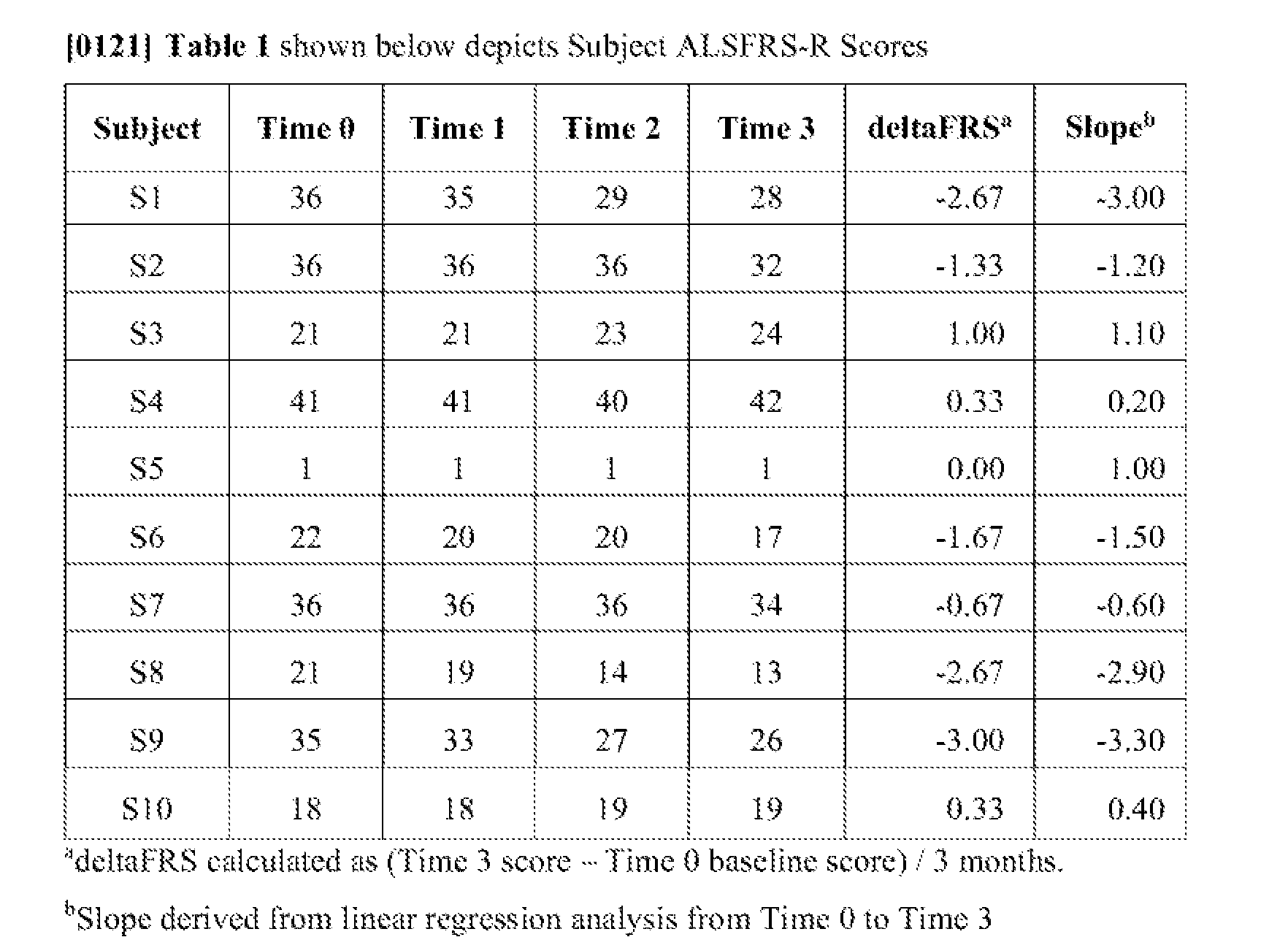
  • Time 0 baseline ALSFRS-R scores ranged from 1 -41 with a mean of 26.7 across all
  • Time 0 and Time 1 scores were those obtained just prior io the initiation of the first and second treatments, respectively. Each progressi ve score was recorded at one-month intervals for a total of three consecutive months of scoring (Time 0 through Time 3). One subject was an outlier with a prior ALSFRS-R score of 1 and was included in the study to contribute to the safety evaluation in all stages of the disease’s progression.
  • FIG. 1A illustrates the differences in raw ALSFRS-R scores amongst all subjects at each measurement time period.
  • FIG. IB shows the fitted linear regression analysis for each subject over time to illustrate disease progression during the study.
  • One subject (S3) demonstrated steady improvement in ALSFRS-R score and two others (S4 and S10) showed no apparent decrease in ALSFRS-R score. The remainder of the subjects exhibited score declines.
  • the mean (+/- SD) dehaFRS calculated from Table 1 across all 10 subjects from baseline (Time 0) to study end (36 months. Time 3) was -1.03 A- 1 .44.
  • the mean slope derived from the linear regression analysis was -0.98 A- 1.67.
  • EVs derived from MSCs may offer a novel therapeutic due to the preclinical and clinical evidence of safety and efficacy.
  • Safety is a critical aspect of all early phase studies of a new investigational product in a new disease indication. In this study, ten ALS subjects were treated with the hBM-MSC EV IP to evaluate safety risk and potential for efficacy. There were no adverse or serious adverse events related to the investigational product. This safety profile was consistent with the excellent safety profile observed upon IV administration of up to two doses (15 ml. each) of the IP in patients with severe COVID- 19. This small open-1abel pilot safety study suggests that the intravenous delivery of bone marrow derived MSC EVs is safe in ALS patients.
  • BM-MSC EVs can modulate the inflammatory, anti-inflammatory and neurotoxic activities of astrocytes and/or microglia isolated from SOD1G93A mice (a mouse model of ALS) and of motor neurons differentiated from inducible neural progenitor cells of ALS patients carrying SOD1G93A or C9orf72 mutations.
  • SOD1G93A mice a mouse model of ALS
  • motor neurons differentiated from inducible neural progenitor cells of ALS patients carrying SOD1G93A or C9orf72 mutations The net effect of BM-MSC EVs in the in vitro and in vivo models is a reduction of both neurotoxicity and neuroinllammation.
  • BM-MSC EVs to pass through the blood brain barrier provides the opportunity to treat this terminal disease using a safer IV administration approach. It also would allow for more convenient and frequent dosing to help continue and boost any possible gains from this potential treatment option.

Landscapes

  • Health & Medical Sciences (AREA)
  • Life Sciences & Earth Sciences (AREA)
  • Immunology (AREA)
  • Cell Biology (AREA)
  • Developmental Biology & Embryology (AREA)
  • Zoology (AREA)
  • Medicinal Chemistry (AREA)
  • Biomedical Technology (AREA)
  • Biotechnology (AREA)
  • Virology (AREA)
  • Hematology (AREA)
  • Chemical & Material Sciences (AREA)
  • Engineering & Computer Science (AREA)
  • Pharmacology & Pharmacy (AREA)
  • Epidemiology (AREA)
  • Animal Behavior & Ethology (AREA)
  • General Health & Medical Sciences (AREA)
  • Public Health (AREA)
  • Veterinary Medicine (AREA)
  • Medicines That Contain Protein Lipid Enzymes And Other Medicines (AREA)
  • Medicines Containing Material From Animals Or Micro-Organisms (AREA)

Abstract

Disclosed are methods of treating amyotrophic lateral sclerosis in a subject by administering a therapeutic MSC secretome product made by a method comprising culturing bone marrow-derived MSCs under conditions that include oxygen tension below 5% and a culture media with a pH below 7.

Description

TREATMENT OF AMYOTROPHIC LATERAL SCLEROSIS WITH EXTRAC E LLULAR VESICLE COMPOSITION
CROSS REFERENCE
[0001] This application claims the benefit of U.S. Provisional Application No. 63/507,204, filed on June 9, 2023, and 63/570,632, filed on March 27, 2024, which are incorporated herein by reference in their entirely.
BACKGROUND
[0002] Amyotrophic lateral sclerosis (ALS) is a devastating terminal nenrodegenerative disease affecting approximately 4.5 out of 100,000 people. ALS is the most common type of motor neuron disease and third most common neurode generative disease behind Alzheimer’s disease and Parkinson’s disease. ALS is a nervous system disease that affects the brain and spinal cord, causing the loss of muscle control. Approximately 4.5 per 100,000 people are living with the disease, but, unfortunately, there has been little advancement in theunderstanding and treatment of ALS. The current diagnosis is one of exclusion based on symptoms. Currently, there is no cure for ALS and the disease gets worse over time. Unfortunately, there are no medical treatments to stop or reverse the progress of ALS, and access to the aforementioned treatments can be restricted and limited. There exists a need for a safe and effective treatment for ALS.
SUMMARY
[0003] In some aspects, disclosed herein is a method of treating amyotrophic lateral sclerosis (ALS) in a subject in need thereof, the method comprising administering to the subject a composition comprising a therapeutic mesenchymal stem cell (MSC) secretome composition comprising extracellular vesicles, wherein at least 80% of the extracellular vesicles in the therapeutic MSC secretome composition are CD63+ CD9 CDS! .
[0004] In some embodiments, the subject has an increase of at least abou t 0.1 point per month in ALS Functional Rating Scale-Revised (ALSFRS-R) scores or has a decline of less than about 3.0 points per month in ALSFRS-R scores after administration compared to ALSFRS-R scores measured prior to administration. In some embodiments, the subject has an increase of at least about 0.2, 0.3, 0.4, 0.5, 0.6, 0.7, 0.8, 0.9, 1.0, 1.1, 1.2, 1.3, 1.4, 1.5, 1.6, 1.7, 1.8, 1.9, or 2.0 points per month in ALSFRS-R scores after administration compared to ALSFRS-R scores measured prior to administration. In some embodiments, the subject has a decline of less than about 2.9, 2.8, 2.7, 2.6, 2.5, 2.4, 2.3, 2.2, 2.1 , 2.0, 1.9, 1.8, 1.7, 1.6, 1.5, 1.4, 1.3, 1.2, 1.1, 1.0. 0.9. 0.8. 0.7, 0.6. 0.5, 0.4, 0.3, 0.2, or 0.1 points per month in ALSFRS- R scores after administration compared to ALSFRS-R scores measured prior to administration. In some embodiments, the subject has a history of a decline in ALSFRS-R scores of about 3.0 points per month prior io administration of the therapeutic MSC secretome composition.
(0005] In some aspects, disclosed herein is a method of treating amyotrophic lateral sclerosis (ALS) in a subject in need thereof comprising administering to the subject a composition comprising a therapeutic mesenchymal stem cell (MSC) secretome composition comprising extracellular vesicles, wherein the subject has an increase of at least about 0.1 point per month in ALS Functional Rating Scale-Revised (ALSFRS-R) scores or has a deciinc of less than about 3.0 points per month in ALSFRS-R scores after administration compared to ALSFRS-R scores measured prior to administration.
(0006] In some embodiments, the subject has an increase of at least about 0.2, 0.3. 0.4. 0.5. 0.6, 0.7, 0.8, 0.9, 1.0, 1.1 , 1.2, 1.3, 1.4, 1.5, 1.6, 1.7, 1.8, 1.9, or 2.0 points per month in ALSFRS-R scores after administration compared to ALSFRS-R scores measured prior to administration. In some embodiments, the subject has a decline of less than about 2.9, 2.8, 2.7, 2.6, 2.5, 2.4, 2.3, 2.2, 2.1, 2.0, 1.9, 1.8, 1.7, 1.6, 1.5, 1.4, 1.3, 1.2, 1.1 , 1.0, 0.9, 0.8, 0.7, 0.6, 0.5, 0.4, 0.3, 0.2, or 0.1 points per month in ALSFRS-R scores after administration compared to ALSFRS-R scores measured prior to administration. In some embodiments, the subject has a history' of a decline in ALSFRS-R scores of about 3.0 points per month prior to administration of the therapeutic MSC secretome composition.
[0007] In some embodiments, at least 80% of the extracellular vesicles in the therapeutic MSC secretome composition are CD63 f CD9 C DS ; In some embodiments, the therapeutic MSC secretome composition comprises one or more of the following proteins: Ferritin, NUP85, LAMP2, GPR1 15, Setpin Fl, OPN, PAI-1, DAPPL Cathepsin B, Semaphorin 6C, PDGF R alpha, Sortilin, Scrpin B6, Dkk-3, Thrombomodulin, PF4, MIF, Periosiin, Fur in, TIMP- 1, Decorin, PCK.1 , CD99, CD63, CD9, CD81 , Transferrin, DcR3, Lumican, TIMP-2, SLITRK5, FAP, Artemin, DPPIL cIAP-1 , Pentraxin 3, Visfatin, Neprilysin, Albumin, Galectin-1, UNC5H3, IL-20 R beta, SREC-11, JAM-C, TNF RI, htPAPP-A, eNOS, MSP R, TPP 1 , LAMP! . B2M, NCAM-1, HI.F-1 alpha, ST6GAL1 , CD99-L2, Plexin A4, EMMPR1N, p53, Semaphorin 7 A, NKp80, Cystatin B, Osteoadherm, Midkine, Calreticulm, Osteoactivin, Legumain, TAZ, Cathepsin L, RBP4, Serpin A4, JAM-A, MCSF, LIMPII, GPG, IL-22, Galectm-3, MOG, Trypsin 3, SIRP alpha, and Syndecan-4, and at least one protein selected from the following: Ferritin, IGFBP-4 IL-1 R6 GSTM1, NUP85, LAMP2, MeprinA, IL-1 F10, bIG-H3, GPR115, TGFbl, Ephrin-A4, GDI 09, Serpin Fl, IGFBP-6, HS3ST4, Aminopeptidase LRAP, OPN, PAI-1, DAPP1, GDF-9, Cathepsin B, IGFBP-2, Scmaphorin 6C, IGF-2, PDGF R alpha, Sortilin, Serpin B6, Dkk-3, CNTF, TSP-1, GM-CSF Ra, Thrombomodulin, Endoglycan, IGFBP-3, RGM-C, PF4, MIF, TGM4, Periostin, Furin, TIMP-1, PAPP-A, Decorin, PCK1, Arylsulfatase A, CD99, CA2, PRDX4, Transferrin, DcR3, GP73, LAIR2, ULBP-4, Lumican, TIMP-2, TFPI, SOX2, SLITRK5, FAP, Spinesin, ENPP-2, CD97, CT ACK, Integrin alpha 1, EXTL3, IL- 18 BPa, PD-L2, PSMA, IL-20 Ra, Glyoxalase II, Trypsin 1, IGF-2R, ADAMTSL-1, Erythropoietin, Plexin DI, DNMT3A, BCL- 2, CL-P1, Ephrin-B3, FABP6, CHI3L1, FCRLS, TFF3, Artemin, DPPH, cIAP-1, PDGF Rb, Pentraxin 3, Angiotensinogen, Follistatin, CF VII, Persephin, TRAIL Rl, THAP11, CD200, CLEC-2, AMIGO, IGFBP-5, PON1, SOX7, GALNT10, Visfatin, Progranulin, PCSK2, GKN1, IL-18, Neprilysin, Stabilin-2, IL-17 RD, Albumin, Foil! statin-like 1, MMP-10, FKBP51, LRRC4, Pref-1, Galectin-1 , Troponin C, UNC5H3, FLRT2, CD314, Scmaphorin 6B, Netrin- 4, CD27 Ligand, IL-20 Rbeta, Semaphorin 6A, TSK, Cytokeratin-8, CHST3, Mcl-1, DPPIV, SREC-II, Norrin, JAM-C, Bcl-10, Wnt-4, LSECtin, Kell, TNF RI, PTP1B, htPAPP-A, IDO, PDGF-CC, Galanin, Activin A, TLR2, SCCA2, FABP1, eNOS, SHP-1, ICOS, ClqTNF9, MMP-1, TC-PTP, IL-24, gpl3O, C-myc, LILRB4, BMP-2, MIA, CD34, CD63, CD9, CD81, IFNab R2, Glypican 2, MSP R, DSCAM, Matriptase, KIR2DL3, CD30, Siglec-10, CLEC-1, TPP1, Ubiquitin+1, ANGPTL4, TWEAK R, Nidogen-1, CD2, Kallikrein 1, TSLP R, LAMP1, TROY, VCAM-1, Siglec-11, S100A1, PARI, Thyroid Peroxidase, Aminopeptidase P2, IL-1 RI, ADAMS, OSM R beta, Thrombospondin-2, SMPD1, B2M, MFRP, LRP-6, ST3GAL1, NCAM-1 (CD56), Granzyme B, Adiponectin, IL-22BP, TPST2, PD-ECGF, LH, LEDGF, Cyrbl, ULBP-3, IFNb, THSD1, FGF-23, LAMA4, Adipsin, AIF, SorCS2, SULT2A1, CD39L2, Insulin R, HIF-1 alpha, 0X40 Ligand, Pax3, UCH-L3, cMASP3, Langerin, Desmin, SOX9, ST6GAL1, MEP1B, CD99-L2, Plexin A4, Semaphorin 4D, ROBO2, PDX-1, APRIL, Neurturin, Krcmcn-2, EMMPRIN, Activin RIB, Neuroligin 2, Epiregulin, CASA, MMP-12, GALNT2, CEACAM-5, VEGF Rl, DSPG3, SorCSl, Matrilin-2, sFRP-3, p53, EphB3, NCK1, Semaphorin 7A,NKp80, Prolactin, Cystatin B, Sirtuin 1, FGF-16, FGF R5, NQO-1, Semaphorin 6D, FGF-3, GATA-4, VAP-A, CHST2, Pappalysin-2, Syndecan-3, Jagged 1, AKR1C4, Olfactomedin-2, Osteoadherin, NKp44, Thyroglobulin, IL-21R, Chemerin, EphAl, CD48, MICE, FGF-5, TRANCE, CES2, ULBP-1, Integrin alpha 5, VAMP-2, FLRG, Ret Midkine, CD73, TRACP, proGRP, Granzyme H, PRX2, p27, Siglec-6, Dectin-1, CD51, Notch-1, Calreticulin, DR3, DCTN1, CDC25B, Osteoactivin, ACE, CA125, HAO-1, PSMA1, FCRLB, BMP-9, CRIM1, LIE, SPINK1, EphB6, RGM-B, HS3ST1, ROR1, CMG-2, 4-1BB Ligand, L1CAM-2, p63, Cathepsin V, Testican 2, Glypican 5, CD6, Siglec-2, Legumain, PRELP, CES1, TAZ, NSE, TECK, HTRA2, HIF-1 beta, TAFA1, Podocalyxin, RalA, CRELD2, GRAP2, SP-D, BID, GFR alpha-2, Notch-3, VEGF R3, DLL4, TGFb2, LIGHT, XIAP, ST8SIA1, Cathepsin L, 6Ckine, MIS RII, Kallikrein 5, TGM3, FCAR, Contactin-2, CD83, IL-1 R3, SALM4, GBA3, ROBO4, OSCAR, VEGF, IGSF3, Biglycan, Neudcsin, ILT4, uPAR, Axl, WIF-1, IL-7 R alpha, GPR56, CEACAM-3, MCEMP1, FABP2, PlexinB3, MEPE, Activin RIIA, ANG-2, Cochlin, Presenilin 1, NPTXR, SLAM, COMT, SPHK1, RBP4, Nectin-1, GUSB, Nidogen-2, IL-17F, SR-AI, TAFA2, N-Cadherin, IL-17B, IL-17 RC, MIP-3b, Cystatin C, Cystatin D, AMSH, FcERI, CLEC10A, HGF R, ANG-1, Prolactin R, FGF-20, CD28, Nogo-A, HSD17B1, IL-19, Enteropeptidase, Cathepsin E, TSLP, TCN2, GDF-15, Epimorphin, GRKS, PD-1, Serpin A4, ADAM23, NOV, Galectin-2, Neurexin 3 beta, TLR3, Sirtuin 2, Numb, IL-28 R alpha, IL-33, Lin28, FCRL1, KLF4, NKp30, Lymphotactin, Cystatin SN, JAM -A, Calreticulin-2, ErbB4, BMP-8, IL-27 Ra, Fas, IL-4 Ra, Kallikrein 14, Matrilin-3, Olig2, Kallikrein 12, CA13, IL-9, Nectin-3, MPIF-1, Cystatin S, ADA, IL-2 Rb, GFR alpha-1, Smad4, ICAM-1, MEF2C, TREM-1, L-Selectin, Hepsin, CD42b, MCSF, RANK, CHST4, CAS, FCRL3, ASAH2, CF XIV, PYY, HGF, I-TAC, Semaphorin 4C, SorCS3, Tie-1, IL-31 RA, Arginase 1, POGLUT1, IL-lra, Podoplanin, TIM-3, CREG, CD300F, uPA, EphA2, LRRTM4, LIMPII, Tenascin R, CPE, PECAM-1, DNAM-1, DKK-1, OPG, CPB1, TSH, MMP-2, Siglec-9, ICAM-3, Cystatin SA, Galectin-4, Pepsinogen II, Desmoglein-3, Nectin-4, SCF, Serpin A5, PTH, FGF-19, MSP, IL-28A, FGF-12, METAP2, ASAHL, EDIL3, NTAL, EGF R, TAFAS, Galectin-9, vWF-A2, TACE, Activin RIM, Cathepsin S, LDL R, BMPR-IA, 0X40, IL-13 R2, B7-H4, MMP-13, ANGPTL7, TRAIL R4, IGSF4B, Sirtuin 5, PEAR1, SH2D1A, Cerberus 1, GDF-11, Nrf2, TROP-2, NUDTS, ROR2, EphB4, Glypican 1, LAP(TGFbl), Gash, Contactin-1, IL-27, UNC5H4, ICAM-2, MBL, HS3ST3B1, RCOR1, IL-10 Rb, XEDAR, IL-22, PILR-alpha, NRG1-131, FABP4, RGM-A, RELT, TrkC, CSa, SREC-I, Nestin, TPO, ErbB3, Kirrel3, FLRT1, Galectin-3, CXCL16, JAM-B, DR6,Nogo Receptor, TLR4, VEGF R2, Tie-2, IL-15 R, Caspr2, LTbR, LAMP, ALCAM, GLP-1, NG2, IL-22 R alpha 1, AMIGO2, HCC-1, TFPI-2, ULBP-2, Desmoglein 2, Aggrecan, Syntaxin 4, VAMP-1, Nectin-2, FGF-21, Flt-3, GFAP, TIM-1, Inhibin A, Cadherin-4, P1GF-2, Neurogranin, HE4, IL-23 R, Galectin-7, GALNT3, GITR L, CD14, R- Spondin 2, CK19, Cardiotrophin-1, TREML1, HAPLN1, CD27, ANG-4, Siglec-7, CD155, VEGF-C, TNF RD, PGRP-S, SDF-la, PDGF-AB, GPVI, CD40, SCF R, Thrombospondin-5, IL-1 RH, Neuropilin-2, Cadherin-13, E-Selectin, GITR, WISP-1, Renin, AgRP, MDL-1, ROBO3, RANTES, Endocan, Granulysin, hCGb, Mesothclin, TLR1, TRAIL, MOG, DDR1, NGF R, TRAIL R3, Trypsin 3, ARSB, LIF R alpha, BAFF R, CD 157, Granzyme A, 2B4, ESAM, IL-1 R4, CXCL14, IL-31, SIRP alpha, Uromodulin, CTRC, CEACAM-1, TARC, MIP-3a, SDF-lb,NKp46, MCP-3, IL-32 alpha, TGFb3 FOLR2, CD58, IL-23, CD36, TNFb, Shh-N, Ficolin-1, Reg4, ILT2, Mcr, TREM-2, Flt-3L, CDS, IL-6, CD229, Insulin, Syntaxin 6, GRO, Bcl-w, Lipocalin-2, PDGF-AA, IL-2 Ra, Angiogenin, LYVE-1, CD4, RAGE, CDNF, Brevican, NAP-2, PU.l, EDAR, ADAMTS13, Kynureninase, PTH1R, IFN-gamma Rl, CrkL, B7-1, PARC, Draxin, VE-Cadherin, Procalcitonin, SOX15, Kallikrein 11, BCMA, Dectin-2,
EpCAM, HCC-4, TGFa, IP-10, BLAME, CILP-1, PIGF, LOX-1, MCP-2, Resistin, HVEM, ENPP-7, Syndecan-4, IL- 2 Rg, MICA, Dopa Decarboxylase, NPDC-1, MCP-4, EG-VEGF, Glycoprotein V, Semaphorin 4G, IL-12p40, PSA-total, IL-15, MAP1D, Clq, TNF4, Dtk, Endoglin, ENA-78, Reg3A, MIP-lb, FGF-17, IL-6R, IL-8, Galectin-8, CA4, Cystatin E M, FUT8, B7-H3, GCP-2, CD40L, MDC, 4-1BB, HO-1, SOST, S100A13, Kallikrein 7, or IL- 13.
[0008] In some embodiments, the therapeutic MSC secretome composition comprises one or more of the following nucleic acids: hsa-let-7a-5p, hsa-let-7b-5p, hsa-let-7c-5p, hsa-let-7d-3p, hsa-let-7e-5p, hsa-let-7g-5p, hsa-let-7i, hsa-let-7i-5p, hsa-miR-100-5p, hsa-miR-103a-3p, hsa- miR-106a-5p, hsa-miR-106b-5p, hsa-mir-lOb, hsa-miR-10b-5p, hsa-mir-1246, hsa-miR-1246, hsa-miR-125a-5p, hsa-miR-125b-5p, hsa-miR-130a-3p, hsa-mir-130b, hsa-miR-130b-3p, hsa- miR-132-3p, hsa-miR-136-5p, hsa-tniR-138-5p, hsa-miR-139-5p, hsa-mir-140, hsa-miR-140- 3p, hsa-miR-145-5p, hsa-mir-146a, hsa-miR-146a- 5p, hsa-miR-148a-3p, hsa-miR-152-3p, hsa-miR-15a-5p, hsa-miR-15b-5p, hsa-mir-16-1, hsa-mir-16-2, hsa-miR-16-5p, hsa-miR-1'7- 5p, hsa-miR-181a-5p, hsa-miR-191-5p, hsa-miR-193a-5p, hsa-miR-193b-3p, hsa-miR-19'7- 3p, hsa-miR-199a-3p, hsa-miR-199a-5p, hsa-miR-199b-5p, hsa-miR-19a-3p, hsa-miR-19b-3p, hsa-miR-20a-5p, hsa-mir-203a, hsa-miR-203a-3p, hsa-miR-214-3p, hsa-mir-21, hsa-miR-21- 3p, hsa-miR-21-5p, hsa-mir-221, hsa-miR-221-3p, hsa-mir-222, hsa-miR-222-3p, hsa-miR- 22- 3p, hsa-miR-23a-3p, hsa-miR-23b-3p, hsa-mir-24-1, hsa-mir-24-2, hsa-miR-24-3p, hsa- mir-25, hsa-miR-25-3p, hsa-miR-26a-5p, hsa-miR-27a-3p, hsa-mir-27b, hsa-miR-27b-3p, hsa- miR-29a-3p, hsa-miR-29c-3p, hsa-miR-30a-5p, hsa-miR-30a-5p, hsa-miR-30b-5p, hsa-miR- 30c-5p, hsa-mir-30d, hsa-miR-30d-5p, hsa-mir-30e, hsa-miR-30e-5p, hsa-miR-31-3p, hsa- miR-31-5p, hsa-miR-320a, hsa-miR-342-3p, hsa-miR-345-5p, hsa-miR-34a-5p, hsa-miR- 361-5p, hsa-miR-376a-3p, hsa-miR-376c-3p, hsa-miR-423-3p, hsa-miR-423-5p, hsa-miR- 424-5p, hsa-miR-484, bsa-mir-486-1, hsa-mir-486-2. bsa-miR-486-5p, hsa-miR-570-3p, hsa- miR-574-3p, hsa-miR-663a, hsa-miR-874-3p, hsa-mir-92a-1, hsa-mir-92a-2, hsa-miR-92a- 3p. hsa*miR-92b-3p, hsa-mir-93, hsa-miR-93-5p, hsa-niiR-940, hsa-miR*99a-5p, or hsa-.mi.R- 99b-5p.
(0009| In some embodiments, the composition is produced by: (a) culturing bone marrow- derived MSCs under the following conditions to produce an MSC conditioned media: (i) oxygen tension below 5%; and (ii) culture media having a pH below 7: (b) harvesting the MSC conditioned media; and (c) formulating the MSC conditioned media to produce the therapeutic MSC secretome composition, wherein the therapeutic MSC secretome composition comprises proteins and extracellular vesicles produced by the bone m arrow - derived MSCs in step (a). In some embodiments, the culture media is serum- tree. In some embodiments, the culture media has a glucose concentration below 4.5 g L.
In some embodiments, the subject has spinal onset type ACS. In some embodiments, the subject has bulbar onset type ALS. In some embodiments, the subject has advanced ALS. In some embodiments, the subject presents with limb-related symptoms. In some embodiments, the subject presents with dysphagia or speech difficulties. In some embodiments, the treating delays the progression of ALS.
[0011] In some embodiments, the subject carries one or more amino acid variations in SOD I protein. In some embodiments, the one or more amino acid variations comprise G93A. In some embodiments, the subject carries one or more dipeptide repeats in C9ORF72 protein. In some embodiments, the one or more dipeptide repeats comprise poly-GA, poly-GP poly-GR, poly- PA, or poly -PR.
[0012] In some embodiments, the subject is a human. In some embodiments, the bone marrow -derived MSCs are derived from human bone marrow.
[0013] In some embodiments, administering comprises intravenous administration. In some embodiments, the dosage of the therapeutic MSC secretome composition administered to the subject is a cell-equivalent dosage of 0.7 to 7 million cells/kg. In some embodiments, the therapeutic MSC secretome composition comprises 4x10¹⁰ to 10x 1010 cells/ml. In some embodiments, the therapeutic MSC secretome composition comprises 5x10¹¹ to 1.5xl012 extracellular vesicles. In some embodiments, the composition is administered monthly for two or more months, or once every 1, 2, or 3 or more months. [0014] In some aspects, disclosed herein is method of making a composition comprising a therapeutic mesenchymal stem cell (MSC) secretome composition for treating amyotrophic lateral sclerosis (ALS) in a subject in need thereof, the method comprising: (a) culturing bone marrow-derived MSCs under the following conditions to produce an MSC conditioned media: (i) oxygen tension below 5%: and (ii) culture media having a pH below' 7; (b) harvesting the MSC conditioned media; and (c) formulating the MSC conditioned media to produce the therapeutic MSC secretome composition, wherein the therapeutic MSC secretome composition comprises proteins and extracellular vesicles produced by the bone marrow-derived MSCs in step (a).
[0015] In some embodiments, the culture media is serum- free. In some embodiments, the culture media has a glucose concentration below 4.5 gZL. In some embodiments, at least 80% of the extracellular vesicles in the therapeutic MSC secretome composition are CD63" CD9 CD81 In some embodiments, the bone marrow -derived MSCs are derived from human bone marrow.
[0016] In some embodiments, the therapeutic MSC secretome composition further comprises one or more of the following proteins: Ferritin, NUP85, I..AMP2, GPR1 15, Serpin F1, OPN, PAI-1 , DAPP1, Cathepsin B, Semaphorin 6C, PDGF R alpha, Sortiiin, Serpin B6, Dkk-3, Thrombomodulin, PF4, MIF, Periostin, Furin, TIMP-l, Decorin, PCK 1, CD99, CD63, CD9, CD81, Transferrin, DcR3, Lum lean, TIMP-2, SLITRK5, FAP, Artemin, DPPII, cIAP-1, Pentraxin 3, Visfatin, Neprilysin, Albumin, Galectin-1, UNC5H3, TL-20 R beta, SREC-1I, JAM-C, TNF RI, htPAPP-A, cNOS, MSP R, TPP1, LAMP1 , B2M, NCAM-1, HIF-1 alpha, ST6GAL1 , CD99-L2, Plexin A4, EMMPRIN, p53, Scmaphorin 7A, NKp80, Cystatin B, Osteoadberin, Midkine, Calreticulin, Osteoactivin, Legumain, TAZ, Cathepsin L, R.BP4, Serpin A4, JAM-A, MCSF, LIMPII, OPG, IL-22, Galectin-3, MOG, Trypsin 3, SIRP alpha, and Syndecan-4, and at least one protein selected from the following: Ferritin, IGFBP-4 IL- 1 R6 GSTM1, NUP85, LAMP2, MeprinA, IL- 1 F10, bIG-H3, GPR115, TGFbl, Ephrin-A4, CD 109, Serpin Fl, IG.FBP-6, HS3ST4, Aminopeptidase LRAP, OPN, PAI-1 , DAPP 1 , GDF-9, Cathepsin B, 1GFBP-2, Scmaphorin 6C, IGF -2, PDGF R alpha, Sortiiin, Serpin B6, Dkk-3, CNTF, TSP-1, GM-CSF Ra, Thrombomodulin, Endoglycan, IGFBP-3, RGM-C, PF4, MIF, TGM4, Periostin, Furin, TIMP-1 , PAPP-A, Decorin, PC K i . Arylsfofata.se A, CD99, CA2, PRDX4, Transferrin, DcR3, GP73, LAIR2, ULBP-4, Lumican, TIMP-2, TFPI, SOX2, SLIFRK5, FAP, Spmesin, ENPP-2, CD97, CTACK, Integrin alpha 1 , EXTL3, IL-18 BPa, PD-L2, PSMA, lL-20 R.a, Glyoxalase II, Trypsin 1, IGF-2R, ADAMTSL-1 , Erythropoietin, Plexin D1, DNMT3A, BCL-2, CL-P1 , Ephrin-B3, FABP6, CHI3L1 FCRLS, TFF3, Artemin, DPPII, cIAP- 1 , PDGF Rb, Pentraxin 3, Angiotensinogen, Follistatin, CF VII, Persepbin, TRAIL Rl , TH AP11 , CD200, CLEC-2, AMIGO, IGFBP-5, PON 1 , SOX7, GALNT10, Visfatin, Progranulin, PCSK2, GKN1 , IL- 18, Neprilysin, Stabilin-2, IL-17 RD, Albumin, Follistatin-1ike 1, MMP-10, FKBP51, LRRC4, Pref-1, Galectin-1, Troponin C, UNC5H3, FLRT2, CD314, Semaphorin 6B, Netrin-4, CD27 Ligand, IL. -20 R beta, Semaphorin 6A, TSK, Cytokeraiin-8, CHST3. Mcl -1 , DPPIV, SREC-1I, Norin, JAM-C, Bc 1 -10, Wnt-4, LSECtin, Kell, TNF Rl, PTP1B, htPAPP-A, IDO, PDGF-CC, Galanin, Activin A, TLR2, SCCA2, FABP1, eNOS, SHP-1, ICOS, ClqTNF9, MMP-1, TC-PTP, IL-24, gp130, C-myc, LILRB4, BMP-2, MIA, CD34, CD63, CD9, CD81, IFNab R2, Glypican 2, MSP R, DSCAM, Matriptase, KIR2DL3, CD30, Siglec-10, CLEC-1 , TPP1, Ubiquitin-i-l , ANGPTL4, TWEAK R,Nidogen-1, CD2, Kallikrein 1 , TSLP R, LAMP1, TROY, VCAM-1, Siglec-11, S100A1, PAR1, Thyroid Peroxidase, Aminopeptidase P2, IL-1 Rl, ADAMS, OSM R beta. Thrombospondin- 2, SMPD1, B2M, MFRP, LRP-6, ST3GAL1, NCAM-1 (CD56), Granzyme B, Adipo nedin, IL-22BP, TPST2, PD-ECGF, LH, LEDGE, Cyr61, ULBP-3, IFNb, THSD 1 , FGF-23, LAMA4, Adipsin, AIF, SorCS2, SULT2A1 , CD39L2, Insulin R, HIF-1 alpha, OX40 Ligand, Pax3, IJCH-L3, cMASP3, Langerin, Desmin, SOX9, ST6GAL1 , MEP1 B, CD99-L2, Plexin A4, Semaphorin 4D, ROBO2, PDX-1 , APRIL, Neurturin, Kremen-2, EMMPRIN, Activin RIB, Neuroligin 2, Epiregulin, CASA, MMP-12, GALNT2, CEACAM-5, VEGF R1, DSPG3, SorCS1 , Mairilin-2, sFRP-3, p53, EphB3, NCK1, Semaphorin 7A,NKp80, Prolactin, Cystalin B, Sirtuin 1, FGF-16, FGF R5, NQO-1 , Semaphorin 6D, FGF-3, GATA-4, VAP-A, CHST2, Pappalysin-2, Syndecan-3, Jagged 1 , AKR1C4, Olfac tomedin-2, Osteoadherin, NKp44, Thyroglobulin, IL-21 R, Chemerin, Eph A1, CD48, MICB, FGF-5, TRANCE, CES2, ULBP-1, Integrin alpha 5, VAMP-2, FLRG, Ret Midkine, CD73, TRACP , proGRP, Granzyme H PRX2, p27, Siglec-6, Dectin-1, CD51 , Notch- 1, Calreticulin, DR3, DCTN 1 CDC25B, Osteoaclivin, ACE, CA125, HAO-1, PSMA1 , FCRLB, BMP-9, CRIME LIF, SPINK 1 , EphB6, RGM-B, HS3ST1 , ROR1. CMG-2, 4- 1BB Ligand, L1CAM-2, p63. Cathepsin V, Testican 2, Glypican 5, CD6, Siglec-2, Legumain, PRELP, CES1, TAZ, NSE, TECK, HTRA2, HIF-1 beta, TAFA 1 , Podocalyxin, RalA, CRELD2, GRAP2, SP-D, BID, GFR alpha-2, Notch-3, VEGF R3, DLL4, TGFb2, LIGHT, XIAP, ST8SIA1, Cathepsin L, 6Ckine, MIS RII, Kallikrein 5, TGM3, FCAR, Contactin-2, CD83, IL-1 R3, SALM4, GBA3, ROBO4, OSCAR, VEGF, IGSF3, Biglycan, Neudesin, ILT4, uPAR, Axl, WIF-1 , IL- 7 R alpha, GPR56. CEACAM-3, MCEMP1, FABP2, Plexin B3. MEPE, Activin RIIA, ANG-2, Cochlin, Presenilin 1, NPTXR, SLAM, COMT, SPHK1, RBP4, Nectin-1, GUSB,Nidogen-2, IL-17F, SR-AI, TAFA2, N-Cadherin, IL-17B, IL-17 RC, MIP-3b, Cystatin C, Cystatin D, AMSH, FcERI, CLEC10A, HGF R, ANG-1, Prolactin R, FGF-20, CD28, Nogo-A, HSD17B1, IL-19, Enteropeptidase, Cathepsin E, TSLP, TCN2, GDF-15, Epimorphin, GRKS, PD-1, Serpin A4, ADAM23, NOV, Galectin-2, Neurexin 3 beta, TLR3, Sirtuin 2, Numb, IL- 28 R alpha, IL-33, Lin28, FCRL1, KLF4,NKp30, Lymphotactin, Cystatin SN, JAM-A, Calreticulin-2, ErbB4, BMP-8, IL-27 Ra, Fas, IL-4 Ra, Kallikrcin 14, Matrilin-3, Olig2, Kallikrein 12, CAI 3, IL-9, Nectin-3, MPIF-1, Cystatin S, ADA, IL-2 Rb, GFR alpha-1, Smad4, ICAM-1, MEF2C, TREM-1, L-Selectin, Hepsin, CD42b, MCSF, RANK, CHST4, CAS, FCRL3, ASAH2, CF XIV, PYY, HGF, LTAC, Semaphorin 4C, SorCS3, Tie-1, IL-31 RA, Arginase 1, POGLUT1, IL-lra, Podoplanin, TIM-3, CREG, CD300F, uPA, EphA2, LRRTM4, LIMPn, Tenascin R, CPE, PECAM-1, DNAM-1, DKK-1, OPG, CPB1, TSH, MMP-2, Siglec-9, ICAM-3, Cystatin SA, Galectin-4, Pepsinogen n, Desmoglein-3, Nectin-4, SCF, Serpin A5, PTH, FGF-19, MSP, IL-28A, FGF-12, METAP2, ASAHL, EDIL3, NTAL, EGF R, TAFAS, Galectin-9, vWF-A2, TACE, Activin RIM, Cathepsin S, LDL R, BMPR-IA, 0X40, IL-13 R2, B7-H4, MMP-13, ANGPTL7, TRAIL R4, IGSF4B, Sirtuin 5, PEAR1, SH2D1A, Cerberus 1, GDF-ll, Nr£2, TROP-2, NUDTS, ROR2, EphB4, Glypican 1, LAP(TGFbl), Gash, Contactin-1, IL-27, UNC5H4, ICAM-2, MBL, HS3ST3B1, RCOR1, IL- 10 Rb, XEDAR, IL-22, PILR-alpha, NRG1-131, FABP4, RGM-A, RELT, TrkC, CSa, SREC-I, Nestin, TPO, ErbB3, Kirrel3, FLRT1, Galectin-3, CXCL16, JAM-B, DR6,Nogo Receptor, TLR4, VEGF R2, Tie-2, IL-15 R, Caspr2, LTbR, LAMP, ALCAM, GLP-1, NG2, IL-22 R alpha 1, AMIGO2, HCC-1, TFPI-2, ULBP-2, Desmoglein 2, Aggrecan, Syntaxin 4, VAMP-1, Nectin-2, FGF-21, Flt-3, GFAP, TIM-1, Inhibin A, Cadherin-4, P1GF-2, Neurogranin, HE4, IL-23 R, Galectin-7, GALNT3, GITR L, CD14, R-Spondin2, CK19, Cardiotrophin-1, TREML1, HAPLN1, CD27, ANG-4, Siglec-7, CD155, VEGF-C, TNF RH, PGRP-S, SDF-la, PDGF-AB, GPVI, CD40, SCF R, Thrombospondin-5, IL-1 RII, Neuropilin-2, Cadherin-13, E- Selectin, GITR, WISP-1, Renin, AgRP, MDL-1, ROBO3, RANTES, Endocan, Granulysin, hCGb, Mesothelin, TLR1, TRAIL, MOG, DDR1, NGF R, TRAIL R3, Trypsin 3, ARSB, LIF R alpha, BAFF R, CD157, Granzyme A, 2B4, ESAM, IL-1 R4, CXCL14, IL-31, SIRP alpha, Uromodulin, CTRC, CEACAM-1, TARC, MIP-3a, SDF-lb, NKp46, MCP-3, IL-32 alpha, TGFb3 FOLR2, CD58, IL-23, CD36, TNFb, Shh-N, Ficolin-1, Reg4, ILT2, Mer, TREM-2, Flt-3L, CDS, IL-6, CD229, Insulin, Syntaxin 6, GRO, Bcl-w, Lipocalin-2, PDGF-AA, IL-2 Ra, Angiogenin, LYVE-1, CD4, RAGE, CDNF, Brevican, NAP-2, PU.l, EDAR, ADAMTS13, Kynureninase, PTH1R, IFN-gamma Rl, CrkL, B7-1, PARC, Draxin. VE- Cadherin, Procalcitonin, SOX15, Kallikrein 11, BCMA, Dectin-2, EpCAM, HCC-4, TGFa, IP-10, BLAME, CILP-1, PIGF, LOX-1, MCP-2, Resistin, HVEM, ENPP-7, Syndecan-4, IL-2 Rg, MICA, Dopa Decarboxylase, NPDC-1, MCP-4, EG-VEGF, Glycoprotein V, Semaphorin 4G, IL-12p40, PSA-total, IL-15, MAP1D, CLq, TNF4, Dtk, Endoglin, ENA-78, Reg3A, MIP- lb, FGF-17, IL-6R, IL-8, Galectin-8, CA4, Cystatin E M, FUT8, B7-H3, GCP-2, CD40L, MDC, 4-1BB, HO-1, SOST, S100A13, Kallikrein 7, or IL-13.
[0017] In some embodiments, the extracellular vesicles comprise one or more of the following nucleic acids: hsa-let-7a-5p, hsa-let-7b-5p, hsa-let-7c-5p, hsa-let-7d-3p, hsa-let-7e- 5p, hsa-let-7g-5p, hsa-let-7i, hsa-let-7i-5p, hsa-miR-100-5p, hsa-miR-103a-3p, hsa-miR- 106a-5p, hsa-miR-106b-5p, hsa-mir-lOb, hsa-miR-10b-5p, hsa-mir-1246, hsa-miR-1246, hsa- miR-125a-5p, hsa-miR-125b-5p, hsa-miR-130a-3p, hsa-mir-130b, hsa-miR-130b-3p, hsa- miR-132-3p, hsa-miR-136-5p, hsa-miR-138-5p, hsa-miR-139-5p, hsa-mir-140, hsa-miR-140- 3p, hsa-miR-145-5p, hsa-mir-146a, hsa-miR-146a- 5p, hsa-miR-148a-3p, hsa-miR-152-3p, hsa-miR-15a-5p, hsa-miR-15b-5p, hsa-mir-16-1, hsa-mir-16-2, hsa-miR-16-5p, hsa-miR-1'7- 5p, hsa-miR-181a-5p, hsa-miR-191-5p, hsa-miR-193a-5p, hsa-miR-193b-3p, hsa-miR-19'7- 3p, hsa-miR-199a-3p, hsa-miR-199a-5p, hsa-miR-199b-5p, hsa-miR-19a-3p, hsa-miR-19b-3p, hsa-miR-20a-5p, hsa-mir-203a, hsa-miR-203a-3p, hsa-miR-214-3p, hsa-mir-21, hsa-miR-21- 3p, hsa-miR-21-5p, hsa-mir-221, hsa-miR-221-3p, hsa-mir-222, hsa-miR-222-3p, hsa-miR- 22- 3p, hsa-miR-23a-3p, hsa-miR-23b-3p, hsa-mir-24-1, hsa-mir-24-2, hsa-miR-24-3p, hsa- mir-25, hsa-miR-25-3p, hsa-miR-26a-5p, hsa-miR-27a-3p, hsa-mir-27b, hsa-miR-27b-3p, hsa- miR-29a-3p, hsa-miR-29c-3p, hsa-miR-30a-5p, hsa-miR-30a-5p, hsa-miR-30b-5p, hsa-miR- 30c-5p, hsa-mir-30d, hsa-miR-30d-5p, hsa-mir-30e, hsa-miR-30e-5p, hsa-miR-31-3p, hsa- miR-31-5p, hsa-miR-320a, hsa-miR-342-3p, hsa-miR-345-5p, hsa-miR-34a-5p, hsa-miR- 361 -5p, hsa-miR-376a-3p, hsa-miR-376c-3p, hsa-miR-423-3p, hsa-miR-423-5p, hsa-miR- 424-5p, hsa-miR-484, hsa-mir-486-1, hsa-mir-486-2, hsa-miR-486-5p, hsa-miR-570-3p, hsa- miR-574-3p, hsa-miR-663a, hsa-miR-874-3p, hsa-mir-92a-l, hsa-mir-92a-2, hsa-miR-92a- 3p, hsa-miR-92b-3p, hsa-mir-93, hsa-miR-93-5p, hsa-miR-940, hsa-miR-99a-5p, or hsa-miR- 99b-5p.
[0018] In some aspects, disclosed herein is a use of the composition produced by any of the methods described herein in treating amyotrophic lateral sclerosis (ALS) in a subject in need thereof. [ 0019] In some embodiments, the subject has spinal onset type ALS. In some embodiments, the subject has bulbar onset type ALS. In some embodiments, the subject has advanced ALS. In some embodiments, the subject presents with Limb-related symptoms. In some embodiments, the subject presents with dysphagia or speech difficulties. In some embodiments, the treating delays the progression of ALS. [0020] In some embodiments, the subject carries one or more amino acid variations in SOD1 protein. In some embodiments, the one or more amino acid variations comprise G93A. In some embodiments, tire subject carries one or more dipeptide repeats in C9ORF72 protein. In some embodiments, the one or more dipeptide repeats comprise poly-GA, poly-GP poly-GR, poly-PA, or poly-PR. [0021] In some embodiments, the subject is a human. In some embodiments, the composition is intravenously administered to the subject. [0022] In some embodiments, the subject has an increase of at least about 0.1 point per month in ALS Functional Rating Scale-Revised (ALSFRS-R) scores or has a decline of less than about 3.0 points per month in ALSFRS-R scores after administration compared to ALSFRS-R scores measured prior to administration. In some embodiments, the subject has an increase of at least about 0.2, 0.3, 0.4, 0.5, 0.6, 0.7, 0.8, 0.9, 1.0, 1.1 , 1.2, 1.3, 1.4, 1.5, 1.6, 1 .7, 1 .8, 1 .9, or 2.0 points per month in ALSFRS-R scores after administration compared to ALSFRS-R scores measured prior to administration. In some embodiments, the subject has a decline of less than about 2.9, 2.8, 2.7, 2.6, 2.5, 2.4, 2.3, 2.2, 2.1, 2.0, 1.9, 1.8, 1.7, 1.6, 1.5, 1.4, 1.3, 1.2, 1.1 , 1.0, 0.9, 0.8, 0.7, 0.6, 0.5, 0.4, 0.3, 0.2, or 0.1 points per month in ALSFRS- R scores after administration compared to ALSFRS-R scores measured prior to administration. In some embodiments, the subject has a history' of a decline in ALSFRS-R scores of about 3.0 pointe per month prior to administration of the therapeutic MSC secretome compositi on. [ 0023] In some embodiments, the dosage of the therapeutic MSC secretome composition administered to the subject is a cell-equivalent dosage of 0.7 to 7 million cells/kg. In some embodiments, the therapeutic MSC secretome composition comprises 4x10¹⁰ to 10x1010 cells/ml. In some embodiments, the therapeutic MSC secretome composition comprises 5x10¹¹ to 1.5x10¹² extracellular vesicles. In some embodiments, the composition is administered monthly tor two or more months, or once every 1, 2, or 3 or more months. [0024] In some aspects, disclosed herein is a use of a composition comprising a therapeutic mesenchymal stem cell (MSC) secretome composition comprising extracellular vesicles in treating amyotrophic lateral sclerosis (ALS) in a subject in need thereof, wherein at least 80% of the extracellular vesicles in the therapeutic MSC secretome composition are CD63- CD9 CD81 In some embodiments, the composition is intravenously administered to the subject. (0025] In some embodiments, the subject has an increase of at least abou t 0,1 point per month in ALS Functional Rating Scale-Re vised (ALSFRS-R) scores or has a decline of less than about 3.0 points per month in ALSFRS-R scores after administration compared to ALSFRS-R scores measured prior to administration. In some embodiments, the subject has an increase of at least about 0.2, 0.3, 0.4, 0.5, 0.6, 0.7, 0.8, 0.9, 1.0, 1,1, 1.2, 1.3, 1.4, 1.5, 1.6,
1.7, 1.8, 1.9, or 2.0 points per month in ALSFRS-R scores after administration compared to ALSFRS-R scores measured prior to administration. In some embodiments, the subject has a decline of less than about 2.9, 2.8, 2.7, 2.6, 2.5, 2.4, 2.3, 2.2, 2, 1, 2.0, 1.9, 1.8, 1.7, 1.6, 1 .5, 1.4, 1.3, 1.2, 1.1, 1.0, 0.9, 0.8, 0.7, 0.6, 0.5, 0.4, 0.3, 0.2, or 0.1 points per month in ALSFRS- R scores after administration compared to ALSFRS-R scores measured prior to administration. In some embodiments, the subject has a history of a decline in ALSFRS-R scores of about 3.0 points per month prior to administration of the therapeutic MSC secretome composition.
[0026] In some aspects, disclosed herein is a use of a composition comprising a therapeutic mesenchymal stem cell (MSC) secretome composition comprising extracellular vesicles in treating amyotrophic lateral sclerosis (ALS) in a subject in need thereof, wherein the subject has an increase of at least about 0.1 point per month in ALS Functional Rating Scale-Revised (ALSFRS-R) scores or has a decline of less than about 3.0 points per month in ALSFRS-R scores after administration compared to ALSFRS-R scores measured prior to administration, [0027] In some embodiments, the subject has an increase of at least about 0.2, 0.3, 0.4, 0.5, 0.6, 0.7, 0.8, 0.9, 1 .0, 1.1, 1 .2, 1 .3, 1 .4, 1 .5, 1 .6, 1 .7, 1 .8, 1 .9, or 2.0 points per month in ALSFRS-R scores after administration compared to ALSFRS-R scores measured prior to administration. In some embodiments, the subject has a decline of less than about 2.9, 2.8,
2.7, 2.6, 2.5, 2.4, 2.3, 2.2, 2.1, 2.0, 1.9, 1.8, 1.7, 1.6, 1.5, 1.4, 1.3, 1.2, 1.1, 1 .0, 0.9, 0.8, 0.7, 0.6, 0.5, 0.4, 0.3, 0.2, or 0.1 points per month in ALSFRS-R scores after administration compared to ALSFRS-R scores measured prior to administration. In some embodiments, the subject has a history of a decline in ALSFRS-R scores of about 3.0 points per month prior to administration of the therapeutic MSC secretome composition.
[0028] In some embodiments, at least 80% of the extracellular vesicles in the therapeutic MSC secretome composition are C.D63’ CD9 CD81 ' . In some embodiments, the therapeutic MSC secretome composition further comprises one or more of the following proteins: Ferritin, NUP85, LAMP2, GPR115, Serpin Fl, OPN, PAI-1, DAPP1, Cathepsin B, Semaphorin 6C, PDGF R alpha, Sortilin, Serpin B6, Dkk-3, Thrombomodulin, PF4, MIF, Periostin, Furin, TIMP-1, Decorin, PCK1, CD99, CD63, CD9, CD81, Transferrin, DcR3, Lumican, TIMP-2, SLITRK5, FAP, Artemin, DPPII, cIAP-1, Pentraxin 3, Visfatin, Neprilysin, Albumin, Galectin-1, UNC5H3, IL-20 R beta, SREC-II, JAM-C, TNF RI, htPAPP-A, eNOS, MSP R, TPP1, LAMP1, B2M, NCAM-1, HIF-1 alpha, ST6GAL1, CD99- L2, Plexin A4, EMMPRIN, p53, Semaphorin 7 A, NKp80, Cystatin B, Osteoadherin, Midkine, Calreticulin, Osteoactivin, Legumain, TAZ, Cathepsin L, RBP4, Serpin A4, JAM- A, MCSF, LIMPH, OPG, IL-22, Galectin-3, MOG, Trypsin 3, SIRP alpha, and Syndecan-4, and at least one protein selected from the following: Ferritin, IGFBP-4 IL-1 R6 GSTM1, NUP85, LAMP2, MeprinA, IL-1 F10, MG-H3, GPR115, TGFbl, Ephrin-A4, CD109, Serpin Fl, IGFBP-6, HS3ST4, Aminopeptidase LRAP, OPN, PAI-1, DAPP1, GDF-9, Cathepsin B, IGFBP-2, Semaphorin 6C, IGF-2, PDGF R alpha, Sortilin, Serpin B6, Dkk-3, CNTF, TSP-1, GM-CSF Ra, Thrombomodulin, Endoglycan, IGFBP-3, RGM-C, PF4, MIF, TGM4, Periostin, Furin, TIMP-1, PAPP-A, Decorin, PCK1, Arylsulfatase A, CD99, CA2, PRDX4, Transferrin, DcR3, GP73, LAIR2, ULBP-4, Lumican, TIMP-2, TFPI, SOX2, SLITRK5, FAP, Spinesin, ENPP-2, CD97, CTACK, Integrin alpha 1, EXTL3, IL-18 Bpa, PD-L2, PSMA, IL-20 Ra, Glyoxalase II, Trypsin 1, IGF-2R, ADAMTSL-1, Erythropoietin, Plexin DI, DNMT3A, BCL-2, CL-P1, Ephrin-B3, FABP6, CHI3L1, FCRLS, TFF3, Artemin, DPPII, cIAP-1, PDGF Rb, Pentraxin 3, Angiotensinogen, Follistatin, CF VII, Persephin, TRAIL Rl, THAP11, CD200, CLEC-2, AMIGO, IGFBP-5, PON1, SOX7, GALNT10, Visfatin, Progranulin, PCSK2, GKN1, IL- 18, Neprilysin, Stabilin-2, IL-17 RD, Albumin, Folli statin-like 1, MMP-10, FKBP51, LRRC4, Pref-1, Galectin-1, Troponin C, UNC5H3, FLRT2, CD314, Semaphorin 6B, Netrin-4, CD27 Ligand, IL-20 R beta, Semaphorin 6A, TSK, Cytokeratin-8, CHST3, Mcl-1, DPPIV, SREC-II, Norrin, JAM-C, Bcl-10, Wnt-4, LSECtin, Kell, TNF RI, PTP1B, htPAPP-A, IDO, PDGF-CC, Galanin, Activin A, TLR2, SCCA2, FABP1, eNOS, SHP-1, ICOS, ClqTNF9, MMP-1, TC-PTP, IL-24, gpl30, C-myc, LILRB4, BMP-2, MIA, CD34, CD63, CD9, CD81, IFNab R2, Glypican 2, MSP R, DSCAM, Matriptase, KIR2DL3, CD30, Siglec-10, CLEC-1, TPP1, Ubiquitin+1, ANGPTL4, TWEAK R, Nidogen-1, CD2, Kallikrein 1, TSLP R, LAMP1, TROY, VCAM-1, Siglec-11, S100A1, PARI, Thyroid Peroxidase, aminopeptidase P2, IL-1 RI, ADAMS, OSM Rbeta, Thrombospondin-2, SMPD1, B2M, MFRP, LRP-6, ST3GAL1, NCAM-1 (CD56), Granzyme B, Adiponectin, IL-22BP, TPST2, PD-ECGF, LH, LEDGF, Cyr61, ULBP-3, IFNb, THSD1, FGF-23, LAMA4, Adipsin, AIF, SorCS2, SULT2A1, CD39L2, Insulin R, HIF-1 alpha, 0X40 Ligand, Pax3, UCH-L3, cMASP3, Langerin, Desmin, SOX9, ST6GAL1, MEP1B, CD99-L2, Plexin A4, Semaphorin 4D, ROBO2, PDX-1 , APRIL, Neuiturin, Kremen-2, EMMPRIN, Activin RIB, Neuroligin 2, Epiregulin, CASA, MMP-12, GALNT2, CEACAM- 5, VEGF Rl, DSPG3, SorCSl, Matrilin-2, sFRP-3, p53, EphB3, NCK1, Semaphorin 7A,NKp80, Prolactin, Cystatin B, Sirtuin 1, FGF-16, FGF R5, NQO-1, Semaphorin 6D 3 FGF-3, GATA-4, VAP-A, CHST2, Pappalysin-2, Syndecan-3, Jagged 1, AKR1C4, Olfactomedin-2, Osteoadherin, NKp44, Thyroglobulin, IL-21R, Chenierin, EphAl, CD48, MICB, FGF-5, TRANCE, CES2, ULBP-1, Integrin alpha 5, VAMP-2, FLRG, Ret Midkine, CD73, TRACP, proGRP, Granzyme H, PRX2, p27, Siglec-6, Dectin-1, CD51, Notch-1, Calreticulin, DR3, DCTN1, CDC25B, Osteoactivin, ACE, CA125, HAO-1, PSMA1, FCRLB, BMP-9, CRIM1, LIF, SPINK1, EphB6, RGM-B, HS3ST1, ROR1, CMG-2, 4-1BB Ligand, LI CAM-2, p63, Cathepsin V, Testican 2, Glypican 5, CD6, Siglec-2, Legumain, PRELP, CES1, TAZ.NSE, TECK, HTRA2, HIF-1 beta, TAFA1, Podocalyxin, RalA, CRELD2, GRAP2, SP-D, BID, GFR alpha-2, Notch-3, VEGF R3, DLL4, TGFb2, LIGHT, XIAP, ST8SIA1, Cathepsin L, 6Ckine, MIS RH, Kallikrein 5, TGM3, FCAR, Contactin-2, CD83, IL-1 R3, SALM4, GBA3, ROBO4, OSCAR, VEGF, IGSF3, Biglycan, Neudesin, ILT4, uPAR, Axl, WIF-1, IL-7 R alpha, GPRS 6, CEACAM-3, MCEMP1, FABP2, Plexin B3, MEPE, Activin RUA, ANG-2, Cochlin, Presenilin 1, NPTXR, SLAM, COMT, SPHK1, RBP4, Nectin-1, GUSB, Nidogen-2, IL-17F, SR-AI, TAFA2, N-Cadherin, IL-17B, IL-17 RC, MIP-3b, Cystatin C, Cystatin D, AMSH, FcERI, CLEC10A, HGF R, ANG-1, Prolactin R, FGF-20, CD28, Nogo- A, HSD17B1, IL-19, Enteropeptidase, Cathepsin E, TSLP, TCN2, GDF-15, Epimorphin, GRKS, PD-1, Serpin A4, ADAM23, NOV, Galectin-2, Neurexin 3 beta, TLR3, Sirtuin 2, Numb, IL-28 R alpha, IL-33, Lin28, FCRL1, KLF4, NKp30, Lymphotactin, Cystatin SN, JAM-A, Calreticulin-2, ErbB4, BMP-8, IL-27 Ra, Fas, IL-4 Ra, Kallikrein 14, Matrilin-3, Olig2, Kallikrein 12, CA13, IL-9, Nectin-3, MPIF-1, Cystatin S, ADA, IL-2 Rb, GFR alpha-1, Smad4, ICAM-1, MEF2C, TREM-1, L-Selectin, Hepsin, CD42b, MCSF, RANK, CHST4, CAS, FCRL3, ASAH2, CF XIV, PYY, HGF, I-TAC,
Semaphorin 4C, SorCS3, Tie-1, IL-31 RA, Arginase 1, POGLUT1, IL-lra, Podoplanin, TIM- 3, OREG, CD300f, uPA, EphA2, LRRTM4, LIMPII, Tenascin R, CPE, PECAM-1, DNAM- 1, DKK-1, OPG, CPB1, TSH, MMP-2, Siglec-9, ICAM-3, Cystatin SA, Galectin-4, Pepsinogen II, Desmoglein-3, Nectin-4, SCF, Serpin A5, PTH, FGF-19, MSP, IL-28A, FGF- 12, METAP2, ASAHL, EDEL3, NTAL, EGF R, TAFAS, Galectin-9, vWF-A2, TACE, Activin RIM, Cathepsin S, LDL R, BMPR-IA, 0X40, IL-13 R2, B7-H4, MMP-13, ANGPTL7, TRAIL R4, IGSF4B, Sirtuin 5, PEAR1, SH2D1A, Cerberus 1, GDF-11, Nr£2, TROP-2, NUDTS, ROR2, EphB4, Glypican 1, LAP(TGFbl), Gash, Contactin-1, IL-27, UNC5H4, ICAM-2, MBL, HS3ST3B1, RCOR1, IL-10 Rb, XEDAR, IL-22, PILR-alpha, NRG1-131, FABP4, RGM-A, RELT, TrkC, Csa, SREC-I, Nestin, TPO, ErbB3, Kirrel3, FLRT1, Galectin-3, CXCL16, JAM-B, DR6,Nogo Receptor, TLR4, VEGF R2, Tie-2, IL-15 R, Caspr2, LTbR, LAMP, ALCAM, GLP-1, NG2, IL-22 R alpha 1, AMIGO2, HCC-1, TFPI- 2, ULBP-2, Desmoglein 2, Aggrecan, Syntaxin 4, VAMP-1, Nectin-2, FGF-21, Flt-3, GFAP, TIM-1, Inhibin A, Cadherin-4, P1GF-2, Neurogranin, HE4, IL-23 R, Galectin-7, GALNT3, GITR L, CD14, R-Spondin 2, CK19, Cardiotrophin-1, TREML1, HAPLN1, CD27, ANG-4, Siglec-7, CD 155, VEGF-C, TNF Rip PGRP-S, SDF-la, PDGF-AB, GPVI, CD40, SCF R, Thrombospondin-5, IL-1 RII, Neuropilin-2, Cadherin-13, E-Selectin, GITR, WISP-1, Renin, AgRP, MDL-1, ROBO3, RANTES, Endocan, Granulysin, hCGb, Mesothelin, TLR1, TRAIL, MOG, DDR1, NGF R, TRAIL R3, Trypsin 3, ARSB, LIF R alpha, BAFF R, CD157, Granzyme A, 2B4, ESAM, IL-1 R4, CXCL14, IL-31, SIRP alpha, Uromodulin, CTRC, CEACAM-1, TARC, MIP-3a, SDF-lb, NKp46, MCP-3, IL-32 alpha, TGFb3 FOLR2, CD58, IL-23, CD36, TNFb, Shh-N, Ficolin-1, Reg4, ILT2, Mer, TREM-2, Flt-3L, CDS, IL-6, CD229, Insulin, Syntaxin 6, GRO, Bcl-w, Lipocalin-2, PDGF-AA, IL-2 Ra, Angiogenin, LYVE-1, CD4, RAGE, CDNF, Brevican, NAP-2, PU.l, EDAR, ADAMTS13, Kynureninase, PTH1R, IFN-gatnma Rl, CrkL, B7-1, PARC, Draxin, VE-Cadherin, Procalcitonin, SOX15, Kallikrein 11, BCMA, Dectin-2, EpCAM, HCC-4, TGFa, IP-10, BLAME, CILP-1, PIGF, LOX-1, MCP-2, Resistin, HVEM, ENPP-7, Syndecan-4, IL-2 Rg, MICA, Dopa Decarboxylase, NPDC-1, MCP-4, EG-VEGF, Glycoprotein V, Semaphorin 4G, IL-12p40, PSA-total, IL-15, MAP1D, Clq, TNF4, Dtk, Endoglin, ENA-78, Reg3A, MIP-lb, FGF-17, IL-6R, IL-8, Galectin-8, CA4, Cystatin E M, FUT8, B7-H3, GCP-2, CD40L, MDC, 4-1BB, HO-1, SOST, S100A13, Kallikrein 7, or IL-13.
[0029] In some embodiments, the extracellular vesicles comprise one or more of the following nucleic acids: hsa-let-7a-5p, hsa-let-7b-5p, hsa-let-7c-5p, hsa-let-7d-3p, hsa-let-7e- 5p, hsa-let-7g-5p, hsa-let-7i, hsa-let-7i-5p, hsa-miR-100-5p, hsa-miR-103a-3p, hsa-miR- 106a-5p, hsa-miR-106b-5p, hsa-mir-lOb, hsa-miR-10b-5p, hsa-mir-1246, hsa-miR-1246, hsa- miR-125a-5p, hsa-miR-125b-5p, hsa-miR-130a-3p, hsa-mir-130b, hsa-miR-130b-3p, hsa- miR-132-3p, hsa-miR-136-5p, hsa-miR-138-5p, hsa-miR-139-5p, hsa-mir-140, hsa-miR-140- 3p hsa miR 145 5p hsa mir 146a hsa miR 146a 5p hsa miR 148a 3p hsa miR 152 3p
Figure imgf000017_0001
[0030] In some embodiments, the composition is produced by: (a) culturing bone marrow- derived MSCs under the following conditions to produce an MSG conditioned media: (i) oxygen tension below 5%; and (ii) culture media having a pH below 7; (b) harvesting the M.SC conditioned media; and (c) formulating the MSG conditioned media to produce the therapeutic MSC sec-retome composition, wherein the therapeutic MSC secretome composition comprises proteins and extracellular vesicles produced by the bone marrow- derived MSCs in step (a), [0031] In some embodiments, the culture media is serum- free. In some embodiments, the cul ture media has a glucose concentration below 4.5 g 1...
[0032] In some embodiments, the subject has spinal onset type ALS. In some embodiments, the subject has bulbar onset type ALS. In some embodiments, the subject has advanced ALS. In some embodiments, the subject presents with limb-related symptoms. In some embodiments, the subject presents with dysphagia or speech difficulties. In some embodiments, the treating delays the progression of ALS.
[0033] In some embodiments, the subject carries one or more amino acid variations in SOD1 protein. In some embodiments, the one or more amino acid variations comprise G93A. In some embodiments, the subject carries one or more dipeptide repeats in C9ORF72 protein. In some embodiments, the one or more dipeptide repeats comprise poly-GA, poly-GP poly-GR, poly- PA, or poly -PR.
[0034] In some embodiments, the subject is a human. In some embodiments, the bone marrow -derived MSCs are derived from human bone marrow,
[0035] In some embodiments, the composition is intravenously administered to the subject.
In some embodiments, the dosage of the therapeutic MSC see.ret.ome composition administered to the subject is a cell-equivalent dosage of 0.7 to 7 million cells/kg. Tn some embodiments, the therapeutic MSC secretome composition comprises 4x10¹⁰ to 10x1010 cells/ml. hi some embodiments, the therapeutic MSC secretome composition comprises 5x10¹¹ to 1.5x10¹² extracellular vesicles. In some embodiments, the composition is administered monthly tor two or more months, or once every 1, 2, or 3 or more months.
INCORPORATION BY REFERENCE
[0036] Each patent, publication, and non-patent literature cited in the application is hereby incorporated by reference in its entirety as if each was incorporated by reference individually. To the extent publications and patents or patent applications incorporated by reference contradict the disclosure contained in the specification, the specification is intended to supersede and/or take precedence over any such contradictory material.
BRIEF DESCRIPTION OF THE DRAWINGS
[0037] The features of the present disclosure are set forth with particularity in the appended claims. A better understanding of the features and advantages of the present disclosure will be obtained by reference to the following detailed description that sets forth illustrative embodiments, in which the principles of the disclosure are utilized, and the accompanying drawings (also “Figure” and “FIG.” herein), of which:
[0038] FIG. I A illustrates the differences in raw ALSFR.S-R. scores amongst all subjects at each measurement time period. FIG. 1B shows the lilted linear regression analysis for each subject over time to illustrate disease progression during the study.
DETAILED DESCRIPTION
I. Definitions
[0039] As used in this specification and the appended claims, the singular forms "‘a,” "an ,” and “the” include plural referents unless the content clearly dictates otherwise. It should also be noted that the term “or” is generally employed in its sense including “and/or” unless the content clearly dictates otherwise. The terms “and/or” and “any combination thereof’ and their grammatical equivalents as used herein, can be used interchangeably. These terms can convey that any combination is specifically contemplated. Solely for illustrative purposes, the following phrases “A, B, and/or C” or '".A, B, C, or any combination thereof’ can mean “A individually; B individually; C individually; A and B; B and C; A and C; and A, B, and C.” The term “or” can be used conjunctively or disjunctively, unless the context specifically refers to a disjunctive use.
[0040] The term “about” or “approximately” can mean within an acceptable error range for the particular value, which may depend in part on how the value is measured or determined, e.g., the limitations of the measurement system. For example, “about” can mean within 1 or more than I standard deviation. Alternatively, “about” can mean a range of up to 20%, up to 10%, up to 5%, or up io 1% of a given value. Alternatively, particularly with respect to biological systems or processes, the term can mean within an order of magnitude, within 5- fokl, or within 2 -fold, of a value. Where particular values are described in the application and claims, unless otherwise stated the term “about” meaning within an acceptable error range for the particular value should be assumed.
[0041] Throughout this disclosure, numerical features are presented in a range format. It should be understood that the description in range format is merely for convenience and brevity and should not be construed as an inflexible limitation on the scope of any embodiments. Accordingly, the description of a range should be considered to have specifically disclosed all the possible subranges as well as individual numerical values within that range to the tenth of the unit of the lower limit unless the context clearly dictates otherwise. For example, description of a range such as from 1 to 6 should be considered to have specifically disclosed subranges such as from 1 to 3, from 1 to 4, from 1 to 5, from 2 to 4, from 2 to 6, from 3 to 6 etc., as well as individual values within that range, for example, 1 /1 , 2, 2.3, 5, and 5,9. This applies regardless of the breadth of the range. The upper and lower limits of these intervening ranges may independently be included in the smaller ranges, and are also encompassed within the present disclosure, subject to any specifically excluded limit in the stated range. Where the stated range includes one or both of the limits, ranges excluding either or both of those included limits are also included in the present disclosure, unless the context clearly dictates otherwise.
[0042] As used in this specification and clairn(s), the words “comprising” (and any form of comprising, such as “comprise” and “comprises”), “having” (and any form of having, such as “have” and “has”), “including” (and any form of including, such as “includes” and “include”) or “containing” (and any form of containing, such as “contains” and “contain”) are inclusive or open-ended and do not exclude additional, unrecited elements or method steps. It is contemplated that any embodiment discussed in this specification can be implemented with respect to any method or composition of the present disclosure, and vice versa. Furthermore, compositions of the present disclosure can be used to achieve methods of the present disclosure.
[0043] Reference in the specification to “some embodiments,” “an embodiment,” “one embodiment” or “other embodiments” means that a particular feature, structure, or characteristic described in connection with the embodiments is included in at least some embodiments, but not necessarily all embodiments, of the present disclosures. To facilitate an understanding of the present disclosure, a number of terms and phrases are defined below.
[0044 | C Certain specific details of this description are set forth in order to provide a thorough understanding of various embodiments. However, one skilled in the art will understand that the present disclosure may be practiced without these details. In other instances, well-known techniques or methods have not been shown or described in detail to avoid unnecessarily obscuring descriptions of the embodiments. Unless the context requires otherwise, throughout the specification and claims which follow, the word “comprise” and variations thereof, such as, “comprises” and “comprising” are to be construed in an open, inclusive sense, that is, as “including, but not limited to.” Further, headings provided herein are for convenience only and do not interpret the scope or meaning of the claimed disclosure.
[0045] Although methods and materials similar or equivalent to those described herein can be used in the practice or testing of the present disclosure, suitable methods, and materials are described below.
II. Therapeutic Composition
[0046] Disclosed are the components to be used to prepare the disclosed compositions as well as the compositions themselves to be used within the methods disclosed herein. These and other materials are disclosed herein, and it is understood that when combinations. subsets, interactions, groups, etc. of these materials are disclosed that while specific reference of each various individual and collective combinations and permutation of these compounds may not be explicitly disclosed, each is specifically contemplated and described herein. For example, if a particular MSC secretome (including, but not limited to a MSC exosome (with or without growth factors) .referred to herein as an extracellular vesicle isolate product (E VIP)) is disclosed and discussed and a number of modifications that can be made io a number of molecules including the MSC secretome are discussed, specifically contemplated is each and every combination and permutation of MSC secretome and the modifications that are possible unless specifically indicated to the contrary. Thus, if a class of molecules A, 13, and C are disclosed as well as a class of molecules D, E, and F and an example of a combination molecule, A-D is disclosed, then even if each is not individually recited each is individually and collectively contemplated meaning combinations, A-E, A-F, B-D, B-E, B-F, C-D, C-E, and C-F are considered disclosed. Likewise, any subset or combination of these is also disclosed. Thus, for example, the sub-group of A-E, B-F, and C-E would be considered disclosed. This concept applies to all aspects of this application including, but not limited to, steps in methods of making and using the disclosed compositions. Thus, if there are a variety of additional steps that can be performed it is understood that each of these additional steps can be performed with any specific embodiment or combination of embodiments of the disclosed methods,
[0047] A primary trophic property of MSC s is the secretion of growth factors and exosomes to induce cell proliferation and angiogenesis. Exosomes express mitogenic proteins such as transforming growth factor-alpha (TGF-a), TGFp, hepatocyte growth factor (HGF), epithelial growth factor (EGF), basic fibroblast growth factor (FGF-2) and insulin-1ike growth factor- 1 (IGF-1), These increase fibroblast, epithelial and endothelial cell division. Vascular endothelial growth factor (VEGF), IGF-1, EGF and angiopoietin-1 are released to recruit endothelial lineage cells and initiate vascularization. MSCs assist via paracrine mechanisms and modulate the regenerative environment via anti-inflammatory and immunomodulatory' mechanisms. In response to inflammatory molecules such as interleukin- 1 (IL-1), IL-6, IL-2, IL-12, tumor necrosis factor-a (TNF-a) and interferon-gamma (INF-y), MSCs secrete an array of growth factors and anti-inflammatory proteins with complex feedback mechanisms among the many types of immune cells. The key immunomodulatory cytokines include prostaglandin 2, TGF-131, HGF, SDF-1, nitrous oxide, indoleaniine 2, 3 -dioxygenase, IL-4, IL- 10, IL-1 receptor antagonist and soluble tumor necrosis factor-a receptor, MSCs prevent proliferation and function of many inflammatory immune cells, including T-cells, natural killer cells, B- cells, monocytes, macrophages, and dendritic cells. Although MSCs across species are able to regulate T-cell activity, the mechanisms are not identical across mammalian species.
[0048] A characteristic of chronically inflamed environments is a persistent imbalance in the types of helper T-cells and macrophages. MSC exosomes indirectly promote the transition of TH1 to TH2 cells by reducing INF-y and increasing IL-4 and IL- 10. The .restored TH1/TH2 balance has been shown to improve tissue regeneration in cartilage, muscle, and other soft tissue injuries, alleviate symptoms of autoimmune diseases, and have an anti-diabetic effect. Similarly, reduction in INF-y and secretion of IL-4 promotes a shift in macrophages from Ml (proinflammatory, anti- angiogenic and tissue growth inhibition) to M2 (anti-inflammatory, pro-remodeling and tissue healing) type, an effect required for skeletal, muscular, and neural healing and regeneration.
[0049] Disclosed herein is a complex composition of secreted biomolecules (proteins, lipids, and ribonucleic acids) and/or extracellular vesicles comprising biomolecules, originating from mesenchymal lineage cells. In one aspect, disclosed herein are compositions comprising a therapeutically effective amount of a MSC secretome (such as, for example, including, but not limited to MSC growth factor, MSC cxosome, MSC extracts and/or extracellular vesicle comprising compositions) and one or more biomolecules (such as, for example, a peptide, polypeptide, protein, siRNA, shRNA, and/or microRNA (miRNA)).
[0050] In some embodiments, the therapeutic composition comprises 1 , 2, 3, 4, 5, 6, 7, 8, 9, 10, 11, 12, 13. 14, 15, 16, 17, 18, 19, 20. 21 , 22, 23, 24, 25, 26, 27, 28, 29. 30, 31 , 32, 33, 34, 35, 40, 45, 50, 55, 60, 65, 70, 75, 80, 85, 90, 95, or 100 or more of the following proteins, in any combination, or all of the following proteins; Ferritin, NIJP85, LAMP2, GPR115, Serpin Fl, OPN, PAI-1, DAPP1, Cathepsin B, Semaphorin 6C, PDGF R alpha, Sortilin, Serpin B6, Dkk-3, Thrombomodulin, PF4, M1F, Perioslin, Furin, T1MP-1 , Decorin, PCK1 , CD99, CD63, CD9, CD81, Transferrin, DcR3, Lumican, TIMP-2, SL1TRK5, FAP, Artemin, DPPII, cIAP-1, Pentraxin 3, Visfatin, Neprilysin, Albumin, Galectin- 1 , UNC5H3, IL-20 R beta, SREC-1L JAM-C, TNF Rl, htPAPP-A, eNOS, MSP R, TPPL LAMP!, B2M, NCAM-1, RIF- 1 alpha, ST6GAL1, CD99-L2, Plexin A4, EMMPRIN, p53, Semaphorin 7 A, NKp80, Cystatin B, Osteoadherin, Midkine, Calreticulin, Osteoactivin, Legumain, TAZ, Cathepsin L, RBP4, Serpin A4, JAM-A, MCSF, LIMPII, OPG, IL-22, GaIectin-3, MOG, Trypsin 3, SIRP alpha, and Syndecan-4, and at least one protein selected from the following: Ferritin, IG.FBP-4 IL-1 R6 GSTML NUP85, LAMP2, MeprinA, IL-1 F 10, bIG-H 3, GPR1 15, TGFbl, Ephrin- A4, CD109, Serpin Fl, IGFBP-6, HS3ST4, Aminopeptidase LRAP, OPN, PAI-1, DAPP 1 , GDF-9, Cathepsin B, IGFBP-2, Semaphorin 6C, IG.F-2, PDGF R alpha, Sortilin, Serpin B6, Dkk-3, CNT'F, TSP-1, GM-CSF Ra, Thrombomodulin, Fndoglycan, 1GFBP-3, RGM-C, PF4, MIL, TGM4, Periostin, Furin, TIMP-L PAPP-A, Decorin, PCK1 , Arylsulfatase A, CD99, CA2, PRDX4, Transferrin, DcR3, GP73, LAIR2, ULBP-4, Lumican, TIMP-2, TFPI, SOX2, SLITRK5, FAP, Spinesin, ENPP-2, CD97, CTACK, Integrin alpha 1, EXTL3, IL-18 BPa, PD-L2, PSMA, IL. -20 Ra, Glyoxalase II Trypsin 1 , IGF-2R, ADAMTSL-1 , Erythropoietin, Plexin D1, DNMT3A, BCL-2, CL-P1, Ephrin-B3, FABP6, CHI3L1, FCRLS, TFF3, Artemin, DPPII, cIAP-1, PDGF Rb, Pentraxin 3, Angiotensinogen, Follsiaiin, CF VII, Persephin, TRAIL R1 , THAP11, CD200, CLEC-2, AMIGO, IGFBP-5, PON1, SOX7, GALNT10, V isfatin, Progranulin, PCSK.2, GKN 1, IL-18, Neprilysin, Stabilin-2, IL- 17 RD, Albumin, Follistatin-1ike 1 , MMP-10, FKBP51, LRRC4, Pref-1 , Galectin-1, Troponin C, UNC5H3, FLRT2, CD314, Semaphorin 6B, Netrin-4, CD27 Ligand, IL-20 R beta, Semaphorin 6A, TSK, Cytokeratin-8, CHST3, Mcl-1 , DPPIV, SREC-II, Nonin, JAM-C, Bcl-10, Wnt-4, LSECtin, Kell, INF RI, PTP1B, htPAPP-A, IDO, PDGF-CC, Galanin, Activin A, TLR2, SCCA2, FABP1, eNOS, SFIP-L ICOS, ClqTNF9, MMP-L TC-PTP, IL-24, gpl 30, C-myc, LILRB4, BMP-2, MIA, CD34, CD63, CD9, CD81, IFNab R2, Glypican 2, MSP R, DSC AM, Matriptase, KIR2DL3, CD30, Siglec-10, CLEC-1, TPP1, Ubiquitin+1 ANGPTL4, TWEAK R, Nidogen-1, CD2, Kallikrein 1, TSLP R, LAMP 1, TROY, VCAM-1 Siglec-1 1, S100A1, PAR1, Thyroid Peroxidase, Aminopeptidase P2, IL-1 RI, ADAMS, OSM R beta, Thrombospondin-2, SMPD1, B2M, MFRP, LRP-6, ST3GAL1 , NCAM-1 (CD56), Granzyme B, Adiponectin. IL-22BP, TPST2, PD-ECGF, LH, LEDGF, Cyr61 , ULBP-3, IFNb, THSD1 , FGF-23, LAMA4, Adipsin, AIF, SorCS2, SULT2A1 CD39L2, Insulin R, HIF-1 alpha, OX40 Ligand, Pax3, UCH-L3, cMASP3, Langerin, Desmin, SOX9, ST6GAL1, MEP1B, CD99-L2, Plexin A4, Semaphorin 4D, ROBO2, PDX-1, APRIL, Neurturin, Kremen-2, EMMPRIN, Activin RIB, Neuroligin 2, Epiregulin. CASA, MMP-12, GALNT2, CEACAM-5, VEGF R1. DSPG3, SorCS1 , Matrilin-2, sFRP-3, p53, EphB3, NCK 1 , Semaphorin 7A,NKp80, Prolactin, Cystatin B, Sirtuin 1, FGF-16, FGF R5, NQO-1, Semaphorin 6D, FGF-3, GATA-4, VAP-A, CHST2, Pappalysin-2, Syndecan-3, Jagged 1 , AKR1C4, Olfaciomedin-2, Osteoadhcrin, NKp44, Thyroglobulin, IL-21R, Chemerin, Eph A1, CD48, MICB, FGF-5, TRANCE, CES2, ULBP-1, Integrin alpha 5, VAMP-2, FLRG, Ret Midkin e, CD73, TRACP, proGRP, Granzyme H , PRX2, p27, Siglec-6, Dectin- 1, CD51, Notch- 1, Calreticulin, DR3, DCTN1, CDC25B, Osteoactivin, ACE, CA125, HAO-1, PSMA1 , FCRLB, BMP-9, CRIM1 LIF, SPINK 1, EphB6, RGM-B, HS3ST1, ROR1, CMG-2, 4- 1BB Ligand, L1 CAM-2, p63, Cathepsin V, Testican 2, Glypican 5, CD6, Siglec-2, Legumain, PRELP, CES1 , TAZ, NSE, TECK, HTRA2, HIF-1 beta, TAFA1 , Podocalyxin, RalA, CRELD2, GRAP2, SP-D, BID, GFR alpha-2, Notch-3, VEGF R3, DLL4, TGFb2, LIGHT, XIAP, ST8SIA1 , Cathepsin L, 6Ckine, MIS RII Kallikrein 5, TGM3, FCAR, Contactin-2, CD83, IL-1 R3, SALM4, GBA3, ROBO4, OSCAR. VEGF, IGSF3, Biglycan, Neudesin, ILT4, uPAR. Axl, WIF-1, IL-7 R alpha, GPR56, CE AC AM-3, MCEMP 1 , FABP2, Plexin B3, MEPE, Activin RIA, ANG-2, Cochlin, Presenilin 1, NPTXR, SLAM, COMT, SPHK1 , RBP4, Neciin-1, GUSB, Nidogen-2, IL-17F. SR-AI, TAFA2, N-Cadherin, IL- 17B , IL- 17 RC, MIP-3b, Cystatin C. Cystatin D, AMSH, FcERI, CLEC10A, HGF R, ANG-1, Prolactin R, FGF-20, CD28, Nogo-A, HSD17B 1, IL- 19, Enteropeptidase, Cathepsin E, TSLP. TCN2, GDF-15, Epimorphin, GRKS, PD-1, Serpin A4, ADAM23, NOV, Galeciin-2, Neurexin 3 beta, TLR3, Sirtuin 2, Numb, IL- 28 R alpha, IL-33, Lin28, FCRL1, KLF4, NKp30, Lymphotactin, Cystatin SN, JAM-A, Calreuculin-2, ErbB4, BMP-8, IL-27 Ra, Fas, IL-4 Ra, Kallikrein 14, Matriiin-3, Olig2, Kallikrein 12, CA1 3, IL-9, Neclin-3, MP1F-1 , Cystatin S, ADA, IL-2 Rb, GFR alpha-1 , Smad4, ICAM-1, MEF2C, TREM-1, L-Selectin, Hepsin, CD42b, MCSF. RANK, CHST4, CA8, FCRL3, ASAH2, CF XIV, PYY, HGF, I-TAC, Semaphorin 4C, SorCS 3, Tie-1, IL-31 RA, Arginase 1, POGLUTL IL-1ra, Podoplanin, TIM-3, CREG, CD300f, uPA, EphA2, LRRTM4, LIMPII, Tenascin R, CPE, PECAM-1, DNAM-1, DKK-1, OPG, CPB1, TSH, MMP-2, Siglec-9, ICAM-3, Cystatin SA, Galectin-4, Pepsinogen II, Desmoglein-3, Nectin-4, SCF, Serpin A 5, PTH, FGF-19, MSP, IL -28 A, F GF- 12, METAP2, ASA HL .,, EDIL3, NTAL. EGF R, TAFAS, Galectin-9, vWF-A2, TACE, Aciivin RIM, Cathepsin S, LDL R, BMPR-IA, OX40, IL- 13 R2, B7- H4, MMP-13, ANGPTL7, TRAIL R4, IGSF4B, Sirtuin 5, PEAR1 , SH2D1A, Cerberus 1, GDF-11, Nrf2, TROP-2, NUDTS, ROR2, EphB4, Glypican 1, LAP(TGFb1), Gash, Contactin- 1, IL-27, UNC5H4, ICAM-2, MBL, HS3ST3B1, RCOR1, IL- 10 Rb, XEDAR, IL-22, PILR-alpha, NRG 1- 131 , FABP4, RGM-A, RELT, TrkC, CSa, SREC-1, Nestin, TPO, ErbB3, Kirrel3, FLRT1, Galectin-3, CXCL16, JAM-B, DR6,Nogo Receptor, TLR4, VEGF R2, Tie-2, IL-15 R, Caspr2, LTbR, L AMP, ALCAM, GLP-1 , NG2, IL-22 R alpha 1, AMIGO2, HCC-1 , TFPT-2, ULBP-2, Desmoglein 2, Aggrecan, Syntaxin 4, VAMP-1, Neciin-2, FGF-2.1, Flt-3, GFAP, TIM-1, Iihibin A, Cadherin-4, P1GF-2, Neurognmin, HE4, IL-23 R, Galeciin-7, GALNT3, G1TR L, CD 14, R-Spondin 2, CK19, Cardioirophin-1, TREML1, HAPLN1, CD27, ANG-4, S.iglec-7, CD155, VEGF-C, TNF RII, PGRP-S, SDF-1a, PDGF-AB, GPVI, CD40, SCF R, Thrombospondin -5, IL-1 RII, Neuropilin-2, Cadherin-13, E- Selectin, GITR, WISP-1, Renin, AgRP, MDL-1, ROBO3, RANTES, Endocan, Granulysin, hCGb, Mesothelin, TLR1 , TRAIL, MOG, DDR 1, NGF R, TRAIL R3, Trypsin 3, ARSE, L.IE R alpha, BAFF R, CD157, Granzyrne A, 2B4, ESAM, IL-1 R4, CXCL14, IL-31, SIRP alpha, Uromodulin. CTRC, CEACAM-1, TARC, MIP-3a, SDF-1b, NKp46, MCP-3, IL-32 alpha, TGFb3 FOLR2, CD58, IL-23, CD36, TNFb, Shh-N, Ficol in- 1, Reg4, ILT2, Mer, TREM-2, Fli-3L, CDS, IL-6, CD229, Insulin, Syntaxin 6, GRO, Bcl-w, Lipocalin-2, PDGF-AA, IL-2 Ra, Angiogenin, LYVE-1 , CD4, R AGE, CDNF, Brevican, NAP-2, PU.l, EDAR,
ADAMTS13, Kynureninase, PTH1R, IFN-gamma R1 , CrkL, B7-1, PARC, Draxin, VE- Cadherin, Procalcitonin, SOX 15, Kall Herein I 1, BCMA, Dectin-2, EpCAM, HCC-4, TGFa, IP- 10, BLAME, CILP-1, PIGF, LOX-1, MCP-2, Resistin, HVEM, ENPP-7, Syndecan-4, IL-2 Rg, MICA, Dopa Decarboxylase, NPDC-1, MCP-4, EG-VEGF, Glycoprotein V, Semaphorin 4G, IL-12p40, PSA-total, IL-15, MAP1D, Clq, TNF4, Dtk, Endoglin, ENA-78, Reg3A, MIP- lb, FGF-17, IL-6R, IL-8, Galectin-8, CA4, Cystatin E M, FUT8, B7-H3, GCP-2, CD40L, MDC, 4- IBB, HO- L SOST, SI ODA 13, Kallikrein 7, and IL-13.
[0051] Extracellular vesicles (EV) are small membrane bound spheres containing proteins and RNA (of which exosomes are a subset). Exosomes are small (e.g., 20 - 150 nm) diameter lipid bilayer vesicles secreted by cells to enable paracrine communication. Other EV populations are derived directly from the plasma membrane or are formed during apoptosis (apoptotic bodies). Disclosed herein are compositions comprising a therapeutically effective amount of an MSC secretome (such as, for example, including, but not limited to MSC growth factor, MSC exosome, MSC extracts and/or extracellular vesicle comprising compositions). In some embodiments, the therapeutic composition comprises 1 , 2, 3, 4, 5, 6, 7, 8, 9, 10, 1 1, 12, 13, 14, 15, .16, 17, 18, 19, 20, 21, 22, 23, 24, 25, 26, 27, 28, 29, 30, 31 , 32, 33, 34, 35, 40, 45, 50, 55, 60, 65, 70, 75, 80, 85, 90, 95, or 100 or more of the following nucleic acids, in any combination, or all of the following nucleic acids: hsa-1et-7a-5p, hsa-1et-7b-5p, hsa-1et-7c-5p, hsa-1et-7d-3p, hsa-1et-7e-5p, hsa-1et-7g-5p, hsa-1et-7i, hsa-1et-7i-5p, hsa-miR-100-5p, hsa-miR- 103a-3p, hsa-miR-106a-5p, hsa-miR-106b-5p, hsa-mir-1Ob, hsa-miR-10b-5p, hsa-mir- 1246, hsa-miR-1246, hsa-miR-125a-5p, hsa-miR-125 b-5p, hsa-miR-130a- 3p, hsa-mir- 130b, hsa- miR-130b- 3p, hsa-miR-132-3p, hsa-miR-136-5p, hsa-miR-138-5p, hsa-miR-139-5p, hsa-mir- 140, hsa-miR-140-3p, hsa-nuR-145-5p, hsa-mir-146a, hsa-miR-146a- 5p, hsa-miR-148a-3p, hsa-miR-152 -3p, hsa-miR-15a- 5p, hsa-miR- 15b-5p, hsa-mir- 16-1, hsa-mir- 16-2, hsa-miR-16- 5p, hsa-mi.R-1'7-5p, hsa-miR-181a-5p, hsa-miR-191-5p, hsa-miR.-193a-5p, hsa-miR-193b-3p, hsa-miR-19'7- 3p, hsa-r.niR-199a-3p, hsa-miR-199a-5p, hsa-nuR-199b-5p, hsa-miR-19a-3p, hsa-miR- 19b-3p, hsa-miR-20a-5p, hsa-mir-203a, hsa-miR-203a-3p, hsa-miR-214-3p, hsa-mir- 21, hsa-m.i'R-21-3p, hsa-miR-21-5p, hsa-mir-221, hsa-miR-221-3p, hsa-mir-222, hsa-mi'R- 222 -3p, hsa-miR-22-3p, hsa-miR-23a-3p, hsa-miR-23b-3p, hsa-rmr-24-l , hsa-mir- 24-2, hsa- miR-24-3p, hsa-mir- 25, hsa-miR-25-3p, hsa-miR-26a-5p, hsa-miR-27a-3p, hsa-mir-27b, hsa- miR-27b-3p, hsa-mi.R-29a-3p, hsa-miR-29c-3p, hsa-miR-30a-5p, hsa-miR-30a-5p, hsa-miR- 30b-5p, hsa-miR-30c-5p, hsa-mi.r-30cl, hsa-miR-30d-5p, hsa-mir-30e, hsa-miR-30e-5p, hsa- mi.R-31 -3p, hsa-miR-31 -5p, hsa-miR-320a, hsa-miR-342-3p, hsa-miR-345-5p, hsa-miR-34a- 5p, hsa-tniR-361-5p, hsa-miR-376a-3p, hsa-tniR-376e-3p, hsa-miR-423-3p, hsa-tniR-423-5p, hsa-miR-424-5p, hsa-miR-484, hsa-mir-486-1 , hsa-mir-486-2, hsa-miR-486-5p, hsa-miR- 570-3p, hsa-miR-574-3p, hsa-miR-663a, hsa-miR-874-3p, hsa-mir-92a-1, hsa-mir-92a-2, hsa- miR-92a-3p, hsa-miR-92b-3p, hsa-mir-93, hsa-miR-93-5p, hsa-miR-940, hsa-miR-99a-5p, and hsa-miR-99b-5p.
[0052] Exemplary microRNA content may include human miRNA sequences hsa-1et-7a-5p, hsa-1et-7b-5p, hsa-1et-7c-5p, hsa-1et-7g-5p, hsa-1et-7i-5p, bsa-mi.R-214-3p, and hsa-miR-27a- 3p, which all have binding sites in mRNA for TMPRSS2.
[0053] In some embodiments, the therapeutic composition comprises extracellular vesicles with a phenotype of CD63" CD9" CD81". In some embodiments, at least 70, 75, 80, 85, 90, 91, 92, 93, 94, or 95% of the extracellular vesicles in the therapeutic composition are CD63+ CD9- CD81-. In some embodiments, at least 50, 60, 70, 80, 85, 90, 91, 92, 93, 94, or 95% of the extracellular vesicles in the therapeutic composition are CD9 , In some embodiments, at least 50, 60, 70, 80, 85, 90, 91 , 92, 93, 94, or 95% of the extracellular vesicles in the therapeutic composition are CD81 -
[0054] In some embodiments, the MSCs cultured to produce the therapeutic composition have the capacity to undergo trilineage differentiation in vitro toward adipocyte, osteoblast, and chondrocyte phenotypes. In some embodiments, the MSCs are positive for CD73, CD105, CD 166, and CD90 and are negative for CD 14, CD31 , CD34, and CD45.
[0055] It is understood and herein contemplated that the MSC secretome comprises exosomes and growth factors. The growth factors and exosomes can be allogenic or autogenic. The growth factors and exosomes can be derived from any cell in the human body, such as from ectodermal cells, endodermal cells, or mesodermal cells. For example, the MSC secretomes may comprise mesenchymal stem cell (MSC) derived growth factors, MSC derived exosomes, or both MSC derived growth factors and exosomes. In some embodiments, the method further comprises adding at least one additive with the exosomes and growth factors. Specifically, MSCs under appropriate wound healing conditions may produce suitable therapeutic agents, such as exosomes and growth factors, that can provide therapy for inflammatory lung diseases. In one aspect, disclosed herein are compositions, wherein the MSC secretome composition further comprises prostaglandin E2 (PGE2), transforming growth factor 131 (TGF-I31), hepatocyte growth factor (HGF), stromal cell derived factor- 1 (SDF-1 ), nitric oxide, indoleamine 2,3-di oxygenase, interieukin-4 (IL-4), IL-6, interleukin-10 (IL- 10), IL-1 receptor antagonist and soluble TM F-a receptor, insulin -1ike growth factors, fibroblast growth factors (FGF) 1 -23 (especially, FGF1 and FGF2), bone morphogenetic proteins (BMPs) 1 -15, epidermal growth factor (EGF), transforming growth factor-a (TGF-a) macrophagestimulating protein (MSP), platelet derived growth factor (PLGF), vascular endothelial growth factor (VEGF), macrophage colony stimulating factor (M-CSF), insulin, granulocyte colony stimulating factor (G-CSF), granulocyte macrophage colony stimulating factor (GM-CSF estrogen, and/or thyroid hormones.
[0056] Embodiments of a therapeutic composition described herein may comprise proteins and microRNAs, some of which may be embedded in or surrounded by a lipid membrane to create vesicles in the size range of about >20nm io about 200 nm in size. The number of vesicles within the composition may be between about 1 million to about 100 billion vesicles per ml. when suspended or about 10 million to about 1 trillion when formulated as a lyophilized powder.
A. Pharmaceutical carriers/Delivery of pharmaceutical products
[0057] Therapeutic compositions described herein may be administered in vivo in a pharmaceutically acceptable carrier. By "pharmaceutically acceptable" is meant a material that is not biologically or otherwise undesirable, i.e., the material may be administered to a subject, along with the nucleic acid or vector, without causing any undesirable biological effects or interacting in a deleterious manner with any of the other components of the pharmaceutical composition in which it is contained. The carrier would naturally be selected to minimize any degradation of the active ingredient and to minimize any adverse side effects in the subject, as would be well known io one of skill in the art. The compositions may be administered orally, parenterally (e.g., intravenously), by intramuscular injection, by intraperitoneal injection, transdermally, extracorporeally, topically or the like, including topical intranasal administration or administration by inhalant. As used herein, "topical intranasal administration" means delivery of the compositions into the nose and nasal passages through one or both of the nares and can comprise delivery by a spraying mechanism or droplet mechanism, or through aerosolization of the nucleic acid or vector.
[0058] Administration of the compositions by inhalant can be through the nose or mouth via delivery by a spraying or droplet mechanism such as, for example, a metered-dose inhaler, a dry powder inhaler, a nebulizer, a vaporization device, or the like. Delivery can also be directly to any area of the respiratory system (e.g,, lungs) via intubation. The exact amount of the compositions required will vary from subject to subject, depending on the species, age, weight and general condition of the subject, the severity of the disorder being treated, mode of administration and the like,
[0059] Parenteral administration of the composition, if used, is generally characterized by injection. Injectables can be prepared in conventional forms, either as liquid solutions or suspensions, solid forms suitable for solution of suspension in liquid prior to injection, or as emulsions. Parenteral administration may involve use of a slow release or sustained release system such that a constant dosage is maintained.
[0060] Suitable carriers and their formulations are described in Remington: The Science and Practice of Pharmacy (19th ed.) ed. A.R. Gennaro, Mack Publishing Company, Easton, PA 1995, Typically, an appropriate amount of a phannaceutically-acceptable salt is used in the formulation to render the formulation isotonic. Examples of the pharmaceutically -acceptable carrier include, but are not limited to, saline, Ringer's solution, and dextrose solution, 'Idle pH of the solution is preferably from about 5 to about 8, and more preferably from about 7 to about 7.5, Further carriers include sustained release preparations such as semipermeablc matrices of solid hydrophobic polymers containing the antibody, which matrices are in the form of shaped articles, e.g., films, liposomes or microparticles. It will be apparent to those persons skilled in the art that certain carriers may be more preferable depending upon, for instance, the route of administration and concentration of composition being administered. [0061 ] Pharmaceutical carriers are known to those skilled in the art. These most typically would be standard carriers for administration of drugs to humans, including solutions such as sterile water, saline, and bu (Tered solutions at physiological pH, The compositions can be administered intramuscularly or subcutaneously. Other compounds will be administered according to standard procedures used by those skilled in the art,
[0062] Pharmaceutical compositions may include carriers, thickeners, diluents, buffers, preservatives, surface active agents and the like in addition io the molecule of choice. Pharmaceutical compositions may also inchide one or more active ingredients such as antimicrobial agents, anti -inflammatory agents, anesthetics, and the like,
[0063] The pharmaceutical composition may be administered in a number of ways depending on whether local or systemic treatment is desired, and on the area to be treated.
Administration may be topically (including ophthalmieahy, vaginally, .rectally, intranasally), orally, by inhalation, or parenterally, for example by intravenous drip, subcutaneous, intraperitoneal or intramuscular injection. The disclosed antibodies can be administered intravenously, intraperitoneally, intramuscularly, subcutaneously, intracavity, or transdermally.
[0064] Preparations for parenteral administration include sterile aqueous or non-aqueous solutions, suspensions, and emulsions. Examples of non-aqueous solvents are propylene glycol, polyethylene glycol, vegetable oils such as olive oil, and injectable organic esters such as ethyl oleate. Aqueous carriers include water, alcohoh’c/aqueous solutions, emulsions or suspensions, including saline and buffered media. Parenteral vehicles include sodium chloride solution, Ringer's dextrose, dextrose and sodium chloride, lactated Ringer’s, or fixed oils. Intravenous vehicles include fluid and nutrient replenishes, electrolyte replenishers (such as those based on Ringer's dextrose), and the like. Preservatives and other additives may also be present such as, for example, antimicrobials, anti-oxidants, chelating agents, and inert gases and the like. Formulations for topical administration may include ointments, lotions, creams, gels, drops, suppositories, sprays, liquids and powders. Conventional pharmaceutical carriers, aqueous, powder or oily bases, thickeners and the like may be access ary or desirable.
[0065] Compositions for oral administration may include powders or granules, suspensions or solutions in water or non-aqueous media, capsules, sachets, or tablets. Thickeners, flavorings, diluents, emulsifiers, dispersing aids or binders may be desirable.
[0066] Some of the compositions may potentially be administered as a pharmaceutically acceptable acid- or base- addition salt, formed by reaction with inorganic acids such as hydrochloric acid, hydrobromic acid, perchloric acid, nitric acid, thiocyanic acid, sulfuric acid, and phosphoric acid, and organic acids such as formic acid, acetic acid, propionic acid, glycolic acid, lactic acid, pyruvic acid, oxalic acid, malonic acid, succinic acid, maleic acid, and fumaric acid, or by reaction with an inorganic base such as sodium hydroxide, ammonium hydroxide, potassium hydroxide, and organic bases such as mono-, di-, trialkyl and aryl amines and substituted ethanolam ines.
B. Therapeutic Uses
[0067] Effective dosages and schedules for administering the compositions may be determined empirically, and making such determinations is within the skill in the art. The dosage ranges for the administration of the compositions are those large enough to produce the desired effect in which the symptoms of the disorder are affected. The dosage should not be so large as to cause adverse side effects, such as unwanted cross-reactions, anaphylactic reactions, and the like. Generally, the dosage will vary with the age, condition, sex and extent of the disease in the patient, route of administration, or whether other drugs are included in the regimen, and can be determined by one of skill in the art. The dosage can be adjusted by the individual physician in the event of any counterindications. Dosage can vary, and can be administered in one or more dose administrations daily, tor one or several days, and/or one or more dose administrations monthly for two or more months, or once every 1, 2, or 3 or more months. Guidance can be found in the literature for appropriate dosages for given classes of ph arm a c eu tic al produc ts .
C. Mesenchymal Stem Cells and Therapeutic Seeretome Compositions
[0068] The treatment compositions disclosed herein utilize MSC secretomes and/or growth factors derived from mesenchymal stem cells (MSCs). In one aspect, disclosed herein are MSC seeretome compositions (inchiding, but not limited to MSC growth factor, MSC exosome, MSC extracts and/or extracellular vesicle comprising compositions). The treatment compositions may be used in the treatment, inhibition, decrease, reduction, amelioration, and/or prevention of conditions such as, for example, amyotrophic lateral sclerosis (A'LS).
[0069] MSCs are multipotent cells that have the ability to differentiate into a multitude of cell types including myocytes, chondrocytes, adipocytes, and osteoblasts. Typically, these cells can be found in the placenta, umbilical cord blood, adipose tissue, bone marrow, or amniotic fluid, including perivascular tissue. As used herein, "MSC" refers to non-terminally differentiated cells including but not limited to .multipotential stern cell, multipotential stromal cell, stromal vascular cells, pericytes, perivascular cells, stromal cells, pluripotent cells, multipotent cells, adipose-derived fibroblast-1ike cells, adipose-derived stromal vascular fraction, adipose-derived MSC, bone marrow-derived fibroblast-1ike cells, bone marrow- derived stromal vascular fraction, bone marrow-derived MSC, tissue-derived fibroblast-1ike cells, adult stem cells, adult stromal cells, keratinocytes, and/or melanocytes.
[0070] MSCs, in addition to their differentiation potential, have immunomodulatory1 abilities resulting in the expression of many different cytokines and growth factors. As used herein, a ”MSC preparation" or "MSC seeretome composition" refers to a composition comprising MSC growth factors, MSC exosomes, extracellular vesicles, extracellular vesicle isolate product (EVIP), or acellular extracts of MSCs and/or MSC lysates obtained from human MSCs, fibroblast-1ike cells, and non-human animal MSCs including, but not limited to MSCs from horses, cows, pigs, sheep, non-human primates, dogs, cats, rabbits, rats, and mice, in embodiments, the MSCs may be derived from the patient to which the composition will be applied (autologous) or derived from another individual (allogeneic). The MSCs may be culture expanded to collect the conditioned media or to increase the quantity of cells for the lysate or used freshly prior to incorporation into the composition of the present disclosure. The MSC secretome compositions (including, but not limited to MSC growth factor, MSC exosome, MSC extracts and/or extracellular vesicle comprising compositions) may comprise about 0,00001 to about 20 wt.%, such as from about 0.01 to abou t 10 wt%, of a mesenchymal stem cell (MSC) extract, MSC exosome, or MSC growth factor preparation. The MSC preparation may comprise either MSC conditioned media or MSC lysate from cell culture expanded MSCs. In some embodiments, the composition may further comprise from about 0.01 to about 10 wt.% of a cell-free medium conditioned by growth of MSCs or MSC lineage ceils, wherein the cells are cultured under normal hyperoxic culturing conditions or under artificial wound healing conditions.
[0071] As disclosed herein the MSCs used to produce the disclosed MSC additives (including growth factor secretome composition either frozen or powdered additives) can be selectively stimulated to produce MSC growth factors, secretomes, cytokines, chemokin es, mesenchymal stem cell proteins, peptides, glycosaminoglycans, extracellular matrix (ECM), proteoglycans, secretomes, and exosomes. The growth factors and exosomes may be derived from any cell in the human body, such as from ectodermal cells, endodermal cells, or mesodermal cells. As used herein, MSC growth factors include but are not limited io prostaglandin E2 (PGE2), transforming growth factor 131 (TGF-(31), hepatocyte growth factor (HGF), stromal cell derived factor- 1 (SDF-1 ), nitric oxide, indoleamine 2,3- dioxygenasc, interleukin-4 (IL-4), IL-6, interleukin- 10 (IL-10), IL-1 receptor antagonist and soluble TNF-a receptor, insulin-1ike growth factors, fibroblast growth factors (FGF) 1-23 (especially, FGF1 and FGF2), bone morphogenetic proteins (BMPs) 1 -15, epidermal growth factor (EGF), transforming growth factor-a (TGF-a) macrophage-stimulating protein (MSP), platelet derived growth factor (PLGF), vascular endothelial growth factor (VEGF), macrophage colony stimulating factor (M-CSF), insulin, granulocyte colony stimulating factor (G-CSF), granulocyte macrophage colony stimulating factor (GM-CSF), as well as hormones including estrogen, and thyroid hormones.
[0072 | C lulturing the MSCs may occur under wound healing and- or hypoxic conditions. Hypoxic conditions may comprise about 1% to about 5% oxygen, reduced or no serum, reduced glucose, or these elements in various combinations. The combined reduced nutrient and metabolite environment may trigger the cultured cells to produce wound healing and anti-inflammatory ECM proteins and growth factors to direct tissue healing. Direct tissue healing likely is in the form of .new ECM proteins, such as collagen and glycosaminoglycans (GAGs), as well as growth factors and cytokines. In one aspect, the MSC preparation (such as, for example, a MSC sec-retome composition) comprises MSC growth factors, MSC exosomes, and/or cellular extracts of MSCs or MSC lysates obtained from MSCs cultured under standard hyperoxic- culturing conditions (for example, 21% oxygen) or MSCs cultured under artificial wound healing conditions (such as, for example, 0.1% to about 5% oxygen). [0073] As disclosed herein artificial wound healing conditions simulate growth conditions in real wounds where there is a reduction in nutrient supply and reduction of waste removal that is usually caused by a disruption in local blood circulation. This creates a harsh environment for cells until new blood vessels are created and blood circulation is restored. Accordingly, artificial wound healing conditions used to culture MSCs may include one or more of the following growth conditions reduction in glucose availability, reduction in oxygen tension, reduction in pH, and increased temperature. f 0074] In some embodiments, the glucose availability can be reduced relative to normal control (e.g,, 4.5 g/L). Modified culture media to reduce glucose, but not damage the cells can be between 0 and 50% reduction in glucose, more preferably between about 5% and 40% reduction in glucose. For example, MSC artificial wound healing culture conditions can comprise glucose reduction of about 5% to about 15%, from about 10% to about 20%, from about 15% to about 25%, from about 20% to about 30%, or from about 25% to about 35%. In some embodiments, glucose is present at a concentration of about 0. 1 , 0.5, 1 .0, 1 .5, 2.0, 2.5, 3.0, 3.5, or 4.0 g/L, or a range between any two of these values. In some embodiments, glucose is present at a concentration of less than or no more than 0.1, 0.2, 0.3, 0.4, 0.5, 0.6, 0.7, 0.8, 0.9, 1 .0, 1.1 , 1.2, 1 .3, 1 .4, 1 .5, 1 .6, 1 .7, 1 .8, 1 .9, 2.0, 2. 1 , 2.2, 2.3, 2.4, 2.5, 2.6, 2.7, 2.8, 2.9, 3.0, 3.1, 3.2, 3.3, 3.4, 3.5, 3.6, 3.7, 3.8, 3.9, 4.0, 4.1 , 4.2, 4.3, 4.4, or 4.5 g/L.
[0075] In some embodiments, oxygen tension can be reduced to oxygen levels to hypoxic conditions. Normal atmospheric oxygen is approximately 21% and any reduction is considered hypoxic. Thus, in one aspect, MSCs can be cultured at between 0.0% and 20.9% oxygen, from about ().! %> io about 0.5% oxygen, from about 0.1 % to about 2.0%, from about 0.1% to about 5.0% oxygen, from about 0.5% to 5.0%, from about 1 .O’* <•> to about 1 ()",> oxygen, about 5.0% to about 10.0% oxygen; and from about 10.0% to about 15.0%. The hypoxic oxygen conditions may be an aspect of artificial wound healing conditions. Oxygen tension may be between about 0.5% and 20.5% oxygen when culturing MSCs to produce a therapeutic see.ret.ome composition comprising extracellular vesicles and/or MSC-secreted growth factors, such as, for example, 0.1, 0,2, 0.3, 0.4, 0.5, 0.6, 0.7, 0.8, 0.9, 1 , 1.1, 1.2, 1.3,
1.4, 1.5, 1.6, 1.7, 1.8, 1.9, 2, 2.1 , 2.2, 2.3, 2.4, 2.5, 2.6, 2.7, 2.8, 2.9, 3. 3.1. 3.2, 3.3, 3.4, 3.5,
3.6, 3.7, 3.8, 3.9, 4, 4.1 , 4.2, 4.3, 4.4, 4.5, 4.6, 4.7, 4.8, 4.9. 5, 5.1, 5.2, 5.3, 5.4, 5.5, 5.6, 5.7,
5.8, 5.9, 6, 6.1 , 6.2, 6.3, 6.4, 6.5, 6.6, 6.7, 6.8, 6.9, 7, 7.1, 7.2, 7.3, 7.4, 7.5, 7.6, 7.7, 7.8, 7.9,
8, 8.1, 8.2, 8.3, 8.4, 8.5, 8.6, 8.7, 8.8, 8.9, 9, 9. 1 , 9.2, 9.3, 9.4, 9.5, 9.6, 9.7, 9.8, 9.9, 10, 10.1,
10.2, 10.3, 10.4, 10.5, 10.6, 10.7, 10.8, 10.9. 1 1 , 11.1 , 11.2, 1 1.3, 1 1.4, 1 1.5, 11.6, 11.7, 11.8,
11.9. 12, 12.1 , 12.2, 12.3. 12.4, 12.5, 12.6, 12.7, 12.8, 12.9. 13, 13.1 , 13.2, 13.3. 13.4, 13.5,
13.6, 13.7, 13.8, 13,9, 14, 14.1 , 14.2, 14,3, 14.4, 14.5, 14.6, 14.7, 14.8, 14,9, 15, 15.1 , 15.2,
15.3. 15.4, 15.5, 15.6, 15.7. 15.8, 15.9, 16, 16.1 , 16.2, 16.3, 16.4, 16.5, 16.6, 16.7, 16.8, 16.9,
17, 17.1 , 17.2, 17.3, 17.4, 17.5, 17.6, 17.7. 17.8, 17.9, 18, 18.1. 18.2, 18.3, 18.4, 18.5, 18.6,
18.7, 18.8, 18.9, 19, 19.1, 19.2, 19.3, 19.4, 19.5, 19.6, 19.7, 19.8, 19.9, o.r 20.0% oxygen, or a range between any two of these values.
|0076| The pH can also be reduced during MSC culturing. The pH can be from about 6.0 to about 7.4, for example, from 6.0 to about 6.4, from about 6.2 io about 6.4, from about 6.2 io about 6.6, from about 6.4 to about 6.6, from about 6.4 to about 6,8, or from about 6.6 to about 7.0, such as 6.0, 6. 1, 6.2, 6.3, 6.4, 6.5, 6.6, 6.7, 6.8, 6.9, 7.0, 7.1 , 7.2, 7.3 or 7.4. [0077] The temperature of the culture environment may be raised relative to physiologic homeostasis temperature (e.g., 37°C). In one aspect, the culture conditions for the MSCs can comprise from about 35,5C to about 39°C, from about 35°C to about 36°C, from about 36°C to about 37°C, from about 37°C to about 38 °C, from about 38°C to about 39°C, from about 39CC to about 40°C. Tn one aspect, the temperature of the culture can be 35.0, 35.1, 35.2,
35.3, 36.4, 35,5, 35.6, 35.7, 35.8, 35.9, 36.0, 36.1 , 36.2, 36.3, 36.4, 36.5, 36.6, 36.7, 36.8,
.36.9, 37.0,.37.1, 37.2, 37.3, .37.4, 37.5, .37.6, 37.7, 37.8, 37.9, .38.0, 38.1 , .38.2, 38.3, 38.4,
38.5, 38.6, 38.7, 38.8. 38.9, 39.0, 39.1, 39.2, 39.3, 39.4, 39.5, 39.6, 39.7, 39.8, 39.9, or
40.0°C.
[0078] In some embodiments, the culture media is serum free. In some embodiments, the scram free culture media comprises platelet lysate. In some embodiments, the platelet lysate is human platelet lysate ( HPL). In some embodiments, the serum free culture media comprises at least 1%, 2%, 3%, 4%, 5%, 6%, 7%, 8%, 9%, 10%, 11 %, 12%, 13%, 14%, 15%, 16%, 17%, 18%, 19% , or 20% of HPL by volume, or a range between any two of these values. 1.n some embodiments, the culture media comprises from 8% to 12%, 5% to 15%, or 9% to 1 1 % of HPL by volume. [0079] In one aspect, the MSC secreiome compositions (including, but not limited to MSC growth factor, MSC exosome, MSC extracts and/or extracellular vesicle comprising compositions) can further comprise a protective coating (such as, for example, a cryoprotectant oligosaccharide and a protein solution) to reduce degradation of the growth factors. It is understood and herein contemplated that the protective coating can be engineered as a polymer. "Polymer" refers to a relatively high molecular weight organic compound, natural or synthetic, whose structure can be represented by a repeated small unit, the monomer. Non-1imiting examples of polymers include polyethylene, rubber, cellulose. Synthetic polymers are typically formed by addition or condensation polymerization of monomers. The term "copolymer" refers to a polymer formed from two or more different repeating units (monomer residues). By way of example and without limitation, a copolymer can be an alternating copolymer, a random copolymer, a block copolymer, or a graft copolymer. It is also contemplated that, in certain aspects, various block segments of a block copolymer can themselves comprise copolymers. The term "polymer" encompasses all forms of polymers including, but not limited to, natural polymers, synthetic polymers, homopolymers, heteropolymcrs or copolymers, addition polymers, etc. In one aspect, the gel matrix can comprise copolymers, block copolymers, diblock copolymers, and/or triblock copolymers. In one aspect, the protective coating can comprise a biocompatible polymer. In one aspect, biocompatible polymer can be crosslinked. Such polymers can also serve to slowly release the adipose browning agent and/or fat modulating agent into tissue. As used herein biocompatible polymers include, but are not limited to polysaccharides; hydrophilic polypeptides; poly(amino acids) such as poly-L- glutamic acid (PGS), gamma -poly glutamic acid, poly-L-aspartic acid, poly-L- serine, or poly-L- lysine; poly alkylene glycols and polyalkylene oxides such as polyethylene glycol (PEG), polypropylene glycol (PPG), and po1y(ethy1ene oxide) (PEO); poly( oxy ethylated polyol); poly (olefinic alcohol); polyvinylpyrrolidone); poly(hydroxyalkylmethacrylainide); polyfhydroxy alkyl methacrylate); polyf saccharides); poly(bydroxy acids); polyfvinyl alcohol), polyhydroxyacids such as poly(laciic acid), poly (gly colic acid), and poly (lactic acid-co-gly colic acids); polyhydroxyalkanoates such as poly 3 -hydroxybutyrate or poly4-hydroxybutyrate; polycaprol actones; poly (orthoesters): poly anhydrides; po1y(phosphazenes) ; poly (lactide-co- caprolac tones); polycarbonates such as tyrosine polycarbonates; polyamides (including synthetic and natural polyamides), polypeptides, and po.ly(amino acids); polyesieramides; polyesters: poly(dioxanones); poly (alkylene alkylates): hydrophobic polyethers; polyurethanes; polyet.heresie.rs: polyacetals; polycyanoacrylates; poly acrylates; polymethylmethacrylates; polys.il oxanes; poly(oxyetbylene)/poly(oxyprqjylene) copolymers; polyketals; polyphosphates; polyhydroxyvalerates; polyalkylene oxalates; polyalkylene succinates; polydnaleic acids), as well as copolymers thereof. Biocompatible polymers can also include polyamides, polycarbonates, polyalkylenes, polyalkylene glycols, polyalkylene oxides, polyalkylene tereptbalates, polyvinyl alcohols (PVA), methacrylate PVA(m-PVA), polyvinyl ethers, polyvinyl esters, polyvinyl halides, polyvinylpyrrolidone, polyglycolides, polysiloxanes, polyurethanes and copolymers thereof, alkyl cellulose, hydroxyalkyl celluloses, cellulose ethers, cellulose esters, nitro celluloses, polymers of acrylic and methacrylic esters, methyl cellulose, ethyl cellulose, hydroxypropyl cellulose, hydroxy-propyl methyl cellulose, hydroxy butyl methyl cellulose, cellulose acetate, cellulose propionate, cellulose acetate butyrate, cellulose acetate phthalate, carboxylethyl cellulose, cellulose triacetate, cellulose sulphate sodium salt, poly (methyl methacrylate), poly (ethylmelhacry late), poly(batylmeth acrylate), poly (isobutylmethacrylate), poly(hexlmethacrylate), poly(isodecyhnethacrylate), poly(lauryl methacrylate), poly (phenyl methacrylate), poly(methyl acrylate), poly (isopropyl acrylate), poly (isobutyl acrylate), poly(octadecyi acrylate), polyethylene, polypropylene, polyethylene glycol), polyethylene oxide), polyethylene terephthalate), poly(vinyl alcohols), poly(vinyl acetate, poly vinyl chloride polystyrene and poly vinylpry rrolidone, derivatives thereof, linear and branched copolymers and block copolymers thereof, and blends thereof. Exemplary biodegradable polymers include polyesters, poly(ortho esters), polyethylene amines), poly (caprolactones), p oly (hydroxyb uty rat e s) , poly (hydroxy v alerates), poly anhy dri des, p oly ( aery lie acids) , polyglycolides, poly (urethanes), polycarbonates, polyphosphate esters, polyphospli azenes, derivatives thereof, linear and branched copolymers and block copolymers thereof, and blends thereof,
[0080] In some embodiments the protective coating comprises carbohydrate construction of monosaccharides as well as carbohydrate polymers such as disaccharides or polysaccharides including but not limited to non-reducing poly or disaccharides as well as any combination thereof. Examples of carbohydrates that can be used in the protective coaling comprise Glucose, Aldoses (D-Allose, D-Altrose, D-Mannose, etc.), Glucopyranose, Pentahydroxyhexanal, a-D-Glucopyranosyl-D-glucose, a-D-Glucopyranosyl-dihydrate, Polymer of P-D-Glycopyranosyl units, P-D-Fractofuranosyl a-D-glucopyntnoside (anhydrous / dihydrate), f3-DGalactopyranosyl-D -glucose, a-D-Glucopyranosyl-a-D-glucopyrauoside (anhydrous / dihydrate), Galactose, Pentoses (Ribose, xylose, lyxose), Dextrose, Dodecacarbon monodecahydrate, Fructose, Sucrose, Lactose, Maltose, Trehalose, Agarose, D-galactosy1-O- ( 1 -4)-anhydro-L-galactosyl, Cellulose, Polymer of P-D-Glycopyranosyl units, and Starch, as well as. Polyhydric alcohols. Polyalcohols, Alditols, Erythritol, Glycilols, Glycerol, Xylitol, and Sorbitol ,
[ 0081] In some embodiments the protective coating contains biocompatible and/or biodegradable polyesters or polyanhydrides such as poly(lactic acid), poly(glycolic acid), and poly (lactic-co -glycolic acid). The particles can contain one more of the following polyesters: homopolymers including glycolic acid units, referred to herein as "PGA", and lactic acid units, such as poly-L-1actic acid, poly-D-1actic acid, poly-D,L-1actie acid, poly-L-1actide, poly- D-lactide, and poly-D,L-1actide5 collectively referred to herein as "Pl. A", and caprolactone units, such as poly(e-caprolactone), collectively referred to herein as "PCL"; and copolymers including lactic acid and glycolic acid units, such as various forms of polyflactic acid-co- gly colic acid) and poly(lactide-co-glycolide) characterized by the ratio of lactic ac.id:glycolic acid, collectively referred to herein as "PLGA”; and polyacry tales, and derivatives thereof. Exemplary' polymers also include copolymers of polyethylene glycol (PEG) and the aforementioned polyesters, such as various forms of PLGA-PEG or PEA-PEG copolymers, collectively referred io herein as "PEGylated polymers". In certain embodiments, the PEG region can be covalently associated with polymer to yield "PEGylated polymers" by a cleavable linker. In one aspect, the polymer comprises at least 60, 65, 70, 75, 80, 85, 89, 90, 91, 92, 93, 94, 95, 96, 97, 98, or 99 percent acetal pendant groups.
[0082] The triblock copolymers disclosed herein comprise a core polymer such as, example, polyethylene glycol (PEG), polyvinyl acetate, polyvinyl alcohol, polyvinyl pyrrolidone (PVP), polyethyleneoxide (PEO), polyfvinyl pyrrolidone-co-vinyl acetate), polymeihacryiates, polyoxyethylene alkyl ethers, polyoxyethylene castor oils, polycaprolactam, polylactic acid, polygly colic acid, poly (lactic-glycolic) acid, poly(lactic co- gly colic) acid (PLGA), cellulose derivatives, such as hydroxymethylcellulose, hydroxypropylcellulose and the like. Examples of diblock copolymers that can be used in the protective coatings disclosed herein comprise a polymer such as, example, polyethylene glycol (PEG), poly vinyl acetate, poly vinyl alcohol (PVA), polyvinyl pyrrolidone (PVP), polyethyleneoxide (PEO), poly( vinyl pyrrolidone-co-vinyl acetate), poly methacrylates, polyoxyethylene alkyl ethers, polyoxyethylene castor oils, polycaprolactam, polylaciic acid, polyglycolic acid, poly(lactic-glycolic) acid, poly(lactic co-glycolic) acid (PLGA). [0083] In one aspect, the protective coaling contains (i.e., the encapsulated, the encapsulated compositions can further comprise lecithin or hydrolyzed lecithin as a carrier or as encapsulation material. As used herein, lecithin and/or hydrolyzed lecithin coatings include coatings comprising phosphatidyl choline, phosphatidyl inositol, phosphatidyl ethanolamine, phosphatidylserine, and phosphatidic acid. Sources of the lecithin can be plant or animal sources.
[0084] In one aspect, any of the polymers, monosaccharides, disaccharides, or polysaccharides used to form the protective coating formed by placing the MSC additive in an encapsulating solution can be at an appropriate concentration for form the protective coating. For example, polymers, monosaccharides, disaccharides, or polysaccharides can be at any concentration between 0.01 mM and 10.0 M concentration, for example, from about 0,01 M to about 0, 1 M, from about 0,1 mM to about 1 .0 M, from about 1 .0 M to about 10.0 M.
[ 0085] In one aspect, the MSC secreiome compositions (including, but not limited to MSC growth factor, MSC exosome, MSC extracts and/or extracellular vesicle comprising compositions) disclosed herein may comprise any known ingredients typically found pharmaceutical fields such as agents for combating free radicals; bactericides; sequestering agents; preservatives; basifying or acidifying agents; fragrances; surfactants; .fillers; natural products or extracts of natural product, such as aloe or green tea extract; vitamins; or coloring materials. Other ingredients that may be combined with the powder may include an antioxidant, which can be selected from a variety of antioxidants. Suitable antioxidants include vitamins, such as Vitamin C (L -Ascorbate, Ascorbate-2 Phosphate magnesium salt, Ascorbyl Palmitate, Tetrahexyl decyl Ascorbate), Vitamin E (Tocotrienol), Vitamin A (retinol, retinal, retinoic acid, provitamin A carotenoids, such as beta-carotene), N-acetyl glucosamine, or other deri vatives of glucosamine. Other ingredients may include at least one essential fatty acid, such as S2-3, S2-6, and S2-9 polyunsaturated fatty acids, such as linoleic acid (LA), gamma-1inoleic acid (GLA), alpha-1inoleic acid (ALA), dihomo-y-1inolenic acid (DGLA), arachidonic acid (ARA), and others. The fatty acids may be derived from various sources including evening primrose oil, black currant oil, borage oil, or GLA modified safflower seeds. Other ingredients may include a platelet rich fibrin matrix, at least one ingredient to support ECM production and production of hyaluronic acid, such as N-acetyl glucosamine or other derivatives of glucosamine, ultra- low molecular weight (ULMW) hyaluronic acid, chondroitin sulfate, or keratin sulfate. |008€i] Producing the MSC secretome compositions can comprise culturing MSCs collected from a donor to create a cultured media under culturing conditions including, in some embodiments, reduced oxygen and nutrition; stimulating the cultured cells to selectively secrete desired anti-inflammatory proteins, peptides, glycosaminoglycans, proteoglycans exosomes, and secretomes by adjusting the cell growth conditions; collecting, combining the conglomerate mixture with an encapsulation solution, and freezing the conglomerate mixture, wherein the conglomerate mixture comprises exosomes, peptides, proteins, cytokines, growth factors, extracellular matrix (ECM), proteoglycans, glycosaminoglycans; and chemokines selected from the group consisting of human MSCs, animal MSCs, multipotential stromal cells, fibroblasts, and fibroblast cells; combining the conglomerate mixture with an encapsulation solution, such as oligosaccharides, like a trehalose solution or protein solution and freezing the mixture; and lyophilizing or freeze-drying the frozen mixture, creating a dry powder. Alternatively, the MSCs may be lysed to collect all of the M SCs from the culture process, creating an extracted lysate; concentrating the extracted lysate and combining the extracted lysate with an encapsulation solution, such as oligosaccharides like a trehalose solution or protein solution and freezing the mixture; and lyophilizing or freeze-drying the frozen mixture, creating a dry powder. The powder contains a highly concentrated collection of analgesic MSC secretomes and exosomes and extracellular matrix components that are specific to anti-in (lamination.
[0087] The method may also include filter-sterilizing, concentrating, freezing, or freeze drying the MSC conditioned culture medium. Additionally, the MSC culture medium may be combined with a cryoprotectant prior to freezing.
[0088] T here are various methods for lysing the MSCs. Lysing may be achieved by the addition of a hypotonic solution or repeated freeze-thaw processes to disrupt the cell membranes. Moreover, the cells may be lysed while attached to the culture surface or in suspension. The cells may also be enzymatically released and/or lysed by mechanical homogenization.
[0089] Stimulating the MSC to selectively secrete the desired anti-inflammatory proteins, peptides, glycosaminoglycans, proteoglycans, exosomes and secretomes may be achieved by adjusting the cell growth conditions, such as cell confluency, culture media supplements, nutritional supplements, oxygen levels, length of culture in those conditions, cell passage number or combinations of those, and the like.
III. Methods of Treating Amyotrophic Lateral Sclerosis [0090] In some embodiments, the therapeutic compositions disclosed herein are used in methods of treating amyotrophic lateral sclerosis ( ALS) in a subject. Any of the therapeutic compositions described herein may be used in such a method. ALS is a complex, progressive, and fatal neurodegenerative disorder that affects motor neurons; motor neurons die (atrophy) over time, leading to muscle weakness, a loss of muscle mass, and an inability to control movement, and resulting in death from respiratory failure.
[0991 ] In some embodiments, the subject has spinal onset type ALS. In some embodiments, the subject has bulbar onset type ALS. The subject may have advanced ALS. The subject may present with limb-related symptoms. The subject may present with dysphagia or speech difficulties.
[0092] In some embodiments, treatment with, the therapeutic compositions disclosed herein delays the p rogre ssi on o f A L S .
[0093] In some embodiments, genetic mutations may be associated with ALS. in one example, mutations in superoxide dismutase type 1 (SOD1 ) have been found in ALS patients. In another example, hexanucleotide repeat expansions of six nucleotides, GGGGCC (G4C2), in the C9ORF72 gene are considered to be associated with familial ALS. In some embodiments, subjects with ALS may carry a mutation in SOD1 gene or C9ORF72 gene, that can lead to amino acid variations in SOD1 protein or C9ORF72 protein, respectively. In some embodiments, the subject with ALS may carry one or more amino acid variations in SOD 1 protein. For example, the subject with ALS may carry' one or more amino acid variations comprising K3E, A4V, W32*, G38R, G41S, G72S, N86S, D90A, G93A, S105L, D109Y, Cl 11 Y, Il 12M, L 126*. N139D, L144S, or a combination thereof, wherein * denotes truncation due to introduction of a premature stop codon in SOD1 protein. In some embodiments, the subject with ALS may carry G4C2 expansion in C9ORF72 gene, which leads io production of a longer form of C9ORF72 protein with dipeptide repeats. Nonlimiting dipeptide repeats can include poly-GA, poly-GP poly-GR, poly-PA, and poly-PR. In some embodiments, the mutation in SOD1 gene or C9ORF72 gene may be located in a noncoding region
Figure imgf000039_0001
intron).
[ 0094] In some embodiments, ALS Functional Rating Scale-Revised (ALSFRS-R), a questionnaire-based scale can be used to measure and track changes in an ALS patient’s physical function over time. ALSFRS-R measures 12 aspects of physical function comprising speech, salivation, swallowing, handwriting, cutting food, climbing stairs, turning in bed, walking, dressing and hygiene, dyspnea (difficulty breathing), orthopnea (shortness of breath while lying down), and breathing insufficiency. Each function is scored from 4 (normal) to 0 (no ability), with a maximum total score of 48 and a minimum total score of 0. For example, a patient with higher ALSFRS-R scores across the 12 aspects is considered to have more physical function. In some embodiments, /XLSFRS-R can be administered by a healthcare provider.
(0095] In some embodiments, a subject may have an increase of ALSFRS-R scores after treatment with the therapeutic composition described herein. For example, a subject may have an increase of at least about 0.1 point per month in ALSFRS-R scores after treatment with the therapeutic composition described herein compared to ALSFRS-R scores measured prior to treatment. In some embodiments, a subject may have an increase of at least about 0.1 , 0.2, 0.3, 0.4, 0.5, 0.6, 0.7, 0.8, 0.9, 1 .0, 1.1, 1 .2, 1 .3, 1 .4, 1.5, 1.6, 1.7, 1.8, 1.9, or 2.0 points per month in ALSFRS-R scores after administration of the therapeutic composition described herein compared to ALSFRS-R scores measured prior to administration. In some embodiments, a subject may have an increase of at least about 0. 1 , 0.2, 0.3, 0.4, 0.5, 0.6, 0.7, 0.8, 0.9, i .0, i . l , 1.2, 1.3, 1.4, 1.5, 1.6, 1.7, 1.8, 1.9, or 2.0 points per month in ALSFRS-R scores alter administration of the therapeutic composition described herein monthly for at. least 1 , 2, 3, 4, 5, 6, 7, 8, 9, 10, 1 1 , 12, or more than 12 months compared to ALSFRS-R scores measured prior to administration.
[0096] In some embodiments, a subject may have a decline of ALSFRS-R scores after treatment with the therapeutic composition described herein. For example, a subject may have a decline of less than about 3.0 points per month in ALSFRS-R scores after treatment with the therapeutic composition described herein compared to ALSFRS-R scores measured prior to treatment. In some embodiments, a subject may have a decline of less than about 3.0, 2.9, 2.8, 2.7, 2.6, 2.5, 2.4, 2.3, 2.2, 2.1, 2.0, 1.9, 1.8, 1.7, 1.6, 1.5, 1.4, 1.3, 1.2, 1.1 , 1.0, 0.9, 0.8, 0.7, 0.6, 0.5, 0.4, 0.3, 0.2, or 0.1 points per month in ALSFRS-R scores after administration of the therapeutic composition described herein compared to ALSFRS-R scores measured prior to administration. Ln some embodiments, a subject may have a decline of less than about 3.0, 2.9, 2.8, 2.7, 2.6, 2.5, 2.4, 2.3, 2.2, 2.1 , 2.0, 1.9, 1.8, 1.7, 1.6, 1.5, 1.4, 1.3, 1.2, 1.1, 1.0, 0.9, 0.8, 0.7, 0.6, 0.5, 0.4, 0.3, 0.2, or 0.1 points per month in ALSFRS-R scores after administration of the therapeutic composition described herein monthly for at Least 1, 2, 3, 4, 5, 6, 7, 8, 9, 10, 1 1 , 12, or more than 12 months compared to /XLSFRS-R scores measured prior to administration. [0097] In some embodiments, a subject may have a history of a decline in ALSFRS-R scores prior to administration of the therapeutic MSC secretome composition. For example, a subject may have ahistory of a decline in ALSFRS-R scores of about 0.1, 0.2, 0.3, 0.4, 0.5, 0.6, 0.7, 0.8, 0.9, 1.0, 1.1, 1.2, 1.3, 1.4, 1.5, 1.6, 1.7, 1.8, 1.9, 2.0, 2.1, 2.2, 2.3, 2.4, 2.5, 2.6, 2.7, 2.8, 2.9, or 3.0 points per month prior to administration of the therapeutic MSC secretome composition.
[0098] Also disclosed herein arc methods of treating ALS in a subject comprising administering to the subject a composition comprising secreted extracellular vesicles that contain a composition that includes any combination of proteins and/or miRNAs, selected from the following: Ferritin, NUP85, LAMP2, GPR115, Serpin Fl, OPN, PALI, DAPP1, Cathepsin B, Semaphorin 6C, PDGF R alpha, Sortilin, Serpin B6, Dkk-3, Thrombomodulin, PF4, MTF, Periostin, Furin, TIMP-1, Decorin, PCK1, CD99, CD63, CD9, CD81, Transferrin, DcR3, Lumican, TIMP-2, SLITRK5, FAP, Artemin, DPPII, cIAP-1, Pentraxin 3, Visfatin, Neprilysin, Albumin, Galectin-1, UNC5H3, IL-20 R beta, SREC-H, JAM-C, TNF RI, htPAPP- A, eNOS, MSP R, TPP1, LAMP1, B2M, NCAM-1, HIF-1 alpha, ST6GAL1, CD99-L2, Plexin A4, EMMPRIN, p53, Semaphorin 7A, NKp80, Cystatin B, Osteoadherin, Midkine, Calreticulin, Osteoactivin, Legumain, TAZ, Cathepsin L, RBP4, Serpin A4, JAM-A, MCSF, LIMPI1, OPG, IL-22, Galectin-3, MOG, Trypsin 3, SIRP alpha, and Syndecan-4, and at least one protein selected from the group consisting of: Ferritin, IGFBP-4 IL-1 R6 GSTM1, NUP85, LAMP2, McprinA, IL-1 F10, bIG-H3, GPR115, TGFbl, Ephrin-A4, CD109, Serpin Fl, IGFBP-6, HS3ST4, Aminopeptidase LRAP, OPN, PALI, DAPP1, GDF-9, Cathepsin B, IGFBP-2, Semaphorin 6C, IGF-2, PDGF R alpha, Sortilin, Serpin B6, Dkk-3, CNTF, TSP-1, GM-CSF Ra, Thrombomodulin, Endoglycan, IGFBP-3, RGM-C, PF4, MIF, TGM4, Periostin, Furin, TIMP-1, PAPP- A, Decorin, PCK1, Arylsulfatase A, CD99, CA2, PRDX4, Transferrin, DcR3, GP73, LAIR2, ULBP-4, Lumican, TIMP-2, TFPI, SOX2, SLITRK5, FAP, Spinesin, ENPP-2, CD97, CTACK, Integrin alpha 1, EXTL3, IL-18 BPa, PD-L2, PSMA, IL-20 Ra, Glyoxalase II, Trypsin 1, IGF-2R, ADAMTSL-1, Erythropoietin, Plexin DI, DNMT3A, BCL-2, CL-P1, Ephrin-B3, FABP6, CHDL1, FCRLS, TFF3, Artemin, DPPII, cIAP-1, PDGF Rb, Pentraxin 3, Angiotensinogen, Follistatin, CF VII, Persephin, TRAIL Rl, THAP11, CD200, CLEC-2, AMIGO, IGFBP-5, PON1, SOX7, GALNT10, Visfatin, Progranulin, PCSK2, GKN1, IL- 18, Neprilysin, Stabilin-2, IL-17 RD, Albumin, Follistatin-like 1, MMP- 10, FKBP51, LRRC4, Pref-1, Galectin-1, Troponin C, UNC5H3, FLRT2, CD314, Semaphorin 6B, Netrin-4, CD27 Ligand, IL-20 R beta, Semaphorin 6A, TSK, Cytokeratin-8, CHST3, Mcl-1, DPPIV, SREC-E, Norrin, JAM-C, Be 1-10, Wnt-4, LSECtin, Kell, TNF RI, PTP1B, htPAPP-A, IDO, PDGF-CC, Galanin, Activin A, TLR2, SCCA2, FABP1, eNOS, SHP-1, ICOS, ClqTNF9, MMP-1, TC-PTP, IL-24, gpl30, C-myc, LILRB4, BMP-2, MIA, CD34, CD63, CD9, CD81, IFNab R2, Glypican 2, MSP R, DSCAM, Matriptase, KIR2DL3, CD30, Siglec-10, CLEC-1, TPP1, Ubiquitin+1, ANGPTL4, TWEAK R, Nidogen-1, CD2, Kallikrein 1, TSLP R, LAMP1, TROY, VCAM-1, Siglec-11, S100A1, PARI, Thyroid Peroxidase, Aminopeptidase P2, IL-1 RI, ADAMS, OSM R beta, Thrombospondin-2, SMPD1, B2M, MFRP, LRP-6, ST3GAL1, NCAM-1 (CD56), Granzyme B, Adiponectin, IL- 22BP, TPST2, PD-ECGF, LH, LEDGF, Cyr61, ULBP-3, ENb, THSD1, FGF-23, LAMA4, Adipsin, AIF, SorCS2, SULT2A1, CD39L2, Insulin R, HIF-1 alpha, 0X40 Ligand, Pax3, UCH-L3, cMASP3, Langerin, Desmin, SOX9, ST6GAL1, MEP1B, CD99-L2, Plexin A4, Semaphorin 4D, ROBO2, PDX-1, APRIL, Neurturin, Kremen-2, EMMPRIN, Activin RIB, Neuroligin 2, Epiregulin, CASA, MMP-12, GALNT2, CEACAM-5, VEGF RI, DSPG3, SoiCSl, Matrilin-2, sFRP-3, p53, EphB3, NCK1, Semaphorin 7A,NKp80, Prolactin, Cystatin B, Sirtuin 1, FGF-16, FGF R5, NQO-1, Semaphorin 6D, FGF-3, GATA-4, VAP-A, CHST2, Pappalysin-2, Syndecan-3, Jagged 1, AKR1C4, Olfactomedin-2, Osteoadherin, NKp44, Thyroglobulin, IL-21R, Chemerin, EphAl, CD48, MICB, FGF-5, TRANCE, CES2, ULBP-1, Integrin alpha 5, VAMP-2, FLRG, Ret Midkine, CD73, TRACP, proGRP, Granzyme H, PRX2, p27, Siglec-6, Dectin-1, CD51, Notch-1, Calreticulin, DR3, DCTN1, CDC25B, Osteoactivin, ACE, CA125, HAO-1, PSMA1, FCRLB, BMP -9, CRIM1, LIE, SPINK1, EphB6, RGM-B, HS3ST1, ROR1, CMG-2, 4-1BB Ligand, L1CAM-2, p63, Cathepsin V, Testican 2, Glypican 5, CD6, Siglec-2, Legumain, PRELP, CES1, TAZ, NSE, TECK, HTRA2, HIF-1 beta, TAFA1, Podocalyxin, RalA, CRELD2, GRAP2, SP-D, BID, GFR alpha- 2, Notch-3, VEGF R3, DLL4, TGFb2, LIGHT, XIAP, ST8SIA1, Cathepsin L, 6Ckine, MIS RH, Kallikrein 5, TGM3, FCAR, Contactin-2, CD83, IL-1 R3, SALM4, GBA3, ROBO4, OSCAR, VEGF, IGSF3, Biglycan, Neudesin, ILT4, uPAR, Axl, WIF-1, IL-7 R alpha, GPR56, CEACAM-3, MCEMP 1, FABP2, Plexin B3, MEPE, Activin REA, ANG-2, Cochhn, Presenilin 1, NPTXR, SLAM, COMT, SPHK1, RBP4,Nectin-l, GUSB, Nidogen-2, IL-17F, SR-AI, TAFA2, N-Cadherin, IL-17B, IL-17 RC, MIP-3b, Cystatin C, Cystatin D, AMSH, FcERI, CLEC10A, HGF R, ANG-1, Prolactin R, FGF-20, CD28, Nogo- A, HSD17B1, IL-19, Enteropeptidase, Cathepsin E, TSLP, TCN2, GDF-15, Epimorphin, GRKS, PD-1, Serpin A4, ADAM23, NOV, Galectin-2,Neurexin 3 beta, TLR3, Sirtuin 2, Numb, IL-28 R alpha, IL-33, Lin28, FCRL1, KLF4, NKp30, Lymphotactin, Cystatin SN, JAM-A, Calreticulin-2, ErbB4, BMP-8, IL-27 Ra, Fas, IL-4 Ra, Kallikrein 14, Matrilin-3, Olig2, Kallikrein 12, CA13, IL-9, Nectin-3, MPlF-1, Cystatin S, ADA, Il-2 Rb, GFR alpha- 1 , Smad4, ICAM- 1, MEF2C, TREM-1 , L-Selectin, Hepsin, CD42b, MCSF, RANK, CHST4, CA8, FCRL3, ASAH2, CF XIV, PYY, HGF, I-TAC, Sernaphorin 4C, SorCS3, Tie-1, IL-31 RA, Arginase 1 , POGLU T1, IL-1ra, Podoplanin, TIM-3, CREG, CD300F, uPA, EphA2, LRRTM4, LIMPII, Tenascin R, CPE, PEC AM- 1, DNAM-L DKK-L OPG, CPBL TSH, MMP-2, Siglec-9, ICAM-3, Cystatin SA, GaIectin-4, Pepsinogen II, DesmogIein-3, Nectin-4, SCF, Serpin A5, PTFL FGF-19, MSP, IL-28 A, FGF-12, METAP2, AS AHL, ED1L3, NT AL, EGF R, TAFA5, Galeciin-9, vWF-A2, FACE, Activin RUB, Cathepsin S, L DL R, B.MPR-IA, OX40, IL- 3 R2, B7-H4, MMP-13, ANGPTL7, TRAIL R4, IGSF4B, Sirtuin 5, PEARL SH2D1 A, Cerberus I , GDF-11, NH2, TROP-2, NUDT5, ROR2, EphB4, Glypican 1, LAP(TGFb1), Gash, Contactin- 1 , IL-27, UNC5H4, ICAM-2, MBL, HS3ST3BI, RC0R1, IL-10 Rb, XEDAR, IL-22, PILR-alpha, NRGl-bl, FABP4, RGM-A, RELT, TrkC, C5a, SREC-L Nestin, TPO, ErbB3, Kirre13, FLRT1, GaIectin-3, CXCL16, JAM-B, DR6,Nogo Receptor, TLR4, VEGF R2, Tie-2, IL-15 R, Caspr2, LTbR, LAMP, ALCAM, GLP-1, NG2, IL-22 R alpha I , AMIG02, HCC- 1 , TFPI- 2, ULBP-2, Desmoglein 2, Aggrecan, Syntaxin 4, VAMP-1, Nectin-2, FGF-21, Flt-3, GFAP, TIM-1, Inhibin A, Cadherin-4, P1 GF-2, Neurogranin, HE4, IL-23 R, Galeciin-7, GALNT3, GITR L, CD 14, R-Spondin 2, CK19, Cardiotrophin-1 TREML1 HAPLN1, CD27, ANG-4, Siglec-7, CD 155, VEGF-C, TNF RH, PGRP-S, SDF-1a, PDGF-AB, GPVI, CD40, SCF R, Thrombospondin-5, IL-1 Ml, Neuropilin-2, Cadherin-13, E-Selectin, GITR, WISP-1, Renin, AgRP, MDL-1, ROBO3, RANTES, Endocan, Gianulysin, hCGb, Mesothelin, TLR1 , TRAIL, MOG, DDR1, NGF R, TRAIL R3, Trypsin 3, AR SB, LIF R alpha, BAFF R, CD 157, Granzyme A, 2B4. ESAM, IL-1 R4, CXCL14, IL-31 , SIRP alpha, Uromodulin, CTRL, CEACAM-1 , TARC, MIP-3a, SDF-1b, NKp46, MCP-3, IL-32 alpha, TGFb3 FOLR2, CD5S, IL-23, CD36, TNFb, Shh-N, Ficolin-1 , Reg4, ILT2, Mer, TREM-2, Flt-3L, CDS, IL-6, CD229, Insulin, Syntaxin 6, GRO, Bcl-w, LipocaIin-2, PDGF-AA, IL-2 Ra, Angiogenin, LYVE-1, CD4, RAGE, CDNF, Brevican, NAP-2, PUT , EDAR, ADAMTS13, Kymireninase, PTH1R, IFN-garnma R 1 CrkL. B7-1, PARC, Draxin, VE-Cadherin, Procalcitonin, SOX15, Kallikrein 11, BCMA, Dectin-2, EpCAM, HCC-4, TGFa, IP-10, BLAME, CILP-1 , PIGF, LOX-1, MCP- 2, Resistin, HVEM, ENPP-7, Syndecan-4, IL-2 Rg, MICA, Dopa Decarboxylase, NPDC-1, MCP-4, EG- VEGF, Glycoprotein V, Sernaphorin 4G, IL-12p40, PSA-total, IL-15, MAP 1D, Clq, TNF4, Dtk, Endoglin, ENA-78, Reg3A, MIP- lb, FGF-17, IL-6R, IL-8, Gal eciin -8, CA4, Cystatin E M, FUT8, B7-.H3, GCP-2, CD40L, MDC, 4- IBB, HO-1 , SOST, S100A 13, Kalltkrein 7, IL-13, hsa-1et-7a-5p, hsa-1et-7b-5p, hsa-1et-7c-5p, hsa-1et-7d-3p, hsa-1et-7e-5p, hsa-1et-7g-5p, bsa-1et.-7i. hsa-1et-7i-5p, hsa-miR-100- 5p, hsa-miR-103 a-3p, hsa-miR-106a-5p, hsa-miR- 106b-5p, hsa-mir-lOb, bsa-miR-10b-5p, hsa-mir- 1246, hsa-miR- 1246, hsa-miR- 125a- 5p, hsa-nuR-125b-5p, hsa-miR-13Oa-3p, hsa-mir- 130b, hsa-miR-130b-3p, hsa-miR-132-3p, hsa-miR-136-5p, hsa-miR-138-5p, hsa-miR-139-5p, hsa-mir- 140, hsa-miR- 140-3p, hsa-miR- 145-5p, hsa-mir- 146a, hsa-miR-146a- 5p, hsa-miR- 148a-3p. bsa-m.iR-152-3p, hsa-miR-15a- 5p, hsa-miR-15b-5p, hsa-mir- 16-1, hsa-mir-16-2, hsa-miR-16-5p, hsa-miR-1'7-5p, hsa-miR- 181a-5p, hsa-miR-191 -5p, hsa-miR- 193a-5p, hsa-miR-193b-3p, hsa-miR-19’7-3p, hsa-miR- 199a-3p, hsa-miR-199a- 5p, hsa-miR-199b-5p. hsa-miR-19a-3p, hsa-miR-19b-3p, hsa-miR- 20a-5p, hsa-mir-203a, hsa-miR-203a-3p, hsa-miR-2 l4-3p, hsa-mir-21 , hsa-miR-21-3p, hsa- miR-21-5p, hsa-mir-221, hsa-miR-221 -3p, hsa-mir-222, hsa-rniR-222-3p, hsa-miR-22-3p, hsa-miR-23a-3p, hsa-miR-23b-3p, hsa-mir-24-1, hsa-mir- 24-2, hsa-miR-24-3p, hsa-mir-25, hsa-miR-25-3p, bsa-miR-26a-5p, hsa-miR-27a-3p, hsa-mir-27b, hsa-miR-27b-3p, hsa-miR- 29a-3p, hsa-miR-29c-3p, hsa-miR-30a-5p, hsa-miR-30a-5p, hsa-miR-3()b-5p, hsa-miR-30c- 5p, hsa-mir-30d, hsa-miR-30d-5p, hsa-mir-3De, hsa-miR-30e-5p, hsa-miR-31-3p, lisa-miR-31- 5p, bsa-miR-320a, hsa-mi.R-342-3p, hsa-miR-345-5p, hsa-miR-34a-5p, hsa-miR-361 -5p, bsa- miR-376a-3p, hsa-miR-376c-3p, hsa-miR-423-3p, hsa-miR-423-5p, hsa-miR-424-5p, hsa- miR-484, hsa-mir-486-1, hsa-mir-486-2, hsa-nuR-486-5p, hsa-T.niR-570-3p, hsa-miR-574-3p, hsa-miR-663a, hsa-miR-874-3p, hsa-mir-92a-1, hsa-mir-92a-2, hsa-miR-92a-3p, hsa-miR- 92b-3p, bsa-mir-93, hsa-miR-93-5p, hsa-miR-940, bsa-miR-99a-5p, and hsa-miR-99b-5p, [0099] In some embodiments, the therapeutic product is administered at a cell-equivalent dose range of 0.7 to 7 million cells, "kg. In some embodiments, the therapeutic product is
Figure imgf000044_0001
cells per ml and is administered at a dose of 10 io 20 ml. In some embodiments, the therapeutic product comprises 6xl()k’ to 8x10’° extracellular vesicles or cells per ml and is administered at a dose of 10, 1 1 , 12, 13, 14, 15, 16, 17, 18, 19, or 20 ml, or a range between any two of these values.
[0100] In some embodiments, a subject that can be treated with the therapeutic product and methods described herein can comprise any subject suffering from or diagnosed with AI..S. In some embodiments, a subject can comprise a mammal. In some embodiments, a subject can comprise a human. In some embodiments, a subject can comprise a non-human mammal. Non-1imiting examples of a non-human mammal can include a non-human primate such as chimpanzee, and other apes and monkey species; farm animals such as cattle, horses, sheep, goats, swine; domestic animals such as rabbits, dogs, and cats; laboratory animals including rodents, such as rats, mice and guinea pigs, and the like.
IV. Examples
[0101] T be following examples are put forth so as to provide those of ordinary skill in the art with a complete disclosure and description of how the compounds, compositions, articles, devices and/or methods claimed herein are made and evaluated and are intended to be purely exemplary and are not intended to limit the disclosure. Efforts have been made to ensure accuracy with respect to numbers (e.g., amounts, temperature, etc.), but some errors and deviations should be accounted tor. These examples are provided for illustrative purposes only and not to limit the scope of the claims provided herein.
A. Example 1 - Production of Therapeutic Composition
|0102] An MSC secretome therapeutic composition was made by the following method: human bone marrow-derived MSCs were cultured in culture vessels with growth media to expand the MSC population. Growth media was then removed, and the cells were washed with PBS. The MSCs were then cultured in reduced glucose media with a pH below 7.0 under hypoxic conditions. The conditioned media was then collected and subjected to diafiltration followed by filler sterilization. The production process for the therapeutic product was done under current Good Manufacturing Practices and Current Good Tissue Practices.
[0103] The tetraspanin profile of extracellular vesicles present in the therapeutic composition was determined, and it was found that greater than 95% of the extracellular vesicles present in the therapeutic composition were CD63+ CD9 CD81 . [0104] Protein content of the therapeutic product was determined, and the following proteins were found to be present: Ferritin, NUP85, LAMP2, GPR115, Serpin Fl, OPN, PAI-1, DAPP1, Cathepsin B, Semaphorin 6C, PDGF R alpha, Sortilin, Serpin B6, Dkk-3, Thrombomodulin, PF4, MIF, Periostin, Furin, TIMP- 1 , Decorin, PCK1, CD99, CD63, CD9, CD81, Transferrin, DcR3, Lumican, TIMP-2, SLITRK5, FAP, Artemin, DPPI1, cIAP-1, Pentraxin 3, Visfatin, Neprilysin, Albumin, Galectin-1, UNC5H3, IL-20 R beta, SREC-II, JAM-C, TNF RI, htPAPP-A, eNOS, MSP R, TPP1, LAMP1, B2M, NCAM-1, fflF-1 alpha, ST6GAL1, CD99-L2, Plexin A4, EMMPRIN, p53, Semaphorin 7A, NKp80, Cystatin B, Osteoadherin, Midkine, Calreticulin, Osteoactivin, Legumain, TAZ, Cathepsin L, RBP4, Setpin A4, JAM- A, MCSF, LIMPII, OPG, IL-22, Galectin-3, MOG, Trypsin 3, SIRP alpha, and Syndecan-4, and at least one protein selected from the following: Ferritin, IGFBP-4 IL-1 R6 GSTM1, NUP85, LAMP2, MeprinA, IL-1 F10, MG-H3, GPR115, TGFbl, Ephrin-A4, CD109, Serpin Fl, IGFBP-6, HS3ST4, Aminopeptidase LRAP, OPN, PAI-1, DAPP1, GDF-9, Cathepsin B, IGFBP-2, Semaphorin 6C, IGF-2, PDGF R alpha, Sortilin, Serpin B6, Dkk-3, CNTF, TSP-1, GM-CSF Ra, Thrombomodulin, Endoglycan, IGFBP-3, RGM-C, PF4, MIF, TGM4, Periostin, Furin, TIMP-1, PAPP-A, Decorin, PCK1, Arylsulfatase A, CD99, CA2, PRDX4, Transferrin, DcR3, GP73, LAIR2, ULBP-4, Lumican, TIMP-2, TFPI, SOX2, SLITRK5, FAP, Spinesin, ENPP-2, CD97, CTACK, Integrin alpha 1, EXTL3, IL-18 BPa, PD-L2, PSMA, IL-20 Ra, Glyoxalase n, Trypsin 1, IGF-2R, ADAMTSL-1, Erythropoietin, Plexin DI, DNMT3A, BCL-2, CL-P1, Ephrin-B3, FABP6, CHI3L1, FCRLS, TFF3, Artemin, DPPII, cIAP-1, PDGF Rb, Pentraxin 3, Angiotensinogen, Follistatin, CF VII, Persephin, TRAIL Rl, THAP11, CD200, CLEC-2, AMIGO, IGFBP-5, PON1, SOX7, GALNT10, Visfatin, Progranulin, PCSK2, GKN1, IL-18, Neprilysin, Stabilin-2, IL-17 RD, Albumin, Follistatin-like 1, MMP-10, FKBP51, LRRC4, Pref-1, Galectin-1, Troponin C, UNC5H3, FLRT2, CD314, Semaphorin 6B, Netrin-4, CD27 Ligand, IL-20 R beta, Semaphorin 6A, TSK, Cytokeratin-8, CHST3, Mcl-1, DPPIV, SREC-II, Norrin, JAM-C, Bcl-10, Wnt-4, LSECtin, Kell, TNF RI, PTP1B, htPAPP-A, IDO, PDGF-CC, Galanin, Activin A, TLR2, SCCA2, FABP1, eNOS, SHP-1, ICOS, ClqTNF9, MMP-1, TC-PTP, IL-24, gpl30, C-myc, LILRB4, BMP- 2, MIA, CD34, CD63, CD9, CD81, IFNab R2, Glypican 2, MSP R, DSCAM, Matriptase, KIR2DL3, CD30, Siglec-10, CLEC-1, TPP1, Ubiquitin+1, ANGPTL4, TWEAK R, Nidogen-1, CD2, Kallikrein 1, TSLP R, LAMP1, TROY, VCAM-1, Siglec-11, S100A1, PARI, Thyroid Peroxidase, Aminopeptidase P2, IL-1 RI, ADAMS, OSM R beta, Thrombospondin- 2, SMPD1, B2M, MFRP, LRP-6, ST3GAL1, NCAM-1 (CD56), Granzyme B, Adiponectin, IL-22BP, TPST2, PD-ECGF, LH, LEDGF, Cyr61, ULBP-3, IFNb, THSD1, FGF-23, LAMA4, Adipsin, AIF, SoiCS2, SULT2A1, CD39L2, Insulin R, HIF-1 alpha, 0X40 Ligand, Pax3, UCH-L3, cMASP3, Langerin, Desmin, SOX9, ST6GAL1, MEP1B, CD99-L2, Plexin A4, Semaphorin 4D, ROBO2, PDX-1, APRIL, Neurturin, Kremen-2, EMMPRIN, Activin RIB, Neuroligin 2, Epiregulin, CASA, MMP-12, GALNT2, CEACAM-5, VEGF Rl, DSPG3, SorCSl, Matrilin-2, sFRP-3, p53, EphB3, NCK1, Semaphorin 7A,NKp80, Prolactin, Cystatin B, Sirtuin 1, FGF-16, FGF R5, NQO-1, Semaphorin 6D, FGF-3, GA I A A, VAP-A, CHST2, Pappalysin-2, Syndecan-3, Jagged 1, AKR1C4, Olfactomedin-2, Osteoadherin, NKp44, Thyroglobulin, IL-21R, Chemerin, EphAl, CD48, MICB, FGF-5, TRANCE, CES2, ULBP-1, Integrin alpha 5, VAMP-2, FLRG, Ret Midkine, CD73, TRACP, proGRP, Granzyme H, PRX2, p27, Siglec-6, Dectin-1, CD51, Notch-1, Calreticulin, DR3, DCTN1, CDC25B, Osteoactivin, ACE, CA125, HAO-1, PSMA1, FCRLB, BMP-9, CRIM1, LIF, SPINK1, EphB6, RGM-B, HS3ST1, ROR1, CMG-2, 4- IBB Ligand, L1CAM-2, p63, Cathepsin V, Testican 2, Glypican 5, CD6, Siglec-2, Legumain, PRELP, CES1, TAZ, NSE, TECK, HTRA2, HIF-1 beta, TAFA1, Podocalyxin, RalA, CRELD2, GRAP2, SP-D, BID, GFR alpha-2, Noteh-3, VEGF R3, DLL4, TGFb2, LIGHT, XIAP, ST8SIA1, Cathepsin L, 6Ckine, MIS RB, Kallikrein 5, TGM3, FCAR, Contaetin-2, CD83, IL-1 R3, SALM4, GBA3, ROBO4, OSCAR, VEGF, IGSF3, Biglycan, Neudesin, ILT4, uPAR, Axl, WIF-1, IL-7 R alpha, GPR56, CEACAM-3, MCEMP1, FABP2, Plexin B3, MEPE, Activin RUA, ANG-2, Cochlin, Presenilin 1, NPTXR, SLAM, COMT, SPHK1, RBP4, Nectin-1, GUSB,Nidogen-2, IL-17F, SR-AI, TAFA2, N-Cadherin, IL-17B, IL-17 RC, MIP-3b, Cystatin C, Cystatin D, AMSH, FcERI, CLEC10A, HGF R, ANG-1, Prolactin R, FGF-20, CD28, Nogo-A, HSD17B1, IL-19, Enteropeptidase, Cathepsin E, TSLP, TCN2, GDF-15, Epimorphin, GRKS, PD-1, Serpin A4, ADAM23, NOV, Galectin-2, Neurexin 3 beta, TLR3, Sirtuin 2, Numb, IL- 28 R alpha, IL-33, Lin28, FCRL1, KLF4,NKp30, Lymphotactin, Cystatin SN, JAM-A, Calreticulin-2, ErbB4, BMP-8, IL-27 Ra, Fas, IL-4 Ra, Kallikrein 14, Matrilin-3, Olig2, Kallikrein 12, CAB, IL-9, Nectin-3, MPIF-1, Cystatin S, ADA, IL-2 Rb, GFR alpha-1, Smad4, ICAM-1, MEF2C, TREM-1, L-Selectin, Hepsin, CD42b, MCSF, RANK, CHST4, CAS, FCRL3, ASAH2, CF XIV, PYY, HGF, I-TAC, Semaphorin 4C, SorCS3, Tie-1, IL-31 RA, Arginase 1, POGLUT1, IL-lra, Podoplanin, TIM-3, CREG, CD300F, uPA, EphA2, LRRTM4, LIMPH, Tenascin R, CPE, PECAM-1, DNAM-1, DKK-1, OPG, CPB1, TSH, MMP-2,
Siglec-9, ICAM-3, Cystatin SA, Galectin-4, Pepsinogen n, Desmoglein-3, Nectin-4, SCF, Serpin A5, PTH, FGF-19, MSP, IL-28A, FGF-12, METAP2, ASAHL, EDIL3, NTAL, EGF R, TAP AS, Galectin-9, vWF-A2, TACE, Activin RIM, Cathepsin S, LDL R, BMPR-IA, 0X40, IL-13 R2, B7-H4, MMP-13, ANGPTL7, TRAIL R4, IGSF4B, Sirtuin 5, PEAR1, SH2D1A, Cerberus 1, GDF-ll, Nrf2, TROP-2, NUDTS, ROR2, EphB4, Glypican 1, LAP(TGFbl), Gash, Contactin-1, IL-27, UNC5H4, ICAM-2, MBL, HS3ST3B1, RCOR1, IL- 10 Rb, XEDAR, IL-22, PILR-alpha, NRG1-131, FABP4, RGM-A, RELT, TrkC, CSa, SREC-L, Nestin, TPO, ErbB3, Kirrel3, FLRT1, Galectin-3, CXCL16, JAM-B, DR6,Nogo Receptor, TLR4, VEGF R2, Tie-2, IL-15 R, Caspr2, LTbR, LAMP, ALCAM, GLP-1, NG2, IL-22 R alpha 1, AMIGO2, HCC-1, TFPI-2, ULBP-2, Desmoglein 2, Aggrecan, Syntaxin 4, VAMP-1, Nectin-2, FGF-21, Flt-3, GFAP, TIM-1, Inhibin A, Cadherin-4, P1GF-2, Neurogranin, HE4, IL-23 R, Galectin-7, GALNT3, GITR L, CD14, R-Spondin2, CK19, Cardiotrophin-1, TREML1, HAPLN1, CD27, ANG-4, Siglec-7, CD155, VEGF-C, TNF RH, PGRP-S, SDF-la, PDGF-AB, GPVI, CD40, SCF R, Thrombospondin-5, IL-1 RTT, Neuropilin-2, Cadherin-13, E- Selectin, GITR, WISP-1, Renin, AgRP, MDL-1, ROBO3, RANTES, Endocan, Granulysin, hCGb, Mesothelin, TLR1, TRAIL, MOG, DDR1, NGF R, TRAIL R3, Trypsin 3, ARSB, LIF R alpha, BAFF R, CD157, Granzyme A, 2B4, ESAM, IL-1 R4, CXCL14, IL-31, SIRP alpha, Uromodulin, CTRC, CEACAM-1, TARC, MIP-3a, SDF-lb, NKp46, MCP-3, IL-32 alpha, TGFb3 FOLR2, CD58, IL-23, CD36, TNFb, Shh-N, Ficolin-1, Reg4, ILT2, Mer, TREM-2, Flt-3L, CDS, IL-6, CD229, Insulin, Syntaxin 6, GRO, Bcl-w, Lipocalin-2, PDGF-AA, IL-2 Ra, Angiogenin, LYVE-1, CD4, RAGE, CDNF, Brevican, NAP-2, PU.l, EDAR, ADAMTS13, Kynureninase, PTH1R, IFN-gamma Rl, CrkL, B7-1, PARC, Draxin, VE- Cadherin, Procalcitonin, SOX15, Kallikrein 11, BCMA, Dectin-2, EpCAM, HCC-4, TGFa, IP-10, BLAME, CILP-1, PIGF, LOX-1, MCP-2, Resistin, HVEM, ENPP-7, Syndecan-4, IL-2 Rg, MICA, Dopa Decarboxylase, NPDC-1, MCP-4, EG- VEGF, Glycoprotein V, Semaphorin 4G, IL-12p40, PSA-total, IL-15, MAP1D, Clq, TNF4, Dtk, Endoglin, ENA-78, Reg3A, MIP- lb, FGF-17, IL-6R, IL-8, Galectin-8, CA4, Cystatin E M, FUT8, B7-H3, GCP-2, CD40L, MDC, 4-1BB, HO-1, SOST, S100A13, Kallikrein 7, and IL-13.
[0105] The nucleic acid content of the therapeutic product was determined, and the following nucleic acids were found to be present: hsa-let-7a-5p, hsa-let-7b-5p, hsa-let-7c-5p, hsa-let-7d- 3p, hsa-let-7e-5p, hsa-let-7g-5p, hsa-let-7i, hsa-let-7i-5p, hsa-miR-100-5p, hsa-miR-103a-3p, hsa-miR-106a-5p, hsa-miR-106b-5p, hsa-mir-lOb, hsa-miR- 10b-5p, hsa-mir-1246, hsa-miR- 1246, hsa-miR-125a-5p, hsa-miR-125b -5p, hsa-miR-130a-3p, hsa-mir-130b, hsa-miR-130b-3p, hsa-miR-132-3p, hsa-miR-136-5p, hsa-miR- 138- 5p, hsa-miR- 139- 5p, hsa-mir-140, hsa-miR- 140-3p, hsa-miR-145-5p, hsa-mir-146a, hsa-miR-146a- 5p, hsa-miR-148a-3p, hsa-miR-152- 3p, hsa-miR -15a-5p, hsa-miR-15b-5p, bsa-r.nir-16-1 , hsa-mir-16-2, hsa-miR- 16-5p, hsa-miR- l'7-5p, hsa-miR- 181a-5p. hsa-miR-191-5p, hsa-miR -193a-5p, hsa-miR- 193 b-3p. hsa-miR- 19’7-3p, hsa-miR- 199a-3p, hsa-miR-199a-5p, hsa-miR- 199b-5p, hsa-miR- 19a-3p, hsa-miR- 19b-3p, hsa-miR -20a-5p, hsa-mir-203a, hsa-r.niR-203a-3p, hsa-miR-214-3p, h.sa-mir-21, hsa- miR-2 l-3p, hsa-miR-2 l-5p, hsa-mir-221 , hsa-miR-221-3p, hsa-mir-222, hsa-miR-222-3p, hsa-miR- 22-3p, bsa-miR-23a-3p, hsa-miR -23 b-3p, hsa-mir-24-1, hsa-mir-24-2, hsa-miR-24- 3p, hsa-mir-25, hsa-miR-25 -3p, hsa-miR-26a-5p, hsa-miR-27a-3p, hsa-mir-27b, hsa-miR-27b- 3p, hsa-miR-29a-3p, hsa-miR-29c-3p, hsa-miR-30a-5p, hsa-miR-30a-5p, hsa-miR-30b-5p, hsa-miR-30c-5p, bsa-mir-30d, hsa-miR-30d-5p, hsa-mir-30e, hsa-miR -30e-5p, hsa-miR-31- 3p, hsa-miR-31 -5p, hsa-miR -320a, hsa-miR-342-3p, hsa-miR-345-5p, hsa-miR-34a-5p, hsa- miR-361-5p, hsa-miR -376a-3p, hsa-miR-376c-3p, hsa-nriR-423-3p, hsa-miR-423-5p, hsa- miR-424-5p, hsa-miR-484, hsa-mir-486-1, hsa-mir-486-2, hsa-miR-486-5p, hsa-miR-570-3p, hsa-miR-574-3p, hsa-mi.R-663a, hsa-miR -874-3p, hsa-mir-92a-l, hsa-mir-92a-2, hsa-miR- 92a-3p, hsa-nuR-92b-3p, bsa-r.nir-93, hsa-r.niR-93-5p, hsa-miR -940, hsa-r.niR-99a-5p, and hsa-mi R-99b-5p.
B, Example 2 - Pilot Safety Study for Treatment of Amyotrophic Lateral Sclerosis using Human Bone Marrow Stem Ceil Derived Extracellular Vesicle Investigational Product
|0106] In this Example, the inventors report that a human bone matrow stem cell derived extracellular vesicle (hBM-MSC EV) investigational product (IP) is safe and exhibits efficacy in amyotrophic lateral sclerosis (ALS) patients. Ten ALS patients received two 10 mL intravenous (IV) infusions of IP given one month apart and evaluated over three months. HBM-MSC EVs appeared safe in ALS patients. This early investigation suggests a controlled study of EVs for the treatment of ALS is warranted.
[0107] Amyotrophic lateral sclerosis (ALS) is a nervous system disease that affects the brain and spinal cord, causing the loss of muscle control. Currently, there is no cure for ALS and the disease gels worse over time. A potential new treatment is being investigated using mesenchymal stem cell extracellular vesicles (MSC EV). MSC EVs are small structures that contain useful molecules and proteins which can be transported to cells effected by the disease, helping to reduce inflammation and encouraging repair. This 3-month study looked at the safety of human bone marrow MSC-EV (hBM-MSC EV) given as treatment to 10 ALS patients, as well as how well it worked at delaying the worsening of foe disease. The inventors found that there were no serious side effects caused by the treatment and that hBM- MSC EV may have potential for delaying the progression of ALS. This indicates that more, larger studies need to be carried out to find out treatment specifics, such as dose (how much of the treatment to give) and frequency (how often to give the treatment), and how they could be related to patient outcomes.
[0108] ALS is the third most common neurodegcnerative disease and, behind only Alzheimer’s disease and Parkinson’s disease, it. is the most common type of motor neuron disease. There has been little advancement in the understanding and treatment of ALS despite an incidence rale of approximately 0.005%, The disease presents with both spinal and bulbar forms. Genetically linked causes have been defined but these events account for a minority of cases. Less well defined environmental factors are also therefore assumed to underlie 90%- 95% of ALS cases, and until further research clarifies additional causes, the latter eases are deemed sporadic in origin. The remaining 5- 10% of cases with a clear genetic link to family history are classified as familial, yet effective therapies directed at such defined targets have not been developed. Patients are diagnosed through a process of exclusion and based on symptom assessment. Research is now focusing on the loss of regulation and- or clearance of protein waste products, namely TDP-43, SOD1 and FUS, on the role of the C9orf72 hexanucleotide repeat expansion, the most commonly associated mutation, and on quantifying the contribution of other genes io the disease.
[0109] Riluzole, which decreases glutamate levels within neurons, is defined as an oral glutamatergie neurotransmission inhibitor. It demonstrates limited results in the clinic, and patients only survive an additional five to six months. As a potent antioxidant that is administered intravenously (IV), Edaravone slows the progression of early stage ALS, but recent publications are questioning the findings of earlier clinical trials. Currently, these are the only two FDA approved drugs for the treatment of ALS and access to these treatments can be restricted and limited. Given these limitations, it is urgent that additional medical treatments be discovered and developed to stop or reverse the progress of both sporadic and familial ALS.
[0110] EXOF1OIM, the investigational product (IP) used herein, is a human BM-MSC derived EV (hBM-MSC EV) preparation. The IP is a consistent EV product with extensive characterization including advanced particle analysis, proteomic evaluation and USP<71> sterility assurance. Additionally, through manufacturing in a cGMP environment, the IP is a quality bio-pharmacological product that is consistent regarding dose and biological activity. Two peer reviewed studies have demonstrated the safety of administering IV Infusions of the IP to severe CO VID- 19 patients. The IP has also demonstrated efficacy in a subset of these severely ill patients. We hypothesized that the IP would be safe to administer intravenously (IV) to ALS patients and could potentially demonstrate efficacy in the patient population.
Methods
[0111] Approval and Informed Consent. The study protocol was reviewed and approved by both the institutional review board approval (JC-ALS-001 ) and Institute of Regenerative and Cellular Medicine (IRCM) approval (JCRM-2021-296). Following these approvals, an open label, dual site, single investigator pilot safely study of ten subjects was performed.
[0 2] stu Subjects meeting the following original inclusion criteria were
Figure imgf000051_0001
included: 30-65 years old, a diagnosis of ALS, and written informed consent by the subject or legal representative was obtained. An IRB-approved protocol deviation was written to extend the age limit io 72 io improve recruitment io 10 subjects. Subjects were categorized as spinal onset type (initially presenting with limb involvement) or bulbar onset type (initially presenting with dysphagia or speech difficulties) based on initial symptoms. Informed consent was obtained on all subjects. ALS type was based on primary symptom presentation of their disease, and the rate of decline determined as rapid or normal. Spinal onset ALS declines at one point per month on average whereas bulbar onset ALS can decline much faster. Time with symptoms was defined as the time lapsed from initial reporting of ALS symptoms, typically much later than onset of any related symptoms prior to a diagnosis.
[0113] Safety was defined as the lack of adverse or serious adverse events related to the investigational product (TP). For Subject #5, who began the study with an amyotrophic lateral sclerosis functional rating scale-revised (ALSFRS-R) score of 1 , subjective assessment by the patient’s caregiver was provided. This included eye contact, focus, and blinking communication as the patient could not move or speak.
[0114] The IP dosing was calculated based on (1 ) the phase I START trial using IV administration of BM-MSC for Acute Respiratory Distress Syndrome, which demonstrated safety at up to 5 million cell /Kg and a ceil ing dose of 10 mi llion cell/Kg; (2) observation of approximately 2.000 EVs secreted per cell: (3) lab analysis indicating 60-80 billion EV/mL; and (4) safe administration of 10 mL doses io a single ALS patient previously. This indicated an IV IP ceiling dose of 17.5 mL/70 Kg adult, and 10 ml. of IV IP was determined as a reasonable dose providing 0.6 ••• 0.8 trillion EV particles per dose.
[0115] Each subject underwent a baseline physical exam and amyotrophic lateral sclerosis functional rating scale-revised (ALSFRS-R. Score) assessment. If previous scores were available in the subject’s medical records, these were recorded but not included here. An ALSFRS-R Score was also recorded immediately prior to IV administration of 10 mL of IP at the initial visit (Time 0) and at the second visit, with IP infusion, one month later (Time 1), Two additional follow up encounters (either in-person or virtual), without an IP infusion, were performed at one-month intervals (Times 2 and 3) for a total of 4 visits spanning a three-month period (see chart). ALS.FRS-.R scores were recorded at each visit as well as documentation of any side effects experienced after the administration oflP. No respiratory' testing was performed for this study. All 10 Patients completely adhered to the study protocol and completed the study.
[0116] Statistics. Repeated measures one way ANO VA assuming a Gaussian distribution of residuals and performing the Geisser-Greenhouse correction was performed on the data using GraphPad Prism 9.5. 1 software. Simple linear regression analysis on the ALSFRS-R scores and calculation of the slope was also performed using Prism.
Results
[0117] Seven males and three females were consented for treatment. No subjects were administered Riluzole during the study. Seven subjects were spinal type ALS subjects. Three of these spinal type subjects were rapidly progressing based on reported functionality and ALSFRS-R scores declining at least 3 points/month in the months leading up to the study. Three were bulbar type ALS subjects. Subject age ranged from 39 to 72 years old with a mean of 53.7 years. Time from ALS diagnosis to the start of the study ranged from 2 to 54 months with a mean of 20.9 months, and half of the subjects presented with pre-existing conditions. Seven subjects were Caucasian, one was African American, and two were Asian (Indian, Armenian).
[0118] Time 0 baseline ALSFRS-R scores ranged from 1 -41 with a mean of 26.7 across all
10 subjects (Table 1). Time 0 and Time 1 scores were those obtained just prior io the initiation of the first and second treatments, respectively. Each progressi ve score was recorded at one-month intervals for a total of three consecutive months of scoring (Time 0 through Time 3). One subject was an outlier with a prior ALSFRS-R score of 1 and was included in the study to contribute to the safety evaluation in all stages of the disease’s progression.
[0119] One way ANOVA analysis of ALSFRS-R scores for the 10 subjects at all four time points showed there were no significant differences in group means at any of the tour time points (F( 1.2.36, 1 1.12) ~ 4.06, p ~ 0.062). The nine non -outlier subjects displayed baseline ALSFRS-R scores ranging from 18-41 with a mean of 29.6. The ALSFRS-R scores on the last day of the study ranged from 1-42 with a mean of 23.6 in the whole group and 13-42 with a mean of 26.1 in the group excluding the outlier. This is an average decline of 3.1 points for all 10 subjects and 3.5 points for the nine non-outliers over the three-month study duration. [0120] FIG. 1A illustrates the differences in raw ALSFRS-R scores amongst all subjects at each measurement time period. FIG. IB shows the fitted linear regression analysis for each subject over time to illustrate disease progression during the study. One subject (S3) demonstrated steady improvement in ALSFRS-R score and two others (S4 and S10) showed no apparent decrease in ALSFRS-R score. The remainder of the subjects exhibited score declines. The mean (+/- SD) dehaFRS calculated from Table 1 across all 10 subjects from baseline (Time 0) to study end (36 months. Time 3) was -1.03 A- 1 .44. The mean slope derived from the linear regression analysis was -0.98 A- 1.67.
Figure imgf000053_0001
p g y
Discussion
[0122] Patients with ATS do not have effective treatment options. Novel therapeutics are needed to reduce mortality and preserve function. EVs derived from MSCs may offer a novel therapeutic due to the preclinical and clinical evidence of safety and efficacy. Safety is a critical aspect of all early phase studies of a new investigational product in a new disease indication. In this study, ten ALS subjects were treated with the hBM-MSC EV IP to evaluate safety risk and potential for efficacy. There were no adverse or serious adverse events related to the investigational product. This safety profile was consistent with the excellent safety profile observed upon IV administration of up to two doses (15 ml. each) of the IP in patients with severe COVID- 19. This small open-1abel pilot safety study suggests that the intravenous delivery of bone marrow derived MSC EVs is safe in ALS patients.
[0123} Regarding the mechanism of . hBM-MSC EV potential for efficacy against ALS, recent studies indicate multiple possible molecular, biochemical and cellular mechanisms within the CNS and in the periphery due to EV cargo rniRNAs and proteins. This multi -entity cargo can favorably regulate synaptic plasticity, neurogenesis, axonal growth, glial cell function, cellular apoptosis, immunomodulation and other responses important to nervous system function. For example, several miRNA species contained in BM-MSC EVs can modulate the inflammatory, anti-inflammatory and neurotoxic activities of astrocytes and/or microglia isolated from SOD1G93A mice (a mouse model of ALS) and of motor neurons differentiated from inducible neural progenitor cells of ALS patients carrying SOD1G93A or C9orf72 mutations. The net effect of BM-MSC EVs in the in vitro and in vivo models is a reduction of both neurotoxicity and neuroinllammation. Also, the role of MSC EVs in regulation of autophagy, cytoplasmic shuttling and lysosomal flux, and the impairment of pre-synaptic vesicle dynamics due to the common C9orf72 ALS mutation, suggests that specific BM-MSC EV-associated miRNA may directly improve synaptic function,
[0124} Further, the ability of BM-MSC EVs to pass through the blood brain barrier provides the opportunity to treat this terminal disease using a safer IV administration approach. It also would allow for more convenient and frequent dosing to help continue and boost any possible gains from this potential treatment option.

Claims

1. A method of treating amyotrophic lateral sclerosis (ALS) in a subject in need thereof, the method comprising administering to the subject a composition comprising a therapeutic mesenchymal stem cell (MSC) secretome composition comprising extracellular vesicles, wherein at least 80% of the extracellular vesicles in the therapeutic MSC secretome composition are CD6.% CD9 CD8T.
2. The method of claim 1 , wherein the subject has an increase of at least about 0.1 point per month in ALS Functional Rating Scale-Revised (ALSFRS-R) scores or has a decline of less than about 3.0 points per month in ALSFRS-R scores after administration compared to ALSFRS-R scores measured prior to administration.
3. The method of claim 2, wherein the subject has an increase of at least about 0.2, 0.3, 0.4, 0.5, 0.6, 0.7, 0.8, 0.9, 1.0, l . L 1.2, 1.3, 1.4, 1.5, 1.6, 1.7, 1.8, 1.9, or 2.0 points per month in ALSFRS-R scores after administration compared to ALSFRS-R scores measured prior to administration.
4. The method of claim 2, wherein the subject has a decline of less than about 2.9, 2.8, 2.7, 2.6, 2.5, 2.4, 2.3, 2.2, 2.1, 2.0, 1.9, 1.8, 1.7, 1.6, 1.5, 1.4, 1.3, 1.2, 1.1 , 1.0, 0.9, 0.8, 0.7, 0.6, 0.5, 0.4, 0.3, 0.2, or 0.1 points per month in ALSFRS-R scores after administration compared to ALSFRS-R scores measured prior to administration.
5. The method of any one of claims 2 to 4, wherein the subject has a history of a decline in ALSFRS-R scores of about 3.0 points per month prior to administration of the therapeutic MSC secretome composition.
6. A method of treating amyotrophic lateral sclerosis (ALS) in a subject in need thereof comprising administering to the subject a composition comprising a therapeutic mesenchymal stem cell (MSC) secretome composition comprising extracellular vesicles, wherein the subject has an increase of at least about 0. 1 point per month in ALS Functional Rating Scale-Revised (ALSFRS-R) scores or has a decline of less than about 3.0 points per month in ALSFRS-R scores after administration compared to ALSFRS-R scores measured prior to administration.
7. The method of claim 6, wherein the subject has an increase of at least about 0.2, 0.3, 0.4, 0.5, 0.6, 0,7, 0.8, 0,9, 1 ,0, 1 , 1, 1 ,2, 1 ,3, 1 ,4, 1 ,5, 1,6, 1,7, 1.8, 1.9, or 2,0 points per month in ALSFRS-R scores after administration compared to ALSFRS-R scores measured prior to administration.
8. The method of claim 6, wherein the subject has a decline of less than about 2.9, 2.8, 2.7, 2.6, 2.5, 2.4, 2.3, 2.2. 2.1, 2.0, 1.9, 1.8, 1.7, 1.6, 1.5, 1.4, 1.3, 1.2, 1.1 , 1.0, 0.9, 0.8, 0.7, 0.6, 0.5, 0.4, 0.3, 0.2, or 0.1 points per month in ALSFRS-R scores after administration compared to ALSFRS-R scores measured prior to administration.
9. The method of any one of claims 6 to 8, wherein the subject has a history of a decline in ALSFRS-R scores of about 3.0 points per month prior to administration of the therapeutic MSC secretome composition.
10. The method of any one of claims 6 to 9, wherein at least 80% of the extracellular vesicles in the therapeutic MSC secretome composition are CD63" CD9 CD81
11. The method of any one of claims 1 to 10, wherein the therapeutic MSC secretome composition further comprises one or more of the following proteins: Ferritin, NUP85, LAMP 2, GPR115, Serpin Fl, OPN, PALI , D.APP1 , Cathepsin 13, Semaphorin 6C, PDGF R alpha, Sortilin, Serpin B6, Dkk-3, Thrombomodulin, PF4, M1F, Periostin, Furin, TIMP- 1 , Decorin, PCK1 , CD99, CD63, CD9, CD81 , Transferrin, DcR3, Lumican, TIMP-2, SLITRK5, FAP, Ariemin, DPPII, clAP-1 , Pentraxin 3, Visfatin, Neprilysin, Albumin, Galectin-1, UNC5H3, IL-20 R beta, SREC-1I, JAM-C, TNF Rl, htPAPP-A, eNOS, MSP R. TPPl , LAMP1, 132M, NCAM- 1 , I HF- i alpha. ST6GAL1. CD99-L2, Plexin A4, EMMPRIN, p53, Semaphorin 7 A, NKp80, Cystatin B, Osteoadherin, Midkine, Calreticulin, Osteoactivin, Legumain, TAZ, Cathepsin L, R13P4, Serpin A4, JAM-.A, MCSF, LIMP1I, OPG, IL-22, Galectin-3, MOG, Trypsin 3, SI.RP alpha, and Syndecan-4, and at least one protein selected from the following: Ferritin, 1GFBP-4 IL- 1 R6 GSTM1, NUP85, LAMP2, MeprinA, IL-1 FID, bIG-EI 3, GPR115, TGFbl, Ephrin-A4, CD 109, Serpin Fl, IGFBP-6, HS3ST4, Aminopeptidase LRAP, OPN, PALI, DAPPI, GDF-9, Cathepsin B, IGFBP-2, Semaphorin 6C, 1GF-2, PDGF R alpha, Sortilin, Serpin 136, Dkk- 3, CNTF, TSP-1, GM-CSF Ra, Thrombomodulin, Endoglycan, IGFBP-3, RGM-C, PF4, MIF, TGM4, Periostin, Furin, TIMP- 1 , PAPP -A, Decorin, PCX 1 , Arylsulfatase A, CD99, CA2, PRDX4, Transferrin, DcR3, GP73, LAIR2, ULBP-4, Lumican, TIMP-2, TFPI, SOX2. SLITRK5, FAP. Spinesin, ENPP-2, CD97, CTACK, Integrin alpha 1, EXTL3, IL- 18 BPa, PD-L2, PSMA, IL-20 Ra, Glyoxalase II, Tiypsin 1, IGF-2R, ADAMTSL-L Erythropoietin, Plexin DI, DNMT3A, BCL-2, CL-P1 , Ephrin-B3, FABP6, CHI3L1, FCRLS, TFF3, Ariemin, DPPII, cIAP-1, PDGF Rb, Pentraxin 3, Angiotensinogen, Follistatin, CF VII, Persephin, TRAIL R 1, THAP11 CD200, CLEC-2, AMIGO, IGFBP-5. PON 1 , SOX7, GALNT10, Visfatin, Progranulin, PCSK2, GKN 1, IL-18, Neprilysin, Stabilin-2, IL-17 RD, Albumin, Follistatin-1ike 1 , MMP-10, FKBP51 , LRRC4, Pref-1, Galectin-1 , Troponin C, UNC5H3, FLRT2, CD314, Semaphorin 6B, Netin-4, CD27 Ligand, IL-20 R beta, Semaphorin 6A, TSK, Cytokeratin-8, CHST3, Mc1-1 , DPPIV, SREC-II, Norrin, JAM-C, Be 1-10, Wnt-4, LSECtin, Kell TNF RI, PTP1B, htPAPP-A, IDO, PDGF-CC, Galanin, Act vin A, TLR2, SCCA2, FABP1, eNOS, SHP-1, ICOS, ClqTNF9, MMP-1 , TC-PTP, IL-24, gp130, C-myc, LILRB4. BMP-2, MIA, CD34, CD63, CD9, CD81 , TFNab R2, Glypican 2, MSP R, DSCAM, Malripiase, KIR2DL3, CD30, Siglec-10, CLEC-1, TPP1 , Ubiquitin+1, ANGPTL4, TWEAK R, Nidogen-1, CD2, Kallikrein 1, TSLP R, L AMP 1 , TROY, VCAM-1 , Siglec-11, S 100A1 , PAR1, Thyroid Peroxidase, Aminopeptidase P2, IL- 1 RI, ADAMS, OSM R beta, Thrombospondin-2, SMPD1, B2M, MFRP, LRP-6, ST3GAL1, NCAM-1 (CD56), Granzyme B, Adiponectin, IL-22BP, TPST2, PD-ECGF, LH, LEDGE Cyr61 ULBP-3, IFNb, THSD1 , FGF-23, LAMA4, Adipsin, AIF, SorCS2, SULT2A 1 , CD39L2, Insulin R, HIF-1 alpha, OX40 Ligand, Pax3, UCH-L3, cMASP3, Langerin, Desmin, SOX9, ST6GAL1, MEP1B, CD99- L2, Plexin A4, Semaphorin 4D, ROBO2, PDX-1, APRIL, Neurturin, Kremen-2, EMMPRJN, Aclivin RIB, Neuroligin 2, Eptegulin, CASA, MMP- 12, GALNT2, CEA CAM-5, VEGF R1, DSPG3, SorCS1 Matrilin-2, sFRP-3, p53, EphB3, NCK1 , Semaphorin 7A,NKp80, Prolactin, Cystatin B, Sirtuin 1, FGF-16, FGF R5,NQO-1, Semaphorin 6D, FGF-3, GATA-4, VAP-A, CHST2, Pappalysin-2, Syndecan-3, Jagged 1, AKR1C4, Olfactomedin-2, Osteoadherin, NKp44, Thyroglobulin, IL-21 R, Cbemerin, EphA1 CD48, MICE, FGF-5, TRANCE, CES2, ULBP-1 , Integrin alpha 5, VAMP-2, FLRG, Ret Midkine, CD73, TRACP, proGRP, Gntnzyme H, PRX2, p27, Siglec-6, Dectin- 1 , CD51, Notch- 1 , Calreliculin, DR3, DCTN1, CDC25B, Osteoactivin, ACE, CA 125, HAO-1 , PSMA 1, FCRLB, BMP-9, CRIM1 L IF , SPINK 1 , EphB6, RGM-B, HS3ST1, ROR1 , CMG-2, 4- IBB Ligand, L1 CAM -2, p63, Cathepsin V, Testican 2, Glypican 5, CD6, Siglec-2, Legumain, PRELP, CES1, TAZ, NSE, TECK, HTRA2, HIF-1 beta, TAFA1 , Podocalyxin, Rai A, CRELD2. GRAP2, SP-D, BID, GER alpha-2, Notch-3, VEGF R3, DLL4, TGFb2, LIGHT, XIAP, ST8SLA1, Cathepsin L, 6Ckine, MIS RII, Kallikrein 5, TGM3, FCAR, Contactin-2, CD83, IL-1 R3, SALM4, GBA3, ROBO4, OSCAR, VEGF, IGSF3, Biglycan, Neudesin, IL T4, uPAR, Axl, WIF-1, IL-7 R alpha, GPR56, CEACAM-3, MCEMP1, FABP2, Plexin B3, MEPE, Activin RIIA, ANG-2, Cochlin, Presenilin 1, NPTXR, SLAM, COMT, SPHK1, RBP4,Nectin-l, GUSB, Nidogcn-2, IL-17F, SR-AI, TAFA2, N-Cadhcrin, IL-17B, IL-17 RC, MIP-3b, Cystatin C, Cystatin D, AMSH, FcERI, CLEC10A, HGF R, ANG-1, Prolactin R, FGF-20, CD28, Nogo-A, HSD17B1, IL-19, Enteropeptidase, Cathepsin E, TSLP, TCN2, GDF-15, Epimorphin, GRKS, PD-1, Serpin A4, ADAM23,NOV, Galectin-2,Neurexin 3 beta, TLR3, Sirtuin 2, Numb, IL-28 R alpha, IL-33, Lin28, FCRL1, KLF4, NKp30, Lymphotactin, Cystatin SN, JAM -A, Calreticulin-2, ErbB4, BMP-8, IL-27 Ra, Fas, IL-4 Ra, Kallikrein 14, Matrilin-3, Olig2, Kallikrein 12, CAB, IL-9, Nectin-3, MPIF-1, Cystatin S, ADA, IL-2 Rb, GFR alpha-1, Smad4, ICAM-1, MEF2C, TREM-1, L-Selectin, Hepsin, CD42b, MCSF, RANK, CHST4, CAS, FCRL3, ASAH2, CF XIV, PYY, HGF, I-TAC, Semaphorin 4C, SorCS3, Tie-1, IL-31 RA, Arginase 1, POGLUT1, IL-lra, Podoplanin, TIM-3, CREG, CD300E uPA, EphA2, LRRTM4, LIMPII, Tenascin R, CPE, PECAM-1, DNAM-1, DKK-1, OPG, CPB1, TSH, MMP-2, Siglec-9, ICAM-3, Cystatin SA, Galectin-4, Pepsinogen II, Desmoglein-3, Nectin-4, SCF, Serpin A5, PTH, FGF-19, MSP, IL-28A, FGF-12, METAP2, ASAHL, EDIL3, NTAL, EGF R, TAFAS, Galectin-9, vWF- A2, TACE, Activin RIM, Cathepsin S, LDL R, BMPR-IA, 0X40, IL-13 R2, B7-H4, MMP-13, ANGPTL7, TRAIL R4, IGSF4B, Sirtuin 5, PEAR1, SH2D1A, Cerberus 1, GDF-1 l,Nr£2, TROP-2, NUDTS, ROR2, EphB4, Glypican 1, LAP(TGFbl), Gash, Contactin-1, IL-27, UNC5H4, ICAM-2, MBL, HS3ST3B1, RCOR1, IL-10 Rb, XEDAR, IL-22, PILR-alpha, NRG1-131, FABP4, RGM-A, RELT, TrkC, CSa, SREC-I, Nestin, TPO, ErbB3, Kirrel3, FLRT1, Galectin-3, CXCL16, JAM-B, DR6,Nogo Receptor, TLR4, VEGF R2, Tie-2, IL-15 R, Caspr2, LTbR, LAMP, ALCAM, GLP-1,NG2, IL-22 R alpha 1, AMIGO2, HCC-1, TFPI-2, ULBP-2, Desmoglein 2, Aggrecan, Syntaxin 4, VAMP-1, Nectin-2, FGF-21, Flt-3, GFAP, TIM-1, Inhibin A, Cadherin-4, Pl GF -2, Neurogranin, HE4, IL-23 R, Galectin-7, GALNT3, GITR L, CD14, R-Spondin 2, CK19, Cardiotrophin- 1, TREML1, HAPLN1, CD27, AN(i-4. Siglec-7, CD155, VEGF-C, TNF RII, PGRP-S, SDF-la, PDGF-AB, GPVI, CD40, SCF R, Thrombospondin-5, IL-1 RII, Neuropilin-2, Cadherin-13, E-Selectin, GITR, WISP-1, Renin, AgRP, MDL-1, ROBO3, RANTES, Endocan, Granulysin, hCGb, Mesothelin, TLR1, TRAIL, MOG, DDR1, NGF R, TRAIL R3, Trypsin 3, ARSB, LIF R alpha, BAFF R, CD 157, Granzyme A, 2B4, ESAM, IL-1 R4, CXCL14, IL-31, SIRP alpha, Uromodulin, CTRC, CEACAM-1, TARC, MIP-3a, SDF-lb, NKp46, MCP-3, IL-32 alpha, TGFb3 FOLR2, CD58, IL-23, CD36, TNFb, Shh- N, Fico.li.n-1 , Reg4, 1L.T2, Mer, TREM-2, Fit-3 L, CDS, IL-6, CD 229, Insulin, Syntaxin 6, GR.O, Bcl-w, Lipocalin-2, PDGF-AA, IL-2 Ra, Angiogenin, LYV.E-1, CD4, RAGE, CDNF, Brevican, NAP-2, PU.l, EDAR, ADAMTS13, Kynureninase, PTH1R, 1FN- gainma Rl, CrkL, B7-1, PARC, Draxin, VE-Cadherin, Procalcitonin, SOX15, Kallikrein 1 1 , BCM A, Dectin-2, EpCAM, HCC-4, TGFa, IP- 10, BLAME, CILP- 1 , PIGF, LOX-1, MCP-2, Resistin, HVE.M, ENPP-7, Syndecan-4, IL -2 Rg, MICA, Dopa Decarboxylase, NPDC-1, MCP-4, EG-VEGF, Glycoprotein V, Semaphorin 4G, IL-12p40. PSA-total, 1L- 15, MAP ID, Clq, TNF4, Dtk, Endoglin, ENA-78, Reg3A, MIP-1b, FGF-17, IL-6R, IL-8, Galectin-8, CA4, Cystatin E M, FUT8, B7-H3. GCP-2, CD40L, MDC, 4- IBB, HO-1, SOST, S100A1 3, Kallikrein 7, or IL-13. , The method of any one of claims 1 to 1 1 , wherein the extracellular vesicles comprise one
Figure imgf000059_0001
99b-5p.
13. The method of any one of claims 1 io 12, wherein the composition is produced by:
(a) culturing bone marrow-derived MSCs under the following conditions to produce an MSC conditioned media:
(i) oxygen tension below 5%; and
(ii) culture media having a pH below 7;
(b) harvesting the MSC conditioned media; and
(c) formulating the MSC conditioned media to produce the therapeutic MSC secretome composition, wherein the therapeutic MSC secretome composition comprises proteins and extracellular vesicles produced by the bone marrow -derived MSCs in step (a).
14. The method of claim 13, wherein the culture media is serum -free.
15. The method of claim 13 or 14, wherein the culture media has a glucose concentration below 4.5 g L
16. The method of any one of claims 1 to 15, wherein the subject has spinal onset type ALS.
17. The method of any one of claims 1 to 15, wherein the subject has bulbar onset type ALS.
18. The method of any one of claims 1 to 17, wherein the subject has advanced ALS.
19. The method of any one of claims 1 to 18, wherein the subject presents with limb-related symptoms.
20. The method of any one of claims 1 to 19, wherein the subject presents with dysphagia or speech difficulties.
21. The method of any one of claims 1 to 20, wherein the treating delays the progression of ALS.
22. The method of any one of claims 1 to 21, wherein the subject carries one or more amino acid variations in SO D I protein.
23. The method of claim 22, wherein the one or more amino acid variations comprise G93A.
24. The method of any one of claims 1 to 21, wherein the subject carries one or more dipeptide repeats in C9ORF72 protein.
25. The method of claim 24, wherein the one or more dipepiide repeats comprise poly-GA, poly-GP poly-GR, poly-PA, or poly-PR.
26. The method of any one of claims 1 to 25, wherein the subject is a human.
27. The method of any one of claims 13 io 26, wherein the bone marrow-derived MSCs are derived from human bone marrow.
28. The method of any one of claims I to 27, wherein administering comprises intravenous administration.
29. The method of any one of claims 1 io 28, wherein the dosage of the therapeutic MSC secretome composition administered to the subject is a cell-equivalent dosage of 0,7 to 7 million cells/kg.
30. The method of any one of claims 1 to 28, wherein the therapeutic MSC secretome composition comprises 4x 10¹⁰) to 10x1010 cells/ml.
31. The method of any one of claims 1 to 28, wherein the therapeutic MSC secretome composition comprises 5x10¹¹ to 1,5X10¹² extracellular vesicles,
32. The method of any one of claims 1 to 31, wherein the composition is administered monthly for two or more months, or once every 1, 2, or 3 or more months.
33. A method of making a composition comprising a therapeutic mesenchymal stem cell (MSC) secretome composition for treating amyotrophic lateral sclerosis (ALS) in a subject in need thereof, the method comprising:
(a) culturing bone marrow-derived MSCs under the following conditions to produce an MSC conditioned media:
(I) oxygen tension below 5%; and
(ii) culture media having a pH below 7;
(b) harvesting the MSC conditioned media; and
(c) formulating the MSC conditioned media to produce the therapeutic MSC secretome composition, wherein the therapeutic MSC secretome composition comprises proteins and extracellular vesicles produced by the bone marrow-derived MSCs in step (a).
34. The method of claim 33, wherein the culture media is serum-free.
35. The method of claim 33 or 34, wherein the culture media has a glucose concentration below 4.5 g/L.
.36. The method of any one of claims 33 to 35, wherein at least 80% of the extracellular vesicles in the therapeutic MSC secretome composition are CD63+ CD9 CDS 12
37. The method of any one of claims 33 io 36, wherein the bone marrow-derived MSCs are derived from human bone marrow.
38. The method of any one of claims 33 to 37, wherein the therapeutic MSC secretome composition comprises one or more of the following proteins: Ferritin, NUP85, LAMP2, GP.R1 15, Serpin F1, OPN, PAI-1, DAPP1 , Cathepsin B, Semaphorin 6C, PDGF R alpha, Soriilin, Serpin 136, Dkk-3, Thrombomodulin, PF4, MIF, Periostm, Furin, TIMP-1, Decorin, PCKI, CD99, CD63, CD9, C D81 Transferrin, DcR3, Lumican T IMP-2, SLITRK5, TAP, Artemin, DPPH, cIAP-1 , Penlraxin 3, Vislatin, Neprilysin, Albumin, Galectin-1. UNC5H3, IL-20 R beta, SREC-1I, JAM-C, TNF RI, htPAPP-A, eNOS, MSP R, I PPL LAMP1, B2M, NCAM-1 , HIF-1 alpha, ST6GAL1, CD99-L2, Plexin A4, EMMPRIN, p53, Semaphorin 7 A, NKp80, Cystatin B, Osteoadherin, Midkine, Calreticulin, Osteoactivin, L egumain, TAZ, Cathepsin L, RBP4, Serpin A4, JAM-A, MCSF, LIMPII, OPG. IL-22, Galectin-3, MOG, Trypsin 3, SIRP alpha, and Syndecan-4, and at least one protein selected from the follow' ing: Ferritin, IGFBP-4 IL-1 R6 GSTM1, NUP85, LAMP2, MeprinA, IL-1 F10, bIG-H3, GPR115, TGFb1, Ephrin-A4, GD109, Serpin Fl, IGFBP-6, HS3ST4, Aminopeptidase LRAP, OPN. PAI-1, DAPP1 , GDF-9. Cathepsin B, IGF BP-2, Semaphorin 6C, IGF-2, PDGF R alpha, Sortilin, Serpin 136, Dkk- 3, CNTF, TSP-1, GM-CSF Ra, Thrombomodulin, Endoglycan, IGFBP-3, RGM-C, PF4, MIF, TGM4. Periostm, Furin, TIMP-1, PAPP-A, Decorin, PCK1, Arylsulfatase A. CD99, CA2, PRDX4, Transferrin, DcR3, GP73, LAIR2, ULBP-4, Lumican, TIMP-2, TFPL SOX2, SLITRK5, FAP, Spinesin, ENPP-2, CD97, CTACK, Integrin alpha 1, EXTL3, IL- 18 BPa, PD-L2, PSMA, IL-20 Ra, Glyoxalase II Trypsin 1, IGF-2R, ADAMTSL-1, Erythropoietin, Plexin D1, DNMT3A, BCL-2, CL-P1 , Ephrin-B3, FABP6, CHI3L1. FCRLS, TFF3, Artemin, DPPII, clAP-1, PDGF Rb, Pentraxin 3, A ngiotensinogen, Follistatin, CF VII, Pereephin, TRAIL RL THAP1 1, CD200, CLEC-2, AMIGO, IGFBP-5, PON1, SOX7, GALNT10, Vislatin, Progranulin, PCSK2, GKN1, IL- 18, Neprilysin, Stabilin-2, IL- 17 RD, Albumin, Follistatin-1ike 1, MMP-10, FKBP51 , LRRC4, Pref-1 , Galectin-1, Troponin C, UNC5H3, FLRT2, CD314, Semaphorin 6B, Netrin-4, CD27 Ligand, IL-20 Rbeta, Semaphorin 6A, TSK, Cytokcrat.in-8, CHST3, Me 1-1, DPP1V, SREC-1I, Norrin, JAM-C, Bel- 10. Wnt-4, LSECtin, Kell, TNF RL PTP1B, htPAPP-A. IDO, PDGF-CC, Galanin, Activin A, TLR2, SCCA2, FABP1, eNOS, SHP-1, ICOS, ClqTNF9, MMP-1, TC-PTP, IL-24, gp130, C-myc, LILRB4, BMP-2, MIA, CD34, CD63, CD9, CDS1, IFNab R2, Glypican 2, MSP R, DSCAM. Matriptase. KIR2DL3, CD30, Siglcc-10, CLEC-1, TPP1, Ubiquitin+1, ANGPTL4, TWEAK R, Nidogen-1, CD2, Kallikrein 1, TSLP R, LAMP1, TROY, VCAM-1, Siglec-11, S100A1, PARI, Thyroid Peroxidase, Aminopeptidase P2, IL-1 RI, ADAMS, OSM R beta, Thrombospondin-2, SMPD1, B2M, MFRP, LRP-6, ST3GAL1, NCAM-1 (CD56), Granzyme B, Adiponectin, IL-22BP, TPST2, PD-ECGF, LH, LEDGF, Cyr61, ULBP-3, IFNb, THSD1, FGF-23, LAMA4, Adipsin, AIF, SorCS2, SULT2A1, CD39L2, Insulin R, HIF-1 alpha, 0X40 Ligand, Pax3, UCH-L3, cMASP3, Langerin, Desmin, SOX9, ST6GAL1, MEP1B, CD99- L2, Plexin A4, Semaphorin 4D, ROBO2, PDX-1, APRIL, Neurturin, Kremen-2, EMMPRIN, Activin RIB, Neuroligin 2, Epiregulin, CASA, MMP-12, GALNT2, CEACAM-5, VEGF Rl, DSPG3, SorCSl, Matrilin-2, sFRP-3, p53, EphB3, NCK1, Semaphorin 7A,NKp80, Prolactin, Cystatin B, Sirtuin 1, FGF-16, FGF R5,NQO-1, Semaphorin 6D, FGF-3, GATA-4, VAP-A, CHST2, Pappalysin-2, Syndecan-3, Jagged 1, AKR1C4, Olfactomedin-2, Osteoadherin, NKp44, Thyroglobulin, IL-21 R, Chemerin, EphAl, CD48, MICB, FGF-5, TRANCE, CES2, ULBP-1, Integrin alpha 5, VAMP-2, FLRG, Ret Midkine, CD73, TRACP, proGRP, Granzyme H, PRX2, p27, Siglec-6, Dectin- 1, CD51, Notch-1, Calreticulin, DR3, DCTN1, CDC25B, Osteoactivin, ACE, CA125, HAO-1, PSMA1, FCRLB, BMP-9, CRIM1, LIF, SPINK 1, EphB6, RGM-B, HS3ST1, ROR1, CMG-2, 4-1BB Ligand, L1CAM-2, p63, Cathepsin V, Testican 2, Glypican 5, CD6, Siglec-2, Legumain, PRELP, CES1, TAZ, NSE, TECK, HTRA2, HIF-1 beta, TAFA1, Podocalyxin, RalA, CRELD2, GRAP2, SP-D, BID, GFR alpha- 2, Notch-3, VEGF R3, DLL4, TGFb2, LIGHT, XIAP, ST 8 SIA1, Cathepsin L, 6Ckine, MIS RD, Kallikrein 5, TGM3, FCAR, Contactin-2, CD83, IL-1 R3, SALM4, GBA3, ROBO4, OSCAR, VEGF, IGSF3, Biglycan, Neudesin, ILT4, uPAR, Axl, WIF-1, IL-7 R alpha, GPR56, CEACAM-3, MCEMP1, FABP2, Plexin B3, MEPE, Activin RUA, ANG-2, Cochlin, Presenilin 1, NPTXR, SLAM, COMT, SPHK1, RBP4,Nectin-l, GUSB, Nidogen-2, IL-17F, SR-AI, TAFA2, N-Cadherin, IL-17B, IL-17 RC, MIP-3b, Cystatin C, Cystatin D, AMSH, FcERI, CLEC10A, HGF R, ANG-1, Prolactin R, FGF-20, CD28, Nogo-A, HSD17B1, IL-19, Enteropeptidase, Cathepsin E, TSLP, TCN2, GDF-15, Epimorphin, GRKS, PD-1, Serpin A4, ADAM23, NOV, Galectin-2, Neurexin 3 beta, TLR3, Sirtuin 2, Numb, IL-28 R alpha, IL-33, Lin28, FCRL1, KLF4, NKp30, Lymphotactin, Cystatin SN, JAM -A, Calreticulin-2, ErbB4, BMP-8, IL-27 Ra, Fas, IL-4 Ra, Kallikrein 14, Matrilin-3, Olig2, Kallikrein 12, CAB, IL-9, Nectin-3, MPIF-1, Cystatin S, ADA, IL-2 Rb, GFR alpha-1, Smad4, ICAM-1, MEF2C, TREM-1, L-Selectin, Hepsin, CD42b, MCSF, RANK, CHST4, CAS, FCRL3, ASAH2, CF XIV, PYY, HGF, I-TAC, Semaphorin 4C, SorCS3, Tie-1, IL-31 RA, Arginase 1, POGLUT1, IL-lra, Podoplanin, TIM-3, CREG, CI)3O()f. uPA, EphA2, LRRTM4, LIMPII, Tenascin R, CPE, PECAM-1, DNAM-1, DKK-1, OPG, CPB1, TSH, MMP-2, Siglec-9, ICAM-3, Cystatin SA, Galectin-4, Pepsinogen II, Desmoglein-3, Nectin-4, SCF, Serpin A5, PTH, FGF-19, MSP, IL-28A, FGF-12, METAP2, ASAHL, EDIL3, NTAL, EGF R, TAFAS, Galectin-9, vWF- A2, TACE, Activin RIM, Cathepsin S, LDL R, BMPR-IA, 0X40, IL-13 R2, B7-H4, MMP-13, ANGPTL7, TRAIL R4, IGSF4B, Sirtuin 5, PEAR1, SH2D1A, Cerberus 1, GDF-1 l,Nr£2, TROP-2, NUDTS, ROR2, EphB4, Glypican 1, LAP(TGFbl), Gash, Contactin-1, IL-27, UNC5H4, ICAM-2, MBL, HS3ST3B1, RCOR1, IL-10 Rb, XEDAR,
IL-22, PILR-alpha, NRG1-131, FABP4, RGM-A, RELT, TrkC, CSa, SREC-I, Nestin, TPO, ErbB3, Kirrel3, FLRT1, Galectin-3, CXCL16, JAM-B, DR6,Nogo Receptor, TLR4, VEGF R2, Tie-2, IL-15 R, Caspr2, LTbR, LAMP, ALCAM, GLP-1,NG2, IL-22 R alpha 1, AMIGO2, HCC-1, TFPI-2, ULBP-2, Desmoglein 2, Aggrecan, Syntaxin 4, VAMP-1, Nectin-2, FGF-21, Flt-3, GFAP, TIM-1, Inhibin A, Cadherin-4, Pl GF -2, Neurogranin, HE4, IL-23 R, Galectin-7, GALNT3, GITR L, CD14, R-Spondin 2, CK19, Cardiotrophin-
I, TREML1, HAPLN1, CD27, ANG4. Siglec-7, CD155, VEGF-C, TNF RTT, PGRP-S, SDF-la, PDGF-AB, GPVI, CD40, SCF R, Thrombospondin-5, IL-1 RD, Neuropilin-2, Cadherin-13, E-Seleetin, GITR, WISP-1, Renin, AgRP, MDL-1, ROBO3, RANTES, Endocan, Granulysin, hCGb, Mesothelin, TERI, TRAIL, MOG, DDR1, NGF R, TRAIL R3, Trypsin 3, ARSB, LIF R alpha, BAFF R, CD 157, Granzyme A, 2B4, ESAM, IL-1 R4, CXCL14, IL-31, SIRP alpha, Uromodulin, CTRC, CEACAM-1, TARC, MIP-3a, SDF-lb, NKp46, MCP-3, IL-32 alpha, TGFb3 FOLR2, CD58, IL-23, CD36, TNFb, Shh- N, Ficolin-1, Reg4, ILT2, Met, TREM-2, Flt-3L, CDS, IL-6, CD229, Insulin, Syntaxin 6, GRO, Bcl-w, Lipocalin-2, PDGF-AA, IL-2 Ra, Angiogenin, LYVE-1, CD4, RAGE, CDNF, Brevican, NAP-2, PU.l, EDAR, ADAMTS13, Kynureninase, PTH1R, IFN- gamma Rl, CrkL, B7-1, PARC, Draxin, VE-Cadherin, Procalcitonin, SOX15, Kallikrein
I I, BCMA, Dectin-2, EpCAM, HCC-4, TGFa, IP-10, BLAME, CILP-1, PIGF, LOX-1, MCP-2, Resistin, HVEM, ENPP-7, Syndecan-4, IL-2 Rg, MICA, Dopa Decarboxylase, NPDC-1, MCP-4, EG-VEGF, Glycoprotein V, Semaphorin 4G, IL-12p40, PSA-total, IL- 15, MAP1D, Clq, TNF4, Dtk, Endoglin, ENA-78, Reg3A, MIP-lb, FGF-17, IL-6R, IL-8, Galectin-8, CA4, Cystatin E M, FUT8, B7-H3, GCP-2, CD40L, MDC, 4- IBB, HO-1, SOST, S100A13, Kallikrein 7, or IL-13.
39. The method of any one of claims 33 io 38. wherein the therapeutic MSC secretome composition comprises one or more of the following nucleic acids: hsa-]et.-7a-5p, hsa-1et- 7b-5p, hsa-1et-7c-5p, hsa-1et-7d-3p, hsa-1et-7e-5p, hsa-1et-7g-5p, hsa-1et-7i, hsa-1et-7i-5p, hsa-miR-100-5p, hsa-miR*103a-3p, hsa-miR-106a-5p, hsa-miR-106b-5p, bsa-mir-1Ob, hsa- miR-10b-5p, hsa-mir- 1246, hsa-miR- 1246, hsa-miR- 125a-5p, hsa-miR- 125b-5p, hsa-miR-
130a-3p, hsa-mir-130b, hsa-mi.R-130b-3p, hsa-miR-132-3p, hsa-miR-136-5p, hsa-miR- 138-5p, hsa-miR- 139-5p, hsa-mir- 140, hsa-miR-140- 3p, hsa-miR- 145-5p, hsa-mir- 146a, hsa-miR-146a- 5p, hsa-miR-148a-3p, hsa-miR-152-3p, hsa-miR-15a-5p, hsa-miR-15h-5p, hsa-mir-16-1, hsa-mir-16-2, hsa-miR.-16-5p, hsa-miR.-1'7-5p, hsa-miR.-181a-5p, hsa-miR- 191-5p, hsa-miR-193a-5p, hsa-miR-193b-3p, hsa-miR-19'7-3p, hsa-miR-199a-3p, hsa- miR-199a-5p, hsa-miR-199b-5p, hsa-miR-19a-3p, hsa-miR-19b-3p, hsa-miR-20a-5p, hsa- mir-203a, hsa-miR-203a-3p, hsa-miR-214-3p, hsa-mir-21 , hsa-miR-21-3p, hsa-miR-21- 5p, bsa-mir-221, hsa-miR-221-3p, hsa-mir-222, hsa-miR-222-3p, hsa-miR-22-3p, hsa- miR-23a-3p, hsa-miR-23b-3pJ hsa-mir-24-1 , hsa-mir-24-2, hsa-miR-24-3p, hsa-mir-25, hsa-miR-25-3p, hsa-miR-26a-5p, hsa-miR-27a-3p, hsa-mir-27b, hsa-miR-27b-3p, hsa- miR-29a-3p, hsa-miR-29c-3p, hsa-miR.-30a-5p, hsa-iniR-30a-5p, hsa-miR-30b-5p, hsa- miR-30c-5p, hsa-rriir-30d, hsa-miR-30d-5p, hsa-mtr-30e, hsa-miR-3()e-5p, hsa-miR-31 -3p, hsa-miR-3 l-5p, hsa-miR-320a, hsa-miR-342-3p, hsa-TniR-345-5p, hsa-miR-34a-5p, hsa- miR-361-5p, hsa-miR-376a-3p, hsa-miR-376c-3p, hsa-miR-423-3p, hsa-miR-423-5p, hsa-miR-424-5p, hsa-miR-484, hsa-mir-486-1 , hsa-mir-486-2, hsa-miR-486-5p, hsa-miR- 570-3p, hsa-miR-574-3p, hsa-miR-663a, hsa-miR-874-3p, hsa-mir-92a-1, hsa-mir-92a-2, hsa-miR-92a-3p, hsa-miR-92b-3p, hsa-mir-93, hsa-miR-93-Sp, hsa-miR-940, hsa-miR- 99a-5p, or hsa-miR-99b-5p.
40. Use of the composition produced by the method of any one of claims 33 to 39 in treating amyotrophic lateral sclerosis (ALS) in a subject in need thereof.
41. The use of claim 40, wherein the subject has spinal onset type ALS.
42. The use of claim 40, wherein the subject has bulbar onset type ALS,
43. The use of any one of claims 40 to 42, wherein the subject has advanced ALS.
44. The use of any one of claims 40 to 43, wherein the subject presents with limb-related symptoms.
45. The use of any one of claims 40 to 44, wherein the subject presents with dysphagia or speech difficulties.
46. The use of any one of claims 40 io 45, wherein the treating delays the progression of ALS.
47. The use of any one of claims 40 to 46, wherein the subject carries one or more amino acid variations in SOD1 protein.
48. The use of claim 47, wherein the one or more amino acid variations comprise G93A.
49. The use of any one of claims 40 to 46, wherein the subject carries one or more dipeptide repeats in C9ORF72 protein.
50. The use of claim 49, wherein the one or more dipeptide repeats comprise poly-G A, poly- GP poly-GR, poly-PA, or poly-PR .
51 . The use of any one of claims 40 to 50, wherein the subject is a human.
52. The use of any one of claims 40 to 51 , wherein the composition is intravenously administered to the subject.
53. The use of claim 52, wherein the subject has an increase of at least about 0.1 point per month in ALS Functional Rating Seale-Revised (ALSFRS-R) scores or has a decline of less than about 3.0 points per month in ALSFRS-R scores after administration compared to ALSFRS-R scores measured prior to administration,
54. The use of claim 53, wherein the subject has an increase of at least about 0.2, 0.3, 0.4, 0.5, 0.6, 0,7, 0.8, 0,9, 1 ,0, 1 , 1, 1 ,2, 1 ,3, 1 ,4, 1 ,5, 1,6, 1,7, 1.8, 1.9, or 2,0 points per month in ALSFRS-R scores after administration compared to ALSFRS-R scores measured prior to administration.
55. The use of claim 53, wherein the subject has a decline of less than about 2,9, 2,8, 2,7, 2,6, 2.5, 2.4, 2.3, 2.2, 2.1, 2.0, 1.9, 1.8, 1.7, 1.6, 1.5, 1.4, 1.3, 1.2, 1.1 , 1.0, 0,9, 0.8, 0.7, 0.6, 0.5, 0,4, 0.3, 0.2, or 0.1 points per month in ALSFRS-R scores after administration compared to ALSFRS-R scores measured prior to administration.
56. The use of any one of claims 40 to 55, wherein the subject has a history of a decline in ALSFRS-R scores of about 3.0 points per month prior to administration of the therapeutic MSC secretome composition.
57. The use of any one of claims 52 to 56, wherein the dosage of the therapeutic MSC secretome composition administered to the subject is a cell-equivalent dosage of 0.7 to 7 million cells/kg.
58. The use of any one of claims 52 to 56, wherein the therapeutic MSC secretome composition comprises 4x10¹⁰ to 10x1010 cells/ml.
59. The use of any one of claims 52 to 56, wherein the therapeutic MSC secretome composition comprises 5x10¹¹ to 1.5x10¹² extracellular vesicles.
60. The use of any one of claims 52 io 58, wherein the composition is administered monthly for two or more months, or once every 1 , 2, or 3 or more months.
61. Use of a composition comprising a therapeutic mesenchymal stem cell (MSC) secretome composition comprising extracellular vesicles in treating amyotrophic lateral sclerosis (ALS) in a subject in need thereof, wherein at least 80% of the extracellular vesicles in the therapeutic MSC secretome composition are CD63+ CD9 CD81 .
62. The use of claim 61, wherein the composition is intravenously administered to the subject.
63. The use of claim 62, wherein the subject has an increase of at least about 0.1 point per month in ALS Functional Rating Scale-Revised (ALSFRS-R) scores or has a decline of less than about 3.0 points per month in ALSFRS-R scores after administration compared to ALSFRS-R scores measured prior to administration.
64. The use of claim 63, wherein the subject has an increase of at least about 0.2, 0.3, 0.4, 0.5, 0.6, 0.7, 0.8, 0.9, 1 .0, 1 .1, 1 .2, 1 .3, 1 .4, 1 .5, 1 .6, 1 .7, 1 .8, 1 .9, or 2.0 points per month in ALSFRS-R scores after administration compared to ALSFRS-R scores measured prior to administration.
65. The use of claim 63, wherein the subject has a decline of less than about 2,9, 2,8, 2,7, 2,6, 2.5, 2.4, 2.3, 2.2, 2.1, 2.0, 1.9, 1.8, 1.7, 1.6, 1.5, 1.4, 1.3, 1.2, 1.1 , 1.0, 0.9, 0.8, 0.7, 0.6, 0.5, 0.4, 0.3, 0.2, or 0.1 points per month in ALSFRS-R scores after administration compared to ALSFRS-R scores measured prior to administration.
66. The use of any one of claims 61 to 65, wherein the subject has a history of a decline in ALSFRS-R scores of about 3.0 points per month prior to administration of the therapeutic MSC secretome composition.
Figure imgf000068_0001
composition comprising extracellular vesicles in treating amyotrophic lateral sclerosis (ALS) in a subject in need thereof, wherein the subject has an increase of at least about 0.1 point per month in ALS Functional Rating Sc ale- Re vised (ALSFRS-R) scores or has a decline of less than about 3,0 points per month in ALSFRS-R scores alter administration compared to ALSFRS-R scores measured prior to administration,
68. The use of claim 67, wherein the subject has an increase of at least about 0.2, 0.3, 0.4, 0.5, 0.6, 0.7, 0.8, 0.9, 1.0, 1.1, 1.2, 1.3, 1.4, 1.5, 1.6, 1.7, 1.8, 1.9, or 2.0 points per month in ALSFRS-R scores after administration compared to ALSFRS-R scores measured prior to administration.
69. The use of claim 67, wherein the subject has a decline of less than about 2.9, 2.8, 2.7, 2.6, 2.5, 2.4, 2.3, 2.2, 2.1, 2.0, 1 .9, 1 .8, 1 .7, 1 .6, 1 .5, 1 .4, 1 .3, 1 .2, 1 .1 , 1 .0, 0.9, 0.8, 0.7, 0.6, 0.5, 0,4, 0.3, 0,2, or 0.1 points per month in ALSFRS-R scores after administration compared to ALSFRS-R scores measured prior to administration.
70. The use of any one of claims 67 io 69, wherein the subject has a history of a decline in ALSFRS-R scores of about 3.0 points per month prior to administration of the therapeutic MSC secretome composition.
71. The use of any one of claims 67 to 70, wherein at least 80% of the extracellular vesicles in the therapeutic MSC secretome composition are CD63+ CD9 CD81 ",
72, The use of any one of claims 61 io 71 , wherein the therapeutic MSC secretome composition further comprises one or more of the following proteins: Ferritin, NUP85, LAMP2, GPR1 15, Serpin F1, OPN. PAI-1, DAPP1 , Cathepsin B. Semaphorin 6C, PDGF R alpha, Sortilin, Serpin 86, Dkk-3, Thrombomodulin, PF4, MIF, Periostin, Furin, TIMP- 1 , Decorin, PCK1, CD99, CD63, CD9, CD81, Transferrin, DcR3, Lumican, TIMP-2, SLITRK5, FAP, Artemin, DPPH. c.lAP- 1 , Pentraxin 3, Visiatin, Neprilysin, Albumin, Galectin-L UNC5H3, IL-20 R beta, SREC-1I, JAM-C, TNF RI, htPAPP-A, eNOS, MSP R, TPP1 , LAMP!, B2M, NCAM-1, H IF - 1 alpha, ST6GAL1, CD99-L2, Ple.xin A4, EMMPRIN, p53, Semaphorin 7 A, NKp80, Cy statin B, Osteoadherin, Midkine, Calreiiculin, Osteoactivin, Leginnain, TAZ. Cathepsin L, RBP4, Serpin A4, JAM-A, MCSF, LIMPII, OPG, IL-22, Galeciin-3, MOG, Trypsin 3, SIRP alpha, and Syndecan-4, and at least one protein selected from the following: Ferritin, IGFBP-4 IL-1 R6 GSTMI, NUP85, LAMP2, MeprinA, IL-1 F10, bIG-H3, GPR115, TGFbl, Ephrin-A4, CD 109, Serpin Fl, IGFBP-6, HS3ST4, Aminopeptidase LRAP, OPN, PAI-1, DAPP1, GDF-9, Cathepsin B, IGFBP-2, Semaphorin 6C, IGF-2, PDGF R alpha, Sortilin, Serpin B6, Dkk- 3, CNTF, TSP-1, GM-CSF Ra, Thrombomodulin, Endoglycan, IGFBP-3, RGM-C, PF4, MIF, TGM4, Periostin, Furin, TIMP-1, PAPP -A, Decorin, PCK1, Arylsulfatase A, CD99, CA2, PRDX4, Transferrin, DcR3, GP73, LAIR2, ULBP-4, Lumican, TIMP-2, TFPI, SOX2, SLITRK5, FAP, Spinesin, ENPP-2, CD97, CT ACK, Integrin alpha 1, EXTL3, IL- 18 BPa, PD-L2, PSMA, IL-20 Ra, Glyoxalase H, Trypsin 1, IGF-2R, ADAMTSL-1, Erythropoietin, Plexin DI, DNMT3A, BCL-2, CL-P1, Ephrin-B3, FABP6, CHBL1, FCRLS, TFF3, Artemin, DPPII, cIAP-1, PDGF Rb, Pentraxin 3, Angiotensinogen, Follistatin, CF VII, Petsephin, TRAIL Rl, THAP11, CD200, CLEC-2, AMIGO, IGFBP-5, PON1, SOX7, GALNT10, Visfatin, Progranulin, PCSK2, GKN1, IL-18, Neprilysin, Stabilin-2, IL- 17 RD, Albumin, Follistatin-like 1, MMP-10, FKBP51, LRRC4, Pref-1, Galectin-1, Troponin C, UNC5H3, FLRT2, CD314, Semaphorin 6B, Netrin-4, CD27 Ligand, IL-20 R beta, Semaphorin 6A, TSK, Cytokeratin-8, CHST3, Mcl-1, DPPIV, SREC-n, Norrin, JAM-C, Bcl-10, Wnt-4, LSECtin, Kell, TNF RI, PTP1B, htPAPP-A, IDO, PDGF-CC, Galanin, Activin A, TLR2, SCCA2, FABP1, eNOS, SHP-1, ICOS, ClqTNF9, MMP-1, TC-PTP, IL-24, gpl30, C-myc, LTLRB4, BMP-2, MIA, CD34, CD63, CD9, CD81, IFNab R2, Glypican 2, MSP R, DSCAM, Matriptase, KIR2DL3, CD30, Siglec-10, CLEC-1, TPP1, Ubiquitin+1, ANGPTL4, TWEAK R, Nidogen-1, CD2, Kallikrein 1, TSLP R, LAMP1, TROY, VCAM-1, Siglec-11, S100A1, PARI, Thyroid Peroxidase, Aminopeptidase P2, IL-1 RI, ADAMS, OSM R beta, Thrombospondin-2, SMPD1, B2M, MFRP, LRP-6, ST3GAL1, NCAM-1 (CD56), Granny me B, Adiponectin, IL-22BP, TPST2, PD-ECGF, LH, LEDGF, Cyr61, ULBP-3, IFNb, THSD1, FGF-23, LAMM, Adipsin, AIF, SorCS2, SULT2A1, CD39L2, Insulin R, HIF-1 alpha, 0X40 Ligand, Pax3, UCH-L3, cMASP3, Langerin, Desmin, SOX9, ST6GAL1, MEP1B, CD99- L2, Plexin A4, Semaphorin 4D, ROBO2, PDX-1, APRIL, Neurturin, Kremen-2, EMMPRIN, Activin RIB, Neuroligin 2, Epiregulin, CASA, MMP-12, GALNT2, CEACAM-5, VEGF Rl, DSPG3, SorCSl, Matrihn-2, sFRP-3, p53, EphB3, NCK1, Semaphorin 7A,NKp80, Prolactin, Cystatin B, Sirtuin 1, FGF-16, FGF R5.NQO-1, Semaphorin 6D, FGF-3, GATA-4, VAP-A, CHST2, Pappalysin-2, Syndecan-3, Jagged 1, AKR1C4, Olfactomedin-2, Osteoadherin, NKp44, Thyroglobulin, IL-21 R, Chemerin, EphAl, CD48, MICB, FGF-5, TRANCE, CES2, ULBP-1, Integrin alpha 5, VAMP-2, FLRG, Ret Midkine, CD73, TRACP, proGRP, Granzyme H, PRX2, p27, Siglec-6, Dectin- 1, CD51, Notch-1, Calreticulin, DR3, DCTN1, CDC25B, Osteoactivin, ACE, CA125, HAO-1, PSMA1, FCRLB, BMP-9, CRIM1, LIF, SPINK1, EphB6, RGM-B, HS3ST1, ROR1, CMG-2, 4-1BB Ligand, L1CAM-2, p63, Cathepsin V, Tcstican 2, Glypican 5, CD6, Siglec-2, Legumain, PRELP, CES1, TAZ, NSE, TECK, HTRA2, HIF-1 beta, TAFA1, Podocalyxin, RalA, CRELD2, GRAP2, SP-D, BID, GFR alpha- 2, Notch-3, VEGF R3, DLL4, TGFb2, LIGHT, XIAP, ST8SIA1, Cathepsin L, 6Ckine, MIS RII, Kallikrein 5, TGM3, FCAR, Contactin-2, CD83, IL-1 R3, SALM4, GBA3, ROBO4, OSCAR, VEGF, IGSF3, Biglycan, Neudesin, ILT4, uPAR, Axl, WIF-1, IL-7 R alpha, GPR56, CEACAM-3, MCEMP1, FABP2, Plexin B3, MEPE, Activin RIIA, ANG-2, Cochlin, Presenilin 1, NPTXR, SLAM, COMT, SPHK1, RBP4,Nectin-l, GUSB,
Nidogen-2, IL-17F, SR-AI, TAFA2, N-Cadherin, IL-17B, IL-17 RC, MIP-3b, Cystatin C, Cystatin D, AMSH, FcERI, CLEC10A, HGF R, ANG-1, Prolactin R, FGF-20, CD28, Nogo-A, HSD17B1, IL-19, Enteropeptidase, Cathepsin E, TSLP, TCN2, GDF-15, Epimorphin, GRKS, PD-1, Serpin A4, ADAM23, NOV, Galectin-2, Neurexin 3 beta, TLR3, Sirtuin 2, Numb, IL-28 R alpha, IL-33, Lin28, FCRL1, KLF4, NKp30, Lymphotactin, Cystatin SN, JAM -A, Calreticulin-2, ErbB4, BMP-8, IL-27 Ra, Fas, IL-4 Ra, Kallikrein 14, Matrilin-3, Olig2, Kallikrein 12, CAI 3, IL-9, Nectin-3, MPIF-1, Cystatin S, ADA, IL-2 Rb, GFR alpha-1, Smad4, ICAM-1, MEF2C, TREM-1, L-Selectin, Hepsin, CD42b, MCSF, RANK, CHST4, CAS, FCRL3, ASAH2, CF XIV, PYY, HGF, I-TAC, Semaphorin 4C, SorCS3, Tie-1, IL-31 RA, Arginase 1, POGLUT1, IL-lra, Podoplanin, TIM-3, CREG, CD300C uPA, EphA2, LRRTM4, LIMPII, Tenascin R, CPE, PECAM-1, DNAM-1, DKK-1, OPG, CPB1, TSH, MMP-2, Siglec-9, ICAM-3, Cystatin SA, Galectin-4, Pepsinogen II, Desmoglein-3, Nectin-4, SCF, Serpin A5, PTH, FGF-19, MSP, IL-28A, FGF-12, METAP2, ASAHL, EDIL3, NTAL, EOF R, TAFAS, Galectin-9, vWF- A2, TACE, Activin RIM, Cathepsin S, LDL R, BMPR-IA, 0X40, IL-13 R2, B7-H4, MMP-13, ANGPTL7, TRAIL R4, IGSF4B, Sirtuin 5, PEAR1, SH2D1A, Cerberus 1, GDF-1 l,Nr£2, TROP-2, NUDTS, ROR2, EphB4, Glypican 1, LAP(TGFbl), Gash, Contactin-1, IL-27, UNC5H4, ICAM-2, MBL, HS3ST3B1, RCOR1, IL-10 Rb, XEDAR, IL-22, PILR-alpha, NRG1-131, FABP4, RGM-A, RELT, TrkC, CSa, SREC-I, Nestin, TPO, ErbB3, Kirrel3, FLRT1, Galectin-3, CXCL16, JAM-B, DR6,Nogo Receptor, TLR4, VEGF R2, Tie-2, IL-15 R, Caspr2, LTbR, LAMP, ALCAM, GLP-1,NG2, IL-22 R alpha 1, AMIGO2, HCC-1, TFPI-2, ULBP-2, Desmoglein 2, Aggrecan, Syntaxin 4, VAMP-1, Nectin-2, FGF-21, Flt-3, GFAP, TIM-1, Inhibin A, Cadherin-4, Pl GF -2, Neurogranin, HE4. IL-23 R, Galectin-7, GALNT3, GITR L, CD14, R-Spondin 2, CK19, Cardiotrophin-
I, TREML1, HAPLN1, CD27, ANG-4. Siglec-7, CD155, VEGF-C, TNF RII, PGRP-S, SDF-la, PDGF-AB, GPVI, CD40, SCF R, Thrombospondin-5, IL-1 Rd, Ncuropilin-2, Cadherin-13, E-Selectin, GITR, WISP-1, Renin, AgRP, MDL-1, ROBO3, RANTES, Endocan, Granulysin, hCGb, Mesothelin, TLR1, TRAIL, MOG, DDR1, NGF R, TRAIL R3, Trypsin 3, ARSB, LIF R alpha, BAFF R, CD 157, Granzyme A, 2B4, ESAM, IL-1 R4, CXCL14, IL-31, SIRP alpha, Uromodulin, CTRC, CEACAM-1, TARC, MIP-3a, SDF-lb, NKp46, MCP-3, IL-32 alpha, TGFb3 FOLR2, CD58, IL-23, CD36, TNFb, Shh- N, Ficolin-1, Reg4, ILT2, Mer, TREM-2, Flt-3L, CDS, IL-6, CD229, Insulin, Syntaxin 6, GRO, Bcl-w, Lipocalin-2, PDGF-AA, IL-2 Ra, Angiogenin, LYVE-1, CD4, RAGE, CDNF, Brevican, NAP-2, PU.l, EDAR, ADAMTS13, Kynureninase, PTH1R, IFN- gamma Rl, CrkL, B7-1, PARC, Draxin, VE-Cadherin, Procalcitonin, SOX15, Kallikrein
I I, BCMA, Dectin-2, EpCAM, HCC-4, TGFa, IP-10, BLAME, CILP-1, PIGF, LOX-1, MCP-2, Resistin, HVEM, ENPP-7, Syndecan-4, IL-2 Rg, MICA, Dopa Decarboxylase, NPDC-1, MCP-4, EG-VEGF, Glycoprotein V, Semaphorin 4G, IL-12p40, PSA-total, IL- 15, MAP1D, Clq, TNF4, Dtk, Endoglin, ENA-78, Reg3A, MIP-lb, FGF-17, IL-6R, IL-8, Galectin-8, CA4, Cystatin E M, FUT8, B7-H3, GCP-2, CD40L, MDC, 4- IBB, HO-1, SOST, S100A13, Kallikrein 7, or IL-13.
73. The use of any one of claims 61 to 72, wherein the extracellular vesicles comprise one or more of the following nucleic acids: hsa-let-7a-5p, hsa-let-7b-5p, hsa-let-7c-5p, hsa-let-7d- 3p, hsa-let-7e-5p, hsa-let-7g-5p, hsa-let-7i, hsa-let-7i-5p, hsa-miR- 100- 5p, hsa-miR- 103a- 3p, hsa-miR-106a-5p, hsa-miR-106b-5p, hsa-mir-lOb, hsa-miR-10b-5p, hsa-mir-1246, hsa- miR-1246, hsa-miR-125a-5p, hsa-miR-125b-5p, hsa-miR-130a-3p, hsa-mir-130b, hsa-miR- 130b- 3p, hsa-miR-132-3p, hsa-miR-136-5p, hsa-miR- 138-5p, hsa-miR-139-5p, hsa-mir- 140, hsa-miR-140-3p, hsa-miR-145-5p, hsa-mir-146a, hsa-miR-146a- 5p, hsa-miR-148a- 3p, hsa-miR-152-3p, hsa-miR- 15a- 5p, hsa-miR-15b-5p, hsa-mir-16-1, hsa-mir-16-2, hsa- miR-16-5p, hsa-miR-l'7-5p, hsa-miR- 181a-5p, hsa-miR- 191-5p, hsa-miR- 193 a- 5p, hsa- miR-193b-3p, hsa-miR-19'7-3p, hsa-miR-199a-3p, hsa-miR- 199a-5p, hsa-miR-199b-5p, hsa-miR- 19a-3p, hsa-miR- 19b- 3p, hsa-miR-20a-5p, hsa-mir-203a, hsa-miR-203a-3p, hsa- miR-214-3p, hsa-mir-21, hsa-miR-21-3p, hsa-miR-21-5p, hsa-mir-221, hsa-miR-221-3p, hsa-mir-222, hsa-miR-222-3p, hsa-miR-22-3p, hsa-miR-23a-3p, hsa-miR-23b-3p, hsa-mir- 24-1, hsa-mir-24-2, hsa-miR- 24-3p, hsa-mir-25, hsa-miR-25-3p, hsa-miR-26a-5p, hsa- miR-27a-3p, hsa-mir-27b, hsa-miR-27b-3p, hsa-miR-29a-3p, hsa-miR-29c-3p, hsa-miR- 30a-5p, hsa-miR-3()a-5p, hsa-miR-30b-5p, hsa-miR-30c-5p, hsa-mir-30d, hsa-nuR-30d- 5p, hsa-mir-30e, hsa-miR-30e-5p, hsa-miR-31-3p, hsa-miR-31-5p, hsa-miR-320a, bsa- miR-342-3p, hsa-miR-345-5p, hsa-miR-34a-5p, hsa-miR-361-5p, hsa-miR-376a-3p, hsa- miR-376c-3p, hsa-.miR-423-3p, hsa-miR-423-5p, hsa-miR-424-5p, hsa-miR-484, hsa-mir- 486-1, hsa-mir-486-2, hsa-miR-486-5p, hsa-miR-570-3p, hsa-miR-574-3p, hsa-miR- 663a, hsa-.tniR-874-3p, hsa-mir-92a-l, hsa-mir-92a-2, bsa-miR-92a-3p, bsa-miR-92b-3p, hsa-mir-93, hsa-miR-93-5p, hsa-miR-940, hsa-miR-99a-5p, or hsa-miR-99b-5p.
74. The use of any one of claims 61 to 73, wherein the composition is produced by:
(a) culturing bone marrow -derived MSCs under the following conditions to produce an MSC conditioned media;
(i) oxygen tension below 5::.>; and
(ii) culture media having a pH below 7;
(b) harvesting the MSC conditioned media; and
(c) formulating the MSC conditioned media to produce the therapeutic MSC secre tome composition, wherein the therapeutic MSC secretome composition comprises proteins and extracellular vesicles produced by the bone marrow -derived MSCs in step (a).
75. The use of claim 74, wherein the culture media is serum-free.
76. The use of claim 74 or 75, wherein the culture media has a glucose concentration below 4.5 g/L.
77. The use of any one of claims 61 to 76, wherein the subject has spinal onset type ALS.
78. The use of any one of claims 61 to 76, wherein the subject has bulbar onset type ALS.
79. The use of any one of claims 61 to 78, wherein the subject has advanced ALS.
80. The use of any one of claims 61 to 79, wherein the subject presents with limb-related symptoms.
81. The use of any one of claims 61 to 80, wherein the subject presents with dysphagia or speech difficulties.
82. The use of any one of claims 61 to 81, wherein the treating delays the progression of ALS.
83. The use of any one of claims 61 io 82, wherein the subject carries one or more amino acid variations in SOD1 protein.
84. The use of claim 83, wherein the one or more amino acid variations comprise G93A.
85. The use of any one of claims 61 to 82, wherein the subject carries one or more dipeptide repeats in C9ORF72 protein.
86. The use of claim 85, wherein the one or more dipeptide repeats comprise poly-GA, poly- GP poly-GR, poly-PA, orpoly-PR.
87. The use of any one of claims 61 to 86, wherein the subject is a human.
88. The use of any one of claims 74 io 87, wherein the bone marrow-derived MSCs are derived from human bone marrow.
89. The use of any one of claims 67 to 88, wherein the composition is intravenously administered to the subject.
90. The use of any one of claims 61 to 89, wherein the dosage of the therapeutic MSC secretome composition administered to the subject is a cell-eq divalent dosage of 0.7 io 7 million cells/kg.
91. The use of any one of claims 61 to 89, wherein the therapeutic MSC secretome composition comprises 4xl0i0 to 10x10Rl cells/ml.
92. The use of any one of claims 61 to 89, wherein the therapeutic MSC secretome composition comprises 5x10” to 1.5x10’ 3 extracellular vesicles.
93. The use of any one of claims 61 to 92, wherein the composition is administered to the subject monthly for two or more months, or once every 1 , 2, or 3 or more months.
PCT/US2024/033123 2023-06-09 2024-06-07 Treatment of amyotrophic lateral sclerosis with extracellular vesicle composition Pending WO2024254540A2 (en)

Priority Applications (1)

Application Number Priority Date Filing Date Title
CN202480051907.2A CN121729236A (en) 2023-06-09 2024-06-07 Amyotrophic Lateral Sclerosis Treatment Using Extracellular Vesicle Composition

Applications Claiming Priority (4)

Application Number Priority Date Filing Date Title
US202363507204P 2023-06-09 2023-06-09
US63/507,204 2023-06-09
US202463570632P 2024-03-27 2024-03-27
US63/570,632 2024-03-27

Publications (2)

Publication Number Publication Date
WO2024254540A2 true WO2024254540A2 (en) 2024-12-12
WO2024254540A3 WO2024254540A3 (en) 2025-02-20

Family

ID=93796466

Family Applications (1)

Application Number Title Priority Date Filing Date
PCT/US2024/033123 Pending WO2024254540A2 (en) 2023-06-09 2024-06-07 Treatment of amyotrophic lateral sclerosis with extracellular vesicle composition

Country Status (2)

Country Link
CN (1) CN121729236A (en)
WO (1) WO2024254540A2 (en)

Cited By (4)

* Cited by examiner, † Cited by third party
Publication number Priority date Publication date Assignee Title
US12453743B2 (en) 2018-05-30 2025-10-28 Direct Biologics, Llc Mesenchymal stem cell (MSC) growth factor and extracellular vesicle preparation in frozen or powdered form and methods of use
US12502407B2 (en) 2024-04-25 2025-12-23 Direct Biologics, Llc Treatment of fistula with bone marrow mesenchymal stem cell derived extracellular vesicles
US12569517B2 (en) 2019-02-07 2026-03-10 Direct Biologics, Llc Method for treating osteoarthritis with mesenchymal stem cell exosomes
US12570980B2 (en) 2020-04-22 2026-03-10 Direct Biologics, Llc Methods and compositions for treating inflammatory conditions associated with infectious disease

Family Cites Families (3)

* Cited by examiner, † Cited by third party
Publication number Priority date Publication date Assignee Title
JP2019527218A (en) * 2016-07-18 2019-09-26 ブレインストーム セル セラペウティクス リミテッド Method for treating amyotrophic lateral sclerosis (ALS)
US12053493B2 (en) * 2016-11-03 2024-08-06 Exostem Biotec Ltd. Mesenchymal stem cells populations, their products, and use thereof
WO2019126068A1 (en) * 2017-12-20 2019-06-27 Cedars-Sinai Medical Center Engineered extracellular vesicles for enhanced tissue delivery

Cited By (4)

* Cited by examiner, † Cited by third party
Publication number Priority date Publication date Assignee Title
US12453743B2 (en) 2018-05-30 2025-10-28 Direct Biologics, Llc Mesenchymal stem cell (MSC) growth factor and extracellular vesicle preparation in frozen or powdered form and methods of use
US12569517B2 (en) 2019-02-07 2026-03-10 Direct Biologics, Llc Method for treating osteoarthritis with mesenchymal stem cell exosomes
US12570980B2 (en) 2020-04-22 2026-03-10 Direct Biologics, Llc Methods and compositions for treating inflammatory conditions associated with infectious disease
US12502407B2 (en) 2024-04-25 2025-12-23 Direct Biologics, Llc Treatment of fistula with bone marrow mesenchymal stem cell derived extracellular vesicles

Also Published As

Publication number Publication date
CN121729236A (en) 2026-03-24
WO2024254540A3 (en) 2025-02-20

Similar Documents

Publication Publication Date Title
US12570980B2 (en) Methods and compositions for treating inflammatory conditions associated with infectious disease
WO2024254540A2 (en) Treatment of amyotrophic lateral sclerosis with extracellular vesicle composition
Bazzoni et al. Extracellular vesicle-dependent communication between mesenchymal stromal cells and immune effector cells
Liu et al. Therapeutic prospects of MicroRNAs carried by mesenchymal stem cells-derived extracellular vesicles in autoimmune diseases
WO2024254459A2 (en) Treatment of complex regional pain syndrome with extracellular vesicle composition
JP2025020190A (en) Human oral mucosa stem cell secretome
EP3653217A1 (en) Mesenchymal stem cells for use in improving pulmonary function
WO2025101663A1 (en) Extracellular vesicle composition for use in the treatment of graft-versus-host disease
WO2025101653A1 (en) Extracellular vesicle composition for use in the treatment of long covid
WO2025101659A1 (en) Extracellular vesicle composition for use in the treatment of irradiated skin
WO2024192119A1 (en) Wound healing compositions and methods thereof
Saad-Naguib et al. Impaired receptivity of thin endometrium: therapeutic potential of mesenchymal stem cells
WO2025101658A1 (en) Extracellular vesicle composition for use in the treatment of lumbar facet joint syndrome
EP3813858B1 (en) Therapeutic lung repair by inhalation of lung spheroid exosomes
EP4114419A1 (en) Fibroblast and tlr activated fibroblast treatment of viral induced acute respiratory distress syndrome
US20230293598A1 (en) Prevention of radiation exposure associated pathology by treatment with umbilical cord derived regenerative cells
WO2021232064A2 (en) Treatment of ovarian failure using regenerative cells
WO2025226276A1 (en) Treatment of fistula with bone marrow mesenchymal stem cell derived extracellular vesicles
WO2025226866A1 (en) Bone marrow mesenchymal stem cell derived extracellular vesicles to improve perioral area and face fat graft retention
US12502407B2 (en) Treatment of fistula with bone marrow mesenchymal stem cell derived extracellular vesicles
Fareez et al. Molecular and Epigenetic Basis of Extracellular Vesicles Cell Repair Phenotypes in Targeted Organ-specific Regeneration
US12590310B2 (en) Methods and compositions for treating inflammatory conditions associated with infectious disease
Lin et al. Mechanisms of stem cells and their secreted exosomes in the treatment of autoimmune diseases
Surya et al. Stem cells as therapeutics and their implications in cytokine storm in COVID-19
CA3178941A1 (en) Compositions and methods for treatment of inflammatory disorders

Legal Events

Date Code Title Description
121 Ep: the epo has been informed by wipo that ep was designated in this application

Ref document number: 24820188

Country of ref document: EP

Kind code of ref document: A2

121 Ep: the epo has been informed by wipo that ep was designated in this application

Ref document number: 24820188

Country of ref document: EP

Kind code of ref document: A2

WWE Wipo information: entry into national phase

Ref document number: 2024820188

Country of ref document: EP

NENP Non-entry into the national phase

Ref country code: DE

ENP Entry into the national phase

Ref document number: 2024820188

Country of ref document: EP

Effective date: 20260109

ENP Entry into the national phase

Ref document number: 2024820188

Country of ref document: EP

Effective date: 20260109

ENP Entry into the national phase

Ref document number: 2024820188

Country of ref document: EP

Effective date: 20260109

ENP Entry into the national phase

Ref document number: 2024820188

Country of ref document: EP

Effective date: 20260109

ENP Entry into the national phase

Ref document number: 2024820188

Country of ref document: EP

Effective date: 20260109