WO2024254599A1 - Hpgd inhibitors and uses thereof - Google Patents
Hpgd inhibitors and uses thereof Download PDFInfo
- Publication number
- WO2024254599A1 WO2024254599A1 PCT/US2024/033273 US2024033273W WO2024254599A1 WO 2024254599 A1 WO2024254599 A1 WO 2024254599A1 US 2024033273 W US2024033273 W US 2024033273W WO 2024254599 A1 WO2024254599 A1 WO 2024254599A1
- Authority
- WO
- WIPO (PCT)
- Prior art keywords
- compound
- ring
- nitrogen
- sulfur
- formula
- Prior art date
- Legal status (The legal status is an assumption and is not a legal conclusion. Google has not performed a legal analysis and makes no representation as to the accuracy of the status listed.)
- Ceased
Links
Classifications
-
- C—CHEMISTRY; METALLURGY
- C07—ORGANIC CHEMISTRY
- C07D—HETEROCYCLIC COMPOUNDS
- C07D487/00—Heterocyclic compounds containing nitrogen atoms as the only ring hetero atoms in the condensed system, not provided for by groups C07D451/00 - C07D477/00
- C07D487/02—Heterocyclic compounds containing nitrogen atoms as the only ring hetero atoms in the condensed system, not provided for by groups C07D451/00 - C07D477/00 in which the condensed system contains two hetero rings
- C07D487/04—Ortho-condensed systems
-
- C—CHEMISTRY; METALLURGY
- C07—ORGANIC CHEMISTRY
- C07D—HETEROCYCLIC COMPOUNDS
- C07D519/00—Heterocyclic compounds containing more than one system of two or more relevant hetero rings condensed among themselves or condensed with a common carbocyclic ring system not provided for in groups C07D453/00 or C07D455/00
-
- A—HUMAN NECESSITIES
- A61—MEDICAL OR VETERINARY SCIENCE; HYGIENE
- A61K—PREPARATIONS FOR MEDICAL, DENTAL OR TOILETRY PURPOSES
- A61K31/00—Medicinal preparations containing organic active ingredients
- A61K31/33—Heterocyclic compounds
- A61K31/395—Heterocyclic compounds having nitrogen as a ring hetero atom, e.g. guanethidine or rifamycins
- A61K31/55—Heterocyclic compounds having nitrogen as a ring hetero atom, e.g. guanethidine or rifamycins having seven-membered rings, e.g. azelastine, pentylenetetrazole
-
- A—HUMAN NECESSITIES
- A61—MEDICAL OR VETERINARY SCIENCE; HYGIENE
- A61P—SPECIFIC THERAPEUTIC ACTIVITY OF CHEMICAL COMPOUNDS OR MEDICINAL PREPARATIONS
- A61P17/00—Drugs for dermatological disorders
- A61P17/02—Drugs for dermatological disorders for treating wounds, ulcers, burns, scars, keloids, or the like
Definitions
- HPGD INHIBITORS AND USES THEREOF CROSS-REFERENCE TO RELATED APPLICATIONS [0001] This application claims priority to and the benefit of U.S. Provisional Application No. 63/507,388 filed June 9, 2023; the contents of which is incorporated by reference.
- TECHNICAL FIELD OF THE INVENTION [0002] The present invention relates to compounds and methods useful for inhibiting hydroxyprostaglandin dehydrogenase 15-(NAD), also called 15-hydroxyprostaglandin dehydrogenase [NAD+] (HPGD).
- the invention also provides pharmaceutically acceptable compositions comprising compounds of the present invention and methods of using said compositions in the treatment of various disorders.
- Prostaglandins are bioactive lipid signaling mediators that are generated through sequential oxygenation of arachidonic acid present in plasma membranes by cyclooxygenases (COX enzymes) and specific prostaglandin synthases.
- COX enzymes cyclooxygenases
- prostaglandins can also be metabolically inactivated by the enzyme 15-hydroxyprostaglandin dehydrogenase (15-PGDH or HPGD), which mediates the oxidation of prostanoid 15-hydroxyl groups to ketones, abrogating the binding to prostaglandin receptors. Therefore, COX enzymes and HPGD regulate the homeostatic balance of various prostaglandin levels in nucleated cells.
- Prostaglandin E2 is the most abundant prostaglandin molecule in human cells and plays important roles in immune cell function and in potentiating tissue regeneration through the expansion of several types on tissue stem cells, including hematopoietic and colonic stem cells. Supplied exogenously, PGE2 has been shown to expand hematopoietic stem cell numbers in mice and zebrafish as well as human colonic stem cells in culture.
- PGE2 is also able to enhance the engraftment of murine bone marrow stem cells when injected back into recipient animals and HPGD knockout mice, characterized by increased PGE2, demonstrating increased tissue regenerative capacity.
- COX inhibitors exacerbated disease and colon injury, while disease severity was improved by providing exogenous PGE2.
- HPGD inhibition was shown to accelerate bone marrow transplantation and promote tissue regeneration in mouse models of colonic necrosis and liver injury.
- HPGD inhibition provides a valuable therapeutic opportunity for restoring tissue capacity and function in a wide variety of clinical indications.
- FIG.1 PK profile of Compound I-19. DETAILED DESCRIPTION OF CERTAIN EMBODIMENTS 1.
- the present invention provides a compound of Formula I: or a pharmaceutically acceptable salt thereof, wherein each of Ring A, Ring B, Q, X 1 , L 1 , R x , R y , R z , x, y, and z are as defined below and described in embodiments herein, both singly and in combination.
- the present invention provides a compound of Formula II: or a pharmaceutically accep ng A, Ring B, L 1 , R x , R y , R z , x, y, and z are as defined below and described in embodiments herein, both singly and in combination.
- the present invention provides a compound of Formula III: or a pharmaceutically acce g A, Ring B, L 1 , R x , R y , R z , x, y, and z are as defined below and described in embodiments herein, both singly and in combination.
- the present invention provides a compound of Formula IV: or a pharmaceutically acceptable salt thereof, wherein each of Ring A, Ring B, L 1 , R x , R y , R z , x, y, and z are as defined below and described in embodiments herein, both singly and in combination.
- the present invention provides a compound of Formula V: N N (R x ) x N S 1 z )z or a pharmaceutically acceptable salt thereof, wherein each of Ring A, Ring B, L 1 , R x , R y , R z , x, y, and z are as defined below and described in embodiments herein, both singly and in combination.
- the present invention provides a compound of Formula VI: or a pharmaceutically acceptable salt thereof, wherein each of Ring A, Ring B, L 1 , R x , R y , R z , x, y, and z are as defined below and described in embodiments herein, both singly and in combination.
- the present invention provides a pharmaceutical composition comprising a compound of Formula I, Formula II, Formula III, Formula IV, Formula V, or Formula VI or a compound of Formula I, Formula II, Formula III, Formula IV, Formula V, or Formula VI and a pharmaceutically acceptable carrier, adjuvant, or diluent.
- the present invention provides a method of treating an HPGD- mediated disorder, disease, or condition in a patient, comprising administering to said patient a compound herein, a pharmaceutically acceptable salt thereof, or the pharmaceutical composition herein. 2.
- Compounds and Definitions [0017] Compounds of the present invention include those described generally herein, and are further illustrated by the classes, subclasses, and species disclosed herein.
- aliphatic or “aliphatic group,” as used herein, means a straight-chain (i.e., unbranched) or branched, substituted or unsubstituted hydrocarbon chain that is completely saturated or that contains one or more units of unsaturation, or a monocyclic hydrocarbon or bicyclic hydrocarbon that is completely saturated or that contains one or more units of unsaturation, but which is not aromatic (also referred to herein as “carbocycle,” “cycloaliphatic” or “cycloalkyl”), that has a single point of attachment to the rest of the molecule.
- aliphatic groups contain 1-6 aliphatic carbon atoms.
- aliphatic groups contain 1-5 aliphatic carbon atoms. In other embodiments, aliphatic groups contain 1-4 aliphatic carbon atoms. In still other embodiments, aliphatic groups contain 1-3 aliphatic carbon atoms, and in yet other embodiments, aliphatic groups contain 1-2 aliphatic carbon atoms.
- “cycloaliphatic” (or “carbocycle” or “cycloalkyl”) refers to a monocyclic C 3 -C 6 hydrocarbon that is completely saturated or that contains one or more units of unsaturation, but which is not aromatic, that has a single point of attachment to the rest of the molecule.
- Suitable aliphatic groups include, but are not limited to, linear or branched, substituted or unsubstituted alkyl, alkenyl, alkynyl groups and hybrids thereof such as (cycloalkyl)alkyl, (cycloalkenyl)alkyl or (cycloalkyl)alkenyl.
- bridged bicyclic refers to any bicyclic ring system, i.e., carbocyclic or heterocyclic, saturated or partially unsaturated, having at least one bridge.
- a “bridge” is an unbranched chain of atoms or an atom or a valence bond connecting two bridgeheads, where a “bridgehead” is any skeletal atom of the ring system which is bonded to three or more skeletal atoms (excluding hydrogen).
- a bridged bicyclic group has 7-12 ring members and 0-4 heteroatoms independently selected from nitrogen, oxygen, or sulfur Unless otherwise specified, a bridged bicyclic group is optionally substituted with one or more substituents as set forth for aliphatic groups. Additionally or alternatively, any substitutable nitrogen of a bridged bicyclic group is optionally substituted.
- alkyl refers to a C1-12 straight or branched saturated aliphatic group. In certain instances, alkyl refers to a C1-8 straight or branched saturated aliphatic group or a C1-6 straight or branched saturated aliphatic group.
- lower alkyl refers to a C 1-4 straight or branched alkyl group.
- Exemplary lower alkyl groups are methyl, ethyl, propyl, isopropyl (also referred to interchangeably herein as 2-propyl, iPr, i Pr and i-Pr), butyl, isobutyl (also referred to interchangeably herein as 2-butyl, iBu, i Bu and i-Bu) and tert-butyl (also referred to interchangeably herein as 2-methyl-2-butyl, tBu, t Bu and t-Bu).
- alkenyl refers to a C2-12 straight or branched partially unsaturated aliphatic group comprising at least one unsaturated carbon carbon double bond.
- alkenyl refers to a C 2-8 or a C 1-6 straight or branched partially unsaturated aliphatic group comprising at least one unsaturated carbon carbon double bond.
- lower alkenyl refers to a C2-4 straight or branched partially unsaturated aliphatic group comprising at least one unsaturated carbon carbon double bond.
- Alkenyl groups include both cis (Z) and trans (E) regioisomers.
- alkynyl refers to a C 2-12 straight or branched partially unsaturated aliphatic group comprising at least one unsaturated carbon carbon triple bond. In certain instances, alkynyl refers to a C2-8 or a C1-6 straight or branched partially unsaturated aliphatic group comprising at least one unsaturated carbon carbon triple bond.
- lower alkynyl refers to a C 2-4 straight or branched partially unsaturated aliphatic group comprising at least one unsaturated carbon carbon triple bond.
- Exemplary lower alkynyl groups are ethynyl, 1-propynyl, 2-propynyl, 1- butynyl, 2-butynyl, and 3-butynyl.
- haloalkyl refers to a straight or branched alkyl group that is substituted with one or more halogen atoms.
- lower haloalkyl refers to a C1-4 straight or branched alkyl group that is substituted with one or more halogen atoms.
- heteroatom means one or more of oxygen, sulfur, nitrogen, phosphorus, or silicon (including, any oxidized form of nitrogen, sulfur, phosphorus, or silicon; the quaternized form of any basic nitrogen or; a substitutable nitrogen of a heterocyclic ring, for example N (as in 3,4-dihydro-2H-pyrrolyl), NH (as in pyrrolidinyl) or NR + (as in N-substituted pyrrolidinyl)).
- unsaturated as used herein, means that a moiety has one or more units of unsaturation.
- bivalent C1-8 (or C1-6) saturated or unsaturated, straight or branched, hydrocarbon chain refers to bivalent alkylene, alkenylene, and alkynylene chains that are straight or branched as defined herein.
- alkylene refers to a bivalent alkyl group.
- An “alkylene chain” is a polymethylene group, i.e., –(CH 2 ) n –, wherein n is a positive integer, preferably from 1 to 6, from 1 to 4, from 1 to 3, from 1 to 2, or from 2 to 3.
- a substituted alkylene chain is a polymethylene group in which one or more methylene hydrogen atoms are replaced with a substituent. Suitable substituents include those described below for a substituted aliphatic group.
- alkenylene refers to a bivalent alkenyl group.
- a substituted alkenylene chain is a polymethylene group containing at least one double bond in which one or more hydrogen atoms are replaced with a substituent. Suitable substituents include those described below for a substituted aliphatic group.
- halogen means F, Cl, Br, or I.
- aryl used alone or as part of a larger moiety as in “aralkyl,” “aralkoxy,” or “aryloxyalkyl,” refers to monocyclic or bicyclic ring systems having a total of five to fourteen ring members, wherein at least one ring in the system is aromatic and wherein each ring in the system contains 3 to 7 ring members.
- aryl may be used interchangeably with the term “aryl ring.”
- aryl refers to an aromatic ring system which includes, but not limited to, phenyl, biphenyl, naphthyl, anthracyl and the like, which may bear one or more substituents.
- aryl is a group in which an aromatic ring is fused to one or more non–aromatic rings, such as indanyl, phthalimidyl, naphthimidyl, phenanthridinyl, or tetrahydronaphthyl, and the like.
- heteroaryl and “heteroar—,” used alone or as part of a larger moiety, e.g., “heteroaralkyl,” or “heteroaralkoxy,” refer to groups having 5 to 10 ring atoms, preferably 5, 6, 9 or 10 ring atoms; having 6, 10, or 14 ⁇ electrons shared in a cyclic array; and having, in addition to carbon atoms, from one to five heteroatoms.
- heteroatom refers to nitrogen, oxygen, or sulfur, and includes any oxidized form of nitrogen or sulfur, and any quaternized form of a basic nitrogen.
- Heteroaryl groups include, without limitation, pyrazinyl, pyrazolyl, pyridazinyl, pyridyl, pyrimidinyl, triazinyl, thienyl, furanyl, pyrrolyl, imidazolyl, pyrazolyl, triazolyl (i.e., 1,2,3-triazolyl), 1,2,4-triazolyl, 1,2,5-triazolyl, 1,3,4-triazolyl, tetrazolyl, oxazolyl, isoxazolyl, oxadiazolyl, 1,2,3-oxadiazolyl, 1,2,4-oxadiazolyl, 1,2,5-oxadiazolyl, 1,3,4-oxadiazolyl, thiazolyl, isothiazolyl, thiadiazolyl, indolizinyl, purinyl, naphthyridinyl, and pteridinyl.
- heteroaryl and “heteroar—,” as used herein, also include groups in which a heteroaromatic ring is fused to one or more aryl, cycloaliphatic, or heterocyclyl rings, where unless otherwise specified, the radical or point of attachment is on the heteroaromatic ring or on one of the rings to which the heteroaromatic ring is fused.
- Nonlimiting examples include indolyl, isoindolyl, benzothienyl, benzofuranyl, dibenzofuranyl, indazolyl, indolizinyl, isoindolin-1-only, 1,2-dihydro-3H- pyrrolo[3,4-c]pyridin-3-onyl, 2,3-dihydro-1H-pyrrolo[3,4-c]pyridin-1-only, imidazo[1,2- a]pyridyl, imidazo[1,5-a]pyridyl, pyrazolo[1,5-a]pyridyl, pyrrolo[1,2-b]pyridazinyl, pyrrolo[1,2- a]pyrimidinyl, imidazo[1,2-b]pyridazinyl, imidazo[1,2-a]pyrimidinyl, benzimidazolyl, benzthiazolyl, quinolyl, isoquinolyl, cinn
- heteroaryl group may be mono– or bicyclic.
- heteroaryl may be used interchangeably with the terms “heteroaryl ring,” “heteroaryl group,” or “heteroaromatic,” any of which terms include rings that are optionally substituted.
- heteroarylkyl refers to an alkyl group substituted by a heteroaryl, wherein the alkyl and heteroaryl portions independently are optionally substituted.
- heterocycle As used herein, the terms “heterocycle,” “heterocyclyl,” “heterocyclic radical,” and “heterocyclic ring” are used interchangeably and refer to a stable 5– to 7–membered monocyclic or 7–10–membered bicyclic heterocyclic moiety that is either saturated or partially unsaturated, and having, in addition to carbon atoms, one or more, preferably one to four, heteroatoms, as defined above.
- nitrogen includes a substituted nitrogen.
- the nitrogen may be N (as in 3,4–dihydro– 2H–pyrrolyl), NH (as in pyrrolidinyl), or + NR (as in N–substituted pyrrolidinyl).
- a heterocyclic ring can be attached to its pendant group at any heteroatom or carbon atom that results in a stable structure and any of the ring atoms can be optionally substituted.
- saturated or partially unsaturated heterocyclic radicals include, without limitation, oxetanyl, azetidinyl, tetrahydrofuranyl, tetrahydrothiophenyl pyrrolidinyl, piperidinyl, pyrrolinyl, tetrahydroquinolinyl, tetrahydroisoquinolinyl, decahydroquinolinyl, oxazolidinyl, piperazinyl, dioxanyl, dioxolanyl, diazepinyl, oxazepinyl, thiazepinyl, morpholinyl, 2-oxa-6- azaspiro[3.3]heptane, and quinuclidinyl.
- heterocycle used interchangeably herein, and also include groups in which a heterocyclyl ring is fused to one or more aryl, heteroaryl, or cycloaliphatic rings, such as indolinyl, 3H–indolyl, chromanyl, phenanthridinyl, or tetrahydroquinolinyl.
- a heterocyclyl group may be mono– or bicyclic.
- heterocyclylalkyl refers to an alkyl group substituted by a heterocyclyl, wherein the alkyl and heterocyclyl portions independently are optionally substituted.
- partially unsaturated refers to a ring moiety that includes at least one double or triple bond.
- partially unsaturated is intended to encompass rings having multiple sites of unsaturation, but is not intended to include aryl or heteroaryl moieties, as herein defined.
- compounds of the invention may contain “optionally substituted” moieties.
- substituted means that one or more hydrogens of the designated moiety are replaced with a suitable substituent.
- an “optionally substituted” group may have a suitable substituent at each substitutable position of the group, and when more than one position in any given structure may be substituted with more than one substituent selected from a specified group, the substituent may be either the same or different at every position.
- Combinations of substituents envisioned by this invention are preferably those that result in the formation of stable or chemically feasible compounds.
- Suitable monovalent substituents on R ⁇ are independently halogen, –(CH2)0–2R ⁇ , –(haloR ⁇ ), –(CH2)0–2OH, –(CH2)0–2OR ⁇ , –(CH2)0–2CH(OR ⁇ )2; –O(haloR ⁇ ), –CN, –N3, –(CH2)0– 2 C(O)R ⁇ , –(CH 2 ) 0–2 C(O)OH, –(CH 2 ) 0–2 C(O)OR ⁇ , –(CH 2 ) 0–2 SR ⁇ , –(CH 2 ) 0–2 SH, –(CH 2 ) 0–2 NH 2 , – (CH 2 ) 0–2 NHR ⁇ , –(CH 2 ) 0
- Suitable divalent substituents that are bound to vicinal substitutable carbons of an “optionally substituted” group include: –O(CR * 2 ) 2– 3O–, wherein each independent occurrence of R * is selected from hydrogen, C1–6 aliphatic which may be substituted as defined below, or an unsubstituted 5–6–membered saturated, partially unsaturated, or aryl ring having 0–4 heteroatoms independently selected from nitrogen, oxygen, or sulfur.
- Suitable substituents on the aliphatic group of R * include halogen, –R ⁇ , -(haloR ⁇ ), -OH, –OR ⁇ , –O(haloR ⁇ ), –CN, –C(O)OH, –C(O)OR ⁇ , –NH2, –NHR ⁇ , –NR ⁇ 2, or –NO 2 , wherein each R ⁇ is unsubstituted or where preceded by “halo” is substituted only with one or more halogens, and is independently C1–4 aliphatic, –CH2Ph, –O(CH2)0–1Ph, or a 5–6– membered saturated, partially unsaturated, or aryl ring having 0–4 heteroatoms independently selected from nitrogen, oxygen, or sulfur.
- Suitable substituents on a substitutable nitrogen of an “optionally substituted” group include –R ⁇ , –NR ⁇ 2, –C(O)R ⁇ , –C(O)OR ⁇ , –C(O)C(O)R ⁇ , –C(O)CH2C(O)R ⁇ , -S(O) 2 R ⁇ , R ⁇ ; wherein each R ⁇ is independe ined below, unsubstituted –OPh, or an unsubstituted 5–6–membered saturated, partially unsaturated, or aryl ring having 0–4 heteroatoms independently selected from nitrogen, oxygen, or sulfur, or, notwithstanding the definition above, two independent occurrences of R ⁇ , taken together with their intervening atom(s) form an unsubstituted 3–12–membered saturated, partially unsaturated, or aryl mono– or bicyclic ring having 0–4 heteroatoms independently
- Suitable substituents on the aliphatic group of R ⁇ are independently halogen, –R ⁇ , -(haloR ⁇ ), –OH, –OR ⁇ , –O(haloR ⁇ ), –CN, –C(O)OH, –C(O)OR ⁇ , –NH2, –NHR ⁇ , –NR ⁇ 2, or –NO2, wherein each R ⁇ is unsubstituted or where preceded by “halo” is substituted only with one or more halogens, and is independently C 1–4 aliphatic, –CH 2 Ph, –O(CH 2 ) 0–1 Ph, or a 5–6– membered saturated, partially unsaturated, or aryl ring having 0–4 heteroatoms independently selected from nitrogen, oxygen, or sulfur.
- the term “pharmaceutically acceptable salt” refers to those salts which are, within the scope of sound medical judgment, suitable for use in contact with the tissues of humans and lower animals without undue toxicity, irritation, allergic response and the like, and are commensurate with a reasonable benefit/risk ratio.
- Pharmaceutically acceptable salts are well known in the art. For example, S. M. Berge et al., describe pharmaceutically acceptable salts in detail in J. Pharmaceutical Sciences, 1977, 66, 1–19.
- Pharmaceutically acceptable salts of the compounds of this invention include those derived from suitable inorganic and organic acids and bases.
- Examples of pharmaceutically acceptable, nontoxic acid addition salts are salts of an amino group formed with inorganic acids such as hydrochloric acid, hydrobromic acid, phosphoric acid, sulfuric acid and perchloric acid or with organic acids such as acetic acid, oxalic acid, maleic acid, tartaric acid, citric acid, succinic acid or malonic acid or by using other methods used in the art such as ion exchange.
- inorganic acids such as hydrochloric acid, hydrobromic acid, phosphoric acid, sulfuric acid and perchloric acid
- organic acids such as acetic acid, oxalic acid, maleic acid, tartaric acid, citric acid, succinic acid or malonic acid or by using other methods used in the art such as ion exchange.
- salts include adipate, alginate, ascorbate, aspartate, benzenesulfonate, benzoate, bisulfate, borate, butyrate, camphorate, camphorsulfonate, citrate, cyclopentanepropionate, digluconate, dodecylsulfate, ethanesulfonate, formate, fumarate, glucoheptonate, glycerophosphate, gluconate, hemisulfate, heptanoate, hexanoate, hydroiodide, 2– hydroxy–ethanesulfonate, lactobionate, lactate, laurate, lauryl sulfate, malate, maleate, malonate, methanesulfonate, 2–naphthalenesulfonate, nicotinate, nitrate, oleate, oxalate, palmitate, pamoate, pec
- Salts derived from appropriate bases include alkali metal, alkaline earth metal, ammonium and N + (C1–4alkyl)4 salts.
- Representative alkali or alkaline earth metal salts include sodium, lithium, potassium, calcium, magnesium, and the like.
- Further pharmaceutically acceptable salts include, when appropriate, nontoxic ammonium, quaternary ammonium, and amine cations formed using counterions such as halide, hydroxide, carboxylate, sulfate, phosphate, nitrate, loweralkyl sulfonate and aryl sulfonate.
- structures depicted herein are also meant to include all isomeric (e.g., enantiomeric, diastereomeric, and geometric (or conformational)) forms of the structure; for example, the R and S configurations for each asymmetric center, Z and E double bond isomers, Z and E conformational isomers and R a (or M) and S a (or P) atropisomers. Therefore, single stereochemical isomers as well as enantiomeric, diastereomeric, and geometric (or conformational) mixtures of the present compounds are within the scope of the invention. Unless otherwise stated, all tautomeric forms of the compounds of the invention are within the scope of the invention.
- structures depicted herein are also meant to include compounds that differ only in the presence of one or more isotopically enriched atoms.
- compounds having the present structures including the replacement of hydrogen by deuterium or tritium, or the replacement of a carbon by a 13 C- or 14 C-enriched carbon are within the scope of this invention.
- Such compounds are useful, for example, as analytical tools, as probes in biological assays, or as therapeutic agents in accordance with the present invention.
- Ring B of a provided compound may be substituted with one or more deuterium atoms.
- an “HPGD inhibitor” is a molecule that reduces, inhibits, or otherwise diminishes one or more of the biological activities of HPGD. Inhibition using the HPGD inhibitor does not necessarily indicate a total elimination of the HPGD activity. Instead, the activity could decrease by a statistically significant amount including, for example, a decrease of at least about 5%, 10%, 15%, 20%, 25%, 30%, 35%, 40%, 45%, 50%, 55%, 60%, 65%, 70%, 75%, 80%, 85%, 95% or 100% of the activity of HPGD compared to an appropriate control. In some embodiments, the HPGD inhibitor reduces, inhibits, or otherwise diminishes the dehydrogenase activity of HPGD.
- the presently disclosed compounds bind directly to HPGD and inhibit its activity.
- “Selectivity” and “selective” as used herein is a relative measure of the tendency for a compound to preferentially (e.g., in a statistically significant manner) associate with one target as opposed to another target (or group of targets).
- the presently disclosed compounds reduce, inhibit, or otherwise diminishes the activity of HPGD greater than that of another target.
- a selective HPGD inhibitor reduces at least one biological activity of HPGD by an amount that is statistically greater than the inhibitory effect of any other protein.
- the activity of a selective inhibitor is reported as EC50, IC50, KD or Ki.
- the activity of a selective inhibitor (measured as any one of EC 50 , IC 50 , K D or K i ) for HPGD is about 10 fold greater than the corresponding inhibitory activity for another target. In other embodiments the activity of the selective inhibitor for HPGD is at least about 15 fold greater, 20 fold greater, 25 fold greater, 30 fold greater, 40 fold greater or 50 fold greater than the corresponding inhibitory activity for another target.
- the presently disclosed compounds may or may not be a selective HPGD inhibitor.
- a compound of the present invention may be tethered to a detectable moiety. It will be appreciated that such compounds are useful as imaging agents.
- a detectable moiety may be attached to a provided compound via a suitable substituent.
- suitable substituent refers to a moiety that is capable of covalent attachment to a detectable moiety.
- moieties are well known to one of ordinary skill in the art and include groups containing, e.g., a carboxylate moiety, an amino moiety, a thiol moiety, or a hydroxyl moiety, to name but a few. It will be appreciated that such moieties may be directly attached to a provided compound or via a tethering group, such as a bivalent saturated or unsaturated hydrocarbon chain. In some embodiments, such moieties may be attached via click chemistry.
- such moieties may be attached via a 1,3-cycloaddition of an azide with an alkyne, optionally in the presence of a copper catalyst.
- Methods of using click chemistry are known in the art and include those described by Rostovtsev et al., Angew. Chem. Int. Ed.2002, 41:2596-99 and Sun et al., Bioconjugate Chem., 2006, 17:52-57.
- the term “detectable moiety” is used interchangeably with the term "label” and relates to any moiety capable of being detected, e.g., primary labels and secondary labels.
- Secondary labels such as radioisotopes (e.g., tritium, 32 P, 33 P, 35 S, or 14 C), mass-tags, and fluorescent labels are signal generating reporter groups which can be detected without further modifications. Detectable moieties also include luminescent and phosphorescent groups.
- the term “secondary label” as used herein refers to moieties such as biotin and various protein antigens that require the presence of a second intermediate for production of a detectable signal.
- the secondary intermediate may include streptavidin-enzyme conjugates.
- antigen labels secondary intermediates may include antibody-enzyme conjugates.
- fluorescent label refers to moieties that absorb light energy at a defined excitation wavelength and emit light energy at a different wavelength.
- fluorescent labels include, but are not limited to: Alexa Fluor dyes (Alexa Fluor 350, Alexa Fluor 488, Alexa Fluor 532, Alexa Fluor 546, Alexa Fluor 568, Alexa Fluor 594, Alexa Fluor 633, Alexa Fluor 660 and Alexa Fluor 680), AMCA, AMCA-S, BODIPY dyes (BODIPY FL, BODIPY R6G, BODIPY TMR, BODIPY TR, BODIPY 530/550, BODIPY 558/568, BODIPY 564/570, BODIPY 576/589, BODIPY 581/591, BODIPY 630/650, BODIPY 650/665), Carboxyrhodamine 6G, carboxy-X-rhodamine (ROX), Cascade Blue, Cascade Yellow, Coumarin 343, Cyanine dyes (Cy3, Cy5, Cy3.5, Cy5.5), Dansyl, Dapoxyl, Dialkyla
- mass-tag refers to any moiety that is capable of being uniquely detected by virtue of its mass using mass spectrometry (MS) detection techniques.
- mass-tags include electrophore release tags such as N-[3-[4’-[(p- Methoxytetrafluorobenzyl)oxy]phenyl]-3-methylglyceronyl]isonipecotic Acid, 4’-[2,3,5,6- Tetrafluoro-4-(pentafluorophenoxyl)]methyl acetophenone, and their derivatives.
- mass-tags include, but are not limited to, nucleotides, dideoxynucleotides, oligonucleotides of varying length and base composition, oligopeptides, oligosaccharides, and other synthetic polymers of varying length and monomer composition.
- nucleotides dideoxynucleotides
- oligonucleotides of varying length and base composition oligopeptides, oligosaccharides
- other synthetic polymers of varying length and monomer composition.
- a large variety of organic molecules, both neutral and charged (biomolecules or synthetic compounds) of an appropriate mass range (100-2000 Daltons) may also be used as mass-tags.
- measurable affinity and “measurably inhibit,” as used herein, means a measurable change in a HPGD activity between a sample comprising a compound of the present invention, or composition thereof, and a HPGD, and an equivalent sample comprising an HPGD, in the absence of said compound, or composition thereof.
- the present invention provides a compound of Formula I: or a pharmaceutically acce Ring A and the intervening carbon and nitrogen atom of the triazole moiety together form a cyclic group selected from the group consisting of a 5-8 membered saturated or partially unsaturated monocyclic heterocyclic ring (having 1-2 heteroatoms independently selected from nitrogen, oxygen, and sulfur) and a 5-6 membered heteroaromatic ring (having 1-4 heteroatoms independently selected from nitrogen, oxygen, and sulfur), wherein Ring A is substituted with y instances of R y ; Ring B is selected from a cyclic group selected from 5-8 membered saturated or partially unsaturated monocyclic heterocyclic ring (having 1-2 heteroatoms independently selected from nitrogen, oxygen, and sulfur), phenyl, a 7-12 membered saturated or partially unsaturated bicyclic heterocyclic ring (having 1-4 heteroatoms independently selected from nitrogen, oxygen,
- a structure depicted includes for and Formula II
- the present invention provides a compound of Formula II: or a pharmaceutically accep Ring A and the intervening carbon and nitrogen atom of the triazole moiety together form a cyclic group selected from the group consisting of a 5-8 membered saturated or partially unsaturated monocyclic heterocyclic ring (having 1-2 heteroatoms independently selected from nitrogen, oxygen, and sulfur) and a 5-6 membered heteroaromatic ring (having 1-4 heteroatoms independently selected from nitrogen, oxygen, and sulfur), wherein Ring A is substituted with y instances of R y ; Ring B is selected from a cyclic group selected from 5-8 membered saturated or partially unsaturated monocyclic heterocyclic ring (having 1-2 heteroatoms independently selected from nitrogen, oxygen, and sulfur), phenyl, a 7-12 membered saturated or partially unsaturated bicyclic heterocyclic ring (having
- the present invention provides a compound of Formula III: or a pharmaceutically acceptable salt thereof, wherein: Ring A and the intervening carbon and nitrogen atom of the triazole moiety together form a cyclic group selected from the group consisting of a 5-8 membered saturated or partially unsaturated monocyclic heterocyclic ring (having 1-2 heteroatoms independently selected from nitrogen, oxygen, and sulfur) and a 5-6 membered heteroaromatic ring (having 1-4 heteroatoms independently selected from nitrogen, oxygen, and sulfur), wherein Ring A is substituted with y instances of R y ; Ring B is selected from a cyclic group selected from 5-8 membered saturated or partially unsaturated monocyclic heterocyclic ring (having 1-2 heteroatoms independently selected from nitrogen, oxygen, and sulfur), phenyl, a 7-12 membered saturated or partially unsaturated bicyclic heterocyclic ring (having 1-4 heteroatoms independently selected from nitrogen, oxygen, and sulfur), a
- the present invention provides a compound of Formula IV: or a pharmaceutically acce Ring A and the intervening carbon and nitrogen atom of the triazole moiety together form a cyclic group selected from the group consisting of a 5-8 membered saturated or partially unsaturated monocyclic heterocyclic ring (having 1-2 heteroatoms independently selected from nitrogen, oxygen, and sulfur) and a 5-6 membered heteroaromatic ring (having 1-4 heteroatoms independently selected from nitrogen, oxygen, and sulfur), wherein Ring A is substituted with y instances of R y ; Ring B is selected from a cyclic group selected from 5-8 membered saturated or partially unsaturated monocyclic heterocyclic ring (having 1-2 heteroatoms independently selected from nitrogen, oxygen, and sulfur), phenyl, a 7-12 membered saturated or partially unsaturated bicyclic heterocyclic ring (having
- a structure depicted a includes for example, structures .
- Formula V [0061] As described above, in certain embodiments, the present invention provides a compound of Formula V: N N (R x ) x N z )z or a pharmaceutically a Ring A and the intervening carbon and nitrogen atom of the triazole moiety together form a cyclic group selected from the group consisting of a 5-8 membered saturated or partially unsaturated monocyclic heterocyclic ring (having 1-2 heteroatoms independently selected from nitrogen, oxygen, and sulfur) and a 5-6 membered heteroaromatic ring (having 1-4 heteroatoms independently selected from nitrogen, oxygen, and sulfur), wherein Ring A is substituted with y instances of R y ; Ring B is selected from a cyclic group selected from 5-8 membered saturated or partially unsaturated monocyclic heterocyclic ring (having 1-2 heteroatoms independently selected from nitrogen, oxygen, and sulfur), phenyl, a 7-12
- the present invention provides a compound of Formula VI: or a pharmaceutically ac Ring A and the intervening carbon and nitrogen atom of the triazole moiety together form a cyclic group selected from the group consisting of a 5-8 membered saturated or partially unsaturated monocyclic heterocyclic ring (having 1-2 heteroatoms independently selected from nitrogen, oxygen, and sulfur) and a 5-6 membered heteroaromatic ring (having 1-4 heteroatoms independently selected from nitrogen, oxygen, and sulfur), wherein Ring A is substituted with y instances of R y ; Ring B is selected from a cyclic group selected from 5-8 membered saturated or partially unsaturated monocyclic heterocyclic ring (having 1-2 heteroatoms independently selected from nitrogen, oxygen, and sulfur), phenyl, a 7-12 membered saturated or partially unsaturated bicyclic heterocyclic ring (having
- a structure depicted as includes for example, structures .
- Ring A and the intervening carbon and nitrogen atom of the triazole moiety together form a cyclic group selected from the group consisting of a 5-8 membered saturated or partially unsaturated monocyclic heterocyclic ring (having 1-2 heteroatoms independently selected from nitrogen, oxygen, and sulfur) or a 5-6 membered heteroaromatic ring (having 1-4 heteroatoms independently selected from nitrogen, oxygen, and sulfur), wherein Ring A is substituted with y instances of R y .
- Ring A and the intervening carbon and nitrogen atom of the triazole moiety together form a cyclic group of 5-6 membered heteroaromatic ring (having 1-4 heteroatoms independently selected from nitrogen, oxygen, and sulfur), wherein Ring A is substituted with y instances of R y .
- Ring A and the intervening carbon and nitrogen atom of the triazole moiety together form a cyclic group of 5-8 membered saturated or partially unsaturated monocyclic heterocyclic ring (having 1-2 heteroatoms independently selected from nitrogen, oxygen, and sulfur), wherein Ring A is substituted with y instances of R y .
- Ring A and the intervening carbon and nitrogen atom of the triazole moiety together form a cyclic group of 5-7 membered saturated or partially unsaturated monocyclic heterocyclic ring (having a single nitrogen), wherein Ring A is substituted with y instances of R y .
- Ring A and the intervening carbon and nitrogen atom of the triazole moiety together form a cyclic group of 7 membered saturated or partially unsaturated monocyclic heterocyclic ring (having a single nitrogen), wherein Ring A is substituted with y instances of R y .
- Ring A and the triazole moiety to which it is attached is , d is .
- Ring A is selected from those depicted in Table 1, below.
- Ring B is selected from a cyclic group selected from 5-8 membered saturated or partially unsaturated monocyclic heterocyclic ring (having 1-2 heteroatoms independently selected from nitrogen, oxygen, and sulfur), phenyl, a 7-12 membered saturated or partially unsaturated bicyclic heterocyclic ring (having 1-4 heteroatoms independently selected from nitrogen, oxygen, and sulfur), a 5-6 membered monocyclic heteroaromatic ring (having 1-4 heteroatoms independently selected from nitrogen, oxygen, and sulfur), and an 8-10 membered bicyclic heteroaromatic ring (having 1-5 heteroatoms independently selected from nitrogen, oxygen, and sulfur), wherein Ring B is substituted with z instances of R z .
- Ring B is a 7-12 membered saturated or partially unsaturated bicyclic heterocyclic ring (having 1-4 heteroatoms independently selected from nitrogen, oxygen, and sulfur), a 5-6 membered monocyclic heteroaromatic ring (having 1-4 heteroatoms independently selected from nitrogen, oxygen, and sulfur), or a 8-10 membered bicyclic heteroaromatic ring (having 1-5 heteroatoms independently selected from nitrogen, oxygen, and sulfur), wherein Ring B is substituted with z instances of R z .
- Ring B is a cyclic group selected from a 7-12 membered saturated or partially unsaturated bicyclic heterocyclic ring (having 1-4 heteroatoms independently selected from nitrogen, oxygen, and sulfur), a 5-6 membered monocyclic heteroaromatic ring (having 1-4 heteroatoms independently selected from nitrogen, oxygen, or sulfur), wherein Ring B is substituted with z instances of R z .
- Ring B is a cyclic group selected from an 8-10 membered bicyclic heteroaromatic ring (having 1-5 heteroatoms independently selected from nitrogen, oxygen, and sulfur), wherein Ring B is substituted with z instances of R z .
- Ring B is a cyclic group selected from an 8-10 membered bicyclic heteroaromatic ring (having 1-3 nitrogen atoms), wherein Ring B is substituted with z instances of R z .
- X 1 is N or C, provided that when X 1 is C then the moiety is a double bond, and when X 1 is N then the moiety is a single bond.
- X 1 is N, provided that when X 1 is N then e moiety is a single bond.
- X 1 is C, provided that when X 1 is C then the moiety is a double bond.
- X 1 is selected from tho picted in Table 1, below.
- Q is N or C. In some embodiments, Q is N. In some embodiments, Q is C. [0077] In some embodiments, Q is selected from those depicted in Table 1, below.
- L 1 is a covalent bond or a C 1-3 bivalent straight or branched saturated or unsaturated hydrocarbon chain wherein 1-2 methylene units of the chain are independently and optionally replaced by -Cy-, -O-, -N(R)-, -S-, -OC(O)-, -C(O)O-, -C(O)-, -S(O)- , -S(O) 2 -, -N(R)S(O) 2 -, -S(O) 2 N(R)-, -N(R)C(O)-, -C(O)N(R)-, -OC(O)N(R)-, or -N(R)C(O)O-.
- L 1 is a covalent bond.
- L 1 is a C 1-3 bivalent straight or branched saturated or unsaturated hydrocarbon chain wherein 1-2 methylene units of the chain are independently and optionally replaced by -Cy-, -O-, -N(R)-, -S-, -OC(O)-, - C(O)O-, -C(O)-, -S(O)-, -S(O) 2 -, -N(R)S(O) 2 -, -S(O) 2 N(R)-, -N(R)C(O)-, -C(O)N(R)-, - OC(O)N(R)-, or -N(R)C(O)O-.
- L 1 is -CH2O-. In some embodiments, L 1 is -NH-. In some embodiments, L 1 is . [0081] In ments, L 1 is selected from those depicted in Table 1, below.
- each R x , R y , and R z is independently halogen, -CN, -NO2, -OR, -SR, -NR2, -S(O)2R, -S(O)2NR2, -S(O)R, -S(O)NR2, -C(O)R, -C(O)OR, -C(O)NR2, - C(O)N(R)OR, -OC(O)R, -OC(O)NR 2 , -N(R)C(O)OR, -N(R)C(O)R, -N(R)C(O)NR 2 , - N(R)C(NR)NR 2 , -N(R)S(O) 2 NR 2 , -N(R)S(O) 2 R, an optionally substituted saturated or unsaturated C1-6 aliphatic group, an optionally substituted C1-6 aliphatic-Cy group, or Cy
- each R x , R y , and R z is independently halogen, –CN, –NO 2 , - OR, -SR, -NR 2 , -S(O) 2 R, -S(O) 2 NR 2 , -S(O)R, -S(O)NR 2 , -C(O)R, -C(O)OR, -C(O)NR 2 , - C(O)N(R)OR, -OC(O)R, -OC(O)NR2, -N(R)C(O)OR, -N(R)C(O)R, -N(R)C(O)NR2, - N(R)C(NR)NR 2 , -N(R)S(O) 2 NR 2 , -N(R)S(O) 2 R, an optionally substituted saturated or unsaturated C 1-6 aliphatic group.
- each R x , R y , and R z is independently selected from those depicted in Table 1, below.
- each R x is independently halogen, –CN, –NO 2 , -OR, -SR, - NR 2 , -S(O) 2 R, -S(O) 2 NR 2 , -S(O)R, -S(O)NR 2 , -C(O)R, -C(O)OR, -C(O)NR 2 , -C(O)N(R)OR, - OC(O)R, -OC(O)NR2, -N(R)C(O)OR, -N(R)C(O)R, -N(R)C(O)NR2, -N(R)C(O)NR2, -N(R)C(NR2)NR2, - N(R)S(O) 2 NR 2 , -N(R)S(O) 2 R, an
- each R x is independently halogen, –CN, –NO2, -OR, -SR, - NR 2 , -S(O) 2 R, -S(O) 2 NR 2 , -S(O)R, -S(O)NR 2 , -C(O)R, -C(O)OR, -C(O)NR 2 , -C(O)N(R)OR, - OC(O)R, -OC(O)NR 2 , -N(R)C(O)OR, -N(R)C(O)R, -N(R)C(O)NR 2 , -N(R)C(O)NR 2 , -N(R)C(NR 2 , - N(R)S(O)2NR2, -N(R)S(O)2R, an optionally substituted saturated or unsaturated C1-6 aliphatic group.
- each R x is independently selected from those depicted in Table 1, below.
- each R y is independently halogen, –CN, –NO 2 , -OR, -SR, -NR 2 , -S(O)2R, -S(O)2NR2, -S(O)R, -S(O)NR2, -C(O)R, -C(O)OR, -C(O)NR2, -C(O)N(R)OR, -OC(O)R, -OC(O)NR2, -N(R)C(O)OR, -N(R)C(O)R, -N(R)C(O)NR2, -N(R)C(O)NR2, -N(R)S(O)2NR2, - N(R)S(O) 2 R, an optionally substituted saturated or unsaturated C 1-6 aliphatic group, an optionally substituted C1-6
- each R y is independently halogen, –CN, –NO2, -OR, -SR, -NR2, -S(O) 2 R, -S(O) 2 NR 2 , -S(O)R, -S(O)NR 2 , -C(O)R, -C(O)OR, -C(O)NR 2 , -C(O)N(R)OR, -OC(O)R, -OC(O)NR2, -N(R)C(O)OR, -N(R)C(O)R, -N(R)C(O)NR2, -N(R)C(O)NR2, -N(R)S(O)2NR2, - N(R)S(O)2R, an optionally substituted saturated or unsaturated C1-6 aliphatic group.
- each R y is independently selected from those depicted in Table 1, below.
- each R z is independently halogen, –CN, –NO2, -OR, -SR, -NR2, -S(O)2R, -S(O)2NR2, -S(O)R, -S(O)NR2, -C(O)R, -C(O)OR, -C(O)NR2, -C(O)N(R)OR, -OC(O)R, -OC(O)NR 2 , -N(R)C(O)OR, -N(R)C(O)R, -N(R)C(O)NR 2 , -N(R)C(O)NR 2 , -N(R)S(O) 2 NR 2 , - N(R)S(O)2R, an optionally substituted saturated or unsaturated C1-6 aliphatic group, an optionally
- each R z is independently halogen, –CN, –NO 2 , -OR, -SR, -NR 2 , -S(O)2R, -S(O)2NR2, -S(O)R, -S(O)NR2, -C(O)R, -C(O)OR, -C(O)NR2, -C(O)N(R)OR, -OC(O)R, -OC(O)NR2, -N(R)C(O)OR, -N(R)C(O)R, -N(R)C(O)NR2, -N(R)C(O)NR2, -N(R)S(O)2NR2, - N(R)S(O) 2 R, an optionally substituted saturated or unsaturated C 1-6 aliphatic group.
- each R z is independently selected from those depicted in Table 1, below.
- each Cy is independently an optionally substituted and cyclic group selected from a 3-8 membered saturated or partially unsaturated monocyclic carbocyclic ring, phenyl, a 3-8 membered saturated or partially unsaturated monocyclic heterocyclic ring (having 1-2 heteroatoms independently selected from nitrogen, oxygen, and sulfur), and a 5-6 membered monocyclic heteroaromatic ring (having 1-4 heteroatoms independently selected from nitrogen, oxygen, and sulfur).
- Cy is an optionally substituted and cyclic group selected from a 3-8 membered saturated or partially unsaturated monocyclic carbocyclic ring.
- Cy is phenyl.
- Cy is a 3-8 membered saturated or partially unsaturated monocyclic heterocyclic ring (having 1-2 heteroatoms independently selected from nitrogen, oxygen, and sulfur).
- Cy is a 5-6 membered monocyclic heteroaromatic ring (having 1-4 heteroatoms independently selected from nitrogen, oxygen, and sulfur).
- each Cy is independently selected from those depicted in Table 1, below.
- each R is independently hydrogen, halogen, or an optionally substituted C1-6 aliphatic group, an optionally substituted phenyl, an optionally substituted 3-7 membered saturated or partially unsaturated carbocyclic ring, an optionally substituted 3-7 membered saturated or partially unsaturated heterocyclic ring (having 1-2 heteroatoms independently selected from nitrogen, oxygen, and sulfur), an optionally substituted 5-6 membered heteroaryl ring (having 1-4 heteroatoms independently selected from nitrogen, oxygen, and sulfur), two R groups on the same nitrogen atom or carbon atom are taken together with the nitrogen atom or carbon atom to form an optionally substituted 3-7 membered saturated, partially unsaturated, heterocyclyl, or heteroaryl ring (having 0-3 heteroatoms independently selected from nitrogen, oxygen, and sulfur).
- R is H.
- R is halogen, or an optionally substituted C1-6 aliphatic group, an optionally substituted phenyl, an optionally substituted 3-7 membered saturated or partially unsaturated carbocyclic ring, an optionally substituted 3-7 membered saturated or partially unsaturated heterocyclic ring (having 1-2 heteroatoms independently selected from nitrogen, oxygen, and sulfur), an optionally substituted 5-6 membered heteroaryl ring (having 1-4 heteroatoms independently selected from nitrogen, oxygen, and sulfur), two R groups on the same nitrogen atom or carbon atom are taken together with the nitrogen atom or carbon atom to form an optionally substituted 3-7 membered saturated, partially unsaturated, heterocyclyl, or heteroaryl ring (having 0-3 heteroatoms independently selected from nitrogen, oxygen, and sulfur).
- R is halogen. In some embodiments, R is an optionally substituted C1-6 aliphatic group. In some embodiments, R is an optionally substituted phenyl. In some embodiments, R is an optionally substituted 3-7 membered saturated or partially unsaturated carbocyclic ring. In some embodiments, R is an optionally substituted 3-7 membered saturated or partially unsaturated heterocyclic ring (having 1-2 heteroatoms independently selected from nitrogen, oxygen, and sulfur). In some embodiments, R is an optionally substituted 5-6 membered heteroaryl ring (having 1-4 heteroatoms independently selected from nitrogen, oxygen, and sulfur).
- each R is independently selected from those depicted in Table 1, below.
- x is 0, 1, 2, 3, or 4.
- x is 0.
- x is 1.
- x is 2.
- x is 3.
- x is 4.
- x is selected from those depicted in Table 1, below.
- y is 0, 1, 2, 3, or 4. In some embodiments, y is 0. In some embodiments, y is 1. In some embodiments, y is 2. In some embodiments, y is 3. In some embodiments, y is 4. [00104] In some embodiments, y is selected from those depicted in Table 1, below. [00105] As described generally above, z is 0, 1, 2, 3, or 4. In some embodiments, z is 0. In some embodiments, z is 1. In some embodiments, z is 2. In some embodiments, z is 3. [00106] In some embodiments, z is selected from those depicted in Table 1, below. [00107] In some embodiments, x, y, and z are 0.
- the compound of Formula I is a compound of Formula Ia, Ib, Ic, or Id:
- the compound of Formula I is a compound of Formula Ia-1, Ib-1, Ic-1 or Id-1:
- the compound of Formula I is a compound of Formula Ia-2, Ib-2, Ic-2 or Id-2: or a pharmaceutically acceptable salt thereof, wherein Ring A, R x , R y , x, and y are as defined and described in embodiments herein, both singly and in combination.
- the compound of Formula II is a compound of Formula IIa or IIb: or a pha nd z are as defined and described in embodiments herein, both singly and in combination.
- the compound of Formula II is a compound of Formula IIa-1, or IIb-1: or a pha d z are as defined and described in embodiments herein, both singly and in combination.
- Table 1 Selected Compounds I-# Structure N N N O I-22 I-28 [00113] In som e e o e s, e p ese ve o p ov es a co pound set forth in Table 1, above, or a pharmaceutically acceptable salt thereof.
- the present invention provides a compound set forth in Table 1, above.
- the present invention provides a pharmaceutical composition comprising a compound disclosed herein (described in embodiments herein, both singly and in combination), or a pharmaceutically acceptable salt thereof, together with a pharmaceutically acceptable carrier, excipient, or diluent.
- the present invention provides a pharmaceutical composition comprising a compound of Formula I, Formula II, Formula III, Formula IV, Formula V, or Formula VI as defined above, or a pharmaceutically acceptable salt thereof, together with a pharmaceutically acceptable carrier, excipient, or diluent.
- the present invention provides a pharmaceutical composition comprising a compound of Formula I, Formula II, Formula III, Formula IV, Formula V, or Formula VI as defined above, together with a pharmaceutically acceptable carrier, excipient, or diluent.
- the present invention provides a pharmaceutical composition comprising a compound set forth in Table 1 above, or a pharmaceutically acceptable salt thereof, together with a pharmaceutically acceptable carrier, excipient, or diluent.
- the present invention provides a pharmaceutical composition comprising a compound set forth in Table 1 above, together with a pharmaceutically acceptable carrier, excipient, or diluent.
- the present invention provides a compound of Formula I, Formula II, Formula III, Formula IV, Formula V, or Formula VI as defined above, or a pharmaceutically acceptable salt thereof, or a pharmaceutical composition comprising a compound of Formula I, Formula II, Formula III, Formula IV, Formula V, or Formula VI as defined above, or a pharmaceutically acceptable salt thereof, and a pharmaceutically acceptable carrier, adjuvant, or vehicle for use as a medicament.
- the invention also provides a compound described herein (such as a compound of Formula I, Formula II, Formula III, Formula IV, Formula V, or Formula VI), or pharmaceutical compositions described herein, for use in a method for inhibiting HPGD as described herein and/or in a method for treating a HPGD-dependent disorder as described herein.
- the invention also provides a compound described herein (such as a compound of Formula I, Formula II, Formula III, Formula IV, Formula V, or Formula VI), or pharmaceutical compositions described herein, for use in a method for inhibiting HPGD as described herein.
- the invention also provides a compound described herein (such as a compound of Formula I, Formula II, Formula III, Formula IV, Formula V, or Formula VI), or pharmaceutical compositions described herein, for use in a method for treating a HPGD- dependent disorder as described herein.
- a compound described herein such as a compound of Formula I, Formula II, Formula III, Formula IV, Formula V, or Formula VI
- pharmaceutical compositions described herein for use in a method for modulating HPGD as described herein and/or in a method for treating a HPGD-dependent disorder as described herein.
- the invention also provides a compound described herein (such as a compound of Formula I, Formula II, Formula III, Formula IV, Formula V, or Formula VI), or pharmaceutical compositions described herein, for use in a method for modulating HPGD as described herein.
- the invention also provides a compound described herein (such as a compound of Formula I, Formula II, Formula III, Formula IV, Formula V, or Formula VI), or pharmaceutical compositions described herein, for use in a method for treating a HPGD- dependent disorder as described herein. 4.
- LG includes, but is not limited to, halogens (e.g., fluoride, chloride, bromide, iodide), sulfonates (e.g., mesylate, tosylate, benzenesulfonate, brosylate, nosylate, triflate), diazonium, and the like.
- oxygen protecting group includes, for example, carbonyl protecting groups, hydroxyl protecting groups, etc.
- Hydroxyl protecting groups are well known in the art and include those described in detail in Protecting Groups in Organic Synthesis, T. W. Greene and P. G. M. Wuts, 3 rd edition, John Wiley & Sons, 1999.
- suitable hydroxyl protecting groups include, but are not limited to, esters and ethers.
- ethers include allyl ethers, silyl ethers, alkyl ethers, arylalkyl ethers, and alkoxyalkyl ethers.
- esters include formates, acetates, carbonates, and sulfonates.
- Specific examples include formate, benzoyl formate, chloroacetate, trifluoroacetate, methoxyacetate, triphenylmethoxyacetate, p- chlorophenoxyacetate, 3-phenylpropionate, 4-oxopentanoate, 4,4-(ethylenedithio)pentanoate, pivaloate (trimethylacetyl), crotonate, 4-methoxy-crotonate, benzoate, p-benylbenzoate, 2,4,6- trimethylbenzoate, carbonates such as methyl, 9-fluorenylmethyl, ethyl, 2,2,2-trichloroethyl, 2- (trimethylsilyl)ethyl, 2-(phenylsulfonyl)ethyl, vinyl, allyl, and p-nitrobenzyl.
- silyl ethers examples include trimethylsilyl, triethylsilyl, t-butyldimethylsilyl, t-butyldiphenylsilyl, triisopropylsilyl, and other trialkylsilyl ethers.
- Alkyl ethers include methyl, benzyl, p- methoxybenzyl, 3,4-dimethoxybenzyl, trityl, t-butyl, allyl, and allyloxycarbonyl ethers or derivatives.
- Alkoxyalkyl ethers include acetals such as methoxymethyl, methylthiomethyl, (2- methoxyethoxy)methyl, benzyloxymethyl, beta-(trimethylsilyl)ethoxymethyl, and tetrahydropyranyl ethers.
- arylalkyl ethers include benzyl, p-methoxybenzyl (MPM), 3,4-dimethoxybenzyl, O-nitrobenzyl, p-nitrobenzyl, p-halobenzyl, 2,6-dichlorobenzyl, p- cyanobenzyl, and 2- and 4-picolyl.
- Amino protecting groups are well known in the art and include those described in detail in Protecting Groups in Organic Synthesis, T. W. Greene and P. G. M. Wuts, 3 rd edition, John Wiley & Sons, 1999. Suitable amino protecting groups include, but are not limited to, aralkylamines, carbamates, cyclic imides, allyl amines, amides, and the like.
- Examples of such groups include t-butyloxycarbonyl (Boc), ethyloxycarbonyl, methyloxycarbonyl, trichloroethyloxycarbonyl, allyloxycarbonyl (Alloc), benzyloxocarbonyl (Cbz), allyl, phthalimide, benzyl (Bn), fluorenylmethylcarbonyl (Fmoc), formyl, acetyl, chloroacetyl, dichloroacetyl, trichloroacetyl, phenylacetyl, trifluoroacetyl, benzoyl, and the like.
- compositions of the present invention are generally prepared according to any one of the schemes set forth below in the Exemplification section. 5. Uses, Formulation and Administration Pharmaceutically acceptable compositions [00123] According to another embodiment, the invention provides a composition comprising a compound of this invention or a pharmaceutically acceptable derivative thereof and a pharmaceutically acceptable carrier, adjuvant, or vehicle. In certain embodiments, the amount of compound in compositions of this invention is such that is effective to measurably inhibit HPGD, or a mutant thereof, in a biological sample or in a patient. In certain embodiments, a composition of this invention is formulated for administration to a patient in need of such composition. In some embodiments, a composition of this invention is formulated for oral administration to a patient.
- the term “patient,” as used herein, means an animal, preferably a mammal, and most preferably a human.
- pharmaceutically acceptable carrier, adjuvant, or vehicle refers to a non- toxic carrier, adjuvant, or vehicle that does not destroy the pharmacological activity of the compound with which it is formulated.
- compositions of this invention include, but are not limited to, ion exchangers, alumina, aluminum stearate, lecithin, serum proteins, such as human serum albumin, buffer substances such as phosphates, glycine, sorbic acid, potassium sorbate, partial glyceride mixtures of saturated vegetable fatty acids, water, salts or electrolytes, such as protamine sulfate, disodium hydrogen phosphate, potassium hydrogen phosphate, sodium chloride, zinc salts, colloidal silica, magnesium trisilicate, polyvinyl pyrrolidone, cellulose-based substances, polyethylene glycol, sodium carboxymethylcellulose, polyacrylates, waxes, polyethylene- polyoxypropylene-block polymers, polyethylene glycol and wool fat.
- ion exchangers alumina, aluminum stearate, lecithin
- serum proteins such as human serum albumin
- buffer substances such as phosphates, glycine, sorbic acid, potassium sorbate, partial
- a “pharmaceutically acceptable derivative” means any non-toxic salt, ester, salt of an ester or other derivative of a compound of this invention that, upon administration to a recipient, is capable of providing, either directly or indirectly, a compound of this invention or an inhibitorily active metabolite or residue thereof.
- active metabolite or residue thereof means that a metabolite or residue thereof is also an inhibitor of HPGD, or a mutant thereof.
- the subject matter disclosed herein includes prodrugs, metabolites, derivatives, and pharmaceutically acceptable salts of compounds of the invention.
- Metabolites include compounds produced by a process comprising contacting a compound of the invention with a mammal for a period of time sufficient to yield a metabolic product thereof.
- the compound of the invention is a base
- the desired pharmaceutically acceptable salt may be prepared by any suitable method available in the art, for example, treatment of the free base with an inorganic acid, such as hydrochloric acid, hydrobromic acid, sulfuric acid, nitric acid, methanesulfonic acid, phosphoric acid and the like, or with an organic acid, such as acetic acid, maleic acid, succinic acid, mandelic acid, fumaric acid, malonic acid, pyruvic acid, oxalic acid, glycolic acid, salicylic acid, a pyranosidyl acid, such as glucuronic acid or galacturonic acid, an alpha hydroxy acid, such as citric acid or tartaric acid, an amino acid, such as aspartic acid or glutamic acid, an aromatic acid, such as benzoic
- the desired pharmaceutically acceptable salt may be prepared by any suitable method, for example, treatment of the free acid with an inorganic or organic base, such as an amine (primary, secondary or tertiary), an alkali metal hydroxide or alkaline earth metal hydroxide, or the like.
- suitable salts include, but are not limited to, organic salts derived from amino acids, such as glycine and arginine, ammonia, primary, secondary, and tertiary amines, and cyclic amines, such as piperidine, morpholine and piperazine, and inorganic salts derived from sodium, calcium, potassium, magnesium, manganese, iron, copper, zinc, aluminum and lithium.
- a compound of the invention can be in the form of a “prodrug,” which includes compounds with moieties which can be metabolized in vivo.
- the prodrugs are metabolized in vivo by esterases or by other mechanisms to active drugs. Examples of prodrugs and their uses are well known in the art (See, e.g., Berge et al. (1977) “Pharmaceutical Salts,” J. Pharm. Sci. 66:1-19).
- the prodrugs can be prepared in situ during the final isolation and purification of the compounds, or by separately reacting the purified compound in its free acid form or hydroxyl with a suitable esterifying agent. Hydroxyl groups can be converted into esters via treatment with a carboxylic acid.
- prodrug moieties include substituted and unsubstituted, branch or unbranched lower alkyl ester moieties, (e.g., propionic acid esters), lower alkenyl esters, di-lower alkyl-amino lower-alkyl esters (e.g., dimethylaminoethyl ester), acylamino lower alkyl esters (e.g., acetyloxymethyl ester), acyloxy lower alkyl esters (e.g., pivaloyloxymethyl ester), aryl esters (phenyl ester), aryl-lower alkyl esters (e.g., benzyl ester), substituted (e.g., with methyl, halo, or methoxy substituents) aryl and aryl-lower alkyl esters, amides, lower-alkyl amides, di-lower alkyl amides, and hydroxy amides.
- compositions of the present invention may be administered orally, parenterally, by inhalation spray, topically, rectally, nasally, buccally, vaginally or via an implanted reservoir.
- parenteral as used herein includes subcutaneous, intravenous, intramuscular, intra-articular, intra-synovial, intrasternal, intrathecal, intrahepatic, intralesional and intracranial injection or infusion techniques.
- the compositions are administered orally, intraperitoneally or intravenously.
- Sterile injectable forms of the compositions of this invention may be aqueous or oleaginous suspension. These suspensions may be formulated according to techniques known in the art using suitable dispersing or wetting agents and suspending agents.
- the sterile injectable preparation may also be a sterile injectable solution or suspension in a non-toxic parenterally acceptable diluent or solvent, for example as a solution in 1,3-butanediol.
- the acceptable vehicles and solvents that may be employed are water, Ringer's solution and isotonic sodium chloride solution.
- sterile, fixed oils are conventionally employed as a solvent or suspending medium.
- any bland fixed oil may be employed including synthetic mono- or di-glycerides.
- Fatty acids such as oleic acid and its glyceride derivatives are useful in the preparation of injectables, as are natural pharmaceutically-acceptable oils, such as olive oil or castor oil, especially in their polyoxyethylated versions.
- These oil solutions or suspensions may also contain a long-chain alcohol diluent or dispersant, such as carboxymethyl cellulose or similar dispersing agents that are commonly used in the formulation of pharmaceutically acceptable dosage forms including emulsions and suspensions.
- Other commonly used surfactants such as Tweens, Spans and other emulsifying agents or bioavailability enhancers which are commonly used in the manufacture of pharmaceutically acceptable solid, liquid, or other dosage forms may also be used for the purposes of formulation.
- Injectable formulations can be sterilized, for example, by filtration through a bacterial- retaining filter, or by incorporating sterilizing agents in the form of sterile solid compositions which can be dissolved or dispersed in sterile water or other sterile injectable medium prior to use.
- delayed absorption of a parenterally administered compound form is accomplished by dissolving or suspending the compound in an oil vehicle.
- injectable depot forms are made by forming microencapsule matrices of the compound in biodegradable polymers such as polylactide- polyglycolide. Depending upon the ratio of compound to polymer and the nature of the particular polymer employed, the rate of compound release can be controlled. Examples of other biodegradable polymers include poly(orthoesters) and poly(anhydrides). Depot injectable formulations are also prepared by entrapping the compound in liposomes or microemulsions that are compatible with body tissues.
- compositions of this invention may be administered in the form of suppositories for rectal or vaginal administration. These can be prepared by mixing the agent with a suitable non-irritating excipient that is solid at room temperature but liquid at rectal temperature and therefore will melt in the rectum to release the drug. Such materials include cocoa butter, beeswax and polyethylene glycols.
- a suitable non-irritating excipient that is solid at room temperature but liquid at rectal temperature and therefore will melt in the rectum to release the drug.
- Such materials include cocoa butter, beeswax and polyethylene glycols.
- Pharmaceutically acceptable compositions of this invention may also be administered topically, especially when the target of treatment includes areas or organs readily accessible by topical application, including diseases of the eye, the skin, or the lower intestinal tract. Suitable topical formulations are readily prepared for each of these areas or organs.
- Topical application for the lower intestinal tract can be effected in a rectal suppository formulation (see above) or in a suitable enema formulation. Topically-transdermal patches may also be used.
- provided pharmaceutically acceptable compositions may be formulated in a suitable ointment containing the active component suspended or dissolved in one or more carriers.
- Carriers for topical administration of compounds of this invention include, but are not limited to, mineral oil, liquid petrolatum, white petrolatum, propylene glycol, polyoxyethylene, polyoxypropylene compound, emulsifying wax and water.
- compositions can be formulated in a suitable lotion or cream containing the active components suspended or dissolved in one or more pharmaceutically acceptable carriers.
- suitable carriers include, but are not limited to, mineral oil, sorbitan monostearate, polysorbate 60, cetyl esters wax, cetearyl alcohol, 2-octyldodecanol, benzyl alcohol and water.
- Dosage forms for topical or transdermal administration of a compound of this invention include ointments, pastes, creams, lotions, gels, powders, solutions, sprays, inhalants or patches.
- the active component is admixed under sterile conditions with a pharmaceutically acceptable carrier and any needed preservatives or buffers as may be required.
- Ophthalmic formulation, ear drops, and eye drops are also contemplated as being within the scope of this invention. Additionally, the present invention contemplates the use of transdermal patches, which have the added advantage of providing controlled delivery of a compound to the body. Such dosage forms can be made by dissolving or dispensing the compound in the proper medium. Absorption enhancers can also be used to increase the flux of the compound across the skin. The rate can be controlled by either providing a rate controlling membrane or by dispersing the compound in a polymer matrix or gel.
- compositions may be formulated as micronized suspensions in isotonic, pH adjusted sterile saline, or, preferably, as solutions in isotonic, pH adjusted sterile saline, either with or without a preservative such as benzylalkonium chloride.
- the pharmaceutically acceptable compositions may be formulated in an ointment such as petrolatum.
- Pharmaceutically acceptable compositions of this invention may also be administered by nasal aerosol or inhalation.
- compositions are prepared according to techniques well- known in the art of pharmaceutical formulation and may be prepared as solutions in saline, employing benzyl alcohol or other suitable preservatives, absorption promoters to enhance bioavailability, fluorocarbons, and/or other conventional solubilizing or dispersing agents.
- pharmaceutically acceptable compositions of this invention are formulated for oral administration. Such formulations may be administered with or without food. In some embodiments, pharmaceutically acceptable compositions of this invention are administered without food. In other embodiments, pharmaceutically acceptable compositions of this invention are administered with food.
- Pharmaceutically acceptable compositions of this invention may be orally administered in any orally acceptable dosage form including, but not limited to, capsules, tablets, aqueous suspensions or solutions.
- Solid dosage forms for oral administration include capsules, tablets, pills, powders, and granules.
- the active compound is mixed with at least one inert, pharmaceutically acceptable excipient or carrier such as sodium citrate or dicalcium phosphate and/or a) fillers or extenders such as starches, lactose, sucrose, glucose, mannitol, and silicic acid, b) binders such as, for example, carboxymethylcellulose, alginates, gelatin, polyvinylpyrrolidinone, sucrose, and acacia, c) humectants such as glycerol, d) disintegrating agents such as agar--agar, calcium carbonate, potato or tapioca starch, alginic acid, certain silicates, and sodium carbonate, e) solution retarding agents such as paraffin, f) absorption accelerators such as quaternary ammonium compounds, g) wetting agents such as, for example, cetyl alcohol and glycerol monostearate, h) absorbents such as kaolin and bentonite
- the dosage form may also comprise buffering agents.
- Solid compositions of a similar type may also be employed as fillers in soft and hard- filled gelatin capsules using such excipients as lactose or milk sugar as well as high molecular weight polyethylene glycols and the like.
- the solid dosage forms of tablets, dragees, capsules, pills, and granules can be prepared with coatings and shells such as enteric coatings and other coatings well known in the pharmaceutical formulating art. They may optionally contain opacifying agents and can also be of a composition that they release the active ingredient(s) only, or preferentially, in a certain part of the intestinal tract, optionally, in a delayed manner.
- embedding compositions examples include polymeric substances and waxes. Solid compositions of a similar type may also be employed as fillers in soft and hard-filled gelatin capsules using such excipients as lactose or milk sugar as well as high molecular weight polethylene glycols and the like.
- the active compounds can also be in micro-encapsulated form with one or more excipients as noted above.
- the solid dosage forms of tablets, dragees, capsules, pills, and granules can be prepared with coatings and shells such as enteric coatings, release controlling coatings and other coatings well known in the pharmaceutical formulating art.
- the active compound may be admixed with at least one inert diluent such as sucrose, lactose or starch.
- inert diluent such as sucrose, lactose or starch.
- Such dosage forms may also comprise, as is normal practice, additional substances other than inert diluents, e.g., tableting lubricants and other tableting aids such a magnesium stearate and microcrystalline cellulose.
- the dosage forms may also comprise buffering agents. They may optionally contain opacifying agents and can also be of a composition that they release the active ingredient(s) only, or preferentially, in a certain part of the intestinal tract, optionally, in a delayed manner. Examples of embedding compositions that can be used include polymeric substances and waxes.
- Liquid dosage forms for oral administration include, but are not limited to, pharmaceutically acceptable emulsions, microemulsions, solutions, suspensions, syrups and elixirs.
- the liquid dosage forms may contain inert diluents commonly used in the art such as, for example, water or other solvents, solubilizing agents and emulsifiers such as ethyl alcohol, isopropyl alcohol, ethyl carbonate, ethyl acetate, benzyl alcohol, benzyl benzoate, propylene glycol, 1,3-butylene glycol, dimethylformamide, oils (in particular, cottonseed, groundnut, corn, germ, olive, castor, and sesame oils), glycerol, tetrahydrofurfuryl alcohol, polyethylene glycols and fatty acid esters of sorbitan, and mixtures thereof.
- inert diluents commonly used in the art such as, for example, water or other solvents,
- the oral compositions can also include adjuvants such as wetting agents, emulsifying and suspending agents, sweetening, flavoring, and perfuming agents.
- adjuvants such as wetting agents, emulsifying and suspending agents, sweetening, flavoring, and perfuming agents.
- the amount of compounds of the present invention that may be combined with the carrier materials to produce a composition in a single dosage form will vary depending upon the host treated, the particular mode of administration.
- provided compositions should be formulated so that a dosage of between 0.01 and 100 mg/kg, 0.01 and 50 mg/kg, or 1 and 25 mg/kg, body weight/day of the compound can be administered to a patient receiving these compositions.
- a specific dosage and treatment regimen for any particular patient will depend upon a variety of factors, including the activity of the specific compound employed, the age, body weight, general health, sex, diet, time of administration, rate of excretion, drug combination, and the judgment of the treating physician and the severity of the particular disease being treated.
- the amount of a compound of the present invention in the composition will also depend upon the particular compound in the composition.
- Compounds of the invention are preferably formulated in dosage unit form for ease of administration and uniformity of dosage.
- dosage unit form refers to a physically discrete unit of agent appropriate for the patient to be treated.
- the compounds and compositions described herein are generally useful for the inhibition of the activity of HPGD.
- the presently disclosed compounds find use in inhibiting the enzyme HPGD.
- the subject matter disclosed herein is directed to a method of inhibiting HPGD, the method comprising contacting HPGD with an effective amount of a compound of the invention or a pharmaceutical composition described herein.
- the presently disclosed compounds can be used in a method for inhibiting HPGD. Such methods comprise contacting HPGD with an effective amount of a presently disclosed compound.
- a method of inhibiting HPGD in a biological sample comprises contacting the sample with a compound disclosed herein (such as a compound of Formula I), a pharmaceutically acceptable salt thereof, or a pharmaceutical composition disclosed herein (such as a composition comprising a compound disclosed herein [such as a compound of Formula I] and a pharmaceutically acceptable carrier, adjuvant, or vehicle).
- a compound disclosed herein such as a compound of Formula I
- a pharmaceutically acceptable salt thereof such as a composition comprising a compound disclosed herein [such as a compound of Formula I] and a pharmaceutically acceptable carrier, adjuvant, or vehicle.
- biological sample includes, without limitation, cell cultures or extracts thereof; biopsied material obtained from a mammal or extracts thereof; and blood, saliva, urine, feces, semen, tears, or other body fluids or extracts thereof.
- the present disclosure provides methods of inhibiting HPGD in a patient.
- the method comprises administering to a patient a compound disclosed herein (such as a compound of Formula I), a pharmaceutically acceptable salt thereof, or a pharmaceutical composition disclosed herein (such as a composition comprising a compound disclosed herein [such as a compound of Formula I] and a pharmaceutically acceptable carrier, adjuvant, or vehicle).
- HPGD-dependent disorder is a pathological condition in which HPGD activity is necessary for the genesis or maintenance of the pathological condition.
- the method comprises administering to said patient a compound disclosed herein (such as a compound of Formula I), a pharmaceutically acceptable salt thereof, or a pharmaceutical composition disclosed herein (such as a composition comprising a compound disclosed herein [such as a compound of Formula I] and a pharmaceutically acceptable carrier, adjuvant, or vehicle).
- a compound disclosed herein such as a compound of Formula I
- a pharmaceutical composition disclosed herein such as a composition comprising a compound disclosed herein [such as a compound of Formula I] and a pharmaceutically acceptable carrier, adjuvant, or vehicle.
- the present invention provides a compound or pharmaceutically acceptable salt thereof or composition described herein for use in a method of modulating the prostaglandin system. In some embodiments, the present invention provides a compound or pharmaceutically acceptable salt thereof or composition described herein for use in a method of treating wounds, bone formation, bone regrowth, hair loss, inflammatory bowel disease, liver disease, bone marrow transplantation, and muscle atrophy.
- HPGD inhibitors for use as therapeutic active substances.
- HPGD inhibitor for use in treating or preventing a disease or condition associated with HPGD activity is provided. Also, a HPGD inhibitor for use in treating wounds is provided. Further provided is the use of a HPGD inhibitor in the manufacture of a medicament for treating or preventing a disease or condition associated with HPGD activity. Also provided is the use of a HPGD inhibitor in the manufacture of a medicament for treating wounds. [00161] Accordingly, in some embodiments, the HPGD-mediated disorder is a wound. In one aspect, provided herein is a method of treating a wound in a patient.
- the method comprises administering to said patient a compound disclosed herein (such as a compound of Formula I), a pharmaceutically acceptable salt thereof, or a pharmaceutical composition disclosed herein (such as a composition comprising a compound disclosed herein [such as a compound of Formula I] and a pharmaceutically acceptable carrier, adjuvant, or vehicle).
- the wound is selected from a vascular wound, a neuropathic wound, moisture associated dermatitis, a skin tear, or an ulcer. Assessment of treated wounds is known in those having skill in the art. [00162]
- a method of treating hair loss in a patient is provided herein.
- the method comprises administering to said patient a compound disclosed herein (such as a compound of Formula I), a pharmaceutically acceptable salt thereof, or a pharmaceutical composition disclosed herein (such as a composition comprising a compound disclosed herein [such as a compound of Formula I] and a pharmaceutically acceptable carrier, adjuvant, or vehicle).
- the hair loss comprises one or more of Androgenetic Alopecia, Telogen Effluvium, Anagen Effluvium, Alopecia Areata, Tinea Capitis, Cicatricial Alopecia, Hair Shaft Abnormalities, and Hypotrichosis.
- a method of transplanting bone marrow in a patient in need thereof comprising administering to the patient a compound of Formula I, a pharmaceutically acceptable salt thereof, or the pharmaceutical composition comprising a compound of Formula I herein.
- a method of regenerating tissue on existing tissue comprising contacting the existing tissue with a compound of Formula I, a pharmaceutically acceptable salt thereof, or the pharmaceutical composition comprising a compound of Formula I herein.
- the tissue is colon tissue or liver tissue.
- the method is in vitro.
- the method is in vivo.
- the method is ex vivo.
- Presently disclosed compounds may be administered in any suitable manner known in the art.
- the compound of the invention or a pharmaceutically acceptable salt, prodrug, metabolite, or derivative thereof is administered intravenously, intramuscularly, subcutaneously, topically, orally, transdermally, intraperitoneally, intraorbitally, by implantation, by inhalation, intrathecally, intraventricularly, intratumorally, or intranasally.
- the HPGD inhibitor is administered continuously. In other embodiments, the HPGD inhibitor is administered intermittently.
- treatment of a subject with an effective amount of a HPGD inhibitor can include a single treatment or can include a series of treatments.
- doses of the active compound depends upon a number of factors within the knowledge of the ordinarily skilled physician or veterinarian.
- the dose(s) of the active compound will vary, for example, depending upon the age, body weight, general health, gender, and diet of the subject, the time of administration, the route of administration, the rate of excretion, and any drug combination.
- the effective dosage of a compound of the invention or a pharmaceutically acceptable salt, prodrug, metabolite, or derivative thereof used for treatment may increase or decrease over the course of a particular treatment. Changes in dosage may result and become apparent from the results of diagnostic assays.
- the compound of Formula I, Formula II, Formula III or Formula IV, Formula V, or Formula VI, or a pharmaceutically acceptable salt thereof is administered to the subject at a dose of between about 0.001 ⁇ g/kg and about 1000 mg/kg, including but not limited to about 0.001 ⁇ g/kg, 0.01 ⁇ g/kg, 0.05 ⁇ g/kg, 0.1 ⁇ g/kg, 0.5 ⁇ g/kg, 1 ⁇ g/kg, 10 ⁇ g/kg, 25 ⁇ g/kg, 50 ⁇ g/kg, 100 ⁇ g/kg, 250 ⁇ g/kg, 500 ⁇ g/kg, 1 mg/kg, 5 mg/kg, 10 mg/kg, 25 mg/kg, 50 mg/kg, 100 mg/kg, 200 mg/kg, 300 mg/kg, 750 mg/kg, and 1000 mg/kg.
- treatment refers to reversing, alleviating, delaying the onset of, or inhibiting the progress of a disease or disorder, or one or more symptoms thereof, as described herein.
- treatment may be administered after one or more symptoms have developed.
- treatment may be administered in the absence of symptoms.
- treatment may be administered to a susceptible individual prior to the onset of symptoms (e.g., in light of a history of symptoms and/or in light of genetic or other susceptibility factors). Treatment may also be continued after symptoms have resolved, for example to prevent or delay their recurrence.
- the compounds of the invention are useful in preventing or reducing the risk of developing any of the diseases referred to herein; e.g., preventing or reducing the risk of developing a disease, condition or disorder in an individual who may be predisposed to the disease, condition or disorder but does not yet experience or display the pathology or symptomatology of the disease.
- administration or “administering” includes routes of introducing the compound(s) to a subject to perform their intended function. Examples of routes of administration which can be used include injection (subcutaneous, intravenous, parenterally, intraperitoneally, intrathecal), topical, oral, inhalation, rectal and transdermal.
- the term “effective amount” includes an amount effective, at dosages and for periods of time necessary, to achieve the desired result.
- An effective amount of compound may vary according to factors such as the disease state, age, and weight of the subject, and the ability of the compound to elicit a desired response in the subject. Dosage regimens may be adjusted to provide the optimum therapeutic response.
- the phrases “systemic administration,” “administered systemically,” “peripheral administration” and “administered peripherally” as used herein mean the administration of a compound(s), drug or other material, such that it enters the patient's system and, thus, is subject to metabolism and other like processes.
- the phrase “therapeutically effective amount” means an amount of a compound of the present invention that (i) treats or prevents the particular disease, condition, or disorder, (ii) attenuates, ameliorates, or eliminates one or more symptoms of the particular disease, condition, or disorder, or (iii) prevents or delays the onset of one or more symptoms of the particular disease, condition, or disorder described herein.
- subject refers to animals such as mammals, including, but not limited to, primates (e.g., humans), cows, sheep, goats, horses, dogs, cats, rabbits, rats, mice and the like. In certain embodiments, the subject is a human.
- additional therapeutic agents which are normally administered to treat that condition, may be administered in combination with compounds and compositions of this invention.
- additional therapeutic agents that are normally administered to treat a particular disease, or condition are known as “appropriate for the disease, or condition, being treated.”
- a provided combination, or composition thereof is administered in combination with another therapeutic agent.
- Those additional agents may be administered separately from a provided combination therapy, as part of a multiple dosage regimen. Alternatively, those agents may be part of a single dosage form, mixed together with a compound of this invention in a single composition.
- the two active agents may be submitted simultaneously, sequentially or within a period of time from one another normally within five hours from one another.
- the term “combination,” “combined,” and related terms refers to the simultaneous or sequential administration of therapeutic agents in accordance with this invention.
- a combination of the present invention may be administered with another therapeutic agent simultaneously or sequentially in separate unit dosage forms or together in a single unit dosage form.
- the amount of additional therapeutic agent present in the compositions of this invention will be no more than the amount that would normally be administered in a composition comprising that therapeutic agent as the only active agent.
- the amount of additional therapeutic agent in the presently disclosed compositions will range from about 50% to 100% of the amount normally present in a composition comprising that agent as the only therapeutically active agent.
- the present invention provides a composition comprising a compound of Formula I, Formula II, Formula III, Formula IV, Formula V, or Formula VI and one or more additional therapeutic agents.
- the therapeutic agent may be administered together with a compound of Formula I, Formula II, Formula III, Formula IV, Formula V, or Formula VI, or may be administered prior to or following administration of a compound of Formula I, Formula II, Formula III, Formula IV, Formula V, or Formula VI. Suitable therapeutic agents are described in further detail below.
- a compound of Formula I, Formula II, Formula III, Formula IV, Formula V, or Formula VI may be administered up to 5 minutes, 10 minutes, 15 minutes, 30 minutes, 1 hour, 2 hours, 3 hours, 4 hours, 5, hours, 6 hours, 7 hours, 8 hours, 9 hours, 10 hours, 11 hours, 12 hours, 13 hours, 14 hours, 15 hours, 16 hours, 17 hours, or 18 hours before the therapeutic agent.
- a compound of Formula I, Formula II, Formula III, Formula IV, Formula V, or Formula VI may be administered up to 5 minutes, 10 minutes, 15 minutes, 30 minutes, 1 hour, 2 hours, 3 hours, 4 hours, 5, hours, 6 hours, 7 hours, 8 hours, 9 hours, 10 hours, 11 hours, 12 hours, 13 hours, 14 hours, 15 hours, 16 hours, 17 hours, or 18 hours following the therapeutic agent.
- the present invention provides a method of treating a wound comprising administering to a patient in need thereof a compound of Formula I, Formula II, Formula III, Formula IV, Formula V, or Formula VI and one or more additional therapeutic agents selected from acetaminophen, salicylic acid, 2-octyl cyanoacrylate, Alevicyn ®, Artiss ®, becaplermin, Betaine/polyhexanide, cadexomer iodine, collagenase, Dermabond ®, Eletone ® cream, Episalvan ®, Evicel ®, fibrin sealant, Filsuvez ®, hypochlorous acid topical, Lodosorb ®, NexoBrid ®, Oleogel-S10, petrolatum & mineral oil topical, Prontosan ®, proteolytic enzymes, Regranex gel ®, Santyl, TachoSil ®, Tisseel VH ®, Tropazone ®, and
- the present invention provides a method of treating hair loss comprising administering to a patient in need thereof a compound of Formula I, Formula I, Formula II, Formula III, Formula IV, Formula V, or Formula VI and one or more additional therapeutic agents selected from minoxidil, finasteride, spironolactone, dutasteride, an anti- androgen, a corticosteroid, and combinations thereof.
- additional therapeutic agents selected from minoxidil, finasteride, spironolactone, dutasteride, an anti- androgen, a corticosteroid, and combinations thereof.
- the term “combination,” “combined,” and related terms refers to the simultaneous or sequential administration of therapeutic agents in accordance with this invention.
- a compound of the present invention may be administered with another therapeutic agent simultaneously or sequentially in separate unit dosage forms or together in a single unit dosage form.
- the present invention provides a single unit dosage form comprising a compound of the current invention, an additional therapeutic agent, and a pharmaceutically acceptable carrier, adjuvant, or vehicle.
- a pharmaceutically acceptable carrier, adjuvant, or vehicle e.g., a pharmaceutically acceptable carrier, adjuvant, or vehicle.
- compositions of this invention should be formulated so that a dosage of between 0.01 - 100 mg/kg body weight/day of an inventive compound can be administered.
- that additional therapeutic agent and the compound of this invention may act synergistically.
- the amount of additional therapeutic agent in such compositions will be less than that required in a monotherapy utilizing only that therapeutic agent.
- a dosage of between 0.01 – 1,000 ⁇ g/kg body weight/day of the additional therapeutic agent can be administered.
- the amount of additional therapeutic agent present in the compositions of this invention will be no more than the amount that would normally be administered in a composition comprising that therapeutic agent as the only active agent.
- the amount of additional therapeutic agent in the presently disclosed compositions will range from about 50% to 100% of the amount normally present in a composition comprising that agent as the only therapeutically active agent.
- the compounds of this invention, or pharmaceutical compositions thereof, may also be incorporated into compositions for coating an implantable medical device, such as prostheses, artificial valves, vascular grafts, stents and catheters. Patients using stents or other implantable devices wound formation or worsening. These unwanted effects may be prevented or mitigated by pre-coating the device with a pharmaceutically acceptable composition comprising an HPGD inhibitor disclosed herein. Implantable devices coated with a compound of this invention are another embodiment of the present invention. EXEMPLIFICATION [00189] As depicted in the Examples below, in certain exemplary embodiments, compounds are prepared according to the following general procedures.
- TFA trifluoracetic acid
- SEMCl chloromethyl-2- TIPS: triisopropylsilyl trimethylsilylethyl ether
- THF tetrahydrofuran
- SFC supercritical fluid chromatography
- THP tetrahydropyran
- SOCl2 sulfur dichloride
- TLC thin layer chromatography
- tBuOK potassium tert-butoxide
- TMEDA tetramethylethylenediamine
- TBAB tetrabutylammonium bromide
- TsCl p-toluenesulfonyl chloride
- TBAC 3,3-dimethylbutanoyl chloride
- T3P propylphosphonic anhydride
- TBAI tetrabutylammonium iodide
- pTSA para-toluenesulfonic acid
- TBD Triazabicyclodecene (1,
- the mixture was degassed three times with vacuum and nitrogen, and then was stirred for 2 h at 100 °C under nitrogen atmosphere.
- the mixture was allowed to cool down to room temperature, filtered, the filter cake was washed with CH 3 CN, and the filtrate was concentrated under vacuum.
- the mixture was purified by reverse phase chromatography (Column: C18 silica gel; Mobile phase A: water (containing 10 mmol/L NH4HCO3) and B: CH3CN; Gradient: 5% to 100% B in 20 min; Detector: 254/220 nm).
- the product containing fractions were collected and concentrated under reduced pressure to give 4-methyl-N'-[(4Z)-7- ⁇ 5H,6H,7H,8H,9H-[1,2,4]triazolo[4,3-a]azepin-3-yl ⁇ -2,3- dihydro-1-benzopyran-4-ylidene]benzenesulfonohydrazide (10.6, 900 mg, 56% yield) as an off- white solid.
- the reaction mixture was allowed to cool down to room temperature, filtered, the filter cake was washed with methanol. The filtrate was concentrated under reduced pressure.
- the residue was purified via reverse phase chromatography (Column: C18 silica gel; Mobile phase A: water (containing 0.05% FA) and B: CH3CN; Gradient: 5% to 60% B in 20 min; Detector: 254/220 nm). The product containing fractions were collected and concentrated under reduced pressure to give 50 mg crude product.
- the crude product was further purified by Prep-HPLC (Column: Xselect CSH C18 OBD Column 30 x 150mm 5 ⁇ m, n; Mobile Phase A: water (10 mmol/L NH 4 HCO 3 ), Mobile Phase B: acetonitrile; Flow rate: 60 mL/min; Gradient: 25% to 35% B in 7 min, 35% B to 46% B in 8.5 min, 46% B; Wave Length: 254 nm; RT1(min): 5.75).
- Prep-HPLC Column 30 x 150mm 5 ⁇ m, n; Mobile Phase A: water (10 mmol/L NH 4 HCO 3 ), Mobile Phase B: acetonitrile; Flow rate: 60 mL/min; Gradient: 25% to 35% B in 7 min, 35% B to 46% B in 8.5 min, 46% B; Wave Length: 254 nm; RT1(min): 5.75).
- the crude product was further purified by Prep-HPLC (Column: XBridge Prep OBD C18 Column, 30 x 150 mm, 5 ⁇ m; Mobile Phase A: water (10 mM NH4HCO3+0.1%NH3 .
- the crude product was further purified by reverse phase chromatography (Column: C18 silica gel; Mobile phase A: water (containing 10 mmol/L NH4HCO3) and B: CH3CN; Gradient: 5% to 80% B in 30 min; Detector: 254/220 nm).
- EPhos Pd G4 (46 mg, 0.05 mmol, 0.2 equiv) was added to a mixture of 7.3 (100 mg, 0.25 mmol, 1.0 equiv), 1,2-oxazol-4-ylboronic acid (57 mg, 0.50 mmol, 2.0 equiv) and K 2 CO 3 (105 mg, 0.75 mmol, 3.0 equiv) in dioxane (1 mL) and water (0.1 mL) at room temperature. The resulting mixture was degassed three times with nitrogen and vacuum and then was stirred for 2 h at 90°C. The mixture was allowed to cool down to room temperature, poured into water (10 mL), extracted with DCM (3 x 10 mL).
- the crude product was further purified by reverse phase chromatography (Column: C18 silica gel; Mobile phase A: water (containing 10mmol/L NH4HCO3) and B: CH3CN; Gradient: 30% to 70% B in 10 min; Detector: 254/220 nm).
- the resulting mixture was degassed three times with nitrogen and vacuum. The resulting mixture was stirred for 2.5 h at 90°C under nitrogen atmosphere, and then was allowed to cool down to room temperature. The resulting mixture was poured into water (30 mL), extracted with ethyl acetate (3 x 30 mL). The combined organic layers were washed with brine (2 x 20 mL), dried over anhydrous sodium sulfate. After filtration, the filtrate was concentrated under reduced pressure.
- the resulting mixture was stirred for 1h at 150°C, and then was allowed to cool down to room temperature.
- the resulting mixture was purified directly by reverse phase chromatography (Column: C18 silica gel; Mobile phase, A: water (0.1% FA) and B: acetonitrile; Gradient: 10% to 50% B in 20 min; Detector: UV 254 nm).
- the resulting mixture was concentrated under reduced pressure to give 100 mg crude product, which was further purified by Prep-HPLC (Column: C18 Column; Mobile Phase, A: water (0.1% FA) and B: acetonitrile; Gradient: 30% to 50% B in 6 min; Detector: 254/220 nm).
- Example 3 - HPGD Assays Compounds to be tested were prepared by serial dilution in DMSO:H2O (1:3). The diluted compound solution (0.2 ⁇ L) was added to a 384-well assay plate and was centrifuged at 1000 RPM for 1 minute. HPGD protein (H2-Q266 HPGD, 10 ⁇ L) in 1x assay buffer (50mM Bicine pH 7.5, 100 mM NaCl, 0.1% Pluronic F127, 0.5 mM EGTA, 0.005% BSG, 0.5 mM TCEP) was added to the assay plate and centrifuged at 1000 RPM for 1 minute.
- 1x assay buffer 50mM Bicine pH 7.5, 100 mM NaCl, 0.1% Pluronic F127, 0.5 mM EGTA, 0.005% BSG, 0.5 mM TCEP
- HPGD IC50 values for compounds of the invention are reported in Table 4.
- the letter codes for IC50 include: A ( ⁇ 0.5 nM), B (0.5 – 5 nM), C (>5 – 10 nM), and D ( ⁇ 10 nM). Table 4.
- PK data for Compound I-19 Table 5 Snapshot mouse PK (IP, 25 mpk, 2-6h) and selected in vitro ADME properties for compound I-19 Compound I-19 References 1. WO2020145250. 2. Abad-Zapatero, C.; Metz, J. T.; Ligand efficiency indices as guideposts for drug discovery, Drug Discovery Today 2005, 10, 464-469 3. WO2020160151. 4. Böhm, H.-J.; Flohr, A.; Stah, M. Scaffold hopping, Drug Discovery Today: Technologies 2004, 1, 217-224 5.
- Antczak M.; Zhang, Y.; Wang, C.; Doran, J.; Naidoo, J.; Voruganti, S.; Williams, N. S.; Markowitz, S. D.; Ready, J. M. Inhibitors of 15-Prostaglandin Dehydrogenase To Potentiate Tissue Repair, J. Med. Chem.2017, 60, 3979-4001 11. Hu, B.; Toda, K.; Wang, X.; Antczak, M.
Landscapes
- Chemical & Material Sciences (AREA)
- Organic Chemistry (AREA)
- Pharmaceuticals Containing Other Organic And Inorganic Compounds (AREA)
Abstract
The present invention provides compounds of Formula I, compositions thereof and methods of using the same for the inhibition of HPGD and the treatment of HPGD-mediated disorders.
Description
HPGD INHIBITORS AND USES THEREOF CROSS-REFERENCE TO RELATED APPLICATIONS [0001] This application claims priority to and the benefit of U.S. Provisional Application No. 63/507,388 filed June 9, 2023; the contents of which is incorporated by reference. TECHNICAL FIELD OF THE INVENTION [0002] The present invention relates to compounds and methods useful for inhibiting hydroxyprostaglandin dehydrogenase 15-(NAD), also called 15-hydroxyprostaglandin dehydrogenase [NAD+] (HPGD). The invention also provides pharmaceutically acceptable compositions comprising compounds of the present invention and methods of using said compositions in the treatment of various disorders. BACKGROUND OF THE INVENTION [0003] Prostaglandins (PGs) are bioactive lipid signaling mediators that are generated through sequential oxygenation of arachidonic acid present in plasma membranes by cyclooxygenases (COX enzymes) and specific prostaglandin synthases. In contrast, prostaglandins can also be metabolically inactivated by the enzyme 15-hydroxyprostaglandin dehydrogenase (15-PGDH or HPGD), which mediates the oxidation of prostanoid 15-hydroxyl groups to ketones, abrogating the binding to prostaglandin receptors. Therefore, COX enzymes and HPGD regulate the homeostatic balance of various prostaglandin levels in nucleated cells. This balance has been demonstrated through the characterization of genetic knockouts and pharmacological inhibition, reducing prostaglandin levels through COX inhibition and increasing prostaglandin levels upon HPGD inhibition. [0004] Prostaglandin E2 (PGE2) is the most abundant prostaglandin molecule in human cells and plays important roles in immune cell function and in potentiating tissue regeneration through the expansion of several types on tissue stem cells, including hematopoietic and colonic stem cells. Supplied exogenously, PGE2 has been shown to expand hematopoietic stem cell numbers in mice and zebrafish as well as human colonic stem cells in culture. PGE2 is also able to enhance the engraftment of murine bone marrow stem cells when injected back into recipient animals and HPGD knockout mice, characterized by increased PGE2, demonstrating increased tissue
regenerative capacity. In a mouse model of colitis, COX inhibitors exacerbated disease and colon injury, while disease severity was improved by providing exogenous PGE2. Alternatively, HPGD inhibition was shown to accelerate bone marrow transplantation and promote tissue regeneration in mouse models of colonic necrosis and liver injury. Thus, HPGD inhibition provides a valuable therapeutic opportunity for restoring tissue capacity and function in a wide variety of clinical indications. [0005] There is thus a need for new HPGD inhibitors. The present disclosure satisfies this need and provides other related advantages. SUMMARY OF THE INVENTION [0006] It has now been found that compounds of this invention, and pharmaceutically acceptable compositions thereof, are effective as inhibitors of HPGD. In certain embodiments, the invention provides for compounds of the formulae presented herein. [0007] Compounds of the present invention, and pharmaceutically acceptable compositions thereof, are useful for treating a variety of diseases, disorders or conditions, associated with HPGD. Such diseases, disorders, or conditions include those described herein. BRIEF DESCRIPTION OF THE DRAWINGS [0008] FIG.1: PK profile of Compound I-19. DETAILED DESCRIPTION OF CERTAIN EMBODIMENTS 1. General Description of Certain Embodiments of the Invention: [0009] In certain aspects, the present invention provides a compound of Formula I:
 or a pharmaceutically acceptable salt thereof, wherein each of Ring A, Ring B, Q, X1, L1, Rx, Ry, Rz, x, y, and z are as defined below and described in embodiments herein, both singly and in combination. [0010] In certain aspects, the present invention provides a compound of Formula II: or a pharmaceutically accep ng A, Ring B, L1, Rx, Ry, Rz, x,
 y, and z are as defined below and described in embodiments herein, both singly and in combination. [0011] In certain aspects, the present invention provides a compound of Formula III: or a pharmaceutically acce
 g A, Ring B, L1, Rx, Ry, Rz, x, y, and z are as defined below and described in embodiments herein, both singly and in combination. [0012] In certain aspects, the present invention provides a compound of Formula IV:
 or a pharmaceutically acceptable salt thereof, wherein each of Ring A, Ring B, L1, Rx, Ry, Rz, x, y, and z are as defined below and described in embodiments herein, both singly and in combination. [0013] In certain aspects, the present invention provides a compound of Formula V: N N (Rx)x N S 1 z )z
 or a pharmaceutically acceptable salt thereof, wherein each of Ring A, Ring B, L1, Rx, Ry, Rz, x, y, and z are as defined below and described in embodiments herein, both singly and in combination. [0014] In certain aspects, the present invention provides a compound of Formula VI:
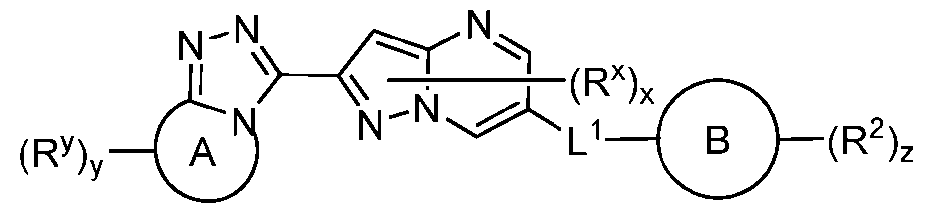 or a pharmaceutically acceptable salt thereof, wherein each of Ring A, Ring B, L1, Rx, Ry, Rz, x, y, and z are as defined below and described in embodiments herein, both singly and in combination. [0015] In some embodiments, the present invention provides a pharmaceutical composition comprising a compound of Formula I, Formula II, Formula III, Formula IV, Formula V, or Formula VI or a compound of Formula I, Formula II, Formula III, Formula IV, Formula V, or Formula VI and a pharmaceutically acceptable carrier, adjuvant, or diluent. [0016] In some embodiments, the present invention provides a method of treating an HPGD- mediated disorder, disease, or condition in a patient, comprising administering to said patient a compound herein, a pharmaceutically acceptable salt thereof, or the pharmaceutical composition herein. 2. Compounds and Definitions: [0017] Compounds of the present invention include those described generally herein, and are further illustrated by the classes, subclasses, and species disclosed herein. As used herein, the
following definitions shall apply unless otherwise indicated. For purposes of this invention, the chemical elements are identified in accordance with the Periodic Table of the Elements, CAS version, Handbook of Chemistry and Physics, 75th Ed. Additionally, general principles of organic chemistry are described in “Organic Chemistry”, Thomas Sorrell, University Science Books, Sausalito: 1999, and “March’s Advanced Organic Chemistry”, 5th Ed., Ed.: Smith, M.B. and March, J., John Wiley & Sons, New York: 2001. [0018] The term “aliphatic” or “aliphatic group,” as used herein, means a straight-chain (i.e., unbranched) or branched, substituted or unsubstituted hydrocarbon chain that is completely saturated or that contains one or more units of unsaturation, or a monocyclic hydrocarbon or bicyclic hydrocarbon that is completely saturated or that contains one or more units of unsaturation, but which is not aromatic (also referred to herein as “carbocycle,” “cycloaliphatic” or “cycloalkyl”), that has a single point of attachment to the rest of the molecule. Unless otherwise specified, aliphatic groups contain 1-6 aliphatic carbon atoms. In some embodiments, aliphatic groups contain 1-5 aliphatic carbon atoms. In other embodiments, aliphatic groups contain 1-4 aliphatic carbon atoms. In still other embodiments, aliphatic groups contain 1-3 aliphatic carbon atoms, and in yet other embodiments, aliphatic groups contain 1-2 aliphatic carbon atoms. In some embodiments, “cycloaliphatic” (or “carbocycle” or “cycloalkyl”) refers to a monocyclic C3-C6 hydrocarbon that is completely saturated or that contains one or more units of unsaturation, but which is not aromatic, that has a single point of attachment to the rest of the molecule. Suitable aliphatic groups include, but are not limited to, linear or branched, substituted or unsubstituted alkyl, alkenyl, alkynyl groups and hybrids thereof such as (cycloalkyl)alkyl, (cycloalkenyl)alkyl or (cycloalkyl)alkenyl. [0019] As used herein, the term “bridged bicyclic” refers to any bicyclic ring system, i.e., carbocyclic or heterocyclic, saturated or partially unsaturated, having at least one bridge. As defined by IUPAC, a “bridge” is an unbranched chain of atoms or an atom or a valence bond connecting two bridgeheads, where a “bridgehead” is any skeletal atom of the ring system which is bonded to three or more skeletal atoms (excluding hydrogen). In some embodiments, a bridged bicyclic group has 7-12 ring members and 0-4 heteroatoms independently selected from nitrogen, oxygen, or sulfur Unless otherwise specified, a bridged bicyclic group is optionally substituted with one or more substituents as set forth for aliphatic groups. Additionally or alternatively, any
substitutable nitrogen of a bridged bicyclic group is optionally substituted. The term “alkyl” refers to a C1-12 straight or branched saturated aliphatic group. In certain instances, alkyl refers to a C1-8 straight or branched saturated aliphatic group or a C1-6 straight or branched saturated aliphatic group. The term “lower alkyl” refers to a C1-4 straight or branched alkyl group. [0020] Exemplary lower alkyl groups are methyl, ethyl, propyl, isopropyl (also referred to interchangeably herein as 2-propyl, iPr, iPr and i-Pr), butyl, isobutyl (also referred to interchangeably herein as 2-butyl, iBu, iBu and i-Bu) and tert-butyl (also referred to interchangeably herein as 2-methyl-2-butyl, tBu, tBu and t-Bu). [0021] The term “alkenyl” refers to a C2-12 straight or branched partially unsaturated aliphatic group comprising at least one unsaturated carbon carbon double bond. In certain instances, alkenyl refers to a C2-8 or a C1-6 straight or branched partially unsaturated aliphatic group comprising at least one unsaturated carbon carbon double bond. The term “lower alkenyl” refers to a C2-4 straight or branched partially unsaturated aliphatic group comprising at least one unsaturated carbon carbon double bond. Alkenyl groups include both cis (Z) and trans (E) regioisomers. Exemplary lower alkenyl groups are vinyl, allyl, 2-propenyl,and butenyl isomers (-CH2CH2CH=CH2, - CH2CH=CHCH3 and -CH=CH=CH2CH3). [0022] The term “alkynyl” refers to a C2-12 straight or branched partially unsaturated aliphatic group comprising at least one unsaturated carbon carbon triple bond. In certain instances, alkynyl refers to a C2-8 or a C1-6 straight or branched partially unsaturated aliphatic group comprising at least one unsaturated carbon carbon triple bond. The term “lower alkynyl” refers to a C2-4 straight or branched partially unsaturated aliphatic group comprising at least one unsaturated carbon carbon triple bond. Exemplary lower alkynyl groups are ethynyl, 1-propynyl, 2-propynyl, 1- butynyl, 2-butynyl, and 3-butynyl. [0023] The term “haloalkyl” refers to a straight or branched alkyl group that is substituted with one or more halogen atoms. The term “lower haloalkyl” refers to a C1-4 straight or branched alkyl group that is substituted with one or more halogen atoms. [0024] The term “heteroatom” means one or more of oxygen, sulfur, nitrogen, phosphorus, or silicon (including, any oxidized form of nitrogen, sulfur, phosphorus, or silicon; the quaternized form of any basic nitrogen or; a substitutable nitrogen of a heterocyclic ring, for example N (as in 3,4-dihydro-2H-pyrrolyl), NH (as in pyrrolidinyl) or NR+ (as in N-substituted pyrrolidinyl)).
[0025] The term “unsaturated,” as used herein, means that a moiety has one or more units of unsaturation. [0026] As used herein, the term “bivalent C1-8 (or C1-6) saturated or unsaturated, straight or branched, hydrocarbon chain”, refers to bivalent alkylene, alkenylene, and alkynylene chains that are straight or branched as defined herein. [0027] The term “alkylene” refers to a bivalent alkyl group. An “alkylene chain” is a polymethylene group, i.e., –(CH2)n–, wherein n is a positive integer, preferably from 1 to 6, from 1 to 4, from 1 to 3, from 1 to 2, or from 2 to 3. A substituted alkylene chain is a polymethylene group in which one or more methylene hydrogen atoms are replaced with a substituent. Suitable substituents include those described below for a substituted aliphatic group. [0028] The term “alkenylene” refers to a bivalent alkenyl group. A substituted alkenylene chain is a polymethylene group containing at least one double bond in which one or more hydrogen atoms are replaced with a substituent. Suitable substituents include those described below for a substituted aliphatic group. [0029] The term “halogen” means F, Cl, Br, or I. [0030] The term “aryl” used alone or as part of a larger moiety as in “aralkyl,” “aralkoxy,” or “aryloxyalkyl,” refers to monocyclic or bicyclic ring systems having a total of five to fourteen ring members, wherein at least one ring in the system is aromatic and wherein each ring in the system contains 3 to 7 ring members. The term “aryl” may be used interchangeably with the term “aryl ring.” In certain embodiments of the present invention, “aryl” refers to an aromatic ring system which includes, but not limited to, phenyl, biphenyl, naphthyl, anthracyl and the like, which may bear one or more substituents. Also included within the scope of the term “aryl,” as it is used herein, is a group in which an aromatic ring is fused to one or more non–aromatic rings, such as indanyl, phthalimidyl, naphthimidyl, phenanthridinyl, or tetrahydronaphthyl, and the like. [0031] The terms “heteroaryl” and “heteroar–,” used alone or as part of a larger moiety, e.g., “heteroaralkyl,” or “heteroaralkoxy,” refer to groups having 5 to 10 ring atoms, preferably 5, 6, 9 or 10 ring atoms; having 6, 10, or 14 ^ electrons shared in a cyclic array; and having, in addition to carbon atoms, from one to five heteroatoms. The term “heteroatom” refers to nitrogen, oxygen, or sulfur, and includes any oxidized form of nitrogen or sulfur, and any quaternized form of a basic nitrogen. Heteroaryl groups include, without limitation, pyrazinyl, pyrazolyl, pyridazinyl, pyridyl,
pyrimidinyl, triazinyl, thienyl, furanyl, pyrrolyl, imidazolyl, pyrazolyl, triazolyl (i.e., 1,2,3-triazolyl), 1,2,4-triazolyl, 1,2,5-triazolyl, 1,3,4-triazolyl, tetrazolyl, oxazolyl, isoxazolyl, oxadiazolyl, 1,2,3-oxadiazolyl, 1,2,4-oxadiazolyl, 1,2,5-oxadiazolyl, 1,3,4-oxadiazolyl, thiazolyl, isothiazolyl, thiadiazolyl, indolizinyl, purinyl, naphthyridinyl, and pteridinyl. The terms “heteroaryl” and “heteroar–,” as used herein, also include groups in which a heteroaromatic ring is fused to one or more aryl, cycloaliphatic, or heterocyclyl rings, where unless otherwise specified, the radical or point of attachment is on the heteroaromatic ring or on one of the rings to which the heteroaromatic ring is fused. Nonlimiting examples include indolyl, isoindolyl, benzothienyl, benzofuranyl, dibenzofuranyl, indazolyl, indolizinyl, isoindolin-1-only, 1,2-dihydro-3H- pyrrolo[3,4-c]pyridin-3-onyl, 2,3-dihydro-1H-pyrrolo[3,4-c]pyridin-1-only, imidazo[1,2- a]pyridyl, imidazo[1,5-a]pyridyl, pyrazolo[1,5-a]pyridyl, pyrrolo[1,2-b]pyridazinyl, pyrrolo[1,2- a]pyrimidinyl, imidazo[1,2-b]pyridazinyl, imidazo[1,2-a]pyrimidinyl, benzimidazolyl, benzthiazolyl, quinolyl, isoquinolyl, cinnolinyl, phthalazinyl, quinazolinyl, quinoxalinyl, 4H– quinolizinyl, carbazolyl, acridinyl, phenazinyl, phenothiazinyl, phenoxazinyl, tetrahydroquinolinyl, and tetrahydroisoquinolinyl. A heteroaryl group may be mono– or bicyclic. The term “heteroaryl” may be used interchangeably with the terms “heteroaryl ring,” “heteroaryl group,” or “heteroaromatic,” any of which terms include rings that are optionally substituted. The term “heteroaralkyl” refers to an alkyl group substituted by a heteroaryl, wherein the alkyl and heteroaryl portions independently are optionally substituted. [0032] As used herein, the terms “heterocycle,” “heterocyclyl,” “heterocyclic radical,” and “heterocyclic ring” are used interchangeably and refer to a stable 5– to 7–membered monocyclic or 7–10–membered bicyclic heterocyclic moiety that is either saturated or partially unsaturated, and having, in addition to carbon atoms, one or more, preferably one to four, heteroatoms, as defined above. When used in reference to a ring atom of a heterocycle, the term "nitrogen" includes a substituted nitrogen. As an example, in a saturated or partially unsaturated ring having 0–3 heteroatoms selected from oxygen, sulfur or nitrogen, the nitrogen may be N (as in 3,4–dihydro– 2H–pyrrolyl), NH (as in pyrrolidinyl), or +NR (as in N–substituted pyrrolidinyl). [0033] A heterocyclic ring can be attached to its pendant group at any heteroatom or carbon atom that results in a stable structure and any of the ring atoms can be optionally substituted. Examples of such saturated or partially unsaturated heterocyclic radicals include, without
limitation, oxetanyl, azetidinyl, tetrahydrofuranyl, tetrahydrothiophenyl pyrrolidinyl, piperidinyl, pyrrolinyl, tetrahydroquinolinyl, tetrahydroisoquinolinyl, decahydroquinolinyl, oxazolidinyl, piperazinyl, dioxanyl, dioxolanyl, diazepinyl, oxazepinyl, thiazepinyl, morpholinyl, 2-oxa-6- azaspiro[3.3]heptane, and quinuclidinyl. The terms “heterocycle,” “heterocyclyl,” “heterocyclyl ring,” “heterocyclic group,” “heterocyclic moiety,” and “heterocyclic radical,” are used interchangeably herein, and also include groups in which a heterocyclyl ring is fused to one or more aryl, heteroaryl, or cycloaliphatic rings, such as indolinyl, 3H–indolyl, chromanyl, phenanthridinyl, or tetrahydroquinolinyl. A heterocyclyl group may be mono– or bicyclic. The term “heterocyclylalkyl” refers to an alkyl group substituted by a heterocyclyl, wherein the alkyl and heterocyclyl portions independently are optionally substituted. [0034] As used herein, the term “partially unsaturated” refers to a ring moiety that includes at least one double or triple bond. The term “partially unsaturated” is intended to encompass rings having multiple sites of unsaturation, but is not intended to include aryl or heteroaryl moieties, as herein defined. [0035] As described herein, compounds of the invention may contain “optionally substituted” moieties. In general, the term “substituted,” whether preceded by the term “optionally” or not, means that one or more hydrogens of the designated moiety are replaced with a suitable substituent. Unless otherwise indicated, an “optionally substituted” group may have a suitable substituent at each substitutable position of the group, and when more than one position in any given structure may be substituted with more than one substituent selected from a specified group, the substituent may be either the same or different at every position. Combinations of substituents envisioned by this invention are preferably those that result in the formation of stable or chemically feasible compounds. The term “stable,” as used herein, refers to compounds that are not substantially altered when subjected to conditions to allow for their production, detection, and, in certain embodiments, their recovery, purification, and use for one or more of the purposes disclosed herein. [0036] Suitable monovalent substituents on a substitutable carbon atom of an “optionally substituted” group are independently halogen; –(CH2)0–4R ^; –(CH2)0–4OR ^; -O(CH2)0-4Ro; –O– (CH2)0–4C(O)OR°; –(CH2)0–4CH(OR ^)2; –(CH2)0–4SR ^; –(CH2)0–4Ph, which may be substituted with R°; –(CH2)0–4O(CH2)0–1Ph which may be substituted with R°; –CH=CHPh, which may be
substituted with R°; –(CH2)0–4O(CH2)0–1-pyridyl which may be substituted with R°; –NO2; –CN; –N3; -(CH2)0–4N(R ^)2; –(CH2)0–4N(R ^)C(O)R ^; –N(R ^)C(S)R ^; –(CH2)0–4N(R ^)C(O)NR ^2; – N(R ^)C(S)NR ^2; –(CH2)0–4N(R ^)C(O)OR ^; –N(R ^)N(R ^)C(O)R ^; –N(R ^)N(R ^)C(O)NR ^2; – N(R ^)N(R ^)C(O)OR ^; –N(R ^)C(NR ^)N(R ^)2; –(CH2)0–4C(O)R ^; –C(S)R ^; –(CH2)0–4C(O)OR ^; – (CH2)0–4C(O)SR ^; –(CH2)0–4C(O)OSiR ^3; –(CH2)0–4OC(O)R ^; –OC(O)(CH2)0–4SR°; –(CH2)0– 4SC(O)R ^; –(CH2)0–4C(O)NR ^2; –C(S)NR ^2; –C(S)SR°; –SC(S)SR°, –(CH2)0–4OC(O)NR ^2; – C(O)N(OR ^)R ^; –C(O)C(O)R ^; –C(O)CH2C(O)R ^; –C(NOR ^)R ^; –(CH2)0–4SSR ^; –(CH2)0– 4S(O)2R ^; –(CH2)0–4S(O)2OR ^; –(CH2)0–4OS(O)2R ^; –S(O)2NR ^2; –(CH2)0–4S(O)R ^; – N(R ^)S(O)2NR ^2; –N(R ^)S(O)2R ^; –N(OR ^)R ^; –C(NH)NR ^2; –(CH2)0–4P(O)2R ^; –(CH2)0– 4P(O)R ^2; –(CH2)0–4OP(O)R ^2; –(CH2)0–4OP(O)(OR ^)2; –SiR ^3; –(C1–4 straight or branched alkylene)O–N(R ^)2; or –(C1–4 straight or branched alkylene)C(O)O–N(R ^)2, wherein each R ^ may be substituted as defined below and is independently hydrogen, C1–6 aliphatic, –CH2Ph, –O(CH2)0– 1Ph, -CH2-(5-6 membered heteroaryl ring), or a 5–6–membered saturated, partially unsaturated, or aryl ring having 0–4 heteroatoms independently selected from nitrogen, oxygen, or sulfur, or, notwithstanding the definition above, two independent occurrences of R ^, taken together with their intervening atom(s), form a 3–12–membered saturated, partially unsaturated, or aryl mono– or bicyclic ring having 0–4 heteroatoms independently selected from nitrogen, oxygen, or sulfur, which may be substituted as defined below. [0037] Suitable monovalent substituents on R ^ (or the ring formed by taking two independent occurrences of R ^ together with their intervening atoms), are independently halogen, –(CH2)0–2R ^, –(haloR ^), –(CH2)0–2OH, –(CH2)0–2OR ^, –(CH2)0–2CH(OR ^)2; –O(haloR ^), –CN, –N3, –(CH2)0– 2C(O)R ^, –(CH2)0–2C(O)OH, –(CH2)0–2C(O)OR ^, –(CH2)0–2SR ^, –(CH2)0–2SH, –(CH2)0–2NH2, – (CH2)0–2NHR ^, –(CH2)0–2NR ^ 2, –NO2, –SiR ^ 3, –OSiR ^ 3, -C(O)SR ^ , –(C1–4 straight or branched alkylene)C(O)OR ^, or –SSR ^ wherein each R ^ is unsubstituted or where preceded by “halo” is substituted only with one or more halogens, and is independently selected from C1–4 aliphatic, – CH2Ph, –O(CH2)0–1Ph, or a 5–6–membered saturated, partially unsaturated, or aryl ring having 0– 4 heteroatoms independently selected from nitrogen, oxygen, or sulfur. Suitable divalent substituents on a saturated carbon atom of R ^ include =O and =S.
[0038] Suitable divalent substituents on a saturated carbon atom of an “optionally substituted” group include the following: =O, =S, =NNR*2, =NNHC(O)R*, =NNHC(O)OR*, =NNHS(O)2R*, =NR*, =NOR*, –O(C(R*2))2–3O–, or –S(C(R*2))2–3S–, wherein each independent occurrence of R* is selected from hydrogen, C1–6 aliphatic which may be substituted as defined below, or an unsubstituted 5–6–membered saturated, partially unsaturated, or aryl ring having 0–4 heteroatoms independently selected from nitrogen, oxygen, or sulfur. Suitable divalent substituents that are bound to vicinal substitutable carbons of an “optionally substituted” group include: –O(CR* 2)2– 3O–, wherein each independent occurrence of R* is selected from hydrogen, C1–6 aliphatic which may be substituted as defined below, or an unsubstituted 5–6–membered saturated, partially unsaturated, or aryl ring having 0–4 heteroatoms independently selected from nitrogen, oxygen, or sulfur. [0039] Suitable substituents on the aliphatic group of R* include halogen, –R ^, -(haloR ^), -OH, –OR ^, –O(haloR ^), –CN, –C(O)OH, –C(O)OR ^, –NH2, –NHR ^, –NR ^2, or –NO2, wherein each R ^ is unsubstituted or where preceded by “halo” is substituted only with one or more halogens, and is independently C1–4 aliphatic, –CH2Ph, –O(CH2)0–1Ph, or a 5–6– membered saturated, partially unsaturated, or aryl ring having 0–4 heteroatoms independently selected from nitrogen, oxygen, or sulfur. [0040] Suitable substituents on a substitutable nitrogen of an “optionally substituted” group include –R†, –NR†2, –C(O)R†, –C(O)OR†, –C(O)C(O)R†, –C(O)CH2C(O)R†, -S(O)2R†, R†; wherein each R† is independe
or a pharmaceutically acceptable salt thereof, wherein each of Ring A, Ring B, L1, Rx, Ry, Rz, x, y, and z are as defined below and described in embodiments herein, both singly and in combination. [0015] In some embodiments, the present invention provides a pharmaceutical composition comprising a compound of Formula I, Formula II, Formula III, Formula IV, Formula V, or Formula VI or a compound of Formula I, Formula II, Formula III, Formula IV, Formula V, or Formula VI and a pharmaceutically acceptable carrier, adjuvant, or diluent. [0016] In some embodiments, the present invention provides a method of treating an HPGD- mediated disorder, disease, or condition in a patient, comprising administering to said patient a compound herein, a pharmaceutically acceptable salt thereof, or the pharmaceutical composition herein. 2. Compounds and Definitions: [0017] Compounds of the present invention include those described generally herein, and are further illustrated by the classes, subclasses, and species disclosed herein. As used herein, the
following definitions shall apply unless otherwise indicated. For purposes of this invention, the chemical elements are identified in accordance with the Periodic Table of the Elements, CAS version, Handbook of Chemistry and Physics, 75th Ed. Additionally, general principles of organic chemistry are described in “Organic Chemistry”, Thomas Sorrell, University Science Books, Sausalito: 1999, and “March’s Advanced Organic Chemistry”, 5th Ed., Ed.: Smith, M.B. and March, J., John Wiley & Sons, New York: 2001. [0018] The term “aliphatic” or “aliphatic group,” as used herein, means a straight-chain (i.e., unbranched) or branched, substituted or unsubstituted hydrocarbon chain that is completely saturated or that contains one or more units of unsaturation, or a monocyclic hydrocarbon or bicyclic hydrocarbon that is completely saturated or that contains one or more units of unsaturation, but which is not aromatic (also referred to herein as “carbocycle,” “cycloaliphatic” or “cycloalkyl”), that has a single point of attachment to the rest of the molecule. Unless otherwise specified, aliphatic groups contain 1-6 aliphatic carbon atoms. In some embodiments, aliphatic groups contain 1-5 aliphatic carbon atoms. In other embodiments, aliphatic groups contain 1-4 aliphatic carbon atoms. In still other embodiments, aliphatic groups contain 1-3 aliphatic carbon atoms, and in yet other embodiments, aliphatic groups contain 1-2 aliphatic carbon atoms. In some embodiments, “cycloaliphatic” (or “carbocycle” or “cycloalkyl”) refers to a monocyclic C3-C6 hydrocarbon that is completely saturated or that contains one or more units of unsaturation, but which is not aromatic, that has a single point of attachment to the rest of the molecule. Suitable aliphatic groups include, but are not limited to, linear or branched, substituted or unsubstituted alkyl, alkenyl, alkynyl groups and hybrids thereof such as (cycloalkyl)alkyl, (cycloalkenyl)alkyl or (cycloalkyl)alkenyl. [0019] As used herein, the term “bridged bicyclic” refers to any bicyclic ring system, i.e., carbocyclic or heterocyclic, saturated or partially unsaturated, having at least one bridge. As defined by IUPAC, a “bridge” is an unbranched chain of atoms or an atom or a valence bond connecting two bridgeheads, where a “bridgehead” is any skeletal atom of the ring system which is bonded to three or more skeletal atoms (excluding hydrogen). In some embodiments, a bridged bicyclic group has 7-12 ring members and 0-4 heteroatoms independently selected from nitrogen, oxygen, or sulfur Unless otherwise specified, a bridged bicyclic group is optionally substituted with one or more substituents as set forth for aliphatic groups. Additionally or alternatively, any
substitutable nitrogen of a bridged bicyclic group is optionally substituted. The term “alkyl” refers to a C1-12 straight or branched saturated aliphatic group. In certain instances, alkyl refers to a C1-8 straight or branched saturated aliphatic group or a C1-6 straight or branched saturated aliphatic group. The term “lower alkyl” refers to a C1-4 straight or branched alkyl group. [0020] Exemplary lower alkyl groups are methyl, ethyl, propyl, isopropyl (also referred to interchangeably herein as 2-propyl, iPr, iPr and i-Pr), butyl, isobutyl (also referred to interchangeably herein as 2-butyl, iBu, iBu and i-Bu) and tert-butyl (also referred to interchangeably herein as 2-methyl-2-butyl, tBu, tBu and t-Bu). [0021] The term “alkenyl” refers to a C2-12 straight or branched partially unsaturated aliphatic group comprising at least one unsaturated carbon carbon double bond. In certain instances, alkenyl refers to a C2-8 or a C1-6 straight or branched partially unsaturated aliphatic group comprising at least one unsaturated carbon carbon double bond. The term “lower alkenyl” refers to a C2-4 straight or branched partially unsaturated aliphatic group comprising at least one unsaturated carbon carbon double bond. Alkenyl groups include both cis (Z) and trans (E) regioisomers. Exemplary lower alkenyl groups are vinyl, allyl, 2-propenyl,and butenyl isomers (-CH2CH2CH=CH2, - CH2CH=CHCH3 and -CH=CH=CH2CH3). [0022] The term “alkynyl” refers to a C2-12 straight or branched partially unsaturated aliphatic group comprising at least one unsaturated carbon carbon triple bond. In certain instances, alkynyl refers to a C2-8 or a C1-6 straight or branched partially unsaturated aliphatic group comprising at least one unsaturated carbon carbon triple bond. The term “lower alkynyl” refers to a C2-4 straight or branched partially unsaturated aliphatic group comprising at least one unsaturated carbon carbon triple bond. Exemplary lower alkynyl groups are ethynyl, 1-propynyl, 2-propynyl, 1- butynyl, 2-butynyl, and 3-butynyl. [0023] The term “haloalkyl” refers to a straight or branched alkyl group that is substituted with one or more halogen atoms. The term “lower haloalkyl” refers to a C1-4 straight or branched alkyl group that is substituted with one or more halogen atoms. [0024] The term “heteroatom” means one or more of oxygen, sulfur, nitrogen, phosphorus, or silicon (including, any oxidized form of nitrogen, sulfur, phosphorus, or silicon; the quaternized form of any basic nitrogen or; a substitutable nitrogen of a heterocyclic ring, for example N (as in 3,4-dihydro-2H-pyrrolyl), NH (as in pyrrolidinyl) or NR+ (as in N-substituted pyrrolidinyl)).
[0025] The term “unsaturated,” as used herein, means that a moiety has one or more units of unsaturation. [0026] As used herein, the term “bivalent C1-8 (or C1-6) saturated or unsaturated, straight or branched, hydrocarbon chain”, refers to bivalent alkylene, alkenylene, and alkynylene chains that are straight or branched as defined herein. [0027] The term “alkylene” refers to a bivalent alkyl group. An “alkylene chain” is a polymethylene group, i.e., –(CH2)n–, wherein n is a positive integer, preferably from 1 to 6, from 1 to 4, from 1 to 3, from 1 to 2, or from 2 to 3. A substituted alkylene chain is a polymethylene group in which one or more methylene hydrogen atoms are replaced with a substituent. Suitable substituents include those described below for a substituted aliphatic group. [0028] The term “alkenylene” refers to a bivalent alkenyl group. A substituted alkenylene chain is a polymethylene group containing at least one double bond in which one or more hydrogen atoms are replaced with a substituent. Suitable substituents include those described below for a substituted aliphatic group. [0029] The term “halogen” means F, Cl, Br, or I. [0030] The term “aryl” used alone or as part of a larger moiety as in “aralkyl,” “aralkoxy,” or “aryloxyalkyl,” refers to monocyclic or bicyclic ring systems having a total of five to fourteen ring members, wherein at least one ring in the system is aromatic and wherein each ring in the system contains 3 to 7 ring members. The term “aryl” may be used interchangeably with the term “aryl ring.” In certain embodiments of the present invention, “aryl” refers to an aromatic ring system which includes, but not limited to, phenyl, biphenyl, naphthyl, anthracyl and the like, which may bear one or more substituents. Also included within the scope of the term “aryl,” as it is used herein, is a group in which an aromatic ring is fused to one or more non–aromatic rings, such as indanyl, phthalimidyl, naphthimidyl, phenanthridinyl, or tetrahydronaphthyl, and the like. [0031] The terms “heteroaryl” and “heteroar–,” used alone or as part of a larger moiety, e.g., “heteroaralkyl,” or “heteroaralkoxy,” refer to groups having 5 to 10 ring atoms, preferably 5, 6, 9 or 10 ring atoms; having 6, 10, or 14 ^ electrons shared in a cyclic array; and having, in addition to carbon atoms, from one to five heteroatoms. The term “heteroatom” refers to nitrogen, oxygen, or sulfur, and includes any oxidized form of nitrogen or sulfur, and any quaternized form of a basic nitrogen. Heteroaryl groups include, without limitation, pyrazinyl, pyrazolyl, pyridazinyl, pyridyl,
pyrimidinyl, triazinyl, thienyl, furanyl, pyrrolyl, imidazolyl, pyrazolyl, triazolyl (i.e., 1,2,3-triazolyl), 1,2,4-triazolyl, 1,2,5-triazolyl, 1,3,4-triazolyl, tetrazolyl, oxazolyl, isoxazolyl, oxadiazolyl, 1,2,3-oxadiazolyl, 1,2,4-oxadiazolyl, 1,2,5-oxadiazolyl, 1,3,4-oxadiazolyl, thiazolyl, isothiazolyl, thiadiazolyl, indolizinyl, purinyl, naphthyridinyl, and pteridinyl. The terms “heteroaryl” and “heteroar–,” as used herein, also include groups in which a heteroaromatic ring is fused to one or more aryl, cycloaliphatic, or heterocyclyl rings, where unless otherwise specified, the radical or point of attachment is on the heteroaromatic ring or on one of the rings to which the heteroaromatic ring is fused. Nonlimiting examples include indolyl, isoindolyl, benzothienyl, benzofuranyl, dibenzofuranyl, indazolyl, indolizinyl, isoindolin-1-only, 1,2-dihydro-3H- pyrrolo[3,4-c]pyridin-3-onyl, 2,3-dihydro-1H-pyrrolo[3,4-c]pyridin-1-only, imidazo[1,2- a]pyridyl, imidazo[1,5-a]pyridyl, pyrazolo[1,5-a]pyridyl, pyrrolo[1,2-b]pyridazinyl, pyrrolo[1,2- a]pyrimidinyl, imidazo[1,2-b]pyridazinyl, imidazo[1,2-a]pyrimidinyl, benzimidazolyl, benzthiazolyl, quinolyl, isoquinolyl, cinnolinyl, phthalazinyl, quinazolinyl, quinoxalinyl, 4H– quinolizinyl, carbazolyl, acridinyl, phenazinyl, phenothiazinyl, phenoxazinyl, tetrahydroquinolinyl, and tetrahydroisoquinolinyl. A heteroaryl group may be mono– or bicyclic. The term “heteroaryl” may be used interchangeably with the terms “heteroaryl ring,” “heteroaryl group,” or “heteroaromatic,” any of which terms include rings that are optionally substituted. The term “heteroaralkyl” refers to an alkyl group substituted by a heteroaryl, wherein the alkyl and heteroaryl portions independently are optionally substituted. [0032] As used herein, the terms “heterocycle,” “heterocyclyl,” “heterocyclic radical,” and “heterocyclic ring” are used interchangeably and refer to a stable 5– to 7–membered monocyclic or 7–10–membered bicyclic heterocyclic moiety that is either saturated or partially unsaturated, and having, in addition to carbon atoms, one or more, preferably one to four, heteroatoms, as defined above. When used in reference to a ring atom of a heterocycle, the term "nitrogen" includes a substituted nitrogen. As an example, in a saturated or partially unsaturated ring having 0–3 heteroatoms selected from oxygen, sulfur or nitrogen, the nitrogen may be N (as in 3,4–dihydro– 2H–pyrrolyl), NH (as in pyrrolidinyl), or +NR (as in N–substituted pyrrolidinyl). [0033] A heterocyclic ring can be attached to its pendant group at any heteroatom or carbon atom that results in a stable structure and any of the ring atoms can be optionally substituted. Examples of such saturated or partially unsaturated heterocyclic radicals include, without
limitation, oxetanyl, azetidinyl, tetrahydrofuranyl, tetrahydrothiophenyl pyrrolidinyl, piperidinyl, pyrrolinyl, tetrahydroquinolinyl, tetrahydroisoquinolinyl, decahydroquinolinyl, oxazolidinyl, piperazinyl, dioxanyl, dioxolanyl, diazepinyl, oxazepinyl, thiazepinyl, morpholinyl, 2-oxa-6- azaspiro[3.3]heptane, and quinuclidinyl. The terms “heterocycle,” “heterocyclyl,” “heterocyclyl ring,” “heterocyclic group,” “heterocyclic moiety,” and “heterocyclic radical,” are used interchangeably herein, and also include groups in which a heterocyclyl ring is fused to one or more aryl, heteroaryl, or cycloaliphatic rings, such as indolinyl, 3H–indolyl, chromanyl, phenanthridinyl, or tetrahydroquinolinyl. A heterocyclyl group may be mono– or bicyclic. The term “heterocyclylalkyl” refers to an alkyl group substituted by a heterocyclyl, wherein the alkyl and heterocyclyl portions independently are optionally substituted. [0034] As used herein, the term “partially unsaturated” refers to a ring moiety that includes at least one double or triple bond. The term “partially unsaturated” is intended to encompass rings having multiple sites of unsaturation, but is not intended to include aryl or heteroaryl moieties, as herein defined. [0035] As described herein, compounds of the invention may contain “optionally substituted” moieties. In general, the term “substituted,” whether preceded by the term “optionally” or not, means that one or more hydrogens of the designated moiety are replaced with a suitable substituent. Unless otherwise indicated, an “optionally substituted” group may have a suitable substituent at each substitutable position of the group, and when more than one position in any given structure may be substituted with more than one substituent selected from a specified group, the substituent may be either the same or different at every position. Combinations of substituents envisioned by this invention are preferably those that result in the formation of stable or chemically feasible compounds. The term “stable,” as used herein, refers to compounds that are not substantially altered when subjected to conditions to allow for their production, detection, and, in certain embodiments, their recovery, purification, and use for one or more of the purposes disclosed herein. [0036] Suitable monovalent substituents on a substitutable carbon atom of an “optionally substituted” group are independently halogen; –(CH2)0–4R ^; –(CH2)0–4OR ^; -O(CH2)0-4Ro; –O– (CH2)0–4C(O)OR°; –(CH2)0–4CH(OR ^)2; –(CH2)0–4SR ^; –(CH2)0–4Ph, which may be substituted with R°; –(CH2)0–4O(CH2)0–1Ph which may be substituted with R°; –CH=CHPh, which may be
substituted with R°; –(CH2)0–4O(CH2)0–1-pyridyl which may be substituted with R°; –NO2; –CN; –N3; -(CH2)0–4N(R ^)2; –(CH2)0–4N(R ^)C(O)R ^; –N(R ^)C(S)R ^; –(CH2)0–4N(R ^)C(O)NR ^2; – N(R ^)C(S)NR ^2; –(CH2)0–4N(R ^)C(O)OR ^; –N(R ^)N(R ^)C(O)R ^; –N(R ^)N(R ^)C(O)NR ^2; – N(R ^)N(R ^)C(O)OR ^; –N(R ^)C(NR ^)N(R ^)2; –(CH2)0–4C(O)R ^; –C(S)R ^; –(CH2)0–4C(O)OR ^; – (CH2)0–4C(O)SR ^; –(CH2)0–4C(O)OSiR ^3; –(CH2)0–4OC(O)R ^; –OC(O)(CH2)0–4SR°; –(CH2)0– 4SC(O)R ^; –(CH2)0–4C(O)NR ^2; –C(S)NR ^2; –C(S)SR°; –SC(S)SR°, –(CH2)0–4OC(O)NR ^2; – C(O)N(OR ^)R ^; –C(O)C(O)R ^; –C(O)CH2C(O)R ^; –C(NOR ^)R ^; –(CH2)0–4SSR ^; –(CH2)0– 4S(O)2R ^; –(CH2)0–4S(O)2OR ^; –(CH2)0–4OS(O)2R ^; –S(O)2NR ^2; –(CH2)0–4S(O)R ^; – N(R ^)S(O)2NR ^2; –N(R ^)S(O)2R ^; –N(OR ^)R ^; –C(NH)NR ^2; –(CH2)0–4P(O)2R ^; –(CH2)0– 4P(O)R ^2; –(CH2)0–4OP(O)R ^2; –(CH2)0–4OP(O)(OR ^)2; –SiR ^3; –(C1–4 straight or branched alkylene)O–N(R ^)2; or –(C1–4 straight or branched alkylene)C(O)O–N(R ^)2, wherein each R ^ may be substituted as defined below and is independently hydrogen, C1–6 aliphatic, –CH2Ph, –O(CH2)0– 1Ph, -CH2-(5-6 membered heteroaryl ring), or a 5–6–membered saturated, partially unsaturated, or aryl ring having 0–4 heteroatoms independently selected from nitrogen, oxygen, or sulfur, or, notwithstanding the definition above, two independent occurrences of R ^, taken together with their intervening atom(s), form a 3–12–membered saturated, partially unsaturated, or aryl mono– or bicyclic ring having 0–4 heteroatoms independently selected from nitrogen, oxygen, or sulfur, which may be substituted as defined below. [0037] Suitable monovalent substituents on R ^ (or the ring formed by taking two independent occurrences of R ^ together with their intervening atoms), are independently halogen, –(CH2)0–2R ^, –(haloR ^), –(CH2)0–2OH, –(CH2)0–2OR ^, –(CH2)0–2CH(OR ^)2; –O(haloR ^), –CN, –N3, –(CH2)0– 2C(O)R ^, –(CH2)0–2C(O)OH, –(CH2)0–2C(O)OR ^, –(CH2)0–2SR ^, –(CH2)0–2SH, –(CH2)0–2NH2, – (CH2)0–2NHR ^, –(CH2)0–2NR ^ 2, –NO2, –SiR ^ 3, –OSiR ^ 3, -C(O)SR ^ , –(C1–4 straight or branched alkylene)C(O)OR ^, or –SSR ^ wherein each R ^ is unsubstituted or where preceded by “halo” is substituted only with one or more halogens, and is independently selected from C1–4 aliphatic, – CH2Ph, –O(CH2)0–1Ph, or a 5–6–membered saturated, partially unsaturated, or aryl ring having 0– 4 heteroatoms independently selected from nitrogen, oxygen, or sulfur. Suitable divalent substituents on a saturated carbon atom of R ^ include =O and =S.
[0038] Suitable divalent substituents on a saturated carbon atom of an “optionally substituted” group include the following: =O, =S, =NNR*2, =NNHC(O)R*, =NNHC(O)OR*, =NNHS(O)2R*, =NR*, =NOR*, –O(C(R*2))2–3O–, or –S(C(R*2))2–3S–, wherein each independent occurrence of R* is selected from hydrogen, C1–6 aliphatic which may be substituted as defined below, or an unsubstituted 5–6–membered saturated, partially unsaturated, or aryl ring having 0–4 heteroatoms independently selected from nitrogen, oxygen, or sulfur. Suitable divalent substituents that are bound to vicinal substitutable carbons of an “optionally substituted” group include: –O(CR* 2)2– 3O–, wherein each independent occurrence of R* is selected from hydrogen, C1–6 aliphatic which may be substituted as defined below, or an unsubstituted 5–6–membered saturated, partially unsaturated, or aryl ring having 0–4 heteroatoms independently selected from nitrogen, oxygen, or sulfur. [0039] Suitable substituents on the aliphatic group of R* include halogen, –R ^, -(haloR ^), -OH, –OR ^, –O(haloR ^), –CN, –C(O)OH, –C(O)OR ^, –NH2, –NHR ^, –NR ^2, or –NO2, wherein each R ^ is unsubstituted or where preceded by “halo” is substituted only with one or more halogens, and is independently C1–4 aliphatic, –CH2Ph, –O(CH2)0–1Ph, or a 5–6– membered saturated, partially unsaturated, or aryl ring having 0–4 heteroatoms independently selected from nitrogen, oxygen, or sulfur. [0040] Suitable substituents on a substitutable nitrogen of an “optionally substituted” group include –R†, –NR†2, –C(O)R†, –C(O)OR†, –C(O)C(O)R†, –C(O)CH2C(O)R†, -S(O)2R†, R†; wherein each R† is independe
 ined below, unsubstituted –OPh, or an unsubstituted 5–6–membered saturated, partially unsaturated, or aryl ring having 0–4 heteroatoms independently selected from nitrogen, oxygen, or sulfur, or, notwithstanding the definition above, two independent occurrences of R†, taken together with their intervening atom(s) form an unsubstituted 3–12–membered saturated, partially unsaturated, or aryl mono– or bicyclic ring having 0–4 heteroatoms independently selected from nitrogen, oxygen, or sulfur. [0041] Suitable substituents on the aliphatic group of R† are independently halogen, –R ^, -(haloR ^), –OH, –OR ^, –O(haloR ^), –CN, –C(O)OH, –C(O)OR ^, –NH2, –NHR ^, –NR ^2, or –NO2, wherein each R ^ is unsubstituted or where preceded by “halo” is substituted only with one or more halogens, and is independently C1–4 aliphatic, –CH2Ph, –O(CH2)0–1Ph, or a 5–6–
membered saturated, partially unsaturated, or aryl ring having 0–4 heteroatoms independently selected from nitrogen, oxygen, or sulfur. [0042] As used herein, the term “pharmaceutically acceptable salt” refers to those salts which are, within the scope of sound medical judgment, suitable for use in contact with the tissues of humans and lower animals without undue toxicity, irritation, allergic response and the like, and are commensurate with a reasonable benefit/risk ratio. Pharmaceutically acceptable salts are well known in the art. For example, S. M. Berge et al., describe pharmaceutically acceptable salts in detail in J. Pharmaceutical Sciences, 1977, 66, 1–19. Pharmaceutically acceptable salts of the compounds of this invention include those derived from suitable inorganic and organic acids and bases. Examples of pharmaceutically acceptable, nontoxic acid addition salts are salts of an amino group formed with inorganic acids such as hydrochloric acid, hydrobromic acid, phosphoric acid, sulfuric acid and perchloric acid or with organic acids such as acetic acid, oxalic acid, maleic acid, tartaric acid, citric acid, succinic acid or malonic acid or by using other methods used in the art such as ion exchange. Other pharmaceutically acceptable salts include adipate, alginate, ascorbate, aspartate, benzenesulfonate, benzoate, bisulfate, borate, butyrate, camphorate, camphorsulfonate, citrate, cyclopentanepropionate, digluconate, dodecylsulfate, ethanesulfonate, formate, fumarate, glucoheptonate, glycerophosphate, gluconate, hemisulfate, heptanoate, hexanoate, hydroiodide, 2– hydroxy–ethanesulfonate, lactobionate, lactate, laurate, lauryl sulfate, malate, maleate, malonate, methanesulfonate, 2–naphthalenesulfonate, nicotinate, nitrate, oleate, oxalate, palmitate, pamoate, pectinate, persulfate, 3–phenylpropionate, phosphate, pivalate, propionate, stearate, succinate, sulfate, tartrate, thiocyanate, p–toluenesulfonate, undecanoate, valerate salts, and the like. [0043] Salts derived from appropriate bases include alkali metal, alkaline earth metal, ammonium and N+(C1–4alkyl)4 salts. Representative alkali or alkaline earth metal salts include sodium, lithium, potassium, calcium, magnesium, and the like. Further pharmaceutically acceptable salts include, when appropriate, nontoxic ammonium, quaternary ammonium, and amine cations formed using counterions such as halide, hydroxide, carboxylate, sulfate, phosphate, nitrate, loweralkyl sulfonate and aryl sulfonate. [0044] Unless otherwise stated, structures depicted herein are also meant to include all isomeric (e.g., enantiomeric, diastereomeric, and geometric (or conformational)) forms of the structure; for example, the R and S configurations for each asymmetric center, Z and E double
bond isomers, Z and E conformational isomers and Ra (or M) and Sa (or P) atropisomers. Therefore, single stereochemical isomers as well as enantiomeric, diastereomeric, and geometric (or conformational) mixtures of the present compounds are within the scope of the invention. Unless otherwise stated, all tautomeric forms of the compounds of the invention are within the scope of the invention. Additionally, unless otherwise stated, structures depicted herein are also meant to include compounds that differ only in the presence of one or more isotopically enriched atoms. For example, compounds having the present structures including the replacement of hydrogen by deuterium or tritium, or the replacement of a carbon by a 13C- or 14C-enriched carbon are within the scope of this invention. Such compounds are useful, for example, as analytical tools, as probes in biological assays, or as therapeutic agents in accordance with the present invention. In certain embodiments, Ring B of a provided compound may be substituted with one or more deuterium atoms. [0045] The structures as drawn represent relative configurations, unless labeled as absolute configurations. The invention contemplates individual enantiomers and racemic mixtures. [0046] As used herein, an “HPGD inhibitor” is a molecule that reduces, inhibits, or otherwise diminishes one or more of the biological activities of HPGD. Inhibition using the HPGD inhibitor does not necessarily indicate a total elimination of the HPGD activity. Instead, the activity could decrease by a statistically significant amount including, for example, a decrease of at least about 5%, 10%, 15%, 20%, 25%, 30%, 35%, 40%, 45%, 50%, 55%, 60%, 65%, 70%, 75%, 80%, 85%, 95% or 100% of the activity of HPGD compared to an appropriate control. In some embodiments, the HPGD inhibitor reduces, inhibits, or otherwise diminishes the dehydrogenase activity of HPGD. The presently disclosed compounds bind directly to HPGD and inhibit its activity. [0047] “Selectivity” and “selective” as used herein is a relative measure of the tendency for a compound to preferentially (e.g., in a statistically significant manner) associate with one target as opposed to another target (or group of targets). In some embodiments, the presently disclosed compounds reduce, inhibit, or otherwise diminishes the activity of HPGD greater than that of another target. For example, a selective HPGD inhibitor reduces at least one biological activity of HPGD by an amount that is statistically greater than the inhibitory effect of any other protein. In some embodiments, the activity of a selective inhibitor is reported as EC50, IC50, KD or Ki. In some embodiments, the activity of a selective inhibitor (measured as any one of EC50, IC50, KD or Ki)
for HPGD is about 10 fold greater than the corresponding inhibitory activity for another target. In other embodiments the activity of the selective inhibitor for HPGD is at least about 15 fold greater, 20 fold greater, 25 fold greater, 30 fold greater, 40 fold greater or 50 fold greater than the corresponding inhibitory activity for another target. The presently disclosed compounds may or may not be a selective HPGD inhibitor. [0048] A compound of the present invention may be tethered to a detectable moiety. It will be appreciated that such compounds are useful as imaging agents. One of ordinary skill in the art will recognize that a detectable moiety may be attached to a provided compound via a suitable substituent. As used herein, the term “suitable substituent” refers to a moiety that is capable of covalent attachment to a detectable moiety. Such moieties are well known to one of ordinary skill in the art and include groups containing, e.g., a carboxylate moiety, an amino moiety, a thiol moiety, or a hydroxyl moiety, to name but a few. It will be appreciated that such moieties may be directly attached to a provided compound or via a tethering group, such as a bivalent saturated or unsaturated hydrocarbon chain. In some embodiments, such moieties may be attached via click chemistry. In some embodiments, such moieties may be attached via a 1,3-cycloaddition of an azide with an alkyne, optionally in the presence of a copper catalyst. Methods of using click chemistry are known in the art and include those described by Rostovtsev et al., Angew. Chem. Int. Ed.2002, 41:2596-99 and Sun et al., Bioconjugate Chem., 2006, 17:52-57. [0049] As used herein, the term “detectable moiety” is used interchangeably with the term "label" and relates to any moiety capable of being detected, e.g., primary labels and secondary labels. Primary labels, such as radioisotopes (e.g., tritium, 32P, 33P, 35S, or 14C), mass-tags, and fluorescent labels are signal generating reporter groups which can be detected without further modifications. Detectable moieties also include luminescent and phosphorescent groups. [0050] The term “secondary label” as used herein refers to moieties such as biotin and various protein antigens that require the presence of a second intermediate for production of a detectable signal. For biotin, the secondary intermediate may include streptavidin-enzyme conjugates. For antigen labels, secondary intermediates may include antibody-enzyme conjugates. Some fluorescent groups act as secondary labels because they transfer energy to another group in the process of nonradiative fluorescent resonance energy transfer (FRET), and the second group produces the detected signal.
[0051] The terms “fluorescent label,” “fluorescent dye,” and “fluorophore” as used herein refer to moieties that absorb light energy at a defined excitation wavelength and emit light energy at a different wavelength. Examples of fluorescent labels include, but are not limited to: Alexa Fluor dyes (Alexa Fluor 350, Alexa Fluor 488, Alexa Fluor 532, Alexa Fluor 546, Alexa Fluor 568, Alexa Fluor 594, Alexa Fluor 633, Alexa Fluor 660 and Alexa Fluor 680), AMCA, AMCA-S, BODIPY dyes (BODIPY FL, BODIPY R6G, BODIPY TMR, BODIPY TR, BODIPY 530/550, BODIPY 558/568, BODIPY 564/570, BODIPY 576/589, BODIPY 581/591, BODIPY 630/650, BODIPY 650/665), Carboxyrhodamine 6G, carboxy-X-rhodamine (ROX), Cascade Blue, Cascade Yellow, Coumarin 343, Cyanine dyes (Cy3, Cy5, Cy3.5, Cy5.5), Dansyl, Dapoxyl, Dialkylaminocoumarin, 4',5'-Dichloro-2',7'-dimethoxy-fluorescein, DM-NERF, Eosin, Erythrosin, Fluorescein, FAM, Hydroxycoumarin, IRDyes (IRD40, IRD 700, IRD 800), JOE, Lissamine rhodamine B, Marina Blue, Methoxycoumarin, Naphthofluorescein, Oregon Green 488, Oregon Green 500, Oregon Green 514, Pacific Blue, PyMPO, Pyrene, Rhodamine B, Rhodamine 6G, Rhodamine Green, Rhodamine Red, Rhodol Green, 2',4',5',7'-Tetra-bromosulfone- fluorescein, Tetramethyl-rhodamine (TMR), Carboxytetramethylrhodamine (TAMRA), Texas Red, Texas Red-X. [0052] The term “mass-tag” as used herein refers to any moiety that is capable of being uniquely detected by virtue of its mass using mass spectrometry (MS) detection techniques. Examples of mass-tags include electrophore release tags such as N-[3-[4’-[(p- Methoxytetrafluorobenzyl)oxy]phenyl]-3-methylglyceronyl]isonipecotic Acid, 4’-[2,3,5,6- Tetrafluoro-4-(pentafluorophenoxyl)]methyl acetophenone, and their derivatives. The synthesis and utility of these mass-tags is described in United States Patents 4,650,750, 4,709,016, 5,360,8191, 5,516,931, 5,602,273, 5,604,104, 5,610,020, and 5,650,270. Other examples of mass- tags include, but are not limited to, nucleotides, dideoxynucleotides, oligonucleotides of varying length and base composition, oligopeptides, oligosaccharides, and other synthetic polymers of varying length and monomer composition. A large variety of organic molecules, both neutral and charged (biomolecules or synthetic compounds) of an appropriate mass range (100-2000 Daltons) may also be used as mass-tags. [0053] The terms “measurable affinity” and “measurably inhibit,” as used herein, means a measurable change in a HPGD activity between a sample comprising a compound of the present
invention, or composition thereof, and a HPGD, and an equivalent sample comprising an HPGD, in the absence of said compound, or composition thereof. 3. Description of Exemplary Embodiments: Formula I [0054] As described above, in certain embodiments, the present invention provides a compound of Formula I: or a pharmaceutically acce
ined below, unsubstituted –OPh, or an unsubstituted 5–6–membered saturated, partially unsaturated, or aryl ring having 0–4 heteroatoms independently selected from nitrogen, oxygen, or sulfur, or, notwithstanding the definition above, two independent occurrences of R†, taken together with their intervening atom(s) form an unsubstituted 3–12–membered saturated, partially unsaturated, or aryl mono– or bicyclic ring having 0–4 heteroatoms independently selected from nitrogen, oxygen, or sulfur. [0041] Suitable substituents on the aliphatic group of R† are independently halogen, –R ^, -(haloR ^), –OH, –OR ^, –O(haloR ^), –CN, –C(O)OH, –C(O)OR ^, –NH2, –NHR ^, –NR ^2, or –NO2, wherein each R ^ is unsubstituted or where preceded by “halo” is substituted only with one or more halogens, and is independently C1–4 aliphatic, –CH2Ph, –O(CH2)0–1Ph, or a 5–6–
membered saturated, partially unsaturated, or aryl ring having 0–4 heteroatoms independently selected from nitrogen, oxygen, or sulfur. [0042] As used herein, the term “pharmaceutically acceptable salt” refers to those salts which are, within the scope of sound medical judgment, suitable for use in contact with the tissues of humans and lower animals without undue toxicity, irritation, allergic response and the like, and are commensurate with a reasonable benefit/risk ratio. Pharmaceutically acceptable salts are well known in the art. For example, S. M. Berge et al., describe pharmaceutically acceptable salts in detail in J. Pharmaceutical Sciences, 1977, 66, 1–19. Pharmaceutically acceptable salts of the compounds of this invention include those derived from suitable inorganic and organic acids and bases. Examples of pharmaceutically acceptable, nontoxic acid addition salts are salts of an amino group formed with inorganic acids such as hydrochloric acid, hydrobromic acid, phosphoric acid, sulfuric acid and perchloric acid or with organic acids such as acetic acid, oxalic acid, maleic acid, tartaric acid, citric acid, succinic acid or malonic acid or by using other methods used in the art such as ion exchange. Other pharmaceutically acceptable salts include adipate, alginate, ascorbate, aspartate, benzenesulfonate, benzoate, bisulfate, borate, butyrate, camphorate, camphorsulfonate, citrate, cyclopentanepropionate, digluconate, dodecylsulfate, ethanesulfonate, formate, fumarate, glucoheptonate, glycerophosphate, gluconate, hemisulfate, heptanoate, hexanoate, hydroiodide, 2– hydroxy–ethanesulfonate, lactobionate, lactate, laurate, lauryl sulfate, malate, maleate, malonate, methanesulfonate, 2–naphthalenesulfonate, nicotinate, nitrate, oleate, oxalate, palmitate, pamoate, pectinate, persulfate, 3–phenylpropionate, phosphate, pivalate, propionate, stearate, succinate, sulfate, tartrate, thiocyanate, p–toluenesulfonate, undecanoate, valerate salts, and the like. [0043] Salts derived from appropriate bases include alkali metal, alkaline earth metal, ammonium and N+(C1–4alkyl)4 salts. Representative alkali or alkaline earth metal salts include sodium, lithium, potassium, calcium, magnesium, and the like. Further pharmaceutically acceptable salts include, when appropriate, nontoxic ammonium, quaternary ammonium, and amine cations formed using counterions such as halide, hydroxide, carboxylate, sulfate, phosphate, nitrate, loweralkyl sulfonate and aryl sulfonate. [0044] Unless otherwise stated, structures depicted herein are also meant to include all isomeric (e.g., enantiomeric, diastereomeric, and geometric (or conformational)) forms of the structure; for example, the R and S configurations for each asymmetric center, Z and E double
bond isomers, Z and E conformational isomers and Ra (or M) and Sa (or P) atropisomers. Therefore, single stereochemical isomers as well as enantiomeric, diastereomeric, and geometric (or conformational) mixtures of the present compounds are within the scope of the invention. Unless otherwise stated, all tautomeric forms of the compounds of the invention are within the scope of the invention. Additionally, unless otherwise stated, structures depicted herein are also meant to include compounds that differ only in the presence of one or more isotopically enriched atoms. For example, compounds having the present structures including the replacement of hydrogen by deuterium or tritium, or the replacement of a carbon by a 13C- or 14C-enriched carbon are within the scope of this invention. Such compounds are useful, for example, as analytical tools, as probes in biological assays, or as therapeutic agents in accordance with the present invention. In certain embodiments, Ring B of a provided compound may be substituted with one or more deuterium atoms. [0045] The structures as drawn represent relative configurations, unless labeled as absolute configurations. The invention contemplates individual enantiomers and racemic mixtures. [0046] As used herein, an “HPGD inhibitor” is a molecule that reduces, inhibits, or otherwise diminishes one or more of the biological activities of HPGD. Inhibition using the HPGD inhibitor does not necessarily indicate a total elimination of the HPGD activity. Instead, the activity could decrease by a statistically significant amount including, for example, a decrease of at least about 5%, 10%, 15%, 20%, 25%, 30%, 35%, 40%, 45%, 50%, 55%, 60%, 65%, 70%, 75%, 80%, 85%, 95% or 100% of the activity of HPGD compared to an appropriate control. In some embodiments, the HPGD inhibitor reduces, inhibits, or otherwise diminishes the dehydrogenase activity of HPGD. The presently disclosed compounds bind directly to HPGD and inhibit its activity. [0047] “Selectivity” and “selective” as used herein is a relative measure of the tendency for a compound to preferentially (e.g., in a statistically significant manner) associate with one target as opposed to another target (or group of targets). In some embodiments, the presently disclosed compounds reduce, inhibit, or otherwise diminishes the activity of HPGD greater than that of another target. For example, a selective HPGD inhibitor reduces at least one biological activity of HPGD by an amount that is statistically greater than the inhibitory effect of any other protein. In some embodiments, the activity of a selective inhibitor is reported as EC50, IC50, KD or Ki. In some embodiments, the activity of a selective inhibitor (measured as any one of EC50, IC50, KD or Ki)
for HPGD is about 10 fold greater than the corresponding inhibitory activity for another target. In other embodiments the activity of the selective inhibitor for HPGD is at least about 15 fold greater, 20 fold greater, 25 fold greater, 30 fold greater, 40 fold greater or 50 fold greater than the corresponding inhibitory activity for another target. The presently disclosed compounds may or may not be a selective HPGD inhibitor. [0048] A compound of the present invention may be tethered to a detectable moiety. It will be appreciated that such compounds are useful as imaging agents. One of ordinary skill in the art will recognize that a detectable moiety may be attached to a provided compound via a suitable substituent. As used herein, the term “suitable substituent” refers to a moiety that is capable of covalent attachment to a detectable moiety. Such moieties are well known to one of ordinary skill in the art and include groups containing, e.g., a carboxylate moiety, an amino moiety, a thiol moiety, or a hydroxyl moiety, to name but a few. It will be appreciated that such moieties may be directly attached to a provided compound or via a tethering group, such as a bivalent saturated or unsaturated hydrocarbon chain. In some embodiments, such moieties may be attached via click chemistry. In some embodiments, such moieties may be attached via a 1,3-cycloaddition of an azide with an alkyne, optionally in the presence of a copper catalyst. Methods of using click chemistry are known in the art and include those described by Rostovtsev et al., Angew. Chem. Int. Ed.2002, 41:2596-99 and Sun et al., Bioconjugate Chem., 2006, 17:52-57. [0049] As used herein, the term “detectable moiety” is used interchangeably with the term "label" and relates to any moiety capable of being detected, e.g., primary labels and secondary labels. Primary labels, such as radioisotopes (e.g., tritium, 32P, 33P, 35S, or 14C), mass-tags, and fluorescent labels are signal generating reporter groups which can be detected without further modifications. Detectable moieties also include luminescent and phosphorescent groups. [0050] The term “secondary label” as used herein refers to moieties such as biotin and various protein antigens that require the presence of a second intermediate for production of a detectable signal. For biotin, the secondary intermediate may include streptavidin-enzyme conjugates. For antigen labels, secondary intermediates may include antibody-enzyme conjugates. Some fluorescent groups act as secondary labels because they transfer energy to another group in the process of nonradiative fluorescent resonance energy transfer (FRET), and the second group produces the detected signal.
[0051] The terms “fluorescent label,” “fluorescent dye,” and “fluorophore” as used herein refer to moieties that absorb light energy at a defined excitation wavelength and emit light energy at a different wavelength. Examples of fluorescent labels include, but are not limited to: Alexa Fluor dyes (Alexa Fluor 350, Alexa Fluor 488, Alexa Fluor 532, Alexa Fluor 546, Alexa Fluor 568, Alexa Fluor 594, Alexa Fluor 633, Alexa Fluor 660 and Alexa Fluor 680), AMCA, AMCA-S, BODIPY dyes (BODIPY FL, BODIPY R6G, BODIPY TMR, BODIPY TR, BODIPY 530/550, BODIPY 558/568, BODIPY 564/570, BODIPY 576/589, BODIPY 581/591, BODIPY 630/650, BODIPY 650/665), Carboxyrhodamine 6G, carboxy-X-rhodamine (ROX), Cascade Blue, Cascade Yellow, Coumarin 343, Cyanine dyes (Cy3, Cy5, Cy3.5, Cy5.5), Dansyl, Dapoxyl, Dialkylaminocoumarin, 4',5'-Dichloro-2',7'-dimethoxy-fluorescein, DM-NERF, Eosin, Erythrosin, Fluorescein, FAM, Hydroxycoumarin, IRDyes (IRD40, IRD 700, IRD 800), JOE, Lissamine rhodamine B, Marina Blue, Methoxycoumarin, Naphthofluorescein, Oregon Green 488, Oregon Green 500, Oregon Green 514, Pacific Blue, PyMPO, Pyrene, Rhodamine B, Rhodamine 6G, Rhodamine Green, Rhodamine Red, Rhodol Green, 2',4',5',7'-Tetra-bromosulfone- fluorescein, Tetramethyl-rhodamine (TMR), Carboxytetramethylrhodamine (TAMRA), Texas Red, Texas Red-X. [0052] The term “mass-tag” as used herein refers to any moiety that is capable of being uniquely detected by virtue of its mass using mass spectrometry (MS) detection techniques. Examples of mass-tags include electrophore release tags such as N-[3-[4’-[(p- Methoxytetrafluorobenzyl)oxy]phenyl]-3-methylglyceronyl]isonipecotic Acid, 4’-[2,3,5,6- Tetrafluoro-4-(pentafluorophenoxyl)]methyl acetophenone, and their derivatives. The synthesis and utility of these mass-tags is described in United States Patents 4,650,750, 4,709,016, 5,360,8191, 5,516,931, 5,602,273, 5,604,104, 5,610,020, and 5,650,270. Other examples of mass- tags include, but are not limited to, nucleotides, dideoxynucleotides, oligonucleotides of varying length and base composition, oligopeptides, oligosaccharides, and other synthetic polymers of varying length and monomer composition. A large variety of organic molecules, both neutral and charged (biomolecules or synthetic compounds) of an appropriate mass range (100-2000 Daltons) may also be used as mass-tags. [0053] The terms “measurable affinity” and “measurably inhibit,” as used herein, means a measurable change in a HPGD activity between a sample comprising a compound of the present
invention, or composition thereof, and a HPGD, and an equivalent sample comprising an HPGD, in the absence of said compound, or composition thereof. 3. Description of Exemplary Embodiments: Formula I [0054] As described above, in certain embodiments, the present invention provides a compound of Formula I: or a pharmaceutically acce
 Ring A and the intervening carbon and nitrogen atom of the triazole moiety together form a cyclic group selected from the group consisting of a 5-8 membered saturated or partially unsaturated monocyclic heterocyclic ring (having 1-2 heteroatoms independently selected from nitrogen, oxygen, and sulfur) and a 5-6 membered heteroaromatic ring (having 1-4 heteroatoms independently selected from nitrogen, oxygen, and sulfur), wherein Ring A is substituted with y instances of Ry; Ring B is selected from a cyclic group selected from 5-8 membered saturated or partially unsaturated monocyclic heterocyclic ring (having 1-2 heteroatoms independently selected from nitrogen, oxygen, and sulfur), phenyl, a 7-12 membered saturated or partially unsaturated bicyclic heterocyclic ring (having 1-4 heteroatoms independently selected from nitrogen, oxygen, and sulfur), a 5-6 membered monocyclic heteroaromatic ring (having 1-4 heteroatoms independently selected from nitrogen, oxygen, and sulfur), and an 8-10 membered bicyclic heteroaromatic ring (having 1-5 heteroatoms independently selected from nitrogen, oxygen, and sulfur), wherein Ring B is substituted with z instances of Rz;
X1 is N or C, provided that when X is C then the moiety is a double bond, and when X is N then the moiety is a single bond; Q is N, or C;
Ring A and the intervening carbon and nitrogen atom of the triazole moiety together form a cyclic group selected from the group consisting of a 5-8 membered saturated or partially unsaturated monocyclic heterocyclic ring (having 1-2 heteroatoms independently selected from nitrogen, oxygen, and sulfur) and a 5-6 membered heteroaromatic ring (having 1-4 heteroatoms independently selected from nitrogen, oxygen, and sulfur), wherein Ring A is substituted with y instances of Ry; Ring B is selected from a cyclic group selected from 5-8 membered saturated or partially unsaturated monocyclic heterocyclic ring (having 1-2 heteroatoms independently selected from nitrogen, oxygen, and sulfur), phenyl, a 7-12 membered saturated or partially unsaturated bicyclic heterocyclic ring (having 1-4 heteroatoms independently selected from nitrogen, oxygen, and sulfur), a 5-6 membered monocyclic heteroaromatic ring (having 1-4 heteroatoms independently selected from nitrogen, oxygen, and sulfur), and an 8-10 membered bicyclic heteroaromatic ring (having 1-5 heteroatoms independently selected from nitrogen, oxygen, and sulfur), wherein Ring B is substituted with z instances of Rz;
X1 is N or C, provided that when X is C then the moiety is a double bond, and when X is N then the moiety is a single bond; Q is N, or C;
 L1 is a covalent bond or a C1-3 bivalent straight or branched saturated or unsaturated hydrocarbon chain wherein 1-2 methylene units of the chain are independently and optionally replaced by - Cy-, -O-, -N(R)-, -S-, -OC(O)-, -C(O)O-, -C(O)-, -S(O)-, -S(O)2-, -N(R)S(O)2-, - S(O)2N(R)-, -N(R)C(O)-, -C(O)N(R)-, -OC(O)N(R)-, or -N(R)C(O)O-; each Rx, Ry, and Rz is independently halogen, -CN, -NO2, -OR, -SR, -NR2, -S(O)2R, -S(O)2NR2, - S(O)R, -S(O)NR2, -C(O)R, -C(O)OR, -C(O)NR2, -C(O)N(R)OR, -OC(O)R, -OC(O)NR2, -N(R)C(O)OR, -N(R)C(O)R, -N(R)C(O)NR2, -N(R)C(NR)NR2, -N(R)S(O)2NR2, - N(R)S(O)2R, an optionally substituted saturated or unsaturated C1-6 aliphatic group, an optionally substituted C1-6 aliphatic-Cy group, or Cy; each Cy is independently an optionally substituted and cyclic group selected from a 3-8 membered saturated or partially unsaturated monocyclic carbocyclic ring, phenyl, a 3-8 membered saturated or partially unsaturated monocyclic heterocyclic ring (having 1-2 heteroatoms independently selected from nitrogen, oxygen, and sulfur), and a 5-6 membered monocyclic heteroaromatic ring (having 1-4 heteroatoms independently selected from nitrogen, oxygen, and sulfur); each R is independently hydrogen, halogen, or an optionally substituted C1-6 aliphatic group, an optionally substituted phenyl, an optionally substituted 3-7 membered saturated or partially unsaturated carbocyclic ring, an optionally substituted 3-7 membered saturated or partially unsaturated heterocyclic ring (having 1-2 heteroatoms independently selected from nitrogen, oxygen, and sulfur), an optionally substituted 5-6 membered heteroaryl ring (having 1-4 heteroatoms independently selected from nitrogen, oxygen, and sulfur), two R groups on the same nitrogen atom or carbon atom are taken together with the nitrogen atom or carbon atom to form an optionally substituted 3-7 membered saturated, partially unsaturated, heterocyclyl, or heteroaryl ring (having 0-3 heteroatoms independently selected from nitrogen, oxygen, and sulfur); x is 0, 1, 2, 3, or 4; y is 0, 1, 2, 3, or 4; and
z is 0, 1, 2, 3, or 4. [0055] As described herein, a structure depicted , includes for
L1 is a covalent bond or a C1-3 bivalent straight or branched saturated or unsaturated hydrocarbon chain wherein 1-2 methylene units of the chain are independently and optionally replaced by - Cy-, -O-, -N(R)-, -S-, -OC(O)-, -C(O)O-, -C(O)-, -S(O)-, -S(O)2-, -N(R)S(O)2-, - S(O)2N(R)-, -N(R)C(O)-, -C(O)N(R)-, -OC(O)N(R)-, or -N(R)C(O)O-; each Rx, Ry, and Rz is independently halogen, -CN, -NO2, -OR, -SR, -NR2, -S(O)2R, -S(O)2NR2, - S(O)R, -S(O)NR2, -C(O)R, -C(O)OR, -C(O)NR2, -C(O)N(R)OR, -OC(O)R, -OC(O)NR2, -N(R)C(O)OR, -N(R)C(O)R, -N(R)C(O)NR2, -N(R)C(NR)NR2, -N(R)S(O)2NR2, - N(R)S(O)2R, an optionally substituted saturated or unsaturated C1-6 aliphatic group, an optionally substituted C1-6 aliphatic-Cy group, or Cy; each Cy is independently an optionally substituted and cyclic group selected from a 3-8 membered saturated or partially unsaturated monocyclic carbocyclic ring, phenyl, a 3-8 membered saturated or partially unsaturated monocyclic heterocyclic ring (having 1-2 heteroatoms independently selected from nitrogen, oxygen, and sulfur), and a 5-6 membered monocyclic heteroaromatic ring (having 1-4 heteroatoms independently selected from nitrogen, oxygen, and sulfur); each R is independently hydrogen, halogen, or an optionally substituted C1-6 aliphatic group, an optionally substituted phenyl, an optionally substituted 3-7 membered saturated or partially unsaturated carbocyclic ring, an optionally substituted 3-7 membered saturated or partially unsaturated heterocyclic ring (having 1-2 heteroatoms independently selected from nitrogen, oxygen, and sulfur), an optionally substituted 5-6 membered heteroaryl ring (having 1-4 heteroatoms independently selected from nitrogen, oxygen, and sulfur), two R groups on the same nitrogen atom or carbon atom are taken together with the nitrogen atom or carbon atom to form an optionally substituted 3-7 membered saturated, partially unsaturated, heterocyclyl, or heteroaryl ring (having 0-3 heteroatoms independently selected from nitrogen, oxygen, and sulfur); x is 0, 1, 2, 3, or 4; y is 0, 1, 2, 3, or 4; and
z is 0, 1, 2, 3, or 4. [0055] As described herein, a structure depicted , includes for
 and
and
 Formula II [0056] As described above, in certain embodiments, the present invention provides a compound of Formula II: or a pharmaceutically accep
 Ring A and the intervening carbon and nitrogen atom of the triazole moiety together form a cyclic group selected from the group consisting of a 5-8 membered saturated or partially unsaturated monocyclic heterocyclic ring (having 1-2 heteroatoms independently selected from nitrogen, oxygen, and sulfur) and a 5-6 membered heteroaromatic ring (having 1-4 heteroatoms independently selected from nitrogen, oxygen, and sulfur), wherein Ring A is substituted with y instances of Ry; Ring B is selected from a cyclic group selected from 5-8 membered saturated or partially unsaturated monocyclic heterocyclic ring (having 1-2 heteroatoms independently selected from nitrogen, oxygen, and sulfur), phenyl, a 7-12 membered saturated or partially unsaturated bicyclic heterocyclic ring (having 1-4 heteroatoms independently selected from nitrogen, oxygen, and sulfur), a 5-6 membered monocyclic heteroaromatic ring
(having 1-4 heteroatoms independently selected from nitrogen, oxygen, and sulfur), and an 8-10 membered bicyclic heteroaromatic ring (having 1-5 heteroatoms independently selected from nitrogen, oxygen, and sulfur), wherein Ring B is substituted with z instances of Rz; L1 is a covalent bond or a C1-3 bivalent straight or branched saturated or unsaturated hydrocarbon chain wherein 1-2 methylene units of the chain are independently and optionally replaced by - Cy-, -O-, -N(R)-, -S-, -OC(O)-, -C(O)O-, -C(O)-, -S(O)-, -S(O)2-, -N(R)S(O)2-, - S(O)2N(R)-, -N(R)C(O)-, -C(O)N(R)-, -OC(O)N(R)-, or -N(R)C(O)O-; each Rx, Ry, and Rz is independently halogen, -CN, -NO2, -OR, -SR, -NR2, -S(O)2R, -S(O)2NR2, - S(O)R, -S(O)NR2, -C(O)R, -C(O)OR, -C(O)NR2, -C(O)N(R)OR, -OC(O)R, -OC(O)NR2, -N(R)C(O)OR, -N(R)C(O)R, -N(R)C(O)NR2, -N(R)C(NR)NR2, -N(R)S(O)2NR2, - N(R)S(O)2R, an optionally substituted saturated or unsaturated C1-6 aliphatic group, an optionally substituted C1-6 aliphatic-Cy group, or Cy; each Cy is independently an optionally substituted and cyclic group selected from a 3-8 membered saturated or partially unsaturated monocyclic carbocyclic ring, phenyl, a 3-8 membered saturated or partially unsaturated monocyclic heterocyclic ring (having 1-2 heteroatoms independently selected from nitrogen, oxygen, and sulfur), and a 5-6 membered monocyclic heteroaromatic ring (having 1-4 heteroatoms independently selected from nitrogen, oxygen, and sulfur); each R is independently hydrogen, halogen, or an optionally substituted C1-6 aliphatic group, an optionally substituted phenyl, an optionally substituted 3-7 membered saturated or partially unsaturated carbocyclic ring, an optionally substituted 3-7 membered saturated or partially unsaturated heterocyclic ring (having 1-2 heteroatoms independently selected from nitrogen, oxygen, and sulfur), an optionally substituted 5-6 membered heteroaryl ring (having 1-4 heteroatoms independently selected from nitrogen, oxygen, and sulfur), two R groups on the same nitrogen atom or carbon atom are taken together with the nitrogen atom or carbon atom to form an optionally substituted 3-7 membered saturated, partially unsaturated, heterocyclyl, or heteroaryl ring (having 0-3 heteroatoms independently selected from nitrogen, oxygen, and sulfur); x is 0, 1, 2, 3, or 4;
y is 0, 1, 2, 3, or 4; and z is 0, 1, 2, 3, or 4. Formula III [0057] As described above, in certain embodiments, the present invention provides a compound of Formula III:
Ring A and the intervening carbon and nitrogen atom of the triazole moiety together form a cyclic group selected from the group consisting of a 5-8 membered saturated or partially unsaturated monocyclic heterocyclic ring (having 1-2 heteroatoms independently selected from nitrogen, oxygen, and sulfur) and a 5-6 membered heteroaromatic ring (having 1-4 heteroatoms independently selected from nitrogen, oxygen, and sulfur), wherein Ring A is substituted with y instances of Ry; Ring B is selected from a cyclic group selected from 5-8 membered saturated or partially unsaturated monocyclic heterocyclic ring (having 1-2 heteroatoms independently selected from nitrogen, oxygen, and sulfur), phenyl, a 7-12 membered saturated or partially unsaturated bicyclic heterocyclic ring (having 1-4 heteroatoms independently selected from nitrogen, oxygen, and sulfur), a 5-6 membered monocyclic heteroaromatic ring
(having 1-4 heteroatoms independently selected from nitrogen, oxygen, and sulfur), and an 8-10 membered bicyclic heteroaromatic ring (having 1-5 heteroatoms independently selected from nitrogen, oxygen, and sulfur), wherein Ring B is substituted with z instances of Rz; L1 is a covalent bond or a C1-3 bivalent straight or branched saturated or unsaturated hydrocarbon chain wherein 1-2 methylene units of the chain are independently and optionally replaced by - Cy-, -O-, -N(R)-, -S-, -OC(O)-, -C(O)O-, -C(O)-, -S(O)-, -S(O)2-, -N(R)S(O)2-, - S(O)2N(R)-, -N(R)C(O)-, -C(O)N(R)-, -OC(O)N(R)-, or -N(R)C(O)O-; each Rx, Ry, and Rz is independently halogen, -CN, -NO2, -OR, -SR, -NR2, -S(O)2R, -S(O)2NR2, - S(O)R, -S(O)NR2, -C(O)R, -C(O)OR, -C(O)NR2, -C(O)N(R)OR, -OC(O)R, -OC(O)NR2, -N(R)C(O)OR, -N(R)C(O)R, -N(R)C(O)NR2, -N(R)C(NR)NR2, -N(R)S(O)2NR2, - N(R)S(O)2R, an optionally substituted saturated or unsaturated C1-6 aliphatic group, an optionally substituted C1-6 aliphatic-Cy group, or Cy; each Cy is independently an optionally substituted and cyclic group selected from a 3-8 membered saturated or partially unsaturated monocyclic carbocyclic ring, phenyl, a 3-8 membered saturated or partially unsaturated monocyclic heterocyclic ring (having 1-2 heteroatoms independently selected from nitrogen, oxygen, and sulfur), and a 5-6 membered monocyclic heteroaromatic ring (having 1-4 heteroatoms independently selected from nitrogen, oxygen, and sulfur); each R is independently hydrogen, halogen, or an optionally substituted C1-6 aliphatic group, an optionally substituted phenyl, an optionally substituted 3-7 membered saturated or partially unsaturated carbocyclic ring, an optionally substituted 3-7 membered saturated or partially unsaturated heterocyclic ring (having 1-2 heteroatoms independently selected from nitrogen, oxygen, and sulfur), an optionally substituted 5-6 membered heteroaryl ring (having 1-4 heteroatoms independently selected from nitrogen, oxygen, and sulfur), two R groups on the same nitrogen atom or carbon atom are taken together with the nitrogen atom or carbon atom to form an optionally substituted 3-7 membered saturated, partially unsaturated, heterocyclyl, or heteroaryl ring (having 0-3 heteroatoms independently selected from nitrogen, oxygen, and sulfur); x is 0, 1, 2, 3, or 4;
y is 0, 1, 2, 3, or 4; and z is 0, 1, 2, 3, or 4. Formula III [0057] As described above, in certain embodiments, the present invention provides a compound of Formula III:
 or a pharmaceutically acceptable salt thereof, wherein: Ring A and the intervening carbon and nitrogen atom of the triazole moiety together form a cyclic group selected from the group consisting of a 5-8 membered saturated or partially unsaturated monocyclic heterocyclic ring (having 1-2 heteroatoms independently selected from nitrogen, oxygen, and sulfur) and a 5-6 membered heteroaromatic ring (having 1-4 heteroatoms independently selected from nitrogen, oxygen, and sulfur), wherein Ring A is substituted with y instances of Ry; Ring B is selected from a cyclic group selected from 5-8 membered saturated or partially unsaturated monocyclic heterocyclic ring (having 1-2 heteroatoms independently selected from nitrogen, oxygen, and sulfur), phenyl, a 7-12 membered saturated or partially unsaturated bicyclic heterocyclic ring (having 1-4 heteroatoms independently selected from nitrogen, oxygen, and sulfur), a 5-6 membered monocyclic heteroaromatic ring (having 1-4 heteroatoms independently selected from nitrogen, oxygen, and sulfur), and an 8-10 membered bicyclic heteroaromatic ring (having 1-5 heteroatoms independently selected from nitrogen, oxygen, and sulfur), wherein Ring B is substituted with z instances of Rz; L1 is a covalent bond or a C1-3 bivalent straight or branched saturated or unsaturated hydrocarbon chain wherein 1-2 methylene units of the chain are independently and optionally replaced
by -Cy-, -O-, -N(R)-, -S-, -OC(O)-, -C(O)O-, -C(O)-, -S(O)-, -S(O)2-, -N(R)S(O)2-, - S(O)2N(R)-, -N(R)C(O)-, -C(O)N(R)-, -OC(O)N(R)-, or -N(R)C(O)O-; each Rx, Ry, and Rz is independently halogen, -CN, -NO2, -OR, -SR, -NR2, -S(O)2R, -S(O)2NR2, - S(O)R, -S(O)NR2, -C(O)R, -C(O)OR, -C(O)NR2, -C(O)N(R)OR, -OC(O)R, -OC(O)NR2, -N(R)C(O)OR, -N(R)C(O)R, -N(R)C(O)NR2, -N(R)C(NR)NR2, -N(R)S(O)2NR2, - N(R)S(O)2R, an optionally substituted saturated or unsaturated C1-6 aliphatic group, an optionally substituted C1-6 aliphatic-Cy group, or Cy; each Cy is independently an optionally substituted and cyclic group selected from a 3-8 membered saturated or partially unsaturated monocyclic carbocyclic ring, phenyl, a 3-8 membered saturated or partially unsaturated monocyclic heterocyclic ring (having 1-2 heteroatoms independently selected from nitrogen, oxygen, and sulfur), and a 5-6 membered monocyclic heteroaromatic ring (having 1-4 heteroatoms independently selected from nitrogen, oxygen, and sulfur); each R is independently hydrogen, halogen, or an optionally substituted C1-6 aliphatic group, an optionally substituted phenyl, an optionally substituted 3-7 membered saturated or partially unsaturated carbocyclic ring, an optionally substituted 3-7 membered saturated or partially unsaturated heterocyclic ring (having 1-2 heteroatoms independently selected from nitrogen, oxygen, and sulfur), an optionally substituted 5-6 membered heteroaryl ring (having 1-4 heteroatoms independently selected from nitrogen, oxygen, and sulfur), two R groups on the same nitrogen atom or carbon atom are taken together with the nitrogen atom or carbon atom to form an optionally substituted 3-7 membered saturated, partially unsaturated, heterocyclyl, or heteroaryl ring (having 0-3 heteroatoms independently selected from nitrogen, oxygen, and sulfur); x is 0, 1, 2, 3, or 4; y is 0, 1, 2, 3, or 4; and z is 0, 1, 2, 3, or 4.
or a pharmaceutically acceptable salt thereof, wherein: Ring A and the intervening carbon and nitrogen atom of the triazole moiety together form a cyclic group selected from the group consisting of a 5-8 membered saturated or partially unsaturated monocyclic heterocyclic ring (having 1-2 heteroatoms independently selected from nitrogen, oxygen, and sulfur) and a 5-6 membered heteroaromatic ring (having 1-4 heteroatoms independently selected from nitrogen, oxygen, and sulfur), wherein Ring A is substituted with y instances of Ry; Ring B is selected from a cyclic group selected from 5-8 membered saturated or partially unsaturated monocyclic heterocyclic ring (having 1-2 heteroatoms independently selected from nitrogen, oxygen, and sulfur), phenyl, a 7-12 membered saturated or partially unsaturated bicyclic heterocyclic ring (having 1-4 heteroatoms independently selected from nitrogen, oxygen, and sulfur), a 5-6 membered monocyclic heteroaromatic ring (having 1-4 heteroatoms independently selected from nitrogen, oxygen, and sulfur), and an 8-10 membered bicyclic heteroaromatic ring (having 1-5 heteroatoms independently selected from nitrogen, oxygen, and sulfur), wherein Ring B is substituted with z instances of Rz; L1 is a covalent bond or a C1-3 bivalent straight or branched saturated or unsaturated hydrocarbon chain wherein 1-2 methylene units of the chain are independently and optionally replaced
by -Cy-, -O-, -N(R)-, -S-, -OC(O)-, -C(O)O-, -C(O)-, -S(O)-, -S(O)2-, -N(R)S(O)2-, - S(O)2N(R)-, -N(R)C(O)-, -C(O)N(R)-, -OC(O)N(R)-, or -N(R)C(O)O-; each Rx, Ry, and Rz is independently halogen, -CN, -NO2, -OR, -SR, -NR2, -S(O)2R, -S(O)2NR2, - S(O)R, -S(O)NR2, -C(O)R, -C(O)OR, -C(O)NR2, -C(O)N(R)OR, -OC(O)R, -OC(O)NR2, -N(R)C(O)OR, -N(R)C(O)R, -N(R)C(O)NR2, -N(R)C(NR)NR2, -N(R)S(O)2NR2, - N(R)S(O)2R, an optionally substituted saturated or unsaturated C1-6 aliphatic group, an optionally substituted C1-6 aliphatic-Cy group, or Cy; each Cy is independently an optionally substituted and cyclic group selected from a 3-8 membered saturated or partially unsaturated monocyclic carbocyclic ring, phenyl, a 3-8 membered saturated or partially unsaturated monocyclic heterocyclic ring (having 1-2 heteroatoms independently selected from nitrogen, oxygen, and sulfur), and a 5-6 membered monocyclic heteroaromatic ring (having 1-4 heteroatoms independently selected from nitrogen, oxygen, and sulfur); each R is independently hydrogen, halogen, or an optionally substituted C1-6 aliphatic group, an optionally substituted phenyl, an optionally substituted 3-7 membered saturated or partially unsaturated carbocyclic ring, an optionally substituted 3-7 membered saturated or partially unsaturated heterocyclic ring (having 1-2 heteroatoms independently selected from nitrogen, oxygen, and sulfur), an optionally substituted 5-6 membered heteroaryl ring (having 1-4 heteroatoms independently selected from nitrogen, oxygen, and sulfur), two R groups on the same nitrogen atom or carbon atom are taken together with the nitrogen atom or carbon atom to form an optionally substituted 3-7 membered saturated, partially unsaturated, heterocyclyl, or heteroaryl ring (having 0-3 heteroatoms independently selected from nitrogen, oxygen, and sulfur); x is 0, 1, 2, 3, or 4; y is 0, 1, 2, 3, or 4; and z is 0, 1, 2, 3, or 4.
[0058] As described herein, a structure depicted for
 example, structures .
 Formula IV [0059] As described above, in certain embodiments, the present invention provides a compound of Formula IV: or a pharmaceutically acce
 Ring A and the intervening carbon and nitrogen atom of the triazole moiety together form a cyclic group selected from the group consisting of a 5-8 membered saturated or partially unsaturated monocyclic heterocyclic ring (having 1-2 heteroatoms independently selected from nitrogen, oxygen, and sulfur) and a 5-6 membered heteroaromatic ring (having 1-4 heteroatoms independently selected from nitrogen, oxygen, and sulfur), wherein Ring A is substituted with y instances of Ry; Ring B is selected from a cyclic group selected from 5-8 membered saturated or partially unsaturated monocyclic heterocyclic ring (having 1-2 heteroatoms independently selected from nitrogen, oxygen, and sulfur), phenyl, a 7-12 membered saturated or partially unsaturated bicyclic heterocyclic ring (having 1-4 heteroatoms independently selected from nitrogen, oxygen, and sulfur), a 5-6 membered monocyclic heteroaromatic ring (having 1-4 heteroatoms independently selected from nitrogen, oxygen, and sulfur), and an 8-10 membered bicyclic heteroaromatic ring (having 1-5 heteroatoms independently
selected from nitrogen, oxygen, and sulfur), wherein Ring B is substituted with z instances of Rz; L1 is a covalent bond or a C1-3 bivalent straight or branched saturated or unsaturated hydrocarbon chain wherein 1-2 methylene units of the chain are independently and optionally replaced by -Cy-, -O-, -N(R)-, -S-, -OC(O)-, -C(O)O-, -C(O)-, -S(O)-, -S(O)2-, -N(R)S(O)2-, - S(O)2N(R)-, -N(R)C(O)-, -C(O)N(R)-, -OC(O)N(R)-, or -N(R)C(O)O-; each Rx, Ry, and Rz is independently halogen, -CN, -NO2, -OR, -SR, -NR2, -S(O)2R, -S(O)2NR2, - S(O)R, -S(O)NR2, -C(O)R, -C(O)OR, -C(O)NR2, -C(O)N(R)OR, -OC(O)R, -OC(O)NR2, -N(R)C(O)OR, -N(R)C(O)R, -N(R)C(O)NR2, -N(R)C(NR)NR2, -N(R)S(O)2NR2, - N(R)S(O)2R, an optionally substituted saturated or unsaturated C1-6 aliphatic group, an optionally substituted C1-6 aliphatic-Cy group, or Cy; each Cy is independently an optionally substituted and cyclic group selected from a 3-8 membered saturated or partially unsaturated monocyclic carbocyclic ring, phenyl, a 3-8 membered saturated or partially unsaturated monocyclic heterocyclic ring (having 1-2 heteroatoms independently selected from nitrogen, oxygen, and sulfur), and a 5-6 membered monocyclic heteroaromatic ring (having 1-4 heteroatoms independently selected from nitrogen, oxygen, and sulfur); each R is independently hydrogen, halogen, or an optionally substituted C1-6 aliphatic group, an optionally substituted phenyl, an optionally substituted 3-7 membered saturated or partially unsaturated carbocyclic ring, an optionally substituted 3-7 membered saturated or partially unsaturated heterocyclic ring (having 1-2 heteroatoms independently selected from nitrogen, oxygen, and sulfur), an optionally substituted 5-6 membered heteroaryl ring (having 1-4 heteroatoms independently selected from nitrogen, oxygen, and sulfur), two R groups on the same nitrogen atom or carbon atom are taken together with the nitrogen atom or carbon atom to form an optionally substituted 3-7 membered saturated, partially unsaturated, heterocyclyl, or heteroaryl ring (having 0-3 heteroatoms independently selected from nitrogen, oxygen, and sulfur); x is 0, 1, 2, 3, or 4; y is 0, 1, 2, 3, or 4; and z is 0, 1, 2, 3, or 4.
[0060] As described herein, a structure depicted a , includes for
Ring A and the intervening carbon and nitrogen atom of the triazole moiety together form a cyclic group selected from the group consisting of a 5-8 membered saturated or partially unsaturated monocyclic heterocyclic ring (having 1-2 heteroatoms independently selected from nitrogen, oxygen, and sulfur) and a 5-6 membered heteroaromatic ring (having 1-4 heteroatoms independently selected from nitrogen, oxygen, and sulfur), wherein Ring A is substituted with y instances of Ry; Ring B is selected from a cyclic group selected from 5-8 membered saturated or partially unsaturated monocyclic heterocyclic ring (having 1-2 heteroatoms independently selected from nitrogen, oxygen, and sulfur), phenyl, a 7-12 membered saturated or partially unsaturated bicyclic heterocyclic ring (having 1-4 heteroatoms independently selected from nitrogen, oxygen, and sulfur), a 5-6 membered monocyclic heteroaromatic ring (having 1-4 heteroatoms independently selected from nitrogen, oxygen, and sulfur), and an 8-10 membered bicyclic heteroaromatic ring (having 1-5 heteroatoms independently
selected from nitrogen, oxygen, and sulfur), wherein Ring B is substituted with z instances of Rz; L1 is a covalent bond or a C1-3 bivalent straight or branched saturated or unsaturated hydrocarbon chain wherein 1-2 methylene units of the chain are independently and optionally replaced by -Cy-, -O-, -N(R)-, -S-, -OC(O)-, -C(O)O-, -C(O)-, -S(O)-, -S(O)2-, -N(R)S(O)2-, - S(O)2N(R)-, -N(R)C(O)-, -C(O)N(R)-, -OC(O)N(R)-, or -N(R)C(O)O-; each Rx, Ry, and Rz is independently halogen, -CN, -NO2, -OR, -SR, -NR2, -S(O)2R, -S(O)2NR2, - S(O)R, -S(O)NR2, -C(O)R, -C(O)OR, -C(O)NR2, -C(O)N(R)OR, -OC(O)R, -OC(O)NR2, -N(R)C(O)OR, -N(R)C(O)R, -N(R)C(O)NR2, -N(R)C(NR)NR2, -N(R)S(O)2NR2, - N(R)S(O)2R, an optionally substituted saturated or unsaturated C1-6 aliphatic group, an optionally substituted C1-6 aliphatic-Cy group, or Cy; each Cy is independently an optionally substituted and cyclic group selected from a 3-8 membered saturated or partially unsaturated monocyclic carbocyclic ring, phenyl, a 3-8 membered saturated or partially unsaturated monocyclic heterocyclic ring (having 1-2 heteroatoms independently selected from nitrogen, oxygen, and sulfur), and a 5-6 membered monocyclic heteroaromatic ring (having 1-4 heteroatoms independently selected from nitrogen, oxygen, and sulfur); each R is independently hydrogen, halogen, or an optionally substituted C1-6 aliphatic group, an optionally substituted phenyl, an optionally substituted 3-7 membered saturated or partially unsaturated carbocyclic ring, an optionally substituted 3-7 membered saturated or partially unsaturated heterocyclic ring (having 1-2 heteroatoms independently selected from nitrogen, oxygen, and sulfur), an optionally substituted 5-6 membered heteroaryl ring (having 1-4 heteroatoms independently selected from nitrogen, oxygen, and sulfur), two R groups on the same nitrogen atom or carbon atom are taken together with the nitrogen atom or carbon atom to form an optionally substituted 3-7 membered saturated, partially unsaturated, heterocyclyl, or heteroaryl ring (having 0-3 heteroatoms independently selected from nitrogen, oxygen, and sulfur); x is 0, 1, 2, 3, or 4; y is 0, 1, 2, 3, or 4; and z is 0, 1, 2, 3, or 4.
[0060] As described herein, a structure depicted a , includes for
 example, structures .
 Formula V [0061] As described above, in certain embodiments, the present invention provides a compound of Formula V: N N (Rx)x N z )z or a pharmaceutically a
 Ring A and the intervening carbon and nitrogen atom of the triazole moiety together form a cyclic group selected from the group consisting of a 5-8 membered saturated or partially unsaturated monocyclic heterocyclic ring (having 1-2 heteroatoms independently selected from nitrogen, oxygen, and sulfur) and a 5-6 membered heteroaromatic ring (having 1-4 heteroatoms independently selected from nitrogen, oxygen, and sulfur), wherein Ring A is substituted with y instances of Ry; Ring B is selected from a cyclic group selected from 5-8 membered saturated or partially unsaturated monocyclic heterocyclic ring (having 1-2 heteroatoms independently selected from nitrogen, oxygen, and sulfur), phenyl, a 7-12 membered saturated or partially unsaturated bicyclic heterocyclic ring (having 1-4 heteroatoms independently selected from nitrogen, oxygen, and sulfur), a 5-6 membered monocyclic heteroaromatic ring (having 1-4 heteroatoms independently selected from nitrogen, oxygen, and sulfur), and an 8-10 membered bicyclic heteroaromatic ring (having 1-5 heteroatoms independently selected from nitrogen, oxygen, and sulfur), wherein Ring B is substituted with z instances of Rz;
L1 is a covalent bond or a C1-3 bivalent straight or branched saturated or unsaturated hydrocarbon chain wherein 1-2 methylene units of the chain are independently and optionally replaced by -Cy-, -O-, -N(R)-, -S-, -OC(O)-, -C(O)O-, -C(O)-, -S(O)-, -S(O)2-, -N(R)S(O)2-, - S(O)2N(R)-, -N(R)C(O)-, -C(O)N(R)-, -OC(O)N(R)-, or -N(R)C(O)O-; each Rx, Ry, and Rz is independently halogen, -CN, -NO2, -OR, -SR, -NR2, -S(O)2R, -S(O)2NR2, - S(O)R, -S(O)NR2, -C(O)R, -C(O)OR, -C(O)NR2, -C(O)N(R)OR, -OC(O)R, -OC(O)NR2, -N(R)C(O)OR, -N(R)C(O)R, -N(R)C(O)NR2, -N(R)C(NR)NR2, -N(R)S(O)2NR2, - N(R)S(O)2R, an optionally substituted saturated or unsaturated C1-6 aliphatic group, an optionally substituted C1-6 aliphatic-Cy group, or Cy; each Cy is independently an optionally substituted and cyclic group selected from a 3-8 membered saturated or partially unsaturated monocyclic carbocyclic ring, phenyl, a 3-8 membered saturated or partially unsaturated monocyclic heterocyclic ring (having 1-2 heteroatoms independently selected from nitrogen, oxygen, and sulfur), and a 5-6 membered monocyclic heteroaromatic ring (having 1-4 heteroatoms independently selected from nitrogen, oxygen, and sulfur); each R is independently hydrogen, halogen, or an optionally substituted C1-6 aliphatic group, an optionally substituted phenyl, an optionally substituted 3-7 membered saturated or partially unsaturated carbocyclic ring, an optionally substituted 3-7 membered saturated or partially unsaturated heterocyclic ring (having 1-2 heteroatoms independently selected from nitrogen, oxygen, and sulfur), an optionally substituted 5-6 membered heteroaryl ring (having 1-4 heteroatoms independently selected from nitrogen, oxygen, and sulfur), two R groups on the same nitrogen atom or carbon atom are taken together with the nitrogen atom or carbon atom to form an optionally substituted 3-7 membered saturated, partially unsaturated, heterocyclyl, or heteroaryl ring (having 0-3 heteroatoms independently selected from nitrogen, oxygen, and sulfur); x is 0, 1, 2, 3, or 4; y is 0, 1, 2, 3, or 4; and z is 0, 1, 2, 3, or 4.
[0062] As described herein, a structure depicted for
Ring A and the intervening carbon and nitrogen atom of the triazole moiety together form a cyclic group selected from the group consisting of a 5-8 membered saturated or partially unsaturated monocyclic heterocyclic ring (having 1-2 heteroatoms independently selected from nitrogen, oxygen, and sulfur) and a 5-6 membered heteroaromatic ring (having 1-4 heteroatoms independently selected from nitrogen, oxygen, and sulfur), wherein Ring A is substituted with y instances of Ry; Ring B is selected from a cyclic group selected from 5-8 membered saturated or partially unsaturated monocyclic heterocyclic ring (having 1-2 heteroatoms independently selected from nitrogen, oxygen, and sulfur), phenyl, a 7-12 membered saturated or partially unsaturated bicyclic heterocyclic ring (having 1-4 heteroatoms independently selected from nitrogen, oxygen, and sulfur), a 5-6 membered monocyclic heteroaromatic ring (having 1-4 heteroatoms independently selected from nitrogen, oxygen, and sulfur), and an 8-10 membered bicyclic heteroaromatic ring (having 1-5 heteroatoms independently selected from nitrogen, oxygen, and sulfur), wherein Ring B is substituted with z instances of Rz;
L1 is a covalent bond or a C1-3 bivalent straight or branched saturated or unsaturated hydrocarbon chain wherein 1-2 methylene units of the chain are independently and optionally replaced by -Cy-, -O-, -N(R)-, -S-, -OC(O)-, -C(O)O-, -C(O)-, -S(O)-, -S(O)2-, -N(R)S(O)2-, - S(O)2N(R)-, -N(R)C(O)-, -C(O)N(R)-, -OC(O)N(R)-, or -N(R)C(O)O-; each Rx, Ry, and Rz is independently halogen, -CN, -NO2, -OR, -SR, -NR2, -S(O)2R, -S(O)2NR2, - S(O)R, -S(O)NR2, -C(O)R, -C(O)OR, -C(O)NR2, -C(O)N(R)OR, -OC(O)R, -OC(O)NR2, -N(R)C(O)OR, -N(R)C(O)R, -N(R)C(O)NR2, -N(R)C(NR)NR2, -N(R)S(O)2NR2, - N(R)S(O)2R, an optionally substituted saturated or unsaturated C1-6 aliphatic group, an optionally substituted C1-6 aliphatic-Cy group, or Cy; each Cy is independently an optionally substituted and cyclic group selected from a 3-8 membered saturated or partially unsaturated monocyclic carbocyclic ring, phenyl, a 3-8 membered saturated or partially unsaturated monocyclic heterocyclic ring (having 1-2 heteroatoms independently selected from nitrogen, oxygen, and sulfur), and a 5-6 membered monocyclic heteroaromatic ring (having 1-4 heteroatoms independently selected from nitrogen, oxygen, and sulfur); each R is independently hydrogen, halogen, or an optionally substituted C1-6 aliphatic group, an optionally substituted phenyl, an optionally substituted 3-7 membered saturated or partially unsaturated carbocyclic ring, an optionally substituted 3-7 membered saturated or partially unsaturated heterocyclic ring (having 1-2 heteroatoms independently selected from nitrogen, oxygen, and sulfur), an optionally substituted 5-6 membered heteroaryl ring (having 1-4 heteroatoms independently selected from nitrogen, oxygen, and sulfur), two R groups on the same nitrogen atom or carbon atom are taken together with the nitrogen atom or carbon atom to form an optionally substituted 3-7 membered saturated, partially unsaturated, heterocyclyl, or heteroaryl ring (having 0-3 heteroatoms independently selected from nitrogen, oxygen, and sulfur); x is 0, 1, 2, 3, or 4; y is 0, 1, 2, 3, or 4; and z is 0, 1, 2, 3, or 4.
[0062] As described herein, a structure depicted for
 example, structures .
 Formula VI [0063] As described above, in certain embodiments, the present invention provides a compound of Formula VI: or a pharmaceutically ac
 Ring A and the intervening carbon and nitrogen atom of the triazole moiety together form a cyclic group selected from the group consisting of a 5-8 membered saturated or partially unsaturated monocyclic heterocyclic ring (having 1-2 heteroatoms independently selected from nitrogen, oxygen, and sulfur) and a 5-6 membered heteroaromatic ring (having 1-4 heteroatoms independently selected from nitrogen, oxygen, and sulfur), wherein Ring A is substituted with y instances of Ry; Ring B is selected from a cyclic group selected from 5-8 membered saturated or partially unsaturated monocyclic heterocyclic ring (having 1-2 heteroatoms independently selected from nitrogen, oxygen, and sulfur), phenyl, a 7-12 membered saturated or partially unsaturated bicyclic heterocyclic ring (having 1-4 heteroatoms independently selected from nitrogen, oxygen, and sulfur), a 5-6 membered monocyclic heteroaromatic ring (having 1-4 heteroatoms independently selected from nitrogen, oxygen, and sulfur), and an 8-10 membered bicyclic heteroaromatic ring (having 1-5 heteroatoms independently selected from nitrogen, oxygen, and sulfur), wherein Ring B is substituted with z instances of Rz;
L1 is a covalent bond or a C1-3 bivalent straight or branched saturated or unsaturated hydrocarbon chain wherein 1-2 methylene units of the chain are independently and optionally replaced by -Cy-, -O-, -N(R)-, -S-, -OC(O)-, -C(O)O-, -C(O)-, -S(O)-, -S(O)2-, -N(R)S(O)2-, - S(O)2N(R)-, -N(R)C(O)-, -C(O)N(R)-, -OC(O)N(R)-, or -N(R)C(O)O-; each Rx, Ry, and Rz is independently halogen, -CN, -NO2, -OR, -SR, -NR2, -S(O)2R, -S(O)2NR2, - S(O)R, -S(O)NR2, -C(O)R, -C(O)OR, -C(O)NR2, -C(O)N(R)OR, -OC(O)R, -OC(O)NR2, -N(R)C(O)OR, -N(R)C(O)R, -N(R)C(O)NR2, -N(R)C(NR)NR2, -N(R)S(O)2NR2, - N(R)S(O)2R, an optionally substituted saturated or unsaturated C1-6 aliphatic group, an optionally substituted C1-6 aliphatic-Cy group, or Cy; each Cy is independently an optionally substituted and cyclic group selected from a 3-8 membered saturated or partially unsaturated monocyclic carbocyclic ring, phenyl, a 3-8 membered saturated or partially unsaturated monocyclic heterocyclic ring (having 1-2 heteroatoms independently selected from nitrogen, oxygen, and sulfur), and a 5-6 membered monocyclic heteroaromatic ring (having 1-4 heteroatoms independently selected from nitrogen, oxygen, and sulfur); each R is independently hydrogen, halogen, or an optionally substituted C1-6 aliphatic group, an optionally substituted phenyl, an optionally substituted 3-7 membered saturated or partially unsaturated carbocyclic ring, an optionally substituted 3-7 membered saturated or partially unsaturated heterocyclic ring (having 1-2 heteroatoms independently selected from nitrogen, oxygen, and sulfur), an optionally substituted 5-6 membered heteroaryl ring (having 1-4 heteroatoms independently selected from nitrogen, oxygen, and sulfur), two R groups on the same nitrogen atom or carbon atom are taken together with the nitrogen atom or carbon atom to form an optionally substituted 3-7 membered saturated, partially unsaturated, heterocyclyl, or heteroaryl ring (having 0-3 heteroatoms independently selected from nitrogen, oxygen, and sulfur); x is 0, 1, 2, 3, or 4; y is 0, 1, 2, 3, or 4; and z is 0, 1, 2, 3, or 4.
[0064] As described herein, a structure depicted as , includes for
Ring A and the intervening carbon and nitrogen atom of the triazole moiety together form a cyclic group selected from the group consisting of a 5-8 membered saturated or partially unsaturated monocyclic heterocyclic ring (having 1-2 heteroatoms independently selected from nitrogen, oxygen, and sulfur) and a 5-6 membered heteroaromatic ring (having 1-4 heteroatoms independently selected from nitrogen, oxygen, and sulfur), wherein Ring A is substituted with y instances of Ry; Ring B is selected from a cyclic group selected from 5-8 membered saturated or partially unsaturated monocyclic heterocyclic ring (having 1-2 heteroatoms independently selected from nitrogen, oxygen, and sulfur), phenyl, a 7-12 membered saturated or partially unsaturated bicyclic heterocyclic ring (having 1-4 heteroatoms independently selected from nitrogen, oxygen, and sulfur), a 5-6 membered monocyclic heteroaromatic ring (having 1-4 heteroatoms independently selected from nitrogen, oxygen, and sulfur), and an 8-10 membered bicyclic heteroaromatic ring (having 1-5 heteroatoms independently selected from nitrogen, oxygen, and sulfur), wherein Ring B is substituted with z instances of Rz;
L1 is a covalent bond or a C1-3 bivalent straight or branched saturated or unsaturated hydrocarbon chain wherein 1-2 methylene units of the chain are independently and optionally replaced by -Cy-, -O-, -N(R)-, -S-, -OC(O)-, -C(O)O-, -C(O)-, -S(O)-, -S(O)2-, -N(R)S(O)2-, - S(O)2N(R)-, -N(R)C(O)-, -C(O)N(R)-, -OC(O)N(R)-, or -N(R)C(O)O-; each Rx, Ry, and Rz is independently halogen, -CN, -NO2, -OR, -SR, -NR2, -S(O)2R, -S(O)2NR2, - S(O)R, -S(O)NR2, -C(O)R, -C(O)OR, -C(O)NR2, -C(O)N(R)OR, -OC(O)R, -OC(O)NR2, -N(R)C(O)OR, -N(R)C(O)R, -N(R)C(O)NR2, -N(R)C(NR)NR2, -N(R)S(O)2NR2, - N(R)S(O)2R, an optionally substituted saturated or unsaturated C1-6 aliphatic group, an optionally substituted C1-6 aliphatic-Cy group, or Cy; each Cy is independently an optionally substituted and cyclic group selected from a 3-8 membered saturated or partially unsaturated monocyclic carbocyclic ring, phenyl, a 3-8 membered saturated or partially unsaturated monocyclic heterocyclic ring (having 1-2 heteroatoms independently selected from nitrogen, oxygen, and sulfur), and a 5-6 membered monocyclic heteroaromatic ring (having 1-4 heteroatoms independently selected from nitrogen, oxygen, and sulfur); each R is independently hydrogen, halogen, or an optionally substituted C1-6 aliphatic group, an optionally substituted phenyl, an optionally substituted 3-7 membered saturated or partially unsaturated carbocyclic ring, an optionally substituted 3-7 membered saturated or partially unsaturated heterocyclic ring (having 1-2 heteroatoms independently selected from nitrogen, oxygen, and sulfur), an optionally substituted 5-6 membered heteroaryl ring (having 1-4 heteroatoms independently selected from nitrogen, oxygen, and sulfur), two R groups on the same nitrogen atom or carbon atom are taken together with the nitrogen atom or carbon atom to form an optionally substituted 3-7 membered saturated, partially unsaturated, heterocyclyl, or heteroaryl ring (having 0-3 heteroatoms independently selected from nitrogen, oxygen, and sulfur); x is 0, 1, 2, 3, or 4; y is 0, 1, 2, 3, or 4; and z is 0, 1, 2, 3, or 4.
[0064] As described herein, a structure depicted as , includes for
 example, structures .
 [0065] As defined generally above, Ring A and the intervening carbon and nitrogen atom of the triazole moiety together form a cyclic group selected from the group consisting of a 5-8 membered saturated or partially unsaturated monocyclic heterocyclic ring (having 1-2 heteroatoms independently selected from nitrogen, oxygen, and sulfur) or a 5-6 membered heteroaromatic ring (having 1-4 heteroatoms independently selected from nitrogen, oxygen, and sulfur), wherein Ring A is substituted with y instances of Ry. [0066] In some embodiments, Ring A and the intervening carbon and nitrogen atom of the triazole moiety together form a cyclic group of 5-6 membered heteroaromatic ring (having 1-4 heteroatoms independently selected from nitrogen, oxygen, and sulfur), wherein Ring A is substituted with y instances of Ry. In some embodiments, Ring A and the intervening carbon and nitrogen atom of the triazole moiety together form a cyclic group of 5-8 membered saturated or partially unsaturated monocyclic heterocyclic ring (having 1-2 heteroatoms independently selected from nitrogen, oxygen, and sulfur), wherein Ring A is substituted with y instances of Ry. In some embodiments, Ring A and the intervening carbon and nitrogen atom of the triazole moiety together form a cyclic group of 5-7 membered saturated or partially unsaturated monocyclic heterocyclic ring (having a single nitrogen), wherein Ring A is substituted with y instances of Ry. In some embodiments, Ring A and the intervening carbon and nitrogen atom of the triazole moiety together form a cyclic group of 7 membered saturated or partially unsaturated monocyclic heterocyclic ring (having a single nitrogen), wherein Ring A is substituted with y instances of Ry.
[0067] In some embodiments, Ring A and the triazole moiety to which it is attached is , d is
[0065] As defined generally above, Ring A and the intervening carbon and nitrogen atom of the triazole moiety together form a cyclic group selected from the group consisting of a 5-8 membered saturated or partially unsaturated monocyclic heterocyclic ring (having 1-2 heteroatoms independently selected from nitrogen, oxygen, and sulfur) or a 5-6 membered heteroaromatic ring (having 1-4 heteroatoms independently selected from nitrogen, oxygen, and sulfur), wherein Ring A is substituted with y instances of Ry. [0066] In some embodiments, Ring A and the intervening carbon and nitrogen atom of the triazole moiety together form a cyclic group of 5-6 membered heteroaromatic ring (having 1-4 heteroatoms independently selected from nitrogen, oxygen, and sulfur), wherein Ring A is substituted with y instances of Ry. In some embodiments, Ring A and the intervening carbon and nitrogen atom of the triazole moiety together form a cyclic group of 5-8 membered saturated or partially unsaturated monocyclic heterocyclic ring (having 1-2 heteroatoms independently selected from nitrogen, oxygen, and sulfur), wherein Ring A is substituted with y instances of Ry. In some embodiments, Ring A and the intervening carbon and nitrogen atom of the triazole moiety together form a cyclic group of 5-7 membered saturated or partially unsaturated monocyclic heterocyclic ring (having a single nitrogen), wherein Ring A is substituted with y instances of Ry. In some embodiments, Ring A and the intervening carbon and nitrogen atom of the triazole moiety together form a cyclic group of 7 membered saturated or partially unsaturated monocyclic heterocyclic ring (having a single nitrogen), wherein Ring A is substituted with y instances of Ry.
[0067] In some embodiments, Ring A and the triazole moiety to which it is attached is , d is
 .
.
 n some embodiments, Ring A is selected from those depicted in Table 1, below. [0070] As defined generally above, Ring B is selected from a cyclic group selected from 5-8 membered saturated or partially unsaturated monocyclic heterocyclic ring (having 1-2 heteroatoms independently selected from nitrogen, oxygen, and sulfur), phenyl, a 7-12 membered saturated or partially unsaturated bicyclic heterocyclic ring (having 1-4 heteroatoms independently selected from nitrogen, oxygen, and sulfur), a 5-6 membered monocyclic heteroaromatic ring (having 1-4 heteroatoms independently selected from nitrogen, oxygen, and sulfur), and an 8-10 membered bicyclic heteroaromatic ring (having 1-5 heteroatoms independently selected from nitrogen, oxygen, and sulfur), wherein Ring B is substituted with z instances of Rz. [0071] In some embodiments, Ring B is a 7-12 membered saturated or partially unsaturated bicyclic heterocyclic ring (having 1-4 heteroatoms independently selected from nitrogen, oxygen, and sulfur), a 5-6 membered monocyclic heteroaromatic ring (having 1-4 heteroatoms independently selected from nitrogen, oxygen, and sulfur), or a 8-10 membered bicyclic heteroaromatic ring (having 1-5 heteroatoms independently selected from nitrogen, oxygen, and sulfur), wherein Ring B is substituted with z instances of Rz. In some embodiments, Ring B is a cyclic group selected from a 7-12 membered saturated or partially unsaturated bicyclic heterocyclic ring (having 1-4 heteroatoms independently selected from nitrogen, oxygen, and sulfur), a 5-6 membered monocyclic heteroaromatic ring (having 1-4 heteroatoms independently selected from nitrogen, oxygen, or sulfur), wherein Ring B is substituted with z instances of Rz. In
some embodiments, Ring B is a cyclic group selected from an 8-10 membered bicyclic heteroaromatic ring (having 1-5 heteroatoms independently selected from nitrogen, oxygen, and sulfur), wherein Ring B is substituted with z instances of Rz. In some embodiments, Ring B is a cyclic group selected from an 8-10 membered bicyclic heteroaromatic ring (having 1-3 nitrogen atoms), wherein Ring B is substituted with z instances of Rz. ,
n some embodiments, Ring A is selected from those depicted in Table 1, below. [0070] As defined generally above, Ring B is selected from a cyclic group selected from 5-8 membered saturated or partially unsaturated monocyclic heterocyclic ring (having 1-2 heteroatoms independently selected from nitrogen, oxygen, and sulfur), phenyl, a 7-12 membered saturated or partially unsaturated bicyclic heterocyclic ring (having 1-4 heteroatoms independently selected from nitrogen, oxygen, and sulfur), a 5-6 membered monocyclic heteroaromatic ring (having 1-4 heteroatoms independently selected from nitrogen, oxygen, and sulfur), and an 8-10 membered bicyclic heteroaromatic ring (having 1-5 heteroatoms independently selected from nitrogen, oxygen, and sulfur), wherein Ring B is substituted with z instances of Rz. [0071] In some embodiments, Ring B is a 7-12 membered saturated or partially unsaturated bicyclic heterocyclic ring (having 1-4 heteroatoms independently selected from nitrogen, oxygen, and sulfur), a 5-6 membered monocyclic heteroaromatic ring (having 1-4 heteroatoms independently selected from nitrogen, oxygen, and sulfur), or a 8-10 membered bicyclic heteroaromatic ring (having 1-5 heteroatoms independently selected from nitrogen, oxygen, and sulfur), wherein Ring B is substituted with z instances of Rz. In some embodiments, Ring B is a cyclic group selected from a 7-12 membered saturated or partially unsaturated bicyclic heterocyclic ring (having 1-4 heteroatoms independently selected from nitrogen, oxygen, and sulfur), a 5-6 membered monocyclic heteroaromatic ring (having 1-4 heteroatoms independently selected from nitrogen, oxygen, or sulfur), wherein Ring B is substituted with z instances of Rz. In
some embodiments, Ring B is a cyclic group selected from an 8-10 membered bicyclic heteroaromatic ring (having 1-5 heteroatoms independently selected from nitrogen, oxygen, and sulfur), wherein Ring B is substituted with z instances of Rz. In some embodiments, Ring B is a cyclic group selected from an 8-10 membered bicyclic heteroaromatic ring (having 1-3 nitrogen atoms), wherein Ring B is substituted with z instances of Rz. ,
 [0074] As defined generally above, X1 is N or C, provided that when X1 is C then the moiety is a double bond, and when X1 is N then the moiety is a single bond. I
 some embodiments, X1 is N, provided that when X1 is N then
 e moiety is a single bond. In some embodiments, X1 is C, provided that when X1 is C then the
 moiety is a double bond. [0075] In some embodiments, X1 is selected from tho
 picted in Table 1, below. [0076] As defined generally above, Q is N or C. In some embodiments, Q is N. In some embodiments, Q is C. [0077] In some embodiments, Q is selected from those depicted in Table 1, below. [0078] As defined generally above, L1 is a covalent bond or a C1-3 bivalent straight or branched saturated or unsaturated hydrocarbon chain wherein 1-2 methylene units of the chain are independently and optionally replaced by -Cy-, -O-, -N(R)-, -S-, -OC(O)-, -C(O)O-, -C(O)-, -S(O)- , -S(O)2-, -N(R)S(O)2-, -S(O)2N(R)-, -N(R)C(O)-, -C(O)N(R)-, -OC(O)N(R)-, or -N(R)C(O)O-. [0079] In some embodiments, L1 is a covalent bond. In some embodiments, L1 is a C1-3 bivalent straight or branched saturated or unsaturated hydrocarbon chain wherein 1-2 methylene units of the chain are independently and optionally replaced by -Cy-, -O-, -N(R)-, -S-, -OC(O)-, -
C(O)O-, -C(O)-, -S(O)-, -S(O)2-, -N(R)S(O)2-, -S(O)2N(R)-, -N(R)C(O)-, -C(O)N(R)-, - OC(O)N(R)-, or -N(R)C(O)O-. [0080] In some embodiments, L1 is -CH2O-. In some embodiments, L1 is -NH-. In some embodiments, L1 is . [0081] In ments, L1 is selected from those depicted in Table 1, below.
picted in Table 1, below. [0076] As defined generally above, Q is N or C. In some embodiments, Q is N. In some embodiments, Q is C. [0077] In some embodiments, Q is selected from those depicted in Table 1, below. [0078] As defined generally above, L1 is a covalent bond or a C1-3 bivalent straight or branched saturated or unsaturated hydrocarbon chain wherein 1-2 methylene units of the chain are independently and optionally replaced by -Cy-, -O-, -N(R)-, -S-, -OC(O)-, -C(O)O-, -C(O)-, -S(O)- , -S(O)2-, -N(R)S(O)2-, -S(O)2N(R)-, -N(R)C(O)-, -C(O)N(R)-, -OC(O)N(R)-, or -N(R)C(O)O-. [0079] In some embodiments, L1 is a covalent bond. In some embodiments, L1 is a C1-3 bivalent straight or branched saturated or unsaturated hydrocarbon chain wherein 1-2 methylene units of the chain are independently and optionally replaced by -Cy-, -O-, -N(R)-, -S-, -OC(O)-, -
C(O)O-, -C(O)-, -S(O)-, -S(O)2-, -N(R)S(O)2-, -S(O)2N(R)-, -N(R)C(O)-, -C(O)N(R)-, - OC(O)N(R)-, or -N(R)C(O)O-. [0080] In some embodiments, L1 is -CH2O-. In some embodiments, L1 is -NH-. In some embodiments, L1 is . [0081] In ments, L1 is selected from those depicted in Table 1, below.
 [0082] As defined generally above, each Rx, Ry, and Rz is independently halogen, -CN, -NO2, -OR, -SR, -NR2, -S(O)2R, -S(O)2NR2, -S(O)R, -S(O)NR2, -C(O)R, -C(O)OR, -C(O)NR2, - C(O)N(R)OR, -OC(O)R, -OC(O)NR2, -N(R)C(O)OR, -N(R)C(O)R, -N(R)C(O)NR2, - N(R)C(NR)NR2, -N(R)S(O)2NR2, -N(R)S(O)2R, an optionally substituted saturated or unsaturated C1-6 aliphatic group, an optionally substituted C1-6 aliphatic-Cy group, or Cy. [0083] In some embodiments, each Rx, Ry, and Rz, is independently halogen, –CN, –NO2, - OR, -SR, -NR2, -S(O)2R, -S(O)2NR2, -S(O)R, -S(O)NR2, -C(O)R, -C(O)OR, -C(O)NR2, - C(O)N(R)OR, -OC(O)R, -OC(O)NR2, -N(R)C(O)OR, -N(R)C(O)R, -N(R)C(O)NR2, - N(R)C(NR)NR2, -N(R)S(O)2NR2, -N(R)S(O)2R, an optionally substituted saturated or unsaturated C1-6 aliphatic group. [0084] In some embodiments, each Rx, Ry, and Rz is independently selected from those depicted in Table 1, below. [0085] In some embodiments, each Rx, is independently halogen, –CN, –NO2, -OR, -SR, - NR2, -S(O)2R, -S(O)2NR2, -S(O)R, -S(O)NR2, -C(O)R, -C(O)OR, -C(O)NR2, -C(O)N(R)OR, - OC(O)R, -OC(O)NR2, -N(R)C(O)OR, -N(R)C(O)R, -N(R)C(O)NR2, -N(R)C(NR)NR2, - N(R)S(O)2NR2, -N(R)S(O)2R, an optionally substituted saturated or unsaturated C1-6 aliphatic group, an optionally substituted C1-6 aliphatic-Cy group, or Cy. [0086] In some embodiments, each Rx, is independently halogen, –CN, –NO2, -OR, -SR, - NR2, -S(O)2R, -S(O)2NR2, -S(O)R, -S(O)NR2, -C(O)R, -C(O)OR, -C(O)NR2, -C(O)N(R)OR, - OC(O)R, -OC(O)NR2, -N(R)C(O)OR, -N(R)C(O)R, -N(R)C(O)NR2, -N(R)C(NR)NR2, - N(R)S(O)2NR2, -N(R)S(O)2R, an optionally substituted saturated or unsaturated C1-6 aliphatic group. [0087] In some embodiments, each Rx is independently selected from those depicted in Table 1, below.
[0088] In some embodiments, each Ry is independently halogen, –CN, –NO2, -OR, -SR, -NR2, -S(O)2R, -S(O)2NR2, -S(O)R, -S(O)NR2, -C(O)R, -C(O)OR, -C(O)NR2, -C(O)N(R)OR, -OC(O)R, -OC(O)NR2, -N(R)C(O)OR, -N(R)C(O)R, -N(R)C(O)NR2, -N(R)C(NR)NR2, -N(R)S(O)2NR2, - N(R)S(O)2R, an optionally substituted saturated or unsaturated C1-6 aliphatic group, an optionally substituted C1-6 aliphatic-Cy group, or Cy. [0089] In some embodiments, each Ry is independently halogen, –CN, –NO2, -OR, -SR, -NR2, -S(O)2R, -S(O)2NR2, -S(O)R, -S(O)NR2, -C(O)R, -C(O)OR, -C(O)NR2, -C(O)N(R)OR, -OC(O)R, -OC(O)NR2, -N(R)C(O)OR, -N(R)C(O)R, -N(R)C(O)NR2, -N(R)C(NR)NR2, -N(R)S(O)2NR2, - N(R)S(O)2R, an optionally substituted saturated or unsaturated C1-6 aliphatic group. [0090] In some embodiments, each Ry is independently selected from those depicted in Table 1, below. [0091] In some embodiments, each Rz is independently halogen, –CN, –NO2, -OR, -SR, -NR2, -S(O)2R, -S(O)2NR2, -S(O)R, -S(O)NR2, -C(O)R, -C(O)OR, -C(O)NR2, -C(O)N(R)OR, -OC(O)R, -OC(O)NR2, -N(R)C(O)OR, -N(R)C(O)R, -N(R)C(O)NR2, -N(R)C(NR)NR2, -N(R)S(O)2NR2, - N(R)S(O)2R, an optionally substituted saturated or unsaturated C1-6 aliphatic group, an optionally substituted C1-6 aliphatic-Cy group, or Cy. [0092] In some embodiments, each Rz is independently halogen, –CN, –NO2, -OR, -SR, -NR2, -S(O)2R, -S(O)2NR2, -S(O)R, -S(O)NR2, -C(O)R, -C(O)OR, -C(O)NR2, -C(O)N(R)OR, -OC(O)R, -OC(O)NR2, -N(R)C(O)OR, -N(R)C(O)R, -N(R)C(O)NR2, -N(R)C(NR)NR2, -N(R)S(O)2NR2, - N(R)S(O)2R, an optionally substituted saturated or unsaturated C1-6 aliphatic group. [0093] In some embodiments, each Rz is independently selected from those depicted in Table 1, below. [0094] As defined generally above, each Cy is independently an optionally substituted and cyclic group selected from a 3-8 membered saturated or partially unsaturated monocyclic carbocyclic ring, phenyl, a 3-8 membered saturated or partially unsaturated monocyclic heterocyclic ring (having 1-2 heteroatoms independently selected from nitrogen, oxygen, and sulfur), and a 5-6 membered monocyclic heteroaromatic ring (having 1-4 heteroatoms independently selected from nitrogen, oxygen, and sulfur). [0095] In some embodiments, Cy is an optionally substituted and cyclic group selected from a 3-8 membered saturated or partially unsaturated monocyclic carbocyclic ring. In some
embodiments, Cy is phenyl. In some embodiments, Cy is a 3-8 membered saturated or partially unsaturated monocyclic heterocyclic ring (having 1-2 heteroatoms independently selected from nitrogen, oxygen, and sulfur). In some embodiments, Cy is a 5-6 membered monocyclic heteroaromatic ring (having 1-4 heteroatoms independently selected from nitrogen, oxygen, and sulfur). [0096] In some embodiments, each Cy is independently selected from those depicted in Table 1, below. [0097] As described generally above, each R is independently hydrogen, halogen, or an optionally substituted C1-6 aliphatic group, an optionally substituted phenyl, an optionally substituted 3-7 membered saturated or partially unsaturated carbocyclic ring, an optionally substituted 3-7 membered saturated or partially unsaturated heterocyclic ring (having 1-2 heteroatoms independently selected from nitrogen, oxygen, and sulfur), an optionally substituted 5-6 membered heteroaryl ring (having 1-4 heteroatoms independently selected from nitrogen, oxygen, and sulfur), two R groups on the same nitrogen atom or carbon atom are taken together with the nitrogen atom or carbon atom to form an optionally substituted 3-7 membered saturated, partially unsaturated, heterocyclyl, or heteroaryl ring (having 0-3 heteroatoms independently selected from nitrogen, oxygen, and sulfur). [0098] In some embodiments, R is H. In some embodiments, R is halogen, or an optionally substituted C1-6 aliphatic group, an optionally substituted phenyl, an optionally substituted 3-7 membered saturated or partially unsaturated carbocyclic ring, an optionally substituted 3-7 membered saturated or partially unsaturated heterocyclic ring (having 1-2 heteroatoms independently selected from nitrogen, oxygen, and sulfur), an optionally substituted 5-6 membered heteroaryl ring (having 1-4 heteroatoms independently selected from nitrogen, oxygen, and sulfur), two R groups on the same nitrogen atom or carbon atom are taken together with the nitrogen atom or carbon atom to form an optionally substituted 3-7 membered saturated, partially unsaturated, heterocyclyl, or heteroaryl ring (having 0-3 heteroatoms independently selected from nitrogen, oxygen, and sulfur). [0099] In some embodiments, R is halogen. In some embodiments, R is an optionally substituted C1-6 aliphatic group. In some embodiments, R is an optionally substituted phenyl. In some embodiments, R is an optionally substituted 3-7 membered saturated or partially unsaturated
carbocyclic ring. In some embodiments, R is an optionally substituted 3-7 membered saturated or partially unsaturated heterocyclic ring (having 1-2 heteroatoms independently selected from nitrogen, oxygen, and sulfur). In some embodiments, R is an optionally substituted 5-6 membered heteroaryl ring (having 1-4 heteroatoms independently selected from nitrogen, oxygen, and sulfur). In some embodiments, two R groups on the same nitrogen atom or carbon atom are taken together with the nitrogen atom or carbon atom to form an optionally substituted 3-7 membered saturated, partially unsaturated, heterocyclyl, or heteroaryl ring (having 0-3 heteroatoms independently selected from nitrogen, oxygen, and sulfur). [00100] In some embodiments, each R is independently selected from those depicted in Table 1, below. [00101] As described generally above, x is 0, 1, 2, 3, or 4. In some embodiments, x is 0. In some embodiments, x is 1. In some embodiments, x is 2. In some embodiments, x is 3. In some embodiments, x is 4. [00102] In some embodiments, x is selected from those depicted in Table 1, below. [00103] As described generally above, y is 0, 1, 2, 3, or 4. In some embodiments, y is 0. In some embodiments, y is 1. In some embodiments, y is 2. In some embodiments, y is 3. In some embodiments, y is 4. [00104] In some embodiments, y is selected from those depicted in Table 1, below. [00105] As described generally above, z is 0, 1, 2, 3, or 4. In some embodiments, z is 0. In some embodiments, z is 1. In some embodiments, z is 2. In some embodiments, z is 3. [00106] In some embodiments, z is selected from those depicted in Table 1, below. [00107] In some embodiments, x, y, and z are 0. In some embodiments, x and y are 0. In some embodiments, x and z are 0. In some embodiments, y and z are 0. [00108] In one aspect, the compound of Formula I is a compound of Formula Ia, Ib, Ic, or Id:
[0082] As defined generally above, each Rx, Ry, and Rz is independently halogen, -CN, -NO2, -OR, -SR, -NR2, -S(O)2R, -S(O)2NR2, -S(O)R, -S(O)NR2, -C(O)R, -C(O)OR, -C(O)NR2, - C(O)N(R)OR, -OC(O)R, -OC(O)NR2, -N(R)C(O)OR, -N(R)C(O)R, -N(R)C(O)NR2, - N(R)C(NR)NR2, -N(R)S(O)2NR2, -N(R)S(O)2R, an optionally substituted saturated or unsaturated C1-6 aliphatic group, an optionally substituted C1-6 aliphatic-Cy group, or Cy. [0083] In some embodiments, each Rx, Ry, and Rz, is independently halogen, –CN, –NO2, - OR, -SR, -NR2, -S(O)2R, -S(O)2NR2, -S(O)R, -S(O)NR2, -C(O)R, -C(O)OR, -C(O)NR2, - C(O)N(R)OR, -OC(O)R, -OC(O)NR2, -N(R)C(O)OR, -N(R)C(O)R, -N(R)C(O)NR2, - N(R)C(NR)NR2, -N(R)S(O)2NR2, -N(R)S(O)2R, an optionally substituted saturated or unsaturated C1-6 aliphatic group. [0084] In some embodiments, each Rx, Ry, and Rz is independently selected from those depicted in Table 1, below. [0085] In some embodiments, each Rx, is independently halogen, –CN, –NO2, -OR, -SR, - NR2, -S(O)2R, -S(O)2NR2, -S(O)R, -S(O)NR2, -C(O)R, -C(O)OR, -C(O)NR2, -C(O)N(R)OR, - OC(O)R, -OC(O)NR2, -N(R)C(O)OR, -N(R)C(O)R, -N(R)C(O)NR2, -N(R)C(NR)NR2, - N(R)S(O)2NR2, -N(R)S(O)2R, an optionally substituted saturated or unsaturated C1-6 aliphatic group, an optionally substituted C1-6 aliphatic-Cy group, or Cy. [0086] In some embodiments, each Rx, is independently halogen, –CN, –NO2, -OR, -SR, - NR2, -S(O)2R, -S(O)2NR2, -S(O)R, -S(O)NR2, -C(O)R, -C(O)OR, -C(O)NR2, -C(O)N(R)OR, - OC(O)R, -OC(O)NR2, -N(R)C(O)OR, -N(R)C(O)R, -N(R)C(O)NR2, -N(R)C(NR)NR2, - N(R)S(O)2NR2, -N(R)S(O)2R, an optionally substituted saturated or unsaturated C1-6 aliphatic group. [0087] In some embodiments, each Rx is independently selected from those depicted in Table 1, below.
[0088] In some embodiments, each Ry is independently halogen, –CN, –NO2, -OR, -SR, -NR2, -S(O)2R, -S(O)2NR2, -S(O)R, -S(O)NR2, -C(O)R, -C(O)OR, -C(O)NR2, -C(O)N(R)OR, -OC(O)R, -OC(O)NR2, -N(R)C(O)OR, -N(R)C(O)R, -N(R)C(O)NR2, -N(R)C(NR)NR2, -N(R)S(O)2NR2, - N(R)S(O)2R, an optionally substituted saturated or unsaturated C1-6 aliphatic group, an optionally substituted C1-6 aliphatic-Cy group, or Cy. [0089] In some embodiments, each Ry is independently halogen, –CN, –NO2, -OR, -SR, -NR2, -S(O)2R, -S(O)2NR2, -S(O)R, -S(O)NR2, -C(O)R, -C(O)OR, -C(O)NR2, -C(O)N(R)OR, -OC(O)R, -OC(O)NR2, -N(R)C(O)OR, -N(R)C(O)R, -N(R)C(O)NR2, -N(R)C(NR)NR2, -N(R)S(O)2NR2, - N(R)S(O)2R, an optionally substituted saturated or unsaturated C1-6 aliphatic group. [0090] In some embodiments, each Ry is independently selected from those depicted in Table 1, below. [0091] In some embodiments, each Rz is independently halogen, –CN, –NO2, -OR, -SR, -NR2, -S(O)2R, -S(O)2NR2, -S(O)R, -S(O)NR2, -C(O)R, -C(O)OR, -C(O)NR2, -C(O)N(R)OR, -OC(O)R, -OC(O)NR2, -N(R)C(O)OR, -N(R)C(O)R, -N(R)C(O)NR2, -N(R)C(NR)NR2, -N(R)S(O)2NR2, - N(R)S(O)2R, an optionally substituted saturated or unsaturated C1-6 aliphatic group, an optionally substituted C1-6 aliphatic-Cy group, or Cy. [0092] In some embodiments, each Rz is independently halogen, –CN, –NO2, -OR, -SR, -NR2, -S(O)2R, -S(O)2NR2, -S(O)R, -S(O)NR2, -C(O)R, -C(O)OR, -C(O)NR2, -C(O)N(R)OR, -OC(O)R, -OC(O)NR2, -N(R)C(O)OR, -N(R)C(O)R, -N(R)C(O)NR2, -N(R)C(NR)NR2, -N(R)S(O)2NR2, - N(R)S(O)2R, an optionally substituted saturated or unsaturated C1-6 aliphatic group. [0093] In some embodiments, each Rz is independently selected from those depicted in Table 1, below. [0094] As defined generally above, each Cy is independently an optionally substituted and cyclic group selected from a 3-8 membered saturated or partially unsaturated monocyclic carbocyclic ring, phenyl, a 3-8 membered saturated or partially unsaturated monocyclic heterocyclic ring (having 1-2 heteroatoms independently selected from nitrogen, oxygen, and sulfur), and a 5-6 membered monocyclic heteroaromatic ring (having 1-4 heteroatoms independently selected from nitrogen, oxygen, and sulfur). [0095] In some embodiments, Cy is an optionally substituted and cyclic group selected from a 3-8 membered saturated or partially unsaturated monocyclic carbocyclic ring. In some
embodiments, Cy is phenyl. In some embodiments, Cy is a 3-8 membered saturated or partially unsaturated monocyclic heterocyclic ring (having 1-2 heteroatoms independently selected from nitrogen, oxygen, and sulfur). In some embodiments, Cy is a 5-6 membered monocyclic heteroaromatic ring (having 1-4 heteroatoms independently selected from nitrogen, oxygen, and sulfur). [0096] In some embodiments, each Cy is independently selected from those depicted in Table 1, below. [0097] As described generally above, each R is independently hydrogen, halogen, or an optionally substituted C1-6 aliphatic group, an optionally substituted phenyl, an optionally substituted 3-7 membered saturated or partially unsaturated carbocyclic ring, an optionally substituted 3-7 membered saturated or partially unsaturated heterocyclic ring (having 1-2 heteroatoms independently selected from nitrogen, oxygen, and sulfur), an optionally substituted 5-6 membered heteroaryl ring (having 1-4 heteroatoms independently selected from nitrogen, oxygen, and sulfur), two R groups on the same nitrogen atom or carbon atom are taken together with the nitrogen atom or carbon atom to form an optionally substituted 3-7 membered saturated, partially unsaturated, heterocyclyl, or heteroaryl ring (having 0-3 heteroatoms independently selected from nitrogen, oxygen, and sulfur). [0098] In some embodiments, R is H. In some embodiments, R is halogen, or an optionally substituted C1-6 aliphatic group, an optionally substituted phenyl, an optionally substituted 3-7 membered saturated or partially unsaturated carbocyclic ring, an optionally substituted 3-7 membered saturated or partially unsaturated heterocyclic ring (having 1-2 heteroatoms independently selected from nitrogen, oxygen, and sulfur), an optionally substituted 5-6 membered heteroaryl ring (having 1-4 heteroatoms independently selected from nitrogen, oxygen, and sulfur), two R groups on the same nitrogen atom or carbon atom are taken together with the nitrogen atom or carbon atom to form an optionally substituted 3-7 membered saturated, partially unsaturated, heterocyclyl, or heteroaryl ring (having 0-3 heteroatoms independently selected from nitrogen, oxygen, and sulfur). [0099] In some embodiments, R is halogen. In some embodiments, R is an optionally substituted C1-6 aliphatic group. In some embodiments, R is an optionally substituted phenyl. In some embodiments, R is an optionally substituted 3-7 membered saturated or partially unsaturated
carbocyclic ring. In some embodiments, R is an optionally substituted 3-7 membered saturated or partially unsaturated heterocyclic ring (having 1-2 heteroatoms independently selected from nitrogen, oxygen, and sulfur). In some embodiments, R is an optionally substituted 5-6 membered heteroaryl ring (having 1-4 heteroatoms independently selected from nitrogen, oxygen, and sulfur). In some embodiments, two R groups on the same nitrogen atom or carbon atom are taken together with the nitrogen atom or carbon atom to form an optionally substituted 3-7 membered saturated, partially unsaturated, heterocyclyl, or heteroaryl ring (having 0-3 heteroatoms independently selected from nitrogen, oxygen, and sulfur). [00100] In some embodiments, each R is independently selected from those depicted in Table 1, below. [00101] As described generally above, x is 0, 1, 2, 3, or 4. In some embodiments, x is 0. In some embodiments, x is 1. In some embodiments, x is 2. In some embodiments, x is 3. In some embodiments, x is 4. [00102] In some embodiments, x is selected from those depicted in Table 1, below. [00103] As described generally above, y is 0, 1, 2, 3, or 4. In some embodiments, y is 0. In some embodiments, y is 1. In some embodiments, y is 2. In some embodiments, y is 3. In some embodiments, y is 4. [00104] In some embodiments, y is selected from those depicted in Table 1, below. [00105] As described generally above, z is 0, 1, 2, 3, or 4. In some embodiments, z is 0. In some embodiments, z is 1. In some embodiments, z is 2. In some embodiments, z is 3. [00106] In some embodiments, z is selected from those depicted in Table 1, below. [00107] In some embodiments, x, y, and z are 0. In some embodiments, x and y are 0. In some embodiments, x and z are 0. In some embodiments, y and z are 0. [00108] In one aspect, the compound of Formula I is a compound of Formula Ia, Ib, Ic, or Id:
or a phar
 maceutically acceptable salt thereof, wherein Ring A, Ring B, L , Rx, Ry, Rz, x, y, and z are as defined and described in embodiments herein, both singly and in combination. [00109] In one aspect, the compound of Formula I is a compound of Formula Ia-1, Ib-1, Ic-1 or Id-1:


Synthesis of 2-methyl-7-(7-{5H,6H,7H,8H,9H-[1,2,4]triazolo[4,3-a]azepin-3-yl}-2H- chromen-4-yl)-[1,2,4]triazolo[4,3-a]pyridin-3-one (I-19)
 [00197] A mixture of 7-bromo-2,3-dihydro-1-benzopyran-4-one (5.0 g, 22 mmol, 1.0 equiv), ethylene glycol (12.0 g, 193 mmol, 8.75 equiv), (diethoxymethoxy)ethane (7.83 g, 52.9 mmol, 2.4 equiv) and tetrabutylazanium; tribroman-2-uide (2.12 g, 4.40 mmol, 0.2 equiv) was stirred at room temperature overnight. The reaction mixture was neutralized to pH 7 with saturated aqueous NaHCO3 and extracted with ethyl acetate (3 x 200 mL). The organic layers were combined, dried over anhydrous sodium sulfate, filtered and concentrated under reduced pressure. The residue was purified by silica gel chromatography (eluting with petroleum ether/ethyl acetate 1/5) to afford 7-bromo-2,3-dihydrospiro [1-benzopyran-4,2'- [1,3] dioxolane] (10.1, 4.4 g, 73% yield) as a yellow oil. MS (ES): m/z 271/273 [M+H]+. Synthesis of 10.2. [00198] To a mixture of 10.1 (2.50 g, 9.22 mmol, 1.0 equiv), triethylamine (2.80 g, 27.7 mmol, 3.0 equiv) and methanol (15 mL) was added Pd(dppf)Cl2 (0.67 g, 0.92 mmol, 0.1 equiv) at room temperature. The mixture was degassed three times with carbon oxide and vacuum. The mixture was stirred at 100 °C overnight under carbon oxide (10 atm). The mixture was allowed to cool down to room temperature and concentrated under reduced pressure. The mixture was purified by reverse phase chromatography (Column: C18 silica gel; Mobile phase A: water
(containing 10 mmol/L NH4HCO3) and B: CH3CN; Gradient: 5% to 100% B in 20 min; Detector: 254/220 nm). The product containing fractions were collected and concentrated under reduced pressure to give methyl 2,3-dihydrospiro[1-benzopyran-4,2'-[1,3]dioxolane]-7-carboxylate (10.2, 1.80 g, 78% yield) as a yellow solid. MS (ES): m/z 251 [M+H]+. Synthesis of 10.3. [00199] A solution of 10.2 (1.80 g, 7.19 mmol, 1.0 equiv) and hydrazine hydrate (2.16 g, 43.2 mmol, 6.0 equiv, 80% in water) in methanol (15 mL) was stirred at room temperature overnight. The mixture was concentrated under reduced pressure to give 2,3-dihydrospiro[1- benzopyran-4,2'-[1,3]dioxolane]-7-carbohydrazide (10.3, 1.5 g, 83% yield) as a yellow solid. MS (ES): m/z 251 [M+H]+. Synthesis of 10.4. [00200] A solution of 10.3 (1.50 g, 5.99 mmol, 1.0 equiv) and methyl tetrahydroazepinyl ether (1.52 g, 12.0 mmol, 2.0 equiv) in chlorobenzene (20 mL) was stirred at 150 °C for 1 h under nitrogen atmosphere. The mixture was allowed to cool down to room temperature. The mixture was purified directly by silica gel column chromatography, eluting firstly with petroleum ether to remove chlorobenzene, and then with DCM: MeOH =10:1 to afford 3-{2,3-dihydrospiro[1- benzopyran-4,2'-[1,3]dioxolan]-7-yl}-5H,6H,7H,8H,9H-[1,2,4]triazolo[4,3-a]azepine (10.4, 900 mg, 46% yield) as a yellow solid. MS (ES): m/z 328 [M+H]+. Synthesis of 10.5. [00201] To a stirred solution of 10.4 (900 mg, 2.74 mmol, 1.0 equiv) in CH3CN (5 mL) was added HCl (2 mL, 1M aqueous) at room temperature. After stirring at room temperature for 1 h, the reaction mixture was concentrated under reduced pressure to give 7-{5H,6H,7H,8H,9H- [1,2,4]triazolo[4,3-a]azepin-3-yl}-2,3-dihydro-1-benzopyran-4-one (10.5, 1 g, crude) as a yellow solid. The crude product was used in the next step directly without any further purification. MS (ES): m/z 284 [M+H]+. Synthesis of 10.6. [00202] To a solution of 10.5 (1.00 g, 3.53 mmol, 1.00 equiv) in methanol (10 mL) was
added a solution of 4-toluenesulfonyl hydrazide (986 mg, 5.29 mmol, 1.5 equiv) in methanol (4 mL) at room temperature. The mixture was stirred at 80 °C for 2 h. The mixture was allowed to cool down to room temperature and concentrated under reduced pressure. The mixture was purified by reverse phase chromatography (Column: C18 silica gel; Mobile phase A: water (containing 10 mmol/L NH4HCO3) and B: CH3CN; Gradient: 5% to 100% B in 20 min; Detector: 254/220 nm). The product containing fractions were collected and concentrated under reduced pressure to give 4-methyl-N'-[(4Z)-7-{5H,6H,7H,8H,9H-[1,2,4]triazolo[4,3-a]azepin-3-yl}-2,3- dihydro-1-benzopyran-4-ylidene]benzenesulfonohydrazide (10.6, 900 mg, 56% yield) as an off- white solid. MS (ES): m/z 452 [M+H]+. Synthesis of I-19. [00203] To a mixture of 10.6 (100 mg, 0.22 mmol, 1.0 equiv), Int A (73 mg, 0.26 mmol, 1.2 equiv), K3PO4 (94 mg, 0.44 mmol, 2.0 equiv) and 1,4-dioxane (1 mL) was added Pd(PCy3)2Cl2 (17 mg, 0.022 mmol, 0.1 equiv) at room temperature. The mixture was degassed three times with nitrogen amnd vacuum. The mixture was stirred at 90 °C for 2 h under nitrogen atmosphere. The reaction mixture was allowed to cool down to room temperature, filtered, the filter cake was washed with methanol. The filtrate was concentrated under reduced pressure. The residue was purified via reverse phase chromatography (Column: C18 silica gel; Mobile phase A: water (containing 0.05% FA) and B: CH3CN; Gradient: 5% to 60% B in 20 min; Detector: 254/220 nm). The product containing fractions were collected and concentrated under reduced pressure to give 50 mg crude product. The crude product was further purified by Prep-HPLC (Column: Xselect CSH C18 OBD Column 30 x 150mm 5μm, n; Mobile Phase A: water (10 mmol/L NH4HCO3), Mobile Phase B: acetonitrile; Flow rate: 60 mL/min; Gradient: 25% to 35% B in 7 min, 35% B to 46% B in 8.5 min, 46% B; Wave Length: 254 nm; RT1(min): 5.75). The product-containing fraction was collected and concentrated under vacuum to remove most of the solvent, and then lyophilized overnight to afford 2-methyl-7-(7-{5H,6H,7H,8H,9H-[1,2,4]triazolo[4,3-a]azepin-3- yl}-2H-chromen-4-yl)-[1,2,4]triazolo[4,3-a]pyridin-3-one (I-19, 9.5 mg, 10% yield) as a white solid. MS (ES): m/z 415 [M+H]+.1H NMR (400 MHz, CD3OD) δ 7.86 - 7.85 (m, 1H), 7.33- 7.19 (m, 2H), 7.11 - 7.09 (m, 2H), 6.65 - 6.63 (m, 1H), 6.21 (t, J = 4.0 Hz, 1H), 4.92 (d, J = 4.0 Hz, 2H), 4.14 - 4.12 (m, 2H), 3.66 (s, 3H), 3.07 - 3.04 (m, 2H), 1.95 - 1.89 (m, 2H), 1.82 - 1.79 (m,
4H). Synthesis of 2-methyl-7-(7-{5H,6H,7H,8H,9H-[1,2,4]triazolo[4,3-a]azepin-3-yl}-2,3- dihydro-1,4-benzoxazin-4-yl)-[1,2,4]triazolo[4,3-a]pyridin-3-one (I-1)
[00197] A mixture of 7-bromo-2,3-dihydro-1-benzopyran-4-one (5.0 g, 22 mmol, 1.0 equiv), ethylene glycol (12.0 g, 193 mmol, 8.75 equiv), (diethoxymethoxy)ethane (7.83 g, 52.9 mmol, 2.4 equiv) and tetrabutylazanium; tribroman-2-uide (2.12 g, 4.40 mmol, 0.2 equiv) was stirred at room temperature overnight. The reaction mixture was neutralized to pH 7 with saturated aqueous NaHCO3 and extracted with ethyl acetate (3 x 200 mL). The organic layers were combined, dried over anhydrous sodium sulfate, filtered and concentrated under reduced pressure. The residue was purified by silica gel chromatography (eluting with petroleum ether/ethyl acetate 1/5) to afford 7-bromo-2,3-dihydrospiro [1-benzopyran-4,2'- [1,3] dioxolane] (10.1, 4.4 g, 73% yield) as a yellow oil. MS (ES): m/z 271/273 [M+H]+. Synthesis of 10.2. [00198] To a mixture of 10.1 (2.50 g, 9.22 mmol, 1.0 equiv), triethylamine (2.80 g, 27.7 mmol, 3.0 equiv) and methanol (15 mL) was added Pd(dppf)Cl2 (0.67 g, 0.92 mmol, 0.1 equiv) at room temperature. The mixture was degassed three times with carbon oxide and vacuum. The mixture was stirred at 100 °C overnight under carbon oxide (10 atm). The mixture was allowed to cool down to room temperature and concentrated under reduced pressure. The mixture was purified by reverse phase chromatography (Column: C18 silica gel; Mobile phase A: water
(containing 10 mmol/L NH4HCO3) and B: CH3CN; Gradient: 5% to 100% B in 20 min; Detector: 254/220 nm). The product containing fractions were collected and concentrated under reduced pressure to give methyl 2,3-dihydrospiro[1-benzopyran-4,2'-[1,3]dioxolane]-7-carboxylate (10.2, 1.80 g, 78% yield) as a yellow solid. MS (ES): m/z 251 [M+H]+. Synthesis of 10.3. [00199] A solution of 10.2 (1.80 g, 7.19 mmol, 1.0 equiv) and hydrazine hydrate (2.16 g, 43.2 mmol, 6.0 equiv, 80% in water) in methanol (15 mL) was stirred at room temperature overnight. The mixture was concentrated under reduced pressure to give 2,3-dihydrospiro[1- benzopyran-4,2'-[1,3]dioxolane]-7-carbohydrazide (10.3, 1.5 g, 83% yield) as a yellow solid. MS (ES): m/z 251 [M+H]+. Synthesis of 10.4. [00200] A solution of 10.3 (1.50 g, 5.99 mmol, 1.0 equiv) and methyl tetrahydroazepinyl ether (1.52 g, 12.0 mmol, 2.0 equiv) in chlorobenzene (20 mL) was stirred at 150 °C for 1 h under nitrogen atmosphere. The mixture was allowed to cool down to room temperature. The mixture was purified directly by silica gel column chromatography, eluting firstly with petroleum ether to remove chlorobenzene, and then with DCM: MeOH =10:1 to afford 3-{2,3-dihydrospiro[1- benzopyran-4,2'-[1,3]dioxolan]-7-yl}-5H,6H,7H,8H,9H-[1,2,4]triazolo[4,3-a]azepine (10.4, 900 mg, 46% yield) as a yellow solid. MS (ES): m/z 328 [M+H]+. Synthesis of 10.5. [00201] To a stirred solution of 10.4 (900 mg, 2.74 mmol, 1.0 equiv) in CH3CN (5 mL) was added HCl (2 mL, 1M aqueous) at room temperature. After stirring at room temperature for 1 h, the reaction mixture was concentrated under reduced pressure to give 7-{5H,6H,7H,8H,9H- [1,2,4]triazolo[4,3-a]azepin-3-yl}-2,3-dihydro-1-benzopyran-4-one (10.5, 1 g, crude) as a yellow solid. The crude product was used in the next step directly without any further purification. MS (ES): m/z 284 [M+H]+. Synthesis of 10.6. [00202] To a solution of 10.5 (1.00 g, 3.53 mmol, 1.00 equiv) in methanol (10 mL) was
added a solution of 4-toluenesulfonyl hydrazide (986 mg, 5.29 mmol, 1.5 equiv) in methanol (4 mL) at room temperature. The mixture was stirred at 80 °C for 2 h. The mixture was allowed to cool down to room temperature and concentrated under reduced pressure. The mixture was purified by reverse phase chromatography (Column: C18 silica gel; Mobile phase A: water (containing 10 mmol/L NH4HCO3) and B: CH3CN; Gradient: 5% to 100% B in 20 min; Detector: 254/220 nm). The product containing fractions were collected and concentrated under reduced pressure to give 4-methyl-N'-[(4Z)-7-{5H,6H,7H,8H,9H-[1,2,4]triazolo[4,3-a]azepin-3-yl}-2,3- dihydro-1-benzopyran-4-ylidene]benzenesulfonohydrazide (10.6, 900 mg, 56% yield) as an off- white solid. MS (ES): m/z 452 [M+H]+. Synthesis of I-19. [00203] To a mixture of 10.6 (100 mg, 0.22 mmol, 1.0 equiv), Int A (73 mg, 0.26 mmol, 1.2 equiv), K3PO4 (94 mg, 0.44 mmol, 2.0 equiv) and 1,4-dioxane (1 mL) was added Pd(PCy3)2Cl2 (17 mg, 0.022 mmol, 0.1 equiv) at room temperature. The mixture was degassed three times with nitrogen amnd vacuum. The mixture was stirred at 90 °C for 2 h under nitrogen atmosphere. The reaction mixture was allowed to cool down to room temperature, filtered, the filter cake was washed with methanol. The filtrate was concentrated under reduced pressure. The residue was purified via reverse phase chromatography (Column: C18 silica gel; Mobile phase A: water (containing 0.05% FA) and B: CH3CN; Gradient: 5% to 60% B in 20 min; Detector: 254/220 nm). The product containing fractions were collected and concentrated under reduced pressure to give 50 mg crude product. The crude product was further purified by Prep-HPLC (Column: Xselect CSH C18 OBD Column 30 x 150mm 5μm, n; Mobile Phase A: water (10 mmol/L NH4HCO3), Mobile Phase B: acetonitrile; Flow rate: 60 mL/min; Gradient: 25% to 35% B in 7 min, 35% B to 46% B in 8.5 min, 46% B; Wave Length: 254 nm; RT1(min): 5.75). The product-containing fraction was collected and concentrated under vacuum to remove most of the solvent, and then lyophilized overnight to afford 2-methyl-7-(7-{5H,6H,7H,8H,9H-[1,2,4]triazolo[4,3-a]azepin-3- yl}-2H-chromen-4-yl)-[1,2,4]triazolo[4,3-a]pyridin-3-one (I-19, 9.5 mg, 10% yield) as a white solid. MS (ES): m/z 415 [M+H]+.1H NMR (400 MHz, CD3OD) δ 7.86 - 7.85 (m, 1H), 7.33- 7.19 (m, 2H), 7.11 - 7.09 (m, 2H), 6.65 - 6.63 (m, 1H), 6.21 (t, J = 4.0 Hz, 1H), 4.92 (d, J = 4.0 Hz, 2H), 4.14 - 4.12 (m, 2H), 3.66 (s, 3H), 3.07 - 3.04 (m, 2H), 1.95 - 1.89 (m, 2H), 1.82 - 1.79 (m,
4H). Synthesis of 2-methyl-7-(7-{5H,6H,7H,8H,9H-[1,2,4]triazolo[4,3-a]azepin-3-yl}-2,3- dihydro-1,4-benzoxazin-4-yl)-[1,2,4]triazolo[4,3-a]pyridin-3-one (I-1)
 Synthesis of 13.1. [00204] To a stirred solution of methyl 3,4-dihydro-2H-1,4-benzoxazine-7-carboxylate (300 mg, 1.55 mmol, 1.0 equiv), Int B (354 mg, 1.55 mmol, 1.0 equiv), t-BuONa (298 mg, 3.10 mmol, 2.0 equiv), Xantphos (149 mg, 0.155 mmol, 0.1 equiv) and toluene (5 mL) was added bis(dibenzylideneaceone)palladium (45 mg, 0.08 mmol, 0.05 equiv) at room temperature. The resulting mixture was degassed three times with nitrogen/vacuum, and then was stirred for 2 h at 90 °C. The resulting mixture was allowed to cool down to room temperature, filtered and concentrated under reduced pressure. The residue was purified by Prep-TLC (petroleum ether / ethyl acetate 1:1) to afford methyl 4-{2-methyl-3-oxo-[1,2,4]triazolo [4,3-a]pyridin-7-yl}-2,3- dihydro-1,4-benzoxazine-7-carboxylate (13.1, 150 mg, 25% yield) as a white solid. MS (ES): m/z 341 [M+H]+. Synthesis of 13.2.
[00205] To a solution of 13.1 (150 mg, 0.46 mmol, 1.0 equiv) in ethanol (5 mL) was added hydrazine hydrate (86 mg, 1.38 mmol, 3.00 equiv, 80% in water) and the resulting mixture was stirred for 3.5 h at 60 °C. The mixture was allowed to cool down to room temperature and was concentrated under reduced pressure. The residue was purified by Prep-TLC (DCM /MeOH = 10/1) to afford 4-{2-methyl-3-oxo-[1,2,4] triazolo [4,3-a]pyridin-7-yl}-2,3-dihydro -1,4- benzoxazine-7-carbohydrazide (13.2, 167 mg, 96% yield) as a white solid. MS (ES): m/z 341 [M+H]+. Synthesis of I-1. [00206] A solution of 13.2 (60 mg, 0.17 mmol, 1.0 equiv) and methyl tetrahydroazepinyl ether (34 mg, 0.26 mmol, 1.5 equiv) in toluene (5 mL) was treated with HOAc (32 mg, 0.53 mmol, 3.0 equiv) for 1 h at 120 °C. The resulting mixture was cooled to room temperature and concentrated under reduced pressure. The residue was purified by Prep-TLC (eluting with DCM/MeOH 8/1) to afford a crude product. The crude product was further purified by Prep-HPLC (Column: XBridge Prep OBD C18 Column, 30 x 150 mm, 5 μm; Mobile Phase A: water (10 mM NH4HCO3+0.1%NH3.H2O), Mobile Phase B: CH3CN; Flow rate: 60 mL/min; Gradient: 18% to 28% B in 10 min; Wave Length: 254/220 nm) to afford 2-methyl-7-(7-{5H,6H,7H,8H,9H- [1,2,4]triazolo [4,3-a]azepin-3-yl}-2,3-dihydro-1,4-benzoxazin-4-yl)- [1,2,4] triazolo [4,3- a]pyridin-3-one (I-1, 32 mg, 44% yield) as a white solid. MS (ES): m/z 418 [M+H]+. 1H NMR (300 MHz, DMSO-d6) δ7.83 - 7.70 (m, 1H), 7.17 (d, J = 8.4 Hz, 1H), 7.05 - 6.97 (m, 2H), 6.73 - 6.70 (m, 2H), 4.36 - 4.33 (m, 2H), 4.03 - 4.00 (m, 2H), 3.84 - 3.81 (m, 2H), 3.49 (s, 3H), 2.99 - 2.89 (m, 2H), 1.91 - 1.61 (m, 6H).
Synthesis of 13.1. [00204] To a stirred solution of methyl 3,4-dihydro-2H-1,4-benzoxazine-7-carboxylate (300 mg, 1.55 mmol, 1.0 equiv), Int B (354 mg, 1.55 mmol, 1.0 equiv), t-BuONa (298 mg, 3.10 mmol, 2.0 equiv), Xantphos (149 mg, 0.155 mmol, 0.1 equiv) and toluene (5 mL) was added bis(dibenzylideneaceone)palladium (45 mg, 0.08 mmol, 0.05 equiv) at room temperature. The resulting mixture was degassed three times with nitrogen/vacuum, and then was stirred for 2 h at 90 °C. The resulting mixture was allowed to cool down to room temperature, filtered and concentrated under reduced pressure. The residue was purified by Prep-TLC (petroleum ether / ethyl acetate 1:1) to afford methyl 4-{2-methyl-3-oxo-[1,2,4]triazolo [4,3-a]pyridin-7-yl}-2,3- dihydro-1,4-benzoxazine-7-carboxylate (13.1, 150 mg, 25% yield) as a white solid. MS (ES): m/z 341 [M+H]+. Synthesis of 13.2.
[00205] To a solution of 13.1 (150 mg, 0.46 mmol, 1.0 equiv) in ethanol (5 mL) was added hydrazine hydrate (86 mg, 1.38 mmol, 3.00 equiv, 80% in water) and the resulting mixture was stirred for 3.5 h at 60 °C. The mixture was allowed to cool down to room temperature and was concentrated under reduced pressure. The residue was purified by Prep-TLC (DCM /MeOH = 10/1) to afford 4-{2-methyl-3-oxo-[1,2,4] triazolo [4,3-a]pyridin-7-yl}-2,3-dihydro -1,4- benzoxazine-7-carbohydrazide (13.2, 167 mg, 96% yield) as a white solid. MS (ES): m/z 341 [M+H]+. Synthesis of I-1. [00206] A solution of 13.2 (60 mg, 0.17 mmol, 1.0 equiv) and methyl tetrahydroazepinyl ether (34 mg, 0.26 mmol, 1.5 equiv) in toluene (5 mL) was treated with HOAc (32 mg, 0.53 mmol, 3.0 equiv) for 1 h at 120 °C. The resulting mixture was cooled to room temperature and concentrated under reduced pressure. The residue was purified by Prep-TLC (eluting with DCM/MeOH 8/1) to afford a crude product. The crude product was further purified by Prep-HPLC (Column: XBridge Prep OBD C18 Column, 30 x 150 mm, 5 μm; Mobile Phase A: water (10 mM NH4HCO3+0.1%NH3.H2O), Mobile Phase B: CH3CN; Flow rate: 60 mL/min; Gradient: 18% to 28% B in 10 min; Wave Length: 254/220 nm) to afford 2-methyl-7-(7-{5H,6H,7H,8H,9H- [1,2,4]triazolo [4,3-a]azepin-3-yl}-2,3-dihydro-1,4-benzoxazin-4-yl)- [1,2,4] triazolo [4,3- a]pyridin-3-one (I-1, 32 mg, 44% yield) as a white solid. MS (ES): m/z 418 [M+H]+. 1H NMR (300 MHz, DMSO-d6) δ7.83 - 7.70 (m, 1H), 7.17 (d, J = 8.4 Hz, 1H), 7.05 - 6.97 (m, 2H), 6.73 - 6.70 (m, 2H), 4.36 - 4.33 (m, 2H), 4.03 - 4.00 (m, 2H), 3.84 - 3.81 (m, 2H), 3.49 (s, 3H), 2.99 - 2.89 (m, 2H), 1.91 - 1.61 (m, 6H).
Synthesis of 2-methyl-7-(7-{5H,6H,7H,8H,9H-[1,2,4]triazolo[4,3-a]azepin-3-yl}-2H,3H- pyrido[3,2-b][1,4]oxazin-4-yl)-[1,2,4]triazolo[4,3-a]pyridin-3-one (I-7) S
 [00207] To a mixture of Int A (2.00 g, 7.27 mmol, 1.0 equiv), 7-bromo-2H,3H,4H- pyrido[3,2-b][1,4]oxazine (1.56 g, 7.27 mmol, 1.0 equiv), Cs2CO3 (4.74 g, 14.5 mmol, 2.0 equiv) and toluene (20 mL) were added XantPhos (0.84 g, 1.45 mmol, 0.2 equiv) and Pd2(dba)3 (0.67 g, 0.73 mmol, 0.1 equiv) at room temperature. The mixture was degassed three times with vacuum and nitrogen. After stirring for 12 h at 90 °C under nitrogen atmosphere, the resulting mixture was allowed to cool down to room temperature and filtrated, the filter cake was washed with MeOH, the filtrate was concentrated under vacuum. The residue was purified by reverse phase chromatography (Column: C18 silica gel; Mobile phase A: water (containing 10 mmol/L NH4HCO3) and B: CH3CN; Gradient: 5% to 95% B in 30 min; Detector: 254/220 nm). The desired fractions were concentrated under vacuum to afford 7-{7-bromo-2H,3H-pyrido[3,2-b][1,4]oxazin- 4-yl}-2-methyl-[1,2,4]triazolo[4,3-a]pyridin-3-one (14.1, 250 mg, 9% yield) as a light yellow oil. MS (ES): m/z 362/364 [M+H]+. Synthesis of 14.2. [00208] A solution of 14.1 (150 mg, 0.41 mmol, 1.0 equiv), TEA (84 mg, 0.83 mmol, 2.0 equiv) and Pd(dppf)Cl2.CH2Cl2 (34 mg, 0.04 mmol, 0.1 equiv) in MeOH (3 mL) was stirred for 7
h at 100 °C under 10 atmosphere of CO. The reaction mixture was allowed to cool down to room temperature. The mixture was concentrated under vacuum, the residue was purified by reverse phase chromatography (Column: C18 silica gel; Mobile phase A: water (containing 10 mmol/L NH4HCO3) and B: CH3CN; Gradient: 10% to 90% B in 20 min; Detector: 254/220 nm) to afford methyl 4-{2-methyl-3-oxo-[1,2,4]triazolo[4,3-a]pyridin-7-yl}-2H,3H-pyrido[3,2-b][1,4]oxazine- 7-carboxylate (14.2, 100 mg, 70% yield) as a light yellow solid. MS (ES): m/z 342 [M+H]+. Synthesis of 14.3. [00209] A solution of 14.2 (100 mg, 0.29 mmol, 1.0 equiv) and NH2NH2.H2O (0.5 mL, 80% in water) in EtOH (4.0 mL) was stirred for 2 h at 80 °C. The reaction mixture was allowed to cool down to room temperature, and then was concentrated under vacuum. The residue was purified by silica gel chromatography (eluting with ethyl acetate) to afford 4-{2-methyl-3-oxo- [1,2,4]triazolo[4,3-a]pyridin-7-yl}-2H,3H-pyrido[3,2-b][1,4]oxazine-7-carbohydrazide (14.3, 90 mg, 90% yield) as a light yellow solid. MS (ES): m/z 342 [M+H]+. Synthesis of I-7. [00210] A mixture of 14.3 (100 mg, 0.29 mmol, 1.0 equiv), methyl tetrahydroazepinyl ether (37 mg, 0.29 mmol, 1.0 equiv) and chlorobenzene (2.0 mL) was stirred for 2 h at 150 °C. The reaction mixture was allowed to cool down to room temperature, and then was purified directly without any work up via silica gel chromatography (eluting firstly with petroleum ether to remove PhCl, then with DCM/MeOH = 10/1). The desired fractions were concentrated under reduced pressure to give 80 mg crude product. The crude product was further purified by reverse phase chromatography (Column: C18 silica gel; Mobile phase A: water (containing 10 mmol/L NH4HCO3) and B: CH3CN; Gradient: 5% to 80% B in 30 min; Detector: 254/220 nm). The product-containing fractions were collected and concentrated under vacuum to remove most of the solvent, and then lyophilized overnight to afford 2-methyl-7-(7-{5H,6H,7H,8H,9H- [1,2,4]triazolo[4,3-a]azepin-3-yl}-2H,3H-pyrido[3,2-b][1,4]oxazin-4-yl)-[1,2,4]triazolo[4,3- a]pyridin-3-one (I-7, 34 mg, 27% yield) as a white solid. MS (ES): m/z 419 [M+H]+. 1H NMR (400 MHz, DMSO-d6) δ 7.91 (d, J = 2.0 Hz, 1H), 7.78 (d, J = 7.6 Hz, 1H), 7.38 (d, J = 2.0 Hz, 1H), 7.04 - 7.02 (m, 1H), 6.94 (d, J = 1.2 Hz, 1H), 4.43 - 4.41 (m, 2H), 4.01 - 3.97 (m, 4H), 3.51 (s, 3H), 2.96 - 2.94 (m, 2H), 1.85 - 1.82 (m, 2H), 1.71 - 1.65 (m, 4H).
[00211] Compounds were characterized by LCMS using a binary gradient on a Shimadzu LCMS‐2020. The LCMS results can be found in Table 2. Table 2. HPLC Methods Method Gradient Column Mobile Phase Mobile A Phase B A A A
[00207] To a mixture of Int A (2.00 g, 7.27 mmol, 1.0 equiv), 7-bromo-2H,3H,4H- pyrido[3,2-b][1,4]oxazine (1.56 g, 7.27 mmol, 1.0 equiv), Cs2CO3 (4.74 g, 14.5 mmol, 2.0 equiv) and toluene (20 mL) were added XantPhos (0.84 g, 1.45 mmol, 0.2 equiv) and Pd2(dba)3 (0.67 g, 0.73 mmol, 0.1 equiv) at room temperature. The mixture was degassed three times with vacuum and nitrogen. After stirring for 12 h at 90 °C under nitrogen atmosphere, the resulting mixture was allowed to cool down to room temperature and filtrated, the filter cake was washed with MeOH, the filtrate was concentrated under vacuum. The residue was purified by reverse phase chromatography (Column: C18 silica gel; Mobile phase A: water (containing 10 mmol/L NH4HCO3) and B: CH3CN; Gradient: 5% to 95% B in 30 min; Detector: 254/220 nm). The desired fractions were concentrated under vacuum to afford 7-{7-bromo-2H,3H-pyrido[3,2-b][1,4]oxazin- 4-yl}-2-methyl-[1,2,4]triazolo[4,3-a]pyridin-3-one (14.1, 250 mg, 9% yield) as a light yellow oil. MS (ES): m/z 362/364 [M+H]+. Synthesis of 14.2. [00208] A solution of 14.1 (150 mg, 0.41 mmol, 1.0 equiv), TEA (84 mg, 0.83 mmol, 2.0 equiv) and Pd(dppf)Cl2.CH2Cl2 (34 mg, 0.04 mmol, 0.1 equiv) in MeOH (3 mL) was stirred for 7
h at 100 °C under 10 atmosphere of CO. The reaction mixture was allowed to cool down to room temperature. The mixture was concentrated under vacuum, the residue was purified by reverse phase chromatography (Column: C18 silica gel; Mobile phase A: water (containing 10 mmol/L NH4HCO3) and B: CH3CN; Gradient: 10% to 90% B in 20 min; Detector: 254/220 nm) to afford methyl 4-{2-methyl-3-oxo-[1,2,4]triazolo[4,3-a]pyridin-7-yl}-2H,3H-pyrido[3,2-b][1,4]oxazine- 7-carboxylate (14.2, 100 mg, 70% yield) as a light yellow solid. MS (ES): m/z 342 [M+H]+. Synthesis of 14.3. [00209] A solution of 14.2 (100 mg, 0.29 mmol, 1.0 equiv) and NH2NH2.H2O (0.5 mL, 80% in water) in EtOH (4.0 mL) was stirred for 2 h at 80 °C. The reaction mixture was allowed to cool down to room temperature, and then was concentrated under vacuum. The residue was purified by silica gel chromatography (eluting with ethyl acetate) to afford 4-{2-methyl-3-oxo- [1,2,4]triazolo[4,3-a]pyridin-7-yl}-2H,3H-pyrido[3,2-b][1,4]oxazine-7-carbohydrazide (14.3, 90 mg, 90% yield) as a light yellow solid. MS (ES): m/z 342 [M+H]+. Synthesis of I-7. [00210] A mixture of 14.3 (100 mg, 0.29 mmol, 1.0 equiv), methyl tetrahydroazepinyl ether (37 mg, 0.29 mmol, 1.0 equiv) and chlorobenzene (2.0 mL) was stirred for 2 h at 150 °C. The reaction mixture was allowed to cool down to room temperature, and then was purified directly without any work up via silica gel chromatography (eluting firstly with petroleum ether to remove PhCl, then with DCM/MeOH = 10/1). The desired fractions were concentrated under reduced pressure to give 80 mg crude product. The crude product was further purified by reverse phase chromatography (Column: C18 silica gel; Mobile phase A: water (containing 10 mmol/L NH4HCO3) and B: CH3CN; Gradient: 5% to 80% B in 30 min; Detector: 254/220 nm). The product-containing fractions were collected and concentrated under vacuum to remove most of the solvent, and then lyophilized overnight to afford 2-methyl-7-(7-{5H,6H,7H,8H,9H- [1,2,4]triazolo[4,3-a]azepin-3-yl}-2H,3H-pyrido[3,2-b][1,4]oxazin-4-yl)-[1,2,4]triazolo[4,3- a]pyridin-3-one (I-7, 34 mg, 27% yield) as a white solid. MS (ES): m/z 419 [M+H]+. 1H NMR (400 MHz, DMSO-d6) δ 7.91 (d, J = 2.0 Hz, 1H), 7.78 (d, J = 7.6 Hz, 1H), 7.38 (d, J = 2.0 Hz, 1H), 7.04 - 7.02 (m, 1H), 6.94 (d, J = 1.2 Hz, 1H), 4.43 - 4.41 (m, 2H), 4.01 - 3.97 (m, 4H), 3.51 (s, 3H), 2.96 - 2.94 (m, 2H), 1.85 - 1.82 (m, 2H), 1.71 - 1.65 (m, 4H).
[00211] Compounds were characterized by LCMS using a binary gradient on a Shimadzu LCMS‐2020. The LCMS results can be found in Table 2. Table 2. HPLC Methods Method Gradient Column Mobile Phase Mobile A Phase B A A A
 10% B to 50% B over 1.7 min, 50% B to 95% Shim‐pack Scepter C18 water/
 Table 3. HPLC Data I-# Name/Structure MS (ES): LCMS Rt m/z [M+H]+ (mins)

 benzo[b][1,4]oxazin-4-yl)-2-methyl- [1,2,4]triazolo[4,3-a]pyridin-3(2H)-one
 I-14 2-methyl-4-(7- {5H,6H,7H,8H,9H- [1,2,4] 416 1.440 triazolo[4,3-a] azepin-3-yl}-2,3-dihydro-1,4- M h I

 Example 2 – Synthesis of Additional Compounds [00212] 2-methyl-7-(6-{5H,6H,7H,8H,9H-[1,2,4]triazolo[4,3-a]azepin-3-yl}naphthalen-1- yl)-[1,2,4]triazolo[4,3-a]pyridin-3-one (I-20)
 3.77 mmol, 1.0 equiv) and NH2NH2 .H2O (3.78 g, 60.5 mmol, 16.0 equiv, 80% in water) in MeOH (20.0 mL) was stirred for 1 h at 80 °C. The reaction mixture was allowed to cool down to room temperature. The precipitated solids were collected by filtration and washed with MeOH to afford 5-bromonaphthalene-2-carbohydrazide (2.1, 0.90 g, 90% yield) as a white solid. MS (ES): m/z 265/267 [M+H]+. [00214] Synthesis of 2.2. A mixture of 2.1 (900 mg, 3.39 mmol, 1.0 equiv) and methyl tetrahydroazepinyl ether (648 mg, 5.09 mmol, 1.5 equiv) in chlorobenzene (10 mL) was stirred for 1 h at 150 °C. The reaction mixture was allowed to cool down to room temperature, and was purified directly without any work up via silica gel chromatography (eluting firstly with petroleum ether to remove PhCl, then with DCM/MeOH=10/1) to afford 3-(5-bromonaphthalen-2-yl)- 5H,6H,7H,8H,9H-[1,2,4]triazolo[4,3-a]azepine (2.2, 900 mg, 77% yield) as a white solid. MS (ES): m/z 342/344 [M+H]+.
[00215] Synthesis of 2.3. To a mixture of 2.2 (300 mg, 0.88 mmol, 1.0 equiv), bis(pinacolato)diboron (334 mg, 1.32 mmol, 1.5 equiv), AcOK (172 mg, 1.75 mmol, 2.0 equiv) and 1,4-dioxane (6 mL) was added Pd(dppf)Cl2•CH2Cl2 (71 mg, 0.088 mmol, 0.1 equiv) at room temperature. The mixture was degassed three times with vacuum and nitrogen. After stirring for 12 h at 90 °C under nitrogen atmosphere, the resulting mixture was allowed to cool down to room temperature, was filtered and concentrated under vacuum. The residue was purified by silica gel column chromatography (eluting with petroleum ether/ethyl acetate = 1/1) to afford 3-[5-(4,4,5,5-tetramethyl-1,3,2-dioxaborolan-2-yl)naphthalen-2-yl]-5H,6H,7H,8H,9H- [1,2,4]triazolo[4,3-a]azepine (2.3, 200 mg, 59% yield) as a light yellow solid. MS (ES): m/z 390[M+H]+. [00216] Synthesis of I-20. To a mixture of 2.3 (200 mg, 0.51 mmol, 1.0 equiv), Int A (141 mg, 0.51 mmol, 1.0 equiv), K2CO3 (142 mg, 1.03 mmol, 2.0 equiv), 1,4-dioxane (6 mL) and H2O (0.6 mL) was added Pd(dppf)Cl2.CH2Cl2 (42 mg, 0.051 mmol, 0.1 equiv) at room temperature. The mixture was degassed three times with vacuum and nitrogen. After stirring for 2 h at 90 °C under nitrogen atmosphere, the resulting mixture was allowed to cool down to room temperature, filtered and the filter cake was washed with MeOH. The filtrate was concentrated under vacuum. The residue was purified by Prep-HPLC (Column: XBridge BEH C18 OBD Prep Column, 19 x 250 mm, 5 μm; Mobile Phase A: water (10 mmol/L NH4HCO3), Mobile Phase B: CH3CN; Flow rate: 25 mL/min; Gradient: 25% to 55% B in 6 min, hold 55% B in 5 min; Wave Length: 254 nm; RT1(min): 5.82). The product-containing fractions were collected and concentrated under vacuum to remove most of the solvent, and then lyophilized overnight to afford to afford 2-methyl-7-(6- {5H,6H,7H,8H,9H-[1,2,4]triazolo[4,3-a]azepin-3-yl}naphthalen-1-yl)-[1,2,4]triazolo[4,3- a]pyridin-3-one (I-20, 32 mg, 15% yield) as a white solid. MS (ES): m/z 411 [M+H]+.1H NMR (400 MHz, DMSO-d6) δ 8.26 (d, J = 1.2 Hz, 1H), 8.18 (d, J = 8.0 Hz, 1H), 8.03 - 7.98 (m, 2H), 7.73 - 7.71 (m, 2H), 7.70 - 7.66 (m, 1H), 7.37 (d, J = 1.4 Hz, 1H), 6.79 - 6.77 (m,1H), 4.12 - 4.10 (m, 2H), 3.60 (s, 3H), 3.02 - 3.00 (m, 2H), 1.86 - 1.84 (m, 2H), 1.76 - 1.69 (s, 4H). [00217] 5-[3-amino-4-(2-methylpyrazol-3-yl)-2-{5H,6H,7H,8H,9H-[1,2,4]triazolo[4,3- a]azepin-3-yl}thieno[2,3-b]pyridin-6-yl]pyrimidin-2-amine (I-22)
3.77 mmol, 1.0 equiv) and NH2NH2 .H2O (3.78 g, 60.5 mmol, 16.0 equiv, 80% in water) in MeOH (20.0 mL) was stirred for 1 h at 80 °C. The reaction mixture was allowed to cool down to room temperature. The precipitated solids were collected by filtration and washed with MeOH to afford 5-bromonaphthalene-2-carbohydrazide (2.1, 0.90 g, 90% yield) as a white solid. MS (ES): m/z 265/267 [M+H]+. [00214] Synthesis of 2.2. A mixture of 2.1 (900 mg, 3.39 mmol, 1.0 equiv) and methyl tetrahydroazepinyl ether (648 mg, 5.09 mmol, 1.5 equiv) in chlorobenzene (10 mL) was stirred for 1 h at 150 °C. The reaction mixture was allowed to cool down to room temperature, and was purified directly without any work up via silica gel chromatography (eluting firstly with petroleum ether to remove PhCl, then with DCM/MeOH=10/1) to afford 3-(5-bromonaphthalen-2-yl)- 5H,6H,7H,8H,9H-[1,2,4]triazolo[4,3-a]azepine (2.2, 900 mg, 77% yield) as a white solid. MS (ES): m/z 342/344 [M+H]+.
[00215] Synthesis of 2.3. To a mixture of 2.2 (300 mg, 0.88 mmol, 1.0 equiv), bis(pinacolato)diboron (334 mg, 1.32 mmol, 1.5 equiv), AcOK (172 mg, 1.75 mmol, 2.0 equiv) and 1,4-dioxane (6 mL) was added Pd(dppf)Cl2•CH2Cl2 (71 mg, 0.088 mmol, 0.1 equiv) at room temperature. The mixture was degassed three times with vacuum and nitrogen. After stirring for 12 h at 90 °C under nitrogen atmosphere, the resulting mixture was allowed to cool down to room temperature, was filtered and concentrated under vacuum. The residue was purified by silica gel column chromatography (eluting with petroleum ether/ethyl acetate = 1/1) to afford 3-[5-(4,4,5,5-tetramethyl-1,3,2-dioxaborolan-2-yl)naphthalen-2-yl]-5H,6H,7H,8H,9H- [1,2,4]triazolo[4,3-a]azepine (2.3, 200 mg, 59% yield) as a light yellow solid. MS (ES): m/z 390[M+H]+. [00216] Synthesis of I-20. To a mixture of 2.3 (200 mg, 0.51 mmol, 1.0 equiv), Int A (141 mg, 0.51 mmol, 1.0 equiv), K2CO3 (142 mg, 1.03 mmol, 2.0 equiv), 1,4-dioxane (6 mL) and H2O (0.6 mL) was added Pd(dppf)Cl2.CH2Cl2 (42 mg, 0.051 mmol, 0.1 equiv) at room temperature. The mixture was degassed three times with vacuum and nitrogen. After stirring for 2 h at 90 °C under nitrogen atmosphere, the resulting mixture was allowed to cool down to room temperature, filtered and the filter cake was washed with MeOH. The filtrate was concentrated under vacuum. The residue was purified by Prep-HPLC (Column: XBridge BEH C18 OBD Prep Column, 19 x 250 mm, 5 μm; Mobile Phase A: water (10 mmol/L NH4HCO3), Mobile Phase B: CH3CN; Flow rate: 25 mL/min; Gradient: 25% to 55% B in 6 min, hold 55% B in 5 min; Wave Length: 254 nm; RT1(min): 5.82). The product-containing fractions were collected and concentrated under vacuum to remove most of the solvent, and then lyophilized overnight to afford to afford 2-methyl-7-(6- {5H,6H,7H,8H,9H-[1,2,4]triazolo[4,3-a]azepin-3-yl}naphthalen-1-yl)-[1,2,4]triazolo[4,3- a]pyridin-3-one (I-20, 32 mg, 15% yield) as a white solid. MS (ES): m/z 411 [M+H]+.1H NMR (400 MHz, DMSO-d6) δ 8.26 (d, J = 1.2 Hz, 1H), 8.18 (d, J = 8.0 Hz, 1H), 8.03 - 7.98 (m, 2H), 7.73 - 7.71 (m, 2H), 7.70 - 7.66 (m, 1H), 7.37 (d, J = 1.4 Hz, 1H), 6.79 - 6.77 (m,1H), 4.12 - 4.10 (m, 2H), 3.60 (s, 3H), 3.02 - 3.00 (m, 2H), 1.86 - 1.84 (m, 2H), 1.76 - 1.69 (s, 4H). [00217] 5-[3-amino-4-(2-methylpyrazol-3-yl)-2-{5H,6H,7H,8H,9H-[1,2,4]triazolo[4,3- a]azepin-3-yl}thieno[2,3-b]pyridin-6-yl]pyrimidin-2-amine (I-22)
O O Br B N NH2
 , . , . uiv) and DMAP (7.0 g, 57.3 mmol, 0.1 equiv) in THF (1 L) was added Boc2O (276 g, 1.26 mol, 2.0 equiv) in portions at 0 °C. After stirring overnight at room temperature, the resulting mixture was filtered, the filter cake was washed with petroleum ether/ethyl acetate (10/1). The collected solid was dried to afford tert-butyl N-(5-bromopyrimidin-2-yl)-N-(tert-butoxycarbonyl) carbamate (1.1, 180 g, 84% yield) as an off-white solid. MS (ES): m/z 374/376 [M+H]+.
[00218] Synthesis of 1.2. To a stirred mixture of 1.1 (50.0 g, 133 mmol, 1.0 equiv) and tributyl(1-ethoxyethenyl) stannane (57.9 g, 160 mmol, 1.2 equiv) in dioxane (450 mL) was added Pd(PPh3)2Cl2 (11.3 g, 16.1 mmol, 0.12 equiv) at room temperature. The mixture was degassed three times with nitrogen. After stirring for 1 h at 90 °C under a nitrogen atmosphere, the mixture was allowed to cool down to room temperature. To the above mixture was added KF (saturated aqueous, 200 mL). The resulting mixture was stirred for additional 30 min at room temperature. The resulting mixture was filtered, the filter cake was washed with ethyl acetate. The filtrate was extracted with ethyl acetate. The organic layer was concentrated under reduced pressure to remove most of the solvent. Silica thiol (25 g) was added and the resulting mixture was stirred for 0.5 h at room temperature. The mixture was filtered and the filter cake was washed with ethyl acetate. The filtrate was concentrated under reduced pressure. The residue was triturated with petroleum ether/ethyl acetate (10/1), filtered and the solid was collected, dried to afford tert-butyl N-(tert- butoxycarbonyl)-N-[5-(1-ethoxyethenyl) pyrimidin-2-yl] carbamate (1.2, 38.3 g, 78% yield) as a light yellow solid. MS (ES): m/z 366 [M+H]+. [00219] Synthesis of 1.3. To a stirred mixture of 1.2 (100 g, 274 mmol, 1.0 equiv) in THF (200 mL) was added aqueous HCl (200 mL, 2M) dropwise at 0 °C. After stirring for 45 min at 0 °C, the solids were collected by filtration. The residue was triturated with diethyl ether, filtered, and then dried to afford tert-butyl N-(5-acetylpyrimidin-2-yl)-N-(tert-butoxycarbonyl) carbamate (1.3, 98 g, 96% yield) as a white solid. MS (ES): m/z 338 [M+H]+. [00220] Synthesis of 1.4. To a stirred mixture of 1.3 (98.0 g, 889 mmol, 3.0 equiv) and tert- butyl N-(5-acetylpyrimidin-2-yl)-N-(tert-butoxycarbonyl) carbamate (100 g, 296 mmol, 1.0 equiv) in EtOH (1 L) was added piperidine (76.0 g, 892 mmol, 3.0 equiv) at room temperature. After stirring for 48 h at 80 °C, the mixture was allowed to cool down to 0 °C. The precipitated solids were collected by filtration and washed with EtOH. The residue was triturated with Et2O, filtrated, the filter cake was dried to afford tert-butyl N-{5-[(2E)-3-(2-methylpyrazol-3-yl) prop-2-enoyl] pyrimidin-2-yl} carbamate (1.4, 95 g, 83% yield) as a yellow solid. MS (ES): m/z 330 [M+H]+. [00221] Synthesis of 1.5. To a stirred mixture of 1.4 (95.0 g, 288 mmol, 1.0 equiv) and 2- cyanoethanethioamide (86.6 g, 865 mmol, 3.0 equiv) in EtOH (1 L) was added piperidine (49.1 g, 577 mmol, 2.0 equiv) at room temperature. After stirring for 3 days at 80°C under air, the mixture was allowed to cool down to 0 °C. The precipitated solids were collected by filtration and washed
with EtOH, and then triturated with Et2O, filtered, the solid was collected to afford tert-butyl N- {5-[5-cyano-4-(2-methylpyrazol-3-yl)-6-sulfanylpyridin-2-yl] pyrimidin-2-yl} carbamate (1.5, 75 g, 63% yield) as a yellow solid. MS (ES): m/z 410 [M+H]+. [00222] Synthesis of 1.6. A solution of methyl 2-(benzyloxy)acetate (10.0 g, 55.5 mmol, 1.0 equiv) and NH2NH2.H2O (55.5 g, 1.11 mol, 20 equiv, 80% in water) in MeOH (100 mL) was stirred for 3 h at 80 °C. The resulting mixture was allowed to cool down to room temperature and concentrated under vacuum. The residue was purified by silica gel column chromatography, eluting with DCM/MeOH (10/1) to afford 2-(benzyloxy)acetohydrazide (1.6, 7.0 g, 70% yield) as a light yellow oil. MS (ES): m/z 181 [M+H]+. [00223] Synthesis of 1.7. A mixture of 1.6 (2.00 g, 11.1 mmol, 1.0 equiv) and methyl tetrahydroazepinyl ether (2.12 g, 16.6 mmol, 1.5 equiv) in chlorobenzene (20 mL) was stirred for 3 h at 150 °C. The mixture was allowed to cool down to room temperature and then was purified directly without any work up via silica gel chromatography (eluting firstly with petroleum ether to remove PhCl, then with DCM/MeOH = 10/1). The desired fractions were concentrated under vacuum to give 3-[(benzyloxy)methyl]-5H,6H,7H,8H,9H-[1,2,4]triazolo[4,3-a]azepine (1.7, 2.5 g, 87% yield) as a light yellow oil. MS (ES): m/z 258 [M+H]+. [00224] Synthesis of 1.8. A mixture of 1.7 (500 mg, 1.94 mmol, 1.0 equiv) and trichloroborane (10 mL, 1M in DCM) was stirred for 12 h at room temperature. The mixture was poured into MeOH (5 mL) at 0 °C, and then was concentrated under vacuum. The residue was purified by silica gel column chromatography (eluting with petroleum ether/ethyl acetate =1/1) to afford 3- (chloromethyl)-5H,6H,7H,8H,9H-[1,2,4]triazolo[4,3-a]azepine (1.8, 300 mg, 83% yield) as a light yellow solid. MS (ES): m/z 186/188 [M+H]+. Synthesis of 1.9. A mixture of 1.8 (300 mg, 1.62 mmol, 1.0 equiv), 1.5 (662 mg, 1.62 mmol, 1.0 equiv) and DBU (738 mg, 4.85 mmol, 3.0 equiv) in MeCN (10 mL) was stirred for 2 h at 70 °C. The mixture was allowed to cool down to room temperature and concentrated under vacuum. The residue was purified by reverse phase chromatography (Column: C18 silica gel; Mobile phase, A: water (containing 10 mmol/L NH4HCO3) and B: CH3CN; Gradient: 0% to 70% B in 30 min; Detector: 254/220 nm). The desired fractions were concentrated under vacuum to afford tert-butyl N-{5-[5-cyano-4-(2-methylpyrazol-3-yl)-6-({5H,6H,7H,8H,9H-[1,2,4]triazolo[4,3-a]azepin-3- ylmethyl}sulfanyl)pyridin-2-yl]pyrimidin-2-yl}carbamate (1.9, 280 mg, 25% yield) as a light
yellow solid. MS (ES): m/z 559 [M+H]+. Synthesis of 1.10. A mixture of 1.9 (200 mg, 0.36 mmol, 1.0 equiv) and KOH (40 mg, 0.72 mmol, 2.0 equiv) in DMF/MeOH (2.0 mL/2.0 mL) was stirred for 12 h at 50 °C. The mixture was allowed to cool down to room temperature. The precipitated solids were collected by filtration and washed with MeOH to afford tert-butyl N-{5-[3-amino-4-(2-methylpyrazol-3-yl)-2-{5H,6H,7H,8H,9H- [1,2,4]triazolo[4,3-a]azepin-3-yl}thieno[2,3-b]pyridin-6-yl]pyrimidin-2-yl}carbamate (1.10, 100 mg, 50% yield) as a yellow solid. MS (ES): m/z 559[M+H]+. [00225] Synthesis of I-22. A mixture of 1.10 (100 mg, 0.179 mmol, 1.0 equiv) and HCl in 1,4- dioxane (4.0 mL, 4M) was stirred for 1 h at room temperature. The precipitated solids were collected by filtration and washed with ether to afford 5-[3-amino-4-(2-methylpyrazol-3-yl)-2- {5H,6H,7H,8H,9H-[1,2,4]triazolo[4,3-a]azepin-3-yl}thieno[2,3-b]pyridin-6-yl]pyrimidin-2- amine (I-22, 24 mg, 30% yield) as a yellow solid. MS (ES): m/z 459 [M+H]+.1H NMR (400 MHz, DMSO-d6) δ 9.09 (s, 2H), 7.94 (s, 1H), 7.68 (d, J = 1.6 Hz, 1H), 7.15 (s, 2H), 6.63 (d, J = 2.0 Hz, 1H), 5.10 (s, 2H), 4.18 (d, J = 7.6 Hz, 2H), 3.72 (s, 3H), 2.97 - 2.94 (m, 2H), 1.83 - 1.82 (m, 2H), 1.77-1.74 (m, 2H), 1.68 - 1.64 (m, 2H). [00226] 2-Methyl-7-(5-(6,7,8,9-tetrahydro-5H-[1,2,4]triazolo[4,3-a]azepin-3-yl)-1H- pyrrolo[2,3-b]pyridin-1-yl)-[1,2,4]triazolo[4,3-a]pyridin-3(2H)-one (I-23) [00
, . , . uiv) and DMAP (7.0 g, 57.3 mmol, 0.1 equiv) in THF (1 L) was added Boc2O (276 g, 1.26 mol, 2.0 equiv) in portions at 0 °C. After stirring overnight at room temperature, the resulting mixture was filtered, the filter cake was washed with petroleum ether/ethyl acetate (10/1). The collected solid was dried to afford tert-butyl N-(5-bromopyrimidin-2-yl)-N-(tert-butoxycarbonyl) carbamate (1.1, 180 g, 84% yield) as an off-white solid. MS (ES): m/z 374/376 [M+H]+.
[00218] Synthesis of 1.2. To a stirred mixture of 1.1 (50.0 g, 133 mmol, 1.0 equiv) and tributyl(1-ethoxyethenyl) stannane (57.9 g, 160 mmol, 1.2 equiv) in dioxane (450 mL) was added Pd(PPh3)2Cl2 (11.3 g, 16.1 mmol, 0.12 equiv) at room temperature. The mixture was degassed three times with nitrogen. After stirring for 1 h at 90 °C under a nitrogen atmosphere, the mixture was allowed to cool down to room temperature. To the above mixture was added KF (saturated aqueous, 200 mL). The resulting mixture was stirred for additional 30 min at room temperature. The resulting mixture was filtered, the filter cake was washed with ethyl acetate. The filtrate was extracted with ethyl acetate. The organic layer was concentrated under reduced pressure to remove most of the solvent. Silica thiol (25 g) was added and the resulting mixture was stirred for 0.5 h at room temperature. The mixture was filtered and the filter cake was washed with ethyl acetate. The filtrate was concentrated under reduced pressure. The residue was triturated with petroleum ether/ethyl acetate (10/1), filtered and the solid was collected, dried to afford tert-butyl N-(tert- butoxycarbonyl)-N-[5-(1-ethoxyethenyl) pyrimidin-2-yl] carbamate (1.2, 38.3 g, 78% yield) as a light yellow solid. MS (ES): m/z 366 [M+H]+. [00219] Synthesis of 1.3. To a stirred mixture of 1.2 (100 g, 274 mmol, 1.0 equiv) in THF (200 mL) was added aqueous HCl (200 mL, 2M) dropwise at 0 °C. After stirring for 45 min at 0 °C, the solids were collected by filtration. The residue was triturated with diethyl ether, filtered, and then dried to afford tert-butyl N-(5-acetylpyrimidin-2-yl)-N-(tert-butoxycarbonyl) carbamate (1.3, 98 g, 96% yield) as a white solid. MS (ES): m/z 338 [M+H]+. [00220] Synthesis of 1.4. To a stirred mixture of 1.3 (98.0 g, 889 mmol, 3.0 equiv) and tert- butyl N-(5-acetylpyrimidin-2-yl)-N-(tert-butoxycarbonyl) carbamate (100 g, 296 mmol, 1.0 equiv) in EtOH (1 L) was added piperidine (76.0 g, 892 mmol, 3.0 equiv) at room temperature. After stirring for 48 h at 80 °C, the mixture was allowed to cool down to 0 °C. The precipitated solids were collected by filtration and washed with EtOH. The residue was triturated with Et2O, filtrated, the filter cake was dried to afford tert-butyl N-{5-[(2E)-3-(2-methylpyrazol-3-yl) prop-2-enoyl] pyrimidin-2-yl} carbamate (1.4, 95 g, 83% yield) as a yellow solid. MS (ES): m/z 330 [M+H]+. [00221] Synthesis of 1.5. To a stirred mixture of 1.4 (95.0 g, 288 mmol, 1.0 equiv) and 2- cyanoethanethioamide (86.6 g, 865 mmol, 3.0 equiv) in EtOH (1 L) was added piperidine (49.1 g, 577 mmol, 2.0 equiv) at room temperature. After stirring for 3 days at 80°C under air, the mixture was allowed to cool down to 0 °C. The precipitated solids were collected by filtration and washed
with EtOH, and then triturated with Et2O, filtered, the solid was collected to afford tert-butyl N- {5-[5-cyano-4-(2-methylpyrazol-3-yl)-6-sulfanylpyridin-2-yl] pyrimidin-2-yl} carbamate (1.5, 75 g, 63% yield) as a yellow solid. MS (ES): m/z 410 [M+H]+. [00222] Synthesis of 1.6. A solution of methyl 2-(benzyloxy)acetate (10.0 g, 55.5 mmol, 1.0 equiv) and NH2NH2.H2O (55.5 g, 1.11 mol, 20 equiv, 80% in water) in MeOH (100 mL) was stirred for 3 h at 80 °C. The resulting mixture was allowed to cool down to room temperature and concentrated under vacuum. The residue was purified by silica gel column chromatography, eluting with DCM/MeOH (10/1) to afford 2-(benzyloxy)acetohydrazide (1.6, 7.0 g, 70% yield) as a light yellow oil. MS (ES): m/z 181 [M+H]+. [00223] Synthesis of 1.7. A mixture of 1.6 (2.00 g, 11.1 mmol, 1.0 equiv) and methyl tetrahydroazepinyl ether (2.12 g, 16.6 mmol, 1.5 equiv) in chlorobenzene (20 mL) was stirred for 3 h at 150 °C. The mixture was allowed to cool down to room temperature and then was purified directly without any work up via silica gel chromatography (eluting firstly with petroleum ether to remove PhCl, then with DCM/MeOH = 10/1). The desired fractions were concentrated under vacuum to give 3-[(benzyloxy)methyl]-5H,6H,7H,8H,9H-[1,2,4]triazolo[4,3-a]azepine (1.7, 2.5 g, 87% yield) as a light yellow oil. MS (ES): m/z 258 [M+H]+. [00224] Synthesis of 1.8. A mixture of 1.7 (500 mg, 1.94 mmol, 1.0 equiv) and trichloroborane (10 mL, 1M in DCM) was stirred for 12 h at room temperature. The mixture was poured into MeOH (5 mL) at 0 °C, and then was concentrated under vacuum. The residue was purified by silica gel column chromatography (eluting with petroleum ether/ethyl acetate =1/1) to afford 3- (chloromethyl)-5H,6H,7H,8H,9H-[1,2,4]triazolo[4,3-a]azepine (1.8, 300 mg, 83% yield) as a light yellow solid. MS (ES): m/z 186/188 [M+H]+. Synthesis of 1.9. A mixture of 1.8 (300 mg, 1.62 mmol, 1.0 equiv), 1.5 (662 mg, 1.62 mmol, 1.0 equiv) and DBU (738 mg, 4.85 mmol, 3.0 equiv) in MeCN (10 mL) was stirred for 2 h at 70 °C. The mixture was allowed to cool down to room temperature and concentrated under vacuum. The residue was purified by reverse phase chromatography (Column: C18 silica gel; Mobile phase, A: water (containing 10 mmol/L NH4HCO3) and B: CH3CN; Gradient: 0% to 70% B in 30 min; Detector: 254/220 nm). The desired fractions were concentrated under vacuum to afford tert-butyl N-{5-[5-cyano-4-(2-methylpyrazol-3-yl)-6-({5H,6H,7H,8H,9H-[1,2,4]triazolo[4,3-a]azepin-3- ylmethyl}sulfanyl)pyridin-2-yl]pyrimidin-2-yl}carbamate (1.9, 280 mg, 25% yield) as a light
yellow solid. MS (ES): m/z 559 [M+H]+. Synthesis of 1.10. A mixture of 1.9 (200 mg, 0.36 mmol, 1.0 equiv) and KOH (40 mg, 0.72 mmol, 2.0 equiv) in DMF/MeOH (2.0 mL/2.0 mL) was stirred for 12 h at 50 °C. The mixture was allowed to cool down to room temperature. The precipitated solids were collected by filtration and washed with MeOH to afford tert-butyl N-{5-[3-amino-4-(2-methylpyrazol-3-yl)-2-{5H,6H,7H,8H,9H- [1,2,4]triazolo[4,3-a]azepin-3-yl}thieno[2,3-b]pyridin-6-yl]pyrimidin-2-yl}carbamate (1.10, 100 mg, 50% yield) as a yellow solid. MS (ES): m/z 559[M+H]+. [00225] Synthesis of I-22. A mixture of 1.10 (100 mg, 0.179 mmol, 1.0 equiv) and HCl in 1,4- dioxane (4.0 mL, 4M) was stirred for 1 h at room temperature. The precipitated solids were collected by filtration and washed with ether to afford 5-[3-amino-4-(2-methylpyrazol-3-yl)-2- {5H,6H,7H,8H,9H-[1,2,4]triazolo[4,3-a]azepin-3-yl}thieno[2,3-b]pyridin-6-yl]pyrimidin-2- amine (I-22, 24 mg, 30% yield) as a yellow solid. MS (ES): m/z 459 [M+H]+.1H NMR (400 MHz, DMSO-d6) δ 9.09 (s, 2H), 7.94 (s, 1H), 7.68 (d, J = 1.6 Hz, 1H), 7.15 (s, 2H), 6.63 (d, J = 2.0 Hz, 1H), 5.10 (s, 2H), 4.18 (d, J = 7.6 Hz, 2H), 3.72 (s, 3H), 2.97 - 2.94 (m, 2H), 1.83 - 1.82 (m, 2H), 1.77-1.74 (m, 2H), 1.68 - 1.64 (m, 2H). [00226] 2-Methyl-7-(5-(6,7,8,9-tetrahydro-5H-[1,2,4]triazolo[4,3-a]azepin-3-yl)-1H- pyrrolo[2,3-b]pyridin-1-yl)-[1,2,4]triazolo[4,3-a]pyridin-3(2H)-one (I-23) [00
 227] Synthesis of 5.1. To a stirred solution of methyl 1H-pyrrolo[2,3-b]pyridine-5- carboxylate (2.00 g, 11.4 mmol, 1.0 equiv) in MeOH (30 mL) was added hydrazine hydrate (15
mL, 80% in water) dropwise at room temperature. The resulting mixture was stirred at 70 °C overnight. The mixture was allowed to cool down to room temperature. The precipitated solids were collected by filtration and washed with MeOH to give 1H-pyrrolo[2,3-b]pyridine-5- carbohydrazide (5.1, 1.40 g, 70% yield) as a grey solid. MS (ES): m/z 177 [M+H]+. [00228] Synthesis of 5.2. A mixture of 5.1 (1.00 g, 5.68 mmol, 1.0 equiv) and methyl tetrahydroazepinyl ether (1.44 g, 11.4 mmol, 2.0 equiv) in chlorobenzene (10 mL) was stirred for 1 h at 150 °C under nitrogen atmosphere. The mixture was allowed to cool down to room temperature. The residue was purified by silica gel column chromatography (eluting firstly with petroleum ether to remove PhCl, then with DCM/MeOH=10/1) to afford 5-{5H,6H,7H,8H,9H- [1,2,4]triazolo[4,3-a]azepin-3-yl}-1H-pyrrolo[2,3-b]pyridine (5.2, 970 mg, 67% yield) as an off- white solid. MS (ES): m/z 254 [M+H]+. [00229] Synthesis of I-23. To a mixture of 5.2 (150 mg, 0.59 mmol, 1.0 equiv) and Int A (163 mg, 0.59 mmol, 1.0 equiv) in 1,4-dioxane (2.5 mL) was added (1R,2R)-N1,N2- dimethylcyclohexane-1,2-diamine (25 mg, 0.178 mmol, 0.3 equiv), K3PO4 (377 mg, 1.78 mmol, 3.0 equiv) and CuI (23 mg, 0.118 mmol, 0.2 equiv). The mixture was degassed three times with nitrogen and vacuum. After stirring overnight at 100 °C under a nitrogen atmosphere, the mixture was allowed to cool down to room temperature. The mixture was filtered, and the filter cake was washed with MeOH. The filtrate was concentrated under reduced pressure. The residue was purified by reverse phase chromatography (Column: C18 silica gel; Mobile phase, A: water (6 mmol/L NH4HCO3) and B: acetonitrile; Gradient: 0% to 34% B in 12 min; Detector: UV 254/220 nm). The product-containing fractions were collected and concentrated under vacuum to remove most of solvent, and then the product was lyophilized overnight to afford 2-methyl-7-(5- {5H,6H,7H,8H,9H-[1,2,4]triazolo[4,3-a]azepin-3-yl}pyrrolo[2,3-b]pyridin-1-yl)- [1,2,4]triazolo[4,3-a]pyridin-3-one (I-23, 50 mg, 21% yield) as a yellow solid. MS (ES): m/z 401 [M+H]+.1H NMR (400 MHz, DMSO-d6) δ 8.55 (d, J = 1.6 Hz, 1H), 8.31 (d, J = 2.0 Hz, 1H), 8.28 (d, J = 4.0 Hz, 1H), 8.08 (d, J = 7.6 Hz, 1H), 7.99 (s, 1H), 7.61 - 7.59 (m, 1H), 6.95 (d, J = 3.6 Hz, 1H), 4.06 - 4.04 (m, 2H), 3.57 (s, 3H), 3.01 - 2.98 (m, 2H), 1.85 - 1.84 (m, 2H), 1.75 - 1.68 (m, 4H). [00230] 4- {2- [(4- {5H,6H,7H,8H,9H- [1,2,4] triazolo[4,3-a] azepin-3-yl} phenyl) methoxy] phenyl}-1,2-oxazole (I-25)
227] Synthesis of 5.1. To a stirred solution of methyl 1H-pyrrolo[2,3-b]pyridine-5- carboxylate (2.00 g, 11.4 mmol, 1.0 equiv) in MeOH (30 mL) was added hydrazine hydrate (15
mL, 80% in water) dropwise at room temperature. The resulting mixture was stirred at 70 °C overnight. The mixture was allowed to cool down to room temperature. The precipitated solids were collected by filtration and washed with MeOH to give 1H-pyrrolo[2,3-b]pyridine-5- carbohydrazide (5.1, 1.40 g, 70% yield) as a grey solid. MS (ES): m/z 177 [M+H]+. [00228] Synthesis of 5.2. A mixture of 5.1 (1.00 g, 5.68 mmol, 1.0 equiv) and methyl tetrahydroazepinyl ether (1.44 g, 11.4 mmol, 2.0 equiv) in chlorobenzene (10 mL) was stirred for 1 h at 150 °C under nitrogen atmosphere. The mixture was allowed to cool down to room temperature. The residue was purified by silica gel column chromatography (eluting firstly with petroleum ether to remove PhCl, then with DCM/MeOH=10/1) to afford 5-{5H,6H,7H,8H,9H- [1,2,4]triazolo[4,3-a]azepin-3-yl}-1H-pyrrolo[2,3-b]pyridine (5.2, 970 mg, 67% yield) as an off- white solid. MS (ES): m/z 254 [M+H]+. [00229] Synthesis of I-23. To a mixture of 5.2 (150 mg, 0.59 mmol, 1.0 equiv) and Int A (163 mg, 0.59 mmol, 1.0 equiv) in 1,4-dioxane (2.5 mL) was added (1R,2R)-N1,N2- dimethylcyclohexane-1,2-diamine (25 mg, 0.178 mmol, 0.3 equiv), K3PO4 (377 mg, 1.78 mmol, 3.0 equiv) and CuI (23 mg, 0.118 mmol, 0.2 equiv). The mixture was degassed three times with nitrogen and vacuum. After stirring overnight at 100 °C under a nitrogen atmosphere, the mixture was allowed to cool down to room temperature. The mixture was filtered, and the filter cake was washed with MeOH. The filtrate was concentrated under reduced pressure. The residue was purified by reverse phase chromatography (Column: C18 silica gel; Mobile phase, A: water (6 mmol/L NH4HCO3) and B: acetonitrile; Gradient: 0% to 34% B in 12 min; Detector: UV 254/220 nm). The product-containing fractions were collected and concentrated under vacuum to remove most of solvent, and then the product was lyophilized overnight to afford 2-methyl-7-(5- {5H,6H,7H,8H,9H-[1,2,4]triazolo[4,3-a]azepin-3-yl}pyrrolo[2,3-b]pyridin-1-yl)- [1,2,4]triazolo[4,3-a]pyridin-3-one (I-23, 50 mg, 21% yield) as a yellow solid. MS (ES): m/z 401 [M+H]+.1H NMR (400 MHz, DMSO-d6) δ 8.55 (d, J = 1.6 Hz, 1H), 8.31 (d, J = 2.0 Hz, 1H), 8.28 (d, J = 4.0 Hz, 1H), 8.08 (d, J = 7.6 Hz, 1H), 7.99 (s, 1H), 7.61 - 7.59 (m, 1H), 6.95 (d, J = 3.6 Hz, 1H), 4.06 - 4.04 (m, 2H), 3.57 (s, 3H), 3.01 - 2.98 (m, 2H), 1.85 - 1.84 (m, 2H), 1.75 - 1.68 (m, 4H). [00230] 4- {2- [(4- {5H,6H,7H,8H,9H- [1,2,4] triazolo[4,3-a] azepin-3-yl} phenyl) methoxy] phenyl}-1,2-oxazole (I-25)


D D
 Example 3 - HPGD Assays [00254] Compounds to be tested were prepared by serial dilution in DMSO:H2O (1:3). The diluted compound solution (0.2 μL) was added to a 384-well assay plate and was centrifuged at 1000 RPM for 1 minute. HPGD protein (H2-Q266 HPGD, 10 μL) in 1x assay buffer (50mM Bicine pH 7.5, 100 mM NaCl, 0.1% Pluronic F127, 0.5 mM EGTA, 0.005% BSG, 0.5 mM TCEP) was added to the assay plate and centrifuged at 1000 RPM for 1 minute. After incubating the plate at 25℃ for 30 minutes, the substate mixture solution (10 μL) was added to initiate the reaction. The final reagent concentration in 20.2 µL was 0.5 nM protein, 50 μM NAD, 2 μM PGE2, and 1%
DMSO. The plate was incubated at 25℃ for 25 min and the Ex355/Em460 was recorded on an EnVision plate reader. The results of the HPGD biochemical assays can be found in Table 4, below. [00255] HPGD IC50 values for compounds of the invention are reported in Table 4. The letter codes for IC50 include: A (<0.5 nM), B (0.5 – 5 nM), C (>5 – 10 nM), and D (≥10 nM). Table 4. HPGD inhibition activity Fluo- i t it WT hHPG
Example 3 - HPGD Assays [00254] Compounds to be tested were prepared by serial dilution in DMSO:H2O (1:3). The diluted compound solution (0.2 μL) was added to a 384-well assay plate and was centrifuged at 1000 RPM for 1 minute. HPGD protein (H2-Q266 HPGD, 10 μL) in 1x assay buffer (50mM Bicine pH 7.5, 100 mM NaCl, 0.1% Pluronic F127, 0.5 mM EGTA, 0.005% BSG, 0.5 mM TCEP) was added to the assay plate and centrifuged at 1000 RPM for 1 minute. After incubating the plate at 25℃ for 30 minutes, the substate mixture solution (10 μL) was added to initiate the reaction. The final reagent concentration in 20.2 µL was 0.5 nM protein, 50 μM NAD, 2 μM PGE2, and 1%
DMSO. The plate was incubated at 25℃ for 25 min and the Ex355/Em460 was recorded on an EnVision plate reader. The results of the HPGD biochemical assays can be found in Table 4, below. [00255] HPGD IC50 values for compounds of the invention are reported in Table 4. The letter codes for IC50 include: A (<0.5 nM), B (0.5 – 5 nM), C (>5 – 10 nM), and D (≥10 nM). Table 4. HPGD inhibition activity Fluo- i t it WT hHPG
 I-20 A I-21 B
 Table 5. PK data for Compound I-19 Table 5: Snapshot mouse PK (IP, 25 mpk, 2-6h) and selected in vitro ADME properties for compound I-19 Compound I-19
 References 1. WO2020145250.
2. Abad-Zapatero, C.; Metz, J. T.; Ligand efficiency indices as guideposts for drug discovery, Drug Discovery Today 2005, 10, 464-469 3. WO2020160151. 4. Böhm, H.-J.; Flohr, A.; Stah, M. Scaffold hopping, Drug Discovery Today: Technologies 2004, 1, 217-224 5. Kaplan, J.; Verheijen, J.C.; Brooijmans, N.; Toral-Barza, L.; Hollander, I.; Yu, K.; Zask, A. Discovery of 3,6-dihydro-2H-pyran as a morpholine replacement in 6-aryl-1H-pyrazolo[3,4- d]pyrimidines and 2-arylthieno[3,2-d]pyrimidines: ATP-competitive inhibitors of the mammalian target of rapamycin (mTOR), Bioorg Med Chem Lett 2010, 20, 640-643 6. Barton, N.; Convery, M.; Cooper, A. W. J.; Down, K.; Hamblin, N.; Inglis, G.; Peace, S.; Rowedder, J.; Rowland, P.; Taylor, J. A.; Wellaway, N. Discovery of Potent, Efficient, and Selective Inhibitors of Phosphoinositide 3-Kinase δ through a Deconstruction and Regrowth Approach, J. Med. Chem.2018, 61, 24, 11061–11073 7. drughunter.com/first-disclosures-from-esmc-ifmc-nice-2022/ 8. Pilka, E.S.; Guo, K.; Kavanagh, K.; Von Delft, F.; Arrowsmith, C.; Weigelt, J.; Edwards, A.; Sundstrom, M.; Oppermann, U; High-Affinity Inhibitors of Human NAD+-Dependent 15- Hydroxyprostaglandin Dehydrogenase: Mechanisms of Inhibition and Structure-Activity Relationships, PLoS 2010, 5, e13719 9. Duveau, D. Y.; Yasgar, A.; Wang, Y.; Hu, X.; Kouznetsova, J.; Brimacombe, K. R.; Jadhav, A.; Simeonov, A.; Thomas, C. J.; Maloney, D. J. Structure−activity relationship studies and biological characterization of human NAD+-dependent 15-hydroxyprostaglandin dehydrogenase inhibitors, Bioorg. Med Chem Lett 2014, 24, 630–635 10. Antczak, M.; Zhang, Y.; Wang, C.; Doran, J.; Naidoo, J.; Voruganti, S.; Williams, N. S.; Markowitz, S. D.; Ready, J. M. Inhibitors of 15-Prostaglandin Dehydrogenase To Potentiate Tissue Repair, J. Med. Chem.2017, 60, 3979-4001
11. Hu, B.; Toda, K.; Wang, X.; Antczak, M. I.; Smith, J.; Geboers, S.; Nishikawa, G.; Li, H.; Dawson, D.; Fink, S.; Desai, A. B.; Williams, N. S.; Markowitz, S. D.; Ready, J. M. Orally Bioavailable Quinoxaline Inhibitors of 15-Prostaglandin Dehydrogenase (15-PGDH) Promote Tissue Repair and Regeneration, J. Med. Chem. 12. Niesen, F. H.; Schultz, L.; Jadhav, A.; Bhatia, C.; Guo, K.; Maloney, D. J.; Pilka, E. S.; Wang, M.; Oppermann, U.; Heightman, T. D.; Simeonov, A. High-Affinity Inhibitors of Human NAD+-Dependent 15-Hydroxyprostaglandin Dehydrogenase: Mechanisms of Inhibition and Structure-Activity Relationships, PLoS ONE, 2010, 5, e13719.
References 1. WO2020145250.
2. Abad-Zapatero, C.; Metz, J. T.; Ligand efficiency indices as guideposts for drug discovery, Drug Discovery Today 2005, 10, 464-469 3. WO2020160151. 4. Böhm, H.-J.; Flohr, A.; Stah, M. Scaffold hopping, Drug Discovery Today: Technologies 2004, 1, 217-224 5. Kaplan, J.; Verheijen, J.C.; Brooijmans, N.; Toral-Barza, L.; Hollander, I.; Yu, K.; Zask, A. Discovery of 3,6-dihydro-2H-pyran as a morpholine replacement in 6-aryl-1H-pyrazolo[3,4- d]pyrimidines and 2-arylthieno[3,2-d]pyrimidines: ATP-competitive inhibitors of the mammalian target of rapamycin (mTOR), Bioorg Med Chem Lett 2010, 20, 640-643 6. Barton, N.; Convery, M.; Cooper, A. W. J.; Down, K.; Hamblin, N.; Inglis, G.; Peace, S.; Rowedder, J.; Rowland, P.; Taylor, J. A.; Wellaway, N. Discovery of Potent, Efficient, and Selective Inhibitors of Phosphoinositide 3-Kinase δ through a Deconstruction and Regrowth Approach, J. Med. Chem.2018, 61, 24, 11061–11073 7. drughunter.com/first-disclosures-from-esmc-ifmc-nice-2022/ 8. Pilka, E.S.; Guo, K.; Kavanagh, K.; Von Delft, F.; Arrowsmith, C.; Weigelt, J.; Edwards, A.; Sundstrom, M.; Oppermann, U; High-Affinity Inhibitors of Human NAD+-Dependent 15- Hydroxyprostaglandin Dehydrogenase: Mechanisms of Inhibition and Structure-Activity Relationships, PLoS 2010, 5, e13719 9. Duveau, D. Y.; Yasgar, A.; Wang, Y.; Hu, X.; Kouznetsova, J.; Brimacombe, K. R.; Jadhav, A.; Simeonov, A.; Thomas, C. J.; Maloney, D. J. Structure−activity relationship studies and biological characterization of human NAD+-dependent 15-hydroxyprostaglandin dehydrogenase inhibitors, Bioorg. Med Chem Lett 2014, 24, 630–635 10. Antczak, M.; Zhang, Y.; Wang, C.; Doran, J.; Naidoo, J.; Voruganti, S.; Williams, N. S.; Markowitz, S. D.; Ready, J. M. Inhibitors of 15-Prostaglandin Dehydrogenase To Potentiate Tissue Repair, J. Med. Chem.2017, 60, 3979-4001
11. Hu, B.; Toda, K.; Wang, X.; Antczak, M. I.; Smith, J.; Geboers, S.; Nishikawa, G.; Li, H.; Dawson, D.; Fink, S.; Desai, A. B.; Williams, N. S.; Markowitz, S. D.; Ready, J. M. Orally Bioavailable Quinoxaline Inhibitors of 15-Prostaglandin Dehydrogenase (15-PGDH) Promote Tissue Repair and Regeneration, J. Med. Chem. 12. Niesen, F. H.; Schultz, L.; Jadhav, A.; Bhatia, C.; Guo, K.; Maloney, D. J.; Pilka, E. S.; Wang, M.; Oppermann, U.; Heightman, T. D.; Simeonov, A. High-Affinity Inhibitors of Human NAD+-Dependent 15-Hydroxyprostaglandin Dehydrogenase: Mechanisms of Inhibition and Structure-Activity Relationships, PLoS ONE, 2010, 5, e13719.
Claims
CLAIMS We claim: 1. A compound of Formula I: or a pharmaceutically acce
 Ring A and the intervening carbon and nitrogen atom of the triazole moiety together form a cyclic group selected from the group consisting of a 5-8 membered saturated or partially unsaturated monocyclic heterocyclic ring (having 1-2 heteroatoms independently selected from nitrogen, oxygen, and sulfur) and a 5-6 membered heteroaromatic ring (having 1-4 heteroatoms independently selected from nitrogen, oxygen, and sulfur), wherein Ring A is substituted with y instances of Ry; Ring B is selected from a cyclic group selected from 5-8 membered saturated or partially unsaturated monocyclic heterocyclic ring (having 1-2 heteroatoms independently selected from nitrogen, oxygen, and sulfur), phenyl, a 7-12 membered saturated or partially unsaturated bicyclic heterocyclic ring (having 1-4 heteroatoms independently selected from nitrogen, oxygen, and sulfur), a 5-6 membered monocyclic heteroaromatic ring (having 1-4 heteroatoms independently selected from nitrogen, oxygen, and sulfur), and an 8-10 membered bicyclic heteroaromatic ring (having 1-5 heteroatoms independently selected from nitrogen, oxygen, and sulfur), wherein Ring B is substituted with z instances of Rz; X1 is N or C, provided that when X is C then the moiety is a double bond, and when X is N
 then the moiety is a single bond; Q is N or C;
 L1 is a covalent bond or a C1-3 bivalent straight or branched saturated or unsaturated hydrocarbon chain wherein 1-2 methylene units of the chain are independently and optionally replaced by - Cy-, -O-, -N(R)-, -S-, -OC(O)-, -C(O)O-, -C(O)-, -S(O)-, -S(O)2-, -N(R)S(O)2-, - S(O)2N(R)-, -N(R)C(O)-, -C(O)N(R)-, -OC(O)N(R)-, or -N(R)C(O)O-; each Rx, Ry, and Rz is independently halogen, -CN, -NO2, -OR, -SR, -NR2, -S(O)2R, -S(O)2NR2, - S(O)R, -S(O)NR2, -C(O)R, -C(O)OR, -C(O)NR2, -C(O)N(R)OR, -OC(O)R, -OC(O)NR2, -N(R)C(O)OR, -N(R)C(O)R, -N(R)C(O)NR2, -N(R)C(NR)NR2, -N(R)S(O)2NR2, - N(R)S(O)2R, an optionally substituted saturated or unsaturated C1-6 aliphatic group, an optionally substituted C1-6 aliphatic-Cy group, or Cy; each Cy is independently an optionally substituted cyclic group selected from a 3-8 membered saturated or partially unsaturated monocyclic carbocyclic ring, phenyl, a 3-8 membered saturated or partially unsaturated monocyclic heterocyclic ring (having 1-2 heteroatoms independently selected from nitrogen, oxygen, and sulfur), and a 5-6 membered monocyclic heteroaromatic ring (having 1-4 heteroatoms independently selected from nitrogen, oxygen, and sulfur); each R is independently hydrogen, halogen, or an optionally substituted C1-6 aliphatic group, an optionally substituted phenyl, an optionally substituted 3-7 membered saturated or partially unsaturated carbocyclic ring, an optionally substituted 3-7 membered saturated or partially unsaturated heterocyclic ring (having 1-2 heteroatoms independently selected from nitrogen, oxygen, and sulfur), an optionally substituted 5-6 membered heteroaryl ring (having 1-4 heteroatoms independently selected from nitrogen, oxygen, and sulfur), two R groups on the same nitrogen atom or carbon atom are taken together with the nitrogen atom or carbon atom to form an optionally substituted 3-7 membered saturated, partially unsaturated, heterocyclyl, or heteroaryl ring (having 0-3 heteroatoms independently selected from nitrogen, oxygen, and sulfur); x is 0, 1, 2, 3, or 4; y is 0, 1, 2, 3, or 4; and z is 0, 1, 2, 3, or 4.
2. The compound of claim 1, or a pharmaceutically acceptable salt thereof, wherein Ring A and the intervening carbon and nitrogen atom of the triazole moiety together form is a 5-7 membered saturated or partially unsaturated monocyclic heterocyclic ring (having a single nitrogen), wherein Ring A is substituted with y instances of Ry.
3. The compound of claim 1 or 2, or a pharmaceutically acceptable salt thereof, wherein Ring A and the triazole moiety to which it is attached is: ,

4. The compound of any one of claims 1-3, or a pharmaceutically acceptable salt thereof, wherein Ring B is 5-6 membered monocyclic heteroaromatic ring (having 1-4 heteroatoms independently selected from nitrogen, oxygen, and sulfur), an 8-10 membered bicyclic heteroaromatic ring (having 1-3 nitrogen atoms), or phenyl, wherein Ring B is substituted with z instances of Rz.
5. The compound of any one of claims 1-4, or a pharmaceutically acceptable salt thereof, wherein Ring B is , .

6. The compound of any one of claims 1-5, or a pharmaceutically acceptable salt thereof, wherein X1 is N and is a single bond.

7. The compound of any one of claims 1-5, or a pharmaceutically acceptable salt thereof, wherein X1 is C and is a double bond.

8. The compound of any one of claims 1-7, or a pharmaceutically acceptable salt thereof, wherein Q is N.
9. The compound of any one of claims 1-7, or a pharmaceutically acceptable salt thereof, wherein Q is C.
10. The compound of any one of claims 1-5, or a pharmaceutically acceptable salt thereof, wherein Q is C, X1 is N, and is a single bond.

11. The compound of any one of claims 1-5, or a pharmaceutically acceptable salt thereof, wherein Q is C, X1 is C, and is a double bond.

12. The compound of any one of claims 1-11, or a pharmaceutically acceptable salt thereof, wherein x and y are both 0.
13. The compound of any one of claims 1-5, wherein the compound of Formula I is a compound of Formula Ia, Ib, Ic or Id:
 or
or

14. The compound of any one of claims 1-5, wherein the compound of Formula I is a compound of Formula Ia-1, Ib-1, Ic-1, or Id-1:
 or a pharmaceutically acceptable salt thereof.
15. The compound of any one of claims 1-5, wherein compound of Formula I is a compound of Formula Ia-2, Ib-2, Ic-2, or Id-2:
or a ph

16. A pharmaceutical composition comprising a compound of Formula I of any one of claims 1-15 and a pharmaceutically acceptable carrier, adjuvant, or diluent.
17. A method of treating an HPGD-mediated disorder, disease, or condition in a patient, comprising administering to said patient a compound of any one of claims 1-15, a pharmaceutically acceptable salt thereof, or the pharmaceutical composition of claim 16.
18. The method of claim 17, wherein the HPGD-mediated disorder, disease, or condition is selected from a wound, bone formation, hair loss, bone regrowth, inflammatory bowel disease, liver disease, bone marrow transplantation, or muscle atrophy.
19. The method of claim 18, wherein the wound is selected from a vascular wound, a neuropathic wound, moisture associated dermatitis, a skin tear, or an ulcer.
20. The method of claim 18, wherein the HPGD-mediated disorder, disease, or condition comprises hair loss.
21. The method of claim 20, wherein the hair loss comprises Androgenetic Alopecia, Telogen Effluvium, Anagen Effluvium, Alopecia Areata, Tinea Capitis, Cicatricial Alopecia, Hair Shaft Abnormalities, or Hypotrichosis.
22. A method of transplanting bone marrow in a patient in need thereof, comprising administering to the patient a compound of any one of claims 1-15, a pharmaceutically acceptable salt thereof, or the pharmaceutical composition of claim 16.
23. A method of regenerating tissue on existing tissue comprising contacting the existing tissue with a compound of any one of claims 1-15, a pharmaceutically acceptable salt thereof, or the pharmaceutical composition of claim 16.
24. The method of claim 23, wherein the tissue is colon tissue or liver tissue.
Applications Claiming Priority (2)
| Application Number | Priority Date | Filing Date | Title |
|---|---|---|---|
| US202363507388P | 2023-06-09 | 2023-06-09 | |
| US63/507,388 | 2023-06-09 |
Publications (1)
| Publication Number | Publication Date |
|---|---|
| WO2024254599A1 true WO2024254599A1 (en) | 2024-12-12 |
Family
ID=93796438
Family Applications (1)
| Application Number | Title | Priority Date | Filing Date |
|---|---|---|---|
| PCT/US2024/033273 Ceased WO2024254599A1 (en) | 2023-06-09 | 2024-06-10 | Hpgd inhibitors and uses thereof |
Country Status (1)
| Country | Link |
|---|---|
| WO (1) | WO2024254599A1 (en) |
Citations (2)
| Publication number | Priority date | Publication date | Assignee | Title |
|---|---|---|---|---|
| US20110190269A1 (en) * | 2010-02-01 | 2011-08-04 | Karlheinz Baumann | Gamma secretase modulators |
| US20230082516A1 (en) * | 2019-01-08 | 2023-03-16 | Kyorin Pharmaceutical Co., Ltd. | 15-pgdh inhibitor |
-
2024
- 2024-06-10 WO PCT/US2024/033273 patent/WO2024254599A1/en not_active Ceased
Patent Citations (2)
| Publication number | Priority date | Publication date | Assignee | Title |
|---|---|---|---|---|
| US20110190269A1 (en) * | 2010-02-01 | 2011-08-04 | Karlheinz Baumann | Gamma secretase modulators |
| US20230082516A1 (en) * | 2019-01-08 | 2023-03-16 | Kyorin Pharmaceutical Co., Ltd. | 15-pgdh inhibitor |
Non-Patent Citations (2)
| Title |
|---|
| DATABASE Pubchem 30 March 2023 (2023-03-30), "SID 478390606", XP093250770, Database accession no. SID 478390606 * |
| DATABASE Pubchem 6 July 2022 (2022-07-06), "SID 465866416 - PubChem", XP093250776, Database accession no. SID 465866416 * |
Similar Documents
| Publication | Publication Date | Title |
|---|---|---|
| JP7811542B2 (en) | HPK1 antagonists and uses thereof | |
| CN111886224B (en) | Heterocyclic inhibitors of ATR kinase | |
| CN111867590B (en) | Heterocyclic inhibitors of ATR kinase | |
| CA2853975C (en) | Heteroaryl pyridone and aza-pyridone compounds as inhibitors of btk activity | |
| JP5888654B2 (en) | Heterocyclic inhibitors of histamine receptors for the treatment of diseases | |
| CA3200608A1 (en) | Irak degraders and uses thereof | |
| TWI772759B (en) | Novel heterocyclic compound, its preparation method, and pharmacuetical composition comprising the same | |
| RU2723985C1 (en) | Multikinase inhibitor compound and its crystalline form and use | |
| CA3093802A1 (en) | Substituted imidazopyridines as inhibitors of plasma kallikrein and uses thereof | |
| BR112020005934A2 (en) | pde9 inhibitor and use of it | |
| TW200305412A (en) | Chemical compounds | |
| JP2010500352A (en) | Pyridobenzazepine compounds and methods for inhibiting mitotic progression | |
| NZ522732A (en) | Substituted pyrrolopyridinone derivatives useful as phosphodiesterase inhibitors | |
| AU2014352463B2 (en) | Ketone derivatives of imidazoles, pharmaceutical combinations and uses thereof | |
| CA3225285A1 (en) | Pi3k.alpha. inhibitors and methods of use thereof | |
| AU2022284249A1 (en) | Targeted protein degradation using bifunctional compounds that bind ubiquitin ligase and target mcl-1 protein | |
| TW202406542A (en) | A kif18a inhibitor and use thereof | |
| CN120787229A (en) | Substituted 3, 4-dihydroisoquinolin-1 (2H) -one derivatives and related uses | |
| TW202214634A (en) | Heterocyclic compound and derivative thereof | |
| WO2024254601A1 (en) | Hpgd inhibitors and uses thereof | |
| AU2023324857A1 (en) | 2,3,4,9-tetrahydro-1h-pyrido[3,4-b]indole derivatives as estrogen receptor modulators for the treatment of cancer | |
| TW202330544A (en) | A compound for regulating the activity of 15-PGDH, a pharmaceutical composition containing it and its use | |
| AU2023320651A1 (en) | TGF-β INHIBITOR COMPOUND AND USE THEREOF | |
| WO2025231112A1 (en) | Sik2 modulators and uses thereof | |
| WO2026060155A1 (en) | Sik2 modulators and uses thereof |
Legal Events
| Date | Code | Title | Description |
|---|---|---|---|
| 121 | Ep: the epo has been informed by wipo that ep was designated in this application |
Ref document number: 24820231 Country of ref document: EP Kind code of ref document: A1 |
|
| NENP | Non-entry into the national phase |
Ref country code: DE |