Synthesis of glufosinate using an amidase-based process
Technical field
The present invention relates to a method of preparing glufosinate, comprising the steps of hydrolysing an N-carbamoyl glufosinate amide with an Amidase enzyme to form an N- carbamoyl amino acid compound followed by cleaving off the carbamoyl moiety of said N- carbamoyl amino acid compound.
Background
The herbicide glufosinate is a non-selective, foliarly-applied herbicide considered to be one of the safest herbicides from a toxicological or environmental standpoint. Current commercial chemical synthesis methods for glufosinate yield a racemic mixture of L- and D-glufosinate (Duke et al. 2010 Toxins 2:1943-1962).
It is known that L-glufosinate (also known as phosphinothricin or (S)-2-amino-4- (hydroxy(methyl) phosphonoyl)butanoic acid) is more potent than D-glufosinate (Ruhland et al. (2002) Environ. Biosafety Res. 1:29-37). Therefore, methods to produce the more active L- glufosinate form in excess are of further interest.
Summary of the Invention
Against the above background, it has been an object of the present invention to provide a mild method of preparing glufosinate.
It has further been an object of the present invention to provide a safe method of preparing glufosinate.
It has further been an object of the present invention to provide a mild method of preparing L- glufosinate in an enantiomeric excess.
It has further been an object of the present invention to provide a composition comprising L-glufosinate.
It has further been an object of the present invention to provide a method for selectively controlling weeds using the composition as obtained according to the inventive method of preparing.
It has surprisingly been found by the inventors of the present invention that at least one of the above objects can be obtained by the herein described N-carbamoyl glufosinate amide -based process. It has further been found by the inventors of the present invention that the claimed method provides a composition comprising glufosinate in a sufficient amount for using as herbicide.
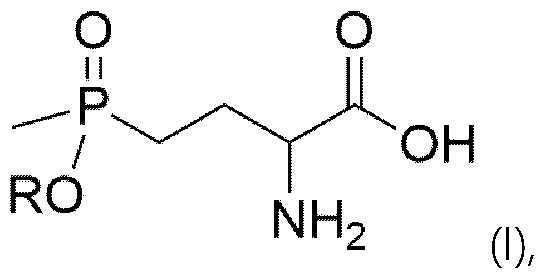
In a first aspect, the present invention therefore relates to a method of preparing glufosinate and/or a salt thereof or a glufosinate alkyl ester and/or a salt thereof having the formula (I)
wherein R is H or C
rC
8 alkyl, preferably H or C
rC
6 alkyl, more preferably H or C
2-C
4 alkyl, even more preferably ethyl or butyl, and most preferably ethyl, comprising the steps of: a) hydrolysing an N-carbamoyl glufosinate amide having the formula (II)
wherein R is H or C
rC
8 alkyl, preferably H or C
rC
6 alkyl, more preferably H or C
2-C
4 alkyl, even more preferably ethyl or butyl, and most preferably ethyl, by an Amidase enzyme to form an N- carbamoyl amino acid having the formula (III)
wherein R is H or C
rC
8 alkyl, preferably H or C
rC
6 alkyl, more preferably H or C
2-C
4 alkyl, even more preferably ethyl or butyl, and most preferably ethyl, and b) cleaving off the carbamoyl moiety of the N-carbamoyl amino acid having the formula (III).
In the following, preferred embodiments of the components of the method of preparing, the composition and the method of selectively controlling weeds are described in further detail. It is to be understood that each preferred embodiment is relevant on its own as well as in combination with other preferred embodiments.
In a preferred embodiment A1 of the first aspect, the cleaving step b) provides a glufosinate and/or a salt thereof or a glufosinate alkyl ester and/or a salt thereof having the formula (I)
wherein R is H or C
rC
8 alkyl, preferably H or C
rC
6 alkyl, more preferably H or C
2-C
4 alkyl, even more preferably ethyl or butyl, and most preferably ethyl.
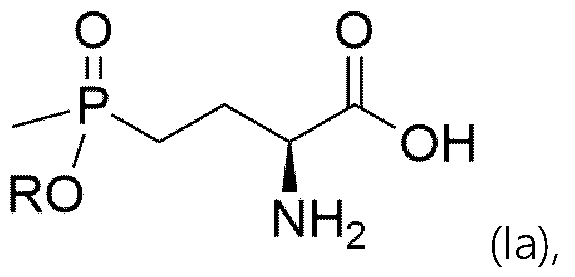
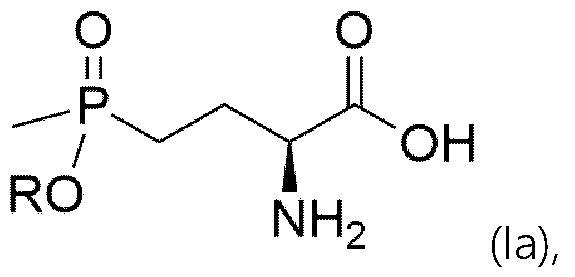
In a preferred embodiment A2 of the first aspect, the cleaving step b) provides the glufosinate and/or a salt thereof or a glufosinate alkyl ester and/or a salt thereof having the formula (I) in form of a racemic mixture or in form of an enantiomeric excess of L-glufosinate and/or a salt thereof or a glufosinate alkyl ester and/or a salt thereof having the formula (la)
wherein R is H or C
rC
8 alkyl, preferably H or C
rC
6 alkyl, more preferably H or C
2-C
4 alkyl, even more preferably ethyl or butyl, and most preferably ethyl; preferably in form of an enantiomeric excess of L-glufosinate and/or a salt thereof or a glufosinate alkyl ester and/or a salt thereof having the formula (la) and the Amidase enzyme is an L-Amidase enzyme.
In a preferred embodiment A3 of the first aspect, at least 5%, preferably at least 10%, more preferably at least 20%, even more preferably at least 40%, and most preferably at least 50%, of the N-carbamoyl glufosinate amide having the formula (II) is converted to L-glufosinate and/or a salt thereof or a glufosinate alkyl ester and/or a salt thereof having the formula (la), wherein formula (la) is as defined in preferred embodiment A2.
In a preferred embodiment A4 of the first aspect, the cleaving step b) is performed under enzymatic conditions, preferably using an N-Carbamoyl amino acid hydrolase enzyme, more preferably an L-N-Carbamoyl amino acid hydrolase enzyme or wherein the cleaving step b) is performed under chemical conditions, preferably using sodium nitrite and/or hydrogen chloride.
In a preferred embodiment A4a of the first aspect, the cleaving step b) is performed under enzymatic conditions, preferably using an N-Carbamoyl amino acid hydrolase enzyme, more preferably an L-N-Carbamoyl amino acid hydrolase enzyme or wherein the cleaving step b) is performed under chemical conditions, preferably using sodium nitrite and/or hydrogen chloride, and the steps a) and b) are carried out in a one-pot process.
In a preferred embodiment A5 of the first aspect, R in formulae (II) and (III) is H or CrC6 alkyl, preferably H or C2-C4 alkyl, more preferably ethyl or butyl, and most preferably ethyl.
In a preferred embodiment A6 of the first aspect, the hydrolysing step a) is performed at a pH of 6 to 11, preferably of 6.5 to 10, more preferably of 7 to 9.5 and in particular of 7.5 to 9 and/or at a temperature of 20 to 50 °C, preferably of 25 to 45 °C, more preferably of 30 to 42 °C, and in particular of 32 to 40 °C.
In a preferred embodiment A7 of the first aspect, R in formulae (II) and (III) is CrC8 alkyl, preferably CrC6 alkyl, more preferably C2-C4 alkyl, even more preferably ethyl or butyl, and most preferably ethyl, and the method further comprises the step of c) deprotecting under acidic conditions, preferably using hydrochloric acid or sulfuric acid.
In a preferred embodiment A8 of the first aspect, the method further comprises the addition of an N-carbamoyl glufosinate amide Racemase enzyme and/or an N-Carbamoyl amino acid racemase enzyme.
In a preferred embodiment A9 of the first aspect, step a) and step b) are performed in a single container, preferably wherein all reagents are substantially added at the start of the reaction or wherein the reagents for step a) and the reagents for step b) are added to the single container at different times.
In a preferred embodiment A10 of the first aspect, the method further comprises the step of separating off an N-carbamoyl glufosinate amide having the formula (lib)
(lib), wherein R is H or C
rC
8 alkyl, preferably H or C
rC
6 alkyl, more preferably H or C
2-C
4 alkyl, even more preferably ethyl or butyl, and most preferably ethyl, which is obtained in hydrolysing step a), preferably using reversed phase chromatography.
In a second aspect, the present invention relates to a composition comprising an N-carbamoyl glufosinate amide having the formula (lib)
wherein R is H or C
rC
8 alkyl, preferably H or C
rC
6 alkyl, more preferably H or C
2-C
4 alkyl, even more preferably ethyl or butyl, and most preferably ethyl.
In a preferred embodiment B1 of the second aspect, the composition consists of an N- carbamoyl glufosinate amide having the formula (lib)
wherein R is H or C
rC
8 alkyl, preferably H or C
rC
6 alkyl, more preferably H or C
2-C
4 alkyl, even more preferably ethyl or butyl, and most preferably ethyl.
In another preferred embodiment B2 of the second aspect, the composition comprises an N- carbamoyl glufosinate amide having the formula (lib)
wherein R is H or C
rC
8 alkyl, preferably H or C
rC
6 alkyl, more preferably H or C
2-C
4 alkyl, even more preferably ethyl or butyl, and most preferably ethyl, and optionally an N-carbamoyl amino acid having the formula (Illa)
wherein R is H or C C
8 alkyl, preferably H or C C
6 alkyl, more preferably H or C
2-C
4 alkyl, even more preferably ethyl or butyl, and most preferably ethyl, and L-glufosinate and/or a salt thereof.
In a preferred embodiment B3 of the second aspect, the amount of L-glufosinate and/or a salt thereof is at least 5 wt.-%, preferably at least 10 wt.-%, even more preferably at least 20 wt.-%, still more preferably at least 30 wt.-%, and most preferably at least 50 wt.-%, based on the total amount of the N-carbamoyl glufosinate amide having the formula (lib), the N-carbamoyl amino acid having the formula (Illa), and L-glufosinate and/or a salt thereof.
In a preferred embodiment B4 of the second aspect, R in formulae (Illa) and (lib) is H or CrC6 alkyl, preferably H or C2-C4 alkyl, more preferably ethyl or butyl, and most preferably ethyl.
In a third aspect, the present invention relates to a method for selectively controlling weeds in an area, preferably containing a crop of planted seeds or crops that are resistant to glufosinate, comprising: applying an effective amount of a composition comprising L-glufosinate and/or a salt thereof at an enantiomeric proportion of at least 50%, preferably in an enantiomeric excess of greater than 70%, over D-glufosinate and/or a salt thereof and and more than 0.01 wt.-% to less than 10 wt.-%, based on the total amount of the composition, of an N-carbamoyl amino amide having the formula (II)
wherein R is H or C
rC
8 alkyl, preferably H or C
rC
6 alkyl, more preferably H or C
2-C
4 alkyl, even more preferably ethyl or butyl, and most preferably ethyl, and/or
more than 0.01 wt.-% to less than 10 wt.-%, based on the total amount of the composition, of an N-carbamoyl amino acid having the formula (III)
wherein R is H or C
rC
8 alkyl, preferably H or C
rC
6 alkyl, more preferably H or C
2-C
4 alkyl, even more preferably ethyl or butyl, and most preferably ethyl, to the area.
Detailed Description of the Invention
Before describing in detail exemplary embodiments of the present invention, definitions important for understanding the present invention are given.
As used in this specification and in the appended claims, the singular forms of "a" and "an" also include the respective plurals unless the context clearly dictates otherwise. In the context of the present invention, the terms "about" and "approximately" denote an interval of accuracy that a person skilled in the art will understand to still ensure the technical effect of the feature in question. The term typically indicates a deviation from the indicated numerical value of ±20 %, preferably ±15 %, more preferably ±10 %, and even more preferably ±5 %. It is to be understood that the term "comprising" is not limiting. For the purposes of the present invention the term "consisting of" is considered to be a preferred embodiment of the term "comprising of". If hereinafter a group is defined to comprise at least a certain number of embodiments, this is meant to also encompass a group which preferably consists of these embodiments only. Furthermore, the terms "first", "second", "third" or "(a)", "(b)", "(c)", "(d)" etc. and the like in the description and in the claims, are used for distinguishing between similar elements and not necessarily for describing a sequential or chronological order. It is to be understood that the terms so used are interchangeable under appropriate circumstances and that the embodiments of the invention described herein are capable of operation in other sequences than described or illustrated herein. In case the terms "first", "second", "third" or "(a)", "(b)", "(c)", "(d)", "i", "ii" etc. relate to steps of a method or use or assay there is no time or time interval coherence between the steps, i.e. the steps may be carried out simultaneously or there may be time intervals of seconds, minutes, hours, days, weeks, months or even years between such steps, unless otherwise indicated in the application as set forth herein above or below. It is to be understood that this invention is not limited to the particular methodology, protocols, reagents etc. described herein as these may vary. It is also to be understood that the terminology used herein is for the purpose of describing particular embodiments only, and is not intended to limit the scope of the present invention that will be limited only by the appended claims. Unless defined otherwise, all technical and scientific terms used herein have the same meanings as commonly understood by one of ordinary skill in the art.
The term "wt.-%" as used throughout herein stands for "percent by weight".
The term "alkyl" as used herein denotes in each case a straight-chain or branched alkyl group having usually from 1 to 20 carbon atoms, preferably from 1 to 8 carbon atoms, frequently from 1 to 6 carbon atoms, more preferably 1 to 4 carbon atoms, e.g., 2 or 4 carbon atoms. Examples of alkyl groups are methyl, ethyl, n-propyl, iso-propyl, n-butyl, 2-butyl, iso-butyl, tert-butyl, n- pentyl, 1-methylbutyl, 2- methyl butyl, 3 -methyl butyl, 2,2-di methyl propyl, 1-ethylpropyl, and n- hexyl.
Depending on the substitution pattern, the compounds according to the invention may have one or more stereocenters. Unless explicitly indicated otherwise (e.g., via a chemical formula) the invention preferably encompasses all stereoisomers, i.e., pure enantiomers, pure diastereomers, of the compounds according to the invention, and their mixtures, including racemic mixtures.
Preferred embodiments regarding the method of preparing a glufosinate and/or a salt thereof or a glufosinate alkyl ester and/or a salt thereof having the formula (I), the composition comprising an N-carbamoyl glufosinate amide having the formula (lib), an N-carbamoyl amino acid having the formula (Illa), and L-glufosinate and/or a salt thereof, and the method for selectively controlling weeds are described in detail hereinafter. It is to be understood that the preferred embodiments of the invention are preferred alone or in combination with each other.
As indicated above, the present invention relates in one aspect to a method of preparing a glufosinate and/or a salt thereof or a glufosinate alkyl ester and/or a salt thereof having the formula (I)
wherein R is H or C C
8 alkyl, preferably H or C C
6 alkyl, more preferably H or C
2-C
4 alkyl, even more preferably ethyl or butyl, and most preferably ethyl, comprising the steps of: a) hydrolysing an N-carbamoyl glufosinate amide having the formula (II)
wherein R is H or C
rC
8 alkyl, preferably H or C
rC
6 alkyl, more preferably H or C
2-C
4 alkyl, even more preferably ethyl or butyl, and most preferably ethyl, by an Amidase enzyme to form an N- carbamoyl amino acid having the formula (III)
wherein R is H or C
rC
8 alkyl, preferably H or C
rC
6 alkyl, more preferably H or C
2-C
4 alkyl, even more preferably ethyl or butyl, and most preferably ethyl, and b) cleaving off the carbamoyl moiety of the N-carbamoyl amino acid having the formula (III).
It is to be understood that the glufosinate and/or a salt thereof or a glufosinate alkyl ester and/or a salt thereof having the formula (I)
encompasses all stereoisomers, suitable salts of the respective glufosinate or its alkyl ester. Further, the respective zwitterions are encompassed by the formula (I). Suitable salts are exemplarily hydrochloric acid salt, ammonium salts, and isopropylammonium salts. In this connection, the compound of formula (I) in particular encompasses two stereocenters, wherein one stereocenter is located at the phosphor atom and one stereocenter is located at the alpha carbon atom. The compound of formula (I) in particular encompasses all stereoisomers derived from the stereocenter at the phosphor atom.
The N-carbamoyl glufosinate amide having the formula (II) can be obtained via any suitable method of preparing. For example, the N-carbamoyl glufosinate amide is a byproduct of the Bucherer-Bergs reaction. Hence, the N-carbamoyl glufosinate amide can be produced from the related cyanhydrine. Cyanhydrine or cyanhydrine derivatives can be obtained, e.g., via a process as described inter alia in US 4,521,348 B1, DE 3047024, US 4,599,207 B1 US 6,359,162 B1, CN 102372739 A, and CN 102399240 A.
In a preferred embodiment of the present invention, the hydrolysing step a) is performed at a pH of 6 to 11, preferably of 6.5 to 10, more preferably of 7 to 9.5 and in particular of 7.5 to 9. The pH is preferably adjusted using alkali hydroxide, more preferably sodium hydroxide or potassium hydroxide, and in particular potassium hydroxide.
In a preferred embodiment of the present invention, the hydrolysing step a) is performed at a temperature of 20 to 50 °C, preferably of 25 to 45 °C, more preferably of 30 to 42 °C, and in particular of 32 to 40 °C.
In a preferred embodiment of the present invention, the hydrolysing step a) is performed under aqueous conditions, preferably in degassed aqueous phosphate buffer, more preferably degassed aqueous potassium phosphate buffer.
In a preferred embodiment of the present invention, the hydrolysing step a) is performed during stirring, preferably at 50 to 1000 rpm, more preferably at 100 to 800 rpm, even more preferably at 150 to 600 rpm, still more preferably at 180 to 400 rpm, and in particular at 200 to 300 rpm.
Any suitable Amidase enzyme, preferably a linear Amidase enzyme, may be used. More preferably, the Amidase enzyme is an enzyme, which hydrolyses an amide bond (EC 3.4, EC 3.5.1, EC 3.5.2). Therefore, it is preferred that the hydrolysis of the amide bond occurs independently from whether this hydrolysis is the natural or a promiscuous functionality of the enzyme. Hence, preferred Amidase enzymes may be selected from the list consisting of peptidases, proteases, linear amidases, or cyclic amidases. Especially preferred Amidase enzymes are selected from the list consisting of Papain (CAS 9001-73-4), Bromelain (CAS 37189-34-7), and Bacterial Proteinase (Proteinase from Bacillus licheniformis, CAS 9014-01-1).
In a preferred embodiment of the present invention, the Amidase enzyme is an L-Amidase enzyme.
In a preferred embodiment of the present invention, the Amidase enzyme is a D-Amidase enzyme, more preferably a protease, and most preferably a cysteine protease.
In a preferred embodiment of the present invention, R in formulae (II) and (III) is H or CrC6 alkyl, preferably H or C2-C4 alkyl, more preferably ethyl or butyl, and most preferably ethyl.
In a preferred embodiment of the present invention, the cleaving step b) provides a glufosinate and/or a salt thereof or a glufosinate alkyl ester and/or a salt thereof having the formula (I)
wherein R is H or C
rC
8 alkyl, preferably H or C
rC
6 alkyl, more preferably H or C
2-C
4 alkyl, even more preferably ethyl or butyl, and most preferably ethyl.
In a preferred embodiment of the present invention, the cleaving step b) provides the glufosinate and/or a salt thereof or a glufosinate alkyl ester and/or a salt thereof having the formula (I) in form of a racemic mixture.
In another preferred embodiment of the present invention, the cleaving step b) provides the glufosinate and/or a salt thereof or a glufosinate alkyl ester and/or a salt thereof having the formula (I) in form of an enantiomeric excess of L-glufosinate and/or a salt thereof or a glufosinate alkyl ester and/or a salt thereof having the formula (la)
wherein R is H or C
rC
8 alkyl, preferably H or C
rC
6 alkyl, more preferably H or C
2-C
4 alkyl, even more preferably ethyl or butyl, and most preferably ethyl. Preferably, the enantiomeric excess of L-glufosinate and/or a salt thereof or a glufosinate alkyl ester and/or a salt thereof having the formula (la) is formed and the Amidase enzyme is an L-Amidase enzyme.
In another preferred embodiment of the present invention, the cleaving step b) provides the glufosinate and/or a salt thereof or a glufosinate alkyl ester and/or a salt thereof having the formula (I) in form of an enantiomeric excess of D-glufosinate and/or a salt thereof or a glufosinate alkyl ester and/or a salt thereof having the formula (lb)
wherein R is H or C
rC
8 alkyl, preferably H or C
rC
6 alkyl, more preferably H or C
2-C
4 alkyl, even more preferably ethyl or butyl, and most preferably ethyl. In this connection it is preferred that the Amidase enzyme is a D-Amidase enzyme.
In a preferred embodiment of the present invention, the cleaving step b) is performed under enzymatic conditions, preferably using an N-Carbamoyl amino acid hydrolase enzyme, more preferably an L-N-Carbamoyl amino acid hydrolase enzyme. Suitable N-Carbamoyl amino acid hydrolase enzymes are selected from the group consisting of EC 3.5.1 Hydrolases acting on linear amides, EC 3.5.1.87 N-carbamoyl-L-amino-acid hydrolase, EC 3.5.1.77 N-carbamoyl-D-amino- acid hydrolase, and mixtures thereof. Suitable N-Carbamoyl amino acid hydrolase enzymes that can be used in the method include those selected from the group consisting of A0A7Y0T4N7 and variants thereof, Q88FQ3 and variants thereof, Q88Q81 and variants thereof, A0A126S6J4 and variants thereof, Q8VUL6 and variants thereof, H9B8T5 and variants thereof, Q9FB05 and variants thereof, C0ZCM8 and variants thereof, C0Z7R5 and variants thereof, A0A0K9YX84 and variants thereof, E3HUL6 and variants thereof, A0A1V9BSS3 and variants thereof, A0A1V9BSS3 and variants thereof, Q9F464 and variants thereof, A0A4D7Q548 and variants thereof, Q9F464 and variants thereof, A0A2S9D976 and variants thereof, A0A1I6VZZ4 and variants thereof, A0A1L6RE91 and variants thereof, A0A3E0C996 and variants thereof, A0A3M7BGJ4 and variants thereof, A0A2D7YQN7 and variants thereof, A0A535Y1H2 and variants thereof, A0A223E4I5 and variants thereof, M2VSE9 and variants thereof, A0A3T0K6C0 and variants thereof, A0A416FGE1 and variants thereof, D1P143 and variants thereof, A0A6P2ISL4 and variants thereof, A0A3S6Z2M9 and variants thereof, A0A0C1US49 and variants thereof, A0A1Y4GC62 and variants thereof, A0A3D3VMN7 and variants thereof, A0A2K8L549 and variants thereof, A0A1G0MC89 and variants thereof, A0A1M6WYS1 and variants thereof, A0A2K2BYI3 and variants thereof, A0A510DYR5 and variants thereof, A0A5Y3XFN7 and variants thereof, A0A381IB54 and variants thereof, A0A2V3IQW6 and variants thereof, and mixtures thereof, wherein variants are defined as
polypeptide sequences with at least 80 %, preferably 90%, and most preferably 95%, sequence identity to the respective polypeptide sequence. Most preferably the N-Carbamoyl amino acid hydrolase enzyme is selected from the group consisting of A0A3E0C996 (SEQ ID NO:1) and variants thereof, A0A535Y1H2 (SEQ ID NO:2) and variants thereof, A0A6P2ISL4 (SEQ ID NO:3) and variants thereof, A0A1Y4GC62 (SEQ ID NO:4), and variants thereof, wherein variants are defined as polypeptide sequences with at least 80%, preferably 90%, and most preferably 95%, sequence identity to the respective polypeptide sequence. It is to be understood that the above outlined N-Carbamoyl amino acid hydrolase enzymes are indicated in the nomenclature of the database identifier according to the Uniprot database (www.UniProt.org), status 19th of March 2023.
In this connection, the cleaving step b) is preferably performed at a temperature of 20 to 50 °C, preferably of 25 to 45 °C, more preferably of 30 to 42 °C, and in particular of 32 to 40 °C. Further, the reaction pressure is preferably ambient pressure. Preferably, the reaction pressure is in the range of 0.995 to 1.030 mbar, more preferably of 1.005 to 1.020 mbar, and in particular of about 1.013 mbar. In a preferred embodiment of the present invention, the cleaving step b) is performed at a pH of 5 to 10, preferably of 6 to 9, and in particular of about 7.
In a preferred embodiment of the present invention, the cleaving step b) is performed during stirring, preferably at 50 to 1000 rpm, more preferably at 100 to 800 rpm, even more preferably at 150 to 600 rpm, still more preferably at 180 to 400 rpm, and in particular at 200 to 300 rpm.
In another preferred embodiment of the present invention, the cleaving step b) is performed under chemical conditions. It is to be understood that the term "chemical condition" or "chemically cleaving" refers to a cleaving step that is not performed under enzymatic conditions. Any suitable chemical approach is possible. The cleavage may exemplarily be performed using sodium nitrite and/or hydrogen chloride. The N-carbamoyl amino acid having the formula (III)
wherein R is H or C
rC
8 alkyl, preferably H or C
rC
6 alkyl, more preferably H or C
2-C
4 alkyl, even more preferably ethyl or butyl, and most preferably ethyl, may exemplarily be treated with concentrated hydrogen chloride at elevated temperature. Alternatively, the N-carbamoyl amino acid having the formula (III) as defined above may be treated with sodium nitrite and hydrogen chloride under aqueous conditions. In this connection, the cleaving step b) is preferably performed at a temperature of 25 to 120 °C, more preferably of 50 to 110 °C, and in particular of 60 to 105 °C. Further, the reaction pressure is preferably ambient pressure. Preferably, the reaction pressure is in the range of 0.995 to 1.030 mbar, more preferably of 1.005 to 1.020 mbar, and in particular of about 1.013 mbar. In a preferred embodiment of the present invention, the
cleaving step b) is performed at a pH of 0 to 5, preferably of 0 to 3. The reaction mixture can be worked-up under standard procedure (i.e., washing and purifying).
In a particular preferred embodiment of the present invention, the cleaving step b) is performed under enzymatic conditions.
In a preferred embodiment of the present invention, R in formulae (II) and (III) is CrC8 alkyl, preferably CrC6 alkyl, more preferably C2-C4 alkyl, even more preferably ethyl or butyl, and most preferably ethyl, and the method further comprises the step of c) deprotecting under acidic conditions. In this connection any suitable acid is possible. Preferably hydrochloric acid or sulfuric acid are being used.
In a preferred embodiment of the present invention, the method further comprises the addition of an N-carbamoyl glufosinate amide Racemase enzyme. Any suitable N-carbamoyl glufosinate amide Racemase enzyme may be possible, which racemizes the N-carbamoyl glufosinate amide at the alpha carbon atom.
In a preferred embodiment of the present invention, the method further comprises the addition of an N-Carbamoyl amino acid racemase enzyme. Any suitable N-Carbamoyl amino acid racemase enzyme may be possible.
In a preferred embodiment of the present invention, the method further comprises the addition of an N-carbamoyl glufosinate amide Racemase enzyme and an N-Carbamoyl amino acid racemase enzyme.
In a preferred embodiment of the present invention, step a) and step b) are performed in a single container, wherein step b) is performed under enzymatic conditions. In this connection, all reagents are preferably substantially added at the start of the reaction. Alternatively, the reagents for step a) and the reagents for step b) are preferably added to the single container at different times.
In a preferred embodiment of the present invention, the method further comprises the step of separating off an N-carbamoyl glufosinate amide having the formula (lib)
wherein R is H or C
rC
8 alkyl, preferably H or C
rC
6 alkyl, more preferably H or C
2-C
4 alkyl, even more preferably ethyl or butyl, and most preferably ethyl, which is obtained in hydrolysing step a). Separating off the N-carbamoyl glufosinate amide having formula (lib) is preferably achieved using reversed phase chromatography. Alternatively, the separation may be achieved using ion exchange, extraction, salt formation, crystallization, and filtration.
The N-carbamoyl glufosinate amide having the formula (lib) may be chemically racemized and reused in hydrolysing step a). In order to racemize N-carbamoyl glufosinate amides having the formula (lib) they may be treated with a suitable base, preferably at a pH of 8 or more, more preferably of 8 to 14, even more preferably of 8.5 to 12, and in particular of 8.5 to 10. Preferably the racemization is performed under aqueous conditions.
Alternatively, the N-carbamoyl glufosinate amide having the formula (lib) may be treated with an N-carbamoyl glufosinate amide Racemase enzyme.
In a preferred embodiment of the present invention, at least 5%, preferably at least 10%, more preferably at least 20%, even more preferably at least 30%, still even more preferably at least 40%, still even more preferably at least 50%, and most preferably at least 60%, of the N- carbamoyl glufosinate amide having the formula (II) is converted to L-glufosinate and/or a salt thereof or a glufosinate alkyl ester and/or a salt thereof having the formula (la)
wherein R is H or C
rC
8 alkyl, preferably H or C
rC
6 alkyl, more preferably H or C
2-C
4 alkyl, even more preferably ethyl or butyl, and most preferably ethyl.
In a preferred embodiment of the present invention, 5 to 99%, preferably 10 to 98%, more preferably 20 to 97%, even more preferably 30 to 96%, and in particular 40 to 95%, of the N- carbamoyl glufosinate amide having the formula (II) is converted to L-glufosinate and/or a salt thereof or a glufosinate alkyl ester and/or a salt thereof having the formula (la)
wherein R is H or C
rC
8 alkyl, preferably H or C
rC
6 alkyl, more preferably H or C
2-C
4 alkyl, even more preferably ethyl or butyl, and most preferably ethyl.
In another preferred embodiment of the present invention, at least 5%, preferably at least 10%, more preferably at least 20%, even more preferably at least 30%, still even more preferably at least 40%, still even more preferably at least 50%, and most preferably at least 60%, of the N- carbamoyl glufosinate amide having the formula (II) is converted to L-glufosinate and/or a salt thereof or a glufosinate alkyl ester and/or a salt thereof having the formula (lb)
wherein R is H or C C
8 alkyl, preferably H or C C
6 alkyl, more preferably H or C
2-C
4 alkyl, even more preferably ethyl or butyl, and most preferably ethyl.
In another preferred embodiment of the present invention, 5 to 99%, preferably 10 to 98%, more preferably 20 to 96%, even more preferably 30 to 95%, and in particular 40 to 90%, of the N-carbamoyl glufosinate amide having the formula (II) is converted to L-glufosinate and/or a salt thereof or a glufosinate alkyl ester and/or a salt thereof having the formula (lb)
wherein R is H or C
rC
8 alkyl, preferably H or C
rC
6 alkyl, more preferably H or C
2-C
4 alkyl, even more preferably ethyl or butyl, and most preferably ethyl.
Enantiomeric excess of L-glufosinate is preferred.
In a preferred embodiment of the present invention, the method comprises the addition of an Amidase enzyme, an N-carbamoyl glufosinate amide Racemase enzyme, and an N-Carbamoyl amino acid hydrolase enzyme, wherein all reaction steps are performed in a single container (also known as "One-Pot" conditions), preferably wherein all reagents are substantially added at the start of the reaction or wherein the reagents are added to the single container at different times.
In another preferred embodiment of the present invention, the method comprises the addition of an Amidase enzyme, an N-carbamoyl glufosinate amide Racemase enzyme, and an N- carbamoyl amino acid racemase enzyme, wherein all reaction steps are performed in a single container (also known as "One-Pot" conditions), preferably wherein all reagents are substantially added at the start of the reaction or wherein the reagents are added to the single container at different times.
In yet another preferred embodiment of the present invention, the method comprises the addition of an Amidase enzyme, and an N-Carbamoyl amino acid hydrolase enzyme, wherein all reaction steps are performed in a single container (also known as "One-Pot" conditions), preferably wherein all reagents are substantially added at the start of the reaction or wherein the reagents are added to the single container at different times. In this connection it is preferred if the pH of the reaction mixture is 8 or more.
The applied enzymes may be applied via any suitable known in the art way.
In a preferred embodiment of the present invention, the applied enzymes are applied as cleared cell lysate, whole cells, or immobilized enzymes.
Alternatively, some or all of the components other than L-glufosinate can be removed from the biotransformation mixture, the mixture optionally concentrated, and then the mixture can be used directly (and/or with the addition of various adjuvants) for the prevention or control of
weeds. The biotransformation mixture, in some instances, can be used directly (and/or with the addition of various adjuvants) for the prevention or control of weeds.
Additional steps to further purify the L-glufosinate can be added. Such further purification and isolation methods include ion exchange, extraction, salt formation, crystallization, and filtration; each may be used multiple times or in suitable combination. Enzymes can be removed by simple filtration if supported, or if free in solution by the use of ultrafiltration, the use of absorbants like celite, cellulose or carbon, or denaturation via various techniques known to those skilled in the art.
Ion exchange processes effect separation by selective adsorption of solutes onto resins chosen for this purpose. Because products and impurities must be dissolved in a single solution prior to adsorption, concentration of the purified product stream by evaporation or distillation prior to isolation is usually required. Examples of the use of ion exchange for purification are described by Schultz et al., and in EP 0 249 188 A2.
Purification may be achieved by the formation of an insoluble salt of L-glufosinate by the addition of a suitable acid, including hydrochloric acid, sulfuric acid, phosphoric acid, nitric acid, acetic acid and the like. Similarly, the purification may be achieved by the addition of a suitable base to form an insoluble salt. Useful bases include hydroxides, carbonates, sulfates and phosphates of alkali metals or hydroxides, carbonates, sulfates and phosphates of alkali earth metals. Other bases which contain nitrogen may be used, including ammonia, hydroxylamine, isopropylamine, triethylamine, tributylamine, pyridine, 2-picoline, 3-picoline, 4-picoline, 2,4- lutidine, 2,6-lutidine, morpholine, N-methymorpholine, 1,8-diazabicyclo[5.4.0]undec-7-ene, and dimethylethanolamine. It may be advantageous to concentrate the mixture or to add a solvent (or both) to maximize yield and optimize purity of the desired salt. Solvents suitable for this purpose include those in which the solubility of the desired salt is very low (such solvents are often called "anti-solvents"). Salts of L-glufosinate can be transformed into forms of glufosinate suitable for formulation by standard methods known to those skilled in the art. Alternatively, the L-glufosinate can be isolated as a zwitterion.
US 9,255,115 B2 describes how the hydrochloric acid salt of L-glufosinate can be converted to the zwitterionic form with a base such as sodium hydroxide or sodium methoxide and then crystallized from aqueous alcohol solvent to afford L-glufosinate in relatively high purity. This method has the advantage of producing crystalline L-glufosinate that is not hygroscopic and therefore maintains a higher purity compared to amorphous L-glufosinate when exposed to humidity over time.
Other salts of L-glufosinate are known in the art. US 5,767,309 and US 5,869,668 teach the use of chiral alkaloid bases to form diastereomeric salts with racemic glufosinate. Purification is achieved because the salt of L-glufosinate precipitates from solution in much larger quantity than the corresponding salt of D-glufosinate. Therefore, this method could be used with the present invention to obtain L-glufosinate with high enantiomeric excess, if desired.
Optionally, purification may be achieved by first crystallizing one or more impurities, removing the impurities by filtration and then further purifying L-glufosinate from the resulting filtrate by forming a salt as previously described. This is advantageous if unreacted amine donor can be partially or completely isolated and used in subsequent reactions. Similarly, unreacted N- carbamoyl amino acid having the formula (III) that is partially or completely isolated may be recycled for use in subsequent reactions.
Extraction may be used to purify the product. DE 3920570 C2 describes a process in which excess glutamic acid (used as the amine donor) is precipitated by adjusting the solution pH to 3.7 to 4.2 with sulfuric acid. After filtering the glutamic acid, the filtrate pH is lowered to 1-2 whereupon other impurities are extracted into a solvent. After extraction and concentration, ammonia is added to the aqueous solution to a pH of 5-7 whereupon ammonium sulfate precipitates. The ammonium sulfate is removed by filtration and the resulting filtrate is concentrated to afford the ammonium salt of L-glufosinate.
Isolation of L-glufosinate or its salts may be desirable, for example, for the purpose of shipping solids to the location of formulation or use. Typical industrial methods of isolation may be used, for example, a filtration, centrifugation, etc. Isolated product often requires the removal of water, volatile impurities and solvents (if present) and typical industrial drying equipment may be used for this purpose. Examples of such equipment include ovens, rotating drum dryers, agitated dryers, etc. In some cases, it may be advantageous to use a spray dryer.
It is not necessary to produce a solid product after purification. This may be advantageous if the formulation of L-glufosinate is to occur at the same site used for L-glufosinate production. L- glufosinate and many of its salts are readily soluble in water, and water is a convenient liquid to use for formulating products. For example, the amine donor is isolated by filtration and the resulting filtrate is concentrated by distillation. The pH of the filtrate may be adjusted to a desirable value and the resulting solution may be used as is or blended with formulation ingredients. In another example, a slurry of L-glufosinate or one of its salts may be prepared as described above and isolated by filtration. The solid could be dissolved directly on the filter by adding water or a suitable solvent to obtain a solution of L-glufosinate.
As mentioned above, the invention further relates in a second aspect to a composition comprising an N-carbamoyl glufosinate amide having the formula (lib)
wherein R is H or C
rC
8 alkyl, preferably H or C
rC
6 alkyl, more preferably H or C
2-C
4 alkyl, even more preferably ethyl or butyl, and most preferably ethyl.
In a preferred embodiment of the second aspect, the composition consists of an N-carbamoyl glufosinate amide having the formula (lib)
wherein R is H or C
rC
8 alkyl, preferably H or C
rC
6 alkyl, more preferably H or C
2-C
4 alkyl, even more preferably ethyl or butyl, and most preferably ethyl.
The invention further relates in another preferred embodiment of the second aspect to a composition comprising an N-carbamoyl glufosinate amide having the formula (lib)
wherein R is H or C
rC
8 alkyl, preferably H or C
rC
6 alkyl, more preferably H or C
2-C
4 alkyl, even more preferably ethyl or butyl, and most preferably ethyl, an N-carbamoyl amino acid having the formula (Illa)
wherein R is H or C
rC
8 alkyl, preferably H or C
rC
6 alkyl, more preferably H or C
2-C
4 alkyl, even more preferably ethyl or butyl, and most preferably ethyl, and L-glufosinate and/or a salt thereof.
Suitable salts are hydrochloric acid salt, ammonium salts, and isopropylammonium salts. It is further to be understood that the respective zwitterion of L-glufosinate is also encompassed.
In a preferred embodiment of the present invention, the amount of L-glufosinate and/or a salt thereof is at least 5 wt.-%, preferably at least 10 wt.-%, more preferably at least 20 wt.-%, even more preferably at least 30 wt.-%, still more preferably at least 40 wt.-%, and in particular at least 50 wt.-% or at least 60 wt.-%, based on the total amount of the N-carbamoyl glufosinate amide having the formula (lib), the N-carbamoyl amino acid having the formula (Illa), and L-glufosinate and/or a salt thereof.
In a preferred embodiment of the present invention, the amount of L-glufosinate and/or a salt thereof is in the range of 5 to 99 wt.-%, preferably of 10 to 98 wt.-%, more preferably of 20 to 96 wt.-%, even more preferably of 30 to 95 wt.-%, still more preferably of 40 to 94 wt.-%, and in particular at least 50 to 90 wt.-% or at least 60 to 90 wt.-%, based on the total amount of the N-
carbamoyl glufosinate amide having the formula (lib), the N-carbamoyl amino acid having the formula (Illa), and L-glufosinate and/or a salt thereof.
The composition can comprise the N-carbamoyl amino acid having the formula (Illa)
in an amount of up to 40 wt.-%, preferably up to 20 wt.-%, more preferably up to 10 wt.-%, even more preferably up to 5 wt.-%, still more preferably up to 4 wt.-%, and in particular up to 2 wt.-%, based on the total amount of the N-carbamoyl glufosinate amide having the formula (lib), the N-carbamoyl amino acid having the formula (Illa), and L-glufosinate and/or a salt thereof. The composition can comprise the N-carbamoyl amino acid having the formula (Illa)
in an amount of 0.001 to 40 wt.-%, preferably 0.005 to 20 wt.-%, more preferably 0.01 to 10 wt.- %, even more preferably 0.05 to 5 wt.-%, still more preferably 0.1 to 4 wt.-%, and in particular 0.5 to 2 wt.-%, based on the total amount of the N-carbamoyl glufosinate amide having the formula (lib), the N-carbamoyl amino acid having the formula (Illa), and L-glufosinate and/or a salt thereof.
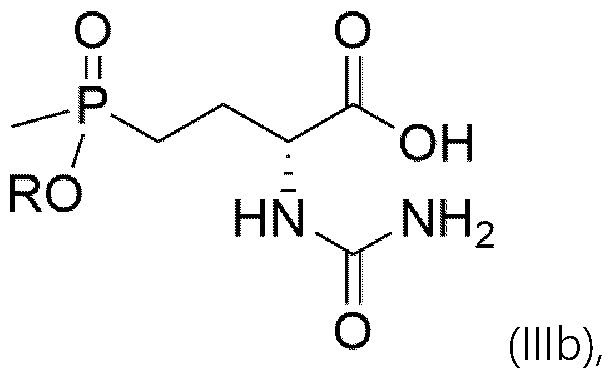
The composition can further comprise the N-carbamoyl amino acid having the formula (III b)
(lllb), preferably in an amount of up to 40 wt.-%, preferably up to 20 wt.-%, more preferably up to 10 wt.-%, even more preferably up to 5 wt.-%, still more preferably up to 4 wt.-%, and in particular up to 2 wt.-%, based on the total amount of the N-carbamoyl glufosinate amide having the formula (lib), the N-carbamoyl amino acid having the formula (Illa), the N-carbamoyl amino acid having the formula (lllb), and L-glufosinate and/or a salt thereof. The composition can further comprise the N-carbamoyl amino acid having the formula (lllb)
in an amount of 0.001 to 40 wt.-%, preferably 0.005 to 20 wt.-%, more preferably 0.01 to 10 wt.- %, even more preferably 0.05 to 5 wt.-%, still more preferably 0.1 to 4 wt.-%, and in particular 0.5 to 2 wt.-%, based on the total amount of the N-carbamoyl glufosinate amide having the formula (lib), the N-carbamoyl amino acid having the formula (Illa), the N-carbamoyl amino acid having the formula (I lib), and L-glufosinate and/or a salt thereof.
The composition can comprise the N-carbamoyl glufosinate amide having the formula (lib)
in an amount of up to 30 wt.-%, preferably up to 20 wt.-%, more preferably up to 10 wt.-%, even more preferably up to 5 wt.-%, still more preferably up to 2.5 wt.-%, and in particular up to 1 wt.-%, based on the total amount of the N-carbamoyl glufosinate amide having the formula (lib), the N-carbamoyl amino acid having the formula (Illa), and L-glufosinate and/or a salt thereof. The composition can comprise the N-carbamoyl glufosinate amide having the formula
in an amount of 0.001 to 30 wt.-%, preferably 0.005 to 20 wt.-%, more preferably 0.01 to 10 wt.- %, even more preferably 0.05 to 5 wt.-%, still more preferably 0.1 to 2.5 wt.-%, and in particular 0.5 to 1 wt.-%, based on the total amount of the N-carbamoyl glufosinate amide having the formula (lib), the N-carbamoyl amino acid having the formula (Illa), and L-glufosinate and/or a salt thereof.
The composition can further comprise the N-carbamoyl glufosinate amide having the formula
preferably in an amount of up to 30 wt.-%, preferably up to 20 wt.-%, more preferably up to 10 wt.-%, even more preferably up to 5 wt.-%, still more preferably up to 2.5 wt.-%, and in particular up to 1 wt.-%, based on the total amount of the N-carbamoyl glufosinate amide having the formula (Ila), the N-carbamoyl glufosinate amide having the formula (lib), the N-carbamoyl amino acid having the formula (Illa), and L-glufosinate and/or a salt thereof. The composition can further comprise the N-carbamoyl glufosinate amide having the formula (Ila)

in an amount of 0.001 to 30 wt.-%, preferably 0.005 to 20 wt.-%, more preferably 0.01 to 10 wt.- %, even more preferably 0.05 to 5 wt.-%, still more preferably 0.1 to 2.5 wt.-%, and in particular 0.5 to 1 wt.-%, based on the total amount of the N-carbamoyl glufosinate amide having the formula (Ila), the N-carbamoyl glufosinate amide having the formula (lib), the N-carbamoyl amino acid having the formula (Illa), and L-glufosinate and/or a salt thereof.
In a preferred embodiment of the present invention, R in formulae (Illa) and (lib) is H or CrC6 alkyl, preferably H or C2-C4 alkyl, more preferably ethyl or butyl, and most preferably ethyl. In this connection it is to be understood that R in formulae (lllb) and (Ila) is also preferably H or C C6 alkyl, preferably H or C2-C4 alkyl, more preferably ethyl or butyl, and most preferably ethyl, if present.
In one preferred embodiment of the present invention, the herein described composition may be used directly as a herbicidal compositions or as an ingredient in a formulated herbicidal product.
The compositions described herein are useful for application to a field of crop plants for the prevention or control of weeds. The composition may be formulated as a liquid for spraying on a field. The glufosinate, preferably the L-glufosinate, is provided in the composition in effective amounts. As used herein, effective amount means from about 10 grams active ingredient per hectare to about 1,500 grams active ingredient per hectare, e.g., from about 50 grams to about 400 grams or from about 100 grams to about 350 grams. In some embodiments, the active ingredient is L-glufosinate. For example, the amount of L-glufosinate in the composition can be about 10 grams, about 50 grams, about 100 grams, about 150 grams, about 200 grams, about 250 grams, about 300 grams, about 350 grams, about 400 grams, about 500 grams, about 550 grams, about 600 grams, about 650 grams, about 700 grams, about 750 grams, about 800 grams, about 850 grams, about 900 grams, about 950 grams, about 1,000 grams, about 1,050 grams, about 1,100 grams, about 1,150 grams, about 1,200 grams, about 1,250 grams, about 1,300 grams, about 1,350 grams, about 1,400 grams, about 1,450 grams, or about 1,500 grams L- glufosinate per hectare.
The herbicidal compositions (including concentrates which require dilution prior to application to the plants) described herein contain L-glufosinate (i.e., the active ingredient), optionally some residual N-carbamoyl glufosinate amide having the formula (lib) ib) and/or N-carbamoyl amino acid having the formula (Illa)

(Illa), and one or more adjuvant components in liquid or solid form.
The compositions are prepared by admixing the active ingredient with one or more adjuvants, such as diluents, extenders, carriers, surfactants, organic solvents, humectants, or conditioning agents, to provide a composition in the form of a finely-divided particulate solid, pellet, solution, dispersion, or emulsion. Thus, the active ingredient can be used with an adjuvant, such as a finely-divided solid, a liquid of organic origin, water, a wetting agent, a dispersing agent, an emulsifying agent, or any suitable combination of these. From the viewpoint of economy and convenience, water is the preferred diluent. However, not all the compounds are resistant to hydrolysis and in some cases, this may dictate the use of non-aqueous solvent media, as understood by those of skill in the art.
Optionally, one or more additional components can be added to the composition to produce a formulated herbicidal composition. Such formulated compositions can include L-glufosinate, carriers (e.g., diluents and/or solvents), and other components. The formulated composition includes an effective amount of L-glufosinate.
A diluent can also be included in the formulated composition. Suitable diluents include water and other aqueous components. Optionally, the diluents are present in an amount necessary to produce compositions ready for packaging or for use.
The herbicidal compositions described herein, particularly liquids and soluble powders, can contain as further adjuvant components one or more surface-active agents in amounts sufficient to render a given composition readily dispersible in water or in oil. The incorporation of a surface-active agent into the compositions greatly enhances their efficacy. Surface-active agent, as used herein, includes wetting agents, dispersing agents, suspending agents, and emulsifying agents are included therein. Anionic, cationic, and non-ionic agents can be used with equal facility.
Suitable wetting agents include alkyl benzene and alkyl naphthalene sulfonates, sulfated fatty
alcohols, amines or acid amides, long chain acid esters of sodium isothionate, esters of sodium sulfosuccinate, sulfated or sulfonated fatty acid esters petroleum solfonates, sulfonated vegetable oils, ditertiary acetylenic glycols, polyoxyethylene derivatives of alkylphenols (particularly isooctylphenol and nonylphenol), and polyoxethylene derivatives of the mono-higher fatty acid esters of hexitol anhydrides (e.g. sorbitan). Exemplary dispersants include methyl cellulose, polyvinyl alcohol, sodium lignin sulfonates, polymeric alkyl naphthalene sulfonates, sodium naphthalene sulfonate, polymethylene bisnaphthalenesulfonate, and sodium N-methyl-N- (long chain acid) laurates.
Water-dispersible powder compositions can be made containing one or more active ingredients, an inert solid extender, and one or more wetting and dispersing agents. The inert solid extenders are usually of mineral origin, such as the natural clays, diatomaceous earth, and synthetic minerals derived from silica and the like. Examples of such extenders include kaolinites, attapulgite clay, and synthetic magnesium silicate. Water-dispersible powders described herein can optionally contain from about 5 to about 95 parts by weight of active ingredient (e.g., from about 15 to 30 parts by weight of active ingredient), from about 0.25 to 25 parts by weight of wetting agent, from about 0.25 to 25 parts by weight of dispersant, and from 4.5 to about 94.5 parts by weight of inert solid extender, all parts being by weight of the total composition. Where required, from about 0.1 to 2.0 parts by weight of the solid inert extender can be replaced by a corrosion inhibitor or anti-foaming agent or both.
Aqueous suspensions can be prepared by dissolution or by mixing together and grinding an aqueous slurry of a water-insoluble active ingredient in the presence of a dispersing agent to obtain a concentrated slurry of very finely-divided particles. The resulting concentrated aqueous suspension is characterized by its extremely small particle size, so that when diluted and sprayed, coverage is very uniform.
Emulsifiable oils are usually solutions of active ingredient in water-immiscible or partially water- immiscible solvents together with a surface active agent. Suitable solvents for the active ingredient described herein include hydrocarbons and water-immiscible ethers, esters, or ketones. The emulsifiable oil compositions generally contain from about 5 to 95 parts active ingredient, about 1 to 50 parts surface active agent, and about 4 to 94 parts solvent, all parts being by weight based on the total weight of emulsifiable oil.
Compositions described herein can also contain other additaments, for example, fertilizers, phytotoxicants and plant growth regulants, pesticides, and the like used as adjuvants or in combination with any of the above-described adjuvants. The compositions described herein can also be admixed with the other materials, e.g., fertilizers, other phytotoxicants, etc., and applied in a single application.
In each of the formulation types described herein, e.g., liquid and solid formulations, the concentration of the active ingredients are the same.
It is recognized that the herbicidal compositions can be used in combination with other herbicides. The herbicidal compositions of the present invention are often applied in conjunction with one or more other herbicides to control a wider variety of undesirable vegetation. When used in conjunction with other herbicides, the presently claimed compounds can be formulated with the other herbicide or herbicides, tank mixed with the other herbicide or herbicides or applied sequentially with the other herbicide or herbicides. Some of the herbicides that can be employed in conjunction with the compounds of the present invention include: amide herbicides such as allidochlor, beflubutamid, benzadox, benzipram, bromobutide, cafenstrole, CDEA, chlorthiamid, cyprazole, dimethenamid, dimethenamid-P, diphenamid, epronaz, etnipromid, fentrazamide, flupoxam, fomesafen, halosafen, isocarbamid, isoxaben, napropamide, naptalam, pethoxamid, propyzamide, quinonamid and tebutam; anilide herbicides such as chloranocryl, cisanilide, clomeprop, cypromid, diflufenican, etobenzanid, fenasulam, flufenacet, flufenican, mefenacet, mefluidide, metamifop, monalide, naproanilide, pentanochlor, picolinafen and propanil; arylalanine herbicides such as benzoylprop, flamprop and flamprop-M; chloroacetanilide herbicides such as acetochlor, alachlor, butachlor, butenachlor, delachlor, diethatyl, dimethachlor, metazachlor, metolachlor, S-metolachlor, pretilachlor, propachlor, propisochlor, prynachlor, terbuchlor, thenylchlor and xylachlor; sulfonanilide herbicides such as benzofluor, perfluidone, pyrimisulfan and profluazol; sulfonamide herbicides such as asulam, carbasulam, fenasulam and oryzalin; antibiotic herbicides such as bilanafos; benzoic acid herbicides such as chloramben, dicamba, 2,3,6-TBA and tricamba; pyrimidinyloxybenzoic acid herbicides such as bispyribac and pyriminobac; pyrimidinylthiobenzoic acid herbicides such as pyrithiobac; phthalic acid herbicides such as chlorthal; picolinic acid herbicides such as aminopyralid, clopyralid and picloram; quinolinecarboxylic acid herbicides such as quinclorac and quinmerac; arsenical herbicides such as cacodylic acid, CMA, DSMA, hexaflurate, MAA, MAMA, MSMA, potassium arsenite and sodium arsenite; benzoylcyclohexanedione herbicides such as mesotrione, sulcotrione, tefuryltrione and tembotrione; benzofuranyl alkylsulfonate herbicides such as benfuresate and ethofumesate; carbamate herbicides such as asulam, carboxazole chlorprocarb, dichlormate, fenasulam, karbutilate and terbucarb; carbanilate herbicides such as barban, BCPC, carbasulam, carbetamide, CEPC, chlorbufam, chlorpropham, CPPC, desmedipham, phenisopham, phenmedipham, phenmedipham-ethyl, propham and swep; cyclohexene oxime herbicides such as alloxydim, butroxydim, clethodim, cloproxydim, cycloxydim, profoxydim, sethoxydim, tepraloxydim and tralkoxydim; cyclopropylisoxazole herbicides such as isoxachlortole and isoxaflutole; dicarboximide herbicides such as benzfendizone, cinidon-ethyl, flumezin, flumiclorac, flumioxazin and flumipropyn; dinitroaniline herbicides such as benfluralin, butralin, dinitramine, ethalfluralin, fluchloralin, isopropalin, methalpropalin, nitralin, oryzalin, pendimethalin, prodiamine, profluralin and trifluralin; dinitrophenol herbicides such as dinofenate, dinoprop, dinosam, dinoseb, dinoterb, DNOC, etinofen and medinoterb; diphenyl ether herbicides such as ethoxyfen; nitrophenyl ether herbicides such as acifluorfen, aclonifen, bifenox, chlomethoxyfen, chlomitrofen, etnipromid, fluorodifen, fluoroglycofen, fluoronitrofen, fomesafen, furyloxyfen, halosafen, lactofen, nitrofen, nitrofluorfen and oxyfluorfen; dithiocarbamate herbicides such as dazomet and metam; halogenated aliphatic herbicides such as alorac, chloropon, dalapon, flupropanate, hexachloroacetone, iodomethane, methyl bromide, monochloroacetic acid, SMA and TCA; imidazolinone herbicides such as imazamethabenz,
imazamox, imazapic, imazapyr, imazaquin and imazethapyr; inorganic herbicides such as ammonium sulfamate, borax, calcium chlorate, copper sulfate, ferrous sulfate, potassium azide, potassium cyanate, sodium azide, sodium chlorate and sulfuric acid; nitrile herbicides such as bromobonil, bromoxynil, chloroxynil, dichlobenil, iodobonil, ioxynil and pyraclonil; organophosphorus herbicides such as amiprofos-methyl, anilofos, bensulide, bilanafos, butamifos, 2,4-DEP, DMPA, EBEP, fosamine, glyphosate and piperophos; phenoxy herbicides such as bromofenoxim, clomeprop, 2,4-DEB, 2,4-DEP, difenopenten, disul, erbon, etnipromid, fenteracol and trifopsime; phenoxyacetic herbicides such as 4-CPA, 2,4-D, 3,4-DA, MCPA, MCPA- thioethyl and 2,4, 5-T; phenoxybutyric herbicides such as 4-CPB, 2,4-DB, 3,4-DB, MCPB and 2,4,5- TB; phenoxypropionic herbicides such as cloprop, 4-CPP, dichlorprop, dichlorprop-P, 3,4-DP, fenoprop, mecoprop and mecoprop-P; aryloxyphenoxypropionic herbicides such as chlorazifop, clodinafop, clofop, cyhalofop, diclofop, fenoxaprop, fenoxaprop-P, fenthiaprop, fluazifop, fluazifop-P, haloxyfop, haloxyfop-P, isoxapyrifop, metamifop, propaquizafop, quizalofop, quizalofop-P and trifop; phenylenediamine herbicides such as dinitramine and prodiamine; pyrazolyl herbicides such as benzofenap, pyrazolynate, pyrasulfotole, pyrazoxyfen, pyroxasulfone and topramezone; pyrazolylphenyl herbicides such as fluazolate and pyraflufen; pyridazine herbicides such as credazine, pyridafol and pyridate; pyridazinone herbicides such as brompyrazon, chloridazon, dimidazon, flufenpyr, metflurazon, norflurazon, oxapyrazon and pydanon; pyridine herbicides such as aminopyralid, cliodinate, clopyralid, dithiopyr, fluroxypyr, haloxydine, picloram, picolinafen, pyriclor, thiazopyr and triclopyr; pyrimidinediamine herbicides such as iprymidam and tioclorim; quaternary ammonium herbicides such as cyperquat, diethamquat, difenzoquat, diquat, morfamquat and paraquat; thiocarbamate herbicides such as butylate, cycloate, di-allate, EPTC, esprocarb, ethiolate, isopolinate, methiobencarb, molinate, orbencarb, pebulate, prosulfocarb, pyributicarb, sulfallate, thiobencarb, tiocarbazil, tri-allate and vernolate; thiocarbonate herbicides such as dimexano, EXD and proxan; thiourea herbicides such as methiuron; triazine herbicides such as dipropetryn, triaziflam and tri hydroxytriazine; chlorotriazine herbicides such as atrazine, chlorazine, cyanazine, cyprazine, eglinazine, ipazine, mesoprazine, procyazine, proglinazine, propazine, sebuthylazine, simazine, terbuthylazine and trietazine; methoxytriazine herbicides such as atraton, methometon, prometon, secbumeton, simeton and terbumeton; methylthiotriazine herbicides such as ametryn, aziprotryne, cyanatryn, desmetryn, dimethametryn, methoprotryne, prometryn, simetryn and terbutryn; triazinone herbicides such as ametridione, amibuzin, hexazinone, isomethiozin, metamitron and metribuzin; triazole herbicides such as amitrole, cafenstrole, epronaz and flupoxam; triazoIone herbicides such as amicarbazone, bencarbazone, carfentrazone, flucarbazone, propoxycarbazone, sulfentrazone and thiencarbazone-methyl; triazolopyrimidine herbicides such as cloransulam, diclosulam, florasulam, flumetsulam, metosulam, penoxsulam and pyroxsulam; uracil herbicides such as butafenacil, bromacil, flupropacil, isocil, lenacil and terbacil; 3-phenyluracils; urea herbicides such as benzthiazuron, cumyluron, cycluron, dichloralurea, diflufenzopyr, isonoruron, isouron, methabenzthiazuron, monisouron and noruron; phenylurea herbicides such as anisuron, buturon, chlorbromuron, chloreturon, chlorotoluron, chloroxuron, daimuron, difenoxuron, dimefuron, diuron, fenuron, fluometuron, fluothiuron, isoproturon, linuron, methiuron, methyldymron, metobenzuron, metobromuron, metoxuron, monolinuron, monuron, neburon, parafluron, phenobenzuron, siduron, tetrafluron and thidiazuron; pyrimidinylsulfonylurea
herbicides such as amidosulfuron, azimsulfuron, bensulfuron, chlorimuron, cyclosulfamuron, ethoxysulfuron, flazasulfuron, flucetosulfuron, flupyrsulfuron, foramsulfuron, halosulfuron, imazosulfuron, mesosulfuron, nicosulfuron, orthosulfamuron, oxasulfuron, primisulfuron, pyrazosulfuron, rimsulfuron, sulfometuron, sulfosulfuron and trifloxysulfuron; triazinylsulfonylurea herbicides such as chlorsulfuron, cinosulfuron, ethametsulfuron, iodosulfuron, metsulfuron, prosulfuron, thifensulfuron, triasulfuron, tribenuron, triflusulfuron and tritosulfuron; thiadiazolylurea herbicides such as buthiuron, ethidimuron, tebuthiuron, thiazafluron and thidiazuron; and unclassified herbicides such as acrolein, allyl alcohol, aminocyclopyrachlor, azafenidin, benazolin, bentazone, benzobicyclon, buthidazole, calcium cyanamide, cambendichlor, chlorfenac, chlorfenprop, chlorflurazole, chlorflurenol, cinmethylin, clomazone, CPMF, cresol, ortho-dichlorobenzene, dimepiperate, endothal, fluoromidine, fluridone, flurochloridone, flurtamone, fluthiacet, indanofan, methazole, methyl isothiocyanate, nipyraclofen, OCH, oxadiargyl, oxadiazon, oxaziclomefone, pentachlorophenol, pentoxazone, phenyl mercury acetate, pinoxaden, prosulfalin, pyribenzoxim, pyriftalid, quinoclamine, rhodethanil, sulglycapin, thidiazimin, tridiphane, trimeturon, tripropindan and tritac. The herbicidal compositions of the present invention can, further, be used in conjunction with glyphosate or 2,4-D on glyphosate-tolerant or 2,4-D-tolerant crops. It is generally preferred to use the compositions of the invention in combination with herbicides that are selective for the crop being treated and which complement the spectrum of weeds controlled by these compositions at the application rate employed. It is further generally preferred to apply the compositions of the invention and other complementary herbicides at the same time, either as a combination formulation or as a tank mix.
As mentioned above, the invention further relates in a third aspect to a method for selectively controlling weeds in an area, preferably containing a crop of planted seeds or crops that are resistant to glufosinate, comprising: applying an effective amount of a composition comprising L-glufosinate and/or a salt thereof at an enantiomeric proportion of at least 50%, preferably in an enantiomeric excess of greater than 70%, over D-glufosinate and/or a salt thereof and more than 0.01 wt.-% to less than 10 wt.-%, based on the total amount of the composition, of an N-carbamoyl amino amide having the formula (II)
wherein R is H or C
rC
8 alkyl, preferably H or C
rC
6 alkyl, more preferably H or C
2-C
4 alkyl, even more preferably ethyl or butyl, and most preferably ethyl, and/or more than 0.01 wt.-% to less than 10 wt.-%, based on the total amount of the composition, of an N-carbamoyl amino acid having the formula (III)
wherein R is H or C
rC
8 alkyl, preferably H or C
rC
6 alkyl, more preferably H or C
2-C
4 alkyl, even more preferably ethyl or butyl, and most preferably ethyl, to the area.
In a preferred embodiment of the present invention, the composition comprises L-glufosinate and/or a salt thereof at an enantiomeric proportion of 50 to 99%, preferably in an enantiomeric proportion of 60 to 98%, more preferably of 70 to 95%, and in particular of 80 to 90%, over D- glufosinate and/or a salt thereof.
In a preferred embodiment of the present invention, the composition comprises 0.02 to 8 wt.- %, preferably 0.03 to 5 wt.-%, more preferably 0.05 to 3 wt.-%, and in particular 0.1 to 2 wt.-%, based on the total amount of the composition, of an N-carbamoyl amino acid having the formula (III)
wherein R is H or C
rC
8 alkyl, preferably H or C
rC
6 alkyl, more preferably H or C
2-C
4 alkyl, and most preferably H.
It is to be understood that the composition may comprise the same adjuvants and/or other herbicides as described in more detail above.
The compositions described herein are useful for application to a field of crop plants for the prevention or control of weeds. The composition may be formulated as a liquid for spraying on a field. The L-glufosinate is provided in the composition in effective amounts. As used herein, effective amount means from about 10 grams active ingredient per hectare to about 1,500 grams active ingredient per hectare, e.g., from about 50 grams to about 400 grams or from about 100 grams to about 350 grams. In some embodiments, the active ingredient is L-glufosinate. For example, the amount of L-glufosinate in the composition can be about 10 grams, about 50 grams, about 100 grams, about 150 grams, about 200 grams, about 250 grams, about 300 grams, about 350 grams, about 400 grams, about 500 grams, about 550 grams, about 600 grams, about 650 grams, about 700 grams, about 750 grams, about 800 grams, about 850 grams, about 900 grams, about 950 grams, about 1,000 grams, about 1,050 grams, about 1,100 grams, about 1,150 grams, about 1,200 grams, about 1,250 grams, about 1,300 grams, about 1,350 grams, about 1,400 grams, about 1,450 grams, or about 1,500 grams L-glufosinate per hectare.
The present invention is further illustrated by the following examples.
Examples
Preparation of enzymes a) Cloning of enzyme genes (Ex 1)
The amino acid sequences of the respective enzymes were identified from public databases (UniProt, https://www.uniprot.org; NCBI protein database, https://www.ncbi.nlm.nih.gov/protein. Sequences from NCBI are indicated by an at the beginning of the respective database identifier). The respective DNA sequence was derived thereof using standard codon usage of Escherichia coil The DNA sequence was synthesized (BioCat GmbH) and cloned into the plasmid pDHE19.2 (Ress-Loeschke, M. et al., DE 19848129, 1998, (BASF AG)). The resulting plasmids were used to transform competent cells (Chung, C.T. et al., Proc Natl Acad Sci U S A, 1989, 86, 2172) of the E. coiisXxa\ TG10, pAgro, pHSG575 (£ co//TG10(Kesseler, M. et al., W02004050877A1, 2004, (BASF AG)):rhaA- -derivate of £ co//TG1 transformed with pHSG575 (Takeshita, S. et al., Gene, 1987, 61, 63) and pAgro4 (pBB541 in Tomoyasu, T. et al., Mol. Microbiol., 2001, 40, 397). b) Recombinant production of enzymes (Ex 2)
Biocatalyst preparation in shake flasks
£ co//TG10 carrying the recombinant plasmid of the enzyme was used to inoculate 2 ml LB medium (Bertani, G., J Bacteriol, 1951, 62, 293) supplemented with 100 pg/ml ampicillin, 100 pg/ml spectinomycin, 20 pg/ml chloramphenicol and the resulting pre-culture was incubated for 5 h at 37 °C at an agitation of 250 rpm. 1 ml of the pre-culture was used to inoculate 100 ml LB medium supplemented with 100 pg/ml ampicillin, 100 pg/ml spectinomycin, 20 pg/ml chloramphenicol, 1 mM MnCI2, 0.1 mM isopropyl-B-D-thiogalactopyranosid, and 0.5 g/l rhamnose in a 500 ml baffled Erlenmeyer-flask. The culture was incubated at 37 °C for 18 h under shaking conditions. Subsequently, the biomass was harvested by centrifugation at 3220 xg for 10 min at 8 °C. The supernatant was discarded, and the cell pellet resuspended in 8 ml HEPES buffer at a concentration of 100 mM and pH 8.2 supplemented with 1 mM MnCI2. The cell suspension was used without any further preparation for synthesis in case whole cell biotransformation were carried out. In case cleared cell lysates were employed instead, 5 ml of the cell suspension were distributed into 5 reaction tubes containing lysing matrix B (0.7 ml quartz-beads at 0 0.1 mm, MP Biomedicals), the tubes chilled on ice, and cells subsequently broken in a homogenizer (Peqlab Precellys24, VWR) for two 30 second cycles. In between cycles samples were chilled on ice. The resulting cell free lysates were cleared by centrifugation 20817 xg for 10 min, at 8 °C. The supernatants were isolated and fractions from the same batch combined (=cleared cell lysate).
Fermentative whole-cell biocatalyst production
£ co//TG10 containing the plasmids pAgro4 and pHSG575 were transformed with pDHE plasmid encoding the protein of interest. Transformants were cultivated on a LB agar plate supplemented with 100 pg/ml ampicillin, 100 pg/ml spectinomycin, and 20 pg/ml chloramphenicol.
Preculture medium:
EcoK12 solution
Ultrapure water 1.0 kg
Citric acid monohydrate 40.0 g
Zinc sulfate heptahydrate 11.0 g
Diammonium iron sulfate hexahydrate 8.6 g
Manganese sulfate monohydrate 3.0 g
Copper sulfate pentahydrate 0.8 g
Cobalt sulfate heptahydrate 0.09 g
Sterilized by filtration using a filter with 0.2 pm pore size.
Part 1
Ultrapure water 1.0 kg
Citric acid monohydrate 3.4 g
Magnesium sulfate heptahydrate 2.4 g
Calcium chloride dihydrate 0.1 g
Eco 12 solution 20 g
Sodium hydroxide solution 25% used to adjust pH to 6.6
Part 2
Ultrapure water 500 g
Potassium dihydrogen phosphate 26.6 g
Diammonium hydrogen phosphate 8.0 g
Sodium hydroxide solution 25% used to adjust pH to 6.4
Part 3
Ultrapure water 500 g
Glycerol 99% 36.0 g
Sodium gluconate 24.0 g
Phosphoric acid 20% used to adjust pH 6.6
All 3 parts were sterilized at 121 °C for 30 minutes.
Vitamin solution
Ultrapure water 100 g
Thiamine hydrochloride 1.0 g
Vitamin B12 0.5 g
Sterilized by filtration using a filter with 0.2 pm pore size
To make up the final preculture medium parts 1, 2, and 3 are combined and 2.0 ml of vitamin solution added. Furthermore, the medium was supplemented with 100 pg/ml ampicillin, 100 pg/ml spectinomycin, and 20 pg/ml chloramphenicol. Several transformants were scraped of the LB agar plate and used to inoculated 2x 100 g of preculture media in 1 I baffled Erlenmeyer flasks. These precultures were incubated at 37 °C and 150 rpm. When an OD600 of 12 was reached the precultures were used in their entirety to inoculate the main culture.
Main culture medium:
Part 4
Ultrapure water 9.6 kg
Citric acid monohydrate 21.1 g
Potassium dihydrogen phosphate 173.6 g
Diammonium hydrogen phosphate 52.8 g Mangesium sulfate heptahydrate 15.1 g Calcium chloride dihydrate 0.7 g
Eco 12 solution 123 g
Sodium hydroxide solution 25% adjusted pH to 6.4 Pluriol P 2000 1 ml
Part 4 was sterilized at 125 °C for 45 min.
Part 5
Ultrapure water 300 g
Thiamine hydrochloride 151 mg
Vitamin B12 30.2 mg
Ampicillin sodium salt 1000 mg
Spectinomycin hydrochloride 500 mg
Chloramphenicol 200 mg
Part 5 was sterilized by sterile filtration using a filter unit with a pore size of 0.1 pm
Glycerol solution
Ultrapure water 804 g
Citric acid monohydrate 29.1 g
Sodium sulfate 58.1 g
Diammonium iron sulfate hexahydrate 4.5 g
Glycerol 99% 3370 g
Thiamine solution
Ultrapure water 40 g
Thiamine hydrochloride 55 mg
Antifoam solution
Pluriol P 2000 350 g
Base solution
Ammonia water 25% 1500 ml inductor solution
Ultrapure water 150 g
Rhamnose monohydrate 100 g
IPTG 238 mg
Glycerol, and antifoam solution were sterilized at 121 °C for 30 min. Thiamine and inductor solution are sterilized by filtration using a filter with a pore size of 0.2 pm.
Parts 4 and 5 were combined in the sterilized fermentation vessel (Techfors, Infers HT) and inoculated with the preculture. The vessel was kept at a temperature of 37 °C, a pressure of 0.2 bar, and at a pH of 6.6 by dosing with base solution over the course of fermentation. The pO2 level was kept at 20-40% by adjusting the stirrer speed (commonly 500 rpm) and aeration rate (commonly 6 l/min). Antifoam solution was added as needed. Glycerol and thiamine solutions were combined yielding the feed solution. After inoculation the feed solution was dosed at a rate of 10 g/h. After 7 h the dosing of the feed solution was switched to "stop and see" mode in which feed was activated at a rate of 10 g/h upon increase of pO2 -level. After 14 h or 330 g of feed solution consumption the feed rate was increased to 80 - 100 g/h. Gene expression was induced at an oxygen transfer rate of 80 mmol/l/h or alternatively at an OD600 of 12 by addition of inductor solution. The fermentation was stopped 36 h post induction by lowering the temperature to 15 °C. The cooled fermentation broth was drained from the fermenter and centrifuged at 4700 rpm and 10 °C to pellet the cells. The resulting supernatant was discarded, and cells resuspended in 3850 g of 50 mM potassium dihydrogen phosphate buffer at pH 7.0. The cell suspension was frozen at -80 °C before being lyophilized. In that regard, the lyophilizer was kept at -50 °C and a pressure of 0.25 mbar. Lyophilized cells were stored at 4 °C.
Production of lyophilized cell free extracts
Lyophilized cells were resuspended in ultrapure water at 100 g/l. The cell suspension was cooled on ice before cells were disrupted by three passages through a pressure homogenizer (Panda Plus 2000, GEA) which was set to 800 bar. Pressures of the three passages were commonly
between 1000 to 1400 bar. The resulting mixture was cleared from debris by centrifugation at 10000 rpm at 10 °C for 15 min. The resulting pellet was discarded and the concentration of protein in the supernatant analyzed by Bradford assay. The supernatant was frozen at -80 °C and subsequently lyophilized at -50 °C and a pressure of 0.25 mbar.
Preparation of starting materials and intermediate products c) Synthesis of n-Buty! (3-cyano-3-hydroxypropyi)methyiphosphinat (A CM-H) (Ex 3)
ACM-H has been prepared according to example 2 of WO 2015/173146 A1. d) Preparation of N-carbamoyi glufosinate amide from A CM-H (Ex 4)
Ammonium hydrogen carbonate (27.05 g, 342.1 mmol) and diammoniumcarbonate (32.87 g, 342.1 mmol) were dissolved under stirring in 135 ml distilled water and the reaction mixture was heated to 50°C. A solution of 15 g of n-Butyl (3-cyano-3-hydroxypropyl)methylphosphinat (68.4 mmol, "ACM-H") prepared according to Ex 2 in water (15 mL) was added to the reaction mixture over a period of 2 h. The reaction was allowed to cool to room temperature and stirred at room temperature for an additional 3 days. The reaction mixture was concentrated in vaccuo. The crude product was purified by column by chromatography using a gradient of methanol in dichloromethane (1:9 Methanol/Dichloromethane to 2:1) yielding the product (10%). 1H NMR (500 MHz, DMSO-d6) 5 7.46 (s, 1H), 7.08 (s, 1H), 6.20 (dd, J = 8.2, 3.7 Hz, 1H), 5.63 (s, 2H), 4.17 - 4.03 (m, 1H), 3.85 (m, 2H), 1.93 - 1.19 (m, 11H), 0.89 (t, J = 7.4 Hz, 3H). LC-MS (found): 280.2 e) Chemical synthesis of N-carbamoyi amino acid from glufosinate (Ex 5)
To a stirred solution of racemic glufosinate ammonium (50% in water, 39.6 g, 99.9 mmol) under vacuum (200m bar) was added a solution of potassium cyanate (11.8 g, 145 mmol) in water (30 ml) at 50°C over a period of 30 min. The reaction mixture was stirred at 50 °C under vacuum (200 mbar) for an additional 1 h and then allowed to cool to room temperature. The reaction mixture was subjected to ion exchange chromatography (Dowex-50 WX 8 200-400 (H), 220 mL) and the
product eluted with water (1L). The eluted product was concentrated under reduced pressure yielding the carbamoylic acid product (7.9 g). The remaining carbamoylic acid was reisolated from the column as the potassium salt. 1H NMR (500 MHz, Deuterium Oxide) 5 4.31 - 4.25 (m, 1H), 2.19 - 1.81 (m, 4H), 1.52 (d, J = 14.1 Hz, 3H). The D- and L-enantiomers were synthesized starting from commercially available D- and L-Glufosinate in an analogous fashion. Specific rotation for L-enantiomer [a]= + 27.5 (c=1 H2O, measured as Potassium salt). HPLC-MS retention times using a Supelco Chirobiotic T2 (Eluent 40% water in Acetonitrile, 0.1% Formic acid). Temp: 20°C, flow rate 0.8 mL/min. Retention times of L-Carbamoyl amino acid (7.4min) ; D-Carbamoyl amino acid (9.2 min).
Preparation of L-qlufosinate P-butyl ester f) Preparation of N-carbamoyi glufosinate acid from N-carbamoy! glufosinate amide (IE 6)
To 500 L of a 10 mg/mL N-carbamoyl glufosinate amide solution in Phosphate Buffer (Potassium dihydrogenphosphate pH 8.0, 50 mM) was added 5 mg of enzyme (here: Papain CAS 9001-73-4, powder). The resulting solution was shaken at room temperature for 2 d. After this time the reaction mixture was analyzed by chiral HPLC-MS showing 14% conversion to the corresponding L-carbamoyl amino acid (er L:D, >99:1). The concentrations of the N-Carbamoyl amino aicd were determined by chiral HPLC-MS using a Supelco Chirobiotic T2 (Gradient 90% ACN/Water to 60% ACN/Water in 19 minutes, 0.1% Formic acid). Temp: 20°C, flow rate 0.8 mL/min. Retention times of N-Carbamoyl amino acids: L-configured Diastereoisomers (8.6 min); D-configured (10.7 and 11.2 min).
Further Enzymes tested showing greater than 0.1% conversion:
- Bromelain (CAS 37189-34-7)
- Bacterial Proteinase (Proteinase from Bacillus licheniformis, CAS 9014-01-1) g) Chemical synthesis of glufosinate from N-carbamoyi amino acid (IE 7)
4-[butoxy(methyl)phosphoryl]-2-ureido-butanoic acid (100 mg), synthesized using an Amidase (Papain CAS 9001-73-4, cf. IE 5), was dissolved in agueous HCI (3.5 M, 10 mL) and the stirred reaction mixture was cooled to 0 °C. A solution of sodium nitrite (26 mg) in water (2 mL) was added and the reaction mixture was allowed to warm to room temperature. The reaction mixture was stirred at room temperature for an additional 2 hours. Then cone. HCI in water (36%, 7.5 mL) was added and the reaction mixture was heated to 100 °C and stirred at this temperature overnight. The reaction mixture was cooled to room temperature and extracted twice with methylene chloride (2x 10 mL). The agueous phase was concentrated under reduced pressure to obtain the hydrochloric acid salt of glufosinate. 1H NMR (500 MHz, Deuterium Oxide) 5 3.84 - 3.78 (m, 1H), 2.17 - 2.00 (m, 2H), 1.74 - 1.54 (m, 2H), 1.27 (d, J = 13.5 Hz, 3H).
Reaction to glufosinate using an enzymatic carbamoyl cleaving step h) Enzymatic 2-pot synthesis of glufosinate from N-carbamoyi amino acid (IE 8, SEQ ID NO:1)
To a solution of 2-(carbamoylamino)-4-[hydroxy(methyl)phosphoryl]butanoic acid (0.6 g, 2.5 mmol, produced according to IE 5) in degassed agueous potassium phosphate buffer (5.4 mL, 0.496 M, pH 8.0) was added KOH (3 M in Water) to adjust the pH to 8.0. To the reaction mixture (6.1 ml) was added potassium phosphate buffer (19.2 mL, 0.100 M, pH 8.0) and N-Carbamoyl amino acid hydrolase enzyme (A0A1Y4GC62, SEQ ID NO:4 cleared cell lysate, 1.5 mL, 12.9 mg/mL total protein concentration, protein produced in shake flask) and MnCI2 solution (1 M in Water, 20 pL). The reaction mixture was stirred (250 rpm) at 37 °C for 24 h. NMR and HPLC analytics showed 31% conversion to Glufosinate. The enantiomeric ratio of glufosinate was analyzed by chiral HPLC. Chiral HPLC: >99%-L-Glufosinate/<1% D-Glufosinate; Analytical Method: Chirex (D)- Pencillamine 250x4,6 mm column from Phenomenex; isocratic elution 10 mM Copper (II) sulfate; UV detection at 245 nm). i) One pot synthesis of P-Butyi-ester of Glufosinate
5 mg N-carbamoyl glufosinate amide were dissolved in 250 pL Phosphate Buffer (Potassium dihydrogenphosphate pH 8.0, 100 mM) and to this solution was added liquid enzyme formulation (250 pL). The reaction mixture was shaken for 24 h at room temperature. After this period of time 1.5 pl MnCI2 solution (2M in water) was added, followed by N-Carbmoyl amino acid hydrolase (10 mg, lyophilized cell free extract, A0A535Y1H2, SEQ ID NO:2 ).
(a) The liquid enzyme formulation used was Sustine® 220 from Novozymes. The reaction product (P-Butyl-ester of Glufosinate) was obtained in a yield >0.01% and detected by LC/MS.
(b) The liquid enzyme formulation used was Protease from Bacillus Licheniformis (CAS 9014- 01-1, aqueous, 94 mg/mL Protein). The reaction product (P-Butyl-ester of Glufosinate) was obtained in a yield >0.01% and detected by LC/MS.
Analytical method: P-Butyl-ester of Glufosinate was analyzed by LC/MS on a Kinetex C18 100x2, 1mm column. Isocratic elution at 40°C, flow rate 0.5 mL/min, 80% water/ 20% Acetonitril + 0.1 % Formic acid, retention time 1.8 min.
SEQ ID NO:1 (A0A3E0C996 from Paraburkho/deria sp. BL6669N2)
MVRIDPDRLLSDLKQLRSFGATGPGVVRLALSPVDLASREWLAGRMTEAGLDAVIDGVGTVFGRSRKSGPA
LVIGSHTDTQPTGGWLDGAMGVIYGLEIARALAENEATRHLAVDVASWIDEEGTFSGLLGSRSFVGDNVDE TIRDATNRQGQRLEDVLAAAGLAGRPRARFEPGRQVAYLEPHIEQGGRLEAAGKSIGVVTTIVGLRELRLRFT GQRNHAGTTPMAIRRDAGAALVAFIPQMNEAFTQLADADTVWTVGRIDLDPGSLSVVPGAAEMYLQFR DANAARLQAMEDRLAELVRDFNARGSVSVELTTIDEPMQPVTMHAALADHLARAAEAVAPGQWIRMPS GAAHDAQVIARCMPACMMFVPSIGGVSHDFIEDTAEAHIVLGCQVAATAAAAMLEEQWAKRS
SEQ ID NO:2 (A0A535Y1H2 from Chloroflexi bacterium)
MTDAARLERRIHELAQIGRTDDPAREIYATAVSRLGLSAEEQRARDLVTSWCAPHGATARRDPAANLYLRF
PGADPHAPVVLVGSHLDSVPMGGRFDGALGVCCAVEAVVSLLESGARFARPVEVVGWADEEGARFGYGL
FGSAAAFGRLRVDPERVRDKGGTSIAEALRALGESGDLAGAMRDPKGIRAYLELHIEQGPRLERAGAPLGVV SDIVGIFHGLVMVRGEQNHAGATVMGERHDALVAASHMIIALERIASSVPDAVATVGEITVKPGAKNVIPG ECTFSLDIRAPKQESIDLVLERFKAEANEIFRKSLREWGLRPLQSVAVTPLDEDLRDLLWKSAMSVGVNAPTL VSGAGHDAQNPSLAGVPTGMIFVRSTGGSHTPTEFAATADAALGAKALEIAIRELATA
SEQ ID NOG (A0A6P2ISL4 from Burkhoideria /a fa DS M 23089)
MNPTDFPFPPLNAERLNARVEQLARFTRPDVPWTRRAFSPLFTEARAWLAAQFAEAGLAVSMDAGGNLIG RREGSGRCTKPLVTGSHCDTVVGGGRFDGIIGVLAGIEVAHTLNEQGIVLDHPFEVIDFLSEEPSDYGISCVGS RALSGVLDAGMLRATNAEGETLAEALRRIGGNPDALREPLRAPGSTAAFVELHIEQGPVLETRGLPIGVVTNI VGIRRVLITVTGQPDHAGTTPMDIRRDALVGAAHLIEAAHARASALSGNPHYVVATIGRIAMTPNVPNAVP GQVELMLEVRSDSDAVLDAFPEALLAGAAARLDALRLSARAEHVSRARPTDCQPLVMDAVEQAATQLGY PSMRLPSGAGHDAVYVAPTGPIGMIFIPCLGGRSHCPEEWIEPQQLLDGTRVLYQTLVALDRSLAGAA
SEQ ID NO:4 (A0A1Y4GC62 from Cloacibacillus sp. An23)
MNCVNDILRSIGKAGRNEDGSYTRACYSAEYFAAVDITEKLMREYGMETSRDAAGNLHGVLPGTEPGLKSIII
GSHLDTVPEGGLFDGAYGVAGGLEVVRRLKEEGRRPRHTIELYGFNAEESSPLGGTFGSRAVTGLVSPEQPG LAEALKSYGHTVEEIMGCRRDFSDAKCYLELHIEQGDYLFSEGQKIGVVSGIVGVIRYKVTALGHSNHAGTT MMKNRRDAMVAMARLITEADRRCRAIDDRLVLTVGTIKCWPGSENVIPGKVECSFEMRHMDKAKTDELIR
EIREIAENIATVEFEIVNMIDKGAVSCDAHLMDVICEAAEEAGESHVVMPSGAGHDANPMAHRVPIGMIFV PSKDGMSHCPEEWTDSEETAAGAEVLYRTVLALDAED