WO2024256438A1 - Fungicidal compositions - Google Patents
Fungicidal compositions Download PDFInfo
- Publication number
- WO2024256438A1 WO2024256438A1 PCT/EP2024/066173 EP2024066173W WO2024256438A1 WO 2024256438 A1 WO2024256438 A1 WO 2024256438A1 EP 2024066173 W EP2024066173 W EP 2024066173W WO 2024256438 A1 WO2024256438 A1 WO 2024256438A1
- Authority
- WO
- WIPO (PCT)
- Prior art keywords
- methyl
- carboxamide
- difluoro
- quinoline
- pyridyl
- Prior art date
- Legal status (The legal status is an assumption and is not a legal conclusion. Google has not performed a legal analysis and makes no representation as to the accuracy of the status listed.)
- Ceased
Links
Classifications
-
- A—HUMAN NECESSITIES
- A01—AGRICULTURE; FORESTRY; ANIMAL HUSBANDRY; HUNTING; TRAPPING; FISHING
- A01P—BIOCIDAL, PEST REPELLANT, PEST ATTRACTANT OR PLANT GROWTH REGULATORY ACTIVITY OF CHEMICAL COMPOUNDS OR PREPARATIONS
- A01P3/00—Fungicides
-
- A—HUMAN NECESSITIES
- A01—AGRICULTURE; FORESTRY; ANIMAL HUSBANDRY; HUNTING; TRAPPING; FISHING
- A01N—PRESERVATION OF BODIES OF HUMANS OR ANIMALS OR PLANTS OR PARTS THEREOF; BIOCIDES, e.g. AS DISINFECTANTS, AS PESTICIDES OR AS HERBICIDES; PEST REPELLANTS OR ATTRACTANTS; PLANT GROWTH REGULATORS
- A01N43/00—Biocides, pest repellants or attractants, or plant growth regulators containing heterocyclic compounds
- A01N43/72—Biocides, pest repellants or attractants, or plant growth regulators containing heterocyclic compounds having rings with nitrogen atoms and oxygen or sulfur atoms as ring hetero atoms
- A01N43/80—Biocides, pest repellants or attractants, or plant growth regulators containing heterocyclic compounds having rings with nitrogen atoms and oxygen or sulfur atoms as ring hetero atoms five-membered rings with one nitrogen atom and either one oxygen atom or one sulfur atom in positions 1,2
-
- A—HUMAN NECESSITIES
- A01—AGRICULTURE; FORESTRY; ANIMAL HUSBANDRY; HUNTING; TRAPPING; FISHING
- A01N—PRESERVATION OF BODIES OF HUMANS OR ANIMALS OR PLANTS OR PARTS THEREOF; BIOCIDES, e.g. AS DISINFECTANTS, AS PESTICIDES OR AS HERBICIDES; PEST REPELLANTS OR ATTRACTANTS; PLANT GROWTH REGULATORS
- A01N43/00—Biocides, pest repellants or attractants, or plant growth regulators containing heterocyclic compounds
- A01N43/72—Biocides, pest repellants or attractants, or plant growth regulators containing heterocyclic compounds having rings with nitrogen atoms and oxygen or sulfur atoms as ring hetero atoms
- A01N43/82—Biocides, pest repellants or attractants, or plant growth regulators containing heterocyclic compounds having rings with nitrogen atoms and oxygen or sulfur atoms as ring hetero atoms five-membered rings with three ring hetero atoms
Definitions
- the present invention relates to novel fungicidal compositions, to their use in agriculture or horticulture for controlling diseases caused by phytopathogens, especially phytopathogenic fungi, and to methods of controlling diseases on useful plants.
- fungicidal compounds and compositions belonging to various different chemical classes, have and are being developed for use as fungicides in crops of useful plants, crop tolerance and activity against particular phytopathogenic fungi do not always satisfy the needs of agricultural practice in many respects. Therefore, there is a continuing need to find new compounds and compositions having superior biological properties for use in controlling or preventing infestation of plants by phytopathogenic fungi. For example, compounds possessing a greater biological activity, an advantageous spectrum of activity, an increased safety profile, improved physico-chemical properties, increased biodegradability.
- compositions comprising mixtures of different fungicidal compounds possessing different modes of action can address some of these needs (e.g., by combining fungicides with differing spectrums of activity).
- fungicidal composition comprising a mixture of components (A) and (B) as active ingredients, wherein component (A) is a compound of formula (I): wherein
- R 1 is selected from Ci-Cs-alkyl, or Cs-Ce-cycloalkyl
- R 2 is selected from hydrogen, halogen, Ci-Cs-alkyl, C1-C3- haloalkyl, or Cs-Ce-cycloalkyl;
- R 3 is selected from hydrogen, or halogen
- R 4 is selected from hydrogen, halogen, or Ci-Cs-alkyl
- R 5 and R 6 are independently selected from hydrogen, or Ci-Cs-alkyl
- a 1 , A 2 and A 3 are independently selected from CH, N, NH, O, or S, with the proviso that at least one of A 1 , A 2 and A 3 is selected from N, O and S, and that no more than one of A 1 , A 2 and A 3 is O or S;
- Q 1 , Q 2 and Q 3 are independently selected from CR 7 , N, NR 8 , O, or S, with the proviso that at least one of Q 1 , Q 2 and Q 3 is selected from N, NR 8 , O and S, and that no more than one of Q 1 , Q 2 and Q 3 is NR 8 , O or S, wherein R 7 and R 8 are independently selected from hydrogen, halogen, cyano, Ci-Cs-alkyl, or Cs-Ce-cycloalkyl; and
- Z 1 is selected from phenyl, or 5- or 6-membered heteroaryl, wherein any of said 5- or 6-membered heteroaryl contains 1 , 2, or 3 heteroatoms individually selected from N, O and S; with the proviso that only one is selected from O or S; and wherein any of said phenyl and 5- or 6-membered heteroaryl are unsubstituted or substituted by 1 , 2 or 3 substituents independently selected from halogen, cyano, Ci-Cs-alkyl, Ci-C2-haloalkyl, or C1-C3- alkoxy; or an agrochemically acceptable salt, stereoisomer, enantiomer, tautomer, or N-oxide thereof, and component (B) is a compound selected pydiflumetofen, benzovindiflupyr, bixafen, fluxapyroxad, isopyrazam, penflufen, penthiopyrad, sedaxane, boscalid,
- the weight ratio of component (A) to component (B) may preferably be from 100:1 to 1 :100, from 50:1 to 1 :50, from 20:1 to 1 :40, from 15:1 to 1 :30, from 12:1 to 1 :25, from 10:1 to 1 :20, from 5:1 to 1 :15, from 3:1 to 1 :10 or from 2:1 to 1 :5.
- a method of controlling or preventing phytopathogenic diseases, especially phytopathogenic fungi, on useful plants or on propagation material thereof which comprises applying to the useful plants, the locus thereof or propagation material thereof a fungicidal composition according to the invention.
- fungicidal mixture compositions according to the invention may also include, inter alia, advantageous levels of biological activity for protecting plants against diseases that are caused by fungi or superior properties for use as agrochemical active ingredients (for example, greater biological activity, an advantageous spectrum of activity, an increased safety profile, improved physico-chemical properties, or increased biodegradability).
- the presence of one or more possible asymmetric carbon atoms in a compound of formula (I) means that the compounds may occur in optically isomeric forms, i.e., enantiomeric or diastereomeric forms. Also, atropisomers may occur as a result of restricted rotation about a single bond.
- the present invention includes all those possible isomeric forms (e.g., geometric isomers) and mixtures thereof for a compound of formula (I).
- the present invention includes all possible tautomeric forms for a compound of formula (I), and also a racemic compound, i.e., a mixture of at least two enantiomers in a ratio of substantially 50:50.
- the compounds of formula (I) according to the invention are in free form, in oxidized form as a N-oxide or in salt form, e.g., an agronomically usable salt form.
- N-oxides are oxidized forms of tertiary amines or oxidized forms of nitrogen containing heteroaromatic compounds. They are described for instance in the book “Heterocyclic N-oxides” by A. Albini and S. Pietra, CRC Press, Boca Raton 1991.
- the compounds of formula (I) according to the invention also include hydrates which may be formed during the salt formation.
- halogen refers to fluorine (fluoro), chlorine (chloro), bromine (bromo) or iodine (iodo), preferably fluorine, chlorine, or bromine.
- cyano means a -CN group.
- Ci-C4-alkyl refers to a straight or branched hydrocarbon chain radical consisting solely of carbon and hydrogen atoms, containing no unsaturation, having from one to four carbon atoms, and which is attached to the rest of the molecule by a single bond.
- the terms “Ci-Cs-alkyl” and “Ci-C2-alkyl” are to be construed accordingly.
- Examples of Ci-C4-alkyl include, but are not limited to, methyl, ethyl, n-propyl, 1- methylethyl (isopropyl), n-butyl, and 1 ,1 -dimethylethyl (t-butyl).
- C1-C4 alkylene refers to the corresponding definition of Ci-C4alkyl, except that such radical is attached to the rest of the molecule by two single bonds.
- Ci-Cn-haloalkyl refers to a straight-chain or branched saturated alkyl radical attached via any of the carbon atoms having 1 to n carbon atoms (as mentioned above), where some or all of the hydrogen atoms in these radicals may be replaced by fluorine, chlorine, bromine and/or iodine, i.e., for example, any one of chloromethyl, dichloromethyl, trichloromethyl, fluoromethyl, difluoromethyl, trifluoromethyl, chlorofluoromethyl, dichlorofluoromethyl, chlorodifluoromethyl, 2-fluoroethyl, 2-chloroethyl, 2- bromoethyl, 2-iodoethyl, 2,2-difluoroethyl, 2,2,2-trifluoroethyl, 2-chloro-2-fluoroethyl, 2-chloro-2,2-difluoroethyl,2-difluoro
- Ci-C4-alkoxy refers to a radical of the formula R a O- where R a is a Ci-C4-alkyl radical as generally defined above.
- the terms "Ci-Cs-alkoxy” and “Ci-C2-alkoxy” are to be construed accordingly.
- Examples of Ci-C4-alkoxy include, but are not limited to, methoxy, ethoxy, propoxy, iso-propoxy, and t-butoxy.
- Cs-Ce-cycloalkyl refers to a stable, monocyclic ring radical which is saturated or partially unsaturated and contains 3 to 6 carbon atoms.
- C3-C4-cycloalkyl and “Cs-Cs-cycloalkyl” are to be construed accordingly.
- Examples of Cs-Ce-cycloalkyl include, but are not limited to, cyclopropyl, cyclobutyl, cyclopentyl, cyclohexyl, cyclopenten-1-yl, cyclopenten-3-yl, and cyclohexen-3-yl.
- heteroaryl refers to a 5- or 6-membered aromatic monocyclic ring radical which comprises 1 , 2, 3 or 4 heteroatoms independently selected from N, O or S.
- heteroaryl include, but are not limited to, furanyl, pyrrolyl, thienyl, pyrazolyl, imidazolyl, thiazolyl, isothiazolyl, oxazolyl, isoxazolyl, triazolyl, tetrazolyl, pyrazinyl, pyridazinyl, pyrimidyl or pyridyl.
- Examples of a 5- or 6-membered heteroaryl ring which comprise 1 to 4 heteroatoms independently selected from nitrogen, oxygen, and sulfur, include, but are not limited to, pyridyl, pyrimidyl, pyrrolyl, pyrazolyl, furyl, thienyl, imidazolyl, isoxazolyl, oxazolyl, thiazolyl, isothiazolyl, triazolyl, oxadiazolyl, thiadiazolyl, tetrazolyl, pyrazinyl, pyridazinyl and triazinyl.
- the term "effective amount” refers to the amount of the compound, or a salt thereof, which, upon single or multiple applications provides the desired effect.
- an effective amount is readily determined by the skilled person in the art, using known techniques and by observing results obtained under analogous circumstances. In determining the effective amount, a number of factors are considered including, but not limited to the type of plant or derived product to be applied; the pest to be controlled and its lifecycle; the particular compound applied; the type of application; and other relevant circumstances.
- fungicide means a compound that controls, modifies, or prevents the growth of fungi.
- fungicidally effective amount means the quantity of such a compound or combination of such compounds that is capable of producing an effect on the growth of fungi. Controlling or modifying effects include all deviation from natural development, such as killing, retardation and the like, and prevention includes barrier or other defensive formation in or on a plant to prevent fungal infection.
- controlling refers to reducing the number of pests, eliminating pests and/or preventing further pest damage such that damage to a plant or to a plant derived product is reduced.
- pest refers to insects, and molluscs that are found in agriculture, horticulture, forestry, the storage of products of vegetable origin (such as fruit, grain, and timber); and those pests associated with the damage of man-made structures.
- the term pest encompasses all stages in the life cycle of the pest.
- plants refers to all physical parts of a plant, including seeds, seedlings, saplings, roots, tubers, stems, stalks, foliage, and fruits.
- plant propagation material denotes all generative parts of a plant, for example seeds or vegetative parts of plants such as cuttings and tubers. It includes seeds in the strict sense, as well as roots, fruits, tubers, bulbs, rhizomes, and parts of plants.
- locus means fields in or on which plants are growing, or where seeds of cultivated plants are sown, or where seed will be placed into the soil. It includes soil, seeds, and seedlings, as well as established vegetation.
- g a.i./ha refer to the application rate given in gramm [g ] of active ingredient [a.i.] per unit of surface [ha].
- the unit hectare symbol ha is the metric unit of area that equals a square with 100 m side (1 hm 2 ) or 10,000 square meters. Hectare is a commonly used unit of area in the metric system.
- composition stands for the various mixtures or combinations of components (A) and (B) (including the above-defined embodiments), for example in a single “ready-mix” form, in a combined spray mixture composed from separate formulations of the single active ingredient components, such as a “tank-mix”, and in a combined use of the single active ingredients when applied in a sequential manner, i.e. one after the other with a reasonably short period, such as a few hours or days.
- the order of applying the components (A) and (B) is not essential for working the present invention.
- room temperature or “RT” or “rt” or “ambient temperature” refer to a temperature of about 15° C to about 35° C.
- rt can refer to a temperature of about 20° C to about 30° C.
- component A refers to a compound of formula (I) or (l-A).
- R 1 is Ci-Cs-alkyl, or Cs-Ce-cycloalkyl.
- R 1 is methyl, ethyl, isopropyl, or cyclopropyl. More preferably R 1 is methyl, ethyl, or cyclopropyl.
- R 2 is hydrogen, halogen, Ci-Cs-alkyl, Ci-Cs-haloalkyl, or Cs-Ce-cycloalkyl.
- R 2 is hydrogen, halogen, methyl, ethyl, or cyclopropyl. More preferably, R 2 is hydrogen, fluorine, chlorine, methyl, or cyclopropyl. Even more preferably, R 2 is hydrogen, methyl or cyclopropyl.
- R 3 is hydrogen, or halogen.
- R 3 is hydrogen, fluorine, or chlorine. More preferably, R 3 is hydrogen.
- R 4 is hydrogen, or Ci-Cs-alkyl.
- R 4 is hydrogen, methyl, or ethyl. More preferably, R 4 is hydrogen or methyl.
- R 5 and R 6 are independently selected from hydrogen, or Ci-Cs-alkyl.
- R 5 and R 6 are independently selected from hydrogen or methyl. More preferably, R 5 and R 6 are hydrogen.
- a 1 , A 2 and A 3 are independently selected from CH, N, NH, O, or S, with the proviso that at least one of A 1 , A 2 and A 3 is selected from N, O and S, and that no more than one of A 1 , A 2 and A 3 is O or S.
- Q 1 , Q 2 and Q 3 are independently selected from CR 7 , N, NR 8 , O, or S, with the proviso that at least one of Q 1 , Q 2 and Q 3 is selected from N, NR 8 , O and S, and that no more than one of Q 1 , Q 2 and Q 3 is NR 8 , O or S.
- R 7 and R 8 are independently selected from hydrogen, halogen, cyano, Ci-Cs-alkyl, or Cs-Ce-cycloalkyl.
- R 7 and R 8 are independently selected from hydrogen, chlorine, cyano, methyl or cyclopropyl.
- R 7 is hydrogen, halogen, cyano, Ci-Cs-alkyl, or Cs-Ce-cycloalkyl.
- R 7 is hydrogen, chlorine, cyano, methyl or cyclopropyl. More preferably, R 7 is hydrogen, chlorine, or cyclopropyl.
- R 8 is hydrogen or Ci-Cs-alkyl. Preferably, R 8 is hydrogen or methyl.
- Z 1 is selected from phenyl, or 5- or 6-membered heteroaryl, wherein any of said 5- or 6-membered heteroaryl contains 1 , 2, or 3 heteroatoms individually selected from N, O and S; with the proviso that only one is selected from O or S; and wherein any of said phenyl and 5- or 6-membered heteroaryl are unsubstituted or substituted by 1 , 2 or 3 substituents independently selected from halogen, cyano, Ci-Cs-alkyl, Ci-C2-haloalkyl, or Ci-Cs-alkoxy.
- Z 1 is phenyl, or 6-membered heteroaryl, wherein any of said 6-membered heteroaryl contains 1 , or 2 heteroatoms individually selected from N, O or S; with the proviso that only one is selected from O or S; and wherein any of said phenyl and 6-membered heteroaryl are unsubstituted or substituted by 1 , 2 or 3 substituents independently selected from halogen, cyano, Ci-Cs-alkyl, Ci-C2-alkoxy, or Ci-C2-haloalkyl.
- Z 1 is phenyl, or 6-membered heteroaryl, wherein any of said 6-membered heteroaryl contains one heteroatom selected from N, and wherein any of said phenyl and 6-membered heteroaryl are unsubstituted or substituted by 1 , 2 or 3 substituents independently selected from halogen, Ci-Cs-alkyl, Ci-C2-alkoxy, or Ci-C2-haloalkyl.
- Z 1 is phenyl, or 6- membered heteroaryl, wherein any of said 6-membered heteroaryl contains one heteroatom selected from N, and wherein any of said phenyl and 6-membered heteroaryl are unsubstituted or substituted by 1 , 2 or 3 substituents independently selected from chlorine, fluorine, methyl, methoxy, or trifluoromethyl.
- Z 1 is selected from phenyl, 2,3,4-trifluorophenyl, 2,3-difluorophenyl, 3,4-difluorophenyl, 2,4,6- trifluorophenyl, 2,4-difluorophenyl, 2,5-difluorophenyl, 3,5-difluoro-2-pyridyl, 5-fluoro-2-pyridyl, 3-fluoro-2- pyridyl, 2-fluoro-4-methoxy-phenyl, 2-fluorophenyl, 3-fluorophenyl, 4-fluorophenyl, 2-methylphenyl, 3- methylphenyl, 4-methylphenyl, 2-chlorophenyl, 3-chlorophenyl, 4-chlorophenyl, 3-methoxyphenyl, 4-fluoro-2- methoxy-phenyl.
- Z 1 is selected from 2,4-difluorophenyl, 3,5-difluoro-2-pyridyl, 2- fluorophenyl, 4-fluorophenyl or phenyl. Most preferably Z 1 is selected from 2,4-difluorophenyl, 3,5-difluoro-2- pyridyl, 2-fluorophenyl, or 4-fluorophenyl.
- the compound of formula (I) may be a compound of formula (l-A): wherein R 1 , R 2 , R 3 , R 4 , R 5 , R 6 and Z 1 are as defined for the compounds of formula (I) according to the present invention, A is selected from A1 to A10;
- the present invention accordingly, makes available a compound of formula (I) having R 1 , R 2 , R 3 , R 4 , R 5 , R 6 , R 7 , R 8 , Q 1 , Q 2 , Q 3 , A 1 , A 2 , A 3 and Z 1 as defined above in all combinations / each permutation.
- the term “compound of formula (I)” refers to component A.
- Q is selected from Q-1 , Q-2, Q-5, Q-6, Q-7, or Q-8;
- R 7a , R 7b and R 7c are independently selected from hydrogen, chlorine, cyano, methyl, or cyclopropyl; and R 8 is hydrogen or methyl.
- component (A) is a compound of formula (l-A), wherein R 1 is selected from Ci-Cs-alkyl, or Cs-Ce-cycloalkyl; R 2 is selected from hydrogen, halogen, Ci-Cs-alkyl, Ci-Cs-haloalkyl, or Cs-Ce-cycloalkyl; R 3 is selected from hydrogen, or halogen; R 4 is selected from hydrogen, halogen, or C1-C3- alkyl; R 5 and R 6 are independently selected from hydrogen, or Ci-Cs-alkyl; A is selected from A1 , A2, A3, A4, A9, or A10;
- Q is selected from Q-1 , Q-2, Q-5, Q-6, Q-7, or Q-8; wherein the staggered line denotes the bond to the rest of the molecule, and wherein R 7a , R 7b and R 7c are independently selected from hydrogen, chlorine, cyano, methyl, or cyclopropyl; and wherein R 8 is hydrogen or methyl;
- Z 1 is selected from phenyl, or 5- or 6-membered heteroaryl, wherein any of said 5- or 6-membered heteroaryl contains 1 , 2, or 3 heteroatoms individually selected from N, O or S; with the proviso that only one is selected from O or S; and wherein any of said phenyl and 5- or 6-membered heteroaryl are unsubstituted or substituted by 1 , 2 or
- component (A) is a compound of formula (l-A), wherein R 1 is methyl, ethyl, or cyclopropyl; R 2 is hydrogen, methyl, or cyclopropyl; R 3 is hydrogen; R 4 is hydrogen or methyl; R 5 and R 6 are hydrogen; A is A1 , A2, A3, A4, A9, or A10;
- Q is Q-1 , Q-2, Q-5, Q-6, Q-7, or Q-8
- the staggered line denotes the bond to the rest of the molecule
- R 7a , R 7b and R 7c are independently selected from hydrogen, chlorine, cyano, methyl, or cyclopropyl
- R 8 is hydrogen or methyl
- Z 1 is phenyl, or 6-membered heteroaryl, wherein any of said 6-membered heteroaryl contains one heteroatom selected from N, and wherein any of said phenyl and 6-membered heteroaryl are unsubstituted or substituted by 1 , 2 or 3 substituents independently selected from halogen, Ci-Cs-alkyl, Ci-C2-alkoxy, or C1-C2- haloalkyl; or
- component (A) is a compound selected from N-[2-(5-bromothiazol-2-yl)-2-(1-methylpyrazol-4- yl)propyl]-5-(2,4-difluorophenyl)isoxazole-3-carboxamide (X.01 ); N-[2-(4-bromothiazol-2-yl)-2-(1 - methylpyrazol-4-yl)propyl]-5-(2,4-difluorophenyl)isoxazole-3-carboxamide (X.02), 5-(2,4-difluorophenyl)-N-[2- (1-methylpyrazol-4-yl)-2-[4-(trifluoromethyl)thiazol-2-yl]propyl]isoxazole-3-carboxamide (X.03), N-[2-(2- bromothiazol-4-yl)-2-(1-methylpyrazol-4-yl)propyl]-5
- component (A) is a compound selected from N-[2-(5-bromothiazol-2- y I )-2-( 1 -methylpyrazol-4-yl)propyl]-5-(2,4-difluorophenyl)isoxazole-3-carboxamide (X.01 ); N-[2-(4- bromothiazol-2-yl)-2-(1-methylpyrazol-4-yl)propyl]-5-(2,4-difluorophenyl)isoxazole-3-carboxamide (X.02), 5- (2,4-difluorophenyl)-N-[2-(1 -methylpyrazol-4-yl)-2-[4-(trifluoromethyl)thiazol-2-yl]propyl]isoxazole-3- carboxamide (X.03), N-[2-(2-bromothiazol-4-yl)-2-(1 -methylpyrazol-4-yl)-2-(1
- any of the compounds of formula (I), and (l-A), according to the present invention means that the compounds may occur in chiral isomeric forms, i.e., enantiomeric or diastereomeric forms.
- component (B) is a compound selected from pydiflumetofen, benzovindiflupyr, bixafen, fluxapyroxad, isopyrazam, penflufen, penthiopyrad, sedaxane, boscalid, fluopyram, thifluzamide, pyraziflumid, isoflucypram, inpyrfluxam, isofetamid, fluindapyr, cyclobutrifluram, fluoxastrobin, fenamidone, mandestrobin, picoxystrobin, pyraclostrobin, famoxadone, kresoxim-methyl, trifloxystrobin, azoxystrobin, metyltetraprole, amisulbrom, cyazofamid, fenpicoxamid, florylpicoxamid, metharylpicoxamid, ametoctradin, fluazinam, fent
- component (B) is a compound selected from pydiflumetofen, benzovindiflupyr, bixafen, fluxapyroxad, isopyrazam, penthiopyrad, sedaxane, boscalid, fluopyram, thifluzamide, pyraziflumid, isoflucypram, inpyrfluxam, fluindapyr, cyclobutrifluram, pyraclostrobin, trifloxystrobin, azoxystrobin, metyltetraprole, fenpicoxamid, florylpicoxamid, metharylpicoxamid, fluazinam, fenpropidin, fenhexamid, cyproconazole, difenoconazole, metconazole, penconazole, propiconazole, tebuconazole, tetraconazole, prothioconazole, mefentrifluconazo
- component (B) is a compound selected from pydiflumetofen, benzovindiflupyr, azoxystrobin, florylpicoxamid, difenoconazole, prothioconazole, mefentrifluconazole, cyprodinil, fludioxonil, acibenzolar-S- methyl, N-[(1 R)-1-benzyl-1 ,3-dimethyl-butyl]-8-fluoro-quinoline-3-carboxamide, N-[(1 S)-1-benzyl-1 ,3- dimethyl-butyl]-8-fluoro-quinoline-3-carboxamide, 2-[cyano-(2,6-difluoro-4-pyridyl)amino]-5-methyl-N- spiro[3.4]octan-3-yl-thiazole-4-carboxamide, 2-[cyano-(2,6-difluoro-4-pyridyl)amino
- component (B) is a compound selected from pydiflumetofen, benzovindiflupyr, azoxystrobin, florylpicoxamid, difenoconazole, prothioconazole, mefentrifluconazole, cyprodinil, fludioxonil, or acibenzolar-S-methyl.
- component (B) is a compound selected from pydiflumetofen, benzovindiflupyr, azoxystrobin, florylpicoxamid, difenoconazole, prothioconazole, mefentrifluconazole, cyprodinil, fludioxonil, or acibenzolar-S-methyl.
- component (B) is a compound selected from TAEGRO® (i.e, Bacillus amyloliquefaciens strain FZB24), melaluca alternifolia oil (an extract of the tea tree plant Melaluca alternifolia (commercially available as Timorex Gold®, which is a broad-spectrum botanical biofungicide)), Reynoutria sachalinensis extract (commercially available as REGALIA®), a plant extract based on the extract of Quillaja saponaria Molina (commercially available as BOTRISTOP®), or Aureobasidin A.
- TAEGRO® i.e, Bacillus amyloliquefaciens strain FZB24
- melaluca alternifolia oil an extract of the tea tree plant Melaluca alternifolia (commercially available as Timorex Gold®, which is a broad-spectrum botanical biofungicide)
- Reynoutria sachalinensis extract commercially available as REGALIA®
- component (B) is a compound selected from pydiflumetofen, benzovindiflupyr, azoxystrobin, florylpicoxamid, difenoconazole, prothioconazole, mefentrifluconazole, cyprodinil, fludioxonil, or acibenzolar-S-methyl, TAEGRO® (i.e, Bacillus amyloliquefaciens strain FZB24), melaluca alternifolia oil (an extract of the tea tree plant Melaluca alternifolia (commercially available as Timorex Gold®, which is a broad-spectrum botanical biofungicide)), or Aureobasidin A.
- TAEGRO® i.e, Bacillus amyloliquefaciens strain FZB24
- melaluca alternifolia oil an extract of the tea tree plant Melaluca alternifolia (commercially available as Timorex Gold®, which is a broad-spectrum botanical biofung
- the component (B) compounds are referred to herein and above by a so-called "ISO common name” or another "common name” being used in individual cases or a trademark name.
- the component (B) compounds are known and are commercially available and/or can be prepared using procedures known in the art and/or procedures reported in the literature.
- TIMOREX GoldTM or “Timorex Gold®” as used herein, refers to melaluca alternifolia oil, which is an extract of the tea tree plant Melaluca alternifolia, commercially available as Timorex Gold®, which is a broad-spectrum botanical biofungicide.
- TAEGROTM or TAEGRO® refers to a microorganism-based fungicide formulated as a wettable powder containing 130 g/kg Bacillus amyloliquefaciens strain FZB24, having Accession No. DSM 10271 (13% w/w minimum of 1x10 13 CFU/kg), commercially available as TAEGRO®.
- BOTRISTOP® refers to a broad spectrum biofungicide, a plant extract based on the extract of Quillaja saponaria Molina
- REGALIA® refers to a biofungicide, a plant extract based on the extract of Reynoutria sachalinensis extract (commercially available as REGALIA®)
- Aureobasidin A is an antifungal cyclic depsipeptide antibiotic produced by Aureobasidium pullulans. See, for instance, Takesako et al., J. Antibiot. 1991 , 44, 919-924.
- WO 2018/102345 discloses use of Aureobasidin A as an agricultural fungicide to treat, 10 prevent or control fungal infections in plants and seeds.
- Enantiomerically pure final compounds may be obtained from racemic starting materials as appropriate via standard physical separation techniques, such as reverse phase chiral chromatography, or through stereoselective synthetic techniques, e.g., by using chiral starting materials.
- component A refers to the compound of formula (I).
- Embodiments according to the invention are provided as set out below.
- a fungicidal composition comprising a mixture of components (A) and (B) as active ingredients, wherein component (A) is a compound of formula (l-A), wherein R 1 is selected from Ci-Cs-alkyl, or Cs-Ce-cycloalkyl; R 2 is selected from hydrogen, halogen, Ci-Cs-alkyl, C1-C3- haloalkyl, or Cs-Ce-cycloalkyl; R 3 is selected from hydrogen, or halogen; R 4 is selected from hydrogen, halogen, or Ci-Cs-alkyl; R 5 and R 6 are independently selected from hydrogen, or Ci-Cs-alkyl; A is selected from A1 , A2, A3, A4, A9, or A10; Q is selected from Q-1 , Q-2, Q-5, Q-6, Q-7, or Q-8; R 7a , R 7b and R 7c are independently selected from hydrogen, chlorine, cyano, methyl, or
- a fungicidal composition comprising a mixture of components (A) and (B) as active ingredients, wherein component (A) is a compound of formula (l-A), wherein R 1 is selected from Ci-Cs-alkyl, or Cs-Ce-cycloalkyl; R 2 is selected from hydrogen, halogen, Ci-Cs-alkyl, C1-C3- haloalkyl, or Cs-Ce-cycloalkyl; R 3 is selected from hydrogen, or halogen; R 4 is selected from hydrogen, halogen, or Ci-Cs-alkyl; R 5 and R 6 are independently selected from hydrogen, or Ci-Cs-alkyl; A is selected from A1 , A2, A3, A4, A9, or A10; Q is selected from Q-1 , Q-2, Q-5, Q-6, Q-7, or Q-8; R 7a , R 7b and R 7c are independently selected from hydrogen, chlorine, cyano, methyl
- a fungicidal composition comprising a mixture of components (A) and (B) as active ingredients, wherein component (A) is a compound of formula (I- A), wherein R 1 is selected from Ci-Cs-alkyl, or Cs-Ce-cycloalkyl; R 2 is selected from hydrogen, halogen, C1-C3- alkyl, Ci-Cs-haloalkyl, or Cs-Ce-cycloalkyl; R 3 is selected from hydrogen, or halogen; R 4 is selected from hydrogen, halogen, or Ci-Cs-alkyl; R 5 and R 6 are independently selected from hydrogen, or Ci-Cs-alkyl; A is selected from A1 , A2, A3, A4, A9, or A10; Q is selected from Q-1 , Q-2, Q-5, Q-6, Q-7, or Q-8; R 7a , R 7b and R 7c are independently selected from hydrogen, chlorine, cyano, methyl, or
- a fungicidal composition comprising a mixture of components (A) and (B) as active ingredients, wherein component (A) is a compound of formula (I- A), wherein R 1 is selected from Ci-Cs-alkyl, or Cs-Ce-cycloalkyl; R 2 is selected from hydrogen, halogen, C1-C3- alkyl, Ci-Cs-haloalkyl, or Cs-Ce-cycloalkyl; R 3 is selected from hydrogen, or halogen; R 4 is selected from hydrogen, halogen, or Ci-Cs-alkyl; R 5 and R 6 are independently selected from hydrogen, or Ci-Cs-alkyl; A is selected from A1 , A2, A3, A4, A9, or A10; Q is selected from Q-1 , Q-2, Q-5, Q-6, Q-7, or Q-8; R 7a , R 7b and R 7c are independently selected from hydrogen, chlorine, cyano, methyl,
- a fungicidal composition comprising a mixture of components (A) and (B) as active ingredients, wherein component (A) is a compound of formula (l-A), wherein R 1 is methyl, ethyl, or cyclopropyl; R 2 is hydrogen, methyl, or cyclopropyl; R 3 is hydrogen; R 4 is hydrogen or methyl; R 5 and R 6 are hydrogen; A is A1 , A2, A3, A4, A9, or A10; Q is Q-1 , Q-2, Q-5, Q-6, Q-7, or Q-8; R 7a , R 7b and R 7c are independently selected from hydrogen, chlorine, cyano, methyl, or cyclopropyl; R 8 is hydrogen or methyl; and Z 1 is phenyl, or 6-membered heteroaryl, wherein any of said 6-membered heteroaryl contains one heteroatom selected from N; and wherein any of said phenyl and 6-membered heteroaryl are
- a fungicidal composition comprising a mixture of components (A) and (B) as active ingredients, wherein component (A) is a compound of formula (I- A), wherein R 1 is methyl, ethyl, or cyclopropyl; R 2 is hydrogen, methyl, or cyclopropyl; R 3 is hydrogen; R 4 is hydrogen or methyl; R 5 and R 6 are hydrogen; A is A1 , A2, A3, A4, A9, or A10; Q is Q-1 , Q-2, Q-5, Q-6, Q-7, or Q-8; R 7a , R 7b and R 7c are independently selected from hydrogen, chlorine, cyano, methyl, or cyclopropyl; R 8 is hydrogen or methyl; and Z 1 is phenyl, or 6-membered heteroaryl, wherein any of said 6-membered heteroaryl contains one heteroatom selected from N, and wherein any of said phenyl and 6-membered heteroaryl are un
- a fungicidal composition comprising a mixture of components (A) and (B) as active ingredients, wherein component (A) is a compound of formula (I- A), wherein R 1 is methyl, ethyl, or cyclopropyl; R 2 is hydrogen, methyl, or cyclopropyl; R 3 is hydrogen; R 4 is hydrogen or methyl; R 5 and R 6 are hydrogen; A is A1 , A2, A3, A4, A9, or A10; Q is Q-1 , Q-2, Q-5, Q-6, Q-7, or Q-8; R 7a , R 7b and R 7c are independently selected from hydrogen, chlorine, cyano, methyl, or cyclopropyl; R 8 is hydrogen or methyl; and Z 1 is phenyl, or 6-membered heteroaryl, wherein any of said 6-membered heteroaryl contains one heteroatom selected from N, and wherein any of said phenyl and 6-membered heteroaryl are un
- a fungicidal composition comprising a mixture of components (A) and (B) as active ingredients, wherein component (A) is a compound of formula (I- A), wherein R 1 is methyl, ethyl, or cyclopropyl; R 2 is hydrogen, methyl, or cyclopropyl; R 3 is hydrogen; R 4 is hydrogen or methyl; R 5 and R 6 are hydrogen; A is A1 , A2, A3, A4, A9, or A10; Q is Q-1 , Q-2, Q-5, Q-6, Q-7, or Q-8; R 7a , R 7b and R 7c are independently selected from hydrogen, chlorine, cyano, methyl, or cyclopropyl; R 8 is hydrogen or methyl; and Z 1 is phenyl, or 6-membered heteroaryl, wherein any of said 6-membered heteroaryl contains one heteroatom selected from N, and wherein any of said phenyl and 6-membered heteroaryl are
- a fungicidal composition comprising a mixture of components (A) and (B) as active ingredients, wherein component (A) is a compound of formula (I- A) selected from N-[2-(5-bromothiazol-2-yl)-2-(1 -methylpyrazol-4-yl)propyl]-5-(2,4-difluorophenyl)isoxazole-3- carboxamide (X.01 ); N-[2-(4-bromothiazol-2-yl)-2-(1 -methylpyrazol-4-yl)propyl]-5-(2,4- difluorophenyl)isoxazole-3-carboxamide (X.02), 5-(2,4-difluorophenyl)-N-[2-(1-methylpyrazol-4-yl)-2-[4- (trifluoromethyl)thiazol-2-yl]propyl]isoxazole-3-
- a fungicidal composition comprising a mixture of components (A) and (B) as active ingredients, wherein component (A) is a compound of formula (l-A) selected from N-[2-(5-bromothiazol-2-yl)-2-(1 -methylpyrazol-4-yl)propyl]-5-(2,4-difluorophenyl)isoxazole- 3-carboxamide (X.01 ); N-[2-(4-bromothiazol-2-yl)-2-(1 -methylpyrazol-4-yl)propyl]-5-(2,4- difluorophenyl)isoxazole-3-carboxamide (X.02), 5-(2,4-difluorophenyl)-N-[2-(1-methylpyrazol-4-yl)-2-[4- (trifluoromethyl)thiazol-2-yl]propyl]isoxazole-3-carbox
- a fungicidal composition comprising a mixture of components (A) and (B) as active ingredients, wherein component (A) is a compound of formula (l-A) selected from N-[2-(5-bromothiazol-2-yl)-2-(1 -methylpyrazol-4-yl)propyl]-5-(2,4-difluorophenyl)isoxazole-
- component (B) is a compound selected from pydiflumetofen, benzovindiflupyr, azoxystrobin, florylpicoxamid, difenoconazole, prothioconazole, mefentrifluconazole, cyprodinil, fludioxonil, acibenzolar-S-methyl, N-[(1 R)-1-benzyl-1 ,3- dimethyl-butyl]-8-fluoro-quinoline-3-carboxamide, N-[(1 S)-1-benzyl-1 ,3-dimethyl-butyl]-8-fluoro-quinoline-3- carboxamide, 2-[cyano-(2,6-difluoro-4-
- a fungicidal composition comprising a mixture of components (A) and (B) as active ingredients, wherein component (A) is a compound of formula (l-A) selected from N-[2-(5-bromothiazol-2-yl)-2-(1 -methylpyrazol-4-yl)propyl]-5-(2,4-difluorophenyl)isoxazole- 3-carboxamide (X.01); N-[2-(4-bromothiazol-2-yl)-2-(1-methylpyrazol-4-yl)propyl]-5-(2,4- difluorophenyl)isoxazole-3-carboxamide (X.02), 5-(2,4-difluorophenyl)-N-[2-(1-methylpyrazol-4-yl)-2-[4- (trifluoromethyl)thiazol-2-yl]propyl]isoxazole-3-carboxamide (
- a fungicidal composition comprising a mixture of components (A) and (B) as active ingredients, wherein component (A) is a compound of formula (I- A) selected from N-[2-(5-bromothiazol-2-yl)-2-(1 -methylpyrazol-4-yl)propyl]-5-(2,4-difluorophenyl)isoxazole-3- carboxamide (X.01 ); N-[2-(4-bromothiazol-2-yl)-2-(1-methylpyrazol-4-yl)propyl]-5-(2,4- difluorophenyl)isoxazole-3-carboxamide (X.02), 5-(2,4-difluorophenyl)-N-[2-(1-methylpyrazol-4-yl)-2-[4- (trifluoromethyl)thiazol-2-yl]propyl]isoxazole-3-carboxamide
- a fungicidal composition comprising a mixture of components (A) and (B) as active ingredients, wherein component (A) is a compound of formula (I- A) selected from N-[2-(5-bromothiazol-2-yl)-2-(1 -methylpyrazol-4-yl)propyl]-5-(2,4-difluorophenyl)isoxazole-3- carboxamide (X.01 ); N-[2-(4-bromothiazol-2-yl)-2-(1-methylpyrazol-4-yl)propyl]-5-(2,4- difluorophenyl)isoxazole-3-carboxamide (X.02), 5-(2,4-difluorophenyl)-N-[2-(1-methylpyrazol-4-yl)-2-[4- (trifluoromethyl)thiazol-2-yl]propyl]isoxazole-3-carboxamide
- a fungicidal composition comprising a mixture of components (A) and (B) as active ingredients, wherein component (A) is a compound of formula (I- A) selected from N-[2-(5-bromothiazol-2-yl)-2-(1 -methylpyrazol-4-yl)propyl]-5-(2,4-difluorophenyl)isoxazole-3- carboxamide (X.01 ); N-[2-(4-bromothiazol-2-yl)-2-(1-methylpyrazol-4-yl)propyl]-5-(2,4- difluorophenyl)isoxazole-3-carboxamide (X.02), 5-(2,4-difluorophenyl)-N-[2-(1-methylpyrazol-4-yl)-2-[4- (trifluoromethyl)thiazol-2-yl]propyl]isoxazole-3-carboxamide
- a fungicidal composition comprising a mixture of components (A) and (B) as active ingredients, wherein component (A) is a compound of formula (I- A) selected from N-[2-(5-bromothiazol-2-yl)-2-(1 -methylpyrazol-4-yl)propyl]-5-(2,4-difluorophenyl)isoxazole-3- carboxamide (X.01 ); N-[2-(4-bromothiazol-2-yl)-2-(1-methylpyrazol-4-yl)propyl]-5-(2,4- difluorophenyl)isoxazole-3-carboxamide (X.02), 5-(2,4-difluorophenyl)-N-[2-(1-methylpyrazol-4-yl)-2-[4- (trifluoromethyl)thiazol-2-yl]propyl]isoxazole-3-carboxamide
- component (A) is a compound of formula(l) with component (B) as active ingredients
- AX means one component (A) selected from compounds of formula (I), or compounds selected from (X.01 ), (X.02), (X.03), (X.04), (X.05), (X.06), (X.07), (X.08), (X.09), (X.10), (X.1 1), (X.12), or (X.13), listed in table X according to the present invention): pydiflumetofen + AX, benzovindiflupyr + AX, bixafen + AX, fluxapyroxad + AX, isopyrazam + AX, penflufen + AX, penthiopyrad + AX, sedaxane + AX, boscalid + AX, fluopyram + AX, thifluzamide + AX, pyraziflumid + AX
- component (A) is a compound of formula(l) with component (B) as active ingredients
- AX means one component (A) selected from compounds of formula (I), or compounds selected from (X.01 ), (X.02), (X.03), (X.04), (X.05), (X.06), (X.07), (X.08), (X.09), (X.10), (X.11), (X.12), or (X.13), listed in table X according to the present invention): pydiflumetofen + AX, benzovindiflupyr + AX, bixafen + AX, fluxapyroxad + AX, isopyrazam + AX, penflufen + AX, penthiopyrad + AX, sedaxane + AX, boscalid + AX, fluopyram + AX, thifluzamide + AX, pyrazi
- component (A) is a compound of formula (I) with component (B) as active ingredients
- AX means one component (A) selected from compounds of formula (I), or compounds selected from (X.01 ), (X.02), (X.03), (X.04), (X.05), (X.06), (X.07), (X.08), (X.09), (X.10), (X.11 ), (X.12), or (X.13), listed in table X according to the present invention): TAEGRO® (i.e, Bacillus amyloliquefaciens strain FZB24) + AX, melaluca alternifolia oil (an extract of the tea tree plant Melaluca alternifolia (commercially available as Timorex Gold®, which is a broadspectrum botanical biofungicide)) + AX, Reynoutria sachalinensis extract (commercially available as REGALIA®
- component (A) is a compound of formula (I) with component (B) as active ingredients
- AX means one component (A) selected from compounds of formula (I), or compounds selected from (X.01 ), (X.02), (X.03), (X.04), (X.05), (X.06), (X.07), (X.08), (X.09), (X.10), (X.11 ), (X.12), or (X.13), listed in table X according to the present invention): TAEGRO® (i.e, Bacillus amyloliquefaciens strain FZB24) + AX, melaluca alternifolia oil (an extract of the tea tree plant Melaluca alternifolia (commercially available as Timorex Gold®, which is a broadspectrum botanical biofungicide)) + AX, Reynoutria sachalinensis extract (commercially available as REGALIA®
- component (A) is a compound of formula (I) with component (B) as active ingredients
- AX means one component (A) selected from compounds of formula (I), or compounds selected from (X.01 ), (X.02), (X.03), (X.04), (X.05), (X.06), (X.07), (X.08), (X.09), (X.10), (X.1 1 ), (X.12), or (X.13), listed in table X according to the present invention): TAEGRO® (i.e, Bacillus amyloliquefaciens strain FZB24) + AX, melaluca alternifolia oil (an extract of the tea tree plant Melaluca alternifolia (commercially available as Timorex Gold®, which is a broad-spectrum botanical biofungicide)) + AX, Reynoutria sachalinensis extract (commercially available as REG
- component (A) is a compound of formula (I) with component (B) as active ingredients
- AX means one component (A) selected from compounds of formula (I), or compounds selected from (X.01 ), (X.02), (X.03), (X.04), (X.05), (X.06), (X.07), (X.08), (X.09), (X.10), (X.1 1 ), (X.12), or (X.13), listed in table X according to the present invention): TAEGRO® (i.e, Bacillus amyloliquefaciens strain FZB24) + AX, melaluca alternifolia oil (an extract of the tea tree plant Melaluca alternifolia (commercially available as Timorex Gold®, which is a broad-spectrum botanical biofungicide)) + AX, Reynoutria sachalinensis extract (commercially available as RE
- component (A) is a compound of formula (I) with component (B) as active ingredients
- AX means one component (A) selected from compounds of formula (I), or compounds selected from (X.01 ), (X.02), (X.03), (X.04), (X.05), (X.06), (X.07), (X.08), (X.09), (X.10), (X.1 1 ), (X.12), or (X.13), listed in table X according to the present invention): TAEGRO® (i.e, Bacillus amyloliquefaciens strain FZB24) + AX, melaluca alternifolia oil (an extract of the tea tree plant Melaluca alternifolia (commercially available as Timorex Gold®, which is a broad-spectrum botanical biofungicide)) + AX, Reynoutria sachalinensis extract (commercially available as
- component (A) is a compound of formula (I) with component (B) as active ingredients
- AX means one component (A) selected from compounds of formula (I), or compounds selected from (X.01 ), (X.02), (X.03), (X.04), (X.05), (X.06), (X.07), (X.08), (X.09), (X.10), (X.1 1 ), (X.12), or (X.13), listed in table X according to the present invention): TAEGRO® (i.e, Bacillus amyloliquefaciens strain FZB24) + AX, melaluca alternifolia oil (an extract of the tea tree plant Melaluca alternifolia (commercially available as Timorex Gold®, which is a broad-spectrum botanical biofungicide)) + AX, Reynoutria sachalinensis extract (commercially available as REG
- component (A) is compound no. X.01 : N-[2-(5-bromothiazol-2-yl)- 2-(1-methylpyrazol-4-yl)propyl]-5-(2,4-difluorophenyl)isoxazole-3-carboxamide (X.01), or a salt enantiomer, tautomer, or N-oxide thereof
- component (B) is a compound selected from TAEGRO® (i.e, Bacillus amyloliquefaciens strain FZB24), melaluca alternifolia oil (an extract of the tea tree plant Melaluca alternifolia (commercially available as Timorex Gold®, which is a broad-spectrum botanical biofungicide)), Reynoutria sachalinensis extract (commercially available as REGALIA®), a plant extract based on the extract of Quillaja saponaria Molina (commercially available as BOTRISTOP®), or
- component (A) is compound no. X.02: N-[2-(4-bromothiazol-2-yl)- 2-(1-methylpyrazol-4-yl)propyl]-5-(2,4-difluorophenyl)isoxazole-3-carboxamide (X.02), or a salt enantiomer, tautomer, or N-oxide thereof
- component (B) is a compound selected from TAEGRO® (i.e, Bacillus amyloliquefaciens strain FZB24), melaluca alternifolia oil (an extract of the tea tree plant Melaluca alternifolia (commercially available as Timorex Gold®, which is a broad-spectrum botanical biofungicide)), Reynoutria sachalinensis extract (commercially available as REGALIA®), a plant extract based on the extract of Quillaja saponaria Molina (commercially available as BOTRISTOP®), or Au
- component (A) is compound no. X.03: 5-(2,4-difluorophenyl)-N- [2-(1-methylpyrazol-4-yl)-2-[4-(trifluoromethyl)thiazol-2-yl]propyl]isoxazole-3-carboxamide (X.03), or a salt enantiomer, tautomer, or N-oxide thereof
- component (B) is a compound selected from TAEGRO® (i.e, Bacillus amyloliquefaciens strain FZB24), melaluca alternifolia oil (an extract of the tea tree plant Melaluca alternifolia (commercially available as Timorex Gold®, which is a broad-spectrum botanical biofungicide)), Reynoutria sachalinensis extract (commercially available as REGALIA®), a plant extract based on the extract of Quillaja saponaria Molina (commercially available as BOTRISTOP
- component (A) is compound no. X.04: N-[2-(2-bromothiazol-4-yl)- 2-(1-methylpyrazol-4-yl)propyl]-5-(2,4-difluorophenyl)isoxazole-3-carboxamide (X.04), or a salt enantiomer, tautomer, or N-oxide thereof
- component (B) is a compound selected from TAEGRO® (i.e, Bacillus amyloliquefaciens strain FZB24), melaluca alternifolia oil (an extract of the tea tree plant Melaluca alternifolia (commercially available as Timorex Gold®, which is a broad-spectrum botanical biofungicide)), Reynoutria sachalinensis extract (commercially available as REGALIA®), a plant extract based on the extract of Quillaja saponaria Molina (commercially available as BOTRISTOP®), or Aure
- component (A) is compound no. X.05: N-[2-(4-cyclopropylthiazol- 2-yl)-2-(1-methylpyrazol-4-yl)propyl]-5-(2,4-difluorophenyl)isoxazole-3-carboxamide (X.05), or a salt enantiomer, tautomer, or N-oxide thereof
- component (B) is a compound selected from TAEGRO® (i.e, Bacillus amyloliquefaciens strain FZB24), melaluca alternifolia oil (an extract of the tea tree plant Melaluca alternifolia (commercially available as Timorex Gold®, which is a broad-spectrum botanical biofungicide)), Reynoutria sachalinensis extract (commercially available as REGALIA®), a plant extract based on the extract of Quillaja saponaria Molina (commercially available as BOTRISTOP®),
- TAEGRO®
- component (A) is compound no. X.06: N-[2-(4-chlorothiazol-2-yl)- 2-(1-methylpyrazol-4-yl)propyl]-5-(2,4-difluorophenyl)isoxazole-3-carboxamide (Isomer B) (X.06), or a salt enantiomer, tautomer, or N-oxide thereof
- component (B) is a compound selected from TAEGRO® (i.e, Bacillus amyloliquefaciens strain FZB24), melaluca alternifolia oil (an extract of the tea tree plant Melaluca alternifolia (commercially available as Timorex Gold®, which is a broad-spectrum botanical biofungicide)), Reynoutria sachalinensis extract (commercially available as REGALIA®), a plant extract based on the extract of Quillaja saponaria Molina (commercially available as BOTRI
- component (A) is compound no. X.07: N-[2-(4-chlorothiazol-2-yl)- 2-(1-methylpyrazol-4-yl)propyl]-5-(2,4-difluorophenyl)isoxazole-3-carboxamide (Isomer A) (X.07), or a salt enantiomer, tautomer, or N-oxide thereof, and component (B) is a compound selected from TAEGRO® (i.e, Bacillus amyloliquefaciens strain FZB24), melaluca alternifolia oil (an extract of the tea tree plant Melaluca alternifolia (commercially available as Timorex Gold®, which is a broad-spectrum botanical biofungicide)), Reynoutria sachalinensis extract (commercially available as REGALIA®), a plant extract based on the extract of Quillaja saponaria Molina (commercially available as BOTRI
- component (A) is compound no. X.08: rac-N-[2-(4-chlorothiazol- 2-yl)-2-(1-methylpyrazol-4-yl)propyl]-5-(2,4-difluorophenyl)isoxazole-3-carboxamide (X.08), or a salt enantiomer, tautomer, or N-oxide thereof
- component (B) is a compound selected from TAEGRO® (i.e, Bacillus amyloliquefaciens strain FZB24), melaluca alternifolia oil (an extract of the tea tree plant Melaluca alternifolia (commercially available as Timorex Gold®, which is a broad-spectrum botanical biofungicide)), Reynoutria sachalinensis extract (commercially available as REGALIA®), a plant extract based on the extract of Quillaja saponaria Molina (commercially available as BOTRISTOP®
- component (A) is compound no. X.09: 5-(2,4-difluorophenyl)-N- [2-(1-methylpyrazol-4-yl)-2-thiazol-2-yl-propyl]isoxazole-3-carboxamide (X.09), or a salt enantiomer, tautomer, or N-oxide thereof
- component (B) is a compound selected from TAEGRO® (i.e, Bacillus amyloliquefaciens strain FZB24), melaluca alternifolia oil (an extract of the tea tree plant Melaluca alternifolia (commercially available as Timorex Gold®, which is a broad-spectrum botanical biofungicide)), Reynoutria sachalinensis extract (commercially available as REGALIA®), a plant extract based on the extract of Quillaja saponaria Molina (commercially available as BOTRISTOP®), or Aureobasidin A
- TAEGRO®
- component (A) is compound no. X.10: N-[2-(4,5-dichlorothiazol-2- yl)-2-(1-methylpyrazol-4-yl)propyl]-5-(2,4-difluorophenyl)isoxazole-3-carboxamide (X.10), ora salt enantiomer, tautomer, or N-oxide thereof
- component (B) is a compound selected from TAEGRO® (i.e, Bacillus amyloliquefaciens strain FZB24), melaluca alternifolia oil (an extract of the tea tree plant Melaluca alternifolia (commercially available as Timorex Gold®, which is a broad-spectrum botanical biofungicide)), Reynoutria sachalinensis extract (commercially available as REGALIA®), a plant extract based on the extract of Quillaja saponaria Molina (commercially available as BOTRISTOP®), or
- component (A) is compound no. X.11 : A/-[2-(4-cyclopropylthiazol- 2-yl)-2-(1-methylpyrazol-4-yl)propyl]-5-(3,5-difluoro-2-pyridyl)-1 ,3,4-thiadiazole-2-carboxamide (X.11 ), or a salt enantiomer, tautomer, or N-oxide thereof
- component (B) is a compound selected from TAEGRO® (i.e, Bacillus amyloliquefaciens strain FZB24), melaluca alternifolia oil (an extract of the tea tree plant Melaluca alternifolia (commercially available as Timorex Gold®, which is a broad-spectrum botanical biofungicide)), Reynoutria sachalinensis extract (commercially available as REGALIA®), a plant extract based on the extract of Quillaja saponaria Mo
- TAEGRO®
- component (A) is compound no. X.12: A/-[2-(4-cyclopropylthiazol- 2-yl)-2-(1-methylpyrazol-4-yl)propyl]-5-(3,5-difluoro-2-pyridyl)isoxazole-3-carboxamide (X.12), or a salt enantiomer, tautomer, or N-oxide thereof
- component (B) is a compound selected from TAEGRO® (i.e, Bacillus amyloliquefaciens strain FZB24), melaluca alternifolia oil (an extract of the tea tree plant Melaluca alternifolia (commercially available as Timorex Gold®, which is a broad-spectrum botanical biofungicide)), Reynoutria sachalinensis extract (commercially available as REGALIA®), a plant extract based on the extract of Quillaja saponaria Molina (commercially available as BO
- component (A) is compound no. X.13: A/-[2-(4-cyclopropylthiazol- 2-yl)-2-(1-methylpyrazol-4-yl)propyl]-5-(2,6-difluoro-3-pyridyl)-1 ,3,4-thiadiazole-2-carboxamide (X.13), or a salt enantiomer, tautomer, or N-oxide thereof
- component (B) is a compound selected from TAEGRO® (i.e, Bacillus amyloliquefaciens strain FZB24), melaluca alternifolia oil (an extract of the tea tree plant Melaluca alternifolia (commercially available as Timorex Gold®, which is a broad-spectrum botanical biofungicide)), Reynoutria sachalinensis extract (commercially available as REGALIA®), a plant extract based on the extract of Quillaja saponaria Molina (
- component (A) is compound no. X.01 : N-[2-(5- bromothiazol-2-yl)-2-(1 -methylpyrazol-4-yl)propyl]-5-(2,4-difluorophenyl)isoxazole-3-carboxamide (X.01 ), or a salt enantiomer, tautomer, or N-oxide thereof, and component (B) is a compound selected from pydiflumetofen, benzovindiflupyr, bixafen, fluxapyroxad, isopyrazam, penthiopyrad, sedaxane, boscalid, fluopyram, thifluzamide, pyraziflumid, isoflucypram, inpyrfluxam, fluindapyr, cyclobutrifluram, pyraclostrobin, trifloxystrobin, azoxystrobin, metyltetraprole
- component (A) is compound no. X.02: N-[2-(4- bromothiazol-2-yl)-2-(1 -methylpyrazol-4-yl)propyl]-5-(2,4-difluorophenyl)isoxazole-3-carboxamide (X.02), or a salt enantiomer, tautomer, or N-oxide thereof, and component (B) is a compound selected from pydiflumetofen, benzovindiflupyr, bixafen, fluxapyroxad, isopyrazam, penthiopyrad, sedaxane, boscalid, fluopyram, thifluzamide, pyraziflumid, isoflucypram, inpyrfluxam, fluindapyr, cyclobutrifluram, pyraclostrobin, trifloxystrobin, azoxystrobin, metyltetraprole, f
- component (A) is compound no. X.03: 5-(2,4- difluorophenyl)-N-[2-(1-methylpyrazol-4-yl)-2-[4-(trifluoromethyl)thiazol-2-yl]propyl]isoxazole-3-carboxamide (X.03), or a salt enantiomer, tautomer, or N-oxide thereof, and component (B) is a compound selected from pydiflumetofen, benzovindiflupyr, bixafen, fluxapyroxad, isopyrazam, penthiopyrad, sedaxane, boscalid, fluopyram, thifluzamide, pyraziflumid, isoflucypram, inpyrfluxam, fluindapyr, cyclobutrifluram, pyraclostrobin, trifloxystrobin, azoxystrobin, metyltetraprole,
- component (A) is compound no. X.04: N-[2-(2- bromothiazol-4-yl)-2-(1 -methylpyrazol-4-yl)propyl]-5-(2,4-difluorophenyl)isoxazole-3-carboxamide (X.04), or a salt enantiomer, tautomer, or N-oxide thereof, and component (B) is a compound selected from pydiflumetofen, benzovindiflupyr, bixafen, fluxapyroxad, isopyrazam, penthiopyrad, sedaxane, boscalid, fluopyram, thifluzamide, pyraziflumid, isoflucypram, inpyrfluxam, fluindapyr, cyclobutrifluram, pyraclostrobin, trifloxystrobin, azoxystrobin, metyltetraprole, fen
- component (A) is compound no. X.05: N-[2-(4- cyclopropylthiazol-2-yl)-2-(1-methylpyrazol-4-yl)propyl]-5-(2,4-difluorophenyl)isoxazole-3-carboxamide (X.05), or a salt enantiomer, tautomer, or N-oxide thereof, and component (B) is a compound selected from pydiflumetofen, benzovindiflupyr, bixafen, fluxapyroxad, isopyrazam, penthiopyrad, sedaxane, boscalid, fluopyram, thifluzamide, pyraziflumid, isoflucypram, inpyrfluxam, fluindapyr, cyclobutrifluram, pyraclostrobin, trifloxystrobin, azoxystrobin, metyltetraprole,
- component (A) is compound no. X.06: N-[2-(4- chlorothiazol-2-yl)-2-(1-methylpyrazol-4-yl)propyl]-5-(2,4-difluorophenyl)isoxazole-3-carboxamide (Isomer B) (X.06), or a salt enantiomer, tautomer, or N-oxide thereof, and component (B) is a compound selected from pydiflumetofen, benzovindiflupyr, bixafen, fluxapyroxad, isopyrazam, penthiopyrad, sedaxane, boscalid, fluopyram, thifluzamide, pyraziflumid, isoflucypram, inpyrfluxam, fluindapyr, cyclobutrifluram, pyraclostrobin, trifloxystrobin, azoxystrobin, metyltetrapro
- component (B) is
- component (A) is compound no. X.07: N-[2-(4- chlorothiazol-2-yl)-2-(1-methylpyrazol-4-yl)propyl]-5-(2,4-difluorophenyl)isoxazole-3-carboxamide (Isomer A) (X.07), or a salt enantiomer, tautomer, or N-oxide thereof, and component (B) is a compound selected from pydiflumetofen, benzovindiflupyr, bixafen, fluxapyroxad, isopyrazam, penthiopyrad, sedaxane, boscalid, fluopyram, thifluzamide, pyraziflumid, isoflucypram, inpyrfluxam, fluindapyr, cyclobutrifluram, pyraclostrobin, trifloxystrobin, azoxystrobin, metyltetrapro
- component (B) is
- component (A) is compound no. X.08: rac-N-[2- (4-chlorothiazol-2-yl)-2-(1-methylpyrazol-4-yl)propyl]-5-(2,4-difluorophenyl)isoxazole-3-carboxamide (X.08), or a salt enantiomer, tautomer, or N-oxide thereof
- component (B) is a compound selected from pydiflumetofen, benzovindiflupyr, bixafen, fluxapyroxad, isopyrazam, penthiopyrad, sedaxane, boscalid, fluopyram, thifluzamide, pyraziflumid, isoflucypram, inpyrfluxam, fluindapyr, cyclobutrifluram, pyraclostrobin, trifloxystrobin, azoxystrobin, metyltetraprole,
- component (A) is compound no. X.09: 5-(2,4- difluorophenyl)-N-[2-(1-methylpyrazol-4-yl)-2-thiazol-2-yl-propyl]isoxazole-3-carboxamide (X.09), or a salt enantiomer, tautomer, or N-oxide thereof
- component (B) is a compound selected from pydiflumetofen, benzovindiflupyr, bixafen, fluxapyroxad, isopyrazam, penthiopyrad, sedaxane, boscalid, fluopyram, thifluzamide, pyraziflumid, isoflucypram, inpyrfluxam, fluindapyr, cyclobutrifluram, pyraclostrobin, trifloxystrobin, azoxystrobin, metyltetraprole, fenpicoxamid, flo
- component (A) is compound no. X.10: N-[2-(4,5- dichlorothiazol-2-yl)-2-(1-methylpyrazol-4-yl)propyl]-5-(2,4-difluorophenyl)isoxazole-3-carboxamide (X.10), or a salt enantiomer, tautomer, or N-oxide thereof, and component (B) is a compound selected from pydiflumetofen, benzovindiflupyr, bixafen, fluxapyroxad, isopyrazam, penthiopyrad, sedaxane, boscalid, fluopyram, thifluzamide, pyraziflumid, isoflucypram, inpyrfluxam, fluindapyr, cyclobutrifluram, pyraclostrobin, trifloxystrobin, azoxystrobin, metyltetraprole, fen
- component (A) is compound no. X.11 : A/-[2-(4- cyclopropylthiazol-2-yl)-2-(1-methylpyrazol-4-yl)propyl]-5-(3,5-difluoro-2-pyridyl)-1 ,3,4-thiadiazole-2- carboxamide (X.11 ), or a salt enantiomer, tautomer, or N-oxide thereof
- component (B) is a compound selected from pydiflumetofen, benzovindiflupyr, bixafen, fluxapyroxad, isopyrazam, penthiopyrad, sedaxane, boscalid, fluopyram, thifluzamide, pyraziflumid, isoflucypram, inpyrfluxam, fluindapyr, cyclobutrifluram, pyraclostrobin, trifloxystrobin, azoxy
- component (A) is compound no. X.12: A/-[2-(4- cyclopropylthiazol-2-yl)-2-(1-methylpyrazol-4-yl)propyl]-5-(3,5-difluoro-2-pyridyl)isoxazole-3-carboxamide (X.12), or a salt enantiomer, tautomer, or N-oxide thereof, and component (B) is a compound selected from pydiflumetofen, benzovindiflupyr, bixafen, fluxapyroxad, isopyrazam, penthiopyrad, sedaxane, boscalid, fluopyram, thifluzamide, pyraziflumid, isoflucypram, inpyrfluxam, fluindapyr, cyclobutrifluram, pyraclostrobin, trifloxystrobin, azoxystrobin, metylt
- component (A) is compound no. X.13: A/-[2-(4- cyclopropylthiazol-2-yl)-2-(1-methylpyrazol-4-yl)propyl]-5-(2,6-difluoro-3-pyridyl)-1 ,3,4-thiadiazole-2- carboxamide (X.13), or a salt enantiomer, tautomer, or N-oxide thereof
- component (B) is a compound selected from pydiflumetofen, benzovindiflupyr, bixafen, fluxapyroxad, isopyrazam, penthiopyrad, sedaxane, boscalid, fluopyram, thifluzamide, pyraziflumid, isoflucypram, inpyrfluxam, fluindapyr, cyclobutrifluram, pyraclostrobin, trifloxystrobin, azoxystrobin
- component (A) is compound no. X.01 : N-[2-(5- bromothiazol-2-yl)-2-(1 -methylpyrazol-4-yl)propyl]-5-(2,4-difluorophenyl)isoxazole-3-carboxamide (X.01 ), or a salt enantiomer, tautomer, or N-oxide thereof, and component (B) is a compound selected from pydiflumetofen, benzovindiflupyr, azoxystrobin, florylpicoxamid, difenoconazole, prothioconazole, mefentrifluconazole, cyprodinil, fludioxonil, acibenzolar-S-methyl, N-[(1 R)-1-benzyl-1 ,3-dimethyl-butyl]-8-fluoro-quinoline-3- carboxamide, N-[(1 S)-1-
- component (A) is compound no. X.02: N-[2- (4-bromothiazol-2-yl)-2-(1-methylpyrazol-4-yl)propyl]-5-(2,4-difluorophenyl)isoxazole-3-carboxamide (X.02), or a salt enantiomer, tautomer, or N-oxide thereof, and component (B) is a compound selected from pydiflumetofen, benzovindiflupyr, azoxystrobin, florylpicoxamid, difenoconazole, prothioconazole, mefentrifluconazole, cyprodinil, fludioxonil, acibenzolar-S-methyl, N-[(1 R)-1-benzyl-1 ,3-dimethyl-butyl]-8- fluoro-quinoline-3-carboxamide, N-[(1 S)-1-benzyl-1 ,
- component (A) is compound no. X.03: 5- (2,4-difluorophenyl)-N-[2-(1 -methylpyrazol-4-yl)-2-[4-(trifluoromethyl)thiazol-2-yl]propyl]isoxazole-3- carboxamide (X.03), or a salt enantiomer, tautomer, or N-oxide thereof, and component (B) is a compound selected from pydiflumetofen, benzovindiflupyr, azoxystrobin, florylpicoxamid, difenoconazole, prothioconazole, mefentrifluconazole, cyprodinil, fludioxonil, acibenzolar-S-methyl, N-[(1 R)-1-benzyl-1 ,3- dimethyl-butyl]-8-fluoro-quinoline-3-carboxamide, N-[(1 S)-1-
- component (A) is compound no. X.04: N-[2- (2-bromothiazol-4-yl)-2-(1-methylpyrazol-4-yl)propyl]-5-(2,4-difluorophenyl)isoxazole-3-carboxamide (X.04), or a salt enantiomer, tautomer, or N-oxide thereof, and component (B) is a compound selected from pydiflumetofen, benzovindiflupyr, azoxystrobin, florylpicoxamid, difenoconazole, prothioconazole, mefentrifluconazole, cyprodinil, fludioxonil, acibenzolar-S-methyl, N-[(1 R)-1-benzyl-1 ,3-dimethyl-butyl]-8- fluoro-quinoline-3-carboxamide, N-[(1 S)-1-benzyl-1 ,
- component (A) is compound no. X.05: N-[2- (4-cyclopropylthiazol-2-yl)-2-(1-methylpyrazol-4-yl)propyl]-5-(2,4-difluorophenyl)isoxazole-3-carboxamide (X.05), or a salt enantiomer, tautomer, or N-oxide thereof, and component (B) is a compound selected from pydiflumetofen, benzovindiflupyr, azoxystrobin, florylpicoxamid, difenoconazole, prothioconazole, mefentrifluconazole, cyprodinil, fludioxonil, acibenzolar-S-methyl, N-[(1 R)-1-benzyl-1 ,3-dimethyl-butyl]-8- fluoro-quinoline-3-carboxamide, N-[(1 S)-1-benzyl
- component (A) is compound no. X.06: N-[2- (4-chlorothiazol-2-yl)-2-(1-methylpyrazol-4-yl)propyl]-5-(2,4-difluorophenyl)isoxazole-3-carboxamide (Isomer B) (X.06), or a salt enantiomer, tautomer, or N-oxide thereof, and component (B) is a compound selected from pydiflumetofen, benzovindiflupyr, azoxystrobin, florylpicoxamid, difenoconazole, prothioconazole, mefentrifluconazole, cyprodinil, fludioxonil, acibenzolar-S-methyl, N-[(1 R)-1-benzyl-1 ,3-dimethyl-butyl]-8- fluoro-quinoline-3-carboxamide, N-[(1 S)-1
- component (A) is compound no. X.07: N-[2- (4-chlorothiazol-2-yl)-2-(1-methylpyrazol-4-yl)propyl]-5-(2,4-difluorophenyl)isoxazole-3-carboxamide (Isomer A) (X.07), or a salt enantiomer, tautomer, or N-oxide thereof, and component (B) is a compound selected from pydiflumetofen, benzovindiflupyr, azoxystrobin, florylpicoxamid, difenoconazole, prothioconazole, mefentrifluconazole, cyprodinil, fludioxonil, acibenzolar-S-methyl, N-[(1 R)-1-benzyl-1 ,3-dimethyl-butyl]-8- fluoro-quinoline-3-carboxamide, N-[(1 S)-1
- component (A) is compound no. X.08: rac- N-[2-(4-chlorothiazol-2-yl)-2-(1-methylpyrazol-4-yl)propyl]-5-(2,4-difluorophenyl)isoxazole-3-carboxamide (X.08), or a salt enantiomer, tautomer, or N-oxide thereof, and component (B) is a compound selected from pydiflumetofen, benzovindiflupyr, azoxystrobin, florylpicoxamid, difenoconazole, prothioconazole, mefentrifluconazole, cyprodinil, fludioxonil, acibenzolar-S-methyl, N-[(1 R)-1-benzyl-1 ,3-dimethyl-butyl]-8- fluoro-quinoline-3-carboxamide, N-[(1 S)-1 -
- component (A) is compound no. X.09: 5- (2,4-difluorophenyl)-N-[2-(1 -methylpyrazol-4-yl)-2-thiazol-2-yl-propyl]isoxazole-3-carboxamide (X.09), or a salt enantiomer, tautomer, or N-oxide thereof
- component (B) is a compound selected from pydiflumetofen, benzovindiflupyr, azoxystrobin, florylpicoxamid, difenoconazole, prothioconazole, mefentrifluconazole, cyprodinil, fludioxonil, acibenzolar-S-methyl, N-[(1 R)-1 -benzyl-1 , 3-dimethyl-butyl]-8-fluoro-quinoline-3- carboxamide, N-[(1 S)-1 -benzyl-1 , 3-d
- component (A) is compound no. X.10: N-[2- (4,5-dichlorothiazol-2-yl)-2-(1-methylpyrazol-4-yl)propyl]-5-(2,4-difluorophenyl)isoxazole-3-carboxamide (X.10), or a salt enantiomer, tautomer, or N-oxide thereof, and component (B) is a compound selected from pydiflumetofen, benzovindiflupyr, azoxystrobin, florylpicoxamid, difenoconazole, prothioconazole, mefentrifluconazole, cyprodinil, fludioxonil, acibenzolar-S-methyl, N-[(1 R)-1 -benzyl-1 , 3-dimethyl-butyl]-8- fluoro-quinoline-3-carboxamide, N-[(1 S)-1 -benzy
- component (A) is compound no. X.11 : N-[2- (4-cyclopropylthiazol-2-yl)-2-(1-methylpyrazol-4-yl)propyl]-5-(3,5-difluoro-2-pyridyl)-1 ,3,4-thiadiazole-2- carboxamide (X.11 ), or a salt enantiomer, tautomer, or N-oxide thereof
- component (B) is a compound selected from pydiflumetofen, benzovindiflupyr, azoxystrobin, florylpicoxamid, difenoconazole, prothioconazole, mefentrifluconazole, cyprodinil, fludioxonil, acibenzolar-S-methyl, N-[(1 R)-1-benzyl-1 ,3- dimethyl-butyl]-8-fluoro-quinoline-3-carboxamide, N-
- component (A) is compound no. X.12: N-[2- (4-cyclopropylthiazol-2-yl)-2-(1-methylpyrazol-4-yl)propyl]-5-(3,5-difluoro-2-pyridyl)isoxazole-3-carboxamide (X.12), or a salt enantiomer, tautomer, or N-oxide thereof, and component (B) is a compound selected from pydiflumetofen, benzovindiflupyr, azoxystrobin, florylpicoxamid, difenoconazole, prothioconazole, mefentrifluconazole, cyprodinil, fludioxonil, acibenzolar-S-methyl, N-[(1 R)-1-benzyl-1 ,3-dimethyl-butyl]-8- fluoro-quinoline-3-carboxamide, N-[(1 S)-1
- component (A) is compound no. X.13: N-[2- (4-cyclopropylthiazol-2-yl)-2-(1-methylpyrazol-4-yl)propyl]-5-(2,6-difluoro-3-pyridyl)-1 ,3,4-thiadiazole-2- carboxamide (X.13), or a salt enantiomer, tautomer, or N-oxide thereof, and component (B) is a compound selected from pydiflumetofen, benzovindiflupyr, azoxystrobin, florylpicoxamid, difenoconazole, prothioconazole, mefentrifluconazole, cyprodinil, fludioxonil, acibenzolar-S-methyl, N-[(1 R)-1-benzyl-1 ,3- dimethyl-butyl]-8-fluoro-quinoline-3-carboxamide, N-[((1 R)-1-benzyl
- component (A) is compound no. X.01 : N- [2-(5-bromothiazol-2-yl)-2-(1-methylpyrazol-4-yl)propyl]-5-(2,4-difluorophenyl)isoxazole-3-carboxamide (X.01 ), or a salt enantiomer, tautomer, or N-oxide thereof
- component (B) is a compound selected from pydiflumetofen, benzovindiflupyr, bixafen, fluxapyroxad, isopyrazam, penthiopyrad, sedaxane, boscalid, fluopyram, thifluzamide, pyraziflumid, isoflucypram, inpyrfluxam, fluindapyr, cyclobutrifluram, pyraclostrobin, trifloxystrobin, azoxystrobin, metyltetraprole
- component (A) is compound no. X.02: N-[2-(4-bromothiazol-2-yl)-2-(1-methylpyrazol-4-yl)propyl]-5-(2,4-difluorophenyl)isoxazole-3-carboxamide (X.02), or a salt enantiomer, tautomer, or N-oxide thereof
- component (B) is a compound selected from the group consisting pydiflumetofen, benzovindiflupyr, bixafen, fluxapyroxad, isopyrazam, penthiopyrad, sedaxane, boscalid, fluopyram, thifluzamide, pyraziflumid, isoflucypram, inpyrfluxam, fluindapyr, cyclobutrifluram, pyraclostrobin, trifloxystrobin, azoxystrobin, metyltetra
- component (A) is compound no. X.03:
- component (B) is a compound selected from pydiflumetofen, benzovindiflupyr, bixafen, fluxapyroxad, isopyrazam, penthiopyrad, sedaxane, boscalid, fluopyram, thifluzamide, pyraziflumid, isoflucypram, inpyrfluxam, fluindapyr, cyclobutrifluram, pyraclostrobin, trifloxystrobin, azoxystrobin, metyltetraprole, fenpicoxamid, florylpicoxamid, metharyl
- component (A) is compound no. X.04: N-[2-(2-bromothiazol-4-yl)-2-(1-methylpyrazol-4-yl)propyl]-5-(2,4-difluorophenyl)isoxazole-3-carboxamide (X.04), or a salt enantiomer, tautomer, or N-oxide thereof
- component (B) is a compound selected from pydiflumetofen, benzovindiflupyr, bixafen, fluxapyroxad, isopyrazam, penthiopyrad, sedaxane, boscalid, fluopyram, thifluzamide, pyraziflumid, isoflucypram, inpyrfluxam, fluindapyr, cyclobutrifluram, pyraclostrobin, trifloxystrobin, azoxystrobin, metyltetraprole, f
- component (A) is compound no. X.05: N-[2-(4-cyclopropylthiazol-2-yl)-2-(1-methylpyrazol-4-yl)propyl]-5-(2,4-difluorophenyl)isoxazole-3- carboxamide (X.05), or a salt enantiomer, tautomer, or N-oxide thereof
- component (B) is a compound selected from pydiflumetofen, benzovindiflupyr, bixafen, fluxapyroxad, isopyrazam, penthiopyrad, sedaxane, boscalid, fluopyram, thifluzamide, pyraziflumid, isoflucypram, inpyrfluxam, fluindapyr, cyclobutrifluram, pyraclostrobin, trifloxystrobin, azoxystrobin, metyltetraprole
- component (A) is compound no. X.06: N-[2-(4-chlorothiazol-2-yl)-2-(1-methylpyrazol-4-yl)propyl]-5-(2,4-difluorophenyl)isoxazole-3-carboxamide (Isomer B) (X.06), or a salt enantiomer, tautomer, or N-oxide thereof, and component (B) is a compound selected from pydiflumetofen, benzovindiflupyr, bixafen, fluxapyroxad, isopyrazam, penthiopyrad, sedaxane, boscalid, fluopyram, thifluzamide, pyraziflumid, isoflucypram, inpyrfluxam, fluindapyr, cyclobutrifluram, pyraclostrobin, trifloxystrobin, azoxystrobin, metylt
- component (A) is compound no. X.07: N-[2-(4-chlorothiazol-2-yl)-2-(1-methylpyrazol-4-yl)propyl]-5-(2,4-difluorophenyl)isoxazole-3-carboxamide (Isomer A) (X.07), or a salt enantiomer, tautomer, or N-oxide thereof, and component (B) is a compound selected from pydiflumetofen, benzovindiflupyr, bixafen, fluxapyroxad, isopyrazam, penthiopyrad, sedaxane, boscalid, fluopyram, thifluzamide, pyraziflumid, isoflucypram, inpyrfluxam, fluindapyr, cyclobutrifluram, pyraclostrobin, trifloxystrobin, azoxystrobin, metylt
- component (A) is compound no. X.08: rac-N-[2-(4-chlorothiazol-2-yl)-2-(1-methylpyrazol-4-yl)propyl]-5-(2,4-difluorophenyl)isoxazole-3-carboxamide (X.08), or a salt enantiomer, tautomer, or N-oxide thereof
- component (B) is a compound selected from pydiflumetofen, benzovindiflupyr, bixafen, fluxapyroxad, isopyrazam, penthiopyrad, sedaxane, boscalid, fluopyram, thifluzamide, pyraziflumid, isoflucypram, inpyrfluxam, fluindapyr, cyclobutrifluram, pyraclostrobin, trifloxystrobin, azoxystrobin, metyltetrapro
- component (A) is compound no. X.09: 5-(2,4-difluorophenyl)-N-[2-(1 -methylpyrazol-4-yl)-2-thiazol-2-yl-propyl]isoxazole-3-carboxamide (X.09), or a salt enantiomer, tautomer, or N-oxide thereof
- component (B) is a compound selected from pydiflumetofen, benzovindiflupyr, bixafen, fluxapyroxad, isopyrazam, penthiopyrad, sedaxane, boscalid, fluopyram, thifluzamide, pyraziflumid, isoflucypram, inpyrfluxam, fluindapyr, cyclobutrifluram, pyraclostrobin, trifloxystrobin, azoxystrobin, metyltetraprole, fenpicox
- component (A) is compound no. X.10: N-[2-(4,5-dichlorothiazol-2-yl)-2-(1-methylpyrazol-4-yl)propyl]-5-(2,4-difluorophenyl)isoxazole-3-carboxamide (X.10), or a salt enantiomer, tautomer, or N-oxide thereof, and component (B) is a compound selected from pydiflumetofen, benzovindiflupyr, bixafen, fluxapyroxad, isopyrazam, penthiopyrad, sedaxane, boscalid, fluopyram, thifluzamide, pyraziflumid, isoflucypram, inpyrfluxam, fluindapyr, cyclobutrifluram, pyraclostrobin, trifloxystrobin, azoxystrobin, metyltetraprole,
- component (A) is compound no. X.11 : A/-[2-(4-cyclopropylthiazol-2-yl)-2-(1-methylpyrazol-4-yl)propyl]-5-(3,5-difluoro-2-pyridyl)-1 ,3,4-thiadiazole-2- carboxamide (X.11 ), or a salt enantiomer, tautomer, or N-oxide thereof
- component (B) is a compound selected from pydiflumetofen, benzovindiflupyr, bixafen, fluxapyroxad, isopyrazam, penthiopyrad, sedaxane, boscalid, fluopyram, thifluzamide, pyraziflumid, isoflucypram, inpyrfluxam, fluindapyr, cyclobutrifluram, pyraclostrobin, trifloxystrobin, az
- component (A) is compound no. X.12: A/-[2-(4-cyclopropylthiazol-2-yl)-2-(1-methylpyrazol-4-yl)propyl]-5-(3,5-difluoro-2-pyridyl)isoxazole-3- carboxamide (X.12), or a salt enantiomer, tautomer, or N-oxide thereof, and component (B) is a compound selected from pydiflumetofen, benzovindiflupyr, bixafen, fluxapyroxad, isopyrazam, penthiopyrad, sedaxane, boscalid, fluopyram, thifluzamide, pyraziflumid, isoflucypram, inpyrfluxam, fluindapyr, cyclobutrifluram, pyraclostrobin, trifloxystrobin, azoxystrobin, metyl
- component (A) is compound no. X.13: (X.13), or a salt enantiomer, tautomer, or N-oxide thereof
- component (B) is a compound selected from pydiflumetofen, benzovindiflupyr, bixafen, fluxapyroxad, isopyrazam, penthiopyrad, sedaxane, boscalid, fluopyram, thifluzamide, pyraziflumid, isoflucypram, inpyrfluxam, fluindapyr, cyclobutrifluram, pyraclostrobin, trifloxystrobin, azoxystrobin, metyltetraprole, fenpicoxamid, florylpicoxamid, metharylpicoxamid, fluazinam, fenpropidin, fenhexamid, cyproconazole, difenoconazo
- component (A) is compound no. X.01 : N- [2-(5-bromothiazol-2-yl)-2-(1-methylpyrazol-4-yl)propyl]-5-(2,4-difluorophenyl)isoxazole-3-carboxamide (X.01 ), or a salt enantiomer, tautomer, or N-oxide thereof, and component (B) is a compound selected from pydiflumetofen, benzovindiflupyr, azoxystrobin, florylpicoxamid, difenoconazole, prothioconazole, mefentrifluconazole, cyprodinil, fludioxonil, acibenzolar-S-methyl, N-[(1 R)-1-benzyl-1 ,3-dimethyl-butyl]-8- fluoro-quinoline-3-carboxamide, N-[(1 S)-1
- component (A) is compound no. X.02: N-[2-(4-bromothiazol-2-yl)-2-(1-methylpyrazol-4-yl)propyl]-5-(2,4-difluorophenyl)isoxazole-3- carboxamide (X.02), or a salt enantiomer, tautomer, or N-oxide thereof, and component (B) is a compound selected from pydiflumetofen, benzovindiflupyr, azoxystrobin, florylpicoxamid, difenoconazole, prothioconazole, mefentrifluconazole, cyprodinil, fludioxonil, acibenzolar-S-methyl, N-[(1 R)-1-benzyl-1 ,3- dimethyl-butyl]-8-fluoro-quinoline-3-carboxamide, N-[(1S)-1-benzyl
- component (A) is compound no. X.03: 5-(2,4-difluorophenyl)-N-[2-(1-methylpyrazol-4-yl)-2-[4-(trifluoromethyl)thiazol-2-yl]propyl]isoxazole-3- carboxamide (X.03), or a salt enantiomer, tautomer, or N-oxide thereof, and component (B) is a compound selected from pydiflumetofen, benzovindiflupyr, azoxystrobin, florylpicoxamid, difenoconazole, prothioconazole, mefentrifluconazole, cyprodinil, fludioxonil, acibenzolar-S-methyl, N-[(1 R)-1-benzyl-1 ,3- dimethyl-butyl]-8-fluoro-quinoline-3-carboxamide, N-[(1S)-1
- component (A) is compound no. X.04: N-[2-(2-bromothiazol-4-yl)-2-(1-methylpyrazol-4-yl)propyl]-5-(2,4-difluorophenyl)isoxazole-3- carboxamide (X.04), or a salt enantiomer, tautomer, or N-oxide thereof, and component (B) is a compound selected from pydiflumetofen, benzovindiflupyr, azoxystrobin, florylpicoxamid, difenoconazole, prothioconazole, mefentrifluconazole, cyprodinil, fludioxonil, acibenzolar-S-methyl, N-[(1 R)-1-benzyl-1 ,3- dimethyl-butyl]-8-fluoro-quinoline-3-carboxamide, N-[(1S)-1-benzyl-1
- component (A) is compound no. X.05: N-[2-(4-cyclopropylthiazol-2-yl)-2-(1-methylpyrazol-4-yl)propyl]-5-(2,4-difluorophenyl)isoxazole-3- carboxamide (X.05), or a salt enantiomer, tautomer, or N-oxide thereof, and component (B) is a compound selected from pydiflumetofen, benzovindiflupyr, azoxystrobin, florylpicoxamid, difenoconazole, prothioconazole, mefentrifluconazole, cyprodinil, fludioxonil, acibenzolar-S-methyl, N-[(1 R)-1-benzyl-1 ,3- dimethyl-butyl]-8-fluoro-quinoline-3-carboxamide, N-[(1S)-1-benz
- component (A) is compound no. X.06: N-[2-(4-chlorothiazol-2-yl)-2-(1-methylpyrazol-4-yl)propyl]-5-(2,4-difluorophenyl)isoxazole-3- carboxamide (Isomer B) (X.06), or a salt enantiomer, tautomer, or N-oxide thereof, and component (B) is a compound selected from pydiflumetofen, benzovindiflupyr, azoxystrobin, florylpicoxamid, difenoconazole, prothioconazole, mefentrifluconazole, cyprodinil, fludioxonil, acibenzolar-S-methyl, N-[(1 R)-1-benzyl-1 ,3- dimethyl-butyl]-8-fluoro-quinoline-3-carboxamide, N-[(1S)
- component (A) is compound no. X.07: N-[2-(4-chlorothiazol-2-yl)-2-(1-methylpyrazol-4-yl)propyl]-5-(2,4-difluorophenyl)isoxazole-3- carboxamide (Isomer A) (X.07), or a salt enantiomer, tautomer, or N-oxide thereof, and component (B) is a compound selected from pydiflumetofen, benzovindiflupyr, azoxystrobin, florylpicoxamid, difenoconazole, prothioconazole, mefentrifluconazole, cyprodinil, fludioxonil, acibenzolar-S-methyl, N-[(1 R)-1-benzyl-1 ,3- dimethyl-butyl]-8-fluoro-quinoline-3-carboxamide, N-[(1S)
- component (A) is compound no. X.08: rac-N-[2-(4-chlorothiazol-2-yl)-2-(1-methylpyrazol-4-yl)propyl]-5-(2,4-difluorophenyl)isoxazole-3- carboxamide (X.08), or a salt enantiomer, tautomer, or N-oxide thereof
- component (B) is a compound selected from pydiflumetofen, benzovindiflupyr, azoxystrobin, florylpicoxamid, difenoconazole, prothioconazole, mefentrifluconazole, cyprodinil, fludioxonil, acibenzolar-S-methyl, N-[(1 R)-1-benzyl-1 ,3- dimethyl-butyl]-8-fluoro-quinoline-3-carboxamide, N-[(1S)-1-
- component (A) is compound no. X.09: 5-(2,4-difluorophenyl)-N-[2-(1-methylpyrazol-4-yl)-2-thiazol-2-yl-propyl]isoxazole-3-carboxamide (X.09), or a salt enantiomer, tautomer, or N-oxide thereof
- component (B) is a compound selected from pydiflumetofen, benzovindiflupyr, azoxystrobin, florylpicoxamid, difenoconazole, prothioconazole, mefentrifluconazole, cyprodinil, fludioxonil, acibenzolar-S-methyl, N-[(1 R)-1-benzyl-1 ,3-dimethyl-butyl]-8- fluoro-quinoline-3-carboxamide, N-[(1 S)-1-benzyl-1 ,3-
- component (A) is compound no. X.10: N-[2-(4,5-dichlorothiazol-2-yl)-2-(1-methylpyrazol-4-yl)propyl]-5-(2,4-difluorophenyl)isoxazole-3- carboxamide (X.10), or a salt enantiomer, tautomer, or N-oxide thereof, and component (B) is a compound selected from pydiflumetofen, benzovindiflupyr, azoxystrobin, florylpicoxamid, difenoconazole, prothioconazole, mefentrifluconazole, cyprodinil, fludioxonil, acibenzolar-S-methyl, N-[(1 R)-1-benzyl-1 ,3- dimethyl-butyl]-8-fluoro-quinoline-3-carboxamide, N-[(1 S)-1-benzy
- component (A) is compound no. X.11 : A/-[2-(4-cyclopropylthiazol-2-yl)-2-(1-methylpyrazol-4-yl)propyl]-5-(3,5-difluoro-2-pyridyl)-1 ,3,4- thiadiazole-2-carboxamide (X.11 ), or a salt enantiomer, tautomer, or N-oxide thereof
- component (B) is a compound selected from pydiflumetofen, benzovindiflupyr, azoxystrobin, florylpicoxamid, difenoconazole, prothioconazole, mefentrifluconazole, cyprodinil, fludioxonil, acibenzolar-S-methyl, N-[(1 R)-1-benzyl-1 ,3- dimethyl-butyl]-8-fluoro-quinoline-3-car
- component (A) is compound no. X.12: A/-[2-(4-cyclopropylthiazol-2-yl)-2-(1-methylpyrazol-4-yl)propyl]-5-(3,5-difluoro-2-pyridyl)isoxazole-3- carboxamide (X.12), or a salt enantiomer, tautomer, or N-oxide thereof, and component (B) is a compound selected from pydiflumetofen, benzovindiflupyr, azoxystrobin, florylpicoxamid, difenoconazole, prothioconazole, mefentrifluconazole, cyprodinil, fludioxonil, acibenzolar-S-methyl, N-[(1 R)-1-benzyl-1 ,3- dimethyl-butyl]-8-fluoro-quinoline-3-carboxamide, N-[(1 R)-1-benzyl-1 ,3
- component (A) is compound no. X.13: (X.13), or a salt enantiomer, tautomer, or N-oxide thereof
- component (B) is a compound selected from pydiflumetofen, benzovindiflupyr, azoxystrobin, florylpicoxamid, difenoconazole, prothioconazole, mefentrifluconazole, cyprodinil, fludioxonil, acibenzolar-S-methyl, N-[(1 R)-1-benzyl-1 ,3-dimethyl-butyl]-8- fluoro-quinoline-3-carboxamide, N-[(1 S)-1-benzyl-1 ,3-dimethyl-butyl]-8-fluoro-quinoline-3-carboxamide, 2- [cyano-(2,6-difluoro-4-pyridyl)amino]-5-methyl-N-s
- component (A) is compound no. X.01 : N- [2-(5-bromothiazol-2-yl)-2-(1-methylpyrazol-4-yl)propyl]-5-(2,4-difluorophenyl)isoxazole-3-carboxamide (X.01 ), or a salt enantiomer, tautomer, or N-oxide thereof
- component (B) is a compound selected from pydiflumetofen, benzovindiflupyr, azoxystrobin, florylpicoxamid, difenoconazole, prothioconazole, mefentrifluconazole, cyprodinil, fludioxonil, or acibenzolar-S-methyl, wherein the weight ratio of component (A) to component (B) is from 10:1 to 1 :10 (or even more preferably, 5:1 to 1 :5).
- component (A) is compound no. X.02: N-[2-(4-bromothiazol-2-yl)-2-(1-methylpyrazol-4-yl)propyl]-5-(2,4-difluorophenyl)isoxazole-3- carboxamide (X.02), or a salt enantiomer, tautomer, or N-oxide thereof
- component (B) is a compound selected from pydiflumetofen, benzovindiflupyr, azoxystrobin, florylpicoxamid, difenoconazole, prothioconazole, mefentrifluconazole, cyprodinil, fludioxonil, or acibenzolar-S-methyl, wherein the weight ratio of component (A) to component (B) is from 10:1 to 1 :10 (or even more preferably, 5:1 to 1 :5).
- component (A) is compound no. X.03: 5-(2,4-difluorophenyl)-N-[2-(1-methylpyrazol-4-yl)-2-[4-(trifluoromethyl)thiazol-2-yl]propyl]isoxazole-3- carboxamide (X.03), or a salt enantiomer, tautomer, or N-oxide thereof
- component (B) is a compound selected from pydiflumetofen, benzovindiflupyr, azoxystrobin, florylpicoxamid, difenoconazole, prothioconazole, mefentrifluconazole, cyprodinil, fludioxonil, or acibenzolar-S-methyl, wherein the weight ratio of component (A) to component (B) is from 10:1 to 1 :10 (or even more preferably, 5:1 to 1 :5).
- component (A) is compound no. X.04: N-[2- (2-bromothiazol-4-yl)-2-(1-methylpyrazol-4-yl)propyl]-5-(2,4-difluorophenyl)isoxazole-3-carboxamide (X.04), or a salt enantiomer, tautomer, or N-oxide thereof
- component (B) is a compound selected from pydiflumetofen, benzovindiflupyr, azoxystrobin, florylpicoxamid, difenoconazole, prothioconazole, mefentrifluconazole, cyprodinil, fludioxonil, or acibenzolar-S-methyl, wherein the weight ratio of component (A) to component (B) is from 10:1 to 1 :10 (or even more preferably, 5:1 to 1 :5).
- component (A) is compound no. X.05: N-[2- (4-cyclopropylthiazol-2-yl)-2-(1-methylpyrazol-4-yl)propyl]-5-(2,4-difluorophenyl)isoxazole-3-carboxamide (X.05), or a salt enantiomer, tautomer, or N-oxide thereof
- component (B) is a compound selected from pydiflumetofen, benzovindiflupyr, azoxystrobin, florylpicoxamid, difenoconazole, prothioconazole, mefentrifluconazole, cyprodinil, fludioxonil, or acibenzolar-S-methyl, wherein the weight ratio of component (A) to component (B) is from 10:1 to 1 :10 (or even more preferably, 5:1 to 1 :5).
- component (A) is compound no. X.06: N-[2- (4-chlorothiazol-2-yl)-2-(1-methylpyrazol-4-yl)propyl]-5-(2,4-difluorophenyl)isoxazole-3-carboxamide (Isomer B) (X.06), or a salt enantiomer, tautomer, or N-oxide thereof, and component (B) is a compound selected from pydiflumetofen, benzovindiflupyr, azoxystrobin, florylpicoxamid, difenoconazole, prothioconazole, mefentrifluconazole, cyprodinil, fludioxonil, or acibenzolar-S-methyl, wherein the weight ratio of component (A) to component (B) is from 10:1 to 1 :10 (or even more preferably, 5:1 to 1 :5).
- component (A) is compound no. X.07: N-[2- (4-chlorothiazol-2-yl)-2-(1-methylpyrazol-4-yl)propyl]-5-(2,4-difluorophenyl)isoxazole-3-carboxamide (Isomer A) (X.07), or a salt enantiomer, tautomer, or N-oxide thereof, and component (B) is a compound selected from pydiflumetofen, benzovindiflupyr, azoxystrobin, florylpicoxamid, difenoconazole, prothioconazole, mefentrifluconazole, cyprodinil, fludioxonil, or acibenzolar-S-methyl, wherein the weight ratio of component (A) to component (B) is from 10:1 to 1 :10 (or even more preferably, 5:1 to 1 :5).
- component (A) is compound no. X.08: rac- N-[2-(4-chlorothiazol-2-yl)-2-(1-methylpyrazol-4-yl)propyl]-5-(2,4-difluorophenyl)isoxazole-3-carboxamide (X.08), or a salt enantiomer, tautomer, or N-oxide thereof
- component (B) is a compound selected from pydiflumetofen, benzovindiflupyr, azoxystrobin, florylpicoxamid, difenoconazole, prothioconazole, mefentrifluconazole, cyprodinil, fludioxonil, or acibenzolar-S-methyl, wherein the weight ratio of component (A) to component (B) is from 10:1 to 1 :10 (or even more preferably, 5:1 to 1 :5).
- component (A) is compound no. X.09: 5- (2,4-difluorophenyl)-N-[2-(1 -methylpyrazol-4-yl)-2-thiazol-2-yl-propyl]isoxazole-3-carboxamide (X.09), or a salt enantiomer, tautomer, or N-oxide thereof
- component (B) is a compound selected from pydiflumetofen, benzovindiflupyr, azoxystrobin, florylpicoxamid, difenoconazole, prothioconazole, mefentrifluconazole, cyprodinil, fludioxonil, or acibenzolar-S-methyl, wherein the weight ratio of component (A) to component (B) is from 10:1 to 1 :10 (or even more preferably, 5:1 to 1 :5).
- component (A) is compound no. X.10: N-[2- (4,5-dichlorothiazol-2-yl)-2-(1-methylpyrazol-4-yl)propyl]-5-(2,4-difluorophenyl)isoxazole-3-carboxamide (X.10), or a salt enantiomer, tautomer, or N-oxide thereof
- component (B) is a compound selected from pydiflumetofen, benzovindiflupyr, azoxystrobin, florylpicoxamid, difenoconazole, prothioconazole, mefentrifluconazole, cyprodinil, fludioxonil, or acibenzolar-S-methyl, wherein the weight ratio of component (A) to component (B) is from 10:1 to 1 :10 (or even more preferably, 5:1 to 1 :5).
- component (A) is compound no. X.11 : N-[2- (4-cyclopropylthiazol-2-yl)-2-(1-methylpyrazol-4-yl)propyl]-5-(3,5-difluoro-2-pyridyl)-1 ,3,4-thiadiazole-2- carboxamide (X.11 ), or a salt enantiomer, tautomer, or N-oxide thereof
- component (B) is a compound selected from pydiflumetofen, benzovindiflupyr, azoxystrobin, florylpicoxamid, difenoconazole, prothioconazole, mefentrifluconazole, cyprodinil, fludioxonil, or acibenzolar-S-methyl, wherein the weight ratio of component (A) to component (B) is from 10:1 to 1 :10 (or even more preferably, 5:1 to 1
- component (A) is compound no. X.12: N-[2- (4-cyclopropylthiazol-2-yl)-2-(1-methylpyrazol-4-yl)propyl]-5-(3,5-difluoro-2-pyridyl)isoxazole-3-carboxamide (X.12), or a salt enantiomer, tautomer, or N-oxide thereof, and component (B) is a compound selected from pydiflumetofen, benzovindiflupyr, azoxystrobin, florylpicoxamid, difenoconazole, prothioconazole, mefentrifluconazole, cyprodinil, fludioxonil, or acibenzolar-S-methyl, wherein the weight ratio of component (A) to component (B) is from 10:1 to 1 :10 (or even more preferably, 5:1 to 1 :5).
- component (A) is compound no. X.13: N-[2- (4-cyclopropylthiazol-2-yl)-2-(1-methylpyrazol-4-yl)propyl]-5-(2,6-difluoro-3-pyridyl)-1 ,3,4-thiadiazole-2- carboxamide (X.13), or a salt enantiomer, tautomer, or N-oxide thereof
- component (B) is a compound selected from pydiflumetofen, benzovindiflupyr, azoxystrobin, florylpicoxamid, difenoconazole, prothioconazole, mefentrifluconazole, cyprodinil, fludioxonil, or acibenzolar-S-methyl, wherein the weight ratio of component (A) to component (B) is from 10:1 to 1 :10 (or even more preferably, 5:1 to 1 :5)
- the composition may comprise an additional active ingredient component (C), which is different to component (B), and is selected from the group consisting of pydiflumetofen, benzovindiflupyr, bixafen, fluxapyroxad, isopyrazam, penflufen, penthiopyrad, sedaxane, boscalid, fluopyram, thifluzamide, pyraziflumid, isoflucypram, inpyrfluxam, isofetamid, fluindapyr, cyclobutrifluram, fluoxastrobin, fenamidone, mandestrobin, picoxystrobin, pyraclostrobin, famoxadone, kresoxim-methyl, trifloxystrobin, azoxystrobin, metyltetraprole, amisulbrom, cyazofamid, fenpicoxamid, florylpicoxamid, metaryl
- component (C), which is different to component (B), is a compound selected from the group consisting of pydiflumetofen, benzovindiflupyr, bixafen, fluxapyroxad, isopyrazam, penthiopyrad, sedaxane, boscalid, fluopyram, thifluzamide, pyraziflumid, isoflucypram, inpyrfluxam, fluindapyr, cyclobutrifluram, pyraclostrobin, trifloxystrobin, azoxystrobin, metyltetraprole, fenpicoxamid, florylpicoxamid, metarylpicoxamid, fluazinam, fenpropidin, fenhexamid, cyproconazole, difenoconazole, metconazole, penconazole, propiconazole, tebuconazole, tetraconazole, prothiocon
- component (C), which is different to component (B), is a compound selected from the group consisting of pydiflumetofen, benzovindiflupyr, cyclobutrifluram, pyraclostrobin, azoxystrobin, metyltetraprole, florylpicoxamid, metarylpicoxamid, fluazinam, fenpropidin, difenoconazole, metconazole, propiconazole, prothioconazole, mefentrifluconazole, flufenoxadiazam, cyprodinil, fludioxonil, N-methoxy-N- [[4-[5-(trifluoromethyl)-1 ,2,4-oxadiazol-3-yl]phenyl]methyl]cyclopropanecarboxamide, N,2-dimethoxy-N-[[4-[5- (trifluoromethyl)-1 ,2,4-oxadiazol-3-yl]phenyl]methyl]
- component (C), which is different to component (B), is a compound selected from the group consisting of pydiflumetofen, benzovindiflupyr, cyclobutrifluram, pyraclostrobin, azoxystrobin, metyltetraprole, florylpicoxamid, metarylpicoxamid, fluazinam, fenpropidin, difenoconazole, metconazole, propiconazole, prothioconazole, mefentrifluconazole, flufenoxadiazam, cyprodinil, fludioxonil, N-methoxy-N- [[4-[5-(trifluoromethyl)-1 ,2,4-oxadiazol-3-yl]phenyl]methyl]cyclopropanecarboxamide, N,2-dimethoxy-N-[[4-[5- (trifluoromethyl)-l ,2,4-oxadiazol-3-yl]
- a fungicidal composition comprising a mixture of component (A) and a component (B) and a component (C) as active ingredients, wherein component (A) is a compound of formula (I) selected from (X.01 ), (X.02), (X.03), (X.04), (X.05), (X.06), (X.07), (X.08), (X.09), (X.10), (X.11 ), (X.12), or (X.13), listed in table X according to the present invention, and wherein component (C), and component (B), are a compound selected from the group consisting of pydiflumetofen, benzovindiflupyr, bixafen, fluxapyroxad, isopyrazam, penflufen, penthiopyrad, sedaxane, boscalid, fluopyram, thifluzamide, pyraziflumid, isoflucypram, inpyrf
- a fungicidal composition comprising a mixture of component (A) and a component (B) and a component (C) as active ingredients, wherein component (A) is a compound of formula (I) selected from (X.01), (X.02), (X.03), (X.04), (X.05), (X.06), (X.07), (X.08), (X.09), (X.10), (X.11 ), (X.12), or (X.13), listed in table X according to the present invention, and wherein component (C), and component (B), are a compound selected from the group consisting of pydiflumetofen, benzovindiflupyr, bixafen, fluxapyroxad, isopyrazam, penthiopyrad, sedaxane, boscalid, fluopyram, thifluzamide, pyraziflumid, isoflucypram, inpyrfluxam, fluindapyr,
- a fungicidal composition comprising a mixture of component (A) and a component (B) and a component (C) as active ingredients, wherein component (A) is a compound of formula (I) selected from (X.01 ), (X.02), (X.03), (X.04), (X.05), (X.06), (X.07), (X.08), (X.09), (X.10), (X.11 ), (X.12), or (X.13), listed in table X according to the present invention, and wherein component (C), and component (B), are a compound selected from the group consisting of pydiflumetofen, benzovindiflupyr, cyclobutrifluram, pyraclostrobin, azoxystrobin, metyltetraprole, florylpicoxamid, metarylpicoxamid, fluazinam, fenpropidin, difenoconazole, metconazole, propicon
- a fungicidal composition comprising a mixture of component (A) and a component (B) and a component (C) as active ingredients, wherein component (A) is a compound of formula (I) selected from (X.01 ), (X.02), (X.03), (X.04), (X.05), (X.06), (X.07), (X.08), (X.09), (X.10), (X.11 ), (X.12), or (X.13), listed in table X according to the present invention, and wherein component (C), and component (B), are a compound selected from the group consisting of pydiflumetofen, benzovindiflupyr, cyclobutrifluram, pyraclostrobin, azoxystrobin, metyltetraprole, florylpicoxamid, metarylpicoxamid, fluazinam, fenpropidin, difenoconazole, metconazole, prop
- the component (C) compounds are referred to herein and above by a so-called "ISO common name” or another "common name” being used in individual cases or a trademark name.
- the component (C) compounds are known and are commercially available and/or can be prepared using procedures known in the art and/or procedures reported in the literature such as indicated above.
- Components (B) and (C) in combination with component (A) may enhance the effectiveness of the latter against fungi, and vice versa. Additionally, the fungicidal compositions may be effective against a wider spectrum of fungal pathogens that can be combated with the individual active ingredients when used solely.
- the weight ratio of component (A) to the mixture of components (B) and (C) may be from 100:1 to 1 :100, or 50:1 to 1 :50, or 20:1 to 1 :20, or 10:1 to 1 :10, or 5:1 and 1 :5.
- the weight ratio of component (A) to the mixture of components (B) and (C) may be from 2:1 to 1 :2, or 4:1 to 2:1 , or 1 :1 , or 5:1 , or 5:2, or 5:3, or 5:4, or 4:1 , or 4:2, or 4:3, or 3:1 , or 3:2, or 2:1 , or 1 :5, or 2:5, or 3:5, or 4:5, or 1 :4, or 2:4, or 3:4, or 1 :3, or 2:3, or 1 :2, or 1 :600, or 1 :300, or 1 :150, or 1 :35, or 2:35, or 4:35, or 1 :75, or 2:75, or 4:75, or 1 :6000, or 1 :3000, or 1 :1500, or 1 :350, or 2:350, or 4:350, or 1 :750, or 2:750, or 4:750.
- Those mixing ratios are understood to include, on the one hand, ratios by weight and also,
- the weight ratio of component (A) to the sum of component (B) and component (C) may be from 100:1 to 1 :100, preferably from 50:1 to 1 :50, more preferably from 20:1 to 1 :40, even more preferably from 15:1 to 1 :30, still more preferably from 12:1 to 1 :25, or from 10:1 to 1 :20, or from 10:1 to 1 :10, or from 5:1 to 1 :15, or from 5:1 to 1 :5, or from 4:1 to 1 :4, or from 3:1 to 1 :10, or from 3:1 to 1 :3, or from 2:1 to 1 :5, or 1 :1.
- an intermediate compound of formula (III) or a salt thereof wherein R 1 , R 2 , R 3 , R 4 , R 5 , R 6 , Q 1 , Q 2 and Q 3 correspond to the same definitions as for the compounds of formula (I) according to the present invention.
- the intermediate compounds of formula (III) possess the same definitions for R 1 , R 2 , R 3 , R 4 , R 5 , R 6 , Q 1 , Q 2 and Q 3 as for the compounds of formula (I) according to the invention and their corresponding preferences.
- asymmetric carbon atoms in a compound of formula (I II) means that the compounds may occur in chiral isomeric forms, i.e., enantiomeric or diastereomeric forms.
- the presence of one or more possible asymmetric carbon atoms in a compound of formula (I) according to the invention means that the compounds may occur in chiral isomeric forms, i.e., enantiomeric or diastereomeric forms.
- Compounds of formula (I) may be prepared from compounds of formula (III) by reaction with a compound of formula (II) using dicyclohexylcarbodiimide (DCC), diisopropylcarbodiimide (DIC) or N-(3- Dimethylaminopropyl)-N’-ethylcarbodiimide (EDAC HCI) together with an additive such as 1 - hydroxybenzotriazole (HOBt), Hydroxy-3, 4-dihydro-4-oxo-1 , 2, 3-benzotriazine (HODhbt), N- hydroxysuccinimide (HOSu), 1 -Hydroxy-7-aza-1 H-benzotriazole (HOAt) or 4-(N,N-dimethylamino)pyridine
- DCC dicyclohexylcarbodiimide
- DIC diisopropylcarbodiimide
- EDAC HCI N-(3- Dimethylaminopropyl)
- compounds of formula (I) may be prepared by reacting a compound of formula (Ila) with a compound of formula (III) in an inert solvent such as tetra hydrofuran (THF), ethyl acetate (EtOAC), dichloromethane (DCM), toluene and the like, optionally in the presence of an inorganic base, for example aqueous sodium hydroxide, or potassium carbonate, or in the presence of an organic base such as trimethylamine or diisopropyl amine.
- an inorganic base for example aqueous sodium hydroxide, or potassium carbonate
- organic base such as trimethylamine or diisopropyl amine.
- the latter reaction with organic bases can optionally be carried out in the presence of a catalyst such as DMAP.
- Compounds of formula (Ila), wherein X° is halogen, preferably chlorine, can be prepared from compounds of formula (II) by treatment with a halogenating agent, such as thionyl chloride (SOCI2) or oxalyl chloride (COCI2), in an inert solvent as noted above, optionally mediated by the presence of catalytic quantities of N,N-dimethyl formamide. This reaction is shown in Scheme 2.
- a halogenating agent such as thionyl chloride (SOCI2) or oxalyl chloride (COCI2)
- the reduction can also be achieved with, for example, sodium borohydride in the presence of a catalyst such as Cobalt(ll) chloride in an aprotic solvent (see preparative examples for details).
- a catalyst such as Cobalt(ll) chloride in an aprotic solvent
- Grignard reagents R 5 MgBr or R 6 MgBr, wherein R 5 and R 6 are as defined above for the compound of formula (I) may be added as nucleophiles to compounds of formula (IV), sequentially or simultaneously, to allow more highly substituted amines of formula (III) to be prepared.
- compounds of formula (IV), wherein R 1 , R 2 , R 3 , R 4 , Q 1 , Q 2 and Q 3 are as defined above for the compound of formula (I) and R 4 is different from hydrogen may be prepared by a person skilled in the art by deprotonation of compound of formula (IVa) wherein R 4 is hydrogen and R 1 , R 2 , R 3 , Q 1 , Q 2 and Q 3 are as defined above for the compound of formula (I), using a strong base such as n-butyl lithium or sodium hydride at cryogenic temperatures in an inert solvent such as THF, followed by addition of a suitable alkylating agent R 4 -X°, wherein X° is halogen, for example iodomethane.
- Compounds of formula (IVa), wherein R 4 is hydrogen and R 1 , R 2 , R 3 , Q 1 , Q 2 and Q 3 are as defined above for the compound of formula (I), may be prepared from alcohols of formula (V) by treatment with cyanotrimethylsilane (TMSCN) in the presence of a base such as lithium carbonate in a nonpolar solvent such as DCM at temperatures between 0°C and the boiling point of the reaction mixture.
- TMSCN cyanotrimethylsilane
- DCM nonpolar solvent
- Compounds of formula (V) may be prepared from compounds of formula (VI), wherein Q 1 , Q 2 and Q 3 are as defined above for the compound of formula (I), as shown in Scheme 5.
- compounds of formula (VII), wherein R 1 , R 2 and R 3 are as defined above for the compound of formula (I) and X 01 is bromo or iodo are metalated with an appropriate reagent such as turbo Grignard (isopropylmagnesium chloride-lithium chloride complex), or an alkyl lithium, such as n-butyl lithium to give an intermediate Grignard or alkyl lithium reagent (M is MgX 01 or Lithium).
- turbo Grignard isopropylmagnesium chloride-lithium chloride complex
- alkyl lithium such as n-butyl lithium
- Such metal insertions into C-X 01 bonds are well known to those skilled in the art and are generally carried out at temperatures between -78°C to room temperature, in inert solvents such as ethers, e.g., tert-butyl methyl ether or THF and the like.
- Solutions of the metalated species (Vila) are then treated with compounds of formula (VI), wherein Q 1 , Q 2 and Q 3 are as defined above for the compound of formula (I), to give compounds of formula (V).
- Similar reactions of these type have been described in for example WO2012/102297 and Bio. Med. Chem. Lett. 2017, 27(17), 4044- 4050 (X 01 is Br, n-butyl lithium) and Ang. Chem. Int. Ed. 2016, 55(17), 5332-5336, US 2014/0349990, WG2002/004424, WG2021/009068 (X 01 is I, Turbo Grignard).
- a further synthesis of compounds of formula (I) involves treatment of compounds of formula (VIII) with a base, such as sodium hydride or n-butyl lithium, in an inert solvent, such as THF, and subsequent alkylation with compounds of formula (IX), wherein R 4 is as described under formula (I) and X 02 is a leaving group such as halogen, mesylate or tosylate, to yield compounds of formula (X) (Scheme 6).
- a base such as sodium hydride or n-butyl lithium
- an inert solvent such as THF
- a compound of formula (I) as defined in any of the embodiments of the present invention can be converted in a manner known per se into another compound as defined in any of the embodiments of the present invention by replacing one or more substituents of the starting compound in the customary manner by (an)other substituent(s) according to the invention.
- compounds of formula (I) can be further transformed to further derivatives of formula (I) by, for example, alkylation, nucleophilic substitution, elimination, C-C-bond forming reactions in the presence of metal catalysts, heteroatom-carbon bond formation in the presence of metal catalysts, oxidation, and reduction.
- Salts of compounds of formula (I) may be prepared in a manner known perse.
- acid addition salts of compounds of formula (I) are obtained by treatment with a suitable acid or a suitable ion exchanger reagent and salts with bases are obtained by treatment with a suitable base or with a suitable ion exchanger reagent.
- Salts of compounds of formula (I) can be converted in the customary manner into the free compounds (I), acid addition salts, for example, by treatment with a suitable basic compound or with a suitable ion exchanger reagent and salts with bases, for example, by treatment with a suitable acid or with a suitable ion exchanger reagent.
- Salts of compounds of formula (I) can be converted in a manner known per se into other salts of compounds of formula (I), acid addition salts, for example, into other acid addition salts, for example by treatment of a salt of inorganic acid such as hydrochloride with a suitable metal salt such as a sodium, barium or silver salt, of an acid, for example with silver acetate, in a suitable solvent in which an inorganic salt which forms, for example silver chloride, is insoluble and thus precipitates from the reaction mixture.
- a salt of inorganic acid such as hydrochloride
- a suitable metal salt such as a sodium, barium or silver salt
- the compounds of formula (I), which have salt-forming properties can be obtained in free form or in the form of salts.
- the compounds of formula (I) and, where appropriate, the tautomer’s thereof, in each case in free form or in salt form, can be present in the form of one of the isomers which are possible or as a mixture of these, for example in the form of pure isomers, such as antipodes and/or diastereomers, or as isomer mixtures, such as enantiomer mixtures, for example racemates, diastereomer mixtures or racemate mixtures, depending on the number, absolute and relative configuration of asymmetric carbon atoms which occur in the molecule and/or depending on the configuration of non-aromatic double bonds which occur in the molecule, the invention relates to the pure isomers and also to all isomer mixtures which are possible and is to be understood in each case in this sense hereinabove and herein below, even when stereochemical details are not mentioned specifically in each case.
- the compounds of formula (I) of the present invention exhibit two asymmetric carbon atoms.
- the relationship between enantiomers and diastereomers of compounds of formula (I) is shown below.
- a person skilled in the art is well aware that above diastereomers and enantiomers of formula (I) wherein R 1 , R 2 , R 3 , R 4 , R 5 , R 6 , R 7 , R 8 , A 1 , A 2 , A 3 , Q 1 , Q 2 , Q 3 and Z 1 are as defined for formula (I) are within the scope if the invention.
- Diastereomeric mixtures or racemic mixtures of compounds of formula (I), in free form or in salt form, which can be obtained depending on which starting materials and procedures have been chosen can be separated in a known manner into the pure diastereomers or racemates on the basis of the physicochemical differences of the components, for example by fractional crystallization, distillation and/or chromatography.
- Enantiomeric mixtures such as racemates, which can be obtained in a similar manner can be resolved into the optical antipodes by known methods, for example by recrystallization from an optically active solvent, by chromatography on chiral adsorbents, for example high-performance liquid chromatography (HPLC) on acetyl cellulose, with the aid of suitable microorganisms, by cleavage with specific, immobilized enzymes, via the formation of inclusion compounds, for example using chiral crown ethers, where only one enantiomer is complexed, or by conversion into diastereomeric salts, for example by reacting a basic end-product racemate with an optically active acid, such as a carboxylic acid, for example camphor, tartaric or malic acid, or sulfonic acid, for example camphorsulfonic acid, and separating the diastereomer mixture which can be obtained in this manner, for example by fractional crystallization based on their differing solubilities, to give the di
- Pure diastereomers or enantiomers can be obtained according to the invention not only by separating suitable isomer mixtures, but also by generally known methods of diastereoselective or enantioselective synthesis, for example by carrying out the process according to the invention with starting materials of a suitable stereochemistry.
- compounds with more than one asymmetric carbon atoms may exist in diastereomeric forms which can be optionally separated using for example supercritical fluid chromatography (SFC) chromatography with chiral columns.
- SFC supercritical fluid chromatography
- Such diastereomers can show a different fungicidal activity profile, but all isomers and diastereomers form part of this invention.
- the compounds of formula (I) and, where appropriate, the tautomer thereof, in each case in free form or in salt form, can, if appropriate, also be obtained in the form of hydrates and/or include other solvents, for example those which may have been used for the crystallization of compounds which are present in solid form.
- the composition according to the invention is effective against harmful microorganisms, such as microorganisms, that cause phytopathogenic diseases, in particular against phytopathogenic fungi and bacteria.
- the composition of the invention may be used to control plant diseases caused by a broad spectrum of fungal plant pathogens in the Basidiomycete, Ascomycete, Oomycete and/or Deuteromycete, Blastocladiomycete, Chrytidiomycete, Glomeromycete and/or Mucoromycete classes.
- the composition is effective in controlling a broad spectrum of plant diseases, such as foliar pathogens of ornamental, turf, vegetable, field, cereal, and fruit crops.
- pathogens may include:
- Oomycetes including Phytophthora diseases such as those caused by Phytophthora capsici, Phytophthora infestans, Phytophthora sojae, Phytophthora fragariae, Phytophthora nicotianae, Phytophthora cinnamomi, Phytophthora citricola, Phytophthora citrophthora and Phytophthora erythroseptica; Pythium diseases such as those caused by Pythium aphanidermatum, Pythium arrhenomanes, Pythium graminicola, Pythium irregulare and Pythium ultimum; diseases caused by Peronosporales such as Peronospora destructor, Peronospora parasitica, Plasmopara viticola, Plasmopara halstedii, Pseudoperonospora cubensis, Albugo Candida, Sclerophthora macrospora and Br
- Ascomycetes including blotch, spot, blast or blight diseases and/or rots for example those caused by Pleosporales such as Stemphylium solani, Stagonospora tainanensis, Spilocaea oleaginea, Setosphaeria turcica, Pyrenochaeta lycoperisici, Pleospora herbarum, Phoma destructiva, Phaeosphaeria herpotrichoides, Phaeocryptocus gaeumannii, Ophiosphaerella graminicola, Ophiobolus graminis, Leptosphaeria maculans, Hendersonia creberrima, Helminthosporium triticirepentis, Setosphaeria turcica, Drechslera glycines, Didymella bryoniae, Cycloconium oleagineum, Corynespora cassiicola, Cochliobolus sativus, Bi
- Gerlachia nivale Gibberella fujikuroi
- Gibberella zeae Gibberella zeae
- Gliocladium spp. Myrothecium verrucaria, Nectria ramulariae, Trichoderma viride, Trichothecium roseum, and Verticillium theobromae;
- Basidiomycetes including smuts for example those caused by Ustilaginales such as Ustilaginoidea virens, Ustilago nuda, Ustilago tritici, Ustilago zeae, rusts for example those caused by Pucciniales such as Cerotelium fici, Chrysomyxa arctostaphyli, Coleosporium ipomoeae, Hemileia vastatrix, Puccinia arachidis, Puccinia cacabata, Puccinia graminis, Puccinia recondita, Puccinia sorghi, Puccinia horde!, Puccinia striiformis f.sp.
- Ustilaginales such as Ustilaginoidea virens, Ustilago nuda, Ustilago tritici, Ustilago zeae
- rusts for example those caused by Pucciniales such as Cerotelium fici, Chr
- Puccinia striiformis f.sp. Secalis Pucciniastrum coryli, or Uredinales such as Cronartium ribicola, Gymnosporangium juniperi-virginianae, Melampsora medusae, Phakopsora pachyrhizi, Phragmidium mucronatum, Physopella ampelosidis, Tranzschelia discolor and Uromyces viciae-fabae; and other rots and diseases such as those caused by Cryptococcus spp., Exobasidium vexans, Marasmiellus inoderma, Mycena spp., Sphacelotheca reiliana, Typhula ishikariensis, Urocystis agropyri, Itersonilia perplexans, Corticium invisum, Laetisaria fuciformis, Waitea circinata, Rhizoctonia solan!
- Blastocladiomycetes such as Physoderma maydis
- Mucoromycetes such as Choanephora cucurbitarum; Mucor spp.; Rhizopus arrhizus; as well as diseases caused by other species and genera closely related to those listed above.
- the compositions may also have activity against bacteria such as Erwinia amylovora, Erwinia caratovora, Xanthomonas campestris, Pseudomonas syringae, Strptomyces scabies and other related species as well as certain protozoa.
- composition according to the invention is particularly effective against phytopathogenic fungi belonging to the following classes: Ascomycetes (e.g., Venturia, Podosphaera, Erysiphe, Monilinia, Mycosphaerella, Uncinula); Basidiomycetes (e.g., the genus Hemileia, Rhizoctonia, Phakopsora, Puccinia, Ustilago, Tilletia); Fungi imperfecti (also known as Deuteromycetes; e.g., Botrytis, Helminthosporium, Rhynchosporium, Fusarium, Septoria, Cercospora, Alternaria, Pyricularia and Pseudocercosporella); Oomycetes (e.g., Phytophthora, Peronospora, Pseudoperonospora, Albugo, Bremia, Pythium, Pseudosclerospora, Plasmo
- Crops of useful plants in which the composition according to the invention can be used include perennial and annual crops, such as berry plants for example blackberries, blueberries, cranberries, raspberries and strawberries; cereals for example barley, maize (corn), millet, oats, rice, rye, sorghum triticale and wheat; fibre plants for example cotton, flax, hemp, jute and sisal; field crops for example sugar and fodder beet, coffee, hops, mustard, oilseed rape (canola), poppy, sugar cane, sunflower, tea and tobacco; fruit trees for example apple, apricot, avocado, banana, cherry, citrus, nectarine, peach, pear and plum; grasses for example Bermuda grass, bluegrass, bentgrass, centipede grass, fescue, ryegrass, St.
- perennial and annual crops such as berry plants for example blackberries, blueberries, cranberries, raspberries and strawberries
- cereals for example barley, maize (corn), mille
- Augustine grass and Zoysia grass herbs such as basil, borage, chives, coriander, lavender, lovage, mint, oregano, parsley, rosemary, sage and thyme; legumes for example beans, lentils, peas and soya beans; nuts for example almond, cashew, ground nut, hazelnut, peanut, pecan, pistachio and walnut; palms for example oil palm; ornamentals for example flowers, shrubs and trees; other trees, for example cacao, coconut, olive and rubber; vegetables for example asparagus, aubergine, broccoli, cabbage, carrot, cucumber, garlic, lettuce, marrow, melon, okra, onion, pepper, potato, pumpkin, rhubarb, spinach and tomato; and vines for example grapes.
- herbs such as basil, borage, chives, coriander, lavender, lovage, mint, oregano, parsley, rosemary, sage and thyme
- legumes for example beans, lentils, peas and soya beans
- Crops are to be understood as being those which are naturally occurring, obtained by conventional methods of breeding, or obtained by genetic engineering. They include crops which contain so-called output traits (e.g., improved storage stability, higher nutritional value and improved flavour).
- output traits e.g., improved storage stability, higher nutritional value and improved flavour.
- Crops are to be understood as also including those crops which have been rendered tolerant to herbicides like bromoxynil or classes of herbicides such as ALS-, EPSPS-, GS-, HPPD- and PPO-inhibitors.
- herbicides like bromoxynil or classes of herbicides such as ALS-, EPSPS-, GS-, HPPD- and PPO-inhibitors.
- An example of a crop that has been rendered tolerant to imidazolinones, e.g., imazamox, by conventional methods of breeding is Clearfield® summer canola.
- crops that have been rendered tolerant to herbicides by genetic engineering methods include e.g., glyphosate- and glufosinate-resistant maize varieties commercially available under the trade names Round up Ready®, Herculex I® and LibertyLink®.
- Crops are also to be understood as being those which naturally are or have been rendered resistant to harmful insects. This includes plants transformed by the use of recombinant DNA techniques, for example, to be capable of synthesising one or more selectively acting toxins, such as are known, for example, from toxinproducing bacteria. Examples of toxins which can be expressed include 8-endotoxins, vegetative insecticidal proteins (Vip), insecticidal proteins of bacteria colonising nematodes, and toxins produced by scorpions, arachnids, wasps and fungi.
- Vip vegetative insecticidal proteins
- insecticidal proteins of bacteria colonising nematodes and toxins produced by scorpions, arachnids, wasps and fungi.
- An example of a crop that has been modified to express the Bacillus thuringiensis toxin is the Bt maize KnockOut® (Syngenta Seeds).
- An example of a crop comprising more than one gene that codes for insecticidal resistance and thus expresses more than one toxin is VipCot® (Syngenta Seeds).
- Crops or seed material thereof can also be resistant to multiple types of pests (so-called stacked transgenic events when created by genetic modification).
- a plant can have the ability to express an insecticidal protein while at the same time being herbicide tolerant, for example Herculex I® (Dow AgroSciences, Pioneer Hi-Bred International).
- useful plants is to be understood as including also useful plants which have been so transformed by the use of recombinant DNA techniques that they are capable of synthesising one or more selectively acting toxins, such as are known, for example, from toxin-producing bacteria, especially those of the genus Bacillus.
- YieldGard® (maize variety that expresses a CrylA(b) toxin); YieldGard Rootworm ® (maize variety that expresses a CrylllB(bl ) toxin); YieldGard Plus® (maize variety that expresses a CrylA(b) and a CrylllB(bl ) toxin); Starlink® (maize variety that expresses a Cry9(c) toxin); Herculex I® (maize variety that expresses a CrylF(a2) toxin and the enzyme phosphinothricine N-acetyltransferase (PAT) to achieve tolerance to the herbicide glufosinate ammonium); NuCOTN 33B® (cotton variety that expresses a CrylA(c) toxin); Bollgard I® (cotton variety that expresses a CrylA(c) toxin); Bollgard II® (cotton variety
- crops is to be understood as including also crop plants which have been so transformed by the use of recombinant DNA techniques that they are capable of synthesising one or more selectively acting toxins, such as are known, for example, from toxin-producing bacteria, especially those of the genus Bacillus.
- Toxins that can be expressed by such transgenic plants include, for example, insecticidal proteins from Bacillus cereus or Bacillus popilliae; or insecticidal proteins from Bacillus thuringiensis, such as 8-endotoxins, e.g., CrylAb, CrylAc, Cry1 F, Cry1 Fa2, Cry2Ab, Cry3A, Cry3Bb1 or Cry9C, or vegetative insecticidal proteins (Vip), e.g., Vip1 , Vip2, Vip3 or Vip3A; or insecticidal proteins of bacteria colonising nematodes, for example Photorhabdus spp.
- insecticidal proteins from Bacillus cereus or Bacillus popilliae such as 8-endotoxins, e.g., CrylAb, CrylAc, Cry1 F, Cry1 Fa2, Cry2Ab, Cry3A, Cry3Bb1 or Cry9C, or vegetative insectici
- Xenorhabdus spp. such as Photorhabdus luminescens, Xenorhabdus nematophilus
- toxins produced by animals such as scorpion toxins, arachnid toxins, wasp toxins and other insect-specific neurotoxins
- toxins produced by fungi such as Streptomycetes toxins, plant lectins, such as pea lectins, barley lectins or snowdrop lectins
- agglutinins proteinase inhibitors, such as trypsin inhibitors, serine protease inhibitors, patatin, cystatin, papain inhibitors
- steroid metabolism enzymes such as 3-hydroxysteroidoxidase, ecdysteroid- UDP-glycosyl-transferase, cholesterol oxidases, ecd
- 8-endotoxins for example CrylAb, CrylAc, Cry1 F, Cry1 Fa2, Cry2Ab, Cry3A, Cry3Bb1 or Cry9C, or vegetative insecticidal proteins (Vip), for example Vip1 , Vip2, Vip3 or Vip3A, expressly also hybrid toxins, truncated toxins and modified toxins.
- Hybrid toxins are produced recombinantly by a new combination of different domains of those proteins (see, for example, W002/15701 ).
- Truncated toxins for example a truncated CrylAb, are known.
- modified toxins one or more amino acids of the naturally occurring toxin are replaced.
- amino acid replacements preferably non-naturally present protease recognition sequences are inserted into the toxin, such as, for example, in the case of Cry3A055, a cathepsin-G-recognition sequence is inserted into a Cry3A toxin (see WG03/018810).
- Examples of such toxins or transgenic plants capable of synthesising such toxins are disclosed, for example, in EP-A-0 374 753, WO 93/07278, WO 95/34656, EP-A-0 427 529, EP-A-451 878 and WO 03/052073.
- Cryl-type deoxyribonucleic acids and their preparation are known, for example, from WO 95/34656, EP-A-0 367 474, EP-A-0 401 979 and WO 90/13651.
- the toxin contained in the transgenic plants imparts to the plant tolerance to harmful insects.
- insects can occur in any taxonomic group of insects but are especially commonly found in the beetles (Coleoptera), twowinged insects (Diptera) and butterflies (Lepidoptera).
- Transgenic plants containing one or more genes that code for an insecticidal resistance and express one or more toxins are known and some of them are commercially available. Examples of such plants are: YieldGard ® (maize variety that expresses a CrylAb toxin); YieldGard Rootworm® (maize variety that expresses a Cry3Bb1 toxin); YieldGard Plus® (maize variety that expresses a CrylAb and a Cry3Bb1 toxin); Starlink® (maize variety that expresses a Cry9C toxin); Herculex I® (maize variety that expresses a Cry1 Fa2 toxin and the enzyme phosphinothricine N-acetyltransferase (PAT) to achieve tolerance to the herbicide glufosinate ammonium); NuCOTN 33B® (cotton variety that expresses a CrylAc toxin); Bollgard I® (cotton variety that expresses
- transgenic crops are:
- Bt11 Maize from Syngenta Seeds SAS, Chemin de I'Hobit 27, F-31 790 St. Sauveur, France, registration number C/FR/96/05/10. Genetically modified Zea mays which has been rendered resistant to attack by the European corn borer (Ostrinia nubilalis and Sesamia nonagrioides) by transgenic expression of a truncated Cry1 Ab toxin. Bt1 1 maize also transgenically expresses the enzyme PAT to achieve tolerance to the herbicide glufosinate ammonium.
- MIR604 Maize from Syngenta Seeds SAS, Chemin de I'Hobit 27, F-31 790 St. Sauveur, France, registration number C/FR/96/05/10. Maize which has been rendered insect-resistant by transgenic expression of a modified Cry3A toxin. This toxin is Cry3A055 modified by insertion of a cathepsin-G-protease recognition sequence. The preparation of such transgenic maize plants is described in WO 03/018810.
- MON 863 Maize from Monsanto Europe S.A. 270-272 Avenue de Tervuren, B-1150 Brussels, Belgium, registration number C/DE/02/9. MON 863 expresses a Cry3Bb1 toxin and has resistance to certain Coleoptera insects.
- NK603 x MON 810 Maize from Monsanto Europe S.A. 270-272 Avenue de Tervuren, B-1150 Brussels, Belgium, registration number C/GB/02/M3/03. Consists of conventionally bred hybrid maize varieties by crossing the genetically modified varieties NK603 and MON 810.
- NK603 x MON 810 Maize transgenically expresses the protein CP4 EPSPS, obtained from Agrobacterium sp. strain CP4, which imparts tolerance to the herbicide Roundup® (contains glyphosate), and also a CrylAb toxin obtained from Bacillus thuringiensis subsp. kurstaki which brings about tolerance to certain Lepidoptera, include the European corn borer.
- composition comprising a mixture of components (A) and (B) and any fungicidal solutions used to control phytopathogenic fungi such as Absidia corymbifera, Altemaria spp, Aphanomyces spp, Ascochyta spp, Aspergillus spp. including A. fiavus, A. fumigatus, A. nidulans, A. niger, A. terrus, Aureobasidium spp. including A. pullulans, Blastomyces dermatitidis, Blumeria graminis, Bremia lactucae, Botryosphaeria spp. including B. dothidea, B.
- Botrytis spp. comprising B. cinerea, Candida spp. including C. albicans, C. glabrata, C. krusei, C. lusitaniae, C. parapsilosis, C. tropicalis, Cephaloascus fragrans, Ceratocystis spp, Cercospora spp. including C. arachidicola, Cercosporidium personatum, Cladosporium spp, Claviceps purpurea, Coccidioides immitis, Cochliobolus spp, Colletotrichum spp. including C.
- capsulatum Laetisaria fuciformis, Leptographium lindbergi, Leveillula taurica, Lophodermium seditiosum, Microdochium nivale, Microsporum spp, Monilinia spp, Mucor spp, Mycosphaerella spp. including M. graminicola, M. pomi, Oncobasidium theobromaeon, Ophiostoma piceae, Paracoccidioides spp, Penicillium spp. including P. digitatum, P. italicum, Petriellidium spp, Peronosclerospora spp. Including P. maydis, P.
- leucotrich a Polymyxa graminis, Polymyxa betae, Pseudocercosporella herpotrichoides, Pseudomonas spp, Pseudoperonospora spp. including P. cubensis, P. humuli, Pseudopeziza tracheiphila, Puccinia Spp. including P. horde!, P. recondita, P. striiformis, P. triticina, Pyrenopeziza spp, Pyrenophora spp, Pyricularia spp. including P. oryzae, Pythium spp. including P.
- fungicidal-resistant strains in any of the species as outlined above have been reported in the scientific literature, with strains resistant to one or more fungicides from at least one of the following fungicidal modes of action classes: quinone-outside-inhibitors (Qol), quinone-inside-inhibitors (Qil), succinate dehydrogenase inhibitors (SDHI) and sterol demethylation-inhibitors (DMI).
- quinone-outside-inhibitors Qol
- quinone-inside-inhibitors Qil
- SDHI succinate dehydrogenase inhibitors
- DMI sterol demethylation-inhibitors
- Such fungicidal-resistant strains may contain:
- Gisi et al. Pest Manag Sci. 2000, 56, 833-841 , Lucas, Pestic Outlook 2003, 14(6), 268-70, Fraaije et al., Phytopathol 2005, 95(8), 933-41 , Sierotzki et al., Pest Manag. Sci. 2007, 63(3), 225-233 (2007), Semar et al., J. Plant Dis. Prot. 2007, (3), 117-119; and Pasche et al., J. Crop Prot. 2008, 27(3-5), 427-435 (2008).
- Botrytis cinerea B-P225H/L/T/Y/F, B-N230I, B-H272L/Y/R, C-P80H/L, C-N87S;
- sdhB N225T, N225I, R265P, T268I, T268A.
- sdhC T79N, T79I, W80S, W80A, A84F, N86S, N86A, P127A, R151 M/S/T/G, R151 S, R151T, H152R/Y, V166M, T168R.
- sdhD I50F, M1 14V, D129G, T20P+K186R;
- sdhB S66P, N235I, H277Y.
- sdhC K49E, R64K, N75S, G79R, H134R, S135R.
- sdhD D124E, H134R, G138V, D145G;
- Ramularia collo-cygni In sdhB: N224T, T267L In sdhC: N87S, G91 R, H146R/L, G171 D, H153R;
- Phakopsora pachyrhizi C-I86F
- Sclerotinia sclerotiorum In sdhB: H273Y. In sdhC: G91 R, H146R. In sdhD: T108K, H132R, G150R.
- Major source of information is www.frac.info, Cools et al., Plant Pathol. 2013, 62: 36-42 and Schmitz HK et al., Pest Manag. Sci. 2014, 70: 378-388.
- compositions according to the present invention comprising a mixture of components (A) and (B), are used to control fungal strains which are resistant to one or more fungicides from any of the following fungicidal MoA classes: quinone-outside-inhibitors (Qol), quinone-inside-inhibitors (Qil), succinate dehydrogenase inhibitors (SDHI) and sterol demethylation-inhibitors (DMI).
- quinone-outside-inhibitors Qol
- quinone-inside-inhibitors Qil
- SDHI succinate dehydrogenase inhibitors
- DMI sterol demethylation-inhibitors
- compositions of this invention can be mixed with one or more further pesticides including further fungicides, insecticides, nematocides, bactericides, acaricides, growth regulators, chemosterilants, semiochemicals, repellents, attractants, pheromones, feeding stimulants or other biologically active compounds to form a multi-component pesticide giving an even broader spectrum of agricultural protection.
- further pesticides including further fungicides, insecticides, nematocides, bactericides, acaricides, growth regulators, chemosterilants, semiochemicals, repellents, attractants, pheromones, feeding stimulants or other biologically active compounds to form a multi-component pesticide giving an even broader spectrum of agricultural protection.
- Fungicides such as etridiazole, fluazinam, benalaxyl, benalaxyl-M (kiralaxyl), furalaxyl, metalaxyl, metalaxyl- M (mefenoxam), dodicin, N'-(2,5-dimethyl-4-phenoxy-phenyl)-N-ethyl-N-methyl-formamidine, N'-[4-(4,5- dichloro-thiazol-2-yloxy)-2,5-dimethyl-phenyl]-N-ethyl-N-methyl-formamidine, N'-[4-[[3-[(4- chlorophenyl)methyl]-1 ,2,4-thiadiazol-5-yl]oxy]-2,5-dimethyl-phenyl]-N-ethyl-N-methyl-formamidine, ethirimol, 3'-
- Insecticides such as abamectin, acephate, acetamiprid, amidoflumet (S-1955), avermectin, azadirachtin, azinphos-methyl, bifenthrin, bifenazate, buprofezin, carbofuran, cartap, chlorantraniliprole (DPX-E2Y45), chlorfenapyr, chlorfluazuron, chlorpyrifos, chlorpyrifos-methyl, chromafenozide, clothianidin, cyflumetofen, cyfluthrin, beta-cyfluthrin, cyhalothrin, lambda-cyhalothrin, cypermethrin, cyromazine, deltamethrin, diafenthiuron, diazinon, dieldrin, diflubenzuron, dimefluthrin, dimethoate, dinote
- Bactericides such as streptomycin
- Acaricides such as amitraz, chinomethionat, chlorobenzilate, cyenopyrafen, cyhexatin, dicofol, dienochlor, etoxazole, fenazaquin, fenbutatin oxide, fenpropathrin, fenpyroximate, hexythiazox, propargite, pyridaben and tebufenpyrad; and
- Biological agents such as Bacillus thuringiensis, Bacillus thuringiensis delta endotoxin, baculovirus, and entomopathogenic bacteria, virus and fungi.
- TX represents a compound (according to the definition of component (A) of the compositions of the present invention) selected from compounds of formula (I), or (l-A), or compounds selected from (X.01 ), (X.02), (X.03), (X.04), (X.05), (X.06), (X.07), (X.08), (X.9), (X.10), (X.11 ), (X.12), or (X.13), as defined in the Table X above): a compound selected from the group of substances consisting of (4E,10Z)-tetradeca-4, 10-dienyl acetate + TX; (7E,9Z)- dodeca-7,9-dien-1-yl acetate + TX; (E)-6-methylhept-2-en-4-ol + TX; (E)-dec-5-en-1-yl acetate with (E)-dec-5- en-1-o
- the mixtures of compounds of formula (I), or (l-A), or compounds selected from (X.01 ), (X.02), (X.03), (X.04), (X.05), (X.06), (X.07), (X.08), (X.9), (X.10), (X.11 ), (X.12), or (X.13), as listed in Table X (above) with active ingredients described above comprise a compound selected from Table X (above) and an active ingredient as described above preferably in a mixing ratio of from 100:1 to 1 :100, especially from 50:1 to 1 :50, more especially in a ratio of from 20:1 to 1 :20, even more especially from 10:1 to 1 :10, very especially from 5:1 to 1 :5, special preference being given to a ratio of from 2:1 to 1 :2, and a ratio of from 4:1 to 2:1 being likewise preferred, above all in a ratio of 1 :1 , or 5:1 , or 5:2,
- mixture compositions as described above can be used in a method for controlling pests, which comprises applying a composition comprising a mixture as described above to the pests or their environment.
- compositions of the present invention may also be used in crop enhancement.
- crop enhancement means an improvement in plant vigour, an improvement in plant quality, improved tolerance to stress factors, and/or improved input use efficiency.
- an ‘improvement in plant vigour’ means that certain traits are improved qualitatively or quantitatively when compared with the same trait in a control plant which has been grown under the same conditions in the absence of the method of the invention.
- Such traits include, but are not limited to, early and/or improved germination, improved emergence, the ability to use less seeds, increased root growth, a more developed root system, increased root nodulation, increased shoot growth, increased tillering, stronger tillers, more productive tillers, increased or improved plant stand, less plant verse (lodging), an increase and/or improvement in plant height, an increase in plant weight (fresh or dry), bigger leaf blades, greener leaf colour, increased pigment content, increased photosynthetic activity, earlier flowering, longer panicles, early grain maturity, increased seed, fruit or pod size, increased pod or ear number, increased seed number per pod or ear, increased seed mass, enhanced seed filling, less dead basal leaves, delay of senescence, improved vitality of the plant, increased levels of amino acids in storage tissues and/or less
- an ‘improvement in plant quality’ means that certain traits are improved qualitatively or quantitatively when compared with the same trait in a control plant which has been grown under the same conditions in the absence of the method of the invention.
- Such traits include, but are not limited to, improved visual appearance of the plant, reduced ethylene (reduced production and/or inhibition of reception), improved quality of harvested material, e.g., seeds, fruits, leaves, vegetables (such improved quality may manifest as improved visual appearance of the harvested material), improved carbohydrate content (e.g., increased quantities of sugar and/or starch, improved sugar acid ratio, reduction of reducing sugars, increased rate of development of sugar), improved protein content, improved oil content and composition, improved nutritional value, reduction in anti-nutritional compounds, improved organoleptic properties (e.g., improved taste) and/or improved consumer health benefits (e.g., increased levels of vitamins and anti-oxidants), improved post-harvest characteristics (e.g., enhanced shelf-life and/or storage stability, easier processability, easier extraction of compounds), more
- an ‘improved tolerance to stress factors’ means that certain traits are improved qualitatively or quantitatively when compared with the same trait in a control plant which has been grown under the same conditions in the absence of the method of the invention.
- Such traits include, but are not limited to, an increased tolerance and/or resistance to abiotic stress factors which cause sub-optimal growing conditions such as drought (e.g., any stress which leads to a lack of water content in plants, a lack of water uptake potential or a reduction in the water supply to plants), cold exposure, heat exposure, osmotic stress, UV stress, flooding, increased salinity (e.g., in the soil), increased mineral exposure, ozone exposure, high light exposure and/or limited availability of nutrients (e.g., nitrogen and/or phosphorus nutrients).
- drought e.g., any stress which leads to a lack of water content in plants, a lack of water uptake potential or a reduction in the water supply to plants
- cold exposure heat exposure
- osmotic stress e.g., in
- a plant with improved tolerance to stress factors may have an increase in any of the aforementioned traits or any combination or two or more of the aforementioned traits.
- such improved tolerances may be due to, for example, more efficient uptake, use or retention of water and nutrients.
- an ‘improved input use efficiency’ means that the plants are able to grow more effectively using given levels of inputs compared to the grown of control plants which are grown under the same conditions in the absence of the method of the invention.
- the inputs include, but are not limited to fertiliser (such as nitrogen, phosphorous, potassium, micronutrients), light and water.
- a plant with improved input use efficiency may have an improved use of any of the aforementioned inputs or any combination of two or more of the aforementioned inputs.
- crop enhancements of the present invention include a decrease in plant height, or reduction in tillering, which are beneficial features in crops or conditions where it is desirable to have less biomass and fewer tillers.
- yield includes, but is not limited to, (i) an increase in biomass production, grain yield, starch content, oil content and/or protein content, which may result from (a) an increase in the amount produced by the plant per se or (b) an improved ability to harvest plant matter, (II) an improvement in the composition of the harvested material (e.g., improved sugar acid ratios, improved oil composition, increased nutritional value, reduction of anti-nutritional compounds, increased consumer health benefits) and/or (iii) an increased/facilitated ability to harvest the crop, improved processability of the crop and/or better storage stability/shelf life.
- an increase in biomass production, grain yield, starch content, oil content and/or protein content which may result from (a) an increase in the amount produced by the plant per se or (b) an improved ability to harvest plant matter
- an improvement in the composition of the harvested material e.g., improved sugar acid ratios, improved oil composition, increased nutritional value, reduction of anti-nutritional compounds, increased consumer health benefits
- an increased/facilitated ability to harvest the crop improved process
- Increased yield of an agricultural plant means that, where it is possible to take a quantitative measurement, the yield of a product of the respective plant is increased by a measurable amount over the yield of the same product of the plant produced under the same conditions, but without application of the present invention. According to the present invention, it is preferred that the yield be increased by at least 0.5%, more preferred at least 1%, even more preferred at least 2%, still more preferred at least 4%, preferably 5% or even more.
- any or all of the above crop enhancements may also lead to an improved utilisation of land, i.e. land which was previously unavailable or sub-optimal for cultivation may become available.
- land i.e. land which was previously unavailable or sub-optimal for cultivation
- plants which show an increased ability to survive in drought conditions may be able to be cultivated in areas of sub-optimal rainfall, e.g., perhaps on the fringe of a desert or even the desert itself.
- crop enhancements are made in the substantial absence of pressure from pests and/or diseases and/or abiotic stress.
- improvements in plant vigour, stress tolerance, quality and/or yield are made in the substantial absence of pressure from pests and/or diseases.
- pests and/or diseases may be controlled by a pesticidal treatment that is applied prior to, or at the same time as, the method of the present invention.
- improvements in plant vigour, stress tolerance, quality and/or yield are made in the absence of pest and/or disease pressure.
- improvements in plant vigour, quality and/or yield are made in the absence, or substantial absence, of abiotic stress.
- compositions of the present invention may also be used in the field of protecting storage goods against attack of fungi.
- the term “storage goods” is understood to denote natural substances of vegetable and/or animal origin and their processed forms, which have been taken from the natural life cycle and for which long-term protection is desired.
- Storage goods of vegetable origin such as plants or parts thereof, for example stalks, leaves, tubers, seeds, fruits or grains, can be protected in the freshly harvested state or in processed form, such as pre-dried, moistened, comminuted, ground, pressed or roasted.
- storage goods are timber, whether in the form of crude timber, such as construction timber, electricity pylons, and barriers, or in the form of finished articles, such as furniture, or objects made from wood.
- Storage goods of animal origin are hides, leather, furs, hairs, and the like.
- the composition according to the present invention can prevent disadvantageous effects such as decay, discoloration or mold.
- storage goods is understood to denote natural substances of vegetable origin and/or their processed forms, more preferably fruits and their processed forms, such as pomes, stone fruits, soft fruits, and citrus fruits, and their processed forms.
- “storage goods” is understood to denote wood.
- a further aspect of the present invention is a method of protecting storage goods, which comprises applying to the storage goods a composition according to the invention.
- composition of the present invention may also be used in the field of protecting technical material against attack of fungi.
- the term “technical material” includes paper, carpets, constructions, cooling and heating systems, wallboards, ventilation and air conditioning systems, and the like, preferably “technical material” is understood to denote wallboards.
- the composition according to the present invention can prevent disadvantageous effects such as decay, discoloration, or mold.
- composition according to the invention is generally formulated in various ways using formulation adjuvants, such as carriers, solvents and surface-active substances.
- the formulations can be in various physical forms, e.g., in the form of dusting powders, gels, wettable powders, water-dispersible granules, water-dispersible tablets, effervescent pellets, emulsifiable concentrates, microemulsifiable concentrates, oil-in-water emulsions, oil-flowables, aqueous dispersions, oily dispersions, suspo-emulsions, capsule suspensions, emulsifiable granules, soluble liquids, water-soluble concentrates (with water or a water-miscible organic solvent as carrier), impregnated polymer films, or in other forms known e.g., from the Manual on Development and Use of FAO and WHO Specifications for Pesticides, United Nations, First Edition, Second Revision (2010).
- Such formulations can either be used
- the formulations can be prepared e.g., by mixing the active ingredient with the formulation adjuvants in order to obtain compositions in the form of finely divided solids, granules, solutions, dispersions or emulsions.
- the active ingredients can also be formulated with other adjuvants, such as finely divided solids, mineral oils, oils of vegetable or animal origin, modified oils of vegetable or animal origin, organic solvents, water, surface-active substances, or combinations thereof.
- the active ingredients can also be contained in microcapsules.
- Microcapsules contain the active ingredients in a porous carrier. This enables the active ingredients to be released into the environment in controlled amounts (e.g., slow-release).
- Microcapsules usually have a diameter of from 0.1 to 500 microns. They contain active ingredients in an amount of about from 25 to 95 % by weight of the capsule weight.
- the active ingredients can be in the form of a monolithic solid, in the form of fine particles in solid or liquid dispersion or in the form of a suitable solution.
- the encapsulating membranes can comprise, for example, natural or synthetic rubbers, cellulose, styrene/butadiene copolymers, polyacrylonitrile, polyacrylate, polyesters, polyamides, polyureas, polyurethane, or chemically modified polymers, and starch xanthates, or other polymers that are known to the person skilled in the art.
- very fine microcapsules can be formed in which the active ingredient is contained in the form of finely divided particles in a solid matrix of base substance, but the microcapsules are not themselves encapsulated.
- liquid carriers there may be used: water, toluene, xylene, petroleum ether, vegetable oils, acetone, methyl ethyl ketone, cyclohexanone, acid anhydrides, acetonitrile, acetophenone, amyl acetate, 2-butanone, butylene carbonate, chlorobenzene, cyclohexane, cyclohexanol, alkyl esters of acetic acid, diacetone alcohol, 1 ,2-dichloropropane, diethanolamine, p-diethylbenzene, diethylene glycol, diethylene glycol abietate, diethylene glycol butyl ether, diethylene glycol ethyl ether, diethylene glycol methyl ether, N,N- dimethylformamide, dimethyl sulfoxide, 1 ,4-dioxane, dipropy
- Suitable solid carriers are, for example, talc, titanium dioxide, pyrophyllite clay, silica, attapulgite clay, kieselguhr, limestone, calcium carbonate, bentonite, calcium montmorillonite, cottonseed husks, wheat flour, soybean flour, pumice, wood flour, ground walnut shells, lignin, and similar substances.
- a large number of surface-active substances can advantageously be used in both solid and liquid formulations, especially in those formulations which can be diluted with a carrier prior to use.
- Surface-active substances may be anionic, cationic, non-ionic or polymeric and they can be used as emulsifiers, wetting agents or suspending agents or for other purposes.
- Typical surface-active substances include, for example, salts of alkyl sulfates, such as diethanolammonium lauryl sulfate; salts of alkylarylsulfonates, such as calcium dodecylbenzenesulfonate; alkylphenol/alkylene oxide addition products, such as nonylphenol ethoxylate; alcohol/alkylene oxide addition products, such as tridecylalcohol ethoxylate; soaps, such as sodium stearate; salts of alkylnaphthalenesulfonates, such as sodium dibutylnaphthalenesulfonate; dialkyl esters of sulfosuccinate salts, such as sodium di(2-ethylhexyl)sulfosuccinate; sorbitol esters, such as sorbitol oleate; quaternary amines, such as lauryltrimethylammonium chloride, polyethylene glycol esters of fatty
- Further adjuvants that can be used in pesticidal formulations include crystallisation inhibitors, viscosity modifiers, suspending agents, dyes, anti-oxidants, foaming agents, light absorbers, mixing auxiliaries, antifoams, complexing agents, neutralising or pH-modifying substances and buffers, corrosion inhibitors, fragrances, wetting agents, take-up enhancers, micronutrients, plasticisers, glidants, lubricants, dispersants, thickeners, antifreezes, microbicides, and liquid and solid fertilisers.
- the formulations according to the invention can include an additive comprising an oil of vegetable or animal origin, a mineral oil, alkyl esters of such oils or mixtures of such oils and oil derivatives.
- the amount of oil additive in the formulation according to the invention is generally from 0.01 to 10 %, based on the mixture to be applied.
- the oil additive can be added to a spray tank in the desired concentration after a spray mixture has been prepared.
- Preferred oil additives comprise mineral oils or an oil of vegetable origin, for example rapeseed oil, olive oil or sunflower oil, emulsified vegetable oil, alkyl esters of oils of vegetable origin, for example the methyl derivatives, or an oil of animal origin, such as fish oil or beef tallow.
- Preferred oil additives comprise alkyl esters of C8-C22 fatty acids, especially the methyl derivatives of C12-C18 fatty acids, for example the methyl esters of lauric acid, palmitic acid, and oleic acid (methyl laurate, methyl palmitate and methyl oleate, respectively).
- Many oil derivatives are known from the Compendium of Herbicide Adjuvants, 10 th Edition, Southern Illinois University, 2010.
- the formulations generally comprise from 0.1 to 99 % by weight, especially from 0.1 to 95 % by weight, of compounds of component (A) and component (B) and from 1 to 99.9 % by weight of a formulation adjuvant which preferably includes from 0 to 25 % by weight of a surface-active substance.
- a formulation adjuvant which preferably includes from 0 to 25 % by weight of a surface-active substance.
- compositions or compounds may be applied at a rate of from 1 to 2000 l/ha, especially from 10 to 1000 l/ha.
- Certain mixture compositions comprising a compound of formula (I) described above may show a synergistic effect. This occurs whenever the action of an active ingredient combination is greater than the sum of the actions of the individual components.
- synergism corresponds to a positive value for the difference of (O-E).
- expected activity said difference (O-E) is zero.
- a negative value of said difference (O-E) signals a loss of activity compared to the expected activity.
- composition according to the invention may also have further surprising advantageous properties.
- advantageous properties are: more advantageous degradability; improved toxicological and/or ecotoxicological behaviour; or improved characteristics of the useful plants including: emergence, crop yields, more developed root system, tillering increase, increase in plant height, bigger leaf blade, less dead basal leaves, stronger tillers, greener leaf colour, less fertilizers needed, less seeds needed, more productive tillers, earlier flowering, early grain maturity, less plant verse (lodging), increased shoot growth, improved plant vigor, and early germination.
- composition according to the invention can be applied to the phytopathogenic microorganisms, the useful plants, the locus thereof, the propagation material thereof, storage goods or technical materials threatened by microorganism attack.
- composition according to the invention may be applied before or after infection of the useful plants, the propagation material thereof, storage goods or technical materials by the microorganisms.
- compositions according to the invention to be applied will depend on various factors, such as the compounds employed; the subject of the treatment, such as, for example plants, soil or seeds; the type of treatment, such as, for example spraying, dusting or seed dressing; the purpose of the treatment, such as, for example prophylactic or therapeutic; the type of fungi to be controlled or the application time.
- component (A) When applied to the useful plants component (A) is typically applied at a rate of 5 to 2000 g a.i./ha, particularly 10 to 1000 g a.i./ha, e.g., 50, 75, 100 or 200 g a.i./ha, typically in association with 1 to 5000 g a.i./ha, particularly 2 to 2000 g a.i./ha, e.g., 100, 250, 500, 800, 1000, 1500 g a.i./ha of component (B).
- the application rates of the composition according to the invention depend on the type of effect desired, and typically range from 20 to 4000 g of total composition per hectare.
- composition according to the invention When the composition according to the invention is used for treating seed, rates of 0.001 to 50 g of a compound of component (A) per kg of seed, preferably from 0.01 to 10g per kg of seed, and 0.001 to 50 g of a compound of component (B), per kg of seed, preferably from 0.01 to 10g per kg of seed, are generally sufficient.
- the compounds of the invention can be distinguished from known compounds by virtue of greater efficacy at low application rates, which can be verified by a person skilled in the art using the experimental procedures outlined in the Examples, using lower application rates, if necessary, for example 60 ppm, 20 ppm or 2 ppm.
- Compounds of formula (I) may possess any number of benefits including, inter alia, advantageous levels of biological activity for protecting plants against diseases that are caused by fungi or superior properties for use as agrochemical active ingredients (for example, greater biological activity, an advantageous spectrum of activity, an increased safety profile (including improved crop tolerance), improved physico-chemical properties, or increased biodegradability).
- Wettable powders a) b) c) active ingredients 25 % 50 % 75 % sodium lignosulfonate 5 % 5 % - sodium lauryl sulfate 3 % - 5 % sodium diisobutylnaphthalenesulfonate 6 % 10 % phenol polyethylene glycol ether (7-8 mol of ethylene oxide) 2 % highly dispersed silicic acid 5 % 10 % 10 %
- the combination is thoroughly mixed with the adjuvants and the mixture is thoroughly ground in a suitable mill, affording wettable powders that can be diluted with water to give suspensions of the desired concentration.
- Powders for dry seed treatment a) b) c) active ingredients 25 % 50 % 75 % light mineral oil 5 % 5 % 5 % highly dispersed silicic acid 5 % 5 %
- the combination is thoroughly mixed with the adjuvants and the mixture is thoroughly ground in a suitable mill, affording powders that can be used directly for seed treatment.
- Emulsifiable concentrate active ingredients 10 % octylphenol polyethylene glycol ether (4-5 mol of ethylene oxide) 3 % calcium dodecylbenzene sulfonate 3 % castor oil polyglycol ether (35 mol of ethylene oxide) 4 %
- Emulsions of any reguired dilution which can be used in plant protection, can be obtained from this concentrate by dilution with water.
- Ready-for-use dusts are obtained by mixing the combination with the carrier and grinding the mixture in a suitable mill. Such powders can also be used for dry dressings for seed.
- the combination is mixed and ground with the adjuvants, and the mixture is moistened with water.
- the mixture is extruded and then dried in a stream of air.
- the finely ground combination is uniformly applied, in a mixer, to the kaolin moistened with polyethylene glycol.
- Non-dusty coated granules are obtained in this manner.
- the finely ground combination is intimately mixed with the adjuvants, giving a suspension concentrate from which suspensions of any desired dilution can be obtained by dilution with water.
- a suspension concentrate from which suspensions of any desired dilution can be obtained by dilution with water.
- living plants as well as plant propagation material can be treated and protected against infestation by microorganisms, by spraying, pouring or immersion.
- Flowable concentrate for seed treatment active ingredients 40 % propylene glycol 5 % copolymer butanol PO/EO 2 %
- Silicone oil (in the form of a 75 % emulsion in water) 0.2 %
- the finely ground combination is intimately mixed with the adjuvants, giving a suspension concentrate from which suspensions of any desired dilution can be obtained by dilution with water.
- a suspension concentrate from which suspensions of any desired dilution can be obtained by dilution with water.
- living plants as well as plant propagation material can be treated and protected against infestation by microorganisms, by spraying, pouring or immersion.
- 28 parts of the combination are mixed with 2 parts of an aromatic solvent and 7 parts of toluene diisocyanate/polymethylene-polyphenylisocyanate-mixture (8:1 ).
- This mixture is emulsified in a mixture of 1.2 parts of polyvinylalcohol, 0.05 parts of a defoamer and 51.6 parts of water until the desired particle size is achieved.
- a mixture of 2.8 parts 1 ,6-diaminohexane in 5.3 parts of water is added.
- the mixture is agitated until the polymerization reaction is completed.
- the obtained capsule suspension is stabilized by adding 0.25 parts of a thickener and 3 parts of a dispersing agent.
- the capsule suspension formulation contains 28% of the active ingredients.
- the medium capsule diameter is 8-15 microns.
- the resulting formulation is applied to seeds as an aqueous suspension in an apparatus suitable for that purpose.
- Formulation types include an emulsion concentrate (EC), a suspension concentrate (SC), a suspo-emulsion (SE), a capsule suspension (CS), a water dispersible granule (WG), an emulsifiable granule (EG), an emulsion, water in oil (EO), an emulsion, oil in water (EW), a micro-emulsion (ME), an oil dispersion (OD), an oil miscible flowable (OF), an oil miscible liquid (OL), a soluble concentrate (SL), an ultra-low volume suspension (SU), an ultra-low volume liquid (UL), a technical concentrate (TK), a dispersible concentrate (DC), a wettable powder (WP), a soluble granule (SG) or any technically feasible formulation in combination with agriculturally acceptable adjuvants.
- EC emulsion concentrate
- SC suspension concentrate
- SE suspo-emulsion
- CS capsule suspension
- WG water dispersible granule
- EG
- T3P propanephosphonic acid anhydride also called 2,4,6-tripropyl-1 ,3,5,2,4,6- trioxatriphosphorinane-2,4,6-trioxide
- the compounds of formula (I) according to the invention may be prepared using the synthetic techniques described both above and below.
- LC/MS Liquid Chromatography Mass Spectroscopy and the description of the apparatus, and the methods is as follows. Free radicals represent methyl groups.
- LC-MS Method A Spectra were recorded on a Mass Spectrometer from Waters Corporation (SQD, SQDII or QDA Single quadrupole mass spectrometer) equipped with an electrospray source (Polarity: positive and negative ions), Capillary: 0.8-3.00 kV, Cone: 5-30 V, Source Temperature: 120-150°C, Desolvation Temperature: 350-600°C, Cone Gas Flow: 50-150 l/h, Desolvation Gas Flow: 650-1000 l/h, Mass range: 50 to 900 Da and an Acquity UPLC from Waters Corporation: Binary pump, heated column compartment, diode- array detector and ELSD.
- Step B Preparation of 2-(4-chlorothiazol-2-yl)-2-(1-methylpyrazol-4-yl)propanenitrile
- Step C Preparation of 2-(4-chlorothiazol-2-yl)-2-(1-methylpyrazol-4-yl)propan-1 -amine
- Step _ D _ Preparation _ of _ N-[2-(4-chlorothiazol-2-yl)-2-(1-methylpyrazol-4-yl)propyl1-5-(2,4- difluorophenyl)isoxazole-3-carboxamide (Compound X.08, Table P)
- T3P (0.7 mL, 1.0 mmol) was added dropwise at rt, and the reaction mixture was stirred at this temperature for 60 min.
- the reaction mixture was poured into water (20 mL) and extracted with EtOAc (X3). The combined organic layers were washed with brine, dried over anhydrous sodium sulfate and concentrated in vacuo.
- Peak 1 (Isomer A, Compound X.07, Table P): Retention time (min) ⁇ 2.56; Chemical purity (area% at 255 nm)
- Peak 2 (Isomer B, Compound X.06, Table P): Retention time (min) ⁇ 2.96; Chemical purity (area% at 255 nm) >99; Enantiomeric excess (%) > 96.1
- Step B Preparation of 2-(1-methylpyrazol-4-yl)-2-thiazol-2-yl-propan-1-amine
- 2-(1-methylpyrazol-4-yl)-2-thiazol-2-yl-propanenitrile (0.27 g, 1 .24 mmol) and cobalt dichloride (0.16 g, 1.24 mmol) in methanol (4 mL) at 0°C
- sodium borohydride (0.12 g, 3.09 mmol
- Step C Preparation of 5-(2,4-difluorophenyl)-N-r2-(1-methylpyrazol-4-yl)-2-thiazol-2-yl-propyl1isoxazole-3- carboxamide (Compound X.09, Table P)
- Step A Preparation of 2-(4,5-dichlorothiazol-2-yl)-2-(1 -methylpyrazol-4-yl)propanenitrile
- Step B Preparation of 2-(4,5-dichlorothiazol-2-yl)-2-(1-methylpyrazol-4-yl)propan-1 -amine
- step B Prepared analogously to the method described in Example 3, step B to yield the title compound as colorless oil which used in the next step without further purification.
- Step C Preparation of N-[2-(4,5-dichlorothiazol-2-yl)-2-(1-methylpyrazol-4-yl)propyl1-5-(2,4- difluorophenyl)isoxazole-3-carboxamide (Compound X.10, Table P)
- enantiomerically pure final compounds may be obtained from racemic materials as appropriate via standard physical separation techniques, such as reverse phase chiral chromatography, or through stereoselective synthetic techniques, (e.g., by using chiral starting materials).
- Example B1 Altemaria solani / tomato / leaf disc (early blight) Tomato leaf disks cv. Baby are placed on agar in multiwell plates (24-well format) and sprayed with the formulated test compound diluted in water. The leaf disks are inoculated with a spore suspension of the fungus 2 days after application. The inoculated leaf disks are incubated at 23°C / 21 °C (day/night) and 80% rh under a light regime of 12/12 h (light/dark) in a climate cabinet and the activity of a compound is assessed as percent disease control compared to untreated when an appropriate level of disease damage appears on untreated check disk leaf disks (5 to 7 days after application).
- Example B2 Botryotinia fuckeliana (Botrytis cinerea) / liquid culture (Gray mould)
- Conidia of the fungus from cryogenic storage are directly mixed into nutrient broth (Vogels broth). After placing a (DMSO) solution of test compound into a microtiter plate (96-well format), the nutrient broth containing the fungal spores is added. The test plates are incubated at 24°C and the inhibition of growth is determined photometrically 3 to 4 days after application.
- the following compounds gave at least 80% control of Botryotinia fuckeliana at 20 ppm when compared to untreated control under the same conditions, which showed extensive disease development: X.02, X.03, X.04, X.05, X.06, X.07, X.08, and X.09
- Example B3 Glomerella lagenarium (Colletotrichum laqenarium) / liquid culture (Anthracnose)
- Conidia of the fungus from cryogenic storage are directly mixed into nutrient broth (PDB potato dextrose broth). After placing a (DMSO) solution of test compound into a microtiter plate (96-well format), the nutrient broth containing the fungal spores is added. The test plates are incubated at 24°C and the inhibition of growth is measured photometrically 3 to 4 days after application.
- the following compounds gave at least 80% control of Glomerella lagenarium at 20 ppm when compared to untreated control under the same conditions, which showed extensive disease development: X.01 , X.02, X.03, X.04, X.05, X.06, X.07, X.08, X.09, and X.10
- Example B4 Blumeria qraminis f. sp. tritici (Erysiphe qraminis f. sp. tritici) / wheat / leaf disc preventative (Powdery mildew on wheat)
- Wheat leaf segments cv. Kanzler are placed on agar in a multiwell plate (24-well format) and sprayed with the formulated test compound diluted in water.
- the leaf disks are inoculated by shaking powdery mildew infected plants above the test plates 1 day after application.
- the inoculated leaf disks are incubated at 20°C and 60% rh under a light regime of 24 h darkness followed by 12 h light / 12 h darkness in a climate chamber and the activity of a compound is assessed as percent disease control compared to untreated when an appropriate level of disease damage appears on untreated check leaf segments (6 to 8 days after application).
- the following compounds gave at least 80% control of Blumeria graminis f. sp. tritici at 200 ppm when compared to untreated control under the same conditions, which showed extensive disease development: X.03, X.04, X.06, X.07, and X.08
- Example B5 Fusarium culmorum / liquid culture (Head blight)
- Conidia of the fungus from cryogenic storage are directly mixed into nutrient broth (PDB potato dextrose broth). After placing a (DMSO) solution of test compound into a microtiter plate (96-well format), the nutrient broth containing the fungal spores is added. The test plates are incubated at 24°C and the inhibition of growth is determined photometrically 3 to 4 days after application. The following compounds gave at least 80% control of Fusarium culmorum at 20 ppm when compared to untreated control under the same conditions, which showed extensive disease development: X.02, X.03, X.04, X.05, X.06, X.07, and X.08
- Example B6 Phaeosphaeria nodorum (Septoria nodorum) / wheat / leaf disc preventative (Glume blotch) Wheat leaf segments cv. Kanzler are placed on agar in a multiwell plate (24-well format) and sprayed with the formulated test compound diluted in water. The leaf disks are inoculated with a spore suspension of the fungus 2 days after application.
- the inoculated test leaf disks are incubated at 20°C and 75% rh under a light regime of 12 h light / 12 h darkness in a climate cabinet and the activity of a compound is assessed as percent disease control compared to untreated when an appropriate level of disease damage appears in untreated check leaf disks (5 to 7 days after application).
- Conidia of the fungus from cryogenic storage are directly mixed into nutrient broth (PDB potato dextrose broth). After placing a (DMSO) solution of test compound into a microtiter plate (96-well format), the nutrient broth containing the fungal spores is added. The test plates are incubated at 24°C and the inhibition of growth is determined photometrically 4 to 5 days after application. The following compounds gave at least 80% control of Monographella nivalis at 20 ppm when compared to untreated control under the same conditions, which showed extensive disease development: X.01 , X.02, X.03, X.04, X.05, X.06, X.07, X.08, X.09, and X.10
- Example B8 Mycosphaerella arachidis (Cercospora arachidicola) / liquid culture (early leaf spot)
- Conidia of the fungus from cryogenic storage are directly mixed into nutrient broth (PDB potato dextrose broth). After placing a (DMSO) solution of test compound into a microtiter plate (96-well format), the nutrient broth containing the fungal spores is added. The test plates are incubated at 24°C and the inhibition of growth is determined photometrically 4 to 5 days after application. The following compounds gave at least 80% control of Mycosphaerella arachidis at 20 ppm when compared to untreated control under the same conditions, which showed extensive disease development: X.02, X.03, X.04, X.05, X.06, X.07, and X.08
- Example B9 Pyrenophora teres / barley / leaf disc preventative (Net blotch)
- Barley leaf segments cv. Hasso are placed on agar in a multiwell plate (24-well format) and sprayed with the formulated test compound diluted in water.
- the leaf segmens are inoculated with a spore suspension of the fungus 2 days after application.
- the inoculated leaf segments are incubated at 20°C and 65% rh under a light regime of 12 h light / 12 h darkness in a climate cabinet and the activity of a compound is assessed as disease control compared to untreated when an appropriate level of disease damage appears in untreated check leaf segments (5 to 7 days after application).
- Example B10 Sclerotinia sclerotiorum / liquid culture (cottony rot)
- Mycelia fragments of a newly grown liquid culture of the fungus are directly mixed into nutrient broth (PDB potato dextrose broth). After placing a (DMSO) solution of test compound into a microtiter plate (96-well format) the nutrient broth containing the fungal material is added. The test plates are incubated at 24°C and the inhibition of growth is determined photometrically 3 to 4 days after application.
- the following compounds gave at least 80% control of Sclerotinia sclerotiorum at 20 ppm when compared to untreated control under the same conditions, which showed extensive disease development: X.02, X.03, X.04, and X.08
- Example B11 Mycosphaerella graminicola (Septoria tritici) / liquid culture (Septoria blotch)
- Conidia of the fungus from cryogenic storage are directly mixed into nutrient broth (PDB potato dextrose broth). After placing a (DMSO) solution of test compound into a microtiter plate (96-well format), the nutrient broth containing the fungal spores is added. The test plates are incubated at 24°C and the inhibition of growth is determined photometrically 4 to 5 days after application.
- nutrient broth PDB potato dextrose broth
- X.02 Proth ioconazole 100:1 6:0.06 directly mixed into nutrient broth (Vogel’s). After X.02 Proth ioconazole 1.6:1 1:0.6 placing a (DMSO) solution of the test compounds X.02 Proth ioconazole 16.6:1 1:0.06 into a microtiter plate (96-well format) the nutrient X.02 Mefentrifluconazole 1:1 6:6 broth containing the fungal spores was added.
- DMSO DMSO
- the X.02 Mefentrifluconazole 60:1 6:0.1 test plates were incubated at 24°C and the X.02 Mefentrifluconazole 1:6 1:6 inhibition of growth was determined X.02 Mefentrifluconazole 10:1 1:0.1
- X.02 Acibenzolar-S-methyl 1:1 6:6 The term “component A” or “comp. A” refers to the X.02 Acibenzolar-S-methyl 1:20 1:20 compound of formula (I). X.02 Acibenzolar-S-methyl 1:6 1:6
- X.10 Benzovindiflupyr 10:1 20:2 10 determined photometrically and visually after 72
Landscapes
- Life Sciences & Earth Sciences (AREA)
- Wood Science & Technology (AREA)
- Environmental Sciences (AREA)
- Pest Control & Pesticides (AREA)
- Plant Pathology (AREA)
- Engineering & Computer Science (AREA)
- Zoology (AREA)
- Health & Medical Sciences (AREA)
- General Health & Medical Sciences (AREA)
- Dentistry (AREA)
- Agronomy & Crop Science (AREA)
- Microbiology (AREA)
- Mycology (AREA)
- Chemical & Material Sciences (AREA)
- Chemical Kinetics & Catalysis (AREA)
- General Chemical & Material Sciences (AREA)
- Agricultural Chemicals And Associated Chemicals (AREA)
- Plural Heterocyclic Compounds (AREA)
Abstract
A fungicidal composition comprising a mixture of components (A) and (B), wherein components (A) and (B) are as defined in claim 1, and use of the compositions in agriculture or horticulture for controlling or preventing infestation of plants by phytopathogenic microorganisms, preferably fungi.
Description
FUNGICIDAL COMPOSITIONS
The present invention relates to novel fungicidal compositions, to their use in agriculture or horticulture for controlling diseases caused by phytopathogens, especially phytopathogenic fungi, and to methods of controlling diseases on useful plants.
Whilst many fungicidal compounds and compositions, belonging to various different chemical classes, have and are being developed for use as fungicides in crops of useful plants, crop tolerance and activity against particular phytopathogenic fungi do not always satisfy the needs of agricultural practice in many respects. Therefore, there is a continuing need to find new compounds and compositions having superior biological properties for use in controlling or preventing infestation of plants by phytopathogenic fungi. For example, compounds possessing a greater biological activity, an advantageous spectrum of activity, an increased safety profile, improved physico-chemical properties, increased biodegradability. Or else, compositions possessing a broader spectrum of activity, improved crop tolerance, synergistic interactions or potentiating properties, or compositions which display a more rapid onset of action or which have longer lasting residual activity or which enable a reduction in the number of applications and/or a reduction in the application rate of the compounds and compositions required for effective control of a phytopathogen, thereby enabling beneficial resistancemanagement practices, reduced environmental impact and reduced operator exposure.
The use of compositions comprising mixtures of different fungicidal compounds possessing different modes of action can address some of these needs (e.g., by combining fungicides with differing spectrums of activity).
According to the present invention, there is provided a fungicidal composition comprising a mixture of components (A) and (B) as active ingredients, wherein component (A) is a compound of formula (I):
 wherein
R1 is selected from Ci-Cs-alkyl, or Cs-Ce-cycloalkyl;
R2 is selected from hydrogen, halogen, Ci-Cs-alkyl, C1-C3- haloalkyl, or Cs-Ce-cycloalkyl;
R3 is selected from hydrogen, or halogen;
R4 is selected from hydrogen, halogen, or Ci-Cs-alkyl;
R5 and R6 are independently selected from hydrogen, or Ci-Cs-alkyl;
A1, A2 and A3 are independently selected from CH, N, NH, O, or S, with the proviso that at least one of A1, A2 and A3 is selected from N, O and S, and that no more than one of A1, A2 and A3 is O or S;
Q1, Q2 and Q3 are independently selected from CR7, N, NR8, O, or S, with the proviso that at least one of Q1, Q2 and Q3 is selected from N, NR8, O and S, and that no more than one of Q1, Q2 and Q3 is NR8, O or S,
wherein R7 and R8 are independently selected from hydrogen, halogen, cyano, Ci-Cs-alkyl, or Cs-Ce-cycloalkyl; and
Z1 is selected from phenyl, or 5- or 6-membered heteroaryl, wherein any of said 5- or 6-membered heteroaryl contains 1 , 2, or 3 heteroatoms individually selected from N, O and S; with the proviso that only one is selected from O or S; and wherein any of said phenyl and 5- or 6-membered heteroaryl are unsubstituted or substituted by 1 , 2 or 3 substituents independently selected from halogen, cyano, Ci-Cs-alkyl, Ci-C2-haloalkyl, or C1-C3- alkoxy; or an agrochemically acceptable salt, stereoisomer, enantiomer, tautomer, or N-oxide thereof, and component (B) is a compound selected pydiflumetofen, benzovindiflupyr, bixafen, fluxapyroxad, isopyrazam, penflufen, penthiopyrad, sedaxane, boscalid, fluopyram, thifluzamide, pyraziflumid, isoflucypram, inpyrfluxam, isofetamid, fluindapyr, cyclobutrifluram, fluoxastrobin, fenamidone, mandestrobin, picoxystrobin, pyraclostrobin, famoxadone, kresoxim-methyl, trifloxystrobin, azoxystrobin, metyltetraprole, amisulbrom, cyazofamid, fenpicoxamid, florylpicoxamid, metharylpicoxamid, ametoctradin, fluazinam, fentin hydroxide, silthiofam, fenpropimorph, fenpropidine, spiroxamine, fenhexamid, imazalil, pyrisoxazole, bromuconazole, cyproconazole, difenoconazole, epoxiconazole, flutriafol, hexaconazole, ipconazole, metconazole, myclobutanil, penconazole, propiconazole, tebuconazole, tetraconazole, triticonazole, prothioconazole, fluoxytioconazole, mefentrifluconazole, flufenoxadiazam, ipflufenoquin, quinofumelin, metalaxyl-M, cyprodinil, pyrimethanil, kasugamycin, mancozeb, copper fungicides, sulphur, zinc thiazole, captan, folpet, chlorothalonil, dithianon, quinoxyfen, proquinazid, fludioxonil, iprodione, procymidone, thiabendazole, zoxamide, metrafenone, fluopicolide, propamocarb, oxathiapiprolin, fluoxapiprolin, acibenzolar-S-methyl, isotianil, phosphorous acid, cyflufenamid, tebufloquin, picarbutrazox, tricyclazole, N-methoxy-N-[[4-[5-(trifluoromethyl)- 1 ,2,4-oxadiazol-3-yl]phenyl]methyl]cyclopropanecarboxamide, N,2-dimethoxy-N-[[4-[5-(trifluoromethyl)-1 ,2,4- oxadiazol-3-yl]phenyl]methyl]propanamide, 1 -methoxy-3-methyl-1 -[[4-[5-(trifl uo ro methyl )- 1 ,2,4-oxadiazol-3- yl]phenyl]methyl]urea, 1 ,3-dimethoxy-1-[[4-[5-(trifluoromethyl)-1 ,2,4-oxadiazol-3-yl]phenyl]methyl]urea, N- [(1 R)-1-benzyl-3-chloro-1-methyl-but-3-enyl]-8-fluoro-quinoline-3-carboxamide, N-[(1 S)-1-benzyl-3-chloro-1 - methyl-but-3-enyl]-8-fluoro-quinoline-3-carboxamide, N - [( 1 R)-1 -benzyl-3,3,3-trifluoro-1 -methyl-propyl]-8- fluoro-quinoline-3-carboxamide, N-[(1 S)-1-benzyl-3,3,3-trifluoro-1-methyl-propyl]-8-fluoro-quinoline-3- carboxamide, N-[( 1 R)-1 -benzyl-1 ,3-dimethyl-butyl]-7,8-difluoro-quinoline-3-carboxamide, N-[( 1 S)-1 -benzyl- 1 ,3-dimethyl-butyl]-7,8-difluoro-quinoline-3-carboxamide, 8-fluoro-N-[(1 R)-1-[(3-fluorophenyl)methyl]-1 ,3- dimethyl-butyl]quinoline-3-carboxamide, 8-fluoro-N-[(1 S)-1-[(3-fluorophenyl)methyl]-1 ,3-dimethyl- butyl]quinoline-3-carboxamide, N-[(1 R)-1 -benzyl-1 , 3-dimethyl-butyl]-8-fluoro-quinoline-3-carboxamide, N- [(1 S)-1 -benzyl-1 , 3-dimethyl-butyl]-8-fluoro-quinoline-3-carboxamide, N-((1 R)-1-benzyl-3-chloro-1-methyl-but- 3-enyl)-8-fluoro-quinoline-3-carboxamide, N-((1 S)-1-benzyl-3-chloro-1-methyl-but-3-enyl)-8-fluoro-quinoline- 3-carboxamide, methyl (Z)-3-methoxy-2-[2-methyl-5-[4-(trifluoromethyl)triazol-2-yl]phenoxy]prop-2-enoate, methyl (Z)-3-methoxy-2-[2-methyl-5-(4-propyltriazol-2-yl)phenoxy]prop-2-enoate, methyl (Z)-2-[5-(3- isopropylpyrazol-1-yl)-2-methyl-phenoxy]-3-methoxy-prop-2-enoate, methyl (Z)-3-methoxy-2-[2-methyl-5-(3- propylpyrazol-1 -yl)phenoxy]prop-2-enoate, methyl (Z)-3-methoxy-2-[2-methyl-5-[3-(trifluoromethyl)pyrazol-1 - yl]phenoxy]prop-2-enoate, methyl (Z)-2-(5-cyclohexyl-2-methyl-phenoxy)-3-methoxy-prop-2-enoate, methyl
(Z)-2-(5-cyclopentyl-2-methyl-phenoxy)-3-methoxy-prop-2-enoate, 2-[cyano-(2,6-difluoro-4-pyridyl)amino]-5- methyl-N-spiro[3.4]octan-3-yl-thiazole-4-carboxamide, 2-[cyano-(2,6-difluoro-4-pyridyl)amino]-N-(2,2- dimethylcyclobutyl)-5-methyl-thiazole-4-carboxamide, 2-[cyano-(2,6-difluoro-4-pyridyl)amino]-N-hexyl-5- methyl-thiazole-4-carboxamide, 2-[(2,6-difluoro-4-pyridyl)-(2-methoxyacetyl)amino]-N-(2,2- dimethylcyclobutyl)-5-methyl-thiazole-4-carboxamide, 2-[(2,6-difluoro-4-pyridyl)-(tetrahydropyran-4- carbonyl)amino]-N-(2,2-dimethylcyclobutyl)-5-methyl-thiazole-4-carboxamide, 2-[(2,6-difluoro-4-pyridyl)- (oxetane-3-carbonyl)amino]-N-(2,2-dimethylcyclobutyl)-5-methyl-thiazole-4-carboxamide, 2-[(2,6-difluoro-4- pyridyl)-(tetrahydrofuran-3-carbonyl)amino]-N-(2,2-dimethylcyclobutyl)-5-methyl-thiazole-4-carboxamide, 2- [acetyl-(2,6-difluoro-4-pyridyl)amino]-N-(2,2-dimethylcyclobutyl)-5-methyl-thiazole-4-carboxamide, 2-[(2,6- difluoro-4-pyridyl)-(2-methylpropanoyl)amino]-N-(2,2-dimethylcyclobutyl)-5-methyl-thiazole-4-carboxamide, TAEGRO® (i.e, Bacillus amyloliquefaciens strain FZB24), melaluca alternifolia oil (an extract of the tea tree plant Melaluca alternifolia (commercially available as Timorex Gold®, which is a broad-spectrum botanical biofungicide)), Reynoutria sachalinensis extract (commercially available as REGALIA®), a plant extract based on the extract of Quillaja saponaria Molina (commercially available as BOTRISTOP®), or Aureobasidin A.
The term “compounds of formula (I)” refers to component A.
In general, the weight ratio of component (A) to component (B) may preferably be from 100:1 to 1 :100, from 50:1 to 1 :50, from 20:1 to 1 :40, from 15:1 to 1 :30, from 12:1 to 1 :25, from 10:1 to 1 :20, from 5:1 to 1 :15, from 3:1 to 1 :10 or from 2:1 to 1 :5.
Further according to the invention, there is provided a method of controlling or preventing phytopathogenic diseases, especially phytopathogenic fungi, on useful plants or on propagation material thereof, which comprises applying to the useful plants, the locus thereof or propagation material thereof a fungicidal composition according to the invention.
The benefits provided by certain fungicidal mixture compositions according to the invention may also include, inter alia, advantageous levels of biological activity for protecting plants against diseases that are caused by fungi or superior properties for use as agrochemical active ingredients (for example, greater biological activity, an advantageous spectrum of activity, an increased safety profile, improved physico-chemical properties, or increased biodegradability).
The presence of one or more possible asymmetric carbon atoms in a compound of formula (I) means that the compounds may occur in optically isomeric forms, i.e., enantiomeric or diastereomeric forms. Also, atropisomers may occur as a result of restricted rotation about a single bond. The present invention includes all those possible isomeric forms (e.g., geometric isomers) and mixtures thereof for a compound of formula (I). The present invention includes all possible tautomeric forms for a compound of formula (I), and also a racemic compound, i.e., a mixture of at least two enantiomers in a ratio of substantially 50:50.
In each case, the compounds of formula (I) according to the invention are in free form, in oxidized form as a N-oxide or in salt form, e.g., an agronomically usable salt form.
N-oxides are oxidized forms of tertiary amines or oxidized forms of nitrogen containing heteroaromatic compounds. They are described for instance in the book “Heterocyclic N-oxides” by A. Albini and S. Pietra, CRC Press, Boca Raton 1991.
The compounds of formula (I) according to the invention also include hydrates which may be formed during the salt formation.
As used herein, the term "halogen" or “halo” refers to fluorine (fluoro), chlorine (chloro), bromine (bromo) or iodine (iodo), preferably fluorine, chlorine, or bromine.
As used herein, cyano means a -CN group.
As used herein, the term "Ci-C4-alkyl" refers to a straight or branched hydrocarbon chain radical consisting solely of carbon and hydrogen atoms, containing no unsaturation, having from one to four carbon atoms, and which is attached to the rest of the molecule by a single bond. The terms “Ci-Cs-alkyl” and “Ci-C2-alkyl” are to be construed accordingly. Examples of Ci-C4-alkyl include, but are not limited to, methyl, ethyl, n-propyl, 1- methylethyl (isopropyl), n-butyl, and 1 ,1 -dimethylethyl (t-butyl). A “C1-C4 alkylene” group refers to the corresponding definition of Ci-C4alkyl, except that such radical is attached to the rest of the molecule by two single bonds. Examples of C1-C4 alkylene, are -CH2- and -CH2CH2-.
As used herein, the term "Ci-Cn-haloalkyl" refers to a straight-chain or branched saturated alkyl radical attached via any of the carbon atoms having 1 to n carbon atoms (as mentioned above), where some or all of the hydrogen atoms in these radicals may be replaced by fluorine, chlorine, bromine and/or iodine, i.e., for example, any one of chloromethyl, dichloromethyl, trichloromethyl, fluoromethyl, difluoromethyl, trifluoromethyl, chlorofluoromethyl, dichlorofluoromethyl, chlorodifluoromethyl, 2-fluoroethyl, 2-chloroethyl, 2- bromoethyl, 2-iodoethyl, 2,2-difluoroethyl, 2,2,2-trifluoroethyl, 2-chloro-2-fluoroethyl, 2-chloro-2,2-difluoroethyl, 2,2-dichloro-2-fluoroethyl, 2,2,2-trichloroethyl, pentafluoroethyl, 2-fluoropropyl, 3-fluoropropyl, 2,2- difluoropropyl, 2,3-difluoropropyl, 2-chloropropyl, 3-chloropropyl, 2,3-dichloropropyl, 2-bromopropyl, 3- bromopropyl, 3,3,3-trifluoropropyl, 3,3,3-trichloropropyl, 2, 2, 3, 3, 3- pentafluoropropyl, heptafluoropropyl, 1 - (fluoromethyl)-2-fluoroethyl, 1 -(chloromethyl)-2-chloroethyl, 1-(bromomethyl)-2-bromoethyl, 4-fluorobutyl, 4- chlorobutyl, 4-bromobutyl or nonafluorobutyl.
As used herein, the term "Ci-C4-alkoxy" refers to a radical of the formula RaO- where Ra is a Ci-C4-alkyl radical as generally defined above. The terms "Ci-Cs-alkoxy" and "Ci-C2-alkoxy" are to be construed accordingly. Examples of Ci-C4-alkoxy include, but are not limited to, methoxy, ethoxy, propoxy, iso-propoxy, and t-butoxy.
As used herein, the term "Cs-Ce-cycloalkyl" refers to a stable, monocyclic ring radical which is saturated or partially unsaturated and contains 3 to 6 carbon atoms. The terms “C3-C4-cycloalkyl” and “Cs-Cs-cycloalkyl” are to be construed accordingly. Examples of Cs-Ce-cycloalkyl include, but are not limited to, cyclopropyl, cyclobutyl, cyclopentyl, cyclohexyl, cyclopenten-1-yl, cyclopenten-3-yl, and cyclohexen-3-yl.
As used herein, the term “heteroaryl" refers to a 5- or 6-membered aromatic monocyclic ring radical which comprises 1 , 2, 3 or 4 heteroatoms independently selected from N, O or S. Examples of heteroaryl include, but are not limited to, furanyl, pyrrolyl, thienyl, pyrazolyl, imidazolyl, thiazolyl, isothiazolyl, oxazolyl, isoxazolyl, triazolyl, tetrazolyl, pyrazinyl, pyridazinyl, pyrimidyl or pyridyl. Examples of a 5- or 6-membered heteroaryl ring, which comprise 1 to 4 heteroatoms independently selected from nitrogen, oxygen, and sulfur, include, but are not limited to, pyridyl, pyrimidyl, pyrrolyl, pyrazolyl, furyl, thienyl, imidazolyl, isoxazolyl, oxazolyl, thiazolyl, isothiazolyl, triazolyl, oxadiazolyl, thiadiazolyl, tetrazolyl, pyrazinyl, pyridazinyl and triazinyl.
As used herein, the term "effective amount" refers to the amount of the compound, or a salt thereof, which, upon single or multiple applications provides the desired effect.
An effective amount is readily determined by the skilled person in the art, using known techniques and by observing results obtained under analogous circumstances. In determining the effective amount, a number of factors are considered including, but not limited to the type of plant or derived product to be applied; the pest to be controlled and its lifecycle; the particular compound applied; the type of application; and other relevant circumstances.
The term “fungicide” as used herein means a compound that controls, modifies, or prevents the growth of fungi.
The term “fungicidally effective amount” means the quantity of such a compound or combination of such compounds that is capable of producing an effect on the growth of fungi. Controlling or modifying effects include all deviation from natural development, such as killing, retardation and the like, and prevention includes barrier or other defensive formation in or on a plant to prevent fungal infection.
As used herein, the term "controlling" refers to reducing the number of pests, eliminating pests and/or preventing further pest damage such that damage to a plant or to a plant derived product is reduced.
As used herein, the term "pest" refers to insects, and molluscs that are found in agriculture, horticulture, forestry, the storage of products of vegetable origin (such as fruit, grain, and timber); and those pests associated with the damage of man-made structures. The term pest encompasses all stages in the life cycle of the pest.
The term “plants” refers to all physical parts of a plant, including seeds, seedlings, saplings, roots, tubers, stems, stalks, foliage, and fruits.
The term "plant propagation material” denotes all generative parts of a plant, for example seeds or vegetative parts of plants such as cuttings and tubers. It includes seeds in the strict sense, as well as roots, fruits, tubers, bulbs, rhizomes, and parts of plants.
The term “locus” as used herein means fields in or on which plants are growing, or where seeds of cultivated plants are sown, or where seed will be placed into the soil. It includes soil, seeds, and seedlings, as well as established vegetation.
The term “g a.i./ha” as used herein refer to the application rate given in gramm [g ] of active ingredient [a.i.] per unit of surface [ha]. The unit hectare (symbol ha) is the metric unit of area that equals a square with 100 m side (1 hm2) or 10,000 square meters. Hectare is a commonly used unit of area in the metric system.
Throughout this document the expression “composition” stands for the various mixtures or combinations of components (A) and (B) (including the above-defined embodiments), for example in a single “ready-mix” form, in a combined spray mixture composed from separate formulations of the single active ingredient components, such as a “tank-mix”, and in a combined use of the single active ingredients when applied in a sequential manner, i.e. one after the other with a reasonably short period, such as a few hours or days. The order of applying the components (A) and (B) is not essential for working the present invention.
As used herein, the term “room temperature” or “RT” or “rt” or “ambient temperature” refer to a temperature of about 15° C to about 35° C. For example, rt can refer to a temperature of about 20° C to about 30° C.
As used herein, the term “component A” refers to a compound of formula (I) or (l-A).
The following list provides definitions, including preferred definitions, for substituents R1, R2, R3, R4, R5, R6, R7, R8, A1, A2, A3, Q1, Q2, Q3 and Z1 with reference to the compounds of formula (I) of the present invention. For any one of these substituents, any of the definitions given below may be combined with any definition of any other substituent given below or elsewhere in this document.
In one embodiment of the invention, R1 is Ci-Cs-alkyl, or Cs-Ce-cycloalkyl. Preferably R1 is methyl, ethyl, isopropyl, or cyclopropyl. More preferably R1 is methyl, ethyl, or cyclopropyl.
In one embodiment of the invention, R2 is hydrogen, halogen, Ci-Cs-alkyl, Ci-Cs-haloalkyl, or Cs-Ce-cycloalkyl. Preferably, R2 is hydrogen, halogen, methyl, ethyl, or cyclopropyl. More preferably, R2 is hydrogen, fluorine, chlorine, methyl, or cyclopropyl. Even more preferably, R2 is hydrogen, methyl or cyclopropyl.
In one embodiment of the invention, R3 is hydrogen, or halogen. Preferably R3 is hydrogen, fluorine, or chlorine. More preferably, R3 is hydrogen.
In one embodiment of the invention, R4 is hydrogen, or Ci-Cs-alkyl. Preferably, R4 is hydrogen, methyl, or ethyl. More preferably, R4 is hydrogen or methyl.
In one embodiment of the invention, R5 and R6 are independently selected from hydrogen, or Ci-Cs-alkyl. Preferably, R5 and R6 are independently selected from hydrogen or methyl. More preferably, R5 and R6 are hydrogen.
In one embodiment of the invention, A1, A2 and A3 are independently selected from CH, N, NH, O, or S, with the proviso that at least one of A1, A2 and A3 is selected from N, O and S, and that no more than one of A1, A2 and A3 is O or S.
In an embodiment of the invention, Q1, Q2 and Q3 are independently selected from CR7, N, NR8, O, or S, with the proviso that at least one of Q1, Q2 and Q3 is selected from N, NR8, O and S, and that no more than one of Q1, Q2 and Q3 is NR8, O or S.
In one embodiment of the invention, R7 and R8 are independently selected from hydrogen, halogen, cyano, Ci-Cs-alkyl, or Cs-Ce-cycloalkyl. Preferably R7 and R8 are independently selected from hydrogen, chlorine, cyano, methyl or cyclopropyl.
In one embodiment of the of the invention, R7 is hydrogen, halogen, cyano, Ci-Cs-alkyl, or Cs-Ce-cycloalkyl. Preferably, R7 is hydrogen, chlorine, cyano, methyl or cyclopropyl. More preferably, R7 is hydrogen, chlorine, or cyclopropyl.
In one embodiment of the invention, R8 is hydrogen or Ci-Cs-alkyl. Preferably, R8 is hydrogen or methyl.
In one embodiment of the invention, Z1 is selected from phenyl, or 5- or 6-membered heteroaryl, wherein any of said 5- or 6-membered heteroaryl contains 1 , 2, or 3 heteroatoms individually selected from N, O and S; with the proviso that only one is selected from O or S; and wherein any of said phenyl and 5- or 6-membered heteroaryl are unsubstituted or substituted by 1 , 2 or 3 substituents independently selected from halogen, cyano, Ci-Cs-alkyl, Ci-C2-haloalkyl, or Ci-Cs-alkoxy. Preferably Z1 is phenyl, or 6-membered heteroaryl, wherein any of said 6-membered heteroaryl contains 1 , or 2 heteroatoms individually selected from N, O or S; with the proviso that only one is selected from O or S; and wherein any of said phenyl and 6-membered heteroaryl are unsubstituted or substituted by 1 , 2 or 3 substituents independently selected from halogen, cyano, Ci-Cs-alkyl, Ci-C2-alkoxy, or Ci-C2-haloalkyl. More preferably Z1 is phenyl, or 6-membered heteroaryl, wherein any of said 6-membered heteroaryl contains one heteroatom selected from N, and wherein any of said phenyl and 6-membered heteroaryl are unsubstituted or substituted by 1 , 2 or 3 substituents independently selected from halogen, Ci-Cs-alkyl, Ci-C2-alkoxy, or Ci-C2-haloalkyl. Even more preferably Z1 is phenyl, or 6- membered heteroaryl, wherein any of said 6-membered heteroaryl contains one heteroatom selected from N, and wherein any of said phenyl and 6-membered heteroaryl are unsubstituted or substituted by 1 , 2 or 3 substituents independently selected from chlorine, fluorine, methyl, methoxy, or trifluoromethyl. Still even more preferably Z1 is selected from phenyl, 2,3,4-trifluorophenyl, 2,3-difluorophenyl, 3,4-difluorophenyl, 2,4,6- trifluorophenyl, 2,4-difluorophenyl, 2,5-difluorophenyl, 3,5-difluoro-2-pyridyl, 5-fluoro-2-pyridyl, 3-fluoro-2- pyridyl, 2-fluoro-4-methoxy-phenyl, 2-fluorophenyl, 3-fluorophenyl, 4-fluorophenyl, 2-methylphenyl, 3- methylphenyl, 4-methylphenyl, 2-chlorophenyl, 3-chlorophenyl, 4-chlorophenyl, 3-methoxyphenyl, 4-fluoro-2- methoxy-phenyl. Still even more preferably Z1 is selected from 2,4-difluorophenyl, 3,5-difluoro-2-pyridyl, 2- fluorophenyl, 4-fluorophenyl or phenyl. Most preferably Z1 is selected from 2,4-difluorophenyl, 3,5-difluoro-2- pyridyl, 2-fluorophenyl, or 4-fluorophenyl.
In an embodiment of the invention, the compound of formula (I) may be a compound of formula (l-A):
 wherein R1, R2, R3, R4, R5, R6 and Z1 are as defined for the compounds of formula (I) according to the present invention, A is selected from A1 to A10;

A6, A7, A8, A9, or A10 wherein the staggered line denotes the bond to the C(=O) group, and the arrow denotes the bond to the Z1 group; and Q is selected from of Q-1 to Q-8;
 wherein the staggered line denotes the bond to the rest of the molecule, and wherein R7a, R7b and R7c are independently selected from hydrogen, halogen, cyano, Ci-Cs-alkyl, or Cs-Ce-cycloalkyl, and wherein R8 is hydrogen or Ci-Cs-alkyl.
The present invention, accordingly, makes available a compound of formula (I) having R1, R2, R3, R4, R5, R6, R7, R8, Q1, Q2, Q3, A1, A2, A3 and Z1 as defined above in all combinations / each permutation. The term “compound of formula (I)” refers to component A.
In another embodiment of the invention, in the compound of formula (l-A), wherein R1, R2, R3, R4, R5, R6, and Z1 are as defined for the compounds of formula (I) according to the present invention, A is selected from A1 , A2, A3, A4, A9, or A10, wherein the staggered line denotes the bond to the C(=O) group, and the arrow denotes the bond to the Z1 group; Q is selected from Q-1 , Q-2, Q-5, Q-6, Q-7, or Q-8; R7a, R7b and R7c are independently selected from hydrogen, chlorine, cyano, methyl, or cyclopropyl; and R8 is hydrogen or methyl.
In still another embodiment of the invention, in the compound of formula (l-A), wherein R1, R2, R3, R4, R5, R6, and Z1 are as defined for the compounds of formula (I) according to the present invention, A is selected from A2, A9, or A10, wherein the staggered line denotes the bond to the C(=O) group, and the arrow denotes the bond to the Z1 group, Q is selected from Q-1 , Q-2, Q-6, or Q-8; and R7a, R7b and R7c are independently selected from hydrogen, chlorine, cyano, methyl, or cyclopropyl.
In still another embodiment of the invention, in the compound of formula (l-A), wherein R1, R2, R3, R4, R5, R6, and Z1 are as defined for the compounds of formula (I) according to the present invention, A is selected from A2, or A9, wherein the staggered line denotes the bond to the C(=O) group, and the arrow denotes the bond to the Z1 group, Q is selected from Q-1 , or Q-2; and R7a, R7b and R7c are independently selected from hydrogen, chlorine, cyano, methyl, or cyclopropyl.
In still another embodiment of the invention, in the compound of formula (l-A), wherein R1, R2, R3, R4, R5, R6, and Z1 are as defined for the compounds of formula (I) according to the present invention, A is selected from A2, or A9, wherein the staggered line denotes the bond to the C(=O) group, and the arrow denotes the bond to the Z1 group, Q is selected from Q-1 , or Q-2; and R7a, R7b and R7c are independently selected from hydrogen, chlorine, methyl, or cyclopropyl.
In one embodiment of the invention, component (A) is a compound of formula (l-A), wherein R1 is selected from Ci-Cs-alkyl, or Cs-Ce-cycloalkyl; R2 is selected from hydrogen, halogen, Ci-Cs-alkyl, Ci-Cs-haloalkyl, or Cs-Ce-cycloalkyl; R3 is selected from hydrogen, or halogen; R4 is selected from hydrogen, halogen, or C1-C3- alkyl; R5 and R6 are independently selected from hydrogen, or Ci-Cs-alkyl; A is selected from A1 , A2, A3, A4, A9, or A10;

A1 , A2, A3, A4, A9, or A10 wherein the staggered line denotes the bond to the C(=O) group, and the arrow denotes the bond to the Z1 group; Q is selected from Q-1 , Q-2, Q-5, Q-6, Q-7, or Q-8;
 wherein the staggered line denotes the bond to the rest of the molecule, and wherein R7a, R7b and R7c are independently selected from hydrogen, chlorine, cyano, methyl, or cyclopropyl; and wherein R8 is hydrogen or methyl; and Z1 is selected from phenyl, or 5- or 6-membered heteroaryl, wherein any of said 5- or 6-membered heteroaryl contains 1 , 2, or 3 heteroatoms individually selected from N, O or S; with the proviso that only one is selected from O or S; and wherein any of said phenyl and 5- or 6-membered heteroaryl are unsubstituted or substituted by 1 , 2 or 3 substituents independently selected from halogen, cyano, Ci-Cs-alkyl, Ci-C2-haloalkyl, or Ci-Cs-alkoxy; or an agrochemically acceptable salt, stereoisomer, enantiomer, tautomer, or N-oxide thereof.
In a preferred embodiment of the invention, component (A) is a compound of formula (l-A), wherein R1 is methyl, ethyl, or cyclopropyl; R2 is hydrogen, methyl, or cyclopropyl; R3 is hydrogen; R4 is hydrogen or methyl; R5 and R6 are hydrogen; A is A1 , A2, A3, A4, A9, or A10;

A1, A2, A3, A4, A9, or A10 wherein the staggered line denotes the bond to the C(=O) group, and the arrow denotes the bond to the Z1 group; Q is Q-1 , Q-2, Q-5, Q-6, Q-7, or Q-8;
 wherein the staggered line denotes the bond to the rest of the molecule, and wherein R7a, R7b and R7c are independently selected from hydrogen, chlorine, cyano, methyl, or cyclopropyl; and wherein R8 is hydrogen or methyl; and Z1 is phenyl, or 6-membered heteroaryl, wherein any of said 6-membered heteroaryl contains one heteroatom selected from N, and wherein any of said phenyl and 6-membered heteroaryl are unsubstituted or substituted by 1 , 2 or 3 substituents independently selected from halogen, Ci-Cs-alkyl, Ci-C2-alkoxy, or C1-C2- haloalkyl; or an agrochemically acceptable salt, stereoisomer, enantiomer, tautomer, or N-oxide thereof.
Preferably, component (A) is a compound selected from N-[2-(5-bromothiazol-2-yl)-2-(1-methylpyrazol-4- yl)propyl]-5-(2,4-difluorophenyl)isoxazole-3-carboxamide (X.01 ); N-[2-(4-bromothiazol-2-yl)-2-(1 - methylpyrazol-4-yl)propyl]-5-(2,4-difluorophenyl)isoxazole-3-carboxamide (X.02), 5-(2,4-difluorophenyl)-N-[2- (1-methylpyrazol-4-yl)-2-[4-(trifluoromethyl)thiazol-2-yl]propyl]isoxazole-3-carboxamide (X.03), N-[2-(2- bromothiazol-4-yl)-2-(1-methylpyrazol-4-yl)propyl]-5-(2,4-difluorophenyl)isoxazole-3-carboxamide (X.04), N- [2-(4-cyclopropylthiazol-2-yl)-2-(1-methylpyrazol-4-yl)propyl]-5-(2,4-difluorophenyl)isoxazole-3-carboxamide (X.05), N-[2-(4-chlorothiazol-2-yl)-2-(1-methylpyrazol-4-yl)propyl]-5-(2,4-difluorophenyl)isoxazole-3- carboxamide (Isomer B) (X.06), N-[2-(4-chlorothiazol-2-yl)-2-(1-methylpyrazol-4-yl)propyl]-5-(2,4- difluorophenyl)isoxazole-3-carboxamide (Isomer A) (X.07), rac-N-[2-(4-chlorothiazol-2-yl)-2-(1-methylpyrazol- 4-yl)propyl]-5-(2,4-difluorophenyl)isoxazole-3-carboxamide (X.08), 5-(2,4-difluorophenyl)-N-[2-(1 - methylpyrazol-4-yl)-2-thiazol-2-yl-propyl]isoxazole-3-carboxamide (X.09), N-[2-(4,5-dichlorothiazol-2-yl)-2-(1 - methylpyrazol-4-yl)propyl]-5-(2,4-difluorophenyl)isoxazole-3-carboxamide (X.10), N-[2-(4-cyclopropylthiazol- 2-yl)-2-(1-methylpyrazol-4-yl)propyl]-5-(3,5-difluoro-2-pyridyl)-1 ,3,4-thiadiazole-2-carboxamide (X.11 ), N-[2- (4-cyclopropylthiazol-2-yl)-2-(1-methylpyrazol-4-yl)propyl]-5-(3,5-difluoro-2-pyridyl)isoxazole-3-carboxamide (X.12), or N-[2-(4-cyclopropylthiazol-2-yl)-2-(1-methylpyrazol-4-yl)propyl]-5-(2,6-difluoro-3-pyridyl)-1 ,3,4- thiadiazole-2-carboxamide (X.13), or one of the (S)- or (R)-enantiomers thereof, as defined in Table X below. In another embodiment of the invention, component (A) is a compound selected from N-[2-(5-bromothiazol-2- y I )-2-( 1 -methylpyrazol-4-yl)propyl]-5-(2,4-difluorophenyl)isoxazole-3-carboxamide (X.01 ); N-[2-(4- bromothiazol-2-yl)-2-(1-methylpyrazol-4-yl)propyl]-5-(2,4-difluorophenyl)isoxazole-3-carboxamide (X.02), 5- (2,4-difluorophenyl)-N-[2-(1 -methylpyrazol-4-yl)-2-[4-(trifluoromethyl)thiazol-2-yl]propyl]isoxazole-3- carboxamide (X.03), N-[2-(2-bromothiazol-4-yl)-2-(1 -methylpyrazol-4-yl)propyl]-5-(2,4- difluorophenyl)isoxazole-3-carboxamide (X.04), N-[2-(4-cyclopropylthiazol-2-yl)-2-(1-methylpyrazol-4-
yl)propyl]-5-(2,4-difluorophenyl)isoxazole-3-carboxamide (X.05), N-[2-(4-chlorothiazol-2-yl)-2-(1- methylpyrazol-4-yl)propyl]-5-(2,4-difluorophenyl)isoxazole-3-carboxamide (Isomer B) (X.06), N-[2-(4- chlorothiazol-2-yl)-2-(1-methylpyrazol-4-yl)propyl]-5-(2,4-difluorophenyl)isoxazole-3-carboxamide (Isomer A) (X.07), rac-N-[2-(4-chlorothiazol-2-yl)-2-(1-methylpyrazol-4-yl)propyl]-5-(2,4-difluorophenyl)isoxazole-3- carboxamide (X.08), 5-(2,4-difluorophenyl)-N-[2-(1-methylpyrazol-4-yl)-2-thiazol-2-yl-propyl]isoxazole-3- carboxamide (X.09), or N-[2-(4,5-dichlorothiazol-2-yl)-2-(1-methylpyrazol-4-yl)propyl]-5-(2,4- difluorophenyl)isoxazole-3-carboxamide (X.10), or one of the (S)- or (R)-enantiomers thereof, as defined in Table X below.
Table X: Component (A)


The presence of one or more possible asymmetric carbon atoms in any of the compounds of formula (I), and (l-A), according to the present invention means that the compounds may occur in chiral isomeric forms, i.e., enantiomeric or diastereomeric forms.
In one embodiment of the invention, component (B) is a compound selected from pydiflumetofen, benzovindiflupyr, bixafen, fluxapyroxad, isopyrazam, penflufen, penthiopyrad, sedaxane, boscalid, fluopyram, thifluzamide, pyraziflumid, isoflucypram, inpyrfluxam, isofetamid, fluindapyr, cyclobutrifluram, fluoxastrobin, fenamidone, mandestrobin, picoxystrobin, pyraclostrobin, famoxadone, kresoxim-methyl, trifloxystrobin, azoxystrobin, metyltetraprole, amisulbrom, cyazofamid, fenpicoxamid, florylpicoxamid, metharylpicoxamid, ametoctradin, fluazinam, fentin hydroxide, silthiofam, fenpropimorph, fenpropidin, spiroxamine, fenhexamid, imazalil, pyrisoxazole, bromuconazole, cyproconazole, difenoconazole, epoxiconazole, flutriafol, hexaconazole, ipconazole, metconazole, myclobutanil, penconazole, propiconazole, tebuconazole, tetraconazole, triticonazole, prothioconazole, fluoxytioconazole, mefentrifluconazole, flufenoxadiazam, ipflufenoquin, quinofumelin, metalaxyl-M, cyprodinil, pyrimethanil, kasugamycin, mancozeb, copper fungicides, sulphur, zinc thiazole, captan, folpet, chlorothalonil, dithianon, quinoxyfen, proquinazid, fludioxonil, iprodione, procymidone, thiabendazole, zoxamide, metrafenone, fluopicolide, propamocarb, oxathiapiprolin, fluoxapiprolin, acibenzolar-S-methyl, isotianil, phosphorous acid, cyflufenamid, tebufloquin, picarbutrazox, tricyclazole, N-methoxy-N-[[4-[5-(trifluoromethyl)-1 ,2,4-oxadiazol-3-yl]phenyl]methyl]-cyclopropane- carboxamide, N,2-dimethoxy-N-[[4-[5-(trifluoromethyl)-1 ,2,4-oxadiazol-3-yl]phenyl]methyl]propanamide, 1 - methoxy-3-methyl-1 -[[4-[5-(trif I uoro methyl )- 1 ,2,4-oxadiazol-3-yl]phenyl]methyl]urea, 1 ,3-dimethoxy-1 -[[4-[5- (trifluoromethyl)-l ,2,4-oxadiazol-3-yl]phenyl]methyl]urea, N-[( 1 R)-1 -benzyl-3-chloro-1 -methyl-but-3-enyl]-8- fluoro-quinoline-3-carboxamide, N-[(1 S)-1-benzyl-3-chloro-1-methyl-but-3-enyl]-8-fluoro-quinoline-3- carboxamide, N-[(1 R)-1-benzyl-3,3,3-trifluoro-1-methyl-propyl]-8-fluoro-quinoline-3-carboxamide, N-[(1 S)-1 - benzyl-3,3,3-trifluoro-1-methyl-propyl]-8-fluoro-quinoline-3-carboxamide, N-[(1 R)-1-benzyl-1 ,3-dimethyl- butyl]-7,8-difluoro-quinoline-3-carboxamide, N-[(1 S)-1-benzyl-1 ,3-dimethyl-butyl]-7,8-difluoro-quinoline-3- carboxamide, 8-fluoro-N-[(1 R)-1-[(3-fluorophenyl)methyl]-1 ,3-dimethyl-butyl]quinoline-3-carboxamide, 8- fluoro-N-[(1 S)-1-[(3-fluorophenyl)methyl]-1 ,3-dimethyl-butyl]quinoline-3-carboxamide, N-[(1 R)-1-benzyl-1 ,3- dimethyl-butyl]-8-fluoro-quinoline-3-carboxamide, N-[(1 S)-1-benzyl-1 ,3-dimethyl-butyl]-8-fluoro-quinoline-3- carboxamide, N-((1 R)-1-benzyl-3-chloro-1-methyl-but-3-enyl)-8-fluoro-quinoline-3-carboxamide, N-((1 S)-1- benzyl-3-chloro-1-methyl-but-3-enyl)-8-fluoro-quinoline-3-carboxamide, methyl (Z)-3-methoxy-2-[2-methyl-5- [4-(trifluoromethyl)triazol-2-yl]phenoxy]prop-2-enoate, methyl (Z)-3-methoxy-2-[2-methyl-5-(4-propyltriazol-2- yl)phenoxy]prop-2-enoate, methyl (Z)-2-[5-(3-isopropylpyrazol-1-yl)-2-methyl-phenoxy]-3-methoxy-prop-2-
enoate, methyl (Z)-3-methoxy-2-[2-methyl-5-(3-propylpyrazol-1-yl)phenoxy]prop-2-enoate, methyl (Z)-3- methoxy-2-[2-methyl-5-[3-(trifluoromethyl)pyrazol-1-yl]phenoxy]prop-2-enoate, methyl (Z)-2-(5-cyclohexyl-2- methyl-phenoxy)-3-methoxy-prop-2-enoate, methyl (Z)-2-(5-cyclopentyl-2-methyl-phenoxy)-3-methoxy-prop- 2-enoate (these compounds may be prepared from the methods described in W02020/193387), 2-[cyano- (2,6-difluoro-4-pyridyl)amino]-5-methyl-N-spiro[3.4]octan-3-yl-thiazole-4-carboxamide, 2-[cyano-(2,6-difluoro- 4-pyridyl)amino]-N-(2,2-dimethylcyclobutyl)-5-methyl-thiazole-4-carboxamide, 2-[cyano-(2,6-difluoro-4- pyridyl)amino]-N-hexyl-5-methyl-thiazole-4-carboxamide, 2-[(2,6-difluoro-4-pyridyl)-(2-methoxyacetyl)amino]- N-(2,2-dimethylcyclobutyl)-5-methyl-thiazole-4-carboxamide, 2-[(2,6-difluoro-4-pyridyl)-(tetrahydropyran-4- carbonyl)amino]-N-(2,2-dimethylcyclobutyl)-5-methyl-thiazole-4-carboxamide, 2-[(2,6-difluoro-4-pyridyl)- (oxetane-3-carbonyl)amino]-N-(2,2-dimethylcyclobutyl)-5-methyl-thiazole-4-carboxamide, 2-[(2,6-difluoro-4- pyridyl)-(tetrahydrofuran-3-carbonyl)amino]-N-(2,2-dimethylcyclobutyl)-5-methyl-thiazole-4-carboxamide, 2- [acetyl-(2,6-difluoro-4-pyridyl)amino]-N-(2,2-dimethylcyclobutyl)-5-methyl-thiazole-4-carboxamide, 2-[(2,6- difluoro-4-pyridyl)-(2-methylpropanoyl)amino]-N-(2,2-dimethylcyclobutyl)-5-methyl-thiazole-4-carboxamide, TAEGRO® (i.e, Bacillus amyloliquefaciens strain FZB24), melaluca alternifolia oil (an extract of the tea tree plant Melaluca alternifolia (commercially available as Timorex Gold®, which is a broad-spectrum botanical biofungicide)), Reynoutria sachalinensis extract (commercially available as REGALIA®), a plant extract based on the extract of Quillaja saponaria Molina (commercially available as BOTRISTOP®), or Aureobasidin A.
Preferably, component (B) is a compound selected from pydiflumetofen, benzovindiflupyr, bixafen, fluxapyroxad, isopyrazam, penthiopyrad, sedaxane, boscalid, fluopyram, thifluzamide, pyraziflumid, isoflucypram, inpyrfluxam, fluindapyr, cyclobutrifluram, pyraclostrobin, trifloxystrobin, azoxystrobin, metyltetraprole, fenpicoxamid, florylpicoxamid, metharylpicoxamid, fluazinam, fenpropidin, fenhexamid, cyproconazole, difenoconazole, metconazole, penconazole, propiconazole, tebuconazole, tetraconazole, prothioconazole, mefentrifluconazole, flufenoxadiazam, ipflufenoquin, quinofumelin, metalaxyl-M, cyprodinil, pyrimethanil, mancozeb, copper-compounds (different salts), sulphur, folpet, chlorothalonil, dithianon, proquinazid, fludioxonil, metrafenone, oxathiapiprolin, fluoxapiprolin, acibenzolar-S-methyl, phosphorous acid, cyflufenamid, tricyclazole, N-methoxy-N-[[4-[5-(trifluoromethyl)-1 ,2,4-oxadiazol-3-yl]phenyl]methyl]- cyclopropanecarboxamide, N,2-dimethoxy-N-[[4-[5-(trifluoromethyl)-1 ,2,4-oxadiazol-3-yl]phenyl]methyl]- propanamide, 1 -methoxy-3-methyl-1 -[[4-[5-(trifluoromethyl)-1 ,2,4-oxadiazol-3-yl]phenyl]methyl]urea, 1 ,3- dimethoxy-1 -[[4-[5-(trifluoromethyl)-1 ,2,4-oxadiazol-3-yl]phenyl]methyl]urea, N-[(1 R)-1 -benzyl-3-chloro-1 - methyl-but-3-enyl]-8-fluoro-quinoline-3-carboxamide, N-[(1 S)-1-benzyl-3-chloro-1 -methyl-but-3-enyl]-8-fluoro- quinoline-3-carboxamide, N-[(1 R)-1-benzyl-3,3,3-trifluoro-1-methyl-propyl]-8-fluoro-quinoline-3-carboxamide, N-[(1 S)-1-benzyl-3,3,3-trifluoro-1-methyl-propyl]-8-fluoro-quinoline-3-carboxamide, N-[(1 R)-1-benzyl-1 ,3- dimethyl-butyl]-7,8-difluoro-quinoline-3-carboxamide, N-[(1 S)-1-benzyl-1 ,3-dimethyl-butyl]-7,8-difluoro- quinoline-3-carboxamide, 8-fluoro-N-[(1 R)-1-[(3-fluorophenyl)methyl]-1 ,3-dimethyl-butyl]quinoline-3- carboxamide, 8-fluoro-N-[(1 S)-1-[(3-fluorophenyl)methyl]-1 ,3-dimethyl-butyl]quinoline-3-carboxamide, N- [(1 R)-1-benzyl-1 ,3-dimethyl-butyl]-8-fluoro-quinoline-3-carboxamide, N-[(1 S)-1-benzyl-1 ,3-dimethyl-butyl]-8- fluoro-quinoline-3-carboxamide, N-((1 R)-1-benzyl-3-chloro-1-methyl-but-3-enyl)-8-fluoro-quinoline-3- carboxamide, N-((1 S)-1-benzyl-3-chloro-1-methyl-but-3-enyl)-8-fluoro-quinoline-3-carboxamide, methyl (Z)-3-
methoxy-2-[2-methyl-5-[4-(trifluoromethyl)triazol-2-yl]phenoxy]prop-2-enoate, methyl (Z)-3-methoxy-2-[2- methyl-5-(4-propyltriazol-2-yl)phenoxy]prop-2-enoate, methyl (Z)-2-[5-(3-isopropylpyrazol-1-yl)-2-methyl- phenoxy]-3-methoxy-prop-2-enoate, methyl (Z)-3-methoxy-2-[2-methyl-5-(3-propylpyrazol-1-yl)phenoxy]prop- 2-enoate, methyl (Z)-3-methoxy-2-[2-methyl-5-[3-(trifluoromethyl)pyrazol-1 -yl]phenoxy]prop-2-enoate, methyl (Z)-2-(5-cyclohexyl-2-methyl-phenoxy)-3-methoxy-prop-2-enoate, methyl (Z)-2-(5-cyclopentyl-2-methyl- phenoxy)-3-methoxy-prop-2-enoate (these compounds may be prepared from the methods described in W02020/193387), 2-[cyano-(2,6-difluoro-4-pyridyl)amino]-5-methyl-N-spiro[3.4]octan-3-yl-thiazole-4- carboxamide, 2-[cyano-(2,6-difluoro-4-pyridyl)amino]-N-(2,2-dimethylcyclobutyl)-5-methyl-thiazole-4- carboxamide, 2-[cyano-(2,6-difluoro-4-pyridyl)amino]-N-hexyl-5-methyl-thiazole-4-carboxamide, 2-[(2,6- difluoro-4-pyridyl)-(2-methoxyacetyl)amino]-N-(2,2-dimethylcyclobutyl)-5-methyl-thiazole-4-carboxamide, 2- [(2,6-difluoro-4-pyridyl)-(tetrahydropyran-4-carbonyl)amino]-N-(2,2-dimethylcyclobutyl)-5-methyl-thiazole-4- carboxamide, 2-[(2,6-difluoro-4-pyridyl)-(oxetane-3-carbonyl)amino]-N-(2,2-dimethylcyclobutyl)-5-methyl- thiazole-4-carboxamide, 2-[(2,6-difluoro-4-pyridyl)-(tetrahydrofuran-3-carbonyl)amino]-N-(2,2- dimethylcyclobutyl)-5-methyl-thiazole-4-carboxamide, 2-[acetyl-(2,6-difluoro-4-pyridyl)amino]-N-(2,2- dimethylcyclobutyl)-5-methyl-thiazole-4-carboxamide, 2-[(2,6-difluoro-4-pyridyl)-(2-methylpropanoyl)amino]- N-(2,2-dimethylcyclobutyl)-5-methyl-thiazole-4-carboxamide, TAEGRO® (i.e, Bacillus amyloliquefaciens strain FZB24), melaluca alternifolia oil (an extract of the tea tree plant Melaluca alternifolia (commercially available as Timorex Gold®, which is a broad-spectrum botanical biofungicide)), Reynoutria sachalinensis extract (commercially available as REGALIA®), a plant extract based on the extract of Quillaja saponaria Molina (commercially available as BOTRISTOP®), or Aureobasidin A.
More preferably, component (B) is a compound selected from pydiflumetofen, benzovindiflupyr, azoxystrobin, florylpicoxamid, difenoconazole, prothioconazole, mefentrifluconazole, cyprodinil, fludioxonil, acibenzolar-S- methyl, N-[(1 R)-1-benzyl-1 ,3-dimethyl-butyl]-8-fluoro-quinoline-3-carboxamide, N-[(1 S)-1-benzyl-1 ,3- dimethyl-butyl]-8-fluoro-quinoline-3-carboxamide, 2-[cyano-(2,6-difluoro-4-pyridyl)amino]-5-methyl-N- spiro[3.4]octan-3-yl-thiazole-4-carboxamide, 2-[cyano-(2,6-difluoro-4-pyridyl)amino]-N-(2,2- dimethylcyclobutyl)-5-methyl-thiazole-4-carboxamide, 2-[(2,6-difluoro-4-pyridyl)-(tetrahydropyran-4- carbonyl)amino]-N-(2,2-dimethylcyclobutyl)-5-methyl-thiazole-4-carboxamide, 2-[acetyl-(2,6-difluoro-4- pyridyl)amino]-N-(2,2-dimethylcyclobutyl)-5-methyl-thiazole-4-carboxamide, TAEGRO® (i.e, Bacillus amyloliquefaciens strain FZB24), melaluca alternifolia oil (an extract of the tea tree plant Melaluca alternifolia (commercially available as Timorex Gold®, which is a broad-spectrum botanical biofungicide)), Reynoutria sachalinensis extract (commercially available as REGALIA®), a plant extract based on the extract of Quillaja saponaria Molina (commercially available as BOTRISTOP®), or Aureobasidin A.
Still more preferably, component (B) is a compound selected from pydiflumetofen, benzovindiflupyr, azoxystrobin, florylpicoxamid, difenoconazole, prothioconazole, mefentrifluconazole, cyprodinil, fludioxonil, or acibenzolar-S-methyl.
In one embodiment component (B) is a compound selected from pydiflumetofen, benzovindiflupyr, azoxystrobin, florylpicoxamid, difenoconazole, prothioconazole, mefentrifluconazole, cyprodinil, fludioxonil, or acibenzolar-S-methyl.
In another embodiment component (B) is a compound selected from TAEGRO® (i.e, Bacillus amyloliquefaciens strain FZB24), melaluca alternifolia oil (an extract of the tea tree plant Melaluca alternifolia (commercially available as Timorex Gold®, which is a broad-spectrum botanical biofungicide)), Reynoutria sachalinensis extract (commercially available as REGALIA®), a plant extract based on the extract of Quillaja saponaria Molina (commercially available as BOTRISTOP®), or Aureobasidin A.
In another preferred embodiment of the invention, component (B) is a compound selected from pydiflumetofen, benzovindiflupyr, azoxystrobin, florylpicoxamid, difenoconazole, prothioconazole, mefentrifluconazole, cyprodinil, fludioxonil, or acibenzolar-S-methyl, TAEGRO® (i.e, Bacillus amyloliquefaciens strain FZB24), melaluca alternifolia oil (an extract of the tea tree plant Melaluca alternifolia (commercially available as Timorex Gold®, which is a broad-spectrum botanical biofungicide)), or Aureobasidin A.
The component (B) compounds are referred to herein and above by a so-called "ISO common name" or another "common name" being used in individual cases or a trademark name. The component (B) compounds are known and are commercially available and/or can be prepared using procedures known in the art and/or procedures reported in the literature.
N-methoxy-N-[[4-[5-(trifluoromethyl)-1 ,2,4-oxadiazol-3-yl]phenyl]methyl]cyclopropanecarboxamide, N,2- dimethoxy-N-[[4-[5-(trifluoromethyl)-1 ,2,4-oxadiazol-3-yl]phenyl]methyl]propanamide, 1 -methoxy-3-methyl-1 - [[4-[5-(trifluoromethyl)-1 ,2,4-oxadiazol-3-yl]phenyl]methyl]urea, 1 ,3-dimethoxy-1 -[[4-[5-(trifluoromethyl)-1 ,2,4- oxadiazol-3-yl]phenyl]methyl]urea, these compounds may be prepared from the methods described in WO 2017/055473, WO 2017/055469, WO 2017/093348 and WO 2017/118689.
Methyl (Z)-3-methoxy-2-[2-methyl-5-[4-(trifluoromethyl)triazol-2-yl]phenoxy]prop-2-enoate, methyl (Z)-3- methoxy-2-[2-methyl-5-(4-propyltriazol-2-yl)phenoxy]prop-2-enoate, methyl (Z)-2-[5-(3-isopropylpyrazol-1-yl)- 2-methyl-phenoxy]-3-methoxy-prop-2-enoate, methyl (Z)-3-methoxy-2-[2-methyl-5-(3-propylpyrazol-1- yl)phenoxy]prop-2-enoate, methyl (Z)-3-methoxy-2-[2-methyl-5-[3-(trifluoromethyl)pyrazol-1-yl]phenoxy]prop- 2-enoate (these compounds may be prepared from the methods described in W02020/079111 ), methyl (Z)-2- (5-cyclohexyl-2-methyl-phenoxy)-3-methoxy-prop-2-enoate, methyl (Z)-2-(5-cyclopentyl-2-methyl-phenoxy)-3- methoxy-prop-2-enoate, these compounds may be prepared from the methods described in W02020/193387.
N-[(1 R)-1-benzyl-3-chloro-1 -methyl-but-3-enyl]-8-fluoro-quinoline-3-carboxamide, N-[(1 S)-1-benzyl-3-chloro- 1 -methyl-but-3-enyl]-8-fluoro-quinoline-3-carboxamide, N-[(1 R)-1 -benzyl-3,3,3-trifluoro-1 -methyl-propyl]-8- fluoro-quinoline-3-carboxamide, N-[(1 S)-1-benzyl-3,3,3-trifluoro-1-methyl-propyl]-8-fluoro-quinoline-3- carboxamide, N-[(1 R)-1 -benzyl-1 ,3-dimethyl-butyl]-7,8-difluoro-quinoline-3-carboxamide, N-[(1 S)-1 -benzyl- 1 ,3-dimethyl-butyl]-7,8-difluoro-quinoline-3-carboxamide, 8-fluoro-N-[(1 R)-1-[(3-fluorophenyl)methyl]-1 ,3- dimethyl-butyl]quinoline-3-carboxamide, 8-fluoro-N-[(1 S)-1-[(3-fluorophenyl)methyl]-1 ,3-dimethyl- butyl]quinoline-3-carboxamide, N-[(1 R)-1 -benzyl-1 , 3-dimethyl-butyl]-8-fluoro-quinoline-3-carboxamide, N-
[(1 S)-1-benzyl-1 ,3-dimethyl-butyl]-8-fluoro-quinoline-3-carboxamide, N-((1 R)-1-benzyl-3-chloro-1-methyl-but- 3-enyl)-8-fluoro-quinoline-3-carboxamide, N-((1 S)-1-benzyl-3-chloro-1-methyl-but-3-enyl)-8-fluoro-quinoline- 3-carboxamide, these compounds may be prepared from the methods described in WO2017/153380.
2-[cyano-(2,6-difluoro-4-pyridyl)amino]-5-methyl-N-spiro[3.4]octan-3-yl-thiazole-4-carboxamide, 2-[cyano- (2,6-difluoro-4-pyridyl)amino]-N-(2,2-dimethylcyclobutyl)-5-methyl-thiazole-4-carboxamide, 2-[cyano-(2,6- difluoro-4-pyridyl)amino]-N-hexyl-5-methyl-thiazole-4-carboxamide, these compounds may be prepared from the methods described in WO2017207362A1 , WO2019105933A1 , W02020109509A1 ; 2-[(2,6-difluoro-4- pyridyl)-(2-methoxyacetyl)amino]-N-(2,2-dimethylcyclobutyl)-5-methyl-thiazole-4-carboxamide, 2-[(2,6- difluoro-4-pyridyl)-(tetrahydropyran-4-carbonyl)amino]-N-(2,2-dimethylcyclobutyl)-5-methyl-thiazole-4- carboxamide, 2-[(2,6-difluoro-4-pyridyl)-(oxetane-3-carbonyl)amino]-N-(2,2-dimethylcyclobutyl)-5-methyl- thiazole-4-carboxamide, 2-[(2,6-difluoro-4-pyridyl)-(tetrahydrofuran-3-carbonyl)amino]-N-(2,2- dimethylcyclobutyl)-5-methyl-thiazole-4-carboxamide, 2-[acetyl-(2,6-difluoro-4-pyridyl)amino]-N-(2,2- dimethylcyclobutyl)-5-methyl-thiazole-4-carboxamide, 2-[(2,6-difluoro-4-pyridyl)-(2-methylpropanoyl)amino]- N-(2,2-dimethylcyclobutyl)-5-methyl-thiazole-4-carboxamide, these compounds may be prepared from the methods described in WO2017207362A1 , WO2019105933A1 , W02020109511 A1 , WO2021244952A1 .
“TIMOREX Gold™" or “Timorex Gold®” as used herein, refers to melaluca alternifolia oil, which is an extract of the tea tree plant Melaluca alternifolia, commercially available as Timorex Gold®, which is a broad-spectrum botanical biofungicide.
TAEGRO™ or TAEGRO® as used herein, refers to a microorganism-based fungicide formulated as a wettable powder containing 130 g/kg Bacillus amyloliquefaciens strain FZB24, having Accession No. DSM 10271 (13% w/w minimum of 1x10 13 CFU/kg), commercially available as TAEGRO®.
BOTRISTOP® as used herein, refers to a broad spectrum biofungicide, a plant extract based on the extract of Quillaja saponaria Molina
“REGALIA®” as used herein, refers to a biofungicide, a plant extract based on the extract of Reynoutria sachalinensis extract (commercially available as REGALIA®)
Aureobasidin A is an antifungal cyclic depsipeptide antibiotic produced by Aureobasidium pullulans. See, for instance, Takesako et al., J. Antibiot. 1991 , 44, 919-924. WO 2018/102345 discloses use of Aureobasidin A as an agricultural fungicide to treat, 10 prevent or control fungal infections in plants and seeds.
Enantiomerically pure final compounds may be obtained from racemic starting materials as appropriate via standard physical separation techniques, such as reverse phase chiral chromatography, or through stereoselective synthetic techniques, e.g., by using chiral starting materials.
The term “component A” refers to the compound of formula (I).
Embodiments according to the invention are provided as set out below.
In one embodiment of the invention, there is provided a fungicidal composition comprising a mixture of components (A) and (B) as active ingredients, wherein component (A) is a compound of formula (l-A), wherein
R1 is selected from Ci-Cs-alkyl, or Cs-Ce-cycloalkyl; R2 is selected from hydrogen, halogen, Ci-Cs-alkyl, C1-C3- haloalkyl, or Cs-Ce-cycloalkyl; R3 is selected from hydrogen, or halogen; R4 is selected from hydrogen, halogen, or Ci-Cs-alkyl; R5 and R6 are independently selected from hydrogen, or Ci-Cs-alkyl; A is selected from A1 , A2, A3, A4, A9, or A10; Q is selected from Q-1 , Q-2, Q-5, Q-6, Q-7, or Q-8; R7a, R7b and R7c are independently selected from hydrogen, chlorine, cyano, methyl, or cyclopropyl; R8 is hydrogen or methyl; and Z1 is selected from phenyl, or 5- or 6-membered heteroaryl, wherein any of said 5- or 6-membered heteroaryl contains 1 , 2, or 3 heteroatoms individually selected from N, O and S, with the proviso that only one is selected from O or S; and wherein any of said phenyl and 5- or 6-membered heteroaryl are unsubstituted or substituted by 1 , 2 or 3 substituents independently selected from halogen, cyano, Ci-Cs-alkyl, Ci-C2-haloalkyl, or Ci-Cs-alkoxy; or an agrochemically acceptable salt, stereoisomer, enantiomer, tautomer, or N-oxide thereof; and component (B) is a compound selected pydiflumetofen, benzovindiflupyr, bixafen, fluxapyroxad, isopyrazam, penflufen, penthiopyrad, sedaxane, boscalid, fluopyram, thifluzamide, pyraziflumid, isoflucypram, inpyrfluxam, isofetamid, fluindapyr, cyclobutrifluram, fluoxastrobin, fenamidone, mandestrobin, picoxystrobin, pyraclostrobin, famoxadone, kresoxim-methyl, trifloxystrobin, azoxystrobin, metyltetraprole, amisulbrom, cyazofamid, fenpicoxamid, florylpicoxamid, metharylpicoxamid, ametoctradin, fluazinam, fentin hydroxide, silthiofam, fenpropimorph, fenpropidine, spiroxamine, fenhexamid, imazalil, pyrisoxazole, bromuconazole, cyproconazole, difenoconazole, epoxiconazole, flutriafol, hexaconazole, ipconazole, metconazole, myclobutanil, penconazole, propiconazole, tebuconazole, tetraconazole, triticonazole, prothioconazole, fluoxytioconazole, mefentrifluconazole, flufenoxadiazam, ipflufenoquin, quinofumelin, metalaxyl-M, cyprodinil, pyrimethanil, kasugamycin, mancozeb, copper fungicides, sulphur, zinc thiazole, captan, folpet, chlorothalonil, dithianon, quinoxyfen, proquinazid, fludioxonil, iprodione, procymidone, thiabendazole, zoxamide, metrafenone, fluopicolide, propamocarb, oxathiapiprolin, fluoxapiprolin, acibenzolar-S-methyl, isotianil, phosphorous acid, cyflufenamid, tebufloquin, picarbutrazox, tricyclazole, N-methoxy-N-[[4-[5-(trifluoromethyl)- 1 ,2,4-oxadiazol-3-yl]phenyl]methyl]cyclopropanecarboxamide, N,2-dimethoxy-N-[[4-[5-(trifluoromethyl)-1 ,2,4- oxadiazol-3-yl]phenyl]methyl]propanamide, 1 -methoxy-3-methyl-1 -[[4-[5-(trifl uo ro methyl )- 1 ,2,4-oxadiazol-3- yl]phenyl]methyl]urea, 1 ,3-dimethoxy-1-[[4-[5-(trifluoromethyl)-1 ,2,4-oxadiazol-3-yl]phenyl]methyl]urea, N- [(1 R)-1-benzyl-3-chloro-1-methyl-but-3-enyl]-8-fluoro-quinoline-3-carboxamide, N-[(1 S)-1-benzyl-3-chloro-1 - methyl-but-3-enyl]-8-fluoro-quinoline-3-carboxamide, N - [( 1 R)-1 -benzyl-3,3,3-trifluoro-1 -methyl-propyl]-8- fluoro-quinoline-3-carboxamide, N-[(1 S)-1-benzyl-3,3,3-trifluoro-1-methyl-propyl]-8-fluoro-quinoline-3- carboxamide, N-[( 1 R)-1 -benzyl-1 ,3-dimethyl-butyl]-7,8-difluoro-quinoline-3-carboxamide, N-[( 1 S)-1 -benzyl- 1 ,3-dimethyl-butyl]-7,8-difluoro-quinoline-3-carboxamide, 8-fluoro-N-[(1 R)-1-[(3-fluorophenyl)methyl]-1 ,3- dimethyl-butyl]quinoline-3-carboxamide, 8-fluoro-N-[(1 S)-1-[(3-fluorophenyl)methyl]-1 ,3-dimethyl- butyl]quinoline-3-carboxamide, N-[(1 R)-1 -benzyl-1 , 3-dimethyl-butyl]-8-fluoro-quinoline-3-carboxamide, N- [(1 S)-1 -benzyl-1 , 3-dimethyl-butyl]-8-fluoro-quinoline-3-carboxamide, N-((1 R)-1-benzyl-3-chloro-1-methyl-but- 3-enyl)-8-fluoro-quinoline-3-carboxamide, N-((1 S)-1-benzyl-3-chloro-1-methyl-but-3-enyl)-8-fluoro-quinoline- 3-carboxamide, methyl (Z)-3-methoxy-2-[2-methyl-5-[4-(trifluoromethyl)triazol-2-yl]phenoxy]prop-2-enoate, methyl (Z)-3-methoxy-2-[2-methyl-5-(4-propyltriazol-2-yl)phenoxy]prop-2-enoate, methyl (Z)-2-[5-(3- isopropylpyrazol-1-yl)-2-methyl-phenoxy]-3-methoxy-prop-2-enoate, methyl (Z)-3-methoxy-2-[2-methyl-5-(3-
p ropy I py razol- 1 -yl)phenoxy]prop-2-enoate, methyl (Z)-3-methoxy-2-[2-methyl-5-[3-(trifluoromethyl)pyrazol-1 - yl]phenoxy]prop-2-enoate, methyl (Z)-2-(5-cyclohexyl-2-methyl-phenoxy)-3-methoxy-prop-2-enoate, methyl (Z)-2-(5-cyclopentyl-2-methyl-phenoxy)-3-methoxy-prop-2-enoate, 2-[cyano-(2,6-difluoro-4-pyridyl)amino]-5- methyl-N-spiro[3.4]octan-3-yl-thiazole-4-carboxamide, 2-[cyano-(2,6-difluoro-4-pyridyl)amino]-N-(2,2- dimethylcyclobutyl)-5-methyl-thiazole-4-carboxamide, 2-[cyano-(2,6-difluoro-4-pyridyl)amino]-N-hexyl-5- methyl-thiazole-4-carboxamide, 2-[(2,6-difluoro-4-pyridyl)-(2-methoxyacetyl)amino]-N-(2,2- dimethylcyclobutyl)-5-methyl-thiazole-4-carboxamide, 2-[(2,6-difluoro-4-pyridyl)-(tetrahydropyran-4- carbonyl)amino]-N-(2,2-dimethylcyclobutyl)-5-methyl-thiazole-4-carboxamide, 2-[(2,6-difluoro-4-pyridyl)- (oxetane-3-carbonyl)amino]-N-(2,2-dimethylcyclobutyl)-5-methyl-thiazole-4-carboxamide, 2-[(2,6-difluoro-4- pyridyl)-(tetrahydrofuran-3-carbonyl)amino]-N-(2,2-dimethylcyclobutyl)-5-methyl-thiazole-4-carboxamide, 2- [acetyl-(2,6-difluoro-4-pyridyl)amino]-N-(2,2-dimethylcyclobutyl)-5-methyl-thiazole-4-carboxamide, 2-[(2,6- difluoro-4-pyridyl)-(2-methylpropanoyl)amino]-N-(2,2-dimethylcyclobutyl)-5-methyl-thiazole-4-carboxamide, TAEGRO® (i.e, Bacillus amyloliquefaciens strain FZB24), melaluca alternifolia oil (an extract of the tea tree plant Melaluca alternifolia (commercially available as Timorex Gold®, which is a broad-spectrum botanical biofungicide)), Reynoutria sachalinensis extract (commercially available as REGALIA®), a plant extract based on the extract of Quillaja saponaria Molina (commercially available as BOTRISTOP®), or Aureobasidin A.
In a preferred embodiment of the invention, there is provided a fungicidal composition comprising a mixture of components (A) and (B) as active ingredients, wherein component (A) is a compound of formula (l-A), wherein R1 is selected from Ci-Cs-alkyl, or Cs-Ce-cycloalkyl; R2 is selected from hydrogen, halogen, Ci-Cs-alkyl, C1-C3- haloalkyl, or Cs-Ce-cycloalkyl; R3 is selected from hydrogen, or halogen; R4 is selected from hydrogen, halogen, or Ci-Cs-alkyl; R5 and R6 are independently selected from hydrogen, or Ci-Cs-alkyl; A is selected from A1 , A2, A3, A4, A9, or A10; Q is selected from Q-1 , Q-2, Q-5, Q-6, Q-7, or Q-8; R7a, R7b and R7c are independently selected from hydrogen, chlorine, cyano, methyl, or cyclopropyl; R8 is hydrogen or methyl; and Z1 is selected from phenyl, or 5- or 6-membered heteroaryl, wherein any of said 5- or 6-membered heteroaryl contains 1 , 2, or 3 heteroatoms individually selected from N, O and S; with the proviso that only one is selected from O or S; and wherein any of said phenyl and 5- or 6-membered heteroaryl are unsubstituted or substituted by 1 , 2 or 3 substituents independently selected from halogen, cyano, Ci-Cs-alkyl, Ci-C2-haloalkyl, or Ci-Cs-alkoxy; or an agrochemically acceptable salt, stereoisomer, enantiomer, tautomer, or N-oxide thereof; and component (B) is a compound selected from pydiflumetofen, benzovindiflupyr, bixafen, fluxapyroxad, isopyrazam, penthiopyrad, sedaxane, boscalid, fluopyram, thifluzamide, pyraziflumid, isoflucypram, inpyrfluxam, fluindapyr, cyclobutrifluram, pyraclostrobin, trifloxystrobin, azoxystrobin, metyltetraprole, fenpicoxamid, florylpicoxamid, metharylpicoxamid, fluazinam, fenpropidin, fenhexamid, cyproconazole, difenoconazole, metconazole, penconazole, propiconazole, tebuconazole, tetraconazole, prothioconazole, mefentrifluconazole, flufenoxadiazam, ipflufenoquin, quinofumelin, metalaxyl-M, cyprodinil, pyrimethanil, mancozeb, copper- compounds (different salts), sulphur, folpet, chlorothalonil, dithianon, proquinazid, fludioxonil, metrafenone, oxathiapiprolin, fluoxapiprolin, acibenzolar-S-methyl, phosphorous acid, cyflufenamid, tricyclazole, N-methoxy- N-[[4-[5-(trifluoromethyl)-1 ,2,4-oxadiazol-3-yl]phenyl]methyl]cyclopropanecarboxamide, N,2-dimethoxy-N-[[4- [5-(trifluoromethyl)-1 ,2,4-oxadiazol-3-yl]phenyl]methyl]propanamide, 1 -methoxy-3-methyl-1 -[[4- [5-
(trifluoromethyl)-1 ,2,4-oxadiazol-3-yl]phenyl]methyl]urea, 1 ,3-dimethoxy-1-[[4-[5-(trifluoromethyl)-1 ,2,4- oxadiazol-3-yl]phenyl]methyl]urea, N-[( 1 R)-1 -benzyl-3-chloro-1 -methyl-but-3-enyl]-8-fluoro-quinoline-3- carboxamide, N-[(1 S)-1-benzyl-3-chloro-1-methyl-but-3-enyl]-8-fluoro-quinoline-3-carboxamide, N-[(1 R)-1 - benzyl-3,3,3-trifluoro-1-methyl-propyl]-8-fluoro-quinoline-3-carboxamide, N-[(1 S)-1-benzyl-3,3,3-trifluoro-1- methyl-propyl]-8-fluoro-quinoline-3-carboxamide, N-[(1 R)-1-benzyl-1 ,3-dimethyl-butyl]-7,8-difluoro-quinoline-
3-carboxamide, N-[(1 S)-1-benzyl-1 ,3-dimethyl-butyl]-7,8-difluoro-quinoline-3-carboxamide, 8-fluoro-N-[(1 R)-
1-[(3-fluorophenyl)methyl]-1 ,3-dimethyl-butyl]quinoline-3-carboxamide, 8-fluoro-N-[(1 S)-1-[(3- fluorophenyl)methyl]-1 ,3-dimethyl-butyl]quinoline-3-carboxamide, N-[(1 R)-1-benzyl-1 ,3-dimethyl-butyl]-8- fluoro-quinoline-3-carboxamide, N-[(1 S)-1-benzyl-1 ,3-dimethyl-butyl]-8-fluoro-quinoline-3-carboxamide, N- ((1 R)-1-benzyl-3-chloro-1-methyl-but-3-enyl)-8-fluoro-quinoline-3-carboxamide, N-((1 S)-1-benzyl-3-chloro-1 - methyl-but-3-enyl)-8-fluoro-quinoline-3-carboxamide, methyl (Z)-3-methoxy-2-[2-methyl-5-[4- (trifluoromethyl)triazol-2-yl]phenoxy]prop-2-enoate, methyl (Z)-3-methoxy-2-[2-methyl-5-(4-propyltriazol-2- yl)phenoxy]prop-2-enoate, methyl (Z)-2-[5-(3-isopropylpyrazol-1-yl)-2-methyl-phenoxy]-3-methoxy-prop-2- enoate, methyl (Z)-3-methoxy-2-[2-methyl-5-(3-propylpyrazol-1-yl)phenoxy]prop-2-enoate, methyl (Z)-3- methoxy-2-[2-methyl-5-[3-(trifluoromethyl)pyrazol-1-yl]phenoxy]prop-2-enoate, methyl (Z)-2-(5-cyclohexyl-2- methyl-phenoxy)-3-methoxy-prop-2-enoate, methyl (Z)-2-(5-cyclopentyl-2-methyl-phenoxy)-3-methoxy-prop-
2-enoate (these compounds may be prepared from the methods described in W02020/193387), 2-[cyano- (2,6-difluoro-4-pyridyl)amino]-5-methyl-N-spiro[3.4]octan-3-yl-thiazole-4-carboxamide, 2-[cyano-(2,6-difluoro-
4-pyridyl)amino]-N-(2,2-dimethylcyclobutyl)-5-methyl-thiazole-4-carboxamide, 2-[cyano-(2,6-difluoro-4- pyridyl)amino]-N-hexyl-5-methyl-thiazole-4-carboxamide, 2-[(2,6-difluoro-4-pyridyl)-(2-methoxyacetyl)amino]- N-(2,2-dimethylcyclobutyl)-5-methyl-thiazole-4-carboxamide, 2-[(2,6-difluoro-4-pyridyl)-(tetrahydropyran-4- carbonyl)amino]-N-(2,2-dimethylcyclobutyl)-5-methyl-thiazole-4-carboxamide, 2-[(2,6-difluoro-4-pyridyl)- (oxetane-3-carbonyl)amino]-N-(2,2-dimethylcyclobutyl)-5-methyl-thiazole-4-carboxamide, 2-[(2,6-difluoro-4- pyridyl)-(tetrahydrofuran-3-carbonyl)amino]-N-(2,2-dimethylcyclobutyl)-5-methyl-thiazole-4-carboxamide, 2- [acetyl-(2,6-difluoro-4-pyridyl)amino]-N-(2,2-dimethylcyclobutyl)-5-methyl-thiazole-4-carboxamide, 2-[(2,6- difluoro-4-pyridyl)-(2-methylpropanoyl)amino]-N-(2,2-dimethylcyclobutyl)-5-methyl-thiazole-4-carboxamide, TAEGRO® (i.e, Bacillus amyloliquefaciens strain FZB24), melaluca alternifolia oil (an extract of the tea tree plant Melaluca alternifolia (commercially available as Timorex Gold®, which is a broad-spectrum botanical biofungicide)), Reynoutria sachalinensis extract (commercially available as REGALIA®), a plant extract based on the extract of Quillaja saponaria Molina (commercially available as BOTRISTOP®), or Aureobasidin A.
In another preferred embodiment of the invention, there is provided a fungicidal composition comprising a mixture of components (A) and (B) as active ingredients, wherein component (A) is a compound of formula (I- A), wherein R1 is selected from Ci-Cs-alkyl, or Cs-Ce-cycloalkyl; R2 is selected from hydrogen, halogen, C1-C3- alkyl, Ci-Cs-haloalkyl, or Cs-Ce-cycloalkyl; R3 is selected from hydrogen, or halogen; R4 is selected from hydrogen, halogen, or Ci-Cs-alkyl; R5 and R6 are independently selected from hydrogen, or Ci-Cs-alkyl; A is selected from A1 , A2, A3, A4, A9, or A10; Q is selected from Q-1 , Q-2, Q-5, Q-6, Q-7, or Q-8; R7a, R7b and R7c are independently selected from hydrogen, chlorine, cyano, methyl, or cyclopropyl; R8 is hydrogen or methyl; and Z1 is selected from phenyl, or 5- or 6-membered heteroaryl, wherein any of said 5- or 6-membered
heteroaryl contains 1 , 2, or 3 heteroatoms individually selected from N, O and S; with the proviso that only one is selected from O or S; and wherein any of said phenyl and 5- or 6-membered heteroaryl are unsubstituted or substituted by 1 , 2 or 3 substituents independently selected from halogen, cyano, Ci-Cs-alkyl, Ci-C2-haloalkyl, or Ci-Cs-alkoxy; or an agrochemically acceptable salt, stereoisomer, enantiomer, tautomer, or N-oxide thereof; and component (B) is a compound selected pydiflumetofen, benzovindiflupyr, azoxystrobin, florylpicoxamid, difenoconazole, prothioconazole, mefentrifluconazole, cyprodinil, fludioxonil, acibenzolar-S-methyl, N-[(1 R)-1 - benzyl-1 ,3-dimethyl-butyl]-8-fluoro-quinoline-3-carboxamide, N-[(1 S)-1-benzyl-1 ,3-dimethyl-butyl]-8-fluoro- quinoline-3-carboxamide, 2-[cyano-(2,6-difluoro-4-pyridyl)amino]-5-methyl-N-spiro[3.4]octan-3-yl-thiazole-4- carboxamide, 2-[cyano-(2,6-difluoro-4-pyridyl)amino]-N-(2,2-dimethylcyclobutyl)-5-methyl-thiazole-4- carboxamide, 2-[(2,6-difluoro-4-pyridyl)-(tetrahydropyran-4-carbonyl)amino]-N-(2,2-dimethylcyclobutyl)-5- methyl-thiazole-4-carboxamide, 2-[acetyl-(2,6-difluoro-4-pyridyl)amino]-N-(2,2-dimethylcyclobutyl)-5-methyl- thiazole-4-carboxamide, TAEGRO® (i.e, Bacillus amyloliquefaciens strain FZB24), melaluca alternifolia oil (an extract of the tea tree plant Melaluca alternifolia (commercially available as Timorex Gold®, which is a broadspectrum botanical biofungicide)), Reynoutria sachalinensis extract (commercially available as REGALIA®), a plant extract based on the extract of Quillaja saponaria Molina (commercially available as BOTRISTOP®), or Aureobasidin A.
In still another preferred embodiment of the invention, there is provided a fungicidal composition comprising a mixture of components (A) and (B) as active ingredients, wherein component (A) is a compound of formula (I- A), wherein R1 is selected from Ci-Cs-alkyl, or Cs-Ce-cycloalkyl; R2 is selected from hydrogen, halogen, C1-C3- alkyl, Ci-Cs-haloalkyl, or Cs-Ce-cycloalkyl; R3 is selected from hydrogen, or halogen; R4 is selected from hydrogen, halogen, or Ci-Cs-alkyl; R5 and R6 are independently selected from hydrogen, or Ci-Cs-alkyl; A is selected from A1 , A2, A3, A4, A9, or A10; Q is selected from Q-1 , Q-2, Q-5, Q-6, Q-7, or Q-8; R7a, R7b and R7c are independently selected from hydrogen, chlorine, cyano, methyl, or cyclopropyl; R8 is hydrogen or methyl; and Z1 is selected from phenyl, or 5- or 6-membered heteroaryl, wherein any of said 5- or 6-membered heteroaryl contains 1 , 2, or 3 heteroatoms individually selected from N, O and S; with the proviso that only one is selected from O or S; and wherein any of said phenyl and 5- or 6-membered heteroaryl are unsubstituted or substituted by 1 , 2 or 3 substituents independently selected from halogen, cyano, Ci-Cs-alkyl, Ci-C2-haloalkyl, or Ci-Cs-alkoxy; or an agrochemically acceptable salt, stereoisomer, enantiomer, tautomer, or N-oxide thereof; and component (B) is a compound selected from pydiflumetofen, benzovindiflupyr, azoxystrobin, florylpicoxamid, difenoconazole, prothioconazole, mefentrifluconazole, cyprodinil, fludioxonil, or acibenzolar- S-methyl.
In a preferred embodiment of the invention, there is provided a fungicidal composition comprising a mixture of components (A) and (B) as active ingredients, wherein component (A) is a compound of formula (l-A), wherein R1 is methyl, ethyl, or cyclopropyl; R2 is hydrogen, methyl, or cyclopropyl; R3 is hydrogen; R4 is hydrogen or methyl; R5 and R6 are hydrogen; A is A1 , A2, A3, A4, A9, or A10; Q is Q-1 , Q-2, Q-5, Q-6, Q-7, or Q-8; R7a, R7b and R7c are independently selected from hydrogen, chlorine, cyano, methyl, or cyclopropyl; R8 is hydrogen or methyl; and Z1 is phenyl, or 6-membered heteroaryl, wherein any of said 6-membered heteroaryl contains one heteroatom selected from N; and wherein any of said phenyl and 6-membered heteroaryl are unsubstituted
or substituted by 1 , 2 or 3 substituents independently selected from halogen, Ci-Cs-alkyl, Ci-C2-alkoxy, or Ci- C2-haloalkyl; or an agrochemically acceptable salt, stereoisomer, enantiomer, tautomer, or N-oxide thereof; and component (B) is a compound selected from pydiflumetofen, benzovindiflupyr, bixafen, fluxapyroxad, isopyrazam, penflufen, penthiopyrad, sedaxane, boscalid, fluopyram, thifluzamide, pyraziflumid, isoflucypram, inpyrfluxam, isofetamid, fluindapyr, cyclobutrifluram, fluoxastrobin, fenamidone, mandestrobin, picoxystrobin, pyraclostrobin, famoxadone, kresoxim-methyl, trifloxystrobin, azoxystrobin, metyltetraprole, amisulbrom, cyazofamid, fenpicoxamid, florylpicoxamid, metharylpicoxamid, ametoctradin, fluazinam, fentin hydroxide, silthiofam, fenpropimorph, fenpropidine, spiroxamine, fenhexamid, imazalil, pyrisoxazole, bromuconazole, cyproconazole, difenoconazole, epoxiconazole, flutriafol, hexaconazole, ipconazole, metconazole, myclobutanil, penconazole, propiconazole, tebuconazole, tetraconazole, triticonazole, prothioconazole, fluoxytioconazole, mefentrifluconazole, flufenoxadiazam, ipflufenoquin, quinofumelin, metalaxyl-M, cyprodinil, pyrimethanil, kasugamycin, mancozeb, copper fungicides, sulphur, zinc thiazole, captan, folpet, chlorothalonil, dithianon, quinoxyfen, proquinazid, fludioxonil, iprodione, procymidone, thiabendazole, zoxamide, metrafenone, fluopicolide, propamocarb, oxathiapiprolin, fluoxapiprolin, acibenzolar-S-methyl, isotianil, phosphorous acid, cyflufenamid, tebufloquin, picarbutrazox, tricyclazole, N-methoxy-N-[[4-[5-(trifluoromethyl)- 1 ,2,4-oxadiazol-3-yl]phenyl]methyl]cyclopropanecarboxamide, N,2-dimethoxy-N-[[4-[5-(trifluoromethyl)-1 ,2,4- oxadiazol-3-yl]phenyl]methyl]propanamide, 1 -methoxy-3-methyl-1 -[[4-[5-(trifl uo ro methyl )- 1 ,2,4-oxadiazol-3- yl]phenyl]methyl]urea, 1 ,3-dimethoxy-1-[[4-[5-(trifluoromethyl)-1 ,2,4-oxadiazol-3-yl]phenyl]methyl]urea, N- [(1 R)-1-benzyl-3-chloro-1-methyl-but-3-enyl]-8-fluoro-quinoline-3-carboxamide, N-[(1 S)-1-benzyl-3-chloro-1 - methyl-but-3-enyl]-8-fluoro-quinoline-3-carboxamide, N - [( 1 R)-1 -benzyl-3,3,3-trifluoro-1 -methyl-propyl]-8- fluoro-quinoline-3-carboxamide, N-[(1 S)-1-benzyl-3,3,3-trifluoro-1-methyl-propyl]-8-fluoro-quinoline-3- carboxamide, N-[( 1 R)-1 -benzyl-1 ,3-dimethyl-butyl]-7,8-difluoro-quinoline-3-carboxamide, N-[( 1 S)-1 -benzyl- 1 ,3-dimethyl-butyl]-7,8-difluoro-quinoline-3-carboxamide, 8-fluoro-N-[(1 R)-1-[(3-fluorophenyl)methyl]-1 ,3- dimethyl-butyl]quinoline-3-carboxamide, 8-fluoro-N-[(1 S)-1-[(3-fluorophenyl)methyl]-1 ,3-dimethyl- butyl]quinoline-3-carboxamide, N-[(1 R)-1 -benzyl-1 , 3-dimethyl-butyl]-8-fluoro-quinoline-3-carboxamide, N- [(1 S)-1 -benzyl-1 , 3-dimethyl-butyl]-8-fluoro-quinoline-3-carboxamide, N-((1 R)-1-benzyl-3-chloro-1-methyl-but- 3-enyl)-8-fluoro-quinoline-3-carboxamide, N-((1 S)-1-benzyl-3-chloro-1-methyl-but-3-enyl)-8-fluoro-quinoline- 3-carboxamide, methyl (Z)-3-methoxy-2-[2-methyl-5-[4-(trifluoromethyl)triazol-2-yl]phenoxy]prop-2-enoate, methyl (Z)-3-methoxy-2-[2-methyl-5-(4-propyltriazol-2-yl)phenoxy]prop-2-enoate, methyl (Z)-2-[5-(3- isopropylpyrazol-1-yl)-2-methyl-phenoxy]-3-methoxy-prop-2-enoate, methyl (Z)-3-methoxy-2-[2-methyl-5-(3- propylpyrazol-1 -yl)phenoxy]prop-2-enoate, methyl (Z)-3-methoxy-2-[2-methyl-5-[3-(trifluoromethyl)pyrazol-1 - yl]phenoxy]prop-2-enoate, methyl (Z)-2-(5-cyclohexyl-2-methyl-phenoxy)-3-methoxy-prop-2-enoate, methyl (Z)-2-(5-cyclopentyl-2-methyl-phenoxy)-3-methoxy-prop-2-enoate, 2-[cyano-(2,6-difluoro-4-pyridyl)amino]-5- methyl-N-spiro[3.4]octan-3-yl-thiazole-4-carboxamide, 2-[cyano-(2,6-difluoro-4-pyridyl)amino]-N-(2,2- dimethylcyclobutyl)-5-methyl-thiazole-4-carboxamide, 2-[cyano-(2,6-difluoro-4-pyridyl)amino]-N-hexyl-5- methyl-thiazole-4-carboxamide, 2-[(2,6-difluoro-4-pyridyl)-(2-methoxyacetyl)amino]-N-(2,2- dimethylcyclobutyl)-5-methyl-thiazole-4-carboxamide, 2-[(2,6-difluoro-4-pyridyl)-(tetrahydropyran-4- carbonyl)amino]-N-(2,2-dimethylcyclobutyl)-5-methyl-thiazole-4-carboxamide, 2-[(2,6-difluoro-4-pyridyl)-
(oxetane-3-carbonyl)amino]-N-(2,2-dimethylcyclobutyl)-5-methyl-thiazole-4-carboxamide, 2-[(2,6-difluoro-4- pyridyl)-(tetrahydrofuran-3-carbonyl)amino]-N-(2,2-dimethylcyclobutyl)-5-methyl-thiazole-4-carboxamide, 2- [acetyl-(2,6-difluoro-4-pyridyl)amino]-N-(2,2-dimethylcyclobutyl)-5-methyl-thiazole-4-carboxamide, 2-[(2,6- difluoro-4-pyridyl)-(2-methylpropanoyl)amino]-N-(2,2-dimethylcyclobutyl)-5-methyl-thiazole-4-carboxamide, TAEGRO® (i.e, Bacillus amyloliquefaciens strain FZB24), melaluca alternifolia oil (an extract of the tea tree plant Melaluca alternifolia (commercially available as Timorex Gold®, which is a broad-spectrum botanical biofungicide)), Reynoutria sachalinensis extract (commercially available as REGALIA®), a plant extract based on the extract of Quillaja saponaria Molina (commercially available as BOTRISTOP®), or Aureobasidin A.
In another preferred embodiment of the invention, there is provided a fungicidal composition comprising a mixture of components (A) and (B) as active ingredients, wherein component (A) is a compound of formula (I- A), wherein R1 is methyl, ethyl, or cyclopropyl; R2 is hydrogen, methyl, or cyclopropyl; R3 is hydrogen; R4 is hydrogen or methyl; R5 and R6 are hydrogen; A is A1 , A2, A3, A4, A9, or A10; Q is Q-1 , Q-2, Q-5, Q-6, Q-7, or Q-8; R7a, R7b and R7c are independently selected from hydrogen, chlorine, cyano, methyl, or cyclopropyl; R8 is hydrogen or methyl; and Z1 is phenyl, or 6-membered heteroaryl, wherein any of said 6-membered heteroaryl contains one heteroatom selected from N, and wherein any of said phenyl and 6-membered heteroaryl are unsubstituted or substituted by 1 , 2 or 3 substituents independently selected from halogen, Ci-Cs-alkyl, C1-C2- alkoxy, or Ci-C2-haloalkyl;or an agrochemically acceptable salt, stereoisomer, enantiomer, tautomer, or N- oxide thereof; and component (B) is a compound selected from pydiflumetofen, benzovindiflupyr, bixafen, fluxapyroxad, isopyrazam, penthiopyrad, sedaxane, boscalid, fluopyram, thifluzamide, pyraziflumid, isoflucypram, inpyrfluxam, fluindapyr, cyclobutrifluram, pyraclostrobin, trifloxystrobin, azoxystrobin, metyltetraprole, fenpicoxamid, florylpicoxamid, metharylpicoxamid, fluazinam, fenpropidin, fenhexamid, cyproconazole, difenoconazole, metconazole, penconazole, propiconazole, tebuconazole, tetraconazole, prothioconazole, mefentrifluconazole, flufenoxadiazam, ipflufenoquin, quinofumelin, metalaxyl-M, cyprodinil, pyrimethanil, mancozeb, copper-compounds (different salts), sulphur, folpet, chlorothalonil, dithianon, proquinazid, fludioxonil, metrafenone, oxathiapiprolin, fluoxapiprolin, acibenzolar-S-methyl, phosphorous acid, cyflufenamid, tricyclazole, N-methoxy-N-[[4-[5-(trifluoromethyl)-1 ,2,4-oxadiazol-3- yl]phenyl]methyl]cyclopropanecarboxamide, N,2-dimethoxy-N-[[4-[5-(trifluoromethyl)-1 ,2,4-oxadiazol-3- yl]phenyl]methyl]propanamide, 1 -methoxy-3-methyl-1 -[[4-[5-(trifluoromethyl)-1 ,2,4-oxadiazol-3- yl]phenyl]methyl]urea, 1 ,3-dimethoxy-1-[[4-[5-(trifluoromethyl)-1 ,2,4-oxadiazol-3-yl]phenyl]methyl]urea, N- [(1 R)-1-benzyl-3-chloro-1-methyl-but-3-enyl]-8-fluoro-quinoline-3-carboxamide, N-[(1 S)-1-benzyl-3-chloro-1 - methyl-but-3-enyl]-8-fluoro-quinoline-3-carboxamide, N-[(1 R)-1 -benzyl-3,3,3-trifluoro-1 -methyl-propyl]-8- fluoro-quinoline-3-carboxamide, N-[(1 S)-1-benzyl-3,3,3-trifluoro-1-methyl-propyl]-8-fluoro-quinoline-3- carboxamide, N-[(1 R)-1 -benzyl-1 ,3-dimethyl-butyl]-7,8-difluoro-quinoline-3-carboxamide, N-[(1 S)-1 -benzyl- 1 ,3-dimethyl-butyl]-7,8-difluoro-quinoline-3-carboxamide, 8-fluoro-N-[(1 R)-1-[(3-fluorophenyl)methyl]-1 ,3- dimethyl-butyl]quinoline-3-carboxamide, 8-fluoro-N-[(1 S)-1-[(3-fluorophenyl)methyl]-1 ,3-dimethyl- butyl]quinoline-3-carboxamide, N-[(1 R)-1 -benzyl-1 , 3-dimethyl-butyl]-8-fluoro-quinoline-3-carboxamide, N- [(1 S)-1 -benzyl-1 , 3-dimethyl-butyl]-8-fluoro-quinoline-3-carboxamide, N-((1 R)-1-benzyl-3-chloro-1-methyl-but- 3-enyl)-8-fluoro-quinoline-3-carboxamide, N-((1 S)-1-benzyl-3-chloro-1-methyl-but-3-enyl)-8-fluoro-quinoline-
3-carboxamide, methyl (Z)-3-methoxy-2-[2-methyl-5-[4-(trifluoromethyl)triazol-2-yl]phenoxy]prop-2-enoate, methyl (Z)-3-methoxy-2-[2-methyl-5-(4-propyltriazol-2-yl)phenoxy]prop-2-enoate, methyl (Z)-2-[5-(3- isopropylpyrazol-1-yl)-2-methyl-phenoxy]-3-methoxy-prop-2-enoate, methyl (Z)-3-methoxy-2-[2-methyl-5-(3- propylpyrazol-1 -yl)phenoxy]prop-2-enoate, methyl (Z)-3-methoxy-2-[2-methyl-5-[3-(trifluoromethyl)pyrazol-1 - yl]phenoxy]prop-2-enoate, methyl (Z)-2-(5-cyclohexyl-2-methyl-phenoxy)-3-methoxy-prop-2-enoate, methyl (Z)-2-(5-cyclopentyl-2-methyl-phenoxy)-3-methoxy-prop-2-enoate (these compounds may be prepared from the methods described in W02020/193387), 2-[cyano-(2,6-difluoro-4-pyridyl)amino]-5-methyl-N- spiro[3.4]octan-3-yl-thiazole-4-carboxamide, 2-[cyano-(2,6-difluoro-4-pyridyl)amino]-N-(2,2- dimethylcyclobutyl)-5-methyl-thiazole-4-carboxamide, 2-[cyano-(2,6-difluoro-4-pyridyl)amino]-N-hexyl-5- methyl-thiazole-4-carboxamide, 2-[(2,6-difluoro-4-pyridyl)-(2-methoxyacetyl)amino]-N-(2,2-dimethyl- cyclobutyl)-5-methyl-thiazole-4-carboxamide, 2-[(2,6-difluoro-4-pyridyl)-(tetrahydropyran-4-carbonyl)amino]- N-(2,2-dimethylcyclobutyl)-5-methyl-thiazole-4-carboxamide, 2-[(2,6-difluoro-4-pyridyl)-(oxetane-3-carbonyl)- amino]-N-(2,2-dimethylcyclobutyl)-5-methyl-thiazole-4-carboxamide, 2-[(2,6-difluoro-4-pyridyl)-
(tetrahydrofuran-3-carbonyl)amino]-N-(2,2-dimethylcyclobutyl)-5-methyl-thiazole-4-carboxamide, 2-[acetyl- (2,6-difluoro-4-pyridyl)amino]-N-(2,2-dimethylcyclobutyl)-5-methyl-thiazole-4-carboxamide, 2-[(2,6-difluoro-4- pyridyl)-(2-methylpropanoyl)amino]-N-(2,2-dimethylcyclobutyl)-5-methyl-thiazole-4-carboxamide, TAEGRO® (i.e, Bacillus amyloliquefaciens strain FZB24), melaluca alternifolia oil (an extract of the tea tree plant Melaluca alternifolia (commercially available as Timorex Gold®, which is a broad-spectrum botanical biofungicide)), Reynoutria sachalinensis extract (commercially available as REGALIA®), a plant extract based on the extract of Quillaja saponaria Molina (commercially available as BOTRISTOP®), or Aureobasidin A.
In another preferred embodiment of the invention, there is provided a fungicidal composition comprising a mixture of components (A) and (B) as active ingredients, wherein component (A) is a compound of formula (I- A), wherein R1 is methyl, ethyl, or cyclopropyl; R2 is hydrogen, methyl, or cyclopropyl; R3 is hydrogen; R4 is hydrogen or methyl; R5 and R6 are hydrogen; A is A1 , A2, A3, A4, A9, or A10; Q is Q-1 , Q-2, Q-5, Q-6, Q-7, or Q-8; R7a, R7b and R7c are independently selected from hydrogen, chlorine, cyano, methyl, or cyclopropyl; R8 is hydrogen or methyl; and Z1 is phenyl, or 6-membered heteroaryl, wherein any of said 6-membered heteroaryl contains one heteroatom selected from N, and wherein any of said phenyl and 6-membered heteroaryl are unsubstituted or substituted by 1 , 2 or 3 substituents independently selected from halogen, Ci-Cs-alkyl, C1-C2- alkoxy, or Ci-C2-haloalkyl; or an agrochemically acceptable salt, stereoisomer, enantiomer, tautomer, or N- oxide thereof; and component (B) is a compound selected from pydiflumetofen, benzovindiflupyr, azoxystrobin, florylpicoxamid, difenoconazole, prothioconazole, mefentrifluconazole, cyprodinil, fludioxonil, acibenzolar-S- methyl, N-[(1 R)-1-benzyl-1 ,3-dimethyl-butyl]-8-fluoro-quinoline-3-carboxamide, N-[(1 S)-1-benzyl-1 ,3- dimethyl-butyl]-8-fluoro-quinoline-3-carboxamide, 2-[cyano-(2,6-difluoro-4-pyridyl)amino]-5-methyl-N- spiro[3.4]octan-3-yl-thiazole-4-carboxamide, 2-[cyano-(2,6-difluoro-4-pyridyl)amino]-N-(2,2- dimethylcyclobutyl)-5-methyl-thiazole-4-carboxamide, 2-[(2,6-difluoro-4-pyridyl)-(tetrahydropyran-4- carbonyl)amino]-N-(2,2-dimethylcyclobutyl)-5-methyl-thiazole-4-carboxamide, 2-[acetyl-(2,6-difluoro-4- pyridyl)amino]-N-(2,2-dimethylcyclobutyl)-5-methyl-thiazole-4-carboxamide, TAEGRO® (i.e, Bacillus amyloliquefaciens strain FZB24), melaluca alternifolia oil (an extract of the tea tree plant Melaluca alternifolia
(commercially available as Timorex Gold®, which is a broad-spectrum botanical biofungicide)), Reynoutria sachalinensis extract (commercially available as REGALIA®), a plant extract based on the extract of Quillaja saponaria Molina (commercially available as BOTRISTOP®), or Aureobasidin A.
In still another preferred embodiment of the invention, there is provided a fungicidal composition comprising a mixture of components (A) and (B) as active ingredients, wherein component (A) is a compound of formula (I- A), wherein R1 is methyl, ethyl, or cyclopropyl; R2 is hydrogen, methyl, or cyclopropyl; R3 is hydrogen; R4 is hydrogen or methyl; R5 and R6 are hydrogen; A is A1 , A2, A3, A4, A9, or A10; Q is Q-1 , Q-2, Q-5, Q-6, Q-7, or Q-8; R7a, R7b and R7c are independently selected from hydrogen, chlorine, cyano, methyl, or cyclopropyl; R8 is hydrogen or methyl; and Z1 is phenyl, or 6-membered heteroaryl, wherein any of said 6-membered heteroaryl contains one heteroatom selected from N, and wherein any of said phenyl and 6-membered heteroaryl are unsubstituted or substituted by 1 , 2 or 3 substituents independently selected from halogen, Ci-Cs-alkyl, C1-C2- alkoxy, or Ci-C2-haloalkyl; or an agrochemically acceptable salt, stereoisomer, enantiomer, tautomer, or N- oxide thereof; and component (B) is a compound selected from pydiflumetofen, benzovindiflupyr, azoxystrobin, florylpicoxamid, difenoconazole, prothioconazole, mefentrifluconazole, cyprodinil, fludioxonil, or acibenzolar- S-methyl.
In a more preferred embodiment, of the invention, there is provided a fungicidal composition comprising a mixture of components (A) and (B) as active ingredients, wherein component (A) is a compound of formula (I- A) selected from N-[2-(5-bromothiazol-2-yl)-2-(1 -methylpyrazol-4-yl)propyl]-5-(2,4-difluorophenyl)isoxazole-3- carboxamide (X.01 ); N-[2-(4-bromothiazol-2-yl)-2-(1 -methylpyrazol-4-yl)propyl]-5-(2,4- difluorophenyl)isoxazole-3-carboxamide (X.02), 5-(2,4-difluorophenyl)-N-[2-(1-methylpyrazol-4-yl)-2-[4- (trifluoromethyl)thiazol-2-yl]propyl]isoxazole-3-carboxamide (X.03), N-[2-(2-bromothiazol-4-yl)-2-(1- methylpyrazol-4-yl)propyl]-5-(2,4-difluorophenyl)isoxazole-3-carboxamide (X.04), N-[2-(4-cyclopropylthiazol- 2-yl)-2-(1-methylpyrazol-4-yl)propyl]-5-(2,4-difluorophenyl)isoxazole-3-carboxamide (X.05), N-[2-(4- chlorothiazol-2-yl)-2-(1-methylpyrazol-4-yl)propyl]-5-(2,4-difluorophenyl)isoxazole-3-carboxamide (Isomer B) (X.06), N-[2-(4-chlorothiazol-2-yl)-2-(1-methylpyrazol-4-yl)propyl]-5-(2,4-difluorophenyl)isoxazole-3- carboxamide (Isomer A) (X.07), rac-N-[2-(4-chlorothiazol-2-yl)-2-(1-methylpyrazol-4-yl)propyl]-5-(2,4- difluorophenyl)isoxazole-3-carboxamide (X.08), 5-(2,4-difluorophenyl)-N-[2-(1-methylpyrazol-4-yl)-2-thiazol-2- yl-propyl]isoxazole-3-carboxamide (X.09), or N-[2-(4,5-dichlorothiazol-2-yl)-2-(1 -methylpyrazol-4-yl)propyl]-5- (2,4-difluorophenyl)isoxazole-3-carboxamide (X.10), as defined in Table X below, or an agrochemically acceptable salt, stereoisomer, enantiomer, tautomer, or N-oxide thereof, and component (B) is a compound selected from pydiflumetofen, benzovindiflupyr, bixafen, fluxapyroxad, isopyrazam, penflufen, penthiopyrad, sedaxane, boscalid, fluopyram, thifluzamide, pyraziflumid, isoflucypram, inpyrfluxam, isofetamid, fluindapyr, cyclobutrifluram, fluoxastrobin, fenamidone, mandestrobin, picoxystrobin, pyraclostrobin, famoxadone, kresoxim-methyl, trifloxystrobin, azoxystrobin, metyltetraprole, amisulbrom, cyazofamid, fenpicoxamid, florylpicoxamid, metharylpicoxamid, ametoctradin, fluazinam, fentin hydroxide, silthiofam, fenpropimorph, fenpropidine, spiroxamine, fenhexamid, imazalil, pyrisoxazole, bromuconazole, cyproconazole, difenoconazole, epoxiconazole, flutriafol, hexaconazole, ipconazole, metconazole, myclobutanil, penconazole, propiconazole, tebuconazole, tetraconazole, triticonazole, prothioconazole, fluoxytioconazole,
mefentrifluconazole, flufenoxadiazam, ipflufenoquin, quinofumelin, metalaxyl-M, cyprodinil, pyrimethanil, kasugamycin, mancozeb, copper fungicides, sulphur, zinc thiazole, captan, folpet, chlorothalonil, dithianon, quinoxyfen, proquinazid, fludioxonil, iprodione, procymidone, thiabendazole, zoxamide, metrafenone, fluopicolide, propamocarb, oxathiapiprolin, fluoxapiprolin, acibenzolar-S-methyl, isotianil, phosphorous acid, cyflufenamid, tebufloquin, picarbutrazox, tricyclazole, N-methoxy-N-[[4-[5-(trifluoromethyl)-1 ,2,4-oxadiazol-3- yl]phenyl]methyl]cyclopropanecarboxamide, N,2-dimethoxy-N-[[4-[5-(trifluoromethyl)-1 ,2,4-oxadiazol-3- yl]phenyl]methyl]propanamide, 1 -methoxy-3-methyl-1 -[[4-[5-(trifl uo ro methyl )- 1 ,2,4-oxadiazol-3- yl]phenyl]methyl]urea, 1 ,3-dimethoxy-1-[[4-[5-(trifluoromethyl)-1 ,2,4-oxadiazol-3-yl]phenyl]methyl]urea, N- [(1 R)-1-benzyl-3-chloro-1-methyl-but-3-enyl]-8-fluoro-quinoline-3-carboxamide, N-[(1 S)-1-benzyl-3-chloro-1 - methyl-but-3-enyl]-8-fluoro-quinoline-3-carboxamide, N - [( 1 R)-1 -benzyl-3,3,3-trifluoro-1 -methyl-propyl]-8- fluoro-quinoline-3-carboxamide, N-[(1 S)-1-benzyl-3,3,3-trifluoro-1-methyl-propyl]-8-fluoro-quinoline-3- carboxamide, N-[( 1 R)-1 -benzyl-1 ,3-dimethyl-butyl]-7,8-difluoro-quinoline-3-carboxamide, N-[( 1 S)-1 -benzyl- 1 ,3-dimethyl-butyl]-7,8-difluoro-quinoline-3-carboxamide, 8-fluoro-N-[(1 R)-1-[(3-fluorophenyl)methyl]-1 ,3- dimethyl-butyl]quinoline-3-carboxamide, 8-fluoro-N-[(1 S)-1-[(3-fluorophenyl)methyl]-1 ,3-dimethyl- butyl]quinoline-3-carboxamide, N-[(1 R)-1 -benzyl-1 , 3-dimethyl-butyl]-8-fluoro-quinoline-3-carboxamide, N- [(1 S)-1 -benzyl-1 , 3-dimethyl-butyl]-8-fluoro-quinoline-3-carboxamide, N-((1 R)-1-benzyl-3-chloro-1-methyl-but- 3-enyl)-8-fluoro-quinoline-3-carboxamide, N-((1 S)-1-benzyl-3-chloro-1-methyl-but-3-enyl)-8-fluoro-quinoline- 3-carboxamide, methyl (Z)-3-methoxy-2-[2-methyl-5-[4-(trifluoromethyl)triazol-2-yl]phenoxy]prop-2-enoate, methyl (Z)-3-methoxy-2-[2-methyl-5-(4-propyltriazol-2-yl)phenoxy]prop-2-enoate, methyl (Z)-2-[5-(3- isopropylpyrazol-1-yl)-2-methyl-phenoxy]-3-methoxy-prop-2-enoate, methyl (Z)-3-methoxy-2-[2-methyl-5-(3- propylpyrazol-1 -yl)phenoxy]prop-2-enoate, methyl (Z)-3-methoxy-2-[2-methyl-5-[3-(trifluoromethyl)pyrazol-1 - yl]phenoxy]prop-2-enoate, methyl (Z)-2-(5-cyclohexyl-2-methyl-phenoxy)-3-methoxy-prop-2-enoate, methyl (Z)-2-(5-cyclopentyl-2-methyl-phenoxy)-3-methoxy-prop-2-enoate, 2-[cyano-(2,6-difluoro-4-pyridyl)amino]-5- methyl-N-spiro[3.4]octan-3-yl-thiazole-4-carboxamide, 2-[cyano-(2,6-difluoro-4-pyridyl)amino]-N-(2,2- dimethylcyclobutyl)-5-methyl-thiazole-4-carboxamide, 2-[cyano-(2,6-difluoro-4-pyridyl)amino]-N-hexyl-5- methyl-thiazole-4-carboxamide, 2-[(2,6-difluoro-4-pyridyl)-(2-methoxyacetyl)amino]-N-(2,2- dimethylcyclobutyl)-5-methyl-thiazole-4-carboxamide, 2-[(2,6-difluoro-4-pyridyl)-(tetrahydropyran-4- carbonyl)amino]-N-(2,2-dimethylcyclobutyl)-5-methyl-thiazole-4-carboxamide, 2-[(2,6-difluoro-4-pyridyl)- (oxetane-3-carbonyl)amino]-N-(2,2-dimethylcyclobutyl)-5-methyl-thiazole-4-carboxamide, 2-[(2,6-difluoro-4- pyridyl)-(tetrahydrofuran-3-carbonyl)amino]-N-(2,2-dimethylcyclobutyl)-5-methyl-thiazole-4-carboxamide, 2- [acetyl-(2,6-difluoro-4-pyridyl)amino]-N-(2,2-dimethylcyclobutyl)-5-methyl-thiazole-4-carboxamide, 2-[(2,6- difluoro-4-pyridyl)-(2-methylpropanoyl)amino]-N-(2,2-dimethylcyclobutyl)-5-methyl-thiazole-4-carboxamide, TAEGRO® (i.e, Bacillus amyloliquefaciens strain FZB24), melaluca alternifolia oil (an extract of the tea tree plant Melaluca alternifolia (commercially available as Timorex Gold®, which is a broad-spectrum botanical biofungicide)), Reynoutria sachalinensis extract (commercially available as REGALIA®), a plant extract based on the extract of Quillaja saponaria Molina (commercially available as BOTRISTOP®), or Aureobasidin A.
In another more preferred embodiment of the invention, there is provided a fungicidal composition comprising a mixture of components (A) and (B) as active ingredients, wherein component (A) is a compound of formula
(l-A) selected from N-[2-(5-bromothiazol-2-yl)-2-(1 -methylpyrazol-4-yl)propyl]-5-(2,4-difluorophenyl)isoxazole- 3-carboxamide (X.01 ); N-[2-(4-bromothiazol-2-yl)-2-(1 -methylpyrazol-4-yl)propyl]-5-(2,4- difluorophenyl)isoxazole-3-carboxamide (X.02), 5-(2,4-difluorophenyl)-N-[2-(1-methylpyrazol-4-yl)-2-[4- (trifluoromethyl)thiazol-2-yl]propyl]isoxazole-3-carboxamide (X.03), N-[2-(2-bromothiazol-4-yl)-2-(1- methylpyrazol-4-yl)propyl]-5-(2,4-difluorophenyl)isoxazole-3-carboxamide (X.04), N-[2-(4-cyclopropylthiazol-
2-yl)-2-(1-methylpyrazol-4-yl)propyl]-5-(2,4-difluorophenyl)isoxazole-3-carboxamide (X.05), N-[2-(4- chlorothiazol-2-yl)-2-(1-methylpyrazol-4-yl)propyl]-5-(2,4-difluorophenyl)isoxazole-3-carboxamide (Isomer B) (X.06), N-[2-(4-chlorothiazol-2-yl)-2-(1-methylpyrazol-4-yl)propyl]-5-(2,4-difluorophenyl)isoxazole-3- carboxamide (Isomer A) (X.07), rac-N-[2-(4-chlorothiazol-2-yl)-2-(1-methylpyrazol-4-yl)propyl]-5-(2,4- difluorophenyl)isoxazole-3-carboxamide (X.08), 5-(2,4-difluorophenyl)-N-[2-(1-methylpyrazol-4-yl)-2-thiazol-2- yl-propyl]isoxazole-3-carboxamide (X.09), or N-[2-(4,5-dichlorothiazol-2-yl)-2-(1 -methylpyrazol-4-yl)propyl]-5- (2,4-difluorophenyl)isoxazole-3-carboxamide (X.10), as defined in Table X below; or an agrochemically acceptable salt, stereoisomer, enantiomer, tautomer, or N-oxide thereof; and component (B) is a compound selected from pydiflumetofen, benzovindiflupyr, bixafen, fluxapyroxad, isopyrazam, penthiopyrad, sedaxane, boscalid, fluopyram, thifluzamide, pyraziflumid, isoflucypram, inpyrfluxam, fluindapyr, cyclobutrifluram, pyraclostrobin, trifloxystrobin, azoxystrobin, metyltetraprole, fenpicoxamid, florylpicoxamid, metharylpicoxamid, fluazinam, fenpropidin, fenhexamid, cyproconazole, difenoconazole, metconazole, penconazole, propiconazole, tebuconazole, tetraconazole, prothioconazole, mefentrifluconazole, flufenoxadiazam, ipflufenoquin, quinofumelin, metalaxyl-M, cyprodinil, pyrimethanil, mancozeb, copper- compounds (different salts), sulphur, folpet, chlorothalonil, dithianon, proquinazid, fludioxonil, metrafenone, oxathiapiprolin, fluoxapiprolin, acibenzolar-S-methyl, phosphorous acid, cyflufenamid, tricyclazole, N-methoxy- N-[[4-[5-(trifluoromethyl)-1 ,2,4-oxadiazol-3-yl]phenyl]methyl]cyclopropanecarboxamide, N,2-dimethoxy-N-[[4- [5-(trifluoromethyl)-1 ,2,4-oxadiazol-3-yl]phenyl]methyl]propanamide, 1 -methoxy-3-methyl-1 -[[4- [5-
(trifluoromethyl)-1 ,2,4-oxadiazol-3-yl]phenyl]methyl]urea, 1 ,3-dimethoxy-1-[[4-[5-(trifluoromethyl)-1 ,2,4- oxadiazol-3-yl]phenyl]methyl]urea, N-[(1 R)-1 -benzyl-3-chloro-1 -methyl-but-3-enyl]-8-fluoro-quinoline-3- carboxamide, N-[(1 S)-1-benzyl-3-chloro-1-methyl-but-3-enyl]-8-fluoro-quinoline-3-carboxamide, N-[(1 R)-1- benzyl-3,3,3-trifluoro-1-methyl-propyl]-8-fluoro-quinoline-3-carboxamide, N-[(1 S)-1-benzyl-3,3,3-trifluoro-1- methyl-propyl]-8-fluoro-quinoline-3-carboxamide, N-[(1 R)-1-benzyl-1 ,3-dimethyl-butyl]-7,8-difluoro-quinoline-
3-carboxamide, N-[(1 S)-1-benzyl-1 ,3-dimethyl-butyl]-7,8-difluoro-quinoline-3-carboxamide, 8-fluoro-N-[(1 R)-
1-[(3-fluorophenyl)methyl]-1 ,3-dimethyl-butyl]quinoline-3-carboxamide, 8-fluoro-N-[(1 S)-1-[(3- fluorophenyl)methyl]-1 ,3-dimethyl-butyl]quinoline-3-carboxamide, N-[(1 R)-1-benzyl-1 ,3-dimethyl-butyl]-8- fluoro-quinoline-3-carboxamide, N-[(1 S)-1-benzyl-1 ,3-dimethyl-butyl]-8-fluoro-quinoline-3-carboxamide, N- ((1 R)-1-benzyl-3-chloro-1-methyl-but-3-enyl)-8-fluoro-quinoline-3-carboxamide, N-((1 S)-1-benzyl-3-chloro-1 - methyl-but-3-enyl)-8-fluoro-quinoline-3-carboxamide, methyl (Z)-3-methoxy-2-[2-methyl-5-[4- (trifluoromethyl)triazol-2-yl]phenoxy]prop-2-enoate, methyl (Z)-3-methoxy-2-[2-methyl-5-(4-propyltriazol-2- yl)phenoxy]prop-2-enoate, methyl (Z)-2-[5-(3-isopropylpyrazol-1-yl)-2-methyl-phenoxy]-3-methoxy-prop-2- enoate, methyl (Z)-3-methoxy-2-[2-methyl-5-(3-propylpyrazol-1-yl)phenoxy]prop-2-enoate, methyl (Z)-3- methoxy-2-[2-methyl-5-[3-(trifluoromethyl)pyrazol-1-yl]phenoxy]prop-2-enoate, methyl (Z)-2-(5-cyclohexyl-2-
methyl-phenoxy)-3-methoxy-prop-2-enoate, methyl (Z)-2-(5-cyclopentyl-2-methyl-phenoxy)-3-methoxy-prop-
2-enoate (these compounds may be prepared from the methods described in W02020/193387), 2-[cyano- (2,6-difluoro-4-pyridyl)amino]-5-methyl-N-spiro[3.4]octan-3-yl-thiazole-4-carboxamide, 2-[cyano-(2,6-difluoro-
4-pyridyl)amino]-N-(2,2-dimethylcyclobutyl)-5-methyl-thiazole-4-carboxamide, 2-[cyano-(2,6-difluoro-4- pyridyl)amino]-N-hexyl-5-methyl-thiazole-4-carboxamide, 2-[(2,6-difluoro-4-pyridyl)-(2-methoxyacetyl)amino]- N-(2,2-dimethylcyclobutyl)-5-methyl-thiazole-4-carboxamide, 2-[(2,6-difluoro-4-pyridyl)-(tetrahydropyran-4- carbonyl)amino]-N-(2,2-dimethylcyclobutyl)-5-methyl-thiazole-4-carboxamide, 2-[(2,6-difluoro-4-pyridyl)- (oxetane-3-carbonyl)amino]-N-(2,2-dimethylcyclobutyl)-5-methyl-thiazole-4-carboxamide, 2-[(2,6-difluoro-4- pyridyl)-(tetrahydrofuran-3-carbonyl)amino]-N-(2,2-dimethylcyclobutyl)-5-methyl-thiazole-4-carboxamide, 2- [acetyl-(2,6-difluoro-4-pyridyl)amino]-N-(2,2-dimethylcyclobutyl)-5-methyl-thiazole-4-carboxamide, 2-[(2,6- difluoro-4-pyridyl)-(2-methylpropanoyl)amino]-N-(2,2-dimethylcyclobutyl)-5-methyl-thiazole-4-carboxamide, TAEGRO® (i.e, Bacillus amyloliquefaciens strain FZB24), melaluca alternifolia oil (an extract of the tea tree plant Melaluca alternifolia (commercially available as Timorex Gold®, which is a broad-spectrum botanical biofungicide)), Reynoutria sachalinensis extract (commercially available as REGALIA®), a plant extract based on the extract of Quillaja saponaria Molina (commercially available as BOTRISTOP®), or Aureobasidin A.
In another more preferred embodiment of the invention, there is provided a fungicidal composition comprising a mixture of components (A) and (B) as active ingredients, wherein component (A) is a compound of formula (l-A) selected from N-[2-(5-bromothiazol-2-yl)-2-(1 -methylpyrazol-4-yl)propyl]-5-(2,4-difluorophenyl)isoxazole-
3-carboxamide (X.01); N-[2-(4-bromothiazol-2-yl)-2-(1-methylpyrazol-4-yl)propyl]-5-(2,4- difluorophenyl)isoxazole-3-carboxamide (X.02), 5-(2,4-difluorophenyl)-N-[2-(1-methylpyrazol-4-yl)-2-[4- (trifluoromethyl)thiazol-2-yl]propyl]isoxazole-3-carboxamide (X.03), N-[2-(2-bromothiazol-4-yl)-2-(1- methylpyrazol-4-yl)propyl]-5-(2,4-difluorophenyl)isoxazole-3-carboxamide (X.04), N-[2-(4-cyclopropylthiazol- 2-yl)-2-(1-methylpyrazol-4-yl)propyl]-5-(2,4-difluorophenyl)isoxazole-3-carboxamide (X.05), N-[2-(4- chlorothiazol-2-yl)-2-(1-methylpyrazol-4-yl)propyl]-5-(2,4-difluorophenyl)isoxazole-3-carboxamide (Isomer B) (X.06), N-[2-(4-chlorothiazol-2-yl)-2-(1-methylpyrazol-4-yl)propyl]-5-(2,4-difluorophenyl)isoxazole-3- carboxamide (Isomer A) (X.07), rac-N-[2-(4-chlorothiazol-2-yl)-2-(1-methylpyrazol-4-yl)propyl]-5-(2,4- difluorophenyl)isoxazole-3-carboxamide (X.08), 5-(2,4-difluorophenyl)-N-[2-(1-methylpyrazol-4-yl)-2-thiazol- 2-yl-propyl]isoxazole-3-carboxamide (X.09), or N-[2-(4,5-dichlorothiazol-2-yl)-2-(1 -methylpyrazol-4-yl)propyl]-
5-(2,4-difluorophenyl)isoxazole-3-carboxamide (X.10), as defined in Table X below; or an agrochemically acceptable salt, stereoisomer, enantiomer, tautomer, or N-oxide thereof; and component (B) is a compound selected from pydiflumetofen, benzovindiflupyr, azoxystrobin, florylpicoxamid, difenoconazole, prothioconazole, mefentrifluconazole, cyprodinil, fludioxonil, acibenzolar-S-methyl, N-[(1 R)-1-benzyl-1 ,3- dimethyl-butyl]-8-fluoro-quinoline-3-carboxamide, N-[(1 S)-1-benzyl-1 ,3-dimethyl-butyl]-8-fluoro-quinoline-3- carboxamide, 2-[cyano-(2,6-difluoro-4-pyridyl)amino]-5-methyl-N-spiro[3.4]octan-3-yl-thiazole-4- carboxamide, 2-[cyano-(2,6-difluoro-4-pyridyl)amino]-N-(2,2-dimethylcyclobutyl)-5-methyl-thiazole-4- carboxamide, 2-[(2,6-difluoro-4-pyridyl)-(tetrahydropyran-4-carbonyl)amino]-N-(2,2-dimethylcyclobutyl)-5- methyl-thiazole-4-carboxamide, 2-[acetyl-(2,6-difluoro-4-pyridyl)amino]-N-(2,2-dimethylcyclobutyl)-5-methyl- thiazole-4-carboxamide, TAEGRO® (i.e, Bacillus amyloliquefaciens strain FZB24), melaluca alternifolia oil (an
extract of the tea tree plant Melaluca alternifolia (commercially available as Timorex Gold®, which is a broadspectrum botanical biofungicide)), Reynoutria sachalinensis extract (commercially available as REGALIA®), a plant extract based on the extract of Quillaja saponaria Molina (commercially available as BOTRISTOP®), or Aureobasidin A.
In another more preferred embodiment of the invention, there is provided a fungicidal composition comprising a mixture of components (A) and (B) as active ingredients, wherein component (A) is a compound of formula (l-A) selected from N-[2-(5-bromothiazol-2-yl)-2-(1 -methylpyrazol-4-yl)propyl]-5-(2,4-difluorophenyl)isoxazole- 3-carboxamide (X.01); N-[2-(4-bromothiazol-2-yl)-2-(1-methylpyrazol-4-yl)propyl]-5-(2,4- difluorophenyl)isoxazole-3-carboxamide (X.02), 5-(2,4-difluorophenyl)-N-[2-(1-methylpyrazol-4-yl)-2-[4- (trifluoromethyl)thiazol-2-yl]propyl]isoxazole-3-carboxamide (X.03), N-[2-(2-bromothiazol-4-yl)-2-(1- methylpyrazol-4-yl)propyl]-5-(2,4-difluorophenyl)isoxazole-3-carboxamide (X.04), N-[2-(4-cyclopropylthiazol- 2-yl)-2-(1-methylpyrazol-4-yl)propyl]-5-(2,4-difluorophenyl)isoxazole-3-carboxamide (X.05), N-[2-(4- chlorothiazol-2-yl)-2-(1-methylpyrazol-4-yl)propyl]-5-(2,4-difluorophenyl)isoxazole-3-carboxamide (Isomer B) (X.06), N-[2-(4-chlorothiazol-2-yl)-2-(1-methylpyrazol-4-yl)propyl]-5-(2,4-difluorophenyl)isoxazole-3- carboxamide (Isomer A) (X.07), rac-N-[2-(4-chlorothiazol-2-yl)-2-(1-methylpyrazol-4-yl)propyl]-5-(2,4- difluorophenyl)isoxazole-3-carboxamide (X.08), 5-(2,4-difluorophenyl)-N-[2-(1-methylpyrazol-4-yl)-2-thiazol- 2-yl-propyl]isoxazole-3-carboxamide (X.09), or N-[2-(4,5-dichlorothiazol-2-yl)-2-(1 -methylpyrazol-4-yl)propyl]- 5-(2,4-difluorophenyl)isoxazole-3-carboxamide (X.10), as defined in Table X below, or an agrochemically acceptable salt, stereoisomer, enantiomer, tautomer, or N-oxide thereof; and component (B) is a compound selected from pydiflumetofen, benzovindiflupyr, azoxystrobin, florylpicoxamid, difenoconazole, prothioconazole, mefentrifluconazole, cyprodinil, fludioxonil, or acibenzolar-S-methyl.
In still another preferred embodiment of the invention, there is provided a fungicidal composition comprising a mixture of components (A) and (B) as active ingredients, wherein component (A) is a compound of formula (I- A) selected from N-[2-(5-bromothiazol-2-yl)-2-(1 -methylpyrazol-4-yl)propyl]-5-(2,4-difluorophenyl)isoxazole-3- carboxamide (X.01 ); N-[2-(4-bromothiazol-2-yl)-2-(1-methylpyrazol-4-yl)propyl]-5-(2,4- difluorophenyl)isoxazole-3-carboxamide (X.02), 5-(2,4-difluorophenyl)-N-[2-(1-methylpyrazol-4-yl)-2-[4- (trifluoromethyl)thiazol-2-yl]propyl]isoxazole-3-carboxamide (X.03), N-[2-(2-bromothiazol-4-yl)-2-(1- methylpyrazol-4-yl)propyl]-5-(2,4-difluorophenyl)isoxazole-3-carboxamide (X.04), N-[2-(4-cyclopropylthiazol- 2-yl)-2-(1-methylpyrazol-4-yl)propyl]-5-(2,4-difluorophenyl)isoxazole-3-carboxamide (X.05), N-[2-(4- chlorothiazol-2-yl)-2-(1-methylpyrazol-4-yl)propyl]-5-(2,4-difluorophenyl)isoxazole-3-carboxamide (Isomer B) (X.06), N-[2-(4-chlorothiazol-2-yl)-2-(1-methylpyrazol-4-yl)propyl]-5-(2,4-difluorophenyl)isoxazole-3- carboxamide (Isomer A) (X.07), rac-N-[2-(4-chlorothiazol-2-yl)-2-(1-methylpyrazol-4-yl)propyl]-5-(2,4- difluorophenyl)isoxazole-3-carboxamide (X.08), 5-(2,4-difluorophenyl)-N-[2-(1-methylpyrazol-4-yl)-2-thiazol- 2-yl-propyl]isoxazole-3-carboxamide (X.09), or N-[2-(4,5-dichlorothiazol-2-yl)-2-(1 -methylpyrazol-4-yl)propyl]- 5-(2,4-difluorophenyl)isoxazole-3-carboxamide (X.10), as defined in Table X below, or an agrochemically acceptable salt, stereoisomer, enantiomer, tautomer, or N-oxide thereof; and component (B) is a compound selected from pydiflumetofen, benzovindiflupyr, azoxystrobin, florylpicoxamid, difenoconazole,
prothioconazole, mefentrifluconazole, cyprodinil, fludioxonil, or acibenzolar-S-methyl, wherein the weight ratio of component (A) to component (B) is from 20:1 to 1 :40.
In still another preferred embodiment of the invention, there is provided a fungicidal composition comprising a mixture of components (A) and (B) as active ingredients, wherein component (A) is a compound of formula (I- A) selected from N-[2-(5-bromothiazol-2-yl)-2-(1 -methylpyrazol-4-yl)propyl]-5-(2,4-difluorophenyl)isoxazole-3- carboxamide (X.01 ); N-[2-(4-bromothiazol-2-yl)-2-(1-methylpyrazol-4-yl)propyl]-5-(2,4- difluorophenyl)isoxazole-3-carboxamide (X.02), 5-(2,4-difluorophenyl)-N-[2-(1-methylpyrazol-4-yl)-2-[4- (trifluoromethyl)thiazol-2-yl]propyl]isoxazole-3-carboxamide (X.03), N-[2-(2-bromothiazol-4-yl)-2-(1- methylpyrazol-4-yl)propyl]-5-(2,4-difluorophenyl)isoxazole-3-carboxamide (X.04), N-[2-(4-cyclopropylthiazol- 2-yl)-2-(1-methylpyrazol-4-yl)propyl]-5-(2,4-difluorophenyl)isoxazole-3-carboxamide (X.05), N-[2-(4- chlorothiazol-2-yl)-2-(1-methylpyrazol-4-yl)propyl]-5-(2,4-difluorophenyl)isoxazole-3-carboxamide (Isomer B) (X.06), N-[2-(4-chlorothiazol-2-yl)-2-(1-methylpyrazol-4-yl)propyl]-5-(2,4-difluorophenyl)isoxazole-3- carboxamide (Isomer A) (X.07), rac-N-[2-(4-chlorothiazol-2-yl)-2-(1-methylpyrazol-4-yl)propyl]-5-(2,4- difluorophenyl)isoxazole-3-carboxamide (X.08), 5-(2,4-difluorophenyl)-N-[2-(1-methylpyrazol-4-yl)-2-thiazol- 2-yl-propyl]isoxazole-3-carboxamide (X.09), or N-[2-(4,5-dichlorothiazol-2-yl)-2-(1 -methylpyrazol-4-yl)propyl]- 5-(2,4-difluorophenyl)isoxazole-3-carboxamide (X.10), as defined in Table X below, or an agrochemically acceptable salt, stereoisomer, enantiomer, tautomer, or N-oxide thereof; and component (B) is a compound selected from pydiflumetofen, benzovindiflupyr, azoxystrobin, florylpicoxamid, difenoconazole, prothioconazole, mefentrifluconazole, cyprodinil, fludioxonil, or acibenzolar-S-methyl, wherein the weight ratio of component (A) to component (B) is from 12:1 to 1 :25.
In still another preferred embodiment of the invention, there is provided a fungicidal composition comprising a mixture of components (A) and (B) as active ingredients, wherein component (A) is a compound of formula (I- A) selected from N-[2-(5-bromothiazol-2-yl)-2-(1 -methylpyrazol-4-yl)propyl]-5-(2,4-difluorophenyl)isoxazole-3- carboxamide (X.01 ); N-[2-(4-bromothiazol-2-yl)-2-(1-methylpyrazol-4-yl)propyl]-5-(2,4- difluorophenyl)isoxazole-3-carboxamide (X.02), 5-(2,4-difluorophenyl)-N-[2-(1-methylpyrazol-4-yl)-2-[4- (trifluoromethyl)thiazol-2-yl]propyl]isoxazole-3-carboxamide (X.03), N-[2-(2-bromothiazol-4-yl)-2-(1- methylpyrazol-4-yl)propyl]-5-(2,4-difluorophenyl)isoxazole-3-carboxamide (X.04), N-[2-(4-cyclopropylthiazol- 2-yl)-2-(1-methylpyrazol-4-yl)propyl]-5-(2,4-difluorophenyl)isoxazole-3-carboxamide (X.05), N-[2-(4- chlorothiazol-2-yl)-2-(1-methylpyrazol-4-yl)propyl]-5-(2,4-difluorophenyl)isoxazole-3-carboxamide (Isomer B) (X.06), N-[2-(4-chlorothiazol-2-yl)-2-(1-methylpyrazol-4-yl)propyl]-5-(2,4-difluorophenyl)isoxazole-3- carboxamide (Isomer A) (X.07), rac-N-[2-(4-chlorothiazol-2-yl)-2-(1-methylpyrazol-4-yl)propyl]-5-(2,4- difluorophenyl)isoxazole-3-carboxamide (X.08), 5-(2,4-difluorophenyl)-N-[2-(1-methylpyrazol-4-yl)-2-thiazol- 2-yl-propyl]isoxazole-3-carboxamide (X.09), or N-[2-(4,5-dichlorothiazol-2-yl)-2-(1 -methylpyrazol-4-yl)propyl]- 5-(2,4-difluorophenyl)isoxazole-3-carboxamide (X.10), as defined in Table X below, or an agrochemically acceptable salt, stereoisomer, enantiomer, tautomer, or N-oxide thereof; and component (B) is a compound selected from pydiflumetofen, benzovindiflupyr, azoxystrobin, florylpicoxamid, difenoconazole, prothioconazole, mefentrifluconazole, cyprodinil, fludioxonil, or acibenzolar-S-methyl, wherein the weight ratio of component (A) to component (B) is from 5:1 to 1 :15.
In still another preferred embodiment of the invention, there is provided a fungicidal composition comprising a mixture of components (A) and (B) as active ingredients, wherein component (A) is a compound of formula (I- A) selected from N-[2-(5-bromothiazol-2-yl)-2-(1 -methylpyrazol-4-yl)propyl]-5-(2,4-difluorophenyl)isoxazole-3- carboxamide (X.01 ); N-[2-(4-bromothiazol-2-yl)-2-(1-methylpyrazol-4-yl)propyl]-5-(2,4- difluorophenyl)isoxazole-3-carboxamide (X.02), 5-(2,4-difluorophenyl)-N-[2-(1-methylpyrazol-4-yl)-2-[4- (trifluoromethyl)thiazol-2-yl]propyl]isoxazole-3-carboxamide (X.03), N-[2-(2-bromothiazol-4-yl)-2-(1- methylpyrazol-4-yl)propyl]-5-(2,4-difluorophenyl)isoxazole-3-carboxamide (X.04), N-[2-(4-cyclopropylthiazol- 2-yl)-2-(1-methylpyrazol-4-yl)propyl]-5-(2,4-difluorophenyl)isoxazole-3-carboxamide (X.05), N-[2-(4- chlorothiazol-2-yl)-2-(1-methylpyrazol-4-yl)propyl]-5-(2,4-difluorophenyl)isoxazole-3-carboxamide (Isomer B) (X.06), N-[2-(4-chlorothiazol-2-yl)-2-(1-methylpyrazol-4-yl)propyl]-5-(2,4-difluorophenyl)isoxazole-3- carboxamide (Isomer A) (X.07), rac-N-[2-(4-chlorothiazol-2-yl)-2-(1-methylpyrazol-4-yl)propyl]-5-(2,4- difluorophenyl)isoxazole-3-carboxamide (X.08), 5-(2,4-difluorophenyl)-N-[2-(1-methylpyrazol-4-yl)-2-thiazol- 2-yl-propyl]isoxazole-3-carboxamide (X.09), or N-[2-(4,5-dichlorothiazol-2-yl)-2-(1 -methylpyrazol-4-yl)propyl]- 5-(2,4-difluorophenyl)isoxazole-3-carboxamide (X.10), as defined in Table X below, or an agrochemically acceptable salt, stereoisomer, enantiomer, tautomer, or N-oxide thereof, and component (B) is a compound selected from pydiflumetofen, benzovindiflupyr, azoxystrobin, florylpicoxamid, difenoconazole, prothioconazole, mefentrifluconazole, cyprodinil, fludioxonil, or acibenzolar-S-methyl, wherein the weight ratio of component (A) to component (B) is from 2:1 to 1 :5.
The following mixtures of components (A), wherein component (A) is a compound of formula(l) with component (B) as active ingredients are preferred (wherein the term “AX” means one component (A) selected from compounds of formula (I), or compounds selected from (X.01 ), (X.02), (X.03), (X.04), (X.05), (X.06), (X.07), (X.08), (X.09), (X.10), (X.1 1), (X.12), or (X.13), listed in table X according to the present invention): pydiflumetofen + AX, benzovindiflupyr + AX, bixafen + AX, fluxapyroxad + AX, isopyrazam + AX, penflufen + AX, penthiopyrad + AX, sedaxane + AX, boscalid + AX, fluopyram + AX, thifluzamide + AX, pyraziflumid + AX, isoflucypram + AX, inpyrfluxam + AX, isofetamid + AX, fluindapyr + AX, cyclobutrifluram + AX, fluoxastrobin + AX, fenamidone + AX, mandestrobin + AX, picoxystrobin + AX, pyraclostrobin + AX, famoxadone + AX, kresoxim-methyl + AX, trifloxystrobin + AX, azoxystrobin + AX, metyltetraprole + AX, amisulbrom + AX, cyazofamid + AX, fenpicoxamid + AX, florylpicoxamid + AX, metharylpicoxamid + AX, ametoctradin + AX, fluazinam + AX, fentin hydroxide + AX, silthiofam + AX, fenpropimorph + AX, fenpropidin + AX, spiroxamine + AX, fenhexamid + AX, imazalil + AX, pyrisoxazole + AX, bromuconazole + AX, cyproconazole + AX, difenoconazole + AX, epoxiconazole, flutriafol + AX, hexaconazole + AX, ipconazole + AX, metconazole + AX, myclobutanil + AX, penconazole + AX, propiconazole + AX, tebuconazole + AX, tetraconazole + AX, triticonazole + AX, prothioconazole + AX, fluoxytioconazole + AX, mefentrifluconazole + AX, flufenoxadiazam + AX, ipflufenoquin + AX, quinofumelin + AX, metalaxyl-M + AX, cyprodinil + AX, pyrimethanil + AX, kasugamycin + AX, mancozeb + AX, copper fungicides + AX, sulphur + AX, zinc thiazole + AX, captan + AX, folpet + AX, chlorothalonil + AX, dithianon + AX, quinoxyfen + AX, proquinazid + AX, fludioxonil + AX, iprodione + AX, procymidone + AX, thiabendazole + AX, zoxamide + AX, metrafenone + AX, fluopicolide + AX, propamocarb + AX, oxathiapiprolin + AX, fluoxapiprolin + AX, acibenzolar-S-methyl + AX, isotianil + AX,
phosphorous acid + AX, cyflufenamid + AX, tebufloquin + AX, picarbutrazox + AX, tricyclazole + AX, N- methoxy-N-[[4-[5-(trifluoromethyl)-1 ,2,4-oxadiazol-3-yl]phenyl]methyl]cyclopropanecarboxamide + AX, N,2- dimethoxy-N-[[4-[5-(trifluoromethyl)-1 ,2,4-oxadiazol-3-yl]phenyl]methyl]propanamide + AX, 1 -methoxy-3- methyl-1-[[4-[5-(trifluoromethyl)-1 ,2,4-oxadiazol-3-yl]phenyl]methyl]urea + AX, 1 ,3-dimethoxy-1-[[4-[5- (trifluoromethyl)-l ,2,4-oxadiazol-3-yl]phenyl]methyl]urea + AX, N-[( 1 R)-1 -benzyl-3-chloro-1 -methyl-but-3- enyl]-8-fluoro-quinoline-3-carboxamide + AX, N -[( 1 S)-1 -benzyl-3-chloro-1 -methyl-but-3-enyl]-8-fluoro- quinoline-3-carboxamide + AX, N-[( 1 R)-1 -benzyl-3,3,3-trifluoro-1 -methyl-propyl]-8-fluoro-quinoline-3- carboxamide + AX, N-[(1 S)-1-benzyl-3,3,3-trifluoro-1-methyl-propyl]-8-fluoro-quinoline-3-carboxamide + AX, N-[( 1 R)-1 -benzyl-1 ,3-dimethyl-butyl]-7,8-difluoro-quinoline-3-carboxamide + AX, N-[( 1 S)-1 -benzyl-1 ,3- dimethyl-butyl]-7,8-difluoro-quinoline-3-carboxamide + AX, 8-fluoro-N-[(1 R)-1-[(3-fluorophenyl)methyl]-1 ,3- dimethyl-butyl]quinoline-3-carboxamide + AX, 8-fluoro-N-[(1 S)-1-[(3-fluorophenyl)methyl]-1 ,3-dimethyl- butyl]quinoline-3-carboxamide + AX, N-[(1 R)-1 -benzyl-1 , 3-dimethyl-butyl]-8-fluoro-quinoline-3-carboxamide + AX, N-[( 1 S)-1 -benzyl-1 ,3-dimethyl-butyl]-8-fluoro-quinoline-3-carboxamide + AX, N-((1 R)-1 -benzyl-3-chloro-1 - methyl-but-3-enyl)-8-fluoro-quinoline-3-carboxamide + AX, N-((1 S)-1-benzyl-3-chloro-1-methyl-but-3-enyl)-8- fluoro-quinoline-3-carboxamide + AX, methyl (Z)-3-methoxy-2-[2-methyl-5-[4-(trifluoromethyl)triazol-2- yl]phenoxy]prop-2-enoate + AX, methyl (Z)-3-methoxy-2-[2-methyl-5-(4-propyltriazol-2-yl)phenoxy]prop-2- enoate + AX, methyl (Z)-2-[5-(3-isopropylpyrazol-1-yl)-2-methyl-phenoxy]-3-methoxy-prop-2-enoate + AX, methyl (Z)-3-methoxy-2-[2-methyl-5-(3-propylpyrazol-1-yl)phenoxy]prop-2-enoate + AX, methyl (Z)-3- methoxy-2-[2-methyl-5-[3-(trifluoromethyl)pyrazol-1-yl]phenoxy]prop-2-enoate + AX, methyl (Z)-2-(5- cyclohexyl-2-methyl-phenoxy)-3-methoxy-prop-2-enoate + AX, methyl (Z)-2-(5-cyclopentyl-2-methyl- phenoxy)-3-methoxy-prop-2-enoate + AX, 2-[cyano-(2,6-difluoro-4-pyridyl)amino]-5-methyl-N-spiro[3.4]octan- 3-yl-thiazole-4-carboxamide + AX, 2-[cyano-(2,6-difluoro-4-pyridyl)amino]-N-(2,2-dimethylcyclobutyl)-5- methyl-thiazole-4-carboxamide + AX, 2-[cyano-(2,6-difluoro-4-pyridyl)amino]-N-hexyl-5-methyl-thiazole-4- carboxamide + AX, 2-[(2,6-difluoro-4-pyridyl)-(2-methoxyacetyl)amino]-N-(2,2-dimethylcyclobutyl)-5-methyl- thiazole-4-carboxamide + AX, 2-[(2,6-difluoro-4-pyridyl)-(tetrahydropyran-4-carbonyl)amino]-N-(2,2- dimethylcyclobutyl)-5-methyl-thiazole-4-carboxamide + AX, 2-[(2,6-difluoro-4-pyridyl)-(oxetane-3- carbonyl)amino]-N-(2,2-dimethylcyclobutyl)-5-methyl-thiazole-4-carboxamide + AX, 2-[(2,6-difluoro-4-pyridyl)- (tetrahydrofuran-3-carbonyl)amino]-N-(2,2-dimethylcyclobutyl)-5-methyl-thiazole-4-carboxamide + AX, 2- [acetyl-(2,6-difluoro-4-pyridyl)amino]-N-(2,2-dimethylcyclobutyl)-5-methyl-thiazole-4-carboxamide + AX, 2- [(2,6-difluoro-4-pyridyl)-(2-methylpropanoyl)amino]-N-(2,2-dimethylcyclobutyl)-5-methyl-thiazole-4- carboxamide + AX, TAEGRO® (i.e, Bacillus amyloliquefaciens strain FZB24) + AX, melaluca alternifolia oil (an extract of the tea tree plant Melaluca alternifolia (commercially available as Timorex Gold®, which is a broadspectrum botanical biofungicide)) + AX, Reynoutria sachalinensis extract (commercially available as REGALIA®) + AX, a plant extract based on the extract of Quillaja saponaria Molina (commercially available as BOTRISTOP®) + AX, or Aureobasidin A + AX.
In another embodiment of the invention the following mixtures of components (A), wherein component (A) is a compound of formula(l) with component (B) as active ingredients are preferred (wherein the term “AX” means one component (A) selected from compounds of formula (I), or compounds selected from (X.01 ), (X.02), (X.03),
(X.04), (X.05), (X.06), (X.07), (X.08), (X.09), (X.10), (X.11), (X.12), or (X.13), listed in table X according to the present invention): pydiflumetofen + AX, benzovindiflupyr + AX, bixafen + AX, fluxapyroxad + AX, isopyrazam + AX, penflufen + AX, penthiopyrad + AX, sedaxane + AX, boscalid + AX, fluopyram + AX, thifluzamide + AX, pyraziflumid + AX, isoflucypram + AX, inpyrfluxam + AX, isofetamid + AX, fluindapyr + AX, cyclobutrifluram + AX, fluoxastrobin + AX, fenamidone + AX, mandestrobin + AX, picoxystrobin + AX, pyraclostrobin + AX, famoxadone + AX, kresoxim-methyl + AX, trifloxystrobin + AX, azoxystrobin + AX, metyltetraprole + AX, amisulbrom + AX, cyazofamid + AX, fenpicoxamid + AX, florylpicoxamid + AX, metharylpicoxamid + AX, ametoctradin + AX, fluazinam + AX, fentin hydroxide + AX, silthiofam + AX, fenpropimorph + AX, fenpropidin + AX, spiroxamine + AX, fenhexamid + AX, imazalil + AX, pyrisoxazole + AX, bromuconazole + AX, cyproconazole + AX, difenoconazole + AX, epoxiconazole, flutriafol + AX, hexaconazole + AX, ipconazole + AX, metconazole + AX, myclobutanil + AX, penconazole + AX, propiconazole + AX, tebuconazole + AX, tetraconazole + AX, triticonazole + AX, prothioconazole + AX, fluoxytioconazole + AX, mefentrifluconazole + AX, flufenoxadiazam + AX, ipflufenoquin + AX, quinofumelin + AX, metalaxyl-M + AX, cyprodinil + AX, pyrimethanil + AX, kasugamycin + AX, mancozeb + AX, copper fungicides + AX, sulphur + AX, zinc thiazole + AX, captan + AX, folpet + AX, chlorothalonil + AX, dithianon + AX, quinoxyfen + AX, proquinazid + AX, fludioxonil + AX, iprodione + AX, procymidone + AX, thiabendazole + AX, zoxamide + AX, metrafenone + AX, fluopicolide + AX, propamocarb + AX, oxathiapiprolin + AX, fluoxapiprolin + AX, acibenzolar-S-methyl + AX, isotianil + AX, phosphorous acid + AX, cyflufenamid + AX, tebufloquin + AX, picarbutrazox + AX, tricyclazole + AX, N-methoxy-N-[[4-[5-(trifluoromethyl)-1 ,2,4-oxadiazol-3-yl]phenyl]methyl]cyclopropanecarboxamide + AX, N,2-dimethoxy-N-[[4-[5-(trifluoromethyl)-1 ,2,4-oxadiazol-3-yl]phenyl]methyl]propanamide + AX, 1 - methoxy-3-methyl-1-[[4-[5-(trifluoromethyl)-1 ,2,4-oxadiazol-3-yl]phenyl]methyl]urea + AX, 1 , 3-d I methoxy- 1 - [[4-[5-(trif I uoro methyl )- 1 ,2,4-oxadiazol-3-yl]phenyl]methyl]urea + AX, N-[( 1 R)-1 -benzyl-3-chloro-1 -methyl-but- 3-enyl]-8-fluoro-quinoline-3-carboxamide + AX, N -[( 1 S)-1 -benzyl-3-chloro-1 -methyl-but-3-enyl]-8-fluoro- quinoline-3-carboxamide + AX, N-[( 1 R)-1 -benzyl-3,3,3-trifluoro-1 -methyl-propyl]-8-fluoro-quinoline-3- carboxamide + AX, N-[(1 S)-1-benzyl-3,3,3-trifluoro-1-methyl-propyl]-8-fluoro-quinoline-3-carboxamide + AX, N-[( 1 R)-1 -benzyl-1 ,3-dimethyl-butyl]-7,8-difluoro-quinoline-3-carboxamide + AX, N-[( 1 S)-1 -benzyl-1 ,3- dimethyl-butyl]-7,8-difluoro-quinoline-3-carboxamide + AX, 8-fluoro-N-[(1 R)-1-[(3-fluorophenyl)methyl]-1 ,3- dimethyl-butyl]quinoline-3-carboxamide + AX, 8-fluoro-N-[(1 S)-1-[(3-fluorophenyl)methyl]-1 ,3-dimethyl- butyl]quinoline-3-carboxamide + AX, N-[(1 R)-1 -benzyl-1 , 3-dimethyl-butyl]-8-fluoro-quinoline-3-carboxamide + AX, N-[( 1 S)-1 -benzyl-1 ,3-dimethyl-butyl]-8-fluoro-quinoline-3-carboxamide + AX, N-((1 R)-1 -benzyl-3-chloro-1 - methyl-but-3-enyl)-8-fluoro-quinoline-3-carboxamide + AX, N-((1 S)-1-benzyl-3-chloro-1-methyl-but-3-enyl)-8- fluoro-quinoline-3-carboxamide + AX, methyl (Z)-3-methoxy-2-[2-methyl-5-[4-(trifluoromethyl)triazol-2- yl]phenoxy]prop-2-enoate + AX, methyl (Z)-3-methoxy-2-[2-methyl-5-(4-propyltriazol-2-yl)phenoxy]prop-2- enoate + AX, methyl (Z)-2-[5-(3-isopropylpyrazol-1-yl)-2-methyl-phenoxy]-3-methoxy-prop-2-enoate + AX, methyl (Z)-3-methoxy-2-[2-methyl-5-(3-propylpyrazol-1-yl)phenoxy]prop-2-enoate + AX, methyl (Z)-3- methoxy-2-[2-methyl-5-[3-(trifluoromethyl)pyrazol-1-yl]phenoxy]prop-2-enoate + AX, methyl (Z)-2-(5- cyclohexyl-2-methyl-phenoxy)-3-methoxy-prop-2-enoate + AX, methyl (Z)-2-(5-cyclopentyl-2-methyl- phenoxy)-3-methoxy-prop-2-enoate + AX, 2-[cyano-(2,6-difluoro-4-pyridyl)amino]-5-methyl-N-spiro[3.4]octan-
3-yl-thiazole-4-carboxamide + AX, 2-[cyano-(2,6-difluoro-4-pyridyl)amino]-N-(2,2-dimethylcyclobutyl)-5- methyl-thiazole-4-carboxamide + AX, 2-[cyano-(2,6-difluoro-4-pyridyl)amino]-N-hexyl-5-methyl-thiazole-4- carboxamide + AX, 2-[(2,6-difluoro-4-pyridyl)-(2-methoxyacetyl)amino]-N-(2,2-dimethylcyclobutyl)-5-rnethyl- thiazole-4-carboxamide + AX, 2-[(2,6-difluoro-4-pyridyl)-(tetrahydropyran-4-carbonyl)amino]-N-(2,2- dimethylcyclobutyl)-5-methyl-thiazole-4-carboxamide + AX, 2-[(2,6-difluoro-4-pyridyl)-(oxetane-3- carbonyl)amino]-N-(2,2-dimethylcyclobutyl)-5-methyl-thiazole-4-carboxamide + AX, 2-[(2,6-difluoro-4-pyridyl)- (tetrahydrofuran-3-carbonyl)amino]-N-(2,2-dimethylcyclobutyl)-5-methyl-thiazole-4-carboxamide + AX, 2- [acetyl-(2,6-difluoro-4-pyridyl)amino]-N-(2,2-dimethylcyclobutyl)-5-methyl-thiazole-4-carboxamide + AX, 2- [(2,6-difluoro-4-pyridyl)-(2-methylpropanoyl)amino]-N-(2,2-dimethylcyclobutyl)-5-rnethyl-thiazole-4- carboxamide + AX, TAEGRO® (i.e, Bacillus amyloliquefaciens strain FZB24) + AX, melaluca alternifolia oil (an extract of the tea tree plant Melaluca alternifolia (commercially available as Timorex Gold®, which is a broadspectrum botanical biofungicide)) + AX, Reynoutria sachalinensis extract (commercially available as REGALIA®) + AX, a plant extract based on the extract of Quillaja saponaria Molina (commercially available as BOTRISTOP®) + AX, or Aureobasidin A + AX, wherein the ratio of component (A) to component (B) is from 100:1 to 1 :40, preferably from 40:1 to 1 :40, even more preferably from 20:1 to 1 :20, still more preferably from 15:1 to 1 :30, still even more preferably from 10:1 to 1 :10, most preferably from 5:1 to 1 :5 and even most preferably from 2:1 to 1 :2.
In another embodiment of the invention the following mixtures of components (A), wherein component (A) is a compound of formula (I) with component (B) as active ingredients are preferred (wherein the term “AX” means one component (A) selected from compounds of formula (I), or compounds selected from (X.01 ), (X.02), (X.03), (X.04), (X.05), (X.06), (X.07), (X.08), (X.09), (X.10), (X.11 ), (X.12), or (X.13), listed in table X according to the present invention): TAEGRO® (i.e, Bacillus amyloliquefaciens strain FZB24) + AX, melaluca alternifolia oil (an extract of the tea tree plant Melaluca alternifolia (commercially available as Timorex Gold®, which is a broadspectrum botanical biofungicide)) + AX, Reynoutria sachalinensis extract (commercially available as REGALIA®) + AX, a plant extract based on the extract of Quillaja saponaria Molina (commercially available as BOTRISTOP®) + AX, or Aureobasidin A + AX.
In another embodiment of the invention the following mixtures of components (A), wherein component (A) is a compound of formula (I) with component (B) as active ingredients are preferred (wherein the term “AX” means one component (A) selected from compounds of formula (I), or compounds selected from (X.01 ), (X.02), (X.03), (X.04), (X.05), (X.06), (X.07), (X.08), (X.09), (X.10), (X.11 ), (X.12), or (X.13), listed in table X according to the present invention): TAEGRO® (i.e, Bacillus amyloliquefaciens strain FZB24) + AX, melaluca alternifolia oil (an extract of the tea tree plant Melaluca alternifolia (commercially available as Timorex Gold®, which is a broadspectrum botanical biofungicide)) + AX, Reynoutria sachalinensis extract (commercially available as REGALIA®) + AX, a plant extract based on the extract of Quillaja saponaria Molina (commercially available as BOTRISTOP®) + AX, or Aureobasidin A + AX, wherein the weight ratio of component (A) to component (B) is from 100:1 to 1 :40.
In another preferred embodiment of the invention the following mixtures of components (A), wherein component (A) is a compound of formula (I) with component (B) as active ingredients are preferred (wherein the term “AX” means one component (A) selected from compounds of formula (I), or compounds selected from (X.01 ), (X.02), (X.03), (X.04), (X.05), (X.06), (X.07), (X.08), (X.09), (X.10), (X.1 1 ), (X.12), or (X.13), listed in table X according to the present invention): TAEGRO® (i.e, Bacillus amyloliquefaciens strain FZB24) + AX, melaluca alternifolia oil (an extract of the tea tree plant Melaluca alternifolia (commercially available as Timorex Gold®, which is a broad-spectrum botanical biofungicide)) + AX, Reynoutria sachalinensis extract (commercially available as REGALIA®) + AX, a plant extract based on the extract of Quillaja saponaria Molina (commercially available as BOTRISTOP®) + AX, or Aureobasidin A + AX, wherein the weight ratio of component (A) to component (B) is from 40:1 to 1 :40.
In another more preferred embodiment of the invention the following mixtures of components (A), wherein component (A) is a compound of formula (I) with component (B) as active ingredients are preferred (wherein the term “AX” means one component (A) selected from compounds of formula (I), or compounds selected from (X.01 ), (X.02), (X.03), (X.04), (X.05), (X.06), (X.07), (X.08), (X.09), (X.10), (X.1 1 ), (X.12), or (X.13), listed in table X according to the present invention): TAEGRO® (i.e, Bacillus amyloliquefaciens strain FZB24) + AX, melaluca alternifolia oil (an extract of the tea tree plant Melaluca alternifolia (commercially available as Timorex Gold®, which is a broad-spectrum botanical biofungicide)) + AX, Reynoutria sachalinensis extract (commercially available as REGALIA®) + AX, a plant extract based on the extract of Quillaja saponaria Molina (commercially available as BOTRISTOP®) + AX, or Aureobasidin A + AX, wherein the weight ratio of component (A) to component (B) is from 40:1 to 1 :20.
In another even more preferred embodiment of the invention the following mixtures of components (A), wherein component (A) is a compound of formula (I) with component (B) as active ingredients are preferred (wherein the term “AX” means one component (A) selected from compounds of formula (I), or compounds selected from (X.01 ), (X.02), (X.03), (X.04), (X.05), (X.06), (X.07), (X.08), (X.09), (X.10), (X.1 1 ), (X.12), or (X.13), listed in table X according to the present invention): TAEGRO® (i.e, Bacillus amyloliquefaciens strain FZB24) + AX, melaluca alternifolia oil (an extract of the tea tree plant Melaluca alternifolia (commercially available as Timorex Gold®, which is a broad-spectrum botanical biofungicide)) + AX, Reynoutria sachalinensis extract (commercially available as REGALIA®) + AX, a plant extract based on the extract of Quillaja saponaria Molina (commercially available as BOTRISTOP®) + AX, or Aureobasidin A + AX, wherein the weight ratio of component (A) to component (B) is from 20:1 to 1 :20.
In another preferred embodiment of the invention the following mixtures of components (A), wherein component (A) is a compound of formula (I) with component (B) as active ingredients are preferred (wherein the term “AX” means one component (A) selected from compounds of formula (I), or compounds selected from (X.01 ), (X.02), (X.03), (X.04), (X.05), (X.06), (X.07), (X.08), (X.09), (X.10), (X.1 1 ), (X.12), or (X.13), listed in table X according to the present invention): TAEGRO® (i.e, Bacillus amyloliquefaciens strain FZB24) + AX, melaluca alternifolia oil (an extract of the tea tree plant Melaluca alternifolia (commercially available as Timorex Gold®, which is a broad-spectrum botanical biofungicide)) + AX, Reynoutria sachalinensis extract
(commercially available as REGALIA®) + AX, a plant extract based on the extract of Quillaja saponaria Molina (commercially available as BOTRISTOP®) + AX, or Aureobasidin A + AX, wherein the weight ratio of component (A) to component (B) is from 20:1 to 1 :20.
In a composition according to the invention, component (A) is compound no. X.01 : N-[2-(5-bromothiazol-2-yl)- 2-(1-methylpyrazol-4-yl)propyl]-5-(2,4-difluorophenyl)isoxazole-3-carboxamide (X.01), or a salt enantiomer, tautomer, or N-oxide thereof, and component (B) is a compound selected from TAEGRO® (i.e, Bacillus amyloliquefaciens strain FZB24), melaluca alternifolia oil (an extract of the tea tree plant Melaluca alternifolia (commercially available as Timorex Gold®, which is a broad-spectrum botanical biofungicide)), Reynoutria sachalinensis extract (commercially available as REGALIA®), a plant extract based on the extract of Quillaja saponaria Molina (commercially available as BOTRISTOP®), or Aureobasidin A, wherein the weight ratio of component (A) to component (B) is from 40:1 to 1 :40, preferably from 20:1 to 1 :20.
In a composition according to the invention, component (A) is compound no. X.02: N-[2-(4-bromothiazol-2-yl)- 2-(1-methylpyrazol-4-yl)propyl]-5-(2,4-difluorophenyl)isoxazole-3-carboxamide (X.02), or a salt enantiomer, tautomer, or N-oxide thereof, and component (B) is a compound selected from TAEGRO® (i.e, Bacillus amyloliquefaciens strain FZB24), melaluca alternifolia oil (an extract of the tea tree plant Melaluca alternifolia (commercially available as Timorex Gold®, which is a broad-spectrum botanical biofungicide)), Reynoutria sachalinensis extract (commercially available as REGALIA®), a plant extract based on the extract of Quillaja saponaria Molina (commercially available as BOTRISTOP®), or Aureobasidin A, wherein the weight ratio of component (A) to component (B) is from 40:1 to 1 :40, preferably from 20:1 to 1 :20.
In a composition according to the invention, component (A) is compound no. X.03: 5-(2,4-difluorophenyl)-N- [2-(1-methylpyrazol-4-yl)-2-[4-(trifluoromethyl)thiazol-2-yl]propyl]isoxazole-3-carboxamide (X.03), or a salt enantiomer, tautomer, or N-oxide thereof, and component (B) is a compound selected from TAEGRO® (i.e, Bacillus amyloliquefaciens strain FZB24), melaluca alternifolia oil (an extract of the tea tree plant Melaluca alternifolia (commercially available as Timorex Gold®, which is a broad-spectrum botanical biofungicide)), Reynoutria sachalinensis extract (commercially available as REGALIA®), a plant extract based on the extract of Quillaja saponaria Molina (commercially available as BOTRISTOP®), or Aureobasidin A, wherein the weight ratio of component (A) to component (B) is from 40:1 to 1 :40, preferably from 20:1 to 1 :20.
In a composition according to the invention, component (A) is compound no. X.04: N-[2-(2-bromothiazol-4-yl)- 2-(1-methylpyrazol-4-yl)propyl]-5-(2,4-difluorophenyl)isoxazole-3-carboxamide (X.04), or a salt enantiomer, tautomer, or N-oxide thereof, and component (B) is a compound selected from TAEGRO® (i.e, Bacillus amyloliquefaciens strain FZB24), melaluca alternifolia oil (an extract of the tea tree plant Melaluca alternifolia (commercially available as Timorex Gold®, which is a broad-spectrum botanical biofungicide)), Reynoutria sachalinensis extract (commercially available as REGALIA®), a plant extract based on the extract of Quillaja saponaria Molina (commercially available as BOTRISTOP®), or Aureobasidin A, wherein the weight ratio of component (A) to component (B) is from 40:1 to 1 :40, preferably from 20:1 to 1 :20.
In a composition according to the invention, component (A) is compound no. X.05: N-[2-(4-cyclopropylthiazol- 2-yl)-2-(1-methylpyrazol-4-yl)propyl]-5-(2,4-difluorophenyl)isoxazole-3-carboxamide (X.05), or a salt enantiomer, tautomer, or N-oxide thereof, and component (B) is a compound selected from TAEGRO® (i.e, Bacillus amyloliquefaciens strain FZB24), melaluca alternifolia oil (an extract of the tea tree plant Melaluca alternifolia (commercially available as Timorex Gold®, which is a broad-spectrum botanical biofungicide)), Reynoutria sachalinensis extract (commercially available as REGALIA®), a plant extract based on the extract of Quillaja saponaria Molina (commercially available as BOTRISTOP®), or Aureobasidin A, wherein the weight ratio of component (A) to component (B) is from 40:1 to 1 :40, preferably from 20:1 to 1 :20.
In a composition according to the invention, component (A) is compound no. X.06: N-[2-(4-chlorothiazol-2-yl)- 2-(1-methylpyrazol-4-yl)propyl]-5-(2,4-difluorophenyl)isoxazole-3-carboxamide (Isomer B) (X.06), or a salt enantiomer, tautomer, or N-oxide thereof, and component (B) is a compound selected from TAEGRO® (i.e, Bacillus amyloliquefaciens strain FZB24), melaluca alternifolia oil (an extract of the tea tree plant Melaluca alternifolia (commercially available as Timorex Gold®, which is a broad-spectrum botanical biofungicide)), Reynoutria sachalinensis extract (commercially available as REGALIA®), a plant extract based on the extract of Quillaja saponaria Molina (commercially available as BOTRISTOP®), or Aureobasidin A, wherein the weight ratio of component (A) to component (B) is from 40:1 to 1 :40, preferably from 20:1 to 1 :20.
In a composition according to the invention, component (A) is compound no. X.07: N-[2-(4-chlorothiazol-2-yl)- 2-(1-methylpyrazol-4-yl)propyl]-5-(2,4-difluorophenyl)isoxazole-3-carboxamide (Isomer A) (X.07), or a salt enantiomer, tautomer, or N-oxide thereof, and component (B) is a compound selected from TAEGRO® (i.e, Bacillus amyloliquefaciens strain FZB24), melaluca alternifolia oil (an extract of the tea tree plant Melaluca alternifolia (commercially available as Timorex Gold®, which is a broad-spectrum botanical biofungicide)), Reynoutria sachalinensis extract (commercially available as REGALIA®), a plant extract based on the extract of Quillaja saponaria Molina (commercially available as BOTRISTOP®), or Aureobasidin A, wherein the weight ratio of component (A) to component (B) is from 40:1 to 1 :40, preferably from 20:1 to 1 :20.
In a composition according to the invention, component (A) is compound no. X.08: rac-N-[2-(4-chlorothiazol- 2-yl)-2-(1-methylpyrazol-4-yl)propyl]-5-(2,4-difluorophenyl)isoxazole-3-carboxamide (X.08), or a salt enantiomer, tautomer, or N-oxide thereof, and component (B) is a compound selected from TAEGRO® (i.e, Bacillus amyloliquefaciens strain FZB24), melaluca alternifolia oil (an extract of the tea tree plant Melaluca alternifolia (commercially available as Timorex Gold®, which is a broad-spectrum botanical biofungicide)), Reynoutria sachalinensis extract (commercially available as REGALIA®), a plant extract based on the extract of Quillaja saponaria Molina (commercially available as BOTRISTOP®), or Aureobasidin A, wherein the weight ratio of component (A) to component (B) is from 40:1 to 1 :40, preferably from 20:1 to 1 :20.
In a composition according to the invention, component (A) is compound no. X.09: 5-(2,4-difluorophenyl)-N- [2-(1-methylpyrazol-4-yl)-2-thiazol-2-yl-propyl]isoxazole-3-carboxamide (X.09), or a salt enantiomer, tautomer, or N-oxide thereof, and component (B) is a compound selected from TAEGRO® (i.e, Bacillus amyloliquefaciens strain FZB24), melaluca alternifolia oil (an extract of the tea tree plant Melaluca alternifolia (commercially available as Timorex Gold®, which is a broad-spectrum botanical biofungicide)), Reynoutria
sachalinensis extract (commercially available as REGALIA®), a plant extract based on the extract of Quillaja saponaria Molina (commercially available as BOTRISTOP®), or Aureobasidin A, wherein the weight ratio of component (A) to component (B) is from 40:1 to 1 :40, preferably from 20:1 to 1 :20.
In a composition according to the invention, component (A) is compound no. X.10: N-[2-(4,5-dichlorothiazol-2- yl)-2-(1-methylpyrazol-4-yl)propyl]-5-(2,4-difluorophenyl)isoxazole-3-carboxamide (X.10), ora salt enantiomer, tautomer, or N-oxide thereof, and component (B) is a compound selected from TAEGRO® (i.e, Bacillus amyloliquefaciens strain FZB24), melaluca alternifolia oil (an extract of the tea tree plant Melaluca alternifolia (commercially available as Timorex Gold®, which is a broad-spectrum botanical biofungicide)), Reynoutria sachalinensis extract (commercially available as REGALIA®), a plant extract based on the extract of Quillaja saponaria Molina (commercially available as BOTRISTOP®), or Aureobasidin A, wherein the weight ratio of component (A) to component (B) is from 40:1 to 1 :40, preferably from 20:1 to 1 :20.
In a composition according to the invention, component (A) is compound no. X.11 : A/-[2-(4-cyclopropylthiazol- 2-yl)-2-(1-methylpyrazol-4-yl)propyl]-5-(3,5-difluoro-2-pyridyl)-1 ,3,4-thiadiazole-2-carboxamide (X.11 ), or a salt enantiomer, tautomer, or N-oxide thereof, and component (B) is a compound selected from TAEGRO® (i.e, Bacillus amyloliquefaciens strain FZB24), melaluca alternifolia oil (an extract of the tea tree plant Melaluca alternifolia (commercially available as Timorex Gold®, which is a broad-spectrum botanical biofungicide)), Reynoutria sachalinensis extract (commercially available as REGALIA®), a plant extract based on the extract of Quillaja saponaria Molina (commercially available as BOTRISTOP®), or Aureobasidin A, wherein the weight ratio of component (A) to component (B) is from 40:1 to 1 :40, preferably from 20:1 to 1 :20.
In a composition according to the invention, component (A) is compound no. X.12: A/-[2-(4-cyclopropylthiazol- 2-yl)-2-(1-methylpyrazol-4-yl)propyl]-5-(3,5-difluoro-2-pyridyl)isoxazole-3-carboxamide (X.12), or a salt enantiomer, tautomer, or N-oxide thereof, and component (B) is a compound selected from TAEGRO® (i.e, Bacillus amyloliquefaciens strain FZB24), melaluca alternifolia oil (an extract of the tea tree plant Melaluca alternifolia (commercially available as Timorex Gold®, which is a broad-spectrum botanical biofungicide)), Reynoutria sachalinensis extract (commercially available as REGALIA®), a plant extract based on the extract of Quillaja saponaria Molina (commercially available as BOTRISTOP®), or Aureobasidin A, wherein the weight ratio of component (A) to component (B) is from 40:1 to 1 :40, preferably from 20:1 to 1 :20.
In a composition according to the invention, component (A) is compound no. X.13: A/-[2-(4-cyclopropylthiazol- 2-yl)-2-(1-methylpyrazol-4-yl)propyl]-5-(2,6-difluoro-3-pyridyl)-1 ,3,4-thiadiazole-2-carboxamide (X.13), or a salt enantiomer, tautomer, or N-oxide thereof, and component (B) is a compound selected from TAEGRO® (i.e, Bacillus amyloliquefaciens strain FZB24), melaluca alternifolia oil (an extract of the tea tree plant Melaluca alternifolia (commercially available as Timorex Gold®, which is a broad-spectrum botanical biofungicide)), Reynoutria sachalinensis extract (commercially available as REGALIA®), a plant extract based on the extract of Quillaja saponaria Molina (commercially available as BOTRISTOP®), or Aureobasidin A, wherein the weight ratio of component (A) to component (B) is from 40:1 to 1 :40, preferably from 20:1 to 1 :20.
In a preferred composition according to the invention, component (A) is compound no. X.01 : N-[2-(5- bromothiazol-2-yl)-2-(1 -methylpyrazol-4-yl)propyl]-5-(2,4-difluorophenyl)isoxazole-3-carboxamide (X.01 ), or a salt enantiomer, tautomer, or N-oxide thereof, and component (B) is a compound selected from pydiflumetofen, benzovindiflupyr, bixafen, fluxapyroxad, isopyrazam, penthiopyrad, sedaxane, boscalid, fluopyram, thifluzamide, pyraziflumid, isoflucypram, inpyrfluxam, fluindapyr, cyclobutrifluram, pyraclostrobin, trifloxystrobin, azoxystrobin, metyltetraprole, fenpicoxamid, florylpicoxamid, metharylpicoxamid, fluazinam, fenpropidin, fenhexamid, cyproconazole, difenoconazole, metconazole, penconazole, propiconazole, tebuconazole, tetraconazole, prothioconazole, mefentrifluconazole, flufenoxadiazam, ipflufenoquin, quinofumelin, metalaxyl-M, cyprodinil, pyrimethanil, mancozeb, copper-compounds (different salts), sulphur, folpet, chlorothalonil, dithianon, proquinazid, fludioxonil, metrafenone, oxathiapiprolin, fluoxapiprolin, acibenzolar-S-methyl, phosphorous acid, cyflufenamid, tricyclazole, N-methoxy-N-[[4-[5-(trifluoromethyl)- 1 ,2,4-oxadiazol-3-yl]phenyl]methyl]cyclopropanecarboxamide, N,2-dimethoxy-N-[[4-[5-(trifluoromethyl)-1 ,2,4- oxadiazol-3-yl]phenyl]methyl]propanamide, 1 -methoxy-3-methyl-1 -[[4-[5-(trifluoromethyl)-1 ,2,4-oxadiazol-3- yl]phenyl]methyl]urea, 1 ,3-dimethoxy-1-[[4-[5-(trifluoromethyl)-1 ,2,4-oxadiazol-3-yl]phenyl]methyl]urea, N- [(1 R)-1-benzyl-3-chloro-1-methyl-but-3-enyl]-8-fluoro-quinoline-3-carboxamide, N-[(1 S)-1-benzyl-3-chloro-1 - methyl-but-3-enyl]-8-fluoro-quinoline-3-carboxamide, N-[(1 R)-1 -benzyl-3,3,3-trifluoro-1 -methyl-propyl]-8- fluoro-quinoline-3-carboxamide, N-[(1 S)-1-benzyl-3,3,3-trifluoro-1-methyl-propyl]-8-fluoro-quinoline-3- carboxamide, N-[(1 R)-1 -benzyl-1 ,3-dimethyl-butyl]-7,8-difluoro-quinoline-3-carboxamide, N-[(1 S)-1 -benzyl- 1 ,3-dimethyl-butyl]-7,8-difluoro-quinoline-3-carboxamide, 8-fluoro-N-[(1 R)-1-[(3-fluorophenyl)methyl]-1 ,3- dimethyl-butyl]quinoline-3-carboxamide, 8-fluoro-N-[(1 S)-1-[(3-fluorophenyl)methyl]-1 ,3-dimethyl- butyl]quinoline-3-carboxamide, N-[(1 R)-1 -benzyl-1 , 3-dimethyl-butyl]-8-fluoro-quinoline-3-carboxamide, N- [(1 S)-1 -benzyl-1 , 3-dimethyl-butyl]-8-fluoro-quinoline-3-carboxamide, N-((1 R)-1-benzyl-3-chloro-1-methyl-but- 3-enyl)-8-fluoro-quinoline-3-carboxamide, N-((1 S)-1-benzyl-3-chloro-1-methyl-but-3-enyl)-8-fluoro-quinoline- 3-carboxamide, methyl (Z)-3-methoxy-2-[2-methyl-5-[4-(trifluoromethyl)triazol-2-yl]phenoxy]prop-2-enoate, methyl (Z)-3-methoxy-2-[2-methyl-5-(4-propyltriazol-2-yl)phenoxy]prop-2-enoate, methyl (Z)-2-[5-(3- isopropylpyrazol-1-yl)-2-methyl-phenoxy]-3-methoxy-prop-2-enoate, methyl (Z)-3-methoxy-2-[2-methyl-5-(3- propylpyrazol-1 -yl)phenoxy]prop-2-enoate, methyl (Z)-3-methoxy-2-[2-methyl-5-[3-(trifluoromethyl)pyrazol-1 - yl]phenoxy]prop-2-enoate, methyl (Z)-2-(5-cyclohexyl-2-methyl-phenoxy)-3-methoxy-prop-2-enoate, methyl (Z)-2-(5-cyclopentyl-2-methyl-phenoxy)-3-methoxy-prop-2-enoate (these compounds may be prepared from the methods described in W02020/193387), 2-[cyano-(2,6-difluoro-4-pyridyl)amino]-5-methyl-N- spiro[3.4]octan-3-yl-thiazole-4-carboxamide, 2-[cyano-(2,6-difluoro-4-pyridyl)amino]-N-(2,2- dimethylcyclobutyl)-5-methyl-thiazole-4-carboxamide, 2-[cyano-(2,6-difluoro-4-pyridyl)amino]-N-hexyl-5- methyl-thiazole-4-carboxamide, 2-[(2,6-difluoro-4-pyridyl)-(2-methoxyacetyl)amino]-N-(2,2- dimethylcyclobutyl)-5-methyl-thiazole-4-carboxamide, 2-[(2,6-difluoro-4-pyridyl)-(tetrahydropyran-4- carbonyl)amino]-N-(2,2-dimethylcyclobutyl)-5-methyl-thiazole-4-carboxamide, 2-[(2,6-difluoro-4-pyridyl)- (oxetane-3-carbonyl)amino]-N-(2,2-dimethylcyclobutyl)-5-methyl-thiazole-4-carboxamide, 2-[(2,6-difluoro-4- pyridyl)-(tetrahydrofuran-3-carbonyl)amino]-N-(2,2-dimethylcyclobutyl)-5-methyl-thiazole-4-carboxamide, 2- [acetyl-(2,6-difluoro-4-pyridyl)amino]-N-(2,2-dimethylcyclobutyl)-5-methyl-thiazole-4-carboxamide, 2-[(2,6-
difluoro-4-pyridyl)-(2-methylpropanoyl)amino]-N-(2,2-dimethylcyclobutyl)-5-methyl-thiazole-4-carboxamide, TAEGRO® (i.e, Bacillus amyloliquefaciens strain FZB24), melaluca alternifolia oil (an extract of the tea tree plant Melaluca alternifolia (commercially available as Timorex Gold®, which is a broad-spectrum botanical biofungicide)), Reynoutria sachalinensis extract (commercially available as REGALIA®), a plant extract based on the extract of Quillaja saponaria Molina (commercially available as BOTRISTOP®), or Aureobasidin A, wherein the weight ratio of component (A) to component (B) is from 15:1 to 1 :30.
In another preferred composition according to the invention, component (A) is compound no. X.02: N-[2-(4- bromothiazol-2-yl)-2-(1 -methylpyrazol-4-yl)propyl]-5-(2,4-difluorophenyl)isoxazole-3-carboxamide (X.02), or a salt enantiomer, tautomer, or N-oxide thereof, and component (B) is a compound selected from pydiflumetofen, benzovindiflupyr, bixafen, fluxapyroxad, isopyrazam, penthiopyrad, sedaxane, boscalid, fluopyram, thifluzamide, pyraziflumid, isoflucypram, inpyrfluxam, fluindapyr, cyclobutrifluram, pyraclostrobin, trifloxystrobin, azoxystrobin, metyltetraprole, fenpicoxamid, florylpicoxamid, metharylpicoxamid, fluazinam, fenpropidin, fenhexamid, cyproconazole, difenoconazole, metconazole, penconazole, propiconazole, tebuconazole, tetraconazole, prothioconazole, mefentrifluconazole, flufenoxadiazam, ipflufenoquin, quinofumelin, metalaxyl-M, cyprodinil, pyrimethanil, mancozeb, copper-compounds (different salts), sulphur, folpet, chlorothalonil, dithianon, proquinazid, fludioxonil, metrafenone, oxathiapiprolin, fluoxapiprolin, acibenzolar-S-methyl, phosphorous acid, cyflufenamid, tricyclazole, N-methoxy-N-[[4-[5-(trifluoromethyl)- 1 ,2,4-oxadiazol-3-yl]phenyl]methyl]cyclopropanecarboxamide, N,2-dimethoxy-N-[[4-[5-(trifluoromethyl)-1 ,2,4- oxadiazol-3-yl]phenyl]methyl]propanamide, 1 -methoxy-3-methyl-1 -[[4-[5-(trifluoromethyl)-1 ,2,4-oxadiazol-3- yl]phenyl]methyl]urea, 1 ,3-dimethoxy-1-[[4-[5-(trifluoromethyl)-1 ,2,4-oxadiazol-3-yl]phenyl]methyl]urea, N- [(1 R)-1-benzyl-3-chloro-1-methyl-but-3-enyl]-8-fluoro-quinoline-3-carboxamide, N-[(1 S)-1-benzyl-3-chloro-1 - methyl-but-3-enyl]-8-fluoro-quinoline-3-carboxamide, N-[(1 R)-1 -benzyl-3,3,3-trifluoro-1 -methyl-propyl]-8- fluoro-quinoline-3-carboxamide, N-[(1 S)-1-benzyl-3,3,3-trifluoro-1-methyl-propyl]-8-fluoro-quinoline-3- carboxamide, N-[(1 R)-1 -benzyl-1 ,3-dimethyl-butyl]-7,8-difluoro-quinoline-3-carboxamide, N-[(1 S)-1 -benzyl- 1 ,3-dimethyl-butyl]-7,8-difluoro-quinoline-3-carboxamide, 8-fluoro-N-[(1 R)-1-[(3-fluorophenyl)methyl]-1 ,3- dimethyl-butyl]quinoline-3-carboxamide, 8-fluoro-N-[(1 S)-1-[(3-fluorophenyl)methyl]-1 ,3-dimethyl- butyl]quinoline-3-carboxamide, N-[(1 R)-1 -benzyl-1 , 3-dimethyl-butyl]-8-fluoro-quinoline-3-carboxamide, N- [(1 S)-1 -benzyl-1 , 3-dimethyl-butyl]-8-fluoro-quinoline-3-carboxamide, N-((1 R)-1-benzyl-3-chloro-1-methyl-but- 3-enyl)-8-fluoro-quinoline-3-carboxamide, N-((1 S)-1-benzyl-3-chloro-1-methyl-but-3-enyl)-8-fluoro-quinoline- 3-carboxamide, methyl (Z)-3-methoxy-2-[2-methyl-5-[4-(trifluoromethyl)triazol-2-yl]phenoxy]prop-2-enoate, methyl (Z)-3-methoxy-2-[2-methyl-5-(4-propyltriazol-2-yl)phenoxy]prop-2-enoate, methyl (Z)-2-[5-(3- isopropylpyrazol-1-yl)-2-methyl-phenoxy]-3-methoxy-prop-2-enoate, methyl (Z)-3-methoxy-2-[2-methyl-5-(3- propylpyrazol-1 -yl)phenoxy]prop-2-enoate, methyl (Z)-3-methoxy-2-[2-methyl-5-[3-(trifluoromethyl)pyrazol-1 - yl]phenoxy]prop-2-enoate, methyl (Z)-2-(5-cyclohexyl-2-methyl-phenoxy)-3-methoxy-prop-2-enoate, methyl (Z)-2-(5-cyclopentyl-2-methyl-phenoxy)-3-methoxy-prop-2-enoate (these compounds may be prepared from the methods described in WG2020/193387), 2-[cyano-(2,6-difluoro-4-pyridyl)amino]-5-methyl-N- spiro[3.4]octan-3-yl-thiazole-4-carboxamide, 2-[cyano-(2,6-difluoro-4-pyridyl)amino]-N-(2,2- dimethylcyclobutyl)-5-methyl-thiazole-4-carboxamide, 2-[cyano-(2,6-difluoro-4-pyridyl)amino]-N-hexyl-5-
methyl-thiazole-4-carboxamide, 2-[(2,6-difluoro-4-pyridyl)-(2-methoxyacetyl)amino]-N-(2,2- dimethylcyclobutyl)-5-methyl-thiazole-4-carboxamide, 2-[(2,6-difluoro-4-pyridyl)-(tetrahydropyran-4- carbonyl)amino]-N-(2,2-dimethylcyclobutyl)-5-methyl-thiazole-4-carboxamide, 2-[(2,6-difluoro-4-pyridyl)- (oxetane-3-carbonyl)amino]-N-(2,2-dimethylcyclobutyl)-5-methyl-thiazole-4-carboxamide, 2-[(2,6-difluoro-4- pyridyl)-(tetrahydrofuran-3-carbonyl)amino]-N-(2,2-dimethylcyclobutyl)-5-methyl-thiazole-4-carboxamide, 2- [acetyl-(2,6-difluoro-4-pyridyl)amino]-N-(2,2-dimethylcyclobutyl)-5-methyl-thiazole-4-carboxamide, 2-[(2,6- difluoro-4-pyridyl)-(2-methylpropanoyl)amino]-N-(2,2-dimethylcyclobutyl)-5-methyl-thiazole-4-carboxamide, TAEGRO® (i.e, Bacillus amyloliquefaciens strain FZB24), melaluca alternifolia oil (an extract of the tea tree plant Melaluca alternifolia (commercially available as Timorex Gold®, which is a broad-spectrum botanical biofungicide)), Reynoutria sachalinensis extract (commercially available as REGALIA®), a plant extract based on the extract of Quillaja saponaria Molina (commercially available as BOTRISTOP®), or Aureobasidin A, wherein the weight ratio of component (A) to component (B) is from 15:1 to 1 :30.
In another preferred composition according to the invention, component (A) is compound no. X.03: 5-(2,4- difluorophenyl)-N-[2-(1-methylpyrazol-4-yl)-2-[4-(trifluoromethyl)thiazol-2-yl]propyl]isoxazole-3-carboxamide (X.03), or a salt enantiomer, tautomer, or N-oxide thereof, and component (B) is a compound selected from pydiflumetofen, benzovindiflupyr, bixafen, fluxapyroxad, isopyrazam, penthiopyrad, sedaxane, boscalid, fluopyram, thifluzamide, pyraziflumid, isoflucypram, inpyrfluxam, fluindapyr, cyclobutrifluram, pyraclostrobin, trifloxystrobin, azoxystrobin, metyltetraprole, fenpicoxamid, florylpicoxamid, metharylpicoxamid, fluazinam, fenpropidin, fenhexamid, cyproconazole, difenoconazole, metconazole, penconazole, propiconazole, tebuconazole, tetraconazole, prothioconazole, mefentrifluconazole, flufenoxadiazam, ipflufenoquin, quinofumelin, metalaxyl-M, cyprodinil, pyrimethanil, mancozeb, copper-compounds (different salts), sulphur, folpet, chlorothalonil, dithianon, proquinazid, fludioxonil, metrafenone, oxathiapiprolin, fluoxapiprolin, acibenzolar-S-methyl, phosphorous acid, cyflufenamid, tricyclazole, N-methoxy-N-[[4-[5-(trifluoromethyl)- 1 ,2,4-oxadiazol-3-yl]phenyl]methyl]cyclopropanecarboxamide, N,2-dimethoxy-N-[[4-[5-(trifluoromethyl)-1 ,2,4- oxadiazol-3-yl]phenyl]methyl]propanamide, 1 -methoxy-3-methyl-1 -[[4-[5-(trifluoromethyl)-1 ,2,4-oxadiazol-3- yl]phenyl]methyl]urea, 1 ,3-dimethoxy-1-[[4-[5-(trifluoromethyl)-1 ,2,4-oxadiazol-3-yl]phenyl]methyl]urea, N- [(1 R)-1-benzyl-3-chloro-1-methyl-but-3-enyl]-8-fluoro-quinoline-3-carboxamide, N-[(1 S)-1-benzyl-3-chloro-1 - methyl-but-3-enyl]-8-fluoro-quinoline-3-carboxamide, N-[(1 R)-1 -benzyl-3,3,3-trifluoro-1 -methyl-propyl]-8- fluoro-quinoline-3-carboxamide, N-[(1 S)-1-benzyl-3,3,3-trifluoro-1-methyl-propyl]-8-fluoro-quinoline-3- carboxamide, N-[(1 R)-1 -benzyl-1 ,3-dimethyl-butyl]-7,8-difluoro-quinoline-3-carboxamide, N-[(1 S)-1 -benzyl- 1 ,3-dimethyl-butyl]-7,8-difluoro-quinoline-3-carboxamide, 8-fluoro-N-[(1 R)-1-[(3-fluorophenyl)methyl]-1 ,3- dimethyl-butyl]quinoline-3-carboxamide, 8-fluoro-N-[(1 S)-1-[(3-fluorophenyl)methyl]-1 ,3-dimethyl- butyl]quinoline-3-carboxamide, N-[(1 R)-1 -benzyl-1 , 3-dimethyl-butyl]-8-fluoro-quinoline-3-carboxamide, N- [(1 S)-1 -benzyl-1 , 3-dimethyl-butyl]-8-fluoro-quinoline-3-carboxamide, N-((1 R)-1-benzyl-3-chloro-1-methyl-but- 3-enyl)-8-fluoro-quinoline-3-carboxamide, N-((1 S)-1-benzyl-3-chloro-1-methyl-but-3-enyl)-8-fluoro-quinoline- 3-carboxamide, methyl (Z)-3-methoxy-2-[2-methyl-5-[4-(trifluoromethyl)triazol-2-yl]phenoxy]prop-2-enoate, methyl (Z)-3-methoxy-2-[2-methyl-5-(4-propyltriazol-2-yl)phenoxy]prop-2-enoate, methyl (Z)-2-[5-(3- isopropylpyrazol-1-yl)-2-methyl-phenoxy]-3-methoxy-prop-2-enoate, methyl (Z)-3-methoxy-2-[2-methyl-5-(3-
p ropy I py razol- 1 -yl)phenoxy]prop-2-enoate, methyl (Z)-3-methoxy-2-[2-methyl-5-[3-(trifluoromethyl)pyrazol-1 - yl]phenoxy]prop-2-enoate, methyl (Z)-2-(5-cyclohexyl-2-methyl-phenoxy)-3-methoxy-prop-2-enoate, methyl (Z)-2-(5-cyclopentyl-2-methyl-phenoxy)-3-methoxy-prop-2-enoate (these compounds may be prepared from the methods described in W02020/193387), 2-[cyano-(2,6-difluoro-4-pyridyl)amino]-5-methyl-N- spiro[3.4]octan-3-yl-thiazole-4-carboxamide, 2-[cyano-(2,6-difluoro-4-pyridyl)amino]-N-(2,2- dimethylcyclobutyl)-5-methyl-thiazole-4-carboxamide, 2-[cyano-(2,6-difluoro-4-pyridyl)amino]-N-hexyl-5- methyl-thiazole-4-carboxamide, 2-[(2,6-difluoro-4-pyridyl)-(2-methoxyacetyl)amino]-N-(2,2- dimethylcyclobutyl)-5-methyl-thiazole-4-carboxamide, 2-[(2,6-difluoro-4-pyridyl)-(tetrahydropyran-4- carbonyl)amino]-N-(2,2-dimethylcyclobutyl)-5-methyl-thiazole-4-carboxamide, 2-[(2,6-difluoro-4-pyridyl)- (oxetane-3-carbonyl)amino]-N-(2,2-dimethylcyclobutyl)-5-methyl-thiazole-4-carboxamide, 2-[(2,6-difluoro-4- pyridyl)-(tetrahydrofuran-3-carbonyl)amino]-N-(2,2-dimethylcyclobutyl)-5-methyl-thiazole-4-carboxamide, 2- [acetyl-(2,6-difluoro-4-pyridyl)amino]-N-(2,2-dimethylcyclobutyl)-5-methyl-thiazole-4-carboxamide, 2-[(2,6- difluoro-4-pyridyl)-(2-methylpropanoyl)amino]-N-(2,2-dimethylcyclobutyl)-5-methyl-thiazole-4-carboxamide, TAEGRO® (i.e, Bacillus amyloliquefaciens strain FZB24), melaluca alternifolia oil (an extract of the tea tree plant Melaluca alternifolia (commercially available as Timorex Gold®, which is a broad-spectrum botanical biofungicide)), Reynoutria sachalinensis extract (commercially available as REGALIA®), a plant extract based on the extract of Quillaja saponaria Molina (commercially available as BOTRISTOP®), or Aureobasidin A, wherein the weight ratio of component (A) to component (B) is from 15:1 to 1 :30.
In another preferred composition according to the invention, component (A) is compound no. X.04: N-[2-(2- bromothiazol-4-yl)-2-(1 -methylpyrazol-4-yl)propyl]-5-(2,4-difluorophenyl)isoxazole-3-carboxamide (X.04), or a salt enantiomer, tautomer, or N-oxide thereof, and component (B) is a compound selected from pydiflumetofen, benzovindiflupyr, bixafen, fluxapyroxad, isopyrazam, penthiopyrad, sedaxane, boscalid, fluopyram, thifluzamide, pyraziflumid, isoflucypram, inpyrfluxam, fluindapyr, cyclobutrifluram, pyraclostrobin, trifloxystrobin, azoxystrobin, metyltetraprole, fenpicoxamid, florylpicoxamid, metharylpicoxamid, fluazinam, fenpropidin, fenhexamid, cyproconazole, difenoconazole, metconazole, penconazole, propiconazole, tebuconazole, tetraconazole, prothioconazole, mefentrifluconazole, flufenoxadiazam, ipflufenoquin, quinofumelin, metalaxyl-M, cyprodinil, pyrimethanil, mancozeb, copper-compounds (different salts), sulphur, folpet, chlorothalonil, dithianon, proquinazid, fludioxonil, metrafenone, oxathiapiprolin, fluoxapiprolin, acibenzolar-S-methyl, phosphorous acid, cyflufenamid, tricyclazole, N-methoxy-N-[[4-[5-(trifluoromethyl)- 1 ,2,4-oxadiazol-3-yl]phenyl]methyl]cyclopropanecarboxamide, N,2-dimethoxy-N-[[4-[5-(trifluoromethyl)-1 ,2,4- oxadiazol-3-yl]phenyl]methyl]propanamide, 1 -methoxy-3-methyl-1 -[[4-[5-(trifluoromethyl)-1 ,2,4-oxadiazol-3- yl]phenyl]methyl]urea, 1 ,3-dimethoxy-1-[[4-[5-(trifluoromethyl)-1 ,2,4-oxadiazol-3-yl]phenyl]methyl]urea, N- [(1 R)-1-benzyl-3-chloro-1-methyl-but-3-enyl]-8-fluoro-quinoline-3-carboxamide, N-[(1 S)-1-benzyl-3-chloro-1 - methyl-but-3-enyl]-8-fluoro-quinoline-3-carboxamide, N-[(1 R)-1 -benzyl-3,3,3-trifluoro-1 -methyl-propyl]-8- fluoro-quinoline-3-carboxamide, N-[(1 S)-1-benzyl-3,3,3-trifluoro-1-methyl-propyl]-8-fluoro-quinoline-3- carboxamide, N-[(1 R)-1 -benzyl-1 ,3-dimethyl-butyl]-7,8-difluoro-quinoline-3-carboxamide, N-[(1 S)-1 -benzyl- 1 ,3-dimethyl-butyl]-7,8-difluoro-quinoline-3-carboxamide, 8-fluoro-N-[(1 R)-1-[(3-fluorophenyl)methyl]-1 ,3- dimethyl-butyl]quinoline-3-carboxamide, 8-fluoro-N-[(1 S)-1-[(3-fluorophenyl)methyl]-1 ,3-dimethyl-
butyl]quinoline-3-carboxamide, N-[(1 R)-1-benzyl-1 ,3-dimethyl-butyl]-8-fluoro-quinoline-3-carboxamide, N- [(1 S)-1-benzyl-1 ,3-dimethyl-butyl]-8-fluoro-quinoline-3-carboxamide, N-((1 R)-1-benzyl-3-chloro-1-methyl-but- 3-enyl)-8-fluoro-quinoline-3-carboxamide, N-((1 S)-1-benzyl-3-chloro-1-methyl-but-3-enyl)-8-fluoro-quinoline- 3-carboxamide, methyl (Z)-3-methoxy-2-[2-methyl-5-[4-(trifluoromethyl)triazol-2-yl]phenoxy]prop-2-enoate, methyl (Z)-3-methoxy-2-[2-methyl-5-(4-propyltriazol-2-yl)phenoxy]prop-2-enoate, methyl (Z)-2-[5-(3- isopropylpyrazol-1-yl)-2-methyl-phenoxy]-3-methoxy-prop-2-enoate, methyl (Z)-3-methoxy-2-[2-methyl-5-(3- propylpyrazol-1 -yl)phenoxy]prop-2-enoate, methyl (Z)-3-methoxy-2-[2-methyl-5-[3-(trifluoromethyl)pyrazol-1 - yl]phenoxy]prop-2-enoate, methyl (Z)-2-(5-cyclohexyl-2-methyl-phenoxy)-3-methoxy-prop-2-enoate, methyl (Z)-2-(5-cyclopentyl-2-methyl-phenoxy)-3-methoxy-prop-2-enoate (these compounds may be prepared from the methods described in W02020/193387), 2-[cyano-(2,6-difluoro-4-pyridyl)amino]-5-methyl-N- spiro[3.4]octan-3-yl-thiazole-4-carboxamide, 2-[cyano-(2,6-difluoro-4-pyridyl)amino]-N-(2,2- dimethylcyclobutyl)-5-methyl-thiazole-4-carboxamide, 2-[cyano-(2,6-difluoro-4-pyridyl)amino]-N-hexyl-5- methyl-thiazole-4-carboxamide, 2-[(2,6-difluoro-4-pyridyl)-(2-methoxyacetyl)amino]-N-(2,2- dimethylcyclobutyl)-5-methyl-thiazole-4-carboxamide, 2-[(2,6-difluoro-4-pyridyl)-(tetrahydropyran-4- carbonyl)amino]-N-(2,2-dimethylcyclobutyl)-5-methyl-thiazole-4-carboxamide, 2-[(2,6-difluoro-4-pyridyl)- (oxetane-3-carbonyl)amino]-N-(2,2-dimethylcyclobutyl)-5-methyl-thiazole-4-carboxamide, 2-[(2,6-difluoro-4- pyridyl)-(tetrahydrofuran-3-carbonyl)amino]-N-(2,2-dimethylcyclobutyl)-5-methyl-thiazole-4-carboxamide, 2- [acetyl-(2,6-difluoro-4-pyridyl)amino]-N-(2,2-dimethylcyclobutyl)-5-methyl-thiazole-4-carboxamide, 2-[(2,6- difluoro-4-pyridyl)-(2-methylpropanoyl)amino]-N-(2,2-dimethylcyclobutyl)-5-methyl-thiazole-4-carboxamide, TAEGRO® (i.e, Bacillus amyloliquefaciens strain FZB24), melaluca alternifolia oil (an extract of the tea tree plant Melaluca alternifolia (commercially available as Timorex Gold®, which is a broad-spectrum botanical biofungicide)), Reynoutria sachalinensis extract (commercially available as REGALIA®), a plant extract based on the extract of Quillaja saponaria Molina (commercially available as BOTRISTOP®), or Aureobasidin A, wherein the weight ratio of component (A) to component (B) is from 15:1 to 1 :30.
In another preferred composition according to the invention, component (A) is compound no. X.05: N-[2-(4- cyclopropylthiazol-2-yl)-2-(1-methylpyrazol-4-yl)propyl]-5-(2,4-difluorophenyl)isoxazole-3-carboxamide (X.05), or a salt enantiomer, tautomer, or N-oxide thereof, and component (B) is a compound selected from pydiflumetofen, benzovindiflupyr, bixafen, fluxapyroxad, isopyrazam, penthiopyrad, sedaxane, boscalid, fluopyram, thifluzamide, pyraziflumid, isoflucypram, inpyrfluxam, fluindapyr, cyclobutrifluram, pyraclostrobin, trifloxystrobin, azoxystrobin, metyltetraprole, fenpicoxamid, florylpicoxamid, metharylpicoxamid, fluazinam, fenpropidin, fenhexamid, cyproconazole, difenoconazole, metconazole, penconazole, propiconazole, tebuconazole, tetraconazole, prothioconazole, mefentrifluconazole, flufenoxadiazam, ipflufenoquin, quinofumelin, metalaxyl-M, cyprodinil, pyrimethanil, mancozeb, copper-compounds (different salts), sulphur, folpet, chlorothalonil, dithianon, proquinazid, fludioxonil, metrafenone, oxathiapiprolin, fluoxapiprolin, acibenzolar-S-methyl, phosphorous acid, cyflufenamid, tricyclazole, N-methoxy-N-[[4-[5-(trifluoromethyl)- 1 ,2,4-oxadiazol-3-yl]phenyl]methyl]cyclopropanecarboxamide, N,2-dimethoxy-N-[[4-[5-(trifluoromethyl)-1 ,2,4- oxadiazol-3-yl]phenyl]methyl]propanamide, 1 -methoxy-3-methyl-1 -[[4-[5-(trifluoromethyl)-1 ,2,4-oxadiazol-3- yl]phenyl]methyl]urea, 1 ,3-dimethoxy-1-[[4-[5-(trifluoromethyl)-1 ,2,4-oxadiazol-3-yl]phenyl]methyl]urea, N-
[(1 R)-1-benzyl-3-chloro-1-methyl-but-3-enyl]-8-fluoro-quinoline-3-carboxamide, N-[(1 S)-1-benzyl-3-chloro-1 - methyl-but-3-enyl]-8-fluoro-quinoline-3-carboxamide, N - [( 1 R)-1 -benzyl-3,3,3-trifluoro-1 -methyl-propyl]-8- fluoro-quinoline-3-carboxamide, N-[(1 S)-1-benzyl-3,3,3-trifluoro-1-methyl-propyl]-8-fluoro-quinoline-3- carboxamide, N-[( 1 R)-1 -benzyl-1 ,3-dimethyl-butyl]-7,8-difluoro-quinoline-3-carboxamide, N-[( 1 S)-1 -benzyl- 1 ,3-dimethyl-butyl]-7,8-difluoro-quinoline-3-carboxamide, 8-fluoro-N-[(1 R)-1-[(3-fluorophenyl)methyl]-1 ,3- dimethyl-butyl]quinoline-3-carboxamide, 8-fluoro-N-[(1 S)-1-[(3-fluorophenyl)methyl]-1 ,3-dimethyl- butyl]quinoline-3-carboxamide, N-[(1 R)-1 -benzyl-1 , 3-dimethyl-butyl]-8-fluoro-quinoline-3-carboxamide, N- [(1 S)-1 -benzyl-1 , 3-dimethyl-butyl]-8-fluoro-quinoline-3-carboxamide, N-((1 R)-1-benzyl-3-chloro-1-methyl-but- 3-enyl)-8-fluoro-quinoline-3-carboxamide, N-((1 S)-1-benzyl-3-chloro-1-methyl-but-3-enyl)-8-fluoro-quinoline- 3-carboxamide, methyl (Z)-3-methoxy-2-[2-methyl-5-[4-(trifluoromethyl)triazol-2-yl]phenoxy]prop-2-enoate, methyl (Z)-3-methoxy-2-[2-methyl-5-(4-propyltriazol-2-yl)phenoxy]prop-2-enoate, methyl (Z)-2-[5-(3- isopropylpyrazol-1-yl)-2-methyl-phenoxy]-3-methoxy-prop-2-enoate, methyl (Z)-3-methoxy-2-[2-methyl-5-(3- propylpyrazol-1 -yl)phenoxy]prop-2-enoate, methyl (Z)-3-methoxy-2-[2-methyl-5-[3-(trifluoromethyl)pyrazol-1 - yl]phenoxy]prop-2-enoate, methyl (Z)-2-(5-cyclohexyl-2-methyl-phenoxy)-3-methoxy-prop-2-enoate, methyl (Z)-2-(5-cyclopentyl-2-methyl-phenoxy)-3-methoxy-prop-2-enoate (these compounds may be prepared from the methods described in W02020/193387), 2-[cyano-(2,6-difluoro-4-pyridyl)amino]-5-methyl-N- spiro[3.4]octan-3-yl-thiazole-4-carboxamide, 2-[cyano-(2,6-difluoro-4-pyridyl)amino]-N-(2,2- dimethylcyclobutyl)-5-methyl-thiazole-4-carboxamide, 2-[cyano-(2,6-difluoro-4-pyridyl)amino]-N-hexyl-5- methyl-thiazole-4-carboxamide, 2-[(2,6-difluoro-4-pyridyl)-(2-methoxyacetyl)amino]-N-(2,2- dimethylcyclobutyl)-5-methyl-thiazole-4-carboxamide, 2-[(2,6-difluoro-4-pyridyl)-(tetrahydropyran-4- carbonyl)amino]-N-(2,2-dimethylcyclobutyl)-5-methyl-thiazole-4-carboxamide, 2-[(2,6-difluoro-4-pyridyl)- (oxetane-3-carbonyl)amino]-N-(2,2-dimethylcyclobutyl)-5-methyl-thiazole-4-carboxamide, 2-[(2,6-difluoro-4- pyridyl)-(tetrahydrofuran-3-carbonyl)amino]-N-(2,2-dimethylcyclobutyl)-5-methyl-thiazole-4-carboxamide, 2- [acetyl-(2,6-difluoro-4-pyridyl)amino]-N-(2,2-dimethylcyclobutyl)-5-methyl-thiazole-4-carboxamide, 2-[(2,6- difluoro-4-pyridyl)-(2-methylpropanoyl)amino]-N-(2,2-dimethylcyclobutyl)-5-methyl-thiazole-4-carboxamide, TAEGRO® (i.e, Bacillus amyloliquefaciens strain FZB24), melaluca alternifolia oil (an extract of the tea tree plant Melaluca alternifolia (commercially available as Timorex Gold®, which is a broad-spectrum botanical biofungicide)), Reynoutria sachalinensis extract (commercially available as REGALIA®), a plant extract based on the extract of Quillaja saponaria Molina (commercially available as BOTRISTOP®), or Aureobasidin A, wherein the weight ratio of component (A) to component (B) is from 15:1 to 1 :30.
In another preferred composition according to the invention, component (A) is compound no. X.06: N-[2-(4- chlorothiazol-2-yl)-2-(1-methylpyrazol-4-yl)propyl]-5-(2,4-difluorophenyl)isoxazole-3-carboxamide (Isomer B) (X.06), or a salt enantiomer, tautomer, or N-oxide thereof, and component (B) is a compound selected from pydiflumetofen, benzovindiflupyr, bixafen, fluxapyroxad, isopyrazam, penthiopyrad, sedaxane, boscalid, fluopyram, thifluzamide, pyraziflumid, isoflucypram, inpyrfluxam, fluindapyr, cyclobutrifluram, pyraclostrobin, trifloxystrobin, azoxystrobin, metyltetraprole, fenpicoxamid, florylpicoxamid, metharylpicoxamid, fluazinam, fenpropidin, fenhexamid, cyproconazole, difenoconazole, metconazole, penconazole, propiconazole, tebuconazole, tetraconazole, prothioconazole, mefentrifluconazole, flufenoxadiazam, ipflufenoquin,
quinofumelin, metalaxyl-M, cyprodinil, pyrimethanil, mancozeb, copper-compounds (different salts), sulphur, folpet, chlorothalonil, dithianon, proquinazid, fludioxonil, metrafenone, oxathiapiprolin, fluoxapiprolin, acibenzolar-S-methyl, phosphorous acid, cyflufenamid, tricyclazole, N-methoxy-N-[[4-[5-(trifluoromethyl)- 1 ,2,4-oxadiazol-3-yl]phenyl]methyl]cyclopropanecarboxamide, N,2-dimethoxy-N-[[4-[5-(trifluoromethyl)-1 ,2,4- oxadiazol-3-yl]phenyl]methyl]propanamide, 1 -methoxy-3-methyl-1 -[[4-[5-(trifl uo ro methyl )- 1 ,2,4-oxadiazol-3- yl]phenyl]methyl]urea, 1 ,3-dimethoxy-1-[[4-[5-(trifluorornethyl)-1 ,2,4-oxadiazol-3-yl]phenyl]rnethyl]urea, N- [(1 R)-1-benzyl-3-chloro-1-methyl-but-3-enyl]-8-fluoro-quinoline-3-carboxamide, N-[(1 S)-1-benzyl-3-chloro-1 - methyl-but-3-enyl]-8-fluoro-quinoline-3-carboxamide, N-[(1 R)-1 -benzyl-3,3,3-trifluoro-1 -methyl-propyl]-8- fluoro-quinoline-3-carboxamide, N-[(1 S)-1-benzyl-3,3,3-trifluoro-1-methyl-propyl]-8-fluoro-quinoline-3- carboxamide, N-[( 1 R)-1 -benzyl-1 ,3-dimethyl-butyl]-7,8-difluoro-quinoline-3-carboxamide, N-[( 1 S)-1 -benzyl- 1 ,3-dimethyl-butyl]-7,8-difluoro-quinoline-3-carboxamide, 8-fluoro-N-[(1 R)-1-[(3-fluorophenyl)methyl]-1 ,3- dimethyl-butyl]quinoline-3-carboxamide, 8-fluoro-N-[(1 S)-1-[(3-fluorophenyl)methyl]-1 ,3-dimethyl- butyl]quinoline-3-carboxamide, N-[(1 R)-1 -benzyl-1 , 3-dimethyl-butyl]-8-fluoro-quinoline-3-carboxamide, N- [(1 S)-1 -benzyl-1 , 3-dimethyl-butyl]-8-fluoro-quinoline-3-carboxamide, N-((1 R)-1-benzyl-3-chloro-1-methyl-but- 3-enyl)-8-fluoro-quinoline-3-carboxamide, N-((1 S)-1-benzyl-3-chloro-1-methyl-but-3-enyl)-8-fluoro-quinoline- 3-carboxamide, methyl (Z)-3-methoxy-2-[2-methyl-5-[4-(trifluoromethyl)triazol-2-yl]phenoxy]prop-2-enoate, methyl (Z)-3-methoxy-2-[2-methyl-5-(4-propyltriazol-2-yl)phenoxy]prop-2-enoate, methyl (Z)-2-[5-(3- isopropylpyrazol-1-yl)-2-methyl-phenoxy]-3-methoxy-prop-2-enoate, methyl (Z)-3-methoxy-2-[2-methyl-5-(3- propylpyrazol-1 -yl)phenoxy]prop-2-enoate, methyl (Z)-3-methoxy-2-[2-methyl-5-[3-(trifluoromethyl)pyrazol-1 - yl]phenoxy]prop-2-enoate, methyl (Z)-2-(5-cyclohexyl-2-methyl-phenoxy)-3-methoxy-prop-2-enoate, methyl (Z)-2-(5-cyclopentyl-2-methyl-phenoxy)-3-methoxy-prop-2-enoate (these compounds may be prepared from the methods described in W02020/193387), 2-[cyano-(2,6-difluoro-4-pyridyl)amino]-5-methyl-N- spiro[3.4]octan-3-yl-thiazole-4-carboxamide, 2-[cyano-(2,6-difluoro-4-pyridyl)amino]-N-(2,2- dimethylcyclobutyl)-5-methyl-thiazole-4-carboxamide, 2-[cyano-(2,6-difluoro-4-pyridyl)amino]-N-hexyl-5- methyl-thiazole-4-carboxamide, 2-[(2,6-difluoro-4-pyridyl)-(2-methoxyacetyl)amino]-N-(2,2- dimethylcyclobutyl)-5-methyl-thiazole-4-carboxamide, 2-[(2,6-difluoro-4-pyridyl)-(tetrahydropyran-4- carbonyl)amino]-N-(2,2-dimethylcyclobutyl)-5-methyl-thiazole-4-carboxamide, 2-[(2,6-difluoro-4-pyridyl)- (oxetane-3-carbonyl)amino]-N-(2,2-dimethylcyclobutyl)-5-methyl-thiazole-4-carboxamide, 2-[(2,6-difluoro-4- pyridyl)-(tetrahydrofuran-3-carbonyl)amino]-N-(2,2-dimethylcyclobutyl)-5-methyl-thiazole-4-carboxamide, 2- [acetyl-(2,6-difluoro-4-pyridyl)amino]-N-(2,2-dimethylcyclobutyl)-5-methyl-thiazole-4-carboxamide, 2-[(2,6- difluoro-4-pyridyl)-(2-methylpropanoyl)amino]-N-(2,2-dimethylcyclobutyl)-5-methyl-thiazole-4-carboxamide, TAEGRO® (i.e, Bacillus amyloliquefaciens strain FZB24), melaluca alternifolia oil (an extract of the tea tree plant Melaluca alternifolia (commercially available as Timorex Gold®, which is a broad-spectrum botanical biofungicide)), Reynoutria sachalinensis extract (commercially available as REGALIA®), a plant extract based on the extract of Quillaja saponaria Molina (commercially available as BOTRISTOP®), or Aureobasidin A, wherein the weight ratio of component (A) to component (B) is from 15:1 to 1 :30.
In another preferred composition according to the invention, component (A) is compound no. X.07: N-[2-(4- chlorothiazol-2-yl)-2-(1-methylpyrazol-4-yl)propyl]-5-(2,4-difluorophenyl)isoxazole-3-carboxamide (Isomer A)
(X.07), or a salt enantiomer, tautomer, or N-oxide thereof, and component (B) is a compound selected from pydiflumetofen, benzovindiflupyr, bixafen, fluxapyroxad, isopyrazam, penthiopyrad, sedaxane, boscalid, fluopyram, thifluzamide, pyraziflumid, isoflucypram, inpyrfluxam, fluindapyr, cyclobutrifluram, pyraclostrobin, trifloxystrobin, azoxystrobin, metyltetraprole, fenpicoxamid, florylpicoxamid, metharylpicoxamid, fluazinam, fenpropidin, fenhexamid, cyproconazole, difenoconazole, metconazole, penconazole, propiconazole, tebuconazole, tetraconazole, prothioconazole, mefentrifluconazole, flufenoxadiazam, ipflufenoquin, quinofumelin, metalaxyl-M, cyprodinil, pyrimethanil, mancozeb, copper-compounds (different salts), sulphur, folpet, chlorothalonil, dithianon, proquinazid, fludioxonil, metrafenone, oxathiapiprolin, fluoxapiprolin, acibenzolar-S-methyl, phosphorous acid, cyflufenamid, tricyclazole, N-methoxy-N-[[4-[5-(trifluoromethyl)- 1 ,2,4-oxadiazol-3-yl]phenyl]methyl]cyclopropanecarboxamide, N,2-dimethoxy-N-[[4-[5-(trifluoromethyl)-1 ,2,4- oxadiazol-3-yl]phenyl]methyl]propanamide, 1 -methoxy-3-methyl-1 -[[4-[5-(trifl uo ro methyl )- 1 ,2,4-oxadiazol-3- yl]phenyl]methyl]urea, 1 ,3-dimethoxy-1-[[4-[5-(trifluoromethyl)-1 ,2,4-oxadiazol-3-yl]phenyl]methyl]urea, N- [(1 R)-1-benzyl-3-chloro-1-methyl-but-3-enyl]-8-fluoro-quinoline-3-carboxamide, N-[(1 S)-1-benzyl-3-chloro-1 - methyl-but-3-enyl]-8-fluoro-quinoline-3-carboxamide, N-[(1 R)-1 -benzyl-3,3,3-trifluoro-1 -methyl-propyl]-8- fluoro-quinoline-3-carboxamide, N-[(1 S)-1-benzyl-3,3,3-trifluoro-1-methyl-propyl]-8-fluoro-quinoline-3- carboxamide, N-[( 1 R)-1 -benzyl-1 ,3-dimethyl-butyl]-7,8-difluoro-quinoline-3-carboxamide, N-[( 1 S)-1 -benzyl- 1 ,3-dimethyl-butyl]-7,8-difluoro-quinoline-3-carboxamide, 8-fluoro-N-[(1 R)-1-[(3-fluorophenyl)methyl]-1 ,3- dimethyl-butyl]quinoline-3-carboxamide, 8-fluoro-N-[(1 S)-1-[(3-fluorophenyl)methyl]-1 ,3-dimethyl- butyl]quinoline-3-carboxamide, N-[(1 R)-1 -benzyl-1 , 3-dimethyl-butyl]-8-fluoro-quinoline-3-carboxamide, N- [(1 S)-1 -benzyl-1 , 3-dimethyl-butyl]-8-fluoro-quinoline-3-carboxamide, N-((1 R)-1-benzyl-3-chloro-1-methyl-but- 3-enyl)-8-fluoro-quinoline-3-carboxamide, N-((1 S)-1-benzyl-3-chloro-1-methyl-but-3-enyl)-8-fluoro-quinoline- 3-carboxamide, methyl (Z)-3-methoxy-2-[2-methyl-5-[4-(trifluoromethyl)triazol-2-yl]phenoxy]prop-2-enoate, methyl (Z)-3-methoxy-2-[2-methyl-5-(4-propyltriazol-2-yl)phenoxy]prop-2-enoate, methyl (Z)-2-[5-(3- isopropylpyrazol-1-yl)-2-methyl-phenoxy]-3-methoxy-prop-2-enoate, methyl (Z)-3-methoxy-2-[2-methyl-5-(3- propylpyrazol-1 -yl)phenoxy]prop-2-enoate, methyl (Z)-3-methoxy-2-[2-methyl-5-[3-(trifluoromethyl)pyrazol-1 - yl]phenoxy]prop-2-enoate, methyl (Z)-2-(5-cyclohexyl-2-methyl-phenoxy)-3-methoxy-prop-2-enoate, methyl (Z)-2-(5-cyclopentyl-2-methyl-phenoxy)-3-methoxy-prop-2-enoate (these compounds may be prepared from the methods described in W02020/193387), 2-[cyano-(2,6-difluoro-4-pyridyl)amino]-5-methyl-N- spiro[3.4]octan-3-yl-thiazole-4-carboxamide, 2-[cyano-(2,6-difluoro-4-pyridyl)amino]-N-(2,2- dimethylcyclobutyl)-5-methyl-thiazole-4-carboxamide, 2-[cyano-(2,6-difluoro-4-pyridyl)amino]-N-hexyl-5- methyl-thiazole-4-carboxamide, 2-[(2,6-difluoro-4-pyridyl)-(2-methoxyacetyl)amino]-N-(2,2- dimethylcyclobutyl)-5-methyl-thiazole-4-carboxamide, 2-[(2,6-difluoro-4-pyridyl)-(tetrahydropyran-4- carbonyl)amino]-N-(2,2-dimethylcyclobutyl)-5-methyl-thiazole-4-carboxamide, 2-[(2,6-difluoro-4-pyridyl)- (oxetane-3-carbonyl)amino]-N-(2,2-dimethylcyclobutyl)-5-methyl-thiazole-4-carboxamide, 2-[(2,6-difluoro-4- pyridyl)-(tetrahydrofuran-3-carbonyl)amino]-N-(2,2-dimethylcyclobutyl)-5-methyl-thiazole-4-carboxamide, 2- [acetyl-(2,6-difluoro-4-pyridyl)amino]-N-(2,2-dimethylcyclobutyl)-5-methyl-thiazole-4-carboxamide, 2-[(2,6- difluoro-4-pyridyl)-(2-methylpropanoyl)amino]-N-(2,2-dimethylcyclobutyl)-5-methyl-thiazole-4-carboxamide, TAEGRO® (i.e, Bacillus amyloliquefaciens strain FZB24), melaluca alternifolia oil (an extract of the tea tree
plant Melaluca alternifolia (commercially available as Timorex Gold®, which is a broad-spectrum botanical biofungicide)), Reynoutria sachalinensis extract (commercially available as REGALIA®), a plant extract based on the extract of Quillaja saponaria Molina (commercially available as BOTRISTOP®), or Aureobasidin A, wherein the weight ratio of component (A) to component (B) is from 15:1 to 1 :30.
In another preferred composition according to the invention, component (A) is compound no. X.08: rac-N-[2- (4-chlorothiazol-2-yl)-2-(1-methylpyrazol-4-yl)propyl]-5-(2,4-difluorophenyl)isoxazole-3-carboxamide (X.08), or a salt enantiomer, tautomer, or N-oxide thereof, and component (B) is a compound selected from pydiflumetofen, benzovindiflupyr, bixafen, fluxapyroxad, isopyrazam, penthiopyrad, sedaxane, boscalid, fluopyram, thifluzamide, pyraziflumid, isoflucypram, inpyrfluxam, fluindapyr, cyclobutrifluram, pyraclostrobin, trifloxystrobin, azoxystrobin, metyltetraprole, fenpicoxamid, florylpicoxamid, metharylpicoxamid, fluazinam, fenpropidin, fenhexamid, cyproconazole, difenoconazole, metconazole, penconazole, propiconazole, tebuconazole, tetraconazole, prothioconazole, mefentrifluconazole, flufenoxadiazam, ipflufenoquin, quinofumelin, metalaxyl-M, cyprodinil, pyrimethanil, mancozeb, copper-compounds (different salts), sulphur, folpet, chlorothalonil, dithianon, proquinazid, fludioxonil, metrafenone, oxathiapiprolin, fluoxapiprolin, acibenzolar-S-methyl, phosphorous acid, cyflufenamid, tricyclazole, N-methoxy-N-[[4-[5-(trifluoromethyl)- 1 ,2,4-oxadiazol-3-yl]phenyl]methyl]cyclopropanecarboxamide, N,2-dimethoxy-N-[[4-[5-(trifluoromethyl)-1 ,2,4- oxadiazol-3-yl]phenyl]methyl]propanamide, 1 -methoxy-3-methyl-1 -[[4-[5-(trifluoromethyl)-1 ,2,4-oxadiazol-3- yl]phenyl]methyl]urea, 1 ,3-dimethoxy-1-[[4-[5-(trifluoromethyl)-1 ,2,4-oxadiazol-3-yl]phenyl]methyl]urea, N- [(1 R)-1-benzyl-3-chloro-1-methyl-but-3-enyl]-8-fluoro-quinoline-3-carboxamide, N-[(1 S)-1-benzyl-3-chloro-1 - methyl-but-3-enyl]-8-fluoro-quinoline-3-carboxamide, N-[(1 R)-1 -benzyl-3,3,3-trifluoro-1 -methyl-propyl]-8- fluoro-quinoline-3-carboxamide, N-[(1 S)-1-benzyl-3,3,3-trifluoro-1-methyl-propyl]-8-fluoro-quinoline-3- carboxamide, N-[(1 R)-1 -benzyl-1 ,3-dimethyl-butyl]-7,8-difluoro-quinoline-3-carboxamide, N-[(1 S)-1 -benzyl- 1 ,3-dimethyl-butyl]-7,8-difluoro-quinoline-3-carboxamide, 8-fluoro-N-[(1 R)-1-[(3-fluorophenyl)methyl]-1 ,3- dimethyl-butyl]quinoline-3-carboxamide, 8-fluoro-N-[(1 S)-1-[(3-fluorophenyl)methyl]-1 ,3-dimethyl- butyl]quinoline-3-carboxamide, N-[(1 R)-1 -benzyl-1 , 3-dimethyl-butyl]-8-fluoro-quinoline-3-carboxamide, N- [(1 S)-1 -benzyl-1 , 3-dimethyl-butyl]-8-fluoro-quinoline-3-carboxamide, N-((1 R)-1-benzyl-3-chloro-1-methyl-but- 3-enyl)-8-fluoro-quinoline-3-carboxamide, N-((1 S)-1-benzyl-3-chloro-1-methyl-but-3-enyl)-8-fluoro-quinoline- 3-carboxamide, methyl (Z)-3-methoxy-2-[2-methyl-5-[4-(trifluoromethyl)triazol-2-yl]phenoxy]prop-2-enoate, methyl (Z)-3-methoxy-2-[2-methyl-5-(4-propyltriazol-2-yl)phenoxy]prop-2-enoate, methyl (Z)-2-[5-(3- isopropylpyrazol-1-yl)-2-methyl-phenoxy]-3-methoxy-prop-2-enoate, methyl (Z)-3-methoxy-2-[2-methyl-5-(3- propylpyrazol-1 -yl)phenoxy]prop-2-enoate, methyl (Z)-3-methoxy-2-[2-methyl-5-[3-(trifluoromethyl)pyrazol-1 - yl]phenoxy]prop-2-enoate, methyl (Z)-2-(5-cyclohexyl-2-methyl-phenoxy)-3-methoxy-prop-2-enoate, methyl (Z)-2-(5-cyclopentyl-2-methyl-phenoxy)-3-methoxy-prop-2-enoate (these compounds may be prepared from the methods described in WG2020/193387), 2-[cyano-(2,6-difluoro-4-pyridyl)amino]-5-methyl-N- spiro[3.4]octan-3-yl-thiazole-4-carboxamide, 2-[cyano-(2,6-difluoro-4-pyridyl)amino]-N-(2,2- dimethylcyclobutyl)-5-methyl-thiazole-4-carboxamide, 2-[cyano-(2,6-difluoro-4-pyridyl)amino]-N-hexyl-5- methyl-thiazole-4-carboxamide, 2-[(2,6-difluoro-4-pyridyl)-(2-methoxyacetyl)amino]-N-(2,2- dimethylcyclobutyl)-5-methyl-thiazole-4-carboxamide, 2-[(2,6-difluoro-4-pyridyl)-(tetrahydropyran-4-
carbonyl)amino]-N-(2,2-dimethylcyclobutyl)-5-methyl-thiazole-4-carboxamide, 2-[(2,6-difluoro-4-pyridyl)- (oxetane-3-carbonyl)amino]-N-(2,2-dimethylcyclobutyl)-5-methyl-thiazole-4-carboxamide, 2-[(2,6-difluoro-4- pyridyl)-(tetrahydrofuran-3-carbonyl)amino]-N-(2,2-dimethylcyclobutyl)-5-methyl-thiazole-4-carboxamide, 2- [acetyl-(2,6-difluoro-4-pyridyl)amino]-N-(2,2-dimethylcyclobutyl)-5-methyl-thiazole-4-carboxamide, 2-[(2,6- difluoro-4-pyridyl)-(2-methylpropanoyl)amino]-N-(2,2-dimethylcyclobutyl)-5-methyl-thiazole-4-carboxamide, TAEGRO® (i.e, Bacillus amyloliquefaciens strain FZB24), melaluca alternifolia oil (an extract of the tea tree plant Melaluca alternifolia (commercially available as Timorex Gold®, which is a broad-spectrum botanical biofungicide)), Reynoutria sachalinensis extract (commercially available as REGALIA®), a plant extract based on the extract of Quillaja saponaria Molina (commercially available as BOTRISTOP®), or Aureobasidin A, wherein the weight ratio of component (A) to component (B) is from 15:1 to 1 :30.
In another preferred composition according to the invention, component (A) is compound no. X.09: 5-(2,4- difluorophenyl)-N-[2-(1-methylpyrazol-4-yl)-2-thiazol-2-yl-propyl]isoxazole-3-carboxamide (X.09), or a salt enantiomer, tautomer, or N-oxide thereof, and component (B) is a compound selected from pydiflumetofen, benzovindiflupyr, bixafen, fluxapyroxad, isopyrazam, penthiopyrad, sedaxane, boscalid, fluopyram, thifluzamide, pyraziflumid, isoflucypram, inpyrfluxam, fluindapyr, cyclobutrifluram, pyraclostrobin, trifloxystrobin, azoxystrobin, metyltetraprole, fenpicoxamid, florylpicoxamid, metharylpicoxamid, fluazinam, fenpropidin, fenhexamid, cyproconazole, difenoconazole, metconazole, penconazole, propiconazole, tebuconazole, tetraconazole, prothioconazole, mefentrifluconazole, flufenoxadiazam, ipflufenoquin, quinofumelin, metalaxyl-M, cyprodinil, pyrimethanil, mancozeb, copper-compounds (different salts), sulphur, folpet, chlorothalonil, dithianon, proquinazid, fludioxonil, metrafenone, oxathiapiprolin, fluoxapiprolin, acibenzolar-S-methyl, phosphorous acid, cyflufenamid, tricyclazole, N-methoxy-N-[[4-[5-(trifluoromethyl)- 1 ,2,4-oxadiazol-3-yl]phenyl]methyl]cyclopropanecarboxamide, N,2-dimethoxy-N-[[4-[5-(trifluoromethyl)-1 ,2,4- oxadiazol-3-yl]phenyl]methyl]propanamide, 1 -methoxy-3-methyl-1 -[[4-[5-(trifluoromethyl)-1 ,2,4-oxadiazol-3- yl]phenyl]methyl]urea, 1 ,3-dimethoxy-1-[[4-[5-(trifluoromethyl)-1 ,2,4-oxadiazol-3-yl]phenyl]methyl]urea, N- [(1 R)-1-benzyl-3-chloro-1-methyl-but-3-enyl]-8-fluoro-quinoline-3-carboxamide, N-[(1 S)-1-benzyl-3-chloro-1 - methyl-but-3-enyl]-8-fluoro-quinoline-3-carboxamide, N-[(1 R)-1 -benzyl-3,3,3-trifluoro-1 -methyl-propyl]-8- fluoro-quinoline-3-carboxamide, N-[(1 S)-1-benzyl-3,3,3-trifluoro-1-methyl-propyl]-8-fluoro-quinoline-3- carboxamide, N-[(1 R)-1 -benzyl-1 ,3-dimethyl-butyl]-7,8-difluoro-quinoline-3-carboxamide, N-[(1 S)-1 -benzyl- 1 ,3-dimethyl-butyl]-7,8-difluoro-quinoline-3-carboxamide, 8-fluoro-N-[(1 R)-1-[(3-fluorophenyl)methyl]-1 ,3- dimethyl-butyl]quinoline-3-carboxamide, 8-fluoro-N-[(1 S)-1-[(3-fluorophenyl)methyl]-1 ,3-dimethyl- butyl]quinoline-3-carboxamide, N-[(1 R)-1 -benzyl-1 , 3-dimethyl-butyl]-8-fluoro-quinoline-3-carboxamide, N- [(1 S)-1 -benzyl-1 , 3-dimethyl-butyl]-8-fluoro-quinoline-3-carboxamide, N-((1 R)-1-benzyl-3-chloro-1-methyl-but- 3-enyl)-8-fluoro-quinoline-3-carboxamide, N-((1 S)-1-benzyl-3-chloro-1-methyl-but-3-enyl)-8-fluoro-quinoline- 3-carboxamide, methyl (Z)-3-methoxy-2-[2-methyl-5-[4-(trifluoromethyl)triazol-2-yl]phenoxy]prop-2-enoate, methyl (Z)-3-methoxy-2-[2-methyl-5-(4-propyltriazol-2-yl)phenoxy]prop-2-enoate, methyl (Z)-2-[5-(3- isopropylpyrazol-1-yl)-2-methyl-phenoxy]-3-methoxy-prop-2-enoate, methyl (Z)-3-methoxy-2-[2-methyl-5-(3- propylpyrazol-1 -yl)phenoxy]prop-2-enoate, methyl (Z)-3-methoxy-2-[2-methyl-5-[3-(trifluoromethyl)pyrazol-1 - yl]phenoxy]prop-2-enoate, methyl (Z)-2-(5-cyclohexyl-2-methyl-phenoxy)-3-methoxy-prop-2-enoate, methyl
(Z)-2-(5-cyclopentyl-2-methyl-phenoxy)-3-methoxy-prop-2-enoate (these compounds may be prepared from the methods described in W02020/193387), 2-[cyano-(2,6-difluoro-4-pyridyl)amino]-5-methyl-N- spiro[3.4]octan-3-yl-thiazole-4-carboxamide, 2-[cyano-(2,6-difluoro-4-pyridyl)amino]-N-(2,2- dimethylcyclobutyl)-5-methyl-thiazole-4-carboxamide, 2-[cyano-(2,6-difluoro-4-pyridyl)amino]-N-hexyl-5- methyl-thiazole-4-carboxamide, 2-[(2,6-difluoro-4-pyridyl)-(2-methoxyacetyl)amino]-N-(2,2- dimethylcyclobutyl)-5-methyl-thiazole-4-carboxamide, 2-[(2,6-difluoro-4-pyridyl)-(tetrahydropyran-4- carbonyl)amino]-N-(2,2-dimethylcyclobutyl)-5-methyl-thiazole-4-carboxamide, 2-[(2,6-difluoro-4-pyridyl)- (oxetane-3-carbonyl)amino]-N-(2,2-dimethylcyclobutyl)-5-methyl-thiazole-4-carboxamide, 2-[(2,6-difluoro-4- pyridyl)-(tetrahydrofuran-3-carbonyl)amino]-N-(2,2-dimethylcyclobutyl)-5-methyl-thiazole-4-carboxamide, 2- [acetyl-(2,6-difluoro-4-pyridyl)amino]-N-(2,2-dimethylcyclobutyl)-5-methyl-thiazole-4-carboxamide, 2-[(2,6- difluoro-4-pyridyl)-(2-methylpropanoyl)amino]-N-(2,2-dimethylcyclobutyl)-5-methyl-thiazole-4-carboxamide, TAEGRO® (i.e, Bacillus amyloliquefaciens strain FZB24), melaluca alternifolia oil (an extract of the tea tree plant Melaluca alternifolia (commercially available as Timorex Gold®, which is a broad-spectrum botanical biofungicide)), Reynoutria sachalinensis extract (commercially available as REGALIA®), a plant extract based on the extract of Quillaja saponaria Molina (commercially available as BOTRISTOP®), or Aureobasidin A, wherein the weight ratio of component (A) to component (B) is from 15:1 to 1 :30.
In another preferred composition according to the invention, component (A) is compound no. X.10: N-[2-(4,5- dichlorothiazol-2-yl)-2-(1-methylpyrazol-4-yl)propyl]-5-(2,4-difluorophenyl)isoxazole-3-carboxamide (X.10), or a salt enantiomer, tautomer, or N-oxide thereof, and component (B) is a compound selected from pydiflumetofen, benzovindiflupyr, bixafen, fluxapyroxad, isopyrazam, penthiopyrad, sedaxane, boscalid, fluopyram, thifluzamide, pyraziflumid, isoflucypram, inpyrfluxam, fluindapyr, cyclobutrifluram, pyraclostrobin, trifloxystrobin, azoxystrobin, metyltetraprole, fenpicoxamid, florylpicoxamid, metharylpicoxamid, fluazinam, fenpropidin, fenhexamid, cyproconazole, difenoconazole, metconazole, penconazole, propiconazole, tebuconazole, tetraconazole, prothioconazole, mefentrifluconazole, flufenoxadiazam, ipflufenoquin, quinofumelin, metalaxyl-M, cyprodinil, pyrimethanil, mancozeb, copper-compounds (different salts), sulphur, folpet, chlorothalonil, dithianon, proquinazid, fludioxonil, metrafenone, oxathiapiprolin, fluoxapiprolin, acibenzolar-S-methyl, phosphorous acid, cyflufenamid, tricyclazole, N-methoxy-N-[[4-[5-(trifluoromethyl)- 1 ,2,4-oxadiazol-3-yl]phenyl]methyl]cyclopropanecarboxamide, N,2-dimethoxy-N-[[4-[5-(trifluoromethyl)-1 ,2,4- oxadiazol-3-yl]phenyl]methyl]propanamide, 1 -methoxy-3-methyl-1 -[[4-[5-(trifluoromethyl)-1 ,2,4-oxadiazol-3- yl]phenyl]methyl]urea, 1 ,3-dimethoxy-1-[[4-[5-(trifluoromethyl)-1 ,2,4-oxadiazol-3-yl]phenyl]methyl]urea, N- [(1 R)-1-benzyl-3-chloro-1-methyl-but-3-enyl]-8-fluoro-quinoline-3-carboxamide, N-[(1 S)-1-benzyl-3-chloro-1 - methyl-but-3-enyl]-8-fluoro-quinoline-3-carboxamide, N-[(1 R)-1 -benzyl-3,3,3-trifluoro-1 -methyl-propyl]-8- fluoro-quinoline-3-carboxamide, N-[(1 S)-1-benzyl-3,3,3-trifluoro-1-methyl-propyl]-8-fluoro-quinoline-3- carboxamide, N-[(1 R)-1 -benzyl-1 ,3-dimethyl-butyl]-7,8-difluoro-quinoline-3-carboxamide, N-[(1 S)-1 -benzyl- 1 ,3-dimethyl-butyl]-7,8-difluoro-quinoline-3-carboxamide, 8-fluoro-N-[(1 R)-1-[(3-fluorophenyl)methyl]-1 ,3- dimethyl-butyl]quinoline-3-carboxamide, 8-fluoro-N-[(1 S)-1-[(3-fluorophenyl)methyl]-1 ,3-dimethyl- butyl]quinoline-3-carboxamide, N-[(1 R)-1 -benzyl-1 , 3-dimethyl-butyl]-8-fluoro-quinoline-3-carboxamide, N- [(1 S)-1 -benzyl-1 , 3-dimethyl-butyl]-8-fluoro-quinoline-3-carboxamide, N-((1 R)-1-benzyl-3-chloro-1-methyl-but-
3-enyl)-8-fluoro-quinoline-3-carboxamide, N-((1 S)-1-benzyl-3-chloro-1-methyl-but-3-enyl)-8-fluoro-quinoline- 3-carboxamide, methyl (Z)-3-methoxy-2-[2-methyl-5-[4-(trifluoromethyl)triazol-2-yl]phenoxy]prop-2-enoate, methyl (Z)-3-methoxy-2-[2-methyl-5-(4-propyltriazol-2-yl)phenoxy]prop-2-enoate, methyl (Z)-2-[5-(3- isopropylpyrazol-1-yl)-2-methyl-phenoxy]-3-methoxy-prop-2-enoate, methyl (Z)-3-methoxy-2-[2-methyl-5-(3- propylpyrazol-1 -yl)phenoxy]prop-2-enoate, methyl (Z)-3-methoxy-2-[2-methyl-5-[3-(trifluoromethyl)pyrazol-1 - yl]phenoxy]prop-2-enoate, methyl (Z)-2-(5-cyclohexyl-2-methyl-phenoxy)-3-methoxy-prop-2-enoate, methyl (Z)-2-(5-cyclopentyl-2-methyl-phenoxy)-3-methoxy-prop-2-enoate (these compounds may be prepared from the methods described in W02020/193387), 2-[cyano-(2,6-difluoro-4-pyridyl)amino]-5-methyl-N- spiro[3.4]octan-3-yl-thiazole-4-carboxamide, 2-[cyano-(2,6-difluoro-4-pyridyl)amino]-N-(2,2- dimethylcyclobutyl)-5-methyl-thiazole-4-carboxamide, 2-[cyano-(2,6-difluoro-4-pyridyl)amino]-N-hexyl-5- methyl-thiazole-4-carboxamide, 2-[(2,6-difluoro-4-pyridyl)-(2-methoxyacetyl)amino]-N-(2,2- dimethylcyclobutyl)-5-methyl-thiazole-4-carboxamide, 2-[(2,6-difluoro-4-pyridyl)-(tetrahydropyran-4- carbonyl)amino]-N-(2,2-dimethylcyclobutyl)-5-methyl-thiazole-4-carboxamide, 2-[(2,6-difluoro-4-pyridyl)- (oxetane-3-carbonyl)amino]-N-(2,2-dimethylcyclobutyl)-5-methyl-thiazole-4-carboxamide, 2-[(2,6-difluoro-4- pyridyl)-(tetrahydrofuran-3-carbonyl)amino]-N-(2,2-dimethylcyclobutyl)-5-methyl-thiazole-4-carboxamide, 2- [acetyl-(2,6-difluoro-4-pyridyl)amino]-N-(2,2-dimethylcyclobutyl)-5-methyl-thiazole-4-carboxamide, 2-[(2,6- difluoro-4-pyridyl)-(2-methylpropanoyl)amino]-N-(2,2-dimethylcyclobutyl)-5-methyl-thiazole-4-carboxamide, TAEGRO® (i.e, Bacillus amyloliquefaciens strain FZB24), melaluca alternifolia oil (an extract of the tea tree plant Melaluca alternifolia (commercially available as Timorex Gold®, which is a broad-spectrum botanical biofungicide)), Reynoutria sachalinensis extract (commercially available as REGALIA®), a plant extract based on the extract of Quillaja saponaria Molina (commercially available as BOTRISTOP®), or Aureobasidin A, wherein the weight ratio of component (A) to component (B) is from 15:1 to 1 :30.
In another preferred composition according to the invention, component (A) is compound no. X.11 : A/-[2-(4- cyclopropylthiazol-2-yl)-2-(1-methylpyrazol-4-yl)propyl]-5-(3,5-difluoro-2-pyridyl)-1 ,3,4-thiadiazole-2- carboxamide (X.11 ), or a salt enantiomer, tautomer, or N-oxide thereof, and component (B) is a compound selected from pydiflumetofen, benzovindiflupyr, bixafen, fluxapyroxad, isopyrazam, penthiopyrad, sedaxane, boscalid, fluopyram, thifluzamide, pyraziflumid, isoflucypram, inpyrfluxam, fluindapyr, cyclobutrifluram, pyraclostrobin, trifloxystrobin, azoxystrobin, metyltetraprole, fenpicoxamid, florylpicoxamid, metharylpicoxamid, fluazinam, fenpropidin, fenhexamid, cyproconazole, difenoconazole, metconazole, penconazole, propiconazole, tebuconazole, tetraconazole, prothioconazole, mefentrifluconazole, flufenoxadiazam, ipflufenoquin, quinofumelin, metalaxyl-M, cyprodinil, pyrimethanil, mancozeb, copper- compounds (different salts), sulphur, folpet, chlorothalonil, dithianon, proquinazid, fludioxonil, metrafenone, oxathiapiprolin, fluoxapiprolin, acibenzolar-S-methyl, phosphorous acid, cyflufenamid, tricyclazole, N-methoxy- N-[[4-[5-(trifluoromethyl)-1 ,2,4-oxadiazol-3-yl]phenyl]methyl]cyclopropanecarboxamide, N,2-dimethoxy-N-[[4- [5-(trifluoromethyl)-1 ,2,4-oxadiazol-3-yl]phenyl]methyl]propanamide, 1 -methoxy-3-methyl-1 -[[4- [5-
(trifluoromethyl)-1 ,2,4-oxadiazol-3-yl]phenyl]methyl]urea, 1 ,3-dimethoxy-1-[[4-[5-(trifluoromethyl)-1 ,2,4- oxadiazol-3-yl]phenyl]methyl]urea, N-[(1 R)-1 -benzyl-3-chloro-1 -methyl-but-3-enyl]-8-fluoro-quinoline-3- carboxamide, N-[(1 S)-1-benzyl-3-chloro-1-methyl-but-3-enyl]-8-fluoro-quinoline-3-carboxamide, N-[(1 R)-1-
benzyl-3,3,3-trifluoro-1-methyl-propyl]-8-fluoro-quinoline-3-carboxamide, N-[(1 S)-1-benzyl-3,3,3-trifluoro-1- methyl-propyl]-8-fluoro-quinoline-3-carboxamide, N-[(1 R)-1-benzyl-1 ,3-dimethyl-butyl]-7,8-difluoro-quinoline-
3-carboxamide, N-[(1 S)-1-benzyl-1 ,3-dimethyl-butyl]-7,8-difluoro-quinoline-3-carboxamide, 8-fluoro-N-[(1 R)-
1-[(3-fluorophenyl)methyl]-1 ,3-dimethyl-butyl]quinoline-3-carboxamide, 8-fluoro-N-[(1 S)-1-[(3- fluorophenyl)methyl]-1 ,3-dimethyl-butyl]quinoline-3-carboxamide, N-[(1 R)-1-benzyl-1 ,3-dimethyl-butyl]-8- fluoro-quinoline-3-carboxamide, N-[(1 S)-1-benzyl-1 ,3-dimethyl-butyl]-8-fluoro-quinoline-3-carboxamide, N- ((1 R)-1-benzyl-3-chloro-1-methyl-but-3-enyl)-8-fluoro-quinoline-3-carboxamide, N-((1 S)-1-benzyl-3-chloro-1 - methyl-but-3-enyl)-8-fluoro-quinoline-3-carboxamide, methyl (Z)-3-methoxy-2-[2-methyl-5-[4- (trifluoromethyl)triazol-2-yl]phenoxy]prop-2-enoate, methyl (Z)-3-methoxy-2-[2-methyl-5-(4-propyltriazol-2- yl)phenoxy]prop-2-enoate, methyl (Z)-2-[5-(3-isopropylpyrazol-1-yl)-2-methyl-phenoxy]-3-methoxy-prop-2- enoate, methyl (Z)-3-methoxy-2-[2-methyl-5-(3-propylpyrazol-1-yl)phenoxy]prop-2-enoate, methyl (Z)-3- methoxy-2-[2-methyl-5-[3-(trifluoromethyl)pyrazol-1-yl]phenoxy]prop-2-enoate, methyl (Z)-2-(5-cyclohexyl-2- methyl-phenoxy)-3-methoxy-prop-2-enoate, methyl (Z)-2-(5-cyclopentyl-2-methyl-phenoxy)-3-methoxy-prop-
2-enoate (these compounds may be prepared from the methods described in W02020/193387), 2-[cyano- (2,6-difluoro-4-pyridyl)amino]-5-methyl-N-spiro[3.4]octan-3-yl-thiazole-4-carboxamide, 2-[cyano-(2,6-difluoro-
4-pyridyl)amino]-N-(2,2-dimethylcyclobutyl)-5-methyl-thiazole-4-carboxamide, 2-[cyano-(2,6-difluoro-4- pyridyl)amino]-N-hexyl-5-methyl-thiazole-4-carboxamide, 2-[(2,6-difluoro-4-pyridyl)-(2-methoxyacetyl)amino]- N-(2,2-dimethylcyclobutyl)-5-methyl-thiazole-4-carboxamide, 2-[(2,6-difluoro-4-pyridyl)-(tetrahydropyran-4- carbonyl)amino]-N-(2,2-dimethylcyclobutyl)-5-methyl-thiazole-4-carboxamide, 2-[(2,6-difluoro-4-pyridyl)- (oxetane-3-carbonyl)amino]-N-(2,2-dimethylcyclobutyl)-5-methyl-thiazole-4-carboxamide, 2-[(2,6-difluoro-4- pyridyl)-(tetrahydrofuran-3-carbonyl)amino]-N-(2,2-dimethylcyclobutyl)-5-methyl-thiazole-4-carboxamide, 2- [acetyl-(2,6-difluoro-4-pyridyl)amino]-N-(2,2-dimethylcyclobutyl)-5-methyl-thiazole-4-carboxamide, 2-[(2,6- difluoro-4-pyridyl)-(2-methylpropanoyl)amino]-N-(2,2-dimethylcyclobutyl)-5-methyl-thiazole-4-carboxamide, TAEGRO® (i.e, Bacillus amyloliquefaciens strain FZB24), melaluca alternifolia oil (an extract of the tea tree plant Melaluca alternifolia (commercially available as Timorex Gold®, which is a broad-spectrum botanical biofungicide)), Reynoutria sachalinensis extract (commercially available as REGALIA®), a plant extract based on the extract of Quillaja saponaria Molina (commercially available as BOTRISTOP®), or Aureobasidin A, wherein the weight ratio of component (A) to component (B) is from 15:1 to 1 :30.
In another preferred composition according to the invention, component (A) is compound no. X.12: A/-[2-(4- cyclopropylthiazol-2-yl)-2-(1-methylpyrazol-4-yl)propyl]-5-(3,5-difluoro-2-pyridyl)isoxazole-3-carboxamide (X.12), or a salt enantiomer, tautomer, or N-oxide thereof, and component (B) is a compound selected from pydiflumetofen, benzovindiflupyr, bixafen, fluxapyroxad, isopyrazam, penthiopyrad, sedaxane, boscalid, fluopyram, thifluzamide, pyraziflumid, isoflucypram, inpyrfluxam, fluindapyr, cyclobutrifluram, pyraclostrobin, trifloxystrobin, azoxystrobin, metyltetraprole, fenpicoxamid, florylpicoxamid, metharylpicoxamid, fluazinam, fenpropidin, fenhexamid, cyproconazole, difenoconazole, metconazole, penconazole, propiconazole, tebuconazole, tetraconazole, prothioconazole, mefentrifluconazole, flufenoxadiazam, ipflufenoquin, quinofumelin, metalaxyl-M, cyprodinil, pyrimethanil, mancozeb, copper-compounds (different salts), sulphur, folpet, chlorothalonil, dithianon, proquinazid, fludioxonil, metrafenone, oxathiapiprolin, fluoxapiprolin,
acibenzolar-S-methyl, phosphorous acid, cyflufenamid, tricyclazole, N-methoxy-N-[[4-[5-(trifluoromethyl)- 1 ,2,4-oxadiazol-3-yl]phenyl]methyl]cyclopropanecarboxamide, N,2-dimethoxy-N-[[4-[5-(trifluoromethyl)-1 ,2,4- oxadiazol-3-yl]phenyl]methyl]propanamide, 1 -methoxy-3-methyl-1 -[[4-[5-(trifl uo ro methyl )- 1 ,2,4-oxadiazol-3- yl]phenyl]methyl]urea, 1 ,3-dimethoxy-1-[[4-[5-(trifluoromethyl)-1 ,2,4-oxadiazol-3-yl]phenyl]methyl]urea, N- [(1 R)-1-benzyl-3-chloro-1-methyl-but-3-enyl]-8-fluoro-quinoline-3-carboxamide, N-[(1 S)-1-benzyl-3-chloro-1 - methyl-but-3-enyl]-8-fluoro-quinoline-3-carboxamide, N - [( 1 R)-1 -benzyl-3,3,3-trifluoro-1 -methyl-propyl]-8- fluoro-quinoline-3-carboxamide, N-[(1 S)-1-benzyl-3,3,3-trifluoro-1-methyl-propyl]-8-fluoro-quinoline-3- carboxamide, N-[( 1 R)-1 -benzyl-1 ,3-dimethyl-butyl]-7,8-difluoro-quinoline-3-carboxamide, N-[( 1 S)-1 -benzyl- 1 ,3-dimethyl-butyl]-7,8-difluoro-quinoline-3-carboxamide, 8-fluoro-N-[(1 R)-1-[(3-fluorophenyl)methyl]-1 ,3- dimethyl-butyl]quinoline-3-carboxamide, 8-fluoro-N-[(1 S)-1-[(3-fluorophenyl)methyl]-1 ,3-dimethyl- butyl]quinoline-3-carboxamide, N-[(1 R)-1 -benzyl-1 , 3-dimethyl-butyl]-8-fluoro-quinoline-3-carboxamide, N- [(1 S)-1 -benzyl-1 , 3-dimethyl-butyl]-8-fluoro-quinoline-3-carboxamide, N-((1 R)-1-benzyl-3-chloro-1-methyl-but- 3-enyl)-8-fluoro-quinoline-3-carboxamide, N-((1 S)-1-benzyl-3-chloro-1-methyl-but-3-enyl)-8-fluoro-quinoline- 3-carboxamide, methyl (Z)-3-methoxy-2-[2-methyl-5-[4-(trifluoromethyl)triazol-2-yl]phenoxy]prop-2-enoate, methyl (Z)-3-methoxy-2-[2-methyl-5-(4-propyltriazol-2-yl)phenoxy]prop-2-enoate, methyl (Z)-2-[5-(3- isopropylpyrazol-1-yl)-2-methyl-phenoxy]-3-methoxy-prop-2-enoate, methyl (Z)-3-methoxy-2-[2-methyl-5-(3- propylpyrazol-1 -yl)phenoxy]prop-2-enoate, methyl (Z)-3-methoxy-2-[2-methyl-5-[3-(trifluoromethyl)pyrazol-1 - yl]phenoxy]prop-2-enoate, methyl (Z)-2-(5-cyclohexyl-2-methyl-phenoxy)-3-methoxy-prop-2-enoate, methyl (Z)-2-(5-cyclopentyl-2-methyl-phenoxy)-3-methoxy-prop-2-enoate (these compounds may be prepared from the methods described in W02020/193387), 2-[cyano-(2,6-difluoro-4-pyridyl)amino]-5-methyl-N- spiro[3.4]octan-3-yl-thiazole-4-carboxamide, 2-[cyano-(2,6-difluoro-4-pyridyl)amino]-N-(2,2- dimethylcyclobutyl)-5-methyl-thiazole-4-carboxamide, 2-[cyano-(2,6-difluoro-4-pyridyl)amino]-N-hexyl-5- methyl-thiazole-4-carboxamide, 2-[(2,6-difluoro-4-pyridyl)-(2-methoxyacetyl)amino]-N-(2,2- dimethylcyclobutyl)-5-methyl-thiazole-4-carboxamide, 2-[(2,6-difluoro-4-pyridyl)-(tetrahydropyran-4- carbonyl)amino]-N-(2,2-dimethylcyclobutyl)-5-methyl-thiazole-4-carboxamide, 2-[(2,6-difluoro-4-pyridyl)- (oxetane-3-carbonyl)amino]-N-(2,2-dimethylcyclobutyl)-5-methyl-thiazole-4-carboxamide, 2-[(2,6-difluoro-4- pyridyl)-(tetrahydrofuran-3-carbonyl)amino]-N-(2,2-dimethylcyclobutyl)-5-methyl-thiazole-4-carboxamide, 2- [acetyl-(2,6-difluoro-4-pyridyl)amino]-N-(2,2-dimethylcyclobutyl)-5-methyl-thiazole-4-carboxamide, 2-[(2,6- difluoro-4-pyridyl)-(2-methylpropanoyl)amino]-N-(2,2-dimethylcyclobutyl)-5-methyl-thiazole-4-carboxamide, TAEGRO® (i.e, Bacillus amyloliquefaciens strain FZB24), melaluca alternifolia oil (an extract of the tea tree plant Melaluca alternifolia (commercially available as Timorex Gold®, which is a broad-spectrum botanical biofungicide)), Reynoutria sachalinensis extract (commercially available as REGALIA®), a plant extract based on the extract of Quillaja saponaria Molina (commercially available as BOTRISTOP®), or Aureobasidin A, wherein the weight ratio of component (A) to component (B) is from 15:1 to 1 :30.
In another preferred composition according to the invention, component (A) is compound no. X.13: A/-[2-(4- cyclopropylthiazol-2-yl)-2-(1-methylpyrazol-4-yl)propyl]-5-(2,6-difluoro-3-pyridyl)-1 ,3,4-thiadiazole-2- carboxamide (X.13), or a salt enantiomer, tautomer, or N-oxide thereof, and component (B) is a compound selected from pydiflumetofen, benzovindiflupyr, bixafen, fluxapyroxad, isopyrazam, penthiopyrad, sedaxane,
boscalid, fluopyram, thifluzamide, pyraziflumid, isoflucypram, inpyrfluxam, fluindapyr, cyclobutrifluram, pyraclostrobin, trifloxystrobin, azoxystrobin, metyltetraprole, fenpicoxamid, florylpicoxamid, metharylpicoxamid, fluazinam, fenpropidin, fenhexamid, cyproconazole, difenoconazole, metconazole, penconazole, propiconazole, tebuconazole, tetraconazole, prothioconazole, mefentrifluconazole, flufenoxadiazam, ipflufenoquin, quinofumelin, metalaxyl-M, cyprodinil, pyrimethanil, mancozeb, copper- compounds (different salts), sulphur, folpet, chlorothalonil, dithianon, proquinazid, fludioxonil, metrafenone, oxathiapiprolin, fluoxapiprolin, acibenzolar-S-methyl, phosphorous acid, cyflufenamid, tricyclazole, N-methoxy- N-[[4-[5-(trifluoromethyl)-1 ,2,4-oxadiazol-3-yl]phenyl]methyl]cyclopropanecarboxamide, N,2-dimethoxy-N-[[4- [5-(trifluoromethyl)-1 ,2,4-oxadiazol-3-yl]phenyl]methyl]propanamide, 1 -methoxy-3-methyl-1 -[[4- [5-
(trifluoromethyl)-1 ,2,4-oxadiazol-3-yl]phenyl]methyl]urea, 1 ,3-dimethoxy-1-[[4-[5-(trifluoromethyl)-1 ,2,4- oxadiazol-3-yl]phenyl]methyl]urea, N-[(1 R)-1 -benzyl-3-chloro-1 -methyl-but-3-enyl]-8-fluoro-quinoline-3- carboxamide, N-[(1 S)-1-benzyl-3-chloro-1-methyl-but-3-enyl]-8-fluoro-quinoline-3-carboxamide, N-[(1 R)-1- benzyl-3,3,3-trifluoro-1-methyl-propyl]-8-fluoro-quinoline-3-carboxamide, N-[(1 S)-1-benzyl-3,3,3-trifluoro-1- methyl-propyl]-8-fluoro-quinoline-3-carboxamide, N-[(1 R)-1-benzyl-1 ,3-dimethyl-butyl]-7,8-difluoro-quinoline-
3-carboxamide, N-[(1 S)-1-benzyl-1 ,3-dimethyl-butyl]-7,8-difluoro-quinoline-3-carboxamide, 8-fluoro-N-[(1 R)-
1-[(3-fluorophenyl)methyl]-1 ,3-dimethyl-butyl]quinoline-3-carboxamide, 8-fluoro-N-[(1 S)-1-[(3- fluorophenyl)methyl]-1 ,3-dimethyl-butyl]quinoline-3-carboxamide, N-[(1 R)-1-benzyl-1 ,3-dimethyl-butyl]-8- fluoro-quinoline-3-carboxamide, N-[(1 S)-1-benzyl-1 ,3-dimethyl-butyl]-8-fluoro-quinoline-3-carboxamide, N- ((1 R)-1-benzyl-3-chloro-1-methyl-but-3-enyl)-8-fluoro-quinoline-3-carboxamide, N-((1 S)-1-benzyl-3-chloro-1 - methyl-but-3-enyl)-8-fluoro-quinoline-3-carboxamide, methyl (Z)-3-methoxy-2-[2-methyl-5-[4- (trifluoromethyl)triazol-2-yl]phenoxy]prop-2-enoate, methyl (Z)-3-methoxy-2-[2-methyl-5-(4-propyltriazol-2- yl)phenoxy]prop-2-enoate, methyl (Z)-2-[5-(3-isopropylpyrazol-1-yl)-2-methyl-phenoxy]-3-methoxy-prop-2- enoate, methyl (Z)-3-methoxy-2-[2-methyl-5-(3-propylpyrazol-1-yl)phenoxy]prop-2-enoate, methyl (Z)-3- methoxy-2-[2-methyl-5-[3-(trifluoromethyl)pyrazol-1-yl]phenoxy]prop-2-enoate, methyl (Z)-2-(5-cyclohexyl-2- methyl-phenoxy)-3-methoxy-prop-2-enoate, methyl (Z)-2-(5-cyclopentyl-2-methyl-phenoxy)-3-methoxy-prop-
2-enoate (these compounds may be prepared from the methods described in W02020/193387), 2-[cyano- (2,6-difluoro-4-pyridyl)amino]-5-methyl-N-spiro[3.4]octan-3-yl-thiazole-4-carboxamide, 2-[cyano-(2,6-difluoro-
4-pyridyl)amino]-N-(2,2-dimethylcyclobutyl)-5-methyl-thiazole-4-carboxamide, 2-[cyano-(2,6-difluoro-4- pyridyl)amino]-N-hexyl-5-methyl-thiazole-4-carboxamide, 2-[(2,6-difluoro-4-pyridyl)-(2-methoxyacetyl)amino]- N-(2,2-dimethylcyclobutyl)-5-methyl-thiazole-4-carboxamide, 2-[(2,6-difluoro-4-pyridyl)-(tetrahydropyran-4- carbonyl)amino]-N-(2,2-dimethylcyclobutyl)-5-methyl-thiazole-4-carboxamide, 2-[(2,6-difluoro-4-pyridyl)- (oxetane-3-carbonyl)amino]-N-(2,2-dimethylcyclobutyl)-5-methyl-thiazole-4-carboxamide, 2-[(2,6-difluoro-4- pyridyl)-(tetrahydrofuran-3-carbonyl)amino]-N-(2,2-dimethylcyclobutyl)-5-methyl-thiazole-4-carboxamide, 2- [acetyl-(2,6-difluoro-4-pyridyl)amino]-N-(2,2-dimethylcyclobutyl)-5-methyl-thiazole-4-carboxamide, 2-[(2,6- difluoro-4-pyridyl)-(2-methylpropanoyl)amino]-N-(2,2-dimethylcyclobutyl)-5-methyl-thiazole-4-carboxamide, TAEGRO® (i.e, Bacillus amyloliquefaciens strain FZB24), melaluca alternifolia oil (an extract of the tea tree plant Melaluca alternifolia (commercially available as Timorex Gold®, which is a broad-spectrum botanical biofungicide)), Reynoutria sachalinensis extract (commercially available as REGALIA®), a plant extract based
on the extract of Quillaja saponaria Molina (commercially available as BOTRISTOP®), or Aureobasidin A, wherein the weight ratio of component (A) to component (B) is from 15:1 to 1 :30.
In a more preferred composition according to the invention, component (A) is compound no. X.01 : N-[2-(5- bromothiazol-2-yl)-2-(1 -methylpyrazol-4-yl)propyl]-5-(2,4-difluorophenyl)isoxazole-3-carboxamide (X.01 ), or a salt enantiomer, tautomer, or N-oxide thereof, and component (B) is a compound selected from pydiflumetofen, benzovindiflupyr, azoxystrobin, florylpicoxamid, difenoconazole, prothioconazole, mefentrifluconazole, cyprodinil, fludioxonil, acibenzolar-S-methyl, N-[(1 R)-1-benzyl-1 ,3-dimethyl-butyl]-8-fluoro-quinoline-3- carboxamide, N-[(1 S)-1-benzyl-1 ,3-dimethyl-butyl]-8-fluoro-quinoline-3-carboxamide, 2-[cyano-(2,6-difluoro- 4-pyridyl)amino]-5-methyl-N-spiro[3.4]octan-3-yl-thiazole-4-carboxamide, 2-[cyano-(2,6-difluoro-4- pyridyl)amino]-N-(2,2-dimethylcyclobutyl)-5-methyl-thiazole-4-carboxamide, 2-[(2,6-difluoro-4-pyridyl)-
(tetrahydropyran-4-carbonyl)amino]-N-(2,2-dimethylcyclobutyl)-5-methyl-thiazole-4-carboxamide, 2-[acetyl- (2,6-difluoro-4-pyridyl)amino]-N-(2,2-dimethylcyclobutyl)-5-methyl-thiazole-4-carboxamide, TAEGRO® (i.e, Bacillus amyloliquefaciens strain FZB24), melaluca alternifolia oil (an extract of the tea tree plant Melaluca alternifolia (commercially available as Timorex Gold®, which is a broad-spectrum botanical biofungicide)), Reynoutria sachalinensis extract (commercially available as REGALIA®), a plant extract based on the extract of Quillaja saponaria Molina (commercially available as BOTRISTOP®), or Aureobasidin A, wherein the weight ratio of component (A) to component (B) is from 15:1 to 1 :30.
In another more preferred composition according to the invention, component (A) is compound no. X.02: N-[2- (4-bromothiazol-2-yl)-2-(1-methylpyrazol-4-yl)propyl]-5-(2,4-difluorophenyl)isoxazole-3-carboxamide (X.02), or a salt enantiomer, tautomer, or N-oxide thereof, and component (B) is a compound selected from pydiflumetofen, benzovindiflupyr, azoxystrobin, florylpicoxamid, difenoconazole, prothioconazole, mefentrifluconazole, cyprodinil, fludioxonil, acibenzolar-S-methyl, N-[(1 R)-1-benzyl-1 ,3-dimethyl-butyl]-8- fluoro-quinoline-3-carboxamide, N-[(1 S)-1-benzyl-1 ,3-dimethyl-butyl]-8-fluoro-quinoline-3-carboxamide, 2- [cyano-(2,6-difluoro-4-pyridyl)amino]-5-methyl-N-spiro[3.4]octan-3-yl-thiazole-4-carboxamide, 2-[cyano-(2,6- difluoro-4-pyridyl)amino]-N-(2,2-dimethylcyclobutyl)-5-methyl-thiazole-4-carboxamide, 2-[(2,6-difluoro-4- pyridyl)-(tetrahydropyran-4-carbonyl)amino]-N-(2,2-dimethylcyclobutyl)-5-methyl-thiazole-4-carboxamide, 2- [acetyl-(2,6-difluoro-4-pyridyl)amino]-N-(2,2-dimethylcyclobutyl)-5-methyl-thiazole-4-carboxamide, TAEGRO® (i.e, Bacillus amyloliquefaciens strain FZB24), melaluca alternifolia oil (an extract of the tea tree plant Melaluca alternifolia (commercially available as Timorex Gold®, which is a broad-spectrum botanical biofungicide)), Reynoutria sachalinensis extract (commercially available as REGALIA®), a plant extract based on the extract of Quillaja saponaria Molina (commercially available as BOTRISTOP®), or Aureobasidin A, wherein the weight ratio of component (A) to component (B) is from 15:1 to 1 :30.
In another more preferred composition according to the invention, component (A) is compound no. X.03: 5- (2,4-difluorophenyl)-N-[2-(1 -methylpyrazol-4-yl)-2-[4-(trifluoromethyl)thiazol-2-yl]propyl]isoxazole-3- carboxamide (X.03), or a salt enantiomer, tautomer, or N-oxide thereof, and component (B) is a compound selected from pydiflumetofen, benzovindiflupyr, azoxystrobin, florylpicoxamid, difenoconazole, prothioconazole, mefentrifluconazole, cyprodinil, fludioxonil, acibenzolar-S-methyl, N-[(1 R)-1-benzyl-1 ,3-
dimethyl-butyl]-8-fluoro-quinoline-3-carboxamide, N-[(1 S)-1-benzyl-1 ,3-dimethyl-butyl]-8-fluoro-quinoline-3- carboxamide, 2-[cyano-(2,6-difluoro-4-pyridyl)amino]-5-methyl-N-spiro[3.4]octan-3-yl-thiazole-4-carboxamide, 2-[cyano-(2,6-difluoro-4-pyridyl)amino]-N-(2,2-dimethylcyclobutyl)-5-methyl-thiazole-4-carboxamide, 2-[(2,6- difluoro-4-pyridyl)-(tetrahydropyran-4-carbonyl)amino]-N-(2,2-dimethylcyclobutyl)-5-methyl-thiazole-4- carboxamide, 2-[acetyl-(2,6-difluoro-4-pyridyl)amino]-N-(2,2-dirnethylcyclobutyl)-5-rnethyl-thiazole-4- carboxamide, TAEGRO® (i.e, Bacillus amyloliquefaciens strain FZB24), melaluca alternifolia oil (an extract of the tea tree plant Melaluca alternifolia (commercially available as Timorex Gold®, which is a broad-spectrum botanical biofungicide)), Reynoutria sachalinensis extract (commercially available as REGALIA®), a plant extract based on the extract of Quillaja saponaria Molina (commercially available as BOTRISTOP®), or Aureobasidin A, wherein the weight ratio of component (A) to component (B) is from 15:1 to 1 :30.
In another more preferred composition according to the invention, component (A) is compound no. X.04: N-[2- (2-bromothiazol-4-yl)-2-(1-methylpyrazol-4-yl)propyl]-5-(2,4-difluorophenyl)isoxazole-3-carboxamide (X.04), or a salt enantiomer, tautomer, or N-oxide thereof, and component (B) is a compound selected from pydiflumetofen, benzovindiflupyr, azoxystrobin, florylpicoxamid, difenoconazole, prothioconazole, mefentrifluconazole, cyprodinil, fludioxonil, acibenzolar-S-methyl, N-[(1 R)-1-benzyl-1 ,3-dimethyl-butyl]-8- fluoro-quinoline-3-carboxamide, N-[(1 S)-1-benzyl-1 ,3-dimethyl-butyl]-8-fluoro-quinoline-3-carboxamide, 2- [cyano-(2,6-difluoro-4-pyridyl)amino]-5-methyl-N-spiro[3.4]octan-3-yl-thiazole-4-carboxamide, 2-[cyano-(2,6- difluoro-4-pyridyl)amino]-N-(2,2-dimethylcyclobutyl)-5-methyl-thiazole-4-carboxamide, 2-[(2,6-difluoro-4- pyridyl)-(tetrahydropyran-4-carbonyl)amino]-N-(2,2-dimethylcyclobutyl)-5-methyl-thiazole-4-carboxamide, 2- [acetyl-(2,6-difluoro-4-pyridyl)amino]-N-(2,2-dimethylcyclobutyl)-5-methyl-thiazole-4-carboxamide, TAEGRO® (i.e, Bacillus amyloliquefaciens strain FZB24), melaluca alternifolia oil (an extract of the tea tree plant Melaluca alternifolia (commercially available as Timorex Gold®, which is a broad-spectrum botanical biofungicide)), Reynoutria sachalinensis extract (commercially available as REGALIA®), a plant extract based on the extract of Quillaja saponaria Molina (commercially available as BOTRISTOP®), or Aureobasidin A, wherein the weight ratio of component (A) to component (B) is from 15:1 to 1 :30.
In another more preferred composition according to the invention, component (A) is compound no. X.05: N-[2- (4-cyclopropylthiazol-2-yl)-2-(1-methylpyrazol-4-yl)propyl]-5-(2,4-difluorophenyl)isoxazole-3-carboxamide (X.05), or a salt enantiomer, tautomer, or N-oxide thereof, and component (B) is a compound selected from pydiflumetofen, benzovindiflupyr, azoxystrobin, florylpicoxamid, difenoconazole, prothioconazole, mefentrifluconazole, cyprodinil, fludioxonil, acibenzolar-S-methyl, N-[(1 R)-1-benzyl-1 ,3-dimethyl-butyl]-8- fluoro-quinoline-3-carboxamide, N-[(1 S)-1-benzyl-1 ,3-dimethyl-butyl]-8-fluoro-quinoline-3-carboxamide, 2- [cyano-(2,6-difluoro-4-pyridyl)amino]-5-methyl-N-spiro[3.4]octan-3-yl-thiazole-4-carboxamide, 2-[cyano-(2,6- difluoro-4-pyridyl)amino]-N-(2,2-dimethylcyclobutyl)-5-methyl-thiazole-4-carboxamide, 2-[(2,6-difluoro-4- pyridyl)-(tetrahydropyran-4-carbonyl)amino]-N-(2,2-dimethylcyclobutyl)-5-methyl-thiazole-4-carboxamide, 2- [acetyl-(2,6-difluoro-4-pyridyl)amino]-N-(2,2-dimethylcyclobutyl)-5-methyl-thiazole-4-carboxamide, TAEGRO® (i.e, Bacillus amyloliquefaciens strain FZB24), melaluca alternifolia oil (an extract of the tea tree plant Melaluca alternifolia (commercially available as Timorex Gold®, which is a broad-spectrum botanical biofungicide)), Reynoutria sachalinensis extract (commercially available as REGALIA®), a plant extract based on the extract
of Quillaja saponaria Molina (commercially available as BOTRISTOP®), or Aureobasidin A, wherein the weight ratio of component (A) to component (B) is from 15:1 to 1 :30.
In another more preferred composition according to the invention, component (A) is compound no. X.06: N-[2- (4-chlorothiazol-2-yl)-2-(1-methylpyrazol-4-yl)propyl]-5-(2,4-difluorophenyl)isoxazole-3-carboxamide (Isomer B) (X.06), or a salt enantiomer, tautomer, or N-oxide thereof, and component (B) is a compound selected from pydiflumetofen, benzovindiflupyr, azoxystrobin, florylpicoxamid, difenoconazole, prothioconazole, mefentrifluconazole, cyprodinil, fludioxonil, acibenzolar-S-methyl, N-[(1 R)-1-benzyl-1 ,3-dimethyl-butyl]-8- fluoro-quinoline-3-carboxamide, N-[(1 S)-1-benzyl-1 ,3-dimethyl-butyl]-8-fluoro-quinoline-3-carboxamide, 2- [cyano-(2,6-difluoro-4-pyridyl)amino]-5-methyl-N-spiro[3.4]octan-3-yl-thiazole-4-carboxamide, 2-[cyano-(2,6- difluoro-4-pyridyl)amino]-N-(2,2-dimethylcyclobutyl)-5-methyl-thiazole-4-carboxamide, 2-[(2,6-difluoro-4- pyridyl)-(tetrahydropyran-4-carbonyl)amino]-N-(2,2-dimethylcyclobutyl)-5-methyl-thiazole-4-carboxamide, 2- [acetyl-(2,6-difluoro-4-pyridyl)amino]-N-(2,2-dimethylcyclobutyl)-5-methyl-thiazole-4-carboxamide, TAEGRO® (i.e, Bacillus amyloliquefaciens strain FZB24), melaluca alternifolia oil (an extract of the tea tree plant Melaluca alternifolia (commercially available as Timorex Gold®, which is a broad-spectrum botanical biofungicide)), Reynoutria sachalinensis extract (commercially available as REGALIA®), a plant extract based on the extract of Quillaja saponaria Molina (commercially available as BOTRISTOP®), or Aureobasidin A, wherein the weight ratio of component (A) to component (B) is from 15:1 to 1 :30.
In another more preferred composition according to the invention, component (A) is compound no. X.07: N-[2- (4-chlorothiazol-2-yl)-2-(1-methylpyrazol-4-yl)propyl]-5-(2,4-difluorophenyl)isoxazole-3-carboxamide (Isomer A) (X.07), or a salt enantiomer, tautomer, or N-oxide thereof, and component (B) is a compound selected from pydiflumetofen, benzovindiflupyr, azoxystrobin, florylpicoxamid, difenoconazole, prothioconazole, mefentrifluconazole, cyprodinil, fludioxonil, acibenzolar-S-methyl, N-[(1 R)-1-benzyl-1 ,3-dimethyl-butyl]-8- fluoro-quinoline-3-carboxamide, N-[(1 S)-1-benzyl-1 ,3-dimethyl-butyl]-8-fluoro-quinoline-3-carboxamide, 2- [cyano-(2,6-difluoro-4-pyridyl)amino]-5-methyl-N-spiro[3.4]octan-3-yl-thiazole-4-carboxamide, 2-[cyano-(2,6- difluoro-4-pyridyl)amino]-N-(2,2-dimethylcyclobutyl)-5-methyl-thiazole-4-carboxamide, 2-[(2,6-difluoro-4- pyridyl)-(tetrahydropyran-4-carbonyl)amino]-N-(2,2-dimethylcyclobutyl)-5-methyl-thiazole-4-carboxamide, 2- [acetyl-(2,6-difluoro-4-pyridyl)amino]-N-(2,2-dimethylcyclobutyl)-5-methyl-thiazole-4-carboxamide, TAEGRO® (i.e, Bacillus amyloliquefaciens strain FZB24), melaluca alternifolia oil (an extract of the tea tree plant Melaluca alternifolia (commercially available as Timorex Gold®, which is a broad-spectrum botanical biofungicide)), Reynoutria sachalinensis extract (commercially available as REGALIA®), a plant extract based on the extract of Quillaja saponaria Molina (commercially available as BOTRISTOP®), or Aureobasidin A, wherein the weight ratio of component (A) to component (B) is from 15:1 to 1 :30.
In another more preferred composition according to the invention, component (A) is compound no. X.08: rac- N-[2-(4-chlorothiazol-2-yl)-2-(1-methylpyrazol-4-yl)propyl]-5-(2,4-difluorophenyl)isoxazole-3-carboxamide (X.08), or a salt enantiomer, tautomer, or N-oxide thereof, and component (B) is a compound selected from pydiflumetofen, benzovindiflupyr, azoxystrobin, florylpicoxamid, difenoconazole, prothioconazole, mefentrifluconazole, cyprodinil, fludioxonil, acibenzolar-S-methyl, N-[(1 R)-1-benzyl-1 ,3-dimethyl-butyl]-8-
fluoro-quinoline-3-carboxamide, N-[(1 S)-1 -benzyl-1 ,3-dimethyl-butyl]-8-fluoro-quinoline-3-carboxamide, 2- [cyano-(2,6-difluoro-4-pyridyl)amino]-5-methyl-N-spiro[3.4]octan-3-yl-thiazole-4-carboxamide, 2-[cyano-(2,6- difluoro-4-pyridyl)amino]-N-(2,2-dimethylcyclobutyl)-5-methyl-thiazole-4-carboxamide, 2-[(2,6-difluoro-4- pyridyl)-(tetrahydropyran-4-carbonyl)amino]-N-(2,2-dimethylcyclobutyl)-5-methyl-thiazole-4-carboxamide, 2- [acetyl-(2,6-difluoro-4-pyridyl)amino]-N-(2,2-dimethylcyclobutyl)-5-methyl-thiazole-4-carboxamide, TAEGRO® (i.e, Bacillus amyloliquefaciens strain FZB24), melaluca alternifolia oil (an extract of the tea tree plant Melaluca alternifolia (commercially available as Timorex Gold®, which is a broad-spectrum botanical biofungicide)), Reynoutria sachalinensis extract (commercially available as REGALIA®), a plant extract based on the extract of Quillaja saponaria Molina (commercially available as BOTRISTOP®), or Aureobasidin A, wherein the weight ratio of component (A) to component (B) is from 15:1 to 1 :30.
In another more preferred composition according to the invention, component (A) is compound no. X.09: 5- (2,4-difluorophenyl)-N-[2-(1 -methylpyrazol-4-yl)-2-thiazol-2-yl-propyl]isoxazole-3-carboxamide (X.09), or a salt enantiomer, tautomer, or N-oxide thereof, and component (B) is a compound selected from pydiflumetofen, benzovindiflupyr, azoxystrobin, florylpicoxamid, difenoconazole, prothioconazole, mefentrifluconazole, cyprodinil, fludioxonil, acibenzolar-S-methyl, N-[(1 R)-1 -benzyl-1 , 3-dimethyl-butyl]-8-fluoro-quinoline-3- carboxamide, N-[(1 S)-1 -benzyl-1 , 3-dimethyl-butyl]-8-fluoro-quinoline-3-carboxamide, 2-[cyano-(2,6-difluoro- 4-pyridyl)amino]-5-methyl-N-spiro[3.4]octan-3-yl-thiazole-4-carboxamide, 2-[cyano-(2,6-difluoro-4- pyridyl)amino]-N-(2,2-dimethylcyclobutyl)-5-methyl-thiazole-4-carboxamide, 2-[(2,6-difluoro-4-pyridyl)-
(tetrahydropyran-4-carbonyl)amino]-N-(2,2-dimethylcyclobutyl)-5-methyl-thiazole-4-carboxamide, 2-[acetyl- (2,6-difluoro-4-pyridyl)amino]-N-(2,2-dimethylcyclobutyl)-5-methyl-thiazole-4-carboxamide, TAEGRO® (i.e, Bacillus amyloliquefaciens strain FZB24), melaluca alternifolia oil (an extract of the tea tree plant Melaluca alternifolia (commercially available as Timorex Gold®, which is a broad-spectrum botanical biofungicide)), Reynoutria sachalinensis extract (commercially available as REGALIA®), a plant extract based on the extract of Quillaja saponaria Molina (commercially available as BOTRISTOP®), or Aureobasidin A, wherein the weight ratio of component (A) to component (B) is from 15:1 to 1 :30.
In another more preferred composition according to the invention, component (A) is compound no. X.10: N-[2- (4,5-dichlorothiazol-2-yl)-2-(1-methylpyrazol-4-yl)propyl]-5-(2,4-difluorophenyl)isoxazole-3-carboxamide (X.10), or a salt enantiomer, tautomer, or N-oxide thereof, and component (B) is a compound selected from pydiflumetofen, benzovindiflupyr, azoxystrobin, florylpicoxamid, difenoconazole, prothioconazole, mefentrifluconazole, cyprodinil, fludioxonil, acibenzolar-S-methyl, N-[(1 R)-1 -benzyl-1 , 3-dimethyl-butyl]-8- fluoro-quinoline-3-carboxamide, N-[(1 S)-1 -benzyl-1 ,3-dimethyl-butyl]-8-fluoro-quinoline-3-carboxamide, 2- [cyano-(2,6-difluoro-4-pyridyl)amino]-5-methyl-N-spiro[3.4]octan-3-yl-thiazole-4-carboxamide, 2-[cyano-(2,6- difluoro-4-pyridyl)amino]-N-(2,2-dimethylcyclobutyl)-5-methyl-thiazole-4-carboxamide, 2-[(2,6-difluoro-4- pyridyl)-(tetrahydropyran-4-carbonyl)amino]-N-(2,2-dimethylcyclobutyl)-5-methyl-thiazole-4-carboxamide, 2- [acetyl-(2,6-difluoro-4-pyridyl)amino]-N-(2,2-dimethylcyclobutyl)-5-methyl-thiazole-4-carboxamide, TAEGRO® (i.e, Bacillus amyloliquefaciens strain FZB24), melaluca alternifolia oil (an extract of the tea tree plant Melaluca alternifolia (commercially available as Timorex Gold®, which is a broad-spectrum botanical biofungicide)), Reynoutria sachalinensis extract (commercially available as REGALIA®), a plant extract based on the extract
of Quillaja saponaria Molina (commercially available as BOTRISTOP®), or Aureobasidin A, wherein the weight ratio of component (A) to component (B) is from 15:1 to 1 :30.
In another more preferred composition according to the invention, component (A) is compound no. X.11 : N-[2- (4-cyclopropylthiazol-2-yl)-2-(1-methylpyrazol-4-yl)propyl]-5-(3,5-difluoro-2-pyridyl)-1 ,3,4-thiadiazole-2- carboxamide (X.11 ), or a salt enantiomer, tautomer, or N-oxide thereof, and component (B) is a compound selected from pydiflumetofen, benzovindiflupyr, azoxystrobin, florylpicoxamid, difenoconazole, prothioconazole, mefentrifluconazole, cyprodinil, fludioxonil, acibenzolar-S-methyl, N-[(1 R)-1-benzyl-1 ,3- dimethyl-butyl]-8-fluoro-quinoline-3-carboxamide, N-[(1 S)-1-benzyl-1 ,3-dimethyl-butyl]-8-fluoro-quinoline-3- carboxamide, 2-[cyano-(2,6-difluoro-4-pyridyl)amino]-5-methyl-N-spiro[3.4]octan-3-yl-thiazole-4-carboxamide, 2-[cyano-(2,6-difluoro-4-pyridyl)amino]-N-(2,2-dimethylcyclobutyl)-5-methyl-thiazole-4-carboxamide, 2-[(2,6- difluoro-4-pyridyl)-(tetrahydropyran-4-carbonyl)amino]-N-(2,2-dimethylcyclobutyl)-5-methyl-thiazole-4- carboxamide, 2-[acetyl-(2,6-difluoro-4-pyridyl)amino]-N-(2,2-dimethylcyclobutyl)-5-methyl-thiazole-4- carboxamide, TAEGRO® (i.e, Bacillus amyloliquefaciens strain FZB24), melaluca alternifolia oil (an extract of the tea tree plant Melaluca alternifolia (commercially available as Timorex Gold®, which is a broad-spectrum botanical biofungicide)), Reynoutria sachalinensis extract (commercially available as REGALIA®), a plant extract based on the extract of Quillaja saponaria Molina (commercially available as BOTRISTOP®), or Aureobasidin A, wherein the weight ratio of component (A) to component (B) is from 15:1 to 1 :30.
In another more preferred composition according to the invention, component (A) is compound no. X.12: N-[2- (4-cyclopropylthiazol-2-yl)-2-(1-methylpyrazol-4-yl)propyl]-5-(3,5-difluoro-2-pyridyl)isoxazole-3-carboxamide (X.12), or a salt enantiomer, tautomer, or N-oxide thereof, and component (B) is a compound selected from pydiflumetofen, benzovindiflupyr, azoxystrobin, florylpicoxamid, difenoconazole, prothioconazole, mefentrifluconazole, cyprodinil, fludioxonil, acibenzolar-S-methyl, N-[(1 R)-1-benzyl-1 ,3-dimethyl-butyl]-8- fluoro-quinoline-3-carboxamide, N-[(1 S)-1-benzyl-1 ,3-dimethyl-butyl]-8-fluoro-quinoline-3-carboxamide, 2- [cyano-(2,6-difluoro-4-pyridyl)amino]-5-methyl-N-spiro[3.4]octan-3-yl-thiazole-4-carboxamide, 2-[cyano-(2,6- difluoro-4-pyridyl)amino]-N-(2,2-dimethylcyclobutyl)-5-methyl-thiazole-4-carboxamide, 2-[(2,6-difluoro-4- pyridyl)-(tetrahydropyran-4-carbonyl)amino]-N-(2,2-dimethylcyclobutyl)-5-methyl-thiazole-4-carboxamide, 2- [acetyl-(2,6-difluoro-4-pyridyl)amino]-N-(2,2-dimethylcyclobutyl)-5-methyl-thiazole-4-carboxamide, TAEGRO® (i.e, Bacillus amyloliquefaciens strain FZB24), melaluca alternifolia oil (an extract of the tea tree plant Melaluca alternifolia (commercially available as Timorex Gold®, which is a broad-spectrum botanical biofungicide)), Reynoutria sachalinensis extract (commercially available as REGALIA®), a plant extract based on the extract of Quillaja saponaria Molina (commercially available as BOTRISTOP®), or Aureobasidin A, wherein the weight ratio of component (A) to component (B) is from 15:1 to 1 :30.
In another more preferred composition according to the invention, component (A) is compound no. X.13: N-[2- (4-cyclopropylthiazol-2-yl)-2-(1-methylpyrazol-4-yl)propyl]-5-(2,6-difluoro-3-pyridyl)-1 ,3,4-thiadiazole-2- carboxamide (X.13), or a salt enantiomer, tautomer, or N-oxide thereof, and component (B) is a compound selected from pydiflumetofen, benzovindiflupyr, azoxystrobin, florylpicoxamid, difenoconazole, prothioconazole, mefentrifluconazole, cyprodinil, fludioxonil, acibenzolar-S-methyl, N-[(1 R)-1-benzyl-1 ,3-
dimethyl-butyl]-8-fluoro-quinoline-3-carboxamide, N-[(1 S)-1 -benzyl-1 , 3-dimethyl-butyl]-8-fluoro-quinoline-3- carboxamide, 2-[cyano-(2,6-difluoro-4-pyridyl)amino]-5-methyl-N-spiro[3.4]octan-3-yl-thiazole-4-carboxamide,
2-[cyano-(2,6-difluoro-4-pyridyl)amino]-N-(2,2-dimethylcyclobutyl)-5-methyl-thiazole-4-carboxamide, 2-[(2,6- difluoro-4-pyridyl)-(tetrahydropyran-4-carbonyl)amino]-N-(2,2-dimethylcyclobutyl)-5-methyl-thiazole-4- carboxamide, 2-[acetyl-(2,6-difluoro-4-pyridyl)amino]-N-(2,2-dirnethylcyclobutyl)-5-rnethyl-thiazole-4- carboxamide, TAEGRO® (i.e, Bacillus amyloliquefaciens strain FZB24), melaluca alternifolia oil (an extract of the tea tree plant Melaluca alternifolia (commercially available as Timorex Gold®, which is a broad-spectrum botanical biofungicide)), Reynoutria sachalinensis extract (commercially available as REGALIA®), a plant extract based on the extract of Quillaja saponaria Molina (commercially available as BOTRISTOP®), or Aureobasidin A, wherein the weight ratio of component (A) to component (B) is from 15:1 to 1 :30.
In an even more preferred composition according to the invention, component (A) is compound no. X.01 : N- [2-(5-bromothiazol-2-yl)-2-(1-methylpyrazol-4-yl)propyl]-5-(2,4-difluorophenyl)isoxazole-3-carboxamide (X.01 ), or a salt enantiomer, tautomer, or N-oxide thereof, and component (B) is a compound selected from pydiflumetofen, benzovindiflupyr, bixafen, fluxapyroxad, isopyrazam, penthiopyrad, sedaxane, boscalid, fluopyram, thifluzamide, pyraziflumid, isoflucypram, inpyrfluxam, fluindapyr, cyclobutrifluram, pyraclostrobin, trifloxystrobin, azoxystrobin, metyltetraprole, fenpicoxamid, florylpicoxamid, metharylpicoxamid, fluazinam, fenpropidin, fenhexamid, cyproconazole, difenoconazole, metconazole, penconazole, propiconazole, tebuconazole, tetraconazole, prothioconazole, mefentrifluconazole, flufenoxadiazam, ipflufenoquin, quinofumelin, metalaxyl-M, cyprodinil, pyrimethanil, mancozeb, copper-compounds (different salts), sulphur, folpet, chlorothalonil, dithianon, proquinazid, fludioxonil, metrafenone, oxathiapiprolin, fluoxapiprolin, acibenzolar-S-methyl, phosphorous acid, cyflufenamid, tricyclazole, N-methoxy-N-[[4-[5-(trifluoromethyl)- 1 ,2,4-oxadiazol-3-yl]phenyl]methyl]cyclopropanecarboxamide, N,2-dimethoxy-N-[[4-[5-(trifluoromethyl)-1 ,2,4- oxadiazol-3-yl]phenyl]methyl]propanamide, 1 -methoxy-3-methyl-1 -[[4-[5-(trifluoromethyl)-1 ,2,4-oxadiazol-3- yl]phenyl]methyl]urea, 1 ,3-dimethoxy-1-[[4-[5-(trifluoromethyl)-1 ,2,4-oxadiazol-3-yl]phenyl]methyl]urea, N- [(1 R)-1-benzyl-3-chloro-1-methyl-but-3-enyl]-8-fluoro-quinoline-3-carboxamide, N-[(1 S)-1-benzyl-3-chloro-1 - methyl-but-3-enyl]-8-fluoro-quinoline-3-carboxamide, N-[(1 R)-1 -benzyl-3,3,3-trifluoro-1 -methyl-propyl]-8- fluoro-quinoline-3-carboxamide, N-[(1 S)-1-benzyl-3,3,3-trifluoro-1-methyl-propyl]-8-fluoro-quinoline-3- carboxamide, N-[(1 R)-1 -benzyl-1 ,3-dimethyl-butyl]-7,8-difluoro-quinoline-3-carboxamide, N-[(1 S)-1 -benzyl- 1 ,3-dimethyl-butyl]-7,8-difluoro-quinoline-3-carboxamide, 8-fluoro-N-[(1 R)-1-[(3-fluorophenyl)methyl]-1 ,3- dimethyl-butyl]quinoline-3-carboxamide, 8-fluoro-N-[(1 S)-1-[(3-fluorophenyl)methyl]-1 ,3-dimethyl- butyl]quinoline-3-carboxamide, N-[(1 R)-1 -benzyl-1 , 3-dimethyl-butyl]-8-fluoro-quinoline-3-carboxamide, N- [(1 S)-1 -benzyl-1 , 3-dimethyl-butyl]-8-fluoro-quinoline-3-carboxamide, N-((1 R)-1-benzyl-3-chloro-1-methyl-but-
3-enyl)-8-fluoro-quinoline-3-carboxamide, N-((1 S)-1-benzyl-3-chloro-1-methyl-but-3-enyl)-8-fluoro-quinoline- 3-carboxamide, methyl (Z)-3-methoxy-2-[2-methyl-5-[4-(trifluoromethyl)triazol-2-yl]phenoxy]prop-2-enoate, methyl (Z)-3-methoxy-2-[2-methyl-5-(4-propyltriazol-2-yl)phenoxy]prop-2-enoate, methyl (Z)-2-[5-(3- isopropylpyrazol-1-yl)-2-methyl-phenoxy]-3-methoxy-prop-2-enoate, methyl (Z)-3-methoxy-2-[2-methyl-5-(3- propylpyrazol-1 -yl)phenoxy]prop-2-enoate, methyl (Z)-3-methoxy-2-[2-methyl-5-[3-(trifluoromethyl)pyrazol-1 - yl]phenoxy]prop-2-enoate, methyl (Z)-2-(5-cyclohexyl-2-methyl-phenoxy)-3-methoxy-prop-2-enoate, methyl
(Z)-2-(5-cyclopentyl-2-methyl-phenoxy)-3-methoxy-prop-2-enoate (these compounds may be prepared from the methods described in W02020/193387), 2-[cyano-(2,6-difluoro-4-pyridyl)amino]-5-methyl-N- spiro[3.4]octan-3-yl-thiazole-4-carboxamide, 2-[cyano-(2,6-difluoro-4-pyridyl)amino]-N-(2,2- dimethylcyclobutyl)-5-methyl-thiazole-4-carboxamide, 2-[cyano-(2,6-difluoro-4-pyridyl)amino]-N-hexyl-5- methyl-thiazole-4-carboxamide, 2-[(2,6-difluoro-4-pyridyl)-(2-methoxyacetyl)amino]-N-(2,2- dimethylcyclobutyl)-5-methyl-thiazole-4-carboxamide, 2-[(2,6-difluoro-4-pyridyl)-(tetrahydropyran-4- carbonyl)amino]-N-(2,2-dimethylcyclobutyl)-5-methyl-thiazole-4-carboxamide, 2-[(2,6-difluoro-4-pyridyl)- (oxetane-3-carbonyl)amino]-N-(2,2-dimethylcyclobutyl)-5-methyl-thiazole-4-carboxamide, 2-[(2,6-difluoro-4- pyridyl)-(tetrahydrofuran-3-carbonyl)amino]-N-(2,2-dimethylcyclobutyl)-5-methyl-thiazole-4-carboxamide, 2- [acetyl-(2,6-difluoro-4-pyridyl)amino]-N-(2,2-dimethylcyclobutyl)-5-methyl-thiazole-4-carboxamide, 2-[(2,6- difluoro-4-pyridyl)-(2-methylpropanoyl)amino]-N-(2,2-dimethylcyclobutyl)-5-methyl-thiazole-4-carboxamide, TAEGRO® (i.e, Bacillus amyloliquefaciens strain FZB24), melaluca alternifolia oil (an extract of the tea tree plant Melaluca alternifolia (commercially available as Timorex Gold®, which is a broad-spectrum botanical biofungicide)), Reynoutria sachalinensis extract (commercially available as REGALIA®), a plant extract based on the extract of Quillaja saponaria Molina (commercially available as BOTRISTOP®), or Aureobasidin A, wherein the weight ratio of component (A) to component (B) is from 10:1 to 1 :10 (or even more preferably, 5:1 to 1 :5).
In another even more preferred composition according to the invention, component (A) is compound no. X.02: N-[2-(4-bromothiazol-2-yl)-2-(1-methylpyrazol-4-yl)propyl]-5-(2,4-difluorophenyl)isoxazole-3-carboxamide (X.02), or a salt enantiomer, tautomer, or N-oxide thereof, and component (B) is a compound selected from the group consisting pydiflumetofen, benzovindiflupyr, bixafen, fluxapyroxad, isopyrazam, penthiopyrad, sedaxane, boscalid, fluopyram, thifluzamide, pyraziflumid, isoflucypram, inpyrfluxam, fluindapyr, cyclobutrifluram, pyraclostrobin, trifloxystrobin, azoxystrobin, metyltetraprole, fenpicoxamid, florylpicoxamid, metharylpicoxamid, fluazinam, fenpropidin, fenhexamid, cyproconazole, difenoconazole, metconazole, penconazole, propiconazole, tebuconazole, tetraconazole, prothioconazole, mefentrifluconazole, flufenoxadiazam, ipflufenoquin, quinofumelin, metalaxyl-M, cyprodinil, pyrimethanil, mancozeb, copper- compounds (different salts), sulphur, folpet, chlorothalonil, dithianon, proquinazid, fludioxonil, metrafenone, oxathiapiprolin, fluoxapiprolin, acibenzolar-S-methyl, phosphorous acid, cyflufenamid, tricyclazole, N-methoxy- N-[[4-[5-(trifluoromethyl)-1 ,2,4-oxadiazol-3-yl]phenyl]methyl]cyclopropanecarboxamide, N,2-dimethoxy-N-[[4- [5-(trifluoromethyl)-1 ,2,4-oxadiazol-3-yl]phenyl]methyl]propanamide, 1 -methoxy-3-methyl-1 -[[4- [5-
(trifluoromethyl)-1 ,2,4-oxadiazol-3-yl]phenyl]methyl]urea, 1 ,3-dimethoxy-1-[[4-[5-(trifluoromethyl)-1 ,2,4- oxadiazol-3-yl]phenyl]methyl]urea, N-[(1 R)-1 -benzyl-3-chloro-1 -methyl-but-3-enyl]-8-fluoro-quinoline-3- carboxamide, N-[(1 S)-1-benzyl-3-chloro-1-methyl-but-3-enyl]-8-fluoro-quinoline-3-carboxamide, N-[(1 R)-1- benzyl-3,3,3-trifluoro-1-methyl-propyl]-8-fluoro-quinoline-3-carboxamide, N-[(1 S)-1-benzyl-3,3,3-trifluoro-1- methyl-propyl]-8-fluoro-quinoline-3-carboxamide, N-[(1 R)-1-benzyl-1 ,3-dimethyl-butyl]-7,8-difluoro-quinoline- 3-carboxamide, N-[(1 S)-1-benzyl-1 ,3-dimethyl-butyl]-7,8-difluoro-quinoline-3-carboxamide, 8-fluoro-N-[(1 R)- 1-[(3-fluorophenyl)methyl]-1 ,3-dimethyl-butyl]quinoline-3-carboxamide, 8-fluoro-N-[(1 S)-1-[(3- fluorophenyl)methyl]-1 ,3-dimethyl-butyl]quinoline-3-carboxamide, N-[(1 R)-1-benzyl-1 ,3-dimethyl-butyl]-8-
fluoro-quinoline-3-carboxamide, N-[(1 S)-1-benzyl-1 ,3-dimethyl-butyl]-8-fluoro-quinoline-3-carboxamide, N- ((1 R)-1-benzyl-3-chloro-1-methyl-but-3-enyl)-8-fluoro-quinoline-3-carboxamide, N-((1 S)-1-benzyl-3-chloro-1 - methyl-but-3-enyl)-8-fluoro-quinoline-3-carboxamide, methyl (Z)-3-methoxy-2-[2-methyl-5-[4- (trifluoromethyl)triazol-2-yl]phenoxy]prop-2-enoate, methyl (Z)-3-methoxy-2-[2-methyl-5-(4-propyltriazol-2- yl)phenoxy]prop-2-enoate, methyl (Z)-2-[5-(3-isopropylpyrazol-1-yl)-2-methyl-phenoxy]-3-methoxy-prop-2- enoate, methyl (Z)-3-methoxy-2-[2-methyl-5-(3-propylpyrazol-1-yl)phenoxy]prop-2-enoate, methyl (Z)-3- methoxy-2-[2-methyl-5-[3-(trifluoromethyl)pyrazol-1-yl]phenoxy]prop-2-enoate, methyl (Z)-2-(5-cyclohexyl-2- methyl-phenoxy)-3-methoxy-prop-2-enoate, methyl (Z)-2-(5-cyclopentyl-2-methyl-phenoxy)-3-methoxy-prop- 2-enoate (these compounds may be prepared from the methods described in W02020/193387), 2-[cyano- (2,6-difluoro-4-pyridyl)amino]-5-methyl-N-spiro[3.4]octan-3-yl-thiazole-4-carboxamide, 2-[cyano-(2,6-difluoro-
4-pyridyl)amino]-N-(2,2-dimethylcyclobutyl)-5-methyl-thiazole-4-carboxamide, 2-[cyano-(2,6-difluoro-4- pyridyl)amino]-N-hexyl-5-methyl-thiazole-4-carboxamide, 2-[(2,6-difluoro-4-pyridyl)-(2-methoxyacetyl)amino]- N-(2,2-dimethylcyclobutyl)-5-methyl-thiazole-4-carboxamide, 2-[(2,6-difluoro-4-pyridyl)-(tetrahydropyran-4- carbonyl)amino]-N-(2,2-dimethylcyclobutyl)-5-methyl-thiazole-4-carboxamide, 2-[(2,6-difluoro-4-pyridyl)- (oxetane-3-carbonyl)amino]-N-(2,2-dimethylcyclobutyl)-5-methyl-thiazole-4-carboxamide, 2-[(2,6-difluoro-4- pyridyl)-(tetrahydrofuran-3-carbonyl)amino]-N-(2,2-dimethylcyclobutyl)-5-methyl-thiazole-4-carboxamide, 2- [acetyl-(2,6-difluoro-4-pyridyl)amino]-N-(2,2-dimethylcyclobutyl)-5-methyl-thiazole-4-carboxamide, 2-[(2,6- difluoro-4-pyridyl)-(2-methylpropanoyl)amino]-N-(2,2-dimethylcyclobutyl)-5-methyl-thiazole-4-carboxamide, TAEGRO® (i.e, Bacillus amyloliquefaciens strain FZB24), melaluca alternifolia oil (an extract of the tea tree plant Melaluca alternifolia (commercially available as Timorex Gold®, which is a broad-spectrum botanical biofungicide)), Reynoutria sachalinensis extract (commercially available as REGALIA®), a plant extract based on the extract of Quillaja saponaria Molina (commercially available as BOTRISTOP®), or Aureobasidin A, wherein the weight ratio of component (A) to component (B) is from 10:1 to 1 :10 (or even more preferably, 5:1 to 1 :5).
In another even more preferred composition according to the invention, component (A) is compound no. X.03:
5-(2,4-difluorophenyl)-N-[2-(1-methylpyrazol-4-yl)-2-[4-(trifluoromethyl)thiazol-2-yl]propyl]isoxazole-3- carboxamide (X.03), or a salt enantiomer, tautomer, or N-oxide thereof, and component (B) is a compound selected from pydiflumetofen, benzovindiflupyr, bixafen, fluxapyroxad, isopyrazam, penthiopyrad, sedaxane, boscalid, fluopyram, thifluzamide, pyraziflumid, isoflucypram, inpyrfluxam, fluindapyr, cyclobutrifluram, pyraclostrobin, trifloxystrobin, azoxystrobin, metyltetraprole, fenpicoxamid, florylpicoxamid, metharylpicoxamid, fluazinam, fenpropidin, fenhexamid, cyproconazole, difenoconazole, metconazole, penconazole, propiconazole, tebuconazole, tetraconazole, prothioconazole, mefentrifluconazole, flufenoxadiazam, ipflufenoquin, quinofumelin, metalaxyl-M, cyprodinil, pyrimethanil, mancozeb, copper- compounds (different salts), sulphur, folpet, chlorothalonil, dithianon, proquinazid, fludioxonil, metrafenone, oxathiapiprolin, fluoxapiprolin, acibenzolar-S-methyl, phosphorous acid, cyflufenamid, tricyclazole, N-methoxy- N-[[4-[5-(trifluoromethyl)-1 ,2,4-oxadiazol-3-yl]phenyl]methyl]cyclopropanecarboxamide, N,2-dimethoxy-N-[[4- [5-(trifluoromethyl)-1 ,2,4-oxadiazol-3-yl]phenyl]methyl]propanamide, 1 -methoxy-3-methyl-1 -[[4- [5-
(trifluoromethyl)-1 ,2,4-oxadiazol-3-yl]phenyl]methyl]urea, 1 ,3-dimethoxy-1-[[4-[5-(trifluoromethyl)-1 ,2,4-
oxadiazol-3-yl]phenyl]methyl]urea, N-[( 1 R)-1 -benzyl-3-chloro-1 -methyl-but-3-enyl]-8-fluoro-quinoline-3- carboxamide, N-[(1 S)-1-benzyl-3-chloro-1-methyl-but-3-enyl]-8-fluoro-quinoline-3-carboxamide, N-[(1 R)-1 - benzyl-3,3,3-trifluoro-1-methyl-propyl]-8-fluoro-quinoline-3-carboxamide, N-[(1 S)-1-benzyl-3,3,3-trifluoro-1- methyl-propyl]-8-fluoro-quinoline-3-carboxamide, N-[(1 R)-1-benzyl-1 ,3-dimethyl-butyl]-7,8-difluoro-quinoline-
3-carboxamide, N-[(1 S)-1-benzyl-1 ,3-dimethyl-butyl]-7,8-difluoro-quinoline-3-carboxamide, 8-fluoro-N-[(1 R)-
1-[(3-fluorophenyl)methyl]-1 ,3-dimethyl-butyl]quinoline-3-carboxamide, 8-fluoro-N-[(1 S)-1-[(3- fluorophenyl)methyl]-1 ,3-dimethyl-butyl]quinoline-3-carboxamide, N-[(1 R)-1-benzyl-1 ,3-dimethyl-butyl]-8- fluoro-quinoline-3-carboxamide, N-[(1 S)-1-benzyl-1 ,3-dimethyl-butyl]-8-fluoro-quinoline-3-carboxamide, N- ((1 R)-1-benzyl-3-chloro-1-methyl-but-3-enyl)-8-fluoro-quinoline-3-carboxamide, N-((1 S)-1-benzyl-3-chloro-1 - methyl-but-3-enyl)-8-fluoro-quinoline-3-carboxamide, methyl (Z)-3-methoxy-2-[2-methyl-5-[4- (trifluoromethyl)triazol-2-yl]phenoxy]prop-2-enoate, methyl (Z)-3-methoxy-2-[2-methyl-5-(4-propyltriazol-2- yl)phenoxy]prop-2-enoate, methyl (Z)-2-[5-(3-isopropylpyrazol-1-yl)-2-methyl-phenoxy]-3-methoxy-prop-2- enoate, methyl (Z)-3-methoxy-2-[2-methyl-5-(3-propylpyrazol-1-yl)phenoxy]prop-2-enoate, methyl (Z)-3- methoxy-2-[2-methyl-5-[3-(trifluoromethyl)pyrazol-1-yl]phenoxy]prop-2-enoate, methyl (Z)-2-(5-cyclohexyl-2- methyl-phenoxy)-3-methoxy-prop-2-enoate, methyl (Z)-2-(5-cyclopentyl-2-methyl-phenoxy)-3-methoxy-prop-
2-enoate (these compounds may be prepared from the methods described in W02020/193387), 2-[cyano- (2,6-difluoro-4-pyridyl)amino]-5-methyl-N-spiro[3.4]octan-3-yl-thiazole-4-carboxamide, 2-[cyano-(2,6-difluoro-
4-pyridyl)amino]-N-(2,2-dimethylcyclobutyl)-5-methyl-thiazole-4-carboxamide, 2-[cyano-(2,6-difluoro-4- pyridyl)amino]-N-hexyl-5-methyl-thiazole-4-carboxamide, 2-[(2,6-difluoro-4-pyridyl)-(2-methoxyacetyl)amino]- N-(2,2-dimethylcyclobutyl)-5-methyl-thiazole-4-carboxamide, 2-[(2,6-difluoro-4-pyridyl)-(tetrahydropyran-4- carbonyl)amino]-N-(2,2-dimethylcyclobutyl)-5-methyl-thiazole-4-carboxamide, 2-[(2,6-difluoro-4-pyridyl)- (oxetane-3-carbonyl)amino]-N-(2,2-dimethylcyclobutyl)-5-methyl-thiazole-4-carboxamide, 2-[(2,6-difluoro-4- pyridyl)-(tetrahydrofuran-3-carbonyl)amino]-N-(2,2-dimethylcyclobutyl)-5-methyl-thiazole-4-carboxamide, 2- [acetyl-(2,6-difluoro-4-pyridyl)amino]-N-(2,2-dimethylcyclobutyl)-5-methyl-thiazole-4-carboxamide, 2-[(2,6- difluoro-4-pyridyl)-(2-methylpropanoyl)amino]-N-(2,2-dimethylcyclobutyl)-5-methyl-thiazole-4-carboxamide, TAEGRO® (i.e, Bacillus amyloliquefaciens strain FZB24), melaluca alternifolia oil (an extract of the tea tree plant Melaluca alternifolia (commercially available as Timorex Gold®, which is a broad-spectrum botanical biofungicide)), Reynoutria sachalinensis extract (commercially available as REGALIA®), a plant extract based on the extract of Quillaja saponaria Molina (commercially available as BOTRISTOP®), or Aureobasidin A, wherein the weight ratio of component (A) to component (B) is from 10:1 to 1 :10 (or even more preferably, 5:1 to 1 :5).
In another even more preferred composition according to the invention, component (A) is compound no. X.04: N-[2-(2-bromothiazol-4-yl)-2-(1-methylpyrazol-4-yl)propyl]-5-(2,4-difluorophenyl)isoxazole-3-carboxamide (X.04), or a salt enantiomer, tautomer, or N-oxide thereof, and component (B) is a compound selected from pydiflumetofen, benzovindiflupyr, bixafen, fluxapyroxad, isopyrazam, penthiopyrad, sedaxane, boscalid, fluopyram, thifluzamide, pyraziflumid, isoflucypram, inpyrfluxam, fluindapyr, cyclobutrifluram, pyraclostrobin, trifloxystrobin, azoxystrobin, metyltetraprole, fenpicoxamid, florylpicoxamid, metharylpicoxamid, fluazinam, fenpropidin, fenhexamid, cyproconazole, difenoconazole, metconazole, penconazole, propiconazole,
tebuconazole, tetraconazole, prothioconazole, mefentrifluconazole, flufenoxadiazam, ipflufenoquin, quinofumelin, metalaxyl-M, cyprodinil, pyrimethanil, mancozeb, copper-compounds (different salts), sulphur, folpet, chlorothalonil, dithianon, proquinazid, fludioxonil, metrafenone, oxathiapiprolin, fluoxapiprolin, acibenzolar-S-methyl, phosphorous acid, cyflufenamid, tricyclazole, N-methoxy-N-[[4-[5-(trifluoromethyl)- 1 ,2,4-oxadiazol-3-yl]phenyl]methyl]cyclopropanecarboxamide, N,2-dimethoxy-N-[[4-[5-(trifluoromethyl)-1 ,2,4- oxadiazol-3-yl]phenyl]methyl]propanamide, 1 -methoxy-3-methyl-1 -[[4-[5-(trifl uo ro methyl )- 1 ,2,4-oxadiazol-3- yl]phenyl]methyl]urea, 1 ,3-dimethoxy-1-[[4-[5-(trifluorornethyl)-1 ,2,4-oxadiazol-3-yl]phenyl]rnethyl]urea, N- [(1 R)-1-benzyl-3-chloro-1-methyl-but-3-enyl]-8-fluoro-quinoline-3-carboxamide, N-[(1 S)-1-benzyl-3-chloro-1 - methyl-but-3-enyl]-8-fluoro-quinoline-3-carboxamide, N-[(1 R)-1 -benzyl-3,3,3-trifluoro-1 -methyl-propyl]-8- fluoro-quinoline-3-carboxamide, N-[(1 S)-1-benzyl-3,3,3-trifluoro-1-methyl-propyl]-8-fluoro-quinoline-3- carboxamide, N-[( 1 R)-1 -benzyl-1 ,3-dimethyl-butyl]-7,8-difluoro-quinoline-3-carboxamide, N-[( 1 S)-1 -benzyl- 1 ,3-dimethyl-butyl]-7,8-difluoro-quinoline-3-carboxamide, 8-fluoro-N-[(1 R)-1-[(3-fluorophenyl)methyl]-1 ,3- dimethyl-butyl]quinoline-3-carboxamide, 8-fluoro-N-[(1 S)-1-[(3-fluorophenyl)methyl]-1 ,3-dimethyl- butyl]quinoline-3-carboxamide, N-[(1 R)-1 -benzyl-1 , 3-dimethyl-butyl]-8-fluoro-quinoline-3-carboxamide, N- [(1 S)-1 -benzyl-1 , 3-dimethyl-butyl]-8-fluoro-quinoline-3-carboxamide, N-((1 R)-1-benzyl-3-chloro-1-methyl-but- 3-enyl)-8-fluoro-quinoline-3-carboxamide, N-((1 S)-1-benzyl-3-chloro-1-methyl-but-3-enyl)-8-fluoro-quinoline- 3-carboxamide, methyl (Z)-3-methoxy-2-[2-methyl-5-[4-(trifluoromethyl)triazol-2-yl]phenoxy]prop-2-enoate, methyl (Z)-3-methoxy-2-[2-methyl-5-(4-propyltriazol-2-yl)phenoxy]prop-2-enoate, methyl (Z)-2-[5-(3- isopropylpyrazol-1-yl)-2-methyl-phenoxy]-3-methoxy-prop-2-enoate, methyl (Z)-3-methoxy-2-[2-methyl-5-(3- propylpyrazol-1 -yl)phenoxy]prop-2-enoate, methyl (Z)-3-methoxy-2-[2-methyl-5-[3-(trifluoromethyl)pyrazol-1 - yl]phenoxy]prop-2-enoate, methyl (Z)-2-(5-cyclohexyl-2-methyl-phenoxy)-3-methoxy-prop-2-enoate, methyl (Z)-2-(5-cyclopentyl-2-methyl-phenoxy)-3-methoxy-prop-2-enoate (these compounds may be prepared from the methods described in W02020/193387), 2-[cyano-(2,6-difluoro-4-pyridyl)amino]-5-methyl-N- spiro[3.4]octan-3-yl-thiazole-4-carboxamide, 2-[cyano-(2,6-difluoro-4-pyridyl)amino]-N-(2,2- dimethylcyclobutyl)-5-methyl-thiazole-4-carboxamide, 2-[cyano-(2,6-difluoro-4-pyridyl)amino]-N-hexyl-5- methyl-thiazole-4-carboxamide, 2-[(2,6-difluoro-4-pyridyl)-(2-methoxyacetyl)amino]-N-(2,2- dimethylcyclobutyl)-5-methyl-thiazole-4-carboxamide, 2-[(2,6-difluoro-4-pyridyl)-(tetrahydropyran-4- carbonyl)amino]-N-(2,2-dimethylcyclobutyl)-5-methyl-thiazole-4-carboxamide, 2-[(2,6-difluoro-4-pyridyl)- (oxetane-3-carbonyl)amino]-N-(2,2-dimethylcyclobutyl)-5-methyl-thiazole-4-carboxamide, 2-[(2,6-difluoro-4- pyridyl)-(tetrahydrofuran-3-carbonyl)amino]-N-(2,2-dimethylcyclobutyl)-5-methyl-thiazole-4-carboxamide, 2- [acetyl-(2,6-difluoro-4-pyridyl)amino]-N-(2,2-dimethylcyclobutyl)-5-methyl-thiazole-4-carboxamide, 2-[(2,6- difluoro-4-pyridyl)-(2-methylpropanoyl)amino]-N-(2,2-dimethylcyclobutyl)-5-methyl-thiazole-4-carboxamide, TAEGRO® (i.e, Bacillus amyloliquefaciens strain FZB24), melaluca alternifolia oil (an extract of the tea tree plant Melaluca alternifolia (commercially available as Timorex Gold®, which is a broad-spectrum botanical biofungicide)), Reynoutria sachalinensis extract (commercially available as REGALIA®), a plant extract based on the extract of Quillaja saponaria Molina (commercially available as BOTRISTOP®), or Aureobasidin A, wherein the weight ratio of component (A) to component (B) is from 10:1 to 1 :10 (or even more preferably, 5:1 to 1 :5).
In another even more preferred composition according to the invention, component (A) is compound no. X.05: N-[2-(4-cyclopropylthiazol-2-yl)-2-(1-methylpyrazol-4-yl)propyl]-5-(2,4-difluorophenyl)isoxazole-3- carboxamide (X.05), or a salt enantiomer, tautomer, or N-oxide thereof, and component (B) is a compound selected from pydiflumetofen, benzovindiflupyr, bixafen, fluxapyroxad, isopyrazam, penthiopyrad, sedaxane, boscalid, fluopyram, thifluzamide, pyraziflumid, isoflucypram, inpyrfluxam, fluindapyr, cyclobutrifluram, pyraclostrobin, trifloxystrobin, azoxystrobin, metyltetraprole, fenpicoxamid, florylpicoxamid, metharylpicoxamid, fluazinam, fenpropidin, fenhexamid, cyproconazole, difenoconazole, metconazole, penconazole, propiconazole, tebuconazole, tetraconazole, prothioconazole, mefentrifluconazole, flufenoxadiazam, ipflufenoquin, quinofumelin, metalaxyl-M, cyprodinil, pyrimethanil, mancozeb, copper- compounds (different salts), sulphur, folpet, chlorothalonil, dithianon, proquinazid, fludioxonil, metrafenone, oxathiapiprolin, fluoxapiprolin, acibenzolar-S-methyl, phosphorous acid, cyflufenamid, tricyclazole, N-methoxy- N-[[4-[5-(trifluoromethyl)-1 ,2,4-oxadiazol-3-yl]phenyl]methyl]cyclopropanecarboxamide, N,2-dimethoxy-N-[[4- [5-(trifluoromethyl)-1 ,2,4-oxadiazol-3-yl]phenyl]methyl]propanamide, 1 -methoxy-3-methyl-1 -[[4- [5-
(trifluoromethyl)-1 ,2,4-oxadiazol-3-yl]phenyl]methyl]urea, 1 ,3-dimethoxy-1-[[4-[5-(trifluoromethyl)-1 ,2,4- oxadiazol-3-yl]phenyl]methyl]urea, N-[(1 R)-1 -benzyl-3-chloro-1 -methyl-but-3-enyl]-8-fluoro-quinoline-3- carboxamide, N-[(1 S)-1-benzyl-3-chloro-1-methyl-but-3-enyl]-8-fluoro-quinoline-3-carboxamide, N-[(1 R)-1- benzyl-3,3,3-trifluoro-1-methyl-propyl]-8-fluoro-quinoline-3-carboxamide, N-[(1 S)-1-benzyl-3,3,3-trifluoro-1- methyl-propyl]-8-fluoro-quinoline-3-carboxamide, N-[(1 R)-1-benzyl-1 ,3-dimethyl-butyl]-7,8-difluoro-quinoline-
3-carboxamide, N-[(1 S)-1-benzyl-1 ,3-dimethyl-butyl]-7,8-difluoro-quinoline-3-carboxamide, 8-fluoro-N-[(1 R)-
1-[(3-fluorophenyl)methyl]-1 ,3-dimethyl-butyl]quinoline-3-carboxamide, 8-fluoro-N-[(1 S)-1-[(3- fluorophenyl)methyl]-1 ,3-dimethyl-butyl]quinoline-3-carboxamide, N-[(1 R)-1-benzyl-1 ,3-dimethyl-butyl]-8- fluoro-quinoline-3-carboxamide, N-[(1 S)-1-benzyl-1 ,3-dimethyl-butyl]-8-fluoro-quinoline-3-carboxamide, N- ((1 R)-1-benzyl-3-chloro-1-methyl-but-3-enyl)-8-fluoro-quinoline-3-carboxamide, N-((1 S)-1-benzyl-3-chloro-1 - methyl-but-3-enyl)-8-fluoro-quinoline-3-carboxamide, methyl (Z)-3-methoxy-2-[2-methyl-5-[4- (trifluoromethyl)triazol-2-yl]phenoxy]prop-2-enoate, methyl (Z)-3-methoxy-2-[2-methyl-5-(4-propyltriazol-2- yl)phenoxy]prop-2-enoate, methyl (Z)-2-[5-(3-isopropylpyrazol-1-yl)-2-methyl-phenoxy]-3-methoxy-prop-2- enoate, methyl (Z)-3-methoxy-2-[2-methyl-5-(3-propylpyrazol-1-yl)phenoxy]prop-2-enoate, methyl (Z)-3- methoxy-2-[2-methyl-5-[3-(trifluoromethyl)pyrazol-1-yl]phenoxy]prop-2-enoate, methyl (Z)-2-(5-cyclohexyl-2- methyl-phenoxy)-3-methoxy-prop-2-enoate, methyl (Z)-2-(5-cyclopentyl-2-methyl-phenoxy)-3-methoxy-prop-
2-enoate (these compounds may be prepared from the methods described in W02020/193387), 2-[cyano- (2,6-difluoro-4-pyridyl)amino]-5-methyl-N-spiro[3.4]octan-3-yl-thiazole-4-carboxamide, 2-[cyano-(2,6-difluoro-
4-pyridyl)amino]-N-(2,2-dimethylcyclobutyl)-5-methyl-thiazole-4-carboxamide, 2-[cyano-(2,6-difluoro-4- pyridyl)amino]-N-hexyl-5-methyl-thiazole-4-carboxamide, 2-[(2,6-difluoro-4-pyridyl)-(2-methoxyacetyl)amino]- N-(2,2-dimethylcyclobutyl)-5-methyl-thiazole-4-carboxamide, 2-[(2,6-difluoro-4-pyridyl)-(tetrahydropyran-4- carbonyl)amino]-N-(2,2-dimethylcyclobutyl)-5-methyl-thiazole-4-carboxamide, 2-[(2,6-difluoro-4-pyridyl)- (oxetane-3-carbonyl)amino]-N-(2,2-dimethylcyclobutyl)-5-methyl-thiazole-4-carboxamide, 2-[(2,6-difluoro-4- pyridyl)-(tetrahydrofuran-3-carbonyl)amino]-N-(2,2-dimethylcyclobutyl)-5-methyl-thiazole-4-carboxamide, 2- [acetyl-(2,6-difluoro-4-pyridyl)amino]-N-(2,2-dimethylcyclobutyl)-5-methyl-thiazole-4-carboxamide, 2-[(2,6-
difluoro-4-pyridyl)-(2-methylpropanoyl)amino]-N-(2,2-dimethylcyclobutyl)-5-methyl-thiazole-4-carboxamide, TAEGRO® (i.e, Bacillus amyloliquefaciens strain FZB24), melaluca alternifolia oil (an extract of the tea tree plant Melaluca alternifolia (commercially available as Timorex Gold®, which is a broad-spectrum botanical biofungicide)), Reynoutria sachalinensis extract (commercially available as REGALIA®), a plant extract based on the extract of Quillaja saponaria Molina (commercially available as BOTRISTOP®), or Aureobasidin A, wherein the weight ratio of component (A) to component (B) is from 10:1 to 1 :10 (or even more preferably, 5:1 to 1 :5).
In another even more preferred composition according to the invention, component (A) is compound no. X.06: N-[2-(4-chlorothiazol-2-yl)-2-(1-methylpyrazol-4-yl)propyl]-5-(2,4-difluorophenyl)isoxazole-3-carboxamide (Isomer B) (X.06), or a salt enantiomer, tautomer, or N-oxide thereof, and component (B) is a compound selected from pydiflumetofen, benzovindiflupyr, bixafen, fluxapyroxad, isopyrazam, penthiopyrad, sedaxane, boscalid, fluopyram, thifluzamide, pyraziflumid, isoflucypram, inpyrfluxam, fluindapyr, cyclobutrifluram, pyraclostrobin, trifloxystrobin, azoxystrobin, metyltetraprole, fenpicoxamid, florylpicoxamid, metharylpicoxamid, fluazinam, fenpropidin, fenhexamid, cyproconazole, difenoconazole, metconazole, penconazole, propiconazole, tebuconazole, tetraconazole, prothioconazole, mefentrifluconazole, flufenoxadiazam, ipflufenoquin, quinofumelin, metalaxyl-M, cyprodinil, pyrimethanil, mancozeb, copper- compounds (different salts), sulphur, folpet, chlorothalonil, dithianon, proquinazid, fludioxonil, metrafenone, oxathiapiprolin, fluoxapiprolin, acibenzolar-S-methyl, phosphorous acid, cyflufenamid, tricyclazole, N-methoxy- N-[[4-[5-(trifluoromethyl)-1 ,2,4-oxadiazol-3-yl]phenyl]methyl]cyclopropanecarboxamide, N,2-dimethoxy-N-[[4- [5-(trifluoromethyl)-1 ,2,4-oxadiazol-3-yl]phenyl]methyl]propanamide, 1 -methoxy-3-methyl-1 -[[4- [5-
(trifluoromethyl)-1 ,2,4-oxadiazol-3-yl]phenyl]methyl]urea, 1 ,3-dimethoxy-1-[[4-[5-(trifluoromethyl)-1 ,2,4- oxadiazol-3-yl]phenyl]methyl]urea, N-[(1 R)-1 -benzyl-3-chloro-1 -methyl-but-3-enyl]-8-fluoro-quinoline-3- carboxamide, N-[(1 S)-1-benzyl-3-chloro-1-methyl-but-3-enyl]-8-fluoro-quinoline-3-carboxamide, N-[(1 R)-1- benzyl-3,3,3-trifluoro-1-methyl-propyl]-8-fluoro-quinoline-3-carboxamide, N-[(1 S)-1-benzyl-3,3,3-trifluoro-1- methyl-propyl]-8-fluoro-quinoline-3-carboxamide, N-[(1 R)-1-benzyl-1 ,3-dimethyl-butyl]-7,8-difluoro-quinoline- 3-carboxamide, N-[(1 S)-1-benzyl-1 ,3-dimethyl-butyl]-7,8-difluoro-quinoline-3-carboxamide, 8-fluoro-N-[(1 R)-
1-[(3-fluorophenyl)methyl]-1 ,3-dimethyl-butyl]quinoline-3-carboxamide, 8-fluoro-N-[(1 S)-1-[(3- fluorophenyl)methyl]-1 ,3-dimethyl-butyl]quinoline-3-carboxamide, N-[(1 R)-1-benzyl-1 ,3-dimethyl-butyl]-8- fluoro-quinoline-3-carboxamide, N-[(1 S)-1-benzyl-1 ,3-dimethyl-butyl]-8-fluoro-quinoline-3-carboxamide, N- ((1 R)-1-benzyl-3-chloro-1-methyl-but-3-enyl)-8-fluoro-quinoline-3-carboxamide, N-((1 S)-1-benzyl-3-chloro-1 - methyl-but-3-enyl)-8-fluoro-quinoline-3-carboxamide, methyl (Z)-3-methoxy-2-[2-methyl-5-[4- (trifluoromethyl)triazol-2-yl]phenoxy]prop-2-enoate, methyl (Z)-3-methoxy-2-[2-methyl-5-(4-propyltriazol-2- yl)phenoxy]prop-2-enoate, methyl (Z)-2-[5-(3-isopropylpyrazol-1-yl)-2-methyl-phenoxy]-3-methoxy-prop-2- enoate, methyl (Z)-3-methoxy-2-[2-methyl-5-(3-propylpyrazol-1-yl)phenoxy]prop-2-enoate, methyl (Z)-3- methoxy-2-[2-methyl-5-[3-(trifluoromethyl)pyrazol-1-yl]phenoxy]prop-2-enoate, methyl (Z)-2-(5-cyclohexyl-2- methyl-phenoxy)-3-methoxy-prop-2-enoate, methyl (Z)-2-(5-cyclopentyl-2-methyl-phenoxy)-3-methoxy-prop-
2-enoate (these compounds may be prepared from the methods described in WG2020/193387), 2-[cyano- (2,6-difluoro-4-pyridyl)amino]-5-methyl-N-spiro[3.4]octan-3-yl-thiazole-4-carboxamide, 2-[cyano-(2,6-difluoro-
4-pyridyl)amino]-N-(2,2-dimethylcyclobutyl)-5-methyl-thiazole-4-carboxamide, 2-[cyano-(2,6-difluoro-4- pyridyl)amino]-N-hexyl-5-methyl-thiazole-4-carboxamide, 2-[(2,6-difluoro-4-pyridyl)-(2-methoxyacetyl)amino]- N-(2,2-dimethylcyclobutyl)-5-methyl-thiazole-4-carboxamide, 2-[(2,6-difluoro-4-pyridyl)-(tetrahydropyran-4- carbonyl)amino]-N-(2,2-dimethylcyclobutyl)-5-methyl-thiazole-4-carboxamide, 2-[(2,6-difluoro-4-pyridyl)- (oxetane-3-carbonyl)amino]-N-(2,2-dimethylcyclobutyl)-5-methyl-thiazole-4-carboxamide, 2-[(2,6-difluoro-4- pyridyl)-(tetrahydrofuran-3-carbonyl)amino]-N-(2,2-dimethylcyclobutyl)-5-methyl-thiazole-4-carboxamide, 2- [acetyl-(2,6-difluoro-4-pyridyl)amino]-N-(2,2-dimethylcyclobutyl)-5-methyl-thiazole-4-carboxamide, 2-[(2,6- difluoro-4-pyridyl)-(2-methylpropanoyl)amino]-N-(2,2-dimethylcyclobutyl)-5-methyl-thiazole-4-carboxamide, TAEGRO® (i.e, Bacillus amyloliquefaciens strain FZB24), melaluca alternifolia oil (an extract of the tea tree plant Melaluca alternifolia (commercially available as Timorex Gold®, which is a broad-spectrum botanical biofungicide)), Reynoutria sachalinensis extract (commercially available as REGALIA®), a plant extract based on the extract of Quillaja saponaria Molina (commercially available as BOTRISTOP®), or Aureobasidin A, wherein the weight ratio of component (A) to component (B) is from 10:1 to 1 :10 (or even more preferably, 5:1 to 1 :5).
In another even more preferred composition according to the invention, component (A) is compound no. X.07: N-[2-(4-chlorothiazol-2-yl)-2-(1-methylpyrazol-4-yl)propyl]-5-(2,4-difluorophenyl)isoxazole-3-carboxamide (Isomer A) (X.07), or a salt enantiomer, tautomer, or N-oxide thereof, and component (B) is a compound selected from pydiflumetofen, benzovindiflupyr, bixafen, fluxapyroxad, isopyrazam, penthiopyrad, sedaxane, boscalid, fluopyram, thifluzamide, pyraziflumid, isoflucypram, inpyrfluxam, fluindapyr, cyclobutrifluram, pyraclostrobin, trifloxystrobin, azoxystrobin, metyltetraprole, fenpicoxamid, florylpicoxamid, metharylpicoxamid, fluazinam, fenpropidin, fenhexamid, cyproconazole, difenoconazole, metconazole, penconazole, propiconazole, tebuconazole, tetraconazole, prothioconazole, mefentrifluconazole, flufenoxadiazam, ipflufenoquin, quinofumelin, metalaxyl-M, cyprodinil, pyrimethanil, mancozeb, copper- compounds (different salts), sulphur, folpet, chlorothalonil, dithianon, proquinazid, fludioxonil, metrafenone, oxathiapiprolin, fluoxapiprolin, acibenzolar-S-methyl, phosphorous acid, cyflufenamid, tricyclazole, N-methoxy- N-[[4-[5-(trifluoromethyl)-1 ,2,4-oxadiazol-3-yl]phenyl]methyl]cyclopropanecarboxamide, N,2-dimethoxy-N-[[4- [5-(trifluoromethyl)-1 ,2,4-oxadiazol-3-yl]phenyl]methyl]propanamide, 1 -methoxy-3-methyl-1 -[[4- [5-
(trifluoromethyl)-1 ,2,4-oxadiazol-3-yl]phenyl]methyl]urea, 1 ,3-dimethoxy-1-[[4-[5-(trifluoromethyl)-1 ,2,4- oxadiazol-3-yl]phenyl]methyl]urea, N-[(1 R)-1 -benzyl-3-chloro-1 -methyl-but-3-enyl]-8-fluoro-quinoline-3- carboxamide, N-[(1 S)-1-benzyl-3-chloro-1-methyl-but-3-enyl]-8-fluoro-quinoline-3-carboxamide, N-[(1 R)-1- benzyl-3,3,3-trifluoro-1-methyl-propyl]-8-fluoro-quinoline-3-carboxamide, N-[(1 S)-1-benzyl-3,3,3-trifluoro-1- methyl-propyl]-8-fluoro-quinoline-3-carboxamide, N-[(1 R)-1-benzyl-1 ,3-dimethyl-butyl]-7,8-difluoro-quinoline- 3-carboxamide, N-[(1 S)-1-benzyl-1 ,3-dimethyl-butyl]-7,8-difluoro-quinoline-3-carboxamide, 8-fluoro-N-[(1 R)- 1-[(3-fluorophenyl)methyl]-1 ,3-dimethyl-butyl]quinoline-3-carboxamide, 8-fluoro-N-[(1 S)-1-[(3- fluorophenyl)methyl]-1 ,3-dimethyl-butyl]quinoline-3-carboxamide, N-[(1 R)-1-benzyl-1 ,3-dimethyl-butyl]-8- fluoro-quinoline-3-carboxamide, N-[(1 S)-1-benzyl-1 ,3-dimethyl-butyl]-8-fluoro-quinoline-3-carboxamide, N- ((1 R)-1-benzyl-3-chloro-1-methyl-but-3-enyl)-8-fluoro-quinoline-3-carboxamide, N-((1 S)-1-benzyl-3-chloro-1 - methyl-but-3-enyl)-8-fluoro-quinoline-3-carboxamide, methyl (Z)-3-methoxy-2-[2-methyl-5-[4-
(trifluoromethyl)triazol-2-yl]phenoxy]prop-2-enoate, methyl (Z)-3-methoxy-2-[2-methyl-5-(4-propyltriazol-2- yl)phenoxy]prop-2-enoate, methyl (Z)-2-[5-(3-isopropylpyrazol-1-yl)-2-methyl-phenoxy]-3-methoxy-prop-2- enoate, methyl (Z)-3-methoxy-2-[2-methyl-5-(3-propylpyrazol-1-yl)phenoxy]prop-2-enoate, methyl (Z)-3- methoxy-2-[2-methyl-5-[3-(trifluoromethyl)pyrazol-1-yl]phenoxy]prop-2-enoate, methyl (Z)-2-(5-cyclohexyl-2- methyl-phenoxy)-3-methoxy-prop-2-enoate, methyl (Z)-2-(5-cyclopentyl-2-methyl-phenoxy)-3-methoxy-prop- 2-enoate (these compounds may be prepared from the methods described in W02020/193387), 2-[cyano- (2,6-difluoro-4-pyridyl)amino]-5-methyl-N-spiro[3.4]octan-3-yl-thiazole-4-carboxamide, 2-[cyano-(2,6-difluoro- 4-pyridyl)amino]-N-(2,2-dimethylcyclobutyl)-5-methyl-thiazole-4-carboxamide, 2-[cyano-(2,6-difluoro-4- pyridyl)amino]-N-hexyl-5-methyl-thiazole-4-carboxamide, 2-[(2,6-difluoro-4-pyridyl)-(2-methoxyacetyl)amino]- N-(2,2-dimethylcyclobutyl)-5-methyl-thiazole-4-carboxamide, 2-[(2,6-difluoro-4-pyridyl)-(tetrahydropyran-4- carbonyl)amino]-N-(2,2-dimethylcyclobutyl)-5-methyl-thiazole-4-carboxamide, 2-[(2,6-difluoro-4-pyridyl)- (oxetane-3-carbonyl)amino]-N-(2,2-dimethylcyclobutyl)-5-methyl-thiazole-4-carboxamide, 2-[(2,6-difluoro-4- pyridyl)-(tetrahydrofuran-3-carbonyl)amino]-N-(2,2-dimethylcyclobutyl)-5-methyl-thiazole-4-carboxamide, 2- [acetyl-(2,6-difluoro-4-pyridyl)amino]-N-(2,2-dimethylcyclobutyl)-5-methyl-thiazole-4-carboxamide, 2-[(2,6- difluoro-4-pyridyl)-(2-methylpropanoyl)amino]-N-(2,2-dimethylcyclobutyl)-5-methyl-thiazole-4-carboxamide, TAEGRO® (i.e, Bacillus amyloliquefaciens strain FZB24), melaluca alternifolia oil (an extract of the tea tree plant Melaluca alternifolia (commercially available as Timorex Gold®, which is a broad-spectrum botanical biofungicide)), Reynoutria sachalinensis extract (commercially available as REGALIA®), a plant extract based on the extract of Quillaja saponaria Molina (commercially available as BOTRISTOP®), or Aureobasidin A, wherein the weight ratio of component (A) to component (B) is from 10:1 to 1 :10 (or even more preferably, 5:1 to 1 :5)
In another even more preferred composition according to the invention, component (A) is compound no. X.08: rac-N-[2-(4-chlorothiazol-2-yl)-2-(1-methylpyrazol-4-yl)propyl]-5-(2,4-difluorophenyl)isoxazole-3-carboxamide (X.08), or a salt enantiomer, tautomer, or N-oxide thereof, and component (B) is a compound selected from pydiflumetofen, benzovindiflupyr, bixafen, fluxapyroxad, isopyrazam, penthiopyrad, sedaxane, boscalid, fluopyram, thifluzamide, pyraziflumid, isoflucypram, inpyrfluxam, fluindapyr, cyclobutrifluram, pyraclostrobin, trifloxystrobin, azoxystrobin, metyltetraprole, fenpicoxamid, florylpicoxamid, metharylpicoxamid, fluazinam, fenpropidin, fenhexamid, cyproconazole, difenoconazole, metconazole, penconazole, propiconazole, tebuconazole, tetraconazole, prothioconazole, mefentrifluconazole, flufenoxadiazam, ipflufenoquin, quinofumelin, metalaxyl-M, cyprodinil, pyrimethanil, mancozeb, copper-compounds (different salts), sulphur, folpet, chlorothalonil, dithianon, proquinazid, fludioxonil, metrafenone, oxathiapiprolin, fluoxapiprolin, acibenzolar-S-methyl, phosphorous acid, cyflufenamid, tricyclazole, N-methoxy-N-[[4-[5-(trifluoromethyl)- 1 ,2,4-oxadiazol-3-yl]phenyl]methyl]cyclopropanecarboxamide, N,2-dimethoxy-N-[[4-[5-(trifluoromethyl)-1 ,2,4- oxadiazol-3-yl]phenyl]methyl]propanamide, 1 -methoxy-3-methyl-1 -[[4-[5-(trifluoromethyl)-1 ,2,4-oxadiazol-3- yl]phenyl]methyl]urea, 1 ,3-dimethoxy-1-[[4-[5-(trifluoromethyl)-1 ,2,4-oxadiazol-3-yl]phenyl]methyl]urea, N- [(1 R)-1-benzyl-3-chloro-1-methyl-but-3-enyl]-8-fluoro-quinoline-3-carboxamide, N-[(1 S)-1-benzyl-3-chloro-1 - methyl-but-3-enyl]-8-fluoro-quinoline-3-carboxamide, N-[(1 R)-1 -benzyl-3,3,3-trifluoro-1 -methyl-propyl]-8- fluoro-quinoline-3-carboxamide, N-[(1 S)-1-benzyl-3,3,3-trifluoro-1-methyl-propyl]-8-fluoro-quinoline-3-
carboxamide, N-[( 1 R)-1 -benzyl-1 ,3-dimethyl-butyl]-7,8-difluoro-quinoline-3-carboxamide, N-[( 1 S)-1 -benzyl- 1 ,3-dimethyl-butyl]-7,8-difluoro-quinoline-3-carboxamide, 8-fluoro-N-[(1 R)-1-[(3-fluorophenyl)methyl]-1 ,3- dimethyl-butyl]quinoline-3-carboxamide, 8-fluoro-N-[(1 S)-1-[(3-fluorophenyl)methyl]-1 ,3-dimethyl- butyl]quinoline-3-carboxamide, N-[(1 R)-1 -benzyl-1 , 3-dimethyl-butyl]-8-fluoro-quinoline-3-carboxamide, N- [(1 S)-1 -benzyl-1 , 3-dimethyl-butyl]-8-fluoro-quinoline-3-carboxamide, N-((1 R)-1-benzyl-3-chloro-1-methyl-but- 3-enyl)-8-fluoro-quinoline-3-carboxamide, N-((1 S)-1-benzyl-3-chloro-1-methyl-but-3-enyl)-8-fluoro-quinoline- 3-carboxamide, methyl (Z)-3-methoxy-2-[2-methyl-5-[4-(trifluoromethyl)triazol-2-yl]phenoxy]prop-2-enoate, methyl (Z)-3-methoxy-2-[2-methyl-5-(4-propyltriazol-2-yl)phenoxy]prop-2-enoate, methyl (Z)-2-[5-(3- isopropylpyrazol-1-yl)-2-methyl-phenoxy]-3-methoxy-prop-2-enoate, methyl (Z)-3-methoxy-2-[2-methyl-5-(3- propylpyrazol-1 -yl)phenoxy]prop-2-enoate, methyl (Z)-3-methoxy-2-[2-methyl-5-[3-(trifluoromethyl)pyrazol-1 - yl]phenoxy]prop-2-enoate, methyl (Z)-2-(5-cyclohexyl-2-methyl-phenoxy)-3-methoxy-prop-2-enoate, methyl (Z)-2-(5-cyclopentyl-2-methyl-phenoxy)-3-methoxy-prop-2-enoate (these compounds may be prepared from the methods described in W02020/193387), 2-[cyano-(2,6-difluoro-4-pyridyl)amino]-5-methyl-N- spiro[3.4]octan-3-yl-thiazole-4-carboxamide, 2-[cyano-(2,6-difluoro-4-pyridyl)amino]-N-(2,2- dimethylcyclobutyl)-5-methyl-thiazole-4-carboxamide, 2-[cyano-(2,6-difluoro-4-pyridyl)amino]-N-hexyl-5- methyl-thiazole-4-carboxamide, 2-[(2,6-difluoro-4-pyridyl)-(2-methoxyacetyl)amino]-N-(2,2- dimethylcyclobutyl)-5-methyl-thiazole-4-carboxamide, 2-[(2,6-difluoro-4-pyridyl)-(tetrahydropyran-4- carbonyl)amino]-N-(2,2-dimethylcyclobutyl)-5-methyl-thiazole-4-carboxamide, 2-[(2,6-difluoro-4-pyridyl)- (oxetane-3-carbonyl)amino]-N-(2,2-dimethylcyclobutyl)-5-methyl-thiazole-4-carboxamide, 2-[(2,6-difluoro-4- pyridyl)-(tetrahydrofuran-3-carbonyl)amino]-N-(2,2-dimethylcyclobutyl)-5-methyl-thiazole-4-carboxamide, 2- [acetyl-(2,6-difluoro-4-pyridyl)amino]-N-(2,2-dimethylcyclobutyl)-5-methyl-thiazole-4-carboxamide, 2-[(2,6- difluoro-4-pyridyl)-(2-methylpropanoyl)amino]-N-(2,2-dimethylcyclobutyl)-5-methyl-thiazole-4-carboxamide, TAEGRO® (i.e, Bacillus amyloliquefaciens strain FZB24), melaluca alternifolia oil (an extract of the tea tree plant Melaluca alternifolia (commercially available as Timorex Gold®, which is a broad-spectrum botanical biofungicide)), Reynoutria sachalinensis extract (commercially available as REGALIA®), a plant extract based on the extract of Quillaja saponaria Molina (commercially available as BOTRISTOP®), or Aureobasidin A, wherein the weight ratio of component (A) to component (B) is from 10:1 to 1 :10 (or even more preferably, 5:1 to 1 :5).
In another even more preferred composition according to the invention, component (A) is compound no. X.09: 5-(2,4-difluorophenyl)-N-[2-(1 -methylpyrazol-4-yl)-2-thiazol-2-yl-propyl]isoxazole-3-carboxamide (X.09), or a salt enantiomer, tautomer, or N-oxide thereof, and component (B) is a compound selected from pydiflumetofen, benzovindiflupyr, bixafen, fluxapyroxad, isopyrazam, penthiopyrad, sedaxane, boscalid, fluopyram, thifluzamide, pyraziflumid, isoflucypram, inpyrfluxam, fluindapyr, cyclobutrifluram, pyraclostrobin, trifloxystrobin, azoxystrobin, metyltetraprole, fenpicoxamid, florylpicoxamid, metharylpicoxamid, fluazinam, fenpropidin, fenhexamid, cyproconazole, difenoconazole, metconazole, penconazole, propiconazole, tebuconazole, tetraconazole, prothioconazole, mefentrifluconazole, flufenoxadiazam, ipflufenoquin, quinofumelin, metalaxyl-M, cyprodinil, pyrimethanil, mancozeb, copper-compounds (different salts), sulphur, folpet, chlorothalonil, dithianon, proquinazid, fludioxonil, metrafenone, oxathiapiprolin, fluoxapiprolin,
acibenzolar-S-methyl, phosphorous acid, cyflufenamid, tricyclazole, N-methoxy-N-[[4-[5-(trifluoromethyl)- 1 ,2,4-oxadiazol-3-yl]phenyl]methyl]cyclopropanecarboxamide, N,2-dimethoxy-N-[[4-[5-(trifluoromethyl)-1 ,2,4- oxadiazol-3-yl]phenyl]methyl]propanamide, 1 -methoxy-3-methyl-1 -[[4-[5-(trifl uo ro methyl )- 1 ,2,4-oxadiazol-3- yl]phenyl]methyl]urea, 1 ,3-dimethoxy-1-[[4-[5-(trifluoromethyl)-1 ,2,4-oxadiazol-3-yl]phenyl]methyl]urea, N- [(1 R)-1-benzyl-3-chloro-1-methyl-but-3-enyl]-8-fluoro-quinoline-3-carboxamide, N-[(1 S)-1-benzyl-3-chloro-1 - methyl-but-3-enyl]-8-fluoro-quinoline-3-carboxamide, N - [( 1 R)-1 -benzyl-3,3,3-trifluoro-1 -methyl-propyl]-8- fluoro-quinoline-3-carboxamide, N-[(1 S)-1-benzyl-3,3,3-trifluoro-1-methyl-propyl]-8-fluoro-quinoline-3- carboxamide, N-[( 1 R)-1 -benzyl-1 ,3-dimethyl-butyl]-7,8-difluoro-quinoline-3-carboxamide, N-[( 1 S)-1 -benzyl- 1 ,3-dimethyl-butyl]-7,8-difluoro-quinoline-3-carboxamide, 8-fluoro-N-[(1 R)-1-[(3-fluorophenyl)methyl]-1 ,3- dimethyl-butyl]quinoline-3-carboxamide, 8-fluoro-N-[(1 S)-1-[(3-fluorophenyl)methyl]-1 ,3-dimethyl- butyl]quinoline-3-carboxamide, N-[(1 R)-1 -benzyl-1 , 3-dimethyl-butyl]-8-fluoro-quinoline-3-carboxamide, N- [(1 S)-1 -benzyl-1 , 3-dimethyl-butyl]-8-fluoro-quinoline-3-carboxamide, N-((1 R)-1-benzyl-3-chloro-1-methyl-but- 3-enyl)-8-fluoro-quinoline-3-carboxamide, N-((1 S)-1-benzyl-3-chloro-1-methyl-but-3-enyl)-8-fluoro-quinoline- 3-carboxamide, methyl (Z)-3-methoxy-2-[2-methyl-5-[4-(trifluoromethyl)triazol-2-yl]phenoxy]prop-2-enoate, methyl (Z)-3-methoxy-2-[2-methyl-5-(4-propyltriazol-2-yl)phenoxy]prop-2-enoate, methyl (Z)-2-[5-(3- isopropylpyrazol-1-yl)-2-methyl-phenoxy]-3-methoxy-prop-2-enoate, methyl (Z)-3-methoxy-2-[2-methyl-5-(3- propylpyrazol-1 -yl)phenoxy]prop-2-enoate, methyl (Z)-3-methoxy-2-[2-methyl-5-[3-(trifluoromethyl)pyrazol-1 - yl]phenoxy]prop-2-enoate, methyl (Z)-2-(5-cyclohexyl-2-methyl-phenoxy)-3-methoxy-prop-2-enoate, methyl (Z)-2-(5-cyclopentyl-2-methyl-phenoxy)-3-methoxy-prop-2-enoate (these compounds may be prepared from the methods described in W02020/193387), 2-[cyano-(2,6-difluoro-4-pyridyl)amino]-5-methyl-N- spiro[3.4]octan-3-yl-thiazole-4-carboxamide, 2-[cyano-(2,6-difluoro-4-pyridyl)amino]-N-(2,2- dimethylcyclobutyl)-5-methyl-thiazole-4-carboxamide, 2-[cyano-(2,6-difluoro-4-pyridyl)amino]-N-hexyl-5- methyl-thiazole-4-carboxamide, 2-[(2,6-difluoro-4-pyridyl)-(2-methoxyacetyl)amino]-N-(2,2- dimethylcyclobutyl)-5-methyl-thiazole-4-carboxamide, 2-[(2,6-difluoro-4-pyridyl)-(tetrahydropyran-4- carbonyl)amino]-N-(2,2-dimethylcyclobutyl)-5-methyl-thiazole-4-carboxamide, 2-[(2,6-difluoro-4-pyridyl)- (oxetane-3-carbonyl)amino]-N-(2,2-dimethylcyclobutyl)-5-methyl-thiazole-4-carboxamide, 2-[(2,6-difluoro-4- pyridyl)-(tetrahydrofuran-3-carbonyl)amino]-N-(2,2-dimethylcyclobutyl)-5-methyl-thiazole-4-carboxamide, 2- [acetyl-(2,6-difluoro-4-pyridyl)amino]-N-(2,2-dimethylcyclobutyl)-5-methyl-thiazole-4-carboxamide, 2-[(2,6- difluoro-4-pyridyl)-(2-methylpropanoyl)amino]-N-(2,2-dimethylcyclobutyl)-5-methyl-thiazole-4-carboxamide, TAEGRO® (i.e, Bacillus amyloliquefaciens strain FZB24), melaluca alternifolia oil (an extract of the tea tree plant Melaluca alternifolia (commercially available as Timorex Gold®, which is a broad-spectrum botanical biofungicide)), Reynoutria sachalinensis extract (commercially available as REGALIA®), a plant extract based on the extract of Quillaja saponaria Molina (commercially available as BOTRISTOP®), or Aureobasidin A, wherein the weight ratio of component (A) to component (B) is from 10:1 to 1 :10 (or even more preferably, 5:1 to 1 :5).
In another even more preferred composition according to the invention, component (A) is compound no. X.10: N-[2-(4,5-dichlorothiazol-2-yl)-2-(1-methylpyrazol-4-yl)propyl]-5-(2,4-difluorophenyl)isoxazole-3-carboxamide (X.10), or a salt enantiomer, tautomer, or N-oxide thereof, and component (B) is a compound selected from
pydiflumetofen, benzovindiflupyr, bixafen, fluxapyroxad, isopyrazam, penthiopyrad, sedaxane, boscalid, fluopyram, thifluzamide, pyraziflumid, isoflucypram, inpyrfluxam, fluindapyr, cyclobutrifluram, pyraclostrobin, trifloxystrobin, azoxystrobin, metyltetraprole, fenpicoxamid, florylpicoxamid, metharylpicoxamid, fluazinam, fenpropidin, fenhexamid, cyproconazole, difenoconazole, metconazole, penconazole, propiconazole, tebuconazole, tetraconazole, prothioconazole, mefentrifluconazole, flufenoxadiazam, ipflufenoquin, quinofumelin, metalaxyl-M, cyprodinil, pyrimethanil, mancozeb, copper-compounds (different salts), sulphur, folpet, chlorothalonil, dithianon, proquinazid, fludioxonil, metrafenone, oxathiapiprolin, fluoxapiprolin, acibenzolar-S-methyl, phosphorous acid, cyflufenamid, tricyclazole, N-methoxy-N-[[4-[5-(trifluoromethyl)- 1 ,2,4-oxadiazol-3-yl]phenyl]methyl]cyclopropanecarboxamide, N,2-dimethoxy-N-[[4-[5-(trifluoromethyl)-1 ,2,4- oxadiazol-3-yl]phenyl]methyl]propanamide, 1 -methoxy-3-methyl-1 -[[4-[5-(trifl uo ro methyl )- 1 ,2,4-oxadiazol-3- yl]phenyl]methyl]urea, 1 ,3-dimethoxy-1-[[4-[5-(trifluorornethyl)-1 ,2,4-oxadiazol-3-yl]phenyl]rnethyl]urea, N- [(1 R)-1-benzyl-3-chloro-1-methyl-but-3-enyl]-8-fluoro-quinoline-3-carboxamide, N-[(1 S)-1-benzyl-3-chloro-1 - methyl-but-3-enyl]-8-fluoro-quinoline-3-carboxamide, N-[(1 R)-1 -benzyl-3,3,3-trifluoro-1 -methyl-propyl]-8- fluoro-quinoline-3-carboxamide, N-[(1 S)-1-benzyl-3,3,3-trifluoro-1-methyl-propyl]-8-fluoro-quinoline-3- carboxamide, N-[( 1 R)-1 -benzyl-1 ,3-dimethyl-butyl]-7,8-difluoro-quinoline-3-carboxamide, N-[( 1 S)-1 -benzyl- 1 ,3-dimethyl-butyl]-7,8-difluoro-quinoline-3-carboxamide, 8-fluoro-N-[(1 R)-1-[(3-fluorophenyl)methyl]-1 ,3- dimethyl-butyl]quinoline-3-carboxamide, 8-fluoro-N-[(1 S)-1-[(3-fluorophenyl)methyl]-1 ,3-dimethyl- butyl]quinoline-3-carboxamide, N-[(1 R)-1 -benzyl-1 , 3-dimethyl-butyl]-8-fluoro-quinoline-3-carboxamide, N- [(1 S)-1 -benzyl-1 , 3-dimethyl-butyl]-8-fluoro-quinoline-3-carboxamide, N-((1 R)-1-benzyl-3-chloro-1-methyl-but- 3-enyl)-8-fluoro-quinoline-3-carboxamide, N-((1 S)-1-benzyl-3-chloro-1-methyl-but-3-enyl)-8-fluoro-quinoline- 3-carboxamide, methyl (Z)-3-methoxy-2-[2-methyl-5-[4-(trifluoromethyl)triazol-2-yl]phenoxy]prop-2-enoate, methyl (Z)-3-methoxy-2-[2-methyl-5-(4-propyltriazol-2-yl)phenoxy]prop-2-enoate, methyl (Z)-2-[5-(3- isopropylpyrazol-1-yl)-2-methyl-phenoxy]-3-methoxy-prop-2-enoate, methyl (Z)-3-methoxy-2-[2-methyl-5-(3- propylpyrazol-1 -yl)phenoxy]prop-2-enoate, methyl (Z)-3-methoxy-2-[2-methyl-5-[3-(trifluoromethyl)pyrazol-1 - yl]phenoxy]prop-2-enoate, methyl (Z)-2-(5-cyclohexyl-2-methyl-phenoxy)-3-methoxy-prop-2-enoate, methyl (Z)-2-(5-cyclopentyl-2-methyl-phenoxy)-3-methoxy-prop-2-enoate (these compounds may be prepared from the methods described in W02020/193387), 2-[cyano-(2,6-difluoro-4-pyridyl)amino]-5-methyl-N- spiro[3.4]octan-3-yl-thiazole-4-carboxamide, 2-[cyano-(2,6-difluoro-4-pyridyl)amino]-N-(2,2- dimethylcyclobutyl)-5-methyl-thiazole-4-carboxamide, 2-[cyano-(2,6-difluoro-4-pyridyl)amino]-N-hexyl-5- methyl-thiazole-4-carboxamide, 2-[(2,6-difluoro-4-pyridyl)-(2-methoxyacetyl)amino]-N-(2,2- dimethylcyclobutyl)-5-methyl-thiazole-4-carboxamide, 2-[(2,6-difluoro-4-pyridyl)-(tetrahydropyran-4- carbonyl)amino]-N-(2,2-dimethylcyclobutyl)-5-methyl-thiazole-4-carboxamide, 2-[(2,6-difluoro-4-pyridyl)- (oxetane-3-carbonyl)amino]-N-(2,2-dimethylcyclobutyl)-5-methyl-thiazole-4-carboxamide, 2-[(2,6-difluoro-4- pyridyl)-(tetrahydrofuran-3-carbonyl)amino]-N-(2,2-dimethylcyclobutyl)-5-methyl-thiazole-4-carboxamide, 2- [acetyl-(2,6-difluoro-4-pyridyl)amino]-N-(2,2-dimethylcyclobutyl)-5-methyl-thiazole-4-carboxamide, 2-[(2,6- difluoro-4-pyridyl)-(2-methylpropanoyl)amino]-N-(2,2-dimethylcyclobutyl)-5-methyl-thiazole-4-carboxamide, TAEGRO® (i.e, Bacillus amyloliquefaciens strain FZB24), melaluca alternifolia oil (an extract of the tea tree plant Melaluca alternifolia (commercially available as Timorex Gold®, which is a broad-spectrum botanical
biofungicide)), Reynoutria sachalinensis extract (commercially available as REGALIA®), a plant extract based on the extract of Quillaja saponaria Molina (commercially available as BOTRISTOP®), or Aureobasidin A, wherein the weight ratio of component (A) to component (B) is from 10:1 to 1 :10 (or even more preferably, 5:1 to 1 :5).
In another even more preferred composition according to the invention, component (A) is compound no. X.11 : A/-[2-(4-cyclopropylthiazol-2-yl)-2-(1-methylpyrazol-4-yl)propyl]-5-(3,5-difluoro-2-pyridyl)-1 ,3,4-thiadiazole-2- carboxamide (X.11 ), or a salt enantiomer, tautomer, or N-oxide thereof, and component (B) is a compound selected from pydiflumetofen, benzovindiflupyr, bixafen, fluxapyroxad, isopyrazam, penthiopyrad, sedaxane, boscalid, fluopyram, thifluzamide, pyraziflumid, isoflucypram, inpyrfluxam, fluindapyr, cyclobutrifluram, pyraclostrobin, trifloxystrobin, azoxystrobin, metyltetraprole, fenpicoxamid, florylpicoxamid, metharylpicoxamid, fluazinam, fenpropidin, fenhexamid, cyproconazole, difenoconazole, metconazole, penconazole, propiconazole, tebuconazole, tetraconazole, prothioconazole, mefentrifluconazole, flufenoxadiazam, ipflufenoquin, quinofumelin, metalaxyl-M, cyprodinil, pyrimethanil, mancozeb, copper- compounds (different salts), sulphur, folpet, chlorothalonil, dithianon, proquinazid, fludioxonil, metrafenone, oxathiapiprolin, fluoxapiprolin, acibenzolar-S-methyl, phosphorous acid, cyflufenamid, tricyclazole, N-methoxy- N-[[4-[5-(trifluoromethyl)-1 ,2,4-oxadiazol-3-yl]phenyl]methyl]cyclopropanecarboxamide, N,2-dimethoxy-N-[[4- [5-(trifluoromethyl)-1 ,2,4-oxadiazol-3-yl]phenyl]methyl]propanamide, 1 -methoxy-3-methyl-1 -[[4- [5-
(trifluoromethyl)-1 ,2,4-oxadiazol-3-yl]phenyl]methyl]urea, 1 ,3-dimethoxy-1-[[4-[5-(trifluoromethyl)-1 ,2,4- oxadiazol-3-yl]phenyl]methyl]urea, N-[(1 R)-1 -benzyl-3-chloro-1 -methyl-but-3-enyl]-8-fluoro-quinoline-3- carboxamide, N-[(1 S)-1-benzyl-3-chloro-1-methyl-but-3-enyl]-8-fluoro-quinoline-3-carboxamide, N-[(1 R)-1- benzyl-3,3,3-trifluoro-1-methyl-propyl]-8-fluoro-quinoline-3-carboxamide, N-[(1 S)-1-benzyl-3,3,3-trifluoro-1- methyl-propyl]-8-fluoro-quinoline-3-carboxamide, N-[(1 R)-1-benzyl-1 ,3-dimethyl-butyl]-7,8-difluoro-quinoline-
3-carboxamide, N-[(1 S)-1-benzyl-1 ,3-dimethyl-butyl]-7,8-difluoro-quinoline-3-carboxamide, 8-fluoro-N-[(1 R)-
1-[(3-fluorophenyl)methyl]-1 ,3-dimethyl-butyl]quinoline-3-carboxamide, 8-fluoro-N-[(1 S)-1-[(3- fluorophenyl)methyl]-1 ,3-dimethyl-butyl]quinoline-3-carboxamide, N-[(1 R)-1-benzyl-1 ,3-dimethyl-butyl]-8- fluoro-quinoline-3-carboxamide, N-[(1 S)-1-benzyl-1 ,3-dimethyl-butyl]-8-fluoro-quinoline-3-carboxamide, N- ((1 R)-1-benzyl-3-chloro-1-methyl-but-3-enyl)-8-fluoro-quinoline-3-carboxamide, N-((1 S)-1-benzyl-3-chloro-1 - methyl-but-3-enyl)-8-fluoro-quinoline-3-carboxamide, methyl (Z)-3-methoxy-2-[2-methyl-5-[4- (trifluoromethyl)triazol-2-yl]phenoxy]prop-2-enoate, methyl (Z)-3-methoxy-2-[2-methyl-5-(4-propyltriazol-2- yl)phenoxy]prop-2-enoate, methyl (Z)-2-[5-(3-isopropylpyrazol-1-yl)-2-methyl-phenoxy]-3-methoxy-prop-2- enoate, methyl (Z)-3-methoxy-2-[2-methyl-5-(3-propylpyrazol-1-yl)phenoxy]prop-2-enoate, methyl (Z)-3- methoxy-2-[2-methyl-5-[3-(trifluoromethyl)pyrazol-1-yl]phenoxy]prop-2-enoate, methyl (Z)-2-(5-cyclohexyl-2- methyl-phenoxy)-3-methoxy-prop-2-enoate, methyl (Z)-2-(5-cyclopentyl-2-methyl-phenoxy)-3-methoxy-prop-
2-enoate (these compounds may be prepared from the methods described in W02020/193387), 2-[cyano- (2,6-difluoro-4-pyridyl)amino]-5-methyl-N-spiro[3.4]octan-3-yl-thiazole-4-carboxamide, 2-[cyano-(2,6-difluoro-
4-pyridyl)amino]-N-(2,2-dimethylcyclobutyl)-5-methyl-thiazole-4-carboxamide, 2-[cyano-(2,6-difluoro-4- pyridyl)amino]-N-hexyl-5-methyl-thiazole-4-carboxamide, 2-[(2,6-difluoro-4-pyridyl)-(2-methoxyacetyl)amino]- N-(2,2-dimethylcyclobutyl)-5-methyl-thiazole-4-carboxamide, 2-[(2,6-difluoro-4-pyridyl)-(tetrahydropyran-4-
carbonyl)amino]-N-(2,2-dimethylcyclobutyl)-5-methyl-thiazole-4-carboxamide, 2-[(2,6-difluoro-4-pyridyl)- (oxetane-3-carbonyl)amino]-N-(2,2-dimethylcyclobutyl)-5-methyl-thiazole-4-carboxamide, 2-[(2,6-difluoro-4- pyridyl)-(tetrahydrofuran-3-carbonyl)amino]-N-(2,2-dimethylcyclobutyl)-5-methyl-thiazole-4-carboxamide, 2- [acetyl-(2,6-difluoro-4-pyridyl)amino]-N-(2,2-dimethylcyclobutyl)-5-methyl-thiazole-4-carboxamide, 2-[(2,6- difluoro-4-pyridyl)-(2-methylpropanoyl)amino]-N-(2,2-dimethylcyclobutyl)-5-methyl-thiazole-4-carboxamide, TAEGRO® (i.e, Bacillus amyloliquefaciens strain FZB24), melaluca alternifolia oil (an extract of the tea tree plant Melaluca alternifolia (commercially available as Timorex Gold®, which is a broad-spectrum botanical biofungicide)), Reynoutria sachalinensis extract (commercially available as REGALIA®), a plant extract based on the extract of Quillaja saponaria Molina (commercially available as BOTRISTOP®), or Aureobasidin A, wherein the weight ratio of component (A) to component (B) is from 10:1 to 1 :10 (or even more preferably, 5:1 to 1 :5).
In another even more preferred composition according to the invention, component (A) is compound no. X.12: A/-[2-(4-cyclopropylthiazol-2-yl)-2-(1-methylpyrazol-4-yl)propyl]-5-(3,5-difluoro-2-pyridyl)isoxazole-3- carboxamide (X.12), or a salt enantiomer, tautomer, or N-oxide thereof, and component (B) is a compound selected from pydiflumetofen, benzovindiflupyr, bixafen, fluxapyroxad, isopyrazam, penthiopyrad, sedaxane, boscalid, fluopyram, thifluzamide, pyraziflumid, isoflucypram, inpyrfluxam, fluindapyr, cyclobutrifluram, pyraclostrobin, trifloxystrobin, azoxystrobin, metyltetraprole, fenpicoxamid, florylpicoxamid, metharylpicoxamid, fluazinam, fenpropidin, fenhexamid, cyproconazole, difenoconazole, metconazole, penconazole, propiconazole, tebuconazole, tetraconazole, prothioconazole, mefentrifluconazole, flufenoxadiazam, ipflufenoquin, quinofumelin, metalaxyl-M, cyprodinil, pyrimethanil, mancozeb, copper- compounds (different salts), sulphur, folpet, chlorothalonil, dithianon, proquinazid, fludioxonil, metrafenone, oxathiapiprolin, fluoxapiprolin, acibenzolar-S-methyl, phosphorous acid, cyflufenamid, tricyclazole, N-methoxy- N-[[4-[5-(trifluoromethyl)-1 ,2,4-oxadiazol-3-yl]phenyl]methyl]cyclopropanecarboxamide, N,2-dimethoxy-N-[[4- [5-(trifluoromethyl)-1 ,2,4-oxadiazol-3-yl]phenyl]methyl]propanamide, 1 -methoxy-3-methyl-1 -[[4- [5-
(trifluoromethyl)-1 ,2,4-oxadiazol-3-yl]phenyl]methyl]urea, 1 ,3-dimethoxy-1-[[4-[5-(trifluoromethyl)-1 ,2,4- oxadiazol-3-yl]phenyl]methyl]urea, N-[(1 R)-1 -benzyl-3-chloro-1 -methyl-but-3-enyl]-8-fluoro-quinoline-3- carboxamide, N-[(1 S)-1-benzyl-3-chloro-1-methyl-but-3-enyl]-8-fluoro-quinoline-3-carboxamide, N-[(1 R)-1- benzyl-3,3,3-trifluoro-1-methyl-propyl]-8-fluoro-quinoline-3-carboxamide, N-[(1 S)-1-benzyl-3,3,3-trifluoro-1- methyl-propyl]-8-fluoro-quinoline-3-carboxamide, N-[(1 R)-1-benzyl-1 ,3-dimethyl-butyl]-7,8-difluoro-quinoline- 3-carboxamide, N-[(1 S)-1-benzyl-1 ,3-dimethyl-butyl]-7,8-difluoro-quinoline-3-carboxamide, 8-fluoro-N-[(1 R)- 1-[(3-fluorophenyl)methyl]-1 ,3-dimethyl-butyl]quinoline-3-carboxamide, 8-fluoro-N-[(1 S)-1-[(3- fluorophenyl)methyl]-1 ,3-dimethyl-butyl]quinoline-3-carboxamide, N-[(1 R)-1-benzyl-1 ,3-dimethyl-butyl]-8- fluoro-quinoline-3-carboxamide, N-[(1 S)-1-benzyl-1 ,3-dimethyl-butyl]-8-fluoro-quinoline-3-carboxamide, N- ((1 R)-1-benzyl-3-chloro-1-methyl-but-3-enyl)-8-fluoro-quinoline-3-carboxamide, N-((1 S)-1-benzyl-3-chloro-1 - methyl-but-3-enyl)-8-fluoro-quinoline-3-carboxamide, methyl (Z)-3-methoxy-2-[2-methyl-5-[4- (trifluoromethyl)triazol-2-yl]phenoxy]prop-2-enoate, methyl (Z)-3-methoxy-2-[2-methyl-5-(4-propyltriazol-2- yl)phenoxy]prop-2-enoate, methyl (Z)-2-[5-(3-isopropylpyrazol-1-yl)-2-methyl-phenoxy]-3-methoxy-prop-2- enoate, methyl (Z)-3-methoxy-2-[2-methyl-5-(3-propylpyrazol-1-yl)phenoxy]prop-2-enoate, methyl (Z)-3-
methoxy-2-[2-methyl-5-[3-(trifluoromethyl)pyrazol-1-yl]phenoxy]prop-2-enoate, methyl (Z)-2-(5-cyclohexyl-2- methyl-phenoxy)-3-methoxy-prop-2-enoate, methyl (Z)-2-(5-cyclopentyl-2-methyl-phenoxy)-3-methoxy-prop- 2-enoate (these compounds may be prepared from the methods described in W02020/193387), 2-[cyano- (2,6-difluoro-4-pyridyl)amino]-5-methyl-N-spiro[3.4]octan-3-yl-thiazole-4-carboxamide, 2-[cyano-(2,6-difluoro- 4-pyridyl)amino]-N-(2,2-dimethylcyclobutyl)-5-methyl-thiazole-4-carboxamide, 2-[cyano-(2,6-difluoro-4- pyridyl)amino]-N-hexyl-5-methyl-thiazole-4-carboxamide, 2-[(2,6-difluoro-4-pyridyl)-(2-methoxyacetyl)amino]- N-(2,2-dimethylcyclobutyl)-5-methyl-thiazole-4-carboxamide, 2-[(2,6-difluoro-4-pyridyl)-(tetrahydropyran-4- carbonyl)amino]-N-(2,2-dimethylcyclobutyl)-5-methyl-thiazole-4-carboxamide, 2-[(2,6-difluoro-4-pyridyl)- (oxetane-3-carbonyl)amino]-N-(2,2-dimethylcyclobutyl)-5-methyl-thiazole-4-carboxamide, 2-[(2,6-difluoro-4- pyridyl)-(tetrahydrofuran-3-carbonyl)amino]-N-(2,2-dimethylcyclobutyl)-5-methyl-thiazole-4-carboxamide, 2- [acetyl-(2,6-difluoro-4-pyridyl)amino]-N-(2,2-dimethylcyclobutyl)-5-methyl-thiazole-4-carboxamide, 2-[(2,6- difluoro-4-pyridyl)-(2-methylpropanoyl)amino]-N-(2,2-dimethylcyclobutyl)-5-methyl-thiazole-4-carboxamide, TAEGRO® (i.e, Bacillus amyloliquefaciens strain FZB24), melaluca alternifolia oil (an extract of the tea tree plant Melaluca alternifolia (commercially available as Timorex Gold®, which is a broad-spectrum botanical biofungicide)), Reynoutria sachalinensis extract (commercially available as REGALIA®), a plant extract based on the extract of Quillaja saponaria Molina (commercially available as BOTRISTOP®), or Aureobasidin A, wherein the weight ratio of component (A) to component (B) is from 10:1 to 1 :10 (or even more preferably, 5:1 to 1 :5).
In another even more preferred composition according to the invention, component (A) is compound no. X.13: (X.13), or a salt enantiomer, tautomer, or N-oxide thereof, and component (B) is a compound selected from pydiflumetofen, benzovindiflupyr, bixafen, fluxapyroxad, isopyrazam, penthiopyrad, sedaxane, boscalid, fluopyram, thifluzamide, pyraziflumid, isoflucypram, inpyrfluxam, fluindapyr, cyclobutrifluram, pyraclostrobin, trifloxystrobin, azoxystrobin, metyltetraprole, fenpicoxamid, florylpicoxamid, metharylpicoxamid, fluazinam, fenpropidin, fenhexamid, cyproconazole, difenoconazole, metconazole, penconazole, propiconazole, tebuconazole, tetraconazole, prothioconazole, mefentrifluconazole, flufenoxadiazam, ipflufenoquin, quinofumelin, metalaxyl-M, cyprodinil, pyrimethanil, mancozeb, copper-compounds (different salts), sulphur, folpet, chlorothalonil, dithianon, proquinazid, fludioxonil, metrafenone, oxathiapiprolin, fluoxapiprolin, acibenzolar-S-methyl, phosphorous acid, cyflufenamid, tricyclazole, N-methoxy-N-[[4-[5-(trifluoromethyl)- 1 ,2,4-oxadiazol-3-yl]phenyl]methyl]cyclopropanecarboxamide, N,2-dimethoxy-N-[[4-[5-(trifluoromethyl)-1 ,2,4- oxadiazol-3-yl]phenyl]methyl]propanamide, 1 -methoxy-3-methyl-1 -[[4-[5-(trifluoromethyl)-1 ,2,4-oxadiazol-3- yl]phenyl]methyl]urea, 1 ,3-dimethoxy-1-[[4-[5-(trifluoromethyl)-1 ,2,4-oxadiazol-3-yl]phenyl]methyl]urea, N- [(1 R)-1-benzyl-3-chloro-1-methyl-but-3-enyl]-8-fluoro-quinoline-3-carboxamide, N-[(1 S)-1-benzyl-3-chloro-1 - methyl-but-3-enyl]-8-fluoro-quinoline-3-carboxamide, N-[(1 R)-1 -benzyl-3,3,3-trifluoro-1 -methyl-propyl]-8- fluoro-quinoline-3-carboxamide, N-[(1 S)-1-benzyl-3,3,3-trifluoro-1-methyl-propyl]-8-fluoro-quinoline-3- carboxamide, N-[(1 R)-1 -benzyl-1 ,3-dimethyl-butyl]-7,8-difluoro-quinoline-3-carboxamide, N-[(1 S)-1 -benzyl- 1 ,3-dimethyl-butyl]-7,8-difluoro-quinoline-3-carboxamide, 8-fluoro-N-[(1 R)-1-[(3-fluorophenyl)methyl]-1 ,3- dimethyl-butyl]quinoline-3-carboxamide, 8-fluoro-N-[(1 S)-1-[(3-fluorophenyl)methyl]-1 ,3-dimethyl- butyl]quinoline-3-carboxamide, N-[(1 R)-1 -benzyl-1 , 3-dimethyl-butyl]-8-fluoro-quinoline-3-carboxamide, N-
[(1 S)-1-benzyl-1 ,3-dimethyl-butyl]-8-fluoro-quinoline-3-carboxamide, N-((1 R)-1-benzyl-3-chloro-1-methyl-but- 3-enyl)-8-fluoro-quinoline-3-carboxamide, N-((1 S)-1-benzyl-3-chloro-1-methyl-but-3-enyl)-8-fluoro-quinoline- 3-carboxamide, methyl (Z)-3-methoxy-2-[2-methyl-5-[4-(trifluoromethyl)triazol-2-yl]phenoxy]prop-2-enoate, methyl (Z)-3-methoxy-2-[2-methyl-5-(4-propyltriazol-2-yl)phenoxy]prop-2-enoate, methyl (Z)-2-[5-(3- isopropylpyrazol-1-yl)-2-methyl-phenoxy]-3-methoxy-prop-2-enoate, methyl (Z)-3-methoxy-2-[2-methyl-5-(3- propylpyrazol-1 -yl)phenoxy]prop-2-enoate, methyl (Z)-3-methoxy-2-[2-methyl-5-[3-(trifluoromethyl)pyrazol-1 - yl]phenoxy]prop-2-enoate, methyl (Z)-2-(5-cyclohexyl-2-methyl-phenoxy)-3-methoxy-prop-2-enoate, methyl (Z)-2-(5-cyclopentyl-2-methyl-phenoxy)-3-methoxy-prop-2-enoate (these compounds may be prepared from the methods described in W02020/193387), 2-[cyano-(2,6-difluoro-4-pyridyl)amino]-5-methyl-N- spiro[3.4]octan-3-yl-thiazole-4-carboxamide, 2-[cyano-(2,6-difluoro-4-pyridyl)amino]-N-(2,2- dimethylcyclobutyl)-5-methyl-thiazole-4-carboxamide, 2-[cyano-(2,6-difluoro-4-pyridyl)amino]-N-hexyl-5- methyl-thiazole-4-carboxamide, 2-[(2,6-difluoro-4-pyridyl)-(2-methoxyacetyl)amino]-N-(2,2- dimethylcyclobutyl)-5-methyl-thiazole-4-carboxamide, 2-[(2,6-difluoro-4-pyridyl)-(tetrahydropyran-4- carbonyl)amino]-N-(2,2-dimethylcyclobutyl)-5-methyl-thiazole-4-carboxamide, 2-[(2,6-difluoro-4-pyridyl)- (oxetane-3-carbonyl)amino]-N-(2,2-dimethylcyclobutyl)-5-methyl-thiazole-4-carboxamide, 2-[(2,6-difluoro-4- pyridyl)-(tetrahydrofuran-3-carbonyl)amino]-N-(2,2-dimethylcyclobutyl)-5-methyl-thiazole-4-carboxamide, 2- [acetyl-(2,6-difluoro-4-pyridyl)amino]-N-(2,2-dimethylcyclobutyl)-5-methyl-thiazole-4-carboxamide, 2-[(2,6- difluoro-4-pyridyl)-(2-methylpropanoyl)amino]-N-(2,2-dimethylcyclobutyl)-5-methyl-thiazole-4-carboxamide, TAEGRO® (i.e, Bacillus amyloliquefaciens strain FZB24), melaluca alternifolia oil (an extract of the tea tree plant Melaluca alternifolia (commercially available as Timorex Gold®, which is a broad-spectrum botanical biofungicide)), Reynoutria sachalinensis extract (commercially available as REGALIA®), a plant extract based on the extract of Quillaja saponaria Molina (commercially available as BOTRISTOP®), or Aureobasidin A, wherein the weight ratio of component (A) to component (B) is from 10:1 to 1 :10 (or even more preferably, 5:1 to 1 :5).
In a still even more preferred composition according to the invention, component (A) is compound no. X.01 : N- [2-(5-bromothiazol-2-yl)-2-(1-methylpyrazol-4-yl)propyl]-5-(2,4-difluorophenyl)isoxazole-3-carboxamide (X.01 ), or a salt enantiomer, tautomer, or N-oxide thereof, and component (B) is a compound selected from pydiflumetofen, benzovindiflupyr, azoxystrobin, florylpicoxamid, difenoconazole, prothioconazole, mefentrifluconazole, cyprodinil, fludioxonil, acibenzolar-S-methyl, N-[(1 R)-1-benzyl-1 ,3-dimethyl-butyl]-8- fluoro-quinoline-3-carboxamide, N-[(1 S)-1-benzyl-1 ,3-dimethyl-butyl]-8-fluoro-quinoline-3-carboxamide, 2- [cyano-(2,6-difluoro-4-pyridyl)amino]-5-methyl-N-spiro[3.4]octan-3-yl-thiazole-4-carboxamide, 2-[cyano-(2,6- difluoro-4-pyridyl)amino]-N-(2,2-dimethylcyclobutyl)-5-methyl-thiazole-4-carboxamide, 2-[(2,6-difluoro-4- pyridyl)-(tetrahydropyran-4-carbonyl)amino]-N-(2,2-dimethylcyclobutyl)-5-methyl-thiazole-4-carboxamide, 2- [acetyl-(2,6-difluoro-4-pyridyl)amino]-N-(2,2-dimethylcyclobutyl)-5-methyl-thiazole-4-carboxamide, TAEGRO® (i.e, Bacillus amyloliquefaciens strain FZB24), melaluca alternifolia oil (an extract of the tea tree plant Melaluca alternifolia (commercially available as Timorex Gold®, which is a broad-spectrum botanical biofungicide)), Reynoutria sachalinensis extract (commercially available as REGALIA®), a plant extract based on the extract
of Quillaja saponaria Molina (commercially available as BOTRISTOP®), or Aureobasidin A, wherein the weight ratio of component (A) to component (B) is from 10:1 to 1 :10 (or even more preferably, 5:1 to 1 :5).
In another still even more preferred composition according to the invention, component (A) is compound no. X.02: N-[2-(4-bromothiazol-2-yl)-2-(1-methylpyrazol-4-yl)propyl]-5-(2,4-difluorophenyl)isoxazole-3- carboxamide (X.02), or a salt enantiomer, tautomer, or N-oxide thereof, and component (B) is a compound selected from pydiflumetofen, benzovindiflupyr, azoxystrobin, florylpicoxamid, difenoconazole, prothioconazole, mefentrifluconazole, cyprodinil, fludioxonil, acibenzolar-S-methyl, N-[(1 R)-1-benzyl-1 ,3- dimethyl-butyl]-8-fluoro-quinoline-3-carboxamide, N-[(1S)-1-benzyl-1 ,3-dimethyl-butyl]-8-fluoro-quinoline-3- carboxamide, 2-[cyano-(2,6-difluoro-4-pyridyl)amino]-5-methyl-N-spiro[3.4]octan-3-yl-thiazole-4-carboxamide, 2-[cyano-(2,6-difluoro-4-pyridyl)amino]-N-(2,2-dimethylcyclobutyl)-5-methyl-thiazole-4-carboxamide, 2-[(2,6- difluoro-4-pyridyl)-(tetrahydropyran-4-carbonyl)amino]-N-(2,2-dimethylcyclobutyl)-5-methyl-thiazole-4- carboxamide, 2-[acetyl-(2,6-difluoro-4-pyridyl)amino]-N-(2,2-dimethylcyclobutyl)-5-methyl-thiazole-4- carboxamide, TAEGRO® (i.e, Bacillus amyloliquefaciens strain FZB24), melaluca alternifolia oil (an extract of the tea tree plant Melaluca alternifolia (commercially available as Timorex Gold®, which is a broad-spectrum botanical biofungicide)), Reynoutria sachalinensis extract (commercially available as REGALIA®), a plant extract based on the extract of Quillaja saponaria Molina (commercially available as BOTRISTOP®), or Aureobasidin A, wherein the weight ratio of component (A) to component (B) is from 10:1 to 1 :10 (or even more preferably, 5:1 to 1 :5).
In another still even more preferred composition according to the invention, component (A) is compound no. X.03: 5-(2,4-difluorophenyl)-N-[2-(1-methylpyrazol-4-yl)-2-[4-(trifluoromethyl)thiazol-2-yl]propyl]isoxazole-3- carboxamide (X.03), or a salt enantiomer, tautomer, or N-oxide thereof, and component (B) is a compound selected from pydiflumetofen, benzovindiflupyr, azoxystrobin, florylpicoxamid, difenoconazole, prothioconazole, mefentrifluconazole, cyprodinil, fludioxonil, acibenzolar-S-methyl, N-[(1 R)-1-benzyl-1 ,3- dimethyl-butyl]-8-fluoro-quinoline-3-carboxamide, N-[(1S)-1-benzyl-1 ,3-dimethyl-butyl]-8-fluoro-quinoline-3- carboxamide, 2-[cyano-(2,6-difluoro-4-pyridyl)amino]-5-methyl-N-spiro[3.4]octan-3-yl-thiazole-4-carboxamide, 2-[cyano-(2,6-difluoro-4-pyridyl)amino]-N-(2,2-dimethylcyclobutyl)-5-methyl-thiazole-4-carboxamide, 2-[(2,6- difluoro-4-pyridyl)-(tetrahydropyran-4-carbonyl)amino]-N-(2,2-dimethylcyclobutyl)-5-methyl-thiazole-4- carboxamide, 2-[acetyl-(2,6-difluoro-4-pyridyl)amino]-N-(2,2-dimethylcyclobutyl)-5-methyl-thiazole-4- carboxamide, TAEGRO® (i.e, Bacillus amyloliquefaciens strain FZB24), melaluca alternifolia oil (an extract of the tea tree plant Melaluca alternifolia (commercially available as Timorex Gold®, which is a broad-spectrum botanical biofungicide)), Reynoutria sachalinensis extract (commercially available as REGALIA®), a plant extract based on the extract of Quillaja saponaria Molina (commercially available as BOTRISTOP®), or Aureobasidin A, wherein the weight ratio of component (A) to component (B) is from 10:1 to 1 :10 (or even more preferably, 5:1 to 1 :5).
In another still even more preferred composition according to the invention, component (A) is compound no. X.04: N-[2-(2-bromothiazol-4-yl)-2-(1-methylpyrazol-4-yl)propyl]-5-(2,4-difluorophenyl)isoxazole-3- carboxamide (X.04), or a salt enantiomer, tautomer, or N-oxide thereof, and component (B) is a compound
selected from pydiflumetofen, benzovindiflupyr, azoxystrobin, florylpicoxamid, difenoconazole, prothioconazole, mefentrifluconazole, cyprodinil, fludioxonil, acibenzolar-S-methyl, N-[(1 R)-1-benzyl-1 ,3- dimethyl-butyl]-8-fluoro-quinoline-3-carboxamide, N-[(1S)-1-benzyl-1 ,3-dimethyl-butyl]-8-fluoro-quinoline-3- carboxamide, 2-[cyano-(2,6-difluoro-4-pyridyl)amino]-5-methyl-N-spiro[3.4]octan-3-yl-thiazole-4-carboxarnide, 2-[cyano-(2,6-difluoro-4-pyridyl)amino]-N-(2,2-dimethylcyclobiityl)-5-rnethyl-thiazole-4-carboxarnide, 2-[(2,6- difluoro-4-pyridyl)-(tetrahydropyran-4-carbonyl)amino]-N-(2,2-dimethylcyclobutyl)-5-methyl-thiazole-4- carboxamide, 2-[acetyl-(2,6-difluoro-4-pyridyl)amino]-N-(2,2-dimethylcyclobutyl)-5-methyl-thiazole-4- carboxamide, TAEGRO® (i.e, Bacillus amyloliquefaciens strain FZB24), melaluca alternifolia oil (an extract of the tea tree plant Melaluca alternifolia (commercially available as Timorex Gold®, which is a broad-spectrum botanical biofungicide)), Reynoutria sachalinensis extract (commercially available as REGALIA®), a plant extract based on the extract of Quillaja saponaria Molina (commercially available as BOTRISTOP®), or Aureobasidin A, wherein the weight ratio of component (A) to component (B) is from 10:1 to 1 :10 (or even more preferably, 5:1 to 1 :5).
In another still even more preferred composition according to the invention, component (A) is compound no. X.05: N-[2-(4-cyclopropylthiazol-2-yl)-2-(1-methylpyrazol-4-yl)propyl]-5-(2,4-difluorophenyl)isoxazole-3- carboxamide (X.05), or a salt enantiomer, tautomer, or N-oxide thereof, and component (B) is a compound selected from pydiflumetofen, benzovindiflupyr, azoxystrobin, florylpicoxamid, difenoconazole, prothioconazole, mefentrifluconazole, cyprodinil, fludioxonil, acibenzolar-S-methyl, N-[(1 R)-1-benzyl-1 ,3- dimethyl-butyl]-8-fluoro-quinoline-3-carboxamide, N-[(1S)-1-benzyl-1 ,3-dimethyl-butyl]-8-fluoro-quinoline-3- carboxamide, 2-[cyano-(2,6-difluoro-4-pyridyl)amino]-5-methyl-N-spiro[3.4]octan-3-yl-thiazole-4-carboxamide, 2-[cyano-(2,6-difluoro-4-pyridyl)amino]-N-(2,2-dimethylcyclobutyl)-5-methyl-thiazole-4-carboxamide, 2-[(2,6- difluoro-4-pyridyl)-(tetrahydropyran-4-carbonyl)amino]-N-(2,2-dimethylcyclobutyl)-5-methyl-thiazole-4- carboxamide, 2-[acetyl-(2,6-difluoro-4-pyridyl)amino]-N-(2,2-dimethylcyclobutyl)-5-methyl-thiazole-4- carboxamide, TAEGRO® (i.e, Bacillus amyloliquefaciens strain FZB24), melaluca alternifolia oil (an extract of the tea tree plant Melaluca alternifolia (commercially available as Timorex Gold®, which is a broad-spectrum botanical biofungicide)), Reynoutria sachalinensis extract (commercially available as REGALIA®), a plant extract based on the extract of Quillaja saponaria Molina (commercially available as BOTRISTOP®), or Aureobasidin A, wherein the weight ratio of component (A) to component (B) is from 10:1 to 1 :10 (or even more preferably, 5:1 to 1 :5).
In another still even more preferred composition according to the invention, component (A) is compound no. X.06: N-[2-(4-chlorothiazol-2-yl)-2-(1-methylpyrazol-4-yl)propyl]-5-(2,4-difluorophenyl)isoxazole-3- carboxamide (Isomer B) (X.06), or a salt enantiomer, tautomer, or N-oxide thereof, and component (B) is a compound selected from pydiflumetofen, benzovindiflupyr, azoxystrobin, florylpicoxamid, difenoconazole, prothioconazole, mefentrifluconazole, cyprodinil, fludioxonil, acibenzolar-S-methyl, N-[(1 R)-1-benzyl-1 ,3- dimethyl-butyl]-8-fluoro-quinoline-3-carboxamide, N-[(1S)-1-benzyl-1 ,3-dimethyl-butyl]-8-fluoro-quinoline-3- carboxamide, 2-[cyano-(2,6-difluoro-4-pyridyl)amino]-5-methyl-N-spiro[3.4]octan-3-yl-thiazole-4-carboxamide, 2-[cyano-(2,6-difluoro-4-pyridyl)amino]-N-(2,2-dimethylcyclobutyl)-5-methyl-thiazole-4-carboxamide, 2-[(2,6- difluoro-4-pyridyl)-(tetrahydropyran-4-carbonyl)amino]-N-(2,2-dimethylcyclobutyl)-5-methyl-thiazole-4-
carboxamide, 2-[acetyl-(2,6-difluoro-4-pyridyl)amino]-N-(2,2-dimethylcyclobutyl)-5-methyl-thiazole-4- carboxamide, TAEGRO® (i.e, Bacillus amyloliquefaciens strain FZB24), melaluca alternifolia oil (an extract of the tea tree plant Melaluca alternifolia (commercially available as Timorex Gold®, which is a broad-spectrum botanical biofungicide)), Reynoutria sachalinensis extract (commercially available as REGALIA®), a plant extract based on the extract of Quillaja saponaria Molina (commercially available as BOTRISTOP®), or Aureobasidin A, wherein the weight ratio of component (A) to component (B) is from 10:1 to 1 :10 (or even more preferably, 5:1 to 1 :5).
In another still even more preferred composition according to the invention, component (A) is compound no. X.07: N-[2-(4-chlorothiazol-2-yl)-2-(1-methylpyrazol-4-yl)propyl]-5-(2,4-difluorophenyl)isoxazole-3- carboxamide (Isomer A) (X.07), or a salt enantiomer, tautomer, or N-oxide thereof, and component (B) is a compound selected from pydiflumetofen, benzovindiflupyr, azoxystrobin, florylpicoxamid, difenoconazole, prothioconazole, mefentrifluconazole, cyprodinil, fludioxonil, acibenzolar-S-methyl, N-[(1 R)-1-benzyl-1 ,3- dimethyl-butyl]-8-fluoro-quinoline-3-carboxamide, N-[(1S)-1-benzyl-1 ,3-dimethyl-butyl]-8-fluoro-quinoline-3- carboxamide, 2-[cyano-(2,6-difluoro-4-pyridyl)amino]-5-methyl-N-spiro[3.4]octan-3-yl-thiazole-4-carboxamide, 2-[cyano-(2,6-difluoro-4-pyridyl)amino]-N-(2,2-dimethylcyclobutyl)-5-methyl-thiazole-4-carboxamide, 2-[(2,6- difluoro-4-pyridyl)-(tetrahydropyran-4-carbonyl)amino]-N-(2,2-dimethylcyclobutyl)-5-methyl-thiazole-4- carboxamide, 2-[acetyl-(2,6-difluoro-4-pyridyl)amino]-N-(2,2-dimethylcyclobutyl)-5-methyl-thiazole-4- carboxamide, TAEGRO® (i.e, Bacillus amyloliquefaciens strain FZB24), melaluca alternifolia oil (an extract of the tea tree plant Melaluca alternifolia (commercially available as Timorex Gold®, which is a broad-spectrum botanical biofungicide)), Reynoutria sachalinensis extract (commercially available as REGALIA®), a plant extract based on the extract of Quillaja saponaria Molina (commercially available as BOTRISTOP®), or Aureobasidin A, wherein the weight ratio of component (A) to component (B) is from 10:1 to 1 :10 (or even more preferably, 5:1 to 1 :5).
In another still even more preferred composition according to the invention, component (A) is compound no. X.08: rac-N-[2-(4-chlorothiazol-2-yl)-2-(1-methylpyrazol-4-yl)propyl]-5-(2,4-difluorophenyl)isoxazole-3- carboxamide (X.08), or a salt enantiomer, tautomer, or N-oxide thereof, and component (B) is a compound selected from pydiflumetofen, benzovindiflupyr, azoxystrobin, florylpicoxamid, difenoconazole, prothioconazole, mefentrifluconazole, cyprodinil, fludioxonil, acibenzolar-S-methyl, N-[(1 R)-1-benzyl-1 ,3- dimethyl-butyl]-8-fluoro-quinoline-3-carboxamide, N-[(1S)-1-benzyl-1 ,3-dimethyl-butyl]-8-fluoro-quinoline-3- carboxamide, 2-[cyano-(2,6-difluoro-4-pyridyl)amino]-5-methyl-N-spiro[3.4]octan-3-yl-thiazole-4-carboxamide, 2-[cyano-(2,6-difluoro-4-pyridyl)amino]-N-(2,2-dimethylcyclobutyl)-5-methyl-thiazole-4-carboxamide, 2-[(2,6- difluoro-4-pyridyl)-(tetrahydropyran-4-carbonyl)amino]-N-(2,2-dimethylcyclobutyl)-5-methyl-thiazole-4- carboxamide, 2-[acetyl-(2,6-difluoro-4-pyridyl)amino]-N-(2,2-dimethylcyclobutyl)-5-methyl-thiazole-4- carboxamide, TAEGRO® (i.e, Bacillus amyloliquefaciens strain FZB24), melaluca alternifolia oil (an extract of the tea tree plant Melaluca alternifolia (commercially available as Timorex Gold®, which is a broad-spectrum botanical biofungicide)), Reynoutria sachalinensis extract (commercially available as REGALIA®), a plant extract based on the extract of Quillaja saponaria Molina (commercially available as BOTRISTOP®), or
Aureobasidin A, wherein the weight ratio of component (A) to component (B) is from 10:1 to 1 :10 (or even more preferably, 5:1 to 1 :5).
In another still even more preferred composition according to the invention, component (A) is compound no. X.09: 5-(2,4-difluorophenyl)-N-[2-(1-methylpyrazol-4-yl)-2-thiazol-2-yl-propyl]isoxazole-3-carboxamide (X.09), or a salt enantiomer, tautomer, or N-oxide thereof, and component (B) is a compound selected from pydiflumetofen, benzovindiflupyr, azoxystrobin, florylpicoxamid, difenoconazole, prothioconazole, mefentrifluconazole, cyprodinil, fludioxonil, acibenzolar-S-methyl, N-[(1 R)-1-benzyl-1 ,3-dimethyl-butyl]-8- fluoro-quinoline-3-carboxamide, N-[(1 S)-1-benzyl-1 ,3-dimethyl-butyl]-8-fluoro-quinoline-3-carboxamide, 2- [cyano-(2,6-difluoro-4-pyridyl)amino]-5-methyl-N-spiro[3.4]octan-3-yl-thiazole-4-carboxamide, 2-[cyano-(2,6- difluoro-4-pyridyl)amino]-N-(2,2-dimethylcyclobutyl)-5-methyl-thiazole-4-carboxamide, 2-[(2,6-difluoro-4- pyridyl)-(tetrahydropyran-4-carbonyl)amino]-N-(2,2-dimethylcyclobutyl)-5-methyl-thiazole-4-carboxamide, 2- [acetyl-(2,6-difluoro-4-pyridyl)amino]-N-(2,2-dimethylcyclobutyl)-5-methyl-thiazole-4-carboxamide, TAEGRO® (i.e, Bacillus amyloliquefaciens strain FZB24), melaluca alternifolia oil (an extract of the tea tree plant Melaluca alternifolia (commercially available as Timorex Gold®, which is a broad-spectrum botanical biofungicide)), Reynoutria sachalinensis extract (commercially available as REGALIA®), a plant extract based on the extract of Quillaja saponaria Molina (commercially available as BOTRISTOP®), or Aureobasidin A, wherein the weight ratio of component (A) to component (B) is from 10:1 to 1 :10 (or even more preferably, 5:1 to 1 :5).
In another still even more preferred composition according to the invention, component (A) is compound no. X.10: N-[2-(4,5-dichlorothiazol-2-yl)-2-(1-methylpyrazol-4-yl)propyl]-5-(2,4-difluorophenyl)isoxazole-3- carboxamide (X.10), or a salt enantiomer, tautomer, or N-oxide thereof, and component (B) is a compound selected from pydiflumetofen, benzovindiflupyr, azoxystrobin, florylpicoxamid, difenoconazole, prothioconazole, mefentrifluconazole, cyprodinil, fludioxonil, acibenzolar-S-methyl, N-[(1 R)-1-benzyl-1 ,3- dimethyl-butyl]-8-fluoro-quinoline-3-carboxamide, N-[(1 S)-1-benzyl-1 ,3-dimethyl-butyl]-8-fluoro-quinoline-3- carboxamide, 2-[cyano-(2,6-difluoro-4-pyridyl)amino]-5-methyl-N-spiro[3.4]octan-3-yl-thiazole-4-carboxamide, 2-[cyano-(2,6-difluoro-4-pyridyl)amino]-N-(2,2-dimethylcyclobutyl)-5-methyl-thiazole-4-carboxamide, 2-[(2,6- difluoro-4-pyridyl)-(tetrahydropyran-4-carbonyl)amino]-N-(2,2-dimethylcyclobutyl)-5-methyl-thiazole-4- carboxamide, 2-[acetyl-(2,6-difluoro-4-pyridyl)amino]-N-(2,2-dimethylcyclobutyl)-5-methyl-thiazole-4- carboxamide, TAEGRO® (i.e, Bacillus amyloliquefaciens strain FZB24), melaluca alternifolia oil (an extract of the tea tree plant Melaluca alternifolia (commercially available as Timorex Gold®, which is a broad-spectrum botanical biofungicide)), Reynoutria sachalinensis extract (commercially available as REGALIA®), a plant extract based on the extract of Quillaja saponaria Molina (commercially available as BOTRISTOP®), or Aureobasidin A, wherein the weight ratio of component (A) to component (B) is from 10:1 to 1 :10 (or even more preferably, 5:1 to 1 :5).
In another still even more preferred composition according to the invention, component (A) is compound no. X.11 : A/-[2-(4-cyclopropylthiazol-2-yl)-2-(1-methylpyrazol-4-yl)propyl]-5-(3,5-difluoro-2-pyridyl)-1 ,3,4- thiadiazole-2-carboxamide (X.11 ), or a salt enantiomer, tautomer, or N-oxide thereof, and component (B) is a compound selected from pydiflumetofen, benzovindiflupyr, azoxystrobin, florylpicoxamid, difenoconazole,
prothioconazole, mefentrifluconazole, cyprodinil, fludioxonil, acibenzolar-S-methyl, N-[(1 R)-1-benzyl-1 ,3- dimethyl-butyl]-8-fluoro-quinoline-3-carboxamide, N-[(1 S)-1-benzyl-1 ,3-dimethyl-butyl]-8-fluoro-quinoline-3- carboxamide, 2-[cyano-(2,6-difluoro-4-pyridyl)amino]-5-methyl-N-spiro[3.4]octan-3-yl-thiazole-4-carboxamide, 2-[cyano-(2,6-difluoro-4-pyridyl)amino]-N-(2,2-dimethylcyclobutyl)-5-methyl-thiazole-4-carboxamide, 2-[(2,6- difluoro-4-pyridyl)-(tetrahydropyran-4-carbonyl)amino]-N-(2,2-dimethylcyclobutyl)-5-methyl-thiazole-4- carboxamide, 2-[acetyl-(2,6-difluoro-4-pyridyl)amino]-N-(2,2-dirnethylcyclobutyl)-5-rnethyl-thiazole-4- carboxamide, TAEGRO® (i.e, Bacillus amyloliquefaciens strain FZB24), melaluca alternifolia oil (an extract of the tea tree plant Melaluca alternifolia (commercially available as Timorex Gold®, which is a broad-spectrum botanical biofungicide)), Reynoutria sachalinensis extract (commercially available as REGALIA®), a plant extract based on the extract of Quillaja saponaria Molina (commercially available as BOTRISTOP®), or Aureobasidin A wherein the weight ratio of component (A) to component (B) is from 10:1 to 1 :10 (or even more preferably, 5:1 to 1 :5).
In another still even more preferred composition according to the invention, component (A) is compound no. X.12: A/-[2-(4-cyclopropylthiazol-2-yl)-2-(1-methylpyrazol-4-yl)propyl]-5-(3,5-difluoro-2-pyridyl)isoxazole-3- carboxamide (X.12), or a salt enantiomer, tautomer, or N-oxide thereof, and component (B) is a compound selected from pydiflumetofen, benzovindiflupyr, azoxystrobin, florylpicoxamid, difenoconazole, prothioconazole, mefentrifluconazole, cyprodinil, fludioxonil, acibenzolar-S-methyl, N-[(1 R)-1-benzyl-1 ,3- dimethyl-butyl]-8-fluoro-quinoline-3-carboxamide, N-[(1 S)-1-benzyl-1 ,3-dimethyl-butyl]-8-fluoro-quinoline-3- carboxamide, 2-[cyano-(2,6-difluoro-4-pyridyl)amino]-5-methyl-N-spiro[3.4]octan-3-yl-thiazole-4-carboxamide, 2-[cyano-(2,6-difluoro-4-pyridyl)amino]-N-(2,2-dimethylcyclobutyl)-5-methyl-thiazole-4-carboxamide, 2-[(2,6- difluoro-4-pyridyl)-(tetrahydropyran-4-carbonyl)amino]-N-(2,2-dimethylcyclobutyl)-5-methyl-thiazole-4- carboxamide, 2-[acetyl-(2,6-difluoro-4-pyridyl)amino]-N-(2,2-dimethylcyclobutyl)-5-methyl-thiazole-4- carboxamide, TAEGRO® (i.e, Bacillus amyloliquefaciens strain FZB24), melaluca alternifolia oil (an extract of the tea tree plant Melaluca alternifolia (commercially available as Timorex Gold®, which is a broad-spectrum botanical biofungicide)), Reynoutria sachalinensis extract (commercially available as REGALIA®), a plant extract based on the extract of Quillaja saponaria Molina (commercially available as BOTRISTOP®), or Aureobasidin A, wherein the weight ratio of component (A) to component (B) is from 10:1 to 1 :10 (or even more preferably, 5:1 to 1 :5).
In another still even more preferred composition according to the invention, component (A) is compound no. X.13: (X.13), or a salt enantiomer, tautomer, or N-oxide thereof, and component (B) is a compound selected from pydiflumetofen, benzovindiflupyr, azoxystrobin, florylpicoxamid, difenoconazole, prothioconazole, mefentrifluconazole, cyprodinil, fludioxonil, acibenzolar-S-methyl, N-[(1 R)-1-benzyl-1 ,3-dimethyl-butyl]-8- fluoro-quinoline-3-carboxamide, N-[(1 S)-1-benzyl-1 ,3-dimethyl-butyl]-8-fluoro-quinoline-3-carboxamide, 2- [cyano-(2,6-difluoro-4-pyridyl)amino]-5-methyl-N-spiro[3.4]octan-3-yl-thiazole-4-carboxamide, 2-[cyano-(2,6- difluoro-4-pyridyl)amino]-N-(2,2-dimethylcyclobutyl)-5-methyl-thiazole-4-carboxamide, 2-[(2,6-difluoro-4- pyridyl)-(tetrahydropyran-4-carbonyl)amino]-N-(2,2-dimethylcyclobutyl)-5-methyl-thiazole-4-carboxamide, 2- [acetyl-(2,6-difluoro-4-pyridyl)amino]-N-(2,2-dimethylcyclobutyl)-5-methyl-thiazole-4-carboxamide, TAEGRO® (i.e, Bacillus amyloliquefaciens strain FZB24), melaluca alternifolia oil (an extract of the tea tree plant Melaluca
alternifolia (commercially available as Timorex Gold®, which is a broad-spectrum botanical biofungicide)), Reynoutria sachalinensis extract (commercially available as REGALIA®), a plant extract based on the extract of Quillaja saponaria Molina (commercially available as BOTRISTOP®), or Aureobasidin A, wherein the weight ratio of component (A) to component (B) is from 10:1 to 1 :10 (or even more preferably, 5:1 to 1 :5).
In a still even more preferred composition according to the invention, component (A) is compound no. X.01 : N- [2-(5-bromothiazol-2-yl)-2-(1-methylpyrazol-4-yl)propyl]-5-(2,4-difluorophenyl)isoxazole-3-carboxamide (X.01 ), or a salt enantiomer, tautomer, or N-oxide thereof, and component (B) is a compound selected from pydiflumetofen, benzovindiflupyr, azoxystrobin, florylpicoxamid, difenoconazole, prothioconazole, mefentrifluconazole, cyprodinil, fludioxonil, or acibenzolar-S-methyl, wherein the weight ratio of component (A) to component (B) is from 10:1 to 1 :10 (or even more preferably, 5:1 to 1 :5).
In another still even more preferred composition according to the invention, component (A) is compound no. X.02: N-[2-(4-bromothiazol-2-yl)-2-(1-methylpyrazol-4-yl)propyl]-5-(2,4-difluorophenyl)isoxazole-3- carboxamide (X.02), or a salt enantiomer, tautomer, or N-oxide thereof, and component (B) is a compound selected from pydiflumetofen, benzovindiflupyr, azoxystrobin, florylpicoxamid, difenoconazole, prothioconazole, mefentrifluconazole, cyprodinil, fludioxonil, or acibenzolar-S-methyl, wherein the weight ratio of component (A) to component (B) is from 10:1 to 1 :10 (or even more preferably, 5:1 to 1 :5).
In another still even more preferred composition according to the invention, component (A) is compound no. X.03: 5-(2,4-difluorophenyl)-N-[2-(1-methylpyrazol-4-yl)-2-[4-(trifluoromethyl)thiazol-2-yl]propyl]isoxazole-3- carboxamide (X.03), or a salt enantiomer, tautomer, or N-oxide thereof, and component (B) is a compound selected from pydiflumetofen, benzovindiflupyr, azoxystrobin, florylpicoxamid, difenoconazole, prothioconazole, mefentrifluconazole, cyprodinil, fludioxonil, or acibenzolar-S-methyl, wherein the weight ratio of component (A) to component (B) is from 10:1 to 1 :10 (or even more preferably, 5:1 to 1 :5).
In another still even more composition according to the invention, component (A) is compound no. X.04: N-[2- (2-bromothiazol-4-yl)-2-(1-methylpyrazol-4-yl)propyl]-5-(2,4-difluorophenyl)isoxazole-3-carboxamide (X.04), or a salt enantiomer, tautomer, or N-oxide thereof, and component (B) is a compound selected from pydiflumetofen, benzovindiflupyr, azoxystrobin, florylpicoxamid, difenoconazole, prothioconazole, mefentrifluconazole, cyprodinil, fludioxonil, or acibenzolar-S-methyl, wherein the weight ratio of component (A) to component (B) is from 10:1 to 1 :10 (or even more preferably, 5:1 to 1 :5).
In another still even more composition according to the invention, component (A) is compound no. X.05: N-[2- (4-cyclopropylthiazol-2-yl)-2-(1-methylpyrazol-4-yl)propyl]-5-(2,4-difluorophenyl)isoxazole-3-carboxamide (X.05), or a salt enantiomer, tautomer, or N-oxide thereof, and component (B) is a compound selected from pydiflumetofen, benzovindiflupyr, azoxystrobin, florylpicoxamid, difenoconazole, prothioconazole, mefentrifluconazole, cyprodinil, fludioxonil, or acibenzolar-S-methyl, wherein the weight ratio of component (A) to component (B) is from 10:1 to 1 :10 (or even more preferably, 5:1 to 1 :5).
In another still even more composition according to the invention, component (A) is compound no. X.06: N-[2- (4-chlorothiazol-2-yl)-2-(1-methylpyrazol-4-yl)propyl]-5-(2,4-difluorophenyl)isoxazole-3-carboxamide (Isomer
B) (X.06), or a salt enantiomer, tautomer, or N-oxide thereof, and component (B) is a compound selected from pydiflumetofen, benzovindiflupyr, azoxystrobin, florylpicoxamid, difenoconazole, prothioconazole, mefentrifluconazole, cyprodinil, fludioxonil, or acibenzolar-S-methyl, wherein the weight ratio of component (A) to component (B) is from 10:1 to 1 :10 (or even more preferably, 5:1 to 1 :5).
In another still even more composition according to the invention, component (A) is compound no. X.07: N-[2- (4-chlorothiazol-2-yl)-2-(1-methylpyrazol-4-yl)propyl]-5-(2,4-difluorophenyl)isoxazole-3-carboxamide (Isomer A) (X.07), or a salt enantiomer, tautomer, or N-oxide thereof, and component (B) is a compound selected from pydiflumetofen, benzovindiflupyr, azoxystrobin, florylpicoxamid, difenoconazole, prothioconazole, mefentrifluconazole, cyprodinil, fludioxonil, or acibenzolar-S-methyl, wherein the weight ratio of component (A) to component (B) is from 10:1 to 1 :10 (or even more preferably, 5:1 to 1 :5).
In another still even more composition according to the invention, component (A) is compound no. X.08: rac- N-[2-(4-chlorothiazol-2-yl)-2-(1-methylpyrazol-4-yl)propyl]-5-(2,4-difluorophenyl)isoxazole-3-carboxamide (X.08), or a salt enantiomer, tautomer, or N-oxide thereof, and component (B) is a compound selected from pydiflumetofen, benzovindiflupyr, azoxystrobin, florylpicoxamid, difenoconazole, prothioconazole, mefentrifluconazole, cyprodinil, fludioxonil, or acibenzolar-S-methyl, wherein the weight ratio of component (A) to component (B) is from 10:1 to 1 :10 (or even more preferably, 5:1 to 1 :5).
In another still even more composition according to the invention, component (A) is compound no. X.09: 5- (2,4-difluorophenyl)-N-[2-(1 -methylpyrazol-4-yl)-2-thiazol-2-yl-propyl]isoxazole-3-carboxamide (X.09), or a salt enantiomer, tautomer, or N-oxide thereof, and component (B) is a compound selected from pydiflumetofen, benzovindiflupyr, azoxystrobin, florylpicoxamid, difenoconazole, prothioconazole, mefentrifluconazole, cyprodinil, fludioxonil, or acibenzolar-S-methyl, wherein the weight ratio of component (A) to component (B) is from 10:1 to 1 :10 (or even more preferably, 5:1 to 1 :5).
In another still even more composition according to the invention, component (A) is compound no. X.10: N-[2- (4,5-dichlorothiazol-2-yl)-2-(1-methylpyrazol-4-yl)propyl]-5-(2,4-difluorophenyl)isoxazole-3-carboxamide (X.10), or a salt enantiomer, tautomer, or N-oxide thereof, and component (B) is a compound selected from pydiflumetofen, benzovindiflupyr, azoxystrobin, florylpicoxamid, difenoconazole, prothioconazole, mefentrifluconazole, cyprodinil, fludioxonil, or acibenzolar-S-methyl, wherein the weight ratio of component (A) to component (B) is from 10:1 to 1 :10 (or even more preferably, 5:1 to 1 :5).
In another still even more composition according to the invention, component (A) is compound no. X.11 : N-[2- (4-cyclopropylthiazol-2-yl)-2-(1-methylpyrazol-4-yl)propyl]-5-(3,5-difluoro-2-pyridyl)-1 ,3,4-thiadiazole-2- carboxamide (X.11 ), or a salt enantiomer, tautomer, or N-oxide thereof, and component (B) is a compound selected from pydiflumetofen, benzovindiflupyr, azoxystrobin, florylpicoxamid, difenoconazole, prothioconazole, mefentrifluconazole, cyprodinil, fludioxonil, or acibenzolar-S-methyl, wherein the weight ratio of component (A) to component (B) is from 10:1 to 1 :10 (or even more preferably, 5:1 to 1 :5).
In another still even more composition according to the invention, component (A) is compound no. X.12: N-[2- (4-cyclopropylthiazol-2-yl)-2-(1-methylpyrazol-4-yl)propyl]-5-(3,5-difluoro-2-pyridyl)isoxazole-3-carboxamide
(X.12), or a salt enantiomer, tautomer, or N-oxide thereof, and component (B) is a compound selected from pydiflumetofen, benzovindiflupyr, azoxystrobin, florylpicoxamid, difenoconazole, prothioconazole, mefentrifluconazole, cyprodinil, fludioxonil, or acibenzolar-S-methyl, wherein the weight ratio of component (A) to component (B) is from 10:1 to 1 :10 (or even more preferably, 5:1 to 1 :5).
In another still even more composition according to the invention, component (A) is compound no. X.13: N-[2- (4-cyclopropylthiazol-2-yl)-2-(1-methylpyrazol-4-yl)propyl]-5-(2,6-difluoro-3-pyridyl)-1 ,3,4-thiadiazole-2- carboxamide (X.13), or a salt enantiomer, tautomer, or N-oxide thereof, and component (B) is a compound selected from pydiflumetofen, benzovindiflupyr, azoxystrobin, florylpicoxamid, difenoconazole, prothioconazole, mefentrifluconazole, cyprodinil, fludioxonil, or acibenzolar-S-methyl, wherein the weight ratio of component (A) to component (B) is from 10:1 to 1 :10 (or even more preferably, 5:1 to 1 :5).
In any of the compositions according to the invention, the composition may comprise an additional active ingredient component (C), which is different to component (B), and is selected from the group consisting of pydiflumetofen, benzovindiflupyr, bixafen, fluxapyroxad, isopyrazam, penflufen, penthiopyrad, sedaxane, boscalid, fluopyram, thifluzamide, pyraziflumid, isoflucypram, inpyrfluxam, isofetamid, fluindapyr, cyclobutrifluram, fluoxastrobin, fenamidone, mandestrobin, picoxystrobin, pyraclostrobin, famoxadone, kresoxim-methyl, trifloxystrobin, azoxystrobin, metyltetraprole, amisulbrom, cyazofamid, fenpicoxamid, florylpicoxamid, metarylpicoxamid, ametoctradin, fluazinam, fentin hydroxide, silthiofam, fenpropimorph, fenpropidin, spiroxamine, fenhexamid, imazalil, pyrisoxazole, bromuconazole, cyproconazole, difenoconazole, epoxiconazole, flutriafol, hexaconazole, ipconazole, metconazole, myclobutanil, penconazole, propiconazole, tebuconazole, tetraconazole, triticonazole, prothioconazole, fluoxytioconazole, mefentrifluconazole, flufenoxadiazam, ipflufenoquin, quinofumelin, metalaxyl-M, cyprodinil, pyrimethanil, kasugamycin, mancozeb, copper fungicides, sulphur, zinc thiazole, captan, folpet, chlorothalonil, dithianon, quinoxyfen, proquinazid, fludioxonil, iprodione, procymidone, thiabendazole, zoxamide, metrafenone, fluopicolide, propamocarb, oxathiapiprolin, fluoxapiprolin, acibenzolar-S-methyl, isotianil, phosphorous acid, cyflufenamid, tebufloquin, picarbutrazox, tricyclazole, N-methoxy-N-[[4-[5-(trifluoromethyl)-1 ,2,4-oxadiazol-3- yl]phenyl]methyl]cyclopropane-carboxamide, N,2-dimethoxy-N-[[4-[5-(trifluoromethyl)-1 ,2,4-oxadiazol-3- yl]phenyl]methyl]propanamide, N-[(1 R)-1-benzyl-1 ,3-dimethyl-butyl]-8-fluoro-quinoline-3-carboxamide, N- [(1 S)-1-benzyl-1 ,3-dimethyl-butyl]-8-fluoro-quinoline-3-carboxamide, methyl (Z)-2-(5-cyclohexyl-2-methyl- phenoxy)-3-methoxy-prop-2-enoate, (this compound may be prepared from the methods described in W02020/193387), 2-[cyano-(2,6-difluoro-4-pyridyl)amino]-5-methyl-N-spiro[3.4]octan-3-yl-thiazole-4- carboxamide, 2-[cyano-(2,6-difluoro-4-pyridyl)amino]-N-(2,2-dimethylcyclobutyl)-5-methyl-thiazole-4- carboxamide, 2-[(2,6-difluoro-4-pyridyl)-(2-methoxyacetyl)amino]-N-(2,2-dimethylcyclobutyl)-5-methyl- thiazole-4-carboxamide, 2-[(2,6-difluoro-4-pyridyl)-(tetrahydropyran-4-carbonyl)amino]-N-(2,2- dimethylcyclobutyl)-5-methyl-thiazole-4-carboxamide, 2-[(2,6-difluoro-4-pyridyl)-(oxetane-3-carbonyl)amino]- N-(2,2-dimethylcyclobutyl)-5-methyl-thiazole-4-carboxamide, 2-[(2,6-difluoro-4-pyridyl)-(tetrahydrofuran-3- carbonyl)amino]-N-(2,2-dimethylcyclobutyl)-5-methyl-thiazole-4-carboxamide, 2-[acetyl-(2,6-difluoro-4- pyridyl)amino]-N-(2,2-dimethylcyclobutyl)-5-methyl-thiazole-4-carboxamide, 2-[(2,6-difluoro-4-pyridyl)-(2- methylpropanoyl)amino]-N-(2,2-dimethylcyclobutyl)-5-methyl-thiazole-4-carboxamide, TAEGRO® (i.e,
Bacillus amyloliquefaciens strain FZB24), melaluca alternifolia oil (an extract of the tea tree plant Melaluca alternifolia (commercially available as Timorex Gold®, which is a broad-spectrum botanical biofungicide)), Reynoutria sachalinensis extract (commercially available as REGALIA®), a plant extract based on the extract of Quillaja saponaria Molina (commercially available as BOTRISTOP®), or Aureobasidin A.
Preferably component (C), which is different to component (B), is a compound selected from the group consisting of pydiflumetofen, benzovindiflupyr, bixafen, fluxapyroxad, isopyrazam, penthiopyrad, sedaxane, boscalid, fluopyram, thifluzamide, pyraziflumid, isoflucypram, inpyrfluxam, fluindapyr, cyclobutrifluram, pyraclostrobin, trifloxystrobin, azoxystrobin, metyltetraprole, fenpicoxamid, florylpicoxamid, metarylpicoxamid, fluazinam, fenpropidin, fenhexamid, cyproconazole, difenoconazole, metconazole, penconazole, propiconazole, tebuconazole, tetraconazole, prothioconazole, mefentrifluconazole, flufenoxadiazam, ipflufenoquin, quinofumelin, metalaxyl-M, cyprodinil, pyrimethanil, mancozeb, copper-compounds (different salts), sulphur, folpet, chlorothalonil, dithianon, proquinazid, fludioxonil, metrafenone, oxathiapiprolin, fluoxapiprolin, acibenzolar-S-methyl, phosphorous acid, cyflufenamid, tricyclazole, N-methoxy-N-[[4-[5- (trifluoromethyl)-1 ,2,4-oxadiazol-3-yl]phenyl]methyl]-cyclopropanecarboxamide, N,2-dimethoxy-N-[[4-[5- (trifluoromethyl)-1 ,2,4-oxadiazol-3-yl]phenyl]methyl]-propanamide, N-[(1 R)-1-benzyl-1 ,3-dimethyl-butyl]-8- fluoro-quinoline-3-carboxamide, N-[(1 S)-1-benzyl-1 ,3-dimethyl-butyl]-8-fluoro-quinoline-3-carboxamide, N- ((1 R)-1-benzyl-3-chloro-1-methyl-but-3-enyl)-8-fluoro-quinoline-3-carboxamide, N-((1 S)-1-benzyl-3-chloro-1 - methyl-but-3-enyl)-8-fluoro-quinoline-3-carboxamide, methyl (Z)-2-(5-cyclohexyl-2-methyl-phenoxy)-3- methoxy-prop-2-enoate (this compound may be prepared from the methods described in WG2020/193387), 2-[cyano-(2,6-difluoro-4-pyridyl)amino]-5-methyl-N-spiro[3.4]octan-3-yl-thiazole-4-carboxamide, 2-[cyano- (2,6-difluoro-4-pyridyl)amino]-N-(2,2-dimethylcyclobutyl)-5-methyl-thiazole-4-carboxamide, 2-[(2,6-difluoro-4- pyridyl)-(2-methoxyacetyl)amino]-N-(2,2-dimethylcyclobutyl)-5-methyl-thiazole-4-carboxamide, 2-[(2,6- difluoro-4-pyridyl)-(tetrahydropyran-4-carbonyl)amino]-N-(2,2-dimethylcyclobutyl)-5-methyl-thiazole-4- carboxamide, 2-[(2,6-difluoro-4-pyridyl)-(oxetane-3-carbonyl)amino]-N-(2,2-dimethylcyclobutyl)-5-methyl- thiazole-4-carboxamide, 2-[(2,6-difluoro-4-pyridyl)-(tetrahydrofuran-3-carbonyl)amino]-N-(2,2- dimethylcyclobutyl)-5-methyl-thiazole-4-carboxamide, 2-[acetyl-(2,6-difluoro-4-pyridyl)amino]-N-(2,2- dimethylcyclobutyl)-5-methyl-thiazole-4-carboxamide, 2-[(2,6-difluoro-4-pyridyl)-(2-methylpropanoyl)amino]- N-(2,2-dimethylcyclobutyl)-5-methyl-thiazole-4-carboxamide, TAEGRO® (i.e, Bacillus amyloliquefaciens strain FZB24), melaluca alternifolia oil (an extract of the tea tree plant Melaluca alternifolia (commercially available as Timorex Gold®, which is a broad-spectrum botanical biofungicide)), Reynoutria sachalinensis extract (commercially available as REGALIA®), a plant extract based on the extract of Quillaja saponaria Molina (commercially available as BOTRISTOP®), or Aureobasidin A.
Even more preferably, component (C), which is different to component (B), is a compound selected from the group consisting of pydiflumetofen, benzovindiflupyr, cyclobutrifluram, pyraclostrobin, azoxystrobin, metyltetraprole, florylpicoxamid, metarylpicoxamid, fluazinam, fenpropidin, difenoconazole, metconazole, propiconazole, prothioconazole, mefentrifluconazole, flufenoxadiazam, cyprodinil, fludioxonil, N-methoxy-N- [[4-[5-(trifluoromethyl)-1 ,2,4-oxadiazol-3-yl]phenyl]methyl]cyclopropanecarboxamide, N,2-dimethoxy-N-[[4-[5- (trifluoromethyl)-1 ,2,4-oxadiazol-3-yl]phenyl]methyl]propenamide, methyl (Z)-2-(5-cyclohexyl-2-methyl-
phenoxy)-3-methoxy-prop-2-enoate, TAEGRO® (i.e, Bacillus amyloliquefaciens strain FZB24), melaluca alternifolia oil (an extract of the tea tree plant Melaluca alternifolia (commercially available as Timorex Gold®, which is a broad-spectrum botanical biofungicide)), Reynoutria sachalinensis extract (commercially available as REGALIA®), a plant extract based on the extract of Quillaja saponaria Molina (commercially available as BOTRISTOP®), or Aureobasidin A.
Still even more preferably, component (C), which is different to component (B), is a compound selected from the group consisting of pydiflumetofen, benzovindiflupyr, cyclobutrifluram, pyraclostrobin, azoxystrobin, metyltetraprole, florylpicoxamid, metarylpicoxamid, fluazinam, fenpropidin, difenoconazole, metconazole, propiconazole, prothioconazole, mefentrifluconazole, flufenoxadiazam, cyprodinil, fludioxonil, N-methoxy-N- [[4-[5-(trifluoromethyl)-1 ,2,4-oxadiazol-3-yl]phenyl]methyl]cyclopropanecarboxamide, N,2-dimethoxy-N-[[4-[5- (trifluoromethyl)-l ,2,4-oxadiazol-3-yl]phenyl]methyl]propenamide, or methyl (Z)-2-(5-cyclohexyl-2-methyl- phenoxy)-3-methoxy-prop-2-enoate.
In another embodiment of the present invention, there is provided a fungicidal composition comprising a mixture of component (A) and a component (B) and a component (C) as active ingredients, wherein component (A) is a compound of formula (I) selected from (X.01 ), (X.02), (X.03), (X.04), (X.05), (X.06), (X.07), (X.08), (X.09), (X.10), (X.11 ), (X.12), or (X.13), listed in table X according to the present invention, and wherein component (C), and component (B), are a compound selected from the group consisting of pydiflumetofen, benzovindiflupyr, bixafen, fluxapyroxad, isopyrazam, penflufen, penthiopyrad, sedaxane, boscalid, fluopyram, thifluzamide, pyraziflumid, isoflucypram, inpyrfluxam, isofetamid, fluindapyr, cyclobutrifluram, fluoxastrobin, fenamidone, mandestrobin, picoxystrobin, pyraclostrobin, famoxadone, kresoxim-methyl, trifloxystrobin, azoxystrobin, metyltetraprole, amisulbrom, cyazofamid, fenpicoxamid, florylpicoxamid, metarylpicoxamid, ametoctradin, fluazinam, fentin hydroxide, silthiofam, fenpropimorph, fenpropidin, spiroxamine, fenhexamid, imazalil, pyrisoxazole, bromuconazole, cyproconazole, difenoconazole, epoxiconazole, flutriafol, hexaconazole, ipconazole, metconazole, myclobutanil, penconazole, propiconazole, tebuconazole, tetraconazole, triticonazole, prothioconazole, fluoxytioconazole, mefentrifluconazole, flufenoxadiazam, ipflufenoquin, quinofumelin, metalaxyl-M, cyprodinil, pyrimethanil, kasugamycin, mancozeb, copper fungicides, sulphur, zinc thiazole, captan, folpet, chlorothalonil, dithianon, quinoxyfen, proquinazid, fludioxonil, iprodione, procymidone, thiabendazole, zoxamide, metrafenone, fluopicolide, propamocarb, oxathiapiprolin, fluoxapiprolin, acibenzolar-S-methyl, isotianil, phosphorous acid, cyflufenamid, tebufloquin, picarbutrazox, tricyclazole, N-methoxy-N-[[4-[5-(trifluoromethyl)-1 ,2,4-oxadiazol-3-yl]phenyl]methyl]cyclopropane- carboxamide, N,2-dimethoxy-N-[[4-[5-(trifluoromethyl)-1 ,2,4-oxadiazol-3-yl]phenyl]methyl]propanamide, N- [(1 R)-1-benzyl-1 ,3-dimethyl-butyl]-8-fluoro-quinoline-3-carboxamide, N-[(1 S)-1-benzyl-1 ,3-dimethyl-butyl]-8- fluoro-quinoline-3-carboxamide, methyl (Z)-2-(5-cyclohexyl-2-methyl-phenoxy)-3-methoxy-prop-2-enoate, (this compound may be prepared from the methods described in WG2020/193387), 2-[cyano-(2,6-difluoro-4- pyridyl)amino]-5-methyl-N-spiro[3.4]octan-3-yl-thiazole-4-carboxamide, 2-[cyano-(2,6-difluoro-4- pyridyl)amino]-N-(2,2-dimethylcyclobutyl)-5-methyl-thiazole-4-carboxamide, 2-[(2,6-difluoro-4-pyridyl)-(2- methoxyacetyl)amino]-N-(2,2-dimethylcyclobutyl)-5-methyl-thiazole-4-carboxamide, 2-[(2,6-difluoro-4- pyridyl)-(tetrahydropyran-4-carbonyl)amino]-N-(2,2-dimethylcyclobutyl)-5-methyl-thiazole-4-carboxamide, 2-
[(2,6-difluoro-4-pyridyl)-(oxetane-3-carbonyl)amino]-N-(2,2-dimethylcyclobutyl)-5-methyl-thiazole-4- carboxamide, 2-[(2,6-difluoro-4-pyridyl)-(tetrahydrofuran-3-carbonyl)amino]-N-(2,2-dimethylcyclobiityl)-5- methyl-thiazole-4-carboxamide, 2-[acetyl-(2,6-difluoro-4-pyridyl)amino]-N-(2,2-dimethylcyclobiityl)-5-rnethyl- thiazole-4-carboxamide, 2-[(2,6-difluoro-4-pyridyl)-(2-methylpropanoyl)amino]-N-(2,2-dirnethylcyclobiityl)-5- methyl-thiazole-4-carboxamide, TAEGRO® (i.e, Bacillus amyloliquefaciens strain FZB24), melaluca alternifolia oil (an extract of the tea tree plant Melaluca alternifolia (commercially available as Timorex Gold®, which is a broad-spectrum botanical biofungicide)), Reynoutria sachalinensis extract (commercially available as REGALIA®), a plant extract based on the extract of Quillaja saponaria Molina (commercially available as BOTRISTOP®), or Aureobasidin A, and wherein component (B) and (C) are not the same compound.
Preferably, there is provided a fungicidal composition comprising a mixture of component (A) and a component (B) and a component (C) as active ingredients, wherein component (A) is a compound of formula (I) selected from (X.01), (X.02), (X.03), (X.04), (X.05), (X.06), (X.07), (X.08), (X.09), (X.10), (X.11 ), (X.12), or (X.13), listed in table X according to the present invention, and wherein component (C), and component (B), are a compound selected from the group consisting of pydiflumetofen, benzovindiflupyr, bixafen, fluxapyroxad, isopyrazam, penthiopyrad, sedaxane, boscalid, fluopyram, thifluzamide, pyraziflumid, isoflucypram, inpyrfluxam, fluindapyr, cyclobutrifluram, pyraclostrobin, trifloxystrobin, azoxystrobin, metyltetraprole, fenpicoxamid, florylpicoxamid, metarylpicoxamid, fluazinam, fenpropidin, fenhexamid, cyproconazole, difenoconazole, metconazole, penconazole, propiconazole, tebuconazole, tetraconazole, prothioconazole, mefentrifluconazole, flufenoxadiazam, ipflufenoquin, quinofumelin, metalaxyl-M, cyprodinil, pyrimethanil, mancozeb, copper- compounds (different salts), sulphur, folpet, chlorothalonil, dithianon, proquinazid, fludioxonil, metrafenone, oxathiapiprolin, fluoxapiprolin, acibenzolar-S-methyl, phosphorous acid, cyflufenamid, tricyclazole, N-methoxy- N-[[4-[5-(trifluoromethyl)-1 ,2,4-oxadiazol-3-yl]phenyl]methyl]-cyclopropanecarboxamide, N,2-dimethoxy-N-[[4- [5-(trifluoromethyl)-1 ,2,4-oxadiazol-3-yl]phenyl]methyl]-propanamide, N-[(1 R)-1-benzyl-1 ,3-dimethyl-butyl]-8- fluoro-quinoline-3-carboxamide, N-[(1 S)-1-benzyl-1 ,3-dimethyl-butyl]-8-fluoro-quinoline-3-carboxamide, N- ((1 R)-1-benzyl-3-chloro-1-methyl-but-3-enyl)-8-fluoro-quinoline-3-carboxamide, N-((1 S)-1-benzyl-3-chloro-1 - methyl-but-3-enyl)-8-fluoro-quinoline-3-carboxamide, methyl (Z)-2-(5-cyclohexyl-2-methyl-phenoxy)-3- methoxy-prop-2-enoate (this compound may be prepared from the methods described in WG2020/193387), 2-[cyano-(2,6-difluoro-4-pyridyl)amino]-5-methyl-N-spiro[3.4]octan-3-yl-thiazole-4-carboxamide, 2-[cyano- (2,6-difluoro-4-pyridyl)amino]-N-(2,2-dimethylcyclobutyl)-5-methyl-thiazole-4-carboxamide, 2-[(2,6-difluoro-4- pyridyl)-(2-methoxyacetyl)amino]-N-(2,2-dimethylcyclobutyl)-5-methyl-thiazole-4-carboxamide, 2-[(2,6- difluoro-4-pyridyl)-(tetrahydropyran-4-carbonyl)amino]-N-(2,2-dimethylcyclobutyl)-5-methyl-thiazole-4- carboxamide, 2-[(2,6-difluoro-4-pyridyl)-(oxetane-3-carbonyl)amino]-N-(2,2-dimethylcyclobutyl)-5-methyl- thiazole-4-carboxamide, 2-[(2,6-difluoro-4-pyridyl)-(tetrahydrofuran-3-carbonyl)amino]-N-(2,2- dimethylcyclobutyl)-5-methyl-thiazole-4-carboxamide, 2-[acetyl-(2,6-difluoro-4-pyridyl)amino]-N-(2,2- dimethylcyclobutyl)-5-methyl-thiazole-4-carboxamide, 2-[(2,6-difluoro-4-pyridyl)-(2-methylpropanoyl)amino]- N-(2,2-dimethylcyclobutyl)-5-methyl-thiazole-4-carboxamide, TAEGRO® (i.e, Bacillus amyloliquefaciens strain FZB24), melaluca alternifolia oil (an extract of the tea tree plant Melaluca alternifolia (commercially available as Timorex Gold®, which is a broad-spectrum botanical biofungicide)), Reynoutria sachalinensis extract
(commercially available as REGALIA®), a plant extract based on the extract of Quillaja saponaria Molina (commercially available as BOTRISTOP®), or Aureobasidin A, and wherein component (B) and (C) are not the same compound.
More preferably, there is provided a fungicidal composition comprising a mixture of component (A) and a component (B) and a component (C) as active ingredients, wherein component (A) is a compound of formula (I) selected from (X.01 ), (X.02), (X.03), (X.04), (X.05), (X.06), (X.07), (X.08), (X.09), (X.10), (X.11 ), (X.12), or (X.13), listed in table X according to the present invention, and wherein component (C), and component (B), are a compound selected from the group consisting of pydiflumetofen, benzovindiflupyr, cyclobutrifluram, pyraclostrobin, azoxystrobin, metyltetraprole, florylpicoxamid, metarylpicoxamid, fluazinam, fenpropidin, difenoconazole, metconazole, propiconazole, prothioconazole, mefentrifluconazole, flufenoxadiazam, cyprodinil, fludioxonil, N-methoxy-N-[[4-[5-(trifluoromethyl)-1 ,2,4-oxadiazol-3- yl]phenyl]methyl]cyclopropanecarboxamide, N,2-dimethoxy-N-[[4-[5-(trifluoromethyl)-1 ,2,4-oxadiazol-3- yl]phenyl]methyl]propenamide, or methyl (Z)-2-(5-cyclohexyl-2-methyl-phenoxy)-3-methoxy-prop-2-enoate, and wherein component (B) and (C) are not the same compound.
Still even more preferably, there is provided a fungicidal composition comprising a mixture of component (A) and a component (B) and a component (C) as active ingredients, wherein component (A) is a compound of formula (I) selected from (X.01 ), (X.02), (X.03), (X.04), (X.05), (X.06), (X.07), (X.08), (X.09), (X.10), (X.11 ), (X.12), or (X.13), listed in table X according to the present invention, and wherein component (C), and component (B), are a compound selected from the group consisting of pydiflumetofen, benzovindiflupyr, cyclobutrifluram, pyraclostrobin, azoxystrobin, metyltetraprole, florylpicoxamid, metarylpicoxamid, fluazinam, fenpropidin, difenoconazole, metconazole, propiconazole, prothioconazole, mefentrifluconazole, flufenoxadiazam, cyprodinil, fludioxonil, N-methoxy-N-[[4-[5-(trifluoromethyl)-1 ,2,4-oxadiazol-3- yl]phenyl]methyl]cyclopropanecarboxamide, N,2-dimethoxy-N-[[4-[5-(trifluoromethyl)-1 ,2,4-oxadiazol-3- yl]phenyl]methyl]propenamide, or methyl (Z)-2-(5-cyclohexyl-2-methyl-phenoxy)-3-methoxy-prop-2-enoate, and wherein component (B) and (C) are not the same compound.
The component (C) compounds are referred to herein and above by a so-called "ISO common name" or another "common name" being used in individual cases or a trademark name. The component (C) compounds are known and are commercially available and/or can be prepared using procedures known in the art and/or procedures reported in the literature such as indicated above.
Components (B) and (C) in combination with component (A) may enhance the effectiveness of the latter against fungi, and vice versa. Additionally, the fungicidal compositions may be effective against a wider spectrum of fungal pathogens that can be combated with the individual active ingredients when used solely. Generally, the weight ratio of component (A) to the mixture of components (B) and (C) may be from 100:1 to 1 :100, or 50:1 to 1 :50, or 20:1 to 1 :20, or 10:1 to 1 :10, or 5:1 and 1 :5. Otherwise, the weight ratio of component (A) to the mixture of components (B) and (C) may be from 2:1 to 1 :2, or 4:1 to 2:1 , or 1 :1 , or 5:1 , or 5:2, or 5:3, or 5:4, or 4:1 , or 4:2, or 4:3, or 3:1 , or 3:2, or 2:1 , or 1 :5, or 2:5, or 3:5, or 4:5, or 1 :4, or 2:4, or 3:4, or 1 :3, or 2:3, or 1 :2, or 1 :600, or 1 :300, or 1 :150, or 1 :35, or 2:35, or 4:35, or 1 :75, or 2:75, or 4:75, or 1 :6000, or 1 :3000,
or 1 :1500, or 1 :350, or 2:350, or 4:350, or 1 :750, or 2:750, or 4:750. Those mixing ratios are understood to include, on the one hand, ratios by weight and also, on other hand, molar ratios.
In embodiments of the invention where the composition comprise a component (A), a component (B) and a component (C), the weight ratio of component (A) to the sum of component (B) and component (C) may be from 100:1 to 1 :100, preferably from 50:1 to 1 :50, more preferably from 20:1 to 1 :40, even more preferably from 15:1 to 1 :30, still more preferably from 12:1 to 1 :25, or from 10:1 to 1 :20, or from 10:1 to 1 :10, or from 5:1 to 1 :15, or from 5:1 to 1 :5, or from 4:1 to 1 :4, or from 3:1 to 1 :10, or from 3:1 to 1 :3, or from 2:1 to 1 :5, or 1 :1.
According to another aspect of the invention, there is provided an intermediate compound of formula (III) or a salt thereof:
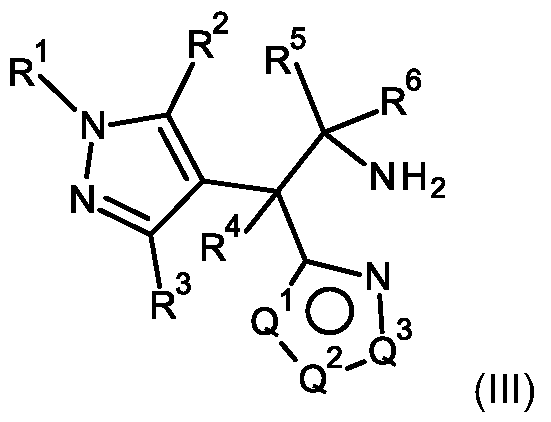 wherein R1, R2, R3, R4, R5, R6, Q1, Q2 and Q3 correspond to the same definitions as for the compounds of formula (I) according to the present invention.
The intermediate compounds of formula (III) possess the same definitions for R1, R2, R3, R4, R5, R6, Q1, Q2 and Q3 as for the compounds of formula (I) according to the invention and their corresponding preferences.
The presence of one or more possible asymmetric carbon atoms in a compound of formula (I II) according to the invention means that the compounds may occur in chiral isomeric forms, i.e., enantiomeric or diastereomeric forms.
The compounds of formula (I) according to the present invention can be made as shown in the following Schemes 1 to 10 in which, unless otherwise stated, the definition of each variable is as defined above for a compound of formula (I).
In any of the Schemes 1 to 10 below, the presence of one or more possible asymmetric carbon atoms in a compound of formula (I) according to the invention means that the compounds may occur in chiral isomeric forms, i.e., enantiomeric or diastereomeric forms.
The compounds as defined in any of the embodiments of the present invention can be made as shown in the following Schemes 1 to 10, in which, unless otherwise stated, the definition of each variable is as defined above in any of the embodiments according to the invention.
Compounds of formula (I) may be prepared from compounds of formula (III) by reaction with a compound of formula (II) using dicyclohexylcarbodiimide (DCC), diisopropylcarbodiimide (DIC) or N-(3- Dimethylaminopropyl)-N’-ethylcarbodiimide (EDAC HCI) together with an additive such as 1 - hydroxybenzotriazole (HOBt), Hydroxy-3, 4-dihydro-4-oxo-1 , 2, 3-benzotriazine (HODhbt), N-
hydroxysuccinimide (HOSu), 1 -Hydroxy-7-aza-1 H-benzotriazole (HOAt) or 4-(N,N-dimethylamino)pyridine
(DMAP). This reaction is shown in Scheme 1.

Scheme 1
Alternatively, compounds of formula (I) may be prepared by reacting a compound of formula (Ila) with a compound of formula (III) in an inert solvent such as tetra hydrofuran (THF), ethyl acetate (EtOAC), dichloromethane (DCM), toluene and the like, optionally in the presence of an inorganic base, for example aqueous sodium hydroxide, or potassium carbonate, or in the presence of an organic base such as trimethylamine or diisopropyl amine. The latter reaction with organic bases can optionally be carried out in the presence of a catalyst such as DMAP. Compounds of formula (Ila), wherein X° is halogen, preferably chlorine, can be prepared from compounds of formula (II) by treatment with a halogenating agent, such as thionyl chloride (SOCI2) or oxalyl chloride (COCI2), in an inert solvent as noted above, optionally mediated by the presence of catalytic quantities of N,N-dimethyl formamide. This reaction is shown in Scheme 2.
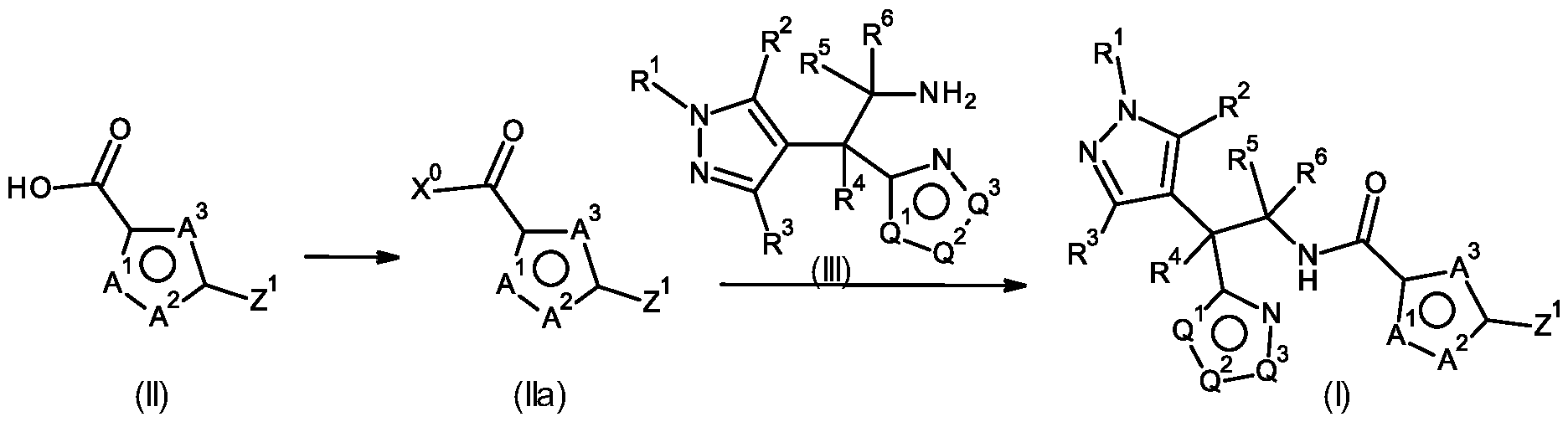
Scheme 2
Acylation reactions of carboxylic acids such as compounds of formula (II) with amines such as compounds of formula (III) are well known to those skilled in the art and described for example in Eur. J. Org. Chem. 2020, 4641-4651 , and references cited therein.
Compounds of formula (II) are commercially available or can be prepared according to, or analogous to, procedures described in the literature. For example, WO2018/019929, Org. Proc. Res. Dev. 2020, 24(2), 228- 234, WO2018/019929, Lett. Org. Chem. 2010, 7(7), 502-507, and J. Het Chem. 2015, 52(6), 1823-1833.
Compounds of formula (III), or salts thereof, wherein R1, R2, R3, R4, R5, R6, Q1, Q2 and Q3 are as defined above for the compound of formula (I), may be prepared by a person skilled in the art by a reaction between nitriles of formula (IV), wherein R1, R2, R3, R4, Q1, Q2 and Q3 are as defined above for the compound of formula (I), and a suitable nucleophile such as (dimethyl sulfide)dihydroboron (BMS) in a suitable aprotic solvent such as
THF, for example as described in J. Org. Chem. 1981 , 47, 3153. The reduction can also be achieved with, for example, sodium borohydride in the presence of a catalyst such as Cobalt(ll) chloride in an aprotic solvent (see preparative examples for details). Alternatively, Grignard reagents R5MgBr or R6MgBr, wherein R5 and R6 are as defined above for the compound of formula (I), may be added as nucleophiles to compounds of formula (IV), sequentially or simultaneously, to allow more highly substituted amines of formula (III) to be prepared. Such Grignard additions to nitriles are carried out in an inert solvent such as diethyl ether, tertbutylmethyl ether, and cyclopentyl methyl ether in the presence of a Lewis acid such as Ti(O-'Pr)4 (see Synlett 2007, (4), 652-654). This reaction is shown in Scheme 3.

Scheme 3
Compounds of formula (IV), wherein R1, R2, R3, R4, Q1, Q2 and Q3 are as defined above for the compound of formula (I), may be prepared by a person skilled in the art following known methods. More specifically, compounds of formula (IV), and intermediates thereof, may be prepared from compounds of formula (V) (Scheme 4).

For example, compounds of formula (IV), wherein R1, R2, R3, R4, Q1, Q2 and Q3 are as defined above for the compound of formula (I) and R4 is different from hydrogen, may be prepared by a person skilled in the art by deprotonation of compound of formula (IVa) wherein R4 is hydrogen and R1, R2, R3, Q1, Q2 and Q3 are as defined above for the compound of formula (I), using a strong base such as n-butyl lithium or sodium hydride at cryogenic temperatures in an inert solvent such as THF, followed by addition of a suitable alkylating agent R4-X°, wherein X° is halogen, for example iodomethane. Compounds of formula (IVa), wherein R4 is hydrogen and R1, R2, R3, Q1, Q2 and Q3 are as defined above for the compound of formula (I), may be prepared from alcohols of formula (V) by treatment with cyanotrimethylsilane (TMSCN) in the presence of a base such as lithium carbonate in a nonpolar solvent such as DCM at temperatures between 0°C and the boiling point of the reaction mixture. Such transformations are well known in the literature under a variety of conditions, for example as described in Org. Lett. 2008, 10, 4570 and references therein (Scheme 4).
Compounds of formula (V) may be prepared from compounds of formula (VI), wherein Q1, Q2 and Q3 are as defined above for the compound of formula (I), as shown in Scheme 5.

Scheme 5
As shown in Scheme 5, compounds of formula (VII), wherein R1, R2 and R3 are as defined above for the compound of formula (I) and X01 is bromo or iodo, are metalated with an appropriate reagent such as turbo Grignard (isopropylmagnesium chloride-lithium chloride complex), or an alkyl lithium, such as n-butyl lithium to give an intermediate Grignard or alkyl lithium reagent (M is MgX01 or Lithium). Such metal insertions into C-X01 bonds are well known to those skilled in the art and are generally carried out at temperatures between -78°C to room temperature, in inert solvents such as ethers, e.g., tert-butyl methyl ether or THF and the like. Solutions of the metalated species (Vila) are then treated with compounds of formula (VI), wherein Q1, Q2 and Q3 are as defined above for the compound of formula (I), to give compounds of formula (V). Similar reactions of these type have been described in for example WO2012/102297 and Bio. Med. Chem. Lett. 2017, 27(17), 4044- 4050 (X01 is Br, n-butyl lithium) and Ang. Chem. Int. Ed. 2016, 55(17), 5332-5336, US 2014/0349990, WG2002/004424, WG2021/009068 (X01 is I, Turbo Grignard).
Compounds of formula (VI) and (VII) are either commercially available or are readily prepared by methods known by those skilled in the art.
A further synthesis of compounds of formula (I) involves treatment of compounds of formula (VIII) with a base, such as sodium hydride or n-butyl lithium, in an inert solvent, such as THF, and subsequent alkylation with compounds of formula (IX), wherein R4 is as described under formula (I) and X02 is a leaving group such as halogen, mesylate or tosylate, to yield compounds of formula (X) (Scheme 6).

Scheme 6
Compounds of formula (X), wherein R1, R2, R3, and R4 are as defined above for the compound of formula (I) are then treated with a strong base such as sodium hydride or an alkyl lithium base such as n-butyl lithium in an inert solvent, such as THF or tert-butyl methyl ether, at temperatures between -78°C to room temperature, followed by addition of a compound of formula (XI), wherein Q1, Q2 and Q3 are as defined above for the
compound of formula (I) and X03 is a leaving group such as halogen, preferably F, Cl or Br, to give compounds of formula (IV). This reaction is shown in Scheme 7.

Compounds of formula (IV) are converted into compounds of formula (I) as previously described in Schemes 1 , 2 and 3. Those skilled in the art will recognize that conversion of compounds (VIII) into compounds of formula (IV) can be carried out sequentially or in the same reaction vessel, enabling a streamlined conversion of compounds of formula (VIII) to compounds of formula (IV). This is described in more details in the preparative examples.
Compounds of formula (la), wherein R1, R2, R3, R5, Q1, Q2, Q3, A1, A2, A3 and Z1 are as described above for compounds of formula (I) and R4 and R6 are hydrogen, can also be prepared by treatment of compounds of formula (VI), wherein Q1, Q2 and Q3 are as defined above for the compound of formula (I), with compounds of formula (XII), wherein R5 is as described above for compounds of formula (I) in the presence of a base, such as triethyl amine, optionally in an inert solvent, such as ethanol or methanol, to give compounds of formula (XIII). These compounds may be isolated and converted to compounds of formula (XIV) by treatment with an anhydride, such as trifluoroacetic acid anhydride, in an inert solvent, such as DCM, in the presence of a base, for example triethyl amine. This reaction is shown in Scheme 8.

Scheme 8
Those skilled in the art will appreciate that compounds of formula (VI) can be converted into compounds of formula (XIV) without isolation of the intermediates of formula (XIII). Such reactions, known as the Henry reactions, are well described in the literature, as evidenced in Tetrahedron 2001 , 57(6), 915-945, and references cited therein. Compounds of formula (XIV) can be converted into compounds of formula (XV) by treatment with compounds of formula (Vila) (see Scheme 5) in an inert solvent such as THF (Scheme 9).
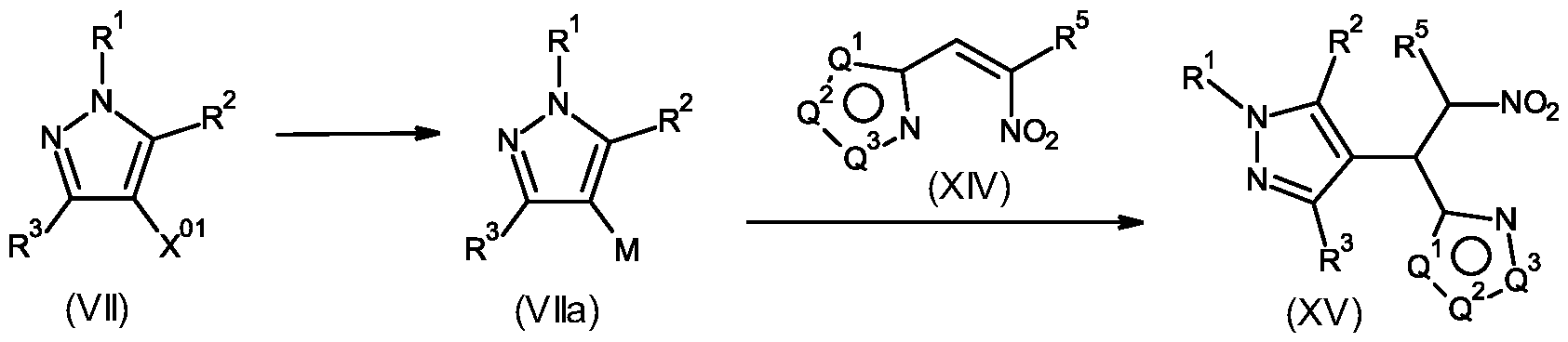
Scheme 9
Similar Michael additions of organometallics to nitro alkenes have been reported for example in Org. Lett., 2007, 9, 85-87. Reduction of the nitro group in compounds of formula (XV) to the amine to give compounds of formula (Illa) can be achieved by a multitude of methods generally known to those skilled in the art, such as Bechamp reduction, or reduction with hydrogen in the presence of a metal catalyst (Scheme 10).
 Q’O t V o- jj.
(XV) Q (Illa) Q
Scheme 10
Compounds of formula (Illa) are converted into compounds of formula (la) by the methods described in Schemes 1 and 2.
A compound of formula (I) as defined in any of the embodiments of the present invention can be converted in a manner known per se into another compound as defined in any of the embodiments of the present invention by replacing one or more substituents of the starting compound in the customary manner by (an)other substituent(s) according to the invention. Those skilled in the art will also appreciate that compounds of formula (I) can be further transformed to further derivatives of formula (I) by, for example, alkylation, nucleophilic substitution, elimination, C-C-bond forming reactions in the presence of metal catalysts, heteroatom-carbon bond formation in the presence of metal catalysts, oxidation, and reduction.
Depending on the choice of the reaction conditions and starting materials which are suitable in each case, it is possible, for example, in one reaction step only to replace one substituent by another substituent according to the invention, or a plurality of substituents can be replaced by other substituents according to the invention in the same reaction step.
Salts of compounds of formula (I) may be prepared in a manner known perse. Thus, for example, acid addition salts of compounds of formula (I) are obtained by treatment with a suitable acid or a suitable ion exchanger reagent and salts with bases are obtained by treatment with a suitable base or with a suitable ion exchanger reagent.
Salts of compounds of formula (I) can be converted in the customary manner into the free compounds (I), acid addition salts, for example, by treatment with a suitable basic compound or with a suitable ion exchanger
reagent and salts with bases, for example, by treatment with a suitable acid or with a suitable ion exchanger reagent.
Salts of compounds of formula (I) can be converted in a manner known per se into other salts of compounds of formula (I), acid addition salts, for example, into other acid addition salts, for example by treatment of a salt of inorganic acid such as hydrochloride with a suitable metal salt such as a sodium, barium or silver salt, of an acid, for example with silver acetate, in a suitable solvent in which an inorganic salt which forms, for example silver chloride, is insoluble and thus precipitates from the reaction mixture.
Depending on the procedure or the reaction conditions, the compounds of formula (I), which have salt-forming properties, can be obtained in free form or in the form of salts.
The compounds of formula (I) and, where appropriate, the tautomer’s thereof, in each case in free form or in salt form, can be present in the form of one of the isomers which are possible or as a mixture of these, for example in the form of pure isomers, such as antipodes and/or diastereomers, or as isomer mixtures, such as enantiomer mixtures, for example racemates, diastereomer mixtures or racemate mixtures, depending on the number, absolute and relative configuration of asymmetric carbon atoms which occur in the molecule and/or depending on the configuration of non-aromatic double bonds which occur in the molecule, the invention relates to the pure isomers and also to all isomer mixtures which are possible and is to be understood in each case in this sense hereinabove and herein below, even when stereochemical details are not mentioned specifically in each case.
The compounds of formula (I) of the present invention exhibit two asymmetric carbon atoms. The relationship between enantiomers and diastereomers of compounds of formula (I) is shown below.
 A person skilled in the art is well aware that above diastereomers and enantiomers of formula (I) wherein R1, R2, R3, R4, R5, R6, R7, R8, A1, A2, A3, Q1, Q2, Q3 and Z1 are as defined for formula (I) are within the scope if the invention.
The term “compounds of formula (I)” refers to component A.
Diastereomeric mixtures or racemic mixtures of compounds of formula (I), in free form or in salt form, which can be obtained depending on which starting materials and procedures have been chosen can be separated in a known manner into the pure diastereomers or racemates on the basis of the physicochemical differences of the components, for example by fractional crystallization, distillation and/or chromatography.
Enantiomeric mixtures, such as racemates, which can be obtained in a similar manner can be resolved into the optical antipodes by known methods, for example by recrystallization from an optically active solvent, by chromatography on chiral adsorbents, for example high-performance liquid chromatography (HPLC) on acetyl cellulose, with the aid of suitable microorganisms, by cleavage with specific, immobilized enzymes, via the formation of inclusion compounds, for example using chiral crown ethers, where only one enantiomer is complexed, or by conversion into diastereomeric salts, for example by reacting a basic end-product racemate with an optically active acid, such as a carboxylic acid, for example camphor, tartaric or malic acid, or sulfonic acid, for example camphorsulfonic acid, and separating the diastereomer mixture which can be obtained in this manner, for example by fractional crystallization based on their differing solubilities, to give the diastereomers, from which the desired enantiomer can be set free by the action of suitable agents, for example basic agents.
Pure diastereomers or enantiomers can be obtained according to the invention not only by separating suitable isomer mixtures, but also by generally known methods of diastereoselective or enantioselective synthesis, for example by carrying out the process according to the invention with starting materials of a suitable stereochemistry.
It is advantageous to isolate or synthesize in each case the biologically more effective isomer, for example enantiomer or diastereomer, or isomer mixture, for example enantiomer mixture or diastereomer mixture, if the individual components have a different biological activity.
As an example, compounds with more than one asymmetric carbon atoms may exist in diastereomeric forms which can be optionally separated using for example supercritical fluid chromatography (SFC) chromatography with chiral columns. Such diastereomers can show a different fungicidal activity profile, but all isomers and diastereomers form part of this invention.
The compounds of formula (I) and, where appropriate, the tautomer thereof, in each case in free form or in salt form, can, if appropriate, also be obtained in the form of hydrates and/or include other solvents, for example those which may have been used for the crystallization of compounds which are present in solid form.
The composition according to the invention is effective against harmful microorganisms, such as microorganisms, that cause phytopathogenic diseases, in particular against phytopathogenic fungi and bacteria.
The composition of the invention may be used to control plant diseases caused by a broad spectrum of fungal plant pathogens in the Basidiomycete, Ascomycete, Oomycete and/or Deuteromycete, Blastocladiomycete, Chrytidiomycete, Glomeromycete and/or Mucoromycete classes.
The composition is effective in controlling a broad spectrum of plant diseases, such as foliar pathogens of ornamental, turf, vegetable, field, cereal, and fruit crops.
These pathogens may include:
Oomycetes, including Phytophthora diseases such as those caused by Phytophthora capsici, Phytophthora infestans, Phytophthora sojae, Phytophthora fragariae, Phytophthora nicotianae, Phytophthora cinnamomi, Phytophthora citricola, Phytophthora citrophthora and Phytophthora erythroseptica; Pythium diseases such as those caused by Pythium aphanidermatum, Pythium arrhenomanes, Pythium graminicola, Pythium irregulare and Pythium ultimum; diseases caused by Peronosporales such as Peronospora destructor, Peronospora parasitica, Plasmopara viticola, Plasmopara halstedii, Pseudoperonospora cubensis, Albugo Candida, Sclerophthora macrospora and Bremia lactucae; and others such as Aphanomyces cochlioides, Labyrinthula zosterae, Peronosclerospora sorghi and Sclerospora graminicola,'
Ascomycetes, including blotch, spot, blast or blight diseases and/or rots for example those caused by Pleosporales such as Stemphylium solani, Stagonospora tainanensis, Spilocaea oleaginea, Setosphaeria turcica, Pyrenochaeta lycoperisici, Pleospora herbarum, Phoma destructiva, Phaeosphaeria herpotrichoides, Phaeocryptocus gaeumannii, Ophiosphaerella graminicola, Ophiobolus graminis, Leptosphaeria maculans, Hendersonia creberrima, Helminthosporium triticirepentis, Setosphaeria turcica, Drechslera glycines, Didymella bryoniae, Cycloconium oleagineum, Corynespora cassiicola, Cochliobolus sativus, Bipolaris cactivora, Venturia inaequalis, Pyrenophora teres, Pyrenophora tritici-repentis, Alternaria alternata, Alternaria brassicicola, Alternaria solani and Alternaria tomatophila, Capnod iales such as Septoria tritici, Septoria nodorum, Septoria glycines, Cercospora arachidicola, Cercospora sojina, Cercospora zeae-maydis, Cercosporella capsellae and Cercosporella herpotrichoides, Cladosporium carpophilum, Cladosporium effusum, Passalora fulva, Cladosporium oxysporum, Dothistroma septosporum, Isariopsis clavispora, Mycosphaerella fijiensis, Mycosphaerella graminicola, Mycovellosiella koepkeii, Phaeoisariopsis bataticola, Pseudocercospora vitis, Pseudocercosporella herpotrichoides, Ramularia beticola, Ramularia collo-cygni, Magnaporthales such as Gaeumannomyces graminis, Magnaporthe grisea, Pyricularia oryzae, Diaporthales such as Anisogramma anomala, Apiognomonia errabunda, Cytospora platan!, Diaporthe phaseolorum, Discula destructiva, Gnomonia fructicola, Greeneria uvicola, Melanconium juglandinum, Phomopsis viticola, Sirococcus clavigignenti-juglandacearum, Tubakia dryina, Dicarpella spp., Valsa ceratosperma, and others such as Actinothyrium graminis, Ascochyta pisi, Aspergillus flavus, Aspergillus fumigatus, Aspergillus nidulans, Asperisporium caricae, Blumeriella jaapii, Candida spp., Capnodium ramosum, Cephaloascus spp., Cephalosporium gramineum, Ceratocystis paradoxa, Chaetomium spp., Hymenoscyphus pseudoalbidus, Coccidioides spp., Cylindrosporium padi, Diplocarpon malae, Drepanopeziza campestris, Elsinoe ampelina, Epicoccum nigrum, Epidermophyton spp., Eutypa lata, Geotrichum candidum, Gibellina cerealis, Gloeocercospora sorghi, Gloeodes pomigena, Gloeosporium perennans; Gloeotinia temulenta, Griphospaeria
corticola, Kabatiella Uni, Leptographium microsporum, Leptosphaerulinia crassiasca, Lophodermium seditiosum, Marssonina graminicola, Microdochium nivale, Monilinia fructicola, Monographella albescens, Monosporascus cannonballus, Naemacyclus spp., Ophiostoma novo-ulmi, Paracoccidioides brasiliensis, Penicillium expansum, Pestalotia rhododendri, Petriellidium spp., Pezicula spp., Phialophora gregata, Phyllachora pomigena, Phymatotrichum omnivora, Physalospora abdita, Plectosporium tabacinum, Polyscytalum pustulans, Pseudopeziza medicaginis, Pyrenopeziza brassicae, Ramulispora sorghi, Rhabdocline pseudotsugae, Rhynchosporium secalis, Sacrocladium oryzae, Scedosporium spp., Schizothyrium pomi, Sclerotinia sclerotiorum, Sclerotinia minor Sclerotium spp., Typhula ishikariensis, Seimatosporium mariae, Lepteutypa cupressi, Septocyta ruborum, Sphaceloma perseae, Sporonema phacidioides, Stigmina palmivora, Tapesia yallundae, Taphrina bullata, Thielviopsis basicola, Trichoseptoria fructigena, Zygophiala jamaicensis; powdery mildew diseases for example those caused by Erysiphales such as Blumeria graminis, Erysiphe polygon!, Uncinula necator, Sphaerotheca fuligena, Podosphaera leucotricha, Podospaera macularis Golovinomyces cichoracearum, Leveillula taurica, Microsphaera diffusa, Oidiopsis gossypii, Phyllactinia guttata and Oidium arachidis; molds for example those caused by Botryosphaeriales such as Dothiorella aromatica, Diplodia seriata, Guignardia bidwellii, Botrytis cinerea, Botryotinia aim, Botryotinia fabae, Fusicoccum amygdali, Lasiodiplodia theobromae, Macrophoma theicola, Macrophomina phaseolina, Phyllosticta cucurbitacearum; anthracnoses for example those caused by Glommerelales such as Colletotrichum gloeosporioides, Colletotrichum lagenarium, Colletotrichum gossypii, Glomerella cingulata, and Colletotrichum graminicola; and wilts or blights for example those caused by Hypocreales such as Acremonium strictum, Claviceps purpurea, Fusarium culmorum, Fusarium graminearum, Fusarium virguliforme, Fusarium oxysporum, Fusarium subglutinans, Fusarium oxysporum f.sp. cubense, Gerlachia nivale, Gibberella fujikuroi, Gibberella zeae, Gliocladium spp., Myrothecium verrucaria, Nectria ramulariae, Trichoderma viride, Trichothecium roseum, and Verticillium theobromae;
Basidiomycetes, including smuts for example those caused by Ustilaginales such as Ustilaginoidea virens, Ustilago nuda, Ustilago tritici, Ustilago zeae, rusts for example those caused by Pucciniales such as Cerotelium fici, Chrysomyxa arctostaphyli, Coleosporium ipomoeae, Hemileia vastatrix, Puccinia arachidis, Puccinia cacabata, Puccinia graminis, Puccinia recondita, Puccinia sorghi, Puccinia horde!, Puccinia striiformis f.sp. Hordei, Puccinia striiformis f.sp. Secalis, Pucciniastrum coryli, or Uredinales such as Cronartium ribicola, Gymnosporangium juniperi-virginianae, Melampsora medusae, Phakopsora pachyrhizi, Phragmidium mucronatum, Physopella ampelosidis, Tranzschelia discolor and Uromyces viciae-fabae; and other rots and diseases such as those caused by Cryptococcus spp., Exobasidium vexans, Marasmiellus inoderma, Mycena spp., Sphacelotheca reiliana, Typhula ishikariensis, Urocystis agropyri, Itersonilia perplexans, Corticium invisum, Laetisaria fuciformis, Waitea circinata, Rhizoctonia solan!, Thanetephorus cucurmeris, Entyloma dahliae, Entylomella microspora, Neovossia moliniae and Tilletia caries;
Blastocladiomycetes, such as Physoderma maydis;
Mucoromycetes, such as Choanephora cucurbitarum; Mucor spp.; Rhizopus arrhizus; as well as diseases caused by other species and genera closely related to those listed above.
In addition to their fungicidal activity, the compositions may also have activity against bacteria such as Erwinia amylovora, Erwinia caratovora, Xanthomonas campestris, Pseudomonas syringae, Strptomyces scabies and other related species as well as certain protozoa.
The composition according to the invention is particularly effective against phytopathogenic fungi belonging to the following classes: Ascomycetes (e.g., Venturia, Podosphaera, Erysiphe, Monilinia, Mycosphaerella, Uncinula); Basidiomycetes (e.g., the genus Hemileia, Rhizoctonia, Phakopsora, Puccinia, Ustilago, Tilletia); Fungi imperfecti (also known as Deuteromycetes; e.g., Botrytis, Helminthosporium, Rhynchosporium, Fusarium, Septoria, Cercospora, Alternaria, Pyricularia and Pseudocercosporella); Oomycetes (e.g., Phytophthora, Peronospora, Pseudoperonospora, Albugo, Bremia, Pythium, Pseudosclerospora, Plasmopara).
Crops of useful plants in which the composition according to the invention can be used include perennial and annual crops, such as berry plants for example blackberries, blueberries, cranberries, raspberries and strawberries; cereals for example barley, maize (corn), millet, oats, rice, rye, sorghum triticale and wheat; fibre plants for example cotton, flax, hemp, jute and sisal; field crops for example sugar and fodder beet, coffee, hops, mustard, oilseed rape (canola), poppy, sugar cane, sunflower, tea and tobacco; fruit trees for example apple, apricot, avocado, banana, cherry, citrus, nectarine, peach, pear and plum; grasses for example Bermuda grass, bluegrass, bentgrass, centipede grass, fescue, ryegrass, St. Augustine grass and Zoysia grass; herbs such as basil, borage, chives, coriander, lavender, lovage, mint, oregano, parsley, rosemary, sage and thyme; legumes for example beans, lentils, peas and soya beans; nuts for example almond, cashew, ground nut, hazelnut, peanut, pecan, pistachio and walnut; palms for example oil palm; ornamentals for example flowers, shrubs and trees; other trees, for example cacao, coconut, olive and rubber; vegetables for example asparagus, aubergine, broccoli, cabbage, carrot, cucumber, garlic, lettuce, marrow, melon, okra, onion, pepper, potato, pumpkin, rhubarb, spinach and tomato; and vines for example grapes.
Crops are to be understood as being those which are naturally occurring, obtained by conventional methods of breeding, or obtained by genetic engineering. They include crops which contain so-called output traits (e.g., improved storage stability, higher nutritional value and improved flavour).
Crops are to be understood as also including those crops which have been rendered tolerant to herbicides like bromoxynil or classes of herbicides such as ALS-, EPSPS-, GS-, HPPD- and PPO-inhibitors. An example of a crop that has been rendered tolerant to imidazolinones, e.g., imazamox, by conventional methods of breeding is Clearfield® summer canola. Examples of crops that have been rendered tolerant to herbicides by genetic engineering methods include e.g., glyphosate- and glufosinate-resistant maize varieties commercially available under the trade names Round up Ready®, Herculex I® and LibertyLink®.
Crops are also to be understood as being those which naturally are or have been rendered resistant to harmful insects. This includes plants transformed by the use of recombinant DNA techniques, for example, to be capable of synthesising one or more selectively acting toxins, such as are known, for example, from toxinproducing bacteria. Examples of toxins which can be expressed include 8-endotoxins, vegetative insecticidal
proteins (Vip), insecticidal proteins of bacteria colonising nematodes, and toxins produced by scorpions, arachnids, wasps and fungi.
An example of a crop that has been modified to express the Bacillus thuringiensis toxin is the Bt maize KnockOut® (Syngenta Seeds). An example of a crop comprising more than one gene that codes for insecticidal resistance and thus expresses more than one toxin is VipCot® (Syngenta Seeds). Crops or seed material thereof can also be resistant to multiple types of pests (so-called stacked transgenic events when created by genetic modification). For example, a plant can have the ability to express an insecticidal protein while at the same time being herbicide tolerant, for example Herculex I® (Dow AgroSciences, Pioneer Hi-Bred International).
The term "useful plants" is to be understood as including also useful plants which have been so transformed by the use of recombinant DNA techniques that they are capable of synthesising one or more selectively acting toxins, such as are known, for example, from toxin-producing bacteria, especially those of the genus Bacillus.
Examples of such plants are: YieldGard® (maize variety that expresses a CrylA(b) toxin); YieldGard Rootworm ® (maize variety that expresses a CrylllB(bl ) toxin); YieldGard Plus® (maize variety that expresses a CrylA(b) and a CrylllB(bl ) toxin); Starlink® (maize variety that expresses a Cry9(c) toxin); Herculex I® (maize variety that expresses a CrylF(a2) toxin and the enzyme phosphinothricine N-acetyltransferase (PAT) to achieve tolerance to the herbicide glufosinate ammonium); NuCOTN 33B® (cotton variety that expresses a CrylA(c) toxin); Bollgard I® (cotton variety that expresses a CrylA(c) toxin); Bollgard II® (cotton variety that expresses a CrylA(c) and a CryllA(b) toxin); VIPCOT® (cotton variety that expresses a VIP toxin); NewLeaf® (potato variety that expresses a CrylllA toxin); NatureGard® Agrisure® GT Advantage (GA21 glyphosate-tolerant trait), Agrisure® CB Advantage (Bt11 corn borer (CB) trait), Agrisure® RW (corn rootworm trait) and Protecta ®.
The term "crops" is to be understood as including also crop plants which have been so transformed by the use of recombinant DNA techniques that they are capable of synthesising one or more selectively acting toxins, such as are known, for example, from toxin-producing bacteria, especially those of the genus Bacillus.
Toxins that can be expressed by such transgenic plants include, for example, insecticidal proteins from Bacillus cereus or Bacillus popilliae; or insecticidal proteins from Bacillus thuringiensis, such as 8-endotoxins, e.g., CrylAb, CrylAc, Cry1 F, Cry1 Fa2, Cry2Ab, Cry3A, Cry3Bb1 or Cry9C, or vegetative insecticidal proteins (Vip), e.g., Vip1 , Vip2, Vip3 or Vip3A; or insecticidal proteins of bacteria colonising nematodes, for example Photorhabdus spp. or Xenorhabdus spp., such as Photorhabdus luminescens, Xenorhabdus nematophilus; toxins produced by animals, such as scorpion toxins, arachnid toxins, wasp toxins and other insect-specific neurotoxins; toxins produced by fungi, such as Streptomycetes toxins, plant lectins, such as pea lectins, barley lectins or snowdrop lectins; agglutinins; proteinase inhibitors, such as trypsin inhibitors, serine protease inhibitors, patatin, cystatin, papain inhibitors; ribosome-inactivating proteins (RIP), such as ricin, maize-RIP, abrin, luffin, saporin or bryodin; steroid metabolism enzymes, such as 3-hydroxysteroidoxidase, ecdysteroid-
UDP-glycosyl-transferase, cholesterol oxidases, ecdysone inhibitors, HMG-COA-reductase, ion channel blockers, such as blockers of sodium or calcium channels, juvenile hormone esterase, diuretic hormone receptors, stilbene synthase, bibenzyl synthase, chitinases and glucanases.
In the context of the present invention there are to be understood by 8-endotoxins, for example CrylAb, CrylAc, Cry1 F, Cry1 Fa2, Cry2Ab, Cry3A, Cry3Bb1 or Cry9C, or vegetative insecticidal proteins (Vip), for example Vip1 , Vip2, Vip3 or Vip3A, expressly also hybrid toxins, truncated toxins and modified toxins. Hybrid toxins are produced recombinantly by a new combination of different domains of those proteins (see, for example, W002/15701 ). Truncated toxins, for example a truncated CrylAb, are known. In the case of modified toxins, one or more amino acids of the naturally occurring toxin are replaced. In such amino acid replacements, preferably non-naturally present protease recognition sequences are inserted into the toxin, such as, for example, in the case of Cry3A055, a cathepsin-G-recognition sequence is inserted into a Cry3A toxin (see WG03/018810).
Examples of such toxins or transgenic plants capable of synthesising such toxins are disclosed, for example, in EP-A-0 374 753, WO 93/07278, WO 95/34656, EP-A-0 427 529, EP-A-451 878 and WO 03/052073.
The processes for the preparation of such transgenic plants are generally known to the person skilled in the art and are described, for example, in the publications mentioned above. Cryl-type deoxyribonucleic acids and their preparation are known, for example, from WO 95/34656, EP-A-0 367 474, EP-A-0 401 979 and WO 90/13651.
The toxin contained in the transgenic plants imparts to the plant tolerance to harmful insects. Such insects can occur in any taxonomic group of insects but are especially commonly found in the beetles (Coleoptera), twowinged insects (Diptera) and butterflies (Lepidoptera).
Transgenic plants containing one or more genes that code for an insecticidal resistance and express one or more toxins are known and some of them are commercially available. Examples of such plants are: YieldGard ® (maize variety that expresses a CrylAb toxin); YieldGard Rootworm® (maize variety that expresses a Cry3Bb1 toxin); YieldGard Plus® (maize variety that expresses a CrylAb and a Cry3Bb1 toxin); Starlink® (maize variety that expresses a Cry9C toxin); Herculex I® (maize variety that expresses a Cry1 Fa2 toxin and the enzyme phosphinothricine N-acetyltransferase (PAT) to achieve tolerance to the herbicide glufosinate ammonium); NuCOTN 33B® (cotton variety that expresses a CrylAc toxin); Bollgard I® (cotton variety that expresses a CrylAc toxin); Bollgard II® (cotton variety that expresses a CrylAc and a Cry2Ab toxin); VipCot ® (cotton variety that expresses a Vip3A and a CrylAb toxin); NewLeaf® (potato variety that expresses a Cry3A toxin); NatureGard®, Agrisure® GT Advantage (GA21 glyphosate-tolerant trait), Agrisure® CB Advantage (Bt11 corn borer (CB) trait) and Protecta®.
Further examples of such transgenic crops are:
1. Bt11 Maize from Syngenta Seeds SAS, Chemin de I'Hobit 27, F-31 790 St. Sauveur, France, registration number C/FR/96/05/10. Genetically modified Zea mays which has been rendered resistant to attack by the
European corn borer (Ostrinia nubilalis and Sesamia nonagrioides) by transgenic expression of a truncated Cry1 Ab toxin. Bt1 1 maize also transgenically expresses the enzyme PAT to achieve tolerance to the herbicide glufosinate ammonium.
2. Bt176 Maize from Syngenta Seeds SAS, Chemin de I'Hobit 27, F-31 790 St. Sauveur, France, registration number C/FR/96/05/10. Genetically modified Zea mays which has been rendered resistant to attack by the European corn borer ( Ostrinia nubilalis and Sesamia nonagrioides) by transgenic expression of a Cry1 Ab toxin. Bt176 maize also transgenically expresses the enzyme PAT to achieve tolerance to the herbicide glufosinate ammonium.
3. MIR604 Maize from Syngenta Seeds SAS, Chemin de I'Hobit 27, F-31 790 St. Sauveur, France, registration number C/FR/96/05/10. Maize which has been rendered insect-resistant by transgenic expression of a modified Cry3A toxin. This toxin is Cry3A055 modified by insertion of a cathepsin-G-protease recognition sequence. The preparation of such transgenic maize plants is described in WO 03/018810.
4. MON 863 Maize from Monsanto Europe S.A. 270-272 Avenue de Tervuren, B-1150 Brussels, Belgium, registration number C/DE/02/9. MON 863 expresses a Cry3Bb1 toxin and has resistance to certain Coleoptera insects.
5. IPC 531 Cotton from Monsanto Europe S.A. 270-272 Avenue de Tervuren, B-1150 Brussels, Belgium, registration number C/ES/96/02.
6. 1507 Maize from Pioneer Overseas Corporation, Avenue Tedesco, 7 B-1160 Brussels, Belgium, registration number C/NL/00/10. Genetically modified maize for the expression of the protein Cry1 F for achieving resistance to certain Lepidoptera insects and of the PAT protein for achieving tolerance to the herbicide glufosinate ammonium.
7. NK603 x MON 810 Maize from Monsanto Europe S.A. 270-272 Avenue de Tervuren, B-1150 Brussels, Belgium, registration number C/GB/02/M3/03. Consists of conventionally bred hybrid maize varieties by crossing the genetically modified varieties NK603 and MON 810. NK603 x MON 810 Maize transgenically expresses the protein CP4 EPSPS, obtained from Agrobacterium sp. strain CP4, which imparts tolerance to the herbicide Roundup® (contains glyphosate), and also a CrylAb toxin obtained from Bacillus thuringiensis subsp. kurstaki which brings about tolerance to certain Lepidoptera, include the European corn borer.
Additionally, to date, no cross-resistance has been observed between the composition comprising a mixture of components (A) and (B) and any fungicidal solutions used to control phytopathogenic fungi such as Absidia corymbifera, Altemaria spp, Aphanomyces spp, Ascochyta spp, Aspergillus spp. including A. fiavus, A. fumigatus, A. nidulans, A. niger, A. terrus, Aureobasidium spp. including A. pullulans, Blastomyces dermatitidis, Blumeria graminis, Bremia lactucae, Botryosphaeria spp. including B. dothidea, B. obtusa, Botrytis spp. inclusing B. cinerea, Candida spp. including C. albicans, C. glabrata, C. krusei, C. lusitaniae, C. parapsilosis, C. tropicalis, Cephaloascus fragrans, Ceratocystis spp, Cercospora spp. including C. arachidicola, Cercosporidium personatum, Cladosporium spp, Claviceps purpurea, Coccidioides immitis, Cochliobolus spp, Colletotrichum spp. including C. musae, Cryptococcus neoformans, Diaporthe spp, Didymella spp, Drechslera
spp, Elsinoe spp, Epidermophyton spp, Erwinia amylovora, Erysiphe spp. including E. cichoracearum, Eutypa lata, Fusarium spp. including F. culmorum, F. graminearum, F. langsethiae, F. moniliforme, F. oxysporum, F. proliferatum, F. subglutinans, F. solani, Gaeumannomyces graminis, Gibberella fujikuroi, Gloeodes pomigena, Gloeosporium musarum, Glomerella cingulate, Guignardia bidwellii, Gymnosporangium juniperi-virginianae, Helminthosporium spp, Hemileia spp, Histoplasma spp. including H. capsulatum, Laetisaria fuciformis, Leptographium lindbergi, Leveillula taurica, Lophodermium seditiosum, Microdochium nivale, Microsporum spp, Monilinia spp, Mucor spp, Mycosphaerella spp. including M. graminicola, M. pomi, Oncobasidium theobromaeon, Ophiostoma piceae, Paracoccidioides spp, Penicillium spp. including P. digitatum, P. italicum, Petriellidium spp, Peronosclerospora spp. Including P. maydis, P. philippinensis and P. sorghi, Peronospora spp, Phaeosphaeria nodorum, Phakopsora pachyrhizi, Phellinus igniarus, Phialophora spp, Phoma spp, Phomopsis viticola, Phytophthora spp. including P. infestans, Plasmopara spp. including P. halstedii, P. viticola, Pleospora spp., Podosphaera spp. including P. leucotrich a, Polymyxa graminis, Polymyxa betae, Pseudocercosporella herpotrichoides, Pseudomonas spp, Pseudoperonospora spp. including P. cubensis, P. humuli, Pseudopeziza tracheiphila, Puccinia Spp. including P. horde!, P. recondita, P. striiformis, P. triticina, Pyrenopeziza spp, Pyrenophora spp, Pyricularia spp. including P. oryzae, Pythium spp. including P. ultimum, Ramularia spp, Rhizoctonia spp, Rhizomucor pusillus, Rhizopus arrhizus, Rhynchosporium spp, Scedosporium spp. including S. apiospermum and S. prolificans, Schizothyrium pomi, Sclerotinia spp, Sclerotium spp, Septoria spp, including S. nodorum, S. tritici, Sphaerotheca macularis, Sphaerotheca fusca (Sphaerotheca fuliginea), Sporothorix spp, Stagonospora nodorum, Stemphylium spp., Stereum hirsutum, Thanatephorus cucumeris, Thielaviopsis basicola, Tilletia spp, Trichoderma spp., including T. harzianum, T. pseudokoningii, T. viride, Trichophyton spp, Typhula spp, Uncinula necator, Urocystis spp, Ustilago spp, Venturia spp. including V. inaequalis, Verticillium spp, and Xanthomonas spp., in particular, Zymoseptoria tritici, Puccinia recondita, Puccinia striiformis, Erysiphe graminis, Uncinula necator, Sphaerotheca fuliginea, Leveillula taurica, Phakopsora pachyrhizi, Pyricularia oryzae, Alternaria solani, Alternaria alternata, Mycosphaerella fijiensis, Colletotrichum lagenarium, Didymella bryoniae, Ascochyta pisii, Verticillium dahliae, Pyrenophora teres, Cercospora beticola, Ramularia collo-cygni, Botrytis cinerea, Sclerotinia sclerotiorum, Monilinia laxa, Monographella nivalis and Venturia inaequalis.
Indeed, fungicidal-resistant strains in any of the species as outlined above have been reported in the scientific literature, with strains resistant to one or more fungicides from at least one of the following fungicidal modes of action classes: quinone-outside-inhibitors (Qol), quinone-inside-inhibitors (Qil), succinate dehydrogenase inhibitors (SDHI) and sterol demethylation-inhibitors (DMI). Such fungicidal-resistant strains may contain:
A mutation in the mitochondrial cytochrome b gene conferring resistance to Qo inhibitors, wherein the mutation is G143A, F129L or G137R. See for example: Gisi et al., Pest Manag Sci. 2000, 56, 833-841 , Lucas, Pestic Outlook 2003, 14(6), 268-70, Fraaije et al., Phytopathol 2005, 95(8), 933-41 , Sierotzki et al., Pest Manag. Sci. 2007, 63(3), 225-233 (2007), Semar et al., J. Plant Dis. Prot. 2007, (3), 117-119; and Pasche et al., J. Crop Prot. 2008, 27(3-5), 427-435 (2008).
A mutation in the mitochondrial cytochrome b gene conferring resistance to Qi inhibitors, wherein the mutation is G37A/C/D/S/V or N31 K. See for example: Meunier et al., Pest Manag Sci. 2019; 75: 2107-2114, Young et al., Pest Manag Sci. 2018; 74(2): 489-498, Walker et al., Environ. Microbiol. 2021

A mutation in the genes encoding the SdhB,C,D subunits conferring resistance to SDHI inhibitors wherein the mutation is in the following major pathogens:
Botrytis cinerea: B-P225H/L/T/Y/F, B-N230I, B-H272L/Y/R, C-P80H/L, C-N87S;
Alternaria solani: B-H278R/Y. C-H134R/Q, D-D123E, D-H133R and C-H134R;
Zymoseptoria tritici: sdhB: N225T, N225I, R265P, T268I, T268A. In sdhC: T79N, T79I, W80S, W80A, A84F, N86S, N86A, P127A, R151 M/S/T/G, R151 S, R151T, H152R/Y, V166M, T168R. In sdhD: I50F, M1 14V, D129G, T20P+K186R;
Pyrenophora teres: In sdhB: S66P, N235I, H277Y. In sdhC: K49E, R64K, N75S, G79R, H134R, S135R. In sdhD: D124E, H134R, G138V, D145G;
Ramularia collo-cygni: In sdhB: N224T, T267L In sdhC: N87S, G91 R, H146R/L, G171 D, H153R;
Phakopsora pachyrhizi: C-I86F;
Sclerotinia sclerotiorum: In sdhB: H273Y. In sdhC: G91 R, H146R. In sdhD: T108K, H132R, G150R.
Major source of information is www.frac.info, Sierotzki and Scalliet, Phytopathology (2013) 103(9): 880-887 and Simoes et al., J. Plant Dis. Prot. 2018, 125: 21-2.
A mutation or combination of mutations in the CYP51 gene conferring resistance to DMI inhibitors wherein the mutations are: L50S, D134G, V136A/C, Y137F, S188N, A379G, 1381V, deletion 459-460, Y461 H/S, N513K, S524T. Major source of information is www.frac.info, Cools et al., Plant Pathol. 2013, 62: 36-42 and Schmitz HK et al., Pest Manag. Sci. 2014, 70: 378-388.
Thus, in a preferred embodiment, the compositions according to the present invention comprising a mixture of components (A) and (B), are used to control fungal strains which are resistant to one or more fungicides from any of the following fungicidal MoA classes: quinone-outside-inhibitors (Qol), quinone-inside-inhibitors (Qil), succinate dehydrogenase inhibitors (SDHI) and sterol demethylation-inhibitors (DMI).
Compositions of this invention, including all of the above disclosed embodiments and preferred examples thereof, can be mixed with one or more further pesticides including further fungicides, insecticides, nematocides, bactericides, acaricides, growth regulators, chemosterilants, semiochemicals, repellents, attractants, pheromones, feeding stimulants or other biologically active compounds to form a multi-component pesticide giving an even broader spectrum of agricultural protection.
Examples of such agricultural protectants with which the composition of this invention can be formulated are:
Fungicides such as etridiazole, fluazinam, benalaxyl, benalaxyl-M (kiralaxyl), furalaxyl, metalaxyl, metalaxyl- M (mefenoxam), dodicin, N'-(2,5-dimethyl-4-phenoxy-phenyl)-N-ethyl-N-methyl-formamidine, N'-[4-(4,5- dichloro-thiazol-2-yloxy)-2,5-dimethyl-phenyl]-N-ethyl-N-methyl-formamidine, N'-[4-[[3-[(4- chlorophenyl)methyl]-1 ,2,4-thiadiazol-5-yl]oxy]-2,5-dimethyl-phenyl]-N-ethyl-N-methyl-formamidine, ethirimol, 3'-chloro-2-methoxy-N-[(3RS)-tetrahydro-2-oxofuran-3-yl]acet-2',6'-xylidide (clozylacon), cyprodinil, mepanipyrim, pyrimethanil, dithianon, aureofungin, blasticidin-S, biphenyl, chloroneb, dicloran, benzovindiflupyr, pydiflumetofen, hexachlorobenzene, quintozene, tecnazene (TCNB), tolclofos-methyl, metrafenone, 2,6-dichloro-N-(4-trifluoromethylbenzyl)-benzamide, fluopicolide (flupicolide), tioxymid, flusulfamide, benomyl, carbendazim, carbendazim chlorhydrate, chlorfenazole, fuberidazole, thiabendazole, thiophanate-methyl, benthiavalicarb, chlobenthiazone, probenazole, acibenzolar, bethoxazin, pyriofenone (IKF-309), acibenzolar-S-methyl, pyribencarb (KIF-7767), butylamine, 3-iodo-2-propinyl n-butylcarbamate (IPBC), picarbutrazox, polycarbamate, propamocarb, tolprocarb, 3-(difluoromethyl)-N-(7-fluoro-1 , 1 ,3,3- tetramethyl-indan-4-yl)-1-methyl-pyrazole-4-carboxamide, diclocymet, N-[(5-chloro-2-isopropyl- phenyl)methyl]-N-cyclopropyl-3-(difluoromethyl)-5-fluoro-1-methyl-pyrazole-4-carboxamide, N-cyclopropyl-3- (difluoromethyl)-5-fluoro-N-[(2-isopropylphenyl)methyl]-1-methyl-pyrazole-4-carboxamide, carpropamid, chlorothalonil, flumorph, oxine-copper, cymoxanil, phenamacril, cyazofamid, flutianil, thicyofen, chlozolinate, iprodione, procymidone, vinclozolin, bupirimate, dinocton, dinopenton, dinobuton, dinocap, meptyldinocap, diphenylamine, phosdiphen, 2,6-dimethyl-[1 ,4]dithiino[2,3-c:5,6-c']dipyrrole-1 ,3,5,7(2H,6H)-tetraone, azithiram, etem, ferbam, mancozeb, maneb, metam, metiram (polyram), metiram-zinc, nabam, propineb, thiram, vapam (metam sodium), zineb, ziram, dithioether, isoprothiolane, ethaboxam, fosetyl, phosetyl-AI (fosetyl-al), methyl bromide, methyl iodide, methyl isothiocyanate, cyclafuramid, fenfuram, validamycin, streptomycin, (2RS)-2-bromo-2-(bromomethyl)glutaronitrile (bromothalonil), dodine, doguadine, guazatine, iminoctadine, iminoctadine triacetate, 2,4-D, 2,4-DB, kasugamycin, dimethirimol, fenhexamid, hymexazole, hydroxyisoxazole imazalil, imazalil sulphate, oxpoconazole, pefurazoate, prochloraz, triflumizole, fenamidone, Bordeaux mixture, calcium polysulfide, copper acetate, copper carbonate, copper hydroxide, copper naphthenate, copper oleate, copper oxychloride, copper oxyquinolate, copper silicate, copper sulphate, copper tallate, cuprous oxide, sulphur, carbaryl, phthalide (fthalide), dingjunezuo (Jun Si Qi), oxathiapiprolin, fluoroimide, mandipropamid, KSF-1002, benzamorf, dimethomorph, fenpropimorph, tridemorph, dodemorph, diethofencarb, fentin acetate, fentin hydroxide, carboxin, oxycarboxin, drazoxolon, famoxadone, m- phenylphenol, p-phenylphenol, tribromophenol (TBP), 2-[2-[(7,8-difluoro-2-methyl-3-quinolyl)oxy]-6-fluoro- phenyl]propan-2-ol 2-[2-fluoro-6-[(8-fluoro-2-methyl-3-quinolyl)oxy]phenyl]propan-2-ol, cyflufenamid, ofurace, oxadixyl, flutolanil, mepronil, isofetamid, fenpiclonil, fludioxonil, pencycuron, edifenphos, iprobenfos, pyrazophos, phosphorus acids, tecloftalam, captafol, captan, ditalimfos, triforine, fenpropidin, piperalin, osthol, 1 -methylcyclopropene, 4-CPA, chlormequat, clofencet, dichlorprop, dimethipin, endothal, ethephon, flumetralin, forchlorfenuron, gibberellic acid, gibberellins, hymexazol, maleic hydrazide, mepiquat, naphthalene acetamide, paclobutrazol, prohexadione, prohexadione-calcium, thidiazuron, tribufos (tributyl phosphorotrithioate), trinexapac, uniconazole, a-naphthalene acetic acid, polyoxin D (polyoxrim), BLAD, chitosan, fenoxanil, folpet, 3-(difluoromethyl)-N-methoxy-1-methyl-N-[1-methyl-2-(2,4,6-
trichlorophenyl)ethyl]pyrazole-4-carboxamide, bixafen, fluxapyroxad, furametpyr, isopyrazam, penflufen, penthiopyrad, sedaxane, fenpyrazamine, diclomezine, pyrifenox, boscalid, fluopyram, diflumetorim, fenarimol, 5-fluoro-2-(p-tolylmethoxy)pyrimidin-4-amine, ferimzone, dimetachlone (dimethaclone), pyroquilon, proquinazid, ethoxyquin, quinoxyfen, 4,4,5-trifluoro-3,3-dimethyl-1-(3-quinolyl)isoquinoline, 4,4-difluoro-3,3- dimethyl-1-(3-quinolyl)isoquinoline, 5-fluoro-3,3,4,4-tetramethyl-1-(3-quinolyl)isoquinoline, 9-fluoro-2,2- dimethyl-5-(3-quinolyl)-3H-1 ,4-benzoxazepine, tebufloquin, oxolinic acid, chinomethionate (oxyth ioquinox, quinoxymethionate), spiroxamine, (E)-N-methyl-2- [2-(2,5-dimethylphenoxymethyl)phenyl]-2-methoxy- iminoacetamide, azoxystrobin, coumoxystrobin, dimoxystrobin, enestroburin, enoxastrobin, fenamistrobin, flufenoxystrobin, fluoxastrobin, kresoxim-methyl, mandestrobin, metaminostrobin, metominostrobin, orysastrobin, picoxystrobin, pyraclostrobin, pyrametostrobin, pyraoxystrobin, triclopyricarb, trifloxystrobin, amisulbrom, dichlofluanid, tolylfluanid, but-3-ynyl N-[6-[[(Z)-[(1-methyltetrazol-5-yl)-phenyl- methylene]amino]oxymethyl]-2-pyridyl]carbamate, dazomet, isotianil, tiadinil, thifluzamide, benthiazole (TCMTB), silthiofam, zoxamide, anilazine, tricyclazole, (rac)-cis-1-(4-chlorophenyl)-2-(1 H-1 ,2,4-triazol-1-yl)- cycloheptanol (huanjunzuo), 1 -(5-bromo-2-pyridyl)-2-(2,4-difluorophenyl)-1 , 1 -difluoro-3-(1 ,2,4-triazol-1 - yl)propan-2-ol 2-(1 -tert-b uty I )- 1 -(2-chlorophenyl)-3-(1 ,2,4-triazol-1 -yl)-propan-2-ol (T CDP), azaconazole, bitertanol (biloxazol), bromuconazole, climbazole, cyproconazole, difenoconazole, dimetconazole, diniconazole, diniconazole-M, epoxiconazole, etaconazole, fenbuconazole, fluquinconazole, flusilazole, flutriafol, hexaconazole, imibenconazole, ipconazole, ipfentrifluconazole, metconazole, myclobutanil, penconazole, propiconazole, prothioconazole, simeconazole, tebuconazole, tetraconazole, triadimefon, triadimenol, triazoxide, triticonazole, mefentrifluconazole, 2-[[(1 R,5S)-5-[(4-fluorophenyl)methyl]-1-hydroxy- 2,2-dimethyl-cyclopentyl]rnethyl]-4H-1 ,2,4-triazole-3-thione, 2-[[3-(2-chlorophenyl)-2-(2,4- difluorophenyl)oxiran-2-yl]methyl]-4H-1 ,2,4-triazole-3-thione, ametoctradin (imidium), iprovalicarb, valifenalate, 2-benzyl-4-chlorophenol (Chlorophene), allyl alcohol, azafenidin, benzalkonium chloride, chloropicrin, cresol, daracide, dichlorophen (dichlorophene), difenzoquat, dipyrithione, N-(2-p- chlorobenzoylethyl)-hexaminium chloride, NNF-0721 , octhilinone, oxasulfuron, propamidine and propionic acid.
Insecticides such as abamectin, acephate, acetamiprid, amidoflumet (S-1955), avermectin, azadirachtin, azinphos-methyl, bifenthrin, bifenazate, buprofezin, carbofuran, cartap, chlorantraniliprole (DPX-E2Y45), chlorfenapyr, chlorfluazuron, chlorpyrifos, chlorpyrifos-methyl, chromafenozide, clothianidin, cyflumetofen, cyfluthrin, beta-cyfluthrin, cyhalothrin, lambda-cyhalothrin, cypermethrin, cyromazine, deltamethrin, diafenthiuron, diazinon, dieldrin, diflubenzuron, dimefluthrin, dimethoate, dinotefuran, diofenolan, emamectin, endosulfan, esfenvalerate, ethiprole, fenothiocarb, fenoxycarb, fenpropathrin, fenvalerate, fipronil, flonicamid, flubendiamide, flucythrinate, tau-fluvalinate, flufenerim (UR-50701 ), flufenoxuron, fonophos, halofenozide, hexaflumuron, hydramethylnon, imidacloprid, indoxacarb, isofenphos, lufenuron, malathion, metaflumizone, metaldehyde, methamidophos, methidathion, methomyl, methoprene, methoxychlor, metofluthrin, monocrotophos, methoxyfenozide, nitenpyram, nithiazine, novaluron, noviflumuron (XDE-007), oxamyl, parathion, parathion-methyl, permethrin, phorate, phosalone, phosmet, phosphamidon, pirimicarb, profenofos, profluthrin, pymetrozine, pyrafluprole, pyrethrin, pyridalyl, pyrifluquinazon, pyriprole, pyriproxyfen, rotenone,
ryanodine, spinetoram, spinosad, spirodiclofen, spiromesifen (BSN 2060), spirotetramat, sulprofos, tebufenozide, teflubenzuron, tefluthrin, terbufos, tetrachlorvinphos, thiacloprid, thiamethoxam, thiodicarb, thiosultap-sodium, tralomethrin, triazamate, trichlorfon and triflumuron;
Bactericides such as streptomycin;
Acaricides such as amitraz, chinomethionat, chlorobenzilate, cyenopyrafen, cyhexatin, dicofol, dienochlor, etoxazole, fenazaquin, fenbutatin oxide, fenpropathrin, fenpyroximate, hexythiazox, propargite, pyridaben and tebufenpyrad; and
Biological agents such as Bacillus thuringiensis, Bacillus thuringiensis delta endotoxin, baculovirus, and entomopathogenic bacteria, virus and fungi.
Other examples of “reference” mixture compositions are as follows (wherein the term “TX” represents a compound (according to the definition of component (A) of the compositions of the present invention) selected from compounds of formula (I), or (l-A), or compounds selected from (X.01 ), (X.02), (X.03), (X.04), (X.05), (X.06), (X.07), (X.08), (X.9), (X.10), (X.11 ), (X.12), or (X.13), as defined in the Table X above): a compound selected from the group of substances consisting of (4E,10Z)-tetradeca-4, 10-dienyl acetate + TX; (7E,9Z)- dodeca-7,9-dien-1-yl acetate + TX; (E)-6-methylhept-2-en-4-ol + TX; (E)-dec-5-en-1-yl acetate with (E)-dec-5- en-1-ol + TX; (E)-tridec-4-en-1-yl acetate + TX; (S)-bioallethrin + TX; (Z)-dodec-7-en-1-yl acetate + TX; (Z)- hexadec-1 1 -en-1 -yl acetate + TX; (Z)-hexadec-l l-enal + TX; (Z)-hexadec-13-en-11 -yn-1 -yl acetate + TX; (Z)- icos-13-en-10-one + TX; (Z)-tetradec-7-en-1-al + TX; (Z)-tetradec-9-en-1-ol + TX; (Z)-tetradec-9-en-1-yl acetate + TX; 1 ,1-bis(4-chlorophenyl)-2-ethoxyethanol + TX; 1-(2-chlorophenyl)-3,3-dimethyl-2-(1 ,2,4-triazol- 1 -ylmethyl)butan-2-ol + TX; 1 -(5-bromo-2-pyridyl)-2-(2,4-difluorophenyl)-1 , 1 -difluoro-3-(1 ,2,4-triazol-1 - yl)propan-2-ol + TX; 1 -hydroxy-1 H-pyridine-2-thione + TX; 1 -methylcyclopropene + TX; 1- naphthaleneacetamide + TX; 1 -naphthylacetic acid + TX; 2,2-dichlorovinyl 2-ethylsulfinylethyl methyl phosphate + TX; 2,4-D + TX; 2,4-DB + TX; 2,6-dichloro-N-(4-trifluormethylbenzyl)benzamide + TX; 2-(1 ,3- dithiolan-2-yl)phenyl dimethylcarbamate + TX; 2-(2-butoxyethoxy)ethyl piperonylate + TX; 2-(4,5-dimethyl-1 ,3- dioxolan-2-yl)phenyl methylcarbamate + TX; 2-(difluoromethyl)-N-((3R)-1 ,1 ,3-trimethylindan-4-yl) pyridine-3- carboxamide + TX; 2-(octylthio)-ethanol + TX; 2-bromo-2-bromomethyl-pentanedinitrile + TX; 2-chlorovinyl diethyl phosphate + TX; 2-imidazolidone + TX; 2-methyl(prop-2-ynyl)aminophenyl methylcarbamate + TX; 2- thiocyanatoethyl laurate + TX; 3-(4-chlorophenyl)-5-methylrhodanine + TX; 3-(difluoromethyl)-1-methyl-N- [1 ,1 ,3-trimethylindan-4-yl]pyrazole-4-carboxamide + TX; 3-(difluoromethyl)-N-(7-fluoro-1 ,1 ,3,3-tetramethyl- indan-4-yl)-1-methyl-pyrazole-4-carboxamide + TX; 3-(difluoromethyl)-N-(7-fluoro-1 ,1 ,3,3-tetramethyl-indan- 4-yl)-1-methyl-pyrazole-4-carboxamide + TX; 3-chloro-6-methyl-5-phenyl-4-(2,4,6-trifluorophenyl)pyridazine + TX; 3-methyl-1-phenylpyrazol-5-yl dimethyl-carbamate + TX; 3-phenylphenol + TX; 4,5-dichlorodithiol-3-one + TX; 4-(2,6-difluorophenyl)-6-methyl-5-phenyl-pyridazine-3-carbonitrile + TX; 4-(2-bromo-4-fluoro-phenyl)-N- (2-chloro-6-fluoro-phenyl)-2,5-dimethyl-pyrazol-3-amine + TX; 4-(quinoxalin-2-ylamino)benzenesulfonamide + TX; 4-[[6-[2-(2,4-difluorophenyl)-1 ,1-difluoro-2-hydroxy-3-(1 ,2,4-triazol-1-yl)propyl]-3-pyridyl]oxy]benzonitrile + TX; 4-chloro-2-(2-chloro-2-methyl-propyl)-5-[(6-iodo-3-pyridyl)methoxy]pyridazin-3-one + TX; 4-CPA + TX; 4- methyl(prop-2-ynyl)amino-3,5-xylyl methylcarbamate + TX; 4-methylnonan-5-ol with 4-methylnonan-5-one +
TX; 4-phenylphenol + TX; 5-(1 ,3-benzodioxol-5-yl)-3-hexylcyclohex-2-enone + TX; 5-amino-1 ,3,4-thiadiazole- 2-thiol + TX; 5-fluoro-2-(p-tolylmethoxy)pyrimidin-4-amine + TX; 5-hydroxy-6-methyl-4-(((E)-pyridin-3- ylmethylene)amino)-4,5-dihydro-1 ,2,4-triazin-3(2H)-one + TX; 5-methyl-6-thioxo-1 ,3,5-thiadiazinan-3-ylacetic acid + TX; 8-hydroxyquinoline sulfate + TX; 11 -ethyl-10, 12-dioxo-2,5,8-trithia-4, 11 - diazatricyclo[7.3.0.03,7]dodeca-1 (9),3,6-triene-6-carbonitrile + TX; 14-methyloctadec-1-ene + TX; [(9Z,11 E)- tetradeca-9,11 -dienyl] acetate + TX; [(Z)-dodec-9-enyl] acetate + TX; abamectin + TX; acephate + TX; acequinocyl + TX; acetamiprid + TX; acethion + TX; acetoprole + TX; acibenzolar + TX; acibenzolar-S-methyl + TX; acrinathrin + TX; Adoxophyes orana GV + TX; Agrobacterium radiobacter + TX; alanycarb + TX; albendazole + TX; aldicarb + TX; allethrin + TX; allosamidin + TX; allyl alcohol + TX; allyxycarb + TX; alphaecdysone + TX; alpha-multistriatin + TX; Amblyseius spp. + TX; ametoctradin + TX; amidithion + TX; amidoflumet + TX; amidothioate + TX; aminocarb + TX; amisulbrom + TX; amiton + TX; amiton hydrogen oxalate + TX; amitraz + TX; anabasine + TX; Anagrapha falcifera NPV + TX; Anagrus atomus + TX; ancymidol + TX; anilazine + TX; anisiflupurin + TX; anthraquinone + TX; antu + TX; Aphelinus abdominalis + TX; Aphidius colemani + TX; Aphidoletes aphidimyza + TX; athidathion + TX; aureofungin + TX; Autographa californica NPV + TX; avermectin B1a + TX; azaconazole + TX; azadirachtin A + TX; azafenidin + TX; azamethiphos + TX; azinphos-ethyl + TX; azinphos-methyl + TX; azithiram + TX; azoxystrobin + TX; Bacillus sphaericus (Neide) + TX; Bacillus thuringiensis + TX; Bacillus thuringiensis delta endotoxin + TX; Bacillus thuringiensis ssp. aizawai + TX; baculovirus + TX; barthrin + TX; Beauveria brongniartii + TX; benalaxyl + TX; benalaxyl-M + TX; benazepril + TX; benclothiaz + TX; benfuracarb + TX; benomyl + TX; bensultap + TX; benthiavalicarb + TX; benzalkonium chloride + TX; benzamorf + TX; benzothiostrobin + TX; benzovindiflupyr + TX; beta-cyfluthrin + TX; beta-cypermethrin + TX; bethoxazin + TX; bifenazate + TX; bifenthrin + TX; binapacryl + TX; bioallethrin + TX; bioethanomethrin + TX; biopermethrin + TX; bioresmethrin + TX; bisthiosemi + TX; bistrifluron + TX; bitertanol + TX; bixafen + TX; blasticidin-S + TX; borax + TX; bordeaux mixture + TX; boscalid + TX; brodifacoum + TX; brofenvalerate + TX; brofluthrinate + TX; bromadiolone + TX; bromfenvinfos + TX; bromophos + TX; bromophos-ethyl + TX; bromuconazole + TX; bufencarb + TX; bupirimate + TX; buprofezin + TX; buserelin + TX; busulfan + TX; but-3-ynyl N-[6-[[(Z)-[(1-methyltetrazol-5-yl)-phenyl- methylene]amino]oxymethyl]-2-pyridyl]carbamate + TX; butacarb + TX; butathiofos + TX; butocarboxim + TX; butonate + TX; butopyronoxyl + TX; butoxy(polypropylene glycol) + TX; butoxycarboxim + TX; butylamine + TX; cadusafos + TX; calciferol + TX; calcium phosphate + TX; calcium polysulfide + TX; cambendazole + TX; captafol + TX; captan + TX; carbanolate + TX; carbaryl + TX; carbendazim + TX; carbendazim hydrochloride + TX; carbofuran + TX; carbosulfan + TX; carboxin + TX; carprofen + TX; carpropamid + TX; cartap + TX; cartap hydrochloride + TX; cefalexin + TX; cefovecin + TX; cefquinome + TX; ceftiour + TX; cestex + TX; cevadine + TX; chinomethionat + TX; chitosan + TX; chlobenthiazone + TX; chloralose + TX; chlorantraniliprole + TX; chlorbenside + TX; chlordimeform + TX; chlorethephon + TX; chlorethoxyfos + TX; chlorfenapyr + TX; chlorfenazole + TX; chlorfentazine + TX; chlorfenvinphos + TX; chlorfluazuron + TX; chlormephos + TX; chlormequat + TX; chlorodimeform hydrochloride + TX; chloroinconazide + TX; chloromebuform + TX; chloromethiuron + TX; chloroneb + TX; chlorothalonil + TX; chlorphoxim + TX; chlorprazophos + TX; chlorpyrifos + TX; chlorpyrifos-methyl + TX; chlortetracycline + TX; chlorthiophos + TX; chlozolinate + TX;
cholecalciferol + TX; chromafenozide + TX; Chrysoperla carnea + TX; cinerin + TX; cinerin I + TX; cinerin II + TX; cis-jasmone + TX; cis-resmethrin + TX; cismethrin + TX; clenbuterol + TX; climbazole + TX; cloethocarb + TX; clofencet + TX; clorsulon + TX; clothianidin + TX; clozylacon (acetamide) + TX; codlelure + TX; copper acetate + TX; copper hydroxide + TX; copper naphthenate + TX; copper octanoate + TX; copper oleate + TX; copper oxide + TX; copper oxychloride + TX; copper silicate + TX; copper sulfate + TX; copper(ll) carbonate + TX; coumachlor + TX; coumafene + TX; coumafuryl + TX; Coumatetralyl + TX; coumethoxystrobin (jiaxiangjunzhi) + TX; coumithoate + TX; coumoxystrobin + TX; cryolite + TX; Cryptolaemus montrouzieri + TX; cuelure + TX; cufraneb + TX; cuprous(l) oxide + TX; cyanofenphos + TX; cyanthoate + TX; cyazofamid + TX; cybutryne + TX; cyclafuramid + TX; cyclethrin + TX; cyclobutrifluram + TX; Cydia pomonella GV + TX; cyenopyrafen + TX; cyflufenamid + TX; cyflumetofen + TX; cyfluthrin + TX; cyhalothrin + TX; cymiazole + TX; cymoxanil + TX; cypermethrin (alphametrin) + TX; cyphenothrin + TX; cyproconazole + TX; cyprodinil + TX; cyprodinil + TX; cyromazine + TX; cytokinins + TX; D-tetramethrin + TX; Dacnusa sibirica + TX; DAEP + TX; dazomet + TX; DCPM + TX; debacarb + TX; decarbofuran + TX; deltamethrin + TX; demephion-0 + TX; demephion-S + TX; demeton-0 + TX; demeton-S + TX; demeton-S-methyl + TX; demeton-S-methylsulphon + TX; diafenthiuron + TX; dialifos + TX; diazinon + TX; dibutyl adipate + TX; dibutyl phthalate + TX; dibutyl succinate + TX; dicapthon + TX; dichlobentiazox + TX; dichlofluanid + TX; dichlone + TX; dichlorprop + TX; dichlorvos + TX; dichlozoline + TX; diclocymet + TX; diclomezine + TX; dicloran + TX; dicofol + TX; dicresyl + TX; dicrotophos + TX; dicyclanil + TX; dicyclopentadiene + TX; diethofencarb + TX; diethyltoluamide + TX; difenacoum + TX; difenocon azole + TX; difenzoquat + TX; difethialone + TX; diflovidazin + TX; diflubenzuron + TX; diflumetorim + TX; Diglyphus isaea + TX; dimatif + TX; dimefluthrin + TX; dimetan + TX; dimethachlon + TX; dimethipin + TX; dimethirimol + TX; dimethoate + TX; dimethomorph + TX; dimethrin + TX; dimethyl disulfide + TX; dimethyl phthalate + TX; dimetilan + TX; dimoxystrobin + TX; dinactin + TX; diniconazole + TX; diniconazole-M + TX; dinobuton + TX; dinocap + TX; dinocton + TX; dinoseb + TX; dinotefuran + TX; diofenolan + TX; dioxabenzofos + TX; diphenylamine + TX; dipyrithione + TX; disparlure + TX; disulfiram + TX; disulfoton + TX; ditalimfos + TX; dithianon + TX; dithicrofos + TX; dithiocarbamate + TX; dodec-8-en-1-yl acetate + TX; dodemorph + TX; dodicin + TX; dodine + TX; dofenapyn + TX; dominicalure + TX; doramectin + TX; drazoxolon + TX; DSP + TX; ecdysterone + TX; edifenphos + TX; emamectin benzoate + TX; EMPC + TX; empenthrin + TX; Encarsia formosa + TX; endosulfan + TX; endothal + TX; endothion + TX; enestroburin (enoxastrobin) + TX; enrofloxacin + TX; entomopathogenic bacteria + TX; entomopathogenic fungi + TX; entomopathogenic virus + TX; EPBP + TX; epoxiconazole + TX; eprinomectin + TX; Eretmocerus eremicus + TX; esfenvalerate + TX; etaconazole + TX; ethaboxam + TX; ethiofencarb + TX; ethion + TX; ethiprole + TX; ethirimol + TX; ethoate-methyl + TX; ethoprophos + TX; ethoxyquin + TX; ethyl 4-methyloctanoate + TX; ethyl formate + TX; ethyl hexanediol + TX; etofenprox + TX; etoxazole + TX; etridiazole + TX; etrimfos + TX; eugenol + TX; eurax + TX; EXD + TX; exo-brevicomin + TX; famoxadone + TX; famphur + TX; farnesol with nerolidol + TX; febantel + TX; fenamidone + TX; fenaminstrobin + TX; fenamiphos + TX; fenarimol + TX; fenazaquin + TX; fenbendazole + TX; fenbuconazole + TX; fenbutatin oxide + TX; feneptamidoquin + TX; fenethacarb + TX; fenfluthrin + TX; fenfuram + TX; fenhexamid + TX; fenitrothion + TX; fenobucarb + TX; fenopyramid + TX; fenothiocarb + TX; fenoxacrim + TX; fenoxanil + TX; fenoxycarb + TX; fenpiclonil + TX; fenpicoxamid + TX;
fenpirithrin + TX; fenpropathrin + TX; fenpropidin + TX; fenpropimorph + TX; fenpyrazamine + TX; fenpyroximate + TX; fensulfothion + TX; fenthion + TX; fenthion-ethyl + TX; fentin + TX; fentin acetate + TX; fentin chloride + TX; fentin hydroxide + TX; fenvalerate + TX; ferbam + TX; ferimzone + TX; ferric phosphate + TX; fipronil + TX; flocoumafen + TX; flonicamid + TX; florfenicol + TX; florylpicoxamid + TX; fluacrypyrim + TX; fluazinam + TX; fluazuron + TX; flubendazole + TX; flubendiamide + TX; flubeneteram + TX; flubenzimin + TX; flucycloxuron + TX; flucycloxuron + TX; flucythrinate + TX; fludioxonil + TX; fluenetil + TX; flufenerim + TX; flufenoxuron + TX; flufenoxystrobin + TX; flufenprox + TX; fluindapyr + TX; flumetralin + TX; flumetylsulforim + TX; flumorph + TX; fluopicolide + TX; fluopimomide + TX; fluopyram + TX; fluoroimide + TX; fluoxapiprolin + TX; fluoxastrobin + TX; fluoxytioconazole + TX; flupyrazofos + TX; fluquinconazole + TX; flusilazole + TX; flusulfamide + TX; flutianil + TX; flutolanil + TX; flutriafol + TX; fluxapyroxad + TX; folpet + TX; fonofos + TX; forchlorfenuron + TX; formaldehyde + TX; formetanate + TX; formetanate hydrochloride + TX; formothion + TX; formparanate + TX; fosetyl + TX; fosetyl-aluminium + TX; fosmethilan + TX; fosthiazate + TX; fosthietan + TX; frontalin + TX; fuberidazole + TX; furalaxyl + TX; furametpyr + TX; furathiocarb + TX; furethrin + TX; furfural + TX; gibberellic acid + TX; glyodin + TX; glyphosate + TX; grandlure I + TX; grandlure II + TX; grandlure III + TX; grandlure IV + TX; guazatine triacetate + TX; halfenprox + TX; halofenozide + TX; hemel + TX; heptenophos + TX; Heterorhabditis bacteriophora and H. megidis + TX; hexaconazole + TX; hexadecyl cyclopropanecarboxylate + TX; hexaflumuron + TX; hexalure + TX; hexamide + TX; hexythiazox + TX; Hippodamia convergens + TX; huanjunzuo (rac-(1S,2S)-1-(4-chlorophenyl)-2-(1 ,2,4-triazol-1- yl)cycloheptanol) + TX; hydramethylnon + TX; hydrated lime (calcium hydroxide) + TX; hymexazol + TX; hyquincarb + TX; icaridin + TX; imanin (hypericin) + TX; imazalil + TX; imazalil sulfate + TX; imibenconazole + TX; imidacloprid + TX; iminoctadine + TX; indoxacarb + TX; inpyrfluxam + TX; iodocarb + TX; ipconazole + TX; ipfentrifluconazole + TX; ipflufenoquin + TX; iprobenfos (IBP) + TX; iprodione + TX; iprovalicarb + TX; ipsdienol + TX; ipsenol + TX; IPSP + TX; isamidofos + TX; isazofos + TX; isocarbophos + TX; isofetamid + TX; isoflucypram + TX; isolan + TX; isoprocarb + TX; isoprothiolane + TX; isopyrazam + TX; isothioate + TX; isotianil + TX; isoxathion + TX; ivermectin + TX; japonilure + TX; jasmolin I + TX; jasmolin II + TX; juvenile hormone I + TX; juvenile hormone II + TX; juvenile hormone III + TX; kadethrin + TX; kanamycin + TX; kasugamycin + TX; kasugamycin hydrochloride hydrate + TX; kinetin + TX; kinoprene + TX; kresoxim-methyl + TX; kurstaki + TX; lambda-cyhalothrin + TX; Leptomastix dactylopii + TX; leptophos + TX; levamisole + TX; lineatin + TX; lirimfos + TX; looplure + TX; lufenuron + TX; Ivbenmixianan + TX; lythidathion + TX; m-cumenyl methylcarbamate + TX; Macrolophus caliginosus + TX; magnesium phosphide + TX; malathion + TX; maleic hydrazide + TX; malonoben + TX; Mamestra brassicae NPV + TX; mancopper + TX; mancozeb + TX; mandestrobin + TX; mandipropamid + TX; maneb + TX; mazidox + TX; mebendazole + TX; mecarbam + TX; mecarphon + TX; medlure + TX; mefentrifluconazole + TX; megatomoic acid + TX; meloxicam + TX; menazon + TX; mepanipyrim + TX; meperfluthrin + TX; mephosfolan + TX; mepiquat + TX; mepronil + TX; meptyldinocap + TX; mesulfenfos + TX; metaflumizone + TX; metalaxyl + TX; metalaxyl-M + TX; metaldehyde + TX; metam + TX; metam-potassium + TX; metam-sodium + TX; Metaphycus helvolus + TX; Metarhizium anisopliae var. acridum + TX; Metarhizium anisopliae var. anisopliae + TX; metarylpicoxamid + TX; metconazole + TX; methacrifos + TX; methamidophos + TX; methasulfocarb + TX; methidathion + TX; methiocarb + TX;
methiotepa + TX; methocrotophos + TX; methomyl + TX; methoprene + TX; methoquin-butyl + TX; methothrin + TX; methoxyfenozide + TX; methyl apholate + TX; methyl eugenol + TX; methyl iodide + TX; methyl neodecanamide + TX; metiram + TX; metofluthrin + TX; metolcarb + TX; metominostrobin + TX; metoxadiazone + TX; metrafenone + TX; metyltetraprole + TX; mevinphos + TX; mexacarbate + TX; MGK 264 + TX; milbemycin + TX; milbemycin oxime + TX; monocrotophos + TX; morantel tartrate + TX; morzid + TX; moxidectin + TX; muscalure + TX; myclobutanil + TX; myclozolin + TX; Myrothecium verrucaria composition + TX; N-[2-[2,4-dichloro-phenoxy]phenyl]-3-(difluoromethyl)-1-methyl-pyrazole-4-carboxamide + TX; N- cyclopropyl-3-(difluoromethyl)-5-fluoro-N-[(2-isopropylphenyl)methyl]-1-methyl-pyrazole-4-carboxamide + TX; nabam + TX; naled + TX; NC-170 + TX; nemadectin + TX; Neodiprion sertifer NPV and N. lecontei NPV + TX; niclosamide-olamine + TX; nicotine + TX; nicotine sulfate + TX; nikkomycins + TX; nitenpyram + TX; nithiazine + TX; nitrapyrin + TX; nitrilacarb + TX; nitrothal-isopropyl + TX; norbormide + TX; nornicotine + TX; novaluron + TX; noviflumuron + TX; nuarimol + TX; O,O,O',O'-tetrapropyl dithiopyrophosphate + TX; octadeca-2,13-dien- 1-yl acetate + TX; octadeca-2,13-dien-1-yl acetate + TX; octhilinone + TX; ofurace + TX; oleic acid + TX; omethoate + TX; orfralure + TX; Orius spp. + TX; orysastrobin + TX; osthol + TX; ostramone + TX; oxadixyl + TX; oxamate + TX; oxamyl + TX; oxantel pamoate + TX; oxasulfuron + TX; oxathiapiprolin + TX; oxfendazole + TX; oxibendazole + TX; oxine copper + TX; oxolinic acid + TX; oxpoconazole + TX; oxycarboxin + TX; oxydemeton-methyl + TX; oxydeprofos + TX; oxydisulfoton + TX; oxytetracycline + TX; oxytetracycline dihydrate + TX; paclobutrazole + TX; Paecilomyces fumosoroseus + TX; paraoxon + TX; parathion + TX; parathion-methyl + TX; parbendazole + TX; pefurazoate + TX; penconazole + TX; pencycuron + TX; penethamate + TX; penflufen + TX; penthiopyrad + TX; permethrin + TX; petroleum oils + TX; PH 60-38 + TX; phenamacril + TX; phenthoate + TX; phorate + TX; phosacetim + TX; phosalone + TX; phosfolan + TX; phosglycin + TX; phosmet + TX; phosnichlor + TX; phosphamidon + TX; phosphocarb + TX; phosphonic acid + TX; phosphorus + TX; phoxim + TX; phoxim-methyl + TX; phthalide + TX; Phytoseiulus persimilis + TX; picarbutrazox + TX; picoxystrobin + TX; pimobendan + TX; pindone + TX; piperalin + TX; piperonyl butoxide + TX; piprotal + TX; pirimetaphos + TX; pirimicarb + TX; pirimiphos-methyl + TX; polycarbamate + TX; polynactin + TX; polyoxin B + TX; polyoxin d + TX; potassium ethylxanthate + TX; potassium hydroxyquinoline sulfate + TX; praziquantel + TX; precocene I + TX; precocene II + TX; precocene III + TX; primidophos + TX; probenazole + TX; prochloraz + TX; procymidone + TX; profenofos + TX; profluthrin + TX; prohexadione + TX; prohexadione-calcium + TX; promacyl + TX; promecarb + TX; propamidine + TX; propamocarb + TX; propaphos + TX; propargite + TX; propetamphos + TX; propiconazole + TX; propineb + TX; propionic acid + TX; propoxur + TX; propyl isomer + TX; proquinazid + TX; prothidathion + TX; prothioconazole + TX; prothiofos + TX; prothoate + TX; protrifenbute + TX; pydiflumetofen + TX; pymetrozine + TX; pyraclofos + TX; pyraclostrobin + TX; pyrafluprole + TX; pyrametostrobin + TX; pyrantel pamoate + TX; pyraoxystrobin + TX; pyrapropoyne + TX; pyraziflumid + TX; pyrazophos + TX; pyrazoxone + TX; pyresmethrin + TX; pyrethrin I + TX; pyrethrin II + TX; pyrethrins (natural products) + TX; pyrethroids (natural products) + TX; pyribencarb + TX; pyridaben + TX; pyridachlometyl + TX; pyridalyl + TX; pyridaphenthion + TX; pyridin-4-amine + TX; pyrifenox + TX; pyrifluquinazon + TX; pyrimethanil + TX; pyrimidifen + TX; pyrimorph + TX; pyriofenone + TX; pyriprole + TX; pyriproxyfen + TX; pyrisoxazole + TX; pyroquilon + TX; quassia + TX; quinalphos + TX;
quinalphos-methyl + TX; quinoclamine + TX; quinofumelin + TX; quinonamid + TX; quinothion + TX; quinoxyfen + TX; quintozene + TX; R-1492 + TX; R-metalaxyl + TX; Reynoutria sachalinensis extract + TX; ribavirin + TX; rotenone + TX; ryanodine (ryania) + TX; sabadilla + TX; schradan + TX; scilliroside + TX; seboctylamine + TX; sedaxane + TX; selamectin + TX; sesamex + TX; sesamolin + TX; siglure + TX; silafluofen + TX; silthiofam + TX; simeconazole + TX; sodium tetrathiocarbonate + TX; sophamide + TX; sordidin + TX; spinetoram + TX; spinosad + TX; spirodiclofen + TX; spiromesifen + TX; spirotetramat + TX; spiroxamine + TX; Steinernema bibionis + TX; Steinernema carpocapsae + TX; Steinernema feltiae + TX; Steinernema glaseri + TX; Steinernema riobrave + TX; Steinernema riobravis + TX; Steinernema scapterisci + TX; Steinernema spp. + TX; streptomycin + TX; streptomycin sesquisulfate + TX; sulcatol + TX; sulcofuron + TX; sulfiram + TX; sulfur + TX; sulprofos + TX; tar oils + TX; tau-fluvalinate + TX; TCMTB + TX; TDE + TX; tebuconazole + TX; tebufenozide + TX; tebufenpyrad + TX; tebufloquin + TX; tebupirimfos + TX; tecnazene + TX; teflubenzuron + TX; tefluthrin + TX; temephos + TX; terallethrin + TX; terbam + TX; terbufos + TX; tetrachlorvinphos + TX; tetraconazole + TX; tetradec-11-en-1-yl acetate + TX; tetradifon + TX; tetramethrin + TX; tetramethylfluthrin + TX; tetranactin + TX; thiabendazole + TX; thiacloprid + TX; thiadiazole copper + TX; thiamethoxam + TX; thiapronil + TX; thicrofos + TX; thicyofen + TX; thidiazuron + TX; thifluzamide + TX; thiocarboxime + TX; thiocyclam + TX; thiocyclam hydrogen oxalate + TX; thiodicarb + TX; thiofanox + TX; thiometon + TX; thiophanate + TX; thiophanate-methyl + TX; thioquinox + TX; thiosultap + TX; thiosultap-disodium + TX; thiram + TX; thuringiensin + TX; tiadinil + TX; tiamulin + TX; tioxymid + TX; tolclofos-methyl + TX; tolfenpyrad + TX; tolprocarb + TX; tolylfluanid + TX; tralomethrin + TX; transpermethrin + TX; tretamine + TX; triadimefon + TX; triadimenol + TX; triarathene + TX; triazamate + TX; triazophos + TX; triazoxide + TX; tribufos + TX; trichlorfon + TX; trichlormetaphos-3 + TX; trichloronat + TX; Trichogramma spp. + TX; triclabendazole + TX; triclopyricarb + TX; tricyclazole + TX; tridemorph + TX; trifenmorph + TX; trifloxystrobin + TX; triflumizole + TX; triflumuron + TX; triforine + TX; trimedlure + TX; trimedlure A + TX; trimedlure B1 + TX; trimedlure B2 + TX; trimedlure C + TX; trimethacarb + TX; trinactin + TX; trinexapac + TX; trinexapac-ethyl + TX; triprene + TX; triticonazole + TX; trunc-call + TX; tulathromycin + TX; Typhlodromus occidentalis + TX; uniconazole + TX; uredepa + TX; validamycin + TX; valifenalate + TX; vamidothion + TX; vaniliprole + TX; veratridine + TX; veratrine + TX; verbutin + TX; Verticillium lecanii + TX; vinclozolin + TX; XMC + TX; xylenols + TX; zeatin + TX; zeta- cypermethrin + TX; zhongshengmycin + TX; zinc naphthenate + TX; zinc thiazole + TX; zineb + TX; ziram + TX; zolaprofos + TX; zoxamide + TX; 2-(difluoromethyl)-N-[(3S)-3-ethyl-1 ,1-dimethyl-indan-4-yl]pyridine-3- carboxamide (this compound may be prepared from the methods described in WO 2014/095675) + TX; methyl
3-[(4-chlorophenyl)methyl]-2-hydroxy-1-methyl-2-(1 ,2,4-triazol-1-ylmethyl)cyclopentanecarboxylate (this compound may be prepared from the methods described in WO 2019/093522) + TX; methyl (2R)-2-[2-chloro-
4-(4-chlorophenoxy)phenyl]-2-hydroxy-3-(1 ,2,4-triazol-1-yl)propanoate (this compound may be prepared from the methods described in WO 2019/093522) + TX; 5-[5-(difluoromethyl)-1 ,3,4-oxadiazol-2-yl]-N-[1-(2,6- difluorophenyl)cyclopropyl]pyrimidin-2-amine (this compound may be prepared from the methods described in WO 2021/255093) + TX; aminopyrifen (this compound may be prepared from the methods described in WO 2014/006945) + TX; dipymetitrone (this compound may be prepared from the methods described in WO 2011/138281 ) + TX; 1-[6-(difluoromethyl)-5-methyl-3-pyridyl]-4,4-difluoro-3,3-dimethyl-isoquinoline (this
compound may be prepared from the methods described in WO 2017/016915) + TX; 1 -[4-(difluoromethoxy)-
2-methyl-phenyl]-2-(1 ,2,4-triazol-1-yl)-1-[1-(trifluoromethyl)cyclopropyl]ethanol (this compound may be prepared from the methods described in WO 2021/249800) + TX; 1 -[2-chloro-4-(difluoromethoxy)phenyl]-2- (1 ,2,4-triazol-1 -yl)-1 -[1 -(trifluoromethyl)cyclopropyl]ethanol (this compound may be prepared from the methods described in WO 2021/249800) + TX; 1 -(5,6-dimethyl-3-pyridyl)-4,4-difluoro-3,3-dimethyl-isoquinoline (this compound may be prepared from the methods described in WO 2017/016915) + TX; N-methyl-4-[5- (trifluoromethyl)-1 ,2,4-oxadiazol-3-yl]benzenecarbothioamide (this compound may be prepared from the methods described in WO 2015/185485) + TX; 2,2-difluoro-N-methyl-2-[4-[5-(trifluoromethyl)-1 ,2,4-oxadiazol-
3-yl]phenyl]acetamide (this compound may be prepared from the methods described in WO 2017/178245) +
TX; flufenoxadiazam + TX; N-methyl-4-[5-(trifluoromethyl)-1 ,2,4-oxadiazol-3-yl]benzamide (this compound may be prepared from the methods described in WO 2015/185485) + TX; (Z,2E)-5-[1-(2,4- dichlorophenyl)pyrazol-3-yl]oxy-2-methoxyimino-N,3-dimethyl-pent-3-enamide (this compound may be prepared from the methods described in WO 2018/153707) + TX; (Z,2E)-5-[1-(4-chlorophenyl)pyrazol-3-yl]oxy- 2-methoxyimino-N,3-dimethyl-pent-3-enamide (this compound may be prepared from the methods described in WO 2013/092224) + TX; methyl (2E)-2-methoxyimino-2-[3-methyl-2-[[(E)-1-[4-(trifluoromethyl)-2- pyridyl]ethylideneamino]oxymethyl]phenyl]acetate (this compound may be prepared from the methods described in WO 2022/033906) + TX; (2E)-2-methoxyimino-N-methyl-2-[3-methyl-2-[[(E)-1-[4-(trifluoromethyl)- 2-pyridyl]ethylideneamino]oxymethyl]phenyl]acetamide (this compound may be prepared from the methods described in WO 2022/033906) + TX; (2E)-2-[2-[[(E)-[3-(4-fluorophenyl)-1-methyl-prop-2- ynylidene]amino]oxymethyl]-3-methyl-phenyl]-2-methoxyimino-N-methyl-acetamide (this compound may be prepared from the methods described in WO 2021/249928) + TX; methyl (2E)-2-[2-[[(E)-[3-(4-fluorophenyl)-1- methyl-prop-2-ynylidene]amino]oxymethyl]-3-methyl-phenyl]-2-methoxyimino-acetate (this compound may be prepared from the methods described in WO 2021/249928) + TX; 3-[2-(1-chlorocyclopropyl)-3-(3-chloro-2- fluoro-phenyl)-2-hydroxy-propyl]imidazole-4-carbonitrile (this compound may be prepared from the methods described in WO 2016/156290) + TX; 3-[2-(1-chlorocyclopropyl)-3-(2-fluorophenyl)-2-hydroxy- propyl]imidazole-4-carbonitrile (this compound may be prepared from the methods described in WO 2016/156290) + TX; 2-[6-(4-bromophenoxy)-2-(trifluoromethyl)-3-pyridyl]-1-(1 ,2,4-triazol-1-yl)propan-2-ol (this compound may be prepared from the methods described in WO 2017/029179) + TX; 2-[6-(4-chlorophenoxy)- 2-(trifluoromethyl)-3-pyridyl]-1-(1 ,2,4-triazol-1-yl)propan-2-ol (this compound may be prepared from the methods described in WO 2017/029179) + TX; 5-[5-(difluoromethyl)-1 ,3,4-oxadiazol-2-yl]-N-[1-(2- fluorophenyl)ethyl]pyrimidin-2-amine (this compound may be prepared from the methods described in WO 2021/255093) + TX; 5-[5-(difluoromethyl)-1 ,3,4-oxadiazol-2-yl]-N-[1-(3,5-difluorophenyl)ethyl]pyrimidin-2- amine (this compound may be prepared from the methods described in WO 2021/255093) + TX; N-[1-(2- fluorophenyl)cyclopropyl]-5-[5-(trifluoromethyl)-1 ,3,4-oxadiazol-2-yl]pyrimidin-2-amine (this compound may be prepared from the methods described in WO 2021/255093) + TX; 5-[5-(difluoromethyl)-1 ,3,4-oxadiazol-2-yl]- N-[1-(2,6-difluorophenyl)ethyl]pyrimidin-2-amine (this compound may be prepared from the methods described in WO 2021/255093) + TX; 2-(difluoromethyl)-5-[2-[1-(2,6-difluorophenyl)cyclopropoxy]pyrimidin-5-yl]-1 ,3,4- oxadiazole (this compound may be prepared from the methods described in WO 2021/255093) + TX; 5-[5-
(difluoromethyl)-1 ,3,4-oxadiazol-2-yl]-N-[1-(2-fluorophenyl)cyclopropyl]pyrimidin-2-amine (this compound may be prepared from the methods described in WO 2021/255093) + TX; 5-[(4-bromo-2-methyl-phenyl)methyl]-3- [3-(3-chloro-2-fluoro-phenoxy)-6-methyl-pyridazin-4-yl]-5,6-dihydro-4H-1 ,2,4-oxadiazine (this compound may be prepared from the methods described in WO 2021/255070) + TX; 3-[3-(3-cyclopropyl-2-fluoro-phenoxy)-6- methyl-pyridazin-4-yl]-5-[(2,4-dimethylphenyl)methyl]-5,6-dihydro-4H-1 ,2,4-oxadiazine (this compound may be prepared from the methods described in WO 2021/255070) + TX; N-(2,2,2-trifluoroethyl)-2-[[4-[5- (trifluoromethyl)-1 ,2,4-oxadiazol-3-yl]phenyl]methyl]oxazole-4-carboxamide (this compound may be prepared from the methods described in WO 2022/133114) + TX; ethyl 1 -[[4-[5-(trifluoromethyl)-1 ,2,4-oxadiazol-3- yl]phenoxy]methyl]pyrazole-4-carboxylate (this compound may be prepared from the methods described in WO 2022/133114) + TX; ethyl 1 -[[4-[(Z)-2-ethoxy-3,3,3-trifluoro-prop-1-enoxy]phenyl]methyl]pyrazole-4- carboxylate (this compound may be prepared from the methods described in WO 2020/056090 and WO 2021/183707) + TX; ethyl 1-[[4-[[2-(trifluoromethyl)-1 ,3-dioxolan-2-yl]methoxy]phenyl]methyl]pyrazole-4- carboxylate (this compound may be prepared from the methods described in WO 2020/056090 and WO 2021/183707) + TX; methyl N-[[5-[4-(2,4-dimethylphenyl)triazol-2-yl]-2-methyl-phenyl]methyl]carbamate (this compound may be prepared from the methods described in WO 2020/097012) + TX; methyl N-[[5-[1-(2,6- difluoro-4-isopropyl-phenyl)pyrazol-3-yl]-2-methyl-phenyl]methyl]carbamate (this compound may be prepared from the methods described in WO 2020/097012) + TX; methyl N-[[5-[1-(4-cyclopropyl-2,6-difluoro- phenyl)pyrazol-3-yl]-2-methyl-phenyl]methyl]carbamate (this compound may be prepared from the methods described in WO 2020/097012) + TX; methyl 2-[2-chloro-4-(4-chlorophenoxy)phenyl]-2-hydroxy-3-(1 ,2,4- triazol-1-yl)propanoate (this compound may be prepared from the methods described in WO 2019/093522) + TX; 4,4,5-trifluoro-3,3-dimethyl-1-(3-quinolyl)isoquinoline + TX; 5-fluoro-3,3,4,4-tetramethyl-1-(3- quinolyl)isoquinoline + TX; 2-methoxy-N-[methoxy-[5-[5-(trifluoromethyl)-1 ,2,4-oxadiazol-3-yl]-2- thienyl]methyl]acetamide (this compound may be prepared from the methods described in WO 2020/256113) + TX; N-[methoxy-[5-[5-(trifluoromethyl)-1 ,2,4-oxadiazol-3-yl]-2-thienyl]methyl]-2-methyl-propanamide (this compound may be prepared from the methods described in WO 2020/256113) + TX; N-[methoxy-[5-[5- (trifluoromethyl)-1 ,2,4-oxadiazol-3-yl]-2-thienyl]methyl]butanamide (this compound may be prepared from the methods described in WO 2020/2561 13) + TX; 2-(difluoromethyl)-N-[(3R)-3-ethyl-1 ,1-dimethyl-indan-4- yl]pyridine-3-carboxamide (this compound may be prepared from the methods described in WO 2014/095675) + TX; 2-(difluoromethyl)-N-(3-ethyl-1 ,1-dimethyl-indan-4-yl)pyridine-3-carboxamide (this compound may be prepared from the methods described in WO 2014/095675) + TX; 2-(difluoromethyl)-N-(1 ,1 ,3-trimethylindan- 4-yl)pyridine-3-carboxamide + TX; (5R)-3-[3-(3-chloro-2-fluoro-phenoxy)-6-methyl-pyridazin-4-yl]-5-[(2-chloro- 4-methyl-phenyl)methyl]-5,6-dihydro-4H-1 ,2,4-oxadiazine (this compound may be prepared from the methods described in WO 2020/127780, WO 2021/255070) + TX; (5S)-3-[3-(3-chloro-2-fluoro-phenoxy)-6-methyl- pyridazin-4-yl]-5-[(2-chloro-4-methyl-phenyl)methyl]-5,6-dihydro-4H-1 ,2,4-oxadiazine (this compound may be prepared from the methods described in WO 2020/127780, WO 2021/255070) + TX; 3-[3-(3-chloro-2-fluoro- phenoxy)-6-methyl-pyridazin-4-yl]-5-[(2-chloro-4-methyl-phenyl)methyl]-5,6-dihydro-4H-1 ,2,4-oxadiazine (this compound may be prepared from the methods described in WO 2020/127780, WO 2021/255070) + TX; methyl (Z)-3-methoxy-2-(2-methyl-5-phenyl-phenoxy)prop-2-enoate (this compound may be prepared from methods
as described in JP2023078251 ) +TX; 2-[(2,6-difluoro-4-pyridyl)-(2-methylpropanoyl)amino]-N-(2,2- dimethylcyclobutyl)-5-methyl-thiazole-4-carboxamide + TX; or the (R) or (S) enantiomer or mixtures thereof +TX (this compound may be prepared from the methods described in WO2017207362A1 , WO2019105933A1 , W02020109511A1 , WO2021244952A1 ); 2-[(2,6-difluoro-4-pyridyl)-(tetrahydropyran-4-carbonyl)amino]-N- (2,2-dimethylcyclobutyl)-5-methyl-thiazole-4-carboxamide + TX; or the (R) or (S) enantiomer or mixtures thereof +TX (this compound may be prepared from the methods described in WO2017207362A1 , WO2019105933A1 , W02020109511A1 , WO2021244952A1 ); 2-[cyano-(2,6-difluoro-4-pyridyl)amino]-5- methyl-N-spiro[3.4]octan-3-yl-thiazole-4-carboxamide + TX; or the (R) or (S) enantiomer or mixtures thereof +TX (this compound may be prepared from the methods described in WO2017207362A1 , WO2019105933A1 , W02020109509A1 ); 2-[cyano-(2,6-difluoro-4-pyridyl)amino]-N-(2,2-dimethylcyclobutyl)-5-methyl-thiazole-4- carboxamide + TX; or the (R) or (S) enantiomer or mixtures thereof +TX (this compound may be prepared from the methods described in WO2017207362A1 , WO2019105933A1 , W02020109509A1 ); 2-[(2,6-difluoro-4- pyridyl)-(2-methoxyacetyl)amino]-N-(2,2-dimethylcyclobutyl)-5-methyl-thiazole-4-carboxamide + TX; or the (R) or (S) enantiomer or mixtures thereof +TX (this compound may be prepared from the methods described in WO2017207362A1 , WO2019105933A1 , W02020109511A1 , WO2021244952A1 ); 2-[acetyl-(2,6-difluoro-4- pyridyl)amino]-5-methyl-N-spiro[3.4]octan-3-yl-thiazole-4-carboxamide + TX; or the (R) or (S) enantiomer or mixtures thereof +TX (this compound may be prepared from the methods described in WO2017207362A1 , WO2019105933A1 , W02020109511A1 , WO2021244952A1 ); N-methoxy-N-[[4-[5-(trifluoromethyl)-1 ,2,4- oxadiazol-3-yl]phenyl]methyl]cyclopropanecarboxamide (this compound may be prepared from the methods described in WO 2017/055473) +TX; methyl (Z)-2-(5-cyclopentyl-2-methyl-phenoxy)-3-methoxy-prop-2- enoate (this compound may be prepared from the methods described in W02020/193387) +TX; methyl (Z)-2- (5-cyclohexyl-2-methyl-phenoxy)-3-methoxy-prop-2-enoate (this compound may be prepared from the methods described in W02020/193387) +TX; N-[(1 R)-1-benzyl-1 ,3-dimethylbutyl]-8-fluoroquinoline-3- carboxamide (this compound may be prepared from the methods described in WO2017/153380) +TX; N-[(1 S)- 1-benzyl-1 ,3-dimethylbutyl]-8-fluoroquinoline-3-carboxamide (this compound may be prepared from the methods described in WO2017/153380) +TX; 2-[(2,6-difluoro-4-pyridyl)-(oxetane-3-carbonyl)amino]-N-(2,2- dimethylcyclobutyl)-5-methyl-thiazole-4-carboxamide + TX; or the (R) or (S) enantiomer or mixtures thereof +TX (this compound may be prepared from the methods described in WO2017207362A1 , WO2019105933A1 , W02020109511A1 , WO2021244952A1 ); 2-[acetyl-(2,6-difluoro-4-pyridyl)amino]-N-(2,2-dimethylcyclobutyl)- 5-methyl-thiazole-4-carboxamide + TX; or the (R) or (S) enantiomer or mixtures thereof +TX (this compound may be prepared from the methods described in WO2017207362A1 , WO2019105933A1 , W0202010951 1A1 , WO2021244952A1 ); N,2-dimethoxy-N-[[4-[5-(trifluoromethyl)-1 ,2,4-oxadiazol-3- yl]phenyl]methyl]propanamide + TX; or the (R) or (S) enantiomer or mixtures thereof +TX (this compound may be prepared from the methods described in WO 2017/055473).
The references in brackets behind the active ingredients, e.g., [3878-19-1] refer to the Chemical Abstracts Registry number. The above described mixing partners are known. Where the active ingredients are included in "The Pesticide Manual" [The Pesticide Manual - A World Compendium; Thirteenth Edition; Editor: C. D. S. TomLin; The British Crop Protection Council], they are described therein under the entry number given in round
brackets hereinabove for the particular compound; for example, the compound "abamectin" is described under entry number (1 ). Where "[CCN]" is added hereinabove to the particular compound, the compound in question is included in the "Compendium of Pesticide Common Names", which is accessible on the internet [A. Wood; Compendium of Pesticide Common Names, Copyright © 1995-2004]; for example, the compound "acetoprole" is described under the internet address http://www.alanwood.net/pesticides/acetoprole.html
Most of the active ingredients described above are referred to hereinabove by a so-called "common name", the relevant "ISO common name" or another "common name" being used in individual cases. If the designation is not a "common name", the nature of the designation used instead is given in round brackets for the particular compound; in that case, the IUPAC name, the lUPAC/Chemical Abstracts name, a "chemical name", a "traditional name", a "compound name" or a "development code" is used or, if neither one of those designations nor a "common name" is used, an "alternative name" is employed. “CAS Reg. No” means the Chemical Abstracts Registry Number.
The term “compounds of formula (I)” refers to component A.
In the “reference” mixture compositions the mixtures of compounds of formula (I), or (l-A), or compounds selected from (X.01 ), (X.02), (X.03), (X.04), (X.05), (X.06), (X.07), (X.08), (X.9), (X.10), (X.11 ), (X.12), or (X.13), as listed in Table X (above) with active ingredients described above comprise a compound selected from Table X (above) and an active ingredient as described above preferably in a mixing ratio of from 100:1 to 1 :100, especially from 50:1 to 1 :50, more especially in a ratio of from 20:1 to 1 :20, even more especially from 10:1 to 1 :10, very especially from 5:1 to 1 :5, special preference being given to a ratio of from 2:1 to 1 :2, and a ratio of from 4:1 to 2:1 being likewise preferred, above all in a ratio of 1 :1 , or 5:1 , or 5:2, or 5:3, or 5:4, or 4:1 , or 4:2, or 4:3, or 3:1 , or 3:2, or 2:1 , or 1 :5, or 2:5, or 3:5, or 4:5, or 1 :4, or 2:4, or 3:4, or 1 :3, or 2:3, or 1 :2, or 1 :600, or 1 :300, or 1 :150, or 1 :35, or 2:35, or 4:35, or 1 :75, or 2:75, or 4:75, or 1 :6000, or 1 :3000, or 1 :1500, or 1 :350, or 2:350, or 4:350, or 1 :750, or 2:750, or 4:750. Those mixing ratios are by weight.
The mixture compositions as described above (both according to the invention and the “reference” mixture compositions) can be used in a method for controlling pests, which comprises applying a composition comprising a mixture as described above to the pests or their environment.
The mixtures comprising a compound of formula (I) selected from compounds of formula (I), (l-A), or compounds selected from (X.01), (X.02), (X.03), (X.04), (X.05), (X.06), (X.07), (X.08), (X.9), (X.10), (X.11 ), (X.12), or (X.13), as listed in Table X (above), and one or more active ingredients as described above can be applied, for example, in a single “ready-mix” form, in a combined spray mixture composed from separate formulations of the single active ingredient components, such as a “tank-mix”, and in a combined use of the single active ingredients when applied in a sequential manner, i.e. one after the other with a reasonably short period, such as a few hours or days. The order of applying the compounds of formula (I) selected from Table X (above) and the active ingredients as described above is not essential for working the present invention.
The compositions of the present invention may also be used in crop enhancement. According to the present invention, ‘crop enhancement’ means an improvement in plant vigour, an improvement in plant quality, improved tolerance to stress factors, and/or improved input use efficiency.
According to the present invention, an ‘improvement in plant vigour’ means that certain traits are improved qualitatively or quantitatively when compared with the same trait in a control plant which has been grown under the same conditions in the absence of the method of the invention. Such traits include, but are not limited to, early and/or improved germination, improved emergence, the ability to use less seeds, increased root growth, a more developed root system, increased root nodulation, increased shoot growth, increased tillering, stronger tillers, more productive tillers, increased or improved plant stand, less plant verse (lodging), an increase and/or improvement in plant height, an increase in plant weight (fresh or dry), bigger leaf blades, greener leaf colour, increased pigment content, increased photosynthetic activity, earlier flowering, longer panicles, early grain maturity, increased seed, fruit or pod size, increased pod or ear number, increased seed number per pod or ear, increased seed mass, enhanced seed filling, less dead basal leaves, delay of senescence, improved vitality of the plant, increased levels of amino acids in storage tissues and/or less inputs needed (e.g., less fertiliser, water and/or labour needed). A plant with improved vigour may have an increase in any of the aforementioned traits or any combination or two or more of the aforementioned traits.
According to the present invention, an ‘improvement in plant quality’ means that certain traits are improved qualitatively or quantitatively when compared with the same trait in a control plant which has been grown under the same conditions in the absence of the method of the invention. Such traits include, but are not limited to, improved visual appearance of the plant, reduced ethylene (reduced production and/or inhibition of reception), improved quality of harvested material, e.g., seeds, fruits, leaves, vegetables (such improved quality may manifest as improved visual appearance of the harvested material), improved carbohydrate content (e.g., increased quantities of sugar and/or starch, improved sugar acid ratio, reduction of reducing sugars, increased rate of development of sugar), improved protein content, improved oil content and composition, improved nutritional value, reduction in anti-nutritional compounds, improved organoleptic properties (e.g., improved taste) and/or improved consumer health benefits (e.g., increased levels of vitamins and anti-oxidants), improved post-harvest characteristics (e.g., enhanced shelf-life and/or storage stability, easier processability, easier extraction of compounds), more homogenous crop development (e.g., synchronised germination, flowering and/or fruiting of plants), and/or improved seed quality (e.g., for use in following seasons). A plant with improved quality may have an increase in any of the aforementioned traits or any combination or two or more of the aforementioned traits.
According to the present invention, an ‘improved tolerance to stress factors’ means that certain traits are improved qualitatively or quantitatively when compared with the same trait in a control plant which has been grown under the same conditions in the absence of the method of the invention. Such traits include, but are not limited to, an increased tolerance and/or resistance to abiotic stress factors which cause sub-optimal growing conditions such as drought (e.g., any stress which leads to a lack of water content in plants, a lack of water uptake potential or a reduction in the water supply to plants), cold exposure, heat exposure, osmotic
stress, UV stress, flooding, increased salinity (e.g., in the soil), increased mineral exposure, ozone exposure, high light exposure and/or limited availability of nutrients (e.g., nitrogen and/or phosphorus nutrients). A plant with improved tolerance to stress factors may have an increase in any of the aforementioned traits or any combination or two or more of the aforementioned traits. In the case of drought and nutrient stress, such improved tolerances may be due to, for example, more efficient uptake, use or retention of water and nutrients.
According to the present invention, an ‘improved input use efficiency’ means that the plants are able to grow more effectively using given levels of inputs compared to the grown of control plants which are grown under the same conditions in the absence of the method of the invention. In particular, the inputs include, but are not limited to fertiliser (such as nitrogen, phosphorous, potassium, micronutrients), light and water. A plant with improved input use efficiency may have an improved use of any of the aforementioned inputs or any combination of two or more of the aforementioned inputs.
Other crop enhancements of the present invention include a decrease in plant height, or reduction in tillering, which are beneficial features in crops or conditions where it is desirable to have less biomass and fewer tillers.
Any or all of the above crop enhancements may lead to an improved yield by improving e.g., plant physiology, plant growth and development and/or plant architecture. In the context of the present invention ‘yield’ includes, but is not limited to, (i) an increase in biomass production, grain yield, starch content, oil content and/or protein content, which may result from (a) an increase in the amount produced by the plant per se or (b) an improved ability to harvest plant matter, (II) an improvement in the composition of the harvested material (e.g., improved sugar acid ratios, improved oil composition, increased nutritional value, reduction of anti-nutritional compounds, increased consumer health benefits) and/or (iii) an increased/facilitated ability to harvest the crop, improved processability of the crop and/or better storage stability/shelf life. Increased yield of an agricultural plant means that, where it is possible to take a quantitative measurement, the yield of a product of the respective plant is increased by a measurable amount over the yield of the same product of the plant produced under the same conditions, but without application of the present invention. According to the present invention, it is preferred that the yield be increased by at least 0.5%, more preferred at least 1%, even more preferred at least 2%, still more preferred at least 4%, preferably 5% or even more.
Any or all of the above crop enhancements may also lead to an improved utilisation of land, i.e. land which was previously unavailable or sub-optimal for cultivation may become available. For example, plants which show an increased ability to survive in drought conditions, may be able to be cultivated in areas of sub-optimal rainfall, e.g., perhaps on the fringe of a desert or even the desert itself.
In one aspect of the present invention, crop enhancements are made in the substantial absence of pressure from pests and/or diseases and/or abiotic stress. In a further aspect of the present invention, improvements in plant vigour, stress tolerance, quality and/or yield are made in the substantial absence of pressure from pests and/or diseases. For example, pests and/or diseases may be controlled by a pesticidal treatment that is applied prior to, or at the same time as, the method of the present invention. In a still further aspect of the present invention, improvements in plant vigour, stress tolerance, quality and/or yield are made in the absence of pest
and/or disease pressure. In a further embodiment, improvements in plant vigour, quality and/or yield are made in the absence, or substantial absence, of abiotic stress.
The compositions of the present invention may also be used in the field of protecting storage goods against attack of fungi. According to the present invention, the term “storage goods” is understood to denote natural substances of vegetable and/or animal origin and their processed forms, which have been taken from the natural life cycle and for which long-term protection is desired. Storage goods of vegetable origin, such as plants or parts thereof, for example stalks, leaves, tubers, seeds, fruits or grains, can be protected in the freshly harvested state or in processed form, such as pre-dried, moistened, comminuted, ground, pressed or roasted. Also falling under the definition of storage goods is timber, whether in the form of crude timber, such as construction timber, electricity pylons, and barriers, or in the form of finished articles, such as furniture, or objects made from wood. Storage goods of animal origin are hides, leather, furs, hairs, and the like. The composition according to the present invention can prevent disadvantageous effects such as decay, discoloration or mold. Preferably “storage goods” is understood to denote natural substances of vegetable origin and/or their processed forms, more preferably fruits and their processed forms, such as pomes, stone fruits, soft fruits, and citrus fruits, and their processed forms. In another preferred embodiment of the invention “storage goods” is understood to denote wood.
Therefore, a further aspect of the present invention is a method of protecting storage goods, which comprises applying to the storage goods a composition according to the invention.
The composition of the present invention may also be used in the field of protecting technical material against attack of fungi. According to the present invention, the term “technical material” includes paper, carpets, constructions, cooling and heating systems, wallboards, ventilation and air conditioning systems, and the like, preferably “technical material” is understood to denote wallboards. The composition according to the present invention can prevent disadvantageous effects such as decay, discoloration, or mold.
The composition according to the invention is generally formulated in various ways using formulation adjuvants, such as carriers, solvents and surface-active substances. The formulations can be in various physical forms, e.g., in the form of dusting powders, gels, wettable powders, water-dispersible granules, water-dispersible tablets, effervescent pellets, emulsifiable concentrates, microemulsifiable concentrates, oil-in-water emulsions, oil-flowables, aqueous dispersions, oily dispersions, suspo-emulsions, capsule suspensions, emulsifiable granules, soluble liquids, water-soluble concentrates (with water or a water-miscible organic solvent as carrier), impregnated polymer films, or in other forms known e.g., from the Manual on Development and Use of FAO and WHO Specifications for Pesticides, United Nations, First Edition, Second Revision (2010). Such formulations can either be used directly or diluted prior to use. The dilutions can be made, for example, with water, liquid fertilisers, micronutrients, biological organisms, oil, or solvents.
The formulations can be prepared e.g., by mixing the active ingredient with the formulation adjuvants in order to obtain compositions in the form of finely divided solids, granules, solutions, dispersions or emulsions. The active ingredients can also be formulated with other adjuvants, such as finely divided solids, mineral oils, oils
of vegetable or animal origin, modified oils of vegetable or animal origin, organic solvents, water, surface-active substances, or combinations thereof.
The active ingredients can also be contained in microcapsules. Microcapsules contain the active ingredients in a porous carrier. This enables the active ingredients to be released into the environment in controlled amounts (e.g., slow-release). Microcapsules usually have a diameter of from 0.1 to 500 microns. They contain active ingredients in an amount of about from 25 to 95 % by weight of the capsule weight. The active ingredients can be in the form of a monolithic solid, in the form of fine particles in solid or liquid dispersion or in the form of a suitable solution. The encapsulating membranes can comprise, for example, natural or synthetic rubbers, cellulose, styrene/butadiene copolymers, polyacrylonitrile, polyacrylate, polyesters, polyamides, polyureas, polyurethane, or chemically modified polymers, and starch xanthates, or other polymers that are known to the person skilled in the art. Alternatively, very fine microcapsules can be formed in which the active ingredient is contained in the form of finely divided particles in a solid matrix of base substance, but the microcapsules are not themselves encapsulated.
The formulation adjuvants that are suitable for the preparation of the formulations according to the invention are known per se. As liquid carriers there may be used: water, toluene, xylene, petroleum ether, vegetable oils, acetone, methyl ethyl ketone, cyclohexanone, acid anhydrides, acetonitrile, acetophenone, amyl acetate, 2-butanone, butylene carbonate, chlorobenzene, cyclohexane, cyclohexanol, alkyl esters of acetic acid, diacetone alcohol, 1 ,2-dichloropropane, diethanolamine, p-diethylbenzene, diethylene glycol, diethylene glycol abietate, diethylene glycol butyl ether, diethylene glycol ethyl ether, diethylene glycol methyl ether, N,N- dimethylformamide, dimethyl sulfoxide, 1 ,4-dioxane, dipropylene glycol, dipropylene glycol methyl ether, dipropylene glycol dibenzoate, diproxitol, alkylpyrrolidone, ethyl acetate, 2-ethylhexanol, ethylene carbonate, 1 ,1 ,1-trichloroethane, 2-heptanone, alpha-pinene, d-limonene, ethyl lactate, ethylene glycol, ethylene glycol butyl ether, ethylene glycol methyl ether, gamma-butyrolactone, glycerol, glycerol acetate, glycerol diacetate, glycerol triacetate, hexadecane, hexylene glycol, isoamyl acetate, isobornyl acetate, isooctane, isophorone, isopropylbenzene, isopropyl myristate, lactic acid, laurylamine, mesityl oxide, methoxypropanol, methyl isoamyl ketone, methyl isobutyl ketone, methyl laurate, methyl octanoate, methyl oleate, methylene chloride, m-xylene, n-hexane, n-octylamine, octadecanoic acid, octylamine acetate, oleic acid, oleylamine, o-xylene, phenol, polyethylene glycol, propionic acid, propyl lactate, propylene carbonate, propylene glycol, propylene glycol methyl ether, p-xylene, toluene, triethyl phosphate, triethylene glycol, xylenesulfonic acid, paraffin, mineral oil, trichloroethylene, perchloroethylene, ethyl acetate, amyl acetate, butyl acetate, propylene glycol methyl ether, diethylene glycol methyl ether, methanol, ethanol, isopropanol, and alcohols of higher molecular weight, such as amyl alcohol, tetrahydrofurfuryl alcohol, hexanol, octanol, ethylene glycol, propylene glycol, glycerol, A/-methyl-2-pyrrolidone, and the like.
Suitable solid carriers are, for example, talc, titanium dioxide, pyrophyllite clay, silica, attapulgite clay, kieselguhr, limestone, calcium carbonate, bentonite, calcium montmorillonite, cottonseed husks, wheat flour, soybean flour, pumice, wood flour, ground walnut shells, lignin, and similar substances.
A large number of surface-active substances can advantageously be used in both solid and liquid formulations, especially in those formulations which can be diluted with a carrier prior to use. Surface-active substances may be anionic, cationic, non-ionic or polymeric and they can be used as emulsifiers, wetting agents or suspending agents or for other purposes. Typical surface-active substances include, for example, salts of alkyl sulfates, such as diethanolammonium lauryl sulfate; salts of alkylarylsulfonates, such as calcium dodecylbenzenesulfonate; alkylphenol/alkylene oxide addition products, such as nonylphenol ethoxylate; alcohol/alkylene oxide addition products, such as tridecylalcohol ethoxylate; soaps, such as sodium stearate; salts of alkylnaphthalenesulfonates, such as sodium dibutylnaphthalenesulfonate; dialkyl esters of sulfosuccinate salts, such as sodium di(2-ethylhexyl)sulfosuccinate; sorbitol esters, such as sorbitol oleate; quaternary amines, such as lauryltrimethylammonium chloride, polyethylene glycol esters of fatty acids, such as polyethylene glycol stearate; block copolymers of ethylene oxide and propylene oxide; and salts of mono- and di-alkylphosphate esters; and also further substances described e.g., in McCutcheon's Detergents and Emulsifiers Annual, MC Publishing Corp., Ridgewood New Jersey (1981 ).
Further adjuvants that can be used in pesticidal formulations include crystallisation inhibitors, viscosity modifiers, suspending agents, dyes, anti-oxidants, foaming agents, light absorbers, mixing auxiliaries, antifoams, complexing agents, neutralising or pH-modifying substances and buffers, corrosion inhibitors, fragrances, wetting agents, take-up enhancers, micronutrients, plasticisers, glidants, lubricants, dispersants, thickeners, antifreezes, microbicides, and liquid and solid fertilisers.
The formulations according to the invention can include an additive comprising an oil of vegetable or animal origin, a mineral oil, alkyl esters of such oils or mixtures of such oils and oil derivatives. The amount of oil additive in the formulation according to the invention is generally from 0.01 to 10 %, based on the mixture to be applied. For example, the oil additive can be added to a spray tank in the desired concentration after a spray mixture has been prepared. Preferred oil additives comprise mineral oils or an oil of vegetable origin, for example rapeseed oil, olive oil or sunflower oil, emulsified vegetable oil, alkyl esters of oils of vegetable origin, for example the methyl derivatives, or an oil of animal origin, such as fish oil or beef tallow. Preferred oil additives comprise alkyl esters of C8-C22 fatty acids, especially the methyl derivatives of C12-C18 fatty acids, for example the methyl esters of lauric acid, palmitic acid, and oleic acid (methyl laurate, methyl palmitate and methyl oleate, respectively). Many oil derivatives are known from the Compendium of Herbicide Adjuvants, 10th Edition, Southern Illinois University, 2010.
The formulations generally comprise from 0.1 to 99 % by weight, especially from 0.1 to 95 % by weight, of compounds of component (A) and component (B) and from 1 to 99.9 % by weight of a formulation adjuvant which preferably includes from 0 to 25 % by weight of a surface-active substance. Whereas commercial products may preferably be formulated as concentrates, the end user will normally employ dilute formulations.
The rates of application vary within wide limits and depend on the nature of the soil, the method of application, the crop plant, the pest to be controlled, the prevailing climatic conditions, and other factors governed by the method of application, the time of application and the target crop. As a general guideline, the compositions or compounds may be applied at a rate of from 1 to 2000 l/ha, especially from 10 to 1000 l/ha.
Certain mixture compositions comprising a compound of formula (I) described above may show a synergistic effect. This occurs whenever the action of an active ingredient combination is greater than the sum of the actions of the individual components. The action to be expected E for a given active ingredient combination obeys the so-called COLBY formula and can be calculated as follows (COLBY, S.R. "Calculating synergistic and antagonistic responses of herbicide combination". Weeds, Vol. 15, pages 20-22; 1967): ppm = milligrams of active ingredient (= a.i.) per liter of spray mixture
X = % action by active ingredient A) using p ppm of active ingredient
Y = % action by active ingredient B) using q ppm of active ingredient.
According to COLBY, the expected (additive) action of active ingredients A)+B) using p+q ppm of active ingredient is:

If the action actually observed (O) is greater than the expected action (E), then the action of the combination is super-additive, i.e. there is a synergistic effect. In mathematical terms, synergism corresponds to a positive value for the difference of (O-E). In the case of purely complementary addition of activities (expected activity), said difference (O-E) is zero. A negative value of said difference (O-E) signals a loss of activity compared to the expected activity.
However, besides the actual synergistic action with respect to fungicidal activity, the composition according to the invention may also have further surprising advantageous properties. Examples of such advantageous properties that may be mentioned are: more advantageous degradability; improved toxicological and/or ecotoxicological behaviour; or improved characteristics of the useful plants including: emergence, crop yields, more developed root system, tillering increase, increase in plant height, bigger leaf blade, less dead basal leaves, stronger tillers, greener leaf colour, less fertilizers needed, less seeds needed, more productive tillers, earlier flowering, early grain maturity, less plant verse (lodging), increased shoot growth, improved plant vigor, and early germination.
The composition according to the invention can be applied to the phytopathogenic microorganisms, the useful plants, the locus thereof, the propagation material thereof, storage goods or technical materials threatened by microorganism attack.
The composition according to the invention may be applied before or after infection of the useful plants, the propagation material thereof, storage goods or technical materials by the microorganisms.
The amount of a composition according to the invention to be applied, will depend on various factors, such as the compounds employed; the subject of the treatment, such as, for example plants, soil or seeds; the type of treatment, such as, for example spraying, dusting or seed dressing; the purpose of the treatment, such as, for example prophylactic or therapeutic; the type of fungi to be controlled or the application time.
When applied to the useful plants component (A) is typically applied at a rate of 5 to 2000 g a.i./ha, particularly 10 to 1000 g a.i./ha, e.g., 50, 75, 100 or 200 g a.i./ha, typically in association with 1 to 5000 g a.i./ha, particularly 2 to 2000 g a.i./ha, e.g., 100, 250, 500, 800, 1000, 1500 g a.i./ha of component (B).
In agricultural practice the application rates of the composition according to the invention depend on the type of effect desired, and typically range from 20 to 4000 g of total composition per hectare.
When the composition according to the invention is used for treating seed, rates of 0.001 to 50 g of a compound of component (A) per kg of seed, preferably from 0.01 to 10g per kg of seed, and 0.001 to 50 g of a compound of component (B), per kg of seed, preferably from 0.01 to 10g per kg of seed, are generally sufficient.
For the avoidance of doubt, where a literary reference, patent application, or patent, is cited within the text of this application, the entire text of said citation is herein incorporated by reference.
EXAMPLES
The Examples which follow serve to illustrate the invention and are not meant in any way to limit the invention.
The compounds of the invention can be distinguished from known compounds by virtue of greater efficacy at low application rates, which can be verified by a person skilled in the art using the experimental procedures outlined in the Examples, using lower application rates, if necessary, for example 60 ppm, 20 ppm or 2 ppm.
Compounds of formula (I) may possess any number of benefits including, inter alia, advantageous levels of biological activity for protecting plants against diseases that are caused by fungi or superior properties for use as agrochemical active ingredients (for example, greater biological activity, an advantageous spectrum of activity, an increased safety profile (including improved crop tolerance), improved physico-chemical properties, or increased biodegradability).
FORMULATION EXAMPLES
Wettable powders a) b) c) active ingredients 25 % 50 % 75 % sodium lignosulfonate 5 % 5 % - sodium lauryl sulfate 3 % - 5 % sodium diisobutylnaphthalenesulfonate 6 % 10 % phenol polyethylene glycol ether (7-8 mol of ethylene oxide) 2 % highly dispersed silicic acid 5 % 10 % 10 %
Kaolin 62 % 27 % -
The combination is thoroughly mixed with the adjuvants and the mixture is thoroughly ground in a suitable mill, affording wettable powders that can be diluted with water to give suspensions of the desired concentration.
Powders for dry seed treatment a) b) c) active ingredients 25 % 50 % 75 % light mineral oil 5 % 5 % 5 %
highly dispersed silicic acid 5 % 5 %
Kaolin 65 % 40 %
Talcum 20 %
The combination is thoroughly mixed with the adjuvants and the mixture is thoroughly ground in a suitable mill, affording powders that can be used directly for seed treatment.
Emulsifiable concentrate active ingredients 10 % octylphenol polyethylene glycol ether (4-5 mol of ethylene oxide) 3 % calcium dodecylbenzene sulfonate 3 % castor oil polyglycol ether (35 mol of ethylene oxide) 4 %
Cyclohexanone 30 % xylene mixture 50 %
Emulsions of any reguired dilution, which can be used in plant protection, can be obtained from this concentrate by dilution with water.
Dusts a) b) c)
Active ingredients 5 % 6 % 4 %
Talcum 95 % -
Kaolin 94 % - mineral filler 96 %
Ready-for-use dusts are obtained by mixing the combination with the carrier and grinding the mixture in a suitable mill. Such powders can also be used for dry dressings for seed.
Extruder granules
Active ingredients 15 % sodium lignosulfonate 2 % carboxymethylcellulose 1 %
Kaolin 82 %
The combination is mixed and ground with the adjuvants, and the mixture is moistened with water. The mixture is extruded and then dried in a stream of air.
Coated granules
Active ingredients 8% polyethylene glycol (mol. wt. 200) 3 %
Kaolin 89 %
The finely ground combination is uniformly applied, in a mixer, to the kaolin moistened with polyethylene glycol.
Non-dusty coated granules are obtained in this manner.
Suspension concentrate
active ingredients 40 % propylene glycol 10 % nonylphenol polyethylene glycol ether (15 mol of ethylene oxide) 6 %
Sodium lignosulfonate 10 % carboxymethylcellulose 1 % silicone oil (in the form of a 75 % emulsion in water) 1 %
Water 32 %
The finely ground combination is intimately mixed with the adjuvants, giving a suspension concentrate from which suspensions of any desired dilution can be obtained by dilution with water. Using such dilutions, living plants as well as plant propagation material can be treated and protected against infestation by microorganisms, by spraying, pouring or immersion.
Flowable concentrate for seed treatment active ingredients 40 % propylene glycol 5 % copolymer butanol PO/EO 2 %
Tristyrenephenole with 10-20 moles EO 2 %
1 ,2-benzisothiazolin-3-one (in the form of a 20% solution in water) 0.5 % monoazo-pigment calcium salt 5 %
Silicone oil (in the form of a 75 % emulsion in water) 0.2 %
Water 45.3 %
The finely ground combination is intimately mixed with the adjuvants, giving a suspension concentrate from which suspensions of any desired dilution can be obtained by dilution with water. Using such dilutions, living plants as well as plant propagation material can be treated and protected against infestation by microorganisms, by spraying, pouring or immersion.
Slow-Release Capsule Suspension
28 parts of the combination are mixed with 2 parts of an aromatic solvent and 7 parts of toluene diisocyanate/polymethylene-polyphenylisocyanate-mixture (8:1 ). This mixture is emulsified in a mixture of 1.2 parts of polyvinylalcohol, 0.05 parts of a defoamer and 51.6 parts of water until the desired particle size is achieved. To this emulsion a mixture of 2.8 parts 1 ,6-diaminohexane in 5.3 parts of water is added. The mixture is agitated until the polymerization reaction is completed. The obtained capsule suspension is stabilized by adding 0.25 parts of a thickener and 3 parts of a dispersing agent. The capsule suspension formulation contains 28% of the active ingredients. The medium capsule diameter is 8-15 microns. The resulting formulation is applied to seeds as an aqueous suspension in an apparatus suitable for that purpose.
Formulation types include an emulsion concentrate (EC), a suspension concentrate (SC), a suspo-emulsion (SE), a capsule suspension (CS), a water dispersible granule (WG), an emulsifiable granule (EG), an emulsion, water in oil (EO), an emulsion, oil in water (EW), a micro-emulsion (ME), an oil dispersion (OD), an oil miscible
flowable (OF), an oil miscible liquid (OL), a soluble concentrate (SL), an ultra-low volume suspension (SU), an ultra-low volume liquid (UL), a technical concentrate (TK), a dispersible concentrate (DC), a wettable powder (WP), a soluble granule (SG) or any technically feasible formulation in combination with agriculturally acceptable adjuvants.
ABBREVIATIONS
CDCI3 deuterated chloroform
DMSO dimethyl sulfoxide
DMSO-d6 deuterated Dimethyl sulfoxide
EtOAc ethyl acetate
HCI hydrochloric acid h/hrs hour/hours
LC-MS Liquid Chromatography Mass Spectrometry (LC-MS or LCMS) min minutes rh relative humidity rt room temperature
Rt retention time ssp. subspecies
T3P propanephosphonic acid anhydride, also called 2,4,6-tripropyl-1 ,3,5,2,4,6- trioxatriphosphorinane-2,4,6-trioxide
THF tetrahydrofuran
PREPARATORY EXAMPLES
The compounds of formula (I) according to the invention may be prepared using the synthetic techniques described both above and below.
Throughout this description, temperatures are given in degrees Celsius and “m.p.” means melting point. LC/MS means Liquid Chromatography Mass Spectroscopy and the description of the apparatus, and the methods is as follows. Free radicals represent methyl groups.
1H NMR and 19F NMR measurements were recorded on a Bruker 400MHz spectrometer, chemical shifts are given in ppm relevant to a TMS (1H) and CFCI3 (19F) standard. Spectra measured in deuterated solvents as indicated. Either one of the LCMS methods below was used to characterize the compounds. The characteristic LCMS values obtained for each compound were the retention time (“Rt”, recorded in minutes) and the measured molecular ion (M+H)+ or (M-H)-.
LC-MS Method A: Spectra were recorded on a Mass Spectrometer from Waters Corporation (SQD, SQDII or QDA Single quadrupole mass spectrometer) equipped with an electrospray source (Polarity: positive and negative ions), Capillary: 0.8-3.00 kV, Cone: 5-30 V, Source Temperature: 120-150°C, Desolvation Temperature: 350-600°C, Cone Gas Flow: 50-150 l/h, Desolvation Gas Flow: 650-1000 l/h, Mass range: 50 to 900 Da and an Acquity UPLC from Waters Corporation: Binary pump, heated column compartment, diode-
array detector and ELSD. Column: Waters UPLC HSS T3, 1 .8 m, 30 x 2.1 mm, Temp: 60 °C, DAD Wavelength range (nm): 210 to 400, Runtime: 1 .5 min; Solvents: A = water + 5% MeOH + 0.05 % HCOOH, B = Acetonitrile + 0.05 % HCOOH; Flow (ml/min) 0.85, Gradient: 10% B isocratic for 0.2 min, then 10-100% B in 1 .0 min, 100% B isocratic for 0.2min, 100-10% B in 0.05min, 10% B isocratic for 0.05 min.
Example P1 : Preparation of N-r2-(4-chlorothiazol-2-yl)-2-(1-methylpyrazol-4-yl)propyl1-5-(2,4- difluorophenyl)isoxazole-3-carboxamide (Compound X.08, Table P)

(Compound X.08, Table P)
Step A: Preparation of 2-(1-methylpyrazol-4-yl)propanenitrile
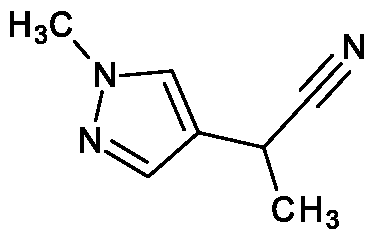
A solution of 2-(1-methyl-1 h-pyrazol-4-yl)acetonitrile (6.0 g, 47 mmol) in THF (71 mL) under argon was cooled to -78°C and treated dropwise with n-butyllithium (2.5 M in hexane, 19 mL, 47 mmol). The resulting pale brown suspension was stirred at this temperature for 10 min before adding the iodomethane (3.0 mL, 47 mmol). The reaction mixture was stirred from -78°C to rt for 1 hr. The reaction mixture was slowly quenched with water and the solution was extracted with EtOAc (X3). The combined organic layers were washed with brine, dried over anhydrous sodium sulfate, filtered, and concentrated in vacuo. Purification by combiflash chromatography using cyclohexane / AcOEt as eluent gave 2-(1-methylpyrazol-4-yl)propanenitrile as a yellow liquid.
LC-MS (Method A): 136 [M+H], retention time: 0.45 min.
Step B: Preparation of 2-(4-chlorothiazol-2-yl)-2-(1-methylpyrazol-4-yl)propanenitrile

A solution of 2-(1-methylpyrazol-4-yl)propanenitrile (0.30 g, 2.22 mmol) in THF (9 mL) under argon was cooled to -78°C and treated dropwise with n-butyllithium (2.5 M in hexane, 0.89 mL, 2.22 mmol). The resulting pale brown suspension was stirred at this temperature for 10 min before adding the 2,4-dichlorothiazole (0.34 g, 2.22 mmol). The resulting suspension was stirred at -78°C for 5 min, allowed to reach rt, and stirred for 30 min under argon. The reaction mixture was poured into water and extracted with EtOAc (X3). The combined organic layers were washed with brine, dried over anhydrous sodium sulfate, filtered, and concentrated in vacuo. The
crude product was purified by flash chromatography using EtOAc and cyclohexane as eluent. To give the title compound which was used as such in the next step.
LC-MS (Method A): 253 [M+H], retention time: 0.81 min. 1H NMR (400 MHz, CDCI3) 5 ppm 2.18 (s, 3 H) 3.94 (s, 3 H) 7.1 1 (s, 1 H) 7.56 (d, J=3.63 Hz, 2 H).
Step C: Preparation of 2-(4-chlorothiazol-2-yl)-2-(1-methylpyrazol-4-yl)propan-1 -amine

To a solution of 2-(4-chlorothiazol-2-yl)-2-(1-methylpyrazol-4-yl)propanenitrile (0.420 g, 1 .66 mmol) and cobalt dichloride (0.220 g, 1.66 mmol) in methanol (5.54 mL) at 0°C, sodium borohydride (0.16 g, 4.15 mmol) was added in small portions. The immediate formation of a black precipitate was observed, and the reaction mixture was stirred for 1 hr at 0°C. 1 N HCI was added until pH of 3-4 and the mixture was extracted with EtOAc (3x). The pH was then adjusted to 10 with 2 N NaOH and the mixture was extracted with EtOAc (X3). The combined organic layers were washed with brine, dried over anhydrous sodium sulfate, filtered, and concentrated in vacuo to give 2-(4-chlorothiazol-2-yl)-2-(1-methylpyrazol-4-yl)propan-1-amineas a colorless oil which was used in the next step without further purification.
LC-MS (Method A): 257 [M+H], retention time: 0.42 min.
Step _ D: _ Preparation _ of _ N-[2-(4-chlorothiazol-2-yl)-2-(1-methylpyrazol-4-yl)propyl1-5-(2,4- difluorophenyl)isoxazole-3-carboxamide (Compound X.08, Table P)
A one necked round bottom flask, equipped with a magnetic stirrer bar, was charged with 2-(4-chlorothiazol- 2-yl)-2-(1-methylpyrazol-4-yl)propan-1 -amine (0.1 g, 0.4 mmol), EtOAc (3 mL, 3 mL, 30.7 mmol), N,N- diisopropylethylamine (0.2 mL, 1.0 mmol) and 5-(2,4-difluorophenyl)isoxazole-3-carboxylic acid (0.1 g, 0.4 mmol). Then T3P (0.7 mL, 1.0 mmol) was added dropwise at rt, and the reaction mixture was stirred at this temperature for 60 min. The reaction mixture was poured into water (20 mL) and extracted with EtOAc (X3). The combined organic layers were washed with brine, dried over anhydrous sodium sulfate and concentrated in vacuo. The crude material was purified by flash chromatography using a gradient of cyclohexane and EtOAc as eluent to give N-[2-(4-chlorothiazol-2-yl)-2-(1-methylpyrazol-4-yl)propyl]-5-(2,4-difluorophenyl)isoxazole-3- carboxamide as a colorless oil.
LC-MS (Method A): 464 [M+H] retention time: 1 .05 min.
The racemic mixture was separated into its single isomers SFC chromatography (Analytical Method: SFC: Waters Acquity UPC/QDa, PDA Detector Waters Acquity UPC. Column: Daicel SFC CHIRALPAK® OZ, 3 pm, 0.3 cm x 10 cm, 40°C. Mobile phase: A: CO2 B: MeOH isocratic: 15% B in 4.8 min, ABPR: 1800 psi, Flow rate: 2.0 ml/min. Detection: 255 nm. Sample concentration: 1 mg/mL in CAN. Injection: 1 pL):
Peak 1 : 2.54 min; 50.1 % (Isomer A); Peak 2: 2.94 min; 49.9 % (Isomer B)
Preparative SFC method:
Sepiatec Prep SFC 100; Column: Daicel CHIRALPAK® OZ, 5mm, 2.0 cm x 25cm; Mobile phase: A: CO2 B: MeOH isocratic: 15% B; Backpressure: 150 bar; Flow rate: 60 ml/min; GLS pump: -; Detection: UV 255 nm; Sample concentration: 100 mg in 7 ml MeOH; Injection: 500 pl
Peak 1 (Isomer A, Compound X.07, Table P): Retention time (min) ~ 2.56; Chemical purity (area% at 255 nm)
>99; Enantiomeric excess (%) > 99.5
Peak 2 (Isomer B, Compound X.06, Table P): Retention time (min) ~ 2.96; Chemical purity (area% at 255 nm) >99; Enantiomeric excess (%) > 96.1
Example P2: Preparation of 5-(2,4-difluorophenyl)-N-r2-(1-methylpyrazol-4-yl)-2-thiazol-2-yl-propyl1isoxazole- 3-carboxamide (Compound X.09, Table P)

(Compound X.09, Table P)
Step A: Preparation of 2-(1-methylpyrazol-4-yl)-2-thiazol-2-yl-propanenitrile

A solution of 2-(1-methylpyrazol-4-yl)propanenitrile (0.30 g, 2.22 mmol, prepared as described in Example 2, step A) in THF (9 mL) under argon was cooled to -78°C, and n-butyll ith ium (2.5 M in hexane, 0.89 mL, 2.22 mmol) was added dropwise. The resulting pale brown suspension was stirred at this temperature for 10 min before adding the 2-chlorothiazole (0.27 g, 2.22 mmol). The resulting suspension was stirred at -78°C for 5 min, allowed to reach rt and stirred for 30 min under argon. The reaction mixture was poured into water and extracted with EtOAc (X3). The combined organic layers were washed once with brine, dried over anhydrous sodium sulfate, filtered, and concentrated in vacuo. The crude product was purified by flash chromatography using EtOAc and cyclohexane as eluents to yield the title compound.
LC-MS (Method A): 219 [M+H], retention time: 0.68 min.
Step B: Preparation of 2-(1-methylpyrazol-4-yl)-2-thiazol-2-yl-propan-1-amine
 To a solution of 2-(1-methylpyrazol-4-yl)-2-thiazol-2-yl-propanenitrile (0.27 g, 1 .24 mmol) and cobalt dichloride (0.16 g, 1.24 mmol) in methanol (4 mL) at 0°C, sodium borohydride (0.12 g, 3.09 mmol) was added in small portions. The immediate formation of a black precipitate was observed, and the reaction mixture was stirred for 1 hr at 0°C. LC-MS showed consumption of starting material. 1 N HCI was added until pH of 3-4 and the mixture was extracted 3 times with EtOAc to remove the impurities. The pH was then adjusted to 10 with 2 N NaOH and the mixture was extracted with EtOAc (X3). The combined organic layers were washed with brine, dried over anhydrous sodium sulfate, filtered, and concentrated in vacuo to yield 2-(1-methylpyrazol-4-yl)-2- thiazol-2-yl-propan-1 -amine as a colorless oil which was used for the next step without further purification.
LC-MS (Method A): 223 [M+H], retention time: 0.24 min.
Step C: Preparation of 5-(2,4-difluorophenyl)-N-r2-(1-methylpyrazol-4-yl)-2-thiazol-2-yl-propyl1isoxazole-3- carboxamide (Compound X.09, Table P)
Prepared analogously to the method described in Example 2, step D. This gave 5-(2,4-difluorophenyl)-N-[2- (1-methylpyrazol-4-yl)-2-thiazol-2-yl-propyl]isoxazole-3-carboxamide as a colorless oil.
LC-MS (Method A): 430 [M+H] +; retention time: 0.99 min.
Example P3: Preparation of N-r2-(4,5-dichlorothiazol-2-yl)-2-(1-methylpyrazol-4-yl)propyl1-5-(2,4- difluorophenyl)isoxazole-3-carboxamide (Compound X.10, Table P)
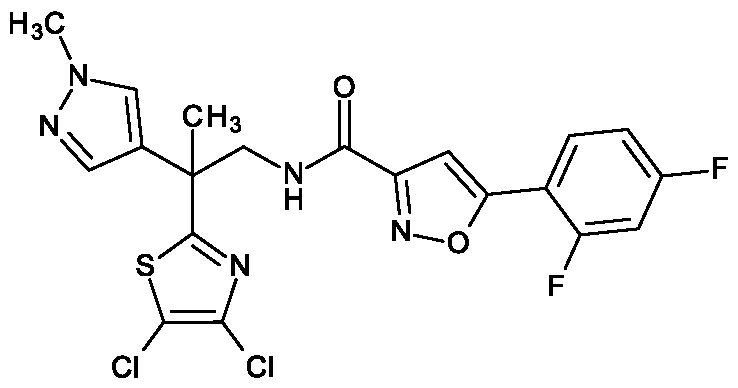
(Compound X.10, Table P)
Step A: Preparation of 2-(4,5-dichlorothiazol-2-yl)-2-(1 -methylpyrazol-4-yl)propanenitrile

2-(1-methylpyrazol-4-yl)propanenitrile (0.40 g, 2.96 mmol, prepared as describe in Example 2, step A) was dissolved in THF (1 1 .8 mL) under argon to give a pale-yellow solution. It was cooled to -78°C and then treated dropwise with n-butyllithium (2.5 M in hexane, 1.2 mL, 2.96 mmol). The resulting pale brown suspension was stirred at this temperature for 10 min before adding the 2,4,5-trichlorothiazole (0.56 g, 2.96 mmol). The resulting suspension was stirred at -78°C for 5 min, allowed to warm to rt and stirred for 30 min under argon. Then, the reaction mixture was poured into water and extracted with EtOAc (X3). The combined organic layers were washed once with brine, dried over anhydrous sodium sulfate, filtered, and concentrated in vacuo. The crude product was purified by flash chromatography using EtOAc and cyclohexane as eluent to give 2-(4,5- dichlorothiazol-2-yl)-2-(1 -methylpyrazol-4-yl)propanenitrile which was used as such in the next steps.
LC-MS (Method A): 287 [M+H], retention time: 0.95 min.
Step B: Preparation of 2-(4,5-dichlorothiazol-2-yl)-2-(1-methylpyrazol-4-yl)propan-1 -amine

Prepared analogously to the method described in Example 3, step B to yield the title compound as colorless oil which used in the next step without further purification.
LC-MS (Method A): 291 [M+H]’ retention time: 0.58 min.
Step C: Preparation of N-[2-(4,5-dichlorothiazol-2-yl)-2-(1-methylpyrazol-4-yl)propyl1-5-(2,4- difluorophenyl)isoxazole-3-carboxamide (Compound X.10, Table P)
Prepared analogously to the method described in Example 2, step D. Purification by reverse FC gave N-[2- (4,5-dichlorothiazol-2-yl)-2-(1-methylpyrazol-4-yl)propyl]-5-(2,4-difluorophenyl)isoxazole-3-carboxamide as a brownish oil.
LC-MS (Method A): 498 [M+H], retention time: 1.14 min. 1H NMR (400 MHz, CDCI3) 5 ppm 1.80 (s, 3 H) 3.92 (s, 3 H) 4.07 (d, J=6.54 Hz, 2 H) 6.96 - 7.08 (m, 2 H) 7.09 (d, J=3.63 Hz, 1 H) 7.39 (s, 1 H) 7.48 (s, 1 H) 7.53 (br t, J=6.18 Hz, 1 H) 7.95 (td, J=8.54, 6.18 Hz, 1 H).
Where necessary, enantiomerically pure final compounds may be obtained from racemic materials as appropriate via standard physical separation techniques, such as reverse phase chiral chromatography, or through stereoselective synthetic techniques, (e.g., by using chiral starting materials).
Examples of synthesized compounds of formula (I) (component A) are shown in Table P.
Table P: Synthesized compounds and Spectral and Physical Chemical Data for compounds X.01 to X.13 according to formula (I):

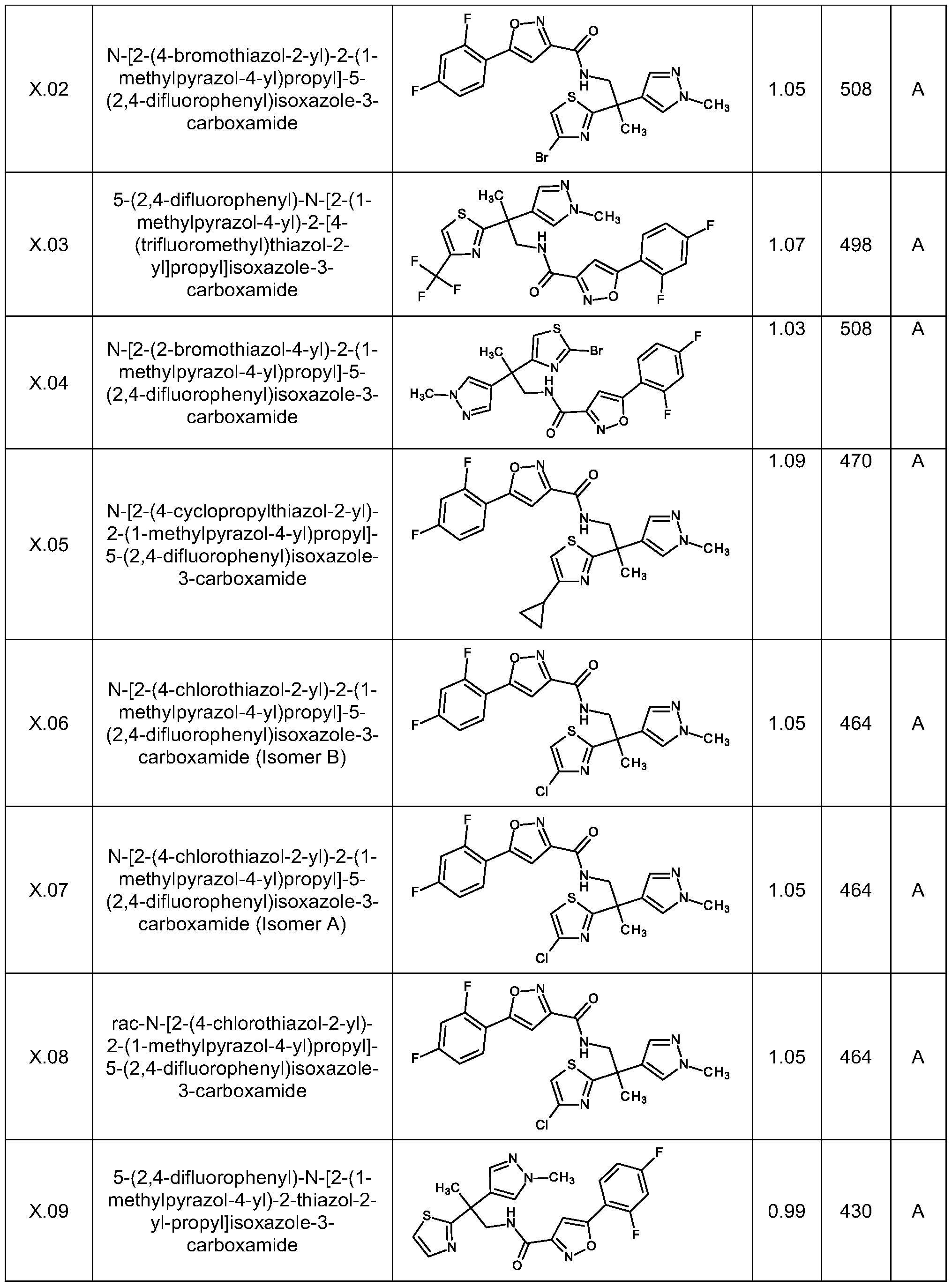

BIOLOGICAL EXAMPLES
Biological Examples for component A (Table P)
Example B1 : Altemaria solani / tomato / leaf disc (early blight) Tomato leaf disks cv. Baby are placed on agar in multiwell plates (24-well format) and sprayed with the formulated test compound diluted in water. The leaf disks are inoculated with a spore suspension of the fungus 2 days after application. The inoculated leaf disks are incubated at 23°C / 21 °C (day/night) and 80% rh under a light regime of 12/12 h (light/dark) in a climate cabinet and the activity of a compound is assessed as percent disease control compared to untreated when an appropriate level of disease damage appears on untreated check disk leaf disks (5 to 7 days after application). The following compounds gave at least 80% control of Altemaria solani at 200 ppm when compared to untreated control under the same conditions, which showed extensive disease development: X.02, X.03, X.04, X.05, X.06, X.07, X.08, and X.09
Example B2: Botryotinia fuckeliana (Botrytis cinerea) / liquid culture (Gray mould)
Conidia of the fungus from cryogenic storage are directly mixed into nutrient broth (Vogels broth). After placing a (DMSO) solution of test compound into a microtiter plate (96-well format), the nutrient broth containing the fungal spores is added. The test plates are incubated at 24°C and the inhibition of growth is determined photometrically 3 to 4 days after application. The following compounds gave at least 80% control of Botryotinia
fuckeliana at 20 ppm when compared to untreated control under the same conditions, which showed extensive disease development: X.02, X.03, X.04, X.05, X.06, X.07, X.08, and X.09
Example B3: Glomerella lagenarium (Colletotrichum laqenarium) / liquid culture (Anthracnose)
Conidia of the fungus from cryogenic storage are directly mixed into nutrient broth (PDB potato dextrose broth). After placing a (DMSO) solution of test compound into a microtiter plate (96-well format), the nutrient broth containing the fungal spores is added. The test plates are incubated at 24°C and the inhibition of growth is measured photometrically 3 to 4 days after application. The following compounds gave at least 80% control of Glomerella lagenarium at 20 ppm when compared to untreated control under the same conditions, which showed extensive disease development: X.01 , X.02, X.03, X.04, X.05, X.06, X.07, X.08, X.09, and X.10
Example B4: Blumeria qraminis f. sp. tritici (Erysiphe qraminis f. sp. tritici) / wheat / leaf disc preventative (Powdery mildew on wheat)
Wheat leaf segments cv. Kanzler are placed on agar in a multiwell plate (24-well format) and sprayed with the formulated test compound diluted in water. The leaf disks are inoculated by shaking powdery mildew infected plants above the test plates 1 day after application. The inoculated leaf disks are incubated at 20°C and 60% rh under a light regime of 24 h darkness followed by 12 h light / 12 h darkness in a climate chamber and the activity of a compound is assessed as percent disease control compared to untreated when an appropriate level of disease damage appears on untreated check leaf segments (6 to 8 days after application). The following compounds gave at least 80% control of Blumeria graminis f. sp. tritici at 200 ppm when compared to untreated control under the same conditions, which showed extensive disease development: X.03, X.04, X.06, X.07, and X.08
Example B5: Fusarium culmorum / liquid culture (Head blight)
Conidia of the fungus from cryogenic storage are directly mixed into nutrient broth (PDB potato dextrose broth). After placing a (DMSO) solution of test compound into a microtiter plate (96-well format), the nutrient broth containing the fungal spores is added. The test plates are incubated at 24°C and the inhibition of growth is determined photometrically 3 to 4 days after application. The following compounds gave at least 80% control of Fusarium culmorum at 20 ppm when compared to untreated control under the same conditions, which showed extensive disease development: X.02, X.03, X.04, X.05, X.06, X.07, and X.08
Example B6: Phaeosphaeria nodorum (Septoria nodorum) / wheat / leaf disc preventative (Glume blotch) Wheat leaf segments cv. Kanzler are placed on agar in a multiwell plate (24-well format) and sprayed with the formulated test compound diluted in water. The leaf disks are inoculated with a spore suspension of the fungus 2 days after application. The inoculated test leaf disks are incubated at 20°C and 75% rh under a light regime of 12 h light / 12 h darkness in a climate cabinet and the activity of a compound is assessed as percent disease control compared to untreated when an appropriate level of disease damage appears in untreated check leaf disks (5 to 7 days after application). The following compounds gave at least 80% control of Phaeosphaeria nodorum at 200 ppm when compared to untreated control under the same conditions, which showed extensive disease development: X.02, X.03, X.04, X.05, X.06, X.07, X.08, and X.09
Example B7: Monooraphella nivalis (Microdochium nivale) / liquid culture (foot rot cereals)
Conidia of the fungus from cryogenic storage are directly mixed into nutrient broth (PDB potato dextrose broth). After placing a (DMSO) solution of test compound into a microtiter plate (96-well format), the nutrient broth containing the fungal spores is added. The test plates are incubated at 24°C and the inhibition of growth is determined photometrically 4 to 5 days after application. The following compounds gave at least 80% control of Monographella nivalis at 20 ppm when compared to untreated control under the same conditions, which showed extensive disease development: X.01 , X.02, X.03, X.04, X.05, X.06, X.07, X.08, X.09, and X.10
Example B8: Mycosphaerella arachidis (Cercospora arachidicola) / liquid culture (early leaf spot)
Conidia of the fungus from cryogenic storage are directly mixed into nutrient broth (PDB potato dextrose broth). After placing a (DMSO) solution of test compound into a microtiter plate (96-well format), the nutrient broth containing the fungal spores is added. The test plates are incubated at 24°C and the inhibition of growth is determined photometrically 4 to 5 days after application. The following compounds gave at least 80% control of Mycosphaerella arachidis at 20 ppm when compared to untreated control under the same conditions, which showed extensive disease development: X.02, X.03, X.04, X.05, X.06, X.07, and X.08
Example B9: Pyrenophora teres / barley / leaf disc preventative (Net blotch)
Barley leaf segments cv. Hasso are placed on agar in a multiwell plate (24-well format) and sprayed with the formulated test compound diluted in water. The leaf segmens are inoculated with a spore suspension of the fungus 2 days after application. The inoculated leaf segments are incubated at 20°C and 65% rh under a light regime of 12 h light / 12 h darkness in a climate cabinet and the activity of a compound is assessed as disease control compared to untreated when an appropriate level of disease damage appears in untreated check leaf segments (5 to 7 days after application). The following compounds gave at least 80% control of Pyrenophora teres at 200 ppm when compared to untreated control under the same conditions, which showed extensive disease development: X.02, X.03, X.04, X.05, X.06, X.07, X.08, and X.09
Example B10: Sclerotinia sclerotiorum / liquid culture (cottony rot)
Mycelia fragments of a newly grown liquid culture of the fungus are directly mixed into nutrient broth (PDB potato dextrose broth). After placing a (DMSO) solution of test compound into a microtiter plate (96-well format) the nutrient broth containing the fungal material is added. The test plates are incubated at 24°C and the inhibition of growth is determined photometrically 3 to 4 days after application. The following compounds gave at least 80% control of Sclerotinia sclerotiorum at 20 ppm when compared to untreated control under the same conditions, which showed extensive disease development: X.02, X.03, X.04, and X.08
Example B11; Mycosphaerella graminicola (Septoria tritici) / liquid culture (Septoria blotch)
Conidia of the fungus from cryogenic storage are directly mixed into nutrient broth (PDB potato dextrose broth). After placing a (DMSO) solution of test compound into a microtiter plate (96-well format), the nutrient broth containing the fungal spores is added. The test plates are incubated at 24°C and the inhibition of growth is determined photometrically 4 to 5 days after application. The following compounds gave at least 80% control of Mycosphaerella graminicola at 20 ppm when compared to untreated control under the same conditions, which showed extensive disease development: X.01 , X.02, X.03, X.04, X.05, X.06, X.07, X.08, X.09, and X.10
Biological Examples for fungicidal mixtures of X.02 Difenoconazole 10:1 6:0.6 component A (Table P) and component B X.02 Difenoconazole 1:6 1:6
X.02 Difenoconazole 1.6:1 1:0.6
Example M-B1; Botrytis cinerea (grey mould)
X.02 Proth ioconazole 10:1 6:0.6
Conidia of the fungus from cryogenic storage were
X.02 Proth ioconazole 100:1 6:0.06 directly mixed into nutrient broth (Vogel’s). After X.02 Proth ioconazole 1.6:1 1:0.6 placing a (DMSO) solution of the test compounds X.02 Proth ioconazole 16.6:1 1:0.06 into a microtiter plate (96-well format) the nutrient X.02 Mefentrifluconazole 1:1 6:6 broth containing the fungal spores was added. The X.02 Mefentrifluconazole 60:1 6:0.1 test plates were incubated at 24°C and the X.02 Mefentrifluconazole 1:6 1:6 inhibition of growth was determined X.02 Mefentrifluconazole 10:1 1:0.1
X.02 Florylpicoxamid 6:1 6:1 photometrically and visually after 72 hrs.
X.02 Florylpicoxamid 60:1 6:0.1
The following mixture compositions (A:B) at the X.02 Florylpicoxamid 1:1 1:1 reported concentration (in ppm) gave at least 70% X.02 Florylpicoxamid 10:1 1:0.1 disease control in the test system. X.02 Acibenzolar-S-methyl 1:3.3 6:20
X.02 Acibenzolar-S-methyl 1:1 6:6 The term “component A” or “comp. A” refers to the X.02 Acibenzolar-S-methyl 1:20 1:20 compound of formula (I). X.02 Acibenzolar-S-methyl 1:6 1:6
_ _ Cone. X.03 Pydiflumetofen 1:1 6:6 omp. Component B ®’° A:B X.03 Pydiflumetofen 10:1 6:0.6
 [ppm] X.03 Pydiflumetofen 1:6 1:6
X.02 Pydiflumetofen 1:1 6:6 X.03 Pydiflumetofen 1.6:1 1:0.6
X.02 Pydiflumetofen 10:1 6:0.6 X.03 Benzovindiflupyr 3:1 6:2
X.02 Pydiflumetofen 1:6 1:6 X.03 Benzovindiflupyr 30:1 6:0.2
X.02 Pydiflumetofen 1.6:1 1:0.6 X.03 Benzovindiflupyr 1:2 1:2
X.02 Benzovindiflupyr 3:1 6:2 X.03 Benzovindiflupyr 5:1 1:0.2
X.02 Benzovindiflupyr 30:1 6:0.2 X.03 Cyprodinil 1:3.3 6:20
X.02 Benzovindiflupyr 1:2 1:2 X.03 Cyprodinil 60:1 6:0.1
X.02 Benzovindiflupyr 5:1 1:0.2 X.03 Cyprodinil 1:20 1:20
X.02 Cyprodinil 1:3.3 6:20 X.03 Cyprodinil 10:1 1:0.1
X.02 Cyprodinil 60:1 6:0.1 X.03 Fludioxonil 1:1 6:6
X.02 Cyprodinil 1:20 1:20 X.03 Fludioxonil 100:1 6:0.06
X.02 Cyprodinil 10:1 1:0.1 X.03 Fludioxonil 1:6 1:6
X.02 Fludioxonil 1:1 6:6 X.03 Fludioxonil 16.6:1 1:0.06
X.02 Fludioxonil 100:1 6:0.06 X.03 Azoxystrobin 1:1 6:6
X.02 Fludioxonil 1:6 1:6 X.03 Azoxystrobin 10:1 6:0.6
X.02 Fludioxonil 16.6:1 1:0.06 X.03 Azoxystrobin 1:6 1:6
X.02 Azoxystrobin 1:1 6:6 X.03 Azoxystrobin 1.6:1 1:0.6
X.02 Azoxystrobin 10:1 6:0.6 X.03 Difenoconazole 1:1 6:6
X.02 Azoxystrobin 1:6 1:6 X.03 Difenoconazole 10:1 6:0.6
X.02 Azoxystrobin 1.6:1 1:0.6 X.03 Difenoconazole 1:6 1:6
X.02 Difenoconazole 1:1 6:6 X.03 Difenoconazole 1.6:1 1:0.6
X.03 Proth ioconazole 10:1 6:0.6 X.04 Proth ioconazole 16.6:1 1:0.06
X.03 Proth ioconazole 100:1 6:0.06 X.04 Mefentrifluconazole 1:1 6:6
X.03 Proth ioconazole 1.6:1 1:0.6 X.04 Mefentrifluconazole 60:1 6:0.1
X.03 Proth ioconazole 16.6:1 1:0.06 X.04 Mefentrifluconazole 1:6 1:6
X.03 Mefentrifluconazole 1:1 6:6 X.04 Mefentrifluconazole 10:1 1:0.1
X.03 Mefentrifluconazole 60:1 6:0.1 X.04 Florylpicoxamid 6:1 6:1
X.03 Mefentrifluconazole 1:6 1:6 X.04 Florylpicoxamid 60:1 6:0.1
X.03 Mefentrifluconazole 10:1 1:0.1 X.04 Florylpicoxamid 1:1 1:1
X.03 Florylpicoxamid 6:1 6:1 X.04 Florylpicoxamid 10:1 1:0.1
X.03 Florylpicoxamid 60:1 6:0.1 X.04 Acibenzolar-S-methyl 1:3.3 6:20
X.03 Florylpicoxamid 1:1 1:1 X.04 Acibenzolar-S-methyl 1:1 6:6
X.03 Florylpicoxamid 10:1 1:0.1 X.04 Acibenzolar-S-methyl 1:20 1:20
X.03 Acibenzolar-S-methyl 1:3.3 6:20 X.04 Acibenzolar-S-methyl 1:6 1:6
X.03 Acibenzolar-S-methyl 1:1 6:6 X.05 Pydiflumetofen 1:1 6:6
X.03 Acibenzolar-S-methyl 1:20 1:20 X.05 Pydiflumetofen 10:1 6:0.6
X.03 Acibenzolar-S-methyl 1:6 1:6 X.05 Pydiflumetofen 1:6 1:6
X.04 Pydiflumetofen 1:1 6:6 X.05 Pydiflumetofen 1.6:1 1:0.6
X.04 Pydiflumetofen 10:1 6:0.6 X.05 Benzovindiflupyr 3:1 6:2
X.04 Pydiflumetofen 1:6 1:6 X.05 Benzovindiflupyr 30:1 6:0.2
X.04 Pydiflumetofen 1.6:1 1:0.6 X.05 Benzovindiflupyr 1:2 1:2
X.04 Benzovindiflupyr 3:1 6:2 X.05 Benzovindiflupyr 5:1 1:0.2
X.04 Benzovindiflupyr 30:1 6:0.2 X.05 Cyprodinil 1:3.3 6:20
X.04 Benzovindiflupyr 1:2 1:2 X.05 Cyprodinil 60:1 6:0.1
X.04 Benzovindiflupyr 5:1 1:0.2 X.05 Cyprodinil 1:20 1:20
X.04 Cyprodinil 1:3.3 6:20 X.05 Cyprodinil 10:1 1:0.1
X.04 Cyprodinil 60:1 6:0.1 X.05 Fludioxonil 1:1 6:6
X.04 Cyprodinil 1:20 1:20 X.05 Fludioxonil 100:1 6:0.06
X.04 Cyprodinil 10:1 1:0.1 X.05 Fludioxonil 1:6 1:6
X.04 Fludioxonil 1:1 6:6 X.05 Fludioxonil 16.6:1 1:0.06
X.04 Fludioxonil 100:1 6:0.06 X.05 Azoxystrobin 1:1 6:6
X.04 Fludioxonil 1:6 1:6 X.05 Azoxystrobin 10:1 6:0.6
X.04 Fludioxonil 16.6:1 1:0.06 X.05 Azoxystrobin 1:6 1:6
X.04 Azoxystrobin 1:1 6:6 X.05 Azoxystrobin 1.6:1 1:0.6
X.04 Azoxystrobin 10:1 6:0.6 X.05 Difenoconazole 1:1 6:6
X.04 Azoxystrobin 1:6 1:6 X.05 Difenoconazole 10:1 6:0.6
X.04 Azoxystrobin 1.6:1 1:0.6 X.05 Difenoconazole 1:6 1:6
X.04 Difenoconazole 1:1 6:6 X.05 Difenoconazole 1.6:1 1:0.6
X.04 Difenoconazole 10:1 6:0.6 X.05 Proth ioconazole 10:1 6:0.6
X.04 Difenoconazole 1:6 1:6 X.05 Proth ioconazole 100:1 6:0.06
X.04 Difenoconazole 1.6:1 1:0.6 X.05 Proth ioconazole 1.6:1 1:0.6
X.04 Proth ioconazole 10:1 6:0.6 X.05 Proth ioconazole 16.6:1 1:0.06
X.04 Proth ioconazole 100:1 6:0.06 X.05 Mefentrifluconazole 1:1 6:6
X.04 Proth ioconazole 1.6:1 1:0.6 X.05 Mefentrifluconazole 60:1 6:0.1
X.05 Mefentrifluconazole 1:6 1:6 X.06 Florylpicoxamid 60:1 6:0.1
X.05 Mefentrifluconazole 10:1 1:0.1 X.06 Florylpicoxamid 1:1 1:1
X.05 Florylpicoxamid 6:1 6:1 X.06 Florylpicoxamid 10:1 1:0.1
X.05 Florylpicoxamid 60:1 6:0.1 X.06 Acibenzolar-S-methyl 1:3.3 6:20
X.05 Florylpicoxamid 1:1 1:1 X.06 Acibenzolar-S-methyl 1:1 6:6
X.05 Florylpicoxamid 10:1 1:0.1 X.06 Acibenzolar-S-methyl 1:20 1:20
X.05 Acibenzolar-S-methyl 1:3.3 6:20 X.06 Acibenzolar-S-methyl 1:6 1:6
X.05 Acibenzolar-S-methyl 1:1 6:6 X.07 Pydiflumetofen 1:1 6:6
X.05 Acibenzolar-S-methyl 1:20 1:20 X.07 Pydiflumetofen 10:1 6:0.6
X.05 Acibenzolar-S-methyl 1:6 1:6 X.07 Pydiflumetofen 1:6 1:6
X.06 Pydiflumetofen 1:1 6:6 X.07 Pydiflumetofen 1.6:1 1:0.6
X.06 Pydiflumetofen 10:1 6:0.6 X.07 Benzovindiflupyr 3:1 6:2
X.06 Pydiflumetofen 1:6 1:6 X.07 Benzovindiflupyr 30:1 6:0.2
X.06 Pydiflumetofen 1.6:1 1:0.6 X.07 Benzovindiflupyr 1:2 1:2
X.06 Benzovindiflupyr 3:1 6:2 X.07 Benzovindiflupyr 5:1 1:0.2
X.06 Benzovindiflupyr 30:1 6:0.2 X.07 Cyprodinil 1:3.3 6:20
X.06 Benzovindiflupyr 1:2 1:2 X.07 Cyprodinil 60:1 6:0.1
X.06 Benzovindiflupyr 5:1 1:0.2 X.07 Cyprodinil 1:20 1:20
X.06 Cyprodinil 1:3.3 6:20 X.07 Cyprodinil 10:1 1:0.1
X.06 Cyprodinil 60:1 6:0.1 X.07 Fludioxonil 1:1 6:6
X.06 Cyprodinil 1:20 1:20 X.07 Fludioxonil 100:1 6:0.06
X.06 Cyprodinil 10:1 1:0.1 X.07 Fludioxonil 1:6 1:6
X.06 Fludioxonil 1:1 6:6 X.07 Fludioxonil 16.6:1 1:0.06
X.06 Fludioxonil 100:1 6:0.06 X.07 Azoxystrobin 1:1 6:6
X.06 Fludioxonil 1:6 1:6 X.07 Azoxystrobin 10:1 6:0.6
X.06 Fludioxonil 16.6:1 1:0.06 X.07 Azoxystrobin 1:6 1:6
X.06 Azoxystrobin 1:1 6:6 X.07 Azoxystrobin 1.6:1 1:0.6
X.06 Azoxystrobin 10:1 6:0.6 X.07 Difenoconazole 1:1 6:6
X.06 Azoxystrobin 1:6 1:6 X.07 Difenoconazole 10:1 6:0.6
X.06 Azoxystrobin 1.6:1 1:0.6 X.07 Difenoconazole 1:6 1:6
X.06 Difenoconazole 1:1 6:6 X.07 Difenoconazole 1.6:1 1:0.6
X.06 Difenoconazole 10:1 6:0.6 X.07 Proth ioconazole 10:1 6:0.6
X.06 Difenoconazole 1:6 1:6 X.07 Proth ioconazole 100:1 6:0.06
X.06 Difenoconazole 1.6:1 1:0.6 X.07 Proth ioconazole 1.6:1 1:0.6
X.06 Proth ioconazole 10:1 6:0.6 X.07 Proth ioconazole 16.6:1 1:0.06
X.06 Proth ioconazole 100:1 6:0.06 X.07 Mefentrifluconazole 1:1 6:6
X.06 Proth ioconazole 1.6:1 1:0.6 X.07 Mefentrifluconazole 60:1 6:0.1
X.06 Proth ioconazole 16.6:1 1:0.06 X.07 Mefentrifluconazole 1:6 1:6
X.06 Mefentrifluconazole 1:1 6:6 X.07 Mefentrifluconazole 10:1 1:0.1
X.06 Mefentrifluconazole 60:1 6:0.1 X.07 Florylpicoxamid 6:1 6:1
X.06 Mefentrifluconazole 1:6 1:6 X.07 Florylpicoxamid 60:1 6:0.1
X.06 Mefentrifluconazole 10:1 1:0.1 X.07 Florylpicoxamid 1:1 1:1
X.06 Florylpicoxamid 6:1 6:1 X.07 Florylpicoxamid 10:1 1:0.1
X.07 Acibenzolar-S-methyl 1 :3.3 6:20 X.08 Acibenzolar-S-methyl 1 :6 1 :6
X.07 Acibenzolar-S-methyl 1 :1 6:6 X.09 Pydiflumetofen 3.3:1 20:6
X.07 Acibenzolar-S-methyl 1 :20 1 :20 X.09 Pydiflumetofen 33.3:1 20:0.6
X.07 Acibenzolar-S-methyl 1 :6 1 :6 X.09 Pydiflumetofen 1 :3 2:6
X.08 Pydiflumetofen 1 :1 6:6 X.09 Pydiflumetofen 3.3:1 2:0.6
X.08 Pydiflumetofen 10:1 6:0.6 X.09 Benzovindiflupyr 10:1 20:2
X.08 Pydiflumetofen 1 :6 1 :6 X.09 Benzovindiflupyr 100:1 20:0.2
X.08 Pydiflumetofen 1.6:1 1 :0.6 X.09 Benzovindiflupyr 1 :1 2:2
X.08 Benzovindiflupyr 3:1 6:2 X.09 Benzovindiflupyr 10:1 2:0.2
X.08 Benzovindiflupyr 30:1 6:0.2 X.09 Cyprodinil 1 :1 20:20
X.08 Benzovindiflupyr 1 :2 1 :2 X.09 Cyprodinil 200:1 20:0.1
X.08 Benzovindiflupyr 5:1 1 :0.2 X.09 Cyprodinil 1 :10 2:20
X.08 Cyprodinil 1 :3.3 6:20 X.09 Cyprodinil 20:1 2:0.1
X.08 Cyprodinil 60:1 6:0.1 X.09 Fludioxonil 3.3:1 20:6
X.08 Cyprodinil 1 :20 1 :20 X.09 Fludioxonil 333.3:1 20:0.06
X.08 Cyprodinil 10:1 1 :0.1 X.09 Fludioxonil 1 :3 2:6
X.08 Fludioxonil 1 :1 6:6 X.09 Fludioxonil 33.3:1 2:0.06
X.08 Fludioxonil 100:1 6:0.06 X.09 Azoxystrobin 3.3:1 20:6
X.08 Fludioxonil 1 :6 1 :6 X.09 Azoxystrobin 33.3:1 20:0.6
X.08 Fludioxonil 16.6:1 1 :0.06 X.09 Azoxystrobin 1 :3 2:6
X.08 Azoxystrobin 1 :1 6:6 X.09 Azoxystrobin 3.3:1 2:0.6
X.08 Azoxystrobin 10:1 6:0.6 X.09 Difenoconazole 3.3:1 20:6
X.08 Azoxystrobin 1 :6 1 :6 X.09 Difenoconazole 33.3:1 20:0.6
X.08 Azoxystrobin 1.6:1 1 :0.6 X.09 Difenoconazole 1 :3 2:6
X.08 Difenoconazole 1 :1 6:6 X.09 Difenoconazole 3.3:1 2:0.6
X.08 Difenoconazole 10:1 6:0.6 X.09 Proth ioconazole 33.3:1 20:0.6
X.08 Difenoconazole 1 :6 1 :6 X.09 Proth ioconazole 333.3:1 20:0.06
X.08 Difenoconazole 1.6:1 1 :0.6 X.09 Mefentrifluconazole 3.3:1 20:6
X.08 Proth ioconazole 10:1 6:0.6 X.09 Mefentrifluconazole 200:1 20:0.1
X.08 Proth ioconazole 100:1 6:0.06 X.09 Mefentrifluconazole 1 :3 2:6
X.08 Proth ioconazole 1.6:1 1 :0.6 X.09 Mefentrifluconazole 20:1 2:0.1
X.08 Proth ioconazole 16.6:1 1 :0.06 X.09 Florylpicoxamid 20:1 20:1
X.08 Mefentrifluconazole 1 :1 6:6 X.09 Florylpicoxamid 200:1 20:0.1
X.08 Mefentrifluconazole 60:1 6:0.1 X.09 Florylpicoxamid 2:1 2:1
X.08 Mefentrifluconazole 1 :6 1 :6 X.09 Florylpicoxamid 20:1 2:0.1
X.08 Mefentrifluconazole 10:1 1 :0.1 X.09 Acibenzolar-S-methyl 1 :1 20:20
X.08 Florylpicoxamid 6:1 6:1 X.09 Acibenzolar-S-methyl 3.3:1 20:6
X.08 Florylpicoxamid 60:1 6:0.1 X.10 Pydiflumetofen 3.3:1 20:6
X.08 Florylpicoxamid 1 :1 1 :1 X.10 Pydiflumetofen 33.3:1 20:0.6
X.08 Florylpicoxamid 10:1 1 :0.1 X.10 Pydiflumetofen 1 :3 2:6
X.08 Acibenzolar-S-methyl 1 :3.3 6:20 X.10 Pydiflumetofen 3.3:1 2:0.6
X.08 Acibenzolar-S-methyl 1 :1 6:6 X.10 Benzovindiflupyr 10:1 20:2
X.08 Acibenzolar-S-methyl 1 :20 1 :20 X.10 Benzovindiflupyr 100:1 20:0.2
X.10 Benzovindiflupyr 1 :1 2:2 X.01 Azoxystrobin 10:1 6:0.6
X.10 Benzovindiflupyr 10:1 2:0.2 X.01 Difenoconazole 3.3:1 20:6
X.10 Cyprodinil 1 :1 20:20 X.01 Difenoconazole 1 :1 6:6
X.10 Cyprodinil 200:1 20:0.1 X.01 Mefentrifluconazole 3.3:1 20:6
X.10 Cyprodinil 1 :10 2:20 X.01 Mefentrifluconazole 200:1 20:0.1
X.10 Cyprodinil 20:1 2:0.1 X.01 Mefentrifluconazole 1 :1 6:6
X.10 Fludioxonil 3.3:1 20:6 X.01 Mefentrifluconazole 60:1 6:0.1
X.10 Fludioxonil 333.3:1 20:0.06 X.01 Florylpicoxamid 20:1 20:1
X.10 Fludioxonil 1 :3 2:6 X.01 Florylpicoxamid 6:1 6:1
X.10 Fludioxonil 33.3:1 2:0.06
X.10 Azoxystrobin 3.3:1 20:6 Example M-B2: Glomerella lagenarium syn.
X.10 Azoxystrobin 33.3:1 20:0.6
Colletotrichum laqenarium (anthracnose of
X.10 Azoxystrobin 1 :3 2:6 5 cucurbits):
X.10 Azoxystrobin 3.3:1 2:0.6
X.10 Difenoconazole 3.3:1 20:6 Conidia of the fungus, prepared from a freshly
X.10 Difenoconazole 1 :3 2:6 cultivated petri dish, were directly mixed into
X.10 Mefentrifluconazole 3.3:1 20:6 nutrient broth (PDB potato dextrose broth). After
X.10 Mefentrifluconazole 200:1 20:0.1 placing a (DMSO) solution of the test compounds
X.10 Mefentrifluconazole 1 :3 2:6 10 into a microtiter plate (96-well format) the nutrient
X.10 Mefentrifluconazole 20:1 2:0.1
X.10 Florylpicoxamid 20:1 20:1 broth containing the fungal spores was added. The
X.10 Florylpicoxamid 200:1 20:0.1 test plates were incubated at 24°C and the
X.10 Florylpicoxamid 2:1 2:1 inhibition of growth was determined
X.10 Florylpicoxamid 20:1 2:0.1 photometrically and visually after 72 hrs.
X.01 Pydiflumetofen 3.3:1 20:6
15 The following mixture compositions (A:B) at the
X.01 Pydiflumetofen 33.3:1 20:0.6
X.01 Pydiflumetofen 1 :1 6:6 reported concentration (in ppm) gave at least 70%
X.01 Pydiflumetofen 10:1 6:0.6 disease control in the test system.
X.01 Benzovindiflupyr 10:1 20:2 _ _ Cone.
X.01 Benzovindiflupyr 100:1 20:0.2 omp. Component s ® ’° A:B
X.01 Benzovindiflupyr 3:1 6:2

X.01 Benzovindiflupyr 30:1 6:0.2 X.02 Pydiflumetofen 1 :1 6:6
X.01 Cyprodinil 1 :1 20:20 X.02 Pydiflumetofen 10:1 6:0.6
X.01 Cyprodinil 200:1 20:0.1 X.02 Pydiflumetofen 1 :6 1 :6
X.01 Cyprodinil 1 :3.3 6:20 X.02 Pydiflumetofen 1.6:1 1 :0.6
X.01 Cyprodinil 60:1 6:0.1 X.02 Benzovindiflupyr 3:1 6:2
X.01 Fludioxonil 3.3:1 20:6 X.02 Benzovindiflupyr 30:1 6:0.2
X.01 Fludioxonil 333.3:1 20:0.06 X.02 Benzovindiflupyr 1 :2 1 :2
X.01 Fludioxonil 1 :1 6:6 X.02 Benzovindiflupyr 5:1 1 :0.2
X.01 Fludioxonil 100:1 6:0.06 X.02 Cyprodinil 1 :3.3 6:20
X.01 Azoxystrobin 3.3:1 20:6 X.02 Cyprodinil 60:1 6:0.1
X.01 Azoxystrobin 33.3:1 20:0.6 X.02 Cyprodinil 1 :20 1 :20
X.01 Azoxystrobin 1 :1 6:6 X.02 Cyprodinil 10:1 1 :0.1
X.02 Fludioxonil 1:1 6:6 X.03 Fludioxonil 16.6:1 1:0.06
X.02 Fludioxonil 100:1 6:0.06 X.03 Azoxystrobin 1:1 6:6
X.02 Fludioxonil 1:6 1:6 X.03 Azoxystrobin 10:1 6:0.6
X.02 Fludioxonil 16.6:1 1:0.06 X.03 Azoxystrobin 1:6 1:6
X.02 Azoxystrobin 1:1 6:6 X.03 Azoxystrobin 1.6:1 1:0.6
X.02 Azoxystrobin 10:1 6:0.6 X.03 Difenoconazole 1:1 6:6
X.02 Azoxystrobin 1:6 1:6 X.03 Difenoconazole 10:1 6:0.6
X.02 Azoxystrobin 1.6:1 1:0.6 X.03 Difenoconazole 1:6 1:6
X.02 Difenoconazole 1:1 6:6 X.03 Difenoconazole 1.6:1 1:0.6
X.02 Difenoconazole 10:1 6:0.6 X.03 Prothioconazole 10:1 6:0.6
X.02 Difenoconazole 1:6 1:6 X.03 Prothioconazole 100:1 6:0.06
X.02 Difenoconazole 1.6:1 1:0.6 X.03 Prothioconazole 1.6:1 1:0.6
X.02 Proth ioconazole 10:1 6:0.6 X.03 Prothioconazole 16.6:1 1:0.06
X.02 Proth ioconazole 100:1 6:0.06 X.03 Mefentrifluconazole 1:1 6:6
X.02 Proth ioconazole 1.6:1 1:0.6 X.03 Mefentrifluconazole 60:1 6:0.1
X.02 Proth ioconazole 16.6:1 1:0.06 X.03 Mefentrifluconazole 1:6 1:6
X.02 Mefentrifluconazole 1:1 6:6 X.03 Mefentrifluconazole 10:1 1:0.1
X.02 Mefentrifluconazole 60:1 6:0.1 X.03 Florylpicoxamid 6:1 6:1
X.02 Mefentrifluconazole 1:6 1:6 X.03 Florylpicoxamid 60:1 6:0.1
X.02 Mefentrifluconazole 10:1 1:0.1 X.03 Florylpicoxamid 1:1 1:1
X.02 Florylpicoxamid 6:1 6:1 X.03 Florylpicoxamid 10:1 1:0.1
X.02 Florylpicoxamid 60:1 6:0.1 X.03 Acibenzolar-S-methyl 1:3.3 6:20
X.02 Florylpicoxamid 1:1 1:1 X.03 Acibenzolar-S-methyl 1:1 6:6
X.02 Florylpicoxamid 10:1 1:0.1 X.03 Acibenzolar-S-methyl 1:20 1:20
X.02 Acibenzolar-S-methyl 1:3.3 6:20 X.03 Acibenzolar-S-methyl 1:6 1:6
X.02 Acibenzolar-S-methyl 1:1 6:6 X.04 Pydiflumetofen 1:1 6:6
X.02 Acibenzolar-S-methyl 1:20 1:20 X.04 Pydiflumetofen 10:1 6:0.6
X.02 Acibenzolar-S-methyl 1:6 1:6 X.04 Pydiflumetofen 1:6 1:6
X.03 Pydiflumetofen 1:1 6:6 X.04 Pydiflumetofen 1.6:1 1:0.6
X.03 Pydiflumetofen 10:1 6:0.6 X.04 Benzovindiflupyr 3:1 6:2
X.03 Pydiflumetofen 1:6 1:6 X.04 Benzovindiflupyr 30:1 6:0.2
X.03 Pydiflumetofen 1.6:1 1:0.6 X.04 Benzovindiflupyr 1:2 1:2
X.03 Benzovindiflupyr 3:1 6:2 X.04 Benzovindiflupyr 5:1 1:0.2
X.03 Benzovindiflupyr 30:1 6:0.2 X.04 Cyprodinil 1:3.3 6:20
X.03 Benzovindiflupyr 1:2 1:2 X.04 Cyprodinil 60:1 6:0.1
X.03 Benzovindiflupyr 5:1 1:0.2 X.04 Cyprodinil 1:20 1:20
X.03 Cyprodinil 1:3.3 6:20 X.04 Cyprodinil 10:1 1:0.1
X.03 Cyprodinil 60:1 6:0.1 X.04 Fludioxonil 1:1 6:6
X.03 Cyprodinil 1:20 1:20 X.04 Fludioxonil 100:1 6:0.06
X.03 Cyprodinil 10:1 1:0.1 X.04 Fludioxonil 1:6 1:6
X.03 Fludioxonil 1:1 6:6 X.04 Fludioxonil 16.6:1 1:0.06
X.03 Fludioxonil 100:1 6:0.06 X.04 Azoxystrobin 1:1 6:6
X.03 Fludioxonil 1:6 1:6 X.04 Azoxystrobin 10:1 6:0.6
X.04 Azoxystrobin 1:6 1:6 X.05 Difenoconazole 10:1 6:0.6
X.04 Azoxystrobin 1.6:1 1:0.6 X.05 Difenoconazole 1:6 1:6
X.04 Difenoconazole 1:1 6:6 X.05 Difenoconazole 1.6:1 1:0.6
X.04 Difenoconazole 10:1 6:0.6 X.05 Prothioconazole 10:1 6:0.6
X.04 Difenoconazole 1:6 1:6 X.05 Prothioconazole 100:1 6:0.06
X.04 Difenoconazole 1.6:1 1:0.6 X.05 Prothioconazole 1.6:1 1:0.6
X.04 Proth ioconazole 10:1 6:0.6 X.05 Prothioconazole 16.6:1 1:0.06
X.04 Proth ioconazole 100:1 6:0.06 X.05 Mefentrifluconazole 1:1 6:6
X.04 Proth ioconazole 1.6:1 1:0.6 X.05 Mefentrifluconazole 60:1 6:0.1
X.04 Proth ioconazole 16.6:1 1:0.06 X.05 Mefentrifluconazole 1:6 1:6
X.04 Mefentrifluconazole 1:1 6:6 X.05 Mefentrifluconazole 10:1 1:0.1
X.04 Mefentrifluconazole 60:1 6:0.1 X.05 Florylpicoxamid 6:1 6:1
X.04 Mefentrifluconazole 1:6 1:6 X.05 Florylpicoxamid 60:1 6:0.1
X.04 Mefentrifluconazole 10:1 1:0.1 X.05 Florylpicoxamid 1:1 1:1
X.04 Florylpicoxamid 6:1 6:1 X.05 Florylpicoxamid 10:1 1:0.1
X.04 Florylpicoxamid 60:1 6:0.1 X.05 Acibenzolar-S-methyl 1:3.3 6:20
X.04 Florylpicoxamid 1:1 1:1 X.05 Acibenzolar-S-methyl 1:1 6:6
X.04 Florylpicoxamid 10:1 1:0.1 X.05 Acibenzolar-S-methyl 1:20 1:20
X.04 Acibenzolar-S-methyl 1:3.3 6:20 X.05 Acibenzolar-S-methyl 1:6 1:6
X.04 Acibenzolar-S-methyl 1:1 6:6 X.06 Pydiflumetofen 1:1 6:6
X.04 Acibenzolar-S-methyl 1:20 1:20 X.06 Pydiflumetofen 10:1 6:0.6
X.04 Acibenzolar-S-methyl 1:6 1:6 X.06 Pydiflumetofen 1:6 1:6
X.05 Pydiflumetofen 1:1 6:6 X.06 Pydiflumetofen 1.6:1 1:0.6
X.05 Pydiflumetofen 10:1 6:0.6 X.06 Benzovindiflupyr 3:1 6:2
X.05 Pydiflumetofen 1:6 1:6 X.06 Benzovindiflupyr 30:1 6:0.2
X.05 Pydiflumetofen 1.6:1 1:0.6 X.06 Benzovindiflupyr 1:2 1:2
X.05 Benzovindiflupyr 3:1 6:2 X.06 Benzovindiflupyr 5:1 1:0.2
X.05 Benzovindiflupyr 30:1 6:0.2 X.06 Cyprodinil 1:3.3 6:20
X.05 Benzovindiflupyr 1:2 1:2 X.06 Cyprodinil 60:1 6:0.1
X.05 Benzovindiflupyr 5:1 1:0.2 X.06 Cyprodinil 1:20 1:20
X.05 Cyprodinil 1:3.3 6:20 X.06 Cyprodinil 10:1 1:0.1
X.05 Cyprodinil 60:1 6:0.1 X.06 Fludioxonil 1:1 6:6
X.05 Cyprodinil 1:20 1:20 X.06 Fludioxonil 100:1 6:0.06
X.05 Cyprodinil 10:1 1:0.1 X.06 Fludioxonil 1:6 1:6
X.05 Fludioxonil 1:1 6:6 X.06 Fludioxonil 16.6:1 1:0.06
X.05 Fludioxonil 100:1 6:0.06 X.06 Azoxystrobin 1:1 6:6
X.05 Fludioxonil 1:6 1:6 X.06 Azoxystrobin 10:1 6:0.6
X.05 Fludioxonil 16.6:1 1:0.06 X.06 Azoxystrobin 1:6 1:6
X.05 Azoxystrobin 1:1 6:6 X.06 Azoxystrobin 1.6:1 1:0.6
X.05 Azoxystrobin 10:1 6:0.6 X.06 Difenoconazole 1:1 6:6
X.05 Azoxystrobin 1:6 1:6 X.06 Difenoconazole 10:1 6:0.6
X.05 Azoxystrobin 1.6:1 1:0.6 X.06 Difenoconazole 1:6 1:6
X.05 Difenoconazole 1:1 6:6 X.06 Difenoconazole 1.6:1 1:0.6
X.06 Proth ioconazole 10:1 6:0.6 X.07 Acibenzolar-S-methyl 1:3.3 6:20
X.06 Proth ioconazole 100:1 6:0.06 X.07 Acibenzolar-S-methyl 1:1 6:6
X.06 Proth ioconazole 1.6:1 1:0.6 X.08 Pydiflumetofen 1:1 6:6
X.06 Proth ioconazole 16.6:1 1:0.06 X.08 Pydiflumetofen 10:1 6:0.6
X.06 Mefentrifluconazole 1:1 6:6 X.08 Pydiflumetofen 1:6 1:6
X.06 Mefentrifluconazole 60:1 6:0.1 X.08 Pydiflumetofen 1.6:1 1:0.6
X.06 Mefentrifluconazole 1:6 1:6 X.08 Benzovindiflupyr 3:1 6:2
X.06 Mefentrifluconazole 10:1 1:0.1 X.08 Benzovindiflupyr 30:1 6:0.2
X.06 Florylpicoxamid 6:1 6:1 X.08 Benzovindiflupyr 1:2 1:2
X.06 Florylpicoxamid 60:1 6:0.1 X.08 Benzovindiflupyr 5:1 1:0.2
X.06 Florylpicoxamid 1:1 1:1 X.08 Cyprodinil 1:3.3 6:20
X.06 Florylpicoxamid 10:1 1:0.1 X.08 Cyprodinil 60:1 6:0.1
X.06 Acibenzolar-S-methyl 1:3.3 6:20 X.08 Cyprodinil 1:20 1:20
X.06 Acibenzolar-S-methyl 1:1 6:6 X.08 Cyprodinil 10:1 1:0.1
X.06 Acibenzolar-S-methyl 1:20 1:20 X.08 Fludioxonil 1:1 6:6
X.06 Acibenzolar-S-methyl 1:6 1:6 X.08 Fludioxonil 100:1 6:0.06
X.07 Pydiflumetofen 1:1 6:6 X.08 Fludioxonil 1:6 1:6
X.07 Pydiflumetofen 10:1 6:0.6 X.08 Fludioxonil 16.6:1 1:0.06
X.07 Benzovindiflupyr 3:1 6:2 X.08 Azoxystrobin 1:1 6:6
X.07 Benzovindiflupyr 30:1 6:0.2 X.08 Azoxystrobin 10:1 6:0.6
X.07 Benzovindiflupyr 1:2 1:2 X.08 Azoxystrobin 1:6 1:6
X.07 Benzovindiflupyr 5:1 1:0.2 X.08 Azoxystrobin 1.6:1 1:0.6
X.07 Cyprodinil 1:3.3 6:20 X.08 Difenoconazole 1:1 6:6
X.07 Cyprodinil 60:1 6:0.1 X.08 Difenoconazole 10:1 6:0.6
X.07 Cyprodinil 1:20 1:20 X.08 Difenoconazole 1:6 1:6

X.07 Difenoconazole 1:1 6:6 X.08 Mefentrifluconazole 60:1 6:0.1
X.07 Difenoconazole 10:1 6:0.6 X.08 Mefentrifluconazole 1:6 1:6
X.07 Difenoconazole 1:6 1:6 X.08 Mefentrifluconazole 10:1 1:0.1
X.07 Proth ioconazole 10:1 6:0.6 X.08 Florylpicoxamid 6:1 6:1
X.07 Proth ioconazole 100:1 6:0.06 X.08 Florylpicoxamid 60:1 6:0.1
X.07 Mefentrifluconazole 1:1 6:6 X.08 Florylpicoxamid 1:1 1:1
X.07 Mefentrifluconazole 60:1 6:0.1 X.08 Florylpicoxamid 10:1 1:0.1
X.07 Mefentrifluconazole 1:6 1:6 X.08 Acibenzolar-S-methyl 1:3.3 6:20
X.07 Florylpicoxamid 6:1 6:1 X.08 Acibenzolar-S-methyl 1:1 6:6
X.07 Florylpicoxamid 60:1 6:0.1 X.08 Acibenzolar-S-methyl 1:20 1:20
X.07 Florylpicoxamid 1:1 1:1 X.08 Acibenzolar-S-methyl 1:6 1:6
X.07 Florylpicoxamid 10:1 1:0.1 X.09 Pydiflumetofen 3.3:1 20:6
X.09 Pydiflumetofen 33.3:1 20:0.6 X.10 Florylpicoxamid 20:1 20:1
X.09 Pydiflumetofen 3.3:1 2:0.6 X.10 Florylpicoxamid 200:1 20:0.1
X.09 Benzovindiflupyr 10:1 20:2 X.10 Florylpicoxamid 2:1 2:1
X.09 Benzovindiflupyr 100:1 20:0.2 X.10 Florylpicoxamid 20:1 2:0.1
X.09 Benzovindiflupyr 1 :1 2:2 X.01 Benzovindiflupyr 10:1 20:2
X.09 Benzovindiflupyr 10:1 2:0.2 X.01 Benzovindiflupyr 100:1 20:0.2
X.09 Cyprodinil 1 :1 20:20 X.01 Benzovindiflupyr 3:1 6:2
X.09 Cyprodinil 200:1 20:0.1 X.01 Benzovindiflupyr 30:1 6:0.2
X.09 Cyprodinil 20:1 2:0.1 X.01 Azoxystrobin 3.3:1 20:6
X.09 Fludioxonil 3.3:1 20:6 X.01 Azoxystrobin 33.3:1 20:0.6
X.09 Fludioxonil 333.3:1 20:0.06 X.01 Azoxystrobin 1 :1 6:6
X.09 Azoxystrobin 3.3:1 20:6 X.01 Azoxystrobin 10:1 6:0.6
X.09 Azoxystrobin 33.3:1 20:0.6 X.01 Difenoconazole 3.3:1 20:6
X.09 Azoxystrobin 1 :3 2:6 X.01 Difenoconazole 1 :1 6:6
X.09 Azoxystrobin 3.3:1 2:0.6 X.01 Florylpicoxamid 20:1 20:1
X.09 Difenoconazole 3.3:1 20:6 X.01 Florylpicoxamid 200:1 20:0.1
X.09 Difenoconazole 33.3:1 20:0.6 X.01 Florylpicoxamid 6:1 6:1
X.09 Difenoconazole 1 :3 2:6 X.01 Florylpicoxamid 60:1 6:0.1
X.09 Proth ioconazole 33.3:1 20:0.6
X.09 Proth ioconazole 333.3:1 20:0.06 Example M-B3: Septoria tritici (leaf blotch):
X.09 Mefentrifluconazole 3.3:1 20:6
X.09 Mefentrifluconazole 200:1 20:0.1 Conidia of the fungus from cryogenic storage were
X.09 Florylpicoxamid 20:1 20:1 directly mixed into nutrient broth (PDB potato
X.09 Florylpicoxamid 200:1 20:0.1 5 dextrose broth). After placing a (DMSO) solution of
X.09 Florylpicoxamid 2:1 2:1 the test compounds into a microtiter plate (96-well
X.09 Florylpicoxamid 20:1 2:0.1 format) the nutrient broth containing the fungal
X.09 Acibenzolar-S-methyl 1 :1 20:20 spores was added. The test plates were incubated
X.09 Acibenzolar-S-methyl 3.3:1 20:6 at 24°C and the inhibition of growth was
X.10 Pydiflumetofen 1 :3 2:6
X.10 Benzovindiflupyr 10:1 20:2 10 determined photometrically and visually after 72
X.10 Benzovindiflupyr 100:1 20:0.2 hrs.
X.10 Benzovindiflupyr 1 :1 2:2
The following mixture compositions (A:B) at the
X.10 Benzovindiflupyr 10:1 2:0.2 reported concentration (in ppm) gave at least 70%
X.10 Cyprodinil 1 :1 20:20 disease control in the test system.
X.10 Cyprodinil 1 :10 2:20
X.10 Azoxystrobin 3.3:1 20:6 Cone.
X.10 Azoxystrobin 33.3:1 20:0.6 Comp. Ratio A:B
A Component B A:B (ppm]
X.10 Azoxystrobin 1 :3 2:6
X.02 Pydiflumetofen 1 :1 6:6
X.10 Azoxystrobin 3.3:1 2:0.6
X.02 Pydiflumetofen 10:1 6:0.6
X.10 Difenoconazole 3.3:1 20:6
X.02 Pydiflumetofen 1 :6 1 :6
X.10 Difenoconazole 1 :3 2:6
X.02 Pydiflumetofen 1.6:1 1 :0.6
X.10 Mefentrifluconazole 3.3:1 20:6
X.02 Benzovindiflupyr 3:1 6:2
X.10 Mefentrifluconazole 1 :3 2:6
X.02 Benzovindiflupyr 30:1 6:0.2 X.03 Cyprodinil 1:3.3 6:20
X.02 Benzovindiflupyr 1:2 1:2 X.03 Cyprodinil 60:1 6:0.1
X.02 Benzovindiflupyr 5:1 1:0.2 X.03 Cyprodinil 1:20 1:20
X.02 Cyprodinil 1:3.3 6:20 X.03 Cyprodinil 10:1 1:0.1
X.02 Cyprodinil 60:1 6:0.1 X.03 Fludioxonil 1:1 6:6
X.02 Cyprodinil 1:20 1:20 X.03 Fludioxonil 100:1 6:0.06
X.02 Cyprodinil 10:1 1:0.1 X.03 Fludioxonil 1:6 1:6
X.02 Fludioxonil 1:1 6:6 X.03 Fludioxonil 16.6:1 1:0.06
X.02 Fludioxonil 100:1 6:0.06 X.03 Azoxystrobin 1:1 6:6
X.02 Fludioxonil 1:6 1:6 X.03 Azoxystrobin 10:1 6:0.6
X.02 Fludioxonil 16.6:1 1:0.06 X.03 Azoxystrobin 1:6 1:6
X.02 Azoxystrobin 1:1 6:6 X.03 Azoxystrobin 1.6:1 1:0.6
X.02 Azoxystrobin 10:1 6:0.6 X.03 Difenoconazole 1:1 6:6
X.02 Azoxystrobin 1:6 1:6 X.03 Difenoconazole 10:1 6:0.6
X.02 Azoxystrobin 1.6:1 1:0.6 X.03 Difenoconazole 1:6 1:6
X.02 Difenoconazole 1:1 6:6 X.03 Difenoconazole 1.6:1 1:0.6
X.02 Difenoconazole 10:1 6:0.6 X.03 Proth ioconazole 10:1 6:0.6
X.02 Difenoconazole 1:6 1:6 X.03 Proth ioconazole 100:1 6:0.06
X.02 Difenoconazole 1.6:1 1:0.6 X.03 Proth ioconazole 1.6:1 1:0.6
X.02 Proth ioconazole 10:1 6:0.6 X.03 Proth ioconazole 16.6:1 1:0.06
X.02 Proth ioconazole 100:1 6:0.06 X.03 Mefentrifluconazole 1:1 6:6
X.02 Proth ioconazole 1.6:1 1:0.6 X.03 Mefentrifluconazole 60:1 6:0.1
X.02 Proth ioconazole 16.6:1 1:0.06 X.03 Mefentrifluconazole 1:6 1:6
X.02 Mefentrifluconazole 1:1 6:6 X.03 Mefentrifluconazole 10:1 1:0.1
X.02 Mefentrifluconazole 60:1 6:0.1 X.03 Florylpicoxamid 6:1 6:1
X.02 Mefentrifluconazole 1:6 1:6 X.03 Florylpicoxamid 60:1 6:0.1
X.02 Mefentrifluconazole 10:1 1:0.1 X.03 Florylpicoxamid 1:1 1:1
X.02 Florylpicoxamid 6:1 6:1 X.03 Florylpicoxamid 10:1 1:0.1
X.02 Florylpicoxamid 60:1 6:0.1 X.03 Acibenzolar-S-methyl 1:3.3 6:20
X.02 Florylpicoxamid 1:1 1:1 X.03 Acibenzolar-S-methyl 1:1 6:6
X.02 Florylpicoxamid 10:1 1:0.1 X.03 Acibenzolar-S-methyl 1:20 1:20
X.02 Acibenzolar-S-methyl 1:3.3 6:20 X.03 Acibenzolar-S-methyl 1:6 1:6
X.02 Acibenzolar-S-methyl 1:1 6:6 X.04 Pydiflumetofen 1:1 6:6
X.02 Acibenzolar-S-methyl 1:20 1:20 X.04 Pydiflumetofen 10:1 6:0.6
X.02 Acibenzolar-S-methyl 1:6 1:6 X.04 Pydiflumetofen 1:6 1:6
X.03 Pydiflumetofen 1:1 6:6 X.04 Pydiflumetofen 1.6:1 1:0.6
X.03 Pydiflumetofen 10:1 6:0.6 X.04 Benzovindiflupyr 3:1 6:2
X.03 Pydiflumetofen 1:6 1:6 X.04 Benzovindiflupyr 30:1 6:0.2
X.03 Pydiflumetofen 1.6:1 1:0.6 X.04 Benzovindiflupyr 1:2 1:2
X.03 Benzovindiflupyr 3:1 6:2 X.04 Benzovindiflupyr 5:1 1:0.2
X.03 Benzovindiflupyr 30:1 6:0.2 X.04 Cyprodinil 1:3.3 6:20
X.03 Benzovindiflupyr 1:2 1:2 X.04 Cyprodinil 60:1 6:0.1
X.03 Benzovindiflupyr 5:1 1:0.2 X.04 Cyprodinil 1:20 1:20
X.04 Cyprodinil 10:1 1:0.1 X.05 Fludioxonil 1:6 1:6
X.04 Fludioxonil 1:1 6:6 X.05 Fludioxonil 16.6:1 1:0.06
X.04 Fludioxonil 100:1 6:0.06 X.05 Azoxystrobin 1:1 6:6
X.04 Fludioxonil 1:6 1:6 X.05 Azoxystrobin 10:1 6:0.6
X.04 Fludioxonil 16.6:1 1:0.06 X.05 Azoxystrobin 1:6 1:6
X.04 Azoxystrobin 1:1 6:6 X.05 Azoxystrobin 1.6:1 1:0.6
X.04 Azoxystrobin 10:1 6:0.6 X.05 Difenoconazole 1:1 6:6
X.04 Azoxystrobin 1:6 1:6 X.05 Difenoconazole 10:1 6:0.6
X.04 Azoxystrobin 1.6:1 1:0.6 X.05 Difenoconazole 1:6 1:6
X.04 Difenoconazole 1:1 6:6 X.05 Difenoconazole 1.6:1 1:0.6
X.04 Difenoconazole 10:1 6:0.6 X.05 Proth ioconazole 10:1 6:0.6
X.04 Difenoconazole 1:6 1:6 X.05 Proth ioconazole 100:1 6:0.06
X.04 Difenoconazole 1.6:1 1:0.6 X.05 Proth ioconazole 1.6:1 1:0.6
X.04 Proth ioconazole 10:1 6:0.6 X.05 Proth ioconazole 16.6:1 1:0.06
X.04 Proth ioconazole 100:1 6:0.06 X.05 Mefentrifluconazole 1:1 6:6
X.04 Proth ioconazole 1.6:1 1:0.6 X.05 Mefentrifluconazole 60:1 6:0.1
X.04 Proth ioconazole 16.6:1 1:0.06 X.05 Mefentrifluconazole 1:6 1:6
X.04 Mefentrifluconazole 1:1 6:6 X.05 Mefentrifluconazole 10:1 1:0.1
X.04 Mefentrifluconazole 60:1 6:0.1 X.05 Florylpicoxamid 6:1 6:1
X.04 Mefentrifluconazole 1:6 1:6 X.05 Florylpicoxamid 60:1 6:0.1
X.04 Mefentrifluconazole 10:1 1:0.1 X.05 Florylpicoxamid 1:1 1:1
X.04 Florylpicoxamid 6:1 6:1 X.05 Florylpicoxamid 10:1 1:0.1
X.04 Florylpicoxamid 60:1 6:0.1 X.05 Acibenzolar-S-methyl 1:3.3 6:20
X.04 Florylpicoxamid 1:1 1:1 X.05 Acibenzolar-S-methyl 1:1 6:6
X.04 Florylpicoxamid 10:1 1:0.1 X.05 Acibenzolar-S-methyl 1:20 1:20
X.04 Acibenzolar-S-methyl 1:3.3 6:20 X.05 Acibenzolar-S-methyl 1:6 1:6
X.04 Acibenzolar-S-methyl 1:1 6:6 X.06 Pydiflumetofen 1:1 6:6
X.04 Acibenzolar-S-methyl 1:20 1:20 X.06 Pydiflumetofen 10:1 6:0.6
X.04 Acibenzolar-S-methyl 1:6 1:6 X.06 Pydiflumetofen 1:6 1:6
X.05 Pydiflumetofen 1:1 6:6 X.06 Pydiflumetofen 1.6:1 1:0.6
X.05 Pydiflumetofen 10:1 6:0.6 X.06 Benzovindiflupyr 3:1 6:2
X.05 Pydiflumetofen 1:6 1:6 X.06 Benzovindiflupyr 30:1 6:0.2
X.05 Pydiflumetofen 1.6:1 1:0.6 X.06 Benzovindiflupyr 1:2 1:2
X.05 Benzovindiflupyr 3:1 6:2 X.06 Benzovindiflupyr 5:1 1:0.2
X.05 Benzovindiflupyr 30:1 6:0.2 X.06 Cyprodinil 1:3.3 6:20
X.05 Benzovindiflupyr 1:2 1:2 X.06 Cyprodinil 60:1 6:0.1
X.05 Benzovindiflupyr 5:1 1:0.2 X.06 Cyprodinil 1:20 1:20
X.05 Cyprodinil 1:3.3 6:20 X.06 Cyprodinil 10:1 1:0.1
X.05 Cyprodinil 60:1 6:0.1 X.06 Fludioxonil 1:1 6:6
X.05 Cyprodinil 1:20 1:20 X.06 Fludioxonil 100:1 6:0.06
X.05 Cyprodinil 10:1 1:0.1 X.06 Fludioxonil 1:6 1:6
X.05 Fludioxonil 1:1 6:6 X.06 Fludioxonil 16.6:1 1:0.06
X.05 Fludioxonil 100:1 6:0.06 X.06 Azoxystrobin 1:1 6:6
X.06 Azoxystrobin 10:1 6:0.6 X.07 Difenoconazole 1:1 6:6
X.06 Azoxystrobin 1:6 1:6 X.07 Difenoconazole 10:1 6:0.6
X.06 Azoxystrobin 1.6:1 1:0.6 X.07 Difenoconazole 1:6 1:6
X.06 Difenoconazole 1:1 6:6 X.07 Difenoconazole 1.6:1 1:0.6
X.06 Difenoconazole 10:1 6:0.6 X.07 Proth ioconazole 10:1 6:0.6
X.06 Difenoconazole 1:6 1:6 X.07 Proth ioconazole 100:1 6:0.06
X.06 Difenoconazole 1.6:1 1:0.6 X.07 Proth ioconazole 1.6:1 1:0.6
X.06 Proth ioconazole 10:1 6:0.6 X.07 Proth ioconazole 16.6:1 1:0.06
X.06 Proth ioconazole 100:1 6:0.06 X.07 Mefentrifluconazole 1:1 6:6
X.06 Proth ioconazole 1.6:1 1:0.6 X.07 Mefentrifluconazole 60:1 6:0.1
X.06 Proth ioconazole 16.6:1 1:0.06 X.07 Mefentrifluconazole 1:6 1:6
X.06 Mefentrifluconazole 1:1 6:6 X.07 Mefentrifluconazole 10:1 1:0.1
X.06 Mefentrifluconazole 60:1 6:0.1 X.07 Florylpicoxamid 6:1 6:1
X.06 Mefentrifluconazole 1:6 1:6 X.07 Florylpicoxamid 60:1 6:0.1
X.06 Mefentrifluconazole 10:1 1:0.1 X.07 Florylpicoxamid 1:1 1:1
X.06 Florylpicoxamid 6:1 6:1 X.07 Florylpicoxamid 10:1 1:0.1
X.06 Florylpicoxamid 60:1 6:0.1 X.07 Acibenzolar-S-methyl 1:3.3 6:20
X.06 Florylpicoxamid 1:1 1:1 X.07 Acibenzolar-S-methyl 1:1 6:6
X.06 Florylpicoxamid 10:1 1:0.1 X.07 Acibenzolar-S-methyl 1:20 1:20
X.06 Acibenzolar-S-methyl 1:3.3 6:20 X.07 Acibenzolar-S-methyl 1:6 1:6
X.06 Acibenzolar-S-methyl 1:1 6:6 X.08 Pydiflumetofen 1:1 6:6
X.06 Acibenzolar-S-methyl 1:20 1:20 X.08 Pydiflumetofen 10:1 6:0.6
X.06 Acibenzolar-S-methyl 1:6 1:6 X.08 Pydiflumetofen 1:6 1:6
X.07 Pydiflumetofen 1:1 6:6 X.08 Pydiflumetofen 1.6:1 1:0.6
X.07 Pydiflumetofen 10:1 6:0.6 X.08 Benzovindiflupyr 3:1 6:2
X.07 Pydiflumetofen 1:6 1:6 X.08 Benzovindiflupyr 30:1 6:0.2
X.07 Pydiflumetofen 1.6:1 1:0.6 X.08 Benzovindiflupyr 1:2 1:2
X.07 Benzovindiflupyr 3:1 6:2 X.08 Benzovindiflupyr 5:1 1:0.2
X.07 Benzovindiflupyr 30:1 6:0.2 X.08 Cyprodinil 1:3.3 6:20
X.07 Benzovindiflupyr 1:2 1:2 X.08 Cyprodinil 60:1 6:0.1
X.07 Benzovindiflupyr 5:1 1:0.2 X.08 Cyprodinil 1:20 1:20
X.07 Cyprodinil 1:3.3 6:20 X.08 Cyprodinil 10:1 1:0.1
X.07 Cyprodinil 60:1 6:0.1 X.08 Fludioxonil 1:1 6:6
X.07 Cyprodinil 1:20 1:20 X.08 Fludioxonil 100:1 6:0.06
X.07 Cyprodinil 10:1 1:0.1 X.08 Fludioxonil 1:6 1:6
X.07 Fludioxonil 1:1 6:6 X.08 Fludioxonil 16.6:1 1:0.06
X.07 Fludioxonil 100:1 6:0.06 X.08 Azoxystrobin 1:1 6:6
X.07 Fludioxonil 1:6 1:6 X.08 Azoxystrobin 10:1 6:0.6
X.07 Fludioxonil 16.6:1 1:0.06 X.08 Azoxystrobin 1:6 1:6
X.07 Azoxystrobin 1:1 6:6 X.08 Azoxystrobin 1.6:1 1:0.6
X.07 Azoxystrobin 10:1 6:0.6 X.08 Difenoconazole 1:1 6:6
X.07 Azoxystrobin 1:6 1:6 X.08 Difenoconazole 10:1 6:0.6
X.07 Azoxystrobin 1.6:1 1:0.6 X.08 Difenoconazole 1:6 1:6
X.08 Difenoconazole 1.6:1 1 :0.6 X.09 Proth ioconazole 3.3:1 2:0.6
X.08 Proth ioconazole 10:1 6:0.6 X.09 Proth ioconazole 33.3:1 2:0.06
X.08 Proth ioconazole 100:1 6:0.06 X.09 Mefentrifluconazole 3.3:1 20:6
X.08 Proth ioconazole 1.6:1 1 :0.6 X.09 Mefentrifluconazole 200:1 20:0.1
X.08 Proth ioconazole 16.6:1 1 :0.06 X.09 Mefentrifluconazole 1 :3 2:6
X.08 Mefentrifluconazole 1 :1 6:6 X.09 Mefentrifluconazole 20:1 2:0.1
X.08 Mefentrifluconazole 60:1 6:0.1 X.09 Florylpicoxamid 20:1 20:1
X.08 Mefentrifluconazole 1 :6 1 :6 X.09 Florylpicoxamid 200:1 20:0.1
X.08 Mefentrifluconazole 10:1 1 :0.1 X.09 Florylpicoxamid 2:1 2:1
X.08 Florylpicoxamid 6:1 6:1 X.09 Florylpicoxamid 20:1 2:0.1
X.08 Florylpicoxamid 60:1 6:0.1 X.09 Acibenzolar-S-methyl 1 :1 20:20
X.08 Florylpicoxamid 1 :1 1 :1 X.09 Acibenzolar-S-methyl 3.3:1 20:6
X.08 Florylpicoxamid 10:1 1 :0.1 X.09 Acibenzolar-S-methyl 1 :10 2:20
X.08 Acibenzolar-S-methyl 1 :3.3 6:20 X.09 Acibenzolar-S-methyl 1 :3 2:6
X.08 Acibenzolar-S-methyl 1 :1 6:6 X.10 Pydiflumetofen 3.3:1 20:6
X.08 Acibenzolar-S-methyl 1 :20 1 :20 X.10 Pydiflumetofen 33.3:1 20:0.6
X.08 Acibenzolar-S-methyl 1 :6 1 :6 X.10 Pydiflumetofen 1 :3 2:6
X.09 Pydiflumetofen 3.3:1 20:6 X.10 Pydiflumetofen 3.3:1 2:0.6
X.09 Pydiflumetofen 33.3:1 20:0.6 X.10 Benzovindiflupyr 10:1 20:2
X.09 Pydiflumetofen 1 :3 2:6 X.10 Benzovindiflupyr 100:1 20:0.2
X.09 Pydiflumetofen 3.3:1 2:0.6 X.10 Benzovindiflupyr 1 :1 2:2
X.09 Benzovindiflupyr 10:1 20:2 X.10 Benzovindiflupyr 10:1 2:0.2
X.09 Benzovindiflupyr 100:1 20:0.2 X.10 Cyprodinil 1 :1 20:20
X.09 Benzovindiflupyr 1 :1 2:2 X.10 Cyprodinil 200:1 20:0.1
X.09 Benzovindiflupyr 10:1 2:0.2 X.10 Cyprodinil 1 :10 2:20
X.09 Cyprodinil 1 :1 20:20 X.10 Cyprodinil 20:1 2:0.1
X.09 Cyprodinil 200:1 20:0.1 X.10 Fludioxonil 3.3:1 20:6
X.09 Cyprodinil 1 :10 2:20 X.10 Fludioxonil 333.3:1 20:0.06
X.09 Cyprodinil 20:1 2:0.1 X.10 Fludioxonil 1 :3 2:6
X.09 Fludioxonil 3.3:1 20:6 X.10 Fludioxonil 33.3:1 2:0.06
X.09 Fludioxonil 333.3:1 20:0.06 X.10 Azoxystrobin 3.3:1 20:6
X.09 Fludioxonil 1 :3 2:6 X.10 Azoxystrobin 33.3:1 20:0.6
X.09 Fludioxonil 33.3:1 2:0.06 X.10 Azoxystrobin 1 :3 2:6
X.09 Azoxystrobin 3.3:1 20:6 X.10 Azoxystrobin 3.3:1 2:0.6
X.09 Azoxystrobin 33.3:1 20:0.6 X.10 Difenoconazole 3.3:1 20:6
X.09 Azoxystrobin 1 :3 2:6 X.10 Difenoconazole 33.3:1 20:0.6
X.09 Azoxystrobin 3.3:1 2:0.6 X.10 Difenoconazole 1 :3 2:6
X.09 Difenoconazole 3.3:1 20:6 X.10 Difenoconazole 3.3:1 2:0.6
X.09 Difenoconazole 33.3:1 20:0.6 X.10 Proth ioconazole 33.3:1 20:0.6
X.09 Difenoconazole 1 :3 2:6 X.10 Proth ioconazole 333.3:1 20:0.06
X.09 Difenoconazole 3.3:1 2:0.6 X.10 Proth ioconazole 3.3:1 2:0.6
X.09 Proth ioconazole 33.3:1 20:0.6 X.10 Proth ioconazole 33.3:1 2:0.06
X.09 Proth ioconazole 333.3:1 20:0.06 X.10 Mefentrifluconazole 3.3:1 20:6
X.10 Mefentrifluconazole 200:1 20:0.1 X.01 Fludioxonil 3.3:1 20:6
X.10 Mefentrifluconazole 1 :3 2:6 X.01 Fludioxonil 1 :1 6:6
X.10 Mefentrifluconazole 20:1 2:0.1 X.01 Azoxystrobin 3.3:1 20:6
X.10 Florylpicoxamid 20:1 20:1 X.01 Azoxystrobin 1 :1 6:6
X.10 Florylpicoxamid 200:1 20:0.1 X.01 Difenoconazole 3.3:1 20:6
X.10 Florylpicoxamid 2:1 2:1 X.01 Difenoconazole 33.3:1 20:0.6
X.10 Florylpicoxamid 20:1 2:0.1 X.01 Difenoconazole 1 :1 6:6
X.10 Acibenzolar-S-methyl 3.3:1 20:6 X.01 Difenoconazole 10:1 6:0.6
X.10 Acibenzolar-S-methyl 1 :10 2:20 X.01 Mefentrifluconazole 3.3:1 20:6
X.10 Acibenzolar-S-methyl 1 :3 2:6 X.01 Mefentrifluconazole 200:1 20:0.1
X.01 Pydiflumetofen 3.3:1 20:6 X.01 Mefentrifluconazole 1 :1 6:6
X.01 Pydiflumetofen 33.3:1 20:0.6 X.01 Mefentrifluconazole 60:1 6:0.1
X.01 Pydiflumetofen 1 :1 6:6 X.01 Florylpicoxamid 20:1 20:1
X.01 Pydiflumetofen 10:1 6:0.6 X.01 Florylpicoxamid 200:1 20:0.1
X.01 Benzovindiflupyr 10:1 20:2 X.01 Florylpicoxamid 6:1 6:1
X.01 Benzovindiflupyr 100:1 20:0.2 X.01 Florylpicoxamid 60:1 6:0.1
X.01 Benzovindiflupyr 3:1 6:2
X.01 Benzovindiflupyr 30:1 6:0.2
X.01 Cyprodinil 1 :1 20:20
X.01 Cyprodinil 1 :3.3 6:20
Claims
1 . A fungicidal composition comprising components (A) and (B) as active ingredients, wherein component (A) is a compound of formula (I):
 wherein
R1 is selected from Ci-Cs-alkyl, or Cs-Ce-cycloalkyl;
R2 is selected from hydrogen, halogen, Ci-Cs-alkyl, Ci-Cs-haloalkyl, or Cs-Ce-cycloalkyl;
R3 is selected from hydrogen, or halogen;
R4 is selected from hydrogen, halogen, or Ci-Cs-alkyl;
R5 and R6 are independently selected from hydrogen, or Ci-Cs-alkyl;
A1, A2 and A3 are independently selected from CH, N, NH, O, or S, with the proviso that at least one of A1, A2 and A3 is selected from N, O and S, and that no more than one of A1, A2 and A3 is O or S;
Q1, Q2 and Q3 are independently selected from CR7, N, NR8, O, or S, with the proviso that at least one of Q1, Q2 and Q3 is selected from N, NR8, O and S, and that no more than one of Q1, Q2 and Q3 is NR8, O or S, wherein R7 and R8 are independently selected from hydrogen, halogen, cyano, Ci-Cs-alkyl, or Cs-Ce-cycloalkyl; and
Z1 is selected from phenyl, or 5- or 6-membered heteroaryl, wherein any of said 5- or 6-membered heteroaryl contains 1 , 2, or 3 heteroatoms individually selected from N, O and S; with the proviso that only one is selected from O or S; and wherein any of said phenyl and 5- or 6-membered heteroaryl are unsubstituted or substituted by 1 , 2 or 3 substituents independently selected from halogen, cyano, Ci-Cs-alkyl, Ci-C2-haloalkyl, or Ci-Cs-alkoxy; or an agrochemically acceptable salt, stereoisomer, enantiomer, tautomer, or N-oxide thereof, and component (B) is a compound selected from pydiflumetofen, benzovindiflupyr, bixafen, fluxapyroxad, isopyrazam, penflufen, penthiopyrad, sedaxane, boscalid, fluopyram, thifluzamide, pyraziflumid, isoflucypram, inpyrfluxam, isofetamid, fluindapyr, cyclobutrifluram, fluoxastrobin, fenamidone, mandestrobin, picoxystrobin, pyraclostrobin, famoxadone, kresoxim-methyl, trifloxystrobin, azoxystrobin, metyltetraprole, amisulbrom, cyazofamid, fenpicoxamid, florylpicoxamid, metharylpicoxamid, ametoctradin, fluazinam, fentin hydroxide, silthiofam, fenpropimorph, fenpropidin, spiroxamine, fenhexamid, imazalil, pyrisoxazole, bromuconazole, cyproconazole, difenoconazole, epoxiconazole, flutriafol, hexaconazole, ipconazole, metconazole, myclobutanil, penconazole, propiconazole, tebuconazole, tetraconazole, triticonazole, prothioconazole, fluoxytioconazole,
mefentrifluconazole, flufenoxadiazam, ipflufenoquin, quinofumelin, metalaxyl-M, cyprodinil, pyrimethanil, kasugamycin, mancozeb, copper fungicides, sulphur, zinc thiazole, captan, folpet, chlorothalonil, dithianon, quinoxyfen, proquinazid, fludioxonil, iprodione, procymidone, thiabendazole, zoxamide, metrafenone, fluopicolide, propamocarb, oxathiapiprolin, fluoxapiprolin, acibenzolar-S- methyl, isotianil, phosphorous acid, cyflufenamid, tebufloquin, picarbutrazox, tricyclazole, N-methoxy- N-[[4-[5-(trifluoromethyl)-1 ,2,4-oxadiazol-3-yl]phenyl]methyl]cyclopropanecarboxamide, N,2- dimethoxy-N-[[4-[5-(trifluoromethyl)-1 ,2,4-oxadiazol-3-yl]phenyl]methyl]propanamide, 1 -methoxy-3- methyl-1-[[4-[5-(trifluoromethyl)-1 ,2,4-oxadiazol-3-yl]phenyl]methyl]urea, 1 ,3-dimethoxy-1-[[4-[5- (trifluoromethyl)-l ,2,4-oxadiazol-3-yl]phenyl]methyl]urea, N-[( 1 R)-1 -benzyl-3-chloro-1 -methyl-but-3- enyl]-8-fluoro-quinoline-3-carboxamide, N-[(1 S)-1-benzyl-3-chloro-1-methyl-but-3-enyl]-8-fluoro- quinoline-3-carboxamide, N-[(1 R)-1-benzyl-3,3,3-trifluoro-1-methyl-propyl]-8-fluoro-quinoline-3- carboxamide, N-[(1 S)-1-benzyl-3,3,3-trifluoro-1-methyl-propyl]-8-fluoro-quinoline-3-carboxamide, N- [(1 R)-1 -benzyl-1 ,3-dimethyl-butyl]-7,8-difluoro-quinoline-3-carboxamide, N-[( 1 S)-1 -benzyl-1 ,3- dimethyl-butyl]-7,8-difluoro-quinoline-3-carboxamide, 8-fluoro-N-[(1 R)-1-[(3-fluorophenyl)methyl]-1 ,3- dimethyl-butyl]quinoline-3-carboxamide, 8-fluoro-N-[(1 S)-1-[(3-fluorophenyl)methyl]-1 ,3-dimethyl- butyl]quinoline-3-carboxamide, N-[(1 R)-1 -benzyl-1 , 3-dimethyl-butyl]-8-fluoro-quinoline-3- carboxamide, N - [( 1 S)-1 -benzyl-1 ,3-dimethyl-butyl]-8-fluoro-quinoline-3-carboxamide, N-((1 R)-1 - benzyl-3-chloro-1-methyl-but-3-enyl)-8-fluoro-quinoline-3-carboxamide, N-((1 S)-1-benzyl-3-chloro-1- methyl-but-3-enyl)-8-fluoro-quinoline-3-carboxamide, methyl (Z)-3-methoxy-2-[2-methyl-5-[4- (trifluoromethyl)triazol-2-yl]phenoxy]prop-2-enoate, methyl (Z)-3-methoxy-2-[2-methyl-5-(4- propyltriazol-2-yl)phenoxy]prop-2-enoate , methyl (Z)-2-[5-(3-isopropylpyrazol-1-yl)-2-methyl- phenoxy]-3-methoxy-prop-2-enoate, methyl i i-3-methoxy-2-[2-methyl-5-(3-propylpyrazol-1- yl)phenoxy]prop-2-enoate, methyl (Z)-3-methoxy-2-[2-methyl-5-[3-(trifluoromethyl)pyrazol-1- yl]phenoxy]prop-2-enoate, methyl (Z)-2-(5-cyclohexyl-2-methyl-phenoxy)-3-methoxy-prop-2-enoate, methyl (Z)-2-(5-cyclopentyl-2-methyl-phenoxy)-3-methoxy-prop-2-enoate, 2-[cyano-(2,6-difluoro-4- pyridyl)amino]-5-methyl-N-spiro[3.4]octan-3-yl-thiazole-4-carboxamide, 2-[cyano-(2,6-difluoro-4- pyridyl)amino]-N-(2,2-dimethylcyclobutyl)-5-methyl-thiazole-4-carboxamide, 2-[cyano-(2,6-difluoro-4- pyridyl)amino]-N-hexyl-5-methyl-thiazole-4-carboxamide, 2-[(2,6-d ifl uoro-4-pyridyl)-(2- methoxyacetyl)amino]-N-(2,2-dimethylcyclobutyl)-5-methyl-thiazole-4-carboxamide, 2-[(2,6-difluoro- 4-pyridyl)-(tetrahydropyran-4-carbonyl)amino]-N-(2,2-dimethylcyclobutyl)-5-methyl-thiazole-4- carboxamide, 2-[(2,6-difluoro-4-pyridyl)-(oxetane-3-carbonyl)amino]-N-(2,2-dimethylcyclobutyl)-5- methyl-thiazole-4-carboxamide, 2-[(2,6-difluoro-4-pyridyl)-(tetrahydrofuran-3-carbonyl)amino]-N-(2,2- dimethylcyclobutyl)-5-methyl-thiazole-4-carboxamide, 2-[acetyl-(2,6-difluoro-4-pyridyl)amino]-N-(2,2- dimethylcyclobutyl)-5-methyl-thiazole-4-carboxamide, 2-[(2,6-difluoro-4-pyridyl)-(2- methylpropanoyl)amino]-N-(2,2-dimethylcyclobutyl)-5-methyl-thiazole-4-carboxamide, TAEGRO® (Bacillus amyloliquefaciens strain FZB24), melaluca alternifolia oil (an extract of the tea tree plant Melaluca alternifolia (commercially available as Timorex Gold®, which is a broad-spectrum botanical biofungicide)), Reynoutria sachalinensis extract (commercially available as REGALIA®), a plant
extract based on the extract of Quillaja saponaria Molina (commercially available as BOTRISTOP®), or Aureobasidin A.
2. The fungicidal composition according to claim 1 , wherein component (A) is a compound of formula (I-
A):
 wherein R1 is selected from Ci-Cs-alkyl, or Cs-Ce-cycloalkyl; R2 is selected from hydrogen, halogen, Ci-Cs-alkyl, Ci-Cs-haloalkyl, or Cs-Ce-cycloalkyl; R3 is selected from hydrogen, or halogen; R4 is selected from hydrogen, halogen, or Ci-Cs-alkyl; R5 and R6 are independently selected from hydrogen, or Ci-Cs-alkyl; A is selected from A1 , A2, A3, A4, A9, or A10

A1 , A2, A3, A4, A9, or A10 wherein the staggered line denotes the bond to the C(=O) group, and the arrow denotes the bond to the Z1 group;
Q is selected from Q-1 , Q-2, Q-5, Q-6, Q-7, or Q-8
 wherein the staggered line denotes the bond to the rest of the molecule, and wherein R7a, R7b and R7c are independently selected from hydrogen, chlorine, cyano, methyl, or cyclopropyl; and wherein R8 is hydrogen or methyl; and Z1 is selected from phenyl, or 5- or 6-membered heteroaryl, wherein any of said 5- or 6-membered heteroaryl contains 1 , 2, or 3 heteroatoms individually selected from N, O and S; with the proviso that only one is selected from O or S; and wherein any of said phenyl and 5- or 6- membered heteroaryl are unsubstituted or substituted by 1 , 2 or 3 substituents independently selected from halogen, cyano, Ci-Cs-alkyl, Ci-C2-haloalkyl, or Ci-Cs-alkoxy.
3. The fungicidal composition according to claim 1 or claim 2, wherein component (A) is a compound of formula (l-A):
 wherein R1 is methyl, ethyl, or cyclopropyl; R2 is hydrogen, methyl, or cyclopropyl; R3 is hydrogen;
R4 is hydrogen or methyl; R5 and R6 are hydrogen; A is A1 , A2, A3, A4, A9, or A10

A1, A2, A3, A4, A9, or A10 wherein the staggered line denotes the bond to the C(=O) group, and the arrow denotes the bond to the Z1 group;
Q is Q-1 , Q-2, Q-5, Q-6, Q-7, or Q-8
 wherein the staggered line denotes the bond to the rest of the molecule, and wherein R7a, R7b and R7c are independently selected from hydrogen, chlorine, cyano, methyl, or cyclopropyl; and wherein R8 is hydrogen or methyl; and Z1 is phenyl, or 6-membered heteroaryl, wherein any of said 6-membered heteroaryl contains one heteroatom selected from N, and wherein any of said phenyl and 6-membered heteroaryl are unsubstituted or substituted by 1 , 2 or 3 substituents independently selected from halogen, Ci-Cs-alkyl, Ci-C2-alkoxy, or Ci-C2-haloalkyl.
4. The fungicidal composition according to any one of claims 1 to 3, wherein component (A) is selected from N-[2-(5-bromothiazol-2-yl)-2-(1-methylpyrazol-4-yl)propyl]-5-(2,4-difluorophenyl)isoxazole-3- carboxamide (X.01); N-[2-(4-bromothiazol-2-yl)-2-(1-methylpyrazol-4-yl)propyl]-5-(2,4- difluorophenyl)isoxazole-3-carboxamide (X.02); 5-(2,4-difluorophenyl)-N-[2-(1-methylpyrazol-4-yl)-2- [4-(trifluoromethyl)thiazol-2-yl]propyl]isoxazole-3-carboxamide (X.03); N-[2-(2-bromothiazol-4-yl)-2- (1-methylpyrazol-4-yl)propyl]-5-(2,4-difluorophenyl)isoxazole-3-carboxamide (X.04); N-[2-(4- cyclopropylthiazol-2-yl)-2-(1-methylpyrazol-4-yl)propyl]-5-(2,4-difluorophenyl)isoxazole-3- carboxamide (X.05); N-[2-(4-chlorothiazol-2-yl)-2-(1 -methylpyrazol-4-yl)propyl]-5-(2,4- difluorophenyl)isoxazole-3-carboxamide (Isomer B) (X.06); N-[2-(4-chlorothiazol-2-yl)-2-(1- methylpyrazol-4-yl)propyl]-5-(2,4-difluorophenyl)isoxazole-3-carboxamide (Isomer A) (X.07); rac-N-[2- (4-chlorothiazol-2-yl)-2-(1-methylpyrazol-4-yl)propyl]-5-(2,4-difluorophenyl)isoxazole-3-carboxamide (X.08); 5-(2,4-difluorophenyl)-N-[2-(1-methylpyrazol-4-yl)-2-thiazol-2-yl-propyl]isoxazole-3-
carboxamide (X.09); N-[2-(4,5-dichlorothiazol-2-yl)-2-(1-methylpyrazol-4-yl)propyl]-5-(2,4- difluorophenyl)isoxazole-3-carboxamide (X.10); N-[2-(4-cyclopropylthiazol-2-yl)-2-(1-methylpyrazol-4- yl)propyl]-5-(3,5-difluoro-2-pyridyl)-1 ,3,4-thiadiazole-2-carboxamide (X.11 ); N-[2-(4- cyclopropylthiazol-2-yl)-2-(1-methylpyrazol-4-yl)propyl]-5-(3,5-difluoro-2-pyridyl)isoxazole-3- carboxamide (X.12), or N-[2-(4-cyclopropylthiazol-2-yl)-2-(1-methylpyrazol-4-yl)propyl]-5-(2,6-difluoro- 3-pyridyl)-1 ,3,4-thiadiazole-2-carboxamide (X.13).
5. The fungicidal composition according to any one of claims 1 to 4, wherein component (B) is a compound selected from pydiflumetofen, benzovindiflupyr, bixafen, fluxapyroxad, isopyrazam, penthiopyrad, sedaxane, boscalid, fluopyram, thifluzamide, pyraziflumid, isoflucypram, inpyrfluxam, fluindapyr, cyclobutrifluram, pyraclostrobin, trifloxystrobin, azoxystrobin, metyltetraprole, fenpicoxamid, florylpicoxamid, metharylpicoxamid, fluazinam, fenpropidin, fenhexamid, cyproconazole, difenoconazole, metconazole, penconazole, propiconazole, tebuconazole, tetraconazole, prothioconazole, mefentrifluconazole, flufenoxadiazam, ipflufenoquin, quinofumelin, metalaxyl-M, cyprodinil, pyrimethanil, mancozeb, copper-compounds (different salts), sulphur, folpet, chlorothalonil, dithianon, proquinazid, fludioxonil, metrafenone, oxathiapiprolin, fluoxapiprolin, acibenzolar-S-methyl, phosphorous acid, cyflufenamid, tricyclazole, N-methoxy-N-[[4-[5- (trifluoromethyl)-1 ,2,4-oxadiazol-3-yl]phenyl]methyl]cyclopropanecarboxamide, N,2-dimethoxy-N-[[4- [5-(trifluoromethyl)-1 ,2,4-oxadiazol-3-yl]phenyl]methyl]propanamide, 1 -methoxy-3-methyl-1 -[[4- [5- (trifluoromethyl)-1 ,2,4-oxadiazol-3-yl]phenyl]methyl]urea, 1 ,3-dimethoxy-1-[[4-[5-(trifluoromethyl)- 1 ,2,4-oxadiazol-3-yl]phenyl]methyl]urea, N-[(1 R)-1-benzyl-3-chloro-1-methyl-but-3-enyl]-8-fluoro- quinoline-3-carboxamide, N-[(1 S)-1-benzyl-3-chloro-1-methyl-but-3-enyl]-8-fluoro-quinoline-3- carboxamide, N-[(1 R)-1-benzyl-3,3,3-trifluoro-1-methyl-propyl]-8-fluoro-quinoline-3-carboxamide, N- [(1 S)-1-benzyl-3,3,3-trifluoro-1-methyl-propyl]-8-fluoro-quinoline-3-carboxamide, N-[(1 R)-1-benzyl- 1 ,3-dimethyl-butyl]-7,8-difluoro-quinoline-3-carboxamide, N-[( 1 S)-1 -benzyl-1 ,3-dimethyl-butyl]-7,8- difluoro-quinoline-3-carboxamide, 8-fluoro-N-[(1 R)-1-[(3-fluorophenyl)methyl]-1 ,3-dimethyl- butyl]quinoline-3-carboxamide, 8-fluoro-N-[(1 S)-1 -[(3-fluorophenyl)methyl]-1 ,3-dimethyl- butyl]quinoline-3-carboxamide, N-[(1 R)-1 -benzyl-1 , 3-dimethyl-butyl]-8-fluoro-quinoline-3- carboxamide, N-[(1 S)-1 -benzyl-1 , 3-dimethyl-butyl]-8-fluoro-quinoline-3-carboxamide, N-((1 R)-1- benzyl-3-chloro-1-methyl-but-3-enyl)-8-fluoro-quinoline-3-carboxamide, N-((1 S)-1-benzyl-3-chloro-1- methyl-but-3-enyl)-8-fluoro-quinoline-3-carboxamide, methyl (Z)-3-methoxy-2-[2-methyl-5-[4- (trifluoromethyl)triazol-2-yl]phenoxy]prop-2-enoate, methyl (Z)-3-methoxy-2-[2-methyl-5-(4- propyltriazol-2-yl)phenoxy]prop-2-enoate, , methylI (Z)-2-[5-(3-isopropylpyrazol-1 -yl)-2-methyl- phenoxy]-3-methoxy-prop-2-enoate, m i ethyl i (Z)-3-methoxy-2-[2-methyl-5-(3-propylpyrazol-1- yl)phenoxy]prop-2-enoate, methyl (Z)-3-methoxy-2-[2-methyl-5-[3-(trifluoromethyl)pyrazol-1- yl]phenoxy]prop-2-enoate, methyl (Z)-2-(5-cyclohexyl-2-methyl-phenoxy)-3-methoxy-prop-2-enoate, methyl (Z)-2-(5-cyclopentyl-2-methyl-phenoxy)-3-methoxy-prop-2-enoate (these compounds may be prepared from the methods described in W02020/193387), 2-[cyano-(2,6-difluoro-4-pyridyl)amino]-5-
methyl-N-spiro[3.4]octan-3-yl-thiazole-4-carboxamide, 2-[cyano-(2,6-difluoro-4-pyridyl)amino]-N-(2,2- dimethylcyclobutyl)-5-methyl-thiazole-4-carboxamide, 2-[cyano-(2,6-difluoro-4-pyridyl)amino]-N- hexyl-5-methyl-thiazole-4-carboxamide, 2-[(2,6-difluoro-4-pyridyl)-(2-methoxyacetyl)amino]-N-(2,2- dimethylcyclobutyl)-5-methyl-thiazole-4-carboxamide, 2-[(2,6-difluoro-4-pyridyl)-(tetrahydropyran-4- carbonyl)amino]-N-(2,2-dimethylcyclobutyl)-5-methyl-thiazole-4-carboxamide, 2-[(2,6-difluoro-4- pyridyl)-(oxetane-3-carbonyl)amino]-N-(2,2-dimethylcyclobutyl)-5-methyl-thiazole-4-carboxamide, 2- [(2,6-difluoro-4-pyridyl)-(tetrahydrofuran-3-carbonyl)amino]-N-(2,2-dimethylcyclobutyl)-5-rnethyl- thiazole-4-carboxamide, 2-[acetyl-(2,6-difluoro-4-pyridyl)amino]-N-(2,2-dimethylcyclobutyl)-5-methyl- thiazole-4-carboxamide, 2-[(2,6-difluoro-4-pyridyl)-(2-methylpropanoyl)amino]-N-(2,2- dimethylcyclobutyl)-5-methyl-thiazole-4-carboxamide, TAEGRO® (i.e, Bacillus amyloliquefaciens strain FZB24), melaluca alternifolia oil (an extract of the tea tree plant Melaluca alternifolia (commercially available as Timorex Gold®, which is a broad-spectrum botanical biofungicide)), Reynoutria sachalinensis extract (commercially available as REGALIA®), a plant extract based on the extract of Quillaja saponaria Molina (commercially available as BOTRISTOP®), or Aureobasidin A.
6. The fungicidal composition according to any one of claims 1 to 5, wherein component (B) is a compound selected from pydiflumetofen, benzovindiflupyr, azoxystrobin, florylpicoxamid, difenoconazole, prothioconazole, mefentrifluconazole, cyprodinil, fludioxonil, acibenzolar-S-methyl, N- [(1 R)-1-benzyl-1 ,3-dimethyl-butyl]-8-fluoro-quinoline-3-carboxamide, N-[(1 S)-1-benzyl-1 ,3-dimethyl- butyl]-8-fluoro-quinoline-3-carboxamide, 2-[cyano-(2,6-difluoro-4-pyridyl)amino]-5-methyl-N- spiro[3.4]octan-3-yl-thiazole-4-carboxamide, 2-[cyano-(2,6-difluoro-4-pyridyl)amino]-N-(2,2- dimethylcyclobutyl)-5-methyl-thiazole-4-carboxamide, 2-[(2,6-difluoro-4-pyridyl)-(tetrahydropyran-4- carbonyl)amino]-N-(2,2-dimethylcyclobutyl)-5-methyl-thiazole-4-carboxamide, 2-[acetyl-(2,6-difluoro- 4-pyridyl)amino]-N-(2,2-dimethylcyclobutyl)-5-methyl-thiazole-4-carboxamide, TAEGRO® (i.e, Bacillus amyloliquefaciens strain FZB24), melaluca alternifolia oil (an extract of the tea tree plant Melaluca alternifolia (commercially available as Timorex Gold®, which is a broad-spectrum botanical biofungicide)), Reynoutria sachalinensis extract (commercially available as REGALIA®), a plant extract based on the extract of Quillaja saponaria Molina (commercially available as BOTRISTOP®), or Aureobasidin A.
7. The fungicidal composition according to any one of claims 1 to 6, wherein component (B) is a compound selected from pydiflumetofen, benzovindiflupyr, azoxystrobin, florylpicoxamid, difenoconazole, prothioconazole, mefentrifluconazole, cyprodinil, fludioxonil, or acibenzolar-S-methyl.
8. The fungicidal composition according to any one of claims 1 to 7, wherein the weight ratio of component (A) to component (B) is from 20:1 to 1 :40.
9. The fungicidal composition according to any one of claims 1 to 8, wherein the weight ratio of component (A) to component (B) is from 12:1 to 1 :25.
10. The fungicidal composition according to any one of claims 1 to 9, wherein the weight ratio of component (A) to component (B) is from 5:1 to 1 :15.
11. The fungicidal composition according to any one of claims 1 to 10, wherein the weight ratio of component (A) to component (B) is from 2:1 to 1 :5.
12. The fungicidal composition according to any of claims 1 to 11 , wherein the composition comprises one or more further pesticides selected from the group consisting of pydiflumetofen, benzovindiflupyr, bixafen, fluxapyroxad, isopyrazam, penflufen, penthiopyrad, sedaxane, boscalid, fluopyram, thifluzamide, pyraziflumid, isoflucypram, inpyrfluxam, isofetamid, fluindapyr, cyclobutrifluram, fluoxastrobin, fenamidone, mandestrobin, picoxystrobin, pyraclostrobin, famoxadone, kresoxim-methyl, trifloxystrobin, azoxystrobin, metyltetraprole, amisulbrom, cyazofamid, fenpicoxamid, florylpicoxamid, metarylpicoxamid, ametoctradin, fluazinam, fentin hydroxide, silthiofam, fenpropimorph, fenpropidin, spiroxamine, fenhexamid, imazalil, pyrisoxazole, bromuconazole, cyproconazole, difenoconazole, epoxiconazole, flutriafol, hexaconazole, ipconazole, metconazole, myclobutanil, penconazole, propiconazole, tebuconazole, tetraconazole, triticonazole, prothioconazole, fluoxytioconazole, mefentrifluconazole, flufenoxadiazam, ipflufenoquin, quinofumelin, metalaxyl-M, cyprodinil, pyrimethanil, kasugamycin, mancozeb, copper fungicides, sulphur, zinc thiazole, captan, folpet, chlorothalonil, dithianon, quinoxyfen, proquinazid, fludioxonil, iprodione, procymidone, thiabendazole, zoxamide, metrafenone, fluopicolide, propamocarb, oxathiapiprolin, fluoxapiprolin, acibenzolar-S-methyl, isotianil, phosphorous acid, cyflufenamid, tebufloquin, picarbutrazox, tricyclazole, N-methoxy-N-[[4-[5-(trifluoromethyl)-1 ,2,4-oxadiazol-3- yl]phenyl]methyl]cyclopropane-carboxamide, N,2-dimethoxy-N-[[4-[5-(trifluoromethyl)-1 ,2,4- oxadiazol-3-yl]phenyl]methyl]propanamide, N-[(1 R)-1-benzyl-1 ,3-dimethyl-butyl]-8-fluoro-quinoline-3- carboxamide, N-[(1S)-1-benzyl-1 ,3-dimethyl-butyl]-8-fluoro-quinoline-3-carboxamide, methyl (Z)-2-(5- cyclohexyl-2-methyl-phenoxy)-3-methoxy-prop-2-enoate, (this compound may be prepared from the methods described in W02020/193387), 2-[cyano-(2,6-difluoro-4-pyridyl)amino]-5-methyl-N- spiro[3.4]octan-3-yl-thiazole-4-carboxamide, 2-[cyano-(2,6-difluoro-4-pyridyl)amino]-N-(2,2- dimethylcyclobutyl)-5-methyl-thiazole-4-carboxamide, 2-[(2,6-difluoro-4-pyridyl)-(2- methoxyacetyl)amino]-N-(2,2-dimethylcyclobutyl)-5-methyl-thiazole-4-carboxamide, 2-[(2,6-difluoro- 4-pyridyl)-(tetrahydropyran-4-carbonyl)amino]-N-(2,2-dimethylcyclobutyl)-5-methyl-thiazole-4- carboxamide, 2-[(2,6-difluoro-4-pyridyl)-(oxetane-3-carbonyl)amino]-N-(2,2-dimethylcyclobutyl)-5-
methyl-thiazole-4-carboxamide, 2-[(2,6-difluoro-4-pyridyl)-(tetrahydrofuran-3-carbonyl)amino]-N-(2,2- dimethylcyclobutyl)-5-methyl-thiazole-4-carboxamide, 2-[acetyl-(2,6-difluoro-4-pyridyl)amino]-N-(2,2- dimethylcyclobutyl)-5-methyl-thiazole-4-carboxamide, 2-[(2,6-difluoro-4-pyridyl)-(2- methylpropanoyl)amino]-N-(2,2-dimethylcyclobutyl)-5-methyl-thiazole-4-carboxamide, TAEGRO® (i.e, Bacillus amyloliquefaciens strain FZB24), melaluca alternifolia oil (an extract of the tea tree plant Melaluca alternifolia (commercially available as Timorex Gold®, which is a broad-spectrum botanical biofungicide)), Reynoutria sachalinensis extract (commercially available as REGALIA®), a plant extract based on the extract of Quillaja saponaria Molina (commercially available as BOTRISTOP®), or Aureobasidin A.
13. The fungicidal composition according to any one of claims 1 to 12, wherein said composition further comprises an agriculturally acceptable carrier and, optionally, a surfactant and/or formulation adjuvants.
14. A method of controlling or preventing phytopathogenic diseases, especially phytopathogenic fungi, on useful plants or on propagation material thereof, which comprises applying to the useful plants, the locus thereof or propagation material thereof the fungicidal composition comprising component (A) and component (B) as defined in any one of claims 1 to 12.
15. The method according to claim 14, wherein the components (A) and (B) are applied in a sequential manner.
Applications Claiming Priority (2)
| Application Number | Priority Date | Filing Date | Title |
|---|---|---|---|
| EP23179126 | 2023-06-14 | ||
| EP23179126.0 | 2023-06-14 |
Publications (1)
| Publication Number | Publication Date |
|---|---|
| WO2024256438A1 true WO2024256438A1 (en) | 2024-12-19 |
Family
ID=86776253
Family Applications (1)
| Application Number | Title | Priority Date | Filing Date |
|---|---|---|---|
| PCT/EP2024/066173 Ceased WO2024256438A1 (en) | 2023-06-14 | 2024-06-12 | Fungicidal compositions |
Country Status (3)
| Country | Link |
|---|---|
| AR (1) | AR132937A1 (en) |
| PY (1) | PY2447478A (en) |
| WO (1) | WO2024256438A1 (en) |
Cited By (1)
| Publication number | Priority date | Publication date | Assignee | Title |
|---|---|---|---|---|
| WO2025146625A1 (en) * | 2024-01-03 | 2025-07-10 | Pi Industries Ltd. | Pyrazole compounds for combating phytopathogenic fungi |
Citations (54)
| Publication number | Priority date | Publication date | Assignee | Title |
|---|---|---|---|---|
| EP0367474A1 (en) | 1988-11-01 | 1990-05-09 | Mycogen Corporation | Novel bacillus thuringiensis isolate denoted b.t. ps81gg, active against lepidopteran pests, and a gene encoding a lepidopteran-active toxin |
| EP0374753A2 (en) | 1988-12-19 | 1990-06-27 | American Cyanamid Company | Insecticidal toxines, genes coding therefor, antibodies binding them, transgenic plant cells and plants expressing these toxines |
| WO1990013651A1 (en) | 1989-05-09 | 1990-11-15 | Imperial Chemical Industries Plc | Bacterial genes |
| EP0401979A2 (en) | 1989-05-18 | 1990-12-12 | Mycogen Corporation | Novel bacillus thuringiensis isolates active against lepidopteran pests, and genes encoding novel lepidopteran-active toxins |
| EP0427529A1 (en) | 1989-11-07 | 1991-05-15 | Pioneer Hi-Bred International, Inc. | Larvicidal lectins and plant insect resistance based thereon |
| EP0451878A1 (en) | 1985-01-18 | 1991-10-16 | Plant Genetic Systems, N.V. | Modifying plants by genetic engineering to combat or control insects |
| WO1993007278A1 (en) | 1991-10-04 | 1993-04-15 | Ciba-Geigy Ag | Synthetic dna sequence having enhanced insecticidal activity in maize |
| WO1995034656A1 (en) | 1994-06-10 | 1995-12-21 | Ciba-Geigy Ag | Novel bacillus thuringiensis genes coding toxins active against lepidopteran pests |
| WO2002004424A1 (en) | 2000-07-07 | 2002-01-17 | Pfizer Limited | Pyrazole derivatives |
| WO2002015701A2 (en) | 2000-08-25 | 2002-02-28 | Syngenta Participations Ag | Bacillus thuringiensis crystal protein hybrids |
| WO2003018810A2 (en) | 2001-08-31 | 2003-03-06 | Syngenta Participations Ag | Modified cry3a toxins and nucleic acid sequences coding therefor |
| WO2003052073A2 (en) | 2001-12-17 | 2003-06-26 | Syngenta Participations Ag | Novel corn event |
| WO2006108791A2 (en) * | 2005-04-08 | 2006-10-19 | Bayer Cropscience Sa | Heterocyclylethylheterocyclylcarboxamide derivatives as fungicides |
| WO2011138281A2 (en) | 2010-05-06 | 2011-11-10 | Bayer Cropscience Ag | Process for the preparation of dithiine tetracarboxydiimides |
| WO2012102297A1 (en) | 2011-01-26 | 2012-08-02 | 杏林製薬株式会社 | Pyrazolopyridine derivative or pharmacologically acceptable salt thereof |
| WO2013092224A1 (en) | 2011-12-21 | 2013-06-27 | Basf Se | Use of strobilurin type compounds for combating phytopathogenic fungi resistant to qo inhibitors |
| WO2014006945A1 (en) | 2012-07-04 | 2014-01-09 | アグロカネショウ株式会社 | 2-aminonicotinic acid ester derivative and bactericide containing same as active ingredient |
| WO2014095675A1 (en) | 2012-12-19 | 2014-06-26 | Bayer Cropscience Ag | Difluoromethyl-nicotinic-indanyl carboxamides as fungicides |
| US20140349990A1 (en) | 2013-05-27 | 2014-11-27 | Novartis Ag | Pyrazolopyrrolidine Derivatives and their Use in the Treatment of Disease |
| WO2015185485A1 (en) | 2014-06-06 | 2015-12-10 | Basf Se | Use of substituted oxadiazoles for combating phytopathogenic fungi |
| WO2016156290A1 (en) | 2015-04-02 | 2016-10-06 | Bayer Cropscience Aktiengesellschaft | Novel 5-substituted imidazole derivatives |
| WO2017016915A1 (en) | 2015-07-24 | 2017-02-02 | Basf Se | Pyridine compounds useful for combating phytopathogenic fungi |
| WO2017029179A1 (en) | 2015-08-14 | 2017-02-23 | Bayer Cropscience Aktiengesellschaft | Triazole derivatives, intermediates thereof and their use as fungicides |
| WO2017055469A1 (en) | 2015-10-02 | 2017-04-06 | Syngenta Participations Ag | Microbiocidal oxadiazole derivatives |
| WO2017055473A1 (en) | 2015-10-02 | 2017-04-06 | Syngenta Participations Ag | Microbiocidal oxadiazole derivatives |
| WO2017093348A1 (en) | 2015-12-02 | 2017-06-08 | Syngenta Participations Ag | Microbiocidal oxadiazole derivatives |
| WO2017118689A1 (en) | 2016-01-08 | 2017-07-13 | Syngenta Participations Ag | Microbiocidal oxadiazole derivatives |
| WO2017153380A1 (en) | 2016-03-10 | 2017-09-14 | Syngenta Participations Ag | Microbiocidal quinoline (thio)carboxamide derivatives |
| WO2017178245A1 (en) | 2016-04-11 | 2017-10-19 | Basf Se | Substituted oxadiazoles for combating phytopathogenic fungi |
| WO2017207362A1 (en) | 2016-05-30 | 2017-12-07 | Syngenta Participations Ag | Microbiocidal thiazole derivatives |
| WO2018019929A1 (en) | 2016-07-28 | 2018-02-01 | Idorsia Pharmaceuticals Ltd | Piperidine cxcr7 receptor modulators |
| WO2018102345A1 (en) | 2016-11-30 | 2018-06-07 | Agrobiologics Llc | Use of the antifungal aureobasidin a in agriculture |
| WO2018153707A1 (en) | 2017-02-22 | 2018-08-30 | Basf Se | Crystalline forms of a strobilurin type compound for combating phytopathogenic fungi |
| WO2019093522A1 (en) | 2017-11-13 | 2019-05-16 | 株式会社クレハ | Azole derivative, intermediate compound, method for producing azole derivative, agent for agricultural and horticultural use, and material protection agent for industrial use |
| WO2019105933A1 (en) | 2017-11-29 | 2019-06-06 | Syngenta Participations Ag | Microbiocidal thiazole derivatives |
| WO2020056090A1 (en) | 2018-09-14 | 2020-03-19 | Fmc Corporation | Fungicidal halomethyl ketones and hydrates |
| WO2020079111A1 (en) | 2018-10-18 | 2020-04-23 | Syngenta Crop Protection Ag | Microbiocidal compounds |
| WO2020097012A1 (en) | 2018-11-06 | 2020-05-14 | Fmc Corporation | Substituted tolyl as fungicides |
| WO2020109511A1 (en) | 2018-11-30 | 2020-06-04 | Syngenta Crop Protection Ag | Microbiocidal 2-acylamino-thiazole-4-carboxamide derivatives |
| WO2020109509A1 (en) | 2018-11-30 | 2020-06-04 | Syngenta Participations Ag | Microbiocidal thiazole derivatives |
| WO2020127780A1 (en) | 2018-12-20 | 2020-06-25 | Bayer Aktiengesellschaft | Heterocyclyl pyridazine as fungicidal compounds |
| WO2020193387A1 (en) | 2019-03-22 | 2020-10-01 | Syngenta Crop Protection Ag | Fungicidal compounds |
| WO2020256113A1 (en) | 2019-06-21 | 2020-12-24 | 日本農薬株式会社 | Oxadiazole compound or salts thereof, and agricultural/horticultural bactericide containing said compound, and method for using same |
| WO2021009068A1 (en) | 2019-07-12 | 2021-01-21 | Scenic Immunology B.V. | N-substituted-3,4-(fused 5-ring)-5-phenyl-pyrrolidine-2-one compounds as inhibitors of isoqc and/or qc enzyme |
| WO2021183707A2 (en) | 2020-03-11 | 2021-09-16 | Fmc Corporation | Fungicidal halomethyl ketones and hydrates and their mixtures |
| WO2021244952A1 (en) | 2020-06-03 | 2021-12-09 | Syngenta Crop Protection Ag | Microbiocidal derivatives |
| WO2021249928A1 (en) | 2020-06-10 | 2021-12-16 | Basf Se | Use of strobilurin type compounds for combating phytopathogenic fungi containing an amino acid substitution f129l in the mitochondrial cytochrome b protein conferring resistance to qo inhibitors v |
| WO2021249800A1 (en) | 2020-06-10 | 2021-12-16 | Basf Se | Substituted [1,2,4]triazole compounds as fungicides |
| WO2021255070A1 (en) | 2020-06-18 | 2021-12-23 | Bayer Aktiengesellschaft | Active compound combinations |
| WO2021255093A1 (en) | 2020-06-19 | 2021-12-23 | Bayer Aktiengesellschaft | Active compound combination |
| WO2022033906A1 (en) | 2020-08-11 | 2022-02-17 | Basf Se | Use of strobilurin type compounds for combating phytopathogenic fungi containing an amino acid substitution f129l in the mitochondrial cytochrome b protein conferring resistance to qo inhibitors viii |
| WO2022133114A1 (en) | 2020-12-17 | 2022-06-23 | Fmc Corporation | Fungicidal oxadiazoles and their mixtures |
| JP2023078251A (en) | 2023-03-10 | 2023-06-06 | 住友化学株式会社 | Method for producing acrylic acid derivative |
| WO2023110781A1 (en) * | 2021-12-13 | 2023-06-22 | Chemi Spa | Manufacturing process for the production of linaclotide |
-
2024
- 2024-06-07 PY PY202402447478A patent/PY2447478A/en unknown
- 2024-06-12 WO PCT/EP2024/066173 patent/WO2024256438A1/en not_active Ceased
- 2024-06-12 AR ARP240101491A patent/AR132937A1/en unknown
Patent Citations (54)
| Publication number | Priority date | Publication date | Assignee | Title |
|---|---|---|---|---|
| EP0451878A1 (en) | 1985-01-18 | 1991-10-16 | Plant Genetic Systems, N.V. | Modifying plants by genetic engineering to combat or control insects |
| EP0367474A1 (en) | 1988-11-01 | 1990-05-09 | Mycogen Corporation | Novel bacillus thuringiensis isolate denoted b.t. ps81gg, active against lepidopteran pests, and a gene encoding a lepidopteran-active toxin |
| EP0374753A2 (en) | 1988-12-19 | 1990-06-27 | American Cyanamid Company | Insecticidal toxines, genes coding therefor, antibodies binding them, transgenic plant cells and plants expressing these toxines |
| WO1990013651A1 (en) | 1989-05-09 | 1990-11-15 | Imperial Chemical Industries Plc | Bacterial genes |
| EP0401979A2 (en) | 1989-05-18 | 1990-12-12 | Mycogen Corporation | Novel bacillus thuringiensis isolates active against lepidopteran pests, and genes encoding novel lepidopteran-active toxins |
| EP0427529A1 (en) | 1989-11-07 | 1991-05-15 | Pioneer Hi-Bred International, Inc. | Larvicidal lectins and plant insect resistance based thereon |
| WO1993007278A1 (en) | 1991-10-04 | 1993-04-15 | Ciba-Geigy Ag | Synthetic dna sequence having enhanced insecticidal activity in maize |
| WO1995034656A1 (en) | 1994-06-10 | 1995-12-21 | Ciba-Geigy Ag | Novel bacillus thuringiensis genes coding toxins active against lepidopteran pests |
| WO2002004424A1 (en) | 2000-07-07 | 2002-01-17 | Pfizer Limited | Pyrazole derivatives |
| WO2002015701A2 (en) | 2000-08-25 | 2002-02-28 | Syngenta Participations Ag | Bacillus thuringiensis crystal protein hybrids |
| WO2003018810A2 (en) | 2001-08-31 | 2003-03-06 | Syngenta Participations Ag | Modified cry3a toxins and nucleic acid sequences coding therefor |
| WO2003052073A2 (en) | 2001-12-17 | 2003-06-26 | Syngenta Participations Ag | Novel corn event |
| WO2006108791A2 (en) * | 2005-04-08 | 2006-10-19 | Bayer Cropscience Sa | Heterocyclylethylheterocyclylcarboxamide derivatives as fungicides |
| WO2011138281A2 (en) | 2010-05-06 | 2011-11-10 | Bayer Cropscience Ag | Process for the preparation of dithiine tetracarboxydiimides |
| WO2012102297A1 (en) | 2011-01-26 | 2012-08-02 | 杏林製薬株式会社 | Pyrazolopyridine derivative or pharmacologically acceptable salt thereof |
| WO2013092224A1 (en) | 2011-12-21 | 2013-06-27 | Basf Se | Use of strobilurin type compounds for combating phytopathogenic fungi resistant to qo inhibitors |
| WO2014006945A1 (en) | 2012-07-04 | 2014-01-09 | アグロカネショウ株式会社 | 2-aminonicotinic acid ester derivative and bactericide containing same as active ingredient |
| WO2014095675A1 (en) | 2012-12-19 | 2014-06-26 | Bayer Cropscience Ag | Difluoromethyl-nicotinic-indanyl carboxamides as fungicides |
| US20140349990A1 (en) | 2013-05-27 | 2014-11-27 | Novartis Ag | Pyrazolopyrrolidine Derivatives and their Use in the Treatment of Disease |
| WO2015185485A1 (en) | 2014-06-06 | 2015-12-10 | Basf Se | Use of substituted oxadiazoles for combating phytopathogenic fungi |
| WO2016156290A1 (en) | 2015-04-02 | 2016-10-06 | Bayer Cropscience Aktiengesellschaft | Novel 5-substituted imidazole derivatives |
| WO2017016915A1 (en) | 2015-07-24 | 2017-02-02 | Basf Se | Pyridine compounds useful for combating phytopathogenic fungi |
| WO2017029179A1 (en) | 2015-08-14 | 2017-02-23 | Bayer Cropscience Aktiengesellschaft | Triazole derivatives, intermediates thereof and their use as fungicides |
| WO2017055469A1 (en) | 2015-10-02 | 2017-04-06 | Syngenta Participations Ag | Microbiocidal oxadiazole derivatives |
| WO2017055473A1 (en) | 2015-10-02 | 2017-04-06 | Syngenta Participations Ag | Microbiocidal oxadiazole derivatives |
| WO2017093348A1 (en) | 2015-12-02 | 2017-06-08 | Syngenta Participations Ag | Microbiocidal oxadiazole derivatives |
| WO2017118689A1 (en) | 2016-01-08 | 2017-07-13 | Syngenta Participations Ag | Microbiocidal oxadiazole derivatives |
| WO2017153380A1 (en) | 2016-03-10 | 2017-09-14 | Syngenta Participations Ag | Microbiocidal quinoline (thio)carboxamide derivatives |
| WO2017178245A1 (en) | 2016-04-11 | 2017-10-19 | Basf Se | Substituted oxadiazoles for combating phytopathogenic fungi |
| WO2017207362A1 (en) | 2016-05-30 | 2017-12-07 | Syngenta Participations Ag | Microbiocidal thiazole derivatives |
| WO2018019929A1 (en) | 2016-07-28 | 2018-02-01 | Idorsia Pharmaceuticals Ltd | Piperidine cxcr7 receptor modulators |
| WO2018102345A1 (en) | 2016-11-30 | 2018-06-07 | Agrobiologics Llc | Use of the antifungal aureobasidin a in agriculture |
| WO2018153707A1 (en) | 2017-02-22 | 2018-08-30 | Basf Se | Crystalline forms of a strobilurin type compound for combating phytopathogenic fungi |
| WO2019093522A1 (en) | 2017-11-13 | 2019-05-16 | 株式会社クレハ | Azole derivative, intermediate compound, method for producing azole derivative, agent for agricultural and horticultural use, and material protection agent for industrial use |
| WO2019105933A1 (en) | 2017-11-29 | 2019-06-06 | Syngenta Participations Ag | Microbiocidal thiazole derivatives |
| WO2020056090A1 (en) | 2018-09-14 | 2020-03-19 | Fmc Corporation | Fungicidal halomethyl ketones and hydrates |
| WO2020079111A1 (en) | 2018-10-18 | 2020-04-23 | Syngenta Crop Protection Ag | Microbiocidal compounds |
| WO2020097012A1 (en) | 2018-11-06 | 2020-05-14 | Fmc Corporation | Substituted tolyl as fungicides |
| WO2020109511A1 (en) | 2018-11-30 | 2020-06-04 | Syngenta Crop Protection Ag | Microbiocidal 2-acylamino-thiazole-4-carboxamide derivatives |
| WO2020109509A1 (en) | 2018-11-30 | 2020-06-04 | Syngenta Participations Ag | Microbiocidal thiazole derivatives |
| WO2020127780A1 (en) | 2018-12-20 | 2020-06-25 | Bayer Aktiengesellschaft | Heterocyclyl pyridazine as fungicidal compounds |
| WO2020193387A1 (en) | 2019-03-22 | 2020-10-01 | Syngenta Crop Protection Ag | Fungicidal compounds |
| WO2020256113A1 (en) | 2019-06-21 | 2020-12-24 | 日本農薬株式会社 | Oxadiazole compound or salts thereof, and agricultural/horticultural bactericide containing said compound, and method for using same |
| WO2021009068A1 (en) | 2019-07-12 | 2021-01-21 | Scenic Immunology B.V. | N-substituted-3,4-(fused 5-ring)-5-phenyl-pyrrolidine-2-one compounds as inhibitors of isoqc and/or qc enzyme |
| WO2021183707A2 (en) | 2020-03-11 | 2021-09-16 | Fmc Corporation | Fungicidal halomethyl ketones and hydrates and their mixtures |
| WO2021244952A1 (en) | 2020-06-03 | 2021-12-09 | Syngenta Crop Protection Ag | Microbiocidal derivatives |
| WO2021249928A1 (en) | 2020-06-10 | 2021-12-16 | Basf Se | Use of strobilurin type compounds for combating phytopathogenic fungi containing an amino acid substitution f129l in the mitochondrial cytochrome b protein conferring resistance to qo inhibitors v |
| WO2021249800A1 (en) | 2020-06-10 | 2021-12-16 | Basf Se | Substituted [1,2,4]triazole compounds as fungicides |
| WO2021255070A1 (en) | 2020-06-18 | 2021-12-23 | Bayer Aktiengesellschaft | Active compound combinations |
| WO2021255093A1 (en) | 2020-06-19 | 2021-12-23 | Bayer Aktiengesellschaft | Active compound combination |
| WO2022033906A1 (en) | 2020-08-11 | 2022-02-17 | Basf Se | Use of strobilurin type compounds for combating phytopathogenic fungi containing an amino acid substitution f129l in the mitochondrial cytochrome b protein conferring resistance to qo inhibitors viii |
| WO2022133114A1 (en) | 2020-12-17 | 2022-06-23 | Fmc Corporation | Fungicidal oxadiazoles and their mixtures |
| WO2023110781A1 (en) * | 2021-12-13 | 2023-06-22 | Chemi Spa | Manufacturing process for the production of linaclotide |
| JP2023078251A (en) | 2023-03-10 | 2023-06-06 | 住友化学株式会社 | Method for producing acrylic acid derivative |
Non-Patent Citations (29)
| Title |
|---|
| "Compendium of Herbicide Adjuvants", 2010, THE BRITISH CROP PROTECTION COUNCIL |
| "McCutcheon's Detergents and Emulsifiers Annual", 1981, MC PUBLISHING CORP. |
| ANG. CHEM. INT. ED., vol. 55, no. 17, 2016, pages 5332 - 5336 |
| ANON.: "FRAC code list 2022", 1 March 2022 (2022-03-01), pages 1 - 17, XP093103405, Retrieved from the Internet <URL:https://www.frac.info/docs/default-source/publications/frac-code-list/frac-code-list-2022--final.pdf?sfvrsn=b6024e9a_2> [retrieved on 20231120] * |
| BIO. MED. CHEM. LETT., vol. 27, no. 17, 2017, pages 4044 - 4050 |
| COLBY, S.R.: "Calculating synergistic and antagonistic responses of herbicide combination", WEEDS, vol. 15, 1967, pages 20 - 22, XP001112961 |
| COOLS ET AL., PLANT PATHOL., vol. 62, 2013, pages 36 - 42 |
| EUR. J. ORG. CHEM., 2020, pages 4641 - 4651 |
| FRAAIJE ET AL., PHYTOPATHOL, vol. 95, no. 8, 2005, pages 933 - 41 |
| GISI ET AL., PEST MANAG SCI., vol. 56, 2000, pages 833 - 841 |
| J. HET CHEM., vol. 52, no. 6, 2015, pages 1823 - 1833 |
| J. ORG. CHEM., vol. 47, 1981, pages 3153 |
| LETT. ORG. CHEM., vol. 7, no. 7, 2010, pages 502 - 507 |
| LUCAS, PESTIC OUTLOOK, vol. 14, no. 6, 2003, pages 268 - 70 |
| MEUNIER ET AL., PEST MANAG SCI., vol. 75, 2019, pages 2107 - 2114 |
| ORG. LETT., vol. 10, 2008, pages 4570 |
| ORG. LETT., vol. 9, 2007, pages 85 - 87 |
| ORG. PROC. RES. DEV., vol. 24, no. 2, 2020, pages 228 - 234 |
| PASCHE ET AL., J. CROP PROT., vol. 27, no. 3-5, 2008, pages 427 - 435 |
| SCHMITZ HK ET AL., PEST MANAG. SCI., vol. 70, 2014, pages 378 - 388 |
| SEMAR ET AL., J. PLANT DIS. PROT., no. 3, 2007, pages 117 - 119 |
| SIEROTZKI ET AL., PEST MANAG. SCI., vol. 63, no. 3, 2007, pages 225 - 233 |
| SIEROTZKISCALLIET, PHYTOPATHOLOGY, vol. 103, no. 9, 2013, pages 880 - 887 |
| SIMÕES ET AL., J. PLANT DIS. PROT., vol. 125, 2018, pages 21 - 2 |
| SYNLETT, no. 4, 2007, pages 652 - 654 |
| TAKESAKO ET AL., J. ANTIBIOT., vol. 44, 1991, pages 919 - 924 |
| TETRAHEDRON, vol. 57, no. 6, 2001, pages 915 - 945 |
| WALKER ET AL., ENVIRON. MICROBIOL., 2021 |
| YOUNG ET AL., PEST MANAG SCI., vol. 74, no. 2, 2018, pages 489 - 498 |
Cited By (1)
| Publication number | Priority date | Publication date | Assignee | Title |
|---|---|---|---|---|
| WO2025146625A1 (en) * | 2024-01-03 | 2025-07-10 | Pi Industries Ltd. | Pyrazole compounds for combating phytopathogenic fungi |
Also Published As
| Publication number | Publication date |
|---|---|
| AR132937A1 (en) | 2025-08-13 |
| PY2447478A (en) | 2025-03-18 |
Similar Documents
| Publication | Publication Date | Title |
|---|---|---|
| AU2022402229B2 (en) | Fungicidal compositions | |
| KR102794283B1 (en) | Antimicrobial thiazole derivatives | |
| KR102794284B1 (en) | 2-Acylamino-thiazole-4-carboxamide derivatives with antimicrobial activity | |
| US12336537B2 (en) | Fungicidal compositions | |
| US20230270114A1 (en) | Fungicidal compositions | |
| WO2024256433A1 (en) | Fungicidal compositions | |
| AU2023400703A1 (en) | Fungicidal compositions | |
| WO2024256438A1 (en) | Fungicidal compositions | |
| EP4658074A1 (en) | Fungicidal compositions | |
| CA3214731A1 (en) | Microbiocidal quinoline/quinoxaline isoquinoline derivatives | |
| WO2021204822A1 (en) | Microbiocidal quinoline dihydro-(thiazine)oxazine derivatives | |
| WO2025238048A1 (en) | Fungicidal compositions | |
| WO2025210096A1 (en) | Fungicidal compositions | |
| WO2026022173A1 (en) | Microbiocidal pyrazole compounds | |
| WO2025257342A1 (en) | Microbiocidal bicyclic heterocyclic compounds | |
| WO2025172374A1 (en) | Microbiocidal pyrazole derivatives | |
| WO2026022188A1 (en) | Microbiocidal quinoline compounds | |
| WO2026047037A1 (en) | Microbiocidal quinoline-amide compounds | |
| WO2025191053A1 (en) | Microbiocidal pyrazole derivatives | |
| WO2025233384A1 (en) | Microbiocidal pyrazole compounds | |
| WO2026008511A1 (en) | Microbiocidal quinoline-amide compounds | |
| WO2025172368A1 (en) | (5-isoxazol-3-yl)-[4-(pyrazol-4-yl)-3,4-dihydro-1h-isoquinolin-2-yl]methanone derivatives for use as fungicides | |
| WO2025210095A1 (en) | Microbiocidal tetrahydroisoquinoline compounds | |
| WO2025114167A1 (en) | Microbiocidal pyrazole derivatives | |
| EA053260B1 (en) | FUNGICIDAL COMPOSITIONS |
Legal Events
| Date | Code | Title | Description |
|---|---|---|---|
| 121 | Ep: the epo has been informed by wipo that ep was designated in this application |
Ref document number: 24732903 Country of ref document: EP Kind code of ref document: A1 |
|
| NENP | Non-entry into the national phase |
Ref country code: DE |