WO2024256460A1 - Method for producing a lyophilized composition comprising polyclonal igm and composition obtained - Google Patents
Method for producing a lyophilized composition comprising polyclonal igm and composition obtained Download PDFInfo
- Publication number
- WO2024256460A1 WO2024256460A1 PCT/EP2024/066226 EP2024066226W WO2024256460A1 WO 2024256460 A1 WO2024256460 A1 WO 2024256460A1 EP 2024066226 W EP2024066226 W EP 2024066226W WO 2024256460 A1 WO2024256460 A1 WO 2024256460A1
- Authority
- WO
- WIPO (PCT)
- Prior art keywords
- igm
- composition
- proline
- glycine
- content
- Prior art date
- Legal status (The legal status is an assumption and is not a legal conclusion. Google has not performed a legal analysis and makes no representation as to the accuracy of the status listed.)
- Ceased
Links
Classifications
-
- C—CHEMISTRY; METALLURGY
- C07—ORGANIC CHEMISTRY
- C07K—PEPTIDES
- C07K16/00—Immunoglobulins [IG], e.g. monoclonal or polyclonal antibodies
-
- A—HUMAN NECESSITIES
- A61—MEDICAL OR VETERINARY SCIENCE; HYGIENE
- A61K—PREPARATIONS FOR MEDICAL, DENTAL OR TOILETRY PURPOSES
- A61K39/00—Medicinal preparations containing antigens or antibodies
- A61K39/395—Antibodies; Immunoglobulins; Immune serum, e.g. antilymphocytic serum
-
- A—HUMAN NECESSITIES
- A61—MEDICAL OR VETERINARY SCIENCE; HYGIENE
- A61K—PREPARATIONS FOR MEDICAL, DENTAL OR TOILETRY PURPOSES
- A61K39/00—Medicinal preparations containing antigens or antibodies
- A61K39/395—Antibodies; Immunoglobulins; Immune serum, e.g. antilymphocytic serum
- A61K39/39591—Stabilisation, fragmentation
-
- A—HUMAN NECESSITIES
- A61—MEDICAL OR VETERINARY SCIENCE; HYGIENE
- A61K—PREPARATIONS FOR MEDICAL, DENTAL OR TOILETRY PURPOSES
- A61K47/00—Medicinal preparations characterised by the non-active ingredients used, e.g. carriers or inert additives; Targeting or modifying agents chemically bound to the active ingredient
- A61K47/06—Organic compounds, e.g. natural or synthetic hydrocarbons, polyolefins, mineral oil, petrolatum or ozokerite
- A61K47/08—Organic compounds, e.g. natural or synthetic hydrocarbons, polyolefins, mineral oil, petrolatum or ozokerite containing oxygen, e.g. ethers, acetals, ketones, quinones, aldehydes, peroxides
- A61K47/12—Carboxylic acids; Salts or anhydrides thereof
-
- A—HUMAN NECESSITIES
- A61—MEDICAL OR VETERINARY SCIENCE; HYGIENE
- A61K—PREPARATIONS FOR MEDICAL, DENTAL OR TOILETRY PURPOSES
- A61K47/00—Medicinal preparations characterised by the non-active ingredients used, e.g. carriers or inert additives; Targeting or modifying agents chemically bound to the active ingredient
- A61K47/06—Organic compounds, e.g. natural or synthetic hydrocarbons, polyolefins, mineral oil, petrolatum or ozokerite
- A61K47/16—Organic compounds, e.g. natural or synthetic hydrocarbons, polyolefins, mineral oil, petrolatum or ozokerite containing nitrogen, e.g. nitro-, nitroso-, azo-compounds, nitriles, cyanates
- A61K47/18—Amines; Amides; Ureas; Quaternary ammonium compounds; Amino acids; Oligopeptides having up to five amino acids
- A61K47/183—Amino acids, e.g. glycine, EDTA or aspartame
-
- A—HUMAN NECESSITIES
- A61—MEDICAL OR VETERINARY SCIENCE; HYGIENE
- A61K—PREPARATIONS FOR MEDICAL, DENTAL OR TOILETRY PURPOSES
- A61K47/00—Medicinal preparations characterised by the non-active ingredients used, e.g. carriers or inert additives; Targeting or modifying agents chemically bound to the active ingredient
- A61K47/06—Organic compounds, e.g. natural or synthetic hydrocarbons, polyolefins, mineral oil, petrolatum or ozokerite
- A61K47/22—Heterocyclic compounds, e.g. ascorbic acid, tocopherol or pyrrolidones
-
- A—HUMAN NECESSITIES
- A61—MEDICAL OR VETERINARY SCIENCE; HYGIENE
- A61K—PREPARATIONS FOR MEDICAL, DENTAL OR TOILETRY PURPOSES
- A61K47/00—Medicinal preparations characterised by the non-active ingredients used, e.g. carriers or inert additives; Targeting or modifying agents chemically bound to the active ingredient
- A61K47/06—Organic compounds, e.g. natural or synthetic hydrocarbons, polyolefins, mineral oil, petrolatum or ozokerite
- A61K47/26—Carbohydrates, e.g. sugar alcohols, amino sugars, nucleic acids, mono-, di- or oligo-saccharides; Derivatives thereof, e.g. polysorbates, sorbitan fatty acid esters or glycyrrhizin
-
- A—HUMAN NECESSITIES
- A61—MEDICAL OR VETERINARY SCIENCE; HYGIENE
- A61K—PREPARATIONS FOR MEDICAL, DENTAL OR TOILETRY PURPOSES
- A61K9/00—Medicinal preparations characterised by special physical form
- A61K9/14—Particulate form, e.g. powders, Processes for size reducing of pure drugs or the resulting products, Pure drug nanoparticles
- A61K9/19—Particulate form, e.g. powders, Processes for size reducing of pure drugs or the resulting products, Pure drug nanoparticles lyophilised, i.e. freeze-dried, solutions or dispersions
-
- C—CHEMISTRY; METALLURGY
- C07—ORGANIC CHEMISTRY
- C07K—PEPTIDES
- C07K16/00—Immunoglobulins [IG], e.g. monoclonal or polyclonal antibodies
- C07K16/06—Immunoglobulins [IG], e.g. monoclonal or polyclonal antibodies from serum
- C07K16/065—Purification, fragmentation
Definitions
- the present invention refers to methods for obtaining a lyophilized composition comprising polyclonal immunoglobulin M (IgM), which is stable and can be used for many therapeutic indications.
- IgM polyclonal immunoglobulin M
- IgM is the second most abundant immunoglobulin, also called antibodies, in human plasma, after immunoglobulin G (IgG). IgM is the largest antibody, and it is the first antibody to appear in the response to initial exposure to an antigen, i.e. IgM is the predominant immunoglobulin isotype in the primary immune response.
- a plasma-derived polyclonal IgM pharmaceutical composition suitable for human administration can be used to treat systemic antibiotic resistant bacterial infections (bacteremia), an area of unmet clinical need, though other indications may be considered.
- IgM circulates in plasma primarily in its pentameric form, comprised of 5 identical IgM monomer subunits connected by disulfide bonds.
- IgM pharmaceutical compositions include high purity and high concentration plasma-derived polyclonal IgM.
- IgM products are not prevalent in part due to the difficulty associated with production of pure IgM solutions at concentrations suitable for therapeutic use.
- the product is a very large (900 kD) protein that can easily denature.
- IgM in its pure form is a pentamer, but tends to self-associate into higher molecular weight species which may potentially pose immunogenic or other risks to patients.
- the high molecular weight species that form in the current liquid formulation can be categorized as oligomers and aggregates.
- “about” means a quantity, level, value, number, frequency, percentage, dimension, size, amount, weight or length that varies by as much as 20, 15, 10, 9, 8, 7, 6, 5, 4, 3, 2 or 1 % to a reference quantity, level, value, number, frequency, percentage, dimension, size, amount, weight or length.
- the present invention refers to a method for producing a lyophilized composition comprising polyclonal immunoglobulin M (IgM), comprising the steps of: a) providing an initial aqueous solution comprising IgM at a concentration between about 10 mg/mL and about 50 mg/mL, the polyclonal IgM being at least about 90% by weight of the total protein content of the composition; b) adding amino acids selected from the group consisting of proline, glycine, alanine, valine and hydroxyproline or a mixture thereof at a final concentration between about 0.15 M and about 0.45 M; polysorbate 80 (PS80) at a concentration between about 50 and about 200 ppm; and succinic acid at a concentration between about 1 mM and about 20 mM; and c) lyophilizing the IgM composition obtained in step b); wherein said lyophilized composition has a content of pentameric IgM higher than about 90% of the total Ig
- PS80 polysorbate 80
- lyophilized composition means that the composition comprising polyclonal IgM is initially frozen and then water is removed by lowering the pressure. This terminology does not exclude additional drying steps that are present during the manufacturing process before the composition is filled with the final container. “Lyophilization” (freeze-drying) is a process for removing water, characterized by freezing the composition and then lowering the pressure and, optionally, heating to directly sublimate the frozen water in the composition from a solid phase to gas.
- said polyclonal IgM is human plasma-derived IgM.
- the term “plasma-derived” means that the IgM is derived from a plasma source which includes but is not limited to fresh-frozen plasma, non-fresh frozen plasma or a fraction thereof, such as an intermediate fraction produced using the fractionation schemes of Cohn et al., 1946 (E. J. Cohn et al., Preparation and Properties of Serum and Plasma Proteins. IV. A System for the Separation into Fractions of the Protein and Lipoprotein Components of Biological Tissues and Fluids. J. Am. Chem. Soc. 1946, 68, 3, 459-475) or Oncley et al., 1949 (J. L.
- plasma-derived is not to be taken as being limited to plasma fractions derived using ethanolic precipitation methods.
- polyclonal IgM is at least about 91 %, 92%, 93%, 94%, 95%, 96%, 97%, 98%, 99%, or 100% by weight of the total protein content of the composition.
- the amino acid is proline, a mixture of glycine and alanine, a mixture of proline and glycine or a mixture of proline and alanine, more preferably an equimolar mixture of glycine and alanine, or an equimolar mixture of proline and glycine or an equimolar mixture of proline and alanine.
- the final concentration of the amino acid is between about 0.17 M and about 0.43 M, more preferably between about 0.19 M and about 0.41 M, even more preferably between about 0.21 M and about 0.39 M, even yet more preferably between about 0.22 M and about 0.35 M.
- the final concentration of polysorbate 80 is between about 55 ppm and about 190 ppm, more preferably between about 60 ppm and about 180 ppm, even more preferably between about 70 ppm and about 150 ppm, even yet more preferably between about 80 ppm and about 120 ppm.
- the final concentration of succinic acid is between about 2 mM and about 15 mM, more preferably between about 3 mM and about 10 mM, even more preferably between about 4 mM and about 8 mM.
- said lyophilized composition has a content of pentameric IgM higher than about 91 %, 92%, 93%, 94%, 95%, 96%, 97%, 98%, 99% of the total IgM content.
- said lyophilized composition has a content of IgM aggregates of less than about 1.4%, 1.3%, 1 .2%, 1.1 %, 1.0%, 0.9%, 0.8%, 0.7%, 0.6%, 0.5%, 0.4%, 0.3%, or 0.2%.
- the content of IgM oligomers in the lyophilized composition is of less than about 6%, 5%, 4%, 3%, 2%, or 1 %.
- said lyophilized composition comprising lyophilized IgM is stable at least during 6, 7, 8, 9, 10, 11 , 12, 13, 14, 15, 16, 17 or 18 months.
- the lyophilization method of step c) comprises the following steps:
- the freezing ramp is carried out during about 1 h to about 6 h, and more preferably during about 1 h.
- the solution Prior to the lyophilization method the solution is filled into a container that is suitable for lyophilization, e.g., a glass vial.
- a container that is suitable for lyophilization, e.g., a glass vial.
- the pharmaceutical composition becomes a cake.
- a cake should be pharmaceutically acceptable.
- a “lyophilized composition” refers to a non-collapsed solid drug product remaining after lyophilization that has certain desirable characteristics, e.g., pharmaceutically acceptable, long-term stability, a short reconstitution time, an elegant appearance and maintenance of the characteristics of the original solution upon reconstitution.
- the pharmaceutically acceptable cake can be solid, powder or granular material.
- the pharmaceutically acceptable cake may also contain up to five percent water by weight of the cake.
- the present invention refers to a lyophilized composition
- a lyophilized composition comprising polyclonal IgM, wherein prior to lyophilization the initial aqueous solution comprises IgM at a concentration between about 15 mg/mL and about 50 mg/mL, the polyclonal IgM being at least about 90% by weight of the total protein content of the composition; further comprising amino acids selected from the group consisting of proline, glycine, alanine, valine and hydroxyproline or a mixture thereof at a final concentration of about 0.15 M to about 0.45 M; polysorbate 80 (PS80) at a concentration between about 50 and about 200 ppm; and succinic acid at a concentration between about 1 mM and about 20 mM; wherein said lyophilized composition has a content of pentameric IgM higher than about 90% of the total IgM content, a content of IgM aggregates of less than about 1 .5%, and a content of IgM oligomers of
- said polyclonal IgM is human plasma-derived IgM.
- the pH of the initial aqueous solution comprising IgM is between about 3.8 and about 4.5.
- said composition has an IgM concentration between about 15 mg/mL and about 40 mg/mL, more preferably between about 17 mg/mL and about 36 mg/mL, even more preferably between about 18 mg/mL and about 33 mg/mL, even yet more preferably between 19 mg/mL and about 30 mg/mL.
- priorto lyophilization in said composition polyclonal IgM is at least 91 %, 92%, 93%, 94%, 95%, 96%, 97%, 98%, 99%, or 100% by weight of the total protein content of the composition.
- the amino acid is proline, a mixture of glycine and alanine, a mixture of proline and glycine or a mixture of proline and alanine, more preferably an equimolar mixture of glycine and alanine, or an equimolar mixture of proline and glycine or an equimolar mixture of proline and alanine.
- the final concentration of the amino acid is between about 0.17 M and about 0.43 M, more preferably between about 0.19 M and about 0.41 M, even more preferably between about 0.21 M and about 0.39 M, even yet more preferably between about 0.22 M and about 0.35 M.
- the composition further comprises trehalose at a concentration between about 5 mM and about 35 mM, more preferably between about 10 mM and about 30 mM, even more preferably between about 15 mM and about 25 mM, even yet more preferably between about 18 mM and about 22 mM.
- said lyophilized composition has a content of pentameric IgM higher than about 91 %, 92%, 93%, 94%, 95%, 96%, 97%, 98%, 99% of the total IgM content.
- said lyophilized composition has a content of IgM aggregates of less than about 1.4%, 1.3%, 1.2%, 1 .1 %, 1 .0%, 0.9%, 0.8%, 0.7%, 0.6%, 0.5%, 0.4%, 0.3%, or 0.2%.
- the content of IgM oligomers in the lyophilized composition is of less than about 6%, 5%, 4%, 3%, 2%, or 1 %.
- the reconstitution time of said lyophilized composition is less than 9 minutes, 8 minutes, 7 minutes, 6 minutes, 5 minutes, 4 minutes, 3 minutes, or 2 minutes.
- Example 2 An equimolar mix of glycine and alanine as excipients for lyophilizing IgM
- the combination shows low aggregation compared to the bulk, but not as low as proline.
- the reconstitution time is less than 5 minutes at any freezing ramp and the opalescence is higher in Nephelometric Turbidity Units (NTU) than the IgM formulations with proline or prolinetrehalose.
- NTU Nephelometric Turbidity Units
- the glycine-alanine formulation can break glass vials during lyophilization even though there is no crystal formation in the bulk which may cause an increase in volume.
- Example 3 An equimolar mix of glycine and proline or an equimolar mix of alanine with proline as excipients for lyophilizing IgM
- proline-alanine or proline-glycine By using proline-alanine or proline-glycine, the aggregation and opalescence problems are eliminated.
- the lyophilized IgM (with proline-glycine or proline-alanine) reconstitutes in less than 5 minutes with no cracked vials at a 40 mL fill of 25 mg/mL IgM in even the more crack-susceptible (thin-bottomed) vials (SGD Pharma, France).
- IgM is concentrated to 20 mg/mL at pH 4.5 - 5.0. Once the desired concentration is achieved, 10 volumes of diafiltration are performed against either a succinate or a select formulation buffer at pH 4.0- 4.2.
- IgM in the diafiltration buffer is concentrated to > 40 mg/mL.
- UF/DF ultrafiltration/diafiltration
- the material is recovered and formulated with chosen excipients at a final concentration of 200-250 mM.
- diafiltered against a formulation buffer the product is recovered and diluted to the target IgM concentration with additional formulation buffer.
- the formulated material is pH adjusted to 4.0 - 4.2, followed by a sterile filtration.
- the IgM concentration is 25 mg/mL.
- the material is filled in vials, 40 mL fill at 25 mg/mL IgM, and placed in the lyophilizer.
- Formulations are lyophilized with a general lyophilization cycle, as shown in Table 3.
- Table 4 shows the SE-HPLC profile listing the population of IgM species in different bulk IgM formulations.
- the data in Tables 5 and 6 that follow, show what happens to the pentamers as the bulk is processed in the pre-freeze heating step (Table 5) and the bulk/pre-freeze heating/freezing steps (Table 6).
- the purpose of the experiment was to determine which of the amino acids allows cryostability of the IgM pentamer.
- Table 5 shows the SE-HPLC profile of IgM for each of the 5 excipients, showing the effect of pre-freeze heating.
- the bulk values in Table 4 were compared to the IgM values when heated at 39°C. The heat step is displayed in bold.
- the vials were chilled to -5 °C. This allowed all of the vials in the lyophilizer to start at the same condition during the freezing ramp. Then the freezing temperature was ramped from -5 °C to -45 °C followed by freezing at -45 °C for all of the IgM formulations. After freezing, all of the vials were removed from the lyophilizer and thawed. The SE-HPLC percentage of each IgM population was analyzed.
- Table 6 lists the SE-HPLC pentamer results for the bulk, pre-freeze heating, and post freeze-thaw of IgM . Table 6. SE-HPLC profile of pentamer results for the bulk, pre-freeze heating, and post freezethaw of IgM
- Table 7a, 7b and 7c lists the values for % pentamer, oligomers and aggregates as measured by SE-HPLC comparing the lyophilized glycine, glycine-alanine, and proline formulations.
- the initial data for all three formulations are also different, as proline appears to dissociate the aggregates in the bulk and also survives the freeze-drying process better than the other two formulations.
- Table 7a shows IgM pentamer population in three lyophilized formulations up to 8 months at 5 °C.
- Table 7b shows IgM oligomer population in three lyophilized formulations up to 8 months at 5 °C
- Tables 8a, 8b and 8c listing the % pentamer, oligomer and aggregate as measured by SE-HPLC for the 3 lyophilized-formulations.
- Table 8a shows IgM pentamer population in three lyophilized formulations up to 6 months at 30°C.
- Table 8b shows IgM oligomer population in three lyophilized formulations up to 6 months at 30°C.
- Table 8c shows IgM aggregate population in three lyophilized formulations up to 6 months at 30°C.
- proline-based IgM formulations have higher stability as compared to the other two formulations.
- the oligomer species in the proline formulation increases by less than 2-fold over 6 months compared to roughly 5-fold and 4-fold for the glycine and glycine mixed with alanine formulations respectively.
- the aggregate species increase by 4- fold in the glycine formulation, whereas no significant increase is seen for glycine mixed with alanine and the proline formulations. Clarity of lyophilized IgM formulations
- Table 9 shows the clarity of the three IgM lyophilized formulations post-reconstitution over the course of 8 months as measured by A450 nm.
- Proline-based lyophilized formulations had longer reconstitution times after lyophilization. Addition of 25 mM trehalose to the proline-based formulations decreased the reconstitution time. Speeding up the freezing ramp made the reconstitution go faster for both proline and proline/trehalose lyophilized formulations.
- Table 11a shows IgM pentamer population in two lyophilized formulations up to 6 months at 5 °C.
- Table 11b shows IgM oligomer population in two lyophilized formulations up to 6 months at 5 °C.
- Table 11c shows IgM aggregate population in two lyophilized formulations up to 6 months at 5 °C.
- Table 11f shows IgM aggregate population in two lyophilized formulations up to 6 months at 30 °C.
- Table 12 shows initial post-lyophilization IgM formulations tracked for stability. Table 12.
- Table 13a shows 18 months post-lyophilization proline-trehalose IgM formulations put on 5°C stability.
- proline/trehalose IgM formulation is consistent when held at 5°C for up to 18 months according to all test methods.
- Table 13b shows 18 months post-lyophilization proline-trehalose IgM formulations put on 30°C stability.
- Table 13c shows 6 months post-lyophilization proline-trehalose IgM formulations put on 40°C stability.
- Table 14a shows 18 months post-lyophilization, post-reconstitution glycine-alanine IgM formulations put on 5°C stability.
- Table 14b shows 18 months post-lyophilization, post-reconstitution glycine-alanine IgM formulations put on 30°C stability.
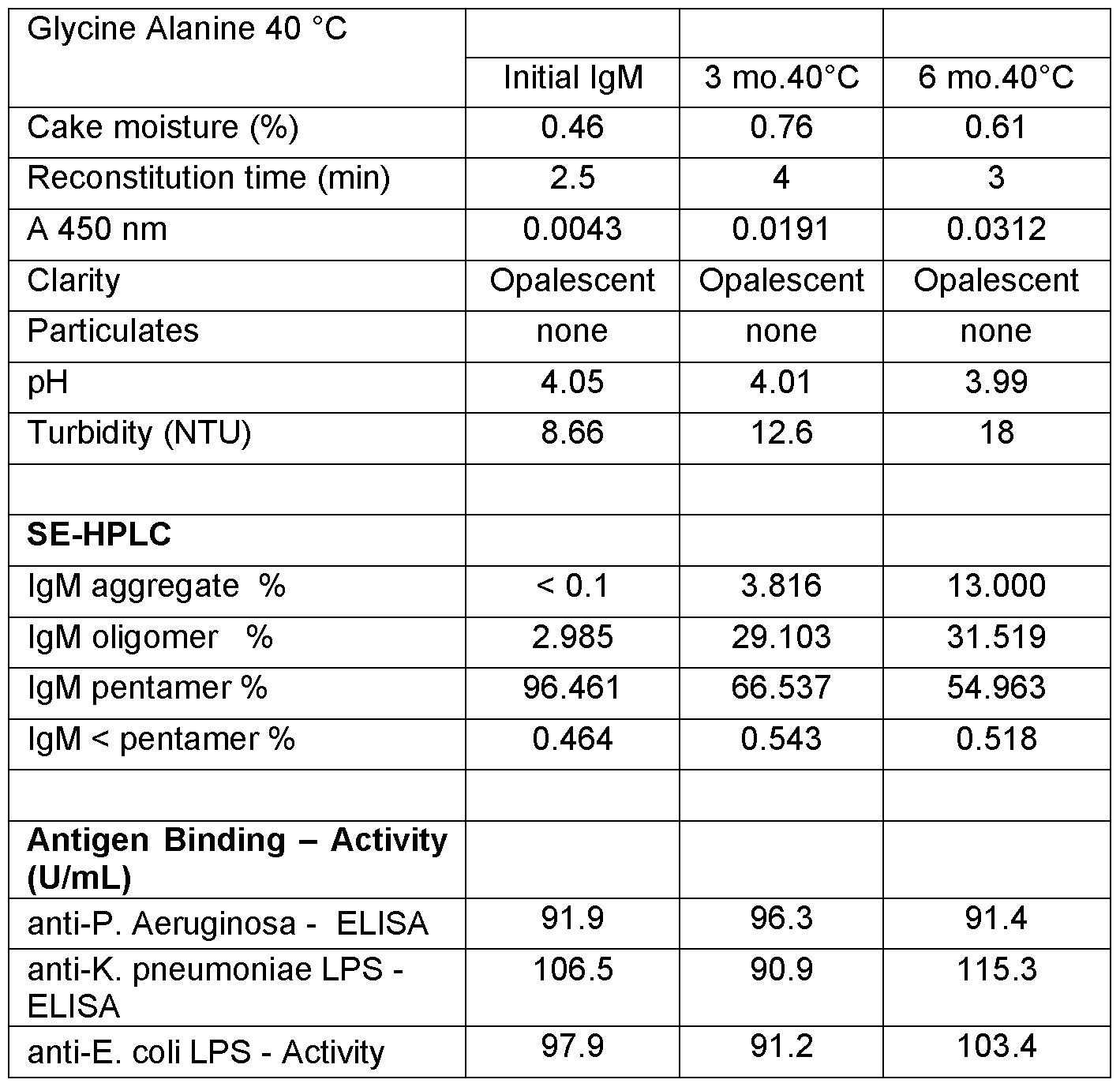
- Table 14c shows 6 months post-lyophilization glycine-alanine IgM formulations put on 40°C stability.
Landscapes
- Health & Medical Sciences (AREA)
- Chemical & Material Sciences (AREA)
- Life Sciences & Earth Sciences (AREA)
- Medicinal Chemistry (AREA)
- General Health & Medical Sciences (AREA)
- Epidemiology (AREA)
- Veterinary Medicine (AREA)
- Public Health (AREA)
- Engineering & Computer Science (AREA)
- Animal Behavior & Ethology (AREA)
- Pharmacology & Pharmacy (AREA)
- Chemical Kinetics & Catalysis (AREA)
- General Chemical & Material Sciences (AREA)
- Oil, Petroleum & Natural Gas (AREA)
- Organic Chemistry (AREA)
- Immunology (AREA)
- Biochemistry (AREA)
- Proteomics, Peptides & Aminoacids (AREA)
- Molecular Biology (AREA)
- Bioinformatics & Cheminformatics (AREA)
- Biophysics (AREA)
- Genetics & Genomics (AREA)
- Microbiology (AREA)
- Mycology (AREA)
- Medicinal Preparation (AREA)
- Medicines That Contain Protein Lipid Enzymes And Other Medicines (AREA)
Abstract
Description


Claims
Priority Applications (5)
| Application Number | Priority Date | Filing Date | Title |
|---|---|---|---|
| IL325216A IL325216A (en) | 2023-06-13 | 2024-06-12 | Method for producing a lyophilized composition comprising polyclonal igm and composition obtained |
| AU2024305116A AU2024305116A1 (en) | 2023-06-13 | 2024-06-12 | Method for producing a lyophilized composition comprising polyclonal igm and composition obtained |
| KR1020267000386A KR20260025359A (en) | 2023-06-13 | 2024-06-12 | Method for producing a lyophilized composition containing polyclonal IgM and the composition obtained |
| CN202480039920.6A CN121335712A (en) | 2023-06-13 | 2024-06-12 | Method for producing a lyophilized composition containing polyclonal IgM and the resulting composition |
| EP24732922.0A EP4727582A1 (en) | 2023-06-13 | 2024-06-12 | Method for producing a lyophilized composition comprising polyclonal igm and composition obtained |
Applications Claiming Priority (2)
| Application Number | Priority Date | Filing Date | Title |
|---|---|---|---|
| US202363507852P | 2023-06-13 | 2023-06-13 | |
| US63/507,852 | 2023-06-13 |
Publications (1)
| Publication Number | Publication Date |
|---|---|
| WO2024256460A1 true WO2024256460A1 (en) | 2024-12-19 |
Family
ID=91539848
Family Applications (1)
| Application Number | Title | Priority Date | Filing Date |
|---|---|---|---|
| PCT/EP2024/066226 Ceased WO2024256460A1 (en) | 2023-06-13 | 2024-06-12 | Method for producing a lyophilized composition comprising polyclonal igm and composition obtained |
Country Status (7)
| Country | Link |
|---|---|
| US (1) | US20240417445A1 (en) |
| EP (1) | EP4727582A1 (en) |
| KR (1) | KR20260025359A (en) |
| CN (1) | CN121335712A (en) |
| AU (1) | AU2024305116A1 (en) |
| IL (1) | IL325216A (en) |
| WO (1) | WO2024256460A1 (en) |
Families Citing this family (1)
| Publication number | Priority date | Publication date | Assignee | Title |
|---|---|---|---|---|
| UY39318A (en) * | 2020-07-10 | 2022-02-25 | Grifols Worldwide Operations Ltd | PROCEDURE TO OBTAIN A COMPOSITION COMPRISING IMMUNOGLOBULIN M DERIVED FROM HUMAN PLASMA |
Citations (4)
| Publication number | Priority date | Publication date | Assignee | Title |
|---|---|---|---|---|
| EP0303088B1 (en) * | 1987-08-10 | 1992-11-11 | Miles Inc. | Purified igm |
| EP0531539B1 (en) * | 1991-03-08 | 1998-06-03 | MITSUI TOATSU CHEMICALS, Inc. | Lyophilized monoclonal antibody preparation |
| WO2005035574A1 (en) * | 2003-10-09 | 2005-04-21 | Chugai Seiyaku Kabushiki Kaisha | IgM HIGH CONCENTRATION STABILIZED SOLUTION |
| WO2022008658A1 (en) * | 2020-07-10 | 2022-01-13 | Grifols Worldwide Operations Limited | Method for obtaining a composition comprising human plasma-derived immunoglobulin m |
-
2024
- 2024-05-23 US US18/672,438 patent/US20240417445A1/en active Pending
- 2024-06-12 AU AU2024305116A patent/AU2024305116A1/en active Pending
- 2024-06-12 IL IL325216A patent/IL325216A/en unknown
- 2024-06-12 KR KR1020267000386A patent/KR20260025359A/en active Pending
- 2024-06-12 WO PCT/EP2024/066226 patent/WO2024256460A1/en not_active Ceased
- 2024-06-12 CN CN202480039920.6A patent/CN121335712A/en active Pending
- 2024-06-12 EP EP24732922.0A patent/EP4727582A1/en active Pending
Patent Citations (4)
| Publication number | Priority date | Publication date | Assignee | Title |
|---|---|---|---|---|
| EP0303088B1 (en) * | 1987-08-10 | 1992-11-11 | Miles Inc. | Purified igm |
| EP0531539B1 (en) * | 1991-03-08 | 1998-06-03 | MITSUI TOATSU CHEMICALS, Inc. | Lyophilized monoclonal antibody preparation |
| WO2005035574A1 (en) * | 2003-10-09 | 2005-04-21 | Chugai Seiyaku Kabushiki Kaisha | IgM HIGH CONCENTRATION STABILIZED SOLUTION |
| WO2022008658A1 (en) * | 2020-07-10 | 2022-01-13 | Grifols Worldwide Operations Limited | Method for obtaining a composition comprising human plasma-derived immunoglobulin m |
Non-Patent Citations (2)
| Title |
|---|
| E. J. COHN: "A System for the Separation into Fractions of the Protein and Lipoprotein Components of Biological Tissues and Fluids", J. AM. CHEM. SOC., vol. 68, no. 3, 1946, pages 459 - 475, XP001148358, DOI: 10.1021/ja01207a034 |
| J. L. ONCLEY ET AL.: "The separation of the antibodies, isoagglutinins, prothrombin, plasminogen and beta1-lipoprotein into subfractions of human plasma", JAM CHEM SOC., vol. 71, no. 2, February 1949 (1949-02-01), pages 541 - 50, XP055741755 |
Also Published As
| Publication number | Publication date |
|---|---|
| US20240417445A1 (en) | 2024-12-19 |
| CN121335712A (en) | 2026-01-13 |
| IL325216A (en) | 2026-02-01 |
| KR20260025359A (en) | 2026-02-24 |
| AU2024305116A1 (en) | 2026-01-15 |
| EP4727582A1 (en) | 2026-04-22 |
Similar Documents
| Publication | Publication Date | Title |
|---|---|---|
| US20240058263A1 (en) | Formulations of antibody | |
| KR102501602B1 (en) | Antibody formulation | |
| JP2025024067A (en) | Process for freeze-dried pharmaceutical formulations of therapeutic proteins | |
| JPH0761956B2 (en) | Intravenous immunoglobulin | |
| US11260102B2 (en) | Manufacture of Degarelix | |
| JP2004538287A (en) | Stable lyophilized pharmaceutical preparation of IgG antibody | |
| AU2021250949A1 (en) | Liquid Pharmaceutical Composition | |
| US20030092607A1 (en) | High-concentration protein formulations and method of manufacture | |
| WO2024256460A1 (en) | Method for producing a lyophilized composition comprising polyclonal igm and composition obtained | |
| JPH07238036A (en) | Method for suppressing globulin dimer increase in intravenous globulin liquid composition | |
| RU2665966C2 (en) | Recombinant monoclonal antibody to tnf-alpha aqueous pharmaceutical composition | |
| HK40108659A (en) | Pharmaceutical composition of pembrolizumab and use thereof |
Legal Events
| Date | Code | Title | Description |
|---|---|---|---|
| 121 | Ep: the epo has been informed by wipo that ep was designated in this application |
Ref document number: 24732922 Country of ref document: EP Kind code of ref document: A1 |
|
| WWE | Wipo information: entry into national phase |
Ref document number: 325216 Country of ref document: IL |
|
| WWE | Wipo information: entry into national phase |
Ref document number: AU2024305116 Country of ref document: AU |
|
| ENP | Entry into the national phase |
Ref document number: 1020267000386 Country of ref document: KR Free format text: ST27 STATUS EVENT CODE: A-0-1-A10-A15-NAP-PA0105 (AS PROVIDED BY THE NATIONAL OFFICE) |
|
| WWE | Wipo information: entry into national phase |
Ref document number: 1020267000386 Country of ref document: KR |
|
| WWE | Wipo information: entry into national phase |
Ref document number: 2024732922 Country of ref document: EP |
|
| NENP | Non-entry into the national phase |
Ref country code: DE |
|
| ENP | Entry into the national phase |
Ref document number: 2024305116 Country of ref document: AU Date of ref document: 20240612 Kind code of ref document: A |
|
| ENP | Entry into the national phase |
Ref document number: 2024732922 Country of ref document: EP Effective date: 20260113 |
|
| ENP | Entry into the national phase |
Ref document number: 2024732922 Country of ref document: EP Effective date: 20260113 |
|
| ENP | Entry into the national phase |
Ref document number: 2024732922 Country of ref document: EP Effective date: 20260113 |
|
| WWP | Wipo information: published in national office |
Ref document number: 325216 Country of ref document: IL |
|
| ENP | Entry into the national phase |
Ref document number: 2024732922 Country of ref document: EP Effective date: 20260113 |
|
| WWP | Wipo information: published in national office |
Ref document number: 1020267000386 Country of ref document: KR |
|
| WWP | Wipo information: published in national office |
Ref document number: 2024732922 Country of ref document: EP |