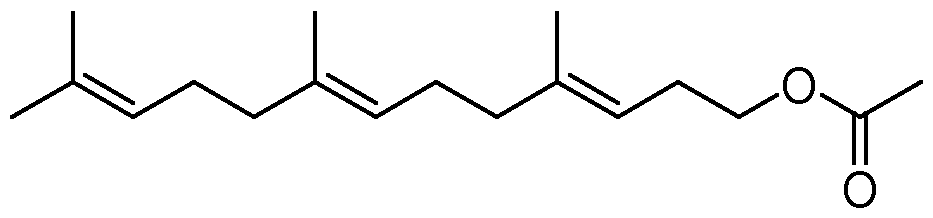
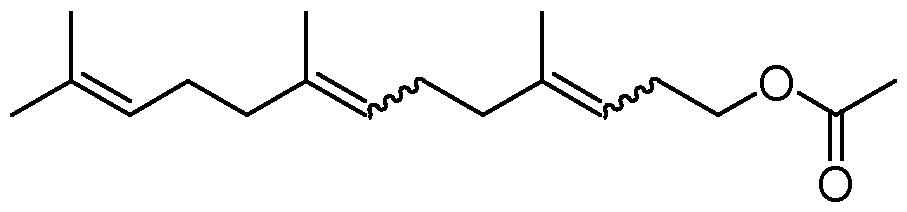
PREPARATION OF TERPENOID COMPOUNDS Technical field The present invention relates to polypeptides and processes for the enzymatic preparation of ambroxide and other terpenoid compounds. Background In the perfumery industry, there is a constant need to provide methods for the preparation of compounds for industrial use in fragrances. Key amongst such compounds are ingredients relating to the amber class of olfactory compounds which are naturally found in ambergris and which can function as fixatives to allow scent to endure much longer. A key compound in ambergris is ambroxide, a terpenoid compound. Terpenoids are found in most organisms (microorganisms, animals and plants). These compounds are made up of five carbon units called isoprene units and are classified by the number of these units present in their structure. Thus monoterpenes, sesquiterpenes and diterpenes are terpenes containing 10, 15 and 20 carbon atoms respectively. Sesquiterpenes, for example, are widely found in the plant kingdom. Many sesquiterpene molecules are known for their flavor and fragrance properties and their cosmetic, medicinal and antimicrobial effects. Numerous sesquiterpene hydrocarbons and sesquiterpenoids have been identified. Commercially relevant compounds include Cetalox® ((3aRS,9aRS,9bRS)-3a,6,6,9a- tetramethyl-1,2,3a,4,6,7,8,9,9a,9b-decahydronaphtho[2,1-b]furan; origin: Firmenich SA, Geneva, Switzerland) or Ambrox® ((3aR,5aS,9aS,9bR)-3a,6,6,9a-tetramethyldodecahydronaphtho[2,1-b]furan; origin: Firmenich SA, Geneva, Switzerland), these compounds replicating ambroxide. Chemical routes to the preparation of these compounds are known in the art. However, given the environmental and waste problems associated with chemical production of such compounds, there is a need to develop more sustainable processes for the production of ambroxide and other terpenoid compounds. This problem is addressed by the present invention which provides polypeptides and processes for producing such compounds by in vivo and/or bioconversion methods. Said methods may use a multi- step enzymatic process.
Summary A first aspect of the invention provides a process for the preparation of a compound of formula (I)

in the form of any one of its stereoisomers or a mixture thereof, comprising: contacting a compound of formula (II)
in the form of any one of its stereoisomers or a mixture thereof, with a polypeptide having alcohol dehydrogenase (ADH) enzyme activity to produce a compound of formula (III); (ii) contacting the compound of formula (III)
in the form of any one of its stereoisomers or a mixture thereof, with a polypeptide having enal-cleaving enzyme activity to produce a compound of formula (IV); (iii) contacting the compound of formula (IV)
In the form of any one of its stereoisomers or a mixture thereof, with a polypeptide having Baeyer-Villiger monooxygenase (BVMO) enzyme activity to produce a compound of formula (V);
(iv) contacting the compound of formula (V)
in the form of any one of its stereoisomers or a mixture thereof, with a polypeptide having esterase enzyme activity to produce a compound of formula (VI); and contacting the compound of formula (VI)
in the form of any one of its stereoisomers or a mixture thereof, with a polypeptide having terpene cyclase enzyme activity to produce a compound of formula (I). An embodiment of the invention is wherein more than 97% of the compound of formula (I) is in the form of formula (Ia):
and/or formula (Ib):
(formula Ib). A further embodiment of the invention is wherein: (i) the compound of formula (I) is in the form of formula (Ia):
(formula Ia)
(ii) the compound of formula (II) is in the form of formula (IIa):
(formula IIa); (iii) the compound of formula (III) is in the form of formula (IIIa):
(formula IIIa); (iv) the compound of formula (IV) is in the form of formula (IVa):
(vi) the compound of formula (VI) is in the form of formula (VIa):

(formula VIa). A further embodiment of the invention is wherein the process further comprises one or more steps prior to step (i), said step(s) comprising: (a) preparing geranylgeranyl-diphosphate (GGPP) from isopentenyl diphosphate (IPP) and dimethylallyl diphosphate (DMAPP) using one or more polypepides having prenyltransferase enzyme activity; and/or, (b) preparing a compound of formula (II) from GGPP using one or more polypeptides having phosphatase enzyme activity. A further embodiment of the invention is wherein the process is an in vivo or bioconversion process. A further embodiment of the invention is wherein said process is performed in a recombinant cell capable of functionally expressing: (i) the polypeptide having ADH enzyme activity, (ii) the polypeptide having enal-cleaving enzyme activity, (iii) the polypeptide having BVMO enzyme activity, (iv) the polypeptide having esterase enzyme activity, and (v) the polypeptide having terpene cyclase enzyme activity.
A further aspect of the invention provides a recombinant cell comprising, capable of producing or producing a compound of formula (I). The recombinant cell may further comprise one or more compound(s) selected from the group of formula (II), formula (III), formula (IV), formula (V) and formula (VI). A further aspect of the invention provides a cell culture fermentation medium comprising the recombinant cell of the invention. The cell culture fermentation medium may further comprise a compound of formula (I) and optionally, one or more compound(s) of formula (II), formula (III), formula (IV) formula (V) and/or formula (VI). A further aspect of the invention provides a reaction mixture comprising compound of formula (I). The reaction mixture may further comprise one or more compound(s) of formula (II), formula (III), formula (IV) formula (V) and/or formula (VI). Another aspect of the invention provides a process for the preparation of a compound of formula (VI); a recombinant cell comprising, capable of producing or producing a compound of formula (VI); a cell culture fermentation medium comprising said recombinant cell; a reaction mixture comprising compound of said formula (VI). Another aspect of the invention provides a process for the preparation of a compound of formula (V); a recombinant cell comprising, capable of producing or producing a compound of formula (V); a cell culture fermentation medium comprising said recombinant cell; a reaction mixture comprising compound of said formula (V). Another aspect of the invention provides a process for the preparation of a compound of formula (IV); a recombinant cell comprising, capable of producing or producing a compound of formula (IV); a cell culture fermentation medium comprising said recombinant cell; a reaction mixture comprising compound of said formula (IV). A further aspect of the invention provides a compound obtained or obtainable by a process of the invention or from a recombinant cell of the invention or from a cell culture fermentation medium of the invention or from a reaction mixture of the invention as described herein above. A further aspect of the invention provides the use of said compound as a perfumery, flavor or aroma ingredient, or as a precursor for making said ingredient. A further aspect of the invention is the use of a polypeptide having enal-cleaving enzyme activity to produce a compound of formula (IV), (V), (VI), (I) and/or a derivative thereof.
Description of the drawings Figure 1. Biosynthetic pathway of (2E)-geranyl-diphosphate (GPP), (2E,6E)-farnesyl-diphosphate (FPP) and (2E,6E,10E)-geranylgeranyl-diphosphate (GGPP) from isopentenyl-diphosphate (IPP) and dimethylallyl-diphosphate (DMAPP). Figure 2. Biosynthetic pathways of (2E,6E,10E)-geranylgeraniol from (2E,6E,10E)-geranylgeranyl- diphosphate (GGPP). Pi, inorganic phosphate; PPi, inorganic pyrophosphate. Figure 3. New biochemical pathway to (3E,7E)-homofarnesol. Figure 4. GC-MS analysis of terpenoids and derivatives produced using E. coli cells engineered to produce (3E,7E)-homofarnesol and expressing the proteins PsAerADH (SEQ ID NO: 11), SCH24- BVMO1 (SEQ ID NO: 23), SCH24-EST1 (SEQ ID NO: 27), CcrGGPPS2-del57 (SEQ ID NO: 1), PgpB (SEQ ID NO: 3) encoded by the plasmid pHFOL-5. Figure 5. GC-MS analysis of terpenoids and derivatives produced using E. coli cells expressing the proteins PsAerADH (SEQ ID NO: 11), SCH24-EST1 (SEQ ID NO: 27), CcrGGPPS2-del57 (SEQ ID NO: 1), PgpB (SEQ ID NO: 3) encoded by the plasmid pF-Facetone-7 (A) and using the same cells expressing in addition a BVMO enzyme (AflaBVMO1, SEQ ID NO: 26) (B). Figure 6. GC-MS chromatogram of YST403_HFOL strain engineered to produce (3E,7E)- homofarnesol. The final product (3E,7E)-homofarnesol, as well as the pathway intermediates (5E,9E)- farnesylacetone and (2E,6E,10E)-geranylgeraniol are shown. Figure 7. New biochemical pathway of compound of formula Ia using squalene cyclases. Figure 8: GC-MS analysis of terpenoids and derivatives produced using E coli DP1205 expressing the proteins PsAerADH (SEQ ID NO: 11), AflavBVMO1 (SEQ ID NO: 26), SCH24-EST1 (SEQ ID NO: 27), CcrGGPPS2-del57 (SEQ ID NO: 1), PgpB (SEQ ID NO: 3), the wild type A0A5P9HJ69 (SEQ ID NO: 42) (A) and the A0A5P9HJ69_V1 variant (SEQ ID NO: 43) (B). The compound of formula (Ia) and the pathway intermediate (3E,7E)-homofarnesol are shown. Figure 9: Titers of compound of formula (Ia) being produced by E coli DP1205 expressing the proteins PsAerADH (SEQ ID NO: 11), AflavBVMO1 (SEQ ID NO: 26), SCH24-EST1 (SEQ ID NO: 27), CcrGGPPS2-del57 (SEQ ID NO: 1), PgpB (SEQ ID NO: 3) and different wild type or mutant squalene cyclases. Figure 10. Titers of compound of formula (Ia) produced in S. cerevisiae cells expressing the geranylgeranyl diphosphate synthase CarG (SEQ ID NO: 2), the phosphatase PgpB (SEQ ID NO: 3),
the alcohol dehydrogenase SCH23-ADH1 (SEQ ID NO: 21), the Baeyer-Villiger monooxygenase AflavBVMO1 (SEQ ID NO: 26), the enal-cleaving enzymes SCH94-03944 (SEQ ID NO: 22) and different wild type or mutant variants of squalene cyclases. Figure 11. GC-MS chromatogram of culture extracts of S. cerevisiae engineered to express the (3E,7E)-homofarnesol biosynthetic pathway genes and squalene cyclase mutant variant OYT72085_V1 (SEQ ID NO: 48) (A) or the wild type squalene cyclase OYT72085.1 (SEQ ID NO: 47) (B). Peaks that correspond to (3E,7E)-homofarnesol and compound of formula (Ia) are indicated. Figure 12. Titers of compound of formula (Ia) being produced by E coli DP1205 expressing the proteins PsAerADH (SEQ ID NO: 11), AflavBVMO1 (SEQ ID NO: 26), SCH24-EST1 (SEQ ID NO: 27), CcrGGPPS2-del57 (SEQ ID NO: 1), PgpB (SEQ ID NO: 3) and bacterial membrane-integrated meroterpenoid cyclases. Figure 13. New biochemical pathway of compound of formula (Ia) using meroterpenoid cyclases. Figure 14. Titers of compound of formula (Ia) being produced by the yeast strain YST403 engineered to produce (3E,7E)-homofarnesol and expressing different bacterial membrane-integrated meroterpenoid cyclases. Figure 15. GC-MS chromatogram of the yeast strain YST403 engineered to produce (3E,7E)- homofarnesol and to express WP_234754442.1 (SEQ ID NO: 51) (A) and GC-MS chromatograms of the control strain YST403 expressing only the (3E,7E)-homofarnesol pathway enzymes (B). The compound of formula (Ia) and the pathway intermediate (3E,7E)-homofarnesol are shown. Figure 16. GC-MS chromatogram in single ion monitoring mode (221 Da) of the yeast strain YST403 engineered to express (3E,7E)-homofarnesol and to express A0A2P1DP74.1 (MacJ) (SEQ ID NO: 71) (A) and GC-MS chromatograms of the control strain YST403 expressing only the (3E,7E)-homofarnesol pathway enzymes (B). The compound of formula (Ia) and the pathway intermediate (3E,7E)- homofarnesol are shown. Figure 17. The chiral GC-MS chromatogram in single ion monitoring mode (221 Da) of E. coli DP1205 engineered to express (3E,7E)-homofarnesol and expressing OKH29475.1 (SEQ ID NO: 74) (C) compared to authentic standards of compound of formula (Ia) (B) and compound of formula (Ib) (A). Figure 18. The GC-MS chromatogram in single ion monitoring mode (221 Da) of the strain YST403 engineered to produce (3E,7E)-homofarnesol and expressing the soluble meroterpenoid cyclases OKH29475.1 (SEQ ID NO: 74) and NEQ07043.1 (SEQ ID NO: 75) as well as the (3E,7E)-homofarnesol producing control strain YST403 HFOL. Compound of formula (Ia) is shown.
Figure 19. The predicted structure of WP_234754442.1 (SEQ ID NO: 51) using ESMFold showing a pore like structure consisting of 7 helices. The N and C-Terminus are indicated as well as the entrance to the proposed active site, which is at the same side than the N-Terminus. Figure 20. Titers of compound of formula (Ia) being produced by E coli DP1205 expressing the proteins PsAerADH (SEQ ID NO: 11), AflavBVMO1 (SEQ ID NO: 26), SCH24-EST1 (SEQ ID NO: 27), CcrGGPPS2-del57 (SEQ ID NO: 1), PgpB (SEQ ID NO: 3) and different mutant variants of the bacterial membrane-integrated meroterpenoid cyclases WP_234754442.1 (SEQ ID NO: 51). The titers are shown relative to the wild-type enzyme WP_234754442.1 (SEQ ID NO: 51). Figure 21. Titers of compound of formula (Ia) being produced by the yeast strain YST403 engineered to produce (3E,7E)-homofarnesol and express the bacterial membrane-integrated meroterpenoid cyclases WP_234754442.1 (SEQ ID NO: 51) and the mutant variants WP_234754442.1_S9C (SEQ ID NO: 56) and WP_234754442.1_S9M (SEQ ID NO: 57). The titers are shown in percent relative to the wild type enzyme WP_234754442.1 (SEQ ID NO: 51). Figure 22. Titers of the compound of formula (Ia) (Left), compound of formula (Ic) (middle) and compound of formula (Id) (right) produced by bioconversion of chemically synthesized homofarnesol with the bacterial membrane-integrated meroterpenoid cyclases WP_051467941.1 (SEQ ID NO: 50), WP_234754442.1 (SEQ ID NO: 51), WP_190963420.1 (SEQ ID NO: 52) and the squalene hopen cylase AacSHC_M132R_I432T_A224V (SEQ ID NO: 78) in the presence or absence of 0.06 (w/v) of the detergent sodium dodecyl sulfate (SDS). Figure 23. GC-MS analysis of terpenoids and derivatives produced by the bioconversion of chemically synthesized (3E,7E)-homofarnesol containing (3Z,7E)-homofarnesol impurities with E coli Bl21(DE3)Star cells expressing the gene for the bacterial membrane-integrated meroterpenoid cyclases WP_234754442.1 (SEQ ID NO: 51) (A) as well as the mutant squalene cyclase AAcSHC_M132R_A224V_I432T (SEQ ID NO: 78) (B). The cyclisation products compound of formula (Ia) and compound of formula (Id) from (3E,7E)-homofarnesol as well as the cyclisation product compound of formula (Ic) from (3Z,7E)-homofarnesol are shown. Figure 24. GC-MS analysis of the bioconversion of chemically synthesized (3E,7E)-homofarnesol with E. coli Bl21(DE3)Star cells expressing the genes encoding for the squalene cyclases ZmSHC_F437A_G600M (SEQ ID NO: 88), AacSHC_F437A_G600M (SEQ ID NO: 81), A0A0T6LPP7- V1 (SEQ ID NO: 265), A0A7V0I7Y5-V1 (SEQ ID NO: 266), UPI00248B5E40-V1 (SEQ ID NO: 267) and UPI002800B5BA-V1 (SEQ ID NO: 268). Control is in the absence of said squalene cyclases. Figure 25. Titers of compound of formula (Ia) being produced by E coli DP1205 expressing PsAerADH (SEQ ID NO: 11), AflavBVMO1 (SEQ ID NO: 26), SCH24-EST1 (SEQ ID NO: 27), CcrGGPPS2-del57
(SEQ ID NO: 1), PgpB (SEQ ID NO: 3) and different bacterial membrane-integrated meroterpenoid cyclases. The titers are shown relative to the enzyme WP_234754442.1 (SEQ ID NO: 51). Abbreviations used ADH alcohol dehydrogenase BVMO Baeyer-Villiger Monooxygenase bp base pair kb kilo base DNA deoxyribonucleic acid cDNA complementary DNA DMAPP dimethylallyl diphosphate FMO Flavin Monooxygenase FPP farnesyl diphosphate GPP geranyldiphosphate GGPP geranylgeranyl diphosphate GGPS geranylgeranyl diphosphate synthase GC gas chromatograph IPP isopentenyl diphosphate iMS mass spectrometer / mass spectrometry MVA mevalonic acid PP diphosphate, pyrophosphate PCR polymerase chain reaction RNA ribonucleic acid SHC squalene cyclase mRNA messenger ribonucleic acid miRNA micro RNA siRNA small interfering RNA rRNA ribosomal RNA tRNA transfer RNA TPP terpenyl diphosphate Definitions General terms: For the descriptions herein and the appended claims, the use of “or” means “and/or” unless stated otherwise. Similarly, “comprise”, “comprises”, “comprising”, “include”, “includes”, and “including” are interchangeable and not intended to be limiting.
It is to be further understood that where descriptions of various embodiments use the term "comprising," those skilled in the art would understand that in some specific instances, an embodiment can be alternatively described using language "consisting essentially of" or "consisting of”. The terms "purified", "substantially purified", and "isolated" as used herein refer to the state of being free of other, dissimilar compounds with which a compound of the invention is normally associated in its natural state, so that the "purified", "substantially purified", and "isolated" subject comprises at least 0.5%, 1%, 5%, 10%, or 20%, or at least 50% or 75% of the mass, by weight, of a given sample. In one embodiment, these terms refer to the compound of the invention comprising at least 95, 96, 97, 98, 99 or 100%, of the mass, by weight, of a given sample. As used herein, the terms "purified," "substantially purified," and "isolated" when referring to a nucleic acid or protein, or nucleic acids or proteins, also refers to a state of purification or concentration different than that which occurs naturally, for example in a prokaryotic or eukaryotic environment, like, for example in a bacterial or fungal cell, or in the mammalian organism, especially human body. Any degree of purification or concentration greater than that which occurs naturally, including (1) the purification from other associated structures or compounds or (2) the association with structures or compounds to which it is not normally associated in said prokaryotic or eukaryotic environment, are within the meaning of "isolated”. The nucleic acid or protein or classes of nucleic acids or proteins, described herein, may be isolated, or otherwise associated with structures or compounds to which they are not normally associated in nature, according to a variety of methods and processes known to those of skill in the art. The term “about” indicates a potential variation of ± 25% of the stated value, in particular ± 15%, ± 10 %, more particularly ± 5%, ± 2% or ± 1%. The term "substantially" describes a range of values from about 80 to 100%, such as, for example, 85- 99.9%, in particular 90 to 99.9%, more particularly 95 to 99.9%, or 98 to 99.9% and especially 99 to 99.9%. “Predominantly” refers to a proportion in the range of above 50%, as for example in the range of 51 to 100%, particularly in the range of 75 to 99,9%, more particularly 85 to 98,5%, like 95 to 99%. A “main product” in the context of the present invention designates a single compound or a group of at least 2 compounds, like 2, 3, 4, 5 or more, particularly 2 or 3 compounds, which single compound or group of compounds is “predominantly” prepared by a reaction as described herein, and is contained in said reaction in a predominant proportion based on the total amount of the constituents of the product formed by said reaction. Said proportion may be a molar proportion, a weight proportion or, preferably based on chromatographic analytics, an area proportion calculated from the corresponding chromatogram of the reaction products.
A “side product” in the context of the present invention designates a single compound or a group of at least 2 compounds, like 2, 3, 4, 5 or more, particularly 2 or 3 compounds, which single compound or group of compounds is not “predominantly” prepared by a reaction as described herein. Because of the reversibility of enzymatic reactions, the present invention relates, unless otherwise stated, to the enzymatic or biocatalytic reactions described herein in both directions of reaction. The term "stereoisomers" includes conformational isomers and in particular configuration isomers. Included in general are, according to the invention, all “stereoisomeric forms” of the compounds described herein, such as “constitutional isomers” and “stereoisomers”. “Stereoisomeric forms” encompass in particular, “stereoisomers” and mixtures thereof, e.g. configuration isomers (optical isomers), such as enantiomers, or geometric isomers (diastereomers), such as E- and Z-isomers, and combinations thereof. If one or more asymmetric centers are present in one molecule, the invention encompasses all combinations of different conformations of these asymmetry centers, e.g. enantiomeric pairs. “Stereoselectivity” describes the ability to produce a particular stereoisomer of a compound in a stereoisomerically pure form or to specifically convert a particular stereoisomer in an enzyme catalyzed method as described herein out of a plurality of stereoisomers. More specifically, this means that a product of the invention is enriched with respect to a specific stereoisomer, or an educt may be depleted with respect to a particular stereoisomer. This may be quantified via the purity %ee-parameter calculated according to the formula: %ee = [XA-XB]/[ XA+XB]*100, wherein XA and XB represent the molar ratio (Molenbruch) of the stereoisomers A and B. The terms “selectively converting” or “increasing the selectivity” in general means that a particular stereoisomeric form, as for example the E-form, of an unsaturated hydrocarbon, is converted in a higher proportion or amount (compared on a molar basis) than the corresponding other stereoisomeric form, as for example Z-form, either during the entire course of said reaction (i.e. between initiation and termination of the reaction), at a certain point of time of said reaction, or during an “interval” of said reaction. In particular, said selectivity may be observed during an “interval” corresponding 1 to 99%, 2 to 95%, 3 to 90%, 5 to 85%, 10 to 80%, 15 to 75%, 20 to 70%, 25 to 65%, 30 to 60%, or 40 to 50% conversion of the initial amount of the substrate. Said higher proportion or amount may, for example, be expressed in terms of: - a higher maximum yield of an isomer observed during the entire course of the reaction or said interval thereof; - a higher relative amount of an isomer at a defined % degree of conversion value of the substrate; and/or
- an identical relative amount of an isomer at a higher % degree of conversion value; each of which preferably being observed relative to a reference method, said reference method being performed under otherwise identical conditions with known chemical or biochemical means. “Yield" and / or the "conversion rate" of a reaction according to the invention is determined over a defined period of, for example, 4, 6, 8, 10, 12, 16, 20, 24, 36 or 48 hours, in which the reaction takes place. In particular, the reaction is carried out under precisely defined conditions, for example at “standard conditions” as herein defined. If the present disclosure refers to features, parameters and ranges thereof of different degree of preference (including general, not explicitly preferred features, parameters and ranges thereof) then, unless otherwise stated, any combination of two or more of such features, parameters and ranges thereof, irrespective of their respective degree of preference, is encompassed by the disclosure of the present description. Biochemical and biological terms The term "domain" refers to a set of amino acids or a partial sequence of amino acids residues conserved at specific positions along an alignment of sequences of evolutionarily related proteins. While amino acids at other positions can vary between protein homologues, amino acids that are highly conserved at specific positions of such domain indicate amino acids that are likely essential in the structure, stability or function of a protein. Identified by their high degree of conservation in aligned sequences of a family of protein homologues, they can be used as identifiers to determine if any polypeptide in question belongs to a previously identified polypeptide family. The term "motif " or consensus sequence" or "signature" refers to a short-conserved region in the sequence of evolutionarily related proteins. Motifs are frequently highly conserved parts of domains, but may also include only part of the domain. Signatures are predictive models which describe protein families, domains or sites. The sequences of motifs can be described using the standard IUPAC one-letter codes for the amino acids. Ambiguities are indicated by listing the acceptable amino acids for a given position between brackets. For example, [LWI] stands for L (Leucine), W (Tryptophan) or I (Isoleucine). X represent positions where independently of each other any natural amino acid residue is present. A “protein family” is defined as a group of proteins that share a common evolutionary origin reflected by their related functions, similarities in sequence, or similar primary, secondary or tertiary structure. Proteins within protein families are usually homologous and have similar structure of conserved functional domains and motifs.
Specialist databases exist for the identification of protein domains, for example, SMART (http://smart.embl-heidelberg.de/smart/set_mode.cgi?GENOMIC=1) (Schultz et al. (1998) Proc. Natl. Acad. Sci. USA 95, 5857-5864; Letunic et al. (2020) Nucleic Acids Res 49, D458–D460), InterPro (Paysan-Lafosse et al, Nucleic Acids Research, Nov 2022; Mulder et al., (2003) Nucl. Acids. Res.31, 315-318), or Pfam (Bateman et al., Nucleic Acids Research 30(1): 276-280 (2002)). Useful tools to search or predict protein domains or protein family signatures in protein sequence are for example the NCBI conserved domain search tool (https://www.ncbi.nlm.nih.gov/Structure/cdd/wrpsb.cgi) or the InterProScan tool (http://www.ebi.ac.uk/interpro/search/sequence/). Domains or motifs may also be identified using routine techniques, such as by sequence alignment. The term "Pfam" refers to a large collection of protein domains and protein families maintained by the Pfam Consortium and available at several sponsored world wide web sites, such as the InterPro consortium web site https://www.ebi.ac.uk/interpro/ (European Molecular Biology Laboratory-European Bioinformatics Institute (EMBL_EBI). The latest release of Pfam is Pfam 35.0 (November 2021), based on the UniProt Reference Proteomes (El-Gebali S. et al, 2019, Nucleic Acids Res.47, Database issue D427–D432). Pfam domains and families are identified using multiple sequence alignments and hidden Markov models (HMMs). Pfam-A family or domain assignments, are high quality assignments generated by a curated seed alignment using representative members of a protein family and profile hidden Markov models based on the seed alignment (Unless otherwise specified, matches of a queried protein to a Pfam domain or family are Pfam-A matches). All identified sequences belonging to the family are then used to automatically generate a full alignment for the family (Sonnhammer (1998) Nucleic Acids Research 26, 320-322; Bateman (2000) Nucleic Acids Research 26, 263-266; Bateman (2004) Nucleic Acids Research 32, Database Issue, D138-D141; Finn (2006) Nucleic Acids Research Database Issue 34, D247-251; Finn (2010) Nucleic Acids Research Database Issue 38, D211-222). By accessing the Pfam database, for example, using any of the above-reference websites, protein sequences can be queried against the HMMs using HMMER homology search software (e.g., HMMER2, HMMER3, or a higher version, hmmer.janelia.org/). Significant matches that identify a queried protein as being in a pfam family (or as having a particular Pfam domain) are those in which the bit score is greater than or equal to the gathering threshold for the Pfam domain. Expectation values (e-values) can also be used as a criterion for inclusion of a queried protein in a Pfam or for determining whether a queried protein has a particular Pfam domain, where low e-values, much less than 1.0, for example less than 0.1, or less. InterPro is another database of protein families providing a classification of protein sequences into families and identifies functionally important domains and conserved sites (Blum et al, Nucleic Acids Res. 202149(D1):D344-D354). The protein signatures are provided by multiple databases such as Pfam or SMART (Simple Modular Architecture Research Tool). InterProScan is a software that allows protein and nucleic acid sequences to be searched against InterPro's signatures.
The “E-value” (expectation value) is the number of hits that would be expected to have a score equal to or better than this value, by chance alone. This means that a good E-value which gives a confident prediction is much less than 1. E-values around 1 is what is expected by chance. Thus, the lower the E-value, the more specific the search for domains will be. Only positive numbers are allowed. A “precursor” compound or molecule of a target compound or molecule as described herein is converted to said target compound, preferably through the enzymatic action of a suitable polypeptide performing at least one structural or functional change on said precursor molecule. For example, a “diphosphate precursor” (as for example a “terpenyl diphosphate precursor”) is converted to said target compound (as for example a terpene alcohol) via enzymatic removal of the diphosphate moiety, for example by removal of mono- or diphosphate groups by a phosphatase enzyme. For example, a “non-cyclic precursor” (like a “non-cyclic terpenyl precursor”) may be converted to the cyclic target molecule (like a cyclic terpene compound) through the action of a cyclase or synthase enzyme, irrespective of the particular enzymatic mechanism of such enzyme, in one or more steps. The enzyme nomenclature or enzyme classification (EC) established by the International Union of Biochemistry and Molecular Biology (IUBMB) is a system of naming and categorizing enzymes based on their catalytic activity and biochemical properties. The enzyme nomenclature is widely used in biochemistry to classify and categorize based on their function. The E.C. classification assigns each enzyme a number reflecting the reaction or the type of reaction catalyzed by this enzyme. The enzyme classification can be explored using the ‘ExplorEnz’ database (https://www.enzyme- database.org/) or International Union of Biochemistry and Molecular Biology (IUBMB) web site (https://iubmb.qmul.ac.uk). Information can be found about the classification and nomenclature of enzymes, their functions and properties. The database can be searched to find information for a specific enzyme family or enzyme. The terms “biological function,” “function”, “biological activity” or “activity” of a terpenyl synthase refer to the ability of a terpenyl diphosphate synthase as described herein to catalyze the formation of at least one terpenyl diphosphate from the corresponding precursor terpene. The terms “biological function,” “function”, “biological activity” or “activity” of a terpenyl diphosphate phosphatase refer to the ability of the terpenyl diphosphate phosphatase as described herein to catalyze the removal of a diphosphate group from said terpenyl compound to form the corresponding terpene alcohol. As used herein, the term “host cell”, “recombinant cell” or “transformed cell” refers to a cell (or organism) altered to harbor at least one nucleic acid molecule, for instance, a recombinant gene encoding a desired protein or nucleic acid sequence which upon transcription yields at least one functional
polypeptide of the present invention. The host cell is particularly a bacterial cell, a fungal cell or a plant cell or plants. The host cell may contain a recombinant gene or several genes, as for example organized as an operon, which has been integrated into the nuclear organelle genomes of the host cell. Alternatively, the host may contain the recombinant gene extra-chromosomally. Methods of introducing recombinant nucleic acid sequences into such host cells are well known in the art and constitute routine laboratory methodologies which do not need to be further described herein. The term “organism” refers to any non-human multicellular or unicellular organism such as a plant, or a microorganism. Particularly, a micro-organism is a bacterium, a yeast, an algae or a fungus. The term “plant” is used interchangeably to include plant cells including plant protoplasts, plant tissues, plant cell tissue cultures giving rise to regenerated plants, or parts of plants, or plant organs such as roots, stems, leaves, flowers, pollen, ovules, embryos, fruits and the like. Any plant can be used to carry out the methods of an embodiment herein. Detailed Description As described above, many sesquiterpene molecules are known for their flavor and fragrance properties and their cosmetic, medicinal and antimicrobial effects. Numerous sesquiterpene hydrocarbons and sesquiterpenoids have been identified. Commercially relevant compounds include Cetalox® ((3aRS,9aRS,9bRS)-3a,6,6,9a-tetramethyl-1,2,3a,4,6,7,8,9,9a,9b-decahydronaphtho[2,1-b]furan; origin: Firmenich SA, Geneva, Switzerland) or Ambrox® ((3aR,5aS,9aS,9bR)-3a,6,6,9a- tetramethyldodecahydronaphtho[2,1-b]furan; origin: Firmenich SA, Geneva, Switzerland), these compounds replicating ambroxide. The present inventors sought to identify improved processes for the preparation of a compound of formula (I), also known as 3a,6,6,9a tetramethyldodecahydronaphtho[2,1-b]furan. To prepare an improved process for the preparation of a compound of formula (I), they developed a deep understanding of the biochemical route to the production of these compounds by a multi- enzymatic reaction from precursor compounds. This multi-enzymatic reaction is the first time the preparation of this compound has been performed by such a step-wise reaction and constitutes a significant scientific and commercial advance in the preparation of sesquiterpene compound of formula (I). In particular, the combination of enzymes and their order in the process has not been described before in the prior art. Included in this invention is an in vivo process for the preparation of compound of formula (I) in recombinant cells. This is the first time a wholly in vivo process for this production of this compound has been demonstrated by creating a biosynthetic pathway to the compound of formula (I) in recombinant cells.
Accordingly, this invention provides a solution to the the problem of the preparation of such compound. A first aspect of the invention provides a process for the preparation of a compound of formula (I)

in the form of any one of its stereoisomers or a mixture thereof, comprising: (i) contacting a compound of formula (II)
in the form of any one of its stereoisomers or a mixture thereof, with a polypeptide having ADH enzyme activity to produce a compound of formula (III); (ii) contacting a compound of formula (III)
in the form of any one of its stereoisomers or a mixture thereof, with a polypeptide having enal-cleaving enzyme activity to produce a compound of formula (IV); (iii) contacting the compound of formula (IV)
in the form of any one of its stereoisomers or a mixture thereof, with a polypeptide having BVMO enzyme activity to produce a compound of formula (V); (iv) contacting the compound of formula (V)
in the form of any one of its stereoisomers or a mixture thereof, with a polypeptide having esterase enzyme activity to produce a compound of formula (VI); and,
(v) contacting the compound of formula (VI)

in the form of any one of its stereoisomers or a mixture thereof, with a polypeptide having terpene cyclase enzyme activity to produce a compound of formula (I). For the sake of clarity, by the expression “any one of its stereoisomers”, or the similar, it is meant the normal meaning understood by a person skilled in the art, i.e. that the invention compound can be a pure stereoisomer such as an enantiomer or a diastereomer (e.g. in relation to the configuration E or Z of any of the double bonds or in relation to the configuration R or S of any of the chiral carbon centers). According to any of the aspects or embodiments of the invention, said compound can be in the form of any of its steroisomers or of a mixture thereof, e.g. the invention relates to compositions of matter comprising one or more forms of the compound of formula (I), having the same chemical structure but differing by the configuration of the chiral centers. In particular, compound (I) can be in the form of a mixture comprising stereoisomer Ia (formula Ia) and wherein said stereoisomer Ia represents at least 50 %, 55%, 60%, 65%, 70%, 75%, 80%, 85%, 90%, 95%, 97%, 99% or more of the total mixture.
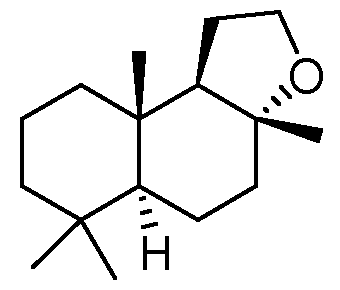
(formula Ia) Alternatively, compound (I) can be in the form of a mixture comprising stereoisomer Ib (formula Ib) and wherein said stereoisomer Ib represents at least 50 %, 55%, 60%, 65%, 70%, 75%, 80%, 85%, 90%, 95%, 97%, 99% or more of the total mixture.

(formula Ib) In one embodiment, more than 97% of the compound of formula (I) is in the form of formula (Ia) and/or (Ib). According to any of the aspects or embodiments of the invention, compounds of formula (II) to (VI) can be in the form of its E or Z isomer or of a mixture thereof. In particular, any one of compounds of formula
(II) to (VI) can be in the form of a mixture consisting of stereoisomer E and Z and wherein said stereoisomer IIa, IIIa, IVa, Va or VIa represent at least 50 % of the total mixture, or even at least 75% (i.e a mixture E/Z comprised between 75/25 and 100/0). Step (i) of the process of the invention Step (i) of the process of the invention relates to contacting a compound of formula (II) with a polypeptide having ADH enzyme activity.

(formula II) The compound of formula (II) is also known as geranylgeraniol, i.e. 3,7,11,15-tetramethylhexadeca- 2,6,10,14-tetraen-1-ol, CAS No 7614-21-3. The compound of formula (II) may be present in any one of its stereoisomers or a mixture thereof. Specifically, the compound may have the following structures and isoforms.
(formula IIa) (2E,6E,10E)-Geranylgeraniol; (2E,6E,10E)-3,7,11,15-tetramethylhexadeca-2,6,10,14-tetraen-1-ol; CAS No 24034-73-9.
(formula IIb) (2Z,6E,10E)-Geranylgeraniol; (2Z,6E,10E)-3,7,11,15-tetramethylhexadeca-2,6,10,14-tetraen-1-ol; CAS No 57784-25-5.
(2E,6Z,10E)-Geranylgeraniol; (2E,6Z,10E)-3,7,11,15-tetramethylhexadeca-2,6,10,14-tetraen-1-ol; CAS No 83689-05-8.
2E,6E,10Z)-Geranylgeraniol; (2E,6E,10Z)-3,7,11,15-tetramethylhexadeca-2,6,10,14-tetraen-1-ol; CAS No 68690-77-7.
2,6,10,14-tetraen-1-ol; CAS No 83689-07-0.
(2E,6Z,10Z)-Geranylgeraniol; (2E,6Z,10Z)-3,7,11,15-tetramethylhexadeca-2,6,10,14-tetraen-1-ol; CAS No 83689-08-1.
(formula IIh) (2Z,6Z,10Z)-Geranylgeraniol; (2Z,6Z,10Z)-3,7,11,15-tetramethylhexadeca-2,6,10,14-tetraen-1-ol; CAS No 1945-42-2.
Step (i) relates to the use of a polypeptide having ADH enzyme activity. An “alcohol dehydrogenase” (ADH) in the context of the present invention refers to a polypeptide having the ability to oxidize an alcohol to the corresponding aldehyde in the presence of NAD
+ or NADP
+ as cofactor. Such enzymes are members of the E.C. families 1.1.1.1 (NAD
+ dependent) or 1.1.1.2 (NADP
+ dependent). More particularly, an ADH of the invention has the ability to oxidize linear terpenoid alcohols to the respective carbonyl compounds in particular to the corresponding aldehydes, like geranylgeraniol to geranylgeranial. ADHs, as used herein, may either be endogenously present in the respective biocatalytic process or may be exogenous. “Alcohol dehydrogenase enzyme activity” is determined under “standard conditions” as described herein below: It can be determined using recombinant alcohol dehydrogenase (ADH) polypeptide expressing host cells, disrupted ADH polypeptide expressing cells, fractions of these or enriched or purified ADH polypeptide, in a culture medium or reaction medium, preferably buffered, having a pH in the range of 6 to 11, preferably 7 to 9, at a temperature in the range of about 20 to 45
oC, like about 25 to 40
oC, preferably 25 to 32
oC and in the presence of a reference substrate, here in particular geranylgeraniol, either added at an initial concentration in the range of 1 to 100 µM, preferably 5 to 50 µM, in particular 30 to 40 µM, or endogenously produced by the host cell. For in-vitro assays a cofactor selected from NADH and NADPH has to be added in a suitable easily to be determined concentration. The conversion reaction to form the respective aldehyde compounds, like geranylgeranial is conducted from 10 min to 5 h, preferably about 1 to 2 h. The oxidation product may then be determined in conventional matter, for example after extraction with an organic solvent, like ethyl acetate. A further method to evaluate the oxidation of geranylgeraniol to geranylgeranial by ADHs is described in Example 3. A preferred embodiment of the invention is wherein the polypeptide having said ADH enzyme activity comprises at least one or more sequence motifs selected from: . CHTD (SEQ ID NO: 228) as for example in SEQ ID NO: 11, 12, 13, 14, 17, 18, 19 or 20; . GHEGxG (SEQ ID NO: 229) as for example in SEQ ID NO: 11, 12, 13, 14, 17, 18, 19 or 20; . LxCGxxTGxGA (SEQ ID NO: 230) as for example in SEQ ID NO: 11, 12, 13, 14, 17, 18, 19 or 20; . Gx[VI]GL (SEQ ID NO: 231) as for example in SEQ ID NO: 11, 12, 13, 14, 15, 17, 18 , 19 or 20; . LxxxG[LVI][PA] (SEQ ID NO: 232) as for example in SEQ ID NO: 11, 12, 15, 17, 18 , 19 or 20; . GxVxAI (SEQ ID NO: 233) as for example in SEQ ID NO: 16 or 21; and . YxATKxA (SEQ ID NO: 234) as for example in SEQ ID NO: 16 or 21; wherein in the above motifs, residues x represent independently of each other any natural amino acid residue in a polypeptide having ADH activity. Ambiguities are indicated by listing the acceptable amino acids for a given position between brakets. For example, [VI] stands for V (valine), or I (isoleucine).
Preferably, the polypeptide having said ADH enzyme activity comprises: CHTD (SEQ ID NO: 228), GHEGxG (SEQ ID NO: 229), LxCGxxTGxGA (SEQ ID NO: 230) and Gx[VI]GL (SEQ ID NO: 231) motifs, as for example in SEQ ID NO: 11, 12, 13, 14, 17, 18, 19 or 20; Preferably, the polypeptide having said ADH activity comprises: CHTD (SEQ ID NO 228), GHEGxG (SEQ ID NO: 229), LxCGxxTGxGA (SEQ ID NO: 230), Gx[VI]GL (SEQ ID NO: 231) and LxxxG[LVI][PA] (SEQ ID NO: 232) motifs, as for example in SEQ ID NO: 11, 12, 17, 18 ,19 or 20. A preferred embodiment of the invention is wherein the polypeptide having ADH enzyme activity has at least 50%, 55%, 60%, 65%, 70%, 75%, 80%, 85%, 90%, 95%, 96%, 97%, 98% or 99% or more sequence identity to any of the sequences provided in SEQ ID NOs: 11 to 21. Preferably, the polypepeptide has at least 50%, 55%, 60%, 65%, 70%, 75%, 80%, 85%, 90%, 95%, 96%, 97%, 98% or 99% or more sequence identity to the amino acid sequence provided in SEQ ID NO: 11 or 21. Preferably, the polypeptide has the amino acid sequence provided in SEQ ID NO: 11 or 21. Step (ii) of the process of the invention Step (ii) of the process of the invention relates to contacting a compound of formula (III) with a polypeptide having enal-cleaving enzyme activity.

III) The compound of formula (III) is also known as geranylgeranial, i.e. 3,7,11,15-tetramethylhexadeca- 2,6,10,14-tetraenal; CAS No 32480-11-8. The compound of formula (III) may be present in any one of its stereoisomers or a mixture thereof. Specifically, the compound may have the following structures and isoforms:
(2Z,6E,10E)-geranylgeranial; (2Z,6E,10E)-3,7,11,15-tetramethylhexadeca-2,6,10,14-tetraenal; CAS No 57784-38-0.
(2Z,6Z,10E)-geranylgeranial; (2Z,6Z,10E)-3,7,11,15-Tetramethyl-2,6,10,14-hexadecatetraenal.
Tetramethyl-2,6,10,14-hexadecatetraenal.
Tetramethyl-2,6,10,14-hexadecatetraenal.

(2Z,6Z,10Z)-geranylgeranial; (2Z,6Z,10Z)-3,7,11,15-Tetramethyl-2,6,10,14-hexadecatetraenal.
Step (ii) relates to the use of a polypeptide having enal-cleaving enzyme activity. An “enal-cleaving enzyme” or “enal-cleaving protein” or “enal-cleaving polypeptide” in the context of the present invention designates an “α,β-unsaturated aldehyde carbon-carbon double bond-cleaving enzyme”, which also may be called a “α,β-unsaturated aldehyde C=C bond-cleaving enzyme” or “α,β- unsaturated aldehyde C=C-cleaving enzyme” or a “enal C=C-cleaving enzyme”. The enal-cleaving protein of the invention, based on protein domain organization, may also be described as a member of the “DUF4334 protein family” and/or as a member of the “GXWXG protein family” (SEQ ID NO: 263). Examples of such enzymes can be found in literature; for example, in WO2021005097. More particularly, an enal cleaving enzyme of the invention has the ability to cleave terpenoid compounds containing an α,β-unsaturated aldehyde group, in particular geranylgeranial to farnesylacetone. “Enal-cleaving enzyme activity” is determined under “standard conditions” as described herein below. It can be determined using recombinant enal-cleaving polypeptide expressing host cells, disrupted enal- cleaving polypeptide expressing cells, fractions of these or enriched or purified enal-cleaving polypeptide, in a culture medium or reaction medium, preferably buffered, having a pH in the range of 6 to 11, preferably 7 to 9, at a temperature in the range of about 20 to 45
oC, like about 25 to 40
oC, preferably 25 to 32
oC and in the presence of a reference substrate, here in particular geranylgeranial, either added at an initial concentration in the range of 1 to 100 µM, preferably 5 to 50 µM, in particular 30 to 40 µM, or endogenously produced by the host cell. The conversion reaction to form the respective cleavage product, like farnesylacetone is conducted from 10 min to 5 h, preferably about 1 to 2 h. The cleavage product may then be determined in conventional matter, for example after extraction with an organic solvent, like ethyl acetate. The polypeptide having said enal-cleaving enzyme activity may be selected from the group of polypeptides containing: a) at least one DUF4334 protein family domain having the Pfam ID number PF14232 (in particular within the C-terminal region of their amino acid sequence); b) at least one GXWXG (SEQ ID NO: 263) protein family domain having the Pfam ID number PF14231 (in particular within the N-terminal region of their amino acid sequence); and/or c) a domain retaining at least 90% sequence identity to PF14232 or PF14231. In particular, a polypeptide of the invention having enal-cleaving enzyme activity is identified as a member of the DUF4334 protein family comprising said domain PF14232 if it matches with said domain with an e-value of less than 1x10
-5, or less than 1x10
-10, or less than 1x10
-15, or less than 1x10
-20, or less than 1x10
-25, or less than 1x10
-30, or less than or equal to 1x10
-35, in particular in a range of 1x10-
20 to 1x10
-32 and more particular in a range of 1x10
-25 to 1x10
-31.
In particular, a polypeptide having enal-cleaving enzyme activity is identified as a member of GXWXG (SEW ID NO: 263) protein family comprising said domain PF14231 if it matches with an e-value of less than 1x10
-5, or less than 1x10
-10, or less than 1x10
-15, or less than 1x10
-20, or less than 1x10
-25, or less than 1x10
-30, or less than or equal to 1x10
-35, in particular in a range of 1x10
-20 to 1x10
-30. As the query sequence the sequence of a polypeptide having enal-cleaving enzyme activity is applied. For example, the following website may be applied for the search and calculating such e-value: http://www.ebi.ac.uk/Tools/hmmer/search/hmmscan or http://www.ebi.ac.uk/Tools/pfa/pfamscan/. Furthermore, the polypeptide having said enal-cleaving enzyme activity may be selected from the group of polypeptides that comprise at least one or more sequence motifs/domains selected from: . G-[Y or “-“]-x-W-x-G-x-x-[F,L or I]-x-[T,S or R]-G-[H or D] (also expressed as GxxWxGxxxxxGx) set forth in SEQ ID NO: 235, or any partial motif thereof comprising up to 10 or up to 5 consecutive amino acid residues, as for example corresponding to residues in positions 1-8 or 9-13 of SEQ ID NO: 235 Here, X2 can be Y or can be deleted; X3 can be any naturally occurring amino acid; X5 can be any naturally occurring amino acid; X7 can be any naturally occurring amino acid; X8 can be any naturally occurring amino acid; X9 can be F, L, or I; X10 can be any naturally occurring amino acid; X11 can be R, S, or T; X13 can be H or D; . W-[Y, A or V]-G-K-x-[F or Y]-x-[S or D] (also expressed as WxGKxxxx) set forth in SEQ ID NO: 236, or any partial motif thereof comprising up to 4 consecutive amino acid residues, as for example corresponding to residues in positions 1-4 or 5-8 of SEQ ID NO: 236. Here, X2 can be A, V, or Y; X5 can be any naturally occurring amino acid; X6 can be F or Y; X7 can be any naturally occurring amino acid; X8 can be D or S; . [G or S]-x-[A or G]-x-[L or V]-x-x-x-x-[F, Y or L]-R-G-x-V (also expressed as xxxxxxxxxxRGxV) set forth in SEQ ID NO:237, or any partial motif thereof comprising up to 10 or up to 5 consecutive amino acid residues, as for example corresponding to residues in positions 1-8 or 9-14 of SEQ ID NO:237. Here X1 can be G or S; X2 can be any naturally occurring amino acid; X3 can be A or G; X4 can be any naturally occurring amino acid; X5 can be L or V; X6 can be any naturally occurring amino acid; X7 can be any naturally occurring amino acid; X8 can be any naturally occurring amino acid; X9 can be any naturally occurring amino acid; X10 can be F, L, or Y; X13 can be any naturally occurring amino acid; and . [M or L]-[V or I]-Y-D-x-x-P-[I or V]-x-D-[H or S]-[F or L] (also expressed as xxYDxxPxxDxx) set forth in SEQ ID NO:238, or any partial motif thereof comprising up to 10 or up to 5 consecutive amino acid residues, as for example corresponding to residues in positions 1-6 or 7-12 of SEQ ID NO:238. Here X1 can be L or M; X2 can be I or V; X5 can be any naturally occurring amino acid; X6 can be any naturally occurring amino acid; X8 can be I or V; X9 can be any naturally occurring amino acid; X11 can be H or S; X12 can be F or L. wherein
the numbering of X (e.g. X2) corresponds to its position in the relevant sequence. For example, X2 corresponds to X at position 2 in the relevant sequence; and in the above motifs, residues x represent independently of each other any natural amino acid residue, and wherein optionally in each of the above motifs, 1, 2, 3, 4 or 5 amino acid residues different from the x residues may be modified, for example by amino acid substitution, in particular by conservative substitutions, provided that the enzyme retains, at least to analytically detectable extent, enal-cleaving enzyme activity. The function of the square brackets has been described above. A preferred embodiment of the invention is wherein the polypeptide having enal-cleaving activity has at least 50%, 55%, 60%, 65%, 70%, 75%, 80%, 85%, 90%, 95%, 96%, 97%, 98% or 99% or more sequence identity to the sequence provided in SEQ ID NO: 22. Step (iii) of the process of the invention Step (iii) of the process of the invention relates to contacting a compound of formula (IV) with a polypeptide having BVMO enzyme activity.

(formula IV) The compound of formula (IV) is also known as farnesylacetone, i.e. 6,10,14-trimethylpentadeca- 5,9,13-trien-2-one; CAS No 762-29-8. The compound of formula (IV) may be present in any one of its stereoisomers or a mixture thereof. Specifically, the compound may have the following structures and isoforms:
(5E,9E)-farnesylacetone; (5E,9E)-6,10,14-trimethylpentadeca-5,9,13-trien-2-one; CAS No 1117-52-8.

(5E,9Z)-farnesylacetone; (5E,9Z)-6,10,14-trimethylpentadeca-5,9,13-trien-2-one; CAS No 3053-35-3.
(5Z,9Z)-farnesylacetone; (5Z,9Z)-6,10,14-trimethylpentadeca-5,9,13-trien-2-one; Cas No 3796-69-8. Step (iii) relates to the use of a polypeptide having BVMO enzyme activity. “Baeyer-Villiger monooxygenases” (BVMOs) are flavoenzymes and belong to the class of refers to a polypeptide having oxidoreductase activity (EC 1.14.13.X). They catalyze the oxidation of linear, cyclic (aromatic or non-aromatic) aldehydes or ketones to the corresponding esters or lactones, highly similar to the chemical Baeyer-Villiger oxidation. During the enzymatic oxidation one atom of molecular oxygen is incorporated into a carbon-carbon bond of a non-activated carbonyl compound. The BVMOs require NADPH or NADH as cofactor or accept both. They also require molecular oxygen as co-substrate. More particularly, a BVMO of the invention has the ability to oxidize terpene- derived aldehydes or ketones, like for example linear terpenoid carbonyl compounds, in particular farnesylacetone to the respective carbonyl ester. “BVMO enzyme activity” is determined under “standard conditions” as described herein below: It can be determined using recombinant BVMO expressing host cells, disrupted BVMO expressing cells, fractions of these or enriched or purified BVMO enzyme, in a culture medium or reaction medium, preferably buffered, having a pH in the range of 6 to 11, preferably 7 to 9, at a temperature in the range of about 20 to 45
oC, like about 25 to 40
oC, preferably 25 to 32
oC and in the presence of a reference substrate, here in particular farnesylacetone, either added at an initial concentration in the range of 1 to 100 µM, preferably 5 to 50 µM, in particular 30 to 40 µM, or endogenously produced by the host cell and in the presence of molecular oxygen. For in-vitro assays a cofactor selected from NADH and NADPH has to be added in a suitable easily to be determined concentration range of the conversion reaction to form the respective enzyme product, like homofarnesyl acetate in the case of farnesylacetone is conducted from 10 min to 5 h, preferably about 1 to 2 h. The BVMO product may then be determined in conventional matter, for example after extraction with an organic solvent, like ethyl acetate. A further method to screen for BVMOs and evaluate the conversion of farnesylacetone to homofarnesyl acetate is described in Example 2. The polypeptide having BVMO enzyme activity may be selected from: (1) the group of polypeptides containing a flavin-containing monooxygenase (FMO) protein family domain having the Pfam ID number PF00743 within their amino acid sequence; or a domain retaining at least 90%, 95%, 96%, 97%, 98%, or 99% or more sequence identity to PF00743;
In particular, a polypeptide having BVMO activity is identified as member of the FMO protein family comprising said domain PF00743 if it matches with said domain with an e-value of less than 1x10
-5 or less than 1x10
-10, or less than or equal to 1x10
-15, or less than or equal to 1x10
-18, in particular in a range of 1x10
-10 to 1x10
-18 and more particular, in a range of 1x10
-14 to 1x10
-17. As the query sequence, the sequence of a polypeptide having BVMO activity is applied. For example, the following website may be applied for the search and calculating such e-value: http://www.ebi.ac.uk/Tools/hmmer/search/hmmscan or http://www.ebi.ac.uk/Tools/pfa/pfamscan/. and/or (2) the group of polypeptides that comprise at least one or more of the sequence motifs/domains selected from: . GxGxxG (SEQ ID NO: 239), as for example in any of SEQ ID NOs: 23 to 26. Here, X4 can be any naturally occurring amino acid, particularly A or I. The numbering of X corresponds to its position in the sequence. . [GS]GxWxxxxYPGxxxD (SEQ ID NO: 240), as for example in any of SEQ ID NOs: 23 to 26; . Gxxx[FY]xGxxx[HS]xxxW (SEQ ID NO: 241), as for example in any of SEQ ID NOs: 23 to 26; and . [KQ]x[VI]xx[IV]GxG (SEQ ID NO: 242), as for example in any of SEQ ID NOs: 23 to 26. wherein in the above motifs, residues x represent independently of each other any natural amino acid residue, and wherein optionally in each of the above motifs, 1, 2, 3, 4 or 5 of the conserved amino acid residues (i.e. different from the x residues) may be modified, for example by amino acid substitution, in particular by conservative substitutions, provided that the enzymes retains, at least to analytically detectable extent, BVMO enzyme activity. The function of the square brackets has been described above. A preferred embodiment of the invention is wherein the polypeptide having BVMO enzyme activity has at least 50%, 55%, 60%, 65%, 70%, 75%, 80%, 85%, 90%, 95%, 96%, 97%, 98% or 99% or more sequence identity to any of the sequences provided in SEQ ID NOs: 23 to 26. A preferred embodiment of the invention is wherein the polypeptide having BVMO enzyme activity has at least 50%, 55%, 60%, 65%, 70%, 75%, 80%, 85%, 90%, 95%, 96%, 97%, 98% or 99% or more sequence identity to SEQ ID NO: 25 or 26. Preferably, the polypeptide has the amino acid sequence provided in SEQ ID NO: 25 or 26. Alternatively, the polypeptide having BVMO enzyme activity has at least 50%, 55%, 60%, 65%, 70%, 75%, 80%, 85%, 90%, 95%, 96%, 97%, 98% or 99% or more sequence identity to any of the sequences provided in SEQ ID NOs: 216 to 227.
Step (iv) of the process of the invention Step (iv) of the process of the invention relates to contacting a compound of formula (V) with a polypeptide having esterase enzyme activity.

(formula V) The compound of formula (V) is also known as homofarnesyl acetate, i.e.4,8,12-trimethyltrideca-3,7,11- trien-1-yl acetate; CAS No 109813-25-4. The compound of formula (V) may be present in any one of its stereoisomers or a mixture thereof. Specifically, the compound may have the following structures and isoforms:

(3Z,7Z)- homofarnesyl acetate; (3Z,7Z)-4,8,12-trimethyltrideca-3,7,11-trien-1-yl acetate.
Step (iv) relates to the use of a polypeptide having esterase enzyme activity. An “esterase” refers to a polypeptide having hydrolase activity that splits esters into an acid and an alcohol in a chemical reaction with water (hydrolysis). Esterases in the context of the present invention are selected from the class of carboxylic ester hydrolases (EC 3.1.1.-), which splits off acyl groups, like acetyl or formyl groups, from the respective ester substrate. More particularly, an esterase of the invention has the ability to cleave terpenyl ester compounds, like homofarnesyl acetate, to form the corresponding alcohol, in particular homofarnesol. “Esterase enzyme activity” is determined under “standard conditions” as described herein below: It can be determined using recombinant esterase polypeptide expressing host cells, disrupted esterase polypeptide expressing cells, fractions of these or enriched or purified esterase polypeptide, in a culture medium or reaction medium, preferably buffered, having a pH in the range of 6 to 11, preferably 7 to 9, at a temperature in the range of about 20 to 45
oC, like about 25 to 40
oC, preferably 25 to 32
oC and in the presence of a reference substrate, here in particular homofarnesyl acetate, either added at an initial concentration in the range of 1 to 100 µM preferably 5 to 50 µM, in particular 30 to 40 µM, or endogenously produced by the host cell. The conversion reaction to form the respective alcohol, in particular homofarnesol is conducted from 10 min to 5 h, preferably about 1 to 2 h. The detection and quantification of esterase product may then be determined in conventional matter, for example after extraction with an organic solvent, like ethyl acetate. A further method to evaluate the conversion of homofarnesyl acetate to homofarnesol by an esterase is described in Example 4. A preferred embodiment of the invention is wherein the polypeptide having said esterase activity comprises at least one or more sequence motifs selected from: . AxVVxVxxRLAPE (SEQ ID NO: 243), as for example in SEQ ID NO: 27 or 28; . GASAGGGLxA (SEQ ID NO: 244), as for example in SEQ ID NO: 27 or 28; . VxQLLxYPMLDDR (SEQ ID NO: 245), as for example in SEQ ID NO: 27 or 28; and, . ARxxDLSGLPxT (SEQ ID NO: 246), as for example in SEQ ID NO: 27 or 28; wherein in the above motifs, residues x represent independently of each other any natural amino acid residue, and wherein optionally in each of the above motifs, 1, 2, 3 or 4 amino acid residues different from the x residues may be modified, for example by amino acid substitution, in particular by conservative substitutions, provided that the enzyme retains, at least to analytically detectable extent, esterase enzyme activity.
Preferably, the polypeptide having said esterase activity comprises: AxVVxVxxRLAPE (SEQ ID NO: 243), GASAGGGLxA (SEQ ID NO: 244), VxQLLxYPMLDDR (SEQ ID NO: 245), and ARxxDLSGLPxT (SEQ ID NO: 246), as for example in SEQ ID NO: 27 or 28. A preferred embodiment of the invention is wherein the polypeptide having esterase enzyme activity has at least 50%, 55%, 60%, 65%, 70%, 75%, 80%, 85%, 90%, 95%, 96%, 97%, 98% or 99% or more sequence identity to SEQ ID NO: 27 or 28. A preferred embodiment of the invention is wherein the polypeptide having esterase enzyme activity has at least 50%, 55%, 60%, 65%, 70%, 75%, 80%, 85%, 90%, 95%, 96%, 97%, 98% or 99% or more sequence identity to SEQ ID NO 28. Preferably, the polypeptide has the amino acid sequence provided in SEQ ID NO: 28. Step (v) of the process of the invention Step (v) of the process of the invention relates to contacting a compound of formula (VI) with a polypeptide having terpene cyclase enzyme activity.

(formula VI) The compound of formula (VI) is also known as homofarnesol, 4 ,8,12-trimethyltrideca-3,7,11-trien-1-ol CAS No 35826-67-6. The compound of formula (VI) may be present in any one of its stereoisomers or a mixture thereof. Specifically, the compound may have the following structures and isoforms:
(3Z,7E)-homofarnesol; (3Z,7E)-4,8,12-trimethyltrideca-3,7,11-trien-1-ol; CAS No 138152-06-4

(formula VIc) (3E,7Z)-homofarnesol; (3E,7Z)-4,8,12-trimethyltrideca-3,7,11-trien-1-ol; CAS No 2032064-12-1.
(formula VId) (3Z,7Z)-homofarnesol; (3Z,7z)-4,8,12-trimethyltrideca-3,7,11-trien-1-ol; CAS No 138152-08-6. Terpene cyclases are divided into two categories depending on the way the initial carbocation is generated. In class I (or type I) terpene cyclase, the diphosphate group of the linear terpenoid precursor is abstracted to form an allylic carbocation on the terpene moiety. In class II, the initial carbocation is formed by protonation of a double bond or epoxy group in the terpene carbon chain. Thus, class I cyclase necessarily use substrates with a diphosphate group, while class II cyclase (since they do not need a diphosphate group for the generation of the initial carbocation) can use terpenoids as substrates. For all terpene cyclases, the generated reactive carbocation species triggers the subsequent cascade reaction including carbocation reactions with double bonds, alkyl-shifts, hydride shifts or carbon-carbon bound formation. The reaction can be terminated by deprotonation of a carbon atom adjacent to the carbocation or by quenching of the carbocation with a hydroxyl group or molecule of water. The type II activity in terpene cyclases is associated with aspartate-rich conserved motifs. Typical examples of class II terpene cyclases are the class II diterpene cyclases catalyzing the protonation-initiated cyclization of geranylgeranyl-diphosphate into for example, labdadienyl- diphosphate intermediates or other cyclic diphosphate intermediates (Peters, R. J. (2010). Nat. Prod. Rep.27, 1521–1530; Zerbe, P. et al (2015). Plant J.83, 783–793). Squalene cyclases (SHCs) constitute a classical example of class II terpene cyclases where the substrate does not contain a diphosphate functional group. The squalene cyclase enzyme family comprise squalene cyclases and 2,3-oxidosqualene cyclases and enzymes catalyzing mechanistically related cyclization reactions. Squalene cyclases catalyze a protonation-initiated cyclization cascade of a linear terpene to a cyclic compound. Thus, squalene cyclases are class II terpene cyclases. The squalene family includes for example squalene-hopene cyclases catalyzing the cyclization of squalene to hopene (EC 5.4.99.17) and squalene-hopanol cyclases catalyzing the cyclization of squalene to hopan-22-ol (EC 4.2.1.129). Tetraprenyl-β-curcumene-sporulenol cyclases catalyze similar class II cyclization of linear terpene substrate (EC 4.2.1.137). It was shown that tetraprenyl-β-curcumene- sporulenol cyclase can also catalyze the cyclization of squalene (Sato, T., et al. (2011). Journal of the American Chemical Society 133(44): 17540-17543), thus tetraprenyl-β-curcumene-sporulenol cyclases are also members of the squalene cyclase family. Squalene cyclase polypeptides have typically a length between 600 and 800 amino acids and are membrane-associated proteins. They bind to the surface of cellular membranes but do not contain a
transmembrane region. Squalene cyclases are classified in the IPR018333 family of the InterPro protein sequence classification database (https://www.ebi.ac.uk/interpro/entry/InterPro/IPR018333/) (InterPro release 93.0, 2nd March 2023). The structure of squalene cyclases is organized in two domains comprising several alpha-helices, recognized as the β-domain and γ-domain or the βγ-domain architecture (Christianson DW, Chem. Rev, 2017, 117, 11570–11648). The two domains have characteristic sequence signatures as described in the Pfam database under the Pfam Squalene- hopene cyclase N-terminal domain (PF13249) and Squalene-hopene cyclase C-terminal domain and (PF13243) (Pfam 35.0 released, 19 November 2021). The presence of the IPR018333, PF13249 or PF13243 protein sequences signatures can be predicted using the NCBI conserved domain search tool (https://www.ncbi.nlm.nih.gov/Structure/cdd/wrpsb.cgi) or the InterProScan tool (http://www.ebi.ac.uk/interpro/search/sequence/). The squalene cyclase polypeptide contains characteristic conserved amino acid motifs located along the sequence and associated with the protein architecture and enzymatic reaction. In particular, the squalene cyclase contains at least one or more amino acid motifs selected from: . [SP][TP][VIL]WDTx[LWI] (SEQ ID NO: 247), . PGG[WF][GYA]F (SEQ ID NO: 248), . PDxDD[TAS][TIAS] (SEQ ID NO: 249), . [MIL]QxxxG[GA][WF]x[AS][FY] (SEQ ID NO: 250), . Qxxx[GH]xWxG[RK]WGxx[YF]xYG (SEQ ID NO: 251), . Qxx[DN]G[GS][WF][GS]ExxxS (SEQ ID NO: 252), and . [STA]xx[SFN][QC]T[AGT]W[AS][LIV]xx[LQ] (SEQ ID NO: 253) The motif sequences are described using the standard IUPAC one-letter codes for the amino acids. Ambiguities are indicated by listing the acceptable amino acids for a given position between brackets. For example, [SP] or [S or P] stands for S (serine), or P (proline). The “x” represents positions where independently of each other any natural amino acid residue is present. The function of the square brackets has been described above. Meroterpenoids are hybrid secondary metabolites derived from mixed biosynthetic pathways and are partially derived from a terpenoid co-substrate (Cornforth, J.W. Terpenoid biosynthesis. Chem. Br. 1968, 4, 102–106). The non-terpenoid part can originate for example from polyketides, alkaloids, phenols, or amino acids biosynthetic pathway. Large chemical diversity is found among meroterpenoids, in particular in bacteria and in fungi. The meroterpenoids biosynthetic pathways follow several modular biosynthetic steps. In the first step, the building blocks are generated from the corresponding biosynthetic pathway (e.g. terpenoids, polyketides). The terpenoid and non-terpenoid parts are assembled by prenyltransferases. The precursors of the terpenoid parts are generally linear terpenoid-diphosphates such as geranyl- diphosphate, farnesyl-diphosphate or geranylgeranyl-diphosphate.
In the following step, the linear polyene terpenoid part of the hybrid precursor is cyclized to form a monocyclic or polycyclic structure. This cyclization is catalyzed by a specific class of non-canonical class II terpene cyclases named meroterpenoid cyclase first discovered in fungi (T. Itoh et al, 2010, 2, 858–864). The first discovered representative meroterpenoid cyclase is Pyr4 from Aspergillus fumigatus Af293 (Itoh, T., et al. (2010). Nature Chemistry 2(10): 858-864). In many meroterpenoids, the linear terpenoid precursor is first activated by a stereoselective epoxidation by a monooxygenase of one of the double-bonds. The meroterpenoid cyclases catalyze then the protonation of the epoxide moiety generating a reactive carbocation species and triggering a subsequent cascade reaction similar to other terpene cyclases. Some meroterpenoid cyclases can convert the isoprenic precursors to cyclized products without the involvement of a prior epoxidation step. These meroterpenoid cyclases are able to directly protonate the terminal double bond generating a reactive carbocation and catalyzing a cyclization. For example, MacJ from the fungi Penicillium terrestry was the first identified fungi meroterpenoid cyclase using a type II double-bond protonation initiations reaction (Tang, M.-C., et al. (2017). Organic Letters 19(19): 5376-5379). Another example of meroterpenoid cyclase which initiates polyene cyclization by direct double bond protonation is DmtA1 from bacteria (Streptomyces youssoufiensis OUC68199) (Yao et al, Nat. Commun., 2018, 9, 4091). Like other class II terpene cyclases, the carbocation generated by meroterpenoid cyclases triggers a cascade reaction generally starting by the attack of a double bond and generating monocyclic or polycyclic structure with a tertiary carbocation. The reaction is terminated either by deprotonation to form a double bond or by reacting with a water molecule to generate a tertiary alcohol. Typical cyclic structures found in meroterpenoids compounds contain drimane or labdane scafolds. The largest group of meroterpenoid cyclases are compact membrane-integrated proteins containing several (generally seven) transmembrane helices. This protein architecture based on transmembrane helices can easily be predicted using for example the TMHMM 2.0 server available at https://dtu.biolib.com/DeepTMHMM (Krogh, A., et al. (2001) J Mol Biol 305(3): 567-580.). In addition to the protein architecture, meroterpenoid cyclases differ from other class II cyclases such as the squalene cyclases by their smaller polypeptide size. The bacterial and fungal meroterpenoid cyclase polypetides have a length ranging from 150 to 550 residues. The transmembrane helices are located over a portion of the polypetide covering 180 to 300 amino acid and carry the catalytic domains. Recently meroterpenoid cyclases having a protein architecture different from the membrane-integrated meroterpenoid cyclases were described. For example, MstE from the bacteria Scytonema sp. PCC 1002 is a soluble cyclase having a structure similar to canonical cyclases such as diterpene synthases and squalene cyclases, but nevertheless different, since it is a monodomain protein with only an α- domain (Moosmann, P., et al. (2020). Nat Chem 12(10): 968-972). Soluble bacterial meroterpenoid cyclase polypetides have length ranging from 150 to 550.
Several meroterpenoid cyclases catalyze reactions of cyclisation of the terpenoid part of the meroterpenoid hybrid precursor to labdane cyclic structures. However, the cyclization of linear terpenoids by meroterpenoid cyclases to labdane compounds have so far not been shown. Meroterpenoid cyclase polypeptides contain characteristic conserved amino acid motifs located along the sequence and associated with the protein architecture or enzymatic reaction as follows: Membrane-integrated meroterpenoid cyclase of bacterial origin containing at least one or more amino acid motifs selected from: . [W]xxx[D]xx[ILVMN] (SEQ ID NO: 254); . PxxAxxxNxxWE (SEQ ID NO: 255); . MxxxFxxMLxxR (SEQ ID NO: 256); and . RxxxxGQS (SEQ ID NO: 257). Membrane-integrated meroterpenoid cyclase of fungal origin containing a least one or more amino acid motifs selected from: . [WY]Exx[YFW] (SEQ ID NO: 258); and . [DNE]xSYxxP (SEQ ID NO: 259). Soluble meroterpenoid cyclases of bacterial origin containing a least one or more amino acid motifs selected from: . GxWxxxW[WG]xxxxY (SEQ ID NO: 260); . WxxxHxxV[TSA] (SEQ ID NO: 261); and . GxWxD[FY] (SEQ ID NO: 262). The motif sequences are described using the standard IUPAC one-letter codes for the amino acids. Residues x represent independently of each other any natural amino acid residue, and wherein optionally in each of the above motifs, 1, 2, 3 or 4 amino acid residues different from the x residues may be modified, for example by amino acid substitution, in particular by conservative substitutions, provided that the enzyme retains, at least to analytically detectable extent, its enzyme activity. The function of the square brackets has been described above. Meroterpenoid cyclase polypeptides can be searched in sequences databases using for example the BLAST search tools (Tatiana et al, FEMS Microbiol Lett., 1999, 174:247-250, 1999) using as query sequences MacJ (SEQ ID NO: 71), DmTA1 (SEQ ID NO: 77) or MstE (SEQ ID NO: 76). The selection can further be refined by selecting sequences with appropriate length or containing the characteristic amino acid motifs as described above. The selection can also be refined bases using a prediction of the protein architecture, in particular by predicting the presence of the transmembrane helices as described above.
Particular examples of suitable standard conditions for each of the above-described enzyme activities may be taken from the Examples section below. As discussed above, the terpene cyclase may be a squalene cyclase (SHC) or a meroterpenoid cyclase (MeroTPS). For the avoidance of doubt, SHCs and meroterpenoid cyclases are distinct classes of enzymes which can be distinguished by physical characteristics. Furthermore, meroterpenoid cyclases can be classified as (i) bacterial membrane-integrated meroterpenoid cyclases; (ii) fungal membrane-integrated meroterpenoid cyclases; (iii) bacterial soluble meroterpenoid cyclases. Table A below outlines the differences between SHCs and the different types of meroterpenoid cyclases. Feature SHC Bacterial membrane- Fungal membrane- Bacterial soluble integrated meroTPS integrated meroTPS MeroTPS Protein size (# 600-800 150-550 (180-300 for 150-550 (180-300 for 150 to 550 amino acids) region containing the region containing the helices) helices) Transmembrane No Yes Yes No region Membrane- membrane-integrated membrane-integrated Soluble associated Protein βγ-domain transmembrane transmembrane α-domain structure architecture (2 helices helices architecture domains) (monodomain protein) Table A: enzyme characteristics Hence the skilled person can, from the information provided herein, readily identify whether an enzyme is a SHC enzyme or a class of meroterpenoid cyclase enzyme. A preferred embodiment of the invention is wherein the terpene cyclase is a SHC. As provided in the accompanying examples, the inventors have demonstrated that SHC enzymes can be used in step (v) of the process of the invention. A preferred embodiment of the invention is wherein the polypeptide having SHC enzyme activity has at least 50%, 55%, 60%, 65%, 70%, 75%, 80%, 85%, 90%, 95%, 96%, 97%, 98% or 99% or more sequence identity to any of the sequences provided in SEQ ID NOs: 29 to 49 and 265 to 279. Preferably, the polypeptide having SHC enzyme activity has at least 50%, 55%, 60%, 65%, 70%, 75%, 80%, 85%, 90%, 95%, 96%, 97%, 98% or 99% or more sequence identity to any of the sequences provided in SEQ ID NOs: 29 to 49, 265 to 274 and 276 to 279. More
preferably, the polypeptide having SHC enzyme activity has at least 50%, 55%, 60%, 65%, 70%, 75%, 80%, 85%, 90%, 95%, 96%, 97%, 98% or 99% or more sequence identity to any of SEQ ID NOs: 48, 265, 266, 267, 268, 274, 276, and 279. More preferably, the polypeptide having SHC enzyme activity has the amino acid sequence of any of SEQ ID NOs: 48, 265, 266, 267, 268, 274, 276, and 279. Alternatively, the polypeptide having SHC enzyme activity has at least 50%, 55%, 60%, 65%, 70%, 75%, 80%, 85%, 90%, 95%, 96%, 97%, 98% or 99% or more sequence identity to any of the sequences provided in SEQ ID NOs: 79 to 89. A preferred embodiment of the invention is wherein the terpene cyclase is a meroterpenoid cyclase. When preparing the process of the present invention, the inventors sought to compare the isomeric profile of the compound of formula (I) synthesized via SHCs and meroterpenoid cyclases. To their surprise, they found that the meroterpenoid cyclases when used in the process of the invention, produced compound of formula (I) having an isomeric bias towards isomers of compound of formula (I) having preferred olfactory profiles more than that produced by SHC enzymes. In particular, they demonstrated that less than 1% of the compound of formula (I) produced by the process of the invention were in the isomeric form of formula I(c) and/or I(d). Hence, the use of meroterpenoid cyclases is associated with a surprising technical advantage over the use of SHC enzymes. Preferably, the meroterpenoid cyclase is a membrane-integrated meroterpenoid cyclase. It can be seen from the accompanying examples that this class of meroterpenoid cyclases preferably produce compounds of formula (Ia) rather than (Ic) and/or (Id). Examples of membrane-integrated meroterpenoid cyclase include those provided in any of SEQ ID NOs: 50 to 73 and 280 to 289. SEQ ID NOs: 50 to 70 and 280 to 289 are membrane-integrated meroterpenoid cyclases of bacterial origin and SEQ ID NOs: 71 to 73 are membrane-integrated meroterpenoid cyclases of fungal origin. Preferably, the meroterpenoid cyclase is a soluble meroterpenoid cyclase. It can be seen from the accompanying examples that this class of meroterpenoid cyclases preferably produce compounds of formula (Ib) rather than (Ic) and/or (Id). Examples of soluble meroterpenoid cyclase include those provided in SEQ ID NO: 74 or 75. This is the first time meroterpenoid cyclases have been used to prepare a compound of formula (I), and the bias towards such isomeric forms is surprising and technically important commercially. Furthermore, the present inventors also surprisingly found that meroterpenoid cyclases can be used in bioconversion processes without the need for the addition of any detergent to the reaction. The absence
of detergent in the bioconversion reaction leads to a simplified and hence more cost-effective process for the preparation of a compound of formula (I). As provided in the accompanying Examples, the inventors have demonstrated that meroterpenoid cyclase enzymes can be used in step (v) of the process of the invention. A preferred embodiment of the invention is wherein the polypeptide having meroterpenoid cyclase enzyme activity has at least 50%, 55%, 60%, 65%, 70%, 75%, 80%, 85%, 90%, 95%, 96%, 97%, 98% or 99% or more sequence identity to any of the sequences provided in SEQ ID NOs: 50 to 75 and 280 to 289. Preferably, the meroterpenoid cyclase enzyme activity has at least 50%, 55%, 60%, 65%, 70%, 75%, 80%, 85%, 90%, 95%, 96%, 97%, 98% or 99% or more sequence identity to any of the sequences provided in SEQ ID NOs: 57, 71, 74, 280, 281, 282, 283, 286, 287 and 288. Preferably, the meroterpenoid cyclase enzyme activity has the sequence provided in SEQ ID NO: 57, 71, 74, 280, 281, 282, 283, 286, 287 or 288. Forms of compound of formula (I) produced by the process of the invention. The process of the invention is for the preparation of a compound of formula (I). The compound of formula (I)

formula (I) The compound of formula (I) is also known as 3a,6,6,9a tetramethyldodecahydronaphtho[2,1-b]furan; CAS No 3738-00-9. The compound of formula (I) may be present in any one of its stereoisomers or a mixture thereof. Specifically, the compound may have the following structures and isoforms:
(formula Ia) (3aR,5aS,9aS,9bR)-3a,6,6,9a-tetramethyldodecahydronaphtho[2,1-b]furan; CAS No 6790-58-5.
(formula Ib) (3aS,5aR,9aR,9bS)-3a,6,6,9a-tetramethyldodecahydronaphtho[2,1-b]furan; CAS No 234431-64-2.
(formula Ic) (3aR,5aS,9aS,9bS)-3a,6,6,9a-tetramethyldodecahydronaphtho[2,1-b]furan.

(formula Id) (3aS,5aS,9aS,9bS)-3a,6,6,9a-tetramethyldodecahydronaphtho[2,1-b]furan. A compound of formula (I) can have different enantiomeric forms. Some isomers have a preferred olfactory profile to alternative isomeric forms of the compound. In particular, the olfactory preferred form of compound (I) is the compound (Ia) and/or (Ib). To improve the yield or ratio of compound (Ia) and/or (Ib) to other isomeric forms of compound (I), achieving high selectivity in the generation of compound (VI) plays an important role. Specifically, the ratio of the E/Z isomers at the 3,4-double bond of compound (VI) has significant importance. The preferred form of compound (VI) is that of formula (VIa). Despite extensive efforts, using chemical methods to obtain a compound of formula (VI) with a E/Z ratio at the 3,4-double bond higher higher than 90:10 remains a challenge and is so far not accessible at large scale (Eichhorn, E. and F. Schroeder (2023). J Agric Food Chem). The present invention achieves this goal by the use of highly selective enzymes. In the present invention, high selectivity of production of a compound of formula (VI) in the form of formula (VIa) has been achieved, as demonstrated in the accompanying Examples. Chemical methods (as described in Eichhorn, E. and F. Schroeder (2023). J Agric Food Chem) do not allow to achieve such high selectivity. Compounds of the pathway with high a E/Z ratio can be obtained using enzymatic pathways. In particular geranylgeranyl-diphopshate and geranylgeraniol with high E/Z ratio of the double bonds can be achieve using enzymes and in particular, geranylgeranyl-diphopshate synthase. The configuration of the double bonds is retained in all intermediates of the pathway. This subsequently leads to a process in which olfactory preferred forms of a compound of formula (I) are prepared. Hence, the process of the invention to prepare a compound of formula (I) lacking substantial amount of undesirable side products is of significant commercial importance. As can be shown in the accompanying Examples, more than 97% of the compound of formula (I) is in the form of formula (Ia) and/or (Ib).
Accordingly, an embodiment of the present invention is wherein more than 97% of the compound of formula (I) is in the form of formula (Ia) and/or (Ib). Also included in the scope of the present invention is a compound of formula (I) obtained or obtainable by an in vivo process. It can be appreciated that this is the first time a compound of formula (I) has been prepared by in in vivo process. For the reasons outlined herein, this is an important advance in the preparation of this compound, from technical and commercial aspects. The compound of formula (I) may be prepared via any in vivo process, preferably using recombinant cells expressing enzymes which can be used in the pathway to synthesise this molecule. An embodiment of the present invention is wherein more than 97% of the compound of formula (I) is in the form of formula (Ia) and/or (Ib). Embodiments of the process of the invention. The process of the invention comprises using (i) a polypeptide having ADH enzyme activity, (ii) a polypeptide having enal-cleaving enzyme activity; (iii) a polypeptide having BVMO enzyme activity; (iv) a polypeptide having esterase enzyme activity; and (v) a polypeptide having terpene cyclase enzyme activity. In a further preferred embodiment of the process of the invention is wherein: (i) the polypeptide having ADH enzyme activity has at least 50%, 55%, 60%, 65%, 70%, 75%, 80%, 85%, 90%, 95%, 96%, 97%, 98% or 99% or more sequence identity to any of SEQ ID NOs: 11 to 21; (ii) the polypeptide having enal-cleaving enzyme activity has at least 50%, 55%, 60%, 65%, 70%, 75%, 80%, 85%, 90%, 95%, 96%, 97%, 98% or 99% or more sequence identity to SEQ ID NO: 22; (iii) the polypeptide having BVMO enzyme activity has at least 50%, 55%, 60%, 65%, 70%, 75%, 80%, 85%, 90%, 95%, 96%, 97%, 98% or 99% or more sequence identity to any of SEQ ID NOs: 23 to 26 and 216 to 227; preferably, to any of SEQ ID NOs: 23 to 26; (iv) the polypeptide having esterase enzyme activity has at least 50%, 55%, 60%, 65%, 70%, 75%, 80%, 85%, 90%, 95%, 96%, 97%, 98% or 99% or more sequence identity to any of SEQ ID NOs: 27 and 28; and/or, (v) the polypeptide having terpene cyclase enzyme activity has at least 50%, 55%, 60%, 65%, 70%, 75%, 80%, 85%, 90%, 95%, 96%, 97%, 98% or 99% or more sequence identity to any of SEQ ID NOs: 29 to 75, 79 to 89 and 265 to 289; preferably, to any of SEQ ID NOs: 29 to 75 and 265 to 289; more preferably, to any of SEQ ID NOs: 29 to 75, 265 to 274 and 276 to 289.
A further preferred embodiment of the invention is wherein: (i) the polypeptide having ADH enzyme activity has at least 50%, 55%, 60%, 65%, 70%, 75%, 80%, 85%, 90%, 95%, 96%, 97%, 98% or 99% or more sequence identity to SEQ ID NO: 11 or 21; preferably the ADH enzyme has the sequence of SEQ ID NO: 11 or 21; (ii) the polypeptide having enal-cleaving enzyme activity has at least 50%, 55%, 60%, 65%, 70%, 75%, 80%, 85%, 90%, 95%, 96%, 97%, 98% or 99% or more sequence identity to SEQ ID NO: 22; preferably the enal-cleaving enzyme has the sequence of SEQ ID NO: 22; (iii) the polypeptide having BVMO enzyme activity has at least 50%, 55%, 60%, 65%, 70%, 75%, 80%, 85%, 90%, 95%, 96%, 97%, 98% or 99% or more sequence identity to SEQ ID NO: 25 or 26; preferably the BVMO enzyme has the sequence of SEQ ID NO: 25 or 26; (iv) the polypeptide having esterase enzyme activity has at least 50%, 55%, 60%, 65%, 70%, 75%, 80%, 85%, 90%, 95%, 96%, 97%, 98% or 99% or more sequence identity to SEQ ID NO 28; preferably the esterase enzyme has the sequence of SEQ ID NO: 28; and/or, (v) the polypeptide having terpene cyclase enzyme activity has at least 50%, 55%, 60%, 65%, 70%, 75%, 80%, 85%, 90%, 95%, 96%, 97%, 98% or 99% or more sequence identity to SEQ ID NO: 48, 57, 71, 74, 265, 266, 267, 268, 274, 276, 279, 280, 281, 282, 283, 286, 287 or 288; preferably, the terpene cyclase enzyme has the sequence of SEQ ID NO: 48, 57, 71, 74, 265, 266, 267, 268, 274, 276, 279, 280, 281, 282, 283, 286, 287 or 288. Alternatively, in this embodiment of the invention: (v) the polypeptide having terpene cyclase enzyme activity is a SHC enzyme and has at least 50%, 55%, 60%, 65%, 70%, 75%, 80%, 85%, 90%, 95%, 96%, 97%, 98% or 99% or more sequence identity to SEQ ID NO: 48, 265, 266, 267, 268, 274, 276 or 279; preferably, the SHC enzyme has the sequence of SEQ ID NO: 48, 265, 266, 267, 268, 274, 276 or 279. Alternatively, in this embodiment of the invention: (v) the polypeptide having terpene cyclase enzyme activity is a meroterpenoid cyclase enzyme and has at least 50%, 55%, 60%, 65%, 70%, 75%, 80%, 85%, 90%, 95%, 96%, 97%, 98% or 99% or more sequence identity to SEQ ID NO: 57, 71, 74, 280, 281, 282, 283, 286, 287 or 288; preferably, the meroterpenoid cyclase enzyme has the sequence of SEQ ID NO: 57, 71, 74, 280, 281, 282, 283, 286, 287 or 288. A further embodiment of the invention is wherein: (i) the compound of formula (I) is in the form of formula (Ia):

(formula Ia)
(ii) the compound of formula (II) is in the form of formula (IIa):
(formula IIa); (iii) the compound of formula (III) is in the form of formula (IIIa):
(formula IIIa); (iv) the compound of formula (IV) is in the form of formula (IVa):
(formula IVa); (v) the compound of formula (V) is in the form of formula (Va):
(formula Va); (vi) the compound of formula (VI) is in the form of formula (Va):

(formula VIa). Preparation of a compound of formula (II) The present aspect of the invention provides a process of preparing a compound of formula (I) from the sequential biocatalytic conversion of a compound of formula (II). The compound of formula (II) can be used as the starting substrate in the process of the invention, for example in the form of a purified compound preparation. However, a preferred embodiment of the invention is wherein the process of the invention further comprises providing a compound of formula (II) by the sequential biocatalytic conversion of precursor compounds to the compound of formula (II). Compounds of formulas (I) to (VI) are terpenoids. Terpenoids is a large family of structurally diverse natural compounds. All terpenoids derive biosynthetically from two five-carbon units, isopentenyl diphosphate (IPP) and dimethylallyl diphosphate
(DMAPP). IPP and DMAPP can be produced from different biosynthetic pathways such as the 2-C- methyl-D-erythritol-4-phosphate (MEP) pathway, the mevalonate (MVA) pathway or alternative MVA pathways (Dellas, N., et al. (2013) eLife 2: e00672). Alternatively, IPP and DMAPP can also be formed by successive enzymatic phosphorylation or by enzymatic pyrophosphorylation of their corresponding alcohols, isoprenol and prenol (Ma, X, et al. (2022). J Agric Food Chem 70(11): 3512-3520). These terpene building blocks are condensed successively to form linear terpenoid precursors with various length and multiple of five carbon such as geranyl-diphosphate (GPP), farnesyl-diphosphate (FPP) or geranylgeranyl-diphosphate (GGPP) containing 10, 15 and 15 carbons, respectively. The condensation of the IPP and DMAPP is performed by a class of enzyme named prenyltransferases. Prenyltransferase enzymes catalyze the initial condensation reaction between IPP and DMAPP to give GPP, and the subsequent addition of IPP molecules to give FPP and then GGPP (Ogura, K., and Koyama, T. (1998). Chem. Rev.98, 1263–1276). The successive condensation of DMAPP and IPP to GGPP can be performed by: i. the successive action of 3 prenyltransferases, a GPP synthase, a FPP synthase catalyzing the addition of one IPP to GPP and a GGPP synthase catalyzing the addition of one IPP to FPP; ii. the combination of 2 prenyltransferases, for example a FPP synthase catalyzing the condensation of one DMAPP and two IPP and a GGPP synthase catalyzing the addition of one IPP to FPP; and/or iii. the action of 1 prenyltransferase, for example a GGPP synthase capable of catalyzing the the successive condensation of tree IPP and one DMAPP. Some terpenoids have simple linear structures, for example geranylgeraniol is a linear diterpene (with 20 carbons) containing a terminal hydroxyl group. Geranylgeraniol can be made from GGPP using either: i. an enzyme having pyrophosphatase activity such as a phosphatase; and/or ii. two enzymes having phosphatase activity and successively cleaving the two phosphate groups of GGPP. Alternatively, geranylgeraniol can be made from GGPP using an enzyme from the class I terpene cyclase family (as described below) able to cleave the pyrophosphate group of GGPP but lacking the ability to catalyze the successive cyclization. These enzymatic pathways thus use enzymes having phosphatase activities and allow the cleavage of a diphosphate group of GGPP and release of geranylgeraniol. Alternatively, geranylgeraniol can be made from another linear diterpene. For example, from geranyllinallol or from a corresponding polyene for example from beta-springene. Enzymes such as dehydratase-isomerases can be used for such reaction. Dehydratase-isomerases can catalyze the reversibly isomerization reactions between linear terpene compounds having a terminal alcohol group
or terminal double bound (Nestl, B. M., et al. (2017). Nature Chemical Biology 13(3): 275-281) (see figure 2). Alternatively, geranylgeraniol can also be synthesized using chemical methods. For example, geranylgeraniol can be obtained from farnesene or farnesol by chain extension (Organic Syntheses, Vol.84, p.43-57 (2007). The pathways leading to IPP and DMAPP and to geranyl-diphosphate (GPP), farnesyl-diphosphate (FPP) or geranylgeranyl-diphosphate (GGPP) is involved in the synthesis of terpenoids, a diverse class of molecules that play essential roles in primary metabolism and various cellular processes. Terpenoids are involved in numerous biological functions, including the synthesis of sterols, such as cholesterol in animals and phytosterols in plants, as well as the production of hormones, vitamins (such as vitamin E and K), and signaling molecules (such as ubiquinone and dolichol). Additionally, terpenoids are crucial for the formation of membrane lipids and post-translational modifications of proteins. Therefore, the pathway leading to GPP, FPP and GGPP as described above is an important component of primary metabolism in all organisms as it provides the necessary precursors for the synthesis of essential terpenoid compounds involved in various physiological processes essential for the growth of the cells. The majority of terpenoids compounds contain cyclic carbon scaffolds. The diversity of monocyclic and polycyclic carbon skeletons is due to the enzymatic conversion of the linear terpenoid precursors by Terpene Cyclases (TC), also referred to as terpene synthases. The cyclization reaction starts from a carbocation which reacts with electron rich double bonds leading to new carbon-bound formation. The outcome of the reaction is defined by the substrate folding and the nature of amino acid side chains in the enzyme active site. Hence in a preferred embodiment of the invention, the process of the invention further comprises one or more steps prior to step (i), said step(s) comprising: (a) preparing (producing) geranylgeranyl-diphosphate (GGPP) from IPP and DMAPP using one or more prenyltransferase enzyme(s); and/or, (b) preparing (producing) a compound of formula (II) from GGPP using one or more enzymes having phosphatase enzyme activity. Step (a) of this embodiment of the invention requires the use of one or more prenyltransferase enzyme(s). The term ‘prenyltransferases’ represents a group of enzymes having the ability to condense successively five-carbon units such as isopentenyl diphosphate (IPP) and dimethylallyl diphosphate (DMAPP) to form linear terpenyl-diphosphate compounds such as geranyl-diphosphate (GPP),
farnesyl-diphosphate (FPP) or geranylgeranyl-diphosphate (GGPP) containing 10, 15 and 15 carbons, respectively. Some prenyl transferases can add 5-carbon units to linear terpenyl-diphosphate compounds thereby extending the carbon chain length. An example of prenyl transferase are geranyl- diphosphate synthases (GGPP synthases) having the ability of producing GGPP from IPP and DMAPP or by adding 5 carbons to FPP. The term ‘Prenyltransferases’ also refers to a group of enzymes having the ability to transfer an isoprenoid subunit from a terpenyl-diphosphate compound, generally from a linear terpenyl-diphosphate compounds, to the non-terpenoid scaffold during the biosynthesis of meroterpenoids. Step (a) of this embodiment of the invention may be performed by: i. the successive action of 3 prenyltransferases: a GPP synthase, a FPP synthase catalyzing the addition of one IPP to GPP and a GGPP synthase catalyzing the addition of one IPP to FPP; ii. the combination of 2 prenyltransferases: for example, a FPP synthase catalyzing the condensation of one DMAPP and two IPP and a GGPP synthase catalyzing the addition of one IPP to FPP; and/or iii. the action of 1 prenyltransferase for example a GGPP synthase capable of catalyzing the the successive condensation of tree IPP and one DMAPP. Examples of prenyltransferase enzymes that can be used in this step of the process of the invention are well known in the art. For example, a GGPP synthase from Blakeslea trispora can be used for the biosynthesis of GGPP (sun et al, Biotechnol. Lett.34 (11), 2077-2082 (2012)) Preferably, the prenyltransferase is a GGPP synthase. Preferably, the GGPP synthase has at least 50%, 55%, 60%, 65%, 70%, 75%, 80%, 85%, 90%, 95%, 96%, 97%, 98% or 99% or more sequence identity to SEQ ID NO: 1 or 2. Preferably, the GGPP synthase has at least 50%, 55%, 60%, 65%, 70%, 75%, 80%, 85%, 90%, 95%, 96%, 97%, 98% or 99% or more sequence identity to SEQ ID NO: 2. Preferably, the GGPP synthase has the amino acid sequence of SEQ ID NO: 2. Step (b) of this embodiment of the invention requires the use of one or more enzymes having phosphatase activity. The term “phosphatase” represents a group of enzymes that are known to remove phosphate or diphosphate groups from a precursor containing a phosphate or diphosphate group. A particular subgroup of phosphatases has the ability of removing phosphate or diphosphate group from a terpenyl precursor releasing inorganic phosphate and the corresponding terpenyl alcohol. For example, some phosphatases are known to remove the diphosphate group of GGPP to form geranylgeraniol. Phosphatases acting on terpenyl diphosphate are found in several enzyme classes. The term “protein tyrosine phosphatase” represents a group of enzymes that are generally known to remove phosphate groups from phosphorylated tyrosine residues on proteins. A particular subgroup of
said family as described in WO2020011883A1 are enzymes useful to remove diphosphate groups from phosphorylated terpene molecules (terpenyl diphosphate). In particular, phosphatases from the protein tyrosine phosphatase family having the Pfam ID number PF13350 can dephosphorylate GGPP to geranylgeraniol. Polypeptides can be scanned for matches against the Pfam protein family signature databases. Phosphatases and in particular GGPP phosphatases can also be obtained from other protein families; for example, from the Phosphatidic Acid Phosphatases of type 2 (PAP2) protein family (IPR00326), Nudix-Hydrolase protein family (IPR015797) and Haloacid Dehalogenase-like (HAD-like) Hydrolases protein family (IPR041492). A method to screen for phosphatases and evaluate the conversion of geranylgeranyl diphosphate to geranylgeraniol is described in Example 5. Examples of phosphatases enzymes that can be used in this step of the process of the invention are well known in the art. Preferably, the phosphatase is a GGPP phosphatase. Preferably, the GGPP phosphatase has at least 50%, 55%, 60%, 65%, 70%, 75%, 80%, 85%, 90%, 95%, 96%, 97%, 98% or 99% or more sequence identity to any one of SEQ ID NOs: 3 to 10. Preferably, the GGPP phosphatase has at least 50%, 55%, 60%, 65%, 70%, 75%, 80%, 85%, 90%, 95%, 96%, 97%, 98% or 99% or more sequence identity to SEQ ID NO: 3. Preferably, the GGPP phosphatase has the amino acid sequence of SEQ ID NO: 3. As described above, this embodiment of the invention provides a compound of formula (II) by the sequential biocatalytic conversion of precursor compounds to the compound of formula (II). In this embodiment of the invention, the precursor compounds to the compound of formula (II) are provided from IPP and DMAPP. A further embodiment of the invention is wherein the process further comprises the preparation of IPP and DMAPP. One means for the preparation of IPP and DMAPP is via the “mevalonate pathway”. The “mevalonate pathway” also known as the “isoprenoid pathway” or “HMG-CoA reductase pathway” is an essential metabolic pathway present in eukaryotes, archaea, and some bacteria. The mevalonate pathway begins with acetyl-CoA and produces two five-carbon building blocks called isopentenyl pyrophosphate (IPP) and dimethyl allyl pyrophosphate (DMAPP). Combining the mevalonate pathway with enzyme activity to generate the terpene precursors GPP, FPP or GGPP allows the recombinant cellular production of terpenes. The pathway is well known in the art. The list of enzymes required for the conversion of acetyl- CoA to IPP and DMAPP is provided below: . Acetyl-CoA acetyltransferase (ACAT) .3-hydroxy-3-methylglutaryl-CoA synthase (HMG-CoA synthase)
.3-hydroxy-3-methylglutaryl-CoA reductase (HMG-CoA reductase) . Mevalonate kinase . Phosphomevalonate kinase . Mevalonate diphosphate decarboxylase . Isopentenyl diphosphate isomerase. An alternative means for the preparation of IPP, and DMAPP is via the methylerythritol phosphate (MEP). The pathway is well known in the art. The list of enzymes required for the conversion of glyceraldehyde 3-phosphate (GAP) and pyruvate to IPP and DMAPP is provided below: .1-Deoxy-D-xylulose 5-phosphate synthase (DXS) .1-Deoxy-D-xylulose 5-phosphate reductoisomerase (DXR) .2-C-methyl-D-erythritol 4-phosphate cytidylyltransferase (MCT, IspD) .4-diphosphocytidyl-2-C-methyl-D-erythritol kinase (CMK, IspE) .2-C-methyl-D-erythritol 2,4-cyclodiphosphate synthase (MDS, IspF) .4-hydroxy-3-methylbut-2-en-1-yl diphosphate synthase (HDS, IDS) .4-hydroxy-3-methylbut-2-en-1-yl diphosphate reductase (HDR) Further alternative pathways to the preparation of IPP and DMAPP are known, see for example: Rinaldi, M. A., et al. (2022). Natural Product Reports 39(1): 90-118. https://doi.org/10.1039/D1NP00025J (see part 3 of this article). The inventors have therefore provided a complete biocatalytic route for the preparation of a compound of formula (I) from acetyl-CoA or glyceraldehyde 3-phosphate (GAP) and pyruvate. This multistep biocatalytic process has for the first time been described herein and constitutes a significant advance in the preparation of such compounds. Reaction conditions for the process of the invention The process of the present invention may be an in vivo process or a bioconversion process. The term in vivo process (or whole-cell production, or in-vivo production, or in-vivo biosynthesis) refers to a process of using a metabolically active cell where the primary metabolism is active to produce the precursors for the processes of the invention (preferably a microbial cell) to convert a carbon source to a new compound, such as the conversion of a carbon source to a terpene or terpene-derived compound. Preferred sources of carbon are sugars, such as mono-, di- or polysaccharides. Very good sources of carbon are for example glucose, fructose, mannose, galactose, ribose, sorbose, ribulose, lactose, maltose, sucrose, raffinose, starch or cellulose. Sugars can also be added to the media via complex compounds, such as molasses, or other by-products from sugar refining. It may also be advantageous
to add mixtures of various sources of carbon. Other possible sources of carbon are oils and fats such as soybean oil, sunflower oil, peanut oil and coconut oil, fatty acids such as palmitic acid, stearic acid or linoleic acid, alcohols such as glycerol, methanol or ethanol and organic acids such as acetic acid or lactic acid. The cells thus contain all enzymes of one or more biosynthetic pathways. At least some of the enzymes involved in the process are part of the cell`s primary metabolism. For example, the cells may contain the enzymes of a pathway to convert a carbon source (e.g., glucose, glycerol, isoprenol, prenol, CO2) to terpenoid precursors (e.g., IPP, DMAPP, FPP, GGPP) and a pathway converting the terpene precursor to a terpene or terpene derived molecule such as a compound of formula (I). The enzymes may be present naturally in the cell or the cells can be transformed to produce the enzymes. It is important to point out that, until the present invention, it had not been possible to prepare a compound of formula (I) using in vivo processes. The state of the art when devising the present invention may be found in, for example WO2016170099 and WO2010139719. Here, it can be seen that the existing processes for preparing the compound of formula (I) were not in vivo and hence, the present invention provides an important advance of the processes disclosed therein. Alternatively, the processes of the present invention may be performed under bioconversion, also known as biotransformation conditions. Bioconversion processes refer to processes of conversion of compounds to different products using a biological process or agent such enzymes or whole cells (preferably a microbial cell). Bioconversion does not include the use of a cell`s primary metabolism (as defined above) to produce the precursors for the processes of the invention. A bioconversion process can comprise multistep reactions each performed by a different enzyme. The compounds used in bioconversion process can be extracted from a natural source or produced using a separate chemical or a biochemical process. The at least one polypeptide/enzyme which is present during the bioconversion method of the invention or an individual step of the multistep method as defined herein above, can be present in living cells naturally or recombinantly producing the enzyme or enzymes, in harvested cells, dead cells, in permeabilized cells, in crude cell extracts, in purified extracts, or in essentially pure or completely pure form, i.e. under bioconversion conditions. Such extracts may comprise membrane fraction or a liquid fraction prepared from the recombinant host cell that expresses at least one polypeptide/enzyme. The cells may be immobilized on a suitable substrate as is known in the art. At least one polypeptide/enzyme may be present in solution or as an enzyme immobilized on a carrier. One or several enzymes may simultaneously be present in soluble and/or immobilized forms. It can be understood by the skilled person that there may be advantages for the use of an in vivo process.
In particular, a bioconversion process involves multiple steps, typically: - Preparation or isolation of the starting compound to be transformed. The compound can be prepared using a chemical or biochemical process or by extraction from a natural source. - Production of the enzymes or (living) cells used for the bioconversion. - Biotransformation reaction by contacting the compound with the enzymes or (living) cells. - Product Recovery and Refinement. In comparison, an in vivo process requires a limited number of steps, generally limited to: - The cultivation of the microorganism under conditions suitable for the production of the desired compound. - Harvesting the cells or growing medium and purification of the desired compound. In a bioconversion process such as the bioconversion of a compound of formula (VI), the addition of a detergent is often required to facilitate the solubilization of the compound or to maximize the contact with the biocatalyst. In an in vivo process, the reactants and enzymes are produced in the cells and the addition of a detergent is not needed. Therefore, the in vivo process is usually more efficient and cost-effective than a bioconversion process. Laboratory methods that can be used in in vivo and bioconversion processes of the invention are well known in the art. There follows a discussion on some of the methods that can be used. The bioconversion processes according to the invention can be performed in common reactors, which are known to those skilled in the art, and in different ranges of scale, e.g. from a laboratory scale (few milliliters to dozens of liters of reaction volume) to an industrial scale (several liters to thousands of cubic meters of reaction volume). If the polypeptide is used in a form encapsulated by non-living, optionally permeabilized cells, in the form of a more or less purified cell extract or in purified form, a chemical reactor can be used. The chemical reactor usually allows controlling the amount of at least one enzyme, the amount of at least one substrate, the pH, the temperature and the circulation of the reaction medium. Where the process of the invention is in vivo then it is preferred that the reaction is performed in a fermenter, where parameters necessary for suitable living conditions for the living cells (e.g. culture medium with nutrients, temperature, aeration, presence or absence of oxygen or other gases, antibiotics, and the like) can be controlled. The term "fermentative production" or "fermentation" refers to the ability of a microorganism (assisted by enzyme activity contained in or generated by said microorganism) to produce a chemical compound in cell culture utilizing at least one carbon source added to the incubation.
The term "fermentation broth" or "fermentation medium" is understood to mean a liquid, particularly aqueous or aqueous /organic solution which is based on a fermentative process and has not been worked up or has been worked up, for example, as described herein. Those skilled in the art are familiar with chemical reactors or bioreactors, e.g. with procedures for up- scaling chemical or biotechnological methods from laboratory scale to industrial scale, or for optimizing process parameters, which are also extensively described in the literature (for biotechnological methods see e.g. Crueger und Crueger, Biotechnologie – Lehrbuch der angewandten Mikrobiologie, 2. Ed., R. Oldenbourg Verlag, München, Wien, 1984). The culture medium that is to be used must satisfy the requirements of the particular strains in an appropriate manner. Descriptions of culture media for various microorganisms are given in the handbook "Manual of Methods for General Bacteriology" of the American Society for Bacteriology (Washington D. C., USA, 1981). These media that can be used according to the invention may comprise one or more sources of carbon, sources of nitrogen, inorganic salts, vitamins and/or trace elements. Sources of nitrogen are usually organic or inorganic nitrogen compounds or materials containing these compounds. Examples of sources of nitrogen include ammonia gas or ammonium salts, such as ammonium sulfate, ammonium chloride, ammonium phosphate, ammonium carbonate or ammonium nitrate, nitrates, urea, amino acids or complex sources of nitrogen, such as corn-steep liquor, soybean flour, soy-bean protein, yeast extract, meat extract and others. The sources of nitrogen can be used separately or as a mixture. Inorganic salt compounds that may be present in the media comprise the chloride, phosphate or sulfate salts of calcium, magnesium, sodium, cobalt, molybdenum, potassium, manganese, zinc, copper and iron. Inorganic sulfur-containing compounds, for example sulfates, sulfites, di-thionites, tetrathionates, thiosulfates, sulfides, but also organic sulfur compounds, such as mercaptans and thiols, can be used as sources of sulfur. Phosphoric acid, potassium dihydrogenphosphate or dipotassium hydrogenphosphate or the corresponding sodium-containing salts can be used as sources of phosphorus. Chelating agents can be added to the medium, in order to keep the metal ions in solution. Especially suitable chelating agents comprise dihydroxyphenols, such as catechol or protocatechuate, or organic acids, such as citric acid.
The fermentation media used according to the invention may also contain other growth factors, such as vitamins or growth promoters, which include for example biotin, riboflavin, thiamine, folic acid, nicotinic acid, pantothenate and pyridoxine. Growth factors and salts often come from complex components of the media, such as yeast extract, molasses, corn-steep liquor and the like. In addition, suitable precursors can be added to the culture medium. The precise composition of the compounds in the medium is strongly dependent on the particular experiment and must be decided individually for each specific case. Information on media optimization can be found in the textbook "Applied Microbiol. Physiology, A Practical Approach" (1997) Growing media can also be obtained from commercial suppliers, such as Standard 1 (Merck) or BHI (Brain heart infusion, DIFCO) etc. All components of the medium are sterilized, either by heating (20 min at 1.5 bar and 121 °C) or by sterile filtration. The components can be sterilized either together or if necessary, separately. All the components of the medium can be present at the start of growing, or optionally can be added continuously or by batch feed. The temperature of the culture is normally between 15 °C and 45 °C, preferably 25 °C to 40 °C and can be kept constant or can be varied during the experiment. The pH value of the medium should be in the range from 5 to 8.5, preferably around 7.0. The pH value for growing can be controlled during growing by adding basic compounds such as sodium hydroxide, potassium hydroxide, ammonia or ammonia water or acid compounds such as phosphoric acid or sulfuric acid. Antifoaming agents, e.g. fatty acid polyglycol esters, can be used for controlling foaming. To maintain the stability of plasmids, suitable substances with selective action, e.g. antibiotics, can be added to the medium. Oxygen or oxygen- containing gas mixtures, e.g. the ambient air, are fed into the culture in order to maintain aerobic conditions. The temperature of the culture is normally from 20 °C to 45 °C. Culture is continued until a maximum of the desired product has formed. This is normally achieved within 1 hour to 160 hours. Where the process of the invention is a bioconversion, cells containing the at least one enzyme can be permeabilized by physical or mechanical means, such as ultrasound or radiofrequency pulses, French presses, or chemical means, such as hypotonic media, lytic enzymes and detergents present in the medium, or combination of such methods. Examples for detergents are SDS, digitonin, n- dodecylmaltoside, octylglycoside, Triton® X-100, Tween ® 20, deoxycholate, CHAPS (3-[(3- Cholamidopropyl)dimethylammonio]-1-propansulfonate), Nonidet ® P40 (Ethylphenolpoly(ethyleneglycolether), and the like. As stated above, where the process of the invention is an in vivo process, then a detergent is not required for the reasons stated herein. The conversion reaction can be carried out batch wise, semi-batch wise or continuously. Reactants (and optionally nutrients) can be supplied at the start of reaction or can be supplied subsequently, either semi-continuously or continuously.
The bioconversion reaction of the invention, depending on the particular reaction type, may be performed in an aqueous, aqueous-organic or non-aqueous reaction medium. An aqueous or aqueous-organic medium may contain a suitable buffer in order to adjust the pH to a value in the range of 5 to 11, like 6 to 10. In an aqueous-organic medium an organic solvent miscible, partly miscible or immiscible with water may be applied. Non-limiting examples of suitable organic solvents are listed below. Further examples are mono- or polyhydric, aromatic or aliphatic alcohols, in particular polyhydric aliphatic alcohols like glycerol. The non-aqueous medium may contain is substantially free of water, i.e. will contain less than about 1 wt.-% or 0.5 wt.-% of water. Bioconversion methods may also be performed in an organic non-aqueous medium. As suitable organic solvents there may be mentioned aliphatic hydrocarbons having for example 5 to 8 carbon atoms, like pentane, cyclopentane, hexane, cyclohexane, heptane, octane or cyclooctane; aromatic carbohydrates, like benzene, toluene, xylenes, chlorobenzene or dichlorobenzene, aliphatic acyclic and ethers, like diethylether, methyl-tert.-butylether, ethyl-tert.-butylether, dipropylether, diisopropylether, dibutylether; or mixtures thereof. The concentration of the reactants/substrates may be adapted to the optimum bioconversion reaction conditions, which may depend on the specific enzyme applied. For example, the initial substrate concentration may be in the 0,1 to 0,5 M, as for example 10 to 100 mM. The bioconversion reaction temperature may be adapted to the optimum reaction conditions, which may depend on the specific enzyme applied. For example, the reaction may be performed at a temperature in a range of from 0 to 70
oC, as for example 20 to 50 or 25 to 40
oC. Examples for reaction temperatures are about 30 °C, about 35 °C, about 37 °C, about 40 °C, about 45 °C, about 50 °C, about 55 °C and about 60 °C. The bioconversion may proceed until equilibrium between the substrate and then product(s) is achieved, but may be stopped earlier. Usual process times are in the range from 1 minute to 25 hours, in particular 10 min to 6 hours, as for example in the range from 1 hour to 4 hours, in particular 1.5 hours to 3.5 hours. These parameters are non-limiting examples of suitable process conditions. Advantageously, microorganisms such as bacteria, fungi or yeasts are used as host organisms. Advantageously, gram-positive or gram-negative bacteria are used, preferably bacteria of the families Enterobacteriaceae, Pseudomonadaceae, Rhizobiaceae, Streptomycetaceae, Streptococcaceae or Nocardiaceae, especially preferably bacteria of the genera Escherichia, Pseudomonas, Streptomyces,
Lactococcus, Nocardia, Burkholderia, Salmonella, Agrobacterium, Clostridium or Rhodococcus. The genus and species Escherichia coli is quite especially preferred. Furthermore, other advantageous bacteria are to be found in the group of alpha-Proteobacteria, beta-Proteobacteria or gamma- Proteobacteria. Advantageously also yeasts of families like Saccharomyces or Pichia are suitable hosts. Preferably, the cell is a bacterium or a fungal cell, in particular a yeast cell. Preferably, the cell is a unicellular organism, a cultured cell derived from a multi-cellular organism, a cell present in a cultured tissue derived from a multicellular organism, or a cell present in a living multicellular organism. Preferably, the cell is a bacterial cell of the genus Escherichia, preferably E. coli, or a yeast cell of the genus Saccharomyces, preferably S. cerevisiae, of the genus Yarrowia, preferably Y. lipolytica, or of the genus Pichia, preferably P. pastoris. Alternatively, entire plants or plant cells may serve as natural or recombinant host. As non-limiting examples, the following plants or cells derived therefrom may be mentioned: the genera Nicotiana, in particular Nicotiana benthamiana and Nicotiana tabacum (tobacco); as well as Arabidopsis, in particular Arabidopsis thaliana. Product isolation The methodology of the present invention can further include a step of recovering an end product or an intermediate product, optionally in stereoisomerically or enantiomerically substantially pure form. The term “recovering” includes extracting, harvesting, isolating or purifying the compound from culture or reaction media. Recovering the compound can be performed according to any conventional isolation or purification methodology known in the art including, but not limited to, treatment with a conventional resin (e.g., anion or cation exchange resin, non-ionic adsorption resin, etc.), treatment with a conventional adsorbent (e.g., activated charcoal, silicic acid, silica gel, cellulose, alumina, etc.), alteration of pH, solvent extraction (e.g., with a conventional solvent such as an alcohol, ethyl acetate, hexane and the like), distillation, dialysis, filtration, concentration, crystallization, recrystallization, pH adjustment, lyophilization and the like. Identity and purity of the isolated product may be determined by known techniques, like High Performance Liquid Chromatography (HPLC), gas chromatography (GC), Spektroskopy (like IR, UV, NMR), Colouring methods, TLC, NIRS, enzymatic or microbial assays.(see for example: Patek et al. (1994) Appl. Environ. Microbiol.60:133-140; Malakhova et al. (1996) Biotekhnologiya 1127-32; und Schmidt et al. (1998) Bioprocess Engineer.19:67-70. Ullmann's Encyclopedia of Industrial Chemistry (1996) Bd. A27, VCH: Weinheim, S.89-90, S.521-540, S.540-547, S.559-566, 575-581 und S.581- 587; Michal, G (1999) Biochemical Pathways: An Atlas of Biochemistry and Molecular Biology, John Wiley and Sons; Fallon, A. et al. (1987) Applications of HPLC in Biochemistry in: Laboratory Techniques in Biochemistry and Molecular Biology, Bd.17.).
The compounds produced in any of the processes described herein can be converted to derivatives such as, but not limited to hydrocarbons, esters, amides, glycosides, ethers, epoxides, aldehydes, ketones, alcohols, diols, acetals or ketals. The terpene compound derivatives can be obtained by a chemical method such as, but not limited to oxidation, reduction, alkylation, acylation and/or rearrangement. Alternatively, the terpene compound derivatives can be obtained using a biochemical method by contacting the terpene compound with an enzyme such as, but not limited to an oxidoreductase, a monooxygenase, a dioxygenase, a transferase or a terpene cyclase. The biochemical conversion can be performed in vitro using isolated enzymes, enzymes from lysed cells or bioconversion using whole cells. Recombinant cells of the invention As discussed herein, the present inventors were able for the first time to innovate an in vivo process for the preparation of a compound of formula (I). To achieve this, the present inventors created a biosynthetic pathway to the compound of formula (I) in recombinant cells. Until the present invention, it had not previously been known to prepare this compound using an in vivo method involving the use of a recombinant cell. Hence, until the present invention, a recombinant cell producing a compound of formula (I) was not known in the art. The compound may be present within the recombinant cell or exported into the reaction medium. Furthermore, as stated above in the present invention, high selectivity of production of a compound of formula (VI) in the form of formula (VIa) has been achieved, as demonstrated in the accompanying Examples. This subsequently leads to a process in which olfactory preferred forms of a compound of formula (I) are prepared. Hence, the process of the invention to prepare a compound of formula (I) lacking substantial amount of undesirable side products is of significant commercial importance. As can be shown in the accompanying examples, more than 97% of the compound of formula (I) is in the form of formula (Ia) and/or (Ib). Accordingly therefore, an embodiment of the present invention is a recombinant cell wherein more than 97% of the compound of formula (I) is in the form of formula (Ia) and/or (Ib). Accordingly therefore, a further aspect of the invention provides a recombinant cell comprising, capable of producing or producing a compound of formula (I) and one or more compound(s) of formula (II), formula (III), formula (IV), formula (V) and/or formula (VI). Methods for preparing a recombinant cell comprising, capable of producing or producing a compound of formula (I) and one or more compound (s) of formula (II), formula (III), formula (IV), formula (V) and/or formula (VI) are provided herein. Preferably, said cell comprises (i) a polypeptide having ADH enzyme
activity, (ii) a polypeptide having enal-cleaving enzyme activity, (iii) a polypeptide having BVMO enzyme activity, (iv) a polypeptide having esterase enzyme activity, and (v) a polypeptide having terpene cyclase enzyme activity. A preferred embodiment of the invention is wherein: (i) the polypeptide having ADH enzyme activity has at least 50%, 55%, 60%, 65%, 70%, 75%, 80%, 85%, 90%, 95%, 96%, 97%, 98% or 99% or more sequence identity to any of SEQ ID NOs: 11 to 21; (ii) the polypeptide having enal-cleaving enzyme activity has at least 50%, 55%, 60%, 65%, 70%, 75%, 80%, 85%, 90%, 95%, 96%, 97%, 98% or 99% or more sequence identity to SEQ ID NO: 22; (iii) the polypeptide having BVMO enzyme activity has at least 50%, 55%, 60%, 65%, 70%, 75%, 80%, 85%, 90%, 95%, 96%, 97%, 98% or 99% or more sequence identity to any of SEQ ID NOs: 23 to 26 and 216 to 227; preferably to SEQ ID NOs: 23 to 26; (iv) the polypeptide having esterase enzyme activity has at least 50%, 55%, 60%, 65%, 70%, 75%, 80%, 85%, 90%, 95%, 96%, 97%, 98% or 99% or more sequence identity to any of SEQ ID NOs: 27 and 28; and/or, (v) the polypeptide having terpene cyclase enzyme activity has at least 50%, 55%, 60%, 65%, 70%, 75%, 80%, 85%, 90%, 95%, 96%, 97%, 98% or 99% or more sequence identity to any of SEQ ID NOs: 29 to 75, 79 to 89 and 265 to 289; preferably, to SEQ ID NOs: 29 to 75 and 265 to 289; more preferably, to any of SEQ ID NOs: 29 to 75, 265 to 274 and 276 to 289. A further preferred embodiment of the invention is wherein: (i) the polypeptide having ADH enzyme activity has at least 50%, 55%, 60%, 65%, 70%, 75%, 80%, 85%, 90%, 95%, 96%, 97%, 98% or 99% or more sequence identity to SEQ ID NO: 11 or 21; preferably, the ADH enzyme has the sequence of SEQ ID NO: 11 or 21; (ii) the polypeptide having enal-cleaving enzyme activity has at least 50%, 55%, 60%, 65%, 70%, 75%, 80%, 85%, 90%, 95%, 96%, 97%, 98% or 99% or more sequence identity to SEQ ID NO: 22; preferably, the enal-cleaving enzyme has the sequence of SEQ ID NO: 22; (iii) the polypeptide having BVMO enzyme activity has at least 50%, 55%, 60%, 65%, 70%, 75%, 80%, 85%, 90%, 95%, 96%, 97%, 98% or 99% or more sequence identity to SEQ ID NO: 25 or 26; preferably, the BVMO enzyme has the sequence of SEQ ID NO: 25 or 26; (iv) the polypeptide having esterase enzyme activity has at least 50%, 55%, 60%, 65%, 70%, 75%, 80%, 85%, 90%, 95%, 96%, 97%, 98% or 99% or more sequence identity to SEQ ID NO 28; preferably, the esterase enzyme has the sequence of SEQ ID NO: 28; and/or, (v) the polypeptide having terpene cyclase enzyme activity has at least 50%, 55%, 60%, 65%, 70%, 75%, 80%, 85%, 90%, 95%, 96%, 97%, 98% or 99% or more sequence identity to SEQ ID NO: 48, 57, 71, 74, 265, 266, 267, 268, 274, 276, 279, 280, 281, 282, 283, 286, 287 or 288; preferably, the terpene cyclase enzyme has the sequence of SEQ ID NO: 48, 57, 71, 74, 265, 266, 267, 268, 274, 276, 279, 280, 281, 282, 283, 286, 287 or 288.
Alternatively, in this embodiment of the invention: (v) the polypeptide having terpene cyclase enzyme activity is a SHC enzyme and has at least 50%, 55%, 60%, 65%, 70%, 75%, 80%, 85%, 90%, 95%, 96%, 97%, 98% or 99% or more sequence identity to SEQ ID NO: 48, 265, 266, 267, 268, 274, 276 or 279; preferably, the SHC enzyme has the sequence of SEQ ID NO: 48, 265, 266, 267, 268, 274, 276 or 279. Alternatively, in this embodiment of the invention: (v) the polypeptide having terpene cyclase enzyme activity is a meroterpenoid cyclase enzyme and has at least 50%, 55%, 60%, 65%, 70%, 75%, 80%, 85%, 90%, 95%, 96%, 97%, 98% or 99% or more sequence identity to SEQ ID NO: 57, 71, 74, 280, 281, 282, 283, 286, 287 or 288; preferably, the meroterpenoid cyclase enzyme has the sequence of SEQ ID NO: 57, 71, 74, 280, 281, 282, 283, 286, 287 or 288. A further embodiment of the invention is wherein: (i) the compound of formula (I) is in the form of formula (Ia):

(formula Ia) (ii) the compound of formula (II) is in the form of formula (IIa):
(formula IIa); (iii) the compound of formula (III) is in the form of formula (IIIa):
(iv) the compound of formula (IV) is in the form of formula (IVa):
(formula IVa); (v) the compound of formula (V) is in the form of formula (Va):
(formula Va);
(vi) the compound of formula (VI) is in the form of formula (VIa):

(formula VIa). The recombinant cell may be any such cell suitable for the production of a compound of formula (I). A list of suitable cells for the production of a compound of formula (I) is provided above in relation to the process of the invention and are also cells for this aspect of the invention. Preferably, the cell is a bacterium or a fungal cell, in particular a yeast. Preferably, the cell is a unicellular organism, a cultured cell derived from a multi-cellular organism, a cell present in a cultured tissue derived from a multicellular organism, or a cell present in a living multicellular organism. Preferably, the cell is a bacterial cell of the genus Escherichia, preferably E. coli, or a yeast cell of the genus Saccharomyces, preferably S. cerevisiae, of the genus Yarrowia, preferably Y. lipolytica, or of the genus Pichia, preferably P. pastoris. Methods of introducing recombinant nucleic acid sequences into such host cells are well known in the art and constitute routine laboratory methodologies which do not need to be further described herein. An embodiment of this aspect of the invention is wherein the cell further comprises one or more prenyltransferase enzyme(s). Preferably, the cell further comprises one or more enzymes having phosphatase activity. As mentioned above in relation to the process of the invention, the cells of the invention may also comprise further enzymes to provide a compound of formula (II). Such a process requires the presence of one or more prenyltransferase enzyme(s) and one or more enzymes having phosphatase activity. Preferably, the prenyltransferase is a GGPP synthase. Preferably, the GGPP synthase has at least 50%, 55%, 60%, 65%, 70%, 75%, 80%, 85%, 90%, 95%, 96%, 97%, 98% or 99% or more sequence identity to SEQ ID NO: 1 or 2. Preferably, the phosphatase is a GGPP phosphatase. Preferably, the GGPP phosphatase has at least 50%, 55%, 60%, 65%, 70%, 75%, 80%, 85%, 90%, 95%, 96%, 97%, 98% or 99% or more sequence identity to any of SEQ ID NOs: 3 to 10. A further embodiment of the invention is wherein the cell of the invention comprises enzymes for the IPP and DMAPP.
As mentioned above in relation to the process of the invention, the cells of the invention may also comprise still further enzymes to provide a compound of formula (II) via the “mevalonate pathway”, methylerythritol phosphate (MEP) pathway or alternative pathways to the preparation of IPP and DMAPP. In one embodiment of the invention, the cell comprises enzymes of the mevalonate pathway: . Acetyl-CoA acetyltransferase (ACAT) .3-hydroxy-3-methylglutaryl-CoA synthase (HMG-CoA synthase) .3-hydroxy-3-methylglutaryl-CoA reductase (HMG-CoA reductase) . Mevalonate kinase . Phosphomevalonate kinase . Mevalonate diphosphate decarboxylase . Isopentenyl diphosphate isomerase . Dimethylallyl diphosphate synthase In a further embodiment of the invention, the cell comprises enzymes of the MEP pathway: .1-Deoxy-D-xylulose 5-phosphate synthase (DXS) .1-Deoxy-D-xylulose 5-phosphate reductoisomerase (DXR) .2-C-methyl-D-erythritol 4-phosphate cytidylyltransferase (MCT, IspD) .4-diphosphocytidyl-2-C-methyl-D-erythritol kinase (CMK, IspE) .2-C-methyl-D-erythritol 2,4-cyclodiphosphate synthase (MDS, IspF) .4-hydroxy-3-methylbut-2-en-1-yl diphosphate synthase (HDS, IDS) .4-hydroxy-3-methylbut-2-en-1-yl diphosphate reductase (HDR) As stated above, meroterpenoid cyclases when used in the process of the invention, produce a compound of formula (I) having an isomeric bias towards isomers of compound of formula (I) having preferred olfactory profiles, i.e. formula (Ia) and/or (Ib) rather than (Ic) and/or (Id). Hence, the use of meroterpenoid cyclases is associated with a surprising technical advantage over the use of SHC enzymes. In particular, they demonstrated that less than 1% of compound of formula (I) produced by the process of the invention were in the isomeric form of formula I(c) and/or I(d). Hence, the use of meroterpenoid cyclases is associated with a surprising technical advantage over the use of SHC enzymes. Accordingly therefore, a preferred embodiment of the invention is wherein the recombinant cell comprises a meroterpenoid cyclases as a terpene cyclase enzyme. Preferably, the meroterpenoid cyclase is a membrane-integrated meroterpenoid cyclase. It can be seen from the accompanying Examples that this class of meroterpenoid cyclases preferably produces compounds of formula (Ia) rather than (Ic) and/or (Id). Examples of membrane-integrated meroterpenoid cyclase include those provided in any of SEQ ID NOs: 50 to 73 and 280 to 289.
Preferably, the meroterpenoid cyclase is a soluble meroterpenoid cyclase. It can be seen from the accompanying Examples that this class of meroterpenoid cyclases preferably produces compounds of formula (Ib) rather than (Ic) and/or (Id). Examples of soluble meroterpenoid cyclase include those provided in SEQ ID NO: 74 or 75. Preferably, the recombinant cell of the invention comprises greater than 97% of the compound of formula (I) in the form of compound (Ia) and/or (b) rather than I(c) and/or I(d). Cell culture fermentation media of the invention As discussed herein, the present inventors were able for the first time to innovate an in vivo process for the preparation of a compound of formula (I). To achieve this, the present inventors created a biosynthetic pathway to the compound of formula (I) in recombinant cells which are subsequently cultured in appropriate cell culture fermentation media. Until the present invention, it had not previously been able to prepare this compound using an in vivo method involving the use of a recombinant cell in a cell culture fermentation medium. Hence, until the present invention, a cell culture fermentation medium comprising the recombinant cell of the invention and/or a compound of formula (I) was not known in the art. Furthermore as stated above, in the present invention, high selectivity of production of a compound of formula (VI) in the form of formula (VIa) has been achieved, as demonstrated in the accompanying Examples. This subsequently leads to a process in which olfactory preferred forms of compound of formula (I) are prepared. Hence, the process of the invention to prepare compound of formula (I) lacking substantial amount of undesirable side products is of significant commercial importance. As can be shown in the accompanying Examples, more than 97% of the compound of formula (I) is in the form of formula (Ia) and/or (Ib). Accordingly therefore, an embodiment of the present invention is a cell culture fermentation medium comprising compound of formula (I), wherein more than 97% of the compound of formula (I) is in the form of formula (Ia) and/or (Ib). Accordingly, a further aspect of the invention provides a cell culture fermentation medium comprising the recombinant cell as described herein above. The cell culture fermentation medium may further comprise a compound of formula (I) and/or one or more compound(s) of formula (II), formula (III), formula (IV), formula (V) and/or formula (VI).
As discussed herein, the present inventors were able for the first time to innovate a biosynthetic pathway to the compound of formula (I) in recombinant cells. Such cells are then grown under conditions suitable for the production of said compound using cell culture fermentation media as appropriate for specific cell types. The cell culture fermentation media can be a nutrient rich broth for the growth and maintenance of the cells during the production phase. Yeast culture conditions for maintaining and propagating various strains can require specific formulations of complex media for use in cloning and protein expression, and can be appreciated by those of skill in the art. Commercially available culture media can be used from ThermoFisher for example. The media can be YPD broth or can have a yeast nitrogen base. Yeast can be grown in YPD or synthetic media at 30 ºC. Lysogeny broth (LB) is typically used for bacterial cells. The bacterial cells can have antibiotic resistance to prevent the growth of other cells in the culture media and contamination. The cells can have an antibiotic gene cassettes for resistance to antibiotics such as chloramphenicol, penicillin, kanamycin and ampicillin, for example. Reaction mixture comprising compounds of the invention The process of the invention may be a bioconversion process. As discussed herein, the present inventors were able for the first time to innovate a bionconversion process for the preparation of a compound of formula (I). To achieve this, the present inventors created a biosynthetic pathway to the compound of formula (I). Until the present invention, it had not previously been able to prepare this compound using a bioconversion process. Furthermore and as stated above, in the present invention, high selectivity of production of a compound of formula (VI) in the form of formula (VIa) has been achieved, as demonstrated in the accompanying Examples. This subsequently leads to a bioconversion in which olfactory preferred forms of compound of formula (I) are prepared. Hence, the bioconversion of the invention to prepare a compound of formula (I) lacking substantial amount of undesirable side products is of significant commercial importance. As can be shown in the accompanying Examples, more than 97% of the compound of formula (I) is in the form of formula (Ia) and/or (Ib). Accordingly therefore, an embodiment of the present invention is a reaction mixture comprising compound of formula (I), wherein more than 97% of the compound of formula (I) is in the form of formula (Ia) and/or (Ib). The reaction mixture may further comprise one or more compounds of formula (II), formula (III), formula (IV), formula (V), and/or formula (VI).
Additional components of the reaction mixture may include detergents, co-factors, cells, cell-debris, cell culture media, and other such components well known to the person skilled in the art. Preparation of a compound of formula (VI) As set out above, to prepare an improved process for the preparation of a compound of formula (I), the inventors developed a deep understanding of the biochemical route to the production of this compound by a multi-enzymatic reaction from precursor compounds. This multi-enzymatic reaction is the first time the preparation of this compound has been performed by such a step-wise reaction and constitutes a significant scientific and commercial advance in the preparation of sesquiterpene compound of formula (I). In addition to the preparation of a compound of formula (I), the inventors also devised a process for the preparation of a compound of formula (VI). This compound is a commercially important precursor for the preparation of a compound of formula (I), either by subsequent bioconversion or chemical methods. Accordingly therefore, a further aspect of the invention provides a process for the preparation of a compound of formula (VI)

in the form of any one of its stereoisomers or a mixture thereof, comprising: (i) contacting the compound of formula (IV)
in the form of any one of its stereoisomers or a mixture thereof, with a polypeptide having BVMO enzyme activity to produce a compound of formula (V); and, (ii) contacting the compound of formula (V)
in the form of any one of its stereoisomers or a mixture thereof, with a polypeptide having esterase enzyme activity to produce a compound of formula (VI).
An embodiment of the invention is wherein the process comprises a prior step of: (a) contacting a compound of formula (III)
In the form of any one of its stereoisomers or a mixture thereof, with a polypeptide having enal-cleaving enzyme activity to produce the compound of formula (IV). A further embodiment of the invention is wherein the process comprises a prior step of: (a) contacting a compound of formula (II)

in the form of any one of its stereoisomers or a mixture thereof, with a polypeptide having ADH enzyme activity to produce a compound of formula (III). As discussed herein, the present inventors were able for the first time to innovate the biosynthetic pathway to the compound of formula (I) in recombinant cells. In preparing such a pathway, the present inventors also prepared cells which could produce compound of formula (VI). Hence, this aspect of the invention is not disclosed in the state of the art. As can be appreciated, the process of preparing a compound of formula (VI) comprises steps (i) to (iv) of the process for preparing a compound of formula (I). Accordingly therefore, all the embodiments set out herein in relation to the process of preparing a compound of formula (I) can be used in this aspect of the invention, with the exception of the polypeptides relating to step (v) of the process of preparing a compound of formula (I). For the avoidance of doubt, the compound of formula (VI) is also known as homofarnesol, 4 ,8,12- trimethyltrideca-3,7,11-trien-1-ol; CAS No 35826-67-6. The compound of formula (VI) may be present in any one of its stereoisomers or a mixture thereof. Specifically, the compound may have the following structures and isoforms:

(formula VIa) (3E,7E)-homofarnesol; (3E,7E)-4,8,12-trimethyltrideca-3,7,11-trien-1-ol; CAS No 459-89-2.
(3Z,7Z)-homofarnesol; (3Z,7Z)-4,8,12-trimethyltrideca-3,7,11-trien-1-ol; CAS No 138152-08-6. Furthermore, and as stated above, in the present invention, high selectivity of production of a compound of formula (VI) in the form of formula (VIa) has been achieved, as demonstrated in the accompanying Examples. Hence, a preferred embodiment of the invention is wherein the process prepares a compound of formula (VI), wherein more than 99% of the compound of formula (VI) is in the form of formula (VIa). A further preferred embodiment of the invention is wherein: (i) the polypeptide having BVMO enzyme activity has at least 50%, 55%, 60%, 65%, 70%, 75%, 80%, 85%, 90%, 95%, 96%, 97%, 98% or 99% or more sequence identity to SEQ ID NO: 25 or 26; preferably, the BVMO enzyme has the sequence of SEQ ID NO: 25 or 26; and/or (ii) the polypeptide having esterase enzyme activity has at least 50%, 55%, 60%, 65%, 70%, 75%, 80%, 85%, 90%, 95%, 96%, 97%, 98% or 99% or more sequence identity to SEQ ID NO 28; preferably, the esterase enzyme has the sequence of SEQ ID NO: 28. A further preferred embodiment of the invention is wherein: (i) the polypeptide having ADH enzyme activity has at least 50%, 55%, 60%, 65%, 70%, 75%, 80%, 85%, 90%, 95%, 96%, 97%, 98% or 99% or more sequence identity to SEQ ID NO: 11 or 21; preferably, the ADH enzyme has the sequence of SEQ ID NO: 11 or 21; and/or (ii) the polypeptide having enal-cleaving enzyme activity has at least 50%, 55%, 60%, 65%, 70%, 75%, 80%, 85%, 90%, 95%, 96%, 97%, 98% or 99% or more sequence identity to SEQ ID NO: 22; preferably, the enal-cleaving enzyme has the sequence of SEQ ID NO: 22. Preferably, the process is an in vivo or bioconversion process.
Further included in this aspect of the invention is a recombinant cell comprising, capable of producing or producing a compound of formula (VI) and one or more compound(s) of formula (II), formula (III), formula (IV) and/or formula (V). The recombinant cell comprises (i) a polypeptide having ADH enzyme activity, (ii) a polypeptide having enal-cleaving enzyme activity, (iii) a polypeptide having BVMO enzyme activity, and (iv) a polypeptide having esterase enzyme activity. Further included in this aspect of the invention is a process for making a compound of formula (VI) comprising growing the recombinant cell of this aspect of the invention under growth conditions suitable for the production of the compound of formula (VI) and as described herein above. Further included in this aspect of the invention is a cell culture fermentation medium comprising the recombinant cell of this aspect of the invention. The cell culture fermentation medium may further comprise a compound of formula (VI) and/or one or more compound(s) of formula (II), formula (III), formula (IV) and/or formula (V). Further included in this aspect of the invention is a reaction mixture comprising compound of formula (VI); preferably, in the form of formula (VIa). More preferably, more than 99% of the compound of formula (VI) is in the form of formula (VIa). The reaction mixture may further comprise one or more compounds of formula (II), formula (III), formula (IV) and/or formula (V). Further included in this aspect of the invention is a compound of formula (VI) obtained or obtainable by the process of this aspect of the invention or from the recombinant cell, the cell culture fermentation or the reaction mixture of this aspect of the invention. Preparation of a compound of formula (V) In addition to the preparation of a compound of formula (I), the inventors also devised a process for the preparation of a compound of formula (V). This compound is a commercially important precursor for the preparation of a compound of formula (I), either by subsequent bioconversion or chemical methods. Accordingly therefore, a further aspect of the invention provides a process for the preparation of a compound of formula (V)

in the form of any one of its stereoisomers or a mixture thereof, comprising:
(i) contacting the compound of formula (III)
in the form of any one of its stereoisomers or a mixture thereof, with a polypeptide having enal- cleaving enzyme activity to produce a compound of formula (IV); and, (ii) contacting the compound of formula (IV)
in the form of any one of its stereoisomers or a mixture thereof, with a polypeptide having BVMO enzyme activity to produce a compound of formula (V). An embodiment of the invention is wherein the process comprises a prior step of: (a) contacting a compound of formula (II)

in the form of any one of its stereoisomers or a mixture thereof, with a polypeptide having ADH enzyme activity to produce a compound of formula (III). As discussed herein, the present inventors were able for the first time to innovate the biosynthetic pathway to the compound of formula (I) in recombinant cells. In preparing such a pathway, the present inventors also prepared cells which could produce compound of formula (V). Hence, this aspect of the invention is not disclosed in the state of the art. As can be appreciated, the process of preparing a compound of formula (V) comprises steps (i) to (iii) of the process for preparing a compound of formula (I). Accordingly therefore, all the embodiments set out herein in relation to the process of preparing a compound of formula (I) can be used in this aspect of the invention, with the exception of the polypeptides relating to step (iv) and (v) of the process of preparing a compound of formula (I). For the avoidance of doubt, the compound of formula (V) is also known as homofarnesyl acetate, i.e. 4,8,12-trimethyltrideca-3,7,11-trien-1-yl acetate; CAS No 109813-25-4. The compound of formula (V) may be present in any one of its stereoisomers or a mixture thereof. Specifically, the compound may have the following structures and isoforms:
(formula Va) (3E,7E)- homofarnesyl acetate; (3E,7E)-4,8,12-trimethyltrideca-3,7,11-trien-1-yl acetate; CAS No 944346-19-4.

(3Z,7E)- homofarnesyl acetate; (3Z,7E)-4,8,12-trimethyltrideca-3,7,11-trien-1-yl acetate; CAS No 1467099-77-9.
(formula Vc) (3E,7Z)- homofarnesyl acetate; (3E,7Z)-4,8,12-trimethyltrideca-3,7,11-trien-1-yl acetate.

(3Z,7Z)- homofarnesyl acetate; (3Z,7Z)-4,8,12-trimethyltrideca-3,7,11-trien-1-yl acetate. Preferably the process is an in vivo or bioconversion process. Further included in this aspect of the invention is a recombinant cell comprising, capable of producing or producing a compound of formula (V) and one or more compound(s) of formula (II), formula (III) and/or formula (IV). The recombinant cell comprises (i) a polypeptide having ADH enzyme activity, (ii) a polypeptide having enal-cleaving enzyme activity, and (iii) a polypeptide having BVMO enzyme activity. Further included in this aspect of the invention is a process for making a compound of formula (V) comprising growing the recombinant cell of this aspect of the invention under growth conditions suitable for the production of the compound of formula (V) and as described herein above.
Further included in this aspect of the invention is a cell culture fermentation medium comprising the recombinant cell of this aspect of the invention. The cell culture fermentation medium may further comprise a compound of formula (V) and/or one or more compound(s) of formula (II), formula (III) and/or formula (IV). Further included in this aspect of the invention is a reaction mixture comprising compound of formula (V). The reaction mixture may further comprise one or more compounds of formula (II), formula (III) and/or formula (IV). Further included in this aspect of the invention is a compound of formula (V) obtained or obtainable by the process of this aspect of the invention or from the recombinant cell, the cell culture fermentation or the reaction mixture of this aspect of the invention. Preparation of a compound of formula (IV) In addition to the preparation of a compound of formula (I), the inventors also devised a process for the preparation of a compound of formula (IV). This compound is a commercially important precursor for the preparation of a compound of formula (I), either by subsequent bioconversion or chemical methods. Accordingly therefore, a further aspect of the invention provides a process for the preparation of a compound of formula (IV)

in the form of any one of its stereoisomers or a mixture thereof, comprising: (i) contacting the compound of formula (II)
in the form of any one of its stereoisomers or a mixture thereof, with a polypeptide having ADH enzyme activity to produce a compound of formula (III); and, (ii) contacting the compound of formula (III)

in the form of any one of its stereoisomers or a mixture thereof, with a polypeptide having enal- cleaving enzyme activity to produce a compound of formula (IV).
As discussed herein, the present inventors were able for the first time to innovate the biosynthetic pathway to the compound of formula (I) in recombinant cells. In preparing such a pathway, the present inventors also prepared cells which could produce compound of formula (IV). Hence, this aspect of the invention is not disclosed in the state of the art. As can be appreciated, the process of preparing a compound of formula (IV) comprises steps (i) to (ii) of the process for preparing a compound of formula (I). Accordingly therefore, all the embodiments set out herein in relation to the process of preparing a compound of formula (I) can be used in this aspect of the invention, with the exception of the polypeptides relating to step (iii), (iv) and (v) of the process of preparing a compound of formula (I). For the avoidance of doubt, the compound of formula (IV) is also known as farnesylacetone, i.e.6,10,14- trimethylpentadeca-5,9,13-trien-2-one; CAS No 762-29-8. The compound of formula (IV) may be present in any one of its stereoisomers or a mixture thereof. Specifically, the compound may have the following structures and isoforms:

(5Z,9E)-farnesylacetone; (5Z,9E)-6,10,14-trimethylpentadeca-5,9,13-trien-2-one; CAS No 1117-51-7.
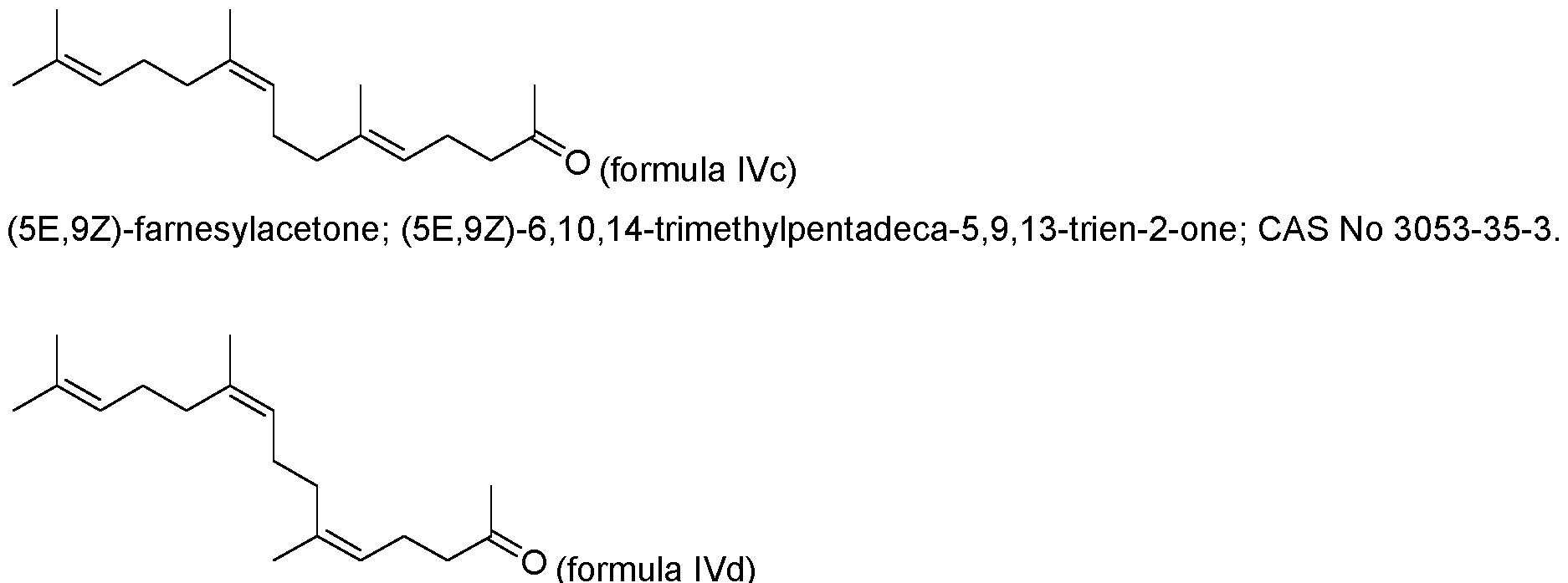
(5Z,9Z)-farnesylacetone; (5Z,9Z)-6,10,14-trimethylpentadeca-5,9,13-trien-2-one; Cas No 3796-69-8.
Preferably, the process is an in vivo or bioconversion process. Further included in this aspect of the invention is a recombinant cell comprising, capable of producing or producing a compound of formula (IV) and one or more compound(s) of formula (II) and/or formula (III). The recombinant cell comprises (i) a polypeptide having ADH enzyme activity and (ii) a polypeptide having enal-cleaving enzyme activity. Further included in this aspect of the invention is a process for making a compound of formula (IV) comprising growing the recombinant cell of this aspect of the invention under growth conditions suitable for the production of the compound of formula (IV) and as described herein above. Further included in this aspect of the invention is a cell culture fermentation medium comprising the recombinant cell of this aspect of the invention. The cell culture fermentation medium may further comprise a compound of formula (IV) and/or one or more compound(s) of formula (II) and/or formula (III). Further included in this aspect of the invention is a reaction mixture comprising compound of formula (IV). The reaction mixture may further comprise one or more compounds of formula (II) and/or formula (III). Further included in this aspect of the invention is a compound of formula (IV) obtained or obtainable by the process of this aspect of the invention or from the recombinant cell, the cell culture fermentation or the reaction mixture of this aspect of the invention. Further aspect for the preparation of a compound of formula (I) A further aspect of the invention provides a process fo the preparation of a compound of formula (I)

in the form of any one of its stereoisomers or a mixture thereof, comprising: (i) contacting a compound of formula (VI)

in the form of any one of its stereoisomers or a mixture thereof, with a polypeptide having terpene cyclase enzyme activity to produce a compound of formula (I). An embodiment of this aspect of the invention is wherein more than 97% of the compound of formula (I) is in the form of formula (Ia) and/or formula (Ib). Another embodiment of this aspect of the invention is wherein the compound of formula (VI) is in the form of formula (VIa). A further aspect of the invention is wherein the polypeptide having terpene cyclase enzyme activity is a polypeptide that is not a squalene cyclase (SHC) enzyme and/or is a polypeptide that is a squalene cyclase enzyme. In the context of the invention, the polypeptide that is not a SHC enzyme is a meroterpenoid cyclase enzyme. Hence, a further aspect of the invention is wherein the polypeptide having terpene cyclase enzyme activity is a meroterpenoid cyclase enzyme and/or a squalene cyclase enzyme. As can be appreciated in this aspect of the invention, the process of preparing a compound of formula (I) from compound of formula (VI) comprises step (v) of the process for preparing a compound of formula (I) in the first aspect of the invention above. Accordingly therefore, all the embodiments set out herein in relation to step (v) of the process of preparing a compound of formula (I) in the first aspect of the invention can be used in this aspect of the invention. In one embodiment of this aspect of the invention, the squalene cyclase enzyme has at least 50%, 55%, 60%, 65%, 70%, 75%, 80%, 85%, 90%, 95%, 96%, 97%, 98% or 99% or more sequence identity to any of SEQ ID NOs: 29 to 49 and 265 to 279; preferably, to any of SEQ ID NOs: 29 to 49, 265 to 274 and 276 to 279. More preferably, the squalene cyclase enzyme comprises the sequence provided in any of SEQ ID NOs: 29 to 49, 265 to 274 and 276 to 279. In a further embodiment, the squalene cyclase enzyme has at least 50%, 55%, 60%, 65%, 70%, 75%, 80%, 85%, 90%, 95%, 96%, 97%, 98% or 99% or more sequence identity to any of the sequences provided in SEQ ID NOs: 29, 31, 33, 34, 36 to 38, 40, 41, 43 to 46, 48, 49, 265 to 274 and 276 to 279. Preferably, the squalene cyclase enzyme comprises the sequence provided in any of SEQ ID NOs: 29, 31, 33, 34, 36 to 38, 40, 41, 43 to 46, 48, 49, 265 to 274 and 276 to 279. When preparing the process of the present invention, the inventors sought to compare the isomeric profile of the compound of formula (I) synthesized via SHC and meroterpenoid cyclases.
To their surprise, they found that the meroterpenoid cyclases when used in the process of the invention, produced compound of formula (I) having an isomeric bias towards isomers of compound of formula (I) having preferred olfactory profiles more than that produced by SHC enzymes. In particular, they demonstrated that less than 1% of compound of formula (I) produced by the process of the invention were in the isomeric form of formula I(c) and/or I(d). Hence, the use of meroterpenoid cyclases is associated with a surprising technical advantage over the use of SHC enzymes. Preferably, the meroterpenoid cyclase is a membrane-integrated meroterpenoid cyclase. It can be seen from the accompanying Examples that this class of meroterpenoid cyclases preferably produce compounds of formula (Ia) rather than (Ic) and/or (Id). Examples of membrane integrated meroterpenoid cyclase include those provided in any of SEQ ID NOs: 50 to 73 and 280 to 289. Preferably, the meroterpenoid cyclase is a soluble meroterpenoid cyclase. It can be seen from the accompanying Examples that this class of meroterpenoid cyclases preferably produce compounds of formula (Ib) rather than (Ic) and/or (Id). Examples of soluble meroterpenoid cyclase include those provided in SEQ ID NO: 74 or 75. This is the first time meroterpenoid cyclases have been used to prepare compound of formula (I), and the bias towards such isomeric forms is surprising and technically important commercially. Accordingly, a further aspect of this invention provides a process for the preparation of a compound of formula (I):

in the form of any one of its stereoisomers or a mixture thereof, comprising: (i) contacting the compound of formula (VI)

in the form of any one of its stereoisomers or a mixture thereof, with a polypeptide having terpene cyclase enzyme activity to produce a compound of formula (I), wherein the polypeptide having terpene cyclase enzyme activity is not a SHC enzyme.
A preferred embodiment of this aspect of the invention is wherein the polypeptide that is not a SHC enzyme is a meroterpenoid cyclase enzyme. As can be appreciated, meroterpenoid cyclase enzymes (or polypeptides having meroterpenoid cyclase enzyme activity) are described above in details in relation to the first aspect of the invention and this is incorporated herein to this aspect of the invention. Preferably, the meroterpenoid cyclase enzyme has at least 50%, 55%, 60%, 65%, 70%, 75%, 80%, 85%, 90%, 95%, 96%, 97%, 98% or 99% or more sequence identity to any of the sequences provided in SEQ ID NOs: 50 to 75 and 280 to 289. Preferably, the meroterpenoid cyclase enzyme comprises the sequence provided in any of SEQ ID NOs: 50 to 75 and 280 to 289. Preferably, the meroterpenoid cyclase enzyme has at least 50%, 55%, 60%, 65%, 70%, 75%, 80%, 85%, 90%, 95%, 96%, 97%, 98% or 99% or more sequence identity to SEQ ID NO: 57, 71, 74, 280, 281, 282, 283, 286, 287 or 288. Preferably, the meroterpenoid cyclase enzyme comprises the sequence provided in any of SEQ ID NOs: 57, 71, 74, 280, 281, 282, 283, 286, 287 or 288. Preferably, the meroterpenoid cyclase enzyme is a membrane-integrated meroterpenoid cyclase. It can be seen from the accompanying Examples that this class of meroterpenoid cyclases preferably produce compounds of formula (Ia) rather than (Ic) and/or (Id). Hence, in a preferred embodiment, the meroterpenoid cyclase enzyme is a membrane-integrated meroterpenoid cyclase enzyme having at least 50%, 55%, 60%, 65%, 70%, 75%, 80%, 85%, 90%, 95%, 96%, 97%, 98% or 99% or more sequence identity to any of SEQ ID NOs: 50 to 73 and 280 to 289. Preferably, the meroterpenoid cyclase is a soluble meroterpenoid cyclase. It can be seen from the accompanying Examples that this class of meroterpenoid cyclases preferably produce compounds of formula (Ib) rather than (Ic) and/or (Id). Hence, in another preferred embodiment, the meroterpenoid cyclase enzyme is a soluble meroterpenoid cyclase enzyme having at least 50%, 55%, 60%, 65%, 70%, 75%, 80%, 85%, 90%, 95%, 96%, 97%, 98% or 99% or more sequence identity to any of SEQ ID NOs: 74 and 75. As can be appreciated in this aspect of the invention for the preparation of a compound of formula (I), the process may further comprise one or more steps prior to step (i), said one or more steps being described above in details in relation to the first aspect of the invention and this is incorporated herein to this aspect of the invention. Preferably, the process is an in vivo or a bioconversion process.
Further included in this aspect of the invention is a recombinant cell comprising or capable of producing or producing a compound of formula (I); optionally, wherein more than 97% of the compound of formula (I) is in the form of formula (Ia) and/or (Ib). In one embodiment, the recombinant cell comprises or is capable of functionally expressing or is functionally expressing a polypeptide having SHC enzyme activity and/or a polypeptide having meroterpenoid cyclase enzyme activity as described herein above. Further included in this aspect of the invention is a process for making a compound of formula (I) comprising growing the recombinant cell of this aspect of the invention under growth conditions suitable for the production of the compound of formula (I). Further included in this aspect of the invention is a cell culture fermentation medium comprising the recombinant cell of this aspect of the invention. The cell culture fermentation medium may further comprise a compound of formula (I); optionally, wherein more than 97% of the compound of formula (I) is in the form of formula (Ia) and/or (Ib). The cell culture fermentation medium may further a compound of formula (VI). Further included in this aspect of the invention is a reaction mixture comprising a compound of formula (I); optionally, wherein more than 97% of the compound of formula (I) is in the form of formula (Ia) and/or (Ib). The reaction mixture may further a compound of formula (VI). Further included in this aspect of the invention is a compound of formula (I) obtained or obtainable by the process of this aspect of the invention or from the recombinant cell or from the cell culture fermentation medium or from the reaction mixture of this aspect of the invention. Further included in this aspect of the invention is a compound (I), wherein more than 97% of said compound is in the form of formula (Ia) and/or (Ib). A further aspect of the invention is the use of a meroterpenoid cyclase enzyme for the production of a compound of formula (I) and/or a derivative thereof. Further aspect for the preparation of a compound of formula (I) As set out above, to prepare an improved process for the preparation of a compound of formula (I), the inventors developed a deep understanding of the biochemical route to the production of these compounds by a multi-enzymatic reaction from precursor compounds. This multi-enzymatic reaction is the first time the preparation of these compounds has been performed by such a step-wise reaction and constitutes a significant scientific and commercial advance in the preparation of sesquiterpene compound of formula (I).
In addition to the preparation of a compound of formula (I) from a compound of formula (II), the inventors also devised a process for the preparation of a compound of formula (I) from a compound of formula (V). This is also a commercially important process to the preparation of a compound of formula (I). Accordingly therefore, a further aspect of the invention provides a process for the preparation of a compound of formula (I):

in the form of any one of its stereoisomers or a mixture thereof, comprising: (i) contacting a compound of formula (V)
in the form of any one of its stereoisomers or a mixture thereof, with a polypeptide having esterase enzyme activity to produce a compound of formula (VI); and (ii) contacting the compound of formula (VI)

in the form of any one of its stereoisomers or a mixture thereof, with a polypeptide having terpene cyclase enzyme activity to produce a compound of formula (I). Esterase enzymes (or polypeptides having esterase enzyme activity) and terpene cyclase enzymes (or polypeptides having terpene cyclase enzyme activity) are described above in details in relation to the first aspect of the invention and this is incorporated herein to this aspect of the invention. In this aspect of the invention, the process for preparing a compound of formula (I) uses a compound of formula (V) as a starting material. The process of this aspect of the invention may be an in vivo process or a bioconversion process. Preferably, the process is a bioconversion process.
A preferred embodiment of this aspect of the invention is wherein: (i) the polypeptide having esterase enzyme activity has at least 50%, 55%, 60%, 65%, 70%, 75%, 80%, 85%, 90%, 95%, 96%, 97%, 98% or 99% or more sequence identity to SEQ ID NO: 27 or 28; preferably, to SEQ ID NO: 28; and/or (ii) the polypeptide having terpene cyclase enzyme activity has at least 50%, 55%, 60%, 65%, 70%, 75%, 80%, 85%, 90%, 95%, 96%, 97%, 98% or 99% or more sequence identity to any of SEQ ID NOs: 29 to 75, 79 to 89 and 265 to 289; preferably, to any of SEQ ID NOs: 29 to 75 and 265 to 289; more preferably, to any of SEQ ID NOs: 29 to 75, 265 to 274 and 276 to 289; even more preferably, to any of SEQ ID NO: 48, 57, 71, 74, 265, 266, 267, 268, 274, 276, 279, 280, 281, 282, 283, 286, 287 or 288. Further included in this aspect of the invention is a recombinant cell comprising one or more compound(s) of formula (I), formula (V) and/or formula (VI). The recombinant cell may further comprise (i) a polypeptide having esterase enzyme activity and (ii) a polypeptide having terpene cyclase enzyme activity. Further included in this aspect of the invention is a process for making a compound of formula (I) comprising growing a recombinant cell of this aspect of the invention under growth conditions suitable for the production of the compound of formula (I). Further included in this aspect of the invention is a cell culture fermentation medium comprising the recombinant cell of this aspect of the invention. The cell culture fermentation medium may further comprise one or more compounds of formula (I), formula (V) and/or formula (VI). Further included in this aspect of the invention is a reaction mixture comprising a compound of formula (I). The reaction mixture may further comprise one or more compounds of formula (V) and/or formula (VI) Further included in this aspect of the invention is a compound of formula (I) obtained or obtainable by the process of this aspect of the invention or from the recombinant cell, the cell culture fermentation medium or the reaction mixture of this aspect of the invention. Furthermore as stated above, in the present invention high selectivity of production of a compound of formula (VI) in the form of compound (VIa) has been achieved, as demonstrated in the accompanying Examples. This subsequently leads to a bioconversion in which olfactory preferred forms of compounds of formula (I) are prepared. Hence the bioconversion of the invention to prepare compounds of formula (I) lacking substantial amount of undesirable side products is of significant commercial importance.
Accordingly therefore, and as can be shown in the accompanying Examples, an embodiment of this aspect of the invention is wherein more than 97% of the compound of formula (I) is in the form of formula (Ia) and/or (Ib). A further embodiment of this aspect of the invention is wherein the process comprises a prior step: (a) contacting the compound of formula (IV)

in the form of any one of its stereoisomers or a mixture thereof, with a polypeptide having BVMO enzyme activity to produce a compound of formula (V). A further embodiment of this aspect of the invention is wherein the process comprises an additional prior step: (a) contacting a compound of formula (III)

in the form of any one of its stereoisomers or a mixture thereof, with a polypeptide having enal-cleaving enzyme activity to produce a compound of formula (IV). Examples of BVMO and enal-cleaving enzymes are described above in the first aspect of the invention and may be used in this aspect of the invention. Phosphatase enzymes for use in the process of the invention As described herein above, one embodiment of the process of the first aspect of the invention further comprises one or more biocatalytic steps prior to step (i) to prepare a compound of formula (II), said biocatalytic step(s) comprising: (a) preparing geranylgeranyl-diphosphate (GGPP) from IPP and DMAPP using one or more prenyltransferase enzyme(s); and, (b) preparing a compound of formula (II) from GGPP using one or more enzymes having phosphatase activity. When preparing the process of the invention, the present inventors identified phosphatase enzymes which can be used in step (b) of said process. This is the first time these enzymes were shown to be capable of catalysing the step of preparing a compound of formula (II) from GGPP.
Hence, included in this aspect of the invention is the use of a phosphatase for the preparation of a compound of formula (II). A further aspect of the invention provides the use of a phosphatase enzyme comprising 50%, 55%, 60%, 65%, 70%, 75%, 80%, 85%, 90%, 95%, 96%, 97%, 98% or 99% or more sequence identity to any of the sequences provided in any of SEQ ID NOs: 3 to 10 for the preparation of a compound of formula (II) from GGPP. Preferably, the phosphatase enzyme comprises 50%, 55%, 60%, 65%, 70%, 75%, 80%, 85%, 90%, 95%, 96%, 97%, 98% or 99% or more sequence identity to any of the sequences provided in any of SEQ ID NOs: 3, 4, 5, 7 and 8. More preferably, the phosphatase enzyme comprises the sequences provided in any of SEQ ID NOs: 3, 4, 5, 7 and 8. ADH enzymes for use in the process of the invention As described herein, the process of the first aspect of the invention comprises as step (i) the preparation of a compound of formula (III) by contacting a compound of formula (II) with an ADH enzyme. When preparing the process of the invention, the present inventors identified ADH enzymes which can be used in step (i) of said process. This is the first time these enzymes were shown to be capable of catalysing the step of preparing a compound of formula (III) from a compound of formula (II). Hence, a further aspect of the invention provides the use of an ADH enzyme comprising 50%, 55%, 60%, 65%, 70%, 75%, 80%, 85%, 90%, 95%, 96%, 97%, 98% or 99% or more sequence identity to any of the sequences provided in any of SEQ ID NOs: 11 to 21 for the preparation of compound of formula (III) from a compound of formula (II). Preferably, the ADH enzyme comprises the sequence provided in any of SEQ ID NOs: 11 to 21. Yet, another further aspect of the invention provides the use of an ADH enzyme comprising 50%, 55%, 60%, 65%, 70%, 75%, 80%, 85%, 90%, 95%, 96%, 97%, 98% or 99% or more sequence identity to SEQ ID NO: 11 or 21 for the preparation of compound of formula (III) from a compound of formula (II). Preferably, the ADH enzyme comprises the sequence provided in SEQ ID NOs: 11 or 21. Enal-cleaving enzymes for use in the process of the invention As described herein, the process of the first aspect of the invention comprises as step (ii) the preparation of a compound of formula (IV) by contacting a compound of formula (III) with an enal-cleaving enzyme.
When preparing the process of the invention, the present inventors identified an enal-cleaving enzyme which can be used in step (ii) of said process. This is the first time this enzyme was shown to be capable of catalysing the step of preparing a compound of formula (IV) from a compound of formula (III). Hence, a further aspect of the invention provides the use of a polypeptide having enal-cleaving enzyme activity to produce a compound of formula (IV). A further aspect of the invention provides the use of a polypeptide having enal-cleaving enzyme activity for the preparation of a compound of formula (IV) from a compound of formula (III). A further aspect of the invention is the use of a polypeptide having enal- cleaving enzyme activity to produce a compound of formula (IV), (V), (VI), (I) and/or a derivative thereof. Hence, a further aspect of the invention provides the use of a polypeptide having enal-cleaving enzyme activity comprising 50%, 55%, 60%, 65%, 70%, 75%, 80%, 85%, 90%, 95%, 96%, 97%, 98% or 99% or more sequence identity to SEQ ID NO: 22 to produce a compound of formula (IV). A further aspect of the invention provides the use of a polypeptide having enal-cleaving enzyme activity comprising 50%, 55%, 60%, 65%, 70%, 75%, 80%, 85%, 90%, 95%, 96%, 97%, 98% or 99% or more sequence identity to SEQ ID NO: 22 for the preparation of a compound of formula (IV) from a compound of formula (III). A further aspect of the invention provides the use of a polypeptide having enal-cleaving enzyme activity comprising 50%, 55%, 60%, 65%, 70%, 75%, 80%, 85%, 90%, 95%, 96%, 97%, 98% or 99% or more sequence identity to SEQ ID NO: 22 to produce a compound of formula (IV), (V), (VI), (I) and/or a derivative thereof. Preferably, the polypeptide having enal-cleaving enzyme activity comprises the sequence provided in SEQ ID NO: 22. BVMO enzymes for use in the process of the invention As described herein, the process of the first aspect of the invention comprises as step (iii) the preparation of a compound of formula (V) by contacting a compound of formula (IV) with a BVMO enzyme. When preparing the process of the invention, the present inventors identified BMVO enzymes which can be used in step (iii) of said process. This is the first time these enzymes were shown to be capable of catalysing the step of preparing a compound of formula (V) from a compound of formula (IV). Hence, a further aspect of the invention provides the use of a BVMO enzyme comprising 50%, 55%, 60%, 65%, 70%, 75%, 80%, 85%, 90%, 95%, 96%, 97%, 98% or 99% or more sequence identity to any of SEQ ID NOs: 23 to 26 and 216 to 227 for the preparation of compound of formula (V) from a compound of formula (IV).
Preferably, the BVMO enzyme comprises 50%, 55%, 60%, 65%, 70%, 75%, 80%, 85%, 90%, 95%, 96%, 97%, 98% or 99% or more sequence identity to any of SEQ ID NOs: 23 to 26. More preferably, the BVMO enzyme comprises the sequence provided in any of SEQ ID NOs: 23 to 26. Preferably, the BVMO enzyme comprises 50%, 55%, 60%, 65%, 70%, 75%, 80%, 85%, 90%, 95%, 96%, 97%, 98% or 99% or more sequence identity to SEQ ID NO: 25 or 26. More preferably, the BVMO enzyme comprises the sequence provided in SEQ ID NO: 25 or 26. Esterase enzymes for use in the process of the invention As described herein, the process of the first aspect of the invention comprises as step (iv) the preparation of a compound of formula (VI) by contacting a compound of formula (V) with an esterase enzyme. When preparing the process of the invention, the present inventors identified esterase enzymes which can be used in step (iv) of said process. This is the first time these enzymes were shown to be capable of catalysing the step of preparing a compound of formula (VI) from a compound of formula (V). Hence a further aspect of the invention provides the use of an esterase enzyme comprising 50%, 55%, 60%, 65%, 70%, 75%, 80%, 85%, 90%, 95%, 96%, 97%, 98% or 99% or more sequence identity to SEQ ID NO: 27 or 28 for the preparation of compound of formula (VI) from a compound of formula (V). Preferably, the esterase enzyme comprises the sequence provided in SEQ ID NO: 27 or 28. SHC enzymes according to the invention When preparing the process of the invention, the present inventors identified new polypeptide sequences encoding SHC enzymes which can be used in said process. These polypeptides are therefore also part of the present invention. When investigating the SHC enzymes, the present inventors identified enzymes having amino acid alanine at position 437 and amino acid methionine at position 600 relative to sequence provided in SEQ ID NO: 82 as being of particular utility. Accordingly therefore, a further aspect of the present invention is a mutant SHC enzyme having an amino acid alanine at position 437 and amino acid methionine at position 600 relative to sequence provided in SEQ ID NO: 82. This is the first time this combination of mutations has been shown to be able to function in the reaction described in step (v) of the process of the first aspect of the invention.
SHC enzymes have been described above; for example, in relation to step (v) of the process of the first aspect of the invention. Using the information provided in that section of the present specification, the skilled person can identify any SHC enzyme which can be modified using standard laboratory techniques to arrive at the mutant SHC enzyme of this aspect of the invention. A preferred embodiment of this aspect of the invention is wherein the mutant SHC enzyme is a polypeptide having at least 50%, 55%, 60%, 65%, 70%, 75%, 80%, 85%, 90%, 95%, 96%, 97%, 98% or 99% or more sequence identity to any of the sequences provided in SEQ ID NOs: 29, 31, 33, 34, 36 to 38, 40, 41, 43 to 46, 48, 49, 265 to 274 and 276 to 279, wherein said polypeptide has amino acid alanine at position 437 and amino acid methionine at position 600 relative to the sequence provided in SEQ ID NO: 82. A preferred embodiment is wherein the mutant SHC enzyme is a polypeptide having at least 50%, 55%, 60%, 65%, 70%, 75%, 80%, 85%, 90%, 95%, 96%, 97%, 98% or 99% or more sequence identity to any of the sequences provided in SEQ ID NOs: 29, 31, 33, 34, 36 to 38, 40, 41, 43 to 46, 48, 49, 265, 266, 267, 268, 274, 276 and 279, wherein said polypeptide has amino acid alanine at position 437 and amino acid methionine at position 600 relative to the sequence provided in SEQ ID NO: 82. Preferably, the mutant SHC enzyme is a polypeptide having the amino acid sequence provided in any of SEQ ID NOs: 29, 31, 33, 34, 36 to 38, 40, 41, 43 to 46, 48, 49, 265 to 274 and 276 to 279. Preferably, the mutant SHC enzyme is a polypeptide having the amino acid sequence provided in any of SEQ ID NOs: 29, 31, 33, 34, 36 to 38, 40, 41, 43 to 46, 48, 49, 265, 266, 267, 268, 274, 276 and 279. Also included in this aspect of the invention is polypeptide fragments, variants and functional equivalents thereof. The polypeptides of this aspect of the invention are SHC enzymes which may be used in step (v) of the process of the first aspect of the invention or any futher aspects of the invention comprising prepraring a compound of formula (I) from a compound of formula (VI). A further aspect of the invention provides a nucleic acid sequence encoding a mutant SHC enzyme having an amino acid alanine at position 437 and amino acid methionine at position 600 relative to sequence provided in SEQ ID NO: 82. Methods of preparing such nucleic acid sequence are known in the art. A preferred embodiment of this aspect of the invention is wherein the nucleic acid sequence encoding the mutant SHC enzyme is a nucleic acid sequence having at least 50%, 55%, 60%, 65%, 70%, 75%, 80%, 85%, 90%, 95%, 96%, 97%, 98% or 99% or more sequence identity to any of the sequences provided in SEQ ID NOs: 123, 125, 126, 128 to 131, 134 to 137, 139 to 142, 144 to 148, 150 to 153, 290 to 299 and 301 to 304, wherein said nucleic acid sequence encodes a polypeptide having amino acid alanine at position 437 and amino acid methionine at position 600 relative to sequence provided in SEQ ID NO: 82. Preferably, the nucleic acid sequence is a nucleic sequence provided in any of SEQ ID NOs: 123, 125, 126, 128 to 131, 134 to 137, 139 to 142, 144 to 148, 150 to 153, 290 to 299 and 301
to 304. Also included in this aspect of the invention is expression vectors, cassettes and other such related technology comprising nucleic acid sequences of the invention. Furthermore, as described herein, in the process of the invention comprising the preparation of a compound of formula (I) by contacting a compound of formula (VI) with a terpene cyclase enzyme, the terpene cyclase enzyme may be an SHC enzyme. When preparing the process of the invention, the present inventors identified SHC enzymes which can be used in said process. This is the first time these enzymes were shown to be capable of catalysing the step of preparing a compound of formula (I) from a compound of formula (VI). Hence, a further aspect of the invention provides the use of a SHC enzyme comprising 50%, 55%, 60%, 65%, 70%, 75%, 80%, 85%, 90%, 95%, 96%, 97%, 98% or 99% or more sequence identity to any of SEQ ID NOs: 29 to 49, 79 to 89 and 265 to 279 for the preparation of compound of formula (I) from a compound of formula (VI). Preferably, the SHC enzyme comprises 50%, 55%, 60%, 65%, 70%, 75%, 80%, 85%, 90%, 95%, 96%, 97%, 98% or 99% or more sequence identity to any of SEQ ID NOs: 29 to 49 and 265 to 279. More preferably, the SHC enzyme comprises the sequence provided in any of SEQ ID NOs: 29 to 49 and 265 to 279. Preferably, the SHC enzyme comprises 50%, 55%, 60%, 65%, 70%, 75%, 80%, 85%, 90%, 95%, 96%, 97%, 98% or 99% or more sequence identity to any of SEQ ID NOs: 29 to 49, 265 to 274 and 276 to 279. More preferably, the SHC enzyme comprises the sequence provided in any of SEQ ID NOs: 29 to 49, 265 to 274 and 276 to 279. Meroterpenoid cyclase enzymes according to the invention When preparing the process of the invention, the present inventors identified new polypeptide sequences encoding meroterpenoid cyclase enzymes which can be used in said process. These polypeptides are therefore also part of the present invention. One embodiment of this aspect of the invention is a mutant meroterpenoid cyclase enzyme having at least 50%, 55%, 60%, 65%, 70%, 75%, 80%, 85%, 90%, 95%, 96%, 97%, 98% or 99% or more sequence identity to any of the sequences provided in any of SEQ ID NOs: 56 to 70. Preferably, the mutant meroterpenoid cyclase enzyme has the amino acid sequence provided in any of SEQ ID NOs: 56 to 70. Also included in this aspect of the invention is polypeptide fragments, variants and functional equivalents thereof. Accordingly, this aspect of the invention provides a nucleic acid sequence encoding the mutant meroterpenoid cyclase enzyme having at least 50%, 55%, 60%, 65%, 70%, 75%, 80%, 85%, 90%,
95%, 96%, 97%, 98% or 99% or more sequence identity to any of the sequences provided in SEQ ID NOs: 165 to 185. Preferably, the nucleic acid sequence is a nucleic acid sequence provided in any of SEQ ID NOs: 165 to 185. Also included in this aspect of the invention is expression vectors, cassettes and other such related technology comprising nucleic acid sequences of the invention. When investigating the meroterpenoid cyclase enzymes, the present inventors identified enzymes having an amino acid substitution at amino acid position 9 relative to sequence provided in SEQ ID NO: 51. Accordingly therefore, a further aspect of the invention is a mutant meroterpenoid cyclase enzyme having an amino acid substitution at amino acid position 9 relative to sequence provided in SEQ ID NO: 51. This is the first time a meroterpenoid cyclase enzyme having this mutation has been shown to be able to function in the step of preparing a compound of formula (I) from a compound of formula (VI). Meroterpenoid cyclase enzymes have been described above in relation to step (v) of the process of the first aspect of the invention. Using the information provided in that section of the present specification, the skilled person can identify any meroterpenoid cyclase enzyme which can be modified using standard laboratory techniques to arrive at the mutant meroterpenoid cyclase enzyme of this aspect of the invention. Preferably, the mutant meroterpenoid cyclase enzyme has a substitution at amino acid position 9 relative to the sequence provided in SEQ ID NO: 51 introducing a cysteine, methionine or threonine in this position. Accordingly, a preferred embodiment of this aspect of the invention is wherein the mutant meroterpenoid cyclase enzyme is a polypeptide having at least 50%, 55%, 60%, 65%, 70%, 75%, 80%, 85%, 90%, 95%, 96%, 97%, 98% or 99% or more sequence identity to any of the sequences provided in any of SEQ ID NOs: 56 to 61, 69 and 70, wherein the mutant meroterpenoid cyclase enzyme has an amino acid substitution at amino acid position 9 relative to the sequence provided in SEQ ID NO: 51. Preferably, the mutant meroterpenoid cyclase enzyme has the amino acid sequence provided in any of SEQ ID NOs: 56 to 61, 69 and 70. Also included in this aspect of the invention is polypeptide fragments, variants and functional equivalents thereof. The polypeptides of this aspect of the invention are meroterpenoid cyclase enzymes which may be used in step (v) of the process of the first aspect of the invention or any futher aspects of the invention comprising prepraring a compound of formula (I) from a compound of formula (VI). A further aspect of the invention provides a nucleic acid sequence encoding a mutant meroterpenoid cyclase enzyme having an amino acid substitution at amino acid position 9 relative to sequence provided in SEQ ID NO: 51. Methods of preparing such nucleic acid sequence are known in the art.
A preferred embodiment of this aspect of the invention is wherein a nucleic acid sequence encoding the mutant meroterpenoid cyclase enzyme is a nucleic acid sequence having at least 50%, 55%, 60%, 65%, 70%, 75%, 80%, 85%, 90%, 95%, 96%, 97%, 98% or 99% or more sequence identity to any of the sequences provided in SEQ ID NOs: 165 to 176, 184 and 185, wherein said nucleic acid sequence encodes a polypeptide having an amino acid substitution at amino acid position 9 relative to sequence provided in SEQ ID NO: 51. Preferably, the nucleic acid sequence is a nucleic acid sequence provided in any of SEQ ID NOs: 165 to 176, 184 and 185. Also included in this aspect of the invention is expression vectors, cassettes and other such related technology comprising nucleic acid sequences of the invention. Furthermore, as described herein, in the process of the invention comprising the preparation of a compound of formula (I) by contacting a compound of formula (VI) with a terpene cyclase enzyme, the terpene cyclase enzyme may be a meroterpenoid cyclase enzyme. When preparing the process of the invention, the present inventors identified meroterpenoid cyclase enzymes which can be used in said process. This is the first time these meroterpenoid cyclases were shown to be capable of catalysing the step of preparing a compound of formula (I) from a compound of formula (VI). Hence, a further aspect of the invention provides the use of a meroterpenoid cyclase enzyme comprising 50%, 55%, 60%, 65%, 70%, 75%, 80%, 85%, 90%, 95%, 96%, 97%, 98% or 99% or more sequence identity to any of SEQ NOs: 50 to 75 and 280 to 289 for the preparation of a compound of formula (I) from a compound of formula (VI). Preferably, the meroterpenoid cyclase enzyme comprises the sequence provided in any of SEQ NOs: 50 to 75 and 280 to 289. Polypeptides and nucleic acids of the invention or used in the process of the invention The generic terms “polypeptide” or “peptide”, which may be used interchangeably, refer to a natural or synthetic linear chain or sequence of consecutive, peptidically linked amino acid residues, comprising about 10 to up to more than 1.000 residues. Short chain polypeptides with up to 30 residues are also designated as “oligopeptides”. The term “protein” refers to a macromolecular structure consisting of one or more polypeptides. The amino acid sequence of its polypeptide(s) represents the “primary structure” of the protein. The amino acid sequence also predetermines the “secondary structure” of the protein by the formation of special structural elements, such as alpha-helical and beta-sheet structures formed within a polypeptide chain. The arrangement of a plurality of such secondary structural elements defines the “tertiary structure” or spatial arrangement of the protein. If a protein comprises more than one polypeptide chains said chains are spatially arranged forming the “quaternary structure” of the protein. A correct spatial arrangement
or “folding” of the protein is prerequisite of protein function. Denaturation or unfolding destroys protein function. If such destruction is reversible, protein function may be restored by refolding. A typical protein function referred to herein is an “enzyme function”, i.e. the protein acts as biocatalyst on a substrate, for example a chemical compound, and catalyzes the conversion of said substrate to a product. An enzyme may show a high or low degree of substrate and/or product specificity. A “polypeptide” referred to herein as having a particular “activity” thus implicitly refers to a correctly folded protein showing the indicated activity, as for example a specific enzyme activity. Thus, unless otherwise indicated the term “polypeptide” also encompasses the terms “protein” and “enzyme”. Similarly, the term “polypeptide fragment” encompasses the terms “protein fragment“ and “enzyme fragment”. The term “isolated polypeptide” refers to an amino acid sequence that is removed from its natural environment by any method or combination of methods known in the art and includes recombinant, biochemical and synthetic methods. “Target peptide” refers to an amino acid sequence which targets a protein, or polypeptide to intracellular organelles, i.e., mitochondria, or plastids, or to the extracellular space (secretion signal peptide). A nucleic acid sequence encoding a target peptide may be fused to the nucleic acid sequence encoding the amino terminal end, e.g., N-terminal end, of the protein or polypeptide, or may be used to replace a native targeting polypeptide. The present invention also relates to "functional equivalents" (also designated as “analogs” or “functional mutations”) of the polypeptides specifically described herein. For example, "functional equivalents" refer to polypeptides which, in a test used for determining enzymatic activity display at least a 1 to 10 %, or at least 20 %, or at least 50 %, or at least 75 %, or at least 90 % higher or lower activity, as that of the polypeptides specifically described herein. "Functional equivalents”, according to the invention, also cover particular mutants, which, in at least one sequence position of an amino acid sequences stated herein, have an amino acid that is different from that concretely stated one, but nevertheless possess one of the aforementioned biological activities, as for example enzyme activity. "Functional equivalents" thus comprise mutants obtainable by one or more, like 1 to 20, in particular 1 to 15 or 5 to 10 amino acid additions, substitutions, in particular conservative substitutions, deletions and/or inversions, where the stated changes can occur in any sequence position, provided they lead to a mutant with the profile of properties according to the
invention. Functional equivalence is in particular also provided if the activity patterns coincide qualitatively between the mutant and the unchanged polypeptide, i.e. if, for example, interaction with the same agonist or antagonist or substrate, however at a different rate, (i.e. expressed by a EC50 or IC50 value or any other parameter suitable in the present technical field) is observed. Examples of suitable (conservative) amino acid substitutions are shown in the following table: Original residue Examples of substitution Ala Ser Arg Lys Asn Gln; His Asp Glu Cys Ser Gln Asn Glu Asp Gly Pro His Asn ; Gln Ile Leu; Val Leu Ile; Val Lys Arg ; Gln ; Glu Met Leu ; Ile Phe Met ; Leu ; Tyr Ser Thr Thr Ser Trp Tyr Tyr Trp ; Phe Val Ile; Leu "Functional equivalents" in the above sense are also "precursors" of the polypeptides described herein, as well as "functional derivatives" and "salts" of the polypeptides. "Precursors" are in that case natural or synthetic precursors of the polypeptides with or without the desired biological activity. The expression "salts" means salts of carboxyl groups as well as salts of acid addition of amino groups of the protein molecules. Salts of carboxyl groups can be produced in a known way and comprise inorganic salts, for example sodium, calcium, ammonium, iron and zinc salts, and salts with organic bases, for example amines, such as triethanolamine, arginine, lysine, piperidine and the like. Salts of acid addition, for example salts with inorganic acids, such as hydrochloric acid or sulfuric acid and salts with organic acids, such as acetic acid and oxalic acid, are also covered by the invention.
"Functional derivatives" of polypeptides according to the invention can also be produced on functional amino acid side groups or at their N-terminal or C-terminal end using known techniques. Such derivatives comprise for example aliphatic esters of carboxylic acid groups, amides of carboxylic acid groups, obtainable by reaction with ammonia or with a primary or secondary amine; N-acyl derivatives of free amino groups, produced by reaction with acyl groups; or O-acyl derivatives of free hydroxyl groups, produced by reaction with acyl groups. ”Functional equivalents” naturally also comprise polypeptides that can be obtained from other organisms, as well as naturally occurring variants. For example, areas of homologous sequence regions can be established by sequence comparison, and equivalent polypeptides can be determined on the basis of the concrete parameters of the invention. "Functional equivalents" also comprise “fragments”, like individual domains or sequence motifs, of the polypeptides according to the invention, or N- and or C-terminally truncated forms, which may or may not display the desired biological function. Preferably such “fragments” retain the desired biological function at least qualitatively. "Functional equivalents" are, moreover, fusion proteins, which have one of the polypeptide sequences stated herein or functional equivalents derived there from and at least one further, functionally different, heterologous sequence in functional N-terminal or C-terminal association (i.e. without substantial mutual functional impairment of the fusion protein parts). Non-limiting examples of these heterologous sequences are e.g. signal peptides, histidine anchors or enzymes. “Functional equivalents” which are also comprised in accordance with the invention are homologs to the specifically disclosed polypeptides. These have at least 60%, preferably at least 75%, in particular at least 80 or 85%, such as, for example, 90, 91, 92, 93, 94, 95, 96, 97, 98 or 99%, homology (or identity) to one of the specifically disclosed amino acid sequences, calculated by the algorithm of Pearson and Lipman, Proc. Natl. Acad, Sci. (USA) 85(8), 1988, 2444-2448. A homology or identity, expressed as a percentage, of a homologous polypeptide according to the invention means in particular an identity, expressed as a percentage, of the amino acid residues based on the total length of one of the amino acid sequences described specifically herein. The identity data, expressed as a percentage, may also be determined with the aid of BLAST alignments, algorithm blastp (protein-protein BLAST), or by applying the Clustal settings specified herein below. In the case of a possible protein glycosylation, "functional equivalents" according to the invention comprise polypeptides as described herein in deglycosylated or glycosylated form as well as modified forms that can be obtained by altering the glycosylation pattern.
Functional equivalents or homologues of the polypeptides according to the invention can be produced by mutagenesis, e.g. by point mutation, lengthening or shortening of the protein or as described in more detail below. Functional equivalents or homologs of the polypeptides according to the invention can be identified by screening combinatorial databases of mutants, for example shortening mutants. For example, a variegated database of protein variants can be produced by combinatorial mutagenesis at the nucleic acid level, e.g. by enzymatic ligation of a mixture of synthetic oligonucleotides. There are a great many methods that can be used for the production of databases of potential homologues from a degenerated oligonucleotide sequence. Chemical synthesis of a degenerated gene sequence can be carried out in an automatic DNA synthesizer, and the synthetic gene can then be ligated in a suitable expression vector. The use of a degenerated genome makes it possible to supply all sequences in a mixture, which code for the desired set of potential protein sequences. Methods of synthesis of degenerated oligonucleotides are known to a person skilled in the art. In the prior art, several techniques are known for the screening of gene products of combinatorial databases, which were produced by point mutations or shortening, and for the screening of cDNA libraries for gene products with a selected property. These techniques can be adapted for the rapid screening of the gene banks that were produced by combinatorial mutagenesis of homologues according to the invention. The techniques most frequently used for the screening of large gene banks, which are based on a high-throughput analysis, comprise cloning of the gene bank in expression vectors that can be replicated, transformation of the suitable cells with the resultant vector database and expression of the combinatorial genes in conditions in which detection of the desired activity facilitates isolation of the vector that codes for the gene whose product was detected. Recursive Ensemble Mutagenesis (REM), a technique that increases the frequency of functional mutants in the databases, can be used in combination with the screening tests, in order to identify homologues. An embodiment provided herein provides orthologs and paralogs of polypeptides disclosed herein as well as methods for identifying and isolating such orthologs and paralogs. A definition of the terms “ortholog” and “paralog” is given below and applies to amino acid and nucleic acid sequences. The polypeptides of the invention include all active forms, including active subsequences, e.g., catalytic domains or active sites, of an enzyme of the invention. In one aspect, the invention provides catalytic domains or active sites as set forth below. In one aspect, the invention provides a peptide or polypeptide comprising or consisting of an active site domain as predicted through use of a database such as Pfam (http://pfam.wustl.edu/hmmsearch.shtml) (which is a large collection of multiple sequence alignments and hidden Markov models covering many common protein families, The Pfam protein families database, A. Bateman, E. Birney, L. Cerruti, R. Durbin, L. Etwiller, S. R. Eddy, S. Griffiths-Jones, K. L. Howe, M. Marshall, and E. L. L. Sonnhammer, Nucleic Acids Research, 30(1):276-280, 2002) or
equivalent, as for example InterPro and SMART databases (http://www.ebi.ac.uk/interpro/scan.html, http://smart.embl-heidelberg.de/). The invention also encompasses “polypeptide variant” having the desired activity, wherein the variant polypeptide is selected from an amino acid sequence having at least 40%, 45%, 50%.55%, 60%, 65%, 70%, 75%, 80%, 85%, 90%, 91%, 92%, 93%, 94%, 95%, 96%, 97%, 98% or 99% or more sequence identity to a specific, in particular natural, amino acid sequence as referred to by a specific SEQ ID NO and contains at least one substitution modification relative to said SEQ ID NO. Coding nucleic acid sequences applicable according to the invention In this context the following definitions apply: The terms “nucleic acid sequence,” “nucleic acid,” “nucleic acid molecule” and “polynucleotide” are used interchangeably meaning a sequence of nucleotides. A nucleic acid sequence may be a single- stranded or double-stranded deoxyribonucleotide, or ribonucleotide of any length, and include coding and non-coding sequences of a gene, exons, introns, sense and anti-sense complimentary sequences, genomic DNA, cDNA, miRNA, siRNA, mRNA, rRNA, tRNA, recombinant nucleic acid sequences, isolated and purified naturally occurring DNA and/or RNA sequences, synthetic DNA and RNA sequences, fragments, primers and nucleic acid probes. The skilled artisan is aware that the nucleic acid sequences of RNA are identical to the DNA sequences with the difference of thymine (T) being replaced by uracil (U). The term “nucleotide sequence” should also be understood as comprising a polynucleotide molecule or an oligonucleotide molecule in the form of a separate fragment or as a component of a larger nucleic acid. An “isolated nucleic acid” or “isolated nucleic acid sequence” relates to a nucleic acid or nucleic acid sequence that is in an environment different from that in which the nucleic acid or nucleic acid sequence naturally occurs and can include those that are substantially free from contaminating endogenous material. The term “naturally-occurring” as used herein as applied to a nucleic acid refers to a nucleic acid that is found in a cell of an organism in nature and which has not been intentionally modified by a human in the laboratory. A “fragment” of a polynucleotide or nucleic acid sequence refers to contiguous nucleotides that is particularly at least 15 bp, at least 30 bp, at least 40 bp, at least 50 bp and/or at least 60 bp in length of the polynucleotide of an embodiment herein. Particularly the fragment of a polynucleotide comprises at least 25, more particularly at least 50, more particularly at least 75, more particularly at least 100, more particularly at least 150, more particularly at least 200, more particularly at least 300, more particularly at least 400, more particularly at least 500, more particularly at least 600, more particularly at least 700,
more particularly at least 800, more particularly at least 900, more particularly at least 1000 contiguous nucleotides of the polynucleotide of an embodiment herein. Without being limited, the fragment of the polynucleotides herein may be used as a PCR primer, and/or as a probe, or for anti-sense gene silencing or RNAi. “Recombinant nucleic acid sequences” are nucleic acid sequences that result from the use of laboratory methods (for example, molecular cloning) to bring together genetic material from more than on source, creating or modifying a nucleic acid sequence that does not occur naturally and would not be otherwise found in biological organisms. “Recombinant DNA technology” refers to molecular biology procedures to prepare a recombinant nucleic acid sequence as described, for instance, in Laboratory Manuals edited by Weigel and Glazebrook, 2002, Cold Spring Harbor Lab Press; and Sambrook et al., 1989, Cold Spring Harbor, NY, Cold Spring Harbor Laboratory Press. The term “gene” means a DNA sequence comprising a region, which is transcribed into a RNA molecule, e.g., an mRNA in a cell, operably linked to suitable regulatory regions, e.g., a promoter. A gene may thus comprise several operably linked sequences, such as a promoter, a 5’ leader sequence comprising, e.g., sequences involved in translation initiation, a coding region of cDNA or genomic DNA, introns, exons, and/or a 3’non-translated sequence comprising, e.g., transcription termination sites. “Polycistronic” refers to nucleic acid molecules, in particular mRNAs, that can encode more than one polypeptide separately within the same nucleic acid molecule. A “chimeric gene” refers to any gene which is not normally found in nature in a species, in particular, a gene in which one or more parts of the nucleic acid sequence are present that are not associated with each other in nature. For example, the promoter is not associated in nature with part or all of the transcribed region or with another regulatory region. The term “chimeric gene” is understood to include expression constructs in which a promoter or transcription regulatory sequence is operably linked to one or more coding sequences or to an antisense, i.e., reverse complement of the sense strand, or inverted repeat sequence (sense and antisense, whereby the RNA transcript forms double stranded RNA upon transcription). The term "chimeric gene" also includes genes obtained through the combination of portions of one or more coding sequences to produce a new gene. A “3’ UTR” or “3’ non-translated sequence” (also referred to as “3’ untranslated region,” or “3’end”) refers to the nucleic acid sequence found downstream of the coding sequence of a gene, which comprises, for example, a transcription termination site and (in most, but not all eukaryotic mRNAs) a polyadenylation signal such as AAUAAA or variants thereof. After termination of transcription, the mRNA transcript may be cleaved downstream of the polyadenylation signal and a poly(A) tail may be added, which is involved in the transport of the mRNA to the site of translation, e.g., cytoplasm.
The term “primer” refers to a short nucleic acid sequence that is hybridized to a template nucleic acid sequence and is used for polymerization of a nucleic acid sequence complementary to the template. The term “selectable marker” refers to any gene which upon expression may be used to select a cell or cells that include the selectable marker. Examples of selectable markers are described below. The skilled artisan will know that different antibiotic, fungicide, auxotrophic or herbicide selectable markers are applicable to different target species. The invention also relates to nucleic acid sequences that code for polypeptides as defined herein. In particular, the invention also relates to nucleic acid sequences (single-stranded and double-stranded DNA and RNA sequences, e.g. cDNA, genomic DNA and mRNA), coding for one of the above polypeptides and their functional equivalents, which can be obtained for example using artificial nucleotide analogs. The invention relates both to isolated nucleic acid molecules, which code for polypeptides according to the invention or biologically active segments thereof, and to nucleic acid fragments, which can be used for example as hybridization probes or primers for identifying or amplifying coding nucleic acids according to the invention. The present invention also relates to nucleic acids with a certain degree of “identity” to the sequences specifically disclosed herein. "Identity" between two nucleic acids means identity of the nucleotides, in each case over the entire length of the nucleic acid. The “identity” between two nucleotide sequences (the same applies to peptide or amino acid sequences) is a function of the number of nucleotide residues (or amino acid residues) or that are identical in the two sequences when an alignment of these two sequences has been generated. Identical residues are defined as residues that are the same in the two sequences in a given position of the alignment. The percentage of sequence identity, as used herein, is calculated from the optimal alignment by taking the number of residues identical between two sequences dividing it by the total number of residues in the shortest sequence and multiplying by 100. The optimal alignment is the alignment in which the percentage of identity is the highest possible. Gaps may be introduced into one or both sequences in one or more positions of the alignment to obtain the optimal alignment. These gaps are then taken into account as non-identical residues for the calculation of the percentage of sequence identity. Alignment for the purpose of determining the percentage of amino acid or nucleic acid sequence identity can be achieved in various ways using computer programs and for instance publicly available computer programs available on the world wide web.
Particularly, the BLAST program (Tatiana et al, FEMS Microbiol Lett., 1999, 174:247-250, 1999) set to the default parameters, available from the National Center for Biotechnology Information (NCBI) website at ncbi.nlm.nih.gov/BLAST/bl2seq/wblast2.cgi, can be used to obtain an optimal alignment of protein or nucleic acid sequences and to calculate the percentage of sequence identity. Alternatively, the identity may be determined according to Chenna, et al. (2003), the web page: http://www.ebi.ac.uk/Tools/clustalw/index.html# and the following settings: DNA Gap Open Penalty 15.0 DNA Gap Extension Penalty 6.66 DNA Matrix Identity Protein Gap Open Penalty 10.0 Protein Gap Extension Penalty 0.2 Protein matrix Gonnet Protein/DNA ENDGAP -1 Protein/DNA GAPDIST 4 All the nucleic acid sequences mentioned herein (single-stranded and double-stranded DNA and RNA sequences, for example cDNA and mRNA) can be produced in a known way by chemical synthesis from the nucleotide building blocks, e.g. by fragment condensation of individual overlapping, complementary nucleic acid building blocks of the double helix. Chemical synthesis of oligonucleotides can, for example, be performed in a known way, by the phosphoamidite method (Voet, Voet, 2
nd edition, Wiley Press, New York, pages 896-897). The accumulation of synthetic oligonucleotides and filling of gaps by means of the Klenow fragment of DNA polymerase and ligation reactions as well as general cloning techniques are described in Sambrook et al. (1989), see below. The nucleic acid molecules according to the invention can in addition contain non-translated sequences from the 3’ and/or 5’ end of the coding genetic region. The invention further relates to the nucleic acid molecules that are complementary to the concretely described nucleotide sequences or a segment thereof. The nucleotide sequences according to the invention make possible the production of probes and primers that can be used for the identification and/or cloning of homologous sequences in other cellular types and organisms. Such probes or primers generally comprise a nucleotide sequence region which hybridizes under “stringent” conditions (as defined herein elsewhere) on at least about 12, preferably at least about 25, for example about 40, 50 or 75 successive nucleotides of a sense strand of a nucleic acid sequence according to the invention or of a corresponding antisense strand.
“Homologous” sequences include orthologous or paralogous sequences. Methods of identifying orthologs or paralogs including phylogenetic methods, sequence similarity and hybridization methods are known in the art and are described herein. “Paralogs” result from gene duplication that gives rise to two or more genes with similar sequences and similar functions. Paralogs typically cluster together and are formed by duplications of genes within related plant species. Paralogs are found in groups of similar genes using pair-wise Blast analysis or during phylogenetic analysis of gene families using programs such as CLUSTAL. In paralogs, consensus sequences can be identified characteristic to sequences within related genes and having similar functions of the genes. “Orthologs”, or orthologous sequences, are sequences similar to each other because they are found in species that descended from a common ancestor. For instance, plant species that have common ancestors are known to contain many enzymes that have similar sequences and functions. The skilled artisan can identify orthologous sequences and predict the functions of the orthologs, for example, by constructing a polygenic tree for a gene family of one species using CLUSTAL or BLAST programs. A method for identifying or confirming similar functions among homologous sequences is by comparing of the transcript profiles in host cells or organisms, such as plants or microorganisms, overexpressing or lacking (in knockouts/knockdowns) related polypeptides. The skilled person will understand that genes having similar transcript profiles, with greater than 50% regulated transcripts in common, or with greater than 70% regulated transcripts in common, or greater than 90% regulated transcripts in common will have similar functions. Homologs, paralogs, orthologs and any other variants of the sequences herein are expected to function in a similar manner by making the host cells, organism such as plants or microorganisms producing terpene cyclase proteins. A nucleic acid molecule according to the invention can be recovered by means of standard techniques of molecular biology and the sequence information supplied according to the invention. For example, cDNA can be isolated from a suitable cDNA library, using one of the concretely disclosed complete sequences or a segment thereof as hybridization probe and standard hybridization techniques (as described for example in Sambrook, (1989)). In addition, a nucleic acid molecule comprising one of the disclosed sequences or a segment thereof, can be isolated by the polymerase chain reaction, using the oligonucleotide primers that were constructed on the basis of this sequence. The nucleic acid amplified in this way can be cloned in a suitable vector and can be characterized by DNA sequencing. The oligonucleotides according to the invention can also be produced by standard methods of synthesis, e.g. using an automatic DNA synthesizer. To test a function of variant DNA sequences according to an embodiment herein, the sequence of interest is operably linked to a selectable or screenable marker gene and expression of said reporter
gene is tested in transient expression assays, for example, with microorganisms or with protoplasts or in stably transformed plants. The invention also relates to derivatives of the concretely disclosed or derivable nucleic acid sequences. Thus, further nucleic acid sequences according to the invention can be derived from the sequences specifically disclosed herein and can differ from it by one or more, like 1 to 20, in particular 1 to 15 or 5 to 10 additions, substitutions, insertions or deletions of one or several (like for example 1 to 10) nucleotides, and furthermore code for polypeptides with the desired profile of properties. The invention also encompasses nucleic acid sequences that comprise so-called silent mutations or have been altered, in comparison with a concretely stated sequence, according to the codon usage of a special original or host organism. According to a particular embodiment of the invention variant nucleic acids may be prepared in order to adapt its nucleotide sequence to a specific expression system. For example, bacterial expression systems are known to more efficiently express polypeptides if amino acids are encoded by particular codons. Due to the degeneracy of the genetic code, more than one codon may encode the same amino acid sequence, multiple nucleic acid sequences can code for the same protein or polypeptide, all these DNA sequences being encompassed by an embodiment herein. Where appropriate, the nucleic acid sequences encoding the polypeptides described herein may be optimized for increased expression in the host cell. For example, nucleic acids of an embodiment herein may be synthesized using codons particular to a host for improved expression. The invention also encompasses naturally occurring variants, e.g. splicing variants or allelic variants, of the sequences described therein. Allelic variants may have at least 60 % homology at the level of the derived amino acid, preferably at least 80 % homology, quite especially preferably at least 90 % homology over the entire sequence range (regarding homology at the amino acid level, reference should be made to the details given above for the polypeptides). Advantageously, the homologies can be higher over partial regions of the sequences. The invention also relates to sequences that can be obtained by conservative nucleotide substitutions (i.e. as a result thereof the amino acid in question is replaced by an amino acid of the same charge, size, polarity and/or solubility). The invention also relates to the molecules derived from the concretely disclosed nucleic acids by sequence polymorphisms. Such genetic polymorphisms may exist in cells from different populations or within a population due to natural allelic variation. Allelic variants may also include functional
equivalents. These natural variations usually produce a variance of 1 to 5 % in the nucleotide sequence of a gene. Said polymorphisms may lead to changes in the amino acid sequence of the polypeptides disclosed herein. Allelic variants may also include functional equivalents. Furthermore, derivatives are also to be understood to be homologs of the nucleic acid sequences according to the invention, for example animal, plant, fungal or bacterial homologs, shortened sequences, single-stranded DNA or RNA of the coding and noncoding DNA sequence. For example, homologs have, at the DNA level, a homology of at least 40 %, preferably of at least 60 %, especially preferably of at least 70 %, quite especially preferably of at least 80 % over the entire DNA region given in a sequence specifically disclosed herein. Moreover, derivatives are to be understood to be, for example, fusions with promoters. The promoters that are added to the stated nucleotide sequences can be modified by at least one nucleotide exchange, at least one insertion, inversion and/or deletion, though without impairing the functionality or efficacy of the promoters. Moreover, the efficacy of the promoters can be increased by altering their sequence or can be exchanged completely with more effective promoters even of organisms of a different genus. Generation of functional polypeptide mutants Moreover, a person skilled in the art is familiar with methods for generating functional mutants, that is to say nucleotide sequences which code for a polypeptide with at least 40%, 45%, 50%, 55%, 60%, 65%, 70%, 75%, 80%, 81%, 82%, 83%, 84%, 85%, 86%, 87%, 88%, 89%, 90%, 91%, 92%, 93%, 94%, 95%, 96%, 97%, 98% or 99% or more sequence identity to anyone of amino acid related to SEQ ID NOs as disclosed herein and/or encoded by a nucleic acid molecule comprising a nucleotide sequence having at least 50% sequence identity to anyone of the nucleotide related to SEQ ID NOs as disclosed herein. Depending on the technique used, a person skilled in the art can introduce entirely random or else more directed mutations into genes or else noncoding nucleic acid regions (which are for example important for regulating expression) and subsequently generate genetic libraries. The methods of molecular biology required for this purpose are known to the skilled worker and for example described in Sambrook and Russell, Molecular Cloning.
3rd Edition, Cold Spring Harbor Laboratory Press 2001. Methods for modifying genes and thus for modifying the polypeptide encoded by them have been known to the skilled worker for a long time, such as, for example: - site-specific mutagenesis, where individual or several nucleotides of a gene are replaced in a directed fashion (Trower MK (Ed.) 1996; In vitro mutagenesis protocols. Humana Press, New Jersey), - saturation mutagenesis, in which a codon for any amino acid can be exchanged or added at any point of a gene (Kegler-Ebo DM, Docktor CM, DiMaio D (1994) Nucleic Acids Res 22:1593; Barettino
D, Feigenbutz M, Valcárel R, Stunnenberg HG (1994) Nucleic Acids Res 22:541; Barik S (1995) Mol Biotechnol 3:1), - error-prone polymerase chain reaction, where nucleotide sequences are mutated by error-prone DNA polymerases (Eckert KA, Kunkel TA (1990) Nucleic Acids Res 18:3739); - the SeSaM method (sequence saturation method), in which preferred exchanges are prevented by the polymerase. Schenk et al., Biospektrum, Vol.3, 2006, 277-279 - the passaging of genes in mutator strains, in which, for example owing to defective DNA repair mechanisms, there is an increased mutation rate of nucleotide sequences (Greener A, Callahan M, Jerpseth B (1996) An efficient random mutagenesis technique using an E.coli mutator strain. In: Trower MK (Ed.) In vitro mutagenesis protocols. Humana Press, New Jersey), or - DNA shuffling, in which a pool of closely related genes is formed and digested and the fragments are used as templates for a polymerase chain reaction in which, by repeated strand separation and reassociation, full-length mosaic genes are ultimately generated (Stemmer WPC (1994) Nature 370:389; Stemmer WPC (1994) Proc Natl Acad Sci USA 91:10747). Using so-called directed evolution (described, inter alia, in Reetz MT and Jaeger K-E (1999), Topics Curr Chem 200:31; Zhao H, Moore JC, Volkov AA, Arnold FH (1999), Methods for optimizing industrial polypeptides by directed evolution, In: Demain AL, Davies JE (Ed.) Manual of industrial microbiology and biotechnology. American Society for Microbiology), a skilled worker can produce functional mutants in a directed manner and on a large scale. To this end, in a first step, gene libraries of the respective polypeptides are first produced, for example using the methods given above. The gene libraries are expressed in a suitable way, for example by bacteria or by phage display systems. The relevant genes of host organisms which express functional mutants with properties that largely correspond to the desired properties can be submitted to another mutation cycle. The steps of the mutation and selection or screening can be repeated iteratively until the present functional mutants have the desired properties to a sufficient extent. Using this iterative procedure, a limited number of mutations, for example 1, 2, 3, 4 or 5 mutations, can be performed in stages and assessed and selected for their influence on the activity in question. The selected mutant can then be submitted to a further mutation step in the same way. In this way, the number of individual mutants to be investigated can be reduced significantly. The results according to the invention also provide important information relating to structure and sequence of the relevant polypeptides, which is required for generating, in a targeted fashion, further polypeptides with desired modified properties. In particular, it is possible to define so-called “hot spots”, i.e. sequence segments that are potentially suitable for modifying a property by introducing targeted mutations.
Information can also be deduced regarding amino acid sequence positions, in the region of which mutations can be affected that should probably have little effect on the activity, and can be designated as potential “silent mutations”. Constructs for expressing polypeptides of the invention and/or used in the process of the invention In this context the following definitions apply: “Expression of a gene” encompasses “heterologous expression” and “over-expression” and involves transcription of the gene and translation of the mRNA into a protein. Overexpression refers to the production of the gene product as measured by levels of mRNA, polypeptide and/or enzyme activity in transgenic cells or organisms that exceeds levels of production in non-transformed cells or organisms of a similar genetic background. “Expression vector” as used herein means a nucleic acid molecule engineered using molecular biology methods and recombinant DNA technology for delivery of foreign or exogenous DNA into a host cell. The expression vector typically includes sequences required for proper transcription of the nucleotide sequence. The coding region usually codes for a protein of interest but may also code for an RNA, e.g., an antisense RNA, siRNA and the like. An “expression vector” as used herein includes any linear or circular recombinant vector including but not limited to viral vectors, bacteriophages and plasmids. The skilled person is capable of selecting a suitable vector according to the expression system. In one embodiment, the expression vector includes the nucleic acid of an embodiment herein operably linked to at least one “regulatory sequence”, which controls transcription, translation, initiation and termination, such as a transcriptional promoter, operator or enhancer, or an mRNA ribosomal binding site and, optionally, including at least one selection marker. Nucleotide sequences are “operably linked” when the regulatory sequence functionally relates to the nucleic acid of an embodiment herein. An “expression system” as used herein encompasses any combination of nucleic acid molecules required for the expression of one, or the co-expression of two or more polypeptides either in vivo of a given expression host, or in vitro. The respective coding sequences may either be located on a single nucleic acid molecule or vector, as for example a vector containing multiple cloning sites, or on a polycistronic nucleic acid, or may be distributed over two or more physically distinct vectors. As a particular example there may be mentioned an operon comprising a promotor sequence, one or more operator sequences and one or more structural genes each encoding an enzyme as described herein As used herein, the terms "amplifying" and "amplification" refer to the use of any suitable amplification methodology for generating or detecting recombinant of naturally expressed nucleic acid, as described in detail, below. For example, the invention provides methods and reagents (e.g., specific degenerate
oligonucleotide primer pairs, oligo dT primer) for amplifying (e.g., by polymerase chain reaction, PCR) naturally expressed (e.g., genomic DNA or mRNA) or recombinant (e.g., cDNA) nucleic acids of the invention in vivo, ex vivo or in vitro. “Regulatory sequence” refers to a nucleic acid sequence that determines expression level of the nucleic acid sequences of an embodiment herein and is capable of regulating the rate of transcription of the nucleic acid sequence operably linked to the regulatory sequence. Regulatory sequences comprise promoters, enhancers, transcription factors, promoter elements and the like. A “promoter”, a “nucleic acid with promoter activity” or a “promoter sequence” is understood as meaning, in accordance with the invention, a nucleic acid which, when functionally linked to a nucleic acid to be transcribed, regulates the transcription of said nucleic acid. “Promoter” in particular refers to a nucleic acid sequence that controls the expression of a coding sequence by providing a binding site for RNA polymerase and other factors required for proper transcription including without limitation transcription factor binding sites, repressor and activator protein binding sites. The meaning of the term promoter also includes the term “promoter regulatory sequence”. Promoter regulatory sequences may include upstream and downstream elements that may influences transcription, RNA processing or stability of the associated coding nucleic acid sequence. Promoters include naturally-derived and synthetic sequences. The coding nucleic acid sequences is usually located downstream of the promoter with respect to the direction of the transcription starting at the transcription initiation site. In this context, a “functional” or “operative” linkage is understood as meaning for example the sequential arrangement of one of the nucleic acids with a regulatory sequence. For example the sequence with promoter activity and of a nucleic acid sequence to be transcribed and optionally further regulatory elements, for example nucleic acid sequences which ensure the transcription of nucleic acids, and for example a terminator, are linked in such a way that each of the regulatory elements can perform its function upon transcription of the nucleic acid sequence. This does not necessarily require a direct linkage in the chemical sense. Genetic control sequences, for example enhancer sequences, can even exert their function on the target sequence from more remote positions or even from other DNA molecules. Preferred arrangements are those in which the nucleic acid sequence to be transcribed is positioned behind (i.e. at the 3’-end of) the promoter sequence so that the two sequences are joined together covalently. The distance between the promoter sequence and the nucleic acid sequence to be expressed recombinantly can be smaller than 200 base pairs, or smaller than 100 base pairs or smaller than 50 base pairs. In addition to promoters and terminator, the following may be mentioned as examples of other regulatory elements: targeting sequences, enhancers, polyadenylation signals, selectable markers, amplification signals, replication origins and the like. Suitable regulatory sequences are described, for example, in Goeddel, Gene Expression Technology: Methods in Enzymology 185, Academic Press, San Diego, CA (1990).
The term “constitutive promoter” refers to an unregulated promoter that allows for continual transcription of the nucleic acid sequence it is operably linked to. As used herein, the term “operably linked” refers to a linkage of polynucleotide elements in a functional relationship. A nucleic acid is “operably linked” when it is placed into a functional relationship with another nucleic acid sequence. For instance, a promoter, or rather a transcription regulatory sequence, is operably linked to a coding sequence if it affects the transcription of the coding sequence. Operably linked means that the DNA sequences being linked are typically contiguous. The nucleotide sequence associated with the promoter sequence may be of homologous or heterologous origin with respect to the plant to be transformed. The sequence also may be entirely or partially synthetic. Regardless of the origin, the nucleic acid sequence associated with the promoter sequence will be expressed or silenced in accordance with promoter properties to which it is linked after binding to the polypeptide of an embodiment herein. The associated nucleic acid may code for a protein that is desired to be expressed or suppressed throughout the organism at all times or, alternatively, at a specific time or in specific tissues, cells, or cell compartment. Such nucleotide sequences particularly encode proteins conferring desirable phenotypic traits to the host cells or organism altered or transformed therewith. More particularly, the associated nucleotide sequence leads to the production of the product or products of interest as herein defined in the cell or organism. Particularly, the nucleotide sequence encodes a polypeptide having an enzyme activity as herein defined. The nucleotide sequence as described herein above may be part of an “expression cassette”. The terms “expression cassette” and “expression construct” are used synonymously. The (preferably recombinant) expression construct contains a nucleotide sequence which encodes a polypeptide according to the invention and which is under genetic control of regulatory nucleic acid sequences. In a process applied according to the invention, the expression cassette may be part of an “expression vector”, in particular of a recombinant expression vector. An “expression unit” is understood as meaning, in accordance with the invention, a nucleic acid with expression activity which comprises a promoter as defined herein and, after functional linkage with a nucleic acid to be expressed or a gene, regulates the expression, i.e. the transcription and the translation of said nucleic acid or said gene. It is therefore in this connection also referred to as a “regulatory nucleic acid sequence”. In addition to the promoter, other regulatory elements, for example enhancers, can also be present. An “expression cassette” or “expression construct” is understood as meaning, in accordance with the invention, an expression unit which is functionally linked to the nucleic acid to be expressed or the gene to be expressed. In contrast to an expression unit, an expression cassette therefore comprises not only
nucleic acid sequences which regulate transcription and translation, but also the nucleic acid sequences that are to be expressed as protein as a result of transcription and translation. The terms “expression” or “overexpression” describe, in the context of the invention, the production or increase in intracellular activity of one or more polypeptides in a microorganism, which are encoded by the corresponding DNA. To this end, it is possible for example to introduce a gene into an organism, replace an existing gene with another gene, increase the copy number of the gene(s), use a strong promoter or use a gene which encodes for a corresponding polypeptide with a high activity; optionally, these measures can be combined. Preferably such constructs according to the invention comprise a promoter 5’-upstream of the respective coding sequence and a terminator sequence 3’-downstream and optionally other usual regulatory elements, in each case in operative linkage with the coding sequence. Nucleic acid constructs according to the invention comprise in particular a sequence coding for a polypeptide for example derived from the amino acid related SEQ ID NOs as described therein or the reverse complement thereof, or derivatives and homologs thereof and which have been linked operatively or functionally with one or more regulatory signals, advantageously for controlling, for example increasing, gene expression. In addition to these regulatory sequences, the natural regulation of these sequences may still be present before the actual structural genes and optionally may have been genetically modified so that the natural regulation has been switched off and expression of the genes has been enhanced. The nucleic acid construct may, however, also be of simpler construction, i.e. no additional regulatory signals have been inserted before the coding sequence and the natural promoter, with its regulation, has not been removed. Instead, the natural regulatory sequence is mutated such that regulation no longer takes place and the gene expression is increased. A preferred nucleic acid construct advantageously also comprises one or more of the already mentioned “enhancer” sequences in functional linkage with the promoter, which sequences make possible an enhanced expression of the nucleic acid sequence. Additional advantageous sequences may also be inserted at the 3’-end of the DNA sequences, such as further regulatory elements or terminators. One or more copies of the nucleic acids according to the invention may be present in a construct. In the construct, other markers, such as genes which complement auxotrophisms or antibiotic resistances, may also optionally be present so as to select for the construct. Examples of suitable regulatory sequences are present in promoters such as cos, tac, trp, tet, trp-tet, lpp, lac, lpp-lac, lacI
q, T7, T5, T3, gal, trc, ara, rhaP (rhaP
BAD)SP6, lambda-P
R or in the lambda-P
L promoter, and these are advantageously employed in Gram-negative bacteria. Further advantageous regulatory sequences are present for example in the Gram-positive promoters amy and SPO2, in the
yeast or fungal promoters ADC1, MFalpha, AC, P-60, CYC1, GAPDH, TEF, rp28, ADH. Artificial promoters may also be used for regulation. For expression in a host organism, the nucleic acid construct is inserted advantageously into a vector such as, for example, a plasmid or a phage, which makes possible optimal expression of the genes in the host. Vectors are also understood as meaning, in addition to plasmids and phages, all the other vectors which are known to the skilled worker, that is to say for example viruses such as SV40, CMV, baculovirus and adenovirus, transposons, IS elements, phasmids, cosmids and linear or circular DNA or artificial chromosomes. These vectors are capable of replicating autonomously in the host organism or else chromosomally. These vectors are a further development of the invention. Binary or cpo- integration vectors are also applicable. Suitable plasmids are, for example, in E. coli pLG338, pACYC184, pBR322, pUC18, pUC19, pKC30, pRep4, pHS1, pKK223-3, pDHE19.2, pHS2, pPLc236, pMBL24, pLG200, pUR290, pIN-III
113-B1, λgt11 or pBdCI, in Streptomyces pIJ101, pIJ364, pIJ702 or pIJ361, in Bacillus pUB110, pC194 or pBD214, in Corynebacterium pSA77 or pAJ667, in fungi pALS1, pIL2 or pBB116, in yeasts 2alphaM, pAG-1, YEp6, YEp13 or pEMBLYe23 or in plants pLGV23, pGHlac
+, pBIN19, pAK2004 or pDH51. The abovementioned plasmids are a small selection of the plasmids which are possible. Further plasmids are well known to the skilled worker and can be found for example in the book Cloning Vectors (Eds. Pouwels P. H. et al. Elsevier, Amsterdam-New York-Oxford, 1985, ISBN 0444904018). In a further development of the vector, the vector which comprises the nucleic acid construct according to the invention or the nucleic acid according to the invention can advantageously also be introduced into the microorganisms in the form of a linear DNA and integrated into the host organism’s genome via heterologous or homologous recombination. This linear DNA can consist of a linearized vector such as a plasmid or only of the nucleic acid construct or the nucleic acid according to the invention. For optimal expression of heterologous genes in organisms, it is advantageous to modify the nucleic acid sequences to match the specific “codon usage” used in the organism. The “codon usage” can be determined readily by computer evaluations of other, known genes of the organism in question. An expression cassette according to the invention is generated by fusing a suitable promoter to a suitable coding nucleotide sequence and a terminator or polyadenylation signal. Customary recombination and cloning techniques are used for this purpose, as are described, for example, in T. Maniatis, E.F. Fritsch and J. Sambrook, Molecular Cloning: A Laboratory Manual, Cold Spring Harbor Laboratory, Cold Spring Harbor, NY (1989) and in T.J. Silhavy, M.L. Berman and L.W. Enquist, Experiments with Gene Fusions, Cold Spring Harbor Laboratory, Cold Spring Harbor, NY (1984) and in Ausubel, F.M. et al., Current Protocols in Molecular Biology, Greene Publishing Assoc. and Wiley Interscience (1987).
For expression in a suitable host organism, the recombinant nucleic acid construct or gene construct is advantageously inserted into a host-specific vector which makes possible optimal expression of the genes in the host. Vectors are well known to the skilled worker and can be found for example in “cloning vectors” (Pouwels P. H. et al., Ed., Elsevier, Amsterdam-New York-Oxford, 1985). An alternative embodiment of an embodiment herein provides a method to “alter gene expression” in a host cell. For instance, the polynucleotide of an embodiment herein may be enhanced or overexpressed or induced in certain contexts (e.g. upon exposure to certain temperatures or culture conditions) in a host cell or host organism. Alteration of expression of a polynucleotide provided herein may also result in ectopic expression which is a different expression pattern in an altered and in a control or wild-type organism. Alteration of expression occurs from interactions of polypeptide of an embodiment herein with exogenous or endogenous modulators, or as a result of chemical modification of the polypeptide. The term also refers to an altered expression pattern of the polynucleotide of an embodiment herein which is altered below the detection level or completely suppressed activity. In one embodiment, provided herein is also an isolated, recombinant or synthetic polynucleotide encoding a polypeptide or variant polypeptide provided herein. In one embodiment, several polypeptide encoding nucleic acid sequences are co-expressed in a single host, particularly under control of different promoters. In another embodiment, several polypeptide encoding nucleic acid sequences can be present on a single transformation vector or be co-transformed at the same time using separate vectors and selecting transformants comprising both chimeric genes. Similarly, one or polypeptide encoding genes may be expressed in a single plant, cell, microorganism or organism together with other chimeric genes. Recombinant production of polypeptides according to the invention The invention further relates to methods for recombinant production of polypeptides according to the invention or functional, biologically active fragments thereof, wherein a polypeptide-producing microorganism is cultured, optionally the expression of the polypeptides is induced by applying at least one inducer inducing gene expression and the expressed polypeptides are isolated from the culture. The polypeptides can also be produced in this way on an industrial scale, if desired. The microorganisms produced according to the invention can be cultured continuously or discontinuously in the batch method or in the fed-batch method or repeated fed-batch method. A summary of known cultivation methods can be found in the textbook by Chmiel (Bioprozesstechnik 1. Einführung in die Bioverfahrenstechnik [Bioprocess technology 1. Introduction to bioprocess technology] (Gustav Fischer Verlag, Stuttgart, 1991)) or in the textbook by Storhas (Bioreaktoren und
periphere Einrichtungen [Bioreactors and peripheral equipment] (Vieweg Verlag, Braunschweig/Wiesbaden, 1994)). Standard laboratory methods can be used for this purpose and are known in the art and also further described herein. If the polypeptides are not secreted in the culture medium, the cells can also be lysed and the product can be obtained from the lysate by known methods for isolation of proteins. The cells can optionally be disrupted with high-frequency ultrasound, high pressure, for example in a French press, by osmolysis, by the action of detergents, lytic enzymes or organic solvents, by means of homogenizers or by a combination of several of the aforementioned methods. The polypeptides can be purified by known chromatographic techniques, such as molecular sieve chromatography (gel filtration), such as Q-sepharose chromatography, ion exchange chromatography and hydrophobic chromatography, and with other usual techniques such as ultrafiltration, crystallization, salting-out, dialysis and native gel electrophoresis. Suitable methods are described for example in Cooper, T. G., Biochemische Arbeitsmethoden [Biochemical processes], Verlag Walter de Gruyter, Berlin, New York or in Scopes, R., Protein Purification, Springer Verlag, New York, Heidelberg, Berlin. For isolating the recombinant protein, it can be advantageous to use vector systems or oligonucleotides, which lengthen the cDNA by defined nucleotide sequences and therefore code for altered polypeptides or fusion proteins, which for example serve for easier purification. Suitable modifications of this type are for example so-called "tags" functioning as anchors, for example the modification known as hexa- histidine anchor or epitopes that can be recognized as antigens of antibodies (described for example in Harlow, E. and Lane, D., 1988, Antibodies: A Laboratory Manual. Cold Spring Harbor (N.Y.) Press). These anchors can serve for attaching the proteins to a solid carrier, for example a polymer matrix, which can for example be used as packing in a chromatography column, or can be used on a microtiter plate or on some other carrier. At the same time these anchors can also be used for recognition of the proteins. For recognition of the proteins, it is moreover also possible to use usual markers, such as fluorescent dyes, enzyme markers, which form a detectable reaction product after reaction with a substrate, or radioactive markers, alone or in combination with the anchors for derivatization of the proteins. Uses of a compound of formula (I) and other compounds of the invention A further aspect of the invention comprises the use of a compound of formula (I) or another (intermediate) compound obtained or obtainable from the embodiments of the invention as a perfumery, flavor or aroma ingredient or as a precursor for making said ingredient. As mentioned above, the invention comprises the use of a compound of formula (I) as a perfuming ingredient. In other words, it concerns a method or a process to confer, enhance, improve or modify the
odor properties of a perfuming composition or of a perfumed article or of a surface, which method comprises adding to said composition or article an effective amount of at least a compound of formula (I), e.g. to impart its typical note. Understood that the final hedonic effect may depend on the precise dosage and on the organoleptic properties of the invention’s compound, but anyway the addition of the invention’s compound will impart to the final product its typical touch in the form of a note, touch or aspect depending on the dosage. By “use of a compound of formula (I)” it has to be understood here also the use of any composition containing a compound (I) and which can be advantageously employed in the perfumery industry. Said compositions, which in fact can be advantageously employed as perfuming ingredients, are also an object of the present invention. Therefore, another object of the present invention is a perfuming composition comprising: i) as a perfuming ingredient, at least one invention’s compound as defined above; ii) at least one ingredient selected from the group consisting of a perfumery carrier and a perfumery base; and iii) optionally at least one perfumery adjuvant. By “perfumery carrier” it is meant here a material which is practically neutral from a perfumery point of view, i.e. that does not significantly alter the organoleptic properties of perfuming ingredients. Said carrier may be a liquid or a solid. As liquid carrier one may cite, as non-limiting examples, an emulsifying system, i.e. a solvent and a surfactant system, or a solvent commonly used in perfumery. A detailed description of the nature and type of solvents commonly used in perfumery cannot be exhaustive. However, one can cite as non- limiting examples, solvents such as butylene or propylene glycol, glycerol, dipropyleneglycol and its monoether, 1,2,3-propanetriyl triacetate, dimethyl glutarate, dimethyl adipate 1,3-diacetyloxypropan-2- yl acetate, diethyl phthalate, isopropyl myristate, benzyl benzoate, benzyl alcohol, 2-(2-ethoxyethoxy)- 1-ethanol, tri-ethyl citrate or mixtures thereof, which are the most commonly used. For the compositions which comprise both a perfumery carrier and a perfumery base, other suitable perfumery carriers than those previously specified, can be also ethanol, water/ethanol mixtures, limonene or other terpenes, isoparaffins such as those known under the trademark Isopar ^ (origin: Exxon Chemical) or glycol ethers and glycol ether esters such as those known under the trademark Dowanol ^ (origin: Dow Chemical Company), or hydrogenated castors oils such as those known under the trademark Cremophor ^ RH 40 (origin: BASF). Solid carrier is meant to designate a material to which the perfuming composition or some element of the perfuming composition can be chemically or physically bound. In general, such solid carriers are employed either to stabilize the composition, or to control the rate of evaporation of the compositions
or of some ingredients. Solid carriers are of current use in the art and a person skilled in the art knows how to reach the desired effect. However, by way of non-limiting examples of solid carriers, one may cite absorbing gums or polymers or inorganic materials, such as porous polymers, cyclodextrins, wood- based materials, organic or inorganic gels, clays, gypsum talc or zeolites. As other non-limiting examples of solid carriers, one may cite encapsulating materials. Examples of such materials may comprise wall-forming and plasticizing materials, such as mono, di- or trisaccharides, natural or modified starches, hydrocolloids, cellulose derivatives, polyvinyl acetates, polyvinylalcohols, proteins or pectins, or yet the materials cited in reference texts such as H. Scherz, Hydrokolloide: Stabilisatoren, Dickungs- und Geliermittel in Lebensmitteln, Band 2 der Schriftenreihe Lebensmittelchemie, Lebensmittelqualität, Behr's Verlag GmbH & Co., Hamburg, 1996. The encapsulation is a well-known process to a person skilled in the art, and may be performed, for instance, by using techniques such as spray-drying, agglomeration or yet extrusion; or consists of a coating encapsulation, including coacervation and complex coacervation techniques. As non-limiting examples of solid carriers, one may cite in particular the core-shell capsules with resins of aminoplast, polyamide, polyester, polyurea or polyurethane type or a mixture thereof (all of said resins are well known to a person skilled in the art) using techniques like phase separation process induced by polymerization, interfacial polymerization, coacervation or altogether (all of said techniques have been described in the prior art), optionally in the presence of a polymeric stabilizer or of a cationic copolymer. Resins may be produced by the polycondensation of an aldehyde (e.g. formaldehyde, 2,2- dimethoxyethanal, glyoxal, glyoxylic acid or glycolaldehyde and mixtures thereof) with an amine such as urea, benzoguanamine, glycoluryl, melamine, methylol melamine, methylated methylol melamine, guanazole and the like, as well as mixtures thereof. Alternatively, one may use preformed resins alkylolated polyamines such as those commercially available under the trademark Urac® (origin: Cytec Technology Corp.), Cymel® (origin: Cytec Technology Corp.), Urecoll® or Luracoll® (origin: BASF). Other resins are the ones produced by the polycondensation of an a polyol, like glycerol, and a polyisocyanate, like a trimer of hexamethylene diisocyanate, a trimer of isophorone diisocyanate or xylylene diisocyanate or a Biuret of hexamethylene diisocyanate or a trimer of xylylene diisocyanate with trimethylolpropane (known with the tradename of Takenate®, origin: Mitsui Chemicals), among which a trimer of xylylene diisocyanate with trimethylolpropane and a Biuret of hexamethylene diisocyanate are preferred. Some of the seminal literature related to the encapsulation of perfumes by polycondensation of amino resins, namely melamine-based resins with aldehydes includes articles such as those published by K. Dietrich et al. Acta Polymerica, 1989, vol.40, pages 243, 325 and 683, as well as 1990, vol.41, page 91. Such articles already describe the various parameters affecting the preparation of such core-shell
microcapsules following prior art methods that are also further detailed and exemplified in the patent literature. US 4’396'670, to the Wiggins Teape Group Limited is a pertinent early example of the latter. Since then, many other authors have enriched the literature in this field and it would be impossible to cover all published developments here, but the general knowledge in encapsulation technology is very significant. More recent publications of pertinence, which disclose suitable uses of such microcapsules, are represented for example by the article of K. Bruyninckx and M. Dusselier, ACS Sustainable Chemistry & Engineering, 2019, vol.7, pages 8041-8054. By “perfumery base” what is meant here is a composition comprising at least one perfuming co- ingredient. Said perfuming co-ingredient is not of formula (I). Moreover, by “perfuming co-ingredient” it is meant here a compound, which is used in a perfuming preparation or a composition to impart a hedonic effect. In other words such a co-ingredient, to be considered as being a perfuming one, must be recognized by a person skilled in the art as being able to impart or modify in a positive or pleasant way the odor of a composition, and not just as having an odor. The perfuming ingredient may impart an additional benefit beyond that of modifying or imparting an odor, such as long-lasting, blooming, malodour counteraction, antimicrobial effect, antiviral effect, microbial stability, or pest control. The nature and type of the perfuming co-ingredients present in the base do not warrant a more detailed description here, which in any case would not be exhaustive, the skilled person being able to select them on the basis of his general knowledge and according to the intended use or application and the desired organoleptic effect. In general terms, these perfuming co-ingredients belong to chemical classes as varied as alcohols, lactones, aldehydes, ketones, esters, ethers, acetates, nitriles, terpenoids, nitrogenous or sulphurous heterocyclic compounds and essential oils, and said perfuming co-ingredients can be of natural or synthetic origin. In particular one may cite perfuming co-ingredients which are commonly used in perfume formulations, such as: - Aldehydic ingredients: decanal, dodecanal, 2-methyl-undecanal, 10-undecenal, octanal, nonanal and/or nonenal; - Aromatic-herbal ingredients: eucalyptus oil, camphor, eucalyptol, 5- methyltricyclo[6.2.1.0~2,7~]undecan-4-one, 1-methoxy-3-hexanethiol, 2-ethyl-4,4-dimethyl-1,3- oxathiane, 2,2,7/8,9/10-Tetramethylspiro[5.5]undec-8-en-1-one, menthol and/or alpha-pinene; - Balsamic ingredients: coumarin, ethylvanillin and/or vanillin; - Citrus ingredients: dihydromyrcenol, citral, orange oil, linalyl acetate, citronellyl nitrile, orange terpenes, limonene, 1-p-menthen-8-yl acetate and/or 1,4(8)-p-menthadiene; - Floral ingredients:methyl dihydrojasmonate, linalool, citronellol, phenylethanol, 3-(4-tert- butylphenyl)-2-methylpropanal, hexylcinnamic aldehyde, benzyl acetate, benzyl salicylate, tetrahydro- 2-isobutyl-4-methyl-4(2H)-pyranol, beta ionone, methyl 2-(methylamino)benzoate, (E)-3-methyl-4-
(2,6,6-trimethyl-2-cyclohexen-1-yl)-3-buten-2-one, (1E)-1-(2,6,6-trimethyl-2-cyclohexen-1-yl)-1- penten-3-one, 1-(2,6,6-trimethyl-1,3-cyclohexadien-1-yl)-2-buten-1-one, (2E)-1-(2,6,6-trimethyl-2- cyclohexen-1-yl)-2-buten-1-one, (2E)-1-[2,6,6-trimethyl-3-cyclohexen-1-yl]-2-buten-1-one, (2E)-1- (2,6,6-trimethyl-1-cyclohexen-1-yl)-2-buten-1-one, 2,5-dimethyl-2-indanmethanol, 2,6,6-trimethyl-3- cyclohexene-1-carboxylate, 3-(4,4-dimethyl-1-cyclohexen-1-yl)propanal, 3-(3,3/1,1-dimethyl-5- indanyl)propanal, hexyl salicylate, 3,7-dimethyl-1,6-nonadien-3-ol, 3-(4-isopropylphenyl)-2- methylpropanal, verdyl acetate, geraniol, p-menth-1-en-8-ol, 4-(1,1-dimethylethyl)-1-cyclohexyle acetate, 1,1-dimethyl-2-phenylethyl acetate, 4-cyclohexyl-2-methyl-2-butanol, amyl salicylate , high cis methyl dihydrojasmonate, 3-methyl-5-phenyl-1-pentanol, verdyl proprionate, geranyl acetate, tetrahydro linalool, cis-7-p-menthanol, propyl (S)-2-(1,1-dimethylpropoxy)propanoate, 2- methoxynaphthalene, 2,2,2-trichloro-1-phenylethyl acetate, 4/3-(4-hydroxy-4-methylpentyl)-3- cyclohexene-1-carbaldehyde, amylcinnamic aldehyde, 8-decen-5-olide, 4-phenyl-2-butanone, isononyle acetate, 4-(1,1-dimethylethyl)-1-cyclohexyl acetate, verdyl isobutyrate and/or mixture of methylionones isomers; - Fruity ingredients: gamma-undecalactone, 2,2,5-trimethyl-5-pentylcyclopentanone, 2-methyl-4- propyl-1,3-oxathiane, 4-decanolide, ethyl 2-methyl-pentanoate, hexyl acetate, ethyl 2-methylbutanoate, gamma-nonalactone, allyl heptanoate, 2-phenoxyethyl isobutyrate, ethyl 2-methyl-1,3-dioxolane-2- acetate, diethyl 1,4-cyclohexanedicarboxylate, 3-methyl-2-hexen-1-yl acetate, 1-[3,3- dimethylcyclohexyl]ethyl [3-ethyl-2-oxiranyl]acetate and/or diethyl 1,4-cyclohexane dicarboxylate; - Green ingredients: 2-methyl-3-hexanone (E)-oxime, 2,4-dimethyl-3-cyclohexene-1- carbaldehyde, 2-tert-butyl-1-cyclohexyl acetate, styrallyl acetate, allyl (2-methylbutoxy)acetate, 4- methyl-3-decen-5-ol, diphenyl ether, (Z)-3-hexen-1-ol and/or 1-(5,5-dimethyl-1-cyclohexen-1-yl)-4- penten-1-one; - Musk ingredients: 1,4-dioxa-5,17-cycloheptadecanedione, (Z)-4-cyclopentadecen-1-one, 3- methylcyclopentadecanone, 1-oxa-12-cyclohexadecen-2-one, 1-oxa-13-cyclohexadecen-2-one, (9Z)- 9-cycloheptadecen-1-one, 2-{(1S)-1-[(1R)-3,3-dimethylcyclohexyl]ethoxy}-2-oxoethyl propionate, 3- methyl-5-cyclopentadecen-1-one, 4,6,6,7,8,8-hexamethyl-1,3,4,6,7,8- hexahydrocyclopenta[g]isochromene, (1S,1'R)-2-[1-(3',3'-dimethyl-1'-cyclohexyl)ethoxy]-2- methylpropyl propanoate, oxacyclohexadecan-2-one and/or (1S,1'R)-[1-(3',3'-dimethyl-1'- cyclohexyl)ethoxycarbonyl]methyl propanoate; - Woody ingredients: 1-[(1RS,6SR)-2,2,6-trimethylcyclohexyl]-3-hexanol, 3,3-dimethyl-5-[(1R)- 2,2,3-trimethyl-3-cyclopenten-1-yl]-4-penten-2-ol, 3,4'-dimethylspiro[oxirane-2,9'- tricyclo[6.2.1.02,7]undec[4]ene, (1-ethoxyethoxy)cyclododecane, 2,2,9,11-tetramethylspiro[5.5]undec- 8-en-1-yl acetate, 1-(octahydro-2,3,8,8-tetramethyl-2-naphtalenyl)-1-ethanone, patchouli oil, terpenes fractions of patchouli oil, Clearwood®, (1'R,E)-2-ethyl-4-(2',2',3'-trimethyl-3'-cyclopenten-1'-yl)-2-buten- 1-ol, 2-ethyl-4-(2,2,3-trimethyl-3-cyclopenten-1-yl)-2-buten-1-ol, methyl cedryl ketone, 5-(2,2,3- trimethyl-3-cyclopentenyl)-3-methylpentan-2-ol, 1-(2,3,8,8-tetramethyl-1,2,3,4,6,7,8,8a- octahydronaphthalen-2-yl)ethan-1-one and/or isobornyl acetate; - Other ingredients (e.g. amber, powdery spicy or watery): dodecahydro-3a,6,6,9a-tetramethyl- naphtho[2,1-b]furan and any of its stereoisomers, heliotropin, anisic aldehyde, eugenol, cinnamic
aldehyde, clove oil, 3-(1,3-benzodioxol-5-yl)-2-methylpropanal, 7-methyl-2H-1,5-benzodioxepin-3(4H)- one, 2,5,5-trimethyl-1,2,3,4,4a,5,6,7-octahydro-2-naphthalenol, 1-phenylvinyl acetate, 6-methyl-7-oxa- 1-thia-4-azaspiro[4.4]nonane and/or 3-(3-isopropyl-1-phenyl)butanal. A perfumery base according to the invention may not be limited to the above mentioned perfuming co- ingredients, and many other of these co-ingredients are in any case listed in reference texts such as the book by S. Arctander, Perfume and Flavor Chemicals, 1969, Montclair, New Jersey, USA, or its more recent versions, or in other works of a similar nature, as well as in the abundant patent literature in the field of perfumery. It is also understood that said co-ingredients may also be compounds known to release in a controlled manner various types of perfuming compounds also known as properfume or profragrance. Non-limiting examples of suitable properfume may include 4-(dodecylthio)-4-(2,6,6- trimethyl-2-cyclohexen-1-yl)-2-butanone, 4-(dodecylthio)-4-(2,6,6-trimethyl-1-cyclohexen-1-yl)-2- butanone, trans-3-(dodecylthio)-1-(2,6,6-trimethyl-3-cyclohexen-1-yl)-1-butanone, 2- (dodecylthio)octan-4-one, 2-phenylethyl oxo(phenyl)acetate, 3,7-dimethylocta-2,6-dien-1-yl oxo(phenyl)acetate, (Z)-hex-3-en-1-yl oxo(phenyl)acetate, 3,7-dimethyl-2,6-octadien-1-yl hexadecanoate, bis(3,7-dimethylocta-2,6-dien-1-yl) succinate (2-((2-methylundec-1-en-1- yl)oxy)ethyl)benzene, 1-methoxy-4-(3-methyl-4-phenethoxybut-3-en-1-yl)benzene, (3-methyl-4- phenethoxybut-3-en-1-yl)benzene, 1-(((Z)-hex-3-en-1-yl)oxy)-2-methylundec-1-ene, (2-((2- methylundec-1-en-1-yl)oxy)ethoxy)benzene, 2-methyl-1-(octan-3-yloxy)undec-1-ene, 1-methoxy-4-(1- phenethoxyprop-1-en-2-yl)benzene, 1-methyl-4-(1-phenethoxyprop-1-en-2-yl)benzene, 2-(1- phenethoxyprop-1-en-2-yl)naphthalene, (2-phenethoxyvinyl)benzene, 2-(1-((3,7-dimethyloct-6-en-1- yl)oxy)prop-1-en-2-yl)naphthalene, (2-((2-pentylcyclopentylidene)methoxy)ethyl)benzene, 4-allyl-2- methoxy-1-((2-methoxy-2-phenylvinyl)oxy)benzene, (2-((2- pentylcyclopentylidene)methoxy)ethyl)benzene, (2-((2-heptylcyclopentylidene)methoxy)ethyl)benzene, 1-isopropyl-4-methyl-2-((2-pentylcyclopentylidene)methoxy)benzene, 2-methoxy-1-((2- pentylcyclopentylidene)methoxy)-4-propylbenzene, 3-methoxy-4-((2-methoxy-2- phenylvinyl)oxy)benzaldehyde, 4-((2-(hexyloxy)-2-phenylvinyl)oxy)-3-methoxybenzaldehyde or a mixture thereof. By “perfumery adjuvant”, it is meant here an ingredient capable of imparting additional added benefit such as a color, a particular light resistance, chemical stability, etc. A detailed description of the nature and type of adjuvant commonly used in perfuming composition cannot be exhaustive, but it has to be mentioned that said ingredients are well known to a person skilled in the art. One may cite as specific non-limiting examples the following: viscosity agents (e.g. surfactants, thickeners, gelling and/or rheology modifiers), stabilizing agents (e.g. preservatives, antioxidant, heat/light and or buffers or chelating agents, such as BHT), coloring agents (e.g. dyes and/or pigments), preservatives (e.g. antibacterial or antimicrobial or antifungal or anti irritant agents), abrasives, skin cooling agents, fixatives, insect repellants, ointments, vitamins and mixtures thereof.
It is understood that a person skilled in the art is perfectly able to design optimal formulations for the desired effect by admixing the above-mentioned components of a perfuming composition, simply by applying the standard knowledge of the art as well as by trial and error methodologies. An invention’s composition consisting of at least one compound of formula (I) and at least one perfumery carrier consists of a particular embodiment of the invention as well as a perfuming composition comprising at least one compound of formula (I), at least one perfumery carrier, at least one perfumery base, and optionally at least one perfumery adjuvant. According to a particular embodiment, the compositions mentioned above, comprise more than one compound of formula (I) and enable the perfumer to prepare accords or perfumes possessing the odor tonality of various compounds of the invention, creating thus new building block for creation purposes. For the sake of clarity, it is also understood that any mixture resulting directly from a chemical synthesis, e.g. a reaction medium without an adequate purification, in which the compound of the invention would be involved as a starting, intermediate or end-product could not be considered as a perfuming composition according to the invention as far as said mixture does not provide the inventive compound in a suitable form for perfumery. Thus, unpurified reaction mixtures are generally excluded from the present invention unless otherwise specified. The invention’s compound can also be advantageously used in all the fields of modern perfumery, i.e. fine or functional perfumery, to positively impart or modify the odor of a consumer product into which said compound (I) is added. Consequently, another object of the present invention consists of a perfumed consumer product comprising, as a perfuming ingredient, at least one compound of formula (I), as defined above. The invention’s compound can be added as such or as part of an invention’s perfuming composition. For the sake of clarity, “perfumed consumer product” is meant to designate a consumer product which delivers at least a pleasant perfuming effect to the surface or space to which it is applied (e.g. skin, hair, textile, or home surface). In other words, a perfumed consumer product according to the invention is a perfumed consumer product which comprises a functional formulation, as well as optionally additional benefit agents, corresponding to the desired consumer product, and an olfactive effective amount of at least one invention’s compound. For the sake of clarity, said perfumed consumer product is a non- edible product. The nature and type of the constituents of the perfumed consumer product do not warrant a more detailed description here, which in any case would not be exhaustive, the skilled person being able to select them on the basis of his general knowledge and according to the nature and the desired effect of said product.
Non-limiting examples of suitable perfumed consumer products include a perfume, such as a fine perfume, a splash or eau de parfum, a cologne or a shave or after-shave lotion; a fabric care product, such as a liquid or solid detergent, a fabric softener, a liquid or solid scent booster, a fabric refresher, an ironing water, a paper, a bleach, a carpet cleaner, a curtain–care product; a body-care product, such as a hair care product (e.g. a shampoo, a coloring preparation or a hair spray, a color-care product, a hair shaping product, a dental care product), a disinfectant, an intimate care product; a cosmetic preparation (e.g. a skin cream or lotion, a vanishing cream or a deodorant or antiperspirant (e.g. a spray or roll on), a hair remover, a tanning or sun or after sun product, a nail product, a skin cleansing, a makeup); or a skin-care product (e.g. a soap, a shower or bath mousse, oil or gel, or a hygiene product or a foot/hand care products); an air care product, such as an air freshener or a “ready to use” powdered air freshener which can be used in the home space (rooms, refrigerators, cupboards, shoes or car) and/or in a public space (halls, hotels, malls, etc..); or a home care product, such as a mold remover, a furnisher care product, a wipe, a dish detergent or a hard-surface (e.g. a floor, bath, sanitary or a window-cleaning) detergent; a leather care product; a car care product, such as a polish, a wax or a plastic cleaner. Some of the above-mentioned perfumed consumer products may represent an aggressive medium for the invention’s compounds, so that it may be necessary to protect the latter from premature decomposition, for example by encapsulation or by chemically binding it to another chemical which is suitable to release the invention’s ingredient upon a suitable external stimulus, such as an enzyme, light, heat or a change of pH. The proportions in which the compounds according to the invention can be incorporated into the various aforementioned products or compositions vary within a wide range of values. These values are dependent on the nature of the article to be perfumed and on the desired organoleptic effect as well as on the nature of the co-ingredients in a given base when the compounds according to the invention are mixed with perfuming co-ingredients, solvents or additives commonly used in the art. For example, in the case of perfuming compositions, typical concentrations are in the order of 0.001 % to 10 % by weight, or even more, of the compounds of the invention based on the weight of the composition into which they are incorporated. In the case of perfumed consumer product, typical concentrations are in the order of 0.01 % to 1 % by weight, or even more, of the compounds of the invention based on the weight of the consumer product into which they are incorporated. Additionally, the intermediates compounds produced in any of the embodiments described herein can be converted to derivatives such as, but not limited to hydrocarbons, alcohols, diols, triols, acetals, ketals, aldehydes, acids, ethers, amides, ketones, lactones, epoxides, acetates, glycosides and/or an esters. These derivatives can be obtained by a chemical method such as, but not limited to oxidation, reduction, alkylation, acylation and/or rearrangement. Alternatively, the derivatives can be obtained
using a biochemical method by contacting the terpene compound with an enzyme such as, but not limited to an oxidoreductase, a monooxygenase, a dioxygenase, a transferase. The biochemical conversion can be performed in-vitro using isolated enzymes, enzymes from lysed cells or in vivo using whole cells. The conversion can be a cyclization reaction realized by chemical or biochemical method. The derivatives can be used as perfumery, flavor or aroma ingredients. The numerous possible variations that will become immediately evident to a person skilled in the art after having considered the disclosure provided herein also fall within the scope of the invention. The invention will now be described in further details by way of the following Examples. Said Examples are illustrative only and are not intended to limit the scope of the embodiments as described herein.
EXAMPLES Materials and Methods Unless otherwise stated, all chemical and biochemical materials and microorganisms or cells employed herein are commercially available products. Unless otherwise specified, recombinant proteins are cloned and expressed by standard methods, such as, for example, as described by Sambrook, J., Fritsch, E.F. and Maniatis, T., Molecular cloning: A Laboratory Manual, 2nd Edition, Cold Spring Harbor Laboratory, Cold Spring Harbor Laboratory Press, Cold Spring Harbor, NY, 1989. Engineering of a recombinant E. coli strain for production of terpenoid precursors by chromosomal integration of the genes encoding mevalonate pathway enzymes. An E. coli strain was engineered to produce farnesyl-pyrophosphate (FPP) by chromosomal integration of recombinant genes encoding mevalonate pathway enzymes. An upper pathway operon (operon 1 from acetyl-CoA to mevalonate) was designed consisting of the atoB gene from E. coli encoding an acetoacetyl-CoA thiolase, and the mvaA and mvaS genes from Staphylococcus aureus encoding a HMG-CoA synthase and a HMG-CoA reductase, respectively. As a lower mevalonate pathway operon (operon 2 from mevalonate to IPP/DMAPP), a natural operon from the gram-negative bacteria Streptococcus pneumoniae was selected, encoding a mevalonate kinase (mvaK1), a phosphomevalonate kinase (mvaK2), a phosphomevalonate decarboxylase (mvaD), and an isopentenyl diphosphate isomerase (fni). A codon optimized Saccharomyces cerevisiae FPP synthase encoding gene (ERG20) was introduced at the 3’-end of the upper pathway operon to convert isopentenyl-diphosphate (IPP) and dimethylallyl- diphosphate (DMAPP) into FPP. The above-described operons were synthesized by DNA 2.0 and integrated into the araA gene of the Escherichia coli strain BL21(DE3). The heterologous pathway was introduced in two separate recombination steps using the CRISPR/Cas9 genome engineering system. The first operon (lower pathway; operon 2) to be integrated carries a spectinomycin (Spec) marker which was used to screen for Spec resistant candidate integrants. The second operon was designed to displace the Spec marker of the previously integrated operon and was accordingly screened for Spec candidate integrants following the second recombination event. Guide RNA expression vectors targeting the araA gene were designed and synthetized by DNA 2.0. PCR was used to verify operon integration by designing PCR primers to amplify across the araA gene integration target and across recombination junctions of
integrants. One clone yielding correct PCR results was then fully sequenced and archived as strain DP1205. Medium composition for E. coli cultivation. The mineral AM medium used in the shake flask and lab-scale fermentation experiments consists of : KH2PO44.2 g/L; K2HPO4 • 3H2O 15.7 g/L; (NH4)2SO42.0 g/L; Citric acid 1.7 g/L; EDTA 8.4 mg/L; glycerol 30 g/L; yeast extract 5 g/L were dissolved in diH2O; dodecane at 10% (v/v) and sterilized at 121°C for 30 min. Concentrated stocks of MgSO4 • 7H2O 1M, 5 mL/L; vitamin (thiamine • HCl 4.5 g/L), 1 mL/L; and batch trace metal solution; 10 mL/L were added aseptically to the medium and the pH was adjusted at 7 with NaOH 5M. Batch trace metal solution in (per L 1M HCL): CoCl2 • 6H2O 0.25 g/L; MnCl2 • 4H2O 1.5 g/L; CuCl2 • 2H20 0.15 g/L; H3BO3 0.3 g/L; Na2MoO4 • 2H2O 0.25 g/L; Zn(CHCOO)2 •2H2O 1.3 g/L; Fe(III)citrate 10 g/L. For the fermentations carried out in feed-batch mode with the AM medium, 20 L glycerol feed solution containing 700 g/L glycerol, 12 g/L MgSO4 • 7H2O; 13 mg/L EDTA and 10 mL/L feed trace solution was prepared. The feed trace metal solution was prepared by dissolving 0.4 g CoCl2 • 6H2O, 2.35 g MnCl2 •4H2O, 0.25 g CuCl2 • 2H20, 0.5 g H3BO3; 0.4 g Na2MoO4 • 2H2O; 1.6 g Zn(CHCOO)2 •2H2O and 10 g Fe(III)citrate • H2O in 1L HCl 1M. Cultivation of engineered bacteria cells under conditions enabling production of terpene compounds. The DP1205 E. coli cells engineered to produce increased levels of the terpenoid precursor farnesyl diphosphate (FPP) (as described in WO2018/114839) were transformed with one or two expression plasmids carrying genes encoding for enzymes from a homofarnesol biosynthetic pathway enzymes and/or for terpene cyclases. The transformed cells were cultured with the appropriate antibiotics (kanamycin (50 µg/mL) and/or carbenicillin (50 µg/mL) and/or chloramphenicol (34 µg/mL)) and/or streptomycin (50 µg/mL)) on LB-agarose plates. Single colonies were used to inoculate 5 mL liquid LB medium supplemented with the same antibiotics, 4 g/L glucose and 10% (v/v) n-dodecane. The next day, 2 mL of AM medium supplemented with the same antibiotics and 10% (v/v) n-dodecane were inoculated with 0.2 mL of the overnight culture. The cultures were incubated at 37°C until an optical density of 3 was reached. The expression of the recombinant proteins was then induced by addition of 0.1 mM IPTG and the cultures were incubated for 72 h at 25°C. The cultures were then extracted with one volume of methyl tert-butyl ether (MTBE) and the composition of the organic phase was analyzed by GC-MS as described below. For quantification, an internal standard (α-longipinene (Sigma-Aldrich, Missouri, USA)) was added to the extract prior to GC-MS analysis and concentrations of the components were estimated based on comparison of the peak areas.
GC-MS analysis methods. Samples were analyzed using an Agilent 6890N GC system coupled with a 5975B series Mass Selective Detector (MSD) and equipped with a split/splitless injector (Agilent Technologies, CA) and a CombiPAL autosampler (PAL LSI 85 autosampler, Agilent Technologies, CA) injection system. The GC inlet temperature was set to 240 °C and 1.0 µL of sample was injected in split mode with a ratio of 25:1 (23.304 PSI) and analyzed on a DB-5ms capillary column (30 m x 0.25 mm inner diameter x 0.25 μm film thickness; Agilent J&W) using helium as a carrier gas at a constant flow of 1.2 mL/min. The initial temperature of the oven was set at 80 °C (hold 1 min) and was programmed to 300 °C (10 °C/min) and then to 300 °C (30°C/min; hold 1min). General methods for Saccharomyces cerevisiae, genetic modification, cultivation and compound analysis. A Saccharomyces cerevisiae strain producing increased levels of the terpenoid precursor farnesyl diphosphate (FPP) (as described in WO2018/114839) was used as base strain for the expression of homofarnesol biosynthetic pathway genes and terpene cyclases. In short, the strain contains all the endogenous mevalonate pathway genes integrated in its genome under the control of the native GAL1 or GAL10 promoters. Further increase of the Farnesyl diphosphate precursor pool in this strain was achieved through downregulation of the squalene synthase gene (ERG9) via replacement of its native promoter. All genes (synthesized by ATUM, California, USA or Twist Bioscience, California, USA), together with relevant regulatory elements (eg. promoters and terminators) were introduced in the base strain through genomic integration or through plasmids constructed in vivo using the yeast homologous recombination machinery (Kuijpers et al., Microb Cell Fact., 2013, 12:47). All yeast transformations were performed with the lithium acetate method (Gietz and Woods, Methods Enzymol., 2002, 350:87–96). Successfully transformed yeast colonies were grown for three days at 30 °C on media containing 6.7 g/L of Yeast Nitrogen Base without amino acids (BD Difco, New Jersey, USA), the appropriate antibiotic or nutrients according to the marker gene used, 20 g/L glucose and 20 g/L agar. For metabolite production and analysis, single colonies of the modified yeast strains were inoculated in 2 mL of culture medium (Westfall et al., Proc Natl Acad Sci USA, 2012, 109:E111-118) with addition of 2% galactose and 10% (v/v) n-dodecane (Sigma-Aldrich, Missouri, USA). The cultures were incubated for 3 days at 30°C and shaking at 200 rpm. After the incubation period, the cultures were extracted with two volumes of MTBE (supplemented with α-longipinene standard for quantification as described above) and the composition of the organic phase was analyzed by GC-MS using an Agilent 7890A GC system coupled with a 5975C series Mass Selective Detector (MSD) and equipped with a split/splitless injector and a GC Injector 80 injection system (Agilent Technologies, CA). The GC inlet temperature was set to 260°C and 1.0 µl of sample was injected in splitless mode and analyzed on a HP-5 GC
column (30 m x 0.25 mm x 0.25 µm; Agilent J&W) using helium as a carrier gas at a constant flow of 1.2 mL/min. The initial temperature of the oven was set at 100 °C and was programmed to 300 °C (10 °C/min). Example 1. In vivo production of (3E,7E)-homofarnesol and biosynthetic intermediates in engineered bacterial cells expressing a GGPP synthase, a phosphatase, an alcohol dehydrogenase, a BVMO, an enal-cleaving enzyme and an esterase. The reaction scheme in Figure 3 depicts a biochemical pathway that can be used to produce (3E,7E)- homofarnesol in vivo. The universal isoprenoid precursors isopentenyl-diphosphate (IPP) and dimethylallyl-diphosphate (DMAPP) are condensed to form (2E,6E,10E)-geranylgeranyl-diphosphate (GGPP). This reaction can be catalyzed by a GGPP synthase or using a combination of a farnesyl- diphosphate synthase (FPP synthase) and a GGPP synthase. GGPP can be converted to (2E,6E,10E)- geranylgeraniol by a terpene synthase or by a phosphatase as for example described in WO2020011883A1. (2E,6E,10E)-geranylgeraniol undergoes then several enzymatic degradations steps. In the proposed pathway, (2E,6E,10E)-geranylgeraniol is first oxidized by an alcohol dehydrogenase (ADH) and cleaved to yield (5E,9E)-farnesylacetone. The following cleavage reaction can be catalyzed by an enal-cleaving enzyme (ENase) such as a protein containing a GXWXG (SEQ ID NO: 263) and DUF4334 domain as described in WO2021005097. (5E,9E)-farnesylacetone is further converted by a Baeyer-Villiger monooxygenase (BVMO) to (3E,7E)-homofarnesyl acetate. In the last step, the ester is hydrolyzed by an esterase to finally form (3E,7E)-homofarnesol. To validate the (3E,7E)-homofarnesol pathway, E. coli cells were engineered to express the necessary enzymes. A plasmid was assembled to contain two operons. The first operon was designed to contain three cDNAs encoding for: - PsAerADH (SEQ ID NO: 11), an alcohol dehydrogenase from Pseudomonas aeruginosa (GeneBank accession number: WP_079868259.1) having the ability to oxidize (2E,6E,10E)-geranylgeraniol to (2E,6E,10E)-geranylgeranial, - SCH24-BVMO1 (SEQ ID NO: 23), a Baeyer-Villiger Monooxygenase (BVMO) from Filobasidium magnum and described in WO2021005097, which allow the oxidation of (5E,9E)-farnesylacetone to (3E,7E)-homofarnesyl acetate, and - SCH24-EST1 (SEQ ID NO: 27), an esterase from Filobasidium magnum and described in WO2021005097, which hydrolyses (3E,7E)-homofarnesylacetate to (3E,7E)-homofarnesol and acetic acid. The second operon was constructed to contain 4 cDNAs encoding for: - SCH94-03944 (SEQ ID NO: 22), a protein containing an enal-cleaving enzyme from Rhodococcus erythropolis and described in WO2021005097, which cleaves (2E,6E,10E)-geranylgeranial into (5E,9E)-farnesylacetone and acetaldehyde,
- CcrGGPPS2-del57, a truncated version of the (2E,6E,10E)-geranylgeranyl diphosphate synthase from Cistus creticus (GeneBank: AAM21639.1) (SEQ ID NO: 1), and -Two copies of a cDNAs encoding for PgpB (SEQ ID NO: 3), a phosphatase from Escherichia coli (GeneBank: WP_089622241.1), which converts (2E,6E,10E)-geranylgeranyl diphosphate into (2E,6E,10E)-geranylgeraniol by cleaving of the diphosphate group. The cDNAs encoding for PsAerADH, SCH24-BVMO1, SCH24-EST1, SCH94-03944, CcrGGPPS2- del57 and PgpB were codon optimized for Escherichia coli (SEQ ID NOs:102, 115, 120, 113, 90 and 93) and an RBS sequence (AAGGAGGTAAAAAA) (SEQ ID NO: 264) was placed upstream of each of these cDNAs. The first operon containing the cDNAs for PsAerADH, SCH24-BVMO1 and SCH24-EST1 were under the control of a T5 promotor and rrnB T1 terminator. The second operon containing the cDNA for SCH94-03944, CcrGGPPS2-del57 and the two cDNAs for PgpB was under the control of a T5 promotor and rrnB terminator. Both operons were synthesized and cloned into a vector backbone containing a pUC origin of replication, a kanamycin resistance gene and a LacI gene resulting in the vector pHFOL-5. The farnesyl-diphosphate (FPP) producing E. coli strain DP1205, described in WO2021005097, was transformed with the vector pHFOL-5 described above. When cultivated in the conditions enabling production of terpene compounds, the resulting cells were capable of producing (3E,7E)-homofarnesol (Figure 4). Under the conditions described in the “materials and methods” section, 69 mg/L of (3E,7E)- homofarnesol were produced in the tube assay in the culture media. The product profile of the cells (Figure 4) also shows the accumulation of several metabolic intermediates, such as (5E,9E)-farnesylacetone and (2E,6E,10E)-geranylgeraniol. The different enzymatic steps of the pathway can be optimized to limit the accumulation of intermediates and increase the concentration of the final product. The following examples show methods of identifying suitable enzymes for each of the enzymatic step in the pathway to increase (3E,7E)-homofarnesol production and limit the accumulation of the metabolic intermediates. Example 2. Screening of Baeyer-Villiger monooxygenases to improve the enzymatic conversion of (5E,9E)-farnesylacetone to (3E,7E)-homofarnesylacetate and the in vivo production of (3E,7E)- homofarnesol. Example 1 shows that for the in vivo production of (3E,7E)-homofarnesol, (5E,9E)-farnesylacetone can also be detected due to the insufficient activity of the Baeyer-Villiger monooxygenase (SCH24-BVMO1 (SEQ ID NO: 23)) in this strain.
In this example, an in vivo screening of different BVMOs was conducted to identify enzyme candidates with higher efficiency compared to SCH24-BVMO1 (SEQ ID NO: 23). For the screening, a modified version of the vector pHFOL-5 (described in example 1) was created by removing SCH24-BVMO1. The new vector was called pF-Facetone-7. The E. coli strain DP1205 was transformed with the vector pF- Facetone-7, providing a strain that was capable of producing (5E,9E)-farnesylacetone when cultivated under conditions enabling the production of terpene compounds. Up to 410 mg/L of (5E,9E)- farnesylacetone were produced in the culture media in the tube assay (Figure 5A). When the cells are further transformed with a vector expressing an active BVMO, (5E,9E)-farnesylacetone is converted to (3E,7E)-homofarnesyl acetate, which itself is converted to (3E,7E)-homofanesol by the SCH24-EST1 esterase (Figure 5B). In the next step, codon optimized cDNAs encoding for BVMOs were designed and cloned in the pJ423 expression plasmid (ATUM, Newark, California). The DP1205 E. coli cells were co-transformed with one of these plasmids and plasmid pF-Facetone-7. The activity of the BVMOs was determined by quantifying the production of (3E,7E)-homofarnesol for each BVMO tested and compared to SCH24- BVMO1 (SEQ ID NO: 23). The table below (Table 1) shows the relative activity of (5E,9E)-farnesylacetone conversion of some BVMOs identified in this screening. Enzyme Name Organisme Name SEQ ID NO Relative production of (3E,7E)- homofarnesol SCH24-BVMO1 Filobasidium magnum 23 100% (WO2021005097) SCH46-BVMO1 Bensingtonia ciliata 24 92% (WO2021005097) AraBVMO1 Acinetobacter 25 128% radioresistens AflavBVMO1 Aspergillus flavus 26 159% Table 1: Selected BVMOs and relative activity of conversion of (5E,9E)-farnesylacetone to (3E,7E)- homofarnesyl acetate, which was further converted to (3E,7E)-homofarnesol. AraBVMO1 and AflavBVMO1 were found to produce significantly higher amounts of (3E,7E)- homofarnesol than SCH24-BVMO1 (SEQ ID NO: 23). AflavBVMO1 (SEQ ID NO: 26) increases the production of (3E,7E)-homofarnesol by 59 % compared to the reference BVMO.
Example 3. In vivo screening of alcohol dehydrogenases to improve the efficiency of the enzymatic conversion of (2E,6E,10E)-geranylgeraniol to (2E,6E,10E)-geranylgeranial and the in vivo production of (3E,7E)-homofarnesol. In this Example, alcohol dehydrogenases (ADHs) were tested in vivo for their efficiency to oxidize (2E,6E,10E)-geranylgeraniol to (2E,6E,10E)-geranylgeranial. Alcohol dehydrogenases catalyze the reversible oxidation of alcohols. To avoid the reverse alcohol-dehydrogenase reaction in this in vivo screening assay, the enzyme enal- cleaving enzyme SCH94-03944 described in Example 1 was co-expressed in the E. coli cells to enzymatically convert the (2E,6E,10E)-geranylgeranial form to (5E,9E)-farnesylacetone. The catalytic efficiency of the ADHs tested was then correlated to the amount of (2E,6E,10E)-geranylgeraniol being converted to (5E,9E)-farnesylacetone. The ADH candidates were codon optimized and cloned into the pJ423 expression plasmid (ATUM, Newark, California). The DP1205 E. coli cells were co-transformed with one of these plasmids and with the plasmid pJ401-SCH94-3944-PgpB-CcrGGPPS, which contained the necessary genes to produce (5E,9E)-farnesylacetone as described below, except the ADH encoding gene. Thus, the plasmid pJ401-SCH94-3944-PgpB-CcrGGPPS2-del57, contained an operon harboring 3 cDNAs that encoded for: - The enal-cleaving enzyme SCH94-03944 (SEQ ID NO: 22), a protein containing a GXWXG (SEQ ID NO: 263) and DUF4334 domain described in WO2021005097, which cleaves (2E,6E,10E)- geranylgeranial into (5E,9E)-farnesylacetone and acetaldehyde - PgpB (SEQ ID NO: 3), a phosphatase from Escherichia coli (GeneBank: WP_089622241.1), which converts (2E,6E,10E)-geranylgeranyl diphosphate into (2E,6E,10E)-geranylgeraniol by cleaving off diphosphate, and - CcrGGPPS2-del57 (SEQ ID NO: 1), a truncated version of the (2E,6E,10E)-geranylgeranyl diphosphate synthase from Cistus criticus (GeneBank: AAM21639.1). The cDNAs encoding for SCH94-03944, PgpB and CcrGGPPS2-del57 were codon optimized for the expression in Escherichia coli (SEQ ID NOs: 113, 93 and 90). An operon was designed containing successively the three cDNAs and an RBS sequence (AAGGAGGTAAAAAA) (SEQ ID NO: 264) placed upstream of each cDNA. The operon was synthesized and cloned into the pJ401 expression plasmid (ATUM, Newark, California). The resulting strains (DP1205 containing the plasmid pJ401-SCH94-3944-PgpB-CcrGGPPS2-del57 and a plasmid pJ423 harboring an alcohol dehydrogenase candidate) were cultivated under conditions enabling the production of terpenes. The amounts of (2E,6E,10E)-geranylgeraniol and (5E,9E)- farnesylacetone were measured and the conversion rate was calculated for each alcohol dehydrogenase tested.
Enzyme Name Organism Name Seq ID NO Conversion from (2E,6E,10E)- geranylgeraniol to (5E,9E)- farnesylacetone ThTerpADH1 Thauera terpenica 12 87.5% VoADH1 Valeriana officinalis 13 12.1% SCH80-05240 Rhodococcus sp. 14 49.4% PsAerADH Pseudomonas aeruginosa 11 78.6% Ppseudo-alkJ Pseudomonas fluorescens 15 82.1% CymB Pseudomonas putida 17 80.9% CdGeoA Castellaniella defragrans 18 42.8% AroAroADH Aromatoleum aromaticum 19 59.3% AzTolADH1 Azoarcus toluclasticus 20 63.4% Table 2: ADHs selected in vivo for their activity on (2E,6E,10E)-geranylgeraniol to produce (2E,6E,10E)-geranylgeranial, which was further converted to (5E,9E)-farnesylacetone. The results are shown in Table 2. The highest conversion rates from (2E,6E,10E)-geranylgeraniol were detected in the culture medium in the tube assay for the alcohol dehydrogenases ThTerpADH1 (SEQ ID NO: 12), Ppseudo-alkJ (SEQ ID NO: 15) and CymB (SEQ ID NO: 17). The highest amount of (5E,9E)-farnesylacetone was 172 mg/L and was produced with the ADH Ppseudo-alkJ (SEQ ID NO: 15). Example 4. In vivo testing of esterases to catalyze the hydrolysis of (3E,7E)-homofarnesyl acetate to (3E,7E)-homofarnesol and acetic acid. In this example, different esterases were tested in vivo for their ability to catalyze the hydrolysis of (3E,7E)-homofarnesyl acetate to (3E,7E)-homofarnesol and acetic acid. The esterases were tested in a two-plasmid system in E. coli DP1205. The first plasmid consisted of an operon containing 3 cDNAs encoding for: - The enal-cleaving enzyme SCH94-03944 (SEQ ID NO: 22), a protein containing a GXWXG (SEQ ID NO: 263) and DUF4334 domain described in WO2021/005097, which cleaves (2E,6E,10E)- geranylgeranial into (5E,9E)-farnesylacetone and acetaldehyde, - PgpB (SEQ ID NO: 3), a phosphatase from Escherichia coli (GeneBank: WP_089622241.1), which converts (2E,6E,10E)-geranylgeranyl diphosphate into (2E,6E,10E)-Geranylgeraniol by cleaving off diphosphate, and - CcrGGPPS2-del57 (SEQ ID NO: 1), a truncated version of the (2E,6E,10E)-geranylgeranyl diphosphate synthase from Cistus criticus (GeneBank: AAM21639.1).
The cDNAs encoding for SCH94-03944, PgpB and CcrGGPPS2-del57 were codon optimized for the expression in E. coli (SEQ ID NOs: 113, 93 and 90) and contained an upstream placed RBS sequence (AAGGAGGTAAAAAA) (SEQ ID NO: 264) The operon was synthesized and cloned into the pJ401 expression plasmid (ATUM, Newark, California). The second operon consisted of 3 cDNAs encoding for: - PsAerADH, an alcohol dehydrogenase from Pseudomonas aeruginosa (GeneBank: WP_079868259.1) (SEQ ID NO: 11) having the ability to oxidize (2E,6E,10E)-Geranylgeraniol to (2E,6E,10E)-geranylgeranial, - SCH24-BVMO1 (SEQ ID NO: 23), a Baeyer-Villiger Monooxygenase (BVMO) described in WO2021005097, which allows the oxidation of (5E,9E)-farnesylacetone to (3E,7E)-homofarnesyl acetate, and - an esterase gene candidate. The cDNAs encoding for PsAerADH, SCH24-BVMO1 and an esterase gene candidate were codon optimized for the expression in Escherichia coli (SEQ ID NOs: 102 and 115) and contained an upstream RBS sequence (AAGGAGGTAAAAAA) (SEQ ID NO: 264). The operons were synthesized and cloned into the pJ424 expression plasmid (ATUM, Newark, California). The DP1205 E. coli cells were co-transformed with the plasmids pJ401-SCH94-03944-PgpB- CcrGGPPS2-del57 and pJ424-PsAerADH-SCH24-BVMO1-Esterase. In the resulting strains, the esterases SCH24-EST1 (SEQ ID NO: 27) from Filobasidium magnum and SCH23-EST1 (SEQ ID NO: 28) from Hyphozyma roseonigra were found to be able to convert (3E,7E)-homofarnesyl acetate to (3E,7E)-homofarnesol. Example 5. In vivo screening of different phosphatases to catalyze the hydrolysis from (2E,6E,10E)-geranylgeranyl-disphosphate to (2E,6E,10E)-geranylgeraniol. In this example, phosphatases from different protein families were tested in vivo for their ability to catalyze the hydrolysis of (2E,6E,10E)-geranylgeranyl diphosphate to (2E,6E,10E)-geranylgeraniol and diphosphate. The phosphatases were tested in DP1205 E. coli cells, which contained a geranylgeranyl- diphosphate synthase in an expression vector. Codon optimized versions of the DNA fragments coding for the phosphatase genes, each cloned into a second expression vector, were then introduced into this strain by transformation. Under terpene production enabling conditions, we identified 8 phosphatases showing activity on (2E,6E,10E)-geranylgeranyl-diphosphate and production of (2E,6E,10E)- geranylgeraniol. The results are shown in Table 3. The phosphatases PgpB (SEQ ID NO: 3), PeSubTPP1 (SEQ ID NO: 7) and TalVeTPP (SEQ ID NO: 8) showed the highest activity. PgpB (SEQ ID NO: 3) was found to be the most efficient enzyme for the production of (2E,6E,10E)-geranylgeraniol.
Enzyme Name Organism Name Protein family SEQ ID NO Production of (2E,6E,10E)- geranylgeraniol PgpB Escherichia coli K-12 PAP2 3 +++ NudB Escherichia coli Nudix-hydrolase 4 + LPP1 Saccharomyces PAP2 5 + cerevisiae NUDX1 Rosa hybrida Nudix-hydrolase 6 + PeSubTPP1 Penicillium HAD-like hydrolase 7 ++ subrubescens TalVeTPP Talaromyces HAD-like hydrolase 8 ++ verruculosus AstI Aspergillus oryzae HAD-like hydrolase 9 + RIB40 AstK Aspergillus oryzae HAD-like hydrolase 10 + RIB40 Table 3: Phosphatases selected in vivo for their activity to convert (2E,6E,10E)-geranylgeraniol diphosphate to (2E,6E,10E)-geranylgeraniol. The phosphatases were ranked and divided into 4 groups (- No activity; + Minor activity, ++ High activity; +++ very high activity) based on the productivity. Example 6. Production of (3E,7E)-homofarnesol in engineered fungal cells. The (3E,7E)-homofarnesol biosynthetic pathway (Figure 3) genes were introduced in a Saccharomyces cerevisiae strain producing high levels of the terpenoid precursor farnesyl diphosphate (FPP) in a two- step process. First, single copies of the genes coding for the alcohol dehydrogenase SCH23-ADH1 (SEQ ID: 21) (WO2021005097), the esterase SCH23-EST1 (SEQ ID: 28) (WO2021005097) and the Baeyer-Villiger monooxygenase AflavBVMO (SEQ ID: 26) were integrated in the genome of the yeast strain. The resulting strain, YST403, was subsequently used for the in vivo construction of a 2-micron plasmid containing the geranylgeranyl diphosphate synthase CarG (SEQ ID: 2) (from Blakeslea trispora, NCBI accession JQ289995.1), the phosphatase PgpB (SEQ ID: 3) (from Escherichia coli, NCBI accession WP_089622241.1) and the enal-cleaving enzyme SCH94-03944 (SEQ ID: 22). All genes coding for the different enzymes were codon optimized for their expression in S. cerevisiae (SEQ ID NO: 112, 122, 119, 92, 94 and 114) and controlled by galactose inducible promoters. After cultivation, it was confirmed that the final strain, termed YST403_HFOL, produced (3E,7E)-homofarnesol. The product profile (Figure 6) also shows the accumulation of several metabolic intermediate such as of (5E,9E)-farnesylacetone (44 mg/L) and (2E,6E,10E)-geranylgeraniol (52 mg/L). The pathway can be optimized by increasing the enzymatic activity of each enzymatic step in order to limit the accumulation of intermediates and thereby to increase the concentration of the final product.
Example 7. In vivo production of compound of formula (Ia) and biosynthetic intermediates in bacterial cells engineered to produce (3E,7E)-homofarnesol and expressing a wild type or mutant variant squalene cyclase. In this example, compound of formula (Ia) is being produced in vivo in bacterial cells by using the artificial biochemical pathway shown in figure 7. This pathway encompasses the production of (3E,7E)- homofarnesol from a simple carbon source and its conversion to compound of formula (Ia) by the squalene cyclase A0A5P9HJ69 (SEQ ID NO: 42) and its mutant variant A0A5P9HJ69_V1 (SEQ ID NO: 43). A0A5P9HJ69 is annotated in the uniprot protein database as tetraprenyl-β-curcumene-sporulenol, a class of enzymes that has been shown to also cyclize squalene (Sato, T., et al. (2011). Journal of the American Chemical Society 133(44): 17540-17543). The mutant variant A0A5P9HJ69_V1 (SEQ ID NO: 43) contained the two-point mutations E429A and G593M. These mutations are based on the previously described point mutations AAcSHC F437A and AAcSHC G600M in the squalene cyclase from Alicyclobacillus acidocaldarius (AAcSHC). The point mutation AAcSHC F437A has been reported to increase the catalytic efficiency of the cyclisation of squalene at lower temperatures (T. Sato, M. Kouda, T. Hoshino, Biosci. Biotechnol. Biochem.2004, 68, 728–738), while the point mutation G600M in AAcSHC was shown to significantly increase the conversion of (3E,7E)-homofarnesol to compound of formula (Ia) (Angewandte Chemie International Edition (2023): e202301607). The amino acid positions for the point mutations in A0A5P9HJ69 (SEQ ID NO: 42) were identified by protein sequence alignment of A0A5P9HJ69 with AAcSHC (SEQ ID NO: 82). The amino acid position relative to AAcSHC F437 and AAcSHC G600 were selected and changed to alanine and methionine respectively. The DNAs encoding the wild type A0A5P9HJ69 (SEQ ID NO: 42) and its mutant variant A0A5P9HJ69_V1 (SEQ ID NO: 43) were codon optimized (SEQ ID NO: 143 and 144) and cloned into the expression plasmid pD424 (ATUM, Newark, California). DP1205 E. coli cells were then co- transformed with one of these plasmids and with the vector pHFOL-11. The vector pHFOL-11 was based on the vector pHFOL-5 as described in Example 1, but contained a DNA encoding the Baeyer– Villiger monooxygenase AflavBVMO1 (SEQ ID NO: 26 encoded by 118) instead of the DNA encoding SCH24-BVMO1 (SEQ ID NO: 23 encoded by 115). As a control, only the vector pHFOL-11 was transformed into DP1205 E. coli cells. The transformed E. coli cells were cultivated under conditions enabling the production of terpene compounds. After the cultivation, the terpenes in the tube assay were analyzed by GC-MS/FID. As expected, the control strain (DP1205 pHFOL-11) produced (3E,7E)-homofarnesol and it did not produce the compound of formula (Ia). When pHFOL-11 was co-expressed either with A0A5P9HJ69 (SEQ ID NO: 42) or A0A5P9HJ69_V1 (SEQ ID NO: 43), the compound of formula (Ia) was detected (Figure 8).
As shown in Figure 8, the mutant variant A0A5P9HJ69_V1 (SEQ ID NO: 43) produced significantly more compound of formula (Ia) when compared to the wild type A0A5P9HJ69 (SEQ ID NO: 42). When A0A5P9HJ69_V1 (SEQ ID NO: 43) was co-expressed with pHFOL-11, 44 mg/L of compound of formula (Ia) and 122 mg/L of the metabolic precursor (3E,7E)-homofarnesol could be quantified using the FID detector. In contrast, when the wild type enzyme A0A5P9HJ69 was co-expressed with pHFOL-11, 5 mg/L of compound of formula (Ia) and 143 mg/L of (3E,7E)-homofarnesol were quantified by FID detector. Example 8. In vivo production of compound of formula (Ia) and biosynthetic intermediates in bacterial cells engineered to produce (3E,7E)-homofarnesol and expressing different wild type or mutant squalene cyclases. In this example, wild type squalene cyclases and their corresponding mutant variants were screened in vivo in bacterial cells that produced (3E,7E)-homofarnesol (as described in Example 7) for the production of compound of formula (Ia). All enzymes were selected from the NCBI and UniProt protein database and were part of the squalene cyclase or tetraprenyl-β-curcumene—sporulenol cyclase protein family. The mutant cyclase variants were based on the mutations AAcSHC F437A and AAcSHC G600M in the squalene cyclase from Alicyclobacillus acidocaldarius (AAcSHC) (SEQ ID NO: 82) and were designed as described in Example 7. The DNAs encoding the squalene cyclase candidates were ordered codon optimized and cloned into the expression plasmid pD424 (ATUM, Newark, California) or an expression vector containing the clodf13 origin of replication, the streptomycin resistance (SmR), T5 promoter, lambda T0 terminator and lac operator to control transcription as well as the Lactose operon repressor (lacI). The vectors containing the cyclase candidates were transformed into DP1205 E. coli cells containing the vector pF- HOL11 (as described in Example 7). The resulting strains were cultivated under conditions enabling the production of terpenoid compounds and were subsequently analyzed. Figure 9 shows the titers of compound of formula (Ia) obtained with different squalene cyclases (SEQ ID NOs: 31, 33-36, 40-43, 46, 48 and 49 encoded by SEQ ID NO: 125, 128, 130, 132, 134, 139, 141, 143, 144, 148, 150 and 152). The highest titers were observed for the mutant tetraprenyl-β-curcumene—sporulenol cyclase A0A5P9HJ69_V1 (SEQ ID NO: 43) and the mutant squalene cyclase A0A0J5GUC6_V1 (SEQ ID NO: 31).
Example 9. In vivo production of compound of formula (Ia) and biosynthetic intermediates in fungal cells engineered to produce (3E,7E)-homofarnesol and expressing different wild type or mutant squalene cyclases. Wild type and mutant variants of the squalene cyclases were screened for (3E,7E)-homofarnesol cyclization and compound of formula (Ia) production in Saccharomyces cerevisiae. The sequences were codon optimized for expression in S. cerevisiae and were introduced in the strain YST403 in a plasmid containing CarG (SEQ ID NO: 2 encoded by SEQ ID NO: 92), PgpB (SEQ ID NO: 3 encoded by SEQ ID NO: 94) and SCH94-03944 (SEQ ID NO: 22 encoded by SEQ ID NO: 114). Examples of 12 wild type and mutant variants (SEQ ID NOs: 29 to 41, 43 to 45 and 47 to 49 encoded by SEQ ID NOs: 123, 124, 126, 127, 129, 131, 133, 135, 136, 137, 138, 140, 142, 145, 146, 147, 149, 151 and 153) that showed to catalyze the conversion of (3E,7E)-homofarnesol to the compound of formula (Ia) are shown in Figure 10. Similar to Examples 7 and 8, it was evident that the mutations improved the titers of the compound of formula (Ia). A 10-fold improvement was observed when the mutant variant OYT72085_V1 (SEQ ID NO: 48) was expressed, in comparison to the wild-type OYT72085.1 (SEQ ID NO: 47) (Figure 11). Example 10. In vivo production of compound of formula (Ia) and biosynthetic intermediates in bacterial cells engineered to produce (3E,7E)-homofarnesol and expressing different bacterial membrane-integrated meroterpenoid cyclases. In this example, putative bacterial membrane-integrated meroterpenoid cyclases were tested in vivo in bacterial cells producing (3E,7E)-homofarnesol for the production of compound of formula (Ia). Enzyme candidates were selected based on a BLAST search using standard parameters with the protein sequence of the bacterial membrane-integrated meroterpenoid cyclase DmtA1 (Nat Commun 9, 4091 (2018). https://doi.org/10.1038/s41467-018-06411-x). Enzymes candidates having high to low protein sequence similarity with DmtA1 were randomly picked. The DNA fragments coding for enzyme candidates were codon optimized and cloned into the expression plasmid pD424 (ATUM, Newark, California). The vectors containing the enzyme candidates were transformed into DP1205 E. coli containing the (3E,7E)-homofarnesol producing vector pF-HOL11 (as described in Example 7). The resulting strains were cultivated under conditions enabling the production of terpene compounds and subsequently analyzed. We identified 6 bacterial meroterpenoid cyclases (SEQ ID NO: 50-55 encoded by SEQ ID NOs: 154, 156, 158, 160, 162 and 164) able to produce compound of formula (Ia). Their corresponding titers are shown in Figure 12. The highest titer observed was 92 mg/L when DP1205 E. coli co-expressed WP_190963420.1 (SEQ ID NO: 52) and pF-HOL11. This example shows that, surprisingly, meroterpenoid cyclases can convert (3E,7E)-homofarnesol to compound of formula (Ia) and can be used in the new biochemical pathway shown in Figure 13.
Example 11. In vivo production of compound of formula (Ia) and biosynthetic intermediates in fungal cells engineered to produce (3E,7E)-homofarnesol and expressing different bacterial membrane-integrated meroterpenoid cyclases. In this example, the membrane-integrated meroterpenoid cyclases WP_051467941.1 (SEQ ID NO: 50), WP_234754442.1 (SEQ ID NO: 51), WP_190963420.1 (SEQ ID NO: 52), WP_093699331.1 (SEQ ID NO: 53) and WP_067007865.1 (SEQ ID NO: 54) from Example 10 were evaluated for their functional activity in Saccharomyces cerevisiae with the aim to produce the compound of formula (Ia) in vivo. A codon optimized DNA coding sequence of each membrane-integrated meroterpenoid cyclases candidate (SEQ ID NOs: 155, 157, 159, 161, 163) was introduced in a plasmid that contained the genes coding for CarG (SEQ ID NO 2 encoded by SEQ ID NO: 92), PgpB (SEQ ID NO: 3 encoded by SEQ ID NO: 94) and SCH94-03944 ( SEQ ID NO: 22 encoded by SEQ ID NO: 114) under galactose inducible promoters. The plasmids were in vivo constructed in the base strain YST403, which was previously engineered to produce high levels of FPP and which also harbored the genes for SCH23-ADH1 ( SEQ ID NO: 21 encoded by SEQ ID NO: 112), SCH23-EST1 ( SEQ ID NO: 28 encoded by SEQ ID NO: 122) and AflavBVMO1 (SEQ ID NO: 26 encoded by SEQ ID NO: 119). The resulting strains were called YST403 WP_051467941.1, YST403 WP_234754442.1, YST403 WP_190963420.1, YST403 WP_093699331.1 and YST403 WP_067007865.1. The strains were then cultivated under production conditions and the metabolites produced during cultivation were extracted and analyzed by GC-MS. The titers of compound of formula (Ia) for the strains are shown in Figure 14. All the bacterial membrane- integrated meroterpenoid cyclases that were tested in Saccharomyces cerevisiae were functionally active. However, the relative activity was different compared to the in vivo production of compound of formula (Ia) in E. coli (Example 10). For example, the highest amount of compound of formula (Ia) that was produced in vivo was observed for WP_051467941.11 (SEQ ID NO: 50) when Saccharomyces cerevisiae was used as host strain. In contrast, when E. coli was the host strain the highest amount was detected for WP_190963420.1 (SEQ ID NO: 52). Figure 15 shows the chromatogram of YST403 WP_234754442.1 (SEQ ID NO: 51) compared to (3E,7E)-homofarnesol producing control YST403 HFOL. Example 12. In vivo production of compound of formula (Ia) and biosynthetic intermediates in Saccharomyces 123 erevisiae cells engineered to produce (3E,7E)-homofarnesol and expressing a fungal membrane-integrated meroterpenoid cyclase. In this example, fungal membrane-integrated meroterpenoid cyclases were evaluated for the in vivo production of compound of formula (Ia) in Saccharomyces cerevisiae. Enzyme candidates were selected based on a blast search with the protein sequence of the fungal membrane-integrated meroterpenoid cyclase A0A2P1DP74.1 (MacJ) (SEQ ID NO: 71) (Org. Lett.2017,
19, 5376−5379). Enzymes candidates having high to low protein sequence similarity with A0A2P1DP74.1 (MacJ) (SEQ ID NO: 71) were randomly picked and each candidate was introduced as codon optimized DNA coding sequence in a plasmid in the base strain YST403 as described in Example 11. The resulting strains were cultivated under production conditions and the metabolites produced during cultivation were extracted and analyzed by GC-MS. We found three fungal meroterpenoid cyclases (A0A2P1DP74.1 (MacJ) (SEQ ID NO: 71 encoded by SEQ ID NO: 186), XP_018029969.1 (SEQ ID NO: 72 encoded by SEQ ID NO: 187) and KAG0152682.1 (SEQ ID NO: 73 encoded by SEQ ID NO: 188)) which produced detectable amounts (0.035, 0.03 and 0.03 mg/l, respectively) of compound of formula (Ia). The GC-MS chromatogram in the single ion monitoring mode of the strain YST403 expressing A0A2P1DP74.1 (MacJ) (SEQ ID NO: 71) compared to the (3E,7E)-homofarnesol producing control YST403 HFOL is shown in Figure 16. Example 13. In vivo production of compound of formula (Ib) and biosynthetic intermediates in bacterial cells engineered to produce (3E,7E)-homofarnesol and expressing a bacterial MstE- like soluble meroterpenoid cyclase. In this Example, 14 bacterial MstE-like, soluble meroterpenoid cyclases were evaluated in E. coli for the in vivo production of compound of formula (Ia). Enzyme candidates were selected based on a blast search with the protein sequence of the bacterial soluble meroterpenoid cyclase MstE (Angew. Chem. Int. Ed. Engl.56 (18), 4987-4990 (2017)) (SEQ ID NO: 76). Enzymes having high to low protein sequence similarity with MstE were randomly selected. DNA fragments coding for enzyme candidates were codon optimized and cloned into the expression plasmid pD424 (ATUM, Newark, California). The vectors containing the enzyme candidates were co- transformed into DP1205 E. coli strain together with the vector pF-HOL11 (as described in Example 7). The resulting strains were cultivated under conditions enabling the production of terpene compounds and subsequently analyzed. Surprisingly, it was found that bacterial soluble meroterpenoid cyclases were active and produced selectively compound of formula (Ib). In particular, E. coli cells that co- expressed pF-HOL11 and OKH29475.1 (SEQ ID NO: 74 encoded by SEQ ID NO: 189) or NEQ07043.1 (SEQ ID NO: 75 encoded by SEQ ID NO: 191) produced 2.91 mg/L and 1.83 mg/L of compound of formula (Ib), respectively. Figure 17 shows the chiral chromatogram measured on a Cyclosil-B column in selective ion mode for the in vivo production of compound of formula (Ib) by OKH29475.1 (SEQ ID NO: 74). The retention time of the in vivo produced compound of formula (Ib) is identical with an authentic standard and is clearly distinguishable from the retention time of authentic compound of formula (Ia) standard.
Example 14. In vivo production of compound of formula (Ib) and biosynthetic intermediates in fungal cells engineered to produce (3E,7E)-homofarnesol and expressing bacterial MstE-like soluble meroterpenoid cyclases. The two bacterial MstE-like soluble meroterpenoid cyclases OKH29475.1 (SEQ ID NO: 74) and NEQ07043.1 (SEQ ID NO: 75), which showed the highest activities in E. coli were codon optimized (SEQ ID NOs: 190 and 192) and expressed in Saccharomyces cerevisiae cells engineered to produce (3E,7E)-homofarnesol (constructed as described in Example 6). GC-MS analysis of culture samples showed that both enzymes were capable to produce trace amounts of compound of formula (Ib) (Figure 18). Example 15. In vivo production of compound of formula (Ia) and biosynthetic intermediates in bacterial cells engineered to produce (3E,7E)-homofarnesol and expressing a mutant bacterial membrane-integrated meroterpenoid cyclase. In this example, compound of formula (Ia) is being produced in vivo in bacterial cells that produce (3E,7E)-homofarnesol (as described in Example 10) and contain different mutant variants of the bacterial membrane-integrated meroterpenoid cyclase WP_234754442.1 (SEQ ID NO: 51). It is shown that different mutant variants of WP_234754442.1 (SEQ ID NO: 51) are able to produce compound of formula (Ia) in significant higher quantities compared to the wild type sequence (SEQ ID NO: 51). The mutant variants of WP_234754442.1 (SEQ ID NO: 51) with increased activity were determined by screening of a mutant enzyme library. Mutant variants in this library were designed by a structure guided approach that was based on a protein structure model of WP_234754442.1 (SEQ ID NO: 51), which was build using ESMFold (Zeming et al. Evolutionary-scale prediction of atomic level protein structure with a language model. bioRxiv 2022.07.20.500902). End to end atomic level structure prediction from the protein sequence was based on the pretrained neural network model esm.pretrained.esmfold_v1 (https://github.com/facebookresearch/esm#esmfold). Extracted representations of the protein sequence are derived from the protein language model ESM-2. The protein model is shown in Figure 19. It adopts a pore like structure consisting of 7 helices. This finding was in agreement with the transmembrane helice prediction software TMHMM 2.0 (TMHMM 2.0 server available at https://dtu.biolib.com/DeepTMHMM (Krogh, A., et al. (2001) J Mol Biol 305(3)), which also predicted the presence of 7 transmembrane helices. According to the TMHMM 2.0 prediction, the C-terminus is outside the membrane and located in extracellular space. It was assumed that the active site is oriented inside the pore like structure. Since the substrate is being produced in the cytosol, it was expected that the entrance to the active site is oriented towards the intracellular space and is in proximity to the N-terminus (shown in Figure 19).
For the creation of the mutant enzyme library, nine amino acids residues located inside and at the entrance of the active site of WP_234754442.1 (SEQ ID NO: 51) were then selected as target amino acids for the creation of a series of single point mutation variants. Codon optimized mutant variants were ordered and cloned into an expression vector containing the clodf13 origin, the streptomycin resistance (SmR), T5 promoter, lambda T0 terminator and lac operator to control transcription as well as the lactose operon repressor (lacI). The vectors containing the genes of the mutant enzymes were then each transformed into DP1205 E. coli harboring the vector pF-HOL11 (as described in Example 7). The resulting strains were tested for their in vivo production of compound of formula (Ia) as previously described. Figure 20 shows the results for SEQ ID NOs: 56 to 58, 62 to 70 (encoded by SEQ ID NOs: 165, 167, 169, 177-185). It was found that mutations in the amino acid positions S7, S9, S51 and/or N63 were able to increase the in vivo production of compound of formula (Ia) by several fold. In particular, the mutants WP_234754442.1 S9M (SEQ ID NO: 57) and WP_234754442.1 S9C (SEQ ID NO: 56) were able to increase the titer by respectively 2508% and 2415% compared to the wild type control. This data clearly shows the engineering potential of transmembrane meroterpenoid cyclases for the conversion of (3E,7E)-homofarnesol to compound of formula (Ia).). Example 16: In vivo production of compound of formula (Ia) and biosynthetic intermediates in fungal cells engineered to produce (3E,7E)-homofarnesol and expressing the bacterial membrane-integrated meroterpenoid cyclase WP_234754442.1 or the mutant variants WP_234754442.1 S9C or WP_234754442.1 S9M. In this example, the mutant variants WP_234754442.1 S9C (SEQ ID NO: 56) and WP_234754442.1 S9M (SEQ ID NO: 57) that were shown to produce high amounts of compound of formula (Ia) compared to the wild type enzyme when expressed in E.coli cells producing (3E,7E)-homofarnesol (see Example 15) were tested for their functional activity Saccharomyces cerevisiae. Therefore, codon optimized versions of the nucleotide sequences (SEQ ID NOs: 166 and 168) were introduced in the base strain YST403 that harbours the (3E,7E)-homofarnesol biosynthetic genes and were tested for in vivo production of compound of formula (Ia) as described above. It was found that both mutant enzyme variants are functionally active in Saccharomyces cerevisiae and show a significantly higher conversion of (3E,7E)-homofarnesol to compound of formula (Ia) compared to the wild type enzyme (Figure 21). Example 17. Bioconversion of (3E,7E)-homofarnesol in bacterial cells expressing bacterial membrane-integrated meroterpenoid cyclases. In this example, the three bacterial membrane-integrated meroterpenoid cyclases WP_051467941.1 (SEQ ID NO: 50), WP_234754442.1 (SEQ ID NO: 51) and WP_190963420.1 (SEQ ID NO: 52)
described in Example 10 were tested for the bioconversion of chemically synthesized (3E,7E)- homofarnesol to compound of formula (Ia). The bacterial membrane-integrated meroterpenoid cyclases was compared to the recently characterized mutant squalene cyclase AAcSHC_M132R_A224V_I432T (WO2016/170099) (SEQ ID NO: 78). The comparison was done either in the presence or absence of the detergent sodium dodecyl sulfate (SDS). All enzymes were codon optimized (SEQ ID NO: 154, 156, 158, 193) and cloned into the expression plasmid pD424 (ATUM, Newark, California), which was transformed into E.coli Bl21(DE3)Star (Thermo Fisher Scientific Inc). Protein expression in the E.coli cells was done in 50mL scale with LB-medium at 25 °C for 24 hours and in the presence of 0.2 mM IPTG. The cells of each culture were centrifuged and resuspended in either 50 mM Natrium Phosphate (pH 6.9) or 50 mM Natrium Phosphate (pH 6.9) containing 0.06 % (w/v) SDS to reach the cell density of OD600 = 10. For the bioconversion 1 mL of the cell solution was added to a glass tube (Wheaton® 358646), which contained 10 µL of a (3E,7E)- homofarnesol dimethylsulfoxid (DMSO) solution (50 mg (87 % (3E,7E)-homofarnesol)/1 mL DMSO)). (3E,7E)-homofarnesol was prepared as described by (Eichhorn, Eric, and Fridtjof Schroeder. "From Ambergris to (−)-Ambrox: Chemistry Meets Biocatalysis for Sustainable (−)-Ambrox Production." Journal of Agricultural and Food Chemistry (2023)) and contained impurities of (3Z,7E)-homofarnesol. The class tubes were sealed and incubated for 48 hours at 25 °C at 250 rpm in a Minitron incubation shaker (Infors AG). After incubation the tubes were extracted with methyl-tert-butylether containing an internal standard. The organic overlays were analyzed by GC-MS/FID. The results are shown in Figure 22. In Figure 22, it can be seen that the bacterial membrane-integrated meroterpenoid cyclase WP_234754442.1 (SEQ ID NO: 51) produced the highest amount of compound of formula (Ia) of all membrane-integrated meroterpenoid cyclases tested. Interestingly, all bacterial membrane-integrated meroterpenoid cyclases tested showed a significant increase in the bioconversion when SDS was absent. The opposite was observed for the squalene cyclase AAcSHC_M132R_A224V_I432T (SEQ ID NO: 78), which requires the presence of SDS to show significant functional activity at higher substrate concentration and to avoid substrate excess inhibition, which is in agreement with the literature (Angewandte Chemie International Edition (2023): e202301607). In contrast to the bioconversion of (3E,E7)-homofarnesol by a squalene cyclase, the bacterial meroterpenoid cyclase allowed for a detergent-free bioconversion. The elimination of detergents is cost saving and also facilitates the downstream process, as detergents tend to form emulsions that are difficult to break down and reduce the yield of the product extraction. Under detergent-free conditions, the bioconversion with the bacterial meroterpenoid cyclase WP_234754442.1 (SEQ ID NO: 51) resulted in 334 mg/L of compound of formula (Ia), while 8 mg/L of (3E,7E)-homofarnesol were still detected (see Figure 23). In the bioconversion of synthetic (3E,7E)-homofarnesol, small amounts of the isomers compound of formula (Ic) and/or compound of formula (Id) were also observed (see Figure 23). Both isomers have been described as cyclisation products of AAcSHC_M123R_I432T_A224V (WO2016/170099) (SEQ ID
NO: 78). Further, it was described that AAcSHC_M132R_A224V_I432T produces compound of formula (Ic) from (3Z,7E)-homofarnesol. The formation of compound of formula (Id) was described as minor side product from the cyclisation of (3E,7E)-homofarnesol by the squalene cyclase AAcSHC_M132R_A224V_I432T (SEQ ID NO: 78). Interestingly, compound of formula (Id) was neither detected as a side product in the bioconversion of chemically synthesised homofarnesol nor when compound of formula (Ia) was produced in vivo (see Example 10) by any of the bacterial membrane- integrated meroterpenoid cyclases tested. This shows that bacterial membrane-integrated meroterpenoid cyclases are more selective than squalene cyclases and are able to selectively cyclize (3E,7E)-homofarnesol to a single product. However, small amounts of compound of formula (Ic) were formed by bioconversion with the bacterial membrane-integrated meroterpenoid cyclases WP_234754442.1 (SEQ ID NO: 51) and WP_190963420.1 (SEQ ID NO: 52), respectively. This compound was not detectable in vivo. It is, therefore, very likely that compound of formula (Ic) derives from the cyclisation of (3Z,7E)-homofarnesol, which is an impurity present in the chemically synthesized (3E,7E)-homofarnesol. Due to the high enzymatic selectivity, the in vivo produced (3E,7E)-homofarnesol is free from impurities of homofarnesol isomers such as (3Z,7E)-homofarnesol, which represents a significant advance compared to the chemical synthesis. Example 18. Bioconversion of (3E,7E)-homofarnesol and in vivo production of compound of formula (Ia) in bacterial cells expressing different squalene cyclases. In this example, further squalene cyclases were tested in vitro in bacterial cells for the bioconversion of chemically synthesized (3E,7E)-homofarnesol (compound of formula (VIa)) to compound of formula (Ia). The squalene cyclase candidates were selected as described in Example 8 and mutations were introduced as described in Example 7. For some candidates, the N-terminal sequence was modified to add the 66 first N-terminal amino acids of SEQ ID NO: 89. The coding sequences encoding for squalene cyclase enzyme candidates were ordered as codon optimized DNA fragments and cloned into an expression vector containing the clodf13 origin, the streptomycin resistance (SmR), T5 promoter, lambda T0 terminator and lac operator to control transcription as well as the lactose operon repressor (lacI). The vectors containing the genes of the squalene cyclase enzymes were then each transformed into E. coli Bl21(DE3)Star (Thermo Fisher Scientific Inc). Protein expression in the E. coli cells was done in polypropylene DeepWell plates in 0.5 mL AM medium at 25 °C for 24 hours in the presence of 0.1 mM IPTG. After that, 5 µL of a (3E,7E)-homofarnesol in solution in dimethylsulfide (DMSO) (described in Example 17) was added to each well. The DeepWell Plate was sealed and incubated for another 72 hours at 25 °C at 1000 rpm in a Minitron incubation shaker (Infors AG). After incubation the wells were extracted with ethyl acetate containing an internal standard. The organic overlays were analyzed by GC-MS/FID as described above and formation of compound of formula (Ia) was evaluated.
The squalene cyclases (SEQ ID NO: 265 to 279 encoded by SEQ ID NO: 290 to 304) showed cyclization activity. For the squalene cyclases A0A0T6LPP7-V1 (SEQ ID NO: 265), A0A7V0I7Y5-V1 (SEQ ID NO: 266), UPI00248B5E40-V1 (SEQ ID NO: 267) and UPI002800B5BA-V1 (SEQ ID NO: 268), cyclization of (3E,7E)-homofarnesol to compound of formula (Ia) is shown in Figure 24. It can be seen that for A0A0T6LPP7-V1 (SEQ ID NO: 265), the (3E,7E)-homofarnesol cyclization enzyme activity was similar or even superior to the ones of ZmSHC_F437A_G600M (SEQ ID NO: 88) and AacSHC_F437A_G600M (SEQ ID NO: 81). For the other squalene cyclases, (3E,7E)-homofarnesol cyclization to compound of formula (Ia), cyclization activity was also observed; in particular, for A0A0S8EHU4-V1 (SEQ ID NO: 269), A0A561EKN8-V1 (SEQ ID NO: 270), A0A6I1QM06-V1 (SEQ ID NO: 271), A0A7C2YSH8-V1 (SEQ ID NO: 272), A0A9C8DF34-V1 (SEQ ID NO: 273), A0A9W6UWM7-V1 (SEQ ID NO: 274), A0LVK9-V1 (SEQ ID NO: 275), UPI0004233625-V1 (SEQ ID NO: 276), WP_201153260.1-V1 (SEQ ID NO: 277), NPA95314.1-V1 (SEQ ID NO: 278), MDT8427665.1-V1 (SEQ ID NO: 279). The above squalene synthases were then used in an in vivo experiment using bacterial cells engineered to produce (3E,7E)-homofarnesol as described in Example 7, except that the DNA fragments encoding the squalene cyclases were cloned in the streptomycin resistance vector described above. For all squalene synthases, in vivo production of compound of formula (Ia) was confirmed. Example 19. In vivo production of compound of formula (Ia) and biosynthetic intermediates in bacterial cells engineered to produce (3E,7E)-homofarnesol and expressing different bacterial membrane-integrated meroterpenoid cyclases. In this example, further bacterial membrane-integrated meroterpenoid cyclases were tested in vivo in bacterial cells producing (3E,7E)-homofarnesol for the production of compound of formula (Ia). Said bacterial membrane-integrated meroterpenoid cyclases were selected based on a BLAST search using standard parameters with the protein sequence of the bacterial membrane-integrated meroterpenoid cyclase WP_234754442.1 (Seq ID NO: 51). The enzymes having high to low protein sequence similarity with WP_234754442.1 (SEQ ID NO: 51) were randomly selected and were tested in vivo as described in Example 15. For this, the coding sequences encoding the bacterial membrane-integrated meroterpenoid cyclases were ordered as codon optimized DNA fragments and cloned into the expression vector containing the clodf13 origin, the streptomycin resistance (SmR), T5 promoter, lambda T0 terminator and lac operator to control transcription as well as the lactose operon repressor (lacI). The vectors containing the genes of bacterial membrane-integrated meroterpenoid cyclases were then each transformed into DP1205 E. coli harboring the vector pF-HOL11 (as described in Example 7). The resulting strains were tested for their in vivo production of compound of formula (Ia) as previously described. The bacterial membrane-integrated meroterpenoid cyclases (SEQ ID NOs: 280 to 289 encoded by SEQ ID NO: 305 to 314) showed cyclization activity and were able to produce compound of formula (Ia). Their corresponding titers relative to WP_234754442.1 (SEQ ID NO: 51) are shown in Figure 25. In
particular, it was found that the bacterial membrane-integrated meroterpenoid cyclases HBB88633.1 (SEQ ID NO: 280), WP_033281172.11 (Seq ID NO: 281), WP_028277553.11 (Seq ID NO: 282), MBI4522454.1 (Seq ID NO: 283), WP_229232892.1 (SEQ ID NO: 286), WP_183976775.11 (Seq ID NO: 287) and WP_206725628.1 (Seq ID NO: 288) were able to produce similar or higher amounts of compound of formula (Ia) when compared to WP_234754442.1 (Seq ID NO: 51) under same conditions.
SEQUENCE LISTING Sequences: Sequence Number (ID): 1 Sequence Name: CcrGGPPS2-del57 Length: 313 Molecule Type: AA Features Location/Qualifiers: - source, 1..313 > mol_type, protein > organism, synthetic construct Residues: MASVLSGKDT MKGEEENSGF DFQSYMDQMA DSVNQALESA VSLREPLKIH EAMRYSLLAG GKRVRPLLCI AACELVGGDV SVAMPAACAV EMIHTMSLIH DDLPCMDNDD LRRGKPTNHK AFGEDIAVLA GDALLSFAFE HVAVSTVGAS PDKIVRAVGE LAKAVGKEGL VAGQVVDITS EGLNDVGLDH LEYIHVHKTA VLLEAAVVLG AILGGGTDEE VERLRKFAIC IGLLFQVVDD ILDVTKSSVE LGKTAGKDLV ADKVTYPKLM GLEKSREFAE KLRDDAVEQL RVFDQVKAAP LIALAHYIAY RQN Sequence Number (ID): 2 Sequence Name:CarG Length: 320 Molecule Type: AA Features Location/Qualifiers: - source, 1..320 > mol_type, protein > organism, Blakeslea trispora Residues: MLTSSKSIES FPKNVQPYGK HYQNGLEPVG KSQEDILLEP FHYLCSNPGK DVRTKMIEAF NAWLKVPKDD LIVITRVIEM LHSASLLIDD VEDDSVLRRG VPAAHHIYGT PQTINCANYV YFLALKEIAK LNKPNMITIY TDELINLHRG QGMELFWRDT LTCPTEKEFL DMVNDKTGGL LRLAVKLMQE ASQSGTDYTG LVSKIGIHFQ VRDDYMNLQS KNYADNKGFC EDLTEGKFSF PIIHSIRSDP SNRQLLNILK QRSSSIELKQ FALQLLENTN TFQYCRDFLR VLEKEAREEI KLLGGNIMLE KIMDVLSVNE Sequence Number (ID): 3 Sequence Name: PgpB Length: 254 Molecule Type: AA Features Location/Qualifiers: - source, 1..254 > mol_type, protein > organism, Escherichia coli Residues: MRSIARRTAV GAALLLVMPV AVWISGWRWQ PGEQSWLLKA AFWVTETVTQ PWGVITHLIL FGWFLWCLRF RIKAAFVLFA ILAAAILVGQ GVKSWIKDKV QEPRPFVIWL EKTHHIPVDE FYTLKRAERG NLVKEQLAEE KNIPQYLRSH WQKETGFAFP SGHTMFAASW ALLAVGLLWP RRRTLTIAIL LVWATGVMGS RLLLGMHWPR DLVVATLISW ALVAVATWLA QRICGPLTPP SEENREIAQR EQES Sequence Number (ID):

Sequence Name: NudB Length: 150 Molecule Type: AA Features Location/Qualifiers: - source, 1..150 > mol_type, protein > organism, Escherichia coli Residues: MKDKVYKRPV SILVVIYAQD TKRVLMLQRR DDPDFWQSVT GSVEEGETAP QAAMREIKEE VTIDVVAEQL TLIDCQRTVE FEIFSHLRHR YAPGVTRNTE SWFCLALPHE RQIVFTEHLA YKWLDAPAAA ALTKSWSNRQ AIEQFVINAA
Sequence Number (ID): 5 Sequence Name: LPP1 Length: 274 Molecule Type: AA Features Location/Qualifiers: - source, 1..274 > mol_type, protein > organism, Saccharomyces cerevisiae Residues: MISVMADEKH KEYFKLYYFQ YMIIGLCTIL FLYSEISLVP RGQNIEFSLD DPSISKRYVP NELVGPLECL ILSVGLSNMV VFWTCMFDKD LLKKNRVKRL RERPDGISND FHFMHTSILC LMLIISINAA LTGALKLIIG NLRPDFVDRC IPDLQKMSDS DSLVFGLDIC KQTNKWILYE GLKSTPSGHS SFIVSTMGFT YLWQRVFTTR NTRSCIWCPL LALVVMVSRV IDHRHHWYDV VSGAVLAFLV IYCCWKWTFT NLAKRDILPS PVSV Sequence Number (ID): 6 Sequence Name: NUDX1 Length: 150 Molecule Type: AA Features Location/Qualifiers: - source, 1..150 > mol_type, protein > organism, Rosa hybrida Residues: MGNETVVVAE TAGSIKVAVV VCLLRGQNVL LGRRRSSLGD STFSLPSGHL EFGESFEECA ARELKEETDL DIGKIELLTV TNNLFLDEAK PSQYVAVFMR AVLADPRQEP QNIEPEFCDG WGWYEWDNLP KPLFWPLDNV VQDGFNPFPT Sequence Number (ID): 7 Sequence Name: PeSubTPP1 Length: 290 Molecule Type: AA Features Location/Qualifiers: - source, 1..290 > mol_type, protein > organism, Penicillium subrubescens Residues: MQPFISVDGV VNFRDIGGYV CRNPAGLSSL PSNVDETPEK QWCIRPGFVF RAAQPSQITP AGIEILKKTL AIQAIFDFRS ESEIQLVSKR YPDSLLDIPG TTRHAVPVFQ EGDYSPISLA KRYGVTADES TNDQSFRPGF VKAYEAIARN AAQAGSFRAI IQHILQDSAG PVLFHCTVGK DRTGVFSALI LKLCGVADED IVADYALTTQ GLGVWREHLI QRLLQRGEAT TKEQAEAIIS SDPRDMKAFL SNVVEGEFGG ARNYFVNLCG LPEGEVDRVI TKLVVPKTTK Sequence Number (ID): 8 Sequence Name: TalVeTPP Length: 311 Molecule Type: AA Features Location/Qualifiers: - source, 1..311 > mol_type, protein > organism, Talaromyces verruculosus Residues: MSNDTTTTAS AGTATSSRFL SVGGVVNFRE LGGYPCDSVP PAPASNGSPD NASEATLWVG HSSIRPGFLF RSAQPSQITP AGIETLIRQL GIQTIFDFRS RTEIELVATR YPDSLLEIPG TTRYSVPVFS EGDYSPASLV KRYGVSSDTA TDSTSSKSAK PTGFVHAYEA IARSAAENGS FRKITDHIIQ HPDRPILFHC TLGKDRTGVF AALLLSLCGV PDETIVEDYA MTTEGFGAWR EHLIQRLLQR KDAATREDAE SIIASPPETM KAFLEDVVAA KFGGARNYFI QHCGFTEAEV DKLSHTLAIT N Sequence Number (ID): 9
Sequence Name: AstI Length: 201 Molecule Type: AA Features Location/Qualifiers: - source, 1..201 > mol_type, protein > organism, Aspergillus oryzae RIB40 Residues: MTRQSHYQAI ILDLGNVVFE WDTSQNPPTA APNQISLLRT SMKSPVYHSY ERGQLSTEEC HRLLGESLHV DPGQIKEAFD LARQSLRSNP ALLDFIRQLK QTRGVAVYAM SNIPQAEIEY LKESRAGDME VFDEVFASGY VGSRKPETEF YRRVMGEIGL KAERVVFVDD KEENVDVARG LGLYGVCFGG VEELRGHLLG I Sequence Number (ID): 10 Sequence Name: AstK Length: 196 Molecule Type: AA Features Location/Qualifiers: - source, 1..196 > mol_type, protein > organism, Aspergillus oryzae RIB40 Residues: MCTTFKAAIF DMGGVLFTWN PIVDTQVSLK DLGTIINSET WEQFERGKIE PDDCYHQLGS QIGLPGSEIA ATFRQTTGCL RPDARMTSLL RELKGQGVAV YMMTNIPAPD FHQLREMHYE WDLFDGIFAS ALEGMRKPDL EFYEHVLKQI DTSAAETIFV DDKLENVIAA QAVGMVGLHL TDSLATCMEL RQLVGC Sequence Number (ID): 11 Sequence Name: PsAerADH Length: 372 Molecule Type: AA Features Location/Qualifiers: - source, 1..372 > mol_type, protein > organism, Pseudomonas aeruginosa Residues: MNSIQPTQAK AAVLRAVGGP FSIEPIRISP PKGDEVLVRI VGVGVCHTDV VCRDSFPVPL PIILGHEGSG VIEAVGDQVT GLKPGDHVVL SFNSCGHCYN CGHDEPASCL QMLPLNFGGA ERAADGTIED DQGAAVRGLF FGQSSFGSYA IARAVNTVKV DDDLPLALLG PLGCGIQTGA GAAMNSLGLQ GGQSFIVFGG GAVGLSAVMA AKALGVSPLI VVEPNEARRA LALELGASHA FDPFNTEDLV ASIREVVPAG ANHALDTTGL PKVIANAIDC IMSGGKLGLL GMANPEANVP ATLLDLLSKN VTLKPITEGD ANPQEFIPRM LALYREGKFP FDKLITTFPF EHINEAMEAT ESGKAIKPVL TL Sequence Number (ID): 12 Sequence Name: ThTerpADH1 Length: 373 Molecule Type: AA Features Location/Qualifiers: - source, 1..373 > mol_type, protein > organism, Thauera terpenica Residues: MCSNHDFTAA RAAVLRKVGG PLEIEDVRIS APKGDEVLVR MVGVGVCHTD LVCRDAFPVP LPIVLGHEGA GIVEAVGEGV RSLEPGDRVV LSFNSCGRCG NCGSGHPSNC LQMLPLNFGG AQRVDGGRML DAAGNAVQGL FFGQSSFGTY AIAREINAVK VAEDLPLEIL GPLGCGIQTG AGAAINSLGI GPGQSLAVFG GGGVGLSALL GARAVGAAQV VVVEPNAARR ALALELGASH AFDPFAGDDL VAAIRAATGG GATHALDTTG LPSVIGNAID CTLPGGTVGM VGMPAPDAAV PATLLDLLTK SVTLRPITEG DADPQAFIPQ MLRFYREGKF PFDRLITRYR FDQINEALHA TEKGGAIKPV LVF
Sequence Number (ID): 13 Sequence Name: VoADH1 Length: 381 Molecule Type: AA Features Location/Qualifiers: - source, 1..381 > mol_type, protein > organism, Valeriana officinalis Residues: MTKSSGEVIS CKAAVIYKSG EPAKVEEIRV DPPKSSEVRI KMLYASLCHT DILCCNGLPV PLFPRIPGHE GVGVVESAGE DVKDVKEGDI VMPLYLGECG ECLNCSSGKT NLCHKYPLDF SGVLPSDGTS RMSVAKSGEK IFHHFSCSTW SEYVVIESSY VVKVDSRLPL PHASFLACGF TTGYGAAWKE ADIPKGSTVA VLGLGAVGLG VVAGARSQGA SRIIGVDIND KKKAKAEIFG VTEFLNPKQL GKSASESIKD VTGGLGVDYC FECTGVPALL NEAVDASKIG LGTIVMIGAG METSGVINYI PLLCGRKLIG SIYGGVRIRS DLPLIIEKCI NKEIPLNELQ THEVSLEGIN DAFGMLKQPD CVKIVIKFEQ K Sequence Number (ID): 14 Sequence Name: SCH80-05240 Length: 373 Molecule Type: AA Features Location/Qualifiers: - source, 1..373 > mol_type, protein > organism, Rhodococcus sp. Ni2 Residues: MIRAEQNSTS AMQMTAALSH GPHSPFTLDT VEIDEPRADE ILVRIVATGL CHTDLFTKSV LPERLGPCVF GHEGAGVVEA VGSAIDKVVP GDHVLLSYRS CGVCRQCLSG HRAYCESSHG LNSSGARTDG STPVRRSGTP IRSAFFGQSS FAEYVIATAD NTVVVDPAVD LTVAAPLGCG FQTGAGAVLN LLRPEPDSTF VVFGAGSVGL AALLAARAAG VSTLVAVDPV AQRRALAEEF GAVTVDPTTE DAVEAVRAAT DGGSTHSLDT TGIGSVINQA VTSLRARGTL AVVGLGASTV EMNMADIMLS GKTIRGCIEG ESEVSTFIPE LVELFTGGRF PIDRLVTRYA FSDINKAVED QASGRVIKPV LVW Sequence Number (ID): 15 Sequence Name: Ppseudo-alkJ Length: 558 Molecule Type: AA Features Location/Qualifiers: - source, 1..558 > mol_type, protein > organism, Pseudomonas fluorescens Residues: MYDYIIVGAG SAGCVLANRL SADPSKRVCL LEAGPRDTNP LIHMPLGIAL LSNSKKLNWA FQTAPQQNLN GRSLFWPRGK TLGGSSSINA MVYIRGHEDD YHAWEQAAGR YWGWYRALEL FKRLECNQRF DKSEHHGVDG ELAVSDLKYI NPLSKAFVQA GMEANINFNG DFNGEYQDGV GFYQVTQKNG QRWSSARAFL HGVLSRPNLD IITDAHASKI LFEDRKAVGV SYIKKNMHHQ VKTTSGGEVL LSLGAVGTPH LLMLSGVGAA AELKEHGVSL VHDLPEVGKN LQDHLDITLM CAANSREPIG VALSFIPRGV SGLFSYVFKR EGFLTSNVAE SGGFVKSSPD RDRPNLQFHF LPTYLKDHGR KIAGGYGYTL HICDLLPKSR GRIGLKSANP LQPPLIDPNY LSDHEDIKTM IAGIKIGRAI LQAPSMAKHF KHEVVPGQAV KTDDEIIEDI RRRAETIYHP VGTCRMGKDP ASVVDPCLKI RGLANIRVVD ASIMPHLVAG NTNAPTIMIA ENAAEIIMRN LDVEALEASA EFAREGAELE LAMIAVCM Sequence Number (ID): 16 Sequence Name: PfluoADHF1 Length: 296 Molecule Type: AA Features Location/Qualifiers: - source, 1..296 > mol_type, protein
> organism, Pseudomonas fluorescens DSM50106 Residues: MKSFNGRVAA ITGAASGMGR ALALALAREG CHLALADKNA QGLEQTLALI KTSTLSPVMV TTQVLDVADR QAMEAWAARC VAEHGQVNLV FNNAGVALSS TVEGVDYADL EWIVGINFWG VVHGTKAFLP HLKASGDGHV INTSSVFGLF AQPGMSGYNA TKFAVRGFTE ALRQELDLQR CGVSATCVHP GGIRTDICRS SRIDANMTGF LIHSEQQARA DFEKLFITDA DQAAKVILQG VRKNKRRVLI GRDAYFLDLL ARCLPAAYQA LVVLASKRMA PKQRRPVFET NDEPRL Sequence Number (ID):

Sequence Name: CymB Length: 374 Molecule Type: AA Features Location/Qualifiers: - source, 1..374 > mol_type, protein > organism, Pseudomonas putida Residues: MTINSIQPIQ AKAAVLRAVG SPFNIEPIRI SPPKGDEVLV RIVGVGVCHT DVVCRDSFPV PLPIILGHEG SGVIEAIGDQ VTSLKPGDHV VLSFNSCGHC YNCGHAEPAS CLQMLPLNFG GAERAADGTI QDDKGEAVRG MFFGQSSFGT YAIARAVNAV KVDDDLPLPL LGPLGCGIQT GAGAAMNSLS LQSGQSFIVF GGGAVGLSAV MAAKALGVSP LIVVEPNESR RALALELGAS HVFDPFNTED LVASIREVVP AGANHALDTT GLPKVIASAI DCIMSGGKLG LLGMASPEAN VPATLLDLLS KNVTLKPITE GDANPQEFIP RMLALYREGK FPFEKLITTF PFEHINEAME ATESGKAIKP VLTL Sequence Number (ID): 18 Sequence Name: CdGeoA Length: 373 Molecule Type: AA Features Location/Qualifiers: - source, 1..373 > mol_type, protein > organism, Castellaniella defragrans Residues: MNDTQDFISA QAAVLRQVGG PLAVEPVRIS MPKGDEVLIR IAGVGVCHTD LVCRDGFPVP LPIVLGHEGS GTVEAVGEQV RTLKPGDRVV LSFNSCGHCG NCHDGHPSNC LQMLPLNFGG AQRVDGGQVL DGAGHPVQSM FFGQSSFGTH AVAREINAVK VGDDLPLELL GPLGCGIQTG AGAAINSLGI GPGQSLAIFG GGGVGLSALL GARAVGADRV VVIEPNAARR ALALELGASH ALDPHAEGDL VAAIKAATGG GATHSLDTTG LPPVIGSAIA CTLPGGTVGM VGLPAPDAPV PATLLDLLSK SVTLRPITEG DADPQRFIPR MLDFHRAGKF PFDRLITRYR FDQINEALHA TEKGEAIKPV LVF Sequence Number (ID): 19 Sequence Name: AroAroADH Length: 375 Molecule Type: AA Features Location/Qualifiers: - source, 1..375 > mol_type, protein > organism, Aromatoleum aromaticum Residues: MGSIQDSLFI PARAAVLRAV GGPLEIEDVR ISPPKGDEVL VRMVGVGVCH TDVVCRDGFP VPLPIVLGHE GAGIVEAVGE RVTKVKPGQR VVLSFNSCGH CSSCGEDHPA TCHQMLPLNF GAAQRVDGGC VTDASGEAVH SLFFGQSSFC TFALAREVNT VPVGDGVPLE ILGPLGCGIQ TGAGAAINSL AIKPGQSLAI FGGGSVGLSA LLGALAVGAG PVVVVEPNDR RRALALDLGA SHVFDPFNTE DLVASIKAAT GGGVTHSLDS TGLPPVIAKA IDCTLPGGTV GLLGVPAPDA AVPVTLLDLL VKSVTLRPIT EGDANPQEFI PRMVQLYRDG KFPFDKLITT YRFENINDAF KATETGEAIK PVLVF Sequence Number (ID): 20 Sequence Name: AzTolADH1
Length: 375 Molecule Type: AA Features Location/Qualifiers: - source, 1..375 > mol_type, protein > organism, Azoarcus toluclasticus ATCC 700605 Residues: MGSIQDSLFI RARAAVLRTV GGPLEIENVR ISPPKGDEVL VRMVGVGVCH TDVVCRDGFP VPLPIVLGHE GSGIVEAVGE RVTKVKPGQR VVLSFNSCGH CASCCEDHPA TCHQMLPLNF GAAQRVDGGT VIDASGEAVQ SLFFGQSSFG TYALAREVNT VPVPDAVPLE ILGPLGCGIQ TGAGAAINSL ALKPGQSLAI FGGGSVGLSA LLGALAVGAG PVVVIEPNER RRALALDLGA SHAFDPFNTE DLVASIKAAT GGGVTHSLDS TGLPPVIANA INCTLPGGTV GLLGVPSPEA AVPVTLLDLL VKSVTLRPIT EGDANPQEFI PRMVQLYRDG KFPFDKLITT YRFDDINQAF KATETGEAIK PVLVF Sequence Number (ID): 21 Sequence Name: SCH23-ADH1 Length: 351 Molecule Type: AA Features Location/Qualifiers: - source, 1..351 > mol_type, protein > organism, Hyphozyma roseonigra ATCC 20624 Residues: MQFSIGDVLA IVDKTILNPL VVSAGLLSLH FLTNDKYAIT ANDGLFPYQI STPDSHRKAL FALGFGLLLR ANRYMSRKAL NNNTAAQFDW NREIIVVTGG SGGIGAQAAQ KLAERGSKVI VIDVLPLTFD KPKNLYHYKC DLTNYKELQE VAAKIEREVG TPTCVVANAG ICRGKNIFDA TERDVQLTFG VNNLGLLWTA KTFLPSMAKA NHGHFLIIAS QTGHLATAGV VDYAATKAAA IAIYEGLQTE MKHFYKAPAV RVSCISPSAV KTKMFAGIKT GGNFFMPMLT PDDLGDLIAK TLWDGVAVNI LSPAAAYISP PTRALPDWMR VGMQDAGAEI MTELTPHKPL E Sequence Number (ID): 22 Sequence Name: SCH94-03944 Length: 157 Molecule Type: AA Features Location/Qualifiers: - source, 1..157 > mol_type, protein > organism, Rhodococcus erythropolis DSM 6344 Residues: MNLNEARTAF ARLRAAENGL SPAELDEVWA ALETVAAEEI LGEWKGDDFA TGHRLHEKLS ASRWYGKTFN SVEDAKPLIC RDEDGNLYSD VKSGNGEASL WNIEFRGEVT ATMVYDGAPI FDHFKKVDDS TLMGIMNGKS ALVLDGGQHY YFLLERA Sequence Number (ID): 23 Sequence Name: SCH24-BVMO1 Length: 612 Molecule Type: AA Features Location/Qualifiers: - source, 1..612 > mol_type, protein > organism, Cryptococcus magnus ATCC 20918 Residues: MTIDLQQPDA VPFTSSTFVV PDPSNLASQA QNSQLQSAQE GAEYPVNAHG VRGDGTIHER PINDRRKMRV ICVGAGISGL YMAIKLPRST ENVELKIYEK NHDLGGTWLE NRYPGCACDV PAHAYAYSFE NNPEFPRFFS SSEDIHKYLL RVADKYDCKK YIAFNTKVVE AIWDEEQGIY NVKIERSDGT VFQDTCEVLL NASGILNAWR YPGIPGIKDY KGTLMHSATW DRSVSLKGKK VALIGSGSSG IQILPNILDD CKEVVTYIID PAWIAPANLV TAGVSDDGEE PKEPTPEELA SSSDFAYSQE QINGFKKDPK SLMDHRATLE RTMNQSFPIL LRGSPSNLYA ASLFEDLMRK RLAKKPEVAD AIIPEWSIGC RRLTPGPHYL EALCNPKVKI LTQAIKSFSD KGMYTADGEH EDFDVVICAT GFDVSFRPRF KFIGKDGYEV PENFGQTPKG YLALAYAGFP NSFIFMGPNG
PIANGSVVVS LEKQGDYFIK AINKIQRQNI KGMTVRFDAV DDFTNHVDKY MDRTVLTDDC ISWYKNGKRD GRVSAVWPGS ALHYMEAIAD PRWEDYTYTY REPGHSFSFL GDGTSWVEHT GGDTAWYLKE TL Sequence Number (ID): 24 Sequence Name: SCH46-BVMO1 Length: 588 Molecule Type: AA Features Location/Qualifiers: - source, 1..588 > mol_type, protein > organism, Bensingtonia ciliata ATCC 20919 Residues: MPSAITPPVD HRSLPGLFKP QRKLKVICVG AGASGLLLSY KIQRHFEDFE LQVFEKNPEV SGTWYENRYP GCACDVPSHN YTWSFEPKTD WSANYASSKE IFKYFKDFTK KYGLSKYIKL EHEVVGATWM EAEAQWKVDV KDLRSGNTQS SFAHILVNAG GILNAWRYPP IPGIKDFKGD LVHSAAWPEH LDLNGKVVGL IGNGSSGIQI LPAIKKDVKQ LVTFIREATW VAPPLGQAYR AFSTDEQAQF AQDPRHHLET RRATEATMNQ SFGIFHSGSE EQKGVRQYMQ DIMETKLNNK QLESVLIPEW SVGCRRLTPG TNYLESLSDD NVKVVYGEIT QITESGVICD DGKGEYPVEV LICATGFDTT FKPRFPLIGT TKEKLSDVWK DDPRGYFGIA TNNYPNYFFT LGPNCPIGNG PVLCAIEAEV EYIINMLSKF QKENIRSFDI KADAVDAFND WKDDFMKDTI WAEQCRSWYK AGSATGKILA LWPGSTLHYL EALKSPRWED WDFKYQPGRN RFHYFGNGHS CAEQDGDLSW YIRNEDDSYI DPVLKPKPKA AVESEAHIAL PGIGPMLMED PRDVAVEA Sequence Number (ID): 25 Sequence Name: AraBVMO1 Length: 496 Molecule Type: AA Features Location/Qualifiers: - source, 1..496 > mol_type, protein > organism, Acinetobacter radioresistens Residues: MDKHIDVLIV GAGISGLGLA AHLSKNCPQR SFEIVERREG IGGTWDLFRY PGIRSDSDMS TFGYNFKPWR KAKILADGAS IRQYLHEVVD EFHLDRKIHF KHRVISANYD TALKLWIVEI EDQQGQNQTW YANFLLGCTG YYNYDEGFMP EYPGQHQFKG TLVHPQHWPE KLDYTGKRVI VIGSGATAIT LVPSMVKGGA AHVTMLQRSP TYIASIPSID FVYQKMRGFL SEEMAYKLTR ARNIGMQRAV YALSQKQPKL VRKLLLKSIE MQLKGKVDMK HFTPSYNPWD QRLCVVPDGD LFKALREGHA SVETDHIEKF TETGIQLKSG KHLEADIIIS ATGLQIQIMG GIQGTVDGQP IDTSEHMLYN GILISDVPNM AMIIGYINAS WTLKVDVAAE YICRLLNYMD KHHYDEVIAP TDHSEIEQDT VMGSLSAGYI RRAADVIPKQ GKHAPWQVTN NYLADRKALK QAGFEDGILQ FTKRDKQLER KPKLVS Sequence Number (ID): 26 Sequence Name: AflavBVMO1 Length: 543 Molecule Type: AA Features Location/Qualifiers: - source, 1..543 > mol_type, protein > organism, Aspergillus flavus Residues: MNGTQASNGV LHLDALIIGS GFSGIYLLHK LRDELKLKVK IFEAESDIGG TWNNNRYPGA RVDCPVPFYA YSLPEVWQSW NWTELYPNQK EIKSYFDHVD RVLDVRKDCL FHSRVNEGTF DEATGRWTVW TTDGKVATAK YLLVAVGFAS KSYLPDWKGL DSFKGTIYHS AHWPEAEEIS VKGKKVAVIG TGSTGIQIFQ EWAREAEEAF LFQRTPNLCL PMRQQELHAG YQVKDKGEYA DYLAECALTF GGLEYQQTPK NTFDASEEER EAFWEDLYQM GGFRFWQNNY QDLLTSLDAN REAYNFWARK TRARIQDPKK RDLLAPLEPP YPFGTKRPSL EQDFYEQFNK SNVHIVDTKS QPIVGVTPTG IVTADEKVHE VDIIAVATGF DAVTGGLLRL GLKDVNGVGL DERWKDGMST YLGMAISGFP NMFLPYSLQA PTAFANGPTL IELQGDWITS LIRKMEMENV QSVTATPHAE SAWNDEVNMI ANKTLLPLTD SWYMGSNIPG KPVQSLNYLG GLPTYRERCA KVLDEDFFGF
AKA Sequence Number (ID): 27 Sequence Name: SCH24-EST1 Length: 310 Molecule Type: AA Features Location/Qualifiers: - source, 1..310 > mol_type, protein > organism, Cryptococcus magnus ATCC 20918 Residues: MTHSPPLDAE LSLLRYAPAV PVGWQLGRKL LRMNTLMTRP MEGVMRDDVV IPNLDGTANI RLFICRPQDP TETMPVILWL HGGGMVAGHY KQDSGFMDIW AKRLGAFVVS VDYRLAPEAK APAALDDCIA AWQWITTQTA RGIDTTRMAV GGASAGGGLA ASTVQRLVDL GGVKPVFQLL IYPMLDDRTV VRFDPDRRYY MWTPDCNRYG WTSYLGVPPG SAEVPPYASA ARRPDLSGLP PTWIGVGSLD LFHDEDMDYA RRLRESGVPV EEYVAVGAPH AFDTIYGKAK VTLDFWDSHF NALRRALCLD Sequence Number (ID): 28 Sequence Name: SCH23-EST1 Length: 345 Molecule Type: AA Features Location/Qualifiers: - source, 1..345 > mol_type, protein > organism, Hyphozyma roseonigra ATCC 20624 Residues: MPSDLPRPAY DPEIEPFLSM VPLPPTINAD IMKELRKAPL LSQAPDLDAL LSDKPITHRE VSIPGLNSQD PQITLSIFSS TLEGGPKPCI YFVHGGGMII GCRFVGIEDY LQYVEQNDAV VVAVEYRLAP EHPDPAPVND CYAGLLWTAA NAAELGIDLE RLLICGASAG GGLSAGVALM ARDKKGPKLV GQLLCYPMLD DRNDSLSSQQ YVDEGVWSRG SNAFGWKQLL GDRAGKEGVS IYAAPARATD LSGLPNTFID VGSAEVFRDE DIAYASRLWA VGVQAELHVW PGGYHAAENM APGTDYSKKV KATRLAWMKR VFMKAPKSTT ESLPAPTVDE AVGTI Sequence Number (ID): 29 Sequence Name: A0A0C2RLD5_V1 Length: 615 Molecule Type: AA Features Location/Qualifiers: - source, 1..615 > mol_type, protein > organism, synthetic construct Residues: MQNQINELIG QLINEIEAHQ APDGSFRFCF ENSLMTDTNM MLLLKTFTTD ESLMNELGAR VASLQHPDGY WSIYPGDNGN LSATIEAYFA LLYTGYWKKS ERSAQKASRF ILAQGGLGAA HSMTKIMLAI HGQYPWPNLL HLPVHFILFP SSSPVSFYDF SSYARVHMAP ILLLTDSRFQ LGEKDIPDMS ALLIRTPSEQ LNEHSRSLLS GIYQTASSIA GLPHLVHQRA RKRLVTYMLQ RIEGDGTLYS YVSSTFYMLF ALVSEGYSKQ HPLIQKAITG LKTHRCLTNN GWHIQNSTST VWDTALLCHA LHDLPFSPYK RKKAEVYLLK HQHDKFGDWI LTADQTSPGG WGFSDSNTIH PDVDDTTASL RALSPSITVD PSLKESYLRG VSWVLAIQNE DGGWPAFERA KTNQLLTFVP MDGASHAAID PSTADLTGRT LEFLSSEARL PFQHSAIQHA IRWLKKNQQS DGSWYGKWGI SFLYGTWSAV TGLSAAGLNG EDPAIKKAVS FLERVQNEDG GWGESCLSDQ VMHYIPLGSS TPSQTAWALD ALLSVHKQKT PSIERGINCL LGQLKTKDWT YRYPTGAMLP GNFYVYYHSY NYIWPLIVLK KYAAL Sequence Number (ID): 30 Sequence Name: A0A0J5GUC6 Length: 631 Molecule Type: AA Features Location/Qualifiers: - source, 1..631
> mol_type, protein > organism, Bacillus sp. LL01 Residues: MIDKVNGKMN SLTSELLRKQ AKDGSWKFCF EGSIMTDAYM IILIRVLEIK DEEDLVRRLV NRIKTKQSPN GAWKLYEDEK DGNLSATVEG YFALLYSGYT ERKERNMRKA ENFINQHGGL SSCDWLTRMM LALNGQIEWP GIVKSIPIEI MLVPKWAPIN IYHLVGYARA HWVPIIISSN LNASLVTAQT PKLSHLQTRE SGSEDYRLLE EMKLLSHYVN SAMKKLAASP ELLRKRAFTK AENYISERIE ENGTLYSYFS ASFFMIFAFL ALGYDKNHPK IKNAFRGMKS YICSTHSDDK FFVQNSPSTV WDTALLTGAL VQAGVLVHHE AMMSAGEYLL SRQHHKYGDW ALKNPDAPPG GWGFSDINTL VPDVDDTTAA LRVITLLAHS DERYKSAWNK GVEWLLSMQN DDGGWSAFEK NTDNYLLSFV PFRYEDRVFF DPSTADLTGR TLYFLGEYTT IPQDSEKILE AVKWLNYHQE KDGSWYGRWG NCYIYGTWAA VTGLKAVGVP STDSTITRAV EWLLSIQNED GGWGESCFSD VRNKYVPLHH STPSQTAWAL DALISVSESP TPQIEKGIRT LLDLMETNDW RTDYPTGGAI PGGYYIHYHS YKYIWPLQAL GHYRNKFDLK T Sequence Number (ID): 31 Sequence Name: A0A0J5GUC6_V1 Length: 631 Molecule Type: AA Features Location/Qualifiers: - source, 1..631 > mol_type, protein > organism, synthetic construct Residues: MIDKVNGKMN SLTSELLRKQ AKDGSWKFCF EGSIMTDAYM IILIRVLEIK DEEDLVRRLV NRIKTKQSPN GAWKLYEDEK DGNLSATVEG YFALLYSGYT ERKERNMRKA ENFINQHGGL SSCDWLTRMM LALNGQIEWP GIVKSIPIEI MLVPKWAPIN IYHLVGYARA HWVPIIISSN LNASLVTAQT PKLSHLQTRE SGSEDYRLLE EMKLLSHYVN SAMKKLAASP ELLRKRAFTK AENYISERIE ENGTLYSYFS ASFFMIFAFL ALGYDKNHPK IKNAFRGMKS YICSTHSDDK FFVQNSPSTV WDTALLTGAL VQAGVLVHHE AMMSAGEYLL SRQHHKYGDW ALKNPDAPPG GWGFSDINTL VPDVDDTTAA LRVITLLAHS DERYKSAWNK GVEWLLSMQN DDGGWSAFEK NTDNYLLSFV PFRYADRVFF DPSTADLTGR TLYFLGEYTT IPQDSEKILE AVKWLNYHQE KDGSWYGRWG NCYIYGTWAA VTGLKAVGVP STDSTITRAV EWLLSIQNED GGWGESCFSD VRNKYVPLHH STPSQTAWAL DALISVSESP TPQIEKGIRT LLDLMETNDW RTDYPTGGMI PGGYYIHYHS YKYIWPLQAL GHYRNKFDLK T Sequence Number (ID): 32 Sequence Name: A0A0M9GQE0 Length: 631 Molecule Type: AA Features Location/Qualifiers: - source, 1..631 > mol_type, protein > organism, Bacillus sp. CHD6a Residues: MKPVDKINEK LKDMINNLLD TQTEKGTWNF CFEGSIMTDA YMIILIRILE LTDEELLVKS LVERIKSKQE SNGAWKVYPD EDGGNLSATI EGYFSLLHSG YVAKDAANMR KAERFIQENG GLAESDWLTK MMLALTGQIK WPSIIKIIPI EIMLLPNWSP ISIYQFVGYA RAHWIPILIC SNLNYSYLHS RTPNLIHLQG VGSDSEDQRF VEDRQHLQLY FKNALKKLTG SPEVLKRKAF IKAEDYILER IEENGTLYSY FSASFFMVFA FLALGYDKKN PLIQNAFQGM KAYLCRNADH AFIQNSPSTV WDTALLSAAL QQAGVPHQHA SIMKASNYLL SKQQQKYGDW AIKNPDVTPG GWGFSDTNTF VPDIDDTTAA LRAITPLAGT ENHFKHAWNK GVEWVLTMQN DDGGWSAFEK NTDNYLLSFI PFKYEDRVLF DPSTADLTGR TLYFLGEYTT IPQESDVFRK AMEWLEYNQE DNGSWYGRWG NCYIYGTWAA ITGLKAIGVS SDDPLIRRAV KWLLSIQNED GGWGESCESD SKKRYIPLHH STPSQTAWAL DALISASENP TPKIEKGIHS LLRLLKADDW RTTYPTGAGI PGGYYIHYHS YQYIWPLLAL SHYKNKYDET E Sequence Number (ID): 33 Sequence Name: A0A0M9GQE0_V1 Length: 631 Molecule Type: AA
Features Location/Qualifiers: - source, 1..631 > mol_type, protein > organism, synthetic construct Residues: MKPVDKINEK LKDMINNLLD TQTEKGTWNF CFEGSIMTDA YMIILIRILE LTDEELLVKS LVERIKSKQE SNGAWKVYPD EDGGNLSATI EGYFSLLHSG YVAKDAANMR KAERFIQENG GLAESDWLTK MMLALTGQIK WPSIIKIIPI EIMLLPNWSP ISIYQFVGYA RAHWIPILIC SNLNYSYLHS RTPNLIHLQG VGSDSEDQRF VEDRQHLQLY FKNALKKLTG SPEVLKRKAF IKAEDYILER IEENGTLYSY FSASFFMVFA FLALGYDKKN PLIQNAFQGM KAYLCRNADH AFIQNSPSTV WDTALLSAAL QQAGVPHQHA SIMKASNYLL SKQQQKYGDW AIKNPDVTPG GWGFSDTNTF VPDIDDTTAA LRAITPLAGT ENHFKHAWNK GVEWVLTMQN DDGGWSAFEK NTDNYLLSFI PFKYADRVLF DPSTADLTGR TLYFLGEYTT IPQESDVFRK AMEWLEYNQE DNGSWYGRWG NCYIYGTWAA ITGLKAIGVS SDDPLIRRAV KWLLSIQNED GGWGESCESD SKKRYIPLHH STPSQTAWAL DALISASENP TPKIEKGIHS LLRLLKADDW RTTYPTGAMI PGGYYIHYHS YQYIWPLLAL SHYKNKYDET E Sequence Number (ID): 34 Sequence Name: A0A1Y0CKF4_V1 Length: 629 Molecule Type: AA Features Location/Qualifiers: - source, 1..629 > mol_type, protein > organism, synthetic construct Residues: MNTENKINEK LKEMISTLLS KQSDNGAWNF CFEGSIMTDA YMIILIRTLE ITDEEVLVKD LVERIKSRQS PNGAWKVYPD ENKGNLSATI EGYFSLLYSG YVGEEASYMR KAERFIRDNG GLAKSDWLTK MMLALTGQIK WPSIIKIIPI EIMLLPRWSP ITIYQLVGYA RAHWIPILIC SNLNKSFVAP QTPNISHLQE RLMDSENDRI LEEMQNLQLY FKHALKKLSK SPEILKKEAF IKAENYIIER IEENGTMYSY FSASFFMVFA FLALGYDANH PLIRNAFQGM KSYLCRNAEQ PFIQNSPSTV WDTALLTAAL QQAGVSYRHS SIMKANNYLL SRQHQKYGDW AVNNPDVIPG GWGFSDINTF VPDIDDTTAA LRAITPLTQT NILYKEAWNK GVEWILSMQN GDGGWSAFEK NMDNYLLSLI PFKYADRVLF DPSTADLTGR TLYFLGEYTT IPLESEIFQT AKEWFERNQE ANGSWYGRWG NCYIYGTWAA ITGLKAIGVS NDDPIISRAV RWLLSVQNED GGWGESCASD IKKRYIPLPH STPSQTAWAL DALISASDNP TSRIEVGIHA LLNILEANDG RSNYPTGAMI PGGYYIHYHS YKYIWPLQAF SHYKNKYDL Sequence Number (ID): 35 Sequence Name: A0A2S5GD65 Length: 626 Molecule Type: AA Features Location/Qualifiers: - source, 1..626 > mol_type, protein > organism, Jeotgalibacillus proteolyticus Residues: MEKIIKEEIE RIVYQLEGIQ SSDGTWRFCF EGSVMTDAYL IILIKTLQLQ EDKLVKDLAE RIASKQTENG AWKLFKDDDG NLSATVEAYY ALLMANYKKK SDPTMKKAED FIIKNGGLSK VSSLTKVMLA TTGQYSWSKI IPIPIEVILL PQSCPINFFD MVGYARVHLM PILVLANNKF SMKTAHLNLE YLNQSRDEEQ DECFISIQSD DTRSLLSFIK QNVQKLIGLP NELNRMALDQ AKLFMLHRIE PDGTLYSYFS STFLMIFSLL SLGFTKDDPI IEKAINGLKG LACNTEDHIH IQNSPSTVWD TALITHSLLS SGVDVRSNFI QLPTHYLLRK QQYLYGDWSI HNLNSLPGGW GFSDSNTMNP DVDDTTAALR AIKPTISQHP NLSQSWFRGL NWVLSMQNND GGWPAFEKNT DKEILKLIPF DGSESASIDP STADLTGRTL EFLGNDARLT VQHPQIKRAV DWLKDHQESD GSWYGRWGIT YIYGTWAAIT GMRAVGEKSH HPTIVKAVQW LEEIQNADGG WGESCNSDIE KKYIPLGAST PSQTAWALDS LISVYDHPTV EIKKGIGCLI NLLKEKDWTY SYPTGAGLPG SFYIYYHSYN YIWPLLSLSR YLQKYT Sequence Number (ID): 36 Sequence Name: A0A2S5GD65_V1
Length: 626 Molecule Type: AA Features Location/Qualifiers: - source, 1..626 > mol_type, protein > organism, synthetic construct Residues: MEKIIKEEIE RIVYQLEGIQ SSDGTWRFCF EGSVMTDAYL IILIKTLQLQ EDKLVKDLAE RIASKQTENG AWKLFKDDDG NLSATVEAYY ALLMANYKKK SDPTMKKAED FIIKNGGLSK VSSLTKVMLA TTGQYSWSKI IPIPIEVILL PQSCPINFFD MVGYARVHLM PILVLANNKF SMKTAHLNLE YLNQSRDEEQ DECFISIQSD DTRSLLSFIK QNVQKLIGLP NELNRMALDQ AKLFMLHRIE PDGTLYSYFS STFLMIFSLL SLGFTKDDPI IEKAINGLKG LACNTEDHIH IQNSPSTVWD TALITHSLLS SGVDVRSNFI QLPTHYLLRK QQYLYGDWSI HNLNSLPGGW GFSDSNTMNP DVDDTTAALR AIKPTISQHP NLSQSWFRGL NWVLSMQNND GGWPAFEKNT DKEILKLIPF DGAESASIDP STADLTGRTL EFLGNDARLT VQHPQIKRAV DWLKDHQESD GSWYGRWGIT YIYGTWAAIT GMRAVGEKSH HPTIVKAVQW LEEIQNADGG WGESCNSDIE KKYIPLGAST PSQTAWALDS LISVYDHPTV EIKKGIGCLI NLLKEKDWTY SYPTGAMLPG SFYIYYHSYN YIWPLLSLSR YLQKYT Sequence Number (ID): 37 Sequence Name: A0A2W0HKM8_V1 Length: 619 Molecule Type: AA Features Location/Qualifiers: - source, 1..619 > mol_type, protein > organism, synthetic construct Residues: MHELLNDTIR RMTDSLRSLQ ANDGSWRFCF ETGPTTDAYT IILLRSLDTK GDEWLIQQLT ERLLAIQDTS GSWKLYPDQA EGHLSATVEA YFALLYSGYV SETAPNMKKA RSFIEKNGGL HKAGPFTRAM LALNGQISWP RLFRLPVESL LIPQNAPVNL YDIVSYARVH IVPVLAAANK GYVCQLPSTP DLSALGKRNE ESAAEETERL FSTVAAEIHK LAETPGRLKA KAYKKAERLM LERIEPDGLY FSYITSTVLM VYALLALGYS KNDAVIQRAL TAIRNQVCLT STRSHIEFAT STVWDTALLS HALQRSGVPS EDPMIAGAGR YLLNRQHTKY GDWAFNCSGT LPGGWGFSDI NTFLPDIDDT TASLRAVKDL IEAMPEYRIT WFRGTDWVLK MQNTDGGWAA FEKDTVKRRL TLLPFPAADR VLIDPSTADL TGRALEFLSG EANLLLPHPA VDRAVNWLEK NQEQNGSWYG RWGICYIYGT WAALTGLSAA GYEKENKTVK RGVEWFNSIQ NEDGGWGESC KSDTAGRYVP LGSSTPSQTA WAVDALIAVH SRPTEAIDHG IRYLITNAGR SDRYPTGAML PGDFYIYYHS YNHIWPLLAL ANYKSRYSS Sequence Number (ID): 38 Sequence Name: A0A3D9KM71_V1 Length: 631 Molecule Type: AA Features Location/Qualifiers: - source, 1..631 > mol_type, protein > organism, synthetic construct Residues: MGNVISEIDE EIQRLASNVV RQQYPDGSWR YCFENGISID AYTIILIRVL EIESEEALIR RLHDRILGAQ QPEGHWQWYR DEQNGNLSLT VEAYCALLFS RFSHSSDAPL QKAERYIRSQ GGLGKTANIL TRCMLAATGQ TKWPLSLTSI PLEMLLLPDS FPINFFEFSG YSRVHLAPML IMAHRHYSAR TGDTPELDAL RTDRSPSEAR PSRGVREWLD RLQVGVSKLI GAPKALHESA LAKAEKFMRD RIEADGTLYS YASCTFLMVL ALLALGYDKR HPLIAKAVRG LIGMRFRTEE GTTIQNSPST VWDTALLAYA LQEAGATEHH PAVRNASSYL LGLQHRKPGD WTRHNPNPVP GGWGFSETNT INPDVDDTTA ALRAIQKLAR SDSTYRESWN RGLNWVLSMQ NRDGGWPAFE RNVDQQLLTL VAIEGAKSAA IDPSEADLTG RTLEYLGNFT GLGRKHGFVK KAVDWLVEHQ EEDGSWYGRW GICYIYGTWA ALTGLTSVID SPERHESIRK GAQWLLQIQN DDGGWGESCS SDRQRHYVPL GKSTPSQTAW AIDALVSVYP EPTPALNQGI RRLIALLHDN DWPTSYPTGA MLPGHFYVRY HSYNSIWPLL ALSHYRNKYG K
Sequence Number (ID): 39 Sequence Name: A0A559J1A9 Length: 668 Molecule Type: AA Features Location/Qualifiers: - source, 1..668 > mol_type, protein > organism, Paenibacillus sp. N4 Residues: MNRRANIESG IDRLIQQLLM AQAPDGSWRF CFESGTMTDS YMIIIVRVLQ LSEDELVKQL SQRIVSRQHP EGYWSVYPNE TNGNLSSTVE AYYALLYSGT MKKDDPILLK AKAYILSNGG MQQANSVLTK TMLAATGQRP WPRSYTVPIE FLLLPEWSPI SFYDIVGYAR VHIAPILIMS SLPDTTIPEG APDLSDLILP NRSWEYESES FNHTDDIQQQ QCLYEDYFAY DFSNFQSTYN SVIQSGEAHR SLLQNVKREL FQLLPSPQSV KQEARNKAES FMLDRIEPNG TLYSYASATF LMIFALLALG YDRNHPRITK AIQGLKSFVC PSDKHWHIQN SPPTIWDTAL ISHAFQQAGL PVQHGAIQRA GAYLLSRQQH KFGDWQFHNP NTPPGGWGFS DINTIIPDID DTTAALRAIN KLASSNTSYA AAYDKGLQWL LSMQNDDGGW PAFEKNTNKT ILTWLPYDGA NAALTDPSTA DLTGRTLEYL GSTAQLKLEH AFVRRGADWL MNHQQQDGSW YGKWGISYIY GTWAAVTGLA AVGVDASNPA LVRAARWLSR IQNQDGGWGE SCESDRKKTY IPLHLSTPSQ TAWALDALIA VSPQPTEEIE RGIQNLLYML QHPNKQSNTY PTGAGLPGNF YIYYHSYNYI WPLLTLANYK RKYSPPLG Sequence Number (ID): 40 Sequence Name: A0A559J1A9_V1 Length: 668 Molecule Type: AA Features Location/Qualifiers: - source, 1..668 > mol_type, protein > organism, synthetic construct Residues: MNRRANIESG IDRLIQQLLM AQAPDGSWRF CFESGTMTDS YMIIIVRVLQ LSEDELVKQL SQRIVSRQHP EGYWSVYPNE TNGNLSSTVE AYYALLYSGT MKKDDPILLK AKAYILSNGG MQQANSVLTK TMLAATGQRP WPRSYTVPIE FLLLPEWSPI SFYDIVGYAR VHIAPILIMS SLPDTTIPEG APDLSDLILP NRSWEYESES FNHTDDIQQQ QCLYEDYFAY DFSNFQSTYN SVIQSGEAHR SLLQNVKREL FQLLPSPQSV KQEARNKAES FMLDRIEPNG TLYSYASATF LMIFALLALG YDRNHPRITK AIQGLKSFVC PSDKHWHIQN SPPTIWDTAL ISHAFQQAGL PVQHGAIQRA GAYLLSRQQH KFGDWQFHNP NTPPGGWGFS DINTIIPDID DTTAALRAIN KLASSNTSYA AAYDKGLQWL LSMQNDDGGW PAFEKNTNKT ILTWLPYDGA NAALTDPSTA DLTGRTLEYL GSTAQLKLEH AFVRRGADWL MNHQQQDGSW YGKWGISYIY GTWAAVTGLA AVGVDASNPA LVRAARWLSR IQNQDGGWGE SCESDRKKTY IPLHLSTPSQ TAWALDALIA VSPQPTEEIE RGIQNLLYML QHPNKQSNTY PTGAMLPGNF YIYYHSYNYI WPLLTLANYK RKYSPPLG Sequence Number (ID): 41 Sequence Name: A0A5D4SXS0_V1 Length: 631 Molecule Type: AA Features Location/Qualifiers: - source, 1..631 > mol_type, protein > organism, synthetic construct Residues: MNPVDKINEK LKDMISNLLS KQKDNGVWNF CFEGSIMTDA YMIILIRILE LTDEEVLVKS LVERIKSQQE SNGAWKVYPD EDGGNLSVTI EGYFSLLYSG YVAKNAGYMR KAERFIQENG GLSKSDWLTK MMLAITGQIK WPSIIKIIPI EIMLLPSRSP ISIYQFVGYA RAHWIPILIC SNLNYSYVHS RTPNLTHLQG GGSDDEDQRL LEDMQNLQLY FKNALKKLAG STENLKRKAF IKAEDYILER IEENGTLYSY FSASFFMVFA LLALGYDKKN PLIGNAFQGM KAYLCRSADQ VFIQNSPSTV WDTALLSAAL QQAGVPHQHA SIMKASNYLL SRQQQKYGDW AIKNPDVTPG GWGFSDTNTF VPDIDDTTAA LRAITPLAGT ENHFKHAWNK GVEWVLTMQN DDGGWSAFEK NTDNYLLSFI PSKYADRVLF DPSTADLTGR TLYFLGEYTT MPQESDVFQK AREWFEHNQE
ENGSWYGRWG NCYIYGTWAA ITGLKAIGVS SDNPLISRGV KWLLSIQNED GGWGESCESD SKKRYVPLHH STPSQTAWAL DALISASEIP TPKIEKGMHS LLSLLEASDW RSIYPTGAMI PGGYYIHYHS YKYIWPLHAL SHYKNKYYEI E Sequence Number (ID): 42 Sequence Name: A0A5P9HJ69 Length: 623 Molecule Type: AA Features Location/Qualifiers: - source, 1..623 > mol_type, protein > organism, Bacillus sp. THAF10 Residues: MSINEKIHSL VTELLQKQEE NGSWIFCFEG TIMTDAYMII LIRVLQRTDE EELVKQLVKR IKSKQQLDNG AWKVFKDEEE GNLNATIEGY FSLLYSGYVS QSDPLMQKAE QFIKRKGGLT STDWLTRVML ALTGQIQWPT IIKSIPIEIM LLPKWSPVNL YQLVGYNRAH WVPIIISSSK NISISTSSTP DISHLQVRAP KLEITKGLQL IQHYVKGFVN KLADTPEVLR DRAFSKAEKY ITNRIEENGT LYSYFSSSFF MVFAFLALGY DRTHPLIQHA FQGMKSYVYK DENMIHVENS PSTVWDTSLL TAALMQAGVS SNQEAIQKAA SYLLTLQQTK YGDWAVKNPN VAPGGWGFSE SNTFVPDIDD TTAALRVLAA FVDKDSRYLD GWNKGISWLL SMQNDDGGWS AFEKNTDNYL LFMIPFSYED RVLFDPSTAD LTGRALYFLG ENTTIPTDDK AVRRAKEWLV KNQEEDGSWY GRWGVCYIYG TWAAVTGLTA VGETLRSQAL QRAVQWLYKI QNEDGGWGES CKSDFVKQYV PLHASTASQT AWALDALISA SDVPSPEMKR GIKALLRLLD NEDWREEYPT GAGLPGGFYI HYHSYNYIWP LQTLSHYRNK FGE Sequence Number (ID): 43 Sequence Name: A0A5P9HJ69_V1 Length: 623 Molecule Type: AA Features Location/Qualifiers: - source, 1..623 > mol_type, protein > organism, synthetic construct Residues: MSINEKIHSL VTELLQKQEE NGSWIFCFEG TIMTDAYMII LIRVLQRTDE EELVKQLVKR IKSKQQLDNG AWKVFKDEEE GNLNATIEGY FSLLYSGYVS QSDPLMQKAE QFIKRKGGLT STDWLTRVML ALTGQIQWPT IIKSIPIEIM LLPKWSPVNL YQLVGYNRAH WVPIIISSSK NISISTSSTP DISHLQVRAP KLEITKGLQL IQHYVKGFVN KLADTPEVLR DRAFSKAEKY ITNRIEENGT LYSYFSSSFF MVFAFLALGY DRTHPLIQHA FQGMKSYVYK DENMIHVENS PSTVWDTSLL TAALMQAGVS SNQEAIQKAA SYLLTLQQTK YGDWAVKNPN VAPGGWGFSE SNTFVPDIDD TTAALRVLAA FVDKDSRYLD GWNKGISWLL SMQNDDGGWS AFEKNTDNYL LFMIPFSYAD RVLFDPSTAD LTGRALYFLG ENTTIPTDDK AVRRAKEWLV KNQEEDGSWY GRWGVCYIYG TWAAVTGLTA VGETLRSQAL QRAVQWLYKI QNEDGGWGES CKSDFVKQYV PLHASTASQT AWALDALISA SDVPSPEMKR GIKALLRLLD NEDWREEYPT GAMLPGGFYI HYHSYNYIWP LQTLSHYRNK FGE Sequence Number (ID): 44 Sequence Name: F5LIR7_V1 Length: 649 Molecule Type: AA Features Location/Qualifiers: - source, 1..649 > mol_type, protein > organism, synthetic construct Residues: MRIMREVAHA IHNLSEWLLG KQEKDGTWKF CYDNGISTSA YLIILLRTLE TENADDEALI RRLHDSIVRN QQPDGSWKLY ADEKDGNLAA SVEAYYALLF SGYSDDSSPS LVNARAFIRS RGGITGVTNV LTRVILAATG QIPWPAAYSI PLEFLLLPAS APLSFFDLSA YARVHLAPVL LMADRNFSVR TSRTPDLSAL GVRRDEDGKS GASSGSVPGS SAQPERGPGG LLAAIQAGIS QLAALPGQLH GSAVKKAERF MLERIEPDGT LYSYASSTCL LVFALLSLGF ERRHPTIAQA VKGLKAMLCV SEGRLLMQNA PPTVWDTALI AYALQEAGVR PEAPGIRKAA SYLLAKQQRK
IGDWGRKVSH PVPGGWGFSP SNTRNPDVDD TTAALRAVKF LRSEGTAGRE AWNRGLYWII SMQNQDGGWA AFEKDTDEKL LTLLPMEGAK HAAIDPSTAD LTGRTLEFLG STAGLGVKHV WIRRGADWLV ANQEKDGSWY GRWGICYLYG TWAALTGLAA VGLEPDHPAV AKGVRWLLSV QNPDGGWGES CASDIVGRYE SLGASTPSQT AWALDALIAV HPRPSAAIDR GIQRLVAALD ERDWTSLYPT GAMLPGSFYN TYESYRYIWP LLALSHYRNK YGEKSVKPE Sequence Number (ID): 45 Sequence Name: MCH2311119_V1 Length: 670 Molecule Type: AA Features Location/Qualifiers: - source, 1..670 > mol_type, protein > organism, synthetic construct Residues: MESQVSHKLN KNLDSAIKKT QDYLFREQYD EGFWWGELES NPTMEAEFIL LHYFLGIRDE KKFIKLSNHI KNQQREDGTW GQYYGAPGDL STSVECYLAL KIAGYSENDQ SMLKAKDFIV SKGGIEETRV FTKIWLSLVD QWKWEGVPIM PAELILLPNW SPINIYEFSS WARSTIVPLL ILMDKKPVRP LPKNLRVDEL FCDDVNNIDY SVKSPSIQIG WENFFYATDQ VLRLLDKLPI KPTRDLALKK SEEWILQHQE ADGSWGGIQP PWVYSIMALY TAGYGLDHPV IDKALQGFKA FEIEDQFSLR VQACVSPIWD TGLAIISLLD SGIKTDDDRI QKAGQWLINK QIKSEGDWQV KANNVRSGGW AFEFENEHYP DIDDAAVVAT ALHKIDLTDE YGGLDKKSKS IKRCVQWIEG MQSKNGGWAS FDKDNMRSFI ARIPFSDAGE TIDPPSVDVT AHVLELLGTL DAKKHATVIA KALDYVLLEQ EQDGSWFGRW GVNYIYGIGS VLPALRAIGI DPSHEAMSKA TKWLEDHQNK DGGWGETPAS YVDPSLHGKG PSTASQTAWS LISLIAADKG DSSHVLKGVN YLLSNQNEDG SWDEPEFTGT MFPGYGIGMR PDISEQDDSK QHDIALPAGF MINYHMYRIY WPLCALGRFR AWNVNRDSHH Sequence Number (ID): 46 Sequence Name: NQW16228_V1 Length: 688 Molecule Type: AA Features Location/Qualifiers: - source, 1..688 > mol_type, protein > organism, synthetic construct Residues: MTSTLNRRSD IVPPVRLDHP PVPERAGGAA GEEFGDLLDS AIGRTQDYLF EHQVSDGYWW GELESNPTME AEYVFLTHFL GLRDDVRWKK VQNYILSVQR PGGGWNQYHG APNDLSTSCE CYLALKMTGL PASDPRMQQA REFILRKGGM EQTRVFTKIW FSLLGEWDWG GVPFLPPELM LLPNRIPFNI YQFAMWSRTT IVPMSVLLSS KPIHPVAEEA TIDELYLNGR ENADYSMPTP SGLGIERLMY AGDRILRLSN LLPWNPARGR ALRMAEKWIV NHQEKDGSWG GIQPPWVYSL MALNELGYSN SHEVIKKGME GFELYGIERE DTWRLQASMS PLWDTCLSIN ALIDSGIEPD HPAIVRAADY LLDRQASSPG DWQVKARNVE PGGWAFEFSN ETYPDTDDAA EVLLAIGAAG VTDSARRDDS IKRGVNWVLA MQSKNGGWGA YDKDNTSTLV TKMPFFDAGE TIDPPSVDVT AHIVEMLAKL RFPTDTPEIN AALDYIWKEQ EEDGCWFGRW GVNYVYGTAA VLPALESLGI DQNDPRIQQA ADWLEMHQNS DGGWGESCAS YANPSLRGQG ASTASQTAWA LMGLISTGRA AGESAKMGVE YLLGTQLADG SWTEDEYTGT MFPGYGIGER KFTGLETEDH DLISEELPAG FMIKYHMYRI YWPLMALGRY RTCLSSGS Sequence Number (ID): 47 Sequence Name: OYT72085.1 Length: 658 Molecule Type: AA Features Location/Qualifiers: - source, 1..658 > mol_type, protein > organism, Chloracidobacterium sp. CP2_5A Residues: MTGFAPRFVQ PVVESPIAPA PRAARPAPAS AASVGAAIAR AQSYLLSRQY PEGYWWAELE ANVTLTAEYV FLHKILGTDG ARARQLGKIR TYLRRQQRDH GGWELYYGDG GELSTSVEAY
FALKLLGDAP DAPHMARARD FILARGGVAK ARVFTKIHLA LFGAFPWEGC PTLPPWIMLL PDWFPFTIYE LASWARSSTV PLLLVGDKKP VVAVPGGAAD ELYAEGRASA DLALPNPDGM LSLGGAFIAF DKALKLMERL NFSPRKAEAL ALAERWTLDH QDESGDWGGI IPAMLNSLLG LHCRGYAPDH PAMRKGIEAV ERFCIETEDE FHTQPCVSPV WDTGLTILAL LDSGLPNDHP ALVKAGEWLL SKQILRDGDW RFKNKTGPAG GWAFEFWNDF FPDVDDTAVV TMALHRLKLP DEAEKQRRLK LATEWTLSMQ SKNGGWGAFD VDNDLAILNE IPYGDLKAMI DPPTADLTGH ILEMLGVTGY PAPRERVERA IAFIKSQQEP EGCWWGRWGV NYIYGTHMVI CGLVALGLNP REAFIMRGTQ WLNSCQNEDG GWGETCASYG DRRLMGIGAS APSQTAWALL GLIAGGEGKS DCARRGIEYL VTRQNDDGGW TEAAFTGTGF PNHFYMNYHF YRHYFPLMAL GRYRPFAK Sequence Number (ID): 48 Sequence Name: OYT72085_V1 Length: 658 Molecule Type: AA Features Location/Qualifiers: - source, 1..658 > mol_type, protein > organism, synthetic construct Residues: MTGFAPRFVQ PVVESPIAPA PRAARPAPAS AASVGAAIAR AQSYLLSRQY PEGYWWAELE ANVTLTAEYV FLHKILGTDG ARARQLGKIR TYLRRQQRDH GGWELYYGDG GELSTSVEAY FALKLLGDAP DAPHMARARD FILARGGVAK ARVFTKIHLA LFGAFPWEGC PTLPPWIMLL PDWFPFTIYE LASWARSSTV PLLLVGDKKP VVAVPGGAAD ELYAEGRASA DLALPNPDGM LSLGGAFIAF DKALKLMERL NFSPRKAEAL ALAERWTLDH QDESGDWGGI IPAMLNSLLG LHCRGYAPDH PAMRKGIEAV ERFCIETEDE FHTQPCVSPV WDTGLTILAL LDSGLPNDHP ALVKAGEWLL SKQILRDGDW RFKNKTGPAG GWAFEFWNDF FPDVDDTAVV TMALHRLKLP DEAEKQRRLK LATEWTLSMQ SKNGGWGAFD VDNDLAILNE IPYGDAKAMI DPPTADLTGH ILEMLGVTGY PAPRERVERA IAFIKSQQEP EGCWWGRWGV NYIYGTHMVI CGLVALGLNP REAFIMRGTQ WLNSCQNEDG GWGETCASYG DRRLMGIGAS APSQTAWALL GLIAGGEGKS DCARRGIEYL VTRQNDDGGW TEAAFTGTMF PNHFYMNYHF YRHYFPLMAL GRYRPFAK Sequence Number (ID): 49 Sequence Name: WP_092048487_V1 Length: 710 Molecule Type: AA Features Location/Qualifiers: - source, 1..710 > mol_type, protein > organism, synthetic construct Residues: MNSGHMRNGS SGVASRLPRE STSRLDSSVK SAVSQARNWL LSEQNSEGYW LGELQGDTIL ESEYILLLAW MGKSNTPIVQ ECANYIRQQQ LPEGGWAMFP GGPLEISSSV KAYWTLKIAG DDPQAEHMQR ACAAIRAAGG AERVNSFTRY YMALLGIISY RQCPAVPPEL MLLPKWMPFN IYEMSSWSRT IIVPLSLLWA FQPKTTLPRS QKIDELFLNS PEKLPVVMPP SGQLDKLKQQ TWVPWDRIFR GIDVTWKFFE ALRMKPFRER AVRLATKWIV KRFEKSDGLG AIFPPIIWSV IALRCLGHDE SSPMVQAALK ELEKLTIREG NTARLEPCRS PVWDTAIAVN ALRDAGVPAH HPQLVRAVNW LLSKEVRSPG DWTVNHPDVE PGGWYFEFNN EFYPDVDDTI MVSMALARCL PGDQHSNWSA SLLSKQGVQQ RSDFDLAIVI AGQTDAPERA VSDVERMQPM IAALRRAVKW TVAMQSRNGG WGAFDADNDR EILTRVPFAD ANAMIDPPTA DITARVLEMF GRLGLTSREP IFEKALKFVW DEQEPDHCWF GRWGVNYIYG TWQVLVGLTE FGVPRDDSRL QAAARWLKEK QQSDGGWGET AQSYDEPALR GTGVTTPSQT AWAVLGLIAA GEGRSIAARR GIEFLLSRQT EQGTWDETEF TGTMFPRVFY LRYHLYRHYF PLMALGRYAA QFESEDSEAY Sequence Number (ID): 50 Sequence Name: WP_051467941.1 Length: 225 Molecule Type: AA Features Location/Qualifiers: - source, 1..225 > mol_type, protein > organism, Actinomadura oligospora
Residues: MDVADVLSLG SGLAWTATYL LIIWTNWREK TYGMPIAALG ANLGWEFLFS FVRPGDGMQL VVNYVWFGFD VAILALVVAY GPREFRFLPR WGFLAMLASV LVMGYLGVDL VSRQFDHGLA TFAAFGQNLM MSGLFLSMLI ARGSTRGQSV WIALTKGVGT ALASGASWIW AQDEPWRHGS LLPYLMITTA VLDLAYLVAV YAVARREAGG SASAPLRLNR VPEPV Sequence Number (ID): 51 Sequence Name: WP_234754442.1 Length: 219 Molecule Type: AA Features Location/Qualifiers: - source, 1..219 > mol_type, protein > organism, Arthrobacter ramosus Residues: MNLFLTILSG VAWTTVYICA IRIGFRDKTY AIPAAALGLN FAWEVIYSVH SLSTGLSVQG VINIAWALAD VAIVYTFFAF GRRELPGFLT RPLFIGWAVL LGLASFAVQW LFIAEFDWDP ASRYAAFLQN LLMSGLFIAM FAARRSLRGQ SLVIAVAKWI GTLAPTITFG VLESSLFILG IGVLCSIFDL TYIGLLLWSK KNPGALSRDR DSGGLPAVP Sequence Number (ID): 52 Sequence Name: WP_190963420.1 Length: 215 Molecule Type: AA Features Location/Qualifiers: - source, 1..215 > mol_type, protein > organism, Desmonostoc muscorum Residues: MGTYLMLGSG AFWILTYILL IERGFKDQTY GMPLVALCAN LSWEFIFSFI HPHQPPQLQI NIVWLMLDLI ILYGFFKFGQ SELKDIPNKL FYPVFILTLF TSFCCVLLIT DEFQDWSGAY TAFGQNLLMS ILFIDMLTKR NTVRGQSIFI AIFKMIGTLL ASIGFYINNP IQGRSLLFIF LYTAIFVFDL IYVGMIAMKI KRFREKKLNH ALTRQ Sequence Number (ID): 53 Sequence Name: WP_093699331.1 Length: 217 Molecule Type: AA Features Location/Qualifiers: - source, 1..217 > mol_type, protein > organism, Streptomyces sp. Residues: MHTAFLLGTG GFWTVAYVLL IRTGLRERTF GMPVVAFATN ISWEFMFAFV RPPTGVMHVV NIVWFCFDVA IGYTLVRFGR AEFPYLPRSL FLPALLALLA LAYPGMNYAS ERFDEGAGAV TAFGSNLAMS GMFLAMLAAR RGTRGQSAGI ALAKLLGTVC ASLSMLTDPG LEPRHDNALM YYLYVGCFLL DAAYLGAVLA VRRAERAVAP VTVTVPV Sequence Number (ID): 54 Sequence Name: WP_067007865.1 Length: 224 Molecule Type: AA Features Location/Qualifiers: - source, 1..224 > mol_type, protein > organism, Streptomyces cellostaticus Residues: MAAVHTAFLL GTGLFWTAAY VLLIRTGLRA RTFGMPVVAF ATNISWEFMF AFVRPPSGVM HVINIVWFCF DLAIGYTVVR FGRAEFPYLP DRLFLPALAV LLALAYPGMN YVSEQFDEGV GAITAFGSNL AMSGMFLAML AARRGTRGQS VGIAVTKLLG TACASLALLT DPDGDPRYDN ALMYYFYIGC FLLDLAYAYA VFAVGRAERT TGSAQVPAQG ALQR
Sequence Number (ID): 55 Sequence Name: WP_220206969.1 Length: 220 Molecule Type: AA Features Location/Qualifiers: - source, 1..220 > mol_type, protein > organism, Reticulibacter mediterranei Residues: MFVLLMLGSG LFWTITYILI IRRSILDRTY GMPLAALCAN ISWEFIFSFI LPSSSIQRIV NIIWFVLDAG ILVCFLRYGR NEFANLSKWI FFTTFGLTLA TSFGAVLLVT LEFHDSGAYS AFGQNLMMSA LFILMLYRRG SLRGQSIAIA VTKLLGTALA SLAFFLYTTI SHNSVLLPFL YVSILVYDMI YVAMVYKQQR AAKQTSIEAT ASASHVELSL Sequence Number (ID): 56 Sequence Name: WP_234754442.1_S9C Length: 219 Molecule Type: AA Features Location/Qualifiers: - source, 1..219 > mol_type, protein > organism, synthetic construct Residues: MNLFLTILCG VAWTTVYICA IRIGFRDKTY AIPAAALGLN FAWEVIYSVH SLSTGLSVQG VINIAWALAD VAIVYTFFAF GRRELPGFLT RPLFIGWAVL LGLASFAVQW LFIAEFDWDP ASRYAAFLQN LLMSGLFIAM FAARRSLRGQ SLVIAVAKWI GTLAPTITFG VLESSLFILG IGVLCSIFDL TYIGLLLWSK KNPGALSRDR DSGGLPAVP Sequence Number (ID): 57 Sequence Name: WP_234754442.1_S9M Length: 219 Molecule Type: AA Features Location/Qualifiers: - source, 1..219 > mol_type, protein > organism, synthetic construct Residues: MNLFLTILMG VAWTTVYICA IRIGFRDKTY AIPAAALGLN FAWEVIYSVH SLSTGLSVQG VINIAWALAD VAIVYTFFAF GRRELPGFLT RPLFIGWAVL LGLASFAVQW LFIAEFDWDP ASRYAAFLQN LLMSGLFIAM FAARRSLRGQ SLVIAVAKWI GTLAPTITFG VLESSLFILG IGVLCSIFDL TYIGLLLWSK KNPGALSRDR DSGGLPAVP Sequence Number (ID): 58 Sequence Name: WP_234754442.1_S9T Length: 219 Molecule Type: AA Features Location/Qualifiers: - source, 1..219 > mol_type, protein > organism, synthetic construct Residues: MNLFLTILTG VAWTTVYICA IRIGFRDKTY AIPAAALGLN FAWEVIYSVH SLSTGLSVQG VINIAWALAD VAIVYTFFAF GRRELPGFLT RPLFIGWAVL LGLASFAVQW LFIAEFDWDP ASRYAAFLQN LLMSGLFIAM FAARRSLRGQ SLVIAVAKWI GTLAPTITFG VLESSLFILG IGVLCSIFDL TYIGLLLWSK KNPGALSRDR DSGGLPAVP Sequence Number (ID): 59 Sequence Name: WP_190963420.1_S9C Length: 215 Molecule Type: AA
Features Location/Qualifiers: - source, 1..215 > mol_type, protein > organism, synthetic construct Residues: MGTYLMLGCG AFWILTYILL IERGFKDQTY GMPLVALCAN LSWEFIFSFI HPHQPPQLQI NIVWLMLDLI ILYGFFKFGQ SELKDIPNKL FYPVFILTLF TSFCCVLLIT DEFQDWSGAY TAFGQNLLMS ILFIDMLTKR NTVRGQSIFI AIFKMIGTLL ASIGFYINNP IQGRSLLFIF LYTAIFVFDL IYVGMIAMKI KRFREKKLNH ALTRQ Sequence Number (ID): 60 Sequence Name: WP_190963420.1_S9M Length: 215 Molecule Type: AA Features Location/Qualifiers: - source, 1..215 > mol_type, protein > organism, synthetic construct Residues: MGTYLMLGMG AFWILTYILL IERGFKDQTY GMPLVALCAN LSWEFIFSFI HPHQPPQLQI NIVWLMLDLI ILYGFFKFGQ SELKDIPNKL FYPVFILTLF TSFCCVLLIT DEFQDWSGAY TAFGQNLLMS ILFIDMLTKR NTVRGQSIFI AIFKMIGTLL ASIGFYINNP IQGRSLLFIF LYTAIFVFDL IYVGMIAMKI KRFREKKLNH ALTRQ Sequence Number (ID): 61 Sequence Name: WP_190963420.1_S9T Length: 215 Molecule Type: AA Features Location/Qualifiers: - source, 1..215 > mol_type, protein > organism, synthetic construct Residues: MGTYLMLGTG AFWILTYILL IERGFKDQTY GMPLVALCAN LSWEFIFSFI HPHQPPQLQI NIVWLMLDLI ILYGFFKFGQ SELKDIPNKL FYPVFILTLF TSFCCVLLIT DEFQDWSGAY TAFGQNLLMS ILFIDMLTKR NTVRGQSIFI AIFKMIGTLL ASIGFYINNP IQGRSLLFIF LYTAIFVFDL IYVGMIAMKI KRFREKKLNH ALTRQ Sequence Number (ID): 62 Sequence Name: WP_234754442.1 T7M Length: 219 Molecule Type: AA Features Location/Qualifiers: - source, 1..219 > mol_type, protein > organism, synthetic construct Residues: MNLFLMILSG VAWTTVYICA IRIGFRDKTY AIPAAALGLN FAWEVIYSVH SLSTGLSVQG VINIAWALAD VAIVYTFFAF GRRELPGFLT RPLFIGWAVL LGLASFAVQW LFIAEFDWDP ASRYAAFLQN LLMSGLFIAM FAARRSLRGQ SLVIAVAKWI GTLAPTITFG VLESSLFILG IGVLCSIFDL TYIGLLLWSK KNPGALSRDR DSGGLPAVP Sequence Number (ID): 63 Sequence Name: WP_234754442.1 S51T Length: 219 Molecule Type: AA Features Location/Qualifiers: - source, 1..219 > mol_type, protein > organism, synthetic construct Residues:
MNLFLTILSG VAWTTVYICA IRIGFRDKTY AIPAAALGLN FAWEVIYSVH TLSTGLSVQG VINIAWALAD VAIVYTFFAF GRRELPGFLT RPLFIGWAVL LGLASFAVQW LFIAEFDWDP ASRYAAFLQN LLMSGLFIAM FAARRSLRGQ SLVIAVAKWI GTLAPTITFG VLESSLFILG IGVLCSIFDL TYIGLLLWSK KNPGALSRDR DSGGLPAVP Sequence Number (ID): 64 Sequence Name: WP_234754442.1 N63Q Length: 219 Molecule Type: AA Features Location/Qualifiers: - source, 1..219 > mol_type, protein > organism, synthetic construct Residues: MNLFLTILSG VAWTTVYICA IRIGFRDKTY AIPAAALGLN FAWEVIYSVH SLSTGLSVQG VIQIAWALAD VAIVYTFFAF GRRELPGFLT RPLFIGWAVL LGLASFAVQW LFIAEFDWDP ASRYAAFLQN LLMSGLFIAM FAARRSLRGQ SLVIAVAKWI GTLAPTITFG VLESSLFILG IGVLCSIFDL TYIGLLLWSK KNPGALSRDR DSGGLPAVP Sequence Number (ID): 65 Sequence Name: WP_234754442.1 N63F Length: 219 Molecule Type: AA Features Location/Qualifiers: - source, 1..219 > mol_type, protein > organism, synthetic construct Residues: MNLFLTILSG VAWTTVYICA IRIGFRDKTY AIPAAALGLN FAWEVIYSVH SLSTGLSVQG VIFIAWALAD VAIVYTFFAF GRRELPGFLT RPLFIGWAVL LGLASFAVQW LFIAEFDWDP ASRYAAFLQN LLMSGLFIAM FAARRSLRGQ SLVIAVAKWI GTLAPTITFG VLESSLFILG IGVLCSIFDL TYIGLLLWSK KNPGALSRDR DSGGLPAVP Sequence Number (ID): 66 Sequence Name: WP_234754442.1 N63Y Length: 219 Molecule Type: AA Features Location/Qualifiers: - source, 1..219 > mol_type, protein > organism, synthetic construct Residues: MNLFLTILSG VAWTTVYICA IRIGFRDKTY AIPAAALGLN FAWEVIYSVH SLSTGLSVQG VIYIAWALAD VAIVYTFFAF GRRELPGFLT RPLFIGWAVL LGLASFAVQW LFIAEFDWDP ASRYAAFLQN LLMSGLFIAM FAARRSLRGQ SLVIAVAKWI GTLAPTITFG VLESSLFILG IGVLCSIFDL TYIGLLLWSK KNPGALSRDR DSGGLPAVP Sequence Number (ID): 67 Sequence Name: WP_234754442.1 N63A Length: 219 Molecule Type: AA Features Location/Qualifiers: - source, 1..219 > mol_type, protein > organism, synthetic construct Residues: MNLFLTILSG VAWTTVYICA IRIGFRDKTY AIPAAALGLN FAWEVIYSVH SLSTGLSVQG VIAIAWALAD VAIVYTFFAF GRRELPGFLT RPLFIGWAVL LGLASFAVQW LFIAEFDWDP ASRYAAFLQN LLMSGLFIAM FAARRSLRGQ SLVIAVAKWI GTLAPTITFG VLESSLFILG IGVLCSIFDL TYIGLLLWSK KNPGALSRDR DSGGLPAVP
Sequence Number (ID): 68 Sequence Name: WP_234754442.1 N63M Length: 219 Molecule Type: AA Features Location/Qualifiers: - source, 1..219 > mol_type, protein > organism, synthetic construct Residues: MNLFLTILSG VAWTTVYICA IRIGFRDKTY AIPAAALGLN FAWEVIYSVH SLSTGLSVQG VIMIAWALAD VAIVYTFFAF GRRELPGFLT RPLFIGWAVL LGLASFAVQW LFIAEFDWDP ASRYAAFLQN LLMSGLFIAM FAARRSLRGQ SLVIAVAKWI GTLAPTITFG VLESSLFILG IGVLCSIFDL TYIGLLLWSK KNPGALSRDR DSGGLPAVP Sequence Number (ID): 69 Sequence Name: WP_234754442.1 S9V Length: 219 Molecule Type: AA Features Location/Qualifiers: - source, 1..219 > mol_type, protein > organism, synthetic construct Residues: MNLFLTILVG VAWTTVYICA IRIGFRDKTY AIPAAALGLN FAWEVIYSVH SLSTGLSVQG VINIAWALAD VAIVYTFFAF GRRELPGFLT RPLFIGWAVL LGLASFAVQW LFIAEFDWDP ASRYAAFLQN LLMSGLFIAM FAARRSLRGQ SLVIAVAKWI GTLAPTITFG VLESSLFILG IGVLCSIFDL TYIGLLLWSK KNPGALSRDR DSGGLPAVP Sequence Number (ID): 70 Sequence Name: WP_234754442.1 S9A Length: 219 Molecule Type: AA Features Location/Qualifiers: - source, 1..219 > mol_type, protein > organism, synthetic construct Residues: MNLFLTILAG VAWTTVYICA IRIGFRDKTY AIPAAALGLN FAWEVIYSVH SLSTGLSVQG VINIAWALAD VAIVYTFFAF GRRELPGFLT RPLFIGWAVL LGLASFAVQW LFIAEFDWDP ASRYAAFLQN LLMSGLFIAM FAARRSLRGQ SLVIAVAKWI GTLAPTITFG VLESSLFILG IGVLCSIFDL TYIGLLLWSK KNPGALSRDR DSGGLPAVP Sequence Number (ID): 71 Sequence Name: A0A2P1DP74.1 (macJ) Length: 258 Molecule Type: AA Features Location/Qualifiers: - source, 1..258 > mol_type, protein > organism, Penicillium terrestre Residues: MCFFALEEWA AANRDYENTP APYWHVKSVP DGFTAISGIL WSISYILMAK KAFKDRSYAM PLHCLCLNIT WEAVYGFVYG PGLLNQVVFA QWMIVDVVLF YAILRSAPYA WKQSPLVAQH LAGIIVVGCV ICLWLHLAIA ATFIPSIGRQ VVFMTAWPMQ VLINFSSIAQ LLSRGNTLGH SWGIWWTRML GTIAAACCFF WRIHYWPERF GYAWTPYGKF LLLGSIGSDM VYAAVYVYVQ RIEKQLDSLV NTKAQKAR Sequence Number (ID): 72 Sequence Name: XP_018029969.1 Length: 255 Molecule Type: AA
Features Location/Qualifiers: - source, 1..255 > mol_type, protein > organism, Paraphaeosphaeria sporulosa Residues: MGLFALEEWA QANADYNNDT PPYWHAKIVP DLFTAISGIL WSVSYILMTL KGYKDRSYAM PIYCLCLNIT WEFVFGFIYG PGLVNQIVFA QYMVVDVFLF HSILKFGPNE WRAHPLVARN LSWIIGVGCA VCLGLHLVLA KTFVPVIGRQ VIFFTAWPMQ HMISLGCVAQ VLSRGHDAGQ SMAIWWTRFL GTVTAGCCFY WRIYFWPERF GYAWTPYGAL LLVGSHVLDL AFPFALAYVR KHGEGRQEKV NGKAA Sequence Number (ID): 73 Sequence Name: KAG0152682.1 Length: 258 Molecule Type: AA Features Location/Qualifiers: - source, 1..258 > mol_type, protein > organism, Penicillium digitatum Residues: MGFFALEEWA AANRDYDNTP APYWHAKSVP DGFTAISGIL WSISYILMAK KAFKDRSYAM PLHCLCLNIT WEAVYGFIYG PGLLNQVVFA QWMIVDVILF YAIVRSAPSA WKQSPLVAQH LAGIIVVGCV VCLWLHLAIA ATFIPSIGRR VVFMTAWPMQ VLINLSSIAQ LLSRGNTLGH SWGIWWTRML GTIAAACCFF WRVYYWPERF GYAWTPYGQF LLLGSIGSDV VYAVVYIYVH RFANPLDTRV KIEAKKSG Sequence Number (ID): 74 Sequence Name: OKH29475.1 Length: 343 Molecule Type: AA Features Location/Qualifiers: - source, 1..343 > mol_type, protein > organism, Nostoc calcicola Residues: MEDVTKQERG DADTIESAVT FLLTARNSEG WWIDFQLAAG LSDEWVTGYV GAMLANIRDI RIPEAVSTAW NLLNSRRHRA NGKWGYNRLP PGDADSTGWV LQLAHAIGES NSERARQAMQ SLAAHQRPDG GICTYESEES IRAFIHASPE IGFAGWCGSH TCVSAAIAAL PEYRFQLQDY LRSTQQNDGS WLAYWWQDPE YVTALAAEAI AACYPNSDCI TSAVVWGMNR LNSQGFVATS DRPSGSPFAT AWCLRLLILR RQDTPVQAAI AKATDWLLAQ QQPNGSWISS ARLQVPLPDD LNPNKFNQWI YHGTIQGSLV FDKHCVFTTA TVLQALHRSL FGK Sequence Number (ID): 75 Sequence Name: NEQ07043.1 Length: 358 Molecule Type: AA Features Location/Qualifiers: - source, 1..358 > mol_type, protein > organism, Moorea sp. Residues: MKVVPEQTAK SAVKSAIDRA IVFLLLSRDT QGWWKDFFLP AGASDAWVTG YVGTVLAHSQ NSHAWKAAEK AWTLLAQQCH DREGWGYHAG VPADADSTLW GLQLAQALGR EGEESSHRGH RFLRRHLKPD GGVTTYEQEA TIRNYIGLPP GLVPFTAWCH SHTCVTAAAA SLGEWREIVA PYLLSQQQAD GSWHSYWWFE DEYCTALALT AVESQESIER AVKWGCHRLL YWLEASQPSE FAIAWCLQIL SRDSTPSTQQ LVERGVKFLL QRQHSNGSWQ PSARLRVPRP DNFNPKSVKD WQLWTGKFSG SVTLKNVLAN TFNIYSLDRQ SIFTTATVLY ALQSVTANAQ LRQQEVGM Sequence Number (ID): 76 Sequence Name: MstE Length: 366
Molecule Type: AA Features Location/Qualifiers: - source, 1..366 > mol_type, protein > organism, Scytonema sp. Residues: MTLQPLENST RQEKLLYPKL NQLSNSINAA VAFLLEARNL EGWWQDFNFP QAASIGDEWV TAYVGTMLAT LPYAHVHEAL MQAWELLKIR DHRPTGEWGY NYILCGDADT TGWALQLAAA VGASDSERAQ QARAALATHL QPNGGIATFA EESIRAYIKV PDLANVSFQG WCGAHTCVSA AVAALPEFRS RLHDYLRVTQ TSQGNWEGYW WSDHEYTTAL TAEALAAGGQ AADQPSIEQA VAWGLKRLCP QGFVATSKHP NGSTFATAWC LRLLLLNTVD AEVKAARAAA IGWLLEQQRP NGSWVSSAYL RIPYPFDRNP NQFPHWRYYD EIEGDKRFEG SIIFDHNSIF TTATVVNSLV KAAPML Sequence Number (ID): 77 Sequence Name: DmtA1 Length: 250 Molecule Type: AA Features Location/Qualifiers: - source, 1..250 > mol_type, protein > organism, Streptomyces youssoufiensis Residues: MRPHSSKAPR GDMVDGIRMA LAAVCGLGWT IAYVLAVRTG VRDKTYCIPL VALAMNICWE FQFVFFRSAE HMSGSNSEVE GAEVFIGIIW LIVDCGLLYT VFRFGPNEFP YLPRRVFYAG FIVVLGLAYA GIEVLSREFD DGDVVLTSFG MNVAMSGLFL AMLAARQSSR GQSMGIAVAK FVGTTSTCIA WFFDTSVYPG PWLPYCTVAC VLLDVAYIAA LSAVLRKERG RSQLAGDRPE IRDIERNASL Sequence Number (ID): 78 Sequence Name: AAcSHC_M132R_A224V_I432T Length: 631 Molecule Type: AA Features Location/Qualifiers: - source, 1..631 > mol_type, protein > organism, synthetic construct Residues: MAEQLVEAPA YARTLDRAVE YLLSCQKDEG YWWGPLLSNV TMEAEYVLLC HILDRVDRDR MEKIRRYLLH EQREDGTWAL YPGGPPDLDT TIEAYVALKY IGMSRDEEPM QKALRFIQSQ GGIESSRVFT RRWLALVGEY PWEKVPMVPP EIMFLGKRMP LNIYEFGSWA RATVVALSIV MSRQPVFPLP ERARVPELYE TDVPPRRRGA KGGGGWIFDA LDRVLHGYQK LSVHPFRRAA EIRALDWLLE RQAGDGSWGG IQPPWFYALI ALKILDMTQH PAFIKGWEGL ELYGVELDYG GWMFQASISP VWDTGLAVLA LRAAGLPADH DRLVKAGEWL LDRQITVPGD WAVKRPNLKP GGFAFQFDNV YYPDVDDTAV VVWALNTLRL PDERRRRDAM TKGFRWIVGM QSSNGGWGAY DVDNTSDLPN HTPFCDFGEV TDPPSEDVTA HVLECFGSFG YDDAWKVIRR AVEYLKREQK PDGSWFGRWG VNYLYGTGAV VSALKAVGID TREPYIQKAL DWVEQHQNPD GGWGEDCRSY EDPAYAGKGA STPSQTAWAL MALIAGGRAE SEAARRGVQY LVETQRPDGG WDEPYYTGTG FPGDFYLGYT MYRHVFPTLA LGRYKQAIER R Sequence Number (ID): 79 Sequence Name: A0A1H2R2P0_9BACL Length: 633 Molecule Type: AA Features Location/Qualifiers: - source, 1..633 > mol_type, protein > organism, Alicyclobacillus hesperidum Residues: MTKQLAEIPA YMQTLDNGVE YLLSRQHEEG YWWGPLLSNV TMEAEYVLLC HCLGKVDKGR LEKIKTYLLH EQREDGTWAQ YPGGPQDLDT TIEAYVALKY IGLSPDDERM QKALAFIQSQ
GGIESARVFT RLWLAVVGEY PWRKLPVVPP EIMFLGKNMP LNIYDFGSWA RPTIVALTIV MSRRAVFPLP AHAKVPELFE TNVPPRRRAA KGGNSSLFLS IDKLLQGYQN GSFHPFRKAA EQRAIEWLIE HQAGDGSWGG IQPPWFYALL ALKVMNMTNH PAFIKGWEGL ELYGLELEYG GWMFQASISP VWDTGLSILA LRAAGLAPDE PALVKAGKWL LDHRIATKGD WAVRRPNAKP GGWAFQFDNP HYPDVDDTAV VVWALNGLKL PNEAERRDAM TAGFRWLTAM QSSNGGWGAY DVDNNKELPN RIPFCDFGEV IDPPSEDVTA HVLECFGSFG YDEAWKVVAR AVNYLKREQK PDGSWYGRWG VNYIYGIGAV VPALKSVGVD MKEPFVQKAL DWLVAHQNED GGWGEDCRSY VDERFAGVGP STPSQTAWAL MALIAGGRVQ ADAVSRGVAY LVRTQRSDGG WDEPYYTGTG FPGDFYLGYT LYRHIFPVMA LGRYKDALGR LTR Sequence Number (ID): 80 Sequence Name: A0A1H2R2P0_9BACL_F437A G600M Length: 633 Molecule Type: AA Features Location/Qualifiers: - source, 1..633 > mol_type, protein > organism, synthetic construct Residues: MTKQLAEIPA YMQTLDNGVE YLLSRQHEEG YWWGPLLSNV TMEAEYVLLC HCLGKVDKGR LEKIKTYLLH EQREDGTWAQ YPGGPQDLDT TIEAYVALKY IGLSPDDERM QKALAFIQSQ GGIESARVFT RLWLAVVGEY PWRKLPVVPP EIMFLGKNMP LNIYDFGSWA RPTIVALTIV MSRRAVFPLP AHAKVPELFE TNVPPRRRAA KGGNSSLFLS IDKLLQGYQN GSFHPFRKAA EQRAIEWLIE HQAGDGSWGG IQPPWFYALL ALKVMNMTNH PAFIKGWEGL ELYGLELEYG GWMFQASISP VWDTGLSILA LRAAGLAPDE PALVKAGKWL LDHRIATKGD WAVRRPNAKP GGWAFQFDNP HYPDVDDTAV VVWALNGLKL PNEAERRDAM TAGFRWLTAM QSSNGGWGAY DVDNNKELPN RIPFCDAGEV IDPPSEDVTA HVLECFGSFG YDEAWKVVAR AVNYLKREQK PDGSWYGRWG VNYIYGIGAV VPALKSVGVD MKEPFVQKAL DWLVAHQNED GGWGEDCRSY VDERFAGVGP STPSQTAWAL MALIAGGRVQ ADAVSRGVAY LVRTQRSDGG WDEPYYTGTM FPGDFYLGYT LYRHIFPVMA LGRYKDALGR LTR Sequence Number (ID): 81 Sequence Name: AAcSHC_F437A_G600M Length: 631 Molecule Type: AA Features Location/Qualifiers: - source, 1..631 > mol_type, protein > organism, synthetic construct Residues: MAEQLVEAPA YARTLDRAVE YLLSCQKDEG YWWGPLLSNV TMEAEYVLLC HILDRVDRDR MEKIRRYLLH EQREDGTWAL YPGGPPDLDT TIEAYVALKY IGMSRDEEPM QKALRFIQSQ GGIESSRVFT RMWLALVGEY PWEKVPMVPP EIMFLGKRMP LNIYEFGSWA RATVVALSIV MSRQPVFPLP ERARVPELYE TDVPPRRRGA KGGGGWIFDA LDRALHGYQK LSVHPFRRAA EIRALDWLLE RQAGDGSWGG IQPPWFYALI ALKILDMTQH PAFIKGWEGL ELYGVELDYG GWMFQASISP VWDTGLAVLA LRAAGLPADH DRLVKAGEWL LDRQITVPGD WAVKRPNLKP GGFAFQFDNV YYPDVDDTAV VVWALNTLRL PDERRRRDAM TKGFRWIVGM QSSNGGWGAY DVDNTSDLPN HIPFCDAGEV TDPPSEDVTA HVLECFGSFG YDDAWKVIRR AVEYLKREQK PDGSWFGRWG VNYLYGTGAV VSALKAVGID TREPYIQKAL DWVEQHQNPD GGWGEDCRSY EDPAYAGKGA STPSQTAWAL MALIAGGRAE SEAARRGVQY LVETQRPDGG WDEPYYTGTM FPGDFYLGYT MYRHVFPTLA LGRYKQAIER R Sequence Number (ID): 82 Sequence Name: AAcSHC_wt Length: 631 Molecule Type: AA Features Location/Qualifiers: - source, 1..631 > mol_type, protein > organism, Alicyclobacillus acidocaldarius Residues:
MAEQLVEAPA YARTLDRAVE YLLSCQKDEG YWWGPLLSNV TMEAEYVLLC HILDRVDRDR MEKIRRYLLH EQREDGTWAL YPGGPPDLDT TIEAYVALKY IGMSRDEEPM QKALRFIQSQ GGIESSRVFT RMWLALVGEY PWEKVPMVPP EIMFLGKRMP LNIYEFGSWA RATVVALSIV MSRQPVFPLP ERARVPELYE TDVPPRRRGA KGGGGWIFDA LDRALHGYQK LSVHPFRRAA EIRALDWLLE RQAGDGSWGG IQPPWFYALI ALKILDMTQH PAFIKGWEGL ELYGVELDYG GWMFQASISP VWDTGLAVLA LRAAGLPADH DRLVKAGEWL LDRQITVPGD WAVKRPNLKP GGFAFQFDNV YYPDVDDTAV VVWALNTLRL PDERRRRDAM TKGFRWIVGM QSSNGGWGAY DVDNTSDLPN HIPFCDFGEV TDPPSEDVTA HVLECFGSFG YDDAWKVIRR AVEYLKREQK PDGSWFGRWG VNYLYGTGAV VSALKAVGID TREPYIQKAL DWVEQHQNPD GGWGEDCRSY EDPAYAGKGA STPSQTAWAL MALIAGGRAE SEAARRGVQY LVETQRPDGG WDEPYYTGTG FPGDFYLGYT MYRHVFPTLA LGRYKQAIER R Sequence Number (ID): 83 Sequence Name: Gmo_SHC_F460A_G623M Length: 685 Molecule Type: AA Features Location/Qualifiers: - source, 1..685 > mol_type, protein > organism, synthetic construct Residues: MSPADISTKS SSFQRLDNML PEAVSSACDW LIDQQKPDGH WVGPVESNAC MEAQWCLALW FLGQEDHPLR PRLAQALLEM QREDGSWGIY VGADHGDINT TVEAYAALRS MGYAADMPIM AKSAAWIQQK GGLRNVRVFT RYWLALIGEW PWDKTPNLPP EIIWLPDNFI FSIYNFAQWA RATMMPLTIL SARRPSRPLL PENRLDGLFP EGRENFDYEL PVKGEEDLWG RFFRAADKGL HSLQSFPVRR FVPREAAIRH VIEWIIRHQD ADGGWGGIQP PWIYGLMALS VEGYPLHHPV LAKAMDALND PGWRRDKGDA SWIQATNSPV WDTMLAVLAL HDAGAEDRYS PQMDKAIGWL LDRQVRVKGD WSIKLPDTEP GGWAFEYAND KYPDTDDTAV ALIALAGCRH RPEWRERDIE GAISRGVNWL LAMQSSSGGW GAFDKDNNRS ILTKIPFCDA GEALDPPSVD VTAHVLEAFG LLGISRNHPS VQKALAYIRS EQERNGAWFG RWGVNYVYGT GAVLPALAAI GEDMTQPYIV RACDWLMSVQ QENGGWGESC ASYMDINAVG HGVATASQTA WALIGLLAAK RPKDREAIAR GCQFLIERQE DGSWTEEEYT GTMFPGYGVG QAIKLDDPSL PDRLLQGAEL SRAFMLRYDL YRQYFPVMAL SRARRMMKED ASAAA Sequence Number (ID): 84 Sequence Name: Gmo_SHC_Q54E_M184I_V45L_T326S_F624Y Length: 685 Molecule Type: AA Features Location/Qualifiers: - source, 1..685 > mol_type, protein > organism, synthetic construct Residues: MSPADISTKS SSFQRLDNML PEAVSSACDW LIDQQKPDGH WVGPLESNAC MEAEWCLALW FLGQEDHPLR PRLAQALLEM QREDGSWGIY VGADHGDINT TVEAYAALRS MGYAADMPIM AKSAAWIQQK GGLRNVRVFT RYWLALIGEW PWDKTPNLPP EIIWLPDNFI FSIYNFAQWA RATIMPLTIL SARRPSRPLL PENRLDGLFP EGRENFDYEL PVKGEEDLWG RFFRAADKGL HSLQSFPVRR FVPREAAIRH VIEWIIRHQD ADGGWGGIQP PWIYGLMALS VEGYPLHHPV LAKAMDALND PGWRRDKGDA SWIQASNSPV WDTMLAVLAL HDAGAEDRYS PQMDKAIGWL LDRQVRVKGD WSIKLPDTEP GGWAFEYAND KYPDTDDTAV ALIALAGCRH RPEWRERDIE GAISRGVNWL LAMQSSSGGW GAFDKDNNRS ILTKIPFCDF GEALDPPSVD VTAHVLEAFG LLGISRNHPS VQKALAYIRS EQERNGAWFG RWGVNYVYGT GAVLPALAAI GEDMTQPYIV RACDWLMSVQ QENGGWGESC ASYMDINAVG HGVATASQTA WALIGLLAAK RPKDREAIAR GCQFLIERQE DGSWTEEEYT GTGYPGYGVG QAIKLDDPSL PDRLLQGAEL SRAFMLRYDL YRQYFPVMAL SRARRMMKED ASAAA Sequence Number (ID): 85 Sequence Name: Gmo_SHC_WT Length: 685 Molecule Type: AA Features Location/Qualifiers:
- source, 1..685 > mol_type, protein > organism, Gluconobacter morbifer Residues: MSPADISTKS SSFQRLDNML PEAVSSACDW LIDQQKPDGH WVGPVESNAC MEAQWCLALW FLGQEDHPLR PRLAQALLEM QREDGSWGIY VGADHGDINT TVEAYAALRS MGYAADMPIM AKSAAWIQQK GGLRNVRVFT RYWLALIGEW PWDKTPNLPP EIIWLPDNFI FSIYNFAQWA RATMMPLTIL SARRPSRPLL PENRLDGLFP EGRENFDYEL PVKGEEDLWG RFFRAADKGL HSLQSFPVRR FVPREAAIRH VIEWIIRHQD ADGGWGGIQP PWIYGLMALS VEGYPLHHPV LAKAMDALND PGWRRDKGDA SWIQATNSPV WDTMLAVLAL HDAGAEDRYS PQMDKAIGWL LDRQVRVKGD WSIKLPDTEP GGWAFEYAND KYPDTDDTAV ALIALAGCRH RPEWRERDIE GAISRGVNWL LAMQSSSGGW GAFDKDNNRS ILTKIPFCDF GEALDPPSVD VTAHVLEAFG LLGISRNHPS VQKALAYIRS EQERNGAWFG RWGVNYVYGT GAVLPALAAI GEDMTQPYIV RACDWLMSVQ QENGGWGESC ASYMDINAVG HGVATASQTA WALIGLLAAK RPKDREAIAR GCQFLIERQE DGSWTEEEYT GTGFPGYGVG QAIKLDDPSL PDRLLQGAEL SRAFMLRYDL YRQYFPVMAL SRARRMMKED ASAAA Sequence Number (ID): 86 Sequence Name: T0DEU9_ALIAG Length: 633 Molecule Type: AA Features Location/Qualifiers: - source, 1..633 > mol_type, protein > organism, Alicyclobacillus acidoterrestris Residues: MTKQLLDTPM VQATLEAGVA HLLRRQAPDG YWWAPLLSNV CMEAEYVLLC HCLGKKNPER EAQIRKYIIS QRREDGTWSI YPGGPSDLNA TVEAYVALKY LGEPASDPQM VQAKEFIQNE GGIESTRVFT RLWLAMVGQY PWDKLPVIPP EIMHLPKSVP LNIYDFASWA RATIVTLTIV MNRRPVTPLP DYAKVPELFE AKRPPKRRSA KGGDSGFFVA LDKFLKAYNK WPIQPGRKSG EQKALEWILA HQEADGCWGG IQPPWFYALL ALKCLNMTDH PAFVKGFEGL EAYGVHTSDG GWMFQASISP IWDTGLTVLA LRSAGLPPDH PALIKAGEWL VSKQILKDGD WKVRRRKAKP GGWAFEFHCE NYPDVDDTAM VVLALNGIQL PDEGKRRDAL TRGFRWLREM QSSNGGWGAY DVDNTRQLTN RIPFCDFGEV IDPPSEDVTA HVLECFGSFG YDEAWKVIRK AVEYLKAQQR PDGSWFGRWG VNYVYGIGAV VPGLKAVGVD MREPWVQKSL DWLVEHQNED GGWGEDCRSY DDPRLAGQGV STPSQTAWAL MALIAGGRVE SDAVLRGVTY LHDTQRADGG WDEEVYTGTG FPGDFYLAYT MYRDIFPVWA LGRYQEAMQR IRG Sequence Number (ID): 87 Sequence Name: T0DEU9_ALIAG_F437A G600M Length: 633 Molecule Type: AA Features Location/Qualifiers: - source, 1..633 > mol_type, protein > organism, synthetic construct Residues: MTKQLLDTPM VQATLEAGVA HLLRRQAPDG YWWAPLLSNV CMEAEYVLLC HCLGKKNPER EAQIRKYIIS QRREDGTWSI YPGGPSDLNA TVEAYVALKY LGEPASDPQM VQAKEFIQNE GGIESTRVFT RLWLAMVGQY PWDKLPVIPP EIMHLPKSVP LNIYDFASWA RATIVTLTIV MNRRPVTPLP DYAKVPELFE AKRPPKRRSA KGGDSGFFVA LDKFLKAYNK WPIQPGRKSG EQKALEWILA HQEADGCWGG IQPPWFYALL ALKCLNMTDH PAFVKGFEGL EAYGVHTSDG GWMFQASISP IWDTGLTVLA LRSAGLPPDH PALIKAGEWL VSKQILKDGD WKVRRRKAKP GGWAFEFHCE NYPDVDDTAM VVLALNGIQL PDEGKRRDAL TRGFRWLREM QSSNGGWGAY DVDNTRQLTN RIPFCDAGEV IDPPSEDVTA HVLECFGSFG YDEAWKVIRK AVEYLKAQQR PDGSWFGRWG VNYVYGIGAV VPGLKAVGVD MREPWVQKSL DWLVEHQNED GGWGEDCRSY DDPRLAGQGV STPSQTAWAL MALIAGGRVE SDAVLRGVTY LHDTQRADGG WDEEVYTGTM FPGDFYLAYT MYRDIFPVWA LGRYQEAMQR IRG Sequence Number (ID): 88 Sequence Name: ZmSHC_F503A_G667M
Length: 725 Molecule Type: AA Features Location/Qualifiers: - source, 1..725 > mol_type, protein > organism, synthetic construct Residues: MGIDRMNSLS RLLMKKIFGA EKTSYKPASD TIIGTDTLKR PNRRPEPTAK VDKTIFKTMG NSLNNTLVSA CDWLIGQQKP DGHWVGAVES NASMEAEWCL ALWFLGLEDH PLRPRLGNAL LEMQREDGSW GVYFGAGNGD INATVEAYAA LRSLGYSADN PVLKKAAAWI AEKGGLKNIR VFTRYWLALI GEWPWEKTPN LPPEIIWFPD NFVFSIYNFA QWARATMVPI AILSARRPSR PLRPQDRLDE LFPEGRARFD YELPKKEGID LWSQFFRTTD RGLHWVQSNL LKRNSLREAA IRHVLEWIIR HQDADGGWGG IQPPWVYGLM ALHGEGYQLY HPVMAKALSA LDDPGWRHDR GESSWIQATN SPVWDTMLAL MALKDAKAED RFTPEMDKAA DWLLARQVKV KGDWSIKLPD VEPGGWAFEY ANDRYPDTDD TAVALIALSS YRDKEEWQKK GVEDAITRGV NWLIAMQSEC GGWGAFDKDN NRSILSKIPF CDAGESIDPP SVDVTAHVLE AFGTLGLSRD MPVIQKAIDY VRSEQEAEGA WFGRWGVNYI YGTGAVLPAL AAIGEDMTQP YITKACDWLV AHQQEDGGWG ESCSSYMEID SIGKGPTTPS QTAWALMGLI AANRPEDYEA IAKGCHYLID RQEQDGSWKE EEFTGTMFPG YGVGQTIKLD DPALSKRLLQ GAELSRAFML RYDFYRQFFP IMALSRAERL IDLNN Sequence Number (ID): 89 Sequence Name: ZmSHC_wt Length: 725 Molecule Type: AA Features Location/Qualifiers: - source, 1..725 > mol_type, protein > organism, Zymomonas mobilis Residues: MGIDRMNSLS RLLMKKIFGA EKTSYKPASD TIIGTDTLKR PNRRPEPTAK VDKTIFKTMG NSLNNTLVSA CDWLIGQQKP DGHWVGAVES NASMEAEWCL ALWFLGLEDH PLRPRLGNAL LEMQREDGSW GVYFGAGNGD INATVEAYAA LRSLGYSADN PVLKKAAAWI AEKGGLKNIR VFTRYWLALI GEWPWEKTPN LPPEIIWFPD NFVFSIYNFA QWARATMVPI AILSARRPSR PLRPQDRLDE LFPEGRARFD YELPKKEGID LWSQFFRTTD RGLHWVQSNL LKRNSLREAA IRHVLEWIIR HQDADGGWGG IQPPWVYGLM ALHGEGYQLY HPVMAKALSA LDDPGWRHDR GESSWIQATN SPVWDTMLAL MALKDAKAED RFTPEMDKAA DWLLARQVKV KGDWSIKLPD VEPGGWAFEY ANDRYPDTDD TAVALIALSS YRDKEEWQKK GVEDAITRGV NWLIAMQSEC GGWGAFDKDN NRSILSKIPF CDFGESIDPP SVDVTAHVLE AFGTLGLSRD MPVIQKAIDY VRSEQEAEGA WFGRWGVNYI YGTGAVLPAL AAIGEDMTQP YITKACDWLV AHQQEDGGWG ESCSSYMEID SIGKGPTTPS QTAWALMGLI AANRPEDYEA IAKGCHYLID RQEQDGSWKE EEFTGTGFPG YGVGQTIKLD DPALSKRLLQ GAELSRAFML RYDFYRQFFP IMALSRAERL IDLNN Sequence Number (ID): 90 Sequence Name: CcrGGPPS2-del57 Length: 942 Molecule Type: DNA Features Location/Qualifiers: - source, 1..942 > mol_type, unassigned DNA > organism, synthetic construct E.coli optimized Residues: atggcgagcg tgctgagcgg taaagatacg atgaaaggcg aagaagaaaa tagcggtttc gacttccaga gctacatgga ccagatggct gactctgtga atcaagcact ggagagcgct gtgagcctgc gtgagccgct caagattcat gaagcaatgc gctacagctt actggcgggt ggcaaacgcg ttcgtccgct gctgtgcatc gccgcgtgcg aactggttgg cggcgatgtt tcggttgcga tgccggctgc atgtgcagtt gagatgatcc acaccatgag cctgatccac gacgatctgc cgtgtatgga caacgacgat ttgcgccgtg gtaagccaac gaatcataaa gcattcggtg aagatatcgc ggttctggcg ggtgacgcgt tgctgagctt tgcctttgaa cacgtcgctg tgagcactgt tggtgcgagc ccggacaaga tcgtgcgtgc ggtgggtgag
ctggcaaaag ctgtgggtaa ggaaggtctg gtggcaggcc aagtcgttga tattacgtcc gagggcctga acgacgttgg cctggatcat ctggagtaca ttcacgtgca taagaccgca gtcttgctgg aagcggccgt cgttctgggc gcgattttgg gtggcggcac cgatgaagag gttgagcgtc tgcgtaagtt cgccatttgc atcggtttgc tgtttcaagt cgtcgatgac atccttgacg ttaccaaatc ttccgtcgag ctgggtaaga ccgcgggtaa agacctggtg gcggataaag tcacctatcc taagctgatg ggtctggaga aaagccgtga gttcgcggag aaactgcgcg acgatgccgt ggaacagctg cgcgtgtttg accaagtaaa agccgcaccg ctgattgcgc tggcccacta tattgcgtac cgtcagaact aa Sequence Number (ID): 91 Sequence Name: CcrGGPPS2-del57 Length: 765 Molecule Type: DNA Features Location/Qualifiers: - source, 1..765 > mol_type, unassigned DNA > organism, synthetic construct S. cerevisiae optimized Residues: atgagatcta tcgctagaag aactgctgtt ggtgctgctt tgttgttggt tatgccagtt gctgtttgga tctctggttg gagatggcaa ccaggtgaac aatcttggtt gttgaaggct gctttctggg ttactgaaac tgttactcaa ccatggggtg ttatcactca cttgatcttg ttcggttggt tcttgtggtg tttgagattc agaatcaagg ctgctttcgt tttgttcgct atcttggctg ctgctatctt ggttggtcaa ggtgttaagt cttggatcaa ggacaaggtt caagaaccaa gaccattcgt tatctggttg gaaaagactc accacatccc agttgacgaa ttctacactt tgaagagagc tgaaagaggt aacttggtta aggaacaatt ggctgaagaa aagaacatcc cacaatactt gagatctcac tggcaaaagg aaactggttt cgctttccca tctggtcaca ctatgttcgc tgcttcttgg gctttgttgg ctgttggttt gttgtggcca agaagaagaa ctttgactat cgctatcttg ttggtttggg ctactggtgt tatgggttct agattgttgt tgggtatgca ctggccaaga gacttggttg ttgctacttt gatctcttgg gctttggttg ctgttgctac ttggttggct caaagaatct gtggtccatt gactccacca gctgaagaaa acagagaaat cgctcaaaga gaacaagaat cttaa Sequence Number (ID): 92 Sequence Name: CarG Length: 963 Molecule Type: DNA Features Location/Qualifiers: - source, 1..963 > mol_type, unassigned DNA > organism, synthetic construct S. cerevisiae optimized Residues: atgttgacat cttctaagtc catcgaatct ttcccaaaga acgttcaacc atacggtaaa cactatcaaa acggtttaga accagtcggt aagtctcaag aagacatctt gttggaacct ttccactact tatgttctaa tccaggtaag gatgttagaa ccaagatgat tgaagctttc aacgcctggt tgaaagtccc aaaggacgat ttgattgtta tcaccagagt cattgaaatg ttgcactccg cttctttgtt gattgatgac gtcgaggacg attctgtctt gagaagaggt gtcccagccg cccaccatat ctacggtacc cctcaaacca tcaactgcgc taactacgtt tatttcttgg ccttgaaaga aatcgccaag ttgaacaagc caaatatgat tactatttat accgatgaat tgatcaactt gcacagaggt caaggtatgg aattgttctg gcgtgatacc ttgacctgcc caactgagaa agagtttttg gatatggtta acgataagac tggtggtttg ttgagattgg ccgtcaagtt gatgcaagag gcttctcaat ctggtaccga ctatactggt ttggtttcta agatcggtat ccattttcaa gttagagatg actacatgaa cttgcaatcc aaaaactacg ccgataataa gggtttctgt gaagatttga ccgaaggtaa gttctccttt ccaattattc actctatcag atctgaccca tccaacagac aattattgaa tattttgaag caaagatctt cttctattga attgaaacaa ttcgctttac aattgttaga aaacactaac acttttcaat actgtagaga tttcttgaga gttttggaaa aggaagccag agaagagatc aaattattgg gtggtaacat catgttggaa aagattatgg acgtcttgtc tgttaatgaa taa Sequence Number (ID): 93 Sequence Name: PgpB
Length: 765 Molecule Type: DNA Features Location/Qualifiers: - source, 1..765 > mol_type, unassigned DNA > organism, synthetic construct E.coli optimized Residues: atgcgttcga ttgccagacg taccgcagtg ggagctgcac tattgcttgt catgccagta gccgtatgga tttctggctg gcgttggcaa cctggagaac aaagttggct actaaaagcg gctttttggg ttactgaaac tgtcacccag ccctggggcg tcattacaca tttgatttta ttcggctggt ttctctggtg tctgcgtttt cgcattaagg ctgcctttgt attatttgcc attctggcgg ccgcaatcct tgtgggacaa ggcgttaaat cctggatcaa agacaaagtc caggaaccac gaccttttgt tatctggctg gaaaaaacac atcatattcc ggttgatgag ttctacactt taaagcgagc agaacgcgga aatctagtga aagaacagtt ggctgaagag aaaaatatcc cacaatattt gcgttcacac tggcagaaag agacggggtt tgcctttcct tccggtcaca cgatgtttgc tgccagttgg gcactgctgg ccgttggttt gctgtggccg cgtcggcgaa cgttaaccat tgctatcttg ctggtctggg caacgggagt catgggaagc cgcctgctgc tcgggatgca ttggccacgc gatctggtag tagctacgtt gatttcgtgg gcgctggtgg cggtggcaac gtggcttgcg caacgaattt gtgggccatt aacaccacct tcggaagaaa atcgcgaaat agcgcaacga gaacaagaaa gttaa Sequence Number (ID): 94 Sequence Name: PgpB Length: 765 Molecule Type: DNA Features Location/Qualifiers: - source, 1..765 > mol_type, unassigned DNA > organism, synthetic construct S. cerevisiae optimized Residues: atgagatcta tcgctagaag aactgctgtt ggtgctgctt tgttgttggt tatgccagtt gctgtttgga tctctggttg gagatggcaa ccaggtgaac aatcttggtt gttgaaggct gctttctggg ttactgaaac tgttactcaa ccatggggtg ttatcactca cttgatcttg ttcggttggt tcttgtggtg tttgagattc agaatcaagg ctgctttcgt tttgttcgct atcttggctg ctgctatctt ggttggtcaa ggtgttaagt cttggatcaa ggacaaggtt caagaaccaa gaccattcgt tatctggttg gaaaagactc accacatccc agttgacgaa ttctacactt tgaagagagc tgaaagaggt aacttggtta aggaacaatt ggctgaagaa aagaacatcc cacaatactt gagatctcac tggcaaaagg aaactggttt cgctttccca tctggtcaca ctatgttcgc tgcttcttgg gctttgttgg ctgttggttt gttgtggcca agaagaagaa ctttgactat cgctatcttg ttggtttggg ctactggtgt tatgggttct agattgttgt tgggtatgca ctggccaaga gacttggttg ttgctacttt gatctcttgg gctttggttg ctgttgctac ttggttggct caaagaatct gtggtccatt gactccacca gctgaagaaa acagagaaat cgctcaaaga gaacaagaat cttaa Sequence Number (ID): 95 Sequence Name: NudB Length: 453 Molecule Type: DNA Features Location/Qualifiers: - source, 1..453 > mol_type, unassigned DNA > organism, synthetic construct E.coli optimized Residues: atgaaggata aagtgtataa gcgtcccgtt tcgatcttag tggtcatcta cgcacaagat acgaaacggg tgctgatgtt gcagcggcgt gacgatcccg atttctggca gtcggtaacc ggcagcgtgg aagagggtga aaccgcgccg caagctgcca tgcgcgaaat aaaggaagag gtcaccattg atgttgtcgc tgaacaactg accttaattg actgtcagcg cacggtagag tttgaaattt tttcacattt acgtcatcgc tatgcgccgg gcgtgacgcg taatacggaa tcatggttct gtcttgcgct tccgcacgag cggcagatcg ttttcactga acatctggct tacaagtggc ttgatgcgcc tgctgcggcg gcgctcacta agtcctggag caaccggcag gcgattgaac agtttgtaat taacgctgcc taa
Sequence Number (ID): 96 Sequence Name: LPP1 Length: 825 Molecule Type: DNA Features Location/Qualifiers: - source, 1..825 > mol_type, unassigned DNA > organism, synthetic construct E.coli optimized Residues: atgattagcg tgatggcaga cgagaagcac aaagaatact ttaaactgta ctattttcag tacatgatca tcggtctgtg caccattctg ttcctgtata gcgagatcag cctggtgccg cgtggtcaaa acattgagtt tagcctggac gacccgtcta tcagcaagcg ctatgttccg aatgaattgg tcggtccgct ggagtgcctg attctgtccg ttggtctgag caacatggtc gtcttttgga cctgtatgtt cgacaaagat ctgctgaaga aaaatcgtgt caagcgcctg cgtgagcgtc cggatggcat cagcaacgac tttcacttca tgcatacctc cattctgtgt ctgatgctga tcatttccat caacgctgcg ctgaccggtg cgctgaagct catcattggc aatctgcgtc cagacttcgt ggatcgctgt attcctgatc tgcagaaaat gtctgatagc gacagcttgg tgttcggcct ggatatttgc aaacagacca ataagtggat cttatacgaa ggcttgaaaa gcaccccgag cggccacagc tcttttatcg tgagcacgat gggtttcacg tatctgtggc aacgcgtttt cacgacccgt aacacgcgtt cgtgtatttg gtgcccgttg ctggccttgg ttgtgatggt cagccgcgtc attgaccatc gtcatcactg gtacgacgtt gttagcggtg cggttctggc gttcctggta atctactgct gctggaaatg gacttttacc aatcttgcaa agcgtgatat cctgccgtca ccggttagcg tgtaa Sequence Number (ID): 97 Sequence Name: NUDX1 Length: 453 Molecule Type: DNA Features Location/Qualifiers: - source, 1..453 > mol_type, unassigned DNA > organism, synthetic construct E.coli optimized Residues: atgggtaatg aaactgttgt cgtcgcagaa accgctggtt ctattaaagt tgcagttgtt gtgtgcctgc tgcgcggtca aaacgtcctg ctgggccgtc gccgtagcag cctgggtgat tcgacgttca gcctgccgtc cggtcacttg gaatttggcg agagctttga agagtgcgcc gcgcgcgagc tgaaagagga aaccgacctg gatatcggta aaatcgagtt gctgaccgtg accaataacc tgtttctgga cgaagcgaag ccgagccaat acgtcgcggt gttcatgcgt gcggtgttgg ccgacccgcg tcaggaaccg cagaatattg agcctgagtt ctgtgacggc tggggttggt atgagtggga caatctgccg aagccgctgt tctggccgct ggataacgtt gtgcaagatg gcttcaaccc atttccgacg taa Sequence Number (ID): 98 Sequence Name: PeSubTPP1 Length: 873 Molecule Type: DNA Features Location/Qualifiers: - source, 1..873 > mol_type, unassigned DNA > organism, synthetic construct E.coli optimized Residues: atgcaacctt ttattagcgt cgatggtgtg gtgaattttc gtgatattgg tggttatgtt tgccgtaatc cggccggttt gtcgagcctg ccgagcaacg ttgacgaaac cccggaaaag caatggtgta tccgcccagg cttcgttttc cgtgcagcgc aaccgtccca aattacgccg gctggtatcg agattcttaa gaaaacgctg gcgatccaag cgattttcga ttttcgtagc gagtccgaga tccaactggt gagcaagcgt tacccggaca gcctgctgga catcccgggc actacgcgtc atgctgttcc ggtgtttcag gagggtgatt acagcccgat ctcgttggcc aaacgttacg gtgtgaccgc ggacgagagc accaacgatc agtccttccg tccgggtttt gtcaaagcgt atgaagccat cgcacgcaac gcagcacagg ctggtagctt ccgcgccatt atccagcata tcctgcagga ctccgctggc ccagttttgt ttcactgcac cgtaggcaaa
gatcgcacgg gtgttttctc tgcactgatt ctgaagctgt gcggtgtggc cgacgaagat attgtggcag actatgcgct gaccactcag ggcctgggtg tctggcgtga gcacctgatc cagcgcctgt tgcagcgtgg tgaagcgacc accaaagaac aagcggaagc gatcatctct agcgacccgc gcgacatgaa agcgttcctg agcaacgtcg ttgagggcga gtttggtggc gcacgcaact acttcgtgaa tctgtgtggc ctgcctgaag gcgaggttga ccgtgtcatt accaaactgg tcgtcccgaa aaccaccaag taa Sequence Number (ID): 99 Sequence Name: TalVeTPP Length: 936 Molecule Type: DNA Features Location/Qualifiers: - source, 1..936 > mol_type, unassigned DNA > organism, synthetic construct

optimized Residues: atgagcaatg acacgacgac caccgcgagc gccggtactg caacttctag ccgttttctg agcgtcggcg gcgttgtgaa ttttcgcgag ctgggtggct atccatgcga cagcgtgccg ccggctccgg caagcaacgg ttcgcctgat aatgcgtccg aggcaacgct gtgggttggt cactccagca ttcgtccggg tttcctgttc cgcagcgcgc agccgagcca gattacgccg gcgggtatcg aaacgctgat ccgccaactg ggcatccaga ccatttttga tttccgtagc cgtaccgaga tcgaactggt ggcgacccgt tacccggact ctctgttgga aattccgggc accacgcgct attccgtccc ggttttctcc gagggtgact attctccggc gagcctggtg aagcgctatg gtgttagcag cgataccgcc acggacagca cctctagcaa gagcgcgaag ccgaccggct tcgttcatgc atacgaagcc attgcgcgca gcgccgctga gaacggtagc ttccgtaaaa ttaccgacca catcatccag catcctgatc gtccaatttt gttccactgt accctgggta aagaccgtac gggtgtcttt gcggcgctgt tgctgagcct gtgtggtgtg ccggacgaaa ccatcgtcga agattacgcg atgaccaccg aaggctttgg tgcatggcgt gagcacctga tccaacgtct gctgcaacgt aaagacgctg caacccgtga agatgccgag agcatcattg cgtcgccgcc ggagactatg aaagcatttc tggaagatgt tgtggcagcg aaatttggtg gcgcgcgtaa ctacttcatt caacattgcg gcttcactga agctgaagtc gataagctga gccacaccct ggcgatcacg aactaa Sequence Number (ID): 100 Sequence Name: AstI Length: 606 Molecule Type: DNA Features Location/Qualifiers: - source, 1..606 > mol_type, unassigned DNA > organism, synthetic construct E.coli optimized Residues: atgacgcgcc aaagccacta ccaagcaatc atcctggacc tgggcaatgt agtttttgag tgggatacga gccagaaccc tccgaccgcg gcaccgaacc agatttctct gttgcgcacc tcgatgaaaa gcccggttta tcacagctac gagcgtggtc agctgtctac cgaagagtgt caccgcttgc tgggtgagag cctgcatgtc gatccgggtc agattaaaga ggccttcgac ctggcgcgcc aaagcctgcg tagcaatccg gcactgctgg atttcatccg tcagttaaag caaactcgtg gcgtcgcagt ctacgcgatg agcaatatcc cgcaagctga aattgaatat cttaaagagt cccgtgcggg tgatatggaa gtgtttgacg aagttttcgc gagcggttat gtgggcagcc gtaagccaga aaccgagttt taccgccgtg tgatgggcga gattggtctg aaagccgagc gcgtggtttt tgttgacgat aaggaagaga acgttgacgt cgcccgcggt ctgggtctgt acggcgtgtg cttcggtggc gtggaagaat tgcgtggcca tctgctgggc atctaa Sequence Number (ID): 101 Sequence Name: AstK Length: 591 Molecule Type: DNA Features Location/Qualifiers: - source, 1..591 > mol_type, unassigned DNA
> organism, synthetic construct E.coli optimized Residues: atgtgtacga cgtttaaagc tgcaattttt gacatgggtg gtgttctgtt tacctggaat ccaatcgtgg atacccaggt ttccctgaaa gacctgggta cgatcatcaa cagcgaaact tgggagcaat ttgagcgtgg taagatcgag cctgacgact gctaccacca attgggcagc cagattggcc tgccgggttc tgagatcgcg gcaacgttcc gtcagaccac gggttgcctg cgtccggatg cgcgcatgac cagcctgctg cgcgagttga agggtcaggg tgttgcggtt tacatgatga ccaatattcc ggccccggat ttccatcagc tgcgtgagat gcactatgag tgggatttgt tcgatggcat ttttgcctcc gctctggaag gcatgcgtaa accggacctg gaattttacg agcacgtgct gaagcaaatt gataccagcg cggcggaaac catcttcgtg gacgataaac tggaaaacgt cattgcggcg caagccgtgg gtatggtcgg cctgcatctg accgacagcc tggccacctg tatggaactg cgccaactgg tcggttgcta a Sequence Number (ID): 102 Sequence Name: PsAerADH Length: 1119 Molecule Type: DNA Features Location/Qualifiers: - source, 1..1119 > mol_type, unassigned DNA > organism, synthetic construct


Residues: atgaactcga tccaacctac tcaagcaaaa gcagcagtct tgcgcgcagt cggcggcccg ttctctattg agccgatccg catcagccca ccgaagggtg acgaagtgct ggttcgtatc gttggtgtgg gtgtctgcca caccgacgtc gtctgtcgtg atagctttcc ggtgccgttg ccgatcattc tgggtcacga gggctccggt gtgattgaag ctgtgggtga ccaagtgacc ggtctgaaac cgggtgacca cgttgtgctg tccttcaata gctgcggcca ttgctacaac tgtggtcatg acgagcctgc gtcttgtctg cagatgctgc cgttgaattt cggtggcgcg gagcgtgcgg cggacggcac catcgaagat gaccagggcg cagctgttcg tggcctgttc ttcggccaaa gctcctttgg tagctacgcg attgcacgtg cggttaacac tgtcaaagtt gatgacgatc tgccgttggc gctgctgggt ccgctgggtt gcggtattca gaccggcgcg ggtgcagcca tgaatagcct gggtttacag ggtggccaga gcttcattgt gtttggcggc ggcgccgtcg gtctgagcgc ggtcatggcc gccaaggccc tgggtgttag cccgctgatt gttgtggagc cgaacgaagc tcgccgtgcg ctggcactgg aattgggtgc gagccacgcg tttgacccat ttaacaccga agatctggtc gcgagcattc gcgaagtcgt tccggctggc gcaaaccacg cgctggacac gacgggtctg ccgaaagtta ttgccaacgc gatcgattgc atcatgagcg gcggcaaact gggtctgctc ggtatggcga atccggaagc gaatgtgccg gcgaccctgc tggatctgct gagcaaaaat gtgacgctga agccgatcac cgagggtgac gcaaacccac aagaatttat tccgcgtatg ctggctctgt atcgtgaggg taagtttccg ttcgataagc tgatcaccac gttcccgttc gagcatatca acgaagcaat ggaagctacc gagagcggta aggccattaa accggttctg accctgtaa Sequence Number (ID): 103 Sequence Name: ThTerpADH1 Length: 1122 Molecule Type: DNA Features Location/Qualifiers: - source, 1..1122 > mol_type, unassigned DNA > organism, synthetic construct E.coli optimized Residues: atgtgtagca atcatgattt caccgcagcc cgtgcagcag tcttacgtaa agttggtggc ccgttggaaa tcgaagatgt ccgtatttct gccccgaaag gcgacgaagt cctggtgcgt atggttggcg tgggtgtgtg tcataccgac ctcgtctgcc gtgatgcgtt cccggtgccg ctgcctattg ttctgggtca cgagggtgca ggcatcgttg aagccgtggg tgagggcgtg cgctccctgg agccgggtga ccgtgttgtg ctgagcttca atagctgcgg ccgctgtggc aactgcggta gcggtcaccc gagcaactgc ctgcaaatgc tgccgctgaa ttttggtggc gcgcaacgcg ttgacggtgg ccgcatgttg gacgcggcgg gtaacgctgt ccagggtctg ttttttggtc aatctagctt cggcacgtat gcgatcgcgc gtgagattaa cgccgtgaaa gtcgccgaag atctgccgct ggaaatcctg ggtccgctgg gttgcggtat tcagaccggt gcgggtgcgg cgattaacag cctgggtatt ggtccgggtc agtccttggc tgtgttcggt
ggcggcggcg tgggtcttag cgcgttgctg ggcgctcgtg ctgtgggtgc cgcccaagtt gttgttgttg agccgaacgc cgcacgtcgc gcgctggcgc tggaactggg tgcgagccat gcattcgacc cgtttgcggg tgacgacctg gtcgcggcga tccgcgcagc gacgggtggc ggcgcaaccc acgcgctgga tacgaccggc ctgccgtcgg tgattggcaa tgcaatcgat tgtactttgc cgggtggcac ggttggtatg gtcggcatgc cagcgcctga cgctgcggtc ccggcgaccc tgctggattt gctgactaag agcgtcacgc tgcgtccgat caccgagggt gacgcagatc cgcaggcctt catcccacag atgctgcgct tttaccgtga gggtaagttc ccgtttgacc gtctgattac ccgttaccgt tttgatcaga tcaatgaagc tctgcacgca accgaaaagg gtggcgcgat taaaccggtt ctggtgttct aa Sequence Number (ID): 104 Sequence Name: VoADH1 Length: 1146 Molecule Type: DNA Features Location/Qualifiers: - source, 1..1146 > mol_type, unassigned DNA > organism, synthetic construct E.coli optimized Residues: atgactaaat ccagcggtga agtgatttct tgtaaggcag cagtgatcta taagagcggt gagcctgcta aagttgaaga aattcgtgtt gatccgccta agagcagcga agttcgtatt aagatgctgt acgcctcctt gtgtcacacg gacattctgt gttgcaacgg cctgccggtg ccgctgtttc cgcgcattcc gggtcacgag ggcgtgggtg ttgtggagag cgcgggtgaa gatgtgaaag atgttaaaga gggcgacatc gttatgccac tgtacctggg cgagtgtggt gagtgcctca attgcagcag cggtaagacg aatctgtgcc acaagtaccc actggacttc tctggtgtgc tgccgagcga cggtacgagc cgcatgtcag tagcaaaatc cggtgagaaa attttccatc acttcagctg tagcacctgg tccgaatatg ttgtcatcga gagctcgtat gtcgtcaaag ttgatagccg tctgccgctg ccgcatgcgt cctttctggc atgcggcttc accacgggtt acggcgcggc gtggaaagag gctgacattc cgaagggcag caccgtcgcg gtgctgggcc tgggtgcggt cggtctgggt gtggttgctg gtgcgcgttc tcagggtgcg agccgcatta ttggcgtgga catcaacgac aagaaaaaag caaaagccga gatctttggt gttactgagt ttctgaatcc gaagcaactg ggtaaaagcg cgagcgaaag catcaaagac gtcaccggcg gcctgggcgt tgactactgt ttcgagtgca ccggtgtccc ggccctgttg aacgaagccg tggatgcgag caagatcggc ttgggtacga tcgtcatgat tggtgcgggt atggaaacca gcggtgttat taactatatc ccgctgctgt gcggccgtaa actgatcggt agcatttacg gtggcgttcg catccgtagc gacttaccgc tgatcattga gaaatgcatc aacaaagaaa ttccgctgaa cgaactgcag acccacgaag tgagcttgga aggcattaat gatgcattcg gcatgctgaa gcaaccggac tgcgttaaga tcgtcatcaa gttcgagcag aaataa Sequence Number (ID): 105 Sequence Name: SCH80-05240 Length: 1122 Molecule Type: DNA Features Location/Qualifiers: - source, 1..1122 > mol_type, unassigned DNA > organism, synthetic construct E.coli optimized Residues: atgattagag cagaacagaa cagcaccagc gcgatgcaaa tgaccgcggc actgtcacat ggtccgcaca gcccgtttac gctggatacg gttgagattg acgagccacg cgccgacgaa attctggtac gcatcgttgc gactggtctg tgtcatacgg acttgtttac caagagcgtc ctgccggagc gcctgggtcc gtgcgtgttc ggccacgagg gtgcgggcgt ggttgaggca gttggctctg ccattgacaa agttgttccg ggtgatcacg tcctgttgtc ctaccgtagc tgcggcgtct gccgtcagtg cctgagcggc caccgtgctt actgtgagag ctcccacggc ctgaatagct ccggtgctcg taccgacggt agcaccccgg tgcgtcgtag cggtacgccg attcgtagcg cgttcttcgg tcaatccagc ttcgcggaat atgttatcgc aaccgcagac aacaccgttg tggtcgatcc ggccgtggac ttgaccgttg cagcaccgct gggttgtggc tttcagaccg gcgccggcgc ggtgctgaat ctgctgcgcc ctgagccgga cagcactttc gtcgtctttg gtgccggcag cgtcggtttg gcggcactgc tggcggcgcg tgcggcgggt gtttcgaccc tggtcgcagt tgatccggtc gcgcagcgcc gtgcgttggc cgaagaattt
ggtgccgtta ccgtcgatcc gacgaccgaa gatgccgttg aagctgtgcg cgcggcgacc gacggtggca gcacgcattc tctggatacc acgggcatcg gttctgtgat taaccaagcc gtgacctctc tgcgtgcgcg tggtactctg gctgtggttg gcctgggtgc tagcacggtc gagatgaata tggcagacat tatgctgagc ggtaaaacga tccgtggttg catcgagggc gagagcgaag tttcgacgtt tatcccggaa ctggtcgagc tgttcaccgg tggccgtttc ccgattgacc gcctggttac ccgttatgca ttcagcgata tcaacaaagc tgtggaagat caagcgtccg gtcgcgtcat caagccagtg ctggtgtggt aa Sequence Number (ID): 106 Sequence Name: Ppseudo-alkJ Length: 1677 Molecule Type: DNA Features Location/Qualifiers: - source, 1..1677 > mol_type, unassigned DNA > organism, synthetic construct E.coli optimized Residues: atgtatgatt atatcattgt gggcgctggt tctgcgggtt gtgttctggc taatcgtctg agcgcggacc cgagcaagcg tgtctgcttg ctggaggctg gtccgcgcga cacgaacccg ctgatccaca tgccgctggg tattgcgctg ctgtccaact ctaaaaagct gaactgggct ttccagaccg caccgcaaca gaatctgaac ggtcgctctc tgttctggcc gcgtggtaaa acgctgggcg gcagcagcag cattaatgcg atggtctaca ttcgtggtca cgaagatgac tatcacgcgt gggaacaggc cgcgggccgc tactggggtt ggtatcgcgc gctggaactg ttcaagcgtc tggaatgcaa tcagcgtttt gacaagagcg aacaccacgg cgttgatggt gagctggccg ttagcgacct gaagtacatc aacccgctga gcaaagcgtt tgtccaagcg ggcatggaag cgaacatcaa cttcaatggt gacttcaatg gcgagtatca ggatggcgtc ggcttttatc aagtgacgca gaaaaatggt caacgctgga gcagcgcgcg tgcgttcctg catggtgttc tgagccgtcc gaacttggac attattaccg acgcacatgc aagcaaaatc ctcttcgagg accgcaaagc cgtgggtgtg agctacatta agaaaaatat gcaccaccaa gtcaagacca cctctggcgg cgaagtgctg ctgagcttgg gtgcagtcgg cacgccgcac ttgctgatgt tgagcggtgt cggtgcggct gcagagctga aagaacatgg tgttagcttg gtgcatgacc ttccagaggt cggtaaaaat ctgcaggacc atctggatat cacgctgatg tgtgcagcaa actcccgcga accgatcggt gtcgcactga gcttcattcc gcgcggtgtg agcggtttgt tttcttatgt ttttaagcgt gagggcttcc tgaccagcaa cgttgctgag agcggtggct tcgttaagtc gtccccagac cgtgatcgcc ctaatctgca atttcacttt ctgcctacct acctgaaaga ccacggccgt aagatcgcgg gcggctacgg ctacaccctg catatttgcg acctgttgcc gaaatcccgt ggtcgtattg gtttgaaatc cgccaacccg ctgcaaccgc cactgatcga tccgaactac ctgtcagatc atgaagatat taagaccatg attgccggca tcaagattgg tcgcgcgatc ctgcaagcgc cgagcatggc aaagcacttt aaacacgaag ttgtgccggg ccaagccgtg aaaactgatg atgaaatcat cgaggacatc cgtcgtcgcg cggaaactat ctaccaccct gtcggcacct gtcgcatggg caaagaccct gcgtcggttg ttgatccgtg cctgaagatc cgtggtctgg cgaatatccg tgtggttgac gccagcatca tgccgcactt agtggcaggc aataccaatg ccccgaccat tatgattgcc gagaacgccg ctgagattat tatgcgcaat ttggatgtag aggctctgga agcgagcgcc gagttcgcgc gcgagggtgc agagctggaa ctggcgatga tcgcagtctg catgtaa Sequence Number (ID): 107 Sequence Name: PfluoADHF1 Length: 891 Molecule Type: DNA Features Location/Qualifiers: - source, 1..891 > mol_type, unassigned DNA > organism, synthetic construct E.coli optimized Residues: atgaagtctt ttaacggtcg cgtcgcagca attacgggtg cagcatcagg tatgggtcgc gcactggctc tggccttggc gcgtgagggt tgtcatctgg cgctggcgga taaaaacgcc caaggcctgg agcaaaccct ggcgctgatc aagacgagca ccctgagccc ggttatggtt accacccaag ttctggacgt tgccgaccgc caagcgatgg aagcgtgggc ggcgcgttgc gtggccgagc atggtcaggt gaatttggtc tttaataatg ctggtgttgc cctgagcagc actgtcgagg gtgtggatta tgcagacctg gagtggatcg tcggcattaa cttttggggt
gttgtgcatg gtacgaaagc gttcctgccg cacctgaaag cgagcggcga tggccacgtt attaatacgt cctcggtttt tggcctgttc gcgcagccgg gtatgagcgg ttacaacgca accaagttcg ccgtgcgtgg cttcaccgaa gcactgcgcc aagaactgga cttgcagcgc tgcggcgtga gcgccacgtg cgtccacccg ggcggcatcc gtactgatat ttgtcgtagc tcccgtattg atgcgaatat gaccggtttc ctgattcaca gcgagcaaca ggcgcgtgcg gactttgaaa agctgtttat caccgatgct gatcaggccg caaaagtcat cctgcagggc gtgcgtaaga acaaacgtcg cgtgctgatc ggtcgcgacg cttacttcct ggacttgttg gcacgttgtc tgccggcggc gtatcaggct ctggtagtcc tggcgagcaa gcgtatggcg ccgaaacagc gtcgcccagt gttcgaaacc aacgacgagc ctcgtctgta a Sequence Number (ID): 108 Sequence Name: CymB Length: 1125 Molecule Type: DNA Features Location/Qualifiers: - source, 1..1125 > mol_type, unassigned DNA > organism, synthetic construct

optimized Residues: atgactatca attctattca accgattcaa gcaaaagccg ctgtgctgcg tgccgtaggc tccccgttta acattgagcc gattcgtatc agcccgccga agggtgatga agttctggtc cgtattgtgg gtgtgggtgt ctgccatacc gacgtcgttt gccgtgacag cttcccggtt ccgctgccaa tcatcctggg tcacgaaggc tcgggtgtga ttgaagcgat cggtgatcaa gttacgagcc tgaagccagg tgaccacgtc gttctgagct tcaatagctg cggccactgt tataactgcg gtcatgcgga gccggcaagc tgcctgcaga tgttaccgtt gaactttggt ggcgcggagc gtgcggcgga cggcaccatc caagacgaca agggtgaagc cgtccgcggt atgttctttg gccagtccag ctttggcacg tacgcaatcg cacgtgcggt gaatgctgtc aaagttgacg acgatctgcc gctgcctctg ttgggcccgc tgggctgtgg tatccagacc ggtgcgggtg cagcgatgaa cagcctgtct ctgcagagcg gtcagagctt catcgttttc ggtggcggcg cggtcggtct gagcgctgtt atggcagcta aagcgctggg cgtgagcccg ctgatcgttg tggagccgaa cgaaagccgc cgcgccctgg ccctggaact gggtgcatcc cacgtgtttg atccgttcaa caccgaagat ctggttgcca gcattcgcga agtcgtgcct gcgggtgcga accatgcact ggacacgacc ggtctgccga aagtgatcgc gagcgcgatt gattgtatta tgagcggtgg caaactgggt ttgctgggta tggcgagccc ggaagcgaat gtgccggcta ccctgttgga tttgctgagc aaaaatgtca cgctgaagcc gatcaccgag ggcgatgcga acccacaaga gttcatcccg cgtatgctgg cactctaccg tgagggtaag ttcccgtttg agaaactgat cacgaccttt ccgtttgagc acattaatga agcaatggaa gccactgagt ccggtaaggc cattaaaccg gttctgacgc tgtaa Sequence Number (ID): 109 Sequence Name: CdGeoA Length: 1122 Molecule Type: DNA Features Location/Qualifiers: - source, 1..1122 > mol_type, unassigned DNA > organism, synthetic construct E.coli optimized Residues: atgaacgata cgcaggattt tattagcgcc caagccgcag tgttacgtca ggtcggtggc ccgctggccg ttgagcctgt tcgtatcagc atgccgaagg gtgacgaagt cctgattcgt atcgcgggtg ttggtgtgtg ccacaccgac ttggtgtgcc gtgatggctt cccggtgccg ctgccaattg tgctgggtca cgagggtagc ggtactgtcg aagccgtcgg tgaacaagtc cgtaccctga aaccgggcga tcgcgtcgtg ctgagcttta acagctgcgg tcattgcggt aactgtcacg acggtcaccc gagcaattgc ctgcagatgc tgccgctgaa cttcggtggc gcgcaacgcg tggacggtgg ccaagttttg gacggtgcgg gtcatccggt tcagtccatg tttttcggcc agtccagctt tggcacccac gcagtagcgc gcgagatcaa cgcagtcaag gtcggcgatg atctgccact ggaactgctg ggtccgttgg gttgtggcat tcaaaccggt gcgggtgcag ctatcaattc tctgggcatt ggtccgggtc agtctctggc tatcttcggc ggcggcggcg tgggtctgag cgcactgctg ggcgcccgtg cggtgggtgc cgaccgtgtt gttgtcattg agccgaatgc agcgcgccgt gcgctggcat tggaactggg tgccagccac gcactggacc cgcatgccga gggcgacctt gttgcggcga ttaaagctgc gacgggtggc
ggcgctacgc atagcttgga tacgaccggc ctgccgccag tcattggctc cgcgatcgcg tgtactctgc cgggtggcac cgttggtatg gttggtctgc cggcgccgga cgcaccggtc cctgcgacgc tgttggatct gctgagcaaa tcggttaccc tgcgtccgat taccgagggt gacgctgacc cgcaacgctt catcccgcgt atgctggatt tccatcgtgc gggcaagttt ccgttcgacc gcctgatcac ccgttaccgc tttgatcaga tcaatgaagc gctgcacgcg accgagaaag gtgaagcaat caaaccggtt ctggtgtttt aa Sequence Number (ID): 110 Sequence Name: AroAroADH Length: 1130 Molecule Type: DNA Features Location/Qualifiers: - source, 1..1130 > mol_type, unassigned DNA > organism, synthetic construct E.coli optimized Residues: atgggctcaa ttcaagattc tctgttcatc ccggctagag cggcagtgtt gcgtgcggtc ggtggcccac tggaaatcga agatgttcgt atcagcccgc ctaagggcga cgaagttctg gtccgtatgg ttggcgtggg cgtttgccac accgacgttg tgtgccgcga tggtttcccg gtcccgctgc cgattgtctt gggtcacgag ggtgcgggta tcgtggaagc tgtgggtgag cgtgtgacca aggtcaaacc tggccagcgt gtggtgctga gcttcaacag ctgcggtcac tgcagctcct gtggtgagga tcacccggcg acgtgtcatc agatgctgcc gctgaatttt ggtgcagcgc aacgtgttga cggtggctgt gtcaccgatg cgagcggtga agctgtacat agcctgtttt tcggtcagag ctctttttgc acctttgcac tggcgcgcga agtgaacacc gttcctgtcg gtgacggcgt tccgctggaa attctgggtc cgctgggttg tggtattcaa accggtgcag gcgcagcgat caacagcctg gccattaaac cgggtcagag cctggcgatt ttcggtggcg gcagcgttgg tctgtccgcc ctgctgggcg cactggccgt gggcgcgggt ccggttgttg tggtggagcc gaatgatcgt cgtcgtgcac tggccctgga cctgggtgcg tcgcatgtgt ttgacccgtt caataccgaa gatctggttg cgagcattaa agccgcgacg ggtggcggcg ttactcacag cctggacagc actggcttgc cgccggtgat cgcaaaggcc attgattgta cgttgccggg tggcaccgtc ggtttactgg gtgttccggc tccggacgcc gcagtgccgg tcacgctgct ggacttgctg gtgaagtccg ttaccctgcg cccgatcacc gagggtgacg caaacccgca agaatttatt ccacgcatgg ttcagctcta ccgtgatggt aagttcccat ttgataaact gatcaccacg tatcgttttg agaacatcaa tgacgcgttc aaagcgacgg aaacgggtga agcgatcaaa ccggtcctgg ttttctataa Sequence Number (ID): 111 Sequence Name: AzTolADH1 Length: 1128 Molecule Type: DNA Features Location/Qualifiers: - source, 1..1128 > mol_type, unassigned DNA > organism, synthetic construct E.coli optimized Residues: atgggttcta ttcaagattc tctgttcatc cgtgcacgcg ccgctgttct gcgtactgtc ggtggcccgc tggaaattga aaacgtccgc attagccctc cgaagggtga cgaagtgctc gtgcgtatgg ttggtgttgg tgtgtgccat accgacgttg tgtgtcgcga tggcttcccg gttccgctgc cgattgtgct gggtcacgag ggcagcggta ttgtcgaggc agtgggcgag cgtgtgacca aggttaaacc gggtcagcgt gtcgttttat ccttcaatag ctgtggtcat tgcgcgtcct gctgcgagga ccacccggcc acctgtcacc agatgctgcc actgaacttt ggtgcggcgc agcgcgtgga tggtggcacc gttatcgacg cgagcggcga ggcagtgcag agcctgtttt ttggtcaaag ctctttcggt acgtatgcat tggcgcgtga agtcaatacc gtaccggtgc cggatgcagt tccgttggaa atcctgggcc cgttgggttg cggcatccag acgggtgcgg gtgcggctat caacagcctg gcgctgaaac ctggtcaatc gctggcaatc ttcggtggcg gcagcgtcgg tctgtccgcc ctgctgggcg cgctggccgt gggcgcgggc ccggtcgttg tcattgagcc gaacgaacgt cgtcgtgcgt tggcgctgga cctgggtgcg agccatgcat ttgatccgtt caacactgaa gatttggttg cgagcatcaa agccgctacg ggtggcggcg ttacccacag cctggacagc acgggtctgc cgccggtcat cgcgaatgca atcaactgta ccttgccggg cggcacggtc ggtctgctgg gcgtcccgag cccagaggct gccgttccgg tgacgctgct ggatctgctg gttaaatcag ttaccctgcg tccgattacc
gagggtgacg ccaatccgca agaatttatt ccgcgtatgg tccagctgta ccgcgacggt aaatttccgt ttgataagct gattacgacc taccgcttcg acgacatcaa tcaagcgttc aaggcaaccg aaaccggtga agcgattaag ccagtgctgg tgttttaa Sequence Number (ID): 112 Sequence Name: SCH23-ADH1 Length: 768 Molecule Type: DNA Features Location/Qualifiers: - source, 1..768 > mol_type, unassigned DNA > organism, synthetic construct S. cerevisiae optimized Residues: atgggtttgt tcgctttgga ggaatgggct caagctaatg ctgactacaa taacgatact cctccatact ggcacgccaa gattgtccct gacttattca ccgccatctc tggtattttg tggtctgtct cttacatttt gatgactcta aagggttaca aagacagatc ttacgccatg ccaatctatt gtctatgttt gaacatcact tgggagttcg tcttcggttt catttacggt cctggtttgg ttaaccaaat cgttttcgcc caatacatgg ttgtcgatgt cttcttgttc cactctattt tgaaattcgg tccaaacgaa tggagagctc acccattagt tgctagaaac ttgtcctgga tcattggtgt tggttgtgct gtttgtttgg gtttgcactt ggttttggct aagaccttcg ttccagttat tggtagacaa gttattttct ttactgcttg gccaatgcaa cacatgattt ccttaggttg tgttgctcaa gtcttgtcaa gaggtcatga tgctggtcaa tctatggcta tctggtggac tagattcttg ggtactgtca ctgccggttg ctgtttttat tggagaatct acttttggcc agaacgtttc ggttatgctt ggactccata cggtgctttg ttattggttg gttctcatgt cttggactta gcttttccat tcgctttggc ttatgttaga aagcatggtg aaggtagaca agaaaaagtt aacggtaagg ctgcttaa Sequence Number (ID): 113 Sequence Name: SCH94-03944 Length: 474 Molecule Type: DNA Features Location/Qualifiers: - source, 1..474 > mol_type, unassigned DNA > organism, synthetic construct E.coli optimized Residues: atgaacttaa atgaagcgcg taccgcattt gcacgtctga gagctgccga gaacggtctg agcccggctg agctggatga agtgtgggca gcgctggaga ctgtggcggc tgaagaaatc ctgggtgagt ggaagggtga cgattttgcg acgggtcacc gtctgcacga gaaactgtcg gcgagccgct ggtatggtaa gaccttcaac tctgttgaag atgcaaagcc gctgatttgc cgtgacgaag atggcaatct gtactccgat gtcaagagcg gtaacggtga ggccagcctg tggaatatcg agtttcgcgg cgaagtcacc gcgacgatgg tttacgatgg tgccccgatc ttcgaccatt tcaaaaaagt tgacgacagc accctgatgg gcattatgaa tggcaaaagc gcgttggtgt tggacggtgg ccagcattac tatttcctgc tggagcgtgc gtaa Sequence Number (ID): 114 Sequence Name: SCH94-03944 Length: 474 Molecule Type: DNA Features Location/Qualifiers: - source, 1..474 > mol_type, unassigned DNA > organism, synthetic construct S. cerevisiae optimized Residues: atgaacttga acgaagctag aactgctttc gctagattga gagctgctga aaacggtttg tctccagctg aattggacga agtttgggct gctttggaaa ctgttgctgc tgaagaaatc ttgggtgaat ggaagggtga cgacttcgct actggtcaca gattgcacga aaagttgtct gcttctagat ggtacggtaa gactttcaac tctgttgaag acgctaagcc attgatctgt agagacgaag acggtaactt gtactctgac gttaagtctg gtaacggtga agcttctttg tggaacatcg aattcagagg tgaagttact gctactatgg tttacgacgg tgctccaatc ttcgaccact tcaagaaggt tgacgactct actttgatgg gtatcatgaa cggtaagtct
gctttggttt tggacggtgg tcaacactac tacttcttgt tggaaagagc ttaa Sequence Number (ID): 115 Sequence Name: SCH24-BVMO1 Length: 1839 Molecule Type: DNA Features Location/Qualifiers: - source, 1..1839 > mol_type, unassigned DNA > organism, synthetic construct E.coli optimized Residues: atgaccatcg atttgcaaca gccagacgca gtcccgttta cgagcagcac tttcgtcgta ccggacccgt ccaacctggc atcccaggct caaaacagcc aactgcagag cgcgcaagag ggcgcagagt acccggtgaa tgcacacggt gtccgcggtg acggcaccat tcacgagcgt ccgatcaatg accgtcgtaa aatgcgcgtc atctgcgttg gtgcgggtat tagcggcctg tatatggcga tcaaactgcc gcgcagcacc gagaatgttg aactgaagat ctacgagaaa aaccatgacc tcggcggcac gtggctggag aatcgctacc ctggctgcgc gtgcgatgtt ccggcgcatg cgtatgcata ttcttttgag aataatccgg aatttccacg ctttttcagc agcagcgagg atatccacaa gtacctgttg cgtgttgcgg acaagtacga ctgtaagaaa tacatcgcct ttaacaccaa agtcgttgag gctatctggg acgaagaaca gggtatttac aatgtgaaga ttgagcgtag cgacggcacc gtgttccagg acacctgtga ggtgctgctg aacgcgagcg gtattctgaa tgcctggcgc tacccgggca tccctggcat taaggattac aaaggtacgc tgatgcacag cgctacctgg gaccgtagcg tttctttgaa aggcaaaaaa gtcgcactga ttggcagcgg tagcagcggt atccagattc tgccgaacat tctggacgac tgcaaagaag tggtcacgta cattatcgac ccggcgtgga ttgctccggc taacctggtg accgcgggtg tctccgatga tggtgaggaa ccgaaagagc caacccctga ggaactggcc tcatcctccg acttcgctta tagccaggaa cagattaacg gcttcaagaa agatccgaag tcgctgatgg atcaccgcgc cacgctggag cgtaccatga atcaatcgtt tccgattctg ctgcgtggct ctccgagcaa cttgtatgcc gcaagcctgt tcgaggattt gatgcgtaag cgtctggcga agaagccgga agttgcggac gcgattatcc cggagtggag catcggttgc agacgcctga cgccgggtcc gcattacctg gaagcactgt gtaacccgaa agtgaagatc ctgactcagg cgatcaagag ctttagcgat aagggcatgt atactgcgga cggtgagcat gaagatttcg atgttgtcat ttgtgcgacc ggtttcgatg tgagctttcg tccgcgcttc aagtttattg gtaaagatgg ctatgaagtc ccagagaatt tcggccaaac gccgaaaggt tatctggcac tggcgtacgc cggcttcccg aacagcttca tctttatggg tccgaacggt ccgattgcga acggtagcgt tgtggtgagc ctggagaagc aaggtgacta cttcattaaa gcgatcaata agatccagcg tcaaaacatt aagggtatga ccgttcgttt cgacgccgtg gatgatttta cgaatcacgt ggacaaatac atggaccgta cggtgctgac cgacgattgc atcagctggt acaagaatgg taaacgtgac ggtcgtgtta gcgcagtttg gccgggttcc gcgctgcact atatggaagc catcgcagac ccgcgttggg aagattacac ctacacctat cgcgaaccgg gtcactcttt tagcttcctg ggtgatggca ccagctgggt tgagcatacg ggtggcgata ccgcctggta tttgaaagaa accctgtaa Sequence Number (ID): 116 Sequence Name: SCH46-BVMO1 Length: 1767 Molecule Type: DNA Features Location/Qualifiers: - source, 1..1767 > mol_type, unassigned DNA > organism, synthetic construct E.coli optimized Residues: atgccatctg ccattactcc acctgttgat catcgtagcc tgccgggtct gttcaagccg caacgtaagt tgaaagtgat ctgtgttggc gcgggcgcga gcggcctgtt gctgagctac aagattcagc gtcactttga ggactttgag ttgcaagttt ttgagaaaaa ccctgaagtg agcggcacct ggtacgagaa tcgctacccg ggttgcgcgt gcgatgttcc gagccataac tatacctggt cttttgagcc gaaaacggat tggtccgcaa actatgccag cagcaaagaa attttcaagt acttcaaaga tttcaccaag aaatatggtc tgtctaaata cattaaactg gaacacgaag tcgtgggtgc gacgtggatg gaagcggaag ctcaatggaa agttgacgtc aaagacttgc gtagcggcaa cacccagagc tccttcgcgc acattctggt caatgccggt ggcattctga acgcttggcg ttacccgccg attccgggta tcaaagattt taagggtgac
ctggtgcact cggcagcgtg gccggagcat ctggatctga atggtaaagt cgttggcctg attggtaacg gtagcagcgg catccaaatt ctgccggcca tcaaaaaaga cgtgaaacaa ctggtcacgt ttatccgtga ggccacgtgg gtcgccccgc cgctgggcca agcgtaccgc gcatttagca ccgacgaaca ggcgcagttt gcacaagacc cgcgtcacca tctggaaact cgtcgcgcga ccgaagctac catgaatcag agcttcggta tcttccacag cggttcagag gaacagaaag gtgtgcgtca gtacatgcag gatatcatgg aaacgaaatt gaataacaaa cagctggaga gcgtgctgat tccggagtgg tccgtgggtt gtcgccgtct gaccccgggc acgaactatc tggagagctt gagcgacgat aacgtgaaag ttgtttatgg cgagatcacc cagatcaccg agtccggtgt gatttgcgat gatggcaagg gtgagtaccc ggtcgaagtg ctgatttgcg ctaccggttt cgacaccacg ttcaaaccgc gcttcccgtt gattggcacc accaaagaaa agctgagcga cgtctggaaa gatgaccctc gcggttattt cggtatcgcg accaataact acccgaacta ctttttcacc ctgggtccga actgcccgat cggcaatggt ccggtcctgt gtgcaatcga agctgaagtg gagtatatca tcaatatgct gagcaaattt cagaaagaaa acattcgcag cttcgacatt aaagccgacg cagttgatgc gtttaacgac tggaaagatg actttatgaa agacaccatc tgggcagagc agtgtcgttc ttggtacaag gctggttctg cgacgggtaa gattttggca ctgtggccgg gcagcacgct gcattatctg gaagccctga aaagcccacg ctgggaagat tgggacttca agtatcaacc gggtcgtaat cgctttcact acttcggtaa cggccacagc tgcgcggagc aagatggtga tctgtcctgg tatatccgta atgaagatga cagctacatt gacccggtac tgaagccgaa gccgaaggca gcggtggaga gcgaagcaca catcgcgctg ccaggcattg gtccgatgct gatggaggac ccgcgtgacg ttgcggttga ggcataa Sequence Number (ID): 117 Sequence Name: AraBVMO1 Length: 1491 Molecule Type: DNA Features Location/Qualifiers: - source, 1..1491 > mol_type, unassigned DNA > organism, synthetic construct E.coli optimized Residues: atggataagc atattgacgt tttgattgtt ggcgctggta tttcgggttt gggtttggca gcccatctgt ccaagaactg cccacagcgt agcttcgaga ttgttgaacg tcgtgagggt atcggtggca cctgggactt gttccgttat cctggtatcc gcagcgatag cgacatgagc accttcggtt acaatttcaa gccgtggcgt aaggcaaaaa tcctggccga tggcgccagc atccgtcagt atctgcacga agttgtggat gaatttcatc tggatcgtaa aatccacttt aaacatcgtg tcatcagcgc gaattatgat accgcactga agctgtggat tgtcgagatt gaagatcagc aaggtcagaa tcagacctgg tatgcgaact ttctgctggg ctgtacgggc tattacaatt acgatgaagg ctttatgccg gaatacccgg gtcaacacca gtttaagggt acgctggtgc acccgcaaca ctggccggag aaacttgact atacgggtaa acgcgtgatc gttatcggca gcggtgcaac cgctattact ctggtgccga gcatggtgaa gggtggcgcg gcacacgtta ccatgctgca acgtagcccg acgtacattg cgagcatccc gtcaattgat tttgtttacc agaaaatgcg cggtttcctg tctgaagaaa tggcatacaa gctgacgcgt gctagaaaca ttggtatgca acgcgctgtc tatgcgctgt cccagaagca accaaaactg gtgcgtaaac tgctcctgaa atccattgag atgcagctga agggtaaagt cgatatgaag catttcacgc cgtcctacaa cccttgggac caacgcctgt gcgtcgtacc ggatggtgac ttgttcaagg cactgcgcga gggccacgcc agcgtcgaaa ccgaccacat cgagaaattc accgagactg gtatccagct gaagtctggc aagcatttag aggccgatat catcattagc gcgaccggtc tgcaaatcca gatcatgggc ggcattcagg gcacggttga cggtcagccg atcgacacca gcgagcacat gctgtacaac ggtattctga tcagcgacgt gccgaacatg gcgatgatta ttggctacat caacgcgagc tggaccctga aagttgacgt ggcggctgag tacatttgtc gtctgctgaa ttacatggac aaacatcact atgacgaagt tattgcgccg acggaccata gcgagattga gcaagatacc gtgatgggta gcctgagcgc gggttatatc cgccgtgcgg cagacgtcat cccgaaacag ggtaaacacg cgccgtggca agtcaccaac aattacctgg cggaccgtaa ggccctgaaa caggccggtt ttgaagatgg catcctgcaa ttcaccaagc gcgataaaca attggagcgt aagccgaaac tggtgtctta a Sequence Number (ID): 118 Sequence Name: AflavBVMO1 Length: 1632 Molecule Type: DNA
Features Location/Qualifiers: - source, 1..1632 > mol_type, unassigned DNA > organism, synthetic construct E.coli

Residues: atgaatggta ctcaagcaag caacggtgtt ttgcatctgg acgcactgat tattggcagc ggcttctccg gtatctacct gttgcacaag ctgcgcgatg aactgaagct gaaagtgaag atctttgagg ccgagagcga tatcggtggc acctggaata acaaccgcta tccgggtgcc cgtgtcgatt gcccggtccc gttctacgcg tattcactcc ctgaagtttg gcagagctgg aattggaccg agctgtatcc aaatcagaaa gaaatcaagt cctacttcga ccatgtggat cgtgttcttg acgtgcgtaa agattgcctg tttcactccc gtgtgaatga gggtacgttc gacgaagcga ccggtcgttg gaccgtctgg accaccgatg gtaaagtcgc gacggcgaag tacttgctgg tcgccgtggg tttcgcatcg aagtcttact tgccggactg gaagggtctg gatagcttta agggcaccat ctaccatagc gcgcactggc ctgaggccga agaaatttcc gttaaaggca aaaaagttgc agtaatcggt acgggtagca ccggtattca gatttttcaa gagtgggcgc gcgaagcgga agaagccttt ctgttccagc gcacgccgaa cctgtgtctg ccgatgcgtc agcaagaact gcacgcgggt tatcaagtca aagacaaggg cgagtacgca gattacctgg ctgagtgcgc gctgacgttc ggtggcctgg agtatcagca gactccgaaa aacacgtttg acgcgagcga agaggaacgt gaggctttct gggaagatct gtaccagatg ggtggctttc gtttctggca aaacaactat caagacctgt tgactagcct ggatgcgaac cgtgaggctt ataacttttg ggcgagaaag acccgtgcac gcatccaaga tccgaaaaag cgtgacttac tggcgccgtt ggagccacca tacccgttcg gtacgaagcg cccgagcctg gagcaagact tctacgagca attcaacaag tctaatgtcc acattgttga caccaagagc cagccgatcg tgggcgttac cccgaccggt attgttaccg cagatgaaaa agtgcatgaa gttgacatta ttgcggtcgc cacgggtttc gatgccgtta ccggtggctt gctgcgcctg ggtctgaaag acgtgaatgg cgttggtctg gacgagcgtt ggaaagatgg catgagcacc tatctgggta tggcaattag cggctttccg aatatgtttc tgccgtatag cctgcaagct ccgaccgcct tcgcaaacgg cccgacgctg atcgagttgc agggtgactg gatcaccagc ctgatccgta aaatggaaat ggaaaacgtc cagagcgtta ccgcaacccc gcacgcggag agcgcgtgga acgacgaagt gaatatgatc gcgaataaga cgctgctgcc gctgacggat tcttggtaca tgggcagcaa tattccgggt aaaccggtgc agagcctgaa ctacctgggt ggcctgccga cctaccgtga gcgctgtgcg aaagtgctgg acgaagattt ctttggtttt gcgaaagctt aa Sequence Number (ID): 119 Sequence Name: AflavBVMO1 Length: 1632 Molecule Type: DNA Features Location/Qualifiers: - source, 1..1632 > mol_type, unassigned DNA > organism, synthetic construct S. cerevisiae optimized Residues: atgaacggta cccaagcttc taatggtgtt ttgcacttgg atgctttaat tatcggttcc ggtttctctg gtatctattt gttacataaa ttgcgtgatg aattgaagtt aaaagtcaag attttcgaag ctgaatctga catcggcggt acttggaaca ataaccgtta tccaggtgcc agagttgact gtccagttcc attttacgct tattccttgc cagaagtctg gcaatcttgg aactggactg aattataccc aaaccaaaag gaaattaagt cctacttcga ccacgttgat agagttctag acgttagaaa ggattgtttg tttcactcta gagtcaacga aggtaccttc gacgaagcta ccggtagatg gacagtctgg accactgatg gtaaggtcgc tacagctaag tacttattgg ttgctgttgg tttcgcctct aagtcttact tgccagactg gaaaggttta gattctttca aaggtaccat ttaccactcc gcccactggc cagaagctga ggaaatttcc gtcaagggta aaaaggttgc cgttatcggt actggttcta ctggtatcca aatttttcaa gaatgggcca gagaagctga ggaagctttc ttatttcaaa gaacaccaaa cttatgtttg ccaatgagac aacaagaatt acacgctggt taccaagtta aggataaggg tgagtacgcc gactacttgg ctgaatgtgc cttgactttc ggcggtttgg aataccaaca aaccccaaag aatacttttg atgcttccga agaggaaaga gaagcctttt gggaagactt gtaccaaatg ggcggtttta gattctggca aaataactac caagatttat tgacatcatt ggacgctaat agagaggcct acaacttttg ggccagaaag actagagcta gaattcaaga tccaaaaaag agagatctat tggctccatt agagcctcca tacccattcg gcactaaaag accttctttg gaacaagatt tctacgaaca attcaacaag tctaacgtcc acatcgttga cactaaatct
caaccaatcg ttggtgtcac tccaactggt atcgtcaccg ctgatgagaa ggttcacgag gttgatatta tcgccgtcgc tactggtttt gatgctgtca ctggcggtct attgagattg ggtttgaagg atgttaacgg tgttggtttg gacgaaagat ggaaagatgg tatgtccacc tacttgggta tggctatctc cggttttcca aatatgttct tgccttattc tttgcaagct ccaaccgctt tcgctaatgg tccaactcta atcgaactac aaggtgattg gattacctcc ttaattcgta agatggaaat ggaaaacgtt caatccgtta ccgccactcc tcacgccgaa tccgcttgga atgatgaagt caacatgatt gccaataaaa ctttgttacc attgactgat tcctggtaca tgggttccaa tatcccaggt aaaccagttc aatccttaaa ctacttaggc ggtttgccaa cctacagaga aagatgtgct aaggttttgg atgaagattt tttcggtttc gctaaagctt aa Sequence Number (ID): 120 Sequence Name: SCH24-EST1 Length: 933 Molecule Type: DNA Features Location/Qualifiers: - source, 1..933 > mol_type, unassigned DNA > organism, synthetic construct E.coli optimized Residues: atgacccact cgccgccact ggatgccgaa ctgagcttgc tgcgctacgc ccctgccgtt ccggtgggtt ggcagctggg tcgcaaactg ctgcgtatga acaccttgat gacccgtccg atggaaggtg tcatgcgcga cgatgtggtt attccgaatc tggacggcac ggctaacatc cgtctgttta tctgtcgtcc gcaagacccg accgagacta tgccggttat cctgtggctg cacggtggcg gcatggtcgc aggccactac aaacaagaca gcggtttcat ggacatttgg gcgaagcgcc tgggtgcgtt tgttgttagc gttgattatc gcctggcgcc tgaggctaag gcaccggcag cgctcgatga ctgcatcgcg gcgtggcagt ggattaccac ccagaccgcg cgtggtattg acaccactcg tatggcagtg ggtggtgcga gcgcgggtgg cggtctggcg gcaagcacgg ttcagcgtct tgtcgatctg ggcggtgtga aaccggtctt tcaactgctg atctatccga tgctggacga tcgtaccgtg gtgcgcttcg acccggatcg tcgttattac atgtggacgc cggactgcaa cagatacggc tggaccagct acctgggcgt gccaccgggt agcgcagagg tcccgccgta tgcctccgcg gctcgtcgtc cggatctgtc cggcctgccg ccgacgtgga tcggtgtcgg ctctctggat ctgttccatg acgaagatat ggattacgca cgtcgtttgc gcgagagcgg tgtgccggtc gaagagtatg ttgctgtggg tgccccgcat gcgttcgaca cgatttacgg caaggccaaa gttacgctgg acttttggga tagccacttc aatgcgctgc gccgtgcgtt gtgtttagac taa Sequence Number (ID): 121 Sequence Name: SCH23-EST1 Length: 1038 Molecule Type: DNA Features Location/Qualifiers: - source, 1..1038 > mol_type, unassigned DNA > organism, synthetic construct E.coli optimized Residues: atgccgtctg acttgccacg cccagcttac gaccctgaaa ttgagccatt cttatctatg gtcccactgc cgccgacgat caatgcagat atcatgaaag aactgcgtaa ggctccgctg ctgagccaag cccctgacct ggacgcgctg ctgtccgaca agccgattac tcatcgtgaa gtttcgattc cgggtctgaa ctcgcaggac ccgcagatca ccctgagcat cttttcgtct actctggaag gcggcccgaa gccgtgtatt tactttgtgc atggtggtgg catgatcatc ggttgtcgtt tcgttggtat cgaagattac ttgcaatatg tcgagcaaaa cgacgctgtc gttgttgcgg ttgagtaccg tctggcacca gagcacccgg acccggctcc ggttaatgac tgctatgcgg gcctgctgtg gacggctgca aacgctgcgg aactgggtat tgatttggag cgtttgctga tttgcggtgc gagcgccggt ggcggcctga gcgcaggcgt ggcgttgatg gcgcgcgata agaaaggtcc gaaactggtg ggccagctcc tgtgctatcc gatgctggac gatcgcaatg actccctgtc tagccagcaa tacgtggatg agggtgtgtg gagccgtggt agcaacgcgt tcggttggaa gcaacttctg ggtgaccgcg cgggcaagga aggtgtgagc atctatgctg cgcctgcccg tgcgaccgat ttgtcaggtt tgcctaatac gttcatcgat gttggtagcg ccgaagtgtt ccgcgacgaa gatattgctt acgcgagccg cctgtgggca gttggcgtcc aggctgagct gcacgtctgg ccgggtggct accacgccgc tgagaacatg
gcaccaggca ccgactactc caaaaaagtt aaggcaaccc gtctggcgtg gatgaaacgt gtctttatga aagcaccgaa aagcaccacc gagagcctgc cggcgccgac tgttgacgaa gctgtgggca ccatctga Sequence Number (ID): 122 Sequence Name: SCH23-EST1 Length: 1038 Molecule Type: DNA Features Location/Qualifiers: - source, 1..1038 > mol_type, unassigned DNA > organism, synthetic construct S. cerevisiae optimized Residues: atgccatctg acttgccaag accagcttac gacccagaaa tcgaaccatt cttgtctatg gttccattgc caccaactat caacgctgac atcatgaagg aattgagaaa ggctccattg ttgtctcaag ctccagactt ggacgctttg ttgtctgaca agccaatcac tcacagagaa gtttctatcc caggtttgaa ctctcaagac ccacaaatca ctttgtctat cttctcttct actttggaag gtggtccaaa gccatgtatc tacttcgttc acggtggtgg tatgatcatc ggttgtagat tcgttggtat cgaagactac ttgcaatacg ttgaacaaaa cgacgctgtt gttgttgctg ttgaatacag attggctcca gaacacccag acccagctcc agttaacgac tgttacgctg gtttgttgtg gactgctgct aacgctgctg aattgggtat cgacttggaa agattgttga tctgtggtgc ttctgctggt ggtggtttgt ctgctggtgt tgctttgatg gctagagaca agaagggtcc aaagttggtt ggtcaattgt tgtgttaccc aatgttggac gacagaaacg actctttgtc ttctcaacaa tacgttgacg aaggtgtttg gtctagaggt tctaacgctt tcggttggaa gcaattgttg ggtgacagag ctggtaagga aggtgtttct atctacgctg ctccagctag agctactgac ttgtctggtt tgccaaacac tttcatcgac gttggttctg ctgaagtttt cagagacgaa gacatcgctt acgcttctag attgtgggct gttggtgttc aagctgaatt gcacgtttgg ccaggtggtt accacgctgc tgaaaacatg gctccaggta ctgactactc taagaaggtt aaggctacta gattggcttg gatgaagaga gttttcatga aggctccaaa gtctactact gaatctttgc cagctccaac tgttgacgaa gctgttggta ctatctaa Sequence Number (ID): 123 Sequence Name: A0A0C2RLD5_V1 Length: 1848 Molecule Type: DNA Features Location/Qualifiers: - source, 1..1848 > mol_type, unassigned DNA > organism, synthetic construct S. cerevisiae optimized Residues: atgcaaaacc aaattaatga actaattggt caattaatta acgaaatcga agctcaccaa gctccagacg gttctttcag attctgtttt gaaaattcct tgatgactga tactaacatg atgttactat taaagacttt cactaccgac gaatctttga tgaacgaatt aggtgctcgt gttgcttcct tgcaacaccc agatggttac tggtccattt acccaggtga taacggtaac ctatccgcta ctattgaagc ttacttcgcc ttattgtaca ctggttattg gaaaaagtct gaaagatccg cccaaaaggc ttctcgtttc atcttggccc aaggcggtct aggtgccgct cactccatga ctaagatcat gttggctatc catggtcaat acccttggcc aaacttgtta cacttgccag ttcacttcat cctatttcca tcttcctctc cagtttcctt ctacgatttt tcttcctacg ctagagttca tatggctcca attctattgc taaccgattc aagattccaa ttgggtgaaa aggacatccc agacatgtcc gctttgttaa ttagaacccc ttccgagcaa ttgaacgagc attccagatc tttgttatct ggtatttacc aaaccgcctc ctctatcgct ggtttaccac acttggtcca ccaaagagct cgtaaaagat tggtcactta catgttgcaa cgtatcgaag gtgatggtac tttgtattct tacgtctcct ctactttcta catgttgttc gctttggtct ctgaaggtta ctctaaacaa catccattaa ttcaaaaggc tattactggt ttgaaaactc acagatgctt gaccaacaat ggttggcaca tccaaaactc tacctctaca gtttgggaca ccgctctatt gtgtcacgct ttacacgact tgccattctc cccatacaag agaaaaaagg ccgaagttta cctattaaaa catcaacatg acaagtttgg tgactggatc ttgacagccg accaaacctc tcctggcggt tggggtttct ccgattccaa cactattcac ccagatgttg atgacactac cgcttctttg agagctctat caccatctat tactgtcgac ccttctttga aagaatctta cttaagaggt gtttcttggg tcttagctat ccaaaacgaa
gatggcggtt ggccagcttt tgaacgtgct aagactaacc aactattgac tttcgttcca atggacggcg cttctcacgc tgccattgac ccatctactg ctgatttgac tggtcgtact ttggaattct tgtcatccga agccagattg ccattccaac attccgctat tcaacacgct atcagatggt taaaaaagaa tcaacaatcc gacggttctt ggtatggtaa gtggggtatt tcctttttat atggtacctg gtctgctgtc accggtttgt ccgccgctgg tttgaatggt gaagatccag ccattaaaaa ggccgtttct ttcttagaaa gagtccaaaa cgaagacggc ggttggggtg aatcctgttt atccgatcaa gttatgcact acatcccttt aggttcttcc accccttctc aaactgcctg ggctttagac gccctattgt ccgttcacaa acaaaagact ccttcaatcg aaagaggtat taactgttta ttgggtcaac taaagactaa ggactggact tacagatacc caaccggtgc catgctacca ggtaacttct acgtttatta ccactcctac aactacattt ggccattgat cgttttgaaa aagtacgccg ccttgtaa Sequence Number (ID): 124 Sequence Name: A0A0J5GUC6 Length: 1896 Molecule Type: DNA Features Location/Qualifiers: - source, 1..1896 > mol_type, unassigned DNA > organism, synthetic construct S. cerevisiae optimized Residues: atgattgaca aggttaatgg taaaatgaac tcattaacct ccgaattatt gagaaagcaa gctaaggatg gttcttggaa attctgcttc gaaggttcta tcatgaccga cgcttacatg atcattttaa ttagagtctt ggaaattaag gatgaagagg acttggtccg tagattagtt aacagaatta aaaccaagca atctccaaac ggcgcctgga aattgtatga agatgaaaag gacggtaact tatcagctac cgttgaaggt tactttgctt tattgtattc aggttacact gagagaaaag aaagaaacat gcgtaaggct gaaaacttca tcaaccaaca cggcggtttg tcttcctgtg actggttgac tagaatgatg ttggctttga acggccaaat cgaatggcca ggtatcgtca aatctattcc aattgaaatt atgttggttc caaagtgggc cccaatcaac atttatcatt tagtcggcta cgctagagcc cattgggttc caatcattat ctcctctaat ttgaacgctt ctttagtcac tgctcaaacc ccaaaattgt ctcacttgca aactagagaa tctggttccg aagactacag attattggag gaaatgaagc tattgtccca ttacgtcaac tccgctatga aaaagttagc cgcttctcca gaattattgc gtaagagagc ttttactaag gctgaaaact atatttctga aagaatcgaa gagaacggta ctctatactc ttatttttct gcttcttttt tcatgatctt tgccttctta gctttgggtt acgataagaa tcatccaaag attaaaaacg ccttcagagg tatgaagtct tacatctgtt ctactcactc tgacgataag tttttcgttc aaaattctcc ttcaaccgtc tgggacaccg ccttattgac tggtgctcta gtccaagctg gtgtcttagt tcatcacgaa gctatgatgt ccgctggtga atacctattg tctagacaac accataagta cggtgattgg gctttgaaga acccagacgc tccacctggc ggttggggtt tttccgacat taacacccta gtcccagacg tcgacgatac taccgccgct ttgagagtca tcactctatt ggcccattct gatgagagat acaaatctgc ttggaataaa ggtgttgaat ggttgttatc tatgcaaaac gatgacggcg gttggtccgc tttcgaaaag aacacagata actatttgct atcttttgtt ccattcagat acgaagacag agtcttcttt gatccatcca ctgccgattt aacaggtaga accttgtact tcttgggtga atacactacc atcccacaag actctgaaaa aatcttagaa gctgttaaat ggttgaatta ccaccaagaa aaggatggtt cttggtacgg tcgttggggt aattgttaca tttatggtac ttgggccgct gttaccggtt tgaaggctgt tggtgttcca tctaccgact ctactatcac tcgtgctgtt gaatggttat tgtccattca aaacgaagat ggcggttggg gtgagtcttg tttttctgac gtcagaaaca agtacgttcc attgcatcac tctactcctt ctcaaactgc ttgggctttg gacgccttga tttctgtctc tgaatctcca actccacaaa ttgaaaaggg tattagaacc ttattggact tgatggaaac taacgattgg agaaccgatt acccaactgg cggtgctatc ccaggcggtt actatatcca ctatcactca tacaagtaca tctggccttt gcaagctttg ggtcactacc gtaacaaatt cgatttgaag acttaa Sequence Number (ID): 125 Sequence Name: A0A0J5GUC6_V1 Length: 1896 Molecule Type: DNA Features Location/Qualifiers: - source, 1..1896 > mol_type, unassigned DNA
> organism, synthetic construct E.coli optimized Residues: atgattgata aagttaacgg caagatgaat tcgctgacgt ctgagctgct gagaaaacaa gcgaaggatg gttcttggaa attctgtttt gagggtagca ttatgactga cgcttatatg atcatcctga tccgcgtctt agagattaaa gatgaagaag atcttgtgcg tcgtctggtg aaccgtatta agactaaaca gagcccaaat ggtgcgtgga agctgtatga agatgagaaa gacggcaatt tgagcgcaac cgtcgagggc tacttcgcac tgctgtatag cggttacacc gaacgtaaag agcgtaatat gcgtaaagcc gagaatttca ttaaccagca cggtggcctg tccagctgcg actggctgac gcgtatgatg ctggcgctga atggtcaaat tgagtggcca ggtattgtta agagcattcc gatcgagatt atgctggtcc cgaaatgggc accgattaac atttaccatc tggttggtta tgctcgcgca cattgggtgc cgatcattat ctccagcaac ctgaacgcaa gcctggtcac cgcccaaacg ccgaagttgt ctcatctgca aacccgtgag agcggtagcg aagattatcg cctgctggaa gaaatgaaac tgctgtccca ctacgttaac tccgcgatga agaaattggc ggcaagccca gagttgctgc gtaagcgtgc cttcaccaaa gccgaaaact acattagcga acgcatcgaa gagaatggta cgctgtatag ctactttagc gcgagctttt tcatgatctt cgcgtttctc gcattgggtt acgacaagaa tcatccgaag atcaaaaacg cgtttcgtgg catgaaatca tatatctgca gcacccattc cgacgataag tttttcgtcc agaatagccc gagcacggtg tgggataccg cgctgttgac cggtgcgctg gttcaggctg gtgtcctggt tcaccacgaa gcgatgatga gcgcgggtga gtatctgctg agccgtcaac accacaaata cggtgactgg gccctgaaga atccggacgc gccgccgggt ggctggggct tcagcgatat caacacgctg gtgcctgatg ttgatgatac cacggcagcg ctgcgtgtta ttacgctgct ggcacactcg gacgagcgct acaagagcgc gtggaataaa ggcgtggagt ggctcttgag catgcagaat gacgacggtg gctggtcggc ttttgagaag aacacggaca actacttgtt aagctttgtc ccgtttcgct acgccgaccg cgtgttcttc gacccgtcta ccgcggatct gaccggtcgt accctgtatt tcctgggcga gtacaccacc atccctcagg acagcgaaaa gatcttggaa gccgtaaaat ggctgaatta ccatcaggaa aaggacggct cctggtacgg tcgttggggt aactgctaca tttatggcac gtgggcggca gtgacgggtc tgaaagccgt tggtgttccg agcaccgaca gcaccattac ccgtgcggtc gagtggctgc tgagcatcca gaacgaagat ggcggctggg gtgagagctg ttttagcgat gttcgtaaca aatatgtgcc gctgcaccac agcaccccgt cccagaccgc gtgggcgctg gacgcactga ttagcgtgag cgagagcccg accccgcaaa ttgagaaagg catccgcacc ctgctggacc tgatggaaac gaacgactgg cgtactgatt acccgacggg tggcatgatc ccgggtggct attacatcca ctatcattct tacaagtata tctggccgct gcaagctctg ggtcactacc gcaataagtt cgatctgaaa acctaa Sequence Number (ID): 126 Sequence Name: A0A0J5GUC6_V1 Length: 1896 Molecule Type: DNA Features Location/Qualifiers: - source, 1..1896 > mol_type, unassigned DNA > organism, synthetic construct S. cerevisiae optimized Residues: atgattgaca aggtcaacgg taagatgaat tccttaacct ccgaactatt gcgtaaacaa gctaaggacg gttcctggaa gttttgtttc gaaggctcca ttatgactga cgcttacatg atcattttga tcagagtttt ggaaatcaag gacgaggaag acttggtccg tagattggtt aacagaatca aaactaagca atctccaaat ggtgcttgga agttgtatga ggacgaaaag gacggtaact tgtccgccac agtcgaaggt tattttgctc tattgtactc tggttatact gaaagaaagg aacgtaacat gcgtaaggct gaaaacttca ttaaccaaca cggcggtttg tcctcttgcg attggttgac tcgtatgatg ttggctttga acggtcaaat cgaatggcca ggtatcgtta agtctatccc aatcgaaatt atgttggtcc caaaatgggc tccaatcaac atctaccatt tagttggtta cgctagagcc cactgggttc caatcattat ctcctctaac ttgaacgcct ctttggttac agcccaaacc ccaaagttgt cacatttaca aactagagaa tccggttcag aagattacag actattggag gaaatgaagt tgctatctca ttatgttaac tctgctatga aaaagctagc cgcttcccca gaattattga gaaagagagc tttcactaag gctgaaaact acatttctga acgtatcgag gaaaacggta ccttgtactc ttacttttct gcctcttttt tcatgatttt tgctttcttg gccttgggtt atgataagaa ccatccaaag atcaaaaacg ctttccgtgg tatgaagtcc tatatttgtt ccacccattc agacgataag tttttcgttc aaaactctcc ttccaccgtt tgggacaccg ctctattgac cggtgcttta gtccaagctg gtgttttggt tcaccatgaa gctatgatgt ctgccggtga atacttgtta
tctagacaac atcacaagta cggtgactgg gctttgaaga acccagacgc tccacctggc ggttggggtt tctctgacat taacactttg gttccagacg tcgatgacac taccgctgcc ttgagagtca tcactttatt ggctcactcc gacgaaagat acaagtccgc ctggaacaaa ggtgtcgaat ggttattgtc catgcaaaac gatgacggcg gttggtctgc tttcgaaaag aacaccgata actacttatt gtccttcgtc ccattccgtt acgctgaccg tgttttcttt gacccatcta ccgccgacct aaccggtaga actttgtact tcttaggtga atacacaact atcccacaag actccgaaaa gattttggaa gctgtcaagt ggttgaacta tcaccaagaa aaagacggtt cttggtacgg tagatggggt aattgttaca tctacggtac ttgggccgct gtcactggtc taaaggctgt cggtgttcct tctactgact ctactattac cagagctgtt gaatggttat tgtcaatcca aaacgaagat ggcggttggg gtgaatcttg tttttctgac gttcgtaaca agtatgtccc tttgcaccat tccactccat cccaaaccgc ctgggccttg gatgccttga tctctgtttc tgaatcccca acccctcaaa ttgaaaaagg tattagaacc ctattggact tgatggaaac caatgattgg agaaccgact acccaaccgg cggtatgatt ccaggcggtt attacattca ctatcactca tacaaataca tttggccatt gcaagcctta ggtcactaca gaaacaaatt tgacttgaag acctaa Sequence Number (ID): 127 Sequence Name: A0A0M9GQE0 Length: 1896 Molecule Type: DNA Features Location/Qualifiers: - source, 1..1896 > mol_type, unassigned DNA > organism, synthetic construct S. cerevisiae optimized Residues: atgaagccag ttgataagat caacgaaaag ctaaaggata tgattaataa cttattggac acacaaactg aaaagggtac ttggaacttt tgtttcgaag gttctattat gactgatgct tacatgatca ttttgattag aattttggag ttgacagatg aggaactatt ggtcaagtct ttggttgaaa gaatcaagtc caagcaagag tccaacggtg cttggaaagt ttacccagat gaggacggcg gtaacttgtc tgccactatt gaaggctact tttcattatt gcactctggt tacgtcgcca aagatgccgc taacatgaga aaggctgaaa gattcattca agaaaacggc ggtttggccg aatccgactg gctaaccaag atgatgttgg ctctaaccgg tcaaatcaag tggccatcta tcattaagat cattccaatc gaaattatgc tattaccaaa ttggtcccct atctccattt accaattcgt cggttacgct agagctcact ggattccaat tttgatctgt tctaacttga actattctta cttgcactcc agaactccta acttgattca cttgcaaggt gttggttctg actctgaaga tcaaagattt gtcgaagata gacaacactt gcaactatac ttcaaaaacg ctttgaaaaa gttgactggt tcaccagaag ttttgaaaag aaaggctttc atcaaggccg aagactacat cttggaaaga attgaggaaa acggtactct atactcctat ttctccgcct cttttttcat ggttttcgct ttcttagctt taggttacga caaaaagaac ccattaatcc aaaacgcttt ccaaggcatg aaggcttacc tatgtagaaa cgctgaccat gccttcattc aaaattctcc atccaccgtt tgggataccg ctttgttatc cgccgctttg caacaagctg gtgtcccaca tcaacatgcc tccattatga aggcttccaa ctacttattg tccaagcaac aacaaaagta cggtgattgg gctattaaga acccagatgt caccccaggt ggctggggtt tctccgacac taacacattc gtcccagaca ttgatgacac taccgccgct ttgagagcca tcactccatt ggctggtact gagaaccact tcaaacacgc ttggaacaag ggtgttgaat gggttttaac tatgcaaaac gatgacggcg gttggtctgc ttttgaaaag aacactgata actacttgtt atctttcatc ccattcaagt acgaagacag agttttattc gacccatcta ctgctgactt gaccggtaga actttgtact tcttgggtga atacactacc atcccacaag aatccgatgt tttccgtaaa gccatggaat ggttagaata caaccaagaa gacaatggtt catggtacgg tagatggggt aactgttaca tttacggtac ttgggccgct atcactggtt tgaaggctat tggtgtttct tccgatgacc ctctaatccg tagagctgtt aagtggctat tgtctattca aaatgaagat ggcggttggg gtgaatcctg tgaatccgat tctaaaaaga gatacatccc attgcaccat tcaaccccat ctcaaactgc ctgggccttg gatgctttaa tttctgcctc cgagaatcca acaccaaaga ttgaaaaggg tatccactct ttgctaagat tattgaaggc cgacgattgg cgtaccactt atccaactgg tgctggtatc ccaggtggct actatatcca ttatcactca taccaatata tctggccact attggcttta tcacattaca agaataaata tgacgaaacc gaataa Sequence Number (ID): 128 Sequence Name: A0A0M9GQE0_V1 Length: 1892
Molecule Type: DNA Features Location/Qualifiers: - source, 1..1892 > mol_type, unassigned DNA > organism, synthetic construct E.coli optimized Residues: atgaagcctg tggataagat taatgaaaag ctgaaagata tgattaacaa tttgctggat acgcagaccg agaaaggtac gtggaatttc tgctttgagg gcagcatcat gaccgacgca tacatgatca tcctgattcg catcctggaa ttgaccgacg aagaactgct ggttaagtcc ctggttgagc gcattaagag caaacaagag agcaatggtg cctggaaagt gtatccggac gaagatggcg gcaacctgag cgcgacgatc gaaggctatt tcagcctgtt gcatagcggt tacgttgcta aagatgccgc taatatgcgt aaagccgagc gtttcatcca agagaacggt ggccttgcgg aaagcgattg gctgacgaag atgatgctgg ccctgaccgg ccagatcaag tggccgagca ttatcaagat tatcccgatt gagatcatgc tgctgccgaa ctggagcccg atttcgattt accagttcgt gggctacgcg cgcgcgcact ggattccgat cttaatctgc agcaacctga actattcgta tctgcacagc agaaccccga acctgatcca tctgcagggt gtcggcagcg atagcgaaga tcaacgcttt gtcgaggacc gtcaacatct gcagctgtat ttcaaaaatg cgctgaagaa actgaccggt agccctgaag ttctgaagcg caaggcattt atcaaagctg aggactacat tctggagcgt atcgaagaga atggtacctt atacagctac ttttccgcaa gcttcttcat ggtgtttgcg ttcctggccc tcggttacga caagaaaaat ccgttgattc agaacgcgtt tcaaggcatg aaagcgtacc tgtgtcgtaa tgcagaccac gcgtttatcc aaaacagccc gagcacggtt tgggataccg cgctgctgtc cgcggcactg caacaggccg gtgtgccgca ccagcacgct agcattatga aagcgagcaa ctacctgttg agcaagcaac agcagaaata tggtgattgg gcgatcaaaa acccagacgt cacgccgggc ggctggggtt tctctgacac gaataccttt gtcccggaca ttgacgacac caccgccgca ctgcgtgcaa tcacgccgct ggcgggtacc gagaaccatt tcaaacacgc gtggaataaa ggtgtagaat gggtgctgac catgcaaaac gatgatggtg gttggagcgc tttcgagaag aacaccgata actacttgct gtccttcatc ccattcaaat atgcagatcg tgttctgttt gacccgtcta ccgcggattt gacgggtcgt accttgtatt ttctgggtga atatacgacc attccgcaag agagcgacgt ctttcgtaag gcaatggaat ggttggagta caaccaagag gataatggct cttggtatgg ccgttggggt aattgctaca tttacggtac gtgggcggca attactggcc tgaaagctat cggtgtgagc tccgacgacc cgctcattcg tcgcgcagtt aagtggctgc tgagcatcca gaatgaagat ggtggctggg gtgagagctg tgagagcgac agcaaaaagc gttacattcc gctgcaccat agcaccccgt cacagaccgc gtgggcactg gatgcgctga ttagcgcgtc tgagaacccg acgccgaaga tcgaaaaggg tattcactcc ctgctgcgtc tgctgaaagc cgacgactgg cgcaccacct acccaactgg tgccatgatc ccgggtggct attacatcca ctatcattct tatcagtaca tttggccgct gctggcgctg agccactaca agaataaata tgacgaaact ga Sequence Number (ID): 129 Sequence Name: A0A0M9GQE0_V1 Length: 1896 Molecule Type: DNA Features Location/Qualifiers: - source, 1..1896 > mol_type, unassigned DNA > organism, synthetic construct S. cerevisiae optimized Residues: atgaagcctg ttgacaagat caacgaaaag ttgaaggata tgatcaataa cttattggat acccaaaccg aaaagggtac ctggaacttt tgtttcgaag gttctattat gactgacgct tacatgatta tcttgatcag aatcttagaa ttgaccgacg aggaattgct agttaagtct ttggtcgaaa gaatcaagtc caagcaagaa tccaacggtg cttggaaggt ttacccagat gaggacggcg gtaacttgtc tgctaccatt gaaggttact tctccttatt gcactccggc tacgttgcta aggatgccgc taacatgcgt aaggctgaaa gattcattca agaaaacggc ggtttggctg aatctgactg gttaactaaa atgatgttgg ccttgaccgg tcaaattaaa tggccatcta tcattaaaat cattccaatt gaaatcatgt tgttacctaa ttggtcccca atttccatct accaattcgt cggttatgcc agagctcact ggatcccaat tttgatttgt tctaacttga actactctta tctacactcc agaaccccaa acttgattca cttacaaggt gtcggttctg actctgaaga tcaaagattc gtcgaagaca gacaacattt gcaattgtac ttcaagaacg ctttgaaaaa gttaactggt tctccagaag ttttaaagag aaaagctttc atcaaggccg aagattacat tttggaaaga attgaggaaa acggtacctt gtactcttac
ttttctgctt cctttttcat ggttttcgct tttctagctt tgggttacga caaaaagaac ccattaatcc aaaacgcttt tcaaggtatg aaggcttact tgtgtagaaa cgctgatcac gctttcatcc aaaactctcc atctactgtt tgggacactg ccttgttatc cgctgcctta caacaagctg gtgttccaca ccaacatgct tctattatga aagcttctaa ctacttgtta tcaaagcaac aacaaaagta cggtgactgg gctattaaaa acccagatgt cactccaggc ggttggggtt tctctgatac taacactttc gttcctgata tcgatgacac taccgccgct ttgagagcta tcactccatt ggctggtacc gagaaccatt ttaagcatgc ttggaacaag ggtgttgaat gggttttgac tatgcaaaac gacgatggcg gttggtctgc tttcgaaaaa aataccgata actacttatt gtccttcatt cctttcaagt acgctgatag agtcttgttc gacccatcta ccgctgacct aactggtaga acattgtact tcttgggtga atacaccact attccacaag aatctgacgt tttcagaaag gctatggaat ggttagaata caaccaagaa gataacggtt cttggtatgg tagatggggt aactgttata tttacggtac ttgggccgct attactggtt tgaaggctat tggtgtttca tctgacgatc cattgattcg tagagccgtc aagtggctat tgtccatcca aaacgaagac ggcggttggg gtgaatcttg tgaatctgac tccaaaaaga gatacatccc tttgcatcac tccaccccat ctcaaaccgc ctgggctttg gatgccttga tctccgcttc tgaaaatcca actccaaaga ttgaaaaagg tatccactct ttattgagac tattgaaggc tgacgattgg agaactacct acccaactgg cgctatgatt ccaggcggtt attacattca ttaccactct tatcaataca tctggccatt attggctttg tcccattata agaacaagta cgatgaaaca gaataa Sequence Number (ID): 130 Sequence Name: A0A1Y0CKF4_V1 Length: 1889 Molecule Type: DNA Features Location/Qualifiers: - source, 1..1889 > mol_type, unassigned DNA > organism, synthetic construct E.coli optimized Residues: atgaatacgg aaaacaagat taatgaaaag ctgaaagaaa tgatttcgac gctgctgagc aagcaaagcg acaacggcgc gtggaacttt tgcttcgagg gttctattat gactgatgcg tacatgatta tcctgattcg taccctggaa atcaccgatg aagaggtcct ggtgaaagac ctggttgagc gtattaagag ccgccagtcc ccgaacggtg cctggaaagt ttacccggat gagaacaaag gcaatctgag cgcaaccatt gaaggctact ttagcttgct gtatagcggt tacgtgggtg aagaagcgag ctatatgcgt aaagctgagc gcttcatccg cgataacggt ggcctggcga agtccgattg gctgaccaag atgatgctgg cgctgaccgg ccagatcaag tggccgtcca tcatcaagat tatcccgatc gagattatgc tgctgccgcg ttggagcccg atcaccattt accaactggt tggttacgcg cgtgctcatt ggatcccaat tcttatttgc agcaacttaa acaagtcttt tgttgctccg caaaccccga acatctctca tctgcaagag cgtctgatgg acagcgagaa tgatcgtatc ctcgaagaaa tgcagaattt gcaactgtac ttcaaacacg cgctgaaaaa gctgagcaag agccctgaga ttctgaaaaa agaagcgttc attaaagctg agaactacat tattgagcgc atcgaagaga atggcaccat gtatagctat ttctcagcat cctttttcat ggtgttcgca tttttggcac tgggttacga tgcaaaccac ccgctgattc gtaacgcgtt tcagggtatg aaaagctatc tgtgtcgcaa tgcagagcag ccgttcatcc agaatagccc gtctacggtt tgggacacgg cattgctgac cgcggcgctg caacaggccg gtgtcagcta ccgtcacagc agcattatga aagccaataa ctatctgctg agccgtcaac accagaaata tggtgactgg gccgtcaaca atccagacgt aattccgggt ggctggggct ttagcgatat caacaccttc gttccggaca tcgatgacac caccgcagcc ctccgtgcga tcaccccgtt gacccagacg aatattctgt acaaggaagc gtggaataaa ggtgtcgagt ggatcctgtc tatgcagaat ggcgatggtg gctggagcgc cttcgagaag aacatggaca actacctgtt gagcctgatt ccgtttaaat acgcggaccg cgtgctgttc gacccgagca ctgcggattt gacgggtcgt accctgtatt tcctgggtga gtataccacc attccgctgg agtccgagat ctttcagacg gcgaaggaat ggtttgagcg taaccaagaa gccaatggtt cctggtacgg tcgctggggc aattgttaca tctacggtac gtgggctgcc attacgggcc tgaaagcaat tggtgtgagc aatgatgacc caatcattag ccgtgcggtc cgctggctgc tgagcgtgca aaatgaagat ggcggctggg gtgagagctg cgcaagcgac atcaagaaac gttatatccc gctgccgcac agcactccgt cgcaaaccgc atgggcgctg gacgcgttga ttagcgcgag cgacaatccg accagccgta tcgaagttgg catccacgcc ttactgaaca ttctggaagc gaatgatggt agatccaact atcctacggg tgcaatgatc ccgggtggct actatatcca ttaccatagc tataagtaca tttggccgct gcaggctttt agccactata agaacaaata tgaccttaa
Sequence Number (ID): 131 Sequence Name: A0A1Y0CKF4_V1 Length: 1890 Molecule Type: DNA Features Location/Qualifiers: - source, 1..1890 > mol_type, unassigned DNA > organism, synthetic construct S. cerevisiae optimized Residues: atgaataccg aaaacaagat taacgaaaag ttgaaggaaa tgatctctac cttattgtcc aagcaatctg ataatggtgc ttggaatttc tgtttcgaag gctcaattat gactgatgct tatatgatca ttttaatcag aacattggaa attactgatg aggaagtttt ggttaaggac ttggtcgaac gtatcaaatc tagacaatct cctaatggtg cttggaaggt ctacccagat gaaaacaagg gtaatttatc tgctaccatt gaaggttact tctccttatt gtactctggt tacgtcggtg aggaagcttc ttacatgaga aaagctgaaa gattcattag agacaacggc ggtctagcta agtctgattg gctaaccaag atgatgttag ctttaactgg tcaaatcaag tggccatcta ttatcaagat cattcctatt gagattatgc tattaccacg ttggtcccca atcactattt accaattggt tggttatgct agagcccact ggatcccaat tttaatctgt tctaatttaa acaaatcctt cgttgctcca caaactccaa acatttccca cttacaagaa agattaatgg attccgaaaa cgaccgtatc ttggaggaaa tgcaaaactt acaattgtac ttcaaacatg ccttgaaaaa gttgtctaaa tctcctgaaa ttttgaaaaa ggaagctttc atcaaagctg aaaactatat cattgaaaga attgaggaaa acggtaccat gtactcttat ttctctgctt cttttttcat ggtttttgcc ttcttggctt tgggttacga tgctaaccac cctttgatcc gtaacgcttt tcaaggtatg aagtcttact tgtgtagaaa cgctgaacaa ccattcattc aaaactcccc atctacagtc tgggacactg ccttgttaac cgctgccttg caacaagctg gtgtttctta cagacattcc tctatcatga aggctaataa ctatttgtta tctagacaac accaaaaata cggtgattgg gctgttaaca atccagacgt tattccaggc ggttggggtt tctccgatat taacaccttc gttccagata tcgatgacac aactgccgct ttaagagcca ttactccatt gactcaaact aacattttat acaaggaagc ttggaataaa ggtgttgaat ggattttgtc aatgcaaaac ggtgacggcg gttggtctgc tttcgaaaaa aacatggaca actatttatt gtctttaatt ccattcaaat acgctgacag agttttattc gatccatcaa ccgctgattt gactggtaga accttgtact tcttgggtga gtacaccact atcccattgg aatctgagat cttccaaact gccaaggagt ggttcgagag aaaccaagag gccaacggct cctggtatgg tagatggggt aattgttaca tttacggtac ttgggctgcc attactggtt tgaaggctat tggtgtttcc aacgatgacc caattatctc aagagctgtt cgttggttat tgtccgtcca aaatgaagat ggcggttggg gtgaatcttg tgcctctgac attaaaaaga gatacattcc attaccacat tccactccat ctcaaacagc ttgggcccta gatgccttga tctccgcttc cgacaaccca acttctagaa ttgaagttgg tattcacgcc ttgttaaaca tcttagaagc caatgatggt agatctaact acccaaccgg tgctatgatt cctggtggct attacattca ctaccattcc tacaagtaca tctggccatt gcaagctttt tcccactata agaacaagta tgacttgtaa Sequence Number (ID): 132 Sequence Name: A0A2S5GD65 Length: 1880 Molecule Type: DNA Features Location/Qualifiers: - source, 1..1880 > mol_type, unassigned DNA > organism, synthetic construct E.coli optimized Residues: atggaaaaga ttatcaagga agaaattgag cgtattgttt atcagctgga aggcattcag agctcggatg gtacctggcg tttctgcttc gagggtagcg ttatgaccga tgcgtacttg atcattttga ttaagacgct gcagctccag gaagataaac tggtgaaaga cttggctgag cgtatcgcca gcaagcaaac tgagaacggt gcgtggaaac tgtttaaaga cgacgatggt aatctgagcg cgacggtcga ggcctactac gcgttgctga tggcaaacta taagaaaaag tccgacccga ccatgaaaaa agctgaagat ttcatcatca aaaacggcgg cttgagcaaa gttagcagcc tgaccaaagt gatgctggct accacgggtc agtattcttg gagcaagatc attccgattc cgatcgaagt cattctgttg ccacagagct gtccgattaa cttcttcgac atggtcggtt atgcccgtgt gcatttgatg ccgattctgg tgctggccaa caataagttc
tctatgaaaa cggcacacct gaatctggag tacctgaacc aaagccgtga cgaagaacaa gatgagtgct ttatctccat tcaaagcgat gatacccgtt ccctgctgag ctttatcaag caaaacgttc aaaagctgat tggtctgccg aatgaactga accgcatggc gctggaccaa gcgaagctgt ttatgttgca ccgtatcgag ccggacggta ccctgtattc ctactttagc tccacgttcc ttatgatctt ttctctgctg agcctgggtt ttactaaaga cgatccaatt atcgagaaag caatcaacgg tctgaagggc ctggcgtgta acaccgaaga tcatattcat atccagaata gcccgtctac ggtttgggac acggccctga ttacccacag cctgttaagc tctggtgtcg atgtccgtag caactttatt caactgccta cccactatct gctgcgcaaa caacagtacc tgtatggcga ttggagcatc cataatctca atagcctgcc gggtggctgg ggtttcagcg acagcaatac catgaatcca gacgtagacg atacgacggc cgctctgcgt gcgatcaagc cgaccatcag ccagcatccg aacctgagcc agtcctggtt tcgcggtctg aactgggtgc tgagcatgca gaataatgac ggtggctggc cggcattcga gaagaacact gacaaagaaa ttctgaagct gatcccgttc gacggtagcg agagcgcgag catcgacccg agcaccgcgg atctgaccgg tcgcacgctg gaattcttgg gtaatgacgc ccgtttgacc gtgcagcacc cgcaaattaa gcgtgcggtg gactggctga aagaccatca agagagcgat ggctcgtggt atggccgctg gggtatcacc tacatctatg gtacgtgggc agcaatcacc ggcatgcgcg cggttggcga gaagtcgcac caccctacca ttgtgaaagc tgttcagtgg ctggaagaaa ttcagaacgc agatggcggc tggggcgaga gctgtaacag cgatatcgag aagaaataca ttccgctggg tgcaagcacc ccgagccaga cggcgtgggc gctggatagc ctgatcagcg tttatgacca cccgaccgtc gagatcaaga aaggcattgg ctgcctgatc aatctgctga aagaaaaaga ctggacttac tcctatccga cgggtgcggg tctgccgggt tccttctaca tttactacca cagctacaat tacatttggc cgctgctgtc actgtctcgt tacttacaaa agtatactaa Sequence Number (ID): 133 Sequence Name: A0A2S5GD65 Length: 1881 Molecule Type: DNA Features Location/Qualifiers: - source, 1..1881 > mol_type, unassigned DNA > organism, synthetic construct S. cerevisiae optimized Residues: atggaaaaga ttatcaagga ggaaattgaa cgtattgttt accaattgga aggtattcaa tcctctgacg gtacttggcg tttttgtttt gaaggttctg tcatgaccga cgcctattta atcattttaa ttaaaacttt acaattgcaa gaagacaaat tggtcaagga cttggctgaa agaattgctt ccaagcaaac cgaaaacggt gcttggaaat tgtttaagga tgacgatggt aacttgtctg ctactgttga agcttattac gctttgttaa tggccaacta caagaaaaag tctgacccaa ccatgaaaaa ggctgaagat tttattatca agaacggcgg tttgtctaag gtctcttcct tgactaaggt tatgctagcc accactggtc aatactcttg gtctaagatc attccaatcc caatcgaggt tatcttattg ccacaatctt gtcctattaa ctttttcgac atggttggtt acgccagagt tcacttgatg ccaattttgg tcttagccaa taacaagttt tccatgaaga ccgcccactt aaatttagaa tacttgaacc aatctagaga cgaggaacaa gacgaatgtt tcatctctat ccaatccgac gataccagat ctttattgtc ttttatcaag caaaatgttc aaaagttaat tggtttgcca aacgagttga acagaatggc tttggatcaa gctaaattat tcatgttaca cagaattgaa ccagatggta ccctatattc ctacttttca tctactttct tgatgatttt ctctctattg tcactaggtt tcaccaaaga cgatccaatc attgaaaagg ccattaacgg tttaaagggt ctagcttgta acactgaaga tcatatccac atccaaaact ctccttccac cgtttgggac accgctttga ttactcactc tttattgtca tctggtgttg atgttcgttc taacttcatc caattaccta cccactactt gctaagaaag caacaatact tatatggtga ttggtccatt cacaatttga attctttacc aggcggttgg ggtttctccg attctaacac tatgaaccca gacgttgacg ataccactgc cgctttaaga gctatcaaac ctaccatttc tcaacatcca aatttgtctc aatcctggtt cagaggtcta aattgggtcc tatccatgca aaataacgat ggcggttggc cagctttcga aaagaacact gacaaagaaa tcttgaagtt gattccattc gacggttccg aatccgcttc catcgaccca tctaccgccg atttaaccgg tagaacctta gaattcttgg gtaacgacgc tagattgacc gtccaacacc ctcaaattaa gcgtgctgtc gactggctaa aggaccacca agaatccgat ggttcctggt acggtcgttg gggtattact tatatctacg gtacttgggc cgctattacc ggtatgcgtg ctgttggcga aaagtcccat cacccaacta ttgttaaagc cgtccaatgg ttagaggaaa ttcaaaatgc tgacggcggt tggggtgaat cttgtaattc tgacattgaa aagaaataca ttccattggg tgcttccact ccatctcaaa ctgcttgggc tttagattcc
ttgatctccg tttatgacca cccaactgtc gaaatcaaga aaggtatcgg ttgtttaatt aacctattga aggaaaagga ctggacttac tcttatccaa ctggcgccgg cttgccaggt tctttctaca tttattacca ttcttataac tacatctggc ctctattgtc tttgtctaga tatttgcaaa agtacactta a Sequence Number (ID): 134 Sequence Name: A0A2S5GD65_V1 Length: 1880 Molecule Type: DNA Features Location/Qualifiers: - source, 1..1880 > mol_type, unassigned DNA > organism, synthetic construct E.coli optimized Residues: atggaaaaga ttatcaagga agaaattgag cgtattgttt atcagctgga aggcattcag agctcggatg gtacctggcg tttctgcttc gagggtagcg ttatgaccga tgcgtacttg atcattttga ttaagacgct gcagctccag gaagataaac tggtgaaaga cttggctgag cgtatcgcca gcaagcaaac tgagaacggt gcgtggaaac tgtttaaaga cgacgatggt aatctgagcg cgacggtcga ggcctactac gcgttgctga tggcaaacta taagaaaaag tccgacccga ccatgaaaaa agctgaagat ttcatcatca aaaacggcgg cttgagcaaa gttagcagcc tgaccaaagt gatgctggct accacgggtc agtattcttg gagcaagatc attccgattc cgatcgaagt cattctgttg ccacagagct gtccgattaa cttcttcgac atggtcggtt atgcccgtgt gcatttgatg ccgattctgg tgctggccaa caataagttc tctatgaaaa cggcacacct gaatctggag tacctgaacc aaagccgtga cgaagaacaa gatgagtgct ttatctccat tcaaagcgat gatacccgtt ccctgctgag ctttatcaag caaaacgttc aaaagctgat tggtctgccg aatgaactga accgcatggc gctggaccaa gcgaagctgt ttatgttgca ccgtatcgag ccggacggta ccctgtattc ctactttagc tccacgttcc ttatgatctt ttctctgctg agcctgggtt ttactaaaga cgatccaatt atcgagaaag caatcaacgg tctgaagggc ctggcgtgta acaccgaaga tcatattcat atccagaata gcccgtctac ggtttgggac acggccctga ttacccacag cctgttaagc tctggtgtcg atgtccgtag caactttatt caactgccta cccactatct gctgcgcaaa caacagtacc tgtatggcga ttggagcatc cataatctca atagcctgcc gggtggctgg ggtttcagcg acagcaatac catgaatcca gacgtagacg atacgacggc cgctctgcgt gcgatcaagc cgaccatcag ccagcatccg aacctgagcc agtcctggtt tcgcggtctg aactgggtgc tgagcatgca gaataatgac ggtggctggc cggcattcga gaagaacact gacaaagaaa ttctgaagct gatcccgttc gacggtgcgg agagcgcgag catcgacccg agcaccgcgg atctgaccgg tcgcacgctg gaattcttgg gtaatgacgc ccgtttgacc gtgcagcacc cgcaaattaa gcgtgcggtg gactggctga aagaccatca agagagcgat ggctcgtggt atggccgctg gggtatcacc tacatctatg gtacgtgggc agcaatcacc ggcatgcgcg cggttggcga gaagtcgcac caccctacca ttgtgaaagc tgttcagtgg ctggaagaaa ttcagaacgc agatggcggc tggggcgaga gctgtaacag cgatatcgag aagaaataca ttccgctggg tgcaagcacc ccgagccaga cggcgtgggc gctggatagc ctgatcagcg tttatgacca cccgaccgtc gagatcaaga aaggcattgg ctgcctgatc aatctgctga aagaaaaaga ctggacttac tcctatccga cgggtgcgat gctgccgggt tccttctaca tttactacca cagctacaat tacatttggc cgctgctgtc actgtctcgt tacttacaaa agtatactaa Sequence Number (ID): 135 Sequence Name: A0A2S5GD65_V1 Length: 1881 Molecule Type: DNA Features Location/Qualifiers: - source, 1..1881 > mol_type, unassigned DNA > organism, synthetic construct S. cerevisiae optimized Residues: atggagaaga ttatcaagga ggaaattgaa agaatcgtct accaattgga aggtattcaa tcctctgacg gtacctggag attctgtttc gaaggctcag tcatgactga tgcttacttg atcattttga tcaagacttt gcaactacaa gaagacaagt tggtcaaaga tttagctgag agaatcgctt ctaagcaaac tgaaaacggt gcttggaagt tgttcaagga cgatgacggt aacttgtctg ctactgttga agcttattac gctttattga tggccaacta caagaaaaag
tctgacccaa ctatgaagaa agctgaagat tttatcatta agaacggcgg tttgtccaaa gtctcatcct tgaccaaagt catgttggcc accactggtc aatactcctg gtctaagatc attccaattc caatcgaagt tatcttattg ccacaatcct gccctattaa tttctttgat atggtcggtt acgccagagt ccacttgatg ccaattttag tcttggccaa caataagttt tccatgaaaa ctgctcactt gaacctagaa tacttgaatc aatccagaga cgaggaacaa gacgaatgtt tcatttctat tcaatctgac gatactagat ctttgctatc tttcatcaaa caaaacgttc aaaagttgat tggcttacca aacgaattaa accgtatggc cttggatcaa gccaaattgt tcatgttaca tagaattgag ccagacggta ccttatactc ctatttctcc tctactttcc taatgatctt ctccttattg tccttgggtt tcactaaaga tgacccaatc attgaaaagg ccattaacgg tttgaagggt ttggcctgta atactgaaga ccacattcac attcaaaatt ctccatctac cgtttgggac accgccttga tcactcactc tttattgtct tccggtgtcg acgtccgttc caacttcatt caattgccta ctcactactt gctaagaaag caacaatact tgtacggtga ctggtccatt cacaatctaa actctttgcc aggcggttgg ggtttctctg attcaaacac tatgaaccca gatgtcgacg ataccactgc tgccttgaga gctatcaaac caaccatctc tcaacatcca aatctatctc aatcttggtt cagaggtttg aactgggttc tatccatgca aaacaatgac ggcggttggc cagctttcga aaagaacact gataaagaaa ttctaaagtt gattccattc gatggtgctg aatctgcttc catcgaccct tccactgctg acttaaccgg tagaactttg gaatttttgg gtaacgacgc cagattgact gttcaacacc ctcaaatcaa gcgtgctgtc gactggctaa aagatcatca agaatcagat ggctcttggt atggtcgttg gggtattact tatatctacg gtacctgggc cgctattact ggtatgagag ctgttggtga aaagtcccat cacccaacta tcgtcaaggc tgtccaatgg ttggaggaaa ttcaaaacgc tgacggcggt tggggtgaat cctgtaactc cgatattgaa aagaaataca tcccattggg tgcttctact ccatcacaaa ctgcttgggc cttagactct ttgatttccg tctacgatca cccaactgtc gaaatcaaaa agggtattgg ttgcttgatc aacttgttaa aagaaaaaga ttggacttac tcctacccaa ctggtgctat gttgcctggt tccttctaca tctattacca ctcttacaat tacatttggc cattattgtc cttgtctaga tacttacaaa agtacacttg a Sequence Number (ID): 136 Sequence Name: A0A2W0HKM8_V1 Length: 1860 Molecule Type: DNA Features Location/Qualifiers: - source, 1..1860 > mol_type, unassigned DNA > organism, synthetic construct S. cerevisiae optimized Residues: atgcacgaat tgttaaacga taccattcgt agaatgaccg attctttaag atctctacaa gctaacgatg gttcctggag attttgtttc gaaaccggtc caactaccga cgcttatact attatcttgc tacgttcttt agatactaag ggtgatgaat ggttgattca acaattgact gaaagattat tggctattca agacacttct ggttcctgga aattatatcc agatcaagct gagggccact tgtctgctac cgttgaggcc tactttgccc tattgtattc cggttatgtc tctgagactg ctcctaacat gaaaaaggct agatcattca tcgaaaagaa cggcggttta cataaagctg gtccattcac cagagctatg ttggctctaa acggtcaaat ctcatggcca cgtttgttta gattgccagt cgaatcttta ttgatcccac aaaacgctcc tgtcaacttg tacgacatcg tctcttacgc cagagtccat attgttccag tcttagctgc cgctaacaag ggttacgttt gtcaattgcc atccactcca gacttgtccg ccttgggtaa gagaaatgag gaatctgccg ctgaggaaac tgaacgtttg ttctctactg ttgctgccga aattcacaaa ttggctgaaa ctccaggtcg tttgaaagct aaagcttata aaaaggccga aagattgatg ctagaaagaa ttgaacctga cggtctatat ttctcttaca ttacttccac tgtcttgatg gtttatgctt tattggcttt aggttactct aagaatgatg ctgttatcca aagagcttta accgctatta gaaaccaagt ctgtttgacc tctaccagat ctcatatcga atttgctacc tccaccgttt gggataccgc tttattgtcc cacgccttac aaagatctgg tgttccttcc gaagatccaa tgattgctgg tgctggtaga tacttattga acagacaaca cacaaagtac ggtgactggg ctttcaattg ttctggcact ttgccaggcg gttggggttt ctctgacatt aacacttttc tacctgatat cgatgacact accgcttctt tgcgtgctgt caaagacttg attgaggcta tgccagaata cagaattacc tggttcagag gtaccgattg ggtcctaaaa atgcaaaaca ctgatggcgg ttgggctgcc tttgaaaagg acactgtcaa gcgtagattg actttgctac catttccagc cgctgataga gttttgatcg acccatcaac agctgattta actggtagag ccttggaatt cctatccggt gaagctaact tattgctacc acacccagct gttgaccgtg ccgtcaactg gttggaaaag aatcaagaac aaaacggttc ttggtacggt
cgttggggta tctgttatat ctacggtact tgggctgcct tgactggttt gtctgccgct ggttatgaaa aagaaaacaa aaccgttaag agaggtgtcg aatggttcaa ctctattcaa aatgaagatg gcggttgggg tgaatcttgt aagtccgata ccgccggtcg ttacgtccca ctaggttctt ccactccatc tcaaactgct tgggccgtcg atgctttgat cgctgtccat tcaagaccaa cagaagctat cgaccacggt attagatacc taattaccaa cgctggcaga tcagacagat acccaactgg cgctatgcta ccaggtgatt tctacatcta ttaccattct tacaaccaca tctggccatt attggcttta gctaactata agtctagata ctcttcttaa Sequence Number (ID): 137 Sequence Name: A0A3D9KM71_V1 Length: 1896 Molecule Type: DNA Features Location/Qualifiers: - source, 1..1896 > mol_type, unassigned DNA > organism, synthetic construct S. cerevisiae optimized Residues: atgggtaacg ttatttctga aattgatgag gaaattcaaa gattggcttc taacgtcgtt cgtcaacaat acccagatgg ttcttggaga tattgtttcg agaacggtat ctctattgat gcttacacta ttatcttgat cagagttttg gaaattgaat ctgaggaagc cttgatccgt agattacacg accgtatctt aggtgctcaa caaccagaag gtcattggca atggtataga gacgagcaaa acggtaactt atccttgacc gttgaagctt attgtgcttt gttattctct cgtttctctc actcctctga tgctccatta caaaaggctg aaagatacat tagatctcaa ggcggtttgg gtaaaactgc caacattttg accagatgca tgttggccgc taccggtcaa accaaatggc cattgtcatt gacctctatc ccattggaaa tgttactatt gccagactca ttcccaatta actttttcga attctctggt tactccagag tccatctagc tcctatgttg attatggccc acagacacta ctctgctaga actggtgata ccccagaatt ggatgctttg agaactgata gatctccatc tgaagccaga ccatctagag gtgttagaga atggttggac agattgcaag ttggtgtttc caaattaatt ggtgctccaa aggccttaca tgaatccgct ttagctaagg ctgaaaagtt tatgagagac agaatcgaag ccgacggtac cttgtactcc tacgcctcat gcactttttt gatggttcta gctctattgg ccttgggtta cgacaagaga cacccactaa ttgctaaggc cgtccgtggc ttgattggta tgagatttag aactgaggaa ggtaccacta ttcaaaactc tccatcaact gtctgggata ccgctttgct agcttacgct ttgcaagaag ctggtgccac tgaacatcac cctgctgtca gaaacgcttc ctcttattta ttgggtttgc aacaccgtaa gccaggcgat tggacccgtc acaacccaaa cccagttcca ggcggttggg gtttctcaga aactaacacc attaatccag acgtcgacga tactacagcc gctttgagag ccatccaaaa gttggctaga tctgactcta cttacagaga atcttggaac agaggtttga actgggtttt gtctatgcaa aacagagatg gcggttggcc agcctttgaa agaaacgttg accaacaatt attgacctta gttgctatcg agggtgctaa gtcagccgct atcgatccat ccgaagctga tttaaccggt agaaccttgg aatacctagg taacttcact ggtttgggta gaaaacacgg tttcgtcaaa aaggccgttg actggttggt cgaacaccaa gaggaagatg gttcctggta cggtagatgg ggtatctgtt atatttacgg tacctgggcc gctttgactg gtttgacctc tgttattgac tctccagaaa gacatgaatc tattagaaag ggtgctcaat ggctattgca aattcaaaat gatgacggcg gttggggtga atcttgttct tccgacagac aacgtcacta cgttccacta ggcaagtcta ccccatcaca aaccgcctgg gctatcgacg ctttggtttc tgtttatcca gaaccaactc cagctttgaa tcaaggtatt cgtagattga tcgctttgtt acatgacaac gactggccaa cttcataccc aaccggtgcc atgttgccag gtcacttcta cgtcagatat cactcttaca attcaatctg gcctctattg gctttatccc attacagaaa caaatacggt aagtaa Sequence Number (ID): 138 Sequence Name: A0A559J1A9 Length: 2007 Molecule Type: DNA Features Location/Qualifiers: - source, 1..2007 > mol_type, unassigned DNA > organism, synthetic construct S. cerevisiae optimized Residues: atgaaccgta gagccaacat cgaatccggt attgacagat taattcaaca attattgatg gctcaagctc cagacggttc ctggagattc tgttttgaat ctggtaccat gactgactct
tatatgatta tcattgttag agtcttgcaa ttgtctgaag atgaattggt taagcaattg tcccaaagaa ttgtttctcg tcaacatcca gaaggttact ggtctgttta cccaaacgaa accaacggta atctatcctc aactgtcgaa gcctactatg ctttattgta ttctggtact atgaagaaag atgacccaat cttattgaag gctaaggctt atatcttgtc aaatggtggc atgcaacaag ctaattctgt tttaacaaag actatgttag ctgccactgg tcaaagacca tggccaagat cttacactgt tccaattgaa ttcttgttat tgccagaatg gtccccaatt tccttctacg atatcgttgg ttacgccaga gtccacattg ctccaatctt gatcatgtcc tctttgccag ataccactat tccagaaggt gctcctgatt tgtctgactt gattttgcca aacagatcct gggaatacga atctgaatcc ttcaaccaca ctgatgacat tcaacaacaa caatgtttat acgaggatta ctttgcttac gacttctcta actttcaatc tacctacaat tctgttatcc aatctggtga agctcataga tctttattgc aaaacgttaa aagagaatta ttccaattgt taccatcccc acaatcagtt aagcaagaag ctagaaataa ggctgaatcc ttcatgttgg atagaattga acctaatggt accttgtact catacgcttc tgctaccttc ttaatgatct tcgctttatt ggctttgggt tacgacagaa accatccaag aatcaccaag gctatccaag gtttgaagtc tttcgtttgt ccatctgaca agcattggca catccaaaat tctcctccaa ctatttggga tactgctttg atctcccacg ctttccaaca agccggcttg ccagttcaac acggtgctat ccaaagagcc ggtgcttact tattgtcaag acaacaacac aagttcggtg attggcaatt tcacaaccca aacacccctc caggcggttg gggtttttca gatatcaaca ctatcattcc tgatatcgac gataccactg ctgccttgag agctattaac aagttggctt cctctaacac ttcctacgct gccgcttacg acaagggttt gcaatggcta ttgtctatgc aaaatgatga cggcggttgg ccagctttcg aaaagaacac taacaagact atcttaactt ggctacctta cgacggtgcc aacgccgctt taacagaccc atctactgct gatctaaccg gtcgtacttt ggaatatttg ggttctaccg cccaattaaa gttggaacac gccttcgttc gtagaggtgc tgactggttg atgaaccacc aacaacaaga cggttcttgg tatggtaagt ggggtatttc ttacatctac ggtacttggg ccgctgttac cggtttagct gccgttggtg ttgacgcttc taacccagcc ttggttagag ccgctcgttg gttatctaga atccaaaacc aagatggcgg ttggggtgaa tcctgtgaat ccgacagaaa aaagacttac attccactac acttgtccac tccatcacaa actgcttggg ccttggacgc tttgattgct gtttctccac aaccaactga ggaaattgaa agaggtattc aaaacttgtt atacatgttg caacacccaa acaagcaatc taatacttat cctaccggtg ctggtttgcc tggtaacttc tacatttatt accattctta caactacatc tggccattat tgactttggc taactacaag agaaagtact ctccaccatt gggttaa Sequence Number (ID): 139 Sequence Name: A0A559J1A9_V1 Length: 2006 Molecule Type: DNA Features Location/Qualifiers: - source, 1..2006 > mol_type, unassigned DNA > organism, synthetic construct

optimized Residues: atgaatcgcc gtgcgaacat cgagtctggt atcgaccgtc tgatccaaca gctcctgatg gcgcaggccc cggacggttc ttggcgcttc tgcttcgaaa gcggtactat gaccgactcc tatatgatca ttatcgttcg tgttctgcag ctgtccgagg atgagctggt taaacagctg tcccagcgta tcgtatcccg tcagcatcct gaaggttact ggagcgtgta cccgaacgaa accaacggca atctgtcttc cactgtggaa gcatactatg cgctcctgta tagcggtacc atgaagaaag atgacccaat cctgctcaaa gcgaaggctt atatcctgtc taacggtggc atgcaacagg caaactccgt gctgaccaaa acgatgctgg cagctaccgg ccaacgtcct tggccgcgtt cttacaccgt gccgattgag tttctcctgc tcccagaatg gtccccaatc tccttctacg atatcgtggg ctacgctcgt gttcatatcg ctccaatcct gatcatgtcc agcctgccgg acactaccat cccggaaggt gcgccggatc tgtccgacct gatcctgcct aaccgtagct gggaatacga atctgaatct ttcaaccaca ccgatgacat ccaacagcaa cagtgcctgt atgaagatta tttcgcatat gatttttcca actttcagtc cacttacaac tctgtaatcc agagcggcga agcccaccgt agcctcctgc agaacgtgaa acgcgaactg tttcagctcc tgccgtcccc acagtctgtt aaacaggaag ctcgtaacaa agcagagtct tttatgctgg accgcatcga accaaacggc actctgtact cttacgcgtc cgcgactttc ctgatgatct ttgcactcct ggcgctgggt tacgaccgta accacccgcg cattaccaaa gcgatccagg gcctgaaatc tttcgtgtgc ccttctgaca agcactggca catccagaac tccccgccta ctatttggga cactgccctc atctcccacg cgtttcaaca ggcgggtctg cctgtccagc acggcgctat ccaacgcgca ggtgcttatc tcctgtctcg ccaacagcac
aaattcggtg actggcagtt ccacaacccg aacacccctc cgggcggttg gggtttctct gacattaaca ccatcattcc ggatatcgat gacacgaccg ccgctctgcg cgctatcaat aaactggcta gctctaacac ctcctatgct gcggcctacg acaaaggcct gcagtggctc ctgtctatgc agaacgacga tggcggttgg ccggcattcg aaaaaaacac taacaaaacc atcctgactt ggctgccgta tgatggtgcg aacgcggctc tgactgatcc gtctaccgcg gacctgactg gtcgcaccct ggagtatctg ggctccaccg ctcagctgaa actggaacac gcgtttgttc gccgtggtgc tgattggctc atgaaccatc aacagcaaga tggctcttgg tacggcaagt ggggcatttc ctatatctac ggtacctggg cggctgttac gggcctggct gcagttggtg tggatgcgag caacccggcg ctggtgcgtg cagcccgttg gctgagccgt atccagaacc aggatggtgg ctggggcgaa tcttgcgagt ccgaccgcaa gaaaacttac atcccgctgc acctctctac tccgagccaa accgcgtggg cactggacgc cctgatcgcc gtatccccac agccgaccga ggaaatcgaa cgtggcatcc agaatctcct gtacatgctg cagcacccga acaagcaatc taacacctac ccgaccggcg caatgctgcc tggtaacttt tacatctact atcattccta caattatatc tggccgctcc tgaccctggc caattacaaa cgtaaatatt cccctccgct gggtaa Sequence Number (ID): 140 Sequence Name: A0A559J1A9_V1 Length: 2007 Molecule Type: DNA Features Location/Qualifiers: - source, 1..2007 > mol_type, unassigned DNA > organism, synthetic construct S. cerevisiae optimized Residues: atgaaccgta gagccaacat tgaatccggt attgacagat tgatccaaca actattgatg gctcaagccc cagatggttc ctggcgtttc tgcttcgaat ctggtaccat gacagattcc tatatgatta tcattgttag agttttgcaa ttatctgaag acgaattagt taagcaacta tctcaaagaa ttgtctcacg tcaacaccca gaaggttact ggtctgttta cccaaacgaa acaaacggca acctatcctc aaccgtcgaa gcttactatg ctttattgta ttccggcacc atgaagaaag acgatccaat cctattgaag gccaaggcct acatcttatc caacggcggt atgcaacaag ccaactctgt tttaactaag accatgttgg ccgctaccgg tcaaagacca tggccaagat cttacactgt tccaatcgag ttcttgttat tgcctgaatg gtctccaatc tcattctatg atatcgtcgg ttacgctaga gttcacatcg ctcctatttt gatcatgtcc tctttgccag ataccactat tccagaaggt gctccagact tgtctgattt gatcttgcct aacagatctt gggaatacga atctgagtcc tttaaccaca ctgacgatat ccaacaacaa caatgtttgt acgaagacta cttcgcttac gatttctcta acttccaatc tacctacaac tccgtcatcc aatctggtga agctcataga tccttattgc aaaatgttaa gagagagttg ttccaattat tgccatcccc tcaatcagtt aagcaagaag ctagaaacaa ggccgaatcc ttcatgttgg acagaattga acctaatggt actttgtact cctacgcttc tgctacattc ttgatgattt tcgctttgtt agctttgggt tatgatagaa atcaccctag aattactaag gccatccaag gtttaaagtc tttcgtttgt ccatctgata agcattggca cattcaaaac tctcctccaa ccatttggga cactgctcta atctctcacg cttttcaaca agctggctta cctgtccaac atggtgctat tcaacgtgct ggcgcttact tattgtccag acaacaacac aaattcggtg attggcaatt ccataatcca aatacccctc caggcggttg gggtttctcc gatattaata ctatcattcc agacattgac gataccactg ccgctttgag agctatcaac aagttggcct cctctaacac ctcctacgcc gctgcctacg ataagggtct acaatggtta ttgtctatgc aaaacgatga cggcggttgg cctgcctttg aaaagaacac caacaaaacc atcttgactt ggttgcctta cgacggcgct aacgccgctt tgacagatcc atccaccgct gatttgaccg gtagaacctt ggaatacttg ggctccaccg ctcaattgaa gttagaacac gccttcgttc gtagaggtgc cgactggttg atgaaccatc aacaacaaga tggttcttgg tacggtaagt ggggtatctc ctacatttac ggtacttggg ctgccgtcac cggtttagct gccgtcggtg ttgatgcttc taacccagct ctagtcagag ccgctagatg gttgtctcgt attcaaaacc aagacggcgg ttggggtgaa tcctgtgaat ctgatagaaa gaaaacctac atcccattac atttgtctac tccatcccaa actgcctggg ccttggatgc tttgattgct gtctccccac aaccaactga ggaaattgag cgtggtattc aaaacttgtt atatatgtta caacacccta acaagcaatc caacacttac ccaactggtg ccatgttgcc aggtaacttt tacatttact atcattccta caattacatt tggccattat tgactttagc caactataag agaaagtact ctccaccttt gggttaa Sequence Number (ID): 141
Sequence Name: A0A5D4SXS0_V1 Length: 1896 Molecule Type: DNA Features Location/Qualifiers: - source, 1..1896 > mol_type, unassigned DNA > organism, synthetic construct E.coli

Residues: atgaacccgg ttgataaaat caacgaaaaa ctgaaggaca tgatctctaa cctcctgagc aaacagaaag ataacggcgt ttggaacttt tgttttgagg gcagcattat gactgacgcg tacatgatta tcctgatccg tatcctggaa ctgacggacg aagaggttct ggtaaaatct ctggtggagc gcatcaaatc tcaacaggaa tccaacggtg cttggaaagt atacccggat gaagacggtg gcaatctgag cgtaaccatt gaaggctact tctccctcct gtattccggt tacgtggcta aaaacgcagg ctacatgcgc aaagcagaac gtttcattca agaaaatggc ggtctgagca aatctgactg gctgaccaaa atgatgctgg ctatcaccgg tcaaatcaaa tggccgtcta tcattaaaat tatcccgatc gaaatcatgc tcctgccgag ccgttccccg atctctatct atcagttcgt tggttatgca cgtgcccact ggatcccaat cctgatctgt agcaacctga actacagcta tgttcacagc cgcacgccga acctcaccca cctgcagggt ggcggtagcg atgacgaaga ccagcgcctc ctggaggaca tgcagaatct gcaactgtac ttcaaaaacg cgctgaagaa actggcgggt agcaccgaaa acctgaaacg taaagcattt atcaaggctg aagactacat tctggaacgt atcgaagaga acggcactct gtactcctac ttctctgcct ctttctttat ggtgttcgct ctcctggctc tgggttatga taagaaaaac cctctgatcg gcaacgcttt ccagggtatg aaggcttacc tgtgccgctc tgccgatcaa gttttcatcc agaactcccc gagcaccgtt tgggataccg cgctcctgtc tgcagccctc caacaggccg gcgtcccgca ccaacacgca agcatcatga aggctagcaa ctatctcctg tctcgtcaac agcaaaagta tggtgactgg gctattaaaa acccggatgt tactccgggt ggctggggtt tctctgatac taacactttc gtaccggata ttgatgacac cactgcggct ctgcgtgcga tcaccccgct ggcgggtacc gaaaaccatt tcaaacatgc gtggaacaag ggtgttgagt gggttctgac gatgcagaac gacgatggtg gctggagcgc tttcgaaaag aacaccgaca actatctcct gagcttcatc ccgtccaagt acgcagatcg tgttctgttc gacccaagca cggcagacct gaccggccgt actctgtatt ttctgggtga atacactacc atgcctcagg aatctgacgt tttccagaag gctcgcgaat ggttcgagca caaccaggag gaaaacggct cttggtacgg tcgttggggc aactgctaca tttacggcac ttgggcggca attaccggtc tgaaagcgat cggcgtttcc agcgacaatc cgctgatctc ccgtggtgta aaatggctcc tgtctattca gaacgaggac ggcggttggg gtgagtcctg cgaatccgac tctaagaaac gttatgtgcc gctgcatcac tccactcctt cccaaactgc gtgggccctg gatgccctga tctctgcgtc tgaaatcccg acgccgaaaa tcgaaaaagg catgcactct ctcctgagcc tgctcgaagc gtctgattgg cgtagcatct acccgaccgg cgcgatgatc ccgggcggtt attacattca ctaccacagc tacaaataca tctggccgct gcacgcactg tcccactaca aaaacaaata ttacgagatc gaataa Sequence Number (ID): 142 Sequence Name: A0A5D4SXS0_V1 Length: 1896 Molecule Type: DNA Features Location/Qualifiers: - source, 1..1896 > mol_type, unassigned DNA > organism, synthetic construct S. cerevisiae optimized Residues: atgaacccag ttgataagat caacgaaaag ttaaaggata tgatttctaa cttattgtct aagcaaaaag acaacggcgt ctggaacttt tgtttcgaag gttctattat gaccgatgct tatatgatca ttttgatcag aattttggaa ttgaccgatg aggaagtctt agtcaaatct ttggttgaaa gaattaaatc ccaacaagaa tcaaacggtg cttggaaggt ttacccagac gaagatggcg gtaatttgtc cgttaccatc gaaggttact tttctttgtt atactccggt tacgttgcta agaacgctgg ttacatgaga aaggccgaaa gattcatcca agaaaacggc ggtttgtcta agtctgactg gttaaccaag atgatgttgg ccattactgg tcaaatcaag tggccatcca ttatcaaaat tatcccaatt gaaattatgt tgctaccatc tagatcccca atttctatct accaattcgt cggttatgcc agagctcatt ggatcccaat tttgatttgt tctaacttga actactccta cgttcactcc agaacaccaa atttgactca cttgcaaggt ggcggttctg acgatgaaga ccaaagattg ttagaggaca tgcaaaattt gcaattgtac
ttcaagaacg ctttgaaaaa gctagccggt tctaccgaaa atttaaagag aaaggctttt atcaaggctg aagattacat cttggaacgt attgaggaaa acggtacctt gtattcttac ttttcagcct cttttttcat ggtcttcgct ttattggccc taggttacga taaaaagaac ccattaatcg gcaacgcctt ccaaggtatg aaggcctact tgtgcagatc tgccgatcaa gttttcatcc aaaactcacc ttccaccgtc tgggatacag ccttattgtc tgccgctttg caacaagctg gtgtcccaca tcaacatgct tccatcatga aggcctccaa ctacttgcta tccagacaac aacaaaagta cggtgattgg gccatcaaga accctgacgt taccccaggc ggttggggtt tctctgacac taacactttc gttccagata tcgatgacac cactgccgct ctaagagcca ttaccccatt ggctggtacc gaaaaccatt ttaaacacgc ttggaacaaa ggtgttgaat gggtcttgac tatgcaaaac gacgatggcg gttggtctgc ttttgaaaag aacactgaca actatttgtt atccttcatt ccatctaagt atgccgacag agtcttgttc gatccatcta ccgccgactt gaccggtaga accttgtact tcctaggtga atacaccact atgccacaag agtctgacgt tttccaaaag gccagagaat ggttcgaaca caaccaagag gaaaacggtt cttggtacgg tagatggggt aactgttata tttacggtac ctgggccgct atcaccggtt taaaagctat cggtgtttcc tctgacaacc cattgatctc tagaggtgtc aaatggttac tatctattca aaacgaagac ggcggttggg gtgaatcctg tgaatctgac tctaaaaaga gatacgtccc attgcatcac tccactcctt ctcaaactgc ttgggctttg gatgctttaa tttccgcttc tgaaattcca acaccaaaga tcgaaaaagg tatgcattct ctattgtcct tgttagaagc ttctgactgg cgttctattt acccaactgg tgctatgatc cctggtggct attacattca ctatcattct tacaagtaca tttggccatt acatgcttta tcccattaca aaaacaagta ttacgaaatc gaataa Sequence Number (ID): 143 Sequence Name: A0A5P9HJ69 Length: 1868 Molecule Type: DNA Features Location/Qualifiers: - source, 1..1868 > mol_type, unassigned DNA > organism, synthetic construct

optimized Residues: atgagcatta acgaaaagat ccacagcctg gtcacggaac tgctgcagaa acaagaagag aacggtagct ggattttctg ctttgagggc accatcatga ccgacgccta tatgatcatt ctgatccgcg tgctgcaacg tactgacgaa gaagaactgg tgaaacaact ggttaagcgt atcaaatcca aacaacagct ggataatggt gcgtggaaag tctttaaaga tgaagaagaa ggcaatctga acgcgaccat tgaaggctac tttagcctgt tatacagcgg ttatgtgtct cagagcgacc cgctgatgca gaaagccgag caattcatca agcgtaaggg tggcctgacg agcaccgact ggctgacccg tgttatgctg gcactcacgg gtcagattca gtggccgacc attatcaaaa gcattccaat tgagatcatg ctgctgccga agtggagccc ggttaacctg taccaactgg ttggttacaa ccgtgcgcat tgggtgccga ttattatctc tagcagcaag aatatcagca ttagcacctc tagcacgccg gacattagcc atctgcaagt gcgcgcaccg aaactggaaa ttaccaaggg tctgcagctg atccagcact atgtcaaggg tttcgtcaac aaactggcgg atacgccaga agtgctgcgt gaccgtgcgt tcagcaaagc tgagaagtat atcaccaatc gcatcgaaga gaatggcact ctgtacagct atttcagctc cagctttttc atggtgttcg cgttcttggc acttggttac gatcgcaccc acccgctgat tcagcacgcc ttccaaggca tgaaatcgta tgtgtataaa gatgagaata tgattcatgt ggagaacagc ccttccacgg tttgggacac ctctttactg acggcagcgt tgatgcaagc gggcgttagc agcaaccaag aggctatcca gaaagccgcg agctacttgc tgaccctgca acagaccaaa tacggtgact gggcagtgaa gaatccgaat gttgcaccgg gtggctgggg tttctccgag tctaacacct ttgttccgga cattgacgat acgaccgcgg cactgcgtgt attggcggcg ttcgtcgaca aagatagccg ttacctggac ggttggaaca aaggcatttc gtggctgctg tccatgcaaa acgacgatgg tggctggagc gcctttgaga agaataccga taactatctg ctgtttatga tcccgttcag ctatgaagat cgtgtcctgt ttgacccgag caccgcggac ctgaccggtc gcgcgttgta cttcctgggt gagaatacca cgatcccgac cgacgataaa gccgtccgtc gtgctaaaga gtggctggtt aagaatcaag aagaagatgg ctcgtggtac ggccgctggg gtgtctgtta tatctacggt acctgggctg cggtcaccgg tttgaccgcg gttggcgaga ctctgagaag ccaggccttg cagcgtgcag ttcagtggtt gtacaagatc cagaacgaag atggcggctg gggtgagtcc tgcaagtccg actttgtgaa gcaatatgtc ccgctgcatg ctagcacggc gtcacagacg gcgtgggcac tggacgcact gatcagcgcc agcgacgttc cgagccctga gatgaagcgc ggtattaagg cactgctgcg cctgctggat aatgaagatt ggcgtgagga atatccgacg ggtgcgggtc tgccgggtgg cttttacatt
cactatcaca gctacaatta catttggccg ctgcagacgc tgagccacta ccgtaacaag ttcggtga Sequence Number (ID): 144 Sequence Name: A0A5P9HJ69_V1 Length: 1868 Molecule Type: DNA Features Location/Qualifiers: - source, 1..1868 > mol_type, unassigned DNA > organism, synthetic construct

optimized Residues: atgagcatta acgaaaagat ccacagcctg gtcacggaac tgctgcagaa acaagaagag aacggtagct ggattttctg ctttgagggc accatcatga ccgacgccta tatgatcatt ctgatccgcg tgctgcaacg tactgacgaa gaagaactgg tgaaacaact ggttaagcgt atcaaatcca aacaacagct ggataatggt gcgtggaaag tctttaaaga tgaagaagaa ggcaatctga acgcgaccat tgaaggctac tttagcctgt tatacagcgg ttatgtgtct cagagcgacc cgctgatgca gaaagccgag caattcatca agcgtaaggg tggcctgacg agcaccgact ggctgacccg tgttatgctg gcactcacgg gtcagattca gtggccgacc attatcaaaa gcattccaat tgagatcatg ctgctgccga agtggagccc ggttaacctg taccaactgg ttggttacaa ccgtgcgcat tgggtgccga ttattatctc tagcagcaag aatatcagca ttagcacctc tagcacgccg gacattagcc atctgcaagt gcgcgcaccg aaactggaaa ttaccaaggg tctgcagctg atccagcact atgtcaaggg tttcgtcaac aaactggcgg atacgccaga agtgctgcgt gaccgtgcgt tcagcaaagc tgagaagtat atcaccaatc gcatcgaaga gaatggcact ctgtacagct atttcagctc cagctttttc atggtgttcg cgttcttggc acttggttac gatcgcaccc acccgctgat tcagcacgcc ttccaaggca tgaaatcgta tgtgtataaa gatgagaata tgattcatgt ggagaacagc ccttccacgg tttgggacac ctctttactg acggcagcgt tgatgcaagc gggcgttagc agcaaccaag aggctatcca gaaagccgcg agctacttgc tgaccctgca acagaccaaa tacggtgact gggcagtgaa gaatccgaat gttgcaccgg gtggctgggg tttctccgag tctaacacct ttgttccgga cattgacgat acgaccgcgg cactgcgtgt attggcggcg ttcgtcgaca aagatagccg ttacctggac ggttggaaca aaggcatttc gtggctgctg tccatgcaaa acgacgatgg tggctggagc gcctttgaga agaataccga taactatctg ctgtttatga tcccgttcag ctatgcggat cgtgtcctgt ttgacccgag caccgcggac ctgaccggtc gcgcgttgta cttcctgggt gagaatacca cgatcccgac cgacgataaa gccgtccgtc gtgctaaaga gtggctggtt aagaatcaag aagaagatgg ctcgtggtac ggccgctggg gtgtctgtta tatctacggt acctgggctg cggtcaccgg tttgaccgcg gttggcgaga ctctgagaag ccaggccttg cagcgtgcag ttcagtggtt gtacaagatc cagaacgaag atggcggctg gggtgagtcc tgcaagtccg actttgtgaa gcaatatgtc ccgctgcatg ctagcacggc gtcacagacg gcgtgggcac tggacgcact gatcagcgcc agcgacgttc cgagccctga gatgaagcgc ggtattaagg cactgctgcg cctgctggat aatgaagatt ggcgtgagga atatccgacg ggtgcgatgc tgccgggtgg cttttacatt cactatcaca gctacaatta catttggccg ctgcagacgc tgagccacta ccgtaacaag ttcggtga Sequence Number (ID): 145 Sequence Name: A0A5P9HJ69_V1 Length: 1872 Molecule Type: DNA Features Location/Qualifiers: - source, 1..1872 > mol_type, unassigned DNA > organism, synthetic construct S. cerevisiae optimized Residues: atgtctatta atgaaaaaat tcattccttg gtcactgaat tgttacaaaa gcaagaggaa aacggttctt ggatcttttg tttcgaaggt actatcatga ctgacgctta catgatcatt ctaattagag ttttgcaaag aactgatgaa gaggaattgg ttaagcaatt ggttaagaga atcaagtcta agcaacaatt ggacaacggc gcctggaagg ttttcaaaga tgaagaggaa ggtaacttga acgctactat tgaaggttac ttctcactat tatactctgg ttacgtttcc caatccgatc cattgatgca aaaggctgaa caattcatta agagaaaagg cggtttgact tccactgact ggttgactag agttatgttg gctttgactg gtcaaattca atggccaacc
atcattaaat ctatccctat tgaaattatg ttgttaccta aatggtcccc tgtcaacttg taccaattgg tcggttacaa cagagcccat tgggttccaa ttatcatttc ttcatccaaa aatatttcca tttctacttc atctactcca gatatctctc acttgcaagt cagagctcca aagttagaaa tcaccaaggg tttgcaacta atccaacatt acgttaaagg tttcgtcaac aagttggctg ataccccaga ggtcttgaga gatagagcct tttccaaagc tgaaaagtac atcactaaca gaattgaaga gaacggtacc ttgtactcat acttctcttc ctcttttttc atggttttcg cctttttagc cttgggttat gatagaaccc acccattgat tcaacacgct tttcaaggta tgaagtctta cgtctataag gatgaaaaca tgattcacgt tgaaaattcc ccatccactg tttgggacac ctctttattg accgccgctt tgatgcaagc tggtgtttct tccaatcaag aagctatcca aaaggccgct tcctacttat tgactttgca acaaactaag tatggtgatt gggctgttaa gaacccaaac gttgctccag gtggctgggg tttttccgaa tccaacacct tcgtcccaga cattgatgac acaaccgccg ctttgagagt cttggccgct ttcgttgata aggattccag atacttggac ggttggaaca agggtatttc ctggctattg tctatgcaaa atgatgacgg cggttggtcc gccttcgaaa agaacactga caactacttg ttattcatga ttccattttc ttacgctgat agagttttat ttgacccatc tactgctgac ttgaccggta gagctttgta tttcttaggt gaaaacacaa ctattcctac tgatgacaaa gccgttagac gtgctaaaga atggctagtc aagaaccaag aggaagatgg ttcttggtat ggtagatggg gtgtttgtta tatttacggt acctgggccg ctgtcaccgg tttaactgcc gtcggtgaaa ctttgcgttc tcaagctttg caaagagctg ttcaatggtt gtataagatt caaaacgaag acggcggttg gggtgaatct tgtaagtctg attttgttaa gcaatacgtt ccactacacg cttccaccgc ttcccaaacc gcctgggctt tggacgcttt gatttctgct tccgacgttc catctccaga aatgaagcgt ggtatcaaag ctttattgcg tttgttagac aatgaagatt ggcgtgagga atacccaact ggtgctatgt tgccaggcgg tttctatatc cactaccatt cctacaacta tatttggcca ttgcaaacct tatcacacta cagaaacaag tttggtgagt aa Sequence Number (ID): 146 Sequence Name: F5LIR7_V1 Length: 1950 Molecule Type: DNA Features Location/Qualifiers: - source, 1..1950 > mol_type, unassigned DNA > organism, synthetic construct S. cerevisiae optimized Residues: atgagaatta tgagagaagt tgctcacgct attcacaact tatctgaatg gttgttaggt aaacaagaaa aggacggtac ctggaagttc tgctacgata acggtatttc cacttctgcc tacttgatca ttttattgag aaccttggaa actgaaaatg ccgatgacga agctttgatc cgtagattac atgactctat tgttagaaat caacaaccag atggttcatg gaagttgtat gctgacgaaa aggatggtaa tttagccgct tccgttgaag cttattacgc tttattgttc tctggttact ccgacgattc atccccatct ttagtcaacg ctagagcttt catccgttcc cgtggcggta tcaccggcgt tactaacgtt ttgactagag ttatcttagc tgccactggt caaatcccat ggccagccgc ttattctatc ccattagaat tcctattgtt accagcctcc gctccattgt ccttctttga tttgtccgct tacgctagag ttcacttagc cccagttttg ttaatggccg atagaaactt ctctgttaga acttccagaa ccccagattt gtctgctttg ggtgtcagac gtgacgaaga tggcaagtct ggtgcttcct caggttccgt cccaggttcc tcagcccaac cagaacgtgg tccaggcggt ttattggctg ccattcaagc tggtatctca caattagctg ccttgcctgg tcaattgcac ggttctgctg tcaaaaaggc tgaaagattc atgttagaga gaattgagcc agacggtact ttgtattctt acgcttcttc cacttgtcta ttggtctttg ctttattgtc tttgggtttc gaacgtagac atccaactat cgctcaagcc gtcaagggtt tgaaggccat gttatgtgtt tctgaaggta gattattgat gcaaaatgct cctccaactg tttgggatac tgctttgatc gcctacgctt tgcaagaagc tggtgttaga ccagaagctc ctggtatcag aaaggctgcc tcctacctat tggctaagca acaaagaaag atcggtgact ggggtagaaa ggtctcccac cctgtccctg gcggttgggg tttctcccca tcaaatacta gaaaccctga cgttgatgac actaccgccg ctttgagagc tgttaagttc ttgagatcag aaggcaccgc cggtagagaa gcttggaaca gaggtttgta ctggattatc tctatgcaaa accaagatgg cggttgggcc gcttttgaaa aggacaccga tgaaaagtta ttgactttat tgccaatgga aggtgctaag cacgccgcta tcgatccatc caccgccgac ttgactggta gaactttgga attcttgggt tctaccgctg gtttaggtgt caagcacgtt tggattcgta gaggtgctga ctggttggtt gctaaccaag aaaaggacgg ttcctggtac ggtagatggg gtatctgcta cttgtacggt acatgggccg ctttgactgg cttggccgct
gtcggtttgg aaccagatca tccagctgtt gccaagggtg tccgttggtt attgtctgtc caaaacccag atggcggttg gggtgaatct tgtgcttctg acattgttgg tagatatgaa tctttgggtg cctccacccc atcacaaact gcttgggccc tagacgcttt aattgctgtt caccctagac catcagccgc tattgacaga ggcattcaaa gattggttgc cgctttagac gagagagact ggacttctct ataccctact ggtgctatgt tgccaggttc cttttacaac acctatgaat cctacagata catttggcca ttgctagctt tatctcacta ccgtaacaag tatggtgaaa agtctgttaa acctgaataa Sequence Number (ID): 147 Sequence Name: MCH2311119_V1 Length: 2013 Molecule Type: DNA Features Location/Qualifiers: - source, 1..2013 > mol_type, unassigned DNA > organism, synthetic construct S. cerevisiae optimized Residues: atggaatctc aagtttctca caagctaaat aaaaacttag actctgctat caaaaagact caagattact tgttcagaga acaatacgat gaaggtttct ggtggggcga actagagtct aatccaacca tggaagctga atttatcttg ttacactact tcctaggtat cagagacgag aaaaagttta tcaagttgtc caaccacatc aagaaccaac aaagagagga tggtacttgg ggtcaatact atggtgcccc aggtgacttg tctacttcag ttgaatgtta cttggcttta aagattgccg gttattccga aaatgatcaa tctatgctaa aagctaagga cttcatcgtt tctaagggcg gtatcgagga aaccagagtt tttactaaga tttggttgtc tttagttgac caatggaaat gggaaggtgt tccaatcatg ccagctgaat tgattttatt gcctaactgg tctccaatca acatctacga attctcctct tgggctagat ctactatcgt tccattattg atcttgatgg ataaaaagcc agttagacca ttgccaaaga acttgagagt tgacgaatta ttttgtgatg acgttaacaa tattgattac tctgttaagt ccccatctat ccaaattggt tgggaaaact tcttttacgc caccgaccaa gttttgcgtt tattggacaa gttgccaatc aagccaacca gagacttggc tttaaaaaag tccgaggaat ggattttgca acaccaagaa gctgacggtt cttggggcgg tattcaacct ccatgggttt actctatcat ggccttgtac accgccggtt acggtttgga ccacccagtt atcgacaaag ccttacaagg ttttaaggcc ttcgaaattg aagatcaatt ttccttaaga gtccaagctt gtgtttctcc tatttgggac accggtttgg ctatcatttc cttgttagat tccggtatta aaaccgatga cgatcgtatc caaaaggctg gtcaatggct aatcaataaa caaatcaagt cagagggtga ttggcaagtt aaggctaata acgtcagatc tggcggttgg gctttcgaat tcgagaacga acactaccca gacattgacg atgccgctgt cgttgccact gccttacaca agatcgattt gactgatgaa tacggcggtt tggacaaaaa gtctaagtct atcaagagat gtgtccaatg gattgaaggt atgcaatcta aaaacggcgg ttgggcttcc ttcgacaagg ataacatgag atccttcatc gccagaatcc cattctccga cgctggtgaa accatcgatc ctccatctgt tgacgtcacc gcccatgttt tggaattatt gggtactcta gatgccaaaa agcacgctac cgttatcgcc aaggctttgg attacgtctt attggaacaa gaacaagatg gttcatggtt cggtagatgg ggtgtcaact acatctacgg tatcggttct gttctaccag ccttgcgtgc catcggtatt gatccatccc acgaggctat gtctaaggct actaagtggt tggaagatca tcaaaacaag gatggcggtt ggggtgaaac cccagcttcc tacgtcgatc catccttgca cggtaaaggt ccatctaccg cttctcaaac cgcctggtct ttgatttctc taattgctgc cgacaagggt gactcttcac acgtcttgaa gggtgtcaat tatttattgt ctaaccaaaa cgaagatggt tcttgggacg aaccagaatt taccggtaca atgttcccag gttacggcat tggtatgaga ccagatattt ctgaacaaga tgactctaaa caacacgata tcgccttgcc agctggtttt atgattaact accacatgta cagaatttac tggccattgt gtgctttagg tagattcaga gcttggaatg ttaacagaga ctcccatcac taa Sequence Number (ID): 148 Sequence Name: NQW16228_V1 Length: 2067 Molecule Type: DNA Features Location/Qualifiers: - source, 1..2067 > mol_type, unassigned DNA > organism, synthetic construct E.coli optimized Residues:
atgaccagca ctctgaaccg tcgctccgac attgttccgc cagtacgcct ggaccaccca cctgttccgg aacgcgctgg cggtgccgct ggcgaagagt tcggcgacct cctggatagc gctatcggtc gtacccagga ctacctgttc gaacaccagg taagcgatgg ttactggtgg ggcgagctgg agtccaaccc gaccatggag gctgaatacg ttttcctgac tcatttcctg ggtctgcgtg acgatgtacg ctggaagaaa gtgcaaaatt atattctgtc cgtgcaacgc ccgggcggtg gctggaacca gtaccacggc gcaccgaatg acctgtctac ctcctgtgaa tgttacctgg ctctgaaaat gaccggcctg ccggcttccg acccgcgtat gcagcaagcg cgtgagttca ttctgcgtaa gggtggcatg gagcaaaccc gtgttttcac caaaatctgg tttagcctcc tgggtgagtg ggattggggt ggcgttccgt tcctgcctcc ggaactgatg ctcctgccga accgtattcc gttcaacatt tatcagtttg ccatgtggag ccgtacgact attgtgccga tgtccgttct cctgtcttcc aagcctatcc atccagtagc ggaggaagca accatcgatg aactgtatct gaacggtcgc gaaaacgctg actactccat gccgacccca tctggcctcg gtatcgaacg tctgatgtac gcgggcgatc gtatcctgcg tctgagcaac ctcctgccgt ggaacccagc gcgtggccgt gcactgcgta tggcggagaa atggattgtc aaccatcagg aaaaagatgg tagctggggt ggcattcagc caccgtgggt ctactccctg atggctctga acgaactggg ctatagcaac tcccacgaag tgatcaagaa aggtatggaa ggtttcgaac tgtatggcat tgaacgtgaa gacacttggc gcctccaggc ttctatgagc ccactgtggg acacctgtct gagcatcaac gctctgatcg attctggtat cgaacctgat catccggcaa tcgtgcgtgc tgcagactac ctcctggacc gtcaagcgtc ctctccgggc gactggcagg ttaaagctcg taacgtggag ccgggtggct gggcattcga gttctccaac gaaacctacc ctgacactga tgacgctgcc gaagtactcc tggcaattgg tgccgcgggt gtgaccgatt ccgcacgccg tgacgattct atcaaacgtg gtgtcaactg ggttctggct atgcaatcca agaatggtgg ctggggtgcc tacgataaag ataacacttc taccctggtt actaaaatgc cgttctttga tgctggcgaa accatcgatc caccgtccgt cgatgttact gcccacattg ttgaaatgct ggcaaaactc cgtttcccaa ctgacactcc ggagatcaac gcagccctgg actatatctg gaaagaacag gaagaggacg gttgttggtt cggccgttgg ggtgtaaact acgtttatgg cactgcagcc gtcctgccgg cgctggaatc tctgggcatt gaccagaacg acccgcgtat ccaacaggcg gctgattggc tggaaatgca tcagaactcc gatggtggct ggggtgaatc ctgcgcctct tatgcaaacc cgagcctgcg tggtcagggt gcctccaccg cctctcagac cgcttgggcg ctcatgggtc tgatttctac gggtcgtgcg gctggtgaat ccgcgaagat gggcgtggaa tacctcctgg gcactcagct ggcggacggt tcctggaccg aagacgaata taccggtacc atgtttccgg gttacggtat tggcgagcgt aaatttaccg gcctcgaaac ggaagatcac gatctgatca gcgaagagct cccggctggt ttcatgatca aataccacat gtatcgtatt tactggccgc tgatggctct gggtcgttat cgcacctgtc tgtcttccgg tagctaa Sequence Number (ID): 149 Sequence Name: OYT72085.1 Length: 1977 Molecule Type: DNA Features Location/Qualifiers: - source, 1..1977 > mol_type, unassigned DNA > organism, synthetic construct S. cerevisiae optimized Residues: atgactggtt tcgctccaag attcgttcaa ccagtcgttg agtccccaat tgctccagct ccacgtgccg ctagaccagc cccagcttca gctgcctccg ttggtgctgc cattgctaga gctcaatctt acttgttatc tcgtcaatat cctgaaggtt actggtgggc tgaattggaa gctaacgtta ccttaactgc tgaatacgtc ttcctacaca agattttggg tactgacggt gctagagcca gacaattggg taagatcaga acttacttgc gtagacaaca aagagatcat ggcggttggg aattatatta cggtgacggc ggtgaattgt caacttccgt cgaggcttac ttcgctctaa agttattggg tgacgcccct gacgctcctc acatggctag agccagagac ttcatcctag ctagaggcgg tgttgccaag gccagagtct tcaccaagat tcatttggct ctattcggtg ctttcccatg ggaaggttgt ccaactttac ctccatggat tatgttgcta cctgattggt tccctttcac tatttacgaa ttggcttctt gggctagatc ctctactgtt ccattgctat tagtcggtga caaaaagcca gttgtcgctg ttccaggcgg tgccgctgat gaactatatg ccgaaggtag agcttccgcc gatttggcct tgccaaaccc agacggcatg ttgtccttag gcggtgcttt catcgctttc gacaaggctt taaaattgat ggaaagattg aacttttctc caagaaaggc cgaagcttta gctttggccg aaagatggac tttagaccat caagatgaat ccggtgactg gggcggtatc attccagcta tgttgaactc cttattgggt ttgcactgta gaggttatgc tccagaccat ccagctatga gaaagggtat cgaagctgtc
gagagatttt gtattgaaac cgaagatgaa tttcacaccc aaccatgtgt ctcaccagtc tgggataccg gtttgactat tttggcttta ttggattctg gtttaccaaa tgatcatcca gctttagtca aagctggtga gtggctattg tctaaacaaa ttttaagaga cggtgattgg agattcaaga ataaaacagg tccagccggc ggttgggcct ttgaattctg gaacgacttc tttcctgatg ttgacgatac tgctgtcgtt accatggctt tacatagatt gaagttgcca gatgaagctg aaaagcaacg tagattaaag ttggctactg aatggacttt gtctatgcaa tccaaaaacg gcggttgggg tgcttttgac gttgataacg acctagctat cttgaacgaa atcccatacg gtgatttgaa ggctatgatt gatcctccaa cagctgactt aaccggtcac atcttagaaa tgttgggtgt cactggttac cctgctccta gagaaagagt tgaaagagct attgctttta ttaagtccca acaagagcca gaaggttgtt ggtggggtag atggggtgtc aactacatct atggtactca catggttatc tgtggcctag ttgccttggg tttgaaccca agagaagcct tcattatgag aggtacccaa tggttgaact cttgtcaaaa cgaagatggc ggttggggcg aaacctgtgc ttcttacggt gaccgtagat tgatgggtat cggtgcctca gccccatcac aaactgcctg ggctttgtta ggtttgatcg ctggcggtga aggtaaatct gactgtgcta gacgtggtat cgaatactta gttactagac aaaacgacga tggcggttgg actgaagccg ctttcaccgg tactggtttc ccaaaccact tctacatgaa ttaccacttc tatcgtcatt acttcccatt gatggctttg ggtcgttaca gaccattcgc taagtga Sequence Number (ID): 150 Sequence Name: OYT72085_V1 Length: 1977 Molecule Type: DNA Features Location/Qualifiers: - source, 1..1977 > mol_type, unassigned DNA > organism, synthetic construct E.coli

Residues: atgaccggct tcgccccacg cttcgtccaa cctgttgttg aatccccgat cgcaccagcc ccgcgtgcgg ctcgtccggc tcctgcgagc gccgcaagcg ttggtgcggc gatcgcacgc gcgcaaagct atctgctgag cagacaatat ccggaaggct attggtgggc ggaattagag gccaacgtca ccctgacggc tgaatacgtg ttcctgcaca aaattctggg tactgatggc gctcgtgcgc gtcagctggg caagattcgc acctacttgc gtcgccagca gcgcgatcac ggcggttggg aactgtacta cggcgacggt ggcgagctgt ccacctcagt cgaggcgtat ttcgcgttga aattgctggg cgatgctccg gacgcaccgc acatggcgcg tgcgcgtgat ttcattttgg cgcgtggcgg cgttgccaag gcccgtgtat ttaccaagat tcatctggcg ctgttcggtg ctttcccgtg ggagggttgc ccaaccctcc cgccgtggat tatgctgctg ccggactggt ttccgtttac catctatgaa ctggcatcgt gggcacgctc cagcaccgtt ccgctgctgt tggttggtga taagaaaccg gtcgtcgccg tgccgggtgg cgcagcagac gaactgtacg ctgagggtcg tgcgtctgcg gacctggctc tgccgaatcc ggatggcatg ttgagcctgg gtggcgcatt catcgcgttc gacaaagcac tgaaactgat ggaacgcctg aattttagcc cgcgtaaagc tgaggccctc gcgttagccg aacgttggac gctggaccat caagatgaga gcggtgactg gggtggcatc atcccggcaa tgctgaacag cctgttgggt ctgcattgcc gtggttatgc accggaccac ccggcgatgc gtaagggtat tgaagccgtt gagcgttttt gcattgagac tgaagatgaa ttccacaccc agccgtgtgt ttctccggtg tgggataccg gtctgacgat tctggcgctg ctggactccg gtctgccgaa cgaccatcct gcactggtta aggccggtga gtggctgctg agcaaacaga tcctgcgtga tggtgattgg cgctttaaga acaaaacggg cccggcgggt ggctgggcgt tcgagttctg gaacgatttc tttccagacg tggacgacac cgcagtggtg acgatggcgc tgcaccgcct gaagctgccg gacgaagcgg agaaacaacg tcgcctgaaa ttggcgaccg aatggaccct gagcatgcag tctaaaaacg gtggctgggg cgcttttgac gtggataatg acctggcgat tctgaatgaa atcccgtacg gcgacgcgaa ggcaatgatt gacccgccga ccgcggatct gaccggccac atccttgaga tgctgggtgt cacgggttac ccggcaccgc gtgagcgtgt ggagcgtgcg attgcgttta tcaagagcca acaagagcca gagggctgtt ggtggggtcg ctggggtgtc aattacatct atggtaccca catggtgatt tgtggtctgg ttgcactggg tctgaacccg cgtgaagcgt ttatcatgcg cggtacgcag tggttgaata gctgtcagaa tgaagatggc ggttggggcg agacttgcgc gagctacggt gatcgtcgcc tgatgggtat cggtgccagc gcaccgagcc aaacggcatg ggccctgctg ggtctgattg cgggtggcga gggtaagagc gattgcgccc gtcgtggtat cgagtacctg gtcacccgtc agaatgacga cggcggctgg accgaagccg cgttcacggg taccatgttt cctaaccatt tctatatgaa ctaccacttt tatcgtcatt actttccgct gatggcgttg ggtcgctacc gcccgttcgc gaagtaa
Sequence Number (ID): 151 Sequence Name: OYT72085_V1 Length: 1977 Molecule Type: DNA Features Location/Qualifiers: - source, 1..1977 > mol_type, unassigned DNA > organism, synthetic construct S. cerevisiae optimized Residues: atgaccggtt ttgctccaag attcgtccaa ccagtcgttg aatctcctat tgctcctgct cctagagccg ctagaccagc tccagcttct gccgcttccg ttggtgccgc tatcgctcgt gctcaatcct acctattgtc tcgtcaatat cctgaaggtt actggtgggc cgaattagaa gccaacgtta ctctaactgc tgaatacgtc tttttgcaca agattttagg tacagatggt gccagagccc gtcaattggg taaaattaga acttacttgc gtagacaaca aagagaccac ggcggttggg aattgtatta cggtgacggc ggtgagttgt ctacctctgt cgaagcttac tttgctttga agctattggg tgacgctcct gatgctccac atatggctcg tgctagagac ttcatcttgg ctcgtggcgg tgttgctaag gccagagttt tcaccaagat tcacttggct ttgtttggtg ctttcccatg ggaaggttgt ccaaccttgc caccttggat tatgttattg ccagattggt tcccatttac catctatgaa ttggcttcct gggccagatc ctctactgtt cctttgctat tagttggtga taagaaacca gtcgttgccg ttccaggcgg tgctgccgat gaattgtacg ctgaaggtag agcctctgct gacttggctt tgccaaaccc agacggtatg ttgtccttag gcggtgcttt tattgctttc gataaggctt tgaagttgat ggaaagattg aacttctctc ctagaaaggc tgaagcctta gctttggctg aaagatggac tctagatcac caagacgaat ccggcgactg gggcggtatt atcccagcca tgttgaactc tttgttaggt ttgcactgca gaggttacgc cccagaccac ccagctatga gaaagggtat cgaggccgtt gaaagattct gtatcgaaac tgaagatgaa tttcacactc aaccatgtgt ttcaccagtc tgggacactg gtttaaccat cttggcttta ttggactcag gtttgccaaa cgatcaccct gccttagtta aggccggtga atggttgtta tctaagcaaa ttttgagaga cggtgattgg agattcaaga acaagacagg tccagctggc ggttgggctt tcgaattctg gaacgatttt ttcccagatg ttgatgacac cgccgtcgtt actatggcct tgcatcgttt gaaattacca gacgaagctg aaaaacaacg tagactaaaa ctagctaccg aatggacttt gtctatgcaa tccaagaacg gcggttgggg tgctttcgat gtcgataacg acttagctat tttgaacgaa attccatacg gtgacgctaa ggctatgatc gatccaccta ctgctgactt gacaggtcac attttggaaa tgttgggcgt cactggttac ccagccccac gtgaaagagt tgaaagagct atcgctttta ttaagtctca acaagaacca gaaggctgct ggtggggtag atggggtgtc aattacattt acggtaccca catggtcatt tgtggtttgg ttgccttggg tttaaaccca agagaagctt ttatcatgag aggcactcaa tggttgaact cttgtcaaaa tgaggacggc ggttggggtg aaacttgtgc ttcttacggt gacagacgtt taatgggtat tggtgcctcc gctccatctc aaactgcctg ggctctattg ggtttgatcg ctggcggtga aggtaaatct gattgtgcta gacgtggtat cgaatacttg gttaccagac aaaacgacga tggcggttgg actgaagccg cttttaccgg tactatgttc ccaaaccatt tctacatgaa ttaccatttt tacagacatt acttcccatt gatggccttg ggtagataca gacctttcgc taaataa Sequence Number (ID): 152 Sequence Name: WP_092048487_V1 Length: 2133 Molecule Type: DNA Features Location/Qualifiers: - source, 1..2133 > mol_type, unassigned DNA > organism, synthetic construct E.coli optimized Residues: atgaacagcg gtcacatgcg caacggtagc tccggtgttg catctcgcct gccgcgtgaa tccacctctc gcctcgactc ctctgtgaaa tccgccgtgt cccaggcgcg taactggctc ctgtctgaac aaaattccga gggctattgg ctgggtgaac tgcagggcga caccattctg gaaagcgaat acatcctgct cctggcgtgg atgggtaaat ccaatacgcc gattgttcag gaatgtgcta actacatccg ccagcaacag ctgccggaag gcggttgggc tatgttcccg ggtggcccac tggaaatttc ctcttccgtt aaagcatatt ggactctgaa aattgcaggt gacgatccgc aggcggagca catgcagcgt gcgtgtgcag cgatccgtgc ggccggcggt gcagaacgtg ttaactcctt tacgcgttac tatatggctc tcctgggcat tatctcctat cgtcagtgcc ctgccgtgcc accggaactc atgctcctgc cgaagtggat gccgtttaac
atctatgaaa tgtcttcctg gagccgcact atcattgtgc cgctgagcct cctgtgggcg ttccagccga aaactaccct cccgcgcagc cagaaaatcg acgaactgtt cctgaactct ccggaaaaac tgcctgtcgt tatgccaccg agcggtcaac tggacaaact gaaacaacag acttgggtac cgtgggatcg catctttcgt ggtatcgatg tgacctggaa gtttttcgaa gctctgcgta tgaaaccgtt ccgtgaacgt gccgtgcgtc tggccaccaa atggatcgtg aaacgctttg aaaaatctga cggcctgggc gcgatcttcc caccgatcat ttggagcgtt atcgcgctcc gctgtctggg ccatgacgag agctctccga tggttcaggc ggctctgaag gaactcgaga aactgaccat tcgcgagggc aacaccgcgc gcctggaacc gtgccgtagc ccggtttggg acaccgctat cgcagttaac gctctgcgtg atgcgggtgt tccggctcat caccctcagc tcgtgcgtgc ggtgaattgg ctcctgagca aagaagtgcg tagcccgggc gactggaccg ttaaccatcc agacgtagag ccgggcggtt ggtattttga atttaacaat gaattttacc cagacgttga cgataccatc atggtatcta tggccctggc gcgttgcctg ccgggcgatc agcactctaa ctggtccgct agcctcctga gcaaacaggg cgtccagcaa cgtagcgatt tcgacctggc gatcgtgatc gcgggtcaaa ccgacgcgcc tgagcgcgct gttagcgacg ttgaacgtat gcagccgatg atcgctgcgc tgcgtcgcgc ggttaaatgg accgtcgcaa tgcagtctcg taatggtggc tggggcgcat tcgatgctga caacgaccgt gagatcctca cccgtgtccc gttcgccgac gcgaacgcga tgatcgaccc tccgaccgct gacatcactg ctcgtgtcct ggaaatgttc ggtcgtctgg gtctgacttc tcgcgaaccg atcttcgaaa aagcactgaa attcgtttgg gatgaacaag aaccggacca ctgctggttt ggtcgctggg gtgtcaacta tatttacggt acctggcagg tactggtcgg tctgactgag tttggtgtgc cgcgtgatga ctctcgtctg caggccgcgg cacgctggct gaaagaaaaa caacagtctg atggcggttg gggcgaaacc gcgcaatcct atgacgaacc ggcactgcgt ggcaccggcg taacgacccc atctcagacc gcttgggcgg tgctgggtct gatcgccgcg ggtgagggcc gttccattgc cgctcgccgt ggcatcgagt ttctcctgag ccgccagact gagcagggca cgtgggatga aaccgagttt acgggtacca tgtttccgcg tgttttctat ctgcgttacc acctgtaccg ccattatttc ccgctgatgg ctctgggtcg ttacgctgcg cagtttgaat ccgaagactc cgaagcgtac taa Sequence Number (ID): 153 Sequence Name: WP_092048487_V1 Length: 2133 Molecule Type: DNA Features Location/Qualifiers: - source, 1..2133 > mol_type, unassigned DNA > organism, synthetic construct S. cerevisiae optimized Residues: atgaactctg gtcatatgcg taacggttct tccggtgttg cttcaagatt gccaagagaa tctacttctc gtttggactc ctctgtcaaa tccgctgttt ctcaagctag aaattggtta ttgtctgaac aaaattctga aggttactgg ttgggtgaat tacaaggtga taccatttta gaatctgaat atattttatt gttagcttgg atgggtaagt ctaatactcc aatcgttcaa gaatgtgcta actatattag acaacaacaa ttgccagaag gcggttgggc catgttccca ggcggtccat tggaaatttc ctcttccgtc aaggcttact ggactttgaa gattgccggt gacgatccac aagccgaaca catgcaaaga gcttgtgctg ccattagagc cgctggcggt gctgaaagag ttaactcctt tactcgttat tacatggctt tgctaggtat tatctcttac agacaatgtc cagctgtccc tccagaattg atgttgttac caaaatggat gccattcaac atttatgaaa tgtcctcttg gtcaagaacc attatcgttc ctttgtcttt gttatgggct ttccaaccaa aaaccacttt gccaagatct caaaaaatcg atgaattgtt cttgaactct ccagaaaagt tgccagttgt catgcctcca tctggtcaat tagataagtt gaagcaacaa acatgggtcc catgggatcg tatcttcaga ggtattgacg tcacttggaa gtttttcgaa gctttgagaa tgaagccatt cagagaaaga gctgttagat tggctaccaa gtggattgtt aagagattcg aaaagtccga cggtttaggt gctatcttcc ctccaatcat ttggtctgtt atcgctttga gatgtttagg tcacgatgaa tcttccccta tggttcaagc cgctttgaag gaattggaaa agttaaccat tcgtgaaggt aacactgcta gattggaacc atgtcgttcc catcctcaat tggttcgtgc tgttaactgg ttattgtcca aagaagttag atccccaggt gattggactg tcaaccaccc agacgttgag ccaggcggtt ggtactttga attcaataac gaattctacc ctgacgtcga tgacactatt atggtttcta tggctttggc tcgttgtttg ccaggtgacc aacactcaaa ctggtctgct tctttattgt ccaaacaagg tgttcaacaa agatccgact tcgacttggc tattgtcatt gctggtcaaa ccgatgctcc agagagagcc gtctctgacg tcgaaagaat gcaaccaatg attgctgcct tacgtagagc tgttaaatgg acagttgcta tgcaatctag aaacggcggt tggggtgctt tcgacgccga caacgaccgt
gaaattttga ccagagttcc atttgctgat gccaacgcta tgattgaccc tccaactgcc gatatcactg ctagagtttt ggaaatgttc ggcagattgg gtctaacttc tagagaacca attttcgaaa aggctttgaa gttcgtttgg gatgaacaag aaccagatca ttgttggttc ggcagatggg gtgtcaacta tatctatggt acatggcaag tcttggttgg tttgaccgaa ttcggtgttc caagagatga ctctagattg caagctgccg ctagatggtt aaaggaaaag caacaatccg atggcggttg gggcgaaact gcccaatctt acgatgaacc tgctttaaga ggtaccggtg tcactacccc atctcaaacc gcctgggctg tcttgggttt aattgctgcc ggtgaaggta gatctattgc cgctcgtaga ggtattgaat tcctattgtc tagacaaacc gaacaaggta cttgggatga aactgaattc accggtacca tgtttccacg tgttttctac ttaagatacc acttgtacag acattatttc ccattgatgg ccctaggtag atacgctgcc caattcgaat ccgaagattc cgaagcttac taa Sequence Number (ID): 154 Sequence Name: WP_051467941.1 Length: 678 Molecule Type: DNA Features Location/Qualifiers: - source, 1..678 > mol_type, unassigned DNA > organism, synthetic construct

optimized Residues: atggatgttg cggatgtttt gagcttgggt agcggtttgg cgtggacggc cacttatttg ctgattatct ggaccaattg gcgtgagaaa acctacggta tgccgatcgc ggcactgggt gcgaacctgg gctgggaatt cctgttcagc tttgtgcgtc cgggcgatgg tatgcaactg gttgttaact acgtctggtt cggttttgac gtggcgattc tggcgctggt tgtggcatac ggtccgcgcg aatttcgttt cctgccgcgt tggggcttcc tggcaatgtt agcttccgtg ctggtcatgg gttacctggg tgtagacctg gtcagccgcc agtttgacca tggcctggcg acctttgcgg cgttcggtca gaatcttatg atgagcggcc tgttcctgag catgctgatc gcgcgtggta gcacgcgtgg ccagagcgtc tggattgcac tgaccaaggg cgtcggtacg gccctggcat ctggtgcctc ctggatctgg gcgcaagatg agccttggcg tcacggctcg ctgctgccgt acctgatgat taccaccgct gttctggacc tcgcgtatct ggtggcagtg tatgccgttg cgcgtcgcga ggccggtggc agcgctagcg caccactgcg cctgaaccgc gtgccggaac cggtctaa Sequence Number (ID): 155 Sequence Name: WP_051467941.1 Length: 678 Molecule Type: DNA Features Location/Qualifiers: - source, 1..678 > mol_type, unassigned DNA > organism, synthetic construct S. cerevisiae optimized Residues: atggacgttg ctgatgtctt gtctttgggt tctggtttag cttggactgc tacttactta ttgatcattt ggaccaattg gagagagaag acttacggta tgccaatcgc cgctttgggt gctaacttgg gttgggaatt cttgttctcc tttgtcagac ctggtgatgg tatgcaattg gttgtcaatt acgtctggtt cggtttcgat gttgctattt tggctttggt cgttgcttac ggtccacgtg aattcagatt cttaccaaga tggggtttcc tagctatgtt agcttctgtt ttggtcatgg gttacctagg tgttgatttg gtctctcgtc aattcgacca cggtttggcc accttcgccg cttttggtca aaacttaatg atgtcaggct tgttcttgtc catgttaatc gccagaggtt ccactagagg tcaatctgtt tggattgcct taactaaggg tgttggtacc gctttggctt ccggtgcttc ttggatttgg gcccaagatg aaccatggag acacggttct ttgttacctt acttgatgat cactaccgct gttctagatt tagcctactt agttgctgtc tatgctgttg ctcgtagaga agctggcggt tcagcctccg ctcctttgag attgaacaga gtcccagaac cagtctag Sequence Number (ID): 156 Sequence Name: WP_234754442.1 Length: 660 Molecule Type: DNA
Features Location/Qualifiers: - source, 1..660 > mol_type, unassigned DNA > organism, synthetic construct E.coli optimized Residues: atgaatctgt ttctgacgat tttgagcggt gtggcctgga cgacggttta tatttgtgcg attcgtatcg gtttccgtga caaaacctat gcaatcccgg ctgcagcgct gggcctgaat ttcgcctggg aagtgatcta cagcgttcac agcctgagca ccggtctgtc ggtccagggt gttatcaaca tcgcgtgggc gctggcagat gtggcgatcg tatatacgtt cttcgcgttt ggtcgtcgtg agctgccggg ttttctgacc cgtccgctgt tcatcggttg ggccgtctta ttgggcttgg caagctttgc ggttcaatgg ctgttcattg cggaatttga ctgggacccg gcgagccgct acgcggcatt tttgcagaac cttctgatgt ctggtctgtt catcgcaatg tttgctgctc gccgctccct gcgtggccaa agcctggtca ttgccgttgc gaagtggatc ggtaccctgg cgccgactat taccttcggc gtgctggaga gcagcctctt cattctgggc attggtgtgc tgtgcagcat ctttgacctg acctacattg gcctgctgct gtggtccaag aaaaaccctg gtgccctgtc tcgcgatcgt gatagcggtg gcctgccggc agtcccataa Sequence Number (ID): 157 Sequence Name: WP_234754442.1 Length: 660 Molecule Type: DNA Features Location/Qualifiers: - source, 1..660 > mol_type, unassigned DNA > organism, synthetic construct S. cerevisiae optimized Residues: atgaacttgt tcttgactat tttgtccggt gtcgcttgga ctaccgtcta catttgtgct attagaatcg gttttagaga caagacctac gctatcccag ctgccgcttt gggtttaaac ttcgcttggg aagttattta ctctgttcac tccttatcta ctggtttgtc agttcaaggt gttattaaca tcgcttgggc tttggctgac gtcgccatcg tctacacttt tttcgctttc ggtcgtagag aattgccagg ttttttgacc agaccattgt ttatcggttg ggccgtccta ttgggtttgg cttctttcgc tgtccaatgg ttattcatcg ccgaattcga ttgggaccct gcttcaagat atgccgcttt cttgcaaaac ttgttaatgt ccggtttgtt tatcgctatg ttcgccgctc gtagatcttt gcgtggtcaa tctttagtta ttgctgttgc taagtggatc ggtaccttgg ctccaactat cactttcggt gtcttggaat cttccttgtt catcttgggt attggcgttt tgtgttctat cttcgacttg acctacatcg gtttgttatt gtggtctaaa aagaacccag gtgctttgtc tagagacaga gattctggcg gtctacctgc tgttccataa Sequence Number (ID): 158 Sequence Name: WP_190963420.1 Length: 648 Molecule Type: DNA Features Location/Qualifiers: - source, 1..648 > mol_type, unassigned DNA > organism, synthetic construct E.coli optimized Residues: atgggtactt atttgatgtt gggcagcggc gcattctgga ttctgacgta tattctgttg attgagcgtg gctttaaaga tcagacgtat ggtatgcctc tggtggcgct gtgtgctaac ctgtcttggg aattcatctt tagcttcatt cacccgcacc aaccgccgca attgcagatt aacattgtct ggctgatgct ggacctgatc atcctgtacg gctttttcaa attcggccag agcgagctta aagatatccc gaacaagctg ttttacccgg ttttcatcct gacgctgttt acctccttct gctgcgtgct gttaatcacc gacgaatttc aagactggag cggtgcgtac accgccttcg gtcagaatct gctgatgagc attctgttca ttgacatgct caccaagcgc aatacggtcc gtggtcagag catctttatt gcgatcttta agatgattgg caccctgctg gcctcgattg gtttctacat taacaatcca atccagggtc gcagcctgct gttcatcttt ctgtacaccg cgatttttgt tttcgatctg atctatgttg gtatgatcgc aatgaaaatc aagcgcttcc gtgagaagaa actgaatcat gcgctgaccc gtcaataa Sequence Number (ID): 159 Sequence Name: WP_190963420.1
Length: 648 Molecule Type: DNA Features Location/Qualifiers: - source, 1..648 > mol_type, unassigned DNA > organism, synthetic construct S. cerevisiae optimized Residues: atgggtacct atttgatgtt aggttctggt gctttctgga ttttaactta cattttattg attgaaagag gtttcaagga ccaaacctat ggtatgcctt tggttgcctt atgtgctaac ttgtcatggg aattcatctt ctctttcatc cacccacatc aaccacctca attgcaaatt aatattgttt ggttgatgtt ggatttgatt atcttatacg gttttttcaa gtttggtcaa tcagagctaa aggacatccc taataagttg ttctacccag ttttcatctt gactctattt acctccttct gctgtgtttt attgatcact gacgaatttc aagactggtc tggtgcctac actgctttcg gtcaaaactt attgatgtcc attctattca ttgacatgtt gactaagaga aacaccgtta gaggtcaatc tatctttatc gctattttta agatgattgg taccttattg gcctctattg gtttctatat taacaatcca atccaaggta gatctttatt gtttatcttc ctatatactg ccatcttcgt tttcgattta atctatgttg gtatgatcgc tatgaagatt aaaagattta gagaaaaaaa gctaaatcat gctttaacta gacaataa Sequence Number (ID): 160 Sequence Name: WP_093699331.1 Length: 654 Molecule Type: DNA Features Location/Qualifiers: - source, 1..654 > mol_type, unassigned DNA > organism, synthetic construct E.coli optimized Residues: atgcatactg cttttctgtt gggtactgga ggtttttgga cggtcgcata cgttttgttg atccgcacgg gcctgcgcga gcgtaccttc ggcatgccgg ttgttgcctt cgcgaccaat atcagctggg aattcatgtt cgccttcgtc cgtccgccga ccggcgtgat gcacgtcgta aacattgttt ggttctgctt tgacgtggca attggttata cgctggttcg ttttggtcgt gcggaattcc cttatctgcc gcgttccctg ttcctgccag cgctgctggc cctgctggcg ctggcgtacc cgggtatgaa ctatgccagc gagcgctttg acgagggtgc tggcgcggtc accgcgtttg gtagcaactt ggcgatgagc ggtatgttcc ttgcaatgct ggcggctcgt cgcggtaccc gtggtcagag cgccggtatc gcgctggcaa aactgctggg caccgtgtgc gccagcctgt ctatgctgac cgatccgggc ctggaaccgc gtcacgataa tgcgctgatg tactacctgt atgttggttg ttttctgtta gacgctgcgt acctcggcgc agtgctggca gtgcgccgtg cggagcgtgc ggtcgcaccg gtgacggtga ccgttccggt ctaa Sequence Number (ID): 161 Sequence Name: WP_093699331.1 Length: 654 Molecule Type: DNA Features Location/Qualifiers: - source, 1..654 > mol_type, unassigned DNA > organism, synthetic construct S. cerevisiae optimized Residues: atgcacactg ccttcttgct aggtacaggt ggcttttgga ccgtcgctta cgtcttgtta attagaactg gtttgagaga gagaactttc ggtatgcctg ttgtcgcctt cgctacaaac atttcctggg agttcatgtt cgctttcgtt agacctccaa ctggtgttat gcatgtcgtt aacattgtct ggttctgttt tgatgtcgcc attggttaca ctttagtcag attcggtaga gctgaattcc catacttgcc tcgttcttta ttcttaccag ctttattggc tttgttagct ttggcttatc ctggtatgaa ctacgcttct gaaagattcg atgaaggtgc cggtgctgtt accgcctttg gctccaactt ggctatgtct ggtatgttcc tagccatgtt ggccgctcgt agaggtacca gaggtcaatc tgctggtatt gctctagcta agttattggg tactgtctgt gcttctttgt ccatgttgac tgacccaggt ttggaaccaa gacatgacaa cgctttaatg tattacttgt acgttggttg ttttttattg gacgccgctt acttgggtgc cgttttggct gtccgtagag ctgaaagagc cgttgctcca gtcactgtta ctgtcccagt ttaa
Sequence Number (ID): 162 Sequence Name: WP_067007865.1 Length: 675 Molecule Type: DNA Features Location/Qualifiers: - source, 1..675 > mol_type, unassigned DNA > organism, synthetic construct E.coli optimized Residues: atggcagcag ttcacaccgc atttttgttg ggcaccggtt tattttggac ggcagcgtac gtgctgctga ttcgtaccgg tctgcgtgcg cgtaccttcg gcatgccagt ggttgcattt gcgaccaata tcagctggga attcatgttt gctttcgtcc gtccgccgtc cggcgtaatg catgtgatta acatcgtctg gttttgcttc gacctggcaa ttggttatac tgttgtgcgc tttggtcgtg ctgagttccc gtatctgcct gaccgcttat ttctgccggc actggccgtc ctgctggccc tggcgtatcc gggtatgaac tacgtgagcg agcaattcga cgagggtgtc ggtgcgatca cggcgttcgg cagcaatctg gccatgtctg gtatgttcct ggcgatgctg gccgctcgtc gcggtacccg cggtcagagc gttggtattg cggttaccaa actgctcggc acggcctgcg cgagcctggc gctgctgacg gatccggatg gtgacccgcg ttacgataac gcgttgatgt attacttcta catcggctgt tttcttctgg atctggcgta cgcgtatgcc gtgtttgcgg tcggccgtgc ggaacgcacc acgggtagcg ctcaggttcc ggcccagggc gcactgcaac gttaa Sequence Number (ID): 163 Sequence Name: WP_067007865.1 Length: 675 Molecule Type: DNA Features Location/Qualifiers: - source, 1..675 > mol_type, unassigned DNA > organism, synthetic construct S. cerevisiae optimized Residues: atggccgctg tccataccgc ttttttgtta ggtactggtt tgttttggac cgccgcttac gtcttgttaa tcagaactgg tttgagagcc agaacattcg gtatgccagt tgtcgctttc gccactaaca tctcttggga atttatgttt gccttcgtca gacctccatc cggtgtcatg cacgttatca acattgtttg gttctgtttt gacttggcta tcggttacac cgtcgttaga ttcggtagag ccgaattccc atacttgcca gatagattat ttttaccagc tttggctgtt ttgttagctt tggcctaccc aggtatgaac tacgtctccg aacaattcga cgaaggtgtc ggtgctatta cagcttttgg ttctaacttg gctatgtcag gcatgttttt agctatgttg gccgctcgta gaggtactag aggtcaatct gttggtattg ctgttactaa attattgggt accgcctgtg cctctttggc tttgttaacc gatccagatg gtgacccaag atacgacaat gctttgatgt actatttcta cattggttgt ttcctattgg acttggctta cgcctatgct gttttcgctg ttggtagagc cgaaagaacc actggttcag cccaagttcc tgctcaaggt gctttgcaaa gataa Sequence Number (ID): 164 Sequence Name: WP_220206969.1 Length: 663 Molecule Type: DNA Features Location/Qualifiers: - source, 1..663 > mol_type, unassigned DNA > organism, synthetic construct E.coli optimized Residues: atgtttgtgc tgttgatgtt gggttccggt ttgttttgga cgatcactta cattctgatt attcgtcgtt ccattctgga ccgtacctac ggcatgccgc tggcggcttt gtgtgcaaac atcagctggg aattcatttt cagctttatc ctgccgagca gcagcattca gcgcattgtg aatatcatct ggttcgtttt ggacgcgggc atcctggtgt gcttcctgcg ctacggccgc aatgaattcg caaacctgag caaatggatt ttctttacga ccttcggtct gacgctggct acctcctttg gcgcggttct gctggtcacc cttgagttcc acgattcggg tgcctactca gcatttggcc agaacctgat gatgagcgcg ctgtttatcc tgatgctgta tcgccgtggt agcctgcgtg gtcaaagcat cgcgattgct gttaccaagc tgttaggtac ggccctggcc
agcctggcgt tctttctgta taccaccatc tctcacaatt ctgtcctgct gccgttcctg tatgtgagca tcctcgtcta cgatatgatc tatgttgcga tggtctacaa gcaacaacgt gcggcgaaac agacgagcat tgaagccacc gcaagcgcaa gccatgttga gctgagcctg taa Sequence Number (ID): 165 Sequence Name: WP_234754442.1_S9C Length: 660 Molecule Type: DNA Features Location/Qualifiers: - source, 1..660 > mol_type, unassigned DNA > organism, synthetic construct E.coli optimized Residues: atgaatctgt ttctgacgat tttgtgcggt gtggcctgga cgacggttta tatttgtgcg attcgtatcg gtttccgtga caaaacctat gcaatcccgg ctgcagcgct gggcctgaat ttcgcctggg aagtgatcta cagcgttcac agcctgagca ccggtctgtc ggtccagggt gttatcaaca tcgcgtgggc gctggcagat gtggcgatcg tatatacgtt cttcgcgttt ggtcgtcgtg agctgccggg ttttctgacc cgtccgctgt tcatcggttg ggccgtctta ttgggcttgg caagctttgc ggttcaatgg ctgttcattg cggaatttga ctgggacccg gcgagccgct acgcggcatt tttgcagaac cttctgatgt ctggtctgtt catcgcaatg tttgctgctc gccgctccct gcgtggccaa agcctggtca ttgccgttgc gaagtggatc ggtaccctgg cgccgactat taccttcggc gtgctggaga gcagcctctt cattctgggc attggtgtgc tgtgcagcat ctttgacctg acctacattg gcctgctgct gtggtccaag aaaaaccctg gtgccctgtc tcgcgatcgt gatagcggtg gcctgccggc agtcccataa Sequence Number (ID): 166 Sequence Name: WP_234754442.1_S9C Length: 660 Molecule Type: DNA Features Location/Qualifiers: - source, 1..660 > mol_type, unassigned DNA > organism, synthetic construct S. cerevisiae optimized Residues: atgaacttgt tcttgaccat cttgtgtggt gttgcctgga ccactgttta tatctgtgcc attagaattg gtttcagaga caaaacttac gctatcccag ctgccgcttt gggtttgaac ttcgcttggg aagtcatcta ctctgtccac tcattatcca ccggtttgtc tgttcaaggt gttattaata ttgcttgggc cttggctgac gtcgctattg tctacacatt tttcgctttt ggtagacgtg aattgccagg tttcttaact agaccactat ttattggttg ggctgtctta ttgggcttag cttcttttgc tgtccaatgg ttgttcatcg ctgaattcga ttgggaccca gcttccagat atgctgcctt cttgcaaaat ttattgatgt ccggtttgtt tattgctatg ttcgccgcta gacgttcctt gagaggtcaa tctttggtta ttgccgttgc taaatggatt ggtactttgg ctccaaccat cactttcggt gttttagaat cctctctatt tatcttgggt attggtgttt tgtgttccat tttcgatttg acatacattg gtctattgtt atggtccaaa aagaacccag gtgccttgtc tagagacaga gattccggtg gcttgccagc cgtcccatga Sequence Number (ID): 167 Sequence Name: WP_234754442.1_S9M Length: 660 Molecule Type: DNA Features Location/Qualifiers: - source, 1..660 > mol_type, unassigned DNA > organism, synthetic construct E.coli optimized Residues: atgaatctgt ttctgacgat tttgatgggt gtggcctgga cgacggttta tatttgtgcg attcgtatcg gtttccgtga caaaacctat gcaatcccgg ctgcagcgct gggcctgaat ttcgcctggg aagtgatcta cagcgttcac agcctgagca ccggtctgtc ggtccagggt gttatcaaca tcgcgtgggc gctggcagat gtggcgatcg tatatacgtt cttcgcgttt ggtcgtcgtg agctgccggg ttttctgacc cgtccgctgt tcatcggttg ggccgtctta
ttgggcttgg caagctttgc ggttcaatgg ctgttcattg cggaatttga ctgggacccg gcgagccgct acgcggcatt tttgcagaac cttctgatgt ctggtctgtt catcgcaatg tttgctgctc gccgctccct gcgtggccaa agcctggtca ttgccgttgc gaagtggatc ggtaccctgg cgccgactat taccttcggc gtgctggaga gcagcctctt cattctgggc attggtgtgc tgtgcagcat ctttgacctg acctacattg gcctgctgct gtggtccaag aaaaaccctg gtgccctgtc tcgcgatcgt gatagcggtg gcctgccggc agtcccataa Sequence Number (ID): 168 Sequence Name: WP_234754442.1_S9M Length: 660 Molecule Type: DNA Features Location/Qualifiers: - source, 1..660 > mol_type, unassigned DNA > organism, synthetic construct S. cerevisiae optimized Residues: atgaacttgt tcttaaccat cttgatgggt gtcgcctgga ctaccgtcta tatctgtgct attagaattg gttttcgtga caagacttac gccattccag ctgccgcttt gggtttgaac tttgcctggg aggttatcta ctctgttcat tccttgtcta ccggtttgtc cgttcaaggt gttattaaca tcgcttgggc tttggccgat gtcgctattg tttacacttt ctttgccttc ggtagacgtg aattgccagg tttcttaacc agaccattgt tcattggttg ggctgtcttg ttaggcttag cctcctttgc cgttcaatgg ttgttcattg ccgaatttga ttgggatcca gcctctcgtt atgccgcttt cttgcaaaac ttgttaatgt ctggtctatt catcgctatg ttcgccgctc gtagatcttt gagaggtcaa tctttggtta tcgctgtcgc taaatggatt ggtactttgg ctccaacaat caccttcggt gttttggaat cctctttatt cattttgggt attggtgtct tgtgctccat tttcgattta acttacatcg gcttgctatt gtggtctaaa aagaacccag gtgccctatc tagagataga gactcaggcg gtttaccagc tgtcccataa Sequence Number (ID): 169 Sequence Name: WP_234754442.1_S9T Length: 660 Molecule Type: DNA Features Location/Qualifiers: - source, 1..660 > mol_type, unassigned DNA > organism, synthetic construct E.coli optimized Residues: atgaatctgt ttctgacgat tttgaccggt gtggcctgga cgacggttta tatttgtgcg attcgtatcg gtttccgtga caaaacctat gcaatcccgg ctgcagcgct gggcctgaat ttcgcctggg aagtgatcta cagcgttcac agcctgagca ccggtctgtc ggtccagggt gttatcaaca tcgcgtgggc gctggcagat gtggcgatcg tatatacgtt cttcgcgttt ggtcgtcgtg agctgccggg ttttctgacc cgtccgctgt tcatcggttg ggccgtctta ttgggcttgg caagctttgc ggttcaatgg ctgttcattg cggaatttga ctgggacccg gcgagccgct acgcggcatt tttgcagaac cttctgatgt ctggtctgtt catcgcaatg tttgctgctc gccgctccct gcgtggccaa agcctggtca ttgccgttgc gaagtggatc ggtaccctgg cgccgactat taccttcggc gtgctggaga gcagcctctt cattctgggc attggtgtgc tgtgcagcat ctttgacctg acctacattg gcctgctgct gtggtccaag aaaaaccctg gtgccctgtc tcgcgatcgt gatagcggtg gcctgccggc agtcccataa Sequence Number (ID): 170 Sequence Name: WP_234754442.1_S9T Length: 660 Molecule Type: DNA Features Location/Qualifiers: - source, 1..660 > mol_type, unassigned DNA > organism, synthetic construct S. cerevisiae optimized Residues: atgaacttgt tcttgactat cttgactggt gtcgcttgga ctaccgttta catctgtgcc atcagaatcg gtttcagaga taagacttac gccatcccag ccgctgcctt gggtttgaac tttgcttggg aagtcattta ctctgttcac tcattgtcta ccggtttgtc tgtccaaggt
gttattaaca ttgcttgggc tttggctgac gtcgccatcg tttacacttt tttcgccttt ggtcgtagag aattgccagg ttttttgaca agaccactat tcatcggttg ggccgtttta ttgggtttag cttcttttgc tgttcaatgg ttgttcatcg ccgaattcga ttgggaccca gcctctcgtt acgccgcttt cttgcaaaac ttattgatgt ctggtttatt tatcgccatg tttgccgctc gtagatcctt gagaggtcaa tctttggtca tcgctgttgc taagtggatt ggtaccttgg cccctactat cactttcggt gtcttggaat cttccttgtt tatcttaggt atcggtgtct tatgttccat tttcgatttg acttatattg gtttgctatt gtggtccaag aaaaacccag gtgctttgtc cagagataga gattccggtg gcttgcctgc tgtcccataa Sequence Number (ID): 171 Sequence Name: WP_190963420.1_S9C Length: 648 Molecule Type: DNA Features Location/Qualifiers: - source, 1..648 > mol_type, unassigned DNA > organism, synthetic construct E.coli optimized Residues: atgggtactt atttgatgtt gggctgcggc gcattctgga ttctgacgta tattctgttg attgagcgtg gctttaaaga tcagacgtat ggtatgcctc tggtggcgct gtgtgctaac ctgtcttggg aattcatctt tagcttcatt cacccgcacc aaccgccgca attgcagatt aacattgtct ggctgatgct ggacctgatc atcctgtacg gctttttcaa attcggccag agcgagctta aagatatccc gaacaagctg ttttacccgg ttttcatcct gacgctgttt acctccttct gctgcgtgct gttaatcacc gacgaatttc aagactggag cggtgcgtac accgccttcg gtcagaatct gctgatgagc attctgttca ttgacatgct caccaagcgc aatacggtcc gtggtcagag catctttatt gcgatcttta agatgattgg caccctgctg gcctcgattg gtttctacat taacaatcca atccagggtc gcagcctgct gttcatcttt ctgtacaccg cgatttttgt tttcgatctg atctatgttg gtatgatcgc aatgaaaatc aagcgcttcc gtgagaagaa actgaatcat gcgctgaccc gtcaataa Sequence Number (ID): 172 Sequence Name: WP_190963420.1_S9C Length: 648 Molecule Type: DNA Features Location/Qualifiers: - source, 1..648 > mol_type, unassigned DNA > organism, synthetic construct S. cerevisiae optimized Residues: atgggcactt acttgatgtt aggttgtggt gctttttgga ttttgaccta catcttgcta atcgaaagag gttttaaaga ccaaacttac ggtatgccat tggttgcctt gtgtgctaac ttatcttggg aattcatttt ctccttcatt caccctcatc aacctccaca attgcaaatt aatattgttt ggttgatgtt ggatctaatc attttgtacg gtttctttaa attcggtcaa tctgaattga aggatattcc aaacaagttg ttctatccag ttttcatcct aactttgttc acttctttct gctgtgtttt actaattact gatgaattcc aagactggtc tggtgcttac accgcttttg gtcaaaactt attgatgtca attttgttca tcgacatgtt gactaagcgt aacaccgtta gaggtcaatc tatcttcatc gctattttca aaatgatcgg taccttattg gcctccatcg gtttctatat taataaccca atccaaggta gatccctatt gttcatcttc ctatacactg ctatcttcgt cttcgatttg atttacgtcg gcatgattgc tatgaagatt aaaagattca gagaaaaaaa gttgaaccat gctttgacta gacaatga Sequence Number (ID): 173 Sequence Name: WP_190963420.1_S9M Length: 648 Molecule Type: DNA Features Location/Qualifiers: - source, 1..648 > mol_type, unassigned DNA > organism, synthetic construct E.coli optimized Residues: atgggtactt atttgatgtt gggcatgggc gcattctgga ttctgacgta tattctgttg
attgagcgtg gctttaaaga tcagacgtat ggtatgcctc tggtggcgct gtgtgctaac ctgtcttggg aattcatctt tagcttcatt cacccgcacc aaccgccgca attgcagatt aacattgtct ggctgatgct ggacctgatc atcctgtacg gctttttcaa attcggccag agcgagctta aagatatccc gaacaagctg ttttacccgg ttttcatcct gacgctgttt acctccttct gctgcgtgct gttaatcacc gacgaatttc aagactggag cggtgcgtac accgccttcg gtcagaatct gctgatgagc attctgttca ttgacatgct caccaagcgc aatacggtcc gtggtcagag catctttatt gcgatcttta agatgattgg caccctgctg gcctcgattg gtttctacat taacaatcca atccagggtc gcagcctgct gttcatcttt ctgtacaccg cgatttttgt tttcgatctg atctatgttg gtatgatcgc aatgaaaatc aagcgcttcc gtgagaagaa actgaatcat gcgctgaccc gtcaataa Sequence Number (ID): 174 Sequence Name: WP_190963420.1_S9M Length: 648 Molecule Type: DNA Features Location/Qualifiers: - source, 1..648 > mol_type, unassigned DNA > organism, synthetic construct S. cerevisiae optimized Residues: atgggtacct atttgatgtt gggtatgggt gctttttgga tcttaactta tatcttattg attgagagag gttttaagga tcaaacctat ggtatgccat tggttgcttt atgtgctaat ttgtcttggg aatttatttt ttcttttatc catccacacc aaccacctca attgcaaatc aatattgtct ggttaatgtt ggatttgatc attctatacg gttttttcaa gttcggtcaa tctgagttaa aggatatccc aaacaagttg ttctaccctg tctttatctt gaccttgttt acttcttttt gctgtgtcct attgattacc gacgaatttc aagattggtc tggtgcttac actgctttcg gtcaaaacct attgatgtcc atcttgttca ttgatatgtt aactaagaga aataccgtta gaggtcaatc tattttcatc gctatcttta aaatgattgg tactttattg gcctccattg gtttttatat caataaccca attcaaggta gatctttgtt atttattttt ttatacactg ctattttcgt cttcgatttg atctatgtcg gtatgatcgc tatgaagatc aagagattcc gtgaaaaaaa gttgaaccac gctttgactc gtcaataa Sequence Number (ID): 175 Sequence Name: WP_190963420.1_S9T Length: 648 Molecule Type: DNA Features Location/Qualifiers: - source, 1..648 > mol_type, unassigned DNA > organism, synthetic construct E.coli optimized Residues: atgggtactt atttgatgtt gggcaccggc gcattctgga ttctgacgta tattctgttg attgagcgtg gctttaaaga tcagacgtat ggtatgcctc tggtggcgct gtgtgctaac ctgtcttggg aattcatctt tagcttcatt cacccgcacc aaccgccgca attgcagatt aacattgtct ggctgatgct ggacctgatc atcctgtacg gctttttcaa attcggccag agcgagctta aagatatccc gaacaagctg ttttacccgg ttttcatcct gacgctgttt acctccttct gctgcgtgct gttaatcacc gacgaatttc aagactggag cggtgcgtac accgccttcg gtcagaatct gctgatgagc attctgttca ttgacatgct caccaagcgc aatacggtcc gtggtcagag catctttatt gcgatcttta agatgattgg caccctgctg gcctcgattg gtttctacat taacaatcca atccagggtc gcagcctgct gttcatcttt ctgtacaccg cgatttttgt tttcgatctg atctatgttg gtatgatcgc aatgaaaatc aagcgcttcc gtgagaagaa actgaatcat gcgctgaccc gtcaataa Sequence Number (ID): 176 Sequence Name: WP_190963420.1_S9T Length: 648 Molecule Type: DNA Features Location/Qualifiers: - source, 1..648 > mol_type, unassigned DNA > organism, synthetic construct S. cerevisiae optimized
Residues: atgggtacct acttgatgtt aggtactggt gctttctgga ttttgactta cattctattg atcgaacgtg gtttcaagga ccaaacatat ggtatgcctt tggtcgcttt gtgtgctaac ttgtcatggg aattcatttt ctcattcatc cacccacatc aacctccaca attgcaaatc aacattgttt ggttgatgtt ggatttgatt atcttatacg gttttttcaa gttcggtcaa tctgaactaa aggatattcc taataagttg ttctacccag ttttcatttt gactctattc acttctttct gctgtgtttt attgattacc gacgagtttc aagactggtc tggtgcctat actgccttcg gtcaaaacct attgatgtcc atcttgttca tcgacatgtt gacaaagaga aataccgtta gaggtcaatc tatcttcatc gctatcttca agatgatcgg taccttgtta gcttccattg gtttctacat taataaccca atccaaggta gatccttatt gtttattttt ttgtacactg ctatttttgt cttcgatttg atctacgtcg gtatgatcgc tatgaagatt aagagattcc gtgaaaaaaa gttgaatcat gctttgacca gacaataa Sequence Number (ID): 177 Sequence Name: WP_234754442.1 T7M Length: 657 Molecule Type: DNA Features Location/Qualifiers: - source, 1..657 > mol_type, unassigned DNA > organism, synthetic construct E.coli optimized Residues: atgaacctgt tcctgatgat cctgagcggc gtagcgtgga cgaccgtgta catctgcgcg atccgtattg gtttccgcga caaaacctac gcgatcccgg cggcagctct gggcctcaac tttgcttggg aagtgatcta ctccgttcac tctctgtcca ccggtctgtc tgtgcagggc gttattaaca tcgcgtgggc gctggcagat gtagcaattg tttacacctt tttcgctttt ggtcgtcgcg aactgccggg tttcctgact cgtccactgt ttatcggttg ggcggtactc ctgggcctgg cctctttcgc ggtccaatgg ctgttcatcg ctgagttcga ctgggatccg gccagccgct acgctgcatt cctgcagaac ctcctgatga gcggcctgtt tattgcgatg ttcgcggctc gtcgcagcct gcgtggtcag agcctggtta ttgcggttgc taagtggatc ggtactctgg ccccgaccat caccttcggt gttctggaaa gctctctgtt catcctgggt atcggcgtgc tgtgttctat cttcgatctg acttacatcg gcctgctcct gtggtccaag aaaaacccgg gtgcactgtc tcgcgaccgt gactctggtg gcctgcctgc cgtaccg Sequence Number (ID): 178 Sequence Name: WP_234754442.1 S51T Length: 657 Molecule Type: DNA Features Location/Qualifiers: - source, 1..657 > mol_type, unassigned DNA > organism, synthetic construct E.coli optimized Residues: atgaacctgt tcctgaccat tctgagcggt gtggcgtgga ctaccgtata catttgtgct atccgtatcg gtttccgtga taaaacctac gccattccag cagcggcact gggtctgaac ttcgcgtggg aagtgatcta cagcgttcat accctgagca ctggcctgag cgttcagggt gtaatcaaca ttgcgtgggc gctcgccgac gttgcgatcg tttatacttt ctttgcattc ggtcgccgtg aactgccggg tttcctgact cgtccgctgt tcattggttg ggcagttctc ctgggcctgg cgtctttcgc agtgcagtgg ctgttcattg cggagttcga ctgggaccca gccagccgtt acgccgcatt cctgcaaaac ctcctgatga gcggcctgtt tatcgctatg ttcgccgctc gccgttccct gcgcggtcag agcctggtaa tcgctgtcgc gaaatggatc ggtaccctgg cgccgacgat caccttcggc gttctggaat cctctctgtt catcctgggc atcggtgttc tctgttccat ttttgacctc acctatatcg gcctgctcct gtggagcaag aaaaacccgg gtgccctgtc tcgcgaccgt gattccggcg gtctgcctgc ggttccg Sequence Number (ID): 179 Sequence Name: WP_234754442.1 N63Q Length: 657 Molecule Type: DNA Features Location/Qualifiers: - source, 1..657
> mol_type, unassigned DNA > organism, synthetic construct E.coli optimized Residues: atgaacctgt tcctgaccat cctgtctggt gttgcgtgga ccactgtata catctgtgca atccgtattg gctttcgtga caaaacctat gccatcccgg ctgcggctct gggtctgaac tttgcgtggg aagttatcta ctctgtccac tccctgagca cgggtctgag cgtccagggt gttatccaaa ttgcatgggc actggcggac gttgccatcg tgtacacctt tttcgccttc ggtcgtcgcg aactgccggg ttttctgact cgcccgctgt tcattggctg ggctgtgctc ctgggtctgg cttcttttgc agtacagtgg ctgttcatcg ctgagttcga ttgggatcca gcatctcgtt acgctgcatt cctgcagaac ctcctgatgt ctggtctgtt cattgcgatg ttcgcggccc gtcgcagcct gcgtggtcag tctctggtta tcgccgttgc taagtggatt ggcactctcg caccgactat cacgtttggc gtactggaat ctagcctgtt cattctcggc attggtgtac tgtgctctat ctttgatctg acctatatcg gcctgctcct gtggtctaag aaaaaccctg gcgccctgtc ccgtgatcgt gacagcggtg gcctgccggc tgtccct Sequence Number (ID): 180 Sequence Name: WP_234754442.1 N63F Length: 657 Molecule Type: DNA Features Location/Qualifiers: - source, 1..657 > mol_type, unassigned DNA > organism, synthetic construct E.coli optimized Residues: atgaacctgt tcctgaccat cctgtctggt gttgcgtgga ccactgtata catctgtgca atccgtattg gctttcgtga caaaacctat gccatcccgg ctgcggctct gggtctgaac tttgcgtggg aagttatcta ctctgtccac tccctgagca cgggtctgag cgtccagggt gttatcttta ttgcatgggc actggcggac gttgccatcg tgtacacctt tttcgccttc ggtcgtcgcg aactgccggg ttttctgact cgcccgctgt tcattggctg ggctgtgctc ctgggtctgg cttcttttgc agtacagtgg ctgttcatcg ctgagttcga ttgggatcca gcatctcgtt acgctgcatt cctgcagaac ctcctgatgt ctggtctgtt cattgcgatg ttcgcggccc gtcgcagcct gcgtggtcag tctctggtta tcgccgttgc taagtggatt ggcactctcg caccgactat cacgtttggc gtactggaat ctagcctgtt cattctcggc attggtgtac tgtgctctat ctttgatctg acctatatcg gcctgctcct gtggtctaag aaaaaccctg gcgccctgtc ccgtgatcgt gacagcggtg gcctgccggc tgtccct Sequence Number (ID): 181 Sequence Name: WP_234754442.1 N63Y Length: 657 Molecule Type: DNA Features Location/Qualifiers: - source, 1..657 > mol_type, unassigned DNA > organism, synthetic construct E.coli optimized Residues: atgaacctgt tcctgaccat cctgtctggt gttgcgtgga ccactgtata catctgtgca atccgtattg gctttcgtga caaaacctat gccatcccgg ctgcggctct gggtctgaac tttgcgtggg aagttatcta ctctgtccac tccctgagca cgggtctgag cgtccagggt gttatctata ttgcatgggc actggcggac gttgccatcg tgtacacctt tttcgccttc ggtcgtcgcg aactgccggg ttttctgact cgcccgctgt tcattggctg ggctgtgctc ctgggtctgg cttcttttgc agtacagtgg ctgttcatcg ctgagttcga ttgggatcca gcatctcgtt acgctgcatt cctgcagaac ctcctgatgt ctggtctgtt cattgcgatg ttcgcggccc gtcgcagcct gcgtggtcag tctctggtta tcgccgttgc taagtggatt ggcactctcg caccgactat cacgtttggc gtactggaat ctagcctgtt cattctcggc attggtgtac tgtgctctat ctttgatctg acctatatcg gcctgctcct gtggtctaag aaaaaccctg gcgccctgtc ccgtgatcgt gacagcggtg gcctgccggc tgtccct Sequence Number (ID): 182 Sequence Name: WP_234754442.1 N63A Length: 657 Molecule Type: DNA
Features Location/Qualifiers: - source, 1..657 > mol_type, unassigned DNA > organism, synthetic construct E.coli optimized Residues: atgaacctgt tcctgaccat cctgtctggt gttgcgtgga ccactgtata catctgtgca atccgtattg gctttcgtga caaaacctat gccatcccgg ctgcggctct gggtctgaac tttgcgtggg aagttatcta ctctgtccac tccctgagca cgggtctgag cgtccagggt gttatcgcca ttgcatgggc actggcggac gttgccatcg tgtacacctt tttcgccttc ggtcgtcgcg aactgccggg ttttctgact cgcccgctgt tcattggctg ggctgtgctc ctgggtctgg cttcttttgc agtacagtgg ctgttcatcg ctgagttcga ttgggatcca gcatctcgtt acgctgcatt cctgcagaac ctcctgatgt ctggtctgtt cattgcgatg ttcgcggccc gtcgcagcct gcgtggtcag tctctggtta tcgccgttgc taagtggatt ggcactctcg caccgactat cacgtttggc gtactggaat ctagcctgtt cattctcggc attggtgtac tgtgctctat ctttgatctg acctatatcg gcctgctcct gtggtctaag aaaaaccctg gcgccctgtc ccgtgatcgt gacagcggtg gcctgccggc tgtccct Sequence Number (ID): 183 Sequence Name: WP_234754442.1 N63M Length: 657 Molecule Type: DNA Features Location/Qualifiers: - source, 1..657 > mol_type, unassigned DNA > organism, synthetic construct E.coli optimized Residues: atgaacctgt tcctgaccat cctgtctggt gttgcgtgga ccactgtata catctgtgca atccgtattg gctttcgtga caaaacctat gccatcccgg ctgcggctct gggtctgaac tttgcgtggg aagttatcta ctctgtccac tccctgagca cgggtctgag cgtccagggt gttatcatga ttgcatgggc actggcggac gttgccatcg tgtacacctt tttcgccttc ggtcgtcgcg aactgccggg ttttctgact cgcccgctgt tcattggctg ggctgtgctc ctgggtctgg cttcttttgc agtacagtgg ctgttcatcg ctgagttcga ttgggatcca gcatctcgtt acgctgcatt cctgcagaac ctcctgatgt ctggtctgtt cattgcgatg ttcgcggccc gtcgcagcct gcgtggtcag tctctggtta tcgccgttgc taagtggatt ggcactctcg caccgactat cacgtttggc gtactggaat ctagcctgtt cattctcggc attggtgtac tgtgctctat ctttgatctg acctatatcg gcctgctcct gtggtctaag aaaaaccctg gcgccctgtc ccgtgatcgt gacagcggtg gcctgccggc tgtccct Sequence Number (ID): 184 Sequence Name: WP_234754442.1 S9V Length: 657 Molecule Type: DNA Features Location/Qualifiers: - source, 1..657 > mol_type, unassigned DNA > organism, synthetic construct E.coli optimized Residues: atgaatctgt tcctgaccat cctggtgggc gttgcttgga ccactgtcta tatctgcgcg atccgtatcg gtttccgcga taaaacttat gctatcccgg cagccgcgct gggtctgaac tttgcttggg aagtgattta cagcgtccac tctctgagca ccggcctgtc tgtacaaggc gtaattaaca ttgcgtgggc gctggcggac gtcgctatcg tgtacacttt ctttgcgttc ggtcgtcgcg aactgccggg tttcctgacc cgtcctctgt tcattggttg ggctgttctc ctgggtctgg cgtctttcgc tgttcaatgg ctctttatcg ctgagttcga ttgggacccg gcttcccgtt acgcggcctt tctgcagaac ctcctgatga gcggtctgtt tatcgcgatg ttcgctgccc gccgttccct gcgtggccag agcctggtta tcgcggtggc aaaatggatt ggtacgctgg ctccaaccat cacctttggt gtcctggaat cttccctgtt catcctgggc attggcgttc tgtgcagcat ctttgacctg acctatattg gtctgctcct gtggtctaag aaaaacccgg gcgccctctc tcgtgaccgc gatagcggcg gtctgccggc tgtgccg Sequence Number (ID): 185 Sequence Name: WP_234754442.1 S9A
Length: 657 Molecule Type: DNA Features Location/Qualifiers: - source, 1..657 > mol_type, unassigned DNA > organism, synthetic construct E.coli optimized Residues: atgaatctgt tcctgaccat cctggcgggc gttgcttgga ccactgtcta tatctgcgcg atccgtatcg gtttccgcga taaaacttat gctatcccgg cagccgcgct gggtctgaac tttgcttggg aagtgattta cagcgtccac tctctgagca ccggcctgtc tgtacaaggc gtaattaaca ttgcgtgggc gctggcggac gtcgctatcg tgtacacttt ctttgcgttc ggtcgtcgcg aactgccggg tttcctgacc cgtcctctgt tcattggttg ggctgttctc ctgggtctgg cgtctttcgc tgttcaatgg ctctttatcg ctgagttcga ttgggacccg gcttcccgtt acgcggcctt tctgcagaac ctcctgatga gcggtctgtt tatcgcgatg ttcgctgccc gccgttccct gcgtggccag agcctggtta tcgcggtggc aaaatggatt ggtacgctgg ctccaaccat cacctttggt gtcctggaat cttccctgtt catcctgggc attggcgttc tgtgcagcat ctttgacctg acctatattg gtctgctcct gtggtctaag aaaaacccgg gcgccctctc tcgtgaccgc gatagcggcg gtctgccggc tgtgccg Sequence Number (ID): 186 Sequence Name: A0A2P1DP74.1 (macJ) Length: 777 Molecule Type: DNA Features Location/Qualifiers: - source, 1..777 > mol_type, unassigned DNA > organism, synthetic construct S. cerevisiae optimized Residues: atgtgctttt tcgctttgga agagtgggct gccgctaata gagattacga aaacacccct gccccatact ggcatgttaa gtcagttcca gacggtttca ctgctatttc aggtatttta tggtccatct catacatttt gatggccaaa aaggctttca aagacagatc ttacgccatg cctctacact gtttgtgttt gaacattacc tgggaagctg tttacggttt cgtttacggt ccaggtttat tgaaccaagt tgtcttcgcc caatggatga ttgttgatgt cgttttgttc tacgccatct tgagatctgc cccttatgct tggaagcaat cccctctagt cgcccaacac ttggctggca tcattgttgt cggttgtgtt atttgtttgt ggctacatct agctattgcc gctaccttca ttccatctat cggtcgtcaa gtcgttttca tgaccgcctg gccaatgcaa gtcttgatca atttctcttc catcgcccaa ctattgtcca gaggtaatac tttgggtcac tcctggggta tctggtggac tagaatgcta ggtactatcg ccgctgcctg ttgctttttc tggcgtattc attattggcc agaaagattc ggctacgctt ggaccccata cggtaagttc ttattgttag gctccattgg ttcagatatg gtttacgccg ctgtttacgt ttacgttcaa cgtatcgaga agcaattaga ttcattagtt aataccaaag ctcaaaaagc tagataa Sequence Number (ID): 187 Sequence Name: XP_018029969.1 Length: 768 Molecule Type: DNA Features Location/Qualifiers: - source, 1..768 > mol_type, unassigned DNA > organism, synthetic construct S. cerevisiae optimized Residues: atgggtttgt tcgctttgga ggaatgggct caagctaatg ctgactacaa taacgatact cctccatact ggcacgccaa gattgtccct gacttattca ccgccatctc tggtattttg tggtctgtct cttacatttt gatgactcta aagggttaca aagacagatc ttacgccatg ccaatctatt gtctatgttt gaacatcact tgggagttcg tcttcggttt catttacggt cctggtttgg ttaaccaaat cgttttcgcc caatacatgg ttgtcgatgt cttcttgttc cactctattt tgaaattcgg tccaaacgaa tggagagctc acccattagt tgctagaaac ttgtcctgga tcattggtgt tggttgtgct gtttgtttgg gtttgcactt ggttttggct aagaccttcg ttccagttat tggtagacaa gttattttct ttactgcttg gccaatgcaa cacatgattt ccttaggttg tgttgctcaa gtcttgtcaa gaggtcatga tgctggtcaa tctatggcta tctggtggac tagattcttg ggtactgtca ctgccggttg ctgtttttat
tggagaatct acttttggcc agaacgtttc ggttatgctt ggactccata cggtgctttg ttattggttg gttctcatgt cttggactta gcttttccat tcgctttggc ttatgttaga aagcatggtg aaggtagaca agaaaaagtt aacggtaagg ctgcttaa Sequence Number (ID): 188 Sequence Name: KAG0152682.1 Length: 777 Molecule Type: DNA Features Location/Qualifiers: - source, 1..777 > mol_type, unassigned DNA > organism, synthetic construct S. cerevisiae optimized Residues: atgggttttt tcgctttaga ggaatgggct gccgctaaca gagactacga taatacccca gctccatatt ggcacgccaa gtctgttcct gacggtttta ctgctatctc cggtatcttg tggtccattt cttacatcct aatggccaaa aaggccttca aggatagatc ttacgctatg ccattacact gtttgtgttt gaacattact tgggaagctg tttacggttt tatctatggc ccaggtttat tgaaccaagt cgttttcgct caatggatga tcgttgatgt cattctattc tacgctattg ttagatcagc tccatcagcc tggaagcaat cccctttggt cgcccaacat ttagccggta tcattgttgt cggttgtgtc gtttgtctat ggttgcattt agctatcgcc gctactttta ttccatctat tggtcgtaga gttgtcttca tgactgcctg gcctatgcaa gttttgatta atttgtcttc catcgcccaa ctattgtctc gtggtaacac tttgggtcac tcctggggca tctggtggac cagaatgttg ggcaccatcg ctgccgcttg ttgctttttc tggagagtct attactggcc agaacgtttc ggttacgctt ggactccata cggtcaattt ctattgttag gttccattgg ctctgacgtt gtctacgctg tcgtttacat ttacgttcac agattcgcta acccattaga tactagagtt aaaattgagg ctaagaaatc tggctaa Sequence Number (ID): 189 Sequence Name: OKH29475.1 Length: 1032 Molecule Type: DNA Features Location/Qualifiers: - source, 1..1032 > mol_type, unassigned DNA > organism, synthetic construct E.coli optimized Residues: atggaagatg tcactaaaca agagcgtggt gatgcagaca cgattgagag cgcagttacg ttcctgttga ccgctcgcaa ttctgagggt tggtggatcg acttccagct tgcggctggt ctgagcgacg aatgggtgac gggctatgtt ggtgccatgc tggcgaacat tcgtgatatc cgcatcccgg aagccgttag caccgcatgg aatttactga actctcgtcg ccatcgtgcc aacggcaagt ggggttacaa tcgtttgccg ccgggcgacg cggacagcac cggttgggtg ctgcagctgg cgcacgctat tggtgaaagc aacagcgagc gtgcgcgcca agcaatgcag agcttggcag cgcaccaacg tccggacggt ggcatttgca cctatgaatc cgaggaatcc attcgtgcgt tcattcacgc gtcccctgag atcggttttg ctggttggtg tggtagccac acgtgcgtca gcgcagccat cgcggcactg ccggagtacc gcttccaact gcaagattat ctgcgtagca cccagcaaaa cgatggtagc tggctggcgt attggtggca ggacccggaa tacgttaccg ccctggcagc cgaggccatt gcggcgtgct acccgaactc agactgcatc acttctgcag tggtctgggg catgaatcgt ctgaatagcc agggtttcgt tgcgacgagc gatagaccat ccggttcgcc gtttgcgacc gcgtggtgtc tccgcctgct gatcctgcgt cgccaggata ccccggtcca ggctgcaatc gccaaagcga ccgactggct gctggcgcag cagcaaccga acggcagctg gatcagcagc gcgcgtctgc aagtaccgtt gccggatgat ctgaacccaa ataaatttaa tcagtggatt taccacggca cgattcaggg cagcctggtt tttgacaagc attgtgtgtt caccaccgcg acggtgctgc aagcactgca tcgtagcctg tttggcaagt aa Sequence Number (ID): 190 Sequence Name: OKH29475.1 Length: 1032 Molecule Type: DNA Features Location/Qualifiers:
- source, 1..1032 > mol_type, unassigned DNA > organism, synthetic construct S. cerevisiae optimized Residues: atggaagatg tcaccaagca agaaagaggt gatgctgata ccattgaatc agctgttacc tttctattga ctgccagaaa ttccgaaggt tggtggatcg acttccaatt ggccgctggt ttgtctgatg aatgggtcac tggttatgtt ggtgccatgt tggctaacat tcgtgacatc agaattccag aagccgtctc cactgcctgg aacttattga actctcgtag acatagagct aacggtaagt ggggctacaa ccgtttgcct ccaggtgacg ctgattctac cggttgggtc ttgcaattgg cccacgctat cggtgaatca aactctgaaa gagctagaca agccatgcaa tctttagccg ctcaccaaag acctgacggc ggtatttgta cttacgaatc tgaggaatca attagagctt ttatccatgc ttctccagaa attggtttcg ctggttggtg tggttctcat acttgtgttt ccgccgctat tgctgccttg ccagaatata gatttcaatt acaagattac ttgagatcca ctcaacaaaa cgacggttca tggctagctt actggtggca agacccagaa tatgttaccg ccttggccgc tgaagctatc gccgcttgtt atccaaactc tgactgtatc acttccgctg tcgtttgggg tatgaacaga ttgaactctc aaggtttcgt tgccacttcc gatagacctt ccggttctcc ttttgctact gcttggtgtt tgagattact aattttacgt agacaagata ctccagttca agccgctatc gctaaggcta ctgactggtt attggctcaa caacaaccaa acggttcctg gatctcctct gctagattgc aagttccatt gccagacgat ttgaacccaa acaagttcaa ccaatggatt taccatggta caattcaagg ttctttggtt ttcgataagc actgtgtctt caccactgct actgtcttgc aagctctaca ccgttctttg tttggcaagt aa Sequence Number (ID): 191 Sequence Name: NEQ07043.1 Length: 1077 Molecule Type: DNA Features Location/Qualifiers: - source, 1..1077 > mol_type, unassigned DNA > organism, synthetic construct E.coli optimized Residues: atgaaagttg ttccagaaca gaccgctaag tccgcagtta agtccgccat cgaccgtgcg attgtttttc tgctgctgag cagagatacc cagggttggt ggaaagattt cttcctgccg gcgggtgcat ctgatgcgtg ggtcacgggt tatgtgggca ccgttcttgc ccacagccaa aatagccatg cgtggaaagc tgccgaaaag gcatggactc tgttagcgca gcagtgtcac gaccgtgagg gttggggcta ccacgcgggt gtcccggctg acgcggacag caccctgtgg ggcctgcagc tggcacaggc cttgggtcgt gagggtgagg aatctagcca tcgtggccac cgtttcctgc gccgtcatct gaaaccggat ggcggcgtga ccacgtacga acaagaagca acgattcgca attatattgg cctgccgcct ggtctggtgc cgttcaccgc gtggtgccat agccacacct gtgttaccgc agcggcagcg tcgctgggtg agtggcgcga gatcgttgcc ccgtacctgt tgagccagca gcaagcggac ggctcctggc acagctattg gtggttcgaa gatgagtact gcaccgcgct ggcgttgact gccgtggaaa gccaagagag catcgagcgt gcggtcaagt ggggttgtca tcgcctgctg tattggctgg aagcgagcca gccgtcagag tttgcaattg cttggtgctt gcagattctg agccgcgact ccacgccgag cacgcaacaa ctggtggagc gcggtgtgaa gtttttgctg caacgccaac acagcaatgg tagctggcag ccgagcgccc gtctgcgtgt accgcgtccg gataacttca acccgaaaag cgttaaagac tggcagctgt ggacgggcaa gtttagcggt tctgtgaccc tgaaaaacgt cctggcgaac acgttcaata tctacagcct ggaccgtcaa agcatcttta cgaccgctac cgtgctgtac gcgctgcaat cggtcaccgc aaacgcacag ctccgtcagc aagaggtcgg tatgtaa Sequence Number (ID): 192 Sequence Name: NEQ07043.1 Length: 1077 Molecule Type: DNA Features Location/Qualifiers: - source, 1..1077 > mol_type, unassigned DNA > organism, synthetic construct S. cerevisiae optimized Residues: atgaaggttg tcccagaaca aacagctaag tctgctgtca aatctgccat tgaccgtgcc
attgttttct tgttattgtc cagagacacc caaggttggt ggaaagattt ctttttgcca gctggtgctt cagacgcttg ggttactggt tacgttggta ccgttttggc tcactctcaa aactctcacg cctggaaggc tgccgaaaag gcttggactt tattggctca acaatgtcac gatagagaag gttggggtta ccatgctggt gttccagctg acgctgactc taccttgtgg ggtttgcaac tagctcaagc cttaggtaga gaaggtgagg aatcctctca tagaggtcac agatttttgc gtagacactt gaaacctgac ggcggtgtta ccacttacga acaagaagcc actattcgta actacattgg tttacctcca ggtttggttc cattcactgc ttggtgtcat tctcacactt gtgttactgc tgccgctgcc tctttgggtg aatggagaga aatcgttgcc ccatacttat tgtcccaaca acaagccgac ggttcatggc actcttattg gtggttcgaa gatgaatatt gtacagcttt ggccttgact gctgttgagt ctcaagaatc catcgaaaga gctgtcaagt ggggctgtca tagattgtta tactggttgg aagcttctca accatccgaa tttgccattg cttggtgttt gcaaatccta tccagagact ctaccccatc tacccaacaa ctagtcgaaa gaggtgttaa gttcttattg caaagacaac attctaatgg ttcttggcaa ccttctgcta gattacgtgt tccaagacca gataacttca acccaaaatc tgttaaagat tggcaattgt ggaccggcaa gttctctggt tctgtcacct tgaagaacgt tttagctaac actttcaaca tttactcctt agaccgtcaa tctattttta ccacagccac tgtcttgtac gctttgcaat cagtcactgc caacgcccaa ttacgtcaac aagaggtcgg tatgtaa Sequence Number (ID): 193 Sequence Name: AAcSHC_M132R_A224V_I432T Length: 1896 Molecule Type: DNA Features Location/Qualifiers: - source, 1..1896 > mol_type, unassigned DNA > organism, synthetic construct E.coli optimized Residues: atggcagaac aattggttga ggcaccagca tacgcccgca ctttagatcg cgcagtcgag tatctgctgt cctgtcaaaa agatgaaggc tattggtggg gtccgctgct gagcaacgtt acgatggaag ccgaatacgt cctgctgtgt catattctgg accgtgtaga tcgcgatcgt atggaaaaga tccgtcgtta cttgctgcat gagcagcgtg aggacggtac ttgggcgttg tacccgggtg gcccgccgga cctggacacg accatcgaag cctatgtggc tttgaagtac attggcatga gccgcgacga agaaccgatg cagaaagcac tgcgtttcat tcagtctcag ggtggcatcg agagctcccg tgtgttcacg cgtcgctggc tggcgcttgt tggtgagtac ccgtgggaaa aagtcccgat ggtgccgccg gaaatcatgt ttctgggtaa acgtatgccg ctgaacattt atgaatttgg ctcttgggcg cgcgcgaccg tggtcgcgct gagcatcgtt atgagccgtc aaccggtttt ccctctgccg gagcgcgcac gcgttccaga gctgtacgag actgacgtcc cgccgcgccg tcgtggtgcc aagggtggcg gcggctggat ttttgatgct ctggaccgcg tgctccacgg ttaccaaaag ctgtcggtcc acccgttccg tcgtgcggca gaaattcgtg ctctggactg gctcctggag cgtcaggctg gcgacggtag ctggggtggc attcagccgc cgtggttcta cgcgctgatc gcactgaaga tcctggatat gacgcaacat ccggcgttca ttaagggttg ggaaggcctg gaactgtacg gtgttgagct ggattatggt ggctggatgt tccaggcgag catttccccg gtttgggaca ccggcctggc cgtgttggcg ctgcgtgcgg ctggtctgcc ggccgatcac gatcgtctgg ttaaggccgg tgagtggtta ctggatcgcc agattaccgt gccaggcgac tgggctgtta aaagaccgaa tctgaaaccg ggtggcttcg cctttcaatt cgacaatgtg tactatcctg atgtggatga tacggccgtc gtcgtttggg cgctgaacac cctgcgtttg ccggacgagc gtcgtcgtcg tgatgcgatg accaaaggtt tccgctggat cgttggtatg cagtccagca atggcggctg gggtgcgtat gatgtggaca ataccagcga tctgccgaac cacacccctt tttgcgactt tggtgaagtc accgacccgc cgagcgaaga tgtgaccgcg cacgtgctgg agtgctttgg tagcttcggt tatgacgacg cgtggaaagt catccgccgc gcggtggagt atctgaagcg tgagcaaaaa ccggatggtt cttggtttgg ccgctggggt gtgaactatt tgtacggtac gggtgcggtt gttagcgcgt tgaaagccgt cggtatcgac acgcgtgagc cgtacatcca aaaggcactg gactgggttg agcagcatca gaacccggac ggcggttggg gtgaggattg ccgtagctac gaagatcctg cgtacgcggg caagggtgcg agcacgccga gccaaacggc gtgggccttg atggcactga ttgcgggtgg ccgtgcagaa agcgaagctg cgcgtcgtgg tgtccagtat ctggtcgaaa cccagcgtcc ggatggtggt tgggacgagc cgtattacac cggcaccggc ttcccgggtg acttttacct gggttacacc atgtaccgcc acgtgtttcc gaccctggca ctgggtcgtt acaaacaagc gatcgagcgt cgttaa Sequence Number (ID): 194
Sequence Name: A0A1H2R2P0_9BACL Length: 1902 Molecule Type: DNA Features Location/Qualifiers: - source, 1..1902 > mol_type, unassigned DNA > organism, synthetic construct E.coli optimized Residues: atgaccaaac agctggcgga aattccggca tatatgcaga ccctggacaa cggcgttgag tatctcctgt ctcgtcaaca cgaggaaggc tattggtggg gcccactcct gagcaacgtg accatggaag cagaatacgt tctcctgtgc cactgcctgg gcaaagttga caaaggtcgc ctggaaaaaa tcaaaaccta cctcctgcac gaacaacgcg aggacggtac ctgggcgcaa tacccgggtg gcccgcagga cctcgacacc acgatcgagg cttacgttgc actgaaatat atcggtctgt ccccggatga cgagcgcatg cagaaagcgc tggcgtttat ccagagccag ggcggtatcg aaagcgcacg cgtctttacc cgcctctggc tggcagtcgt aggcgaatac ccgtggcgta aactgccggt ggttccaccg gaaattatgt tcctgggcaa aaacatgccg ctgaacatct acgattttgg ctcttgggcc cgtccgacta ttgttgcgct gaccatcgtt atgtctcgtc gcgcagtttt cccgctgccg gcacatgcga aagtaccgga actgttcgaa accaatgtgc ctccgcgccg tcgcgccgcg aaaggcggta acagctccct gttcctgagc atcgataaac tcctgcaggg ttaccagaac ggttcttttc atccgttccg caaagcagcc gaacagcgtg cgattgagtg gctgatcgaa caccaggcgg gcgacggcag ctggggtggc attcaaccgc cttggttcta cgcgctcctg gccctgaaag ttatgaacat gacgaatcac ccggcgttta tcaaaggctg ggaaggcctg gaactgtacg gcctggagct cgaatatggt ggctggatgt tccaggcatc tatctctcct gtttgggata ccggtctgag catcctggca ctccgcgctg cgggcctcgc tccggacgag ccggcgctgg ttaaagctgg taaatggctc ctggaccacc gtattgcaac caaaggcgat tgggctgtcc gtcgcccaaa cgcaaaaccg ggcggttggg cgtttcagtt cgataacccg cactatccgg atgtggacga taccgcggtg gttgtctggg cgctgaatgg cctgaaactg cctaacgaag ccgaacgccg tgatgcgatg actgcaggct tccgctggct gaccgctatg cagagctcta acggcggttg gggcgcgtac gacgtagata ataacaaaga actgccgaat cgcatcccat tctgcgattt cggcgaagtt atcgaccctc catctgagga cgtgactgct cacgttctgg agtgctttgg ttctttcggt tatgacgaag cctggaaagt tgtggcccgt gcggttaact acctgaaacg cgagcagaaa ccggatggct cttggtatgg tcgctggggt gtaaactaca tttacggtat cggtgctgta gtcccggcgc tgaaatccgt tggcgtggac atgaaagaac cgttcgttca gaaagcactg gattggctgg tagcgcacca gaacgaagac ggcggttggg gcgaagactg ccgcagctac gtagacgaac gtttcgcagg cgtcggccca tctaccccat ctcagactgc atgggcactg atggcgctga tcgcaggcgg tcgtgttcaa gcggatgctg tgtctcgcgg cgtggcatac ctggtgcgca cccagcgtag cgatggcggt tgggatgagc cgtattacac tggcaccggc ttcccgggcg acttctatct gggctatact ctgtaccgtc acatcttccc agttatggct ctgggtcgct acaaagacgc tctgggtcgc ctcacccgtt aa Sequence Number (ID): 195 Sequence Name: A0A1H2R2P0_9BACL Length: 1902 Molecule Type: DNA Features Location/Qualifiers: - source, 1..1902 > mol_type, unassigned DNA > organism, synthetic construct S. cerevisiae optimized Residues: atgaccaagc aattggctga aattccagct tacatgcaaa ccttggataa tggtgttgaa tacttgttat ctagacaaca cgaggaaggt tactggtggg gtccattatt gtctaacgtc actatggaag ccgaatacgt cctattgtgt cattgtttag gtaaagttga taaaggtaga ttggaaaaaa tcaagactta tttattgcac gaacaacgtg aagacggtac ttgggctcaa tacccaggcg gtccacaaga tttggacacc actattgaag cttatgttgc tttgaagtac attggtttat ctcctgatga cgaaagaatg caaaaggcct tggcctttat tcaatcccaa ggcggtattg aatctgctag agttttcact agattgtggt tagctgtcgt tggtgaatac ccatggagaa agttgccagt cgttcctcca gaaatcatgt tcttaggtaa aaacatgcca ttgaatattt acgatttcgg ttcttgggct agaccaacta tcgtcgcctt gaccattgtt atgtctcgta gagctgtctt cccattgcca gcccacgcta aagttccaga attgttcgaa accaacgttc cacctagacg tagagccgct aagggcggta actcctcttt attcttgtct
attgacaaat tattgcaagg ttaccaaaac ggttcattcc acccattcag aaaggctgcc gaacaaagag ctatcgaatg gttgatcgaa caccaagctg gtgatggctc ctggggcggt attcaacctc catggtttta cgccttgtta gccttgaagg tcatgaacat gactaaccac ccagctttca tcaaaggttg ggaaggtttg gaattgtatg gtttggaatt ggaatacggc ggttggatgt ttcaagcttc tatctctcca gtttgggata ctggtttgtc catcttggcc ttgagagccg ctggtttggc tccagacgaa ccagctttgg ttaaagctgg taagtggtta ttggatcaca gaatcgctac caaaggtgac tgggctgtca gacgtccaaa cgctaagcca ggcggttggg ctttccaatt cgacaaccca cactaccctg acgtcgatga cactgctgtc gttgtctggg ctttgaatgg tctaaagttg ccaaacgagg ctgaacgtag agacgctatg accgccggtt tcagatggtt gactgctatg caatcttcca acggcggttg gggtgcttac gacgtcgata acaataaaga attgccaaac agaatcccat tctgtgattt tggtgaagtt attgaccctc catctgaaga cgttactgct cacgtcttag aatgcttcgg ttctttcggt tatgatgaag cttggaaggt tgtcgctaga gccgtcaact acttgaagag agagcaaaag ccagatggtt cttggtacgg tagatggggt gtcaactata tttacggtat tggtgccgtt gtccctgctt tgaagtctgt tggtgttgat atgaaggaac ctttcgttca aaaggctcta gactggttgg ttgcccacca aaatgaagac ggcggttggg gtgaagattg tagatcttac gtcgacgaaa gattcgctgg tgttggtcca tctacccctt cccaaactgc ttgggcttta atggctttga tcgctggcgg tagagttcaa gctgatgccg tctccagagg tgttgcttac ctagttagaa cacaaagatc cgacggcggt tgggacgagc catattacac tggtactggt ttcccaggtg atttttactt gggttacacc ttgtacagac atattttccc tgtcatggct ttgggtagat ataaggatgc tttgggtcgt ttgacccgtt aa Sequence Number (ID): 196 Sequence Name: A0A1H2R2P0_9BACL_F437A G600M Length: 1902 Molecule Type: DNA Features Location/Qualifiers: - source, 1..1902 > mol_type, unassigned DNA > organism, synthetic construct E.coli optimized Residues: atgaccaaac agctggcaga aatcccggct tacatgcaga ctctggataa cggcgtggaa tacctcctgt cccgtcagca tgaggaaggt tattggtggg gcccgctcct gtccaacgtc accatggaag cggagtatgt tctcctgtgt cactgcctgg gtaaagtgga taaaggtcgt ctggaaaaga tcaaaaccta cctcctgcac gaacagcgtg aagacggtac ctgggctcag tatccgggtg gcccgcagga cctggatacg accattgagg cttacgtagc cctgaaatac attggtctgt ctccggacga tgaacgcatg caaaaggccc tcgcgtttat ccagtcccaa ggtggcattg aatctgcgcg cgttttcacc cgtctgtggc tggcggtagt tggcgaatac ccgtggcgta agctgccggt tgtgcctccg gaaatcatgt tcctgggtaa aaacatgccg ctcaatattt acgattttgg ttcttgggct cgtccaacca tcgtcgcact caccattgtg atgtctcgtc gcgccgtttt cccgctgccg gcgcacgcta aagttccgga gctgttcgaa accaacgtcc caccgcgtcg ccgtgcagcg aaaggcggta actcttccct gttcctgagc atcgacaaac tcctgcaggg ttatcagaac ggctcctttc acccattccg taaagcagcg gagcagcgtg caattgaatg gctgattgaa caccaggcgg gcgacggttc ctggggtggc atccagcctc cgtggttcta cgcactcctg gctctgaagg ttatgaatat gactaaccac ccggctttca tcaagggttg ggaaggcctg gaactgtacg gcctcgaact ggaatatggc ggttggatgt tccaggcttc catctctccg gtttgggata ccggcctgtc catcctggct ctgcgtgctg ccggtctggc accggatgaa ccggcactgg taaaagcggg taaatggctc ctggatcatc gcatcgcaac caaaggcgac tgggctgttc gccgtccaaa cgcgaaaccg ggcggttggg cattccagtt cgacaaccca cattacccag acgtggatga caccgcggtg gttgtctggg cgctgaacgg tctgaagctg ccgaacgaag cagagcgtcg cgacgccatg acggctggtt tccgttggct gacggcaatg cagtcttcca acggtggctg gggtgcgtac gacgtagaca ataacaaaga actgccgaac cgcattccgt tctgtgacgc tggcgaagtt atcgatccgc catctgaaga cgttactgct catgttctgg aatgttttgg ctccttcggt tacgacgaag cgtggaaagt cgtggctcgc gcagttaact atctgaaacg tgaacagaaa ccggacggct cttggtacgg tcgctggggc gttaattaca tttatggtat tggtgctgtt gtaccggccc tgaaatctgt tggtgtggac atgaaagaac cgttcgttca gaaagcgctg gactggctcg tcgcccacca gaacgaagat ggtggctggg gtgaggactg ccgcagctac gttgacgaac gttttgcagg tgtgggcccg agcaccccga gccagacggc gtgggcgctg atggcgctga tcgccggcgg tcgtgttcaa gctgacgcgg ttagccgcgg cgtagcatat ctggtccgta cccagcgcag cgacggcggt tgggacgaac cgtactatac cggtactatg
tttccgggcg atttctatct cggttacact ctgtaccgtc atatcttccc ggttatggcg ctgggccgtt acaaagatgc tctgggccgt ctgactcgct aa Sequence Number (ID): 197 Sequence Name: A0A1H2R2P0_9BACL_F437A G600M Length: 1902 Molecule Type: DNA Features Location/Qualifiers: - source, 1..1902 > mol_type, unassigned DNA > organism, synthetic construct S. cerevisiae optimized Residues: atgactaagc aattagctga aatcccagct tatatgcaaa ctctagataa cggtgttgaa tacctattgt ctagacaaca cgaggaaggt tactggtggg gtcctttatt gtctaacgtc actatggaag ctgaatacgt tctattgtgt cactgtctag gtaaggtcga taagggtaga ttagaaaaga ttaaaaccta cttattgcac gaacaaagag aagatggtac ttgggctcaa tacccaggcg gtcctcaaga cttagacacc actattgaag cctacgttgc tttaaaatac atcggtttat ctccagacga tgaaagaatg caaaaagctc tagcttttat tcaatcccaa ggcggtatcg aatcagccag agtctttact agattgtggt tggctgtcgt tggtgaatac ccatggagaa agttgccagt cgttcctcca gaaatcatgt ttttgggtaa gaatatgcca ttgaacattt acgacttcgg ttcctgggcc agaccaacta ttgtcgcctt gactatcgtt atgtcccgta gagccgtctt cccattgcct gctcatgcta aggtcccaga attattcgaa accaacgttc ctccaagacg tagagctgcc aagggcggta actcttcctt gtttctatct attgataagt tgttacaagg ttaccaaaat ggttctttcc acccttttag aaaagccgct gaacaacgtg ccatcgaatg gttgattgaa caccaagctg gtgacggttc ctggggcggt atccaacctc catggtttta tgctctattg gccttgaagg ttatgaacat gactaatcac ccagctttca ttaagggttg ggaaggtttg gaattgtacg gcttggagtt agaatacggc ggttggatgt ttcaagcctc tatttctcca gtttgggata ccggtttatc tatcttggct ttgagagccg ctggtttggc cccagatgaa ccagccttgg tcaaggctgg taagtggttg ttagaccata gaatcgctac caaaggtgac tgggctgtca gacgtccaaa cgccaaacca ggcggttggg cctttcaatt cgacaaccca cattatccag atgtcgatga cactgccgtc gttgtctggg ctttgaacgg tttgaaacta ccaaacgaag ctgaaagacg tgatgctatg accgctggtt ttagatggtt gactgctatg caatcctcta acggcggttg gggtgcttac gatgttgata acaataagga attaccaaac cgtattccat tctgtgacgc cggtgaagtt attgaccctc catccgaaga cgttacagcc cacgttttgg agtgtttcgg ttctttcggt tacgacgaag cttggaaagt cgttgccaga gctgttaact acttaaagag agaacaaaag ccagacggtt cttggtacgg tagatggggt gtcaactaca tttatggtat tggtgccgtc gttccagctt tgaaatctgt cggtgtcgat atgaaggaac ctttcgtcca aaaggctttg gattggttag ttgctcacca aaatgaagac ggcggttggg gtgaagattg tcgttcctac gttgacgaaa gattcgctgg tgttggtcca tctactccat cacaaaccgc ttgggcccta atggctttga tcgctggcgg tagagtccaa gccgatgccg tttctagagg tgttgcttat ttggtcagaa ctcaaagatc tgatggcggt tgggacgaac catattacac cggtaccatg ttcccaggtg acttctactt gggttacacc ttgtacagac atatcttccc tgtcatggct ttgggcagat acaaagatgc tttgggtcgt ttgacccgtt aa Sequence Number (ID): 198 Sequence Name: AAcSHC_F437A_G600M Length: 1896 Molecule Type: DNA Features Location/Qualifiers: - source, 1..1896 > mol_type, unassigned DNA > organism, synthetic construct E.coli optimized Residues: atggcagaac aattggttga ggcaccagca tacgcccgca ctttagatcg cgcagtcgag tatctgctgt cctgtcaaaa agatgaaggc tattggtggg gtccgctgct gagcaacgtt acgatggaag ccgaatacgt cctgctgtgt catattctgg accgtgtaga tcgcgatcgt atggaaaaga tccgtcgtta cttgctgcat gagcagcgtg aggacggtac ttgggcgttg tacccgggtg gcccgccgga cctggacacg accatcgaag cctatgtggc tttgaagtac attggcatga gccgcgacga agaaccgatg cagaaagcac tgcgtttcat tcagtctcag ggtggcatcg agagctcccg tgtgttcacg cgtatgtggc tggcgcttgt tggtgagtac
ccgtgggaaa aagtcccgat ggtgccgccg gaaatcatgt ttctgggtaa acgtatgccg ctgaacattt atgaatttgg ctcttgggcg cgcgcgaccg tggtcgcgct gagcatcgtt atgagccgtc aaccggtttt ccctctgccg gagcgcgcac gcgttccaga gctgtacgag actgacgtcc cgccgcgccg tcgtggtgcc aagggtggcg gcggctggat ttttgatgct ctggaccgcg ctctccacgg ttaccaaaag ctgtcggtcc acccgttccg tcgtgcggca gaaattcgtg ctctggactg gctcctggag cgtcaggctg gcgacggtag ctggggtggc attcagccgc cgtggttcta cgcgctgatc gcactgaaga tcctggatat gacgcaacat ccggcgttca ttaagggttg ggaaggcctg gaactgtacg gtgttgagct ggattatggt ggctggatgt tccaggcgag catttccccg gtttgggaca ccggcctggc cgtgttggcg ctgcgtgcgg ctggtctgcc ggccgatcac gatcgtctgg ttaaggccgg tgagtggtta ctggatcgcc agattaccgt gccaggcgac tgggctgtta aaagaccgaa tctgaaaccg ggtggcttcg cctttcaatt cgacaatgtg tactatcctg atgtggatga tacggccgtc gtcgtttggg cgctgaacac cctgcgtttg ccggacgagc gtcgtcgtcg tgatgcgatg accaaaggtt tccgctggat cgttggtatg cagtccagca atggcggctg gggtgcgtat gatgtggaca ataccagcga tctgccgaac cacattcctt tttgcgacgc gggtgaagtc accgacccgc cgagcgaaga tgtgaccgcg cacgtgctgg agtgctttgg tagcttcggt tatgacgacg cgtggaaagt catccgccgc gcggtggagt atctgaagcg tgagcaaaaa ccggatggtt cttggtttgg ccgctggggt gtgaactatt tgtacggtac gggtgcggtt gttagcgcgt tgaaagccgt cggtatcgac acgcgtgagc cgtacatcca aaaggcactg gactgggttg agcagcatca gaacccggac ggcggttggg gtgaggattg ccgtagctac gaagatcctg cgtacgcggg caagggtgcg agcacgccga gccaaacggc gtgggccttg atggcactga ttgcgggtgg ccgtgcagaa agcgaagctg cgcgtcgtgg tgtccagtat ctggtcgaaa cccagcgtcc ggatggtggt tgggacgagc cgtattacac cggcaccatg ttcccgggtg acttttacct gggttacacc atgtaccgcc acgtgtttcc gaccctggca ctgggtcgtt acaaacaagc gatcgagcgt cgttaa Sequence Number (ID): 199 Sequence Name: AAcSHC_F437A_G600M Length: 2058 Molecule Type: DNA Features Location/Qualifiers: - source, 1..2058 > mol_type, unassigned DNA > organism, synthetic construct S. cerevisiae optimized Residues: atgtctccag ccgatatctc tactaaatct tcctctttcc aaagattgga taatatgcta cctgaagccg tttcatccgc ttgcgactgg ttgatcgatc aacaaaagcc agatggccat tgggttggtc ctgttgaatc caacgcttgt atggaagctc aatggtgttt ggctttgtgg tttttgggtc aagaagatca tccattacgt ccacgtttag cccaagcctt attggaaatg caaagagaag atggttcttg gggtatctac gttggtgctg accacggtga tattaacact accgttgagg cttatgccgc tttaagatca atgggttacg ccgctgatat gcctattatg gctaagtctg ccgcttggat tcaacaaaag ggcggtttga gaaacgtccg tgttttcacc agatattggt tagccttgat cggtgaatgg ccttgggata agactccaaa cctacctcca gaaattatct ggttgcctga taatttcatt ttttctatct acaatttcgc tcaatgggcc cgtgctacta tgatgccatt aaccatttta tccgctcgta gaccatctag accactattg cctgaaaaca gattggacgg tttgttccca gaaggtagag aaaacttcga ctatgaacta cctgtcaagg gtgaggaaga cctatggggt agattcttta gagccgctga taaaggtttg cattctttgc aatcttttcc agttagacgt tttgtcccaa gagaggccgc tatcagacac gtcattgaat ggatcattag acaccaagat gctgatggcg gttggggcgg tattcaacct ccatggattt acggtttgat ggccctatcc gtcgaaggtt acccattgca tcacccagtt ttggctaaag ccatggacgc tttgaacgac ccaggttggc gtagagacaa gggtgacgct tcttggatcc aagctaccaa ctctcctgtt tgggacacca tgttggctgt cttggccttg cacgatgccg gtgctgaaga tagatattct ccacaaatgg acaaggctat tggttggttg ttagatagac aagttagagt taagggtgat tggtctatta agttgccaga tactgaacca ggcggttggg ccttcgaata cgctaacgat aaatacccag acaccgatga cacagccgtt gctttgatcg ccttggccgg ttgtagacac cgtccagagt ggagagaaag agacattgaa ggtgctattt ccagaggcgt taactggttg ctagccatgc aatcctcttc aggcggttgg ggtgccttcg ataaggacaa caatagatcc attttaacca aaattccatt ttgtgacgct ggtgaagcct tggaccctcc atccgttgac gttactgccc atgtcttgga ggctttcggt ttactaggca tctctagaaa ccacccatct gttcaaaaag ccttagccta tattagatct gaacaagaaa gaaacggtgc ttggtttggt agatggggtg ttaactacgt ttatggtaca
ggtgccgttt tgccagcttt ggctgccatt ggtgaagaca tgacccaacc atacattgtt agagcttgtg actggttaat gtctgttcaa caagaaaacg gcggttgggg tgaatcctgc gcctcatata tggatatcaa cgctgttggt cacggtgttg ctaccgcctc tcaaactgct tgggctttga tcggtctatt ggctgccaaa agaccaaagg atagagaagc tatcgccaga ggttgtcaat tcttgattga aagacaagaa gacggttctt ggaccgaaga ggaatacact ggtaccatgt tcccaggtta tggtgttggt caagccatta aattggacga tccatccttg ccagatagat tgctacaagg cgctgaatta tcaagagctt tcatgttgcg ttatgacttg tatagacaat acttccctgt tatggcttta tctagagccc gtagaatgat gaaagaagac gcctctgccg ccgcttaa Sequence Number (ID): 200 Sequence Name: AAcSHC_wt Length: 1896 Molecule Type: DNA Features Location/Qualifiers: - source, 1..1896 > mol_type, unassigned DNA > organism, synthetic construct E.coli optimized Residues: atggcagaac aattggttga ggcaccagca tacgcccgca ctttagatcg cgcagtcgag tatctgctgt cctgtcaaaa agatgaaggc tattggtggg gtccgctgct gagcaacgtt acgatggaag ccgaatacgt cctgctgtgt catattctgg accgtgtaga tcgcgatcgt atggaaaaga tccgtcgtta cttgctgcat gagcagcgtg aggacggtac ttgggcgttg tacccgggtg gcccgccgga cctggacacg accatcgaag cctatgtggc tttgaagtac attggcatga gccgcgacga agaaccgatg cagaaagcac tgcgtttcat tcagtctcag ggtggcatcg agagctcccg tgtgttcacg cgtatgtggc tggcgcttgt tggtgagtac ccgtgggaaa aagtcccgat ggtgccgccg gaaatcatgt ttctgggtaa acgtatgccg ctgaacattt atgaatttgg ctcttgggcg cgcgcgaccg tggtcgcgct gagcatcgtt atgagccgtc aaccggtttt ccctctgccg gagcgcgcac gcgttccaga gctgtacgag actgacgtcc cgccgcgccg tcgtggtgcc aagggtggcg gcggctggat ttttgatgct ctggaccgcg ctctccacgg ttaccaaaag ctgtcggtcc acccgttccg tcgtgcggca gaaattcgtg ctctggactg gctcctggag cgtcaggctg gcgacggtag ctggggtggc attcagccgc cgtggttcta cgcgctgatc gcactgaaga tcctggatat gacgcaacat ccggcgttca ttaagggttg ggaaggcctg gaactgtacg gtgttgagct ggattatggt ggctggatgt tccaggcgag catttccccg gtttgggaca ccggcctggc cgtgttggcg ctgcgtgcgg ctggtctgcc ggccgatcac gatcgtctgg ttaaggccgg tgagtggtta ctggatcgcc agattaccgt gccaggcgac tgggctgtta aaagaccgaa tctgaaaccg ggtggcttcg cctttcaatt cgacaatgtg tactatcctg atgtggatga tacggccgtc gtcgtttggg cgctgaacac cctgcgtttg ccggacgagc gtcgtcgtcg tgatgcgatg accaaaggtt tccgctggat cgttggtatg cagtccagca atggcggctg gggtgcgtat gatgtggaca ataccagcga tctgccgaac cacattcctt tttgcgactt tggtgaagtc accgacccgc cgagcgaaga tgtgaccgcg cacgtgctgg agtgctttgg tagcttcggt tatgacgacg cgtggaaagt catccgccgc gcggtggagt atctgaagcg tgagcaaaaa ccggatggtt cttggtttgg ccgctggggt gtgaactatt tgtacggtac gggtgcggtt gttagcgcgt tgaaagccgt cggtatcgac acgcgtgagc cgtacatcca aaaggcactg gactgggttg agcagcatca gaacccggac ggcggttggg gtgaggattg ccgtagctac gaagatcctg cgtacgcggg caagggtgcg agcacgccga gccaaacggc gtgggccttg atggcactga ttgcgggtgg ccgtgcagaa agcgaagctg cgcgtcgtgg tgtccagtat ctggtcgaaa cccagcgtcc ggatggtggt tgggacgagc cgtattacac cggcaccggc ttcccgggtg acttttacct gggttacacc atgtaccgcc acgtgtttcc gaccctggca ctgggtcgtt acaaacaagc gatcgagcgt cgttaa Sequence Number (ID): 201 Sequence Name: AAcSHC_wt Length: 1896 Molecule Type: DNA Features Location/Qualifiers: - source, 1..1896 > mol_type, unassigned DNA > organism, synthetic construct S. cerevisiae optimized Residues:
atggctgaac aattggttga agctccagct tacgctcgta ccttggaccg tgctgtcgag tacttattgt cctgtcaaaa ggatgaaggt tattggtggg gtccattatt gtccaatgtc actatggagg ctgaatacgt cttgttatgt catattttgg acagagttga ccgtgacaga atggaaaaga ttcgtagata cttgctacat gaacaacgtg aagatggtac ttgggctcta tacccaggcg gtcctccaga cttggatact accatcgaag cctacgtcgc cttgaagtat atcggtatgt ccagagatga agagccaatg caaaaagctt tgcgttttat tcaatctcaa ggcggtatcg agtcctctag agttttcacc cgtatgtggt tggccttagt cggcgaatac ccatgggaaa aggtcccaat ggtccctcca gagattatgt tcctaggtaa gagaatgcca ttgaacatct acgaattcgg ttcttgggcc agagctactg tcgttgcctt gtctatcgtc atgtctagac aaccagtctt cccattgcca gaacgtgcta gagtcccaga gttgtacgaa accgacgttc ctccacgtag acgtggtgct aagggcggtg gcggttggat ctttgatgcc ttggatagag ccttgcatgg ttatcaaaag ttgtcagttc acccattccg tagagccgct gaaattcgtg ctttggattg gttattggaa cgtcaagctg gtgacggttc ttggggcggt attcaacctc catggttcta cgccttgatt gctttgaaga ttttggacat gactcaacat ccagctttca tcaagggttg ggagggtcta gaactatacg gtgttgaatt ggactacggc ggttggatgt tccaagcttc catttcccca gtctgggaca ctggtttggc tgttttggcc ttgcgtgctg ccggtttgcc agctgaccac gatcgtttgg ttaaagccgg tgaatggtta ttggatagac aaattaccgt ccctggtgat tgggccgtta aaagaccaaa tttgaagcca ggcggttttg ctttccaatt tgataacgtc tattacccag acgttgatga caccgctgtt gtcgtttggg ctttaaatac tttaagattg ccagatgaac gtagacgtag agatgctatg actaagggtt tcagatggat cgtcggtatg caatcctcta acggcggttg gggtgcctac gatgttgaca acacatctga cttaccaaat cacatcccag cttgtgactt tggtgaagtt acagatccac cttccgaaga cgttacagcc catgttttag aatgtttcgg ttcttttggt tacgatgacg cctggaaagt cattcgtaga gctgtcgaat acttaaaaag agaacaaaag ccagacggtt cttggttcgg tagatggggt gtcaactact tgtatggtac cggtgctgtt gtctctgctt tgaaggctgt tggtatcgat accagagaac catacatcca aaaggcttta gactgggtcg aacaacatca aaacccagac ggcggttggg gtgaagactg tagatcttac gaagatccag cctacgccgg taaaggtgct tctaccccat ctcaaactgc ctgggctttg atggccttga ttgctggcgg tagagctgaa tctgaagccg ctcgtagagg cgttcaatac ttggttgaaa cccaaagacc tgacggcggt tgggatgaac catactatac tggtaccatg ttccctggtg acttctacct aggttatact atgtaccgtc acgttttccc aaccttagct ttaggtcgtt acaagcaagc tattgaaaga agataa Sequence Number (ID): 202 Sequence Name: Gmo_SHC_F460A_G623M Length: 2058 Molecule Type: DNA Features Location/Qualifiers: - source, 1..2058 > mol_type, unassigned DNA > organism, synthetic construct E.coli optimized atgagcccag cggacattag caccaaatcg tcatcttttc agcgtctgga caatatgttg ccggaagccg tcagctctgc gtgcgattgg ttgatcgacc agcagaaacc ggatggtcac tgggtgggcc cagtggagtc caacgcatgt atggaagcgc agtggtgctt ggcactgtgg tttctgggcc aagaggacca cccgctgcgt ccgcgcctgg cgcaagcatt gctggaaatg cagcgcgaag atggcagctg gggtatttac gtgggcgcgg atcatggtga tatcaacacg accgtcgagg cgtatgcagc gctgcgcagc atgggttacg cagcggatat gccgatcatg gctaagtccg cagcgtggat tcaacaaaag ggtggcctgc gcaatgtccg tgtttttacg cgctactggc ttgccctgat tggtgagtgg ccgtgggata agaccccgaa tctgccgcca gagatcattt ggctgccgga caatttcatc ttcagcattt acaactttgc gcaatgggct cgtgcgacga tgatgccgct caccatcctg tctgcacgcc gtccgagccg tccgctgctg ccggagaacc gtctggacgg tctgttccct gagggtagag agaacttcga ttatgaattg ccggtgaagg gcgaagaaga tctgtggggt cgtttcttcc gtgcagcaga caagggtctg catagcctgc agagcttccc ggttcgccgt ttcgtcccgc gtgaggctgc gatccgccac gtcatcgagt ggattattcg tcaccaagat gcggatggtg gttggggtgg cattcaaccg ccgtggattt atggcctgat ggccctgtcc gttgagggtt acccgttgca ccacccggtt ctggcgaaag cgatggacgc tctgaacgac ccgggttggc gtcgcgataa gggcgatgct agctggattc aagcgaccaa tagcccggtg tgggacacca tgctggccgt gctggcactg cacgacgcgg gtgctgagga tcgttatagc ccgcagatgg acaaggctat tggttggctg ctggaccgtc aggtgcgtgt taagggtgac tggagcatta agctgccgga taccgagccg
ggtggctggg catttgaata tgcaaacgac aaataccctg acaccgacga cactgcggtc gccttgatcg cactggcggg ctgccgtcat cgtccggagt ggcgcgaacg tgatatcgag ggcgcgatca gccgtggtgt caactggctg ctggcgatgc agtccagcag cggtggctgg ggcgcattcg ataaagataa caatcgttcg attctgacta aaatcccgtt ttgtgacgcg ggtgaagccc tggacccgcc gagcgttgac gtgaccgccc atgtcctgga agcattcggt ttactgggta tcagccgtaa ccatccgagc gtgcagaaag cactggcgta tatccgttct gagcaagagc gcaatggtgc ctggttcggt cgctggggtg tcaattacgt atatggcacg ggtgccgttc tcccggcgtt ggcagcgatt ggcgaagata tgacccagcc gtacattgtg cgtgcctgcg actggctgat gagcgttcaa caagagaatg gcggctgggg tgagagctgt gcgagctaca tggatatcaa cgccgtgggt cacggtgttg cgacggcgag ccagaccgcc tgggcgctga ttggtctgct ggcggcgaag cgcccaaaag accgtgaagc gatcgctcgc ggctgtcaat ttctgatcga gcgccaagaa gatggtagct ggaccgaaga agagtatacg ggcacgatgt tcccgggcta cggcgttggt caggcaatca aactggatga cccgtccctg cctgaccgcc tgctgcaggg tgccgagtta agccgtgctt tcatgctgcg ctatgacctg taccgccagt actttcctgt tatggcgttg agccgtgcac gtcgtatgat gaaagaagat gcgagcgctg cggcctaa Sequence Number (ID): 203 Sequence Name: Gmo_SHC_F460A_G623M Length: 2058 Molecule Type: DNA Features Location/Qualifiers: - source, 1..2058 > mol_type, unassigned DNA > organism, synthetic construct S. cerevisiae optimized Residues: atgtctccag ctgacatttc taccaaatcc tcttcctttc aaagattgga caacatgttg ccagaggctg tctcatctgc ttgtgattgg ttgatcgacc aacaaaagcc agacggtcat tgggttggtc cattggaatc taacgcttgt atggaagctg agtggtgttt ggctttgtgg tttttgggtc aagaagatca ccctttaaga cctagattgg ctcaagcctt gttagaaatg caaagagaag acggttcctg gggtatttac gttggcgctg accacggtga cattaacact acagtcgaag cctacgccgc tttgagatca atgggttacg ccgctgacat gccaattatg gctaaatccg ccgcttggat ccaacaaaag ggcggtttga gaaacgtccg tgtttttact agatactggt tggccttgat tggtgaatgg ccatgggaca agaccccaaa cttgcctcca gaaatcattt ggttgcctga caacttcatt ttctctatct acaacttcgc tcaatgggct agagctacta ttatgccatt gactatcttg tccgctagac gtccatccag accactattg ccagaaaacc gtctagatgg tttattccca gaaggtcgtg aaaatttcga ctacgagtta ccagttaagg gtgaggaaga cttgtggggt agatttttca gagccgctga taagggtttg cactcattac aatctttccc agtccgtaga ttcgttccaa gagaagccgc tattagacac gtcatcgaat ggatcattag acaccaagat gccgatggcg gttggggcgg tattcaacct ccatggattt acggtttaat ggccttgtct gtcgaaggtt acccattgca tcacccagtt ttggctaagg ctatggacgc tttgaacgac ccaggttggc gtagagataa gggtgacgcc tcttggatcc aggcttccaa ctctccagtc tgggatacta tgttggccgt tttggctttg cacgacgctg gtgctgaaga tagatactcc ccacaaatgg acaaggccat cggttggcta ttggacagac aagttagagt caagggtgat tggtctatta agctaccaga tactgaacca ggcggttggg ccttcgaata tgctaacgat aagtatccag atactgacga tactgctgtc gctttgatcg ccttggctgg ttgtcgtcat agaccagaat ggagagaaag agatattgaa ggtgccattt cccgtggtgt caactggtta ttggccatgc aatcttcctc tggcggttgg ggtgccttcg ataaggataa caatcgttcc attttgacca aaatcccatt ttgcgacttt ggtgaggctt tagatccacc ttctgttgat gttactgctc acgttttaga agccttcggt ttattgggta tttctagaaa ccacccatct gtccaaaagg ctttagctta cattagatct gaacaagagc gtaacggtgc ttggttcggt agatggggtg tcaactatgt ctacggcact ggtgctgtct tgcctgcttt ggctgccatt ggcgaagata tgacccaacc atacattgtt cgtgcctgcg attggttgat gtctgttcaa caagaaaacg gcggttgggg tgaatcctgt gcttcctaca tggacatcaa cgctgttggt cacggtgttg ctactgcctc tcaaaccgct tgggctttga ttggtttatt ggccgctaaa agaccaaagg atagagaagc tatcgctaga ggttgtcaat ttctaattga aagacaagag gatggttctt ggacagaaga ggaatacact ggtaccggtt acccaggtta cggtgttggt caagctatca agttggatga cccatccttg ccagacagat tgttacaagg tgctgaattg tccagagcct tcatgttgag atatgactta tacagacaat acttcccagt tatggccttg tctagagctc gtagaatgat gaaggaagac gcttccgctg ctgcttaa
Sequence Number (ID): 204 Sequence Name: Gmo_SHC_Q54E_M184I_V45L_T326S_F624Y Length: 2058 Molecule Type: DNA Features Location/Qualifiers: - source, 1..2058 > mol_type, unassigned DNA > organism, synthetic construct E.coli optimized atgagcccag cggacattag caccaaatcg tcatcttttc agcgtctgga caatatgttg ccggaagccg tcagctctgc gtgcgattgg ttgatcgacc agcagaaacc ggatggtcac tgggtgggcc cactggagtc caacgcatgt atggaagcgg agtggtgctt ggcactgtgg tttctgggcc aagaggacca cccgctgcgt ccgcgcctgg cgcaagcatt gctggaaatg cagcgcgaag atggcagctg gggtatttac gtgggcgcgg atcatggtga tatcaacacg accgtcgagg cgtatgcagc gctgcgcagc atgggttacg cagcggatat gccgatcatg gctaagtccg cagcgtggat tcaacaaaag ggtggcctgc gcaatgtccg tgtttttacg cgctactggc ttgccctgat tggtgagtgg ccgtgggata agaccccgaa tctgccgcca gagatcattt ggctgccgga caatttcatc ttcagcattt acaactttgc gcaatgggct cgtgcgacga tcatgccgct caccatcctg tctgcacgcc gtccgagccg tccgctgctg ccggagaacc gtctggacgg tctgttccct gagggtagag agaacttcga ttatgaattg ccggtgaagg gcgaagaaga tctgtggggt cgtttcttcc gtgcagcaga caagggtctg catagcctgc agagcttccc ggttcgccgt ttcgtcccgc gtgaggctgc gatccgccac gtcatcgagt ggattattcg tcaccaagat gcggatggtg gttggggtgg cattcaaccg ccgtggattt atggcctgat ggccctgtcc gttgagggtt acccgttgca ccacccggtt ctggcgaaag cgatggacgc tctgaacgac ccgggttggc gtcgcgataa gggcgatgct agctggattc aagcgagcaa tagcccggtg tgggacacca tgctggccgt gctggcactg cacgacgcgg gtgctgagga tcgttatagc ccgcagatgg acaaggctat tggttggctg ctggaccgtc aggtgcgtgt taagggtgac tggagcatta agctgccgga taccgagccg ggtggctggg catttgaata tgcaaacgac aaataccctg acaccgacga cactgcggtc gccttgatcg cactggcggg ctgccgtcat cgtccggagt ggcgcgaacg tgatatcgag ggcgcgatca gccgtggtgt caactggctg ctggcgatgc agtccagcag cggtggctgg ggcgcattcg ataaagataa caatcgttcg attctgacta aaatcccgtt ttgtgacttt ggtgaagccc tggacccgcc gagcgttgac gtgaccgccc atgtcctgga agcattcggt ttactgggta tcagccgtaa ccatccgagc gtgcagaaag cactggcgta tatccgttct gagcaagagc gcaatggtgc ctggttcggt cgctggggtg tcaattacgt atatggcacg ggtgccgttc tcccggcgtt ggcagcgatt ggcgaagata tgacccagcc gtacattgtg cgtgcctgcg actggctgat gagcgttcaa caagagaatg gcggctgggg tgagagctgt gcgagctaca tggatatcaa cgccgtgggt cacggtgttg cgacggcgag ccagaccgcc tgggcgctga ttggtctgct ggcggcgaag cgcccaaaag accgtgaagc gatcgctcgc ggctgtcaat ttctgatcga gcgccaagaa gatggtagct ggaccgaaga agagtatacg ggcacgggtt acccgggcta cggcgttggt caggcaatca aactggatga cccgtccctg cctgaccgcc tgctgcaggg tgccgagtta agccgtgctt tcatgctgcg ctatgacctg taccgccagt actttcctgt tatggcgttg agccgtgcac gtcgtatgat gaaagaagat gcgagcgctg cggcctaa Sequence Number (ID): 205 Sequence Name: Gmo_SHC_Q54E_M184I_V45L_T326S_F624Y Length: 2058 Molecule Type: DNA Features Location/Qualifiers: - source, 1..2058 > mol_type, unassigned DNA > organism, synthetic construct S. cerevisiae optimized Residues: atgtcaccag ctgatatctc aacaaagtct tcctctttcc aaagattgga caacatgttg ccagaagctg tttcttccgc ttgtgactgg ttgattgacc aacaaaagcc agacggtcac tgggtcggtc cagtcgaatc taacgcttgt atggaagccc aatggtgttt ggccttgtgg ttcttaggtc aagaagacca tccattgcgt ccaagattgg ctcaagctct attggaaatg caaagagaag atggttcttg gggtatctac gttggtgctg accacggtga cattaacact
accgttgagg cttatgccgc tttgagatct atgggttacg ccgctgacat gccaattatg gccaagtcag ctgcctggat tcaacaaaag ggcggtttgc gtaacgtcag agtctttact agatactggt tggctttgat cggtgaatgg ccttgggata aaaccccaaa cttacctcca gaaattatct ggttaccaga caatttcatc ttctctattt ataacttcgc tcaatgggcc agagccacta tgatgccttt aaccatcttg tccgccagac gtccatctag acctttattg ccagaaaata gattggacgg tttattccca gagggtagag aaaactttga ctacgagtta ccagttaaag gtgaggaaga cttgtggggt cgttttttca gagctgccga taaaggtttg cactccttgc aatcttttcc agttcgtaga ttcgtcccac gtgaagctgc catcagacac gttattgaat ggatcattag acatcaagat gctgatggtg gctggggcgg tatccaacct ccatggattt acggtttgat ggctttgtcc gtcgaaggtt atccattgca ccatccagtt ttggccaagg ctatggacgc cttgaacgat cctggttggc gtagagataa gggtgacgct tcttggatcc aagctactaa ctctccagtt tgggatacta tgttggctgt cttagctttg cacgacgccg gtgccgaaga cagatactcc cctcaaatgg ataaggccat cggttggtta ttggacagac aagttagagt caagggcgat tggtccatca agttgccaga cactgaacct ggcggttggg ccttcgagta cgccaacgat aagtaccctg acaccgacga taccgccgtt gccttgattg ccctagctgg ttgtagacac agaccagaat ggagagaaag agatatcgaa ggtgccatct ccagaggtgt taactggtta ttggctatgc aatcttcctc tggcggttgg ggtgctttcg acaaagacaa taacagatca atcttgacaa aaattccatt ctgtgacttc ggtgaggctt tagatcctcc atctgttgac gttactgccc acgttttgga ggcttttggt ctattgggta tttctagaaa ccacccatcc gtccaaaagg ccttagctta catcagatca gaacaagaaa gaaacggtgc ctggtttggt agatggggtg ttaactacgt ttacggtacc ggtgctgttt tgccagcttt ggccgctatt ggtgaagaca tgacccaacc atacattgtc agagcttgtg actggttaat gtccgtccaa caagaaaacg gcggttgggg tgaatcttgc gcttcttata tggacatcaa cgctgtcggt cacggtgtcg ctactgcctc tcaaactgct tgggctttaa tcggtctatt ggctgccaaa agaccaaagg atagagaggc tattgctaga ggttgtcaat ttttgatcga aagacaagaa gatggttctt ggacagaaga ggaatacacc ggtactggtt tcccaggtta cggtgttggt caagctatca aattggacga tccatctttg ccagatagac tattgcaagg tgctgaattg tccagagctt tcatgttgcg ttacgatttg tacagacaat atttccctgt tatggctttg tccagagccc gtagaatgat gaaggaagat gcttctgctg ccgcttaa Sequence Number (ID): 206 Sequence Name: Gmo_SHC_WT Length: 2058 Molecule Type: DNA Features Location/Qualifiers: - source, 1..2058 > mol_type, unassigned DNA > organism, synthetic construct E.coli optimized Residues: atgagcccag cggacattag caccaaatcg tcatcttttc agcgtctgga caatatgttg ccggaagccg tcagctctgc gtgcgattgg ttgatcgacc agcagaaacc ggatggtcac tgggtgggcc cagtggagtc caacgcatgt atggaagcgc agtggtgctt ggcactgtgg tttctgggcc aagaggacca cccgctgcgt ccgcgcctgg cgcaagcatt gctggaaatg cagcgcgaag atggcagctg gggtatttac gtgggcgcgg atcatggtga tatcaacacg accgtcgagg cgtatgcagc gctgcgcagc atgggttacg cagcggatat gccgatcatg gctaagtccg cagcgtggat tcaacaaaag ggtggcctgc gcaatgtccg tgtttttacg cgctactggc ttgccctgat tggtgagtgg ccgtgggata agaccccgaa tctgccgcca gagatcattt ggctgccgga caatttcatc ttcagcattt acaactttgc gcaatgggct cgtgcgacga tgatgccgct caccatcctg tctgcacgcc gtccgagccg tccgctgctg ccggagaacc gtctggacgg tctgttccct gagggtagag agaacttcga ttatgaattg ccggtgaagg gcgaagaaga tctgtggggt cgtttcttcc gtgcagcaga caagggtctg catagcctgc agagcttccc ggttcgccgt ttcgtcccgc gtgaggctgc gatccgccac gtcatcgagt ggattattcg tcaccaagat gcggatggtg gttggggtgg cattcaaccg ccgtggattt atggcctgat ggccctgtcc gttgagggtt acccgttgca ccacccggtt ctggcgaaag cgatggacgc tctgaacgac ccgggttggc gtcgcgataa gggcgatgct agctggattc aagcgaccaa tagcccggtg tgggacacca tgctggccgt gctggcactg cacgacgcgg gtgctgagga tcgttatagc ccgcagatgg acaaggctat tggttggctg ctggaccgtc aggtgcgtgt taagggtgac tggagcatta agctgccgga taccgagccg ggtggctggg catttgaata tgcaaacgac aaataccctg acaccgacga cactgcggtc gccttgatcg cactggcggg ctgccgtcat cgtccggagt ggcgcgaacg tgatatcgag
ggcgcgatca gccgtggtgt caactggctg ctggcgatgc agtccagcag cggtggctgg ggcgcattcg ataaagataa caatcgttcg attctgacta aaatcccgtt ttgtgacttt ggtgaagccc tggacccgcc gagcgttgac gtgaccgccc atgtcctgga agcattcggt ttactgggta tcagccgtaa ccatccgagc gtgcagaaag cactggcgta tatccgttct gagcaagagc gcaatggtgc ctggttcggt cgctggggtg tcaattacgt atatggcacg ggtgccgttc tcccggcgtt ggcagcgatt ggcgaagata tgacccagcc gtacattgtg cgtgcctgcg actggctgat gagcgttcaa caagagaatg gcggctgggg tgagagctgt gcgagctaca tggatatcaa cgccgtgggt cacggtgttg cgacggcgag ccagaccgcc tgggcgctga ttggtctgct ggcggcgaag cgcccaaaag accgtgaagc gatcgctcgc ggctgtcaat ttctgatcga gcgccaagaa gatggtagct ggaccgaaga agagtatacg ggcacgggtt tcccgggcta cggcgttggt caggcaatca aactggatga cccgtccctg cctgaccgcc tgctgcaggg tgccgagtta agccgtgctt tcatgctgcg ctatgacctg taccgccagt actttcctgt tatggcgttg agccgtgcac gtcgtatgat gaaagaagat gcgagcgctg cggcctaa Sequence Number (ID): 207 Sequence Name: Gmo_SHC_WT Length: 2178 Molecule Type: DNA Features Location/Qualifiers: - source, 1..2178 > mol_type, unassigned DNA > organism, synthetic construct S. cerevisiae optimized Residues: atgggtatcg atagaatgaa ctccttgtct agattgttaa tgaaaaagat tttcggtgct gaaaagactt cctacaagcc agcttctgac actatcattg gtaccgatac tttgaaaaga ccaaacagac gtccagaacc aactgctaag gtcgacaaga ctatcttcaa gactatgggt aactctttga ataacacctt ggtttctgct tgtgattggc taatcggtca acaaaaacca gacggtcatt gggttggtgc tgttgaatcc aacgcttcta tggaagctga atggtgtttg gctttatggt tcttgggttt ggaagatcac ccactaagac caagattggg caacgcttta ttggaaatgc aaagagagga tggttcttgg ggtgtttatt tcggtgccgg taatggtgat attaacgcca ctgttgaagc ctatgctgcc ttaagatcct tgggttactc cgctgataac ccagttttga agaaagccgc tgcctggatt gctgaaaagg gtggcttgaa gaacatcaga gttttcacca gatactggct agccttgatt ggtgaatggc catgggagaa gactccaaac ttaccacctg aaatcatttg gtttccagac aactttgttt tctccattta caacttcgct caatgggcta gagccaccat ggtcccaatc gctatcttat ccgcccgtag accatctaga ccattaagac cacaagacag actagacgaa ttatttccag agggtagagc tagattcgac tacgaactac caaaaaagga gggtatcgat ttgtggtcac aatttttcag aactaccgac cgtggcttac attgggttca atctaactta ttgaaaagaa attccctaag agaagccgct attagacatg ttctagaatg gattatcaga caccaagacg ctgacggcgg ttggggcggt attcaacctc catgggtcta cggtttaatg gccttgcatg gtgaaggtta ccaattatac catccagtta tggccaaggc tttgtctgct ttggacgatc caggttggag acacgacaga ggtgaatcct cttggattca agctaccaat tccccagttt gggacaccat gttggccttg atggctttga aggatgctaa ggccgaagat agattcactc cagaaatgga taaagccgct gattggttgt tagccagaca agtcaaggtc aaaggtgatt ggtctatcaa gttgcctgac gttgagccag gcggttgggc tttcgaatac gctaacgata gatacccaga taccgacgat actgctgttg ctttgatcgc tttgtcatcc tacagagata aggaggaatg gcaaaaaaag ggtgttgaag atgctatcac cagaggtgtt aactggttga ttgccatgca atctgaatgt ggcggttggg gtgctttcga caaggataat aacagatcta tcctatctaa aatcccattc tgtgatttcg gtgaatctat tgatccacct tctgttgacg tcactgctca cgttttggag gcttttggta cattaggttt gtctagagat atgccagtta tccaaaaagc catcgattac gtccgttccg aacaagaagc tgaaggtgct tggttcggta gatggggcgt caactacatt tacggtactg gtgccgtctt gccagctttg gccgctatcg gtgaagacat gactcaacca tacatcacca aggcttgtga ttggttagtc gctcaccaac aagaagacgg cggttggggt gaatcctgtt catcttacat ggaaatcgac tctattggta agggtcctac taccccatca caaactgctt gggctttgat gggtttaatt gccgctaaca gaccagaaga ttacgaagcc atcgctaaag gttgtcatta cttgattgat cgtcaagaac aagatggttc ttggaaggaa gaggaattta ccggtaccgg tttcccaggt tacggtgttg gtcaaaccat caagttggac gatccagctt tgtccaagag attattgcaa ggtgctgaat tgtctagagc cttcatgttg agatacgatt tctacagaca attctttcct atcatggctt tatctcgtgc cgaaagacta attgatttga acaactaa
Sequence Number (ID): 208 Sequence Name: T0DEU9_ALIAG Length: 1902 Molecule Type: DNA Features Location/Qualifiers: - source, 1..1902 > mol_type, unassigned DNA > organism, synthetic construct E.coli optimized Residues: atgaccaagc agctcctgga caccccaatg gtgcaggcta cgctggaagc gggcgtagca catctcctgc gccgtcaggc accagacggt tactggtggg cgccgctcct gtccaacgtt tgcatggaag cggagtatgt actgctctgc cattgcctgg gtaagaaaaa cccggaacgc gaggcacaga ttcgcaaata cattatctcc caacgccgtg aagacggtac ctggtccatt tatccaggcg gtccgagcga cctcaacgcg accgttgaag cgtacgttgc tctgaaatac ctgggtgaac cagcgtccga tccgcagatg gtccaggcga aagaatttat tcagaacgaa ggtggcattg agtctactcg cgttttcact cgtctgtggc tggctatggt cggtcagtac ccatgggata aactgccggt tatcccaccg gaaatcatgc atctgccgaa atccgtacca ctgaacattt acgacttcgc ttcttgggct cgcgccacta ttgttaccct gacgattgtt atgaaccgcc gtccggtgac cccgctgccg gattatgcaa aagttccgga actgtttgag gcgaaacgtc ctccgaaacg ccgtagcgcg aaaggcggtg atagcggttt tttcgttgct ctggataaat tcctcaaggc atacaacaaa tggccgatcc agccgggtcg taagtctggc gaacagaaag ctctggaatg gattctggcc caccaggaag ctgacggttg ctggggcggt atccagcctc cgtggttcta cgcgctcctg gctctcaagt gtctgaacat gaccgaccat cctgcattcg ttaagggttt cgaaggtctg gaggcgtacg gtgttcacac ctccgacggc ggttggatgt ttcaggcttc tattagcccg atttgggata ccggcctcac cgtactggca ctgcgtagcg ctggtctgcc tccggatcac ccggcgctga ttaaagcagg cgaatggctg gttagcaaac agattctgaa ggatggtgac tggaaagttc gtcgccgtaa agccaaaccg ggtggctggg cgtttgagtt ccactgcgaa aactatccgg atgttgatga caccgcgatg gtggtcctgg ctctgaacgg tatccagctg ccggacgaag gcaaacgccg tgacgctctg acccgcggtt tccgctggct gcgcgaaatg cagtcctcta acggtggctg gggcgcatac gacgtcgaca acacccgtca gctgactaac cgtatcccgt tttgcgactt cggcgaagtt attgatccgc cttctgaaga cgtaaccgct catgttctgg aatgttttgg ttctttcggt tacgacgaag catggaaagt tatccgcaaa gccgtagaat acctgaaagc tcaacagcgt ccggatggca gctggttcgg ccgctggggt gtgaactacg tgtacggcat tggtgcagtt gtcccaggcc tgaaggcagt tggcgttgac atgcgtgagc cgtgggtaca gaaatccctg gactggctcg ttgagcacca gaacgaagac ggcggttggg gcgaggactg tcgttcttac gatgacccac gcctggcggg tcagggcgtg agcacccctt cccaaactgc ttgggccctg atggctctca tcgcgggtgg ccgtgtagaa agcgacgctg ttctgcgtgg tgtgacgtac ctgcacgaca cgcagcgcgc cgacggtggc tgggatgagg aagtttatac cggtaccggc ttcccgggtg acttctatct ggcgtacacc atgtaccgcg acatctttcc ggtttgggca ctgggccgtt accaggaagc gatgcagcgt atccgcggtt aa Sequence Number (ID): 209 Sequence Name: T0DEU9_ALIAG Length: 1902 Molecule Type: DNA Features Location/Qualifiers: - source, 1..1902 > mol_type, unassigned DNA > organism, synthetic construct S. cerevisiae optimized Residues: atgaccaaac aattattgga taccccaatg gtccaagcta ctttggaggc cggtgttgct cacttgttac gtagacaagc cccagatggt tattggtggg ctccattgct atctaacgtt tgtatggaag ccgaatacgt tttattgtgt cactgtttgg gtaagaaaaa tccagaaaga gaagctcaaa tcagaaagta tatcatttcc caacgtagag aagacggtac ttggtcaatt tatccaggcg gtccatctga tttgaatgct accgttgagg cttatgttgc tttgaagtat ttgggtgaac cagcttctga tccacaaatg gtccaagcta aggaatttat ccaaaacgaa ggcggtatcg aatccaccag agttttcact agattgtggt tagctatggt cggtcaatac ccatgggata agttaccagt tatccctcca gaaatcatgc acttgccaaa gtctgttcca ttaaacatct atgacttcgc ctcttgggct cgtgctacca ttgtcactct aaccatcgtt
atgaaccgta gaccagtcac tccattgcca gactacgcta aagttccaga attattcgaa gctaagagac cacctaaacg tagatccgct aagggcggtg actccggttt tttcgttgct ttggacaagt tcttgaaagc ttacaacaag tggccaatcc aaccaggtag aaaatccggt gaacaaaagg ctttggaatg gattctagct catcaagagg ctgacggttg ttggggcggt attcaaccac cttggttcta cgctttattg gctctaaagt gtttgaatat gactgatcac ccagcttttg tcaagggttt cgaaggtttg gaagcttatg gcgttcatac ttctgatggt ggctggatgt tccaagcttc catttctcca atctgggata ctggtttgac tgttttggct ttaagatccg ccggtttgcc tccagatcac ccagctctaa tcaaagctgg tgaatggttg gtctctaaac aaatcttaaa ggacggtgat tggaaggtta gacgtagaaa ggccaagcca ggcggttggg ctttcgaatt tcactgcgaa aactatcctg acgtcgacga tactgccatg gttgtcttgg ctttgaacgg catccaattg ccagacgaag gtaaacgtag agacgctttg acaagaggtt tcagatggct aagagaaatg caatcctcta acggcggttg gggtgcttac gatgttgata acactagaca attgaccaac agaattccat tttgtgacgc tggtgaagtc attgaccctc catctgaaga cgtcactgct catgttttgg aatgttttgg ctcttttggt tatgacgaag cttggaaggt tattagaaag gctgtcgaat acttgaaggc tcaacaaaga cctgatggtt cctggttcgg tagatggggt gtcaactacg tttacggcat cggtgctgtc gttccaggtt taaaggccgt cggtgtcgat atgagagaac catgggttca aaagtccttg gactggctag ttgaacacca aaacgaagac ggcggttggg gtgaagattg tagatcttac gatgacccac gtctagctgg tcaaggtgtc tctaccccat cccaaaccgc ctgggcttta atggctttaa ttgctggcgg tagagttgaa tctgacgctg tcctacgtgg tgtcacttac ttacacgata ctcaaagagc tgatggcggt tgggacgagg aagtttacac aggcaccatg tttccaggtg acttctactt agcttacacc atgtacagag atattttccc tgtttgggct ctaggtagat accaagaagc catgcaaaga attcgtggtt aa Sequence Number (ID): 210 Sequence Name: T0DEU9_ALIAG_F437A G600M Length: 1902 Molecule Type: DNA Features Location/Qualifiers: - source, 1..1902 > mol_type, unassigned DNA > organism, synthetic construct E.coli optimized Residues: atgaccaaac agctcctgga taccccgatg gtacaagcta ccctggaggc gggtgtggcc cacctcctgc gccgtcaggc accggacggc tactggtggg ccccgctcct gtctaacgtt tgcatggagg cggaatacgt actcctgtgc cactgtctgg gcaagaaaaa cccggagcgt gaagctcaga ttcgcaaata cattatctct cagcgccgtg aagacggcac ctggagcatc tacccgggcg gtccttccga tctgaacgca accgtcgaag catacgtggc actgaagtat ctgggtgaac cggctagcga cccgcaaatg gtgcaggcga aggagtttat ccagaacgaa ggcggtatcg agtctacccg tgttttcacc cgtctgtggc tggcaatggt gggtcagtac ccttgggaca aactgccggt tatcccaccg gaaatcatgc acctgccgaa atccgtcccg ctgaacatct acgatttcgc ttcttgggca cgtgctacca tcgtgactct gaccattgta atgaaccgtc gccctgttac gccgctgcct gactacgcga aagtaccgga gctgttcgaa gcaaaacgcc caccgaagcg ccgtagcgct aagggcggtg acagcggctt tttcgttgca ctggacaaat tcctgaaagc ctacaacaaa tggccgatcc agccgggtcg taagtccggc gaacagaagg cgctggaatg gatcctggcg caccaggaag ctgatggctg ttggggcggt atccagcctc cgtggttcta cgcactcctg gcgctgaaat gcctgaacat gaccgatcat ccggcattcg taaaaggttt cgagggtctg gaggcgtatg gcgttcacac cagcgacggt ggctggatgt tccaggcctc catcagccca atttgggaca ccggcctgac cgttctggcg ctccgttctg cgggtctgcc gcctgatcat ccggctctga tcaaggcagg cgaatggctt gtctctaagc aaattctgaa agacggtgac tggaaagttc gtcgccgtaa ggctaaacca ggtggctggg ctttcgagtt ccactgcgaa aactacccgg atgtagatga caccgctatg gtagttctgg ctctgaatgg tatccagctg ccggatgaag gtaaacgccg tgacgctctg acccgcggct tccgttggct gcgtgaaatg cagtcttcca acggtggctg gggtgcctac gatgtcgaca acacccgtca gctgacgaac cgtatcccgt tctgtgatgc gggcgaagtg atcgatcctc cgtctgaaga tgtaaccgct cacgtgctgg aatgctttgg ctccttcggc tatgacgaag cgtggaaagt aatccgcaaa gcagttgaat acctgaaagc tcaacagcgc ccggacggta gctggttcgg tcgctggggt gttaactacg tctatggcat cggtgcagtt gtaccgggcc tcaaagcagt gggcgtggat atgcgtgaac catgggtcca gaagtccctg gactggctgg ttgaacacca gaacgaagat ggtggctggg gtgaagattg tcgtagctat gacgatccgc gtctggccgg ccagggcgta tctacgccga gccagactgc ttgggcgctg
atggccctga ttgcgggcgg tcgcgtcgaa agcgacgcgg tgctgcgtgg cgttacctat ctgcacgaca cccaacgcgc ggacggcggt tgggatgagg aagtctacac cggtaccatg ttcccgggcg acttctatct ggcctacacg atgtaccgcg atatcttccc ggtatgggcg ctgggtcgct atcaggaggc gatgcagcgt atccgtggct aa Sequence Number (ID): 211 Sequence Name: T0DEU9_ALIAG_F437A G600M Length: 1902 Molecule Type: DNA Features Location/Qualifiers: - source, 1..1902 > mol_type, unassigned DNA > organism, synthetic construct S. cerevisiae optimized Residues: atgactaagc aattgttaga caccccaatg gtccaagcta ctttagaagc cggtgtcgct catctattgc gtagacaagc cccagatggt tactggtggg ctccactatt gtccaacgtt tgtatggaag ctgaatatgt tttactatgt cactgtttgg gtaaaaagaa cccagaaaga gaagcccaaa tcagaaagta catcatttct caaagacgtg aagacggtac ctggtctatt tatcctggcg gtccatcaga cttgaacgct actgttgaag cctatgtcgc tttgaagtac ttgggtgagc ctgcttccga cccacaaatg gttcaagcca aagaattcat tcaaaatgaa ggcggtattg aatctaccag agtttttacc agattgtggt tggctatggt cggtcaatat ccatgggata agttaccagt tatccctcca gaaatcatgc atttgccaaa atcagttcca ttgaatattt atgactttgc ttcctgggct cgtgctacta ttgttacctt gaccatcgtc atgaatcgta gaccagtcac accattacca gactatgcca aggttccaga attgttcgaa gctaagagac ctccaaagcg tagatccgct aaaggcggtg attctggttt tttcgtcgct ttggacaagt tcttgaaggc ttataacaag tggccaatcc aaccaggtcg taagtctggt gaacaaaagg ctttggaatg gattttggct caccaagagg ctgacggttg ttggggcggt attcaacctc catggttcta tgctttattg gctttgaagt gtctaaacat gactgaccac ccagcttttg ttaagggttt cgaaggctta gaagcttacg gtgttcacac atctgatggc ggttggatgt tccaagcttc tatctctcca atctgggata ccggtttgac tgttttggcc ttgagatctg ctggtttgcc tccagaccac ccagctttga tcaaagctgg tgaatggtta gtttctaaac aaatcttgaa ggacggtgac tggaaggtca gacgtagaaa agctaagcca ggcggttggg ccttcgagtt ccactgtgaa aactacccag atgttgatga caccgctatg gttgtcttgg ctttgaacgg tattcaattg ccagacgaag gtaagcgtag agatgctttg accagaggtt tcagatggtt aagagaaatg caatcttcaa acggcggttg gggtgcctac gacgtcgata acaccagaca attgactaac agaattccat tctgtgattt cggtgaagtt atcgaccctc catccgaaga tgtcaccgct catgttttgg aatgtttcgg ttctttcggt tacgatgaag cttggaaggt tatccgtaag gctgttgaat atttgaaagc tcaacaaaga ccagacggtt catggttcgg tagatggggt gttaactatg tttacggtat cggtgctgtc gttccaggct tgaaggccgt cggtgtcgac atgagagaac catgggtcca aaagtccttg gattggctag ttgaacacca aaacgaagac ggcggttggg gtgaagattg tagatcctac gacgatccaa gattggctgg tcaaggtgtt tccaccccat ctcaaactgc ttgggctttg atggctttga ttgctggcgg tagagttgaa tctgatgctg tcttacgtgg tgttacctac ttacatgaca ctcaaagagc tgatggcggt tgggacgagg aagtttacac aggtactggt ttccctggtg acttttattt ggcctacaca atgtacagag atatcttccc agtttgggct ttgggtagat accaagaagc tatgcaacgt attcgtggtt aa Sequence Number (ID): 212 Sequence Name: ZmSHC_F503A_G667M Length: 2178 Molecule Type: DNA Features Location/Qualifiers: - source, 1..2178 > mol_type, unassigned DNA > organism, synthetic construct E.coli optimized Residues: atgggtattg atcgcatgaa ttcgctgagc cgtttgttga tgaaaaagat ctttggtgca gagaaaacca gctataaacc ggcgtccgat accattattg gtacggacac cctgaagcgt ccgaatcgtc gcccggagcc gactgcaaaa gtcgacaaaa ccattttcaa gacgatgggc aacagcctga acaatacgct ggttagcgcg tgcgactggc tgatcggcca acagaaacct gacggtcact gggttggtgc cgtcgaaagc aatgcgagca tggaagcgga gtggtgcttg
gctctgtggt tcttgggcct ggaagatcat cctctgcgtc cacgcctggg taacgcgctg ctggaaatgc aacgcgaaga tggctcttgg ggcgtctatt ttggcgctgg taacggcgat atcaatgcaa cggttgaggc ctacgcggct ctgcgtagcc tgggctatag cgcggacaat ccggttctga agaaagcagc ggcgtggatt gccgagaagg gcggtctgaa gaatatccgt gtgtttaccc gttactggct ggcgctgatt ggcgagtggc cgtgggaaaa gacgccgaat ctgccaccgg agatcatctg gttcccggat aacttcgtgt ttagcatcta caatttcgcc cagtgggcgc gtgccactat ggttccaatt gcaatcttga gcgcgcgtcg tccgagccgc ccactgcgtc cgcaggatcg tctggacgaa ctgtttccgg aaggtcgtgc acgttttgat tatgagctgc cgaagaaaga gggtatcgat ctgtggagcc aattcttccg caccaccgat cgtggtttgc attgggtgca atctaacctg ttgaaacgta atagcctgcg tgaggcggcg atccgtcacg tcctggagtg gattattcgt caccaggacg cagacggcgg ctggggtggc atccaaccgc cgtgggttta cggtctgatg gccttgcatg gcgagggtta tcaactgtac cacccggtta tggcgaaagc gctgagcgcc ctggatgacc cgggttggcg tcacgaccgt ggtgagagca gctggattca agccaccaac agcccggttt gggataccat gctggcgttg atggctctga aggacgcaaa agctgaggat cgcttcaccc cggaaatgga caaagcggcg gactggttgc tggcacgtca ggttaaagtt aaaggtgact ggtccattaa gctgccggac gtcgagccgg gtggttgggc ttttgagtat gctaacgacc gttacccgga tacggacgac acggcagtgg cactgatcgc gctgagctct taccgcgata aagaagagtg gcagaagaag ggtgtcgagg acgcgattac ccgcggtgtg aattggttga tcgctatgca aagcgagtgt ggcggttggg gcgcttttga caaggacaac aaccgctcga tcctgagcaa gattccgttc tgtgatgcgg gtgaatccat cgacccaccg agcgtggacg ttaccgcaca cgtgctggaa gcgttcggta cgctgggtct gtcccgtgat atgccggtga ttcaaaaggc cattgactac gtgcgttccg aacaagaggc agagggtgcc tggttcggcc gctggggcgt caactacatc tacggtacgg gtgccgtcct gccggccttg gcggctattg gtgaggatat gacccagccg tacatcacca aggcgtgcga ttggctggtc gctcatcaac aggaagatgg tggctggggc gagtcttgta gctcgtatat ggagattgat tccattggta agggtcctac caccccgagc cagaccgcgt gggcgctgat gggcctgatc gccgcaaacc gtcctgaaga ttatgaagcg attgcgaagg gttgccacta cctgatcgat cgccaggagc aggacggtag ctggaaagaa gaagagttta cgggtacgat gtttccgggt tatggtgtgg gtcagaccat taaactggac gatccggcgt tgagcaaacg tctgctgcaa ggcgcggaac tgagccgtgc attcatgctg cgttatgact tttaccgcca gttcttcccg atcatggcac tgagccgcgc agaacgcctg atcgacctga ataactaa Sequence Number (ID): 213 Sequence Name: ZmSHC_F503A_G667M Length: 2178 Molecule Type: DNA Features Location/Qualifiers: - source, 1..2178 > mol_type, unassigned DNA > organism, synthetic construct S. cerevisiae optimized Residues: atgggtattg acagaatgaa ctcattgtcc cgtctattaa tgaaaaagat ctttggtgct gaaaagacct cctacaagcc agcctctgac actatcattg gtactgacac cctaaagcgt cctaacagac gtccagaacc aaccgctaag gttgacaaga ctatcttcaa gactatgggt aactctttaa ataacacttt ggtttccgct tgcgactggc taatcggtca acaaaagcca gatggtcact gggttggtgc tgttgaatct aacgcttcca tggaggctga atggtgtttg gctttgtggt tcttgggttt agaagatcac ccattaagac caagattggg caacgcctta ttggaaatgc aaagagaaga cggttcttgg ggtgtttact tcggtgccgg taacggtgat attaatgcca cagtcgaagc ttatgctgcc ctaagatctt tgggttactc agccgataac ccagttctaa aaaaggccgc tgcctggatc gctgaaaagg gcggtttgaa gaatatcaga gtctttacaa gatactggtt ggctttgatt ggtgaatggc catgggaaaa gaccccaaac ttacctccag aaatcatttg gttcccagac aatttcgttt tctctattta caactttgct caatgggcca gagctaccat ggttccaatt gccatcttgt ccgctcgtag accttcaaga ccattaagac cacaagatag actagatgaa ttgttcccag aaggtagagc cagattcgac tacgaattac caaaaaagga aggtatcgat ttgtggtccc aatttttcag aaccactgat agaggtttac actgggttca atctaactta ttgaagcgta actccttaag agaagccgct atcagacatg ttttagaatg gatcattaga caccaagacg ctgacggcgg ttggggtggc attcaacctc catgggtcta cggtttaatg gctttgcatg gtgaaggtta ccaattgtac cacccagtca tggctaaggc tttgtctgcc ttagacgatc caggttggcg tcacgataga ggcgaatcct cttggatcca agctactaac tccccagtct gggataccat gttggctttg
atggccttga aggatgctaa agctgaagat agattcactc cagaaatgga taaggctgcc gactggttat tggctagaca agtcaaggtt aagggtgact ggtccattaa gttgccagat gtcgaaccag gcggttgggc tttcgaatac gccaacgata gataccctga taccgatgac accgctgttg ctttaattgc tttatcctct tacagagaca aggaggaatg gcaaaaaaag ggtgttgaag atgctattac tcgtggtgtt aactggctaa tcgccatgca atctgaatgt ggcggttggg gtgcctttga taaggacaat aacagatcta ttttgtccaa gatcccattc tgcgacgctg gtgaatcaat cgacccacct tctgttgacg ttactgctca cgttttggaa gcttttggca ccttgggttt gtctagagac atgccagtta ttcaaaaggc catcgattac gttagatccg agcaagaagc cgaaggtgct tggttcggta gatggggtgt taactatatc tacggtaccg gtgctgtttt gccagctttg gctgccatcg gtgaagatat gacccaacca tacattacta aagcttgcga ctggttagtc gcccaccaac aagaagacgg cggttggggt gaatcttgtt cttcctacat ggaaatcgac tcaatcggta agggtcctac taccccatct caaaccgcct gggccttgat gggtttgatc gccgctaata gacctgaaga ctatgaagct attgctaagg gttgtcacta cttaattgat agacaagaac aagacggttc ttggaaggaa gaggaattta ccggtaccat gtttccaggt tatggtgtcg gtcaaactat taaattggat gacccagcct tgtctaaaag attattgcaa ggtgctgaat tgtccagagc ttttatgtta agatatgact tctacagaca atttttccca attatggctt tatccagagc tgaaagattg atcgacttga acaactaa Sequence Number (ID): 214 Sequence Name: ZmSHC_wt Length: 2178 Molecule Type: DNA Features Location/Qualifiers: - source, 1..2178 > mol_type, unassigned DNA > organism, synthetic construct E.coli optimized Residues: atgggtattg atcgcatgaa ttcgctgagc cgtttgttga tgaaaaagat ctttggtgca gagaaaacca gctataaacc ggcgtccgat accattattg gtacggacac cctgaagcgt ccgaatcgtc gcccggagcc gactgcaaaa gtcgacaaaa ccattttcaa gacgatgggc aacagcctga acaatacgct ggttagcgcg tgcgactggc tgatcggcca acagaaacct gacggtcact gggttggtgc cgtcgaaagc aatgcgagca tggaagcgga gtggtgcttg gctctgtggt tcttgggcct ggaagatcat cctctgcgtc cacgcctggg taacgcgctg ctggaaatgc aacgcgaaga tggctcttgg ggcgtctatt ttggcgctgg taacggcgat atcaatgcaa cggttgaggc ctacgcggct ctgcgtagcc tgggctatag cgcggacaat ccggttctga agaaagcagc ggcgtggatt gccgagaagg gcggtctgaa gaatatccgt gtgtttaccc gttactggct ggcgctgatt ggcgagtggc cgtgggaaaa gacgccgaat ctgccaccgg agatcatctg gttcccggat aacttcgtgt ttagcatcta caatttcgcc cagtgggcgc gtgccactat ggttccaatt gcaatcttga gcgcgcgtcg tccgagccgc ccactgcgtc cgcaggatcg tctggacgaa ctgtttccgg aaggtcgtgc acgttttgat tatgagctgc cgaagaaaga gggtatcgat ctgtggagcc aattcttccg caccaccgat cgtggtttgc attgggtgca atctaacctg ttgaaacgta atagcctgcg tgaggcggcg atccgtcacg tcctggagtg gattattcgt caccaggacg cagacggcgg ctggggtggc atccaaccgc cgtgggttta cggtctgatg gccttgcatg gcgagggtta tcaactgtac cacccggtta tggcgaaagc gctgagcgcc ctggatgacc cgggttggcg tcacgaccgt ggtgagagca gctggattca agccaccaac agcccggttt gggataccat gctggcgttg atggctctga aggacgcaaa agctgaggat cgcttcaccc cggaaatgga caaagcggcg gactggttgc tggcacgtca ggttaaagtt aaaggtgact ggtccattaa gctgccggac gtcgagccgg gtggttgggc ttttgagtat gctaacgacc gttacccgga tacggacgac acggcagtgg cactgatcgc gctgagctct taccgcgata aagaagagtg gcagaagaag ggtgtcgagg acgcgattac ccgcggtgtg aattggttga tcgctatgca aagcgagtgt ggcggttggg gcgcttttga caaggacaac aaccgctcga tcctgagcaa gattccgttc tgtgatttcg gtgaatccat cgacccaccg agcgtggacg ttaccgcaca cgtgctggaa gcgttcggta cgctgggtct gtcccgtgat atgccggtga ttcaaaaggc cattgactac gtgcgttccg aacaagaggc agagggtgcc tggttcggcc gctggggcgt caactacatc tacggtacgg gtgccgtcct gccggccttg gcggctattg gtgaggatat gacccagccg tacatcacca aggcgtgcga ttggctggtc gctcatcaac aggaagatgg tggctggggc gagtcttgta gctcgtatat ggagattgat tccattggta agggtcctac caccccgagc cagaccgcgt gggcgctgat gggcctgatc gccgcaaacc gtcctgaaga ttatgaagcg attgcgaagg gttgccacta cctgatcgat cgccaggagc aggacggtag ctggaaagaa
gaagagttta cgggtacggg ttttccgggt tatggtgtgg gtcagaccat taaactggac gatccggcgt tgagcaaacg tctgctgcaa ggcgcggaac tgagccgtgc attcatgctg cgttatgact tttaccgcca gttcttcccg atcatggcac tgagccgcgc agaacgcctg atcgacctga ataactaa Sequence Number (ID): 215 Sequence Name: ZmSHC_wt Length: 1896 Molecule Type: DNA Features Location/Qualifiers: - source, 1..1896 > mol_type, unassigned DNA > organism, synthetic construct S. cerevisiae optimized Residues: atggctgaac aattggtcga agctccagcc tacgctcgta ctttggatcg tgctgttgaa tacttgttat cttgtcaaaa agatgaaggt tattggtggg gtccactatt gtctaacgtt acaatggaag ctgaatatgt cctattgtgt catattttgg atagagttga cagagataga atggaaaaga ttcgtagata cctattgcac gagcaaagag aagacggtac ctgggctttg tacccaggcg gtcctccaga cttagacaca actatcgagg cttacgttgc cttgaagtac atcggtatgt cacgtgacga ggaaccaatg caaaaggctt tgcgtttcat ccaatctcaa ggcggtattg aatcttccag agtcttcacc agaatgtggt tggctttggt cggtgaatac ccatgggaaa aagttccaat ggtccctcca gaaattatgt tcttgggtaa gagaatgcca ttaaacatct acgagttcgg ctcttgggct agagctaccg tcgttgcttt gtctattgtt atgtcaagac aaccagtttt ccctttgcca gaaagagcta gagttccaga attgtatgaa accgacgttc ctccaagacg tagaggtgcc aagggcggtg gcggttggat cttcgatgcc ttggacagag ctttgcacgg ttatcaaaaa ttgtctgttc acccatttag acgtgctgcc gaaattcgtg ctttggactg gttattggaa cgtcaagctg gtgatggctc ttggggcggt atccaacctc catggttcta cgctttgatt gccttgaaga tcttggatat gactcaacat cctgccttca tcaagggctg ggagggtttg gaattgtatg gtgtcgagtt ggattacggc ggttggatgt tccaggcttc tatctctcca gtttgggata caggtttggc tgttctagct ttgagagctg ccggtttgcc agccgatcac gacagattag ttaaagccgg tgaatggcta ttggacagac aaattaccgt cccaggtgat tgggccgtca aaagaccaaa cttgaagcct ggcggtttcg cttttcaatt cgataacgtc tattacccag acgtcgatga caccgctgtt gtcgtttggg ctctaaatac tttaagattg ccagatgaaa gacgtagacg tgacgctatg accaaaggtt ttagatggat tgtcggtatg caatcttcca acggcggttg gggtgcttac gatgtcgata acacttctga tttgcctaac cacattccat tctgtgactt tggtgaagtc actgatcctc catccgaaga tgttactgct cacgtcttgg aatgtttcgg ttctttcggt tacgatgacg cttggaaagt catccgtaga gctgtcgaat acttgaagcg tgagcaaaag cctgacggtt cttggttcgg tcgttggggt gttaactatt tgtatggtac cggtgctgtt gtctctgcct tgaaggctgt tggtattgac acccgtgaac catacattca aaaggcttta gactgggttg aacaacatca aaacccagac ggcggttggg gtgaagactg tcgttcttat gaagacccag cttacgccgg taaaggcgcc tctaccccat ctcaaaccgc ttgggccttg atggctttaa ttgctggcgg tagagccgaa tctgaagccg ctcgtagagg tgttcaatac ttagtcgaaa ctcaaagacc agatggcggt tgggacgaac catattacac aggtaccggt tttccaggtg acttctactt gggttacacc atgtatagac atgtctttcc aactctagcc ttgggtagat acaagcaagc tatcgaaaga agataa Sequence Number (ID): 216 Sequence Name: EthA Length: 489 Molecule Type: AA Features Location/Qualifiers: - source, 1..489 > mol_type, protein > organism, Mycobacterium tuberculosis CDC1551 Residues: MTEHLDVVIV GAGISGVSAA WHLQDRCPTK SYAILEKRES MGGTWDLFRY PGIRSDSDMY TLGFRFRPWT GRQAIADGKP ILEYVKSTAA MYGIDRHIRF HHKVISADWS TAENRWTVHI QSHGTLSALT CEFLFLCSGY YNYDEGYSPR FAGSEDFVGP IIHPQHWPED LDYDAKNIVV IGSGATAVTL VPALADSGAK HVTMLQRSPT YIVSQPDRDG IAEKLNRWLP ETMAYTAVRW KNVLRQAAVY SACQKWPRRM RKMFLSLIQR QLPEGYDVRK HFGPHYNPWD QRLCLVPNGD
LFRAIRHGKV EVVTDTIERF TATGIRLNSG RELPADIIIT ATGLNLQLFG GATATIDGQQ VDITTTMAYK GMMLSGIPNM AYTVGYTNAS WTLKADLVSE FVCRLLNYMD DNGFDTVVVE RPGSDVEERP FMEFTPGYVL RSLDELPKQG SRTPWRLNQN YLRDIRLIRR GKIDDEGLRF AKRPAPVGV Sequence Number (ID): 217 Sequence Name: CPDMO Length: 601 Molecule Type: AA Features Location/Qualifiers: - source, 1..601 > mol_type, protein > organism, Pseudomonas sp. HI-70 Residues: MSQLIQEPAE AGVTSQKVSF DHVALREKYR QERDKRLRQD GQEQYLEVAV TCDEYLKDPY ADPIVRDPVV RETDVFIIGG GFGGLLAAVR LQQAGVSDYV MVERAGDYGG TWYWNRYPGA QCDIESYVYM PLLEEMGYIP TEKYAFGTEI LEYSRSIGRK FGLYERTYFQ TEVKDLSWDD EAARWRITTD RGDKFSARFV CMSTGPLQRP KLPGIPGITS FKGHSFHTSR WDYSYTGGDQ TGNLEGLKDK RVAIIGTGAT SIQAVPHLAA YAQELYVIQR TPISVGFRGN KPTDPEWAKS LQPGWQQARM DNFNAITHGM PVDVDLVQDS WTKIFGEIGV FLGSDGSRAQ MVDFQLMEQI RARVDQEVKD PATAESLKPY YNIMCKRPGF HDSYLPSFNK PNVTLVDTQG AGVERITEKG LVVNGREYEV DCLIYATGFE YQTKLSRRNG YEIHGRNGQP LSDKWKDGLS TLWGYHIRDF PNCFILGNGQ SAVTPNFTHM LNEAGKHVAY VVKHCLDERV DVFEPTAEAE QAWVDHVMSF AGIKQQYDRE CTPSYYNNEG QVNDVALTRN NFYPGGAVAF INILREWREK GDFAQFQQRK R Sequence Number (ID): 218 Sequence Name: PAMO Length: 542 Molecule Type: AA Features Location/Qualifiers: - source, 1..542 > mol_type, protein > organism, Thermobifida fusca YX Residues: MAGQTTVDSR RQPPEEVDVL VVGAGFSGLY ALYRLRELGR SVHVIETAGD VGGVWYWNRY PGARCDIESI EYCYSFSEEV LQEWNWTERY ASQPEILRYI NFVADKFDLR SGITFHTTVT AAAFDEATNT WTVDTNHGDR IRARYLIMAS GQLSVPQLPN FPGLKDFAGN LYHTGNWPHE PVDFSGQRVG VIGTGSSGIQ VSPQIAKQAA ELFVFQRTPH FAVPARNAPL DPEFLADLKK RYAEFREESR NTPGGTHRYQ GPKSALEVSD EELVETLERY WQEGGPDILA AYRDILRDRD ANERVAEFIR NKIRNTVRDP EVAERLVPKG YPFGTKRLIL EIDYYEMFNR DNVHLVDTLS APIETITPRG VRTSEREYEL DSLVLATGFD ALTGALFKID IRGVGNVALK EKWAAGPRTY LGLSTAGFPN LFFIAGPGSP SALSNMLVSI EQHVEWVTDH IAYMFKNGLT RSEAVLEKED EWVEHVNEIA DETLYPMTAS WYTGANVPGK PRVFMLYVGG FHRYRQICDE VAAKGYEGFV LT Sequence Number (ID): 219 Sequence Name: STMO Length: 549 Molecule Type: AA Features Location/Qualifiers: - source, 1..549 > mol_type, protein > organism, Rhodococcus rhodochrous Residues: MNGQHPRSVV TAPDATTGTT SYDVVVVGAG IAGLYAIHRF RSQGLTVRAF EAASGVGGVW YWNRYPGARC DVESIDYSYS FSPELEQEWN WSEKYATQPE ILAYLEHVAD RFDLRRDIRF DTRVTSAVLD EEGLRWTVRT DRGDEVSARF LVVAAGPLSN ANTPAFDGLD RFTGDIVHTA RWPHDGVDFT GKRVGVIGTG SSGIQSIPII AEQAEQLFVF QRSANYSIPA GNVPLDDATR AEQKANYAER RRLSRESGGG SPHRPHPKSA LEVSEEERRA VYEERWKLGG VLFSKAFPDQ LTDPAANDTA RAFWEEKIRA VVDDPAVAEL LTPKDHAIGA KRIVTDSGYY ETYNRDNVEL
VDLRSTPIVG MDETGIVTTG AHYDLDMIVL ATGFDAMTGS LDKLEIVGRG GRTLKETWAA GPRTYLGLGI DGFPNFFNLT GPGSPSVLAN MVLHSELHVD WVADAIAYLD ARGAAGIEGT PEAVADWVEE CRNRAEASLL NSANSWYLGA NIPGRPRVFM PFLGGFGVYR EIITEVAESG YKGFAILEG Sequence Number (ID): 220 Sequence Name: HPAMO Length: 640 Molecule Type: AA Features Location/Qualifiers: - source, 1..640 > mol_type, protein > organism, Pseudomonas fluorescens Residues: MSAFNTTLPS LDYDDDTLRE HLQGADIPTL LLTVAHLTGD LQILKPNWKP SIAMGVARSG MDLETEAQVR EFCLQRLIDF RDSGQPAPGR PTSDQLHILG TWLMGPVIEP YLPLIAEEAV TAEEDLRAPR WHKDHVASGR DFKVVIIGAG ESGMIAALRF KQAGVPFVIY EKGNDVGGTW RENTYPGCRV DINSFWYSFS FARGIWDDCF APAPQVFAYM QAVAREHGLY EHIRFNTEVS DAHWDESTQR WQLLYRDSEG QTQVDSNVVV FAVGQLNRPM IPAIPGIETF KGPMFHSAQW DHDVDWSGKR VGVIGTGASA TQFIPQLAQT AAELKVFART TNWLLPTPDL HEKISDSCKW LLAHVPHYSL WYRVAMAMPQ SVGFLEDVMV DVGYPPTELA VSARNDRLRQ DISAWMEPQF ADRPDLREVL IPDSPVGGKR IVRDNGTWIS TLKRDNVSMI RQPIEVITPK GICCVDGTEH EFDLIVYGTG FHASKFLMPI NVTGRDGVAL HDVWKGDDAR AYLGMTVPQF PNMFCMYGPN TGLVVYSTVI QFSEMTASYI VDAVRLLLEG GHQSMEVKTP VFESYNQRVD EGNALRAWGF SKVNSWYKNS KGRVTQNFPF TAVEFWQRTH SVEPTDYQLG Sequence Number (ID): 221 Sequence Name: ACMO Length: 533 Molecule Type: AA Features Location/Qualifiers: - source, 1..533 > mol_type, protein > organism, Gordonia sp. Residues: MSTTTLDAAV IGTGVAGLYE LHMLREQGLE VRAYDKASGV GGTWYWNRYP GARFDSEAYI YQYLFDEDLY KGWSWSQRFP GQEEIERWLN YVADSLDLRR DISLETEITS AVFDEDRNRW TLTTADGDTI DAQFLITCCG MLSAPMKDLF PGQSDFGGQL VHTARWPKEG IDFAGKRVGV IGNGATGIQV IQSIAADVDE LKVFIRTPQY ALPMKNPSYG PDEVAWYKSR FGELKDTLPH TFTGFEYDFT DAWEDLTPEQ RRARLEDDYE NGSLKLWLAS FAEIFSDEQV SEEVSEFVRE KMRARLVDPE LCDLLIPSDY GFGTHRVPLE TNYLEVYHRD NVTAVLVRDN PITRIRENGI ELADGTVHEL DVIIMATGFD AGTGALTRID IRGRDGRTLA DDWSRDIRTT MGLMVHGYPN MLTTAVPLAP SAALCNMTTC LQQQTEWISE AIRHLRATGK TVIEPTAEGE EAWVAHHDEL ADANLISKTN SWYVGSNVPG KPRRVLSYVG GVGAYRDATL EAAAAGYKGF ALS Sequence Number (ID): 222 Sequence Name: MekA Length: 549 Molecule Type: AA Features Location/Qualifiers: - source, 1..549 > mol_type, protein > organism, Pseudomonas veronii Residues: MSAQSKLAAG SCAYGNVTSL DAMVIGAGVA GLYQLYRLRE MGLTVRAYDT ASGVGGTWYW NRYPGARFDS QAEIYQYWFS EELYKSWQPT ERFPAQPETE EWLNFVANRL NLKKDIQFNT RIASAHFCED SGRWVVTTAA GETINTQYLI SCCGMLSAPL SDRFPGQADF QGQIYHTGLW PKDPVDFNGK RVAVVGTGAT GIQVIQTIAP TVGSMTVFVR TPQYVIPMRN PKYSKADWEK WGTQFHQLKK RVRETFAGFD YDFDAGPWAE KTPDERQAVL EQLWKDGSLA MWLASFPEMF FDEQVNEVVS QFVRIKMRER LRSRPDLCDL LIPTDYGFGT HRVPLENNYL EVYLQSNVKA VDCKQSPIER IVPQGIQTAD GKIHEVDIIV LAVGFDAGSG ALSRIDIRGR DSRSLKEQWQ
QEIRTAMGLQ IHGYPNLFTT GAPLAPSAAL CNMTTCLQQQ VDWITGCIEF AAEHGKHVVE ASKALEDNWV QHHDETAAKT LVVKTDSWYM GSNVDGKPRR LLSYIGGAGD YHRRCAEIAA QGYPGFEMA Sequence Number (ID): 223 Sequence Name: CDMO Length: 603 Molecule Type: AA Features Location/Qualifiers: - source, 1..603 > mol_type, protein > organism, Rhodococcus ruber Residues: MTTSIDREAL RRKYAEERDK RIRPDGNDQY IRLDHVDGWS HDPYMPITPR EPKLDHVTFA FIGGGFSGLV TAARLRESGV ESVRIIDKAG DFGGVWYWNR YPGAMCDTAA MVYMPLLEET GYMPTEKYAH GPEILEHCQR IGKHYDLYDD ALFHTEVTDL VWQEHDQRWR ISTNRGDHFT AQFVGMGTGP LHVAQLPGIP GIESFRGKSF HTSRWDYDYT GGDALGAPMD KLADKRVAVI GTGATAVQCV PELAKYCREL YVVQRTPSAV DERGNHPIDE KWFAQIATPG WQKRWLDSFT AIWDGVLTDP SELAIEHEDL VQDGWTALGQ RMRAAVGSVP IEQYSPENVQ RALEEADDEQ MERIRARVDE IVTDPATAAQ LKAWFRQMCK RPCFHDDYLP AFNRPNTHLV DTGGKGVERI TENGVVVAGV EYEVDCIVYA SGFEFLGTGY TDRAGFDPTG RDGVKLSEHW AQGTRTLHGM HTYGFPNLFV LQLMQGAALG SNIPHNFVEA ARVVAAIVDH VLSTGTSSVE TTKEAEQAWV QLLLDHGRPL GNPECTPGYY NNEGKPAELK DRLNVGYPAG SAAFFRMMDH WLAAGSFDGL TFR Sequence Number (ID): 224 Sequence Name: BpCHMO Length: 537 Molecule Type: AA Features Location/Qualifiers: - source, 1..537 > mol_type, protein > organism, Brachymonas petroleovorans Residues: MSSSPSSAIH FDAIVVGAGF GGMYMLHKLR DQLGLKVKVF DTAGGIGGTW YWNRYPGALS DTHSHVYQYS FDEAMLQEWT WKNKYLTQPE ILAYLEYVAD RLDLRPDIQL NTTVTSMHFN EVHNIWEVRT DRGGYYTARF IVTALGLLSA INWPNIPGRE SFQGEMYHTA AWPKDVELRG KRVGVIGTGS TGVQLITAIA PEVKHLTVFQ RTPQYSVPTG NRPVSAQEIA EVKRNFSKVW QQVRESAVAF GFEESTVPAM SVSEAERQRV FQEAWNQGNG FYYMFGTFCD IATDPQANEA AATFIRNKIA EIVKDPETAR KLTPTDVYAR RPLCDSGYYR TYNRSNVSLV DVKATPISAM TPRGIRTADG VEHELDMLIL ATGYDAVDGN YRRIDLRGRG GQTINEHWND TPTSYVGVST ANFPNMFMIL GPNGPFTNLP PSIEAQVEWI TDLVAHMRQH GLATAEPTRD AEDAWGRTCA EIAEQTLFGQ VESWIFGANS PGKKHTLMFY LAGLGNYRKQ LADVANAQYQ GFAFQPL Sequence Number (ID): 225 Sequence Name: Ocean Length: 485 Molecule Type: AA Features Location/Qualifiers: - source, 1..485 > mol_type, protein > organism, Pseudooceanicola batsensis Residues: MNIQTENTKT VGADFDAVVI GAGFGGLYAV HKLRNEQGLN VRGYDSASDV GGTWWWNRYP GALSDTESYV YRYSFDKELL RKGRWKTRYL TQPEILEYMN EVADHLDLRR SYKFDTKVDG AHYNEKTGLW NVITDSGETV TAKYLVTGLG LLSATNVPKF KGIDDFKGRI LHTGAWPEGV DLSNKRVGII GTGSTGVQVI TATAPIAKHL TVFQRSAQYV VPIGNTPQDD ATIAEQKANY DNIWNQVKNS VVAFGFEESA EPAETASPEE RERVFEAAWQ RGGGFYFMFG TFCDIATSQV ANDAAADFIK GKIKQIVKDP KVAEKLTPKD LYAKRPLCGN NYYEVYNRDN VTLADVKADP GMMEVDFPNF FMILGPNGPF TNLPPSIETQ VEWIADTICA MEEEGVQSVE PTVEARDAWV GTCREIADMT LFPKAESWIF GANIPGKKNA VMFYMAGIGN YRNAISAVKE EGYTSLIRDR
TAEKV Sequence Number (ID): 226 Sequence Name: CPDMO Length: 601 Molecule Type: AA Features Location/Qualifiers: - source, 1..601 > mol_type, protein > organism, Pseudomonas sp. HI-70 Residues: MSQLIQEPAE AGVTSQKVSF DHVALREKYR QERDKRLRQD GQEQYLEVAV TCDEYLKDPY ADPIVRDPVV RETDVFIIGG GFGGLLAAVR LQQAGVSDYV MVERAGDYGG TWYWNRYPGA QCDIESYVYM PLLEEMGYIP TEKYAFGTEI LEYSRSIGRK FGLYERTYFQ TEVKDLSWDD EAARWRITTD RGDKFSARFV CMSTGPLQRP KLPGIPGITS FKGHSFHTSR WDYSYTGGDQ TGNLEGLKDK RVAIIGTGAT SIQAVPHLAA YAQELYVIQR TPISVGFRGN KPTDPEWAKS LQPGWQQARM DNFNAITHGM PVDVDLVQDS WTKIFGEIGV FLGSDGSRAQ MVDFQLMEQI RARVDQEVKD PATAESLKPY YNIMCKRPGF HDSYLPSFNK PNVTLVDTQG AGVERITEKG LVVNGREYEV DCLIYATGFE YQTKLSRRNG YEIHGRNGQP LSDKWKDGLS TLWGYHIRDF PNCFILGNGQ SAVTPNFTHM LNEAGKHVAY VVKHCLDERV DVFEPTAEAE QAWVDHVMSF AGIKQQYDRE CTPSYYNNEG QVNDVALTRN NFYPGGAVAF INILREWREK GDFAQFQQRK R Sequence Number (ID): 227 Sequence Name: BVMO 24 Length: 564 Molecule Type: AA Features Location/Qualifiers: - source, 1..564 > mol_type, protein > organism, Rhodococcus jostii (strain RHA1) Residues: MTTSMKAANP MNFPSTSDTG IVDVLGVGAG FSGLYLSHRL TTAGWTFAGF EAGPSVGGTW FWNTYPGARC DVESIYYSYS FDEALQQEWT WSQRFAPQAE ILSYINHVAD RFDLRKHFTF NTRVVGATWN AAERLWEVQL DNGETRRGRY LISGAGGLST PKDFDVPGLG NFTGLQVSTS RWNISLDDLA GKRVAVIGTG SSGVQAIPLI AEVAEHVTVF QRTPNYVMPA RNAELPLERV DSIKDDYPAI REECRHSPGG IPDRPVTDKA FDVSAEERQR RYEAAYERSG FNGVGGEFAD LLTDVEANRT ASEFIHDKIR EIVEDPATAE LLVPRYHPLG AKRSVFGTDY YETYNRPNVS LVSLRDEPIE TMTANAIVTS KGTYEADAVV LAIGFDAFTG PLYGLGLTGA SGRKLQETWQ DGIRTYLGMM TTDFPNFFMV AGPQSPALAS NVVMTIEQAV DWIADLIEHA RDSGATLVEA TPEGQNDWVD ITEETVAQTL YATTDSWYRG SNVEGKPNTF MGYVGGVGKY RRMCTEIAKR GYPGVRIDGE TESPHLGPIH REIS Sequence Number (ID): 228 Sequence Name: ADH - CHTD motif Length: 4 Molecule Type: AA Features Location/Qualifiers: - source, 1..4 > mol_type, protein > organism, synthetic construct Residues: CHTD Sequence Number (ID): 229 Sequence Name: ADH - GHEGxG motif Length: 6 Molecule Type: AA Features Location/Qualifiers: - source, 1..6 > mol_type, protein
> organism, synthetic construct - VARIANT, 5 > note, this can be any amino acid Residues: GHEGXG Sequence Number (ID): 230 Sequence Name: ADH - LxCGxxTGxG motif Length: 10 Molecule Type: AA Features Location/Qualifiers: - source, 1..10 > mol_type, protein > organism, synthetic construct - VARIANT, 2 Residues: LXCGXXTGXG Sequence Number (ID): 231 Sequence Name: ADH - Gx[VI]GL motif Length: 5 Molecule Type: AA Features Location/Qualifiers: - source, 1..5 > mol_type, protein > organism, synthetic construct - VARIANT, 2 > note, any amino acid residue - VARIANT, 3 > note, any amino acid residue Residues: GxxGL Sequence Number (ID): 232 Sequence Name: ADH - LxxxG[LVI][PA] motif Length: 7 Molecule Type: AA Features Location/Qualifiers: - source, 1..7 > mol_type, protein > organism, synthetic construct - VARIANT, 2 > note, any amino acid residue - VARIANT, 3 > note, any amino acid residue - VARIANT, 4 > note, any amino acid residue - VARIANT, 6 > note, can be L, V or I - VARIANT, 7 > note, can be P or A Residues: LxxxGxx Sequence Number (ID): 233 Sequence Name: ADH - GxVxAI motif Length: 6 Molecule Type: AA Features Location/Qualifiers: - source, 1..6
> mol_type, protein > organism, synthetic construct Residues: GXVXAI Sequence Number (ID): 234 Sequence Name: ADH - YxATKxA motif Length: 7 Molecule Type: AA Features Location/Qualifiers: - source, 1..7 > mol_type, protein > organism, synthetic construct - VARIANT, 2 > note, any amino acid residue - VARIANT, 6 > note, any amino acid residue Residues: YXATKXA Sequence Number (ID): 235 Sequence Name: enal cleaving GxxWxGxxxxxGx Length: 13 Molecule Type: AA Features Location/Qualifiers: - source, 1..13 > mol_type, protein > organism, synthetic construct - VARIANT, 2 > note, can be Y or deleted - VARIANT, 3 > note, any amino acid residue - VARIANT, 5 > note, any amino acid residue - VARIANT, 7 > note, any amino acid residue - VARIANT, 8 > note, any amino acid residue - VARIANT, 9 > note, any amino acid residue - VARIANT, 10 > note, any amino acid residue - VARIANT, 11 > note, any amino acid residue - VARIANT, 13 > note, any amino acid residue Residues: GXXWXGXXXX XGX Sequence Number (ID): 236 Sequence Name: enal cleaving WxGKxxxx Length: 8 Molecule Type: AA Features Location/Qualifiers: - source, 1..8 > mol_type, protein > organism, synthetic construct - VARIANT, 2 > note, any amino acid residue - VARIANT, 3
> note, any amino acid residue - VARIANT, 5 > note, any amino acid residue - VARIANT, 6 > note, any amino acid residue - VARIANT, 7 > note, any amino acid residue - VARIANT, 8 > note, any amino acid residue Residues: WxGKxxxx Sequence Number (ID): 237 Sequence Name: enal cleaving xxxxxxxxxxRGxV Length: 14 Molecule Type: AA Features Location/Qualifiers: - source, 1..14 > mol_type, protein > organism, synthetic construct - VARIANT, 1 > note, any amino acid residue - VARIANT, 2 > note, any amino acid residue - VARIANT, 3 > note, any amino acid residue - VARIANT, 5 > note, any amino acid residue - VARIANT, 6 > note, any amino acid residue - VARIANT, 7 > note, any amino acid residue - VARIANT, 8 > note, any amino acid residue - VARIANT, 9 > note, any amino acid residue - VARIANT, 10 > note, any amino acid residue - VARIANT, 13 > note, any amino acid residue Residues: xxxxxxxxxxRGxV Sequence Number (ID): 238 Sequence Name: enal cleaving xxYDxxPxxDxx Length: 12 Molecule Type: AA Features Location/Qualifiers: - source, 1..12 > mol_type, protein > organism, synthetic construct - VARIANT, 1 > note, any amino acid residue - VARIANT, 2 > note, any amino acid residue - VARIANT, 5 > note, any amino acid residue - VARIANT, 6
> note, any amino acid residue - VARIANT, 8 > note, any amino acid residue - VARIANT, 9 > note, any amino acid residue - VARIANT, 11 > note, any amino acid residue - VARIANT, 12 > note, any amino acid residue Residues: XXYDXXPXXD XX Sequence Number (ID): 239 Sequence Name: BVMO GxGxxG Length: 6 Molecule Type: AA Features Location/Qualifiers: - source, 1..6 > mol_type, protein > organism, synthetic construct - VARIANT, 2 > note, any amino acid residue - VARIANT, 4 > note, any amino acid residue - VARIANT, 5 > note, any amino acid residue Residues: GxGxxG Sequence Number (ID): 240 Sequence Name: BVMO [GS]GxWxxxxYPGxxxD Length: 15 Molecule Type: AA Features Location/Qualifiers: - source, 1..15 > mol_type, protein > organism, synthetic construct - VARIANT, 1 > note, can be G or S - VARIANT, 3 > note, any amino acid residue - VARIANT, 5 > note, any amino acid residue - VARIANT, 6 > note, any amino acid residue - VARIANT, 7 > note, any amino acid residue - VARIANT, 8 > note, any amino acid residue - VARIANT, 12 > note, any amino acid residue - VARIANT, 13 > note, any amino acid residue - VARIANT, 14 > note, any amino acid residue Residues: XGXWXXXXYP GXXXD Sequence Number (ID): 241 Sequence Name: BVMO Gxxx[FY]xGxxx[HS]xxxW
Length: 15 Molecule Type: AA Features Location/Qualifiers: - source, 1..15 > mol_type, protein > organism, synthetic construct - VARIANT, 2 > note, any amino acid residue - VARIANT, 3 > note, any amino acid residue - VARIANT, 4 > note, any amino acid residue - VARIANT, 5 > note, can be F or Y - VARIANT, 6 > note, any amino acid residue - VARIANT, 7 > note, any amino acid residue - VARIANT, 8 > note, any amino acid residue - VARIANT, 9 > note, any amino acid residue - VARIANT, 10 > note, any amino acid residue - VARIANT, 11 > note, can be H or S - VARIANT, 12 > note, any amino acid residue - VARIANT, 13 > note, any amino acid residue - VARIANT, 14 > note, any amino acid residue Residues: GxxxxxGxxxxxxxW Sequence Number (ID): 242 Sequence Name: BVMO [KQ]x[VI]xx[IV]GxG Length: 9 Molecule Type: AA Features Location/Qualifiers: - source, 1..15 > mol_type, protein > organism, synthetic construct - VARIANT, 1 > note, can be K or Q - VARIANT, 2 > note, any amino acid residue - VARIANT, 3 > note, can be V or I - VARIANT, 4 > note, any amino acid residue - VARIANT, 5 > note, any amino acid residue - VARIANT, 6 > note, can be V or I - VARIANT, 8 > note, any amino acid residue - VARIANT, 9 > note, any amino acid residue Residues:
xxxxxxGxG Sequence Number (ID): 243 Sequence Name: esterase AxVVxVXxRLAPE Length: 13 Molecule Type: AA Features Location/Qualifiers: - source, 1..13 > mol_type, protein > organism, synthetic construct - VARIANT, 2 > note, any amino acid residue - VARIANT, 5 > note, any amino acid residue - VARIANT, 8 > note, any amino acid residue Residues: AXVVXVXXRL APE Sequence Number (ID): 244 Sequence Name: esterase GASAGGGLXA Length: 10 Molecule Type: AA Features Location/Qualifiers: - source, 1..10 > mol_type, protein > organism, synthetic construct - VARIANT, 9 > note, any amino acid residue Residues: GASAGGGLXA Sequence Number (ID): 245 Sequence Name: esterase VxQLLXYPMLDDR Length: 13 Molecule Type: AA Features Location/Qualifiers: - source, 1..13 > mol_type, protein > organism, synthetic construct - VARIANT, 2 > note, any amino acid residue Residues: VXQLLXYPML DDR Sequence Number (ID): 246 Sequence Name: esterase ARxxDLSGLPxT Length: 12 Molecule Type: AA Features Location/Qualifiers: - source, 1..12 > mol_type, protein > organism, synthetic construct - VARIANT, 3 > note, any amino acid residue - VARIANT, 4 > note, any amino acid residue - VARIANT, 11 > note, any amino acid residue Residues:
ARXXDLSGLP XT Sequence Number (ID): 247 Sequence Name: SHC [SP][TP][VIL]WDTx[LWI] Length: 8 Molecule Type: AA Features Location/Qualifiers: - source, 1..8 > mol_type, protein > organism, synthetic construct - VARIANT, 1 > note, S or P - VARIANT, 2 > note, T or P - VARIANT, 3 > note, V, I or L - VARIANT, 7 > note, any amino acid residue - VARIANT, 8 > note, L, W or I Residues: XXXWDTXX Sequence Number (ID): 248 Sequence Name: SHC PGG[WF][GYA]F Length: 6 Molecule Type: AA Features Location/Qualifiers: - source, 1..6 > mol_type, protein > organism, synthetic construct - VARIANT, 4 > note, can be W or F - VARIANT, 5 > note, can be G, Y or A Residues: PGGXXF Sequence Number (ID): 249 Sequence Name: SHC PDxDD[TAS][TIAS] Length: 7 Molecule Type: AA Features Location/Qualifiers: - source, 1..7 > mol_type, protein > organism, synthetic construct - VARIANT, 3 > note, any amino acid residue - VARIANT, 6 > note, can be T, A or S - VARIANT, 7 > note, can be T, I , A or S Residues: PDXDDXX Sequence Number (ID): 250 Sequence Name: SHC [MIL]QxxxG[GA][WF]x[AS][FY] Length: 11 Molecule Type: AA Features Location/Qualifiers:
- source, 1..7 > mol_type, protein > organism, synthetic construct - VARIANT, 1 > note, can be M I or L - VARIANT, 3 > note, any amino acid residue - VARIANT, 4 > note, any amino acid residue - VARIANT, 5 > note, any amino acid residue - VARIANT, 7 > note, can be G or A - VARIANT, 8 > note, can be W or F - VARIANT, 10 > note, can be A or S - VARIANT, 11 > note, can be F or Y Residues:11 xQxxxGxxxxx Sequence Number (ID): 251 Sequence Name: SHC Qxxx[GH]xWxG[RK]WGxx[YF]xYG Length: 18 Molecule Type: AA Features Location/Qualifiers: - source, 1..18 > mol_type, protein > organism, synthetic construct - VARIANT, 2 > note, any amino acid residue - VARIANT, 3 > note, any amino acid residue - VARIANT, 4 > note, any amino acid residue - VARIANT, 5 > note, can be G or H - VARIANT, 6 > note, any amino acid residue - VARIANT, 8 > note, any amino acid residue - VARIANT, 10 > note, can be R or K - VARIANT, 13 > note, any amino acid residue - VARIANT, 14 > note, any amino acid residue - VARIANT, 15 > note, can be Y or F - VARIANT, 16 > note, any amino acid residue Residues: QXXXXXWXGX WGXXXXYG Sequence Number (ID): 252 Sequence Name: SHC Qxx[DN]G[GS][WF][GS]ExxxS Length: 13 Molecule Type: AA Features Location/Qualifiers: - source, 1..13
> mol_type, protein > organism, synthetic construct - VARIANT, 2 > note, any amino acid residue - VARIANT, 3 > note, any amino acid residue - VARIANT, 4 > note, can be D or N - VARIANT, 6 > note, can be G or S - VARIANT, 7 > note, can be W or F - VARIANT, 8 > note, can be G or S - VARIANT, 10 > note, any amino acid residue - VARIANT, 11 > note, any amino acid residue - VARIANT, 12 > note, any amino acid residue Residues: QXXXGXXXEX XXS Sequence Number (ID): 253 Sequence Name: SHC [STA]xx[SFN][QC]T[AGT]W[AS][LIV]xx[LQ] Length: 13 Molecule Type: AA Features Location/Qualifiers: - source, 1..13 > mol_type, protein > organism, synthetic construct - VARIANT, 1 > note, can be S, T or A - VARIANT, 2 > note, any amino acid residue - VARIANT, 3 > note, any amino acid residue - VARIANT, 4 > note, can be S, F, or N - VARIANT, 5 > note, can be Q or C - VARIANT, 7 > note, can be A. G or T - VARIANT, 9 > note, can be A or S - VARIANT, 10 > note, can be L, I or V - VARIANT, 13 > note, can be L or Q Residues: xxxxxTxWxxxxx Sequence Number (ID): 254 Sequence Name: meroM [W]xxx[D]xx[ILVMN] Length: 8 Molecule Type: AA Features Location/Qualifiers: - source, 1..8 > mol_type, protein
> organism, synthetic construct - VARIANT, 1 > note, can be W - VARIANT, 2 > note, any amino acid residue - VARIANT, 3 > note, any amino acid residue - VARIANT, 4 > note, any amino acid residue - VARIANT, 5 > note, can be D - VARIANT, 6 > note, any amino acid residue - VARIANT, 7 > note, any amino acid residue - VARIANT, 8 > note, can be I, L, V, M or N Residues: xxxxxxxx Sequence Number (ID): 255 Sequence Name: meroM PxxAxxxNxxWE Length: 12 Molecule Type: AA Features Location/Qualifiers: - source, 1..12 > mol_type, protein > organism, synthetic construct - VARIANT, 2 > note, any amino acid residue - VARIANT, 3 > note, 3 - VARIANT, 5 > note, any amino acid residue - VARIANT, 6 > note, any amino acid residue - VARIANT, 7 > note, any amino acid residue - VARIANT, 9 > note, any amino acid residue - VARIANT, 10 > note, any amino acid residue Residues: PXXAXXXNXX WE Sequence Number (ID): 256 Sequence Name: meroM MxxxFxxMLxxR Length: 12 Molecule Type: AA Features Location/Qualifiers: - source, 1..12 > mol_type, protein > organism, synthetic construct - VARIANT, 2 > note, any amino acid residue - VARIANT, 3 > note, any amino acid residue - VARIANT, 4 > note, any amino acid residue - VARIANT, 6
> note, any amino acid residue - VARIANT, 7 > note, any amino acid residue - VARIANT, 10 > note, any amino acid residue - VARIANT, 11 > note, any amino acid residue Residues: MXXXFXXMLX XR Sequence Number (ID): 257 Sequence Name: meroM RxxxxGQS Length: 8 Molecule Type: AA Features Location/Qualifiers: - source, 1..8 > mol_type, protein > organism, synthetic construct - VARIANT, 2 > note, any amino acid residue - VARIANT, 3 > note, any amino acid residue - VARIANT, 4 > note, any amino acid residue - VARIANT, 5 > note, any amino acid residue Residues: RXXXXGQS Sequence Number (ID): 258 Sequence Name: meroMF [WY]Exx[YFW] Length: 5 Molecule Type: AA Features Location/Qualifiers: - source, 1..5 > mol_type, protein > organism, synthetic construct - VARIANT, 1 > note, can be W or Y - VARIANT, 3 > note, any amino acid residue - VARIANT, 4 > note, any amino acid residue - VARIANT, 5 > note, can be Y,F or W Residues: xExxx Sequence Number (ID): 259 Sequence Name: meroMF [DNE]xSYxxP Length: 7 Molecule Type: AA Features Location/Qualifiers: - source, 1..7 > mol_type, protein > organism, synthetic construct - VARIANT, 1 > note, can be D, N or E - VARIANT, 2
> note, any amino acid residue - VARIANT, 5 > note, any amino acid residue - VARIANT, 6 > note, any amino acid residue Residues: xxSYxxP Sequence Number (ID): 260 Sequence Name: meroS GxWxxxW[WG]xxxxY Length: 13 Molecule Type: AA Features Location/Qualifiers: - source, 1..13 > mol_type, protein > organism, synthetic construct - VARIANT, 2 > note, any amino acid residue - VARIANT, 4 > note, any amino acid residue - VARIANT, 5 > note, any amino acid residue - VARIANT, 6 > note, any amino acid residue - VARIANT, 8 > note, can be W or G - VARIANT, 9 > note, any amino acid residue - VARIANT, 10 > note, any amino acid residue - VARIANT, 11 > note, any amino acid residue - VARIANT, 12 > note, any amino acid residue Residues: GXWXXXWXXX XXY Sequence Number (ID): 261 Sequence Name: meroS WxxxHxxV[TSA] Length: 9 Molecule Type: AA Features Location/Qualifiers: - source, 1..9 > mol_type, protein > organism, synthetic construct - VARIANT, 2 > note, any amino acid residue - VARIANT, 3 > note, any amino acid residue - VARIANT, 4 > note, any amino acid residue - VARIANT, 6 > note, any amino acid residue - VARIANT, 7 > note, any amino acid residue - VARIANT, 9 > note, can be T, S or A Residues: WxxxHxxVx
Sequence Number (ID): 262 Sequence Name: meroS GxWxD[FY] Length: 6 Molecule Type: AA Features Location/Qualifiers: - source, 1..6 > mol_type, protein > organism, synthetic construct - VARIANT, 2 > note, any amino acid residue - VARIANT, 4 > note, any amino acid residue - VARIANT, 6 > note, can be F or Y Residues: GxWxDx Sequence Number (ID): 263 Sequence Name: enal cleaving GXWXG Length: 6 Molecule Type: AA Features Location/Qualifiers: - source, 1..6 > mol_type, protein > organism, synthetic construct - VARIANT, 2 > note, any amino acid residue - VARIANT, 5 > note, any amino acid residue Residues: GXWXG Sequence Number (ID): 264 Sequence Name: RBS nucl acid Length: 14 Molecule Type: AA Features Location/Qualifiers: - source, 1..14 > mol_type, protein > organism, synthetic construct Residues: AAGGAGGTAA AAAA Sequence Number (ID): 265 Length: 688 Molecule Type: AA Features Location/Qualifiers: - source, 1..688 > mol_type, protein > organism, synthetic construct Residues: MTAKTDGKAQ DDDSRTDLNT DTTDRATEVA GRPADEEDPG GRTPARKESR VPQRRLSSEE 60 LASRATERAT AYLLSLQHQD GWWKGDLETN VTMDAEDLLL RQFLGIRTEE QTRATARWIR 120 SQQREDGTWA TFHGGPGELS TTVEAYVALR LAGDSPQDEH MAIAAKWVRE QGGIASARVF 180 TRIWLALFGW WRWEDLPEVP PEVIYLPKWM PLNIYSFGCW ARQTIVPLTI VSALRPVRPA 240 PFSLEELHTD PQQPNPRRRP APLASWDGVF QRLDKALHVY HRFAPRALRR AAMKSAAQWI 300 IKRQEADGCW GGIQPPAVYS LMALHLLGYP LDHPVMAKGL KAFDDFTVHT PDGMRWLEAC 360 QSPVWDTCLA TIALVDAGVP ADHPALVRAA DWMLGEQVLR RGDWSVRRPS LSPGGWAFEY 420
HNENYPDIDD TAEVVLALKR VEHPDPERVD TAVRRGVEWN LGMQSKNGAW GAFDVDNTSP 480 FPNRLPFCDA GEVIDPPSAD VTAHVVEMLA AVGRADDPRT RRGVSWLLAE QEPDGSWFGR 540 WGVNYVYGTG SVVPALVEAG LPTDHPAIRR AVRWLEQHQN EDGGWGEDLR SYRDPSWAGR 600 GASTASQTAW ALMALLAAGE RGPATERGVR WLAENQREDG GWDEPYFTGT MFPWDFSINY 660 HLYRIVFPVT ALGRYVHGGR PEGAAKGA 688 Sequence Number (ID): 266 Length: 642 Molecule Type: AA Features Location/Qualifiers: - source, 1..642 > mol_type, protein > organism, synthetic construct Residues: MVESSPGPPY HRDQLPSSFC HSRSWRAVDW LLKRQSPEGW WWAELESNAT ITAEHLFLTH 60 ILGIGSQELW DEIARQLLEW QNEDGSWSLW YGGPGELSTT VEAYVALKMA GVDPDSPEMR 120 RAREWILRRG GIERARNFTK IWLALLGEWP WEGLPVIPPE VVLLPRWFPI NIYKFASWAR 180 GTMVPLTIVY AYRPTFPIPK HARIDELFPR GRANADLSLP RKRSAWGRFF TFADKVLRVH 240 EHSRWKPLRK RAIKAAEEWI IARQEADGCW GGIQPAWVYS LIALYVLGHD PEGPILKKGI 300 EGLRRYSIEE EGKFRFQSCI SPVWDTALAM IGLQDAGLPR DHPALVKAGK WLLNEQIFVG 360 GDWQVKCKAR PGGWAFEFDN DVYPDTDDTA VVLMAILGTD LPKRAKDFAL SRGLEWLLGM 420 QSRNGGWGAF DRDNTAAFLR EIPFADAGEM IDPPSVDVTA HVVEFLGKMG YRPGFKPLDR 480 ALSYIFREQE PDGPWYGRWG VNYIYGTGYV LPALEAVGFP MDDPRVRKAV DWLLSRQNED 540 GGWGEDVMSY HRRELRGRGP STASQTAWAL LALIAAGGAR SEAVKRGIEY LIRTQNDEGT 600 WNEPYFTGTM FPTDFMIRYH LYRHHFPLMA LGRYRKAVMG DE 642 Sequence Number (ID): 267 Length: 636 Molecule Type: AA Features Location/Qualifiers: - source, 1..636 > mol_type, protein > organism, synthetic construct Residues: MTVTVPTGAT DAPDQAKDTL DRAVAHLLGL QDPAGWWKGE LETNVTMDAE DLLFREFLGI 60 RTAEQTEQSA RWIRANQHED GTWGTFRGGP AELSTTIEAY VALKLAGDSV DADHMRAAAA 120 YIRAQGGIAN SRVFTRFWLA FFGWWSWDEL PVMPPELIYL PKWFPLNVYD FACWARQTIV 180 PLTIVSALRP VKPAPFRLDE LRPTGTVRAK PVADDPWSRF FRTLDQALHV YSKRPVKPVR 240 KAAMRRAAQW IIERQEADGG WGGIQPPWVY SLIALHLSGY PLNHPVMAQG IKGLDGFTIW 300 EETDQGTVRR FEACQSPVWD TGLALVALRD AGFAADHPQV VKAAGWLLDE EIRETGDWAV 360 RRPNLEPGGW AFEFANDYYP DTDDTAEVVM ALRYAEHPDT DRMRDVLARA EVWTAGMRSK 420 EGAWGAFDAD NTSTLPLKLP FCDAGAVTDP PSADVTAHIV EMFAESGPEY RDQVVEGVRW 480 LLRNQEADGS WFGRWGANYI YGTGAVVPAL VLAGVDPRHS AVRRAVRWLH SIQNPDGGWG 540 EDLRSYADKG WSGRGDSTAS QTAWALLALL AAGERGAGVE RGVRWLAEHQ NDEGGWDEPQ 600 FTGTMFPGDF YIKYHMYRIV FPVMALGRYV EATGKR 636 Sequence Number (ID): 268 Length: 643 Molecule Type: AA Features Location/Qualifiers: - source, 1..643 > mol_type, protein > organism, synthetic construct Residues: MTQGSAATRH EERRPARAGT RAGDRTAEAL DRAVAHLRGL QDERGWWKGE LETNVTMDAE 60 DLLLREFLGI RGEQETAEAA RWIRSQQRDD GTWATFHGGP ADLSTTVEAW VALRLAGDPA 120 DAPHMVAARD FVLASGGLER TRVFTRIWLA LFGEWSWDRL PELPPEMIFL PKWFPLNIYN 180 WACWARQTVV PLTVVGSLRP VRPLPFSVAE LRTGRHARRD RPWSAAGAFQ RLDRVLHAYG 240 RRPVRPLREL ARRRAAEWIL ARQEADGSWG GIQPPWVYSL LALHLLGYPL DHPALRAGLA 300 GLDRFTVRER TPEGWVRRLE ACQSPVWDTG LAMTALLDAG APADDPALVR AAGWLLDEEI 360 RVPGDWAVRR PGLAPGGWAF EFDNDGYPDT DDTAEIVLAL RRTAYPDRDR LRAAIDRGVA 420
WTAGMRSRDG GWAAFDADNT RTLANKLPFC DAGEVIDPPS ADVTAHVVEM LAAEGRAGSA 480 ACRSGVAWLL KAQEPDGSWF GRWGANHVYG TGAAVPALVA AGTDRRAAPI RRAVRWLEAH 540 QNPDGGWGED LRSYDDPALA GRGTSTASQT AWALLALLAA GEESSSTVER GVRFLVDTQR 600 PDGTWDEPQF TGTMFPGDFY INYHLYRLVF PISAIGRYLA GRP 643 Sequence Number (ID): 269 Length: 647 Molecule Type: AA Features Location/Qualifiers: - source, 1..647 > mol_type, protein > organism, synthetic construct Residues: MRETQRETAS GRSVAGVSEA VEVAIQRAQD YLLSIQYPEG YWWGELETNV CMAAEYLLLT 60 HFLGAADRRR WDKIVEYLRR QQLPDGTWSI YHGGPSDLNA TVEAYFALKL AGVSPDEPSM 120 AKARQFVLSR GGVPKVRIFT KIWLALFGQW DWRGVPVLPP ELMLLPSWFP INIYEFASWA 180 RATVVPMLII LTRRPVCPIP GEAHIDELYP APREQVDYSL PKSDRLLSWK TLFLTTDKLL 240 RLYERWGWKP FRRRAARAAE EWIVEHQEAD GSWGGIQPPW VYSLIALKVL GYPLDHPVMA 300 KGLEGFEGFA IEDEETFNPQ ACLSPVWDTC LAMNALLDSG LPADHPALVK AGRWMLKEQI 360 LSGGDWQVKN RKGPPGGWAF EFANDLYPDT DDAAEVMIAL LRTRLPEEDE KAQALERGLR 420 WLLSMQSKNG GWGSFDVNNT RRIMTQIPFC DAGAVIDPPS EDVTAHIVEL LGQMGYDKTF 480 RPVRRALAYL RREQEPDGCW FGRWGVNYVY GTGAVLPALE AVGEDMGQES VRRAVRWLIE 540 HQNEDGGWGE TCASYADPGL RGKGASTASQ TAWALLGLLA GGQGASEAAL RGIGYLLETQ 600 AEDGSWDEPE FTGTMFPRDF FINYHLYRDY FPLMALGRYC ELAATTR 647 Sequence Number (ID): 270 Length: 705 Molecule Type: AA Features Location/Qualifiers: - source, 1..705 > mol_type, protein > organism, synthetic construct Residues: MTATADGRLD PEYEPEPVAV GDRPPVPERL NGRKAPVAGS APPLGSRRWE PDGSQAVRQS 60 DETGPDEPTP GEPTPAEALA KAAAHLLSLQ SPDGWWKGDL ETNVTMDAED LLLRQFLGIR 120 TEEQTDATAA WIRSQQREDG TWATFHGGPP ELSTTVEAYV ALKLAGDDPK APHMQAAARH 180 IRANGGIAAT RVFTRIWLAL FGWWPWERLP EVPPEIIFLP KWLPLNIYAF GCWARQTIVP 240 LAVVSAHRPV RPAPFALTEL HTDPADPYPL RPLAPPTGWD GLFERLDRLL HVYHRYAVRP 300 LRRLALAQAG RWIVERQEAD GCWGGIQPPA VYSLIALQLL GYDLDHPVMQ AGIASFDRFT 360 VHTEDGRRWM EACQSPVWDT CLATIALRDA GLPADHPAVV RAADWMLGEE ITKRGDWAVK 420 RPHLAPGGWA FEFENDNYPD IDDTAEVVLA LRRVTHPEQP RLDGAVRRAT EWTLGMQSRN 480 GAWGAFDVDN TSTLPNKLPF CDAGEVVDPP SADVTAHMVE MLGELGMAAD PRTRRGLAWL 540 LKNQEADGSW FGRWGTNYIY GTASVLPALV AVGLPTRHPA VRRAVRWLED RQNEDGGWGE 600 DMRSYQDPAS WSGRGESTAS QTAWALISLL AAGEGTDGSR SEAVERGVRW LVRTQLPSGS 660 WDEPQFTGTM FPWDFSINYH LYRLVFPVTA LGRYLHGNSL GGGRK 705 Sequence Number (ID): 271 Length: 637 Molecule Type: AA Features Location/Qualifiers: - source, 1..637 > mol_type, protein > organism, synthetic construct Residues: MTTVTPKLAA LAAGPVEDGI ERAVAWLRSR QQDGGYWWAP MDTNVCIEAE YLMLMRFLGH 60 EDPDQIAKMR RHILGTQRPD GSWATCFGGP PDLNCTVEAY FALKLTGSSP DNPPMRAARE 120 VVLSLGGVPA TRVFTRLWLA LFGQYPWSDL PAMPPEAVLL PGWSPINIYA FACWARQAVV 180 PILVVRTLEP VHTVPPDQAI PELYPAARRP QRSTGETGGI LSARNLLSVV DRFLRFYEPR 240 GPKPLRALAL RRCEQYIVTH QEADGSWGGI QPPWVYSLIA LTLLGHDLES PVVRKGIDGL 300 QGYLVEEDGR LWMQACISPI WDTCLAMIGM LDCGVPPDDP AVGKAAAYLV DRQIRKPGDW 360 QAQVSGVEPG GWAFEFANDW FPDTDDSAEV LLALDRARLP DDAGRLDAIE RGDRWLLAMQ 420
SANGGWGAFD KDNTRRLVTQ IPFADAGETI DPPSEDVTAH VIEYLGQRGY DRNFPPVARA 480 ITYLQSTQTI DGSWFGRWGV NHVYGTGAVL VGIAQVGEEP ILPYIQRAVG WLKSVQNDDG 540 GWGESCASYN DPSLKGVGPS TPSQTAWALL GLLAVGERES DAAARGVAYL VNNQRPDGTW 600 DEDQYTGTMF PGDFYLNYRL YRHYWPMMAL GRYRHGA 637 Sequence Number (ID): 272 Length: 647 Molecule Type: AA Features Location/Qualifiers: - source, 1..647 > mol_type, protein > organism, synthetic construct Residues: MSAGPLYRDR QRLAQAVREA VERSRDYFLR TQHPDGYWWG ELESNVTMAA EYLMLTHILG 60 VADPERWRKV ANYLRREARP DGTWSIYYGG PPDLNATVES YFALKMAGVP ADDPLLQKAR 120 EFVLSRGGVP RVRVFTKIWL AMLGQWDWRG VPVLPPEFMF LPTWFPINLY EFASWARATI 180 VPILIILDRR PVWPVPEHAR IDELFPVPPS QVDYRLPPPQ RLLSWKGLFW GLDHALRAYG 240 RVAFRPLREA AIRQAVKWII ARQEADGAWS GIQPPWVYSL IALKLLGYPL DHPVMKKGLE 300 AFEGSFRVED DVVYYPQACI SPVWDTALAM IGLLDAGLPP DHEALVRAGR WLLKEQIFTG 360 GDWQFKAKGV EPGGWAFEFD NDIYPDVDDT AEVMMALHRT RLPEERRKAM ALARGLEWVL 420 GMQCRDGGWG AFDKDNTQRL ITHIPFCDAG EVLDYPTEDV TAHVLEMLGL LGYGPDFPPA 480 RRALAFLRRK QDPDGPWWGR WGVNYIYGTG AVLPALRAIG EDMGRPYVRR AVRWLLSCQN 540 TDGGWGESCH SYDDPSWKGR GESTASQTAW ALMALLAALP EAEDDALREA VARGATFLVE 600 TQEEDGTWRE PQFTGTMFPR DFYINYHLYR NYWPLMALGR LQRLLGI 647 Sequence Number (ID): 273 Length: 649 Molecule Type: AA Features Location/Qualifiers: - source, 1..649 > mol_type, protein > organism, synthetic construct Residues: MSAKRAPQLQ TVTASPESLD SSIERGVSHL LDLQYDEGYW WEELESNVTI TSEHLFLTHI 60 LGVGNDVEWR KIANYLLNKQ REDGTWAIWY DGPADLSTTI EAYVALKMAG VSPDSPQMER 120 ARSFILSRGG VERARIFTKI WLAVLGEWDW RGTPMMPPEI ILLPKWSPIS IYDFGCWARG 180 TVVPMTIIRL LRPVFPLPRW AHIDELFTSG KSSADLSLPR KDTAWARLFA TLDRILRVYE 240 HSKVKPFRRA AIRKAVRWIE ERQEEDGSWG GIQPPWVYSL IALRSLGRDM DDPVVRKGFE 300 GFYGEKGFAI EEDDTFRMQS CLSPVWDTAL AAVALQDAGL PDDHPALVKA GKWLIDEQIF 360 VGGDWQVRCD AQPGGWTFEF ANDTYPDTDD SAIVMMAIQR IDLDKKRKSR ALDRGLEWLL 420 AMQSANGGWG AFDRNNTKAF LRQIPFADAG EMIDPPSVDV TAHIVEYLGR IGYRKGSNVI 480 DRALAYLKKE QDPDGAWFGR WGVNLTYGIG AVLPALAVIG EDMRLPYVRR AIDWLIAHQN 540 EDGGWGERIE GYVDEDWRGR GPSTSSQTAW ALLGLIAGGE IDHPSTRAGI DYLICSQRDD 600 GGWDEPYFTG TMFPVDFMIN YHLYRDIFPV MALGRYRRAL SKAFTPRTG 649 Sequence Number (ID): 274 Length: 632 Molecule Type: AA Features Location/Qualifiers: - source, 1..632 > mol_type, protein > organism, synthetic construct Residues: MTPTQTTTTH PSTDTAPLAD AAAAALRRAR DRLLELQSPE GWWKGELQTN VTMDAEDLLL 60 RQFLGIRTAD DTAEAARWIR SQQRDDGTWA TFHDGPPDLS TTIEAYAALR LAGDPVDAEH 120 MRRAAAFVRE AGGIEASRVF TRIWLALFGQ WPWDDLPVMP PEMVFLPSWF PLNVYDWACW 180 ARQTIVPLTV VGALRPVRPL PFDLAELRTG RRPRRSRDAW GHAFDALDRA LHVYQRRPVR 240 ALRTAALRRA AEWIIARQEA DGSWGGIQPP WVYSLIALNL LGYGLDHPVM KRGLDGLDRF 300 TIRDDKGRRL EACQSPVWDT VLAVTALADA GLPADHPALM NAAEWVLGQE IKGPGDWSVR 360 RPHLPPGGWA FEFDNDIYPD TDDTAEAILA LRRTAHPDAG PAIRRAVRWL TGMGSRDGGY 420 GAFDADNTRT LCTRLPFCDA GAVIDPPSAD VTAHVVEALC GEGLGGSRVV RRAVVWLLNA 480
QEPDGSWFGR WGANHVYGTG SVVPALVAAG VRPDKPAIRR AVAWLEAHQN PDGGWGEDMR 540 SYDDPAWIGR GVSTPSQTAW ALLALLAAGE ERSAAVRDGV AWLVQHQRED GGWDEDYFTG 600 TMFPGDFYIN YHLYRLVFPV SALGRYVRAA AT 632 Sequence Number (ID): 275 Length: 633 Molecule Type: AA Features Location/Qualifiers: - source, 1..633 > mol_type, protein > organism, synthetic construct Residues: MTQASVREDA KAALDRAVDY LLSLQDEKGF WKGELETNVT IEAEDLLLRE FLGIRTPDIT 60 AETARWIRAK QRSDGTWATF YDGPPDLSTS VEAYVALKLA GDDPAAPHME KAAAYIRGAG 120 GVERTRVFTR LWLALFGLWP WDDLPTLPPE MIFLPSWFPL NIYDWGCWAR QTVVPLTIVS 180 ALRPVRPIPL SIDEIRTGAP PPPRDPAWTI RGFFQRLDDL LRGYRRVADH GPARLFRRLA 240 MRRAAEWIIA RQEADGSWGG IQPPWVYSLI ALHLLGYPLD HPVLRRGLDG LNGFTIREET 300 ADGAVRRLEA CQSPVWDTAL AVTALRDAGL PADHPRVQAA ARWLVGEEVR VAGDWAVRRP 360 GLPPGGWAFE FANDNYPDTD DTAEVVLALR RVRLEDADQQ ALEAAVRRAT TWVIGMQSTD 420 GGWGAFDADN TRELVLRLPF CDAGAVIDPP SADVTAHIVE MLAALGMRDH PATVAGVRWL 480 LAHQEPDGSW FGRWGANHIY GTGAVVPALI AAGVSPDTPP IRRAIRWLEE HQNPDGGWGE 540 DLRSYTDPAL WVGRGVSTAS QTAWALLALL AAGEEASPAV DRGVRWLVTT QQPDGGWDEP 600 HYTGTMFPGD FYINYHLYRL VFPISALGRY VNR 633 Sequence Number (ID): 276 Length: 633 Molecule Type: AA Features Location/Qualifiers: - source, 1..633 > mol_type, protein > organism, synthetic construct Residues: MTQTADPAAR SAAGAAETLD RAVAHLKGLQ RDGGWWKGEL QTNVTMDAED LLMREFLGIR 60 TARETEEAAR WIRSQQRADG TWATFHGGPG DLSTTLEAWV ALRLAGDSPD EPHMRRAAEF 120 VRAGGGVEAS RVFTRIWLAL FGLWSWDDLP NMPPELVLLP SWVPLNVYDW GCWARQTVVP 180 LTVVSTLRPV RPLSFGIDEL RTGVKRGGGL VAPWTWSGAF HYLDKALHLY AKVAVKPVRE 240 FAMRQAAEWI LARQEADGGW GGIQPPWVYS LLALHLLGYS LDHPAMRAGL QGLEGFLIRE 300 ETSEGTVRRL EACQSPVWDT ALAITALLDA GAPADDPHVL KAVDWMLGEE ITVRGDWAVR 360 RPDLDPGGWA FEFANDLYPD TDDTAEVVLG LRRVAHPDRE RLSGALDRAV AWVTGMQSRD 420 GGWGAFDADN TQELTTKLPF CDAGAVIDPP SADVTAHVVE MLAKEGKTGS RECRRGVKWL 480 LDHQEPDGSW FGRWGANYVY GTGAVVPALV EAGVPASATA IRRAVRWLAE HQNADGGWGE 540 DLRSYRDPSW AGRGESTASQ TAWALLALLA AGERDSEVTA RGVRWLAETQ RPDGTWDEPQ 600 FTGTMFPGDF YINYHLYRLV FPVTALGRYL ERS 633 Sequence Number (ID): 277 Length: 720 Molecule Type: AA Features Location/Qualifiers: - source, 1..720 > mol_type, protein > organism, synthetic construct Residues: MGIDRMNSLS RLLMKKIFGA EKTSYKPASD TIIGTDTLKR PNRRPEPTAK VDKTIFKTMG 60 NSIDSAIDRA VDWSAARQTP EGYWMARVDT NACMEAQWVL ALWVLNQDDH PIMPGLVKGL 120 LDRQRDDGSW EIYHQAPAGD INTTVECYAA LRTAGLAADD ARLVRARHWI EARGGLRDIR 180 VFTRYWLALI GEWPWRNTPN LTPEVVFIPH EGIPFLSRFS IYNFASWARA TMMPLTVLSA 240 RRFARPLPAD RRLDELFPEG REKYDFGYKR NPPLVSWERF FLGTDRMLHK LQDMGLGLRR 300 ETAIRRVIDW IIDHQDADGV WGGIQPPWIY GLIALHAEGY GPDHPVMRKG LDALDDPRWA 360 FERDGGVIVQ ATVSPVWDTL LTLQAFQETG QDEAQIDRVE KAVDWLMSRE VRTAGDWSVK 420 IKGVEPGGWA FELENAHYPD TDDTAVAIMV LAPYRDHPRF KDKGIGAAVD RAVAWLRAMQ 480 CSNGGWGAFD KDNDDPFLTK IPFCDAGEVL DPPSVDVTAH ILEAFAVAGY GTDDPTVQRA 540
LKFLWDQQES DGSWWGRWGV NYVYGTGAVL PALARIGVDM RDERVLKAAD YLAATQDADG 600 GWGETCASYM DPSLSGKGEA TASQTAWGLM GLLAVGRGQD RKAVERGVGY LLDSQQDGSW 660 HEDQYTGTMF PGYGVGKLID LKNDKLEDDL NQSTELSRGF MINYHMYRHY FPMTALGRAK 720 Sequence Number (ID): 278 Length: 713 Molecule Type: AA Features Location/Qualifiers: - source, 1..713 > mol_type, protein > organism, synthetic construct Residues: MGIDRMNSLS RLLMKKIFGA EKTSYKPASD TIIGTDTLKR PNRRPEPTAK VDKTIFKTMG 60 NSLNKSIEKA LEWSRDNQAP EGYWIGGADS NCCMEAEWII AMYFLGLEDD PKMPRVIQAI 120 LNEQRSDGSW EIYYKAPTGD INTTVECYAA LRVAGFDKDH EALVKARKWI FKNGGLRNIR 180 VFTKYWLALI GEWPWEHTSN LPPEIIFLPK WFPLNIYDFA SWARATIVPL AILCSNRPCR 240 PLPPEKRLDE LFPEGRDAFD FSMPSKAKLF SLERLFILVD RLLNKYVNFP IKPLRKTAKK 300 YCLDWIIKHQ DADGVWGGIQ PPFIYSLMAL HTEGYYLDHP ILAAGLRAFD EHWSREKNGA 360 IYINATESIV WDTVLTMLAF LDCGEDPNKS EPLQKALRWL LDKFVDRPGD WQVKVKGVEP 420 GAWAFERANT WYPDVDDTAL VLIVLQRLLE SFPKTAEIDF KMTRATNWTV AMQSKNGGWA 480 AFDKDNTSLV VTKVPFCDAG EALDPPSADV TAHVLEALGL MGWPRSNPVV QRGLDYLLKE 540 QEEDGSWFGR WGVNYIYGTC AALCALKALG MDSSEEVIQR AAKWIVEHQN SDGGWGESCA 600 SYMDDSYRGK GPSTASQTSW AIMALLSVQD SRFDQAILKG LRFLVSTQKE NGTWDEPWYT 660 GTMFPGYGVG DRIDLSQWAD KLEQGAELSR GFMVNYNLYR HYFPLIAMGR ARR 713 Sequence Number (ID): 279 Length: 714 Molecule Type: AA Features Location/Qualifiers: - source, 1..714 > mol_type, protein > organism, synthetic construct Residues: MGIDRMNSLS RLLMKKIFGA EKTSYKPASD TIIGTDTLKR PNRRPEPTAK VDKTIFKTMG 60 NSLEQALDSG LHWLAEQQNP EGFWRGILES NCCMEAEWLM AFHILDIDFP HQQALARGIL 120 SKQRTDGAWE TFYDAPSGDI NTTVEAYVAL RISGQSPDAE PMRKARAWIL DHGGLSGIRV 180 FTRYWLALLG EWPWTRTPNL APEIIRMPLW MPFNIYRFSS WARATLMPLA VLSAKRYTRP 240 LPVDQRLDEL FPEGRDRLNY ELPRRGGLWS WDTFFRQLDR VLHGVQTLFG GFPGRQAALS 300 QCLEWIVRHQ DSDGAWGGIQ PPWIYSLMAL RASGYAADHP VMQKSLAALQ QHWSYWRDDK 360 LFIQASESPV WDTLLSLLAM QEAACSLDDS EPMNRALDWL LAHECRERGD WSHFTPQAQP 420 GGWAFERANH HYPDIDDTAV AILVLAGMKT SRRATEVAGP LQRAIDWVLA MQSDNGGWAA 480 FDRNNHTQII TKIPFCDAGE VLDPPSADVT AHVLEALIAA GMPADHPALT RALHYLWNEQ 540 ETNGSWFGRW GVNYIYGLGA VLPALKAAGE DMRQARIGRA VDWLLAHQNA DGGWGEQCSS 600 YMDLSLAGCG VSTASQTAWA MMALLASDDP RARDALHCGS EFLQQTQREG TWEEPYYTGT 660 MFPGYGFGER LESPEDNLAE RFMQGPELAR AFMINYNLYR HYFPLIALAR MSRL 714 Sequence Number (ID): 280 Length: 218 Molecule Type: AA Features Location/Qualifiers: - source, 1..218 > mol_type, protein > organism, Blastocatellia bacterium Residues: MKLILTLISG ICWTIVYIDG IRLGFKHRSY AIPFYALALN FAWELLYTYY GFQSTISVQA 60 LVNAVWLVFD AGILITYFKY GRKYFPARLP GSAPAAADNN ATPFIVWSAL TLIAACCVEY 120 AFRKEFGVRV GAGYSAFLQN LLMSVLFINM LVRRGSREGQ SLTIAVGKWL GTLAPTALFG 180 IIGDGGFPNG SFLIVVVGML CSIFDLIYIG LLLKTKPA 218 Sequence Number (ID): 281 Length: 231
Molecule Type: AA Features Location/Qualifiers: - source, 1..231 > mol_type, protein > organism, Streptomyces sp. NRRL F-525 Residues: MHIALILASG IAWTIVYIEA IRIGFRERTY AMPAVALGLN FAWEWTYAVH NLVFDPSVQG 60 GINLVWGIAD AVIVYTFFRY GRADFPSFVT PRMFAGLSVL LFGMSFAVQW LFLAKFGAED 120 GAGYSAFLQN LLMSALFIAM FVARRGLRGQ SVTIAVAKWL GTLAPTILFG ALQHDGFLLG 180 LGIMCSVLDL VYVWLCVGAR RDGGVGDMGD SGDVPEPGTV TTRADSASME A 231 Sequence Number (ID): 282 Length: 207 Molecule Type: AA Features Location/Qualifiers: - source, 1..207 > mol_type, protein > organism, Arthrobacter sp. I3 Residues: MILFLTVVSG LAWTVVYVDA IRIGFKDRSY AIPAAALALN FAWEAIYATR SIATGITAQG 60 VFNIAWGLAD VVIVYTFLKF GRSELPDWVT RRLFIGWALL LGVTSFAVQL LFVVQFGWDD 120 AARYAAFLQN LLMSGLFIAM FAARAGTRGQ TLLIAVAKWV GTLAPTIALG WYGNSPLILG 180 VGVLCSVFDL VYIGLLWRAR QPGAARG 207 Sequence Number (ID): 283 Length: 215 Molecule Type: AA Features Location/Qualifiers: - source, 1..215 > mol_type, protein > organism, Deltaproteobacteria bacterium Residues: MTIPPEISWS LQIGSGVCWT LVYIFIIKLG FQEKTYGMPI AALCANISWE FIFSFIYPHE 60 PPQNIISVVW FIFDLAIVYQ ALRFGKSEFD REVAAGFFYP TFLLTLTLAF SAVLAITWEF 120 RDWDGKYAAF GQNLMMSILF IAMLLKRKNV RGQSIYIAFF KMVGTLLPSI LFFLSFPASV 180 LLNFLYISIF VFDLIYLVML GVKHRELGIN PWKRV 215 Sequence Number (ID): 284 Length: 218 Molecule Type: AA Features Location/Qualifiers: - source, 1..218 > mol_type, protein > organism, Subtercola sp. Residues: MQLFLTIVSG LAWTIVYIEA IRLGFRYKTY AMPVAALGLN IAWETIYGIN GLSGAIDPQT 60 IINLLWAAAD VVIVYTFFRF GRAELPAFVT RPLFIGWGIV IFATAFAVQA LFIAQFGWMD 120 GARYSAFLQN LLMSGLFIAM LVARRGARGQ SMVIAVAKWL GTLAPTILIG VLGDLPFIIG 180 IGLLCSVFDL IYIGMLWWAK KNPAAFAAAP VLSAAVQV 218 Sequence Number (ID): 285 Length: 217 Molecule Type: AA Features Location/Qualifiers: - source, 1..217 > mol_type, protein > organism, Arthrobacter bambusae Residues: MFLTILSGVA WTTVYICAIR IGFRDRTYAI PAAALGLNFA WEVIYSVHSL STRLSVQGVI 60 NIAWALADIA IVYTFFAFGR RELPGFVTRP LFIGWAVLLG LASFTVQWLF IAEFDWDPAS 120 RYAAFLQNLL MSGLFIAMFA ARRGVRGQSM VIAVAKWIGT LAPTITFGVL ENSLFILGVG 180
GLCSIFDLTY IGLLLWAKRN PGALTRTRDP GGLPAVP 217 Sequence Number (ID): 286 Length: 217 Molecule Type: AA Features Location/Qualifiers: - source, 1..217 > mol_type, protein > organism, Corynebacterium cyclohexanicum Residues: MNGSALGIAL TLFSGVAWTV AYIEAIRLGV RQRTYAMPVA ALGLNLAWEW LYAGVGFAEG 60 GSLQTVVNVA WGLADLAILA TFLRFGYREF SDRLGRTAFY VGAAVLILAC VLVQVLFLAE 120 FGPQLAPGYS AFLQNLLMSG LFIAMHLARG GNRGQSVLLA AAKWLGTLAP TLQFGLLSPS 180 SFILGIGLLC SVFDLAYLGL VVRARRTASV RPEKVSA 217 Sequence Number (ID): 287 Length: 212 Molecule Type: AA Features Location/Qualifiers: - source, 1..212 > mol_type, protein > organism, Runella defluvii Residues: MNTSLVLAGI SGICWTIVYI ECIRLGFKQK TYSMPFWALA LNIAWETLHT IIGYREEGLT 60 LQVGFNAVWC FFDIGILYTY FKYGQKYFPD FLSKNVFIAW SVLGLIVSYF IQYYFVEEFG 120 LVKGGSYSAF LQNLAMSILF IAMFVQRRGN EGQSLTLAIN KFIGTLTPTI LVGIVGLPAF 180 GKPNLFILVL GICIAVFDII YIGLLLGKQK ES 212 Sequence Number (ID): 288 Length: 247 Molecule Type: AA Features Location/Qualifiers: - source, 1..247 > mol_type, protein > organism, Pyxidicoccus parkwaysis Residues: MLNALFPENY VPGGPYDPLA WFNIVGEVGC VFWVLAYGFI IRQCFRDKSY GLPLVAICMN 60 LAWEFLASWV FPTPVPLWHL FDRVWFFVDL VIVYQLLRYG RGLQTIPEVK RHFFTVVAGT 120 TVLAGIGLYT FFVQYHDLLG LVGAFMINLV MSVSFVFFYF SRRQQGGVGL SWPAALCKLL 180 GTLGTSVECH HVIGMTQPWL GGLSFLHFLC VSIFLFDVLY LALVWKEARA HAPAAGQVRT 240 GAALAVA 247 Sequence Number (ID): 289 Length: 217 Molecule Type: AA Features Location/Qualifiers: - source, 1..217 > mol_type, protein > organism, Methylomonas sp. LL1 Residues: MSTQESWWFT LSGSASALLW IVAYGLIIRR GFKDRSYGMP FAPLCVNMSY ELIFGFVYPD 60 QPPMNYANQV WFAIDLIIFY QFIRFGKSEF ERLFPRAWFL PAVSLSVLLA FGGVLAVTLE 120 FHDFHGNYTG WGDQLLISIS FIWLLARRGS VAGQSVYIAL SRMLGSIVLI PGQMIQGPAD 180 SVLLGFIYVS FATLDAIYIA LLIRQCRLEG INPWRRL 217 Sequence Number (ID): 290 Length: 2067 Molecule Type: DNA Features Location/Qualifiers: - source, 1..2067 > mol_type, other DNA
> organism, synthetic construct E. coli optimized Residues: atgacggcaa aaactgacgg caaggcgcag gatgatgatt ctcgtacaga tctgaacact 60 gatacaactg accgggcaac cgaagtcgct gggcgtcctg cagatgaaga agatccgggt 120 ggacgtacac ctgctcggaa ggaatcacgg gttccccagc gccgtttgtc ttccgaagaa 180 cttgcttcac gcgcgaccga acgtgccacc gcctatctct tatcgctgca gcatcaggat 240 ggatggtgga aaggcgacct tgagactaac gttaccatgg acgcggaaga tctgctgctt 300 cggcagtttt taggcattag aactgaggag caaacaagag ccacggcacg ttggattcgc 360 agccagcagc gggaagatgg tacctgggcg acgttccatg gcggtcccgg tgagttgtca 420 acgacagtag aggcttatgt tgccctgcgc ctggcagggg attcccctca agatgagcat 480 atggcaattg cagctaagtg ggttcgtgaa caaggtggca tagcaagcgc cagagttttt 540 acccggatct ggcttgcgct ctttggctgg tggcgttggg aagacctgcc ggaagttccc 600 ccggaagtga tctatctgcc aaagtggatg ccgttaaaca tctatagctt tgggtgttgg 660 gctcgccaaa ctattgtgcc gttaacaatt gtttcagcat tacgtccggt aagaccggcc 720 ccattttcct tggaagagtt gcacactgac cctcagcaac ctaacccccg tcggcgcccg 780 gcgccattag ccagttggga tggtgtcttt cagcgcctgg acaaagctct ccacgtgtat 840 cacagattcg cacctcgggc tcttcgccgc gcggccatga aaagtgccgc tcagtggatt 900 atcaaacgcc aggaagccga cgggtgttgg ggtggaatcc aaccaccggc ggtatactcc 960 cttatggcat tacacttgct ggggtatccc ttagatcatc cggtgatggc gaaaggctta 1020 aaagcattcg acgattttac cgtccacacg cccgatggta tgcgatggct cgaggcttgc 1080 cagagtcctg tctgggatac atgcctggct acgatagcgc tggtagatgc tggtgtgcct 1140 gccgatcatc cagcgttggt ccgagctgcc gattggatgc ttggggaaca ggtcctgcgt 1200 cgaggcgact ggtctgtaag acgcccaagc cttagcccag gcggctgggc gttcgaatac 1260 cataatgaga attacccgga tattgatgat accgcagagg tcgttttagc gttaaaacgc 1320 gttgagcatc cggacccgga acgagtagat acggcagtac gcagaggagt tgaatggaat 1380 ctgggtatgc aatcaaaaaa tggcgcctgg ggtgcctttg atgttgataa tacttcgccg 1440 tttccgaatc gtttgccctt ttgtgacgcc ggagaagtca tcgacccacc gagtgctgat 1500 gtgaccgcac atgtggtaga gatgctggcc gcggttggtc gcgctgatga cccgcggaca 1560 cgtcgcgggg tatcttggtt gctggccgaa caagaaccag acgggtcatg gttcggcaga 1620 tggggcgtga attacgttta tggaactggt tctgtggtgc ctgcactggt ggaagcggga 1680 ttgcctaccg accaccccgc tatacgtcgg gcggttcgtt ggctcgaaca gcatcagaac 1740 gaagacggcg gatggggtga agatctgcgt agttaccgag atcctagctg ggccggacgc 1800 ggtgcaagta ccgcatcgca aacggcctgg gccctgatgg cactgctcgc agctggtgag 1860 cgtggaccgg cgacggagcg aggtgtccgt tggcttgcgg aaaaccagcg cgaagatggc 1920 ggttgggatg agccgtattt tacaggcacc atgttccctt gggatttttc tattaattat 1980 catctgtacc gtatagtgtt cccagttaca gccctgggga gatatgtgca tggtggccgt 2040 ccagaggggg cagcgaaagg agcgtaa 2067 Sequence Number (ID): 291 Length: 1929 Molecule Type: DNA Features Location/Qualifiers: - source, 1..1929 > mol_type, other DNA > organism, synthetic construct E. coli optimized Residues: atggtggaaa gctctccggg gcccccatat catcgagatc aacttccttc ttcgttctgc 60 cattcgcgtt catggagagc tgtcgactgg ctgttaaaac gccagtcccc cgaggggtgg 120 tggtgggctg agctggaatc taatgctacc ataaccgccg agcacctctt cctgacccac 180 atccttggta ttggaagcca agaactgtgg gatgaaattg cgagacaact tctggaatgg 240 cagaatgagg atggatcatg gtcattatgg tatgggggtc cgggggaact gtcaaccaca 300 gtcgaggcgt acgtagcatt gaaaatggcg ggcgttgatc ccgatagtcc ggaaatgaga 360 agagcccgcg agtggatctt acgccgtggt ggtatcgaac gggcaagaaa tttcacgaag 420 atatggctgg cgctgctcgg agagtggccg tgggaaggtt taccagtaat cccgccagag 480 gttgttctcc ttccgcgttg gtttcctatt aacatctaca aatttgcatc ttgggcccgt 540 ggtacgatgg tcccactgac tattgtttat gcctatcgac ctacgtttcc cattccaaaa 600 catgctcgca ttgatgaact gtttccgcgc gggcgtgcta acgccgatct gtcactgcct 660 cgcaaacgca gtgcctgggg acgcttcttt acgtttgccg ataaagtgct tcgcgtccat 720 gaacattcac gttggaagcc actgcgtaaa cgggcgatta aagcagcaga ggaatggatc 780 atagcgcgtc aggaagcaga tggttgttgg ggtgggattc agccagcctg ggtttatagt 840 cttattgcac tgtatgtgct cggccatgat cctgagggtc ctatcctgaa gaaaggtata 900
gaaggcctgc gccgatacag tatcgaagaa gaaggcaaat tccgctttca gtcgtgcata 960 agccctgtat gggatactgc cttggccatg attggcctgc aagacgcagg gctgccccgt 1020 gatcatccgg cattggttaa agcgggaaaa tggctgctta atgagcagat ttttgtgggc 1080 ggcgattggc aagttaagtg taaggcacgt cctggcggat gggcttttga atttgacaac 1140 gatgtttatc cggatacaga tgacaccgca gtagtcctca tggcaatttt aggcaccgac 1200 ctgccgaaac gcgcgaaaga tttcgcctta agtcggggat tggaatggct gttaggcatg 1260 cagtccagaa atgggggatg gggtgctttt gaccgggata acaccgctgc ttttttacgc 1320 gagatcccct ttgccgatgc cggggaaatg attgacccgc catctgtgga cgttacggcg 1380 catgtggtgg agttcttagg taagatgggt tatcgcccgg gattcaagcc gcttgacaga 1440 gctttatcct atatttttcg tgaacaagag ccagacggac cttggtatgg tcggtggggc 1500 gtgaactata tctacggcac aggttacgtt cttcctgcac tcgaagctgt gggttttccg 1560 atggatgatc cgcgtgttcg taaagctgta gattggttgt taagccgaca gaatgaagat 1620 gggggctggg gcgaagacgt aatgagctat catcgtcgtg aactgcgcgg ccgtggtccg 1680 agtacagcca gccagacagc atgggctttg ctggcgttaa ttgccgcggg cggtgcgcgg 1740 tccgaggcgg tcaaaagagg gattgaatac ttgatacgaa ctcagaatga tgaaggaaca 1800 tggaatgaac catattttac tggtactatg tttcccaccg acttcatgat acggtaccac 1860 ctgtatcggc accacttccc tttgatggca ttaggccgtt accggaaagc ggtgatgggt 1920 gacgagtaa 1929 Sequence Number (ID): 292 Length: 1911 Molecule Type: DNA Features Location/Qualifiers: - source, 1..1911 > mol_type, other DNA > organism, synthetic construct E. coli optimized Residues: atgaccgtca ccgtgcctac aggtgctaca gacgcaccag atcaagcaaa agatacctta 60 gatcgtgcag tggcccactt actcggactg caagatcctg caggttggtg gaaaggcgaa 120 ttagaaacga acgtaacaat ggacgcggaa gacctcttat ttcgagagtt tctggggata 180 cgcactgccg aacagaccga gcaatccgct cggtggatcc gtgctaatca gcatgaggat 240 ggtacctggg gtacattccg gggcggtccg gcagaactgt ctactaccat agaggcatat 300 gttgccctta aacttgctgg agacagtgtt gatgcagacc atatgcgcgc cgcagccgca 360 tatattcgtg ctcagggcgg catagccaac tctcgagtct ttactcggtt ttggctggct 420 ttttttggat ggtggagttg ggatgaatta ccggtaatgc cgccggaatt gatctatctg 480 cccaagtggt tcccacttaa tgtttatgac tttgcatgtt gggcgcgtca gacaattgtt 540 ccgctgacaa ttgtgagtgc cttacggccc gtgaaaccag cgcctttccg cttagacgag 600 ttgcgtccca caggtactgt acgtgcgaag cctgtagcag acgatccctg gagccgcttt 660 tttcggactc tcgaccaggc cttgcatgtt tattccaaac gtccggtcaa accagtcaga 720 aaagcagcga tgcgccgcgc tgcgcagtgg attatcgaac gtcaagaagc tgatggcggt 780 tggggcggca tccagccccc atgggtgtac agtttaattg ccctgcacct gagcgggtat 840 ccgctgaacc accctgtgat ggctcagggg attaagggac tggacggatt cacgatttgg 900 gaagagactg atcaagggac tgtgcgcaga tttgaggcct gccagagccc ggtgtgggat 960 acgggtttgg cactcgttgc cctgagagat gcgggatttg cagcggatca tccgcaagtg 1020 gtgaaagcgg cgggctggct gcttgatgag gagattcgtg aaacgggtga ttgggccgtt 1080 cgccggccaa atctggaacc tggtggctgg gcttttgagt ttgccaacga ttattatcct 1140 gacacggatg atacggcgga agtggttatg gctctccggt acgcggaaca tccagatacg 1200 gatcgaatgc gagatgtctt ggcccgcgcc gaagtctgga ccgcaggtat gcgttcgaaa 1260 gagggtgcgt ggggcgcatt cgatgcggat aatacctcaa ccctgcctct gaaacttccc 1320 ttctgtgacg cgggtgccgt taccgatcca ccgtccgccg atgtgaccgc tcacattgtt 1380 gaaatgtttg cggagtcagg gccggagtat agagatcagg tggtagaagg tgtccgctgg 1440 ctgcttcgta atcaggaagc agatggctct tggttcggac gatggggagc taactatatc 1500 tacggcactg gggctgtcgt tcctgcgctc gttcttgcgg gtgtagaccc gcgtcactca 1560 gccgttcgcc gtgcagttcg gtggttgcat agcatccaga atccggacgg cggatggggc 1620 gaagacctgc gctcgtatgc tgataagggt tggtcgggtc gcggcgattc aaccgcctct 1680 cagacggcct gggccctgct tgcgttgctg gcggcagggg aaagaggcgc tggtgtagaa 1740 cgtggggtac gctggttagc agagcatcaa aatgatgaag ggggatggga tgaaccgcag 1800 ttcacaggaa caatgttccc gggtgacttt tacataaaat accatatgta cagaattgtc 1860 tttccagtaa tggcacttgg ccgttatgtt gaagctacag ggaagagata a 1911 Sequence Number (ID): 293
Length: 1932 Molecule Type: DNA Features Location/Qualifiers: - source, 1..1932 > mol_type, other DNA > organism, synthetic construct E. coli optimized Residues: atgacacaag gatccgccgc tacccgccat gaagaacgcc ggcctgctcg cgctggtacg 60 cgcgcaggcg atcgtaccgc agaagcgtta gatcgtgcag tcgctcacct gcgtggctta 120 caggatgaac gtggttggtg gaaaggagag ctggaaacga atgttactat ggacgccgaa 180 gacctgctgc ttcgtgagtt tctgggtatc cgtggagaac aagagacagc agaagccgct 240 cgctggattc gcagccaaca gcgcgatgac ggtacatggg cgactttcca cggcggaccg 300 gctgacctct caactaccgt ggaagcctgg gtggcgctgc gtttggcagg cgaccctgca 360 gatgccccac atatggtggc tgcgagagat ttcgttctcg ccagcggcgg acttgaacgt 420 acacgcgttt ttacccgtat ttggttagct ctcttcggcg agtggtcgtg ggatcgctta 480 cctgaattgc caccggagat gatttttctg ccaaaatggt ttcccttgaa catctataac 540 tgggcttgct gggcgcggca gaccgtggtc cctttaacag tcgtaggatc actgcggcca 600 gtccgtccat taccgttttc tgtagcagag ctccgcacag gtcgacatgc tcgccgcgat 660 cggccgtggt cggctgcagg ggcctttcag agattagacc gcgtgctgca tgcatatggt 720 cgtagaccgg tgcgtccttt gcgtgagtta gcccgccgcc gtgctgccga gtggatcctt 780 gcgcgacagg aagctgatgg cagttggggc gggatacagc cgccctgggt ttactctctg 840 ttggcccttc acctgcttgg ttatccatta gatcatccgg cattgagagc cggtctggcg 900 ggtctggacc ggtttacagt acgcgagcgg actccggaag ggtgggtaag acgtttggaa 960 gcgtgtcaga gcccggtctg ggatacaggc ctcgcaatga ccgccttgtt agatgcgggg 1020 gcgccggccg acgatcctgc acttgttcgg gcagccggtt ggcttctgga cgaagaaatt 1080 agagtacctg gagattgggc tgttcggcga cccggactcg cgccaggggg ctgggcgttt 1140 gaatttgata atgatgggta tccggatact gatgacacgg ccgaaatagt gcttgctctg 1200 cgtcgaaccg catatccgga tcgcgatcgg ttgcgtgccg cgattgaccg gggcgtggcg 1260 tggacggcag gcatgagatc acgtgatggc gggtgggccg cctttgatgc cgacaatacc 1320 cgtaccctgg ctaataaact gcctttttgc gatgcgggag aagtaattga tccgccaagt 1380 gcagatgtca cggcacatgt agtggaaatg cttgcagctg aaggacgcgc gggatcggcg 1440 gcatgtagat caggggttgc atggctgctg aaggcacaag aacccgacgg gtcttggttt 1500 gggcgttggg gtgccaatca tgtttatggt accggggccg ctgttcccgc gctggttgct 1560 gcgggtactg atcggcgagc agcaccgatt cgacgggctg tccggtggct ggaagcgcac 1620 cagaaccctg acggtggctg gggtgaagat ctgcgttctt acgatgaccc agccctggcc 1680 ggccgtggta caagcacggc tagccaaact gcgtgggcct tacttgcact cctcgcggcg 1740 ggtgaggagt ccagttccac tgttgagcga ggtgttcggt tcctggtgga tacgcagcga 1800 ccggatggta cgtgggacga gccccagttc accggaacca tgttccctgg tgatttttac 1860 atcaactatc atctctatag attagtgttc cccatcagtg caataggccg ctacctggcg 1920 ggcagaccat aa 1932 Sequence Number (ID): 294 Length: 1944 Molecule Type: DNA Features Location/Qualifiers: - source, 1..1944 > mol_type, unassigned DNA > organism, synthetic construct E. coli optimized Residues: atgcgtgaaa cacagcgcga gacagccagc gggagatctg ttgctggtgt tagtgaagcc 60 gtggaagtgg ccatacagcg agcgcaggat tatctgctca gcattcaata tcccgaaggc 120 tattggtggg gtgaactgga gactaatgtt tgtatggccg cggaatatct ccttttaaca 180 cactttctgg gcgcagcaga ccggcgtcgg tgggataaaa ttgtagagta cctcagacga 240 cagcaattgc ctgatggaac ctggtccatc tatcacggtg gaccctcgga tctgaatgcc 300 acggtggaag catactttgc actgaagctg gcaggcgtta gcccggatga accttccatg 360 gccaaagccc gccaattcgt actgagtcgc ggtggcgttc cgaaagtgcg tatattcacg 420 aagatttggc tggctttatt tggacaatgg gattggcggg gagtgccagt actgccccca 480 gaacttatgc ttttgccctc atggttcccg attaacatct atgagtttgc aagctgggca 540 cgcgcaactg tcgtccctat gctgataatc ttgactcgcc gtccagtctg cccgatccct 600 ggggaagcgc atattgatga gttatatccg gcaccgcgcg agcaggtgga ctacagtctg 660 ccaaaaagtg accgtctgct gtcgtggaag acgctttttc tgacaaccga taaacttctt 720
agactgtatg agcggtgggg ttggaaaccg tttcgtagac gtgcggctcg ggcggcagag 780 gaatggattg tcgaacatca ggaagccgac ggctcatggg gcggtatcca gccgccttgg 840 gtttattctc tgattgcgct gaaagtactc ggataccctt tggatcatcc agttatggcg 900 aaaggtttag aaggattcga gggtttcgcg attgaggatg aagaaacttt taatccgcag 960 gcatgcctga gtccagtctg ggatacatgt ctggcaatga atgcattatt agattccgga 1020 ttgcccgccg accatccagc gcttgtcaaa gcgggtagat ggatgcttaa ggaacagatc 1080 ctgtcgggtg gtgactggca agtaaaaaac cgcaaaggtc cgccaggcgg ttgggctttc 1140 gagtttgcga acgatcttta ccccgacacg gacgacgccg ctgaagttat gattgcgctg 1200 ctgcgtacaa gattacctga ggaagatgaa aaagcccagg ctttggaacg cggccttcgt 1260 tggctgttat caatgcagag caagaatggc ggctgggggt cctttgatgt taacaataca 1320 agacgcatta tgacccagat accattctgt gacgctggtg cggttattga tccgccctct 1380 gaagatgtga cggcacatat agttgaatta ctcgggcaga tgggatatga taagactttt 1440 cggcctgtac gacgtgcact cgcttatctg cggcgtgagc aggagccgga tggatgctgg 1500 ttcggtcgtt ggggcgtgaa ttatgtatac gggaccgggg cagtgcttcc tgcgttggaa 1560 gccgttggtg aagacatggg gcaggagtca gtgcgccgcg cggtccgttg gttgattgaa 1620 catcagaacg aagacggcgg ttggggcgaa acgtgcgcct cttacgctga tccggggtta 1680 cgtggaaaag gagcaagcac ggcttctcaa accgcttggg ccttactcgg cttgctggcc 1740 ggcggtcaag gggcctcaga agcagcttta cgaggcatcg gttatttgtt agaaacccaa 1800 gccgaggatg ggtcttggga tgagccggag tttaccggta ccatgtttcc gcgagatttt 1860 tttatcaatt atcacctgta ccgtgactat tttcctttaa tggctttagg ccgctattgt 1920 gaactggcgg ctactacccg ctaa 1944 Sequence Number (ID): 295 Length: 2118 Molecule Type: DNA Features Location/Qualifiers: - source, 1..2118 > mol_type, unassigned DNA > organism, synthetic construct E. coli optimized Residues: atgacagcga cggctgatgg tcgtctggat cctgaatatg agcctgagcc agttgcggtg 60 ggtgatcggc caccggttcc ggaacgactg aatgggcgca aggcgccggt ggcgggtagt 120 gcacccccgt tgggttctag acggtgggaa ccggatggct cgcaagccgt aagacagtcc 180 gacgaaactg gcccggacga accgaccccc ggcgaaccaa ctcccgcaga ggcccttgca 240 aaagctgcag ctcatctgct ttctctgcaa tcaccggatg gctggtggaa aggcgatctg 300 gagacaaacg ttactatgga cgcggaagat ttgctgcttc gtcagttcct tggtataaga 360 accgaagaac agacagacgc gactgctgct tggatacgat ctcaacagcg cgaagatggc 420 acatgggcca cttttcatgg gggtccgcct gaactcagca cgaccgtcga agcctatgtc 480 gccttgaaac tggcagggga cgaccctaaa gcaccgcata tgcaggcagc ggcacgccat 540 attcgtgcga atgggggcat cgccgctact cgtgtcttta cacgcatttg gttagctctg 600 tttggctggt ggccctggga gcgtttgcca gaggtgccac cggaaattat cttcctgccg 660 aaatggttac cactgaatat ctatgccttt gggtgctggg cccggcagac cattgtacct 720 ctggcggttg tctcggccca ccgtcctgtg cgtcctgcac cttttgccct gacggagtta 780 catacggatc cagcagaccc gtaccccctt cgtcctttag ccccaccgac aggttgggat 840 ggtttattcg agcgtttaga tcgcttgctc cacgtctacc acagatatgc ggttcgccct 900 ttgcggcgtt tagctctggc gcaggctggg cgttggatag tggagcgtca ggaagcggac 960 ggctgttggg gcggaatcca accaccggca gtatattcac tgattgccct gcaactgctg 1020 gggtatgacc tggaccaccc ggtgatgcag gcaggaattg cttcatttga tcgctttacc 1080 gttcacaccg aagatggccg gcgttggatg gaagcctgtc agtctccagt ctgggataca 1140 tgtctcgcca caattgcatt acgcgatgcc ggattgcctg ctgaccatcc agccgtagtt 1200 cgtgccgcag attggatgct cggcgaagag attaccaagc gcggggactg ggctgttaaa 1260 cgtccgcatc ttgcgcctgg gggttgggca ttcgagttcg aaaacgacaa ctatcccgat 1320 atagatgaca cggcagaagt agtgctggca ttaagacgag ttacgcatcc ggaacaaccc 1380 cggctggatg gagcggtgcg ccgggctacg gaatggactc tgggtatgca gagtcggaat 1440 ggcgcgtggg gtgcgtttga tgttgataac accagcacac tccctaataa actgcccttt 1500 tgcgatgcgg gagaggttgt agatccaccc tcagcggatg tcaccgcaca catggtggaa 1560 atgttagggg aattgggtat ggctgcggat ccgcgcacac gccgtggact cgcatggctt 1620 ttaaaaaacc aagaggctga cggatcctgg tttggtcgct ggggaaccaa ttacatctat 1680 ggtactgcca gcgttctgcc agcccttgta gcagtcggtt tgccaacgcg ccatccggca 1740 gtgcgcagag ctgttcgatg gttagaagac cgtcagaacg aggatggcgg ttggggcgag 1800 gatatgcgat cataccagga tcctgcatct tggtccggtc ggggtgaatc cactgccagt 1860
cagaccgcct gggctctgat cagtctcctt gctgcggggg aaggcacaga tggaagtcgt 1920 tcggaagcgg ttgaaagagg tgtacgctgg cttgtgcgga ctcagctccc ctcaggcagc 1980 tgggatgagc cgcaattcac cggaacgatg tttccgtggg atttcagcat taattatcat 2040 ctttaccgtt tagtgtttcc tgtgaccgcc ctgggtcgat atctgcatgg aaatagcctg 2100 ggtggcggaa gaaagtaa 2118 Sequence Number (ID): 296 Length: 1914 Molecule Type: DNA Features Location/Qualifiers: - source, 1..1914 > mol_type, unassigned DNA > organism, synthetic construct E. coli optimized Residues: atgacaacgg ttactcctaa actggccgct ctcgcagctg gcccggtgga agacggtatc 60 gagagagcgg ttgcttggct gcgctcacgg caacaggatg ggggctattg gtgggcccct 120 atggacacaa atgtctgtat agaagcagag tacttgatgc tgatgcggtt cttgggtcat 180 gaggacccag atcaaattgc aaaaatgaga agacacatat taggcaccca gcgaccggat 240 ggcagttggg ccacctgctt tgggggtccc cctgacctga attgtacggt agaggcctac 300 ttcgcactga aactgactgg ttctagcccg gataatccac caatgcgggc tgcgcgggaa 360 gttgtgctga gccttggtgg ggttccggcg actcgcgtct tcactcgtct gtggttggcg 420 ttatttggcc agtacccctg gtctgatctg cctgcaatgc cgccagaggc cgttctgtta 480 cccggatggt cgccaatcaa tatctatgcc ttcgcgtgct gggcacggca ggcggtggtg 540 cccatacttg tagttcggac cctcgaacct gtacatacgg ttcccccgga tcaagcaatt 600 ccagaattat atccagcagc tcgtcgaccg caaagaagca ccggcgaaac cggtggaatt 660 ttatcagcgc gaaacttgct ttcagtcgtt gacagatttc tgcgtttcta tgaacctcgt 720 ggtcctaaac ctctgcgcgc cctggcttta cgccgctgcg aacagtatat cgtcacccac 780 caagaagcgg atggttcttg gggcgggatt cagccaccat gggtatattc attaattgcg 840 ttgaccctgc tgggacatga tcttgaaagt cctgtcgtgc gcaaaggtat tgatgggtta 900 caggggtacc tggtggaaga ggatggacgt ctttggatgc aagcatgtat ctcccccata 960 tgggacacgt gcttggctat gattggtatg ctggattgtg gcgtcccacc tgatgatccg 1020 gccgtaggca aagcggccgc gtatcttgtt gatcgtcaga ttcgtaagcc aggagattgg 1080 caggcacagg tgtccggtgt cgaaccgggc gggtgggctt ttgagttcgc caatgattgg 1140 tttcccgata ctgacgatag tgccgaagtg ctgctggcac tggaccgggc tcgtttaccg 1200 gacgacgcag gtcgccttga cgctatagaa cgcggcgatc gatggttgtt agctatgcaa 1260 agcgccaatg gcggttgggg cgcctttgat aaggacaaca cacgtcgtct ggtgacacag 1320 attccgtttg cagatgcagg ggaaacgatc gacccgccga gcgaagatgt gacagctcac 1380 gttatagaat acctgggtca acgtggttat gatcgtaatt ttccgccggt tgcgcgtgcc 1440 attacgtatt tgcagtccac ccagactatc gatggtagtt ggtttggccg atggggtgtg 1500 aatcatgtgt atggaacggg tgccgtactc gtcggtattg cccaggttgg agaggaaccg 1560 attttgccgt atatccaacg cgccgtaggc tggctgaagt cggttcagaa cgacgatggc 1620 ggatggggag agtcttgtgc tagttacaac gatccctcac ttaaaggcgt aggcccttcc 1680 acaccttctc agaccgcttg ggcactcctg ggactcctcg cagttggaga gcgtgaatcg 1740 gacgcagcgg cgagaggagt cgcatacctt gtgaacaacc agcgcccgga tggtacttgg 1800 gatgaggacc agtatacagg gacaatgttt ccgggtgatt tttatcttaa ttatcgctta 1860 taccgccatt attggccaat gatggcgctc gggcgttatc gacatggggc gtaa 1914 Sequence Number (ID): 297 Length: 1944 Molecule Type: DNA Features Location/Qualifiers: - source, 1..1944 > mol_type, unassigned DNA > organism, synthetic construct E. coli optimized Residues: atgtcggcgg gccccttata ccgggatcgc caaagactgg cccaagccgt acgtgaggca 60 gttgagcgct cgcgcgacta tttcctgcgt acccagcacc cagatgggta ttggtgggga 120 gaattagaat ccaatgtgac catggctgct gagtatctca tgctgacgca tattctggga 180 gttgcagatc cggaacgatg gcggaaggtc gccaattatc ttcgccgtga ggcgcgtccg 240 gacggtactt ggagcatcta ttatggcggc ccgccggatc ttaatgccac agtagagtca 300 tactttgcac tcaaaatggc aggtgttccg gccgatgacc ccctcttaca gaaagctcgc 360
gagttcgtgt tatctcgcgg tggagtgcct cgtgtgcgag tttttactaa aatttggctt 420 gccatgcttg gccagtggga ttggcgtggc gtacctgttc ttccgcccga gtttatgttc 480 ctgcccacat ggtttcctat taacttgtat gaatttgctt cctgggctcg cgccacgatc 540 gtcccaatcc tgattatcct ggatcgccgt ccagtgtggc ccgttcctga acatgcacgg 600 atagacgagt tatttccagt tcccccatcc caggtggatt accggctgcc gccgccacaa 660 cgtctgttga gttggaaagg actgttttgg ggccttgatc atgcattaag agcgtacggc 720 agagtggcct tcagacctct tcgagaggcg gcgatacggc aggcagtaaa gtggataatt 780 gcacgccagg aagcggatgg ggcttggagt ggcattcagc cgccgtgggt ttatagctta 840 attgcattaa agctgctggg atatcctctt gaccacccgg tcatgaagaa aggtctggaa 900 gcgtttgagg gttcatttcg cgtcgaagat gatgtcgtgt attatccaca ggcatgcatc 960 tctccagttt gggatacagc gctggcaatg attgggttac tggatgcagg gttaccgcct 1020 gaccacgaag cgcttgtacg tgcgggtcgt tggttgctga aagaacagat tttcaccggt 1080 ggtgactggc aattcaaggc aaaaggagtg gaaccaggtg ggtgggcgtt tgaatttgat 1140 aatgacatat atcctgatgt ggacgatact gctgaagtta tgatggcact tcatagaacc 1200 cgtttgccag aagaacgacg taaagctatg gctctggccc gtgggcttga atgggttctg 1260 gggatgcaat gccgcgacgg tgggtggggt gcgtttgata aagataacac tcaacgttta 1320 attacccaca tacctttctg tgacgcaggt gaagtcctgg actatcccac cgaagatgtg 1380 acagctcatg ttttggagat gctcggcctg ctgggctatg gccctgactt tccgcccgcc 1440 cgtagagcat tagcattctt gcgccgtaaa caggacccag atggtccttg gtggggccgt 1500 tggggtgtga attacatcta tggcactggg gccgtcctgc cggccctcag agcaattggg 1560 gaagatatgg gacggccgta cgtacgacgc gcggtccggt ggttgctgag ctgtcagaat 1620 acggacggcg gatggggaga atcatgtcat agttacgatg atcctagctg gaaaggccgg 1680 ggcgagtcta cggcctcaca gacggcctgg gctttaatgg ccctgttagc cgctctcccg 1740 gaagcggaag atgatgcgtt gcgtgaagcg gtagcccgtg gtgctacctt tctggttgaa 1800 acacaagagg aagatggaac ctggcgcgag ccgcagttta ctggtacaat gtttccgcgc 1860 gatttctaca tcaactacca tctttatcgg aactattggc cattgatggc tctcggtaga 1920 ttgcagcgac tgctgggtat ctaa 1944 Sequence Number (ID): 298 Length: 1950 Molecule Type: DNA Features Location/Qualifiers: - source, 1..1950 > mol_type, unassigned DNA > organism, synthetic construct E. coli optimized Residues: atgtctgcaa aacgggcccc acagcttcaa acggtcacgg ctagcccgga aagtttagat 60 tcctcaattg agcgcggcgt atcgcactta ttagacttac agtacgacga aggttattgg 120 tgggaagagc tggaaagcaa cgttacaatt acctctgagc acctgtttct tacccacatt 180 ctgggtgtgg gcaacgacgt tgaatggcgc aaaatcgcca attacctctt gaataagcaa 240 cgggaagatg gcacttgggc gatatggtac gacggccccg cagatctgtc aacaacaatc 300 gaagcctatg tagcgttaaa aatggccggt gtttctcccg atagtccaca aatggaacgc 360 gcccggtcct ttatcctcag cagaggtgga gtagaaagag ctcgtatctt taccaaaata 420 tggttggctg tgctgggaga atgggattgg cgcggaaccc cgatgatgcc ccctgaaatc 480 atcttattgc ccaaatggtc gcctatatct atctatgatt ttggttgctg ggccagaggc 540 acggtcgtac ctatgacaat catccgcctt ttaagaccag tttttcctct cccacgttgg 600 gcacatattg acgaactttt cactagtgga aaatcgtccg cggatctgtc acttccgaga 660 aaggatacgg cttgggcccg tctgttcgcc actctggatc gcattctgcg agtttacgag 720 cattctaaag ttaaaccgtt ccgccgtgca gccattcgga aagctgttcg ctggattgaa 780 gagcgtcagg aagaggatgg tagttggggc ggcatacaac cgccgtgggt atattccctc 840 attgcgttac gtagtttggg tcgagatatg gacgatccag tggtccgtaa aggcttcgaa 900 ggcttttacg gcgaaaaggg attcgccatt gaggaagatg acacctttcg tatgcagagt 960 tgtttaagcc cggtgtggga tacagcactg gctgctgtcg cgctgcagga tgcaggtctg 1020 ccggatgacc atccggctct ggttaaagcg ggaaaatggc tgattgatga gcagattttt 1080 gtcggtggcg actggcaagt tcggtgtgac gcacagccgg gtggttggac cttcgagttt 1140 gcgaacgaca catatcccga tacggacgat tcagctattg tgatgatggc catccagcgt 1200 attgatctgg acaaaaagcg gaagagccga gccctggatc gtggtcttga atggcttttg 1260 gctatgcaga gtgcgaatgg cggttggggt gcttttgatc gaaataacac taaggcgttc 1320 ctgcgtcaga tacctttcgc cgacgccggg gagatgattg atccgccaag cgtggacgtg 1380 actgcgcata ttgtggaata tctgggccgc atagggtatc gcaagggatc aaatgtcatc 1440 gatcgcgcgc tggcatatct taaaaaagaa caggatcctg atggggcgtg gtttgggcgt 1500
tggggagtaa accttaccta tggtattggg gcagtattgc cagcactggc agttattgga 1560 gaagacatgc gtttacctta tgtgcgccgt gcaatcgact ggttaatagc acatcaaaat 1620 gaagatgggg gatggggcga gcgtatagag gggtacgtcg acgaagattg gagagggcgg 1680 ggtccatcaa cctcgtcaca aactgcttgg gccctcttgg gcttgatcgc aggtggcgaa 1740 attgatcatc cttccacgcg cgcgggtatt gattatctga tatgcagcca gagagatgat 1800 ggtggatggg atgagcccta cttcaccggc actatgtttc ctgtggattt tatgattaat 1860 tatcacttat atcgggacat ctttccggtt atggctctgg ggcgctatcg tcgcgcactc 1920 tctaaagcgt ttacaccgcg aacggggtaa 1950 Sequence Number (ID): 299 Length: 1899 Molecule Type: DNA Features Location/Qualifiers: - source, 1..1899 > mol_type, unassigned DNA > organism, synthetic construct E. coli optimized Residues: atgacgccta cccagaccac cactacccat ccgagcactg atacggcccc attagcagat 60 gcggcggctg ccgcattgag aagagctcgg gatcgtctgt tggaattgca gagcccagaa 120 ggctggtgga aaggggagct gcagaccaat gttactatgg atgcagagga tcttctgctc 180 cgtcagttcc tgggtattcg tacggctgat gacaccgcgg aagccgcacg gtggattcgt 240 agtcagcaac gtgatgacgg gacctgggcc acttttcacg acggtccgcc ggatctgagt 300 acaacaattg aagcgtatgc cgcactgcga ttagctggcg accctgtcga tgctgagcat 360 atgcgtagag cagccgcgtt cgtacgtgag gcaggcggaa ttgaagcatc acgcgttttt 420 actcggattt ggctcgcact gtttggccag tggccctggg atgatctccc agtgatgccg 480 ccggagatgg tatttctgcc ttcatggttt ccgttgaatg tttatgattg ggcctgttgg 540 gctcgccaga ccatagtacc acttacagtg gttggcgcac ttagaccggt tcgtcctttg 600 cccttcgatc ttgcggaact gcgcacagga cgtcgcccac gtcggtcccg ggatgcctgg 660 ggtcacgcat tcgacgcatt agaccgagca ttacacgtgt atcaacgccg gccggttcgt 720 gccctgcgta cagcggcgtt acgacgtgct gctgaatgga tcattgcgcg ccaggaagct 780 gatgggtctt ggggcggcat ccagccaccg tgggtctatt ctttgatcgc cctgaatctc 840 ctcggttacg gattagatca tcccgtgatg aaacgcggtc ttgatggcct ggatcgcttt 900 acgattcgcg atgacaaagg tcgtcggctt gaggcctgcc agtctccggt atgggatacc 960 gttctcgcag ttacggctct ggcggacgcc gggttgccag ctgaccatcc tgcgcttatg 1020 aatgctgccg agtgggtcct tggtcaagaa ataaagggtc ccggcgactg gtccgtgcga 1080 cgaccgcact tgccacctgg cggttgggcg tttgaatttg acaatgatat ctacccggat 1140 accgatgaca ccgcagaagc cattctggct ctgcgccgta cagcacatcc cgatgccgga 1200 ccggccatta gacgtgcagt acgctggctt actgggatgg ggtcaagaga tggcggatat 1260 ggggcattcg acgccgacaa tacaagaacc ctttgcacgc gactgccgtt ttgtgatgcg 1320 ggagccgtga tagatccgcc cagtgccgat gtgacggcac acgtggtgga agccttatgt 1380 ggagagggct taggcggttc tagagtcgtc cggcgtgcag tagtgtggct gttaaacgcg 1440 caagagccgg acggttcgtg gttcggccgc tggggtgcca accatgttta tggtacaggg 1500 agcgtcgtcc ctgctttggt ggcggccgga gttcgaccag acaaaccagc gataagacgc 1560 gcagttgcat ggttagaagc gcatcaaaac cctgacggtg gttggggtga agatatgcgg 1620 agctatgatg atccggcttg gatcggccgg ggtgtttcaa cacctagtca gactgcatgg 1680 gcactgttgg cgttactggc ggcgggagaa gagcgctcgg ctgctgtccg tgacggtgta 1740 gcgtggctgg ttcaacatca gcgcgaagac gggggctggg atgaagatta cttcactgga 1800 acaatgtttc ctggggattt ttacatcaac taccatctgt atcgcctggt atttcccgtt 1860 tccgccctgg gacgctatgt gcgtgctgct gcgacgtaa 1899 Sequence Number (ID): 300 Length: 1902 Molecule Type: DNA Features Location/Qualifiers: - source, 1..1902 > mol_type, unassigned DNA > organism, synthetic construct E. coli optimized Residues: atgactcaag ctagtgttag agaggacgcc aaagccgcct tggatcgggc cgtagattat 60 ctgctttcct tacaggacga gaaggggttt tggaaaggtg agctggaaac caatgttacc 120 atagaggcag aagatctttt actgcgagaa tttctgggga ttcgcacccc tgatattacg 180
gcggaaaccg cacgttggat tcgcgcgaaa cagcggtcag atggtacgtg ggccacattc 240 tatgatgggc cgcctgacct gagtacgagt gtggaagcgt atgtagcgtt gaaactggct 300 ggtgatgacc cggccgcccc gcacatggaa aaggcggcag catacatacg cggtgctggc 360 ggggtggagc ggactcgcgt attcactcgt ctgtggttag ccctgtttgg cctgtggccc 420 tgggatgatc tcccgacgtt accacccgaa atgatttttt tgccgagctg gtttcctctg 480 aacatctatg actggggctg ttgggctcgg cagaccgtgg ttccgcttac aattgtcagt 540 gcgttgcgcc ccgtccgccc tattccattg agcattgacg aaatacgcac cggcgcacca 600 ccgccgccgc gggatccggc ttggacaatc agaggtttct tccaacgcct ggatgatctg 660 ctgcgcggct atcgccgcgt tgcggaccac ggaccggcac gcctctttcg tcggctcgcg 720 atgcgccgag ccgcagaatg gattatagca cgacaggaag ctgatggatc atggggcggt 780 atacaaccac cgtgggtcta ttccttaatc gcactgcatc tgttaggata ccctttagac 840 catccggtac tgagaagagg ccttgatggg cttaatggtt ttactatacg agaagaaaca 900 gctgatggag cagtgcgccg tctggaagcc tgccaatctc ctgtgtggga taccgccctc 960 gcagtgacgg ccttgcgtga tgcgggcctg ccggcagatc atcctcgtgt ccaagcagct 1020 gcccgttggc tcgtcggtga agaggtccgt gttgcagggg attgggctgt tcgtcgtccg 1080 ggtctgccac ctgggggctg ggcttttgag tttgctaacg ataattatcc agatactgac 1140 gataccgccg aggtagtctt agcgctgcgc cgggtgcgtc ttgaggacgc ggaccagcag 1200 gcattggaag ccgcagttag acgtgccact acttgggtca tcggaatgca atctacggac 1260 ggcggatggg gcgcttttga tgcggataat acccgagagt tagttcttcg tttaccgttt 1320 tgtgacgcgg gcgcggtaat cgatccacca tctgctgatg taacagccca tattgttgaa 1380 atgctggcag ctctggggat gagagatcat cccgcgacgg ttgccggtgt gagatggctt 1440 cttgcgcatc aggaacctga cggttcgtgg tttgggcggt ggggtgcaaa tcatatctac 1500 ggtactggag ctgttgttcc agctttaatt gccgccgggg tgagccccga tacaccacct 1560 atcagacgag ccattcgttg gctggaagag caccagaatc cagacggtgg ctggggtgag 1620 gatctcagat catataccga cccagcactt tgggttggtc gtggagtttc gacagctagc 1680 cagacggcat gggcactttt ggcgctgctc gctgcgggag aagaagcgtc acccgcagtg 1740 gaccgtggtg tgcgctggtt ggtgaccacc cagcagcccg atggtggatg ggatgaaccg 1800 cactacacag gcacaatgtt cccgggcgat ttctacatca actatcatct ttatcgtctg 1860 gtgttcccta tttccgcgtt aggtcgttac gtaaaccggt aa 1902 Sequence Number (ID): 301 Length: 1902 Molecule Type: DNA Features Location/Qualifiers: - source, 1..1902 > mol_type, unassigned DNA > organism, synthetic construct E. coli optimized Residues: atgactcaaa cagccgatcc tgccgcgcgt agcgcggccg gagccgcaga aacgcttgat 60 agagccgtgg cccacctgaa aggattgcag cgcgacggcg ggtggtggaa aggagaactt 120 cagacgaatg ttacaatgga tgctgaagat cttttgatgc gagagttcct cggcattcgg 180 acggcgcggg agacagaaga ggccgcacgt tggatacgtt ctcaacagcg agccgacgga 240 acgtgggcga cgttccacgg tggacccggt gatctgagca cgacactgga agcgtgggtt 300 gctctgcgct tggcggggga ctctcctgac gaaccgcaca tgcggcgagc ggcagaattt 360 gttcgcgctg ggggcggagt cgaggcatcc agagttttca cccggatatg gctggcgctt 420 tttgggttat ggtcttggga tgaccttcct aatatgccac cggaattagt actgttacct 480 tcatgggtgc cgcttaacgt gtacgattgg ggttgctggg cccgtcagac tgtggttcca 540 ctgaccgtag tctctactct gcggcctgta cgtccactgt catttggtat cgatgagctg 600 cggacgggag tcaaaagagg gggtgggctc gtggcgccgt ggacgtggtc aggggcgttt 660 cattacttag ataaggctct tcatctttat gccaaagttg ccgtaaaacc ggtgcgcgag 720 tttgctatgc gtcaggcagc cgagtggatt cttgctagac aggaagcgga cggcggttgg 780 ggcggtattc agccgccgtg ggtgtactca ctcttagcac tgcatttgct gggctattcc 840 ctggatcatc cagcgatgcg tgccggcctg cagggcctgg aaggtttcct gattcgagaa 900 gagactagtg aaggtactgt acggcgactg gaagcctgtc aaagccccgt ttgggacacc 960 gcactcgcga ttaccgctct cttggatgca ggagccccgg cagacgatcc acatgtgctc 1020 aaagcggtcg actggatgtt aggagaagag atcaccgtcc gcggcgactg ggcagttcgt 1080 cgtccggact tagatccagg tgggtgggcg tttgaatttg caaatgacct gtatcctgat 1140 accgacgata cagccgaagt cgttctgggc ttgcgtagag tggcccaccc agatcgtgag 1200 cgtctgtcag gggcactgga ccgcgctgtg gcgtgggtca ccggtatgca gtcgcgggat 1260 gggggttggg gcgcttttga tgcagataat acacaggaac tgaccacaaa gttaccgttc 1320 tgcgacgccg gtgctgtcat cgatccgccg agcgctgacg ttacggctca cgttgtggag 1380
atgcttgcta aagaaggcaa gactggcagt cgtgaatgtc gccgcggagt aaaatggttg 1440 ttggatcatc aagaacccga tggcagttgg tttggtcgct ggggagcgaa ctatgtttat 1500 gggactggtg ccgtagtacc ggcattagtg gaagccggtg ttcccgcttc ggctacagca 1560 attcgccgcg cggtgagatg gcttgctgag catcagaacg cagatggcgg ctggggtgaa 1620 gatctgagat cttatcgaga tccaagttgg gcaggtcgcg gtgagtccac tgcatcgcaa 1680 accgcttggg ccctgttagc attgttagcg gcgggtgaac gggatagtga agtcacagct 1740 cgtggtgttc gctggttagc agaaacacaa cgccctgatg gcacctggga tgaaccccag 1800 tttactggga ccatgtttcc tggagatttc tatatcaatt accatctcta cagactggta 1860 tttcccgtta ccgcattagg ccgttatctg gagcgtagct aa 1902 Sequence Number (ID): 302 Length: 2163 Molecule Type: DNA Features Location/Qualifiers: - source, 1..2163 > mol_type, unassigned DNA > organism, synthetic construct E. coli optimized Residues: atgggtattg atcgtatgaa ctcgctgagt cgtctgttga tgaaaaagat tttcggagcc 60 gaaaaaacat cctataagcc agcgagcgat acgattatag gtacagacac tttaaaacgt 120 cccaatcggc gacctgagcc caccgctaag gtagataaga ccatttttaa aacgatgggc 180 aatagtatag attccgctat tgatagagcc gtcgattgga gcgcggcccg tcaaacgccg 240 gaaggttact ggatggcccg tgtggatact aatgcttgta tggaagcaca gtgggttctg 300 gcactgtggg tgctgaacca ggatgatcat ccgattatgc cgggcctcgt taaaggcctg 360 ctggaccgac aacgcgatga cggttcatgg gagatctatc accaggcccc cgccggcgac 420 atcaatacga ccgttgaatg ctatgctgca ctgcgaactg caggactggc tgccgatgac 480 gccagactcg tccgggcacg tcattggatc gaggcgcggg gtggtttacg cgatattcgc 540 gtgttcactc gttactggtt ggcacttatt ggcgagtggc cttggagaaa cacaccaaat 600 ttgacaccgg aagtggtgtt tattcctcac gaggggattc cttttctgtc tcgctttagt 660 atctacaatt tcgcgtcgtg ggctcgtgcc accatgatgc cgctcacagt gctgtctgct 720 cgcagattcg cacgtcccct tcctgcagac cgccggctgg acgaattatt tccggaaggc 780 cgtgaaaagt atgattttgg ttataaacga aatccaccct tagtttcttg ggaacgtttc 840 tttctgggta cggatcgcat gttacataaa cttcaggata tgggactggg gctgcggaga 900 gagactgcga tacgtcgggt aattgattgg attatcgacc atcaagatgc ggacggggtt 960 tggggcggaa tccagccacc gtggatctac gggctgatcg cacttcacgc cgaaggctac 1020 gggccagatc accctgtcat gcgtaaagga ttggatgctt tagacgaccc acgctgggca 1080 tttgagcgcg acgggggcgt gattgtgcaa gctacggtgt caccggtttg ggataccctg 1140 ttgacactcc aggcatttca agaaacagga caggacgaag cccagataga tcgcgtagaa 1200 aaagcagtcg actggctcat gagccgtgaa gtgcgcacag ccggtgattg gtcagtcaaa 1260 ataaaagggg ttgagccggg cggatgggcg tttgaactgg aaaacgcaca ttatccggat 1320 acagatgata ccgcggttgc aattatggtg cttgcacctt atcgggacca tcctcgcttt 1380 aaagataaag gaataggcgc cgcggttgat cgggcggtag cctggcttcg cgcaatgcag 1440 tgttctaatg gcggctgggg tgcgtttgac aaagataatg acgatccttt cctcactaaa 1500 atcccatttt gtgacgctgg agaagtttta gatccaccct cagttgatgt caccgcgcac 1560 attttggaag cgtttgctgt ggcgggctat ggcaccgatg acccgaccgt tcagcgggcc 1620 ctgaagttcc tttgggatca gcaagaaagt gatggtagct ggtggggtcg ctggggtgtt 1680 aactatgtat atggtaccgg ggccgtactg ccggcattag ctagaatagg tgtagatatg 1740 cgagatgaac gtgtgctgaa agccgcagat tatttggcgg ccacgcaaga tgcggatggt 1800 ggctggggag aaacgtgcgc aagttatatg gatccgtctt taagcgggaa aggcgaagcg 1860 actgcttccc aaacggcttg gggcctgatg ggactcctgg cggtaggccg tggtcaggac 1920 agaaaagccg ttgagcgcgg ggtcggttat cttttggact cccagcagga tggatcgtgg 1980 catgaggacc agtataccgg tacaatgttt ccaggttacg gggtcggtaa acttattgat 2040 cttaaaaacg ataagttaga ggatgactta aaccagagca ctgagttatc acgtggtttc 2100 atgatcaatt accatatgta ccgacattat ttcccgatga ccgctctggg gagagctaag 2160 taa 2163 Sequence Number (ID): 303 Length: 2142 Molecule Type: DNA Features Location/Qualifiers: - source, 1..2142
> mol_type, unassigned DNA > organism, synthetic construct E. coli optimized Residues: atgggcatcg accgaatgaa tagtctgtcc agactgctga tgaaaaaaat ttttggggca 60 gagaagacca gctataaacc ggcatccgat accattattg gaactgatac tctgaagcga 120 cctaaccgca gacccgaacc tacagccaaa gttgataaaa ccattttcaa gactatgggt 180 aactcgttga ataaaagtat tgaaaaagct ctggaatggt cacgcgataa tcaggccccg 240 gaaggttatt ggattggcgg cgctgattct aattgttgta tggaagctga atggattatc 300 gcgatgtact tccttggttt agaggacgat ccgaaaatgc ctcgcgttat ccaggctatt 360 ctcaatgaac agcggagcga cggttcgtgg gaaatatact ataaagcgcc gacaggagac 420 attaacacca cagtggagtg ctatgcagcc ttgcgtgtag caggatttga taaagatcac 480 gaagctcttg tgaaagcacg aaaatggatt tttaaaaacg gtggtctgcg taatatacgg 540 gtgtttacga aatactggtt agccttaatc ggtgagtggc cgtgggaaca tacttcaaac 600 ctgccacccg aaatcatttt tctgccgaaa tggttcccac ttaatatcta tgatttcgct 660 tcttgggcgc gggcgaccat agttccgttg gcgattctgt gtagtaatcg cccttgtcgt 720 cccctgccgc cggagaaacg tttagacgag cttttcccgg aaggccggga cgccttcgat 780 tttagtatgc cctcgaaagc aaaacttttt agcctggagc ggctgttcat tttagttgat 840 cgcttactca ataagtacgt taattttcct atcaagccgt tgcgtaagac agctaaaaag 900 tattgtctgg actggataat caaacaccaa gacgcggatg gtgtttgggg tggcattcag 960 ccaccgttta tctattcttt gatggcactc cataccgagg gttattatct ggatcatcca 1020 atacttgccg caggactccg cgctttcgat gaacattggt ctagagagaa gaatggtgcc 1080 atctacatta atgcgacgga gagcattgtc tgggatacgg tattgacaat gttagcattt 1140 ttagattgcg gagaggatcc aaacaaaagc gaacctctgc aaaaagcact gcgttggctg 1200 ctcgacaagt ttgtagatcg tccgggggat tggcaagtga aagtcaaagg tgtcgaacca 1260 ggtgcatggg cgtttgagcg cgcgaatact tggtaccccg atgttgacga tactgcactc 1320 gtgcttatag tgttacagag attattggaa tcctttccga aaaccgctga aattgacttt 1380 aaaatgaccc gcgcgacaaa ttggaccgta gctatgcaga gcaaaaatgg cgggtgggca 1440 gctttcgata aggataacac gagtctggtg gttactaaag tgccattttg cgatgcaggc 1500 gaagcactgg atcccccgtc cgctgacgtc acggcgcatg tcctggaagc cctcgggttg 1560 atgggctggc cacgttctaa ccctgtagtt caaagaggtc tggattacct tcttaaggaa 1620 caggaagaag acggttcttg gtttggccgg tggggcgtta attatatcta tggtacatgc 1680 gcggccctgt gtgcgttaaa ggctcttgga atggatagta gcgaagaggt gatccaacgc 1740 gccgccaaat ggatcgtaga acaccaaaac tcggacgggg gctggggaga gtcgtgcgcc 1800 tcatatatgg acgattcata ccgtgggaaa ggacctagta cggcatccca gacatcatgg 1860 gccattatgg ccttactgag cgtgcaagac tctcgctttg atcaggccat attgaaaggg 1920 ctgcgttttc ttgtttccac gcagaaagaa aatgggacct gggatgaacc ttggtatacc 1980 ggaacaatgt tccctggcta tggtgtcggg gatcgcattg acctgtcaca gtgggcagat 2040 aagttagaac agggcgccga gctttcacgt ggattcatgg taaactacaa cctttatcga 2100 cattattttc cactgatagc gatgggcaga gcgcgccgtt aa 2142 Sequence Number (ID): 304 Length: 2145 Molecule Type: DNA Features Location/Qualifiers: - source, 1..2145 > mol_type, unassigned DNA > organism, synthetic construct E. coli optimized Residues: atggggattg atcgtatgaa tagtttaagc agattactga tgaaaaagat ttttggcgcg 60 gaaaagacta gttataaacc ggcctctgat acgataattg gtacagatac gctcaagcga 120 ccaaaccgtc gtccggaacc gactgcgaaa gtggataaaa ctatttttaa aactatggga 180 aatagtctgg agcaggctct tgatagtggc ctgcattggc tggccgagca gcaaaatccc 240 gaaggtttct ggcgtggcat cctggagtcg aattgctgta tggaagctga atggctgatg 300 gccttccaca tcctggatat cgattttccc catcagcagg ccctcgcacg tggcattctt 360 tctaagcaac gtacggacgg tgcttgggaa actttttacg atgctccatc aggggacata 420 aacactaccg tagaagccta tgtggcgctc cgtatatcgg gacaatcccc tgatgccgaa 480 ccaatgcgca aagcccgtgc gtggattctc gaccatggcg gtctgtctgg cattcgggtc 540 ttcacacgct attggcttgc cctgctgggc gagtggcctt ggacccgcac ccctaatctc 600 gcaccggaaa ttattcgtat gccattatgg atgccgttta atatctaccg attttcatcc 660 tgggcccgcg caaccttaat gccgttagcc gtcctgtccg caaaacgtta tacccggccg 720 ctgcccgtag atcagcgcct ggatgaattg ttccctgaag gtcgggacag actgaactac 780
gaattgccac gccggggcgg attgtggtca tgggacacgt ttttccgaca gcttgatcgt 840 gtgctgcatg gagtgcaaac cctgttcggg ggctttccag gacgccaagc ggctctgagc 900 cagtgccttg agtggatcgt tagacaccaa gatagtgacg gcgcgtgggg cgggattcag 960 ccgccttgga tctattctct gatggccttg agagcgagtg gatatgcggc cgatcacccg 1020 gttatgcaaa aatcgctggc cgcccttcag cagcattggt cgtattggcg agatgataaa 1080 ctttttatcc aggccagcga gtcccccgtc tgggatacac ttctgagctt attggctatg 1140 caagaggcag cttgtagctt agatgactcc gaacctatga atcgtgcttt ggactggctt 1200 ttggcacatg aatgccgcga acggggtgat tggtcacact ttacccctca ggcacagccc 1260 ggcggatggg ctttcgagcg cgcaaatcac cactatcccg acattgacga cacagcagtt 1320 gcaatactcg tccttgcggg catgaagact tctcgccgcg cgaccgaagt agcgggtcct 1380 ctgcaacggg ctatagattg ggtgttagca atgcagtcag ataatggtgg ttgggcagca 1440 ttcgatagaa acaatcatac acagattatt acgaaaattc cgttttgtga cgcgggagag 1500 gttttggacc cgccaagcgc tgatgttaca gcccatgttt tggaagcact gatcgcagct 1560 gggatgcctg ctgatcatcc tgcattgaca cgcgcactgc attatctttg gaacgaacag 1620 gaaaccaatg gctcgtggtt tggtcgttgg ggcgtaaact atatctatgg gctgggtgct 1680 gttctgccgg cactcaaagc ggcgggtgag gacatgcgcc aagcgcgaat tggtagagcg 1740 gtggattggc tgctggctca ccagaacgcg gacgggggat ggggtgaaca atgttcttcc 1800 tacatggact taagcctcgc aggttgcgga gtgtcaacgg cctctcagac cgcatgggcg 1860 atgatggcgt tattagcctc agatgatccc cgcgcccgtg atgcattaca ttgtgggagc 1920 gagtttttgc agcaaacaca gcgagagggg acatgggaag aaccatacta cacgggtacc 1980 atgttcccgg gctatggttt tggtgaacgg ttagaaagtc cagaagataa cctggcggag 2040 cgttttatgc aggggccgga gctggctcgt gcctttatga taaactataa tttgtatcgg 2100 cattactttc cgttgatcgc tttagcccgc atgtcaagac tttaa 2145 Sequence Number (ID): 305 Length: 657 Molecule Type: DNA Features Location/Qualifiers: - source, 1..657 > mol_type, unassigned DNA > organism, synthetic construct E. coli optimized Residues: atgaaactga tcctgacgct gatctctggt atctgctgga ccattgttta cattgacggc 60 atccgtctgg gcttcaaaca ccgtagctac gcaatcccgt tttatgcgct ggcgctgaac 120 ttcgcttggg agctcctgta cacctattac ggcttccagt ccaccatctc tgtgcaggcg 180 ctggttaacg ccgtatggct ggtttttgat gccggtatcc tcattaccta ctttaaatac 240 ggccgtaaat atttcccggc tcgtctgccg ggcagcgcgc cggcggctgc ggacaataac 300 gcaactccgt ttattgtatg gtctgcgctg accctgatcg cagcgtgctg tgtagagtac 360 gctttccgta aagagttcgg cgtgcgtgta ggcgctggtt actccgcatt tctccagaac 420 ctcctgatgt ccgttctgtt catcaacatg ctcgttcgcc gtggtagccg cgaaggccag 480 tccctgacca ttgcggttgg taaatggctg ggtactctgg ccccaaccgc actgttcggt 540 attatcggcg atggcggttt cccgaatggt tctttcctga tcgttgtcgt gggtatgctg 600 tgctctattt ttgacctcat ctacattggc ctcctgctca aaactaaacc ggcataa 657 Sequence Number (ID): 306 Length: 696 Molecule Type: DNA Features Location/Qualifiers: - source, 1..696 > mol_type, unassigned DNA > organism, synthetic construct E. coli optimized Residues: atgcatatcg cactgattct cgcgtctggt atcgcgtgga ccatcgtgta catcgaagcg 60 attcgtattg gcttccgtga acgcacctac gcgatgcctg ctgtagccct gggtctgaac 120 ttcgcctggg aatggaccta cgcagttcac aacctggtat tcgacccgtc tgtgcagggt 180 ggcatcaacc tggtttgggg cattgccgat gcggtcattg tctacacttt tttccgctac 240 ggtcgcgcgg acttcccgag ctttgttacc ccgcgtatgt tcgcaggtct gtctgtgctc 300 ctgtttggca tgtctttcgc tgtacaatgg ctgttcctcg caaaattcgg cgcggaggat 360 ggtgccggct acagcgcgtt cctgcagaac ctcctgatgt ccgcactgtt tatcgcgatg 420 ttcgtggcgc gccgtggtct gcgtggtcag tctgtaacta tcgccgtggc taaatggctg 480 ggtactctgg cgccaaccat cctgttcggt gcgctgcagc atgacggctt cctcctgggc 540
ctgggtatta tgtgttccgt gctggatctg gtttatgttt ggctgtgcgt tggcgctcgc 600 cgtgatggcg gtgtaggcga catgggtgat agcggcgacg ttccagaacc aggcaccgtg 660 acgacccgtg ccgacagcgc ttctatggaa gcttaa 696 Sequence Number (ID): 307 Length: 624 Molecule Type: DNA Features Location/Qualifiers: - source, 1..624 > mol_type, unassigned DNA > organism, synthetic construct E. coli optimized Residues: atgatcctgt ttctgaccgt tgtcagcggt ctggcatgga ccgttgtgta cgtggacgct 60 atccgcattg gttttaaaga tcgttcctac gccatcccgg ctgccgcgct ggcactgaac 120 ttcgcctggg aggctattta cgcaacccgt tccattgcga ccggtatcac ggcacagggt 180 gttttcaaca tcgcgtgggg tctggctgac gttgtaatcg tgtacacctt tctgaaattc 240 ggtcgttccg aactgccgga ctgggtgacc cgtcgcctgt tcattggctg ggctctgctc 300 ctgggcgtaa cctccttcgc agtccagctc ctgttcgttg tacagtttgg ttgggacgat 360 gcagctcgtt acgctgcatt cctgcagaac ctcctgatga gcggcctgtt cattgctatg 420 ttcgccgcgc gtgctggtac gcgtggtcaa acgctcctga tcgccgtggc taagtgggtt 480 ggcaccctcg ctccgacgat tgcactgggc tggtatggca actccccgct gatcctgggt 540 gtcggtgtgc tgtgttccgt gttcgatctg gtgtatattg gcctcctgtg gcgtgctcgt 600 caaccgggtg cggctcgtgg ctaa 624 Sequence Number (ID): 308 Length: 648 Molecule Type: DNA Features Location/Qualifiers: - source, 1..648 > mol_type, other DNA > organism, synthetic construct Residues: atgaccattc ctccggagat ttcctggtcc ctgcagatcg gttctggcgt gtgttggacg 60 ctggtctata tcttcattat caaactgggt tttcaggaaa aaacttacgg catgccgatt 120 gctgcactgt gtgcgaacat ctcctgggag ttcattttta gctttatcta cccgcatgaa 180 cctccacaga acattatcag cgtcgtttgg ttcatcttcg acctggcaat cgtgtaccag 240 gctctgcgtt tcggcaaaag cgagttcgac cgcgaggtag ccgcgggctt tttctacccg 300 accttcctcc tgaccctgac cctggcgttt agcgcagttc tggccattac ttgggagttt 360 cgcgactggg acggtaaata cgcggctttt ggccaaaacc tgatgatgtc cattctgttc 420 atcgctatgc tgctcaagcg taaaaacgtg cgtggccagt ccatttatat cgcgttcttt 480 aaaatggtcg gcacgctcct gccgagcatc ctgtttttcc tgtctttccc ggctagcgta 540 ctcctgaatt tcctgtatat cagcattttt gtgtttgatc tgatttacct ggtgatgctg 600 ggcgttaaac accgtgaact gggcatcaac ccgtggaaac gtgtataa 648 Sequence Number (ID): 309 Length: 657 Molecule Type: DNA Features Location/Qualifiers: - source, 1..657 > mol_type, unassigned DNA > organism, synthetic construct E. coli optimized Residues: atgcagctct ttctcaccat cgtaagcggt ctggcatgga ccatcgtata tatcgaagcg 60 atccgtctgg gctttcgcta caaaacgtac gctatgccgg tagctgcgct cggtctgaac 120 atcgcatggg aaactatcta tggtatcaac ggtctgtccg gcgccattga tccgcagacc 180 attatcaatc tcctgtgggc tgcggctgac gtggttattg tttacacctt ctttcgcttt 240 ggtcgcgcgg agctgcctgc ttttgttacc cgtccgctgt tcattggttg gggtattgta 300 atctttgcta ccgccttcgc ggtgcaggcc ctgtttatcg cgcagttcgg ctggatggac 360 ggtgctcgtt actccgcttt cctgcagaat ctcctgatgt ccggcctgtt tatcgctatg 420 ctggtcgctc gtcgcggtgc acgtggtcag tctatggtaa ttgcagtggc gaaatggctg 480 ggcaccctcg ctccgactat cctgatcggt gtactgggtg acctcccgtt tattatcggt 540
atcggcctcc tgtgctccgt tttcgatctg atctacattg gcatgctgtg gtgggcgaaa 600 aagaacccgg cggccttcgc cgctgcgccg gtcctgagcg ccgcagtcca ggtgtaa 657 Sequence Number (ID): 310 Length: 654 Molecule Type: DNA Features Location/Qualifiers: - source, 1..654 > mol_type, unassigned DNA > organism, synthetic construct E. coli optimized Residues: atgttcctga ccattctgtc cggtgtggcg tggacgactg tctatatctg cgcaattcgt 60 atcggcttcc gcgaccgtac ctacgctatt ccggctgcgg ctctgggcct gaatttcgcg 120 tgggaagtca tctactctgt gcactctctg tccacccgtc tgtccgtcca gggcgtcatc 180 aacatcgctt gggcactggc ggatattgcg atcgtttata cttttttcgc tttcggccgt 240 cgcgaactgc cgggttttgt tacccgtccg ctgttcatcg gctgggcggt actcctgggt 300 ctggcctcct tcactgtgca gtggctgttc attgcggagt tcgattggga cccggcttct 360 cgttacgcag cttttctgca gaacctcctg atgtctggtc tgtttattgc gatgttcgcg 420 gcacgtcgcg gcgttcgtgg ccagtccatg gtgattgcag tggctaaatg gatcggtacc 480 ctggcaccga ccattacttt cggtgtcctc gaaaactccc tgttcatcct gggtgttggt 540 ggcctgtgtt ctatttttga cctgacctat atcggtctgc tcctgtgggc aaaacgtaac 600 ccgggtgcac tgacccgtac tcgtgacccg ggtggcctgc cggcggtacc ataa 654 Sequence Number (ID): 311 Length: 654 Molecule Type: DNA Features Location/Qualifiers: - source, 1..654 > mol_type, unassigned DNA > organism, synthetic construct E. coli optimized Residues: atgaacggta gcgcactggg tatcgcactg accctgttct ctggtgtggc ttggaccgtg 60 gcttatatcg aagcgattcg cctgggcgtt cgtcagcgta cctatgccat gcctgttgcg 120 gccctgggcc tgaacctggc ctgggaatgg ctgtacgccg gcgttggttt tgcagaaggt 180 ggctccctgc agacggtggt aaacgtagca tggggtctgg ccgatctggc catcctggct 240 accttcctgc gtttcggcta ccgtgaattt tctgaccgcc tgggtcgtac cgctttctat 300 gtaggtgctg cagtactgat tctggcgtgt gttctggttc aggtactgtt tctcgctgag 360 ttcggccctc agctggcccc gggttattcc gctttcctgc agaacctcct gatgagcggt 420 ctgttcattg ctatgcatct ggcacgtggt ggcaaccgtg gtcagtctgt tctcctggca 480 gctgccaaat ggctgggtac cctggcgcct acgctgcagt tcggcctcct gagcccgtct 540 agcttcatcc tgggcattgg cctcctgtgc tctgtgttcg acctggcgta tctgggcctg 600 gttgtccgcg ctcgtcgcac cgcatctgtt cgcccggaaa aagtctctgc ataa 654 Sequence Number (ID): 312 Length: 639 Molecule Type: DNA Features Location/Qualifiers: - source, 1..639 > mol_type, unassigned DNA > organism, synthetic construct E. coli optimized Residues: atgaacacta gcctggttct ggcaggtatt tccggtatct gttggacgat tgtgtacatt 60 gaatgtatcc gtctgggttt taagcagaaa acctactcca tgccgttctg ggcgctggcg 120 ctgaacattg catgggaaac tctgcacacc atcattggct atcgtgagga aggtctgact 180 ctgcaagtgg gtttcaacgc ggtttggtgc ttctttgaca ttggtatcct gtatacctac 240 ttcaaatacg gtcagaagta tttcccggat tttctctcta aaaatgtttt catcgcgtgg 300 tctgttctgg gtctgatcgt ttcttacttc atccagtact attttgttga agagttcggc 360 ctcgtaaaag gcggtagcta ctccgcgttt ctgcagaacc tggcaatgag catcctgttc 420 atcgcaatgt tcgtccaacg ccgtggtaac gaaggtcagt ccctgactct ggcgatcaat 480 aaattcattg gtaccctgac ccctaccatc ctggtgggta tcgtgggcct gccggctttt 540 ggcaaaccga acctgttcat cctggtgctg ggcatctgta tcgctgtttt tgacattatc 600
tacatcggcc tgctcctggg taaacagaag gagtcctaa 639 Sequence Number (ID): 313 Length: 744 Molecule Type: DNA Features Location/Qualifiers: - source, 1..744 > mol_type, unassigned DNA > organism, synthetic construct E. coli optimized Residues: atgctgaacg cgctcttccc agagaactac gtcccaggtg gcccgtacga tcctctggct 60 tggttcaaca tcgtgggtga agtgggttgc gtgttctggg tgctcgcgta cggcttcatt 120 atccgtcagt gttttcgtga caaatcctac ggcctgccgc tggtggcaat ttgtatgaac 180 ctggcatggg agtttctcgc aagctgggta tttccgaccc cggtgccgct gtggcacctg 240 ttcgaccgtg tatggttttt cgtggatctg gtcattgtat accagctcct gcgttatggc 300 cgcggtctgc agaccattcc tgaggtgaaa cgtcacttct ttaccgtggt cgcgggtacg 360 actgtactgg cgggcatcgg cctgtacacc tttttcgttc agtaccatga tctcctgggt 420 ctggttggcg cattcatgat caacctggtt atgtccgtta gctttgtctt tttctacttc 480 tctcgccgtc agcaaggcgg tgtgggcctg tcctggccgg cggccctgtg taaactcctg 540 ggtaccctgg gtacttccgt tgaatgtcat cacgttatcg gcatgactca accgtggctg 600 ggcggtctgt ccttcctgca cttcctgtgt gttagcattt tcctgtttga cgttctgtac 660 ctggcgctgg tttggaagga agcgcgtgca cacgctccgg cagctggcca ggttcgtact 720 ggtgctgcgc tcgcggttgc ctaa 744 Sequence Number (ID): 314 Length: 654 Molecule Type: DNA Features Location/Qualifiers: - source, 1..654 > mol_type, unassigned DNA > organism, synthetic construct E. coli optimized Residues: atgagcaccc aggaatcttg gtggttcacc ctgagcggct ctgcatctgc actgctctgg 60 atcgtggcgt atggtctgat cattcgccgt ggcttcaaag accgttccta cggcatgccg 120 tttgcgccgc tctgtgtcaa catgagctat gagctgatct tcggcttcgt atacccggat 180 cagccaccga tgaactacgc aaaccaagtg tggtttgcta ttgacctgat cattttctac 240 cagttcatcc gctttggtaa atctgagttc gaacgcctct tcccgcgtgc gtggttcctg 300 ccggcagtgt ccctgtctgt gctcctggcc ttcggcggtg ttctggctgt taccctggaa 360 tttcatgact tccacggcaa ctacactggc tggggtgacc agctcctgat ctccatctct 420 tttatctggc tcctggcacg ccgtggttcc gtagccggtc agtccgttta catcgctctg 480 agccgtatgc tcggctctat tgtgctgatt cctggtcaga tgatccaggg cccggcggat 540 tctgttctcc tgggtttcat ttatgtctct ttcgcaaccc tggacgctat ttatatcgcc 600 ctcctgattc gccagtgtcg tctggagggc attaacccgt ggcgtcgtct gtaa 654