WO2024256573A1 - Environmentally friendly packaging material - Google Patents
Environmentally friendly packaging material Download PDFInfo
- Publication number
- WO2024256573A1 WO2024256573A1 PCT/EP2024/066431 EP2024066431W WO2024256573A1 WO 2024256573 A1 WO2024256573 A1 WO 2024256573A1 EP 2024066431 W EP2024066431 W EP 2024066431W WO 2024256573 A1 WO2024256573 A1 WO 2024256573A1
- Authority
- WO
- WIPO (PCT)
- Prior art keywords
- coating
- coating layer
- packaging material
- layer
- environmentally friendly
- Prior art date
- Legal status (The legal status is an assumption and is not a legal conclusion. Google has not performed a legal analysis and makes no representation as to the accuracy of the status listed.)
- Ceased
Links
Classifications
-
- B—PERFORMING OPERATIONS; TRANSPORTING
- B65—CONVEYING; PACKING; STORING; HANDLING THIN OR FILAMENTARY MATERIAL
- B65D—CONTAINERS FOR STORAGE OR TRANSPORT OF ARTICLES OR MATERIALS, e.g. BAGS, BARRELS, BOTTLES, BOXES, CANS, CARTONS, CRATES, DRUMS, JARS, TANKS, HOPPERS, FORWARDING CONTAINERS; ACCESSORIES, CLOSURES, OR FITTINGS THEREFOR; PACKAGING ELEMENTS; PACKAGES
- B65D65/00—Wrappers or flexible covers; Packaging materials of special type or form
- B65D65/38—Packaging materials of special type or form
- B65D65/42—Applications of coated or impregnated materials
-
- B—PERFORMING OPERATIONS; TRANSPORTING
- B65—CONVEYING; PACKING; STORING; HANDLING THIN OR FILAMENTARY MATERIAL
- B65D—CONTAINERS FOR STORAGE OR TRANSPORT OF ARTICLES OR MATERIALS, e.g. BAGS, BARRELS, BOTTLES, BOXES, CANS, CARTONS, CRATES, DRUMS, JARS, TANKS, HOPPERS, FORWARDING CONTAINERS; ACCESSORIES, CLOSURES, OR FITTINGS THEREFOR; PACKAGING ELEMENTS; PACKAGES
- B65D65/00—Wrappers or flexible covers; Packaging materials of special type or form
- B65D65/38—Packaging materials of special type or form
- B65D65/46—Applications of disintegrable, dissolvable or edible materials
- B65D65/466—Bio- or photodegradable packaging materials
-
- D—TEXTILES; PAPER
- D21—PAPER-MAKING; PRODUCTION OF CELLULOSE
- D21H—PULP COMPOSITIONS; PREPARATION THEREOF NOT COVERED BY SUBCLASSES D21C OR D21D; IMPREGNATING OR COATING OF PAPER; TREATMENT OF FINISHED PAPER NOT COVERED BY CLASS B31 OR SUBCLASS D21G; PAPER NOT OTHERWISE PROVIDED FOR
- D21H19/00—Coated paper; Coating material
- D21H19/36—Coatings with pigments
- D21H19/38—Coatings with pigments characterised by the pigments
-
- D—TEXTILES; PAPER
- D21—PAPER-MAKING; PRODUCTION OF CELLULOSE
- D21H—PULP COMPOSITIONS; PREPARATION THEREOF NOT COVERED BY SUBCLASSES D21C OR D21D; IMPREGNATING OR COATING OF PAPER; TREATMENT OF FINISHED PAPER NOT COVERED BY CLASS B31 OR SUBCLASS D21G; PAPER NOT OTHERWISE PROVIDED FOR
- D21H19/00—Coated paper; Coating material
- D21H19/36—Coatings with pigments
- D21H19/44—Coatings with pigments characterised by the other ingredients, e.g. the binder or dispersing agent
- D21H19/54—Starch
-
- D—TEXTILES; PAPER
- D21—PAPER-MAKING; PRODUCTION OF CELLULOSE
- D21H—PULP COMPOSITIONS; PREPARATION THEREOF NOT COVERED BY SUBCLASSES D21C OR D21D; IMPREGNATING OR COATING OF PAPER; TREATMENT OF FINISHED PAPER NOT COVERED BY CLASS B31 OR SUBCLASS D21G; PAPER NOT OTHERWISE PROVIDED FOR
- D21H19/00—Coated paper; Coating material
- D21H19/36—Coatings with pigments
- D21H19/44—Coatings with pigments characterised by the other ingredients, e.g. the binder or dispersing agent
- D21H19/56—Macromolecular organic compounds or oligomers thereof obtained by reactions only involving carbon-to-carbon unsaturated bonds
- D21H19/60—Polyalkenylalcohols; Polyalkenylethers; Polyalkenylesters
-
- D—TEXTILES; PAPER
- D21—PAPER-MAKING; PRODUCTION OF CELLULOSE
- D21H—PULP COMPOSITIONS; PREPARATION THEREOF NOT COVERED BY SUBCLASSES D21C OR D21D; IMPREGNATING OR COATING OF PAPER; TREATMENT OF FINISHED PAPER NOT COVERED BY CLASS B31 OR SUBCLASS D21G; PAPER NOT OTHERWISE PROVIDED FOR
- D21H19/00—Coated paper; Coating material
- D21H19/80—Paper comprising more than one coating
- D21H19/82—Paper comprising more than one coating superposed
-
- D—TEXTILES; PAPER
- D21—PAPER-MAKING; PRODUCTION OF CELLULOSE
- D21H—PULP COMPOSITIONS; PREPARATION THEREOF NOT COVERED BY SUBCLASSES D21C OR D21D; IMPREGNATING OR COATING OF PAPER; TREATMENT OF FINISHED PAPER NOT COVERED BY CLASS B31 OR SUBCLASS D21G; PAPER NOT OTHERWISE PROVIDED FOR
- D21H19/00—Coated paper; Coating material
- D21H19/80—Paper comprising more than one coating
- D21H19/84—Paper comprising more than one coating on both sides of the substrate
-
- D—TEXTILES; PAPER
- D21—PAPER-MAKING; PRODUCTION OF CELLULOSE
- D21H—PULP COMPOSITIONS; PREPARATION THEREOF NOT COVERED BY SUBCLASSES D21C OR D21D; IMPREGNATING OR COATING OF PAPER; TREATMENT OF FINISHED PAPER NOT COVERED BY CLASS B31 OR SUBCLASS D21G; PAPER NOT OTHERWISE PROVIDED FOR
- D21H21/00—Non-fibrous material added to the pulp, characterised by its function, form or properties; Paper-impregnating or coating material, characterised by its function, form or properties
- D21H21/14—Non-fibrous material added to the pulp, characterised by its function, form or properties; Paper-impregnating or coating material, characterised by its function, form or properties characterised by function or properties in or on the paper
- D21H21/16—Sizing or water-repelling agents
-
- D—TEXTILES; PAPER
- D21—PAPER-MAKING; PRODUCTION OF CELLULOSE
- D21H—PULP COMPOSITIONS; PREPARATION THEREOF NOT COVERED BY SUBCLASSES D21C OR D21D; IMPREGNATING OR COATING OF PAPER; TREATMENT OF FINISHED PAPER NOT COVERED BY CLASS B31 OR SUBCLASS D21G; PAPER NOT OTHERWISE PROVIDED FOR
- D21H27/00—Special paper not otherwise provided for, e.g. made by multi-step processes
- D21H27/10—Packing paper
-
- Y—GENERAL TAGGING OF NEW TECHNOLOGICAL DEVELOPMENTS; GENERAL TAGGING OF CROSS-SECTIONAL TECHNOLOGIES SPANNING OVER SEVERAL SECTIONS OF THE IPC; TECHNICAL SUBJECTS COVERED BY FORMER USPC CROSS-REFERENCE ART COLLECTIONS [XRACs] AND DIGESTS
- Y02—TECHNOLOGIES OR APPLICATIONS FOR MITIGATION OR ADAPTATION AGAINST CLIMATE CHANGE
- Y02W—CLIMATE CHANGE MITIGATION TECHNOLOGIES RELATED TO WASTEWATER TREATMENT OR WASTE MANAGEMENT
- Y02W90/00—Enabling technologies or technologies with a potential or indirect contribution to greenhouse gas [GHG] emissions mitigation
- Y02W90/10—Bio-packaging, e.g. packing containers made from renewable resources or bio-plastics
Definitions
- the present invention relates to an environmentally friendly packaging material comprising a carrier substrate which has a first side and a second side facing away from the first side, at least one first coating layer which is arranged on the first and/or second side of the carrier substrate, at least one second coating layer which is applied directly to the at least one first coating layer, and at least one third coating layer which is applied directly or indirectly to the at least one second coating layer, wherein the third coating layer is a barrier layer and/or a sealable layer.
- the present invention relates to a method for producing an environmentally friendly packaging material.
- the present invention relates to an environmentally friendly packaging material producible by a method according to the second aspect.
- the present invention relates to a use of an environmentally friendly packaging material according to the first and/or third aspect as packaging, in particular for consumer goods, food, electronic articles and/or tobacco products.
- the present invention relates to a third coating color for the indirect or direct coating of a second coating color layer which is applied to a first coating color layer, wherein the first coating color layer is applied to a carrier substrate.
- a packaging material or packaging paper generally refers to a paper cover, in particular a partial or complete cover, of an object, in particular for its protection or for better handling. Consequently, a packaging material or packaging paper includes the paper material that forms such a packaging.
- Conventional packaging material is used primarily as packaging for consumer goods, food, electronic items and/or tobacco products.
- a packaging material for packaging consumer goods, food, electronic items and/or tobacco products protects the packaged goods from external influences such as moisture or dirt, on the one hand, and prevents components of the packaged goods from escaping to the outside, on the other.
- packaging materials for packaging consumer goods, food, electronic items and/or tobacco products must meet various criteria. Suitable packaging materials should, among other things, meet mechanical and process-specific requirements and have effective barrier properties against, for example, water, fat, mineral oils, flavorings and/or oxygen.
- a packaging material for packaging consumer goods, food, electronics and/or tobacco products should also have sufficient tear resistance, a friction coefficient adapted to further processing, e.g. in a printing and packaging machine, and sufficient flexibility to be able to package the goods to be packaged effectively.
- a packaging material can be a simple wrapping paper or, if it is partially or fully coated with a heat and cold sealable coating, can be used to make bags, be printable from the outside and not lose its protective effect during the entire conversion and packaging process.
- fluorine-free chemicals are used in order to fluorine contamination of the packaged goods and/or to avoid the release of fluorine-containing chemicals into the environment.
- WO 2022/003472 A1 discloses a barrier coating for paper and cardboard which comprises a polysaccharide and a polycationic polymer.
- WO 2022/269198 A1 discloses a multilayer packaging material which has barrier properties, is biodegradable and recyclable.
- JP 2003-013391 A discloses packaging material having a biodegradable resin coating.
- WO 2008/068779 A2 discloses a packaging material with a water-soluble film.
- packaging materials if they optionally consist of plastic, especially fossil raw materials, are often not or only partially recyclable, and are also often not or only partially biodegradable.
- the packaging must provide a high level of safety with regard to the goods to be packaged.
- a decisive criterion in assessing the safety of packaging material is that components, in particular water-soluble components of corresponding conventional packaging materials do not migrate, or only to an extremely small extent, from the packaging materials into the respective packaged consumer goods and/or foodstuffs, or into the respective packaged tobacco products, and contaminate them, so that when a user uses consumer goods, foodstuffs, electronic items and/or tobacco products packaged in packaging materials, possible health risks to the user can be excluded or minimized.
- packaging materials even if they are made from natural raw materials, often have only a limited barrier effect against oxygen, water vapor, mineral oils, flavorings and/or fat, so that in many cases they are not suitable or only suitable to a limited extent as packaging for consumer goods, food, electronic items and/or tobacco products.
- coating color used in the context of the present invention refers, in accordance with the general understanding in the field of paper technology, to coating materials containing or consisting of binders, additives and/or pigments which are applied or “coated” onto a substrate surface, in particular a paper surface, using special coating devices for surface finishing or modification of a carrier substrate or carrier paper. Papers produced in this way are referred to as “coated papers”.
- a “coated paper” is understood to mean a carrier substrate which comprises one or more layers applied by coating, i.e. coating color layers. Possible layers of such a coated carrier substrate are functional layers and structure-forming layers, such as leveling layers for smoothing the surface.
- coating color is used as a generic term for all spreadable coating materials, preparations and/or solutions in the paper industry for treating, modifying or refining a paper surface.
- coating color layer refers to the coating color applied to the carrier substrate and dried and filmed.
- a “paper” according to the present invention is a sheet material that consists essentially of fibers of plant origin and is formed by dewatering a fiber suspension on a sieve. The resulting fiber fleece is compacted and dried. Within the scope of the present invention, the papers produced in the same way The flat materials "cardboard” and “paperboard” are also subsumed under paper. A distinction is made between paper, cardboard and paperboard only on the basis of the basis weight, with cardboard having a basis weight of more than 600 g/m 2 , cardboard having a basis weight of more than 150 g/m 2 and less than or equal to 600 g/m 2 and paper having a basis weight of less than or equal to 150 g/m 2 .
- the molar mass of a polymer is usually not constant, but is described by a molar mass distribution.
- Various average values for the molar mass distribution can be defined in order to statistically describe the molar mass of a polymer, including the viscosity average, the mass average, and the number average of the molar mass.
- the molar mass Mj of the polymer with a number i of monomers is weighted by the relative number proportion that this polymer has.
- the number average M n of the molar mass describes the average of the molar masses of all polymers in a sample according to the formula shown below. Ni corresponds to the number of monomers in the sample with exactly i repeating units:
- the object of the present invention is to provide a packaging material which is environmentally friendly, i.e. to provide a packaging material which is biodegradable and/or which is advantageously recyclable.
- the present invention aims at a corresponding environmentally friendly packaging material having a reduced migration of components of the packaging material into goods packaged by the packaging material, such as consumer goods, food, electronic articles and/or tobacco products.
- the packaging material of the present invention is intended to prevent or at least slow down the migration of components, in particular fats and oils, of the packaged goods, such as consumer goods, foodstuffs, electronic articles and/or tobacco products, to the outside.
- the present invention aims at ensuring that a corresponding environmentally friendly packaging material has a high kink resistance and/or sealability in order to ensure a high degree of freedom in the design of the packaging made from the packaging material.
- the present invention further aims to enable a corresponding environmentally friendly packaging material to be produced economically on a large industrial scale, so that this environmentally friendly packaging material can be produced, for example, by industrial coating machines with production speeds of more than 1000 meters per minute.
- the present invention further aims to ensure that corresponding coating colors, which are used to produce the corresponding coating color layers of the environmentally friendly packaging material, have sufficiently high solids concentrations so that these coating colors can be dried with low drying energy during the production of the corresponding coating color layers and multiple layer applications are not necessary in order to apply a sufficiently thick coating color layer.
- an environmentally friendly packaging material comprising a carrier substrate, which has a first side and a second side facing away from the first side; at least one first coating layer which is arranged on the first side and/or second side of the carrier substrate, wherein the at least one first coating layer comprises at least one inorganic pigment and at least one polymeric binder, or wherein the at least one first coating layer comprises at least one polymeric binder and no inorganic pigment; at least one second coating layer which is applied directly to the at least one first coating layer, wherein the at least one second coating layer comprises at least one inorganic pigment and at least one polymeric binder, or wherein the at least one second coating layer comprises at least one polymeric binder and no inorganic pigment; at least one third coating layer which is applied directly or indirectly to the at least one second coating layer, wherein the at least one third coating layer is a barrier layer and/or a sealable layer.
- the at least one third coating layer of the environmentally friendly packaging material which is designed as a barrier layer, prevents the migration of oxygen, water vapor, fat, mineral oils and/or flavorings through the packaging material, so that the packaging material is suitable for packaging a large number of different goods, and so that substances from outside cannot penetrate through the at least one third coating layer to the packaged goods.
- the at least one third coating layer of the environmentally friendly packaging material which is designed as a sealable layer, ensures that the environmentally friendly packaging material can be used to produce bags.
- the polymeric binder or inorganic pigment used for the first coating layer and for the second coating layer consists of natural raw materials, so that the packaging material according to the present invention is advantageously environmentally friendly.
- the environmentally friendly packaging material according to the present invention is particularly advantageously bio- biodegradable and/or recyclable, so that the environmentally friendly packaging material according to the present invention contributes significantly to reducing global plastic waste pollution.
- the combination of the at least one first coating color layer, the at least one second coating color layer and the at least one third coating color layer, which are applied to the carrier substrate in the order mentioned ensures an effective barrier effect of the environmentally friendly packaging material in that migration of components of the packaging material into goods packaged by the packaging material, such as consumer goods, food, electronic items and/or tobacco products, is effectively reduced, so that the risk of a health hazard to users of the packaging material due to correspondingly contaminated goods can be advantageously reduced.
- the packaging material according to the present invention prevents migration of oxygen, water vapor, fat, mineral oils and/or flavorings through the packaging material, so that the packaging material is suitable for packaging a variety of different goods.
- the use of a total of at least three coating layers on the carrier substrate according to the present invention significantly increases the barrier effect compared to known packaging materials with two coating layers or with only one coating layer on the carrier substrate.
- the environmentally friendly packaging material according to the present invention serves as at least an equivalent replacement for conventional plastic-based packaging materials, such as unprinted, printed or coated plastic.
- At least one first, or at least one second, or at least one third coating layer requires an effective application of the respective minimum at least one first, or at least one second, or at least one third coating color onto the carrier substrate.
- the at least one first and/or the at least one second and/or the at least one third coating color layer is a first and/or second and/or third coating color layer applied by means of an aqueous dispersion or an aqueous solution.
- the at least one first coating layer applied directly to the carrier substrate in particular ensures that the second coating layer subsequently applied directly to the first coating layer ensures an advantageously homogeneous coating, or the second coating layer directly applied directly to the first coating layer ensures that the third coating layer subsequently applied directly or indirectly ensures an advantageously homogeneous coating.
- the application weight of the at least one third coating layer can be advantageously reduced without adverse properties of the packaging material being observed.
- the at least one first coating color layer comprises at least one front-side first coating color layer which is arranged on the first side of the carrier substrate, or the at least one first coating color layer comprises at least one rear-side first coating color layer which is arranged on the second side of the carrier substrate, or the at least one first coating color layer comprises at least one front-side first coating color layer which is arranged on the first side of the carrier substrate and at least one rear-side first coating color layer which is arranged on the second side of the carrier substrate.
- the at least one second coating layer comprises at least one front-side second coating layer which is applied directly to the at least one front-side first coating layer, or comprises the at least at least one second coating layer comprises at least one rear second coating layer which is applied directly to the at least one rear first coating layer, or the at least one second coating layer comprises at least one front second coating layer which is applied directly to the at least one front first coating layer, and at least one rear second coating layer which is applied directly to the at least one rear first coating layer.
- the at least one third coating layer comprises at least one front-side third coating layer which is applied directly or indirectly to the at least one front-side second coating layer, or the at least one third coating layer comprises at least one rear-side third coating layer which is applied directly or indirectly to the at least one rear-side second coating layer, or the at least one third coating layer comprises at least one front-side third coating layer which is applied directly or indirectly to the at least one front-side second coating layer, and at least one rear-side third coating layer which is applied directly or indirectly to the at least one rear-side second coating layer.
- first, second and third coating layers can be present in the environmentally friendly packaging material.
- the environmentally friendly packaging material satisfies at least one, preferably at least two, more preferably at least three, even more preferably at least four, even more preferably at least five, even more preferably at least six, even more preferably at least seven, even more preferably at least eight of the following defined conditions: a) a roughness of the environmentally friendly packaging material of 1 to 10 .m, preferably 1 to 8 .m, more preferably 2 to 6 .m and most preferably 3 to 5 .m; b) an oxygen permeability at a temperature of 23°C ⁇ 2°C and an air humidity of 0% according to the standard DIN ISO 15105-2 of less than 10 cm 3 per m 2 per day, preferably less than 8 cm 3 per m 2 per day, and more preferably less than 5 cm 3 per m 2 per day, and most preferably less than 1 cm 3 per m 2 per day; c) a water vapor permeability (Water Vapor Transmission Rate) according to the standard ISO 15106-2 of less than 30 a roughness of
- the environmentally friendly packaging material has a roughness of 1 to 10 .m, preferably from 1 to 8 .m, more preferably from 2 to 6 .m and most preferably from 3 to 5 .m.
- the pre-coat provides the layer adhesion between the base paper and the barrier layer, which can be important for later sealing applications.
- the environmentally friendly packaging material has an oxygen permeability at a temperature of 23°C ⁇ 2°C and a humidity of 0% according to the standard DIN ISO 15105-2 of less than 10 cm 3 per m 2 per day, preferably less than 8 cm 3 per m 2 per day, and more preferably less than 5 cm 3 per m 2 per day, and most preferably less than 1 cm 3 per m 2 per day.
- the environmentally friendly packaging material has a water vapor transmission rate of less than 30 g/m 2 , preferably less than 25 g/m 2 .
- the water vapor transmission rate is determined according to the ISO 15106-2 standard.
- the environmentally friendly packaging material has a bending resistance of an external bend of the environmentally friendly packaging material after folding with a load of 330 g/cm
- the environmentally friendly packaging material has a bending resistance of an internal bend of the environmentally friendly packaging material after folding with a load of 330 g/cm.
- the environmentally friendly packaging material is grease-proof in accordance with the DIN 53116 standard.
- the grease-tightness test carried out in accordance with DIN 53116 is also known as the palm kernel oil fat test (PK ⁇ FT).
- the environmentally friendly packaging material has an aroma resistance according to a hexane vapor transmission test (HVTR) of less than 10 g per m 2 per day.
- HVTR hexane vapor transmission test
- the hexane vapor transmission test (HVTR) is carried out gravimetrically, using cups in accordance with the DIN 53122-1 standard, which are filled with n-hexane and the sample is clamped in the cup with the coated side facing the n-hexane.
- the hexane loss is determined by weighing the cup several times over a period of 24 hours over a defined area.
- the environmentally friendly packaging material has a KIT value according to the Tappi T 559 standard of more than 6, preferably more than 8, more preferably more than 10, and most preferably 12 or more.
- the KIT value determined according to the Tappi T 559 standard of more than 6, preferably more than 8, more preferably more than 10, and most preferably 12 or more characterizes particularly advantageous barrier properties of the environmentally friendly packaging material and thus ensures, especially in the case of packaged fatty foods, that no fatty components of the food penetrate through the packaging material.
- packaging material particularly suitable for packaging food, especially fatty foods, and complies with existing legal standards regarding food packaging in Europe and/or in individual European countries.
- the environmentally friendly packaging material has a sealability according to the standard DIN 55529 (2012).
- the coated paper was sealed at 3.3 bar for 0.3 seconds in the temperature range from 100 °C to 200 °C across the paper grain and the seal seam strength was measured.
- packaging material is not only suitable as wrapping paper or wrapper, but can also be used to produce closed packaging (e.g. bags).
- the environmentally friendly packaging material is designed as a heat-sealable or a cold-sealable packaging material.
- a heat-sealable packaging material is understood here in particular to mean the connection of two layers of the packaging material by means of local heat and/or pressure.
- a cold-sealable packaging material here in particular comprises the application of a cold-seal adhesive by means of a printing process to the section of the packaging material to be sealed.
- the environmentally friendly packaging material is designed as a packaging material that can be sealed by ultrasound.
- the environmentally friendly packaging material is designed as a biodegradable environmentally friendly packaging material.
- packaging material can be removed from the ever-growing amount of packaging waste, since the corresponding biodegradable packaging material can be biologically broken down by organisms over a longer period of time after disposal and is thus decomposed.
- biodegradable refers to packaging materials that have a biodegradability of at least 40% measured according to OECD 301 F or of at least 20% measured according to OECD 302 C (M ITI-I I test) and thus have inherent or fundamental degradability. This corresponds to the limit value for OECD 302 C according to “Revised Introduction to the OECD Guidelines for testing of Chemicals, section 3, Part 1, dated 23 March 2006”. From a limit value of at least 60% measured according to OECD 301 F, packaging materials are also referred to as rapidly biodegradable.
- the environmentally friendly packaging material is designed as a recyclable environmentally friendly packaging material, wherein the recyclable environmentally friendly packaging material in particular complies with the standard PTS-RH 021:2012- Category II and/or the standard Aticelca UNI 11743:2019 (certification body Aticelca) and/or the standard 501:2019 (Aticelca).
- the removal of printing ink from the packaging material is also relevant.
- the evaluation of recyclability can be carried out, for example, using the INGEDE method 11, whereby the packaging material according to the invention preferably achieves a value of over 50 using the INGEDE method 11, most preferably over 70.
- This achieves the technical advantage that a suitably recyclable, environmentally friendly packaging material can be advantageously reused after use, thereby improving the sustainability of the packaging material.
- the recyclable packaging material can be integrated into a packaging cycle.
- the at least one first coating color layer comprises a single first coating color layer which is arranged on the first or second side of the carrier substrate.
- the at least one first coating layer comprises a first coating layer which is arranged on the first side or second side of the carrier substrate, and the at least one first coating layer comprises at least one further first coating layer which is applied to the first coating layer, wherein the first coating layer and the at least one further first coating layer comprise at least one inorganic pigment and at least one polymeric binder, or wherein the first coating layer and the at least one further first coating layer comprise at least one polymeric binder and no inorganic pigment.
- the at least one second coating color layer comprises a single second coating color layer which is applied directly to the at least one first coating color layer.
- the at least one second coating layer comprises a second coating layer which is applied directly to the at least one first coating layer, and the at least one second coating layer comprises at least one further second coating layer which is applied to the second coating layer.
- the at least one third coating color layer comprises a single third coating color layer which is applied directly or indirectly to the at least one second coating color layer.
- the at least one third coating layer comprises a third coating layer which is applied directly or indirectly to the at least one second coating layer, and the at least one third coating layer comprises at least one further third coating layer which is applied to the third coating layer.
- the carrier substrate comprises cellulose, wherein the carrier substrate in particular comprises cellulose fibers.
- the pulp or cellulose fibers consist of natural and environmentally friendly materials, and, on the other hand, the pulp or cellulose fibers ensure sufficient structural stability of the environmentally friendly packaging material so that it can be used effectively as packaging.
- pulp especially cellulose fibres, is the exclusive component of the carrier substrate of the environmentally friendly packaging material.
- the at least one pulp in particular the cellulose fibers, comprises a weight proportion of at least 70 wt.%, preferably at least 75 wt.%, more preferably at least 80 wt.% and most preferably at least 85 wt.% based on the total weight of the components of the environmentally friendly packaging material.
- the carrier substrate comprises a long fiber pulp and/or a short fiber pulp.
- a long-fibre pulp is understood here to mean in particular a pulp made from softwoods or in particular a pulp comprising fibres with a fibre length of 0.5 mm to 4.4 mm or 0.7 mm to 3.5 mm or 2.6 mm to 4.4 mm.
- a short-fibre pulp is understood here to mean in particular a pulp from hardwoods or in particular pulp comprising fibers with a fiber length of 0.5 to 2.2 mm or 0.7 mm to 2.2 mm or particularly preferably 0.5 to 1.5 mm.
- the long-fiber pulp has a weight proportion of 10 wt.% to 80 wt.%, preferably 20 wt.% to 50 wt.%, based on the fiber mixture of long-fiber pulp and short-fiber pulp.
- the short fiber pulp has a weight proportion of 20 wt.% to 90 wt.%, preferably 50 wt.% to 80 wt.%, based on the fiber mixture of long fiber pulp and short fiber pulp.
- cellulose fibers from a) wood e.g. from deciduous or coniferous trees, b) annual plants and grasses, e.g. silphium, hemp, straw, etc., c) processed paper waste or d) processed waste paper or mixtures thereof are used to produce the carrier substrate.
- the properties of the carrier substrate can be adjusted in a known manner, in particular by the type of cellulose fibers, the processing of the cellulose fibers, e.g. digestion processes, extraction, and the grinding and mixing of the cellulose fibers.
- the carrier substrate comprises fresh fibers, primary fibers, secondary fibers and/or recycled fibers.
- the carrier substrate has a basis weight of 20 g/m 2 to 120 g/m 2 , preferably from 40 g/m 2 to 100 g/m 2 .
- the carrier substrate is selected from the group comprising uncoated papers, single-sided coated papers, and double-sided coated papers.
- the carrier substrate can be advantageously selected depending on the application of the desired environmentally friendly packaging material.
- the at least one polymeric binder of the at least one first coating color layer and/or the at least one second coating color layer is selected from the group comprising natural binders, modified natural binders, synthetic binders, other binders and mixtures thereof, wherein preferably a) the natural binders are selected from the group comprising natural polymers, more preferably natural cellulose-based polymers, even more preferably cellulose, natural lignin-based polymers, and/or natural starch-based polymers, more preferably starch, proteins, more preferably casein, polysaccharides, more preferably pullulan, chitosan, and/or alginate, and mixtures thereof; b) the modified natural binders are selected from the group comprising modified starch, carboxymethylcellulose, hydroxyethylcellulose and mixtures thereof; c) the synthetic binders are selected from the group comprising butadiene-styrene, styrene-acrylate, butadiene-acrylonitrile,
- the at least one first coating layer comprises from 1 wt. % to 70 wt. % of the at least one polymeric binder based on the respective dry mass of the at least one first coating layer, preferably from 5 wt. % to 50 wt. %, and/or the at least one second coating layer comprises from 1 wt. % to 70 wt. % of the at least one polymeric binder based on the respective dry mass of the at least one second coating layer, preferably from 5 wt. % to 50 wt. %.
- At least one advantageous first coating layer or at least one advantageous second coating layer can be obtained by means of the corresponding weight proportions of the polymeric binder.
- the at least one inorganic pigment of the at least one first coating layer and/or the at least one second Coating color layer selected from the group comprising calcined kaolin, kaolin, kaolinite, magnesium silicate hydrate, silicon oxide, bentonite, calcium carbonate, aluminum hydroxide, aluminum oxide, boehmite, aluminum sulfate, titanium dioxide, barium sulfate, talc, and mixtures thereof, preferably calcined kaolin, kaolin, kaolinite, talc and/or calcium carbonate, in particular ground calcium carbonate (GCC) and/or precipitated calcium carbonate (PCC), and most preferably ground calcium carbonate (GCC) and/or precipitated calcium carbonate (PCC) and/or kaolin.
- GCC ground calcium carbonate
- PCC precipitated calcium carbonate
- PCC precipitated calcium carbonate
- the at least one first coating layer comprises from 50% by weight to 95% by weight of the at least one inorganic pigment based on the respective dry mass of the at least one first coating layer, preferably from 80% by weight to 90% by weight and/or the at least one second coating layer comprises from 50% by weight to 95% by weight of the at least one inorganic pigment based on the respective dry mass of the at least one second coating layer, preferably from 80% by weight to 90% by weight.
- the ratio of the polymeric binder to the inorganic pigment in the at least one first coating color layer is from 1 to 5 to 5 to 1, preferably from 1 to 4 to 4 to 1, more preferably from 1 to 3 to 3 to 1, even more preferably from 1 to 2 to 2 to 1, and most preferably about 1 to 1, and/or the ratio of the polymeric binder to the inorganic pigment in the at least one second coating color layer is from 1 to 4 to 4 to 1, preferably from 1 to 4 to 1 to 2, and most preferably from 1 to 4 to 1 to 3.
- the inorganic pigment of the at least one first coating color layer and/or second coating color layer is platelet-shaped.
- the at least one inorganic pigment of the at least one first coating color layer and/or the at least one second coating color layer has an aspect ratio of 5 to 100, preferably of 15 to 100, more preferably of 20 to 80.
- the at least one inorganic pigment of the at least one first coating color layer and/or the at least one second coating color layer has a particle size distribution of 0.5 .m to 3.0 .m.
- the third coating layer comprises at least one polysaccharide, at least one rheology aid, at least one Sealcoat MB46HE, and mixtures thereof, wherein preferably a) the at least one polysaccharide is selected from the group comprising hemicellulose, cellulose, starch, alginate, chitosan, pullulan, dextran, agarose and mixtures thereof, more preferably pullulan, chitosan and/or alginate, and most preferably exclusively pullulan; b) the at least one rheology aid is selected from the group comprising: b-1) sugar alcohols selected from the group comprising: diglycerol, triglycerol, fructose, ribose, xylose, D-mannitol, triacetin, and mixtures thereof; b-2) polyols selected from the group comprising: pentaerythritol, dipentaerythritol, polyvinyl alcohol, xylit
- the use of the at least one polysaccharide in the third coating layer ensures an advantageous compromise between an optimal viscosity of the third coating layer for producing the third coating layer and the drying properties of the correspondingly applied third coating layer, and that the rheology aids mentioned are environmentally friendly additives which also ensure an advantageous adjustment of the viscosity of the third coating layer so that it can be applied on an industrial scale.
- the third coating layer is a sealing layer comprising at least one thermoplastic polymer.
- a sealing layer is particularly useful when the at least one hydrophobic polymer in the third coating layer does not comprise a thermoplastic polymer, i.e. is not heat-sealable.
- the sealing layer preferably comprises a thermoplastic polymer based on a polyacrylate, a styrene-2-butadiene copolymer and/or a polyolefin.
- Suitable polymers also include, in particular, acrylates, polymethacrylates, polymethylacrylates, polymethylmethacrylates, polyethylarylates, polyethylmethacrylates, poly(n-, iso-, tert-)butylacrylates, poly(n-, iso-, tert-)butylmethacrylates, polycyclohexylmethacrylates, polyethylhexylacrylates and their copolymers, graft polymers, and copolymers with styrene, acrylonitrile, methylstyrene and/or vinyltoluene.
- Suitable polymers are available in particular under the trade names Vapor Coat 1300, BimBA 8888, Cartaseal SWF, Rhobarr 320, B-Coat WB 100, B-Coat 50/3, Chemipearl S300, Ultraseal W-952, Wükoseal 630, EurikaCoat 3624, Epotal SP 106, Hypod 2000, Extomine BS-OF 40%, Aquaseal X2200, Cartaseal SCR, CHT Coat 8080, Sealcoat MB46HE and Extomine BG-EM 48%.
- the at least one polysaccharide of the third coating layer has a number average degree of polymerization X n of at least 175, preferably of at least 200, more preferably of at least 250, even more preferably of at least 300, even more preferably of at least 400, even more preferably of at least 500, even more preferably of at least 600, even more preferably of at least 700 and most preferably of at least 800.
- the at least one polysaccharide of the third coating layer has different number average degrees of polymerization X n .
- the at least one polysaccharide of the at least one third coating color layer has a number average molar mass M n between 1 x 10 5 g/mol and 8 x 10 5 g/mol, preferably between 2 x 10 5 g/mol and 6 x 10 5 g/mol, and most preferably between 3 x 10 5 g/mol and 4 x 10 5 g/mol.
- the third coating layer comprises from 10 wt.% to 95 wt.%, preferably from 2 wt.% to 35 wt.% of the at least one rheology aid, in particular the polyol, based on the total dry mass of the third coating layer, more preferably from 5 wt.% to 25 wt.%, and most preferably from 10 wt.% to 20 wt.%.
- an advantageous viscosity can be set by means of the stated weight proportions of the at least one rheology aid, in particular the polyol, in the third coating color for producing the third coating color layer.
- the rheology aid, in particular the polyol serves as a plasticizer.
- the third coating layer comprises from 10 wt.% to 95 wt.%, preferably from 10 wt.% to 40 wt.% of the at least one polysaccharide based on the total dry mass of the third coating layer, more preferably 10 wt.% to 25 wt.%, even more preferably 10 wt.% to 19.9 wt.%, even more preferably 12 wt.% to 18 wt.% and most preferably 15 wt.% to 18 wt.%.
- the corresponding weight ranges of the at least one polysaccharide ensure an advantageous compromise between an optimal viscosity of the third coating color for producing the third coating color layer and the drying properties of the correspondingly applied third coating color.
- the polysaccharide, preferably pullulan, in the third coating layer is present in crystalline or semi-crystalline form in order to provide a barrier layer which provides a particularly high barrier effect against fat, oxygen and flavourings.
- the third coating layer comprises polyvinyl alcohol as a rheology aid, wherein the third coating layer preferably comprises exclusively polyvinyl alcohol.
- the environmentally friendly packaging material contains a maximum of 5 wt.%, more preferably a maximum of 2.5 wt.%, even more preferably a maximum of 1 wt.%, additionally even more preferably a maximum of 0.1 wt.% and most preferably a maximum of 0.01 wt.% of plastic, wherein the plastic is defined as a polymer to which additives and other substances may have been added and which can function as the main structural component of end products, excluding natural polymers that have not been chemically modified.
- the environmentally friendly packaging material comprises a maximum of 50 wt.%, preferably a maximum of 40 wt.%, more preferably a maximum of 30 wt.% and most preferably a maximum of 15 wt.% of the first, second and third coating color layers based on the total weight of the environmentally friendly packaging material.
- the first and/or second and/or third coating color layer comprises at least one excipient, wherein the at least one excipient preferably comprises a natural surfactant, most preferably saponins and/or phospholipids.
- the surfactant comprises a water-soluble nonionic ethoxylated alcohol, in particular with a solids content between 4 and 15%, wherein the surfactant preferably has the formula RO(CH2CH2O) XH , wherein the substituent R is selected as iso-Ci3H27 and the substituent x is 8 or more; or wherein the substituent R is selected as iso-Cw and the substituent x is selected from the group comprising 5, 6, 7, 8 or 11.
- the natural surfactant is present in a range from 0.05 wt.% to 3 wt.%, preferably from 0.1 wt.% to 1.0 wt.%, based on the total dry mass of the respective coating color layer.
- the at least one first coating layer and/or the at least one second coating layer and/or the at least one third coating layer comprises at least one additive which is selected from the group comprising viscosity-controlling agents, preferably dicyandiamides, polyethylene glycol and/or urea as viscosity-reducing agents, or preferably alginate, carboxymethylcellulose and/or acrylic acid esters as viscosity-increasing agents, dispersants, preferably polyphosphate, sodium tripolyphosphate, sodium pyrophosphate, and/or salts of polycarboxylic acids, defoamers, agents for increasing wet strength, preferably melamine-formaldehyde resins, urea-formaldehyde resins, formalin and/or glyoxal, preservatives, preferably antibacterial additives and/or antifungal additives, lubricants, preferably polyglycol, agents for pH control, preferably sodium hydroxide and/or ammonia, dye
- the at least one additive in the first, second and/or third coating layer is in a range of 0.01 wt.% to 5 wt.%, preferably from 0.1 wt.% to 2 wt.%, based on the respective dry mass of the respective coating color layer.
- the at least one third coating color layer comprises an inorganic pigment, which is preferably selected from the group comprising natural calcium carbonates (GCC, ground calcium carbonate), precipitated calcium carbonate (PCC, precipitated calcium carbonate), aluminum oxides, aluminum hydroxides, silicas, in particular precipitated and pyrogenic silicas, diatomaceous earths, magnesium carbonates, titanium oxide, bentonite and clay, preferably clay, talc or kaolin.
- GCC natural calcium carbonates
- PCC precipitated calcium carbonate
- aluminum oxides aluminum hydroxides
- the inorganic pigment of the at least one third coating color layer is platelet-shaped.
- the at least one inorganic pigment of the at least one third coating color layer has an aspect ratio of 5 to 100, preferably of 15 to 100, more preferably of 20 to 80.
- the at least one inorganic pigment of the at least one third coating color layer has a particle size distribution of 0.5 ⁇ m to 3.0 ⁇ m.
- the at least one third coating color layer has a pigment volume concentration (PVC) which is less than a critical pigment volume concentration (CPVC) in order to obtain a continuous three-dimensional film.
- PVC pigment volume concentration
- CPVC critical pigment volume concentration
- the pigment volume concentration (PVC) is from 5 vol.% to 55 vol.%, in particular from 15 vol.% to 30 vol.%.
- the critical pigment volume concentration (CPVC) is from 50 vol.% to 70 vol.%, in particular from 55 vol.% to 65 vol.%.
- the third coating layer has a relatively low pigment volume concentration (PVC) below the critical pigment volume concentration (CPVC), so that the binder can effectively embed the pigments within the third coating layer, and thus a continuous third coating layer can be obtained without any noticeable voids, which nevertheless has advantageous properties.
- PVC pigment volume concentration
- CPVC critical pigment volume concentration
- the inorganic pigment of the at least one third coating color layer is present in a range from 1 wt.% to 30 wt.%, preferably 2 to 30 wt.%, based on the total dry mass of the third coating color layer.
- the at least one third coating color layer does not comprise any polymer, in particular no casein.
- the environmentally friendly packaging material is designed as a food-safe environmentally friendly packaging material, wherein the food-safe environmentally friendly packaging material in particular meets the standard EN 1186 and/or the standard EN 13130.
- the European standard EN 1186 and/or the European standard EN 13130 lays down clear rules regarding the permissible migration of components of packaging. packaging material in food. Since the food-safe packaging material according to the present invention meets the corresponding standard, sufficient food safety is guaranteed.
- the packaging material is designed as a foldable packaging material.
- a foldable packaging material can be easily and advantageously folded around the goods to be packaged during a packaging process and that the correspondingly folded packaging material retains the folded shape after the packaging process in order to ensure effective packaging of the goods to be packaged.
- the environmentally friendly packaging material has a basis weight of less than 150 g/m 2 , preferably less than 120 g/m 2 , even more preferably less than 100 g/m 2 , wherein most preferably the basis weight of the environmentally friendly packaging material is between 70 and 80 g/m 2 .
- the first and/or second and/or third coating color layer each has a basis weight of less than 20 g/m 2 , preferably less than 15 g/m 2 , and wherein the first and/or second coating color layer most preferably each has a basis weight of 3 g/m 2 to 15 g/m 2 .
- first and/or second and/or third coating layer can be provided.
- a correspondingly low basis weight of the first and/or second and/or third coating layer ensures in particular that fewer soluble components are available in relation to the entire packaging material.
- the at least one first coating layer and/or the at least one second coating layer has a basis weight of less than 10 g/m 2 , preferably less than 8 g/m 2 , and most preferably 4 g/m 2 .
- the basis weight of the at least one first coating color layer is from 1 g/m 2 to 10 g/m 2 , preferably from 2 g/m 2 to 6 g/m 2 .
- the basis weight of the at least one second coating layer is from 5 g/m 2 to 20 g/m 2 , preferably from 8 g/m 2 to 12 g/m 2 .
- the at least one third coating layer has a basis weight of less than 20 g/m 2 , preferably less than 15 g/m 2 , and the at least one third coating layer most preferably has a basis weight of 3 g/m 2 to 15 g/m 2 .
- the at least one third coating color layer comprises at least one preservative, and wherein the preservative preferably comprises a diol, most preferably bronopol.
- This provides the technical advantage of achieving a longer durability of at least a third coating layer.
- the at least one third coating layer does not comprise any dodine and/or any guanidine salts as a preservative, wherein in particular unavoidable traces of dodine and/or guanidine salts may be present in the at least one third coating layer.
- the environmentally friendly packaging material has at least one intermediate layer which is arranged between the at least one second coating color layer and at least one third coating color layer.
- the at least one intermediate layer comprises at least one binder and at least one pigment, in particular at least one inorganic pigment.
- the intermediate layer can advantageously improve the structural stability and the barrier effect of the packaging material.
- the environmentally friendly packaging material has at least one cover layer which is arranged outside the at least one third coating color layer.
- the cover layer contains at least one of the following components selected from a coating color, an ink, a sealing medium and an adhesive.
- the packaging material according to the invention can also be metallized in the nanometer range, for example with Al2O3 or Al.
- the packaging material according to the invention is further preferably characterized in that the at least one cover layer comprises metals, in particular aluminum, and/or metal oxides, in particular aluminum oxide and/or silicon oxide.
- Additional layers can in particular reduce the permeability of the packaging material according to the invention for other gases and/or form barriers for liquids or viscous substances such as fats, oils, hydrocarbons.
- the at least one covering layer can in particular: a) comprise at least one hydrophobic polymer, e.g. based on a polyacrylate, a styrene/butadiene copolymer and/or a polyolefin; b) comprise at least one hydrophilic polymer, e.g.
- a polyvinyl alcohol based on a polyvinyl alcohol
- c) comprise at least one inorganic pigment and a binder
- d) comprise amorphous and crystalline regions
- e) contain or consist of substances selected from the group comprising lipophilic substances, paraffins, in particular hard paraffins, waxes, in particular microcrystalline waxes, waxes based on vegetable oils or fats, vegetable waxes, animal waxes, low molecular weight polyolefins, polyterpenes, and mixtures thereof
- f) reduce or prevent the transfer of substances, in particular hydrophobic substances, e.g.
- substances according to point e) above for example to prevent or reduce the transfer of substances from underlying layers to a food, in particular a fatty food; g) be at least heat- or cold-sealable; h) comprise at least one adhesive; i) comprise or consist of at least one thermoplastic material, in particular a heat-sealable material.
- the at least one first, second and third coating color layer is arranged on the first side of the carrier substrate of the environmentally friendly packaging material, wherein in particular a backside coating color layer is arranged on the second side of the carrier substrate.
- the at least one backside coating layer comprises a starch layer.
- the environmentally friendly packaging material is designed as an unsized environmentally friendly packaging material, as an environmentally friendly packaging material glued on one side and/or as an environmentally friendly packaging material glued on both sides, wherein the gluing in particular comprises a starch gluing.
- the carrier substrate is in particular designed as a satin-finished carrier substrate.
- the present invention relates to a method for producing an environmentally friendly packaging material comprising the following method steps:
- At least one first coating color layer on the first and/or second side of the carrier substrate, wherein the at least one first coating color layer comprises at least one inorganic pigment and at least one polymeric binder, or wherein the at least one first coating color layer comprises at least one polymeric binder and no inorganic pigment;
- At least one second coating layer to the at least one dried first coating layer, wherein the at least one second coating layer contains at least one inorganic pigment and at least one polymeric binder, or wherein the at least one second coating color layer comprises at least one polymeric binder and no inorganic pigment;
- the application of the at least one first coating color and/or the application of the at least one second coating color and/or the application of the at least one third coating color is carried out by a large-scale industrial coating machine, wherein the large-scale industrial coating machine in particular has a production speed of more than 1000 meters per minute.
- This provides the technical advantage that large quantities of packaging material can be provided within a short period of time.
- the application of the first and/or second and/or third coating color is carried out by means of a curtain coating process or by means of a doctor blade coating process.
- the application of the first and/or second and/or third coating color is carried out by means of a double-curtain coating process at an operating speed of the coating system of at least 200 m/min. This process is particularly advantageous from an economic point of view and due to the uniform application across the paper web.
- a freely falling curtain of a coating dispersion is formed.
- the coating dispersion which is in the form of a thin film (curtain)
- curtain is "poured" onto a substrate by free fall in order to apply the coating dispersion to the substrate.
- DE 10 196 052 TI discloses the use of the curtain coating process in the production of information recording materials, whereby multilayer recording layers are realized by applying the curtain, consisting of several coating dispersion films, to substrates.
- the drying of the first and/or second and/or third coating color is carried out at a temperature between 20°C and 300°C, preferably between 90°C and 140°C, and most preferably at 105°C.
- the drying of the first and/or second and/or third coating color is carried out for a period of 10 seconds to 15 minutes, preferably for a period of 1 minute to 5 minutes, most preferably for 2 minutes and 30 seconds or for 3 minutes.
- the drying of the first and/or second and/or third coating color is carried out at a curing pressure of 0.2 bar to 3 bar, preferably at a curing pressure of 0.9 bar to 1.1 bar.
- the first and/or second and/or third coating color is degassed with stirring for a period of 2 minutes to 10 minutes, preferably for a period of 4 minutes, before application.
- the application of the first and/or second and/or third coating color is carried out at a temperature between 15 °C and 30 °C. According to one embodiment, after application of the first and/or second and/or third coating color, an application weight of at least 6 g/m 2 of the respective first and/or second and/or third coating color is achieved.
- the embodiments given for the packaging material according to the first aspect are also embodiments for the method for producing the packaging material according to the second aspect and vice versa.
- Environmentally friendly packaging material can be produced by a process
- the invention is solved by an environmentally friendly packaging material producible by a method according to the second aspect.
- the embodiments given for the packaging material according to the first aspect and for the method for producing the packaging material according to the second aspect are also embodiments for the packaging material according to the third aspect.
- the invention is solved by using an environmentally friendly packaging material according to the first and/or third aspect as packaging, in particular for consumer goods, food, electronic articles and/or tobacco products.
- the packaging includes in particular wrap-around packaging, tubular bags, lids on a cup or a bowl.
- the packaging is designed as an inner packaging, which is used, for example, as a replacement for a metallized inner packaging.
- the packaging is suitable for various applications in the tobacco industry for particularly demanding tobacco products.
- the packaging is suitable for various applications as secondary packaging and primary packaging for tobacco products such as tobacco volume bags, tobacco pouches and coated tobacco inner liners with barrier.
- the embodiments given for the packaging material according to the first aspect and for the method for producing the packaging material according to the second aspect are also embodiments for the use of the packaging material according to the fourth aspect.
- the present invention relates to a third coating color for the indirect or direct coating of a second coating color layer which is applied to a first coating color layer, wherein the first coating color layer is applied to a carrier substrate, the third coating color comprising 10% by weight to 95% by weight of at least one polysaccharide based on the total dry mass of the third coating color; 10% by weight to 90% by weight of at least one rheology aid, in particular a polyol, based on the total dry mass of the third coating color; and at least one liquid, in particular water; wherein the third coating color has a viscosity between 150 mPas and 1300 mPas, and wherein the viscosity of the third coating color is adjusted by the weight ratio of the at least one polysaccharide to the at least one rheology aid, in particular the polyol.
- the third coating color can be used in a curtain coating process (“coating curtain process”), which can only be used when the applied coating color has a very low viscosity.
- the viscosity of the third coating color is determined by the weight ratio of the at least one polysaccharide to the at least one rheology aid, in particular polyol, and the viscosity of the coating color is adjusted in that the at least one polysaccharide has different number average degrees of polymerization X n .
- the viscosity of the third coating color is adjusted not only by adding different weight proportions of at least one polysaccharide and at least one rheology aid, in particular polyol, but also by varying the ratio of the degrees of polymerization of the at least one polysaccharide, which also allows an adjustment of the viscosity of the third coating color.
- the viscosity of the third coating color is between 200 mPas and 400 mPas or between 800 mPas and 1300 mPas.
- the third coating color is present as an aqueous solution, as an aqueous dispersion or as an aqueous emulsion.
- the weight proportion of the at least one polysaccharide of the third coating color is set such that a paper coated with the third coating color, after drying the third coating color to obtain a third coating color layer, satisfies at least one, preferably at least two, more preferably at least three, even more preferably at least four, even more preferably at least five, even more preferably at least six, even more preferably at least seven, even more preferably at least eight of the conditions defined below: a) a roughness of the environmentally friendly packaging material of 1 to 10 .m, preferably of 1 to 8 .m, more preferably of 2 to 6 .m and most preferably of 3 to 5 .m; b) an oxygen permeability at a temperature of 23°C ⁇ 2°C and an air humidity of 0% according to the standard DIN ISO 15105-2 of less than 10 cm 3 per m 2 per day, preferably less than 8 cm 3 per m 2 per day, and more preferably less than 5 cm 3 per m 2 per day, and most preferably less than 5
- the embodiments given for the packaging material according to the first aspect and the embodiments given for the method for producing the packaging material according to the second aspect and the embodiments given for the use of the packaging material according to the fourth aspect are also embodiments for the third coating color according to the fifth aspect and vice versa.
- FIGURES 1 and 2 are identical to FIGURES 1 and 2
- the environmentally friendly packaging material comprises a carrier substrate having a first side (also referred to as front side) and a second side facing away from the first side (also referred to as back side). Also included is at least one first coating layer, which is arranged on the first and/or second side of the carrier substrate, wherein Figure 1 only shows the variant of an arrangement of the at least one first coating layer on the first side (front side) of the carrier substrate.
- the invention also alternatively or additionally includes an arrangement of the at least one first coating layer on the second side (back side) of the carrier substrate. Even if Figure 1 only shows the variant of a single first coating layer, the invention naturally also includes the variant of several first coating layers arranged on top of one another.
- At least one second coating layer which is applied directly, i.e. without an intermediate layer in between, to the at least one first coating layer, wherein Figure 1 only shows the variant of an arrangement of the at least one second coating layer on the first side (front side) of the carrier substrate.
- the invention also alternatively or additionally includes an arrangement of the at least one second coating layer directly on a corresponding first coating layer on the second side (back side) of the carrier substrate. Even if Figure 1 only shows the variant of a single second coating layer, the invention naturally also includes the variant of several second coating layers arranged on top of one another.
- At least one third coating layer which is applied directly, i.e. without an intermediate layer in between, or indirectly, i.e. with an intermediate layer in between, to the at least one second coating layer, wherein Figure 1 only shows the variant of an arrangement of the at least one third coating layer on the first side (front side) of the carrier substrate.
- the invention also alternatively or additionally includes an arrangement of the at least one third coating layer directly or indirectly on a corresponding second coating layer on the second side (back side) of the carrier substrate. Even if Figure 1 only shows the variant of a single third coating layer, the invention naturally also includes the variant of several third coating layers arranged on top of one another.
- the environmentally friendly packaging material according to the present invention optionally comprises a backing layer which is arranged on the second side (back side) of the carrier substrate, in which case the at least one first, second and third coating color layer are arranged on the first side (front side) of the carrier substrate.
- FIGS. 2A to 2L show visual representations of surfaces of a first coating layer applied and dried on the carrier substrate, whereby the surfaces were pretreated by means of a burnout test and subsequently subjected to image analysis using the Image J software.
- the basis weight, or the application weight of a layer was determined by differential weighing between an uncoated carrier substrate and the carrier substrate coated with the layer.
- the viscosity was determined using a Brookfield viscometer at 23°C and a speed of 100 rpm, at a dry content of 4%.
- the oxygen transmission rate (OTR) of the respective packaging materials was determined according to DIN ISO 15105-2 at room temperature (23°C ⁇ 2°C).
- the kink resistance of an external kink or an internal kink of the respective packaging materials was determined after folding with a load of 330 g/cm by visual analysis of the external kink or the internal kink using a scanning electron microscope.
- the grease-tightness of the respective packaging materials was tested according to standard 513116 using a palm kernel oil grease test.
- the aroma tightness of the respective packaging materials was determined by gravimetric determination of the hexane vapor transmission rate (HVTR) based on permeability tests of hexane over a period of 24 hours.
- the hexane vapor transmission test (HVTR) is carried out gravimetrically, using cups in accordance with the DIN 53122-1 standard, which are filled with n-hexane and the sample is clamped in the cup with the coated side facing the n-hexane.
- the hexane loss is determined by weighing the cup several times over a period of 24 hours over a defined area.
- the water vapor transmission rate (WVRT) of the respective packaging materials was determined according to ISO 15106-2.
- the KIT value of the respective packaging materials was determined according to the Tappi T 559 standard.
- the sealability of the respective packaging materials was determined according to the standard DIN 55529 (2012), whereby the coated paper was sealed at 3.3 bar for 0.3 seconds in the temperature range from 100 °C to 200 °C across the paper grain direction and the seal seam strength was measured. If a qualitative assessment of parameters determined within the framework of the corresponding measurement methods is carried out, an assessment is carried out based on the categories or “very good (++)”.
- a corresponding coating color was applied to a first side of a carrier substrate made of cellulose, size DIN A3, in an amount of 5 to 10 ml using a film applicator with doctor bars from Erichsen (RK K303 Multicoater) at room temperature.
- the doctor bars used and thus the wet film application to the dry mass of the coating color used were adjusted so that the desired application weight of the respective coating color layer was achieved.
- the respective packaging materials were attached to cardboard with a magnet to prevent the paper from rolling up and dried for a period of 3 minutes in a Memmert convection oven (setting: 50% flap; 50% fan) at a temperature of 105 °C in order to obtain the corresponding coating color layer.
- the at least one first coating color applied directly to the carrier substrate comprises either at least one polymeric binder, such as styrene acrylate, and at least one inorganic pigment, such as ground calcium carbonate, or at least one polymeric binder, such as styrene acrylate, and no inorganic pigment.
- the at least one first coating color applied directly to the carrier substrate forms the at least one first coating color layer after drying.
- the at least one second coating color is applied directly to the dried at least one first coating color layer according to the experiments described below and then dried to obtain the at least one second coating color layer.
- the at least one third coating color is applied directly or indirectly to the dried at least one second coating color layer according to the experiments described below, and then dried to obtain the at least one third coating color layer.
- the polysaccharide used in the examples for the third coating color comprises exclusively “food-grade” pullulan, which was purchased from Hayashibara Co. Ltd. and used without pretreatment.
- the polyvinyl alcohol called Baumeister HS 25 used in the examples for the third coating color was purchased and used without pretreatment.
- the substance called MB46HE used in the examples for the third coating color was purchased and used without pretreatment.
- the pullulan was dissolved in distilled water while stirring and, depending on the specific experiment, at least one polyol, in particular xylitol and/or sorbitol, was also added.
- the third coating color was then degassed while stirring with a Hausschild SpeedMixer at a stirring speed of 2000 revolutions per minute for 4 minutes.
- the reagent ammonium chloride (10%) is applied to the dried at least one first coating layer of an A4-sized paper sample using a smooth doctor blade.
- the reagent is applied to the side with at least one first coating layer.
- the paper fibers are carbonized in a drying cabinet at approx. 200 °C for 2 to 5 minutes. The paper fibers darken in the process. While the fibers that are covered by white pigments are not visible as dark spots, the paper fibers appear dark without any covering. The heat is applied evenly across the surface of the sample paper, so that uneven darkening is avoided.
- the pretreated A4-sized test sheet is scanned at a resolution of 600 dpi. It is then cut in the middle to an image size of, for example, 3400 x 4000 pixels, which corresponds to a sample size of approximately 14 cm x 17 cm (see Figures 2A and 2G), whereby an enlarged section of, for example, 100 x 100 pixels, which corresponds to a sample size of 0.4 x 0.4 cm, is also shown (see Figures 2B and 2H).
- the image has been converted to a black and white image (8-bit representation), it is converted to a binary image (see Figures 2C and 2D, as well as 2I and 2J). This enables particle detection, i.e.
- a second coating color was applied directly to a paper carrier substrate coated with 1 g/m 2 thickness to form a second coating color layer after drying with a basis weight of 4 to 6 g/m 2.
- the second coating color comprises 75.7 wt. % platelet-shaped kaolin (Capim NP) as an inorganic pigment, 22.7 wt. % styrene acrylate (Aronal S 305) as a polymeric binder, and 0.2 wt. % sodium hydroxide, 0.17 wt. % synthetic thickener (Acroflex VX 559), 1.14 wt. % ammonium zirconium carbonate (Allicross AZC), and 0.1 wt. % defoamer (BYK LP 6009).
- a first coating color was applied directly to an uncoated paper carrier substrate to form the first coating color layer after drying with a basis weight of 4 g/m 2 and a second coating color was applied directly to the dried first coating color layer to form a second coating color layer after drying with a basis weight of 4 to 6 g/m 2.
- the composition of the second coating color of comparative example 1b corresponds to the composition of the second coating color of comparative example 1a.
- Comparative Example 1b a different first coating color was used than in Comparative Example 1a, comprising 49.09 wt.% ground calcium carbonate (Hydrocarb 60) as inorganic pigment, 49.11 wt.% styrene acrylate (Aronal S 305) as polymeric binder, and 0.09 wt.% sodium hydroxide, 0.29 wt.% synthetic thickener (Acroflex VX 559), and 1.48 wt.% ammonium zirconium carbonate.
- Comparative Example 1b differs from Comparative Example 1a by the presence of a first coating color layer.
- the composite structure of comparative example 1a was used and in the context of embodiment 2, the composite structure of comparative example 1b was used, wherein a third coating color was applied to the respective composite structure to form a third coating color layer after drying with a basis weight of 8 g/m 2 , wherein the third coating color exclusively comprises polyvinyl alcohol (Baumeister HS25).
- the embodiment 2 differs from the comparative example 2 only by the presence of a first coating color layer.
- HVTR hexane vapor permeability
- PK ⁇ FT grease tightness
- KIT value KIT value
- oxygen permeability is very good in the composite structure according to Comparative Example 2 as well as in the composite structure according to Example 2, or average sealing capabilities are achieved.
- the oxygen barrier effect of the composite structure according to embodiment 2 (which has a first coating color layer) is greater than that of the composite structure according to comparative example 2 (which does not have a first coating color layer).
- Comparative Example 3 the composite structure of Comparative Example 1a was used and in the context of Embodiment 3, the composite structure of Comparative Example 1b was used, wherein a third coating color was applied to the respective composite structure to form a third coating color layer after drying with a basis weight of 8 g/m 2 , wherein the third coating color exclusively comprises MB46E.
- the embodiment 3 differs from the comparative example 3 only by the presence of a first coating color layer.
- Table 3 As can be seen from Table 3, the hexane vapor permeability (HVTR), the KIT value, and the sealability of the composite structure according to Comparative Example 3 as well as the composite structure according to Embodiment 3 are comparable to average, or even very good.
- the flavor barrier effect or mineral oil barrier effect of the composite structure according to embodiment 3 is greater than the composite structure according to comparative example 3 (which does not have a first coating color layer).
- a first coating color was applied directly to an uncoated paper carrier substrate to form the first coating color layer after drying with a basis weight of 4 g/m 2 and a second coating color was applied directly to the dried first coating color layer to form a second coating color layer after drying with a basis weight of 4 g/m 2.
- the composition of the first and second coating colors of embodiment 4 is identical and comprises clay as an inorganic pigment and comprises a polymeric binder.
- a third coating color was immediately applied to the dried second coating color layer to form a third coating color layer after drying with a basis weight of 9 g/m 2 .
- the third coating color comprises an aqueous mixture of 11.2 wt.% pullulan and 4.8 wt.% xylitol (30% solids content of xylitol) based on the dry mass of the third coating color layer.
- Comparative Example 4 differs from Embodiment 4 only in that the composite structure of Comparative Example 4 does not have a first coating color layer.
- the embodiment 5 is identical to the embodiment 4 and the comparison example 5 is identical to the comparison example 4 except that the third coating color comprises sorbitol as a rheology aid instead of xylitol.
- Comparative Example 5 differs from Embodiment 5 only in that the composite structure of Comparative Example 5 does not have a first coating color layer.
- the use of two coating layers between the carrier substrate and the third coating layer enables the application weights of the respective first, second and/or third coating layers to be advantageously reduced without any loss of the barrier effect of the environmentally friendly packaging material, thereby reducing the manufacturing costs of the environmentally friendly packaging materials.
- a corresponding environmentally friendly packaging material can also be advantageously folded and sealed with three different coating layers, which allows a variety of different packaging to be formed.
- FIGS. 2A to 2L show visual representations of surfaces of a first coating layer applied and dried on the carrier substrate, whereby the surfaces were pretreated using the burnout test described above, and which were subsequently subjected to an image analysis using the ImageJ software as described above.
- the first coating color used here comprises 75.7 wt.% platelet-shaped kaolin (Capim NP) as inorganic pigment, 22.7 wt.% styrene acrylate (Aronal S 305) as polymeric binder, as well as 0.2 wt.% sodium hydroxide, 0.17 wt.% synthetic thickener (Acroflex VX 559), 1.14 wt.% ammonium zirconium carbonate (Al- licross AZO), as well as 0.1 wt.% defoamer (BYK LP 6009).
- a first coating color (S1*) with the following composition was used: 75.9% pigment (layered silicate), 22.8% latex (styrene-butadiene latex) and 1.3% rheology modifiers (0.2% acrylate-based thickener, 1.1% zirconium-based crosslinker).
- Figures 2A to 2F show the surface of a single layer of the first coating color.
- Figures 2G to 2L show a paper on which a double application of the first coating color has been carried out, with Figures 2G to 2L showing the surface of the outermost layer of the two layers of the first coating color.
- the at least one second coating layer in particular with the same composition as the first coating layer or as the first coating layer S1*, is applied to the at least one first coating layer or to the first coating layer S1*, a sample pretreatment by means of a burnout test and a subsequent image analysis by means of the ImageJ software is carried out in order to be able to assess the surface quality of the at least one first coating layer.
- the sections shown in Figures 2A, 2C, 2E, 2G, 2I and 2K show the complete sample with a size of approximately 14 cm x 17 cm, or a number of 3400 x 4000 pixels.
- the ImageJ software enables the output of the percentage area of particles in the sample section.
- the percentage area of particles in the sample section is approximately 36% of uncovered base paper.
- the percentage area of particles in the sample section is only about 4% of uncovered base paper and is thus significantly better than with only a single application of the first coating layer to the base paper.
- the base paper coverage of approx. 64% with a single application of the first coating layer can be converted to a base paper coverage of approx. 96% with a double application of the first coating layer, which leads to an advantageous quality of the packaging material.
Landscapes
- Engineering & Computer Science (AREA)
- Mechanical Engineering (AREA)
- Chemical & Material Sciences (AREA)
- Chemical Kinetics & Catalysis (AREA)
- Life Sciences & Earth Sciences (AREA)
- Biodiversity & Conservation Biology (AREA)
- Laminated Bodies (AREA)
- Wrappers (AREA)
Abstract
Description
UNWELTFREUNDLICHES VERPACKUNGSMATERIAL UNENVIRONMENTALLY FRIENDLY PACKAGING MATERIAL
TECHNISCHES GEBIET TECHNICAL FIELD
Die vorliegende Erfindung betrifft gemäß einem ersten Aspekt ein umweltfreundliches Verpackungsmaterial, umfassend ein Trägersubstrat, welches eine erste Seite und eine der ersten Seite abgewandte zweite Seite aufweist, mindestens eine erste Streichfarbenschicht, welche auf der ersten und/oder zweiten Seite des Trägersubstrats angeordnet ist, mindestens eine zweite Streichfarbenschicht, welche unmittelbar auf die mindestens eine erste Streichfarbenschicht aufgebracht ist, und mindestens eine dritte Streichfarbenschicht, welche mittelbar oder unmittelbar auf die mindestens eine zweite Streichfarbenschicht aufgebracht ist, wobei die dritte Streichfarbenschicht eine Barriereschicht und/oder eine siegelbare Schicht ist. According to a first aspect, the present invention relates to an environmentally friendly packaging material comprising a carrier substrate which has a first side and a second side facing away from the first side, at least one first coating layer which is arranged on the first and/or second side of the carrier substrate, at least one second coating layer which is applied directly to the at least one first coating layer, and at least one third coating layer which is applied directly or indirectly to the at least one second coating layer, wherein the third coating layer is a barrier layer and/or a sealable layer.
Gemäß einem zweiten Aspekt betrifft die vorliegende Erfindung ein Verfahren zum Herstellen eines umweltfreundlichen Verpackungsmaterials. According to a second aspect, the present invention relates to a method for producing an environmentally friendly packaging material.
Gemäß einem dritten Aspekt betrifft die vorliegende Erfindung ein umweltfreundliches Verpackungsmaterial herstellbar durch ein Verfahren gemäß dem zweiten Aspekt. According to a third aspect, the present invention relates to an environmentally friendly packaging material producible by a method according to the second aspect.
Gemäß einem vierten Aspekt betrifft die vorliegende Erfindung eine Verwendung eines umweltfreundlichen Verpackungsmaterials gemäß dem ersten und/oder dritten Aspekt als Verpackung, insbesondere für Konsumgüter, Lebensmittel, Elektronikartikel und/oder Tabakwaren. According to a fourth aspect, the present invention relates to a use of an environmentally friendly packaging material according to the first and/or third aspect as packaging, in particular for consumer goods, food, electronic articles and/or tobacco products.
Gemäß einem fünften Aspekt betrifft die vorliegende Erfindung eine dritte Streichfarbe zur mittelbaren oder unmittelbaren Beschichtung einer zweiten Streichfarbenschicht, welche auf einer ersten Streichfarbenschicht aufgebracht ist, wobei die erste Streichfarbenschicht auf einem Trägersubstrat aufgebracht ist. TECHNISCHER HINTERGRUND According to a fifth aspect, the present invention relates to a third coating color for the indirect or direct coating of a second coating color layer which is applied to a first coating color layer, wherein the first coating color layer is applied to a carrier substrate. TECHNICAL BACKGROUND
Ein Verpackungsmaterial, bzw. Verpackungspapier bezeichnet im Allgemeinen eine aus Papier bestehende Hülle, insbesondere eine partielle oder vollständige Hülle, eines Objektes insbesondere zu dessen Schutz oder zur besseren Handhabung. Folglich umfasst ein Verpackungsmaterial, bzw. ein Verpackungspapier das Papiermaterial, das eine solche Verpackung bildet. A packaging material or packaging paper generally refers to a paper cover, in particular a partial or complete cover, of an object, in particular for its protection or for better handling. Consequently, a packaging material or packaging paper includes the paper material that forms such a packaging.
Herkömmliches Verpackungsmaterial wird insbesondere als Verpackung für Konsumgüter, Lebensmittel, Elektronikartikel und/oder Tabakwaren verwendet. Conventional packaging material is used primarily as packaging for consumer goods, food, electronic items and/or tobacco products.
Ein Verpackungsmaterial zum Verpacken von Konsumgütern, Lebensmitteln, Elektronikartikeln und/oder Tabakwaren schützt somit das verpackte Gut einerseits vor äußeren Einflüssen, wie z.B. Feuchtigkeit oder Schmutz, und verhindert andererseits das Austreten von Bestandteilen des verpackten Gutes nach außen. Hierfür müssen Verpackungsmaterialien zum Verpacken von Konsumgütern, Lebensmitteln, Elektronikartikeln und/oder Tabakwaren unterschiedliche Kriterien erfüllen. Geeignete Verpackungsmaterialien sollen unter anderem mechanischen und prozessspezifischen Anforderungen genügen und wirksame Barriereeigenschaften gegen beispielsweise Wasser, Fett, Mineralölen, Aromastoffen, und/oder Sauerstoff aufweisen. A packaging material for packaging consumer goods, food, electronic items and/or tobacco products protects the packaged goods from external influences such as moisture or dirt, on the one hand, and prevents components of the packaged goods from escaping to the outside, on the other. To achieve this, packaging materials for packaging consumer goods, food, electronic items and/or tobacco products must meet various criteria. Suitable packaging materials should, among other things, meet mechanical and process-specific requirements and have effective barrier properties against, for example, water, fat, mineral oils, flavorings and/or oxygen.
Ein Verpackungsmaterial zum Verpacken von Konsumgütern, Lebensmitteln, Elektronikartikeln und/oder Tabakwaren sollte ferner eine ausreichende Reißfestigkeit, einen an die Weiterverarbeitung, z. B. in einer Druck- und Verpackungsmaschine angepassten, Reibkoeffizienten, bzw. eine ausreichende Flexibilität besitzen, um das zu verpackende Gut wirksam verpacken zu können. Je nach Anwendungsfall kann ein Verpackungsmaterial ein einfaches Einschlagpapier sein oder, wenn es partiell oder vollflächig mit einer heiß- und kaltsiegelbaren Beschichtung versehen ist, zur Herstellung von Beuteln verwendet werden, sowie von außen bedruckbar sein und im gesamten Konvertierungsund Abpackprozess nicht seine Schutzwirkung verlieren. A packaging material for packaging consumer goods, food, electronics and/or tobacco products should also have sufficient tear resistance, a friction coefficient adapted to further processing, e.g. in a printing and packaging machine, and sufficient flexibility to be able to package the goods to be packaged effectively. Depending on the application, a packaging material can be a simple wrapping paper or, if it is partially or fully coated with a heat and cold sealable coating, can be used to make bags, be printable from the outside and not lose its protective effect during the entire conversion and packaging process.
Zudem ist es bei Verpackungsmaterialien zum Verpacken von Konsumgütern, Lebensmitteln, Elektronikartikeln und/oder Tabakwaren, insbesondere bei Verpackungsmaterialien zum Verpacken von fetthaltigen Konsumgütern, Lebensmitteln, Elektronikartikeln und/oder Tabakwaren entscheidend, dass fluorfreie Chemikalien eingesetzt werden, um eine Fluor-Kontamination des verpackten Gutes und/oder um eine Freigabe von fluorhaltigen Chemikalien an die Umgebung zu vermeiden. In addition, it is crucial for packaging materials used to package consumer goods, food, electronics and/or tobacco products, especially for packaging materials used to package fatty consumer goods, food, electronics and/or tobacco products, that fluorine-free chemicals are used in order to fluorine contamination of the packaged goods and/or to avoid the release of fluorine-containing chemicals into the environment.
In der WO 2022/003472 A1 ist eine Barrierebeschichtung für Papier und Kartonagen offenbart, welche ein Polysaccharid und ein polykationisches Polymer umfasst. WO 2022/003472 A1 discloses a barrier coating for paper and cardboard which comprises a polysaccharide and a polycationic polymer.
In der WO 2022/269198 A1 ist ein mehrschichtiges Verpackungsmaterial offenbart, welches Barriereeigenschaften aufweist, biologisch abbaubar und recycelbar ist. WO 2022/269198 A1 discloses a multilayer packaging material which has barrier properties, is biodegradable and recyclable.
In der JP 2003-013391 A ist Verpackungsmaterial offenbart, welches eine biologisch abbaubare Harzbeschichtung aufweist. JP 2003-013391 A discloses packaging material having a biodegradable resin coating.
In der US 3,932,192 ist die Verwendung von Pullulan in einer Papierbeschichtung offenbart. US 3,932,192 discloses the use of pullulan in a paper coating.
In der WO 2008/068779 A2 ist ein Verpackungsmaterial mit einem wasserlöslichen Film offenbart. WO 2008/068779 A2 discloses a packaging material with a water-soluble film.
Herkömmliche Verpackungsmaterialien, wenn diese optional aus Kunststoff, insbesondere aus fossilen Rohrstoffen, bestehen, sind oftmals nicht oder nur eingeschränkt recycelbar, und sind auch oftmals nicht oder nur eingeschränkt biologisch abbaubar. Conventional packaging materials, if they optionally consist of plastic, especially fossil raw materials, are often not or only partially recyclable, and are also often not or only partially biodegradable.
Da herkömmlich verwendete Verpackungen zu einem großen Teil aus Kunststoffen bestehen, welche sich in der Natur nur über einen sehr langen Zeitraum zersetzen, tragen entsprechende herkömmliche Verpackungen in signifikanter Weise zur weltweiten Verschmutzung mit Kunststoffmüll bei. Since conventional packaging consists largely of plastics, which only decompose in nature over a very long period of time, conventional packaging contributes significantly to global plastic waste pollution.
Somit besteht ein Bedarf entsprechende herkömmliche Verpackungen auf Kunststoffbasis durch umweltfreundliche Verpackungen zu ersetzen, welche beispielsweise auf natürlichen Rohstoffen basieren. There is therefore a need to replace conventional plastic-based packaging with environmentally friendly packaging, which is based, for example, on natural raw materials.
Zudem müssen entsprechende Verpackungen eine hohe Sicherheit in Bezug auf das zu verpackende Gut aufweisen. Ein entschiedenes Kriterium bei der Beurteilung der Sicherheit von Verpackungsmaterial ist, dass Bestandteile, insbesondere wasserlösliche Be- standteile, entsprechender herkömmlicher Verpackungsmaterialien nicht oder nur in äußerst geringem Maße aus den Verpackungsmaterialien in das jeweilige verpackte Konsumgut und/oder Lebensmittel, bzw. in die jeweilige verpackte Tabakware migrieren und diese kontaminieren, so dass bei einem Gebrauch entsprechend durch Verpackungsmaterialien verpackter Konsumgüter, Lebensmittel, Elektronikartikeln und/oder Tabakwaren durch einen Nutzer mögliche Gesundheitsgefährdungen des Nutzers ausgeschlossen, bzw. minimiert werden können. In addition, the packaging must provide a high level of safety with regard to the goods to be packaged. A decisive criterion in assessing the safety of packaging material is that components, in particular water-soluble components of corresponding conventional packaging materials do not migrate, or only to an extremely small extent, from the packaging materials into the respective packaged consumer goods and/or foodstuffs, or into the respective packaged tobacco products, and contaminate them, so that when a user uses consumer goods, foodstuffs, electronic items and/or tobacco products packaged in packaging materials, possible health risks to the user can be excluded or minimized.
Herkömmliche Verpackungsmaterialien, selbst wenn diese aus natürlichen Rohstoffen bestehen, weisen oftmals nur eine eingeschränkte Barrierewirkung gegenüber Sauerstoff, Wasserdampf, Mineralölen, Aromastoffen und/oder Fett auf, so dass sich diese in vielen Fällen nicht oder nur eingeschränkt als Verpackungen für Konsumgüter, Lebensmittel, Elektronikartikel und/oder Tabakwaren eignen. Conventional packaging materials, even if they are made from natural raw materials, often have only a limited barrier effect against oxygen, water vapor, mineral oils, flavorings and/or fat, so that in many cases they are not suitable or only suitable to a limited extent as packaging for consumer goods, food, electronic items and/or tobacco products.
Ein weiteres Problem herkömmlich verwendeter Streichfarben zur Herstellung von Streichfarbenschichten von Verpackungsmaterialien, selbst wenn diese natürliche Rohstoffe umfassen, ist, dass sich diese oftmals nicht für die industrielle Herstellung von Verpackungsmaterialien in einem großen Maßstab eignen. Entsprechende industrielle Streichmaschinen zum Aufbringen von Streichfarbe auf ein Trägersubstrat weisen oftmals Herstellungsgeschwindigkeiten von mehr als 1000 Meter Material pro Minute auf. Für eine entsprechend erfolgreiche großindustrielle Herstellung von Verpackungsmaterial ist es jedoch notwendig, dass die Viskosität der durch industrielle Streichmaschinen aufgebrachten Streichfarbe in einem eng begrenzten Viskositätsbereich liegt. Herkömmlich verwendete Streichfarben, selbst wenn diese aus natürlichen Rohstoffen bestehen, weisen oftmals sehr hohe Viskositäten auf, welche sich entsprechend für die großindustrielle Herstellung von Verpackungsmaterial nicht eignen. Another problem with conventionally used coating colors for producing coating layers of packaging materials, even if they contain natural raw materials, is that they are often not suitable for the industrial production of packaging materials on a large scale. Corresponding industrial coating machines for applying coating color to a carrier substrate often have production speeds of more than 1000 meters of material per minute. However, for a correspondingly successful large-scale industrial production of packaging material, it is necessary that the viscosity of the coating color applied by industrial coating machines lies within a narrowly limited viscosity range. Conventionally used coating colors, even if they consist of natural raw materials, often have very high viscosities, which are therefore not suitable for the large-scale industrial production of packaging material.
Zudem muss bei herkömmlich verwendeten Streichfarben zur Herstellung von Streichfarbenschichten von Verpackungsmaterialien sichergestellt werden, dass entsprechende Streichfarben, insbesondere wenn diese aus natürlichen Rohstoffen bestehen, nicht zu geringe Feststoffkonzentrationen aufweisen, da diese dann nicht mehr wirtschaftlich eingesetzt werden können. Dies beruht auf dem erhöhten Bedarf an Trocknungsenergie, um entsprechend niedrig konzentrierte Streichfarben wirksam zu trocknen, und darauf, dass durch den geringen Schichtauftrag entsprechend niedrig konzen- trierter Streichfarben während des Trocknungsvorgangs eine Vielzahl von Wiederholungen des Beschichtungsprozesses notwendig ist, was die wirtschaftliche Anwendbarkeit entsprechend niedrig konzentrierter Streichfarben einschränkt. In addition, when conventionally used coating colours for the production of coating colour layers on packaging materials, it must be ensured that the corresponding coating colours, especially when they consist of natural raw materials, do not have too low a solids concentration, as they can then no longer be used economically. This is due to the increased need for drying energy in order to effectively dry correspondingly low-concentration coating colours, and to the fact that the low layer application results in correspondingly low-concentration coating colours. concentrated coating colors, a large number of repetitions of the coating process are necessary during the drying process, which limits the economic applicability of correspondingly low-concentration coating colors.
BESCHREIBUNG DER ERFINDUNG DESCRIPTION OF THE INVENTION
Definitionen definitions
Der im Rahmen der vorliegenden Erfindung verwendete Begriff „Streichfarbe“ bezeichnet, in Übereinstimmung mit dem allgemeinen Verständnis auf dem Gebiet der Papiertechnologie, Anstrichmittel, enthaltend oder bestehend aus Bindemitteln, Additiven und/oder Pigmenten, die auf eine Substratoberfläche, insbesondere Papieroberfläche, mit speziellen Streichvorrichtungen zur Oberflächenveredelung oder -modifizierung eines Trägersubstrats, bzw. Trägerpapiers aufgetragen, bzw. „gestrichen“ werden. Auf diese Weise hergestellte Papiere werden als „gestrichene Papiere“ bezeichnet. The term "coating color" used in the context of the present invention refers, in accordance with the general understanding in the field of paper technology, to coating materials containing or consisting of binders, additives and/or pigments which are applied or "coated" onto a substrate surface, in particular a paper surface, using special coating devices for surface finishing or modification of a carrier substrate or carrier paper. Papers produced in this way are referred to as "coated papers".
Unter einem „gestrichenen Papier“ wird im Rahmen der vorliegenden Erfindung ein Trägersubstrat verstanden, welches ein oder mehrere, durch Streichen aufgebrachte Schichten, also Streichfarbenschichten, umfasst. Als Schichten eines solchen gestrichenen Trägersubstrats kommen Funktionsschichten und strukturbildende Schichten, wie beispielsweise Ausgleichsschichten zur Glättung der Oberfläche, in Frage. In the context of the present invention, a "coated paper" is understood to mean a carrier substrate which comprises one or more layers applied by coating, i.e. coating color layers. Possible layers of such a coated carrier substrate are functional layers and structure-forming layers, such as leveling layers for smoothing the surface.
Der Begriff „Streichfarbe“ wird erfindungsgemäß als Oberbegriff für alle streichfähigen Beschichtungsmassen, Zubereitungen und/oder Lösungen in der Papierindustrie zur Behandlung, Modifizierung oder Veredelung einer Papieroberfläche verwendet. Unter „Streichfarbenschicht“ wird die auf das Trägersubstrat aufgetragene und getrocknete und verfilmte Streichfarbe verstanden. According to the invention, the term "coating color" is used as a generic term for all spreadable coating materials, preparations and/or solutions in the paper industry for treating, modifying or refining a paper surface. The term "coating color layer" refers to the coating color applied to the carrier substrate and dried and filmed.
Ein „Papier“ gemäß der vorliegenden Erfindung ist ein flächiger Werkstoff, der im Wesentlichen aus Fasern pflanzlicher Herkunft besteht und durch Entwässerung einer Fasersuspension auf einem Sieb gebildet wird. Das entstehende Faservlies wird verdichtet und getrocknet. Im Rahmen der vorliegenden Erfindung werden die auf gleiche Art her- gestellten flächigen Werkstoffe „Karton“ und „Pappe“ ebenfalls unter Papier subsum- miert. Es wird zwischen Papier, Karton und Pappe nur anhand des Flächengewichts unterschieden, wobei Pappe ein Flächengewicht von größer 600 g/m2 aufweist, Karton ein Flächengewicht von größer 150 g/m2 und kleiner gleich 600 g/m2 aufweist und Papier ein Flächengewicht von kleiner oder gleich 150 g/m2 aufweist. A "paper" according to the present invention is a sheet material that consists essentially of fibers of plant origin and is formed by dewatering a fiber suspension on a sieve. The resulting fiber fleece is compacted and dried. Within the scope of the present invention, the papers produced in the same way The flat materials "cardboard" and "paperboard" are also subsumed under paper. A distinction is made between paper, cardboard and paperboard only on the basis of the basis weight, with cardboard having a basis weight of more than 600 g/m 2 , cardboard having a basis weight of more than 150 g/m 2 and less than or equal to 600 g/m 2 and paper having a basis weight of less than or equal to 150 g/m 2 .
Die molare Masse M einer Verbindung beschreibt das Verhältnis der Masse m der Verbindung zur Stoffmenge n der Verbindung gemäß der Formel M = m / n, wobei die Einheit als g/mol festgelegt ist. The molar mass M of a compound describes the ratio of the mass m of the compound to the amount of substance n of the compound according to the formula M = m / n, where the unit is defined as g/mol.
Die molare Masse eines Polymers ist üblicherweise nicht konstant, sondern wird durch eine Molmassenverteilung beschrieben. Es können hierbei verschiedene Mittelwerte für die Molmassenverteilung definiert werden, um die molare Masse eines Polymers statistisch zu beschreiben, umfassend das Viskositätsmittel, das Massenmittel, und das Zahlenmittel der molaren Masse. Die molare Masse Mj des Polymers mit einer Anzahl i von Monomeren wird mit dem relativen Zahlenanteil, den dieses Polymer hat, gewichtet. Das Zahlenmittel Mn der molaren Masse beschreibt den Durchschnitt der molaren Massen aller Polymere in einer Probe gemäß der nachfolgend abgebildeten Formel. Dabei entspricht Ni der Zahl an Monomeren in der Probe mit genau i sich wiederholenden Einheiten:

Aufgabenstellung task
Die Aufgabe der vorliegenden Erfindung ist es, ein Verpackungsmaterial bereitzustellen, welches umweltfreundlich ist, d.h. ein Verpackungsmaterial bereitzustellen, das biologisch abbaubar und/oder das vorteilhaft recycelbar ist. Zudem zielt die vorliegende Erfindung darauf ab, dass ein entsprechendes umweltfreundliches Verpackungsmaterial eine reduzierte Migration von Bestandteilen des Verpackungsmaterials in durch das Verpackungsmaterial verpackte Gut, wie beispielsweise Konsumgüter, Lebensmittel, Elektronikartikel und/oder Tabakwaren, aufweist. The object of the present invention is to provide a packaging material which is environmentally friendly, i.e. to provide a packaging material which is biodegradable and/or which is advantageously recyclable. In addition, the present invention aims at a corresponding environmentally friendly packaging material having a reduced migration of components of the packaging material into goods packaged by the packaging material, such as consumer goods, food, electronic articles and/or tobacco products.
Gleichzeitig soll das Verpackungsmaterial der vorliegenden Erfindung die Migration von Bestandteilen, insbesondere von Fetten und Ölen, des verpackten Guts, wie beispielsweise Konsumgüter, Lebensmittel, Elektronikartikel und/oder Tabakwaren, nach außen verhindern oder mindestens verlangsamen. At the same time, the packaging material of the present invention is intended to prevent or at least slow down the migration of components, in particular fats and oils, of the packaged goods, such as consumer goods, foodstuffs, electronic articles and/or tobacco products, to the outside.
Zudem zielt die vorliegende Erfindung darauf ab, dass ein entsprechendes umweltfreundliches Verpackungsmaterial eine hohe Knickbeständigkeit und/oder Siegelfähigkeit aufweist, um einen hohen Freiheitsgrad bei der Gestaltung der aus dem Verpackungsmaterial gefertigten Verpackung sicherzustellen. In addition, the present invention aims at ensuring that a corresponding environmentally friendly packaging material has a high kink resistance and/or sealability in order to ensure a high degree of freedom in the design of the packaging made from the packaging material.
Die vorliegende Erfindung zielt ferner darauf ab, dass ein entsprechendes umweltfreundliches Verpackungsmaterial im großindustriellen Maßstab wirtschaftlich hergestellt werden kann, so dass dieses umweltfreundliche Verpackungsmaterial beispielsweise durch industrielle Streichmaschinen mit Herstellungsgeschwindigkeiten von mehr als 1000 Meter pro Minute hergestellt werden kann. The present invention further aims to enable a corresponding environmentally friendly packaging material to be produced economically on a large industrial scale, so that this environmentally friendly packaging material can be produced, for example, by industrial coating machines with production speeds of more than 1000 meters per minute.
Zudem zielt die vorliegende Erfindung ferner darauf ab, dass entsprechende Streichfarben, welche zur Herstellung der entsprechenden Streichfarbenschichten des umweltfreundlichen Verpackungsmaterials eingesetzt werden, ausreichend hohe Feststoffkonzentrationen aufweisen, so dass diese Streichfarben bei der Herstellung der entsprechenden Streichfarbenschichten mit einer geringen Trocknungsenergie getrocknet werden können und ein mehrmaliger Schichtauftrag nicht notwendig ist, um eine ausreichend dicke Streichfarbenschicht aufzutragen. In addition, the present invention further aims to ensure that corresponding coating colors, which are used to produce the corresponding coating color layers of the environmentally friendly packaging material, have sufficiently high solids concentrations so that these coating colors can be dried with low drying energy during the production of the corresponding coating color layers and multiple layer applications are not necessary in order to apply a sufficiently thick coating color layer.
Umweltfreundliches Verpackungsmaterial Environmentally friendly packaging material
Die vorstehend genannte Aufgabenstellung wird gemäß dem ersten Aspekt gelöst durch ein umweltfreundliches Verpackungsmaterial, umfassend ein Trägersubstrat, welches eine erste Seite und eine der ersten Seite abgewandte zweite Seite aufweist; mindestens eine erste Streichfarbenschicht, welche an der ersten Seite und/oder zweiten Seite des Trägersubstrats angeordnet ist, wobei die mindestens eine erste Streichfarbenschicht mindestens ein anorganisches Pigment und mindestens ein polymeres Bindemittel umfasst, oder wobei die mindestens eine erste Streichfarbenschicht mindestens ein polymeres Bindemittel und kein anorganisches Pigment umfasst; mindestens eine zweite Streichfarbenschicht, welche unmittelbar auf die mindestens eine erste Streichfarbenschicht aufgebracht ist, wobei die mindestens eine zweite Streichfarbenschicht mindestens ein anorganisches Pigment und mindestens ein polymeres Bindemittel umfasst, oder wobei die mindestens eine zweite Streichfarbenschicht mindestens ein polymeres Bindemittel und kein anorganisches Pigment umfasst; mindestens eine dritte Streichfarbenschicht, welche mittelbar oder unmittelbar auf die mindestens eine zweite Streichfarbenschicht aufgebracht ist, wobei die mindestens eine dritte Streichfarbenschicht eine Barriereschicht und/oder eine siegelbare Schicht ist. The above-mentioned object is achieved according to the first aspect by an environmentally friendly packaging material comprising a carrier substrate, which has a first side and a second side facing away from the first side; at least one first coating layer which is arranged on the first side and/or second side of the carrier substrate, wherein the at least one first coating layer comprises at least one inorganic pigment and at least one polymeric binder, or wherein the at least one first coating layer comprises at least one polymeric binder and no inorganic pigment; at least one second coating layer which is applied directly to the at least one first coating layer, wherein the at least one second coating layer comprises at least one inorganic pigment and at least one polymeric binder, or wherein the at least one second coating layer comprises at least one polymeric binder and no inorganic pigment; at least one third coating layer which is applied directly or indirectly to the at least one second coating layer, wherein the at least one third coating layer is a barrier layer and/or a sealable layer.
Die als Barriereschicht ausgebildete mindestens eine dritte Streichfarbenschicht des umweltfreundlichen Verpackungsmaterials verhindert hierbei die Migration von Sauerstoff, Wasserdampf, Fett, Mineralölen und/oder Aromastoffen durch das Verpackungsmaterial, so dass sich das Verpackungsmaterial zum Verpacken von einer Vielzahl von unterschiedlichen Gütern eignet, und so dass auch Stoffe von außen nicht durch die mindestens eine dritte Streichfarbenschicht zu dem verpackten Gut vordringen können. The at least one third coating layer of the environmentally friendly packaging material, which is designed as a barrier layer, prevents the migration of oxygen, water vapor, fat, mineral oils and/or flavorings through the packaging material, so that the packaging material is suitable for packaging a large number of different goods, and so that substances from outside cannot penetrate through the at least one third coating layer to the packaged goods.
Die als siegelbare Schicht ausgebildete mindestens eine dritte Streichfarbenschicht des umweltfreundlichen Verpackungsmaterials stellt sicher, dass das umweltfreundliche Verpackungsmaterial zur Herstellung von Beuteln verwendet werden kann. The at least one third coating layer of the environmentally friendly packaging material, which is designed as a sealable layer, ensures that the environmentally friendly packaging material can be used to produce bags.
Das für die erste Streichfarbenschicht und für die zweite Streichfarbenschicht verwendete polymere Bindemittel, bzw. anorganische Pigment, besteht hierbei aus natürlichen Rohstoffen, so dass eine vorteilhafte Umweltverträglichkeit des Verpackungsmaterials gemäß der vorliegenden Erfindung gegeben ist. Hierbei ist das umweltfreundliche Verpackungsmaterial gemäß der vorliegenden Erfindung insbesondere vorteilhaft biolo- gisch abbaubar und/oder recycelbar, so dass das umweltfreundliche Verpackungsmaterial gemäß der vorliegenden Erfindung wesentlich zu einer Reduzierung der weltweiten Verschmutzung mit Plastikmüll beiträgt. The polymeric binder or inorganic pigment used for the first coating layer and for the second coating layer consists of natural raw materials, so that the packaging material according to the present invention is advantageously environmentally friendly. The environmentally friendly packaging material according to the present invention is particularly advantageously bio- biodegradable and/or recyclable, so that the environmentally friendly packaging material according to the present invention contributes significantly to reducing global plastic waste pollution.
Zudem stellt die Kombination der mindestens einen ersten Streichfarbenschicht, der mindestens einen zweiten Streichfarbenschicht und der mindestens einen dritten Streichfarbenschicht, welche in der genannten Reihenfolge auf dem Trägersubstrat aufgebacht sind, eine wirksame Barrierewirkung des umweltfreundlichen Verpackungsmaterials dahingehend sicher, dass eine Migration von Bestandteilen des Verpackungsmaterials in durch das Verpackungsmaterial verpackte Güter, wie beispielsweise Konsumgüter, Lebensmittel, Elektronikartikel und/oder Tabakwaren wirksam reduziert wird, so dass das Risiko einer Gesundheitsgefährdung der Nutzer des Verpackungsmaterials durch entsprechend kontaminierte Güter vorteilhaft reduziert werden kann. In addition, the combination of the at least one first coating color layer, the at least one second coating color layer and the at least one third coating color layer, which are applied to the carrier substrate in the order mentioned, ensures an effective barrier effect of the environmentally friendly packaging material in that migration of components of the packaging material into goods packaged by the packaging material, such as consumer goods, food, electronic items and/or tobacco products, is effectively reduced, so that the risk of a health hazard to users of the packaging material due to correspondingly contaminated goods can be advantageously reduced.
Insbesondere verhindert das Verpackungsmaterial gemäß der vorliegenden Erfindung eine Migration von Sauerstoff, Wasserdampf, Fett, Mineralölen und/oder Aromastoffen durch das Verpackungsmaterial, so dass sich das Verpackungsmaterial zum Verpacken von einer Vielzahl von unterschiedlichen Gütern eignet. In particular, the packaging material according to the present invention prevents migration of oxygen, water vapor, fat, mineral oils and/or flavorings through the packaging material, so that the packaging material is suitable for packaging a variety of different goods.
Die Verwendung von insgesamt mindestens drei Streichfarbenschichten auf dem Trägersubstrat gemäß der vorliegenden Erfindung erhöht die Barrierewirkung nochmal signifikant gegenüber bekannten Verpackungsmaterialien mit zwei Streichfarbenschichten, bzw. mit nur einer Streichfarbenschicht auf dem Trägersubstrat. The use of a total of at least three coating layers on the carrier substrate according to the present invention significantly increases the barrier effect compared to known packaging materials with two coating layers or with only one coating layer on the carrier substrate.
Somit dient das umweltfreundliche Verpackungsmaterial gemäß der vorliegenden Erfindung als ein mindestens gleichwertiger Ersatz von herkömmlichen kunststoffbasierten Verpackungsmaterialien, wie beispielsweise unbedrucktes, bedrucktes oder beschichtetes Plastik. Thus, the environmentally friendly packaging material according to the present invention serves as at least an equivalent replacement for conventional plastic-based packaging materials, such as unprinted, printed or coated plastic.
Eine mindestens eine erste, bzw. mindestens eine zweite, bzw. mindestens eine dritte Streichfarbenschicht bedingt hierbei ein wirksames Aufträgen der jeweiligen mindes- tens einen ersten, bzw. mindestens einen zweiten, bzw. mindestens dritten Streichfarbe auf das Trägersubstrat. Insbesondere ist die mindestens eine erste und/oder die mindestens eine zweite und/oder die mindestens eine dritte Streichfarbenschicht eine durch eine wässrige Dispersion oder eine wässrige Lösung aufgetragene erste und/oder zweite und/oder dritte Streichfarbenschicht. At least one first, or at least one second, or at least one third coating layer requires an effective application of the respective minimum at least one first, or at least one second, or at least one third coating color onto the carrier substrate. In particular, the at least one first and/or the at least one second and/or the at least one third coating color layer is a first and/or second and/or third coating color layer applied by means of an aqueous dispersion or an aqueous solution.
Hierbei stellt die auf das Trägersubstrat insbesondere direkt aufgetragene mindestens eine erste Streichfarbenschicht sicher, dass die nachfolgend unmittelbar auf die erste Streichfarbenschicht aufgetragene zweite Streichfarbenschicht eine vorteilhaft homogene Beschichtung gewährleistet, bzw. stellt die auf die erste Streichfarbenschicht unmittelbar aufgetragene zweite Streichfarbenschicht sicher, dass die nachfolgend mittelbar oder unmittelbar aufgetragene dritte Streichfarbenschicht eine vorteilhaft homogene Beschichtung gewährleistet. In this case, the at least one first coating layer applied directly to the carrier substrate in particular ensures that the second coating layer subsequently applied directly to the first coating layer ensures an advantageously homogeneous coating, or the second coating layer directly applied directly to the first coating layer ensures that the third coating layer subsequently applied directly or indirectly ensures an advantageously homogeneous coating.
Zudem kann durch das Aufträgen der mindestens einen ersten Streichfarbenschicht auf das Trägersubstrat, bzw. durch das Aufträgen der mindestens einen zweiten Streichfarbenschicht auf die erste Streichfarbenschicht das Auftragsgewicht der mindestens einen dritten Streichfarbenschicht vorteilhaft reduziert werden, ohne dass nachteilige Eigenschaften des Verpackungsmaterials beobachtet werden können. In addition, by applying the at least one first coating layer to the carrier substrate, or by applying the at least one second coating layer to the first coating layer, the application weight of the at least one third coating layer can be advantageously reduced without adverse properties of the packaging material being observed.
Insbesondere umfasst die mindestens eine erste Streichfarbenschicht mindestens eine vorderseitige erste Streichfarbenschicht, welche an der ersten Seite des Trägersubstrats angeordnet ist, oder umfasst die mindestens eine erste Streichfarbenschicht mindestens eine rückseitige erste Streichfarbenschicht, welche an der zweiten Seite des Trägersubstrats angeordnet ist, oder umfasst die mindestens eine erste Streichfarbenschicht mindestens eine vorderseitige erste Streichfarbenschicht, welche an der ersten Seite des Trägersubstrats angeordnet ist, und mindestens eine rückseitige erste Streichfarbenschicht, welche an der zweiten Seite des Trägersubstrats angeordnet ist. In particular, the at least one first coating color layer comprises at least one front-side first coating color layer which is arranged on the first side of the carrier substrate, or the at least one first coating color layer comprises at least one rear-side first coating color layer which is arranged on the second side of the carrier substrate, or the at least one first coating color layer comprises at least one front-side first coating color layer which is arranged on the first side of the carrier substrate and at least one rear-side first coating color layer which is arranged on the second side of the carrier substrate.
Insbesondere umfasst die mindestens eine zweite Streichfarbenschicht mindestens eine vorderseitige zweite Streichfarbenschicht, welche unmittelbar auf die mindestens eine vorderseitige erste Streichfarbenschicht aufgebracht ist, oder umfasst die mindes- tens eine zweite Streichfarbenschicht mindestens eine rückseitige zweite Streichfarbenschicht, welche unmittelbar auf die mindestens eine rückseitige erste Streichfarbenschicht aufgebracht ist, oder umfasst die mindestens eine zweite Streichfarbenschicht mindestens eine vorderseitige zweite Streichfarbenschicht, welche unmittelbar auf die mindestens eine vorderseitige erste Streichfarbenschicht aufgebracht ist, und mindestens eine rückseitige zweite Streichfarbenschicht, welche unmittelbar auf die mindestens eine rückseitige erste Streichfarbenschicht aufgebracht ist. In particular, the at least one second coating layer comprises at least one front-side second coating layer which is applied directly to the at least one front-side first coating layer, or comprises the at least at least one second coating layer comprises at least one rear second coating layer which is applied directly to the at least one rear first coating layer, or the at least one second coating layer comprises at least one front second coating layer which is applied directly to the at least one front first coating layer, and at least one rear second coating layer which is applied directly to the at least one rear first coating layer.
Insbesondere umfasst die mindestens eine dritte Streichfarbenschicht mindestens eine vorderseitige dritte Streichfarbenschicht, welche mittelbar oder unmittelbar auf die mindestens eine vorderseitige zweite Streichfarbenschicht aufgebracht ist, oder umfasst die mindestens eine dritte Streichfarbenschicht mindestens eine rückseitige dritte Streichfarbenschicht, welche mittelbar oder unmittelbar auf die mindestens eine rückseitige zweite Streichfarbenschicht aufgebracht ist, oder umfasst die mindestens eine dritte Streichfarbenschicht mindestens eine vorderseitige dritte Streichfarbenschicht, welche mittelbar oder unmittelbar auf die mindestens eine vorderseitige zweite Streichfarbenschicht aufgebracht ist, und mindestens eine rückseitige dritte Streichfarbenschicht, welche mittelbar oder unmittelbar auf die mindestens eine rückseitige zweite Streichfarbenschicht aufgebracht ist. In particular, the at least one third coating layer comprises at least one front-side third coating layer which is applied directly or indirectly to the at least one front-side second coating layer, or the at least one third coating layer comprises at least one rear-side third coating layer which is applied directly or indirectly to the at least one rear-side second coating layer, or the at least one third coating layer comprises at least one front-side third coating layer which is applied directly or indirectly to the at least one front-side second coating layer, and at least one rear-side third coating layer which is applied directly or indirectly to the at least one rear-side second coating layer.
Somit können je nach Anordnung der ersten, zweiten und dritten Streichfarbenschicht auf einer einzige Seite, bzw. auf beiden Seiten des Trägersubstrats entweder mindestens drei Schichten, bzw. mindestens sechs Schichten in dem umweltverträglichen Verpackungsmaterial vorhanden sein. Thus, depending on the arrangement of the first, second and third coating layers on a single side or on both sides of the carrier substrate, either at least three layers or at least six layers can be present in the environmentally friendly packaging material.
Gemäß einer Ausführungsform erfüllt das umweltfreundliche Verpackungsmaterial zumindest eine, bevorzugt zumindest zwei, weiter bevorzugt zumindest drei, noch weiter bevorzugt zumindest vier, noch weiter bevorzugt zumindest fünf, noch weiter bevorzugt zumindest sechs, noch weiter bevorzugt zumindest sieben, noch weiter bevorzugt zumindest acht der nachfolgend definierten Bedingungen: a) eine Rauhigkeit des umweltfreundlichen Verpackungsmaterials von 1 bis 10 .m, bevorzugt von 1 bis 8 .m, weiter bevorzugt von 2 bis 6 .m und am meisten bevorzugt von 3 bis 5 .m; b) eine Sauersauerstoffdurchlässigkeit bei einer Temperatur von 23°C ± 2°C und einer Luftfeuchtigkeit von 0% gemäß der Norm DIN ISO 15105-2 von weniger als 10 cm3 pro m2 pro Tag, bevorzugt von weniger als 8 cm3 pro m2 pro Tag, und weiter bevorzugt von weniger als 5 cm3 pro m2 pro Tag, und am meisten bevorzugt von weniger als 1 cm3 pro m2 pro Tag; c) eine Wasserdampfdurchlässigkeit (Water Vapor Transmission Rate) gemäß der Norm ISO 15106-2 von weniger als 30 g/m2, bevorzugt von 25 g/m2; d) eine Knickbeständigkeit eines Außenknicks des umweltfreundlichen Verpackungsmaterials nach Falzung mit einer Belastung von 330 g/cm und/oder eine Knickbeständigkeit eines Innenknicks des umweltfreundlichen Verpackungsmaterials nach Falzung mit einer Belastung von 330 g/cm; e) eine Fettdichtigkeit gemäß der Norm DIN 53116; f) eine Aromabeständigkeit gemäß einem Hexandampf-Transmissionstest (HVTR) von weniger als 10 g pro m2 pro Tag; g) einen gemäß der Norm Tappi T 559 ermittelten KIT-Wert von mehr als 6, bevorzugt mehr als 8, weiter bevorzugt mehr als 10, und am meisten bevorzugt von 12 oder mehr; h) eine Siegelfähigkeit nach der Norm DIN 55529 (2012); According to one embodiment, the environmentally friendly packaging material satisfies at least one, preferably at least two, more preferably at least three, even more preferably at least four, even more preferably at least five, even more preferably at least six, even more preferably at least seven, even more preferably at least eight of the following defined conditions: a) a roughness of the environmentally friendly packaging material of 1 to 10 .m, preferably 1 to 8 .m, more preferably 2 to 6 .m and most preferably 3 to 5 .m; b) an oxygen permeability at a temperature of 23°C ± 2°C and an air humidity of 0% according to the standard DIN ISO 15105-2 of less than 10 cm 3 per m 2 per day, preferably less than 8 cm 3 per m 2 per day, and more preferably less than 5 cm 3 per m 2 per day, and most preferably less than 1 cm 3 per m 2 per day; c) a water vapor permeability (Water Vapor Transmission Rate) according to the standard ISO 15106-2 of less than 30 g/m 2 , preferably 25 g/m 2 ; d) a resistance to external creasing of the environmentally friendly packaging material after folding with a load of 330 g/cm and/or a resistance to internal creasing of the environmentally friendly packaging material after folding with a load of 330 g/cm; e) a grease resistance according to the DIN 53116 standard; f) an aroma resistance according to a hexane vapor transmission test (HVTR) of less than 10 g per m 2 per day; g) a KIT value determined according to the Tappi T 559 standard of more than 6, preferably more than 8, more preferably more than 10, and most preferably 12 or more; h) a sealability according to the DIN 55529 (2012) standard;
Insbesondere weist das umweltfreundliche Verpackungsmaterial eine Rauhigkeit von 1 bis 10 .m, bevorzugt von 1 bis 8 .m, weiter bevorzugt von 2 bis 6 .m und am meisten bevorzugt von 3 bis 5 .m auf. Dadurch wird der technische Vorteil erreicht, dass durch einen entsprechenden Vorstrich die mittlere Rautiefe des Basispapiers verringert wird und ein vorteilhafter „holdout" erreicht wird, der sich durch einen flächendeckenden Auftrag und eine definierte Oberflächenenergie auszeichnet, so dass sich eine aufgestrichene Barriereschicht optimal ausbilden kann. Außerdem vermittelt der Vorstrich die Lagenhaftung zwischen Basispapier und der Barriereschicht, was für spätere Siegelanwendungen von Bedeutung sein kann. In particular, the environmentally friendly packaging material has a roughness of 1 to 10 .m, preferably from 1 to 8 .m, more preferably from 2 to 6 .m and most preferably from 3 to 5 .m. This achieves the technical advantage that the average roughness depth of the base paper is reduced by an appropriate pre-coat and an advantageous "holdout" is achieved, which is characterized by a comprehensive application and a defined surface energy, so that a coated barrier layer can form optimally. In addition, the pre-coat provides the layer adhesion between the base paper and the barrier layer, which can be important for later sealing applications.
Insbesondere weist das umweltfreundliche Verpackungsmaterial eine Sauersauerstoffdurchlässigkeit bei einer Temperatur von 23°C ± 2°C und einer Luftfeuchtigkeit von 0% gemäß der Norm DIN ISO 15105-2 von weniger als 10 cm3 pro m2 pro Tag auf, bevorzugt von weniger als 8 cm3 pro m2 pro Tag, und weiter bevorzugt von weniger als 5 cm3 pro m2 pro Tag, und am meisten bevorzugt von weniger als 1 cm3 pro m2 pro Tag. In particular, the environmentally friendly packaging material has an oxygen permeability at a temperature of 23°C ± 2°C and a humidity of 0% according to the standard DIN ISO 15105-2 of less than 10 cm 3 per m 2 per day, preferably less than 8 cm 3 per m 2 per day, and more preferably less than 5 cm 3 per m 2 per day, and most preferably less than 1 cm 3 per m 2 per day.
Dadurch wird der technische Vorteil erreicht, dass durch die vorteilhaften Sauerstoffbarriereeigenschaften verderbliche Güter, wie beispielsweise Lebensmittel durch das umweltfreundliche Verpackungsmaterial vorteilhaft über einen längeren Zeitraum aufbewahrt werden können. This achieves the technical advantage that, due to the advantageous oxygen barrier properties, perishable goods such as food can be stored for a longer period of time using the environmentally friendly packaging material.
Insbesondere weist das umweltfreundliche Verpackungsmaterial eine Wasserdampfdurchlässigkeit (Water Vapor Transmission Rate) von weniger als 30 g/m2, bevorzugt von weniger als 25 g/m2 auf. Insbesondere wird die Wasserdampfdurchlässigkeit (Water Vapor Transmission Rate) gemäß der Norm ISO 15106-2 bestimmt. In particular, the environmentally friendly packaging material has a water vapor transmission rate of less than 30 g/m 2 , preferably less than 25 g/m 2 . In particular, the water vapor transmission rate is determined according to the ISO 15106-2 standard.
Dadurch wird der technische Vorteil erreicht, dass das umweltfreundliche Verpackungsmaterial eine vorteilhafte Barrierewirkung gegenüber Wasser aufweist. This achieves the technical advantage that the environmentally friendly packaging material has a beneficial barrier effect against water.
Insbesondere weist das umweltfreundliche Verpackungsmaterial eine Knickbeständigkeit eines Außenknicks des umweltfreundlichen Verpackungsmaterials nach Falzung mit einer Belastung von 330 g/cm auf, und/oder weist das umweltfreundliche Verpackungsmaterial eine Knickbeständigkeit eines Innenknicks des umweltfreundlichen Verpackungsmaterials nach Falzung mit einer Belastung von 330 g/cm auf. Dadurch wird der technische Vorteil erreicht, dass eine entsprechende Knickbeständigkeit den Einsatz des Verpackungsmaterials in einer Einschlagverpackung ermöglicht. Insbesondere wird die Knickbeständigkeit des Außenknicks und/oder des Innenknicks nach der Falzung durch visuelle Analyse und Bewertung des Knicks unter einem Rasterelektronenmikroskops ermittelt, gegebenenfalls mit einem sich anschließenden Fetttest gemäß der Norm DIN 53116. In particular, the environmentally friendly packaging material has a bending resistance of an external bend of the environmentally friendly packaging material after folding with a load of 330 g/cm, and/or the environmentally friendly packaging material has a bending resistance of an internal bend of the environmentally friendly packaging material after folding with a load of 330 g/cm. This achieves the technical advantage that a corresponding resistance to creasing enables the packaging material to be used in wrapping packaging. In particular, the resistance to creasing of the outer crease and/or the inner crease after folding is determined by visual analysis and evaluation of the crease under a scanning electron microscope, if necessary with a subsequent grease test in accordance with the DIN 53116 standard.
Insbesondere weist das umweltfreundliche Verpackungsmaterial eine Fettdichtigkeit gemäß der Norm DIN 53116 auf. In particular, the environmentally friendly packaging material is grease-proof in accordance with the DIN 53116 standard.
Dadurch wird der technische Vorteil erreicht, dass sich das umweltfreundliche Verpackungsmaterial vorteilhaft zum Verpacken von fetthaltigen Lebensmitteln eignet. Der gemäß der Norm DIN 53116 durchführte Test auf Fettdichtigkeit wird auch als Palmkernölfetttest (PKÖFT) bezeichnet. This provides the technical advantage that the environmentally friendly packaging material is ideal for packaging fatty foods. The grease-tightness test carried out in accordance with DIN 53116 is also known as the palm kernel oil fat test (PKÖFT).
Insbesondere weist das umweltfreundliche Verpackungsmaterial eine Aromabeständigkeit gemäß einem Hexandampf-Transmissionstest (HVTR) von weniger als 10 g pro m2 pro Tag auf. In particular, the environmentally friendly packaging material has an aroma resistance according to a hexane vapor transmission test (HVTR) of less than 10 g per m 2 per day.
Dadurch wird der technische Vorteil erreicht, dass eine wirksame Aromabeständigkeit des umweltfreundlichen Verpackungsmaterials erreicht werden kann. This provides the technical advantage that effective aroma resistance of the environmentally friendly packaging material can be achieved.
Insbesondere wird der Hexandampf-Transmissionstest (HVTR) gravimetrisch durchgeführt, wobei hierbei Becher gemäß der Norm DIN 53122-1 verwendet werden, welche mit n-Hexan gefüllt werden und die Probe mit der beschichteten Seite dem n-Hexan in dem Becher zugewandt eingespannt wird. Durch ein mehrfaches Wiegen des Bechers über einen Zeitraum von 24 Stunden über eine definierte Fläche wird der Hexan-Verlust bestimmt. In particular, the hexane vapor transmission test (HVTR) is carried out gravimetrically, using cups in accordance with the DIN 53122-1 standard, which are filled with n-hexane and the sample is clamped in the cup with the coated side facing the n-hexane. The hexane loss is determined by weighing the cup several times over a period of 24 hours over a defined area.
Insbesondere weist das umweltfreundliche Verpackungsmaterial einen KIT-Wert gemäß der Norm Tappi T 559 von mehr als 6 auf, bevorzugt mehr als 8, weiter bevorzugt mehr als 10, und am meisten bevorzugt von 12 oder mehr. Hierbei charakterisiert der gemäß der Norm Tappi T 559 ermittelte KIT-Wert von mehr als 6, bevorzugt mehr als 8, weiter bevorzugt mehr als 10, und am meisten bevorzugt von 12 oder mehr besonders vorteilhafte Barriereeigenschaften des umweltfreundlichen Verpackungsmaterials, und stellt dadurch, insbesondere bei verpackten fetthaltigen Lebensmitteln, sicher, dass keine fetthaltigen Bestandteile der Lebensmittel durch das Verpackungsmaterial nach außen dringen. In particular, the environmentally friendly packaging material has a KIT value according to the Tappi T 559 standard of more than 6, preferably more than 8, more preferably more than 10, and most preferably 12 or more. The KIT value determined according to the Tappi T 559 standard of more than 6, preferably more than 8, more preferably more than 10, and most preferably 12 or more characterizes particularly advantageous barrier properties of the environmentally friendly packaging material and thus ensures, especially in the case of packaged fatty foods, that no fatty components of the food penetrate through the packaging material.
Dadurch eignet sich das Verpackungsmaterial besonders vorteilhaft zum Verpacken von Lebensmitteln, insbesondere fetthaltigen Lebensmitteln, und erfüllt hierbei in Europa und/oder in einzelnen europäischen Ländern vorhandenen gesetzlichen Normen hinsichtlich Lebensmittelverpackungen. This makes the packaging material particularly suitable for packaging food, especially fatty foods, and complies with existing legal standards regarding food packaging in Europe and/or in individual European countries.
Insbesondere weist das umweltfreundliche Verpackungsmaterial eine Siegelfähigkeit nach der Norm DIN 55529 (2012) auf. In particular, the environmentally friendly packaging material has a sealability according to the standard DIN 55529 (2012).
Insbesondere wurde das beschichtete Papier mit 3,3 bar für 0,3 Sekunden im Temperaturbereich von 100°C bis 200 °C quer zur Papierlaufrichtung gesiegelt und die Siegelnahtfestigkeit wurde gemessen. In particular, the coated paper was sealed at 3.3 bar for 0.3 seconds in the temperature range from 100 °C to 200 °C across the paper grain and the seal seam strength was measured.
Dadurch wird der technische Vorteil erreicht, dass sich das Verpackungsmaterial nicht nur als Einschlagpapier oder Wickler eignet, sondern zur Herstellung einer geschlossenen Verpackung (z. B. Beutel) verwendet werden kann. This provides the technical advantage that the packaging material is not only suitable as wrapping paper or wrapper, but can also be used to produce closed packaging (e.g. bags).
Insbesondere ist das umweltfreundliche Verpackungsmaterial als ein heißsiegelbares oder als ein kaltsiegelbares Verpackungsmaterial ausgebildet. Ein heißsiegelbares Verpackungsmaterial wird hierbei insbesondere durch das Verbindung zweier Lagen des Verpackungsmaterials mittels lokaler Wärmeeinwirkung und/oder Druck verstanden. Ein kaltsiegelbares Verpackungsmaterial umfasst hierbei insbesondere ein Aufbringen eines Kaltsiegelklebers mittels Druckverfahren auf den zu versiegelnden Abschnitt des Verpackungsmaterials. Insbesondere ist das umweltfreundliche Verpackungsmaterial als ein durch Ultraschall versiegelbares Verpackungsmaterial ausgebildet. Gemäß einer Ausführungsform ist das umweltfreundliche Verpackungsmaterial als ein biologisch abbaubares umweltfreundliches Verpackungsmaterial ausgebildet. In particular, the environmentally friendly packaging material is designed as a heat-sealable or a cold-sealable packaging material. A heat-sealable packaging material is understood here in particular to mean the connection of two layers of the packaging material by means of local heat and/or pressure. A cold-sealable packaging material here in particular comprises the application of a cold-seal adhesive by means of a printing process to the section of the packaging material to be sealed. In particular, the environmentally friendly packaging material is designed as a packaging material that can be sealed by ultrasound. According to one embodiment, the environmentally friendly packaging material is designed as a biodegradable environmentally friendly packaging material.
Dadurch wird der technische Vorteil erreicht, dass das Verpackungsmaterial der ständig wachsenden Menge an Verpackungsmüll entzogen werden kann, da das entsprechend biologisch abbaubare Verpackungsmaterial nach der Entsorgung über einen längeren Zeitraum von Organismen biologisch abgebaut werden kann, und dadurch zersetzt wird. This provides the technical advantage that the packaging material can be removed from the ever-growing amount of packaging waste, since the corresponding biodegradable packaging material can be biologically broken down by organisms over a longer period of time after disposal and is thus decomposed.
Insbesondere wird eine rasche biologische Abbaubarkeit von Verpackungsmaterialien unter aeroben Bedingungen durch die Tests der OECD-Testserie 301 (A-F) nachgewiesen. Als „biologisch abbaubar“ im Sinne der vorliegenden Erfindung werden Verpackungsmaterialien bezeichnet, die eine biologische Abbaubarkeit gemessen nach OECD 301 F von mindestens 40 % aufweisen oder gemessen nach OECD 302 C (M ITI-I I-Test) von mindestens 20 % aufweisen und somit eine inhärente oder grundsätzliche Abbaubarkeit aufweisen. Dies entspricht dem Grenzwert für die OECD 302 C gemäß „Revised Introduction to the OECD Guidelines for testing of Chemicals, section 3, Part 1, dated 23 March 2006“. Ab einem Grenzwert von mindestens 60 % gemessen nach OECD 301 F werden Verpackungsmaterialien vorliegend auch als rasch bioabbaubar bezeichnet. In particular, rapid biodegradability of packaging materials under aerobic conditions is demonstrated by tests in the OECD test series 301 (A-F). In the context of the present invention, “biodegradable” refers to packaging materials that have a biodegradability of at least 40% measured according to OECD 301 F or of at least 20% measured according to OECD 302 C (M ITI-I I test) and thus have inherent or fundamental degradability. This corresponds to the limit value for OECD 302 C according to “Revised Introduction to the OECD Guidelines for testing of Chemicals, section 3, Part 1, dated 23 March 2006”. From a limit value of at least 60% measured according to OECD 301 F, packaging materials are also referred to as rapidly biodegradable.
Gemäß einer Ausführungsform ist das umweltfreundliche Verpackungsmaterial als ein recycelbares umweltfreundliches Verpackungsmaterial ausgebildet, wobei das recycelbare umweltfreundliche Verpackungsmaterial insbesondere die Norm PTS-RH 021 :2012- Kategorie II und/oder die Norm Aticelca UNI 11743:2019 (Zertifizierungsstelle Aticelca) und/oder die Norm 501:2019 (Aticelca) erfüllt. According to one embodiment, the environmentally friendly packaging material is designed as a recyclable environmentally friendly packaging material, wherein the recyclable environmentally friendly packaging material in particular complies with the standard PTS-RH 021:2012- Category II and/or the standard Aticelca UNI 11743:2019 (certification body Aticelca) and/or the standard 501:2019 (Aticelca).
Beim Recycling von Verpackungsmaterialien ist hierbei unter anderem auch die Druckfarbenentfernung aus dem Verpackungsmaterial relevant. Die Bewertung der Recyc- lierbarkeit kann beispielsweise mit der INGEDE-Methode 11 vorgenommen werden, wobei hierbei das erfindungsgemäße Verpackungsmaterial mit der INGEDE-Methode 11 bevorzugt einen Wert von über 50 erreicht, am meisten bevorzugt von über 70. Dadurch wird der technische Vorteil erreicht, dass ein entsprechend recycelbares umweltfreundliches Verpackungsmaterial nach der Benutzung vorteilhaft wiederverwendet werden kann, wodurch sich die Nachhaltigkeit des Verpackungsmaterials verbessert. Insbesondere kann das recycelbare Verpackungsmaterial in einen Verpackungskreislauf integriert sein. When recycling packaging materials, the removal of printing ink from the packaging material is also relevant. The evaluation of recyclability can be carried out, for example, using the INGEDE method 11, whereby the packaging material according to the invention preferably achieves a value of over 50 using the INGEDE method 11, most preferably over 70. This achieves the technical advantage that a suitably recyclable, environmentally friendly packaging material can be advantageously reused after use, thereby improving the sustainability of the packaging material. In particular, the recyclable packaging material can be integrated into a packaging cycle.
Gemäß einer Ausführungsform umfasst die mindestens eine erste Streichfarbenschicht eine einzige erste Streichfarbenschicht, welche auf der ersten oder zweiten Seite des Trägersubstrats angeordnet ist. According to one embodiment, the at least one first coating color layer comprises a single first coating color layer which is arranged on the first or second side of the carrier substrate.
Dadurch wird der technische Vorteil erreicht, dass die Verwendung lediglich einer einzigen ersten Streichfarbenschicht den Herstellungsaufwand des Verpackungsmaterials reduziert. This achieves the technical advantage that the use of only a single first coating layer reduces the manufacturing effort of the packaging material.
Gemäß einer alternativen Ausführungsform umfasst die mindestens eine erste Streichfarbenschicht eine erste Streichfarbenschicht, welche auf der ersten Seite oder zweiten Seite des Trägersubstrats angeordnet ist, und umfasst die mindestens eine erste Streichfarbenschicht mindestens eine weitere erste Streichfarbenschicht, welche auf der ersten Streichfarbenschicht aufgebracht ist, wobei die erste Streichfarbenschicht und die mindestens eine weitere erste Streichfarbenschicht mindestens ein anorganisches Pigment und mindestens ein polymeres Bindemittel umfassen, oder wobei die erste Streichfarbenschicht und die mindestens eine weitere erste Streichfarbenschicht mindestens ein polymeres Bindemittel und kein anorganisches Pigment umfassen. According to an alternative embodiment, the at least one first coating layer comprises a first coating layer which is arranged on the first side or second side of the carrier substrate, and the at least one first coating layer comprises at least one further first coating layer which is applied to the first coating layer, wherein the first coating layer and the at least one further first coating layer comprise at least one inorganic pigment and at least one polymeric binder, or wherein the first coating layer and the at least one further first coating layer comprise at least one polymeric binder and no inorganic pigment.
Dadurch wird der technische Vorteil erreicht, dass die Verwendung von mehreren ersten Streichfarbenschichten zwischen dem Trägersubstrat und der mindestens einen zweiten Streichfarbenschicht je nach Anwendungsfall die Barrierewirkung des Verpackungsmaterials erhöht, und gegebenenfalls dazu führt, dass das Auftragsgewicht der auf die Mehrzahl von ersten Streichfarbenschichten aufgetragenen zweiten, bzw. dritten Streichfarbenschicht reduziert werden kann. Gemäß einer Ausführungsform umfasst die mindestens eine zweite Streichfarbenschicht eine einzige zweite Streichfarbenschicht, welche unmittelbar auf die mindestens eine erste Streichfarbenschicht aufgebracht ist. This achieves the technical advantage that the use of several first coating layers between the carrier substrate and the at least one second coating layer increases the barrier effect of the packaging material depending on the application and, if appropriate, leads to the application weight of the second or third coating layer applied to the plurality of first coating layers being able to be reduced. According to one embodiment, the at least one second coating color layer comprises a single second coating color layer which is applied directly to the at least one first coating color layer.
Dadurch wird der technische Vorteil erreicht, dass die Verwendung lediglich einer einzigen zweiten Streichfarbenschicht den Herstellungsaufwand des Verpackungsmaterials reduziert. This achieves the technical advantage that the use of only a single second coating layer reduces the manufacturing effort of the packaging material.
Gemäß einer alternativen Ausführungsform umfasst die mindestens eine zweite Streichfarbenschicht eine zweite Streichfarbenschicht, welche auf der mindestens einen ersten Streichfarbenschicht unmittelbar aufgebracht ist, und umfasst die mindestens eine zweite Streichfarbenschicht mindestens eine weitere zweite Streichfarbenschicht, welche auf der zweiten Streichfarbenschicht aufgebracht ist. According to an alternative embodiment, the at least one second coating layer comprises a second coating layer which is applied directly to the at least one first coating layer, and the at least one second coating layer comprises at least one further second coating layer which is applied to the second coating layer.
Dadurch wird der technische Vorteil erreicht, dass die Verwendung von mehreren zweiten Streichfarbenschichten je nach Anwendungsfall die Barrierewirkung des Verpackungsmaterials erhöht, und gegebenenfalls dazu führt, dass das Auftragsgewicht der aufgetragenen ersten, bzw. dritten Streichfarbenschicht reduziert werden kann. This achieves the technical advantage that the use of several second coating layers increases the barrier effect of the packaging material, depending on the application, and may lead to the application weight of the applied first or third coating layer being able to be reduced.
Gemäß einer Ausführungsform umfasst die mindestens eine dritte Streichfarbenschicht eine einzige dritte Streichfarbenschicht, welche mittelbar oder unmittelbar auf die mindestens eine zweite Streichfarbenschicht aufgebracht ist. According to one embodiment, the at least one third coating color layer comprises a single third coating color layer which is applied directly or indirectly to the at least one second coating color layer.
Dadurch wird der technische Vorteil erreicht, dass die Verwendung lediglich einer einzigen dritten Streichfarbenschicht den Herstellungsaufwand des Verpackungsmaterials reduziert. This achieves the technical advantage that the use of only a single third coating layer reduces the manufacturing effort of the packaging material.
Gemäß einer alternativen Ausführungsform umfasst die mindestens eine dritte Streichfarbenschicht eine dritte Streichfarbenschicht, welche auf der mindestens einen zweiten Streichfarbenschicht mittelbar oder unmittelbar aufgebracht ist, und umfasst die mindestens eine dritte Streichfarbenschicht mindestens eine weitere dritte Streichfarbenschicht, welche auf der dritten Streichfarbenschicht aufgebracht ist. Dadurch wird der technische Vorteil erreicht, dass die Verwendung von mehreren dritten Streichfarbenschichten je nach Anwendungsfall die Barrierewirkung des Verpackungsmaterials erhöht, und gegebenenfalls dazu führt, dass das Auftragsgewicht der aufgetragenen ersten, bzw. zweiten Streichfarbenschicht reduziert werden kann. According to an alternative embodiment, the at least one third coating layer comprises a third coating layer which is applied directly or indirectly to the at least one second coating layer, and the at least one third coating layer comprises at least one further third coating layer which is applied to the third coating layer. This achieves the technical advantage that the use of several third coating layers increases the barrier effect of the packaging material, depending on the application, and may lead to the application weight of the applied first or second coating layer being able to be reduced.
Gemäß einer Ausführungsform umfasst das Trägersubstrat Zellstoff, wobei das Trägersubstrat insbesondere Cellulosefasern umfasst. According to one embodiment, the carrier substrate comprises cellulose, wherein the carrier substrate in particular comprises cellulose fibers.
Dadurch wird der technische Vorteil erreicht, dass zum einen der Zellstoff, bzw. die Cellulosefasern aus natürlichen und umweltverträglichen Materialien bestehen, und zum anderen der Zellstoff, bzw. die Cellulosefasern eine ausreichende strukturelle Stabilität des umweltfreundlichen Verpackungsmaterials sicherstellen, damit dieses als Verpackung wirksam eingesetzt werden kann. This achieves the technical advantage that, on the one hand, the pulp or cellulose fibers consist of natural and environmentally friendly materials, and, on the other hand, the pulp or cellulose fibers ensure sufficient structural stability of the environmentally friendly packaging material so that it can be used effectively as packaging.
Insbesondere ist der Zellstoff, insbesondere die Cellulosefasern, der ausschließliche Bestandteil des Trägersubstrats des umweltfreundlichen Verpackungsmaterials. In particular, pulp, especially cellulose fibres, is the exclusive component of the carrier substrate of the environmentally friendly packaging material.
Gemäß einer Ausführungsform umfasst der mindestens eine Zellstoff, insbesondere die Cellulosefasern, einen Gewichtsanteil von mindestens 70 Gew.-%, bevorzugt mindestens 75 Gew.-%, weiter bevorzugt mindestens 80 Gew.-% und am meisten bevorzugt mindestens 85 Gew.-% bezogen auf das Gesamtgewicht der Bestandteile des umweltfreundlichen Verpackungsmaterials. According to one embodiment, the at least one pulp, in particular the cellulose fibers, comprises a weight proportion of at least 70 wt.%, preferably at least 75 wt.%, more preferably at least 80 wt.% and most preferably at least 85 wt.% based on the total weight of the components of the environmentally friendly packaging material.
Gemäß einer Ausführungsform umfasst das Trägersubstrat einen Langfaserzellstoff und/oder einen Kurzfaserzellstoff. According to one embodiment, the carrier substrate comprises a long fiber pulp and/or a short fiber pulp.
Dadurch wird der technische Vorteil erreicht, dass die Verwendung eines Langfaserzellstoffes und/oder eines Kurzfaserzellstoffes besonders vorteilhafte strukturelle Eigenschaften des Verpackungsmaterials sicherstellt. Unter einem Langfaserzellstoff wird hierbei insbesondere ein Zellstoff aus Nadelhölzern oder insbesondere ein Zellstoff umfassend Fasern mit einer Faserlänge 0,5 mm bis 4,4 mm oder 0,7 mm bis 3,5 mm oder 2,6 mm bis 4,4 mm verstanden. Unter einem Kurzfaserzellstoff wird hierbei insbesondere ein Zellstoff aus Laubhölzern oder insbesondere Zellstoff umfassend Fasern mit einer Faserlänge von 0,5 bis 2,2 mm oder 0,7 mm bis 2,2 mm oder besonders bevorzugt 0,5 bis 1 ,5 mm verstanden. This achieves the technical advantage that the use of a long-fibre pulp and/or a short-fibre pulp ensures particularly advantageous structural properties of the packaging material. A long-fibre pulp is understood here to mean in particular a pulp made from softwoods or in particular a pulp comprising fibres with a fibre length of 0.5 mm to 4.4 mm or 0.7 mm to 3.5 mm or 2.6 mm to 4.4 mm. A short-fibre pulp is understood here to mean in particular a pulp from hardwoods or in particular pulp comprising fibers with a fiber length of 0.5 to 2.2 mm or 0.7 mm to 2.2 mm or particularly preferably 0.5 to 1.5 mm.
Gemäß einer Ausführungsform weist der Langfaserzellstoff einen Gewichtsanteil von 10 Gew.-% bis 80 Gew.-%, bevorzugt von 20 Gew.-% bis 50 Gew.-% bezogen auf die Fasermischung aus Langfaserzellstoff und Kurzfaserzellstoff auf. According to one embodiment, the long-fiber pulp has a weight proportion of 10 wt.% to 80 wt.%, preferably 20 wt.% to 50 wt.%, based on the fiber mixture of long-fiber pulp and short-fiber pulp.
Gemäß einer Ausführungsform weist der Kurzfaserzellstoff einen Gewichtsanteil von 20 Gew.-% bis 90 Gew.-%, bevorzugt von 50 Gew.-% bis 80 Gew.-% bezogen auf die Fasermischung aus Langfaserzellstoff und Kurzfaserzellstoff auf. According to one embodiment, the short fiber pulp has a weight proportion of 20 wt.% to 90 wt.%, preferably 50 wt.% to 80 wt.%, based on the fiber mixture of long fiber pulp and short fiber pulp.
Dadurch wird der technische Vorteil erreicht, dass die entsprechenden Gewichtsanteile des Langfaserzellstoffes, bzw. des Kurzfaserzellstoffes vorteilhafte Eigenschaften des Verpackungsmaterials sicherstellen. This achieves the technical advantage that the corresponding weight proportions of the long-fibre pulp or the short-fibre pulp ensure advantageous properties of the packaging material.
Bevorzugt werden zur Herstellung des Trägersubstrats Zellstofffasern aus a) Holz, z.B. aus Laub- oder Nadelbäumen, b) Einjahrespflanzen und Gräsern, z.B. Silphie, Hanf, Stroh, etc. c) aufbereitetem Papierausschuss oder d) aufbereitetem Altpapier oder aus Mischungen daraus verwendet. Insbesondere über die Art der Zellstofffasern, die Aufbereitung der Zellstofffasern, z.B. Aufschlussverfahren, Extraktion, und die Mahlung und Abmischung der Zellstofffasern, sind die Eigenschaften des Trägersubstrats in bekannter Weise einstellbar. Preferably, cellulose fibers from a) wood, e.g. from deciduous or coniferous trees, b) annual plants and grasses, e.g. silphium, hemp, straw, etc., c) processed paper waste or d) processed waste paper or mixtures thereof are used to produce the carrier substrate. The properties of the carrier substrate can be adjusted in a known manner, in particular by the type of cellulose fibers, the processing of the cellulose fibers, e.g. digestion processes, extraction, and the grinding and mixing of the cellulose fibers.
Gemäß einer Ausführungsform weist das Trägersubstrat Frischfasern, Primärfasern, Sekundärfasern und/oder recycelte Fasern auf. According to one embodiment, the carrier substrate comprises fresh fibers, primary fibers, secondary fibers and/or recycled fibers.
Dadurch wird der technische Vorteil erreicht, dass durch die Verwendung von recycelten Fasern eine vorteilhafte Umweltbilanz des Trägersubstrats sichergestellt werden kann, da hierfür keine neuen Pflanzen verarbeitet werden müssen, sondern bereits verwendete Trägersubstrate in einem Kreislaufprozess aufgearbeitet werden können. Die Frischfasern, welche aus neuen Pflanzen hergestellt sind, können hierbei insbesondere einen geringeren Anteil als die recycelten Fasern in dem Trägersubstrat aufweisen. This achieves the technical advantage that the use of recycled fibers ensures a favorable environmental balance of the carrier substrate, since no new plants have to be processed for this purpose, but already used carrier substrates can be processed in a circular process. Fresh fibres, which are made from new plants, can in particular have a lower proportion than the recycled fibres in the carrier substrate.
Gemäß einer Ausführungsform weist das Trägersubstrat ein Flächengewicht von 20 g/m2 bis 120 g/m2, bevorzugt von 40 g/m2 bis 100 g/m2 auf. According to one embodiment, the carrier substrate has a basis weight of 20 g/m 2 to 120 g/m 2 , preferably from 40 g/m 2 to 100 g/m 2 .
Dadurch wird der technische Vorteil erreicht, dass die genannten Flächengewichte des Trägersubstrats vorteilhafte Eigenschaften des Verpackungsmaterials sicherstellen. This achieves the technical advantage that the mentioned basis weights of the carrier substrate ensure advantageous properties of the packaging material.
Gemäß einer Ausführungsform ist das Trägersubstrat ausgewählt aus der Gruppe umfassend unbeschichtete Papiere, einseitig beschichtete Papiere, und zweiseitig beschichtete Papiere. According to one embodiment, the carrier substrate is selected from the group comprising uncoated papers, single-sided coated papers, and double-sided coated papers.
Dadurch wird der technische Vorteil erreicht, dass je nach Anwendungsfall des gewünschten umweltfreundlichen Verpackungsmaterials das Trägersubstrat vorteilhaft gewählt werden kann. This provides the technical advantage that the carrier substrate can be advantageously selected depending on the application of the desired environmentally friendly packaging material.
Gemäß einer Ausführungsform ist das mindestens eine polymere Bindemittel der mindestens einen ersten Streichfarbenschicht und/oder der mindestens einen zweiten Streichfarbenschicht ausgewählt aus der Gruppe umfassend natürliche Bindemittel, modifizierte natürliche Bindemittel, synthetische Bindemittel, andere Bindemittel und Mischungen davon, wobei bevorzugt a) die natürlichen Bindemittel ausgewählt sind aus der Gruppe umfassend natürliche Polymere, weiter bevorzugt natürliche Polymere auf Cellulosebasis, noch weiter bevorzugt Cellulose, natürliche Polymere auf Ligninbasis, und/oder natürliche Polymere auf Stärkebasis, weiter bevorzugt Stärke, Proteine, weiter bevorzugt Casein, Polysaccharide, weiter bevorzugt Pullulan, Chitosan, und/oder Alginat, und Mischungen davon; b) die modifizierten natürlichen Bindemittel ausgewählt sind aus der Gruppe umfassend modifizierte Stärke, Carboxymethylcellulose, Hydroxyethylcellulose und Mischungen davon; c) die synthetischen Bindemittel ausgewählt sind aus der Gruppe umfassend Butadien-Styrol, Styrol-Acrylat, Butadien-Acrylnitril, Butadien-Methylmethacrylat und Mischungen davon, weiter bevorzugt Styrol-Acrylat; und d) wobei die anderen Bindemittel ausgewählt sind aus der Gruppe umfassend Acrylsäureester, Polyvinylalkohol, Polyvinylacetat und Mischungen davon, weiter bevorzugt Polyvinylalkohol. According to one embodiment, the at least one polymeric binder of the at least one first coating color layer and/or the at least one second coating color layer is selected from the group comprising natural binders, modified natural binders, synthetic binders, other binders and mixtures thereof, wherein preferably a) the natural binders are selected from the group comprising natural polymers, more preferably natural cellulose-based polymers, even more preferably cellulose, natural lignin-based polymers, and/or natural starch-based polymers, more preferably starch, proteins, more preferably casein, polysaccharides, more preferably pullulan, chitosan, and/or alginate, and mixtures thereof; b) the modified natural binders are selected from the group comprising modified starch, carboxymethylcellulose, hydroxyethylcellulose and mixtures thereof; c) the synthetic binders are selected from the group comprising butadiene-styrene, styrene-acrylate, butadiene-acrylonitrile, butadiene-methyl methacrylate and mixtures thereof, more preferably styrene-acrylate; and d) the other binders are selected from the group comprising acrylic acid esters, polyvinyl alcohol, polyvinyl acetate and mixtures thereof, more preferably polyvinyl alcohol.
Dadurch wird der technische Vorteil erreicht, dass durch die entsprechenden polymeren Bindemittel eine vorteilhafte Herstellung der mindestens einen ersten und/oder zweiten Streichfarbenschicht erreicht wird, und zudem durch die entsprechenden polymeren Bindemittel vorteilhafte Barriereeigenschaften der mindestens einen ersten und/oder zweiten Streichfarbenschicht gewährleistet werden. This achieves the technical advantage that an advantageous production of the at least one first and/or second coating color layer is achieved by the corresponding polymeric binders, and in addition advantageous barrier properties of the at least one first and/or second coating color layer are ensured by the corresponding polymeric binders.
Gemäß einer Ausführungsform umfasst die mindestens eine erste Streichfarbenschicht von 1 Gew.-% bis 70 Gew.-% des mindestens einen polymeren Bindemittels bezogen auf die jeweilige Trockenmasse der mindestens einen ersten Streichfarbenschicht, bevorzugt von 5 Gew.-% bis 50 Gew.-%, und/oder umfasst die mindestens eine zweite Streichfarbenschicht von 1 Gew.-% bis 70 Gew.-% des mindestens einen polymeren Bindemittels bezogen auf die jeweilige Trockenmasse der mindestens einen zweiten Streichfarbenschicht, bevorzugt von 5 Gew.-% bis 50 Gew-%. According to one embodiment, the at least one first coating layer comprises from 1 wt. % to 70 wt. % of the at least one polymeric binder based on the respective dry mass of the at least one first coating layer, preferably from 5 wt. % to 50 wt. %, and/or the at least one second coating layer comprises from 1 wt. % to 70 wt. % of the at least one polymeric binder based on the respective dry mass of the at least one second coating layer, preferably from 5 wt. % to 50 wt. %.
Dadurch wird der technische Vorteil erreicht, dass durch die entsprechenden Gewichtsanteile des polymeren Bindemittels mindestens eine vorteilhafte erste Streichfarbenschicht, bzw. mindestens eine vorteilhafte zweite Streichfarbenschicht erhalten werden kann. This achieves the technical advantage that at least one advantageous first coating layer or at least one advantageous second coating layer can be obtained by means of the corresponding weight proportions of the polymeric binder.
Gemäß einer Ausführungsform ist das mindestens eine anorganische Pigment der mindestens einen ersten Streichfarbenschicht und/oder der mindestens einen zweiten Streichfarbenschicht ausgewählt aus der Gruppe umfassend kalziniertes Kaolin, Kaolin, Kaolinit, Magnesiumsilikathydrat, Siliziumoxid, Bentonit, Calciumcarbonat, Aluminiumhydroxid, Aluminiumoxid, Boehmit, Aluminiumsulfat, Titandioxid, Bariumsulfat, Talk, und Mischungen davon, bevorzugt kalziniertes Kaolin, Kaolin, Kaolinit, Talk und/oder Calciumcarbonat, insbesondere gemahlenes Calciumcarbonat (GCC) und/oder gefälltes Calciumcarbonat (PCC), und am meisten bevorzugt gemahlenes Calciumcarbonat (GCC) und/oder gefälltes Calciumcarbonat (PCC) und/oder Kaolin. According to one embodiment, the at least one inorganic pigment of the at least one first coating layer and/or the at least one second Coating color layer selected from the group comprising calcined kaolin, kaolin, kaolinite, magnesium silicate hydrate, silicon oxide, bentonite, calcium carbonate, aluminum hydroxide, aluminum oxide, boehmite, aluminum sulfate, titanium dioxide, barium sulfate, talc, and mixtures thereof, preferably calcined kaolin, kaolin, kaolinite, talc and/or calcium carbonate, in particular ground calcium carbonate (GCC) and/or precipitated calcium carbonate (PCC), and most preferably ground calcium carbonate (GCC) and/or precipitated calcium carbonate (PCC) and/or kaolin.
Dadurch wird der technische Vorteil erreicht, dass durch die entsprechenden anorganischen Pigmente vorteilhafte Eigenschaften der ersten Streichfarbenschicht und/oder zweiten Streichfarbenschicht erreicht werden können. This achieves the technical advantage that advantageous properties of the first coating layer and/or second coating layer can be achieved by means of the corresponding inorganic pigments.
Gemäß einer Ausführungsform umfasst die mindestens eine erste Streichfarbenschicht von 50 Gew.-% bis 95 Gew.-% des mindestens einen anorganischen Pigments bezogen auf die jeweilige Trockenmasse der mindestens einen ersten Streichfarbenschicht, bevorzugt von 80 Gew.-% bis 90 Gew.-% und/oder umfasst die mindestens eine zweite Streichfarbenschicht von 50 Gew.-% bis 95 Gew.-% des mindestens einen anorganischen Pigments bezogen auf die jeweilige Trockenmasse der mindestens einen zweiten Streichfarbenschicht, bevorzugt von 80 Gew.-% bis 90 Gew.-%. According to one embodiment, the at least one first coating layer comprises from 50% by weight to 95% by weight of the at least one inorganic pigment based on the respective dry mass of the at least one first coating layer, preferably from 80% by weight to 90% by weight and/or the at least one second coating layer comprises from 50% by weight to 95% by weight of the at least one inorganic pigment based on the respective dry mass of the at least one second coating layer, preferably from 80% by weight to 90% by weight.
Dadurch wird der technische Vorteil erreicht, dass durch die entsprechenden Gewichtsanteile der anorganischen Pigmente vorteilhafte Eigenschaften der ersten Streichfarbenschicht und/oder der zweiten Streichfarbenschicht gewährleistet werden können. This achieves the technical advantage that advantageous properties of the first coating layer and/or the second coating layer can be ensured by the corresponding weight proportions of the inorganic pigments.
Gemäß einer Ausführungsform beträgt das Verhältnis des polymeren Bindemittels zu dem anorganischen Pigment in der mindestens einen ersten Streichfarbenschicht von 1 zu 5 bis 5 zu 1 , bevorzugt von 1 zu 4 bis 4 zu 1 , weiter bevorzugt von 1 zu 3 bis 3 zu 1 , noch weiter bevorzugt von 1 zu 2 bis 2 zu 1 , und am meisten bevorzugt etwa 1 zu 1 , und/oder beträgt das Verhältnis des polymeren Bindemittels zu dem anorganischen Pigment in der mindestens einen zweiten Streichfarbenschicht von 1 zu 4 bis 4 zu 1 , bevorzugt von 1 zu 4 bis 1 zu 2, und am meisten bevorzugt von 1 zu 4 bis 1 zu 3. Dadurch wird der technische Vorteil erreicht, dass das entsprechende Verhältnis des polymeren Bindemittels zu dem anorganischen Pigment vorteilhafte Eigenschaften der ersten Streichfarbenschicht und/oder der zweiten Streichfarbenschicht ermöglicht. According to one embodiment, the ratio of the polymeric binder to the inorganic pigment in the at least one first coating color layer is from 1 to 5 to 5 to 1, preferably from 1 to 4 to 4 to 1, more preferably from 1 to 3 to 3 to 1, even more preferably from 1 to 2 to 2 to 1, and most preferably about 1 to 1, and/or the ratio of the polymeric binder to the inorganic pigment in the at least one second coating color layer is from 1 to 4 to 4 to 1, preferably from 1 to 4 to 1 to 2, and most preferably from 1 to 4 to 1 to 3. This achieves the technical advantage that the corresponding ratio of the polymeric binder to the inorganic pigment enables advantageous properties of the first coating layer and/or the second coating layer.
Bevorzugt ist das anorganische Pigment der mindestens einen ersten Streichfarbenschicht und/oder zweiten Streichfarbenschicht plättchenförmig ausgebildet. Preferably, the inorganic pigment of the at least one first coating color layer and/or second coating color layer is platelet-shaped.
Gemäß einer Ausführungsform weist das mindestens eine anorganische Pigment der mindestens einen ersten Streichfarbenschicht und/oder der mindestens einen zweiten Streichfarbenschicht ein Aspektverhältnis von 5 bis 100, bevorzugt von 15 bis 100, weiter bevorzugt von 20 bis 80 auf. According to one embodiment, the at least one inorganic pigment of the at least one first coating color layer and/or the at least one second coating color layer has an aspect ratio of 5 to 100, preferably of 15 to 100, more preferably of 20 to 80.
Gemäß einer Ausführungsform weist das mindestens eine anorganische Pigment der mindestens einen ersten Streichfarbenschicht und/oder der mindestens einen zweiten Streichfarbenschicht eine Teilchengrößenverteilung von 0,5 .m bis 3,0 .m auf. According to one embodiment, the at least one inorganic pigment of the at least one first coating color layer and/or the at least one second coating color layer has a particle size distribution of 0.5 .m to 3.0 .m.
Gemäß einer Ausführungsform umfasst die dritte Streichfarbenschicht mindestens ein Polysaccharid, mindestens ein Rheologiehilfsmittel, mindestens ein Sealcoat MB46HE, und Mischungen davon, wobei bevorzugt a) das mindestens eine Polysaccharid ausgewählt ist aus der Gruppe umfassend Hemicellulose, Cellulose, Stärke, Alginat, Chitosan, Pullulan, Dextran, Aga- rose und Mischungen davon, weiter bevorzugt Pullulan, Chitosan und/oder Alginat, und am meisten bevorzugt ausschließlich Pullulan; b) das mindestens eine Rheologiehilfsmittel ausgewählt aus der Gruppe umfassend: b-1) Zuckeralkohole ausgewählt aus der Gruppe umfassend: Diglyce- rol, Triglycerol, Fruktose, Ribose, Xylose, D-Mannitol, Triacetin, und Mischungen davon; b-2) Polyole ausgewählt aus der Gruppe umfassend: Pentaerythritol, Dipentaerythritol, Polyvinylalkohol, Xylitol, Sorbitol und Mischungen davon, weiter bevorzugt Xylitol und/oder Sorbitol, und am meisten bevorzugt Xylitol; b-3) Diole ausgewählt aus der Gruppe umfassend: Methyl-Pentandiol, 1 ,2-Propandiol, 1,4-Butandiol, 2-Hydroxy-1,3-Propandiol, 3-Methyl-1,3-Butan- diol, 3,3-Dimethyl-1,2-Butandiol und Mischungen davon; b-4) Glykole ausgewählt aus der Gruppe umfassend: Polyethylenglykol 300, Polyethylenglykol 400, alkoxyliertes Polyethylenglykol und Mischungen davon; b-5) Caprolactam, zyklisches Trimethylolpropan, Harzester, Erucamid und Mischungen davon, wobei Mischungen der Untergruppen b-1) bis b-5) umfasst sind. According to one embodiment, the third coating layer comprises at least one polysaccharide, at least one rheology aid, at least one Sealcoat MB46HE, and mixtures thereof, wherein preferably a) the at least one polysaccharide is selected from the group comprising hemicellulose, cellulose, starch, alginate, chitosan, pullulan, dextran, agarose and mixtures thereof, more preferably pullulan, chitosan and/or alginate, and most preferably exclusively pullulan; b) the at least one rheology aid is selected from the group comprising: b-1) sugar alcohols selected from the group comprising: diglycerol, triglycerol, fructose, ribose, xylose, D-mannitol, triacetin, and mixtures thereof; b-2) polyols selected from the group comprising: pentaerythritol, dipentaerythritol, polyvinyl alcohol, xylitol, sorbitol and mixtures thereof, more preferably xylitol and/or sorbitol, and most preferably xylitol; b-3) diols selected from the group comprising: methylpentanediol, 1,2-propanediol, 1,4-butanediol, 2-hydroxy-1,3-propanediol, 3-methyl-1,3-butanediol, 3,3-dimethyl-1,2-butanediol and mixtures thereof; b-4) glycols selected from the group comprising: polyethylene glycol 300, polyethylene glycol 400, alkoxylated polyethylene glycol and mixtures thereof; b-5) caprolactam, cyclic trimethylolpropane, resin esters, erucamide and mixtures thereof, wherein mixtures of subgroups b-1) to b-5) are included.
Dadurch wird der technische Vorteil erreicht, dass durch die Verwendung des mindestens einen Polysaccharids in der dritten Streichfarbenschicht ein vorteilhafter Kompromiss zwischen einer optimalen Viskosität der dritten Streichfarbe zur Herstellung der dritten Streichfarbenschicht und den Trocknungseigenschaften der entsprechend aufgetragenen dritten Streichfarbe gewährleistet wird, und dass die genannten Rheologiehilfsmittel umweltfreundliche Additive sind, welche zudem ein vorteilhaftes Einstellen der Viskosität der dritten Streichfarbe dahingehend sicherstellen, dass diese im großtechnischen Maßstab aufgetragen werden kann. This achieves the technical advantage that the use of the at least one polysaccharide in the third coating layer ensures an advantageous compromise between an optimal viscosity of the third coating layer for producing the third coating layer and the drying properties of the correspondingly applied third coating layer, and that the rheology aids mentioned are environmentally friendly additives which also ensure an advantageous adjustment of the viscosity of the third coating layer so that it can be applied on an industrial scale.
Insbesondere ist die dritte Streichfarbenschicht eine Siegelschicht, umfassend mindestens ein thermoplastisches Polymer. Eine solche Siegelschicht ist insbesondere dann sinnvoll, wenn das mindestens eine hydrophobe Polymer in der dritten Streichfarbenschicht kein thermoplastisches Polymer umfasst, also nicht heißsiegelbar ist. In particular, the third coating layer is a sealing layer comprising at least one thermoplastic polymer. Such a sealing layer is particularly useful when the at least one hydrophobic polymer in the third coating layer does not comprise a thermoplastic polymer, i.e. is not heat-sealable.
Die Siegelschicht umfasst bevorzugt ein thermoplastisches Polymers auf Basis eines Polyacrylats, eines Styrol-ZButadien-Copolymers und/oder eines Polyolefins. Als geeignete Polymere sind insbesondere auch Acrylate, Polymethacrylate, Polymethylacrylate, Polymethylmethacrylate, Polyethylarylate, Polyethylmethacrylate, Poly(n-, iso-, tert.- )butylacrylate, Poly(n-, iso-, tert.-)butylmethacrylate, Polycyclohexylmethacrylate, Polyethylhexylacrylate und deren Copolymere, Pfropfpolymere, sowie Copolymere mit Styrol, Acrylnitril, Methylstyrol und/oder Vinyltoluol zu nennen. Geeignete Polymere sind insbesondere unter den Handelsnamen Vapor Coat 1300, BimBA 8888, Cartaseal SWF, Rhobarr 320, B-Coat WB 100, B-Coat 50/3, Chemipearl S300, Ultraseal W-952, Wükoseal 630, EurikaCoat 3624, Epotal SP 106, Hypod 2000, Extomine BS-OF 40%, Aquaseal X2200, Cartaseal SCR, CHT Coat 8080, Sealcoat MB46HE und Extomine BG-EM 48% bekannt. The sealing layer preferably comprises a thermoplastic polymer based on a polyacrylate, a styrene-2-butadiene copolymer and/or a polyolefin. Suitable polymers also include, in particular, acrylates, polymethacrylates, polymethylacrylates, polymethylmethacrylates, polyethylarylates, polyethylmethacrylates, poly(n-, iso-, tert-)butylacrylates, poly(n-, iso-, tert-)butylmethacrylates, polycyclohexylmethacrylates, polyethylhexylacrylates and their copolymers, graft polymers, and copolymers with styrene, acrylonitrile, methylstyrene and/or vinyltoluene. Suitable polymers are available in particular under the trade names Vapor Coat 1300, BimBA 8888, Cartaseal SWF, Rhobarr 320, B-Coat WB 100, B-Coat 50/3, Chemipearl S300, Ultraseal W-952, Wükoseal 630, EurikaCoat 3624, Epotal SP 106, Hypod 2000, Extomine BS-OF 40%, Aquaseal X2200, Cartaseal SCR, CHT Coat 8080, Sealcoat MB46HE and Extomine BG-EM 48%.
Gemäß einer Ausführungsform weist das mindestens eine Polysaccharid der dritten Streichfarbenschicht ein Zahlenmittel des Polymerisationsgrads Xn von mindestens 150 auf, wobei das Zahlenmittel des Polymerisationsgrads Xn gemäß der folgenden Formel bestimmt ist: Xn = Mn / Mm, wobei Mn dem Zahlenmittel der molaren Masse des mindestens einen Polysaccharids entspricht, und wobei Mm der molaren Masse einer Monomer-Einheit des mindestens einen Polysaccharids entspricht. According to one embodiment, the at least one polysaccharide of the third coating color layer has a number average degree of polymerization X n of at least 150, wherein the number average degree of polymerization X n is determined according to the following formula: X n = M n / M m , wherein M n corresponds to the number average molar mass of the at least one polysaccharide, and wherein M m corresponds to the molar mass of a monomer unit of the at least one polysaccharide.
Gemäß einer Ausführungsform weist das mindestens eine Polysaccharid der dritten Streichfarbenschicht ein Zahlenmittel des Polymerisationsgrads Xn von mindestens 175 auf, bevorzugt von mindestens 200, weiter bevorzugt von mindestens 250, noch weiter bevorzugt von mindestens 300, ferner noch weiter bevorzugt von mindestens 400, ferner noch weiter bevorzugt von mindestens 500, ferner noch weiter bevorzugt von mindestens 600, ferner noch weiter bevorzugt von mindestens 700 und am meisten bevorzugt von mindestens 800. According to one embodiment, the at least one polysaccharide of the third coating layer has a number average degree of polymerization X n of at least 175, preferably of at least 200, more preferably of at least 250, even more preferably of at least 300, even more preferably of at least 400, even more preferably of at least 500, even more preferably of at least 600, even more preferably of at least 700 and most preferably of at least 800.
Dadurch wird der technische Vorteil erreicht, dass durch ein vorteilhaftes Zahlenmittel des Polymerisationsgrads Xn des mindestens einen Polysaccharids eine vorteilhafte Herstellbarkeit der dritten Streichfarbenschicht gewährleistet wird, da die entsprechende dritte Streichfarbe aus welcher die dritte Streichfarbenschicht hergestellt wird, eine vorteilhafte Viskosität aufweist. Zudem ergibt sich ein vorteilhafter Effekt in Bezug auf die Gasbarriereeigenschaften der dritten Streichfarbenschicht. This achieves the technical advantage that an advantageous number average degree of polymerization X n of the at least one polysaccharide ensures advantageous producibility of the third coating layer, since the corresponding third coating color from which the third coating layer is produced has an advantageous viscosity. In addition, an advantageous effect results in relation to the gas barrier properties of the third coating layer.
Gemäß einer Ausführungsform weist das mindestens eine Polysaccharid der dritten Streichfarbenschicht unterschiedliche Zahlenmittel der Polymerisationsgrade Xn auf. According to one embodiment, the at least one polysaccharide of the third coating layer has different number average degrees of polymerization X n .
Gemäß einer Ausführungsform weist das mindestens eine Polysaccharid der mindestens einen dritten Streichfarbenschicht ein Zahlenmittel der molaren Masse Mn zwischen 1 x 10⁵ g/mol und 8 x 10⁵ g/mol auf, bevorzugt zwischen 2 x 10⁵ g/mol und 6 x 10⁵ g/mol, und am meisten bevorzugt zwischen 3 x 10⁵ g/mol und 4 x 10⁵ g/mol. Gemäß einer Ausführungsform umfasst die dritten Streichfarbenschicht von 10 Gew.-% bis 95 Gew.-%, bevorzugt von 2 Gew.-% bis 35 Gew.-% des mindestens einen Rheologiehilfsmittels, insbesondere des Polyols, bezogen auf die gesamte Trockenmasse der dritten Streichfarbenschicht, weiter bevorzugt von 5 Gew.-% bis 25 Gew.-%, und am meisten bevorzugt von 10 Gew.-% bis 20 Gew.-%. According to one embodiment, the at least one polysaccharide of the at least one third coating color layer has a number average molar mass M n between 1 x 10 5 g/mol and 8 x 10 5 g/mol, preferably between 2 x 10 5 g/mol and 6 x 10 5 g/mol, and most preferably between 3 x 10 5 g/mol and 4 x 10 5 g/mol. According to one embodiment, the third coating layer comprises from 10 wt.% to 95 wt.%, preferably from 2 wt.% to 35 wt.% of the at least one rheology aid, in particular the polyol, based on the total dry mass of the third coating layer, more preferably from 5 wt.% to 25 wt.%, and most preferably from 10 wt.% to 20 wt.%.
Dadurch wird der technische Vorteil erreicht, dass durch die genannten Gewichtsanteile des mindestens einen Rheologiehilfsmittels, insbesondere des Polyols, in der dritten Streichfarbe zur Herstellung der dritten Streichfarbenschicht eine vorteilhafte Viskosität eingestellt werden kann. Zudem dient das Rheologiehilfsmittel, insbesondere Polyol, als Weichmacher. This achieves the technical advantage that an advantageous viscosity can be set by means of the stated weight proportions of the at least one rheology aid, in particular the polyol, in the third coating color for producing the third coating color layer. In addition, the rheology aid, in particular the polyol, serves as a plasticizer.
Gemäß einer Ausführungsform umfasst die dritte Streichfarbenschicht von 10 Gew.-% bis 95 Gew.-%, bevorzugt von 10 Gew.-% bis 40 Gew.-% des mindestens einen Polysaccharids bezogen auf die gesamte Trockenmasse der dritten Streichfarbenschicht, weiter bevorzugt 10 Gew.% bis 25 Gew.-%, noch weiter bevorzugt 10 Gew.-% bis 19,9 Gew.-%, darüber hinaus noch weiter bevorzugt 12 Gew.-% bis 18 Gew.% und am meisten bevorzugt 15 Gew.-% bis 18 Gew.-%. According to one embodiment, the third coating layer comprises from 10 wt.% to 95 wt.%, preferably from 10 wt.% to 40 wt.% of the at least one polysaccharide based on the total dry mass of the third coating layer, more preferably 10 wt.% to 25 wt.%, even more preferably 10 wt.% to 19.9 wt.%, even more preferably 12 wt.% to 18 wt.% and most preferably 15 wt.% to 18 wt.%.
Dadurch wird der technische Vorteil erreicht, dass durch die entsprechenden Gewichtsbereiche des mindestens einen Polysaccharids ein vorteilhafter Kompromiss zwischen einer optimalen Viskosität der dritten Streichfarbe zur Herstellung der dritten Streichfarbenschicht und den Trocknungseigenschaften der entsprechend aufgetragenen dritten Streichfarbe gewährleistet wird. This achieves the technical advantage that the corresponding weight ranges of the at least one polysaccharide ensure an advantageous compromise between an optimal viscosity of the third coating color for producing the third coating color layer and the drying properties of the correspondingly applied third coating color.
Gemäß einer Ausführungsform liegt das Polysaccharid, bevorzugt Pullulan, in der dritten Streichfarbenschicht kristallin oder teilkristallin vor, um eine Barriereschicht bereitzustellen, welche eine besonders hohe Barrierewirkung gegenüber Fett, Sauerstoff und Aromastoffen bereitstellt. According to one embodiment, the polysaccharide, preferably pullulan, in the third coating layer is present in crystalline or semi-crystalline form in order to provide a barrier layer which provides a particularly high barrier effect against fat, oxygen and flavourings.
Dadurch wird der technische Vorteil erreicht, dass durch die kristalline, bzw. teilkristalline Struktur des Polysaccharids, bzw. des Pullulans, innerhalb der dritten Streichfarbenschicht eine vorteilhafte Barriere bereitgestellt werden kann. Gemäß einer Ausführungsform umfasst die dritte Streichfarbenschicht Polyvinylalkohol als Rheologiehilfsmittel, wobei die dritte Streichfarbenschicht bevorzugt ausschließlich Polyvinylalkohol umfasst. This achieves the technical advantage that the crystalline or semi-crystalline structure of the polysaccharide or pullulan can provide an advantageous barrier within the third coating layer. According to one embodiment, the third coating layer comprises polyvinyl alcohol as a rheology aid, wherein the third coating layer preferably comprises exclusively polyvinyl alcohol.
Dadurch wird der technische Vorteil erreicht, dass eine vorteilhafte dritte Streichfarbenschicht erhalten wird. This provides the technical advantage of obtaining an advantageous third coating layer.
Gemäß einer Ausführungsform enthält das umweltfreundliche Verpackungsmaterial maximal 5 Gew.-%, weiter bevorzugt maximal 2,5 Gew.-%, noch weiter bevorzugt maximal 1 Gew.-%, zusätzlich noch weiter bevorzugt maximal 0,1 Gew.-% und am meisten bevorzugt maximal 0,01 Gew.-% Kunststoff, wobei der Kunststoff als ein Polymer definiert ist, dem möglicherweise Zusatzstoffe und andere Stoffe zugesetzt wurden und der als Hauptstrukturbestandteil von Endprodukten fungieren kann, ausgenommen natürliche Polymere, die nicht chemisch modifiziert wurden. According to one embodiment, the environmentally friendly packaging material contains a maximum of 5 wt.%, more preferably a maximum of 2.5 wt.%, even more preferably a maximum of 1 wt.%, additionally even more preferably a maximum of 0.1 wt.% and most preferably a maximum of 0.01 wt.% of plastic, wherein the plastic is defined as a polymer to which additives and other substances may have been added and which can function as the main structural component of end products, excluding natural polymers that have not been chemically modified.
Dadurch wird der technische Vorteil erreicht, dass durch den sehr geringen Kunststoffanteil das umweltfreundliche Verpackungsmaterial vorteilhaft recycelt werden kann. This provides the technical advantage that the environmentally friendly packaging material can be advantageously recycled due to the very low plastic content.
Gemäß einer Ausführungsform weist das umweltfreundliche Verpackungsmaterial maximal 50 Gew.-%, bevorzugt maximal 40 Gew.-%, weiter bevorzugt maximal 30 Gew.- % und am meisten bevorzugt maximal 15 Gew.- % der ersten, zweiten und dritten Streichfarbenschicht bezogen auf das Gesamtgewicht des umweltfreundlichen Verpackungsmaterials auf. According to one embodiment, the environmentally friendly packaging material comprises a maximum of 50 wt.%, preferably a maximum of 40 wt.%, more preferably a maximum of 30 wt.% and most preferably a maximum of 15 wt.% of the first, second and third coating color layers based on the total weight of the environmentally friendly packaging material.
Dadurch wird der technische Vorteil erreicht, dass die Verwendung von ersten, zweiten und dritten Streichfarbenschichten mit geringen Gewichtsanteilen die Herstellungskosten des umweltfreundlichen Verpackungsmaterials vorteilhaft reduziert. This achieves the technical advantage that the use of first, second and third coating layers with low weight proportions advantageously reduces the production costs of the environmentally friendly packaging material.
Gemäß einer Ausführungsform umfasst die erste und/oder zweite und/oder dritte Streichfarbenschicht mindestens einen Hilfsstoff, wobei der mindestens eine Hilfsstoff bevorzugt ein natürliches Tensid, am meisten bevorzugt Saponine und/oder Phospholipide, umfasst. Insbesondere umfasst das Tensid einen wasserlöslichen nichtionischen ethoxylierten Alkohol, insbesondere mit einem Feststoffanteil zwischen 4 und 15%, wobei das Tensid bevorzugt die Formel RO(CH2CH2O)XH aufweist, wobei der Substituent R ausgewählt ist als iso-Ci3H27 und der Substituent x 8 oder mehr ist; oder wobei der Substituent R ausgewählt ist als iso-Cw und der Substituent x ausgewählt ist aus der Gruppe umfassend 5, 6, 7, 8 oder 11. According to one embodiment, the first and/or second and/or third coating color layer comprises at least one excipient, wherein the at least one excipient preferably comprises a natural surfactant, most preferably saponins and/or phospholipids. In particular, the surfactant comprises a water-soluble nonionic ethoxylated alcohol, in particular with a solids content between 4 and 15%, wherein the surfactant preferably has the formula RO(CH2CH2O) XH , wherein the substituent R is selected as iso-Ci3H27 and the substituent x is 8 or more; or wherein the substituent R is selected as iso-Cw and the substituent x is selected from the group comprising 5, 6, 7, 8 or 11.
Gemäß einer Ausführungsform liegt das natürliche Tensid in einem Bereich von 0,05 Gew.-% bis 3 Gew.-%, bevorzugt von 0,1 Gew.-% bis 1 ,0 Gew.-%, bezogen auf die gesamte Trockenmasse der jeweiligen Streichfarbenschicht vor. According to one embodiment, the natural surfactant is present in a range from 0.05 wt.% to 3 wt.%, preferably from 0.1 wt.% to 1.0 wt.%, based on the total dry mass of the respective coating color layer.
Dadurch wird der technische Vorteil erreicht, dass eine vorteilhaft homogene erste, bzw. zweite, bzw. dritte Streichfarbe zur Herstellung der ersten, bzw. zweiten, bzw. dritten Streichfarbenschicht erhalten wird. This achieves the technical advantage that an advantageously homogeneous first, second, or third coating color is obtained for producing the first, second, or third coating color layer.
Gemäß einer Ausführungsform umfasst die mindestens eine erste Streichfarbenschicht und/oder die mindestens eine zweite Streichfarbenschicht und/oder die mindestens eine dritte Streichfarbenschicht mindestens ein Additiv, welches ausgewählt ist aus der Gruppe umfassend viskositätssteuernde Mittel, bevorzugt Dicyandiamide, Polyethylenglykol und/oder Harnstoff als viskositätssenkende Mittel, oder bevorzugt Alginat, Carboxymethylcellulose und/oder Acrylsäureester als viskositätssteigernde Mittel, Dispergiermittel, bevorzugt Polyphosphat, Natriumtripolyphosphat, Natriumpyrophosphat, und/oder Salze von Polycarbonsäuren, Entschäumer, Mittel zur Erhöhung der Nassfestigkeit, bevorzugt Melaminformaldehydharze, Harnstoffformaldehydharze, Formalin und/oder Glyoxal, Konservierungsmittel, bevorzugt antibakterielle Additive und/oder antifungizide Additive, Gleitmittel, bevorzugt Polyglykol, Mittel zur pH-Steuerung, bevorzugt Natriumhydroxid und/oder Ammoniak, Farbstoffe, optische Aufheller, Leitfähigkeitsmittel und Mischungen davon. According to one embodiment, the at least one first coating layer and/or the at least one second coating layer and/or the at least one third coating layer comprises at least one additive which is selected from the group comprising viscosity-controlling agents, preferably dicyandiamides, polyethylene glycol and/or urea as viscosity-reducing agents, or preferably alginate, carboxymethylcellulose and/or acrylic acid esters as viscosity-increasing agents, dispersants, preferably polyphosphate, sodium tripolyphosphate, sodium pyrophosphate, and/or salts of polycarboxylic acids, defoamers, agents for increasing wet strength, preferably melamine-formaldehyde resins, urea-formaldehyde resins, formalin and/or glyoxal, preservatives, preferably antibacterial additives and/or antifungal additives, lubricants, preferably polyglycol, agents for pH control, preferably sodium hydroxide and/or ammonia, dyes, optical brighteners, conductivity agents and mixtures thereof.
Gemäß einer Ausführungsform ist das mindestens eine Additiv in der ersten, zweiten und/oder dritten Streichfarbenschicht in einem Bereich von 0,01 Gew.-% bis 5 Gew.-%, bevorzugt von 0,1 Gew.-% bis 2 Gew.-%, bezogen auf die jeweilige Trockenmasse der jeweiligen Streichfarbenschicht vorhanden. According to one embodiment, the at least one additive in the first, second and/or third coating layer is in a range of 0.01 wt.% to 5 wt.%, preferably from 0.1 wt.% to 2 wt.%, based on the respective dry mass of the respective coating color layer.
Dadurch wird der technische Vorteil erreicht, dass eine vorteilhafte Optimierung der Auftragbarkeit und/oder der Eigenschaften der mindestens einen ersten und/oder zweiten und/oder dritten Streichfarbenschicht erreicht werden kann. This achieves the technical advantage that an advantageous optimization of the applicability and/or the properties of the at least one first and/or second and/or third coating color layer can be achieved.
Gemäß einer Ausführungsform umfasst die mindestens eine dritte Streichfarbenschicht ein anorganisches Pigment, welches bevorzugt ausgewählt ist aus der Gruppe umfassend natürliche Calciumcarbonate (GCC, ground calcium carbonate), gefälltes Calcium Carbonat (PCC, precipitated calcium carbonate), Aluminiumoxide, Aluminiumhydroxide, Kieselsäuren, insbesondere gefällte und pyrogene Kieselsäuren, Diathomeener- den, Magnesiumcarbonaten, Titanoxid, Bentonit und Ton, bevorzugt Ton, Talk oder Kaolin. According to one embodiment, the at least one third coating color layer comprises an inorganic pigment, which is preferably selected from the group comprising natural calcium carbonates (GCC, ground calcium carbonate), precipitated calcium carbonate (PCC, precipitated calcium carbonate), aluminum oxides, aluminum hydroxides, silicas, in particular precipitated and pyrogenic silicas, diatomaceous earths, magnesium carbonates, titanium oxide, bentonite and clay, preferably clay, talc or kaolin.
Bevorzugt ist das anorganische Pigment der mindestens einen dritten Streichfarbenschicht plättchenförmig ausgebildet. Preferably, the inorganic pigment of the at least one third coating color layer is platelet-shaped.
Gemäß einer Ausführungsform weist das mindestens eine anorganische Pigment der mindestens einen dritten Streichfarbenschicht ein Aspektverhältnis von 5 bis 100, bevorzugt von 15 bis 100, weiter bevorzugt von 20 bis 80 auf. According to one embodiment, the at least one inorganic pigment of the at least one third coating color layer has an aspect ratio of 5 to 100, preferably of 15 to 100, more preferably of 20 to 80.
Gemäß einer Ausführungsform weist das mindestens eine anorganische Pigment der mindestens einen dritten Streichfarbenschicht eine Teilchengrößenverteilung von 0,5 |_im bis 3,0 .m auf. According to one embodiment, the at least one inorganic pigment of the at least one third coating color layer has a particle size distribution of 0.5 μm to 3.0 μm.
Gemäß einer Ausführungsform weist die mindestens eine dritte Streichfarbenschicht eine Pigmentvolumenkonzentration (PVC) auf, welche geringer als eine kritische Pigmentvolumenkonzentration (CPVC) ist, um einen kontinuierlichen dreidimensionalen Film zu erhalten. According to one embodiment, the at least one third coating color layer has a pigment volume concentration (PVC) which is less than a critical pigment volume concentration (CPVC) in order to obtain a continuous three-dimensional film.
Bevorzugt beträgt die Pigmentvolumenkonzentration (PVC) von 5 Vol.-% bis 55 Vol.-%, insbesondere von 15 Vol.-% bis 30 Vol-%. Bevorzugt beträgt die kritische Pigmentvolumenkonzentration (CPVC) von 50 Vol.-% bis 70 Vol.-%, insbesondere von 55 Vol.-% bis 65 Vol.-%. Preferably, the pigment volume concentration (PVC) is from 5 vol.% to 55 vol.%, in particular from 15 vol.% to 30 vol.%. Preferably, the critical pigment volume concentration (CPVC) is from 50 vol.% to 70 vol.%, in particular from 55 vol.% to 65 vol.%.
Dadurch wird der technische Vorteil erreicht, dass die dritte Streichfarbenschicht eine relativ geringe Pigmentvolumenkonzentration (PVC) unterhalb der kritischen Pigmentvolumenkonzentration (CPVC) aufweist, so dass das Bindemittel die Pigmente innerhalb der dritten Streichfarbenschicht wirksam einbetten kann, und dadurch eine kontinuierliche dritte Streichfarbenschicht ohne erkennbare Hohlräume erhalten werden kann, welche dennoch vorteilhafte Eigenschaften aufweist. Für weitere Details wird auf die WO 2022/103458 A1 verwiesen. This achieves the technical advantage that the third coating layer has a relatively low pigment volume concentration (PVC) below the critical pigment volume concentration (CPVC), so that the binder can effectively embed the pigments within the third coating layer, and thus a continuous third coating layer can be obtained without any noticeable voids, which nevertheless has advantageous properties. For further details, reference is made to WO 2022/103458 A1.
Gemäß einer Ausführungsform liegt das anorganische Pigment der mindestens einen dritten Streichfarbenschicht in einem Bereich von 1 Gew.-% bis 30 Gew.-%, bevorzugt 2 bis 30 Gew.-%, bezogen auf die gesamte Trockenmasse der dritten Streichfarbenschicht vor. According to one embodiment, the inorganic pigment of the at least one third coating color layer is present in a range from 1 wt.% to 30 wt.%, preferably 2 to 30 wt.%, based on the total dry mass of the third coating color layer.
Dadurch wird der technische Vorteil erreicht, dass sich durch die Zugabe von anorganischem Pigment eine besonders vorteilhafte Viskosität der dritten Streichfarbe einstellen lässt, wodurch sich die Verarbeitbarkeit der dritten Streichfarbe beim Herstellen der dritten Streichfarbenschicht verbessert. This achieves the technical advantage that a particularly advantageous viscosity of the third coating color can be adjusted by the addition of inorganic pigment, which improves the processability of the third coating color when producing the third coating color layer.
Gemäß einer Ausführungsform umfasst die mindestens eine dritte Streichfarbenschicht kein Polymer, insbesondere kein Casein. According to one embodiment, the at least one third coating color layer does not comprise any polymer, in particular no casein.
Gemäß einer Ausführungsform ist das umweltfreundliche Verpackungsmaterial als ein lebensmittelechtes umweltfreundliches Verpackungsmaterial ausgebildet, wobei das lebensmittelechte umweltfreundliche Verpackungsmaterial insbesondere die Norm EN 1186 und/oder die Norm EN 13130 erfüllt. According to one embodiment, the environmentally friendly packaging material is designed as a food-safe environmentally friendly packaging material, wherein the food-safe environmentally friendly packaging material in particular meets the standard EN 1186 and/or the standard EN 13130.
Die europäische Norm EN 1186 und/oder die europäische Norm EN 13130 legt hierbei eindeutige Regeln in Bezug auf die zulässige Migration von Bestandteilen von Verpa- ckungsmaterial in Lebensmitteln fest. Dadurch, dass das lebensmittelechte Verpackungsmaterial gemäß der vorliegenden Erfindung die entsprechende Norm erfüllt, wird eine ausreichende Lebensmittelsicherheit garantiert. The European standard EN 1186 and/or the European standard EN 13130 lays down clear rules regarding the permissible migration of components of packaging. packaging material in food. Since the food-safe packaging material according to the present invention meets the corresponding standard, sufficient food safety is guaranteed.
Gemäß einer Ausführungsform ist das Verpackungsmaterial als ein faltbares Verpackungsmaterial ausgebildet. According to one embodiment, the packaging material is designed as a foldable packaging material.
Dadurch wird der technische Vorteil erreicht, dass ein faltbares Verpackungsmaterial während eines Verpackungsvorgangs einfach und vorteilhaft um das zu verpackende Gut herum gefaltet werden kann, und dass das entsprechend gefaltete Verpackungsmaterial nach dem Verpackungsvorgang die gefaltete Form beibehält, um eine wirksame Verpackung des zu verpackenden Guts sicherzustellen. This achieves the technical advantage that a foldable packaging material can be easily and advantageously folded around the goods to be packaged during a packaging process and that the correspondingly folded packaging material retains the folded shape after the packaging process in order to ensure effective packaging of the goods to be packaged.
Gemäß einer Ausführungsform weist das umweltfreundliche Verpackungsmaterial ein Flächengewicht von weniger als 150 g/m2 auf, bevorzugt von weniger als 120 g/m2, noch weiter bevorzugt von weniger als 100 g/m2, wobei am meisten bevorzugt das Flächengewicht des umweltfreundlichen Verpackungsmaterials zwischen 70 und 80 g/m2 beträgt. According to one embodiment, the environmentally friendly packaging material has a basis weight of less than 150 g/m 2 , preferably less than 120 g/m 2 , even more preferably less than 100 g/m 2 , wherein most preferably the basis weight of the environmentally friendly packaging material is between 70 and 80 g/m 2 .
Dadurch wird der technische Vorteil erreicht, dass ein vorteilhaftes als Verpackungspapier ausgebildetes Verpackungsmaterial erhalten werden kann. This achieves the technical advantage that an advantageous packaging material designed as packaging paper can be obtained.
Gemäß einer Ausführungsform weist die erste und/oder zweite und/oder dritte Streichfarbenschicht jeweils ein Flächengewicht von weniger als 20 g/m2 auf, bevorzugt von weniger als 15 g/m2, und wobei die erste und/oder zweite Streichfarbenschicht am meisten bevorzugt jeweils ein Flächengewicht von 3 g/m2 bis 15 g/m2 aufweist. According to one embodiment, the first and/or second and/or third coating color layer each has a basis weight of less than 20 g/m 2 , preferably less than 15 g/m 2 , and wherein the first and/or second coating color layer most preferably each has a basis weight of 3 g/m 2 to 15 g/m 2 .
Dadurch wird der technische Vorteil erreicht, dass eine wirksame erste und/oder zweite und/oder dritte Streichfarbenschicht bereitgestellt werden kann. Ein entsprechend niedriges Flächengewicht der ersten und/oder zweiten und/oder dritten Streichfarbenschicht stellt hierbei insbesondere sicher, dass bezogen auf das gesamte Verpackungsmaterial weniger lösliche Bestandteile verfügbar sind. Insbesondere weist die mindestens eine erste Streichfarbenschicht und/oder die mindestens eine zweite Streichfarbenschicht ein Flächengewicht von weniger als 10 g/m2 auf, bevorzugt von weniger als 8 g/m2, und am meisten bevorzugt 4 g/m2. This achieves the technical advantage that an effective first and/or second and/or third coating layer can be provided. A correspondingly low basis weight of the first and/or second and/or third coating layer ensures in particular that fewer soluble components are available in relation to the entire packaging material. In particular, the at least one first coating layer and/or the at least one second coating layer has a basis weight of less than 10 g/m 2 , preferably less than 8 g/m 2 , and most preferably 4 g/m 2 .
Insbesondere beträgt das Flächengewicht der mindestens einen ersten Streichfarbenschicht von 1 g/m2 bis 10 g/m2, bevorzugt von 2 g/m2 bis 6 g/m2. In particular, the basis weight of the at least one first coating color layer is from 1 g/m 2 to 10 g/m 2 , preferably from 2 g/m 2 to 6 g/m 2 .
Insbesondere beträgt das Flächengewicht der mindestens einen zweiten Streichfarbenschicht von 5 g/m2 bis 20 g/m2, bevorzugt von 8 g/m2 bis 12 g/m2. In particular, the basis weight of the at least one second coating layer is from 5 g/m 2 to 20 g/m 2 , preferably from 8 g/m 2 to 12 g/m 2 .
Insbesondere weist die mindestens eine dritte Streichfarbenschicht ein Flächengewicht von weniger als 20 g/m2 auf, bevorzugt von weniger als 15 g/m2, auf, und wobei die mindestens eine dritte Streichfarbenschicht am meisten bevorzugt ein Flächengewicht von 3 g/m2 bis 15 g/m2 aufweist. In particular, the at least one third coating layer has a basis weight of less than 20 g/m 2 , preferably less than 15 g/m 2 , and the at least one third coating layer most preferably has a basis weight of 3 g/m 2 to 15 g/m 2 .
Gemäß einer Ausführungsform weist die mindestens eine dritte Streichfarbenschicht mindestens einen Konservierungsstoff auf, und wobei der Konservierungsstoff bevorzugt ein Diol umfasst, am meisten bevorzugt Bronopol. According to one embodiment, the at least one third coating color layer comprises at least one preservative, and wherein the preservative preferably comprises a diol, most preferably bronopol.
Dadurch wird der technische Vorteil erreicht, dass eine längere Haltbarkeit der mindestens einen dritten Streichfarbenschicht erreicht wird. This provides the technical advantage of achieving a longer durability of at least a third coating layer.
Bevorzugt umfasst die mindestens eine dritte Streichfarbenschicht kein Dodin, und/oder keine Guanidin-Salze als Konservierungsstoff, wobei insbesondere unvermeidliche Spuren von Dodin, und/oder Guanidin-Salzen in der mindestens einen dritten Streichfarbenschicht vorhanden sein können. Preferably, the at least one third coating layer does not comprise any dodine and/or any guanidine salts as a preservative, wherein in particular unavoidable traces of dodine and/or guanidine salts may be present in the at least one third coating layer.
Dadurch können besonders strenge Umweltnormen erfüllt werden, wie z.B. Demeter- konforme Verpackungen. This makes it possible to meet particularly strict environmental standards, such as Demeter-compliant packaging.
Gemäß einer Ausführungsform weist das umweltfreundliche Verpackungsmaterial mindestens eine Zwischenschicht auf, welche zwischen der mindestens einen zweiten Streichfarbenschicht und der mindestens einen dritten Streichfarbenschicht angeordnet ist. According to one embodiment, the environmentally friendly packaging material has at least one intermediate layer which is arranged between the at least one second coating color layer and at least one third coating color layer.
Insbesondere umfasst die mindestens eine Zwischenschicht mindestens ein Bindemittel und mindestens ein Pigment, insbesondere mindestens ein anorganisches Pigment. In particular, the at least one intermediate layer comprises at least one binder and at least one pigment, in particular at least one inorganic pigment.
Dadurch wird der technische Vorteil erreicht, dass durch die Zwischenschicht je nach Auswahl des Materials die strukturelle Stabilität, sowie die Barrierewirkung des Verpackungsmaterials vorteilhaft verbessert werden kann. This provides the technical advantage that, depending on the choice of material, the intermediate layer can advantageously improve the structural stability and the barrier effect of the packaging material.
Für das anorganische Pigment und Bindemittel der Zwischenschicht gelten dieselben bevorzugten Auswahlen wie für das anorganische Pigment und Bindemittel der ersten und zweiten Streichfarbenschicht. The same preferred choices apply to the inorganic pigment and binder of the intermediate layer as to the inorganic pigment and binder of the first and second coating layers.
Gemäß einer Ausführungsform weist das umweltfreundliche Verpackungsmaterial mindestens eine Deckschicht auf, welche außerhalb der mindestens einen dritten Streichfarbenschicht angeordnet ist. According to one embodiment, the environmentally friendly packaging material has at least one cover layer which is arranged outside the at least one third coating color layer.
Gemäß einer Ausführungsform enthält die Deckschicht zumindest einen der folgenden Bestandteile ausgewählt aus einer Streichfarbe, einer Tinte, einem Siegelmedium und einem Kleber. According to one embodiment, the cover layer contains at least one of the following components selected from a coating color, an ink, a sealing medium and an adhesive.
Das erfindungsgemäße Verpackungsmaterial lässt sich zudem im Nanometerbereich metallisieren, beispielsweise mit AI2O3 oder AI. Das erfindungsgemäße Verpackungsmaterial ist ferner vorzugsweise dadurch gekennzeichnet, dass die zumindest eine Deckschicht Metalle, insbesondere Aluminium, und/oder Metalloxide, insbesondere Aluminiumoxid und/oder Siliziumoxid umfasst. The packaging material according to the invention can also be metallized in the nanometer range, for example with Al2O3 or Al. The packaging material according to the invention is further preferably characterized in that the at least one cover layer comprises metals, in particular aluminum, and/or metal oxides, in particular aluminum oxide and/or silicon oxide.
Weitere Schichten können insbesondere die Permeabilität des erfindungsgemäßen Verpackungsmaterials für weitere Gase reduzieren und/oder Barrieren für Flüssigkeiten oder viskose Stoffe wie Fette, Öle, Kohlenwasserstoffe bilden. Additional layers can in particular reduce the permeability of the packaging material according to the invention for other gases and/or form barriers for liquids or viscous substances such as fats, oils, hydrocarbons.
Die zumindest eine Deckschicht kann insbesondere: a) mindestens ein hydrophobes Polymer umfassen, z.B. auf Basis eines Polyacrylats, eines Styrol-/Butadien-Copolymers und/oder eines Polyolefins; b) mindestens ein hydrophiles Polymer umfassen, z.B. auf Basis eines Polyvinylalkohols; c) mindestens ein anorganisches Pigment und ein Bindemittel umfassen; d) amorphe und kristalline Bereiche umfassen; e) Stoffe enthalten oder daraus bestehen, die ausgewählt sind aus der Gruppe umfassend lipophile Stoffe, Paraffine, insbesondere Hartparaffine, Wachse, insbesondere mikrokristalline Wachse, Wachse auf Basis von pflanzlichen Ölen oder Fetten, pflanzliche Wachse, tierische Wachse, niedermolekulare Polyolefine, Polyterpene, und deren Mischungen; f) den Übergang von Stoffen, insbesondere von hydrophoben Stoffen, verringern oder verhindern, z.B. von Stoffen gemäß vorstehend Punkt e) um beispielsweise den Übergang von Stoffen aus darunterliegenden Schichten auf ein Lebensmittel, insbesondere ein fetthaltiges Lebensmittel, zu verhindern oder zu verringern; g) mindestens heiß- oder kaltsiegelbar sein; h) mindestens einen Klebstoff umfassen; i) mindestens ein thermoplastisches Material, insbesondere ein heißsiegelbares Material, umfassen oder daraus bestehen. The at least one covering layer can in particular: a) comprise at least one hydrophobic polymer, e.g. based on a polyacrylate, a styrene/butadiene copolymer and/or a polyolefin; b) comprise at least one hydrophilic polymer, e.g. based on a polyvinyl alcohol; c) comprise at least one inorganic pigment and a binder; d) comprise amorphous and crystalline regions; e) contain or consist of substances selected from the group comprising lipophilic substances, paraffins, in particular hard paraffins, waxes, in particular microcrystalline waxes, waxes based on vegetable oils or fats, vegetable waxes, animal waxes, low molecular weight polyolefins, polyterpenes, and mixtures thereof; f) reduce or prevent the transfer of substances, in particular hydrophobic substances, e.g. substances according to point e) above, for example to prevent or reduce the transfer of substances from underlying layers to a food, in particular a fatty food; g) be at least heat- or cold-sealable; h) comprise at least one adhesive; i) comprise or consist of at least one thermoplastic material, in particular a heat-sealable material.
Dadurch wird der technische Vorteil erreicht, dass durch die Deckschicht ein wirksamer Schutz der dritten Streichfarbenschicht vor äußeren Einflüssen sichergestellt wird. This provides the technical advantage that the top layer ensures effective protection of the third coating layer against external influences.
Gemäß einer Ausführungsform ist die mindestens eine erste, zweite und dritte Streichfarbenschicht an der ersten Seite des Trägersubstrats des umweltfreundlichen Verpackungsmaterials angeordnet, wobei insbesondere an der zweiten Seite des Trägersubstrats eine Rückseitenstreichfarbenschicht angeordnet ist. According to one embodiment, the at least one first, second and third coating color layer is arranged on the first side of the carrier substrate of the environmentally friendly packaging material, wherein in particular a backside coating color layer is arranged on the second side of the carrier substrate.
Insbesondere umfasst die mindestens eine Rückseitenstreichfarbenschicht eine Stärkeschicht. Dadurch wird der technische Vorteil erreicht, dass durch die Rückseitenstreichfarbenschicht eine Möglichkeit der Beschriftung, bzw. des Bedruckens an der Rückseite, bzw. zweiten Seite des Trägersubstrats des umweltfreundlichen Verpackungsmaterials erreicht werden kann. In particular, the at least one backside coating layer comprises a starch layer. This provides the technical advantage that the backside coating layer provides the possibility of labelling or printing on the backside or second side of the carrier substrate of the environmentally friendly packaging material.
Gemäß einer Ausführungsform ist das umweltfreundliche Verpackungsmaterial als ungeleimtes umweltfreundliches Verpackungsmaterial, als ein einseitig geleimtes umweltfreundliches Verpackungsmaterial und/oder als ein beidseitig geleimtes umweltfreundliches Verpackungsmaterial ausgebildet, wobei die Leimung insbesondere eine Stärkeleimung umfasst. According to one embodiment, the environmentally friendly packaging material is designed as an unsized environmentally friendly packaging material, as an environmentally friendly packaging material glued on one side and/or as an environmentally friendly packaging material glued on both sides, wherein the gluing in particular comprises a starch gluing.
Gemäß einer Ausführungsform ist das Trägersubstrat insbesondere als ein satiniertes Trägersubstrat ausgebildet. According to one embodiment, the carrier substrate is in particular designed as a satin-finished carrier substrate.
Verfahren zum Herstellen eines umweltfreundlichen Verpackungsmaterials Process for producing an environmentally friendly packaging material
Gemäß einem zweiten Aspekt betrifft die vorliegende Erfindung ein Verfahren zum Herstellen eines umweltfreundlichen Verpackungsmaterials umfassend die folgenden Verfahrensschritte: According to a second aspect, the present invention relates to a method for producing an environmentally friendly packaging material comprising the following method steps:
Bereitstellen eines Trägersubstrats, welches eine erste Seite und eine der ersten Seite abgewandte zweite Seite aufweist; Providing a carrier substrate having a first side and a second side facing away from the first side;
Anordnen mindestens einer ersten Streichfarbenschicht an der ersten und/oder zweiten Seite des Trägersubstrats, wobei die mindestens eine erste Streichfarbenschicht mindestens ein anorganisches Pigment und mindestens ein polymeres Bindemittel umfasst, oder wobei die mindestens eine erste Streichfarbenschicht mindestens ein polymeres Bindemittel und kein anorganisches Pigment umfasst; Arranging at least one first coating color layer on the first and/or second side of the carrier substrate, wherein the at least one first coating color layer comprises at least one inorganic pigment and at least one polymeric binder, or wherein the at least one first coating color layer comprises at least one polymeric binder and no inorganic pigment;
Trocknen der mindestens einen ersten Streichfarbenschicht, um mindestens eine auf der ersten und/oder zweiten Seite des Trägersubstrats angeordnete getrocknete erste Streichfarbenschicht zu erhalten; drying the at least one first coating color layer to obtain at least one dried first coating color layer arranged on the first and/or second side of the carrier substrate;
Unmittelbares Aufträgen mindestens einer zweiten Streichfarbenschicht auf die mindestens eine getrocknete erste Streichfarbenschicht, wobei die mindestens eine zweite Streichfarbenschicht mindestens ein anorganisches Pigment und mindestens ein polymeres Bindemittel umfasst, oder wobei die mindestens eine zweite Streichfarbenschicht mindestens ein polymeres Bindemittel und kein anorganisches Pigment umfasst; Directly applying at least one second coating layer to the at least one dried first coating layer, wherein the at least one second coating layer contains at least one inorganic pigment and at least one polymeric binder, or wherein the at least one second coating color layer comprises at least one polymeric binder and no inorganic pigment;
Trocknen der mindestens einen zweiten Streichfarbenschicht, um mindestens eine auf der mindestens einen getrockneten ersten Streichfarbenschicht angeordnete getrocknete zweite Streichfarbenschicht zu erhalten; drying the at least one second coating layer to obtain at least one dried second coating layer arranged on the at least one dried first coating layer;
Mittelbares oder unmittelbares Aufbringen mindestens einer dritten Streichfarbe auf die mindestens eine getrocknete zweite Streichfarbenschicht; undIndirect or direct application of at least one third coating colour to the at least one dried second coating colour layer; and
Trocknen der mindestens einen dritten Streichfarbe, um mindestens eine auf der mindestens einen getrockneten zweiten Streichfarbenschicht angeordnete dritte Streichfarbenschicht zu erhalten, wobei die dritte Streichfarbenschicht eine Barriereschicht und/oder eine siegelbare Schicht ist. Drying the at least one third coating color to obtain at least one third coating color layer arranged on the at least one dried second coating color layer, wherein the third coating color layer is a barrier layer and/or a sealable layer.
Dadurch wird der technische Vorteil erreicht, dass eine vorteilhafte Herstellung eines umweltfreundlichen Verpackungsmaterials bereitgestellt wird. This achieves the technical advantage of providing an advantageous production of an environmentally friendly packaging material.
Gemäß einer Ausführungsform wird das Aufträgen der mindestens einen ersten Streichfarbe und/oder das Aufträgen der mindestens einen zweiten Streichfarbe und/oder das Aufträgen der mindestens einen dritten Streichfarbe durch eine großindustrielle Streichmaschine durchgeführt, wobei die großindustrielle Streichmaschine insbesondere eine Herstellungsgeschwindigkeit von mehr als 1000 Meter pro Minute aufweist. According to one embodiment, the application of the at least one first coating color and/or the application of the at least one second coating color and/or the application of the at least one third coating color is carried out by a large-scale industrial coating machine, wherein the large-scale industrial coating machine in particular has a production speed of more than 1000 meters per minute.
Dadurch wird der technische Vorteil erreicht, dass große Mengen des Verpackungsmaterials innerhalb kurzer Zeit bereitgestellt werden können. This provides the technical advantage that large quantities of packaging material can be provided within a short period of time.
Gemäß einer Ausführungsform wird das Aufträgen der ersten und/oder zweiten und/oder dritten Streichfarbe mittels eines Vorhangverfahrens („Curtain Coating Verfahren“) oder mittels eines Rakelbeschichtungsverfahrens durchgeführt. According to one embodiment, the application of the first and/or second and/or third coating color is carried out by means of a curtain coating process or by means of a doctor blade coating process.
Es ist bevorzugt, dass das Aufträgen der ersten und/oder zweiten und/oder dritten Streichfarbe mittels Doppelvorhangbeschichtungsverfahren (Double-Curtain-Coating) bei einer Betriebsgeschwindigkeit der Streichanlage von mindestens 200 m/min durchgeführt wird. Dieses Verfahren ist insbesondere unter wirtschaftlichen Gesichtspunkten vorteilhaft und aufgrund des gleichmäßigen Auftrags über die Papierbahn. It is preferred that the application of the first and/or second and/or third coating color is carried out by means of a double-curtain coating process at an operating speed of the coating system of at least 200 m/min. This process is particularly advantageous from an economic point of view and due to the uniform application across the paper web.
Beim Curtain-Coating-Beschichtungsverfahren (Vorhangbeschichtungsverfahren) wird ein frei fallender Vorhang einer Beschichtungsdispersion gebildet. Durch freien Fall wird die in Form eines dünnen Filmes (Vorhangs) vorliegende Beschichtungsdispersion auf ein Substrat „gegossen", um die Beschichtungsdispersion auf das Substrat aufzubringen. Die DE 10 196 052 TI offenbart den Einsatz des Curtain-Coating-Beschich- tungsverfahrens bei der Herstellung von Informationsaufzeichnungsmaterialien, wobei mehrschichtige Aufzeichnungsschichten durch Aufbringen des, aus mehreren Beschichtungsdispersionsfilmen bestehenden, Vorhangs auf Substrate realisiert werden. In the curtain coating process, a freely falling curtain of a coating dispersion is formed. The coating dispersion, which is in the form of a thin film (curtain), is "poured" onto a substrate by free fall in order to apply the coating dispersion to the substrate. DE 10 196 052 TI discloses the use of the curtain coating process in the production of information recording materials, whereby multilayer recording layers are realized by applying the curtain, consisting of several coating dispersion films, to substrates.
Gemäß einer Ausführungsform wird das Trocknen der ersten und/oder zweiten und/oder dritten Streichfarbe bei einer Temperatur zwischen 20°C und 300°C durchgeführt, bevorzugt zwischen 90°C und 140°C, und am meisten bevorzugt bei 105°C. According to one embodiment, the drying of the first and/or second and/or third coating color is carried out at a temperature between 20°C and 300°C, preferably between 90°C and 140°C, and most preferably at 105°C.
Gemäß einer Ausführungsform wird das Trocknen der ersten und/oder zweiten und/oder dritten Streichfarbe für einen Zeitraum von 10 Sekunden bis 15 Minuten durchgeführt, bevorzugt für einen Zeitraum von 1 Minute bis 5 Minuten, am meisten bevorzugt für 2 Minuten und 30 Sekunden oder für 3 Minuten. According to one embodiment, the drying of the first and/or second and/or third coating color is carried out for a period of 10 seconds to 15 minutes, preferably for a period of 1 minute to 5 minutes, most preferably for 2 minutes and 30 seconds or for 3 minutes.
Gemäß einer Ausführungsform wird das Trocknen der ersten und/oder zweiten und/oder dritten Streichfarbe bei einem Aushärtungsdruck von 0,2 bar bis 3 bar durchgeführt, bevorzugt bei einem Aushärtungsdruck von 0,9 bar bis 1 ,1 bar. According to one embodiment, the drying of the first and/or second and/or third coating color is carried out at a curing pressure of 0.2 bar to 3 bar, preferably at a curing pressure of 0.9 bar to 1.1 bar.
Gemäß einer Ausführungsform wird die erste und/oder zweite und/oder dritte Streichfarbe vor dem Aufträgen für einen Zeitraum von 2 Minuten bis 10 Minuten, bevorzugt für einen Zeitraum von 4 Minuten, unter Rühren entgast. According to one embodiment, the first and/or second and/or third coating color is degassed with stirring for a period of 2 minutes to 10 minutes, preferably for a period of 4 minutes, before application.
Gemäß einer Ausführungsform wird das Aufträgen der ersten und/oder zweiten und/oder dritten Streichfarbe bei einer Temperatur zwischen 15 °C und 30 °C durchgeführt. Gemäß einer Ausführungsform wird nach dem Aufträgen der ersten und/oder zweiten und/oder dritten Streichfarbe ein Auftragsgewicht von mindestens 6 g/m2 der jeweiligen ersten und/oder zweiten und/oder dritten Streichfarbe erreicht. According to one embodiment, the application of the first and/or second and/or third coating color is carried out at a temperature between 15 °C and 30 °C. According to one embodiment, after application of the first and/or second and/or third coating color, an application weight of at least 6 g/m 2 of the respective first and/or second and/or third coating color is achieved.
Die für das Verpackungsmaterial gemäß dem ersten Aspekt angeführten Ausführungsformen sind ebenfalls Ausführungsformen für das Verfahren zum Herstellen des Verpackungsmaterials gemäß dem zweiten Aspekt und umgekehrt. The embodiments given for the packaging material according to the first aspect are also embodiments for the method for producing the packaging material according to the second aspect and vice versa.
Umweltfreundliches Verpackungsmaterial herstellbar durch ein Verfahren Environmentally friendly packaging material can be produced by a process
Gemäß einem dritten Aspekt wird die Erfindung gelöst durch ein umweltfreundliches Verpackungsmaterial herstellbar durch ein Verfahren nach dem zweiten Aspekt. According to a third aspect, the invention is solved by an environmentally friendly packaging material producible by a method according to the second aspect.
Die für das Verpackungsmaterial gemäß dem ersten Aspekt und die für das Verfahren zum Herstellen des Verpackungsmaterials gemäß dem zweiten Aspekt angeführten Ausführungsformen sind ebenfalls Ausführungsformen für das Verpackungsmaterial gemäß dem dritten Aspekt. The embodiments given for the packaging material according to the first aspect and for the method for producing the packaging material according to the second aspect are also embodiments for the packaging material according to the third aspect.
Verwendung eines umweltfreundlichen Verpackungsmaterials use of environmentally friendly packaging material
Gemäß einem vierten Aspekt wird die Erfindung gelöst durch eine Verwendung eines umweltfreundlichen Verpackungsmaterials gemäß dem ersten und/oder dritten Aspekt als Verpackung, insbesondere für Konsumgüter, Lebensmittel, Elektronikartikel und/oder Tabakwaren. According to a fourth aspect, the invention is solved by using an environmentally friendly packaging material according to the first and/or third aspect as packaging, in particular for consumer goods, food, electronic articles and/or tobacco products.
Die Verpackung umfasst hierbei insbesondere Einschlagverpackungen, Schlauchbeutel, Deckel auf einem Becher oder einer Schale. The packaging includes in particular wrap-around packaging, tubular bags, lids on a cup or a bowl.
Insbesondere ist die Verpackung als eine Innenverpackung ausgebildet, welche beispielsweise als ein Ersatz für eine metallisierte Innenverpackung verwendet wird. Die Verpackung eignet sich für verschiedene Anwendungsmöglichkeiten im Bereich der Tabakindustrie für besonders anspruchsvolle Tabakprodukte. Die Verpackung eignet sich für verschiedene Anwendungsmöglichkeiten als Sekundärverpackung und Primärverpackung für Tabakprodukte wie Tabak-Volumenbeutel, Tabakbeutel und gestrichene Tabakinnerliner mit Barriere. In particular, the packaging is designed as an inner packaging, which is used, for example, as a replacement for a metallized inner packaging. The packaging is suitable for various applications in the tobacco industry for particularly demanding tobacco products. The packaging is suitable for various applications as secondary packaging and primary packaging for tobacco products such as tobacco volume bags, tobacco pouches and coated tobacco inner liners with barrier.
Die für das Verpackungsmaterial gemäß dem ersten Aspekt und die für das Verfahren zum Herstellen des Verpackungsmaterials gemäß dem zweiten Aspekt angeführten Ausführungsformen sind ebenfalls Ausführungsformen für die Verwendung des Verpackungsmaterials gemäß dem vierten Aspekt. The embodiments given for the packaging material according to the first aspect and for the method for producing the packaging material according to the second aspect are also embodiments for the use of the packaging material according to the fourth aspect.
Dritte Streichfarbe third coating color
Gemäß einem fünften Aspekt betrifft die vorliegende Erfindung eine dritte Streichfarbe zur mittelbaren oder unmittelbaren Beschichtung einer zweiten Streichfarbenschicht, welche auf einer ersten Streichfarbenschicht aufgebracht ist, wobei die erste Streichfarbenschicht auf einem Trägersubstrat aufgebracht ist, die dritte Streichfarbe umfassend 10 Gew.-% bis 95 Gew.-% mindestens eines Polysaccharids bezogen auf die gesamte Trockenmasse der dritten Streichfarbe; 10 Gew.-% bis 90 Gew.-% mindestens eines Rheologiehilfsmittels, insbesondere eines Polyols, bezogen auf die gesamte Trockenmasse der dritten Streichfarbe; und mindestens eine Flüssigkeit, insbesondere Wasser; wobei die dritte Streichfarbe eine Viskosität zwischen 150 mPas und 1300 mPas aufweist, und wobei die Viskosität der dritten Streichfarbe durch das Gewichtsverhältnis des mindestens einen Polysaccharids zu dem mindestens einen Rheologiehilfsmittel, insbesondere dem Polyols, eingestellt ist. According to a fifth aspect, the present invention relates to a third coating color for the indirect or direct coating of a second coating color layer which is applied to a first coating color layer, wherein the first coating color layer is applied to a carrier substrate, the third coating color comprising 10% by weight to 95% by weight of at least one polysaccharide based on the total dry mass of the third coating color; 10% by weight to 90% by weight of at least one rheology aid, in particular a polyol, based on the total dry mass of the third coating color; and at least one liquid, in particular water; wherein the third coating color has a viscosity between 150 mPas and 1300 mPas, and wherein the viscosity of the third coating color is adjusted by the weight ratio of the at least one polysaccharide to the at least one rheology aid, in particular the polyol.
Dadurch wird der technische Vorteil erreicht, dass sich eine entsprechende dritte Streichfarbe zur Herstellung eines besonders umweltfreundlichen Verpackungsmaterials eignet, welches vorteilhafte Barriereeigenschaften aufweist. This achieves the technical advantage that a corresponding third coating color is suitable for the production of a particularly environmentally friendly packaging material which has advantageous barrier properties.
Durch die Einstellung der Viskosität zwischen 150 mPas und 1300 mPas der dritten Streichfarbe anhand des Gewichtsverhältnisses des mindestens einen Polysaccharids zu dem mindestens einen Rheologiehilfsmittel, insbesondere Polyol, kann je nach verwendeter Auftragsart durch den Einsatz von großindustriellen Streichmaschinen ein sehr hoher Herstellungsdurchsatz der hergestellten Verpackungsmaterialien sichergestellt werden. By adjusting the viscosity between 150 mPas and 1300 mPas of the third coating colour based on the weight ratio of the at least one polysaccharide to the at least one rheology aid, in particular polyol, depending on the type of application used, a very high production throughput of the packaging materials produced can be ensured by using large-scale industrial coating machines.
Zudem kann die dritte Streichfarbe aufgrund der vorteilhaft eingestellten Viskositätseigenschaften im Rahmen eines Vorhangbeschichtungsverfahrens („Coating Curtain Verfahren) eingesetzt werden, welches nur bei sehr geringen Viskositäten der aufgetragenen Streichfarbe eingesetzt werden kann. In addition, due to its advantageous viscosity properties, the third coating color can be used in a curtain coating process (“coating curtain process”), which can only be used when the applied coating color has a very low viscosity.
Gemäß einer Ausführungsform ist die Viskosität der dritten Streichfarbe durch das Gewichtsverhältnis des mindestens einen Polysaccharids zu dem mindestens einen Rheologiehilfsmittel, insbesondere Polyol, und ist die Viskosität der Streichfarbe dadurch eingestellt, dass das mindestens eine Polysaccharid unterschiedliche Zahlenmittel der Polymerisationsgrade Xn aufweist. According to one embodiment, the viscosity of the third coating color is determined by the weight ratio of the at least one polysaccharide to the at least one rheology aid, in particular polyol, and the viscosity of the coating color is adjusted in that the at least one polysaccharide has different number average degrees of polymerization X n .
Dadurch wird der technische Vorteil erreicht, dass die Viskosität der dritten Streichfarbe nicht nur durch die Zugabe von unterschiedlichen Gewichtsanteilen von mindestens einem Polysaccharid und mindestens einem Rheologiehilfsmittel, insbesondere Polyol, eingestellt wird, sondern auch dadurch, dass durch eine Variation des Verhältnisses der Polymerisationsgrade des mindestens einen Polysaccharids ebenfalls eine Anpassung der Viskosität der dritten Streichfarbe erreicht wird. This achieves the technical advantage that the viscosity of the third coating color is adjusted not only by adding different weight proportions of at least one polysaccharide and at least one rheology aid, in particular polyol, but also by varying the ratio of the degrees of polymerization of the at least one polysaccharide, which also allows an adjustment of the viscosity of the third coating color.
Gemäß einer Ausführungsform beträgt die Viskosität der dritten Streichfarbe zwischen 200 mPas und 400 mPas oder zwischen 800 mPas und 1300 mPas. According to one embodiment, the viscosity of the third coating color is between 200 mPas and 400 mPas or between 800 mPas and 1300 mPas.
Dadurch wird der technische Vorteil erreicht, dass eine Viskosität der dritten Streichfarbe zwischen 200 mPas und 400 mPas den Einsatz der dritten Streichfarbe in einem Curtain Coating Auftragsverfahren ermöglicht, und dass eine Viskosität der dritten Streichfarbe zwischen 800 mPas und 1300 mPas den Einsatz der dritten Streichfarbe in einem Rakelbeschichtungsverfahren ermöglicht. Gemäß einer Ausführungsform weist das mindestens eine Polysaccharid der dritten Streichfarbe ein Zahlenmittel des Polymerisationsgrads Xn von mindestens 150 auf, wobei das Zahlenmittel des Polymerisationsgrads Xn mit der folgenden Formel bestimmt wird: Xn = Mn / Mm, wobei Mn dem Zahlenmittel der molaren Masse des mindestens einen Polysaccharids entspricht, und wobei Mm der molaren Masse einer Monomer-Einheit des mindestens einen Polysaccharids entspricht. This achieves the technical advantage that a viscosity of the third coating color between 200 mPas and 400 mPas enables the use of the third coating color in a curtain coating application process, and that a viscosity of the third coating color between 800 mPas and 1300 mPas enables the use of the third coating color in a doctor blade coating process. According to one embodiment, the at least one polysaccharide of the third coating color has a number average degree of polymerization X n of at least 150, wherein the number average degree of polymerization X n is determined using the following formula: X n = M n / M m , wherein M n corresponds to the number average molar mass of the at least one polysaccharide, and wherein M m corresponds to the molar mass of a monomer unit of the at least one polysaccharide.
Gemäß einer Ausführungsform liegt die dritte Streichfarbe als eine wässrige Lösung, als eine wässrige Dispersion oder als eine wässrige Emulsion vor. According to one embodiment, the third coating color is present as an aqueous solution, as an aqueous dispersion or as an aqueous emulsion.
Gemäß einer Ausführungsform ist der Gewichtsanteil des mindestens einen Polysaccharids der dritten Streichfarbe derart eingestellt, dass ein mit der dritten Streichfarbe bestrichenes Papier nach dem Trocknen der dritten Streichfarbe unter Erhalt einer dritten Streichfarbenschicht zumindest eine, bevorzugt zumindest zwei, weiter bevorzugt zumindest drei, noch weiter bevorzugt zumindest vier, noch weiter bevorzugt zumindest fünf, noch weiter bevorzugt zumindest sechs, noch weiter bevorzugt zumindest sieben, noch weiter bevorzugt zumindest acht der nachfolgend definierten Bedingungen erfüllt: a) eine Rauhigkeit des umweltfreundlichen Verpackungsmaterials von 1 bis 10 .m, bevorzugt von 1 bis 8 .m, weiter bevorzugt von 2 bis 6 .m und am meisten bevorzugt von 3 bis 5 .m; b) eine Sauersauerstoffdurchlässigkeit bei einer Temperatur von 23°C ± 2°C und einer Luftfeuchtigkeit von 0% gemäß der Norm DIN ISO 15105-2 von weniger als 10 cm3 pro m2 pro Tag, bevorzugt von weniger als 8 cm3 pro m2 pro Tag, und weiter bevorzugt von weniger als 5 cm3 pro m2 pro Tag, und am meisten bevorzugt von weniger als 1 cm3 pro m2 pro Tag; c) eine Wasserdampfdurchlässigkeit (Water Vapor Transmission Rate) gemäß der Norm ISO 535 von weniger als 30 g/m2, bevorzugt von 25 g/m2; d) eine Knickbeständigkeit eines Außenknicks des umweltfreundlichen Verpackungsmaterials nach Falzung mit einer Belastung von 330 g/cm, und/oder eine Knickbeständigkeit eines Innenknicks des umweltfreundlichen Verpackungsmaterials nach Falzung mit einer Belastung von 330 g/cm; e) eine Fettdichtigkeit gemäß der Norm DIN 53116; f) eine Aromabeständigkeit gemäß einem Hexandampf-Transmissionstest (HVTR) von weniger als 10 g pro m2 pro Tag; g) einen gemäß der Norm Tappi T 559 ermittelten KIT-Wert von mehr als 6, bevorzugt mehr als 8, weiter bevorzugt mehr als 10, und am meisten bevorzugt von 12 oder mehr; h) eine Siegelfähigkeit nach der Norm DIN 55529 (2012). According to one embodiment, the weight proportion of the at least one polysaccharide of the third coating color is set such that a paper coated with the third coating color, after drying the third coating color to obtain a third coating color layer, satisfies at least one, preferably at least two, more preferably at least three, even more preferably at least four, even more preferably at least five, even more preferably at least six, even more preferably at least seven, even more preferably at least eight of the conditions defined below: a) a roughness of the environmentally friendly packaging material of 1 to 10 .m, preferably of 1 to 8 .m, more preferably of 2 to 6 .m and most preferably of 3 to 5 .m; b) an oxygen permeability at a temperature of 23°C ± 2°C and an air humidity of 0% according to the standard DIN ISO 15105-2 of less than 10 cm 3 per m 2 per day, preferably less than 8 cm 3 per m 2 per day, and more preferably less than 5 cm 3 per m 2 per day, and most preferably less than 1 cm 3 per m 2 per day; c) a water vapor permeability (Water Vapor Transmission Rate) according to the standard ISO 535 of less than 30 g/m 2 , preferably 25 g/m 2 ; d) a resistance to external creasing of the environmentally friendly packaging material after folding with a load of 330 g/cm, and/or a resistance to internal creasing of the environmentally friendly packaging material after folding with a load of 330 g/cm; e) a grease resistance according to the DIN 53116 standard; f) an aroma resistance according to a hexane vapor transmission test (HVTR) of less than 10 g per m 2 per day; g) a KIT value determined according to the Tappi T 559 standard of more than 6, preferably more than 8, more preferably more than 10, and most preferably 12 or more; h) a sealability according to the DIN 55529 (2012) standard.
Die für das Verpackungsmaterial gemäß dem ersten Aspekt und die für das Verfahren zum Herstellen des Verpackungsmaterials gemäß dem zweiten Aspekt angeführten Ausführungsformen und die für die Verwendung des Verpackungsmaterials gemäß dem vierten Aspekt angeführten Ausführungsformen sind ebenfalls Ausführungsformen für die dritte Streichfarbe gemäß dem fünften Aspekt und umgekehrt. The embodiments given for the packaging material according to the first aspect and the embodiments given for the method for producing the packaging material according to the second aspect and the embodiments given for the use of the packaging material according to the fourth aspect are also embodiments for the third coating color according to the fifth aspect and vice versa.
ABBILDUNGEN 1 und 2 FIGURES 1 and 2
Es wird auf die beiliegende Abbildung 1 verwiesen, in welcher eine schematische Darstellung eines umweltfreundlichen Verpackungsmaterials gemäß der vorliegenden Erfindung dargestellt ist. Reference is made to the accompanying Figure 1, which shows a schematic representation of an environmentally friendly packaging material according to the present invention.
Wie gemäß dem ersten Aspekt der vorliegenden Erfindung definiert ist und wie in der Abbildung 1 dargestellt ist, umfasst das umweltfreundliche Verpackungsmaterial ein Trägersubstrat, welches eine erste Seite (auch als Vorderseite bezeichnet) und eine der ersten Seite abgewandten zweite Seite (auch als Rückseite bezeichnet) aufweist. Umfasst ist ferner mindestens eine erste Streichfarbenschicht, welche an der ersten und/oder zweiten Seite des Trägersubstrats angeordnet ist, wobei in der Abbildung 1 lediglich die Variante einer Anordnung der mindestens einen ersten Streichfarbenschicht an der ersten Seite (Vorderseite) des Trägersubstrats dargestellt ist. Durch die Erfindung umfasst ist auch alternativ oder zusätzlich eine Anordnung der mindestens einen ersten Streichfarbenschicht an der zweiten Seite (Rückseite) des Trägersubstrats. Auch wenn in der Abbildung 1 lediglich die Variante einer einzigen ersten Streichfarbenschicht dargestellt ist, umfasst die Erfindung natürlich auch die Variante von mehreren aufeinander angeordneten ersten Streichfarbenschichten. As defined according to the first aspect of the present invention and as shown in Figure 1, the environmentally friendly packaging material comprises a carrier substrate having a first side (also referred to as front side) and a second side facing away from the first side (also referred to as back side). Also included is at least one first coating layer, which is arranged on the first and/or second side of the carrier substrate, wherein Figure 1 only shows the variant of an arrangement of the at least one first coating layer on the first side (front side) of the carrier substrate. The invention also alternatively or additionally includes an arrangement of the at least one first coating layer on the second side (back side) of the carrier substrate. Even if Figure 1 only shows the variant of a single first coating layer, the invention naturally also includes the variant of several first coating layers arranged on top of one another.
Umfasst ist ferner mindestens eine zweite Streichfarbenschicht, welche unmittelbar, d.h. ohne eine Zwischenschicht dazwischen, auf die mindestens eine erste Streichfarbenschicht aufgebracht ist, wobei in der Abbildung 1 lediglich die Variante einer Anordnung der mindestens einen zweiten Streichfarbenschicht an der ersten Seite (Vorderseite) des Trägersubstrats dargestellt ist. Durch die Erfindung umfasst ist auch alternativ oder zusätzlich eine Anordnung der mindestens einen zweiten Streichfarbenschicht unmittelbar auf einer entsprechenden ersten Streichfarbenschicht an der zweiten Seite (Rückseite) des Trägersubstrats. Auch wenn in der Abbildung 1 lediglich die Variante einer einzigen zweiten Streichfarbenschicht dargestellt ist, umfasst die Erfindung natürlich auch die Variante von mehreren aufeinander angeordneten zweiten Streichfarbenschichten. Also included is at least one second coating layer, which is applied directly, i.e. without an intermediate layer in between, to the at least one first coating layer, wherein Figure 1 only shows the variant of an arrangement of the at least one second coating layer on the first side (front side) of the carrier substrate. The invention also alternatively or additionally includes an arrangement of the at least one second coating layer directly on a corresponding first coating layer on the second side (back side) of the carrier substrate. Even if Figure 1 only shows the variant of a single second coating layer, the invention naturally also includes the variant of several second coating layers arranged on top of one another.
Umfasst ist ferner mindestens eine dritte Streichfarbenschicht, welche unmittelbar, d.h. ohne eine Zwischenschicht dazwischen, oder mittelbar, d.h. mit einer Zwischenschicht dazwischen, auf die mindestens eine zweite Streichfarbenschicht aufgebracht ist, wobei in der Abbildung 1 lediglich die Variante einer Anordnung der mindestens einen dritten Streichfarbenschicht an der ersten Seite (Vorderseite) des Trägersubstrats dargestellt ist. Durch die Erfindung umfasst ist auch alternativ oder zusätzlich eine Anordnung der mindestens einen dritten Streichfarbenschicht unmittelbar oder mittelbar auf einer entsprechenden zweiten Streichfarbenschicht an der zweiten Seite (Rückseite) des Trägersubstrats. Auch wenn in der Abbildung 1 lediglich die Variante einer einzigen dritten Streichfarbenschicht dargestellt ist, umfasst die Erfindung natürlich auch die Variante von mehreren aufeinander angeordneten dritten Streichfarbenschichten. Wie in der Abbildung 1 dargestellt ist, umfasst das umweltfreundliche Verpackungsmaterial gemäß der vorliegenden Erfindung optional eine Rückseitenschicht welche an der zweiten Seite (Rückseite) des Trägersubstrats angeordnet ist, wobei in diesem Fall die mindestens eine erste, zweite und dritte Streichfarbenschicht an der ersten Seite (Vorderseite) des Trägersubstrats angeordnet sind. Also included is at least one third coating layer, which is applied directly, i.e. without an intermediate layer in between, or indirectly, i.e. with an intermediate layer in between, to the at least one second coating layer, wherein Figure 1 only shows the variant of an arrangement of the at least one third coating layer on the first side (front side) of the carrier substrate. The invention also alternatively or additionally includes an arrangement of the at least one third coating layer directly or indirectly on a corresponding second coating layer on the second side (back side) of the carrier substrate. Even if Figure 1 only shows the variant of a single third coating layer, the invention naturally also includes the variant of several third coating layers arranged on top of one another. As shown in Figure 1, the environmentally friendly packaging material according to the present invention optionally comprises a backing layer which is arranged on the second side (back side) of the carrier substrate, in which case the at least one first, second and third coating color layer are arranged on the first side (front side) of the carrier substrate.
In den beiliegenden Abbildungen 2A bis 2L sind visuelle Darstellungen von Oberflächen einer auf das Trägersubstrat aufgetragenen und getrockneten ersten Streichfarbenschicht gezeigt, wobei die Oberflächen mittels eines Burnout-Tests vorbehandelt wurden und anschließend einer Bildanalyse mittels der Software Image J unterzogen wurden. The accompanying Figures 2A to 2L show visual representations of surfaces of a first coating layer applied and dried on the carrier substrate, whereby the surfaces were pretreated by means of a burnout test and subsequently subjected to image analysis using the Image J software.
BEISPIELE EXAMPLES
Im Rahmen der nachfolgend im Detail beschriebenen Vergleichsbeispiele und Ausführungsbeispiele wurden unterschiedliche Verpackungsmaterialien durch das Aufträgen von wässrigen Lösungen der jeweiligen Streichfarben auf einem Trägersubstrat zur Ausbildung eines Verbundgebildes mit entsprechenden Streichfarbenschichten hergestellt, wobei ein entsprechendes Verpackungsmaterial, bzw. Verbundgebilde nachfolgend auch als ein „gestrichenes Papier“ bezeichnet wird. Zudem wurden in den nachfolgend im Detail beschriebenen Vergleichsbeispiele und Ausführungsbeispielen auch Parameter der entsprechendes Verpackungsmaterialien untersucht und bewertet. In the comparative examples and exemplary embodiments described in detail below, different packaging materials were produced by applying aqueous solutions of the respective coating colors to a carrier substrate to form a composite structure with corresponding coating color layers, whereby a corresponding packaging material or composite structure is also referred to below as a "coated paper". In addition, parameters of the corresponding packaging materials were also examined and evaluated in the comparative examples and exemplary embodiments described in detail below.
Messmethoden measurement methods
Im Rahmen der nachfolgend im Detail beschriebenen Experimente wurden die folgenden Messmethoden verwendet. The following measurement methods were used in the experiments described in detail below.
Das Flächengewicht, bzw. das Auftragsgewicht einer Schicht wurde durch Differenzwiegung zwischen einem unbeschichteten Trägersubstrat und dem mit der Schicht beschichteten Trägersubstrat bestimmt. The basis weight, or the application weight of a layer, was determined by differential weighing between an uncoated carrier substrate and the carrier substrate coated with the layer.
Die Viskosität wurde mit einem Brookfield Viskosimeter bei 23°C und einer Geschwindigkeit von 100 U/min, bei einem Trockengehalt von 4% bestimmt. Die Sauerstofftransmissionsrate (OTR) der jeweiligen Verpackungsmaterialien wurde gemäß der Norm DIN ISO 15105-2 bei Raumtemperatur (23°C ± 2°C) bestimmt. The viscosity was determined using a Brookfield viscometer at 23°C and a speed of 100 rpm, at a dry content of 4%. The oxygen transmission rate (OTR) of the respective packaging materials was determined according to DIN ISO 15105-2 at room temperature (23°C ± 2°C).
Die Knickbeständigkeit eines Außenknicks, bzw. eines Innenknicks der jeweiligen Verpackungsmaterialien wurde nach Falzung mit einer Belastung von 330 g/cm durch visuelle Analyse des Außenknicks, bzw. des Innenknicks mittels eines Rasterelektronenmikroskops ermittelt. The kink resistance of an external kink or an internal kink of the respective packaging materials was determined after folding with a load of 330 g/cm by visual analysis of the external kink or the internal kink using a scanning electron microscope.
Die Fettdichtigkeit der jeweiligen Verpackungsmaterialien wurde gemäß der Norm 513116 mittels eines Palmkernölfetttests geprüft. The grease-tightness of the respective packaging materials was tested according to standard 513116 using a palm kernel oil grease test.
Die Aromadichtigkeit der jeweiligen Verpackungsmaterialien wurde durch gravimetrische Bestimmung der Hexandampf-Transmissionsrate (HVTR) anhand Permeabilitätstests von Hexan über einen Zeitraum von 24 Stunden bestimmt. Hierbei wird der Hexandampf-Transmissionstest (HVTR) gravimetrisch durchgeführt, wobei hierbei Becher gemäß der Norm DIN 53122-1 verwendet werden, welche mit n-Hexan gefüllt werden und die Probe mit der beschichteten Seite dem n-Hexan in dem Becher zugewandt eingespannt wird. Durch ein mehrfaches Wiegen des Bechers über einen Zeitraum von 24 Stunden über eine definierte Fläche wird der Hexan-Verlust bestimmt. The aroma tightness of the respective packaging materials was determined by gravimetric determination of the hexane vapor transmission rate (HVTR) based on permeability tests of hexane over a period of 24 hours. The hexane vapor transmission test (HVTR) is carried out gravimetrically, using cups in accordance with the DIN 53122-1 standard, which are filled with n-hexane and the sample is clamped in the cup with the coated side facing the n-hexane. The hexane loss is determined by weighing the cup several times over a period of 24 hours over a defined area.
Die Wasserdampfdurchlässigkeit (Water Vapor Transmission Rate) der jeweiligen Verpackungsmaterialien wurde gemäß der Norm ISO 15106-2 bestimmt. The water vapor transmission rate (WVRT) of the respective packaging materials was determined according to ISO 15106-2.
Der KIT-Wert der jeweiligen Verpackungsmaterialien wurde gemäß der Norm Tappi T 559 bestimmt. The KIT value of the respective packaging materials was determined according to the Tappi T 559 standard.
Die Siegelfähigkeit der jeweiligen Verpackungsmaterialien wurde nach der Norm DIN 55529 (2012) ermittelt, wobei hierbei das beschichtete Papier mit 3,3 bar für 0,3 Sekunden im Temperaturbereich von 100°C bis 200 °C quer zur Papierlaufrichtung gesiegelt und die Siegelnahtfestigkeit gemessen wurde.
Sofern eine qualitative Bewertung von im Rahmen der entsprechenden Messmethoden ermittelten Parametern durchgeführt wird, erfolgt eine Bewertung anhand der Kategorien

Herstellungsverfahren manufacturing process
Zum Herstellen der jeweiligen Verpackungsmaterialien wurde auf eine erste Seite eines aus Zellstoff bestehenden Trägersubstrats der Größe DIN A3 eine entsprechende Streichfarbe in einer Menge von 5 bis 10 ml mittels eines Filmziehgeräts mit Rakelstäben der Firma Erichsen (RK K303 Multicoater) bei Raumtemperatur aufgetragen. Dabei wurden die verwendeten Rakelstäbe und damit der Nassfilmauftrag auf die Trockenmasse der verwendeten Streichfarbe so angepasst, dass das gewünschte Auftragsgewicht der jeweiligen Streichfarbenschicht erhalten wurde. To produce the respective packaging materials, a corresponding coating color was applied to a first side of a carrier substrate made of cellulose, size DIN A3, in an amount of 5 to 10 ml using a film applicator with doctor bars from Erichsen (RK K303 Multicoater) at room temperature. The doctor bars used and thus the wet film application to the dry mass of the coating color used were adjusted so that the desired application weight of the respective coating color layer was achieved.
Nach dem Auftrag der jeweiligen Streichfarbe wurden die jeweiligen Verpackungsmaterialien mit einem Magneten auf Pappe geheftet, um ein Zusammenrollen der Papiere zu vermeiden, und für einen Zeitraum von 3 Minuten in einem Umluftofen der Firma Mem- mert (Einstellung: 50 % Klappe; 50 % Lüfter) bei einer Temperatur von 105 °C getrocknet, um die entsprechende Streichfarbenschicht zu erhalten. After application of the respective coating color, the respective packaging materials were attached to cardboard with a magnet to prevent the paper from rolling up and dried for a period of 3 minutes in a Memmert convection oven (setting: 50% flap; 50% fan) at a temperature of 105 °C in order to obtain the corresponding coating color layer.
Falls mehrere Streichfarbenschichten auf das Trägersubstrat aufgetragen wurden, wurde der entsprechende Auftrags- und Trocknungsvorgang wiederholt, um die einzelnen Streichfarbenschichten nacheinander auf das Trägersubstrat, bzw. auf die vormals aufgetragene getrocknete Streichfarbenschicht aufzutragen. If several coating layers were applied to the carrier substrate, the corresponding application and drying process was repeated in order to apply the individual coating layers one after the other to the carrier substrate or to the previously applied dried coating layer.
Die auf das Trägersubstrat direkt aufgetragene mindestens eine erste Streichfarbe umfasst hierbei entweder mindestens ein polymeres Bindemittel, wie beispielsweise Styrol- Acrylat, und mindestens ein anorganisches Pigment, wie beispielsweise gemahlenes Calciumcarbonat, oder mindestens ein polymeres Bindemittel, wie beispielsweise Styrol- Acrylat, und kein anorganisches Pigment. Die auf das Trägersubstrat direkt aufgetragene mindestens erste Streichfarbe bildet nach dem Trocknen die mindestens eine erste Streichfarbenschicht. Die mindestens eine zweite Streichfarbe wird gemäß den nachfolgend beschriebenen Experimenten unmittelbar auf die getrocknete mindestens eine erste Streichfarbenschicht aufgetragen, und anschließend getrocknet, um die mindestens eine zweite Streichfarbenschicht zu erhalten. The at least one first coating color applied directly to the carrier substrate comprises either at least one polymeric binder, such as styrene acrylate, and at least one inorganic pigment, such as ground calcium carbonate, or at least one polymeric binder, such as styrene acrylate, and no inorganic pigment. The at least one first coating color applied directly to the carrier substrate forms the at least one first coating color layer after drying. The at least one second coating color is applied directly to the dried at least one first coating color layer according to the experiments described below and then dried to obtain the at least one second coating color layer.
Die mindestens eine dritte Streichfarbe wird gemäß den nachfolgend beschriebenen Experimenten mittelbar oder unmittelbar auf die getrocknete mindestens eine zweite Streichfarbenschicht aufgetragen, und anschließend getrocknet, um die mindestens eine dritte Streichfarbenschicht zu erhalten. The at least one third coating color is applied directly or indirectly to the dried at least one second coating color layer according to the experiments described below, and then dried to obtain the at least one third coating color layer.
Das im Rahmen der Ausführungsbeispiele für die dritte Streichfarbe verwendete Polysaccharid umfasst ausschließlich „food-grade“ Pullulan, welches durch die Firma Hayashibara Co. Ltd. bezogen wurde und ohne Vorbehandlung verwendet wurde. The polysaccharide used in the examples for the third coating color comprises exclusively “food-grade” pullulan, which was purchased from Hayashibara Co. Ltd. and used without pretreatment.
Der im Rahmen der Ausführungsbeispiele für die dritte Streichfarbe verwendete Polyvinylalkohol mit der Bezeichnung Baumeister HS 25 wurde bezogen und ohne Vorbehandlung verwendet. Der im Rahmen der Ausführungsbeispiele für die dritte Streichfarbe verwendete Substanz mit der Bezeichnung MB46HE wurde bezogen und ohne Vorbehandlung verwendet. The polyvinyl alcohol called Baumeister HS 25 used in the examples for the third coating color was purchased and used without pretreatment. The substance called MB46HE used in the examples for the third coating color was purchased and used without pretreatment.
Zur Herstellung der dritten Streichfarbe wurde das Pullulan in destilliertem Wasser unter Rühren gelöst und je nach spezifischem Experiment zusätzlich noch mindestens ein Polyol, insbesondere Xylitol und/oder Sorbitol zugegeben. Anschließend wurde die dritte Streichfarbe unter Rühren mit einem Hausschild SpeedMixer bei einer Rührgeschwindigkeit von 2000 Umdrehungen pro Minute für 4 Minuten entgast. To produce the third coating color, the pullulan was dissolved in distilled water while stirring and, depending on the specific experiment, at least one polyol, in particular xylitol and/or sorbitol, was also added. The third coating color was then degassed while stirring with a Hausschild SpeedMixer at a stirring speed of 2000 revolutions per minute for 4 minutes.
Die Substanzen Polyvinylalkohol mit der Bezeichnung Baumeister HS 25 und die Substanz mit der Bezeichnung MB46HE wurden direkt auf die zweiten Streichfarbenschicht aufgetragen. The substances polyvinyl alcohol with the designation Baumeister HS 25 and the substance with the designation MB46HE were applied directly to the second coating layer.
Bewertung der mindestens einen ersten Streichfarbenschicht mittels Burnout-Test und Bildanalyse Bevor die mindestens eine zweite Streichfarbenschicht auf die mindestens eine erste Streichfarbenschicht aufgetragen wird, erfolgt insbesondere eine Probenvorbehandlung mittels Burnout-Test und eine sich daran anschließende Bildanalyse mittels der Freeware-Software Image J, um die Oberflächenqualität der mindestens einen ersten Streichfarbenschicht beurteilen zu können. Evaluation of at least one first coating layer using burnout test and image analysis Before the at least one second coating layer is applied to the at least one first coating layer, a sample pretreatment by means of a burnout test and a subsequent image analysis using the freeware software Image J are carried out in order to be able to assess the surface quality of the at least one first coating layer.
Probenvorbehandlunq mittels Burnout-Test: Sample pretreatment using burnout test:
Zunächst erfolgt mittels Glattrakel der Auftrag der Reagenz Ammoniumchlorid (10%-ig) auf die getrocknete mindestens eine erste Streichfarbenschicht eines A4-großen Papiermusters. Um den Pigmentauftrag bewerten zu können, wird die Reagenz auf die Seite mit der mindestens einen ersten Streichfarbenschicht aufgetragen. Nachdem die Reagenz in das Papier eingezogen ist, erfolgt die Verkohlung der Papierfasern im Trockenschrank bei ca. 200 °C für 2 min bis 5 min. Die Papierfasern verdunkeln dabei. Während die Fasern, die durch weiße Pigmente abgedeckt werden, als dunkle Stellen nicht sichtbar sind, so erscheinen die Papierfasern ohne Abdeckung dunkel. Der Wärmeeintrag erfolgt dabei über die Fläche des Probenpapiers einheitlich, sodass ungleichmäßige Verdunkelung vermieden wird. First, the reagent ammonium chloride (10%) is applied to the dried at least one first coating layer of an A4-sized paper sample using a smooth doctor blade. In order to be able to evaluate the pigment application, the reagent is applied to the side with at least one first coating layer. After the reagent has been absorbed into the paper, the paper fibers are carbonized in a drying cabinet at approx. 200 °C for 2 to 5 minutes. The paper fibers darken in the process. While the fibers that are covered by white pigments are not visible as dark spots, the paper fibers appear dark without any covering. The heat is applied evenly across the surface of the sample paper, so that uneven darkening is avoided.
Bildanalyse mittels ImaqeJ (Freeware-Software): Image analysis using ImaqeJ (freeware software):
Das vorbehandelte A4-große Prüfblatt wird mit einer Auflösung von 600 dpi eingescannt. Anschließend erfolgt ein mittiger Zuschnitt auf eine Bildgröße von beispielsweise 3400 x 4000 Pixel, was einer Probengröße von ca. 14 cm x 17 cm entspricht (siehe Abbildungen 2A und 2G), wobei hierbei ein vergrößerter Ausschnitt von beispielsweise 100 x 100 Pixel, was einer Probengröße von 0,4 x 0,4 cm entspricht, ebenfalls gezeigt ist (siehe Abbildungen 2B und 2H). Nachdem das Bild in ein schwarz-weißes Bild (8-Bit-Darstellung) umgewandelt wurde, erfolgt die Umwandlung in ein binäres Abbild (siehe Abbildung 2C und 2D, sowie 2I und 2J). Dies ermöglicht eine Partikeldetektion, d. h. eine bildanalytische Identifizierung von Partikeln und deren Auszählung in Pixeln mittels der Freeware-Software ImageJ (siehe Abbildung 2E, 2F, sowie 2K und 2L). Da es produktionsbedingte Schwankungen in der Strichapplikation gibt wie z. B. Lufteinschlüsse, Benetzungsschwierigkeiten, Schwankungen im Pigment-Binder-Verhältnis, die in Form und Größe jeweils sehr unterschiedlich aussehende Strichfehlstel- len erzeugen können, erfolgt keine Einschränkung bzw. Sortierung in der Partikeldetektion. Mithilfe der Software-Einstellungen (Size: 0 - Infinity und Circularity 0,00 - 1 ,00) werden Partikel jeder Form und Größe detektiert. Damit wird der Abdeckungsgrad ermittelt, welcher auch produktionsbedingte Schwankungen enthält. The pretreated A4-sized test sheet is scanned at a resolution of 600 dpi. It is then cut in the middle to an image size of, for example, 3400 x 4000 pixels, which corresponds to a sample size of approximately 14 cm x 17 cm (see Figures 2A and 2G), whereby an enlarged section of, for example, 100 x 100 pixels, which corresponds to a sample size of 0.4 x 0.4 cm, is also shown (see Figures 2B and 2H). After the image has been converted to a black and white image (8-bit representation), it is converted to a binary image (see Figures 2C and 2D, as well as 2I and 2J). This enables particle detection, i.e. image-analytical identification of particles and their counting in pixels using the freeware software ImageJ (see Figures 2E, 2F, as well as 2K and 2L). Since there are production-related variations in the line application, such as air inclusions, wetting difficulties, variations in the pigment-binder ratio, which can result in line defects that look very different in shape and size, len, there is no restriction or sorting in the particle detection. Using the software settings (Size: 0 - Infinity and Circularity 0.00 - 1.00), particles of any shape and size are detected. This determines the degree of coverage, which also includes production-related fluctuations.
Vergleichsbeispiel 1a und Vergleichsbeispiel 1b Comparative Example 1a and Comparative Example 1b
Im Rahmen des Vergleichsbeispiels 1a wurde auf ein mit 1 g/m2 Stärke beschichtetes Papier-Trägersubstrat unmittelbar eine zweite Streichfarbe zur Ausbildung einer zweiten Streichfarbenschicht nach Trocknung mit einem Flächengewicht von 4 bis 6 g/m2 aufgetragen. Die zweite Streichfarbe umfasst 75,7 Gew.-% plättchenförmiges Kaolin (Capim NP) als anorganisches Pigment, 22,7 Gew.-% Styrol-Acrylat (Aronal S 305) als polymeres Bindemittel, sowie 0,2 Gew.-% Natriumhydroxid, 0,17 Gew.-% synthetischen Verdicker (Acroflex VX 559), 1 ,14 Gew.-% Ammoniumzirkoniumcarbonat (Allicross AZC), sowie 0,1 Gew.-% Entschäumer (BYK LP 6009). In comparative example 1a, a second coating color was applied directly to a paper carrier substrate coated with 1 g/m 2 thickness to form a second coating color layer after drying with a basis weight of 4 to 6 g/m 2. The second coating color comprises 75.7 wt. % platelet-shaped kaolin (Capim NP) as an inorganic pigment, 22.7 wt. % styrene acrylate (Aronal S 305) as a polymeric binder, and 0.2 wt. % sodium hydroxide, 0.17 wt. % synthetic thickener (Acroflex VX 559), 1.14 wt. % ammonium zirconium carbonate (Allicross AZC), and 0.1 wt. % defoamer (BYK LP 6009).
Im Rahmen des Vergleichsbeispiels 1 b wurde auf ein unbeschichtetes Papier-Trägersubstrat unmittelbar eine erste Streichfarbe zur Ausbildung der ersten Streichfarbenschicht nach Trocknung mit einem Flächengewicht von 4 g/m2 aufgetragen und wurde auf die getrocknete erste Streichfarbenschicht unmittelbar eine zweite Streichfarbe zur Ausbildung einer zweiten Streichfarbenschicht nach Trocknung mit einem Flächengewicht von 4 bis 6 g/m2 aufgetragen. Die Zusammensetzung der zweiten Streichfarbe des Vergleichsbeispiels 1b entspricht der Zusammensetzung der zweiten Streichfarbe des Vergleichsbeispiels 1a. In the context of comparative example 1b, a first coating color was applied directly to an uncoated paper carrier substrate to form the first coating color layer after drying with a basis weight of 4 g/m 2 and a second coating color was applied directly to the dried first coating color layer to form a second coating color layer after drying with a basis weight of 4 to 6 g/m 2. The composition of the second coating color of comparative example 1b corresponds to the composition of the second coating color of comparative example 1a.
Allerdings wurde gemäß dem Vergleichsbeispiel 1b eine zum Vergleichsbeispiel 1a unterschiedliche erste Streichfarbe verwendet, umfassend 49,09 Gew.-% gemahlenes Calciumcarbonat (Hydrocarb 60) als anorganisches Pigment, 49,11 Gew.-% Styrol-Acrylat (Aronal S 305) als polymeres Bindemittel, sowie 0,09 Gew.-% Natriumhydroxid, 0,29 Gew.-% synthetischen Verdicker (Acroflex VX 559), sowie 1 ,48 Gew.-% Ammoniumzirkoniumcarbonat. Somit unterscheidet sich das Vergleichsbeispiels 1 b von dem Vergleichsbeispiel 1a durch das Vorhandensein einer ersten Streichfarbenschicht. However, according to Comparative Example 1b, a different first coating color was used than in Comparative Example 1a, comprising 49.09 wt.% ground calcium carbonate (Hydrocarb 60) as inorganic pigment, 49.11 wt.% styrene acrylate (Aronal S 305) as polymeric binder, and 0.09 wt.% sodium hydroxide, 0.29 wt.% synthetic thickener (Acroflex VX 559), and 1.48 wt.% ammonium zirconium carbonate. Thus, Comparative Example 1b differs from Comparative Example 1a by the presence of a first coating color layer.
Wie in der nachfolgenden Tabelle 1 dargestellt ist, wurde das Verbundgebilde gemäß dem Vergleichsbeispiel 1a und dem Vergleichsbeispiels 1b in Bezug auf Sauerstoffdurchlässigkeit, Rauheit, Wasserdampfdurchlässigkeit (Water Vapor Transmission Rate), und den Cobb Öl Wert untersucht, wobei hierbei auf die vorangegangene Methodenbeschreibungen verwiesen wird.
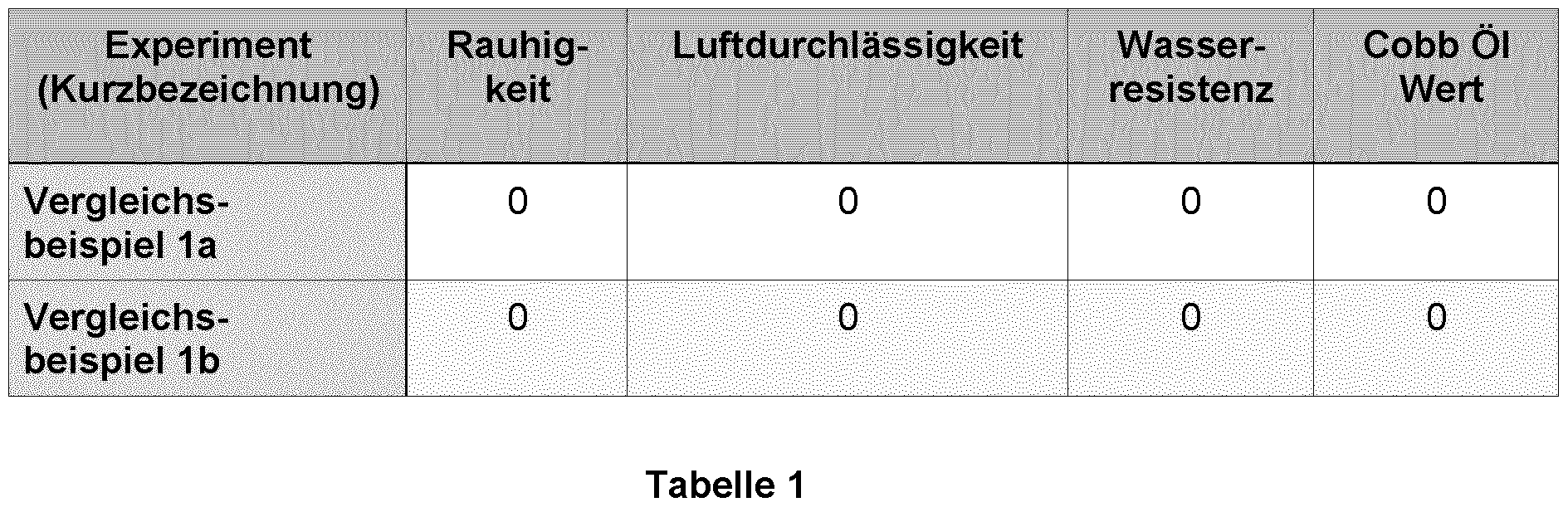
Wie aus der Tabelle 1 ersichtlich ist, sind die entsprechenden Bewertungen für Rauhigkeit, Luftdurchlässigkeit, Wasserdampfdurchlässigkeit (Water Vapor Transmission Rate) und Cobb Öl Wert hinsichtlich des Vergleichsbeispiels 1 a und 1 b vergleichbar und durchschnittlich. As can be seen from Table 1, the corresponding ratings for roughness, air permeability, water vapor transmission rate and Cobb oil value with respect to Comparative Examples 1 a and 1 b are comparable and average.
Vergleichsbeispiel 2 und Ausführungsbeispiel 2 Comparative Example 2 and Example 2
Im Rahmen des Vergleichsbeispiels 2 wurde das Verbundgebilde des Vergleichsbeispiels 1a verwendet und im Rahmen des Ausführungsbeispiels 2 wurde das Verbundgebilde des Vergleichsbeispiels 1 b verwendet, wobei auf das jeweilige Verbundgebilde jeweils eine dritte Streichfarbe zur Ausbildung einer dritten Streichfarbenschicht nach Trocknung mit einem Flächengewicht von 8 g/m2 aufgetragen wurde, wobei die dritte Streichfarbe ausschließlich Polyvinylalkohol (Baumeister HS25) umfasst. Somit unterscheidet sich das Ausführungsbeispiel 2 von dem Vergleichsbeispiel 2 lediglich durch das Vorhandensein einer ersten Streichfarbenschicht. In the context of comparative example 2, the composite structure of comparative example 1a was used and in the context of embodiment 2, the composite structure of comparative example 1b was used, wherein a third coating color was applied to the respective composite structure to form a third coating color layer after drying with a basis weight of 8 g/m 2 , wherein the third coating color exclusively comprises polyvinyl alcohol (Baumeister HS25). Thus, the embodiment 2 differs from the comparative example 2 only by the presence of a first coating color layer.
Wie in der nachfolgenden Tabelle 2 dargestellt ist, wurde das Verbundgebilde gemäß dem Vergleichsbeispiel 2 und dem Ausführungsbeispiel 2 in Bezug auf Sauerstoffdurchlässigkeit, Abweichungen bei der Sauerstoffdurchlässigkeit, Hexandampf-Durchlässigkeit (HVTR), Fettdichtigkeit (PKÖFT), KIT-Wert, sowie Siegelfähigkeit untersucht, wobei hierbei auf die vorangegangene Methodenbeschreibungen verwiesen wird.

Tabelle 2 Table 2
Wie aus der Tabelle 2 ersichtlich ist, ist die Hexandampf-Durchlässigkeit (HVTR), Fettdichtigkeit (PKÖFT), KIT-Wert, sowie die Sauerstoffdurchlässigkeit bei dem Verbundgebilde gemäß dem Vergleichsbeispiel 2 als auch bei dem Verbundgebilde gemäß dem Ausführungsbeispiel 2 sehr gut, bzw. werden durchschnittliche Siegelfähigkeiten erreicht. As can be seen from Table 2, the hexane vapor permeability (HVTR), grease tightness (PKÖFT), KIT value, and oxygen permeability are very good in the composite structure according to Comparative Example 2 as well as in the composite structure according to Example 2, or average sealing capabilities are achieved.
Ein Unterschied ergibt sich jedoch bei den Abweichungen in der Sauerstoffdurchlässigkeit der jeweiligen Verbundgebilde, wobei der geringe Wert von 12% gemäß dem Ausführungsbeispiel 2 gegenüber dem höheren Wert von 31 % gemäß dem Vergleichsbeispiel 2 vorteilhaft ist. Somit ist die Sauerstoffsperrwirkung des Verbundgebildes gemäß dem Ausführungsbeispiel 2 (welches eine erste Streichfarbenschicht aufweist) gegenüber dem Verbundgebilde gemäß dem Vergleichsbeispiel 2 (welches keine erste Streichfarbenschicht aufweist) größer. However, a difference arises in the deviations in the oxygen permeability of the respective composite structures, whereby the low value of 12% according to embodiment 2 is advantageous compared to the higher value of 31% according to comparative example 2. Thus, the oxygen barrier effect of the composite structure according to embodiment 2 (which has a first coating color layer) is greater than that of the composite structure according to comparative example 2 (which does not have a first coating color layer).
Vergleichsbeispiel 3 und Ausführungsbeispiel 3 Comparative Example 3 and Example 3
Im Rahmen des Vergleichsbeispiels 3 wurde das Verbundgebilde des Vergleichsbeispiels 1a verwendet und im Rahmen des Ausführungsbeispiels 3 wurde das Verbundgebilde des Vergleichsbeispiels 1b verwendet, wobei auf das jeweilige Verbundgebilde eine dritte Streichfarbe zur Ausbildung einer dritten Streichfarbenschicht nach Trocknung mit einem Flächengewicht von 8 g/m2 aufgetragen wurde, wobei die dritte Streichfarbe ausschließlich MB46E umfasst. In Comparative Example 3, the composite structure of Comparative Example 1a was used and in the context of Embodiment 3, the composite structure of Comparative Example 1b was used, wherein a third coating color was applied to the respective composite structure to form a third coating color layer after drying with a basis weight of 8 g/m 2 , wherein the third coating color exclusively comprises MB46E.
Somit unterscheidet sich das Ausführungsbeispiel 3 von dem Vergleichsbeispiel 3 lediglich durch das Vorhandensein einer ersten Streichfarbenschicht. Thus, the embodiment 3 differs from the comparative example 3 only by the presence of a first coating color layer.
Wie in der nachfolgenden Tabelle 3 dargestellt ist, wurde das Verbundgebilde gemäß dem Vergleichsbeispiel 3 und dem Ausführungsbeispiel 3 in Bezug auf Hexandampf- Durchlässigkeit (HVTR), Abweichungen bei der Hexandampf-Durchlässigkeit (HVTR), MW-HVTR, KIT-Wert, sowie Siegelfähigkeit untersucht, wobei hierbei auf die vorangegangene Methodenbeschreibungen verwiesen wird.

Tabelle 3 Wie aus der Tabelle 3 ersichtlich ist, ist die Hexandampf-Durchlässigkeit (HVTR), der KIT-Wert, sowie die Siegelfähigkeit bei dem Verbundgebilde gemäß dem Vergleichsbeispiel 3 als auch bei dem Verbundgebilde gemäß dem Ausführungsbeispiel 3 vergleichbar durchschnittlich, bzw. sogar sehr gut. Table 3 As can be seen from Table 3, the hexane vapor permeability (HVTR), the KIT value, and the sealability of the composite structure according to Comparative Example 3 as well as the composite structure according to Embodiment 3 are comparable to average, or even very good.
Ein Unterschied ergibt sich jedoch bei den Abweichungen in der Hexandampf-Durchlässigkeit der jeweiligen Verbundgebilde, wobei der geringe Wert von 11% gemäß dem Ausführungsbeispiel 3 gegenüber dem höheren Wert von 37% gemäß dem Vergleichsbeispiel 3 vorteilhaft ist. Auch der entsprechende geringere H VTR-MW Wert von 13 g/m2 pro Tag gemäß dem Ausführungsbeispiel 3 ist gegenüber dem HVTR- MW Wert von 25 g/m2 pro Tag gemäß dem Vergleichsbeispiel 3 vorteilhaft. However, a difference arises in the deviations in the hexane vapor permeability of the respective composite structures, whereby the low value of 11% according to embodiment 3 is advantageous compared to the higher value of 37% according to comparative example 3. The corresponding lower H VTR-MW value of 13 g/m 2 per day according to embodiment 3 is also advantageous compared to the HVTR-MW value of 25 g/m 2 per day according to comparative example 3.
Somit ist die Aromastoffsperrwirkung, bzw. Mineralölsperrwirkung des Verbundgebildes gemäß dem Ausführungsbeispiel 3 (welche eine erste Streichfarbenschicht aufweist) gegenüber dem Verbundgebilde gemäß dem Vergleichsbeispiel 3 (welche keine erste Streichfarbenschicht aufweist) größer. Thus, the flavor barrier effect or mineral oil barrier effect of the composite structure according to embodiment 3 (which has a first coating color layer) is greater than the composite structure according to comparative example 3 (which does not have a first coating color layer).
Vergleichsbeispiel 4 und Ausführungsbeispiel 4 Comparative Example 4 and Example 4
Im Rahmen des Ausführungsbeispiels 4 wurde auf ein unbeschichtetes Papier-Trägersubstrat unmittelbar eine erste Streichfarbe zur Ausbildung der ersten Streichfarbenschicht nach Trocknung mit einem Flächengewicht von 4 g/m2 aufgetragen und wurde auf die getrocknete erste Streichfarbenschicht unmittelbar eine zweite Streichfarbe zur Ausbildung einer zweiten Streichfarbenschicht nach Trocknung mit einem Flächengewicht von 4 g/m2 aufgetragen. Die Zusammensetzung der ersten und zweiten Streichfarbe des Ausführungsbeispiels 4 ist identisch und umfasst Ton als ein anorganisches Pigment und umfasst ein polymeres Bindemittel. In the context of embodiment 4, a first coating color was applied directly to an uncoated paper carrier substrate to form the first coating color layer after drying with a basis weight of 4 g/m 2 and a second coating color was applied directly to the dried first coating color layer to form a second coating color layer after drying with a basis weight of 4 g/m 2. The composition of the first and second coating colors of embodiment 4 is identical and comprises clay as an inorganic pigment and comprises a polymeric binder.
Auf die getrocknete zweite Streichfarbenschicht wurde unmittelbar eine dritte Streichfarbe zur Ausbildung einer dritten Streichfarbenschicht nach Trocknung mit einem Flächengewicht von 9 g/m2 aufgetragen. Die dritte Streichfarbe umfasst eine wässrige Mischung aus 11 ,2 Gew.-% Pullulan und 4,8 Gew.-% Xylitol (30 % Feststoffanteil Xylitol) bezogen auf die Trockenmasse der dritten Streichfarbenschicht. Das Vergleichsbeispiel 4 unterscheidet sich vom Ausführungsbeispiel 4 lediglich darin, dass das Verbundgebilde des Vergleichsbeispiels 4 keine erste Streichfarbenschicht aufweist. A third coating color was immediately applied to the dried second coating color layer to form a third coating color layer after drying with a basis weight of 9 g/m 2 . The third coating color comprises an aqueous mixture of 11.2 wt.% pullulan and 4.8 wt.% xylitol (30% solids content of xylitol) based on the dry mass of the third coating color layer. Comparative Example 4 differs from Embodiment 4 only in that the composite structure of Comparative Example 4 does not have a first coating color layer.
Wie in der nachfolgenden Tabelle 4 dargestellt ist, wurde das Verbundgebilde gemäß dem Vergleichsbeispiel 4 und dem Ausführungsbeispiel 4 in Bezug auf Knickbeständigkeit eines Innen- und Außenknicks, Fettdichtigkeit (PKÖFT), Siegelkraft, und Sauerstoffdurchlässigkeit (OTR) untersucht, wobei hierbei auf die vorangegangene Methodenbeschreibungen verwiesen wird.

Tabelle 4 Table 4
Vergleichsbeispiel 5 und Ausführungsbeispiel 5 Comparative Example 5 and Example 5
Das Ausführungsbeispiel 5 ist identisch zum Ausführungsspiel 4 und das Vergleichsbeispiel 5 ist identisch zum Vergleichsbeispiel 4 bis darauf, dass die dritte Streichfarbe statt Xylitol Sorbitol als Rheologiehilfsmittel umfasst. The embodiment 5 is identical to the embodiment 4 and the comparison example 5 is identical to the comparison example 4 except that the third coating color comprises sorbitol as a rheology aid instead of xylitol.
Das Vergleichsbeispiel 5 unterscheidet sich vom Ausführungsbeispiel 5 lediglich darin, dass das Verbundgebilde des Vergleichsbeispiels 5 keine erste Streichfarbenschicht aufweist. Comparative Example 5 differs from Embodiment 5 only in that the composite structure of Comparative Example 5 does not have a first coating color layer.
Wie in der nachfolgenden Tabelle 5 dargestellt ist, wurde das Verbundgebilde gemäß dem Vergleichsbeispiel 5 und dem Ausführungsbeispiel 5 in Bezug auf Knickbeständig-
keit eines Innen- und Außenknicks, Fettdichtigkeit (PKÖFT), Siegelkraft, und Sauerstoffdurchlässigkeit (OTR) untersucht, wobei hierbei auf die vorangegangene Methodenbeschreibungen verwiesen wird.

Tabelle 5 Table 5
Abschließend kann festgehalten werden, dass durch die Verwendung von zwei Streichfarbenschichten zwischen dem Trägersubstrat und der dritten Streichfarbenschicht für eine Vielzahl von unterschiedlichen Materialien der dritten Streichfarbenschicht eine Vielzahl von Parametern des umweltfreundlichen Verpackungsmaterial verbessert werden können, beispielsweise die Barrierewirkung gegenüber Sauerstoff, Wasser, Fett und/oder Aromastoffen. In conclusion, it can be stated that by using two coating layers between the carrier substrate and the third coating layer for a variety of different materials of the third coating layer, a variety of parameters of the environmentally friendly packaging material can be improved, for example the barrier effect against oxygen, water, fat and/or flavorings.
Zudem ermöglich die Verwendung von zwei Streichfarbenschichten zwischen dem Trägersubstrat und der dritten Streichfarbenschicht, dass die Auftragsgewichte der jeweiligen ersten, zweite und/oder dritten Streichfarbenschicht vorteilhaft reduziert werden können, ohne dass es zum einem Verlust der Barrierewirkung des umweltfreundlichen Verpackungsmaterials kommt, wodurch sich die Herstellungskosten der umweltfreundlichen Verpackungsmaterialien verringern. In addition, the use of two coating layers between the carrier substrate and the third coating layer enables the application weights of the respective first, second and/or third coating layers to be advantageously reduced without any loss of the barrier effect of the environmentally friendly packaging material, thereby reducing the manufacturing costs of the environmentally friendly packaging materials.
Zudem kann auch ein entsprechendes umweltfreundliches Verpackungsmaterial mit drei unterschiedlichen Streichfarbenschichten vorteilhaft geknickt und versiegelt werden, wodurch sich eine Vielzahl von unterschiedlichen Verpackungen formen lassen. In addition, a corresponding environmentally friendly packaging material can also be advantageously folded and sealed with three different coating layers, which allows a variety of different packaging to be formed.
Bewertung der Oberflächenqualität der mindestens einen Streichfarbenschicht In den beiliegenden Abbildungen 2A bis 2L sind visuelle Darstellungen von Oberflächen einer auf das Trägersubstrat aufgetragenen und getrockneten ersten Streichfarbenschicht gezeigt, wobei die Oberflächen mittels des bereits beschriebenen Burnout-Tests vorbehandelt wurden, und welche anschließend einer bereits beschriebenen Bildanalyse mittels der Software ImageJ unterzogen wurden. Assessment of the surface quality of at least one coating layer The accompanying Figures 2A to 2L show visual representations of surfaces of a first coating layer applied and dried on the carrier substrate, whereby the surfaces were pretreated using the burnout test described above, and which were subsequently subjected to an image analysis using the ImageJ software as described above.
Die hierbei verwendete erste Streichfarbe umfasst 75,7 Gew.-% plättchenförmiges Kaolin (Capim NP) als anorganisches Pigment, 22,7 Gew.-% Styrol-Acrylat (Aronal S 305) als polymeres Bindemittel, sowie 0,2 Gew.-% Natriumhydroxid, 0,17 Gew.-% synthetischen Verdicker (Acroflex VX 559), 1 ,14 Gew.-% Ammoniumzirkoniumcarbonat (Al- licross AZO), sowie 0,1 Gew.-% Entschäumer (BYK LP 6009). The first coating color used here comprises 75.7 wt.% platelet-shaped kaolin (Capim NP) as inorganic pigment, 22.7 wt.% styrene acrylate (Aronal S 305) as polymeric binder, as well as 0.2 wt.% sodium hydroxide, 0.17 wt.% synthetic thickener (Acroflex VX 559), 1.14 wt.% ammonium zirconium carbonate (Al- licross AZO), as well as 0.1 wt.% defoamer (BYK LP 6009).
In einem weiteren Versuch wurde eine erste Streichfarbe (S1*) mit folgender Zusammensetzung verwendet: 75,9% Pigment (Schichtsilikat), 22,8% Latex (Styrol-Butadien- Latex) und 1 ,3 % Rheologiemodifikatoren (0,2% acrylatbasierter Verdicker, 1 ,1 % zirkoniumbasierter Vernetzer). In a further test, a first coating color (S1*) with the following composition was used: 75.9% pigment (layered silicate), 22.8% latex (styrene-butadiene latex) and 1.3% rheology modifiers (0.2% acrylate-based thickener, 1.1% zirconium-based crosslinker).
In den Abbildungen 2A bis 2F ist die Oberfläche einer einzigen Schicht der ersten Streichfarbe dargestellt. In den Abbildungen 2G bis 2L ist ein Papier dargestellt, bei dem ein zweifacher Auftrag der ersten Streichfarbe durchgeführt wurde, wobei in den Abbildungen 2G bis 2L die Oberfläche der äußersten Schicht der beiden Schichten der ersten Streichfarbe dargestellt ist. Figures 2A to 2F show the surface of a single layer of the first coating color. Figures 2G to 2L show a paper on which a double application of the first coating color has been carried out, with Figures 2G to 2L showing the surface of the outermost layer of the two layers of the first coating color.
Bevor die mindestens eine zweite Streichfarbenschicht, insbesondere mit der gleichen Zusammensetzung wie die erste Streichfarbenschicht oder wie die erste Streichfarbenschicht S1*, auf die mindestens eine erste Streichfarbenschicht oder auf die erste Streichfarbenschicht S1* aufgetragen wird, erfolgt insbesondere eine Probenvorbehandlung mittels Burnout-Test und eine sich daran anschließende Bildanalyse mittels der Software ImageJ, um die Oberflächenqualität der mindestens einen ersten Streichfarbenschicht beurteilen zu können. Die in den Abbildungen 2A, 2C, 2E, 2G, 21 und 2K gezeigten Ausschnitte zeigen die vollständige Probe mit einer Größe von ca. 14 cm x 17 cm, bzw. einer Anzahl von 3400 x 4000 Pixeln. Before the at least one second coating layer, in particular with the same composition as the first coating layer or as the first coating layer S1*, is applied to the at least one first coating layer or to the first coating layer S1*, a sample pretreatment by means of a burnout test and a subsequent image analysis by means of the ImageJ software is carried out in order to be able to assess the surface quality of the at least one first coating layer. The sections shown in Figures 2A, 2C, 2E, 2G, 2I and 2K show the complete sample with a size of approximately 14 cm x 17 cm, or a number of 3400 x 4000 pixels.
Die in den Abbildungen 2B, 2D, 2F, 2H, 2J und 2L gezeigten Ausschnitte zeigen eine Vergrößerung eines jeweiligen Ausschnittes der vollständigen Probe mit einer Größe von ca. 0,4 cm x 0,4 cm, bzw. einer Anzahl von 100 x 100 Pixeln. The sections shown in Figures 2B, 2D, 2F, 2H, 2J and 2L show an enlargement of a respective section of the complete sample with a size of approximately 0.4 cm x 0.4 cm, or a number of 100 x 100 pixels.
Die in den Abbildungen 2A, 2B, 2G, und 2H gezeigten Ausschnitte zeigen jeweils ein Schwarz- Weiß-Bild in einer 8-Bit-Darstellung nach dem erfolgten Burnout-Test. The sections shown in Figures 2A, 2B, 2G, and 2H each show a black and white image in an 8-bit representation after the burnout test.
Die in den Abbildungen 20, 2D, 2I, und 2J gezeigten Ausschnitte zeigen jeweils ein binäres Abbild nach einer Umwandlung aus der jeweiligen 8-Bit-Darstellung. The sections shown in Figures 20, 2D, 2I, and 2J each show a binary image after conversion from the respective 8-bit representation.
Die in den Abbildungen 2E, 2F, 2K, und 2L gezeigten Ausschnitte zeigen jeweils die Ergebnisse einer Detektion von dunklen Bereichen ohne Pigmentauftrag mittels der Software ImageJ auf Basis des jeweiligen binären Abbildes. The sections shown in Figures 2E, 2F, 2K, and 2L each show the results of a detection of dark areas without pigment application using the ImageJ software based on the respective binary image.
Die Software ImageJ ermöglicht die Ausgabe des prozentualen Flächenanteils von Partikeln im Probenausschnitt. The ImageJ software enables the output of the percentage area of particles in the sample section.
Wie aus der Abbildung 2F hervorgeht, liegt bei einem entsprechenden einfachen Auftrag der ersten Streichfarbenschicht der prozentuale Flächenanteil von Partikeln im Probenausschnitt bei ca. 36% unbedecktem Rohpapier. As can be seen from Figure 2F, with a corresponding simple application of the first coating layer, the percentage area of particles in the sample section is approximately 36% of uncovered base paper.
Gemäß der Abbildung 2L liegt bei einem entsprechenden zweifachen Auftrag der ersten Streichfarbenschicht der prozentuale Flächenanteil von Partikeln im Probenausschnitt nur bei ca. 4% unbedecktes Rohpapier und ist damit deutlich besser als bei einem nur einfachen Auftrag der ersten Streichfarbenschicht auf das Rohpapier. According to Figure 2L, with a corresponding double application of the first coating layer, the percentage area of particles in the sample section is only about 4% of uncovered base paper and is thus significantly better than with only a single application of the first coating layer to the base paper.
Somit lässt sich die Rohpapierabdeckung von ca. 64 % bei einem nur einfachen Auftrag der ersten Streichfarbenschicht auf eine Rohpapierabdeckung von ca. 96 % bei einem zweifachen Auftrag der ersten Streichfarbenschicht steigern, was zu einer vorteilhaften Qualität des Verpackungsmaterials führt. Thus, the base paper coverage of approx. 64% with a single application of the first coating layer can be converted to a base paper coverage of approx. 96% with a double application of the first coating layer, which leads to an advantageous quality of the packaging material.
Claims
Priority Applications (3)
| Application Number | Priority Date | Filing Date | Title |
|---|---|---|---|
| KR1020257043216A KR20260015909A (en) | 2023-06-15 | 2024-06-13 | eco-friendly packaging materials |
| EP24733164.8A EP4727867A1 (en) | 2023-06-15 | 2024-06-13 | Environmentally friendly packaging material |
| CN202480039477.2A CN121311418A (en) | 2023-06-15 | 2024-06-13 | Environmentally friendly packaging materials |
Applications Claiming Priority (2)
| Application Number | Priority Date | Filing Date | Title |
|---|---|---|---|
| DE102023115736 | 2023-06-15 | ||
| DE102023115736.1 | 2023-06-15 |
Publications (1)
| Publication Number | Publication Date |
|---|---|
| WO2024256573A1 true WO2024256573A1 (en) | 2024-12-19 |
Family
ID=91580738
Family Applications (1)
| Application Number | Title | Priority Date | Filing Date |
|---|---|---|---|
| PCT/EP2024/066431 Ceased WO2024256573A1 (en) | 2023-06-15 | 2024-06-13 | Environmentally friendly packaging material |
Country Status (4)
| Country | Link |
|---|---|
| EP (1) | EP4727867A1 (en) |
| KR (1) | KR20260015909A (en) |
| CN (1) | CN121311418A (en) |
| WO (1) | WO2024256573A1 (en) |
Citations (12)
| Publication number | Priority date | Publication date | Assignee | Title |
|---|---|---|---|---|
| US3932192A (en) | 1973-09-29 | 1976-01-13 | Sumitomo Chemical Company, Limited | Paper coating material containing pullulan |
| JP2003013391A (en) | 2001-06-26 | 2003-01-15 | Toppan Printing Co Ltd | Biodegradable paper sheet and paper container |
| DE10196052T1 (en) | 2000-04-11 | 2003-02-27 | Mitsubishi Paper Mills Ltd | Process for the preparation of an information recording material and coating solutions for use in this material |
| WO2008068779A2 (en) | 2006-12-07 | 2008-06-12 | Shilpan Pravinchandra Patel | Water soluble film based package, process and apparatus for sealing said package |
| US20160222592A1 (en) * | 2013-09-10 | 2016-08-04 | Innogel Ag | Packaging material having a barrier coating based on starch, and coating mass, method, and device for producing such a barrier coating |
| EP3795746A1 (en) * | 2019-09-23 | 2021-03-24 | Mitsubishi HiTec Paper Europe GmbH | Printable and heat-sealable barrier paper |
| WO2022003472A1 (en) | 2020-06-30 | 2022-01-06 | Stora Enso Oyj | Barrier coating for paper and paperboard |
| US20220112664A1 (en) * | 2020-10-09 | 2022-04-14 | The Procter & Gamble Company | Methods of producing biodegradable and recyclable barrier paper laminate |
| WO2022103458A1 (en) | 2020-11-11 | 2022-05-19 | Sappi North America, Inc. | Oil/grease resistant paper products |
| EP4008836A1 (en) * | 2020-12-04 | 2022-06-08 | Potatum Oy | A method for manufacturing a coated sheet, a coated sheet, a containerboard comprising the coated sheet, a container comprising the coated sheet or the containerboard and use of the coated sheet |
| WO2022269198A1 (en) | 2021-06-23 | 2022-12-29 | Lactips | Multilayer material useful as packaging, comprising a layer of cellulosic material and a layer of material comprising at least one moins one casein and/or at least one caseinate |
| US20230068867A1 (en) * | 2019-12-06 | 2023-03-02 | Dai Nippon Printing Co., Ltd. | Barrier paper, container and lid member containing said barrier paper, and method for producing barrier paper |
-
2024
- 2024-06-13 WO PCT/EP2024/066431 patent/WO2024256573A1/en not_active Ceased
- 2024-06-13 EP EP24733164.8A patent/EP4727867A1/en active Pending
- 2024-06-13 KR KR1020257043216A patent/KR20260015909A/en active Pending
- 2024-06-13 CN CN202480039477.2A patent/CN121311418A/en active Pending
Patent Citations (12)
| Publication number | Priority date | Publication date | Assignee | Title |
|---|---|---|---|---|
| US3932192A (en) | 1973-09-29 | 1976-01-13 | Sumitomo Chemical Company, Limited | Paper coating material containing pullulan |
| DE10196052T1 (en) | 2000-04-11 | 2003-02-27 | Mitsubishi Paper Mills Ltd | Process for the preparation of an information recording material and coating solutions for use in this material |
| JP2003013391A (en) | 2001-06-26 | 2003-01-15 | Toppan Printing Co Ltd | Biodegradable paper sheet and paper container |
| WO2008068779A2 (en) | 2006-12-07 | 2008-06-12 | Shilpan Pravinchandra Patel | Water soluble film based package, process and apparatus for sealing said package |
| US20160222592A1 (en) * | 2013-09-10 | 2016-08-04 | Innogel Ag | Packaging material having a barrier coating based on starch, and coating mass, method, and device for producing such a barrier coating |
| EP3795746A1 (en) * | 2019-09-23 | 2021-03-24 | Mitsubishi HiTec Paper Europe GmbH | Printable and heat-sealable barrier paper |
| US20230068867A1 (en) * | 2019-12-06 | 2023-03-02 | Dai Nippon Printing Co., Ltd. | Barrier paper, container and lid member containing said barrier paper, and method for producing barrier paper |
| WO2022003472A1 (en) | 2020-06-30 | 2022-01-06 | Stora Enso Oyj | Barrier coating for paper and paperboard |
| US20220112664A1 (en) * | 2020-10-09 | 2022-04-14 | The Procter & Gamble Company | Methods of producing biodegradable and recyclable barrier paper laminate |
| WO2022103458A1 (en) | 2020-11-11 | 2022-05-19 | Sappi North America, Inc. | Oil/grease resistant paper products |
| EP4008836A1 (en) * | 2020-12-04 | 2022-06-08 | Potatum Oy | A method for manufacturing a coated sheet, a coated sheet, a containerboard comprising the coated sheet, a container comprising the coated sheet or the containerboard and use of the coated sheet |
| WO2022269198A1 (en) | 2021-06-23 | 2022-12-29 | Lactips | Multilayer material useful as packaging, comprising a layer of cellulosic material and a layer of material comprising at least one moins one casein and/or at least one caseinate |
Non-Patent Citations (1)
| Title |
|---|
| FRAUNHOFER-INSTITUT FÜR SILICATFORSCHUNG ISC: "bioORMOCER", pages 1 - 4, XP093189747, Retrieved from the Internet <URL:https://www.isc.fraunhofer.de/de/arbeitsgebiete/materialien/ormocer.html> [retrieved on 20240725] * |
Also Published As
| Publication number | Publication date |
|---|---|
| CN121311418A (en) | 2026-01-09 |
| KR20260015909A (en) | 2026-02-03 |
| EP4727867A1 (en) | 2026-04-22 |
Similar Documents
| Publication | Publication Date | Title |
|---|---|---|
| EP2740685B2 (en) | Method for producing a coated packaging material and packaging material with at least one barrier layer for hydrophobic compositions | |
| DE69531658T2 (en) | Use of coated paper or cardboard as a recyclable and repulpable giant wrap | |
| EP3253918B1 (en) | Light packaging paper for food having improved resistance to fats | |
| EP2532706B1 (en) | Method for producing a coated packaging material and packaging material with at least one barrier layer for hydrophobic connections | |
| DE2516097C3 (en) | Process for the production of an auxiliary material for paper production and its use | |
| DE60314608T3 (en) | COMPOSITION FOR SURFACE TREATMENT OF PAPER | |
| DE60131180T2 (en) | SAFETY DATA SHEET CONTAINING A TRANSLUCENT OR TRANSLUCENT LAYER | |
| DE102019103343A1 (en) | Heat-sealable barrier paper | |
| EP3237679A1 (en) | Environment-friendly packaging paper for food | |
| EP3301221B1 (en) | Packaging paper and method for its production | |
| EP4584438A1 (en) | Barrier paper | |
| EP4413201A1 (en) | Sealable packaging paper | |
| EP4727867A1 (en) | Environmentally friendly packaging material | |
| WO2024256567A1 (en) | Environmentally friendly packaging material | |
| WO2024188406A1 (en) | Chitosan-based barrier coating on paper, for use as food packaging | |
| EP3260597B1 (en) | Multi-layer fibre product with an inhibited migration rate of aromatic or saturated hydrocarbons and method for producing the same | |
| EP3943661A1 (en) | Packaging material with a barrier layer | |
| DE212018000341U1 (en) | Dirt and grease repellent coating for banknote paper | |
| DE102004038197B4 (en) | Decorative paper and use of aluminum silicate for the production of decorative paper | |
| WO2025186411A1 (en) | Packaging material | |
| DE19958182A1 (en) | Sizing of paper and cardboard, comprises using a size based on a starch, cellulose or galactomannan derivative having quaternized 3-amino-2-hydroxypropyl groups | |
| WO2015181129A1 (en) | Mixture for producing an impregnation liquor for impregnating papers and nonwoven hybrids |
Legal Events
| Date | Code | Title | Description |
|---|---|---|---|
| 121 | Ep: the epo has been informed by wipo that ep was designated in this application |
Ref document number: 24733164 Country of ref document: EP Kind code of ref document: A1 |
|
| ENP | Entry into the national phase |
Ref document number: 2025572557 Country of ref document: JP Kind code of ref document: A |
|
| ENP | Entry into the national phase |
Ref document number: 1020257043216 Country of ref document: KR Free format text: ST27 STATUS EVENT CODE: A-0-1-A10-A15-NAP-PA0105 (AS PROVIDED BY THE NATIONAL OFFICE) |
|
| WWE | Wipo information: entry into national phase |
Ref document number: 1020257043216 Country of ref document: KR |
|
| WWE | Wipo information: entry into national phase |
Ref document number: 2024733164 Country of ref document: EP |
|
| NENP | Non-entry into the national phase |
Ref country code: DE |
|
| ENP | Entry into the national phase |
Ref document number: 2024733164 Country of ref document: EP Effective date: 20260115 |
|
| ENP | Entry into the national phase |
Ref document number: 2024733164 Country of ref document: EP Effective date: 20260115 |
|
| ENP | Entry into the national phase |
Ref document number: 2024733164 Country of ref document: EP Effective date: 20260115 |
|
| WWP | Wipo information: published in national office |
Ref document number: 1020257043216 Country of ref document: KR |
|
| ENP | Entry into the national phase |
Ref document number: 2024733164 Country of ref document: EP Effective date: 20260115 |
|
| WWP | Wipo information: published in national office |
Ref document number: 2024733164 Country of ref document: EP |