WO2024256640A1 - Dry and room temperature process for recycling wood fiber based materials - Google Patents
Dry and room temperature process for recycling wood fiber based materials Download PDFInfo
- Publication number
- WO2024256640A1 WO2024256640A1 PCT/EP2024/066568 EP2024066568W WO2024256640A1 WO 2024256640 A1 WO2024256640 A1 WO 2024256640A1 EP 2024066568 W EP2024066568 W EP 2024066568W WO 2024256640 A1 WO2024256640 A1 WO 2024256640A1
- Authority
- WO
- WIPO (PCT)
- Prior art keywords
- fibers
- grinding
- bulk
- wood
- rigid
- Prior art date
- Legal status (The legal status is an assumption and is not a legal conclusion. Google has not performed a legal analysis and makes no representation as to the accuracy of the status listed.)
- Ceased
Links
Classifications
-
- B—PERFORMING OPERATIONS; TRANSPORTING
- B27—WORKING OR PRESERVING WOOD OR SIMILAR MATERIAL; NAILING OR STAPLING MACHINES IN GENERAL
- B27N—MANUFACTURE BY DRY PROCESSES OF ARTICLES, WITH OR WITHOUT ORGANIC BINDING AGENTS, MADE FROM PARTICLES OR FIBRES CONSISTING OF WOOD OR OTHER LIGNOCELLULOSIC OR LIKE ORGANIC MATERIAL
- B27N3/00—Manufacture of substantially flat articles, e.g. boards, from particles or fibres
- B27N3/007—Manufacture of substantially flat articles, e.g. boards, from particles or fibres and at least partly composed of recycled material
-
- B—PERFORMING OPERATIONS; TRANSPORTING
- B27—WORKING OR PRESERVING WOOD OR SIMILAR MATERIAL; NAILING OR STAPLING MACHINES IN GENERAL
- B27N—MANUFACTURE BY DRY PROCESSES OF ARTICLES, WITH OR WITHOUT ORGANIC BINDING AGENTS, MADE FROM PARTICLES OR FIBRES CONSISTING OF WOOD OR OTHER LIGNOCELLULOSIC OR LIKE ORGANIC MATERIAL
- B27N1/00—Pretreatment of moulding material
-
- B—PERFORMING OPERATIONS; TRANSPORTING
- B27—WORKING OR PRESERVING WOOD OR SIMILAR MATERIAL; NAILING OR STAPLING MACHINES IN GENERAL
- B27N—MANUFACTURE BY DRY PROCESSES OF ARTICLES, WITH OR WITHOUT ORGANIC BINDING AGENTS, MADE FROM PARTICLES OR FIBRES CONSISTING OF WOOD OR OTHER LIGNOCELLULOSIC OR LIKE ORGANIC MATERIAL
- B27N3/00—Manufacture of substantially flat articles, e.g. boards, from particles or fibres
- B27N3/04—Manufacture of substantially flat articles, e.g. boards, from particles or fibres from fibres
-
- B—PERFORMING OPERATIONS; TRANSPORTING
- B27—WORKING OR PRESERVING WOOD OR SIMILAR MATERIAL; NAILING OR STAPLING MACHINES IN GENERAL
- B27N—MANUFACTURE BY DRY PROCESSES OF ARTICLES, WITH OR WITHOUT ORGANIC BINDING AGENTS, MADE FROM PARTICLES OR FIBRES CONSISTING OF WOOD OR OTHER LIGNOCELLULOSIC OR LIKE ORGANIC MATERIAL
- B27N3/00—Manufacture of substantially flat articles, e.g. boards, from particles or fibres
- B27N3/08—Moulding or pressing
- B27N3/10—Moulding of mats
- B27N3/12—Moulding of mats from fibres
-
- C—CHEMISTRY; METALLURGY
- C08—ORGANIC MACROMOLECULAR COMPOUNDS; THEIR PREPARATION OR CHEMICAL WORKING-UP; COMPOSITIONS BASED THEREON
- C08J—WORKING-UP; GENERAL PROCESSES OF COMPOUNDING; AFTER-TREATMENT NOT COVERED BY SUBCLASSES C08B, C08C, C08F, C08G or C08H
- C08J11/00—Recovery or working-up of waste materials
- C08J11/04—Recovery or working-up of waste materials of polymers
- C08J11/06—Recovery or working-up of waste materials of polymers without chemical reactions
-
- E—FIXED CONSTRUCTIONS
- E04—BUILDING
- E04B—GENERAL BUILDING CONSTRUCTIONS; WALLS, e.g. PARTITIONS; ROOFS; FLOORS; CEILINGS; INSULATION OR OTHER PROTECTION OF BUILDINGS
- E04B1/00—Constructions in general; Structures which are not restricted either to walls, e.g. partitions, or floors or ceilings or roofs
- E04B1/62—Insulation or other protection; Elements or use of specified material therefor
- E04B1/74—Heat, sound or noise insulation, absorption, or reflection; Other building methods affording favourable thermal or acoustical conditions, e.g. accumulating of heat within walls
-
- B—PERFORMING OPERATIONS; TRANSPORTING
- B27—WORKING OR PRESERVING WOOD OR SIMILAR MATERIAL; NAILING OR STAPLING MACHINES IN GENERAL
- B27N—MANUFACTURE BY DRY PROCESSES OF ARTICLES, WITH OR WITHOUT ORGANIC BINDING AGENTS, MADE FROM PARTICLES OR FIBRES CONSISTING OF WOOD OR OTHER LIGNOCELLULOSIC OR LIKE ORGANIC MATERIAL
- B27N3/00—Manufacture of substantially flat articles, e.g. boards, from particles or fibres
- B27N3/08—Moulding or pressing
-
- C—CHEMISTRY; METALLURGY
- C08—ORGANIC MACROMOLECULAR COMPOUNDS; THEIR PREPARATION OR CHEMICAL WORKING-UP; COMPOSITIONS BASED THEREON
- C08J—WORKING-UP; GENERAL PROCESSES OF COMPOUNDING; AFTER-TREATMENT NOT COVERED BY SUBCLASSES C08B, C08C, C08F, C08G or C08H
- C08J2397/00—Characterised by the use of lignin-containing materials
- C08J2397/02—Lignocellulosic material, e.g. wood, straw or bagasse
-
- E—FIXED CONSTRUCTIONS
- E04—BUILDING
- E04C—STRUCTURAL ELEMENTS; BUILDING MATERIALS
- E04C2/00—Building elements of relatively thin form for the construction of parts of buildings, e.g. sheet materials, slabs, or panels
- E04C2/02—Building elements of relatively thin form for the construction of parts of buildings, e.g. sheet materials, slabs, or panels characterised by specified materials
- E04C2/10—Building elements of relatively thin form for the construction of parts of buildings, e.g. sheet materials, slabs, or panels characterised by specified materials of wood, fibres, chips, vegetable stems, or the like; of plastics; of foamed products
- E04C2/16—Building elements of relatively thin form for the construction of parts of buildings, e.g. sheet materials, slabs, or panels characterised by specified materials of wood, fibres, chips, vegetable stems, or the like; of plastics; of foamed products of fibres, chips, vegetable stems, or the like
Definitions
- Dry and room temperature process for recycling wood fiber based materials Dry and room temperature process for recycling wood fiber based materials .
- the invention relates to the recycling of materials, and more particularly pre- or post-consumer wood fiber panels to manufacture new objects that meet the standards of the circular economy .
- Fresh/virgin wood chips are baked for 3 to 7 minutes under a pressure of 6 to 10 bars saturated steam at temperatures of 175 to 195°C, then defibrated when still hot and moist in an attrition defibrator to form fibers 0.5 to 10 mm long and 1 to 100 micrometers in diameter.
- the fibers are then dispersed in a water tank, recovered on a conveyor belt in the form of a mattress, drained, then pressed, and baked at high temperature to form fiber panels or fiberboards like soft- or hardboard.
- This so-called "wet” manufacturing process is still used but has the disadvantages of a final product of low quality (mechanical and water resistance) , of being very energy-intensive, but above all of polluting in terms of effluents and atmospheric emissions.
- Wood defibration units whether followed by a "wet” or “dry” process of mattress formation, allow the production of flexible panels used for insulation or rigid panels having various mechanical, fire, and moisture resistance properties for use in insulation, furniture, layout, and construction. It should be noted that another product can be manufactured on such lines, it is the bulk of loose-fill insulation wood fibers used mainly for blowing insulation in hollow walls, attics, or wet projection on the inside of building walls. These are the same fibers produced for the panels. Once dried, compacted into bales and packaged, they are sold on the bio-based insulation market.
- This product made of trees is in competition and has the same use as cellulose wadding obtained exclusively from recycled paper and cardboard processed dry in one or several shredders and/or mill attrition defibrator.
- Cellulose fibers are known to be easily obtained from paper and cardboard as the raw material is thin and flexible: paper sheet and cardboard.
- the scarcity and price of used paper and cardboard triggered the development of bulk fibers made of fresh wood by wood fiber board production plants. It is estimated that the energy required to produce one ton of bulk wood fiber is 20% less than the energy required to produce one ton of MDF or other fiberboard because there is no need for pressing energy.
- the estimated total electricity consumption is 420 kWh/T and 1300 kWh/T of heat for each ton of panel produced.
- the defibrator is mainly based on the principle of grinding by attrition to obtain a sufficient fraction of long fibers with insulating qualities or good mechanical resistance for the future panel, but at the cost of large energy losses by shearing and friction. Energy consumption per ton of fiber produced can be estimated between 100 and 150 kWh/T for attrition defibration (Hua et al, 2012) .
- the defibrator represents a significant investment and generally determines the maximum production capacity of a line.
- the aesthetic and anisotropic qualities of wood fiber panels have allowed this industry to grow to reach an overall global annual production volume of more than 100 million tons.
- the lifespan of the product depends on the sector concerned: short for the layout, medium for the furniture, and the longest for the construction. An average lifespan of about 15 to 20 years is generally accepted. These volumes form the post-consumer part of fiberboard waste. Pre-consumer by-product/wastes comes from production declassification, trading, and cutting scraps during the transformation of panels.
- recycled fibers are shorter and glue residues reduce compatibility with fresh glue impacting the mechanical strength of the panels.
- glue residues reduce compatibility with fresh glue impacting the mechanical strength of the panels.
- clogging the pores of the recycled fiber with glue residues helps increase water resistance and reduces formaldehyde emission.
- WO1996033309A1 and WO2021225491A1 refer to the use of steam water and an attrition defibrator.
- - W02005007968A1 requires soaking in water and the use of electromagnetic radiation followed by brewing.
- - EP2516730A1 describe grinding, followed by ohmic soaking/heating before a steam explosion.
- - CN116901203B describe a mechanism based on extrusion screw to separate adhesives during the cutting on a board production line.
- EP3778220A1 and DE102021004876A1 concerns an MDF board whose fibers from fresh wood would constitute the surfaces of the panel and hydro-thermo-mechanically obtained recycled fibers would be used only for the core of the panel to limit the decrease in mechanical and aesthetic performance on the surface of the panel.
- AT526148B1 describe a board with recycle wood in the inner layer and externals with veneer panels.
- the present invention provides a new, eco-ef f icient, and unexpected solution for the material recycling of wood fiber materials like loose-fill insulation material and any material containing wood fibers, like board such as softboard, but particularly rigid material like hardboard, LDF, MDF, HDF, and for obtaining free wood fibers usable as raw material to produce new materials with an incorporation rate of up to 100%.
- the invention relates to a method of recycling rigid material based on natural fibers comprising grinding the rigid material at room temperature and atmospheric pressure, by exclusively mechanical action to obtain bulk fibers.
- the invention thus consists in applying to pre- or post-consumer by-product/waste of wood fiber containing material like, but not limited to, fiberboards at temperature and ambient pressure, without any addition of liquid, solid, or gaseous products, a grinding technology based on one or more of the six types of mechanical actions, but without necessarily resorting to the attrition technique.
- the rigid or board material based on natural wood fibers preferably designates a panel (i.e. rigid, and having for example a thickness between a few millimeters and a few centimeters) or any other material made of wood fibers.
- a paper, cardboard, textile, leather, or fabric is not considered a board within the meaning of the invention.
- board or panel in the context of the invention refers to any piece of board or panel that is either industrial manufacturing waste or post-use waste. So, it's not necessarily a whole panel .
- the rigid material based on wood fibers may also have any shape and is not necessarily a flat panel. It can be a decorative object or an object molded with a specific form.
- Natural fibers here are preferably fibers comprising lignin and/or hemicellulose. It can be wood fibers, or other natural fibers such as, but not limited to, flax, hemp, cotton, rice, corn, all straws, or a mixture of fibers.
- Bulk fibers are loosened fibers, separated from each other. Bulk fibers are known for their insulating properties and can advantageously be used either in bulk or to form insulating materials, or new objects.
- the grinding of the rigid material is preferably non-shearing, that is to say that it does not include a tool or step consisting in cutting the fibers.
- the grinding of the rigid material by exclusively mechanical action, preferably comprises an impact grinding step. Grinding is typically carried out using at least one mill or crusher. It may include, for example, the use of a slow roller mill, with or without pins or teeth, and/or a fast mill such as a hammer mill that provides a superior and unexpected fiber throughput and quality.
- hammer crushers are well known to those skilled in the art.
- the type of crusher may vary.
- hammers are operated in a drum so as to impact the pieces of the sheet until they have reached a size allowing them to pass through a grid arranged on the periphery of the drum. The mesh of this grid defines the size of the desired bulk fiber network at the end of the process.
- grinding is carried out in one or more steps, that is to say that several successive crushing steps can be applied, with grids having different meshes, i.e., finer and finer, to obtain at each step finer fibers.
- Ambient temperature means that no heating is applied.
- the ambient temperature is between 0 °C and 30 °C, preferably between 5 °C and 25 °C.
- the process is based on the use of a deplanariser and one or more grinders, possibly of different types in series or in parallel to gradually reduce the rigid material to the desired characteristics. This action is only possible and valid for rigid material, excluding non rigid material like for example paper sheets or cardboard.
- pre- or post-consumers board can be directly processed into fibers without any other treatment like the one described in the previous art.
- the core of the panel is usually softer than the outer faces .
- a 2 cm thick panel can be cracked into scales with a thickness of about 1 to 2 mm.
- Such treatment makes it possible to significantly increase the flow rate of grinding with low energy consumption. It also makes it possible to limit "fine” or wood dust, and increase the length of the recovered fibers.
- the invention also relates to bulk fibers obtained according to the method of the invention. These fibers are of very high quality, which gives them excellent insulating properties.
- the bulk fibers obtained by the method of the invention preferably have a thermal conductivity measured by fluxmetry according to EN 12667 between 0.010 and 0.055 W/m.K, preferably between 0.020 and 0.049 W/m.K.
- the invention finally covers the use of bulk fibers of the invention to manufacture a new material or a new object.
- any type of binder, resin, mineral, or organic glue, monofiber or composite As a result, the grey energy content of the fibers produced is very low compared to market equivalents and not achieved by the techniques already described.
- FIG. 1 is a diagram of the method of the invention.
- the recycling method of an MDF panel 1 includes a step A of mechanical treatment of destructuration/deplanarisation, here the passage between two rollers 2 causes the deplanarisation of panel 1 to form scales 3.
- These scales 3 are then introduced, in step B, into a crusher 4 comprising hammers 7 rotating in a cylinder surrounded by a grid 6, having a certain mesh allowing escape the fibers 8 which are small enough to cross the mesh.
- Panel 1 is thus converted into 8 fibers at room temperature and atmospheric pressure, by exclusively mechanical action to obtain bulk fibers.
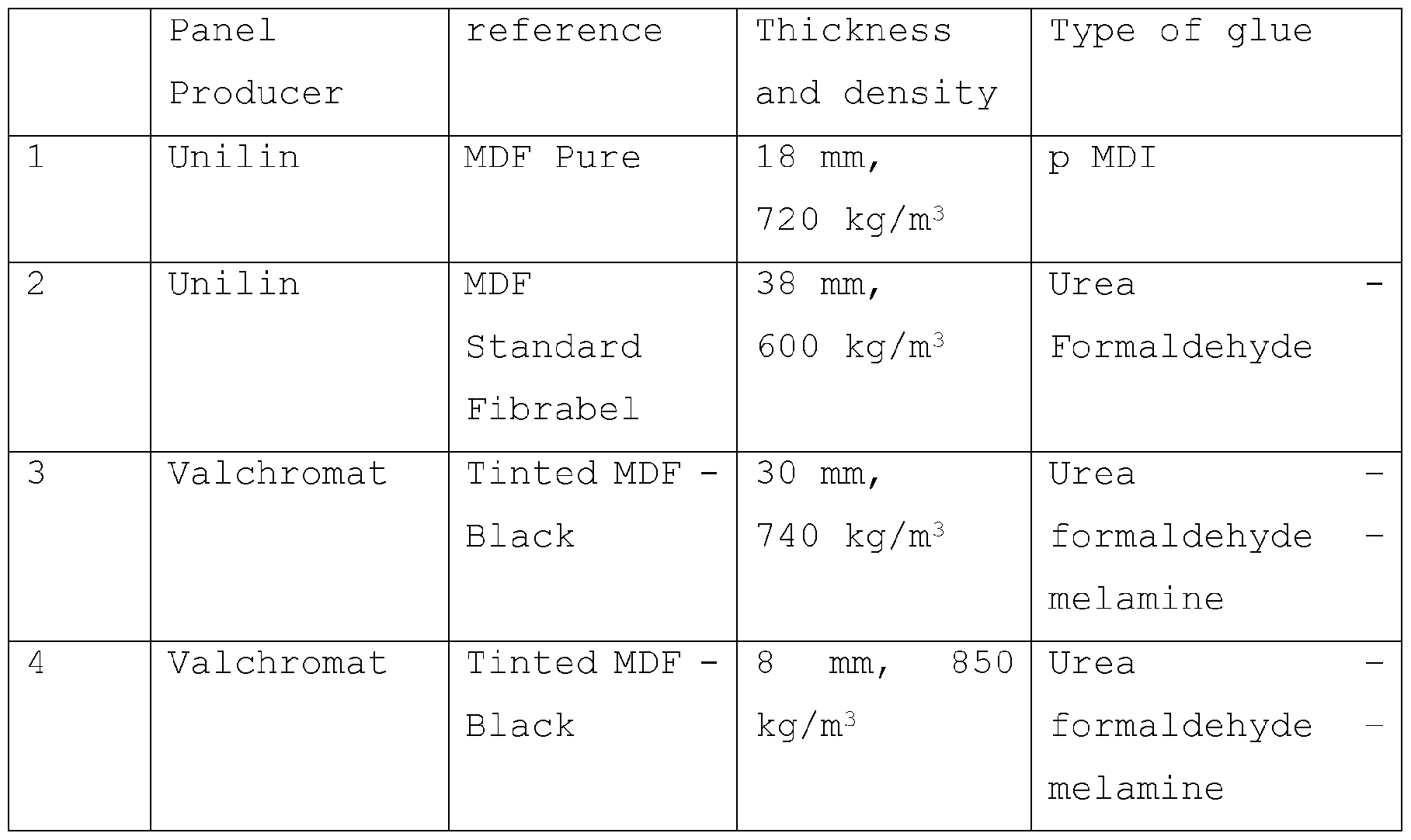
- Pieces of four end-of-life MDF panels were treated according to the method of the invention.
- the thermal conductivity was measured according to the method described in EN 12667 (2001) .
- the equipment is calibrated using a certified reference material of type IRMM-440. It is a glass wool plate (identification number 4) 600 mm x 600 mm and 34.35 mm thick.
- the fibers are contained in a wooden frame with an internal dimensions of 566 mm x 566 mm and a height of 101 mm. This constitutes the test tube.
- the test piece was dried in a ventilated oven at 70 °C to constant mass, after which it was conditioned at 23 °C ⁇ 2 and 50% rh ⁇ 5 to constant mass. Before the test, the test piece was completely surrounded by plastic sheets (0.15 mm total thickness ) .
- the equipment used (CSTC number: HFM1 ) is a fluxmeter type device, symmetrical configuration with a single specimen. The dimensions of the device are 600 mm x 600 mm. The measurements are made with the specimen in a horizontal position, which is placed between the two fluxmeters (hot side below and cold side above) .
- the thermal conductivity of fibers obtained from UNILIN MDF PURE is 0.03994 W/ (m.K) for an average temperature of 9.98 °C for a dry density of 50.3 kg/m 3 .
- Test specimens in frames were produced in accordance with the method defined below:
- the blowing pipe is kept horizontal at a height of 0.8 m to 1.1 m from the upper edge of the large frame with the insulation material falling to the center of the frame.
- the blowing distance must be at least 2.5 m from the edge of the large frame, and such that the insulation falls to the center of the frame Filling the frame in two stages: when the frame is half full, stop blowing and rotate 180°, then the rest of the frame is filled up using the procedure previously indicated.
- test specimens are weighted.
- fiberboard type and processing setup observed of density of the loose-fill wood fibers may vary from 15 to 200 kg/m3.
- a mix of MDF cuts weighting 2866 kg has been processed according to the method of the invention using a slow rotating deplaniriser (10 RPM) , followed by two hammer mills in succession.
- the consumption of energy for the production of loose-fill fibers is as low as 32 kwh/Ton, compared with 100-150 kwh/Ton when using conventional attrition mill.
- the properties of the loose-fill wood fiber obtained are the following: density 59, 0 kg/m 3 and dry thermal conductivity 0.03729 W/ (m.K) for an average temperature of 9.98 °C.
Landscapes
- Life Sciences & Earth Sciences (AREA)
- Engineering & Computer Science (AREA)
- Forests & Forestry (AREA)
- Wood Science & Technology (AREA)
- Manufacturing & Machinery (AREA)
- Chemical & Material Sciences (AREA)
- Physics & Mathematics (AREA)
- Architecture (AREA)
- Chemical Kinetics & Catalysis (AREA)
- Organic Chemistry (AREA)
- Polymers & Plastics (AREA)
- Medicinal Chemistry (AREA)
- Health & Medical Sciences (AREA)
- Sustainable Development (AREA)
- Acoustics & Sound (AREA)
- Electromagnetism (AREA)
- Civil Engineering (AREA)
- Structural Engineering (AREA)
- Dry Formation Of Fiberboard And The Like (AREA)
Abstract
Description
Claims
Priority Applications (1)
| Application Number | Priority Date | Filing Date | Title |
|---|---|---|---|
| EP24733568.0A EP4727737A1 (en) | 2023-06-16 | 2024-06-14 | Dry and room temperature process for recycling wood fiber based materials |
Applications Claiming Priority (4)
| Application Number | Priority Date | Filing Date | Title |
|---|---|---|---|
| US202363521543P | 2023-06-16 | 2023-06-16 | |
| BEBE2023/5496 | 2023-06-16 | ||
| BE20235496A BE1031715B1 (en) | 2023-06-16 | 2023-06-16 | Dry and room temperature process for recycling wood fibre materials |
| US63/521,543 | 2023-06-16 |
Publications (1)
| Publication Number | Publication Date |
|---|---|
| WO2024256640A1 true WO2024256640A1 (en) | 2024-12-19 |
Family
ID=91581941
Family Applications (1)
| Application Number | Title | Priority Date | Filing Date |
|---|---|---|---|
| PCT/EP2024/066568 Ceased WO2024256640A1 (en) | 2023-06-16 | 2024-06-14 | Dry and room temperature process for recycling wood fiber based materials |
Country Status (3)
| Country | Link |
|---|---|
| US (1) | US20240416550A1 (en) |
| EP (2) | EP4477372A1 (en) |
| WO (1) | WO2024256640A1 (en) |
Cited By (1)
| Publication number | Priority date | Publication date | Assignee | Title |
|---|---|---|---|---|
| US20230278255A1 (en) * | 2021-06-24 | 2023-09-07 | Zhanxi Lin | Fungal mycelium fiberboard and its preparation method |
Citations (26)
| Publication number | Priority date | Publication date | Assignee | Title |
|---|---|---|---|---|
| US3741863A (en) | 1971-08-27 | 1973-06-26 | Rust Eng Co | Method of recycling waste cellulosic materials |
| DE4224629A1 (en) | 1992-07-25 | 1994-01-27 | Pfleiderer Unternehmensverwalt | Process for recycling wood-based materials |
| WO1996033309A1 (en) | 1995-04-20 | 1996-10-24 | Brooks S Hunter W | Method for co-refining dry urban wood chips and blends of dry urban wood chips and thermoplastic resins for the production of high quality fiberboard products |
| US5866057A (en) * | 1996-01-31 | 1999-02-02 | Casco Nobel Ab | Process for the manufacture of particle-board and fiberboard |
| WO2001039946A1 (en) | 1999-12-02 | 2001-06-07 | Enigma N.V. | Production of high added value products from wastes |
| WO2003026859A1 (en) | 2001-09-12 | 2003-04-03 | Fraunhofer-Gesellschaft zur Förderung der angewandten Forschung e.V. | Method for recovering chips and fibers from timber-derived products |
| WO2005007968A1 (en) | 2003-07-16 | 2005-01-27 | Fira International Limited | Recycling of lignocellulose based board materials |
| DE102009042362A1 (en) | 2009-09-23 | 2011-04-21 | Siempelkamp Maschinen- Und Anlagenbau Gmbh & Co. Kg | Process for the production of cardboard boards or cardboard board strands from waste paper |
| EP2516730A1 (en) | 2009-12-22 | 2012-10-31 | MDFR Natural Fibres Limited | Recycling technology |
| CN104343034A (en) | 2014-10-30 | 2015-02-11 | 臧田良 | Abrasive sheet for abrasive disc of pulping machine |
| EP2559808B1 (en) | 2011-08-19 | 2017-03-15 | Andritz, Inc. | Conical rotor refiner plate element having curved bars and serrated leading edges |
| RU2665100C1 (en) | 2017-10-23 | 2018-08-28 | федеральное государственное бюджетное образовательное учреждение высшего образования "Белгородский государственный технологический университет им. В.Г. Шухова" | Centrifugal disk grinder |
| WO2019035754A1 (en) | 2017-08-18 | 2019-02-21 | Valmet Ab | Refiner disc inlet with guide bars |
| US20190153321A1 (en) * | 2017-11-17 | 2019-05-23 | Branislav R. Simonovic | Fire-retardant for an insulation product |
| CN111910460A (en) | 2020-07-30 | 2020-11-10 | 华邦古楼新材料有限公司 | High-transfer-performance sublimation paper pulping process and device |
| IT201900014682A1 (en) | 2019-08-12 | 2021-02-12 | Fantoni Arredamenti Spa | WOOD FIBER PANEL AND RELATIVE PLANT AND METHOD OF CONSTRUCTION |
| WO2021112749A1 (en) | 2019-12-03 | 2021-06-10 | Ikea Supply Ag | Recycling of lignocellulosic fibers from fiberboards |
| WO2021176326A1 (en) | 2020-03-03 | 2021-09-10 | Unilin, Bv | Process for the production of particle board or wood fiber board |
| WO2021225491A1 (en) | 2020-05-07 | 2021-11-11 | Valmet Ab | A system and method for defibrating wood chips, and a return steam pipe |
| DE102021004876A1 (en) | 2021-09-27 | 2023-03-30 | Dieffenbacher GmbH Maschinen- und Anlagenbau | Plant and method for the production of material panels |
| JP7254401B1 (en) | 2021-06-01 | 2023-04-10 | 株式会社ワークスタジオ | Method for manufacturing recycled board, and recycled board |
| WO2023158366A2 (en) | 2022-02-21 | 2023-08-24 | Valmet Ab | Method and arrangement for producing a glue powder for fiberboard production, and method for producing fiberboard and fiberboard manufacturing arrangement |
| FR3133547A1 (en) | 2022-03-15 | 2023-09-22 | Cf2P | Process and installation for processing waste from wood fiber panels and panels made from such recyclable fibers |
| CN116901203A (en) | 2023-07-21 | 2023-10-20 | 文安县丰驰木业有限公司 | Fiberboard production and processing is with board limit waste material shredding device |
| SE2250551A1 (en) | 2022-05-06 | 2023-11-07 | Ikea Supply Ag | Apparatus for recycling of lignocellulosic fibres from fibreboards |
| AT526148B1 (en) | 2022-07-13 | 2023-12-15 | Fabian Gollner | Wooden composite element and process for its production |
-
2024
- 2024-06-14 EP EP24182224.6A patent/EP4477372A1/en not_active Withdrawn
- 2024-06-14 WO PCT/EP2024/066568 patent/WO2024256640A1/en not_active Ceased
- 2024-06-14 EP EP24733568.0A patent/EP4727737A1/en active Pending
- 2024-06-14 US US18/744,466 patent/US20240416550A1/en active Pending
Patent Citations (27)
| Publication number | Priority date | Publication date | Assignee | Title |
|---|---|---|---|---|
| US3741863A (en) | 1971-08-27 | 1973-06-26 | Rust Eng Co | Method of recycling waste cellulosic materials |
| DE4224629A1 (en) | 1992-07-25 | 1994-01-27 | Pfleiderer Unternehmensverwalt | Process for recycling wood-based materials |
| WO1996033309A1 (en) | 1995-04-20 | 1996-10-24 | Brooks S Hunter W | Method for co-refining dry urban wood chips and blends of dry urban wood chips and thermoplastic resins for the production of high quality fiberboard products |
| US5866057A (en) * | 1996-01-31 | 1999-02-02 | Casco Nobel Ab | Process for the manufacture of particle-board and fiberboard |
| WO2001039946A1 (en) | 1999-12-02 | 2001-06-07 | Enigma N.V. | Production of high added value products from wastes |
| WO2003026859A1 (en) | 2001-09-12 | 2003-04-03 | Fraunhofer-Gesellschaft zur Förderung der angewandten Forschung e.V. | Method for recovering chips and fibers from timber-derived products |
| WO2005007968A1 (en) | 2003-07-16 | 2005-01-27 | Fira International Limited | Recycling of lignocellulose based board materials |
| DE102009042362A1 (en) | 2009-09-23 | 2011-04-21 | Siempelkamp Maschinen- Und Anlagenbau Gmbh & Co. Kg | Process for the production of cardboard boards or cardboard board strands from waste paper |
| EP2516730A1 (en) | 2009-12-22 | 2012-10-31 | MDFR Natural Fibres Limited | Recycling technology |
| EP2559808B1 (en) | 2011-08-19 | 2017-03-15 | Andritz, Inc. | Conical rotor refiner plate element having curved bars and serrated leading edges |
| CN104343034A (en) | 2014-10-30 | 2015-02-11 | 臧田良 | Abrasive sheet for abrasive disc of pulping machine |
| WO2019035754A1 (en) | 2017-08-18 | 2019-02-21 | Valmet Ab | Refiner disc inlet with guide bars |
| RU2665100C1 (en) | 2017-10-23 | 2018-08-28 | федеральное государственное бюджетное образовательное учреждение высшего образования "Белгородский государственный технологический университет им. В.Г. Шухова" | Centrifugal disk grinder |
| US20190153321A1 (en) * | 2017-11-17 | 2019-05-23 | Branislav R. Simonovic | Fire-retardant for an insulation product |
| IT201900014682A1 (en) | 2019-08-12 | 2021-02-12 | Fantoni Arredamenti Spa | WOOD FIBER PANEL AND RELATIVE PLANT AND METHOD OF CONSTRUCTION |
| EP3778220A1 (en) | 2019-08-12 | 2021-02-17 | Fantoni S.p.A. | Plant and method to produce a wood fiber panel |
| WO2021112749A1 (en) | 2019-12-03 | 2021-06-10 | Ikea Supply Ag | Recycling of lignocellulosic fibers from fiberboards |
| WO2021176326A1 (en) | 2020-03-03 | 2021-09-10 | Unilin, Bv | Process for the production of particle board or wood fiber board |
| WO2021225491A1 (en) | 2020-05-07 | 2021-11-11 | Valmet Ab | A system and method for defibrating wood chips, and a return steam pipe |
| CN111910460A (en) | 2020-07-30 | 2020-11-10 | 华邦古楼新材料有限公司 | High-transfer-performance sublimation paper pulping process and device |
| JP7254401B1 (en) | 2021-06-01 | 2023-04-10 | 株式会社ワークスタジオ | Method for manufacturing recycled board, and recycled board |
| DE102021004876A1 (en) | 2021-09-27 | 2023-03-30 | Dieffenbacher GmbH Maschinen- und Anlagenbau | Plant and method for the production of material panels |
| WO2023158366A2 (en) | 2022-02-21 | 2023-08-24 | Valmet Ab | Method and arrangement for producing a glue powder for fiberboard production, and method for producing fiberboard and fiberboard manufacturing arrangement |
| FR3133547A1 (en) | 2022-03-15 | 2023-09-22 | Cf2P | Process and installation for processing waste from wood fiber panels and panels made from such recyclable fibers |
| SE2250551A1 (en) | 2022-05-06 | 2023-11-07 | Ikea Supply Ag | Apparatus for recycling of lignocellulosic fibres from fibreboards |
| AT526148B1 (en) | 2022-07-13 | 2023-12-15 | Fabian Gollner | Wooden composite element and process for its production |
| CN116901203A (en) | 2023-07-21 | 2023-10-20 | 文安县丰驰木业有限公司 | Fiberboard production and processing is with board limit waste material shredding device |
Non-Patent Citations (5)
| Title |
|---|
| HUA, J.CHEN, G.XU, D.SHI, S. Q.: "Impact of thermomechanical refining conditions on fiber quality and energy consumption by mill trial", BIORES., vol. 7, no. 2, 2012, pages 1919 - 1930 |
| J. LI, M. MCCURDY, S. PANG, MATERIALS SCIENCE, ENGINEERING, 2006 |
| K. SARTORY. RESTIVOP. NGENDAKUMANAP. DEWALLEF, PREDICTION OF SOX AND NOX EMISSIONS FROM A MEDIUM SIZE BIOMASS BOILER, vol. 25, June 2014 (2014-06-01), pages 91 - 100 |
| LI, J.PANG, S.: "Conference Proceedings of CHEMECA 2006: Knowledge and Innovation", 2006, CHEMECA, article "Modelling of Energy Demand in an MDF Plant" |
| NGUYEN, D.LUEDTKE, J.NOPENS, M. ET AL.: "Production of wood-based panel from recycled wood resource: a literature review", EUR. J. WOOD PROD., vol. 81, 2023, pages 557 - 570, XP037941410, DOI: 10.1007/s00107-023-01937-4 |
Cited By (1)
| Publication number | Priority date | Publication date | Assignee | Title |
|---|---|---|---|---|
| US20230278255A1 (en) * | 2021-06-24 | 2023-09-07 | Zhanxi Lin | Fungal mycelium fiberboard and its preparation method |
Also Published As
| Publication number | Publication date |
|---|---|
| EP4477372A1 (en) | 2024-12-18 |
| US20240416550A1 (en) | 2024-12-19 |
| EP4727737A1 (en) | 2026-04-22 |
Similar Documents
| Publication | Publication Date | Title |
|---|---|---|
| CN114746236B (en) | Recovery of lignocellulosic fibres in fibreboard | |
| El-Kassas et al. | A new eco-friendly mechanical technique for production of rice straw fibers for medium density fiberboards manufacturing | |
| Baharuddin et al. | Development and performance of particleboard from various types of organic waste and adhesives: A review | |
| RU2689571C1 (en) | Method of producing plate based on wood material with reduced extraction of volatile organic compounds | |
| CA2045729A1 (en) | Process for making stable fiberboard from used paper and fiberboard made by such process | |
| AU1720701A (en) | Production of high added value products from wastes | |
| US20240416550A1 (en) | Dry process at room temperature for material recycling of wood fiber materials | |
| JP2017177087A (en) | Method for manufacturing fibrillated material of natural fibrous material and method for manufacturing composite cotton-like fibrillated material of fibrillated material and cotton-like fiber | |
| Bakatovich et al. | Thermal insulation materials based on eucalyptus bark fibres | |
| CN109571703A (en) | It is a kind of for the auxiliary agent of artificial board of straw and the preparation method of artificial board of straw | |
| Krug et al. | Particle-based materials | |
| EP3135811B1 (en) | Production method of pulp derived from biomass for producing composite boards | |
| WO2023095463A1 (en) | Fiber board production method | |
| EP2001522A1 (en) | Process for making composite products from fibrous waste material | |
| Ruseckaite et al. | Particleboards based on rice husk | |
| JP2017185640A (en) | Manufacturing method of wood fiber and wood fiber board | |
| RU2404048C2 (en) | Method of producing plate composite material from lignocelluloses | |
| BE1031715A1 (en) | Dry and room temperature process for recycling wood fibre materials | |
| Sylvani | Development of Particle Boards with Fillers from Various Kinds of Wood Scraps and Agricultural Residues Using Binders | |
| RU2840423C1 (en) | Wood boards manufacturing method | |
| CN103372901A (en) | Method for manufacturing hemp stalk composite materials | |
| JP4630607B2 (en) | Manufacturing method of wood composite material | |
| RU2860817C1 (en) | Method for producing paper | |
| CN120418057A (en) | Method for producing particles for producing a sheet of material and sheet of material | |
| CN111113610B (en) | A kind of preparation method of fiberboard |
Legal Events
| Date | Code | Title | Description |
|---|---|---|---|
| 121 | Ep: the epo has been informed by wipo that ep was designated in this application |
Ref document number: 24733568 Country of ref document: EP Kind code of ref document: A1 |
|
| WWE | Wipo information: entry into national phase |
Ref document number: 2024733568 Country of ref document: EP |
|
| NENP | Non-entry into the national phase |
Ref country code: DE |
|
| ENP | Entry into the national phase |
Ref document number: 2024733568 Country of ref document: EP Effective date: 20260116 |
|
| ENP | Entry into the national phase |
Ref document number: 2024733568 Country of ref document: EP Effective date: 20260116 |
|
| ENP | Entry into the national phase |
Ref document number: 2024733568 Country of ref document: EP Effective date: 20260116 |
|
| WWP | Wipo information: published in national office |
Ref document number: 2024733568 Country of ref document: EP |