WO2024257009A1 - Methods and intermediates for preparing compounds - Google Patents
Methods and intermediates for preparing compounds Download PDFInfo
- Publication number
- WO2024257009A1 WO2024257009A1 PCT/IB2024/055798 IB2024055798W WO2024257009A1 WO 2024257009 A1 WO2024257009 A1 WO 2024257009A1 IB 2024055798 W IB2024055798 W IB 2024055798W WO 2024257009 A1 WO2024257009 A1 WO 2024257009A1
- Authority
- WO
- WIPO (PCT)
- Prior art keywords
- alkyl
- formula
- process according
- compound
- mixture
- Prior art date
- Legal status (The legal status is an assumption and is not a legal conclusion. Google has not performed a legal analysis and makes no representation as to the accuracy of the status listed.)
- Ceased
Links
Classifications
-
- C—CHEMISTRY; METALLURGY
- C07—ORGANIC CHEMISTRY
- C07C—ACYCLIC OR CARBOCYCLIC COMPOUNDS
- C07C45/00—Preparation of compounds having >C = O groups bound only to carbon or hydrogen atoms; Preparation of chelates of such compounds
- C07C45/61—Preparation of compounds having >C = O groups bound only to carbon or hydrogen atoms; Preparation of chelates of such compounds by reactions not involving the formation of >C = O groups
- C07C45/67—Preparation of compounds having >C = O groups bound only to carbon or hydrogen atoms; Preparation of chelates of such compounds by reactions not involving the formation of >C = O groups by isomerisation; by change of size of the carbon skeleton
- C07C45/68—Preparation of compounds having >C = O groups bound only to carbon or hydrogen atoms; Preparation of chelates of such compounds by reactions not involving the formation of >C = O groups by isomerisation; by change of size of the carbon skeleton by increase in the number of carbon atoms
- C07C45/72—Preparation of compounds having >C = O groups bound only to carbon or hydrogen atoms; Preparation of chelates of such compounds by reactions not involving the formation of >C = O groups by isomerisation; by change of size of the carbon skeleton by increase in the number of carbon atoms by reaction of compounds containing >C = O groups with the same or other compounds containing >C = O groups
-
- C—CHEMISTRY; METALLURGY
- C07—ORGANIC CHEMISTRY
- C07C—ACYCLIC OR CARBOCYCLIC COMPOUNDS
- C07C2601/00—Systems containing only non-condensed rings
- C07C2601/02—Systems containing only non-condensed rings with a three-membered ring
-
- C—CHEMISTRY; METALLURGY
- C07—ORGANIC CHEMISTRY
- C07C—ACYCLIC OR CARBOCYCLIC COMPOUNDS
- C07C2602/00—Systems containing two condensed rings
- C07C2602/02—Systems containing two condensed rings the rings having only two atoms in common
- C07C2602/14—All rings being cycloaliphatic
- C07C2602/18—All rings being cycloaliphatic the ring system containing six carbon atoms
Definitions
- the present invention relates to a process for the preparation of intermediates useful for preparing compounds that inhibit functions of the human immunodeficiency virus (HIV) during the virus replication cycle, such as disrupting functions of the capsid shell of HIV.
- HIV human immunodeficiency virus
- AIDS Acquired immunodeficiency syndrome
- HIV-infected individuals consists of a combination of approved anti-retroviral agents. Close to four dozen drugs are currently approved for HIV infection, either as single agents, fixed dose combinations or single tablet regimens; the latter two containing 2-4 approved agents. These agents belong to a number of different classes, targeting either a viral enzyme or the function of a viral protein during the virus replication cycle.
- agents are classified as either nucleotide reverse transcriptase inhibitors (NRTIs), non-nucleotide reverse transcriptase inhibitors (NNRTIs), protease inhibitors (Pls), integrase strand transfer inhibitors (INSTIs), or entry inhibitors (one, maraviroc, targets the host CCR5 protein, while the other, enfuvirtide, is a peptide that targets the gp41 region of the viral gp160 protein).
- a pharmacokinetic enhancer cobicistat or ritonavir
- ARVs antiretroviral agents
- novel mechanisms of action that can be used as part of the preferred antiretroviral therapy (ART) can still have a major role to play since they should be effective against viruses resistant to current agents.
- the improvements that would make drugs easier to take for long periods of time or even for a lifetime could include all or some of the following: reduced side effects, reduced drug-drug interactions, increased duration between dosing, or alternate routes of administration which match to individual patient preferences.
- the goals of improved safety would include high therapeutic indices towards any toxicities that would cause discontinuation of dosing, and could also include reduced side-effects or reduced drug-drug interactions.
- the potential to use fewer overall drugs in a combination regimen would also likely lead to improved compliance and safety.
- HIV-1 Capsid Inhibitors as Antiretroviral Agents Thenin-Houssier, Suzie; Valente, Susana T.
- the present invention solves the problem of providing an efficient process (e.g., improved enantiomeric excess) for the manufacture of intermediate compounds which can be used, for example, in chemistry routes for producing HIV capsid inhibitors.
- the present invention relates to a process for the preparation of intermediates useful for preparing compounds that inhibit functions of HIV during the virus replication cycle, such as disrupting functions of the capsid shell of HIV.
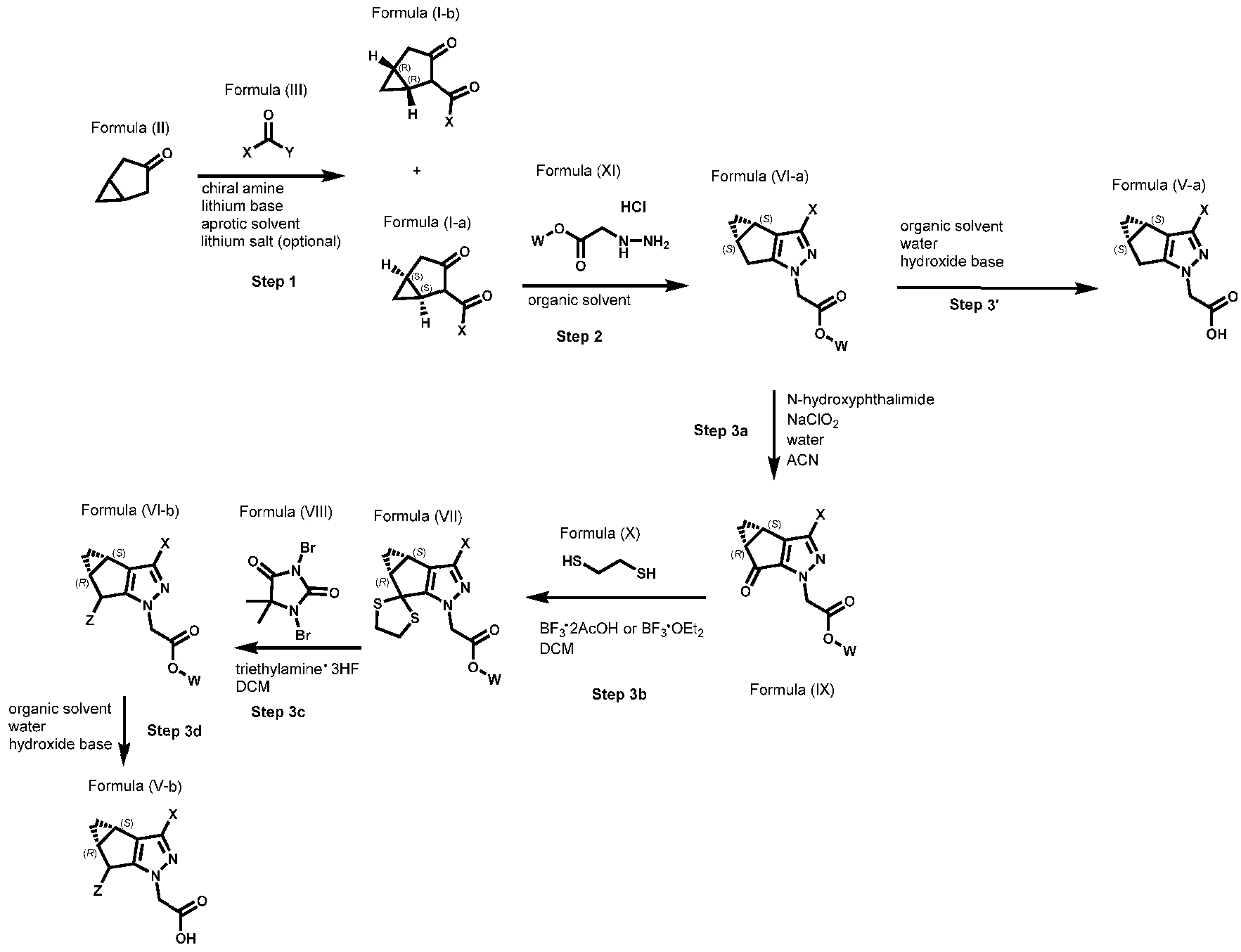
- the invention relates to a process for preparing a mixture comprising a compound of formula (l-a) and a compound of formula (l-b) wherein the process comprises combining: (a) a compound of formula (II),
- the invention relates to a compound made by the above process.
- alkyl refers to a saturated hydrocarbon radical, straight or branched, having the specified number of carbon atoms.
- Ci- 6 alkyl or Ci-C 6 alkyl refers to an alkyl group having 1 to 6 carbon atoms.
- Exemplary groups include, but are not limited to, methyl, ethyl, propyl (n-propyl and isopropyl), butyl (n-butyl, sec-butyl, isobutyl and te/Y-butyl), pentyl, and hexyl.
- alkyl When the term “alkyl” is used in combination with other substituent groups, such as "halo(Ci- 4 )alkyl” and “hydroxy(Ci- 4 )alkyl,” the term “alkyl” is intended to encompass a divalent straight or branched chain hydrocarbon radical, wherein the point of attachment is through the alkyl moiety.
- cycloalkyl refers to a non-aromatic, saturated, monocyclic, hydrocarbon ring containing the specified number of carbon atoms.
- cycloalkyl may contain 3 to 8 carbon atoms, i.e., C 3 -s cycloalkyl.
- Exemplary groups include cyclopropyl, cyclobutyl, cyclopentyl, cyclohexyl, cycloheptyl or cyclooctyl.
- halogen and "halo" represent chloro, fluoro, bromo, or iodo substituents.
- cyano refers to the group -CN.
- chiral amine refers to an amine covalently bonded to a carbon atom, said carbon atom having three different substituents such that it is chiral.
- chiral amine is used interchangeably to describe the free base or ammonium salt form of the chiral amine.
- the chiral amine ammonium salt form refers to the ammonium species formed by the combination of the chiral amine free base with an acid.
- alkoxy refers to an -O-alkyl group, i.e., an alkyl group which is attached through an oxygen linking atom, wherein “alkyl” is defined above.
- C1-6 alkoxy refers to an alkoxy group having 1 to 6 carbon atoms.
- Exemplary groups include, but are not limited to, methoxy, ethoxy, n-propoxy, isopropoxy, n-butoxy, s- butoxy, isobutoxy, and f-butoxy.
- cycloalkoxy means a cycloalkyl group having the recited number of carbon atoms, with the same meaning as previously defined, attached via a ring carbon atom to an exocyclic oxygen atom.
- cycloalkoxy may contain 3 to 6 carbon atoms attached via ring carbon atom to an exocyclic oxygen atom, i.e., C 3 -e cycloalkoxy.
- Exemplary groups include, but are not limited to, cyclopropoxyl, cyclobutoxyl, cyclopentoxyl, and cyclohexoxyl.
- aryl refers to a monocyclic or bicyclic, hydrocarbon, aromatic radical.
- Aryl includes, for example, phenyl and naphthyl.
- An aryl group may contain 6 to 14 carbon atoms.
- heteroaryl refers to a group or moiety comprising an aromatic monovalent monocyclic or bicyclic radical, containing 5 to 10 ring atoms, including at least one heteroatom independently selected from nitrogen, oxygen and sulfur. This term also encompasses bicyclic heterocyclic-aryl compounds containing an aryl ring moiety fused to a heterocycloalkyl ring moiety, containing 5 to 10 ring atoms, including at least one heteroatom independently selected from nitrogen, oxygen and sulfur.
- Exemplary groups include, but are not limited to furanyl, thienyl, pyrrolyl, imidazolyl, pyrazolyl, triazolyl, tetrazolyl, thiazolyl, oxazolyl, isoxazolyl, oxadiazolyl, thiadiazolyl, isothiazolyl, pyridinyl, pyridazinyl, pyrazinyl, pyrimidinyl, triazinyl, benzofuranyl, isobenzofuryl, 2,3- dihydrobenzofuryl, 1 ,3-benzodioxolyl, dihydrobenzodioxinyl, benzothienyl, indolizinyl, indolyl, isoindolyl, dihydroindolyl, benzimidazolyl, dihydrobenzimidazolyl, benzoxazolyl, dihydrobenzoxazolyl, benz
- Examples of 5-membered “heteroaryl” groups include furanyl, thienyl, pyrrolyl, imidazolyl, pyrazolyl, triazolyl, tetrazolyl, thiazolyl, oxazolyl, isoxazolyl, oxadiazolyl, thiadiazolyl, and isothiazolyl.
- Examples of 6-membered “heteroaryl” groups include oxo-pyridyl, pyridinyl, pyridazinyl, pyrazinyl, and pyrimidinyl.
- 6,6-fused “heteroaryl” groups include quinolinyl, isoquinolinyl, quinoxalinyl, cinnolinyl, phthalazinyl, quinazolinyl, 1 ,5-naphthyridinyl, 1 ,6-naphthyridinyl, 1 ,7- naphthyridinyl, 1 ,8-naphthyridinyl, and pteridinyl.
- 6,5-fused “heteroaryl” groups include benzofuranyl, benzothienyl, benzimidazolyl, benzthiazolyl, indolizinyl, indolyl, isoindolyl, and indazolyl.
- chemical purity means the overall level of the desired product or compound in the composition produced by the preparation. Where the compound is present in enantiomeric form, “chemical purity,” as used herein, includes both enantiomeric forms in the calculation of the overall level of the desired product. Components of the composition other than the desired product or compound are “impurities.” Purity may be measured by various techniques, including, but not limited to, HPLC analysis.
- enantiomeric purity or “chiral purity” means the overall level of one enantiomer in a composition compared to the other enantiomer in the composition. Components of the composition other than any enantiomer are not considered in the calculation of “enantiomeric purity” or “chiral purity.” Enantiomeric or chiral purity may be measured by various techniques including, but not limited to, chiral SFC analysis and/or chiral HPLC analysis.
- a group may be unsubstituted or substituted with one or more substituents as defined herein.
- substituted in reference to a group indicates that one or more hydrogen atoms attached to a member atom within a group is independently replaced by one or more of the defined substituents.
- groups may be selected from a number of alternative groups, the selected groups may be the same or different.
- independently selected means that where more than one substituent is selected from a number of possible substituents, those substituents may be the same or different. Thus, each substituent is separately selected from the entire group of recited possible substituents.
- leaving group generally refers to a group readily displaceable by a nucleophile such as an amine, a thiolate, an alkoxide, or an enolate.
- a nucleophile such as an amine, a thiolate, an alkoxide, or an enolate.
- leaving groups include, but are not limited to, halides, imidazoles and pyridinium species.
- member atoms refers to the atom or atoms that form a chain or ring. Where more than one member atom is present in a chain and within a ring, each member atom is covalently bound to an adjacent member atom in the chain or ring. Atoms that make up a substituent group attached to a chain or ring are not member atoms in the chain or ring.
- aprotic solvent means a solvent molecule that neither accepts nor provides a proton.
- the invention relates to a process for preparing a mixture comprising a compound of formula (l-a) and a compound of formula (l-b) wherein the process comprises combining: (a) a compound of formula (II), (b) a compound of formula (III), wherein X is cyclopropyl, difluoromethyl, or trifluoromethyl, and Y is a leaving group; and
- the invention relates to a process for preparing a mixture comprising a compound of formula (l-a) and a compound of formula (l-b) wherein the process comprises combining: (a) a compound of formula (II),
- the compound of formula (III) is wherein X is cyclopropyl, difluoromethyl, or trifluoromethyl, and Y is a leaving group.
- the term "leaving group” generally refers to a group readily displaceable by a nucleophile such as an amine, a thiolate, an alkoxide, or an enolate.
- Such leaving groups are well known in the art and one skilled in the art will appreciate that many possible leaving groups may be used. Examples of such leaving groups include, but are not limited to, halides, imidazoles and pyridinium species.
- Leaving groups can also be described in reference to the chemical that is released when Y of the compound of formula (III) is displaced by a nucleophile.
- Y can take the form of an alcohol, phenol, carboxylic acid, N- hydroxysuccinimide, N-hydroxybenzotriazole, or the conjugate base thereof.
- the compound of formula (III) is the product of a carboxylic acid reacting with an “activating agent” according to the formula below:
- activating agent is one of many reagents known in the art capable of generating a leaving group (Y) in this transformation.
- activating agents may be used.
- activating agents include, but are not limited to, 1-[3- (dimethylamino)propyl]-3-ethylcarbodiimide hydrochloride (EDC), 0-(7-azabenzotriazol-1- yl)-1 ,1 ,3,3-tetramethyluronium hexafluorophosphate (HATU), 2-propanephosphonic acid anhydride (T3P), 1-[(1-(cyano-2-ethoxy-2-oxoethylideneaminooxy)-dimethylamino- morpholinomethylene)] methanaminium hexafluorophosphate (COMU), and benzotriazol- 1 -yloxytri(pyrrolidino) phosphonium hexafluorophosphate (PyBOP).
- EDC 1-[3- (dimethylamino)propyl]-3-ethylcarbodiimide hydrochloride
- HATU 0-(7-
- Y is selected from -F, -Cl, -Br, -I, -CN, Ci- C 6 alkoxy, C 3 -C 6 cycloalkoxy, -O(CO)Ci-C 6 alkyl, -O(CO)C 3 -C 6 cycloalkyl, -O-aryl, or -O- heteroaryl; wherein -O(CO)Ci-C 6 alkyl or -O(CO)C 3 -C 6 cycloalkyl may optionally be substituted by 1 , 2, or 3 fluorine atoms, and wherein O-aryl and O-heteroaryl may be optionally substituted 1 , 2, or 3 times by substituents independently selected from halogen atoms or C1-C3 alkyl.
- Y is chloro, methoxy, or ethoxy. In another embodiment of the invention, Y is methoxy or ethoxy.
- a combination of the chiral amine, the lithium base, and, optionally, the lithium salt, in the presence of the solvent forms a lithium amide base.
- the lithium base is selected from l_i-Ci-C 6 -alkyl, Li-C 5 -C 6 - cycloalkyl, Li(aryl), LiH, LiNH 2 , or lithium metal (Li°).
- the lithium base is selected from n-Butyllithium (n-BuLi), sec-Butyllithium (sec-BuLi), isopropyllithium (/-PrLi) or te/Y-Butyllithium (f-BuLi).
- the lithium base is n-BuLi.
- the solvent is any solvent that may coordinate, but does not undergo a chemical reaction, with any of the components with which it is combined.
- the solvent is an aprotic or non-protogenic solvent.
- Non-limiting examples of such solvents include tetrahydrofuran (THF), 1 ,4-dioxane, 2- methyltetrahydrofuran, diethyl ether, methyl te/Y-butyl ether (MTBE), and cyclopentyl methyl ether (CPME).
- the solvent is selected from THF, 1 ,4-dioxane, 2-methyltetrahydrofuran, diethyl ether, MTBE, or CPME. In another embodiment, the solvent is selected from THF, 1 ,4-dioxane, 2-methyltetrahydrofuran, MTBE, or CPME. In another embodiment, the solvent is THF.
- the lithium salt is present. In another embodiment, the lithium salt is LiCI or LiBr. In an embodiment, there is no lithium salt.
- chiral amine refers to an amine covalently bonded to a carbon atom, said carbon atom having three different substituents such that it is chiral.
- the term “chiral amine” is used interchangeably to describe the free base or ammonium salt form of the chiral amine.
- the chiral amine ammonium salt form refers to the ammonium species formed by the combination of the chiral amine free base with an acid.
- a combination of a chiral amine, a lithium base, and optionally, a lithium salt, in the presence of a solvent forms a lithium amide base.
- the lithium salt is present.
- a molar ratio of the chiral amine and the lithium salt is in a range of from about 4:1 to about 2:5.
- the molar ratio of the chiral amine and the lithium salt is in a range of from about 6:5 to about 1 :1.
- a combination of a chiral amine free base, a lithium base, and, optionally, a lithium salt, in the presence of a solvent forms a lithium amide base.
- a molar ratio of the chiral amine free base and lithium base is in a range from about 9:10 to about 5:6.
- the molar ratio of the chiral amine free base and the lithium base is in a range from about 1 .0:1 .0 to about 1 .0:1 .1 .
- a combination of a chiral amine ammonium salt, a lithium base, and, optionally, a lithium salt, in the presence of a solvent forms a lithium amide base.
- a molar ratio of the chiral amine ammonium salt and lithium base is in a range from about 1 .0:1 .8 to about 1 .0:1 .0:2.4.
- the molar ratio of the chiral amine ammonium salt and lithium base is in a range from about 1 .0:2.0 to about 1.0:2.2.
- the lithium base is n-BuLi
- the lithium salt is present and is LiCI
- the solvent is THF.
- the chiral amine is a compound selected from formula (IV-a), (IV-b), (IV-c), (IV-d), (IV-e), or (IV-f):
- G1 is unsubstituted phenyl or phenyl substituted by one, two, or three substituents independently selected from halogen, cyano, substituted C1-C4 alkyl, unsubstituted C1-C4 alkyl, -O(cyclopropyl), - O(allyl), allyl, -O(Ri), or -C(Q)(Ri);
- G2 is unsubstituted phenyl or phenyl substituted by one, two, or three substituents independently selected from halogen, cyano, substituted C1-C4 alkyl, unsubstituted C1-C4 alkyl, -O(cyclopropyl), - O(allyl), allyl, -O(Ri), or -C(G)(Ri);
- G3 is unsubstituted C1-C3 alkyl or C1-C3 alkyl substituted by one, two, or three halogen atoms
- G 4 is unsubstituted C1-C3 alkyl or C1-C3 alkyl substituted by one, two, or three halogen atoms
- G 5 is selected from azetidine, pyrrolidine, morpholine, piperidine, or quinuclidine, each of which is optionally substituted by one or two substituents independently selected from methyl or halogen;
- Ge is selected allyl; cyclopropyl; unsubstituted C1-C5 alkyl; or C1-C5 alkyl substituted either by one phenyl or by one, two, or three halogen atoms;
- R1 is unsubstituted C1-C4 alkyl or C1-C4 alkyl substituted by one, two, or three halogen atoms.
- the chiral amine is (R)-bis((R)-1- phenylethyl)amine
- a lithium amide base formed by the combination of a chiral amine, lithium base and optional lithium salt in a solvent (“Solvent A”) is next combined with bicyclo[3.1 ,0]hexan-3-one in a solvent (“Solvent B”).
- solvent A and “Solvent B” are any solvent which does not undergo a chemical reaction with any of the components with which it is combined.
- solvents may be used, and that “Solvent A” and “Solvent B” may be the same or different.
- solvents examples include, but are not limited to, THF, 1 ,4-dioxane, 2- methyltetrahydrofuran, diethyl ether, MTBE, and CPME.
- solvent(s) used and the environment in which the solvent(s) is used must be largely free of water prior to quenching and workup of the reaction mixture.
- the solvent(s) used prior to quenching and workup of the reaction mixture contains below 500 ppm of water.
- the solvent(s) used prior to quenching and workup of the reaction mixture contains below 300 ppm water.
- the solvent(s) used prior to quenching and workup of the reaction mixture contains below 150 ppm water.
- the compound of formula (l-a) in the mixture produced by the process described herein is present in an enantiomeric excess over the compound of formula (l-b) of equal to or greater than 5%, equal to or greater than 10%, equal to or greater than 15%, equal to or greater than 20%, equal to or greater than 25%, equal to or greater than 30%, equal to or greater than 35%, equal to or greater than 40%, equal to or greater than 45%, equal to or greater than 50%, equal to or greater than 55%, equal to or greater than 60%, equal to or greater than 65%, equal to or greater than 70%, equal to or greater than 75%, equal to or greater than 80%, or equal to or greater than 85%.
- the differential solubility of two compounds present in a mixture is used to selectively enrich one compound over the other.
- a solvent such that some solid material is dissolved and some solid material remains, the ratio of the two components in the solid phase versus liquid phases becomes different. This process is known as “trituration.”
- trituration when two compounds are present in a mixture, trituration may be used to selectively enrich the amount of one compound versus the other in the solid phase, and the solids are then isolated by filtration.
- trituration may be used to selectively enrich the amount of one regioisomer versus the other in the solid phase, and the solids are then isolated by filtration.
- trituration may be used to selectively enrich the amount of one regioisomer versus the other in the solid phase, and the solids are then isolated by filtration.
- the filtrate may also be separately isolated and further processed in a subsequent step to provide additional material.
- the trituration process used to separate two regioisomers uses water as one component of the solvent.
- the trituration process used to separate two regioisomers uses aqueous acid as one component of the solvent.
- the trituration process used to separate two regioisomers uses aqueous acid as the solvent.
- the trituration process used to separate two regioisomers uses aqueous HCI as the solvent.
- the trituration process used to separate two regioisomers uses aqueous 1 N HCI as the solvent.
- a compound containing the lithium acetate group when treated with aqueous acid, maintains the lithium acetate group.
- a solid compound containing the lithium acetate group when treated with aqueous acid, maintains the lithium acetate group.
- compounds of formula (l-a) and (I- b) are intermediates, of which either or both may be useful in additional processes.
- WO 2020/054492 which is directed to novel capsid inhibitors, describes, inter alia, preparation of intermediate 2-(2,2-difluoroacetyl)bicyclo[3.1 ,0]hexan-3-one.
- the process described herein may be used to prepare a mixture of enantiomers of 2-(2,2- difluoroacetyl)bicyclo[3.1 ,0]hexan-3-one, corresponding to instant compounds of formula (l-a) and (l-b), where X is difluoromethyl.
- the process described herein may be useful to the processes described in WO 2020/054492 by providing mixtures with desired enantiomeric excesses, thereby reducing resources required to produce desired intermediates.
- U.S. Patent No. 10,696,657 which is directed to antiretroviral compounds and processes for making the same, describes, inter alia, processes of preparing 2-((3bS,4aR)-5,5-difluoro-3-(trifluoromethyl)-3b,4,4a,5-tetrahydro-1 /7- cyclopropa[3,4]cyclopenta[1 ,2-c]pyrazol-1-yl)acetic acid, which is an intermediate used in synthetic processes further described in U.S. Patent No. 10,696,657.
- the process described herein may also be used, for example, to prepare a mixture of enantiomers of 2-(2,2,2-trifluoroacetyl)bicyclo[3.1 ,0]hexan-3-one, corresponding to instant compounds of formula (l-a) and (l-b), where X is trifluoromethyl.
- Either or both enantiomers from this mixture may, in turn, be used in processes of preparing 2-((3bS,4aR)-5,5-difluoro-3-(trifluoromethyl)-3b,4,4a,5-tetrahydro-1 /7- cyclopropa[3,4]cyclopenta[1 ,2-c]pyrazol-1-yl)acetic acid.
- the process described herein may be useful to the processes described in U.S. Patent No. 10,696,657 by providing mixtures with desired enantiomeric excesses, thereby reducing resources required to produce desired intermediates.
- 1 wt is defined as the weight of bicyclo[3.1 ,0]hexan-3-one (1) (step 1) and of the respective previous step title compound (steps 2-6) to the reaction vessel in grams. All other weights, volumes and equivalents given are calculated relative to this figure.
- Step 1 Synthesis of Intermediate of Formula (l-a1) ((1S,5S)-2-(2,2- difluoroacetyl)bicyclo[3.1 ,0]hexan-3-one) (4):
- Step 2 Synthesis of Intermediate of Formula (Vl-a1) (ethyl 2-((3bS,4aS)-3- (difluoromethyl)-3b,4,4a,5-tetrahydro-1 H-cyclopropa[3,4]cyclopenta[1 ,2-c]pyrazol-1- yl)acetate) (6):
- Aminoglycinate hydrochloride (5) (1.2 eq.) was charged to a reaction vessel. 2- MeTHF (15 vol) was added and the vessel was purged with nitrogen for 10-15 minutes. The contents were cooled to 10°C. In a separate vessel a solution of ((1S,5S)-2-(2,2- difluoroacetyl)bicyclo[3.1 ,0]hexan-3-one (4) (99.6 g, 1 wt., 1.0 eq.) in EtOH (15 vol) was prepared.
- Step 3 Synthesis of Intermediate of Formula (IX-1) (ethyl 2-(3-(difluoromethyl)-5-oxo- 3b,4,4a,5-tetrahydro-1 H-cyclopropa[3,4]cyclopenta[1 ,2-c]pyrazol-1-yl)acetate) (7):
- Step 4 Synthesis of Intermediate of Formula (VI 1-1 ) (ethyl 2-(3-(difluoromethyl)-4,4a- dihydrospiro[cyclopropa[3,4]cyclopenta[1 ,2-c]pyrazole-5,2'-[1 ,3]dithiolane]-1 (3bH)- yl)acetate) (9):
- Aqueous KHCO 3 solution (15.3 wt) was added, the biphasic mixture was filtered through diatomite and the filter cake was washed with DCM (2.0 wt.). The filtrate was separated, and the organic phase was concentrated and switched with EtOH (2 x 3 vol), then further diluted with EtOH (3 vol).
- Step 5 Synthesis of Intermediate of Formula (IV-b1) (ethyl 2-(3-(difluoromethyl)-5,5- difluoro-3b,4,4a,5-tetrahydro-1 H-cyclopropa[3,4]cyclopenta[1 ,2-c]pyrazol-1-yl)acetate) (11):
- Step 6 Synthesis of Intermediate of Formula (Vl-b1) (2-(3-(difluoromethyl)-5,5-difluoro- 3b,4,4a,5-tetrahydro-1 H-cyclopropa[3,4]cyclopenta[1 ,2-c]pyrazol-1 -yl)acetic acid) (12):
- Step A Preparation of Intermediate of Formula (l-a2) ((1 S,5S)-2-(2,2,2- trifluoroacetyl)bicyclo[3.1 ,0]hexan-3-one) (A):
- Step B Preparation of Intermediate of Formula (Vl-a2) ( (ethyl 2-((3bS,4aS)-3- (trifluoromethyl)-3b,4,4a,5-tetrahydro-1 H-cyclopropa[3,4]cyclopenta[1 ,2-c]pyrazol-1 - yl)acetate) (B):
- Aminoglycinate hydrochloride (5) (4.83 g, 1 .2 eq.) was charged to a reaction vessel.
- 2-MeTHF (75 mL) was added and the vessel was purged with nitrogen for 10-15 minutes.
- Sulfuric acid (6.94 mL) was added dropwise at -10-0°C.
- a solution of 2-(2,2,2-trifluoroacetyl)bicyclo[3.1 ,0]hexan-3-one (A) (5 g, 1 wt., 1.0 eq.) in EtOH (75 mL) was prepared.
- Step C Preparation of Intermediate of Formula (l-a3) ((1S,5S)-2- (cyclopropanecarbonyl)bicyclo[3.1 ,0]hexan-3-one) (C):
- Step D Preparation of Intermediate of Formula (Vl-a3) (ethyl 2-((3bS,4aS)-3-cyclopropyl- 3b,4,4a,5-tetrahydro-1 H-cyclopropa[3,4]cyclopenta[1 ,2-c]pyrazol-1-yl)acetate) (D):
- Aminoglycinate hydrochloride (5) (3.86 g, 1 .2 eq.) was charged to a reaction vessel.
- 2-MeTHF (50 mL) was added and the vessel was purged with nitrogen for 10-15 minutes. The mixture was cooled to -10-0°C.
- Sulfuric acid (5.55 mL) was added dropwise.
- a solution of 2-(cyclopropanecarbonyl)bicyclo[3.1 ,0]hexan-3-one (3.42 g, 1 wt., 1.0 eq.) in EtOH (50 mL) was prepared.
- Step 1 Preparation of Intermediate of Formula (l-a3) (1 S,5S)-2-(cyclopropanecarbonyl) bicyclo [3.1.0] hexan-3-one
- reaction mixture was quenched with 4M HCI in ethyl acetate (4 mL), 2N aqueous HCI solution (5 mL) and MTBE (10 mL) and the resulting mixture was stirred for 20 min. The mixture was filtered and the filtrate was partitioned. The aqueous layer was extracted with ethyl acetate (10 mL). The combined organic layers were washed with 2N aqueous HCI solution (2 x 5 mL) and water (2 x 5 mL).
- Step 2 Preparation of Intermediate of Formula (Vl-a3) (ethyl 2-((3bS,4aS)-3-cyclopropyl- 3b,4,4a,5-tetrahydro-1 /7-cyclopropa[3,4]cyclopenta[1 ,2-c]pyrazol-1-yl)acetate)
- the material was then was adsorbed onto celite and the resulting powder was subjected to C18 chromatography using a Combi-Flash system equipped with a RediSep Gold C18 column (40 g, Teledyne Isco) eluting with a gradient of 50-65% MeCN (containing 0.1% TFA) in water (containing 0.1 % TFA) with flow rate 20 mL/minute.
- the pure product-containing fractions were combined and concentrated under reduced pressure.
- the resulting aqueous solution was adjusted to pH ⁇ 7 by the addition of aqueous saturated NaHCO 3 solution.
- LCMS Method Column: CORTECS UPLC C18 1 ,6pm, 3.0 x 30mm; Mobile phase A: 0.05% formic acid in Water, Mobile Phase B: 0.05% formic acid in MeCN; Gradient (minute I %B): 0/3, 0.1/3, 1.2/98, 2.0/98, 2.05/3, 2.50/3; Flow-rate: 0.85 mL/min; Temp: 45°C.
- Step 3 Preparation of Intermediate of Formula (V-a1) (2-((3bS,4aS)-3-cyclopropyl- 3b,4,4a,5-tetrahydro-1 /7-cyclopropa[3,4]cyclopenta[1 ,2-c]pyrazol-1 -yl)acetic acid)
- LCMS Method Column: CORTECS UPLC C18 (30 x 3mm, 1 .6 urn); Mobile Phase A: 0.05% Formic Acid in water; Mobile Phase B: 0.05% Formic Acid in MeCN; Time (min) I %B: 0/3, 0.1/3, 1.2/98, 2/98, 2.05/3, 2.5/3; Column Temp: 45°C; Flow Rate: 0.85 ml/min.
- Chiral SFC method Column: CHIRALPAK IC (4.6x150mm) 5pm; Co- solvent: 0.5% triethylamine in methanol; Total flow: 3 mL/min; Eluent: 70% CO 2 , 30% cosolvent; ABPR: 1500 psi; Column Temperature: 30°C; Detection: Spectrum PDA 237.0 nm. Note: Co-injection of an authentic homochiral sample of 2-((3bS,4aS)-3-cyclopropyl- 3b,4,4a,5-tetrahydro-1 H-cyclopropa[3,4]cyclopenta[1 ,2-c]pyrazol-1-yl)acetic acid was used to confirm the identity of the desired product peak.
- Step 2 Preparation of Intermediate of Formula (Vl-a3) (ethyl 2-((3bS,4aS)-3-cyclopropyl- 3b,4,4a,5-tetrahydro-1 /7-cyclopropa[3,4]cyclopenta[1 ,2-c]pyrazol-1-yl)acetate)
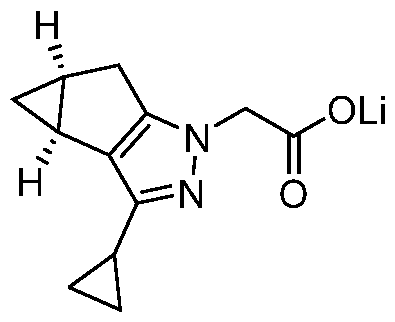
- Step 3 Preparation of the lithium salt of Intermediate of Formula (V-a1) (lithium 2- ((3bS,4aS)-3-cyclopropyl-3b,4,4a,5-tetrahydro-1/7-cyclopropa[3,4]cyclopenta[1 ,2- c]pyrazol-1 -yl)acetate)
- Step 4 SFC purification of the lithium salt of Intermediate of Formula (V-a1) (lithium 2- ((3bS,4aS)-3-cyclopropyl-3b,4,4a,5-tetrahydro-1 /7-cyclopropa[3,4]cyclopenta[1 ,2- c]pyrazol-1 -yl)acetate)
Landscapes
- Chemical & Material Sciences (AREA)
- Organic Chemistry (AREA)
- Chemical Kinetics & Catalysis (AREA)
- Organic Low-Molecular-Weight Compounds And Preparation Thereof (AREA)
- Pharmaceuticals Containing Other Organic And Inorganic Compounds (AREA)
Abstract
Description




Claims


Priority Applications (2)
| Application Number | Priority Date | Filing Date | Title |
|---|---|---|---|
| EP24736858.2A EP4727909A1 (en) | 2023-06-15 | 2024-06-13 | Methods and intermediates for preparing compounds |
| CN202480039029.2A CN121335877A (en) | 2023-06-15 | 2024-06-13 | Methods and intermediates for preparing compounds |
Applications Claiming Priority (2)
| Application Number | Priority Date | Filing Date | Title |
|---|---|---|---|
| US202363508278P | 2023-06-15 | 2023-06-15 | |
| US63/508,278 | 2023-06-15 |
Publications (1)
| Publication Number | Publication Date |
|---|---|
| WO2024257009A1 true WO2024257009A1 (en) | 2024-12-19 |
Family
ID=91700034
Family Applications (1)
| Application Number | Title | Priority Date | Filing Date |
|---|---|---|---|
| PCT/IB2024/055798 Ceased WO2024257009A1 (en) | 2023-06-15 | 2024-06-13 | Methods and intermediates for preparing compounds |
Country Status (5)
| Country | Link |
|---|---|
| EP (1) | EP4727909A1 (en) |
| CN (1) | CN121335877A (en) |
| AR (1) | AR132951A1 (en) |
| TW (1) | TW202515516A (en) |
| WO (1) | WO2024257009A1 (en) |
Citations (40)
| Publication number | Priority date | Publication date | Assignee | Title |
|---|---|---|---|---|
| WO2012065062A1 (en) | 2010-11-12 | 2012-05-18 | Pharmaresources(Shanghai)Co., Ltd. | Novel antiviral compounds |
| WO2013006792A1 (en) | 2011-07-07 | 2013-01-10 | Pharmaresources (Shanghai) Co., Ltd. | Antiviral compounds |
| WO2013006738A1 (en) | 2011-07-06 | 2013-01-10 | Gilead Sciences, Inc. | Compounds for the treatment of hiv |
| WO2014110297A1 (en) | 2013-01-09 | 2014-07-17 | Gilead Sciences, Inc. | (hetero) arylacetamide derivatives as antiretroviral agents |
| WO2014110296A1 (en) | 2013-01-09 | 2014-07-17 | Gilead Sciences, Inc. | Therapeutic compounds for the treatment of viral infections |
| WO2014110298A1 (en) | 2013-01-09 | 2014-07-17 | Gilead Sciences, Inc. | 5-membered heteroaryls and their use as antiviral agents |
| WO2014134566A2 (en) | 2013-03-01 | 2014-09-04 | Gilead Sciences, Inc. | Therapeutic compounds |
| WO2015061518A1 (en) | 2013-10-24 | 2015-04-30 | Bristol-Myers Squibb Company | Inhibitors of human immunodeficiency virus replication |
| WO2015130964A1 (en) | 2014-02-28 | 2015-09-03 | Gilead Sciences, Inc. | Therapeutic compounds |
| WO2015130966A1 (en) | 2014-02-28 | 2015-09-03 | Gilead Sciences, Inc. | Antiviral agents |
| WO2016033243A1 (en) | 2014-08-29 | 2016-03-03 | Gilead Sciences, Inc. | Antiretroviral agents |
| WO2016040084A1 (en) | 2014-09-09 | 2016-03-17 | Bristol-Myers Squibb Company | Inhibitors of human immunodeficiency virus replication |
| WO2016172425A1 (en) | 2015-04-23 | 2016-10-27 | Viiv Healthcare (No.5) Limited | Inhibitors of human immunodeficiency virus replication |
| WO2016172424A1 (en) | 2015-04-23 | 2016-10-27 | Bristol-Myers Squibb Company | Inhibitors of human immunodeficiency virus replication |
| WO2018035359A1 (en) | 2016-08-19 | 2018-02-22 | Gilead Sciences, Inc. | Therapeutic compounds useful for the prophylactic or therapeutic treatment of an hiv virus infection |
| WO2018203235A1 (en) | 2017-05-02 | 2018-11-08 | VIIV Healthcare UK (No.5) Limited | Inhibitors of human immunodeficiency virus replication |
| WO2019035904A1 (en) | 2017-08-17 | 2019-02-21 | Gilead Sciences, Inc. | Solid forms of an hiv capsid inhibitor |
| WO2019035973A1 (en) | 2017-08-17 | 2019-02-21 | Gilead Sciences, Inc | Choline salt forms of an hiv capsid inhibitor |
| WO2019161280A1 (en) | 2018-02-16 | 2019-08-22 | Gilead Sciences, Inc. | Methods and intermediates for preparing a therapeutic compound useful in the treatment of retroviridae viral infection |
| WO2019161017A1 (en) | 2018-02-15 | 2019-08-22 | Gilead Sciences, Inc. | Pyridine derivatives and their use for treating hiv infection |
| WO2019198024A1 (en) | 2018-04-11 | 2019-10-17 | VIIV Healthcare UK (No.5) Limited | 4-oxo-3,4-dihydroquinazoline compounds as inhibitors of human immunodeficiency virus replication |
| WO2020018459A1 (en) | 2018-07-16 | 2020-01-23 | Gilead Sciences, Inc. | Capsid inhibitors for the treatment of hiv |
| WO2020054492A1 (en) | 2018-09-11 | 2020-03-19 | 新日本理化株式会社 | Metal salt of alicyclic dicarboxylic acid having excellent dispersibility in polyolefin resin, production method for said metal salt of alicyclic dicarboxylic acid, crystal nucleator for polyolefin resin containing said metal salt of alicyclic dicarboxylic acid, crystal nucleator composition containing said crystal nucleator, polyolefin resin composition, and polyolefin resin molded article |
| WO2020053811A1 (en) | 2018-09-14 | 2020-03-19 | VIIV Healthcare UK (No.5) Limited | Inhibitors of human immunodeficiency virus replication |
| WO2020058844A1 (en) | 2018-09-20 | 2020-03-26 | VIIV Healthcare UK (No.5) Limited | Inhibitors of human immunodeficiency virus replication |
| WO2020084492A1 (en) | 2018-10-24 | 2020-04-30 | VIIV Healthcare UK (No.5) Limited | Inhibitors of human immunodeficiency virus replication |
| WO2020084491A1 (en) | 2018-10-24 | 2020-04-30 | VIIV Healthcare UK (No.5) Limited | Inhibitors of human immunodeficiency virus replication |
| WO2020084480A1 (en) | 2018-10-25 | 2020-04-30 | VIIV Healthcare UK (No.5) Limited | Inhibitors of human immunodeficiency virus replication |
| WO2020089778A1 (en) | 2018-10-29 | 2020-05-07 | VIIV Healthcare UK (No.5) Limited | Quinazolinyl-indazole derivatives and their use as inhibitors of human immunodeficiency virus replication |
| WO2020095177A1 (en) | 2018-11-05 | 2020-05-14 | VIIV Healthcare UK (No.5) Limited | Inhibitors of human immunodeficiency virus replication |
| WO2020095176A1 (en) | 2018-11-05 | 2020-05-14 | VIIV Healthcare UK (No.5) Limited | Inhibitors of human immunodeficiency virus replication |
| WO2020157692A1 (en) | 2019-02-01 | 2020-08-06 | VIIV Healthcare UK (No.5) Limited | Inhibitors of human immunodeficiency virus replication |
| WO2020222108A1 (en) | 2019-04-30 | 2020-11-05 | VIIV Healthcare UK (No.5) Limited | Inhibitors of human immunodeficiency virus replication |
| WO2020254985A1 (en) | 2019-06-19 | 2020-12-24 | VIIV Healthcare UK (No.5) Limited | Pyrido[2,3-d]pyrimidine derivatives as inhibitors of human immunodeficiency virus replication |
| WO2021064570A1 (en) | 2019-10-01 | 2021-04-08 | VIIV Healthcare UK (No.5) Limited | N-substututed-6-oxo-1,6-dihydropyrimidine-2-yl derivatives as inhibitors of the human immunodeficiency virus replication |
| WO2021064571A1 (en) | 2019-10-01 | 2021-04-08 | VIIV Healthcare UK (No.5) Limited | N-substituted-4-oxo-3,4-dihydropyrido[2,3-d]pyrimidin-2-yl derivatives as inhibitors of the human immunodeficiency virus replication |
| WO2021064677A1 (en) | 2019-10-04 | 2021-04-08 | VIIV Healthcare UK (No.5) Limited | Inhibitors of human immunodeficiency virus replication |
| WO2021070054A1 (en) | 2019-10-08 | 2021-04-15 | VIIV Healthcare UK (No.5) Limited | Inhibitors of human immunodeficiency virus replication |
| WO2021176367A1 (en) | 2020-03-06 | 2021-09-10 | VIIV Healthcare UK (No.5) Limited | Inhibitors of human immunodeficiency virus replication |
| WO2021176366A1 (en) | 2020-03-06 | 2021-09-10 | VIIV Healthcare UK (No.5) Limited | Inhibitors of human immunodeficiency virus replication |
-
2024
- 2024-06-13 CN CN202480039029.2A patent/CN121335877A/en active Pending
- 2024-06-13 EP EP24736858.2A patent/EP4727909A1/en active Pending
- 2024-06-13 TW TW113121778A patent/TW202515516A/en unknown
- 2024-06-13 WO PCT/IB2024/055798 patent/WO2024257009A1/en not_active Ceased
- 2024-06-13 AR ARP240101506A patent/AR132951A1/en unknown
Patent Citations (42)
| Publication number | Priority date | Publication date | Assignee | Title |
|---|---|---|---|---|
| WO2012065062A1 (en) | 2010-11-12 | 2012-05-18 | Pharmaresources(Shanghai)Co., Ltd. | Novel antiviral compounds |
| WO2013006738A1 (en) | 2011-07-06 | 2013-01-10 | Gilead Sciences, Inc. | Compounds for the treatment of hiv |
| WO2013006792A1 (en) | 2011-07-07 | 2013-01-10 | Pharmaresources (Shanghai) Co., Ltd. | Antiviral compounds |
| WO2014110297A1 (en) | 2013-01-09 | 2014-07-17 | Gilead Sciences, Inc. | (hetero) arylacetamide derivatives as antiretroviral agents |
| WO2014110296A1 (en) | 2013-01-09 | 2014-07-17 | Gilead Sciences, Inc. | Therapeutic compounds for the treatment of viral infections |
| WO2014110298A1 (en) | 2013-01-09 | 2014-07-17 | Gilead Sciences, Inc. | 5-membered heteroaryls and their use as antiviral agents |
| US9951043B2 (en) * | 2013-03-01 | 2018-04-24 | Gilead Sciences, Inc. | Therapeutic compounds |
| WO2014134566A2 (en) | 2013-03-01 | 2014-09-04 | Gilead Sciences, Inc. | Therapeutic compounds |
| WO2015061518A1 (en) | 2013-10-24 | 2015-04-30 | Bristol-Myers Squibb Company | Inhibitors of human immunodeficiency virus replication |
| WO2015130964A1 (en) | 2014-02-28 | 2015-09-03 | Gilead Sciences, Inc. | Therapeutic compounds |
| WO2015130966A1 (en) | 2014-02-28 | 2015-09-03 | Gilead Sciences, Inc. | Antiviral agents |
| WO2016033243A1 (en) | 2014-08-29 | 2016-03-03 | Gilead Sciences, Inc. | Antiretroviral agents |
| WO2016040084A1 (en) | 2014-09-09 | 2016-03-17 | Bristol-Myers Squibb Company | Inhibitors of human immunodeficiency virus replication |
| WO2016172425A1 (en) | 2015-04-23 | 2016-10-27 | Viiv Healthcare (No.5) Limited | Inhibitors of human immunodeficiency virus replication |
| WO2016172424A1 (en) | 2015-04-23 | 2016-10-27 | Bristol-Myers Squibb Company | Inhibitors of human immunodeficiency virus replication |
| WO2018035359A1 (en) | 2016-08-19 | 2018-02-22 | Gilead Sciences, Inc. | Therapeutic compounds useful for the prophylactic or therapeutic treatment of an hiv virus infection |
| WO2018203235A1 (en) | 2017-05-02 | 2018-11-08 | VIIV Healthcare UK (No.5) Limited | Inhibitors of human immunodeficiency virus replication |
| WO2019035904A1 (en) | 2017-08-17 | 2019-02-21 | Gilead Sciences, Inc. | Solid forms of an hiv capsid inhibitor |
| WO2019035973A1 (en) | 2017-08-17 | 2019-02-21 | Gilead Sciences, Inc | Choline salt forms of an hiv capsid inhibitor |
| WO2019161017A1 (en) | 2018-02-15 | 2019-08-22 | Gilead Sciences, Inc. | Pyridine derivatives and their use for treating hiv infection |
| US10696657B2 (en) | 2018-02-16 | 2020-06-30 | Gilead Sciences, Inc. | Methods and intermediates for preparing therapeutic compounds |
| WO2019161280A1 (en) | 2018-02-16 | 2019-08-22 | Gilead Sciences, Inc. | Methods and intermediates for preparing a therapeutic compound useful in the treatment of retroviridae viral infection |
| WO2019198024A1 (en) | 2018-04-11 | 2019-10-17 | VIIV Healthcare UK (No.5) Limited | 4-oxo-3,4-dihydroquinazoline compounds as inhibitors of human immunodeficiency virus replication |
| WO2020018459A1 (en) | 2018-07-16 | 2020-01-23 | Gilead Sciences, Inc. | Capsid inhibitors for the treatment of hiv |
| WO2020054492A1 (en) | 2018-09-11 | 2020-03-19 | 新日本理化株式会社 | Metal salt of alicyclic dicarboxylic acid having excellent dispersibility in polyolefin resin, production method for said metal salt of alicyclic dicarboxylic acid, crystal nucleator for polyolefin resin containing said metal salt of alicyclic dicarboxylic acid, crystal nucleator composition containing said crystal nucleator, polyolefin resin composition, and polyolefin resin molded article |
| WO2020053811A1 (en) | 2018-09-14 | 2020-03-19 | VIIV Healthcare UK (No.5) Limited | Inhibitors of human immunodeficiency virus replication |
| WO2020058844A1 (en) | 2018-09-20 | 2020-03-26 | VIIV Healthcare UK (No.5) Limited | Inhibitors of human immunodeficiency virus replication |
| WO2020084492A1 (en) | 2018-10-24 | 2020-04-30 | VIIV Healthcare UK (No.5) Limited | Inhibitors of human immunodeficiency virus replication |
| WO2020084491A1 (en) | 2018-10-24 | 2020-04-30 | VIIV Healthcare UK (No.5) Limited | Inhibitors of human immunodeficiency virus replication |
| WO2020084480A1 (en) | 2018-10-25 | 2020-04-30 | VIIV Healthcare UK (No.5) Limited | Inhibitors of human immunodeficiency virus replication |
| WO2020089778A1 (en) | 2018-10-29 | 2020-05-07 | VIIV Healthcare UK (No.5) Limited | Quinazolinyl-indazole derivatives and their use as inhibitors of human immunodeficiency virus replication |
| WO2020095177A1 (en) | 2018-11-05 | 2020-05-14 | VIIV Healthcare UK (No.5) Limited | Inhibitors of human immunodeficiency virus replication |
| WO2020095176A1 (en) | 2018-11-05 | 2020-05-14 | VIIV Healthcare UK (No.5) Limited | Inhibitors of human immunodeficiency virus replication |
| WO2020157692A1 (en) | 2019-02-01 | 2020-08-06 | VIIV Healthcare UK (No.5) Limited | Inhibitors of human immunodeficiency virus replication |
| WO2020222108A1 (en) | 2019-04-30 | 2020-11-05 | VIIV Healthcare UK (No.5) Limited | Inhibitors of human immunodeficiency virus replication |
| WO2020254985A1 (en) | 2019-06-19 | 2020-12-24 | VIIV Healthcare UK (No.5) Limited | Pyrido[2,3-d]pyrimidine derivatives as inhibitors of human immunodeficiency virus replication |
| WO2021064570A1 (en) | 2019-10-01 | 2021-04-08 | VIIV Healthcare UK (No.5) Limited | N-substututed-6-oxo-1,6-dihydropyrimidine-2-yl derivatives as inhibitors of the human immunodeficiency virus replication |
| WO2021064571A1 (en) | 2019-10-01 | 2021-04-08 | VIIV Healthcare UK (No.5) Limited | N-substituted-4-oxo-3,4-dihydropyrido[2,3-d]pyrimidin-2-yl derivatives as inhibitors of the human immunodeficiency virus replication |
| WO2021064677A1 (en) | 2019-10-04 | 2021-04-08 | VIIV Healthcare UK (No.5) Limited | Inhibitors of human immunodeficiency virus replication |
| WO2021070054A1 (en) | 2019-10-08 | 2021-04-15 | VIIV Healthcare UK (No.5) Limited | Inhibitors of human immunodeficiency virus replication |
| WO2021176367A1 (en) | 2020-03-06 | 2021-09-10 | VIIV Healthcare UK (No.5) Limited | Inhibitors of human immunodeficiency virus replication |
| WO2021176366A1 (en) | 2020-03-06 | 2021-09-10 | VIIV Healthcare UK (No.5) Limited | Inhibitors of human immunodeficiency virus replication |
Non-Patent Citations (9)
| Title |
|---|
| BEYRER, C.POZNIAK A.: "HIV drug resistance - an emerging threat to epidemic control", N. ENGL. J. MED., vol. 377, 2017, pages 1605 - 1607, XP055649066, DOI: 10.1056/NEJMp1710608 |
| BUNN BARRY J. ET AL: "The effect of added salts on enantioselective transformations of cyclic ketones by chiral lithium amide bases", JOURNAL OF THE CHEMICAL SOCIETY, PERKIN TRANSACTIONS 1, no. 24, 1 January 1993 (1993-01-01), Cambridge, UK, pages 3113, XP093205625, ISSN: 0300-922X, DOI: 10.1039/p19930003113 * |
| CARNES, STEPHANIE K.SHEEHAN, JONATHAN H.AIKEN, CHRISTOPHER: "Inhibitors of the HIV-1 capsid, a target of opportunity", CURRENT OPINION IN HIV & AIDS, vol. 13, 2018, pages 359 - 365, XP009527267, DOI: 10.1097/COH.0000000000000472 |
| CEVIKMUGEORKIN: "Insights into HIV-1 capsid inhibitors in preclinical and early clinical development as antiretroviral agents", CHLOE EXPERT OPIN INV. DRUGS, vol. 28, 2019, pages 1021, XP055800187, DOI: 10.1080/13543784.2019.1692811 |
| CHEM. REV., vol. 111, no. 11, 2011, pages 6557 - 6602 |
| GUPTA, R. K.GREGSON J. ET AL.: "HIV-1 drug resistance before initiation or re-initiation of first-line antiretroviral therapy in low-income and middle-income countries: a systematic review and meta-regression analysis", LANCET INFECT. DIS., vol. 18, 2017, pages 346 - 355, XP055649070, DOI: 10.1016/S1473-3099(17)30702-8 |
| MCARTHURCAROLE: "HIV Capsid Inhibitors Beyond PF74", DISEASES, 22 July 2019 (2019-07-22) |
| THENIN-HOUSSIER, SUZIEVALENTE, SUSANA T.: "HIV-1 Capsid Inhibitors as Antiretroviral Agents", CURRENT HIV RESEARCH, vol. 14, 2016, pages 270, XP055649085, DOI: 10.2174/1570162X14999160224103555 |
| ZAZZI, M.HU, H.PROSPERI, M.: "The global burden of HIV-1 drug resistance in the past 20 years", PEERJ., 2018 |
Also Published As
| Publication number | Publication date |
|---|---|
| AR132951A1 (en) | 2025-08-13 |
| CN121335877A (en) | 2026-01-13 |
| EP4727909A1 (en) | 2026-04-22 |
| TW202515516A (en) | 2025-04-16 |
Similar Documents
| Publication | Publication Date | Title |
|---|---|---|
| JP6936848B2 (en) | A novel tetrahydropyrazolopyridine compound for the treatment of infectious diseases | |
| ES2760981T3 (en) | Novel pyrrolopyridine derivative antiviral and a production procedure therefor | |
| EP3253747B1 (en) | 3-alkyl-4-amido-bicyclic [4,5,0]hydroxamic acids as hdac inhibitors | |
| KR101344989B1 (en) | Derivatives Having PAPR Activity | |
| US20240374598A1 (en) | Inhibitors of human immunodeficiency virus replication | |
| ES2859510T3 (en) | Pyridazinone fused tricyclic compounds useful for treating orthomyxovirus infections | |
| US20230295175A1 (en) | Processes for the preparation of substituted spirooxindole derivatives | |
| US11919897B2 (en) | Inhibitors of human immunodeficiency virus replication | |
| CN112236423B (en) | Piperidinyl-3- (aryloxy) propanamides and propionic acid esters | |
| CN109153682A (en) | For treating the new pyrazine compound with oxygen, sulphur and nitrogen linker of infectious diseases | |
| ES2886442T3 (en) | Amino acid derivative prodrug | |
| US20210395248A1 (en) | Inhibitors of human immunodeficiency virus replication | |
| KR20080108322A (en) | Method for preparing HIV protease inhibitor | |
| US20210395262A1 (en) | Inhibitors of human immunodeficiency virus replication | |
| KR20230024886A (en) | Antiviral 1,3-di-oxo-indene compounds | |
| AU2024251729A1 (en) | Synthesis of ras inhibitors | |
| EP1440075A1 (en) | Novel 3beta-amino azabicyclooctane heteroaromatic amide derivatives, preparation method and therapeutic uses thereof | |
| WO2024257009A1 (en) | Methods and intermediates for preparing compounds | |
| US20170313718A1 (en) | Inhibitors of hif prolyl hydroxylase | |
| US10526363B2 (en) | Substituted phosphoramidate compounds and uses thereof | |
| CN103328471A (en) | Process for preparing azaindazole derivatives | |
| WO2022112207A1 (en) | Aromatic spiro ring amide derivatives for the treatment and prophylaxis of hepatitis b virus infection | |
| WO2016057753A1 (en) | Substituted pyrimidines as inhibitors of hif prolyl hydroxylase | |
| WO2025173784A1 (en) | Method for producing sulfonamide compound using 4-aminopyridine derivative | |
| KR20250028239A (en) | Diazabicyclooctane derivatives useful as matrix metalloproteinase inhibitors |
Legal Events
| Date | Code | Title | Description |
|---|---|---|---|
| 121 | Ep: the epo has been informed by wipo that ep was designated in this application |
Ref document number: 24736858 Country of ref document: EP Kind code of ref document: A1 |
|
| WWE | Wipo information: entry into national phase |
Ref document number: 2024736858 Country of ref document: EP |
|
| NENP | Non-entry into the national phase |
Ref country code: DE |
|
| ENP | Entry into the national phase |
Ref document number: 2024736858 Country of ref document: EP Effective date: 20260115 |
|
| ENP | Entry into the national phase |
Ref document number: 2024736858 Country of ref document: EP Effective date: 20260115 |
|
| ENP | Entry into the national phase |
Ref document number: 2024736858 Country of ref document: EP Effective date: 20260115 |
|
| ENP | Entry into the national phase |
Ref document number: 2024736858 Country of ref document: EP Effective date: 20260115 |
|
| WWP | Wipo information: published in national office |
Ref document number: 2024736858 Country of ref document: EP |