WO2024257056A1 - Primer composition, adhesive system, and related processes - Google Patents
Primer composition, adhesive system, and related processes Download PDFInfo
- Publication number
- WO2024257056A1 WO2024257056A1 PCT/IB2024/055869 IB2024055869W WO2024257056A1 WO 2024257056 A1 WO2024257056 A1 WO 2024257056A1 IB 2024055869 W IB2024055869 W IB 2024055869W WO 2024257056 A1 WO2024257056 A1 WO 2024257056A1
- Authority
- WO
- WIPO (PCT)
- Prior art keywords
- meth
- adhesive
- acrylate
- monomer units
- weight
- Prior art date
- Legal status (The legal status is an assumption and is not a legal conclusion. Google has not performed a legal analysis and makes no representation as to the accuracy of the status listed.)
- Ceased
Links
Classifications
-
- C—CHEMISTRY; METALLURGY
- C09—DYES; PAINTS; POLISHES; NATURAL RESINS; ADHESIVES; COMPOSITIONS NOT OTHERWISE PROVIDED FOR; APPLICATIONS OF MATERIALS NOT OTHERWISE PROVIDED FOR
- C09J—ADHESIVES; NON-MECHANICAL ASPECTS OF ADHESIVE PROCESSES IN GENERAL; ADHESIVE PROCESSES NOT PROVIDED FOR ELSEWHERE; USE OF MATERIALS AS ADHESIVES
- C09J133/00—Adhesives based on homopolymers or copolymers of compounds having one or more unsaturated aliphatic radicals, each having only one carbon-to-carbon double bond, and at least one being terminated by only one carboxyl radical, or of salts, anhydrides, esters, amides, imides, or nitriles thereof; Adhesives based on derivatives of such polymers
- C09J133/04—Homopolymers or copolymers of esters
- C09J133/06—Homopolymers or copolymers of esters of esters containing only carbon, hydrogen and oxygen, the oxygen atom being present only as part of the carboxyl radical
- C09J133/10—Homopolymers or copolymers of methacrylic acid esters
- C09J133/12—Homopolymers or copolymers of methyl methacrylate
-
- C—CHEMISTRY; METALLURGY
- C08—ORGANIC MACROMOLECULAR COMPOUNDS; THEIR PREPARATION OR CHEMICAL WORKING-UP; COMPOSITIONS BASED THEREON
- C08F—MACROMOLECULAR COMPOUNDS OBTAINED BY REACTIONS ONLY INVOLVING CARBON-TO-CARBON UNSATURATED BONDS
- C08F220/00—Copolymers of compounds having one or more unsaturated aliphatic radicals, each having only one carbon-to-carbon double bond, and only one being terminated by only one carboxyl radical or a salt, anhydride ester, amide, imide or nitrile thereof
- C08F220/02—Monocarboxylic acids having less than ten carbon atoms; Derivatives thereof
- C08F220/04—Acids; Metal salts or ammonium salts thereof
- C08F220/06—Acrylic acid; Methacrylic acid; Metal salts or ammonium salts thereof
-
- C—CHEMISTRY; METALLURGY
- C08—ORGANIC MACROMOLECULAR COMPOUNDS; THEIR PREPARATION OR CHEMICAL WORKING-UP; COMPOSITIONS BASED THEREON
- C08F—MACROMOLECULAR COMPOUNDS OBTAINED BY REACTIONS ONLY INVOLVING CARBON-TO-CARBON UNSATURATED BONDS
- C08F220/00—Copolymers of compounds having one or more unsaturated aliphatic radicals, each having only one carbon-to-carbon double bond, and only one being terminated by only one carboxyl radical or a salt, anhydride ester, amide, imide or nitrile thereof
- C08F220/02—Monocarboxylic acids having less than ten carbon atoms; Derivatives thereof
- C08F220/10—Esters
- C08F220/12—Esters of monohydric alcohols or phenols
- C08F220/14—Methyl esters, e.g. methyl (meth)acrylate
-
- C—CHEMISTRY; METALLURGY
- C08—ORGANIC MACROMOLECULAR COMPOUNDS; THEIR PREPARATION OR CHEMICAL WORKING-UP; COMPOSITIONS BASED THEREON
- C08F—MACROMOLECULAR COMPOUNDS OBTAINED BY REACTIONS ONLY INVOLVING CARBON-TO-CARBON UNSATURATED BONDS
- C08F220/00—Copolymers of compounds having one or more unsaturated aliphatic radicals, each having only one carbon-to-carbon double bond, and only one being terminated by only one carboxyl radical or a salt, anhydride ester, amide, imide or nitrile thereof
- C08F220/02—Monocarboxylic acids having less than ten carbon atoms; Derivatives thereof
- C08F220/10—Esters
- C08F220/12—Esters of monohydric alcohols or phenols
- C08F220/16—Esters of monohydric alcohols or phenols of phenols or of alcohols containing two or more carbon atoms
- C08F220/18—Esters of monohydric alcohols or phenols of phenols or of alcohols containing two or more carbon atoms with acrylic or methacrylic acids
- C08F220/1808—C8-(meth)acrylate, e.g. isooctyl (meth)acrylate or 2-ethylhexyl (meth)acrylate
-
- C—CHEMISTRY; METALLURGY
- C08—ORGANIC MACROMOLECULAR COMPOUNDS; THEIR PREPARATION OR CHEMICAL WORKING-UP; COMPOSITIONS BASED THEREON
- C08F—MACROMOLECULAR COMPOUNDS OBTAINED BY REACTIONS ONLY INVOLVING CARBON-TO-CARBON UNSATURATED BONDS
- C08F220/00—Copolymers of compounds having one or more unsaturated aliphatic radicals, each having only one carbon-to-carbon double bond, and only one being terminated by only one carboxyl radical or a salt, anhydride ester, amide, imide or nitrile thereof
- C08F220/02—Monocarboxylic acids having less than ten carbon atoms; Derivatives thereof
- C08F220/10—Esters
- C08F220/34—Esters containing nitrogen, e.g. N,N-dimethylaminoethyl (meth)acrylate
-
- C—CHEMISTRY; METALLURGY
- C08—ORGANIC MACROMOLECULAR COMPOUNDS; THEIR PREPARATION OR CHEMICAL WORKING-UP; COMPOSITIONS BASED THEREON
- C08F—MACROMOLECULAR COMPOUNDS OBTAINED BY REACTIONS ONLY INVOLVING CARBON-TO-CARBON UNSATURATED BONDS
- C08F226/00—Copolymers of compounds having one or more unsaturated aliphatic radicals, each having only one carbon-to-carbon double bond, and at least one being terminated by a single or double bond to nitrogen or by a heterocyclic ring containing nitrogen
- C08F226/06—Copolymers of compounds having one or more unsaturated aliphatic radicals, each having only one carbon-to-carbon double bond, and at least one being terminated by a single or double bond to nitrogen or by a heterocyclic ring containing nitrogen by a heterocyclic ring containing nitrogen
- C08F226/10—N-Vinyl-pyrrolidone
-
- C—CHEMISTRY; METALLURGY
- C09—DYES; PAINTS; POLISHES; NATURAL RESINS; ADHESIVES; COMPOSITIONS NOT OTHERWISE PROVIDED FOR; APPLICATIONS OF MATERIALS NOT OTHERWISE PROVIDED FOR
- C09J—ADHESIVES; NON-MECHANICAL ASPECTS OF ADHESIVE PROCESSES IN GENERAL; ADHESIVE PROCESSES NOT PROVIDED FOR ELSEWHERE; USE OF MATERIALS AS ADHESIVES
- C09J5/00—Adhesive processes in general; Adhesive processes not provided for elsewhere, e.g. relating to primers
- C09J5/02—Adhesive processes in general; Adhesive processes not provided for elsewhere, e.g. relating to primers involving pretreatment of the surfaces to be joined
Definitions
- primers may be applied before bonding to ensure maximum bond strength, which can be desirable for some applications.
- U.S. Pat. No. 10,640,656 (Moren et al.) describes a primer composition that can provide adhesion between a wide variety of substrates and double-sided tapes, for example.
- U.S. Pat. Nos. 9,234,122 (Schumann et al.), 9,080,083 (Schumann et al.), and 10,513,634 (Dietze et al.) and U.S. Pat. Appl. Pub. Nos. 2014/0113070 (Schumann et al.), 2017/0066947 (Dietze et al.), and 2017/0298230 (Schumann et al.) describe primer compositions including acrylate copolymers.
- U.S. Pat. No. 10,385,159 discloses a water-based primer composition for polycarbonate and polycarbonate blends.
- the present disclosure provides a composition useful as a primer, for example, for an adhesive tape.
- the primer composition includes a polyacrylate dissolved in organic solvent.
- the primer composition provides improved adhesion to a wide variety of substrates as shown in the Examples below.
- no heat or radiation and reactive chemistry in the primer or adhesive tape are necessary to provide the beneficial adhesive properties.
- the present disclosure provides a primer composition including a polyacrylate dissolved in organic solvent.
- the polyacrylate includes, based on the total weight of the monomer units in the polyacrylate, at least 20 percent by weight of methyl methacrylate units, at least 15 percent by weight of monomer units comprising at least one of a secondary amine, a tertiary amine, or a tertiary amide, at least 15 percent by weight of acrylic monomer units comprising an alkyl group having at least four carbon atoms, and acrylic monomer units comprising a carboxylic acid group in an amount from 0.5 to 10 percent by weight.
- the primer composition does not also include a polyamide.
- the present disclosure provides the use of the aforementioned composition as a primer for an adhesive tape.
- the present disclosure provides an adhesive system including the primer composition and an adhesive tape.
- the primer is generally not a component of the adhesive tape.
- the adhesive tape can be a semi-structural adhesive tape.
- the present disclosure provides a method of making a bonded article.
- the method includes applying the aforementioned primer composition to a surface of a first substrate and applying a semi-structural tape to the primer composition on the surface of the first substrate.
- the present disclosure provides an article bonded with the adhesive system disclosed herein and/or made by the method disclosed herein.
- alkyl group and the prefix “alk-” have only C-C bonds and C-H bonds and are inclusive of both straight chain and branched chain groups and of cyclic groups.
- alkyl groups have up to 30 carbons (in some embodiments, up to 20, 15, 12, 10, 8, 7, 6, or 5 carbons) unless otherwise specified.
- Cyclic groups can be monocyclic or polycyclic and, in some embodiments, have from 3 to 10 ring carbon atoms and other alkyl substituents;
- Aryl and “aromatic” as used herein include carbocyclic aromatic rings or ring systems, for example, having 1, 2, or 3 rings and optionally containing at least one heteroatom (e.g., O, S, or N) in the ring optionally substituted by up to five substituents including one or more alkyl groups having up to 4 carbon atoms (e.g., methyl or ethyl), alkoxy having up to 4 carbon atoms, halo (i.e., fluoro, chloro, bromo or iodo), hydroxy, or nitro groups, examples of which include phenyl, naphthyl, biphenyl, fluorenyl as well as furyl, thienyl, pyridyl, quinolinyl, isoquinolinyl, indolyl, isoindolyl, triazolyl, pyrrolyl, tetrazolyl, imidazolyl, pyrazolyl, o
- cure refers to making polymer chains from one or more monomers.
- polymer refers to a molecule having a structure which includes the multiple repetition of units derived, actually or conceptually, from one or more monomers.
- monomer refers to a molecule of low relative molecular mass that can combine with others to form a polymer.
- polymer includes homopolymers and copolymers, as well as homopolymers or copolymers that may be formed in a miscible blend, e.g., by coextrusion or by reaction.
- polymer includes random, block, graft, and star polymers.
- polymer encompasses oligomers.
- a “monomer unit” of a polymer or oligomer is a segment of a polymer or oligomer derived from a single monomer.
- crosslinking refers to joining polymer chains together by covalent chemical bonds, usually via crosslinking molecules or groups, to form a network polymer.
- a crosslinked polymer is generally characterized by insolubility but may be swellable in the presence of an appropriate solvent.
- crosslinked includes partially crosslinked.
- the present disclosure provides a primer composition including a polyacrylate composed of monomer units.
- the polyacrylate includes at least 20 percent by weight methyl methacrylate monomer units, based on the total weight of monomer units in the polyacrylate.
- the primer composition includes at least 20, 21, 22, 23, 24 or 25 percent by weight methyl methacrylate monomer units, based on the total weight of monomer units in the polyacrylate.
- the primer composition includes 21, 22, 23, 24 or 25 weight percent (wt.%) to 65 wt.%, 20 wt.% to 60 wt.%, 20 wt.% to 40 wt.%, or 40 wt.% to 60 wt.% methyl methacrylate, based on the total weight of monomer units in the polyacrylate.
- Methyl methacrylate is commercially available from a variety of suppliers, including from Evonik Performance Materials GmbH under the trade designation “VISIOMER MMA”.
- the polyacrylate useful in some embodiments of the primer composition of the present disclosure includes at least 15 wt.% of monomer units comprising at least one of a secondary amine, a tertiary amine, or a tertiary amide, based on the total weight of monomer units in the polyacrylate. In some embodiments, these monomer units comprise at least one of a tertiary amine or tertiary amide. In some embodiments, these monomer units comprise at least one of a secondary amine or tertiary amine.
- the monomer units comprising at least one of a secondary amine or a tertiary amine are represented by formula I: wherein R1 is hydrogen, alkyl, or arylalkylenyl; R2 is alkyl or arylalkylenyl; or R1 and R2 together with the nitrogen atom with which they are joined form a 5-, 6-, or 7-membered ring; V is alkylene or arylalkylene; W is -O- or -N(R3)-; R3 is hydrogen, alkyl, aryl, alkylarylene, or arylalkylene; and R is hydrogen or methyl.
- R1 is hydrogen, and R2 is alkyl having up to four carbon atoms. In some embodiments, each of R1 and R2 is independently alkyl having up to four carbon atoms. In some embodiments, each of R1 and R2 is methyl. In some embodiments, W is -O- or -N(H)-. In some embodiments, W is -O-. In some embodiments, V is alkylene. In some embodiments, V is ethylene, propylene, or butylene. In some embodiments, V is ethylene.
- the monomer units comprising at least one of a secondary amine, a tertiary amine, or a tertiary amide are N-acryloyl piperidine units, N-methacryloyl piperidine units, or piperazine units represented by formula II: wherein R3 is hydrogen, alkyl, arylalkylene, or alkylcarbonyl; and R is hydrogen or methyl.
- the monomer units comprising a tertiary amide comprise at least one of N-vinyl-2- pyrrolidone units, N-vinylpiperidone units, or N-vinylcaprolactam units. Combinations of any of these units may be useful.
- the monomer units comprising at least one of the secondary amine, the tertiary amine, or the tertiary amide comprise units of at least one of 2-(N,N-dimethylaminoethyl) (meth)acrylate, 2-(N,N-diethylaminoethyl) (meth)acrylate, 2-(t-butylaminoethyl) (meth)acrylate, 2-(N,N- dimethylaminoethyl) (meth)acrylamide, 2-(N,N-diethylaminoethyl) (meth)acrylamide, 2-(t- butylaminoethyl) (meth)acrylamide, N-(meth)acryloylpiperidine, N-vinylcaprolactam, and N-vinyl-2- pyrrolidone.
- the monomer units comprising at least one of the secondary amine, the tertiary amine, or the tertiary amide comprise units of at least one of 2-(N,N-dimethylaminoethyl) (meth)acrylate or N-vinyl -2 -pyrrolidone. In some embodiments, these monomer units comprise units of at least one of 2-(N,N-dimethylaminoethyl)methacrylate or 2-(N,N-dimethylaminoethyl)acrylate.
- the primer composition includes at least 16 wt.%, 17 wt.%, 18 wt.%, 19 wt.% or 20 wt.% of the monomer units comprising at least one of the secondary amine, the tertiary amine, or the tertiary amide, based on the total weight of monomer units in the polyacrylate.
- the primer composition includes 15 wt.%, 16 wt.%, 17 wt.%, 18 wt.%, 19 wt.% or 20 wt.% to 40 wt.% of the monomer units comprising at least one of the secondary amine, the tertiary amine, or the tertiary amide, based on the total weight of monomer units in the polyacrylate.
- the polyacrylate useful in some embodiments of the primer composition of the present disclosure includes at least 15 wt.% of acrylic monomer units comprising an alkyl group having at least four carbon atoms, based on the total weight of monomer units in the polyacrylate.
- the alkyl group of the alkyl acrylate or methacrylate may be straight-chained, branched, or cyclic (including polycyclic) and may have 4 to 24, 4 to 18, or 4 to 12 carbon atoms.
- suitable acrylic monomer units comprising an alkyl group having at least four carbon atoms include units of n-butyl acrylate, isobutyl acrylate, tert-butyl (meth)acrylate, n-pentyl (meth)acrylate, iso-pentyl (meth)acrylate, n-hexyl (meth)acrylate, iso-hexyl (meth)acrylate, octyl (meth)acrylate, iso-octyl (meth)acrylate, 2-octyl(meth)acrylate, 2-ethylhexyl (meth)acrylate, decyl (meth)acrylate, isodecyl acrylate, undecyl
- R4 and R5 are each independently a Ci to C30 saturated linear alkyl group; the sum of the number of carbons in R4 and R5 is 7 to 31; and R6 is H or CH3.
- the sum of the number of carbons in R4 and R5 can be, in some embodiments, 7 to 27, 7 to 25, 7 to 21, 7 to 17, 7 to 11, 7, 11 to 27, 11 to 25, 11 to 21, 11 to 17, or 11. Methods for making and using such monomers and monomer mixtures are described in U.S. Pat. No. 9, 102,774 (Clapper et al.).
- the acrylic monomer units comprising an alkyl group having at least four carbon atoms comprise units of at least one of 2-ethylhexyl (meth)acrylate, 2- propylheptyl (meth)acrylate, iso-octyl (meth)acrylate. In some embodiments, the acrylic monomer units comprising an alkyl group having at least four carbon atoms comprise units of 2-ethylhexyl acrylate or 2- isooctyl acrylate.
- the primer composition includes at least 16 wt.%, 17 wt.%, 18 wt.%, 19 wt.% or 20 wt.% of the acrylic monomer units comprising an alkyl group having at least four carbon atoms, based on the total weight of monomer units in the polyacrylate.
- the primer composition includes 15 wt.%, 16 wt.%, 17 wt.%, 18 wt.%, 19 wt.% or 20 wt.% to 50 wt.%, 20 wt.% to 40 wt.%, 15 wt.% to 45 wt.%, 15 wt.% to 30 wt.%, or 30 wt.% to 50 wt.%, of the acrylic monomer units comprising an alkyl group having at least four carbon atoms, based on the total weight of monomer units in the polyacrylate.
- the polyacrylate useful in the primer composition of the present disclosure includes 0.5 wt.% to 10 wt.% of acrylic monomer units comprising a carboxylic acid group.
- suitable acrylic monomers comprising a carboxylic acid group to provide these monomer units include methacrylic acid, acrylic acid, itaconic acid, maleic acid, fumaric acid, ethacrylic acid, crotonic acid, citraconic acid, cinnamic acid, beta-carboxy ethyl acrylate, and /? -methacryloyl oxyethyl hydrogen succinate.
- the acrylic monomer units comprising a carboxylic acid group are acrylic acid monomer units or methacrylic acid monomer units, in some embodiments, acrylic acid monomer units. In some embodiments, the acrylic monomer units comprising a carboxylic acid group is present in the polyacrylate in an amount of 1 wt.% to 9 wt.%, 1 wt.% to 8 wt.%, or 1 wt.% to 5 wt.%, 2 wt.% to 7 wt.%, 2 wt.% to 6 wt.%, or 2 wt.% to 4 wt.%, based on the total weight of monomer units in the polyacrylate.
- the polyacrylate includes additional acrylic monomer units.
- the methyl methacrylate units, the monomer units comprising at least one of the secondary amine, the tertiary amine, or the tertiary amide, the acrylic monomer units comprising the alkyl group having at least four carbon atoms, and the acrylic monomer units comprising the carboxylic acid group together make up at least 95 wt.%, 96 wt.%, 97 wt.%, 98 wt.%, 99 wt.%, or 100 wt.% of monomer units in the polyacrylate.
- the polyacrylate is free of acrylic monomer units comprising a hydroxyl group or contains not more than 0.5 wt.%, 0.1 wt.%, 0.05 wt.%, 0.01 wt.%, or 0.005 wt.% of acrylic monomers units comprising a hydroxyl group, based on the total weight of monomer units in the polyacrylate.
- the polyacrylate is free of N-methylolacrylamide units and N- methylohnethacrylamide units or contains not more than 0.5 wt.%, 0.1 wt.%, 0.05 wt.%, 0.01 wt.%, or 0.005 wt.% of N-methylolacrylamide units and N-methylolmethacrylamide units, based on the total weight of monomer units in the polyacrylate.
- the polyacrylate is free of acrylic monomer units comprising a phosphate group or contains not more than 0.5 wt.%, 0.
- the polyacrylate is free of crosslinking monomer units or contains not more than 0.5 wt.%, 0.1 wt.%, 0.05 wt.%, 0.01 wt.%, or 0.005 wt.% of crosslinking monomer units, including any of those described below in connection with the adhesive tape, based on the total weight of monomer units in the polyacrylate.
- the primer composition of the present disclosure and/or useful in the adhesive system of the present disclosure does not include a polyamide.
- the primer composition of the present disclosure and/or useful in the adhesive system of the present disclosure includes a polyamide.
- the polyamide is a dimer-acid based polyamide. Dimer acids can be used alone or in combination with other diacids. Suitable acids for making polyamides include any those described in paragraphs [0038] to [0041] of U.S. Pat. No. 2022/0347982 (Perez et al.), incorporated herein by reference. Suitable polyamines for making polyamides include any those described in paragraphs [0042] to [0043] of U.S. Pat. No.
- Useful commercially available polyamide resins include those available under the trade designation MACROMELT (e.g., MACROMELT OM 633, MACROMELT OM 641, MACROMELT OM 652, MACROMELT OM 673, MACROMELT OM 6208, MACROMELT 7001, MACROMELT 7002, MACROMELT 7003) from Henkel Corp., Rocky Hill, Conn.; those available under the trade designation UNI-REZ (e.g., UNI-REZ 2600, UNI-REZ 2620, UNI-REZ 2700, and UNI- REZ 2720) from Kraton, Houston, TX; and those available under the trade designation VERSAMID (e.g., VERSAMID 100 and VERSAMID 115x70) from Gabriel Performance Chemicals, Ashtabula, Ohio.
- MACROMELT e.g., MACROMELT OM 633, MACROMELT OM 641, MACROMELT OM
- primer compositions of the present disclosure and/or useful in the adhesive system of the present disclosure include solvent.
- useful solvents are non-flammable and have low vapor pressures (e.g., below 1 hectopascals (hPa) at 20°C).
- polar solvents for example, monohydroxy alcohols having from 1 to 8 or more carbon atoms (e.g., methanol, ethanol, isopropanol, propanol, butanol, or isooctyl alcohol); polyols such as glycols (e.g., ethylene glycol or propylene glycol), terminal alkanediols (e.g., 1,3- propanediol, 1,4-butanediol, 1,6-hexanediol, or 1,8-octanediol), polyglycols (e.g., diethylene glycol, triethylene glycol, dipropylene glycol, or polypropylene glycol)), triols (e.g., glycerol, trimethylolpropane), or pentaerythritol; polyol ethers (e.g., glycol ethers (e.g., g., g., g.
- the solvent comprises at least one of dimethyl carbonate, propylene carbonate, limonene, or a monohydroxy alcohols having from 1 to 4 or more carbon atoms. In some embodiments, the solvent comprises at least one of dimethyl carbonate, propylene carbonate, limonene, or isopropanol.
- the solvent comprises at least one of a polyol or polyol ether independently having from 2 to 10 (in some embodiments, 2 to 9 or 2 to 8) carbon atoms.
- the solvent comprises a polyol.
- polyol refers to an organic molecule consisting of C, H, and O atoms connected one to another by C-H, C-C, C-O, O-H single bonds, and having at least two C-O-H groups.
- useful polyols have 2 to 10, 2 to 8, or 2 to 6 carbon atoms.
- the solvent comprises a polyol ether.
- the polyol ether has at least one C-O-H group and at least one C-O-C linkage. In some embodiments, the polyol ether has at least two C-O-C linkages.
- the polyol ether ester has one C-O-C(O)-C group and at least one C-O-C linkage.
- Useful polyol ethers and/or polyol ether esters may have from 3 to 10, 3 to 8, or from 5 to 8 carbon atoms.
- the solvent comprises at least one of propylene carbonate, 3 -methoxy-3 -methyl- 1- butanol, 3 -methoxy-3 -methyl- 1 -butylacetate, 2-phenoxyethanol, dibasic ester, diethylene glycol monoethyl ether, dipropylene glycol dimethyl ether, or dipropylene glycol monomethyl ether.
- the solvent makes up at least 70 wt.%, 80 wt.%, 85 wt.%, or 90 wt.% of the primer composition. In some embodiments, the solvent makes up not more than 98 wt.%, 97 wt.%, 96 wt.%, 95 wt.%, or 94 wt.% of the primer composition. In some embodiments, excluding the organic solvent, the polyacrylate makes up at least 95 weight percent of the primer composition.
- primer compositions of the present disclosure and/or useful in the adhesive system of the present disclosure include humidity stabilizers, which may also be referred to as water scavengers.
- suitable humidity stabilizers include silanes such as vinyltrimethoxysilane, vinyltriethoxysilane, vinylmethyldimethoxysilane, O-methylcarbamatomethyl- methyldimethoxysilane, O-methylcarbamatomethyl-trimethoxysilane, O-ethylcarbamatomethyl- methyldiethoxysilane, O-ethyl-carbamatomethyl-triethoxysilane, 3 -methacryloyloxypropyltrimethoxysilane, methacryloyloxymethyl-trimethoxysilane, methacryloyloxymethylmethyldimethoxy silane , methacryloyloxymethyltriethoxy silane , methacryloxymethylmethyl-diethoxysilane, 3-acryloxyoy
- the primer composition includes at least 0.01 wt.%, in some embodiments, at least 0.03 wt.% and not more than 5 wt.%, 2 wt.% or 1 wt.% of one or more humidity stabilizers.
- primer compositions of the present disclosure and/or useful in the adhesive system of the present disclosure include adhesion promoters.
- Useful adhesion promoters include those available under the trade designations "Al 120", “A187", and “A189” from OSI and "Z9020” from Dow Chemical. Amino silanes can be useful as adhesion promoters.
- amino silane useful as adhesion promoters include gamma-aminopropyltrimethoxysilane, gamma-aminopropyltriethoxysilane, gamma-aminopropyltriisopropoxysilane, gamma-aminopropylmethyldimethoxysilane, gammaaminopropylmethyldiethoxysilane, gamma-(2-aminoethyl)aminopropyltrimethoxysilane, gamma-(2- aminoethyl)aminopropylmethyldimethoxysilane, gamma-(2-aminoethyl)aminopropyltriethoxysilane, gamma-(2-aminoethyl)aminopropylmethyldiethoxysilane, gamma-(2- aminoethyl)aminopropyltriisopropoxysilane, gamm
- Suitable adhesion promoters also include titanates.
- the primer composition further comprises a titanate chelate.
- suitable titanate chelates include acetylacetonate titanate chelate, triethanol amine titanate chelate, and those obtained from Dorfketal, Germany, under the trade designation “TYZOR”.
- the primer composition includes at least 0.01 wt.%, in some embodiments, at least 0.1 wt.% or at least 0.5 wt.% of one or more adhesion promoters. In some embodiments, the primer composition includes not more than 5 wt.%, in some embodiments, not more than 2 wt.%, of one or more adhesion promoters.
- the present disclosure provides an adhesive system comprising the primer composition described above in any of its embodiments in combination with an adhesive tape.
- the primer composition is useful for improving the adhesion of an adhesive tape to a first substrate, for example, to be joined with a second substrate.
- the primer composition is not a component of the adhesive tape.
- the primer composition is not disposed on the tape backing to improve adhesion between the adhesive and the backing.
- no heat or radiation and no reactive chemistry in the primer or adhesive tape are necessary to provide the beneficial adhesive properties in the adhesive system of the present disclosure.
- the adhesive tape generally adheres to a primed substrate surface without the formation of covalent bonds.
- the adhesive tape generally does not react with the primer composition to form covalent bonds.
- the adhesive system may be useful, for example, for bonding a substrate.
- any suitable adhesive tape can be used, and the primer composition can be useful for improving the adhesion of a variety of adhesives to a substrate.
- the adhesive on the adhesive tape can be in the form of a film or foam.
- the adhesive is a single layer.
- the adhesive tape comprises a multilayer adhesive construction such as in a double-sided adhesive tape.
- the multilayer adhesive tape can have a first adhesive skin layer, a second adhesive skin layer, and a core layer positioned between the first adhesive skin layer and the second adhesive skin layer.
- the core layer is often a foam backing layer and can be an adhesive or non-adhesive foam.
- the multilayer adhesive tape can have a first adhesive layer, a film backing, and a second adhesive layer.
- the film backing can be an adhesive or non-adhesive layer.
- the adhesive tape useful in the adhesive system of the present disclosure comprises a pressure-sensitive adhesive based on a (meth)acrylate copolymer.
- the (meth)acrylate copolymer typically has a glass transition temperature (Tg) that is no greater than 20°C, no greater than 10°C, no greater than 0°C, no greater than -10°C, no greater than -20°C, no greater than -30°C, no greater than -40°C, or no greater than -50°C.
- Tg glass transition temperature
- the glass transition temperature can be measured using techniques such as Differential Scanning Calorimetry and Dynamic Mechanical Analysis. Alternatively, the glass transition temperature can be estimated using the Fox equation based on the monomers used to form the adhesive.
- the (meth)acrylate copolymers typically are formed from a monomer composition that contains at least one low Tg monomer.
- the term “low Tg monomer” refers to a monomer having a Tg no greater than 20°C when homopolymerized (i.e., a homopolymer formed from the low Tg monomer has a Tg no greater than 20°C).
- Suitable low Tg monomers are often selected from an alkyl (meth)acrylates, heteroalkyl (meth)acrylates, aryl substituted alkyl acrylate, and aryloxy substituted alkyl acrylates.
- Examples of low Tg alkyl (meth)acrylate monomers often are non-tertiary alkyl acrylates but can be alkyl methacrylates having a linear alkyl group with at least 4 carbon atoms.
- alkyl (meth)acrylates include n-butyl acrylate, n-butyl methacrylate, isobutyl acrylate, sec-butyl acrylate, n- pentyl acrylate, 2-methylbutyl acrylate, n-hexyl acrylate, cyclohexyl acrylate, 4-methyl-2 -pentyl acrylate, 2 -methylhexyl acrylate, 2-ethylhexyl acrylate, n-octyl acrylate, 2-octyl acrylate, isooctyl acrylate, isononyl acrylate, isoamyl acrylate, n-decyl acrylate, isodec
- Examples of low-Tg heteroalkyl (meth)acrylate monomers often have at least 3 carbon atoms, at least 4 carbon atoms, or at least 6 carbon atoms and can have up to 30 or more carbon atoms, up to 20 carbon atoms, up to 18 carbon atoms, up to 16 carbon atoms, up to 12 carbon atoms, or up to 10 carbon atoms.
- Specific examples of heteroalkyl (meth)acrylates include 2-ethoxyethyl acrylate, 2-(2- ethoxyethoxy)ethyl acrylate, 2-methoxyethyl (meth)acrylate, and tetrahydrofurfiiryl (meth)acrylate.
- Examples of low-Tg aryl substituted alkyl acrylates or aryloxy substituted alkyl acrylates include 2 -biphenylhexyl acrylate, benzyl acrylate, 2-phenoxyethyl acrylate, and 2-phenylethyl acrylate.
- Some monomer compositions for (meth)acrylate copolymers can include an optional polar monomer.
- the polar monomer has an ethylenically unsaturated group and a polar group such as an acidic group or a salt thereof, a hydroxyl group, a primary amido group, a secondary amido group, a tertiary amido group, or an amino group. Having a polar monomer often facilitates adherence of the pressuresensitive adhesive to a variety of substrates.
- Examples of polar monomers with an acidic group include ethylenically unsaturated carboxylic acids, ethylenically unsaturated sulfonic acids, ethylenically unsaturated phosphonic acids, and mixtures thereof.
- Examples of such compounds include acrylic acid, methacrylic acid, itaconic acid, fumaric acid, crotonic acid, citraconic acid, maleic acid, oleic acid, - carboxyethyl (meth)acrylate, 2-sulfoethyl methacrylate, styrene sulfonic acid, 2-acrylamido-2- methylpropane sulfonic acid, vinyl phosphonic acid, and mixtures thereof. Due to their availability, the acid monomer is often acrylic acid or methacrylic acid. Examples of polar monomers with a hydroxyl group include hydroxyalkyl (meth)acrylates (e.g.,
- Examples of polar monomers with a primary amido group include (meth)acrylamide.
- Examples of polar monomers with secondary amido groups include N-alkyl (meth)acrylamides such as N-methyl (meth)acrylamide, N-ethyl (meth)acrylamide, N-isopropyl (meth)acrylamide, N-tert-octyl (meth)acrylamide, and N-octyl (meth)acrylamide.
- Examples of polar monomers with a tertiary amido group include N-vinyl caprolactam, N-vinyl- 2 -pyrrolidone, (meth)acryloyl morpholine, and N,N-dialkyl (meth)acrylamides such as N,N-dimethyl (meth)acrylamide, N,N-diethyl (meth)acrylamide, N,N-dipropyl (meth)acrylamide, and N,N-dibutyl (meth)acrylamide .
- Polar monomers with an amino group include various N,N-dialkylaminoalkyl (meth)acrylates and N,N-dialkylaminoalkyl (meth)acrylamides.
- Examples include N,N-dimethyl aminoethyl (meth)acrylate, N,N-dimethylaminoethyl (meth)acrylamide, N,N-dimethylaminopropyl (meth)acrylate, N,N- dimethylaminopropyl (meth)acrylamide, N,N-diethylaminoethyl (meth)acrylate, N,N-diethylaminoethyl (meth)acrylamide, N,N-diethylaminopropyl (meth)acrylate, and N,N-diethylaminopropyl (meth)acrylamide .
- a monomer composition for (meth)acrylate copolymers can optionally include a high Tg monomer.
- high Tg monomer refers to a monomer that has a Tg greater than 30°C, greater than 40°C, or greater than 50°C when homopolymerized (i.e., a homopolymer formed from the monomer has a Tg greater than 30°C, greater than 40°C, or greater than 50°C).
- Some suitable high T g monomers have a single (meth)acryloyl group such as methyl methacrylate, ethyl methacrylate, n-propyl methacrylate, isopropyl methacrylate, n-butyl methacrylate, isobutyl methacrylate, sec-butyl methacrylate, tert-butyl (meth)acrylate, cyclohexyl methacrylate, isobomyl (meth)acrylate, stearyl (meth)acrylate, phenyl acrylate, benzyl methacrylate, 3,3,5 trimethylcyclohexyl (meth)acrylate, 2- phenoxyethyl methacrylate, N-octyl (meth)acrylamide, and mixtures thereof.
- a single (meth)acryloyl group such as methyl methacrylate, ethyl methacrylate, n-propyl methacrylate, is
- Suitable high Tg monomers have a single vinyl group that is not a (meth)acryloyl group such as, for example, various vinyl ethers (e.g., vinyl methyl ether), vinyl esters (e.g., vinyl acetate and vinyl propionate), styrene, substituted styrene (e.g., a -methyl styrene), vinyl halide, and mixtures thereof.
- vinyl monomers having a group characteristic of polar monomers are considered herein to be polar monomers.
- the pressure-sensitive adhesive can contain up to 100 weight percent (e.g., 100 weight percent) low Tg monomer units.
- the weight percent value is based on the total weight of monomeric units in the polymeric material.
- the (meth)acrylate polymer contains 40 to 100 weight percent of the low Tg monomeric units, 0 to 15 weight percent polar monomeric units, 0 to 50 weight percent high Tg monomeric units, and 0 to 15 weight percent vinyl monomeric units.
- the (meth)acrylate polymer contains 60 to 100 weight percent of the low Tg monomeric units, 0 to 10 weight percent polar monomeric units, 0 to 40 weight percent high Tg monomeric units, and 0 to 10 weight percent vinyl monomeric units.
- the (meth)acrylate polymer contains 75 to 100 weight percent of the low Tg monomeric units, 0 to 10 weight percent polar monomeric units, 0 to 25 weight percent high Tg monomeric units, and 0 to 5 weight percent vinyl monomeric units.
- the adhesive tape useful in the adhesive system of the present disclosure comprises an adhesive (in some embodiments, a pressure-sensitive adhesive) based on semi-crystalline polymer resins, such as polyolefins and polyolefin copolymers (e.g., polymer resins based upon monomers having between 2 and 8 carbon atoms, such as low-density polyethylene, high-density polyethylene, polypropylene, and ethylene-propylene copolymers); polyesters and co-polyesters; polyamides and co-polyamides; fluorinated homopolymers and copolymers; polyalkylene oxides (e.g., polyethylene oxide and polypropylene oxide); polyvinyl alcohol; ionomers (e.g., ethylene -methacrylic acid copolymers neutralized with a base); and cellulose acetate.
- semi-crystalline polymer resins such as polyolefins and polyolefin copolymers (e.g., polymer resins
- polymers useful for adhesives in the adhesive tape include amorphous polymers such as polyacrylonitrile polyvinyl chloride, thermoplastic polyurethanes, aromatic epoxies, polycarbonates, amorphous polyesters, amorphous polyamides, ABS block copolymers, polyphenylene oxide alloys, ionomers (e.g., ethylene -methacrylic acid copolymers neutralized as salts), fluorinated elastomers, and polydimethyl siloxane.
- amorphous polymers such as polyacrylonitrile polyvinyl chloride, thermoplastic polyurethanes, aromatic epoxies, polycarbonates, amorphous polyesters, amorphous polyamides, ABS block copolymers, polyphenylene oxide alloys, ionomers (e.g., ethylene -methacrylic acid copolymers neutralized as salts), fluorinated elastomers, and polydimethyl siloxane.
- the adhesive tape useful in the adhesive system of the present disclosure comprises an adhesive (in some embodiments, a pressure-sensitive adhesive) based on elastomers such as polybutadiene, polyisoprene, polychloroprene, random and block copolymers of styrene and dienes (e.g., SBR), and ethylene-propylene-diene monomer rubber.
- a pressure-sensitive adhesive based on elastomers such as polybutadiene, polyisoprene, polychloroprene, random and block copolymers of styrene and dienes (e.g., SBR), and ethylene-propylene-diene monomer rubber.
- SBR styrene and dienes
- ethylene-propylene-diene monomer rubber ethylene-propylene-diene monomer rubber
- a block copolymer adhesive composition can comprise a first block copolymer comprising at least one rubbery block comprising a first polymerized conjugated diene, a hydrogenated derivative thereof, or combinations thereof and at least one glassy block comprising a first polymerized mono-vinyl aromatic monomer.
- the first block copolymer is a multi-arm block copolymer of the formula Q n -Y, wherein Q represents an arm of the multi-arm block copolymer, n represents the number of arms and is a whole number of at least 3, and Y is the residue of a multifunctional coupling agent.
- Each arm, Q independently has the formula R-G where R represents the rubbery block and G represents the glassy block.
- the first block copolymer is a polymodal, asymmetric star block copolymer.
- the adhesive further comprises a second block copolymer.
- the second block copolymer contains at least one rubbery block and at least one glassy block.
- the rubbery block comprises a polymerized second conjugated diene, a hydrogenated derivative thereof, or combinations thereof, and the glassy block comprises a second polymerized monovinyl aromatic monomer.
- the second block copolymer is a linear block copolymer.
- a pressure-sensitive adhesive based on block copolymers further comprises a first high Tg tackifier having a Tg of at least 60°C, wherein the first high Tg tackifier is compatible with at least one rubbery block.
- the block copolymer adhesive composition further comprises a second high Tg tackifier having a Tg of at least 60°C, wherein the second high Tg tackifier is compatible with the at least one glassy block.
- elastomer-based adhesives are like those described, for example, in U.S. 9,556,367 (Waid et al.).
- the adhesive is a pressure-sensitive adhesive and contains 92 to 99.9 parts of a block copolymer adhesive composition and 0.1 to less than 10 parts of an acrylic adhesive composition.
- the acrylic adhesive composition comprises 70 to 100 parts of at least one acrylic or methacrylic ester of a non-tertiary alkyl alcohol, wherein the non-tertiary alkyl alcohol contains 4 to 20 carbon atoms; and 0 to 30 parts of a copolymerized reinforcing monomer.
- the adhesive tape useful in the adhesive system of the present disclosure comprises an adhesive based on pressure-sensitive and hot melt applied adhesives including polymers prepared from non-photopolymerizable monomers.
- polymers can be adhesive polymers (i.e., polymers that are inherently adhesive), or polymers that are not inherently adhesive but can form adhesive compositions when compounded with components such as plasticizers and/or tackifiers.
- poly-alpha-olefins e.g., polyoctene, polyhexene, and atactic polypropylene
- block copolymer-based adhesives natural and synthetic rubbers
- silicone adhesives ethylene -vinyl acetate
- epoxy-containing structural adhesive blends e.g., epoxy-acrylate and epoxy-polyester blends
- the adhesive in the adhesive tape useful for the adhesive system of the present disclosure may optionally contain other components such as fillers, antioxidants, viscosity modifiers, pigments (e.g., carbon black, titanium dioxide, or any other suitable pigment), tackifying resins, and fibers. These components can be added to the adhesive to the extent that they do not alter the desired properties of the final product.
- the adhesive system may include adhesive tapes available from 3M Company, St. Paul, MN, under the trade designation “VHB”. These include “3M VHB TAPE LSE” Series, “3M VHB TAPE GPH” Series, “3M VHB TAPE 4941”, and “3M VHB TAPE 4611”.
- the adhesive tape useful in the adhesive system of the present disclosure comprises a semi-structural adhesive.
- a semi-structural adhesive has a shear storage modulus of at least or more than 0.5 megapascals (MPa) as measured on a rheometer at 25 °C applying an oscillatory strain at lhertz (Hz) within the linear viscoelastic region of the adhesive film.
- the adhesive has a storage modulus of at least 1 MPa or 1.5 MPa.
- the adhesive film of the present disclosure has a storage modulus of up to 4 MPa, 3.5 MPa, 3 MPa, 2.5 MPa, or 2 MPa. The storage modulus of the bulk adhesive film can conveniently be measured as described in the Examples, below.
- the storage modulus can be determined by atomic force microscopy (AFM)-based nanoindentation at a frequency and temperature in the Theologically relevant regime (0. 1Hz to 100Hz).
- a semi-structural adhesive exceeds the Dahlquist criterion but in the adhesive system of the present disclosure provides excellent wetting adhesion to substrates.
- the semi-structural adhesive can provide overlap shear strength values from 2.5 MPa to 3.5 MPa as shown in the Examples, below.
- the adhesive fdm of the present disclosure has excellent cohesive strength and can provide overlap shear adhesive values much higher than typical PSAs.
- the semi-structural adhesive in the adhesive system of the present disclosure includes a first (meth)acrylate copolymer comprising at least 55 wt.% of linear or branched alkyl (meth)acrylate monomer units, based on the weight of the first (meth)acrylate copolymer.
- the first (meth)acrylate copolymer comprises at least 60 wt.%, 65 wt.%, or 70 wt.% of linear or branched alkyl (meth)acrylate monomer units, based on the weight of the first (meth)acrylate copolymer.
- the first (meth)acrylate copolymer comprises less than 85 wt.% or up to 84 wt.%, 83 wt.%, 82 wt.%, 81 wt.%, or 80 wt.% of linear or branched alkyl (meth)acrylate monomer units, based on the weight of the first (meth)acrylate copolymer.
- the semi- structural adhesive in the adhesive system of the present disclosure includes a second (meth)acrylate copolymer comprising at least 55 wt.%, 60 wt.%, 65 wt.%, or 70 wt.% of linear or branched alkyl (meth)acrylate monomer units, based on the weight of the second (meth)acrylate copolymer.
- the second (meth)acrylate copolymer comprises less than 85 wt.% or up to 84 wt.%, 83 wt.%, 82 wt.%, 81 wt.%, or 80 wt.% of linear or branched alkyl (meth)acrylate monomer units, based on the weight of the first (meth)acrylate copolymer.
- the linear or branched alkyl (meth)acrylate monomer units are C1-C32 (meth)acrylic acid ester monomer units, C1-C24 (meth)acrylic acid ester monomer units, or Ci-Cis (meth)acrylic acid ester monomer units.
- Suitable monomers represented by this formula include methyl (meth)acrylate, ethyl (meth)acrylate, n-propyl (meth)acrylate, isopropyl (meth)acrylate, n-butyl acrylate, isobutyl acrylate, tert-butyl (meth)acrylate, n-pentyl (meth)acrylate, iso-pentyl (meth)acrylate, n-hexyl (meth)acrylate, iso-hexyl (meth)acrylate, octyl (meth)acrylate, iso-octyl (meth)acrylate, 2- octyl(meth)acrylate, 2-ethylhexyl (meth)acrylate, decyl (meth)acrylate, isodecyl acrylate, undecyl (meth)acrylate, n-dodecyl acrylate, lauryl (meth)
- Suitable monomer units further include mixtures of at least two or at least three structural isomers of a secondary alkyl (meth)acrylate represented by Formula III as described above in any of its embodiments.
- the first (meth)acrylate copolymer and/or the optional second (meth)acrylate copolymer comprise at least one of 2-ethylhexyl (meth)acrylate, 2-propylheptyl (meth)acrylate, iso-octyl (meth)acrylate.
- the first (meth)acrylate copolymer and/or the second (meth)acrylate copolymer comprises 2-ethylhexyl (meth)acrylate.
- the first (meth)acrylate copolymer useful in the semi-structural adhesive in the adhesive system of the present disclosure comprises from 15 weight percent to 40 weight percent of (meth)acrylic acid monomer units.
- the first (meth)acrylate copolymer comprises (meth)acrylic acid monomer units in an amount of at least 15 wt.%, greater than 15 wt.%, at least 16 wt.%, or at least 17 wt.%, based on the weight of the first (meth)acrylate copolymer.
- the second (meth)acrylate copolymer when present in the semi-structural adhesive, comprises greater than 15 weight percent to 40 weight percent of (meth)acrylic acid monomer units.
- the second (meth)acrylate copolymer comprises (meth)acrylic acid monomer units in an amount greater than 15 wt.%, at least 16 wt.%, or at least 17 wt.%, based on the weight of the second (meth)acrylate copolymer.
- the first (meth)acrylate copolymer in the semi-structural adhesive comprises from
- the optional second (meth)acrylate copolymer in the semi-structural adhesive comprises from 15.5 to 40 wt.%, 16 to 40 wt.%, from 16 to 35 wt.%, from 16 to 30 wt.%, from 16 to 25 wt.%, from 17 to 25 wt.%, from 17 to 23 wt.%, or from 17 to 20 wt.% of (meth)acrylic acid monomer units, based on the weight of the second (meth)acrylate copolymer.
- Examples of (meth)acrylic acid monomer units include acrylic acid, methacrylic acid, itaconic acid, maleic acid, fumaric acid, ethacrylic acid, crotonic acid, citraconic acid, cinnamic acid, beta-carboxy ethyl acrylate, and 2-methacrylolyloxyethyl succinate.
- the (meth)acrylic acid monomer units are acrylic acid monomer units or methacrylic acid monomer units.
- (Meth)acrylic acid monomer units encompass salts of these acids, such as alkali metal salts and ammonium salts.
- the first (meth)acrylate copolymer useful in the semi-structural adhesive in the adhesive system of the present disclosure further comprises monomer units of a “high T g ” monomer that when polymerized provides a homopolymer having a glass transition temperature (T g ) of at least 50 °C, 60 °C, or 70 °C (i.e., a homopolymer formed from the monomer has a T g at least 50 °C, 60 °C, or 70 °C).
- T g glass transition temperature
- the first (meth)acrylate copolymer typically further comprises at least 5 wt.% (in some embodiments, at least 7.5 wt.%, 10 wt.%,
- T g 12.5 wt.% or 15 wt.%) monomer units of a “high T g ” monomer.
- the T g of the homopolymers are measured by Differential Scanning Calorimetry, and many are reported in the Polymer Properties Database found at polymerdatabase.com.
- Some suitable high T g monomers include methyl methacrylate, ethyl methacrylate, n-propyl methacrylate, isopropyl methacrylate, n-butyl methacrylate, isobutyl methacrylate, sec-butyl methacrylate, tert-butyl (meth)acrylate, cyclohexyl methacrylate, isobomyl (meth)acrylate, stearyl (meth)acrylate, phenyl acrylate, benzyl methacrylate, 3,3,5 trimethylcyclohexyl (meth)acrylate, tert-butyl cyclohexyl methacrylate, 2-phenoxyethyl methacrylate, N-octyl (meth)acrylamide, tetrahydrofurfuryl methacrylate, and mixtures thereof.
- suitable high T g monomers have a single vinyl group that is not a (meth)acryloyl group such as various vinyl ethers (e.g., vinyl methyl ether), vinyl esters (e.g., vinyl acetate and vinyl propionate), styrene, substituted styrene (e.g., a-methyl styrene), vinyl halide, and mixtures thereof.
- the optional second (meth)acrylate copolymer further comprises monomer units of a high T g monomer, including any of those described above in any of the weight percentages described above.
- the first (meth)acrylate copolymer useful in the semi-structural adhesive in the adhesive system of the present disclosure includes 0.050 wt.% to 5.0 wt.% of monomer units of a crosslinking monomer having more than one (meth)acrylate group, based on the weight of the (meth)acrylate copolymer.
- Suitable crosslinking monomers include diacrylate esters of diols, such as ethylene glycol diacrylate, diethylene glycol diacrylate, propanediol diacrylate, butanediol diacrylate, butane-l,3-diyl diacrylate, pentanediol diacrylate, hexanediol diacrylate (including 1,6-hexanediol diacrylate), heptanediol diacrylate, octanediol diacrylate, nonanediol diacrylate, decanediol diacrylate, and dimethacrylates of any of the foregoing diacrylates.
- diacrylate esters of diols such as ethylene glycol diacrylate, diethylene glycol diacrylate, propanediol diacrylate, butanediol diacrylate, butane-l,3-diyl diacrylate, pentanediol
- polyfunctional monomers include polyacrylate esters of polyols, such as glycerol triacrylate, dipropylene glycol diacrylate, tripropylene glycol diacrylate, trimethylolpropane triacrylate, pentaerythritol tetraacrylate, neopentyl glycol diacrylate, dipentaerythritol pentaacrylate, methacrylates of the foregoing acrylates, and combinations thereof.
- Further suitable polyfunctional crosslinking monomers include divinyl benzene, allyl methacrylate, diallyl maleate, diallyl phthalate, and combinations thereof.
- polyfunctional crosslinking monomers include polyfunctional acrylate oligomers comprising two or more acrylate groups.
- the polyfunctional acrylate oligomer may be a urethane acrylate oligomer, an epoxy acrylate oligomer, a polyester acrylate, a polyether acrylate, a polyacrylic acrylate, a methacrylate of any of the foregoing acrylates, or a combination thereof. Combinations of any of these crosslinking monomers may be useful. In some embodiments, up to 4.0 wt.%, 3.0 wt.%, 2.0 wt.%, or 1.0 wt.% of monomer units in the first (meth)acrylate copolymer are derived from crosslinking monomers.
- At least 0.10 wt.%, 0.15 wt.%, 0.20 wt.%, 0.25 wt.%, 0.30 wt.%, 0.40 wt.%, 0.50 wt.%, 0.60 wt.%, or 0.70 wt.% of monomer units in the first (meth)acrylate copolymer are derived from crosslinking monomers.
- the second (meth)acrylate copolymer when present, may include any of these crosslinking monomer units in any of these amounts or may be free of crosslinking monomer units.
- An acrylic polymer can be analyzed by nuclear magnetic resonance spectroscopy ( J H or 13 C NMR) to identify the monomer units in the polymer.
- Solid state or solution NMR may be useful depending on the level of crosslinking in the polymer.
- the acrylic polymer can be swelled in an appropriate solvent for analysis.
- the first (meth)acrylate copolymer and the second (meth)acrylate copolymer when present, each independently has a T g in a range from 2°C and 100°C, between 2°C and 80°C, between 2°C and 60°C, between 2°C and 50°C, between 2°C and 45°C, between 5°C and 45°C, between 5°C and 40°C, between 5°C and 35°C, or between 10°C and 30°C.
- the first (meth)acrylate copolymer and the second (meth)acrylate copolymer when present, each independently has a T g no greater than 100°C, no greater than 80°C, no greater than 60°C, no greater than 50°C, no greater than 45 °C, or even no greater than 40°C.
- the semi-structural adhesive in the adhesive system of the present disclosure has a thickness of at least 0.3 millimeter. In some embodiments, the semi-structural adhesive has a thickness in a range from 300 to 6000 micrometers, from 300 to 4000 micrometers, from 300 to 2000 micrometers, from 500 to 2000 micrometers, from 800 to 1500 micrometers, or from 600 to 1300 micrometers.
- the semi-structural adhesive comprises from 65 to 99 wt.%, from 70 to 95 wt.%, from 75 to 95 wt.%, from 75 to 90 wt.%, or even from75 to 85 wt.%, of the first (meth)acrylate copolymer, and wherein the weight percentages are based on the total weight of the semi-structural adhesive.
- the semi-structural adhesive comprises from 1 to 35 wt.%, from 1 to 30 wt.%, from 2 to 25 wt.%, from 3 to 25 wt.%, from 3 to 20 wt.%, from 4 to 20 wt.%, or even from 4 to 15 wt.%, of the second (meth)acrylate copolymer, and wherein the weight percentages are based on the total weight of the semi- structural adhesive.
- the semi-structural adhesive in the adhesive system of the present disclosure comprises not more than 5 wt.%, 4 wt.%, 3 wt.%, 2 wt.%, 1 wt.%, or 0 wt.% of a further (meth)acrylate copolymer having from 0.1 wt.% to 15 wt.% (in some embodiments, 0.1 to 12 wt.%, 0.1 to 11 wt.%, from 0.1 to 10 wt.%, from 0.2 to 10 wt.%, from 0.2 to 9 wt.%, from 0.2 to 8 wt.%, from 0.3 to 8 wt.%, from 0.5 to 8 wt.%, from 0.5 to 6 wt.%, from 1 to 6 wt.%, or from 1 to 5 wt.%) of (meth)acrylic acid monomer units, based on the weight of the further (meth)acrylate copolymer.
- the first (meth)acrylate copolymer and the second (meth)acrylate useful in some embodiments of the semi-structural adhesive in the adhesive system of the present disclosure, (meth)acrylate copolymer useful in the pressure-sensitive adhesive in the adhesive system of the present disclosure, and the polyacrylate useful in some embodiments of the primer composition each may be prepared by any conventional free radical polymerization method, including solution, radiation, bulk, dispersion, emulsion, solventless, and suspension processes.
- the resulting copolymers may be random or block copolymers.
- the first (meth)acrylate copolymer is prepared as either a solution or syrup copolymer composition.
- a typical solution polymerization method is carried out by adding the monomers, a suitable solvent, and an optional chain transfer agent to a reaction vessel, adding a free radical initiator, purging with nitrogen, and maintaining the reaction vessel at an elevated temperature, typically in the range of about 40 to 100°C until the reaction is completed, typically in about 1 to 24 hours, depending upon the batch size and temperature.
- the solvent are methanol, tetrahydrofuran, ethanol, isopropanol, tert-butanol, acetone, methyl ethyl ketone, methyl acetate, ethyl acetate, toluene, xylene, and an ethylene glycol alkyl ether.
- thermal polymerization initiators examples include those available under the trade designations “VAZO” from DuPont.
- a syrup polymer technique comprises partially polymerizing monomers to produce a syrup polymer comprising a (meth)acrylate copolymer and unpolymerized monomers.
- the syrup polymer composition is polymerized to a useful coating viscosity, which may be coated onto a substrate (such as a tape backing) and further polymerized.
- the polymerization is conducted in the absence of a solvent such as ethyl acetate, toluene, or tetrahydrofuran which are unreactive with the functional groups of the components of the syrup polymer.
- a coatable syrup polymer useful in the adhesive tape of the adhesive system of the present disclosure is prepared by photoinitiated free radical polymerization.
- Polymerization to achieve a coatable viscosity may be conducted such that the conversion of monomers to polymer is up to about 10%.
- Polymerization can be accomplished by exposing the syrup polymer composition to light energy in the presence of a photoinitiator. Polymerization can be terminated when the desired conversion and viscosity have been achieved by removing the light source and by bubbling air (oxygen) into the solution to quench propagating free radicals. Energy activated initiators may be unnecessary where, for example, ionizing radiation is used to initiate polymerization.
- the free radical photoinitiator useful to make the adhesive tape in the adhesive system of the present disclosure is a type I (cleavage-type) photoinitiator.
- Cleavage-type photoinitiators include acetophenones, alpha-aminoalkylphenones, benzoin ethers, benzoyl oximes, acyl (e.g., benzoyl) phosphine oxides, acyl (e.g., benzoyl) phosphinates, and mixtures thereof.
- useful benzoin ethers include benzoin methyl ether and benzoin butyl ether.
- acetophenone compounds include 4-diethylaminoacetophenone, 1 -hydroxy cyclohexyl phenyl ketone, 2- benzyl-2 dimethylamino-4'-morpholinobutyrophenone, 2-hydroxy-2-methyl-l-phenylpropan-l one, 2,2- dimethoxyacetophenone, and 2,2-dimethoxy-l,2-diphenylethan-l-one.
- Suitable acyl phosphine oxide, acyl phosphinate, and acyl phosphonate compounds include bis(2,6-dimethoxybenzoyl)- 2,4,4-trimethylpentyl phosphine oxide, phenylbis(2,4,6-trimethylbenzoyl) phosphine oxide, ethyl phenyl(2,4,6-trimethylbenzoyl)phosphinate, (2,4,6-trimethylbenzoyl)diphenylphosphine oxide, dimethyl pivaloylphosphonate, and poly(oxy-l,2-ethanediyl), a,a',a"-l,2,3-propanetriyltris[co-[[phenyl(2,4,6- trimethylbenzoyl)phosphinyl]oxy].
- photoinitiators include substituted a-ketols such as 2- methyl-2-hydroxy propiophenone; aromatic sulfonyl chlorides such as 2-naphthalene -sulfonyl chloride; and photoactive oximes such as 1 -phenyl- l,2-propanedione-2-(O-ethoxy-carbonyl)oxime.
- Many photoinitiators are available, for example, from BASF, Vandalia, Ill. under the trade designation “IRGACURE”, from IGM Resins, Waalwijk, Netherlands, under the trade designations “OMNIRAD” and “ESACURE”. Two or more of any of these photoinitiators may also be used together in any combination. Additional photoinitiator can be added to a mixture to be coated after the copolymer has been formed, (i.e., photoinitiator can be added to the syrup polymer mixture).
- the degree of conversion (of monomers to copolymer) can be monitored during the irradiation by measuring the index of refraction of the polymerizing mixture.
- a chain transfer agent may be added to the monomer mixture to prepare any of the acrylic copolymers disclosed herein (e.g., the polyacrylate in the primer, the pressure-sensitive adhesive in the adhesive tape, and the semi-structural adhesive in the adhesive tape).
- chain transfer agents include carbon tetrabromide, alcohols, mercaptans, and mixtures thereof.
- the chain transfer agent comprises at least one of isooctylthioglycolate or carbon tetrabromide.
- the adhesive in the adhesive tape of the adhesive system of the present disclosure may comprise, as optional ingredients, tackifying resins, in particular hydrogenated hydrocarbon tackifiers.
- tackifying resins in particular hydrogenated hydrocarbon tackifiers.
- hydrogenated hydrocarbon tackifiers include C9 and C5 hydrogenated hydrocarbon tackifiers.
- C9 hydrogenated hydrocarbon tackifiers include those sold under the trade designation: "REGALITE S- 5100", “REGALITE R-7100", “REGALITE R- 9100", “REGALITE R-1125”, “REGALITE S-7125”, “REGALITE S-1100", “REGALITE R-1090”, “REGALREZ 6108", “REGALREZ 1085”, “REGALREZ 1094”, “REGALREZ 1126", “REGALREZ 1139”, and “REGALREZ 3103", sold by Eastman Chemical Co., Middelburg, Netherlands; "PICCOTAC” and EASTOTAC” sold by Eastman Chemical Co.; "ARKON P-140”, “ARKON P-125”, “ARKON P-115”, “ARKON P-100”, “ARKON P-90”, “ARKON M- 135", “ARKON M-115”, “ARKON M-100”, and “ARKON M-90” sold by Arakawa Chemical Inc., Chicago, IL; and "ESCOREZ
- the tackifier is a partially hydrogenated C9 hydrogenated tackifier, a fully hydrogenated C9 hydrogenated tackifier, or a combination thereof.
- the adhesive useful in the adhesive system of the present disclosure is substantially free of tackifying resins, in particular free of hydrocarbon tackifying resins.
- additives can be added to the adhesive tape of the adhesive system of the present disclosure (e.g., to the pressure-sensitive adhesive or to the semi-structural adhesive), if desired.
- leveling agents ultraviolet light absorbers, hindered amine light stabilizers (HALS), oxygen inhibitors, wetting agents, rheology modifiers, defoamers, biocides, flame retardants, and dyes can be included. All of these additives and the use thereof are known to those skilled in the art and may be used as long as they do not deleteriously affect the adhesive properties.
- the adhesive e.g., the semi-structural adhesive or pressuresensitive adhesive
- the adhesive tape of the adhesive system of the present disclosure comprises a filler material, in particular, a particulate filler material.
- the optional filler material for use herein comprises at least one of polymeric microspheres, hollow ceramic microspheres, or glass bubbles.
- the adhesive e.g., the semi-structural adhesive or pressure -sensitive adhesive
- the adhesive tape of the adhesive system of the present disclosure takes the form of a foam.
- a foam comprises voids, which may be open or closed cells.
- the voids are present in the foam in an amount of at least 5% by volume, from 10% to 55% by volume, from 10% to 45% by volume, from 15% to 45% by volume, or from 20% to 45% by volume.
- An adhesive film in the form of a foam typically has a density in a range from 0.45 g/cm 3 to 1.5 g/cm 3 , from 0.45 g/cm 3 to 1.10 g/cm 3 , from 0.50 g/cm 3 to 0.95 g/cm 3 , from 0.60 g/cm 3 to 0.95 g/cm 3 , or from 0.70 g/cm 3 to 0.95 g/cm 3 .
- the adhesive foam useful in the adhesive tape of the adhesive system of the present disclosure has a thickness in a range from 100 to 6000 micrometers, from 200 to 4000 micrometers, from 500 to 2000 micrometers, or from 800 to 1500 micrometers. In some embodiments, the adhesive foam has a thickness of at least 300 micrometers. As will be apparent to those skilled in the art, in the light of the present description, the thickness of the foamed adhesive will be dependent on the intended application.
- the voids or cells in the foam can be created in any of the known manners described in the art and include the use of a gas or blowing agent and/or including hollow particles into the composition for the foam.
- a gas or blowing agent for example, according to one method to create a foam described in US 4,415,615 (Esmay et al.), an acrylic foam can be obtained by frothing a composition containing acrylate monomers and optional comonomers, coating the froth on a backing, and polymerizing the frothed composition. It is also possible to coat the unfrothed composition of the acrylate monomers and optional comonomers to the backing and to then simultaneously foam and polymerize that composition.
- Frothing of the composition may be accomplished by whipping a gas into the polymerizable composition optionally in the presence of a surfactant (e.g., hydrocarbon or fluorochemical surfactant) or surface-modified nanoparticles to stabilize the foam.
- a surfactant e.g., hydrocarbon or fluorochemical surfactant
- Inert gasses such as nitrogen, argon, and carbon dioxide may be useful, particularly if the polymerization is photoinitiated.
- the adhesive foam useful in the adhesive tape of the adhesive system of the present disclosure incorporates hollow fillers, such as hollow polymeric particles, hollow glass microspheres, and hollow ceramic microspheres.
- Hollow polymeric microspheres include elastomeric particles available, for example, from Akzo Nobel, Amsterdam, The Netherlands, under the trade designation "EXPANCEL”.
- hollow ceramic microspheres include alumina/silica microspheres having particle sizes in the range of 5 to 300 microns and a specific gravity of 0.7 (“FILLITE”, Pluess-Stauffer International), aluminum silicate microspheres having a specific gravity of from about 0.45 to about 0.7 (“Z-LIGHT”), calcium carbonate-coated polyvinylidene copolymer microspheres having a specific gravity of 0.13 (“DUALITE 6001AE”, Pierce & Stevens Corp.), and glass bubbles marketed by 3M Company, Saint Paul, Minnesota, as “3M GLASS BUBBLES” in grades KI, K15, K20, K25, K37, K46, S 15, S22, S32, S35, S38, S38HS, S38XHS, S42HS, S42XHS, S60, S60HS, iM30K, iM16K, XLD3000, XLD6000, and G-65, and any of the HGS series of “3M GLASS BU
- Foams that include hollow microspheres are referred to as syntactic foams.
- Foamed adhesives can also include a hydrocarbon elastomer as described in U.S. Pat. No. 5,024,880 (Vesley et al.).
- the adhesive useful in the adhesive tape of the adhesive system of the present disclosure may be prepared by simple blending of the (meth)acrylate copolymer(s), optionally with the optional ingredients such as the filler material and the tackifying resin.
- the copolymer(s) can be blended using several conventional methods, such as melt blending, solvent blending, or any suitable physical means.
- Physical blending devices that provide dispersive mixing, distributive mixing, or a combination of dispersive and distributive mixing are useful in preparing homogenous blends. Both batch and continuous methods of physical blending can be used. Examples of batch methods include BRAB ENDER (using a BRAB ENDER PREP CENTER, available from C. W. Brabender Instruments, Inc.; Southhackensack, NJ) or BANBURY internal mixing and roll milling (using equipment available from FARREL COMPANY, Ansonia, CT). Examples of continuous methods include single screw extruding, twin screw extruding, disk extruding, reciprocating single screw extruding, and pin barrel single screw extruding.
- batch methods include BRAB ENDER (using a BRAB ENDER PREP CENTER, available from C. W. Brabender Instruments, Inc.; Southhackensack, NJ) or BANBURY internal mixing and roll milling (using equipment available from FARREL COMPANY, Ansonia, CT). Examples of continuous methods include single screw
- the continuous methods can include utilizing both distributive elements, such as cavity transfer elements (e.g., CTM, available from RAPRA Technology, Ltd., Shrewsbury, England) and pin mixing elements, static mixing elements and dispersive elements (e.g., MADDOCK mixing elements or SAXTON mixing elements as described in "Mixing in Single-Screw Extruders," Mixing in Polymer Processing, edited by Chris Rauwendaal (Marcel Dekker Inc., New York (1991), pp. 129, 176-177, and 185-186).
- distributive elements such as cavity transfer elements (e.g., CTM, available from RAPRA Technology, Ltd., Shrewsbury, England) and pin mixing elements, static mixing elements and dispersive elements (e.g., MADDOCK mixing elements or SAXTON mixing elements as described in "Mixing in Single-Screw Extruders," Mixing in Polymer Processing, edited by Chris Rauwendaal (Marcel Dekker Inc., New York (1991), pp
- the semi-structural adhesive useful in the adhesive tape of the adhesive system of the present disclosure comprises from 65 to 98 wt.%, from 70 to 95 wt.%, from 75 to 95 wt.%, from 75 to 90 wt.%, or from 75 to 85 wt.%, of the first (meth)acrylate copolymer; from 0 to 35 wt.%, 1 to 35 wt.%, from 1 to 30 wt.%, from 2 to 25 wt.%, from 3 to 25 wt.%, from 3 to 20 wt.%, from 4 to 20 wt.%, or from 4 to 15 wt.%, of the second (meth)acrylate copolymer; and optionally, from 2 wt.% to 15 wt.%, from 2 wt.% to 14 wt.%, or from 2 wt.% to 12 wt.% of a filler material comprising at least one of polymeric microspheres and glass bubble
- the second (meth)acrylate copolymer useful in the semi-structural adhesive tape in the adhesive system of the present disclosure is prepared using an essentially solventless free-radical polymerization method, in particular, an essentially solventless thermal free-radical polymerization method.
- the second (meth)acrylate copolymer for use herein is prepared by an essentially adiabatic polymerization method. The degree of conversion (of monomers to copolymer) can be monitored during the polymerization by measuring the index of refraction of the polymerizing mixture.
- the second (meth)acrylate copolymer useful in the semi-structural adhesive tape in the adhesive system of the present disclosure is obtained as a pre-polymer composition having a polymer conversion rate greater than 10%, greater than 15%, greater than 20%, greater than 25%, greater than 30%, greater than 35%, greater than 40%, or greater than 45%, in some embodiments, having a polymer conversion rate comprised between 10 and 60%, between 20 and 55%, between 30 and 50%, or even between 35 and 50%.
- the semi-structural adhesive useful in the adhesive tape of the adhesive system of the present disclosure may be prepared by incorporating the second (meth)acrylate copolymer into a curable precursor composition of the first (meth)acrylate copolymer comprising the linear or branched alkyl (meth)acrylate monomer, the (meth)acrylic acid monomer, the crosslinking monomer, optionally a polymerization initiator, and optionally a particulate filler material, thereby forming a curable precursor composition of the adhesive film.
- the first (meth)acrylate copolymer is then formed in a second step, and in-situ by polymerizing the linear or branched alkyl (meth)acrylate monomer, the (meth)acrylic acid monomer, the crosslinking monomer to form the first (meth)acrylate copolymer in the presence of the second (meth)acrylate copolymer.
- the second (meth)acrylate copolymer is diluted into the curable precursor composition of the first (meth)acrylate copolymer and mixed by shaking.
- polymerizing the linear or branched alkyl (meth)acrylate monomer, the (meth)acrylic acid monomer, the crosslinking monomer to form the first (meth)acrylate copolymer in the presence of the second (meth)acrylate copolymer is carried out with actinic radiation.
- the adhesive useful in the adhesive tape of the adhesive system of the present disclosure is a multilayer adhesive assembly comprising an adhesive as described above in the form of a first adhesive layer, in some embodiments, a first adhesive foam layer, which further comprises a second adhesive layer adjacent to the first adhesive film layer.
- the first adhesive layer and the second adhesive layer may be pressure-sensitive adhesives as described above, semi-structural adhesives as described above, or a combination of both.
- Multilayer adhesive assemblies of this type are advantageous when compared to single-layer adhesives, in that adhesion (quick adhesion) can be adjusted by the formulation of the second adhesive layer (also commonly referred to as the skin layer), while other properties/requirements of the overall assembly such as application issues, deforming issues and energy distribution may be addressed by appropriate formulation of the first adhesive film layer (also commonly referred to as the core layer).
- adhesion quick adhesion
- the first adhesive film layer also commonly referred to as the core layer
- the multilayer adhesive assembly as described herein is in the form of a skin/core multilayer adhesive assembly, wherein the first layer is a semi-structural adhesive as described above in any of its embodiments, in some embodiments, in the form of a foam, and is the core layer of the multilayer adhesive assembly, and the second adhesive layer is the skin layer of the multilayer adhesive assembly.
- the multilayer adhesive assembly as described herein is in the form of a multilayer adhesive assembly further comprising a third adhesive layer, thereby forming, for example, a three-layered multilayer adhesive assembly.
- the third adhesive layer is adjacent to the first adhesive layer on the side of the first adhesive layer which is opposite to the side of the first adhesive layer adjacent to the second adhesive layer.
- the first, second, and third adhesive layers are superimposed.
- the multilayer adhesive assembly is in the form of a skin/core/skin multilayer adhesive assembly, wherein the first adhesive layer is a semi-structural adhesive as described above in any of its embodiments in the form of a foam and is the core layer of the multilayer adhesive assembly, the second adhesive layer is the first skin layer of the multilayer adhesive assembly, and the third adhesive layer is the second skin layer of the multilayer adhesive assembly.
- the second adhesive layer and/or the third adhesive layer may have any composition commonly known in the art. As such, the composition of these various layers for use in the multilayer adhesive assemblies of the present disclosure is not particularly limited.
- the second adhesive layer and/or the third adhesive layer comprise a polymer base material independently selected from the group consisting of polyacrylates, polyurethanes, polyolefins, polyamines, polyamides, polyesters, polyethers, polyisobutylene, polystyrenes, polyvinyls, polyvinylpyrrolidone, natural rubbers, synthetic rubbers, and any combinations, copolymers or mixtures thereof.
- the second adhesive layer and/or the third adhesive layer comprise a polymer base material selected from the group consisting of polyacrylates, polyurethanes, and any combinations, copolymers or mixtures thereof.
- the second adhesive layer and/or the third adhesive layer comprise a polymer base material selected from the group consisting of polyacrylates, and any combinations, copolymers or mixtures thereof.
- the second adhesive layer and the third adhesive layer independently comprise a polyacrylate polymer base material as described above for the pressure-sensitive adhesive (meth)acrylate copolymer or the semi-structural adhesive composition.
- the second adhesive layer and/or the third adhesive layer have a (co)polymeric composition identical or similar to the composition described above for the semi-structural adhesive of the present disclosure.
- the second adhesive layer and/or the third adhesive layer does not contain a filler and/or is not foamed.
- the second adhesive layer and/or the third adhesive layer further comprises a tackifying resin, in particular a hydrocarbon tackifying resin.
- the tackifying resin can be any of those described above.
- the tackifying resin is selected from the group consisting of C5 -based hydrocarbon resins, C9-based hydrocarbon resins, C5/C9-based hydrocarbon resins, and any combinations or mixtures or hydrogenated versions thereof.
- the polymerizable material used to produce the second adhesive layer and/or the third adhesive layer comprises from 50 to 99.5 weight percent, or from 60 to 95 weight percent, of a linear or branched alkyl (meth)acrylate ester as first/main monomer, wherein the main monomer is in some embodiments selected from the group consisting of iso-octyl (meth)acrylate, 2-ethylhexyl (meth)acrylate, 2-propylheptyl (meth)acrylate, and butyl acrylate; optionally from 1.0 to 50 weight percent, from 3.0 to 40 weight percent, from 5.0 to 35 weight percent, or from 10 to 30 weight percent, of a high Tg monomer as described above in any of its embodiments; optionally from 0.
- weight percentages are based on the total weight of polymerizable material used to produce the second adhesive layer and/or the third adhesive layer.
- the second adhesive layer and/or the third adhesive layer comprise a polymer base material which further comprises a chlorinated polyolefmic (co)polymer.
- a polymer base material which further comprises a chlorinated polyolefmic (co)polymer.
- chlorinated polyolefinic (co)polymers in the curable precursor of the second adhesive layer and/or the third adhesive layer can improve the stability upon heat bond ageing and heat/humidity bond ageing of the resulting adhesive layers, in particular on low surface energy (LSE) substrates.
- the second adhesive layer and/or the third adhesive layer are free of a chlorinated polyolefmic (co)polymer.
- chlorinated polyolefmic (co)polymers for use herein include those sold under the trade designation: "CPO 343-1", sold by Eastman Chemical Co.; “ 13-LP”, “15-LP”, “ 16-LP” and “17-LP” sold by Toyo Kasei Kogyo Co. Ltd; “HYPALON CP 827B”, “HYPALON CP 163” and “HYPALON CP 183” sold by DuPont Co.; and "TYRIN CPE 421 IP", “TYRIN CPE 6323A” and "TYRIN CPE 3615P” sold by Dow Chemical Co.
- Suitable chlorinated polyolefins include chlorinated polypropylene, chlorinated polyethylene, chlorinated ethylene/vinyl acetate copolymer, and any combinations, mixtures or copolymers thereof.
- the chlorinated polyolefmic (co)polymer is a chlorinated polypropylene.
- the multilayer adhesive assemblies as described above in any of their embodiments are obtained by a wet-on-wet coating process step.
- Exemplary “wet-in-wet” production processes for use herein are described in e.g., WO-A1-2011094385 (Hitschmann et al.) or in EP-A1- 0259094 (Zimmerman et al.).
- the method for manufacturing a multilayer adhesive assembly comprises a wet-on-wet coating process step.
- the present disclosure a process for manufacturing a multilayer adhesive assembly as described above in any of its embodiments, wherein the process comprises superimposing the (liquid) precursor of the first adhesive layer, the (liquid) precursor of the second adhesive layer, and optionally the (liquid) precursor of the third adhesive layer, thereby forming a curable precursor of the multilayer adhesive assembly and curing the curable precursor of the multilayer adhesive assembly, in some embodiments, with actinic radiation.
- a (lower) layer of a curable (liquid) precursor of the second adhesive layer is covered by an adjacent (upper) layer of a curable liquid precursor of the first adhesive layer, respectively, essentially without exposing the (lower) layer of a curable (liquid) precursor of the second adhesive layer.
- the multilayer adhesive assembly is made by a continuous and selfmetered process for manufacturing a multilayer adhesive assembly.
- the process comprises providing two or more coating knives which are offset, independently from each other, from the substrate to form a gap normal to the surface of the substrate; moving the substrate relative to the coating knives in a downstream direction; and providing a curable (liquid) precursor of the first adhesive layer, a curable (liquid) precursor of the second adhesive layer, optionally a curable (liquid) precursor of the third adhesive layer, to the upstream side of the coating knives thereby coating the two or more curable liquid precursors through the respective gaps as superimposed layers onto the substrate.
- the first adhesive layer, the second adhesive layer, and optionally the third adhesive layer are prepared separately and subsequently laminated to each other.
- the process comprises a (co)extrusion processing step.
- the process is as described in U.S. Pat. No. 4,818,610 (Zimmerman et al.), which includes sequentially coating liquid compositions each comprising at least one photopolymerizable monomer, onto a substrate.
- a liner can be attached to the top layer and the plurality of superimposed layers is cured by subjecting it to irradiation in order to provide the adhesive tape.
- An adhesive film including the pressure-sensitive adhesive or semi-structural adhesive described above in any of their embodiments, can conveniently be coated on a liner or between liners, which may be treated with a release coating. Any suitable material for the liner(s) and release coating may be used. In some embodiments, the adhesive film can be coated on a liner having different release properties on each surface and optionally wound in a roll.
- the primer and adhesive tape of the adhesive system of the present disclosure can be applied to a variety of substrates.
- the substrates can be flexible or inflexible and be formed of a polymeric material, glass or ceramic material, metal, or combinations thereof.
- Suitable polymeric substrates include polymeric films such as those prepared from polypropylene, polyethylene, polyvinyl chloride, polyester (polyethylene terephthalate or polyethylene naphthalate), polycarbonate, polymethyl(meth)acrylate (PMMA), cellulose acetate, cellulose triacetate, and ethyl cellulose.
- Foam substrates may be used.
- Examples of other substrates include metals such as stainless steel, metal or metal oxide coated polymeric material, and metal or metal oxide coated glass.
- the expression “low surface energy substrates” is meant to refer to those substrates having a surface energy of less than 34 dynes per centimeter.
- the expression “medium surface energy substrates” is meant to refer to those substrates having a surface energy comprised between 34 and 70 dynes per centimeter, typically between 34 and 60 dynes per centimeter, and more typically between 34 and 50 dynes per centimeter.
- the expression “high surface energy substrates” is meant to refer to those substrates having a surface energy of more than 350 dynes per centimeter, typically more than 400 dynes per centimeter, and more typically to those substrates having a surface energy comprised between 400 and 1100 dynes per centimeter.
- the surface energy is typically determined from contact angle measurements as described, for example, in ASTM D7490-08.
- the adhesive fdm and multilayer adhesive assembly of the present disclosure may be useful for forming strong adhesive bonds to low surface energy (LSE) substrates. Included among such materials are polypropylene, polyethylene (e.g., high density polyethylene or HDPE), blends of polypropylene (e.g., PP/EPDM, TPO), or even some clear coat surfaces. Other substrates may also have properties of low surface energy due to a residue, such as an oil residue or a fdm, such as paint, being on the surface of the substrate.
- LSE low surface energy
- the adhesive fdm and multilayer adhesive assembly of the present disclosure may also be useful for bonding to medium surface energy (MSE) substrates such as, for example, polyamide 6 (PA6), acrylonitrile butadiene styrene (ABS), polycarbonate (PQ/ABS blends, PC, PVC, polyurethane (PUR), thermoplastic elastomers (TPE), polyoxymethylene (POM) polystyrene, poly(methyl methacrylate) (PMMA), some clear coat surfaces, in particular clear coats for vehicles like a car or coated surfaces for industrial applications and composite materials like fiber reinforced plastics.
- MSE medium surface energy
- the adhesive fdm and multilayer adhesive assembly of the present disclosure may also be useful for bonding higher surface energy (HSE) substrates such as, for example, ceramics, glasses, and metals.
- HSE higher surface energy
- the present disclosure is further directed to the use of adhesive system as above described for the bonding to a low surface energy substrate, a medium surface energy substrate and/or a high surface energy substrate.
- the adhesive system of the present disclosure may be used in any article conventionally known to use such assemblies such as labels, tapes, signs, covers, marking indices, display components, and touch panels.
- a method of making a bonded article can include applying the primer composition to a surface of a first substrate and then applying the adhesive tape to the primer composition on the surface of the first substrate.
- the primer composition may be allowed to stand on the substrate for at least 5, 10, 15, 30, or 60 minutes before the adhesive tape is applied.
- the adhesive tape is a double-sided tape.
- the method further comprises applying the primer composition to a surface of a second substrate and applying the adhesive tape to the primer composition on the surface of the second substrate, thereby adhering the first substrate to the second substrate.
- the adhesive tape is a pressure -sensitive adhesive.
- the adhesive tape is a semi- structural tape.
- the primer composition and adhesive tape in the adhesive system of the present disclosure may be coated/applied on a substrate using any conventional coating techniques modified as appropriate to the particular substrate.
- the primer composition may be applied/coated to a variety of solid substrates by methods such as roller coating, flow coating, dip coating, spin coating, spray coating knife coating, and die coating. These various methods of coating allow the primer composition to be placed on the substrate at variable thicknesses thus allowing a wider range of use of the adhesive system.
- the substrate to which the primer composition and adhesive tape of the present disclosure may be applied is selected depending on the particular application.
- the primer composition and adhesive tape may be applied to sheeting products (e.g., decorative graphics and reflective products), label stock, and tape backings.
- the adhesive film and multilayer adhesive assembly of the present disclosure may be applied directly onto other substrates such as a metal panel (e.g., automotive panel) or a glass window so that yet another substrate or object can be attached to the panel or window. Accordingly, the adhesive film and multilayer adhesive assembly of the present disclosure may find a particular use in the automotive manufacturing industry (e.g., for attachment of exterior trim parts or for weatherstrips), in the construction industry or in the solar panel construction industry.
- the present disclosure is further directed to the use of adhesive system of the present disclsoure for industrial applications, in particular for construction applications, automotive applications (e.g., including specialty vehicles such as trucks, trains, and buses), appliances, cladding, and displays.
- industrial applications in particular for construction applications, automotive applications (e.g., including specialty vehicles such as trucks, trains, and buses), appliances, cladding, and displays.
- the adhesive tape generally adheres to a primed substrate surface when applied without the use of heat or radiation.
- the adhesive tape generally adheres to a primed substrate surface without the formation of covalent bonds.
- no crosslinking agent or reactive chemistry is necessary in the adhesive tape in order to build up adhesive strength.
- the adhesive tape generally does not include a thermal crosslinking additive such as a multifunctional aziridine, isocyanate, or epoxy or chemical crosslinkers such as peroxides.
- the adhesive tape generally does not include a photochemical crosslinking additive to be activated after it is applied to the substrate.
- the adhesive tape of the present disclosure does not include multifunctional aziridines, multifunctional isocyanates, multifunctional epoxides, benzophenone, triazines, multifunctional carboxylates, oxetanes, or oxazolines.
- the adhesive system of the present disclosure can provide excellent adhesion to a variety of substrates, resulting in peel adhesion of at least 50 N/cm in embodiments of semi-structural tapes and overlap shear adhesion of greater than 2.5 mPA.
- the use of methyl methacrylate instead of isobomyl acrylate, another high Tg monomer, in the primer composition improves adhesion, particularly to MSE or LSE substrates. See, for example, Example 1 in comparison with Illustrative Example 3 and Example 4 in comparison with Illustrative Example 5.
- the inclusion of a carboxylic acid-bearing monomer in the primer composition improves overlap shear adhesion, particularly to metals (e.g., aluminum).
- the present disclosure provides a primer composition comprising a polyacrylate dissolved in organic solvent, the polyacrylate comprising, based on the total weight of the monomer units in the polyacrylate: at least 20 percent by weight of methyl methacrylate units, at least 15 percent by weight of monomer units comprising at least one of a secondary amine, a tertiary amine, or a tertiary amide, at least 15 percent by weight of acrylic monomer units comprising an alkyl group having at least four carbon atoms, and acrylic monomer units comprising a carboxylic acid group in an amount from 0.5 to 10 percent by weight.
- the present disclosure provides the primer composition of the first embodiment, wherein the monomer units comprising at least one of the secondary amine, the tertiary amine, or the tertiary amide comprise at least one of 2-(N,N-dimethylaminoethyl) (meth)acrylate, 2-(N,N-diethylaminoethyl) (meth)acrylate, 2-(t-butylaminoethyl) (meth)acrylate, 2-(N,N- dimethylaminoethyl) (meth)acrylamide, 2-(N,N-diethylaminoethyl) (meth)acrylamide, 2-(t- butylaminoethyl) (meth)acrylamide, N-(meth)acryloylpiperidine, N-vinylcaprolactam, and N-vinyl-2- pyrrolidone.
- the present disclosure provides the primer composition of the first or second embodiment, wherein the methyl methacrylate units, the monomer units comprising at least one of the secondary amine, the tertiary amine, or the tertiary amide, the acrylic monomer units comprising the alkyl group having at least four carbon atoms, and the acrylic monomer units comprising the carboxylic acid group together make up at least 95 weight percent of monomer units in the polyacrylate.
- the present disclosure provides the primer composition of any one of the first to third embodiments, wherein the methyl methacrylate units are present in an amount from 25 percent by weight to 65 percent by weight, wherein the monomer units comprising at least one of the secondary amine, the tertiary amine, or the tertiary amide are present in an amount from 15 percent by weight to 40 percent by weight, wherein the acrylic monomer units comprising the alkyl group having at least four carbon atoms are present in an amount from 15 percent by weight to 40 percent by weight, and wherein the acrylic monomer units comprising the carboxylic acid group are present in an amount from 2 percent by weight to 7 percent by weight, based on the total weight of monomer units in the polyacrylate.
- the present disclosure provides the primer composition of any one of the first to fourth embodiments, further comprising at least one of a humidity stabilizer or an adhesion promoter.
- the present disclosure provides the primer composition of the fifth embodiment, wherein the adhesion promoter is a silane or a titanate chelate.
- the present disclosure provides the primer composition of any one of the first to sixth embodiments, wherein, excluding the organic solvent, the polyacrylate makes up at least 95 weight percent of the primer composition.
- the present disclosure provides the primer composition of any one of the first to seventh embodiments, wherein the primer composition does not also comprise a polyamide.
- the present disclosure provides the primer composition of any one of the first to sixth embodiments, further comprising a polyamide.
- the present disclosure provides the primer composition of the ninth embodiment.
- the present disclosure provides the primer composition of any one of the first to tenth embodiments, wherein the solvent comprises at least one of dimethyl carbonate, propylene carbonate, an alcohol, a polyol, a polyol ether, a polyol ether ester, dibasic ester, limonene, a methylated siloxane, or a ketone or ester each having up to six carbon atoms.
- the present disclosure provides the primer composition of the eleventh embodiment, wherein the solvent comprises at least one of dimethyl carbonate, propylene carbonate, a monohydroxy alcohol having up to four carbon atoms, or limonene.
- the present disclosure provides the primer composition of the eleventh or twelfth embodiment, wherein the solvent comprises at least one of dimethyl carbonate, propylene carbonate, isopropanol, or limonene.
- the present disclosure provides the use of the primer composition of any one of the first to thirteenth embodiments as a primer for an adhesive tape.
- the present disclosure provides an adhesive system comprising the primer composition of any one of the first to fourteenth embodiments and an adhesive tape.
- the present disclosure provides the adhesive system of the fifteenth embodiment, wherein the primer composition is not a component of the adhesive tape.
- the present disclosure provides the adhesive system of the fifteenth or sixteenth embodiment, wherein adhesive tape comprises at least one of an acrylic adhesive or a rubber adhesive.
- the present disclosure provides the adhesive system of any one of the fifteenth to seventeenth embodiments, wherein the adhesive tape is a pressure -sensitive adhesive tape.
- the present disclosure provides the adhesive system of any one of the fifteenth to seventeenth embodiments, wherein the is a semi-structural adhesive tape.
- the present disclosure provides the adhesive system of the nineteenth embodiment, wherein the semi- structural tape comprises an adhesive film comprising a first (meth)acrylate copolymer comprising at least 55 weight percent of linear or branched alkyl (meth)acrylate monomer units, based on the weight of the first (meth)acrylate copolymer, from 15 weight percent to 40 weight percent of (meth)acrylic acid monomer units, based on the weight of the first (meth)acrylate copolymer, wherein if the first (meth)acrylate copolymer comprises 15 weight percent (meth)acrylic acid monomer units, the first (meth)acrylate copolymer comprises at least five weight percent monomer units of a high T g monomer that when homopolymerized provides a homopolymer having a glass transition temperature of at least 50°C,
- the present disclosure provides the adhesive system of the twentieth embodiment, wherein the first (meth)acrylate copolymer comprises from 17 weight percent to 20 weight percent or from 17 weight percent to 19.5 weight percent of (meth)acrylic acid monomer units.
- the present disclosure provides the adhesive system of the twentieth or twenty-first embodiment, wherein the first (meth)acrylate copolymer comprises at least 0.15 wt.%, 0.20 wt.%, 0.25 wt.%, 0.30 wt.%, 0.40 wt.%, 0.50 wt.%, 0.60 wt.%, or 0.70 wt.% monomer units of a crosslinking monomer having more than one (meth)acrylate group, based on the weight of the first (meth)acrylate copolymer.
- the first (meth)acrylate copolymer comprises at least 0.15 wt.%, 0.20 wt.%, 0.25 wt.%, 0.30 wt.%, 0.40 wt.%, 0.50 wt.%, 0.60 wt.%, or 0.70 wt.% monomer units of a crosslinking monomer having more than one (meth)acrylate group, based on the weight of the first (meth
- the present disclosure provides the adhesive system of any one of the twentieth to twenty-second embodiments, wherein the adhesive film comprises not more than five percent by weight of a further (meth)acrylate copolymer comprising from 0.1 weight percent to 15 weight percent of (meth)acrylic acid monomer units, based on the weight of the further (meth)acrylate copolymer.
- the present disclosure provides the adhesive system of any one of the fifteenth to twenty- third embodiments, wherein the adhesive tape or adhesive film comprises a foam.
- the present disclosure provides the adhesive system of any one of the twentieth to twentyfourth embodiments, wherein the semi-structural adhesive tape is a multilayer adhesive assembly comprising a first layer of the first (meth)acrylate copolymer and a second adhesive layer adjacent to the first layer.
- the present disclosure provides the adhesive system of the twenty-fifth embodiment, wherein the first layer of the first (meth)acrylate copolymer is a core of a skincore-skin multilayer adhesive.
- the present disclosure provides the adhesive system of any one of the twentieth to twenty-sixth embodiments, wherein the adhesive film further comprises a second (meth)acrylate copolymer comprising from greater than 15 weight percent to 40 weight percent of (meth)acrylic acid monomer units, based on the weight of the second (meth)acrylate copolymer.
- the present disclosure provides the adhesive system of the twenty-seventh embodiment, wherein the first (meth)acrylate copolymer is present in a range from 65 weight percent to 99 weight percent, and wherein the second (meth)acrylate copolymer is present in a range from 1 weight percent to 35 weight percent, based on the total weight of the adhesive film.
- the present disclosure provides the adhesive system of any one of the fifteenth to twenty-eighth embodiments, wherein the adhesive tape does not react with the primer composition to form covalent bonds.
- the present disclosure provides a method of making a bonded article, the method comprising applying the primer composition of any one of the first to thirteenth embodiments to a surface of a first substrate and applying a semi-structural tape to the primer composition on the surface of the first substrate.
- the present disclosure provides the method of the thirtieth embodiment, wherein the semi-structural tape is a double-sided tape, the method further comprising applying the primer composition to a surface of a second substrate and applying the semi- structural tape to the primer composition on the surface of the second substrate, thereby adhering the first substrate to the second substrate.
- the present disclosure provides the method of the thirtieth or thirty-first embodiment, wherein the semi-structural tape does not react with the primer composition to form covalent bonds.
- Adhesive tape compositions and assemblies strips according to the present disclosure and having a width of 10 mm and a length > 175 mm were cut out in the machine direction from the sample material.
- the liner was first removed from the one adhesive side and placed on an aluminum strip having the following dimension 22 x 1.6 cm. Then, the adhesive coated side of each adhesive tape strip was placed after the liner was removed, with its adhesive side down on a primed test panel using light finger pressure. Next, the test samples were rolled twice in each direction with a standard FINAT test roller (weight 6.8 kg) at a speed of approximately 10 mm per second to obtain intimate contact between the adhesive mass and the surface. After applying the adhesive compositions and assemblies strips to the test panel, the test samples were allowed to dwell 24 or 72 hours at ambient room temperature (23°C +/- 2°C, 50% relative humidity +/-5%) prior to testing.
- test samples were in a first step clamped in the lower movable jaw of a Zwick tensile tester (Model Z020 commercially available from Zwick/Roell GmbH, Ulm, Germany).
- the adhesive film strips were folded back at an angle of 90° and their free ends grasped in the upper jaw of the tensile tester in a configuration commonly utilized for 90° peel measurements.
- the tensile tester was set at 300 mm per minute jaw separation rate. Test results were expressed in Newton per 10 mm (N/10 mm). The recorded peel values were the average of two 90°-peel measurements.
- Static Shear Test at 110°C with 750 g (FINAT Test Method No. 8. 8th edition 2009)
- the static shear was a measure of the cohesiveness or internal strength of an adhesive. It was measured in units of time (minutes) required to pull a standard area of adhesive sheet material from a test panel under stress of a constant, standard load.
- a strip of 25 mm wide and 12.7 mm long was cut in machine direction from the cured adhesive sample.
- One release liner was removed from the strip and the adhesive tape sample was attached through its exposed adhesive surface onto an anodized aluminum backing. Then, the second release liner was removed and the adhesive tape sample was attached to the primed test substrate, providing a bond area of 25 mm x 12.7 mm and using light finger pressure.
- the standard FINAT test roller (6.8 kg) was rolled one time in each direction at a speed of approximately 10 mm per second to obtain intimate contact between the adhesive mass and the substrate surface. After applying the adhesive tape strip to the test plate, the test plate was left at room temperature for a period of 24 h before testing.
- a loop was prepared at the end of the test strip in order to hold the specified weight.
- the test panel was placed in a shear holding device. After a 15 min dwell time at the test temperature of 110°C, the 750 g load was attached in the loop. The timer was started. The results were recorded in minutes and are the average of three shear measurements. A recorded time of “10000+” indicated that the adhesive did not fail after 10000 min.
- the overlap shear (OLS) was a measure of the cohesiveness or internal strength of an adhesive.
- Aluminum substrates supplied by Rocholl GmbH, Eschelbronn, Germany, 1 inch by 2 inches by 0.064 inch (2.5 cm by 5 cm by 1.1 mm) were washed with MEK, then grid sandblasted and cleaned with MEK, followed by air-drying for 10 min. The substrates were then primed so that about two inches was coated. Primed substrates were allowed to air dry a minimum of ten minutes before adhesive application. Specimens were made by cutting a 1-inch (2 cm) strip of adhesive. One liner was removed and adhesive laid across the primed portion of the substrate. A 2-inch (5.1 cm) firm rubber roller was used to insure full contact of the adhesive.
- Bonds were formed by removing the top release liner exposing the adhesive and introducing it to a second primed substrate. Closed bonds were then subjected to applied pressure of about 150 N for 30 sec and the bonded test assembly was dwelled at room temperature (23 °C +/- 2°C. 50% relative humidity +/-5%) for 3 days prior to testing.
- a dynamic overlap shear test was performed at 23 °C using a Zwick tensile tester (Model Z020 commercially available from Zwick/Roell GmbH, Ulm, Germany). Test specimens were loaded into the grips and the crosshead was operated at 1 inch per minute, loading the specimen to failure. Stress at break was recorded in units of MPa using testing methods disclosed in ASTM DI 002.
- a strain-controlled rheometer in oscillatory shear mode at a constant frequency of 1Hz equipped with a parallel plate geometry (8 mm) was used (Model ARES G2 available from TA Instruments, 159 Lukens Drive, New Castle, DE 19720, USA). Circular die-cut samples of 8 mm diameter and 0.6 mm thickness were exposed to a temperature ramp from -50 to +150°C applying a heating rate of 5 °C/min. Oscillatory strain- and the normal force control were adjusted in a way, so that proper contact between sample and measurement geometry and deformation levels within the linear viscoelastic region of the sample material were maintained throughout the entire temperature range. The glass transition was determined as the peak temperature of the loss tangent.
- the complex modulus, the storage modulus, and the loss tangent were monitored throughout the entire temperature range and specifically determined at 25°C. For the comparison of tape formulations, the complex modulus was evaluated. The complex modulus was determined by the storage modulus reflecting the Dahlquist criterion and the respective loss tangent tan 5, which is the ratio of loss modulus and storage modulus.
- the adhesive tape compositions and assemblies according to the present disclosure were tested for their adhesive tape properties on following substrates.
- Stainless Steel (SS) plates (“Edelstahl 1.4301 IIID”. 150 mm x 50 mm x 2 mm), Aluminum (Al) plates, 1 inch by 2 inches by 0.064 inch (2.5 cm by 5 cm by 1.1 mm), and Acrylonitrile butadiene styrene (ABS) plates (Metzoplast ABS/G, 150 mm x 25 mm x 2 mm), were all obtained from Rocholl GmbH, Eschenbronn, Germany.
- the substrates Prior to testing, the substrates were cleaned as follows.
- the Al and SS plates were first cleaned with methyl ethyl ketone (MEK) and n-heptane, dried with a tissue, and then cleaned with MEK and dried with a tissue.
- the ABS panels were cleaned first with a dry tissue applied with gentle force to remove any residuals/waxy compounds on the surface and then cleaned with a mixture of isopropyl alcohol/distilled water (1: 1) and dried with a tissue.
- Priming was done by a wool dauber, supplied by 3M Company so that substrate was coated.
- the coating weight is around 0.02 g/100 cm 2 which corresponds to a thickness of 2 pm coating thickness.
- Primed substrates were allowed to air dry a minimum of ten minutes before adhesive application.
- FL-1 and SL-1 The precursors of the adhesive compositions (foam layer and skin layer), hereinafter referred to as FL-1 and SL-1, were prepared by combining the monomers composition comprising the C8 acrylate (2 -EHA) and the acrylic acid (AA) with 0.04 pph PI 1 in a glass vessel. Before the UV exposure was initiated, the mixture was flushed 10 minutes with nitrogen and nitrogen was bubbled into the mixture the whole time until the polymerization process was stopped by adding air to the syrup.
- Copolymer 2 A (meth)acrylate copolymer, hereinafter referred to as Copolymer 2 was prepared as follows.
- the polymerization was carried out using a Btichi Polycave stainless steel reactor (Available from Btichi Labortechnik GmbH, City, The Netherlands).
- the Btichi reactor was charged with 250 grams of a mixture of EHA (80 wt.%), AA (20 wt.%), IOTG (0.04 wt.%) and 3 ppm of “V AZO 52” initiator.
- the reactor was sealed and purged of oxygen and then held at approximately 1 bar nitrogen pressure.
- the reaction mixture was heated to 60°C and the reaction proceeded adiabatically.
- the reaction peak temperature was 110°C. When the reaction was complete the mixture was cooled to below 50°C.
- the polymerization conversion was approximately around 35%.
- Precursor compositions for FL2 were prepared by first diluting Copolymer 2 as above-described in a polymerization precursor composition comprising the C8 acrylate (EHA) and the AA as shown in Table 2, below. All the time, the resulting composition was mixed by shaking it with a rolling bench (Model LD 209, available from Labortechnik Frobel, Germany) propeller stirrer (150 U/min) for about 24 hours, and the mixing was stopped when a clear homogeneous mixture was obtained. Then, the photoinitiator PI 1, the HDDA crosslinker, and the FS particles were added and again mixed by shaking for about 24 hours. In a third step, the GB were added, and the mixture was stirred with a propeller stirrer (300 U/min) for 5 minutes until they were dispersed.
- a rolling bench Model LD 209, available from Labortechnik Frobel, Germany
- the precursors of the adhesive layer skin SL-1 and of the first adhesive polymeric foam core layer FL-1 were superimposed onto each other in a lab coater, according to the method described in WO-A1-2011094385 (Hitschmann et al.).
- the liquid precursor of the adhesive skin layer e.g. SL-1 was coated on the bottom and top of the adhesive polymeric foam core layer FL-1.
- the knife height setting was 120 pm for the first knife and third knife (for the adhesive skin layer SL-1) and 620-640 pm for the second knife (for the polymeric foam core layer FL-1), both levels calculated from the substrate surface.
- the Semi-Structural Adhesive Tape 2 was prepared in the same manner but without superimposing a skin layer onto the polymeric foam core layer FL-2. Curing was accomplished from both top and bottom side in a UV-curing station with a length of 600 cm at the line speed set to 1.30 m/min. The total radiation intensity irradiated cumulatively from top and bottom was approximately 4 mW/cm 2 .
- Semi-Structural Adhesive Tape 1 included foam core layer FL-1 and two skin layers of SL-1.
- Semi-Structural Adhesive Tape 2 included foam core layer FL-2.
- Polymer 2 was produced via solution polymerization.
- a 40 wt% solution in DMC was prepared by mixing 28 g AA, 280 g 2-EHA, 182 g MMA, and 210 g NVP with 1563.3 g of DMC and 70.0 g of isopropanol in a glass reactor. The mixture was degassed with nitrogen for 3 minutes and heated to 65°C. At that temperature 5 ,60g of “VAZO 67” initiator was added, and the mixture was reacted for 24 hours at 65 °C under constant stirring.
- Polymers 1 to 5 were also prepared by photopolymerization in small batches using 0.50 part PI 2 per one hundred parts of monomers. IOTG was also added at 0.50 part for Polymers 1 to 3 and 0.10 part for Polymers 4 and 5. The polymers made by photopolymerization were used to make the primer compositions in the Examples, below. The composition of monomers used for Polymers 1 to 5 are shown in Table 3, below.
- the primer compositions were made by mixing the components shown in Table 4, below. First the polymer was dissolved in the solvent and stirred until it was a clear solution. Secondly the additives were added and stirred again for at least one hour.
Landscapes
- Chemical & Material Sciences (AREA)
- Organic Chemistry (AREA)
- Health & Medical Sciences (AREA)
- Chemical Kinetics & Catalysis (AREA)
- Medicinal Chemistry (AREA)
- Polymers & Plastics (AREA)
- Paints Or Removers (AREA)
- Adhesives Or Adhesive Processes (AREA)
Abstract
Description


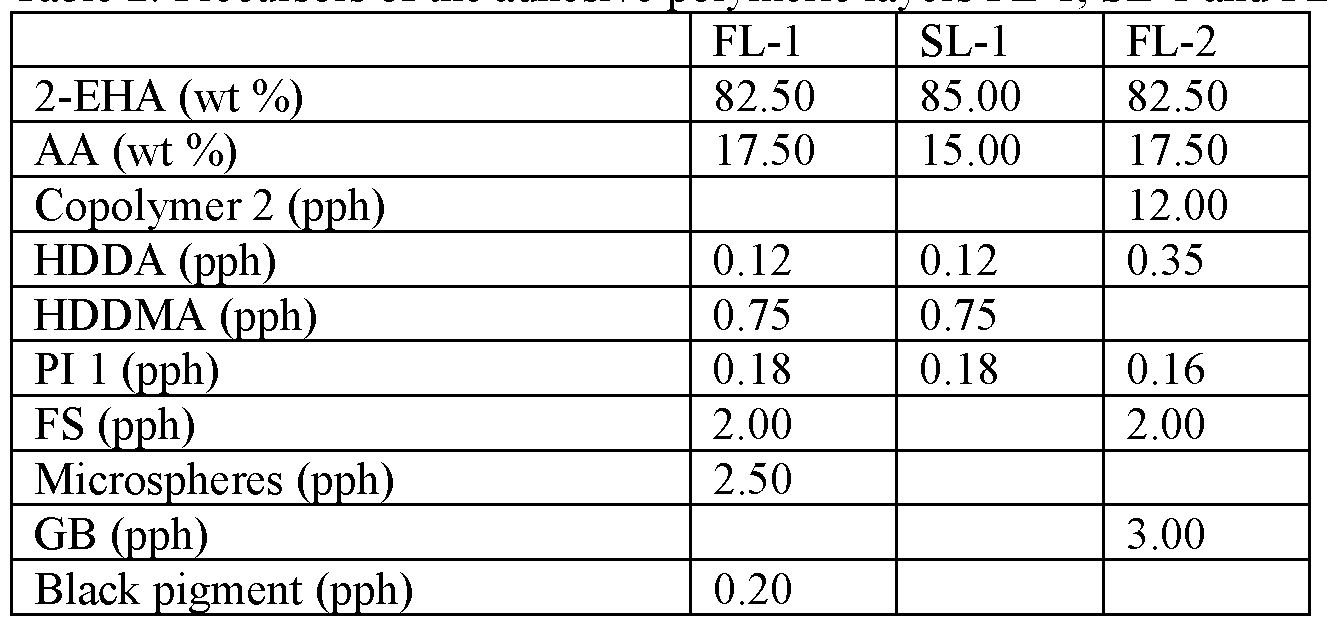


Claims
Priority Applications (3)
| Application Number | Priority Date | Filing Date | Title |
|---|---|---|---|
| KR1020257041510A KR20260023638A (en) | 2023-06-15 | 2024-06-15 | Primer compositions, adhesive systems, and related processes |
| CN202480039583.0A CN121311518A (en) | 2023-06-15 | 2024-06-15 | Primer compositions, adhesive systems and related methods |
| EP24735342.8A EP4727983A1 (en) | 2023-06-15 | 2024-06-15 | Primer composition, adhesive system, and related processes |
Applications Claiming Priority (2)
| Application Number | Priority Date | Filing Date | Title |
|---|---|---|---|
| US202363521130P | 2023-06-15 | 2023-06-15 | |
| US63/521,130 | 2023-06-15 |
Publications (1)
| Publication Number | Publication Date |
|---|---|
| WO2024257056A1 true WO2024257056A1 (en) | 2024-12-19 |
Family
ID=91620910
Family Applications (1)
| Application Number | Title | Priority Date | Filing Date |
|---|---|---|---|
| PCT/IB2024/055869 Ceased WO2024257056A1 (en) | 2023-06-15 | 2024-06-15 | Primer composition, adhesive system, and related processes |
Country Status (4)
| Country | Link |
|---|---|
| EP (1) | EP4727983A1 (en) |
| KR (1) | KR20260023638A (en) |
| CN (1) | CN121311518A (en) |
| WO (1) | WO2024257056A1 (en) |
Citations (21)
| Publication number | Priority date | Publication date | Assignee | Title |
|---|---|---|---|---|
| US4415615A (en) | 1982-01-15 | 1983-11-15 | Minnesota Mining And Manufacturing Co. | Cellular pressure-sensitive adhesive product and method of making |
| EP0259094A2 (en) | 1986-08-29 | 1988-03-09 | Minnesota Mining And Manufacturing Company | Unified pressure-sensitive adhesive tape |
| US4818610A (en) | 1986-08-29 | 1989-04-04 | Minnesota Mining And Manufacturing Company | Unified pressure-sensitive adhesive tape |
| US5024880A (en) | 1990-01-03 | 1991-06-18 | Minnesota Mining And Manufacturing Company | Cellular pressure-sensitive adhesive membrane |
| US5266406A (en) * | 1989-11-08 | 1993-11-30 | E. I. Du Pont De Nemours And Company | Waterbased methylol (meth)acrylamide acrylic polymer and an acrylic hydrosol coating composition |
| US20060219980A1 (en) * | 2003-03-04 | 2006-10-05 | Hiroyuki Onoyama | White conductive primer coating composition and method of forming multilayered coating film |
| WO2011094385A1 (en) | 2010-01-29 | 2011-08-04 | 3M Innovative Properties Company | Continuous process for forming a multilayer film and multilayer film prepared by such method |
| US20140113070A1 (en) | 2011-06-14 | 2014-04-24 | Tesa Se | Primer for improving the adhesion of adhesive tapes on plastics and metals which are difficult to bond |
| EP2757135A1 (en) * | 2013-01-18 | 2014-07-23 | 3M Innovative Properties Company | Method of bonding parts to a vehicle by an acrylic foam tape |
| US9080083B2 (en) | 2013-04-11 | 2015-07-14 | Tesa Se | Silane primer for improving the adhesion of adhesive tapes on hydrophilic surfaces, especially glass surfaces |
| US9102774B2 (en) | 2010-12-21 | 2015-08-11 | 3M Innovative Properties Company | Polymers derived from secondary alkyl (meth)acrylates |
| US9234122B2 (en) | 2013-04-11 | 2016-01-12 | Tesa Se | Black silane primer for improving the adhesion of adhesive tapes to glass surfaces |
| US9556367B2 (en) | 2006-12-07 | 2017-01-31 | 3M Innovative Properties Company | Blends of block copolymer and acrylic adhesives |
| US20170066947A1 (en) | 2014-05-09 | 2017-03-09 | Tesa Se | Primer for enhancing tape adhesion to hydrophilic surfaces |
| US20170298230A1 (en) | 2016-04-13 | 2017-10-19 | Tesa Se | Pigmentable Primer |
| US10385159B2 (en) | 2015-02-05 | 2019-08-20 | Sika Technology Ag | Water-based primer composition for polycarbonate and polycarbonate blends |
| US10513634B2 (en) | 2014-08-29 | 2019-12-24 | Tesa Se | Primer for adhesive tapes |
| US10640656B2 (en) | 2015-12-17 | 2020-05-05 | 3M Innovative Properties Company | Primer composition and articles made therefrom |
| KR20200139524A (en) * | 2019-06-04 | 2020-12-14 | 주식회사 케이씨씨 | Water-soluble primer composition |
| US20210102099A1 (en) * | 2017-04-13 | 2021-04-08 | 3M Innovative Properties Company | Pressure-sensitive adhesive compositions |
| US20220347982A1 (en) | 2019-09-26 | 2022-11-03 | 3M Innovative Properties Company | Multilayer film and method of making the same |
-
2024
- 2024-06-15 KR KR1020257041510A patent/KR20260023638A/en active Pending
- 2024-06-15 CN CN202480039583.0A patent/CN121311518A/en active Pending
- 2024-06-15 EP EP24735342.8A patent/EP4727983A1/en active Pending
- 2024-06-15 WO PCT/IB2024/055869 patent/WO2024257056A1/en not_active Ceased
Patent Citations (22)
| Publication number | Priority date | Publication date | Assignee | Title |
|---|---|---|---|---|
| US4415615A (en) | 1982-01-15 | 1983-11-15 | Minnesota Mining And Manufacturing Co. | Cellular pressure-sensitive adhesive product and method of making |
| EP0259094A2 (en) | 1986-08-29 | 1988-03-09 | Minnesota Mining And Manufacturing Company | Unified pressure-sensitive adhesive tape |
| US4818610A (en) | 1986-08-29 | 1989-04-04 | Minnesota Mining And Manufacturing Company | Unified pressure-sensitive adhesive tape |
| US5266406A (en) * | 1989-11-08 | 1993-11-30 | E. I. Du Pont De Nemours And Company | Waterbased methylol (meth)acrylamide acrylic polymer and an acrylic hydrosol coating composition |
| US5024880A (en) | 1990-01-03 | 1991-06-18 | Minnesota Mining And Manufacturing Company | Cellular pressure-sensitive adhesive membrane |
| US20060219980A1 (en) * | 2003-03-04 | 2006-10-05 | Hiroyuki Onoyama | White conductive primer coating composition and method of forming multilayered coating film |
| US9556367B2 (en) | 2006-12-07 | 2017-01-31 | 3M Innovative Properties Company | Blends of block copolymer and acrylic adhesives |
| WO2011094385A1 (en) | 2010-01-29 | 2011-08-04 | 3M Innovative Properties Company | Continuous process for forming a multilayer film and multilayer film prepared by such method |
| US20130004694A1 (en) | 2010-01-29 | 2013-01-03 | 3M Innovative Properties Company | Continuous process for forming a multilayer film and multilayer film prepared by such method |
| US9102774B2 (en) | 2010-12-21 | 2015-08-11 | 3M Innovative Properties Company | Polymers derived from secondary alkyl (meth)acrylates |
| US20140113070A1 (en) | 2011-06-14 | 2014-04-24 | Tesa Se | Primer for improving the adhesion of adhesive tapes on plastics and metals which are difficult to bond |
| EP2757135A1 (en) * | 2013-01-18 | 2014-07-23 | 3M Innovative Properties Company | Method of bonding parts to a vehicle by an acrylic foam tape |
| US9080083B2 (en) | 2013-04-11 | 2015-07-14 | Tesa Se | Silane primer for improving the adhesion of adhesive tapes on hydrophilic surfaces, especially glass surfaces |
| US9234122B2 (en) | 2013-04-11 | 2016-01-12 | Tesa Se | Black silane primer for improving the adhesion of adhesive tapes to glass surfaces |
| US20170066947A1 (en) | 2014-05-09 | 2017-03-09 | Tesa Se | Primer for enhancing tape adhesion to hydrophilic surfaces |
| US10513634B2 (en) | 2014-08-29 | 2019-12-24 | Tesa Se | Primer for adhesive tapes |
| US10385159B2 (en) | 2015-02-05 | 2019-08-20 | Sika Technology Ag | Water-based primer composition for polycarbonate and polycarbonate blends |
| US10640656B2 (en) | 2015-12-17 | 2020-05-05 | 3M Innovative Properties Company | Primer composition and articles made therefrom |
| US20170298230A1 (en) | 2016-04-13 | 2017-10-19 | Tesa Se | Pigmentable Primer |
| US20210102099A1 (en) * | 2017-04-13 | 2021-04-08 | 3M Innovative Properties Company | Pressure-sensitive adhesive compositions |
| KR20200139524A (en) * | 2019-06-04 | 2020-12-14 | 주식회사 케이씨씨 | Water-soluble primer composition |
| US20220347982A1 (en) | 2019-09-26 | 2022-11-03 | 3M Innovative Properties Company | Multilayer film and method of making the same |
Non-Patent Citations (2)
| Title |
|---|
| "Mixing in Polymer Processing", vol. 129, 1991, MARCEL DEKKER INC., article "Mixing in Single-Screw Extruders", pages: 176 - 177,185-186 |
| MATTIONI ET AL., J. CHEM. INF. COMPUT. SCI., vol. 42, 2002, pages 232 - 240 |
Also Published As
| Publication number | Publication date |
|---|---|
| KR20260023638A (en) | 2026-02-20 |
| CN121311518A (en) | 2026-01-09 |
| EP4727983A1 (en) | 2026-04-22 |
Similar Documents
| Publication | Publication Date | Title |
|---|---|---|
| CN110283549B (en) | Multilayer pressure sensitive adhesive assembly | |
| EP2513242B1 (en) | Pressure sensitive adhesives for low surface energy substrates | |
| JP6424211B2 (en) | Multilayer pressure sensitive adhesive assembly | |
| US10106708B2 (en) | Rubber-based pressure sensitive adhesive foam | |
| EP2803711B1 (en) | Pressure sensitive adhesive assembly comprising filler material | |
| EP2551102B1 (en) | Self-stick foam adhesive | |
| JP7010301B2 (en) | Pressure-sensitive adhesive composition | |
| WO2023111992A1 (en) | Adhesive film, adhesive system, and related processes | |
| WO2024257056A1 (en) | Primer composition, adhesive system, and related processes | |
| WO2024257046A1 (en) | Primer composition, adhesive system, and related processes |
Legal Events
| Date | Code | Title | Description |
|---|---|---|---|
| 121 | Ep: the epo has been informed by wipo that ep was designated in this application |
Ref document number: 24735342 Country of ref document: EP Kind code of ref document: A1 |
|
| WWE | Wipo information: entry into national phase |
Ref document number: 2024735342 Country of ref document: EP |
|
| NENP | Non-entry into the national phase |
Ref country code: DE |
|
| ENP | Entry into the national phase |
Ref document number: 2024735342 Country of ref document: EP Effective date: 20260115 |
|
| ENP | Entry into the national phase |
Ref document number: 2024735342 Country of ref document: EP Effective date: 20260115 |
|
| ENP | Entry into the national phase |
Ref document number: 2024735342 Country of ref document: EP Effective date: 20260115 |
|
| ENP | Entry into the national phase |
Ref document number: 2024735342 Country of ref document: EP Effective date: 20260115 |