WO2024257411A1 - ポリビニルアルコール系樹脂フィルム、光学フィルム、水溶性フィルム、およびポリビニルアルコール系樹脂組成物 - Google Patents
ポリビニルアルコール系樹脂フィルム、光学フィルム、水溶性フィルム、およびポリビニルアルコール系樹脂組成物 Download PDFInfo
- Publication number
- WO2024257411A1 WO2024257411A1 PCT/JP2024/006964 JP2024006964W WO2024257411A1 WO 2024257411 A1 WO2024257411 A1 WO 2024257411A1 JP 2024006964 W JP2024006964 W JP 2024006964W WO 2024257411 A1 WO2024257411 A1 WO 2024257411A1
- Authority
- WO
- WIPO (PCT)
- Prior art keywords
- polyvinyl alcohol
- based resin
- film
- mass
- resin film
- Prior art date
- Legal status (The legal status is an assumption and is not a legal conclusion. Google has not performed a legal analysis and makes no representation as to the accuracy of the status listed.)
- Ceased
Links
Classifications
-
- C—CHEMISTRY; METALLURGY
- C08—ORGANIC MACROMOLECULAR COMPOUNDS; THEIR PREPARATION OR CHEMICAL WORKING-UP; COMPOSITIONS BASED THEREON
- C08J—WORKING-UP; GENERAL PROCESSES OF COMPOUNDING; AFTER-TREATMENT NOT COVERED BY SUBCLASSES C08B, C08C, C08F, C08G or C08H
- C08J5/00—Manufacture of articles or shaped materials containing macromolecular substances
- C08J5/18—Manufacture of films or sheets
-
- C—CHEMISTRY; METALLURGY
- C08—ORGANIC MACROMOLECULAR COMPOUNDS; THEIR PREPARATION OR CHEMICAL WORKING-UP; COMPOSITIONS BASED THEREON
- C08F—MACROMOLECULAR COMPOUNDS OBTAINED BY REACTIONS ONLY INVOLVING CARBON-TO-CARBON UNSATURATED BONDS
- C08F16/00—Homopolymers and copolymers of compounds having one or more unsaturated aliphatic radicals, each having only one carbon-to-carbon double bond, and at least one being terminated by an alcohol, ether, aldehydo, ketonic, acetal or ketal radical
- C08F16/02—Homopolymers and copolymers of compounds having one or more unsaturated aliphatic radicals, each having only one carbon-to-carbon double bond, and at least one being terminated by an alcohol, ether, aldehydo, ketonic, acetal or ketal radical by an alcohol radical
- C08F16/04—Acyclic compounds
- C08F16/06—Polyvinyl alcohol ; Vinyl alcohol
-
- C—CHEMISTRY; METALLURGY
- C08—ORGANIC MACROMOLECULAR COMPOUNDS; THEIR PREPARATION OR CHEMICAL WORKING-UP; COMPOSITIONS BASED THEREON
- C08F—MACROMOLECULAR COMPOUNDS OBTAINED BY REACTIONS ONLY INVOLVING CARBON-TO-CARBON UNSATURATED BONDS
- C08F8/00—Chemical modification by after-treatment
- C08F8/12—Hydrolysis
-
- C—CHEMISTRY; METALLURGY
- C08—ORGANIC MACROMOLECULAR COMPOUNDS; THEIR PREPARATION OR CHEMICAL WORKING-UP; COMPOSITIONS BASED THEREON
- C08L—COMPOSITIONS OF MACROMOLECULAR COMPOUNDS
- C08L29/00—Compositions of homopolymers or copolymers of compounds having one or more unsaturated aliphatic radicals, each having only one carbon-to-carbon double bond, and at least one being terminated by an alcohol, ether, aldehydo, ketonic, acetal or ketal radical; Compositions of hydrolysed polymers of esters of unsaturated alcohols with saturated carboxylic acids; Compositions of derivatives of such polymers
- C08L29/02—Homopolymers or copolymers of unsaturated alcohols
- C08L29/04—Polyvinyl alcohol; Partially hydrolysed homopolymers or copolymers of esters of unsaturated alcohols with saturated carboxylic acids
-
- G—PHYSICS
- G02—OPTICS
- G02B—OPTICAL ELEMENTS, SYSTEMS OR APPARATUS
- G02B5/00—Optical elements other than lenses
- G02B5/30—Polarising elements
-
- C—CHEMISTRY; METALLURGY
- C08—ORGANIC MACROMOLECULAR COMPOUNDS; THEIR PREPARATION OR CHEMICAL WORKING-UP; COMPOSITIONS BASED THEREON
- C08J—WORKING-UP; GENERAL PROCESSES OF COMPOUNDING; AFTER-TREATMENT NOT COVERED BY SUBCLASSES C08B, C08C, C08F, C08G or C08H
- C08J2329/00—Characterised by the use of homopolymers or copolymers of compounds having one or more unsaturated aliphatic radicals, each having only one carbon-to-carbon double bond, and at least one being terminated by an alcohol, ether, aldehydo, ketonic, acetal, or ketal radical; Hydrolysed polymers of esters of unsaturated alcohols with saturated carboxylic acids; Derivatives of such polymer
- C08J2329/02—Homopolymers or copolymers of unsaturated alcohols
- C08J2329/04—Polyvinyl alcohol; Partially hydrolysed homopolymers or copolymers of esters of unsaturated alcohols with saturated carboxylic acids
-
- C—CHEMISTRY; METALLURGY
- C08—ORGANIC MACROMOLECULAR COMPOUNDS; THEIR PREPARATION OR CHEMICAL WORKING-UP; COMPOSITIONS BASED THEREON
- C08J—WORKING-UP; GENERAL PROCESSES OF COMPOUNDING; AFTER-TREATMENT NOT COVERED BY SUBCLASSES C08B, C08C, C08F, C08G or C08H
- C08J2429/00—Characterised by the use of homopolymers or copolymers of compounds having one or more unsaturated aliphatic radicals, each having only one carbon-to-carbon double bond, and at least one being terminated by an alcohol, ether, aldehydo, ketonic, acetal, or ketal radical; Hydrolysed polymers of esters of unsaturated alcohols with saturated carboxylic acids; Derivatives of such polymer
- C08J2429/02—Homopolymers or copolymers of unsaturated alcohols
- C08J2429/04—Polyvinyl alcohol; Partially hydrolysed homopolymers or copolymers of esters of unsaturated alcohols with saturated carboxylic acids
-
- C—CHEMISTRY; METALLURGY
- C08—ORGANIC MACROMOLECULAR COMPOUNDS; THEIR PREPARATION OR CHEMICAL WORKING-UP; COMPOSITIONS BASED THEREON
- C08L—COMPOSITIONS OF MACROMOLECULAR COMPOUNDS
- C08L2203/00—Applications
- C08L2203/16—Applications used for films
-
- C—CHEMISTRY; METALLURGY
- C08—ORGANIC MACROMOLECULAR COMPOUNDS; THEIR PREPARATION OR CHEMICAL WORKING-UP; COMPOSITIONS BASED THEREON
- C08L—COMPOSITIONS OF MACROMOLECULAR COMPOUNDS
- C08L2205/00—Polymer mixtures characterised by other features
- C08L2205/02—Polymer mixtures characterised by other features containing two or more polymers of the same C08L -group
- C08L2205/025—Polymer mixtures characterised by other features containing two or more polymers of the same C08L -group containing two or more polymers of the same hierarchy C08L, and differing only in parameters such as density, comonomer content, molecular weight, structure
-
- C—CHEMISTRY; METALLURGY
- C08—ORGANIC MACROMOLECULAR COMPOUNDS; THEIR PREPARATION OR CHEMICAL WORKING-UP; COMPOSITIONS BASED THEREON
- C08L—COMPOSITIONS OF MACROMOLECULAR COMPOUNDS
- C08L2205/00—Polymer mixtures characterised by other features
- C08L2205/06—Polymer mixtures characterised by other features having improved processability or containing aids for moulding methods
Definitions
- the present invention relates to a polyvinyl alcohol-based resin film, an optical film, a water-soluble film, and a polyvinyl alcohol-based resin composition.
- polyvinyl alcohol-based resins have been applied in many fields due to their excellent properties combined with a wide range of qualities. They have excellent gas barrier properties, mechanical strength, transparency, gloss, water solubility, etc., and are used in a wide range of fields, such as optical film applications, packaging for food and healthcare applications, medical infusion bags, packaging for various pharmaceuticals such as liquid detergents and pesticides, and seed tapes for containing seeds.
- Films using these polyvinyl alcohol-based resins are produced by dissolving the polyvinyl alcohol-based resin in a solvent such as water to prepare a stock solution, forming the stock solution into a film using a casting mold such as a metal roll or belt by a solution casting method (casting method), and drying the film using a metal heating roll, a floating dryer, or the like.
- the pH of polyvinyl alcohol-based resins tends to decrease further due to long-term residence under high-temperature conditions during molding, and although the above-mentioned plating technology has improved corrosion degradation to some extent, it is not possible to completely prevent corrosion degradation from a long-term perspective, and melting cans, extruders, die molds, metal rolls and belts, etc., require repairs such as re-plating after a certain period of use.
- the cost and time required for these repairs have a significant effect on production efficiency, so there is a demand to extend the period until these repairs are required as much as possible.
- By suppressing the decrease in pH during molding of the polyvinyl alcohol-based resin, which is the base resin it is possible to extend the period until repairs are required for the various devices and equipment mentioned above, thereby improving production efficiency and maintainability.
- the present invention provides a polyvinyl alcohol-based resin film and a polyvinyl alcohol-based resin composition that suppresses corrosion and deterioration of melting cans, extruders, die molds, metal rolls, belts, etc., used in producing a polyvinyl alcohol-based resin film, and that has excellent production efficiency and maintainability.
- a polyvinyl alcohol-based resin film according to [1] wherein the polyvinyl alcohol-based resin (A) has a degree of saponification of 80 to 99.9 mol%.
- a plasticizer B
- An optical film comprising the polyvinyl alcohol-based resin film according to any one of [1] to [7].
- a water-soluble film comprising the polyvinyl alcohol-based resin film according to any one of [1] to [6].
- a polyvinyl alcohol-based resin composition comprising at least a polyvinyl alcohol-based resin (A), having a C14 pMC value of 9 to 50 as measured by ASTM D6866 (Method B).
- a polyvinyl alcohol-based resin film comprising the polyvinyl alcohol-based resin composition (A) according to [11] or [12].
- the polyvinyl alcohol resin film of the present invention is excellent at suppressing corrosion and deterioration of various equipment such as melting cans, extruders, die molds, metal rolls and belts during film production, making it possible to extend the period until each equipment requires repair, thereby improving production efficiency and ease of maintenance.
- x and/or y (x and y are optional configurations)" means at least one of x and y, and means three possibilities: x only, y only, and x and y.
- X to Y (X and Y are arbitrary numbers)
- it is expressed as "X or more” (X is any number) or "Y or less” (Y is any number) it also means that "it is preferably greater than X” or "it is preferably less than Y”.
- the upper or lower limit of a numerical range described in stages can be arbitrarily combined with the upper or lower limit of a numerical range of another stage.
- the upper or lower limit of the numerical range can be replaced with a value shown in the examples.
- the term “film” also includes the terms “tape” and "sheet.”
- the term “main component” means a component that has a significant effect on the properties of the target object, and the content of the component in the target object is usually 50 mass % or more, preferably 55 mass % or more, more preferably 60 mass % or more, and even more preferably 70 mass % or more, and may be 100 mass %.
- the polyvinyl alcohol-based resin film according to one embodiment of the present invention is a polyvinyl alcohol-based resin film having a C14 pMC value of 9 to 50 as measured according to ASTM D6866 (Method B).
- the upper limit of the pMC value of C14 of the polyvinyl alcohol resin film measured by ASTM D6866 (Method B) is 50 or less, preferably 48 or less, more preferably 46 or less, even more preferably 45 or less, and particularly preferably 44 or less.
- the lower limit of the value is preferably 9 or more, more preferably 15 or more, even more preferably 20 or more, and particularly preferably 25 or more.
- the film can be preferably used as a base film that can extend the period until repairs are required for each device and equipment.
- the pMC (percent modern carbon) of C14 is the relative concentration ratio of C14 of the measured sample to the modern reference standard (NIST4990C) as specified in the biobased content test standard ASTM D6866-20.
- the polyvinyl alcohol resin film needs to contain at least a polyvinyl alcohol resin (A), and preferably contains a plasticizer (B) as another component, and may contain surfactants (C), starch (D), water-soluble polymers other than (A) (E), etc., as necessary.
- the polyvinyl alcohol-based resin film of the present invention is required to contain at least one type of "polyvinyl alcohol-based resin (A1) in which all or a part of the carbon constituting the polyvinyl alcohol-based resin is derived from biological ethylene.”
- the polyvinyl alcohol-based resin (A) used may be a "polyvinyl alcohol-based resin (A1) in which all or a part of the carbon constituting the polyvinyl alcohol-based resin is derived from biological ethylene” alone, or a mixture of a "polyvinyl alcohol-based resin (A1) in which all or a part of the carbon constituting the polyvinyl alcohol-based resin is derived from biological ethylene” and a "polyvinyl alcohol-based resin (A'1) obtained only from raw materials derived from fossil fuels" may be used.
- polyvinyl alcohol-based resin (A1) in which all or a part of the carbon constituting the polyvinyl alcohol-based resin is derived from biological ethylene For example, (1) A method of obtaining only polyvinyl ester by polymerizing only biovinyl ester monomers obtained from bioethylene as a raw material, and saponifying the resulting polyvinyl ester alone; (2) A method for obtaining polyvinyl ester by polymerizing a biovinyl ester monomer using a mixture of bioethylene and ethylene derived from fossil fuels as raw materials, and saponifying the resulting polyvinyl ester; (3) A method for obtaining polyvinyl ester by saponifying a polyvinyl ester obtained by copolymerizing a biovinyl ester monomer obtained from bioethylene and a vinyl ester monomer obtained from ethylene derived from a fossil fuel; (4) A method of saponifying a mixture of polyvinyl ester obtained by
- the method (1) or (2) is preferred in that it allows efficient production of a polyvinyl alcohol-based resin (A1) in which all or a part of the carbon constituting the polyvinyl alcohol-based resin is derived from biological ethylene.
- vinyl ester monomers examples include vinyl formate, vinyl acetate, vinyl propionate, vinyl valerate, vinyl laurate, vinyl stearate, vinyl benzoate, vinyl pivalate, and vinyl versatate, with vinyl acetate being preferred.
- vinyl ester monomer there are no particular limitations on the method for producing a vinyl ester monomer, and it can be obtained, for example, by reacting ethylene with a compound having a carboxy group represented by R-COOH.
- Vinyl acetate can be synthesized as follows. Usually, vinyl acetate can be obtained by a gas-phase reaction of ethylene, acetic acid, and oxygen in the presence of a catalyst. At this time, vinyl acetate containing a predetermined amount of C14 can be obtained by using ethylene containing a predetermined amount of C14 or acetic acid containing a predetermined amount of C14 as the compound having a carboxy group.
- An example of ethylene containing a predetermined amount of C14 is bioethylene.
- the polyvinyl ester is preferably one obtained by using one or more vinyl ester monomers, and more preferably one obtained by using only one vinyl ester monomer.
- the polyvinyl ester may also be a copolymer of one or more vinyl ester monomers with other monomers copolymerizable therewith.
- the polyvinyl alcohol contained in the polyvinyl alcohol-based resin film of the present invention preferably contains an ethylene unit.
- the content of the ethylene unit is preferably 1 mol% or more, more preferably 1.5 mol% or more, based on the number of moles of all structural units constituting the vinyl ester polymer.
- the content of the ethylene unit is preferably less than 15 mol%, more preferably less than 10 mol%, based on the number of moles of all structural units constituting the vinyl ester polymer.
- the content of the ethylene unit is in the above range, when the polyvinyl alcohol-based resin film of the present invention is used as a raw film for manufacturing an optical film, the water resistance, etc. of the polyvinyl alcohol-based resin film can be improved without significantly impairing the optical properties of the polyvinyl alcohol-based resin film.
- the reason for this is not necessarily clear, it is presumed that while the hydrophilicity is weakened by introducing the ethylene unit into the polymer main chain, the crystal structure of the polyvinyl alcohol is not significantly disturbed because the volume occupied by the ethylene unit in the crystal is not significantly different from the volume of the vinyl alcohol unit.
- vinyl ester monomers include, in addition to ethylene, olefins having 3 to 30 carbon atoms such as propylene, 1-butene, and isobutene; acrylic acid or its salts; acrylic acid esters such as methyl acrylate, ethyl acrylate, n-propyl acrylate, i-propyl acrylate, n-butyl acrylate, i-butyl acrylate, t-butyl acrylate, 2-ethylhexyl acrylate, dodecyl acrylate, and octadecyl acrylate; methacrylic acid or its salts; methyl methacrylate, ethyl methacrylate, Methacrylic acid esters such as n-propyl methacrylate, i-propyl methacrylate, n-butyl methacrylate, i-butyl methacrylate, t-but
- the proportion of structural units derived from other monomers in the polyvinyl ester is preferably 15 mol % or less, and more preferably 5 mol % or less, based on the number of moles of all structural units constituting the polyvinyl ester, from the viewpoints of the strength of the resulting polyvinyl alcohol resin film and the optical performance when the polyvinyl alcohol resin film is used as a raw film for manufacturing optical films.
- Other monomers copolymerizable with vinyl ester monomers may be monomers derived from fossil fuels or monomers derived from plants.
- the weight average molecular weight of the polyvinyl alcohol resin (A) is preferably 20,000 to 150,000, particularly preferably 60,000 to 130,000, and even more preferably 70,000 to 120,000. If the weight average molecular weight is too small, the mechanical strength tends to decrease, while if it is too large, the productivity tends to decrease. Furthermore, if the weight average molecular weight is too small, it tends to be difficult to obtain sufficient optical performance when the polyvinyl alcohol resin is used as an optical film, while if it is too large, it tends to be difficult to stretch the polyvinyl alcohol resin film when a polarizing film is manufactured using the polyvinyl alcohol resin film.
- the weight average molecular weight of the polyvinyl alcohol resin is the weight average molecular weight measured by the GPC method.
- the polydispersity (weight average molecular weight/number average molecular weight) of the polyvinyl alcohol resin (A) is preferably from 1.95 to 3.50, particularly preferably from 1.96 to 2.50, and further preferably from 1.97 to 2.10. If the dispersity is too small, stretching tends to be difficult when a polarizing film is produced using the polyvinyl alcohol-based resin film, whereas if the dispersity is too large, sufficient optical performance tends to be difficult to obtain when the polyvinyl alcohol-based resin is used as an optical film.
- the weight average molecular weight and number average molecular weight of the polyvinyl alcohol resin when measuring the dispersity are measured by a GPC method.
- the average saponification degree of the polyvinyl alcohol-based resin (A) is preferably 80 mol% or more, more preferably 87 mol% or more, particularly preferably 99 mol% or more, further preferably 99.5 mol% or more, and particularly preferably 99.8 mol% or more. If the average saponification degree is too low, sufficient optical properties tend not to be obtained when the polyvinyl alcohol-based resin film is used as a polarizing film.
- the average degree of saponification in this specification is measured in accordance with JIS K6726.
- the polyvinyl alcohol resin (A) has a C14 pMC value measured according to ASTM D6866 (Method B) of preferably 48 or less, more preferably 45 or less, even more preferably 43 or less, and particularly preferably 41 or less.
- the lower limit is preferably 2 or more, more preferably 5 or more, even more preferably 10 or more, and particularly preferably 15 or more.
- the film can be preferably used as a base film that can extend the period until each device and equipment requires repair.
- polyvinyl alcohol-based resin (A) one type of polyvinyl alcohol may be used, or two or more types of polyvinyl alcohols having different degrees of polymerization, saponification, or modification may be blended.
- plasticizer (B) examples include glycerols such as glycerin, diglycerin, and triglycerin, alkylene glycols such as triethylene glycol, polyethylene glycol, polypropylene glycol, dipropylene glycol, and propylene glycol, and sugar alcohols such as trimethylolpropane, sorbitol, xylitol, and maltitol. These can be used alone or in combination of two or more. Among them, glycerin, polyethylene glycol, and diglycerin are preferably used because they are easily available and can obtain a plasticizing effect in a small amount.
- glycerols such as glycerin, diglycerin, and triglycerin
- alkylene glycols such as triethylene glycol, polyethylene glycol, polypropylene glycol, dipropylene glycol, and propylene glycol
- sugar alcohols such as trimethylolpropane
- the content of the plasticizer (B) is preferably 1 to 45 parts by mass, more preferably 3 to 30 parts by mass, and even more preferably 5 to 25 parts by mass, per 100 parts by mass of the polyvinyl alcohol-based resin (A). If the content of the plasticizer (B) is too low, the stretchability during the preparation of the polarizing film tends to decrease, and if the content is too high, the strength of the resulting polyvinyl alcohol-based resin film tends to decrease.
- the surfactant (C) generally serves to smooth the film surface and to inhibit adhesion of the films to each other when wound into a roll.
- nonionic surfactants, anionic surfactants, and cationic surfactants can be used alone or in combination of two or more thereof.
- nonionic surfactants include polyoxyethylene alkyl ethers such as polyoxyethylene hexyl ether, polyoxyethylene heptyl ether, polyoxyethylene octyl ether, polyoxyethylene nonyl ether, polyoxyethylene decyl ether, polyoxyethylene dodecyl ether, polyoxyethylene tetradecyl ether, polyoxyethylene hexadecyl ether, polyoxyethylene octadecyl ether, polyoxyethylene eicosyl ether, polyoxyethylene oleyl ether, polyoxyethylene lauryl ether, coconut oil reduced alcohol ethylene oxide adduct, and beef tallow reduced alcohol ethylene oxide adduct; caproic acid mono- or diethanolamide, caprylic acid mono- or diethanolamide, capric acid mono- or diethanolamide, lauric acid mono- or diethanolamide, palmitic acid mono- or diethanolamide, stearic acid mono- or diethanolamide, oleic acid
- higher fatty acid amides such as capric acid amide, lauric acid amide, palmitic acid amide, stearic acid amide, and oleic acid amide, hydroxyethyl laurylamine, polyoxyethylene hexylamine, polyoxyethylene heptylamine, polyoxyethylene octylamine, polyoxyethylene nonylamine, polyoxyethylene decylamine, polyoxyethylene dodecylamine, polyoxyethylene tetradecylamine, polyoxyethylene hexadecylamine, polyoxyethylene octadecylamine, polyoxyethylene oleylamine, polyoxyethylene laurylamine, polyoxyethylene Examples of such amines include polyoxyethylene alkylamines such as oxyethylene eicosylamine, polyoxyethylene caproic acid amide, polyoxyethylene caprylic acid amide, polyoxyethylene capric acid amide, polyoxyethylene lauric acid amide, polyoxyethylene palmitic acid amide, polyoxyethylene
- anionic surfactants include, for example, alkyl sulfate ester salts such as sulfate ester salts, sodium hexyl sulfate, sodium heptyl sulfate, sodium octyl sulfate, sodium nonyl sulfate, sodium decyl sulfate, sodium dodecyl sulfate, sodium tetradecyl sulfate, sodium hexadecyl sulfate, sodium octadecyl sulfate, sodium eicosyl sulfate, or potassium salts, calcium salts, ammonium salts, etc.; polyoxyethylene alkyl ether sulfates such as sodium polyoxyethylene hexyl ether sulfate, sodium polyoxyethylene heptyl ether sulfate, sodium polyoxyethylene octyl ether sulfate, sodium poly
- examples of the sulfate salt type include fatty acid soaps, N-acyl amino acids and their salts, polyoxyethylene alkyl ester carboxylates, acylated peptides, and other carboxylate salt types; alkyl sulfonates, alkyl benzene sulfonates, alkyl naphthalene sulfonates, formalin polycondensates of naphthalene sulfonic acid salts, formalin condensates of melamine sulfonic acid salts, dialkyl sulfosuccinate ester salts, alkyl sulfosuccinate disalts, polyoxyethylene alkyl sulfosuccinate disalts, alkyl sulfoacetates, ⁇ -olefin sulfonates, N-acyl methyl taurine salts, and dimethyl-5-sulfoisophthalate sodium salt
- Examples of the cationic surfactant include laurylamine hydrochloride, lauryltrimethylammonium chloride, laurylpyridinium chloride, etc.
- nonionic surfactants are preferred, and higher fatty acid alkanolamides are particularly preferred, with lauric acid mono- or diethanolamide, palmitic acid mono- or diethanolamide, stearic acid mono- or diethanolamide, and oleic acid mono- or diethanolamide being even more preferred, with lauric acid mono- or diethanolamide being even more preferred, and lauric acid diethanolamide being even more preferred.
- the surfactant (C) may be used alone or in combination of two or more kinds, and it is preferable to use an anionic surfactant and a nonionic surfactant in combination in terms of film transparency.
- the content of the surfactant (C) is preferably 0.01 to 1 part by mass, particularly preferably 0.02 to 0.5 parts by mass, and even more preferably 0.03 to 0.2 parts by mass, per 100 parts by mass of the polyvinyl alcohol-based resin (A). If the content of the surfactant (C) is too low, it tends to be difficult to achieve the blocking prevention effect, and if it is too high, the transparency of the film tends to decrease.
- the amount of the anionic surfactant is preferably 0.01 to 1 part by mass, particularly 0.02 to 0.2 parts by mass, and more preferably 0.03 to 0.1 parts by mass
- the amount of the nonionic surfactant is preferably 0.01 to 1 part by mass, particularly 0.02 to 0.2 parts by mass, and more preferably 0.03 to 0.1 parts by mass, per 100 parts by mass of the polyvinyl alcohol resin (A).
- the amount of the anionic surfactant is too small, the dispersibility of the dye during the preparation of the polarizing film tends to decrease, and dyeing spots tend to increase, while if the amount is too large, the polyvinyl alcohol resin tends to foam violently when dissolved, and air bubbles tend to be mixed into the film, making it impossible to use the film for optical purposes. If the amount of the nonionic surfactant is too small, it is difficult to obtain an anti-blocking effect, and if the amount is too large, the transparency and flatness of the film tend to decrease.
- starch (D) examples include raw starch (corn starch, potato starch, sweet potato starch, wheat starch, cassava starch, sago starch, tapioca starch, sorghum starch, rice starch, bean starch, kudzu starch, bracken starch, lotus starch, water chestnut starch, etc.), physically modified starch ( ⁇ -starch, fractionated amylose, moist heat treated starch, etc.), enzyme modified starch (hydrolyzed dextrin, enzymatically decomposed dextrin, amylose, etc.), chemically decomposed modified starch (acid treated starch, hypochlorite oxidized starch, dialdehyde starch, etc.), chemically modified starch derivatives (esterified starch, etherified starch, cationized starch, crosslinked starch, etc.), etc.
- raw starch particularly corn starch and rice starch, are preferably used
- the content of such starch (D) is preferably 15 parts by mass or less, and more preferably 10 parts by mass or less, per 100 parts by mass of polyvinyl alcohol-based resin (A). If the amount of starch (D) is more than 15 parts by mass, there is a risk of the process passability being deteriorated during the production of the polyvinyl alcohol-based resin film.
- examples of the water-soluble polymer (E) other than the polyvinyl alcohol-based resin (A) include dextrin, gelatin, glue, casein, shellac, gum arabic, polyacrylic acid amide, sodium polyacrylate, polyvinyl methyl ether, a copolymer of methyl vinyl ether and maleic anhydride, a copolymer of vinyl acetate and itaconic acid, polyvinylpyrrolidone, cellulose, acetyl cellulose, acetyl butyl cellulose, carboxymethyl cellulose, methyl cellulose, ethyl cellulose, hydroxyethyl cellulose, sodium alginate, etc. These may be used alone or in combination of two or more kinds.
- the content of the water-soluble polymer (E) is preferably 15 parts by mass or less, and more preferably 10 parts by mass or less, per 100 parts by mass of the polyvinyl alcohol-based resin (A). If the content of the water-soluble polymer (E) is more than 15 parts by mass, the physical properties of the polyvinyl alcohol-based resin film may be impaired.
- the polyvinyl alcohol-based resin film may contain components such as water, antioxidants, ultraviolet absorbers, lubricants, crosslinking agents, colorants, fillers, preservatives, antifungal agents, other polymer compounds, etc., in addition to plasticizers, surfactants, starch, and water-soluble polymers other than the polyvinyl alcohol-based resin (A), as long as the effects of the present invention are not impaired. These may be used alone or in combination of two or more kinds.
- the polyvinyl alcohol-based resin film is preferably a film obtained using a polyvinyl alcohol-based resin composition.
- the upper limit of the pMC value of C14 of such a polyvinyl alcohol resin composition measured by ASTM D6866 (Method B) must be 50 or less, and is preferably 48 or less, more preferably 45 or less, even more preferably 40 or less, and particularly preferably 35 or less.
- the lower limit of such value is preferably 9 or more, more preferably 15 or more, even more preferably 20 or more, and particularly preferably 25 or more.
- the pMC value of C14 By setting the pMC value of C14 within the above range, it can be used as a base resin that suppresses a decrease in pH of the polyvinyl alcohol-based resin composition during the film-forming process, and by reducing corrosion and deterioration of melting cans, extruders, die molds, metal rolls, belts, etc., it is possible to extend the period until repairs are required for each device and equipment.
- the present polyvinyl alcohol-based resin film can be produced by any method, such as a casting film production method, a wet film production method (discharge into a poor solvent), a dry-wet film production method, a gel film production method (a method in which the film production stock solution is cooled and gelled, and then the solvent is extracted and removed to obtain a polyvinyl alcohol-based resin film), or a combination of these methods, or a melt extrusion film production method or inflation molding method in which the film production stock solution is obtained using an extruder or the like and extruded from a T-die or the like to produce a film.
- a casting film production method a wet film production method (discharge into a poor solvent), a dry-wet film production method, a gel film production method (a method in which the film production stock solution is cooled and gelled, and then the solvent is extracted and removed to obtain a polyvinyl alcohol-based resin film), or a combination of these methods, or a melt extrusion film
- the casting film production method and the melt extrusion film production method are preferred because they can produce a homogeneous film with good productivity.
- the casting film production method and the melt extrusion film production method of the polyvinyl alcohol-based resin film will be described.
- the film production solution is degassed, cast in the form of a film onto a support such as a metal roll or a metal belt, and heated to remove the solvent, thereby solidifying and forming a film.
- degassing methods include static degassing and degassing using a multi-screw extruder with a vent. As a multi-screw extruder with a vent, a twin-screw extruder with a vent is usually used.
- the solidified film is peeled off from the support, dried using a drying roll or drying oven, etc. as necessary, and further heat-treated as necessary, and wound up to obtain a long roll of polyvinyl alcohol-based resin film.
- the resin concentration of the film-forming solution (the concentration of non-volatile components such as polyvinyl alcohol resins that are not removed by volatilization or evaporation during film formation, etc.) is preferably 10 to 60% by mass, particularly preferably 12 to 55% by mass, and even more preferably 20 to 50% by mass. If the resin concentration of such an aqueous solution is too low, the drying load will be large and production capacity will tend to decrease, and if it is too high, the viscosity will be too high and it will tend to be difficult to dissolve uniformly.
- the "resin concentration of the film-forming solution” refers to the volatile content calculated using the following formula.
- the method for preparing the film-forming solution includes dissolving polyvinyl alcohol resin (A) and additives such as plasticizer (B) and surfactant (C) in a dissolving tank, or melt-kneading hydrous polyvinyl alcohol together with plasticizer (B), surfactant (C), etc., using a single-screw extruder or twin-screw extruder.
- additives such as plasticizer (B) and surfactant (C) in a dissolving tank, or melt-kneading hydrous polyvinyl alcohol together with plasticizer (B), surfactant (C), etc.
- the film-producing solution is cast in the form of a film onto a support such as a metal roll or metal belt from a film-producing device, and is heated to remove the solvent, solidifying it into a film.
- the surface temperature of the support onto which the film-forming solution is cast is preferably 50°C or higher, more preferably 60°C or higher, and even more preferably 65°C or higher.
- the surface temperature of the support onto which the film-forming solution is cast is preferably 110°C or lower, more preferably 100°C or lower, and even more preferably 95°C or lower. If the surface temperature is too low, the film obtained by film-forming tends to have poor releasability when peeled from the cast mold, and if the surface temperature is too high, foaming tends to occur.
- the drying speed may be adjusted by uniformly blowing hot air at a speed of 1 to 10 m/sec onto the entire area of the non-contact side of the polyvinyl alcohol film while heating the polyvinyl alcohol resin film on the support.
- the temperature of the hot air blown onto the non-contact side is preferably 50°C or higher, and more preferably 70°C or higher.
- the temperature of the hot air blown onto the non-contact side is preferably 150°C or lower, and more preferably 120°C or lower.
- the polyvinyl alcohol-based resin film peeled off from the support is dried on the support preferably to a volatile content of 5 to 50% by mass, and then peeled off, and further dried as necessary.
- the drying method includes a method of contacting with a drying oven or a drying roll.
- drying is performed with a plurality of drying rolls, it is preferable to alternately contact one side and the other side of the film with the drying roll in order to make both sides uniform.
- the number of drying rolls is preferably 3 or more, more preferably 4 or more, and even more preferably 5 or more.
- the number of drying rolls is preferably 30 or less.
- the time for which each drying roll and the film are in contact is preferably 1 to 60 seconds, particularly preferably 2 to 30 seconds, more preferably 3 to 20 seconds, and especially preferably 4 to 10 seconds. If the contact time is too short, there is a tendency for insufficient drying, and if the contact time is too long, there is a tendency for the equipment load to increase.
- the temperatures of all drying ovens and drying rolls used are preferably 40 to 150°C, particularly preferably 50 to 140°C, further preferably 60 to 130°C, and particularly preferably 70 to 120°C. If the temperature of the drying oven or drying roll is too low, the drying tends to be insufficient, whereas if it is too high, crystallization of the polyvinyl alcohol resin proceeds, and the film tends to become too hard.
- the dried polyvinyl alcohol resin film may be further heat-treated as necessary for the purpose of adjusting physical properties such as strength and water solubility.
- the heat treatment in the present invention is preferably performed from both sides of the film, since it can make both sides of the film uniformly dry. Examples of such heat treatment methods include a method of blowing hot air onto both sides of the film using a floating dryer, and a method of irradiating both sides of the film with near-infrared rays using an infrared lamp.
- the heat treatment temperature is preferably 50 to 150° C., and particularly preferably 70 to 120° C.
- the heat treatment time is not particularly limited, but when a floating dryer is used, it is preferably 10 to 100 seconds, and particularly preferably 20 to 80 seconds.
- the polyvinyl alcohol resin film produced in this manner is further subjected to humidity conditioning treatment and cutting of both ends (edges) of the film as necessary, then wound into a roll on a cylindrical core and packaged in a moisture-proof package to complete the product.
- the volatile content of the polyvinyl alcohol-based resin film finally obtained by the above-mentioned series of processes is not necessarily limited.
- the volatile content of the polyvinyl alcohol-based resin film is preferably 1 mass% or more, and more preferably 2 mass% or more.
- the volatile content of the polyvinyl alcohol-based resin film is preferably 10 mass% or less, and more preferably 5 mass% or less.
- the length of the polyvinyl alcohol-based resin film of the present invention thus obtained is preferably 0.5 km or more from the viewpoint of production efficiency, more preferably 1 km or more, and particularly preferably 5 to 50 km from the viewpoint of transportation weight. If the length is too short, switching of the film tends to be troublesome, and if it is too long, there is a tendency for the film to become too heavy or have a poor appearance due to tight winding.
- the width of the polyvinyl alcohol resin film is appropriately selected depending on the application, etc., but is preferably 300 to 8,000 mm, particularly preferably 500 to 7,000 mm, and even more preferably 600 to 6,000 mm. If the width is too narrow, production efficiency tends to decrease, and if it is too wide, sagging and control of film thickness tend to become difficult.
- the thickness of the polyvinyl alcohol resin film is appropriately selected depending on the application, etc., but is preferably 10 to 130 ⁇ m, particularly preferably 15 to 110 ⁇ m, and even more preferably 15 to 60 ⁇ m. If the thickness is too thin, the mechanical strength of the film tends to decrease, and if it is too thick, the film production efficiency tends to decrease.
- the composition used for preparing the polyvinyl alcohol resin film has a pH difference of preferably 0.28 or less, more preferably 0.26 or less, and even more preferably 0.25 or less, when the following pH difference measurement test is performed.
- the lower limit of the pH difference is not particularly specified, but the closer to zero the value is, the more preferable it is, so it is preferably 0 or more.
- a 19% polyvinyl alcohol-based resin composition (X) containing 12 parts by mass of glycerin per 100 parts by mass of polyvinyl alcohol-based resin was prepared, and the polyvinyl alcohol-based resin composition (X) was further diluted with ion-exchanged water to 4% to prepare a polyvinyl alcohol-based resin composition (X1).
- the polyvinyl alcohol-based resin composition (X) was maintained at 90° C. for one week and then diluted with ion-exchanged water to 4% to prepare a polyvinyl alcohol-based resin composition (X2).
- compositions (X1) and (X2) are measured using a pH meter (HORIBA, Castani ACT, D-21) in accordance with JIS Z 8802, and the obtained pH values are designated as pH(X1) and pH(X2), respectively.
- the liquid temperature at this time is 25° C.
- the difference in pH value is designated as pH(X1)-pH(X2).
- the polyvinyl alcohol-based resin film thus obtained is able to suppress corrosiveness to the melting cans, extruders, die molds, metal rolls and belts, etc., used in the production process, and enables the production of polyvinyl alcohol-based resin films with excellent maintainability and stable quality, making it useful for polarizing film applications (LCD televisions, smartphones, tablets, personal computers, projectors, car panels, etc.) and water-soluble film applications (unit packaging applications for pharmaceuticals such as pesticides and detergents, (hydraulic) transfer films, sanitary products such as napkins and disposable diapers, waste disposal products such as ostomy bags, medical products such as blood-absorbing sheets, temporary substrates such as seedling sheets, seed tapes, and embroidery base fabrics, etc.).
- polarizing film applications LCD televisions, smartphones, tablets, personal computers, projectors, car panels, etc.
- water-soluble film applications unit packaging applications for pharmaceuticals such as pesticides and detergents, (hydraulic) transfer films, sanitary products such as napkins
- the polarizing film a method for producing a polarizing film according to one embodiment of the present invention (hereinafter, sometimes referred to as “the polarizing film”).
- This polarizing film is produced by unrolling the polyvinyl alcohol resin film from a roll and transporting it horizontally, then going through processes such as swelling, dyeing, crosslinking, stretching, washing, and drying.
- the swelling process is carried out before the dyeing process.
- the swelling process not only cleans dirt from the surface of the polyvinyl alcohol resin film, but also prevents uneven dyeing by swelling the polyvinyl alcohol resin film.
- water is usually used as the treatment liquid. If the treatment liquid is mainly composed of water, it may contain small amounts of additives such as iodide compounds and surfactants, alcohol, etc.
- the temperature of the swelling bath is usually around 10 to 45°C, and the immersion time in the swelling bath is usually around 0.1 to 10 minutes.
- the dyeing process is carried out by contacting the film with a liquid containing iodine or a dichroic dye.
- a liquid containing iodine or a dichroic dye usually, an aqueous solution of iodine-potassium iodide is used, with the iodine concentration usually being 0.1-2 g/L and the potassium iodide concentration usually being 1-100 g/L.
- a practical dyeing time is usually about 30-500 seconds.
- the temperature of the treatment bath is preferably 5-50°C.
- the aqueous solution may contain a small amount of an organic solvent that is compatible with water in addition to the water solvent.
- the crosslinking step is carried out using a boron compound such as boric acid or borax.
- the boron compound is used in the form of an aqueous solution or an aqueous-organic solvent mixture at a concentration of usually about 10 to 100 g/L, and it is preferable to have potassium iodide coexist in the solution from the viewpoint of stabilizing the polarizing performance.
- the treatment temperature is usually about 30 to 70° C., and the treatment time is preferably about 0.1 to 20 minutes. If necessary, a stretching operation may be carried out during the treatment.
- the stretching process is preferably performed 3 to 10 times in one axial direction, and particularly preferably 3.5 to 6 times. At this time, slight stretching (stretching to the extent that shrinkage in the width direction is prevented, or even more) may also be performed in the direction perpendicular to the stretching direction.
- the temperature during stretching is preferably 30 to 170°C.
- the final stretching ratio need only be set within the above range, and the stretching operation may be performed not only in one stage, but in any range of stages in the manufacturing process.
- the cleaning process is carried out, for example, by immersing the polyvinyl alcohol resin film in water or an aqueous solution of an iodide such as potassium iodide, and can remove precipitates that form on the surface of the film.
- an aqueous solution of potassium iodide such as potassium iodide
- the potassium iodide concentration may be about 1 to 80 g/L.
- the temperature during the cleaning process is usually 5 to 50°C, preferably 10 to 45°C.
- the processing time is usually 1 to 300 seconds, preferably 10 to 240 seconds. Note that water cleaning and cleaning with an aqueous solution of potassium iodide may be combined as appropriate.
- the drying process can be carried out in normal air at 40 to 80°C for 1 to 10 minutes.
- the polarization degree of the polarizing film is preferably 99.8% or more, and particularly preferably 99.9% or more. If the polarization degree is too low, it tends to be difficult to ensure contrast in a liquid crystal display.
- the degree of polarization is calculated according to the following formula using the light transmittance (H11) measured at a wavelength ⁇ when two polarizing films are stacked together so that their orientation directions are in the same direction, and the light transmittance (H1) measured at a wavelength ⁇ when two polarizing films are stacked together so that their orientation directions are perpendicular to each other. [(H11-H1)/(H11+H1)] 1/2
- the single transmittance of the polarizing film is preferably 42% or more, and particularly preferably 43% or more. If the single transmittance is too low, it tends not to be possible to achieve high brightness in liquid crystal displays.
- the single transmittance is a value obtained by measuring the light transmittance of the polarizing film alone using a spectrophotometer.
- the polarizing film is obtained, which is suitable for producing polarizing plates with minimal unevenness in the degree of polarization.
- the obtained polarizing film can also be used as a polarizing plate by laminating and adhering an optically isotropic polymer film or sheet as a protective film on one or both sides thereof.
- the protective film include films or sheets of cellulose triacetate, cellulose diacetate, polycarbonate, polymethyl methacrylate, crosslinked methacrylate resins, cycloolefin polymers, cycloolefin copolymers, polystyrene, polyethersulfone, polyarylene ester, poly-4-methylpentene, polyphenylene oxide, etc.
- a curable resin such as a urethane resin, an acrylic resin, or a urea resin may be applied to one or both sides of the polarizing film, instead of the protective film, and then cured and laminated.
- the polarizing film obtained from this polyvinyl alcohol-based resin film has no color unevenness and has excellent in-plane uniformity of polarization performance, and is preferably used in, for example, liquid crystal display devices such as portable information terminals, personal computers, televisions, projectors, signage, electronic desk calculators, electronic clocks, word processors, electronic paper, game consoles, videos, cameras, photo albums, thermometers, audio equipment, instruments for automobiles and machinery, sunglasses, anti-glare glasses, 3D glasses, wearable displays, anti-reflection layers for display elements (CRT, LCD, organic EL, electronic paper, etc.), optical communication equipment, medical equipment, building materials, toys, etc.
- liquid crystal display devices such as portable information terminals, personal computers, televisions, projectors, signage, electronic desk calculators, electronic clocks, word processors, electronic paper, game consoles, videos, cameras, photo albums, thermometers, audio equipment, instruments for automobiles and machinery, sunglasses, anti-glare glasses, 3D glasses, wearable displays, anti-reflection layers
- a 19% polyvinyl alcohol-based resin composition (X) containing 12 parts by mass of glycerin per 100 parts by mass of polyvinyl alcohol-based resin was prepared, and the polyvinyl alcohol-based resin composition (X) was further diluted with ion-exchanged water to 4% to prepare a polyvinyl alcohol-based resin composition (X1), and the polyvinyl alcohol-based resin composition (X) was kept at 90° C. for 1 week and then diluted with ion-exchanged water to 4% to prepare a polyvinyl alcohol-based resin composition (X2).
- compositions (X1) and (X2) were measured using a pH meter (HORIBA, Castani ACT, D-21) in accordance with JIS Z 8802, and the pH values obtained were designated pH(X1) and pH(X2), respectively.
- the liquid temperature at this time was 25° C.
- the difference in pH value was designated as pH(X1) ⁇ pH(X2).
- the difference in pH value was measured three times, and the average value was taken as the difference in pH value, and is shown in Table 1 below.
- the thus obtained methanol solution of polyvinyl acetate was diluted with methanol to a concentration of 4% by mass, and 2500 parts by mass of this polyvinyl acetate methanol solution (100 parts by mass as polyvinyl acetate) was charged into the same reactor as above.
- the reactor was immersed in a water bath and heated to an internal temperature of 65°C. 26.7 parts by mass of a 3.5% by mass solution of sodium hydroxide in methanol was added thereto to start the saponification reaction. As the saponification reaction proceeds, a saponified product precipitates, but stirring was continued as it is.
- the washed saponified product was dried in a vacuum dryer at 50° C. for 12 hours to obtain a polyvinyl alcohol resin (A1) (bio-derived PVA resin) (weight average molecular weight 81000; pMC of C14 94.8; saponification degree 99.8 mol%).
- A1 bio-derived PVA resin
- the thus obtained methanol solution of polyvinyl acetate was diluted with methanol to a concentration of 6% by mass, and 2000 parts by mass of this polyvinyl acetate methanol solution (120 parts by mass as polyvinyl acetate) was charged into the same reactor as above.
- the reactor was immersed in a water bath and heated to an internal temperature of 50°C. 128 parts by mass of a 3.5% by mass solution of sodium hydroxide in methanol was added thereto to start the saponification reaction. As the saponification reaction proceeds, a saponified product precipitates, but stirring was continued as it is.
- the washed saponified product was dried in a vacuum dryer at 50° C. for 12 hours to obtain a polyvinyl alcohol resin (A′1) (petroleum-derived PVA resin) (weight average molecular weight: 79,400; pMC detection limit of C14 (0.44) or less; saponification degree: 99.8 mol%).
- A′1 polyvinyl alcohol resin (petroleum-derived PVA resin) (weight average molecular weight: 79,400; pMC detection limit of C14 (0.44) or less; saponification degree: 99.8 mol%).
- Example 1 The polyvinyl alcohol-based resin (A1) (bio-derived PVA resin) and polyvinyl alcohol-based resin (A'1) (petroleum-derived PVA resin) obtained in the above Synthesis Example were mixed in a mass ratio of 10:90 to obtain 100 parts by mass of polyvinyl alcohol-based resin (A), and 12 parts by mass of glycerin (manufactured by Fuji Film Wako Pure Chemical Industries, Ltd., special grade reagent) was added as a plasticizer (B). Ion-exchanged water was added to the composition so that the concentration of the composition became 19% by mass, and the composition was dissolved at 130°C for 1 hour using an autoclave to obtain an aqueous polyvinyl alcohol-based resin composition (1).
- A1 bio-derived PVA resin
- Comparative Example 1 A composition was prepared by blending 100 parts by mass of the polyvinyl alcohol-based resin (A'1) (petroleum-derived PVA resin) obtained in the above synthesis example with 12 parts by mass of glycerin (special grade reagent, manufactured by Fujifilm Wako Pure Chemical Industries, Ltd.) as a plasticizer (B), to which ion-exchanged water was added so that the concentration of the composition became 19% by mass.
- the composition was then dissolved at 130°C for 1 hour using an autoclave to obtain an aqueous solution of a polyvinyl alcohol-based resin composition (1').
- the aqueous solution of the polyvinyl alcohol-based resin composition was applied to a chrome plate placed on a hot plate heated to 90° C.
- the above-mentioned pH difference test was carried out using the resulting aqueous polyvinyl alcohol resin composition solution (2'), and the result was 0.31.
- the above-mentioned pH difference test was carried out using the resulting aqueous polyvinyl alcohol resin composition solution (3'), and the result was 0.31.
- the polyvinyl alcohol-based resin films of Examples 1 to 3 had pMC values of C14 measured by ASTM D6866 (Method B) within the range specified in the present invention, and polyvinyl alcohol-based resin films in which a decrease in pH value was suppressed were obtained.
- the polyvinyl alcohol-based resin films of Comparative Examples 1 to 4 have pMC values of C14 measured by ASTM D6866 (Method B) that are outside the range specified in the present invention, and therefore are polyvinyl alcohol-based resin films in which the pH value decreases significantly.
- the polyvinyl alcohol-based resin film of the present invention is a polyvinyl alcohol-based resin composition and polyvinyl alcohol-based resin film that suppresses corrosion deterioration of dissolving cans, extruders, die molds, metal rolls and belts, etc. used in production, and has excellent production efficiency and maintainability.
- polarizing film applications liquid crystal televisions, smartphones, tablets, personal computers, projectors, car-mounted panels, etc.
- water-soluble film applications unit packaging applications for pharmaceuticals such as pesticides and detergents, (hydraulic) transfer films, sanitary products such as napkins and disposable diapers, waste disposal products such as ostomy bags, medical products such as blood-absorbing sheets, temporary base materials such as seedling sheets, seed tapes, and embroidery base fabrics, etc.
Landscapes
- Chemical & Material Sciences (AREA)
- Medicinal Chemistry (AREA)
- Organic Chemistry (AREA)
- Health & Medical Sciences (AREA)
- Polymers & Plastics (AREA)
- Chemical Kinetics & Catalysis (AREA)
- Engineering & Computer Science (AREA)
- Manufacturing & Machinery (AREA)
- Physics & Mathematics (AREA)
- General Chemical & Material Sciences (AREA)
- Materials Engineering (AREA)
- General Physics & Mathematics (AREA)
- Optics & Photonics (AREA)
- Manufacture Of Macromolecular Shaped Articles (AREA)
- Extrusion Moulding Of Plastics Or The Like (AREA)
Abstract
Description
これらポリビニルアルコール系樹脂を使用したフィルムは、ポリビニルアルコール系樹脂を水等の溶媒に溶解して原液を調製したのち、溶液流延法(キャスティング法)により金属ロールやベルト等のキャスト型を用いて製膜し、金属加熱ロールやフローティングドライヤー等を使用して乾燥することにより製造されている。
ベース樹脂となるポリビニルアルコール系樹脂の成形中でのpH低下を抑制することにより、上述した各種装置機器の補修が必要となるまでの期間を延ばすことが可能となり、生産効率の向上やメンテナンス性の向上が可能となる。
[1] ポリビニルアルコール系樹脂(A)を含むポリビニルアルコール系樹脂フィルムであって、ASTM D6866(Method B)より測定されるC14のpMCの値が9~50である、ポリビニルアルコール系樹脂フィルム。
[2] 前記ポリビニルアルコール系樹脂(A)のケン化度が80~99.9モル%である、[1]に記載のポリビニルアルコール系樹脂フィルム。
[3] 前記ポリビニルアルコール系樹脂(A)の重量平均分子量が2万~15万である、[1]または[2]に記載のポリビニルアルコール系樹脂フィルム。
[4] 可塑剤(B)を含有する、[1]~[3]のいずれかに記載のポリビニルアルコール系樹脂フィルム。
[5] 前記可塑剤(B)の含有量が、前記ポリビニルアルコール系樹脂(A)100質量部に対して1~45質量部である、[4]に記載のポリビニルアルコール系樹脂フィルム。
[6] 厚みが10~130μmである、[1]~[5]のいずれかに記載のポリビニルアルコール系樹脂フィルム。
[7] 偏光膜製造用途に用いる、[1]~[6]のいずれかに記載のポリビニルアルコール系樹脂フィルム。
[8] [1]~[7]のいずれかに記載のポリビニルアルコール系樹脂フィルムが用いられている、光学フィルム。
[9] 前記光学フィルムが偏光膜である、[8]に記載の光学フィルム。
[10] [1]~[6]のいずれかに記載のポリビニルアルコール系樹脂フィルムが用いられている、水溶性フィルム。
[11] 少なくともポリビニルアルコール系樹脂(A)を含み、ASTM D6866(Method B)より測定されるC14のpMCの値が9~50である、ポリビニルアルコール系樹脂組成物。
[12] 可塑剤(B)を含有する、[11]に記載のポリビニルアルコール系樹脂組成物。
[13] [11]または[12]に記載のポリビニルアルコール系樹脂組成物(A)を含む、ポリビニルアルコール系樹脂フィルム。
本明細書において「X~Y」(X,Yは任意の数字)と表現する場合、特にことわらない限り「X以上Y以下」の意と共に、「好ましくはXより大きい」または「好ましくはYより小さい」の意も包含する。
本明細書において「X以上」(Xは任意の数字)または「Y以下」(Yは任意の数字)と表現した場合、「Xより大きいことが好ましい」または「Y未満であることが好ましい」旨の意も包含する。
本明細書において段階的に記載されている数値範囲については、ある段階の数値範囲の上限値または下限値を、他の段階の数値範囲の上限値または下限値と任意に組み合わせることができる。また、本明細書に記載されている数値範囲において、その数値範囲の上限値または下限値は、実施例に示されている値に置き換えることもできる。
本明細書において「主成分」とは、その対象物の特性に大きな影響を与える成分の意味であり、その成分の含有量は、通常、対象物中の50質量%以上であり、好ましくは55質量%以上、より好ましくは60質量%以上、更に好ましくは70質量%以上であり、100質量%であってもよい。
かかるC14のpMCの値を上記の範囲とすることで、製膜する行程中のポリビニルアルコール系樹脂組成物のpH低下を抑制することができ、溶解缶、押出機、ダイ金型、金属ロールやベルト等の腐食劣化を低減させることにより、各装置機器の補修が必要となるまでの期間を延ばすことが可能なベースのフィルムとして好ましく使用することができる。
pHの低下を抑制する働きは明確にはなっていないが、ポリビニルアルコール系樹脂に一部含まれる酢酸基の遊離により水溶液のpHが低下することが推測される。
なお、C14のpMC(percent modern carbon)は、バイオベース濃度試験規格ASTM D6866-20に規定される、現代標準資料:modern reference standard(NIST4990C)に対する測定試料のC14相対濃度比である。
本実施形態で用いられるポリビニルアルコール系樹脂(A)について説明する。
言い換えると、使用するポリビニルアルコール系樹脂(A)としては、「ポリビニルアルコール系樹脂を構成する炭素の全部もしくは一部が、生物由来のエチレンを由来とするポリビニルアルコール系樹脂(A1)」を単独で用いてもよいし、「ポリビニルアルコール系樹脂を構成する炭素の全部もしくは一部が、生物由来のエチレンを由来とするポリビニルアルコール系樹脂(A1)」と「化石燃料由来の原料のみから得られるポリビニルアルコール系樹脂(A’1)」との混合物を用いることもできる。
(1)バイオエチレンを原料としたバイオビニルエステルモノマーのみを重合して得られたポリビニルエステルのみをケン化して得る方法、
(2)バイオエチレンと化石燃料由来のエチレンの混合物を原料としたバイオビニルエステルモノマーを重合して得られたポリビニルエステルをケン化して得る方法、
(3)バイオエチレンを原料としたバイオビニルエステルモノマーと、化石燃料由来のエチレンを原料としたビニルエステルモノマーとを共重合して得られたポリビニルエステルをケン化して得る方法、
(4)バイオエチレンを原料としたバイオビニルエステルモノマーのみを重合して得られたポリビニルエステルと、化石燃料由来のビニルエステルモノマーのみを重合して得られたポリビニルエステルを混合したものをケン化して得る方法、
(5)上記(2)~(4)の方法を組み合わせた方法、
等が例示される。
これらの方法の中でも方法(1)または(2)が、効率的にポリビニルアルコール系樹脂を構成する炭素の全部もしくは一部が、生物由来のエチレンを由来とするポリビニルアルコール系樹脂(A1)を製造できる点で好ましい。
また、ポリビニルエステルは、1種または2種以上のビニルエステルモノマーと、これと共重合可能な他のモノマーとの共重合体であってもよい。
かかる分散度が小さすぎるとポリビニルアルコール系樹脂フィルムを用いて偏光膜を製造する際に、延伸が困難となるとなる傾向があり、大きすぎるとポリビニルアルコール系樹脂を光学フィルムとする場合に十分な光学性能が得られにくい傾向がある。
なお、上記ポリビニルアルコール系樹脂の分散度測定時の重量平均分子量、数平均分子量は、GPC法により測定される重量平均分子量、数平均分子量である。
ここで、本明細書における平均ケン化度は、JIS K 6726に準じて測定されるものである。
かかるpMCの値を上記の範囲とすることで、製膜する行程中のポリビニルアルコール系樹脂組成物のpH低下を抑制することができ、溶解缶、押出機、ダイ金型、金属ロールやベルト等の腐食劣化を低減させることにより、各装置機器の補修が必要となるまでの期間を延ばすことが可能なベースのフィルムとして好ましく使用することができる。
上記可塑剤(B)としては、例えば、グリセリン、ジグリセリン、トリグリセリン等のグリセリン類、トリエチレングリコール、ポリエチレングリコール、ポリプロピレングリコール、ジプロピリングリコール、プロピレングリコール等のアルキレングリコール類やトリメチロールプロパン、ソルビトール、キシリトールやマルチトール等の糖アルコール等が挙げられる。これらは1種のみを用いたり、2種以上を併用したりすることができる。中でも、グリセリン、ポリエチレングリコール、ジグリセリンは入手が容易で少量で可塑効果が得られる点で好ましく用いられる。
上記界面活性剤(C)は、一般的に、フィルム表面の平滑性や、ロール状に巻き取る際のフィルム同士の付着を抑制する働きがあり、例えば、ノニオン性界面活性剤、アニオン性界面活性剤、カチオン性界面活性剤を単独または2種以上組み合わせて使用することができる。
上記澱粉(D)としては、例えば、生澱粉(トウモロコシ澱粉、馬鈴薯澱粉、甘藷澱粉、コムギ澱粉、キャッサバ澱粉、サゴ澱粉、タピオカ澱粉、モロコシ澱粉、コメ澱粉、マメ澱粉、クズ澱粉、ワラビ澱粉、ハス澱粉、ヒシ澱粉等)、物理的変性澱粉(α-澱粉、分別アミロース、湿熱処理澱粉等)、酵素変性澱粉(加水分解デキストリン、酵素分解デキストリン、アミロース等)、化学分解変性澱粉(酸処理澱粉、次亜塩素酸酸化澱粉、ジアルデヒド澱粉等)、化学変性澱粉誘導体(エステル化澱粉、エーテル化澱粉、カチオン化澱粉、架橋澱粉等)等が挙げられる。なかでも入手の容易さや経済性の点から、生澱粉、とりわけトウモロコシ澱粉、コメ澱粉を用いることが好ましい。これらは単独もしくは2種以上併せて用いることができる。
上記ポリビニルアルコール系樹脂(A)以外の水溶性高分子(E)としては、例えば、デキストリン、ゼラチン、にかわ、カゼイン、シェラック、アラビアゴム、ポリアクリル酸アミド、ポリアクリル酸ナトリウム、ポリビニルメチルエーテル、メチルビニルエーテルと無水マレイン酸の共重合体、酢酸ビニルとイタコン酸の共重合体、ポリビニルピロリドン、セルロース、アセチルセルロース、アセチルブチルセルロース、カルボキシメチルセルロース、メチルセルロース、エチルセルロース、ヒドロキシエチルセルロース、アルギン酸ナトリウム等が挙げられる。これらは単独もしくは2種以上併せて用いることができる。
本リビニルアルコール系樹脂フィルムは、可塑剤、界面活性剤、澱粉、ポリビニルアルコール系樹脂(A)以外の水溶性高分子、以外にも、水分、酸化防止剤、紫外線吸収剤、滑剤、架橋剤、着色剤、充填剤、防腐剤、防黴剤、他の高分子化合物等の成分を、本発明の効果を妨げない範囲で含有してもよい。これらは単独もしくは2種以上併せて用いることができる。
かかるC14のpMCの値を上記の範囲とすることで、製膜する行程中のポリビニルアルコール系樹脂組成物のpH低下を抑制するベース樹脂として使用することができ、溶解缶、押出機、ダイ金型、金属ロールやベルト等の腐食劣化を低減させることにより、各装置機器の補修が必要となるまでの期間を延ばしたりすることができる。
本ポリビニルアルコール系樹脂フィルムの製造方法は、ポリビニルアルコール系樹脂(A)に溶媒、添加剤等を加えて均一化させた製膜原液(ポリビニルアルコール系樹脂組成物の水溶液)を使用して、流延製膜法、湿式製膜法(貧溶媒中への吐出)、乾湿式製膜法、ゲル製膜法(製膜原液を一旦冷却ゲル化した後、溶媒を抽出除去し、ポリビニルアルコール系樹脂フィルムを得る方法)、あるいは、これらの組み合わせにより製膜する方法や、押出機等を使用して上記製膜原液を得てこれをTダイ等から押出すことにより製膜する溶融押出製膜法やインフレーション成形法等、任意の方法により製膜することができる。これらの中でも、流延製膜法および溶融押出製膜法が、均質なフィルムを生産性よく得ることができるため、好ましい。以下、ポリビニルアルコール系樹脂フィルムの流延製膜法または溶融押出製膜法について説明する。
(式中、Waは製膜原液の質量(g)を表し、WbはWa(g)の製膜原液を105℃の電熱乾燥機中で16時間乾燥した時の質量(g)を表す。)
本実施形態においては、使用する全ての乾燥炉、乾燥ロールの温度が、40~150℃であること好ましく、特に好ましくは50~140℃、更に好ましくは60~130℃、殊に好ましくは70~120℃である。
かかる乾燥炉、乾燥ロールの温度が低すぎると乾燥不足になる傾向があり、高すぎるとポリビニルアルコール系樹脂の結晶化が進行して、フィルムが硬くなりすぎる傾向がある。
かかる熱処理温度は、50~150℃であることが好ましく、特に好ましくは70~120℃である。かかる熱処理時間は、特に限定されないが、フローティングドライヤーを用いる場合、10~100秒間であることが好ましく、特に好ましくは20~80秒間である。
<pH値の差の測定方法>
ポリビニルアルコール系樹脂100質量部に対してグリセリン12質量部を含む19%ポリビニルアルコール系樹脂組成物(X)を作製し、ポリビニルアルコール系樹脂組成物(X)を更にイオン交換水で4%に希釈したポリビニルアルコール系樹脂組成物(X1)と、ポリビニルアルコール系樹脂組成物(X)を90℃で1週間保持しその後イオン交換水で4%に希釈したポリビニルアルコール系樹脂組成物(X2)を調製する。
JIS Z 8802に準じてpHメータ(HORIBA社製、カスタニ―ACT, D-21)を用いて組成物(X1),(X2)のpHを測定し、得られたpHをそれぞれpH(X1)、pH(X2)とする。この時の液温は25℃とする。pH(X1)-pH(X2)をpH値の差とする。
処理時の温度は通常30~70℃程度、処理時間は0.1~20分間程度が好ましく、また必要に応じて処理中に延伸操作を行なってもよい。
なお、偏光度は、一般的に2枚の偏光膜を、その配向方向が同一方向になるように重ね合わせた状態で、波長λにおいて測定した光線透過率(H11)と、2枚の偏光膜を、配向方向が互いに直交する方向になる様に重ね合わせた状態で、波長λにおいて測定した光線透過率(H1)により、下式にしたがって算出される。
〔(H11-H1)/(H11+H1)〕1/2
単体透過率は、分光光度計を用いて偏光膜単体の光線透過率を測定して得られる値である。
また、偏光膜には、薄膜化を目的として、上記保護フィルムの代わりに、その方面または両面にウレタン系樹脂、アクリル系樹脂、ウレア樹脂等の硬化性樹脂を塗布し、硬化して積層させることもできる。
なお、例中「部」、「%」とあるのは、質量基準を意味する。
<ポリビニルアルコール系樹脂のGPC測定>
ゲルパーミエーションクロマトグラフィー(GPC)を用いて、下記の測定条件で測定してクロマトグラムを得た。標準ポリエチレンオキサイドおよびポリエチレングリコール(PEO/PEG)を測定して得られた検量線を用いて、このときの溶出時間を分子量に換算して、ポリビニルアルコール系樹脂の標準試料(PEO/PEG)換算の重量平均分子量を算出した。
[GPCの測定条件]
・検出器:RI、Shodex RI-501
・カラム:東ソー社製のTSKgel α-M 13μm 7.8mm I.D.×30cmを用いた。
・移動相:0.2M NaNO3水溶液
・移動相流量:0.50mL/分
・カラム温度:35℃
・検量線:分子量が異なる12種類のPEO/PEG標準サンプルを用いて検量線を作成した。
ポリビニルアルコール系樹脂100質量部に対してグリセリン12質量部を含む19%ポリビニルアルコール系樹脂組成物(X)を作製し、ポリビニルアルコール系樹脂組成物(X)を更にイオン交換水で4%に希釈したポリビニルアルコール系樹脂組成物(X1)と、ポリビニルアルコール系樹脂組成物(X)を90℃で1週間保持しその後イオン交換水で4%に希釈したポリビニルアルコール系樹脂組成物(X2)を調製した。
JIS Z 8802に準じてpHメータ(HORIBA社製、カスタニ―ACT, D-21)を用いて組成物(X1),(X2)のpHを測定し、得られたpHをそれぞれpH(X1)、pH(X2)とする。この時の液温は25℃とする。pH(X1)-pH(X2)をpH値の差とした。
上記のpH値の差を3回測定した際の平均値をpH値の差として後記の表1に示す。
還流冷却管、試料投入口、撹拌翼を備えた反応器に、バイオエチレンを原料とした(すなわち、ビニル基部分の炭素がバイオ由来である)酢酸ビニル650質量部とメタノール131質量部を加えて、反応器を水浴に浸漬して昇温した。冷却管からの還流が見られたところ(内温が60℃程度)で、開始剤として2,2’-アゾビス(イソブチロニトリル)0.052質量部を添加した。重合中は冷却管からの還流が継続するように適宜水浴の温度を調整するとともに、サンプリングを行い、その固形分濃度から重合の進行を確認し、酢酸ビニルの転化率が55%に到達したところで重合停止剤としてm-ジニトロベンゼン0.013質量部とメタノール500質量部を添加して重合を終了した。開始剤を添加してから目標転化率に至るまでに6.75時間を要した。
得られた重合後の溶液は減圧下でメタノールと酢酸ビニルを留去した。適宜、粘度が上昇したところでメタノールを添加して残存する酢酸ビニルを追い出してポリ酢酸ビニルのメタノール溶液を得た。
このようにして得られたポリ酢酸ビニルのメタノール溶液を濃度4質量%になるまでメタノールで希釈して、このポリ酢酸ビニルメタノール溶液2500質量部(ポリ酢酸ビニルとして100質量部)を上記同様の反応器に仕込んだ。この反応器を水浴に浸漬して内温が65℃となるように加温した。そこに3.5質量%の水酸化ナトリウムのメタノール溶液を26.7質量部添加して、ケン化反応を開始した。ケン化反応が進むとケン化物が析出するが、そのまま撹拌を継続した。水酸化ナトリウムのメタノール溶液を添加してから1.5時間後に得られたケン化物を濾別して、再度反応器に仕込み、そこにメタノールを700質量部添加して65℃に加温した。そこに3.5質量%の水酸化ナトリウムのメタノール溶液20質量部を添加して2.5時間反応させることで、ケン化反応を追い込んだ。その後、酢酸を1.3質量部とメタノール1200質量部を添加して中和を行い、メタノールで洗浄しながら吸引ろ過し、ケン化物を得た。得られたケン化物に対して、メタノール1800質量を加えて65℃で30分間洗浄して濾別する操作を行った。洗浄後のケン化物は真空乾燥機で50℃で12時間乾燥させ、ポリビニルアルコール系樹脂(A1)(バイオ由来PVA樹脂)(重量平均分子量81000;C14のpMC94.8;ケン化度99.8モル%)を得た。
還流冷却管、試料投入口、撹拌翼を備えた反応器に石油由来の酢酸ビニル650質量部とメタノール131質量部を加えて、反応器を水浴に浸漬して昇温した。冷却管からの還流が見られたところ(内温が60℃程度)で、開始剤として2,2’-アゾビス(イソブチロニトリル)0.052質量部を添加した。重合中は冷却管からの還流が継続するように適宜水浴の温度を調整するとともに、サンプリングを行い、その固形分濃度から重合の進行を確認し、酢酸ビニルの転化率が50%に到達したところで重合停止剤としてm-ジニトロベンゼン0.013質量部とメタノール500質量部を添加して重合を終了した。開始剤を添加してから目標転化率に至るまでに5時間を要した。
得られた重合後の溶液は減圧下でメタノールと酢酸ビニルを留去した。適宜、粘度が上昇したところでメタノールを添加して残存する酢酸ビニルを追い出してポリ酢酸ビニルのメタノール溶液を得た。
このようにして得られたポリ酢酸ビニルのメタノール溶液を濃度6質量%になるまでメタノールで希釈して、このポリ酢酸ビニルメタノール溶液2000質量部(ポリ酢酸ビニルとして120質量部)を上記同様の反応器に仕込んだ。この反応器を水浴に浸漬して内温が50℃となるように加温した。そこに3.5質量%の水酸化ナトリウムのメタノール溶液を128質量部添加して、ケン化反応を開始した。ケン化反応が進むとケン化物が析出するが、そのまま撹拌を継続した。水酸化ナトリウムのメタノール溶液を添加してから2.5時間後に得られたケン化物を濾別して、再度反応器に仕込み、そこにメタノールを700質量部添加して50℃に加温した。そこに3.5質量%の水酸化ナトリウムのメタノール溶液96質量部を添加して4時間反応させることで、ケン化反応を追い込んだ。その後、酢酸6.0質量部を添加して中和を行い、メタノールで洗浄しながら吸引ろ過し、ケン化物を得た。得られたケン化物に対して、メタノール1200質量を加えて50℃で30分間洗浄して濾別する操作を2度行った。洗浄後のケン化物は真空乾燥機で50℃で12時間乾燥させ、ポリビニルアルコール系樹脂(A’1)(石油由来PVA樹脂)(重量平均分子量79400;C14のpMC検出限界(0.44)以下;ケン化度99.8モル%)を得た。
上記合成例で得られたポリビニルアルコール系樹脂(A1)(バイオ由来PVA樹脂)とポリビニルアルコール系樹脂(A’1)(石油由来PVA樹脂)とを10:90の質量比で混合したポリビニルアルコール系樹脂(A)100質量部に対して、可塑剤(B)としてグリセリン(富士フィルム和光純薬社製、試薬特級)12質量部を配合した組成物に、前記組成物の濃度が19質量%になるようにイオン交換水を加え、オートクレーブを用いて130℃にて1時間溶解し、ポリビニルアルコール系樹脂組成物水溶液(1)を得た。
得られたポリビニルアルコール系樹脂組成物水溶液(1)を用いて上記pH値の差試験を行なった結果は0.23であった。
上記ポリビニルアルコール系樹脂組成物の水溶液を90℃に加熱したホットプレートに設置したクロムメッキ処理されたステンレス板上で、アプリケータ(クリアランス450μm、塗工幅150mm)を用いて塗工し、ホットプレート上で90℃にて2.5分間乾燥させたのち、フィルムを剥離した。その後120℃の乾燥機で1分間熱処理することにより厚み45μmのポリビニルアルコール系樹脂フィルム(1―1)(C14のpMC=16.4)を得た。
上記合成例で得られたポリビニルアルコール系樹脂(A1)(バイオ由来PVA樹脂)とポリビニルアルコール系樹脂(A’1)(石油由来PVA樹脂)とを25:75の質量比で混合したこと以外は実施例1と同様の手順でポリビニルアルコール系樹脂水溶液(2)とポリビニルアルコール系樹脂フィルム(2―1)(C14のpMC=30.5)を得た。
また、得られたポリビニルアルコール系樹脂組成物水溶液(2)を用いて上記pH値の差試験を行なった結果は0.23であった。
上記合成例で得られたポリビニルアルコール系樹脂(A1)(バイオ由来PVA樹脂)とポリビニルアルコール系樹脂(A’1)(石油由来PVA樹脂)とを40:60の質量比で混合したこと以外は実施例1と同様の手順でポリビニルアルコール系樹脂水溶液(3)とポリビニルアルコール系樹脂フィルム(3―1)(C14のpMC=43.5)を得た。
また、得られたポリビニルアルコール系樹脂組成物水溶液(3)を用いて上記pH値の差試験を行なった結果は0.12であった。
上記合成例で得られたポリビニルアルコール系樹脂(A’1)(石油由来PVA樹脂)100質量部に対して、可塑剤(B)としてグリセリン(富士フィルム和光純薬社製、試薬特級)12質量部を配合した組成物に、前記組成物の濃度が19質量%になるようにイオン交換水を加え、オートクレーブを用いて130℃にて1時間溶解し、ポリビニルアルコール系樹脂組成物の水溶液(1’)を得た。
このポリビニルアルコール系樹脂組成物の水溶液を90℃に加熱したホットプレートに設置したクロム板上で、クリアランス450μmのアプリケータを用いて塗工し、ホットプレート上で90℃にて2.5分間乾燥させたのち、フィルムを剥離した。その後120℃の乾燥機で1分間熱処理することにより厚み45μmのポリビニルアルコール系樹脂フィルム(1’―1)(C14のpMC=8.1)を得た。
また、得られたポリビニルアルコール系樹脂組成物水溶液(1’)を用いて上記pH値の差試験を行なった結果は0.43であった。
上記合成例で得られたポリビニルアルコール系樹脂(A1)(バイオ由来PVA樹脂)とポリビニルアルコール系樹脂(A’1)(石油由来PVA樹脂)とを60:40の質量比で混合したこと以外は実施例1と同様の手順でポリビニルアルコール系樹脂組成物の水溶液(2’)とポリビニルアルコール系樹脂フィルム(2’―1)(C14のpMC=61.2)を得た。
また、得られたポリビニルアルコール系樹脂組成物水溶液(2’)を用いて上記pH値の差試験を行なった結果は0.31であった。
上記合成例で得られたポリビニルアルコール系樹脂(A1)(バイオ由来PVA樹脂)とポリビニルアルコール系樹脂(A’1)(石油由来PVA樹脂)とを80:20の質量比で混合したこと以外は実施例1と同様の手順でポリビニルアルコール系樹脂組成物の水溶液(3’)とポリビニルアルコール系樹脂フィルム(3’―1)(C14のpMC=78.7)を得た。
また、得られたポリビニルアルコール系樹脂組成物水溶液(3’)を用いて上記pH値の差試験を行なった結果は0.31であった。
上記合成例で得られたポリビニルアルコール系樹脂(A1)(バイオ由来PVA樹脂)100質量部とした以外は実施例1と同様の手順でポリビニルアルコール系樹脂組成物の水溶液(4’)とポリビニルアルコール系樹脂フィルム(4’―1)(C14のpMC=95.6)を得た。
また、得られたポリビニルアルコール系樹脂組成物水溶液(4’)を用いて上記pH値の差試験を行なった結果は0.29であった。
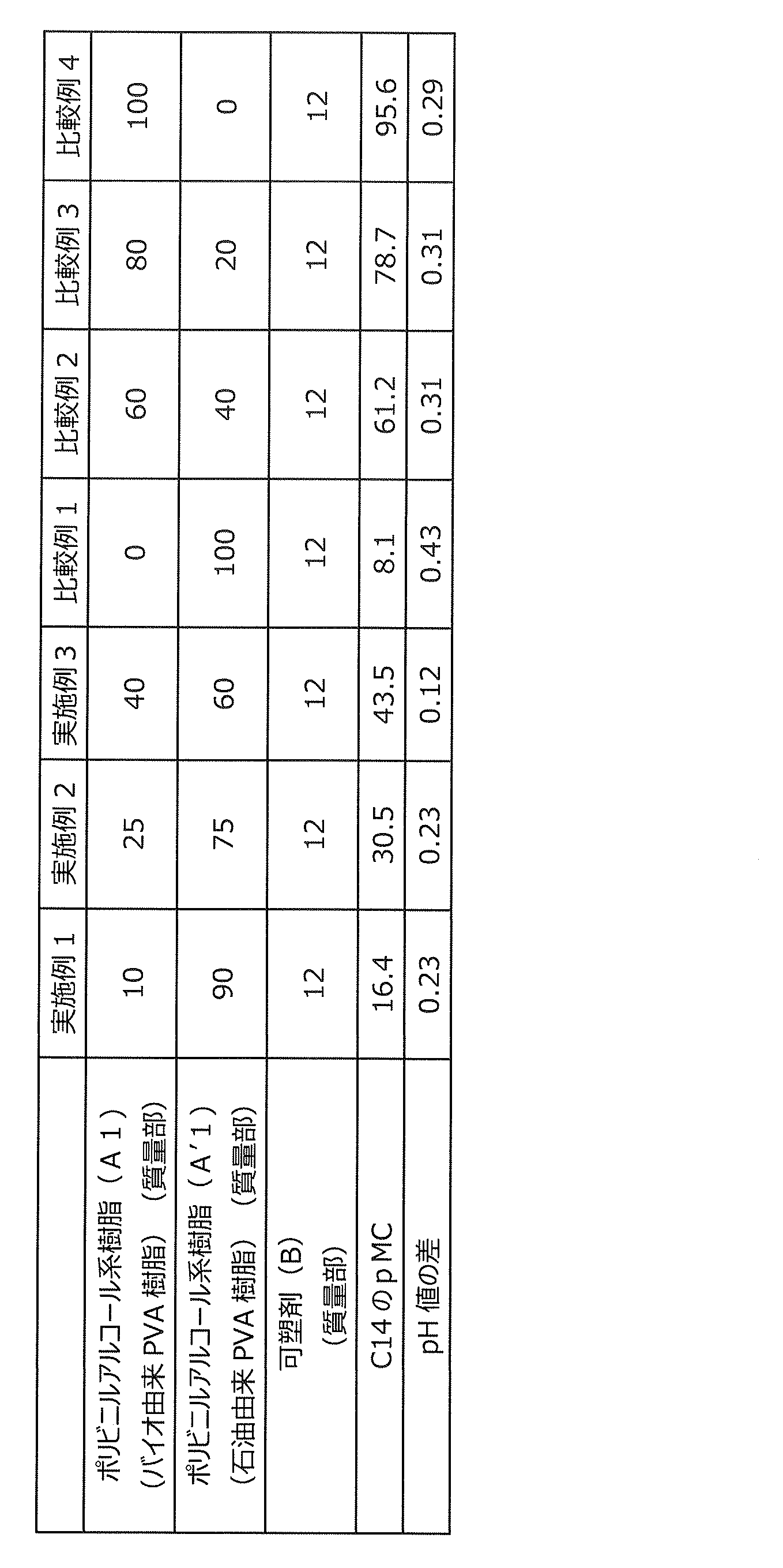
それに対し、比較例1~4のポリビニルアルコール系樹脂フィルムは、ASTM D6866(Method B)より測定されるC14のpMCの値が本発明に規定する範囲から外れるため、pH値の低下が大きくなるポリビニルアルコール系樹脂フィルムであることがわかる。
Claims (13)
- ポリビニルアルコール系樹脂(A)を含むポリビニルアルコール系樹脂フィルムであって、ASTM D6866(Method B)より測定されるC14のpMCの値が9~50である、ポリビニルアルコール系樹脂フィルム。
- 前記ポリビニルアルコール系樹脂(A)のケン化度が80~99.9モル%である、請求項1記載のポリビニルアルコール系樹脂フィルム。
- 前記ポリビニルアルコール系樹脂(A)の重量平均分子量が2万~15万である、請求項1または2に記載のポリビニルアルコール系樹脂フィルム。
- 可塑剤(B)を含有する、請求項1~3のいずれか一項に記載のポリビニルアルコール系樹脂フィルム。
- 前記可塑剤(B)の含有量が、前記ポリビニルアルコール系樹脂(A)100質量部に対して1~45質量部である、請求項4記載のポリビニルアルコール系樹脂フィルム。
- 厚みが10~130μmである、請求項1~5のいずれか一項に記載のポリビニルアルコール系樹脂フィルム。
- 偏光膜製造用途に用いる、請求項1~6のいずれか一項に記載のポリビニルアルコール系樹脂フィルム。
- 請求項1~7のいずれか一項に記載のポリビニルアルコール系樹脂フィルムが用いられている、光学フィルム。
- 前記光学フィルムが偏光膜である、請求項8記載の光学フィルム。
- 請求項1~6のいずれか一項に記載のポリビニルアルコール系樹脂フィルムが用いられている、水溶性フィルム。
- 少なくともポリビニルアルコール系樹脂(A)を含み、ASTM D6866(Method B)より測定されるC14のpMCの値が9~50である、ポリビニルアルコール系樹脂組成物。
- 可塑剤(B)を含有する請求項11記載のポリビニルアルコール系樹脂組成物。
- 請求項11または12に記載のポリビニルアルコール系樹脂組成物(A)を含む、ポリビニルアルコール系樹脂フィルム。
Priority Applications (5)
| Application Number | Priority Date | Filing Date | Title |
|---|---|---|---|
| JP2025527453A JPWO2024257411A1 (ja) | 2023-06-14 | 2024-02-27 | |
| CN202480032563.0A CN121127528A (zh) | 2023-06-14 | 2024-02-27 | 聚乙烯醇系树脂薄膜、光学薄膜、水溶性薄膜及聚乙烯醇系树脂组合物 |
| EP24823034.4A EP4729567A1 (en) | 2023-06-14 | 2024-02-27 | Poly(vinyl alcohol)-based resin film, optical film, water-soluble film, and poly(vinyl alcohol)-based resin composition |
| KR1020257038316A KR20260022294A (ko) | 2023-06-14 | 2024-02-27 | 폴리비닐 알코올계 수지 필름, 광학 필름, 수용성 필름, 및 폴리비닐 알코올계 수지 조성물 |
| US19/371,398 US20260055266A1 (en) | 2023-06-14 | 2025-10-28 | Polyvinyl alcohol-based resin film, optical film, water-soluble film, and polyvinyl alcohol-based resin composition |
Applications Claiming Priority (2)
| Application Number | Priority Date | Filing Date | Title |
|---|---|---|---|
| JP2023097541 | 2023-06-14 | ||
| JP2023-097541 | 2023-06-14 |
Related Child Applications (1)
| Application Number | Title | Priority Date | Filing Date |
|---|---|---|---|
| US19/371,398 Continuation US20260055266A1 (en) | 2023-06-14 | 2025-10-28 | Polyvinyl alcohol-based resin film, optical film, water-soluble film, and polyvinyl alcohol-based resin composition |
Publications (1)
| Publication Number | Publication Date |
|---|---|
| WO2024257411A1 true WO2024257411A1 (ja) | 2024-12-19 |
Family
ID=93851780
Family Applications (1)
| Application Number | Title | Priority Date | Filing Date |
|---|---|---|---|
| PCT/JP2024/006964 Ceased WO2024257411A1 (ja) | 2023-06-14 | 2024-02-27 | ポリビニルアルコール系樹脂フィルム、光学フィルム、水溶性フィルム、およびポリビニルアルコール系樹脂組成物 |
Country Status (7)
| Country | Link |
|---|---|
| US (1) | US20260055266A1 (ja) |
| EP (1) | EP4729567A1 (ja) |
| JP (1) | JPWO2024257411A1 (ja) |
| KR (1) | KR20260022294A (ja) |
| CN (1) | CN121127528A (ja) |
| TW (1) | TW202506845A (ja) |
| WO (1) | WO2024257411A1 (ja) |
Cited By (2)
| Publication number | Priority date | Publication date | Assignee | Title |
|---|---|---|---|---|
| WO2026048438A1 (ja) * | 2024-08-26 | 2026-03-05 | 三菱ケミカル株式会社 | 水溶性フィルム、包装体、薬剤包装体、及びその製造方法 |
| WO2026048437A1 (ja) * | 2024-08-26 | 2026-03-05 | 三菱ケミカル株式会社 | 水溶性フィルム、包装体、薬剤包装体、及びその製造方法 |
Citations (8)
| Publication number | Priority date | Publication date | Assignee | Title |
|---|---|---|---|---|
| JPS6428396A (en) | 1987-07-23 | 1989-01-30 | Katsuto Kano | Chromium plating method for high quality specular surface |
| US20110287204A1 (en) * | 2008-11-13 | 2011-11-24 | Arkema France | Manufacture of ethylene/carboxylic acid vinyl ester copolymers from renewable materials, copolymers obtained and uses |
| JP2012021174A (ja) | 2010-07-12 | 2012-02-02 | Nomura Plating Co Ltd | 成形ロールおよびその製造方法 |
| JP2014046672A (ja) | 2012-09-04 | 2014-03-17 | Toshiba Mach Co Ltd | Tダイおよびその製造方法 |
| JP2014148754A (ja) | 2014-03-24 | 2014-08-21 | Nomura Plating Co Ltd | 成形ロールおよびその製造方法 |
| JP2021518873A (ja) * | 2018-04-16 | 2021-08-05 | ブラスケム・エス・エー | バイオベースeva組成物及びその物品及びその方法 |
| JP2022032037A (ja) * | 2020-07-31 | 2022-02-24 | 株式会社クラレ | 単層フィルム、蒸着フィルム、多層フィルム及びヒートシール用フィルム |
| JP7072129B1 (ja) * | 2020-10-15 | 2022-05-19 | 株式会社クラレ | ポリビニルアルコール樹脂フィルム、ポリビニルアルコール樹脂フィルムの判別方法、及びポリビニルアルコール樹脂フィルムの製造方法 |
-
2024
- 2024-02-27 WO PCT/JP2024/006964 patent/WO2024257411A1/ja not_active Ceased
- 2024-02-27 TW TW113106984A patent/TW202506845A/zh unknown
- 2024-02-27 CN CN202480032563.0A patent/CN121127528A/zh active Pending
- 2024-02-27 KR KR1020257038316A patent/KR20260022294A/ko active Pending
- 2024-02-27 EP EP24823034.4A patent/EP4729567A1/en active Pending
- 2024-02-27 JP JP2025527453A patent/JPWO2024257411A1/ja active Pending
-
2025
- 2025-10-28 US US19/371,398 patent/US20260055266A1/en active Pending
Patent Citations (8)
| Publication number | Priority date | Publication date | Assignee | Title |
|---|---|---|---|---|
| JPS6428396A (en) | 1987-07-23 | 1989-01-30 | Katsuto Kano | Chromium plating method for high quality specular surface |
| US20110287204A1 (en) * | 2008-11-13 | 2011-11-24 | Arkema France | Manufacture of ethylene/carboxylic acid vinyl ester copolymers from renewable materials, copolymers obtained and uses |
| JP2012021174A (ja) | 2010-07-12 | 2012-02-02 | Nomura Plating Co Ltd | 成形ロールおよびその製造方法 |
| JP2014046672A (ja) | 2012-09-04 | 2014-03-17 | Toshiba Mach Co Ltd | Tダイおよびその製造方法 |
| JP2014148754A (ja) | 2014-03-24 | 2014-08-21 | Nomura Plating Co Ltd | 成形ロールおよびその製造方法 |
| JP2021518873A (ja) * | 2018-04-16 | 2021-08-05 | ブラスケム・エス・エー | バイオベースeva組成物及びその物品及びその方法 |
| JP2022032037A (ja) * | 2020-07-31 | 2022-02-24 | 株式会社クラレ | 単層フィルム、蒸着フィルム、多層フィルム及びヒートシール用フィルム |
| JP7072129B1 (ja) * | 2020-10-15 | 2022-05-19 | 株式会社クラレ | ポリビニルアルコール樹脂フィルム、ポリビニルアルコール樹脂フィルムの判別方法、及びポリビニルアルコール樹脂フィルムの製造方法 |
Non-Patent Citations (1)
| Title |
|---|
| See also references of EP4729567A1 |
Cited By (2)
| Publication number | Priority date | Publication date | Assignee | Title |
|---|---|---|---|---|
| WO2026048438A1 (ja) * | 2024-08-26 | 2026-03-05 | 三菱ケミカル株式会社 | 水溶性フィルム、包装体、薬剤包装体、及びその製造方法 |
| WO2026048437A1 (ja) * | 2024-08-26 | 2026-03-05 | 三菱ケミカル株式会社 | 水溶性フィルム、包装体、薬剤包装体、及びその製造方法 |
Also Published As
| Publication number | Publication date |
|---|---|
| EP4729567A1 (en) | 2026-04-22 |
| US20260055266A1 (en) | 2026-02-26 |
| CN121127528A (zh) | 2025-12-12 |
| JPWO2024257411A1 (ja) | 2024-12-19 |
| KR20260022294A (ko) | 2026-02-19 |
| TW202506845A (zh) | 2025-02-16 |
Similar Documents
| Publication | Publication Date | Title |
|---|---|---|
| JP5904725B2 (ja) | ポリビニルアルコール系フィルムの製造方法、ポリビニルアルコール系フィルム、偏光フィルム及び偏光板 | |
| TWI765093B (zh) | 聚乙烯醇薄膜及其製造方法 | |
| WO2024257411A1 (ja) | ポリビニルアルコール系樹脂フィルム、光学フィルム、水溶性フィルム、およびポリビニルアルコール系樹脂組成物 | |
| WO2012002194A1 (ja) | ポリビニルアルコール系フィルム、ポリビニルアルコール系フィルムの製造方法、偏光フィルム及び偏光板 | |
| JP6408989B2 (ja) | 光学フィルム製造用原反フィルム | |
| WO2024181406A1 (ja) | ポリビニルアルコール系樹脂フィルム、光学フィルム、水溶性フィルム、およびポリビニルアルコール系樹脂組成物 | |
| US20250353981A1 (en) | Polyvinyl alcohol resin film, optical film, water-soluble film, and polyvinyl alcohol resin composition | |
| US20250353982A1 (en) | Polyvinyl alcohol resin film, optical film, water-soluble film, and polyvinyl alcohol resin composition | |
| JPWO2015020044A1 (ja) | 光学フィルム製造用原反フィルム | |
| JP2018090691A (ja) | ポリビニルアルコールフィルムおよびそれを用いた偏光フィルムの製造方法 | |
| JP7512309B2 (ja) | ポリビニルアルコールフィルム及びそれを用いた偏光フィルムの製造方法 | |
| JP7282100B2 (ja) | ポリビニルアルコールフィルム及びそれを用いた偏光フィルムの製造方法 | |
| JP7408655B2 (ja) | ポリビニルアルコールフィルム及びそれを用いた偏光フィルムの製造方法 | |
| WO2019208618A1 (ja) | ポリビニルアルコールフィルム及びそれを用いた偏光フィルムの製造方法 | |
| JP7512205B2 (ja) | ポリビニルアルコールフィルム及びそれを用いた偏光フィルムの製造方法 | |
| JPWO2016121507A1 (ja) | フィルム | |
| JP6255300B2 (ja) | ポリビニルアルコール樹脂の製造方法 | |
| JP4728476B2 (ja) | ビニルアルコール系重合体フィルムの製造法 | |
| JPWO2016121508A1 (ja) | フィルム |
Legal Events
| Date | Code | Title | Description |
|---|---|---|---|
| 121 | Ep: the epo has been informed by wipo that ep was designated in this application |
Ref document number: 24823034 Country of ref document: EP Kind code of ref document: A1 |
|
| ENP | Entry into the national phase |
Ref document number: 2025527453 Country of ref document: JP Kind code of ref document: A |
|
| WWE | Wipo information: entry into national phase |
Ref document number: 2024823034 Country of ref document: EP |
|
| NENP | Non-entry into the national phase |
Ref country code: DE |
|
| ENP | Entry into the national phase |
Ref document number: 2024823034 Country of ref document: EP Effective date: 20260114 |
|
| ENP | Entry into the national phase |
Ref document number: 2024823034 Country of ref document: EP Effective date: 20260114 |
|
| ENP | Entry into the national phase |
Ref document number: 2024823034 Country of ref document: EP Effective date: 20260114 |
|
| ENP | Entry into the national phase |
Ref document number: 2024823034 Country of ref document: EP Effective date: 20260114 |
|
| WWP | Wipo information: published in national office |
Ref document number: 2024823034 Country of ref document: EP |