WO2024257504A1 - 半導体薬液および半導体薬液の製造方法 - Google Patents
半導体薬液および半導体薬液の製造方法 Download PDFInfo
- Publication number
- WO2024257504A1 WO2024257504A1 PCT/JP2024/016925 JP2024016925W WO2024257504A1 WO 2024257504 A1 WO2024257504 A1 WO 2024257504A1 JP 2024016925 W JP2024016925 W JP 2024016925W WO 2024257504 A1 WO2024257504 A1 WO 2024257504A1
- Authority
- WO
- WIPO (PCT)
- Prior art keywords
- less
- continuous reactor
- chemical solution
- alcohol
- content
- Prior art date
- Legal status (The legal status is an assumption and is not a legal conclusion. Google has not performed a legal analysis and makes no representation as to the accuracy of the status listed.)
- Ceased
Links
Images
Classifications
-
- C—CHEMISTRY; METALLURGY
- C11—ANIMAL OR VEGETABLE OILS, FATS, FATTY SUBSTANCES OR WAXES; FATTY ACIDS THEREFROM; DETERGENTS; CANDLES
- C11D—DETERGENT COMPOSITIONS; USE OF SINGLE SUBSTANCES AS DETERGENTS; SOAP OR SOAP-MAKING; RESIN SOAPS; RECOVERY OF GLYCEROL
- C11D7/00—Compositions of detergents based essentially on non-surface-active compounds
- C11D7/22—Organic compounds
- C11D7/26—Organic compounds containing oxygen
- C11D7/261—Alcohols; Phenols
-
- C—CHEMISTRY; METALLURGY
- C07—ORGANIC CHEMISTRY
- C07B—GENERAL METHODS OF ORGANIC CHEMISTRY; APPARATUS THEREFOR
- C07B61/00—Other general methods
-
- C—CHEMISTRY; METALLURGY
- C07—ORGANIC CHEMISTRY
- C07C—ACYCLIC OR CARBOCYCLIC COMPOUNDS
- C07C29/00—Preparation of compounds having hydroxy or O-metal groups bound to a carbon atom not belonging to a six-membered aromatic ring
- C07C29/03—Preparation of compounds having hydroxy or O-metal groups bound to a carbon atom not belonging to a six-membered aromatic ring by addition of hydroxy groups to unsaturated carbon-to-carbon bonds, e.g. with the aid of H2O2
- C07C29/04—Preparation of compounds having hydroxy or O-metal groups bound to a carbon atom not belonging to a six-membered aromatic ring by addition of hydroxy groups to unsaturated carbon-to-carbon bonds, e.g. with the aid of H2O2 by hydration of carbon-to-carbon double bonds
-
- C—CHEMISTRY; METALLURGY
- C07—ORGANIC CHEMISTRY
- C07C—ACYCLIC OR CARBOCYCLIC COMPOUNDS
- C07C31/00—Saturated compounds having hydroxy or O-metal groups bound to acyclic carbon atoms
- C07C31/02—Monohydroxylic acyclic alcohols
- C07C31/10—Monohydroxylic acyclic alcohols containing three carbon atoms
-
- C—CHEMISTRY; METALLURGY
- C11—ANIMAL OR VEGETABLE OILS, FATS, FATTY SUBSTANCES OR WAXES; FATTY ACIDS THEREFROM; DETERGENTS; CANDLES
- C11D—DETERGENT COMPOSITIONS; USE OF SINGLE SUBSTANCES AS DETERGENTS; SOAP OR SOAP-MAKING; RESIN SOAPS; RECOVERY OF GLYCEROL
- C11D7/00—Compositions of detergents based essentially on non-surface-active compounds
- C11D7/22—Organic compounds
- C11D7/26—Organic compounds containing oxygen
-
- H—ELECTRICITY
- H10—SEMICONDUCTOR DEVICES; ELECTRIC SOLID-STATE DEVICES NOT OTHERWISE PROVIDED FOR
- H10P—GENERIC PROCESSES OR APPARATUS FOR THE MANUFACTURE OR TREATMENT OF DEVICES COVERED BY CLASS H10
- H10P52/00—Grinding, lapping or polishing of wafers, substrates or parts of devices
-
- H—ELECTRICITY
- H10—SEMICONDUCTOR DEVICES; ELECTRIC SOLID-STATE DEVICES NOT OTHERWISE PROVIDED FOR
- H10P—GENERIC PROCESSES OR APPARATUS FOR THE MANUFACTURE OR TREATMENT OF DEVICES COVERED BY CLASS H10
- H10P70/00—Cleaning of wafers, substrates or parts of devices
- H10P70/10—Cleaning before device manufacture, i.e. Begin-Of-Line process
- H10P70/15—Cleaning before device manufacture, i.e. Begin-Of-Line process by wet cleaning only
-
- C—CHEMISTRY; METALLURGY
- C11—ANIMAL OR VEGETABLE OILS, FATS, FATTY SUBSTANCES OR WAXES; FATTY ACIDS THEREFROM; DETERGENTS; CANDLES
- C11D—DETERGENT COMPOSITIONS; USE OF SINGLE SUBSTANCES AS DETERGENTS; SOAP OR SOAP-MAKING; RESIN SOAPS; RECOVERY OF GLYCEROL
- C11D2111/00—Cleaning compositions characterised by the objects to be cleaned; Cleaning compositions characterised by non-standard cleaning or washing processes
- C11D2111/10—Objects to be cleaned
- C11D2111/14—Hard surfaces
- C11D2111/22—Electronic devices, e.g. PCBs or semiconductors
Definitions
- the present invention relates to a semiconductor chemical solution and a method for manufacturing the semiconductor chemical solution.
- substrates such as semiconductor substrates and glass substrates are washed with a semiconductor chemical solution and then dried.
- a semiconductor chemical solution For example, isopropyl alcohol is used as the semiconductor chemical solution.
- Patent Document 1 describes a method for producing isopropyl alcohol by direct hydration of propylene.
- propylene and water are reacted in a reactor, with the ratio of propylene and water in the reactor being 1,300 to 2,100 parts by mass of water per 100 parts by mass of propylene, and the residence time of water in the reactor being more than 20 minutes and less than 50 minutes.
- t-butyl alcohol has a melting point of 26°C and is a solid at room temperature, so it is thought to be prone to leaving residues.
- the present invention aims to provide a semiconductor chemical solution with a reduced content of t-butyl alcohol and ethyl alcohol, and a method for producing a semiconductor chemical solution that can reduce the content of t-butyl alcohol and ethyl alcohol.
- a semiconductor chemical liquid that is substantially composed of isopropyl alcohol, in which the t-butyl alcohol content is 1000 ppb by mass or less and the ethyl alcohol content is 1000 ppb by mass or less.
- a method for producing a semiconductor chemical solution consisting essentially of isopropyl alcohol comprising the steps of supplying a raw material gas containing propylene, having an isobutene content of 1 ppm by volume or less, and an ethylene content of 1 ppm by volume or less, and raw material water to a continuous reactor and reacting them, wherein during the reaction, the continuous reactor has a gas phase portion and a liquid phase portion, and gas components are discharged from the gas phase portion and supplied to the continuous reactor, the mass ratio of the raw material gas to the raw material water being 0.01 or more and 0.20 or less, and the raw material water supplied to the continuous reactor is A method for manufacturing a semiconductor chemical solution, in which the residence time of the raw water in the continuous reactor, which is the ratio of the volume [L] of the liquid phase to the supply rate [L/min] of the raw water, is 10 minutes or more and 25 minutes or less, the residence time of the gas components in the continuous reactor, which is the ratio of the volume [L] of the gas phase to the discharge rate
- the present invention can provide a semiconductor chemical solution with a reduced content of t-butyl alcohol and ethyl alcohol, as well as a method for producing a semiconductor chemical solution that can reduce the content of t-butyl alcohol and ethyl alcohol.
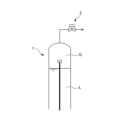
- 4A to 4C are diagrams illustrating an example of a reaction process in the method for producing a semiconductor chemical solution according to the present embodiment.
- the method for producing a semiconductor chemical liquid of this embodiment is a method for producing a semiconductor chemical liquid substantially composed of isopropyl alcohol, and includes a step of supplying a raw material gas and raw material water to a continuous reactor and reacting them (hereinafter, referred to as a reaction step).
- the method for producing a semiconductor chemical liquid of this embodiment may further include steps such as a recovery step and a purification step.
- the raw material gas contains propylene, and the propylene content is preferably 99 vol % or more, and more preferably 99.9 vol % or more.
- the isobutene content in the raw material gas is 1 ppm by volume or less, preferably 0.5 ppm by volume or less, and more preferably 0.1 ppm by volume or less.
- the ethylene content in the raw material gas is 1 ppm by volume or less, preferably 0.5 ppm by volume or less, and more preferably 0.1 ppm by volume or less.
- the raw material gas may contain an inert gas such as nitrogen gas, if necessary.
- the content of alkenes having six carbon atoms in the feed gas is small.
- the content of alkenes having six carbon atoms in the feed gas is preferably 1 ppm by volume or less, more preferably 0.5 ppm by volume or less, and even more preferably 0.1 ppm by volume or less.
- the raw water contains water, but preferably further contains an acid catalyst.
- the acid catalyst include phosphotungstic acid, silicotungstic acid, and silicomolybdic acid, and two or more of them may be used in combination.
- the pH of the raw water at 25°C is preferably 2.5 to 4.5.
- the pH of the raw water at 25°C is 2.5 to 4.5, the conversion rate of propylene and the selectivity of isopropyl alcohol are improved.
- reaction step An example of the reaction process will be described with reference to FIG. 1.
- a gas phase portion G containing the raw material gas is present at the top of the continuous reactor 1
- a liquid phase portion L containing the raw material water is present at the bottom of the continuous reactor 1.
- isopropyl alcohol generated in the reaction process is contained in the liquid phase portion L.
- the gas components are discharged from the gas phase portion G by repeatedly opening and closing the control valve 2.
- the mass ratio of the raw gas to the raw water supplied to the continuous reactor 1 is 0.01 or more and 0.20 or less, preferably 0.02 or more and 0.07 or less, and more preferably 0.03 or more and 0.05 or less. If the mass ratio of the raw gas to the raw water supplied to the continuous reactor 1 is less than 0.01, the productivity of the semiconductor chemical solution decreases, and if it exceeds 0.20, the content of t-butyl alcohol, ethyl alcohol, and alcohol with 6 carbon atoms in the semiconductor chemical solution increases.
- the volume ratio of the discharge amount of the gas components discharged from the continuous reactor 1 to the supply amount of the raw material gas supplied to the continuous reactor 1 is 0.03 or more and 0.30 or less, and preferably 0.11 or more and 0.16 or less. If the ratio of the discharge amount of the gas components discharged from the continuous reactor 1 to the supply amount of the raw material gas supplied to the continuous reactor 1 is less than 0.03, the contents of t-butyl alcohol, ethyl alcohol, and alcohols with a carbon number of 6 in the semiconductor chemical solution will increase, and if it exceeds 0.30, the conversion rate of propylene will decrease.
- the gas components discharged from the continuous reactor 1 include water contained in the raw water, propylene contained in the raw gas, impurities contained in the raw gas (e.g., propane), main products (isopropyl alcohol), by-products (e.g., hexene, isobutene, ethylene), etc.
- Hexene includes 4-methyl-1-pentene, which may be disproportionated to isobutene and ethylene.
- the content of isobutene in the gas components discharged from the continuous reactor 1 is preferably 0.1 ppm by volume or more and 20 ppm by volume or less, more preferably 1 ppm by volume or more and 8 ppm by volume or less.
- the content of ethylene in the gas components discharged from the continuous reactor 1 is preferably 0.1 ppm by volume or more and 20 ppm by volume or less, more preferably 1 ppm by volume or more and 5 ppm by volume or less.
- the residence time of the raw water in the continuous reactor 1 is from 10 to 25 minutes, and preferably from 12 to 18 minutes. If the residence time of the raw water in the continuous reactor 1 is less than 10 minutes, the conversion rate of propylene decreases, and if it exceeds 25 minutes, the content of t-butyl alcohol, ethyl alcohol, and alcohol with 6 carbon atoms in the semiconductor chemical solution increases.
- the residence time of the raw water in the continuous reactor 1 is calculated by the formula: (Volume [L] of the liquid phase L of the continuous reactor 1)/(Feed rate [L/min] of the raw water) It is calculated by:
- the residence time of the gas components in the continuous reactor 1 is 10 minutes or more and 150 minutes or less, and preferably 30 minutes or more and 100 minutes or less. If the residence time of the gas components in the continuous reactor 1 is less than 10 minutes, the conversion rate of propylene decreases, and if it exceeds 150 minutes, the content of t-butyl alcohol, ethyl alcohol, and alcohol with 6 carbon atoms in the semiconductor chemical solution increases.
- the residence time of the gas component in the continuous reactor 1 is calculated by the formula: (Volume [L] of the gas phase G of the continuous reactor 1)/(Discharge rate [L/min] of the gas component).
- the inside of the continuous reactor 1 is at high temperature and pressure, but the discharge rate of the gas components in the temperature and pressure state of the continuous reactor 1 can be obtained by adjusting the temperature and pressure of the gas components discharged from the continuous reactor 1 to 25° C. and 101 kPa (absolute pressure), respectively, and then analyzing the liquid phase and the gas phase.
- the temperature inside the continuous reactor 1 is preferably 200°C or higher and 300°C or lower, and more preferably 250°C or higher and 280°C or lower. If the temperature inside the continuous reactor 1 is 200°C or higher, the conversion rate of propylene improves, and if it is 300°C or lower, the content of t-butyl alcohol, ethyl alcohol, and alcohol with 6 carbon atoms in the semiconductor chemical solution decreases.
- the pressure in the continuous reactor 1 is preferably 150 atm or more and 280 atm or less, and more preferably 200 atm or more and 255 atm or less. If the pressure in the continuous reactor 1 is 150 atm or more, the conversion rate of propylene improves, and if it is 280 atm or less, the content of t-butyl alcohol, ethyl alcohol, and alcohol with 6 carbon atoms in the semiconductor chemical solution decreases.
- the propylene conversion is preferably 85% or more and 97% or less, and more preferably 92% or more and 95% or less.
- the selectivity of isopropyl alcohol is preferably 99% or more and 99.9% or less, and more preferably 99.5% or more and 99.8% or less.
- the conversion rate of propylene is calculated from the amount of propylene supplied to the continuous reactor 1 and the amount of propylene discharged outside the system.
- propylene discharged outside the system include propylene discharged from the gas phase G of the continuous reactor 1 via the control valve 2 (see FIG. 1), and propylene discharged outside the system from the recovery process and purification process described below without being returned to the reaction process.
- liquid components including isopropyl alcohol and raw water produced in the reaction step are discharged and transported to the recovery tower.
- the temperature of the recovery tower is preferably 80°C or more and 200°C or less, and more preferably 100°C or more and 150°C or less.
- the pressure of the recovery tower is preferably 100 kPa or more and 5000 kPa or less (absolute pressure), and more preferably 500 kPa or more and 2000 kPa or less (absolute pressure).
- the separated propylene is collected in a drum and reused as a raw gas.
- the content of isopropyl alcohol in the crude isopropyl alcohol aqueous solution is preferably 1% by mass or more and 20% by mass or less, and more preferably 3% by mass or more and 8% by mass or less.
- the amount of t-butyl alcohol and ethyl alcohol by-produced can be reduced by controlling the residence time of the raw water in the continuous reactor 1 and the residence time of the gas components in the continuous reactor 1.
- the mass ratios of t-butyl alcohol and ethyl alcohol to isopropyl alcohol in the crude isopropyl alcohol aqueous solution can be set to 1000 ppb or less, and can also be set to 500 ppb or less.
- the mass ratios of t-butyl alcohol and ethyl alcohol to isopropyl alcohol in the crude isopropyl alcohol aqueous solution are preferably 10 ppb or more, more preferably 100 ppb or more, and even more preferably 200 ppb or more, respectively, taking into account the cost and yield in the reaction process and the purification process.
- the amount of alcohol with 6 carbon atoms produced as a by-product can be reduced. Therefore, the mass ratio of alcohol with 6 carbon atoms to isopropyl alcohol in the crude isopropyl alcohol aqueous solution can be set to 200 ppb or more and 10,000 ppb or less, and can also be set to 2,000 ppb or more and 5,000 ppb or less.
- a decrease in the amount of 4-methyl-2-pentanol produced as a by-product by hydration of 4-methyl-1-pentene leads to a decrease in the amount of t-butyl alcohol and ethyl alcohol produced as by-products.
- the mass ratio of 4-methyl-2-pentanol to isopropyl alcohol in the crude isopropyl alcohol aqueous solution is preferably 1,000 ppb or more and 5,000 ppb or less, and more preferably 1,000 ppb or more and 3,000 ppb or less.
- the content of alcohol with 6 carbon atoms in the semiconductor chemical solution of this embodiment can be further reduced by distilling the crude isopropyl alcohol aqueous solution in a high boiling distillation column in the purification process described below.
- the crude isopropyl alcohol aqueous solution recovered in the recovery tower is discharged and purified.
- the crude isopropyl alcohol aqueous solution is purified by a distillation step in a low boiling distillation tower, a distillation step in an azeotropic distillation tower, a dehydration step, and a distillation step in a high boiling distillation tower.
- a third component capable of forming an azeotropic mixture with water is added to the dehydration distillation tower to form an azeotropic mixture of water and the third component, thereby removing water.
- the separated water is collected in a tank and reused as raw water.
- compounds with a boiling point higher than that of isopropyl alcohol are removed.
- the content of alcohol with a carbon number of 6 in the semiconductor chemical solution of this embodiment can be reduced to 1 ppb by mass or less, and can also be reduced to 0.1 ppb by mass or less.
- Particles can be removed by passing the bottoms taken out of the high boiling distillation tower through a filter.
- the number of stages in each distillation tower and the equivalent number of stages in the distillation tower converted into a tray tower are not particularly limited, but are preferably 5 to 320, and more preferably 10 to 300.
- the number of stages in the high boiling distillation tower and the equivalent number of stages in the distillation tower converted into a tray tower are preferably 5 to 20. This allows the content of alcohols with a carbon number of 6 in the semiconductor chemical solution of this embodiment to be reduced.
- the reflux ratio in the atmospheric distillation is not particularly limited, but is preferably 0.5 to 50, and more preferably 1 to 10.
- atmospheric pressure refers to a range of 90 kPa to 120 kPa (absolute pressure).
- the semiconductor chemical liquid of this embodiment is substantially composed of isopropyl alcohol.
- the content of isopropyl alcohol in the semiconductor chemical liquid of this embodiment is preferably 99.99 mass % or more, and more preferably 99.999 mass % or more.
- the content of t-butyl alcohol in the semiconductor chemical solution of this embodiment is 1000 mass ppb or less, and more preferably 500 mass ppb or less. Since the content of t-butyl alcohol in the semiconductor chemical solution of this embodiment is 1000 mass ppb or less, even if the semiconductor chemical solution of this embodiment is used to clean a substrate, the effect of t-butyl alcohol residues on the semiconductor device is reduced. Considering the cost and yield of the reaction process and purification process, the content of t-butyl alcohol in the semiconductor chemical solution of this embodiment is preferably 10 mass ppb or more, more preferably 100 mass ppb or more, and even more preferably 200 mass ppb or more.
- the content of ethyl alcohol in the semiconductor chemical solution of this embodiment is 1000 mass ppb or less, and more preferably 500 mass ppb or less. Taking into account the cost and yield of the reaction and purification processes, the content of ethyl alcohol in the semiconductor chemical solution of this embodiment is preferably 10 mass ppb or more, more preferably 100 mass ppb or more, and even more preferably 200 mass ppb or more.
- the isopropyl alcohol contained in the semiconductor chemical solution of this embodiment can be produced by the manufacturing method of the semiconductor chemical solution of this embodiment.
- the content of alcohol with 6 carbon atoms in the semiconductor chemical solution is preferably 1 ppb by mass or less, and more preferably 0.1 ppb by mass or less.
- alcohols with 6 carbon atoms include saturated aliphatic alcohols such as 1-hexyl alcohol, 2-hexyl alcohol, 3-hexyl alcohol, 2-methyl-1-pentyl alcohol, 2-methyl-2-pentyl alcohol, 2-methyl-3-pentyl alcohol, 4-methyl-1-pentyl alcohol, 4-methyl-2-pentyl alcohol, 3-methyl-1-pentyl alcohol, 3-methyl-3-pentyl alcohol, 2,3-dimethyl-1-butyl alcohol, and 2-ethyl-1-butyl alcohol.
- saturated aliphatic alcohols such as 1-hexyl alcohol, 2-hexyl alcohol, 3-hexyl alcohol, 2-methyl-1-pentyl alcohol, 2-methyl-2-pentyl alcohol, 2-methyl-3-pentyl alcohol, 4-methyl-1-pentyl alcohol, 4-methyl-2-pentyl alcohol, 3-methyl-1-pentyl alcohol, 3-methyl-3-pentyl alcohol, 2,3-dimethyl-1-butyl alcohol, and 2-eth
- the water content in the semiconductor chemical solution of this embodiment is preferably 0.1 ppm by mass or more and 100 ppm by mass or less, and more preferably 1 ppm by mass or more and 20 ppm by mass or less.
- Alcohol content when water content in sample is 10% by mass or less The alcohol content in the sample was measured using GC-MS under the following measurement conditions.
- the lower limit of quantification for the content of t-butyl alcohol and ethyl alcohol in the standard sample made of isopropyl alcohol was 10 mass ppb.
- the lower limit of quantification for the content of alcohol with 6 carbon atoms in the standard sample was 10 mass ppb.
- the concentration method is shown below, but the following operation is repeated as necessary to change the concentration ratio.
- the top temperature of the distillation tower is set to about 82°C, and distillation is performed for 10 hours.
- the theoretical number of plates of the precision distillation apparatus is 3 to 30, and the sample can be concentrated within this range.
- nitrogen was circulated in advance in the precision distillation apparatus to create an inert gas atmosphere.
- Example 1 (raw gas) The composition of the raw gas was analyzed by preparing standard gases of known concentrations and quantifying them.
- Propylene content 99% by volume or more Propane content: 1000 ppm by volume Methane content: less than 0.1 ppm by volume Ethane content: less than 0.1 ppm by volume Ethylene content: less than 0.1 ppm by volume
- Cyclopropane content 1 ppm by volume Content of 1-butene: less than 0.1 ppm by volume Content of isobutene: less than 0.1 ppm by volume Content of alkene having 5 carbon atoms (pentene): less than 0.1 ppm by volume Content of alkene having 6 carbon atoms (hexene): less than 0.1 ppm by volume
- the density of the feed gas under standard conditions (101.3 kPa, 0° C.) was 1.87 ⁇ 10 ⁇ 3 kg/L.
- reaction step The continuous reactor with an internal volume of 22.0 L was adjusted so that the volume of the liquid phase present at the bottom of the continuous reactor was 20.0 L and the volume of the gas phase present at the top of the continuous reactor was 2.0 L.
- raw water heated to 110 ° C. was supplied to the continuous reactor at a supply rate of 45 kg / h, and raw gas was supplied to the continuous reactor at a supply rate of 3 kg / h, that is, 1.87 ⁇ 10 3 L / h (standard state conversion), while gas components were discharged from the gas phase of the continuous reactor at a discharge rate of 200 L / h (standard state conversion).
- the temperature and pressure in the continuous reactor were set to 280 ° C.
- the residence time of the raw water in the continuous reactor is 20 minutes.
- the discharge rate of the gas components at 280° C. and 250 atm is 1.6 L/h, the residence time of the gas components in the continuous reactor is 74 minutes.
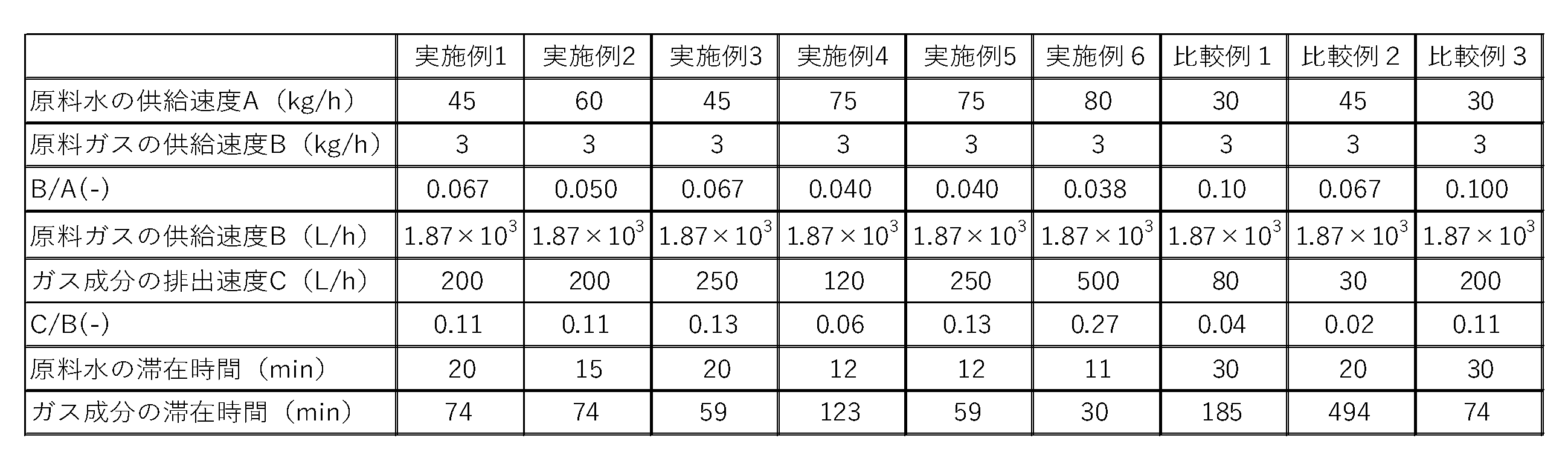
- Table 1 shows the reaction conditions in the reaction process.
- Table 2 shows the composition of the gas components (by volume).
- hexenes refer to hexenes other than 4-methyl-1-pentene.
- the liquid component was discharged from the liquid phase of the continuous reactor and transported to a recovery tower.
- the temperature and pressure in the recovery tower were set to 140 ° C. and 18 atm, respectively, to separate propylene dissolved in the water contained in the liquid component, and a crude isopropyl alcohol aqueous solution was obtained.
- the conversion rate of propylene was 95%, and the selectivity of isopropyl alcohol was 99.5%.
- the separated propylene was recovered in a drum to be reused as a raw material gas.
- Table 3 shows the composition (by mass) of the crude isopropyl alcohol aqueous solution.
- hexanols refer to hexanols other than 4-methyl-2-pentanol, 2-methyl-2-pentanol, 2-methyl-3-pentanol, 3-methyl-3-pentanol, 3-methyl-1-pentanol, 2,3-dimethyl-2-butanol, and 4-methyl-1-pentanol.
- the crude isopropyl alcohol aqueous solution was fed to a low boiling distillation tower to remove low boiling impurities, and the bottoms were obtained from the bottom of the tower.
- the bottoms were fed to an azeotropic distillation tower to remove high boiling impurities, and an azeotropic mixture of isopropyl alcohol and water (mass ratio 87.5:12.5) was obtained from the top of the tower.
- the azeotropic mixture was fed to a dehydration distillation tower to be dehydrated, and the bottoms were obtained from the bottom of the tower.
- the bottoms were fed to a high boiling distillation tower to remove high boiling impurities, and the distillate was obtained from the top of the tower.
- the number of stages of the high boiling distillation tower was 15.
- the distillate was passed through a fluororesin filter with a pore size of 10 nm to obtain a semiconductor chemical solution.
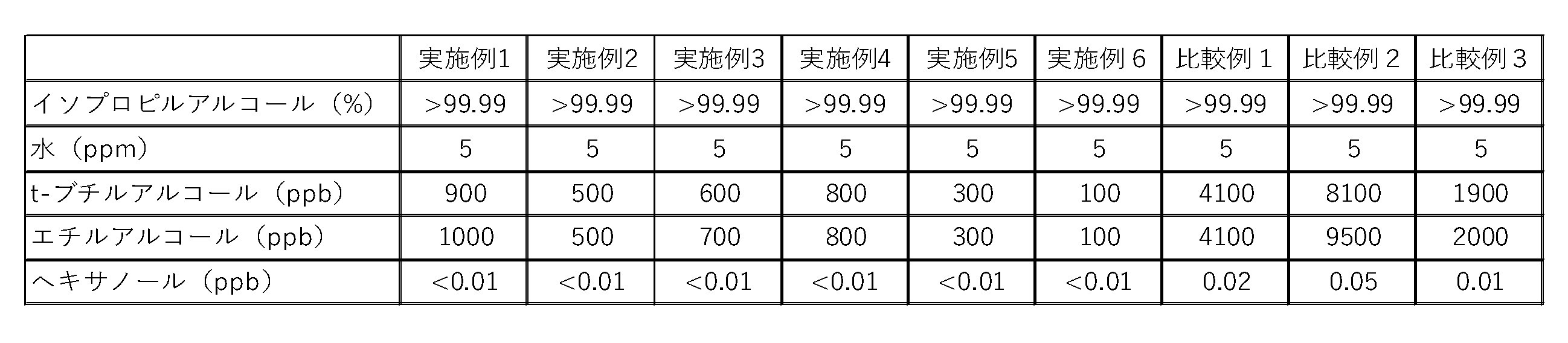
- Table 4 shows the composition (by mass) of the semiconductor chemical solution.
- hexanol means an alcohol with six carbon atoms.
- Example 2 A semiconductor chemical solution was obtained in the same manner as in Example 1, except that the feed rate of the raw water in the reaction step was changed to 60 kg/h and the residence time of the raw water in the continuous reactor was changed to 15 minutes (see Table 1). At this time, the conversion rate of propylene was 95%, and the selectivity of isopropyl alcohol was 99.5%.
- the compositions of the gas components, the crude isopropyl alcohol aqueous solution, and the semiconductor chemical solution are shown in Tables 2 to 4.
- Example 3 A semiconductor chemical solution was obtained in the same manner as in Example 1, except that the discharge rate of the gas components in the reaction step was changed to 250 L/h (standard state conversion) and the residence time of the gas components in the continuous reactor was changed to 59 minutes (see Table 1). At this time, the conversion rate of propylene was 94%, and the selectivity of isopropyl alcohol was 99.5%.
- the compositions of the gas components, crude isopropyl alcohol aqueous solution, and semiconductor chemical solution are shown in Tables 2 to 4.
- Example 4 The feed rate of the raw water in the reaction step was changed to 75 kg/h, the residence time of the raw water in the continuous reactor was changed to 12 minutes, the discharge rate of the gas components in the reaction step was changed to 120 L/h (standard state conversion), and the residence time of the gas components in the continuous reactor was changed to 123 minutes. Except for this, the semiconductor chemical solution was obtained in the same manner as in Example 1 (see Table 1). At this time, the conversion rate of propylene was 97%, and the selectivity of isopropyl alcohol was 99.5%. The compositions of the gas components, crude isopropyl alcohol aqueous solution, and semiconductor chemical solution are shown in Tables 2 to 4.
- Example 5 The feed rate of the raw water in the reaction step was changed to 75 kg/h, the residence time of the raw water in the continuous reactor was changed to 12 minutes, the discharge rate of the gas components in the reaction step was changed to 250 L/h (standard state conversion), and the residence time of the gas components in the continuous reactor was changed to 59 minutes. Except for this, the semiconductor chemical solution was obtained in the same manner as in Example 1 (see Table 1). At this time, the conversion rate of propylene was 94%, and the selectivity of isopropyl alcohol was 99.5%. The compositions of the gas components, crude isopropyl alcohol aqueous solution, and semiconductor chemical solution are shown in Tables 2 to 4.
- Example 6 The feed rate of the raw water in the reaction step was changed to 80 kg/h, the residence time of the raw water in the continuous reactor was changed to 11 minutes, the discharge rate of the gas components in the reaction step was changed to 500 L/h (standard state conversion), and the residence time of the gas components in the continuous reactor was changed to 30 minutes. Except for this, a semiconductor chemical solution was obtained in the same manner as in Example 1 (see Table 1). At this time, the conversion rate of propylene was 88%, and the selectivity of isopropyl alcohol was 99.5%. The compositions of the gas components, crude isopropyl alcohol aqueous solution, and semiconductor chemical solution are shown in Tables 2 to 4.
- Example 2 A semiconductor chemical solution was obtained in the same manner as in Example 1, except that the discharge rate of the gas components in the reaction step was changed to 30 L/h (standard state conversion) and the residence time of the gas components in the continuous reactor was changed to 494 minutes (see Table 1). At this time, the conversion rate of propylene was 99%, and the selectivity of isopropyl alcohol was 99.5%.
- the compositions of the gas components, crude isopropyl alcohol aqueous solution, and semiconductor chemical solution are shown in Tables 2 to 4.
- Example 3 A semiconductor chemical solution was obtained in the same manner as in Example 1, except that the feed rate of the raw water in the reaction step was changed to 30 kg/h and the residence time of the raw water in the continuous reactor was changed to 30 minutes (see Table 1). At this time, the conversion rate of propylene was 95%, and the selectivity of isopropyl alcohol was 99.5%.
- the compositions of the gas components, the crude isopropyl alcohol aqueous solution, and the semiconductor chemical solution are shown in Tables 2 to 4.
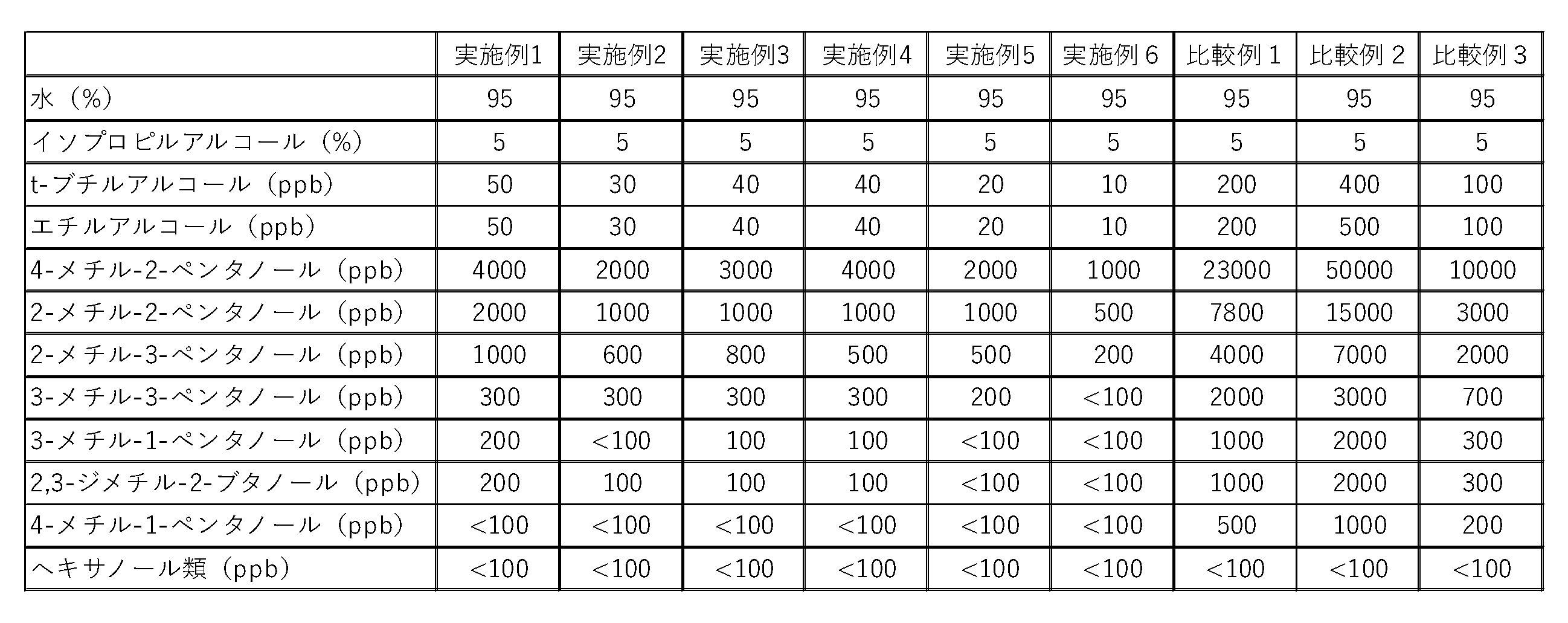
- the semiconductor chemicals of Examples 1 to 6 have low contents of t-butyl alcohol, ethyl alcohol, and hexanol.
- the semiconductor chemicals of Comparative Example 1 have high contents of t-butyl alcohol, ethyl alcohol, and hexanol because the residence time of the raw water and gas components in the continuous reactor is 30 minutes and 185 minutes, respectively.
- the semiconductor chemicals of Comparative Example 2 have high contents of t-butyl alcohol, ethyl alcohol, and hexanol because the residence time of the gas components in the continuous reactor is 494 minutes and C/B is 0.02.
- the semiconductor chemicals of Comparative Example 3 have high contents of t-butyl alcohol, ethyl alcohol, and hexanol because the residence time of the raw water in the continuous reactor is 30 minutes.
Landscapes
- Chemical & Material Sciences (AREA)
- Organic Chemistry (AREA)
- Health & Medical Sciences (AREA)
- Emergency Medicine (AREA)
- Life Sciences & Earth Sciences (AREA)
- Engineering & Computer Science (AREA)
- Chemical Kinetics & Catalysis (AREA)
- Oil, Petroleum & Natural Gas (AREA)
- Wood Science & Technology (AREA)
- Organic Low-Molecular-Weight Compounds And Preparation Thereof (AREA)
Abstract
実質的にイソプロピルアルコールからなる半導体薬液であって、t-ブチルアルコールの含有率が1000質量ppb以下であり、エチルアルコールの含有率が1000質量ppb以下である、半導体薬液を提供する。
Description
本発明は、半導体薬液および半導体薬液の製造方法に関する。
従来、半導体製造プロセスにおいては、半導体基板、ガラス基板等の基板を半導体薬液で洗浄した後、乾燥させる。半導体薬液としては、例えば、イソプロピルアルコールが用いられている。
特許文献1には、プロピレンの直接水和法により、イソプロピルアルコールを製造する方法が記載されている。このとき、反応器内において、プロピレンと水とを反応させるが、反応器内におけるプロピレンおよび水の割合が、プロピレン100質量部に対して水が1300~2100質量部であり、反応器内における水の滞在時間が、20分を超え、50分以下である。
しかしながら、特許文献1に記載されているイソプロピルアルコールの製造方法において、プロピレンの純度が高い原料ガスを使用すると、t-ブチルアルコール(2-メチル-2-プロピルアルコール)およびエチルアルコールが副生する。このため、半導体薬液中のt-ブチルアルコールおよびエチルアルコールの含有率を低減することが望まれている。
しかしながら、t-ブチルアルコールおよびエチルアルコールは、イソプロピルアルコールとの沸点の差が小さい上に、イソプロピルアルコールと共沸するため、蒸留により、半導体薬液中のt-ブチルアルコールおよびエチルアルコールの含有率を低減することは非常に困難である。
なお、不純物として、t-ブチルアルコールが含まれる半導体薬液を使用すると、t-ブチルアルコールの残渣が半導体デバイスに悪影響を及ぼすことが懸念される。t-ブチルアルコールは、融点が26℃であり、常温で固体であるため、残渣となりやすいと推測される。
本発明は、t-ブチルアルコールおよびエチルアルコールの含有率が低減した半導体薬液ならびにt-ブチルアルコールおよびエチルアルコールの含有率を低減させることが可能な半導体薬液の製造方法を提供することを目的とする。
(1)実質的にイソプロピルアルコールからなる半導体薬液であって、t-ブチルアルコールの含有率が1000質量ppb以下であり、エチルアルコールの含有率が1000質量ppb以下である、半導体薬液。
(2)さらに、炭素数が6であるアルコールの含有率が1質量ppb以下である、半導体薬液。
(3)実質的にイソプロピルアルコールからなる半導体薬液を製造する方法であって、プロピレンを含み、イソブテンの含有率が1体積ppm以下であり、エチレンの含有率が1体積ppm以下である原料ガスおよび原料水を連続反応器に供給して、反応させる工程を含み、前記反応させる際に、前記連続反応器は、気相部および液相部が存在し、前記気相部からガス成分を排出し、前記連続反応器に供給される、原料水に対する原料ガスの質量比が0.01以上0.20以下であり、前記連続反応器に供給される原料水の供給速度[L/分]に対する前記液相部の容積[L]の比である、前記連続反応器内の前記原料水の滞在時間が10分以上25分以下であり、前記連続反応器から排出されるガス成分の排出速度[L/分]に対する前記気相部の容積[L]の比である、前記連続反応器内の前記ガス成分の滞在時間が10分以上150分以下であり、前記連続反応器に供給される原料ガスの供給量に対する前記連続反応器から排出されるガス成分の排出量の体積比が0.03以上0.30以下である、半導体薬液の製造方法。
(4)前記液相部から粗イソプロピルアルコール水溶液を回収する工程と、前記粗イソプロピルアルコール水溶液を高沸蒸留塔で蒸留する工程と、をさらに含む、(3)に記載の半導体薬液の製造方法。
(5)前記原料ガスは、プロピレンの含有率が99体積%以上である、(3)または(4)に記載の半導体薬液の製造方法。
(6)前記連続反応器内の温度が200℃以上300℃以下であり、前記連続反応器内の圧力が150atm以上280atm以下である、(3)から(5)のいずれか一項に記載の半導体薬液の製造方法。
本発明によれば、t-ブチルアルコールおよびエチルアルコールの含有率が減少した半導体薬液ならびにt-ブチルアルコールおよびエチルアルコールの含有率を減少させることが可能な半導体薬液の製造方法を提供することができる。
以下、本発明の実施形態について、図面を参照しながら説明する。
[半導体薬液の製造方法]
本実施形態の半導体薬液の製造方法は、実質的にイソプロピルアルコールからなる半導体薬液を製造する方法であり、連続反応器に原料ガスおよび原料水を供給して、反応させる工程(以下、反応工程という)を含む。本実施形態の半導体薬液の製造方法は、回収工程、精製工程等の工程をさらに含んでいてもよい。
本実施形態の半導体薬液の製造方法は、実質的にイソプロピルアルコールからなる半導体薬液を製造する方法であり、連続反応器に原料ガスおよび原料水を供給して、反応させる工程(以下、反応工程という)を含む。本実施形態の半導体薬液の製造方法は、回収工程、精製工程等の工程をさらに含んでいてもよい。
(原料ガス)
原料ガスは、プロピレンを含み、プロピレンの含有率は、99体積%以上であることが好ましく、99.9体積%以上であることがさらに好ましい。
原料ガスは、プロピレンを含み、プロピレンの含有率は、99体積%以上であることが好ましく、99.9体積%以上であることがさらに好ましい。
後述するように、イソブテンおよびエチレンは、水和すると、それぞれt-ブチルアルコールおよびエチルアルコールが生成するため、原料ガス中のイソブテンおよびエチレンの含有量が少ない方がよい。原料ガス中のイソブテンの含有率は、1体積ppm以下であり、0.5体積ppm以下であることが好ましく、0.1体積ppm以下であることがさらに好ましい。また、原料ガス中のエチレンの含有率は、1体積ppm以下であり、0.5体積ppm以下であることが好ましく、0.1体積ppm以下であることがさらに好ましい。なお、原料ガスは、必要に応じて、窒素ガス等の不活性ガスを含んでいてもよい。
後述するように、炭素数が6であるアルケンは、不均化すると、イソブテンおよびエチレンが生成する可能性があるため、原料ガス中の炭素数が6であるアルケンの含有量が少ない方がよい。原料ガス中の炭素数が6であるアルケンの含有率は、1体積ppm以下であることが好ましく、0.5体積ppm以下であることがより好ましく、0.1体積ppm以下であることがさらに好ましい。
(原料水)
原料水は、水を含むが、酸触媒をさらに含むことが好ましい。酸触媒としては、例えば、リンタングステン酸、ケイタングステン酸、ケイモリブデン酸が挙げられ、二種以上を併用してもよい。原料水が酸触媒を含む場合、原料水の25℃におけるpHは、2.5以上4.5以下であることが好ましい。原料水の25℃におけるpHが2.5以上4.5以下であると、プロピレンの転化率およびイソプロピルアルコールの選択率が向上する。
原料水は、水を含むが、酸触媒をさらに含むことが好ましい。酸触媒としては、例えば、リンタングステン酸、ケイタングステン酸、ケイモリブデン酸が挙げられ、二種以上を併用してもよい。原料水が酸触媒を含む場合、原料水の25℃におけるpHは、2.5以上4.5以下であることが好ましい。原料水の25℃におけるpHが2.5以上4.5以下であると、プロピレンの転化率およびイソプロピルアルコールの選択率が向上する。
(反応工程)
図1を用いて、反応工程の一例について説明する。連続反応器1に原料ガスおよび原料水を供給すると、連続反応器1の上部に、原料ガスを含む気相部Gが存在し、連続反応器1の下部に、原料水を含む液相部Lが存在する。ここで、反応工程で生成したイソプロピルアルコールは、液相部Lに含まれる。また、連続反応器1に原料ガスおよび原料水を供給する際に、制御弁2の開閉を繰り返すことにより、気相部Gからガス成分を排出する。このため、プロピレンの純度が高い原料ガスを使用しても、気相部Gに原料ガスが滞在する時間が短くなるため、プロピレンの二量化が抑制され、その結果、半導体薬液中のt-ブチルアルコール、エチルアルコールおよび炭素数が6であるアルコールの含有率が低減する。
図1を用いて、反応工程の一例について説明する。連続反応器1に原料ガスおよび原料水を供給すると、連続反応器1の上部に、原料ガスを含む気相部Gが存在し、連続反応器1の下部に、原料水を含む液相部Lが存在する。ここで、反応工程で生成したイソプロピルアルコールは、液相部Lに含まれる。また、連続反応器1に原料ガスおよび原料水を供給する際に、制御弁2の開閉を繰り返すことにより、気相部Gからガス成分を排出する。このため、プロピレンの純度が高い原料ガスを使用しても、気相部Gに原料ガスが滞在する時間が短くなるため、プロピレンの二量化が抑制され、その結果、半導体薬液中のt-ブチルアルコール、エチルアルコールおよび炭素数が6であるアルコールの含有率が低減する。
その理由は明らかではないが、以下のような理由が推測される。プロピレンの純度が高い原料ガスを使用した場合に、連続反応器1の上部からガス成分を排出しないと、プロピレンが二量化して、4-メチル-1-ペンテン等の炭素数が6であるアルケンが生成しやすくなる。その結果、炭素数が6であるアルケンが不均化して、イソブテンおよびエチレンが生成した後、イソブテンおよびエチレンが水和して、t-ブチルアルコールおよびエチルアルコールが生成する(下記反応機構参照)。なお、不均化しなかった炭素数が6であるアルケンが水和すると、4-メチル-2-ペンチルアルコール等の炭素数が6であるアルコールが生成する。
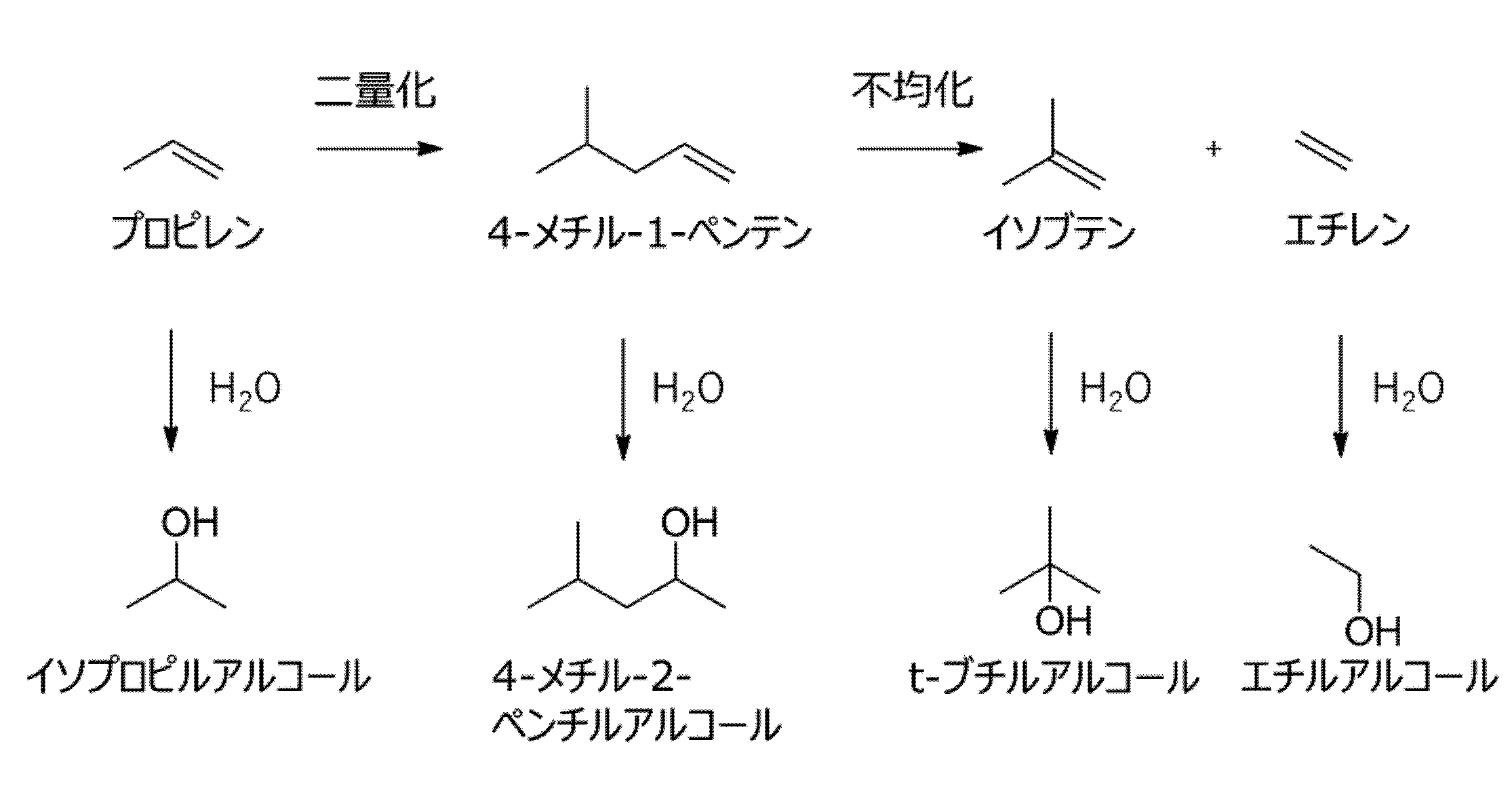
連続反応器1に供給される、原料水に対する原料ガスの質量比は、0.01以上0.20以下であり、0.02以上0.07以下であることが好ましく、0.03以上0.05以下であることがさらに好ましい。連続反応器1に供給される、原料水に対する原料ガスの質量比が0.01未満であると、半導体薬液の生産性が低下し、0.20を超えると、半導体薬液中のt-ブチルアルコール、エチルアルコールおよび炭素数が6であるアルコールの含有率が増大する。
連続反応器1に供給される原料ガスの供給量に対する連続反応器1から排出されるガス成分の排出量の体積比は、0.03以上0.30以下であり、0.11以上0.16以下であることが好ましい。連続反応器1に供給される原料ガスの供給量に対する連続反応器1から排出されるガス成分の排出量の比が0.03未満であると、半導体薬液中のt-ブチルアルコール、エチルアルコールおよび炭素数が6であるアルコールの含有率が増大し、0.30を超えると、プロピレンの転化率が低下する。
ここで、連続反応器1から排出されるガス成分には、原料水に含まれる水、原料ガスに含まれるプロピレン、原料ガスに含まれる不純物(例えば、プロパン)、主生成物(イソプロピルアルコール)、副生成物(例えば、ヘキセン、イソブテン、エチレン)等が含まれる。ヘキセンには、不均化してイソブテン、エチレンとなる可能性のある4-メチル-1-ペンテン等が含まれる。連続反応器1から排出されるガス成分中のイソブテンおよびエチレンの含有率が増大すると、半導体薬液中のt-ブチルアルコールおよびエチルアルコールの含有率が増大する。このため、連続反応器1から排出されるガス成分中のイソブテンの含有率は、0.1体積ppm以上20体積ppm以下であることが好ましく、1体積ppm以上8体積ppm以下であることがさらに好ましい。また、連続反応器1から排出されるガス成分中のエチレンの含有率は、0.1体積ppm以上20体積ppm以下であることが好ましく、1体積ppm以上5体積ppm以下であることがさらに好ましい。
連続反応器1内の原料水の滞在時間は、10分以上25分以下であり、12分以上18分以下であることが好ましい。連続反応器1内の原料水の滞在時間が10分未満であると、プロピレンの転化率が低下し、25分を超えると、半導体薬液中のt-ブチルアルコール、エチルアルコールおよび炭素数が6であるアルコールの含有率が増大する。
なお、連続反応器1内の原料水の滞在時間は、式
(連続反応器1の液相部Lの容積[L])/(原料水の供給速度[L/min])
により求められる。
(連続反応器1の液相部Lの容積[L])/(原料水の供給速度[L/min])
により求められる。
連続反応器1内のガス成分の滞在時間は、10分以上150分以下であり、30分以上100分以下であることが好ましい。連続反応器1内のガス成分の滞在時間が10分未満であると、プロピレンの転化率が低下し、150分を超えると、半導体薬液中のt-ブチルアルコール、エチルアルコールおよび炭素数が6であるアルコールの含有率が増大する。
なお、連続反応器1内のガス成分の滞在時間は、式
(連続反応器1の気相部Gの容積[L])/(ガス成分の排出速度[L/min])
により求められる。連続反応器1内は、高温高圧であるが、連続反応器1内から排出されたガス成分の温度、圧力を、それぞれ25℃、101kPa(絶対圧)にした後に、液相、気相を分析することで、連続反応器1の温度・圧力状態におけるガス成分の排出速度を求めることができる。
(連続反応器1の気相部Gの容積[L])/(ガス成分の排出速度[L/min])
により求められる。連続反応器1内は、高温高圧であるが、連続反応器1内から排出されたガス成分の温度、圧力を、それぞれ25℃、101kPa(絶対圧)にした後に、液相、気相を分析することで、連続反応器1の温度・圧力状態におけるガス成分の排出速度を求めることができる。
連続反応器1内の温度は、200℃以上300℃以下であることが好ましく、250℃以上280℃以下であることがさらに好ましい。連続反応器1内の温度が200℃以上であると、プロピレンの転化率が向上し、300℃以下であると、半導体薬液中のt-ブチルアルコール、エチルアルコールおよび炭素数が6であるアルコールの含有率が低減する。
連続反応器1内の圧力は、150atm以上280atm以下であることが好ましく、200atm以上255atm以下であることがさらに好ましい。連続反応器1内の圧力が150atm以上であると、プロピレンの転化率が向上し、280atm以下であると、半導体薬液中のt-ブチルアルコール、エチルアルコールおよび炭素数が6であるアルコールの含有率が低減する。
プロピレンの転化率は、85%以上97%以下であることが好ましく、92%以上95%以下であることがさらに好ましい。また、イソプロピルアルコールの選択率は、99%以上99.9%以下であることが好ましく、99.5%以上99.8%以下であることがさらに好ましい。
なお、プロピレンの転化率は、連続反応器1に供給されたプロピレンの供給量と系外に排出されたプロピレンの排出量から求められる。系外に排出されるプロピレンとしては、例えば、制御弁2(図1参照)を経由して、連続反応器1の気相部Gから排出されるプロピレン、後述する回収工程、精製工程から反応工程に戻さずに系外に排出されるプロピレンが挙げられる。
(回収工程)
連続反応器1の液相部Lから、反応工程で生成したイソプロピルアルコールおよび原料水を含む液体成分が排出され、回収塔に輸送される。このとき、回収塔内の温度および圧力を、それぞれ所定の範囲とすることで、液体成分に含まれる水に溶解しているプロピレンが分離され、粗イソプロピルアルコール水溶液が回収される。ここで、回収塔の温度は、80℃以上200℃以下であることが好ましく、100℃以上150℃以下であることがより好ましい。また、回収塔の圧力は、100kPa以上5000kPa以下(絶対圧)であることが好ましく、500kPa以上2000kPa以下(絶対圧)であることがより好ましい。
連続反応器1の液相部Lから、反応工程で生成したイソプロピルアルコールおよび原料水を含む液体成分が排出され、回収塔に輸送される。このとき、回収塔内の温度および圧力を、それぞれ所定の範囲とすることで、液体成分に含まれる水に溶解しているプロピレンが分離され、粗イソプロピルアルコール水溶液が回収される。ここで、回収塔の温度は、80℃以上200℃以下であることが好ましく、100℃以上150℃以下であることがより好ましい。また、回収塔の圧力は、100kPa以上5000kPa以下(絶対圧)であることが好ましく、500kPa以上2000kPa以下(絶対圧)であることがより好ましい。
分離されたプロピレンは、ドラムに回収され、原料ガスとして再利用される。粗イソプロピルアルコール水溶液中のイソプロピルアルコールの含有率は、1質量%以上20質量%以下であることが好ましく、3質量%以上8質量%以下であることがより好ましい。
前述したように、従来のイソプロピルアルコールの製造方法において、プロピレンの純度が高い原料ガスを使用すると、t-ブチルアルコールおよびエチルアルコールが副生する。t-ブチルアルコールおよびエチルアルコールは、イソプロピルアルコールとの沸点の差が小さい上に、イソプロピルアルコールと共沸するため、後述する精製工程における蒸留により分離することは非常に困難である。しかしながら、本実施形態によれば、連続反応器1内の原料水の滞在時間および連続反応器1内のガス成分の滞在時間を制御することで、t-ブチルアルコールおよびエチルアルコールが副生量を減少させることができる。このため、粗イソプロピルアルコール水溶液中のイソプロピルアルコールに対するt-ブチルアルコールおよびエチルアルコールの質量比を、それぞれ、1000ppb以下とすることが可能であり、500ppb以下とすることも可能である。また、粗イソプロピルアルコール水溶液中のイソプロピルアルコールに対するt-ブチルアルコールおよびエチルアルコールの質量比は、反応工程および精製工程における費用ならびに収率を考慮すると、それぞれ、10ppb以上であることが好ましく、100ppb以上であることがより好ましく、200ppb以上であることがさらに好ましい。
また、本実施形態によれば、炭素数が6であるアルコールの副生量を減少させることもできる。このため、粗イソプロピルアルコール水溶液中のイソプロピルアルコールに対する炭素数が6であるアルコールの質量比を200ppb以上10000ppb以下とすることが可能であり、2000ppb以上5000ppb以下とすることも可能である。特に、4-メチル-1-ペンテンの水和により生成する4-メチル-2-ペンタノールの副生量が減少すると、t-ブチルアルコールおよびエチルアルコールの副生量が減少することに繋がる。このため、粗イソプロピルアルコール水溶液中のイソプロピルアルコールに対する4-メチル-2-ペンタノールの質量比は、1000ppb以上5000ppb以下であることが好ましく、1000ppb以上3000ppb以下であることがより好ましい。本実施形態の半導体薬液中の炭素数が6であるアルコールの含有量は、後述する精製工程において、粗イソプロピルアルコール水溶液を高沸蒸留塔で蒸留することで、さらに低減させることができる。
(精製工程)
回収塔で回収された粗イソプロピルアルコール水溶液が排出され、精製される。例えば、低沸蒸留塔における蒸留工程、共沸蒸留塔における蒸留工程、脱水工程および高沸蒸留塔における蒸留工程により、粗イソプロピルアルコール水溶液が精製される。
回収塔で回収された粗イソプロピルアルコール水溶液が排出され、精製される。例えば、低沸蒸留塔における蒸留工程、共沸蒸留塔における蒸留工程、脱水工程および高沸蒸留塔における蒸留工程により、粗イソプロピルアルコール水溶液が精製される。
低沸蒸留塔では、イソプロピルアルコールよりも沸点が低い化合物が除去される。イソプロピルアルコールよりも沸点が低い化合物としては、例えば、エチレン、プロピレン、アセトン、ジイソプロピルエーテル、アセトアルデヒド、プロピオンアルデヒド等が挙げられる。共沸蒸留塔では、水と水より沸点の高い化合物が除去され、イソプロピルアルコールと水との共沸混合物が形成される。脱水工程が脱水蒸留塔で実施される場合、水との共沸混合物を形成することが可能な第3成分を脱水蒸留塔内に加え、水と第3成分との共沸混合物を形成することで、水が除去される。分離された水は、タンクに回収され、原料水として再利用される。高沸蒸留塔では、イソプロピルアルコールよりも沸点が高い化合物が除去される。これにより、本実施形態の半導体薬液中の炭素数が6であるアルコールの含有率を1質量ppb以下に減少させることができ、0.1質量ppb以下に減少させることもできる。高沸蒸留塔から取り出された缶出液をフィルターに通すことで粒子を除去することができる。
各蒸留塔における段塔の段数および段塔に換算した蒸留塔の相当段数は、特に制限されないが、5以上320以下であることが好ましく、10以上300以下であることがより好ましい。特に、高沸蒸留塔における段塔の段数および段塔に換算した蒸留塔の相当段数は、5以上20以下であることが好ましい。これにより、本実施形態の半導体薬液中の炭素数が6であるアルコールの含有率を減少させることができる。また、常圧蒸留における環流比は、特に制限されないが、0.5以上50以下であることが好ましく、1以上10以下であることがより好ましい。ここで、常圧とは、90kPa以上120kPa以下(絶対圧)の範囲である。
[半導体薬液]
本実施形態の半導体薬液は、実質的にイソプロピルアルコールからなる。本実施形態の半導体薬液中のイソプロピルアルコールの含有率は、99.99質量%以上であることが好ましく、99.999質量%以上であることがさらに好ましい。
本実施形態の半導体薬液は、実質的にイソプロピルアルコールからなる。本実施形態の半導体薬液中のイソプロピルアルコールの含有率は、99.99質量%以上であることが好ましく、99.999質量%以上であることがさらに好ましい。
本実施形態の半導体薬液中のt-ブチルアルコールの含有率は、1000質量ppb以下であり、500質量ppb以下であることがより好ましい。本実施形態の半導体薬液中のt-ブチルアルコールの含有率が1000質量ppb以下であるため、本実施形態の半導体薬液を使用して、基板を洗浄しても、t-ブチルアルコールの残渣が半導体デバイスに及ぼす影響が低減される。本実施形態の半導体薬液中のt-ブチルアルコールの含有率は、反応工程および精製工程の費用および収率を考慮すると、10質量ppb以上であることが好ましく、100質量ppb以上であることがより好ましく、200質量ppb以上であることがさらに好ましい。
本実施形態の半導体薬液中のエチルアルコールの含有率は、1000質量ppb以下であり、500質量ppb以下であることがより好ましい。本実施形態の半導体薬液中のエチルアルコールの含有率は、反応工程および精製工程の費用および収率を考慮すると、10質量ppb以上であることが好ましく、100質量ppb以上であることがより好ましく、200質量ppb以上であることがさらに好ましい。
本実施形態の半導体薬液に含まれるイソプロピルアルコールは、本実施形態の半導体薬液の製造方法により製造することができる。
本実施形態の半導体薬液中の炭素数が6であるアルコールの含有率は、1質量ppb以下であることが好ましく、0.1質量ppb以下であることがより好ましい。
炭素数が6であるアルコールとしては、例えば、1-ヘキシルアルコール、2-ヘキシルアルコール、3-ヘキシルアルコール、2-メチル-1-ペンチルアルコール、2-メチル-2-ペンチルアルコール、2-メチル-3-ペンチルアルコール、4-メチル-1-ペンチルアルコール、4-メチル-2-ペンチルアルコール、3-メチル-1-ペンチルアルコール、3-メチル-3-ペンチルアルコール、2、3-ジメチル-1-ブチルアルコール、2-エチル-1-ブチルアルコール等の飽和脂肪族アルコールが挙げられる。
従来のイソプロピルアルコールの製造方法において、プロピレンの純度が高い原料ガスを使用すると、炭素数が6であるアルコールとイソプロピルアルコールを分離するために、イソプロピルアルコールを、例えば、水の含有率が100質量ppm以下になるまで脱水した後、高段数の蒸留塔を用いて、高還流比で蒸留しなければならかった。一方、本実施形態の半導体薬液の製造方法では、炭素数が6であるアルコールの副生量を減少させることができるため、本実施形態の半導体薬液中の炭素数が6であるアルコールの含有率を低コストで減少させることができる。
本実施形態の半導体薬液中の水の含有率は、0.1質量ppm以上100質量ppm以下であることが好ましく、1質量ppm以上20質量ppm以下であることがさらに好ましい。
以上、本発明の実施形態について説明したが、本発明は、上記の実施形態に限定されず、本発明の趣旨の範囲内で、上記の実施形態を適宜変更してもよい。
以下、本発明の実施例を説明するが、本発明は、実施例に限定されるものではない。
[測定方法]
(水の含有率)
微量水分測定装置CA-200(三菱ケミカルアナリティック製)を用いて、試料中の水の含有率を測定した。このとき、必要に応じて、イソプロピルアルコールで希釈した後、試料中の水の含有率を測定した。なお、希釈するイソプロピルアルコールは、水の含有率が100質量ppm以下である。また、試料中の水の含有率が100質量ppm以下である場合、露点が-60℃以下であるグローブボックス中において、試料5g以上をテルモシリンジで採取して、試料中の水の含有率を測定した。なお、試料中の水の含有率の定量下限は、1質量ppmである。
(水の含有率)
微量水分測定装置CA-200(三菱ケミカルアナリティック製)を用いて、試料中の水の含有率を測定した。このとき、必要に応じて、イソプロピルアルコールで希釈した後、試料中の水の含有率を測定した。なお、希釈するイソプロピルアルコールは、水の含有率が100質量ppm以下である。また、試料中の水の含有率が100質量ppm以下である場合、露点が-60℃以下であるグローブボックス中において、試料5g以上をテルモシリンジで採取して、試料中の水の含有率を測定した。なお、試料中の水の含有率の定量下限は、1質量ppmである。
(試料中の水の含有率が10質量%以上である場合のアルコールの含有率)
GC-MSを用いて、ヘッドスペース法により試料をサンプリングして、以下に示す測定条件で、試料中のアルコールの含有率を測定した。なお、水(95質量%)およびイソプロピルアルコール(5質量%)からなる標準試料中のt-ブチルアルコールおよびエチルアルコールの含有率の定量下限は、それぞれ5質量ppbであった。また、標準試料中の炭素数が6であるアルコールの含有率の定量下限は、100質量ppbであった。
GC-MSを用いて、ヘッドスペース法により試料をサンプリングして、以下に示す測定条件で、試料中のアルコールの含有率を測定した。なお、水(95質量%)およびイソプロピルアルコール(5質量%)からなる標準試料中のt-ブチルアルコールおよびエチルアルコールの含有率の定量下限は、それぞれ5質量ppbであった。また、標準試料中の炭素数が6であるアルコールの含有率の定量下限は、100質量ppbであった。
-粗イソプロピルアルコール水溶液の測定条件-
装置:7890A/5975C(アジレント・テクノロジー製)
分析カラム:J&W DB-1(60m×0.32mm、5μm)
カラム温度:35℃(2分間保持)→10℃/分で昇温→250℃(6分間保持)
キャリアガス:ヘリウム
注入時圧力:20psi
線速度:31cm/秒
注入口温度:200℃
試料注入法:スプリット法
スプリット比:1対5
注入量:1ml
ヘッドスペース加熱温度:60℃
ヘッドスペース加熱時間:20分
トランスファーライン温度:240℃
イオン源、四重極の温度:230℃、150℃
スキャンイオン:m/z=25~250
SIMモニターイオン:31、59
装置:7890A/5975C(アジレント・テクノロジー製)
分析カラム:J&W DB-1(60m×0.32mm、5μm)
カラム温度:35℃(2分間保持)→10℃/分で昇温→250℃(6分間保持)
キャリアガス:ヘリウム
注入時圧力:20psi
線速度:31cm/秒
注入口温度:200℃
試料注入法:スプリット法
スプリット比:1対5
注入量:1ml
ヘッドスペース加熱温度:60℃
ヘッドスペース加熱時間:20分
トランスファーライン温度:240℃
イオン源、四重極の温度:230℃、150℃
スキャンイオン:m/z=25~250
SIMモニターイオン:31、59
(試料中の水の含有率が10質量%以下である場合のアルコールの含有率)
GC-MSを用いて、以下に示す測定条件で、試料中のアルコールの含有率を測定した。なお、イソプロピルアルコールからなる標準試料中のt-ブチルアルコールおよびエチルアルコールの含有率の定量下限は、それぞれ10質量ppbであった。また、標準試料中の炭素数が6であるアルコールの含有率の定量下限は、10質量ppbであった。
GC-MSを用いて、以下に示す測定条件で、試料中のアルコールの含有率を測定した。なお、イソプロピルアルコールからなる標準試料中のt-ブチルアルコールおよびエチルアルコールの含有率の定量下限は、それぞれ10質量ppbであった。また、標準試料中の炭素数が6であるアルコールの含有率の定量下限は、10質量ppbであった。
-半導体薬液の測定条件-
装置:7890A/5975C(アジレント・テクノロジー製)
分析カラム:J&W DB-1(60m×0.32mm、5μm)
カラム温度:35℃(2分間保持)→10℃/分で昇温→250℃(6分間保持)
キャリアガス:ヘリウム
注入時圧力:20psi
線速度:31cm/秒
注入口温度:200℃
試料注入法:スプリットレス法
注入量:2μl
ヘッドスペース加熱温度:60℃
ヘッドスペース加熱時間:20分
トランスファーライン温度:240℃
イオン源、四重極の温度:230℃、150℃
スキャンイオン:m/z=25~250
SIMモニターイオン:31、59
装置:7890A/5975C(アジレント・テクノロジー製)
分析カラム:J&W DB-1(60m×0.32mm、5μm)
カラム温度:35℃(2分間保持)→10℃/分で昇温→250℃(6分間保持)
キャリアガス:ヘリウム
注入時圧力:20psi
線速度:31cm/秒
注入口温度:200℃
試料注入法:スプリットレス法
注入量:2μl
ヘッドスペース加熱温度:60℃
ヘッドスペース加熱時間:20分
トランスファーライン温度:240℃
イオン源、四重極の温度:230℃、150℃
スキャンイオン:m/z=25~250
SIMモニターイオン:31、59
-原料ガスおよびガス成分の測定条件-
装置:7890A/5975C(アジレント・テクノロジー製)
分析カラム:TC-BOND Alumina/Na2SO4(30m×0.25mm、4μm)
カラム温度:35℃(2分間保持)→10℃/分で昇温→200℃(6分間保持)
キャリアガス:ヘリウム
注入時圧力:18psi
線速度:52cm/秒
注入口温度:150℃
試料注入法:スプリット法
スプリット比:1対5
注入量:1ml
ヘッドスペース加熱温度:60℃
ヘッドスペース加熱時間:20分
トランスファーライン温度:240℃
イオン源、四重極の温度:230℃、150℃
スキャンイオン:m/z=25~150
装置:7890A/5975C(アジレント・テクノロジー製)
分析カラム:TC-BOND Alumina/Na2SO4(30m×0.25mm、4μm)
カラム温度:35℃(2分間保持)→10℃/分で昇温→200℃(6分間保持)
キャリアガス:ヘリウム
注入時圧力:18psi
線速度:52cm/秒
注入口温度:150℃
試料注入法:スプリット法
スプリット比:1対5
注入量:1ml
ヘッドスペース加熱温度:60℃
ヘッドスペース加熱時間:20分
トランスファーライン温度:240℃
イオン源、四重極の温度:230℃、150℃
スキャンイオン:m/z=25~150
(濃縮方法)
本実施例の試料は、不純物の含有率が低減されているため、必要に応じて、測定対象となる試料を濃縮し、イソプロピルアルコールよりも沸点が高い化合物の分析精度を向上させた。以下に濃縮方法を示すが、必要に応じて、下記の操作を繰り返し、濃縮の倍率を変更した。精密蒸留装置で、蒸留塔の塔頂温度を約82℃とし、10時間蒸留した。精密蒸留装置の理論段数は3~30段であり、この範囲であれば、試料を濃縮することができる。また、試料の酸化を防ぐため、精密蒸留装置内に予め窒素を流通させ、不活性ガス雰囲気とした。さらに、蒸留中は、留出液を貯蔵する液だまり部にも窒素を流通させて、不活性ガス雰囲気下で蒸留した。本実施例では、イソプロプロピルアルコールからなる標準試料を1000倍に濃縮した結果、標準試料中の炭素数が6であるアルコールの含有率の定量下限は、0.01質量ppbであった。
本実施例の試料は、不純物の含有率が低減されているため、必要に応じて、測定対象となる試料を濃縮し、イソプロピルアルコールよりも沸点が高い化合物の分析精度を向上させた。以下に濃縮方法を示すが、必要に応じて、下記の操作を繰り返し、濃縮の倍率を変更した。精密蒸留装置で、蒸留塔の塔頂温度を約82℃とし、10時間蒸留した。精密蒸留装置の理論段数は3~30段であり、この範囲であれば、試料を濃縮することができる。また、試料の酸化を防ぐため、精密蒸留装置内に予め窒素を流通させ、不活性ガス雰囲気とした。さらに、蒸留中は、留出液を貯蔵する液だまり部にも窒素を流通させて、不活性ガス雰囲気下で蒸留した。本実施例では、イソプロプロピルアルコールからなる標準試料を1000倍に濃縮した結果、標準試料中の炭素数が6であるアルコールの含有率の定量下限は、0.01質量ppbであった。
[実施例1]
(原料ガス)
原料ガスの組成を分析した。このとき、既知の濃度の標準ガスを作製し、定量した。
プロピレンの含有率:99体積%以上
プロパンの含有率:1000体積ppm
メタンの含有率:0.1体積ppm未満
エタンの含有率:0.1体積ppm未満
エチレンの含有率:0.1体積ppm未満
シクロプロパンの含有率:1体積ppm
1-ブテンの含有率:0.1体積ppm未満
イソブテンの含有率:0.1体積ppm未満
炭素数が5であるアルケン(ペンテン)の含有率:0.1体積ppm未満
炭素数が6であるアルケン(ヘキセン)の含有率:0.1体積ppm未満
原料ガスは、標準状態(101.3kPa、0℃)における密度が1.87×10⁻³kg/Lであった。
(原料ガス)
原料ガスの組成を分析した。このとき、既知の濃度の標準ガスを作製し、定量した。
プロピレンの含有率:99体積%以上
プロパンの含有率:1000体積ppm
メタンの含有率:0.1体積ppm未満
エタンの含有率:0.1体積ppm未満
エチレンの含有率:0.1体積ppm未満
シクロプロパンの含有率:1体積ppm
1-ブテンの含有率:0.1体積ppm未満
イソブテンの含有率:0.1体積ppm未満
炭素数が5であるアルケン(ペンテン)の含有率:0.1体積ppm未満
炭素数が6であるアルケン(ヘキセン)の含有率:0.1体積ppm未満
原料ガスは、標準状態(101.3kPa、0℃)における密度が1.87×10⁻³kg/Lであった。
(原料水)
25℃におけるpHが3.0になるように、水にリンタングステン酸を添加して、原料水を得た。
25℃におけるpHが3.0になるように、水にリンタングステン酸を添加して、原料水を得た。
(反応工程)
内容積22.0Lの連続反応器を、連続反応器の下部に存在する液相部の容積が20.0L、連続反応器の上部に存在する気相部の容積が2.0Lになるように調節した。また、110℃に加温した原料水を45kg/hの供給速度で連続反応器に供給するとともに、原料ガスを3kg/h、すなわち、1.87×103L/h(標準状態換算)の供給速度で連続反応器に供給する一方で、連続反応器の気相部から、200L/h(標準状態換算)の排出速度でガス成分を排出した。このとき、連続反応器内の温度および圧力を、それぞれ280℃および250atmにして、プロピレンと水とを反応させて、イソプロピルアルコールを生成させた。ここで、280℃、250atmにおける原料水の密度が0.75kg/Lであるため、連続反応器内の原料水の滞在時間は20分である。また、280℃、250atmにおけるガス成分の排出速度が1.6L/hであるため、連続反応器内のガス成分の滞在時間は74分である。
内容積22.0Lの連続反応器を、連続反応器の下部に存在する液相部の容積が20.0L、連続反応器の上部に存在する気相部の容積が2.0Lになるように調節した。また、110℃に加温した原料水を45kg/hの供給速度で連続反応器に供給するとともに、原料ガスを3kg/h、すなわち、1.87×103L/h(標準状態換算)の供給速度で連続反応器に供給する一方で、連続反応器の気相部から、200L/h(標準状態換算)の排出速度でガス成分を排出した。このとき、連続反応器内の温度および圧力を、それぞれ280℃および250atmにして、プロピレンと水とを反応させて、イソプロピルアルコールを生成させた。ここで、280℃、250atmにおける原料水の密度が0.75kg/Lであるため、連続反応器内の原料水の滞在時間は20分である。また、280℃、250atmにおけるガス成分の排出速度が1.6L/hであるため、連続反応器内のガス成分の滞在時間は74分である。
表1に、反応工程における反応条件を示す。また、表2に、ガス成分の組成(体積基準)を示す。ここで、へキセン類は、4-メチル-1-ペンテン以外のヘキセンを意味する。

(回収工程)
連続反応器の液相部から液体成分を排出し、回収塔に輸送した。このとき、回収塔内の温度および圧力を、それぞれ140℃および18atmとすることで、液体成分に含まれる水に溶解しているプロピレンを分離し、粗イソプロピルアルコール水溶液を得た。このとき、プロピレンの転化率が95%であり、イソプロピルアルコールの選択率が99.5%であった。一方、分離したプロピレンは、原料ガスとして再利用するために、ドラムに回収した。
連続反応器の液相部から液体成分を排出し、回収塔に輸送した。このとき、回収塔内の温度および圧力を、それぞれ140℃および18atmとすることで、液体成分に含まれる水に溶解しているプロピレンを分離し、粗イソプロピルアルコール水溶液を得た。このとき、プロピレンの転化率が95%であり、イソプロピルアルコールの選択率が99.5%であった。一方、分離したプロピレンは、原料ガスとして再利用するために、ドラムに回収した。
表3に、粗イソプロピルアルコール水溶液の組成(質量基準)を示す。ここで、ヘキサノール類は、4-メチル-2-ペンタノール、2-メチル-2-ペンタノール、2-メチル-3-ペンタノール、3-メチル-3-ペンタノール、3-メチル-1-ペンタノール、2,3-ジメチル-2-ブタノール、4-メチル-1-ペンタノール以外のヘキサノールを意味する。
(精製工程)
粗イソプロピルアルコール水溶液を低沸蒸留塔に供給して、低沸点不純物を除去し、塔底から缶出液を得た。次に、缶出液を共沸蒸留塔に供給して、高沸点不純物を除去し、塔頂からイソプロピルアルコールと水との共沸混合物(質量比87.5:12.5)を得た。次に、共沸混合物を脱水蒸留塔に供給して、脱水し、塔底から缶出液を得た。次に、缶出液を高沸蒸留塔に供給して、高沸点不純物を除去し、塔頂からの留出液を得た。ここで、高沸蒸留塔の段数は15段であった。次に、孔径10nmのフッ素樹脂製のフィルターに留出液を通して、半導体薬液を得た。
粗イソプロピルアルコール水溶液を低沸蒸留塔に供給して、低沸点不純物を除去し、塔底から缶出液を得た。次に、缶出液を共沸蒸留塔に供給して、高沸点不純物を除去し、塔頂からイソプロピルアルコールと水との共沸混合物(質量比87.5:12.5)を得た。次に、共沸混合物を脱水蒸留塔に供給して、脱水し、塔底から缶出液を得た。次に、缶出液を高沸蒸留塔に供給して、高沸点不純物を除去し、塔頂からの留出液を得た。ここで、高沸蒸留塔の段数は15段であった。次に、孔径10nmのフッ素樹脂製のフィルターに留出液を通して、半導体薬液を得た。
表4に、半導体薬液の組成(質量基準)を示す。ここで、ヘキサノールは、炭素数が6であるアルコールを意味する。
[実施例2]
反応工程における原料水の供給速度を60kg/hに変更し、連続反応器内の原料水の滞在時間を15分に変更した以外は、実施例1と同様にして、半導体薬液を得た(表1参照)。このとき、プロピレンの転化率が95%であり、イソプロピルアルコールの選択率が99.5%であった。ガス成分、粗イソプロピルアルコール水溶液および半導体薬液の組成を、表2~4に示した。
反応工程における原料水の供給速度を60kg/hに変更し、連続反応器内の原料水の滞在時間を15分に変更した以外は、実施例1と同様にして、半導体薬液を得た(表1参照)。このとき、プロピレンの転化率が95%であり、イソプロピルアルコールの選択率が99.5%であった。ガス成分、粗イソプロピルアルコール水溶液および半導体薬液の組成を、表2~4に示した。
[実施例3]
反応工程におけるガス成分の排出速度を250L/h(標準状態換算)に変更し、連続反応器内のガス成分の滞在時間を59分に変更した以外は、実施例1と同様にして、半導体薬液を得た(表1参照)。このとき、プロピレンの転化率が94%であり、イソプロピルアルコールの選択率が99.5%であった。ガス成分、粗イソプロピルアルコール水溶液および半導体薬液の組成を、表2~4に示した。
反応工程におけるガス成分の排出速度を250L/h(標準状態換算)に変更し、連続反応器内のガス成分の滞在時間を59分に変更した以外は、実施例1と同様にして、半導体薬液を得た(表1参照)。このとき、プロピレンの転化率が94%であり、イソプロピルアルコールの選択率が99.5%であった。ガス成分、粗イソプロピルアルコール水溶液および半導体薬液の組成を、表2~4に示した。
[実施例4]
反応工程における原料水の供給速度を75kg/hに変更し、連続反応器内の原料水の滞在時間を12分に変更し、反応工程におけるガス成分の排出速度を120L/h(標準状態換算)に変更し、連続反応器内のガス成分の滞在時間を123分に変更した以外は、実施例1と同様にして、半導体薬液を得た(表1参照)。このとき、プロピレンの転化率が97%であり、イソプロピルアルコールの選択率が99.5%であった。ガス成分、粗イソプロピルアルコール水溶液および半導体薬液の組成を、表2~4に示した。
反応工程における原料水の供給速度を75kg/hに変更し、連続反応器内の原料水の滞在時間を12分に変更し、反応工程におけるガス成分の排出速度を120L/h(標準状態換算)に変更し、連続反応器内のガス成分の滞在時間を123分に変更した以外は、実施例1と同様にして、半導体薬液を得た(表1参照)。このとき、プロピレンの転化率が97%であり、イソプロピルアルコールの選択率が99.5%であった。ガス成分、粗イソプロピルアルコール水溶液および半導体薬液の組成を、表2~4に示した。
[実施例5]
反応工程における原料水の供給速度を75kg/hに変更し、連続反応器内の原料水の滞在時間を12分に変更し、反応工程におけるガス成分の排出速度を250L/h(標準状態換算)に変更し、連続反応器内のガス成分の滞在時間を59分に変更した以外は、実施例1と同様にして、半導体薬液を得た(表1参照)。このとき、プロピレンの転化率が94%であり、イソプロピルアルコールの選択率が99.5%であった。ガス成分、粗イソプロピルアルコール水溶液および半導体薬液の組成を、表2~4に示した。
反応工程における原料水の供給速度を75kg/hに変更し、連続反応器内の原料水の滞在時間を12分に変更し、反応工程におけるガス成分の排出速度を250L/h(標準状態換算)に変更し、連続反応器内のガス成分の滞在時間を59分に変更した以外は、実施例1と同様にして、半導体薬液を得た(表1参照)。このとき、プロピレンの転化率が94%であり、イソプロピルアルコールの選択率が99.5%であった。ガス成分、粗イソプロピルアルコール水溶液および半導体薬液の組成を、表2~4に示した。
[実施例6]
反応工程における原料水の供給速度を80kg/hに変更し、連続反応器内の原料水の滞在時間を11分に変更し、反応工程におけるガス成分の排出速度を500L/h(標準状態換算)に変更し、連続反応器内のガス成分の滞在時間を30分に変更した以外は、実施例1と同様にして、半導体薬液を得た(表1参照)。このとき、プロピレンの転化率が88%であり、イソプロピルアルコールの選択率が99.5%であった。ガス成分、粗イソプロピルアルコール水溶液および半導体薬液の組成を、表2~4に示した。
反応工程における原料水の供給速度を80kg/hに変更し、連続反応器内の原料水の滞在時間を11分に変更し、反応工程におけるガス成分の排出速度を500L/h(標準状態換算)に変更し、連続反応器内のガス成分の滞在時間を30分に変更した以外は、実施例1と同様にして、半導体薬液を得た(表1参照)。このとき、プロピレンの転化率が88%であり、イソプロピルアルコールの選択率が99.5%であった。ガス成分、粗イソプロピルアルコール水溶液および半導体薬液の組成を、表2~4に示した。
[比較例1]
反応工程における原料水の供給速度およびガス成分の排出速度を、それぞれ30kg/hおよび標準状態換算80L/h(反応器内の体積0.65L/h)に変更し、連続反応器内の原料水およびガス成分の滞在時間を、それぞれ30分および185分に変更した以外は、実施例1と同様にして、半導体薬液を得た(表1参照)。このとき、プロピレンの転化率が98%であり、イソプロピルアルコールの選択率が99.5%であった。ガス成分、粗イソプロピルアルコール水溶液および半導体薬液の組成を、表2~4に示した。
反応工程における原料水の供給速度およびガス成分の排出速度を、それぞれ30kg/hおよび標準状態換算80L/h(反応器内の体積0.65L/h)に変更し、連続反応器内の原料水およびガス成分の滞在時間を、それぞれ30分および185分に変更した以外は、実施例1と同様にして、半導体薬液を得た(表1参照)。このとき、プロピレンの転化率が98%であり、イソプロピルアルコールの選択率が99.5%であった。ガス成分、粗イソプロピルアルコール水溶液および半導体薬液の組成を、表2~4に示した。
[比較例2]
反応工程におけるガス成分の排出速度を30L/h(標準状態換算)に変更し、連続反応器内のガス成分の滞在時間を494分に変更した以外は、実施例1と同様にして、半導体薬液を得た(表1参照)。このとき、プロピレンの転化率が99%であり、イソプロピルアルコールの選択率が99.5%であった。ガス成分、粗イソプロピルアルコール水溶液および半導体薬液の組成を、表2~4に示した。
反応工程におけるガス成分の排出速度を30L/h(標準状態換算)に変更し、連続反応器内のガス成分の滞在時間を494分に変更した以外は、実施例1と同様にして、半導体薬液を得た(表1参照)。このとき、プロピレンの転化率が99%であり、イソプロピルアルコールの選択率が99.5%であった。ガス成分、粗イソプロピルアルコール水溶液および半導体薬液の組成を、表2~4に示した。
[比較例3]
反応工程における原料水の供給速度を30kg/hに変更し、連続反応器内の原料水の滞在時間を30分に変更した以外は、実施例1と同様にして、半導体薬液を得た(表1参照)。このとき、プロピレンの転化率が95%であり、イソプロピルアルコールの選択率が99.5%であった。ガス成分、粗イソプロピルアルコール水溶液および半導体薬液の組成は、表2~4に示した。
反応工程における原料水の供給速度を30kg/hに変更し、連続反応器内の原料水の滞在時間を30分に変更した以外は、実施例1と同様にして、半導体薬液を得た(表1参照)。このとき、プロピレンの転化率が95%であり、イソプロピルアルコールの選択率が99.5%であった。ガス成分、粗イソプロピルアルコール水溶液および半導体薬液の組成は、表2~4に示した。
表4から、実施例1~6の半導体薬液は、t-ブチルアルコール、エチルアルコールおよびヘキサノールの含有率が低いことがわかる。これに対して、比較例1の半導体薬液は、連続反応器内の原料水およびガス成分の滞在時間が、それぞれ30分および185分であるため、t-ブチルアルコール、エチルアルコールおよびヘキサノールの含有率が高い。比較例2の半導体薬液は、連続反応器内のガス成分の滞在時間が494分であるとともに、C/Bが0.02であるため、t-ブチルアルコール、エチルアルコールおよびヘキサノールの含有率が高い。比較例3の半導体薬液は、連続反応器内の原料水の滞在時間が30分であるため、t-ブチルアルコール、エチルアルコールおよびヘキサノールの含有率が高い。
1 連続反応器
2 制御弁
G 気相部
L 液相部
2 制御弁
G 気相部
L 液相部
Claims (6)
- 実質的にイソプロピルアルコールからなる半導体薬液であって、
t-ブチルアルコールの含有率が1000質量ppb以下であり、
エチルアルコールの含有率が1000質量ppb以下である、半導体薬液。 - さらに、炭素数が6であるアルコールの含有率が1質量ppb以下である、請求項1に記載の半導体薬液。
- 実質的にイソプロピルアルコールからなる半導体薬液を製造する方法であって、
プロピレンを含み、イソブテンの含有率が1体積ppm以下であり、エチレンの含有率が1体積ppm以下である原料ガスおよび原料水を連続反応器に供給して、反応させる工程を含み、
前記反応させる際に、前記連続反応器は、気相部および液相部が存在し、前記気相部からガス成分を排出し、
前記連続反応器に供給される、原料水に対する原料ガスの質量比が0.01以上0.20以下であり、
前記連続反応器に供給される原料水の供給速度[L/分]に対する前記液相部の容積[L]の比である、前記連続反応器内の前記原料水の滞在時間が10分以上25分以下であり、
前記連続反応器から排出されるガス成分の排出速度[L/分]に対する前記気相部の容積[L]の比である、前記連続反応器内の前記ガス成分の滞在時間が10分以上150分以下であり、
前記連続反応器に供給される原料ガスの供給量に対する前記連続反応器から排出されるガス成分の排出量の体積比が0.03以上0.30以下である、半導体薬液の製造方法。 - 前記液相部から粗イソプロピルアルコール水溶液を回収する工程と、
前記粗イソプロピルアルコール水溶液を高沸蒸留塔で蒸留する工程と、をさらに含む、請求項3に記載の半導体薬液の製造方法。 - 前記原料ガスは、プロピレンの含有率が99体積%以上である、請求項3または4に記載の半導体薬液の製造方法。
- 前記連続反応器内の温度が200℃以上300℃以下であり、
前記連続反応器内の圧力が150atm以上280atm以下である、請求項3または4に記載の半導体薬液の製造方法。
Priority Applications (3)
| Application Number | Priority Date | Filing Date | Title |
|---|---|---|---|
| KR1020257041758A KR20260021637A (ko) | 2023-06-13 | 2024-05-07 | 반도체 약액 및 반도체 약액의 제조방법 |
| JP2024551616A JP7634139B1 (ja) | 2023-06-13 | 2024-05-07 | 半導体洗浄用薬液および半導体洗浄用薬液の製造方法 |
| CN202480027193.1A CN121039789A (zh) | 2023-06-13 | 2024-05-07 | 半导体药液及半导体药液的制造方法 |
Applications Claiming Priority (2)
| Application Number | Priority Date | Filing Date | Title |
|---|---|---|---|
| JP2023-096884 | 2023-06-13 | ||
| JP2023096884 | 2023-06-13 |
Publications (1)
| Publication Number | Publication Date |
|---|---|
| WO2024257504A1 true WO2024257504A1 (ja) | 2024-12-19 |
Family
ID=93851967
Family Applications (1)
| Application Number | Title | Priority Date | Filing Date |
|---|---|---|---|
| PCT/JP2024/016925 Ceased WO2024257504A1 (ja) | 2023-06-13 | 2024-05-07 | 半導体薬液および半導体薬液の製造方法 |
Country Status (5)
| Country | Link |
|---|---|
| JP (1) | JP7634139B1 (ja) |
| KR (1) | KR20260021637A (ja) |
| CN (1) | CN121039789A (ja) |
| TW (1) | TW202500541A (ja) |
| WO (1) | WO2024257504A1 (ja) |
Citations (2)
| Publication number | Priority date | Publication date | Assignee | Title |
|---|---|---|---|---|
| JP2002121160A (ja) * | 2000-10-16 | 2002-04-23 | Mitsui Chemicals Inc | イソプロピルアルコールの製造方法 |
| WO2017217279A1 (ja) * | 2016-06-17 | 2017-12-21 | 株式会社トクヤマ | イソプロピルアルコールの製造方法及び不純物が低減されたイソプロピルアルコール |
Family Cites Families (2)
| Publication number | Priority date | Publication date | Assignee | Title |
|---|---|---|---|---|
| JP6980952B1 (ja) * | 2020-04-02 | 2021-12-15 | 株式会社トクヤマ | 半導体処理液及びその製造方法 |
| US20250171718A1 (en) * | 2022-03-16 | 2025-05-29 | Tokuyama Corporation | Semiconductor cleaning liquid and method for producing semiconductor cleaning liquid |
-
2024
- 2024-05-07 KR KR1020257041758A patent/KR20260021637A/ko active Pending
- 2024-05-07 CN CN202480027193.1A patent/CN121039789A/zh active Pending
- 2024-05-07 JP JP2024551616A patent/JP7634139B1/ja active Active
- 2024-05-07 WO PCT/JP2024/016925 patent/WO2024257504A1/ja not_active Ceased
- 2024-05-09 TW TW113117119A patent/TW202500541A/zh unknown
Patent Citations (2)
| Publication number | Priority date | Publication date | Assignee | Title |
|---|---|---|---|---|
| JP2002121160A (ja) * | 2000-10-16 | 2002-04-23 | Mitsui Chemicals Inc | イソプロピルアルコールの製造方法 |
| WO2017217279A1 (ja) * | 2016-06-17 | 2017-12-21 | 株式会社トクヤマ | イソプロピルアルコールの製造方法及び不純物が低減されたイソプロピルアルコール |
Also Published As
| Publication number | Publication date |
|---|---|
| JP7634139B1 (ja) | 2025-02-20 |
| KR20260021637A (ko) | 2026-02-13 |
| TW202500541A (zh) | 2025-01-01 |
| CN121039789A (zh) | 2025-11-28 |
| JPWO2024257504A1 (ja) | 2024-12-19 |
Similar Documents
| Publication | Publication Date | Title |
|---|---|---|
| KR102313108B1 (ko) | 이소프로필 알코올의 제조 방법 및 불순물이 저감된 이소프로필 알코올 | |
| JP7118898B2 (ja) | イソプロピルアルコール組成物及びイソプロピルアルコールの製造方法 | |
| JP7402385B1 (ja) | 半導体洗浄液および半導体洗浄液の製造方法 | |
| JP6810304B2 (ja) | 洗浄液及び高純度イソプロピルアルコールの製造方法 | |
| KR102471394B1 (ko) | 반도체 처리액 및 그 제조 방법 | |
| KR102486605B1 (ko) | 공액 디엔의 제조 방법 | |
| US7217849B2 (en) | Method for the preparation of n-propyl bromide | |
| JP7634139B1 (ja) | 半導体洗浄用薬液および半導体洗浄用薬液の製造方法 | |
| JP5531101B2 (ja) | トリメチロールプロパンの色数を改善する方法 | |
| TWI458700B (zh) | Method for separating epoxycyclohexane with n-pentanol | |
| RU2523011C2 (ru) | Способ очистки циклогексанона | |
| CN1413971A (zh) | 1.3-丙二醇中羰基物质的脱除方法 | |
| PL173885B1 (pl) | 1. Sposób otrzymywania cykloheksanonu o wysokiej czystości i niskiej zawartości aldehydów z produktów utleniania cykloheksanu i/lub produktów odwodorniania cykloheksanolu w procesie destylacji, w którym oddziela się zanieczyszczenia niżej wrzące od cykloheksanonu,wyodrębnia czysty cykloheksanon, wydziela cykloheksanol z pozostawieniem produktów wysokowrzących, a następnie wydzielony cykloheksanol po odwodomieniu zawraca do destylacji, znamienny tym, ze po wyodrębnieniu z produktów utleniania cykloheksanu i/lub produktów odwodorniania cykloheksanolu związków niżej wrzących od cykloheksanonu, pozostałą mieszaninę poddaje się destylacji w kolumnie pracującej pod ciśnieniem 30-100 Torr, w której czysty cykloheksanon odbiera się jako strumień boczny, z miejsca powyżej którego liczba półek teoretycznych stanowi 2-25% całkowitej liczby półek teoretycznych w kolumnie, natomiast destylat w sposób ciągły lub periodyczny zawraca się w ilości stanowiącej 0.05-3% strumienia bocznego do kolumny, w której wyodrębnia się zanieczyszczenia niżej wrzące od cykloheksanonu lub wykorzystuje do innych celów. | |
| JPH09309858A (ja) | アセトンの精製方法 |
Legal Events
| Date | Code | Title | Description |
|---|---|---|---|
| WWE | Wipo information: entry into national phase |
Ref document number: 2024551616 Country of ref document: JP |
|
| 121 | Ep: the epo has been informed by wipo that ep was designated in this application |
Ref document number: 24823126 Country of ref document: EP Kind code of ref document: A1 |
|
| NENP | Non-entry into the national phase |
Ref country code: DE |
|
| WWE | Wipo information: entry into national phase |
Ref document number: 11202508344X Country of ref document: SG |
|
| WWP | Wipo information: published in national office |
Ref document number: 11202508344X Country of ref document: SG |