WO2024257550A1 - マグロ類の養魚用飼料、養魚用飼料群、マグロ類の養魚用飼料の製造方法、及びマグロ類の養殖方法 - Google Patents
マグロ類の養魚用飼料、養魚用飼料群、マグロ類の養魚用飼料の製造方法、及びマグロ類の養殖方法 Download PDFInfo
- Publication number
- WO2024257550A1 WO2024257550A1 PCT/JP2024/018373 JP2024018373W WO2024257550A1 WO 2024257550 A1 WO2024257550 A1 WO 2024257550A1 JP 2024018373 W JP2024018373 W JP 2024018373W WO 2024257550 A1 WO2024257550 A1 WO 2024257550A1
- Authority
- WO
- WIPO (PCT)
- Prior art keywords
- fish
- feed
- tuna
- farming
- farmed
- Prior art date
- Legal status (The legal status is an assumption and is not a legal conclusion. Google has not performed a legal analysis and makes no representation as to the accuracy of the status listed.)
- Ceased
Links
Images




Classifications
-
- A—HUMAN NECESSITIES
- A23—FOODS OR FOODSTUFFS; TREATMENT THEREOF, NOT COVERED BY OTHER CLASSES
- A23K—FODDER
- A23K20/00—Accessory food factors for animal feeding-stuffs
- A23K20/10—Organic substances
- A23K20/158—Fatty acids; Fats; Products containing oils or fats
-
- A—HUMAN NECESSITIES
- A23—FOODS OR FOODSTUFFS; TREATMENT THEREOF, NOT COVERED BY OTHER CLASSES
- A23K—FODDER
- A23K10/00—Animal feeding-stuffs
- A23K10/20—Animal feeding-stuffs from material of animal origin
-
- A—HUMAN NECESSITIES
- A23—FOODS OR FOODSTUFFS; TREATMENT THEREOF, NOT COVERED BY OTHER CLASSES
- A23K—FODDER
- A23K10/00—Animal feeding-stuffs
- A23K10/20—Animal feeding-stuffs from material of animal origin
- A23K10/22—Animal feeding-stuffs from material of animal origin from fish
-
- A—HUMAN NECESSITIES
- A23—FOODS OR FOODSTUFFS; TREATMENT THEREOF, NOT COVERED BY OTHER CLASSES
- A23K—FODDER
- A23K20/00—Accessory food factors for animal feeding-stuffs
- A23K20/10—Organic substances
- A23K20/163—Sugars; Polysaccharides
-
- A—HUMAN NECESSITIES
- A23—FOODS OR FOODSTUFFS; TREATMENT THEREOF, NOT COVERED BY OTHER CLASSES
- A23K—FODDER
- A23K40/00—Shaping or working-up of animal feeding-stuffs
- A23K40/20—Shaping or working-up of animal feeding-stuffs by moulding, e.g. making cakes or briquettes
-
- A—HUMAN NECESSITIES
- A23—FOODS OR FOODSTUFFS; TREATMENT THEREOF, NOT COVERED BY OTHER CLASSES
- A23K—FODDER
- A23K40/00—Shaping or working-up of animal feeding-stuffs
- A23K40/25—Shaping or working-up of animal feeding-stuffs by extrusion
-
- A—HUMAN NECESSITIES
- A23—FOODS OR FOODSTUFFS; TREATMENT THEREOF, NOT COVERED BY OTHER CLASSES
- A23K—FODDER
- A23K40/00—Shaping or working-up of animal feeding-stuffs
- A23K40/30—Shaping or working-up of animal feeding-stuffs by encapsulating; by coating
-
- A—HUMAN NECESSITIES
- A23—FOODS OR FOODSTUFFS; TREATMENT THEREOF, NOT COVERED BY OTHER CLASSES
- A23K—FODDER
- A23K50/00—Feeding-stuffs specially adapted for particular animals
- A23K50/80—Feeding-stuffs specially adapted for particular animals for aquatic animals, e.g. fish, crustaceans or molluscs
Definitions
- This disclosure relates to tuna fish feed, fish feed groups, a method for producing tuna fish feed, and a method for cultivating tuna.
- Patent Document 1 discloses fish farming feed for raising mackerel fish, and in particular fish farming feed suitable for tuna farming.
- tuna farming when feeding with compound feed, much of the fed feed often sinks and is not consumed. This is thought to be because when switching from the previous feed to compound feed, the tuna are unable to recognize it as food early due to the difference in the sinking speed.
- Compound feed is relatively dense and sinks quickly, so it is thought that feed that sinks more slowly is desirable.
- the relationship between shape and sinking speed has been investigated for small objects such as sand and gravel, but not much is known about compound feed, which is a larger object. Therefore, the present disclosure provides tuna farming feed with a slow sinking speed, a group of farmed fish feeds, and a method for producing farmed tuna feed. It also provides a method for farming tuna using such tuna farming feed.
- One aspect of the present disclosure provides fish feed for farming tuna, which has a flattened body portion such that the length along a thickness direction perpendicular to the width direction and the longitudinal direction is shorter than the length in the width direction perpendicular to the longitudinal direction, and which satisfies at least one selected from the group consisting of the following (A) and (B):
- A) When the maximum length along the longitudinal direction is a (mm), the maximum length along the width direction is b (mm), and the maximum length along the thickness direction is c (mm), the flattening ratio f1 calculated by the following formula (1) is 110 or more: f1 a ⁇ b / c (1)
- the above-mentioned tuna farming feed satisfies at least one selected from the group consisting of the flatness f1 being 110 or more, and the (V/A) 1/2 being 0.110 or less.
- the flatness f1 or (V/A) 1/2 of the fish farming feed is within this range, the settling speed of the fish farming feed in the fish cage can be slowed down.
- tuna fish feed that has a sinking speed of 15.0 cm/s or less between a depth of 15.0 cm and a depth of 35.2 cm from the water surface. Such fish feed can slow down the sinking speed in a fish cage.
- One aspect of the present disclosure provides a fish farming feed group that includes multiple tuna fish farming feeds, and has an average sinking velocity of 15.5 cm/s or less between a depth of 15.0 cm and a depth of 35.2 cm from the water surface.
- a fish farming feed group can slow down the sinking velocity in a fish cage.
- One aspect of the present disclosure provides a method for producing feed for farmed tuna fish, the method comprising the steps of radially compressing and crushing a molded product having a body portion of a substantially cylindrical shape, and deforming the body portion so that the radial cross section of the molded product is flattened.
- the above-mentioned method for producing tuna fish feed includes a process of crushing a molded product having a body portion and deforming the body portion so that the radial cross section is flattened. This production process makes it possible to easily produce fish feed with a flat body portion.
- the fish feed obtained by the above process can slow down the settling speed in the fish cage.
- One aspect of the present disclosure provides a method for cultivating tuna using the above-mentioned tuna farming feed.
- This farming method can reduce the variation in fish size of the farmed fish in the cages and improve the growth rate of the farmed fish.
- the present disclosure can provide tuna farming feed with a slow sinking rate, a group of farmed fish feeds, and a method for producing tuna farming feed. It can also provide a method for farming tuna using such tuna farming feed.
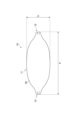
- FIG. 2 is a front view of fish feed.
- FIG. 2 is a plan view of fish feed.
- FIG. 2 is a side view of fish feed.
- 6 is a cross-sectional view taken along line VI-VI in FIG. 2 is a cross-sectional view taken along line VV in FIG. 1.
- FIG. 2 is a perspective view showing a part of fish feed.
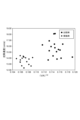
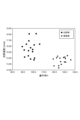
- FIG. 1 is a diagram showing an example of an apparatus for producing fish feed. 1 is a graph plotting the relationship between (V/A) 1/2 and sedimentation velocity of fish feed in Examples and Comparative Examples. 1 is a graph plotting the relationship between flatness f1 and settling velocity of fish feed in Examples and Comparative Examples. 1 is a graph showing the change in feeding rate of bluefin tuna in a normal feed area and a flat feed area.
- the feed for farming tuna has a flattened body portion such that the length along the thickness direction perpendicular to the width and longitudinal directions is shorter than the length along the width direction perpendicular to the longitudinal directions, and satisfies at least one selected from the group consisting of (A) and (B) below.
- the tuna farming feed of the second embodiment has a sinking velocity of 15.0 cm/s or less between a depth of 15.0 cm and a depth of 35.2 cm from the water surface.
- the fish feed which is a common example of the first and second embodiments, has a shape shown in Figures 1, 2, and 3.
- the fish feed 10 has a pair of tapered portions 12 at both ends in the longitudinal direction, and a body portion 11 between the pair of tapered portions 12.
- the maximum length a along the longitudinal direction of the fish feed 10 may be equal to the distance between the ends of the pair of tapered portions 12.
- the maximum length c along the thickness direction shown in Figures 1 and 3 is shorter than the maximum length b along the width direction shown in Figures 2 and 3. In other words, b>c.
- b may be 1.1 times or more, 1.2 times or more, 1.3 times or more, 1.4 times or more, 1.5 times or more, 1.6 times or more, or 1.7 times or more than c. Because there is a risk that the fish feed will collapse if it is crushed by applying strong pressure, b is preferably 3 times or less, 2.5 times or less, or 2 times or less than c. In this way, the fish feed 10 has a body portion 11 that is flattened so that the maximum length c along the thickness direction is shorter than the maximum length b along the width direction. For this reason, the fish feed 10 can also be called flat feed.
- the size of the fish farming feed 10 is adjusted according to the size of the fish. It is preferable that the fish farming feed 10 does not differ significantly from the size and shape of the fish that the fish normally feed on in the wild. From the perspective of creating a shape that tuna species prefer, the fish farming feed 10 may have a body part that is a cylinder with a length of about 5 to 20 cm and a diameter of about 1 to 5 cm in the radial cross section that has been crushed slightly flat. Tuna species tend to prefer such shapes. In the case of such feed, farmed fish tend to first grab the body part with their mouths and then swallow the feed vertically. Since such behavior is common to normal feeding behavior, it is considered that the approximately cylindrical fish farming feed 10 is suitable for feeding tuna species.
- the fish feed 10 has a flattened body 11, which allows it to sink slower in water than fish feed of the same volume with a cylindrical body, and increases the frequency with which the farmed fish come into contact with the feed. This allows the farmed fish to be fed early and reduces the variation in size of the farmed fish. It also improves the growth rate of the farmed fish.
- the maximum lengths a, b, and c can be measured as follows.
- the fish feed 10 is placed on a flat plate. At this time, the fish feed 10 is placed on the flat plate in the most stable orientation.
- the maximum length a along the longitudinal direction may be measured by viewing the fish feed 10 from the front as shown in FIG. 1, or may be measured by viewing the fish feed 10 from the top as shown in FIG. 2.
- the maximum length b along the width direction may be measured by viewing the fish feed 10 from the top as shown in FIG. 2, or may be measured by viewing the fish feed 10 from the side as shown in FIG. 3.
- the maximum length c along the thickness direction may be measured by viewing the fish feed 10 from the front as shown in FIG. 1, or may be measured by viewing the fish feed 10 from the side as shown in FIG. 3.
- the maximum lengths a, b, and c may be measured using, for example, an electronic caliper or a visual analyzer (product name: IRIS VA400, manufactured by Alpha Moss Japan Co., Ltd.).
- the width direction and thickness direction of the fish feed 10 are both perpendicular to the longitudinal direction of the fish feed 10.
- the width direction and thickness direction are perpendicular to each other.
- the maximum length b in the width direction and the maximum length c in the thickness direction may be lengths measured in one cross section perpendicular to the longitudinal direction, i.e., one transverse cross section. In this case, among the transverse cross sections of the fish feed 10, the cross section in which the maximum lengths b and c are measured has the largest cross-sectional area.
- the flatness f1 of the fish feed 10 calculated by the above formula (1) may be 110 or more. It is known that the settling velocity in water of relatively large gravel shows a negative correlation with the flatness f1 (Hachiro Kira, "On the relationship between the shape factor and the settling velocity of sand gravel particles," [online], Agricultural Engineering Research, 1957-1958, Vol. 25, No. 3, pp. 183-187, [Retrieved May 31, 2023], Internet, ⁇ URL: https://doi.org/10.11408/jjsidre1929.25.183>).
- the fish feed 10 disclosed herein having a flatness f1 of 110 or more is a sufficiently flattened feed, so that it is easy to form a shape preferred by tuna, and in addition, the settling velocity can be sufficiently slowed.
- the tuna can be fed early, reducing the variation in size of the farmed fish. It can also improve the growth rate of the farmed fish.
- the flattening ratio f1 may be 115 or more, 120 or more, 125 or more, 130 or more, 135 or more, or 140 or more. From the viewpoint of sufficiently increasing the durability of the fish feed 10, the flattening ratio f1 may be 200 or less, or 190 or less.
- the flattening ratio f1 may be in the range of 110 to 200, 115 to 200, 120 to 200, 125 to 200, 130 to 200, 135 to 200, 140 to 200, 110 to 190, 115 to 190, 120 to 190, 125 to 190, 130 to 190, 135 to 190, or 140 to 190.
- the maximum length a may be 40-200 mm, 50-150 mm, 60-100 mm, 70-80 mm, or 72-78 mm.
- the maximum length b may be 10-70 mm, 20-50 mm, 25-35 mm, or 27-33 mm.
- the maximum length c may be 3-50 mm, 5-40 mm, 8-30 mm, 10-20 mm, or 14-18 mm. a, b, and c may be adjusted as appropriate depending on the size of the tuna to be fed.
- V/A 1/2 When the volume of the fish feed 10 is V (cm 3 ) and the area of the fish feed 10 when viewed in a plane as shown in FIG. 2 is A (mm 2 ), (V/A) 1/2 may be 0.110 or less. V represents the volume of the sediment, and A represents the area when viewed in a plane. It is known that in water with relatively large gravel, the settling velocity in water shows a positive correlation with (V/A) 1/2 (Hachiro Kira, "On the relationship between the shape factor of gravel particles and the settling velocity," [online], Agricultural Civil Engineering Research, 1957-1958, Vol. 25, No. 3, pp. 183-187, [Retrieved May 31, 2023], Internet, ⁇ URL: https://doi.org/10.11408/jjsidre1929.25.183>).
- (V/A) 1/2 0.110 or less, the sinking rate can be sufficiently slowed.
- tuna can be fed early, and the variation in size of the farmed fish can be reduced.
- the growth rate of the farmed fish can be improved.
- (V/A) 1/2 may be 0.109 or less, 0.108 or less, or 0.107 or less.
- (V/A) 1/2 may be 0.080 or more, 0.090 or more, or 0.100 or more.
- the range of (V/A) 1/2 may be 0.080 to 0.110, 0.080 to 0.109, 0.080 to 0.108, 0.080 to 0.107, 0.090 to 0.110, 0.090 to 0.109, 0.090 to 0.108, 0.090 to 0.107, 0.100 to 0.110, 0.100 to 0.109, 0.100 to 0.108, or 0.100 to 0.107.
- the area A when viewed from above can be measured, for example, using a visual analyzer (product name: IRIS VA400, manufactured by Alpha Moss Japan Co., Ltd.).
- the volume V can be calculated from the weight (g) of the fish feed 10 and the density of the fish feed 10.
- the density can be determined by the weight of the fish feed 10 and the Archimedes method using water. For example, the weight of the feed is measured, 100 ml of water is added to a 200 ml measuring cylinder, the feed is poured into it, and immediately water is pumped out with a dropper until it reaches the 100 ml line of the measuring cylinder, and the weight of the water is measured.
- the volume V of the fish feed 10 may be 5 to 100 cm 3 , 10 to 40 cm 3 , 12 to 30 cm 3 , 15 to 25 cm 3 , or 18 to 22 cm 3.
- the area A of the fish feed 10 in a plan view may be 500 to 3000 mm 2 , 1000 to 2500 mm 2 , 1500 to 1800 mm 2 , or 1550 to 1750 mm 2.
- the density of the fish feed 10 can be adjusted depending on the components contained therein. Considering the components necessary for efficient growth of tuna, the density of the fish feed 10 may be in the range of 1.04 to 1.30 (g/cm 3 ), 1.05 to 1.25 (g/cm 3 ), 1.07 to 1.20 (g/cm 3 ), or 1.08 to 1.15 (g/cm 3 ).
- the fish farming feed 10 satisfies at least one of the above-mentioned conditions selected from the group consisting of the flatness f1 being 110 or more and (V/A) 1/2 being 0.110 or less.
- the sinking speed of such fish farming feed 10 is sufficiently slow. Therefore, by using such fish farming feed 10 for tuna farming, the tuna can be fed early, and the size variation of the farmed fish can be reduced. In addition, the growth rate of the farmed fish can be improved.
- the sinking speed of the fish feed 10 between a depth of 15.0 cm and a depth of 35.2 cm based on the water surface may be 15.0 cm/s or less. With the sinking speed in this range, the frequency of contact of the tuna with the feed during farming is increased, allowing for earlier feeding and reducing the variation in size of the tuna after farming. From the viewpoint of further reducing the variation in size of the farmed fish, the sinking speed may be 14.0 cm/s or less, 13.5 cm/s or less, or 13.0 cm/s or less. From the viewpoint of shortening the time it takes for the farmed fish to take in the feed and improving the farming efficiency, the sinking speed may be 1.0 cm/s or more, 3.0 cm/s or more, or 5.0 cm/s or more.
- the sinking velocity of the fish feed 10 can be calculated by dropping the fish feed 10 in a state where the fish feed 10 is in contact with the water surface with the thickness direction of the fish feed 10 perpendicular to the water surface into a tank filled with 3% salt water at an initial velocity of 0, measuring the travel time from a depth of 15.0 cm to a depth of 35.2 cm with the water surface as the reference, and dividing the traveled distance (20.2 cm) by the travel time.
- the settling velocity range may be 1.0-15.0 cm/s, 1.0-14.0 cm/s, 1.0-13.5 cm/s, 1.0-13.0 cm/s, 3.0-15.0 cm/s, 3.0-14.0 cm/s, 3.0-13.5 cm/s, 3.0-13.0 cm/s, 5.0-15.0 cm/s, 5.0-14.0 cm/s, 5.0-13.5 cm/s, or 5.0-13.0 cm/s.
- Multiple fish feeds may be fed by dumping them into seawater together, rather than feeding them separately one by one.
- the required amount of fish feed may be fed in several batches, or the required amount may be fed all at once.
- multiple fish feeds are referred to as a fish feed group. Fish feed groups will be described later.
- the body portion 11 may have a tapered portion 13 that becomes thinner from the center toward both ends in the longitudinal direction.
- the shape of the fish feed 10 becomes closer to that of small fish that are live bait, making it easier for the farmed fish to recognize it as bait, and thus further increasing the frequency with which the farmed fish come into contact with the fish feed 10. This makes it possible to further reduce variation in the body size of the farmed fish.
- the constricted portions 12 may be located at both ends of the fish feed 10 in the longitudinal direction and may protrude in the opposite direction from the center of the fish feed 10.
- the constricted portions 12 may be configured by being crimped to the ends of the outer shell 20.
- the tapered portion 13 and the constricted portion 12 of the body portion 11 can be formed by crimping the kneaded raw material composition during extrusion molding using a twin-screw extruder or the like. By having the constricted portions 12, leakage of oils and fish meal contained in the body portion 11 can be reduced.
- an inflection portion 14 is formed, which has a curved surface that is concave outward toward the end and gradually reduces in diameter.
- the presence of this inflection portion 14 allows the outer diameter to resemble that of the small fish that serve as bait, further increasing the palatability of the tuna fish feed 10.
- the fish feed 10 may have an inner shell 30 and an outer shell 20 that encases the inner shell 30.
- the inner shell 30 may contain a composition containing fish meal and oils.
- the nutrition contained in the fish feed 10 becomes closer to that of small fish, and the farmed fish can be supplied with the proteins and lipids necessary for their growth.
- the composition composition may be changed as appropriate depending on the type of tuna to be fed.
- the fish meal may be any of various fish meals commonly used as fish feed ingredients, or powder of crustaceans such as krill.
- the fish meal content in the inner casing 30 may be, for example, 30% by mass or more, 35% by mass or more, or 45% by mass or more.
- the fish meal content may be 70% by mass or less. By using fish meal, it is possible to supply the tuna with the protein necessary for their growth.
- An example of the fish meal content is 30 to 70% by mass.
- the oils and fats are not particularly limited, and examples thereof include fish oil, soybean oil, corn oil, and rapeseed oil.
- the oils and fats may be fish oil, since it is possible to supply the tuna with lipids rich in omega-3 fatty acids necessary for the growth of the tuna.
- the content of the oils and fats in the inclusion 30 may be, for example, 30% by mass or more, 35% by mass or more, or 45% by mass or more.
- the content of the oils and fats may be 70% by mass or less.
- An example of the content of the oils and fats is 30 to 70% by mass.
- a component that reduces the fluidity of the oil may be added.
- components that reduce fluidity include powdered soy protein New Fujipro SEH (trade name, manufactured by Fuji Oil Co., Ltd.), Vitacell WF200, Vitacell WF600, or Vitacell WF600/30 (trade name, manufactured by Rettenmeyer), Oil Q No.
- Oil Q-S (trade name, manufactured by Nippon Starch Chemical Co., Ltd.), and dextran such as Pine Flow (trade name, manufactured by Matsutani Chemical Industry Co., Ltd.), oil-absorbing polysaccharides such as fermented soybeans, oil-absorbing proteins such as isoflavones, and hardened oils obtained by hydrogenating oils.
- the content of these components that reduce the fluidity of the oil may be 10% by mass or less, or 5% by mass or less, of the composition in the inclusion 30.
- the hardened oil may be a white solid fat obtained by hydrogenating fish oil, soybean oil, corn oil, rapeseed oil, etc. and solidifying it.
- the oil before hardening contains unsaturated fatty acids such as oleic acid, linoleic acid, linolenic acid, and other highly unsaturated fatty acids as component fatty acids.
- Hydrogenated oil is obtained by adding hydrogen to unsaturated fatty acids, reducing the amount of unsaturated fatty acids, and finally becoming saturated fatty acids and solid fats. By adding hardened oil, liquid oil can be made into a paste-like or solid state.
- hardened oil having a melting point of 50°C or higher.
- Such hardened oils include hardened oils in which the main component of the fatty acid that constitutes the hardened oil (the fatty acid with the largest amount in the fatty acid composition) is a fatty acid with 18 or more carbon atoms and the iodine value (the mass of iodine absorbed by 100 g of oil (unit: g)) is 0 to 2.
- the iodine value of hardened oils sold as extremely hardened oils falls within this range.
- the viscosity of the encapsulation 30 is improved, and the mechanical suitability when the encapsulation 30 is wrapped in the outer skin 20 and molded is also improved.
- the viscosity of the oil is improved, so that the leakage of oil when the fish feed 10 is flattened can be further reduced.
- composition in the casing 30 may contain raw materials used in conventional fish feed.
- raw fish squid meal, krill meal, soybean meal, corn gluten meal, and other proteins
- starches such as starch, wheat flour, rice flour, tapioca flour, corn flour, and other starches, alginic acid and its salts, sodium carboxymethylcellulose (CMC), guar gum, dextrin, chitosan, curdlan, pectin, carrageenan, mannan, gellan gum, gum arabic, edible water-soluble cellulose, and other polysaccharides, vitamins, minerals, and the like may be added.
- CMC carboxymethylcellulose
- guar gum dextrin
- chitosan curdlan
- pectin pectin
- carrageenan mannan
- gellan gum gellan gum
- gum arabic edible water-soluble cellulose
- other polysaccharides vitamins, minerals, and the like
- the outer skin 20 may contain a heated gel of starch and a protein.
- the components constituting the outer skin 20 are not particularly limited as long as they can encase the inclusion 30. From the viewpoint of improving flexibility and extensibility, proteins or starches that gel when heated can be used.
- the proteins may be protein-containing substances such as fish meat, minced fish, krill, gluten, collagen, soy protein, enzymatically decomposed soy protein, gelatin, or egg white, or a mixture of two or more of these.
- the starches may be tapioca starch, wheat starch, potato starch, corn starch, soybean starch, waxy corn starch, or processed starches thereof. Food materials containing a large amount of the above proteins and starches may also be used.
- the composition containing protein and starch is gelled by heating, and has flexibility and a certain strength.
- a component that gels when heated and melted and then released heat or cooled may be added. Examples of such components include gelatin and agar.
- the outer skin 20 may contain fish meal and oils and fats to the extent that the gelation of the outer skin 20 is not affected.
- the fish meal content in the outer skin 20 may be 20 to 30% by mass.
- the oil and fat content may be 5 to 10% by mass.
- starch used in the outer skin 20 tapioca starch, wheat starch, potato starch, corn starch, soybean starch, etc. can be used, and in particular processed starches such as etherified, acetylated, acetyl-crosslinked, ether-crosslinked, phosphate-crosslinked, and alpha-hydroxypropyl phosphate-crosslinked starches can be used.
- the starch content in the outer skin 20 may be appropriately changed depending on the species of fish being farmed.
- the starch content in the outer skin 20 may be, for example, 20 to 80% by mass, or 20 to 65% by mass.
- water is added to the starch, and the gel heated by kneading the mixture can have elasticity, flexibility, and extensibility.
- two or more types of processed starch may be combined.
- different types of processed starch may be combined, such as a combination of etherified starch and phosphate cross-linked starch.
- proteins such as gluten and soy protein
- wheat flour containing gluten may be used.
- cereal flour such as wheat flour, soy protein, gluten, egg white, sugar, sugar alcohols such as starch syrup, carrageenan, agar, gellan gum, pullulan, mannan, xanthan gum, locust bean gum, curdlan, pectin, thickeners such as alginic acid and its salts, gum arabic, chitosan, dextrin, edible water-soluble cellulose, and salts such as phosphates.
- cereal flour such as wheat flour, soy protein, gluten, egg white, sugar, sugar alcohols such as starch syrup, carrageenan, agar, gellan gum, pullulan, mannan, xanthan gum, locust bean gum, curdlan, pectin, thickeners such as alginic acid and its salts, gum arabic, chitosan, dextrin, edible water-soluble cellulose, and salts such as phosphates.
- adding wheat flour to starch can give strength to the outer shell 20.
- thickening polysaccharides isolated soy protein, sodium bicarbonate, polymerized phosphate, transglutaminase, and various protease inhibitors may be contained.
- thickening agents such as agar, gellan gum, pullulan, mannan, carrageenan, xanthan gum, locust bean gum, curdlan, pectin, alginic acid and its salts, gum arabic, chitosan, dextrin, and edible water-soluble cellulose may be appropriately blended.
- the content of the thickening agent in the outer skin 20 may be 10% by mass or less, 5% by mass or less, or 1.5% by mass or less.
- the narrowed portion 12 has traces 21 where the outer skin 20 constituting the outer surface has been narrowed in the direction of the end.
- These traces 21 can be composed of, for example, multiple radial lines. These lines can be distinguished visually or by touch, and are also thought to promote feeding by tuna. These lines may be configured as grooves that do not reach the inner capsule 30.
- the traces 21 may be formed by narrowing the outer skin 20 in the axial direction.
- the fish farming feed group includes multiple tuna fish farming feeds, and has an average settling velocity of 15.5 cm/s or less between a depth of 15.0 cm and a depth of 35.2 cm from the water surface.
- the "average settling velocity" is the arithmetic mean value of the settling velocity of each fish farming feed.
- the number of fish farming feeds constituting the fish farming feed group is not particularly limited, and may be 3 or more, 5 or more, 10 or more, or 15 or more. The number may be 1000 or less.
- the number of fish farming feeds constituting the fish farming feed group may be 3 to 1000, 5 to 1000, 10 to 1000, or 15 to 1000.
- the average sinking velocity of the fish feed group may be 15.5 cm/s or less, 15.0 cm/s or less, 14.5 cm/s or less, 14.0 cm/s or less, 13.5 cm/s or less, or 13.0 cm/s or less.
- the average sinking velocity of the fish feed group may be 1.0 cm/s or more, 3.0 cm/s or more, or 5.0 cm/s or more.
- the range of average settling velocity of the fish feed group may be 1.0-15.5 cm/s, 1.0-15.0 cm/s, 1.0-14.5 cm/s, 1.0-14.0 cm/s, 1.0-13.5 cm/s, 1.0-13.0 cm/s, 3.0-15.5 cm/s, 3.0-15.0 cm/s, 3.0-14.5 cm/s, 3.0-14.0 cm/s, 3.0-13.5 cm/s, 3.0-13.0 cm/s, 5.0-15.5 cm/s, 5.0-15.0 cm/s, 5.0-14.5 cm/s, 5.0-14.0 cm/s, 5.0-13.5 cm/s, or 5.0-13.0 cm/s.
- the standard deviation of the sinking speed of the fish feed contained in the fish feed group may be 1.30 cm/s or less, 1.20 cm/s or less, 1.10 cm/s or less, 1.00 cm/s or less, 0.90 cm/s or less, 0.80 cm/s or less, or 0.70 cm/s or less.
- the standard deviation may also be 0.01 cm/s or more.
- the range of standard deviation of the settling velocity of the fish feed contained in the fish feed group may be 0.01 to 1.30 cm/s, 0.01 to 1.20 cm/s, 0.01 to 1.10 cm/s, 0.01 to 1.00 cm/s, 0.01 to 0.90 cm/s, 0.01 to 0.80 cm/s, or 0.01 to 0.70 cm/s.
- a method for producing tuna farming feed includes a step of radially compressing and crushing a molded product having a substantially cylindrical body, and deforming the body so that the radial cross section of the molded product is flattened.
- the radial length of the molded product changes, and fish farming feed having a flattened body can be obtained.
- the longitudinal length a of the fish farming feed 10 may also be changed.
- the fish farming feed obtained by such a manufacturing method has a slower sinking speed in water, and the frequency with which farmed fish come into contact with the fish farming feed 10 can be increased.
- the molded product is obtained by molding a mixture of the raw material composition into a generally cylindrical shape.
- the raw material composition can be obtained by mixing the raw materials constituting the inner shell 30 and the outer shell 20 described above.
- the molded product can be obtained by mixing the raw materials for the inner shell 30 and the outer shell 20 separately and enveloping them using an extruder with a double nozzle or an enveloping machine. Mixing and molding can also be performed continuously while heating and mixing the raw materials using a twin-screw extruder with a double nozzle. Heating can be performed at 60 to 120°C or 70 to 100°C from the viewpoint of gelling starch and protein. T-Sage (manufactured by Farm Choice Co., Ltd.) can be used as the molded product produced in this way.
- the term "approximately cylindrical shape” does not necessarily require a strict geometric cylindrical shape, but rather it is sufficient if it is recognizable at a glance as being cylindrical or a similar shape. Therefore, it is acceptable for the cross section to be somewhat irregular or flattened, or for the cross section to be flattened due to its own weight or the overlapping of feed.
- the length and width of this approximately cylindrical shape can be adjusted as appropriate depending on the species and size of the tuna fish to be fed.
- the obtained molded product is pressurized in the radial direction to deform the body so that the radial cross section is flattened. Pressurization can be done by hand by an operator, or by pressing radially while rotating a roller.
- FIG 7 shows an example of a manufacturing device that produces fish feed 10 by pressing the molded product while rotating rollers.
- the pressurizing device 50 includes a conveyor 40 that transports the molded product 32 before it is pressed and the fish feed 10 after it is pressed, and a roller 34 arranged above the conveyor 40.
- the shaft 36 that rotatably supports the roller 34 may be suspended by a suspension jig (not shown).
- the pressure applied to the molded product 32 can be adjusted by adjusting the size of this gap.
- the shaft 36 supporting the rollers 34 may be suspended so as to be movable in the vertical direction.
- the amount of deformation of the molded product 32 i.e., the maximum lengths a, b, and c of the fish feed 10, may be adjusted by changing the amount of movement in the vertical direction.
- the pressure device 50 By using the pressure device 50, the molded product 32 can be deformed more efficiently than by flattening it by hand, improving the production efficiency of the fish feed 10. In addition, the variation in shape can be reduced.
- the manufacturing device for producing the fish feed 10 is not limited to the structure shown in Figure 7.
- the fish feed 10 may be produced without a conveyor by pressing the molded products 32 arranged on a stationary table with rollers attached to a horizontally moving shaft.
- the multiple fish feeds 10 may be produced using the same method.
- Such fish feeds 10 can suppress variation in sinking speed.
- a group of fish feeds consisting of such fish feeds 10 can increase the probability that the tuna will recognize the fish feeds 10 as food, since all of the fish feeds 10 can be in contact with the tuna for a long period of time.
- the tuna farming method may include a step of feeding the farmed fish with the fish feed 10.
- the farmed fish come into contact with the fish feed 10 more frequently, and are fed earlier. This reduces the variation in body size of the farmed fish, and improves the growth rate.
- the body size of the tuna in the cage can be measured using a commercially available camera for measuring fish size.
- the fish may be fed directly by hand, or an air feeder may be used. Using an air feeder reduces the burden on the workers and allows feeding to be done over a wide area at once.
- [2] The fish feed for tuna farming according to [1], wherein the sinking velocity from a depth of 15.0 cm to a depth of 35.2 cm with respect to the water surface is 15.0 cm/s or less.
- [3] The feed for farming tuna fish described in [1] or [2], wherein the body portion has a tapered portion that becomes narrower from the center toward both ends in the longitudinal direction.
- [4] The feed for farming tuna fish described in any one of [1] to [3], comprising a pair of narrowed portions at both ends in the longitudinal direction, and the body portion between the pair of narrowed portions.
- the body portion has a composition containing fish meal and oil and an outer skin containing a heat-induced starch gel containing the composition;
- the feed for farming tuna fish according to any one of [1] to [4], which has a narrowed portion formed by crimping the end of the outer skin at both ends in the longitudinal direction.
- Feed for farming tuna fish having a sinking velocity of 15.0 cm/s or less between a depth of 15.0 cm and a depth of 35.2 cm from the water surface.
- a group of fish farming feeds containing a plurality of tuna fish farming feeds the group of fish farming feeds having an average sinking velocity of 15.5 cm/s or less between a depth of 15.0 cm and a depth of 35.2 cm from the water surface.
- a method for producing feed for farmed tuna fish comprising a step of radially compressing and crushing a molded article having a substantially cylindrical body portion, and deforming the body portion so that the radial cross section of the molded article is flattened.
- a method for cultivating tuna comprising a step of feeding tuna farming feed according to any one of the above [1] to [6], the group of farming feeds according to [7] or [8], or the farming feed for tuna obtained by the production method according to [9] or [10].
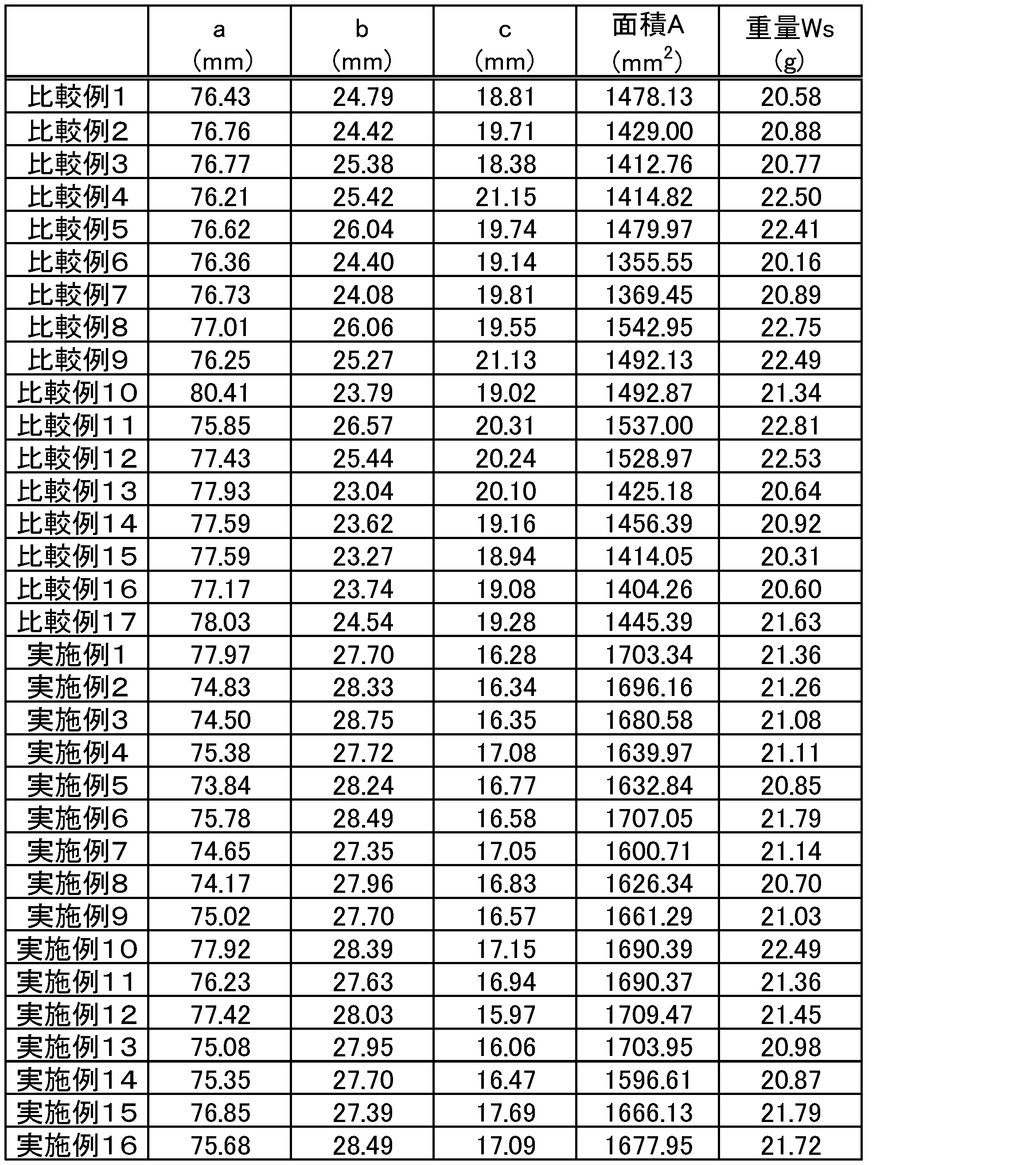
- a visual analyzer (product name: IRIS VA400, manufactured by Alpha Moss Japan Co., Ltd.) was used to measure the area A (mm 2 ) when viewed in a plan view.
- the maximum length a (mm) along the longitudinal direction, the maximum length b (mm) along the width direction, and the maximum length c (mm) along the thickness direction of each control feed and each flat feed were measured using an electronic caliper.
- the weight Ws (g) was measured using an electronic balance.
- Table 1 The measurement results of the maximum length a (mm) along the longitudinal direction, the maximum length b (mm) along the width direction, the maximum length c (mm) along the thickness direction, the area A (mm 2 ), and the weight Ws (g) measured in each comparative example and each example are shown in Table 1.
- the measured a, b, and c were substituted into the following formula (1) to calculate the flattening ratio f1.
- the volume V (cm 3 ) was calculated from the weight and density of each feed, and (V/A) 1/2 was calculated from the volume V and area A.
- Table 2 shows the volume V (cm 3 ), flatness f1, and (V/A) 1/2 of each of the comparative examples and examples.
- f1 a ⁇ b/c (1)
- Fig. 8 is a graph showing the results of Table 2 plotted with the settling velocity on the vertical axis and (V/A) 1/2 on the horizontal axis.
- Fig. 9 is a graph showing the results of Table 2 plotted with the settling velocity on the vertical axis and the flattening ratio f1 on the horizontal axis.
- the average settling velocity of the fish farming feed groups of Examples 1 to 16 was 13.58 cm/s, and the average settling velocity of the fish farming feed groups of Comparative Examples 1 to 17 was 15.59 cm/s.
- the standard deviation of the settling velocity of the fish farming feed groups of Examples 1 to 16 was 0.62 cm/s, and the standard deviation of the settling velocity of the fish farming feed groups of Comparative Examples 1 to 17 was 1.31 cm/s.
- the settling velocity tended to increase as the value of (V/A) 1/2 increased.
- the settling velocity tended to decrease as the flatness ratio f1 increased.
- the use of flattened feed reduced the variation in the settling velocity, and the settling velocity of the entire feed at the time of feeding could be slowed.
- the entire feed can be brought into contact with the tuna more efficiently.
- This slow sinking speed is that flattening the feed increases the area A of the feed, making it more susceptible to resistance when dropping through the water.
- the frequency of contact between the feed and the tuna can be increased, reducing the variation in feeding of the tuna in the cage.
- the tuna can be made larger in size, allowing for farming of tuna with better quality.
- a number of tuna fish feeds with cylindrical body parts (manufactured by Farm Choice Co., Ltd., product name: T-Sage, specification: SSS) were prepared. Some of these were used as control feeds. The remaining part of the approximately cylindrical body part was pressed against the body part while rotating a roller, and pressure was applied in the radial direction to crush it, obtaining flat feeds with the shape shown in Figures 1 to 6. 15 pieces of control feeds and flat feeds were prepared.
- a control feed group consisting of 15 control feeds was used as Comparative Example 18, and a flat feed group consisting of 15 flat feeds was used as Example 17.
- Comparative Example 18 and Example 17 the settling speed of each feed in the group was measured, and the average settling speed and standard deviation were calculated. As a result, the average settling speed of Comparative Example 18 was 16.2 cm/s and the standard deviation was 1.4 cm/s. The average settling speed of Example 17 was 14.3 cm/s and the standard deviation was 0.7 cm/s.
- a feeding test of bluefin tuna was conducted using the control feed group (control: Comparative Example 18) and the flat feed group (test: Example 17) prepared as described above.
- the cages fed with the control feed were used as the control feed area, and the cages fed with the flat feed were used as the flat feed area for bluefin tuna aquaculture, and the growth conditions of bluefin tuna due to the difference in feed were compared.
- Bluefin tuna raised on moist pellets were deprived of food for one day, and then the control feed area was fed the control feed, and the flat feed area was fed the flat feed.
- the feeding period was three months for each. Feeding was performed once in the morning and once in the afternoon (twice a day), and the amount of food fed in each test area was recorded. In the flat feed area, flat feed was used for one month from the start of feeding, and the control feed was used as in the control feed area thereafter.
- Figure 10 shows the change in the feeding rate of bluefin tuna from the start of feeding.
- the feeding rate shown in Figure 10 was calculated as the ratio of the amount of feed consumed to the body weight of the bluefin tuna, using a five-day moving average.
- the feeding rate of bluefin tuna in the flat feed area increased more quickly than in the normal feed area. This is thought to be because the flat feed has a slower average sinking speed in water, which increased the frequency of bluefin tuna contact with the feed, allowing the bluefin tuna to recognize the feed as food at an earlier stage. Therefore, it was confirmed that the use of flat feed makes it possible to feed bluefin tuna at an earlier stage.
- the present disclosure can provide tuna farming feed with a slow sinking rate, a group of farmed fish feeds, and a method for producing tuna farming feed. It can also provide a method for farming tuna using such tuna farming feed.
Landscapes
- Life Sciences & Earth Sciences (AREA)
- Chemical & Material Sciences (AREA)
- Polymers & Plastics (AREA)
- Engineering & Computer Science (AREA)
- Zoology (AREA)
- Food Science & Technology (AREA)
- Animal Husbandry (AREA)
- Marine Sciences & Fisheries (AREA)
- Biotechnology (AREA)
- Molecular Biology (AREA)
- Physiology (AREA)
- Biomedical Technology (AREA)
- Health & Medical Sciences (AREA)
- Insects & Arthropods (AREA)
- Birds (AREA)
- Feed For Specific Animals (AREA)
Abstract
Description
(A)上記長手方向に沿う最大長さをa(mm)、上記幅方向に沿う最大長さをb(mm)、及び上記厚さ方向に沿う最大長さをc(mm)としたときに、下記式(1)で算出される扁平率f1が110以上
f1=a×b/c (1)
(B)上記養魚用飼料の体積をV(cm3)、及び上記養魚用飼料を平面視したときの面積をA(mm2)としたとき、(V/A)1/2が0.110以下
(A)長手方向に沿う最大長さをa(mm)、幅方向に沿う最大長さをb(mm)、及び厚さ方向に沿う最大長さをc(mm)としたときに、下記式(1)で算出される扁平率f1が110以上
f1=a×b/c (1)
(B)養魚用飼料の体積をV(cm3)、及び養魚用飼料を平面視したときの面積をA(mm2)としたとき、(V/A)1/2が0.110以下
飼料の密度(g/cm3)=重量(g)/汲みだされた水の重量(g=cm3)
[1]長手方向に直交する幅方向の長さよりも前記幅方向及び前記長手方向に直交する厚さ方向に沿う長さの方が短くなるように扁平した胴体部を備え、以下の(A)及び(B)からなる群より選ばれる少なくとも1つを満たす、マグロ類の養魚用飼料。
(A)前記長手方向に沿う最大長さをa(mm)、前記幅方向に沿う最大長さをb(mm)、及び前記厚さ方向に沿う最大長さをc(mm)としたときに、下記式(1)で算出される扁平率f1が110以上
f1=a×b/c (1)
(B)前記養魚用飼料の体積をV(cm3)、及び前記養魚用飼料を平面視したときの面積をA(mm2)としたとき、(V/A)1/2が0.110以下
[2]水面を基準として深さ15.0cmから深さ35.2cmの間における沈降速度が15.0cm/s以下である、[1]に記載のマグロ類の養魚用飼料。
[3]前記胴体部は、前記長手方向における中央から両端に向かうにつれて細くなるテーパー部を有する、[1]又は[2]に記載のマグロ類の養魚用飼料。
[4]前記長手方向における両端に一対の絞り部と、前記一対の絞り部の間に前記胴体部と、を備える、[1]~[3]のいずれか一つに記載のマグロ類の養魚用飼料。
[5]前記胴体部は、魚粉及び油脂を含む組成物と、前記組成物を内包する澱粉の加熱ゲルを含む外皮と、を有し、
前記長手方向における両端に前記外皮の端部が圧着されて構成される絞り部を有する、[1]~[4]のいずれか一つに記載のマグロ類の養魚用飼料。
[6]水面を基準として深さ15.0cmから深さ35.2cmの間における沈降速度が15.0cm/s以下である、マグロ類の養魚用飼料。
[7]マグロ類の養魚用飼料を複数含む養魚用飼料群であって、水面を基準として深さ15.0cmから深さ35.2cmの間における平均沈降速度が15.5cm/s以下である、養魚用飼料群。
[8]前記養魚用飼料の沈降速度の標準偏差が、1.30cm/s以下である、[7]に記載の養魚用飼料群。
[9]略円柱形状の胴体部を備える成形物を径方向に加圧して押し潰し、前記成形物の径方向断面が扁平するように前記胴体部を変形させる工程を有する、マグロ類の養魚用飼料の製造方法。
[10]前記工程では、前記胴体部に対してローラーを回転しながら押圧して前記胴体部を変形させる、[9]に記載のマグロ類の養魚用飼料の製造方法。
[11]上記[1]~[6]のいずれか一つに記載のマグロ類の養魚用飼料、[7]又は[8]に記載の養魚用飼料群、又は、[9]又は[10]に記載の製造方法で得られたマグロ類の養魚用飼料を給餌する工程を有する、マグロ類の養殖方法。
(実施例1~16、比較例1~17)
円柱状の胴体部を有するマグロ類の養魚用飼料(ファームチョイス株式会社製、商品名:T~セージ、規格:SS)を複数準備した。飼料33本の密度をアルキメデス法により測定したところ、密度の平均値は1.117(g/cm3)であり、密度の標準偏差は0.017(g/cm3)であった。なお、密度の最小値は1.071(g/cm3)であり、密度の最大値は1.148(g/cm3)であった。このうち、17個を対照飼料(比較例1~17)とした。別の16個の飼料を胴体部の径方向に加圧して押しつぶし、扁平した胴体部を有する扁平飼料を実施例(実施例1~16)とした。
f1=a×b/c (1)
各飼料の一対の絞り部を指で把持し、厚さ方向が水槽の水面と直交するような向きで水面に近づけた。飼料の下端が水面に接した時点で飼料を離し、試料を水槽中に落とした。水面を基準として深さ15cmの位置から深さ35.2cmの位置まで沈降するのに所要する時間を測定した。移動距離(20.2cm)と所要時間から、各飼料の沈降速度を算出した。得られた結果を表2に示した。

扁平飼料の効果を確認するため、実際にクロマグロを養殖している生簀内に対照飼料と扁平飼料とを給餌し、給餌率及び生簀内のクロマグロの成長率を飼料ごとに比較する実験を行った。

Claims (11)
- 長手方向に直交する幅方向の長さよりも前記幅方向及び前記長手方向に直交する厚さ方向に沿う長さの方が短くなるように扁平した胴体部を備え、以下の(A)及び(B)からなる群より選ばれる少なくとも1つを満たす、マグロ類の養魚用飼料。
(A)前記長手方向に沿う最大長さをa(mm)、前記幅方向に沿う最大長さをb(mm)、及び前記厚さ方向に沿う最大長さをc(mm)としたときに、下記式(1)で算出される扁平率f1が110以上
f1=a×b/c (1)
(B)前記養魚用飼料の体積をV(cm3)、及び前記養魚用飼料を平面視したときの面積をA(mm2)としたとき、(V/A)1/2が0.110以下 - 水面を基準として深さ15.0cmから深さ35.2cmの間における沈降速度が15.0cm/s以下である、請求項1に記載のマグロ類の養魚用飼料。
- 前記胴体部は、前記長手方向における中央から両端に向かうにつれて細くなるテーパー部を有する、請求項1に記載のマグロ類の養魚用飼料。
- 前記長手方向における両端に一対の絞り部と、前記一対の絞り部の間に前記胴体部と、を備える、請求項1に記載のマグロ類の養魚用飼料。
- 前記胴体部は、魚粉及び油脂を含む組成物と、前記組成物を内包する澱粉の加熱ゲルを含む外皮と、を有し、
前記長手方向における両端に前記外皮の端部が圧着されて構成される絞り部を有する、請求項1に記載のマグロ類の養魚用飼料。 - 水面を基準として深さ15.0cmから深さ35.2cmの間における沈降速度が15.0cm/s以下である、マグロ類の養魚用飼料。
- マグロ類の養魚用飼料を複数含む養魚用飼料群であって、水面を基準として深さ15.0cmから深さ35.2cmの間における平均沈降速度が15.5cm/s以下である、養魚用飼料群。
- 前記養魚用飼料の沈降速度の標準偏差が1.30cm/s以下である、請求項7に記載の養魚用飼料群。
- 略円柱形状の胴体部を備える成形物を径方向に加圧して押し潰し、前記成形物の径方向断面が扁平するように前記胴体部を変形させる工程を有する、マグロ類の養魚用飼料の製造方法。
- 前記工程では、前記胴体部に対してローラーを回転しながら押圧して前記胴体部を変形させる、請求項9に記載のマグロ類の養魚用飼料の製造方法。
- 請求項1~6のいずれか一項に記載のマグロ類の養魚用飼料、請求項7又は8に記載の養魚用飼料群、又は、請求項9又は10に記載の製造方法で得られたマグロ類の養魚用飼料を給餌する工程を有する、マグロ類の養殖方法。
Priority Applications (4)
| Application Number | Priority Date | Filing Date | Title |
|---|---|---|---|
| AU2024305657A AU2024305657A1 (en) | 2023-06-14 | 2024-05-17 | Feed for farmed fish including tuna fish, feed group for farmed fish, method for producing feed for farmed fish including tuna fish, and method for farming tuna fish |
| JP2025527590A JPWO2024257550A1 (ja) | 2023-06-14 | 2024-05-17 | |
| EP24823172.2A EP4728873A1 (en) | 2023-06-14 | 2024-05-17 | Feed for farmed fish including tuna fish, feed group for farmed fish, method for producing feed for farmed fish including tuna fish, and method for farming tuna fish |
| US19/414,156 US20260090569A1 (en) | 2023-06-14 | 2025-12-09 | Feed for Farmed Tuna, Feed Group for Farmed Fish, Method for Producing Feed for Farmed Fish Including Tuna Fish, and Method for Farming Tuna Fish |
Applications Claiming Priority (2)
| Application Number | Priority Date | Filing Date | Title |
|---|---|---|---|
| JP2023097615 | 2023-06-14 | ||
| JP2023-097615 | 2023-06-14 |
Related Child Applications (1)
| Application Number | Title | Priority Date | Filing Date |
|---|---|---|---|
| US19/414,156 Continuation US20260090569A1 (en) | 2023-06-14 | 2025-12-09 | Feed for Farmed Tuna, Feed Group for Farmed Fish, Method for Producing Feed for Farmed Fish Including Tuna Fish, and Method for Farming Tuna Fish |
Publications (1)
| Publication Number | Publication Date |
|---|---|
| WO2024257550A1 true WO2024257550A1 (ja) | 2024-12-19 |
Family
ID=93852093
Family Applications (1)
| Application Number | Title | Priority Date | Filing Date |
|---|---|---|---|
| PCT/JP2024/018373 Ceased WO2024257550A1 (ja) | 2023-06-14 | 2024-05-17 | マグロ類の養魚用飼料、養魚用飼料群、マグロ類の養魚用飼料の製造方法、及びマグロ類の養殖方法 |
Country Status (5)
| Country | Link |
|---|---|
| US (1) | US20260090569A1 (ja) |
| EP (1) | EP4728873A1 (ja) |
| JP (1) | JPWO2024257550A1 (ja) |
| AU (1) | AU2024305657A1 (ja) |
| WO (1) | WO2024257550A1 (ja) |
Citations (3)
| Publication number | Priority date | Publication date | Assignee | Title |
|---|---|---|---|---|
| JPH07222556A (ja) * | 1994-01-28 | 1995-08-22 | Ewos Ab | 魚用餌ペレットの製造方法及び餌ペレット並びに餌ペレット製造装置 |
| JP3243497B2 (ja) * | 1993-03-12 | 2002-01-07 | 日清飼料株式会社 | 養魚用固形飼料およびその製造方法 |
| WO2019177024A1 (ja) | 2018-03-13 | 2019-09-19 | 日本水産株式会社 | 養魚用飼料 |
-
2024
- 2024-05-17 JP JP2025527590A patent/JPWO2024257550A1/ja active Pending
- 2024-05-17 AU AU2024305657A patent/AU2024305657A1/en active Pending
- 2024-05-17 WO PCT/JP2024/018373 patent/WO2024257550A1/ja not_active Ceased
- 2024-05-17 EP EP24823172.2A patent/EP4728873A1/en active Pending
-
2025
- 2025-12-09 US US19/414,156 patent/US20260090569A1/en active Pending
Patent Citations (3)
| Publication number | Priority date | Publication date | Assignee | Title |
|---|---|---|---|---|
| JP3243497B2 (ja) * | 1993-03-12 | 2002-01-07 | 日清飼料株式会社 | 養魚用固形飼料およびその製造方法 |
| JPH07222556A (ja) * | 1994-01-28 | 1995-08-22 | Ewos Ab | 魚用餌ペレットの製造方法及び餌ペレット並びに餌ペレット製造装置 |
| WO2019177024A1 (ja) | 2018-03-13 | 2019-09-19 | 日本水産株式会社 | 養魚用飼料 |
Non-Patent Citations (1)
| Title |
|---|
| HACHIRO KIRA: "ON THE RELATIONSHIP BETWEEN THE SHAPE FACTORS AND CRITICAL FALL-VELOCITY OF SAND AND GRAVEL GRAINS", JOURNAL OF AGRICULTURE AND CIVIL ENGINEERING, vol. 25, no. 3, 1957, pages 183 - 187, Retrieved from the Internet <URL:https://doi.org/10.11408/jjsidre1929.25.183> |
Also Published As
| Publication number | Publication date |
|---|---|
| JPWO2024257550A1 (ja) | 2024-12-19 |
| EP4728873A1 (en) | 2026-04-22 |
| US20260090569A1 (en) | 2026-04-02 |
| AU2024305657A1 (en) | 2026-01-22 |
Similar Documents
| Publication | Publication Date | Title |
|---|---|---|
| CN102404997B (zh) | 养鱼用饲料 | |
| CN103857281B (zh) | 可食用动物咀嚼物 | |
| JP6643794B2 (ja) | ペットフード用粒体およびペットフード | |
| Zhong et al. | Recent research and applications in lipid-based food and lipid-incorporated bioink for 3D printing | |
| JP2012065565A (ja) | 養魚用飼料 | |
| CN103929983A (zh) | 饲料或食品的生产方法 | |
| Rolfe et al. | Effects of particle size and processing variables on the properties of an extruded catfish feed | |
| Chaabani et al. | Optimization of vacuum coating conditions to improve oil retention in Trout feed | |
| JP7660624B2 (ja) | サバ科魚類の飼育方法 | |
| JP2015204823A (ja) | ペットフード | |
| JP5926656B2 (ja) | 油保持能力の高い飼料 | |
| WO2024257550A1 (ja) | マグロ類の養魚用飼料、養魚用飼料群、マグロ類の養魚用飼料の製造方法、及びマグロ類の養殖方法 | |
| JP7057911B2 (ja) | ブリの養殖方法 | |
| JP2015053902A (ja) | ペットフードの製造方法及びペットフード | |
| JP3776096B2 (ja) | 養殖魚用配合飼料 | |
| TW201825003A (zh) | 寵物食品粒體、其製造方法與製造裝置、以及寵物食品 | |
| EP3673745A1 (en) | Cultured tuna and use thereof, and method for producing cultured tuna | |
| JPH1156261A (ja) | 愛玩動物用飼料兼玩具の製造法 | |
| WO2020112916A1 (en) | Hardened antler product and method of manufacture | |
| KR20230051192A (ko) | 미반 개량제 | |
| JP2640533B2 (ja) | 多孔性養魚飼料及びその製造方法 | |
| WO2024096135A1 (ja) | 油脂含有ゲル | |
| JP2688840B2 (ja) | セミドライ多孔性沈降型養魚飼料 | |
| JP2004236643A (ja) | 養魚用固形飼料およびその製造方法 | |
| CN121865971A (zh) | 固体油面酱及其制造方法 |
Legal Events
| Date | Code | Title | Description |
|---|---|---|---|
| 121 | Ep: the epo has been informed by wipo that ep was designated in this application |
Ref document number: 24823172 Country of ref document: EP Kind code of ref document: A1 |
|
| ENP | Entry into the national phase |
Ref document number: 2025527590 Country of ref document: JP Kind code of ref document: A |
|
| WWE | Wipo information: entry into national phase |
Ref document number: 2025527590 Country of ref document: JP |
|
| WWE | Wipo information: entry into national phase |
Ref document number: AU2024305657 Country of ref document: AU |
|
| WWE | Wipo information: entry into national phase |
Ref document number: 2024823172 Country of ref document: EP |
|
| NENP | Non-entry into the national phase |
Ref country code: DE |
|
| ENP | Entry into the national phase |
Ref document number: 2024823172 Country of ref document: EP Effective date: 20260114 |
|
| ENP | Entry into the national phase |
Ref document number: 2024305657 Country of ref document: AU Date of ref document: 20240517 Kind code of ref document: A |
|
| ENP | Entry into the national phase |
Ref document number: 2024823172 Country of ref document: EP Effective date: 20260114 |
|
| ENP | Entry into the national phase |
Ref document number: 2024823172 Country of ref document: EP Effective date: 20260114 |
|
| ENP | Entry into the national phase |
Ref document number: 2024823172 Country of ref document: EP Effective date: 20260114 |
|
| WWP | Wipo information: published in national office |
Ref document number: 2024823172 Country of ref document: EP |