WO2024257578A1 - ガラス及びその製造方法 - Google Patents
ガラス及びその製造方法 Download PDFInfo
- Publication number
- WO2024257578A1 WO2024257578A1 PCT/JP2024/019059 JP2024019059W WO2024257578A1 WO 2024257578 A1 WO2024257578 A1 WO 2024257578A1 JP 2024019059 W JP2024019059 W JP 2024019059W WO 2024257578 A1 WO2024257578 A1 WO 2024257578A1
- Authority
- WO
- WIPO (PCT)
- Prior art keywords
- less
- glass
- ppm
- content
- transmittance
- Prior art date
- Legal status (The legal status is an assumption and is not a legal conclusion. Google has not performed a legal analysis and makes no representation as to the accuracy of the status listed.)
- Ceased
Links
Classifications
-
- C—CHEMISTRY; METALLURGY
- C03—GLASS; MINERAL OR SLAG WOOL
- C03C—CHEMICAL COMPOSITION OF GLASSES, GLAZES OR VITREOUS ENAMELS; SURFACE TREATMENT OF GLASS; SURFACE TREATMENT OF FIBRES OR FILAMENTS MADE FROM GLASS, MINERALS OR SLAGS; JOINING GLASS TO GLASS OR OTHER MATERIALS
- C03C3/00—Glass compositions
- C03C3/04—Glass compositions containing silica
- C03C3/076—Glass compositions containing silica with 40% to 90% silica, by weight
- C03C3/097—Glass compositions containing silica with 40% to 90% silica, by weight containing phosphorus, niobium or tantalum
-
- C—CHEMISTRY; METALLURGY
- C03—GLASS; MINERAL OR SLAG WOOL
- C03C—CHEMICAL COMPOSITION OF GLASSES, GLAZES OR VITREOUS ENAMELS; SURFACE TREATMENT OF GLASS; SURFACE TREATMENT OF FIBRES OR FILAMENTS MADE FROM GLASS, MINERALS OR SLAGS; JOINING GLASS TO GLASS OR OTHER MATERIALS
- C03C10/00—Devitrified glass ceramics, i.e. glass ceramics having a crystalline phase dispersed in a glassy phase and constituting at least 50% by weight of the total composition
- C03C10/0009—Devitrified glass ceramics, i.e. glass ceramics having a crystalline phase dispersed in a glassy phase and constituting at least 50% by weight of the total composition containing silica as main constituent
-
- C—CHEMISTRY; METALLURGY
- C03—GLASS; MINERAL OR SLAG WOOL
- C03C—CHEMICAL COMPOSITION OF GLASSES, GLAZES OR VITREOUS ENAMELS; SURFACE TREATMENT OF GLASS; SURFACE TREATMENT OF FIBRES OR FILAMENTS MADE FROM GLASS, MINERALS OR SLAGS; JOINING GLASS TO GLASS OR OTHER MATERIALS
- C03C10/00—Devitrified glass ceramics, i.e. glass ceramics having a crystalline phase dispersed in a glassy phase and constituting at least 50% by weight of the total composition
- C03C10/0054—Devitrified glass ceramics, i.e. glass ceramics having a crystalline phase dispersed in a glassy phase and constituting at least 50% by weight of the total composition containing PbO, SnO2, B2O3
-
- C—CHEMISTRY; METALLURGY
- C03—GLASS; MINERAL OR SLAG WOOL
- C03C—CHEMICAL COMPOSITION OF GLASSES, GLAZES OR VITREOUS ENAMELS; SURFACE TREATMENT OF GLASS; SURFACE TREATMENT OF FIBRES OR FILAMENTS MADE FROM GLASS, MINERALS OR SLAGS; JOINING GLASS TO GLASS OR OTHER MATERIALS
- C03C4/00—Compositions for glass with special properties
- C03C4/02—Compositions for glass with special properties for coloured glass
-
- F—MECHANICAL ENGINEERING; LIGHTING; HEATING; WEAPONS; BLASTING
- F24—HEATING; RANGES; VENTILATING
- F24C—DOMESTIC STOVES OR RANGES ; DETAILS OF DOMESTIC STOVES OR RANGES, OF GENERAL APPLICATION
- F24C15/00—Details
- F24C15/10—Tops, e.g. hot plates; Rings
-
- H—ELECTRICITY
- H05—ELECTRIC TECHNIQUES NOT OTHERWISE PROVIDED FOR
- H05B—ELECTRIC HEATING; ELECTRIC LIGHT SOURCES NOT OTHERWISE PROVIDED FOR; CIRCUIT ARRANGEMENTS FOR ELECTRIC LIGHT SOURCES, IN GENERAL
- H05B6/00—Heating by electric, magnetic or electromagnetic fields
- H05B6/02—Induction heating
- H05B6/10—Induction heating apparatus, other than furnaces, for specific applications
- H05B6/12—Cooking devices
Definitions
- the present invention relates to glass with low linear thermal expansion properties.
- crystallized glass has been used as a material for front windows of oil stoves, wood stoves, etc., setters for firing electronic components, furnace tubes for semiconductor manufacturing, members for dimension measurement, members for communication, members for construction, containers for chemical reactions, top plates for electromagnetic cooking, heat-resistant tableware, heat-resistant covers, window glass for fire doors, members for astronomical telescopes, linear thermal expansion coefficient adjusters, etc.
- Patent Documents 1 to 3 disclose crystallized glass obtained by precipitating Li 2 O-Al 2 O 3 -SiO 2 -based crystals such as ⁇ -quartz solid solution (Li 2 O.Al 2 O 3.nSiO 2 [where 2 ⁇ n ⁇ 4]) and ⁇ -spodumene solid solution (Li 2 O.Al 2 O 3.nSiO 2 [where n ⁇ 4]) as the main crystals.
- ⁇ -quartz solid solution Li 2 O.Al 2 O 3.nSiO 2 [where 2 ⁇ n ⁇ 4]
- ⁇ -spodumene solid solution Li 2 O.Al 2 O 3.nSiO 2 [where n ⁇ 4]
- crystallized glass has excellent thermal properties due to its low linear thermal expansion coefficient and high mechanical strength.
- heat treatment conditions in the crystallization process it is possible to control the type of precipitated crystals, and crystallized glass with high translucency can be easily produced.
- An object of the present invention is to provide a glass having a low linear thermal expansion coefficient and excellent light transmittance, which can be used as an alternative to Li 2 O-Al 2 O 3 -SiO 2 type crystallized glass.
- light transmittance means that the transmittance (total light transmittance) at any of the wavelengths of 1200 nm, 800 nm, 555 nm, 380 nm, and 300 nm at a thickness of 4 mm is greater than 0%.
- the glass of the present invention is characterized by containing, in mass %, 45 to 80% SiO 2 , 10 to 30% Al 2 O 3 , 0 to 12% B 2 O 3 , and 0 to 5% Li 2 O .
- the glass of the present invention preferably contains, in mass %, more than 50% P 2 O 5 .
- the glass of the present invention preferably contains, in mass %, more than 0% TiO 2 .
- the glass of the present invention preferably contains, in mass %, more than 0 to 8% B 2 O 3 , 0 to 3% Li 2 O 5 , and 6.5 to 20% P 2 O 5 .
- the glass of the present invention preferably contains, in mass %, more than 0% Fe 2 O 3 .
- the glass of the present invention preferably contains, by mass %, 10% or less of HfO 2 .
- the glass of the present invention preferably contains, by mass%, 0.05% or less of Pt and 0.05% or less of Rh.
- the glass of the present invention preferably contains, in mass %, more than 0% SnO 2 .
- the glass of the present invention preferably contains, by mass%, 12.5% or less of ZnO.
- the glass of the present invention preferably contains, in mass %, Li 2 O + Na 2 O + K 2 O in an amount of 15% or less.
- the glass of the present invention preferably contains, by mass %, more than 0% ZrO 2 .
- the ratio (P 2 O 5 ⁇ TiO 2 )/(Al 2 O 3 +P 2 O 5 ) in mass % is preferably 0.01 or more.
- the ratio P 2 O 5 ⁇ TiO 2 is preferably 0.22 or more, in mass %.
- the glass of the present invention preferably contains, in mass %, MgO+CaO+SrO+BaO at most 5.9%, Li 2 O+Na 2 O+K 2 O at most 2.6%, and P 2 O 5 ⁇ TiO 2 at least 0.01.
- the glass of the present invention preferably has a linear thermal expansion coefficient within a range from 30 to 750° C. of 60 ⁇ 10 ⁇ 7 /° C. or less.
- the glass of the present invention preferably has a thickness of 4 mm and a transmittance of 0.1% or more at a wavelength of 555 nm.
- the glass of the present invention is preferably used for cooking appliance top plates, fireproof windows, heat-resistant tableware, or building components.
- the glass of the present invention is characterized by containing, by mass%, 45 to 80% SiO 2 , 10 to 30% Al 2 O 3 , 0 to 12% B 2 O 3 , more than 0 to 20% P 2 O 5 , 0 to 5% MgO + CaO + SrO + BaO, and 0 to 5% Li 2 O + Na 2 O + K 2 O, having a (P 2 O 5 ⁇ TiO 2 ) / (Al 2 O 3 + P 2 O 5 ) of 1.4 or more and a linear thermal expansion coefficient at 30 to 750°C of 40 ⁇ 10 -7 /°C or less.
- the glass of the present invention is characterized by containing, by mass%, 45 to 80% SiO 2 , 10 to 30% Al 2 O 3 , 0 to 12% B 2 O 3 , more than 0 to 20% P 2 O 5 , 5% or less Li 2 O , more than 0 to 20% ZrO 2 , 0 to 8% MgO + CaO + SrO + BaO , 0 to 2.9% Li 2 O + Na 2 O + K 2 O , and (MgO + CaO + SrO + BaO) / P 2 O 5 3.8 or less, and having a linear thermal expansion coefficient at 30 to 750 ° C. of 40 ⁇ 10 -7 / ° C. or less.
- the glass of the present invention is characterized by having a linear thermal expansion coefficient of 5 to 40 ⁇ 10 ⁇ 7 /° C. at 30 to 380° C. and 30 to 750° C., a thickness of 4 mm, and a transmittance of 0.1% or more at a wavelength of 555 nm.
- the glass manufacturing method of the present invention is a method for manufacturing any of the above glasses, and includes a step of melting glass raw materials to obtain molten glass, and a step of shaping the molten glass, characterized in that the method of shaping the molten glass is at least one selected from the overflow method, float method, downdraw method, slot-down method, redraw method, containerless method, blow method, press method, roll method, bushing method, and tube drawing method.
- the present invention it is possible to provide a glass having excellent light transmittance and thermal properties, which can be used as an alternative to Li 2 O—Al 2 O 3 —SiO 2 type crystallized glass.
- the glass of the present invention (hereinafter, simply referred to as "glass") is characterized by containing, by mass%, 45-80% SiO 2 , 10-30% Al 2 O 3 , 0-12% B 2 O 3 , and 0-5% Li 2 O.
- glass is characterized by containing, by mass%, 45-80% SiO 2 , 10-30% Al 2 O 3 , 0-12% B 2 O 3 , and 0-5% Li 2 O.
- SiO 2 is a component that forms the skeleton of glass. It is also a component that can be particularly involved in the ease of phase separation.
- the content of SiO 2 is 45 to 80%, and the lower limit is preferably 46% or more, 47% or more, 48% or more, and particularly 49% or more, and the upper limit is preferably 79% or less, 78% or less, 77% or less, and particularly 76% or less. If the content of SiO 2 is too small, the linear thermal expansion coefficient tends to be high, making it difficult to obtain glass with excellent heat resistance and thermal shock resistance. In addition, chemical durability tends to decrease. On the other hand, if the content of SiO 2 is too high, the homogeneity of the glass melt is likely to decrease.
- scum with a high content of SiO 2 is likely to occur on the surface of the glass melt, and devitrification such as cristobalite precipitates from the scum, which tends to increase the production load.
- scum refers to unreacted matter and floating matter on the surface of the glass melt in the melting furnace, and refers to a substance mainly composed of cristobalite.
- Al 2 O 3 is a component that forms the skeleton of glass. It is also a component that may be involved in the ease of phase separation.
- the content of Al 2 O 3 is 10 to 30%, and the lower limit is preferably 11% or more, 12% or more, 13% or more, 14% or more, and particularly 15% or more, and the upper limit is preferably 29% or less, 28% or less, 27% or less, and particularly 26% or less.
- the content of Al 2 O 3 is too small, the linear thermal expansion coefficient tends to be high, making it difficult to obtain glass with excellent heat resistance and thermal shock resistance.
- the chemical durability decreases and the glass surface is easily altered. As a result, the surface unevenness deteriorates, making it difficult to obtain glass with the desired transmittance.
- the content of Al 2 O 3 is too high, the homogeneity of the glass melt is easily reduced. Furthermore, crystals such as mullite tend to precipitate and the glass tends to devitrify, making the glass more likely to break.
- B2O3 is a component that reduces the viscosity of glass and improves the melting and moldability of glass. It is also a component that may be particularly involved in the ease of phase separation. Furthermore, it has the effect of reducing the linear thermal expansion coefficient and improving heat resistance and thermal shock resistance.
- the content of B 2 O 3 is 0-12%, and the lower limit is preferably more than 0%, 0.5% or more, 1% or more, particularly 1.5% or more, and the upper limit is preferably 11.5% or less, 11% or less, 10.5% or less, 10% or less, 9.5% or less, 9% or less, 8.5% or less, 8% or less, 7.85% or less, 7.8% or less, 7.7% or less, 7.5% or less, 7% or less, 6.5% or less, 6.4% or less, 6.3% or less, 6.2% or less, 6.1% or less, 6% or less, 5.9% or less, 5.8% or less, 5.7% or less, 5.6% or less, 5.5% or less, 5.4% or less, 5.3% or less, 5.2% or less, 5.1% or less, particularly 5% or less.
- B 2 O 3 may be contained in an amount of 0.0001% or more, 0.0003% or more, and particularly 0.0005% or more.
- Li 2 O is a component that reduces the viscosity of glass and improves the melting and moldability of glass. It is also a component that can participate in phase separation of glass.
- the content of Li 2 O is 0 to 5%, and the upper limit is preferably 4.5% or less, 4% or less, 3.5% or less, 3% or less, 2.5% or less, 2% or less, 1.9% or less, 1.8% or less, 1.5% or less, 1% or less, 0.9% or less, 0.8% or less, 0.7% or less, 0.6% or less, 0.5% or less, 0.4% or less, and particularly 0.3% or less. If the content of Li 2 O is too high, the linear thermal expansion coefficient becomes too high, making it difficult to obtain glass with excellent heat resistance and thermal shock resistance.
- the homogeneity of the glass melt is likely to decrease.
- the chemical durability of the glass is reduced, and the glass surface is likely to change.
- the surface unevenness deteriorates, making it difficult to obtain glass with the desired high transmittance.
- the lower limit of the Li 2 O content is preferably more than 0%, 0.0001% or more, 0.0002% or more, 0.0003% or more, 0.0004% or more, 0.0005% or more, particularly 0.001% or more.
- the glass of the present invention may contain the following components in addition to the above components.
- P 2 O 5 is a component that reduces the linear thermal expansion coefficient of the glass. It is also a component for adjusting the refractive index. It is also a component that can participate in phase separation of the glass.
- the content of P 2 O 5 is preferably 0 to 30%.
- the lower limit is preferably more than 0%, 0.1% or more, 1% or more, 2% or more, 3% or more, 4% or more, 4.5% or more, and particularly 6.5% or more, and the upper limit is preferably 25% or less, 20% or less, 18% or less, 17% or less, and particularly 16% or less.
- the content of P 2 O 5 is too high, the viscosity of the glass becomes too high, and the homogeneity of the glass melt is likely to decrease.
- the chemical durability of the glass decreases, and the glass surface is likely to change in quality. As a result, the surface unevenness deteriorates, making it difficult to obtain glass with a desired transmittance. Furthermore, the devitrification resistance is likely to decrease.
- P 2 O 5 is a component that reduces the linear thermal expansion coefficient of the glass, while if the content of P 2 O 5 is too high, the viscosity of the glass increases and the melting property of the glass is likely to decrease.
- B 2 O 3 is a component that can reduce the viscosity of the glass. If the viscosity of the glass is too high, for example, when melting or molding the glass, it is necessary to raise the temperature, which tends to put a load on the manufacturing equipment, tends to increase the energy cost, and tends to reduce the productivity.
- B 2 O 3 /P 2 O 5 is preferably 0 or more, 0.01 or more, 0.1 or more, 0.2 or more, particularly preferably 0.3 or more, and is preferably 550 or less, 300 or less, 100 or less, 50 or less, 10 or less, particularly preferably 1 or less.
- TiO 2 is a component that, when contained in an appropriate amount, reduces the viscosity of glass and improves the melting and moldability of glass. It is also a component that reduces the linear thermal expansion coefficient. It is also a coloring component of glass that absorbs light of various wavelengths. In particular, it is known that when titanium and iron coexist, ilmenite (FeTiO 3 )-like coloring is expressed, and when titanium and tin coexist, the yellow color is intensified. Furthermore, TiO 2 is also a component that can be particularly involved in the ease of phase separation.
- the content of TiO 2 is preferably 0% or more, more than 0%, 0.001% or more, 0.01% or more, 0.1% or more, 1% or more, 2% or more, 3% or more, 4% or more, 5% or more, and particularly 6% or more, and is preferably 20% or less, 18% or less, 16% or less, 14% or less, and particularly 12% or less.
- the content of TiO 2 exceeds 0%, the linear thermal expansion coefficient tends to be low. If the content of TiO2 is too high, the melting property of the glass is likely to decrease. In addition, the glass is likely to be colored, and it is difficult to obtain a glass with a desired high transmittance. Therefore, for example, when obtaining a glass with a colorless and highly transparent appearance, the content of TiO2 may be 3% or less, 2% or less, or 1% or less.
- P 2 O 5 is a component capable of lowering the linear thermal expansion coefficient of the glass, and its effect tends to be greater than that of TiO 2.
- P 2 O 5 is a component that contributes to an increase
- TiO 2 is a component that tends to contribute to a decrease. Therefore, in order to obtain glass with good productivity by appropriately suppressing an increase in the viscosity of the glass while lowering the linear thermal expansion coefficient, it is preferable to strictly control P 2 O 5 ⁇ TiO 2 (the product of the contents of P 2 O 5 and TiO 2 ).
- P 2 O 5 ⁇ TiO 2 is preferably 0 or more, more than 0, 0.00002 or more, 0.0001 or more, 0.001 or more, 0.01% or more, 0.1 or more, 0.22 or more, 0.23 or more, 0.25% or more, 1 or more, 3 or more, 5 or more, 7 or more, 10 or more, particularly 15 or more, and is preferably 900 or less, 500 or less, 300 or less, 150 or less, 100 or less, 80 or less, particularly 60 or less. If P 2 O 5 ⁇ TiO 2 is too large, the viscosity of the glass tends to increase, resulting in poor productivity. In order to obtain a glass with a low linear thermal expansion coefficient, it is preferable that P 2 O 5 ⁇ TiO 2 is more than 0%.
- P2O5 and TiO2 are components that lower the linear thermal expansion coefficient, with P2O5 contributing to an increase in the viscosity of the glass and TiO2 contributing to a decrease in the viscosity of the glass.
- Al2O3 is a component that forms the skeleton of the glass and can contribute to a decrease in the linear expansion coefficient of the glass, but if its content is too high compared to the contents of P2O5 and TiO2 , it will decrease the viscosity of the glass and increase the liquidus temperature, thereby deteriorating productivity.
- (P2O5 ⁇ TiO2)/(Al2O3+P2O5 ) (the ratio of the product of the contents of P2O5 and TiO2 to the sum of the contents of Al2O3 and P2O5 ) is preferably 0 or more, more than 0, 0.000001 or more, 0.000002 or more, 0.0000016 or more, 0.00001 or more, 0.0001 or more, 0.001 or more, 0.01 or more, 0.1 or more, 1.0 or more, 1.2 or more, 1.4 or more, 1.5 or more, 1.7 or more, particularly 1.9 or more, and is preferably 10 or less, 5 or less, particularly 4 or less.
- Fe 2 O 3 is a component that reduces the viscosity of glass and improves the melting and moldability of glass by containing an appropriate amount. It is also a component that releases oxygen-based gas by oxidation-reduction reaction and can also participate in the clarity of glass. It is also a component that color glass by absorbing light of various wavelengths and can also participate in phase separation of glass.
- the content of Fe 2 O 3 is preferably 0% or more, more than 0%, 0.0001% or more, 0.001% or more to 0.005% or more, and particularly 0.01% or more. On the other hand, if the content of Fe 2 O 3 is too high, the glass becomes easily colored and it becomes difficult to obtain glass with a desired high transmittance.
- the content of Fe 2 O 3 is preferably 20% or less, 15% or less, 10% or less, 5% or less, 1% or less, 0.5% or less, and particularly 0.1% or less.
- the content of Fe2O3 may be controlled to adjust the transmittance. For example, when a colored (e.g., black) appearance is required for a cooking top plate or the like, the content of Fe2O3 may be 0.05% or more, 0.08% or more, 0.1% or more, 0.2% or more, particularly 0.3% or more.
- Na 2 O is a component that reduces the viscosity of glass and improves the melting and moldability of glass. It is also a component for adjusting the linear thermal expansion coefficient and refractive index of glass, and is also a component that can be involved in phase separation of glass.
- the content of Na 2 O is preferably 15% or less, 10% or less, 7% or less, 5% or less, 4.5% or less, 4% or less, 3.5% or less, 3% or less, 2.5% or less, 2% or less, 1% or less, 0.7% or less, 0.4% or less, 0.1% or less, and particularly 0.05% or less. If the content of Na 2 O is too high, the linear thermal expansion coefficient becomes too high, making it difficult to obtain glass with excellent heat resistance and thermal shock resistance.
- the homogeneity of the glass melt is likely to decrease.
- the chemical durability of the glass is reduced, and the glass surface is likely to change.
- the surface unevenness deteriorates, making it difficult to obtain glass with the desired high transmittance.
- the lower limit of the Na 2 O content is preferably more than 0%, 0.0001% or more, 0.0003% or more, 0.0005% or more, 0.001% or more, 0.002% or more, 0.004% or more, 0.006% or more, 0.008% or more, particularly 0.01% or more.
- K 2 O is a component that reduces the viscosity of glass and improves the melting and moldability of glass. It is also a component for adjusting the linear thermal expansion coefficient and refractive index of glass, and is also a component that can be involved in phase separation of glass.
- the content of K 2 O is preferably 15% or less, 10% or less, 7% or less, 5% or less, 4.5% or less, 4% or less, 3.5% or less, 3% or less, 2.5% or less, 2% or less, 1% or less, 0.7% or less, 0.4% or less, 0.1% or less, and particularly 0.05% or less. If the content of K 2 O is too high, the linear thermal expansion coefficient becomes too high, making it difficult to obtain glass with excellent heat resistance and thermal shock resistance.
- the homogeneity of the glass melt is likely to decrease.
- the chemical durability of the glass is reduced, and the glass surface is likely to change.
- the surface unevenness deteriorates, making it difficult to obtain glass with the desired high transmittance.
- the lower limit of the K 2 O content is preferably more than 0%, 0.0001% or more, 0.0003% or more, 0.0005% or more, particularly 0.001% or more.
- Li 2 O, Na 2 O, and K 2 O are components that reduce the viscosity of glass and improve the meltability and formability of glass. They are also components that may be involved in the phase separation of glass. Li 2 O + Na 2 O + K 2 O (Li 2 O, Na 2 O, K 2 The total content of O is preferably 15% or less, 10% or less, 7% or less, 5% or less, 4.5% or less, 4% or less, 3.5% or less, 3% or less, 2.9% or less, 2.8% or less, 2.7% or less, 2.6% or less, 2.5% or less, 2.4% or less, 2.3% or less, 2.2% or less, 2.1% or less, 2% or less, 1.9% or less, 1.8% or less, 1.7% or less, 1.6% or less, 1.5% or less, 1.4% or less, 1.3% or less, 1.2% or less, 1.1% or less, 1% or less, 0.9% or less, 0.8% or less, 0.7% or less, 0.6% or less, 0.5% or less, 0.4% or less, 0.3% or less, 0.
- the lower limit of the content of Li 2 O+Na 2 O+K 2 O is preferably more than 0%, 0.0001% or more, 0.001% or more, and particularly 0.01% or more.
- MgO is a component that reduces the viscosity of glass and improves the melting and moldability of glass. It is also a component that reduces the linear thermal expansion coefficient of glass and adjusts the refractive index. It is also a component that can be involved in phase separation of glass.
- the content of MgO is preferably 0% or more, 1% or more, 2% or more, 3% or more, and particularly 4% or more, and is preferably 40% or less, 30% or less, 20% or less, 18% or less, 16% or less, 14% or less, 12% or less, and particularly 6% or less. If the content of MgO is too high, the linear thermal expansion coefficient becomes too high, making it difficult to obtain glass with excellent heat resistance and thermal shock resistance.
- the chemical durability of the glass decreases and the glass surface is easily altered. As a result, the surface unevenness deteriorates, making it difficult to obtain glass with the desired high transmittance.
- the lower limit of the MgO content is preferably 0.0001% or more, 0.001% or more, and particularly preferably 0.01% or more.
- CaO is a component that reduces the viscosity of glass and improves the melting and moldability of glass. It is also a component for adjusting the linear thermal expansion coefficient and refractive index of glass. It is also a component that can be involved in phase separation of glass.
- the CaO content is preferably 0% or more, 1% or more, 2% or more, 3% or more, and particularly 4% or more, and is preferably 30% or less, 20% or less, 18% or less, 16% or less, 14% or less, 12% or less, and particularly 6% or less. If the CaO content is too high, the linear thermal expansion coefficient becomes too high, making it difficult to obtain glass with excellent heat resistance and thermal shock resistance. Furthermore, the homogeneity of the glass melt is likely to decrease.
- the chemical durability of the glass is reduced, and the glass surface is likely to change. As a result, the surface unevenness deteriorates, making it difficult to obtain glass with the desired high transmittance.
- the lower limit of the CaO content is preferably 0.0001% or more, 0.001% or more, and particularly 0.01% or more.
- SrO is a component that reduces the viscosity of glass and improves the melting and moldability of glass. It is also a component for adjusting the linear thermal expansion coefficient and refractive index of glass. It is also a component that can be involved in phase separation of glass.
- the content of SrO is preferably 0% or more, 1% or more, 2% or more, 3% or more, and particularly 4% or more, and is preferably 30% or less, 20% or less, 18% or less, 16% or less, 14% or less, 12% or less, and particularly 6% or less. If the content of SrO is too high, the linear thermal expansion coefficient becomes too high, making it difficult to obtain glass with excellent heat resistance and thermal shock resistance. Furthermore, the homogeneity of the glass melt is likely to decrease.
- the chemical durability of the glass is reduced, and the glass surface is likely to change. As a result, the surface unevenness deteriorates, making it difficult to obtain glass with the desired high transmittance.
- the lower limit of the SrO content is preferably 0.0001% or more, 0.001% or more, and particularly preferably 0.01% or more.
- BaO is a component that reduces the viscosity of glass and improves the melting and moldability of glass. It is also a component for adjusting the linear thermal expansion coefficient and refractive index of glass. It is also a component that can be involved in phase separation of glass.
- the content of BaO is preferably 0% or more, 1% or more, 2% or more, 3% or more, and particularly 4% or more, and is preferably 30% or less, 20% or less, 18% or less, 16% or less, 14% or less, 12% or less, and particularly 6% or less. If the content of BaO is too high, the linear thermal expansion coefficient becomes too high, making it difficult to obtain glass with excellent heat resistance and thermal shock resistance. Furthermore, the melting property of glass is likely to decrease.
- the chemical durability of glass is reduced, and the glass surface is likely to change. As a result, the surface unevenness deteriorates, making it difficult to obtain glass with the desired high transmittance.
- the lower limit of the BaO content is preferably 0.0001% or more, 0.001% or more, and particularly preferably 0.01% or more.
- MgO, CaO, SrO, and BaO are components that each reduce the viscosity of glass and improve the meltability and formability of glass.
- MgO, CaO, SrO, and BaO are also components that increase the linear expansion coefficient of glass, and if the content of these is too high, it tends to be difficult to obtain glass with excellent heat resistance and thermal shock resistance.
- the chemical durability of the glass decreases and the glass surface tends to become more susceptible to deterioration, resulting in a deterioration of the surface unevenness and making it difficult to obtain glass with the desired high transmittance.
- MgO+CaO+SrO+BaO total content of MgO, CaO, SrO, BaO
- total content of MgO, CaO, SrO, BaO is preferably 40% or less, 30% or less, 20% or less, 18% or less, 16% or less, 14% or less, 12% or less, 11% or less, 10% or less, 9% or less, 8% or less, 7% or less, 6% or less, 5% or less, 4% or less, 3% or less, 2% or less, 1% or less, 0.9% or less, 0.8% or less, 0.7% or less, 0.6% or less, 0.5% or less, 0.4% or less, 0.3% or less, 0.2% or less, and particularly preferably 0.1% or less.
- the meltability and formability of glass in order to improve the meltability and formability of glass, it is preferably 0.1% or more, 1% or more, 2% or more, 3% or more, and particularly preferably 4% or more.
- MgO, CaO, SrO, and BaO are easily mixed in as impurities, if they are to be completely removed, the raw material batch becomes expensive and the manufacturing cost tends to increase.
- the lower limit of the content of MgO + CaO + SrO + BaO is preferably more than 0%, 0.0001% or more, 0.0003% or more, 0.0005% or more, and particularly 0.001% or more.
- MgO, CaO, SrO, and BaO are components that reduce the viscosity of glass and improve the melting and moldability of glass.
- P2O5 is a component that greatly contributes to the low expansion of glass, and is also a component that increases the viscosity of glass and improves phase separation.
- (MgO+ CaO +SrO+BaO)/ P2O5 (the total content of MgO, CaO, SrO , and BaO divided by the content of P2O5 ) is preferably 20% or less, 15% or less, 10% or less, 8% or less, 7% or less, 6% or less, 5 % or less, 4.5% or less, 4.4% or less, 4.3% or less, 4.2% or less, 4.1% or less, 4.0% or less, 3.9% or less, and particularly preferably 3.8% or less. If (MgO+CaO+SrO+BaO)/P 2 O 5 is too large, the linear thermal expansion coefficient becomes too high, and it becomes difficult to obtain glass with excellent heat resistance and thermal shock resistance.
- ZnO is a component that reduces the viscosity of glass and improves the melting and moldability of glass. It is also a component that adjusts the linear thermal expansion coefficient and refractive index of glass. It is also a component that can be involved in phase separation of glass.
- the content of ZnO is preferably 0% or more, more than 0%, 0.5% or more, 1% or more, and particularly 5% or more, and is preferably 20% or less, 18% or less, 17% or less, 15% or less, 14% or less, 13% or less, 12.5% or less, and particularly 11% or less. If the content of ZnO is too high, glass is more likely to undergo phase separation.
- the homogeneity of the glass melt is more likely to decrease, and the glass tends to become unintentionally cloudy. Therefore, in particular, when suppressing the phase separation of glass and suppressing the risk of glass becoming cloudy, it is preferable that the content of ZnO is 3% or less, 2% or less, 1% or less, 0.5% or less, and particularly none.
- SnO2 is a component that acts as a clarifier. It is also a component for adjusting the linear thermal expansion coefficient and refractive index of glass. It is also a component that can participate in the phase separation of glass.
- the content of SnO2 is preferably 0% or more, more than 0%, 0.0001% or more, 0.001% or more, 0.005% or more, 0.01% or more, 0.03% or more, 0.05% or more, 0.1% or more, particularly 0.15% or more.
- There is no particular limit to the upper limit of the content of SnO2 but in reality it is 20%. If it contains more than 20%, devitrification containing Sn will precipitate, and the manufacturing load will tend to increase.
- the content of SnO2 is too high, the linear thermal expansion coefficient will be too high, making it difficult to obtain glass with excellent heat resistance and thermal shock resistance. Furthermore, the homogeneity of the glass melt will tend to decrease. In addition, the chemical durability of the glass will decrease, and the glass surface will tend to change. As a result, the surface irregularities worsen, making it difficult to obtain glass with the desired high transmittance.
- ZrO2 is a component that improves the Young's modulus and rigidity modulus of glass. It is also a component for adjusting the thermal expansion coefficient and refractive index. It is also a component that can be involved in the phase separation of glass.
- the content of ZrO2 is preferably 0% or more, more than 0%, 0.001% or more, 0.002% or more, 0.003% or more, 0.004% or more, 0.005% or more, 0.006% or more, 0.007% or more, 0.008% or more, 0.009% or more, 0.01% or more, 0.02% or more, 0.03% or more, 0.04% or more, 0.05% or more, 0.06% or more, 0.07% or more, 0.08% or more, 0.09% or more, 0.1% or more, 1% or more, 2% or more, particularly 3% or more, and preferably 20% or less, 18% or less, 16% or less, 14% or less, 12% or less, particularly 6% or less.
- the content of ZrO2 is too high, devitrification increases, making it difficult to obtain glass having excellent heat resistance and thermal shock resistance. Furthermore, the homogeneity of the glass melt is reduced, making it difficult to melt, the viscosity is increased, making it difficult to clarify, and the glass is difficult to mold, which tends to reduce productivity. Since ZrO2 is easily mixed in as an impurity, if ZrO2 is to be completely removed, the raw material batch tends to become expensive and the manufacturing cost tends to increase. In order to suppress the increase in manufacturing cost, the lower limit of the ZrO2 content is preferably 0.0001% or more, 0.001% or more, particularly 0.01% or more.
- HfO 2 is a component that improves the Young's modulus and rigidity modulus of glass, and also reduces the viscosity of glass to improve the melting and moldability of glass. It is also a component that can be involved in the phase separation of glass. It is preferable to control the content of HfO 2 according to the application of the glass of the present invention and design it so that the desired mechanical strength can be obtained. If the content of HfO 2 is too high, the mechanical strength of the glass becomes too high, making processing difficult, and it becomes difficult to obtain glass with the desired surface state and therefore the desired high transmittance. In addition, since HfO 2 is an expensive raw material, it leads to an increase in manufacturing costs.
- the content of HfO 2 is 10% or less, 9% or less, 8% or less, 7% or less, 6% or less, 5% or less, 4% or less, 3% or less, 2% or less, 1% or less, 0.5% or less, 0.4% or less, 0.3% or less, and particularly 0.2% or less.
- the lower limit of the HfO2 content is not particularly limited and is 0% or more, but HfO2 is a component that can be mixed in from the raw materials used, and the amount of HfO2 mixed in varies depending on the raw material composition. Therefore, HfO2 may be actually contained in an amount of 0.0001% or more, 0.0003% or more, and particularly 0.0005% or more.
- Y 2 O 3 is a component that reduces the viscosity of glass and improves the melting and moldability of glass. It is also a component that improves the Young's modulus of glass and adjusts the linear thermal expansion coefficient and refractive index. It is also a component that can participate in the phase separation of glass.
- the content of Y 2 O 3 is preferably 0% or more, more than 0%, particularly 0.1% or more, and is preferably 30% or less, 20% or less, particularly 10% or less. If the content of Y 2 O 3 is too high, the linear thermal expansion coefficient becomes too high, making it difficult to obtain glass with excellent heat resistance and thermal shock resistance. Furthermore, the homogeneity of the glass melt is likely to decrease.
- the chemical durability of the glass is reduced, and the glass surface is likely to change. As a result, the surface unevenness is deteriorated, making it difficult to obtain glass with the desired high transmittance.
- the lower limit of the Y 2 O 3 content is preferably 0.0001% or more, more preferably 0.001% or more, and particularly preferably 0.01% or more.
- Pt is a component that can be mixed into glass in the form of ions, colloids, metal, etc., and causes a yellow to brown coloration. It is also a component that can be involved in phase separation of glass.
- the Pt content is preferably 0.05% or less, 0.001% or less, 0.0005% or less, 0.0001% or less, 0.00005% or less, 0.00001% or less, and particularly 0.000005% or less. If the Pt content is too high, devitrification containing Pt will precipitate, which tends to increase the production load.
- the lower limit of the Pt content is not particularly limited and may be 0%, but when using general melting equipment, it may be necessary to use Pt components to obtain homogeneous glass.
- the lower limit of the Pt content is preferably more than 0%, 0.0000001% or more, and particularly 0.0000005% or more.
- Rh is a component that can be mixed into glass in the form of ions, colloids, metal, etc., and causes a yellow to brown coloration. It is also a component that can be involved in phase separation of glass.
- the Rh content is preferably 0.05% or less, 0.001% or less, 0.0005% or less, 0.0001% or less, 0.00005% or less, 0.00001% or less, and particularly 0.000005% or less. If the Rh content is too high, devitrification containing Rh will precipitate, which tends to increase the production load.
- the lower limit of the Rh content is not particularly limited and may be 0%, but when using general melting equipment, it may be necessary to use Rh components to obtain homogeneous glass.
- the lower limit of the Rh content is preferably more than 0%, 0.0000001% or more, and particularly 0.0000005% or more.
- Pt+Rh (the total content of Pt and Rh) is 0.01% or less, 0.005% or less, 0.001% or less, 0.0005% or less, 0.0001% or less, 0.00005% or less, 0.00001% or less, and especially 0.000005% or less.
- the lower limit of Pt+Rh is not particularly limited and may be 0%, but when using general melting equipment, it may be necessary to use Pt and Rh members to obtain homogeneous glass. For this reason, if Pt and Rh are to be completely removed, the manufacturing cost tends to increase. In cases where there is no adverse effect on coloring, it is preferable that the lower limit of Pt+Rh is more than 0%, 0.0000001% or more, especially 0.0000005% or more in order to suppress an increase in manufacturing costs.
- V 2 O 5 is a component that reduces the viscosity of glass and improves the melting and moldability of glass by containing an appropriate amount. It is also a coloring component of glass that absorbs light of various wavelengths. It is also a component that can be involved in phase separation of glass.
- the content of V 2 O 5 is preferably 20000 ppm or less, 10000 ppm or less, less than 7000 ppm, 6000 ppm or less, 5000 ppm or less, 4000 ppm or less, 3000 ppm or less, 2000 ppm or less, 1000 ppm or less, 500 ppm or less, 300 ppm or less, 100 ppm or less, and particularly 50 ppm or less.
- the content of V 2 O 5 is too high, the melting property of glass is likely to decrease. In addition, the glass is likely to be colored, making it difficult to obtain glass with a desired high transmittance.
- the lower limit of the content of V 2 O 5 is preferably more than 0, 1 ppm or more, 2 ppm or more, particularly 3 ppm or more.
- the content of V 2 O 5 may be controlled to adjust the transmittance according to the application of the glass of the present invention.
- the content of V 2 O 5 may be 100 ppm or more, 500 ppm or more, 1000 ppm or more, 2000 ppm or more, 2500 ppm or more, 3000 ppm or more, 4000 ppm or more, 5000 ppm or more, 6000 ppm or more, 7000 ppm or more, particularly 7500 ppm or more.
- Cr 2 O 3 is a component that reduces the viscosity of glass and improves the melting and moldability of glass. It is also a coloring component of glass that absorbs light of various wavelengths. It is also a component that can be involved in phase separation of glass.
- the content of Cr 2 O 3 is preferably 20000 ppm or less, 10000 ppm or less, less than 7000 ppm, 6000 ppm or less, 5000 ppm or less, 4000 ppm or less, 3000 ppm or less, 2000 ppm or less, 1000 ppm or less, 500 ppm or less, 300 ppm or less, 100 ppm or less, and particularly 50 ppm or less.
- the content of Cr2O3 may be controlled to adjust the transmittance.
- the content of Cr2O3 may be 100 ppm or more, 500 ppm or more, 800 ppm or more, 1000 ppm or more, 2000 ppm or more, particularly 3000 ppm or more.
- Cr 2 O 3 and V 2 O 5 are components that, when contained in appropriate amounts, reduce the viscosity of glass and improve the melting and moldability of glass. They are also glass coloring components that absorb light of various wavelengths. When a black-colored glass is desired for use as a cooking top plate or the like, it is possible to contain multiple coloring components, but Cr 2 O 3 and V 2 O 5 are particularly components that easily contribute to the blackening of glass, and can further improve the jet blackness of glass.
- Cr2O3 + V2O5 (the total content of Cr2O3 and V2O5 ) is 100 ppm or more, 500 ppm or more, 800 ppm or more, 1000 ppm or more, 2000 ppm or more, 3000 ppm or more, 6000 ppm or more, and particularly 9000 ppm or more.
- the content of Cr2O3 + V2O5 is 200000 ppm or less, 100000 ppm or less, 50000 ppm or less , 30000 ppm or less, 20000 ppm or less, and particularly 10000 ppm or less.
- MoO 3 is a component that reduces the viscosity of glass and improves the melting and moldability of glass. It is also a coloring component of glass that absorbs light of various wavelengths. It is also a component that can be involved in phase separation of glass.
- the content of MoO 3 is preferably 20000 ppm or less, 10000 ppm or less, less than 7000 ppm, 6000 ppm or less, 5000 ppm or less, 4000 ppm or less, 3000 ppm or less, 2000 ppm or less, 1000 ppm or less, 500 ppm or less, 300 ppm or less, 100 ppm or less, and particularly 50 ppm or less.
- the content of MoO 3 may be controlled to adjust the transmittance according to the application of the glass of the present invention.
- the MoO3 content may be 100 ppm or more, 500 ppm or more, 800 ppm or more, 1000 ppm or more, 2000 ppm or more, and particularly 3000 ppm or more.
- MnO2 is a component that reduces the viscosity of glass and improves the melting and moldability of glass by containing an appropriate amount. It is also a coloring component of glass that absorbs light of various wavelengths. It is also a component that can be involved in phase separation of glass.
- the content of MnO2 is preferably 20000 ppm or less, 10000 ppm or less, 7000 ppm or less, 6000 ppm or less, 5000 ppm or less, 4000 ppm or less, 3000 ppm or less, 2000 ppm or less, 1000 ppm or less, 500 ppm or less, 300 ppm or less, 100 ppm or less, and particularly 50 ppm or less.
- the content of MnO2 is too high, the melting property of glass is likely to decrease. In addition, the glass is likely to be colored, making it difficult to obtain glass with a desired high transmittance.
- the lower limit of the content of MnO2 is preferably more than 0 ppm, 1 ppm or more, 2 ppm or more, and particularly 3 ppm or more.
- the content of MnO2 may be controlled to adjust the transmittance according to the application of the glass of the present invention.
- the content of MnO2 may be 100 ppm or more, 500 ppm or more, 800 ppm or more, 1000 ppm or more, 2000 ppm or more, and particularly 3000 ppm or more.
- CoO is a component that, when contained in an appropriate amount, reduces the viscosity of glass and improves the meltability and formability of glass. It is also a coloring component of glass that absorbs light of various wavelengths. It is also a component that can be involved in phase separation of glass.
- the CoO content is preferably 20,000 ppm or less, 10,000 ppm or less, 7,000 ppm or less, 6,000 ppm or less, 5,000 ppm or less, 4,000 ppm or less, 3,000 ppm or less, 2,000 ppm or less, 1,000 ppm or less, 500 ppm or less, 300 ppm or less, 100 ppm or less, and particularly preferably 50 ppm or less.
- the lower limit of the CoO content is preferably more than 0 ppm, 1 ppm or more, 2 ppm or more, and particularly 3 ppm or more.
- the CoO content may be controlled to adjust the transmittance depending on the application of the glass of the present invention.
- the CoO content may be 100 ppm or more, 500 ppm or more, 800 ppm or more, 1000 ppm or more, 2000 ppm or more, and particularly 3000 ppm or more.
- CuO is a component that, when contained in an appropriate amount, reduces the viscosity of glass and improves the meltability and formability of glass. It is also a coloring component of glass that absorbs light of various wavelengths. It is also a component that can be involved in phase separation of glass.
- the CuO content is preferably 20,000 ppm or less, 10,000 ppm or less, 7,000 ppm or less, 6,000 ppm or less, 5,000 ppm or less, 4,000 ppm or less, 3,000 ppm or less, 2,000 ppm or less, 1,000 ppm or less, 500 ppm or less, 300 ppm or less, 100 ppm or less, and particularly preferably 50 ppm or less.
- the lower limit of the CuO content is preferably more than 0 ppm, 1 ppm or more, 2 ppm or more, and particularly 3 ppm or more.
- the CuO content may be controlled to adjust the transmittance depending on the application of the glass of the present invention.
- the CuO content may be 100 ppm or more, 500 ppm or more, 800 ppm or more, 1000 ppm or more, 2000 ppm or more, and particularly 3000 ppm or more.
- Nd 2 O 3 is a component that reduces the viscosity of glass and improves the melting and moldability of glass by containing an appropriate amount. It is also a coloring component of glass that absorbs light of various wavelengths. It is also a component that can be involved in phase separation of glass.
- the content of Nd 2 O 3 is preferably 20000 ppm or less, 10000 ppm or less, 7000 ppm or less, 6000 ppm or less, 5000 ppm or less, 4000 ppm or less, 3000 ppm or less, 2000 ppm or less, 1000 ppm or less, 500 ppm or less, 300 ppm or less, 100 ppm or less, and particularly 50 ppm or less.
- the content of Nd 2 O 3 may be controlled to adjust the transmittance according to the application of the glass of the present invention.
- the Nd2O3 content may be 100 ppm or more, 500 ppm or more, 800 ppm or more, 1000 ppm or more, 2000 ppm or more, and particularly 3000 ppm or more.
- WO 3 is a component that reduces the viscosity of glass and improves the melting and moldability of glass by containing an appropriate amount. It is also a coloring component of glass that absorbs light of various wavelengths. It is also a component that can be involved in phase separation of glass.
- the content of WO 3 is preferably 20000 ppm or less, 10000 ppm or less, 7000 ppm or less, 6000 ppm or less, 5000 ppm or less, 4000 ppm or less, 3000 ppm or less, 2000 ppm or less, 1000 ppm or less, 500 ppm or less, 300 ppm or less, 100 ppm or less, and particularly 50 ppm or less.
- the content of WO 3 may be controlled to adjust the transmittance according to the application of the glass of the present invention.
- the WO3 content may be 100 ppm or more, 500 ppm or more, 800 ppm or more, 1000 ppm or more, 2000 ppm or more, and particularly 3000 ppm or more.
- NiO is a component that, when contained in an appropriate amount, reduces the viscosity of glass and improves the meltability and formability of glass. It is also a coloring component of glass that absorbs light of various wavelengths. It is also a component that can be involved in phase separation of glass.
- the NiO content is preferably 20,000 ppm or less, 10,000 ppm or less, 7,000 ppm or less, 6,000 ppm or less, 5,000 ppm or less, 4,000 ppm or less, 3,000 ppm or less, 2,000 ppm or less, 1,000 ppm or less, 500 ppm or less, 300 ppm or less, 100 ppm or less, and particularly 50 ppm or less.
- the lower limit of the NiO content is preferably more than 0 ppm, 1 ppm or more, 2 ppm or more, and particularly 3 ppm or more.
- the NiO content may be controlled to adjust the transmittance depending on the application of the glass of the present invention.
- the NiO content may be 100 ppm or more, 500 ppm or more, 800 ppm or more, 1000 ppm or more, 2000 ppm or more, and particularly 3000 ppm or more.
- Sb 2 O 3 + As 2 O 3 (the total content of Sb 2 O 3 and As 2 O 3 ) is 20,000 ppm or less, 10,000 ppm or less, less than 7,000 ppm, 6,000 ppm or less, 5,000 ppm or less, 4,000 ppm or less, 3,000 ppm or less, 2,000 ppm or less, 1,000 ppm or less, 500 ppm or less, 300 ppm or less, 100 ppm or less, 10 ppm or less, 5 ppm or less, 1 ppm or less, and particularly less than 1 ppm.
- the glass of the present invention may further contain, in addition to the above components, SO 3 , Cl 2 , La 2 O 3 , Ta 2 O 5 , Nb 2 O 5 , RfO 2 and the like in a total content up to 10% only when the chemical durability, the desired transmittance, the heat resistance and the thermal shock resistance of the glass can be obtained.
- SO 3 , Cl 2 , La 2 O 3 , Ta 2 O 5 , Nb 2 O 5 , RfO 2 and the like in a total content up to 10% only when the chemical durability, the desired transmittance, the heat resistance and the thermal shock resistance of the glass can be obtained.
- SO 3 , Cl 2 , La 2 O 3 , Ta 2 O 5 , Nb 2 O 5 , RfO 2 and the like in a total content up to 10% only when the chemical durability, the desired transmittance, the heat resistance and the thermal shock resistance of the glass can be obtained.
- the raw material batches of the above components are expensive and tend to increase the manufacturing cost, they may not be added
- the total content of these components is preferably 5% or less, 4% or less, 3% or less, 2% or less, 1% or less, 0.5% or less, 0.4% or less, 0.3% or less, 0.2% or less, 0.1% or less, 0.05% or less, less than 0.05%, 0.049% or less, 0.048% or less, 0.047% or less, 0.046% or less, and particularly 0.045% or less by mass.
- the glass of the present invention may further contain, in addition to the above components, trace components such as H 2 , CO 2 , CO, H 2 O, He, Ne, Ar, and N 2, each up to 0.1%, only when the chemical durability, desired transmittance, heat resistance, and thermal shock resistance of the glass can be obtained.
- trace components such as H 2 , CO 2 , CO, H 2 O, He, Ne, Ar, and N 2, each up to 0.1%, only when the chemical durability, desired transmittance, heat resistance, and thermal shock resistance of the glass can be obtained.
- trace components such as H 2 , CO 2 , CO, H 2 O, He, Ne, Ar, and N 2
- H 2 , CO 2 , H 2 O, He, Ne, Ar, and N 2 each up to 0.1%, only when the chemical durability, desired transmittance, heat resistance, and thermal shock resistance of the glass can be obtained.
- the above components may be contained in an amount of 1% or less, 0.5% or less, 0.3% or less, or 0.1% or less, respectively, and when there is no particular purpose, the amount is preferably 500 ppm or less, 300 ppm or less, 100 ppm or less, and particularly preferably 10 ppm or less.
- the glass of the present invention may be crystallized glass.
- the content range of each component is the same as that described above.
- crystal species in the crystallized glass include Al 2 SiO 5 and ZrO 2 .
- composition ranges for implementing the glass of the present invention are, for example, in mass %, SiO 2 45-80%, Al 2 O 3 10-30%, B 2 O 3 >0-8%, Li 2 O 0-3%, TiO 2 >0-20%, and P 2 O 5 6.5-20%.
- the glass of the present invention having the above composition is more likely to achieve a low linear expansion coefficient and excellent translucency.
- the above composition makes it easier to achieve a low linear expansion coefficient and excellent translucency.
- the glass of the present invention preferably has a density of 2.20 to 3.50 g/cm 3 , 2.30 to 3.40 g/cm 3 , 2.40 to 3.35 g/cm 3 , or 2.50 to 3.30 g/cm 3 , and particularly preferably 2.55 to 3.25 g/cm 3. If the density is too low, the gas permeability of the glass increases, and there is a risk of the glass being contaminated during long-term storage. On the other hand, if the density is too high, the weight per unit area increases, making handling difficult.
- the glass of the present invention preferably has a ⁇ -OH value of greater than 0 to 2/mm, 0.001 to 2/mm, 0.01 to 1.5/mm, 0.02 to 1.5/mm, 0.03 to 1.2/mm, 0.04 to 1.5/mm, 0.05 to 1.4/mm, 0.06 to 1.3/mm, 0.07 to 1.2/mm, 0.08 to 1.1/mm, 0.08 to 1/mm, 0.08 to 0.9/mm, 0.08 to 0.85/mm, 0.08 to 0.8/mm, 0.08 to 0.75/mm, 0.08 to 0.74/mm, 0.08 to 0.73/mm, 0.08 to 0.72/mm, 0.08 to 0.71/mm, and particularly 0.08 to 0.7/mm.
- the ⁇ -OH value is too small, the amount of water vapor generated when melting the glass batch is reduced. Therefore, the stirring action of the glass batch due to the generation of water vapor is reduced, making it difficult to promote the initial reaction of the glass batch, and the manufacturing load is likely to increase.
- the ⁇ -OH value is too large, bubbles are likely to be generated at the interface between the metal member such as Pt or the refractory member and the glass melt, and the quality of the glass product is likely to deteriorate.
- the glass transition point, yield point, strain point, annealing point, and softening point are reduced, and the linear thermal expansion coefficient is increased, which may deteriorate the heat resistance and thermal shock resistance, making it unsuitable for use at high temperatures.
- the ⁇ -OH value varies depending on the raw materials used, the melting atmosphere, the melting temperature, the melting time, etc., so these conditions can be changed as necessary to adjust the ⁇ -OH value.
- the ⁇ -OH value can be increased by increasing the amount of hydroxide in the raw materials, melting by burner heating, or increasing the melting temperature.
- the ⁇ -OH value can be increased by lengthening the melting time under sealed conditions and shortening the melting time under non-sealed conditions.
- the glass of the present invention has a linear thermal expansion coefficient at 30 to 380°C of 60 ⁇ 10 -7 /°C or less, 56 ⁇ 10 -7 /°C or less, 52 ⁇ 10 -7 /°C or less, 48 ⁇ 10 -7 /°C or less, 44 ⁇ 10 -7 /°C or less, 40 ⁇ 10 -7 /°C or less, 36 ⁇ 10 -7 /°C or less, 34 ⁇ 10 -7 /°C or less, 32 ⁇ 10 -7 /°C or less, 29.5 ⁇ 10 -7 /°C or less, 27.5 ⁇ 10 -7 /°C or less, 25.5 ⁇ 10 -7 /°C or less, 23.5 ⁇ 10 -7 /°C or less, 21.5 ⁇ 10 -7 /°C or less, 19.5 ⁇ 10 -7 /°C or less, 18 ⁇ 10 -7 /°C or less, 17.5 ⁇ 10 It is preferably -7 /°C or less, 17x10 -7 /°C or less, 16.5x10 -7
- the glass of the present invention has a linear thermal expansion coefficient at 30 to 750°C of 60 ⁇ 10 -7 /°C or less, 56 ⁇ 10 -7 /°C or less, 52 ⁇ 10 -7 /°C or less, 48 ⁇ 10 -7 /°C or less, 44 ⁇ 10 -7 /°C or less, 40 ⁇ 10 -7 /°C or less, 36 ⁇ 10 -7 /°C or less, 34 ⁇ 10 -7 /°C or less, 32 ⁇ 10 -7 /°C or less, 29.5 ⁇ 10 -7 /°C or less, 27.5 ⁇ 10 -7 /°C or less, 25.5 ⁇ 10 -7 /°C or less, 23.5 ⁇ 10 -7 /°C or less, 21.5 ⁇ 10 -7 /°C or less, 19.5 ⁇ 10 -7 /°C or less, 18 ⁇ 10 -7 /°C or less, 17.5 ⁇ 10 -7 /°C or less, 17 ⁇ 10 -7 /°C or less, 16.5 ⁇ 10 -7 /°C
- the linear thermal expansion coefficient is too high, the heat resistance and thermal shock resistance are low, making it difficult to use at high temperatures. In addition, it is difficult to apply it to applications that require positional stability. In particular, when it is assumed to be used as a cooking top plate, a low linear thermal expansion coefficient is preferable to avoid damage due to heat or distortion.
- the linear thermal expansion coefficient at 30 to 380°C is -70 x 10 -7 /°C or more, and the linear thermal expansion coefficient at 30 to 750°C is -60 x 10 -7 /°C or more.
- the temperature at which the slope of the thermal expansion curve of the glass changes is treated as the glass transition point (glass transition temperature).
- the glass of the present invention preferably has a glass transition point of 710°C or higher, 712°C or higher, 714°C or higher, 716°C or higher, 718°C or higher, 720°C or higher, 722°C or higher, 724°C or higher, 726°C or higher, 728°C or higher, and particularly 730°C or higher. If the glass transition point is too low, the glass will flow too much, making it difficult to mold into the desired shape. Furthermore, if the glass transition point is too low, the glass will be prone to deformation when used at high temperatures.
- the temperature at which the slope of the thermal expansion curve of the glass changes at temperatures equal to or higher than the glass transition point is treated as the yield point.
- the glass of the present invention preferably has a yield point of 750°C or higher, 752°C or higher, 754°C or higher, 758°C or higher, 762°C or higher, 764°C or higher, 766°C or higher, 768°C or higher, and particularly 770°C or higher. If the yield point is too low, the glass will flow too much, making it difficult to mold into the desired shape. Furthermore, if the yield point is too low, the glass will be prone to deformation when used at high temperatures.
- the liquidus temperature of the glass of the present invention is preferably 1600°C or less, 1580°C or less, 1560°C or less, 1540°C or less, 1520°C or less, 1500°C or less, 1480°C or less, 1460°C or less, 1440°C or less, 1420°C or less, 1410°C or less, 1400°C or less, 1380°C or less, 1360°C or less, 1340°C or less, 1320°C or less, 1300°C or less, 1290°C or less, 1280°C or less, 1270°C or less, 1260°C or less, 1250°C or less, 1240°C or less, 1230°C or less, 1200°C or less, 1190°C or less, and particularly preferably 1180°C or less.
- liquidus temperature is too high, devitrification is likely to occur during production.
- it is 1480°C or less, it will be easier to manufacture using the roll method, if it is 1410°C or less, it will be easier to manufacture using the overflow method, if it is 1350°C or less, it will be easier to manufacture using the bushing method, and if it is 1300°C or less, it will be easier to manufacture using the Danner method, etc.
- the glass of the present invention has a liquidus viscosity (logarithm of viscosity corresponding to liquidus temperature) of 1.6 or more, 1.70 or more, 1.75 or more, 1.80 or more, 1.85 or more, 1.90 or more, 1.95 or more, 2.00 or more, 2.05 or more, 2.10 or more, 2.15 or more, 2.20 or more, 2.25 or more, 2.30 or more, 2.35 or more, 2.40 or more, 2.45 or more, 2.50 or more, 2.55 or more, 2.60 or more.
- a liquidus viscosity logarithm of viscosity corresponding to liquidus temperature
- the glass of the present invention has a thickness of 4 mm and a transmittance at a wavelength of 1200 nm of preferably 0.1% or more, 1% or more, 5% or more, 10% or more, 20% or more, 30% or more, 40% or more, 50% or more, 60% or more, 70% or more, 80% or more, 81% or more, 83% or more, 85% or more, 86% or more, 87% or more, and especially 88% or more.
- a high transmittance at a wavelength of 1200 nm is preferable.
- the thickness of 4 mm and the transmittance at a wavelength of 1200 nm are 50% or less, 40% or less, 30% or less, 20% or less, 10% or less, 8% or less, 6% or less, 4% or less, 3% or less, 2% or less, and especially 1% or less.
- the transmittance at a wavelength of 1200 nm is low. Note that the suitable transmittance varies depending on the application, and is not limited to the specific numerical range described above.
- the glass of the present invention preferably has a transmittance of 0.1% or more, 1% or more, 5% or more, 10% or more, 20% or more, 30% or more, 40% or more, 50% or more, 60% or more, 70% or more, 80% or more, 82% or more, 84% or more, 85% or more, 86% or more, 87% or more, and especially 88% or more at a thickness of 4 mm and a wavelength of 800 nm.
- a high transmittance at a wavelength of 800 nm is preferable.
- the transmittance at a thickness of 4 mm and a wavelength of 800 nm is 50% or less, 40% or less, 30% or less, 20% or less, 10% or less, 8% or less, 6% or less, 4% or less, 3% or less, 2% or less, and especially 1% or less.
- a low transmittance at a wavelength of 800 nm is preferable. Note that the preferred transmittance varies depending on the application, and is not limited to the specific numerical ranges described above.
- the glass of the present invention has a thickness of 4 mm and a transmittance at a wavelength of 555 nm of preferably 0.1% or more, 1% or more, 5% or more, 10% or more, 20% or more, 30% or more, 40% or more, 50% or more, 60% or more, 70% or more, 80% or more, 82% or more, 84% or more, 85% or more, 86% or more, 87% or more, and particularly preferably 88% or more.
- the wavelength range around 555 nm is a wavelength range in which humans easily recognize light as brightness, and in particular, in applications requiring high brightness such as displays, a high transmittance at a wavelength of 555 nm is preferable.
- the thickness of 4 mm and the transmittance at a wavelength of 555 nm are 50% or less, 40% or less, 30% or less, 20% or less, 10% or less, 8% or less, 6% or less, 4% or less, 3% or less, 2% or less, and particularly preferably 1% or less.
- a low transmittance at a wavelength of 555 nm is preferable. Note that the suitable transmittance varies depending on the application, and is not limited to the specific numerical ranges described above.
- the glass of the present invention preferably has a transmittance of 0.1% or more, 1% or more, 5% or more, 10% or more, 20% or more, 30% or more, 36% or more, 40% or more, 50% or more, 60% or more, 70% or more, 80% or more, 82% or more, 83% or more, and particularly 84% or more at a thickness of 4 mm and a wavelength of 380 nm.
- a transmittance at a wavelength of 380 nm is preferable. If the transmittance at a wavelength of 380 nm is too low, the glass will be colored yellow and it will be difficult to obtain the desired colorless transparency.
- the transmittance at a thickness of 4 mm and a wavelength of 380 nm is 50% or less, 40% or less, 30% or less, 20% or less, 10% or less, 4% or less, 3% or less, 2% or less, and particularly 1% or less.
- a low transmittance at a wavelength of 380 nm is preferable. Note that the preferred transmittance varies depending on the application, and is not limited to the specific numerical ranges described above.
- the transmittance of the glass of the present invention should be suitably controlled for each wavelength depending on the application.
- the transmittance at a thickness of 4 mm and a wavelength of 300 nm is preferably 0.1% or more, 1% or more, 5% or more, 10% or more, 20% or more, 24% or more, 28% or more, 30% or more, 40% or more, 43% or more, 44% or more, and particularly 45% or more.
- the transmittance at a wavelength of 300 nm is preferably high.
- the transmittance at a thickness of 4 mm and a length of 300 nm is preferably 50% or less, 40% or less, 30% or less, 20% or less, 10% or less, 5% or less, 4% or less, 3% or less, 2% or less, and particularly 1% or less.
- a low transmittance at a wavelength of 300 nm is preferable.
- the suitable transmittance varies depending on the application, and is not limited to the specific numerical range described above.
- the lightness L * of the glass of the present invention should be suitably controlled depending on the application.
- the lightness L * at a thickness of 4 mm is preferably 5 or more, 10 or more, 20 or more, 30 or more, 40 or more, 50 or more, 60 or more, 70 or more, 80 or more, 85 or more, 90 or more, 94 or more, 95 or more, 96 or more, 96.1 or more, 96.3 or more, and particularly 96.5 or more. If the lightness L * is too small, the glass tends to be grayish and dark in appearance regardless of the magnitude of chromaticity, so that in applications requiring high brightness, such as displays, the lightness L * is preferably large.
- the lightness L * at a thickness of 4 mm is preferably 45 or less, 40 or less, 35 or less, 30 or less, 25 or less, 20 or less, 15 or less, and particularly 10 or less.
- a lower lightness L * is preferred. Note that the preferred lightness L * varies depending on the application, and is not limited to the specific numerical range described above.
- the chromaticity a * at a thickness of 4 mm is preferably within ⁇ 50, ⁇ 40, ⁇ 30, ⁇ 20, ⁇ 10, ⁇ 5, ⁇ 3, ⁇ 1, ⁇ 0.9, ⁇ 0.8, ⁇ 0.7, ⁇ 0.6, and particularly preferably within ⁇ 0.5. If the chromaticity a * is too large in the negative direction, it tends to look green, and if it is too large in the positive direction, it tends to look red.
- the chromaticity a * at a thickness of 4 mm is preferably ⁇ 6 or more, ⁇ 7 or more, ⁇ 8 or more, and particularly preferably ⁇ 9 or more.
- the chromaticity a * at a thickness of 4 mm is preferably +10 or more, +12 or more, +14 or more, +16 or more, +17 or more, +18 or more, +19 or more, and particularly preferably +20 or more.
- the suitable chromaticity a * varies depending on the application, and is not limited to only the specific numerical ranges described above.
- the chromaticity b * at a thickness of 4 mm is preferably within ⁇ 50, ⁇ 45, ⁇ 40, ⁇ 30, ⁇ 20, ⁇ 10, ⁇ 5, ⁇ 3, ⁇ 1, ⁇ 0.9, ⁇ 0.8, ⁇ 0.7, ⁇ 0.6, and particularly preferably within ⁇ 0.5. If the chromaticity b * is too large in the negative direction, it tends to appear blue, and if it is too large in the positive direction, it tends to appear yellow.
- the chromaticity b * at a thickness of 4 mm is preferably ⁇ 6 or more, ⁇ 7 or more, ⁇ 8 or more, and particularly preferably ⁇ 9 or more.
- the chromaticity b * at a thickness of 4 mm is preferably +10 or more, +12 or more, +16 or more, +20 or more, +24 or more, +28 or more, +32 or more, +36 or more, +40 or more, +42 or more, +44 or more, +46 or more, +48 or more, and particularly preferably +50 or more.
- suitable chromaticity b * varies depending on the application, and is not limited to only the specific numerical ranges described above.
- the average surface roughness Ra of the main surface is 50 nm or less, 25 nm or less, 15 nm or less, 10 nm or less, 9 nm or less, 8 nm or less, 7 nm or less, 6 nm or less, 5 nm or less, 4 nm or less, 3 nm or less, 2 nm or less, and particularly 1 nm or less. If the surface roughness Ra is too large, light incident on the glass surface from the outside is easily scattered, and light is difficult to emit from the inside of the glass to the outside of the glass, making it difficult to obtain glass with the desired high transmittance. In addition, the glass is easily broken.
- the surface roughness Ra of the flat surface of the glass of the present invention is 0.0001 nm or more, 0.001 nm or more, 0.01 nm or more, or 0.1 nm or more.
- the average surface roughness Ra of the end face is 100 nm or less, 50 nm or less, 25 nm or less, 15 nm or less, 10 nm or less, 9 nm or less, 8 nm or less, 7 nm or less, 6 nm or less, 5 nm or less, 4 nm or less, 3 nm or less, 2 nm or less, and particularly 1 nm or less.
- the surface roughness Ra of the end face is too large, it becomes difficult for light to enter the inside of the glass from the glass end face, and it becomes difficult for light to exit from the inside of the glass to the outside of the glass, making it difficult to obtain glass with the desired high transmittance. In addition, the glass becomes more likely to break.
- the surface roughness Ra of the end face is too small, when attempting to physically support the glass at the glass end face, the contact area between the glass and the support becomes small, the frictional resistance becomes small, and it may be difficult to support the glass reliably.
- the surface roughness Ra of the end face of the glass of the present invention is 0.00001 nm or more, 0.0001 nm or more, 0.001 nm or more, 0.01 nm or more, or 0.1 nm or more.
- the waviness of the glass of the present invention is preferably 10 ⁇ m or less, 5 ⁇ m or less, 4 ⁇ m or less, 3 ⁇ m or less, 2 ⁇ m or less, 1 ⁇ m or less, 0.8 ⁇ m or less, 0.7 ⁇ m or less, 0.6 ⁇ m or less, 0.5 ⁇ m or less, 0.4 ⁇ m or less, 0.3 ⁇ m or less, 0.2 ⁇ m or less, 0.1 ⁇ m or less, 0.08 ⁇ m or less, 0.05 ⁇ m or less, 0.03 ⁇ m or less, 0.02 ⁇ m or less, and particularly preferably 0.01 ⁇ m or less.
- the waviness is too large, a distribution is likely to occur in the angle of incidence of light incident on the glass surface at a specific position, the amount of light scattering on the glass surface increases on average, and it becomes difficult to obtain glass with the desired high transmittance.
- the lower limit of the waviness is 0.01 nm or more.
- the surface roughness Ra of the main surface and edge surfaces of the glass can be measured using a method that complies with JIS B0601:2001.
- Waviness can be measured using a stylus-type surface shape measuring device using a method that complies with SEMI STD D15-1296 "Method for measuring surface waviness of FPD glass substrates.”
- Thickness can be measured using common devices such as digital calipers and point-contact roughness gauges.
- the glass surface is prone to unevenness due to differences in chemical durability, etc. between the phases.
- the phase separation state is binodal decomposition (a phase separation pattern in which the second and subsequent phases are scattered in the first phase, which has the largest volume fraction, and are mixed in shapes such as spheres).
- the glass of the present invention may be composed of only a single glass phase, or may be in a state containing two or more phases. It is particularly preferable that the glass of the present invention is in a state containing two or more phases when a white or milky white appearance is required, for example, for use as a cooking top plate. In this case, glass with a white or milky appearance can be easily obtained by appropriately controlling the annealing conditions.
- the second and subsequent phases may be in a glass state, a crystalline state, a gas state, or a liquid state.
- the second and subsequent phases may be composed of metal oxides, metals, organic substances, etc., and the composition is not limited.
- the shapes of the second and subsequent phases are preferably sheet-like, granular, spherical, circular, elliptical, linear, etc., and may be any of the above shapes alone or in combination.
- the state of phase separation can be understood by measuring the surface shape with a SEM (scanning electron microscope) or AFM (atomic force microscope) after etching with a liquid such as hydrofluoric acid.
- phase separation state described in this specification can be understood by a method that is easily thought of by a person skilled in the art.
- the size of the second and subsequent phases is preferably 100 ⁇ m or less, 50 ⁇ m or less, 30 ⁇ m or less, 10 ⁇ m or less, 5 ⁇ m or less, 4 ⁇ m or less, 3 ⁇ m or less, 2 ⁇ m or less, 1 ⁇ m or less, 0.5 ⁇ m or less, 0.3 ⁇ m or less, 0.2 ⁇ m or less, and particularly preferably 0.1 ⁇ m or less, at the longest part of each. If the longest part of the second and subsequent phases is too long, the surface roughness of the glass increases, making it difficult to obtain glass with the desired high transmittance. There is no particular lower limit for the longest part of each of the second and subsequent phases, but in reality it is 0.01 nm or more.
- the crystal system is preferably one of the following: hexagonal, trigonal, cubic, tetragonal, orthorhombic, or monoclinic. Triclinic crystals are also acceptable, but in this case, birefringence is likely to occur within the crystal, resulting in light scattering and making it difficult to obtain glass with the desired high transmittance. If it is a triclinic crystal, the composition of the first phase must be designed so that the difference in refractive index between the crystal and the first phase is small.
- the difference in refractive index between the phases is 1.5 or less at the representative wavelengths for refractive index measurement: nd (587.6 nm), nC (656.3 nm), nF (486.1 nm), ne (546.1 nm), ng (435.8 nm), nh (404.7 nm), ni (365.0 nm), nF' (480.0 nm), n785 (785 nm), n1310 (1310 nm), and n1550 (1550 nm).
- the refractive index is within 1.3, 1.1, 0.9, 0.7, 0.5, 0.3, 0.1, 0.09, 0.07, 0.05, 0.03, 0.01, 0.008, 0.006, 0.004, 0.002, 0.0009, 00.0007, 0.0005, 0.0003, 0.0002, and particularly preferably within 0.0001.
- the refractive index of each phase can be measured using a precision refractometer (Shimadzu Corporation KPR-2000) or the like.
- the refractive index nd (587.6 nm) of the glass of the present invention is preferably 2.50 or less, 2.40 or less, 2.20 or less, 2.00 or less, 1.80 or less, 1.70 or less, 1.60 or less, 1.58 or less, 1.55 or less, 1.54 or less, and particularly 1.53 or less. Also, it is preferably 1.20 or more, 1.25 or more, 1.30 or more, 1.35 or more, 1.38 or more, 1.40 or more, 1.42 or more, and particularly 1.43 or more. If the refractive index is too high, light may be scattered at the surface or end face, making it difficult to obtain glass with the desired high transmittance. On the other hand, if the refractive index is too low, the difference in refractive index between the glass of the present invention and air may become small, making it difficult to visually recognize the glass of the present invention and making it difficult to handle during production.
- the glass of the present invention preferably has an unpolished surface.
- the theoretical strength of glass is inherently very high, but glass often breaks even at stresses far lower than the theoretical strength. This is because nano-order defects called Griffith flow occur on the surface of the glass during processes after glass molding, such as polishing processes. Therefore, if the surface of the glass of the present invention is unpolished, the original mechanical strength is less likely to be lost and the glass is less likely to break. In addition, since the polishing process can be omitted, the manufacturing cost can be reduced. For example, when the glass of the present invention is in the form of a plate, the glass of the present invention becomes even less likely to break if the entire effective surfaces of both main faces are unpolished surfaces.
- the thickness of the glass of the present invention is preferably 10 mm or less, 9 mm or less, 8 mm or less, 7 mm or less, 6 mm or less, 5 mm or less, and particularly preferably 4 mm or less. If the sample is too thick, the attenuation rate of light inside the glass increases, making it difficult to obtain glass with the desired high transmittance. Furthermore, when the glass of the present invention is used for display applications, the thickness is preferably 1000 ⁇ m or less, 500 ⁇ m, 200 ⁇ m or less, 100 ⁇ m or less, 70 ⁇ m or less, 50 ⁇ m or less, 30 ⁇ m or less, 1 to 20 ⁇ m, and particularly preferably 5 to 10 ⁇ m.
- the difference between the maximum thickness and the minimum thickness of the glass of the present invention is preferably 50 ⁇ m or less, 25 ⁇ m or less, 10 ⁇ m or less, 5 ⁇ m or less, 1 ⁇ m or less, 500 nm or less, 300 nm or less, 100 nm or less, 50 nm or less, 25 nm or less, 15 nm or less, 10 nm or less, 9 nm or less, 8 nm or less, 7 nm or less, 6 nm or less, 5 nm or less, 4 nm or less, 3 nm or less, 2 nm or less, and particularly preferably 1 nm or less. If the difference between the maximum thickness and the minimum thickness is too large, the angle of incidence of light entering from either the front or back surface and the angle of emission when emitting from the other surface will be different, which will cause undesirable light scattering and a glaring appearance.
- the glass of the present invention preferably has high water resistance, which is a representative chemical durability.
- the amount of elution of Li2O , Na2O , and K2O is preferably 2mg or less, 1.8mg or less, 1.6mg or less, 1.4mg or less, 1.2mg or less, 1.0mg or less, 0.8mg or less, 0.6mg or less, 0.4mg or less, 0.2mg or less, 0.1mg or less, 0.005mg or less, and particularly 0.003mg or less.
- the water resistance is low, ion exchange between alkali metal and protons, etc. on the glass surface is likely to proceed, and the part where ion exchange has proceeded is altered, and cracks, etc. are likely to occur.
- the glass of the present invention may be subjected to chemical strengthening or the like.
- the conditions of the chemical strengthening treatment may be appropriately selected by considering the glass composition, the volume fraction of each phase, the type of molten salt, and the like, and the treatment time and treatment temperature.
- a glass composition containing a large amount of Na 2 O that may be contained in the remaining glass phase may be selected so that chemical strengthening is easy.
- the molten salt may contain monovalent cations such as Li, Na, and K, or divalent cations such as Mg, Ca, Sr, Ba, and Zn, alone or in combination.
- multi-stage chemical strengthening may be selected.
- nitrates (potassium nitrate, sodium nitrate, lithium nitrate, etc.), carbonates (potassium carbonate, sodium carbonate, lithium carbonate, etc.), sulfates (potassium sulfate, sodium sulfate, lithium sulfate, etc.), chloride salts (potassium chloride, sodium chloride, lithium chloride, etc.), or combinations thereof may be used.
- nitrates with low melting points as the molten salt, and it is particularly preferable to use sodium nitrate.
- the ion exchange temperature is preferably 330 to 550° C., 350 to 500° C., and particularly preferably 390 to 450° C.
- the ion exchange time is preferably 30 minutes to 12 hours, and particularly preferably 45 minutes to 10 hours. Note that the above strengthening conditions may be changed arbitrarily depending on the required application and strength, and the suitable conditions are not necessarily limited to those mentioned above.
- the compressive stress value (CS) is 50 MPa or more, 100 MPa or more, 150 MPa or more, 200 MPa or more, 230 MPa or more, 260 MPa or more, and particularly 300 MPa or more. If the compressive stress value is too small, there is a risk that the Vickers hardness and bending strength will be reduced.
- the depth of compressive stress is preferably 10 ⁇ m or more, 50 ⁇ m or more, 100 ⁇ m or more, 110 ⁇ m or more, and particularly 120 ⁇ m or more. If the compressive stress depth is too small, there is a risk that the fracture strength will be low.
- the compressive stress value (CS) and the depth of compressive stress (DOC) can be measured using a scattered light photoelastic stress meter SLP-1000 (manufactured by Orihara Manufacturing Co., Ltd.) and a surface stress meter FSM-6000 (manufactured by Orihara Manufacturing Co., Ltd.).
- the glass of the present invention preferably has a four-point bending strength of 150 MPa or more, 200 MPa or more, 235 MPa or more, 245 MPa or more, and particularly 250 MPa or more. If the four-point bending strength is too low, the glass will be easily broken when dropped when used as a cover glass for a smartphone.
- the upper limit of the four-point bending strength is not particularly limited, but in reality it is 1500 MPa or less.
- the four-point bending strength can be measured by the following procedure. First, a glass plate processed to 50 mm x 50 mm x 0.6 mm thick is placed vertically, and a 1.5 mm thick SUS plate is placed on the main surface and the opposite surface of the glass plate to fix the glass plate.
- the tip of a pendulum-shaped arm is collided against the glass plate through sandpaper with a P180 grit to cause damage.
- the tip of the arm is an iron cylinder with a diameter of 5 mm, and the arm weighs 550 g.
- the arm is swung down to a height of 5 mm from the collision point. The four-point bending strength of the damaged glass plate is measured.
- the glass of the present invention is a crystallized glass, it is preferable that the glass has the same characteristics as those described above.
- the shape of the glass of the present invention is usually a plate shape (particularly a flat plate shape), but is not limited thereto and may be appropriately selected depending on the application.
- the method for producing glass of the present invention includes a step of melting glass raw materials to obtain molten glass, and a step of shaping the molten glass. Specifically, a raw material batch (glass raw material) prepared to obtain glass of the above composition is first charged into a glass melting furnace and melted at 1200 to 1800° C. to obtain molten glass, which is then molded.
- a raw material batch (glass raw material) prepared to obtain glass of the above composition is first charged into a glass melting furnace and melted at 1200 to 1800° C. to obtain molten glass, which is then molded.
- any one of the following melting methods may be used, or two or more of them may be combined: a flame melting method using a burner or the like, an electric melting method using electric heating, a melting method using laser irradiation, a melting method using plasma, a liquid phase synthesis method, and a gas phase synthesis method.
- the forming method is preferably at least one selected from the group consisting of the overflow method, the float method, the downdraw method, the slot-down method, the redraw method, the containerless method, the blow method, the press method, the roll method, the bushing method, and the tube drawing method.
- the glass may be reheated at a temperature equal to or higher than the glass transition point. In this way, the glass of the present invention having good surface quality can be produced.
- the viscosity of the glass at the lower end of the trough-shaped refractory is preferably 10 3.5 to 10 5.0 dPa ⁇ s. If no force is applied to the lower end of the trough-shaped structure, the glass will fall downward while shrinking due to surface tension. To prevent this, it is necessary to pinch both sides of the glass material with rollers and stretch the glass material in the width direction so that the glass material does not shrink.
- the cooling rate of the glass becomes rapidly fast from the moment it leaves the trough-shaped refractory.
- the viscosity of the glass at the lower end of the trough-shaped refractory is preferably 10 5.0 dPa ⁇ s or less, 10 4.8 dPa ⁇ s or less, 10 4.6 dPa ⁇ s or less, 10 4.4 dPa ⁇ s or less, 10 4.2 dPa ⁇ s or less, particularly 10 4.0 dPa ⁇ s or less.
- annealing is mainly to remove distortion and residual stress.
- annealing may form phase separation in the glass in addition to removing distortion and residual stress.
- the glass can be phase-separated, and the phase separation state becomes binodal type decomposition in many cases.
- the glass of the present invention is phase-separated, it is separated into a first phase containing a lot of SiO 2 and other second and subsequent phases, but the chemical durability of the second and subsequent phases is often lower than that of the first phase.
- the glass of the present invention is preferably separated into two or more phases.
- the heat treatment temperature is preferably 700°C or higher, 800°C or higher, 850°C or higher, and particularly 900°C or higher, and is preferably 1500°C or lower, 1200°C or lower, or 1100°C or lower. If the heat treatment temperature is too high, the glass will change from a solid state to a molten state, making it difficult to obtain the desired shape.
- the heat treatment time is preferably 1 minute or more, 1 hour or more, 5 hours or more, 10 hours or more, 20 hours or more, and particularly 24 hours or more, and is preferably 1000 hours or less, 500 hours or less, 100 hours or less, or 50 hours or less. If the heat treatment time is outside the above range, it will be difficult to obtain glass with the desired properties.
- the cooling rate when cooling the glass of the present invention after being heated to a high temperature may be a certain temperature gradient, or may be a temperature gradient of two or more levels. If sufficient thermal shock resistance is desired, it is desirable to control the cooling rate to sufficiently relax the structure of the remaining glass phase.
- the average cooling rate from the maximum annealing temperature to 25°C is preferably 3000°C/min, 1000°C/min or less, 500°C/min or less, 400°C/min or less, 300°C/min or less, 200°C/min or less, 100°C/min or less, 50°C/min or less, 25°C/min or less, 10°C/min or less, and particularly 5°C/min or less in the part inside the glass furthest from the surface of the glass of the present invention.
- the cooling rate of the glass surface is close to the cooling rate of the inner part of the glass, which is the furthest from the glass surface.
- the value obtained by dividing the cooling rate of the part of the glass interior, which is the furthest from the surface, by the cooling rate of the surface is preferably 0.0001 to 1, 0.001 to 1, 0.01 to 1, 0.1 to 1, 0.5 to 1, 0.8 to 1, 0.9 to 1, and particularly 1. By being close to 1, residual strain is unlikely to occur at all positions in the glass of the present invention, and long-term dimensional stability is easily obtained.
- the cooling rate of the surface can be estimated by a contact thermometer or a radiation thermometer.
- the temperature inside the glass can be estimated from the numerical data obtained by immersing the glass in a high-temperature state in a cooling medium and measuring the heat quantity and heat quantity change rate of the cooling medium, as well as the specific heat and thermal conductivity of the glass and the cooling medium.
- the glass of the present invention obtained may be cut.
- the method may include a step of crystallizing the glass obtained in the step of forming the molten glass by heat treatment. Specifically, the annealed glass is heat-treated to crystallize it, thereby obtaining crystallized glass.
- the crystallization conditions are as follows. First, nucleation is performed at 700°C to 1200°C (preferably 750°C to 900°C) for 0.1 to 60 hours (preferably 0.25 to 50 hours, more preferably 1 to 40 hours), followed by crystal growth at 800°C to 1300°C (preferably 850°C to 1100°C) for 0.1 to 50 hours (preferably 0.2 to 10 hours, more preferably 0.25 to 5 hours).
- the heat treatment in each step of nucleation and crystal growth may be performed only at a certain specific temperature, or may be held at two or more levels of temperature and heat-treated stepwise, or may be heated while applying a temperature gradient.
- only the heat treatment for crystal growth may be performed without performing nucleation. In this way, for example, crystallized glass in which the following crystals are precipitated can be obtained.
- Al 2 SiO 5 aluminum silicate
- titania aluminotitanate
- ⁇ -quartz solid solution ⁇ -quartz
- ⁇ -quartz ⁇ -quartz
- ⁇ -spodumene solid solution spodumene
- zircon cordierite, enstatite, mica, nepheline, anorthite, lithium disilicate, lithium metasilicate, wollastonite, diopsite, cristobalite, tridymite, feldspar, spinel-based crystals, metal colloids, etc.
- only one type of these crystals may be contained, or two or more types may be contained.
- crystals may be precipitated by annealing, or crystallization may be promoted by applying or irradiating sound waves or electromagnetic waves.
- the cooling rate when cooling the crystallized glass of the present invention that has been heated to a high temperature may be a specific temperature gradient, or may be a temperature gradient with two or more levels. It is desirable for the cooling rate to be the same as the cooling rate of the above-mentioned glass.
- Tables 1 to 32 show the compositions and characteristic values of the glasses (samples No. 1 to 80) according to the examples of the present invention.
- the raw materials were mixed in the form of oxide, hydroxide, carbonate, nitrate, etc. to obtain glass batches with the compositions shown in each table (the compositions shown in Table 1 are the analytical values of the glasses actually produced.
- the analysis was performed using a RIGAKU ZSX series scanning X-ray fluorescence analyzer).
- the obtained glass batches were melted at 1200-1800°C for 0.5-400 hours, and the resulting molten glass was rolled by a roll method while cooling, and formed into a width of 100 mm and a thickness of 5 mm.
- the glass was heat-treated at the glass transition point of -150 to -50°C for 30 minutes in an annealing furnace, and the temperature of the annealing furnace was lowered to room temperature at -100°C/h to obtain glasses No. 1 to 80.
- the prepared glass samples were processed by physical polishing, chemical polishing, chemical etching, fire blasting, etc. to prepare evaluation samples for ⁇ -OH value, viscosity, liquidus temperature, liquidus viscosity, density, linear thermal expansion coefficient, Young's modulus, rigidity modulus, Poisson's ratio, etc., and were evaluated.
- the obtained molten glass was then formed into a length of 400 mm using the overflow method, and heat-treated in an annealing furnace at the glass transition point of -150 to -50°C for 30 minutes, and the annealing furnace was cooled to room temperature at a rate of -100°C/h to obtain a glass plate.
- the surface roughness Ra of the main surface, the surface roughness Ra of the end faces, and waviness of the obtained glass plate were measured.
- the Pt and Rh contents of the prepared samples were analyzed using an ICP-MS device (Agilent 8800 manufactured by AGILEINT TECHNOLOGY) as follows. First, the prepared glass sample was crushed and wetted with pure water, and then perchloric acid, nitric acid, sulfuric acid, hydrofluoric acid, etc. were added to melt it. Then, the Pt and Rh contents of the sample were measured by ICP-MS (inductively coupled plasma mass spectrometry). The Pt and Rh contents of each measurement sample were obtained based on a calibration curve prepared using a previously prepared Pt and Rh solution with known concentrations.
- ICP-MS inductively coupled plasma mass spectrometry
- the measurement mode was Pt:He gas/HMI (low mode), Rh:HEHe gas/HMI (medium mode), and the mass numbers were Pt: 198 and Rh: 103.
- the Li 2 O content of the prepared sample was analyzed using an atomic absorption spectrometer (ContrAA600 manufactured by Analytik Jena). The procedure for melting the glass sample and the use of the calibration curve are basically the same as in the analysis of Pt and Rh.
- the other components were measured by ICP-MS or atomic absorption spectrometry, as in the case of Pt, Rh, and Li 2 O.
- a glass sample with a known concentration previously examined using an ICP-MS or atomic absorption spectrometry device, was used as a calibration curve sample, and a calibration curve was created using an XRF (X-ray fluorescence) analyzer (ZSX Primus IV, manufactured by RIGAKU), and the actual content of each component was determined from the XRF analysis value of the measurement sample based on the calibration curve.
- XRF X-ray fluorescence
- ZSX Primus IV manufactured by RIGAKU
- the ⁇ -OH value was determined by measuring the transmittance of the glass using an infrared spectrophotometer (FT-IR Frontier manufactured by Perkin Elmer) and using the following formula: The scan speed was 100 ⁇ m/min, the sampling pitch was 1 cm ⁇ 1 , and the number of scans was 10 per measurement.
- FT-IR Frontier manufactured by Perkin Elmer
- ⁇ -OH value (1/X)log(T 1 /T 2 )
- X Glass thickness
- T1 Transmittance at reference wave number 3846 cm ⁇ 1
- T2 Minimum transmittance at OH group absorption wave number around 3600 cm ⁇ 1
- the linear thermal expansion coefficient was evaluated by the average linear thermal expansion coefficient measured in the temperature ranges of 30 to 380°C and 30 to 750°C using samples machined to 20 mm x 3.8 mm ⁇ .
- a NETZSCH Dilatometer was used for the measurements.
- the same measuring device was also used to measure the thermal expansion curve of the glass sample in the temperature range of 30 to 750°C, and the glass transition point and yield point were evaluated by calculating the inflection point.
- the high-temperature viscosity was evaluated by the platinum ball pulling method as follows. A lump glass sample was crushed to an appropriate size and placed in an alumina crucible. The alumina crucible was then heated to make the sample in a molten state, and the viscosity of the glass at a plurality of temperatures was measured, and the constants of the Vogel-Fulcher equation were calculated to create a viscosity curve, and the temperature at each viscosity (10 4 dPa ⁇ s, 10 3.5 dPa ⁇ s, 10 3 dPa ⁇ s, 10 2.5 dPa ⁇ s, and 10 2 dPa ⁇ s) was calculated.
- the liquidus temperature was evaluated using the following method. First, a platinum boat measuring approximately 120 x 20 x 10 mm was filled with glass powder with a size of 300 to 500 micrometers, which was then placed in an electric furnace and melted at 1400 to 1800°C for 30 minutes. The platinum boat was then transferred to an electric furnace with a linear temperature gradient and held there for 20 hours to precipitate devitrification. The measurement sample was air-cooled to room temperature, after which the devitrification that had precipitated at the interface between the platinum boat and the glass was observed, and the temperature at the devitrification point was calculated from the temperature gradient graph of the electric furnace to determine the liquidus temperature. The obtained liquidus temperature was then interpolated into the high-temperature viscosity curve of the glass to evaluate the viscosity equivalent to the liquidus temperature as the liquidus viscosity.
- Transmittance, brightness and chromaticity were evaluated using a spectrophotometer with a thickness of 4 mm and a surface roughness equivalent to optical polishing.
- a JASCO V-670 spectrophotometer was used for the measurements.
- the V-670 was equipped with an integrating sphere unit, ISN-723, and the measured transmittance corresponds to the total light transmittance.
- the measurement wavelength range was 200-2500 nm
- the scan speed was 200 nm/min
- the sampling pitch was 1 nm
- the bandwidth was 5 nm in the wavelength range of 200-800 nm and 20 nm in other wavelength ranges.
- baseline correction (100% alignment) and dark measurement (0% alignment) were performed prior to the measurements.
- the barium sulfate plate attached to the ISN-723 was removed when performing the dark measurement.
- tristimulus values XYZ were calculated based on JIS Z8781-42013 and corresponding international standards, and lightness and chromaticity were calculated from each stimulus value (illuminant C/10°).
- the surface roughness Ra of the main surface and edge surface of the glass was measured using a method conforming to JIS B0601:2001.
- the waviness is a value obtained by measuring the WCA (filtered centerline waviness) as specified in JIS B0601:2001 using a stylus-type surface shape measuring device. This measurement was performed in accordance with SEMI STD D15-1296 "Method for measuring surface waviness of FPD glass substrates.” The cutoff during measurement was 0.8 to 8 mm, and measurements were taken over a length of 300 mm in a direction perpendicular to the rolling direction of the glass during molding.
- the glass examples of the present invention were materials with a low linear thermal expansion coefficient and high heat resistance and thermal shock resistance.
- No. 1 to 22, 24 to 48, 51 to 52, and 77 to 80 were colorless and transparent.
- No. 23, 49 to 50, and 53 to 76 were colored black or slightly brown.
- the glass of the present invention is preferably used for cooking device top plates, fireproof windows, heat-resistant tableware, or building materials.
- the glass of the present invention is suitable for use as, for example, front windows for oil stoves, wood stoves, etc., substrates for high-tech products such as color filters and image sensor substrates, setters for firing electronic components, light diffusion plates, furnace tubes for semiconductor manufacturing, masks for semiconductor manufacturing, optical lenses, dimensional measurement components, communication components, building components, chemical reaction containers, electromagnetic cooking top plates, heat-resistant tableware, heat-resistant covers, window glass for fireproof doors, astronomical telescope components, space optics components, coloring materials, light absorbing materials, temperature adjusting materials, sound insulating materials, dielectric materials, linear thermal expansion coefficient adjusting materials, battery components, strength improving components for resins, etc., display components, chemical strengthening components, etc.
- the glass of the present invention is a crystallized glass, it is preferably used for cooking device top plates, fireproof windows, heat-resistant tableware, or building materials.
- the applications of the glass of the present invention with a low linear thermal expansion coefficient are not limited to the above. The above applications may be used alone or in combination. Examples of combinations include a top plate for electromagnetic cooking with a display function and a smartphone with a display that has been chemically strengthened.
Landscapes
- Chemical & Material Sciences (AREA)
- Engineering & Computer Science (AREA)
- Life Sciences & Earth Sciences (AREA)
- Chemical Kinetics & Catalysis (AREA)
- General Chemical & Material Sciences (AREA)
- Geochemistry & Mineralogy (AREA)
- Materials Engineering (AREA)
- Organic Chemistry (AREA)
- Ceramic Engineering (AREA)
- Crystallography & Structural Chemistry (AREA)
- Dispersion Chemistry (AREA)
- Physics & Mathematics (AREA)
- Electromagnetism (AREA)
- Combustion & Propulsion (AREA)
- Mechanical Engineering (AREA)
- General Engineering & Computer Science (AREA)
- Glass Compositions (AREA)
Abstract
Description
本発明のガラスの形状は、通常は板状(特に平板状)であるが、これに限定されず、用途に応じて適宜選択すればよい。
具体的には、まず、上記組成のガラスとなるように調製した原料バッチ(ガラス原料)を、ガラス溶融炉に投入し、1200~1800℃で溶融し、溶融ガラスを得た後、成形する。ガラス溶融時は、バーナー等を用いた火炎溶融法、電気加熱による電気溶融法、レーザー照射による溶融法、プラズマによる溶融法、液相合成法、気相合成法の溶融方法のうち、いずれか一つの方法または二つ以上の方法を組み合わせて用いて良い。
具体的には、アニール後のガラスを熱処理して結晶化させることで、結晶化ガラスを得ることが可能である。結晶化条件としては、以下の通りである。まず、核形成を700℃~1200℃(好ましくは750~900℃)で0.1~60時間(好ましくは0.25~50時間、より好ましくは1~40時間)行い、続いて結晶成長を800~1300℃(好ましくは850~1100℃)で0.1~50時間(好ましくは0.2~10時間、より好ましくは0.25~5時間)行う。なお、核形成及び結晶成長の各工程における熱処理は、ある特定の温度のみで行って良く、二水準以上の温度に保持し段階的に熱処理しても良く、温度勾配を与えながら加熱しても良い。また、核形成を行わず、結晶成長の熱処理のみを行っても良い。このようにすることで、たとえば、以下の結晶を析出させた結晶化ガラスを得ることができる。具体的には、Al2SiO5(ケイ酸アルミニウム)、ジルコニア、ジルコニアチタネート、スズ含有ジルコニア系酸化物、チタニア、アルミノチタネート、β-石英固溶体、α-石英、β-石英、β-スポジュメン固溶体、スポジュメン、ジルコン、コーディエライト、エンスタタイト、マイカ、ネフェリン、アノーサイト、リチウムダイシリケート、リチウムメタシリケート、ウォラストナイト、ディオプサイト、クリストバライト、トリジマイト、長石、スピネル系結晶、金属コロイドなどである。また、これら結晶は一種類のみを含有しても良く、二種類以上を含有しても良い。


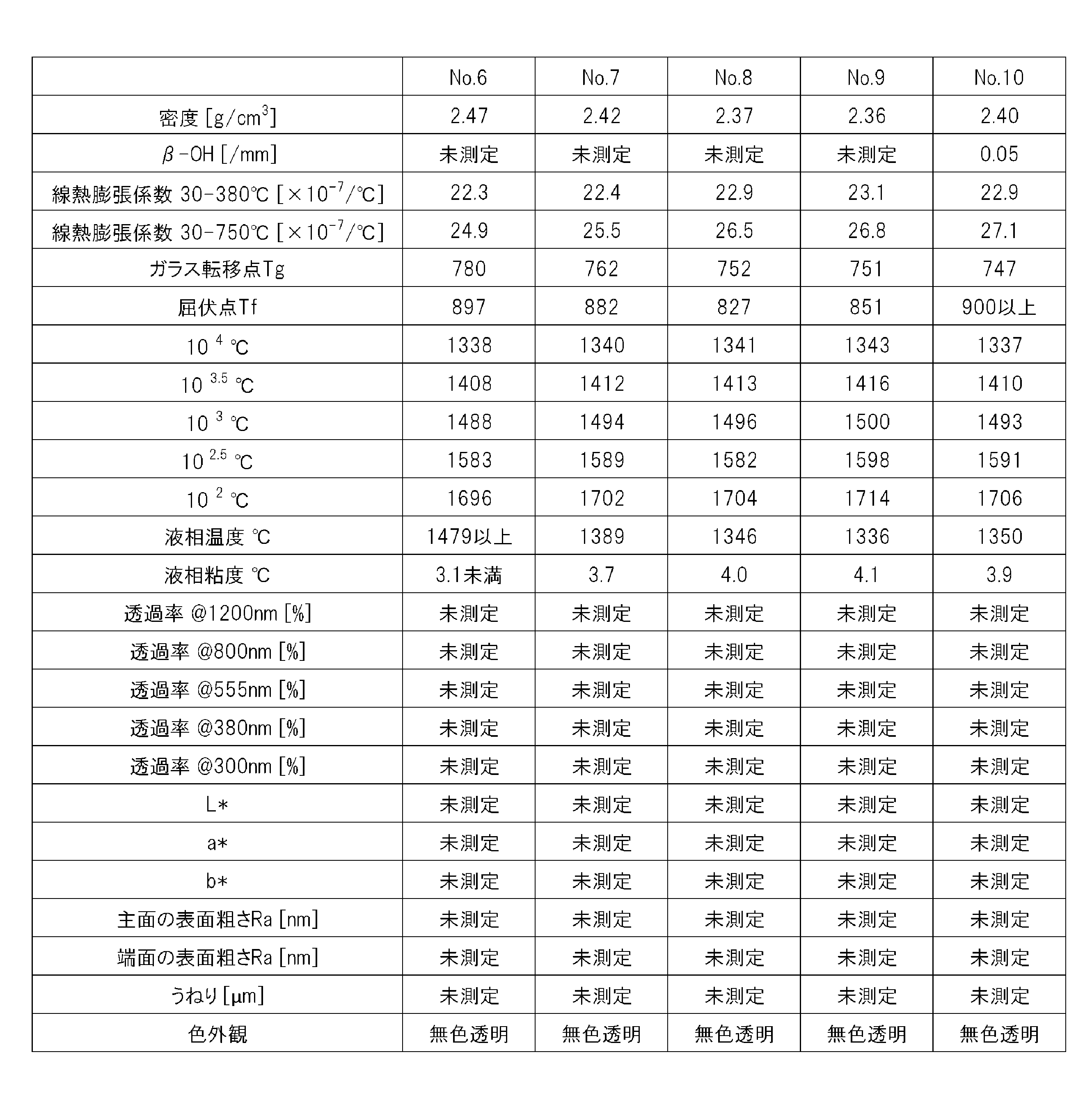

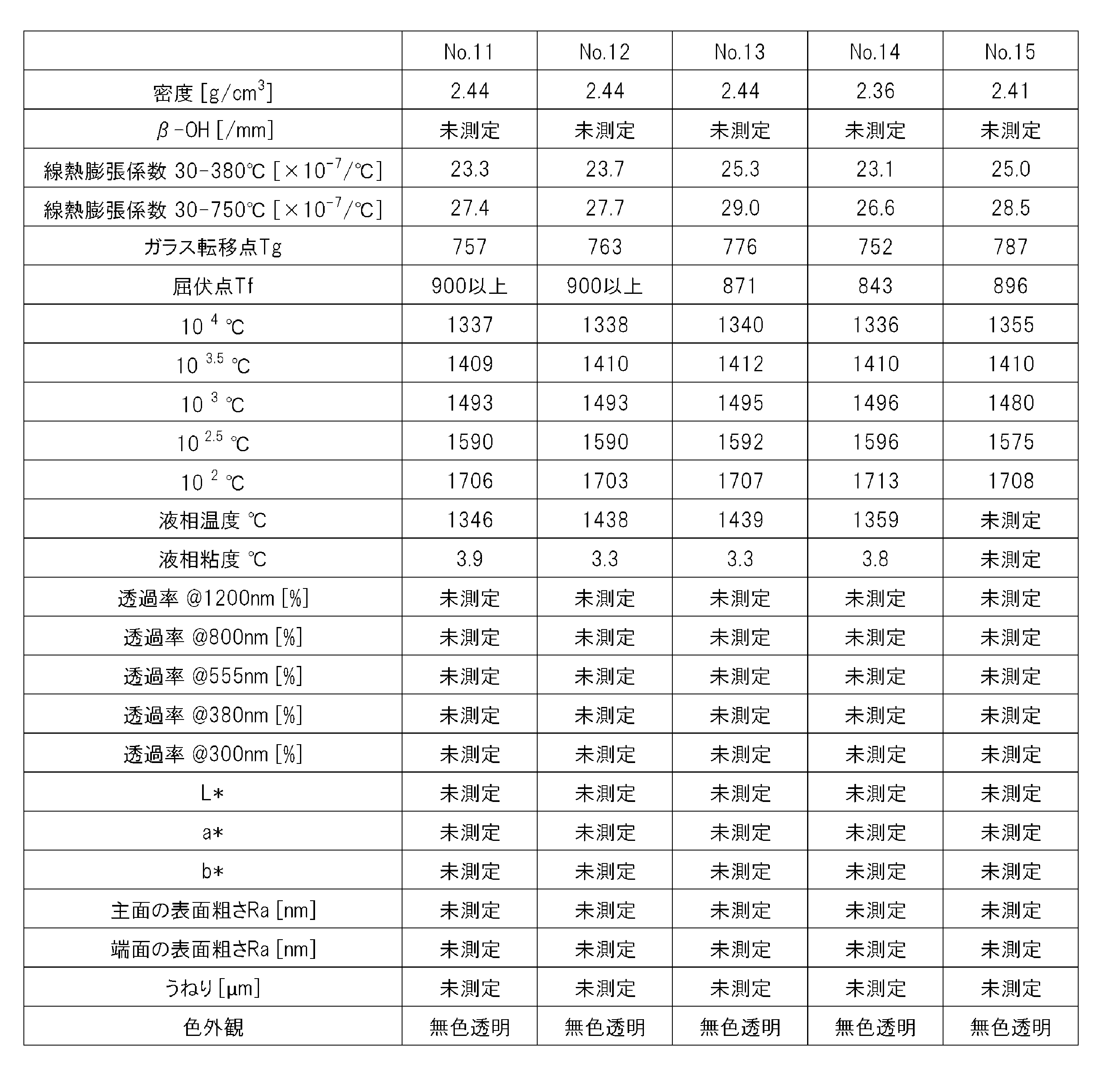


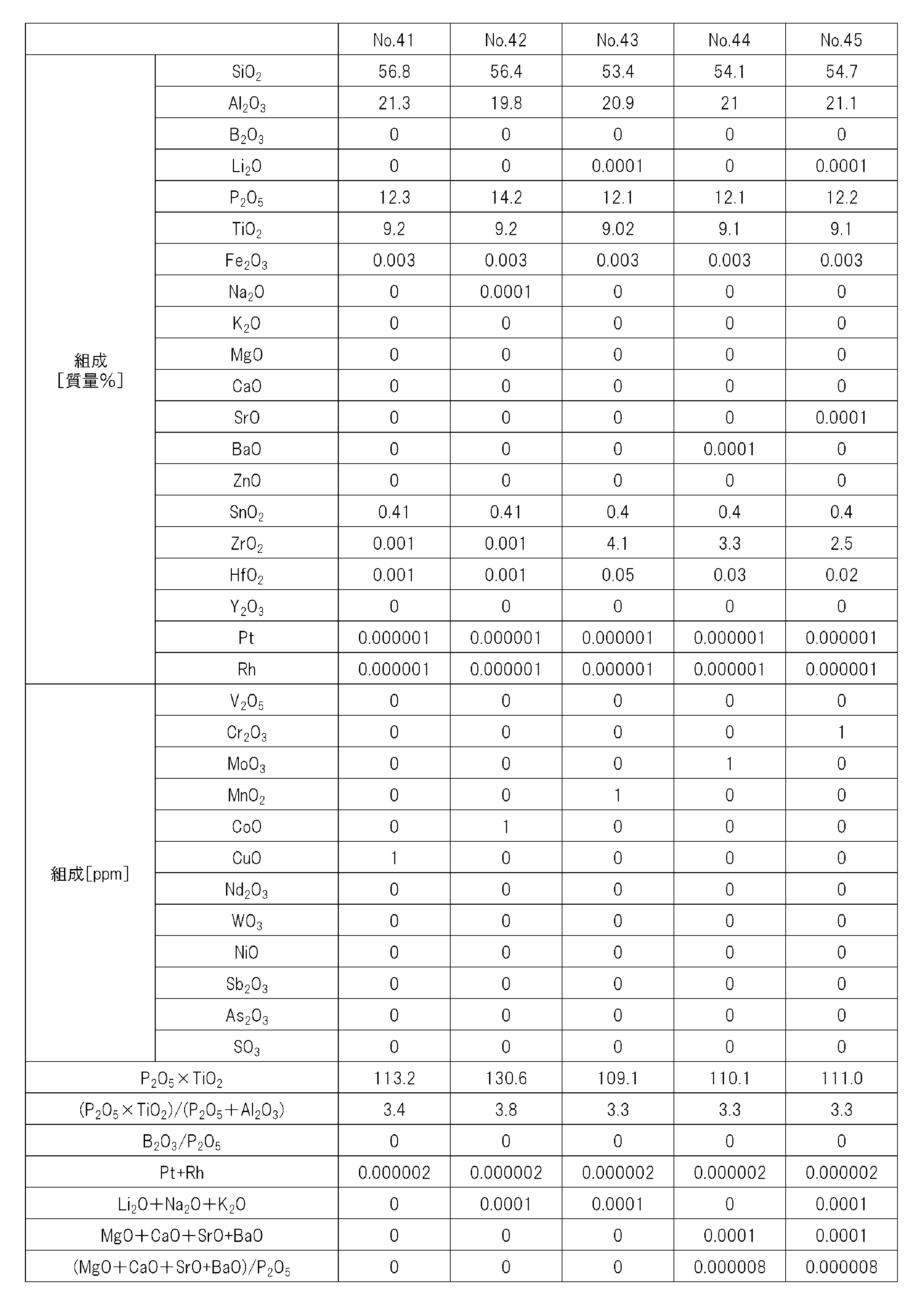
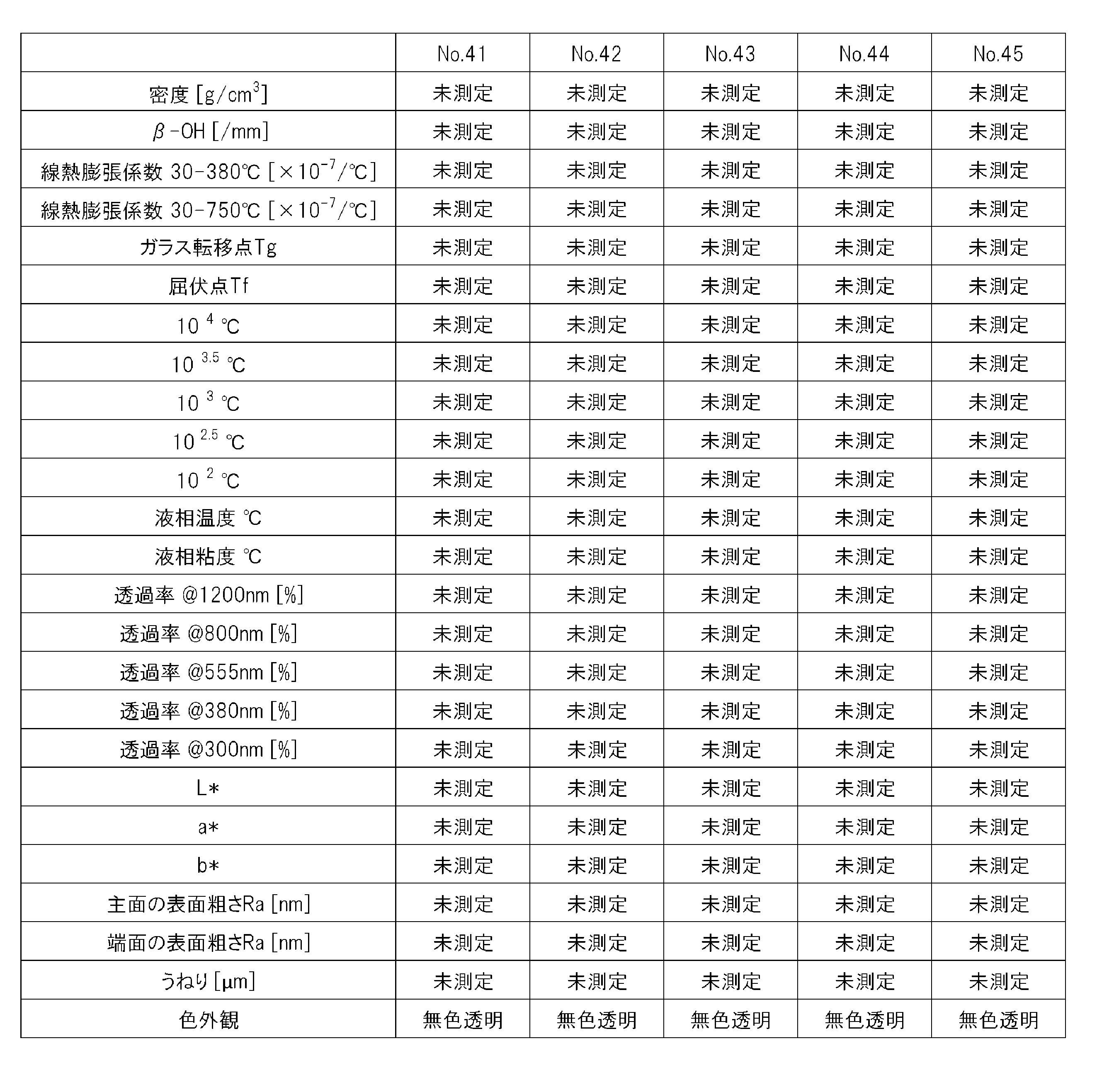
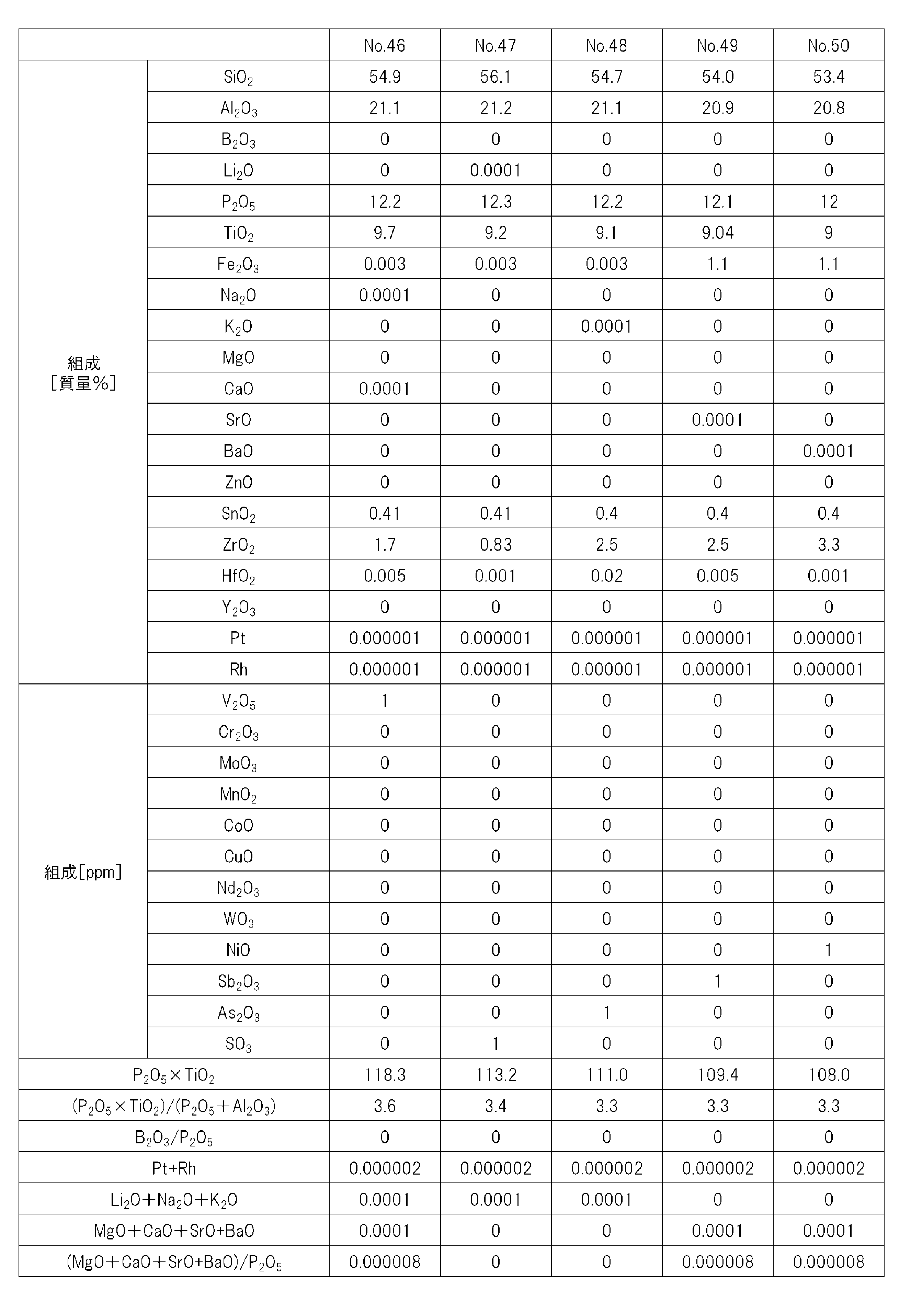


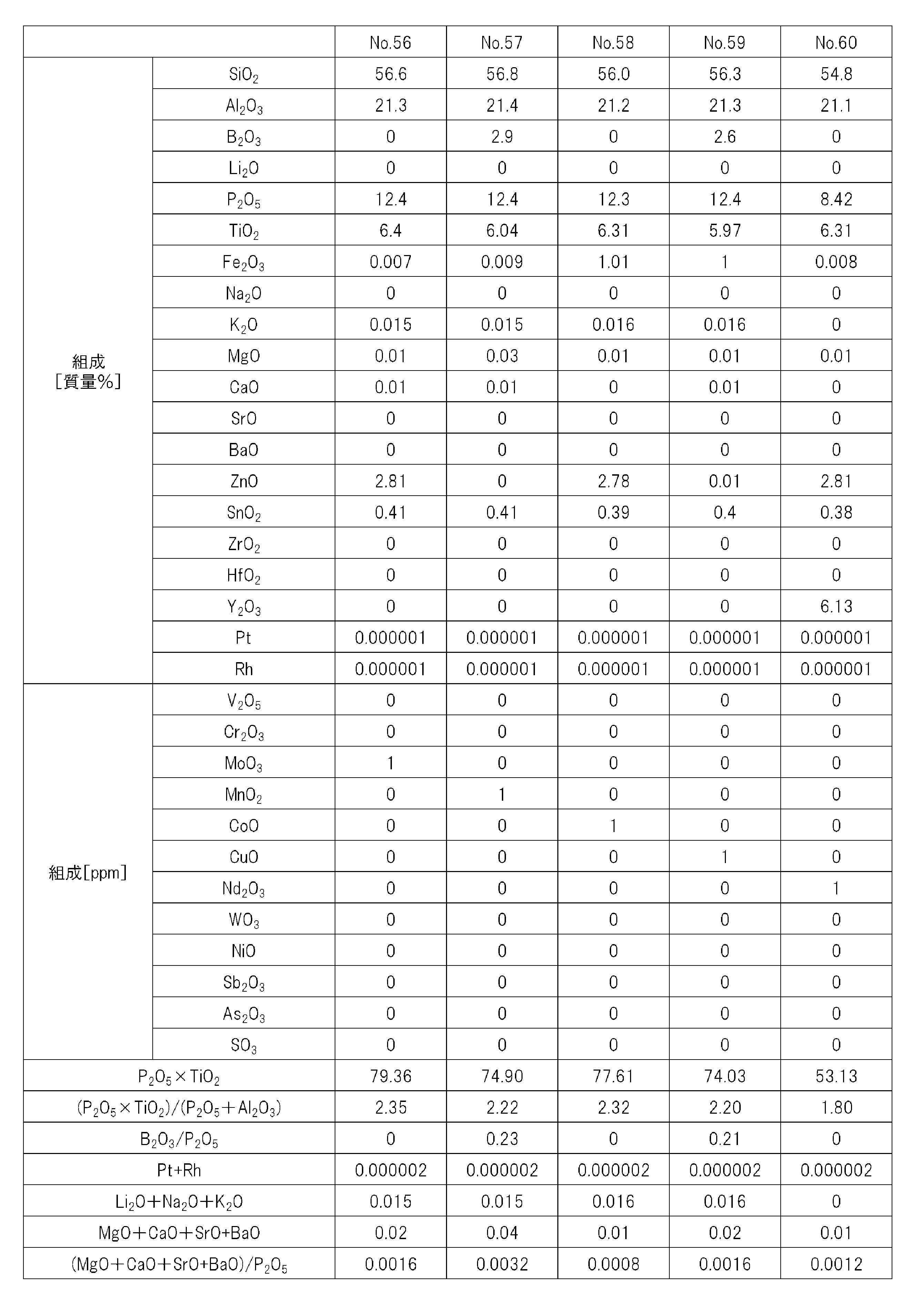

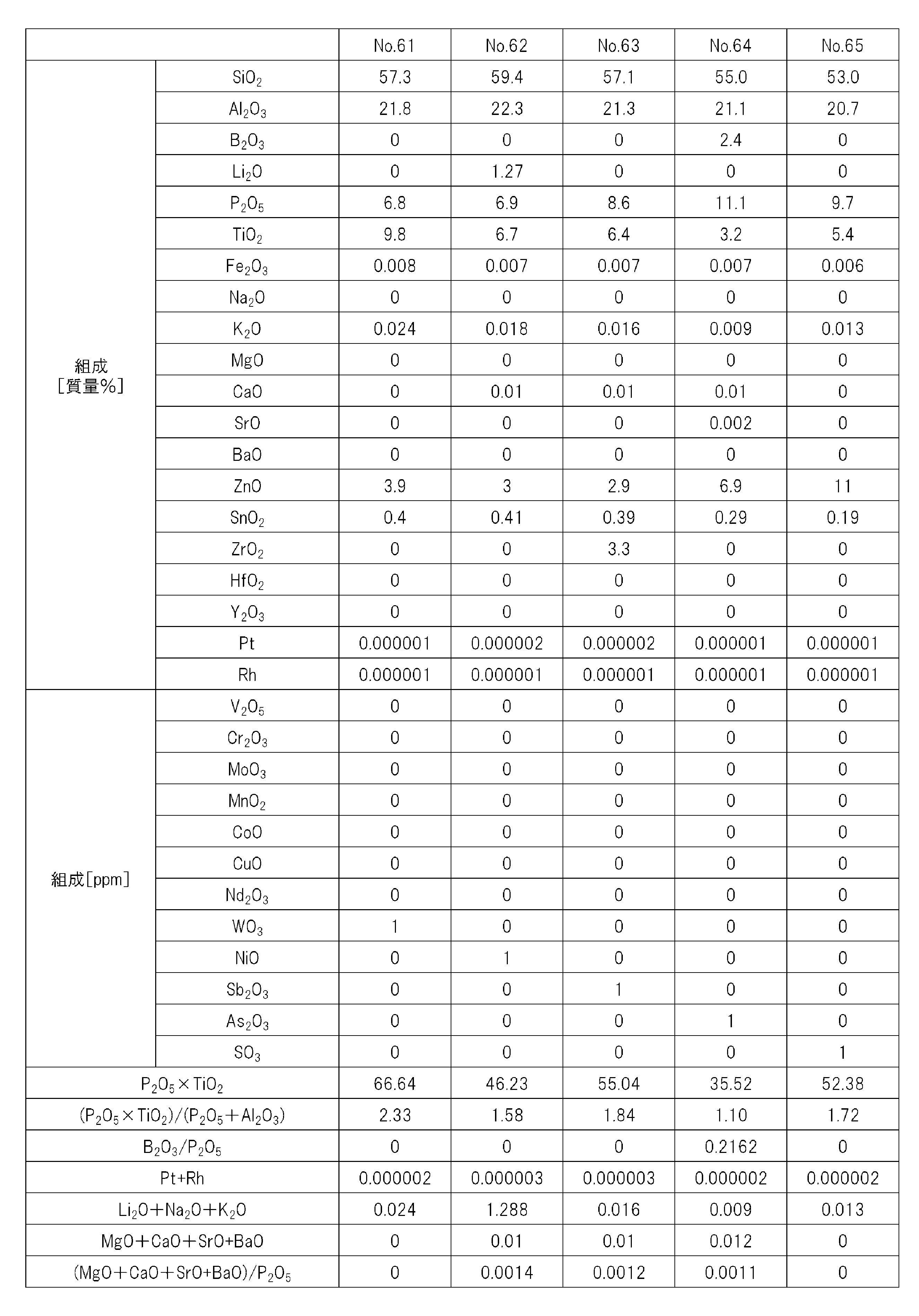
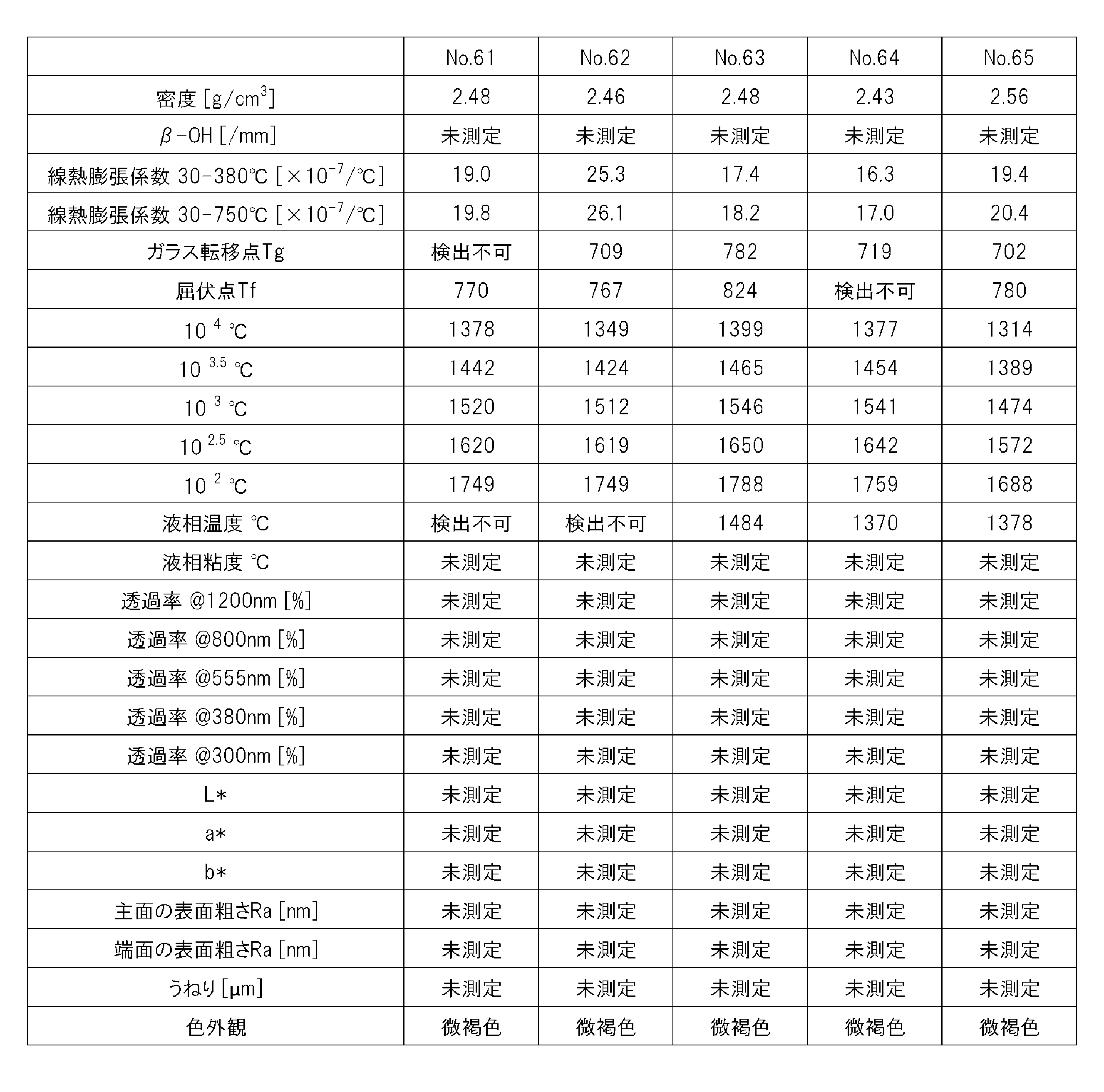
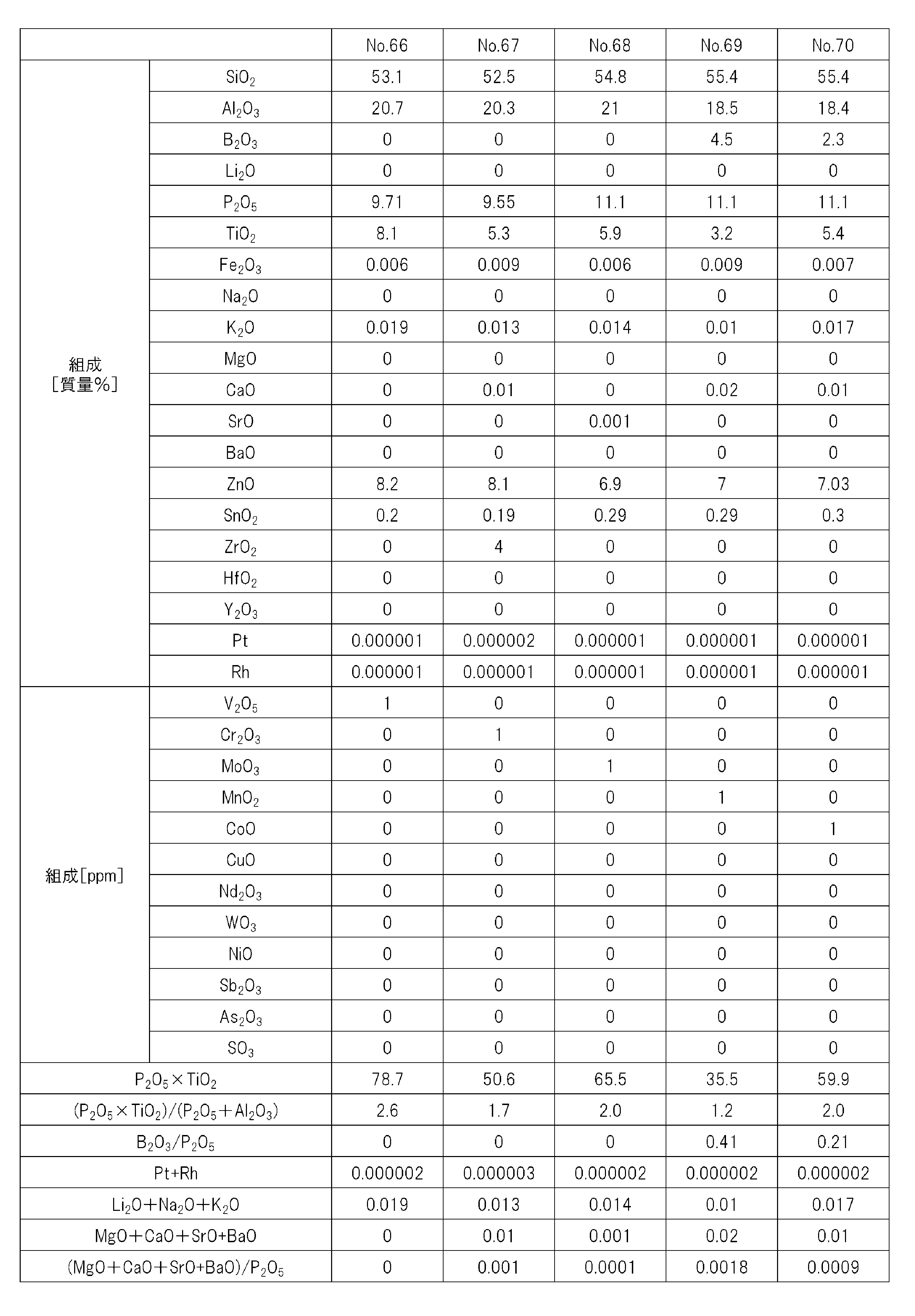

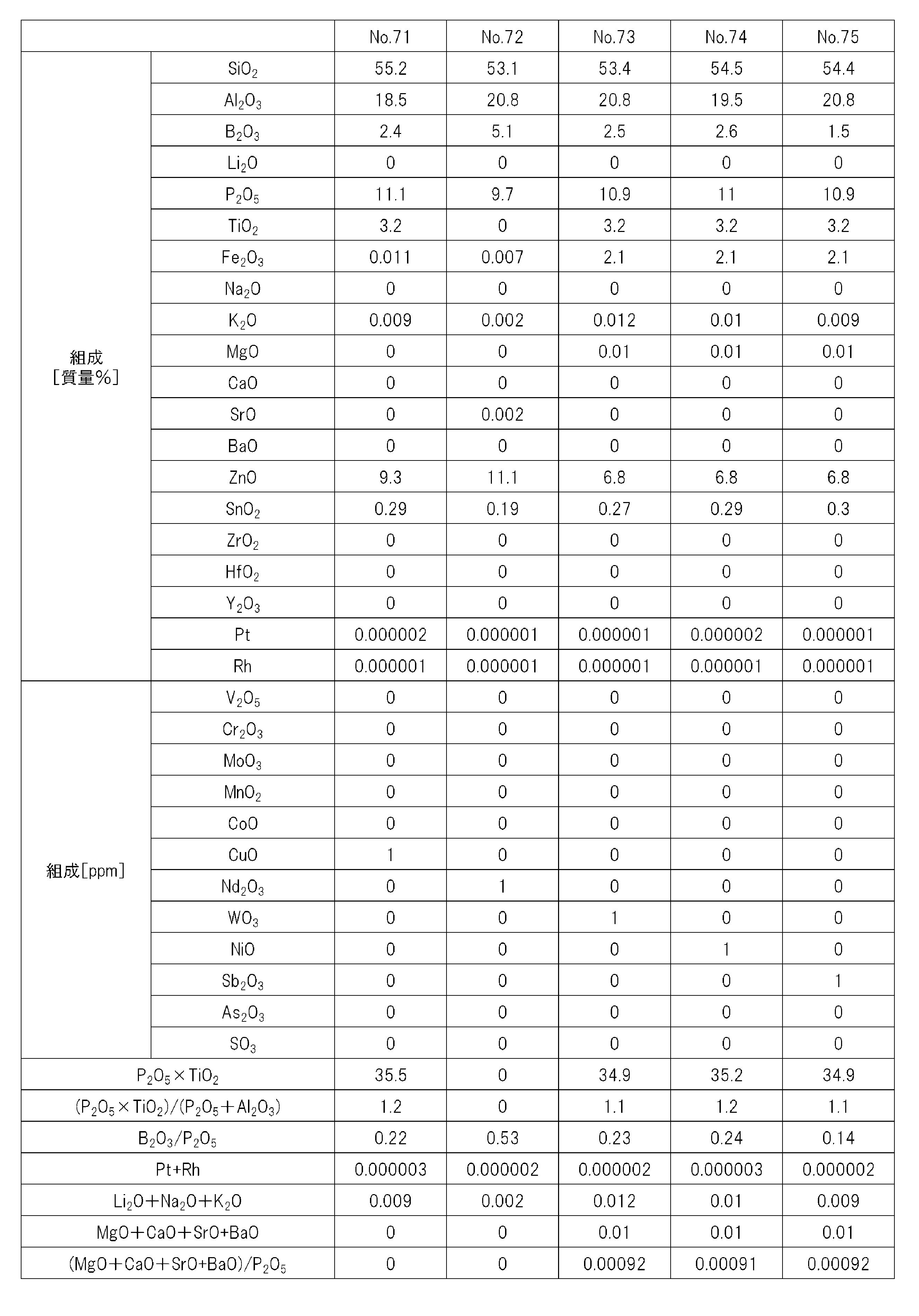
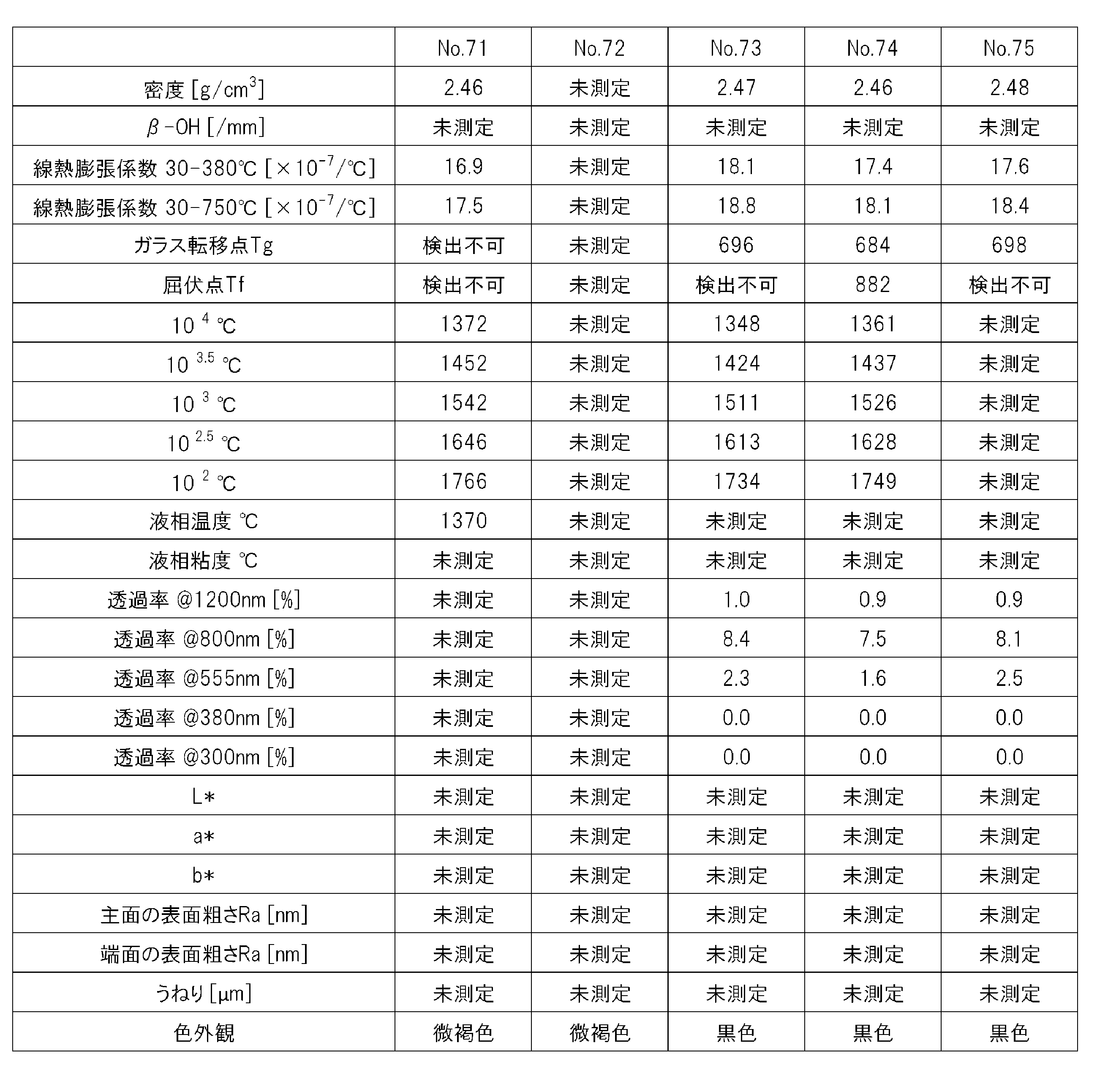


X:ガラス肉厚
T1:参照波数3846cm-1における透過率
T2:OH基吸収波数3600cm-1付近における最小透過率
Claims (22)
- 質量%で、SiO2 45~80%、Al2O3 10~30%、B2O3 0~12%、Li2O 0~5%を含有することを特徴とするガラス。
- 質量%で、P2O5 0%超を含有することを特徴とする請求項1に記載のガラス。
- 質量%で、TiO2 0%超を含有することを特徴とする請求項1または2に記載のガラス。
- 質量%で、B2O3 0超~8%、Li2O 0~3%、P2O5 6.5~20%を含有することを特徴とする請求項3に記載のガラス。
- 質量%で、Fe2O3 0%超を含有することを特徴とする請求項1または2に記載のガラス。
- 質量%で、HfO2 10%以下を含有することを特徴とする請求項1または2に記載のガラス。
- 質量%で、Pt 0.05%以下、Rh 0.05%以下を含有することを特徴とする請求項1または2に記載のガラス。
- 質量%で、SnO2 0%超を含有することを特徴とする請求項1または2に記載のガラス。
- 質量%で、ZnO 12.5%以下を含有することを特徴とする請求項1または2に記載のガラス。
- 質量%で、Li2O+Na2O+K2O 15%以下を含有することを特徴とする請求項1または2に記載のガラス。
- 質量%で、ZrO2 0%超を含有することを特徴とする請求項1または2に記載のガラス。
- 質量%で、(P2O5×TiO2)/(Al2O3+P2O5)が0.01以上であることを特徴とする請求項1または2に記載のガラス。
- 質量%で、P2O5×TiO2が0.22以上であることを特徴とする請求項1または2に記載のガラス。
- 質量%で、MgO+CaO+SrO+BaO 5.9%以下、Li2O+Na2O+K2O 2.6%以下、P2O5×TiO2 0.01以上であることを特徴とする請求項1または2に記載のガラス。
- 30~750℃における線熱膨張係数が、60×10-7/℃以下であることを特徴とする請求項1または2に記載のガラス。
- 厚さ4mm、波長555nmにおける透過率が0.1%以上であることを特徴とする請求項1または2に記載のガラス。
- 調理器用トッププレート、防火窓、耐熱食器または建築用部材に用いられることを特徴とする請求項1または2に記載のガラス。
- 質量%で、SiO2 45~80%、Al2O3 10~30%、B2O3 0~12%、P2O5 0超~20%、MgO+CaO+SrO+BaO 0~5%、Li2O+Na2O+K2O 0~5%を含有し、(P2O5×TiO2)/(Al2O3+P2O5)が1.4以上、30~750℃における線熱膨張係数が、40×10-7/℃以下であることを特徴とするガラス。
- 質量%で、SiO2 45~80%、Al2O3 10~30%、B2O3 0~12%、P2O5 0超~20%、Li2O 5%以下、ZrO2 0超~20%、MgO+CaO+SrO+BaO 0~8%、Li2O+Na2O+K2O 0~2.9%、(MgO+CaO+SrO+BaO)/P2O5 3.8以下を含有し、30~750℃における線熱膨張係数が、40×10-7/℃以下であることを特徴とするガラス。
- 質量%で、TiO2 0%超を含有することを特徴とする請求項18または19に記載のガラス。
- 30~380℃および30~750℃における線熱膨張係数が5~40×10-7/℃であり、厚さ4mm、波長555nmにおける透過率が0.1%以上であることを特徴とする調理器用トッププレート。
- 請求項1または2に記載のガラスを製造するための方法であって、
ガラス原料を溶融して溶融ガラスを得る工程、及び、前記溶融ガラスを成形する工程、
を備え、
前記溶融ガラスを成形する方法が、オーバーフロー法、フロート法、ダウンドロー法、スロットダウン法、リドロー法、無容器法、ブロー法、プレス法、ロール法、ブッシング法及び管引き法から選択される少なくとも1種以上であることを特徴とするガラスの製造
方法。
Priority Applications (3)
| Application Number | Priority Date | Filing Date | Title |
|---|---|---|---|
| CN202480031400.0A CN121127444A (zh) | 2023-06-16 | 2024-05-23 | 玻璃及其制造方法 |
| JP2025527612A JPWO2024257578A1 (ja) | 2023-06-16 | 2024-05-23 | |
| EP24823200.1A EP4729493A1 (en) | 2023-06-16 | 2024-05-23 | Glass and method for producing same |
Applications Claiming Priority (4)
| Application Number | Priority Date | Filing Date | Title |
|---|---|---|---|
| JP2023098853 | 2023-06-16 | ||
| JP2023-098853 | 2023-06-16 | ||
| JP2023-189539 | 2023-11-06 | ||
| JP2023189539 | 2023-11-06 |
Publications (1)
| Publication Number | Publication Date |
|---|---|
| WO2024257578A1 true WO2024257578A1 (ja) | 2024-12-19 |
Family
ID=93851778
Family Applications (1)
| Application Number | Title | Priority Date | Filing Date |
|---|---|---|---|
| PCT/JP2024/019059 Ceased WO2024257578A1 (ja) | 2023-06-16 | 2024-05-23 | ガラス及びその製造方法 |
Country Status (5)
| Country | Link |
|---|---|
| EP (1) | EP4729493A1 (ja) |
| JP (1) | JPWO2024257578A1 (ja) |
| CN (1) | CN121127444A (ja) |
| TW (1) | TW202502683A (ja) |
| WO (1) | WO2024257578A1 (ja) |
Families Citing this family (1)
| Publication number | Priority date | Publication date | Assignee | Title |
|---|---|---|---|---|
| CN121342339A (zh) * | 2025-12-17 | 2026-01-16 | 山东龙光天旭太阳能有限公司 | 一种高强度耐高温防火工业玻璃及其制备方法 |
Citations (6)
| Publication number | Priority date | Publication date | Assignee | Title |
|---|---|---|---|---|
| JPH01308845A (ja) | 1988-06-07 | 1989-12-13 | Nippon Electric Glass Co Ltd | 燃焼装置窓用Li↓2O−A1↓2O↓3−SiO↓2系透明結晶化ガラス |
| JP2001305320A (ja) * | 2000-04-20 | 2001-10-31 | Osaka Tokushu Glass Kk | 反射鏡 |
| JP2007254279A (ja) * | 2006-03-20 | 2007-10-04 | Schott Ag | 短時間のグレージングを伴うアルミノケイ酸リチウムガラス |
| JP2016529197A (ja) * | 2013-08-30 | 2016-09-23 | コーニング インコーポレイテッド | イオン交換可能なガラス、ガラスセラミック、およびその製造方法 |
| WO2016194693A1 (ja) * | 2015-06-02 | 2016-12-08 | 日本電気硝子株式会社 | ガラス |
| WO2021251246A1 (ja) * | 2020-06-10 | 2021-12-16 | Agc株式会社 | ガラス |
-
2024
- 2024-05-23 JP JP2025527612A patent/JPWO2024257578A1/ja active Pending
- 2024-05-23 WO PCT/JP2024/019059 patent/WO2024257578A1/ja not_active Ceased
- 2024-05-23 CN CN202480031400.0A patent/CN121127444A/zh active Pending
- 2024-05-23 EP EP24823200.1A patent/EP4729493A1/en active Pending
- 2024-06-12 TW TW113121626A patent/TW202502683A/zh unknown
Patent Citations (6)
| Publication number | Priority date | Publication date | Assignee | Title |
|---|---|---|---|---|
| JPH01308845A (ja) | 1988-06-07 | 1989-12-13 | Nippon Electric Glass Co Ltd | 燃焼装置窓用Li↓2O−A1↓2O↓3−SiO↓2系透明結晶化ガラス |
| JP2001305320A (ja) * | 2000-04-20 | 2001-10-31 | Osaka Tokushu Glass Kk | 反射鏡 |
| JP2007254279A (ja) * | 2006-03-20 | 2007-10-04 | Schott Ag | 短時間のグレージングを伴うアルミノケイ酸リチウムガラス |
| JP2016529197A (ja) * | 2013-08-30 | 2016-09-23 | コーニング インコーポレイテッド | イオン交換可能なガラス、ガラスセラミック、およびその製造方法 |
| WO2016194693A1 (ja) * | 2015-06-02 | 2016-12-08 | 日本電気硝子株式会社 | ガラス |
| WO2021251246A1 (ja) * | 2020-06-10 | 2021-12-16 | Agc株式会社 | ガラス |
Non-Patent Citations (1)
| Title |
|---|
| CHENG, KANGGUO: "Carbon effects on crystallization kinetics of Li20-A1203-SiO2 glasses", JOURNAL OF NON-CRYSTALLINE SOLIDS, vol. 238, 1998, pages 152 - 157, XP004158581, DOI: 10.1016/S0022-3093(98)00678-4 * |
Also Published As
| Publication number | Publication date |
|---|---|
| EP4729493A1 (en) | 2026-04-22 |
| TW202502683A (zh) | 2025-01-16 |
| JPWO2024257578A1 (ja) | 2024-12-19 |
| CN121127444A (zh) | 2025-12-12 |
Similar Documents
| Publication | Publication Date | Title |
|---|---|---|
| JP7549300B2 (ja) | Li2O-Al2O3-SiO2系結晶化ガラス | |
| JP7115479B2 (ja) | 結晶化ガラスおよび化学強化ガラス | |
| US20200377404A1 (en) | Colored glass-ceramics having petalite and lithium silicate structures | |
| KR102703315B1 (ko) | Li2O-Al2O3-SiO2계 결정화 유리 | |
| JP7585402B2 (ja) | 曲面形状を有する結晶化ガラス部材の製造方法 | |
| JP7657403B2 (ja) | 化学強化結晶化ガラス及びその製造方法 | |
| CN111268912A (zh) | 可离子交换玻璃、玻璃-陶瓷及其制造方法 | |
| JP2022044041A (ja) | 結晶化ガラスおよび化学強化ガラス | |
| WO2023119775A1 (ja) | Li2O-Al2O3-SiO2系結晶化ガラス | |
| TW202330425A (zh) | LiO-AlO-SiO系結晶化玻璃 | |
| TW202502683A (zh) | 玻璃及其製造方法 | |
| WO2023105895A1 (ja) | 低熱膨張ガラス | |
| WO2023238793A1 (ja) | ZnO-Al2O3-SiO2系ガラス及びその製造方法 | |
| WO2025263441A1 (ja) | ガラス、レーザー発振装置、及びガラスの製造方法 | |
| WO2024150715A1 (ja) | 低熱膨張部材 | |
| WO2024157957A1 (ja) | 結晶化ガラス | |
| WO2026100451A1 (ja) | ガラス、結晶化ガラス、耐熱材料及び調理器用トッププレート | |
| WO2026009737A1 (ja) | 結晶化ガラス | |
| WO2025121366A1 (ja) | ガラス板、積層体及びディスプレイ装置 |
Legal Events
| Date | Code | Title | Description |
|---|---|---|---|
| 121 | Ep: the epo has been informed by wipo that ep was designated in this application |
Ref document number: 24823200 Country of ref document: EP Kind code of ref document: A1 |
|
| ENP | Entry into the national phase |
Ref document number: 2025527612 Country of ref document: JP Kind code of ref document: A |
|
| WWE | Wipo information: entry into national phase |
Ref document number: 2025527612 Country of ref document: JP |
|
| WWE | Wipo information: entry into national phase |
Ref document number: 2024823200 Country of ref document: EP |
|
| NENP | Non-entry into the national phase |
Ref country code: DE |
|
| ENP | Entry into the national phase |
Ref document number: 2024823200 Country of ref document: EP Effective date: 20260116 |
|
| ENP | Entry into the national phase |
Ref document number: 2024823200 Country of ref document: EP Effective date: 20260116 |
|
| ENP | Entry into the national phase |
Ref document number: 2024823200 Country of ref document: EP Effective date: 20260116 |
|
| ENP | Entry into the national phase |
Ref document number: 2024823200 Country of ref document: EP Effective date: 20260116 |
|
| WWP | Wipo information: published in national office |
Ref document number: 2024823200 Country of ref document: EP |