WO2024257638A1 - 穿刺針、穿刺具、及び、穿刺具アセンブリ - Google Patents
穿刺針、穿刺具、及び、穿刺具アセンブリ Download PDFInfo
- Publication number
- WO2024257638A1 WO2024257638A1 PCT/JP2024/020222 JP2024020222W WO2024257638A1 WO 2024257638 A1 WO2024257638 A1 WO 2024257638A1 JP 2024020222 W JP2024020222 W JP 2024020222W WO 2024257638 A1 WO2024257638 A1 WO 2024257638A1
- Authority
- WO
- WIPO (PCT)
- Prior art keywords
- puncture
- needle
- axis
- pair
- edge
- Prior art date
- Legal status (The legal status is an assumption and is not a legal conclusion. Google has not performed a legal analysis and makes no representation as to the accuracy of the status listed.)
- Ceased
Links
Images









Classifications
-
- A—HUMAN NECESSITIES
- A61—MEDICAL OR VETERINARY SCIENCE; HYGIENE
- A61M—DEVICES FOR INTRODUCING MEDIA INTO, OR ONTO, THE BODY; DEVICES FOR TRANSDUCING BODY MEDIA OR FOR TAKING MEDIA FROM THE BODY; DEVICES FOR PRODUCING OR ENDING SLEEP OR STUPOR
- A61M5/00—Devices for bringing media into the body in a subcutaneous, intra-vascular or intramuscular way; Accessories therefor, e.g. filling or cleaning devices, arm-rests
- A61M5/178—Syringes
- A61M5/31—Details
- A61M5/32—Needles; Details of needles pertaining to their connection with syringe or hub; Accessories for bringing the needle into, or holding the needle on, the body; Devices for protection of needles
- A61M5/3286—Needle tip design, e.g. for improved penetration
-
- A—HUMAN NECESSITIES
- A61—MEDICAL OR VETERINARY SCIENCE; HYGIENE
- A61J—CONTAINERS SPECIALLY ADAPTED FOR MEDICAL OR PHARMACEUTICAL PURPOSES; DEVICES OR METHODS SPECIALLY ADAPTED FOR BRINGING PHARMACEUTICAL PRODUCTS INTO PARTICULAR PHYSICAL OR ADMINISTERING FORMS; DEVICES FOR ADMINISTERING FOOD OR MEDICINES ORALLY; BABY COMFORTERS; DEVICES FOR RECEIVING SPITTLE
- A61J1/00—Containers specially adapted for medical or pharmaceutical purposes
- A61J1/14—Details; Accessories therefor
- A61J1/20—Arrangements for transferring or mixing fluids, e.g. from vial to syringe
-
- A—HUMAN NECESSITIES
- A61—MEDICAL OR VETERINARY SCIENCE; HYGIENE
- A61M—DEVICES FOR INTRODUCING MEDIA INTO, OR ONTO, THE BODY; DEVICES FOR TRANSDUCING BODY MEDIA OR FOR TAKING MEDIA FROM THE BODY; DEVICES FOR PRODUCING OR ENDING SLEEP OR STUPOR
- A61M5/00—Devices for bringing media into the body in a subcutaneous, intra-vascular or intramuscular way; Accessories therefor, e.g. filling or cleaning devices, arm-rests
- A61M5/14—Infusion devices, e.g. infusing by gravity; Blood infusion; Accessories therefor
- A61M5/162—Needle sets, i.e. connections by puncture between reservoir and tube ; Connections between reservoir and tube
-
- A—HUMAN NECESSITIES
- A61—MEDICAL OR VETERINARY SCIENCE; HYGIENE
- A61M—DEVICES FOR INTRODUCING MEDIA INTO, OR ONTO, THE BODY; DEVICES FOR TRANSDUCING BODY MEDIA OR FOR TAKING MEDIA FROM THE BODY; DEVICES FOR PRODUCING OR ENDING SLEEP OR STUPOR
- A61M5/00—Devices for bringing media into the body in a subcutaneous, intra-vascular or intramuscular way; Accessories therefor, e.g. filling or cleaning devices, arm-rests
- A61M5/178—Syringes
- A61M5/31—Details
- A61M5/32—Needles; Details of needles pertaining to their connection with syringe or hub; Accessories for bringing the needle into, or holding the needle on, the body; Devices for protection of needles
- A61M5/329—Needles; Details of needles pertaining to their connection with syringe or hub; Accessories for bringing the needle into, or holding the needle on, the body; Devices for protection of needles characterised by features of the needle shaft
-
- A—HUMAN NECESSITIES
- A61—MEDICAL OR VETERINARY SCIENCE; HYGIENE
- A61M—DEVICES FOR INTRODUCING MEDIA INTO, OR ONTO, THE BODY; DEVICES FOR TRANSDUCING BODY MEDIA OR FOR TAKING MEDIA FROM THE BODY; DEVICES FOR PRODUCING OR ENDING SLEEP OR STUPOR
- A61M2205/00—General characteristics of the apparatus
- A61M2205/02—General characteristics of the apparatus characterised by a particular materials
Definitions
- the present invention relates to a puncture needle made of a resin material, a puncture tool including the puncture needle, and a puncture tool assembly including the puncture tool.
- many medical drugs are supplied filled in containers sealed with lids made of an elastic material such as rubber.
- the elastic materials used in such containers come in a variety of shapes and materials, and the drug is collected, prepared, administered, etc. by puncturing the elastic material with a needle made of synthetic medical resin, for example.
- a puncture needle made of synthetic resin has been used to puncture the elastic body of a drug container filled with the drug to collect the drug.
- the fluid path of the puncture needle may become blocked by the elastic body depending on the amount of elastic deformation of the elastic body that serves as the lid of the container being used, or the elastic deformation of the puncture needle itself. For example, it is expected that such blockage of the fluid path of the puncture needle is likely to occur in thick elastic bodies or elastic bodies with a film coating applied to the inner surface of the container.
- the present invention has been made to solve these problems, and its purpose is to provide a puncture needle made of a resin material that makes it easy to secure a fluid path when punctured into an elastic body that serves as the lid of a container in which a liquid such as a liquid medicine is sealed, a puncture tool including the puncture needle, and a puncture tool assembly including the puncture tool.
- a puncture needle made of a resin material has a needle portion and a groove portion.
- the needle portion integrally has a body portion having a path through which a fluid passes, a puncture portion provided on the tip side of the body and having a needle tip at the very end, and an intermediate portion provided between the body portion and the puncture portion.
- the pair of protrusions are integrally provided on the intermediate portion and have a bottom surface extending from the body portion toward the puncture portion, and a pair of protrusions integrally provided on the bottom surface extending from the body portion toward the puncture portion in a direction along the axis of the needle portion and protruding from the bottom surface in a direction intersecting the axis of the needle portion.
- the groove portion has a channel formed between the bottom surface and the pair of protrusions that communicates with the path of the body and opens the channel to the outside of the intermediate portion.
- FIG. 1 is a schematic perspective view of a puncture tool assembly according to a first embodiment.
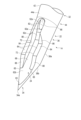
- FIG. 2 is a schematic perspective view of the front side of the puncture needle of the puncture device of the puncture device assembly shown in FIG. 1.
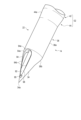
- FIG. 3 is a schematic perspective view of the rear side of the puncture needle of the puncture device shown in FIG.
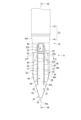
- FIG. 4 is a front view of the puncture needle of the puncture device of the puncture device assembly shown in FIGS. 1 and 2.
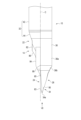
- FIG. FIG. 5 is a rear view of the puncture needle of the puncture device shown in FIG. 6 is a right side view of the puncture needle of the puncture device shown in FIG. 4.
- FIG. FIG. 7 is a bottom view of the puncture needle of the puncture device shown in FIG. FIG.
- FIG. 8 is a cross-sectional view taken along line VIII-VIII in FIGS.
- FIG. 9 is a schematic cross-sectional view taken along line IX-IX in FIG.
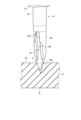
- FIG. 10 is a schematic diagram showing a state in which the needle part of the puncture needle is punctured into the elastic body.
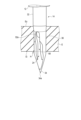
- FIG. 11A is a schematic diagram showing a state subsequent to FIG. 10, in which the needle portion of the puncture needle is punctured into the elastic body.
- 11B is a schematic cross-sectional view showing the needle part of the puncture needle shown in FIG. 11A as the cross section shown in FIG.
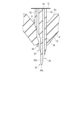
- FIG. 12A is a schematic diagram showing a state subsequent to FIG. 11B, in which the needle portion of the puncture needle is punctured into the elastic body.
- FIG. 12B is a schematic cross-sectional view showing the needle part of the puncture needle shown in FIG. 12A as the cross section shown in FIG. 8.
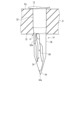
- FIG. FIG. 13 is a schematic perspective view showing a state in which the needle portion of the puncture needle is punctured into the elastic body and liquid is collected in the channel of the first groove portion.
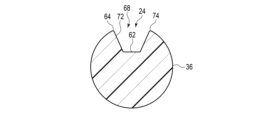
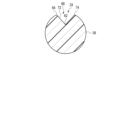
- FIG. 14A is a first modified cross-sectional view taken along line IX-IX of FIG.
- FIG. 14B is a second modified cross-sectional view taken along line IX-IX of FIG.
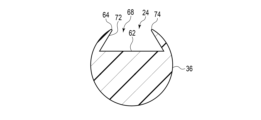
- FIG. 14C is a third modified cross-sectional view taken along line IX-IX of FIG.
- FIG. 14D is a fourth modified cross-sectional view taken along line IX-IX of FIG.
- FIG. 14A is a first modified cross-sectional view taken along line IX-IX of FIG.
- FIG. 14B is a second modified cross-sectional view taken along line IX-IX of FIG.
- FIG. 14C is
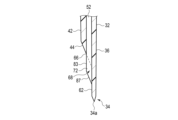
- FIG. 14E is a fifth modified cross-sectional view taken along line IX-IX of FIG. 15 is a cross-sectional view of the needle portion of the puncture needle according to the second embodiment taken along line VIII-VIII in FIG.
- FIG. 16A is a first modified cross-sectional view of the needle portion shown in FIG. 15 taken along line VIII-VIII.
- FIG. 16B is a second modified cross-sectional view taken along line VIII-VIII of the needle portion shown in FIG.
- FIG. 16C is a third modified cross-sectional view taken along line VIII-VIII of the needle portion shown in FIG. 17 is a cross-sectional view of the needle portion of the puncture needle according to the third embodiment taken along line VIII-VIII in FIG.
- FIG. 1 is a schematic perspective view of the puncture tool assembly 1.
- FIG. 2 is a schematic perspective view of the front side of the needle portion 22 of the puncture needle 14 of the puncture tool 10 of the puncture tool assembly 1.
- FIG. 3 is a schematic perspective view of the rear side of the needle portion 22 of the puncture needle 14 of the puncture tool 10 of the puncture tool assembly 1.
- Figure 4 is a front view of the needle portion 22 of the puncture needle 14 of the puncture tool 10 of the puncture tool assembly 1 shown in Figures 1 to 3. That is, the side of the puncture needle 14 where the first groove portion 24 described later is exposed to the outside of the puncture needle 14 is the front side of the puncture needle 14.
- Figure 5 is a rear view of the needle portion 22 of the puncture needle 14 of the puncture tool 10 shown in Figure 4. That is, the side of the puncture needle 14 where the second groove portion 26 described later is exposed to the outside of the puncture needle 14 is the rear side of the puncture needle 14.
- the puncture section 34 side is referred to as the tip side
- the connection section 12 side is referred to as the base side.
- the right side of the needle portion 22 of the puncture needle 14 shown in Figure 4 is referred to as the right side of the puncture needle 14
- the left side of the needle portion 22 of the puncture needle 14 shown in Figure 4 is referred to as the left side of the puncture needle 14.
- the left side of the needle portion 22 of the puncture needle 14 shown in Figure 5 is referred to as the right side of the puncture needle 14
- the right side of the needle portion 22 of the puncture needle 14 shown in Figure 5 is referred to as the left side of the puncture needle 14.
- FIG. 6 is a right side view of the needle portion 22 of the puncture needle 14 of the puncture device 10 shown in FIG. 4.
- the left side view of the needle portion 22 of the puncture needle 14 of the puncture device 10 is omitted here because it is simply the opposite of the right side view shown in FIG. 6.
- FIG. 7 is a bottom view of the needle portion 22 of the puncture needle 14 of the puncture device 10 shown in FIG. 6, as viewed from the direction indicated by the arrow VII.
- FIG. 8 is a cross-sectional view taken along the line VIII-VIII in FIGS. 4 and 5.
- FIG. 9 is a schematic cross-sectional view taken along the line IX-IX in FIG. 4.
- left-right direction (horizontal direction) of the puncture needle 14 of the puncture tool 10 refers to the direction perpendicular to the axis C of the needle portion 22 of the puncture needle 14 of the puncture tool 10 shown in Figure 4 when viewed from the front side.
- Figures 10 to 13 are diagrams explaining the series of actions that occur when the needle portion 22 is used with the puncture tool 10 to puncture the inner surface Ei of the elastic body E of a suitable container through the outer surface Eo.
- the elastic body E for example, butyl rubber, silicone rubber, or ETFE (Ethylene Tetrafluoroethylene), a copolymer of tetrafluoroethylene and ethylene, is used.
- the hardness of the elastic body E is, for example, between 20 degrees and 55 degrees Shore A (ISO 7619; ASTM D2240; JIS K 6253).
- the thickness of the elastic body E is, for example, about 7 mm.
- the puncture tool assembly 1 has a connector 8 and a puncture tool 10 made of a resin material that is connected to the connector 8.
- a connector 8 can be used.
- An example of a connector 8 is a syringe that supplies a dissolving solution or aspirates and dispenses a medicinal liquid from a container.
- Another example of a connector 8 is a device called an adapter that is attached to a container such as a vial while the puncture needle 14 of the puncture tool 10 is inserted into the container.
- a syringe is connected to the passage 52 of the puncture needle 14, which will be described later, via the adapter.
- the puncture needle 14 can puncture the elastic body E shown in Figures 10 to 13, and can also be used without puncturing. Therefore, the type of container that can be used with the puncture needle 14 is not limited; in addition to vials, ampoules can also be used. Another example of an object that can be punctured with the puncture needle 14 could be the elastic body of a connector of a bag that is suspended and contains a liquid such as a medicinal solution or blood.
- the puncture tool 10 has a connection part (base part) 12 and a puncture needle 14 that extends straight.
- the connection part 12 and the puncture needle 14 are formed, for example, integrally from a resin material.
- the resin material include polyethylene, polypropylene, polyamide, polycarbonate, ABS, PEEK, and other suitable thermoplastic resin materials.
- the puncture needle 14 according to this embodiment is formed to a hardness such that when the needle tip 34a is inserted into an elastic body E of suitable hardness as described below, the needle tip 34a is not easily crushed and the shape of the puncture needle 14 can be maintained against the elastic deformation of the elastic body E.
- the elastic body E is brought into close contact with the outer peripheral surface of the puncture needle 14 while it is inserted into the elastic body E.
- connection part 12 is connected to various connectors 8.
- the connection part 12 and the puncture needle 14 are preferably formed integrally, but may be formed separately and connected to each other.
- the connection part 12 is formed, for example, in a block shape with an outer shape that is equal to or larger than the diameter of the base end of the puncture needle 14.
- the puncture needle 14 is formed symmetrically with respect to a plane defined by lines VIII-VIII shown in FIG. 4 and VIII-VIII shown in FIG. 5.
- the puncture needle 14 has a needle portion 22, a first groove portion 24, and a second groove portion 26.
- the first columnar portion 42 is formed, for example, in a columnar shape. In this embodiment, for ease of explanation, the first columnar portion 42 is formed in a cylindrical shape. The axis C of the needle portion 22 of the puncture needle 14 is aligned with the central axis of the first columnar portion 42.
- the first columnar portion 42 is not limited to a cylindrical shape having a circular cross section, but may be formed into a columnar shape having an N-sided polygonal cross section (N is an integer of 3 or more), or may be formed into a columnar shape having an elliptical cross section.
- the front side of the outer circumferential surface of the second columnar portion 44 is inclined with respect to the axis C of the needle portion 22 of the puncture needle 14.
- the back side of the outer circumferential surface of the second columnar portion 44 extends straight, for example parallel to the axis C of the needle portion 22 of the puncture needle 14, as shown in FIG. 6.
- the second columnar portion 44 is inclined with respect to the axis C of the needle portion 22 of the puncture needle 14 on the front side of the puncture needle 14 shown in FIG. 1. Therefore, the second columnar portion 44 has an inclined portion 44a in an area closer to the front side than the back side.
- the inclination direction of the inclined portion 44a is a direction in which the outer diameter of the body portion 32 becomes smaller toward the puncture portion 34 side.
- the body 32 has a passage 52 through which a fluid passes.
- the passage 52 is formed as a channel that is a circular tube, an elliptical tube, a polygonal tube, or the like, that extends straight along the axis C (longitudinal direction) of the needle portion 22 of the puncture needle 14.
- the passage 52 is used as a passage for liquids, such as medicinal liquids.
- the passage 52 may also be used as a passage for gases, such as air.
- the puncture portion 34 has a needle tip (pointed end) 34a that tapers toward the tip.
- the needle tip 34a at the very end of the puncture portion 34 does not include the first groove portion 24 and the second groove portion 26 and is appropriately sharp. It is sufficient that the needle tip 34a is capable of penetrating the elastic body E by forming a hole from the needle tip 34a in an elastic body E of an appropriate thickness, such as a rubber stopper of a container such as a vial, when the puncture needle 14 is moved in a direction along the axis C of the needle portion 22 of the puncture needle 14.
- the boundary between the puncture portion 34 and the intermediate portion 36 can be set as appropriate.
- the region from the tip 63 of the bottom surface 62 of the first groove portion 24 described below to the needle tip 34a may be the puncture portion 34, or the region from the tip 65 of a pair of protrusions 64 of the first groove portion 24 described below to the needle tip 34a may be the puncture portion 34.
- the latter case is used. Therefore, the bottom surface 62 of the first groove portion 24 is provided in the intermediate portion 36 and is also provided in the puncture portion 34.
- the intermediate section 36 is formed as a frame between the body section 32 and the puncture section 34.
- the intermediate section 36 has a first intermediate body (third columnar section) 36a provided on the tip side of the second columnar section 44 of the body section 32, and a second intermediate body (fourth columnar section) 36b provided on the tip side of the first intermediate body 36a.
- the first intermediate body 36a of the intermediate portion 36 is formed integrally with the second columnar portion 44 of the body portion 32 as a columnar body, such as a cylindrical body, having the same constant outer diameter as the tip of the second columnar portion 44 of the body portion 32. It is preferable that the back side of the first intermediate body 36a of the intermediate portion 36 extends straight from the back side of the second columnar portion 44 of the body portion 32 in parallel to the axis C of the needle portion 22.
- the second intermediate body 36b of the intermediate portion 36 is integrally formed with the first intermediate body 36a as a truncated cone body, for example a truncated cone shape, whose outer diameter decreases toward the puncture portion 34, and is also integrally formed with the puncture portion 34.
- the intermediate portion 36 is formed as a combination of a columnar body (first intermediate body 36a) on the body portion 32 side and a frustum body (second intermediate body 36b) on the puncture portion 34 side.
- the outer shape of the intermediate portion 36 may be formed as a columnar shape having an N-sided (N is an integer of 3 or more) cross section, or may be formed as a columnar shape having an elliptical cross section.
- the first intermediate body 36a of the intermediate portion 36 extends from the tip of the second columnar portion 44 toward the puncture portion 34 along the axis C of the needle portion 22 of the puncture needle 14.
- the first intermediate body 36a and the second intermediate body 36b of the intermediate portion 36 form the outer surface of the needle portion 22 extending from the tip of the second columnar portion 44 of the body portion 32 toward the puncture portion 34.
- the outer surface of the needle portion 22 formed by the first intermediate body 36a and the second intermediate body 36b of the intermediate portion 36 smoothly connects between the tip of the second columnar portion 44 and the needle tip 34a of the puncture portion 34.
- the maximum diameter of the outer surface of the needle portion 22 formed by the first intermediate body 36a of the intermediate portion 36 is the same outer diameter as the tip of the second columnar portion 44, and there is no region where the outer diameter becomes larger than the tip of the second columnar portion 44 as it approaches the puncture portion 34. For this reason, the outer diameter of the intermediate portion 36 remains constant or only decreases from the tip of the second columnar portion 44 toward the needle tip 34a of the puncture portion 34. The outer diameter then gradually decreases from the tip 65 of the intermediate portion 36 toward the needle tip 34a at the tip of the puncture portion 34.
- the boundary position between the intermediate portion 36 and the puncture portion 34 along the axis C of the needle portion 22 may be the same or different on the front side and back side of the needle portion 22.
- the area beyond the tips 65 of the pair of protrusions 64 is the puncture portion 34.
- the area beyond the tip 95 of the second groove portion 26 is the puncture portion 34.
- the right and left boundary positions between the front side and back side along the axis C of the needle portion 22 between the intermediate portion 36 and the puncture portion 34 are the positions connecting the tips 65 of the pair of protrusions 64 and the tip 95 of the second groove portion 26.
- the second columnar portion 44 has a hole 52a formed at the end of the pathway 52 on the puncture portion 34 side, which is connected to the outside of the puncture needle 14.
- the edge of the hole 52a may be formed in a substantially circular ring shape, or may be formed in a substantially elliptical shape, for example.
- the edge of the hole 52a is formed in a substantially elliptical shape when viewed from the front side of the needle portion 22 as shown in FIG. 4, and is formed in a substantially circular ring shape when viewed from the bottom side of the needle portion 22 as shown in FIG. 7.
- the end of the path 52 opposite the hole 52a is formed, for example, at the connection portion 12.
- a hole 54a that communicates with the outside of the puncture needle 14 is formed at the end of the path 54 on the puncture section 34 side.
- the hole 54a is formed in the middle section 36.
- the edge of the hole 54a may be formed in a substantially circular ring shape, or may be formed in a substantially elliptical shape, for example.
- the edge of the hole 54a is formed in a substantially circular ring shape, for example, when viewed from the underside of the needle section 22, as shown in FIG. 7.
- a first groove 24 is provided on the front side of the middle portion 36 of the needle portion 22. Therefore, the first groove 24 is formed on the front side of the puncture needle 14.
- the length of the first groove 24 along the axis C of the needle portion 22 is formed to a length that penetrates the inner surface Ei of the plate-shaped elastic body E that is punctured from the outer surface Eo side of the elastic body E.
- the bottom surface 62 is integrally formed with the intermediate portion 36 and extends from the body portion 32 toward the puncture portion 34 along the axis C (longitudinal direction) of the needle portion 22.
- the bottom surface 62 may be formed as a flat surface or a curved surface. In this embodiment, the bottom surface 62 is formed by combining a flat surface and a curved surface.
- the bottom surface 62 on the body portion 32 side is formed as a surface (first bottom surface) 62a that continues to the inner peripheral surface of the path 52.
- the first bottom surface 62a is formed, for example, as a flat surface.
- the bottom surface 62 on the puncture portion 34 side is formed as a surface (second bottom surface) 62b that extends straight along the axis C of the needle portion 22 of the puncture needle 14.
- the second bottom surface 62b is formed, for example, as a flat surface.
- the second bottom surface 62b on the needle tip 34a side of the puncture portion 34 is the tip 63 of the bottom surface 62.
- the tip 63 of the bottom surface 62 is also the tip of the first groove portion 24.
- the width of the bottom surface 62 is the outer diameter formed by the intermediate portion 36, it is preferable that the bottom surface 62 is formed longer in the direction along the axis C of the needle portion 22 than the width of the bottom surface 62.
- the height of the bottom surface 62 is formed lower than the height of the pair of protrusions 64 to ensure the channel 68 of the first groove portion 24.
- the axis C of the needle portion 22 of the puncture needle 14, i.e., the central axis of the first columnar portion 42 of the body portion 32, is aligned with the surface of the second bottom surface 62b of the first groove portion 24.
- the needle tip 34a is offset toward the back surface of the needle portion 22 with respect to the axis C of the needle portion 22 of the puncture needle 14.
- the axis of the second columnar portion 44 of the body portion 32 is offset toward the back surface of the needle portion 22 with respect to the axis C of the first columnar portion 42.
- the needle tip 34a is offset toward the back surface with respect to the axis of the second columnar portion 44.
- the needle tip 34a is formed as a substantially conical region that tapers away from the body portion 32.
- the bottom surface 62 of the first groove portion 24 in this embodiment is positioned along the inner circumferential surface of the back side of the needle portion 22 in the path 52, and is positioned closer to the back side of the needle portion 22 (the side opposite the opening side of the first groove portion 24 (the side of the pair of protrusions 64)) than the inner circumferential surface of the back side of the needle portion 22 in the path 52.
- the protrusion 64 and closed end 66 of the first groove 24 are formed as the edge of a roughly U-shaped slit that extends parallel to the axis C on the front side of the needle 22 in the intermediate portion 36, opening the puncture portion 34 side of the puncture needle 14 and closing the body portion 32 side.
- the width perpendicular to the axis C of the needle portion 22 between the pair of protrusions 64 is constant at any position along the axis C of the needle portion 22.
- the pair of protrusions 64 extend on the bottom surface 62 along the axis C (longitudinal direction) of the needle 22 from the body 32 toward the puncture portion 34, and protrude from the bottom surface 62 in a direction intersecting the axis C.
- the pair of protrusions 64 can function as front-side ribs that suppress buckling of the puncture needle 14.
- the pair of protrusions 64 protrude in the same direction relative to the bottom surface 62. In this embodiment, the pair of protrusions 64 protrude in the same direction relative to the bottom surface 62 toward the front side of the needle 22 (see FIG. 4).
- the pair of protrusions 64 communicate with the path 52 and the hole (opening edge) 52a together with the bottom surface 62, and form a channel (flow path) 68 that opens from the axis C of the needle 22 to the outer peripheral surface of the middle portion 36, and in this embodiment, opens to the front side. Therefore, fluids such as liquids and gases can be introduced and discharged into the channel 68.
- the pair of protrusions 64 are formed so that the protruding height of the pair of protrusions 64 relative to the bottom surface 62 gradually decreases from the second columnar portion 44 side toward the puncture portion 34 side. Therefore, the pair of protrusions 64 are formed so as to gradually approach the axis C of the needle portion 22 from the closed end 66 toward the puncture portion 34.
- the pair of protrusions 64 have a wall surface 72 that is continuous with the bottom surface 62 and a protruding end (opening edge) 74.
- the wall surfaces 72 of the pair of protrusions 64 are preferably formed as parallel planes facing each other.
- the distance between the protruding ends 74 of the pair of protrusions 64 that protrude from the bottom surface 62 is the same as the width of the bottom surface 62 of the first groove portion 24.
- the distance between the wall surfaces 72 of the pair of protrusions 64 can be set as appropriate. Therefore, the bottom surface 62 and the wall surfaces 72 of the pair of protrusions 64 form a channel (flow path) 68 whose cross section intersects with the axis C of the needle portion 22 of the puncture needle 14 is approximately U-shaped, such as being perpendicular to the axis C of the needle portion 22 of the puncture needle 14.
- a portion of the region of the protruding ends 74 of the pair of protruding portions 64 from the second columnar portion 44 side toward the puncture portion 34 side has a region parallel to the axis C of the needle portion 22 of the puncture needle 14.
- the protruding ends 74 of the pair of protruding portions 64 have a first edge (first parallel portion) 82 and a second edge (second parallel portion) 84 that are preferably parallel to the axis C of the needle portion 22 of the puncture needle 14 from the second columnar portion 44 side toward the puncture portion 34 side.
- the first edge 82 has a narrow width in the left-right direction on the outer peripheral surface of the intermediate portion 36, and is formed as a generally linear edge along the axis C.
- the second edge 84 has a larger width in the left-right direction than the first edge 82, and is formed as a plane parallel to the axis C of the needle portion 22 and the second bottom surface 62b. It is also preferable that the second edge 84 is formed as a curved surface, such as a circular or elliptical arc shape that protrudes toward the front side opposite the back side, rather than a flat surface. It is also preferable that the second edge 84 has a generally linear edge on the surface closest to the front, similar to the first edge 82.
- the protruding end 74 has a first inclined portion 86 between the first edge 82 and the second edge 84, which is inclined relative to the first edge 82 and the second edge 84.
- the protruding end 74 has a second inclined portion 88 between the second edge 84 and the bottom surface 62 on the needle tip 34a side, which is inclined relative to the second edge 84.
- the first inclined portion 86 is formed so that its protruding height from the third bottom surface 62c gradually decreases from the body 32 side toward the puncture portion 34 side.
- the second inclined portion 88 is formed so that its protruding height from the second bottom surface 62b gradually decreases from the body 32 side toward the puncture portion 34 side.
- the most distal position of the second inclined portion 88, indicated by reference number 65 is continuous with the second bottom surface 62b. Note that the most distal position of the second inclined portion 88, indicated by reference number 65, is located at the base end of the puncture portion 34.
- the first edge 82, the second edge 84, the first inclined portion 86, and the second inclined portion 88 form the opening edge of the channel 68.
- the second bottom surface 62b of the bottom surface 62 of the first groove portion 24 is formed closer to the back side of the needle portion 22 than the back side of the path 52 in the body portion 32.
- the body portion 32 side of the protruding ends 74 of the pair of protruding portions 64 is aligned with or approximately aligned with the front side of the path 52. Therefore, even if an elastic body E enters the channel 68 between the pair of protruding portions 64 from the front side of the needle portion 22, the flow path (depth) of a fluid such as a liquid through the channel 68 is made larger than the diameter of the path 52, so that the flow paths of the channel 68 and the path 52 are more reliably secured.
- the outer peripheral surface of the puncture section 34 is provided on the rear side of the left-right edges of the area beyond the tips 65 of the pair of protrusions 64 on the second bottom surface 62b of the first groove section 24.
- the blocked end 66 is formed near the boundary between the second columnar section 44 of the body 32 and the first intermediate body 36a of the middle section 36. A portion of the blocked end 66 is formed as part of the outer peripheral surface of the first intermediate body 36a of the middle section 36, and is also formed as part of the opening edge of the hole 52a of the passage 52.
- the tip of the channel 68 is defined by the tips 65 of the pair of protrusions 64, and the base end of the channel 68 is defined by the closed end 66. Therefore, the channel 68 is formed between the tips 65 and the closed end 66 of the pair of protrusions 64.
- the body 32 has a path 54 separate from the path 52, and a hole 54a formed as the end of the path 54 on the needle tip 34a side described later and communicating with the outside.
- the path 54 is formed as a channel extending straight along the axial direction of the puncture needle 14.
- the path 54 is used as a passage for gas, such as air. It is preferable that the hole 54a of the path 54 is located closer to the needle tip 34a side than the hole 52a of the path 52.
- the position of the hole 54a of the path 54 may be adjacent to the position of the hole 52a of the path 52 across the axis C of the needle portion 22 of the puncture needle 14.
- the edge of the hole 54a may be formed in a substantially circular ring shape, or may be formed in a substantially elliptical shape, for example.
- the channel 68 of the first groove part 24 is likely to be adjacent to the inner surface Ei of the elastic body E. For this reason, it is assumed that the action of the puncture needle 14 described later can reduce the amount of residual liquid in the container. Depending on the puncture depth of the needle part 22 into the elastic body E, there is a possibility that the outer surface Eo and the inner surface Ei of the elastic body E are connected by the first groove part 24.
- a second groove 26 is provided on the back side of the intermediate portion 36. Therefore, the second groove 26 is formed on the back side of the puncture needle 14.
- the second groove 26 extends parallel to the axis C and is formed as a roughly U-shaped slit that opens the needle tip 34a side of the puncture portion 34 of the puncture needle 14 and closes the body 32 side.
- the second groove 26 of the puncture section 34 is formed integrally with the intermediate section 36 and the puncture section 34 from a resin material.
- the second groove 26 has a bottom surface 92 that is continuous with the inner circumferential surface of the path 54, and a pair of protrusions 94 that protrude from the bottom surface 92.
- the bottom surface 92 may be formed as a flat surface or a curved surface.
- the bottom surface 92 is long in a direction along the axis C of the needle portion 22 and extends convexly toward the front side.
- the tip of the bottom surface 92 is located on the rear side of the needle tip 34a. Therefore, the bottom surface 62 of the first groove portion 24 and the bottom surface 92 of the second groove portion 26 are adjacent to each other across an axis including the needle tip 34a that is parallel to the axis C.
- the pair of protrusions 94 have a closed end 94a and a pair of edges 94b.
- the closed end 94a is formed, for example, near the boundary between the first intermediate body 36a and the second intermediate body 36b of the intermediate portion 36.
- the closed end 94a is formed as part of the outer circumferential surface of the second intermediate body 36b of the intermediate portion 36.
- the pair of edges 94b are formed as part of the outer circumferential surface of the intermediate portion 36 and the puncture portion 34.
- the pair of edges 94b can function as a rib on the back side that suppresses buckling of the puncture needle 14.
- the pair of edges 94b extend from the second intermediate body 36b of the intermediate portion 36 toward the needle tip 34a of the puncture portion 34, and approach each other as they approach the needle tip 34a of the puncture portion 34. For this reason, the pair of edges 94b are formed so that their width narrows as they approach the needle tip 34a of the puncture portion 34.
- the pair of edges 94b approach the axis C of the needle portion 22 as they move from the second intermediate body 36b of the intermediate portion 36 toward the needle tip 34a of the puncture portion 34. For this reason, it is preferable that the pair of edges 94b of the second groove portion 26 does not have a portion that is parallel to the axis C of the needle portion 22.
- the pair of protrusions 94 together with the bottom surface 92, are connected to the pathway 54 and the hole portion (opening edge) 54a, and open from the axis C of the needle portion 22 to the outside of the puncture portion 34 and the middle portion 36, forming a channel (flow path) 98 that opens to the back side in this embodiment. Therefore, fluids such as liquids and gases can be introduced and discharged into the channel 98.
- the paths 52, 54 are formed not only in the puncture needle 14, but also in the connection portion 12 that is integrally formed with the puncture needle 14.
- the paths 52, 54 are formed as through holes parallel to the axis C of the needle portion 22 in the connection portion 12 and the puncture needle 14. In other words, it is preferable that the paths 52, 54 are formed as through holes parallel to the axis C of the needle portion 22 of the puncture device 10.
- the following dimensions are for the needle portion 22 of the puncture needle 14.
- the following dimensions are examples and may be changed as appropriate depending on the elastic body E to be punctured, the length and material of the needle portion 22 of the puncture needle 14 used, etc.
- the length of the puncture needle 14 is, for example, 20.1 mm. Of these, the length of the body 32 of the needle portion 22 is, for example, 7.6 mm, the length of the middle portion 36 is, for example, 8.5 mm, and the length of the puncture portion 34 is, for example, 4 mm.
- the outer diameter of the first columnar portion 42 of the body 32 is, for example, 4 mm, and the outer diameter of the second columnar portion 44 and the outer diameter of the intermediate portion 36 are, for example, 3.6 mm.
- the length of the first groove 24 along the axis C of the needle 22 depends on the thickness of the elastic body E, but is preferably 7.5 mm or more.
- the length of the pair of protrusions 64 of the first groove 24 along the axis C of the needle 22 is, for example, 8.5 mm.
- the length of the first edge (first parallel portion) 82 on the body 32 side is, for example, 2.7 mm
- the length of the second edge (second parallel portion) 84 on the puncture portion 34 side is, for example, 2.2 mm. Therefore, the length of the first edge 82 on the body 32 side is longer than the length of the second edge 84 on the puncture portion 34 side.
- the length of the first inclined portion 86 along the axis C of the needle 22 between the edges 82, 84 is, for example, 1.3 mm
- the length of the second inclined portion 88 on the puncture portion 34 side along the axis C of the needle 22 is, for example, 2.2 mm.
- the inclination angle of the first inclined portion 86 on the body 32 side is, for example, 25° with respect to the edges 82, 84
- the inclination angle of the second inclined portion 88 on the puncture portion 34 side is, for example, 20° with respect to the edges 82, 84.
- the inclination angle of the first inclined portion 86 on the body 32 side is greater than the inclination angle of the second inclined portion 88 on the puncture portion 34 side with respect to the edges 82, 84. Therefore, the inclined portion 88 on the puncture portion 34 side is gentler than the inclined portion 86 on the body 32 side.
- the distance between the wall surfaces 72 of the pair of protrusions 64 is constant, for example 1.4 mm, from the body 32 side to the puncture portion 34 side. That is, the width between the edges 82, 84, inclined portions 86, and inclined portions 88 of the pair of protrusions 64 is 1.4 mm.
- the protruding height of the second edge 84 relative to the bottom surface 62 of the pair of protrusions 64 is, for example, 0.8 mm, and the protruding height of the first edge 82 is, for example, 1.4 mm.
- the diameter of paths 52 and 54 is, for example, 0.9 mm each.
- the dimensional relationship between the intermediate portion 36 and the first groove portion 24 is preferably such that, for example, the diameter of the path 52 ⁇ the width between the wall surfaces 72 of the first groove portion 24 ⁇ the width between the edges 82, 84 ⁇ the diameter of the intermediate portion 36.
- the dimensions of the puncture needle 14 can be set appropriately depending on the hardness and ease of deformation of the elastic body E that closes the container.
- the hardness of the elastic body E is, for example, between 20 degrees and 55 degrees Shore A (ISO 7619; ASTM D2240; JIS K 6253).
- the protruding height (depth) from the protruding ends 74 of the pair of protrusions 64 to the bottom surface 62 of the first groove portion 24, i.e., the depth of the channel 68 is preferably, for example, greater than 0.5 mm, and more preferably 0.8 mm or more.
- the depth of the first groove part 24 is, for example, 0.5 mm or more. Therefore, it is preferable that the depth of the first groove part 24 is 36% or more of the width of the first groove part 24 (the width between the wall surfaces 72 of the pair of protruding parts 64), which is 1.4 mm. Since the depth of the first groove part 24 is more preferably 0.8 mm or more, it is more preferable that the depth of the first groove part 24 is 58% or more of the width of the first groove part 24.
- the channel 68 is prevented from being blocked by the elastic body E when the puncture needle 14 is punctured into the elastic body E.
- the axis C of the needle portion 22 coincides with the central axis (axis) of the first columnar portion 42.
- the axis of the second columnar portion 44 is offset from the axis of the first columnar portion 42 toward the rear surface, for example, by 0.2 mm.
- the axis including the needle tip 34a of the puncture portion 34 is offset from the axis of the second columnar portion 44 toward the rear surface, for example, by 0.1 mm. Therefore, the axis C of the needle portion 22 is offset from the axis including the needle tip 34a.
- connection part 12 of the puncture tool 10 is pre-connected to a connector 8 such as a syringe that puts air (gas) into a container and collects liquid, or the adapter described above.
- a connector 8 such as a syringe that puts air (gas) into a container and collects liquid, or the adapter described above.
- the connection part 12 of the puncture tool 10 is pre-connected to a connector 8 that transfers liquid to another container.
- An example of an object to be punctured with the puncture needle 14 of the puncture device 10 according to this embodiment is an elastic body (rubber stopper) E of a container (not shown) such as a vial that is filled with a medicinal solution and sealed with a plate-shaped elastic body E made of rubber material (see Figures 10 to 13).
- Figures 10, 11A, and 12A show a series of diagrams illustrating the puncture needle 14 puncturing the elastic body E of the container with the outer surface Eo facing up and the inner surface Ei facing down.
- Figure 11B is a schematic cross-sectional view of the needle portion 22 in the diagram shown in Figure 11A
- Figure 12B is a schematic cross-sectional view of the needle portion 22 in the diagram shown in Figure 12A.
- Figure 13 is a diagram illustrating the state in which the needle portion 22 has punctured the elastic body E with the outer surface Eo facing down and the inner surface Ei facing up.
- a user of the puncture device 10 punctures the outer surface Eo of the elastic body E of the container with the needle tip 34a of the needle portion 22 of the puncture device 10, puncturing the outer surface Eo of the elastic body E and forming a puncture hole H in the elastic body E.
- the user aligns the axis C of the needle portion 22 perpendicular to the outer surface Eo of the elastic body E and punctures the elastic body E without rotating the needle portion 22 around the axis C of the needle portion 22.
- the user of the puncture tool 10 further punctures the needle portion 22 into the puncture hole H of the elastic body E, causing the first groove portion 24 to reach the inner surface Ei of the elastic body E.
- the needle portion 22 of the puncture needle 14 punctures the inner surface Ei of the elastic body E with the needle tip 34a while the outer surface of the puncture portion 34, the outer surface of the intermediate portion 36, a part of the tip 63 side of the second bottom surface 62b of the first groove portion 24, the protruding ends 74 of the pair of protruding portions 64, and the pair of protruding portions 94 of the second groove portion 26 are in close contact with the elastic body E.
- the outer surface of the puncture portion 34, the outer surface of the intermediate portion 36, a portion of the tip 63 side of the second bottom surface 62b of the first groove portion 24, the protruding ends 74 of the pair of protruding portions 64, and the pair of protruding portions 94 of the second groove portion 26 push aside the elastic body E, forming a puncture hole H that penetrates the elastic body E.
- the body 32 also pushes aside the elastic body E in the puncture hole H.
- the outer peripheral surface of the middle portion 36, the protruding ends 74 of the pair of protruding portions 64 of the first groove portion 24, and the outer peripheral surface of the body 32 maintain the state in which the elastic body E in the puncture hole H is pushed aside from the outer surface Eo to the inner surface Ei of the elastic body E. Therefore, in the puncture needle 14 that has punctured the elastic body E, the channel 68 of the first groove portion 24 is not blocked by the elastic body E, and the channel 68 and the path 52 ensure a flow path for leading the liquid in the container out of the container.
- the second bottom surface 62b of the first groove portion 24 is formed closer to the back side of the needle portion 22 than the surface on the back side of the path 52. Therefore, the distance between the bottom surface 62 and the protruding portion 64 is made larger than the diameter of the path 52. Therefore, even if the elastic body E around the puncture hole H is placed between the pair of protruding portions 64, a flow path for fluids such as liquids is more reliably secured.
- the axis C of the needle 22 is inserted perpendicularly to the outer surface Eo and inner surface Ei of the elastic body E at an appropriate speed, and when the elastic body E in the puncture hole H is gradually pushed aside, there is no part of the elastic body E in the puncture hole H that is scraped off, preventing the occurrence of coring.
- the needle portion 22 of the puncture needle 14 gradually punctures the elastic body E while minimizing the elastic deformation due to the protruding ends 74 of the pair of protruding portions 64, which have an appropriate length in the direction along the axis C and have a gradual change in the protruding length in the direction along the axis C toward the outside of the middle portion 36 relative to the bottom surface 62.
- the user of the puncture tool 10 further punctures the needle portion 22 into the puncture hole H of the elastic body E, and brings the tip surface of the connection portion 12 (the base end of the needle portion 22) into contact with or close to the outer surface Eo of the elastic body E.
- the blocked end 66 of the first groove portion 24 passes the inner surface Ei of the elastic body E and is inside the container.
- the blocked end 66 of the first groove portion 24 may not pass the inner surface Ei of the elastic body E.
- the protruding ends 74 of the pair of protruding portions 64 of the first groove portion 24 have already passed the inner surface Ei of the elastic body E.
- the channel 68 of the first groove portion 24 is not blocked by the elastic body E, and a liquid flow path is secured, so that liquid or gas can be put into the container through the channel 68 of the first groove portion 24 that communicates with the path 52.
- the liquid in the container can be discharged out of the container through the first groove portion 24 and the path 52.
- the tips 95 of the pair of protrusions 94 of the second groove 26 that communicate with another path 54 are located further toward the needle tip 34a than the tips of the protruding ends 74 of the pair of protrusions 64 of the first groove 24.
- the user of the puncture device 10 can then inject or expel air into or from the container, for example, through another path 54.
- the connector 8 has a syringe connected to the liquid path 52 and an air bag (pressure adjustment unit) connected to the gas path 54.
- the pressure inside the container increases, and the air inside the container moves to the air bag through the channel 98 of the second groove portion 26 and the path 54. This keeps the pressure inside the container constant.
- a syringe is connected to the liquid path 52, and an air bag is connected to the gas path 54.
- the barrel of the syringe is filled with an amount of air equal to the amount of medicinal liquid to be collected, and the piston of the syringe is pushed in, injecting the air in the barrel into the container via the liquid path 52.
- the pressure in the container rises, and the air in the container moves to the air bag via the gas flow path 54, maintaining the pressure in the container at equilibrium.
- the container is placed above, and the syringe is placed below.
- the inner surface Ei of the elastic body E of the container is positioned on the upper side and the outer surface Eo is positioned on the lower side.
- the elastic body E on the outer periphery of the puncture hole H of the elastic body E is in close contact with the outer periphery of the body 32.
- the elastic body E on the outer periphery of the puncture hole H of the elastic body E is in close contact with the outer periphery of the middle part 36.
- the closed end 66 of the first groove 24 is positioned on the outer surface Eo side of the elastic body E relative to the inner surface Ei of the elastic body E, as shown in FIG. 13. At this time, liquid is collected in the hole 52a through the channel 68 of the first groove 26.
- the user After using the puncture needle 14 appropriately, before removing the puncture needle 14 from the puncture hole H of the elastic body E, the user places the outer surface Eo of the elastic body E of the container on the upper side and the inner surface Ei on the lower side. In this state, the user removes the puncture needle 14 from the puncture hole H of the elastic body E. At this time, the elastic body E around the puncture hole H closes the puncture hole H while adhering to the outer peripheral surface of the puncture needle 14 due to its elastic force. Therefore, when the needle tip 34a is positioned on the outer surface Eo side of the inner surface Ei of the elastic body E, the puncture hole H on the inner surface Ei of the elastic body E closes before the needle tip 34a is removed from the outer surface Eo of the elastic body E. In this way, the puncture hole H gradually closes as the puncture needle 14 is removed from the elastic body E. Therefore, the puncture needle 14 according to this embodiment prevents foreign matter from entering the container from outside the container when it is removed from the elastic body E.
- the following can be said about the puncture needle 14 according to this embodiment.
- a first groove 24 is provided in the middle portion 36 of the needle portion 22 of the synthetic resin puncture needle 14, forming a channel 68 that communicates with the passage 52 of the body portion 32.
- the first groove 24 extends from the body portion 32 toward the puncture portion 34 in a direction along the axis C of the needle portion 22, and has a pair of protrusions 64 that protrude from the bottom surface 62 in a direction intersecting the axis C of the needle portion 22.
- the pair of protrusions 64 can function as ribs on the front side of the needle portion 22. This prevents the needle portion 22 from unintentionally bending relative to the axis C when the needle portion 22 of the puncture needle 14 is punctured into, for example, an elastic body E.
- the puncture needle 14 of the puncture tool 10 is punctured into the elastic body E, if the pair of protrusions 64 of the first groove 24 reach the inner surface Ei of the elastic body E, even if the pair of protrusion ends 74 of the first groove 24, including the closed end 66, are blocked by the elastic body E, a part of the channel 68 can be connected to the inside of the container. If the pair of protrusions 64 of the first groove 24 are kept in contact with the perforation of the elastic body E, the space between the pair of protrusions 64 can be used as a channel 68 for the medicinal liquid.
- a puncture needle 14 made of a resin material that makes it easy to secure a fluid path 52 when puncturing an elastic body E that serves as a lid for a container filled with a liquid such as a drug solution, a puncture tool 10 including the puncture needle 14, and a puncture tool assembly 1 including the puncture tool 10 are provided.
- the pair of protrusions 64 of the first groove portion 24 is formed to an appropriate length along the axis C of the needle portion 22, it is possible to prevent adjustment of the puncture depth of the puncture needle 14 for elastic bodies E of various thicknesses, and also to prevent liquid from leaking from within the container.
- a part of the protruding end 74 of the pair of protruding parts 64 is formed as edge (parallel part) 82, 84 parallel to the axis C (longitudinal direction) of the needle part 22.
- edge (parallel part) 82 of the protruding end (opening edge) 74 of the needle part 22 passes over the inner surface Ei of the puncture hole H of the elastic body E, the size of the puncture hole H does not change due to the edge (parallel part) 82, or if it does change, the amount of change is small. Therefore, the edge (parallel part) 82 can reduce the amount of change in the elastic deformation of the elastic body E around the puncture hole H. Therefore, when forming the puncture hole H with the puncture needle 14, the puncture depth of the puncture needle 14 can be increased while suppressing an increase in puncture resistance.
- the puncture resistance when the synthetic resin puncture needle 14 punctures the elastic body E of the container can be maintained constant, while the puncture depth of the needle portion 22 of the puncture needle 14 into the elastic body E can be increased.
- the elastic force of the elastic body E can prevent the puncture needle 14 from trying to slip out of the elastic body E. Therefore, by having the edges (parallel portions) 82, 84 of the protruding end (opening edge) 74 of the needle portion 22, the stability of the state in which the puncture needle 14 punctures the elastic body E can be improved.
- the amount by which the edges 82, 84 of the pair of protrusions 64 protrude from the bottom surface 62 is greater on the side closer to the body 32 than on the side closer to the puncture portion 34.
- the amount by which the first edge 82 of the pair of protrusions 64 adjacent to the body 32 protrudes is greater than the amount by which the second edge 84 is provided closer to the puncture portion 34 than the first edge 82.
- the load (resistance) applied to the user's finger, etc. can be made smaller than when one edge 82 is present in the elastic body E by puncturing along the axis C of the needle portion 22.
- the pair of protrusions 64 it is difficult for a gap to form between the puncture hole H and the puncture needle 14 when the puncture needle 14 is inserted into the elastic body E.
- the puncture needle 14 can be inserted more smoothly into the elastic body E.
- first edge 82 and the second edge 84 there is a sloped portion 86 which reduces the amount of protrusion from the bottom surface 62 as it moves from the first edge 82 to the second edge 84. Therefore, when the puncture needle 14 is puncturing the elastic body E, the first edge 82 and the second edge 84 can be smoothly connected by the sloped portion 86. By forming the pair of protrusions 64 in this manner, it is less likely that a gap will occur between the puncture hole H and the puncture needle 14 when it is puncturing the elastic body E.
- the bottom surface 62 of the first groove portion 24 is formed at a position closer to the back side of the puncture needle 14 than the inner peripheral surface on the back side of the path 52, or at a position coinciding with the axis C of the puncture needle 14.
- the required depth of the first groove portion 24 can be ensured while making the outer diameter (cross-sectional area) of the middle portion 36 of the puncture needle 14 relatively small. Therefore, when the puncture needle 14 punctures the elastic body E, it is possible to prevent the channel 68 as a fluid path from being blocked by the first groove portion 24.
- the outer diameter (cross-sectional area) of the middle portion 36 of the puncture needle 14 relatively small, it is possible to reduce the puncture resistance when the synthetic resin puncture needle 14 punctures the elastic body E of the container.
- the puncture needle 14 has a first columnar portion 42 and a second columnar portion 44 on the body 32, the second columnar portion 44 is formed with a smaller outer diameter than the first columnar portion 42, and the protruding end (opening edge) 74 of the first groove portion 24 is formed on the tip side of the second columnar portion 44.
- the second columnar portion 44 which is inserted into the elastic body E before the first columnar portion 42, is thinner, which minimizes the puncture resistance when the synthetic resin puncture needle 14 punctures the drug container, and improves the sealing property near the boundary between the second columnar portion 44 and the first columnar portion 42 or between the first columnar portion 42 and the elastic body E, preventing leakage of the drug solution from the gap between the puncture needle 14 and the elastic body E due to changes in the internal pressure inside the container when the drug is injected or collected, or preventing substances outside the container from unintentionally mixing with the liquid inside the container.
- the puncture portion 34 is generally conical in shape, when the needle tip 34a of the puncture needle 14 punctures the elastic body E, the puncture portion 34 is less likely to be crushed by the resistance of the elastic body E. This makes it possible to reduce the increase in puncture resistance caused by the crushing of the puncture portion 34.
- the axis C of the first columnar portion 42, the axis of the second columnar portion 44, and the axis including the needle tip 34a of the puncture portion 34 are offset from each other. Therefore, the channel 68 of the first groove portion 24 and the path 52 can be secured even if they are positioned offset from the axis C of the needle portion 22. Also, the needle tip 34a can be formed as a pointed tip without locating the channel 68 of the first groove portion 24 at the needle tip 34a. Therefore, when the puncture needle 14 punctures the elastic body E, it can be punctured more reliably.
- the cross-sectional area of the channel 68 perpendicular to the axis C of the needle 22 is equal to or greater than the cross-sectional area of the path 52 perpendicular to the axis C of the needle 22. Therefore, a larger amount of fluid can be collected in the channel 68, for example, in a container.
- the distance between the edges 82, 84 of the pair of protrusions 64 that protrude from the bottom surface 62 is the same as the width of the bottom surface 62 of the first groove portion 24. Therefore, by forming the opening on the front side, which serves as an inlet for liquid or the like into the channel 68, to an appropriate size, it is possible to collect a larger amount of fluid in the channel 68, for example, inside a container.
- the length of the pair of protrusions 64 of the first groove 24 along the axis C of the needle 22 is formed to be equal to or longer than the length penetrating the inner surface Ei of the plate-shaped elastic body E punctured from the outer surface Eo side. Therefore, when the puncture needle 14 punctures the elastic body E, the needle tip 34a passes through the outer surface Eo and the inner surface Ei of the elastic body E in that order, and when the closed end 66 of the base end of the first groove 24 has passed through the outer surface Eo of the elastic body E, the tip of the first groove 24 can be positioned inside the container. Therefore, fluid can be collected in the channel 68 inside the container.
- the pair of protrusions 94 of the second groove 26 function as ribs on the back side, and together with the pair of protrusions 64 of the first groove 24, can more reliably prevent buckling of the needle portion 22.
- the tip 95 of the protrusion 94 of the second groove 26 that communicates with the path 54 is closer to the needle tip 34a than the tips 65 of the pair of protrusions 64 of the first groove 24. Therefore, when the container is turned upside down with the puncture needle 14 puncturing the elastic body E, the tip 95 of the protrusion 94 of the second groove 26 is positioned above the tips 65 of the pair of protrusions 64 of the first groove 24. In this state, for example, if air is introduced into the container through the path 54, the medicinal liquid in the container can be efficiently removed through the path 52.
- FIGS. 14A to 14E are schematic diagrams showing modified cross-sectional views taken along line IX-IX in FIG. 4. In FIGS. 14A to 14E, the path 54 is omitted.
- the bottom surface 62 may be formed in a concave shape such as a roughly half-pipe shape, with a convex shape toward the rear side along the left-right direction. Therefore, the wall surfaces 72 and bottom surface 62 of the pair of protrusions 64 form a roughly U-shaped channel 68 in cross section perpendicular to the axis C of the needle portion 22 of the puncture needle 14.
- the bottommost part of the second bottom surface 62b may be located along the axis C of the needle portion 22, and may be located on the front side or rear side of the axis C of the needle portion 22.
- the wall surfaces 72 of the pair of protrusions 64 of the first groove 24 do not have to be parallel to each other.
- the wall surfaces 72 and bottom surface 62 of the pair of protrusions 64 form a concave channel 68 having a cross section perpendicular to the axis C of the needle portion 22 of the puncture needle 14 that is generally U-shaped or D-shaped.
- the puncture needle 14 is preferably manufactured by injection molding, for example, but may also be manufactured using a 3D printer, for example.
- the height of the bottom surface 62 is constant in the left-right direction of the needle portion 22, but the wall surfaces 72 of the pair of protrusions 64 of the first groove portion 24 do not have to be parallel to each other.
- the wall surfaces 72 and the bottom surface 62 of the pair of protrusions 64 form a concave channel 68 whose cross section perpendicular to the axis C of the needle portion 22 of the puncture needle 14 is approximately trapezoidal.
- the distance between the protruding ends (opening edges) 74 of the pair of protrusions 64 that protrude relative to the bottom surface 62 is greater than the width of the bottom surface 62 of the first groove portion 24.
- the boundary between the wall surface 72 and the bottom surface 62 is not clearly defined.
- the bottommost portion of the bottom surface 62 is formed in a line along the axis C of the needle portion 22.
- the wall surface 72 and bottom surface 62 of a pair of protrusions 64 form a concave channel 68 having a cross section perpendicular to the axis C of the needle portion 22 of the puncture needle 14, such as a substantially triangular shape.
- the width of the bottom surface 62 in the left-right direction may be greater than the width of the protruding end (opening edge) 74 in the left-right direction.
- the short side of the trapezoid base is on the bottom surface 62
- the long side of the trapezoid base is on the bottom surface 62.
- the width of the protruding end (opening edge) 74 in the left-right direction may be large enough to allow liquid to flow toward the bottom surface 62 of the first groove portion 24.
- FIG. 14E the width of the protruding end (opening edge) 74 in the left-right direction
- the wall surface 72 and the bottom surface 62 of the pair of protruding portions 64 form a concave channel 68 having a cross section perpendicular to the axis C of the needle portion 22 of the puncture needle 14, such as a substantially trapezoidal shape.
- the distance between the protruding ends 74 of the pair of protruding portions 64 that protrude relative to the bottom surface 62 is smaller than the width of the bottom surface 62 of the first groove portion 24.
- Such a puncture needle 14 may be manufactured, for example, using a 3D printer.
- the wall surfaces 72 of the pair of protrusions 64 are parallel to the opposing wall surface 72, and may protrude in a direction approaching each other or may be recessed in a direction away from each other, as long as the channel 68 can be secured.
- the wall surfaces 72 of the pair of protrusions 64 may be flat or may be appropriately curved, etc.
- FIG. 15 is a schematic diagram showing a deformed cross section of the puncture needle 14 of the puncture device 10 shown in FIGS. 4 and 5 taken along line VIII-VIII.
- connection part 12 and the puncture needle 14 of the puncture tool 10 according to the first embodiment have been described as having two fluid paths 52, 54.
- the connection part 12 and the puncture needle 14 of the puncture tool 10 according to the present embodiment have only one fluid path 52.
- the puncture needle 14 according to the first embodiment has been described as having a first groove 24 on the front side and a second groove 24 on the rear side.
- the first groove 24 is provided on the front side, but the second groove 26 is not provided on the rear side.
- the path 52 and the channel 68 are used as passages for both liquid and gas.
- a syringe is connected as the connection tool 8 of the puncture tool 10 having the puncture needle 14 according to the present embodiment.
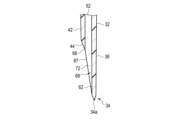
- the protruding ends 74 of the pair of protruding portions 64 of the first groove portion 24 are formed as one edge (parallel portion) 83 that is different from the two edges 82, 84 (see Figures 6 and 8) along the axis C of the needle portion 22, and one inclined portion 87 that is different from the two inclined portions 86, 88 (see Figures 6 and 8) along the axis C of the needle portion 22.
- the first bottom surface 62a is provided along the inner circumferential surface on the rear side of the path 52.
- the second bottom surface 62b is not positioned along the inner circumferential surface on the rear side of the path 52, but is positioned on the rear side opposite the opening side (front side) of the first groove portion 24 from the inner circumferential surface on the flat side of the path 52.
- the bottom surface 62 can be positioned along the inner circumferential surface of the rear side of the path 52 and/or on the rear side opposite the opening side of the first groove portion 24 from the inner circumferential surface of the rear side of the path 52.
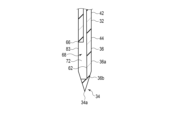
- FIG. 16A is a cross-sectional view of the first modified example of the needle portion taken along line VIII-VIII shown in Figs. 4 and 5.
- the bottom surface 62 is formed straight and parallel to the axis C of the needle portion 22. Therefore, the bottom surface 62 is formed, for example, as a single surface.
- the bottom surface 62 is connected straight to the inner peripheral surface on the back side of the path 52. Therefore, the path 52 and the channel 68 of the first groove portion 24 are connected straight.
- the bottom surface 62 may be flat or curved.
- the protruding ends 74 of the pair of protruding portions 64 of the first groove portion 24 are formed as one edge (parallel portion) 83 along the axis C of the needle portion 22 and one inclined portion 87 along the axis C of the needle portion 22.
- the puncture needle 14 may be formed in this manner.
- FIG. 16B is a cross-sectional view of the needle portion shown in Figs. 4 and 5 taken along line VIII-VIII.
- the closed end 66 of the first groove 24 is provided in the second columnar portion 44 of the body portion 32, not in the first intermediate body 36a of the intermediate portion 36.
- the first groove 24 is preferably provided not only in the intermediate portion 36 and the puncture portion 34, but also in the body portion 32.
- the puncture needle 14 may be formed in this manner.
- FIG. 16C is a cross-sectional view of the third modified example taken along line VIII-VIII of the needle portion shown in Figs. 4 and 5.
- the protruding ends 74 of the pair of protruding portions 64 of the first groove portion 24 are formed as a single inclined portion 87 along the axis C of the needle portion 22. Even when the puncture needle 14 punctures the elastic body E, the channel 68 is secured.
- the puncture needle 14 may be formed in this manner.
- the protruding ends 74 of the pair of protruding portions 64 of the first groove portion 24 may be formed along the outer circumferential surface of the intermediate portion 36 between the tip of the body portion 32 and the base end of the puncture portion 34.
- the protruding ends 74 of the pair of protruding portions 64 of the first groove portion 24 are formed as one edge (parallel portion) 83 along the axis C of the needle portion 22.
- the central axis (axis center) of the second columnar portion 44 of the body 32 coincides with the axis center of the needle tip 34a of the puncture portion 34. Furthermore, if the outer diameters of the body 32 and the first intermediate body 36a of the intermediate portion 36 are the same shape up to the base end of the second intermediate body 36b, the puncture needle 14 according to this embodiment can have the axis C of the needle portion 22 pass through the needle tip 34a of the puncture portion 34.
- the puncture needle 14 may be formed in this manner.
- a puncture needle made of a resin material that, when punctured into an elastic body that serves as a lid for a container in which a liquid such as a liquid medicine is sealed, makes it easy to secure a fluid path, a puncture tool including the puncture needle, and a puncture tool assembly including the puncture tool.
- the present invention is not limited to the above-described embodiments, and can be modified in various ways during implementation without departing from the gist of the invention.
- the embodiments may also be implemented in appropriate combination, in which case the combined effects can be obtained.
- the above-described embodiments include various inventions, and various inventions can be extracted by combinations selected from the multiple constituent elements disclosed. For example, if the problem can be solved and an effect can be obtained even if some constituent elements are deleted from all the constituent elements shown in the embodiments, the configuration from which these constituent elements are deleted can be extracted as an invention.
- 1...Puncture tool assembly 8...Connector, 10...Puncture tool, 12...Connector, 14...Puncture needle, 22...Needle portion, 24...First groove portion, 26...Second groove portion, 32...Body portion, 34...Puncture portion, 34a...Needle tip, 36...Middle portion, 36a...First intermediate body, 36b...Second intermediate body, 42...First columnar portion, 44...Second columnar portion, 44a...Inclined portion, 52...Path, 52a...Hole portion, 54...Path, 54a...Hole portion, 62...Bottom surface, 62a...First bottom surface (flat surface), 62b...Second bottom surface (flat surface) ), 62c...third bottom surface (inclined surface), 63...tip, 64...protruding portion, 65...tip, 66...closed end, 68...channel (flow path), 72...wall surface, 74...protruding end, 82...first edge (
Landscapes
- Health & Medical Sciences (AREA)
- Veterinary Medicine (AREA)
- Life Sciences & Earth Sciences (AREA)
- Animal Behavior & Ethology (AREA)
- General Health & Medical Sciences (AREA)
- Public Health (AREA)
- Vascular Medicine (AREA)
- Engineering & Computer Science (AREA)
- Anesthesiology (AREA)
- Biomedical Technology (AREA)
- Heart & Thoracic Surgery (AREA)
- Hematology (AREA)
- Pharmacology & Pharmacy (AREA)
- Infusion, Injection, And Reservoir Apparatuses (AREA)
Abstract
Description
図1から図13を用いて第1実施形態に係る穿刺具アセンブリ1について説明する。
ここでは、第1実施形態で説明した針部22の第1の溝部24のチャンネル68の形状の変形例について、図14Aから図14Eを用いて説明する。
第2実施形態に係る穿刺具10の穿刺針14の針部22について図15を用いて説明する。本実施形態は、各変形例を含む第1実施形態の変形例であって、第1実施形態で説明した部材と同一の部材又は同一の機能を有する部材には極力同一の符号を付し、詳しい説明を省略する。
第2実施形態に係る穿刺具10の穿刺針14の第1変形例について図16Aを用いて説明する。図16Aは、図4及び図5に示す針部のVIII-VIII線に沿う断面図の第1変形例である。
第2実施形態に係る穿刺具10の穿刺針14の第2変形例について図16Bを用いて説明する。本変形例に係る穿刺針14は、第1変形例の更なる変形例である。図16Bは、図4及び図5に示す針部のVIII-VIII線に沿う断面図の第2変形例である。
第2実施形態に係る穿刺具10の穿刺針14の第3変形例について図16Cを用いて説明する。本変形例に係る穿刺針14は、第1変形例又は第2変形例の更なる変形例である。図16Cは、図4及び図5に示す針部のVIII-VIII線に沿う断面図の第3変形例である。
第3実施形態に係る穿刺具10の穿刺針14について図17を用いて説明する。
Claims (12)
- 流体を通す経路を有する胴部、
前記胴部の先端側に設けられ、最先端に針先を有する穿刺部、及び、
前記胴部と前記穿刺部との間に設けられる中間部
を一体的に有する針部と、
前記中間部に一体的に設けられ、前記胴部から前記穿刺部に向かって延びる底面、及び、
前記底面に一体的に設けられ、前記胴部から前記穿刺部に向かって前記針部の軸心に沿う方向に延びるとともに前記底面から前記針部の軸心に交差する方向に突出する一対の突出部
を有し、前記底面及び前記一対の突出部の間に形成されるチャンネルが前記胴部の前記経路と連通するとともに、前記チャンネルを前記中間部の外側に開口させる溝部と
を有する、樹脂材製の穿刺針。 - 前記一対の突出部の前記底面に対して突出する端縁の少なくとも一部は、前記針部の軸心に沿う方向に平行である、
請求項1に記載の穿刺針。 - 前記一対の突出部の前記端縁は、
前記胴部に隣接して設けられ、前記底面に対して突出する第1の端縁と、
前記第1の端縁よりも前記穿刺部に近い側に設けられ、前記底面に対して突出する第2の端縁と
を有し、
前記底面に対し、前記第2の端縁の突出量よりも前記第1の端縁の突出量が大きい、
請求項2に記載の穿刺針。 - 前記一対の突出部は、前記第1の端縁と前記第2の端縁との間に設けられ、前記針部の軸心に対して傾斜し、前記第1の端縁から前記第2の端縁に向かうにつれて前記底面に対して突出する突出量を小さくする傾斜部を有する、
請求項3に記載の穿刺針。 - 前記底面は、前記経路のうち前記溝部の開口側とは反対側の内周面に沿う位置、又は、前記経路の内周面よりも前記溝部の開口側とは反対側に配置される、
請求項1又は請求項2に記載の穿刺針。 - 前記胴部は、
前記経路を有する第1の柱状部と、
前記第1の柱状部と前記穿刺部との間に設けられ、前記経路の開口縁を有する、第2の柱状部と
を有し、
前記第2の柱状部の外径は、前記第1の柱状部の外径と同じかそれよりも小さく、
前記第2の柱状部の外周面は、前記穿刺部の外周面に連続する、
請求項1又は請求項2に記載の穿刺針。 - 前記第1の柱状部の軸心、前記第2の柱状部の軸心、及び、前記穿刺部の前記針先を含む軸心は、互いにずれている、
請求項6に記載の穿刺針。 - 前記針部の軸心に直交する前記チャンネルの断面積は、前記針部の軸心に直交する前記経路の断面積と同じかそれよりも大きい、
請求項1又は請求項2に記載の穿刺針。 - 前記一対の突出部のうち前記底面に対して突出する端縁間の距離は、前記溝部の前記底面の幅と同じかそれよりも大きい、
請求項1又は請求項2に記載の穿刺針。 - 前記針部の軸心に沿う前記溝部の前記一対の突出部の長さは、外側の面側から穿刺される板状の弾性体の内側の面を貫通する長さと同じかそれよりも長く形成される、
請求項1又は請求項2に記載の穿刺針。 - 請求項1又は請求項2に記載の穿刺針と、
前記穿刺針の前記胴部に設けられる基部と
を一体的に有する穿刺具。 - 請求項11に記載の穿刺具と、
前記穿刺具の前記基部に接続される接続具と、
を有する穿刺具アセンブリ。
Priority Applications (4)
| Application Number | Priority Date | Filing Date | Title |
|---|---|---|---|
| AU2024303749A AU2024303749A1 (en) | 2023-06-12 | 2024-06-03 | Puncture needle, puncture tool, and puncture tool assembly |
| CN202480039340.7A CN121335728A (zh) | 2023-06-12 | 2024-06-03 | 穿刺针、穿刺器具以及穿刺器具组件 |
| EP24823258.9A EP4725521A1 (en) | 2023-06-12 | 2024-06-03 | Puncture needle, puncture tool, and puncture tool assembly |
| US19/413,343 US20260091178A1 (en) | 2023-06-12 | 2025-12-09 | Puncture needle, puncture tool, and puncture tool assembly |
Applications Claiming Priority (2)
| Application Number | Priority Date | Filing Date | Title |
|---|---|---|---|
| JP2023-096104 | 2023-06-12 | ||
| JP2023096104A JP2024177773A (ja) | 2023-06-12 | 2023-06-12 | 穿刺針、穿刺具、及び、穿刺具アセンブリ |
Related Child Applications (1)
| Application Number | Title | Priority Date | Filing Date |
|---|---|---|---|
| US19/413,343 Continuation US20260091178A1 (en) | 2023-06-12 | 2025-12-09 | Puncture needle, puncture tool, and puncture tool assembly |
Publications (1)
| Publication Number | Publication Date |
|---|---|
| WO2024257638A1 true WO2024257638A1 (ja) | 2024-12-19 |
Family
ID=93851853
Family Applications (1)
| Application Number | Title | Priority Date | Filing Date |
|---|---|---|---|
| PCT/JP2024/020222 Ceased WO2024257638A1 (ja) | 2023-06-12 | 2024-06-03 | 穿刺針、穿刺具、及び、穿刺具アセンブリ |
Country Status (6)
| Country | Link |
|---|---|
| US (1) | US20260091178A1 (ja) |
| EP (1) | EP4725521A1 (ja) |
| JP (1) | JP2024177773A (ja) |
| CN (1) | CN121335728A (ja) |
| AU (1) | AU2024303749A1 (ja) |
| WO (1) | WO2024257638A1 (ja) |
Citations (4)
| Publication number | Priority date | Publication date | Assignee | Title |
|---|---|---|---|---|
| WO2004054643A1 (ja) * | 2002-12-13 | 2004-07-01 | Terumo Kabushiki Kaisha | 医療用針体および導液具 |
| JP2014097102A (ja) | 2012-11-13 | 2014-05-29 | Jms Co Ltd | 高流量型瓶針 |
| WO2016153003A1 (ja) * | 2015-03-26 | 2016-09-29 | テルモ株式会社 | 医療用樹脂製中空針、穿刺部付外筒およびプレフィルドシリンジ |
| WO2019216397A1 (ja) * | 2018-05-11 | 2019-11-14 | テルモ株式会社 | 医療用中空針及びその使用方法 |
-
2023
- 2023-06-12 JP JP2023096104A patent/JP2024177773A/ja active Pending
-
2024
- 2024-06-03 CN CN202480039340.7A patent/CN121335728A/zh active Pending
- 2024-06-03 AU AU2024303749A patent/AU2024303749A1/en active Pending
- 2024-06-03 WO PCT/JP2024/020222 patent/WO2024257638A1/ja not_active Ceased
- 2024-06-03 EP EP24823258.9A patent/EP4725521A1/en active Pending
-
2025
- 2025-12-09 US US19/413,343 patent/US20260091178A1/en active Pending
Patent Citations (4)
| Publication number | Priority date | Publication date | Assignee | Title |
|---|---|---|---|---|
| WO2004054643A1 (ja) * | 2002-12-13 | 2004-07-01 | Terumo Kabushiki Kaisha | 医療用針体および導液具 |
| JP2014097102A (ja) | 2012-11-13 | 2014-05-29 | Jms Co Ltd | 高流量型瓶針 |
| WO2016153003A1 (ja) * | 2015-03-26 | 2016-09-29 | テルモ株式会社 | 医療用樹脂製中空針、穿刺部付外筒およびプレフィルドシリンジ |
| WO2019216397A1 (ja) * | 2018-05-11 | 2019-11-14 | テルモ株式会社 | 医療用中空針及びその使用方法 |
Also Published As
| Publication number | Publication date |
|---|---|
| JP2024177773A (ja) | 2024-12-24 |
| EP4725521A1 (en) | 2026-04-15 |
| US20260091178A1 (en) | 2026-04-02 |
| CN121335728A (zh) | 2026-01-13 |
| AU2024303749A1 (en) | 2026-01-08 |
Similar Documents
| Publication | Publication Date | Title |
|---|---|---|
| JP6839050B2 (ja) | 均圧化を有する医療用バイアルアクセス器具、および、閉鎖式薬物移送システム | |
| CN101389366B (zh) | 液体输送装置和系统 | |
| CN103402483B (zh) | 用于连接第一容器与第二容器的连接装置 | |
| TWI732800B (zh) | 注射器填充適配器及流體傳輸組件 | |
| JP6002689B2 (ja) | 結合デバイスおよびそのキット | |
| JP4682850B2 (ja) | プレフィルドシリンジ | |
| CN110325165B (zh) | 封闭式系统的耐应力膜 | |
| JP2009119171A (ja) | プランジャロッドおよび注射器 | |
| US20120234099A1 (en) | Drive head for a syringe pump | |
| EP3275477A1 (en) | Medical resin-made hollow needle, outer cylinder provided with puncture part, and pre-filled syringe | |
| JP2007185319A5 (ja) | ||
| US20210260296A1 (en) | Discharger with improved piercing tip | |
| JP2013518635A (ja) | 医薬活性成分を収容する容器用のコネクター | |
| EP4082600A1 (en) | Valve, method of manufacturing a valve, cap for a fluid container comprising such valve, fluid container containing such cap, and method for manufacturing such cap | |
| KR101775176B1 (ko) | 캡, 및 그것을 이용한 영양제용 용기 및 영양제 공급 세트 | |
| KR101773849B1 (ko) | 의료용 용기의 커넥터 세트 및 이를 구성하는 제1접속구 | |
| US9737700B2 (en) | Flexible multi-use container, system and method of manufacture | |
| KR20120085279A (ko) | 캡, 및 그것을 이용한 영양제용 용기 및 영양제 공급 세트 | |
| JP2024177773A (ja) | 穿刺針、穿刺具、及び、穿刺具アセンブリ | |
| JP2002331032A (ja) | 逆流防止具とその製造方法およびそれを用いた医療用具 | |
| WO2002000160A1 (fr) | Dispositif de sortie de liquide, et raccord pour contenant de liquide faisant appel a ce dispositif | |
| KR102926155B1 (ko) | 슬라이드 개폐방식의 수액용기용 밀봉캡 | |
| JP2002274519A (ja) | 液体容器およびそれを用いた液体容器連結体 | |
| JP2022041685A (ja) | キャップ | |
| JP2001002127A (ja) | 開封部材 |
Legal Events
| Date | Code | Title | Description |
|---|---|---|---|
| 121 | Ep: the epo has been informed by wipo that ep was designated in this application |
Ref document number: 24823258 Country of ref document: EP Kind code of ref document: A1 |
|
| WWE | Wipo information: entry into national phase |
Ref document number: AU2024303749 Country of ref document: AU |
|
| WWE | Wipo information: entry into national phase |
Ref document number: CN2024800393407 Country of ref document: CN |
|
| ENP | Entry into the national phase |
Ref document number: 2024303749 Country of ref document: AU Date of ref document: 20240603 Kind code of ref document: A |
|
| ENP | Entry into the national phase |
Ref document number: 2024823258 Country of ref document: EP Effective date: 20260112 |
|
| WWE | Wipo information: entry into national phase |
Ref document number: 2024823258 Country of ref document: EP |
|
| NENP | Non-entry into the national phase |
Ref country code: DE |
|
| ENP | Entry into the national phase |
Ref document number: 2024823258 Country of ref document: EP Effective date: 20260112 |
|
| ENP | Entry into the national phase |
Ref document number: 2024823258 Country of ref document: EP Effective date: 20260112 |
|
| ENP | Entry into the national phase |
Ref document number: 2024823258 Country of ref document: EP Effective date: 20260112 |
|
| ENP | Entry into the national phase |
Ref document number: 2024823258 Country of ref document: EP Effective date: 20260112 |
|
| WWP | Wipo information: published in national office |
Ref document number: 2024823258 Country of ref document: EP |