WO2024257639A1 - フェライト・オーステナイト系二相ステンレス鋼材及びその製造方法、並びに粗製リン酸用構造物 - Google Patents
フェライト・オーステナイト系二相ステンレス鋼材及びその製造方法、並びに粗製リン酸用構造物 Download PDFInfo
- Publication number
- WO2024257639A1 WO2024257639A1 PCT/JP2024/020240 JP2024020240W WO2024257639A1 WO 2024257639 A1 WO2024257639 A1 WO 2024257639A1 JP 2024020240 W JP2024020240 W JP 2024020240W WO 2024257639 A1 WO2024257639 A1 WO 2024257639A1
- Authority
- WO
- WIPO (PCT)
- Prior art keywords
- less
- content
- stainless steel
- phosphoric acid
- duplex stainless
- Prior art date
- Legal status (The legal status is an assumption and is not a legal conclusion. Google has not performed a legal analysis and makes no representation as to the accuracy of the status listed.)
- Ceased
Links
Classifications
-
- C—CHEMISTRY; METALLURGY
- C22—METALLURGY; FERROUS OR NON-FERROUS ALLOYS; TREATMENT OF ALLOYS OR NON-FERROUS METALS
- C22C—ALLOYS
- C22C38/00—Ferrous alloys, e.g. steel alloys
- C22C38/18—Ferrous alloys, e.g. steel alloys containing chromium
- C22C38/40—Ferrous alloys, e.g. steel alloys containing chromium with nickel
- C22C38/58—Ferrous alloys, e.g. steel alloys containing chromium with nickel with more than 1.5% by weight of manganese
-
- C—CHEMISTRY; METALLURGY
- C21—METALLURGY OF IRON
- C21D—MODIFYING THE PHYSICAL STRUCTURE OF FERROUS METALS; GENERAL DEVICES FOR HEAT TREATMENT OF FERROUS OR NON-FERROUS METALS OR ALLOYS; MAKING METAL MALLEABLE, e.g. BY DECARBURISATION OR TEMPERING
- C21D6/00—Heat treatment of ferrous alloys
- C21D6/004—Heat treatment of ferrous alloys containing Cr and Ni
-
- C—CHEMISTRY; METALLURGY
- C21—METALLURGY OF IRON
- C21D—MODIFYING THE PHYSICAL STRUCTURE OF FERROUS METALS; GENERAL DEVICES FOR HEAT TREATMENT OF FERROUS OR NON-FERROUS METALS OR ALLOYS; MAKING METAL MALLEABLE, e.g. BY DECARBURISATION OR TEMPERING
- C21D6/00—Heat treatment of ferrous alloys
- C21D6/005—Heat treatment of ferrous alloys containing Mn
-
- C—CHEMISTRY; METALLURGY
- C21—METALLURGY OF IRON
- C21D—MODIFYING THE PHYSICAL STRUCTURE OF FERROUS METALS; GENERAL DEVICES FOR HEAT TREATMENT OF FERROUS OR NON-FERROUS METALS OR ALLOYS; MAKING METAL MALLEABLE, e.g. BY DECARBURISATION OR TEMPERING
- C21D8/00—Modifying the physical properties of ferrous metals or ferrous alloys by deformation combined with, or followed by, heat treatment
- C21D8/02—Modifying the physical properties of ferrous metals or ferrous alloys by deformation combined with, or followed by, heat treatment during manufacturing of plates or strips
- C21D8/0221—Modifying the physical properties of ferrous metals or ferrous alloys by deformation combined with, or followed by, heat treatment during manufacturing of plates or strips characterised by the working steps
- C21D8/0226—Hot rolling
-
- C—CHEMISTRY; METALLURGY
- C21—METALLURGY OF IRON
- C21D—MODIFYING THE PHYSICAL STRUCTURE OF FERROUS METALS; GENERAL DEVICES FOR HEAT TREATMENT OF FERROUS OR NON-FERROUS METALS OR ALLOYS; MAKING METAL MALLEABLE, e.g. BY DECARBURISATION OR TEMPERING
- C21D8/00—Modifying the physical properties of ferrous metals or ferrous alloys by deformation combined with, or followed by, heat treatment
- C21D8/02—Modifying the physical properties of ferrous metals or ferrous alloys by deformation combined with, or followed by, heat treatment during manufacturing of plates or strips
- C21D8/0247—Modifying the physical properties of ferrous metals or ferrous alloys by deformation combined with, or followed by, heat treatment during manufacturing of plates or strips characterised by the heat treatment
- C21D8/0263—Modifying the physical properties of ferrous metals or ferrous alloys by deformation combined with, or followed by, heat treatment during manufacturing of plates or strips characterised by the heat treatment following hot rolling
-
- C—CHEMISTRY; METALLURGY
- C21—METALLURGY OF IRON
- C21D—MODIFYING THE PHYSICAL STRUCTURE OF FERROUS METALS; GENERAL DEVICES FOR HEAT TREATMENT OF FERROUS OR NON-FERROUS METALS OR ALLOYS; MAKING METAL MALLEABLE, e.g. BY DECARBURISATION OR TEMPERING
- C21D9/00—Heat treatment, e.g. annealing, hardening, quenching or tempering, adapted for particular articles; Furnaces therefor
- C21D9/46—Heat treatment, e.g. annealing, hardening, quenching or tempering, adapted for particular articles; Furnaces therefor for sheet metals
-
- C—CHEMISTRY; METALLURGY
- C22—METALLURGY; FERROUS OR NON-FERROUS ALLOYS; TREATMENT OF ALLOYS OR NON-FERROUS METALS
- C22C—ALLOYS
- C22C38/00—Ferrous alloys, e.g. steel alloys
- C22C38/001—Ferrous alloys, e.g. steel alloys containing N
-
- C—CHEMISTRY; METALLURGY
- C22—METALLURGY; FERROUS OR NON-FERROUS ALLOYS; TREATMENT OF ALLOYS OR NON-FERROUS METALS
- C22C—ALLOYS
- C22C38/00—Ferrous alloys, e.g. steel alloys
- C22C38/002—Ferrous alloys, e.g. steel alloys containing In, Mg, or other elements not provided for in one single group C22C38/001 - C22C38/60
-
- C—CHEMISTRY; METALLURGY
- C22—METALLURGY; FERROUS OR NON-FERROUS ALLOYS; TREATMENT OF ALLOYS OR NON-FERROUS METALS
- C22C—ALLOYS
- C22C38/00—Ferrous alloys, e.g. steel alloys
- C22C38/005—Ferrous alloys, e.g. steel alloys containing rare earths, i.e. Sc, Y, Lanthanides
-
- C—CHEMISTRY; METALLURGY
- C22—METALLURGY; FERROUS OR NON-FERROUS ALLOYS; TREATMENT OF ALLOYS OR NON-FERROUS METALS
- C22C—ALLOYS
- C22C38/00—Ferrous alloys, e.g. steel alloys
- C22C38/008—Ferrous alloys, e.g. steel alloys containing tin
-
- C—CHEMISTRY; METALLURGY
- C22—METALLURGY; FERROUS OR NON-FERROUS ALLOYS; TREATMENT OF ALLOYS OR NON-FERROUS METALS
- C22C—ALLOYS
- C22C38/00—Ferrous alloys, e.g. steel alloys
- C22C38/02—Ferrous alloys, e.g. steel alloys containing silicon
-
- C—CHEMISTRY; METALLURGY
- C22—METALLURGY; FERROUS OR NON-FERROUS ALLOYS; TREATMENT OF ALLOYS OR NON-FERROUS METALS
- C22C—ALLOYS
- C22C38/00—Ferrous alloys, e.g. steel alloys
- C22C38/04—Ferrous alloys, e.g. steel alloys containing manganese
-
- C—CHEMISTRY; METALLURGY
- C22—METALLURGY; FERROUS OR NON-FERROUS ALLOYS; TREATMENT OF ALLOYS OR NON-FERROUS METALS
- C22C—ALLOYS
- C22C38/00—Ferrous alloys, e.g. steel alloys
- C22C38/18—Ferrous alloys, e.g. steel alloys containing chromium
- C22C38/40—Ferrous alloys, e.g. steel alloys containing chromium with nickel
- C22C38/42—Ferrous alloys, e.g. steel alloys containing chromium with nickel with copper
-
- C—CHEMISTRY; METALLURGY
- C22—METALLURGY; FERROUS OR NON-FERROUS ALLOYS; TREATMENT OF ALLOYS OR NON-FERROUS METALS
- C22C—ALLOYS
- C22C38/00—Ferrous alloys, e.g. steel alloys
- C22C38/18—Ferrous alloys, e.g. steel alloys containing chromium
- C22C38/40—Ferrous alloys, e.g. steel alloys containing chromium with nickel
- C22C38/44—Ferrous alloys, e.g. steel alloys containing chromium with nickel with molybdenum or tungsten
-
- C—CHEMISTRY; METALLURGY
- C22—METALLURGY; FERROUS OR NON-FERROUS ALLOYS; TREATMENT OF ALLOYS OR NON-FERROUS METALS
- C22C—ALLOYS
- C22C38/00—Ferrous alloys, e.g. steel alloys
- C22C38/18—Ferrous alloys, e.g. steel alloys containing chromium
- C22C38/40—Ferrous alloys, e.g. steel alloys containing chromium with nickel
- C22C38/46—Ferrous alloys, e.g. steel alloys containing chromium with nickel with vanadium
-
- C—CHEMISTRY; METALLURGY
- C22—METALLURGY; FERROUS OR NON-FERROUS ALLOYS; TREATMENT OF ALLOYS OR NON-FERROUS METALS
- C22C—ALLOYS
- C22C38/00—Ferrous alloys, e.g. steel alloys
- C22C38/18—Ferrous alloys, e.g. steel alloys containing chromium
- C22C38/40—Ferrous alloys, e.g. steel alloys containing chromium with nickel
- C22C38/48—Ferrous alloys, e.g. steel alloys containing chromium with nickel with niobium or tantalum
-
- C—CHEMISTRY; METALLURGY
- C22—METALLURGY; FERROUS OR NON-FERROUS ALLOYS; TREATMENT OF ALLOYS OR NON-FERROUS METALS
- C22C—ALLOYS
- C22C38/00—Ferrous alloys, e.g. steel alloys
- C22C38/18—Ferrous alloys, e.g. steel alloys containing chromium
- C22C38/40—Ferrous alloys, e.g. steel alloys containing chromium with nickel
- C22C38/50—Ferrous alloys, e.g. steel alloys containing chromium with nickel with titanium or zirconium
-
- C—CHEMISTRY; METALLURGY
- C22—METALLURGY; FERROUS OR NON-FERROUS ALLOYS; TREATMENT OF ALLOYS OR NON-FERROUS METALS
- C22C—ALLOYS
- C22C38/00—Ferrous alloys, e.g. steel alloys
- C22C38/18—Ferrous alloys, e.g. steel alloys containing chromium
- C22C38/40—Ferrous alloys, e.g. steel alloys containing chromium with nickel
- C22C38/52—Ferrous alloys, e.g. steel alloys containing chromium with nickel with cobalt
-
- C—CHEMISTRY; METALLURGY
- C22—METALLURGY; FERROUS OR NON-FERROUS ALLOYS; TREATMENT OF ALLOYS OR NON-FERROUS METALS
- C22C—ALLOYS
- C22C38/00—Ferrous alloys, e.g. steel alloys
- C22C38/18—Ferrous alloys, e.g. steel alloys containing chromium
- C22C38/40—Ferrous alloys, e.g. steel alloys containing chromium with nickel
- C22C38/54—Ferrous alloys, e.g. steel alloys containing chromium with nickel with boron
-
- C—CHEMISTRY; METALLURGY
- C21—METALLURGY OF IRON
- C21D—MODIFYING THE PHYSICAL STRUCTURE OF FERROUS METALS; GENERAL DEVICES FOR HEAT TREATMENT OF FERROUS OR NON-FERROUS METALS OR ALLOYS; MAKING METAL MALLEABLE, e.g. BY DECARBURISATION OR TEMPERING
- C21D2211/00—Microstructure comprising significant phases
- C21D2211/001—Austenite
-
- C—CHEMISTRY; METALLURGY
- C21—METALLURGY OF IRON
- C21D—MODIFYING THE PHYSICAL STRUCTURE OF FERROUS METALS; GENERAL DEVICES FOR HEAT TREATMENT OF FERROUS OR NON-FERROUS METALS OR ALLOYS; MAKING METAL MALLEABLE, e.g. BY DECARBURISATION OR TEMPERING
- C21D2211/00—Microstructure comprising significant phases
- C21D2211/005—Ferrite
Definitions
- the present invention relates to a ferritic-austenitic duplex stainless steel material, a manufacturing method thereof, and a structure for crude phosphoric acid.
- Patent Document 1 proposes using a ferritic-austenitic duplex stainless steel material with a specified composition instead of the austenitic stainless steel material that has traditionally been used as a storage tank steel material.
- Patent Document 2 also proposes using a ferritic-austenitic duplex stainless steel material with a specified composition for sulfuric acid plants that handle crude sulfuric acid and sulfuric acid storage tanks.
- Patent Document 3 proposes a ferritic-austenitic duplex stainless steel material with excellent corrosion resistance in a trace hydrogen sulfide environment as a stainless steel material to be used for line pipes used in transporting oil and natural gas.
- crude phosphoric acid is one of the chemicals transported by chemical tankers.
- Crude phosphoric acid is a basic raw material for fertilizers, detergents, feed, medicines, etc., but Japan has few phosphorus resources and relies on imports by sea transport for most of it.
- crude phosphoric acid contains corrosive substances such as F - and Cl - derived from phosphate rock, and therefore corrosion (including discoloration such as blackening) occurs on the inner surface of the tank when crude phosphoric acid is transported. Therefore, after the transportation of crude phosphoric acid, maintenance such as repair and cleaning is performed on the inner surface of the tank in order to prevent contamination, and new chemicals are loaded. Such maintenance is very laborious and frequent, and is therefore a problem in terms of cost and time in chemical transportation.
- austenitic stainless steel materials with good corrosion resistance such as SUS316L and 329J3L
- SUS316L and 329J3L have been used for the inner surface of the tank of a chemical tanker that transports crude phosphoric acid.
- SUS316L corrodes when crude phosphoric acid is stored, and the demand for alternative materials is growing day by day. Therefore, it is considered that the ferritic-austenitic duplex stainless steel materials described in Patent Documents 1 to 3 may be applied to the inner surfaces of storage tanks of chemical tankers that transport crude phosphoric acid.
- ferritic-austenitic duplex stainless steel materials described in Patent Documents 1 to 3 are more cost effective than Ni-rich austenitic stainless steels, their corrosion resistance to sulfides, crude phosphoric acid, etc. is inferior to that of SUS316L.
- Patent Document 4 proposes an austenitic stainless steel material with adjusted contents of Cr, Ni, Mo, and Cu, which affect corrosion resistance to crude phosphoric acid.
- the austenitic stainless steel material described in Patent Document 4 is effective to a certain extent against corrosion caused by crude phosphoric acid, but it has been confirmed that corrosion (particularly blackening) occurs on the inner surface of the tank of a chemical tanker that actually transports crude phosphoric acid. Therefore, there is a demand for further improvement in corrosion resistance to crude phosphoric acid, as well as improvement from an economical perspective by reducing the content of expensive elements such as Ni.
- the present invention is directed to a ferritic-austenitic duplex stainless steel material, which is superior from an economical point of view to an austenitic stainless steel material, and aims to provide a ferritic-austenitic duplex stainless steel material having excellent corrosion resistance to crude phosphoric acid and a method for producing the same.
- Another object of the present invention is to provide a structure for crude phosphoric acid which has excellent corrosion resistance against crude phosphoric acid and can reduce maintenance costs and time.
- Crude phosphoric acid is produced by dissolving phosphate rock with sulfuric acid, and is transported as a liquid on a chemical tanker. Crude phosphoric acid contains low concentrations of F - (fluorine ion) and Cl - (chlorine ion), which are corrosive substances that preferentially dissolve the austenite phase, causing a decrease in the corrosion resistance of crude phosphoric acid.
- the present invention has a composition, on a mass basis, of C: 0.100% or less, Si: 0.05 to 1.50%, Mn: 0.05 to 2.00%, Ni: 4.00 to 9.00%, P: 0.050% or less, S: 0.0040% or less, Cr: 23.0 to 30.0%, N: 0.100 to 0.250%, Cu: 0.01 to 2.00%, Mo: 0.50 to 2.50%, Al: 0.100% or less, Nb: 0.200% or less, with the balance being Fe and impurities;
- DF 7.2(Cr+0.8Mo+0.78Si)-8.9(Ni+0.03Mn+0.72Cu+22C+21N)-44.9...
- each element symbol represents the content (mass%) of each element
- the austenite phase has the following formula (2): (0.8Cr) 2 +2Ni+7Mo+30Cu+30N ⁇ 340... (2) (wherein the element symbols represent the contents (mass%) of each element)
- the present invention also relates to a soaking process in which a rolled material containing, by mass, C: 0.100% or less, Si: 0.05 to 1.50%, Mn: 0.05 to 2.00%, Ni: 4.00 to 9.00%, P: 0.050% or less, S: 0.0040% or less, Cr: 23.0 to 30.0%, N: 0.100 to 0.250%, Cu: 0.01 to 2.00%, Mo: 0.50 to 2.50%, Al: 0.100% or less, Nb: 0.200% or less, and the balance being Fe and impurities, is soaked at a soaking temperature of 950 to 1150 ° C.
- the present invention relates to a method for producing a ferritic-austenitic duplex stainless steel material, wherein the quenching start temperature is a temperature of 950 to 990°C and is a temperature lower than the soaking temperature.
- the present invention relates to a structure for crude phosphoric acid comprising the above-mentioned ferritic-austenitic duplex stainless steel material.
- the present invention it is possible to provide a ferritic-austenitic duplex stainless steel material having excellent corrosion resistance to crude phosphoric acid and a method for producing the same. Furthermore, according to the present invention, it is possible to provide a structure for crude phosphoric acid which has excellent corrosion resistance against crude phosphoric acid and can reduce maintenance costs and time.
- the ferritic-austenitic duplex stainless steel material according to an embodiment of the present invention (hereinafter simply referred to as "duplex stainless steel material”) has a composition containing C: 0.100% or less, Si: 0.05-1.50%, Mn: 0.05-2.00%, Ni: 4.00-9.00%, P: 0.050% or less, S: 0.0040% or less, Cr: 23.0-30.0%, N: 0.100-0.250%, Cu: 0.01-2.00%, Mo: 0.50-2.50%, Al: 0.100% or less, Nb: 0.200% or less, with the balance being Fe and impurities.
- the term “stainless steel material” refers to a material formed from stainless steel, and the shape of the material is not particularly limited. Examples of the material shape include a plate shape (including a strip shape), a rod shape, a tube shape, and the like. In addition, the material may be various shaped steels having a cross-sectional shape such as a T-shape or an I-shape.
- the term “ferritic-austenitic” refers to a metal structure that is mainly composed of two phases, ferritic and austenitic, at room temperature.
- the term “ferritic-austenitic” also includes metal structures that contain small amounts of phases other than ferritic and austenitic phases (e.g., martensite phase, etc.).
- impurities refers to components that are mixed in due to various factors in raw materials such as ores and scraps and in the manufacturing process during industrial production of stainless steel materials, and are acceptable within a range that does not adversely affect the present invention.
- impurities also include unavoidable impurities.
- “xx% or less” means that the content is xx% or less, but includes an amount exceeding 0% (particularly, above the impurity level).
- the duplex stainless steel material according to the embodiment of the present invention may further contain one or more selected from Ti: 0.050% or less, B: 0.0050% or less, Ca: 0.0010 to 0.0100%, Mg: 0.0001 to 0.0020%, Zr: 0.090% or less, Co: 3.00% or less, V: 1.000% or less, Ta: 0.200% or less, Sn: 0.100% or less, O: 0.0050% or less, W: 1.000% or less, and REM: 0.100% or less, as necessary.
- Ti 0.050% or less
- B 0.0050% or less
- Ca 0.0010 to 0.0100%
- Mg 0.0001 to 0.0020%
- Zr 0.090% or less
- Co 3.00% or less
- V 1.000% or less
- Ta 0.200% or less
- Sn 0.100% or less
- W: 1.000% or less REM: 0.100% or less
- Silicon is an element that is used as a deoxidizing element and is added to improve oxidation resistance. From the viewpoint of obtaining these effects, the silicon content is set to 0.05% or more. From the viewpoint of stably securing these effects, the amount of Si is preferably 0.10% or more, 0.20% or more, or 0.30% or more. On the other hand, if the Si content is too high, the two-phase The stainless steel material becomes hard, and the toughness and workability are reduced. Therefore, from the viewpoint of suppressing the reduction in toughness and workability, the Si content is set to 1.50% or less. From the viewpoint of stably securing it, it is preferably 1.45% or less, 1.40% or less, 1.35% or less, or 1.30% or less.
- Mn has the effect of increasing the austenite phase and increasing the solid solubility of nitrogen to suppress bubble defects during manufacturing. From the viewpoint of obtaining this effect, the Mn content is set to 0.05% or more. In order to stably ensure this effect, the Mn content is preferably 0.10% or more or 0.20% or more. On the other hand, if the Mn content is too high, the corrosion resistance and hot workability are deteriorated. Therefore, from the viewpoint of suppressing the deterioration of corrosion resistance and hot workability, the Mn content is set to 2.00% or less. % or less, preferably 1.80% or less, 1.70% or less, or 1.60% or less.
- Ni is an austenite stabilizing element and has the effect of improving corrosion resistance by suppressing the progress of corrosion.
- the Ni content is set to 4.00% or more.
- the Ni content is 4.10% or more, 4.20% or more, 4.30% or more, 4.40% or more, or 4.50% or more.
- the Ni content is set to 9.00% or less. From the viewpoint of cost reduction, the Ni content is set to It is preferably 8.50% or less, 8.00% or less, or 7.80% or less.
- P is an element that is inevitably mixed into duplex stainless steel materials, and is also contained in raw materials such as Cr. If the P content is too high, formability decreases, so the lower the P content, the better.
- the P content is set to 0.050% or less. From the viewpoint of stably suppressing the deterioration of formability, the P content is preferably set to 0.045% or less or 0.040% or less.
- the lower limit of P is not particularly limited, but removing P requires a very high refining cost, so the P content may be set to 0.001% or more in consideration of economic efficiency.
- S is an element that is inevitably mixed into duplex stainless steel materials, and it can combine with Mn to form inclusions that can become the starting point for rusting.
- the lower limit of the S content is not particularly limited, but removing S requires a very high refining cost. Therefore, from the viewpoint of economy, the S content is set to 0.0001% or more. Good too.
- Cr strengthens the passive film, thereby improving the corrosion resistance against crude phosphoric acid.
- Cr also has the effect of repairing the passive film after Fe is dissolved.
- the Cr content is set to 23.0% or more.
- the Cr content is set to 23.5% or more, 24.0% or more, or 24.5% or more.
- the Cr content is set to 30.0% or less.
- the Cr content is set to 29.8% or less, % or less, 29.4% or less, 29.2% or less, or 29.0% or less is preferable.
- N 0.100-0.250%>
- NH4 + ammonium ion
- the N content is set to 0.100% or more.
- the N content is set to 0.120% or more.
- N is an element that greatly affects the precipitation of chromium nitrides, and if it is contained in a large amount, the amount of chromium nitrides precipitated increases, In order to suppress these, the N content is set to 0.250% or less. In order to stably suppress these, the N content is set to 0.230% or less or 0. It is preferable that the ratio is 220% or less.
- Cu is an element that improves acid resistance, particularly corrosion resistance against crude phosphoric acid containing sulfuric acid, and has the effect of suppressing the dissolution of Fe from the surface of the duplex stainless steel material when acidic condensed water adheres to the material.
- the Cu content is set to 0.01% or more.
- the Cu content is set to 0.05% or more, 0.10% or more, 0.20% or more, % or more, or 0.25% or more.
- the Cu content is set to 1.80% or less, 1.50% or less, 1.00% or less, or 0.80% or less. preferable.
- Mo has the effect of improving corrosion resistance and also has the effect of repairing the passive film after Fe dissolution. In particular, it prevents Fe from dissolving on the surface of duplex stainless steel material and causing corrosion (especially blackening).
- the Mo content is set to 0.50% or more.
- the Mo content is set to 0.80% or more, 0.90% or more. % or more, or 1.00% or more.
- the Mo content is set to 2.50% or less. From the viewpoint of reducing costs, the Mo content is preferably 2.30% or less or 2.20% or less.
- Al is an element contained for desulfurization and deoxidization. However, if a large amount of Al is contained, it will lead to an increase in raw material costs and manufacturing costs, so the Al content is set to 0.100% or less.
- the Al content is preferably 0.090% or less or 0.080% or less from the viewpoint of stably reducing increases in raw material costs and manufacturing costs.
- the lower limit of the Al content is not particularly limited. From the viewpoint of obtaining the above-mentioned effects, the Al content is preferably 0.001% or more.
- Nb has the effect of suppressing the precipitation of chromium nitrides by forming a compound with N.
- the Nb content is set to 0.200% or less.
- the Nb content is preferably 0.190% or less or 0.180% or less.
- the lower limit of the Nb content is not particularly limited, but from the viewpoint of obtaining the above-mentioned effects, the Nb content is preferably 0.001% or more.
- Ti has the effect of preventing coarsening of the heat-affected zone during welding of duplex stainless steel material and of forming fine equiaxed crystals in the solidified structure, and therefore can be contained as necessary.
- the Ti content is set to 0.050% or less.
- the Ti content is From the viewpoint of stably securing this effect, it is preferable that the Ti content is 0.045% or less or 0.040% or less.
- the lower limit of the Ti content is not particularly limited, but from the viewpoint of securing the above effect, The Ti content is preferably 0.001% or more.
- B has the effect of improving hot workability, and therefore can be contained as necessary. However, if the B content is too high, the corrosion resistance is significantly reduced. From the viewpoint of suppressing the reduction in corrosion resistance, the B content is set to 0.0050% or less. From the viewpoint of stably ensuring this effect, the B content is preferably set to 0.0040% or less or 0.0030% or less. The lower limit of the content is not particularly limited, but from the viewpoint of obtaining the above-mentioned effects, the B content is preferably 0.0003% or more.
- Ca is an element that enhances corrosion resistance. It is believed that Ca reduces inclusions that are the starting point of corrosion in an environment where crude phosphoric acid is present, and inhibits the elution of Fe. Therefore, it is included as necessary. From the viewpoint of ensuring this effect, the Ca content is set to 0.0010% or more. From the viewpoint of stably ensuring this effect, the Ca content is set to 0.0015% or more or 0. It is preferable that the Ca content is 0.0020% or more. On the other hand, if the Ca content is too high, hot work cracks are likely to occur and the corrosion resistance is also reduced. From the viewpoint of suppressing these, the Ca content is set to 0.0100% or less. From the viewpoint of stably suppressing these, the Ca content is preferably 0.0090% or less, 0.0080% or less, or 0.0070% or less.
- Mg can be added as necessary since it has the effect of not only deoxidizing but also refining the solidified structure.
- a high Mg content increases the cost in the steelmaking process.
- the Mg content is set to 0.0020% or less. From the viewpoint of reducing costs, the Mg content is preferably set to 0.0019% or less or 0.0018% or less. Therefore, the Mg content is set to 0.0001% or more.
- Zr can be added as necessary because it has the effect of forming carbides and nitrides in duplex stainless steel materials and refining crystal grains.
- the Zr content is set to 0.090% or less.
- the Zr content is set to 0.090% or less in order to stably secure this effect. From this viewpoint, it is preferable that the Zr content is 0.085% or less.
- the lower limit of the Zr content is not particularly limited, but from the viewpoint of obtaining the above-mentioned effects, the Zr content is preferably 0.001% or more or 0.005% or more. It is preferable that:
- Co is an austenite stabilizing element and can be contained as necessary.
- the Co content is set to 3.00% or less. From the viewpoint of reducing costs, the Co content is preferably 2.80% or less or 2.60% or less.
- the lower limit of the Co content is not particularly limited, but from the viewpoint of obtaining the above-mentioned effects, The Co content is preferably 0.01% or more.
- V is an element that improves corrosion resistance and can be added as necessary. However, if the V content is too high, the load during rolling increases and manufacturing defects are more likely to occur.
- the V content is preferably 0.950% or less from the viewpoint of stably suppressing the formation of manufacturing defects. From the viewpoint of obtaining the above-mentioned effects, the V content is preferably, but not limited to, 0.010% or more, or 0.050% or more.
- Ta forms carbides and nitrides in duplex stainless steel materials and has the effect of additionally increasing corrosion resistance, so it can be added as necessary.
- the Ta content is set to 0.200% or less because the toughness is reduced by the carbides and nitrides formed. From the viewpoint of stably securing this effect, the Ta content is set to 0.170% or less or 0.150% or less.
- the lower limit of the Ta content is not particularly limited, but from the viewpoint of obtaining the above-mentioned effects, the Ta content is preferably 0.001% or more or 0.005% or more.
- Sn is an element that improves corrosion resistance, and therefore may be contained as necessary. However, if the Sn content is high, hot workability is reduced, so the Sn content is set to 0.100% or less. From the viewpoint of stably ensuring this effect, the Sn content is preferably 0.050% or less, 0.030% or less, or 0.010% or less. The Sn content is not particularly limited, but from the viewpoint of obtaining the above-mentioned effects, the Sn content is preferably 0.0001% or more, or 0.0003% or more.
- O is an element that affects hot workability, so it is desirable to have as little O as possible. Therefore, the O content is set to 0.0050% or less. From the viewpoint of stably securing the O content, the O content is preferably 0.0048% or less. On the other hand, the lower limit of the O content is not particularly limited, but reducing the O content leads to an increase in manufacturing costs. The content is preferably 0.0001% or more.
- W is an element that improves corrosion resistance, and can be added as necessary. However, if the W content is too high, the load during rolling is increased, and manufacturing defects are more likely to occur.
- the W content is set to 1.000% or less. From the viewpoint of stably ensuring this effect, the W content is preferably set to 0.900% or less or 0.800% or less.
- the lower limit is not particularly limited, but from the viewpoint of obtaining the above-mentioned effects, the W content is preferably 0.005% or more, or 0.010% or more.
- REM rare earth elements
- the REM content is set to 0.100% or less. From the viewpoint of stably ensuring this effect, the REM content is preferably set to 0.095% or less or 0.090% or less.
- the lower limit of the content is not particularly limited, but from the viewpoint of obtaining the above-mentioned effects, the REM content is preferably 0.001% or more, 0.005% or more, or 0.010% or more.
- REM is a general term for 17 elements, including Sc, Y, and 15 elements from La to Lu (lanthanoids), and the REM content means the total content of these elements.
- lanthanides are industrially added in the form of misch metals.
- the value of DF represented by the following formula (1) is 45.0 to 70.0, preferably 48.0 to 69.5, and more preferably 50.0 to 69.0.
- DF 7.2(Cr+0.8Mo+0.78Si)-8.9(Ni+0.03Mn+0.72Cu+22C+21N)-44.9...
- the element symbols represent the contents (mass%) of each element.
- DF is an index representing the amount of ferrite phase. Therefore, 100-DF means the amount of austenite phase. However, since DF is an index determined based on the content of elements, it should be noted that it may not match the amount of austenite phase actually measured.
- the austenite phase preferably satisfies the following relational expression (2).
- the element symbols represent the contents (mass%) of each element.
- formula (2) is a formula expressing the relationship between the contents of five elements (Cr, Ni, Mo, Cu, and N) that affect the preferential dissolution of the austenite phase in the crude phosphoric acid.
- the value of the left side of formula (2) is preferably 345 or more, more preferably 350 or more, and even more preferably 355 or more.
- the upper limit of the value of the left side of formula (2) is not particularly limited, but is, for example, 800 or 700.
- the content of each element in the austenite phase used to calculate the relational expression (2) can be measured by EPMA (electron probe microanalyzer). Specifically, a mirror-polished sample of a thickness-wise cross section of a duplex stainless steel material parallel to the rolling direction is used for qualitative analysis by EPMA. A portion that can be clearly determined to be an austenite phase based on the Ni content is identified by qualitative mapping of Ni for the entire cross section. Then, Cr, Ni, Mo, Cu and N are quantitatively analyzed at approximately the center of the identified austenite phase. Quantitative analysis is performed at 10 or more points, and the average value is taken as the content result for each element.
- EPMA electron probe microanalyzer
- the austenite phase preferably contains 21.0-30.0% Cr, 7.5-12.0% Ni, 0.30-2.00% Mo, 0.3-2.1% Cu, and 0.10-0.35% N.
- the Cr content is preferably 22.0-25.5%
- the Ni content is 8.0-12.0%
- the Mo content is 1.20-1.80%
- the Cu content is 0.4-0.9%
- the N content is 0.25-0.33%.
- the duplex stainless steel material according to the embodiment of the present invention preferably satisfies the relational expression of the following formula (3).
- Expected CPT - Actual CPT ⁇ 10°C ...
- the expected CPT is the pitting corrosion initiation temperature (°C) calculated by 2.5Cr + 7.6Mo + 3.19N - 26 (where Cr, Mo and N represent the Cr, Mo and N contents (mass%) in the duplex stainless steel material, respectively), and the measured CPT is the pitting corrosion initiation temperature (°C) measured by a pitting corrosion resistance test in accordance with ASTM G48E.
- the measured CPT tends to decrease when chromium nitrides precipitate
- the CPT difference expected CPT - measured CPT
- the amount of chromium nitrides precipitated is small.
- the relational expression (3) when the relational expression (3) is satisfied, the precipitation of chromium nitrides is suppressed, and corrosion resistance can be sufficiently ensured.
- the relational expression (3) when the relational expression (3) is not satisfied, there is a risk that the corrosion resistance will decrease due to the precipitation of chromium nitrides.
- the duplex stainless steel material according to the embodiment of the present invention may be either hot-rolled or cold-rolled, but when used for storage tanks of chemical tankers, etc., it is preferable to use hot-rolled material.
- the thickness of the duplex stainless steel material according to the embodiment of the present invention is not particularly limited and may be adjusted appropriately depending on the application, but is generally 20.0 mm or less, preferably 15.0 mm or less, and more preferably 10.0 mm or less.
- the thickness refers to the circle-equivalent diameter of the cross section.
- the thickness refers to the thickness at any point on the cross section.
- the duplex stainless steel material according to the embodiment of the present invention has excellent corrosion resistance against crude phosphoric acid, and therefore can be used for various members that may come into contact with crude phosphoric acid.
- the duplex stainless steel material according to the embodiment of the present invention is suitable for use in a structure for crude phosphoric acid.
- the term "crude phosphoric acid structure" refers to various facilities that handle crude phosphoric acid. Examples of the crude phosphoric acid structure include a phosphoric acid manufacturing plant, a phosphoric acid storage tank (including a storage tank of a ship), a phosphoric acid transport pipe, etc.
- the method for producing a duplex stainless steel material according to the embodiment of the present invention is not particularly limited as long as it is a method capable of producing a duplex stainless steel material having the above-mentioned characteristics.
- a method for producing a duplex stainless steel material according to an embodiment of the present invention includes a soaking step, a first cooling step, and a second cooling step.
- the soaking step is a step of soaking the rolled material having the above composition at a soaking temperature of 950 to 1150° C. for more than one minute. If the soaking temperature is less than 950°C, the chromium nitride cannot be sufficiently dissolved. If the soaking temperature exceeds 1150°C, the amount of ferrite phase increases and it becomes difficult to control the composition of the austenite phase within a predetermined range. From the viewpoint of stably suppressing these problems, the soaking temperature is preferably 1000 to 1100°C. The soaking time may be more than 1 minute, but is preferably less than 10 minutes in consideration of production efficiency and production costs.
- the rolled material can be produced by a conventional method, for example, by vacuum melting a stainless steel having the above composition to form a steel slab, which is then hot rolled.
- the first cooling step is a step of slowly cooling the rolled material obtained in the soaking step to a quenching start temperature at a cooling rate of 5° C./sec or more and less than 10° C./sec. If the cooling rate in the first cooling step is 10° C./sec or more, it becomes difficult to control the composition of the austenite phase within a predetermined range. From the viewpoint of stably suppressing this problem, the cooling rate in the first cooling step is preferably 9° C./sec or less, more preferably 8° C./sec or less, and even more preferably 7° C./sec or less.
- the cooling method in the first cooling step is not particularly limited, but may be, for example, air cooling.
- the second cooling step is a step of rapidly cooling (at a cooling rate of 10° C./sec or more) the rolled material obtained in the first cooling step from the rapid cooling start temperature.
- the quenching start temperature is a temperature of 950 to 990°C, and is a temperature lower than the above-mentioned soaking temperature. If the quenching start temperature is less than 950°C, the amount of ferrite phase generated increases, resulting in a decrease in corrosion resistance. If the quenching start temperature exceeds 990°C, it becomes difficult to control the composition of the austenite phase within a predetermined range. From the viewpoint of stably suppressing these problems, the quenching start temperature is preferably 960 to 980°C.
- the quenching end temperature is not particularly limited, and may be, for example, room temperature.
- the cooling method in the second cooling step is not particularly limited, but may be, for example, water cooling.
- the structure for producing crude phosphoric acid according to the embodiment of the present invention includes the above-mentioned duplex stainless steel material.
- This structure for producing crude phosphoric acid may further include a member other than the above-mentioned duplex stainless steel material.
- the structure for producing crude phosphoric acid according to the embodiment of the present invention can be manufactured by processing the above-mentioned duplex stainless steel material into a predetermined shape and then assembling it by welding or the like.
- the structure for crude phosphoric acid is not particularly limited, but is preferably a phosphoric acid production plant, a phosphoric acid storage tank, or a phosphoric acid transport pipe.
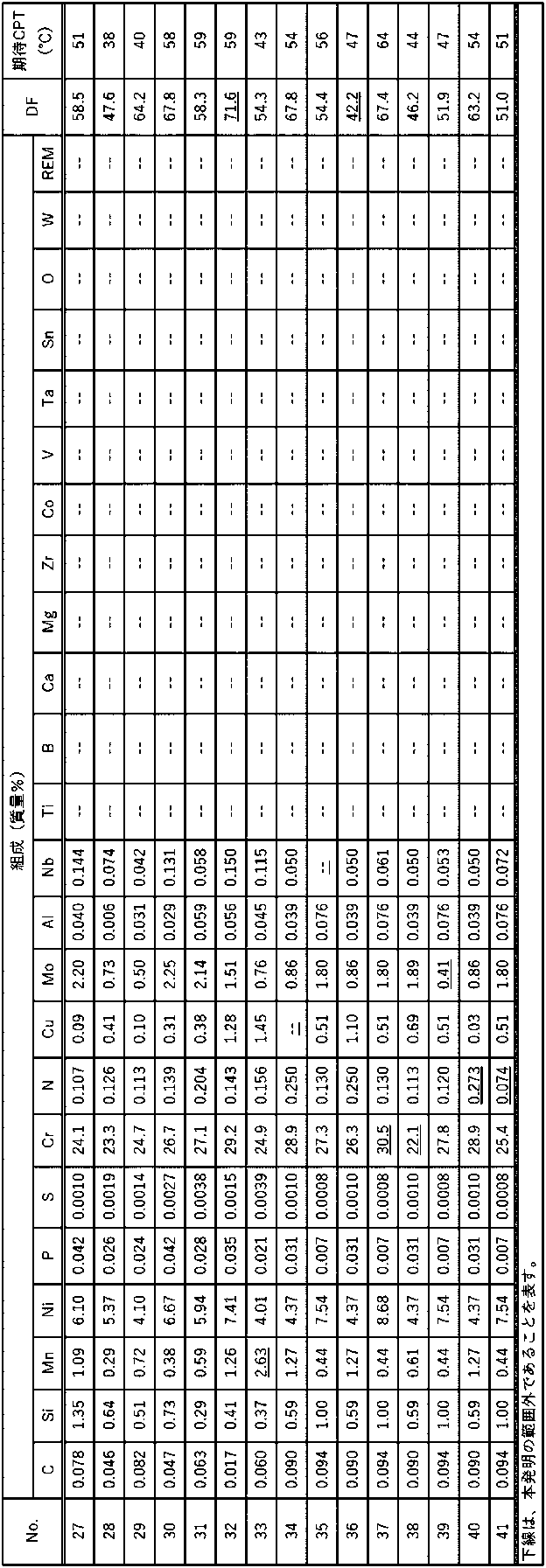
- Stainless steels having the compositions shown in Tables 1-1 and 1-2 were melted in MgO crucibles in a 50 kg vacuum induction furnace in a laboratory and cast into flat steel ingots with a thickness of about 100 mm.
- the main body of the flat steel ingot was processed into a material for hot rolling, heated to 1180°C, and then held at that temperature for 1 hour, and then hot rolled into a hot-rolled sheet with a thickness of 12 mm.
- the values of DF and expected CPT were calculated based on the content of each element.
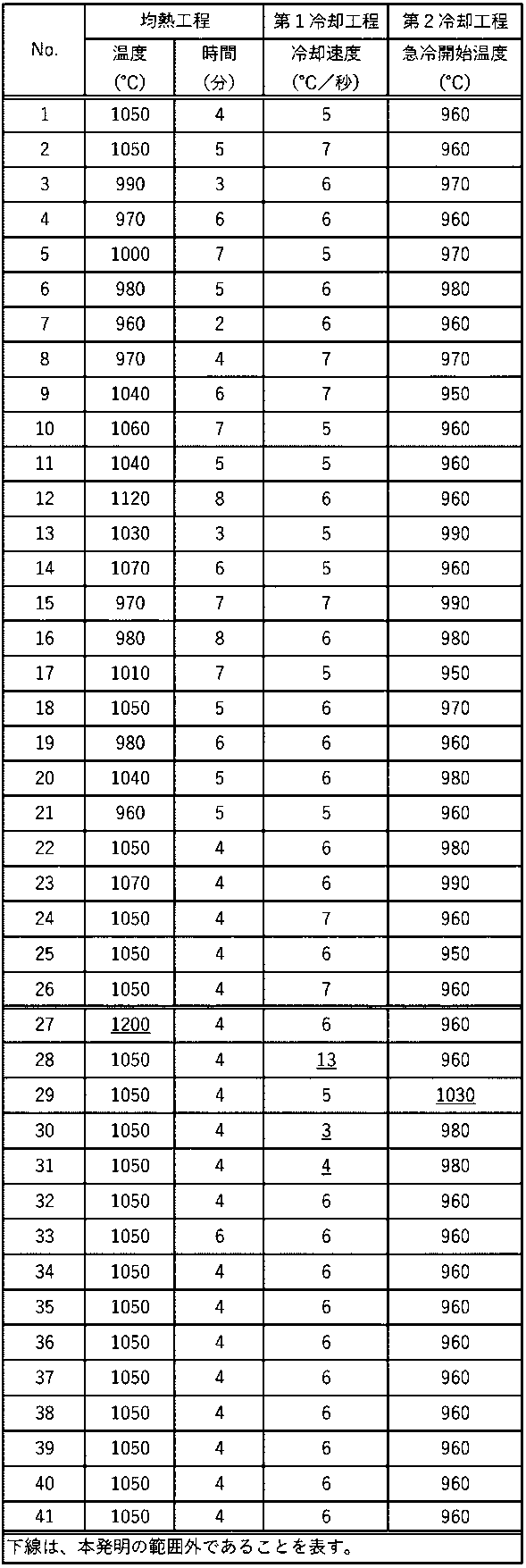
- a duplex stainless steel sheet was obtained by performing a soaking step, a first cooling step, and a second cooling step under the conditions shown in Table 2.
- the first cooling step was performed by air cooling, and the cooling rate was controlled by controlling the flow rate of the cooling gas.
- the second cooling step was performed by water cooling to room temperature.
- ⁇ Content of each element in the austenite phase The content of each element in the austenite phase was measured by EPMA (electron probe microanalyzer). Specifically, a sample was mirror-polished in the thickness direction of a duplex stainless steel material parallel to the rolling direction, and a qualitative analysis was performed by EPMA. The EPMA was performed at an acceleration voltage of 15 kV, and a lattice-like measurement was performed in an area of 300 ⁇ m x 300 ⁇ m at intervals of 0.76 ⁇ m, resulting in a total of 140,625 pieces of data. In the qualitative analysis, a portion that can be clearly determined to be an austenite phase from the Ni content was identified by qualitative mapping of Ni for the entire cross section.
- EPMA electron probe microanalyzer
- ⁇ Corrosion test> A test piece of 10 mm x 80 mm x 2 mm was taken from the duplex stainless steel plate and wet-polished over the entire surface using a No. 600 grindstone. Next, an aqueous solution simulating crude phosphoric acid containing 70% by mass phosphoric acid, 0.4% by mass F -ions , and 0.04% by mass Cl -ions was prepared. Next, the container containing this aqueous solution was kept at 50°C, and half of the test piece was immersed in it for 6 hours. Then, the corrosion rate (mm/y) was calculated from the mass change (corrosion weight loss) before and after immersion. If the corrosion rate is 0.15 mm/y or less, it can be determined that the corrosion resistance is excellent. Since the corroded area is both the gas phase and the liquid phase, the corrosion rate was calculated using the entire area of the test piece. Furthermore, the test pieces after the above tests were visually evaluated for discoloration (blackening).
- the measured CPT was determined in accordance with ASTM G48E by taking a test piece of 50 mm x 25 mm x 2 mm thickness (thickness from a position 1 mm deep from the outermost surface) from a duplex stainless steel plate, carrying out a pitting test on the test piece at an aqueous solution temperature of 30° C., and measuring the CPT (Critical Pitting Temperature). Note that when measuring the CPT, pitting that occurred on the end face (cross section in the thickness direction) of the test piece was not counted, and only pitting that occurred on the 50 mm x 25 mm surface was counted.
- the CPT difference (expected CPT - actual CPT) was calculated using the actual CPT thus obtained and the expected CPT calculated above.
- the CPT difference was represented as ⁇ when it was 10°C or less, and ⁇ when it was more than 10°C.
- the duplex stainless steel plate had a predetermined composition and DF, and the austenite phase satisfied the relational expression of formula (2), so it was confirmed that the corrosion rate was slow and the corrosion resistance to crude phosphoric acid was excellent.
- the soaking temperature was too high, so that the element concentrations in the austenite phase could not be controlled, and the relational expression (2) was not satisfied.
- the corrosion resistance against crude phosphoric acid was insufficient.
- the cooling rate in the first cooling step was too fast, so that the element concentrations in the austenite phase could not be controlled and the relational expression (2) was not satisfied.
- the present invention can provide a ferritic-austenitic duplex stainless steel material with excellent corrosion resistance to crude phosphoric acid, and a manufacturing method thereof. Furthermore, the present invention can provide a structure for crude phosphoric acid that has excellent corrosion resistance to crude phosphoric acid and can reduce maintenance costs and time.
- the present invention can be configured as follows.
- (Aspect 1) On a mass basis, it has a composition including C: 0.100% or less, Si: 0.05 to 1.50%, Mn: 0.05 to 2.00%, Ni: 4.00 to 9.00%, P: 0.050% or less, S: 0.0040% or less, Cr: 23.0 to 30.0%, N: 0.100 to 0.250%, Cu: 0.01 to 2.00%, Mo: 0.50 to 2.50%, Al: 0.100% or less, Nb: 0.200% or less, and the balance being Fe and impurities;
- the following formula (1): DF 7.2(Cr+0.8Mo+0.78Si)-8.9(Ni+0.03Mn+0.72Cu+22C+21N)-44.9...
- each element symbol represents the content (mass%) of each element
- the austenite phase has the following formula (2): (0.8Cr) 2 +2Ni+7Mo+30Cu+30N ⁇ 340... (2) (wherein the chemical symbols represent the content (mass%) of each element)
- (Aspect 2) The ferritic-austenitic duplex stainless steel material according to aspect 1, further comprising one or more selected from, by mass, Ti: 0.050% or less, B: 0.0050% or less, Ca: 0.0010-0.0100%, Mg: 0.0001-0.0020%, Zr: 0.090% or less, Co: 3.00% or less, V: 1.000% or less, Ta: 0.200% or less, Sn: 0.100% or less, O: 0.0050% or less, W: 1.000% or less, and REM: 0.100% or less.
Landscapes
- Chemical & Material Sciences (AREA)
- Engineering & Computer Science (AREA)
- Mechanical Engineering (AREA)
- Materials Engineering (AREA)
- Metallurgy (AREA)
- Organic Chemistry (AREA)
- Physics & Mathematics (AREA)
- Thermal Sciences (AREA)
- Crystallography & Structural Chemistry (AREA)
- Heat Treatment Of Steel (AREA)
Abstract
Description
そこで、粗製リン酸を運搬するケミカルタンカーの貯槽内面に対しても、特許文献1~3に記載のフェライト・オーステナイト系二相ステンレス鋼材を適用することが考えられる。
しかしながら、特許文献1~3に記載のフェライト・オーステナイト系二相ステンレス鋼材は、Niの多いオーステナイト系ステンレス鋼より、コスト的には有意であるものの、硫化物や粗製リン酸などに対する耐食性がSUS316Lよりも劣る。
また、本発明は、粗製リン酸に対する耐食性に優れ、メンテナンスのコスト及び時間を削減することが可能な粗製リン酸用構造物を提供することを目的とする。
粗製リン酸はリン鉱石を硫酸で溶解して製造し、液体としてケミカルタンカーに積載されて輸送される。粗製リン酸中には、F-(フッ素イオン)やCl-(塩素イオン)が低濃度で含まれており、これらのイオンが腐食性物質としてオーステナイト相を優先溶解させるため、粗製リン酸に対する耐食性が低下する原因となる。
上記の知見から、粗製リン酸に対するオーステナイト相の優先溶解と関係する元素について検討した結果、オーステナイト相に含まれる5つの元素(Cr、Ni、Mo、Cu及びN)の量がオーステナイト相の優先溶解と密接に関係していることが分かった。
そこで、本発明者らは、オーステナイト相に含まれる上記の各元素の量をバランス良く制御することにより、オーステナイト相の優先溶解を抑制し得ることを見出した。また、本発明者らは、フェライト・オーステナイト系二相ステンレス鋼材自体の組成についてもバランス良く制御することにより、粗製リン酸に対する耐食性を向上させ得ることを見出した。本発明は、このような背景に基づいて完成されたものである。
下記式(1):
DF=7.2(Cr+0.8Mo+0.78Si)-8.9(Ni+0.03Mn+0.72Cu+22C+21N)-44.9 ・・・ (1)
(式中、元素記号は各元素の含有量(質量%)を表す)で示されるDFの値が45.0~70.0であり、
オーステナイト相が、下記式(2):
(0.8Cr)2+2Ni+7Mo+30Cu+30N≧340 ・・・ (2)
(式中、元素記号は各元素の含有量(質量%)を表す)の関係式を満たすフェライト・オーステナイト系二相ステンレス鋼材に関する。
前記均熱工程で得られた前記圧延材を5℃/秒以上10℃/秒未満の冷却速度で急冷開始温度まで緩冷却する第1冷却工程と、
前記第1冷却工程で得られた前記圧延材を前記急冷開始温度から急冷却する第2冷却工程と
を含み、
前記急冷開始温度が、950~990℃の温度であり、且つ前記均熱温度よりも低い温度である、フェライト・オーステナイト系二相ステンレス鋼材の製造方法に関する。
また、本発明によれば、粗製リン酸に対する耐食性に優れ、メンテナンスのコスト及び時間を削減することが可能な粗製リン酸用構造物を提供することができる。
なお、本明細書において成分に関する「%」表示は、特に断らない限り「質量%」を意味する。
また、本明細書において「フェライト・オーステナイト系」とは、常温で金属組織が主にフェライト相及びオーステナイト相の二相であるものを意味する。したがって、「フェライト・オーステナイト系」にはフェライト相及びオーステナイト相以外の相(例えば、マルテンサイト相など)が僅かに含まれるものも包含される。
さらに、本明細書において「不純物」とは、ステンレス鋼材を工業的に製造する際に、鉱石、スクラップなどの原料、製造工程の種々の要因によって混入する成分であって、本発明に悪影響を与えない範囲で許容されるものを意味する。例えば、不純物には、不可避的不純物も含まれる。
なお、各元素の含有量に関して、「xx%以下」を含むとは、xx%以下であるが、0%超(特に、不純物レベル超)の量を含むことを意味する。
以下、各成分について詳細に説明する。
Cは可能な限り減らすことが望ましい。C含有量の下限は、特に限定されないが、特に二相ステンレス鋼材のように比較的多い含有量のCrを含む鋼種の脱炭には精錬コストが高額になるため、例えば0.001%まで減らせれば十分である。一方、CはCr炭化物の析出を促進するため、C含有量が多すぎると、粒界腐食が発生して耐食性が低下する。したがって、耐食性の低下を抑制する観点から、C含有量を0.100%以下とする。また、C含有量は、この効果を安定して確保する観点から、0.095%以下、0.090%以下、0.085%以下又は0.080%以下であることが好ましい。
Siは、脱酸元素として使われたり、耐酸化性向上のために添加されたりする元素である。これらの効果を得る観点から、Si含有量を0.05%以上とする。また、Si含有量は、これらの効果を安定して確保する観点から、0.10%以上、0.20%以上又は0.30%以上であることが好ましい。一方、Si含有量が多すぎると、二相ステンレス鋼材が硬質化し、靭性及び加工性が低下する。したがって、靭性及び加工性の低下を抑制する観点から、Si含有量を1.50%以下とする。また、Si含有量は、この効果を安定して確保する観点から、1.45%以下、1.40%以下、1.35%以下又は1.30%以下であることが好ましい。
Mnは、オーステナイト相を増加させ、また、窒素の固溶度を上げて製造時の気泡欠陥などを抑制する効果を有する。この効果を得る観点から、Mn含有量を0.05%以上とする。また、Mn含有量は、この効果を安定して確保する観点から、0.10%以上又は0.20%以上が好ましい。一方、Mn含有量が多すぎると、耐食性及び熱間加工性が低下する。したがって、耐食性及び熱間加工性の低下を抑制する観点から、Mn含有量を2.00%以下とする。Mn含有量は、この効果を安定して確保する観点から、1.90%以下、1.80%以下、1.70%以下又は1.60%以下であることが好ましい。
Niは、オーステナイト安定化元素であり、腐食進展を抑制することによって耐食性を向上させる効果を有する。二相ステンレス鋼材としてオーステナイト相を一定量確保するため、Ni含有量を4.00%以上とする。また、Ni含有量は、この効果を安定して確保する観点から、4.10%以上、4.20%以上、4.30%以上、4.40%以上又は4.50%以上であることが好ましい。一方、Niは、高価な元素でもあるので、できるだけ含有量は少ない方が好ましい。そのため、Ni含有量を9.00%以下とする。Ni含有量は、コスト低減の観点から、8.50%以下、8.00%以下又は7.80%以下であることが好ましい。
Pは、二相ステンレス鋼材中に不可避的に混入する元素であり、また、Crなどの原料にも含有されている。P含有量は、多すぎると成形性が低下するため、少ないほどよく、0.050%以下とする。また、P含有量は、成形性の低下を安定して抑制する観点から、0.045%以下又は0.040%以下であることが好ましい。一方、P含有量の下限は、特に限定されないが、Pを除去することは精錬に非常に大きなコストが必要となる。そのため、P含有量は、経済性を考慮すると、0.001%以上としてもよい。
Sは、二相ステンレス鋼材中に不可避的に混入する元素であり、Mnと結合して介在物を作り、発銹の基点となる場合がある。また、S含有量は少ないほど耐食性が向上する。そのため、S含有量を0.0040%以下とする。また、S含有量は、この効果を安定して確保する観点から、0.0035%以下又は0.0030%以下であることが好ましい。一方、S含有量の下限は、特に限定されないが、Sを除去することは精錬に非常に大きなコストが必要となる。そのため、S含有量は、経済性を考慮すると、0.0001%以上としてもよい。
Crは、不働態皮膜を強化することにより、粗製リン酸に対する耐食性を向上させることができる。また、Crは、Feが溶解した後の不働態皮膜の修復効果も有する。これらの効果を得る観点から、Cr含有量を23.0%以上とする。また、Cr含有量は、これらの効果を安定して確保する観点から、23.5%以上、24.0%以上、24.5%以上、25.0%以上又は25.5%以上であることが好ましい。一方、Cr含有量が多すぎると、クロム窒化物の析出量が多くなり、また、熱間加工割れの危険性も高まって靭性が低下する。これらを抑制する観点から、Cr含有量を30.0%以下とする。また、Cr含有量は、これらを安定して抑制する観点から、29.8%以下、29.6%以下、29.4%以下、29.2%以下又は29.0%以下であることが好ましい。
Nは溶出するとNH4 +(アンモニウムイオン)となり、酸性の結露水のpHを上昇させてFeの溶解を抑制する効果がある。また、オーステナイト相に固溶して強度及び耐食性を高めて省合金化に寄与する元素でもある。これらの効果を得る観点から、N含有量を0.100%以上とする。N含有量は、これらの効果を安定して確保する観点から、0.120%以上、0.130%以上又は0.140%以上であることが好ましい。一方、Nはクロム窒化物の析出に大きく影響する元素でもあり、多量に含有すると、クロム窒化物の析出量が多くなって靭性や耐食性が低下する。これらを抑制する観点から、N含有量を0.250%以下とする。また、N含有量は、これらを安定して抑制する観点から、0.230%以下又は0.220%以下であることが好ましい。
Cuは耐酸性、特に、硫酸を含む粗製リン酸に対する耐食性を向上させる元素であり、酸性の結露水が付着した時に、二相ステンレス鋼材の表面からFeの溶解を抑制する効果を有する。この効果を得る観点から、Cu含有量を0.01%以上とする。また、Cu含有量は、この効果を安定して確保する観点から、0.05%以上、0.10%以上、0.20%以上又は0.25%以上であることが好ましい。一方、Cu含有量が多くなると原料コストの増加をもたらし、また、熱間加工性が低下する。これらを抑制する観点から、Cu含有量を2.00%以下とする。Cu含有量は、これらを安定して抑制する観点から、1.80%以下、1.50%以下、1.00%以下又は0.80%以下であることが好ましい。
Moは、耐食性を向上させる効果があり、Feが溶解した後の不働態皮膜の修復効果も有する。特に、二相ステンレス鋼材の表面のFeが溶出して腐食(特に、黒変)することを抑制する効果がある。この効果を得る観点から、Mo含有量を0.50%以上とする。Mo含有量は、この効果を安定して確保する観点から、0.80%以上、0.90%以上又は1.00%以上であることが好ましい。一方、Moは高価な元素でもあるので、できるだけ含有量を少なくすることが望ましい。そのため、Mo含有量を2.50%以下とする。また、Mo含有量は、コストを低減する観点から、2.30%以下又は2.20%以下であることが好ましい。
Alは、脱硫、脱酸のために含まれる元素である。しかし、Alを多量に含有すると、原料コストや製造コストの増加を招くため、Al含有量を0.100%以下とする。また、Al含有量は、原料コストや製造コストの増加を安定して低減する観点から、0.090%以下又は0.080%以下であることが好ましい。一方、Al含有量の下限は特に限定されないが、上記の効果を得る観点から、Al含有量は0.001%以上であることが好ましい。
Nbは、Nと化合物を作ることでクロム窒化物の析出を抑制する効果を有する。しかし、Nb含有量が多すぎると、二相ステンレス鋼材の加工性が低下する。加工性の低下を抑制する観点から、Nb含有量を0.200%以下とする。また、Nb含有量は、この効果を安定して確保する観点から、0.190%以下又は0.180%以下であることが好ましい。一方、Nb含有量の下限は特に限定されないが、上記の効果を得る観点から、Nb含有量は0.001%以上であることが好ましい。
Tiは、二相ステンレス鋼材を溶接する場合に、溶接熱影響部の粗大化を防止し、また、凝固組織を微細等軸晶化する効果を有するため、必要に応じて含有させることができる。しかし、Ti含有量が多くなりすぎると、均一伸び及び局部伸びが低下する。均一伸び及び局部伸びの低下を抑制する観点から、Ti含有量を0.050%以下とする。Ti含有量は、この効果を安定して確保する観点から、0.045%以下又は0.040%以下であることが好ましい。一方、Ti含有量の下限は特に限定されないが、上記の効果を確保する観点から、Ti含有量は0.001%以上であることが好ましい。
Bは、熱間加工性を向上させる効果を有するため、必要に応じて含有させることができる。しかし、B含有量が多すぎると、耐食性が著しく低下する。耐食性の低下を抑制する観点から、B含有量を0.0050%以下とする。また、B含有量は、この効果を安定して確保する観点から、0.0040%以下又は0.0030%以下であることが好ましい。一方、B含有量の下限は特に限定されないが、上記の効果を得る観点から、B含有量は0.0003%以上であることが好ましい。
Caは耐食性を高める元素であり、Caは粗製リン酸が存在する環境で腐食の起点となる介在物を低減し、Feの溶出を抑制しているものと推定されるため、必要に応じて含有させることができる。この効果を確保する観点から、Ca含有量を0.0010%以上とする。また、Ca含有量は、この効果を安定して確保する観点から、0.0015%以上又は0.0020%以上であることが好ましい。一方、Ca含有量が多くなると、熱間加工割れが生じ易くなり、また耐食性も低下する。これらを抑制する観点から、Ca含有量を0.0100%以下とする。また、Ca含有量は、これらを安定して抑制する観点から、0.0090%以下、0.0080%以下又は0.0070%以下であることが好ましい。
Mgは、脱酸だけでなく、凝固組織を微細化する効果を有するため、必要に応じて含有させることができる。しかし、Mg含有量が多くなると、製鋼工程でのコスト増加をもたらすため、Mg含有量を0.0020%以下とする。また、Mg含有量は、コストを低減する観点から、0.0019%以下又は0.0018%以下であることが好ましい。一方、上記の効果を得る観点から、Mg含有量を0.0001%以上とする。
Zrは、二相ステンレス鋼材中で炭化物、窒化物を形成して結晶粒を微細化する効果があるため、必要に応じて含有させることができる。しかし、Zr含有量が多くなると、過剰に形成された炭化物、窒化物によって靭性が低下する。したがって、靭性の低下を抑制する観点から、Zr含有量を0.090%以下とする。また、Zr含有量は、この効果を安定して確保する観点から、0.085%以下であることが好ましい。一方、Zr含有量の下限は特に限定されないが、上記の効果を得る観点から、Zr含有量は0.001%以上又は0.005%以上であることが好ましい。
CoはNと同様、オーステナイト安定化元素であるため、必要に応じて含有させることができる。しかし、Coは、高価な元素であるので、Co含有量を3.00%以下とする。また、Co含有量は、コストを低減する観点から、2.80%以下又は2.60%以下であることが好ましい。一方、Co含有量の下限は特に限定されないが、上記の効果を得る観点から、Co含有量は0.01%以上であることが好ましい。
Vは、耐食性を向上させる元素であるため、必要に応じて含有させることができる。しかし、V含有量が多くなると、圧延時の負荷を増大させて製造疵が生成され易くなるため、V含有量を1.000%以下とする。また、V含有量は、製造疵の生成を安定して抑制する観点から、0.950%以下であることが好ましい。一方、V含有量の下限は特に限定されないが、上記の効果を得る観点から、V含有量は0.010%以上又は0.050%以上であることが好ましい。
Taは、二相ステンレス鋼材中で炭化物、窒化物を形成し、耐食性を付加的に高める効果があるため、必要に応じて含有させることができる。しかし、Ta含有量が多くなると、過剰に形成された炭化物、窒化物によって靭性が低下するため、Ta含有量を0.200%以下とする。Ta含有量は、この効果を安定して確保する観点から、0.170%以下又は0.150%以下であることが好ましい。一方、Ta含有量の下限は特に限定されないが、上記の効果を得る観点から、Ta含有量は0.001%以上又は0.005%以上であることが好ましい。
Snは、耐食性を向上させる元素であるため、必要に応じて含有させることができる。しかし、Sn含有量が多くなると、熱間加工性が低下するため、Sn含有量を0.100%以下とする。また、Sn含有量は、この効果を安定して確保する観点から、0.050%以下、0.030%以下又は0.010%以下であることが好ましい。一方、Sn含有量の下限は特に限定されないが、上記の効果を得る観点から、Sn含有量は0.0001%以上又は0.0003%以上であることが好ましい。
Oは、Sと同様に熱間加工性に影響を与える元素であるため、できるだけ少ない方が望ましい。そのため、O含有量を0.0050%以下とする。また、O含有量は、この効果を安定して確保する観点から、0.0048%以下であることが好ましい。一方、O含有量の下限は特に限定されないが、O含有量を低減することは製造コストの上昇につながる。そのため、O含有量は、0.0001%以上であることが好ましい。
Wは、耐食性を向上させる元素であるため、必要に応じて含有させることができる。しかし、W含有量が多くなると、圧延時の負荷を増大させて製造疵が生成され易くなるため、W含有量を1.000%以下とする。また、W含有量は、この効果を安定して確保する観点から、0.900%以下又は0.800%以下であることが好ましい。一方、W含有量の下限は特に限定されないが、上記の効果を得る観点から、W含有量は0.005%以上又は0.010%以上であることが好ましい。
REM(希土類元素)は、熱間加工性を向上させる効果を有するため、必要に応じて含有させることができる。しかし、REM含有量が多くなると、製造性が損なわれるとともにコスト増加をもたらすため、REM含有量を0.100%以下とする。また、REM含有量は、この効果を安定して確保する観点から、0.095%以下又は0.090%以下であることが好ましい。一方、REM含有量の下限は特に限定されないが、上記の効果を得る観点から、REM含有量は0.001%以上、0.005%以上又は0.010%以上であることが好ましい。
なお、REMは、Sc、Y及びLa~Luまでの15元素(ランタノイド)の計17元素の総称であり、REM含有量はこれらの元素の合計含有量を意味する。これらの元素は単独又は2種以上を組み合わせて用いることができる。また、ランタノイドは、工業的には、ミッシュメタルの形で添加される。
DF=7.2(Cr+0.8Mo+0.78Si)-8.9(Ni+0.03Mn+0.72Cu+22C+21N)-44.9 ・・・ (1)
式(1)中、元素記号は各元素の含有量(質量%)を表す。
ここで、DFは、フェライト相の量を表す指標である。そのため、100-DFは、オーステナイト相の量を意味する。ただし、DFは元素の含有量に基づいて決定される指標であるため、実際に測定されるオーステナイト相の量とは一致しない可能性があることに留意すべきである。DFの値が45.0未満であると、過度に高強度化してしまい、製造性が低下してしまう。一方、DFの値が70.0を超えると、オーステナイト相の割合が少なくなるため、オーステナイト相におけるNの固溶量が減少する。その結果、クロム窒化物の析出量が多くなってしまい、靭性や耐食性が低下してしまう。
(0.8Cr)2+2Ni+7Mo+30Cu+30N≧340・・・ (2)
式(2)中、元素記号は各元素の含有量(質量%)を表す。
ここで、式(2)は、粗製リン酸に対するオーステナイト相の優先溶解に影響を与える5つの元素(Cr、Ni、Mo、Cu及びN)の含有量の関係を表す式である。式(2)の関係を満たすようにオーステナイト相における当該元素の含有量を制御することにより、粗製リン酸に対するオーステナイト相の優先溶解を抑制し、二相ステンレス鋼材の腐食を抑制することができる。この効果を安定して確保する観点から、式(2)中の左辺の値は、345以上であることが好ましく、350以上であることがより好ましく、355以上であることが更に好ましい。なお、式(2)中の左辺の値の上限は、特に限定されないが、例えば、800又は700である。
期待CPT-実測CPT≦10℃ ・・・ (3)
式中、期待CPTは、2.5Cr+7.6Mo+3.19N-26(ここで、Cr、Mo及びNは、二相ステンレス鋼材中のCr、Mo及びNの含有量(質量%)をそれぞれ表す)によって算出される孔食発生温度(℃)であり、実測CPTは、ASTM G48Eに準拠する耐孔食性試験によって測定される孔食発生温度(℃)である。
実測CPTは、クロム窒化物が析出すると低下する傾向があるため、CPT差(期待CPT-実測CPT)が10℃以下であれば、クロム窒化物の析出量が少ないとみなすことができる。すなわち、式(3)の関係式を満たす場合、クロム窒化物の析出が抑制されるため、耐食性を十分確保することができる。一方、式(3)の関係式を満たさない場合、クロム窒化物の析出によって耐食性が低下する恐れがある。
ここで、本明細書において「粗製リン酸用構造物」とは、粗製リン酸を扱う各種設備のことを意味する。粗製リン酸用構造物の例としては、リン酸製造プラント、リン酸貯蔵用タンク(船舶の貯蔵槽などを含む)、リン酸輸送用パイプなどが挙げられる。
以下、本発明の実施形態に係る二相ステンレス鋼材の製造方法の一例について説明する。
本発明の実施形態に係る二相ステンレス鋼材の製造方法は、均熱工程、第1冷却工程及び第2冷却工程を含む。
均熱温度が950℃未満であると、クロム窒化物の固溶化を十分に行うことができない。また、均熱温度が1150℃を超えると、フェライト相の量が多くなるとともに、オーステナイト相の組成を所定の範囲に制御することが難しくなる。これらの問題を安定して抑制する観点から、均熱温度は1000~1100℃であることが好ましい。
均熱時間は1分超過であればよいが、製造効率や製造コストを考慮すると、10分未満であることが好ましい。
なお、圧延材は、常法によって製造することができる。例えば、上記の組成を有するステンレス鋼を真空溶解で溶製して鋼スラブとした後、熱間圧延すればよい。
第1冷却工程の冷却速度が10℃/秒以上であると、オーステナイト相の組成を所定の範囲に制御することが難しくなる。この問題を安定して抑制する観点から、第1冷却工程の冷却速度は9℃/秒以下であることが好ましく、8℃/秒以下であることがより好ましく、7℃/秒以下であることが更に好ましい。また、第1冷却工程の冷却速度が5℃/秒未満であると、クロム窒化物の析出量が多くなり、場合によってはσ相が析出するため、耐食性が低下する。
第1冷却工程の冷却方法としては、特に限定されないが、例えば、空冷を用いればよい。
急冷開始温度は、950~990℃の温度であり、且つ上記の均熱温度よりも低い温度である。急冷開始温度が950℃未満であると、フェライト相の生成量が多くなり、耐食性が低下してしまう。また、急冷開始温度が990℃を超えると、オーステナイト相の組成を所定の範囲に制御することが難しくなる。これらの問題を安定して抑制する観点から、急冷開始温度は、960~980℃であることが好ましい。なお、急冷終了温度は、特に限定されず、例えば、室温とすればよい。
第2冷却工程の冷却方法としては、特に限定されないが、例えば、水冷を用いればよい。
本発明の実施形態に係る粗製リン酸用構造物は、上記の二相ステンレス鋼材を所定の形状に加工した後、溶接などによって組み立てることで製造することができる。
粗製リン酸用構造物としては、特に限定されないが、リン酸製造プラント、リン酸貯蔵用タンク又はリン酸輸送用パイプであることが好ましい。
次に、表2に示す条件で均熱工程、第1冷却工程及び第2冷却工程を実施し、二相ステンレス鋼板を得た。なお、第1冷却工程の冷却は空冷により行い、冷却ガスの流量を制御することによって冷却速度を制御した。また、第2冷却工程は、水冷により室温まで急冷却した。

オーステナイト相中の各元素の含有量は、EPMA(電子線プローブマイクロアナライザー)によって測定した。具体的には、圧延方向に平行な二相ステンレス鋼材の厚み方向断面を鏡面研磨した試料を用い、EPMAによって定性分析を行った。EPMAは、加速電圧を15kVとし、300μm×300μmの領域を0.76μmの間隔で格子状に測定し、合計で140625点のデータを得た。定性分析では、断面全体についてNiの定性マッピングによって、Niの含有量から明らかにオーステナイト相であると判断できる部分を特定した。そして、特定されたオーステナイト相のほぼ中心部において、Cr、Ni、Mo、Cu及びNを定量分析した。定量分析は10点以上で行い、その平均値を各元素の含有量の結果とした。また、得られた各元素の含有量を用いて、式(2)の関係式の左辺の値を算出した。
二相ステンレス鋼板から、10mm×80mm×2mmの試験片を採取し、600番の砥石を用いて全面湿式研磨した。次に、70質量%のリン酸、0.4質量%のF-イオン及び0.04質量%のCl-イオンを含む、粗製リン酸を模擬した水溶液を準備した。次に、この水溶液を入れた容器を50℃に保持し、そこに試験片の半分を6時間浸漬させた。そして、浸漬前後の質量変化(腐食減量)から腐食速度(mm/y)を算出した。腐食速度は、0.15mm/y以下であれば耐食性に優れると判断することができる。腐食箇所は気相部及び液相部の両方であるため、腐食速度は試験片全面積を用いて算出した。
また、上記の試験後の試験片について、目視により変色(黒変)の有無も評価した。
実測CPTは、ASTM G48Eに準拠し、二相ステンレス鋼板から50mm×25mm×2mm厚(最表面から深さ1mmの位置からの厚み)の試験片を採取した後、この試験片に対して30℃の水溶液温度で孔食試験を実施し、CPT(孔食発生温度、Critical Pitting Temperature)を測定することにより求めた。なお、CPTの測定に際して、試験片の端面(厚み方向断面)に発生した孔食はカウントせず、50mm×25mmの面に発生した孔食のみをカウントした。
このようにして得られた実測CPT及び上記で算出された期待CPTを用いてCPT差(期待CPT-実測CPT)を算出した。CPT差は、10℃以下であったものを○、10℃超であったものを×と表す。
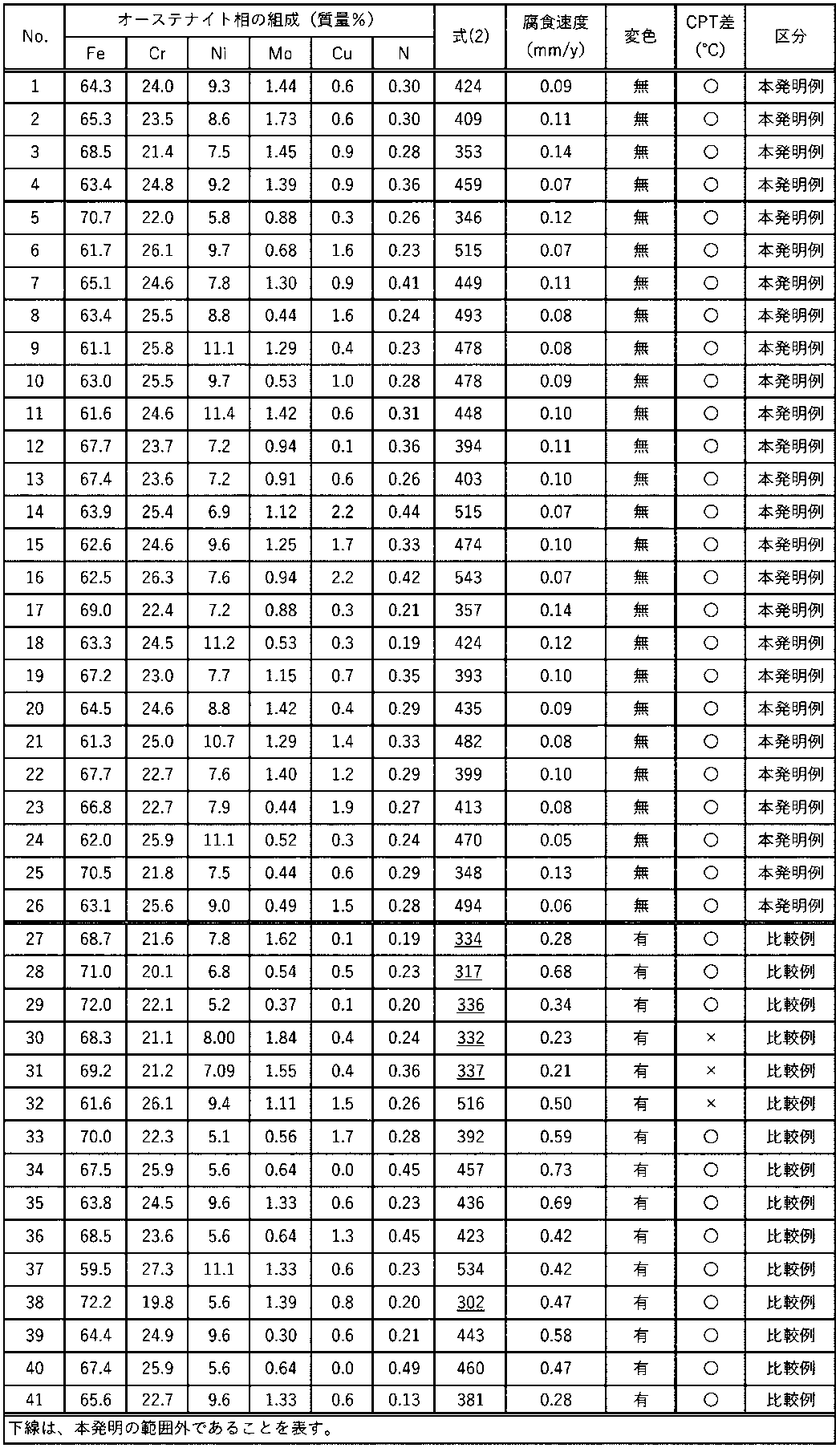
これに対してNo.27(比較例)は、均熱温度が高すぎたため、オーステナイト相の元素濃度を制御できず、式(2)の関係式を満たさなかった。その結果、粗製リン酸に対する耐食性が十分でなかった。
No.28(比較例)は、第1冷却工程の冷却速度が速すぎたため、オーステナイト相の元素濃度を制御できず、式(2)の関係式を満たさなかった。その結果、粗製リン酸に対する耐食性が十分でなかった。
No.29(比較例)は、第2冷却工程の急冷開始温度が高すぎたため、オーステナイト相の元素濃度を制御できず、式(2)の関係式を満たさなかった。その結果、粗製リン酸に対する耐食性が十分でなかった。
No.30及び31(比較例)は、第1冷却工程の冷却速度が遅すぎたため、オーステナイト相の元素濃度を制御できず、式(2)の関係式を満たさなかった。また、クロム窒化物やσ相などが析出したため、粗製リン酸に対する耐食性が十分でなかった。
No.32(比較例)は、DF値が高くフェライト相が過多であるため、クロム窒化物の析出量が多く、粗製リン酸に対する耐食性が十分でなかった。
No.33(比較例)は、Mnを多量に含有したため、耐酸性が低下した結果として粗製リン酸に対する耐食性が十分でなかった。
No.34(比較例)は、Cuを含んでいないため、粗製リン酸に対する耐食性が十分でなかった。
No.35(比較例)は、Nbを含んでいないため、粗製リン酸に対する耐食性が十分でなかった。
No.36(比較例)は、DF値が低くオーステナイト相が過多となり、優先腐食するオーステナイト相の量が増加したため、粗製リン酸に対する耐食性が十分でなかった。
No.37(比較例)は、Crの含有量が多いため、クロム窒化物の析出が多く、粗製リン酸に対する耐食性が十分でなかった。
No.38(比較例)は、Crの含有量が少なすぎたため、粗製リン酸環境での不働態皮膜を維持できず、その結果粗製リン酸に対する耐食性が十分でなかった。
No.39(比較例)は、Mo含有量が少なすぎたため、粗製リン酸環境での不働態皮膜を維持できず、その結果粗製リン酸に対する耐食性が十分でなかった。
No.40(比較例)は、N含有量が多すぎた結果、フェライト相中で多量のクロム窒化物を析出したため、粗製リン酸に対する耐食性が十分でなかった。
No.41(比較例)は、N含有量が少なすぎたため、粗製リン酸環境でのNH4+の生成によるFe溶出抑制の効果が十分に得られず、その結果、粗製リン酸に対する耐食性が十分でなかった。
下記式(1):
DF=7.2(Cr+0.8Mo+0.78Si)-8.9(Ni+0.03Mn+0.72Cu+22C+21N)-44.9 ・・・ (1)
(式中、元素記号は各元素の含有量(質量%)を表す)で示されるDFの値が45.0~70.0であり、
オーステナイト相が、下記式(2):
(0.8Cr)2+2Ni+7Mo+30Cu+30N≧340 ・・・ (2)
(式中、元素記号は各元素の含有量(質量%)を表す)の関係式を満たすフェライト・オーステナイト系二相ステンレス鋼材。
期待CPT-実測CPT≦10℃ ・・・ (3)
式中、期待CPTは、2.5Cr+7.6Mo+3.19N-26(ここで、Cr、Mo及びNは、フェライト・オーステナイト系二相ステンレス鋼材中のCr、Mo及びNの含有量(質量%)をそれぞれ表す)によって算出される孔食発生温度(℃)であり、実測CPTは、ASTM G48Eに準拠する耐孔食性試験によって測定される孔食発生温度(℃)である。
前記均熱工程で得られた前記圧延材を5℃/秒以上10℃/秒未満の冷却速度で急冷開始温度まで緩冷却する第1冷却工程と、
前記第1冷却工程で得られた前記圧延材を前記急冷開始温度から急冷却する第2冷却工程と
を含み、
前記急冷開始温度が、950~990℃の温度であり、且つ前記均熱温度よりも低い温度である、フェライト・オーステナイト系二相ステンレス鋼材の製造方法。
Claims (9)
- 質量基準で、C:0.100%以下、Si:0.05~1.50%、Mn:0.05~2.00%、Ni:4.00~9.00%、P:0.050%以下、S:0.0040%以下、Cr:23.0~30.0%、N:0.100~0.250%、Cu:0.01~2.00%、Mo:0.50~2.50%、Al:0.100%以下、Nb:0.200%以下を含み、残部がFe及び不純物からなる組成を有し、
下記式(1):
DF=7.2(Cr+0.8Mo+0.78Si)-8.9(Ni+0.03Mn+0.72Cu+22C+21N)-44.9 ・・・ (1)
(式中、元素記号は各元素の含有量(質量%)を表す)で示されるDFの値が45.0~70.0であり、
オーステナイト相が、下記式(2):
(0.8Cr)2+2Ni+7Mo+30Cu+30N≧340 ・・・ (2)
(式中、元素記号は各元素の含有量(質量%)を表す)の関係式を満たすフェライト・オーステナイト系二相ステンレス鋼材。 - 質量基準で、Ti:0.050%以下、B:0.0050%以下、Ca:0.0010~0.0100%、Mg:0.0001~0.0020%、Zr:0.090%以下、Co:3.00%以下、V:1.000%以下、Ta:0.200%以下、Sn:0.100%以下、O:0.0050%以下、W:1.000%以下、REM:0.100%以下から選択される1種以上を更に含む、請求項1に記載のフェライト・オーステナイト系二相ステンレス鋼材。
- 以下の式(3)の関係式を満たす、請求項1又は2に記載のフェライト・オーステナイト系二相ステンレス鋼材。
期待CPT-実測CPT≦10℃ ・・・ (3)
式中、期待CPTは、2.5Cr+7.6Mo+3.19N-26(ここで、Cr、Mo及びNは、フェライト・オーステナイト系二相ステンレス鋼材中のCr、Mo及びNの含有量(質量%)をそれぞれ表す)によって算出される孔食発生温度(℃)であり、実測CPTは、ASTM G48Eに準拠する耐孔食性試験によって測定される孔食発生温度(℃)である。 - 前記オーステナイト相は、質量基準で、21.0~30.0%のCr、7.5~12.0%のNi、0.30~2.00%のMo、0.3~2.1%のCu、0.10~0.35%のNを含む、請求項1又は2に記載のフェライト・オーステナイト系二相ステンレス鋼材。
- 粗製リン酸用構造物に用いられる、請求項1又は2に記載のフェライト・オーステナイト系二相ステンレス鋼材。
- 質量基準で、C:0.100%以下、Si:0.05~1.50%、Mn:0.05~2.00%、Ni:4.00~9.00%、P:0.050%以下、S:0.0040%以下、Cr:23.0~30.0%、N:0.100~0.250%、Cu:0.01~2.00%、Mo:0.50~2.50%、Al:0.100%以下、Nb:0.200%以下を含み、残部がFe及び不純物からなる圧延材を950~1150℃の均熱温度で1分超均熱する均熱工程と、
前記均熱工程で得られた前記圧延材を5℃/秒以上10℃/秒未満の冷却速度で急冷開始温度まで緩冷却する第1冷却工程と、
前記第1冷却工程で得られた前記圧延材を前記急冷開始温度から急冷却する第2冷却工程と
を含み、
前記急冷開始温度が、950~990℃の温度であり、且つ前記均熱温度よりも低い温度である、フェライト・オーステナイト系二相ステンレス鋼材の製造方法。 - 前記圧延材が、質量基準で、Ti:0.050%以下、B:0.0050%以下、Ca:0.0010~0.0100%、Mg:0.0001~0.0020%、Zr:0.090%以下、Co:3.00%以下、V:1.000%以下、Ta:0.200%以下、Sn:0.100%以下、O:0.0050%以下、W:1.000%以下、REM:0.100%以下から選択される1種以上を更に含む、請求項6に記載のフェライト・オーステナイト系二相ステンレス鋼材の製造方法。
- 請求項1又は2に記載のフェライト・オーステナイト系二相ステンレス鋼材を備える粗製リン酸用構造物。
- 前記粗製リン酸用構造物が、リン酸製造プラント、リン酸貯蔵用タンク又はリン酸輸送用パイプである、請求項8に記載の粗製リン酸用構造物。
Priority Applications (3)
| Application Number | Priority Date | Filing Date | Title |
|---|---|---|---|
| JP2025527842A JPWO2024257639A1 (ja) | 2023-06-15 | 2024-06-03 | |
| EP24823259.7A EP4667612A1 (en) | 2023-06-15 | 2024-06-03 | Ferritic-austenitic duplex stainless steel material, production method therefor, and structure for crude phosphoric acid |
| CN202480032433.7A CN121127617A (zh) | 2023-06-15 | 2024-06-03 | 铁素体-奥氏体系双相不锈钢钢材及其制造方法、以及粗磷酸用结构物 |
Applications Claiming Priority (2)
| Application Number | Priority Date | Filing Date | Title |
|---|---|---|---|
| JP2023098642 | 2023-06-15 | ||
| JP2023-098642 | 2023-06-15 |
Publications (1)
| Publication Number | Publication Date |
|---|---|
| WO2024257639A1 true WO2024257639A1 (ja) | 2024-12-19 |
Family
ID=93851864
Family Applications (1)
| Application Number | Title | Priority Date | Filing Date |
|---|---|---|---|
| PCT/JP2024/020240 Ceased WO2024257639A1 (ja) | 2023-06-15 | 2024-06-03 | フェライト・オーステナイト系二相ステンレス鋼材及びその製造方法、並びに粗製リン酸用構造物 |
Country Status (4)
| Country | Link |
|---|---|
| EP (1) | EP4667612A1 (ja) |
| JP (1) | JPWO2024257639A1 (ja) |
| CN (1) | CN121127617A (ja) |
| WO (1) | WO2024257639A1 (ja) |
Citations (6)
| Publication number | Priority date | Publication date | Assignee | Title |
|---|---|---|---|---|
| JPH11269612A (ja) | 1998-03-19 | 1999-10-05 | Nippon Steel Corp | 粗製硫酸用ステンレス鋼およびその製造方法 |
| JP2002121655A (ja) | 2000-10-18 | 2002-04-26 | Nippon Steel Corp | 耐食性に優れた粗製リン酸用ステンレス鋼 |
| WO2009119895A1 (ja) | 2008-03-26 | 2009-10-01 | 新日鐵住金ステンレス株式会社 | 溶接熱影響部の耐食性と靭性が良好な省合金二相ステンレス鋼 |
| JP2016053213A (ja) * | 2014-09-02 | 2016-04-14 | 日本冶金工業株式会社 | 二相ステンレス鋼板とその製造方法 |
| JP2018059157A (ja) | 2016-10-06 | 2018-04-12 | 新日鐵住金株式会社 | 二相ステンレス鋼 |
| WO2018181990A1 (ja) * | 2017-03-30 | 2018-10-04 | 新日鐵住金ステンレス株式会社 | 二相ステンレス鋼およびその製造方法 |
-
2024
- 2024-06-03 CN CN202480032433.7A patent/CN121127617A/zh active Pending
- 2024-06-03 WO PCT/JP2024/020240 patent/WO2024257639A1/ja not_active Ceased
- 2024-06-03 EP EP24823259.7A patent/EP4667612A1/en active Pending
- 2024-06-03 JP JP2025527842A patent/JPWO2024257639A1/ja active Pending
Patent Citations (6)
| Publication number | Priority date | Publication date | Assignee | Title |
|---|---|---|---|---|
| JPH11269612A (ja) | 1998-03-19 | 1999-10-05 | Nippon Steel Corp | 粗製硫酸用ステンレス鋼およびその製造方法 |
| JP2002121655A (ja) | 2000-10-18 | 2002-04-26 | Nippon Steel Corp | 耐食性に優れた粗製リン酸用ステンレス鋼 |
| WO2009119895A1 (ja) | 2008-03-26 | 2009-10-01 | 新日鐵住金ステンレス株式会社 | 溶接熱影響部の耐食性と靭性が良好な省合金二相ステンレス鋼 |
| JP2016053213A (ja) * | 2014-09-02 | 2016-04-14 | 日本冶金工業株式会社 | 二相ステンレス鋼板とその製造方法 |
| JP2018059157A (ja) | 2016-10-06 | 2018-04-12 | 新日鐵住金株式会社 | 二相ステンレス鋼 |
| WO2018181990A1 (ja) * | 2017-03-30 | 2018-10-04 | 新日鐵住金ステンレス株式会社 | 二相ステンレス鋼およびその製造方法 |
Non-Patent Citations (1)
| Title |
|---|
| See also references of EP4667612A1 |
Also Published As
| Publication number | Publication date |
|---|---|
| JPWO2024257639A1 (ja) | 2024-12-19 |
| EP4667612A1 (en) | 2025-12-24 |
| CN121127617A (zh) | 2025-12-12 |
Similar Documents
| Publication | Publication Date | Title |
|---|---|---|
| CN103975088B (zh) | 双相不锈钢 | |
| CN101981216B (zh) | 焊接热影响区的耐蚀性和韧性良好的合金节省型双相不锈钢 | |
| JP7059357B2 (ja) | 二相ステンレスクラッド鋼板およびその製造方法 | |
| JP5511208B2 (ja) | 耐食性の良好な省合金二相ステンレス鋼材とその製造方法 | |
| JP6792951B2 (ja) | オゾン含有水用二相ステンレス鋼 | |
| CN112272712A (zh) | 煤专用船或矿/煤兼用船的船舱用耐蚀钢及船舱 | |
| JP2010229459A (ja) | 耐食性の良好な省合金二相ステンレス鋼材とその製造方法 | |
| JP6780426B2 (ja) | 二相ステンレス鋼 | |
| CN101765673B (zh) | 原油罐用热轧型钢及其制造方法 | |
| JP2010043342A (ja) | 耐食性と耐延性破壊特性に優れた原油油槽用溶接継手 | |
| CN100497704C (zh) | 两相不锈钢 | |
| JP3022746B2 (ja) | 高耐食高靱性二相ステンレス鋼溶接用溶接材料 | |
| JP6018364B2 (ja) | 線状加熱性に優れたケミカルタンカー用二相ステンレス鋼 | |
| JP6601258B2 (ja) | バラストタンク用耐食鋼材 | |
| JP7054079B2 (ja) | 二相ステンレスクラッド鋼およびその製造方法 | |
| JP6442852B2 (ja) | 二相ステンレス鋼溶接継手 | |
| WO2021201122A1 (ja) | 溶接構造体及び貯蔵タンク | |
| JPH07258801A (ja) | 耐食性と加工性に優れたFe−Cr−Ni系合金 | |
| JP3470418B2 (ja) | 耐海水腐食性と耐硫化水素腐食性に優れた高強度オーステナイト合金 | |
| JP7765696B2 (ja) | クラッド鋼板およびその製造方法 | |
| JP2019026940A (ja) | 二相ステンレス鋼溶接継手 | |
| EP4667612A1 (en) | Ferritic-austenitic duplex stainless steel material, production method therefor, and structure for crude phosphoric acid | |
| JPH05255784A (ja) | 耐食性に優れた油井用Ni基合金 | |
| JP7827977B2 (ja) | 粗製リン酸による耐変色性に優れる二相ステンレス鋼およびそれを使用した粗製リン酸用構造物 | |
| JP2003213379A (ja) | 耐食性に優れたステンレス鋼 |
Legal Events
| Date | Code | Title | Description |
|---|---|---|---|
| 121 | Ep: the epo has been informed by wipo that ep was designated in this application |
Ref document number: 24823259 Country of ref document: EP Kind code of ref document: A1 |
|
| ENP | Entry into the national phase |
Ref document number: 2025527842 Country of ref document: JP Kind code of ref document: A |
|
| WWE | Wipo information: entry into national phase |
Ref document number: 2025527842 Country of ref document: JP |
|
| WWE | Wipo information: entry into national phase |
Ref document number: 2024823259 Country of ref document: EP |
|
| ENP | Entry into the national phase |
Ref document number: 2024823259 Country of ref document: EP Effective date: 20250918 |
|
| WWP | Wipo information: published in national office |
Ref document number: 2024823259 Country of ref document: EP |
|
| NENP | Non-entry into the national phase |
Ref country code: DE |