WO2024257655A1 - 変性液状ジエン系重合体及びゴム用添加剤 - Google Patents
変性液状ジエン系重合体及びゴム用添加剤 Download PDFInfo
- Publication number
- WO2024257655A1 WO2024257655A1 PCT/JP2024/020400 JP2024020400W WO2024257655A1 WO 2024257655 A1 WO2024257655 A1 WO 2024257655A1 JP 2024020400 W JP2024020400 W JP 2024020400W WO 2024257655 A1 WO2024257655 A1 WO 2024257655A1
- Authority
- WO
- WIPO (PCT)
- Prior art keywords
- liquid diene
- diene polymer
- modified liquid
- rubber
- butadiene
- Prior art date
- Legal status (The legal status is an assumption and is not a legal conclusion. Google has not performed a legal analysis and makes no representation as to the accuracy of the status listed.)
- Ceased
Links
Images

Classifications
-
- C—CHEMISTRY; METALLURGY
- C08—ORGANIC MACROMOLECULAR COMPOUNDS; THEIR PREPARATION OR CHEMICAL WORKING-UP; COMPOSITIONS BASED THEREON
- C08F—MACROMOLECULAR COMPOUNDS OBTAINED BY REACTIONS ONLY INVOLVING CARBON-TO-CARBON UNSATURATED BONDS
- C08F136/00—Homopolymers of compounds having one or more unsaturated aliphatic radicals, at least one having two or more carbon-to-carbon double bonds
- C08F136/02—Homopolymers of compounds having one or more unsaturated aliphatic radicals, at least one having two or more carbon-to-carbon double bonds the radical having only two carbon-to-carbon double bonds
- C08F136/04—Homopolymers of compounds having one or more unsaturated aliphatic radicals, at least one having two or more carbon-to-carbon double bonds the radical having only two carbon-to-carbon double bonds conjugated
- C08F136/06—Butadiene
-
- C—CHEMISTRY; METALLURGY
- C08—ORGANIC MACROMOLECULAR COMPOUNDS; THEIR PREPARATION OR CHEMICAL WORKING-UP; COMPOSITIONS BASED THEREON
- C08C—TREATMENT OR CHEMICAL MODIFICATION OF RUBBERS
- C08C19/00—Chemical modification of rubber
- C08C19/20—Incorporating sulfur atoms into the molecule
-
- C—CHEMISTRY; METALLURGY
- C08—ORGANIC MACROMOLECULAR COMPOUNDS; THEIR PREPARATION OR CHEMICAL WORKING-UP; COMPOSITIONS BASED THEREON
- C08C—TREATMENT OR CHEMICAL MODIFICATION OF RUBBERS
- C08C19/00—Chemical modification of rubber
- C08C19/22—Incorporating nitrogen atoms into the molecule
-
- C—CHEMISTRY; METALLURGY
- C08—ORGANIC MACROMOLECULAR COMPOUNDS; THEIR PREPARATION OR CHEMICAL WORKING-UP; COMPOSITIONS BASED THEREON
- C08F—MACROMOLECULAR COMPOUNDS OBTAINED BY REACTIONS ONLY INVOLVING CARBON-TO-CARBON UNSATURATED BONDS
- C08F8/00—Chemical modification by after-treatment
- C08F8/34—Introducing sulfur atoms or sulfur-containing groups
Definitions
- the present invention relates to modified liquid diene polymers and rubber additives.
- the objective of the present invention is therefore to provide a modified liquid diene polymer that, when added to a rubber composition, improves the dispersibility of other components and inhibits bleed-out.
- the modified group represented by A modified liquid diene-based polymer in which the amount of structural units derived from butadiene is 20 to 100 mass % based on the total amount of the modified liquid diene-based polymer, and the amount of 1,2-bond units having a vinyl group based on the total amount of structural units derived from butadiene is 0 to 70 mol %.
- a rubber additive comprising the modified liquid diene polymer according to any one of [1] to [6].
- the rubber additive according to [7] further comprising at least one selected from the group consisting of a plasticizer, an antioxidant, a filler, and a colorant.
- the present invention provides a modified liquid diene polymer that has the effect of improving the dispersibility of components in a rubber composition, such as plasticizers, antioxidants, fillers, colorants, etc., and also has the effect of suppressing bleed-out when added to a rubber composition.
- FIG. 1 is a diagram showing images for evaluating dispersibility for Example 3 and Comparative Example 2.
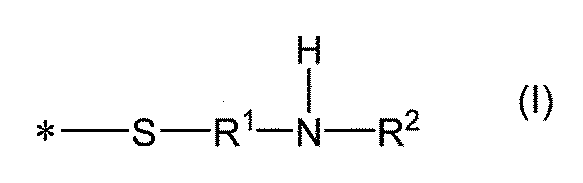
- the present invention relates to a modified liquid diene-based polymer containing a structural unit derived from butadiene, The weight average molecular weight is 4,000 to 150,000, Formula (I): [Wherein, R 1 represents an alkylene group having 1 to 10 carbon atoms or a phenylene group; R2 represents a hydrogen atom or an alkyl group having 1 to 2 carbon atoms; * represents a bond.
- the modified group represented by The amount of structural units derived from butadiene is 20 to 100 mass % based on the total amount of the modified liquid diene polymer, and the amount of 1,2-bond units having a vinyl group based on the total amount of structural units derived from butadiene is 0 to 70 mol %.
- the modified liquid diene polymer of the present invention is a polymer that contains structural units derived from butadiene, is modified with a modifying group represented by formula (I), and is liquid at room temperature (25°C).
- the amount of structural units derived from butadiene in the modified liquid diene polymer is 20 to 100% by mass relative to the total amount of the modified liquid diene polymer.
- the amount of structural units derived from butadiene is preferably 30 to 100% by mass, more preferably 35 to 100% by mass, even more preferably 40 to 100% by mass, and even more preferably 50 to 100% by mass relative to the total amount of the modified liquid diene polymer.
- the amount of structural units derived from butadiene can be calculated by 1 H-NMR or 13 C-NMR measurement, or from the amount of butadiene monomer in the monomer mixture used in producing the modified liquid diene-based polymer.
- the structural unit derived from butadiene is not particularly limited as long as it is a structural unit derived from the monomer 1,3-butadiene.
- Examples include 1,2-bond units, 1,4-bond units (cis-1,4-bond units and trans-1,4-bond units), and structural units in which a modifying group is bonded to these.
- the 1,2-bond units, cis-1,4-bond units, and trans-1,4-bond units each have a vinyl group in the structural unit derived from butadiene.
- examples of structural units in which a modifying group is bonded to these include structural units obtained by bonding a modifying group to a portion derived from the vinyl group in the 1,2-bond unit, and these structural units do not have a vinyl group.
- the amount of 1,2-bond units having a vinyl group relative to the total amount of structural units derived from butadiene is 0 to 70 mol %.
- the amount of 1,2-bond units having a vinyl group is 70 mol % or less, it is possible to prevent the viscosity of the modified liquid diene-based polymer from becoming too high, and to prevent a decrease in handleability.
- the amount of 1,2-bond units having a vinyl group is preferably 5 to 70 mol %, more preferably 5 to 68 mol %.
- 1,2-bond units having a vinyl group, 1,4-bond units, cis-1,4-bond units, and trans-1,4-bond units described below can be measured by 1 H-NMR and infrared absorption spectroscopy, respectively, and specifically can be measured by the method described in the Examples.
- the structural unit derived from butadiene preferably includes a structural unit obtained by bonding a modifying group represented by formula (I) to a portion derived from a vinyl group in a 1,2-bond unit.
- the amount of the structural unit is preferably 0.1 to 15 mol%, more preferably 1 to 10 mol%, and even more preferably 2 to 9 mol% based on the total amount of structural units derived from butadiene.
- the amount of the structural unit can be calculated from the molecular weight of each monomer constituting the modified liquid diene polymer, the weight average molecular weight of the modified liquid diene polymer, the approximate value of the number of monomers constituting the modified liquid diene polymer, the approximate value of the number of each bond unit, and the average content of the modifying group determined as described above.
- the amount of 1,4-bond units relative to the total amount of structural units derived from butadiene is preferably 30 to 100 mol%, more preferably 30 to 95 mol%, and even more preferably 32 to 95 mol%, based on the total amount of structural units derived from butadiene, from the viewpoints of handleability and manufacturability of the polymer having the modifying group represented by formula (I).
- the amount of cis-1,4-bond units relative to the total amount of 1,4-bond units in the butadiene-derived structural units is preferably 20 to 60 mol %, more preferably 30 to 50 mol %.
- the amount of trans-1,4-bond units relative to the total amount of 1,4-bond units in the structural units derived from butadiene is preferably 30 to 80 mol%, more preferably 40 to 80 mol%, and even more preferably 50 to 70 mol%.
- the weight average molecular weight of the modified liquid diene polymer is 4,000 to 150,000. From the viewpoint of maintaining fluidity, the weight average molecular weight of the modified liquid diene polymer is preferably 4,000 to 140,000, more preferably 4,500 to 135,000, even more preferably 4,500 to 125,000, even more preferably 4,500 to 100,000, and particularly preferably 4,500 to 50,000. In the present invention, the weight average molecular weight of the liquid diene polymer is the weight average molecular weight in terms of polystyrene obtained by measurement using gel permeation chromatography (GPC).
- GPC gel permeation chromatography
- the weight average molecular weight of the liquid diene polymer When the weight average molecular weight of the liquid diene polymer is within the above range, it is in a liquid form at room temperature, making it easy to handle, excellent in processability during production, and good in economy.
- the weight average molecular weight of the modified liquid diene polymer also affects the effect of suppressing bleed-out, and there is a tendency for bleed-out to be reduced when the weight average molecular weight is increased.
- the weight average molecular weight of the modified liquid diene polymer may be adjusted to a desired range for various purposes required for the rubber composition.
- the modified liquid diene polymer of the present invention can reduce bleed-out compared to an unmodified liquid diene polymer having a similar weight average molecular weight.
- the number average molecular weight of the modified liquid diene polymer is preferably 200 to 150,000, more preferably 900 to 135,000, even more preferably 2,000 to 125,000, even more preferably 2,600 to 100,000, particularly preferably 2,600 to 50,000, and especially preferably 3,800 to 50,000, from the viewpoint of handleability such as threading.
- the number average molecular weight of the liquid diene polymer can also be measured by gel permeation chromatography (GPC).
- the molecular weight distribution (Mw/Mn) of the modified liquid diene polymer is preferably 1.0 to 20.0, more preferably 1.0 to 15.0, even more preferably 1.0 to 10.0, even more preferably 1.0 to 5.0, particularly preferably 1.0 to 2.0, particularly preferably 1.0 to 1.5, and most preferably 1.0 to 1.3. If Mw/Mn is within the above range, the viscosity of the resulting modified liquid diene polymer will vary less, which is more preferable.
- the molecular weight distribution (Mw/Mn) refers to the ratio of the weight average molecular weight (Mw)/number average molecular weight (Mn) calculated in terms of standard polystyrene, determined by GPC measurement.
- the modified liquid diene-based polymer has the formula (I): [Wherein, R 1 represents an alkylene group having 1 to 10 carbon atoms or a phenylene group; R2 represents a hydrogen atom or an alkyl group having 1 to 2 carbon atoms; * represents a bond.
- the modified liquid diene polymer has a modifying group represented by the formula (I).
- the modifying group is hereinafter also referred to as a modifying group (I).
- the modified liquid diene polymer may be modified with one type of modifying group represented by the formula (I), or may be modified with two or more types of modifying groups represented by the formula (I).
- R 1 represents an alkylene group having 1 to 10 carbon atoms or a phenylene group.
- alkylene groups having 1 to 10 carbon atoms include methylene, ethylene, propylene, butylene, pentylene, hexylene, heptylene, octylene, nonylene, and decylene.
- the alkylene group may be linear or branched.
- the alkylene group preferably has 1 to 10 carbon atoms, and more preferably 2 to 6 carbon atoms.
- the phenylene group is a divalent group having two bonds on the phenyl ring, and the two bonds may be in the ortho, meta, or para position.
- the phenylene group may be a group in which at least one hydrogen atom bonded to a carbon atom on the phenyl ring is substituted with an alkyl group having 1 to 4 carbon atoms.
- R 1 in formula (I) is preferably an alkylene group having 2 to 6 carbon atoms.
- R2 represents a hydrogen atom or an alkyl group having 1 to 2 carbon atoms.
- the alkyl group having 1 to 2 carbon atoms is a methyl group or an ethyl group.
- R2 in formula (I) is preferably a hydrogen atom from the viewpoint of the interaction or reactivity between the additive such as a filler and the modified liquid diene-based polymer.
- the * in formula (I) represents a bond.
- the bond is preferably bonded to a structural unit derived from butadiene in the modified liquid diene polymer, more preferably to a portion derived from the vinyl group of the 1,4-bond unit or a portion derived from the vinyl group of the 1,2-bond unit, even more preferably to a portion derived from the vinyl group of the 1,2-bond unit, and even more preferably to a portion derived from the side chain vinyl group of the 1,2-bond unit. Therefore, the modifying group represented by formula (I) is preferably contained in the side chain of the diene polymer.
- the structure of the modifying group represented by formula (I) can be analyzed, for example, by structural analysis of the resulting polymer using NMR analysis, or from the structure of the modifying compound used in synthesizing the polymer.
- the average content of the modifying group represented by formula (I) per molecule of the modified liquid diene polymer is preferably 0.5 to 10, more preferably 0.5 to 7, even more preferably 0.5 to 5, still more preferably 1 to 5, and particularly preferably 1 to 4.5, from the viewpoints of suppressing bleed-out of the modified liquid diene polymer and the like, improving affinity with additives such as fillers, and improving dispersibility of the additives.
- the average content of the modifying group represented by formula (I) can be determined by 1 H-NMR.
- the amount of structural units derived from butadiene in the modified liquid diene polymer is 20 to 100% by mass based on the total amount of the modified liquid diene polymer.
- the modified liquid diene polymer may be a homopolymer of butadiene, or a copolymer with other monomers that can be copolymerized with butadiene, such as conjugated diene monomers other than butadiene, aromatic vinyl compounds, etc.
- the modified liquid diene polymer may have only structural units derived from butadiene, or may have structural units derived from conjugated diene monomers other than butadiene, structural units derived from aromatic vinyl compounds, etc. in addition to the structural units derived from butadiene.
- Conjugated diene monomers other than butadiene include, for example, isoprene and ⁇ -farnesene, preferably at least one selected from the group consisting of isoprene and ⁇ -farnesene, and more preferably isoprene.
- An example of an aromatic vinyl compound is styrene.
- the amount of structural units derived from conjugated diene monomers other than butadiene, such as isoprene is preferably 0 to 80% by mass, more preferably 0 to 65% by mass, and even more preferably 0 to 50% by mass, based on the total amount of the modified liquid diene polymer.
- the total amount of structural units derived from butadiene and structural units derived from conjugated diene monomers other than butadiene in the modified liquid diene polymer is preferably 80 to 100% by mass, more preferably 90 to 100% by mass, and even more preferably 95 to 100% by mass, based on the total amount of the modified liquid diene polymer.
- the modified liquid diene polymer is a copolymer of butadiene and another monomer that can be copolymerized with butadiene
- the copolymer may be a random copolymer or a block copolymer.
- the modified liquid diene polymer preferably does not have a hydroxyl group at its terminal. Whether or not the polymer has a hydroxyl group at its terminal can be confirmed by the neutralization titration method of the hydroxyl value according to JIS K 0070-1992, infrared absorption spectrum (IR), or 1H -NMR.
- the modified liquid diene polymer as described above has the effect of improving the dispersibility of additives such as fillers and has the effect of suppressing bleed-out when added to a rubber composition, so it is possible to sufficiently disperse additives such as fillers while maintaining the stability of the rubber composition. Therefore, it can be suitably blended into any rubber composition containing a dispersion of fillers, etc. Therefore, the modified liquid diene polymer of the present invention is preferably used as a rubber additive.
- the method for producing the modified liquid diene polymer is not particularly limited. For example, it is preferable to produce an unmodified liquid diene polymer by polymerizing butadiene and other monomers copolymerizable with butadiene, which are included as necessary, by, for example, a solution polymerization method, and then reacting the unmodified liquid polymer with a modifying compound to produce the modified liquid diene polymer.
- a monomer containing butadiene is polymerized in a solvent using a Ziegler catalyst, a metallocene catalyst, or an anionically polymerizable active metal or active metal compound, if necessary in the presence of a polar compound.
- Solvents include, for example, aliphatic hydrocarbons such as n-butane, n-pentane, isopentane, n-hexane, n-heptane, and isooctane; alicyclic hydrocarbons such as cyclopentane, cyclohexane, and methylcyclopentane; and aromatic hydrocarbons such as benzene, toluene, and xylene.
- aliphatic hydrocarbons such as n-butane, n-pentane, isopentane, n-hexane, n-heptane, and isooctane
- alicyclic hydrocarbons such as cyclopentane, cyclohexane, and methylcyclopentane
- aromatic hydrocarbons such as benzene, toluene, and xylene.
- active metals capable of anion polymerization include alkali metals such as lithium, sodium, and potassium; alkaline earth metals such as beryllium, magnesium, calcium, strontium, and barium; and lanthanoid rare earth metals such as lanthanum and neodymium.
- alkali metals and alkaline earth metals are preferred, and alkali metals are more preferred.
- an organic alkali metal compound is preferred.
- the organic alkali metal compound include organic monolithium compounds such as methyllithium, ethyllithium, n-butyllithium, sec-butyllithium, t-butyllithium, hexyllithium, phenyllithium, and stilbenelithium; polyfunctional organic lithium compounds such as dilithiomethane, dilithionaphthalene, 1,4-dilithiobutane, 1,4-dilithio-2-ethylcyclohexane, and 1,3,5-trilithiobenzene; sodium naphthalene, potassium naphthalene, and the like.
- organic lithium compounds are preferred, and organic monolithium compounds are more preferred.
- the amount of organic alkali metal compound used can be set appropriately depending on the desired melt viscosity, molecular weight, etc. of the modified liquid diene polymer, but it is usually used in an amount of 0.01 to 3 parts by mass per 100 parts by mass of total monomers.
- organic alkali metal compounds can also be reacted with secondary amines such as dibutylamine, dihexylamine, and dibenzylamine to be used as organic alkali metal amides.
- secondary amines such as dibutylamine, dihexylamine, and dibenzylamine
- polar compounds are usually used to adjust the microstructure (e.g., vinyl content) of the unmodified liquid diene polymer without deactivating the reaction.
- polar compounds include ether compounds such as dibutyl ether, tetrahydrofuran, and ethylene glycol diethyl ether; tertiary amines such as tetramethylethylenediamine and trimethylamine; alkali metal alkoxides, and phosphine compounds.
- Polar compounds are usually used in an amount of 0.01 to 1,000 moles per mole of the organic alkali metal compound.
- the temperature for solution polymerization is usually in the range of -80 to 150°C, preferably in the range of 0 to 100°C, and more preferably in the range of 10 to 90°C.
- the polymerization method may be either batch or continuous.
- the polymerization reaction can be stopped by adding a polymerization terminator.
- polymerization terminators include alcohols such as methanol and isopropanol.
- the resulting polymerization reaction liquid can be poured into a poor solvent such as methanol to precipitate the unmodified liquid diene polymer, or the polymerization reaction liquid can be washed with water, separated, and then dried to isolate the unmodified liquid diene polymer.
- the unmodified liquid diene polymer thus obtained may be modified by reacting it as it is (without hydrogenation) with a compound that provides the functional group represented by formula (I), or it may be modified by reacting it with a compound that provides the functional group represented by formula (I) after hydrogenating at least a portion of the unsaturated bonds contained in the unmodified liquid diene polymer thus obtained.
- the unmodified liquid diene polymer is not modified with a functional group such as a hydroxyl group.
- a functional group such as a hydroxyl group.
- the stability of the resulting modified liquid diene polymer tends to be superior.
- the interaction (e.g., reactivity) of the functional group represented by formula (I) contained in the modified liquid diene polymer with a filler (e.g., silica) tends to be superior.
- the unmodified liquid diene-based polymer may be, for example, a compound represented by the formula (II): [ R1 and R2 in formula (II) are the same as R1 and R2 in formula (I), respectively]
- a modified liquid diene polymer modified with a modifying group represented by the above formula (I) can be produced by reacting the unmodified liquid diene polymer with one type of compound (II) or two or more types of compound (II).
- the mercapto group (-SH) of compound (II) undergoes a radical addition reaction with the carbon-carbon unsaturated bond contained in the unmodified liquid diene polymer, thereby introducing the functional group represented by the above formula (I) into the polymer.
- this radical addition reaction it is presumed that the radical addition reaction occurs preferentially with the carbon-carbon unsaturated bond in the side chain contained in the butadiene unit having a 1,2-bond in the unmodified liquid diene polymer.
- R1 and R2 in the above formula (II) are the same as the definitions and specific examples of R1 and R2 in the above formula (I).
- Specific compounds represented by the above formula (II) include 2-aminoethanethiol, 2-methylaminoethanethiol, 2-ethylaminoethanethiol, 2-dimethylaminoethanethiol, 2-diethylaminoethanethiol, p-aminothiophenol, p-methylaminothiophenol, and p-dimethylaminothiophenol.
- the method of adding the compound represented by formula (II) to the unmodified liquid diene polymer is not particularly limited, and for example, a method can be adopted in which the compound represented by formula (II) and, if necessary, a radical catalyst are added to the unmodified liquid diene polymer, and the mixture is heated in the presence or absence of an organic solvent.
- a radical catalyst there is no particular limit to the radical generator used, and commercially available organic peroxides, azo compounds, hydrogen peroxide, etc. can be used.
- organic peroxides include, for example, methyl ethyl ketone peroxide, cyclohexanone peroxide, 3,3,5-trimethylcyclohexanone peroxide, methylcyclohexanone peroxide, acetylacetone peroxide, 1,1-bis(t-butylperoxy)-3,3,5-trimethylcyclohexane, 1,1-bis(t-butylperoxy)cyclohexane, 1,1-bis(t-hexylperoxy)cyclohexane, and 2,2-bis(t-butylperoxy).
- the above azo compounds include, for example, 2,2'-azobisisobutyronitrile, 1,1'-azobis(cyclohexane-1-carbonitrile), 2,2'-azobis(2-methylbutyronitrile), 2,2'-azobis(2,4-dimethylvaleronitrile), 2,2'-azobis(2,4-dimethyl-4-methoxyvaleronitrile), 2,2'-azobis(2-(2-imidazolin-2-yl)propane), 2,2' -Azobis(2,4,4-trimethylpentane), 2,2'-azobis(2-methylpropane), 2,2'-azobis(2-hydroxymethylpropiononitrile), 4,4'-azobis(4-cyanovaleric acid), dimethyl 2,2'-azobis(2-methylpropionate), 2-cyano-2-propylazoformamide, 2-phenylazo-4-methoxy-2,4-dimethylvaleronitrile, etc.
- the organic solvents used in the above method generally include hydrocarbon solvents and halogenated hydrocarbon solvents.
- hydrocarbon solvents such as n-butane, n-hexane, n-heptane, cyclohexane, benzene, toluene, and xylene are preferred.
- an anti-aging agent may be added to suppress side reactions.
- Preferred antioxidants for use in this case include, for example, 2,6-di-t-butyl-4-methylphenol (BHT), 2,2'-methylenebis(4-methyl-6-t-butylphenol), 4,4'-thiobis(3-methyl-6-t-butylphenol), 4,4'-butylidenebis(3-methyl-6-t-butylphenol) (AO-40), 3,9-bis[1,1-dimethyl-2-[3-(3-t-butyl-4-hydroxy-5-methylphenyl) propionyloxy]ethyl]-2,4,8,10-tetraoxaspiro[5.5]undecane (AO-80), 2,4-bis[(octylthio)methyl]-6-methylphenol (Irganox 1520L), 2,4-bis[(dodecylthio)methyl]-6-methylphenol (Irganox 1726), 2-[1-(2-hydroxy-3,5-di-t-pentylpheny
- the amount of antioxidant added is preferably 0 to 10 parts by mass, and more preferably 0 to 5 parts by mass, per 100 parts by mass of unmodified liquid diene polymer.
- the position at which the functional group is introduced may be the end of the polymer chain or a side chain of the polymer chain, but from the viewpoint of easily introducing multiple functional groups, a side chain of the polymer chain is preferable.
- the functional group may be contained alone or in combination with two or more types.
- the modified liquid diene polymer may be modified with one type of modifying compound, or may be modified with two or more types of modifying compounds.
- the mixing ratio of the unmodified liquid diene polymer and the modified compound may be appropriately set so that the average number of functional groups per molecule of the modified liquid diene polymer is the desired value, but it is preferable to mix the unmodified liquid diene polymer and the modified compound (e.g., compound (II)) so that the mass ratio (unmodified liquid diene polymer/modified compound) is 0.3 to 50.
- the modified compound e.g., compound (II)
- a method for producing a modified liquid diene polymer having specific properties it is effective to carry out a radical addition reaction of a modified compound (e.g., compound (II)) at an appropriate reaction temperature for a sufficient reaction time.
- a modified compound e.g., compound (II)
- the temperature in the reaction of adding a modified compound to an unmodified liquid diene polymer is preferably 10 to 200°C, more preferably 50°C to 180°C.
- the reaction time is preferably 1 to 200 hours, more preferably 1 to 100 hours, and even more preferably 1 to 50 hours.
- the modified liquid diene polymer is used in a rubber additive.
- the present invention also provides a rubber additive containing the modified liquid diene polymer.
- the rubber additive may contain only the modified liquid diene polymer, or may contain the modified liquid diene polymer and other additives.
- the other additives are not particularly limited, but may be, for example, plasticizers, antioxidants, fillers, colorants, etc.
- the rubber additive contains only a modified liquid diene polymer, or contains a modified liquid diene polymer and further contains at least one selected from the group consisting of a plasticizer, an antioxidant, a filler, and a colorant.
- the amount of modified liquid diene polymer contained in the rubber additive is not particularly limited, but may be, for example, 50-100 mass%, 70-100 mass%, 80-100 mass%, 90-100 mass%, etc., based on the total amount of the rubber additive.
- the amount of modified liquid diene polymer may be 50-99 mass%, 70-97 mass%, 80-95 mass%, etc., based on the total amount of the rubber additive.
- a rubber additive is an additive that is added to a rubber component when used.
- An example of a rubber component is solid rubber. Therefore, the rubber additive of the present invention is preferably a solid rubber additive. Furthermore, from the viewpoint of obtaining an effect of improving the dispersibility of fillers and the like, the rubber additive is preferably used together with a filler.
- the filler may be, for example, inorganic fillers such as carbon black, silica, clay, mica, calcium carbonate, magnesium hydroxide, aluminum hydroxide, barium sulfate, titanium oxide, glass fiber, fibrous filler, glass balloons, etc.; organic fillers such as resin particles, wood powder, and cork powder.
- inorganic fillers such as carbon black, silica, clay, mica, calcium carbonate, magnesium hydroxide, aluminum hydroxide, barium sulfate, titanium oxide, glass fiber, fibrous filler, glass balloons, etc.
- organic fillers such as resin particles, wood powder, and cork powder.
- the filler content per 100 parts by mass of solid rubber is preferably 0.5 to 200 parts by mass, more preferably 20 to 180 parts by mass, even more preferably 25 to 150 parts by mass, and even more preferably 30 to 150 parts by mass. If the filler content is within the above range, processability, rolling resistance performance, mechanical strength, and abrasion resistance are improved.
- carbon black examples include furnace black, channel black, thermal black, acetylene black, and ketjen black.
- furnace black is preferred from the viewpoint of improving the crosslinking rate and mechanical strength.
- carbon blacks may be used alone or in combination of two or more types.
- the average particle size of carbon black is preferably 5 to 100 nm, more preferably 5 to 80 nm, even more preferably 5 to 70 nm, and even more preferably 5 to 25 nm, from the viewpoint of improving dispersibility, mechanical strength, hardness, etc.
- the average particle size of carbon black can be determined by measuring the particle diameter using a transmission electron microscope and calculating the average value.
- furnace black products include, for example, "Diablack” manufactured by Mitsubishi Chemical Corporation and “Seat” manufactured by Tokai Carbon Co., Ltd.
- acetylene black products include, for example, “Denka Black” manufactured by Denki Kagaku Kogyo Co., Ltd.
- ketjen black products include, for example, "ECP600JD” manufactured by Lion Corporation.
- carbon black may be subjected to an acid treatment using nitric acid, sulfuric acid, hydrochloric acid or a mixture of these acids, or a surface oxidation treatment using a heat treatment in the presence of air.
- the carbon black may be subjected to a heat treatment at 2,000 to 3,000° C. in the presence of a graphitization catalyst.
- boron As the graphitization catalyst, boron, boron oxides (e.g., B 2 O 2 , B 2 O 3 , B 4 O 3 , B 4 O 5 , etc.), boron oxoacids (e.g., orthoboric acid, metaboric acid, tetraboric acid, etc.) and salts thereof, boron carbides (e.g., B 4 C, B 6 C, etc.), boron nitride (BN), and other boron compounds are preferably used.
- boron carbides e.g., B 4 C, B 6 C, etc.
- BN boron nitride
- Carbon black can also be used after adjusting the particle size by grinding or other methods.
- High-speed rotary grinders hammer mills, pin mills, cage mills), various ball mills (rolling mills, vibrating mills, planetary mills), stirring mills (bead mills, attritors, flow-tube mills, annular mills), etc. can be used to grind carbon black.
- silica examples include wet silica (hydrated silicic acid), dry silica (anhydrous silicic acid), calcium silicate, and aluminum silicate.
- wet silica is preferred from the viewpoint of further improving processability, mechanical strength, and abrasion resistance.
- These silicas may be used alone or in combination of two or more types.
- the average particle size of silica is preferably 0.5 to 200 nm, more preferably 5 to 150 nm, even more preferably 10 to 100 nm, and even more preferably 10 to 50 nm.
- the average particle size of silica can be determined by measuring the diameter of the particles using a transmission electron microscope and calculating the average value.
- the average particle size of the aluminum hydroxide is preferably 5 to 20 nm, more preferably 5 to 15 nm, and even more preferably 5 to 10 nm.
- Resin microbeads are preferably added as a foaming agent.
- the average particle size of the resin microbeads is preferably 10 to 100 ⁇ m, and even more preferably 15 to 90 ⁇ m.
- a rubber composition According to the present invention, a rubber composition can be obtained which contains at least the modified liquid diene-based polymer of the present invention and a rubber component (preferably a solid rubber).
- Solid rubber (A) refers to rubber that can be handled in a solid state at 20°C.
- the Mooney viscosity ML(1+4) of solid rubber (A) at 100°C is usually 20 to 200.
- solid rubber (A) include natural rubber, styrene butadiene rubber (hereinafter also referred to as "SBR"), butadiene rubber, isoprene rubber, butyl rubber, halogenated butyl rubber, ethylene propylene diene rubber, butadiene acrylonitrile copolymer rubber, chloroprene rubber, acrylic rubber, fluororubber, and urethane rubber.
- SBR styrene butadiene rubber
- SBR styrene butadiene rubber
- isoprene rubber butyl rubber
- halogenated butyl rubber ethylene propylene diene rubber
- butadiene acrylonitrile copolymer rubber chloroprene rubber
- acrylic rubber fluor
- the number average molecular weight (Mn) of the solid rubber (A) is preferably 80,000 or more, and more preferably within the range of 100,000 to 3,000,000, from the viewpoint of fully exhibiting the properties of the resulting rubber composition and crosslinked product.
- the number average molecular weight in this specification is the number average molecular weight in terms of polystyrene measured by gel permeation chromatography (GPC).
- natural rubber examples include TSR (Technically Specified Rubber) such as SMR (TSR produced in Malaysia), SIR (TSR produced in Indonesia), and STR (TSR produced in Thailand), as well as natural rubber commonly used in the tire industry, such as RSS (Ribbed Smoked Sheet), high-purity natural rubber, epoxidized natural rubber, hydroxylated natural rubber, hydrogenated natural rubber, and modified natural rubber such as grafted natural rubber.
- TSR Technically Specified Rubber
- SMR Technically Specified Rubber
- SIR SIR
- STR TSR produced in Thailand
- RSS Rabbed Smoked Sheet
- high-purity natural rubber high-purity natural rubber
- epoxidized natural rubber epoxidized natural rubber
- hydroxylated natural rubber hydroxylated natural rubber
- hydrogenated natural rubber and modified natural rubber
- modified natural rubber such as grafted natural rubber.
- SMR20, STR20, and RSS#3 are preferred in terms of less variation in quality and ease of availability.
- the SBR a typical SBR used for tires can be used.
- the styrene content is preferably 0.1 to 70 mass%, more preferably 5 to 50 mass%, and even more preferably 15 to 35 mass%.
- the vinyl content is preferably 0.1 to 60 mass%, and more preferably 0.1 to 55 mass%.
- the "vinyl content" in the SBR means the proportion of 1,2-bonds contained in the butadiene structural unit, and can be determined by 1 H-NMR measurement.
- the weight average molecular weight (Mw) of SBR is preferably 100,000 to 2,500,000, more preferably 150,000 to 2,000,000, and even more preferably 200,000 to 1,500,000. Within the above range, both processability and mechanical strength can be achieved. Note that the weight average molecular weight in this specification is the polystyrene-equivalent weight average molecular weight determined by gel permeation chromatography (GPC) measurement.
- the glass transition temperature of SBR determined by differential thermal analysis is preferably -95 to 0°C, and more preferably -95 to -5°C. By setting the glass transition temperature within the above range, the viscosity of the SBR can be set within a range that is easy to handle.
- SBR is obtained by copolymerizing styrene and butadiene.
- the manufacturing method of SBR there are no particular limitations on the manufacturing method of SBR, and any of the emulsion polymerization method, solution polymerization method, gas phase polymerization method, and bulk polymerization method can be used, but among these manufacturing methods, the emulsion polymerization method and solution polymerization method are preferred.
- Emulsion-polymerized styrene butadiene rubber (hereinafter also referred to as E-SBR) can be produced by a known or similar normal emulsion polymerization method. For example, it can be obtained by emulsifying and dispersing a given amount of styrene and butadiene monomers in the presence of an emulsifier, and then emulsion-polymerizing them with a radical polymerization initiator.
- Solution-polymerized styrene-butadiene rubber (hereinafter also referred to as S-SBR) can be produced by a conventional solution polymerization method. For example, it can be obtained by polymerizing styrene and butadiene using an active metal capable of anionically polymerizing in a solvent, optionally in the presence of a polar compound.
- Solvents include, for example, aliphatic hydrocarbons such as n-butane, n-pentane, isopentane, n-hexane, n-heptane, and isooctane; alicyclic hydrocarbons such as cyclopentane, cyclohexane, and methylcyclopentane; and aromatic hydrocarbons such as benzene and toluene. These solvents are usually preferably used in a range in which the monomer concentration is 1 to 50% by mass.
- active metals capable of anion polymerization include alkali metals such as lithium, sodium, and potassium; alkaline earth metals such as beryllium, magnesium, calcium, strontium, and barium; and lanthanoid rare earth metals such as lanthanum and neodymium.
- alkali metals and alkaline earth metals are preferred, and alkali metals are more preferred.
- organic alkali metal compounds are more preferably used.
- the organic alkali metal compounds include, for example, organic monolithium compounds such as n-butyllithium, sec-butyllithium, t-butyllithium, hexyllithium, phenyllithium, and stilbenelithium; polyfunctional organic lithium compounds such as dilithiomethane, 1,4-dilithiobutane, 1,4-dilithio-2-ethylcyclohexane, and 1,3,5-trilithiobenzene; sodium naphthalene, potassium naphthalene, and the like.
- organic lithium compounds are preferred, and organic monolithium compounds are more preferred.
- the amount of the organic alkali metal compound used is determined appropriately according to the molecular weight of the required S-SBR.
- the organic alkali metal compounds can also be used as organic alkali metal amides by reacting them with secondary amines such as dibutylamine, dihexylamine, and dibenzylamine.
- the polar compound there are no particular limitations on the polar compound, so long as it is one that is normally used in anionic polymerization to adjust the microstructure of the butadiene moiety and the distribution of styrene in the copolymer chain without inactivating the reaction.
- examples include ether compounds such as dibutyl ether, tetrahydrofuran, and ethylene glycol diethyl ether; tertiary amines such as tetramethylethylenediamine and trimethylamine; alkali metal alkoxides, and phosphine compounds.
- the temperature of the polymerization reaction is usually in the range of -80 to 150°C, preferably 0 to 100°C, and more preferably 30 to 90°C.
- the polymerization method may be either batchwise or continuous. In order to improve the random copolymerization of styrene and butadiene, it is preferable to continuously or intermittently supply styrene and butadiene to the reaction liquid so that the composition ratio of styrene and butadiene in the polymerization system is within a specific range.
- the polymerization reaction can be stopped by adding an alcohol such as methanol or isopropanol as a polymerization terminator. After the polymerization reaction has been stopped, the solvent can be separated from the polymerization solution by direct drying or steam stripping, and the desired S-SBR can be recovered. Note that the polymerization solution can also be mixed with an extender oil before removing the solvent, and the resulting product can be recovered as oil-extended rubber.
- an alcohol such as methanol or isopropanol
- the solvent can be separated from the polymerization solution by direct drying or steam stripping, and the desired S-SBR can be recovered. Note that the polymerization solution can also be mixed with an extender oil before removing the solvent, and the resulting product can be recovered as oil-extended rubber.
- modified SBR in which functional groups have been introduced may be used as long as the effects of the present invention are not impaired.
- functional groups include amino groups, alkoxysilyl groups, hydroxyl groups, epoxy groups, and carboxyl groups.
- a method for producing modified SBR includes, for example, a method of adding a coupling agent such as tin tetrachloride, tetrachlorosilane, dimethyldichlorosilane, dimethyldiethoxysilane, tetramethoxysilane, tetraethoxysilane, 3-aminopropyltriethoxysilane, tetraglycidyl-1,3-bisaminomethylcyclohexane, or 2,4-tolylenediisocyanate that can react with the polymerization active terminals, or a polymerization terminal modifier such as 4,4'-bis(diethylamino)benzophenone or N-vinylpyrrolidone, or other modifiers described in JP 2011-132298 A, before adding a polymerization terminator.
- the position of the polymer where the functional group is introduced may be the polymerization terminal or a side chain of the polymer chain.
- butadiene rubber for example, commercially available butadiene rubber polymerized using Ziegler catalysts such as titanium tetrahalide-trialkylaluminum, diethylaluminum chloride-cobalt, trialkylaluminum-boron trifluoride-nickel, and diethylaluminum chloride-nickel; lanthanoid rare earth metal catalysts such as triethylaluminum-organic acid neodymium-Lewis acid; or organic alkali metal compounds as with S-SBR can be used.
- Butadiene rubber polymerized using Ziegler catalysts has a high cis content and is therefore preferred.
- butadiene rubber with an ultra-high cis content obtained using a lanthanoid rare earth metal catalyst may be used.
- the vinyl content of the butadiene rubber is preferably 50% by mass or less, more preferably 40% by mass or less, and even more preferably 30% by mass or less.
- the glass transition temperature varies depending on the vinyl content, but is preferably -40°C or less, and more preferably -50°C or less.
- the weight average molecular weight (Mw) of the butadiene rubber is preferably 90,000 to 2,000,000, and more preferably 150,000 to 1,500,000. When Mw is within the above range, the processability and mechanical strength are good.
- the butadiene rubber may have a branched structure or polar functional groups by using a polyfunctional modifier, such as tin tetrachloride, silicon tetrachloride, an alkoxysilane having an epoxy group in the molecule, or an alkoxysilane containing an amino group.
- a polyfunctional modifier such as tin tetrachloride, silicon tetrachloride, an alkoxysilane having an epoxy group in the molecule, or an alkoxysilane containing an amino group.
- isoprene rubber for example, commercially available isoprene rubber polymerized using Ziegler catalysts such as titanium tetrahalide-trialkylaluminum, diethylaluminum chloride-cobalt, trialkylaluminum-boron trifluoride-nickel, and diethylaluminum chloride-nickel; lanthanoid rare earth metal catalysts such as triethylaluminum-organic acid neodymium-Lewis acid; or organic alkali metal compounds as with S-SBR can be used.
- Ziegler catalysts such as titanium tetrahalide-trialkylaluminum, diethylaluminum chloride-cobalt, trialkylaluminum-boron trifluoride-nickel, and diethylaluminum chloride-nickel
- lanthanoid rare earth metal catalysts such as triethylaluminum-organic acid neodymium-Lewis acid
- the vinyl content of the isoprene rubber is preferably 50% by mass or less, more preferably 40% by mass or less, and even more preferably 30% by mass or less.
- the glass transition temperature varies depending on the vinyl content, but is preferably -20°C or less, and more preferably -30°C or less.
- the weight average molecular weight (Mw) of isoprene rubber is preferably 90,000 to 2,000,000, and more preferably 150,000 to 1,500,000. When Mw is within the above range, the processability and mechanical strength are good.
- the isoprene rubber may have a branched structure or polar functional groups by using a polyfunctional modifier, such as tin tetrachloride, silicon tetrachloride, an alkoxysilane having an epoxy group in the molecule, or an alkoxysilane containing an amino group.
- a polyfunctional modifier such as tin tetrachloride, silicon tetrachloride, an alkoxysilane having an epoxy group in the molecule, or an alkoxysilane containing an amino group.
- the content of the modified liquid diene polymer (B) relative to 100 parts by mass of the solid rubber (A) is preferably 0.1 to 50 parts by mass, more preferably 0.1 to 45 parts by mass, even more preferably 0.5 to 40 parts by mass, particularly preferably 1 to 40 parts by mass, particularly more preferably 2 to 40 parts by mass, extremely preferably 3 to 35 parts by mass, and extremely more preferably 5 to 30 parts by mass.
- the content of the modified liquid diene polymer (B) is within the above range, the dispersion state of other components in the rubber composition, particularly the filler (C), becomes ideal, and the rigidity of the obtained composition and crosslinked product is improved.
- the grip performance (wet grip performance and/or ice grip performance) is improved, thereby improving the steering stability.
- the rolling resistance performance is also good.
- the content of the modified liquid diene-based polymer (B) per 100 parts by mass of the solid rubber (A) is preferably 5 to 25 parts by mass, more preferably 5 to 20 parts by mass, and even more preferably 10 to 20 parts by mass.
- the content of the solid rubber (A) is preferably 20 to 90 mass %, more preferably 25 to 85 mass %, and even more preferably 30 to 80 mass %, based on the total amount of the rubber composition.
- the content of the solid rubber (A) is within the above range, the rubber composition has a good balance between gripping properties and abrasion resistance.
- the rubber composition includes a filler.
- the filler (C) include the fillers described above, such as carbon black and/or silica.
- the filler (C) contains carbon black and/or silica, and it is more preferable that the filler contains silica.
- the content of the filler (C) relative to 100 parts by mass of the solid rubber (A) is preferably 0.5 to 200 parts by mass, more preferably 20 to 180 parts by mass, even more preferably 25 to 150 parts by mass, and even more preferably 30 to 150 parts by mass.
- the content of the filler (C) is within the above range, the processability, rolling resistance performance, mechanical strength, and abrasion resistance are improved.
- the content of the filler (C) is preferably 33 to 140 parts by mass, more preferably 35 to 130 parts by mass, even more preferably 40 to 120 parts by mass, even more preferably 50 to 110 parts by mass, and extremely preferably 60 to 100 parts by mass.
- the amount of filler other than silica and carbon black in filler (C) is not particularly limited, but may be, for example, 0 to 120 parts by mass, preferably 0 to 90 parts by mass, more preferably 0 to 80 parts by mass, and even more preferably 0 to 70 parts by mass, per 100 parts by mass of solid rubber (A).
- the total mass of the solid rubber (A), modified liquid diene-based polymer (B), and filler (C) contained in the rubber composition according to a preferred embodiment of the present invention is preferably 10 to 100 mass%, more preferably 15 to 100 mass%, based on the total amount of the rubber composition.
- the rubber composition according to a preferred embodiment of the present invention may further contain a crosslinking agent (D) to crosslink the rubber.
- a crosslinking agent (D) include sulfur, sulfur compounds, oxygen, organic peroxides, phenolic resins, amino resins, quinones and quinone dioxime derivatives, halogen compounds, aldehyde compounds, alcohol compounds, epoxy compounds, metal halides and organometallic halides, and silane compounds.
- the sulfur compounds include morpholine disulfide and alkylphenol disulfides.
- organic peroxides examples include cyclohexanone peroxide, methyl acetoacetate peroxide, t-butyl peroxyisobutyrate, t-butyl peroxybenzoate, benzoyl peroxide, lauroyl peroxide, dicumyl peroxide, di-t-butyl peroxide, and 1,3-bis(t-butylperoxyisopropyl)benzene.
- crosslinking agents (D) may be used alone or in combination of two or more.
- the rubber composition may further contain a vulcanization accelerator (E).
- a vulcanization accelerator (E) examples include guanidine compounds, sulfenamide compounds, thiazole compounds, thiuram compounds, thiourea compounds, dithiocarbamic acid compounds, aldehyde-amine compounds, aldehyde-ammonia compounds, imidazoline compounds, and xanthate compounds. These vulcanization accelerators (E) may be used alone or in combination of two or more.
- the vulcanization accelerator (E) is preferably contained in an amount of 0.1 to 15 parts by mass, more preferably 0.1 to 10 parts by mass, per 100 parts by mass of the solid rubber (A).
- the rubber composition may further contain a vulcanization aid (F).
- a vulcanization aid examples include fatty acids such as stearic acid, metal oxides such as zinc oxide, and fatty acid metal salts such as zinc stearate. These vulcanization aids (F) may be used alone or in combination of two or more types.
- the amount of the vulcanization aid (F) is preferably 0.1 to 15 parts by mass, more preferably 1 to 10 parts by mass, per 100 parts by mass of the solid rubber (A).
- the rubber composition contains silica as the filler (C)
- the rubber composition further contains a silane coupling agent.
- silane coupling agents include sulfide compounds, mercapto compounds, vinyl compounds, amino compounds, glycidoxy compounds, nitro compounds, and chloro compounds.
- Sulfide compounds include, for example, bis(3-triethoxysilylpropyl)tetrasulfide, bis(2-triethoxysilylethyl)tetrasulfide, bis(3-trimethoxysilylpropyl)tetrasulfide, bis(2-trimethoxysilylethyl)tetrasulfide, bis(3-triethoxysilylpropyl)trisulfide, bis(3-trimethoxysilylpropyl)trisulfide, bis(3-triethoxysilylpropyl)disulfide, bis(3-trimethoxysilylpropyl)disulfide, and 3-trimethoxysilylpropyl-N,N-dimethylsilyl.
- thiocarbamoyl tetrasulfide 3-triethoxysilylpropyl-N,N-dimethylthiocarbamoyl tetrasulfide, 2-trimethoxysilylethyl-N,N-dimethylthiocarbamoyl tetrasulfide, 3-trimethoxysilylpropyl benzothiazole tetrasulfide, 3-triethoxysilylpropyl benzothiazole tetrasulfide, 3-triethoxysilylpropyl methacrylate monosulfide, 3-trimethoxysilylpropyl methacrylate monosulfide, and 3-octanoylthio-1-propyltriethoxysilane.
- Examples of mercapto compounds include 3-mercaptopropyltrimethoxysilane, 3-mercaptopropyltriethoxysilane, 2-mercaptoethyltrimethoxysilane, and 2-mercaptoethyltriethoxysilane.
- vinyl compounds examples include vinyltriethoxysilane and vinyltrimethoxysilane.
- amino compounds include 3-aminopropyltriethoxysilane, 3-aminopropyltrimethoxysilane, 3-(2-aminoethyl)aminopropyltriethoxysilane, and 3-(2-aminoethyl)aminopropyltrimethoxysilane.
- glycidoxy compounds include gamma-glycidoxypropyltriethoxysilane, gamma-glycidoxypropyltrimethoxysilane, gamma-glycidoxypropylmethyldiethoxysilane, and gamma-glycidoxypropylmethyldimethoxysilane.
- nitro compounds include 3-nitropropyltrimethoxysilane and 3-nitropropyltriethoxysilane.
- chloro-based compounds examples include 3-chloropropyltrimethoxysilane, 3-chloropropyltriethoxysilane, 2-chloroethyltrimethoxysilane, and 2-chloroethyltriethoxysilane.
- Other compounds include, for example, octyltriethoxysilane, methyltriethoxysilane, methyltrimethoxysilane, and hexadecyltrimethoxysilane.
- silane coupling agents may be used alone or in combination of two or more.
- silane coupling agents bis(3-triethoxysilylpropyl) disulfide, bis(3-triethoxysilylpropyl) tetrasulfide, and 3-mercaptopropyltrimethoxysilane are preferred from the viewpoints of the large additive effect and cost.
- the amount of the silane coupling agent is preferably 0.1 to 30 parts by mass, more preferably 0.5 to 20 parts by mass, and even more preferably 1 to 15 parts by mass, per 100 parts by mass of silica. If the content of the silane coupling agent is within the above range, dispersibility, coupling effect, reinforcement, and abrasion resistance are improved.
- the rubber composition according to a preferred embodiment of the present invention contains at least one resin.
- the resin may be a synthetic resin or a natural resin. These resins may be used alone or in combination of two or more types.
- Synthetic resins include petroleum-based resins, and oligomers obtained by polymerizing raw materials consisting of C5 fractions, C9 fractions, refined components of C5 fractions, refined components of C9 fractions, or mixtures of these fractions or refined components can be used. Oligomers obtained in this manner that have been modified by hydrogenation or the like can also be used.
- C5 fractions include cyclopentadiene, dicyclopentadiene, isoprene, 1,3-pentadiene, 2-methyl-1-butene, 2-methyl-2-butene, 1-pentene, 2-pentene, and cyclopentene.
- C9 fractions include styrene, allylbenzene, ⁇ -methylstyrene, vinyltoluene, ⁇ -methylstyrene, and indene.
- alkylphenol resins and xylene resins can also be used.
- a rosin-based resin or a terpene-based resin can be used as the natural resin.
- the rosin-based resin is a resin obtained from pine trees, and the main component is a mixture of abietic acid and its isomers. It also includes those modified by esterification, polymerization, hydrogenation, etc. Examples of unmodified rosin-based resins include tall rosin, gum rosin, and wood rosin. It also includes polymerized rosin, disproportionated rosin, hydrogenated rosin, maleic acid-modified rosin, fumaric acid-modified rosin, and those modified by esterification, hydrogenation, etc.
- the terpene-based resin is an oligomer obtained by polymerizing a raw material containing a terpene-based monomer. It also includes oligomers modified by hydrogenation, etc. of this oligomer.
- the terpene monomer include ⁇ -pinene, ⁇ -pinene, dipentene, limonene, myrcene, alloocimene, ocimene, ⁇ -phellandrein, ⁇ -terpinene, ⁇ -terpinene, terpinolene, 1,8-cineole, 1,4-cineole, ⁇ -terpineol, ⁇ -terpineol, ⁇ -terpineol, sabinene, paramentadienes, carenes, etc., which have a monoterpene, sesquiterpene, diterpene, etc., skeleton.
- coumarone monomers such as benzofuran (C 8 H 6 O), vinyl aromatic compounds, phenol monomers, etc., which are copolymerizable with the terpene monomer, may be included, and the resulting oligomers may also be modified by hydrogenation or the like.
- the amount of resin in the rubber composition is preferably 0 to 400 parts by mass, more preferably 0 to 200 parts by mass, and even more preferably 0 to 150 parts by mass, per 100 parts by mass of solid rubber.
- the rubber composition contains a resin, it is possible to impart adhesion to the rubber composition, improve processability, and improve the slipperiness of the rubber.
- the rubber composition may contain silicone oil, aromatic oil, TDAE (Treated Distilled Aromatic Extracts), MES (Mild Extracted Solvates), RAE (Residual Aromatic Extracts), process oils such as paraffin oil and naphthene oil, and resin components such as coumarone-indene resins as softeners as necessary for the purpose of improving processability, fluidity, etc., within the scope of not impairing the effects of the present invention.
- the rubber composition contains the above process oil as a softener, the content is preferably less than 50 parts by mass per 100 parts by mass of the solid rubber (A).
- the rubber composition may contain additives such as antiaging agents, waxes, antioxidants, lubricants, light stabilizers, scorch inhibitors, processing aids, colorants such as pigments and dyes, flame retardants, antistatic agents, matting agents, antiblocking agents, UV absorbers, release agents, foaming agents, antibacterial agents, antifungal agents, and fragrances, as necessary, to improve weather resistance, heat resistance, oxidation resistance, and the like, within a range that does not impair the effects of the present invention.
- antioxidants include hindered phenol compounds, phosphorus compounds, lactone compounds, and hydroxyl compounds.
- antiaging agents include amine-ketone compounds, imidazole compounds, amine compounds, phenol compounds, sulfur compounds, and phosphorus compounds. These additives may be used alone or in combination of two or more.
- the method for producing the rubber composition is not particularly limited as long as the above-mentioned components can be mixed uniformly.
- Examples of the apparatus used for producing the rubber composition include tangential or intermeshing internal mixers such as kneader-ruder, Brabender, Banbury mixer, and internal mixer, single screw extruder, twin screw extruder, mixing roll, and roller.
- the rubber composition can usually be produced at a temperature range of 70 to 270°C.
- a crosslinked product can be obtained by crosslinking the above rubber composition.
- the crosslinking conditions of the rubber composition can be appropriately set depending on the application, etc. For example, when sulfur or a sulfur compound is used as a crosslinking agent and the rubber composition is placed in a mold and heated to crosslink (vulcanize), the crosslinking temperature is usually 120 to 200°C and the pressure condition is usually 0.5 to 2.0 MPa, and crosslinking (vulcanization) can be performed.
- the rubber composition and the crosslinked product of the rubber composition can also be used as at least a part of a tire.
- the tire obtained in this manner has excellent rolling resistance and good abrasion resistance because the dispersion state of other components such as the filler (C) is ideal (for example, the Payne effect is sufficiently reduced).
- a tire obtained from the rubber composition as described above also has excellent grip properties (wet grip properties and/or ice grip properties). Furthermore, bleeding out of the modified liquid diene polymer is suppressed, and the tire has excellent stability.
- tire parts in which the above rubber composition and the cross-linked product of the rubber composition can be used include treads (cap treads, under treads), sidewalls, rubber reinforcing layers for run-flat tires (liners, etc.), rim cushions, bead fillers, bead insulation, bead apexes, clinch apexes, belts, belt cushions, breakers, breaker cushions, chafers, chafer pads, strip apexes, etc.
- tires for which the rubber composition and the crosslinked product of the rubber composition can be used include pneumatic tires and non-pneumatic tires, among which pneumatic tires are preferred.
- the tire can be suitably used as a summer tire or a winter tire (such as a studless tire, a snow tire, or a studded tire).
- the tire can be used as a passenger car tire, a large passenger car tire, a large SUV tire, a heavy-duty tire for trucks and buses, a light truck tire, a two-wheeled vehicle tire, a run-flat tire, a racing tire (high-performance tire), or the like.
- the rubber composition and the cross-linked product of the rubber composition can be used for purposes other than tires, such as packing, sheet members, hoses, belts, rubber-coated fabrics, footwear, and adhesives.
- the weight average molecular weight (Mw), number average molecular weight (Mn) and molecular weight distribution (Mw/Mn) of the modified liquid diene polymer were determined in terms of standard polystyrene by gel permeation chromatography (GPC) using the following measuring device and conditions: ⁇ Apparatus: Tosoh Corporation's GPC device "HLC-8320GPC” Separation column: Tosoh Corporation "TSKgel Super HZ4000 x 2" Eluent: Tetrahydrofuran Eluent flow rate: 0.35 mL/min Sample concentration: 5 mg/10 mL Column temperature: 40°C
- the composition ratio was calculated using formula (i) from the detected absorption peak absorbance (A V ) derived from 1,2-bonds, absorption peak absorbance (A C ) derived from cis-1,4-bonds, absorption peak absorbance (A T ) derived from trans-1,4-bonds, and Morero's absorption coefficient.
- the peak integral values of the peak derived from the 1,2-bond and the peaks derived from the 1,2-bond and the 1,4-bond were determined in the 1 H-NMR spectrum obtained in Measurement 1.
- the abundance ratios (X, Y, Z) (molar ratio) of the peak derived from the 1,2-bond, the peak derived from the 1,4-bond, and the peak derived from 2-aminoethanethiol were calculated from the ratio of the peak integral values obtained in Measurement 1.
- the ratio (mol%) of 1,2-bond units having vinyl groups to the total amount of structural units derived from butadiene in the modified liquid diene polymer was calculated.
- melt viscosity of the unmodified liquid diene polymer at 38° C. was measured by a Brookfield viscometer (manufactured by BROOKFIELD ENGINEERING LABS. INC.).
- the weight average molecular weight (Mw), number average molecular weight (Mn), molecular weight distribution (Mw/Mn), ratio of cis-1,4-bond units and ratio of trans-1,4-bond units in 1,4-bond units, and melt viscosity of the unmodified liquid diene polymers 1 to 4 obtained as described above were measured according to the methods described above. The results are shown in Table 1.
- the amount of structural units derived from butadiene in unmodified polymers 1 to 3 was 100% by mass relative to the total amount of the polymer.
- unmodified polymer 4 the amount of structural units derived from butadiene and structural units derived from isoprene was 90% by mass and 10% by mass, respectively, relative to the total amount of the polymer.
- proportion (a) is the proportion (mol %) of each bond unit relative to the total amount of structural units derived from butadiene in the modified liquid diene polymer
- proportion (b) is the proportion (mol %) of each bond unit relative to the total amount of 1,4-bond units in the modified liquid diene polymer.
- Solution-polymerized styrene-butadiene rubber HPR355 (manufactured by ENEOS Materials Corporation, alkoxysilyl groups introduced at the ends, styrene content 28% by mass, vinyl content 56% by mass)
- STR20 Natural rubber produced in Thailand Butadiene rubber: BR01 (manufactured by ENEOS Materials Corporation, Mw: 550,000, cis content 95% by mass)
- Silica-silane coupling agent > Silica: ULTRASIL7000GR (manufactured by Evonik Japan, wet silica, average particle size 14 nm) Silane coupling agent: Si-75 (manufactured by Evonik Japan)
- Zinc oxide ZnO (manufactured by Sakai Chemical Industry Co., Ltd.) Stearic acid: Lunac S-20 (Kao Corporation) Wax: Suntite S (Seiko Chemical Co., Ltd.) Antioxidant: Norak 6C (manufactured by Ouchi Shinko Chemical Industry Co., Ltd.)
- Vulcanizing agent Insoluble sulfur Myucron OT-20 (manufactured by Shikoku Chemical Industry Co., Ltd.)
- Vulcanization accelerator 1 Noccela CZ (manufactured by Ouchi Shinko Chemical Industry Co., Ltd.)
- Vulcanization accelerator 2 Noccelaer D (manufactured by Ouchi Shinko Chemical Industry Co., Ltd.)
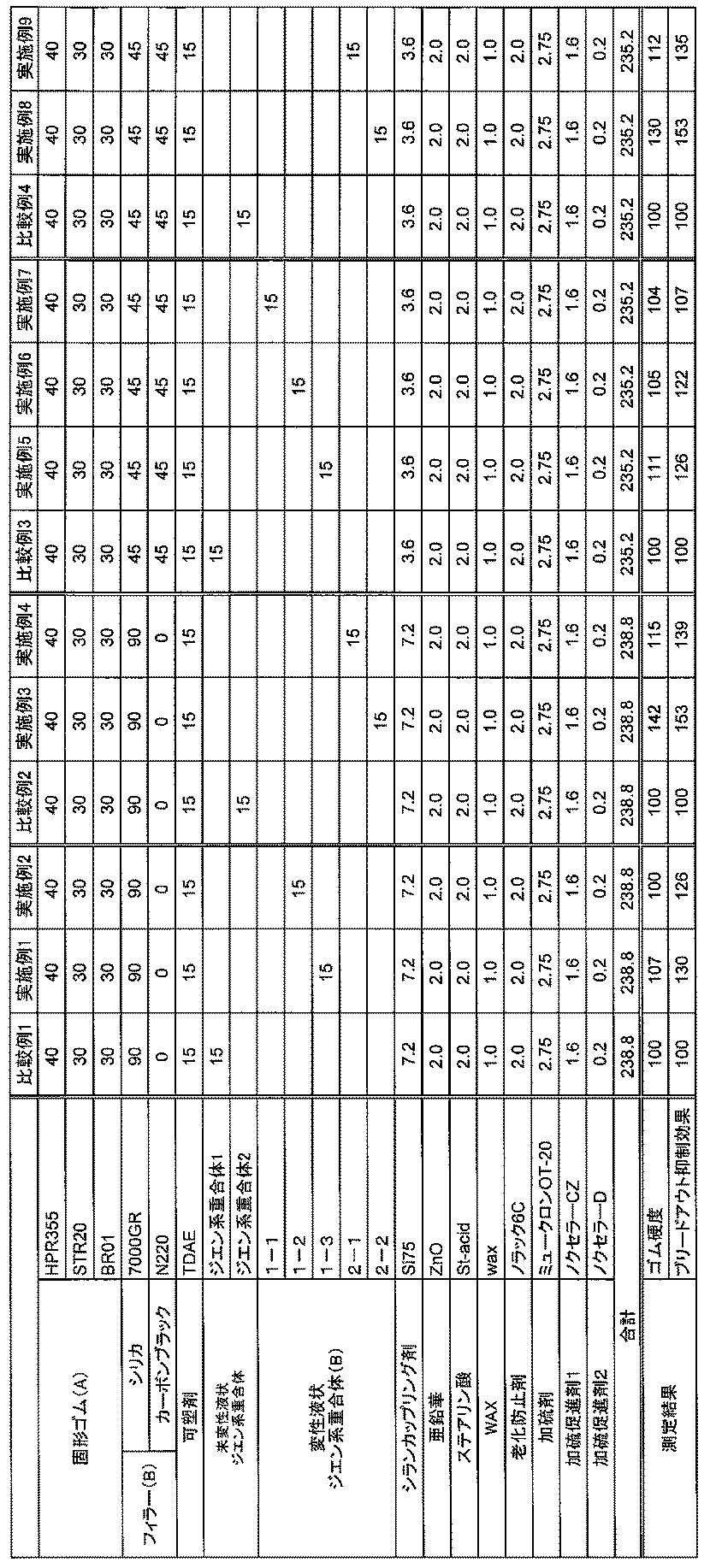
- Examples 1 to 17 and Comparative Examples 1 to 9 Production of Rubber Compositions
- the solid rubber, polymer, filler, plasticizer, silane coupling agent, zinc oxide, stearic acid, wax, and antioxidant were each charged into an internal Banbury mixer and kneaded for 6 to 8 minutes so that the starting temperature was 60° C. and the resin temperature was 145 to 160° C., and then the mixture was taken out of the mixer and cooled to room temperature. Next, this mixture was again charged into the internal Banbury mixer and kneaded for 4 to 6 minutes so that the starting temperature was 90° C.
- the obtained rubber composition was press molded (150-170°C, 30-50 minutes) to prepare a vulcanized rubber sheet (thickness 2 mm), and the physical properties were evaluated based on the following methods.
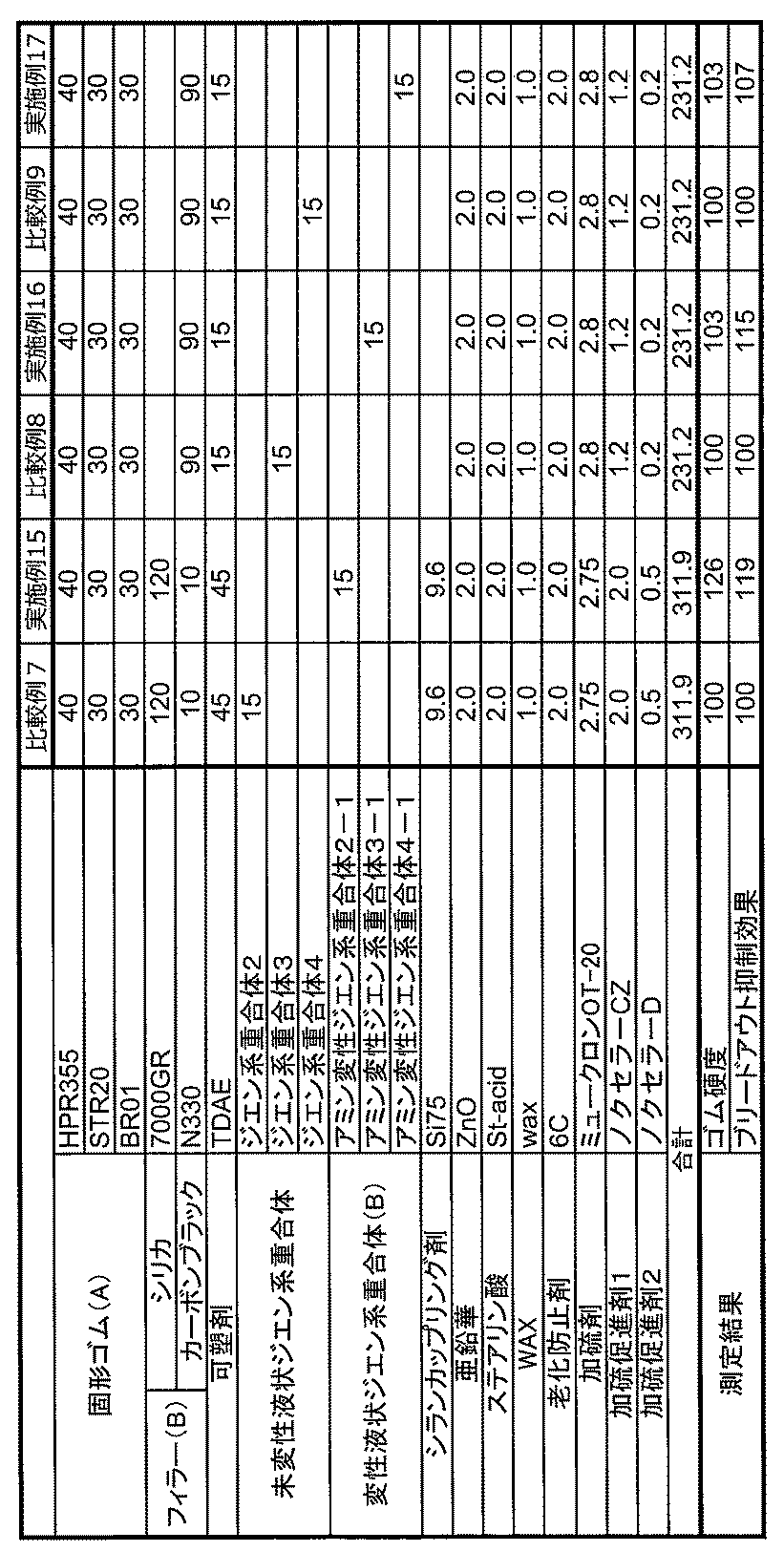
- the measurement methods for each evaluation are as follows. The obtained evaluation results are shown in Tables 3, 4, and 5.
- ⁇ Rubber hardness> A test piece of 40 mm length x 5 mm width was cut out from the vulcanized rubber sheet obtained by press-molding the rubber composition prepared in each of the Examples and Comparative Examples, and the hardness was measured by a type A hardness tester with reference to JIS K6253.
- the rubber hardness is shown in Tables 3, 4, and 5 as a relative value when the values of Comparative Example 1 for Examples 1 and 2, Comparative Example 2 for Examples 3 and 4, Comparative Example 3 for Examples 5 to 7, Comparative Example 4 for Examples 8 and 9, Comparative Example 5 for Examples 10 to 12, Comparative Example 6 for Examples 13 and 14, Comparative Example 7 for Example 15, Comparative Example 8 for Example 16, and Comparative Example 9 for Example 17 are set to 100.
- the rubber compositions to which the polymer of the present invention was added exhibited higher rubber hardness than rubber compositions containing diene polymers of comparable molecular weights and comparable amounts of fillers.
- the higher rubber hardness is understood to be due to the polymer of the present invention improving the dispersibility of other components contained in the rubber composition, such as fillers.
- the results in Figure 1 also show that the dispersibility of other components is improved in the rubber composition to which the polymer of the present invention was added.
- the polymer of the present invention not only had the above-mentioned effect of improving dispersibility, but also had the effect of suppressing bleed-out.
Landscapes
- Chemical & Material Sciences (AREA)
- Health & Medical Sciences (AREA)
- Chemical Kinetics & Catalysis (AREA)
- Medicinal Chemistry (AREA)
- Polymers & Plastics (AREA)
- Organic Chemistry (AREA)
- General Chemical & Material Sciences (AREA)
- Addition Polymer Or Copolymer, Post-Treatments, Or Chemical Modifications (AREA)
- Compositions Of Macromolecular Compounds (AREA)
Abstract
Description
〔1〕ブタジエンに由来する構造単位を含む変性液状ジエン系重合体であって、
重量平均分子量が4,000~150,000であり、
式(I):
R1は炭素数1~10のアルキレン基又はフェニレン基を表し、
R2は水素原子又は炭素数1~2のアルキル基を表し、
*は結合手を表す]
で表される変性基を有し、
ブタジエンに由来する構造単位の量は変性液状ジエン系重合体の総量に対して20~100質量%であり、ブタジエンに由来する構造単位の総量に対するビニル基を有する1,2-結合単位の量は0~70モル%である、変性液状ジエン系重合体。
〔2〕式(I)で表される変性基の平均含有数は、変性液状ジエン系重合体1分子あたり0.5~10である、〔1〕に記載の変性液状ジエン系重合体。
〔3〕前記変性液状ジエン系重合体は末端に水酸基を有さない、〔1〕又は〔2〕に記載の変性液状ジエン系重合体。
〔4〕前記ブタジエンに由来する構造単位における1,4-結合単位の総量に対するシス-1,4-結合単位の量は20~60モル%である、〔1〕~〔3〕のいずれかに記載の変性液状ジエン系重合体。
〔5〕前記ブタジエンに由来する構造単位における1,4-結合単位の総量に対するトランス-1,4-結合単位の量は30~80モル%である、〔1〕~〔4〕のいずれかに記載の変性液状ジエン系重合体。
〔6〕分子量分布が1.0~20.0である、〔1〕~〔5〕のいずれかに記載の変性液状ジエン系重合体。
〔7〕〔1〕~〔6〕のいずれかに記載の変性液状ジエン系重合体を含む、ゴム用添加剤。
〔8〕可塑剤、酸化防止剤、フィラー及び着色剤からなる群から選択される少なくとも1種をさらに含む、〔7〕に記載のゴム用添加剤。
〔9〕固形ゴム用添加剤である、〔7〕又は〔8〕に記載のゴム用添加剤。
本発明は、ブタジエンに由来する構造単位を含む変性液状ジエン系重合体であって、
重量平均分子量が4,000~150,000であり、
式(I):

[式中、
R1は炭素数1~10のアルキレン基又はフェニレン基を表し、
R2は水素原子又は炭素数1~2のアルキル基を表し、
*は結合手を表す]
で表される変性基を有し、
ブタジエンに由来する構造単位の量は変性液状ジエン系重合体の総量に対して20~100質量%であり、ブタジエンに由来する構造単位の総量に対するビニル基を有する1,2-結合単位の量は、0~70モル%である、変性液状ジエン系重合体を提供する。
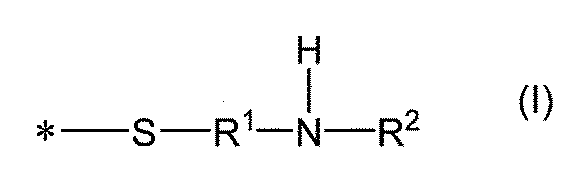
R1は炭素数1~10のアルキレン基又はフェニレン基を表し、
R2は水素原子又は炭素数1~2のアルキル基を表し、
*は結合手を表す]
で表される変性基を有する。該変性基を以下において変性基(I)とも称する。変性液状ジエン系重合体は、式(I)で表される1種類の変性基で変性されていてもよいし、式(I)で表される2種類以上の変性基で変性されていてもよい。
上記の変性液状ジエン系重合体の製造方法は特に限定されないが、例えば、ブタジエンと、必要に応じて含まれるブタジエンと共重合し得る他のモノマーを、例えば溶液重合法により重合して未変性の液状ジエン系重合体を製造し、その後、該未変性の液状重合体と、変性化合物とを反応させて、変性液状ジエン系重合体を製造することが好ましい。
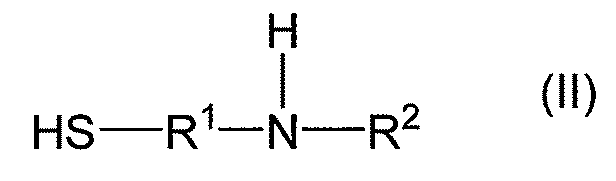
で表される化合物(以下、化合物(II)とも称する)と反応させることにより、上記式(I)で表される変性基で変性された、変性液状ジエン系重合体を製造することができる。なお、未変性の液状ジエン系重合体と、1種類の化合物(II)とを反応させてもよいし、2種類以上の化合物(II)を反応させてもよい。
本発明の好ましい一実施形態において、変性液状ジエン系重合体は、ゴム用添加剤において使用される。本発明は、上記の変性液状ジエン系重合体を含むゴム用添加剤も提供する。ゴム用添加剤は、上記の変性液状ジエン系重合体のみを含んでいてもよいし、上記の変性液状ジエン系重合体と他の添加剤とを含有していてもよい。
本発明によれば、本発明の変性液状ジエン系重合体と、ゴム成分(好ましくは固形ゴム)とを少なくとも含有するゴム組成物が得られる。
ゴム組成物の製造方法は、上記各成分を均一に混合できれば特に限定されない。ゴム組成物の製造に用いる装置としては、例えば、ニーダールーダー、ブラベンダー、バンバリーミキサー、インターナルミキサー等の接線式又は噛合式の密閉式混練機、単軸押出機、二軸押出機、ミキシングロール、及びローラーなどが挙げられる。上記ゴム組成物を製造は、通常70~270℃の温度範囲で行うことができる。
上記のゴム組成物を架橋することにより、架橋物を得ることができる。ゴム組成物の架橋条件は、その用途等に応じて適宜設定できる。例えば、硫黄又は硫黄化合物を架橋剤とし、ゴム組成物を金型に入れて加熱して架橋(加硫)する場合には、架橋温度は通常120~200℃、加圧条件は通常0.5~2.0MPaとし、架橋(加硫)することができる。
例えば、夏用タイヤ(サマータイヤ)、冬用タイヤ(スタッドレスタイヤ、スノータイヤ、スタッドタイヤなど)として好適に使用できる。タイヤは、乗用車用タイヤ、大型乗用車用タイヤ、大型SUV用タイヤ、トラックやバスなどの高荷重用タイヤ、ライトトラックタイヤ、二輪自動車用タイヤ、ランフラットタイヤ、レース用タイヤ(高性能タイヤ)などに使用可能である。
変性液状ジエン系重合体の重量平均分子量(Mw)、数平均分子量(Mn)、及び分子量分布(Mw/Mn)は、GPC(ゲルパーミエーションクロマトグラフィー)により標準ポリスチレン換算分子量で求めた。測定装置及び条件は、以下の通りである。
・装置 :東ソー株式会社製GPC装置「HLC-8320GPC」
・分離カラム :東ソー株式会社製「TSKgelSuperHZ4000×2」
・溶離液 :テトラヒドロフラン
・溶離液流量 :0.35mL/分
・サンプル濃度:5mg/10mL
・カラム温度 :40℃
各未変性液状ジエン系重合体30mgを二硫化炭素10mLで溶解したものをフーリエ変換赤外分光光度計(FT-IR)にて測定した。検出された1,2-結合由来の吸収ピーク吸光度(AV)、シス-1,4-結合由来の吸収ピーク吸光度(AC)、トランス-1,4-結合由来の吸収ピーク吸光度(AT)、およびMoreroの吸光係数から、計算式(i)を用いて組成比を求めた。
計算式(i)
シス-1,4-結合(C)・・・1.7455*AC-0.0151*AV
トランス-1,4-結合(T)・・・0.4292*AT-0.0129*AV-0.0454*AC
1.2-結合(V)・・・0.3746*AV-0.007*AC
シス-1,4-結合の割合(%)=C/(C+V+T)*100
トランス-1,4-結合の割合(%)=T/(C+V+T)*100
1.2-結合の割合(%)=V/(C+V+T)*100
まず、各未変性液状ジエン系重合体50mgを重クロロホルム1mLに溶解し、Bruker社製「AVANCE 400Nanobay」(400MHz)を使用し、積算回数128回で1H-NMRを測定した(測定1)。次に、各変性液状ジエン系重合体50mgを重クロロホルム1mLに溶解し、Bruker社製「AVANCE 400Nanobay」(400MHz)を使用し、積算回数128回で1H-NMRを測定した(測定2)。
測定1で得られた1H-NMRのスペクトルにおいて、1,2-結合に由来するピークと、1,2-結合および1,4-結合に由来するピークとのピーク積分値を求めた。次に、測定2で得られた1H-NMRのスペクトルにおいて、測定1で得られたピーク積分値を利用して、1,2-結合由来のピーク、1,4-結合由来のピーク、及び2-アミノエタンチオール由来のピーク積分値の比から、それぞれの存在比(X,Y,Z)(モル比)を計算した。
重量平均分子量からジエン系重合体を構成する単量体数を仮定し、アミン変性液状ジエン系重合体中の官能基量の概算値を下式より求めた。
一分子あたりの平均官能基数(個/polymer)=単量体数*(Z/(X+Y))
各変性液状ジエン系重合体を構成する単量体の分子量および変性液状ジエン系重合体の重量平均分子量をもとに、各変性液状ジエン系重合体を構成する単量体数の概算値を求め、各結合単位の数を概算した。これらと変性基の平均含有数をもとに、ブタジエンに由来する構造単位の総量(本実施例及び比較例の場合、1,4-結合単位、ビニル基を有する1,2-結合単位及び変性基を含む構造単位の総量)に対する、変性基を含む構造単位の割合(モル%)を算出した。また、未変性液状ジエン系重合体の1,2-結合単位の量をもとに、変性液状ジエン系重合体におけるブタジエンに由来する構造単位の総量に対するビニル基を有する1,2-結合単位の割合(モル%)を算出した。
未変性の液状ジエン系重合体の38℃における溶融粘度をブルックフィールド型粘度計(BROOKFIELD ENGINEERING LABS.INC.製)により測定した。
[製造例1:ジエン系重合体1の合成]
十分に乾燥した3Lオートクレーブを窒素置換し、ヘキサン955gおよびn-ブチルリチウム(17質量%ヘキサン溶液)21gを仕込み、60℃に昇温した後、撹拌条件下でブタジエン770gを逐次添加して重合した。その後メタノールを添加して重合反応を停止させ、重合体溶液を得た。得られた重合体溶液に水を添加して撹拌し、水で重合体溶液を洗浄した。撹拌を終了し、重合体溶液相と水相とが分離していることを確認した後、水を分離した。洗浄終了後の重合体溶液を140℃で3時間真空乾燥することにより、ブタジエン単独重合体からなる未変性の液状ジエン系重合体1を得た。
十分に乾燥した容量3Lオートクレーブを窒素置換し、シクロヘキサン510gおよびn-ブチルリチウム(17質量%ヘキサン溶液)85gを仕込み50℃に昇温した後、N,N,N’,N’-テトラメチルエチレンジアミン5gを添加し、重合温度を50℃となるように制御しながら撹拌条件下でブタジエン1270gを逐次添加して重合した。その後メタノールを添加して重合反応を停止させ、重合体溶液を得た。得られた重合体溶液に水を添加して撹拌し、水で重合体溶液を洗浄した。撹拌を終了し、重合体溶液相と水相とが分離していることを確認した後、水を分離した。洗浄終了後の重合体溶液を70℃で24時間真空乾燥することにより、ブタジエン単独重合体からなる未変性の液状ジエン系重合体2を得た。
十分に乾燥した容量5Lオートクレーブを窒素置換し、ヘキサン1200gおよびn-ブチルリチウム(17質量%ヘキサン溶液)22.9gを仕込み、重合温度を70℃となるように制御しながら撹拌条件下でブタジエン1260gを逐次添加して重合した。その後メタノールを添加して重合反応を停止させ、重合体溶液を得た。得られた重合体溶液に水を添加して撹拌し、水で重合体溶液を洗浄した。撹拌を終了し、重合体溶液相と水相とが分離していることを確認した後、水を分離した。洗浄終了後の重合体溶液を70℃で24時間真空乾燥することにより、ブタジエン単独重合体からなる未変性の液状ジエン系重合体3を得た。
十分に乾燥した容量10Lオートクレーブを窒素置換し、ヘキサン4520gおよびn-ブチルリチウム(17質量%ヘキサン溶液)31.2gを仕込み、重合温度を70℃となるように制御しながら撹拌条件下でブタジエン2970gを逐次添加して重合した。さらにイソプレン300gを逐次添加して重合後、メタノールを添加して重合反応を停止させ、重合体溶液を得た。得られた重合体溶液に水を添加して撹拌し、水で重合体溶液を洗浄した。撹拌を終了し、重合体溶液相と水相とが分離していることを確認した後、水を分離した。洗浄終了後の重合体溶液を70℃で24時間真空乾燥することにより、ブタジエンおよびイソプレンの共重合体からなる未変性の液状ジエン系重合体4を得た。

[製造例5:変性液状ジエン系重合体1-1の合成]
十分に乾燥した容量1Lオートクレーブを窒素置換し、未変性の液状ジエン系重合体1を597gを仕込み、80℃で3時間撹拌しながら窒素脱気をした。1,1-ビス(t-ヘキシルパーオキシ)シクロヘキサン1.5gと2-アミノエタンチオール5.1gを添加し、110℃で8時間反応させて、アミン変性液状ジエン系重合体1-1を得た。
十分に乾燥した容量1Lオートクレーブを窒素置換し、未変性の液状ジエン系重合体1を605g仕込み、80℃で3時間撹拌しながら窒素脱気をした。1,1-ビス(t-ヘキシルパーオキシ)シクロヘキサン1.9gと2-アミノエタンチオール12.7gを添加し、110℃で8時間反応させた。その後反応物を500gのシクロヘキサンに溶解し、溶液を3000gのメタノール中に注いで再沈殿しアミン変性液状ジエン系重合体1-2を得た。
十分に乾燥した容量1Lオートクレーブを窒素置換し、未変性の液状ジエン系重合体1を436gとトルエン187gを仕込み、40℃で撹拌して均一な重合体溶液とした後に3時間窒素脱気をした。1,1-ビス(t-ヘキシルパーオキシ)シクロヘキサン1.6gと2-アミノエタンチオール10.1gを添加し、110℃で8時間反応させた。その後反応溶液を2000gのメタノール中に注いで再沈殿し、変性液状ジエン系重合体1-3を得た。
十分に乾燥した容量1Lオートクレーブを窒素置換し、未変性の液状ジエン系重合体2を607g仕込み、60℃で3時間撹拌しながら窒素脱気をした。1,1-ビス(t-ヘキシルパーオキシ)シクロヘキサン0.9gと2-アミノエタンチオール37.1gを添加し、110℃で8時間反応させた。その後反応物を500gのシクロヘキサンに溶解し、溶液を3000gのメタノール中に注いで再沈殿し、変性液状ジエン系重合体2-1を得た。
十分に乾燥した容量1Lオートクレーブを窒素置換し、未変性の液状ジエン系重合体2を125gとトルエン500gを仕込み、40℃で撹拌して均一な重合体溶液とした後に3時間窒素脱気をした。1,1-ビス(t-ヘキシルパーオキシ)シクロヘキサン4.2gと2-アミノエタンチオール17.7gを添加し、110℃で8時間反応させた。その後反応溶液を2500gのメタノール中に注いで再沈殿し、変性液状ジエン系重合体2-2を得た。
十分に乾燥した容量1Lオートクレーブを窒素置換し、未変性の液状ジエン系重合体3を601g仕込み、100℃で撹拌しながら3時間窒素脱気をした。1,1-ビス(t-ヘキシルパーオキシ)シクロヘキサン1.4gと2-アミノエタンチオール4.5gを添加し、110℃で8時間反応させた。その後反応溶液を2500gのメタノール中に注いで再沈殿し、変性液状ジエン系重合体3-1を得た。
十分に乾燥した容量1Lオートクレーブを窒素置換し、未変性の液状ジエン系重合体4を125gとトルエン594gを仕込み、100℃で撹拌しながら3時間窒素脱気をした。1,1-ビス(t-ヘキシルパーオキシ)シクロヘキサン1.5gと2-アミノエタンチオール3.7gを添加し、110℃で8時間反応させた。その後反応溶液を2200gのメタノール中に注いで再沈殿し、変性液状ジエン系重合体4-1を得た。
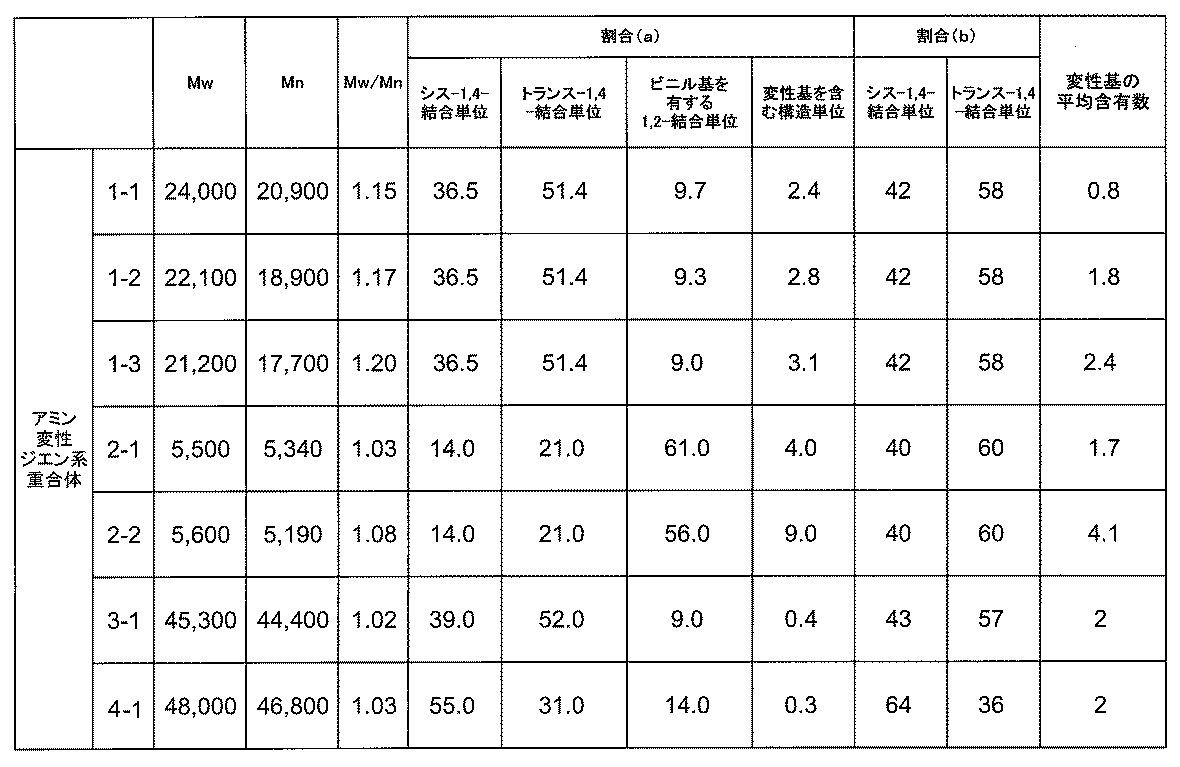
溶液重合スチレンブタジエンゴム:HPR355(株式会社ENEOSマテリアル製、アルコキシシリル基を末端に導入、スチレン含量28質量%、ビニル含量56質量%)
STR20:タイ産天然ゴム
ブタジエンゴム:BR01(株式会社ENEOSマテリアル製、Mw:55万、シス体含有量95質量%)
シリカ:ULTRASIL7000GR(エボニック ジャパン製、湿式シリカ、平均粒径14nm)
シランカップリング剤:Si-75(エボニック ジャパン製)
N220:ダイヤブラックI(三菱化学株式会社製、平均粒子径23nm)
TDAE:VivaTec500(H&R社製)
亜鉛華:ZnO(堺化学工業株式会社製)
ステアリン酸:ルナックS-20(花王株式会社製)
WAX:サンタイトS(精工化学株式会社製)
老化防止剤:ノラック6C(大内新興化学工業株式会社製)
加硫剤:不溶性硫黄ミュークロンOT-20(四国化成工業株式会社製)
加硫促進剤1:ノクセラーCZ(大内新興化学工業株式会社製)
加硫促進剤2:ノクセラーD(大内新興化学工業株式会社製)
表3、表4及び表5に記載した配合割合(質量部)にしたがって、固形ゴム、重合体、フィラー、可塑剤、シランカップリング剤、亜鉛華、ステアリン酸、ワックスおよび老化防止剤を、それぞれ密閉式バンバリーミキサーに投入して開始温度60℃、樹脂温度が145~160℃となるように6~8分間混錬した後、ミキサー外に取り出して室温まで冷却した。次いで、この混合物を再度密閉式バンバリーミキサーに入れ、開始温度90℃、樹脂温度が150℃となるように4~6分間混錬した後、ミキサー外に取り出して室温まで冷却した。
得られた混合物をさらに再度バンバリーミキサーに入れ、加硫剤および加硫促進剤を加えて開始温度50℃、到達温度75~95℃となるように75秒混錬することでゴム組成物を得た。
また、得られたゴム組成物をプレス成形(150~170℃、30~50分)して加硫ゴムシート(厚み2mm)を作製し、下記の方法に基づき物性を評価した。なお各評価の測定方法は以下のとおりである。得られた各評価結果を表3、表4及び表5に示す。
実施例および比較例で作製したゴム組成物をプレス成形した加硫ゴムシートから縦40mm×横5mmの試験片を切り出し、JIS K6253を参考に、タイプA硬度計により硬度を測定した。変性液状ジエン系重合体によるゴム硬度の改善効果を確認するために、実施例1~2は比較例1、実施例3~4は比較例2、実施例5~7は比較例3、実施例8~9は比較例4、実施例10~12は比較例5、実施例13~14は比較例6、実施例15は比較例7、実施例16は比較例8、実施例17は比較例9の値をそれぞれ100とした際の相対値を表3、表4及び表5にゴム硬度として示す。数値が高いほどゴム組成物の硬度が大きく、硬度が向上されたことを示す。
実施例および比較例で作製したゴム組成物をプレス成形した加硫ゴムシートからΦ32mmの円形試験片を3個打ち抜き、それぞれの重量(m1)を測定した。試験片がすべて浸る十分な容積のトルエンを用意し、試験片を室温で48時間浸漬した。その後、試験片を取り出して80℃の真空乾燥機内で12時間乾燥させ、乾燥後の試験片の重量(m2)を測定した。得られた重量測定値(m1、m2)を計算式(ii)に代入して、抽出率を求めた。
計算式(ii):
抽出率(%)=(m1-m2)/m1*100
変性液状ジエン系重合体によるブリードアウト抑制の効果を確認するために、実施例及び比較例における抽出率の逆数を算出し、実施例1~2は比較例1、実施例3~4は比較例2、実施例5~7は比較例3、実施例8~9は比較例4、実施例10~12は比較例5、実施例13~14は比較例6、実施例15は比較例7、実施例16は比較例8、実施例17は比較例9の抽出率の逆数をそれぞれ100とした際の抽出率の逆数の相対値を、表3、表4及び表5にブリードアウト抑制効果として示す。数値が高いほど抽出物が少なく、ブリードアウト抑制効果が高いことを示す。
比較例2および実施例3で作成したゴム組成物をプレス成形した加硫ゴムシートを、得られた平板状のゴムシートのプレス面が上になる状態で、黒い文字が印字された紙の上に重ね、カメラで撮影した。撮影した画像を図1に示す。該画像において、印字された文字が視認されるかどうかを次の基準で評価した。なお、文字の視認性が高い程、ゴムシートの透明性が高く、ゴム組成物に含まれるフィラー等の成分の分散性が向上されていることを表す。評価結果は、比較例2の場合×、実施例3の場合〇であった。
(評価基準)
〇 印字された文字が視認できる
× 印字された文字が視認できない
Claims (9)
- ブタジエンに由来する構造単位を含む変性液状ジエン系重合体であって、
重量平均分子量が4,000~150,000であり、
式(I):
R1は炭素数1~10のアルキレン基又はフェニレン基を表し、
R2は水素原子又は炭素数1~2のアルキル基を表し、
*は結合手を表す]
で表される変性基を有し、
ブタジエンに由来する構造単位の量は変性液状ジエン系重合体の総量に対して20~100質量%であり、ブタジエンに由来する構造単位の総量に対するビニル基を有する1,2-結合単位の量は、0~70モル%である、変性液状ジエン系重合体。 - 式(I)で表される変性基の平均含有数は、変性液状ジエン系重合体1分子あたり0.5~10である、請求項1に記載の変性液状ジエン系重合体。
- 前記変性液状ジエン系重合体は末端に水酸基を有さない、請求項1又は2に記載の変性液状ジエン系重合体。
- 前記ブタジエンに由来する構造単位における1,4-結合単位の総量に対するシス-1,4-結合単位の量は20~60モル%である、請求項1~3のいずれかに記載の変性液状ジエン系重合体。
- 前記ブタジエンに由来する構造単位における1,4-結合単位の総量に対するトランス-1,4-結合単位の量は30~80モル%である、請求項1~4のいずれかに記載の変性液状ジエン系重合体。
- 分子量分布が1.0~20.0である、請求項1~5のいずれかに記載の変性液状ジエン系重合体。
- 請求項1~6のいずれかに記載の変性液状ジエン系重合体を含む、ゴム用添加剤。
- 可塑剤、酸化防止剤、フィラー及び着色剤からなる群から選択される少なくとも1種をさらに含む、請求項7に記載のゴム用添加剤。
- 固形ゴム用添加剤である、請求項7又は8に記載のゴム用添加剤。
Priority Applications (3)
| Application Number | Priority Date | Filing Date | Title |
|---|---|---|---|
| CN202480039206.7A CN121311514A (zh) | 2023-06-16 | 2024-06-04 | 改性液态二烯系聚合物和橡胶用添加剂 |
| EP24823274.6A EP4729550A1 (en) | 2023-06-16 | 2024-06-04 | Modified liquid diene polymer and additive for rubber |
| JP2025527854A JPWO2024257655A1 (ja) | 2023-06-16 | 2024-06-04 |
Applications Claiming Priority (2)
| Application Number | Priority Date | Filing Date | Title |
|---|---|---|---|
| JP2023-099438 | 2023-06-16 | ||
| JP2023099438 | 2023-06-16 |
Publications (1)
| Publication Number | Publication Date |
|---|---|
| WO2024257655A1 true WO2024257655A1 (ja) | 2024-12-19 |
Family
ID=93851895
Family Applications (1)
| Application Number | Title | Priority Date | Filing Date |
|---|---|---|---|
| PCT/JP2024/020400 Ceased WO2024257655A1 (ja) | 2023-06-16 | 2024-06-04 | 変性液状ジエン系重合体及びゴム用添加剤 |
Country Status (5)
| Country | Link |
|---|---|
| EP (1) | EP4729550A1 (ja) |
| JP (1) | JPWO2024257655A1 (ja) |
| CN (1) | CN121311514A (ja) |
| TW (1) | TW202509096A (ja) |
| WO (1) | WO2024257655A1 (ja) |
Citations (10)
| Publication number | Priority date | Publication date | Assignee | Title |
|---|---|---|---|---|
| JPS54123144A (en) * | 1978-03-17 | 1979-09-25 | Nippon Zeon Co Ltd | Water-based coating composition |
| JPS5924763A (ja) * | 1982-08-02 | 1984-02-08 | Nippon Soda Co Ltd | 電着塗料組成物およびその電着塗装方法 |
| JP2000344949A (ja) | 1999-03-31 | 2000-12-12 | Nippon Mitsubishi Oil Corp | 自動車タイヤトレッド用ゴム組成物 |
| JP2005220224A (ja) * | 2004-02-05 | 2005-08-18 | Fuji Photo Film Co Ltd | 重合体、及び該重合体からなる酸化防止剤 |
| JP2011132298A (ja) | 2009-12-22 | 2011-07-07 | Sumitomo Rubber Ind Ltd | 変性共重合体、それを用いたゴム組成物および空気入りタイヤ |
| JP2013249359A (ja) | 2012-05-31 | 2013-12-12 | Bridgestone Corp | ゴム組成物及びタイヤ |
| JP2017137412A (ja) * | 2016-02-03 | 2017-08-10 | 東ソー株式会社 | アミノ化石油樹脂及びその製造方法 |
| JP2019500471A (ja) * | 2015-12-29 | 2019-01-10 | 株式会社ブリヂストン | ポリオレフィングラフト化ポリジエンポリマー、並びにその製造及び使用方法 |
| WO2019172185A1 (ja) | 2018-03-07 | 2019-09-12 | 株式会社クラレ | 変性液状ジエン系重合体およびゴム組成物 |
| JP2020125456A (ja) * | 2019-02-01 | 2020-08-20 | ハンコック タイヤ アンド テクノロジー カンパニー リミテッドHankook Tire & Technology Co., Ltd. | 無溶媒反応型接着組成物及びこれを用いたタイヤの製造方法 |
-
2024
- 2024-06-04 WO PCT/JP2024/020400 patent/WO2024257655A1/ja not_active Ceased
- 2024-06-04 EP EP24823274.6A patent/EP4729550A1/en active Pending
- 2024-06-04 CN CN202480039206.7A patent/CN121311514A/zh active Pending
- 2024-06-04 JP JP2025527854A patent/JPWO2024257655A1/ja active Pending
- 2024-06-14 TW TW113122047A patent/TW202509096A/zh unknown
Patent Citations (10)
| Publication number | Priority date | Publication date | Assignee | Title |
|---|---|---|---|---|
| JPS54123144A (en) * | 1978-03-17 | 1979-09-25 | Nippon Zeon Co Ltd | Water-based coating composition |
| JPS5924763A (ja) * | 1982-08-02 | 1984-02-08 | Nippon Soda Co Ltd | 電着塗料組成物およびその電着塗装方法 |
| JP2000344949A (ja) | 1999-03-31 | 2000-12-12 | Nippon Mitsubishi Oil Corp | 自動車タイヤトレッド用ゴム組成物 |
| JP2005220224A (ja) * | 2004-02-05 | 2005-08-18 | Fuji Photo Film Co Ltd | 重合体、及び該重合体からなる酸化防止剤 |
| JP2011132298A (ja) | 2009-12-22 | 2011-07-07 | Sumitomo Rubber Ind Ltd | 変性共重合体、それを用いたゴム組成物および空気入りタイヤ |
| JP2013249359A (ja) | 2012-05-31 | 2013-12-12 | Bridgestone Corp | ゴム組成物及びタイヤ |
| JP2019500471A (ja) * | 2015-12-29 | 2019-01-10 | 株式会社ブリヂストン | ポリオレフィングラフト化ポリジエンポリマー、並びにその製造及び使用方法 |
| JP2017137412A (ja) * | 2016-02-03 | 2017-08-10 | 東ソー株式会社 | アミノ化石油樹脂及びその製造方法 |
| WO2019172185A1 (ja) | 2018-03-07 | 2019-09-12 | 株式会社クラレ | 変性液状ジエン系重合体およびゴム組成物 |
| JP2020125456A (ja) * | 2019-02-01 | 2020-08-20 | ハンコック タイヤ アンド テクノロジー カンパニー リミテッドHankook Tire & Technology Co., Ltd. | 無溶媒反応型接着組成物及びこれを用いたタイヤの製造方法 |
Also Published As
| Publication number | Publication date |
|---|---|
| EP4729550A1 (en) | 2026-04-22 |
| JPWO2024257655A1 (ja) | 2024-12-19 |
| CN121311514A (zh) | 2026-01-09 |
| TW202509096A (zh) | 2025-03-01 |
Similar Documents
| Publication | Publication Date | Title |
|---|---|---|
| JP7751611B2 (ja) | ゴム組成物 | |
| US11590799B2 (en) | Heavy-duty tire rubber compositions and tires | |
| EP3677636B1 (en) | Heavy-duty tire rubber compositions and tires | |
| EP3677635B1 (en) | Tire rubber composition | |
| US11970561B2 (en) | Modified liquid diene polymer and rubber composition | |
| EP3677637B1 (en) | Tire rubber compositions | |
| EP3677634B1 (en) | Rubber composition for high grip tire | |
| EP3677633B1 (en) | Rubber composition for high grip tire | |
| WO2024257655A1 (ja) | 変性液状ジエン系重合体及びゴム用添加剤 | |
| WO2024257653A1 (ja) | ゴム組成物及びタイヤゴム組成物 | |
| CA3074203C (en) | Tire rubber compositions | |
| CA3074175C (en) | Tire rubber compositions | |
| WO2025018210A1 (ja) | サイドウォール用ゴム組成物およびサイドウォール | |
| WO2025018211A1 (ja) | タイヤトレッド用ゴム組成物およびタイヤトレッド |
Legal Events
| Date | Code | Title | Description |
|---|---|---|---|
| 121 | Ep: the epo has been informed by wipo that ep was designated in this application |
Ref document number: 24823274 Country of ref document: EP Kind code of ref document: A1 |
|
| ENP | Entry into the national phase |
Ref document number: 2025527854 Country of ref document: JP Kind code of ref document: A |
|
| WWE | Wipo information: entry into national phase |
Ref document number: 2025527854 Country of ref document: JP |
|
| WWE | Wipo information: entry into national phase |
Ref document number: 2024823274 Country of ref document: EP |
|
| NENP | Non-entry into the national phase |
Ref country code: DE |
|
| ENP | Entry into the national phase |
Ref document number: 2024823274 Country of ref document: EP Effective date: 20260116 |
|
| ENP | Entry into the national phase |
Ref document number: 2024823274 Country of ref document: EP Effective date: 20260116 |
|
| ENP | Entry into the national phase |
Ref document number: 2024823274 Country of ref document: EP Effective date: 20260116 |
|
| ENP | Entry into the national phase |
Ref document number: 2024823274 Country of ref document: EP Effective date: 20260116 |
|
| WWP | Wipo information: published in national office |
Ref document number: 2024823274 Country of ref document: EP |