WO2024257788A1 - 高純度溶融球状シリカ、及びこれを含む電子機器用樹脂組成物、並びにこれを含む化粧品 - Google Patents
高純度溶融球状シリカ、及びこれを含む電子機器用樹脂組成物、並びにこれを含む化粧品 Download PDFInfo
- Publication number
- WO2024257788A1 WO2024257788A1 PCT/JP2024/021304 JP2024021304W WO2024257788A1 WO 2024257788 A1 WO2024257788 A1 WO 2024257788A1 JP 2024021304 W JP2024021304 W JP 2024021304W WO 2024257788 A1 WO2024257788 A1 WO 2024257788A1
- Authority
- WO
- WIPO (PCT)
- Prior art keywords
- spherical silica
- silica particles
- purity fused
- particles
- resin composition
- Prior art date
- Legal status (The legal status is an assumption and is not a legal conclusion. Google has not performed a legal analysis and makes no representation as to the accuracy of the status listed.)
- Ceased
Links
Classifications
-
- A—HUMAN NECESSITIES
- A61—MEDICAL OR VETERINARY SCIENCE; HYGIENE
- A61K—PREPARATIONS FOR MEDICAL, DENTAL OR TOILETRY PURPOSES
- A61K8/00—Cosmetics or similar toiletry preparations
- A61K8/18—Cosmetics or similar toiletry preparations characterised by the composition
- A61K8/19—Cosmetics or similar toiletry preparations characterised by the composition containing inorganic ingredients
- A61K8/25—Silicon; Compounds thereof
-
- C—CHEMISTRY; METALLURGY
- C01—INORGANIC CHEMISTRY
- C01B—NON-METALLIC ELEMENTS; COMPOUNDS THEREOF; METALLOIDS OR COMPOUNDS THEREOF NOT COVERED BY SUBCLASS C01C
- C01B33/00—Silicon; Compounds thereof
- C01B33/113—Silicon oxides; Hydrates thereof
- C01B33/12—Silica; Hydrates thereof, e.g. lepidoic silicic acid
- C01B33/18—Preparation of finely divided silica neither in sol nor in gel form; After-treatment thereof
-
- C—CHEMISTRY; METALLURGY
- C08—ORGANIC MACROMOLECULAR COMPOUNDS; THEIR PREPARATION OR CHEMICAL WORKING-UP; COMPOSITIONS BASED THEREON
- C08K—Use of inorganic or non-macromolecular organic substances as compounding ingredients
- C08K3/00—Use of inorganic substances as compounding ingredients
- C08K3/34—Silicon-containing compounds
- C08K3/36—Silica
-
- C—CHEMISTRY; METALLURGY
- C08—ORGANIC MACROMOLECULAR COMPOUNDS; THEIR PREPARATION OR CHEMICAL WORKING-UP; COMPOSITIONS BASED THEREON
- C08L—COMPOSITIONS OF MACROMOLECULAR COMPOUNDS
- C08L101/00—Compositions of unspecified macromolecular compounds
Definitions
- the present invention relates to high-purity fused spherical silica, a resin composition for electronic devices containing the same, and cosmetics containing the same, and in particular to high-purity fused spherical silica with reduced impurity content and improved mixability with resin materials, as well as the resin composition and cosmetics containing the same.
- Insulating materials used to seal precision electronic parts such as semiconductors contain inorganic fillers added to the resin composition. Fillers are required to have insulating properties and a low coefficient of thermal expansion. Generally, silica (silicon oxide) is used.
- Silica is processed into fillers by crushing natural high-purity ores to a specified particle size.
- impurities other than silicon oxide
- silica derived from natural products uranium and thorium elements are present.
- Patent Document 1 a method for producing spherical silica powder that combines crushing and exposure to flame has been proposed.
- Patent Document 1 contributes to the reduction of uranium elements through pulverization and exposure to flame.
- processing precision and integration are being further promoted with the aim of improving the processing speed of semiconductors.
- the impact of external electromagnetic noise on semiconductors is becoming more of a problem than ever before.
- silica derived from natural products it is known that alpha rays and the like are generated by the radioactive decay of uranium and thorium elements, and are thought to be the cause of malfunctions.
- it since it is possible to reduce natural radiation, it can be said that there is also less impact of exposure on the human body.
- silica particles used as a filler must be easily mixed with resin. Furthermore, there is a demand for the suppression of voids (hollow spaces within the particles) in order to reduce the electrical conductivity of the silica particles themselves.
- the inventors conducted extensive research and have now discovered a method to more effectively remove uranium and thorium elements from high-purity natural ores, thereby reducing alpha rays and other emissions that originate from the raw materials.
- the present invention has been made in consideration of the above points, and provides high-purity fused spherical silica and a resin composition for electronic devices that reduce the amount of impurities contained in silica particles that serve as a filler to be added to encapsulants, improves the kneadability of the particles into the encapsulant resin, and further suppresses hollow spaces within the particles in order to control the electrical conductivity of the silica particles themselves. In addition, it also provides a material for cosmetic applications that reduces natural radiation and thus reduces radiation exposure.
- the high-purity fused spherical silica of an embodiment is characterized in that the uranium content in the spherical silica particles is 5 ppb or less, and the thorium content in the spherical silica particles is 5 ppb or less, the circularity of the spherical silica particles is 0.98 or more, the residual silicon oxide crystal rate in the spherical silica particles is 0.01% or less, and the number of hollow portions having a diameter of 5 ⁇ m or more present in each spherical silica particle is 2 or less within an observation area of 9 mm2 using an electron microscope.
- the sodium element content in the spherical silica particles may be 10 ppm or less.
- the spherical silica particles may be made from metallic silicon.
- the spherical silica particles may have been dissolved in a basic solution of metallic silicon.
- the spherical silica particles may be exposed to a flame.
- the resin composition for electronic devices according to the embodiment is characterized by having high-purity fused spherical silica and a resin composition.
- the cosmetic of the embodiment is characterized in that it contains high-purity fused spherical silica.
- the cosmetic product may be a powder, an ointment, or a lotion.
- the uranium content in the spherical silica particles is 5 ppb or less
- the thorium content in the spherical silica particles is 5 ppb or less
- the circularity of the spherical silica particles is 0.98 or more
- the residual silicon oxide crystal rate in the spherical silica particles is 0.01% or less
- the number of hollow parts with a diameter of 5 ⁇ m or more present in each spherical silica particle is 2 or less within an observation area of 9 mm2 using an electron microscope.
- the amount of impurities contained in the silica particles to be used as a filler in a sealant is reduced, the kneadability with the sealant resin is improved, and further, the hollow parts within the particles can be suppressed in terms of controlling the electrical conductivity of the silica particles themselves.
- the resin composition for electronic devices makes it possible to reduce the dose of particle radiation and electromagnetic waves emitted from the spherical particles contained in the resin composition, suppressing disturbance factors such as noise and reducing malfunctions of equipment.
- the high-purity fused spherical silica of the present invention can also be used as an additive in cosmetics to reduce natural radiation, thereby further reducing the effects of exposure to the human body, and even the effects of crystalline silica.
- FIG. 1A is an electron microscope photograph of a pulverized product after a pulverization process in Test Example 4, and FIG. 1B is an electron microscope photograph of spherical particles after a melt-spheroidization process.
- 1 is an electron microscope photograph of the high-purity fused spherical silica of Test Example 6.
- 1 is an electron microscope photograph of silica particles of Test Example 13.
- the following processing method is used to obtain the high-purity fused spherical silica of the embodiment. Therefore, the high-purity fused spherical silica will be explained starting from the manufacturing method.
- the raw silicon metal material is prepared and dissolved in a basic solution.
- the silicon metal is dissolved in a basic solution to prepare a raw material solution in which the raw silicon metal material is dissolved (the "dissolving process").
- the basic solution is a solution that does not contain alkali metals or alkaline earth metals.
- alkali metal hydroxides such as lithium hydroxide, sodium hydroxide, and potassium hydroxide are strongly alkaline.
- any alkali metal remains in the basic solution, it will lower the purity of the final silica particles, which is undesirable.
- Aqueous solutions of amine compounds are therefore used as solutions that do not contain alkali metals or alkaline earth metals.
- amine compounds include ammonia, primary amines, secondary amines, tertiary amines, quaternary ammonium hydroxides (ammonium salts), arylamines, silazanes, and hydrazines.
- the amine compound is one or more compounds selected from ammonia, methylamine, ethylamine, propylamine, dimethylamine, diethylamine, pyrrolidine, trimethylamine, triethylamine, tetramethylammonium hydroxide, tetraethylammonium hydroxide, tetrabutylammonium hydroxide, benzyltrimethylammonium hydroxide, methyltriamylammonium hydroxide, methyltributylammonium hydroxide, pyrrolidine, piperidine, pyridine, quinoline, imidazole, indole, pyrimidine, hexamethyldisilazane, hydrazine, diazabicycloundecene, diazabicyclononene, etc.
- the amine compound may be a single type or a mixture of two or more types.
- the concentration of the amine compound in the aqueous solution is set to an optimal concentration and pH depending on the type of raw material, and the solution is stirred.
- the liquid temperature during dissolution is also adjusted. Since some of the compound remains undissolved during dissolution, filtration is also added as necessary.
- the dissolved components of the raw material solution which is prepared by dissolving them in a basic solution, are solidified to prepare a solidified product (the "solidification process").
- an acidic solution is added to prepare a solidified product.
- the raw material solution is basic, and adding an acidic solution to it promotes neutralization of the acid and base, resulting in the formation of a precipitate. This precipitate becomes the desired solidified product.
- the resulting solidified product is washed with water and dried.
- acidic solutions that can be used include hydrochloric acid, nitric acid, sulfuric acid, phosphoric acid, acetic acid, formic acid, and organic acids such as citric acid. Of these, acetic acid is preferred as the acidic solution due to its tendency to volatilize and decompose in subsequent processes.
- the solidified material After drying, the solidified material is calcined to form a calcined product, and excess moisture such as bound water is removed (the "calcination process").
- the calcination temperature is 300 to 1200°C, and the calcination time is 1 to 3 hours.
- the silicon hydroxide produced by precipitation is oxidized to silicon oxide (silica) through calcination.
- the fired product produced by the firing process is pulverized to prepare a pulverized product (the "pulverization process").
- Either wet pulverization or dry pulverization may be used for pulverization.
- known devices for pulverizing solids such as ball mills, vibration mills, jet mills, and atomizers, are used as pulverizers.
- the solidified product and alumina balls are placed in a pulverization pod, and the pod is rotated to perform wet pulverization. The rotation time of the pod (pulverization time) is adjusted according to the target particle size.
- the pulverized product collected from the pod is dried by spray drying or the like.
- the purpose of the crushing process is to control the particle size before the subsequent melt-spheroidizing process.
- the sintered product is amorphous and not uniform in size due to the fusion of particles. If the product is sent to the melt-spheroidizing process in this state, particles with a wide range of particle sizes will be produced. In addition, it will be difficult to obtain a spherical shape due to the non-uniform shape. This results in a high yield during the process (a decrease in yield).
- the average particle size of the pulverized material means the median diameter ( D50 ) measured by a known particle size measurement method such as a laser diffraction scattering method or a dynamic scattering method. Therefore, the average particle size ( D50 ) of the pulverized material is preferably 30 ⁇ m or less, more preferably 20 ⁇ m or less. By making the particle size finer, melting in the melt-spheroidizing step becomes easier.
- the pulverized material prepared in the pulverization process is put into a flame, and the pulverized material flies through the flame.
- the pulverized material i.e., spherical silica particles, melts when exposed to the flame, and the surface tension during melting promotes spheroidization to obtain spherical particles ("melt spheroidization process").
- the spherical particles thus obtained are the oxide particles.
- the spherical particles also have a suitable particle size.
- the average particle size ( D50 ) of the spherical particles is 30 ⁇ m or less, more preferably 20 ⁇ m or less.
- the average particle size (D50) of the spherical particles also means the median size ( D50 ) measured by a known particle size measurement method such as a laser diffraction scattering method or a dynamic scattering method.
- the flame in the melting and spheroidizing process is formed by mixing combustible gas with a combustion supporting gas containing oxygen and burning it.
- the temperature of the furnace's refractory structure is in the range of 900°C to 1500°C at the highest point (furnace body temperature).
- the furnace body temperature preferably has a lower limit of 900°C to 1100°C and an upper limit of 1300°C to 1500°C.
- Air and oxygen are used as the combustion supporting gas.
- the flow rate of the combustible gas is preferably 10 m/s or more, more preferably 15 m/s or more, and even more preferably 20 m/s or more.
- the flow rate of the combustion supporting gas is preferably 10 m/s or more, more preferably 15 m/s or more, and even more preferably 20 m/s or more.
- the flow rate ratio of combustible gas/combustion supporting gas is preferably 2.0 or less, more preferably 1.5 or less, and even more preferably 1.0 or less.
- the supply amounts of the combustible gas and the combustion supporting gas are determined by the amount of the combustible gas that can form a flame large enough to sufficiently heat the raw material particles to be supplied, and the amount of the combustion supporting gas that can sufficiently combust the combustible gas.
- the amount of the combustible gas is 0.5 Nm 3 /kg to 5 Nm 3 /kg per unit weight of the pulverized material to be processed, and the amount of oxygen as the combustion supporting gas is about 1 Nm 3 /kg to 5 Nm 3 /kg.
- the method for supplying the raw material particles into the flame is not particularly limited, and the raw material particles are supplied to the flame in a dispersed state in a carrier gas.
- the carrier gas include air, oxygen, and nitrogen.
- the spherical silica particles produced from the raw material silicon metal through the melting, solidification, firing, crushing, and melt-spheroidizing processes have a significantly reduced total amount of uranium and thorium elements compared to the raw material stage.
- the spherical silica particles that are the embodiment of the high purity fused spherical silica of the embodiment have a uranium (U) content of 5 ppb or less, and a thorium (Th) content of 5 ppb or less. This content is reduced to 1/10 or less, or even 5/100 or less, of the total amount of uranium and thorium contained in the raw material. This makes it possible to further reduce the dose of particle rays such as alpha rays and beta rays, and electromagnetic waves such as gamma rays, emitted from the nuclides in the spherical silica particles, thereby reducing the impact on electronic components, etc.
- particle rays such as alpha rays and beta rays
- electromagnetic waves such as gamma rays
- the raw silicon metal When the raw silicon metal is dissolved in the basic solution, the original raw material changes from metal to hydroxide. At this point, the amount of impurities contained in the raw material is thought to be less than the amount of silicon metal that dissolves in the basic solution.
- Heavy elements such as U (uranium) and Th (thorium) are not amphoteric elements, so they are difficult to dissolve in basic solutions and remain as insoluble components. This ease of dissolution in basic solutions makes it possible to separate impurity components such as uranium and thorium elements. This makes it possible to reduce impurities even further than in the previous preparation of oxides for fillers.
- the sodium (Na) content in the spherical silica particles is 10 ppm or less.
- the sodium content is mentioned because it is a representative impurity component, and if the sodium content is low, it can be determined that the amounts of other impurities are also low. Because an amine compound is used when dissolving the raw silicon metal in a basic solution, there is almost no residual alkali metal such as sodium hydroxide. Also, because the raw silicon metal is dissolved in a basic solution, the dissolution of impurities is suppressed and the purity is increased, as mentioned above.
- each spherical silica particle is 0.98 or more, and the shape is extremely similar to a sphere.
- the circularity of a perfect sphere (true sphere) is 1.0.
- the circularity is evaluated by calculating the ratio of the length of the short axis to the long axis (aspect ratio), the ratio of the circle equivalent diameter to the maximum diameter, and the like. In the embodiment described below, measurements were taken using a flow-type particle image analyzer. The closer the circularity of the spherical silica particles is to a true sphere, the easier it is to fill the coating material into circuit boards, etc. after mixing with resin and preparing it into a sealing material, etc.
- the residual crystal rate of silicon oxide (silicon dioxide: SiO 2 ) in the spherical silica particles is 0.01% or less, preferably below the detection limit.
- the spherical silica particles are mainly formed of amorphous silicon oxide. A small amount of crystalline silicon oxide may be present in the particles.
- the residual crystal rate indicates the weight ratio of crystalline silicon oxide to the total weight of the spherical silica particles.
- the presence of crystalline silicon oxide affects the conductivity as a filler.
- findings suggesting the carcinogenicity of crystalline silicon oxide (silica) have been reported, so it is desirable to suppress crystalline silicon oxide as much as possible in order to reduce the impact.
- the number of hollows with a diameter of 5 ⁇ m or more present in each spherical silica particle is 2 or less, preferably 1 or less, more preferably 0, in an observation area of 9 mm2 by an electron microscope. If an extremely large hollow part (void, bubble) exists in a spherical silica particle, the conductivity of the spherical silica particle near the hollow part will change. In other words, the insulating property may be reduced by the hollow part, and the performance as a filler used in a sealing material may be reduced. Therefore, it is desirable to reduce the hollow part in the spherical silica particle as much as possible to densify the particle itself.
- the number and size (diameter) of hollow spaces inside the spherical silica particles were observed under magnification using an electron microscope. Note that when observing the number of hollow spaces with a diameter of 5 ⁇ m or more, the magnification of the electron microscope was set to 2000 times.
- the high-purity fused spherical silica (spherical silica particles) of the embodiments described so far is mainly used as a filler for electronic materials.
- the high-purity fused spherical silica (spherical silica particles) is added to a resin to prepare a resin composition for electronic devices (resin composition containing filler for electronic materials).
- Resins to which it can be added include thermoplastic resins such as polyethylene, polypropylene, polyvinyl chloride, polyethylene terephthalate, polystyrene, other olefin resins, polyimide resins, and liquid crystal polymers, fluororesins, urea resins, phenolic resins, and thermosetting resins such as polyphenylene ether and bismaleimide. It can also be added to elastic resins such as styrene butadiene rubber and isoprene rubber, silicone resins, and the like. For example, epoxy resins are used as resins when manufacturing resin substrates such as packaging substrates for electronic components and interlayer insulating films.
- thermoplastic resins such as polyethylene, polypropylene, polyvinyl chloride, polyethylene terephthalate, polystyrene, other olefin resins, polyimide resins, and liquid crystal polymers, fluororesins, urea resins, phenolic resins, and thermosetting
- Epoxy resins used in the resin composition include, for example, bisphenol A type epoxy resins, bisphenol F type epoxy resins, biphenyl type epoxy resins, phenol novolac type epoxy resins, naphthalene type epoxy resins, and phenoxy type epoxy resins.
- the weight of high-purity fused spherical silica (spherical silica particles) blended into the resin composition is preferably large from the viewpoints of heat resistance and thermal expansion coefficient. It is desirable to add 80 mass% or more of high-purity fused spherical silica (spherical silica particles) to the total mass of the resin composition.
- the high purity fused spherical silica (spherical silica particles) of the embodiment i.e., the filler for electronic materials
- the filler for electronic materials can be prepared as a slurry for electronic materials by dispersing the filler for electronic materials and having a liquid dispersion medium that is substantially free of moisture.
- a solvent such as methyl alcohol, ethyl alcohol, isopropyl alcohol, acetone, methyl ethyl ketone, methyl isobutyl ketone, cyclohexanone, methyl acetate, ethyl acetate, toluene, N-methylpyrrolidone, ⁇ -butyrolactone, propylene glycol monomethyl ether, propylene glycol monomethyl ether acetate, etc.
- the dispersion medium can also be used alone or in combination. It is also possible to use an appropriate dispersant.
- the characteristic property of the resin composition for electronic devices is that it is possible to reduce the dose of particle rays and electromagnetic waves emitted from the silica particles contained in the resin composition. This makes it possible to reduce the effects of particle rays and electromagnetic waves on electronic components and the like from the processed parts of the resin composition. As a result, it is expected that disturbance factors such as noise will be suppressed and problems such as malfunctions of equipment will be reduced.
- the properties of the high-purity fused spherical silica (spherical silica particles) itself make it possible to satisfy the effects of kneading with resin and suppressing electrical conductivity.
- the high-purity fused spherical silica (spherical silica particles) of the embodiment is also suitable for use as an additive to cosmetics.
- the content of heavy elements such as U (uranium) and Th (thorium) is extremely low, so the dose of natural radiation caused by the high-purity fused spherical silica (spherical silica particles) is suppressed, and the impact of exposure to the human body is suppressed.
- U uranium
- Th thorium
- the properties of crystalline silicon oxide (silica) have begun to be viewed as problematic, so the high-purity fused spherical silica (spherical silica particles) of the embodiment is highly effective in reducing the impact due to the reduction in crystallinity, and is promising as an alternative material to existing cosmetic additives such as microplastics.
- the cosmetics are not particularly limited as long as they are in a form that can be applied to the skin, such as a powder, ointment, lotion, cream, etc.
- the cosmetic is an ointment
- the high-purity fused spherical silica is added to and kneaded with a base material of oil and fat components such as petrolatum.
- the cosmetic is an lotion or cream
- the high-purity fused spherical silica is added to a base material of water, alcohol, glycerin, various oils and fats, etc., and homogenized.
- the cosmetic When the cosmetic is a powder, it is assumed that it will be added to, for example, a foundation, and it is added to and kneaded with oils and fats, wax, moisturizers, water, etc. Of course, when preparing it as a cosmetic, surfactants, preservatives such as paraben, fragrances, etc. are blended as necessary.
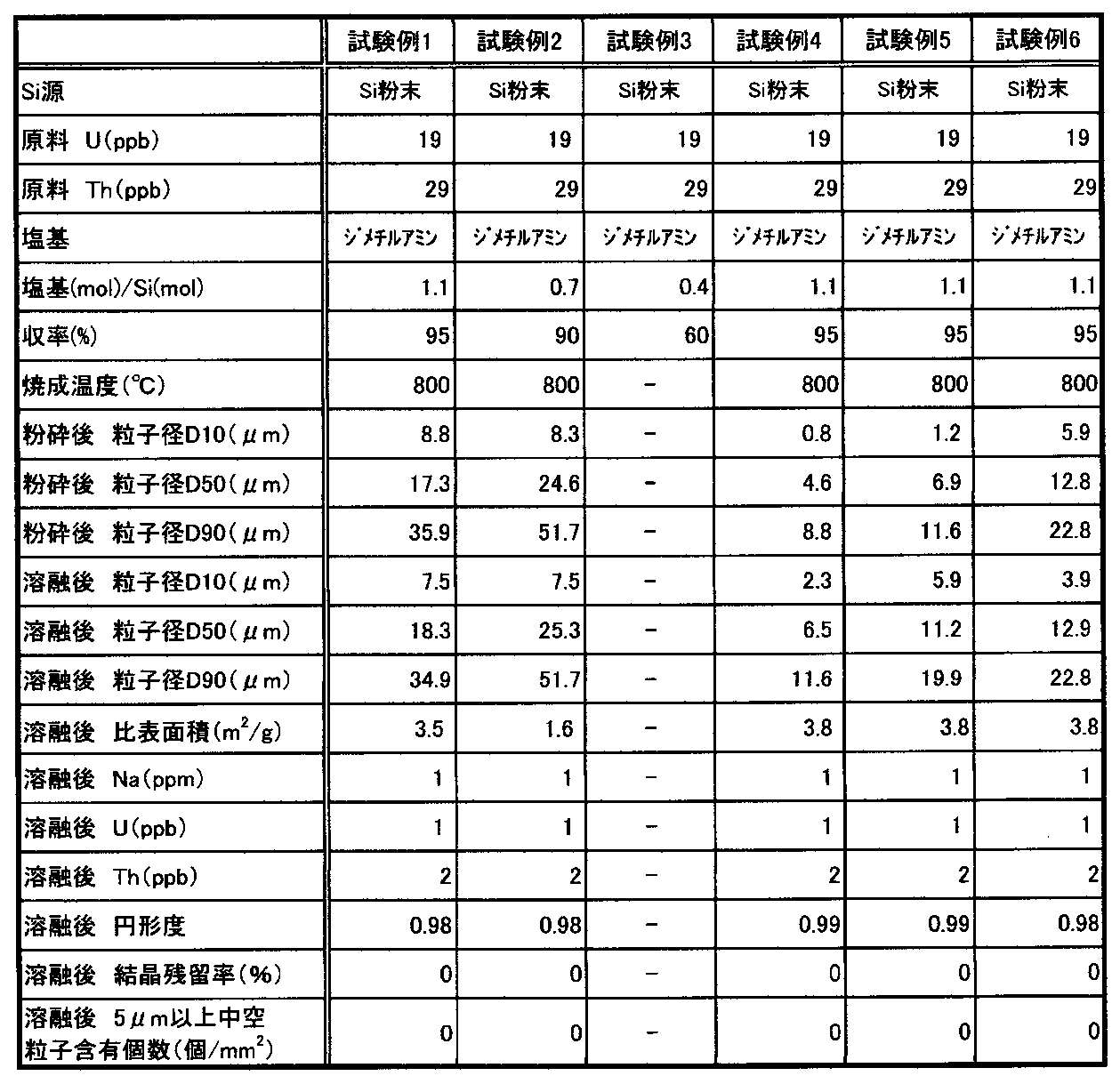
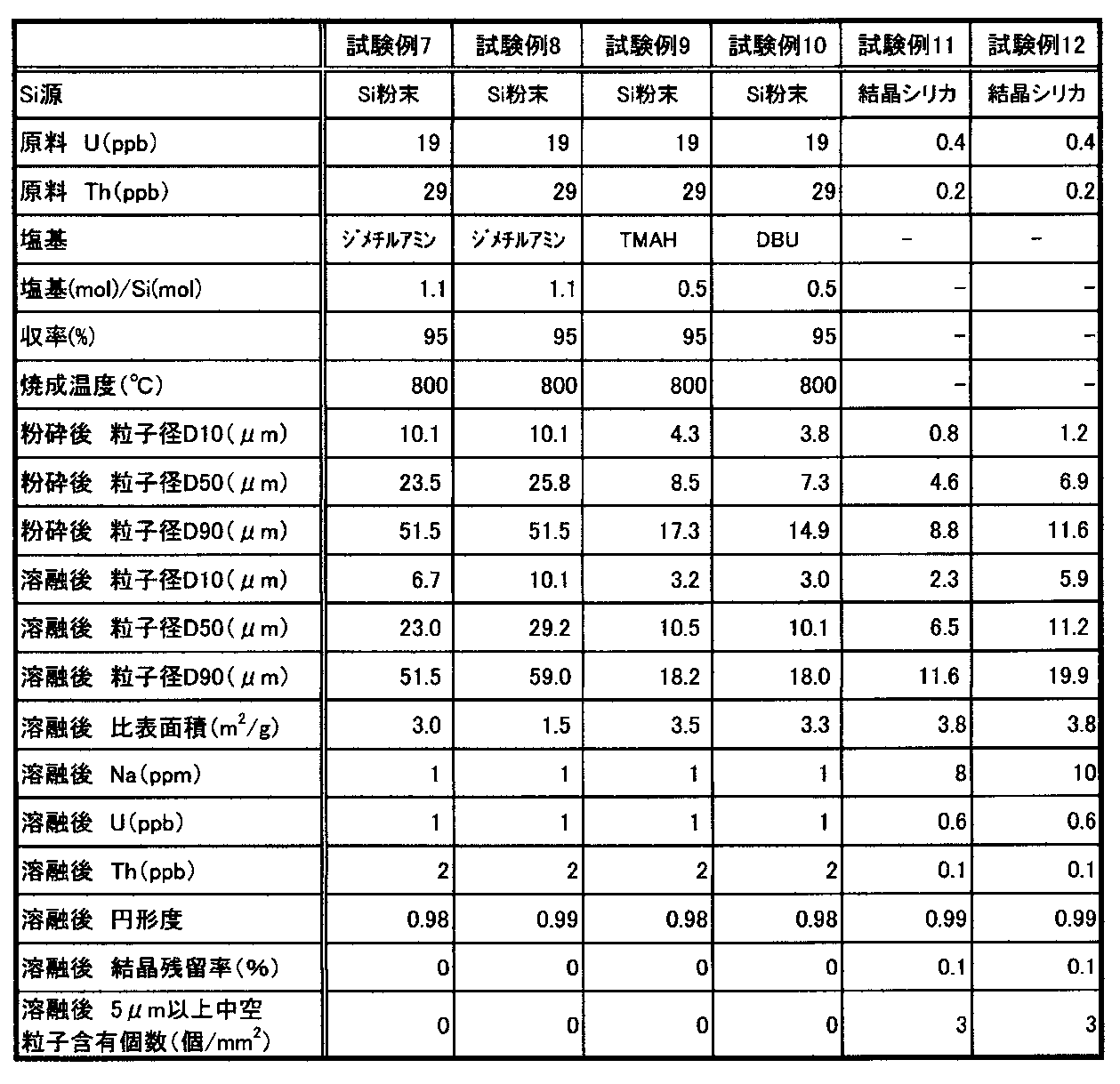
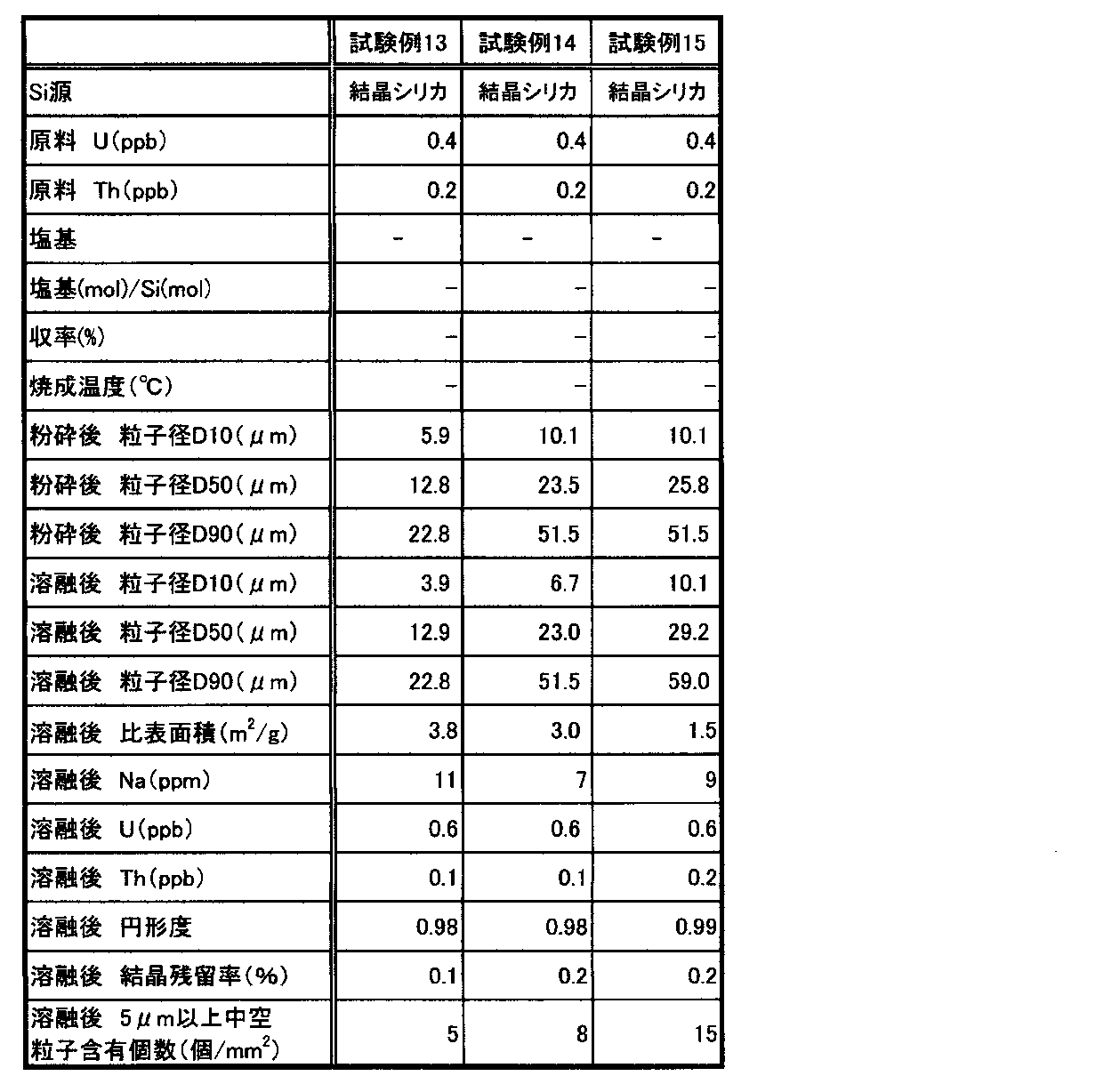
- test examples 1 to 15 were prepared and the physical properties of each test example were evaluated. The following describes the raw materials used, the production method, and the measurement and evaluation methods in that order. For details of each prototype example, see Tables 1 to 4 below.
- Metallic silicon and silicon oxide powder (silica powder, crystalline silica) were used as raw materials.
- the raw materials used in each test example are shown in the table.
- the metallic silicon powder used in Test Examples 1 to 10 had an average particle size of 20 ⁇ m.
- the crystalline silica used in Test Examples 11 to 15 had an average particle size of 30 ⁇ m.
- TMAH Tetramethylammonium hydroxide
- DBU Diazabicycloundecene
- the pH was adjusted by adding 90% acetic acid solution dropwise to the basic silicic acid solution while stirring, and stirring was continued.
- the precipitate was collected and dried at 120°C, then fired at 800°C for 2 hours. Note that firing was omitted for test example 3.
- the resulting fired product, an appropriate amount of silica powder and water, and alumina balls with a particle size of 5 mm were placed in a grinding pod made of high-purity alumina, and grinding continued until the target particle size was reached.
- the ground product was then collected using a 4 mm sieve and appropriately dried. The difference between each test example was the particle size during grinding, which was created by adjusting the grinding time.
- Test Examples 9 and 10 dimethylamine was replaced with TMAH, and the amounts and treatments of the reagents were the same as in Test Example 6.
- Test Example 10 dimethylamine was replaced with DBU, and the amounts and treatments of the reagents were the same as in Test Example 6.
- Test Examples 11 to 15 are control groups in which the process of dissolving in a basic solution and neutralizing is omitted, and the raw material is crushed and exposed to flame.
- the crushing method is the same as when the high-purity alumina pot described above is used, and the crushing time is adjusted to produce different samples.
- the exposure to flame is also the same.
- Test Example 16 described in Table 4 is a sample prepared from silicon metal powder by a method of producing spherical oxide fine particles by utilizing the deflagration phenomenon of metal powder, known as the VMC method (Vaporized Metal Combustion Method).
- BET specific surface area 1.0 g of spherical silica particles of each test example was weighed out and placed in a measurement cell. After pretreatment, the BET specific surface area was measured by nitrogen adsorption. For the measurement, an automatic specific surface area/pore distribution measuring device TriStar (registered trademark)-II3020 manufactured by Shimadzu Corporation was used. The pretreatment was carried out under the following conditions. Degassing temperature: 200°C Degassing time: 30 minutes Cooling time: 4 minutes
- IPC inductively coupled plasma atomic emission spectrometry
- ICP-MS for U and Th
- ICP-OES for silica and other impurities
- ICP-AES for alumina and other impurities
- Circularity Measurement A flow type particle image analyzer (FPIA-3000) manufactured by Sysmex Corporation was used. Sodium hexametaphosphate was dissolved in sheath liquid (particle sheath "PSE-900A") to prepare a solution, and the spherical silica particles of each test example were mixed into the solution, and after ultrasonic dispersion, the solution was subjected to measurement. The measurement was performed using the H mode of the same device.
- Crystalline silica content SmartLab (registered trademark) manufactured by Rigaku Corporation was used as an X-ray crystal structure analyzer (XRD).
- XRD X-ray crystal structure analyzer
- the peak intensity value at 2 ⁇ 26.6 ° was obtained for the spherical silica particle samples of each test example.
- the peak intensity value at 2 ⁇ 26.6 ° of 100% crystalline silica was obtained.
- the peak intensity value of each test example sample was then divided by the peak intensity value of crystalline silica to obtain a quotient, which was expressed as a percentage.
- the spherical silica particles of each test example were added to an epoxy resin, and a hardener was added and mixed to prepare a resin mixture. At this time, the spherical silica particles (i.e., the filler component) were equivalent to 75% by weight of the resin mixture.
- the resin mixture of each test example was heated to 170°C and hardened. After hardening, the resin was cut and the cut surface was polished.
- An ion milling device (IM4000Plus, manufactured by Hitachi High-Tech Corporation) was used to polish the cut surfaces. After polishing, osmium oxide gas was introduced to apply an osmium coat to the polished surfaces of each test example. Then, the polished surfaces of each test example were observed using an electron microscope (SEM). The observation range of the electron microscope was 9 mm2 , and the number of particles containing hollows (voids) in spherical silica particles with a diameter (major axis) of 5 ⁇ m or more within the same range was counted. Then, the number of particles containing hollows (voids) in spherical silica particles with a diameter (major axis) of 5 ⁇ m or more was counted.
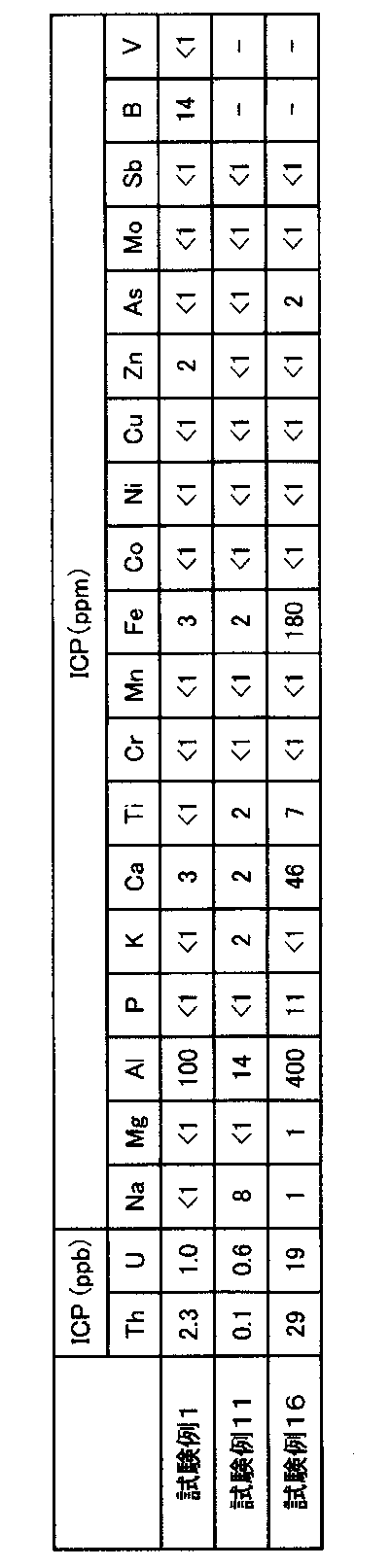
- Tables 1 to 3 The results of Test Examples 1 to 15 are shown in Tables 1 to 3. In each table, from the top, the type of raw material, the amount of uranium and thorium in the raw material (ppb), the type of base, the ratio of base to silicon (mol), the yield (%), the calcination temperature (°C), the particle size after grinding and after melting ( D10 , D50 , D90 in ⁇ m), the specific surface area ( m2 /g), the amount of sodium after melting (ppm), the amount of uranium and thorium after melting (ppb), the circularity, the crystal residual rate (%), and the number of hollows of 5 ⁇ m or more when magnified 2000 times by an electron microscope (pieces/9 mm2 ) are shown. Table 4 shows the composition analysis of the contained elements (expressed in ppb and ppm).
- Figure 1 shows Test Example 4 after crushing (5,000x) and after melting (10,000x).
- Figure 2 shows a cross section of Test Example 6, with electron microscope photographs (2,000x) of different observation areas.
- Figure 3 shows a cross section of Test Example 13, with electron microscope photographs (2,000x) of different observation areas.
- Test Examples 9 and 10 show that the types of amine compounds that can be used when preparing a basic solution can be expanded. Selection can be made taking into consideration the type of raw material to be dissolved, ease of dissolution (reactivity), raw material costs, etc.
- Test Examples 1 to 10 (excluding Test Example 3) and Test Examples 11 to 15 was 0.98, which is extremely close to a perfect sphere.
- Test Examples 1 to 10 could be made to have a high circularity from an amorphous state by dissolving them in a basic solution. The more spherical the filler, the better the fluidity of the coating material, which is preferable.
- the residual rate of silicon oxide crystals was below the measurement limit in Test Examples 1 to 10 (except Test Example 3), and can be considered to be practically non-existent.
- the rate of hollow spaces of 5 ⁇ m or more was below the measurement limit in Test Examples 1 to 10 (except Test Example 3), and can be considered to be practically non-existent.
- high-purity fused spherical silica for use as a filler in resin compositions for electronic devices, it contains few impurities, including uranium and thorium, making it possible to reduce the radiation source associated with radioactive decay. It is also extremely nearly spherical, making it easier to ensure the fluidity of the coating. Furthermore, there are no relatively large hollow spaces (voids) in the particles, so insulation and other performance properties are also guaranteed.
- high-purity fused spherical silica for use in cosmetics it contains few impurities, including uranium and thorium, and also contains little crystalline silica, making it highly valuable as an additive for cosmetics that are applied directly to the skin.
Landscapes
- Chemical & Material Sciences (AREA)
- Health & Medical Sciences (AREA)
- Organic Chemistry (AREA)
- Chemical Kinetics & Catalysis (AREA)
- Medicinal Chemistry (AREA)
- Polymers & Plastics (AREA)
- Inorganic Chemistry (AREA)
- Life Sciences & Earth Sciences (AREA)
- Birds (AREA)
- Epidemiology (AREA)
- Animal Behavior & Ethology (AREA)
- General Health & Medical Sciences (AREA)
- Public Health (AREA)
- Veterinary Medicine (AREA)
- Silicon Compounds (AREA)
- Cosmetics (AREA)
- Compositions Of Macromolecular Compounds (AREA)
Abstract
封止材に添加するフィラーとなるシリカ粒子に含有される不純物量を低減するとともに、封止材となる樹脂への混錬性を高め、さらに、シリカ粒子自体の導電性の制御の点から粒子内の中空部を抑制した高純度溶融球状シリカ、及びこれを含む電子機器用樹脂組成物と化粧品を提供する。球状シリカ粒子中のウラン元素の含有量が5ppb以下であり、かつ、球状シリカ粒子中のトリウム元素の含有量が5ppb以下であり、球状シリカ粒子の円形度は0.98以上であり、球状シリカ粒子中の酸化ケイ素の結晶残留率が0.01%以下であり、球状シリカ粒子の個々の粒子中に存在する直径5μm以上の中空部の個数は電子顕微鏡による9mm2の観察範囲中に2個以下である。
Description
本発明は高純度溶融球状シリカ、及びこれを含む電子機器用樹脂組成物、並びにこれを含む化粧品に関し、特に不純物の含有量を低減し、樹脂材料との混錬性を高めた高純度溶融球状シリカと、その樹脂組成物、化粧品に関する。
半導体等の精密電子部品を封止する封止材等には、樹脂組成物に無機性材料のフィラーが添加される。フィラーには絶縁性、熱膨張係数の低さの性質が求められる。一般に、シリカ(酸化ケイ素)等が多用されている。
シリカは天然の高純度の鉱石を所定の粒子径に粉砕してフィラーに加工される。つまり、たとえ高純度であるとしても、天然の鉱石に由来するため、酸化ケイ素以外の不純物の存在が不可避である。特に、天然物由来のシリカの場合、ウラン元素、トリウム元素が存在する。このような不純物の低減目的から、粉砕と火炎への曝露を組み合わせた球状シリカ粉体の製造方法が提案されている(特許文献1参照)。
特許文献1の製造方法によると、粉砕と火炎への曝露を通じてウラン元素の低減に寄与している。ここで、半導体の処理速度の向上を目指して、加工精度、集積化がさらに促進している。そのため、半導体が外部から受ける電磁気的なノイズの影響が今まで以上に問題視されている。天然物由来のシリカの場合、ウラン元素及びトリウム元素の放射性壊変によりアルファ線等が生じることが知られており、誤作動を引き起こす原因と考えられている。加えて、自然放射線の低減も可能であることから、人体に対する被曝の影響も少ないといえる。
また、フィラーとして使用されるシリカ粒子には樹脂への良好な混錬性が求められる。さらに、シリカ粒子自体の導電性を下げるため空隙(粒子内の中空部)の抑制も要求されている。
その後、発明者は鋭意検討を重ねた結果、原料に由来して発生するアルファ線等を低減するため、より効果的に天然の高純度の鉱石からのウラン元素及びトリウム元素の除去を可能にするに至った。
本発明は前記の点に鑑みなされたものであり、封止材に添加するフィラーとなるシリカ粒子に含有される不純物量を低減するとともに、封止材となる樹脂への混錬性を高め、さらに、シリカ粒子自体の導電性の制御の点から粒子内の中空部を抑制した高純度溶融球状シリカ及び電子機器用樹脂組成物を提供する。併せて、自然放射線の低減から被曝線量をより少なくする化粧品用途の材料も提供する。
すなわち、実施形態の高純度溶融球状シリカは、球状シリカ粒子中のウラン元素の含有量が5ppb以下であり、かつ、前記球状シリカ粒子中のトリウム元素の含有量が5ppb以下であり、球状シリカ粒子の円形度は0.98以上であり、球状シリカ粒子中の酸化ケイ素の結晶残留率が0.01%以下であり、球状シリカ粒子の個々の粒子中に存在する直径5μm以上の中空部の個数は、電子顕微鏡による9mm2の観察範囲中に2個以下であることを特徴とする。
さらに、高純度溶融球状シリカにおいて、球状シリカ粒子におけるナトリウム元素の含有量が10ppm以下であることとしてもよい。
さらに、高純度溶融球状シリカにおいて、球状シリカ粒子は金属ケイ素を原料とすることとしてもよい。
さらに、高純度溶融球状シリカにおいて、球状シリカ粒子は金属ケイ素の塩基性溶液への溶解を経ていることとしてもよい。
さらに、高純度溶融球状シリカにおいて、球状シリカ粒子は火炎に曝露されていることとしてもよい。
また、実施形態の電子機器用樹脂組成物は、高純度溶融球状シリカと、樹脂組成物とを有することを特徴とする。
加えて、実施形態の化粧品は、高純度溶融球状シリカを含有する化粧品であることを特徴とする。
さらに、化粧品はパウダー、軟膏、または乳液であることとしてもよい。
本発明の高純度溶融球状シリカによると、球状シリカ粒子中のウラン元素の含有量が5ppb以下であり、かつ、前記球状シリカ粒子中のトリウム元素の含有量が5ppb以下であり、球状シリカ粒子の円形度は0.98以上であり、球状シリカ粒子中の酸化ケイ素の結晶残留率が0.01%以下であり、球状シリカ粒子の個々の粒子中に存在する直径5μm以上の中空部の個数は、電子顕微鏡による9mm2の観察範囲中に2個以下であるため、封止材に添加するフィラーとなるシリカ粒子に含有される不純物量を低減するとともに、封止材となる樹脂への混錬性を高め、さらに、シリカ粒子自体の導電性の制御の点から粒子内の中空部を抑制することができる。
また、電子機器用樹脂組成物によると、樹脂組成物に含有される球状粒子から放射される粒子線、電磁波の線量の低減が可能となり、ノイズ等の外乱要因を抑制して機器の誤作動等の不具合の軽減が見込まれる。加えて、本発明の高純度溶融球状シリカを化粧品用の添加材としても、自然放射線の低減も可能であるため人体に対する被曝の影響、さらには結晶質シリカの影響をより少なくすることができる。
実施形態の高純度溶融球状シリカを得るに際し、次の処理方法が採用される。そこで、高純度溶融球状シリカは製造方法から説明される。
始めに、原料となる金属ケイ素の原料が用意され、原料は塩基性溶液に溶解される。後出の実施例においては、金属ケイ素が塩基性溶液に溶解され、金属ケイ素の原料が溶解した原料溶液が調製される(「溶解工程」)。
金属ケイ素の原料を塩基性溶液に溶解するに際し、塩基性溶液はアルカリ金属、アルカリ土類金属を含有しない溶液である。一般に、アルカリ金属の水酸化物である水酸化リチウム、水酸化ナトリウム、水酸化カリウム等の水溶液は強塩基性となる。しかしながら、塩基性溶液のアルカリ金属が残留すると最終的に出来上がるシリカ粒子の純度を押し下げることとなり好ましくない。
そこで、アルカリ金属、アルカリ土類金属を含有しない溶液としてアミン系化合物の水溶液が使用される。アミン系化合物としては、アンモニア、第一級アミン、第二級アミン、第三級アミン、水酸化第四級アンモニウム(アンモニウム塩)、アリールアミン、シラザン、ヒドラジン等が該当する。
さらに具体的に、アミン系化合物は、アンモニア、メチルアミン、エチルアミン、プロピルアミン、ジメチルアミン、ジエチルアミン、ピロリジン、トリメチルアミン、トリエチルアミン、水酸化テトラメチルアンモニウム、水酸化テトラエチルアンモニウム、水酸化テトラブチルアンモニウム、水酸化ベンジルトリメチルアンモニウム、水酸化メチルトリアミルアンモニウム、水酸化メチルトリアミルアンモニウム、水酸化メチルトリブチルアンモニウム、ピロリジン、ピペリジン、ピリジン、キノリン、イミダゾール、インドール、ピリミジン、ヘキサメチルジシラザン、ヒドラジン、ジアザビシクロウンデセン、ジアザビシクロノネン等の中から選択される1以上の化合物である。水溶液の調製に際し、アミン系化合物は単独種類としても、2種類以上の混合としてもよい。
有機化合物であるアミン系化合物を用いる場合、以降の工程の処理に伴い、化合物分子が揮発、分解する。このため、アミン系化合物は最終的に出来上がるシリカ粒子へほとんど残留せず望ましい。むろん、水溶液におけるアミン系化合物の濃度は、原料の種類により、最適な濃度、pHが設定され、溶液は撹拌される。さらに、溶解時の液温の調整も行われる。また、溶解時の溶け残りが生じるため、必要に応じて濾過も付加される。
塩基性溶液に溶解して調製される原料溶液の溶解成分は、固形化して固形化物に調製される(「固形化工程」)。固形化工程において、酸性溶液が添加されて固形化物が調製される。原料溶液は塩基性を呈し、ここに酸性溶液を添加することにより酸と塩基の中和が促進し析出物が生じる。この析出物が目的の固形化物となる。生じた固形化物は水洗、乾燥される。酸性溶液には、塩酸、硝酸、硫酸、リン酸、酢酸、ギ酸、その他、クエン酸等の有機酸が用いられる。これらの中で、後の工程において揮発、分解されやすい性質から酸性溶液として酢酸が好ましい。
乾燥の後、固形化物は焼成されて焼成物の形態となり、結合水等の余分な水分は除去される(「焼成工程」)。焼成時の温度は300ないし1200℃であり、焼成時間は1ないし3時間である。具体的には、析出により生じたケイ素の水酸化物は焼成を経てケイ素の酸化物(シリカ)に酸化される。
焼成工程により生じた焼成物は粉砕されて粉砕物として調製される(「粉砕工程」)。粉砕に際しては、湿式粉砕、乾式粉砕といずれとしてもよい。また、粉砕装置としては、ボールミル、振動ミル、ジェットミル、アトマイザ等の公知の固形物の粉砕用の器機が用いられる。実施形態では、粉砕用のポッドに固形化物とアルミナ球を入れてポッドを回転させて湿式により粉砕した。なお、ポッドの回転時間(粉砕時間)は目標とする粒子径に応じて加減される。湿式粉砕の後、ポッドから回収された粉砕物はスプレードライ等により乾燥される。
粉砕工程の目的は、次出の溶融球状化工程に供する前段階として粒子径を制御するためである。焼成工程まで経た段階では、焼成物は不定形であり、粒子同士の融着により大きさは揃っていない。そのまま、溶融球状化工程に進めると、粒子径範囲にばらつきのある粒子が生じる。また、形状の不均一さから球形状を得ることが難しくなる。そのため、工程途中の歩留まりが高くなる(収率の低下)。
ここで、粉砕物の平均粒子径はレーザ回折散乱法、動的散乱法等の公知の粒子径測定の方法により測定されるメディアン径(D50)を意味する。そこで、粉砕物の平均粒子径(D50)は30μm以下、さらには20μm以下とすることが好ましい。粒子径を細かくすることにより、溶融球状化工程の溶融が容易となる。
粉砕工程により調製された粉砕物は火炎中に投入され、粉砕物は火炎中を飛翔して通過する。粉砕物、すなわち球状シリカ粒子は火炎の曝露により溶融するとともに、溶融時の表面張力により球状化が促進して球状粒子が得られる(「溶融球状化工程」)。こうして出来上がる球状粒子が目的に酸化物粒子である。球状粒子も好適な粒子径が規定される。具体的には、球状粒子の平均粒子径(D50)は30μm以下、より好ましくは、20μm以下である。球状粒子の平均粒子径(D50)もレーザ回折散乱法、動的散乱法等の公知の粒子径測定の方法により測定されるメディアン径(D50)を意味する。
溶融球状化工程の火炎は、可燃性ガスに対して酸素を含む助燃ガスを混合して燃焼させて形成される。炉内温度の指標として炉の耐火構造体の温度は最も高くなる位置(炉体温度)で、900℃ないし1500℃の範囲である。炉体温度は、下限値として900℃ないし1100℃が好ましく、上限値として1300℃ないし1500℃が好ましい。助燃ガスには、空気、酸素が用いられる。可燃性ガスと助燃ガスは、炉内に供給するときに、別々の供給としても、予め混合した状態での供給としても良い。
可燃性ガスの流速は、10m/s以上であることが好ましく、15m/s以上であることがより好ましく、20m/s以上であることがさらに好ましい。助燃ガスの流速は、10m/s以上であることが好ましく、15m/s以上であることがより好ましく、20m/s以上であることがさらに好ましい。流速比で可燃性ガス/助燃ガスは、2.0以下になることが好ましく、1.5以下になることがより好ましく、1.0以下になることがさらに好ましい。可燃性ガスと助燃ガスとの供給量は、供給する原料粒子材料を十分に加熱できる大きさの火炎が形成できるような可燃性ガスの量と、その可燃性ガスを十分に燃焼可能な助燃ガスの量により規定される。例えば、処理する粉砕物の単位重量に対し可燃性ガスは0.5Nm3/kgないし5Nm3/kg、助燃ガスとしての酸素は1Nm3/kg~5Nm3/kg程度とされる。
原料粒子材料を火炎中に供給する方法は特に限定されず、キャリアガス中に分散させた状態で火炎中に供給される。キャリアガスとしては空気、酸素、窒素などが挙げられる。
粉砕工程後及び溶融球状化工程後、所望の粒子径を選別するため、適宜の篩別が加えられる。篩別には篩の他に、サイクロン等による遠心分離の手法が採用される。
一連の説明のとおり、金属ケイ素の原料から、溶解工程、固形化工程、焼成工程、粉砕工程、溶融球状化工程を経て製造される球状シリカ粒子は、原料の段階と比較してウラン元素及びトリウム元素の総量が大きく減少している。
実施形態の高純度溶融球状シリカの実体である球状シリカ粒子について、当該球状シリカ粒子中のウラン元素(U)の含有量は5ppb以下であり、かつ当該球状シリカ粒子中のトリウム元素(Th)の含有量は5ppb以下である。この含有量は、原料に含有されるウラン元素及びトリウム元素の総量の1/10以下、さらには、5/100以下に減少している。このため、球状シリカ粒子中の核種から放射されるアルファ線、ベータ線等の粒子線、ガンマ線等の電磁波の線量をより低減可能となり、電子部品等への影響を軽減することができる。
金属ケイ素の原料が塩基性溶液に溶解されることにより、もとの原料は金属から水酸化物に変化する。この時点で、原料に含有される不純物成分は、金属ケイ素の塩基性溶液への溶解量よりも少ないと考えられる。U(ウラン)、Th(トリウム)等の重元素は両性元素ではないため、塩基性溶液には溶解しにくく、不溶成分として残留する。このような塩基性溶液への溶解のしやすさによりウラン元素及びトリウム元素等の不純物成分の分離が可能となる。従って、従前のフィラー用の酸化物の調製よりも、一層の不純物成分の減少が可能となる。
加えて、球状シリカ粒子中のナトリウム元素(Na)の含有量は10ppm以下である。ナトリウム元素の含有量を取り上げた理由は不純物成分の代表としての意味合いであり、ナトリウム元素の含有量が少なければ、他の不純物成分の量も少ないと判断することが可能である。金属ケイ素の原料の塩基性溶液による溶解に際し、アミン系化合物が用いられることから、水酸化ナトリウム等のアルカリ金属の残留はほぼ生じない。また、金属ケイ素の原料は塩基性溶液による溶解を経ていることから、前述のとおり、不純物成分の溶解が抑制されて純度が高められる。
さらに、球状シリカ粒子について、個々の粒子の円形度は0.98以上であり、極めて球に近似した形状である。なお、完全な球(真球)の円形度は1.0である。円形度の評価に際しては、短軸と長軸との長さの比率(アスペクト比)、円相当径と最大径との比率等により算出される。後述の実施形態においては、フロー式粒子像分析装置を使用して計測した。球状シリカ粒子の円形度が真球に近づくほど、樹脂に混錬して封止材等に調製した後、回路基板等への塗剤の充填が容易となる。
また、球状シリカ粒子中の酸化ケイ素(二酸化ケイ素:SiO2)の結晶残留率は0.01%以下、好ましくは検出限界以下である。球状シリカ粒子は主に非結晶質の酸化ケイ素により形成される。その中に、微量ながら結晶質の酸化ケイ素が存在することがある。つまり、結晶残留率とは、球状シリカ粒子の全体重量に占める結晶質の酸化ケイ素の重量割合を指し示す。結晶質の酸化ケイ素が存在すると、フィラーとしての導電性に影響を与える。また、近年、結晶質の酸化ケイ素(シリカ)による発がん性を示唆する知見も報告されていることから、影響軽減を鑑みて極力結晶質の酸化ケイ素の抑制が望まれている。
結晶質の酸化ケイ素(結晶性シリカ)の存在は、X線結晶構造解析(XRD)の2θ=26.6°のピークの強度により確認した。当該ピークの強度値を石英(二酸化ケイ素の結晶)の強度値により除して商を求めた。この商の数値が結晶残留率である。
加えて、球状シリカ粒子の個々の粒子中に存在する直径5μm以上の中空部の個数は、電子顕微鏡による9mm2の観察範囲中に2個以下、好ましくは1個以下、さらに好ましくは0個である。球状シリカ粒子中に極端に大きな中空部(空隙、気泡)が存在すると、中空部付近の球状シリカ粒子の導電性等が変化する。つまり、中空部により絶縁性が低下して封止材に用いるフィラーとしての性能が低下するおそれがある。そのため、球状シリカ粒子中の中空部を極力減らして粒子自体を緻密化することが望ましい。
球状シリカ粒子内の中空部に個数、大きさ(直径)は電子顕微鏡により拡大して観察した。なお、直径5μm以上の中空部の個数の観察では、電子顕微鏡の拡大倍率は2000倍としている。
これまで説明してきた実施形態の高純度溶融球状シリカ(球状シリカ粒子)は、主に、電子材料用フィラーとして使用される。高純度溶融球状シリカ(球状シリカ粒子)は、樹脂に添加されることによって電子機器用樹脂組成物(電子材料用フィラー含有樹脂組成物)に調製される。添加対象の樹脂は、ポリエチレン、ポリプロピレン、ポリ塩化ビニル、ポリエチレンテレフタレート、ポリスチレン、その他のオレフィン樹脂、ポリイミド樹脂、液晶ポリマー等の熱可塑性樹脂、フッ素樹脂、尿素樹脂、フェノール樹脂等、ポリフェニレンエーテル、ビスマレイミド等の熱硬化性樹脂が挙げられる。さらには、スチレンブタジエンゴム、イソプレンゴム等の弾性樹脂、シリコーン樹脂等への添加も可能である。例えば、電子部品のパッケージ用基板、層間絶縁フィルム等の樹脂基板を製造する場合には、樹脂としてエポキシ樹脂が用いられる。
樹脂組成物に用いるエポキシ樹脂として、例えば、ビスフェノールA型エポキシ樹脂、ビスフェノールF型エポキシ樹脂、ビフェニル型エポキシ樹脂、フェノールノボラック型エポキシ樹脂、ナフタレン型エポキシ樹脂、フェノキシ型エポキシ樹脂等が挙げられる。樹脂組成物に配合される高純度溶融球状シリカ(球状シリカ粒子)の重量は、耐熱性、熱膨張率の観点から、多いことが好ましい。樹脂組成物の全体質量に対して、高純度溶融球状シリカ(球状シリカ粒子)は80質量%以上添加されることが望ましい。
さらに、実施形態の高純度溶融球状シリカ(球状シリカ粒子)、つまり電子材料用フィラーについては、当該電子材料用フィラーを分散し、水分を実質的に含有しない液体状の分散媒を有する電子材料用スラリーとして調製することができる。この分散媒としては、例えば、メチルアルコール、エチルアルコール、イソプロピルアルコール、アセトン、メチルエチルケトン、メチルイソブチルケトン、シクロヘキサノン、酢酸メチル、酢酸エチル、トルエン、N-メチルピロリドン、γ-ブチロラクトン、プロピレングリコールモノメチルエーテル、プロピレングリコールモノメチルエーテルアセテート等の溶媒が用いられる。分散媒についても、単体もしくは複数混合して使用することができる。また、適宜の分散剤を使用することも可能である。
電子機器用樹脂組成物(電子材料用フィラー含有樹脂組成物)の特徴となる性質は、高純度溶融球状シリカ(球状シリカ粒子)の説明のとおり、樹脂組成物に含有されるシリカ粒子から放射される粒子線、電磁波の線量の低減が可能となる。そのため、樹脂組成物の加工部位から電子部品等へ与える粒子線、電磁波の影響を軽減することができる。結果、ノイズ等の外乱要因を抑制して機器の誤作動等の不具合の軽減が見込まれる。また、高純度溶融球状シリカ(球状シリカ粒子)自体の性状により、樹脂との混錬性、さらに、導電性の抑制の効果も充足可能となっている。
加えて、実施形態の高純度溶融球状シリカ(球状シリカ粒子)は化粧品へ添加する添加剤の用途としても好適である。前述の説明のとおり、U(ウラン)、Th(トリウム)等の重元素の含有が極めて少ないことから高純度溶融球状シリカ(球状シリカ粒子)に起因する自然放射線の線量は抑制され、人体への被曝の影響は抑制される。特に化粧品のように皮膚に直接塗布されるため、影響軽減の効果は大きい。また、近年、結晶質の酸化ケイ素(シリカ)の性質が問題視され始めているため、実施形態の高純度溶融球状シリカ(球状シリカ粒子)は結晶質の低減からも影響軽減の効果は高く、マイクロプラスチック等の既存の化粧品添加物の代替材料として有望である。
実施形態の高純度溶融球状シリカ(球状シリカ粒子)を化粧品に添加、配合するに際し、化粧品は、パウダー、軟膏、乳液、クリーム等の皮膚への塗布を可能とする形態である限り特段限定されない。化粧品が軟膏の場合、高純度溶融球状シリカはワセリン等の油脂成分の基材に添加、混練される。化粧品が乳液、クリームの場合、高純度溶融球状シリカは、水、アルコール、グリセリン、各種油脂等の基材に添加され、均質化される。化粧品がパウダーの場合、例えばファンデーションへの添加が想定され、油脂分、ワックス、保湿剤、水等に添加、混練される。むろん、化粧品として調製する場合、界面活性剤、パラペン等の防腐剤、香料等が必要により配合される。
高純度溶融球状シリカ(球状シリカ粒子)の実証のため、試験例1ないし15を用意し、各試験例の物性を評価した。以降、使用原料、作製方法、測定及び評価方法の順に説明する。各試作例の詳細は後出の表1ないし表4が参照される。
[使用原材料]
原料として金属ケイ素及び酸化ケイ素の粉末(シリカ粉末、結晶性シリカ)を使用した。各試験例の使用原料は表中に記した。
試験例1ないし10の金属ケイ素粉末は、平均粒子径:20μmを使用した。
試験例11ないし15の結晶性シリカは、平均粒子径:30μmを使用した。
塩基性溶液の調製に際し、以下のアミン系化合物を使用した。
ジメチルアミン:富士フィルム和光純薬株式会社製
水酸化テトラメチルアンモニウム(以降、TMAHと称する。):富士フィルム和光純薬株式会社製
ジアザビシクロウンデセン(以降、DBUと称する。):富士フィルム和光純薬株式会社製
[球状シリカ粒子の作製]
・試験例1ないし8
金属ケイ素の粉末(後出の表におけるSi粉末)9.0g、イオン交換水315g、50重量%のジメチルアミン水溶液32gを混合し、40℃に加熱しながら48時間撹拌し続けた。結果、酸化物換算として6.0重量%の塩基性ケイ酸水溶液を得た。
塩基性ケイ酸水溶液に90%の酢酸水溶液を撹拌しながら滴下してpHを調整し、さらに撹拌を続けた。析出物を回収後に120℃で乾燥し、2時間、800℃で焼成した。なお、試験例3については焼成を省略した。生じた焼成物、適量のシリカ粉末と水、及び粒子径5mmのアルミナボールを、高純度アルミナ製の粉砕ポッドに投入して目標の粒子径に到達するまで粉砕を続けた。その後、4mmの篩により粉砕物を回収し、適度に乾燥した。各試験例の相違は粉砕時の粒子径の相違であり、粉砕時間を加減して作り分けた。
耐火材張りした炉内(高さ5m×内径0.5mの円筒型)で5Nm3/時間で供給するLPGガスと、25Nm3/時間で供給する酸素ガスとの燃焼により生成した火炎中に各試験例の粉砕物のそれぞれを10kg/時間の速度で気流分散投入し、加熱溶融させた後に回収した。こうして、各試験例の球状シリカ粒子を調製した。
・試験例9、10
試験例9はジメチルアミンをTMAHに置き換え、試薬の量及び処理は試験例6と同様とした。
試験例10はジメチルアミンをDBUに置き換え、試薬の量及び処理は試験例6と同様とした。
・試験例11ないし15
試験例11ないし15は、前出の試験例1ないし10と異なり、塩基性溶液への溶解、中和の工程を省略し、原料を粉砕して火炎に曝露した対照群である。粉砕の仕方は前述の高純度アルミナ製ポットを用いた際と同様とし、粉砕時間を加減して作り分けた。また、火炎への曝露も同様とした。なお、表4に記載の試験例16は、ケイ素の金属粉末をVMC法(Vaporized Metal Combustion Method)と称される金属粉末の爆燃現象を利用して真球状酸化物微粒子を製造する方法により調製した試料である。
[測定及び評価方法]
・粒度分布
各試験例の球状シリカ粒子について、粉砕後及び溶融後の粒子径を株式会社島津製作所製,レーザ回折式粒度分布測定装置SALD-7500nanoを使用し、水溶媒中において測定した。併せて、D10、D50(メディアン径)、D90の粒度分布を算出した。
・BET比表面積測定
各試験例の球状シリカ粒子を1.0g秤量し、測定用のセルに投入、前処理後、窒素吸着法によるBET比表面積値を測定した。測定には、株式会社島津製作所製,自動比表面積・細孔分布測定装置TriStar(登録商標)-II3020を使用した。前処理は次の条件とした。
脱気温度 :200℃
脱気時間 :30分
冷却時間 :4分
・成分分析
各試験例の球状シリカ粒子に含有される原子組成の分析に際し、株式会社島津製作所製,IPC(高周波誘導結合プラズマ発光分光分析)装置ICP-MS(U、Thについて)、ICP-OES(シリカ、その他の不純物について)、ICP-AES(アルミナ、その他の不純物について)、を使用した。
測定に際し、各試験例の球状シリカ粒子を硝酸とフッ酸の混合液により完全溶解して溶液化し、装置に供した。
・円形度測定
シスメックス株式会社製,フロー式粒子像分析装置(FPIA-3000)を使用した。
シース液(パーティクルシース「PSE-900A」)にヘキサメタリン酸ナトリウムを溶解して溶液とし、同溶液に各試験例の球状シリカ粒子を混ぜて超音波分散後に測定に供した。なお、測定は同装置のHモードによる解析とした。
・結晶性シリカの含有率
X線結晶構造解析装置(XRD)として株式会社リガク製、SmartLab(登録商標)を使用した。各試験例の球状シリカ粒子の試料について、2θ=26.6°のピーク強度の数値を求めた。並行して100%の結晶質シリカの2θ=26.6°のピーク強度の数値を求めた。そして、各試験例の試料のピーク強度の数値を結晶質シリカのピーク強度の数値により除して商を求めパーセントの表示とした。
・5μm以上の中空部の割合
エポキシ系樹脂に各試験例の球状シリカ粒子を投入し、硬化剤を添加して混合し樹脂混合物に調製した。このとき、球状シリカ粒子(つまりフィラーの成分)は樹脂混合物の75重量%相当とした。各試験例の樹脂混合物を170℃に加熱して硬化した。硬化後に切断して切断面を研磨した。
切断面の研磨に際し、イオンミリング装置(株式会社日立ハイテク製,IM4000Plus)を使用した。研磨後、酸化オスミウムガスを導入して各試験例の研磨面に対しオスミウムコートを施した。その後、電子顕微鏡(SEM)により各試験例の研磨面を観察した。電子顕微鏡の観察範囲は9mm2とし、同範囲内において直径(長径)5μm以上の球状シリカ粒子内の中空部(空隙)を含む粒子数を計測した。そして、直径(長径)5μm以上の球状シリカ粒子内の中空部(空隙)を含む粒子数を計測した。
[結果]
試験例1ないし15は表1ないし3の結果であった。各表中、上段から原料種類、原料のウラン・トリウムの量(ppb)、塩基の種類、塩基とケイ素の比率(mol)、収率(%)、焼成温度(℃)、粉砕後及び溶融後の粒子径(D10、D50、D90のμm)、比表面積(m2/g)、溶融後のナトリウムの量(ppm)、溶融後のウラン・トリウムの量(ppb)、円形度、結晶残留率(%)、電子顕微鏡により2000倍に拡大したときの5μm以上の中空部の個数(個/9mm2)が示される。また、表4は含有元素の組成分析(ppbとppm表記)である。
併せて、電子顕微鏡(SEM)による観察写真を提示する。図1は試験例4の粉砕後(5000倍)と溶融後(10000倍)である。図2は試験例6の切断面であり、異なる観察範囲の電子顕微鏡写真(2000倍)である。図3は試験例13の切断面であり、異なる観察範囲の電子顕微鏡写真(2000倍)である。
[考察]
図1の写真から理解されるように、粉砕後には不定形の粉砕物であっても、火炎の曝露により球状に粒子化することが確認された。図2は全体に黒くわかりにくいものの、切断面を露出する球状シリカ粒子内にはほとんど中空部(空隙)は存在していない。図3では個々の粒子内に粒子径と比して大きな中空部が存在していた。実際に計測したところ、5ないし10μmの直径であった。図2の試験例6と図3の試験例13において、試験例6は塩基性溶液に原料を溶解している。これに対し試験例13は塩基性溶液への溶解を省略している。このことから、原料の塩基性溶液に溶解することは中空部を減少させる利点が大きい。
試験例1ないし10(試験例3を除く)のウラン元素とトリウム元素の量(ppb)に着目し、原料段階と溶融後を比較すると、いずれも溶融後は1/10以下、6/100以下と大きく減少した。具体的には、ウラン元素については1ppbであり、トリウム元素は2ppbであった。ナトリウム元素の量(ppm)も溶融後には1ppmと低水準であった。併せて、表4の全成分の比較から、ウラン元素とトリウム元素に限らずその他の不純物成分の減少を確認した。このことから、塩基性溶液への溶解と火炎への曝露を組み合わせる方法は、不純物成分の減少に有効である。また、球状シリカ粒子を製造するための原料として調達が安価ではあるものの純度の低い原料であるとしても、不純物成分の低減が可能であるため、総じて製造原価の抑制が可能となる。
試験例9、10より、塩基性溶液の調製時に用いるアミン系化合物の種類は拡張可能である。溶解対象の原料の種類、溶解しやすさ(反応性)、原料経費等を考慮して選択が可能である。
試験例1ないし10(試験例3を除く)と試験例11ないし15の円形度はいずれも0.98と極めて真球に近似した形態である。特に試験例1ないし10では、塩基性溶液への溶解を経て不定形の状態から高い円形度にすることができることを確認した。フィラーとして球状であるほど塗剤の流動性が良くなるため好ましい。
酸化ケイ素の結晶残留率について、試験例1ないし10(試験例3を除く)では、測定限界以下となり、実質上存在していない程度と考えることができる。また、5μm以上の中空部の割合について、試験例1ないし10(試験例3を除く)では、計測の限界以下であり、事実上、中空部は見当たらないと考えることができる。これらについて、塩基性溶液への溶解を経る調製方法の優位性が裏付けられた。
従って、電子機器用樹脂組成物に使用するフィラー用の高純度溶融球状シリカとして、ウラン元素とトリウム元素をはじめとする不純物成分が少ないことから、放射性壊変に伴う放射線源の減少が可能である。また、極めて真球に近く塗剤の流動性が確保されやすくなる。さらに粒子中の比較的大きな中空部(空隙)も存在しないため、絶縁性等の性能も担保される。加えて、化粧品用の高純度溶融球状シリカとしても、ウラン元素とトリウム元素をはじめとする不純物成分が少なく、さらに結晶質のシリカも少ないことから、直接皮膚に塗布される化粧品用の添加材としての価値は高い。
Claims (8)
- 球状シリカ粒子中のウラン元素の含有量が5ppb以下であり、かつ、前記球状シリカ粒子中のトリウム元素の含有量が5ppb以下であり、
前記球状シリカ粒子の円形度は0.98以上であり、
前記球状シリカ粒子中の酸化ケイ素の結晶残留率が0.01%以下であり、
前記球状シリカ粒子の個々の粒子中に存在する直径5μm以上の中空部の個数は、電子顕微鏡による9mm2の観察範囲中に2個以下である
ことを特徴とする高純度溶融球状シリカ。 - 前記球状シリカ粒子におけるナトリウム元素の含有量が10ppm以下である請求項1に記載の高純度溶融球状シリカ。
- 前記球状シリカ粒子は、金属ケイ素を原料とする請求項1に記載の高純度溶融球状シリカ。
- 前記球状シリカ粒子は、金属ケイ素の塩基性溶液への溶解を経ている請求項3に記載の高純度溶融球状シリカ。
- 前記球状シリカ粒子は火炎に曝露されている請求項1に記載の高純度溶融球状シリカ。
- 請求項1に記載の高純度溶融球状シリカと、樹脂組成物とを有する
ことを特徴とする電子機器用樹脂組成物。 - 請求項1に記載の高純度溶融球状シリカを含有する化粧品である、ことを特徴とする化粧品。
- 前記化粧品は、パウダー、軟膏、または乳液である請求項7に記載の化粧品。
Applications Claiming Priority (2)
| Application Number | Priority Date | Filing Date | Title |
|---|---|---|---|
| JP2023-097977 | 2023-06-14 | ||
| JP2023097977A JP2024179264A (ja) | 2023-06-14 | 2023-06-14 | 高純度溶融球状シリカ、及びこれを含む電子機器用樹脂組成物、並びにこれを含む化粧品 |
Publications (1)
| Publication Number | Publication Date |
|---|---|
| WO2024257788A1 true WO2024257788A1 (ja) | 2024-12-19 |
Family
ID=93852146
Family Applications (1)
| Application Number | Title | Priority Date | Filing Date |
|---|---|---|---|
| PCT/JP2024/021304 Ceased WO2024257788A1 (ja) | 2023-06-14 | 2024-06-12 | 高純度溶融球状シリカ、及びこれを含む電子機器用樹脂組成物、並びにこれを含む化粧品 |
Country Status (3)
| Country | Link |
|---|---|
| JP (1) | JP2024179264A (ja) |
| TW (1) | TW202500508A (ja) |
| WO (1) | WO2024257788A1 (ja) |
Citations (8)
| Publication number | Priority date | Publication date | Assignee | Title |
|---|---|---|---|---|
| JPH01230422A (ja) * | 1988-03-10 | 1989-09-13 | Nippon Chem Ind Co Ltd | 高純度シリカ及びその製造方法 |
| JPH03223107A (ja) * | 1990-01-30 | 1991-10-02 | Nitto Chem Ind Co Ltd | 球状シリカの製造方法 |
| JPH1160234A (ja) * | 1997-08-08 | 1999-03-02 | Denki Kagaku Kogyo Kk | 低ウラン球状シリカ粉末の製造方法、及びシリカ粉末 |
| JP2010052974A (ja) * | 2008-08-27 | 2010-03-11 | Jgc Catalysts & Chemicals Ltd | 球状シリカ系粒子、その製造方法および該シリカ系粒子を含有してなる化粧料 |
| JP2012206870A (ja) * | 2011-03-29 | 2012-10-25 | Admatechs Co Ltd | 球状シリカ粉体の製造方法及び半導体封止材の製造方法 |
| JP2015117138A (ja) * | 2013-12-16 | 2015-06-25 | 株式会社アドマテックス | シリカ粒子の製造方法 |
| JP2022523589A (ja) * | 2019-03-12 | 2022-04-25 | 浙江三時紀新材科技有限公司 | 球状のシリカ粉末フィラーの製造方法ならびにこれによって得られた球状のシリカ粉末フィラーおよびその応用 |
| JP2023520185A (ja) * | 2020-03-27 | 2023-05-16 | ソッキョン エイ ティー シーオー エルティディー | 大口径SiO2粉末の製造方法及びそれを含む化粧料組成物 |
-
2023
- 2023-06-14 JP JP2023097977A patent/JP2024179264A/ja active Pending
-
2024
- 2024-06-12 WO PCT/JP2024/021304 patent/WO2024257788A1/ja not_active Ceased
- 2024-06-14 TW TW113122121A patent/TW202500508A/zh unknown
Patent Citations (8)
| Publication number | Priority date | Publication date | Assignee | Title |
|---|---|---|---|---|
| JPH01230422A (ja) * | 1988-03-10 | 1989-09-13 | Nippon Chem Ind Co Ltd | 高純度シリカ及びその製造方法 |
| JPH03223107A (ja) * | 1990-01-30 | 1991-10-02 | Nitto Chem Ind Co Ltd | 球状シリカの製造方法 |
| JPH1160234A (ja) * | 1997-08-08 | 1999-03-02 | Denki Kagaku Kogyo Kk | 低ウラン球状シリカ粉末の製造方法、及びシリカ粉末 |
| JP2010052974A (ja) * | 2008-08-27 | 2010-03-11 | Jgc Catalysts & Chemicals Ltd | 球状シリカ系粒子、その製造方法および該シリカ系粒子を含有してなる化粧料 |
| JP2012206870A (ja) * | 2011-03-29 | 2012-10-25 | Admatechs Co Ltd | 球状シリカ粉体の製造方法及び半導体封止材の製造方法 |
| JP2015117138A (ja) * | 2013-12-16 | 2015-06-25 | 株式会社アドマテックス | シリカ粒子の製造方法 |
| JP2022523589A (ja) * | 2019-03-12 | 2022-04-25 | 浙江三時紀新材科技有限公司 | 球状のシリカ粉末フィラーの製造方法ならびにこれによって得られた球状のシリカ粉末フィラーおよびその応用 |
| JP2023520185A (ja) * | 2020-03-27 | 2023-05-16 | ソッキョン エイ ティー シーオー エルティディー | 大口径SiO2粉末の製造方法及びそれを含む化粧料組成物 |
Also Published As
| Publication number | Publication date |
|---|---|
| TW202500508A (zh) | 2025-01-01 |
| JP2024179264A (ja) | 2024-12-26 |
Similar Documents
| Publication | Publication Date | Title |
|---|---|---|
| CN113677458A (zh) | 混合银粉和包含其的导电糊 | |
| US20210309833A1 (en) | Spherical magnesium oxide, manufacturing method thereof, thermal conductive filler and resin composition | |
| JP2003238141A (ja) | 表面改質球状シリカ及びその製造方法、並びに半導体封止用樹脂組成物 | |
| US20250339897A1 (en) | Method of producing silver powder | |
| US20250100890A1 (en) | Method for producing spherical silica powder | |
| TW202419399A (zh) | 球狀矽石粒子、漿料組成物、樹脂組成物及球狀矽石粒子的製造方法 | |
| JP2024179265A (ja) | 高純度アルミナ粒子及びその製造方法、並びに電子機器用樹脂組成物及びその製造方法 | |
| JP5944714B2 (ja) | 水酸化マグネシウム粒子、及びそれを含む樹脂組成物 | |
| KR101394808B1 (ko) | 비정질 실리카질 분말, 그 제조 방법 및 반도체 봉지재 | |
| WO2024257754A1 (ja) | 酸化物粒子の製造方法及び電子機器用樹脂組成物の製造方法 | |
| JP2024179264A (ja) | 高純度溶融球状シリカ、及びこれを含む電子機器用樹脂組成物、並びにこれを含む化粧品 | |
| TW202419400A (zh) | 球狀矽石粒子的製造方法 | |
| TW202408939A (zh) | 氧化鎂粉末及使用其之樹脂組成物 | |
| CN118510725A (zh) | 氧化镁颗粒及其制造方法 | |
| JP7584225B2 (ja) | 熱伝導性樹脂組成物用アルミナフィラー、熱伝導性樹脂組成物、および熱伝導性樹脂組成物用アルミナフィラーの製造方法 | |
| KR102998032B1 (ko) | 구형 알루미나 분말, 이의 제조 방법 및 용도 | |
| TW201908241A (zh) | 矽酸鹽化合物微粒子及其製造方法 | |
| WO2025258248A1 (ja) | 球状無機組成物、樹脂組成物、スラリー組成物、半導体パッケージ用封止材用フィラー、及び球状無機組成物の空隙の分析方法 | |
| WO2023157574A1 (ja) | 粉末及び粉末の製造方法 | |
| CN122680232A (zh) | 球形二氧化硅组合物、树脂组合物、浆料组合物、半导体封装体用密封材料用填料、以及球形二氧化硅组合物的空隙的分析方法 | |
| TW202506543A (zh) | 氮化鋁粉末 | |
| WO2026185945A1 (ja) | 無機粒子材料及びその製造方法、並びに、樹脂組成物 | |
| KR20250106299A (ko) | 구형 질화 붕소 분말, 수지용 충전제, 수지 조성물 및 구형 질화 붕소 분말의 제조 방법 | |
| KR20250027265A (ko) | 산화마그네슘 분말 및 그것을 사용한 수지 조성물 | |
| TW202406850A (zh) | 鋅尖晶石粒子及其製造方法、樹脂組成物及成形物 |
Legal Events
| Date | Code | Title | Description |
|---|---|---|---|
| 121 | Ep: the epo has been informed by wipo that ep was designated in this application |
Ref document number: 24823403 Country of ref document: EP Kind code of ref document: A1 |
|
| NENP | Non-entry into the national phase |
Ref country code: DE |
|
| 122 | Ep: pct application non-entry in european phase |
Ref document number: 24823403 Country of ref document: EP Kind code of ref document: A1 |