WO2024257818A1 - Silane-modified hydrogenated block copolymer, polymer composition, and crosslinked product - Google Patents
Silane-modified hydrogenated block copolymer, polymer composition, and crosslinked product Download PDFInfo
- Publication number
- WO2024257818A1 WO2024257818A1 PCT/JP2024/021419 JP2024021419W WO2024257818A1 WO 2024257818 A1 WO2024257818 A1 WO 2024257818A1 JP 2024021419 W JP2024021419 W JP 2024021419W WO 2024257818 A1 WO2024257818 A1 WO 2024257818A1
- Authority
- WO
- WIPO (PCT)
- Prior art keywords
- block copolymer
- hydrogenated block
- silane
- polymer
- aromatic vinyl
- Prior art date
- Legal status (The legal status is an assumption and is not a legal conclusion. Google has not performed a legal analysis and makes no representation as to the accuracy of the status listed.)
- Ceased
Links
Classifications
-
- C—CHEMISTRY; METALLURGY
- C08—ORGANIC MACROMOLECULAR COMPOUNDS; THEIR PREPARATION OR CHEMICAL WORKING-UP; COMPOSITIONS BASED THEREON
- C08F—MACROMOLECULAR COMPOUNDS OBTAINED BY REACTIONS ONLY INVOLVING CARBON-TO-CARBON UNSATURATED BONDS
- C08F293/00—Macromolecular compounds obtained by polymerisation on to a macromolecule having groups capable of inducing the formation of new polymer chains bound exclusively at one or both ends of the starting macromolecule
-
- C—CHEMISTRY; METALLURGY
- C08—ORGANIC MACROMOLECULAR COMPOUNDS; THEIR PREPARATION OR CHEMICAL WORKING-UP; COMPOSITIONS BASED THEREON
- C08L—COMPOSITIONS OF MACROMOLECULAR COMPOUNDS
- C08L53/00—Compositions of block copolymers containing at least one sequence of a polymer obtained by reactions only involving carbon-to-carbon unsaturated bonds; Compositions of derivatives of such polymers
- C08L53/02—Compositions of block copolymers containing at least one sequence of a polymer obtained by reactions only involving carbon-to-carbon unsaturated bonds; Compositions of derivatives of such polymers of vinyl-aromatic monomers and conjugated dienes
Definitions
- the present invention relates to a silane-modified hydrogenated block copolymer, a polymer composition, and a crosslinked product.
- Aromatic vinyl-conjugated diene-aromatic vinyl block copolymers such as styrene-isoprene-styrene block copolymer (SIS) and styrene-butadiene-styrene block copolymer (SBS) are thermoplastic elastomers with unique properties in a variety of aspects, and are therefore used in a wide range of applications.
- SIS styrene-isoprene-styrene block copolymer
- SBS styrene-butadiene-styrene block copolymer
- Patent Document 1 discloses a hydrogenated block copolymer having, in its molecule, a polymer block (C) mainly made of a conjugated diene compound, a polymer block (B) mainly made of a conjugated diene compound, and a polymer block (S) mainly made of an aromatic vinyl compound, wherein the polymer block (B) includes polymer blocks (B1) and (B2), the content of the polymer block (C) in the hydrogenated block copolymer is 1 to 20 mass%, the content of the polymer block (B) is 73 to 97 mass%, and the content of the polymer block (S) is 1 to 15 mass%, the vinyl bond amount of the polymer block (C) before hydrogenation is 1 to 25 mol%, the vinyl bond amount of the polymer block (B1) is 40 to 60 mol%, and the vinyl bond amount of the polymer block (B2) is 60 to 100 mol%, and the hydrogenation rate is 80 mol% or more.
- the hydrogenated block copolymer includes poly
- the present invention was made in consideration of these circumstances, and aims to provide a block copolymer with excellent compression recovery.
- the inventors conducted research to achieve the above object, and discovered that the above object can be achieved by a block copolymer having a skeleton derived from a hydrogenated block copolymer (A) represented by a specific general formula (A) and having a silane-containing functional group, which led to the completion of the present invention.
- the present invention provides the following silane-modified hydrogenated block copolymer.
- Ar1a and Ar2a are aromatic vinyl polymer blocks
- HDa is a hydrogenated polymer block of a conjugated diene polymer
- the ratio (Mw(Ar2a)/Mw( Ar1a )) of the weight average molecular weight of Ar2a (Mw( Ar2a )) to the weight average molecular weight of Ar1a (Mw( Ar1a ) ) is 3.0 to 20.
- [3] The silane-modified hydrogenated block copolymer according to [1] or [2], wherein the silane-containing functional group is present as a side chain in the hydrogenated polymer block HDa of the conjugated diene polymer.
- [4] The silane-modified hydrogenated block copolymer according to any one of [1] to [3], wherein the content of aromatic vinyl monomer units in the hydrogenated block copolymer (A) is 20 to 90% by weight.
- [5] The silane-modified hydrogenated block copolymer according to any one of [1] to [4], wherein the hydrogenated block copolymer (A) has a weight average molecular weight of 20,000 to 500,000.
- a silane-modified hydrogenated block copolymer (A-Si) according to any one of [1] to [8], A silane-modified hydrogenated block copolymer (B-Si) having a silane-containing functional group, which is obtained by modifying a hydrogenated block copolymer (B) represented by the following general formula (B) with an unsaturated silane modifier;
- a polymer composition comprising: Ar1 b -HD b -Ar2 b (B) (In the above general formula (B), Ar1 b and Ar2 b are aromatic vinyl polymer blocks, HD b is a hydrogenated polymer block of a conjugated diene polymer, and the ratio (Mw(Ar2 b )/Mw(Ar1 b )) of the weight average molecular weight of Ar2 b (Mw(Ar2 b )) to the weight average molecular weight of Ar1
- [11] A crosslinked product obtained by crosslinking the silane-modified hydrogenated block copolymer according to any one of [1] to [8] or the polymer composition according to any one of [9] to [10].
- [12] The crosslinked product according to [11], having a crosslinked structure derived from the silane-containing functional group.
- the crosslinked product according to any one of [11] to [13] having a melt flow rate of 0.05 to 100 g/10 min as measured in accordance with ISO 1133 (G condition, 200° C., 5 kg).
- the crosslinked product according to any one of [11] to [14] which is a cushioning material, a weather strip, an impact absorbing material, a glass interlayer film, a shoe sole, or a sealing material.
- the present invention provides a block copolymer with excellent compression recovery.
- the silane-modified hydrogenated block copolymer (A-Si) of the present invention is a block copolymer obtained by modifying the hydrogenated block copolymer (A) described below with an unsaturated silane modifier, and is a block copolymer having a silane-containing functional group.
- the silane-modified hydrogenated block copolymer (A-Si) of the present invention has a skeleton derived from the hydrogenated block copolymer (A) represented by a specific general formula (A) and has a silane-containing functional group, and is therefore capable of exhibiting excellent compression recovery. Furthermore, the silane-modified hydrogenated block copolymer (A-Si) of the present invention is also excellent in moldability and transparency.
- the hydrogenated block copolymer (A) is a block copolymer represented by the following general formula (A).
- Ar1 a -HD a -Ar2 a Ar1a and Ar2a are aromatic vinyl polymer blocks
- HDa is a hydrogenated polymer block of a conjugated diene polymer
- the ratio (Mw(Ar2a)/Mw( Ar1a )) of the weight average molecular weight of Ar2a (Mw( Ar2a )) to the weight average molecular weight of Ar1a (Mw( Ar1a ) ) is 3.0 to 20.
- the aromatic vinyl polymer blocks Ar1a and Ar2a of the hydrogenated block copolymer (A) are polymer blocks constituted by aromatic vinyl monomer units.
- aromatic vinyl monomer used to form the aromatic vinyl monomer unit is not particularly limited as long as it is an aromatic vinyl compound.
- aromatic vinyl compounds include styrene; styrenes substituted with alkyl groups such as ⁇ -methylstyrene, 2-methylstyrene, 3-methylstyrene, 4-methylstyrene, 2-ethylstyrene, 3-ethylstyrene, 4-ethylstyrene, 2,4-diisopropylstyrene, 2,4-dimethylstyrene, 4-t-butylstyrene, and 5-t-butyl-2-methylstyrene; styrenes substituted with halogen atoms such as 2-chlorostyrene, 3-chlorostyrene, 4-chlorostyrene, 4-bromostyrene, 2-methyl-4,6-dichlorostyrene, and 2,4-dibromostyrene; and vinyl
- aromatic vinyl monomers can be used alone or in combination of two or more in each aromatic vinyl polymer block.
- aromatic vinyl monomer may be used in each aromatic vinyl polymer block, or different aromatic vinyl monomers may be used.
- the content of aromatic vinyl monomer units in each aromatic vinyl polymer block is preferably 80% by weight or more, more preferably 90% by weight or more, and particularly preferably substantially 100% by weight, based on the total aromatic vinyl polymer block.
- Each of the aromatic vinyl polymer blocks Ar1a and Ar2a may contain a monomer unit other than the aromatic vinyl monomer unit.
- the monomer constituting the monomer unit other than the aromatic vinyl monomer unit include conjugated diene monomers such as 1,3-butadiene and isoprene (2-methyl-1,3-butadiene); ⁇ , ⁇ -unsaturated nitrile monomers; unsaturated carboxylic acid or acid anhydride monomers; unsaturated carboxylic acid ester monomers; non-conjugated diene monomers; and the like.
- the content of the monomer unit other than the aromatic vinyl monomer unit in each aromatic vinyl polymer block is preferably 20% by weight or less, more preferably 10% by weight or less, and particularly preferably substantially 0% by weight, based on the entire aromatic vinyl polymer block.
- the hydrogenated polymer block HDa of the conjugated diene polymer in the hydrogenated block copolymer (A) is a polymer block constituted by conjugated diene monomer units, and at least a part of the conjugated diene monomer units constituting the polymer block are hydrogenated.
- the conjugated diene monomer used to form the conjugated diene monomer unit is not particularly limited as long as it is a conjugated diene compound.
- conjugated diene compounds include 1,3-butadiene, isoprene, 2,3-dimethyl-1,3-butadiene, 2-chloro-1,3-butadiene, 1,3-pentadiene, and 1,3-hexadiene.
- 1,3-butadiene and/or isoprene it is preferable to use 1,3-butadiene and/or isoprene, and it is particularly preferable to use isoprene.
- These conjugated diene monomers can be used alone or in combination of two or more kinds.
- the content of the conjugated diene monomer units (including hydrogenated conjugated diene monomer units) in the hydrogenated polymer block HDa of the conjugated diene polymer is preferably 80% by weight or more, more preferably 90% by weight or more, and particularly preferably substantially 100% by weight, based on the entire hydrogenated polymer block HDa of the conjugated diene polymer.
- the hydrogenated polymer block HDa of the conjugated diene polymer may contain a monomer unit other than the conjugated diene monomer unit.
- the monomer constituting the monomer unit other than the conjugated diene monomer unit include aromatic vinyl monomers such as styrene and ⁇ -methylstyrene; ⁇ , ⁇ -unsaturated nitrile monomers; unsaturated carboxylic acid or acid anhydride monomers; unsaturated carboxylic acid ester monomers; non-conjugated diene monomers; and the like.
- the content of monomer units other than the conjugated diene monomer units (including hydrogenated conjugated diene monomer units) in the hydrogenated polymer block HDa of the conjugated diene polymer is preferably 20% by weight or less, more preferably 10% by weight or less, and particularly preferably substantially 0% by weight, based on the entire hydrogenated polymer block HDa of the conjugated diene polymer.
- the hydrogenated block copolymer (A) has a ratio (Mw( Ar2a )/Mw(Ar1a)) of the weight average molecular weight of Ar2a (Mw( Ar2a )) to the weight average molecular weight of Ar1a ( Mw ( Ar1a )) in the range of 3.0 to 20.
- the hydrogenated block copolymer (A) is a hydrogenated product of an asymmetric aromatic vinyl-conjugated diene-aromatic vinyl block copolymer constituted by an aromatic vinyl polymer block Ar1a having a relatively small weight average molecular weight, a hydrogenated polymer block HDa of a conjugated diene polymer, and an aromatic vinyl polymer block Ar2a having a relatively large weight average molecular weight, connected in this order.
- Mw( Ar2a )/Mw( Ar1a ) is in the range of 3.0 to 20.
- Mw( Ar2a )/Mw( Ar1a ) is preferably in the range of 4.0 to 16, more preferably in the range of 5.0 to 13.
- the compression recovery can be further improved, and the moldability, transparency and compression set resistance can also be improved.
- the weight average molecular weight (Mw) and number average molecular weight (Mn) of the polymer or polymer block are determined as polystyrene equivalent values measured by high performance liquid chromatography.
- the hydrogenation rate of the olefin in the hydrogenated block copolymer (A) is preferably 10 to 100%, more preferably 50 to 100%, further preferably 80 to 100%, particularly preferably 90 to 100%, and most preferably 95 to 100%.
- the silane-modified hydrogenated block copolymer (A-Si) can be made excellent in compression recovery and compression set resistance.
- the hydrogenation rate of the olefin is specifically the proportion (mol%) of hydrogenated non-aromatic carbon-carbon double bonds contained in the hydrogenated block copolymer (A) before hydrogenation.
- the hydrogenation rate of the olefin can be determined by 1 H-NMR spectrum measurement using deuterated chloroform as a solvent.
- the content of aromatic vinyl monomer units relative to the total monomer units of the hydrogenated block copolymer (A) is not particularly limited, but is preferably 20 to 90% by weight, more preferably 30 to 90% by weight, even more preferably 40 to 85% by weight, and particularly preferably 45 to 85% by weight.
- the content of aromatic vinyl monomer units can be determined based on the detection intensity ratio between a differential refractometer and an ultraviolet detector in high-performance liquid chromatography measurements.
- the weight-average molecular weight of the hydrogenated block copolymer (A) is not particularly limited, but is preferably 20,000 to 500,000, more preferably 25,000 to 300,000, and even more preferably 30,000 to 150,000. By setting the weight-average molecular weight within the above range, the compression recovery can be further improved, and the moldability, transparency, and resistance to compression set can also be improved.
- the weight average molecular weight (Mw( Ar1a )) of the aromatic vinyl polymer block Ar1a having a relatively small weight average molecular weight which constitutes the hydrogenated block copolymer (A) is preferably 1,000 to 40,000, more preferably 2,000 to 15,000, and further preferably 3,000 to 8,000.
- the weight average molecular weight (Mw( Ar2a )) of the aromatic vinyl polymer block Ar2a having a relatively large weight average molecular weight constituting the hydrogenated block copolymer (A) is preferably 5,000 to 250,000, more preferably 10,000 to 120,000, and further preferably 20,000 to 80,000.
- the weight average molecular weight (Mw(HD a )) of the hydrogenated polymer block HD a of the conjugated diene polymer constituting the hydrogenated block copolymer (A) is preferably 10,000 to 300,000, more preferably 15,000 to 300,000, further preferably 15,000 to 150,000, and particularly preferably 20,000 to 80,000.
- Mw(HD a ) By setting Mw(HD a ) within the above range, the compression recovery can be further improved, and the moldability, transparency, and resistance to compression set can also be improved.
- the vinyl bond content (proportion of 1,2-vinyl bonds and 3,4-vinyl bonds in all conjugated diene monomer units) of the hydrogenated polymer block HDa of the conjugated diene polymer constituting the hydrogenated block copolymer (A) is preferably 1 to 80 mol%, more preferably 3 to 20 mol%, and even more preferably 5 to 12 mol%.
- the vinyl bond content of the hydrogenated polymer block of the conjugated diene polymer can be determined by 1 H-NMR using deuterated chloroform as a solvent.
- the molecular weight distribution of the hydrogenated block copolymer (A) and each polymer block constituting the hydrogenated block copolymer (A), expressed as the ratio of the weight average molecular weight (Mw) to the number average molecular weight (Mn) [(Mw)/(Mn)], is not particularly limited, but is preferably 1.1 or less, and more preferably 1.05 or less.
- the silane-modified hydrogenated block copolymer (A-Si) of the present invention is a block copolymer obtained by modifying the hydrogenated block copolymer (A) with an unsaturated silane modifier.
- the silane-modified hydrogenated block copolymer (A-Si) of the present invention has a silane-containing functional group as a modifying group derived from the unsaturated silane modifier.
- the silane-modified hydrogenated block copolymer (A-Si) of the present invention may have one type of silane-containing functional group or two or more types of silane-containing functional groups.
- the hydrogenated block copolymer (A) is modified with an unsaturated silane modifier, usually, a carbon atom in the hydrogenated polymer block HD a of the conjugated diene polymer of the hydrogenated block copolymer (A) and the unsaturated silane modifier act to introduce a silane-containing functional group as a side chain into the hydrogenated polymer block HD a of the conjugated diene polymer.
- the silane-modified hydrogenated block copolymer (A-Si) of the present invention has a silane-containing functional group as a side chain in the hydrogenated polymer block HD a of the conjugated diene polymer.
- the unsaturated silane modifier used in the present invention is not particularly limited as long as it is a silane compound containing a carbon-carbon unsaturated bond in the molecule, but is preferably a compound (1) represented by the following general formula (1).
- R 1 to R 3 are each independently a hydrogen atom, an alkyl group having 1 to 6 carbon atoms, or an alkoxy group having 1 to 6 carbon atoms, and R 4 is a hydrocarbon group having a carbon-carbon unsaturated bond.
- R 1 to R 3 are not particularly limited as long as they are each independently a hydrogen atom, an alkyl group having 1 to 6 carbon atoms, or an alkoxy group having 1 to 6 carbon atoms.
- the alkyl group and alkoxy group represented by R 1 to R 3 may be linear, branched, or may contain a cyclic structure.
- R 2 to R 4 may be the same or different.
- R 1 to R 3 are preferably an alkyl group having 1 to 6 carbon atoms and an alkoxy group having 1 to 6 carbon atoms, more preferably an alkoxy group having 1 to 6 carbon atoms.
- the number of carbon atoms in R 1 to R 3 may be independently 0 to 6, preferably 0 to 4, more preferably 0 to 2, and even more preferably 1 (methyl group or methoxy group).
- R 1 to R 3 is an alkoxy group having 1 to 6 carbon atoms, it is more preferable that at least two of R 1 to R 3 are alkoxy groups having 1 to 6 carbon atoms, and it is even more preferable that all of R 1 to R 3 are alkoxy groups having 1 to 6 carbon atoms.
- R 4 is not particularly limited as long as it is a hydrocarbon group having a carbon-carbon unsaturated bond.
- R 4 may be linear, branched, or may contain a cyclic structure.
- R 4 include vinyl group-containing hydrocarbon groups such as vinyl groups, allyl groups, 1-methylethenyl groups, and 3-butenyl groups; and alkynyl groups such as propynyl groups, with vinyl group-containing hydrocarbon groups being preferred.
- the number of carbon atoms in R 4 is not particularly limited, but is preferably 2 to 6, more preferably 2 to 4, and even more preferably 2 (vinyl group).
- compound (1) is compound (2) represented by the following general formula (2).
- R 1 to R 3 are each the above groups, and R 5 is a single bond or a divalent hydrocarbon group.
- the hydrocarbon group represented by R 5 may be linear, branched, or may contain a cyclic structure.
- -R 5 -CH ⁇ CH 2 in general formula (2) corresponds to -R 4 in general formula (1).
- the silane-modified hydrogenated block copolymer (A-Si) of the present invention has a group (3) (silane-containing functional group) represented by the following general formula (3) as a modifying group derived from compound (2).
- a compound (4) represented by the following general formula (4) is preferable.
- R 6 to R 8 are each independently an alkyl group having 1 to 6 carbon atoms
- R 9 is a single bond or an alkylene group having 1 to 4 carbon atoms.
- -OR 6 , -OR 7 , and -OR 8 in general formula (4) correspond to -R 1 , -R 2 , and -R 3 in general formulas (1) to (3), respectively
- R 9 in general formula (4) corresponds to R 5 in general formulas (2) to (3).
- Each of R 6 to R 8 may be linear, branched, or contain a cyclic structure.
- R 6 to R 8 may be the same or different.
- the number of carbon atoms of each of R 6 to R 8 may be independently 1 to 6, preferably 1 to 4, more preferably 1 or 2 (methyl group, ethyl group), and even more preferably 1 (methyl group).
- R 9 may be linear, branched, or may contain a cyclic structure.
- the carbon number of R 9 may be 0 to 4, preferably 0 to 2, more preferably 0 to 1, and further preferably 0 (single bond).
- the amount of silane-containing functional groups in the silane-modified hydrogenated block copolymer (A-Si) of the present invention is not particularly limited.
- the amount of silane-containing functional groups per 100 g of the silane-modified hydrogenated block copolymer (A-Si) of the present invention is preferably 0.01 to 100 mmol, more preferably 0.1 to 50 mmol, and even more preferably 1 to 30 mmol.
- the silane-modified hydrogenated block copolymer (A-Si) of the present invention can be produced by a production method including a modification step of reacting the hydrogenated block copolymer (A) with an unsaturated silane modifier.
- the hydrogenated block copolymer (A) used in the present invention can be produced, for example, by combining a conventional method for producing a block copolymer and a hydrogenation method.
- the method for producing the hydrogenated block copolymer (A) used in the present invention is preferably a production method having the following steps (1A) to (5A).
- (4A) A step of performing a hydrogenation reaction on the solution containing the block copolymer (A') obtained in the above step (3A) to obtain a solution containing a hydrogenated block copolymer (A).
- step (1A) an aromatic vinyl monomer is polymerized in a solvent using a polymerization initiator to obtain a solution containing an aromatic vinyl polymer having an active end.
- polymerization initiator a polymerization initiator that is known to have anionic polymerization activity for aromatic vinyl monomers and conjugated diene monomers can be used.
- the polymerization initiator include organic alkali metal compounds, organic alkaline earth metal compounds, and organic lanthanoid series rare earth metal compounds.
- organic alkali metal compound an organic lithium compound having one or more lithium atoms in the molecule is particularly suitable.
- organic alkali metal compounds include organic monolithium compounds such as ethyllithium, n-propyllithium, isopropyllithium, n-butyllithium, sec-butyllithium, t-butyllithium, hexyllithium, phenyllithium, stilbenelithium, dialkylaminolithium, diphenylaminolithium, and ditrimethylsilylaminolithium; organic dilithium compounds such as methylene dilithium, tetramethylene dilithium, hexamethylene dilithium, isoprenyldilithium, and 1,4-dilithio-ethylcyclohexane; and organic trilithium compounds such as 1,3,5-trilithiobenzene. Of these, organic monolithium compounds are particularly suitable.
- organic alkaline earth metal compounds include n-butyl magnesium bromide, n-hexyl magnesium bromide, ethoxy calcium, calcium stearate, t-butoxy strontium, ethoxy barium, isopropoxy barium, ethylmercapto barium, t-butoxy barium, phenoxy barium, diethylamino barium, barium stearate, and ethyl barium.
- composite catalysts consisting of lanthanoid series rare earth metal compounds containing neodymium, samarium, gadolinium, etc./alkylaluminum/alkylaluminum halide/alkylaluminum hydride, and metallocene catalysts containing titanium, vanadium, samarium, gadolinium, etc., which form homogeneous systems in organic solvents and have living polymerizability.
- the above polymerization initiators may be used alone or in combination of two or more.
- the amount of polymerization initiator used may be determined according to the target molecular weight and is not particularly limited, but is preferably 0.01 to 20 millimoles, more preferably 0.05 to 15 millimoles, and even more preferably 0.1 to 10 millimoles per 100 g of total monomers used in polymerization.
- the solvent used in the polymerization is not particularly limited as long as it is inactive against the polymerization initiator, and examples thereof include chain hydrocarbon solvents, cyclic hydrocarbon solvents, and mixtures thereof.
- chain hydrocarbon solvents include chain alkanes and alkenes having 4 to 6 carbon atoms, such as n-butane, isobutane, 1-butene, isobutylene, trans-2-butene, cis-2-butene, 1-pentene, trans-2-pentene, cis-2-pentene, n-pentane, isopentane, neo-pentane, and n-hexane.
- cyclic hydrocarbon solvents include aromatic compounds such as benzene, toluene, and xylene; alicyclic hydrocarbon compounds such as cyclopentane and cyclohexane; and the like. These solvents may be used alone or in combination of two or more.
- the amount of solvent used is not particularly limited, but is preferably an amount that results in a total block copolymer concentration in the solution after the polymerization reaction of 5 to 60% by weight, more preferably 10 to 55% by weight, and even more preferably 20 to 50% by weight.
- a Lewis base compound may be added to the reaction system in order to control the structure of each polymer block.
- Lewis base compounds include ethers such as tetrahydrofuran, diethyl ether, dibutyl ether, dioxane, ethylene glycol dimethyl ether, ethylene glycol dibutyl ether, diethylene glycol dimethyl ether, and diethylene glycol dibutyl ether; tertiary amines such as tetramethylethylenediamine, trimethylamine, triethylamine, pyridine, and quinuclidine; alkali metal alkoxides such as potassium t-amyl oxide and potassium t-butyl oxide; and phosphines such as triphenylphosphine. These Lewis base compounds may be used alone or in combination of two or more.
- the timing of adding the Lewis base compound is not particularly limited and may be appropriately determined depending on the desired structure. For example, it may be added in advance before the start of polymerization.
- the polymerization reaction temperature is preferably 10 to 150°C, more preferably 30 to 130°C, and even more preferably 40 to 90°C, and the polymerization time is preferably within 48 hours, more preferably 0.5 to 10 hours.
- the polymerization pressure is not particularly limited, and may be within a range sufficient to maintain the monomer and solvent in a liquid phase at the polymerization temperature.
- a solution containing an aromatic vinyl polymer having an active end can be obtained by polymerizing an aromatic vinyl monomer in a solvent using a polymerization initiator.
- the aromatic vinyl polymer having an active end obtained in the step (1A) in this manner constitutes the aromatic vinyl polymer block Ar1a or Ar2a having a relatively small weight average molecular weight of the hydrogenated block copolymer (A). Therefore, each polymerization condition including the amount of the aromatic vinyl monomer in the step (1A) may be determined depending on the target weight average molecular weight of these polymer blocks.
- step (2A) a conjugated diene monomer is added to the solution containing the aromatic vinyl polymer having active ends obtained in step (1A) above, and the conjugated diene monomer is polymerized to obtain a solution containing an aromatic vinyl-conjugated diene block copolymer having active ends.
- step (2A) a conjugated diene monomer is added to the solution containing the aromatic vinyl polymer having active ends obtained in step (1A) above, whereby a conjugated diene polymer chain is formed starting from the active ends, thereby obtaining a solution containing an aromatic vinyl-conjugated diene block copolymer having active ends.
- each polymerization condition including the amount of the conjugated diene polymer in step (2A) may be determined depending on the target weight average molecular weight of this polymer block, etc. (for example, the polymerization conditions may be determined within the ranges explained in the above step (1A)).
- step (3A) an aromatic vinyl monomer is added to the solution containing the aromatic vinyl-conjugated diene block copolymer having an active end obtained in step (2A) above, and the aromatic vinyl monomer is polymerized to obtain a solution containing a block copolymer (A').
- step (3A) an aromatic vinyl monomer is added to the solution containing the aromatic vinyl-conjugated diene block copolymer having active ends obtained in step (2A) above, whereby an aromatic vinyl polymer chain is formed starting from the active end, thereby obtaining a solution containing an aromatic vinyl-conjugated diene-aromatic vinyl block copolymer having active ends.
- the aromatic vinyl polymer chain formed in step (3A) constitutes one of the aromatic vinyl polymer blocks Ar1 a and Ar2 a of the hydrogenated block copolymer (A) (i.e., out of Ar1 a and Ar2 a , it is a block different from the block formed in step (1A); for example, when Ar1 a is formed in step (1A), Ar2 a applies). Therefore, each polymerization condition including the amount of the aromatic vinyl monomer in step (3A) may be determined depending on the target weight average molecular weight of such a polymer block, etc. (for example, the polymerization conditions may be determined within the range explained in the above step (1A)).
- step (3A) By adding a polymerization terminator to the solution containing the aromatic vinyl-conjugated diene-aromatic vinyl block copolymer having active ends obtained as described above, the active ends of the aromatic vinyl-conjugated diene-aromatic vinyl block copolymer having active ends are deactivated to obtain a solution containing block copolymer (A').
- the block copolymer (A') obtained in step (3A) is the block copolymer before hydrogenation to obtain the hydrogenated block copolymer (A).
- the polymerization terminator is not particularly limited as long as it can react with an active terminal to deactivate the active terminal and does not react with another active terminal after reacting with one active terminal, but is preferably a compound that does not contain a halogen atom, and particularly preferably a polymerization terminator that produces a metal alkoxide, metal aryloxide, or metal hydroxide when reacting with an active terminal.
- Specific examples of polymerization terminators include water; monohydric alcohols such as methanol and ethanol; monohydric phenols such as phenol and cresol; and the like. The amount of polymerization terminator used can be selected appropriately.
- step (4A) the solution containing the block copolymer (A') obtained in the above step (3A) is subjected to a hydrogenation reaction to obtain a solution containing a hydrogenated block copolymer (A).
- the method for performing a hydrogenation reaction on a solution containing block copolymer (A') is not particularly limited, but examples include a method in which a solution containing block copolymer (A') is brought into contact with hydrogen in the presence of a hydrogenation catalyst.
- the hydrogenation reaction can be carried out, for example, according to the methods disclosed in JP-B-42-8704, JP-B-43-6636, JP-A-59-133203, JP-A-60-220147, etc.
- the target hydrogenated block copolymer (A) is recovered from the solution containing the hydrogenated block copolymer (A) obtained in the above step (4A).
- the recovery method may be a conventional method and is not particularly limited.
- the desired polymer can be recovered by adding additives such as antioxidants as necessary and then directly drying the solution or applying known solvent methods such as steam stripping.
- the hydrogenated block copolymer (A) When the hydrogenated block copolymer (A) is recovered as a slurry by steam stripping or the like, it is preferable to dehydrate it using any dehydrator such as an extruder-type squeezer to recover the hydrogenated block copolymer (A) in the form of crumbs, and then dry the resulting crumbs using any dryer such as a band dryer or an expansion extrusion dryer.
- the hydrogenated block copolymer (A) thus obtained may be processed into pellets or the like according to a conventional method before use.
- the solid (pellet, crumb, etc.) hydrogenated block copolymer (A) thus obtained is preferably used after reducing the moisture content in the solid hydrogenated block copolymer (A) using a dryer such as a hopper dryer, a hot air circulation tray dryer, a tray vacuum dryer, or an agitation vacuum dryer.
- the drying conditions are not particularly limited as long as the desired moisture content can be achieved, and may be set according to the amount of moisture to be reduced and the type of dryer, but are usually set at a drying temperature of 40 to 90°C and a drying time of 1 to 24 hours.
- the silane-modified hydrogenated block copolymer (A-Si) of the present invention can be produced by a production method including a modification step of reacting the hydrogenated block copolymer (A) with an unsaturated silane modifier.
- the silane-modified hydrogenated block copolymer (A-Si) of the present invention can be produced by melt-kneading the hydrogenated block copolymer (A), the unsaturated silane modifier, and a peroxide.
- the unsaturated silane modifier may be used alone or in combination of two or more types.
- the amount of unsaturated silane modifier used is not particularly limited, but is preferably 0.1 to 20 g, more preferably 0.5 to 15 g, and even more preferably 1 to 10 g per 100 g of the polymer component to be modified with the unsaturated silane modifier.
- the method of melt-kneading the hydrogenated block copolymer (A), the unsaturated silane modifier, and the peroxide is not particularly limited, and examples include a method of heating, melt-kneading each component using a kneading device such as a roll, a Banbury mixer, a kneader, a lab plastomill, a single-screw extruder, or a twin-screw extruder.
- the conditions for heating, melt-kneading are preferably conditions that can suppress excessive decomposition of each component and the progression of unexpected reactions.
- the mixing temperature is preferably 180 to 260°C, and more preferably 200 to 240°C.
- the mixing time is preferably 0.5 to 20 minutes, and more preferably 1 to 10 minutes.
- the present invention also relates to a polymer composition containing the above-mentioned silane-modified hydrogenated block copolymer (A-Si) and the below-mentioned silane-modified hydrogenated block copolymer (B-Si).
- silane-modified hydrogenated block copolymer (B-Si) used in the present invention is a block copolymer obtained by modifying the hydrogenated block copolymer (B) described below with an unsaturated silane modifier, and is a block copolymer having a silane-containing functional group.
- the hydrogenated block copolymer (B) is a block copolymer represented by the following general formula (B).
- Ar1 b -HD b -Ar2 b (B) Ar1 b and Ar2 b are aromatic vinyl polymer blocks
- HD b is a hydrogenated polymer block of a conjugated diene polymer
- the ratio (Mw(Ar2 b )/Mw(Ar1 b )) of the weight average molecular weight of Ar2 b (Mw(Ar2 b )) to the weight average molecular weight of Ar1 b (Mw(Ar1 b ) ) is 0.95 to 1.05.
- the hydrogenated block copolymer (B) is a hydrogenated product of an aromatic vinyl-conjugated diene-aromatic vinyl block copolymer constituted by two aromatic vinyl polymer blocks Ar1 b and Ar2 b bonded to both ends of a conjugated diene polymer block HD b .
- the aromatic vinyl polymer blocks Ar1b and Ar2b of the hydrogenated block copolymer (B) are polymer blocks composed of aromatic vinyl monomer units.
- the monomers used to form the aromatic vinyl polymer blocks Ar1b and Ar2b include the monomers described above as the monomers used to form the aromatic vinyl polymer blocks Ar1a and Ar2a of the hydrogenated block copolymer (A).
- the preferred types and preferred contents of each monomer are the same as the preferred types and preferred contents of the aromatic vinyl polymer blocks Ar1a and Ar2a of the hydrogenated block copolymer (A).
- the hydrogenated polymer block HD b of the conjugated diene polymer of the hydrogenated block copolymer (B) is a polymer block constituted by conjugated diene monomer units, and at least a part of the conjugated diene monomer units constituting the polymer block is hydrogenated.
- monomers used to constitute the hydrogenated polymer block HD b of the conjugated diene polymer include the monomers mentioned above as monomers used to constitute the hydrogenated polymer block HD a of the conjugated diene polymer of the hydrogenated block copolymer (A).
- the suitable type and suitable content of each monomer are the same as the suitable type and suitable content of the hydrogenated polymer block HD a of the conjugated diene polymer of the hydrogenated block copolymer (A).
- the hydrogenated block copolymer (B) has a ratio (Mw( Ar2b )/Mw(Ar1b)) of the weight average molecular weight of Ar2b (Mw( Ar2b )) to the weight average molecular weight of Ar1b (Mw( Ar1b )) in the range of 0.95 to 1.05.
- Mw ( Ar2b )/Mw( Ar1b ) is preferably in the range of 0.98 to 1.02.
- the hydrogenation rate of the olefin in the hydrogenated block copolymer (B) is preferably 10 to 100%, more preferably 50 to 100%, further preferably 80 to 100%, particularly preferably 90 to 100%, and most preferably 95 to 100%.
- the hydrogenation rate of the olefin refers to the proportion (mol%) of hydrogenated non-aromatic carbon-carbon double bonds in the total non-aromatic carbon-carbon double bonds contained in the hydrogenated block copolymer (B) before hydrogenation.
- the hydrogenation rate of the olefin can be determined by 1 H-NMR spectrum measurement using deuterated chloroform as a solvent.
- the content of aromatic vinyl monomer units relative to the total monomer units of the hydrogenated block copolymer (B) is not particularly limited, but is preferably 7 to 60% by weight, more preferably 10 to 50% by weight, and even more preferably 15 to 40% by weight.
- the content of aromatic vinyl monomer units relative to the total monomer units of the hydrogenated block copolymer (B) can be determined based on the detection intensity ratio between a differential refractometer and an ultraviolet detector in high performance liquid chromatography measurements.
- the weight-average molecular weight of the hydrogenated block copolymer (B) is not particularly limited, but is preferably 20,000 to 500,000, more preferably 25,000 to 300,000, and even more preferably 30,000 to 150,000. By setting the weight-average molecular weight within the above range, the compression recovery can be further improved, and the moldability, transparency, and resistance to compression set can also be improved.
- the weight average molecular weights (Mw(Ar1 b ), Mw(Ar2 b )) of the two aromatic vinyl polymer blocks Ar1 b and Ar2 b constituting the hydrogenated block copolymer (B) are preferably 1,000 to 40,000, more preferably 2,000 to 15,000, and even more preferably 3,000 to 8,000.
- the weight average molecular weights (Mw(Ar1 b ) , Mw(Ar2 b )) of the two aromatic vinyl polymer blocks Ar1 b and Ar2 b may be equal to or different from each other, but are preferably substantially equal to each other.
- the ratio of the weight average molecular weight of Ar2 b (Mw(Ar2 b )) to the weight average molecular weight of Ar1 b (Mw(Ar1 b )), (Mw(Ar2 b )/Mw(Ar1 b )) may be in the range of 0.95 to 1.05, and is preferably in the range of 0.97 to 1.03.
- the weight average molecular weight (Mw( Ar1b ), Mw( Ar2b )) of at least one of these two aromatic vinyl polymer blocks Ar1b and Ar2b may be equal to or different from the weight average molecular weight (Mw( Ar1a )) of the aromatic vinyl polymer block Ar1a having a relatively small weight average molecular weight constituting the hydrogenated block copolymer (A), but it is more preferable that it is substantially equal to that of the aromatic vinyl polymer block Ar1a .
- the ratio (Mw( Ar1b )/Mw(Ar1a)) of the weight average molecular weight of Ar1b (Mw( Ar1b )) to the weight average molecular weight of Ar1a (Mw( Ar1a )) is in the range of 0.95 to 1.05, or the ratio (Mw( Ar2b )/Mw( Ar1a )) of the weight average molecular weight of Ar2b (Mw( Ar2b )) to the weight average molecular weight of Ar1a (Mw( Ar1a )) is in the range of 0.95 to 1.05.
- the weight average molecular weight (Mw(HD b )) of the hydrogenated polymer block HD b of the conjugated diene polymer constituting the hydrogenated block copolymer (B) is preferably 10,000 to 300,000, more preferably 15,000 to 300,000, further preferably 15,000 to 150,000, and particularly preferably 20,000 to 80,000.
- the weight average molecular weight (Mw(HD b )) of the hydrogenated polymer block HD b of the conjugated diene polymer may be equal to or different from the weight average molecular weight (Mw(HD a )) of the hydrogenated polymer block HD a of the conjugated diene polymer constituting the hydrogenated block copolymer (A), but it is more preferable that they are substantially equal to each other.
- the ratio (Mw(HD b ) / Mw(HD a )) of the weight average molecular weight (Mw(HD b )) of HD b to the weight average molecular weight (Mw(HD a ) ) of HD a is in the range of 0.95 to 1.05.
- the vinyl bond content of the hydrogenated polymer block HD b of the conjugated diene polymer constituting the hydrogenated block copolymer (B) is preferably 1 to 80 mol %, more preferably 3 to 20 mol %, and even more preferably 5 to 12 mol %.
- the vinyl bond content of the hydrogenated polymer block of the conjugated diene polymer can be determined by 1 H-NMR using deuterated chloroform as a solvent.
- the vinyl bond content of the hydrogenated polymer block HD b of the conjugated diene polymer constituting the hydrogenated block copolymer (B) is substantially equal to the vinyl bond content of the hydrogenated polymer block HD a of the conjugated diene polymer constituting the hydrogenated block copolymer (A).
- the ratio of the vinyl bond content of the hydrogenated polymer block HD b of the conjugated diene polymer constituting the hydrogenated block copolymer (B) to the vinyl bond content of the hydrogenated polymer block HD a of the conjugated diene polymer constituting the hydrogenated block copolymer (A) is in the range of 0.95 to 1.05.
- the molecular weight distribution of the hydrogenated block copolymer (B) and each polymer block constituting the hydrogenated block copolymer (B), expressed as the ratio of the weight average molecular weight (Mw) to the number average molecular weight (Mn) [(Mw)/(Mn)], is not particularly limited, but is preferably 1.1 or less, and more preferably 1.05 or less.
- the hydrogenated polymer block HDb of the conjugated diene polymer constituting the hydrogenated block copolymer (B) may contain a residue of a coupling agent.
- the hydrogenated block copolymer (B) may be a compound represented by the following formula: Ar1 b - (HD b' -X-HD b'' ) - Ar2 b That is, as shown in the above formula, the hydrogenated polymer block HD b of the conjugated diene polymer may be formed by coupling HD b' and HD b'' via a residue X of a coupling agent.
- the residue X of the coupling agent include residues of bifunctional coupling agents exemplified in the production method of the hydrogenated block copolymer (B) having steps (1a) to (6a) described later.
- the silane-modified hydrogenated block copolymer (B-Si) used in the present invention is a block copolymer obtained by modifying the hydrogenated block copolymer (B) with an unsaturated silane modifier.
- the silane-modified hydrogenated block copolymer (B-Si) used in the present invention has a silane-containing functional group as a modifying group derived from the unsaturated silane modifier.
- the silane-modified hydrogenated block copolymer (B-Si) used in the present invention may have one type of silane-containing functional group, or may have two or more types of silane-containing functional groups.
- the hydrogenated block copolymer (B) is modified with an unsaturated silane modifier, usually, a carbon atom in the hydrogenated polymer block HD b of the conjugated diene polymer of the hydrogenated block copolymer (B) and the unsaturated silane modifier act to introduce a silane-containing functional group as a side chain into the hydrogenated polymer block HD b of the conjugated diene polymer.
- the silane-modified hydrogenated block copolymer (B-Si) used in the present invention has a silane-containing functional group as a side chain in the hydrogenated polymer block HD b of the conjugated diene polymer.
- the unsaturated silane modifier used in the present invention is not particularly limited as long as it is a silane compound that contains a carbon-carbon unsaturated bond in the molecule, but is preferably the above-mentioned compound (1).
- the amount of silane-containing functional groups in the silane-modified hydrogenated block copolymer (B-Si) used in the present invention is not particularly limited.
- the amount of silane-containing functional groups per 100 g of the silane-modified hydrogenated block copolymer (B-Si) used in the present invention is preferably 1 to 100 mmol, more preferably 2 to 50 mmol, and even more preferably 3 to 30 mmol.
- the polymer composition of the present invention may contain polymer components other than the silane-modified hydrogenated block copolymer (A-Si) and the silane-modified hydrogenated block copolymer (B-Si) as long as the effects of the present invention are not impaired, or may contain only the silane-modified hydrogenated block copolymer (A-Si) and the silane-modified hydrogenated block copolymer (B-Si) as polymer components.
- polymer components include, for example, aromatic vinyl-conjugated diene-aromatic vinyl block copolymers other than the silane-modified hydrogenated block copolymer (A-Si) and the silane-modified hydrogenated block copolymer (B-Si), aromatic vinyl-conjugated diene block copolymers, aromatic vinyl homopolymers, conjugated diene homopolymers, aromatic vinyl-conjugated diene random copolymers, and branched polymers thereof; thermoplastic elastomers such as polyolefin-based thermoplastic elastomers, polyurethane-based thermoplastic elastomers, polyamide-based thermoplastic elastomers, and polyester-based thermoplastic elastomers; thermoplastic resins such as polyvinyl chloride, acrylonitrile-styrene copolymers, acrylonitrile-butadiene-styrene copolymers, and polyphenylene ether; and the like. These can be used
- the content of polymer components other than the silane-modified hydrogenated block copolymer (A-Si) and the silane-modified hydrogenated block copolymer (B-Si) is preferably 0 to 20 parts by weight, more preferably 0 to 10 parts by weight, even more preferably 0 to 5 parts by weight, particularly preferably 0 to 1 part by weight, and most preferably substantially 0 part by weight, relative to 100 parts by mass of the total content of the silane-modified hydrogenated block copolymer (A-Si) and the silane-modified hydrogenated block copolymer (B-Si) in the polymer composition of the present invention.
- the polymer composition of the present invention may further contain antioxidants, zinc oxide, foaming agents, foaming assistants, fillers, tackifier resins, softeners, antibacterial agents, light stabilizers, UV absorbers, dyes, lubricants, etc., as necessary.
- the timing of adding these components is not particularly limited, and may be before or after the modification step with the unsaturated silane modifier.
- the method for producing the polymer composition of the present invention is not particularly limited, and can be produced, for example, by separately producing the silane-modified hydrogenated block copolymer (A-Si) and the silane-modified hydrogenated block copolymer (B-Si), and mixing them according to a conventional method such as kneading or solution mixing.
- the silane-modified hydrogenated block copolymer (B-Si) can be produced by a production method including a step of obtaining a hydrogenated block copolymer (B) according to a conventional block copolymer production method and hydrogenation method, and a modification step of reacting the obtained hydrogenated block copolymer (B) with an unsaturated silane modifier.
- the conditions for the modification step can be the same as those for the modification step of reacting the hydrogenated block copolymer (A) with an unsaturated silane modifier.
- the polymer composition of the present invention from the viewpoint of being able to produce the polymer composition of the present invention with high productivity, it is preferable to produce it by a production method including a step of obtaining a hydrogenated block copolymer composition containing hydrogenated block copolymer (A) and hydrogenated block copolymer (B), and a modification step of reacting the obtained hydrogenated block copolymer composition with an unsaturated silane modifier.
- the polymer composition of the present invention is obtained by modifying a hydrogenated block copolymer composition containing hydrogenated block copolymer (A) and hydrogenated block copolymer (B) with an unsaturated silane modifier.
- the weight ratio (A/B) of the hydrogenated block copolymer (A) to the hydrogenated block copolymer (B) contained in the hydrogenated block copolymer composition is not particularly limited, but is preferably 10/90 to 80/20, more preferably 20/80 to 60/40, and even more preferably 25/75 to 50/50. By setting the weight ratio (A/B) within the above range, the compression recovery can be further improved, and the moldability, transparency, and compression set resistance can also be improved.
- the weight ratio (A/B) of the hydrogenated block copolymer (A) to the hydrogenated block copolymer (B) can be determined from the area ratio of the peaks corresponding to each block copolymer in a chart obtained by high performance liquid chromatography.
- the proportion of aromatic vinyl monomer units in the entire polymer components in the hydrogenated block copolymer composition (all monomer units constituting the polymer components) (hereinafter sometimes referred to as "total aromatic vinyl monomer unit content”) is preferably 20 to 70% by weight, more preferably 25 to 60% by weight, and even more preferably 30 to 55% by weight.
- total aromatic vinyl monomer unit content is preferably 20 to 70% by weight, more preferably 25 to 60% by weight, and even more preferably 30 to 55% by weight.
- the polymer components in the hydrogenated block copolymer composition are decomposed by ozonolysis according to the method described in Rubber Chem. Technol., 45, 1295 (1972), and then reduced with lithium aluminum hydride. This decomposes the conjugated diene monomer unit portions (including the hydrogenated portions), and allows only the aromatic vinyl monomer unit portions to be extracted, making it easy to measure the total aromatic vinyl monomer unit content.
- the aromatic vinyl monomer unit content and the conjugated diene monomer unit content in each block copolymer can be determined by a similar method.
- the weight average molecular weight of all the polymer components constituting the hydrogenated block copolymer composition is not particularly limited, but is preferably 30,000 to 400,000, more preferably 35,000 to 150,000, and even more preferably 40,000 to 100,000.
- the compression recovery can be further improved, and the moldability, transparency, and resistance to compression set can also be improved.
- the molecular weight distribution which is expressed as the ratio (Mw/Mn) of the weight average molecular weight (Mw) to the number average molecular weight (Mn) of all the polymer components constituting the hydrogenated block copolymer composition, is not particularly limited, but is preferably 1 to 5, more preferably 1.01 to 3, and even more preferably 1.02 to 1.5.
- the method for producing the hydrogenated block copolymer composition is not particularly limited, and for example, the hydrogenated block copolymer (A) and the hydrogenated block copolymer (B) can be produced separately according to conventional block copolymer production methods and hydrogenation methods, and then mixed according to conventional methods such as kneading and solution mixing.
- the production method described below is preferred.
- the method for producing the hydrogenated block copolymer composition is preferably a production method having the following steps (1) to (7).
- the aromatic vinyl polymer having an active end obtained in step (1) constitutes either the aromatic vinyl polymer block Ar1a having a relatively small weight average molecular weight of the hydrogenated block copolymer (A) or one of the aromatic vinyl polymer blocks Ar1b and Ar2b (i.e., Ar1b or Ar2b) of the hydrogenated block copolymer ( B ). Therefore, each polymerization condition including the amount of the aromatic vinyl monomer in step (1) may be determined depending on the target weight average molecular weight of these polymer blocks.
- the conjugated diene polymer chain formed in step (2) constitutes the hydrogenated polymer block HD a of the conjugated diene polymer of the hydrogenated block copolymer (A) and the hydrogenated polymer block HD b of the conjugated diene polymer of the hydrogenated block copolymer (B). Therefore, each polymerization condition including the amount of the conjugated diene polymer in step (2) may be determined depending on the target weight average molecular weight of these polymer blocks, etc.
- the timing of adding the Lewis base compound is not particularly limited and may be appropriately determined depending on the structure of each target block copolymer.
- the Lewis base compound may be added before the start of polymerization, or after some of the polymer blocks have been polymerized.
- the Lewis base compound may be added before the start of polymerization and then further added after some of the polymer blocks have been polymerized.
- Step (3) is similar to the above-mentioned step (3A) except that the active terminal is not inactivated, and similar conditions can be employed.
- the aromatic vinyl polymer chain formed in step (3) constitutes one of the aromatic vinyl polymer blocks Ar1 b and Ar2 b of the hydrogenated block copolymer (B) (i.e., of Ar1 b and Ar2 b , it is a block different from the block formed in step (1); for example, when Ar1 b is formed in step (1), Ar2 b corresponds to this block). Therefore, each polymerization condition including the amount of the aromatic vinyl monomer in step (3) may be determined depending on the target weight average molecular weight of such a polymer block, etc.
- step (4) a polymerization terminator is added to the solution containing the aromatic vinyl-conjugated diene-aromatic vinyl block copolymer having active ends obtained in step (3) in an amount of less than 1 molar equivalent relative to the active ends, thereby deactivating a portion of the active ends of the aromatic vinyl-conjugated diene-aromatic vinyl block copolymer having active ends, thereby obtaining a solution containing block copolymer (B').
- the block copolymer (B') obtained in step (4) is the block copolymer before hydrogenation to obtain the hydrogenated block copolymer (B).
- the amount of the polymerization terminator used can be determined according to the ratio of hydrogenated block copolymer (A) and hydrogenated block copolymer (B) constituting the hydrogenated block copolymer composition, and is not particularly limited as long as it is an amount less than 1 molar equivalent relative to the active terminal of the polymer.
- the amount of the polymerization terminator used is preferably in the range of 0.18 to 0.91 molar equivalents relative to the active terminal of the polymer, and more preferably in the range of 0.35 to 0.80 molar equivalents.
- step (4) by adding a polymerization terminator to a solution containing an aromatic vinyl-conjugated diene-aromatic vinyl block copolymer having active ends in an amount less than 1 molar equivalent relative to the active ends, the active ends of some of the aromatic vinyl-conjugated diene-aromatic vinyl block copolymers having active ends are deactivated, and the copolymers with deactivated active ends become the block copolymer (B') before hydrogenation for constituting the hydrogenated block copolymer (B).
- the remaining part of the aromatic vinyl-conjugated diene-aromatic vinyl block copolymers having active ends that did not react with the polymerization terminator remains in the solution unreacted while maintaining their active ends.
- step (5) an aromatic vinyl monomer is added to the solution containing the block copolymer (B') obtained in step (4) above, and the aromatic vinyl monomer is polymerized to obtain a solution containing the block copolymer (B') and the block copolymer (A').
- step (5) when an aromatic vinyl monomer is added to the solution obtained in step (4), the aromatic vinyl monomer is further polymerized from the aromatic vinyl polymer chain on the side having the active end of the aromatic vinyl-conjugated diene-aromatic vinyl block copolymer having an active end that has remained unreacted with the polymerization terminator, and the aromatic vinyl polymer chain is extended, thereby obtaining block copolymer (A').
- block copolymer (A') is an aromatic vinyl-conjugated diene-aromatic vinyl block copolymer obtained by extending the aromatic vinyl polymer chain, and serves as the block copolymer before hydrogenation to obtain hydrogenated block copolymer (A).
- the aromatic vinyl polymer chain extended in step (5) constitutes an aromatic vinyl polymer block Ar2a having a relatively large weight average molecular weight of the hydrogenated block copolymer (A). Therefore, the polymerization conditions in step (5), including the amount of aromatic vinyl monomer, may be determined according to the target weight average molecular weight of the aromatic vinyl polymer block Ar2a (for example, the polymerization conditions may be determined within the ranges explained in step (1A) above).
- Step (6), Step (7)> The solution containing the block copolymer (B') and the block copolymer (A') obtained in the step (5) is subjected to the operations in the steps (6) and (7) described above, A hydrogenated block copolymer composition can be obtained.
- the above-mentioned steps (6) and (7) are the same as the above-mentioned steps (4A) and (5A), and the same conditions are adopted. It is possible.
- the above-mentioned method for producing a hydrogenated block copolymer composition allows the hydrogenated block copolymer (A) and the hydrogenated block copolymer (B) to be continuously produced in the same reaction vessel, and therefore the desired hydrogenated block copolymer composition can be obtained with superior productivity compared to the case where each hydrogenated block copolymer is produced separately and mixed.
- a production method for a hydrogenated block copolymer composition including the following steps (1a) to (6a) is also preferably used.
- step (3a) a bifunctional coupling agent is added to the solution containing the aromatic vinyl-conjugated diene block copolymer having active ends obtained in step (2a) in an amount such that the total amount of functional groups relative to the active ends is less than 1 molar equivalent, thereby coupling a part of the aromatic vinyl-conjugated diene block copolymer having active ends to obtain a solution containing block copolymer (B').
- Block copolymer (B') obtained in step (3a) is the block copolymer before hydrogenation for obtaining hydrogenated block copolymer (B).
- the bifunctional coupling agent is not particularly limited as long as it has two functional groups that react with the active terminal, and examples thereof include bifunctional halogenated silanes such as dichlorosilane, monomethyldichlorosilane, and dimethyldichlorosilane; bifunctional halogenated alkanes such as dichloroethane, dibromoethane, methylene chloride, and dibromomethane; and bifunctional tin halides such as dichlorotin, monomethyldichlorotin, dimethyldichlorotin, monoethyldichlorotin, diethyldichlorotin, monobutyldichlorotin, and dibutyldichlorotin.
- the amount of the bifunctional coupling agent used may be determined according to the ratio of the hydrogenated block copolymer (A) and the hydrogenated block copolymer (B) that constitute the hydrogenated block copolymer composition.
- step (3a) by adding a bifunctional coupling agent to a solution containing an aromatic vinyl-conjugated diene block copolymer having active ends in an amount such that the total amount of functional groups relative to the active ends is less than 1 molar equivalent, a portion of the aromatic vinyl-conjugated diene block copolymer having active ends is coupled to form the block copolymer (B') before hydrogenation for constituting the hydrogenated block copolymer (B). The remaining portion of the aromatic vinyl-conjugated diene block copolymer having active ends that has not reacted with the bifunctional coupling agent remains in the solution unreacted while maintaining its active ends.
- step (4a) an aromatic vinyl monomer is added to the solution containing the block copolymer (B') obtained in step (3a) above, and the aromatic vinyl monomer is polymerized to obtain a solution containing the block copolymer (B') and the block copolymer (A').
- step (4a) when an aromatic vinyl monomer is added to the solution obtained in step (3a), the aromatic vinyl monomer is polymerized from the active end of the aromatic vinyl-conjugated diene block copolymer having an active end that remains without reacting with the bifunctional coupling agent, forming an aromatic vinyl polymer chain, thereby obtaining block copolymer (A').
- block copolymer (A') is the block copolymer before hydrogenation to obtain hydrogenated block copolymer (A).
- each polymerization condition in step (4a), including the amount of aromatic vinyl monomer may be determined according to the target weight average molecular weight of the aromatic vinyl polymer block Ar2a (for example, the polymerization conditions may be determined within the range explained in the above step (1)).
- Step (6a) the solution containing the block copolymer (B') and the block copolymer (A') obtained in the step (4a) is used to carry out the operations in the above-mentioned steps (5a) and (6a).
- the above-mentioned steps (5a) and (6a) are similar to the above-mentioned steps (6) and (7), and the same conditions can be used for these steps. It can be adopted.
- the polymer composition of the present invention can be produced by a production method including a modification step of reacting a hydrogenated block copolymer composition with an unsaturated silane modifier.
- the polymer composition of the present invention can be produced by mixing the hydrogenated block copolymer composition with the unsaturated silane modifier in the presence of a peroxide.
- the conditions for the modification step can be the same as those for the modification step in which the hydrogenated block copolymer (A) is reacted with the unsaturated silane modifier.
- the crosslinked product of the present invention can be obtained by crosslinking the silane-modified hydrogenated block copolymer (A-Si) of the present invention or the polymer composition of the present invention.
- the crosslinked product of the present invention is excellent not only in compression recovery but also in moldability, transparency, and resistance to compression set (particularly resistance to compression set under high temperature conditions).
- the crosslinked product of the present invention preferably has a crosslinked structure derived from the silane-containing functional group in the silane-modified hydrogenated block copolymer (A-Si) (and the silane-modified hydrogenated block copolymer (B-Si)).
- the crosslinked structure derived from the silane-containing functional group preferably contains a -Si-O-Si- bond. The above structure can further improve compression recovery and moldability.
- the melt flow rate of the crosslinked product of the present invention is not particularly limited, but is preferably 0.05 to 100 g/10 min, more preferably 0.05 to 50 g/10 min, even more preferably 0.1 to 30 g/10 min, and particularly preferably 0.3 to 30 g/10 min.
- the melt flow rate of the crosslinked product of the present invention is preferably 0.3 to 15 g/10 min, and even more preferably 0.3 to 10 g/10 min.
- the melt flow rate of the crosslinked product is measured in accordance with ISO 1133 (G condition, 200°C, 5 kg).
- the melt flow rate of the crosslinked product of the present invention can be adjusted, for example, by adjusting the type of hydrogenated block copolymer (A) or hydrogenated block copolymer composition used in the production, the type and modification conditions of the unsaturated silane modifier, the crosslinking conditions, etc.
- the crosslinked product of the present invention can be preferably produced by a method of contacting a silane-modified hydrogenated block copolymer (A-Si) or a polymer composition with a condensation reaction catalyst for condensing a silane-containing functional group.
- a crosslinked structure derived from a silane-containing functional group can be introduced between polymer chains.
- silane-modified hydrogenated block copolymer (A-Si) or the polymer composition is obtained by using an unsaturated silane modifier having an alkoxy group as an unsaturated silane modifier, a crosslinked structure containing a -Si-O-Si- bond can be introduced between polymer chains by contacting the silane-modified hydrogenated block copolymer (A-Si) or the polymer composition with a condensation reaction catalyst.
- Condensation reaction catalysts include, for example, polyvalent carboxylic acids such as maleic acid, adipic acid, azelaic acid, sebacic acid, itaconic acid, citric acid, succinic acid, trimellitic acid, pyromellitic acid, and their acid anhydrides; sulfonic acids such as paratoluenesulfonic acid; phosphoric acid, monomethyl phosphate, monoethyl phosphate, monobutyl phosphate, monobutyl phosphate, monooctyl phosphate, monodecyl phosphate, dimethyl phosphate, diethyl phosphate, dibutyl phosphate, dioctyl phosphate, didecyl phosphate.
- polyvalent carboxylic acids such as maleic acid, adipic acid, azelaic acid, sebacic acid, itaconic acid, citric acid, succinic acid, trimellitic acid, pyromellitic acid, and
- phosphoric acid or phosphoric acid esters such as propylene oxide, butylene oxide, cyclohexene oxide, glycidyl methacrylate, glycidol, allyl glycidyl ether, ⁇ -glycidoxypropyl trimethoxysilane, ⁇ -glycidoxypropyl triethoxysilane, ⁇ -glycidoxypropyl methyldimethoxysilane, (3,4-epoxycyclohexyl)ethyltrimethoxysilane, Cardura E, Epicoat 828, Epicoat 1001, and other epoxy compounds and phosphoric acid and/or acid monoxide derivatives such as propylene oxide, butylene oxide, cyclohexene oxide, glycidyl methacrylate, glycidol, allyl glycidyl ether, ⁇ -glycidoxypropyl trimethoxysilane, ⁇ -glycidoxypropyl
- polyvalent carboxylic acids, titanium compounds, and tin compounds are preferred, succinic acid, titanium acetylacetonate, and dibutyltin dilaurate are more preferred, and succinic acid and titanium acetylacetonate are even more preferred.
- the amount of the condensation reaction catalyst used is not particularly limited, but is preferably 0.1 to 10 g, and more preferably 0.2 to 5 g, per 100 g of polymer component to be crosslinked.
- the method for contacting the silane-modified hydrogenated block copolymer (A-Si) or polymer composition with the condensation reaction catalyst is not particularly limited, but a method of mixing the silane-modified hydrogenated block copolymer (A-Si) or polymer composition with the condensation reaction catalyst is preferred.
- the method of mixing the silane-modified hydrogenated block copolymer (A-Si) or polymer composition with the condensation reaction catalyst is not particularly limited, and examples include a method of heating and melting and mixing each component with a kneading device such as a roll, a Banbury mixer, a kneader, a lab plastomill, a single-screw extruder, or a twin-screw extruder, and a method of dissolving each component in a solvent, mixing them uniformly, and then removing the solvent by heating or the like.
- a kneading device such as a roll, a Banbury mixer, a kneader, a lab plastomill, a single-screw extruder, or a twin-screw extruder
- the heating and melting and mixing method is preferred from the viewpoint of more efficient mixing.
- the conditions for heating and melting and mixing are preferably conditions that can suppress excessive decomposition of each component and the progress of unexpected reactions.
- the mixing temperature is preferably 180 to 260°C, and more preferably 200 to 240°C.
- the mixing time is preferably 0.5 to 20 minutes, and more preferably 1 to 10 minutes.
- a preferred method is to mix the hydrogenated block copolymer (A) or hydrogenated block copolymer composition, which is the raw material for the silane-modified hydrogenated block copolymer (A-Si) or polymer composition, with an unsaturated silane modifier in the presence of a peroxide (modification step), and then add a condensation reaction catalyst to the resulting mixture and further mix (crosslinking step).
- the modification reaction and crosslinking reaction may proceed simultaneously after the addition of the condensation reaction catalyst.
- the silane-modified hydrogenated block copolymer (A-Si), polymer composition, and crosslinked product of the present invention may be molded into a desired shape (e.g., pellets, sheets, strands, chips) depending on the application.
- the silane-modified hydrogenated block copolymer (A-Si), polymer composition, and crosslinked product of the present invention may be foamed into a foam depending on the application.
- the silane-modified hydrogenated block copolymer (A-Si), polymer composition, and crosslinked product of the present invention can be suitably used for various applications such as clothing, daily necessities, medical equipment, electronic devices, electrical appliances, packaging materials, transport equipment, building materials, and parts thereof, etc.
- they can be suitably used for cushioning materials such as battery cushioning materials, weather strips, impact absorbing materials such as reinforced plastics (CFRP, etc.), glass interlayers, shoe soles, and sealing materials (particularly heat dissipating sealing materials) for electronic devices, etc.
- the silane-modified hydrogenated block copolymer (A-Si), polymer composition, and crosslinked product of the present invention can also be suitably used for adhesive applications, particularly for adhesive applications for bonding different types of materials.
- they can be suitably used for adhesive applications for bonding materials such as glass, silicon wafers, ceramics, metals, plastics, reinforcing fibers, wood, leather, stone, concrete, rocks, paper, cardboard, fabric, glass, bricks, plaster, cement, tiles, mortar, and asphalt.
- Weight ratio of each polymer The weight ratio of each polymer was calculated from the area ratio of the peak corresponding to each polymer in the chart obtained by the above-mentioned high performance liquid chromatography.
- reaction vessel After placing this reaction vessel in a cooling bath and lowering the temperature to -25°C, ozone generated by an ozone generator was introduced into the reaction vessel while oxygen was flowing at a flow rate of 170 ml/min. After 30 minutes had elapsed from the start of the reaction, the reaction was confirmed to be completed by introducing the gas flowing out of the reaction vessel into the aqueous potassium iodide solution. Next, 50 ml of diethyl ether and 470 mg of lithium aluminum hydride were charged into another reaction vessel substituted with nitrogen, and the solution reacted with ozone was slowly dropped into this reaction vessel while cooling the reaction vessel with ice water. Then, the reaction vessel was placed in a water bath, gradually heated, and refluxed at 40°C for 30 minutes.
- Weight average molecular weight of (hydrogenated) isoprene polymer block of each block copolymer The weight average molecular weight of the corresponding styrene polymer block was subtracted from the weight average molecular weight of each polymer determined as above, and the weight average molecular weight of the (hydrogenated) isoprene polymer block was determined based on the calculated value.
- the styrene unit content of the polymer composition was determined based on 1 H-NMR measurement using deuterated chloroform as a solvent.
- both the block copolymer composition before hydrogenation and the hydrogenated block copolymer composition after hydrogenation contained only isoprene units as monomer units derived from olefins, and therefore, in the measurement, the hydrogenation rate of isoprene was determined and this was taken as the olefin hydrogenation rate.
- the Shore A hardness of the hydrogenated block copolymer composition was determined in accordance with ISO 7619.
- melt flow rate The melt flow rate was measured in accordance with ISO 1133 (G condition, 200° C., 5 kg).
- compression restorability The sheet was punched out into a circular shape with a diameter of 13 mm to obtain a circular sample.
- a universal testing machine Instron dual column tabletop universal testing system 5969 load cell type 50 kN
- the sample was compressed to a thickness of 40% (compression rate 60%) at a temperature of 23 ° C. and a compression speed of 1.0 mm / min.
- the sample was then restored at a restoration speed of 1.0 mm / min.
- the 50% compressive stress at the time of compression and the 50% compressive stress at the time of restoration were obtained.
- the compression restoration index was obtained according to the following formula. It can be judged that the closer the compression restoration index is to 1, the better the compression restoration property.
- Compression recovery index 50% compressive stress when compressed / 50% compressive stress when restored
- compression set resistance The sheet was punched out into a circular shape with a diameter of 13 mm, and three of the obtained circular sheets were stacked to prepare a sample.
- the compression set of the sample was measured under compression conditions of a compression ratio of 25%, a temperature of 23°C, and a compression time of 24 hours.
- the compression set of the sample in a high temperature environment was measured in the same manner, except that the temperature was changed to 50°C.
- a gear-type aging tester AG-1110, manufactured by Ueshima Seisakusho Co., Ltd. was used for heating.
- the pellets were placed in a hopper dryer heated to 60°C and dried for 10 hours while circulating dry air at 60°C, to obtain a hydrogenated block copolymer composition (Polymer 1) containing the hydrogenated block copolymer (A) and the hydrogenated block copolymer (B).
- the Shore A hardness of the hydrogenated block copolymer composition was measured according to the above method. The results are shown in Table 2.
- a hydrogenated block copolymer (B) (polymer 3) was obtained in the same manner as in Production Example 1, except that the amounts of each reagent used in the reaction were changed to the amounts shown in Table 1, and measurements were performed in the same manner. The results are shown in Table 2.
- methanol was added as a polymerization terminator in the amount shown in Table 1, and mixed to inactivate all active ends of the styrene-isoprene-styrene triblock copolymer having active ends, thereby completing the polymerization reaction, thereby obtaining a solution containing the block copolymer composition before hydrogenation.
- a hydrogenated block copolymer (B) (polymer 3) was obtained in the same manner as in Production Example 1, except that the obtained solution containing the block copolymer composition before hydrogenation was used.
- Example 1 The hydrogenated block copolymer composition (Polymer 1), vinyltrimethoxysilane, and 2,5-dimethyl-2,5-di(t-butylperoxy)hexane (Perhexa 25B, NOF Corp., organic peroxide) were supplied to a small twin-screw kneader (Xplore MC40) and melt-kneaded at 220° C. for 3 minutes. Successively, succinic acid (condensation reaction catalyst) was supplied to the small twin-screw kneader and melt-kneaded at 220° C. for another 3 minutes. The supply ratio of each component was as shown in Table 3.
- a silane-containing functional group derived from vinyltrimethoxysilane and a crosslinked structure containing a —Si—O—Si— bond derived from the silane-containing functional group were introduced into the hydrogenated polymer block HD a of the hydrogenated block copolymer (A) and the hydrogenated polymer block HD b of the hydrogenated block copolymer (B) in the hydrogenated block copolymer composition (Polymer 1).
- a crosslinked product was obtained by crosslinking a polymer composition containing the silane-modified hydrogenated block copolymer (A-Si) and the silane-modified hydrogenated block copolymer (B-Si).
- the crosslinked product was press-molded using a press set at 200°C to obtain a sheet having a thickness of 2 mm.
- the transparency, melt flow rate, compression recovery, compression set resistance, and peel strength of the obtained sheet were evaluated according to the above-mentioned methods. The results are shown in Table 3.
- Example 2 to 4 Crosslinked products and sheets were obtained and evaluated in the same manner as in Example 1, except that the type of block copolymer composition, the type of acid catalyst, and the supply amount of each component were changed as shown in Table 1. The results are shown in Table 3.
- a silane-containing functional group derived from vinyltrimethoxysilane and a crosslinked structure containing a -Si-O-Si- bond derived from the silane-containing functional group were introduced into the hydrogenated polymer block HD a of the hydrogenated block copolymer (A) and the hydrogenated polymer block HD b of the hydrogenated block copolymer (B) in the hydrogenated block copolymer composition (polymer 1 or 2).
- Comparative Example 1 A crosslinked product was obtained by crosslinking the silane-modified hydrogenated block copolymer (B-Si) in the same manner as in Example 1, except that the hydrogenated block copolymer (B) (Polymer 3) was used instead of the hydrogenated block copolymer composition (Polymer 1). A sheet was obtained in the same manner as in Example 1, except that the obtained crosslinked product was used, and evaluated in the same manner as in Example 1. The results are shown in Table 3.
- thermoplastic elastomer a thermoplastic elastomer mainly composed of crosslinked ethylene propylene terpolymer and polypropylene, product name "Milastomer 8030NS", manufactured by Mitsui Chemicals, Inc.
- a press set at 200°C to obtain a sheet having a thickness of 2 mm.
- the obtained sheet was evaluated in the same manner as in Example 1. The results are shown in Table 3.
- the silane-modified hydrogenated block copolymer having a silane-containing functional group which is obtained by modifying the hydrogenated block copolymer (A) represented by the general formula (A) with an unsaturated silane modifier, has excellent compression recovery (Examples 1 to 6).
Landscapes
- Chemical & Material Sciences (AREA)
- Health & Medical Sciences (AREA)
- Chemical Kinetics & Catalysis (AREA)
- Medicinal Chemistry (AREA)
- Polymers & Plastics (AREA)
- Organic Chemistry (AREA)
- Addition Polymer Or Copolymer, Post-Treatments, Or Chemical Modifications (AREA)
- Graft Or Block Polymers (AREA)
Abstract
Description
本発明は、シラン変性水添ブロック共重合体、重合体組成物および架橋物に関する。 The present invention relates to a silane-modified hydrogenated block copolymer, a polymer composition, and a crosslinked product.
スチレン-イソプレン-スチレンブロック共重合体(SIS)やスチレン-ブタジエン-スチレンブロック共重合体(SBS)などの芳香族ビニル-共役ジエン-芳香族ビニルブロック共重合体は、種々の面において特徴的な性質を有する熱可塑性エラストマーであることから、様々な用途に用いられている。 Aromatic vinyl-conjugated diene-aromatic vinyl block copolymers such as styrene-isoprene-styrene block copolymer (SIS) and styrene-butadiene-styrene block copolymer (SBS) are thermoplastic elastomers with unique properties in a variety of aspects, and are therefore used in a wide range of applications.
たとえば、特許文献1には、分子中に、共役ジエン化合物を主体とする重合体ブロック(C)と、共役ジエン化合物を主体とする重合体ブロック(B)と、芳香族ビニル化合物を主体とする重合体ブロック(S)とを有する水素化ブロック共重合体であって、前記重合体ブロック(B)は、重合体ブロック(B1)及び(B2)を含み、前記水素化ブロック共重合体中、前記重合体ブロック(C)の含有量が1~20質量%であり、前記重合体ブロック(B)の含有量が73~97質量%であり、前記重合体ブロック(S)の含有量が1~15質量%であり、前記重合体ブロック(C)の水素化前のビニル結合量が1~25mol%であり、前記重合体ブロック(B1)のビニル結合量が40~60mol%であり、前記重合体ブロック(B2)のビニル結合量が60~100mol%であり、水素化率が80mol%以上である、水素化ブロック共重合体が開示されている。しかしながら、特許文献1の技術で得られる水添ブロック共重合体は、圧縮復元性の向上が求められるものであった。 For example, Patent Document 1 discloses a hydrogenated block copolymer having, in its molecule, a polymer block (C) mainly made of a conjugated diene compound, a polymer block (B) mainly made of a conjugated diene compound, and a polymer block (S) mainly made of an aromatic vinyl compound, wherein the polymer block (B) includes polymer blocks (B1) and (B2), the content of the polymer block (C) in the hydrogenated block copolymer is 1 to 20 mass%, the content of the polymer block (B) is 73 to 97 mass%, and the content of the polymer block (S) is 1 to 15 mass%, the vinyl bond amount of the polymer block (C) before hydrogenation is 1 to 25 mol%, the vinyl bond amount of the polymer block (B1) is 40 to 60 mol%, and the vinyl bond amount of the polymer block (B2) is 60 to 100 mol%, and the hydrogenation rate is 80 mol% or more. However, the hydrogenated block copolymer obtained by the technology of Patent Document 1 is required to have improved compression recovery.
本発明は、このような実状に鑑みてなされたものであり、圧縮復元性に優れるブロック共重合体を提供することを目的とする。 The present invention was made in consideration of these circumstances, and aims to provide a block copolymer with excellent compression recovery.
本発明者は、上記目的を達成すべく検討を行ったところ、特定の一般式(A)で表される水添ブロック共重合体(A)由来の骨格を有し、かつ、シラン含有官能基を有するブロック共重合体により、上記目的を達成できることを見出し、本発明を完成させるに至った。 The inventors conducted research to achieve the above object, and discovered that the above object can be achieved by a block copolymer having a skeleton derived from a hydrogenated block copolymer (A) represented by a specific general formula (A) and having a silane-containing functional group, which led to the completion of the present invention.
すなわち、本発明によれば、以下のシラン変性水添ブロック共重合体が提供される。 In other words, the present invention provides the following silane-modified hydrogenated block copolymer.
[1] 下記一般式(A)で表される水添ブロック共重合体(A)を不飽和シラン変性剤で変性してなる、シラン含有官能基を有するシラン変性水添ブロック共重合体。
Ar1a-HDa-Ar2a (A)
(上記一般式(A)において、Ar1aおよびAr2aは、芳香族ビニル重合体ブロックであり、HDaは、共役ジエン重合体の水添重合体ブロックであり、Ar1aの重量平均分子量(Mw(Ar1a))に対する、Ar2aの重量平均分子量(Mw(Ar2a))の比(Mw(Ar2a)/Mw(Ar1a))は3.0~20である。)
[2] 前記水添ブロック共重合体(A)のオレフィンの水添率が10~100%である[1]に記載のシラン変性水添ブロック共重合体。
[3] 前記シラン含有官能基を、前記共役ジエン重合体の水添重合体ブロックHDa中に側鎖として有する[1]または[2]に記載のシラン変性水添ブロック共重合体。
[4] 前記水添ブロック共重合体(A)の全単量体単位に対する芳香族ビニル単量体単位の含有量が20~90重量%である[1]~[3]のいずれかに記載のシラン変性水添ブロック共重合体。
[5] 前記水添ブロック共重合体(A)の重量平均分子量が20,000~500,000である[1]~[4]のいずれかに記載のシラン変性水添ブロック共重合体。
[6] 上記一般式(A)において、Ar1aの重量平均分子量が1,000~40,000であり、Ar2aの重量平均分子量が5,000~250,000であり、HDaの重量平均分子量が10,000~300,000である[1]~[5]のいずれかに記載のシラン変性水添ブロック共重合体。
[7] 前記不飽和シラン変性剤が、下記一般式(1)で表される化合物(1)である[1]~[6]のいずれかに記載のシラン変性水添ブロック共重合体。

[8] 上記一般式(1)において、R1~R3のうち少なくとも1つが、炭素数1~6のアルコキシ基である[7]に記載のシラン変性水添ブロック共重合体。
[1] A silane-modified hydrogenated block copolymer having a silane-containing functional group, obtained by modifying a hydrogenated block copolymer (A) represented by the following general formula (A) with an unsaturated silane modifier:
Ar1 a -HD a -Ar2 a (A)
(In the above general formula (A), Ar1a and Ar2a are aromatic vinyl polymer blocks, HDa is a hydrogenated polymer block of a conjugated diene polymer, and the ratio (Mw(Ar2a)/Mw( Ar1a )) of the weight average molecular weight of Ar2a (Mw( Ar2a )) to the weight average molecular weight of Ar1a (Mw( Ar1a ) ) is 3.0 to 20.)
[2] The silane-modified hydrogenated block copolymer according to [1], wherein the hydrogenation rate of the olefin in the hydrogenated block copolymer (A) is 10 to 100%.
[3] The silane-modified hydrogenated block copolymer according to [1] or [2], wherein the silane-containing functional group is present as a side chain in the hydrogenated polymer block HDa of the conjugated diene polymer.
[4] The silane-modified hydrogenated block copolymer according to any one of [1] to [3], wherein the content of aromatic vinyl monomer units in the hydrogenated block copolymer (A) is 20 to 90% by weight.
[5] The silane-modified hydrogenated block copolymer according to any one of [1] to [4], wherein the hydrogenated block copolymer (A) has a weight average molecular weight of 20,000 to 500,000.
[6] The silane-modified hydrogenated block copolymer according to any one of [1] to [5], wherein, in the general formula (A), Ar1 a has a weight average molecular weight of 1,000 to 40,000, Ar2 a has a weight average molecular weight of 5,000 to 250,000, and HD a has a weight average molecular weight of 10,000 to 300,000.
[7] The silane-modified hydrogenated block copolymer according to any one of [1] to [6], wherein the unsaturated silane modifier is a compound (1) represented by the following general formula (1):
[8] The silane-modified hydrogenated block copolymer according to [7], wherein in the above general formula (1), at least one of R 1 to R 3 is an alkoxy group having 1 to 6 carbon atoms.
また、本発明によれば、本発明によれば、以下の重合体組成物および架橋物が提供される。
[9] [1]~[8]のいずれかに記載のシラン変性水添ブロック共重合体(A-Si)と、
下記一般式(B)で表される水添ブロック共重合体(B)を不飽和シラン変性剤で変性してなる、シラン含有官能基を有するシラン変性水添ブロック共重合体(B-Si)と、
を含有する重合体組成物。
Ar1b-HDb-Ar2b (B)
(上記一般式(B)において、Ar1bおよびAr2bは、芳香族ビニル重合体ブロックであり、HDbは、共役ジエン重合体の水添重合体ブロックであり、Ar1bの重量平均分子量(Mw(Ar1b))に対する、Ar2bの重量平均分子量(Mw(Ar2b))の比(Mw(Ar2b)/Mw(Ar1b))は0.95~1.05である。)
[10] 前記水添ブロック共重合体(A)および前記水添ブロック共重合体(B)を含有する水添ブロック共重合体組成物を、前記不飽和シラン変性剤で変性してなる[9]に記載の重合体組成物。
[11] [1]~[8]のいずれかに記載のシラン変性水添ブロック共重合体または[9]~[10]のいずれかに記載の重合体組成物を架橋させてなる架橋物。
[12] 前記シラン含有官能基に由来の架橋構造を有する[11]に記載の架橋物。
[13] 前記架橋構造が-Si-O-Si-結合を含む[11]または[12]に記載の架橋物。
[14] ISO 1133(G条件、200℃、5kg)に準拠して測定されるメルトフローレートが0.05~100g/10分である[11]~[13]のいずれかに記載の架橋物。
[15] 緩衝材、ウェザーストリップ、衝撃吸収材、ガラス中間膜、シューズソール、または封止材である[11]~[14]のいずれかに記載の架橋物。
According to the present invention, there are also provided the following polymer composition and crosslinked product.
[9] A silane-modified hydrogenated block copolymer (A-Si) according to any one of [1] to [8],
A silane-modified hydrogenated block copolymer (B-Si) having a silane-containing functional group, which is obtained by modifying a hydrogenated block copolymer (B) represented by the following general formula (B) with an unsaturated silane modifier;
A polymer composition comprising:
Ar1 b -HD b -Ar2 b (B)
(In the above general formula (B), Ar1 b and Ar2 b are aromatic vinyl polymer blocks, HD b is a hydrogenated polymer block of a conjugated diene polymer, and the ratio (Mw(Ar2 b )/Mw(Ar1 b )) of the weight average molecular weight of Ar2 b (Mw(Ar2 b )) to the weight average molecular weight of Ar1 b (Mw(Ar1 b ) ) is 0.95 to 1.05.)
[10] The polymer composition according to [9], obtained by modifying a hydrogenated block copolymer composition containing the hydrogenated block copolymer (A) and the hydrogenated block copolymer (B) with the unsaturated silane modifier.
[11] A crosslinked product obtained by crosslinking the silane-modified hydrogenated block copolymer according to any one of [1] to [8] or the polymer composition according to any one of [9] to [10].
[12] The crosslinked product according to [11], having a crosslinked structure derived from the silane-containing functional group.
[13] The crosslinked product according to [11] or [12], wherein the crosslinked structure contains a -Si-O-Si- bond.
[14] The crosslinked product according to any one of [11] to [13], having a melt flow rate of 0.05 to 100 g/10 min as measured in accordance with ISO 1133 (G condition, 200° C., 5 kg).
[15] The crosslinked product according to any one of [11] to [14], which is a cushioning material, a weather strip, an impact absorbing material, a glass interlayer film, a shoe sole, or a sealing material.
本発明によれば、圧縮復元性に優れるブロック共重合体を提供することができる。 The present invention provides a block copolymer with excellent compression recovery.
<シラン変性水添ブロック共重合体(A-Si)>
本発明のシラン変性水添ブロック共重合体(A-Si)は、後述する水添ブロック共重合体(A)を不飽和シラン変性剤で変性してなるブロック共重合体であって、シラン含有官能基を有するブロック共重合体である。本発明のシラン変性水添ブロック共重合体(A-Si)は、特定の一般式(A)で表される水添ブロック共重合体(A)由来の骨格を有し、かつ、シラン含有官能基を有することにより、優れた圧縮復元性を発現することができるものである。さらに、本発明のシラン変性水添ブロック共重合体(A-Si)は、成形性および透明性にも優れるものである。
<Silane-modified hydrogenated block copolymer (A-Si)>
The silane-modified hydrogenated block copolymer (A-Si) of the present invention is a block copolymer obtained by modifying the hydrogenated block copolymer (A) described below with an unsaturated silane modifier, and is a block copolymer having a silane-containing functional group. The silane-modified hydrogenated block copolymer (A-Si) of the present invention has a skeleton derived from the hydrogenated block copolymer (A) represented by a specific general formula (A) and has a silane-containing functional group, and is therefore capable of exhibiting excellent compression recovery. Furthermore, the silane-modified hydrogenated block copolymer (A-Si) of the present invention is also excellent in moldability and transparency.
(水添ブロック共重合体(A))
水添ブロック共重合体(A)は、下記一般式(A)で表されるブロック共重合体である。
Ar1a-HDa-Ar2a (A)
(上記一般式(A)において、Ar1aおよびAr2aは、芳香族ビニル重合体ブロックであり、HDaは、共役ジエン重合体の水添重合体ブロックであり、Ar1aの重量平均分子量(Mw(Ar1a))に対する、Ar2aの重量平均分子量(Mw(Ar2a))の比(Mw(Ar2a)/Mw(Ar1a))は3.0~20である。)
(Hydrogenated Block Copolymer (A))
The hydrogenated block copolymer (A) is a block copolymer represented by the following general formula (A).
Ar1 a -HD a -Ar2 a (A)
(In the above general formula (A), Ar1a and Ar2a are aromatic vinyl polymer blocks, HDa is a hydrogenated polymer block of a conjugated diene polymer, and the ratio (Mw(Ar2a)/Mw( Ar1a )) of the weight average molecular weight of Ar2a (Mw( Ar2a )) to the weight average molecular weight of Ar1a (Mw( Ar1a ) ) is 3.0 to 20.)
水添ブロック共重合体(A)の芳香族ビニル重合体ブロックAr1aおよびAr2aは、芳香族ビニル単量体単位により構成される重合体ブロックである。 The aromatic vinyl polymer blocks Ar1a and Ar2a of the hydrogenated block copolymer (A) are polymer blocks constituted by aromatic vinyl monomer units.
芳香族ビニル単量体単位を構成するために用いられる芳香族ビニル単量体としては、芳香族ビニル化合物であれば、特に限定されない。芳香族ビニル化合物としては、たとえば、スチレン;α-メチルスチレン、2-メチルスチレン、3-メチルスチレン、4-メチルスチレン、2-エチルスチレン、3-エチルスチレン、4-エチルスチレン、2,4-ジイソプロピルスチレン、2,4-ジメチルスチレン、4-t-ブチルスチレン、5-t-ブチル-2-メチルスチレン等のアルキル基で置換されたスチレン類;2-クロロスチレン、3-クロロスチレン、4-クロロスチレン、4-ブロモスチレン、2-メチル-4,6-ジクロロスチレン、2,4-ジブロモスチレン等のハロゲン原子で置換されたスチレン類;ビニルナフタレン;などが挙げられる。これらのなかでも、スチレンを用いることが好ましい。これらの芳香族ビニル単量体は、各芳香族ビニル重合体ブロックにおいて、それぞれ単独で、あるいは2種以上を組み合わせて用いることができる。また、各芳香族ビニル重合体ブロックにおいて、同じ芳香族ビニル単量体を用いてもよいし、相異なる芳香族ビニル単量体を用いてもよい。 The aromatic vinyl monomer used to form the aromatic vinyl monomer unit is not particularly limited as long as it is an aromatic vinyl compound. Examples of aromatic vinyl compounds include styrene; styrenes substituted with alkyl groups such as α-methylstyrene, 2-methylstyrene, 3-methylstyrene, 4-methylstyrene, 2-ethylstyrene, 3-ethylstyrene, 4-ethylstyrene, 2,4-diisopropylstyrene, 2,4-dimethylstyrene, 4-t-butylstyrene, and 5-t-butyl-2-methylstyrene; styrenes substituted with halogen atoms such as 2-chlorostyrene, 3-chlorostyrene, 4-chlorostyrene, 4-bromostyrene, 2-methyl-4,6-dichlorostyrene, and 2,4-dibromostyrene; and vinylnaphthalene. Among these, it is preferable to use styrene. These aromatic vinyl monomers can be used alone or in combination of two or more in each aromatic vinyl polymer block. In addition, the same aromatic vinyl monomer may be used in each aromatic vinyl polymer block, or different aromatic vinyl monomers may be used.
各芳香族ビニル重合体ブロックにおける芳香族ビニル単量体単位の含有量は、芳香族ビニル重合体ブロック全体に対して、80重量%以上であることが好ましく、90重量%以上であることがより好ましく、実質的に100重量%であることが特に好ましい。 The content of aromatic vinyl monomer units in each aromatic vinyl polymer block is preferably 80% by weight or more, more preferably 90% by weight or more, and particularly preferably substantially 100% by weight, based on the total aromatic vinyl polymer block.
芳香族ビニル重合体ブロックAr1aおよびAr2aは、それぞれ、芳香族ビニル単量体単位以外の単量体単位を含んでいてもよい。芳香族ビニル単量体単位以外の単量体単位を構成する単量体としては、1,3-ブタジエン、イソプレン(2-メチル-1,3-ブタジエン)などの共役ジエン単量体;α,β-不飽和ニトリル単量体;不飽和カルボン酸または酸無水物単量体;不飽和カルボン酸エステル単量体;非共役ジエン単量体;などが挙げられる。各芳香族ビニル重合体ブロックにおける芳香族ビニル単量体単位以外の単量体単位の含有量は、芳香族ビニル重合体ブロック全体に対して、20重量%以下であることが好ましく、10重量%以下であることがより好ましく、実質的に0重量%であることが特に好ましい。 Each of the aromatic vinyl polymer blocks Ar1a and Ar2a may contain a monomer unit other than the aromatic vinyl monomer unit. Examples of the monomer constituting the monomer unit other than the aromatic vinyl monomer unit include conjugated diene monomers such as 1,3-butadiene and isoprene (2-methyl-1,3-butadiene); α,β-unsaturated nitrile monomers; unsaturated carboxylic acid or acid anhydride monomers; unsaturated carboxylic acid ester monomers; non-conjugated diene monomers; and the like. The content of the monomer unit other than the aromatic vinyl monomer unit in each aromatic vinyl polymer block is preferably 20% by weight or less, more preferably 10% by weight or less, and particularly preferably substantially 0% by weight, based on the entire aromatic vinyl polymer block.
水添ブロック共重合体(A)の共役ジエン重合体の水添重合体ブロックHDaは、共役ジエン単量体単位により構成される重合体ブロックであって、かつ、重合体ブロックを構成する共役ジエン単量体単位のうち、少なくとも一部が水素化されてなるものである。 The hydrogenated polymer block HDa of the conjugated diene polymer in the hydrogenated block copolymer (A) is a polymer block constituted by conjugated diene monomer units, and at least a part of the conjugated diene monomer units constituting the polymer block are hydrogenated.
共役ジエン単量体単位を構成するために用いられる共役ジエン単量体としては、共役ジエン化合物であれば特に限定されない。共役ジエン化合物としては、たとえば、1,3-ブタジエン、イソプレン、2,3-ジメチル-1,3-ブタジエン、2-クロロ-1,3-ブタジエン、1,3-ペンタジエン、1,3-ヘキサジエンなどが挙げられる。これらの中でも、重合反応性の観点から、1,3-ブタジエンおよび/またはイソプレンを用いることが好ましく、イソプレンを用いることが特に好ましい。これらの共役ジエン単量体は、それぞれ単独で、あるいは2種以上を組み合わせて用いることができる。 The conjugated diene monomer used to form the conjugated diene monomer unit is not particularly limited as long as it is a conjugated diene compound. Examples of conjugated diene compounds include 1,3-butadiene, isoprene, 2,3-dimethyl-1,3-butadiene, 2-chloro-1,3-butadiene, 1,3-pentadiene, and 1,3-hexadiene. Among these, from the viewpoint of polymerization reactivity, it is preferable to use 1,3-butadiene and/or isoprene, and it is particularly preferable to use isoprene. These conjugated diene monomers can be used alone or in combination of two or more kinds.
共役ジエン重合体の水添重合体ブロックHDaにおける共役ジエン単量体単位(水素化された共役ジエン単量体単位も含む)の含有量は、共役ジエン重合体の水添重合体ブロックHDa全体に対し、80重量%以上であることが好ましく、90重量%以上であることがより好ましく、実質的に100重量%であることが特に好ましい。 The content of the conjugated diene monomer units (including hydrogenated conjugated diene monomer units) in the hydrogenated polymer block HDa of the conjugated diene polymer is preferably 80% by weight or more, more preferably 90% by weight or more, and particularly preferably substantially 100% by weight, based on the entire hydrogenated polymer block HDa of the conjugated diene polymer.
共役ジエン重合体の水添重合体ブロックHDaは、共役ジエン単量体単位以外の単量体単位を含んでいてもよい。共役ジエン単量体単位以外の単量体単位を構成する単量体としては、スチレン、α-メチルスチレンなどの芳香族ビニル単量体;α,β-不飽和ニトリル単量体;不飽和カルボン酸または酸無水物単量体;不飽和カルボン酸エステル単量体;非共役ジエン単量体;などが挙げられる。共役ジエン重合体の水添重合体ブロックHDaにおける共役ジエン単量体単位(水素化された共役ジエン単量体単位も含む)以外の単量体単位の含有量は、共役ジエン重合体の水添重合体ブロックHDa全体に対し、20重量%以下であることが好ましく、10重量%以下であることがより好ましく、実質的に0重量%であることが特に好ましい。 The hydrogenated polymer block HDa of the conjugated diene polymer may contain a monomer unit other than the conjugated diene monomer unit. Examples of the monomer constituting the monomer unit other than the conjugated diene monomer unit include aromatic vinyl monomers such as styrene and α-methylstyrene; α,β-unsaturated nitrile monomers; unsaturated carboxylic acid or acid anhydride monomers; unsaturated carboxylic acid ester monomers; non-conjugated diene monomers; and the like. The content of monomer units other than the conjugated diene monomer units (including hydrogenated conjugated diene monomer units) in the hydrogenated polymer block HDa of the conjugated diene polymer is preferably 20% by weight or less, more preferably 10% by weight or less, and particularly preferably substantially 0% by weight, based on the entire hydrogenated polymer block HDa of the conjugated diene polymer.
水添ブロック共重合体(A)は、Ar1aの重量平均分子量(Mw(Ar1a))に対する、Ar2aの重量平均分子量(Mw(Ar2a))の比(Mw(Ar2a)/Mw(Ar1a))が3.0~20の範囲にあるものである。そのため、水添ブロック共重合体(A)は、比較的小さい重量平均分子量を有する芳香族ビニル重合体ブロックAr1a、共役ジエン重合体の水添重合体ブロックHDa、および比較的大きい重量平均分子量を有する芳香族ビニル重合体ブロックAr2aが、この順で連なって構成される非対称な芳香族ビニル-共役ジエン-芳香族ビニルブロック共重合体の水素化物である。 The hydrogenated block copolymer (A) has a ratio (Mw( Ar2a )/Mw(Ar1a)) of the weight average molecular weight of Ar2a (Mw( Ar2a )) to the weight average molecular weight of Ar1a ( Mw ( Ar1a )) in the range of 3.0 to 20. Therefore, the hydrogenated block copolymer (A) is a hydrogenated product of an asymmetric aromatic vinyl-conjugated diene-aromatic vinyl block copolymer constituted by an aromatic vinyl polymer block Ar1a having a relatively small weight average molecular weight, a hydrogenated polymer block HDa of a conjugated diene polymer, and an aromatic vinyl polymer block Ar2a having a relatively large weight average molecular weight, connected in this order.
水添ブロック共重合体(A)において、Mw(Ar2a)/Mw(Ar1a)は、3.0~20の範囲である。Mw(Ar2a)/Mw(Ar1a)は、好ましくは4.0~16の範囲、より好ましくは5.0~13の範囲である。Mw(Ar2a)/Mw(Ar1a)を上記範囲とすることにより、圧縮復元性を一層高めることができ、成形性、透明性および耐圧縮永久ひずみ性も高めることができる。なお、本発明において、重合体や重合体ブロックの重量平均分子量(Mw)および数平均分子量(Mn)は、高速液体クロマトグラフィの測定による、ポリスチレン換算の値として求めるものとする。 In the hydrogenated block copolymer (A), Mw( Ar2a )/Mw( Ar1a ) is in the range of 3.0 to 20. Mw( Ar2a )/Mw( Ar1a ) is preferably in the range of 4.0 to 16, more preferably in the range of 5.0 to 13. By setting Mw( Ar2a )/Mw( Ar1a ) in the above range, the compression recovery can be further improved, and the moldability, transparency and compression set resistance can also be improved. In the present invention, the weight average molecular weight (Mw) and number average molecular weight (Mn) of the polymer or polymer block are determined as polystyrene equivalent values measured by high performance liquid chromatography.
水添ブロック共重合体(A)のオレフィンの水添率は、好ましくは10~100%であり、より好ましくは50~100%、さらに好ましくは80~100%、特に好ましくは90~100%、最も好ましくは95~100%である。オレフィンの水添率を上記範囲とすることにより、シラン変性水添ブロック共重合体(A-Si)を、圧縮復元性に優れながら、耐圧縮永久ひずみ性にも優れるものとすることができる。ここで、オレフィンの水添率とは、具体的には、水添前の水添ブロック共重合体(A)中に含まれる全非芳香族性炭素-炭素二重結合のうち、水素化されたものの割合(モル%)である。オレフィンの水添率は、溶媒として重クロロホルムを用いる1H-NMRスペクトル測定により求めることができる。 The hydrogenation rate of the olefin in the hydrogenated block copolymer (A) is preferably 10 to 100%, more preferably 50 to 100%, further preferably 80 to 100%, particularly preferably 90 to 100%, and most preferably 95 to 100%. By setting the hydrogenation rate of the olefin within the above range, the silane-modified hydrogenated block copolymer (A-Si) can be made excellent in compression recovery and compression set resistance. Here, the hydrogenation rate of the olefin is specifically the proportion (mol%) of hydrogenated non-aromatic carbon-carbon double bonds contained in the hydrogenated block copolymer (A) before hydrogenation. The hydrogenation rate of the olefin can be determined by 1 H-NMR spectrum measurement using deuterated chloroform as a solvent.
水添ブロック共重合体(A)の全単量体単位に対する芳香族ビニル単量体単位の含有量は、特に限定されないが、好ましくは20~90重量%であり、より好ましくは30~90重量%であり、さらに好ましくは40~85重量%、特に好ましくは45~85重量%である。芳香族ビニル単量体単位の含有量を上記範囲とすることにより、圧縮復元性を一層高めることができ、成形性、透明性および耐圧縮永久ひずみ性も高めることができる。芳香族ビニル単量体単位の含有量は、高速液体クロマトグラフィの測定における、示差屈折計と紫外検出器との検出強度比に基づいて求めることができる。 The content of aromatic vinyl monomer units relative to the total monomer units of the hydrogenated block copolymer (A) is not particularly limited, but is preferably 20 to 90% by weight, more preferably 30 to 90% by weight, even more preferably 40 to 85% by weight, and particularly preferably 45 to 85% by weight. By setting the content of aromatic vinyl monomer units within the above range, the compression recovery can be further improved, and the moldability, transparency, and resistance to compression set can also be improved. The content of aromatic vinyl monomer units can be determined based on the detection intensity ratio between a differential refractometer and an ultraviolet detector in high-performance liquid chromatography measurements.
水添ブロック共重合体(A)の重量平均分子量は、特に限定されないが、好ましくは20,000~500,000、より好ましくは25,000~300,000、さらに好ましくは30,000~150,000である。重量平均分子量を上記範囲とすることにより、圧縮復元性を一層高めることができ、成形性、透明性および耐圧縮永久ひずみ性も高めることができる。 The weight-average molecular weight of the hydrogenated block copolymer (A) is not particularly limited, but is preferably 20,000 to 500,000, more preferably 25,000 to 300,000, and even more preferably 30,000 to 150,000. By setting the weight-average molecular weight within the above range, the compression recovery can be further improved, and the moldability, transparency, and resistance to compression set can also be improved.
水添ブロック共重合体(A)を構成する、比較的小さい重量平均分子量を有する芳香族ビニル重合体ブロックAr1aの重量平均分子量(Mw(Ar1a))は、好ましくは1,000~40,000であり、より好ましくは2,000~15,000、さらに好ましくは3,000~8,000である。Mw(Ar1a)を上記範囲とすることにより、圧縮復元性を一層高めることができ、成形性、透明性および耐圧縮永久ひずみ性も高めることができる。 The weight average molecular weight (Mw( Ar1a )) of the aromatic vinyl polymer block Ar1a having a relatively small weight average molecular weight which constitutes the hydrogenated block copolymer (A) is preferably 1,000 to 40,000, more preferably 2,000 to 15,000, and further preferably 3,000 to 8,000. By setting Mw( Ar1a ) within the above range, the compression recovery can be further improved, and the moldability, transparency, and resistance to compression set can also be improved.
水添ブロック共重合体(A)を構成する、比較的大きい重量平均分子量を有する芳香族ビニル重合体ブロックAr2aの重量平均分子量(Mw(Ar2a))は、好ましくは5,000~250,000であり、より好ましくは10,000~120,000、さらに好ましくは20,000~80,000である。Mw(Ar2a)を上記範囲とすることにより、圧縮復元性を一層高めることができ、成形性、透明性および耐圧縮永久ひずみ性も高めることができる。 The weight average molecular weight (Mw( Ar2a )) of the aromatic vinyl polymer block Ar2a having a relatively large weight average molecular weight constituting the hydrogenated block copolymer (A) is preferably 5,000 to 250,000, more preferably 10,000 to 120,000, and further preferably 20,000 to 80,000. By setting Mw( Ar2a ) within the above range, the compression recovery can be further improved, and the moldability, transparency, and resistance to compression set can also be improved.
水添ブロック共重合体(A)を構成する、共役ジエン重合体の水添重合体ブロックHDaの重量平均分子量(Mw(HDa))は、好ましくは10,000~300,000であり、より好ましくは15,000~300,000、さらに好ましくは15,000~150,000、特に好ましくは20,000~80,000である。Mw(HDa)を上記範囲とすることにより、圧縮復元性を一層高めることができ、成形性、透明性および耐圧縮永久ひずみ性も高めることができる。 The weight average molecular weight (Mw(HD a )) of the hydrogenated polymer block HD a of the conjugated diene polymer constituting the hydrogenated block copolymer (A) is preferably 10,000 to 300,000, more preferably 15,000 to 300,000, further preferably 15,000 to 150,000, and particularly preferably 20,000 to 80,000. By setting Mw(HD a ) within the above range, the compression recovery can be further improved, and the moldability, transparency, and resistance to compression set can also be improved.
水添ブロック共重合体(A)を構成する、共役ジエン重合体の水添重合体ブロックHDaのビニル結合含有量(全共役ジエン単量体単位において、1,2-ビニル結合と3,4-ビニル結合が占める割合)は、好ましくは1~80モル%であり、より好ましくは3~20モル%であり、さらに好ましくは5~12モル%である。ビニル結合含有量を上記範囲とすることにより、圧縮復元性を一層高めることができ、成形性、透明性および耐圧縮永久ひずみ性も高めることができる。共役ジエン重合体の水添重合体ブロックのビニル結合含有量は、溶媒として重クロロホルムを用いる1H-NMRにより求めることができる。 The vinyl bond content (proportion of 1,2-vinyl bonds and 3,4-vinyl bonds in all conjugated diene monomer units) of the hydrogenated polymer block HDa of the conjugated diene polymer constituting the hydrogenated block copolymer (A) is preferably 1 to 80 mol%, more preferably 3 to 20 mol%, and even more preferably 5 to 12 mol%. By setting the vinyl bond content within the above range, the compression recovery can be further improved, and the moldability, transparency, and compression set resistance can also be improved. The vinyl bond content of the hydrogenated polymer block of the conjugated diene polymer can be determined by 1 H-NMR using deuterated chloroform as a solvent.
水添ブロック共重合体(A)、および水添ブロック共重合体(A)を構成する各重合体ブロックの、重量平均分子量(Mw)と数平均分子量(Mn)との比〔(Mw)/(Mn)〕で表される分子量分布は、特に限定されないが、それぞれ、好ましくは1.1以下であり、より好ましくは1.05以下である。 The molecular weight distribution of the hydrogenated block copolymer (A) and each polymer block constituting the hydrogenated block copolymer (A), expressed as the ratio of the weight average molecular weight (Mw) to the number average molecular weight (Mn) [(Mw)/(Mn)], is not particularly limited, but is preferably 1.1 or less, and more preferably 1.05 or less.
(シラン含有官能基)
本発明のシラン変性水添ブロック共重合体(A-Si)は、水添ブロック共重合体(A)を不飽和シラン変性剤で変性してなるブロック共重合体である。本発明のシラン変性水添ブロック共重合体(A-Si)は、当該不飽和シラン変性剤由来の変性基として、シラン含有官能基を有する。本発明のシラン変性水添ブロック共重合体(A-Si)は、1種類のシラン含有官能基を有してもよく、2種類以上のシラン含有官能基を有してもよい。
(Silane-Containing Functional Group)
The silane-modified hydrogenated block copolymer (A-Si) of the present invention is a block copolymer obtained by modifying the hydrogenated block copolymer (A) with an unsaturated silane modifier. The silane-modified hydrogenated block copolymer (A-Si) of the present invention has a silane-containing functional group as a modifying group derived from the unsaturated silane modifier. The silane-modified hydrogenated block copolymer (A-Si) of the present invention may have one type of silane-containing functional group or two or more types of silane-containing functional groups.
ここで、水添ブロック共重合体(A)を不飽和シラン変性剤で変性する際には、通常、水添ブロック共重合体(A)の共役ジエン重合体の水添重合体ブロックHDa中の炭素原子と不飽和シラン変性剤が作用して、共役ジエン重合体の水添重合体ブロックHDa中に、側鎖として、シラン含有官能基が導入される。この場合、本発明のシラン変性水添ブロック共重合体(A-Si)は、シラン含有官能基を、共役ジエン重合体の水添重合体ブロックHDa中に側鎖として有する。 Here, when the hydrogenated block copolymer (A) is modified with an unsaturated silane modifier, usually, a carbon atom in the hydrogenated polymer block HD a of the conjugated diene polymer of the hydrogenated block copolymer (A) and the unsaturated silane modifier act to introduce a silane-containing functional group as a side chain into the hydrogenated polymer block HD a of the conjugated diene polymer. In this case, the silane-modified hydrogenated block copolymer (A-Si) of the present invention has a silane-containing functional group as a side chain in the hydrogenated polymer block HD a of the conjugated diene polymer.
本発明で用いる不飽和シラン変性剤は、分子中に炭素-炭素間不飽和結合を含むシラン化合物であれば特に限定されないが、下記一般式(1)で表される化合物(1)であることが好ましい。

一般式(1)において、R1~R3は、それぞれ独立して、水素原子、炭素数1~6のアルキル基、または炭素数1~6のアルコキシ基であれば特に限定されない。R1~R3としてのアルキル基およびアルコキシ基は、直鎖状であってよく、分岐鎖状であってよく、環状構造を含んでいてもよい。R2~R4は、同一であってよく、異なっていてもよい。 In general formula (1), R 1 to R 3 are not particularly limited as long as they are each independently a hydrogen atom, an alkyl group having 1 to 6 carbon atoms, or an alkoxy group having 1 to 6 carbon atoms. The alkyl group and alkoxy group represented by R 1 to R 3 may be linear, branched, or may contain a cyclic structure. R 2 to R 4 may be the same or different.
R1~R3としては、炭素数1~6のアルキル基および炭素数1~6のアルコキシ基が好ましく、炭素数1~6のアルコキシ基がより好ましい。R1~R3の炭素数としては、それぞれ独立して、0~6であればよいが、0~4が好ましく、0~2がより好ましく、1(メチル基またはメトキシ基)がさらに好ましい。R1~R3が上記の構造を有することにより、圧縮復元性を一層高めることができ、成形性、透明性、および耐圧縮永久ひずみ性も高めることができる。 R 1 to R 3 are preferably an alkyl group having 1 to 6 carbon atoms and an alkoxy group having 1 to 6 carbon atoms, more preferably an alkoxy group having 1 to 6 carbon atoms. The number of carbon atoms in R 1 to R 3 may be independently 0 to 6, preferably 0 to 4, more preferably 0 to 2, and even more preferably 1 (methyl group or methoxy group). When R 1 to R 3 have the above structure, the compression recovery can be further improved, and the moldability, transparency, and resistance to compression set can also be improved.
一般式(1)において、R1~R3のうち少なくとも1つが炭素数1~6のアルコキシ基であることが好ましく、R1~R3のうち少なくとも2つが炭素数1~6のアルコキシ基であることがより好ましく、R1~R3の全てが炭素数1~6のアルコキシ基であることがさらに好ましい。 In general formula (1), it is preferable that at least one of R 1 to R 3 is an alkoxy group having 1 to 6 carbon atoms, it is more preferable that at least two of R 1 to R 3 are alkoxy groups having 1 to 6 carbon atoms, and it is even more preferable that all of R 1 to R 3 are alkoxy groups having 1 to 6 carbon atoms.
一般式(1)において、R4は、炭素-炭素間不飽和結合を有する炭化水素基であれば特に限定されない。R4は、直鎖状であってよく、分岐鎖状であってよく、環状構造を含んでいてもよい。R4としては、たとえば、ビニル基、アリル基、1-メチルエテニル基、3-ブテニル基などのビニル基含有炭化水素基;およびプロピニル基などのアルキニル基などが挙げられ、ビニル基含有炭化水素基が好ましい。R4の炭素数としては、特に限定されないが、2~6が好ましく、2~4がより好ましく、2(ビニル基)がさらに好ましい。R4が上記の構造を有することにより、圧縮復元性を一層高めることができ、成形性、透明性、および耐圧縮永久ひずみ性も高めることができる。 In the general formula (1), R 4 is not particularly limited as long as it is a hydrocarbon group having a carbon-carbon unsaturated bond. R 4 may be linear, branched, or may contain a cyclic structure. Examples of R 4 include vinyl group-containing hydrocarbon groups such as vinyl groups, allyl groups, 1-methylethenyl groups, and 3-butenyl groups; and alkynyl groups such as propynyl groups, with vinyl group-containing hydrocarbon groups being preferred. The number of carbon atoms in R 4 is not particularly limited, but is preferably 2 to 6, more preferably 2 to 4, and even more preferably 2 (vinyl group). When R 4 has the above structure, the compression recovery can be further improved, and the moldability, transparency, and compression set resistance can also be improved.
たとえば、R4がビニル基含有炭化水素基である場合、化合物(1)は、下記一般式(2)で表される化合物(2)である。
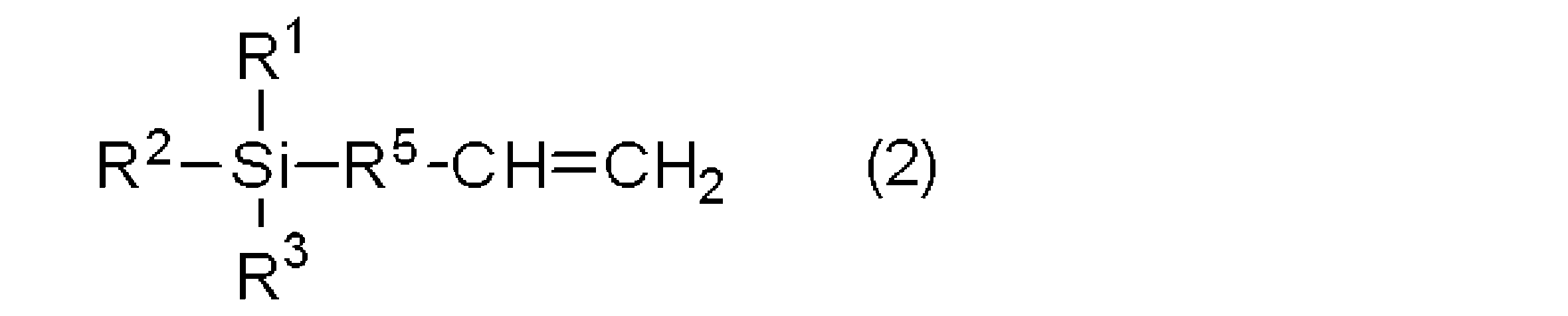
上記一般式(2)において、R1~R3は、それぞれ、上記の基であり、R5は単結合または2価の炭化水素基である。R5としての炭化水素基は、直鎖状であってよく、分岐鎖状であってよく、環状構造を含んでいてもよい。なお、一般式(2)における-R5-CH=CH2は、一般式(1)における-R4に対応する。 In the above general formula (2), R 1 to R 3 are each the above groups, and R 5 is a single bond or a divalent hydrocarbon group. The hydrocarbon group represented by R 5 may be linear, branched, or may contain a cyclic structure. In addition, -R 5 -CH═CH 2 in general formula (2) corresponds to -R 4 in general formula (1).
たとえば、不飽和シラン変性剤として化合物(2)を用いる場合、本発明のシラン変性水添ブロック共重合体(A-Si)は、化合物(2)由来の変性基として、下記一般式(3)で表される基(3)(シラン含有官能基)を有するものとなる。
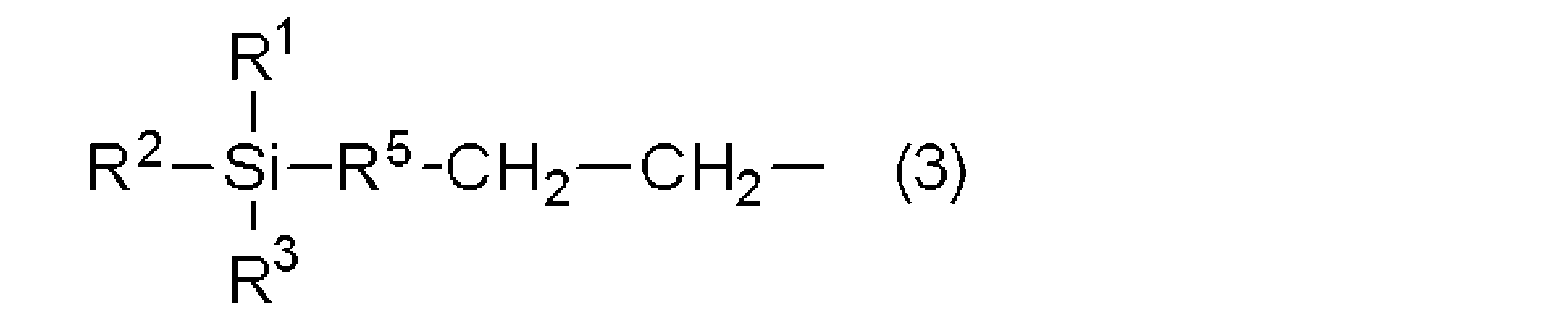
不飽和シラン変性剤としては、下記一般式(4)で表される化合物(4)が好ましい。
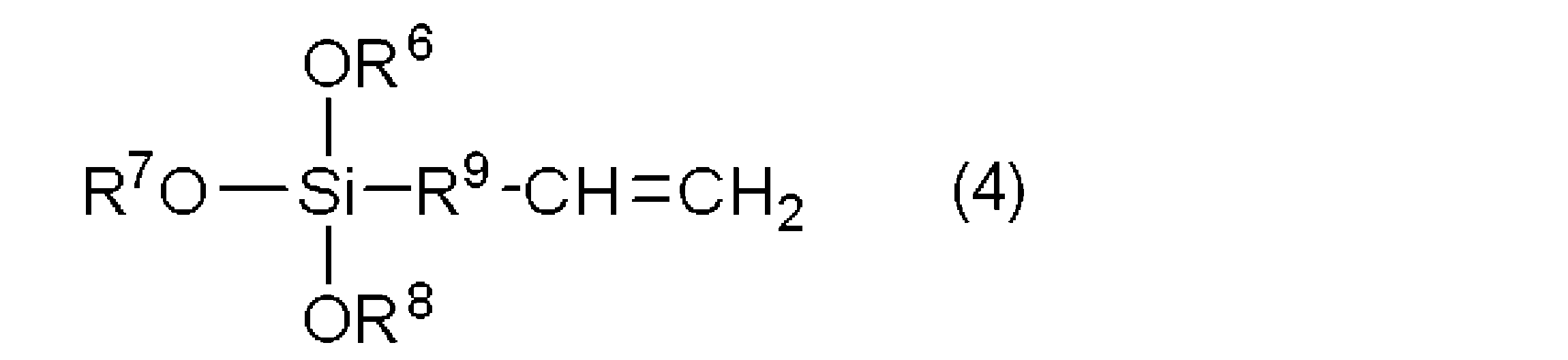
一般式(4)において、R6~R8は、それぞれ独立して、炭素数1~6のアルキル基であり、R9は単結合または炭素数1~4のアルキレン基である。なお、一般式(4)における-OR6、-OR7、および-OR8は、それぞれ、一般式(1)~(3)における-R1、-R2、および-R3に対応し、一般式(4)におけるR9は、一般式(2)~(3)におけるR5に対応する。 In general formula (4), R 6 to R 8 are each independently an alkyl group having 1 to 6 carbon atoms, and R 9 is a single bond or an alkylene group having 1 to 4 carbon atoms. Note that -OR 6 , -OR 7 , and -OR 8 in general formula (4) correspond to -R 1 , -R 2 , and -R 3 in general formulas (1) to (3), respectively, and R 9 in general formula (4) corresponds to R 5 in general formulas (2) to (3).
R6~R8は、それぞれ、直鎖状であってよく、分岐鎖状であってよく、環状構造を含んでいてもよい。R6~R8は、同一であってよく、異なっていてもよい。R6~R8の炭素数としては、それぞれ独立して、1~6であればよいが、1~4が好ましく、1~2(メチル基、エチル基)がより好ましく、1(メチル基)がさらに好ましい。 Each of R 6 to R 8 may be linear, branched, or contain a cyclic structure. R 6 to R 8 may be the same or different. The number of carbon atoms of each of R 6 to R 8 may be independently 1 to 6, preferably 1 to 4, more preferably 1 or 2 (methyl group, ethyl group), and even more preferably 1 (methyl group).
R9は、直鎖状であってよく、分岐鎖状であってよく、環状構造を含んでいてもよい。R9の炭素数としては、0~4であればよいが、0~2が好ましく、0~1がより好ましく、0(単結合)がさらに好ましい。 R 9 may be linear, branched, or may contain a cyclic structure. The carbon number of R 9 may be 0 to 4, preferably 0 to 2, more preferably 0 to 1, and further preferably 0 (single bond).
本発明のシラン変性水添ブロック共重合体(A-Si)中におけるシラン含有官能基の量は、特に限定されない。本発明のシラン変性水添ブロック共重合体(A-Si)100gあたりのシラン含有官能基の量は、0.01~100ミリモルであることが好ましく、0.1~50ミリモルであることがより好ましく、1~30ミリモルであることがさらに好ましい。シラン含有官能基の量を上記範囲とすることにより、圧縮復元性を一層高めることができ、成形性、透明性、および耐圧縮永久ひずみ性も高めることができる。 The amount of silane-containing functional groups in the silane-modified hydrogenated block copolymer (A-Si) of the present invention is not particularly limited. The amount of silane-containing functional groups per 100 g of the silane-modified hydrogenated block copolymer (A-Si) of the present invention is preferably 0.01 to 100 mmol, more preferably 0.1 to 50 mmol, and even more preferably 1 to 30 mmol. By setting the amount of silane-containing functional groups within the above range, it is possible to further improve compression recovery, and also to improve moldability, transparency, and resistance to compression set.
(シラン変性水添ブロック共重合体(A-Si)の製造方法)
本発明のシラン変性水添ブロック共重合体(A-Si)は、水添ブロック共重合体(A)と不飽和シラン変性剤とを反応させる変性工程を備える製造方法により製造することができる。
(Method for producing silane-modified hydrogenated block copolymer (A-Si))
The silane-modified hydrogenated block copolymer (A-Si) of the present invention can be produced by a production method including a modification step of reacting the hydrogenated block copolymer (A) with an unsaturated silane modifier.
本発明で用いる水添ブロック共重合体(A)は、たとえば、従来のブロック共重合体の製造方法および水素化方法を組み合わせて製造することができる。本発明で用いる水添ブロック共重合体(A)の製造方法としては、下記の(1A)~(5A)の工程を有する製造方法が好ましい。
(1A):溶媒中で重合開始剤を用いて、芳香族ビニル単量体を重合させることにより、活性末端を有する芳香族ビニル重合体を含有する溶液を得る工程
(2A):上記(1A)の工程で得られる活性末端を有する芳香族ビニル重合体を含有する溶液に共役ジエン単量体を添加して、該共役ジエン単量体を重合させることにより、活性末端を有する芳香族ビニル-共役ジエンブロック共重合体を含有する溶液を得る工程
(3A):上記(2A)の工程で得られる活性末端を有する芳香族ビニル-共役ジエンブロック共重合体を含有する溶液に、芳香族ビニル単量体を添加して、該芳香族ビニル単量体を重合させることにより、ブロック共重合体(A’)を含有する溶液を得る工程
(4A):上記(3A)の工程で得られるブロック共重合体(A’)を含有する溶液について、水素添加反応を行うことで、水添ブロック共重合体(A)を含有する溶液を得る工程
(5A):上記(4A)の工程で得られる水添ブロック共重合体(A)を含有する溶液から、水添ブロック共重合体(A)を回収する工程
The hydrogenated block copolymer (A) used in the present invention can be produced, for example, by combining a conventional method for producing a block copolymer and a hydrogenation method. The method for producing the hydrogenated block copolymer (A) used in the present invention is preferably a production method having the following steps (1A) to (5A).
(1A): A step of polymerizing an aromatic vinyl monomer in a solvent using a polymerization initiator to obtain a solution containing an aromatic vinyl polymer having an active end. (2A): A step of adding a conjugated diene monomer to the solution containing the aromatic vinyl polymer having an active end obtained in the above step (1A) to polymerize the conjugated diene monomer to obtain a solution containing an aromatic vinyl-conjugated diene block copolymer having an active end. (3A): A step of adding an aromatic vinyl monomer to the solution containing the aromatic vinyl-conjugated diene block copolymer having an active end obtained in the above step (2A) to polymerize the aromatic vinyl monomer to obtain a solution containing a block copolymer (A'). (4A): A step of performing a hydrogenation reaction on the solution containing the block copolymer (A') obtained in the above step (3A) to obtain a solution containing a hydrogenated block copolymer (A). (5A): A step of recovering the hydrogenated block copolymer (A) from the solution containing the hydrogenated block copolymer (A) obtained in the above step (4A).
<工程(1A)>
上記の製造方法では、まず、工程(1A)において、溶媒中で重合開始剤を用いて、芳香族ビニル単量体を重合させることにより、活性末端を有する芳香族ビニル重合体を含有する溶液を得る。
<Step (1A)>
In the above-mentioned production method, first, in step (1A), an aromatic vinyl monomer is polymerized in a solvent using a polymerization initiator to obtain a solution containing an aromatic vinyl polymer having an active end.
重合開始剤としては、芳香族ビニル単量体と共役ジエン単量体とに対し、アニオン重合活性があることが知られている重合開始剤を使用することができる。重合開始剤としては、たとえば、有機アルカリ金属化合物、有機アルカリ土類金属化合物、有機ランタノイド系列希土類金属化合物などが挙げられる。 As the polymerization initiator, a polymerization initiator that is known to have anionic polymerization activity for aromatic vinyl monomers and conjugated diene monomers can be used. Examples of the polymerization initiator include organic alkali metal compounds, organic alkaline earth metal compounds, and organic lanthanoid series rare earth metal compounds.
有機アルカリ金属化合物としては、分子中に1個以上のリチウム原子を有する有機リチウム化合物が特に好適に用いられる。有機アルカリ金属化合物の具体例としては、エチルリチウム、n-プロピルリチウム、イソプロピルリチウム、n-ブチルリチウム、sec-ブチルリチウム、t-ブチルリチウム、ヘキシルリチウム、フェニルリチウム、スチルベンリチウム、ジアルキルアミノリチウム、ジフェニルアミノリチウム、ジトリメチルシリルアミノリチウムなどの有機モノリチウム化合物;メチレンジリチウム、テトラメチレンジリチウム、ヘキサメチレンジリチウム、イソプレニルジリチウム、1,4-ジリチオ-エチルシクロヘキサンなどの有機ジリチウム化合物;更には、1,3,5-トリリチオベンゼンなどの有機トリリチウム化合物;などが挙げられる。これらのなかでも、有機モノリチウム化合物が特に好適に用いられる。 As the organic alkali metal compound, an organic lithium compound having one or more lithium atoms in the molecule is particularly suitable. Specific examples of organic alkali metal compounds include organic monolithium compounds such as ethyllithium, n-propyllithium, isopropyllithium, n-butyllithium, sec-butyllithium, t-butyllithium, hexyllithium, phenyllithium, stilbenelithium, dialkylaminolithium, diphenylaminolithium, and ditrimethylsilylaminolithium; organic dilithium compounds such as methylene dilithium, tetramethylene dilithium, hexamethylene dilithium, isoprenyldilithium, and 1,4-dilithio-ethylcyclohexane; and organic trilithium compounds such as 1,3,5-trilithiobenzene. Of these, organic monolithium compounds are particularly suitable.
有機アルカリ土類金属化合物としては、たとえば、n-ブチルマグネシウムブロミド、n-ヘキシルマグネシウムブロミド、エトキシカルシウム、ステアリン酸カルシウム、t-ブトキシストロンチウム、エトキシバリウム、イソプロポキシバリウム、エチルメルカプトバリウム、t-ブトキシバリウム、フェノキシバリウム、ジエチルアミノバリウム、ステアリン酸バリウム、エチルバリウムなどが挙げられる。 Examples of organic alkaline earth metal compounds include n-butyl magnesium bromide, n-hexyl magnesium bromide, ethoxy calcium, calcium stearate, t-butoxy strontium, ethoxy barium, isopropoxy barium, ethylmercapto barium, t-butoxy barium, phenoxy barium, diethylamino barium, barium stearate, and ethyl barium.
また、上記以外に、ネオジム、サマリウム、ガドリニウムなどを含むランタノイド系列希土類金属化合物/アルキルアルミニウム/アルキルアルミニウムハライド/アルキルアルミニウムハイドライドからなる複合触媒や、チタン、バナジウム、サマリウム、ガドリニウムなどを含むメタロセン型触媒などの、有機溶媒中で均一系となり、リビング重合性を有するものなどを用いることもできる。 In addition to the above, it is also possible to use composite catalysts consisting of lanthanoid series rare earth metal compounds containing neodymium, samarium, gadolinium, etc./alkylaluminum/alkylaluminum halide/alkylaluminum hydride, and metallocene catalysts containing titanium, vanadium, samarium, gadolinium, etc., which form homogeneous systems in organic solvents and have living polymerizability.
上記重合開始剤は、1種類を単独で使用してもよいし、2種類以上を混合して使用してもよい。重合開始剤の使用量は、目的とする分子量に応じて決定すればよく、特に限定されないが、重合に使用する全単量体100gあたり、好ましくは0.01~20ミリモルであり、より好ましくは0.05~15ミリモル、さらに好ましくは0.1~10ミリモルである。 The above polymerization initiators may be used alone or in combination of two or more. The amount of polymerization initiator used may be determined according to the target molecular weight and is not particularly limited, but is preferably 0.01 to 20 millimoles, more preferably 0.05 to 15 millimoles, and even more preferably 0.1 to 10 millimoles per 100 g of total monomers used in polymerization.
重合に用いる溶媒は、重合開始剤に対し不活性なものであればよく、特に限定されないが、たとえば、鎖状炭化水素溶媒、環式炭化水素溶媒またはこれらの混合溶媒などが挙げられる。鎖状炭化水素溶媒としては、たとえば、n-ブタン、イソブタン、1-ブテン、イソブチレン、トランス-2-ブテン、シス-2-ブテン、1-ペンテン、トランス-2-ペンテン、シス-2-ペンテン、n-ペンタン、イソペンタン、neo-ペンタン、n-ヘキサンなどの、炭素数4~6の鎖状アルカンおよびアルケンなどが挙げられる。また、環式炭化水素溶媒としては、たとえば、ベンゼン、トルエン、キシレンなどの芳香族化合物;シクロペンタン、シクロヘキサンなどの脂環式炭化水素化合物;などが挙げられる。これらの溶媒は、1種類を単独で使用してもよいし、2種類以上を混合して使用してもよい。 The solvent used in the polymerization is not particularly limited as long as it is inactive against the polymerization initiator, and examples thereof include chain hydrocarbon solvents, cyclic hydrocarbon solvents, and mixtures thereof. Examples of chain hydrocarbon solvents include chain alkanes and alkenes having 4 to 6 carbon atoms, such as n-butane, isobutane, 1-butene, isobutylene, trans-2-butene, cis-2-butene, 1-pentene, trans-2-pentene, cis-2-pentene, n-pentane, isopentane, neo-pentane, and n-hexane. Examples of cyclic hydrocarbon solvents include aromatic compounds such as benzene, toluene, and xylene; alicyclic hydrocarbon compounds such as cyclopentane and cyclohexane; and the like. These solvents may be used alone or in combination of two or more.
溶媒の使用量は、特に限定されないが、重合反応後の溶液中における全ブロック共重合体の濃度が、5~60重量%となる量とすることが好ましく、10~55重量%となる量とすることがより好ましく、20~50重量%となる量とすることがさらに好ましい。 The amount of solvent used is not particularly limited, but is preferably an amount that results in a total block copolymer concentration in the solution after the polymerization reaction of 5 to 60% by weight, more preferably 10 to 55% by weight, and even more preferably 20 to 50% by weight.
また、水添ブロック共重合体(A)を製造する際には、各重合体ブロックの構造を制御するために、反応系にルイス塩基化合物を添加してもよい。ルイス塩基化合物としては、テトラヒドロフラン、ジエチルエーテル、ジブチルエーテル、ジオキサン、エチレングリコールジメチルエーテル、エチレングリコールジブチルエーテル、ジエチレングリコールジメチルエーテル、ジエチレングリコールジブチルエーテルなどのエーテル類;テトラメチルエチレンジアミン、トリメチルアミン、トリエチルアミン、ピリジン、キヌクリジンなどの第三級アミン類;カリウム-t-アミルオキシド、カリウム-t-ブチルオキシドなどのアルカリ金属アルコキシド類;トリフェニルホスフィンなどのホスフィン類;などが挙げられる。これらのルイス塩基化合物は、1種類を単独で使用してもよいし、2種類以上を混合して使用してもよい。 When producing the hydrogenated block copolymer (A), a Lewis base compound may be added to the reaction system in order to control the structure of each polymer block. Examples of Lewis base compounds include ethers such as tetrahydrofuran, diethyl ether, dibutyl ether, dioxane, ethylene glycol dimethyl ether, ethylene glycol dibutyl ether, diethylene glycol dimethyl ether, and diethylene glycol dibutyl ether; tertiary amines such as tetramethylethylenediamine, trimethylamine, triethylamine, pyridine, and quinuclidine; alkali metal alkoxides such as potassium t-amyl oxide and potassium t-butyl oxide; and phosphines such as triphenylphosphine. These Lewis base compounds may be used alone or in combination of two or more.
水添ブロック共重合体(A)を製造する際において、ルイス塩基化合物を添加する時期は、特に限定されず、目的とする構造に応じて適宜決定すればよい。たとえば、重合を開始する前に予め添加してもよい。 When producing the hydrogenated block copolymer (A), the timing of adding the Lewis base compound is not particularly limited and may be appropriately determined depending on the desired structure. For example, it may be added in advance before the start of polymerization.
重合反応温度は、好ましくは10~150℃、より好ましくは30~130℃、さらに好ましくは40~90℃であり、重合時間は、好ましくは48時間以内、より好ましくは0.5~10時間である。また、重合圧力は、重合温度において単量体および溶媒を液相に維持するのに充分な圧力の範囲内とすればよく、特に限定されない。 The polymerization reaction temperature is preferably 10 to 150°C, more preferably 30 to 130°C, and even more preferably 40 to 90°C, and the polymerization time is preferably within 48 hours, more preferably 0.5 to 10 hours. The polymerization pressure is not particularly limited, and may be within a range sufficient to maintain the monomer and solvent in a liquid phase at the polymerization temperature.
以上のような条件で、溶媒中で重合開始剤を用いて、芳香族ビニル単量体を重合させることにより、活性末端を有する芳香族ビニル重合体を含有する溶液を得ることができる。このようにして、工程(1A)において得られる活性末端を有する芳香族ビニル重合体は、水添ブロック共重合体(A)の比較的小さい重量平均分子量を有する芳香族ビニル重合体ブロックAr1aまたはAr2aを構成することとなるものである。そのため、工程(1A)における、芳香族ビニル単量体の量を含む各重合条件は、これらの重合体ブロックの目的とする重量平均分子量などに応じて決定すればよい。 Under the above conditions, a solution containing an aromatic vinyl polymer having an active end can be obtained by polymerizing an aromatic vinyl monomer in a solvent using a polymerization initiator. The aromatic vinyl polymer having an active end obtained in the step (1A) in this manner constitutes the aromatic vinyl polymer block Ar1a or Ar2a having a relatively small weight average molecular weight of the hydrogenated block copolymer (A). Therefore, each polymerization condition including the amount of the aromatic vinyl monomer in the step (1A) may be determined depending on the target weight average molecular weight of these polymer blocks.
<工程(2A)>
次に、工程(2A)において、上記工程(1A)で得られた活性末端を有する芳香族ビニル重合体を含有する溶液に、共役ジエン単量体を添加し、該共役ジエン単量体を重合させることにより、活性末端を有する芳香族ビニル-共役ジエンブロック共重合体を含有する溶液を得る。
<Step (2A)>
Next, in step (2A), a conjugated diene monomer is added to the solution containing the aromatic vinyl polymer having active ends obtained in step (1A) above, and the conjugated diene monomer is polymerized to obtain a solution containing an aromatic vinyl-conjugated diene block copolymer having active ends.
工程(2A)によれば、上記工程(1A)で得られた活性末端を有する芳香族ビニル重合体を含有する溶液に、共役ジエン単量体を添加することにより、活性末端を起点として、共役ジエン重合体鎖が形成され、これにより、活性末端を有する芳香族ビニル-共役ジエンブロック共重合体を含有する溶液を得ることができる。 In step (2A), a conjugated diene monomer is added to the solution containing the aromatic vinyl polymer having active ends obtained in step (1A) above, whereby a conjugated diene polymer chain is formed starting from the active ends, thereby obtaining a solution containing an aromatic vinyl-conjugated diene block copolymer having active ends.
工程(2A)において形成される共役ジエン重合体鎖(工程(2A)において得られる活性末端を有する芳香族ビニル-共役ジエンブロック共重合体を構成する、共役ジエンブロック)は、水添ブロック共重合体(A)の共役ジエン重合体の水添重合体ブロックHDaを構成することとなるものである。そのため、工程(2A)における、共役ジエン重合体の量を含む各重合条件は、この重合体ブロックの目的とする重量平均分子量などに応じて、決定すればよい(たとえば、重合条件は、上記工程(1A)において説明した範囲において決定すればよい。)。 The conjugated diene polymer chain formed in step (2A) (the conjugated diene block constituting the aromatic vinyl-conjugated diene block copolymer having an active end obtained in step (2A)) constitutes the hydrogenated polymer block HDa of the conjugated diene polymer of the hydrogenated block copolymer (A). Therefore, each polymerization condition including the amount of the conjugated diene polymer in step (2A) may be determined depending on the target weight average molecular weight of this polymer block, etc. (for example, the polymerization conditions may be determined within the ranges explained in the above step (1A)).
<工程(3A)>
次に、工程(3A)において、上記工程(2A)で得られた活性末端を有する芳香族ビニル-共役ジエンブロック共重合体を含有する溶液に、芳香族ビニル単量体を添加し、該芳香族ビニル単量体を重合させることにより、ブロック共重合体(A’)を含有する溶液を得る。
<Step (3A)>
Next, in step (3A), an aromatic vinyl monomer is added to the solution containing the aromatic vinyl-conjugated diene block copolymer having an active end obtained in step (2A) above, and the aromatic vinyl monomer is polymerized to obtain a solution containing a block copolymer (A').
工程(3A)によれば、上記工程(2A)で得られた活性末端を有する芳香族ビニル-共役ジエンブロック共重合体を含有する溶液に、芳香族ビニル単量体を添加することにより、活性末端を起点として、芳香族ビニル重合体鎖が形成され、これにより、活性末端を有する芳香族ビニル-共役ジエン-芳香族ビニルブロック共重合体を含有する溶液を得ることができる。 In step (3A), an aromatic vinyl monomer is added to the solution containing the aromatic vinyl-conjugated diene block copolymer having active ends obtained in step (2A) above, whereby an aromatic vinyl polymer chain is formed starting from the active end, thereby obtaining a solution containing an aromatic vinyl-conjugated diene-aromatic vinyl block copolymer having active ends.
工程(3A)において形成される芳香族ビニル重合体鎖(工程(3A)において得られる活性末端を有する芳香族ビニル-共役ジエン-芳香族ビニルブロック共重合体を構成する、芳香族ビニルブロック)は、水添ブロック共重合体(A)の芳香族ビニル重合体ブロックAr1a、Ar2aのうち一方(すなわち、Ar1aまたはAr2aのうち、工程(1A)において形成されたブロックとは異なるブロックであり、たとえば、工程(1A)においてAr1aを形成した場合には、Ar2aが該当することとなる。)を構成することとなるものである。そのため、工程(3A)における、芳香族ビニル単量体の量を含む各重合条件は、このような重合体ブロックの目的とする重量平均分子量などに応じて決定すればよい(たとえば、重合条件は、上記工程(1A)において説明した範囲において決定すればよい。)。 The aromatic vinyl polymer chain formed in step (3A) (the aromatic vinyl block constituting the aromatic vinyl-conjugated diene-aromatic vinyl block copolymer having an active end obtained in step (3A)) constitutes one of the aromatic vinyl polymer blocks Ar1 a and Ar2 a of the hydrogenated block copolymer (A) (i.e., out of Ar1 a and Ar2 a , it is a block different from the block formed in step (1A); for example, when Ar1 a is formed in step (1A), Ar2 a applies). Therefore, each polymerization condition including the amount of the aromatic vinyl monomer in step (3A) may be determined depending on the target weight average molecular weight of such a polymer block, etc. (for example, the polymerization conditions may be determined within the range explained in the above step (1A)).
上記のようにして得られる、活性末端を有する芳香族ビニル-共役ジエン-芳香族ビニルブロック共重合体を含有する溶液に、重合停止剤を添加することにより、活性末端を有する芳香族ビニル-共役ジエン-芳香族ビニルブロック共重合体の活性末端を失活させて、ブロック共重合体(A’)を含有する溶液を得る。なお、工程(3A)で得られるブロック共重合体(A’)は、水添ブロック共重合体(A)を得るための水添前のブロック共重合体となるものである。 By adding a polymerization terminator to the solution containing the aromatic vinyl-conjugated diene-aromatic vinyl block copolymer having active ends obtained as described above, the active ends of the aromatic vinyl-conjugated diene-aromatic vinyl block copolymer having active ends are deactivated to obtain a solution containing block copolymer (A'). Note that the block copolymer (A') obtained in step (3A) is the block copolymer before hydrogenation to obtain the hydrogenated block copolymer (A).
重合停止剤は、活性末端と反応して活性末端を失活させることができ、1つの活性末端と反応した後、別の活性末端と反応しないものであればよく、特に限定されないが、ハロゲン原子を含有しない化合物であることが好ましく、なかでも、活性末端と反応した際に金属アルコキシド、金属アリールオキシド、または金属水酸化物を生じさせる重合停止剤が特に好ましい。重合停止剤の具体例としては、水;メタノールやエタノールなどの1価アルコール;フェノールやクレゾールなどの1価フェノール類;などが挙げられる。重合停止剤の使用量は、適宜選択することができる。 The polymerization terminator is not particularly limited as long as it can react with an active terminal to deactivate the active terminal and does not react with another active terminal after reacting with one active terminal, but is preferably a compound that does not contain a halogen atom, and particularly preferably a polymerization terminator that produces a metal alkoxide, metal aryloxide, or metal hydroxide when reacting with an active terminal. Specific examples of polymerization terminators include water; monohydric alcohols such as methanol and ethanol; monohydric phenols such as phenol and cresol; and the like. The amount of polymerization terminator used can be selected appropriately.
<工程(4A)>
次に、工程(4A)において、上記工程(3A)で得られたブロック共重合体(A’)を含有する溶液について、水素添加反応を行うことで、水添ブロック共重合体(A)を含有する溶液を得る。
<Step (4A)>
Next, in step (4A), the solution containing the block copolymer (A') obtained in the above step (3A) is subjected to a hydrogenation reaction to obtain a solution containing a hydrogenated block copolymer (A).
ブロック共重合体(A’)を含有する溶液について、水素添加反応を行う方法としては、特に限定されないが、たとえば、水素化触媒の存在下において、ブロック共重合体(A’)を含有する溶液を、水素と接触させる方法などが挙げられる。 The method for performing a hydrogenation reaction on a solution containing block copolymer (A') is not particularly limited, but examples include a method in which a solution containing block copolymer (A') is brought into contact with hydrogen in the presence of a hydrogenation catalyst.
水素化触媒としては、特に限定されないが、たとえば、Ni、Pt、Pd、Ru等の金属をカーボン、シリカ、アルミナ、ケイソウ土等の担体に担持させた担持型不均一系触媒と、Ni、Co、Fe、Crなどの有機塩またはアセチルアセトン塩と有機Alなどの還元剤とを用いるチーグラー型触媒;Ru、Rhなどの有機金属化合物などの有機錯体触媒;チタノセン化合物に還元剤として有機Li、有機Al、有機Mgなどを用いる均一触媒;などが挙げられる。このなかでも、チーグラー型触媒が好ましい。 Hydrogenation catalysts are not particularly limited, but examples include supported heterogeneous catalysts in which metals such as Ni, Pt, Pd, Ru, etc. are supported on carriers such as carbon, silica, alumina, diatomaceous earth, etc.; Ziegler-type catalysts that use organic salts or acetylacetone salts of Ni, Co, Fe, Cr, etc. and reducing agents such as organoaluminum; organic complex catalysts such as organometallic compounds of Ru, Rh, etc.; and homogeneous catalysts that use titanocene compounds with organolithium, organoaluminum, organomgum, etc. as reducing agents. Among these, Ziegler-type catalysts are preferred.
水素化反応は、たとえば、特公昭42-8704号公報、特公昭43-6636号公報、特開昭59-133203号公報、特開昭60-220147号公報等に開示されている方法に従って行うことができる。 The hydrogenation reaction can be carried out, for example, according to the methods disclosed in JP-B-42-8704, JP-B-43-6636, JP-A-59-133203, JP-A-60-220147, etc.
水素化反応の条件は、目的のオレフィンの水添率に応じて選択すればよいが、水素添加反応温度は、好ましくは0~200℃であり、より好ましくは30~150℃である。また、水素添加反応に使用される水素の圧力は、好ましくは0.1~15MPaであり、より好ましくは0.2~10MPa、さらに好ましくは0.3~5MPaであり、水素添加反応時間は、好ましくは3分~10時間であり、より好ましくは10分~5時間である。なお、水素添加反応は、バッチプロセス、連続プロセス、あるいはこれらの組み合わせのいずれであってもよい。 The hydrogenation reaction conditions may be selected according to the hydrogenation rate of the target olefin, but the hydrogenation reaction temperature is preferably 0 to 200°C, more preferably 30 to 150°C. The hydrogen pressure used in the hydrogenation reaction is preferably 0.1 to 15 MPa, more preferably 0.2 to 10 MPa, and even more preferably 0.3 to 5 MPa, and the hydrogenation reaction time is preferably 3 minutes to 10 hours, more preferably 10 minutes to 5 hours. The hydrogenation reaction may be a batch process, a continuous process, or a combination of these.
<工程(5A)>
次に、工程(5A)において、上記工程(4A)で得られた水添ブロック共重合体(A)を含有する溶液から、目的とする水添ブロック共重合体(A)を回収する。
<Step (5A)>
Next, in the step (5A), the target hydrogenated block copolymer (A) is recovered from the solution containing the hydrogenated block copolymer (A) obtained in the above step (4A).
回収の方法は、常法に従えばよく、特に限定されない。たとえば、必要に応じて、酸化防止剤などの添加剤を添加してから、溶液に直接乾燥法やスチームストリッピングなどの公知の溶媒方法を適用することにより、目的の重合体を回収することができる。 The recovery method may be a conventional method and is not particularly limited. For example, the desired polymer can be recovered by adding additives such as antioxidants as necessary and then directly drying the solution or applying known solvent methods such as steam stripping.
スチームストリッピングなどによって、水添ブロック共重合体(A)をスラリーとして回収した場合には、押出機型スクイザーなどの任意の脱水機を用いることで脱水を行い、クラム状の水添ブロック共重合体(A)を回収し、さらに得られたクラムをバンドドライヤーやエクスパンション押出乾燥機などの任意の乾燥機を用いて乾燥することが好ましい。また、このようにして得られる水添ブロック共重合体(A)は、常法に従い、ペレット形状などに加工してから使用に供してもよい。 When the hydrogenated block copolymer (A) is recovered as a slurry by steam stripping or the like, it is preferable to dehydrate it using any dehydrator such as an extruder-type squeezer to recover the hydrogenated block copolymer (A) in the form of crumbs, and then dry the resulting crumbs using any dryer such as a band dryer or an expansion extrusion dryer. The hydrogenated block copolymer (A) thus obtained may be processed into pellets or the like according to a conventional method before use.
このようにして得られる、固形状(ペレット状、クラム状など)の水添ブロック共重合体(A)は、たとえば、ホッパードライヤー、熱風循環式棚型乾燥器、棚型真空乾燥器、攪拌型真空乾燥器などの乾燥機を用いて、固形状の水添ブロック共重合体(A)に含まれる水分量を低減させてから使用に供することが好ましい。このときの乾燥条件は、目的の水分量とすることができる限りにおいて特に限定されず、低減させるべき水分量や乾燥機の種類などに応じて設定すればよいが、通常、乾燥温度40~90℃、乾燥時間1~24時間の範囲で設定される。 The solid (pellet, crumb, etc.) hydrogenated block copolymer (A) thus obtained is preferably used after reducing the moisture content in the solid hydrogenated block copolymer (A) using a dryer such as a hopper dryer, a hot air circulation tray dryer, a tray vacuum dryer, or an agitation vacuum dryer. The drying conditions are not particularly limited as long as the desired moisture content can be achieved, and may be set according to the amount of moisture to be reduced and the type of dryer, but are usually set at a drying temperature of 40 to 90°C and a drying time of 1 to 24 hours.
<変性工程>
本発明のシラン変性水添ブロック共重合体(A-Si)は、水添ブロック共重合体(A)と不飽和シラン変性剤とを反応させる変性工程を備える製造方法により製造することができる。好ましくは、本発明のシラン変性水添ブロック共重合体(A-Si)は、水添ブロック共重合体(A)と、不飽和シラン変性剤と、過酸化物とを溶融混錬することにより製造することができる。
<Modification step>
The silane-modified hydrogenated block copolymer (A-Si) of the present invention can be produced by a production method including a modification step of reacting the hydrogenated block copolymer (A) with an unsaturated silane modifier. Preferably, the silane-modified hydrogenated block copolymer (A-Si) of the present invention can be produced by melt-kneading the hydrogenated block copolymer (A), the unsaturated silane modifier, and a peroxide.
不飽和シラン変性剤は、1種類を単独で使用してもよいし、2種類以上を混合して使用してもよい。不飽和シラン変性剤の使用量は、特に限定されないが、不飽和シラン変性剤により変性させる重合体成分100gあたり、好ましくは0.1~20gであり、より好ましくは0.5~15g、さらに好ましくは1~10gである。 The unsaturated silane modifier may be used alone or in combination of two or more types. The amount of unsaturated silane modifier used is not particularly limited, but is preferably 0.1 to 20 g, more preferably 0.5 to 15 g, and even more preferably 1 to 10 g per 100 g of the polymer component to be modified with the unsaturated silane modifier.
過酸化物としては、たとえば、t-ブチルヒドロパーオキサイド、クメンヒドロパーオキサイド、ジクミルパーオキサイド、ジ-t-ブチルパーオキサイド、t-ブチルクミルパーオキサイド、2,5-ジメチル-t-ブチルペルオキシヘキサン、2,5-ジメチル-t-ブチルペルオキシヘキシン、2,5-ジメチル-2,5-ジ(t-ブチルパーオキシ)ヘキサン、1,3-ビス(t-ブチルペルオキシイソプロピル)ベンゼン、p-クロロベンゾイルパーオキサイド、t-ブチルペルオキシベンゾエート、t-ブチルペルオキシイソプロピルカルボナート、t-ブチルベンゾエート、1,1-ビス(t-ブチルペルオキシ)-3,3,5-トリメチルシクロヘキサンなどの有機過酸化物が挙げられる。これらは、1種単独で、あるいは2種以上を組み合わせて用いることができる。 Examples of peroxides include organic peroxides such as t-butyl hydroperoxide, cumene hydroperoxide, dicumyl peroxide, di-t-butyl peroxide, t-butylcumyl peroxide, 2,5-dimethyl-t-butylperoxyhexane, 2,5-dimethyl-t-butylperoxyhexine, 2,5-dimethyl-2,5-di(t-butylperoxy)hexane, 1,3-bis(t-butylperoxyisopropyl)benzene, p-chlorobenzoyl peroxide, t-butylperoxybenzoate, t-butylperoxyisopropylcarbonate, t-butylbenzoate, and 1,1-bis(t-butylperoxy)-3,3,5-trimethylcyclohexane. These can be used alone or in combination of two or more.
過酸化物の使用量は、特に限定されないが、使用する不飽和シラン変性剤1gあたり、好ましくは0.01~1gであり、より好ましくは0.02~0.5g、さらに好ましくは0.05~0.2gである。 The amount of peroxide used is not particularly limited, but is preferably 0.01 to 1 g, more preferably 0.02 to 0.5 g, and even more preferably 0.05 to 0.2 g per 1 g of unsaturated silane modifier used.
水添ブロック共重合体(A)と、不飽和シラン変性剤と、過酸化物とを溶融混錬する方法としては特に限定されず、たとえば、各成分をロール、バンバリーミキサー、ニーダー、ラボプラストミル、単軸押出機、2軸押出機等の混練装置で加熱溶融混合する方法を挙げることができる。加熱溶融混合する際の条件は、各成分の過度な分解や予期せぬ反応の進行を抑制することができる条件であることが好ましい。たとえば、混合温度は180~260℃であることが好ましく、200~240℃であることがより好ましい。また、混合時間は、0.5分~20分であることが好ましく、1分~10分であることがより好ましい。 The method of melt-kneading the hydrogenated block copolymer (A), the unsaturated silane modifier, and the peroxide is not particularly limited, and examples include a method of heating, melt-kneading each component using a kneading device such as a roll, a Banbury mixer, a kneader, a lab plastomill, a single-screw extruder, or a twin-screw extruder. The conditions for heating, melt-kneading are preferably conditions that can suppress excessive decomposition of each component and the progression of unexpected reactions. For example, the mixing temperature is preferably 180 to 260°C, and more preferably 200 to 240°C. The mixing time is preferably 0.5 to 20 minutes, and more preferably 1 to 10 minutes.
<重合体組成物>
本発明は、上記のシラン変性水添ブロック共重合体(A-Si)と、後述するシラン変性水添ブロック共重合体(B-Si)と、を含有する重合体組成物にも関する。
<Polymer Composition>
The present invention also relates to a polymer composition containing the above-mentioned silane-modified hydrogenated block copolymer (A-Si) and the below-mentioned silane-modified hydrogenated block copolymer (B-Si).
[シラン変性水添ブロック共重合体(B-Si)]
本発明で用いるシラン変性水添ブロック共重合体(B-Si)は、後述する水添ブロック共重合体(B)を不飽和シラン変性剤で変性してなるブロック共重合体であって、シラン含有官能基を有するブロック共重合体である。
[Silane-modified hydrogenated block copolymer (B-Si)]
The silane-modified hydrogenated block copolymer (B-Si) used in the present invention is a block copolymer obtained by modifying the hydrogenated block copolymer (B) described below with an unsaturated silane modifier, and is a block copolymer having a silane-containing functional group.
(水添ブロック共重合体(B))
水添ブロック共重合体(B)は、下記一般式(B)で表されるブロック共重合体である。
Ar1b-HDb-Ar2b (B)
(上記一般式(B)において、Ar1bおよびAr2bは、芳香族ビニル重合体ブロックであり、HDbは、共役ジエン重合体の水添重合体ブロックであり、Ar1bの重量平均分子量(Mw(Ar1b))に対する、Ar2bの重量平均分子量(Mw(Ar2b))の比(Mw(Ar2b)/Mw(Ar1b))は0.95~1.05である。)
(Hydrogenated Block Copolymer (B))
The hydrogenated block copolymer (B) is a block copolymer represented by the following general formula (B).
Ar1 b -HD b -Ar2 b (B)
(In the above general formula (B), Ar1 b and Ar2 b are aromatic vinyl polymer blocks, HD b is a hydrogenated polymer block of a conjugated diene polymer, and the ratio (Mw(Ar2 b )/Mw(Ar1 b )) of the weight average molecular weight of Ar2 b (Mw(Ar2 b )) to the weight average molecular weight of Ar1 b (Mw(Ar1 b ) ) is 0.95 to 1.05.)
水添ブロック共重合体(B)は、共役ジエン重合体ブロックHDbの両端に、それぞれ、2つの芳香族ビニル重合体ブロックAr1b、Ar2bが結合して構成される芳香族ビニル-共役ジエン-芳香族ビニルブロック共重合体の水素化物である。 The hydrogenated block copolymer (B) is a hydrogenated product of an aromatic vinyl-conjugated diene-aromatic vinyl block copolymer constituted by two aromatic vinyl polymer blocks Ar1 b and Ar2 b bonded to both ends of a conjugated diene polymer block HD b .
水添ブロック共重合体(B)の芳香族ビニル重合体ブロックAr1bおよびAr2bは、芳香族ビニル単量体単位により構成される重合体ブロックである。芳香族ビニル重合体ブロックAr1bおよびAr2bを構成するために用いられる単量体としては、水添ブロック共重合体(A)の芳香族ビニル重合体ブロックAr1aおよびAr2aを構成するために用いられる単量体として上述した単量体が挙げられる。各単量体の好適な種類および好適な含有量は、水添ブロック共重合体(A)の芳香族ビニル重合体ブロックAr1aおよびAr2aについての好適な種類および好適な含有量と同等である。 The aromatic vinyl polymer blocks Ar1b and Ar2b of the hydrogenated block copolymer (B) are polymer blocks composed of aromatic vinyl monomer units. The monomers used to form the aromatic vinyl polymer blocks Ar1b and Ar2b include the monomers described above as the monomers used to form the aromatic vinyl polymer blocks Ar1a and Ar2a of the hydrogenated block copolymer (A). The preferred types and preferred contents of each monomer are the same as the preferred types and preferred contents of the aromatic vinyl polymer blocks Ar1a and Ar2a of the hydrogenated block copolymer (A).
水添ブロック共重合体(B)の共役ジエン重合体の水添重合体ブロックHDbは、共役ジエン単量体単位により構成される重合体ブロックであって、かつ、重合体ブロックを構成する共役ジエン単量体単位のうち、少なくとも一部が水素化されてなるものである。共役ジエン重合体の水添重合体ブロックHDbを構成するために用いられる単量体としては、水添ブロック共重合体(A)の共役ジエン重合体の水添重合体ブロックHDaを構成するために用いられる単量体として上述した単量体が挙げられる。各単量体の好適な種類および好適な含有量は、水添ブロック共重合体(A)の共役ジエン重合体の水添重合体ブロックHDaについての好適な種類および好適な含有量と同等である。 The hydrogenated polymer block HD b of the conjugated diene polymer of the hydrogenated block copolymer (B) is a polymer block constituted by conjugated diene monomer units, and at least a part of the conjugated diene monomer units constituting the polymer block is hydrogenated. Examples of monomers used to constitute the hydrogenated polymer block HD b of the conjugated diene polymer include the monomers mentioned above as monomers used to constitute the hydrogenated polymer block HD a of the conjugated diene polymer of the hydrogenated block copolymer (A). The suitable type and suitable content of each monomer are the same as the suitable type and suitable content of the hydrogenated polymer block HD a of the conjugated diene polymer of the hydrogenated block copolymer (A).
水添ブロック共重合体(B)は、Ar1bの重量平均分子量(Mw(Ar1b))に対する、Ar2bの重量平均分子量(Mw(Ar2b))の比(Mw(Ar2b)/Mw(Ar1b))が0.95~1.05の範囲にあるものである。Mw(Ar2b)/Mw(Ar1b)は、好ましくは0.98~1.02の範囲である。Mw(Ar2b)/Mw(Ar1b)を上記範囲とすることにより、圧縮復元性を一層高めることができ、成形性、透明性、および耐圧縮永久ひずみ性も高めることができる。 The hydrogenated block copolymer (B) has a ratio (Mw( Ar2b )/Mw(Ar1b)) of the weight average molecular weight of Ar2b (Mw( Ar2b )) to the weight average molecular weight of Ar1b (Mw( Ar1b )) in the range of 0.95 to 1.05. Mw ( Ar2b )/Mw( Ar1b ) is preferably in the range of 0.98 to 1.02. By setting Mw( Ar2b )/Mw( Ar1b ) in the above range, the compression recovery can be further improved, and the moldability, transparency, and resistance to compression set can also be improved.
水添ブロック共重合体(B)のオレフィンの水添率は、好ましくは10~100%であり、より好ましくは50~100%、さらに好ましくは80~100%、特に好ましくは90~100%、最も好ましくは95~100%である。ここで、オレフィンの水添率とは、具体的には、水添前の水添ブロック共重合体(B)中に含まれる全非芳香族性炭素-炭素二重結合のうち、水素化されたものの割合(モル%)である。オレフィンの水添率は、溶媒として重クロロホルムを用いる1H-NMRスペクトル測定により求めることができる。 The hydrogenation rate of the olefin in the hydrogenated block copolymer (B) is preferably 10 to 100%, more preferably 50 to 100%, further preferably 80 to 100%, particularly preferably 90 to 100%, and most preferably 95 to 100%. Specifically, the hydrogenation rate of the olefin refers to the proportion (mol%) of hydrogenated non-aromatic carbon-carbon double bonds in the total non-aromatic carbon-carbon double bonds contained in the hydrogenated block copolymer (B) before hydrogenation. The hydrogenation rate of the olefin can be determined by 1 H-NMR spectrum measurement using deuterated chloroform as a solvent.
水添ブロック共重合体(B)の全単量体単位に対する芳香族ビニル単量体単位の含有量は、特に限定されないが、好ましくは7~60重量%であり、より好ましくは10~50重量%であり、さらに好ましくは15~40重量%である。水添ブロック共重合体(B)の全単量体単位に対する芳香族ビニル単量体単位の含有量は、高速液体クロマトグラフィの測定における、示差屈折計と紫外検出器との検出強度比に基づいて求めることができる。 The content of aromatic vinyl monomer units relative to the total monomer units of the hydrogenated block copolymer (B) is not particularly limited, but is preferably 7 to 60% by weight, more preferably 10 to 50% by weight, and even more preferably 15 to 40% by weight. The content of aromatic vinyl monomer units relative to the total monomer units of the hydrogenated block copolymer (B) can be determined based on the detection intensity ratio between a differential refractometer and an ultraviolet detector in high performance liquid chromatography measurements.
水添ブロック共重合体(B)の重量平均分子量は、特に限定されないが、好ましくは20,000~500,000、より好ましくは25,000~300,000、さらに好ましくは30,000~150,000である。重量平均分子量を上記範囲とすることにより、圧縮復元性を一層高めることができ、成形性、透明性、および耐圧縮永久ひずみ性も高めることができる。 The weight-average molecular weight of the hydrogenated block copolymer (B) is not particularly limited, but is preferably 20,000 to 500,000, more preferably 25,000 to 300,000, and even more preferably 30,000 to 150,000. By setting the weight-average molecular weight within the above range, the compression recovery can be further improved, and the moldability, transparency, and resistance to compression set can also be improved.
水添ブロック共重合体(B)を構成する、2つの芳香族ビニル重合体ブロックAr1b、Ar2bの重量平均分子量(Mw(Ar1b)、Mw(Ar2b))は、それぞれ、好ましくは1,000~40,000であり、より好ましくは2,000~15,000、さらに好ましくは3,000~8,000である。Mw(Ar1b)およびMw(Ar2b)を上記範囲とすることにより、圧縮復元性を一層高めることができ、成形性、透明性、および耐圧縮永久ひずみ性も高めることができる。2つの芳香族ビニル重合体ブロックAr1b、Ar2bの重量平均分子量(Mw(Ar1b)、Mw(Ar2b))は、互いに等しいものであっても、互いに異なるものであってもよいが、実質的に等しいものであることが好ましい。たとえば、Ar1bの重量平均分子量(Mw(Ar1b))に対する、Ar2bの重量平均分子量(Mw(Ar2b))の比(Mw(Ar2b)/Mw(Ar1b))が0.95~1.05の範囲にあればよいが、0.97~1.03の範囲にあることが好ましい。 The weight average molecular weights (Mw(Ar1 b ), Mw(Ar2 b )) of the two aromatic vinyl polymer blocks Ar1 b and Ar2 b constituting the hydrogenated block copolymer (B) are preferably 1,000 to 40,000, more preferably 2,000 to 15,000, and even more preferably 3,000 to 8,000. By setting Mw(Ar1 b ) and Mw(Ar2 b ) within the above ranges, the compression recovery can be further improved, and the moldability, transparency, and compression set resistance can also be improved. The weight average molecular weights (Mw(Ar1 b ) , Mw(Ar2 b )) of the two aromatic vinyl polymer blocks Ar1 b and Ar2 b may be equal to or different from each other, but are preferably substantially equal to each other. For example, the ratio of the weight average molecular weight of Ar2 b (Mw(Ar2 b )) to the weight average molecular weight of Ar1 b (Mw(Ar1 b )), (Mw(Ar2 b )/Mw(Ar1 b )), may be in the range of 0.95 to 1.05, and is preferably in the range of 0.97 to 1.03.
また、これら2つの芳香族ビニル重合体ブロックAr1b、Ar2bのうちの少なくとも1つの重合体ブロックは、その重量平均分子量(Mw(Ar1b)、Mw(Ar2b))が、水添ブロック共重合体(A)を構成する、比較的小さい重量平均分子量を有する芳香族ビニル重合体ブロックAr1aの重量平均分子量(Mw(Ar1a))と、等しくてもよく、異なってもよいが、実質的に等しいことがより好ましい。たとえば、Ar1aの重量平均分子量(Mw(Ar1a))に対する、Ar1bの重量平均分子量(Mw(Ar1b))の比(Mw(Ar1b)/Mw(Ar1a))が0.95~1.05の範囲にあるか、あるいは、Ar1aの重量平均分子量(Mw(Ar1a))に対する、Ar2bの重量平均分子量(Mw(Ar2b))の比(Mw(Ar2b)/Mw(Ar1a))が0.95~1.05の範囲にあることが好ましい。 Furthermore, the weight average molecular weight (Mw( Ar1b ), Mw( Ar2b )) of at least one of these two aromatic vinyl polymer blocks Ar1b and Ar2b may be equal to or different from the weight average molecular weight (Mw( Ar1a )) of the aromatic vinyl polymer block Ar1a having a relatively small weight average molecular weight constituting the hydrogenated block copolymer (A), but it is more preferable that it is substantially equal to that of the aromatic vinyl polymer block Ar1a . For example, it is preferable that the ratio (Mw( Ar1b )/Mw(Ar1a)) of the weight average molecular weight of Ar1b (Mw( Ar1b )) to the weight average molecular weight of Ar1a (Mw( Ar1a )) is in the range of 0.95 to 1.05, or the ratio (Mw( Ar2b )/Mw( Ar1a )) of the weight average molecular weight of Ar2b (Mw( Ar2b )) to the weight average molecular weight of Ar1a (Mw( Ar1a )) is in the range of 0.95 to 1.05.
水添ブロック共重合体(B)を構成する、共役ジエン重合体の水添重合体ブロックHDbの重量平均分子量(Mw(HDb))は、好ましくは10,000~300,000であり、より好ましくは15,000~300,000、さらに好ましくは15,000~150,000、特に好ましくは20,000~80,000である。また、共役ジエン重合体の水添重合体ブロックHDbは、その重量平均分子量(Mw(HDb)が、水添ブロック共重合体(A)を構成する、共役ジエン重合体の水添重合体ブロックHDaの重量平均分子量(Mw(HDa))と、等しくてもよく、異なってもよいが、実質的に等しいことがより好ましい。たとえば、HDaの重量平均分子量(Mw(HDa))に対する、HDbの重量平均分子量(Mw(HDb))の比(Mw(HDb)/Mw(HDa))が0.95~1.05の範囲にあることが好ましい。 The weight average molecular weight (Mw(HD b )) of the hydrogenated polymer block HD b of the conjugated diene polymer constituting the hydrogenated block copolymer (B) is preferably 10,000 to 300,000, more preferably 15,000 to 300,000, further preferably 15,000 to 150,000, and particularly preferably 20,000 to 80,000. The weight average molecular weight (Mw(HD b )) of the hydrogenated polymer block HD b of the conjugated diene polymer may be equal to or different from the weight average molecular weight (Mw(HD a )) of the hydrogenated polymer block HD a of the conjugated diene polymer constituting the hydrogenated block copolymer (A), but it is more preferable that they are substantially equal to each other. For example, it is preferable that the ratio (Mw(HD b ) / Mw(HD a )) of the weight average molecular weight (Mw(HD b )) of HD b to the weight average molecular weight (Mw(HD a ) ) of HD a is in the range of 0.95 to 1.05.
水添ブロック共重合体(B)を構成する、共役ジエン重合体の水添重合体ブロックHDbのビニル結合含有量は、好ましくは1~80モル%であり、より好ましくは3~20モル%であり、さらに好ましくは5~12モル%である。役ジエン重合体の水添重合体ブロックのビニル結合含有量は、溶媒として重クロロホルムを用いる1H-NMRにより求めることができる。なお、水添ブロック共重合体(B)を構成する、共役ジエン重合体の水添重合体ブロックHDbのビニル結合含有量は、水添ブロック共重合体(A)を構成する、共役ジエン重合体の水添重合体ブロックHDaのビニル結合含有量と実質的に等しいことが好ましい。たとえば、水添ブロック共重合体(A)を構成する、共役ジエン重合体の水添重合体ブロックHDaのビニル結合含有量に対する、水添ブロック共重合体(B)を構成する、共役ジエン重合体の水添重合体ブロックHDbのビニル結合含有量の比が0.95~1.05の範囲にあることが好ましい。 The vinyl bond content of the hydrogenated polymer block HD b of the conjugated diene polymer constituting the hydrogenated block copolymer (B) is preferably 1 to 80 mol %, more preferably 3 to 20 mol %, and even more preferably 5 to 12 mol %. The vinyl bond content of the hydrogenated polymer block of the conjugated diene polymer can be determined by 1 H-NMR using deuterated chloroform as a solvent. It is preferable that the vinyl bond content of the hydrogenated polymer block HD b of the conjugated diene polymer constituting the hydrogenated block copolymer (B) is substantially equal to the vinyl bond content of the hydrogenated polymer block HD a of the conjugated diene polymer constituting the hydrogenated block copolymer (A). For example, it is preferable that the ratio of the vinyl bond content of the hydrogenated polymer block HD b of the conjugated diene polymer constituting the hydrogenated block copolymer (B) to the vinyl bond content of the hydrogenated polymer block HD a of the conjugated diene polymer constituting the hydrogenated block copolymer (A) is in the range of 0.95 to 1.05.
水添ブロック共重合体(B)、および水添ブロック共重合体(B)を構成する各重合体ブロックの、重量平均分子量(Mw)と数平均分子量(Mn)との比〔(Mw)/(Mn)〕で表される分子量分布は、特に限定されないが、それぞれ、好ましくは1.1以下であり、より好ましくは1.05以下である。 The molecular weight distribution of the hydrogenated block copolymer (B) and each polymer block constituting the hydrogenated block copolymer (B), expressed as the ratio of the weight average molecular weight (Mw) to the number average molecular weight (Mn) [(Mw)/(Mn)], is not particularly limited, but is preferably 1.1 or less, and more preferably 1.05 or less.
なお、本発明で用いるシラン変性水添ブロック共重合体(B-Si)を製造する際に、たとえば、後述する(1a)~(6a)の工程を有する水添ブロック共重合体(B)の製造方法を採用する場合等、カップリング剤を使用した製造方法を採用する場合には、水添ブロック共重合体(B)を構成する、共役ジエン重合体の水添重合体ブロックHDbが、カップリング剤の残基を含有するものであってもよい。具体的には、水添ブロック共重合体(B)が、下記式で表されるような化合物であってもよい。
Ar1b-(HDb’-X-HDb’’)-Ar2b
すなわち、上記式に示すように、共役ジエン重合体の水添重合体ブロックHDbが、カップリング剤の残基Xを介して、HDb’、HDb’’がカップリングされてなるような態様であってもよい。なお、カップリング剤の残基Xとしては、後述する(1a)~(6a)の工程を有する水添ブロック共重合体(B)の製造方法において例示されている2官能のカップリング剤の残基などが挙げられる。
In addition, when a production method using a coupling agent is adopted in producing the silane-modified hydrogenated block copolymer (B-Si) used in the present invention, for example, when a production method for hydrogenated block copolymer (B) having steps (1a) to (6a) described below is adopted, the hydrogenated polymer block HDb of the conjugated diene polymer constituting the hydrogenated block copolymer (B) may contain a residue of a coupling agent. Specifically, the hydrogenated block copolymer (B) may be a compound represented by the following formula:
Ar1 b - (HD b' -X-HD b'' ) - Ar2 b
That is, as shown in the above formula, the hydrogenated polymer block HD b of the conjugated diene polymer may be formed by coupling HD b' and HD b'' via a residue X of a coupling agent. Examples of the residue X of the coupling agent include residues of bifunctional coupling agents exemplified in the production method of the hydrogenated block copolymer (B) having steps (1a) to (6a) described later.
(シラン含有官能基)
本発明で用いるシラン変性水添ブロック共重合体(B-Si)は、水添ブロック共重合体(B)を不飽和シラン変性剤で変性してなるブロック共重合体である。本発明で用いるシラン変性水添ブロック共重合体(B-Si)は、当該不飽和シラン変性剤由来の変性基として、シラン含有官能基を有する。本発明で用いるシラン変性水添ブロック共重合体(B-Si)は、1種類のシラン含有官能基を有してもよく、2種類以上のシラン含有官能基を有してもよい。
(Silane-Containing Functional Group)
The silane-modified hydrogenated block copolymer (B-Si) used in the present invention is a block copolymer obtained by modifying the hydrogenated block copolymer (B) with an unsaturated silane modifier. The silane-modified hydrogenated block copolymer (B-Si) used in the present invention has a silane-containing functional group as a modifying group derived from the unsaturated silane modifier. The silane-modified hydrogenated block copolymer (B-Si) used in the present invention may have one type of silane-containing functional group, or may have two or more types of silane-containing functional groups.
ここで、水添ブロック共重合体(B)を不飽和シラン変性剤で変性する際には、通常、水添ブロック共重合体(B)の共役ジエン重合体の水添重合体ブロックHDb中の炭素原子と不飽和シラン変性剤が作用して、共役ジエン重合体の水添重合体ブロックHDb中に、側鎖として、シラン含有官能基が導入される。この場合、本発明で用いるシラン変性水添ブロック共重合体(B-Si)は、シラン含有官能基を、共役ジエン重合体の水添重合体ブロックHDb中に側鎖として有する。 Here, when the hydrogenated block copolymer (B) is modified with an unsaturated silane modifier, usually, a carbon atom in the hydrogenated polymer block HD b of the conjugated diene polymer of the hydrogenated block copolymer (B) and the unsaturated silane modifier act to introduce a silane-containing functional group as a side chain into the hydrogenated polymer block HD b of the conjugated diene polymer. In this case, the silane-modified hydrogenated block copolymer (B-Si) used in the present invention has a silane-containing functional group as a side chain in the hydrogenated polymer block HD b of the conjugated diene polymer.
本発明で用いる不飽和シラン変性剤は、分子中に炭素-炭素間不飽和結合を含むシラン化合物であれば特に限定されないが、上述した化合物(1)であることが好ましい。 The unsaturated silane modifier used in the present invention is not particularly limited as long as it is a silane compound that contains a carbon-carbon unsaturated bond in the molecule, but is preferably the above-mentioned compound (1).
本発明で用いるシラン変性水添ブロック共重合体(B-Si)中におけるシラン含有官能基の量は、特に限定されない。本発明で用いるシラン変性水添ブロック共重合体(B-Si)100gあたりのシラン含有官能基の量は、1~100ミリモルであることが好ましく、2~50ミリモルであることがより好ましく、3~30ミリモルであることがさらに好ましい。シラン含有官能基の量を上記範囲とすることにより、圧縮復元性を一層高めることができ、成形性、透明性、および耐圧縮永久ひずみ性も高めることができる。 The amount of silane-containing functional groups in the silane-modified hydrogenated block copolymer (B-Si) used in the present invention is not particularly limited. The amount of silane-containing functional groups per 100 g of the silane-modified hydrogenated block copolymer (B-Si) used in the present invention is preferably 1 to 100 mmol, more preferably 2 to 50 mmol, and even more preferably 3 to 30 mmol. By setting the amount of silane-containing functional groups within the above range, it is possible to further improve compression recovery, and also to improve moldability, transparency, and resistance to compression set.
(他の成分)
本発明の重合体組成物は、本発明の作用効果を損なわない範囲であれば、シラン変性水添ブロック共重合体(A-Si)およびシラン変性水添ブロック共重合体(B-Si)以外の他の重合体成分を含有してもよく、シラン変性水添ブロック共重合体(A-Si)およびシラン変性水添ブロック共重合体(B-Si)のみを重合体成分として含有してもよい。
(Other ingredients)
The polymer composition of the present invention may contain polymer components other than the silane-modified hydrogenated block copolymer (A-Si) and the silane-modified hydrogenated block copolymer (B-Si) as long as the effects of the present invention are not impaired, or may contain only the silane-modified hydrogenated block copolymer (A-Si) and the silane-modified hydrogenated block copolymer (B-Si) as polymer components.
他の重合体成分としては、たとえば、シラン変性水添ブロック共重合体(A-Si)およびシラン変性水添ブロック共重合体(B-Si)以外の芳香族ビニル-共役ジエン-芳香族ビニルブロック共重合体、芳香族ビニル-共役ジエンブロック共重合体、芳香族ビニル単独重合体、共役ジエン単独重合体、芳香族ビニル-共役ジエンランダム共重合体、およびこれらの分岐型重合体;ポリオレフィン系熱可塑性エラストマー、ポリウレタン系熱可塑性エラストマー、ポリアミド系熱可塑性エラストマー、ポリエステル系熱可塑性エラストマーなどの熱可塑性エラストマー;ポリ塩化ビニル、アクリロニトリル-スチレン共重合体、アクリロニトリル-ブタジエン-スチレン共重合体、ポリフェニレンエーテルなどの熱可塑性樹脂;などが挙げられる。これらは、1種単独で、あるいは2種以上を組み合わせて用いることができる。これらの重合体成分の添加タイミングも特に限定されず、不飽和シラン変性剤による変性工程の前であってよく、後であってよい。 Other polymer components include, for example, aromatic vinyl-conjugated diene-aromatic vinyl block copolymers other than the silane-modified hydrogenated block copolymer (A-Si) and the silane-modified hydrogenated block copolymer (B-Si), aromatic vinyl-conjugated diene block copolymers, aromatic vinyl homopolymers, conjugated diene homopolymers, aromatic vinyl-conjugated diene random copolymers, and branched polymers thereof; thermoplastic elastomers such as polyolefin-based thermoplastic elastomers, polyurethane-based thermoplastic elastomers, polyamide-based thermoplastic elastomers, and polyester-based thermoplastic elastomers; thermoplastic resins such as polyvinyl chloride, acrylonitrile-styrene copolymers, acrylonitrile-butadiene-styrene copolymers, and polyphenylene ether; and the like. These can be used alone or in combination of two or more. The timing of addition of these polymer components is not particularly limited, and may be before or after the modification step with the unsaturated silane modifier.
本発明の重合体組成物において、シラン変性水添ブロック共重合体(A-Si)およびシラン変性水添ブロック共重合体(B-Si)以外の重合体成分の含有量は、本発明の重合体組成物中の、シラン変性水添ブロック共重合体(A-Si)およびシラン変性水添ブロック共重合体(B-Si)の合計含有量100質量部に対して、0~20重量部であることが好ましく、0~10重量部であることがより好ましく、0~5重量部であることがさらに好ましく、0~1重量部であることが特に好ましく、実質的に0重量部であることが最も好ましい。 In the polymer composition of the present invention, the content of polymer components other than the silane-modified hydrogenated block copolymer (A-Si) and the silane-modified hydrogenated block copolymer (B-Si) is preferably 0 to 20 parts by weight, more preferably 0 to 10 parts by weight, even more preferably 0 to 5 parts by weight, particularly preferably 0 to 1 part by weight, and most preferably substantially 0 part by weight, relative to 100 parts by mass of the total content of the silane-modified hydrogenated block copolymer (A-Si) and the silane-modified hydrogenated block copolymer (B-Si) in the polymer composition of the present invention.
本発明の重合体組成物は、さらに、必要に応じて、酸化防止剤、酸化亜鉛、発泡剤、発泡助剤、フィラー、粘着付与樹脂、軟化剤、抗菌剤、光安定剤、紫外線吸収剤、染料、滑剤等を含有してもよい。これらの成分の添加タイミングも特に限定されず、不飽和シラン変性剤による変性工程の前であってよく、後であってよい。 The polymer composition of the present invention may further contain antioxidants, zinc oxide, foaming agents, foaming assistants, fillers, tackifier resins, softeners, antibacterial agents, light stabilizers, UV absorbers, dyes, lubricants, etc., as necessary. The timing of adding these components is not particularly limited, and may be before or after the modification step with the unsaturated silane modifier.
(重合体組成物の製造方法)
本発明の重合体組成物を製造するための方法としては、特に限定されず、たとえば、シラン変性水添ブロック共重合体(A-Si)と、シラン変性水添ブロック共重合体(B-Si)とをそれぞれ別個に製造し、それらを混練や溶液混合等の常法に従って混合することにより、製造することができる。なお、シラン変性水添ブロック共重合体(B-Si)は、従来のブロック共重合体の製法および水素化方法に従って、水添ブロック共重合体(B)を得る工程、および、得られた水添ブロック共重合体(B)と不飽和シラン変性剤とを反応させる変性工程を備える製造方法により製造することができる。変性工程の条件は、水添ブロック共重合体(A)と不飽和シラン変性剤とを反応させる変性工程の条件と同様の条件を採用することができる。
(Method for producing polymer composition)
The method for producing the polymer composition of the present invention is not particularly limited, and can be produced, for example, by separately producing the silane-modified hydrogenated block copolymer (A-Si) and the silane-modified hydrogenated block copolymer (B-Si), and mixing them according to a conventional method such as kneading or solution mixing. The silane-modified hydrogenated block copolymer (B-Si) can be produced by a production method including a step of obtaining a hydrogenated block copolymer (B) according to a conventional block copolymer production method and hydrogenation method, and a modification step of reacting the obtained hydrogenated block copolymer (B) with an unsaturated silane modifier. The conditions for the modification step can be the same as those for the modification step of reacting the hydrogenated block copolymer (A) with an unsaturated silane modifier.
一方で、本発明においては、本発明の重合体組成物を高い生産性にて製造することができるという観点より、水添ブロック共重合体(A)と水添ブロック共重合体(B)を含有する水添ブロック共重合体組成物を得る工程、および、得られた水添ブロック共重合体組成物と不飽和シラン変性剤とを反応させる変性工程を備える製造方法により製造することが好ましい。すなわち、本発明の重合体組成物は、水添ブロック共重合体(A)と水添ブロック共重合体(B)を含有する水添ブロック共重合体組成物を、不飽和シラン変性剤で変性してなるものであることが好ましい。 On the other hand, in the present invention, from the viewpoint of being able to produce the polymer composition of the present invention with high productivity, it is preferable to produce it by a production method including a step of obtaining a hydrogenated block copolymer composition containing hydrogenated block copolymer (A) and hydrogenated block copolymer (B), and a modification step of reacting the obtained hydrogenated block copolymer composition with an unsaturated silane modifier. In other words, it is preferable that the polymer composition of the present invention is obtained by modifying a hydrogenated block copolymer composition containing hydrogenated block copolymer (A) and hydrogenated block copolymer (B) with an unsaturated silane modifier.
水添ブロック共重合体組成物に含有される水添ブロック共重合体(A)と水添ブロック共重合体(B)との重量比(A/B)は、特に限定されないが、好ましくは10/90~80/20であり、より好ましくは20/80~60/40、さらに好ましくは25/75~50/50である。重量比(A/B)を上記範囲とすることにより、圧縮復元性を一層高めることができ、成形性、透明性、および耐圧縮永久ひずみ性も高めることができる。水添ブロック共重合体(A)と水添ブロック共重合体(B)との重量比(A/B)は、高速液体クロマトグラフィにより得られたチャートの各ブロック共重合体に対応するピークの面積比から求めることができる。 The weight ratio (A/B) of the hydrogenated block copolymer (A) to the hydrogenated block copolymer (B) contained in the hydrogenated block copolymer composition is not particularly limited, but is preferably 10/90 to 80/20, more preferably 20/80 to 60/40, and even more preferably 25/75 to 50/50. By setting the weight ratio (A/B) within the above range, the compression recovery can be further improved, and the moldability, transparency, and compression set resistance can also be improved. The weight ratio (A/B) of the hydrogenated block copolymer (A) to the hydrogenated block copolymer (B) can be determined from the area ratio of the peaks corresponding to each block copolymer in a chart obtained by high performance liquid chromatography.
水添ブロック共重合体組成物中の重合体成分全体(重合体成分を構成する全単量体単位)に対して、芳香族ビニル単量体単位が占める割合(以下、「全体の芳香族ビニル単量体単位含有量」ということがある)は、好ましくは20~70重量%であり、より好ましくは25~60重量%、さらに好ましくは30~55重量%である。全体の芳香族ビニル単量体単位含有量を上記範囲とすることにより、圧縮復元性を一層高めることができ、成形性、透明性、および耐圧縮永久ひずみ性も高めることができる。全体の芳香族ビニル単量体単位含有量は、溶媒として重クロロホルムを用いる1H-NMRの測定により求めることができる。 The proportion of aromatic vinyl monomer units in the entire polymer components in the hydrogenated block copolymer composition (all monomer units constituting the polymer components) (hereinafter sometimes referred to as "total aromatic vinyl monomer unit content") is preferably 20 to 70% by weight, more preferably 25 to 60% by weight, and even more preferably 30 to 55% by weight. By setting the total aromatic vinyl monomer unit content within the above range, the compression recovery can be further improved, and the moldability, transparency, and compression set resistance can also be improved. The total aromatic vinyl monomer unit content can be determined by 1 H-NMR measurement using deuterated chloroform as a solvent.
なお、水添ブロック共重合体組成物を構成する全ての重合体成分が、芳香族ビニル単量体単位および共役ジエン単量体単位のみにより構成されている場合には、Rubber Chem.Technol.,45,1295(1972)に記載された方法に従って、水添ブロック共重合体組成物中の重合体成分をオゾン分解し、次いで、水素化リチウムアルミニウムにより還元することにより、共役ジエン単量体単位部分(水添された部分も含む)が分解され、芳香族ビニル単量体単位部分のみを取り出すことができるため、容易に全体の芳香族ビニル単量体単位含有量を測定することができる。同様の方法により、各ブロック共重合体中の芳香族ビニル単量体単位含有量および共役ジエン単量体単位含有量を求めることができる。 When all the polymer components constituting the hydrogenated block copolymer composition are composed only of aromatic vinyl monomer units and conjugated diene monomer units, the polymer components in the hydrogenated block copolymer composition are decomposed by ozonolysis according to the method described in Rubber Chem. Technol., 45, 1295 (1972), and then reduced with lithium aluminum hydride. This decomposes the conjugated diene monomer unit portions (including the hydrogenated portions), and allows only the aromatic vinyl monomer unit portions to be extracted, making it easy to measure the total aromatic vinyl monomer unit content. The aromatic vinyl monomer unit content and the conjugated diene monomer unit content in each block copolymer can be determined by a similar method.
水添ブロック共重合体組成物を構成する重合体成分全体の重量平均分子量は、特に限定されないが、好ましくは30,000~400,000であり、より好ましくは35,000~150,000、さらに好ましくは40,000~100,000である。重合体成分全体の重量平均分子量を上記範囲とすることにより、圧縮復元性を一層高めることができ、成形性、透明性、および耐圧縮永久ひずみ性も高めることができる。 The weight average molecular weight of all the polymer components constituting the hydrogenated block copolymer composition is not particularly limited, but is preferably 30,000 to 400,000, more preferably 35,000 to 150,000, and even more preferably 40,000 to 100,000. By setting the weight average molecular weight of all the polymer components within the above range, the compression recovery can be further improved, and the moldability, transparency, and resistance to compression set can also be improved.
また、水添ブロック共重合体組成物を構成する重合体成分全体の重量平均分子量(Mw)と数平均分子量(Mn)との比(Mw/Mn)で表される分子量分布は、特に限定されないが、好ましくは1~5であり、より好ましくは1.01~3、さらに好ましくは1.02~1.5である。 The molecular weight distribution, which is expressed as the ratio (Mw/Mn) of the weight average molecular weight (Mw) to the number average molecular weight (Mn) of all the polymer components constituting the hydrogenated block copolymer composition, is not particularly limited, but is preferably 1 to 5, more preferably 1.01 to 3, and even more preferably 1.02 to 1.5.
水添ブロック共重合体組成物を製造するための方法としては、特に限定されず、たとえば、従来のブロック共重合体の製法および水素化方法に従って、水添ブロック共重合体(A)と水添ブロック共重合体(B)とをそれぞれ別個に製造し、それらを混練や溶液混合等の常法に従って混合することにより、製造することができる。一方で、水添ブロック共重合体組成物を高い生産性にて製造することができるという観点より、以下に説明する製造方法が好適である。 The method for producing the hydrogenated block copolymer composition is not particularly limited, and for example, the hydrogenated block copolymer (A) and the hydrogenated block copolymer (B) can be produced separately according to conventional block copolymer production methods and hydrogenation methods, and then mixed according to conventional methods such as kneading and solution mixing. On the other hand, from the viewpoint of being able to produce the hydrogenated block copolymer composition with high productivity, the production method described below is preferred.
すなわち、水添ブロック共重合体組成物の製造方法は、下記の(1)~(7)の工程を有する製造方法であることが好ましい。
(1):溶媒中で重合開始剤を用いて、芳香族ビニル単量体を重合させることにより、活性末端を有する芳香族ビニル重合体を含有する溶液を得る工程
(2):上記(1)の工程で得られる活性末端を有する芳香族ビニル重合体を含有する溶液に共役ジエン単量体を添加して、該共役ジエン単量体を重合させることにより、活性末端を有する芳香族ビニル-共役ジエンブロック共重合体を含有する溶液を得る工程
(3):上記(2)の工程で得られる活性末端を有する芳香族ビニル-共役ジエンブロック共重合体を含有する溶液に芳香族ビニル単量体を添加して、該芳香族ビニル単量体を重合させることにより、活性末端を有する芳香族ビニル-共役ジエン-芳香族ビニルブロック共重合体を含有する溶液を得る工程
(4):上記(3)の工程で得られる活性末端を有する芳香族ビニル-共役ジエン-芳香族ビニルブロック共重合体を含有する溶液に、その活性末端に対して1モル当量未満となる量で重合停止剤を添加し、活性末端を有する芳香族ビニル-共役ジエン-芳香族ビニルブロック共重合体の活性末端の一部を失活させて、ブロック共重合体(B’)を含有する溶液を得る工程
(5):上記(4)の工程で得られるブロック共重合体(B’)を含有する溶液に、芳香族ビニル単量体を添加して、該芳香族ビニル単量体を重合させることにより、ブロック共重合体(B’)およびブロック共重合体(A’)を含有する溶液を得る工程
(6):上記(5)の工程で得られるブロック共重合体(B’)およびブロック共重合体(A’)を含有する溶液について、水素添加反応を行うことで、水添ブロック共重合体(B)および水添ブロック共重合体(A)を含有する溶液を得る工程
(7):上記(6)の工程で得られる水添ブロック共重合体(B)および水添ブロック共重合体(A)を含有する溶液から、水添ブロック共重合体組成物を回収する工程
That is, the method for producing the hydrogenated block copolymer composition is preferably a production method having the following steps (1) to (7).
(1): A step of polymerizing an aromatic vinyl monomer in a solvent using a polymerization initiator to obtain a solution containing an aromatic vinyl polymer having an active end; (2): A step of adding a conjugated diene monomer to the solution containing the aromatic vinyl polymer having an active end obtained in the above step (1) to polymerize the conjugated diene monomer to obtain a solution containing an aromatic vinyl-conjugated diene block copolymer having an active end; (3): A step of adding an aromatic vinyl monomer to the solution containing the aromatic vinyl-conjugated diene block copolymer having an active end obtained in the above step (2) to polymerize the aromatic vinyl monomer to obtain a solution containing an aromatic vinyl-conjugated diene-aromatic vinyl block copolymer having an active end; (4): A step of adding an aromatic vinyl monomer to the solution containing the aromatic vinyl-conjugated diene-aromatic vinyl block copolymer having an active end obtained in the above step (3) to polymerize the aromatic vinyl monomer to obtain a solution containing an aromatic vinyl-conjugated diene-aromatic vinyl block copolymer having an active end, A step (5) of adding a polymerization terminator in an amount less than a molar equivalent to deactivate a part of the active ends of the aromatic vinyl-conjugated diene-aromatic vinyl block copolymer having active ends to obtain a solution containing block copolymer (B'); a step (6) of adding an aromatic vinyl monomer to the solution containing block copolymer (B') obtained in the above step (4) to polymerize the aromatic vinyl monomer to obtain a solution containing block copolymer (B') and block copolymer (A'); a step (7) of performing a hydrogenation reaction on the solution containing block copolymer (B') and block copolymer (A') obtained in the above step (5) to obtain a solution containing hydrogenated block copolymer (B) and hydrogenated block copolymer (A); a step of recovering a hydrogenated block copolymer composition from the solution containing hydrogenated block copolymer (B) and hydrogenated block copolymer (A) obtained in the above step (6).
<工程(1)、工程(2)>
工程(1)、工程(2)は、上述した工程(1A)、工程(2A)と同様であり、同様の条件を採用することができる。
<Step (1), Step (2)>
Steps (1) and (2) are similar to the above-mentioned steps (1A) and (2A), and similar conditions can be employed.
工程(1)において得られる活性末端を有する芳香族ビニル重合体は、水添ブロック共重合体(A)の比較的小さい重量平均分子量を有する芳香族ビニル重合体ブロックAr1aおよび水添ブロック共重合体(B)の芳香族ビニル重合体ブロックAr1b、Ar2bのいずれか一方(すなわち、Ar1bまたはAr2b)を構成することとなるものである。そのため、工程(1)における、芳香族ビニル単量体の量を含む各重合条件は、これらの重合体ブロックの目的とする重量平均分子量などに応じて決定すればよい。 The aromatic vinyl polymer having an active end obtained in step (1) constitutes either the aromatic vinyl polymer block Ar1a having a relatively small weight average molecular weight of the hydrogenated block copolymer (A) or one of the aromatic vinyl polymer blocks Ar1b and Ar2b (i.e., Ar1b or Ar2b) of the hydrogenated block copolymer ( B ). Therefore, each polymerization condition including the amount of the aromatic vinyl monomer in step (1) may be determined depending on the target weight average molecular weight of these polymer blocks.
また、工程(2)において形成される共役ジエン重合体鎖(工程(2)において得られる活性末端を有する芳香族ビニル-共役ジエンブロック共重合体を構成する、共役ジエンブロック)は、水添ブロック共重合体(A)の共役ジエン重合体の水添重合体ブロックHDaおよび水添ブロック共重合体(B)の共役ジエン重合体の水添重合体ブロックHDbを構成することとなるものである。そのため、工程(2)における、共役ジエン重合体の量を含む各重合条件は、これらの重合体ブロックの目的とする重量平均分子量などに応じて、決定すればよい。 Furthermore, the conjugated diene polymer chain formed in step (2) (the conjugated diene block constituting the aromatic vinyl-conjugated diene block copolymer having an active end obtained in step (2)) constitutes the hydrogenated polymer block HD a of the conjugated diene polymer of the hydrogenated block copolymer (A) and the hydrogenated polymer block HD b of the conjugated diene polymer of the hydrogenated block copolymer (B). Therefore, each polymerization condition including the amount of the conjugated diene polymer in step (2) may be determined depending on the target weight average molecular weight of these polymer blocks, etc.
なお、ルイス塩基化合物を用いる場合において、ルイス塩基化合物を添加する時期は、特に限定されず、目的とする各ブロック共重合体の構造に応じて適宜決定すればよい。たとえば、重合を開始する前に予め添加してもよいし、一部の重合体ブロックを重合してから添加してもよい。さらには、重合を開始する前に予め添加するとともに、一部の重合体ブロックを重合した後、さらに追加添加してもよい。 When using a Lewis base compound, the timing of adding the Lewis base compound is not particularly limited and may be appropriately determined depending on the structure of each target block copolymer. For example, the Lewis base compound may be added before the start of polymerization, or after some of the polymer blocks have been polymerized. Furthermore, the Lewis base compound may be added before the start of polymerization and then further added after some of the polymer blocks have been polymerized.
<工程(3)>
工程(3)は、活性末端を失活させない以外は、上述した工程(3A)と同様であり、同様の条件を採用することができる。
<Step (3)>
Step (3) is similar to the above-mentioned step (3A) except that the active terminal is not inactivated, and similar conditions can be employed.
工程(3)において形成される芳香族ビニル重合体鎖(工程(3)において得られる活性末端を有する芳香族ビニル-共役ジエン-芳香族ビニルブロック共重合体を構成する、芳香族ビニルブロック)は、水添ブロック共重合体(B)の芳香族ビニル重合体ブロックAr1b、Ar2bのうち一方(すなわち、Ar1bまたはAr2bのうち、工程(1)において形成されたブロックとは異なるブロックであり、たとえば、工程(1)においてAr1bを形成した場合には、Ar2bが該当することとなる。)を構成することとなるものである。そのため、工程(3)における、芳香族ビニル単量体の量を含む各重合条件は、このような重合体ブロックの目的とする重量平均分子量などに応じて決定すればよい。 The aromatic vinyl polymer chain formed in step (3) (the aromatic vinyl block constituting the aromatic vinyl-conjugated diene-aromatic vinyl block copolymer having an active end obtained in step (3)) constitutes one of the aromatic vinyl polymer blocks Ar1 b and Ar2 b of the hydrogenated block copolymer (B) (i.e., of Ar1 b and Ar2 b , it is a block different from the block formed in step (1); for example, when Ar1 b is formed in step (1), Ar2 b corresponds to this block). Therefore, each polymerization condition including the amount of the aromatic vinyl monomer in step (3) may be determined depending on the target weight average molecular weight of such a polymer block, etc.
<工程(4)>
次に、工程(4)において、上記工程(3)で得られた活性末端を有する芳香族ビニル-共役ジエン-芳香族ビニルブロック共重合体を含有する溶液に、その活性末端に対して1モル当量未満となる量で重合停止剤を添加し、活性末端を有する芳香族ビニル-共役ジエン-芳香族ビニルブロック共重合体の活性末端の一部を失活させて、ブロック共重合体(B’)を含有する溶液を得る。
<Step (4)>
Next, in step (4), a polymerization terminator is added to the solution containing the aromatic vinyl-conjugated diene-aromatic vinyl block copolymer having active ends obtained in step (3) in an amount of less than 1 molar equivalent relative to the active ends, thereby deactivating a portion of the active ends of the aromatic vinyl-conjugated diene-aromatic vinyl block copolymer having active ends, thereby obtaining a solution containing block copolymer (B').
工程(4)で得られるブロック共重合体(B’)は、水添ブロック共重合体(B)を得るための水添前のブロック共重合体となるものである。 The block copolymer (B') obtained in step (4) is the block copolymer before hydrogenation to obtain the hydrogenated block copolymer (B).
重合停止剤としては、上述したものを用いることができる。重合停止剤の使用量は、水添ブロック共重合体組成物を構成する水添ブロック共重合体(A)と水添ブロック共重合体(B)との割合に応じて決定すればよく、重合体の活性末端に対して1モル当量未満となる量であれば特に限定されないが、重合停止剤の使用量は、重合体の活性末端に対し、0.18~0.91モル当量となる範囲とすることが好ましく、0.35~0.80モル当量となる範囲とすることがより好ましい。 As the polymerization terminator, the above-mentioned ones can be used. The amount of the polymerization terminator used can be determined according to the ratio of hydrogenated block copolymer (A) and hydrogenated block copolymer (B) constituting the hydrogenated block copolymer composition, and is not particularly limited as long as it is an amount less than 1 molar equivalent relative to the active terminal of the polymer. However, the amount of the polymerization terminator used is preferably in the range of 0.18 to 0.91 molar equivalents relative to the active terminal of the polymer, and more preferably in the range of 0.35 to 0.80 molar equivalents.
以上のようにして、工程(4)によれば、活性末端を有する芳香族ビニル-共役ジエン-芳香族ビニルブロック共重合体を含有する溶液に、その活性末端に対して1モル当量未満となる量で重合停止剤を添加することにより、活性末端を有する芳香族ビニル-共役ジエン-芳香族ビニルブロック共重合体のうちの一部の共重合体の活性末端が失活し、その活性末端が失活した共重合体は、水添ブロック共重合体(B)を構成するための、水添前のブロック共重合体(B’)となる。そして、重合停止剤と反応しなかった活性末端を有する芳香族ビニル-共役ジエン-芳香族ビニルブロック共重合体の残りの一部は、未反応のまま、活性末端を維持した状態にて溶液中に残ることとなる。 As described above, according to step (4), by adding a polymerization terminator to a solution containing an aromatic vinyl-conjugated diene-aromatic vinyl block copolymer having active ends in an amount less than 1 molar equivalent relative to the active ends, the active ends of some of the aromatic vinyl-conjugated diene-aromatic vinyl block copolymers having active ends are deactivated, and the copolymers with deactivated active ends become the block copolymer (B') before hydrogenation for constituting the hydrogenated block copolymer (B). The remaining part of the aromatic vinyl-conjugated diene-aromatic vinyl block copolymers having active ends that did not react with the polymerization terminator remains in the solution unreacted while maintaining their active ends.
<工程(5)>
次に、工程(5)において、上記工程(4)で得られたブロック共重合体(B’)を含有する溶液に、芳香族ビニル単量体を添加して、該芳香族ビニル単量体を重合させることにより、ブロック共重合体(B’)およびブロック共重合体(A’)を含有する溶液を得る。
<Step (5)>
Next, in step (5), an aromatic vinyl monomer is added to the solution containing the block copolymer (B') obtained in step (4) above, and the aromatic vinyl monomer is polymerized to obtain a solution containing the block copolymer (B') and the block copolymer (A').
工程(5)によれば、上記工程(4)で得られる溶液に芳香族ビニル単量体を添加すると、重合停止剤と反応せずに残っていた活性末端を有する芳香族ビニル-共役ジエン-芳香族ビニルブロック共重合体の活性末端を有する側の芳香族ビニル重合体鎖から、さらに芳香族ビニル単量体が重合して、芳香族ビニル重合体鎖が延長され、これにより、ブロック共重合体(A’)が得られる。なお、ブロック共重合体(A’)は、芳香族ビニル重合体鎖が延長されることにより得られる芳香族ビニル-共役ジエン-芳香族ビニルブロック共重合体であり、水添ブロック共重合体(A)を得るための水添前のブロック共重合体となるものである。 In step (5), when an aromatic vinyl monomer is added to the solution obtained in step (4), the aromatic vinyl monomer is further polymerized from the aromatic vinyl polymer chain on the side having the active end of the aromatic vinyl-conjugated diene-aromatic vinyl block copolymer having an active end that has remained unreacted with the polymerization terminator, and the aromatic vinyl polymer chain is extended, thereby obtaining block copolymer (A'). Note that block copolymer (A') is an aromatic vinyl-conjugated diene-aromatic vinyl block copolymer obtained by extending the aromatic vinyl polymer chain, and serves as the block copolymer before hydrogenation to obtain hydrogenated block copolymer (A).
工程(5)において延長される芳香族ビニル重合体鎖は、水添ブロック共重合体(A)の比較的大きい重量平均分子量を有する芳香族ビニル重合体ブロックAr2aを構成することとなる。そのため、工程(5)における、芳香族ビニル単量体の量を含む各重合条件は、このような芳香族ビニル重合体ブロックAr2aの目的とする重量平均分子量などに応じて決定すればよい(たとえば、重合条件は、上記工程(1A)において説明した範囲において決定すればよい。)。 The aromatic vinyl polymer chain extended in step (5) constitutes an aromatic vinyl polymer block Ar2a having a relatively large weight average molecular weight of the hydrogenated block copolymer (A). Therefore, the polymerization conditions in step (5), including the amount of aromatic vinyl monomer, may be determined according to the target weight average molecular weight of the aromatic vinyl polymer block Ar2a (for example, the polymerization conditions may be determined within the ranges explained in step (1A) above).
<工程(6)、工程(7)>
工程(5)において得られた、ブロック共重合体(B’)およびブロック共重合体(A’)を含有する溶液を用いて、上記した工程(6)、工程(7)における操作を経て、水添ブロック共重合体組成物を得ることができる。なお、上記した工程(6)、工程(7)は、上述した工程(4A)、工程(5A)と同様であり、同様の条件を採用することができる。
<Step (6), Step (7)>
The solution containing the block copolymer (B') and the block copolymer (A') obtained in the step (5) is subjected to the operations in the steps (6) and (7) described above, A hydrogenated block copolymer composition can be obtained. The above-mentioned steps (6) and (7) are the same as the above-mentioned steps (4A) and (5A), and the same conditions are adopted. It is possible.
上記した水添ブロック共重合体組成物の製造方法によれば、水添ブロック共重合体(A)と水添ブロック共重合体(B)とを同じ反応容器内で連続して得ることができるので、それぞれの水添ブロック共重合体を個別に製造し混合する場合に比して、優れた生産性で目的の水添ブロック共重合体組成物を得ることができる。 The above-mentioned method for producing a hydrogenated block copolymer composition allows the hydrogenated block copolymer (A) and the hydrogenated block copolymer (B) to be continuously produced in the same reaction vessel, and therefore the desired hydrogenated block copolymer composition can be obtained with superior productivity compared to the case where each hydrogenated block copolymer is produced separately and mixed.
なお、水添ブロック共重合体組成物を製造する際には、上記した好適な製造方法(工程(1)~(7)を備える製造方法)のほかに、下記の(1a)~(6a)の工程を有する水添ブロック共重合体組成物の製造方法も好ましく用いられる。
(1a):溶媒中で重合開始剤を用いて、芳香族ビニル単量体を重合させることにより、活性末端を有する芳香族ビニル重合体を含有する溶液を得る工程
(2a):上記(1a)の工程で得られる活性末端を有する芳香族ビニル重合体を含有する溶液に共役ジエン単量体を添加して、該共役ジエン単量体を重合させることにより、活性末端を有する芳香族ビニル-共役ジエンブロック共重合体を含有する溶液を得る工程
(3a):上記(2a)の工程で得られる活性末端を有する芳香族ビニル-共役ジエンブロック共重合体を含有する溶液に、その活性末端に対して官能基の総量が1モル当量未満となる量で、2官能のカップリング剤を添加し、活性末端を有する芳香族ビニル-共役ジエンブロック共重合体の一部をカップリングさせて、ブロック共重合体(B’)を含有する溶液を得る工程
(4a):上記(3a)の工程で得られるブロック共重合体(B’)を含有する溶液に、芳香族ビニル単量体を添加して、該芳香族ビニル単量体を重合させることにより、ブロック共重合体(B’)およびブロック共重合体(A’)を含有する溶液を得る工程
(5a):上記(4a)の工程で得られるブロック共重合体(B’)およびブロック共重合体(A’)を含有する溶液について、水素添加反応を行うことで、水添ブロック共重合体(B)および水添ブロック共重合体(A)を含有する溶液を得る工程
(6a):上記(5a)の工程で得られる水添ブロック共重合体(B)および水添ブロック共重合体(A)を含有する溶液から、水添ブロック共重合体組成物を回収する工程
In addition to the above-described preferred production method (a production method including steps (1) to (7)) for producing the hydrogenated block copolymer composition, a production method for a hydrogenated block copolymer composition including the following steps (1a) to (6a) is also preferably used.
(1a): A step of polymerizing an aromatic vinyl monomer in a solvent using a polymerization initiator to obtain a solution containing an aromatic vinyl polymer having an active end; (2a): A step of adding a conjugated diene monomer to the solution containing the aromatic vinyl polymer having an active end obtained in the above step (1a) to polymerize the conjugated diene monomer to obtain a solution containing an aromatic vinyl-conjugated diene block copolymer having an active end; (3a): A bifunctional coupling agent is added to the solution containing the aromatic vinyl-conjugated diene block copolymer having an active end obtained in the above step (2a) in an amount such that the total amount of functional groups relative to the active end is less than 1 molar equivalent, and a part of the aromatic vinyl-conjugated diene block copolymer having an active end is coupled to the solution. a step (4a) of obtaining a solution containing block copolymer (B'); a step (5a) of obtaining a solution containing block copolymer (B') and block copolymer (A') by adding an aromatic vinyl monomer to the solution containing block copolymer (B') obtained in the step (3a) above and polymerizing the aromatic vinyl monomer; a step (6a) of obtaining a solution containing hydrogenated block copolymer (B) and hydrogenated block copolymer (A) by subjecting the solution containing block copolymer (B') and block copolymer (A') obtained in the step (4a) above to a hydrogenation reaction; and a step (5a) of recovering a hydrogenated block copolymer composition from the solution containing hydrogenated block copolymer (B) and hydrogenated block copolymer (A) obtained in the step (5a) above.
<工程(1a)、工程(2a)>
工程(1a)、工程(2a)は、上述した工程(1)、工程(2)と同様であり、同様の条件を採用することができる。
<Step (1a), Step (2a)>
Steps (1a) and (2a) are similar to the above-mentioned steps (1) and (2), and similar conditions can be employed.
<工程(3a)>
工程(3a)においては、上記工程(2a)で得られた活性末端を有する芳香族ビニル-共役ジエンブロック共重合体を含有する溶液に、その活性末端に対して官能基の総量が1モル当量未満となる量で、2官能のカップリング剤を添加し、活性末端を有する芳香族ビニル-共役ジエンブロック共重合体の一部をカップリングさせて、ブロック共重合体(B’)を含有する溶液を得る。工程(3a)で得られるブロック共重合体(B’)は、水添ブロック共重合体(B)を得るための水添前のブロック共重合体となるものである。
<Step (3a)>
In step (3a), a bifunctional coupling agent is added to the solution containing the aromatic vinyl-conjugated diene block copolymer having active ends obtained in step (2a) in an amount such that the total amount of functional groups relative to the active ends is less than 1 molar equivalent, thereby coupling a part of the aromatic vinyl-conjugated diene block copolymer having active ends to obtain a solution containing block copolymer (B'). Block copolymer (B') obtained in step (3a) is the block copolymer before hydrogenation for obtaining hydrogenated block copolymer (B).
2官能のカップリング剤としては、活性末端と反応する官能基を2つ有するものであればよく、特に限定されないが、たとえば、ジクロロシラン、モノメチルジクロロシラン、ジメチルジクロロシランなどの2官能性ハロゲン化シラン;ジクロロエタン、ジブロモエタン、メチレンクロライド、ジブロモメタンなどの2官能性ハロゲン化アルカン;ジクロロスズ、モノメチルジクロロスズ、ジメチルジクロロスズ、モノエチルジクロロスズ、ジエチルジクロロスズ、モノブチルジクロロスズ、ジブチルジクロロスズなどの2官能性ハロゲン化スズ;が挙げられる。2官能のカップリング剤の使用量は、水添ブロック共重合体組成物を構成する水添ブロック共重合体(A)と水添ブロック共重合体(B)との割合に応じて決定すればよい。 The bifunctional coupling agent is not particularly limited as long as it has two functional groups that react with the active terminal, and examples thereof include bifunctional halogenated silanes such as dichlorosilane, monomethyldichlorosilane, and dimethyldichlorosilane; bifunctional halogenated alkanes such as dichloroethane, dibromoethane, methylene chloride, and dibromomethane; and bifunctional tin halides such as dichlorotin, monomethyldichlorotin, dimethyldichlorotin, monoethyldichlorotin, diethyldichlorotin, monobutyldichlorotin, and dibutyldichlorotin. The amount of the bifunctional coupling agent used may be determined according to the ratio of the hydrogenated block copolymer (A) and the hydrogenated block copolymer (B) that constitute the hydrogenated block copolymer composition.
以上のようにして、工程(3a)によれば、活性末端を有する芳香族ビニル-共役ジエンブロック共重合体を含有する溶液に、その活性末端に対して官能基の総量が1モル当量未満となる量で、2官能のカップリング剤を添加することで、活性末端を有する芳香族ビニル-共役ジエンブロック共重合体のうち、一部の共重合体がカップリングし、水添ブロック共重合体(B)を構成するための、水添前のブロック共重合体(B’)となる。そして、2官能のカップリング剤と反応しなかった活性末端を有する芳香族ビニル-共役ジエンブロック共重合体の残りの一部は、未反応のまま、活性末端を維持した状態にて溶液中に残ることとなる。 As described above, according to step (3a), by adding a bifunctional coupling agent to a solution containing an aromatic vinyl-conjugated diene block copolymer having active ends in an amount such that the total amount of functional groups relative to the active ends is less than 1 molar equivalent, a portion of the aromatic vinyl-conjugated diene block copolymer having active ends is coupled to form the block copolymer (B') before hydrogenation for constituting the hydrogenated block copolymer (B). The remaining portion of the aromatic vinyl-conjugated diene block copolymer having active ends that has not reacted with the bifunctional coupling agent remains in the solution unreacted while maintaining its active ends.
<工程(4a)>
次に、工程(4a)においては、上記工程(3a)で得られたブロック共重合体(B’)を含有する溶液に、芳香族ビニル単量体を添加して、該芳香族ビニル単量体を重合させることにより、ブロック共重合体(B’)およびブロック共重合体(A’)を含有する溶液を得る。
<Step (4a)>
Next, in step (4a), an aromatic vinyl monomer is added to the solution containing the block copolymer (B') obtained in step (3a) above, and the aromatic vinyl monomer is polymerized to obtain a solution containing the block copolymer (B') and the block copolymer (A').
工程(4a)によれば、上記工程(3a)で得られる溶液に芳香族ビニル単量体を添加すると、2官能のカップリング剤と反応せずに残っていた活性末端を有する芳香族ビニル-共役ジエンブロック共重合体の活性末端から、芳香族ビニル単量体が重合して、芳香族ビニル重合体鎖が形成され、これにより、ブロック共重合体(A’)が得られる。なお、ブロック共重合体(A’)は、水添ブロック共重合体(A)を得るための水添前のブロック共重合体となるものである。 In step (4a), when an aromatic vinyl monomer is added to the solution obtained in step (3a), the aromatic vinyl monomer is polymerized from the active end of the aromatic vinyl-conjugated diene block copolymer having an active end that remains without reacting with the bifunctional coupling agent, forming an aromatic vinyl polymer chain, thereby obtaining block copolymer (A'). Note that block copolymer (A') is the block copolymer before hydrogenation to obtain hydrogenated block copolymer (A).
このとき、工程(4a)において、形成される芳香族ビニル重合体鎖は、水添ブロック共重合体(A)の比較的大きい重量平均分子量を有する芳香族ビニル重合体ブロックAr2aを構成することとなる。そのため、工程(4a)における、芳香族ビニル単量体の量を含む各重合条件は、このような芳香族ビニル重合体ブロックAr2aの目的とする重量平均分子量などに応じて決定すればよい(たとえば、重合条件は、上記工程(1)において説明した範囲において決定すればよい。)。 At this time, the aromatic vinyl polymer chain formed in step (4a) constitutes an aromatic vinyl polymer block Ar2a having a relatively large weight average molecular weight of the hydrogenated block copolymer (A). Therefore, each polymerization condition in step (4a), including the amount of aromatic vinyl monomer, may be determined according to the target weight average molecular weight of the aromatic vinyl polymer block Ar2a (for example, the polymerization conditions may be determined within the range explained in the above step (1)).
<工程(5a)、工程(6a)>
そして、工程(4a)により得られたブロック共重合体(B’)およびブロック共重合体(A’)を含有する溶液を用いて、上記した工程(5a)、工程(6a)における操作を経て、水添ブロック共重合体組成物を得ることができる。なお、上記した工程(5a)、工程(6a)は、上述した工程(6)、工程(7)と同様であり、同様の条件を採用することができる。
<Step (5a), Step (6a)>
Then, the solution containing the block copolymer (B') and the block copolymer (A') obtained in the step (4a) is used to carry out the operations in the above-mentioned steps (5a) and (6a). The above-mentioned steps (5a) and (6a) are similar to the above-mentioned steps (6) and (7), and the same conditions can be used for these steps. It can be adopted.
<変性工程>
本発明の重合体組成物は、水添ブロック共重合体組成物と不飽和シラン変性剤とを反応させる変性工程を備える製造方法により製造することができる。好ましくは、本発明の重合体組成物は、水添ブロック共重合体組成物と、不飽和シラン変性剤とを、過酸化物の存在下に混合することにより製造することができる。
<Modification step>
The polymer composition of the present invention can be produced by a production method including a modification step of reacting a hydrogenated block copolymer composition with an unsaturated silane modifier. Preferably, the polymer composition of the present invention can be produced by mixing the hydrogenated block copolymer composition with the unsaturated silane modifier in the presence of a peroxide.
変性工程の条件は、水添ブロック共重合体(A)と不飽和シラン変性剤とを反応させる変性工程の条件と同様の条件を採用することができる。 The conditions for the modification step can be the same as those for the modification step in which the hydrogenated block copolymer (A) is reacted with the unsaturated silane modifier.
<架橋物>
本発明のシラン変性水添ブロック共重合体(A-Si)または本発明の重合体組成物を架橋させることにより、本発明の架橋物を得ることができる。本発明の架橋物は、圧縮復元性に優れるのみならず、成形性、透明性、および耐圧縮永久ひずみ性(特に、高温環境下での耐圧縮永久歪性)にも優れるものである。
<Crosslinked product>
The crosslinked product of the present invention can be obtained by crosslinking the silane-modified hydrogenated block copolymer (A-Si) of the present invention or the polymer composition of the present invention. The crosslinked product of the present invention is excellent not only in compression recovery but also in moldability, transparency, and resistance to compression set (particularly resistance to compression set under high temperature conditions).
本発明の架橋物は、シラン変性水添ブロック共重合体(A-Si)(およびシラン変性水添ブロック共重合体(B-Si))中のシラン含有官能基に由来の架橋構造を有することが好ましい。また、シラン含有官能基に由来の架橋構造は、-Si-O-Si-結合を含むことが好ましい。上記の構造により、圧縮復元性および成形性を一層高めることができる。 The crosslinked product of the present invention preferably has a crosslinked structure derived from the silane-containing functional group in the silane-modified hydrogenated block copolymer (A-Si) (and the silane-modified hydrogenated block copolymer (B-Si)). In addition, the crosslinked structure derived from the silane-containing functional group preferably contains a -Si-O-Si- bond. The above structure can further improve compression recovery and moldability.
本発明の架橋物のメルトフローレートは、特に限定されないが、好ましくは0.05~100g/10分であり、より好ましくは0.05~50g/10分、さらに好ましくは0.1~30g/10分、特に好ましくは0.3~30g/10分である。メルトフローレートを上記範囲とすることにより、圧縮復元性、成形性、および耐圧縮永久ひずみ性を一層高めることができる。また、極めて優れた耐圧縮永久ひずみ性が要求される場合には、本発明の架橋物のメルトフローレートは、0.3~15g/10分であることが好ましく、0.3~10g/10分であることがさらに好ましい。本発明において、架橋物のメルトフローレートは、ISO 1133(G条件、200℃、5kg)に準拠して測定される。本発明の架橋物のメルトフローレートは、たとえば、製造に用いる水添ブロック共重合体(A)または水添ブロック共重合体組成物の種類、不飽和シラン変性剤の種類および変性条件、架橋条件などを調整することにより、調整することができる。 The melt flow rate of the crosslinked product of the present invention is not particularly limited, but is preferably 0.05 to 100 g/10 min, more preferably 0.05 to 50 g/10 min, even more preferably 0.1 to 30 g/10 min, and particularly preferably 0.3 to 30 g/10 min. By setting the melt flow rate within the above range, compression recovery, moldability, and resistance to compression set can be further improved. In addition, when extremely excellent resistance to compression set is required, the melt flow rate of the crosslinked product of the present invention is preferably 0.3 to 15 g/10 min, and even more preferably 0.3 to 10 g/10 min. In the present invention, the melt flow rate of the crosslinked product is measured in accordance with ISO 1133 (G condition, 200°C, 5 kg). The melt flow rate of the crosslinked product of the present invention can be adjusted, for example, by adjusting the type of hydrogenated block copolymer (A) or hydrogenated block copolymer composition used in the production, the type and modification conditions of the unsaturated silane modifier, the crosslinking conditions, etc.
(架橋物の製造方法)
本発明の架橋物は、好ましくは、シラン変性水添ブロック共重合体(A-Si)または重合体組成物を、シラン含有官能基を縮合させるための縮合反応触媒に接触させる方法により製造することができる。このような製造方法により、重合体鎖間に、シラン含有官能基に由来の架橋構造を導入することができる。また、シラン変性水添ブロック共重合体(A-Si)または重合体組成物が、不飽和シラン変性剤としてアルコキシ基を有する不飽和シラン変性剤を用いて得られたものである場合には、そのようなシラン変性水添ブロック共重合体(A-Si)または重合体組成物を縮合反応触媒に接触させることにより、重合体鎖間に、-Si-O-Si-結合を含む架橋構造を導入することができる。
(Method for producing crosslinked product)
The crosslinked product of the present invention can be preferably produced by a method of contacting a silane-modified hydrogenated block copolymer (A-Si) or a polymer composition with a condensation reaction catalyst for condensing a silane-containing functional group. By such a production method, a crosslinked structure derived from a silane-containing functional group can be introduced between polymer chains. In addition, when the silane-modified hydrogenated block copolymer (A-Si) or the polymer composition is obtained by using an unsaturated silane modifier having an alkoxy group as an unsaturated silane modifier, a crosslinked structure containing a -Si-O-Si- bond can be introduced between polymer chains by contacting the silane-modified hydrogenated block copolymer (A-Si) or the polymer composition with a condensation reaction catalyst.
縮合反応触媒としては、たとえば、マレイン酸、アジピン酸、アゼライン酸、セバシン酸、イタコン酸、クエン酸、コハク酸、トリメリット酸、ピロメリット酸、これらの酸無水物等の多価カルボン酸類;パラトルエンスルホン酸等のスルホン酸類;リン酸、モノメチルホスフェート、モノエチルホスフェート、モノブチルホスフェート、モノブチルホスフェート、モノオクチルホスフェート、モノデシルホスフェート、ジメチルホスフェート、ジエチルホスフェート、ジブチルホスフェート、ジオクチルホスフェート、ジデシルホスフェート等のリン酸またはリン酸エステル類;プロピレンオキシド、ブチレンオキシド、シクロヘキセンオキシド、グリシジルメタクリレート、グリシドール、アリルグリシジルエーテル、γ-グリシドキシプロピルトリメトキシシラン、γ-グリシドキシプロピルトリエトキシシラン、γ-グリシドキシプロピルメチルジメトキシシシラン、(3,4-エポキシシクロヘキシル)エチルトリメトキシシラン、油化シェルエポキシ(株)製のカーデュラE、エピコート828、エピコート1001等の、エポキシ化合物とリン酸および(または)酸性モノリン酸エステルとの付加物;チタニウムアセチルアセトナート、イソプロピルトリステアロイルチタネート、テトライソプロピルビス(ジオクチルホスファイト)チタネート、ビス(ジオクチルピロホスフェート)オキシアセテートチタネート等のチタン系化合物;ジブチル錫ジラウレート、ジブチル錫マレート、ジブチル錫ジアセテート、ジブチル錫ジメトキシド、ジブチル錫チオグリコレート、ジブチル錫ジアセチルアセトネート、ジオクチル錫ジラウレート、ジオクチル錫マレート、オクチル酸錫などの錫系化合物;アルミニウムイソプロピレート、アルミニウムトリス(エチルアセトネート)、アルミニウムトリス(アセチルアセトネート)、エチルアセトアセテートアルミニウムジイソプロピレート等のアルミニウム系化合物;テトラ-n-ブトキシジルコニウム、オクチル酸ジルコニウム、アルコキシジルコニウムとアセチルアセトンまたはアセト酢酸エステルの反応物等のジルコニウム系化合物;ヘキシルアミン、ジ-2-エチルヘキシルアミン、N,N-ジメチルドデシルアミン等のアミン類;水酸化ナトリウム、水酸化カリウム等のアルカリ性化合物等が挙げられる。また、縮合反応触媒としては、酸性有機化合物と塩基性化合物の混合物または反応物を用いることもできる。 Condensation reaction catalysts include, for example, polyvalent carboxylic acids such as maleic acid, adipic acid, azelaic acid, sebacic acid, itaconic acid, citric acid, succinic acid, trimellitic acid, pyromellitic acid, and their acid anhydrides; sulfonic acids such as paratoluenesulfonic acid; phosphoric acid, monomethyl phosphate, monoethyl phosphate, monobutyl phosphate, monobutyl phosphate, monooctyl phosphate, monodecyl phosphate, dimethyl phosphate, diethyl phosphate, dibutyl phosphate, dioctyl phosphate, didecyl phosphate. phosphoric acid or phosphoric acid esters such as propylene oxide, butylene oxide, cyclohexene oxide, glycidyl methacrylate, glycidol, allyl glycidyl ether, γ-glycidoxypropyl trimethoxysilane, γ-glycidoxypropyl triethoxysilane, γ-glycidoxypropyl methyldimethoxysilane, (3,4-epoxycyclohexyl)ethyltrimethoxysilane, Cardura E, Epicoat 828, Epicoat 1001, and other epoxy compounds and phosphoric acid and/or acid monoxide derivatives such as propylene oxide, butylene oxide, cyclohexene oxide, glycidyl methacrylate, glycidol, allyl glycidyl ether, γ-glycidoxypropyl trimethoxysilane, γ-glycidoxypropyl triethoxysilane, γ-glycidoxypropyl methyldimethoxysilane, (3,4-epoxycyclohexyl)ethyltrimethoxysilane, and products of Yuka Shell Epoxy Co., Ltd., such as Cardura E, Epicoat 828, and Epicoat 1001, adducts with phosphate esters; titanium compounds such as titanium acetylacetonate, isopropyl tristearoyl titanate, tetraisopropyl bis(dioctyl phosphite) titanate, and bis(dioctyl pyrophosphate) oxyacetate titanate; tin compounds such as dibutyltin dilaurate, dibutyltin malate, dibutyltin diacetate, dibutyltin dimethoxide, dibutyltin thioglycolate, dibutyltin diacetylacetonate, dioctyltin dilaurate, dioctyltin malate, and tin octylate; aluminum isoprene compounds such as tin acetylacetonate, dioctyltin dilaurate, dioctyltin malate, and tin octylate; Examples of suitable condensation reaction catalysts include aluminum compounds such as propylate, aluminum tris(ethylacetonate), aluminum tris(acetylacetonate), and ethylacetoacetate aluminum diisopropylate; zirconium compounds such as tetra-n-butoxyzirconium, zirconium octylate, and a reaction product of an alkoxyzirconium with acetylacetone or acetoacetate; amines such as hexylamine, di-2-ethylhexylamine, and N,N-dimethyldodecylamine; and alkaline compounds such as sodium hydroxide and potassium hydroxide. As a condensation reaction catalyst, a mixture or reaction product of an acidic organic compound and a basic compound can also be used.
これらの中でも、多価カルボン酸類、チタン系化合物、および錫系化合物が好ましく、コハク酸、チタニウムアセチルアセトナート、およびジブチル錫ジラウレートがより好ましく、コハク酸およびチタニウムアセチルアセトナートがさらに好ましい。 Among these, polyvalent carboxylic acids, titanium compounds, and tin compounds are preferred, succinic acid, titanium acetylacetonate, and dibutyltin dilaurate are more preferred, and succinic acid and titanium acetylacetonate are even more preferred.
縮合反応触媒の使用量は、特に限定されないが、架橋に供する重合体成分100gあたり、0.1~10gが好ましく、0.2~5gがより好ましい。 The amount of the condensation reaction catalyst used is not particularly limited, but is preferably 0.1 to 10 g, and more preferably 0.2 to 5 g, per 100 g of polymer component to be crosslinked.
シラン変性水添ブロック共重合体(A-Si)または重合体組成物を、縮合反応触媒に接触させる方法としては、特に限定されないが、シラン変性水添ブロック共重合体(A-Si)または重合体組成物と縮合反応触媒とを混合する方法が好ましい。 The method for contacting the silane-modified hydrogenated block copolymer (A-Si) or polymer composition with the condensation reaction catalyst is not particularly limited, but a method of mixing the silane-modified hydrogenated block copolymer (A-Si) or polymer composition with the condensation reaction catalyst is preferred.
シラン変性水添ブロック共重合体(A-Si)または重合体組成物と縮合反応触媒とを混合する方法としては特に限定されず、たとえば、各成分をロール、バンバリーミキサー、ニーダー、ラボプラストミル、単軸押出機、2軸押出機等の混練装置で加熱溶融混合する方法、各成分を溶剤に溶解し均一に混合した後、溶剤を加熱などにより除去する方法等を挙げることができる。これらの中でも、混合をより効率的に行う観点から、加熱溶融混合する方法が好ましい。なお、加熱溶融混合する際の条件は、各成分の過度な分解や予期せぬ反応の進行を抑制することができる条件であることが好ましい。たとえば、混合温度は180~260℃であることが好ましく、200~240℃であることがより好ましい。また、混合時間は、0.5分~20分であることが好ましく、1分~10分であることがより好ましい。 The method of mixing the silane-modified hydrogenated block copolymer (A-Si) or polymer composition with the condensation reaction catalyst is not particularly limited, and examples include a method of heating and melting and mixing each component with a kneading device such as a roll, a Banbury mixer, a kneader, a lab plastomill, a single-screw extruder, or a twin-screw extruder, and a method of dissolving each component in a solvent, mixing them uniformly, and then removing the solvent by heating or the like. Among these, the heating and melting and mixing method is preferred from the viewpoint of more efficient mixing. The conditions for heating and melting and mixing are preferably conditions that can suppress excessive decomposition of each component and the progress of unexpected reactions. For example, the mixing temperature is preferably 180 to 260°C, and more preferably 200 to 240°C. The mixing time is preferably 0.5 to 20 minutes, and more preferably 1 to 10 minutes.
また、シラン変性水添ブロック共重合体(A-Si)または重合体組成物を得るための変性工程と、架橋工程とを、連続的に行うことも好ましい。このような方法により、各成分の過度な分解や予期せぬ反応の進行を抑制しながら、高い生産性にて、架橋物を得ることができる。 It is also preferable to carry out the modification step for obtaining the silane-modified hydrogenated block copolymer (A-Si) or polymer composition and the crosslinking step consecutively. This method makes it possible to obtain a crosslinked product with high productivity while suppressing excessive decomposition of each component and the progression of unexpected reactions.
具体的には、シラン変性水添ブロック共重合体(A-Si)または重合体組成物の原料となる、水添ブロック共重合体(A)または水添ブロック共重合体組成物を、過酸化物の存在下に、不飽和シラン変性剤と混合し(変性工程)、得られた混合物に縮合反応触媒を添加してさらに混合する(架橋工程)方法が好ましい。この製造方法においては、縮合反応触媒の添加後に、変性反応と架橋反応が同時進行する場合がある。 Specifically, a preferred method is to mix the hydrogenated block copolymer (A) or hydrogenated block copolymer composition, which is the raw material for the silane-modified hydrogenated block copolymer (A-Si) or polymer composition, with an unsaturated silane modifier in the presence of a peroxide (modification step), and then add a condensation reaction catalyst to the resulting mixture and further mix (crosslinking step). In this manufacturing method, the modification reaction and crosslinking reaction may proceed simultaneously after the addition of the condensation reaction catalyst.
本発明のシラン変性水添ブロック共重合体(A-Si)、重合体組成物、および架橋物は、用途に応じて、所望の形状(たとえば、ペレット状、シート状、ストランド状、チップ状)に成形してもよい。また、本発明のシラン変性水添ブロック共重合体(A-Si)、重合体組成物、および架橋物は、用途に応じて、発泡させて発泡体としてもよい。 The silane-modified hydrogenated block copolymer (A-Si), polymer composition, and crosslinked product of the present invention may be molded into a desired shape (e.g., pellets, sheets, strands, chips) depending on the application. In addition, the silane-modified hydrogenated block copolymer (A-Si), polymer composition, and crosslinked product of the present invention may be foamed into a foam depending on the application.
<用途>
本発明のシラン変性水添ブロック共重合体(A-Si)、重合体組成物、および架橋物は、衣料品、日用品、医療用具、電子機器、電化製品、包装材料、輸送機、建築材料や、これらの部品などの、さまざまな用途に好適に用いることができる。たとえば、これらは、電池用緩衝材などの緩衝材、ウェザーストリップ、強化プラスチック(CFRP等)等の衝撃吸収材、ガラス中間膜、シューズソール、電子機器などの封止材(特に放熱封止材)などに好適に用いることができる。
<Applications>
The silane-modified hydrogenated block copolymer (A-Si), polymer composition, and crosslinked product of the present invention can be suitably used for various applications such as clothing, daily necessities, medical equipment, electronic devices, electrical appliances, packaging materials, transport equipment, building materials, and parts thereof, etc. For example, they can be suitably used for cushioning materials such as battery cushioning materials, weather strips, impact absorbing materials such as reinforced plastics (CFRP, etc.), glass interlayers, shoe soles, and sealing materials (particularly heat dissipating sealing materials) for electronic devices, etc.
また、本発明のシラン変性水添ブロック共重合体(A-Si)、重合体組成物、および架橋物は、接着剤用途にも好適に用いることができ、特に、異種材料を接着するための接着剤用途に好適に用いることができる。たとえば、これらは、ガラス、シリコンウエハ、セラミック、金属、プラスチック、強化用繊維、木材、革、石材、コンクリート、岩、紙、段ボール紙、布帛、ガラス、レンガ、石膏、セメント、タイル、モルタル、アスファルトなどの材料を接着するための接着剤用途に好適に用いることができる。 The silane-modified hydrogenated block copolymer (A-Si), polymer composition, and crosslinked product of the present invention can also be suitably used for adhesive applications, particularly for adhesive applications for bonding different types of materials. For example, they can be suitably used for adhesive applications for bonding materials such as glass, silicon wafers, ceramics, metals, plastics, reinforcing fibers, wood, leather, stone, concrete, rocks, paper, cardboard, fabric, glass, bricks, plaster, cement, tiles, mortar, and asphalt.
以下に、実施例および比較例を挙げて、本発明をさらに具体的に説明するが、本発明は、これらの実施例のみに限定されるものではない。なお、「部」および「%」は、特に断りのない限り重量基準である。本実施例および比較例において行った試験方法は以下のとおりである。 The present invention will be explained in more detail below with reference to examples and comparative examples, but the present invention is not limited to these examples. Note that "parts" and "%" are by weight unless otherwise specified. The test methods used in the examples and comparative examples are as follows.
〔重合体組成物の重量平均分子量および分子量分布〕
流速0.35ml/分のテトラヒドロフランをキャリアとする高速液体クロマトグラフィによりポリスチレン換算の分子量に基づくチャートを得て、得られたチャートに基づいて、重合体組成物の重量平均分子量および分子量分布を求めた。装置は、東ソー社製HLC8320、カラムは昭和電工社製Shodex(登録商標)KF-404HQを3本連結したもの(カラム温度40℃)、検出器は示差屈折計および紫外検出器を用いた。分子量の較正は、ポリマーラボラトリー社製の標準ポリスチレン(500から300万)の12点で実施した。
[Weight average molecular weight and molecular weight distribution of polymer composition]
A chart based on the molecular weight in terms of polystyrene was obtained by high performance liquid chromatography using tetrahydrofuran as a carrier at a flow rate of 0.35 ml/min, and the weight average molecular weight and molecular weight distribution of the polymer composition were determined based on the obtained chart. The apparatus used was a Tosoh HLC8320, the column was a combination of three Shodex (registered trademark) KF-404HQ columns manufactured by Showa Denko K.K. (column temperature 40° C.), and the detectors used were a differential refractometer and an ultraviolet detector. The molecular weight was calibrated at 12 points using standard polystyrene (5 to 3 million) manufactured by Polymer Laboratory Co., Ltd.
〔各重合体の重量比〕
上記の高速液体クロマトグラフィにより得られたチャートの各重合体に対応するピークの面積比から、各重合体の重量比を求めた。
[Weight ratio of each polymer]
The weight ratio of each polymer was calculated from the area ratio of the peak corresponding to each polymer in the chart obtained by the above-mentioned high performance liquid chromatography.
〔各ブロック共重合体のスチレン重合体ブロックの重量平均分子量〕
Rubber Chem.Technol.,45,1295(1972)に記載された方法に従い、(水添)ブロック共重合体をオゾンと反応させ、水素化リチウムアルミニウムで還元することにより、(水添)ブロック共重合体のイソプレン重合体ブロックを分解した。
具体的には、以下の手順で行なった。すなわち、モレキュラーシーブで処理したジクロロメタン100mlを入れた反応容器に、試料を300mg溶解した。この反応容器を冷却槽に入れ-25℃としてから、反応容器に170ml/minの流量で酸素を流しながら、オゾン発生器により発生させたオゾンを導入した。反応開始から30分経過後、反応容器から流出する気体をヨウ化カリウム水溶液に導入することにより、反応が完了したことを確認した。次いで、窒素置換した別の反応容器に、ジエチルエーテル50mlと水素化リチウムアルミニウム470mgを仕込み、氷水で反応容器を冷却しながら、この反応容器にオゾンと反応させた溶液をゆっくり滴下した。そして、反応容器を水浴に入れ、徐々に昇温して、40℃で30分間還流させた。その後、溶液を攪拌しながら、反応容器に希塩酸を少量ずつ滴下し、水素の発生がほとんど認められなくなるまで滴下を続けた。この反応の後、溶液に生じた固形の生成物をろ別し、固形の生成物は、100mlのジエチルエーテルで10分間抽出した。この抽出液と、ろ別した際のろ液とをあわせ、溶媒を留去することにより、固形の試料を得た。このようにして得られた試料について、上記の重量平均分子量の測定法に従い、重量平均分子量を測定し、その値をスチレン重合体ブロックの重量平均分子量とした。
[Weight average molecular weight of styrene polymer block of each block copolymer]
According to the method described in Rubber Chem. Technol., 45, 1295 (1972), the (hydrogenated) block copolymer was reacted with ozone and reduced with lithium aluminum hydride to decompose the isoprene polymer block of the (hydrogenated) block copolymer.
Specifically, the following procedure was followed. That is, 300 mg of the sample was dissolved in a reaction vessel containing 100 ml of dichloromethane treated with molecular sieves. After placing this reaction vessel in a cooling bath and lowering the temperature to -25°C, ozone generated by an ozone generator was introduced into the reaction vessel while oxygen was flowing at a flow rate of 170 ml/min. After 30 minutes had elapsed from the start of the reaction, the reaction was confirmed to be completed by introducing the gas flowing out of the reaction vessel into the aqueous potassium iodide solution. Next, 50 ml of diethyl ether and 470 mg of lithium aluminum hydride were charged into another reaction vessel substituted with nitrogen, and the solution reacted with ozone was slowly dropped into this reaction vessel while cooling the reaction vessel with ice water. Then, the reaction vessel was placed in a water bath, gradually heated, and refluxed at 40°C for 30 minutes. After that, while stirring the solution, dilute hydrochloric acid was dropped into the reaction vessel in small amounts until almost no hydrogen generation was observed. After the reaction, the solid product generated in the solution was filtered, and the solid product was extracted with 100 ml of diethyl ether for 10 minutes. The extract and the filtrate were combined, and the solvent was distilled off to obtain a solid sample. The weight average molecular weight of the sample thus obtained was measured according to the above-mentioned method for measuring weight average molecular weight, and the value was taken as the weight average molecular weight of the styrene polymer block.
〔各ブロック共重合体の(水添)イソプレン重合体ブロックの重量平均分子量〕
それぞれ上記のようにして求められた、各重合体の重量平均分子量から、対応するスチレン重合体ブロックの重量平均分子量を引き、その計算値に基づいて、(水添)イソプレン重合体ブロックの重量平均分子量を求めた。
[Weight average molecular weight of (hydrogenated) isoprene polymer block of each block copolymer]
The weight average molecular weight of the corresponding styrene polymer block was subtracted from the weight average molecular weight of each polymer determined as above, and the weight average molecular weight of the (hydrogenated) isoprene polymer block was determined based on the calculated value.
〔(水添)イソプレン重合体ブロックのビニル結合含有量〕
溶媒として重クロロホルムを用いた1H-NMRの測定に基づき求めた。
[Vinyl Bond Content of (Hydrogenated) Isoprene Polymer Block]
The value was determined based on 1 H-NMR measurement using deuterated chloroform as a solvent.
〔各ブロック共重合体のスチレン単位含有量〕
上記の高速液体クロマトグラフィの測定における、示差屈折計と紫外検出器との検出強度比に基づいて求めた。なお、予め、異なるスチレン単位含有量を有する共重合体を用意し、それらを用いて、検量線を作成した。
[Styrene unit content of each block copolymer]
The value was determined based on the ratio of the detection intensities of the differential refractometer and the ultraviolet detector in the measurement by high performance liquid chromatography. Note that copolymers having different styrene unit contents were prepared in advance, and a calibration curve was prepared using them.
〔重合体組成物のスチレン単位含有量〕
溶媒として重クロロホルムを用いた1H-NMRの測定に基づき、重合体組成物のスチレン単位含有量を求めた。
[Styrene unit content of polymer composition]
The styrene unit content of the polymer composition was determined based on 1 H-NMR measurement using deuterated chloroform as a solvent.
〔重合体組成物のオレフィン水添率(モル%)〕
溶媒として重クロロホルムを用いた1H-NMRスペクトル測定により、水添前のブロック共重合体組成物および水添後の水添ブロック共重合体組成物のそれぞれについて、オレフィン量を求め、水添前後のオレフィン量の差に基づいてオレフィン水添率(モル%)を算出した。
1H-NMRスペクトル測定では、溶媒に重クロロホルムを用い、NMR測定装置としてJMN-AL seriesAL400(JEOL社製)を用いた。
また、本実施例、比較例においては、水添前のブロック共重合体組成物および水添後の水添ブロック共重合体組成物は、いずれも、オレフィンに由来の単量体の単位として、イソプレン単位のみを含むものであったため、測定に際しては、イソプレンの水添率を求め、これをオレフィン水添率とした。
[Olefin hydrogenation rate (mol %) of polymer composition]
The amount of olefin in each of the block copolymer composition before hydrogenation and the hydrogenated block copolymer composition after hydrogenation was determined by 1H -NMR spectrum measurement using deuterated chloroform as a solvent, and the olefin hydrogenation rate (mol %) was calculated based on the difference in the amount of olefin before and after hydrogenation.
In the 1 H-NMR spectrum measurement, deuterated chloroform was used as a solvent, and a JMN-AL series AL400 (manufactured by JEOL) was used as an NMR measurement device.
In addition, in the present examples and comparative examples, both the block copolymer composition before hydrogenation and the hydrogenated block copolymer composition after hydrogenation contained only isoprene units as monomer units derived from olefins, and therefore, in the measurement, the hydrogenation rate of isoprene was determined and this was taken as the olefin hydrogenation rate.
〔水添ブロック共重合体組成物のショアーA硬度〕
ISO 7619に準拠して、水添ブロック共重合体組成物のショアーA硬度を求めた。
[Shore A Hardness of Hydrogenated Block Copolymer Composition]
The Shore A hardness of the hydrogenated block copolymer composition was determined in accordance with ISO 7619.
〔透明性〕
シートを目視で観察し、シートに白濁部分がなく透明である場合を、透明性「良」と判断した。一方、シートに白濁部分がある場合を、明性「不良」と判断した。
[Transparency]
The sheet was visually observed, and when the sheet was transparent with no cloudy areas, it was judged to have "good" transparency, whereas when the sheet had cloudy areas, it was judged to have "poor" clarity.
〔メルトフローレート〕
ISO 1133(G条件、200℃、5kg)に準拠して、メルトフローレートを測定した。
[Melt flow rate]
The melt flow rate was measured in accordance with ISO 1133 (G condition, 200° C., 5 kg).
〔圧縮復元性〕
シートを直径13mmの円形状に打ち抜き、円形状のサンプルを得た。万能試験機(インストロン社製 デュアルコラム卓上型万能試験システム 5969 ロードセル式 50kN)を用いて、温度23℃、圧縮速度1.0 mm/minの条件で、厚みが40%となるまでサンプルを圧縮した(圧縮率60%)。引き続き、復元速度1.0 mm/minの条件でサンプルを復元した。得られた応力-ひずみヒステリシスループに基づき、圧縮時の50%圧縮応力および復元時の50%圧縮応力を求めた。そして、下記式に従い、圧縮復元性指標を求めた。圧縮復元性指標が1に近いほど、圧縮復元性に優れると判断できる。
圧縮復元性指標=圧縮時の50%圧縮応力/復元時の50%圧縮応力
[Compression restorability]
The sheet was punched out into a circular shape with a diameter of 13 mm to obtain a circular sample. Using a universal testing machine (Instron dual column tabletop universal testing system 5969 load cell type 50 kN), the sample was compressed to a thickness of 40% (compression rate 60%) at a temperature of 23 ° C. and a compression speed of 1.0 mm / min. The sample was then restored at a restoration speed of 1.0 mm / min. Based on the obtained stress-strain hysteresis loop, the 50% compressive stress at the time of compression and the 50% compressive stress at the time of restoration were obtained. Then, the compression restoration index was obtained according to the following formula. It can be judged that the closer the compression restoration index is to 1, the better the compression restoration property.
Compression recovery index = 50% compressive stress when compressed / 50% compressive stress when restored
〔耐圧縮永久ひずみ性〕
シートを直径13mmの円形状に打ち抜き、得られた円形状のシートを3枚重ねることで、サンプルを作製した。JIS-K6262に準拠して、圧縮率25%、温度23℃、圧縮時間24hrの圧縮条件にて、サンプルの圧縮永久ひずみを測定した。また、温度を50℃に変更した以外は同様にして、サンプルの高温環境下での圧縮永久ひずみを測定した。なお、加熱には、ギヤー式老化試験機(上島製作所社製 AG-1110)を使用した。
[Compression set resistance]
The sheet was punched out into a circular shape with a diameter of 13 mm, and three of the obtained circular sheets were stacked to prepare a sample. In accordance with JIS-K6262, the compression set of the sample was measured under compression conditions of a compression ratio of 25%, a temperature of 23°C, and a compression time of 24 hours. In addition, the compression set of the sample in a high temperature environment was measured in the same manner, except that the temperature was changed to 50°C. A gear-type aging tester (AG-1110, manufactured by Ueshima Seisakusho Co., Ltd.) was used for heating.
〔ピール強度〕
シートをガラス基材上に置いた状態で、ガラスおよびシートを、160℃、0.2MPaで5分間圧縮成形して、ガラス基材とシートとを密着させた。次いで、ASTM F88に従って、ガラス基材からシートを剥離する試験を行い、ガラスへのピール強度(単位:N/10mm)を求めた。
[Peel strength]
With the sheet placed on the glass substrate, the glass and the sheet were compression molded at 160° C. and 0.2 MPa for 5 minutes to bond the glass substrate and the sheet to each other. Then, a test was performed to peel the sheet from the glass substrate according to ASTM F88, and the peel strength to the glass (unit: N/10 mm) was obtained.
〔製造例1〕
(1)水添前のブロック共重合体組成物の製造
耐圧反応器に、シクロヘキサン56.6kg、ジブチルエーテル387ミリモル、およびスチレン1.23kgを添加した。全容を50℃で攪拌しながら、n-ブチルリチウム(1.6M溶液)208ミリモルを添加した。添加終了後、55℃に昇温して1時間重合反応を行った(重合1段目)。このときのスチレンの重合転化率は100%であった。
[Production Example 1]
(1) Production of block copolymer composition before hydrogenation 56.6 kg of cyclohexane, 387 mmol of dibutyl ether, and 1.23 kg of styrene were added to a pressure reactor. While stirring the entire content at 50°C, 208 mmol of n-butyllithium (1.6 M solution) was added. After the addition was completed, the temperature was raised to 55°C and a polymerization reaction was carried out for 1 hour (first polymerization stage). The polymerization conversion rate of styrene at this time was 100%.
引き続き、50~60℃を保つように温度制御しながら、反応器に、イソプレン5.00kgを1時間にわたり連続的に添加した。イソプレンの添加を完了した後、さらに1時間重合反応を行った(重合2段目)。このときのイソプレンの重合転化率は100%であった。 Next, 5.00 kg of isoprene was continuously added to the reactor over a period of 1 hour while controlling the temperature to maintain a temperature of 50-60°C. After the addition of isoprene was completed, the polymerization reaction was carried out for another hour (second stage polymerization). At this time, the polymerization conversion rate of isoprene was 100%.
次いで、50~60℃を保つように温度制御しながら、スチレン1.23kgを1時間にわたり連続的に添加した。スチレンの添加を完了した後、さらに1時間重合反応を行うことで、活性末端を有するスチレン-イソプレン-スチレントリブロック共重合体を含有する溶液を得た(重合3段目)。このときのスチレンの重合転化率は100%であった。 Next, 1.23 kg of styrene was added continuously over one hour while controlling the temperature to maintain it at 50-60°C. After the addition of styrene was completed, the polymerization reaction was continued for another hour to obtain a solution containing a styrene-isoprene-styrene triblock copolymer with active terminals (third polymerization stage). The polymerization conversion rate of styrene at this time was 100%.
次いで、重合停止剤として、メタノール145ミリモルを添加して、混合することにより、活性末端を有するスチレン-イソプレン-スチレントリブロック共重合体のうちの一部の活性末端を失活させて、水添ブロック共重合体(B)を得るためのブロック共重合体(B’)となるスチレン-イソプレン-スチレントリブロック共重合体を含有する溶液を得た。 Next, 145 mmol of methanol was added as a polymerization terminator and mixed to deactivate some of the active ends of the styrene-isoprene-styrene triblock copolymer having active ends, thereby obtaining a solution containing a styrene-isoprene-styrene triblock copolymer that would become block copolymer (B') for obtaining hydrogenated block copolymer (B).
この後、さらに引き続き50~60℃を保つように温度制御しながら、スチレン2.53kgを1時間にわたり連続的に添加した。スチレンの添加を完了した後、さらに1時間重合反応を行い、水添ブロック共重合体(A)を得るためのブロック共重合体(A’)となる、活性末端を有するスチレン-イソプレン-スチレントリブロック共重合体を含有する溶液を得た(重合4段目)。このときのスチレンの重合転化率は100%であった。 After this, 2.53 kg of styrene was added continuously over one hour while continuing to control the temperature to maintain it at 50-60°C. After the addition of styrene was completed, the polymerization reaction was continued for another hour to obtain a solution containing a styrene-isoprene-styrene triblock copolymer having active ends, which would become block copolymer (A') for obtaining hydrogenated block copolymer (A) (fourth polymerization stage). The polymerization conversion rate of styrene at this time was 100%.
最後に、重合停止剤として、メタノール271ミリモルを添加して、混合することにより、活性末端を有するスチレン-イソプレン-スチレントリブロック共重合体の活性末端を全て失活させて、重合反応を完了させ、これにより、水添前のブロック共重合体組成物を含む溶液を得た。反応に用いた各試剤の量を表1にまとめて示す。 Finally, 271 mmol of methanol was added as a polymerization terminator and mixed to inactivate all active ends of the styrene-isoprene-styrene triblock copolymer, completing the polymerization reaction and thereby obtaining a solution containing the block copolymer composition before hydrogenation. The amounts of each reagent used in the reaction are summarized in Table 1.
(2)水添前のブロック共重合体組成物の水素添加反応
上記にて得られた水添前のブロック共重合体組成物を含む溶液に対し、水素添加反応を行うことにより、水添ブロック共重合体組成物を含む溶液を得た。水素添加反応は、上記にて得られた水添前のブロック共重合体組成物を含む溶液に、水素添加触媒として、Ni(AcAc)2-TIBAL触媒を、水添前のブロック共重合体組成物に対して0.5%の割合で添加し、水素圧力3MPa、反応温度80℃、反応時間3時間の条件で行った。このようにして得られた水添ブロック共重合体組成物を含む溶液の一部を取り出し、上記方法に従い測定を行った。結果を表2に示す。
(2) Hydrogenation reaction of block copolymer composition before hydrogenation A solution containing a hydrogenated block copolymer composition was obtained by carrying out a hydrogenation reaction on the solution containing the block copolymer composition before hydrogenation obtained above. The hydrogenation reaction was carried out under the conditions of a hydrogen pressure of 3 MPa, a reaction temperature of 80° C., and a reaction time of 3 hours by adding Ni(AcAc) 2 -TIBAL catalyst as a hydrogenation catalyst to the solution containing the block copolymer composition before hydrogenation obtained above in a ratio of 0.5% based on the block copolymer composition before hydrogenation. A part of the solution containing the hydrogenated block copolymer composition thus obtained was taken out and measured according to the above method. The results are shown in Table 2.
(3)水添ブロック共重合体組成物の回収
以上のようにして得られた、水添ブロック共重合体組成物を含む溶液100部に、酸化防止剤として、2,6-ジ-t-ブチル-p-クレゾール0.3部を加えて混合し、混合溶液を少量ずつ85~95℃に加熱された温水中に滴下して、溶媒を揮発させて析出物を得た。得られた析出物を粉砕し、85℃で熱風乾燥することにより、クラム状の水添ブロック共重合体組成物を回収した。クラム状の水添ブロック共重合体組成物を、押出機の先端部に水中ホットカット装置を備えた単軸押出機に供給し、平均直径5mmで平均長さが5mm程度の円筒状のペレットとした。このペレットを、60℃に加温したホッパードライヤーに投入し、60℃の乾燥空気を流通させながら10時間乾燥させ、水添ブロック共重合体(A)および水添ブロック共重合体(B)を含有する水添ブロック共重合体組成物(ポリマー1)を得た。上記方法に従い、水添ブロック共重合体組成物のショアーA硬度を測定した。結果を表2に示す。
(3) Recovery of hydrogenated block copolymer composition 0.3 parts of 2,6-di-t-butyl-p-cresol was added as an antioxidant to 100 parts of the solution containing the hydrogenated block copolymer composition obtained as described above, and the mixture was dropped into warm water heated to 85 to 95°C in small portions to volatilize the solvent and obtain a precipitate. The obtained precipitate was pulverized and dried with hot air at 85°C to obtain a crumb-like hydrogenated block copolymer composition. The crumb-like hydrogenated block copolymer composition was fed to a single-screw extruder equipped with an underwater hot cut device at the tip of the extruder, and made into cylindrical pellets with an average diameter of 5 mm and an average length of about 5 mm. The pellets were placed in a hopper dryer heated to 60°C and dried for 10 hours while circulating dry air at 60°C, to obtain a hydrogenated block copolymer composition (Polymer 1) containing the hydrogenated block copolymer (A) and the hydrogenated block copolymer (B). The Shore A hardness of the hydrogenated block copolymer composition was measured according to the above method. The results are shown in Table 2.
〔製造例2〕
反応に用いる各試剤の量を、表1に記載の量に変更した以外は、製造例1と同様にして、水添ブロック共重合体(A)および水添ブロック共重合体(B)を含有する水添ブロック共重合体組成物(ポリマー2)を得て、同様に測定を行った。結果を表2に示す。
[Production Example 2]
A hydrogenated block copolymer composition (Polymer 2) containing hydrogenated block copolymer (A) and hydrogenated block copolymer (B) was obtained and measured in the same manner as in Production Example 1, except that the amounts of each reagent used in the reaction were changed to those shown in Table 1. The results are shown in Table 2.
〔製造例3〕
反応に用いる各試剤の量を、表1に記載の量に変更した以外は、製造例1と同様にして、水添ブロック共重合体(B)(ポリマー3)を得て、同様に測定を行った。結果を表2に示す。なお、製造例3においては、重合3段目の後に、重合停止剤として、メタノールを表1に記載の量添加して、混合することにより、活性末端を有するスチレン-イソプレン-スチレントリブロック共重合体の活性末端を全て失活させて、重合反応を完了させ、これにより、水添前のブロック共重合体組成物を含有する溶液を得た。そして、得られた水添前のブロック共重合体組成物を含む溶液を用いた以外は、製造例1と同様にして、水添ブロック共重合体(B)(ポリマー3)を得た。
[Production Example 3]
A hydrogenated block copolymer (B) (polymer 3) was obtained in the same manner as in Production Example 1, except that the amounts of each reagent used in the reaction were changed to the amounts shown in Table 1, and measurements were performed in the same manner. The results are shown in Table 2. In Production Example 3, after the third polymerization stage, methanol was added as a polymerization terminator in the amount shown in Table 1, and mixed to inactivate all active ends of the styrene-isoprene-styrene triblock copolymer having active ends, thereby completing the polymerization reaction, thereby obtaining a solution containing the block copolymer composition before hydrogenation. Then, a hydrogenated block copolymer (B) (polymer 3) was obtained in the same manner as in Production Example 1, except that the obtained solution containing the block copolymer composition before hydrogenation was used.
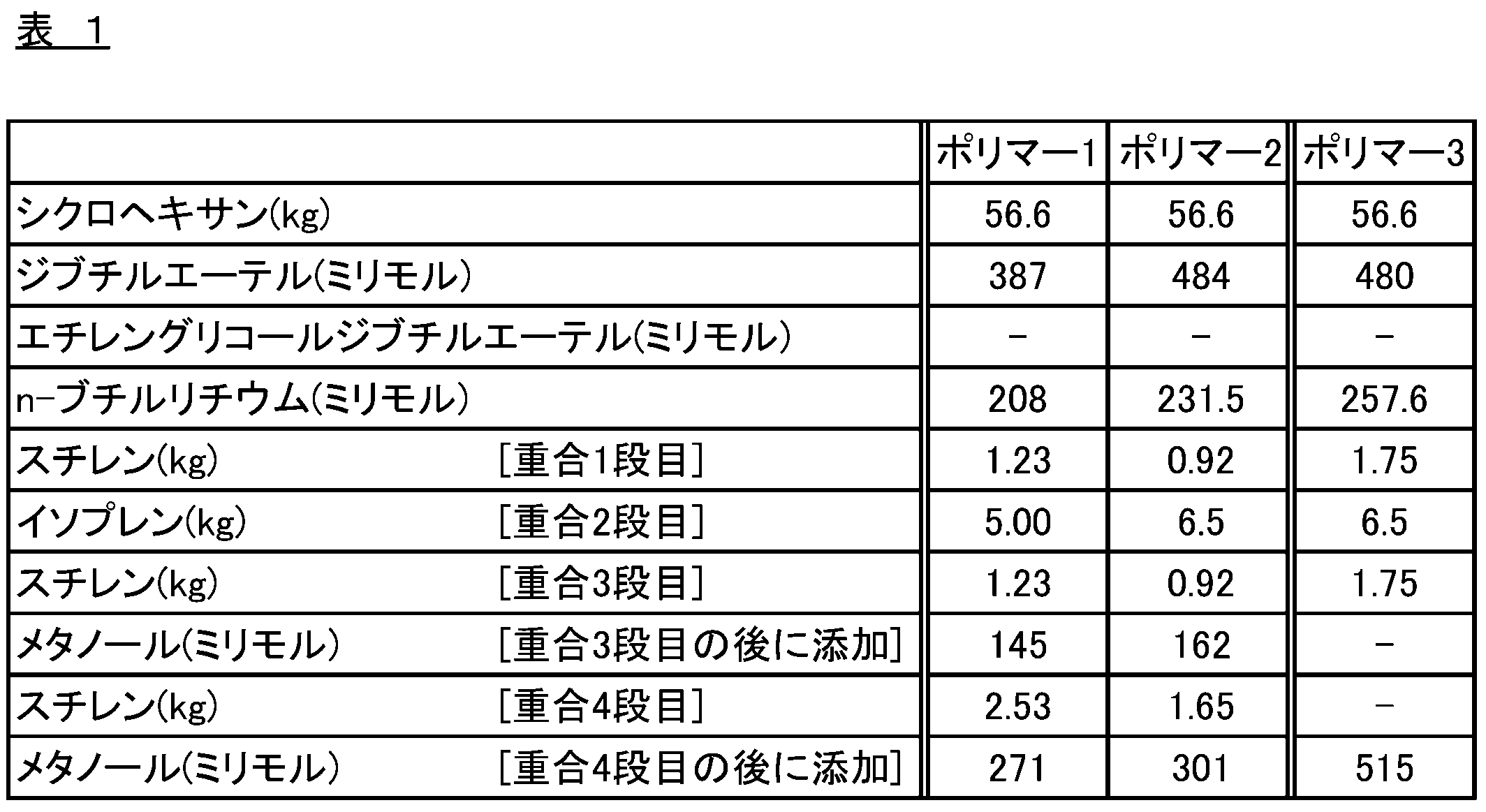
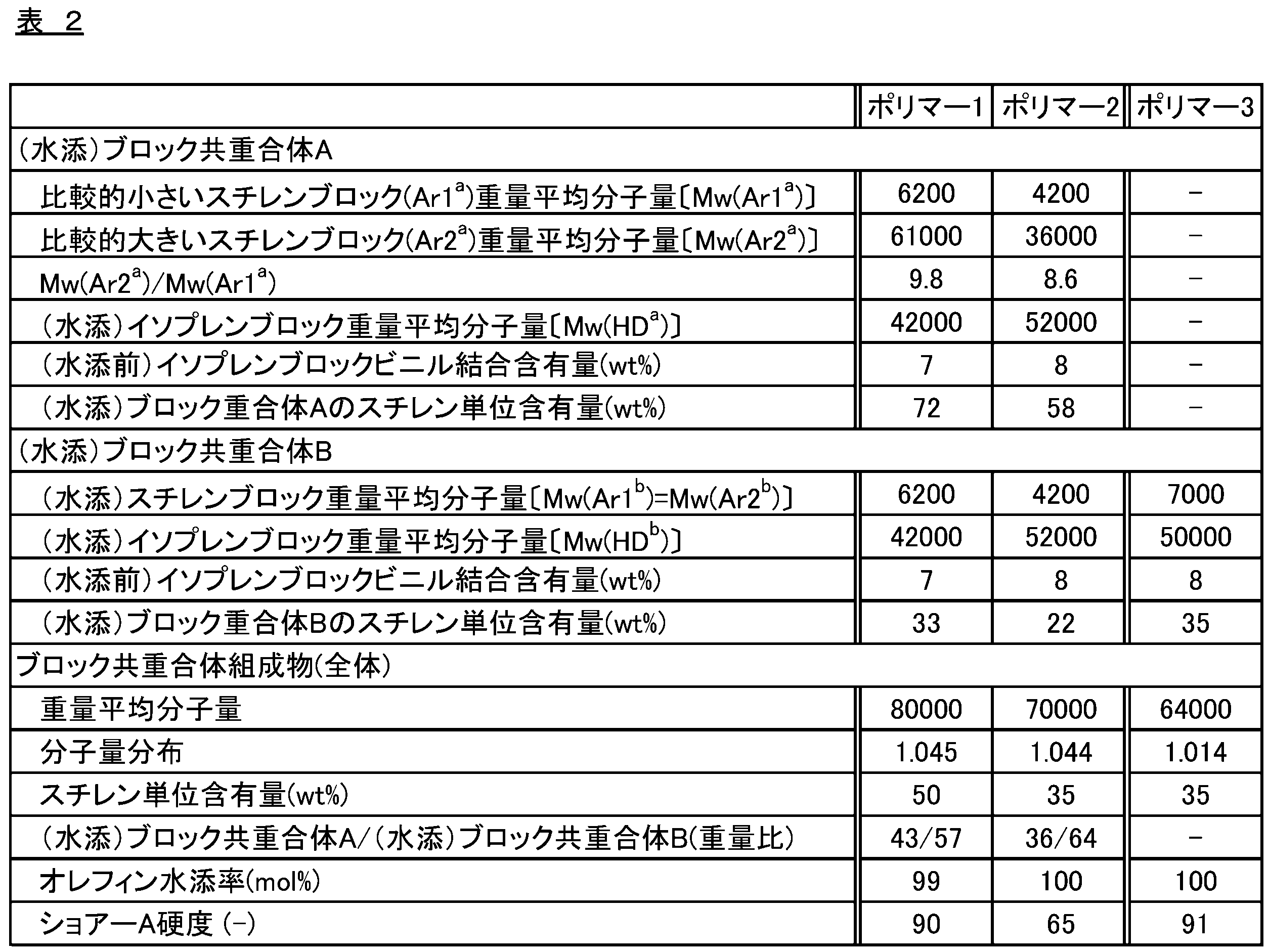
〔実施例1〕
水添ブロック共重合体組成物(ポリマー1)、ビニルトリメトキシシラン、および2,5-ジメチル-2,5-ジ(t-ブチルパーオキシ)ヘキサン(パーヘキサ25B、日油社製、有機過酸化物)を、小型二軸混錬機(Xplore MC40)に供給し、220℃で3分間溶融混錬した。引き続き、コハク酸(縮合反応触媒)を小型二軸混錬機に供給し、220℃でさらに3分間溶融混錬した。なお、各成分の供給比率は、表3に示すとおりとした。これにより、水添ブロック共重合体組成物(ポリマー1)中の、水添ブロック共重合体(A)の水添重合体ブロックHDaおよび水添ブロック共重合体(B)の水添重合体ブロックHDbに、ビニルトリメトキシシラン由来のシラン含有官能基、および、該シラン含有官能基由来の-Si-O-Si-結合を含む架橋構造が導入された。その結果、シラン変性水添ブロック共重合体(A-Si)とシラン変性水添ブロック共重合体(B-Si)とを含有する重合体組成物を架橋させてなる架橋物を得た。得られた架橋物を、200℃に設定したプレス機でプレス成型することで、厚み2mmのシートを得た。得られたシートを用いて、上記方法に従い、透明性、メルトフローレート、圧縮復元性、耐圧縮永久ひずみ性、およびピール強度を評価した。結果を表3に示す。
Example 1
The hydrogenated block copolymer composition (Polymer 1), vinyltrimethoxysilane, and 2,5-dimethyl-2,5-di(t-butylperoxy)hexane (Perhexa 25B, NOF Corp., organic peroxide) were supplied to a small twin-screw kneader (Xplore MC40) and melt-kneaded at 220° C. for 3 minutes. Successively, succinic acid (condensation reaction catalyst) was supplied to the small twin-screw kneader and melt-kneaded at 220° C. for another 3 minutes. The supply ratio of each component was as shown in Table 3. As a result, a silane-containing functional group derived from vinyltrimethoxysilane and a crosslinked structure containing a —Si—O—Si— bond derived from the silane-containing functional group were introduced into the hydrogenated polymer block HD a of the hydrogenated block copolymer (A) and the hydrogenated polymer block HD b of the hydrogenated block copolymer (B) in the hydrogenated block copolymer composition (Polymer 1). As a result, a crosslinked product was obtained by crosslinking a polymer composition containing the silane-modified hydrogenated block copolymer (A-Si) and the silane-modified hydrogenated block copolymer (B-Si). The crosslinked product was press-molded using a press set at 200°C to obtain a sheet having a thickness of 2 mm. The transparency, melt flow rate, compression recovery, compression set resistance, and peel strength of the obtained sheet were evaluated according to the above-mentioned methods. The results are shown in Table 3.
〔実施例2~4〕
ブロック共重合体組成物の種類、酸触媒の種類、および各成分の供給量を、表1に記載のとおりに変更した以外は、実施例1と同様にして、架橋物およびシートを得て、同様に評価した。結果を表3に示す。なお、実施例2~4においては、水添ブロック共重合体組成物(ポリマー1または2)中の、水添ブロック共重合体(A)の水添重合体ブロックHDaおよび水添ブロック共重合体(B)の水添重合体ブロックHDbに、ビニルトリメトキシシラン由来のシラン含有官能基、および、該シラン含有官能基由来の-Si-O-Si-結合を含む架橋構造が導入された。
[Examples 2 to 4]
Crosslinked products and sheets were obtained and evaluated in the same manner as in Example 1, except that the type of block copolymer composition, the type of acid catalyst, and the supply amount of each component were changed as shown in Table 1. The results are shown in Table 3. In Examples 2 to 4, a silane-containing functional group derived from vinyltrimethoxysilane and a crosslinked structure containing a -Si-O-Si- bond derived from the silane-containing functional group were introduced into the hydrogenated polymer block HD a of the hydrogenated block copolymer (A) and the hydrogenated polymer block HD b of the hydrogenated block copolymer (B) in the hydrogenated block copolymer composition (polymer 1 or 2).
〔実施例5~6〕
水添ブロック共重合体組成物(ポリマー1)、ビニルトリメトキシシラン、および2,5-ジメチル-2,5-ジ(t-ブチルパーオキシ)ヘキサン(パーヘキサ25B、日油社製、有機過酸化物)を、小型二軸混錬機に供給し、220℃で3分間溶融混錬した。なお、各成分の供給比率は、表3に示すとおりとした。これにより、水添ブロック共重合体組成物(ポリマー1または2)中の、水添ブロック共重合体(A)の水添重合体ブロックHDa、および、水添ブロック共重合体(B)の水添重合体ブロックHDbに、ビニルトリメトキシシラン由来のシラン含有官能基が導入された。その結果、シラン変性水添ブロック共重合体(A-Si)とシラン変性水添ブロック共重合体(B-Si)とを含有する重合体組成物を得た。得られた重合体組成物を、200℃に設定したプレス機でプレス成型することで、厚み2mmのシートを得た。得られたシートを用いて、実施例1と同様に評価した。結果を表3に示す。
[Examples 5 to 6]
The hydrogenated block copolymer composition (Polymer 1), vinyltrimethoxysilane, and 2,5-dimethyl-2,5-di(t-butylperoxy)hexane (Perhexa 25B, NOF Corp., organic peroxide) were fed to a small twin-screw kneader and melt-kneaded at 220° C. for 3 minutes. The feed ratio of each component was as shown in Table 3. As a result, a silane-containing functional group derived from vinyltrimethoxysilane was introduced into the hydrogenated polymer block HD a of the hydrogenated block copolymer (A) and the hydrogenated polymer block HD b of the hydrogenated block copolymer (B) in the hydrogenated block copolymer composition (Polymer 1 or 2). As a result, a polymer composition containing a silane-modified hydrogenated block copolymer (A-Si) and a silane-modified hydrogenated block copolymer (B-Si) was obtained. The obtained polymer composition was press-molded with a press set at 200° C. to obtain a sheet having a thickness of 2 mm. The obtained sheet was used for evaluation in the same manner as in Example 1. The results are shown in Table 3.
〔比較例1〕
水添ブロック共重合体組成物(ポリマー1)に代えて、水添ブロック共重合体(B)(ポリマー3)を用いた以外は、実施例1と同様にして、シラン変性水添ブロック共重合体(B-Si)を架橋させてなる架橋物を得た。得られた架橋物を用いた以外は、実施例1と同様にしてシートを得て、実施例1と同様に評価した。結果を表3に示す。
Comparative Example 1
A crosslinked product was obtained by crosslinking the silane-modified hydrogenated block copolymer (B-Si) in the same manner as in Example 1, except that the hydrogenated block copolymer (B) (Polymer 3) was used instead of the hydrogenated block copolymer composition (Polymer 1). A sheet was obtained in the same manner as in Example 1, except that the obtained crosslinked product was used, and evaluated in the same manner as in Example 1. The results are shown in Table 3.
〔比較例2〕
水添ブロック共重合体組成物(ポリマー1)、エチレンプロピレンゴム(商品名「三井EPT 3092PM」、三井化学社製)、および2,5-ジメチル-2,5-ジ(t-ブチルパーオキシ)ヘキサン(パーヘキサ25B、日油社製、有機過酸化物)を、小型二軸混錬機に供給し、220℃で3分間混錬し、架橋体組成物を得た。各成分の供給比率は、表3に示すとおりとした。得られた架橋体組成物を、200℃に設定したプレス機でプレス成型することで、厚み2mmのシートを得た。得られたシートを用いて、実施例1と同様に評価した。結果を表3に示す。
Comparative Example 2
The hydrogenated block copolymer composition (Polymer 1), ethylene propylene rubber (product name "Mitsui EPT 3092PM", manufactured by Mitsui Chemicals, Inc.), and 2,5-dimethyl-2,5-di(t-butylperoxy)hexane (Perhexa 25B, manufactured by NOF Corporation, organic peroxide) were supplied to a small twin-screw kneader and kneaded at 220°C for 3 minutes to obtain a crosslinked composition. The supply ratio of each component was as shown in Table 3. The obtained crosslinked composition was press-molded using a press set at 200°C to obtain a sheet having a thickness of 2 mm. The obtained sheet was used for evaluation in the same manner as in Example 1. The results are shown in Table 3.
〔比較例3〕
オレフィン系熱可塑性エラストマー(架橋エチレンプロピレンターポリマーおよびポリプロピレンを主成分とする熱可塑性エラストマー、商品名「ミラストマー8030NS」、三井化学社製)を、200℃に設定したプレス機でプレス成型することで、厚み2mmのシートを得た。得られたシートを用いて、実施例1と同様に評価した。結果を表3に示す。
Comparative Example 3
An olefin-based thermoplastic elastomer (a thermoplastic elastomer mainly composed of crosslinked ethylene propylene terpolymer and polypropylene, product name "Milastomer 8030NS", manufactured by Mitsui Chemicals, Inc.) was press-molded using a press set at 200°C to obtain a sheet having a thickness of 2 mm. The obtained sheet was evaluated in the same manner as in Example 1. The results are shown in Table 3.
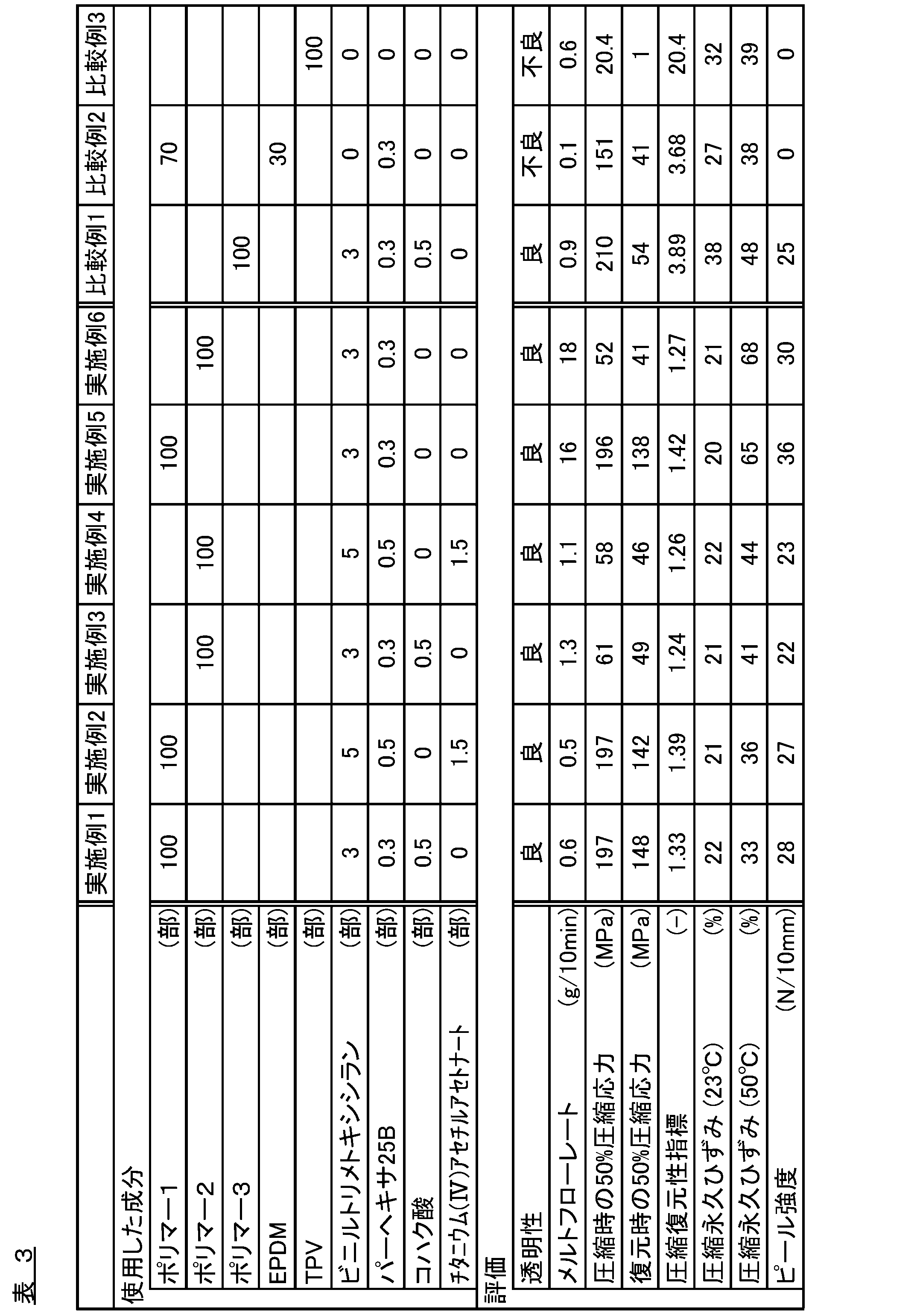
表3から、一般式(A)で表される水添ブロック共重合体(A)を不飽和シラン変性剤で変性してなる、シラン含有官能基を有するシラン変性水添ブロック共重合体が、圧縮復元性に優れることが確認できる(実施例1~6)。 From Table 3, it can be confirmed that the silane-modified hydrogenated block copolymer having a silane-containing functional group, which is obtained by modifying the hydrogenated block copolymer (A) represented by the general formula (A) with an unsaturated silane modifier, has excellent compression recovery (Examples 1 to 6).
一方、水添ブロック共重合体(A)とは異なる水添ブロック共重合体を不飽和シラン変性剤で変性した場合に、圧縮復元性に劣る結果となることが確認できる(比較例1)。
また、不飽和シラン変性剤による変性を行わなかった場合にも、圧縮復元性に劣る結果となることが確認できる(比較例2)。
さらに、オレフィン系熱可塑性エラストマーも、圧縮復元性に劣る結果となることが確認できる(比較例3)。
On the other hand, it can be confirmed that when a hydrogenated block copolymer different from the hydrogenated block copolymer (A) is modified with an unsaturated silane modifier, the compression recovery property is poor (Comparative Example 1).
It can also be seen that the compression recovery property is poor when no modification with an unsaturated silane modifier is performed (Comparative Example 2).
Furthermore, it can be confirmed that the olefin-based thermoplastic elastomer also results in poor compression recovery (Comparative Example 3).
Claims (15)
Ar1a-HDa-Ar2a (A)
(上記一般式(A)において、Ar1aおよびAr2aは、芳香族ビニル重合体ブロックであり、HDaは、共役ジエン重合体の水添重合体ブロックであり、Ar1aの重量平均分子量(Mw(Ar1a))に対する、Ar2aの重量平均分子量(Mw(Ar2a))の比(Mw(Ar2a)/Mw(Ar1a))は3.0~20である。) A silane-modified hydrogenated block copolymer having a silane-containing functional group, which is obtained by modifying a hydrogenated block copolymer (A) represented by the following general formula (A) with an unsaturated silane modifier:
Ar1 a -HD a -Ar2 a (A)
(In the above general formula (A), Ar1a and Ar2a are aromatic vinyl polymer blocks, HDa is a hydrogenated polymer block of a conjugated diene polymer, and the ratio (Mw(Ar2a)/Mw( Ar1a )) of the weight average molecular weight of Ar2a (Mw( Ar2a )) to the weight average molecular weight of Ar1a (Mw( Ar1a ) ) is 3.0 to 20.)

下記一般式(B)で表される水添ブロック共重合体(B)を不飽和シラン変性剤で変性してなる、シラン含有官能基を有するシラン変性水添ブロック共重合体(B-Si)と、
を含有する重合体組成物。
Ar1b-HDb-Ar2b (B)
(上記一般式(B)において、Ar1bおよびAr2bは、芳香族ビニル重合体ブロックであり、HDbは、共役ジエン重合体の水添重合体ブロックであり、Ar1bの重量平均分子量(Mw(Ar1b))に対する、Ar2bの重量平均分子量(Mw(Ar2b))の比(Mw(Ar2b)/Mw(Ar1b))は0.95~1.05である。) The silane-modified hydrogenated block copolymer (A-Si) according to any one of claims 1 to 8,
A silane-modified hydrogenated block copolymer (B-Si) having a silane-containing functional group, which is obtained by modifying a hydrogenated block copolymer (B) represented by the following general formula (B) with an unsaturated silane modifier;
A polymer composition comprising:
Ar1 b -HD b -Ar2 b (B)
(In the above general formula (B), Ar1 b and Ar2 b are aromatic vinyl polymer blocks, HD b is a hydrogenated polymer block of a conjugated diene polymer, and the ratio (Mw(Ar2 b )/Mw(Ar1 b )) of the weight average molecular weight of Ar2 b (Mw(Ar2 b )) to the weight average molecular weight of Ar1 b (Mw(Ar1 b ) ) is 0.95 to 1.05.)
Priority Applications (2)
| Application Number | Priority Date | Filing Date | Title |
|---|---|---|---|
| JP2025527980A JPWO2024257818A1 (en) | 2023-06-13 | 2024-06-12 | |
| CN202480037958.XA CN121311521A (en) | 2023-06-13 | 2024-06-12 | Silane-modified hydrogenated block copolymers, polymer compositions and crosslinks |
Applications Claiming Priority (2)
| Application Number | Priority Date | Filing Date | Title |
|---|---|---|---|
| JP2023-097251 | 2023-06-13 | ||
| JP2023097251 | 2023-06-13 |
Publications (1)
| Publication Number | Publication Date |
|---|---|
| WO2024257818A1 true WO2024257818A1 (en) | 2024-12-19 |
Family
ID=93852181
Family Applications (1)
| Application Number | Title | Priority Date | Filing Date |
|---|---|---|---|
| PCT/JP2024/021419 Ceased WO2024257818A1 (en) | 2023-06-13 | 2024-06-12 | Silane-modified hydrogenated block copolymer, polymer composition, and crosslinked product |
Country Status (3)
| Country | Link |
|---|---|
| JP (1) | JPWO2024257818A1 (en) |
| CN (1) | CN121311521A (en) |
| WO (1) | WO2024257818A1 (en) |
Cited By (1)
| Publication number | Priority date | Publication date | Assignee | Title |
|---|---|---|---|---|
| WO2025205181A1 (en) * | 2024-03-29 | 2025-10-02 | 日本ゼオン株式会社 | Polymer composition |
Citations (4)
| Publication number | Priority date | Publication date | Assignee | Title |
|---|---|---|---|---|
| JP2010202716A (en) * | 2009-02-27 | 2010-09-16 | Nippon Zeon Co Ltd | Production method of block copolymer composition |
| WO2017002567A1 (en) * | 2015-06-29 | 2017-01-05 | 日本ゼオン株式会社 | Resin composition, resin laminate and resin laminated metallic foil |
| WO2018116997A1 (en) * | 2016-12-22 | 2018-06-28 | 日本ゼオン株式会社 | Laminated glass |
| JP2021038286A (en) * | 2019-08-30 | 2021-03-11 | 日本ゼオン株式会社 | Resin composition, molding, joint body, and method for producing joint body |
-
2024
- 2024-06-12 WO PCT/JP2024/021419 patent/WO2024257818A1/en not_active Ceased
- 2024-06-12 CN CN202480037958.XA patent/CN121311521A/en active Pending
- 2024-06-12 JP JP2025527980A patent/JPWO2024257818A1/ja active Pending
Patent Citations (4)
| Publication number | Priority date | Publication date | Assignee | Title |
|---|---|---|---|---|
| JP2010202716A (en) * | 2009-02-27 | 2010-09-16 | Nippon Zeon Co Ltd | Production method of block copolymer composition |
| WO2017002567A1 (en) * | 2015-06-29 | 2017-01-05 | 日本ゼオン株式会社 | Resin composition, resin laminate and resin laminated metallic foil |
| WO2018116997A1 (en) * | 2016-12-22 | 2018-06-28 | 日本ゼオン株式会社 | Laminated glass |
| JP2021038286A (en) * | 2019-08-30 | 2021-03-11 | 日本ゼオン株式会社 | Resin composition, molding, joint body, and method for producing joint body |
Cited By (1)
| Publication number | Priority date | Publication date | Assignee | Title |
|---|---|---|---|---|
| WO2025205181A1 (en) * | 2024-03-29 | 2025-10-02 | 日本ゼオン株式会社 | Polymer composition |
Also Published As
| Publication number | Publication date |
|---|---|
| JPWO2024257818A1 (en) | 2024-12-19 |
| CN121311521A (en) | 2026-01-09 |
Similar Documents
| Publication | Publication Date | Title |
|---|---|---|
| JP5527220B2 (en) | Block copolymer composition and hot melt adhesive composition | |
| CN111819212B (en) | block copolymer composition | |
| CN101981121B (en) | Block copolymer composition, method for producing the same, and film of the same | |
| JP5494650B2 (en) | Elastic film composition | |
| CN104955893B (en) | Thermoplastic polymer composition, shoes and outer bottom | |
| CN116217844B (en) | Two-component block copolymers | |
| JP7064909B2 (en) | Thermoplastic resin compositions and molded products | |
| CN105899561A (en) | Polymer and asphalt composition | |
| JP5569310B2 (en) | Method for producing polymer composition | |
| WO2024257818A1 (en) | Silane-modified hydrogenated block copolymer, polymer composition, and crosslinked product | |
| JPWO2010098356A1 (en) | Block copolymer composition for flexographic plates | |
| CN1735659A (en) | Styrenic block copolymer compositions to be used for the manufacture of transparent, gel free films. | |
| CN1247667C (en) | Crossliking method of alkyl styrene polymer and composite containing said polymer | |
| JP7697368B2 (en) | Hydrogenated block copolymer composition, production method thereof and film | |
| JP7354617B2 (en) | electrical insulation tape | |
| JP5402780B2 (en) | Hot melt adhesive composition | |
| WO2025205181A1 (en) | Polymer composition | |
| JP2025163994A (en) | Epoxy resin composition | |
| EP3842504B1 (en) | Hot-melt elastic adhesive | |
| JP3776589B2 (en) | Saturated hydrocarbon polymer having primary hydroxyl group at its terminal and process for producing the same | |
| KR20130090728A (en) | Polyethylene elastomer modified by vinyl aromatic hydrocarbon-conjugated diene block copolymers and method of preparing the same | |
| WO2024024449A1 (en) | Crosslinkable polymer composition, crosslinked product, and crosslinked foam | |
| EP4458892A1 (en) | Foam body and buffer material | |
| WO2006120995A1 (en) | Block copolymer, resin composition containing same, and method for producing same |
Legal Events
| Date | Code | Title | Description |
|---|---|---|---|
| 121 | Ep: the epo has been informed by wipo that ep was designated in this application |
Ref document number: 24823433 Country of ref document: EP Kind code of ref document: A1 |
|
| ENP | Entry into the national phase |
Ref document number: 2025527980 Country of ref document: JP Kind code of ref document: A |
|
| WWE | Wipo information: entry into national phase |
Ref document number: 2025527980 Country of ref document: JP |
|
| NENP | Non-entry into the national phase |
Ref country code: DE |