WO2024257863A1 - リグニン誘導体及びそれを含有する水硬性組成物用添加剤 - Google Patents
リグニン誘導体及びそれを含有する水硬性組成物用添加剤 Download PDFInfo
- Publication number
- WO2024257863A1 WO2024257863A1 PCT/JP2024/021736 JP2024021736W WO2024257863A1 WO 2024257863 A1 WO2024257863 A1 WO 2024257863A1 JP 2024021736 W JP2024021736 W JP 2024021736W WO 2024257863 A1 WO2024257863 A1 WO 2024257863A1
- Authority
- WO
- WIPO (PCT)
- Prior art keywords
- group
- compound
- acid
- carbon atoms
- lignin derivative
- Prior art date
- Legal status (The legal status is an assumption and is not a legal conclusion. Google has not performed a legal analysis and makes no representation as to the accuracy of the status listed.)
- Ceased
Links
Classifications
-
- C—CHEMISTRY; METALLURGY
- C04—CEMENTS; CONCRETE; ARTIFICIAL STONE; CERAMICS; REFRACTORIES
- C04B—LIME, MAGNESIA; SLAG; CEMENTS; COMPOSITIONS THEREOF, e.g. MORTARS, CONCRETE OR LIKE BUILDING MATERIALS; ARTIFICIAL STONE; CERAMICS; REFRACTORIES; TREATMENT OF NATURAL STONE
- C04B24/00—Use of organic materials as active ingredients for mortars, concrete or artificial stone, e.g. plasticisers
- C04B24/16—Sulfur-containing compounds
- C04B24/18—Lignin sulfonic acid or derivatives thereof, e.g. sulfite lye
-
- C—CHEMISTRY; METALLURGY
- C08—ORGANIC MACROMOLECULAR COMPOUNDS; THEIR PREPARATION OR CHEMICAL WORKING-UP; COMPOSITIONS BASED THEREON
- C08G—MACROMOLECULAR COMPOUNDS OBTAINED OTHERWISE THAN BY REACTIONS ONLY INVOLVING UNSATURATED CARBON-TO-CARBON BONDS
- C08G8/00—Condensation polymers of aldehydes or ketones with phenols only
- C08G8/04—Condensation polymers of aldehydes or ketones with phenols only of aldehydes
-
- C—CHEMISTRY; METALLURGY
- C08—ORGANIC MACROMOLECULAR COMPOUNDS; THEIR PREPARATION OR CHEMICAL WORKING-UP; COMPOSITIONS BASED THEREON
- C08H—DERIVATIVES OF NATURAL MACROMOLECULAR COMPOUNDS
- C08H6/00—Macromolecular compounds derived from lignin, e.g. tannins, humic acids
Definitions
- the present invention relates to a lignin derivative and an additive for hydraulic compositions containing the same.
- Lignin is a natural polymeric compound found in trees, and lignin sulfonate, which is contained in sulfite pulp waste liquor discharged from the papermaking process, has long been used as a dispersant for cement, dyes, and other products. In recent years, it has been attracting attention as a renewable wood-derived biomass material, and further utilization is being considered.
- Patent Document 1 discloses a dispersant containing a lignin derivative consisting of a reaction product of a lignin sulfonate salt and a water-soluble monomer having a polyalkylene oxide chain.
- Patent Document 2 discloses a dispersant containing a lignin derivative compound which is a reaction product of a lignin sulfonate compound and an aromatic water-soluble compound
- Patent Document 3 discloses a dispersant containing a lignin derivative which meets certain conditions such as viscosity and surface tension.
- JP 2011-240224 A International Publication No. 2019/039609 JP 2020-025935 A
- the present invention was made in consideration of the above-mentioned current situation, and aims to provide a lignin derivative and an additive for hydraulic compositions containing the same, which can be produced under industrially reasonable reaction conditions and can exhibit stable high fluidity by increasing the material uniformity of the hydraulic composition at the initial stage of mixing.
- a lignin derivative which is a reaction product of a mixture containing a lignosulfonic acid compound, an aromatic compound (excluding the lignosulfonic acid compound), and an aldehyde compound, A lignin derivative having a (poly)alkyleneoxy group whose terminal is phosphated.
- n 1 or 2
- R 1 represents a hydrogen atom or a hydrocarbon group having 1 to 24 carbon atoms
- a 1 O represents an alkyleneoxy group having 2 to 4 carbon atoms
- m is the average number of moles of A 1 O added and is a number from 1 to 300
- X1 represents a phosphate group
- R 1 represents —CH 2 —, —C(CH 3 ) 2 —, or —SO 2 —
- a 1 O represents an alkyleneoxy group having 2 to 4 carbon atoms
- m is the average number of moles of A 1 O added and is a number from 1 to 300
- X1 represents a phosphate group.
- q represents 1 or 2
- R3 represents a hydrogen atom or a hydrocarbon group having 1 to 24 carbon atoms
- a 2 O represents an alkyleneoxy group having 2 to 4 carbon atoms
- p is the average number of moles of A 2 O added and is a number from 1 to 300
- R2 represents a hydrogen atom, an alkyl group having 1 to 10 carbon atoms, or an acyl group having 2 to 24 carbon atoms
- R 3 represents —CH 2 —, —C(CH 3 ) 2 —, or —SO 2 —
- a 2 O represents an alkyleneoxy group having 2 to 4 carbon atoms
- p is the average number of moles of A 2 O added and is a number from 1 to 300
- R2 represents a hydrogen atom, an alkyl group having 1 to 10 carbon atoms, or an acyl group having 2 to 24 carbon atoms.
- the lignin derivative of the present invention can be produced under industrially reasonable reaction conditions, and when added as an additive to a hydraulic composition, it can improve the uniformity of the material at the initial stage of mixing, thereby enabling the hydraulic composition to exhibit stable, high fluidity.
- the lignin derivative of the present invention is a reaction product of a mixture containing a lignin sulfonic acid compound, an aromatic compound, and an aldehyde compound, and has a (poly)alkyleneoxy group whose terminal is phosphated.
- the term "(poly)alkyleneoxy group having a phosphate ester at one end” refers to a structure in which a phosphate ester group is introduced at one end of a (poly)alkyleneoxy group.
- Examples of phosphate esters constituting the phosphate ester group include phosphate monoesters and their salts, phosphate diesters and their salts, phosphate triesters, and mixtures thereof.
- a phosphate ester group composed of a phosphate monoester represented by the following formula and its salt.
- the (poly)alkyleneoxy group is composed of repeating units (alkyleneoxy units) derived from alkylene oxide, and the number of carbon atoms in the alkyleneoxy unit is not particularly limited, but is usually 2 to 18, preferably 2 to 4, and more preferably 2 to 3.
- alkylene oxide (alkyleneoxy unit) include ethylene oxide (ethyleneoxy unit), propylene oxide (propyleneoxy unit), and butylene oxide (butyleneoxy unit), and ethylene oxide and propylene oxide are preferred.
- These alkylene oxides can be used alone or in combination of two or more.
- the addition form of the alkylene oxides may be either random addition or block addition.
- the average number of moles of the alkylene oxide units added is preferably 1 or more, more preferably 2 or more, and even more preferably 3 or more.
- the upper limit is preferably 300 or less, more preferably 200 or less, and even more preferably 150 or less.
- the terminal of the (poly)alkyleneoxy group that is not phosphated may be bonded directly or via a linking group to a structural unit derived from a lignin sulfonate compound of a lignin derivative, or may be bonded similarly to a structural unit derived from an aromatic compound, or may be bonded to both, but is preferably bonded to a structural unit derived from an aromatic compound.
- the lignin sulfonic acid compound refers to a compound having a skeleton in which a carbon atom at the ⁇ -position of the side chain of the hydroxyphenylpropane structure of lignin is cleaved to introduce a sulfo group.
- the above compounds may be chemically modified by hydrolysis, alkoxylation, desulfonation, alkylation, or the like.
- the lignin sulfonic acid compound may be in the form of a salt.
- salts include monovalent metal salts, divalent metal salts, ammonium salts, and organic ammonium salts. Of these, calcium salts, magnesium salts, sodium salts, etc. are preferred.
- the manufacturing method and origin of the lignin sulfonate compound are not particularly limited, and it may be either a natural product or a synthetic product.
- Lignin sulfonate compounds are one of the main components of the waste liquor of sulfite pulp obtained by cooking wood under acidic conditions. Therefore, lignin sulfonate compounds derived from sulfite pulp waste liquor may be used.
- commercially available products may be used as the lignin sulfonate compound. Examples of commercially available products include sodium lignin sulfonate manufactured by Tokyo Chemical Industry Co., Ltd., Vanilex (registered trademark) HW, Vanilex N, etc.
- the aromatic compound refers to a compound having at least one aromatic skeleton, other than the lignosulfonic acid compound, which undergoes a condensation reaction with the lignosulfonic acid compound to form a copolymer.
- the aromatic compound include a phenolic compound having a (poly)alkyleneoxy group whose terminal is phosphoric esterified (compound A represented by formula (1) described below), an alkylene oxide adduct of a phenolic compound or a derivative thereof (compound B represented by formula (2)), as well as phenols and non-phenolic aromatic compounds having no phenolic hydroxy group.
- Compound A is a phosphate derivative of an alkylene oxide adduct of a phenolic compound such as phenol or bisphenol A, and has a structure represented by the following formula (1).
- the aromatic compound of the present invention preferably contains at least compound A represented by formula (1).
- n represents 1 or 2; when n represents 1, R 1 represents a hydrogen atom or a hydrocarbon group having 1 to 24 carbon atoms; when n represents 2, R 1 represents -CH 2 -, -C(CH 3 ) 2 -, or -SO 2 -.
- a 1 O represents an alkyleneoxy group having 2 to 4 carbon atoms; m is the average number of moles of A 1 O added and is a number of 1 to 300; and X 1 represents a phosphate group.
- the compound A is a phosphate derivative of a compound in which an alkylene oxide having 2 to 4 carbon atoms is added to a phenolic compound such as phenol or bisphenol A or the like, which is a substituted compound.
- a phenolic compound such as phenol or bisphenol A or the like
- alkylene oxide having 2 to 4 carbon atoms include ethylene oxide, propylene oxide and butylene oxide. These alkylene oxides can be added singly or in combination. When two or more alkylene oxides are used, they may be added in either a block or random form.
- examples of the alkyleneoxy group having 2 to 4 carbon atoms in A 1 O include an ethyleneoxy group, a propyleneoxy group, and a butyleneoxy group.
- a 1 O may be composed of only an ethyleneoxy group, a propyleneoxy group, or a butyleneoxy group, or may contain two or more of these groups. When two or more groups are contained, the addition form thereof may be either random addition or block addition.
- m is the average number of moles of A 1 O added, and is a number of 1 to 300, preferably 2 to 200, and more preferably 3 to 150.
- examples of the hydrocarbon group having 1 to 24 carbon atoms in R 1 include an alkyl group having 1 to 24 carbon atoms, an alkenyl group having 2 to 24 carbon atoms, an unsaturated aliphatic hydrocarbon group having 4 to 24 carbon atoms and having two or more unsaturated bonds, an aryl group having 6 to 20 carbon atoms, and an aralkyl group having 7 to 24 carbon atoms.
- alkyl group having 1 to 24 carbon atoms examples include a methyl group, an ethyl group, a propyl group, a butyl group, a pentyl group, a hexyl group, a heptyl group, an octyl group, a nonyl group, a decyl group, a dodecyl group (a lauryl group), a tetradecyl group (a myristyl group), a hexadecyl group (a palmityl group), an octadecyl group (a stearyl group), an icosyl group, a docosyl group (a behenyl group), a tetracosyl group, and the like, which may have a branched structure (for example, an isopropyl group, an isobutyl group, a sec-butyl group, a tert-butyl group, a neopen
- alkenyl group having 2 to 24 carbon atoms examples include the above-mentioned alkyl groups having 2 to 24 carbon atoms, each of which has one carbon-carbon double bond. Specific examples include ethenyl, propenyl, butenyl, pentenyl, hexenyl, heptenyl, octenyl, nonenyl, decenyl, dodecenyl, tetradecenyl, pentadecenyl, hexadecenyl, octadecenyl, eicosenyl, docosenyl, and tetracosenyl groups, each of which may have a branched structure and/or a cyclic structure.
- Examples of the unsaturated aliphatic hydrocarbon group having 4 to 24 carbon atoms and two or more unsaturated bonds include a decadienyl group, an undecadienyl group, a dodecadienyl group, a tridecadienyl group, a tetradecadienyl group, a pentadecadienyl group, a hexadecadienyl group, a heptadecadienyl group, an octadecadienyl group, a nonadecadienyl group, an icosadienyl group, a henicosadienyl group, a docosadienyl group, a tricosadienyl group, Examples of such groups include a tetracosadienyl group, a decatrienyl group, an undecatrienyl group, a dodecatrienyl group, a tridecatrienyl
- aryl group having 6 to 20 carbon atoms examples include, but are not limited to, a phenyl group, a naphthyl group, an anthryl group, and a phenanthryl group.
- An aralkyl group is an alkyl group substituted with an aryl group, and specific examples of such aryl groups and alkyl groups are the same as those mentioned above.
- aralkyl groups having 7 to 24 carbon atoms include, but are not limited to, a phenylmethyl group (benzyl group), an ⁇ -methylbenzyl group, a 2-phenylethyl group, a 1-methyl-1-phenylethyl group (cumyl group), a 3-phenyl-propyl group, a 2-phenyl-2-propyl group, and the like.
- R 1 represents —CH 2 —, —C(CH 3 ) 2 —, or —SO 2 —.
- the bonding position of R 1 in formula (1) is not particularly limited, but it is preferable that R 1 be bonded to the para position with respect to the oxygen atom bonded to the aromatic ring, in terms of easily exerting the effects of the present invention.
- R 1 is preferably a hydrogen atom or a tert-butyl group, and when n is 2, R 1 is preferably --C(CH 3 ) 2 --.
- Compound A is a phosphoric acid monoester and/or a salt thereof, a phosphoric acid diester and/or a salt thereof, a phosphoric acid triester, or a mixture thereof.
- the phosphate ester salt include alkali metal salts such as sodium and potassium; Group 2 metal salts such as calcium and magnesium; ammonium salts; and organic ammonium salts such as alkylammonium and alkanolammonium.
- the compound A may be synthesized by a known method using a phosphorylating agent on a (poly)oxyalkylene alkylphenol.
- the phosphorylating agent include phosphoric anhydride, phosphoric acid, polyphosphoric acid, and phosphorus oxychloride.
- the compound A represented by the above formula (1) for example, when n is 1, the compound A may be represented by the following formula:
- R 1 , A 1 O, and n are the same as those defined in the above formula (1)
- Ph is a phenylene group
- M is a hydrogen atom, an alkali metal atom such as sodium or potassium, an alkaline earth metal atom such as calcium or magnesium, an ammonium group, or an organic ammonium group such as an alkylammonium group or an alkanolammonium group.
- Z represents a polyoxyalkylene alkyl ether residue represented by the formula: R′′-O-(A′O)w- (wherein R′′ represents an alkyl group having 1 to 24 carbon atoms, A′O represents an alkyleneoxy group having 2 to 3 carbon atoms, i.e., an ethyleneoxy group or a propyleneoxy group, and w represents the average molar number of alkyleneoxy groups A′O added, which is 1 to 300), and when there are a plurality of Z's, they may be the same group or different groups.
- the compound A represented by the above formula (1) can be used either alone or in combination of two or more.
- the content ratio of compound A to the total mass of the aromatic compounds is preferably 1 mass% or more, more preferably 3 mass% or more, and even more preferably 5 mass% or more, and the aromatic compounds may be composed only of compound A (100 mass%).
- the content ratio of compound A in the aromatic compounds is 10 mass% or more, it is expected that the uniformity of the kneaded material will be improved.
- the aromatic compound may further include, in addition to compound A represented by formula (1) above, compound B having a structure represented by formula (2) below.
- q represents 1 or 2; when q represents 1, R3 represents a hydrogen atom or a hydrocarbon group having 1 to 24 carbon atoms; when q represents 2, R3 represents -CH2- , -C( CH3 ) 2- , or -SO2- .
- a 2 O represents an alkyleneoxy group having 2 to 4 carbon atoms
- p is the average number of moles of A 2 O added and is a number of 1 to 300
- R 2 represents a hydrogen atom, an alkyl group having 1 to 10 carbon atoms, or an acyl group having 2 to 24 carbon atoms.
- the above-mentioned compound B is a compound in which an alkylene oxide having 2 to 4 carbon atoms is added to a phenolic compound such as phenol or bisphenol A, or a substituted compound thereof, and derivatives of the alkylene oxide adduct (alkyl ester or fatty acid ester) are also included in compound B.
- a phenolic compound such as phenol or bisphenol A
- derivatives of the alkylene oxide adduct alkyl ester or fatty acid ester
- alkylene oxide having 2 to 4 carbon atoms include ethylene oxide, propylene oxide and butylene oxide. These alkylene oxides can be added singly or in combination. When two or more alkylene oxides are used, they may be added in either a block or random form.
- examples of the alkyleneoxy group having 2 to 4 carbon atoms in A 2 O include an ethyleneoxy group, a propyleneoxy group, and a butyleneoxy group.
- a 2 O may be composed of only an ethyleneoxy group, a propyleneoxy group, or a butyleneoxy group, or may contain two or more of these groups. When two or more groups are contained, the addition form thereof may be either random addition or block addition.
- p is the average number of moles of alkyleneoxy groups added and represents a number from 1 to 300, preferably from 10 to 200, and more preferably from 20 to 150.
- the alkyl group having 1 to 10 carbon atoms in R 2 may have a branched structure and/or a cyclic structure, and specific examples thereof include alkyl groups having 1 to 10 carbon atoms among the groups given as specific examples of the alkyl group having 1 to 24 carbon atoms in R 1.
- Specific examples thereof include a methyl group, an ethyl group, an n-propyl group, an isopropyl group, a cyclopropyl group, an n-butyl group, an isobutyl group, a sec-butyl group, a tert-butyl group, an n-pentyl group, a neopentyl group, a cyclopentyl group, an n-hexyl group, a cyclohexyl group, an n-octyl group, an n-decyl group, and a 1-adamantyl group.
- acyl group having 2 to 24 carbon atoms examples include saturated or unsaturated acyl groups (R'(CO)- group, where R' is a hydrocarbon group having 1 to 23 carbon atoms).
- saturated acyl group having 2 to 24 carbon atoms include carboxylic acids such as acetic acid, propionic acid, butanoic acid, pentanoic acid, hexanoic acid (caproic acid), heptanoic acid, octanoic acid (caprylic acid), nonanoic acid, decanoic acid (capric acid), dodecanoic acid (lauric acid), tetradecanoic acid (myristic acid), pentadecanoic acid (pentadecylic acid), hexadecanoic acid (palmitic acid), heptadecanoic acid (margaric acid), octadecanoic acid (stearic acid), nonadecanoic acid, eicosa
- R 3 represents —CH 2 —, —C(CH 3 ) 2 —, or —SO 2 —.
- the bonding position of R3 in formula (2) is not particularly limited, but it is preferable that R3 be bonded to the para position with respect to the oxygen atom bonded to the aromatic ring, in terms of easily exerting the effects of the present invention.
- R 3 is preferably a hydrogen atom or a tert-butyl group, and when q is 2, R 3 is preferably --C(CH 3 ) 2 --.
- the compound B represented by the above formula (2) can be used either alone or in combination of two or more.
- the content ratio of compound B in the aromatic compound is not particularly limited, but may be the remainder excluding compound A.
- the aromatic compound may contain, in addition to the above-mentioned compound A and compound B, other aromatic compounds capable of reacting with these compounds, within a range that does not impair the effects of the present invention.
- aromatic compounds include phenol, bisphenol A, isophthalic acid, oxynaphthoic acid, benzoic acid, hydroxybenzoic acid, naphthalenesulfonic acid, methylnaphthalenesulfonic acid, butylnaphthalenesulfonic acid, phenolsulfonic acid, cresolsulfonic acid, aniline sulfonic acid, benzenesulfonic acid, toluenesulfonic acid, and hydroxyethylphenol.
- aldehyde compounds As the aldehyde compound, a compound C having a structure represented by the following formula (3) can be preferably used.
- R 4 represents a hydrogen atom, a carboxyl group, an alkyl group having 1 to 10 carbon atoms, an alkenyl group having 2 to 10 carbon atoms, a phenyl group, a naphthyl group or a heterocyclic group; r represents a number from 1 to 100.
- alkyl groups, alkenyl groups, phenyl groups, naphthyl groups and heterocyclic groups may be substituted with any substituent, such as an alkyl group having 1 to 10 carbon atoms; an aryl group such as a phenyl group or a naphthyl group; a halogen atom such as a chlorine atom or a bromine atom; a sulfonic acid functional group such as a sulfo group or a sulfonate group; an acyl group such as an acetyl group; a hydroxy group; an amino group; or a carboxyl group.
- substituent such as an alkyl group having 1 to 10 carbon atoms; an aryl group such as a phenyl group or a naphthyl group; a halogen atom such as a chlorine atom or a bromine atom; a sulfonic acid functional group such as a sulfo group or a s
- the alkyl group having 1 to 10 carbon atoms and the alkenyl group having 2 to 10 carbon atoms in R4 may have a branched structure or a cyclic structure, and specific examples thereof include the alkyl group having 1 to 10 carbon atoms and the alkenyl group having 2 to 10 carbon atoms among the groups given as specific examples of the alkyl group having 1 to 24 carbon atoms and the alkenyl group having 2 to 24 carbon atoms in R1 in the compound A (formula (1)).
- examples of the heterocyclic group include a furyl group, a thienyl group, a pyridyl group, a piperidyl group, and a morpholino group.
- r preferably represents a number from 2 to 100.
- Examples of the compound C (aldehydes) include formaldehyde, paraformaldehyde, trioxane, glyoxylic acid, acetaldehyde, trichloroacetaldehyde, propionaldehyde, butyraldehyde, isobutyraldehyde, valeraldehyde, hexylaldehyde, heptanal, octylaldehyde, nonylaldehyde, isononylaldehyde, decylaldehyde, dodecanal, acrolein, crotonaldehyde, pentenal, hexenal, heptenal, octenal, cinnamaldehyde, benzaldehyde, benzaldehyde sulfonic acid, benzaldehyde disulfonic acid, anisaldehyde, salicylaldehyde
- Compound C represented by the above formula (3) can be used alone or in combination of two or more.
- the mass ratio of the lignin sulfonic acid compound/aromatic compound is 20/80 to 40/60, it is expected to obtain a more stable and high fluidity, and particularly when the mass ratio is 20/80 to 35/65, it is expected to obtain an even more stable and high fluidity.
- reaction ratio the mass ratio of the total amount of structural units derived from lignosulfonic acid compounds and unreacted lignosulfonic acid compound components to the total amount of structural units derived from aromatic compounds and unreacted aromatic compound components is the same as the feeding ratio thereof.
- reaction amount of the aldehyde compound relative to the total amount of the lignosulfonic acid compound and the aromatic compound is not particularly limited, but the mass ratio of the total amount to the aldehyde compound is preferably 99/1 to 80/20, more preferably 98/2 to 85/15, for example 98/2 to 90/10.
- the lignin derivative of the present invention is a reaction product of a mixture containing the above-mentioned lignin sulfonic acid compound, an aromatic compound, and an aldehyde compound, and comprises a copolymer obtained by polycondensation of this mixture.
- the ratio of each compound is not particularly limited.
- the polymerization method for obtaining the copolymer is not particularly limited.
- the order and method of adding the lignin sulfonic acid compound, aromatic compound, and aldehyde compound in the polycondensation are not particularly limited, and may be, for example, adding all of the raw material compounds at once before the polycondensation reaction, adding a portion of the raw material compounds before the polycondensation reaction and then adding the remainder in portions by dropwise addition, or adding a portion of the raw material compounds before the polycondensation reaction and then adding the remainder after a certain reaction time has elapsed, etc.
- the lignin derivative can be obtained, for example, by polycondensing a lignin sulfonic acid compound, an aromatic compound, and an aldehyde compound in the presence of a dehydration catalyst, either without a solvent or with a solvent, at a reaction temperature of 80° C. to 150° C. under normal pressure to elevated pressure, for example, 0.001 to 1 MPa.
- Examples of the dehydration catalyst include hydrochloric acid, perchloric acid, nitric acid, formic acid, methanesulfonic acid, octyl sulfonic acid, dodecylsulfonic acid, vinylsulfonic acid, allylsulfonic acid, phenolsulfonic acid, acetic acid, sulfuric acid, diethyl sulfate, dimethyl sulfate, phosphoric acid, oxalic acid, boric acid, benzoic acid, phthalic acid, salicylic acid, pyruvic acid, maleic acid, malonic acid, nitrobenzoic acid, nitrosalicylic acid, paratoluenesulfonic acid, benzenesulfonic acid, dodecylbenzenesulfonic acid, trifluoromethanesulfonic acid, fluoroacetic acid, thioglycolic acid, mercaptopropionic acid, activated clay, and the like
- dehydration catalysts may be used alone or in combination of two or more.
- the solvent may be water, a glycol ether compound such as propylene glycol monomethyl ether (PGME), an aromatic compound such as toluene or xylene, or a cyclic aliphatic compound such as methylcyclohexane.
- PGME propylene glycol monomethyl ether
- an aromatic compound such as toluene or xylene
- a cyclic aliphatic compound such as methylcyclohexane.
- a solvent that can be used as the dehydration catalyst such as acetic acid, may be used.
- the concentration of the components (lignin sulfonic acid compound, aromatic compound, and aldehyde compound) to be subjected to the polycondensation reaction in the reaction system may be appropriately selected, but if the concentration is too high, gelation may easily occur, and if the concentration is too low, the reaction may not proceed quickly.
- the components to be subjected to the polycondensation reaction may be about 30 to 70%.
- the reaction temperature may be, for example, 95° C. to 130° C., and the polycondensation reaction can be completed by carrying out the reaction for about 3 to 25 hours.
- the polycondensation reaction is preferably carried out under acidic conditions, and it is preferable to adjust the pH of the reaction system to 4 or less.
- a defoaming agent may be used during the production of the lignin derivative (polycondensation reaction), which can suppress foaming during the reaction and create a uniform reaction system.
- various known methods can be used to reduce the content of the unreacted aldehyde component (compound C) in the reaction system.
- various known methods can be used to reduce the content of the unreacted aldehyde component (compound C) in the reaction system.
- the dehydration catalyst used in the reaction can be neutralized after completion of the reaction and removed in the form of a salt by filtration, but even in an embodiment in which the catalyst is not removed, the performance of the additive for hydraulic compositions of the present invention described below is not impaired.
- Methods for removing the catalyst include, in addition to the above-mentioned filtration, phase separation, dialysis, ultrafiltration, and the use of an ion exchanger. Neutralizing the reaction product and diluting it with water or the like improves the workability of measurement and the like when it is used as an additive for hydraulic compositions, which will be described later.
- examples of basic compounds used for neutralization include alkali hydroxides such as sodium hydroxide and potassium hydroxide, alkaline earth hydroxides such as calcium hydroxide, ammonia, and organic amines such as monoethanolamine, diethanolamine, and triethanolamine, and one or more of these may be used in combination.
- alkali hydroxides such as sodium hydroxide and potassium hydroxide
- alkaline earth hydroxides such as calcium hydroxide
- ammonia such as calcium hydroxide
- organic amines such as monoethanolamine, diethanolamine, and triethanolamine
- the finally obtained copolymer suitably has a weight average molecular weight Mw (measured by gel permeation chromatography (hereinafter referred to as "GPC"), calculated as polyethylene glycol) in the range of 4,000 to 150,000, and more preferably has a weight average molecular weight in the range of 8,000 to 120,000, and particularly preferably in the range of 12,000 to 100,000, from the viewpoint of exhibiting excellent dispersion performance.
- Mw measured by gel permeation chromatography
- the "lignin derivative” may consist only of a copolymer obtained by polycondensation of a monomer mixture containing a lignin sulfonic acid compound, an aromatic compound, and an aldehyde compound, but generally includes components including unreacted components and by-products generated in each polymerization step, alkylene oxide addition step, etc.
- the additive for hydraulic compositions of the present invention contains the above-mentioned lignin derivative, and can be appropriately combined with known additives for hydraulic compositions according to various applications to produce so-called admixtures.
- At least one other additive selected from the group consisting of defoamers, setting retarders, setting accelerators, separation reducing agents, thickeners, shrinkage reducing agents, curing agents, water repellents, etc. may be blended. can.
- the hydraulic composition refers to a composition containing a powder having a property of hardening by a hydration reaction (hydraulic powder), such as cement, gypsum, fly ash, blast furnace slag, etc.
- a hydration reaction such as cement, gypsum, fly ash, blast furnace slag, etc.
- cement the hydraulic composition is also called a cement composition.
- cement dispersants are used in appropriate combinations depending on the manufacturing conditions and performance requirements of concrete, etc.
- the additive for hydraulic compositions of the present invention which is used alone as a cement dispersant or as a main agent, but can also be used as a modification aid for cement dispersants with large slump loss, or in combination with cement dispersants with high initial water reduction properties.
- known cement dispersants include salts of polycarboxylic acid copolymers described in JP-B-59-18338, JP-A-2628486, JP-A-2774445, etc., as well as salts of naphthalenesulfonic acid-formalin condensates, salts of melaminesulfonic acid-formalin condensates, ligninsulfonates, sodium gluconate, and sugar alcohols.
- the blending ratio of the polycondensate of the present invention to the known cement dispersants is, for example, 1:99 to 99:1 mass%.
- air entraining agents include anionic air entraining agents, nonionic air entraining agents, and amphoteric air entraining agents.
- the setting retarder include inorganic setting retarders and organic setting retarders. More specifically, examples include oxycarboxylic acids such as gluconic acid, glucoheptonic acid, tartaric acid, citric acid, malic acid, and arabinic acid, and salts thereof; sugars such as sucrose; and inorganic compounds such as zinc oxide, zinc chloride, silicofluorides, and silicofluoride salts.
- the accelerator may be an inorganic accelerator or an organic accelerator.
- thickeners/separation reducing agents examples include cellulose-based water-soluble polymers, polyacrylamide-based water-soluble polymers, biopolymer-based thickeners such as diutan gum, welan gum, and xanthan gum, and non-ionic thickeners such as polyethylene glycol and polyalkylene oxide.
- examples of the antifoaming agent include nonionic antifoaming agents, silicone antifoaming agents, higher alcohols, and mixtures containing these as main components.
- the components constituting the cement composition are conventionally used components for concrete, such as cement (e.g., ordinary Portland cement, high-early-strength Portland cement, ultra-high-early-strength Portland cement, low-heat/moderate-heat Portland cement, blast-furnace cement, etc.), aggregate (i.e., fine aggregate and coarse aggregate), admixture (e.g., silica fume, calcium carbonate powder, ground granulated blast-furnace slag, fly ash, etc.), expansive agent, and water.
- cement e.g., ordinary Portland cement, high-early-strength Portland cement, ultra-high-early-strength Portland cement, low-heat/moderate-heat Portland cement, blast-furnace cement, etc.
- aggregate i.e., fine aggregate and coarse aggregate
- admixture e.g., silica fume, calcium carbonate powder, ground granulated blast-furnace slag, fly ash,
- the additive for hydraulic compositions of the present invention can also be suitably used in hydraulic compositions (cement compositions) containing fly ash or ground granulated blast furnace slag as admixtures.
- Fly ash is composed mainly of silica (SiO 2 ) and alumina (Al 2 O 3 ), and is categorized into types I to IV (JIS A6201) based on particle size and flow value. It is said that the amount of unburned carbon contained in fly ash is related to the amount of air entraining agent used, and that an increase in the amount of unburned carbon tends to increase the amount of air entraining agent used. The amount of unburned carbon is generally said to be correlated with the amount of methylene blue adsorbed by fly ash.
- Ground granulated blast furnace slag is a by-product produced when refining iron in a blast furnace, and is composed mainly of calcium oxide (CaO), silica (SiO 2 ), and alumina (Al 2 O
- admixtures other than the additive for hydraulic compositions of the present invention that can be added separately during mixing include the above-mentioned publicly known and publicly used air entraining agents, setting retarders, accelerators, separation reducing agents, thickeners, defoamers, shrinkage reducing agents, etc., which can also be mixed appropriately.
- the mixing ratio of each of these components can be determined appropriately depending on the type of component selected and the purpose of use.
- the amount of the additive for hydraulic compositions of the present invention to be added varies depending on the mixing conditions including the above-mentioned concrete materials, but is usually added in an amount of about 0.05 to 5.0 mass% (as the amount of the lignin derivative itself) calculated as solid content based on the mass of cement, or based on the total mass of cement and powder such as fly ash when pozzolanic fine powder such as fly ash is used in combination.
- the amount added is appropriately adjusted according to the desired initial flow value, but care should be taken because adding too much may cause delay in setting and, in some cases, cause hardening failure.
- the additive for hydraulic compositions of the present invention can achieve higher fluidity than conventional products, that is, it can exhibit its performance at a lower addition rate than conventional products.
- the method of use is the same as that of a general cement dispersant, and it can be added as a stock solution when mixing concrete, or diluted in mixing water beforehand and added, or it can be added after mixing concrete or mortar, and then mixed uniformly again.
- the weight average molecular weight of the lignin derivative was measured by the following measurement method.
- GPC Gel Permeation Chromatography
- ⁇ Gel permeation chromatography (GPC) measurement conditions> Column: OHpak SB-802.5HQ, OHpak SB-803HQ, OHpak SB-804HQ (manufactured by Showa Denko K.K.) Eluent: a mixture of 50 mM sodium nitrate aqueous solution and acetonitrile (volume ratio 80/20)
- Detector differential refractometer, calibration curve: polyethylene glycol
- a phosphate ester of an EO 90 mol adduct of p-tert-butylphenol (A-2), a phosphate ester of an EO 4 mol adduct of bisphenol A (A-3), and a phosphate ester of an EO 3 mol adduct of p-tert-butylphenol (A-4) were obtained.
- aromatic compound B poly(ethylene oxide) monophenyl ethers having various EO addition mole numbers, an EO 60 mole adduct of bisphenol A, and an EO 44 mole adduct of p-tert-butylphenol were prepared.
- Example 1 (Production of lignin derivative (L-1))
- a glass reaction vessel equipped with a thermometer, a stirrer, and a reflux device 106 g of water, 45 g of poly(ethylene oxide) monophenyl ether (EO addition mole number: 90) (aromatic compound B), 3.4 g of aromatic compound A (A-1) synthesized in Production Example 1, 27 g of sodium lignin sulfonate (manufactured by Tokyo Chemical Industry Co., Ltd.), 2.3 g of 92% paraformaldehyde, 18.1 g of 98% aqueous sulfuric acid solution, and 0.02 g of antifoaming agent Pronal 753W (manufactured by Toho Chemical Industry Co., Ltd.) were charged, and the reaction vessel was heated to 105 ° C.
- Example 2 (Production of lignin derivative (L-2))
- a glass reaction vessel equipped with a thermometer, a stirrer, and a reflux device 106 g of water, 2.3 g of aromatic compound A (A-1) synthesized in Production Example 1, 32.7 g of aromatic compound A (A-2), 38.6 g of sodium ligninsulfonate (manufactured by Tokyo Chemical Industry Co., Ltd.), 3.8 g of 92% paraformaldehyde, 18.1 g of 98% aqueous sulfuric acid solution, and 0.02 g of defoamer Pronal 753W (manufactured by Toho Chemical Industry Co., Ltd.) were charged, and the reaction vessel was heated to 105 ° C.
- Example 3 (Production of lignin derivative (L-3)) A liquid (L-3) of a lignin derivative containing a copolymer having a weight average molecular weight of 61,000 was obtained under the same conditions and by the same method as in Example 1, except that 3.4 g of the phosphate ester compound (A-3) synthesized in Production Example 1 was used as the aromatic compound A.
- Examples 4 to 16 (Production of lignin derivatives (L-4 to L-10, L-14 to L-19)) Lignin derivative liquids (L-4) to (L-10) and (L-14) to (L-19) were obtained in the same manner as in Example 1, except that the types of lignin sulfonate compound and aromatic compound (A, B) and the reaction ratio (feed ratio) of each compound were changed as shown in Table 1.
- the lignin sulfonate compound was added dropwise.
- the mortar was prepared by additionally mixing at high speed for 60 seconds, and the mortar was subjected to flow measurement.
- the mixed state of the mortar was evaluated in the following three stages, and if it was ⁇ or higher, it could be judged to be good.
- the results obtained are shown in Table 3.
- the mortars of Examples 1 to 16 to which the lignin derivative of the present invention was added had a good mixed state and exhibited high fluidity from immediately after mixing until 30 minutes later and even 60 minutes later.
- the performance required for fluidity in general can be the ability to maintain fluidity for about 30 to 60 minutes (retention performance).
- Examples 1 to 16 above fully satisfy the performance required in the industry, and in particular, Examples 1, 3 to 6, 10, 12 to 14, and 16, in which the lignin sulfonate compound/aromatic compound ratio was 20/80 to 40/60 (mass ratio), showed little change from the initial state in terms of fluidity even after 60 minutes had elapsed, and in particular, Examples 12 and 16, in which the lignin sulfonate compound/aromatic compound ratio was 20/80 to 35/65 (mass ratio), showed little difference between the flow value after 30 minutes and the flow value after 60 minutes, confirming that high fluidity was maintained. Moreover, it was confirmed that Examples 2, 7 to 9, 12, 13, and 15, in which the proportion of compound A in the aromatic compounds was 10 mass % or more, had excellent material uniformity at the initial stage of mixing.
- Examples 1, 7, and 14 in which the same components were used as the lignin sulfonate compound, aromatic compound, and aldehyde compound it was confirmed that Examples 1 and 14, in which the lignin sulfonate compound/aromatic compound was 20/80 to 40/60 (mass ratio), maintained high fluidity, although the initial fluidity was somewhat inferior to that of Example 7, which was outside the above range.
- Example 16 in which the lignosulfonic acid compound/aromatic compound was 20/80 to 35/65 (mass ratio), had excellent initial fluidity and maintained high fluidity compared to Examples 8 and 15, which were outside the above range.
- Example 15 in which the lignosulfonic acid compound was added dropwise, maintained higher fluidity than Example 8.
- Example 12 in which the above three components were the same, it was confirmed that Example 12, in which the lignin sulfonic acid compound/aromatic compound was 20/80 to 35/65 (mass ratio), maintained a higher fluidity than Example 10, which was outside the above range.
- Example 7 (number of moles added: 90) and Example 8 (number of moles added: 22), in which the blending amounts of lignin sulfonic acid compound/aromatic compound were the same and the number of moles of alkyleneoxy groups added in compound B was changed, it was confirmed that although the initial fluidity of Example 8 was somewhat inferior to that of Example 7, it tended to maintain high fluidity after 60 minutes had elapsed.
Landscapes
- Chemical & Material Sciences (AREA)
- Organic Chemistry (AREA)
- Engineering & Computer Science (AREA)
- Chemical Kinetics & Catalysis (AREA)
- Materials Engineering (AREA)
- Health & Medical Sciences (AREA)
- Medicinal Chemistry (AREA)
- Polymers & Plastics (AREA)
- Ceramic Engineering (AREA)
- Life Sciences & Earth Sciences (AREA)
- Biochemistry (AREA)
- Structural Engineering (AREA)
- Compositions Of Macromolecular Compounds (AREA)
- Curing Cements, Concrete, And Artificial Stone (AREA)
Abstract
Description
特に水硬性組成物用の分散剤としてリグニン誘導体を使用した場合、セメント、モルタルまたはコンクリートの練り混ぜ工程において、混練された材料の均一性が不足し、結果として水硬性組成物の流動性が所望の性能を満足しないという課題があった。昨今の省エネ、脱炭素といった時代背景からバイオマス原料の活用が検討される中、この練り混ぜ工程における均一性の不足は、水硬性組成物の生産性低下に繋がりうる大きな課題であり、従来よりもより高いレベルにて混練材料の均一性が求められており、改善の余地があった。
[1]リグニンスルホン酸系化合物、芳香族化合物(前記リグニンスルホン酸系化合物を除く)及びアルデヒド化合物を含む混合物の反応生成物であるリグニン誘導体であって、
末端がリン酸エステル化された(ポリ)アルキレンオキシ基を有するリグニン誘導体。
[2]前記芳香族化合物が、下記式(1)で表される化合物Aを含む、[1]に記載のリグニン誘導体。

nが1を表す場合、
R1は水素原子又は炭素原子数1乃至24の炭化水素基を表し、
A1Oは、炭素原子数2乃至4のアルキレンオキシ基を表し、
mはA1Oの平均付加モル数であって1乃至300の数を表し、
X1はリン酸エステル基を表し、
nが2を表す場合、
R1は、-CH2-、-C(CH3)2-、又は-SO2-を表し、
A1Oは、炭素原子数2乃至4のアルキレンオキシ基を表し、
mはA1Oの平均付加モル数であって1乃至300の数を表し、
X1はリン酸エステル基を表す。)
[3]前記芳香族化合物の全質量に対する前記化合物Aの含有割合が3質量%以上である、[2]に記載のリグニン誘導体。
[4]前記芳香族化合物が、式(2)で表される化合物Bをさらに含む、[2]に記載のリグニン誘導体。

qが1を表す場合、
R3は、水素原子又は炭素原子数1乃至24の炭化水素基を表し、
A2Oは、炭素原子数2乃至4のアルキレンオキシ基を表し、
pはA2Oの平均付加モル数であって1乃至300の数を表し、
R2は水素原子、炭素原子数1乃至10のアルキル基、又は炭素原子数2乃至24のアシル基を表し、
qが2を表す場合、
R3は、-CH2-、-C(CH3)2-、又は-SO2-を表し、
A2Oは、炭素原子数2乃至4のアルキレンオキシ基を表し、
pはA2Oの平均付加モル数であって1乃至300の数を表し、
R2は水素原子、炭素原子数1乃至10のアルキル基、又は炭素原子数2乃至24のアシル基を表す。)
[5]前記アルデヒド化合物が式(3)で表される化合物Cである、[1]に記載のリグニン誘導体。

rは1乃至100の数を表す。)
[6]前記リグニン誘導体が、前記リグニンスルホン酸系化合物及び前記芳香族化合物を質量比にて、リグニンスルホン酸系化合物:芳香族化合物=20:80~35:65にて含む混合物の反応生成物である、[1]に記載のリグニン誘導体。
[7][1]~[6]のいずれか1項に記載のリグニン誘導体を含有する、水硬性組成物用添加剤。
本発明が対象とするリグニン誘導体は、リグニンスルホン酸系化合物、芳香族化合物、及び、アルデヒド化合物を含む混合物の反応生成物であって、末端がリン酸エステル化された(ポリ)アルキレンオキシ基を有するリグニン誘導体である。
「末端がリン酸エステル化された(ポリ)アルキレンオキシ基」とは、(ポリ)アルキレンオキシ基の一方の末端にリン酸エステル基が導入された構造を指す。リン酸エステル基を構成するリン酸エステルとしては、リン酸モノエステル及びその塩、リン酸ジエステル及びその塩、リン酸トリエステル並びにそれらの混合物が挙げられる。これらの中でも、高い流動性を水硬性組成物に付与できる観点から、下記式で表されるリン酸モノエステル及びその塩から構成されるリン酸エステル基を含むことが好ましい。
*-O-P(=O)(-OM)2
(Mは、水素原子;ナトリウム又はカリウム等のアルカリ金属原子;カルシウム又はマグネシウム等のアルカリ土類金属原子;アンモニウム基;アルキルアンモニウム基又はアルカノールアンモニウム基等の有機アンモニウム基を表す。*は他の基(構造)との結合手を表す。)
末端がリン酸エステル化された(ポリ)アルキレンオキシ基において、リン酸エステル化されていない方の(ポリ)アルキレンオキシ基の末端は、リグニン誘導体のうち、リグニンスルホン酸系化合物に由来する構成単位と直接または連結基を介して結合していてもよいし、芳香族化合物に由来する構成単位に同様に結合していてもよいし、両者と結合していてもよいが、芳香族化合物に由来する構成単位に結合していることが好ましい。
本発明において、リグニンスルホン酸系化合物とは、リグニンのヒドロキシフェニルプロパン構造の側鎖α位の炭素が開裂してスルホ基が導入された骨格を有する化合物を指す。
また、前記化合物を加水分解、アルコキシル化、脱スルホン化、アルキル化など化学的に変性修飾したものであってもよい。
本発明において芳香族化合物とは、芳香族骨格を少なくとも1つ有する化合物であり、リグニンスルホン酸系化合物と縮合反応して共重合体を生成する、前記リグニンスルホン酸系化合物以外の化合物をいう。
芳香族化合物としては、末端がリン酸エステル化された(ポリ)アルキレンオキシ基を有するフェノール系化合物(後述の式(1)で表される化合物A)や、フェノール系化合物のアルキレンオキサイド付加物又はその誘導体(式(2)で表される化合物B)の他、フェノール類、フェノール性ヒドロキシ基を有しない非フェノール性芳香族化合物が挙げられる。
化合物Aは、フェノールやビスフェノールA等のフェノール系化合物のアルキレンオキサイド付加物のリン酸エステル誘導体であって、下記式(1)で表される構造を有する。
本発明の芳香族化合物は、少なくとも式(1)で表される化合物Aを含むことが好ましい。

A1Oは、炭素原子数2乃至4のアルキレンオキシ基を表し、mはA1Oの平均付加モル数であって1乃至300の数を表し、X1はリン酸エステル基を表す。
上記炭素原子数2乃至4のアルキレンオキサイドとしては、エチレンオキサイド、プロピレンオキサイド及びブチレンオキサイドが挙げられ、これらアルキレンオキサイドは単独付加又は混合付加することができ、二種以上のアルキレンオキサイドを用いる場合にはブロック付加、ランダム付加何れの形態であってもよい。
またmはA1Oの平均付加モル数であって、1乃至300、好ましくは2乃至200、さらに好ましくは3乃至150の数を表す。
炭素原子数1乃至24のアルキル基としては、例えばメチル基、エチル基、プロピル基、ブチル基、ペンチル基、ヘキシル基、ヘプチル基、オクチル基、ノニル基、デシル基、ドデシル基(ラウリル基)、テトラデシル基(ミリスチル基)、ヘキサデシル基(パルミチル基)、オクタデシル基(ステアリル基)、イコシル基、ドコシル基(ベヘニル基)、テトラコシル基等が挙げられ、これらは分岐構造(例えばイソプロピル基、イソブチル基、sec-ブチル基、tert-ブチル基、ネオペンチル基等)及び/又は環状構造(例えばシクロプロピル基、シクロペンチル基、シクロヘキシル基、1-アダマンチル基等)を有していてもよい。
炭素原子数2乃至24のアルケニル基としては、上記アルキル基として挙げた炭素原子数2乃至24のアルキル基において、炭素-炭素二重結合を一個有する基が挙げられる。具体的には、エテニル基、プロペニル基、ブテニル基、ペンテニル基、ヘキセニル基、ヘプテニル基、オクテニル基、ノネニル基、デセニル基、ドデセニル基、テトラデセニル基、ペンタデセニル基、ヘキサデセニル基、オクタデセニル基、エイコセニル基、ドコセニル基、テトラコセニル基等が挙げられ、これらは分岐構造及び/又は環状構造を有していてもよい。
また、炭素原子数4乃至24の不飽和結合を2個以上有する不飽和脂肪族炭化水素基としては、デカジエニル基、ウンデカジエニル基、ドデカジエニル基、トリデカジエニル基、テトラデカジエニル基、ペンタデカジエニル基、ヘキサデカジエニル基、ヘプタデカジエニル基、オクタデカジエニル基、ノナデカジエニル基、イコサジエニル基、ヘンイコサジエニル基、ドコサジエニル基、トリコサジエニル基、テトラコサジエニル基、デカトリエニル基、ウンデカトリエニル基、ドデカトリエニル基、トリデカトリエニル基、テトラデカトリエニル基、ペンタデカトリエニル基、ヘキサデカトリエニル基、ヘプタデカトリエニル基、オクタデカトリエニル基、ノナデカトリエニル基、イコサトリエニル基、ヘンイコサトリエニル基、ドコサトリエニル基、トリコサトリエニル基、テトラコサトリエニル基等が挙げられる。
また、炭素原子数6乃至20のアリール基としては、一例としてフェニル基、ナフチル基、アントリル基、フェナントリル基等が挙げられるが、これらに限定されない。
アラルキル基は、アリール基が置換したアルキル基であり、このようなアリール基及びアルキル基の具体例としては、上述したものと同じものが挙げられる。炭素原子数7乃至24のアラルキル基の具体例としては、フェニルメチル基(ベンジル基)、α-メチルベンジル基、2-フェニルエチル基、1-メチル-1-フェニルエチル基(クミル基)、3-フェニル-プロピル基、2-フェニル-2-プロピル基等が挙げられるが、これらに限定されない。
なお、nが1である場合及びnが2である場合ともに、式(1)におけるR1の結合位置は特に限定されないが、芳香環に結合する酸素原子に対してパラ位に結合していることが、本発明の効果を発揮しやすい点で好ましい。
たとえば、nが1である場合、R1は水素原子、tert-ブチル基であることが好ましく、またnが2である場合、R1は-C(CH3)2-であることが好ましい。
上記リン酸エステル塩としては、ナトリウム、カリウム等のアルカリ金属塩;カルシウム又はマグネシウム等の第2族金属塩;アンモニウム塩;アルキルアンモニウム又はアルカノールアンモニウム等の有機アンモニウム塩等が挙げられる。
上記化合物Aは、(ポリ)オキシアルキレンアルキルフェノールにリン酸化剤を用い、公知の方法で合成したものを用いてもよい。リン酸化剤としては、無水リン酸、リン酸、ポリリン酸、オキシ塩化リンなどが挙げられる。
なお式中、R1、A1O、nは上記式(1)において定義されたものと同じものを表し、Phはフェニレン基を表す。またMは、水素原子;ナトリウム又はカリウム等のアルカリ金属原子;カルシウム又はマグネシウム等のアルカリ土類金属原子;アンモニウム基;アルキルアンモニウム基又はアルカノールアンモニウム基等の有機アンモニウム基を表す。
またZは、式:R”-O-(A’O)w-で表されるポリオキシアルキレンアルキルエーテル残基(式中、R”は炭素原子数1乃至24のアルキル基を表し、A’Oは炭素原子数2乃至3のアルキレンオキシ基を表し、すなわちエチレンオキシ基又はプロピレンオキシ基を表し、wはアルキレンオキシ基A’Oの平均付加モル数であって1乃至300を表す。)を表し、Zが複数存在する場合、互いに同じ基であっても異なる基であってもよい。
・リン酸モノエステル及びその塩
R1-Ph-O-[A1O]m-P(=O)(-OM)2
・リン酸ジエステル及びその塩
[R1-Ph-O-[A1O]m-]2P(=O)(-OM)
[R1-Ph-O-[A1O]m-](Z-)P(=O)(-OM)
・リン酸トリエステル
[R1-Ph-O-[A1O]m-]3P(=O)
[R1-Ph-O-[A1O]m-]2(Z-)P(=O)
[R1-Ph-O-[A1O]m-](Z-)2P(=O)
なお化合物Aの芳香族化合物の全質量に対する含有割合は、安定して高い流動性を得る観点から、好ましくは1質量%以上、より好ましくは3質量%以上、さらに好ましくは5質量%以上であり、芳香族化合物が化合物Aのみ(100質量%)から構成されていてもよい。なお、化合物Aの芳香族化合物における含有割合を10質量%以上とすると混練材料の均一性が向上することが期待できる。
芳香族化合物として、上記式(1)で表される化合物Aに加え、下記式(2)で表される構造を有する化合物Bをさらに含んでいてもよい。

A2Oは、炭素原子数2乃至4のアルキレンオキシ基を表し、pはA2Oの平均付加モル数であって1乃至300の数を表し、R2は水素原子、炭素原子数1乃至10のアルキル基、又は炭素原子数2乃至24のアシル基を表す。
上記炭素原子数2乃至4のアルキレンオキサイドとしては、エチレンオキサイド、プロピレンオキサイド及びブチレンオキサイドが挙げられ、これらアルキレンオキサイドは単独付加又は混合付加することができ、二種以上のアルキレンオキサイドを用いる場合にはブロック付加、ランダム付加何れの形態であってもよい。
また炭素原子数2乃至24のアシル基としては、飽和又は不飽和のアシル基(R’(CO)-基、R’は炭素原子数1乃至23の炭化水素基)が挙げられる。例えば炭素原子数2乃至24の、飽和のアシル基としては、酢酸、プロピオン酸、ブタン酸、ペンタン酸、ヘキサン酸(カプロン酸)、ヘプタン酸、オクタン酸(カプリル酸)、ノナン酸、デカン酸(カプリン酸)、ドデカン酸(ラウリン酸)、テトラデカン酸(ミリスチン酸)、ペンタデカン酸(ペンタデシル酸)、ヘキサデカン酸(パルミチン酸)、ヘプタデカン酸(マルガリン酸)、オクタデカン酸(ステアリン酸)、ノナデカン酸、エイコサン酸(アラキジン酸)、ドコサン酸(ベヘン酸)及びテトラコサン酸(リグノセリン酸)等のカルボン酸及び脂肪酸由来のアシル基が、モノ不飽和のアシル基としては、ミリストレイン酸、パルミトレイン酸、オレイン酸、エライジン酸、バクセン酸、ガドレイン酸、エイコセン酸、エルカ酸、ネルボン酸等のモノ不飽和脂肪酸由来のアシル基が、ジ不飽和のアシル基としては、リノール酸、エイコサジエン酸、ドコサジエン酸等のジ不飽和脂肪酸由来のアシル基が、そして、トリ不飽和のアシル基としては、リノレン酸、ピノレン酸、エレオステアリン酸、ミード酸、ジホモ-γ-リノレン酸、エイコサトリエン酸等のトリ不飽和脂肪酸由来のアシル基が挙げられる。
qが2である場合、上記R3は-CH2-、-C(CH3)2-、又は-SO2-を表す。
なお、qが1である場合及びqが2である場合ともに、式(2)におけるR3の結合位置は特に限定されないが、芳香環に結合する酸素原子に対してパラ位に結合していることが、本発明の効果を発揮しやすい点で好ましい。
たとえば、qが1である場合、R3は水素原子、tert-ブチル基であることが好ましく、またqが2である場合、R3は-C(CH3)2-であることが好ましい。
化合物Bの芳香族化合物における含有割合は特に限定されないが、前記化合物Aを除いた残部とすることができる。
本発明のリグニン誘導体において、上記芳香族化合物は、上記化合物A及び化合物Bに加え、本発明の効果を損なわない範囲において、これら化合物と反応可能なその他の芳香族化合物を含んでいてもよい。
その他の芳香族化合物としては、フェノール、ビスフェノールA、イソフタル酸、オキシナフトエ酸、安息香酸、ヒドロキシ安息香酸、ナフタレンスルホン酸、メチルナフタレンスルホン酸、ブチルナフタレンスルホン酸、フェノールスルホン酸、クレゾールスルホン酸、アニリンスルホン酸、ベンゼンスルホン酸、トルエンスルホン酸、ヒドロキシエチルフェノール等を挙げることができる。
アルデヒド化合物としては、下記式(3)で表される構造を有する化合物Cを好ましく用いることができる。

なおこれらアルキル基、アルケニル基、フェニル基、ナフチル基及びヘテロ環式基は、炭素原子数1乃至10のアルキル基;フェニル基、ナフチル基等のアリール基;塩素原子、臭素原子等のハロゲン原子;スルホ基、スルホン酸塩基等のスルホン酸官能基;アセチル基等のアシル基;ヒドロキシ基;アミノ基;カルボキシル基等の任意の置換基で置換されていてもよい。
上記R4における炭素原子数1乃至10のアルキル基、及び炭素原子数2乃至10のアルケニル基は、分岐構造、環状構造を有していてもよく、その具体例としては、上記化合物A(式(1))中のR1における炭素原子数1乃至24のアルキル基及び炭素原子数2乃至24のアルケニル基の具体例として挙げた基のうち、炭素原子数1乃至10のアルキル基、及び炭素原子数2乃至10のアルケニル基を挙げることができる。
さらに、ヘテロ環式基としては、フリル基、チエニル基、ピリジル基、ピペリジル基、モルホリノ基等が挙げられる。
またrは、好ましくは2乃至100の数を表す。
化合物Cは純粋な結晶若しくは粉状物質、又はそれらの水和物としての使用も可能であり、また、ホルマリン等の水溶液の形態でも使用され得、この場合、成分の計量又は混合を簡素化させることができる。
本発明において、リグニンスルホン酸系化合物と芳香族化合物の反応比率は特に限定されないが、リグニンスルホン酸系化合物及び芳香族化合物を質量比にて、好ましくは、リグニンスルホン酸系化合物/芳香族化合物=1/99~99/1であり、高いバイオマス度と水硬性組成物の流動性を両立させる観点から、より好ましくは、10/90~90/10、さらに好ましくは、20/80~75/25、特に好ましくは、20/80~55/45である。さらに、例えばリグニンスルホン酸系化合物/芳香族化合物=20/80~40/60(質量比)とすると、より安定して高い流動性を得ることが期待でき、特に同20/80~35/65とすると、より一層安定して高い流動性を得ることが期待できる。
なお、リグニンスルホン酸系化合物、芳香族化合物、アルデヒド化合物を含む混合物の反応生成物において、前記化合物の未反応成分などを含む場合であっても、リグニンスルホン酸系化合物由来の構成単位及び未反応のリグニンスルホン酸系化合物成分の合計量と、芳香族化合物由来の構成単位及び未反応の芳香族化合物成分の合計量の質量比率(反応比率)は、それらの仕込み比率と同じとなる。
また、リグニンスルホン酸系化合物と芳香族化合物の合計量に対するアルデヒド化合物の反応量は特に限定されないが、好ましくは、前記合計量とアルデヒド化合物を質量比にて、好ましくは、99/1~80/20、より好ましくは98/2~85/15、例えば98/2~90/10である。
本発明のリグニン誘導体は、上記リグニンスルホン酸系化合物と芳香族化合物とアルデヒド化合物を含む混合物の反応生成物であって、これら混合物を重縮合させて得られる共重合体を含みてなる。
前記重縮合に用いる上記リグニンスルホン酸系化合物、芳香族化合物、アルデヒド化合物を含む混合物において、各化合物の割合(仕込み比率)は特に限定されない。
例えば、該混合物中のリグニンスルホン酸系化合物と芳香族化合物の割合を、質量比にて、リグニンスルホン酸系化合物:芳香族化合物=1:99~99:1とすることができ、高いバイオマス度と水硬性組成物の流動性を両立させる観点から、より好ましくは、同10:90~90:10、さらに好ましくは、同20:80~75:25、例えば同20:80~55:45、さらに同20:80~40:60とすることができ、特に安定して高い流動性を得られる観点から20:80~35:65とすることができる。
また、該混合物中のリグニンスルホン酸系化合物と芳香族化合物の合計量と、アルデヒド化合物の割合についても特に限定されないが、例えば質量比にて、前記合計量:アルデヒド化合物=99:1~80:20、より好ましくは同98:2~85:15、例えば98:2~90:10とすることができる。
上記共重合体を得るにあたり、重合方法は特に限定されない。
また重縮合に際し、上記リグニンスルホン酸系化合物、芳香族化合物及びアルデヒド化合物の添加順序や添加方法についても特に限定されず、例えば、重縮合反応前にこれらの原料化合物の全量を一括添加する、重縮合反応前に原料化合物のうち一部を添加し、その後残りを滴下により分割添加する、或いは、重縮合反応前に原料化合物のうち一部を添加し、一定の反応時間経過後に残りを追加添加する、など何れであってよい。例えば、重縮合前反応前に芳香族化合物とアルデヒド化合物を混合し、この混合物に対してリグニンスルホン酸系化合物を滴下により分割添加することで、得られる共重合体の分子量制御が容易となることが期待できる。
上記脱水触媒としては、塩酸、過塩素酸、硝酸、ギ酸、メタンスルホン酸、オクチルスルホン酸、ドデシルスルホン酸、ビニルスルホン酸、アリルスルホン酸、フェノールスルホン酸、酢酸、硫酸、硫酸ジエチル、硫酸ジメチル、リン酸、シュウ酸、ホウ酸、安息香酸、フタル酸、サリチル酸、ピルビン酸、マレイン酸、マロン酸、ニトロ安息香酸、ニトロサリチル酸、パラトルエンスルホン酸、ベンゼンスルホン酸、ドデシルベンゼンスルホン酸、トリフルオロメタンスルホン酸、フルオロ酢酸、チオグリコール酸、メルカプトプロピオン酸、活性白土等が挙げられ、これら脱水触媒は1種を単独でまたは2種以上を組み合わせて使用することができる。
また溶媒下で重縮合反応を実施する場合、該溶媒としては水、プロピレングリコールモノメチルエーテル(PGME)等のグリコールエーテル系化合物、トルエン、キシレン等の芳香族化合物、メチルシクロヘキサン等の環式脂肪族化合物等を用いることができ、更に上記脱水触媒(酸触媒)として適用可能なもの、例えば酢酸を溶媒として用いることも可能である。溶媒下で重縮合反応を実施する場合、反応系における重縮合反応に供する成分(リグニンスルホン酸系化合物、芳香族化合物及びアルデヒド化合物)の濃度は適宜選択することができるが、この濃度が高すぎるとゲル化が生じやすく、低すぎると反応が速やかに進まない虞がある。例えば、重縮合反応に供する成分を30~70%程度とすることができる。
反応温度は、たとえば95℃~130℃の温度下で実施され得、また3~25時間程度反応させることにより重縮合反応を完結させることができる。
重縮合反応は酸性条件にて実施することが好ましく、好ましくは反応系のpHを4以下とすることが望ましい。
また、リグニン誘導体の製造時(重縮合反応時)に、消泡剤を使用してもよい。これにより、反応中の発泡を抑制することができ、均一な反応系を構築できる。
反応に用いた前記脱水触媒は、反応完結後に中和し、塩の形態としてろ過により除去することもできるが、触媒を除去しない態様であっても、後述する本発明の水硬性組成物用添加剤としての性能が損なわれるものではない。触媒除去の方法は、上記ろ過以外にも、相分離、透析、限外ろ過、イオン交換体の使用などが挙げられる。
なお、反応物を中和および水等により希釈することで、後述する水硬性組成物用添加剤としての使用における計量等の作業性が向上する。この際、中和に用いる塩基性化合物としては、水酸化ナトリウム、水酸化カリウム等のアルカリ水酸化物、水酸化カルシウム等のアルカリ土類水酸化物、アンモニア、モノエタノールアミン、ジエタノールアミン、トリエタノールアミン等の有機アミン類が挙げられ、このうちの1種または2種以上の併用などが採用される。例えば、中和に供する塩基性化合物として、水酸化ナトリウムと水酸化カルシウムを併用することができる。
なお、本発明における「リグニン誘導体」とは、リグニンスルホン酸系化合物、芳香族化合物及びアルデヒド化合物を含む単量体混合物を重縮合させて得られる共重合体のみからなるものでもよいが、一般に、各々の重合工程、アルキレンオキサイド付加工程等で発生した未反応成分、副反応物も含めた成分も包含されている。
本発明の水硬性組成物用添加剤は前記リグニン誘導体を含有するものであり、また各種用途に応じて、公知公用の水硬性組成物用の添加剤を適宜採用して組み合わせ、いわゆる混和剤の形態にて用いることもできる。具体的には、従来公知のセメント分散剤、高性能AE減水剤、高性能減水剤、AE減水剤、減水剤、空気連行剤(AE剤)、起泡剤、消泡剤、凝結遅延剤、凝結促進剤、分離低減剤、増粘剤、収縮低減剤、養生剤、撥水剤等からなる群から選択される少なくとも一種の他の添加剤を配合することができる。
なお、本発明において水硬性組成物とは、水和反応により硬化する性質を有する粉体(水硬性粉体)、例えばセメント、石膏、フライアッシュ、高炉スラグ等を含有する組成物を指す。なお水硬性粉体がセメントである場合、水硬性組成物をセメント組成物ともいう。
例えば公知のセメント分散剤としては、特公昭59-18338号公報、特許第2628486号公報、特許第2774445号公報等に記載のポリカルボン酸系共重合体の塩があり、またナフタレンスルホン酸ホルマリン縮合物の塩、メラミンスルホン酸ホルマリン縮合物の塩、リグニンスルホン酸塩、グルコン酸ソーダ、糖アルコールも挙げられる。本発明の重縮合物と公知のセメント分散剤との配合割合は、例えば1:99~99:1質量%である。
凝結遅延剤を例示すると、無機質系凝結遅延剤、有機質系凝結遅延剤が挙げられる。より具体的には、グルコン酸、グルコへプトン酸、酒石酸、クエン酸、リンゴ酸、アラボン酸等のオキシカルボン酸及びその塩;ショ糖等の糖類;酸化亜鉛、塩化亜鉛、ケイフッ化物、ケイフッ化塩等の無機系化合物を挙げることができる。
促進剤としては、無機系促進剤、有機系促進剤が挙げられる。
増粘剤・分離低減剤を例示すると、セルロース系水溶性高分子、ポリアクリルアミド系水溶性高分子、デュータンガム、ウェランガム、キサンタンガム等のバイオポリマー系増粘剤、ポリエチレングリコール、ポリアルキレンオキサイド等の非イオン系増粘剤などが挙げられる。
消泡剤を例示すると非イオン系消泡剤類、シリコーン系消泡剤類、高級アルコール類、これらを主成分とした混合物などが挙げられる。
フライアッシュは、シリカ(SiO2)、アルミナ(Al2O3)を主成分とし、JIS A 6201において、粒度やフロー値に基づきI~IV種(JIS A6201)に規格が規定されている。なおフライアッシュの含まれる未燃炭素量と空気連行剤の使用量は関連があるとされ、未燃炭素量の増加が空気連行剤の使用量の増加をもたらす傾向にあるとされている。該未燃炭素量は、一般に、フライアッシュのメチレンブルー吸着量と相関があるとされている。
高炉スラグ微粉末は、高炉で鉄を精製する際の副産物で、酸化カルシウム(CaO)、シリカ(SiO2)、アルミナ(Al2O3)を主成分とし、JIS A 6206に規格が規定されている。
使用方法は一般のセメント分散剤の場合と同様であり、コンクリート混練時に原液添加するか、予め混練水に希釈して添加する。あるいはコンクリート又はモルタルを練り混ぜた後に添加し、再度均一に混練してもよい。
GPC(ゲル浸透クロマトグラフィー)
<ゲルパーミエーションクロマトグラフィー(GPC)測定条件>
カラム:OHpak SB-802.5HQ、OHpak SB-803HQ、OHpak SB-804HQ(昭和電工(株)製)
溶離液:50mM硝酸ナトリウム水溶液とアセトニトリルの混合液(体積比80/20)
検出器:示差屈折計、検量線:ポリエチレングリコール
(芳香族化合物Aの調製)
撹拌機、温度計、窒素導入管を備えたガラス製反応容器に、p-tert-ブチルフェノールのエチレンオキサイド(EO)6モル付加体を3モル仕込み、窒素バブリングを行いながら50℃にて1モルの無水リン酸を4時間かけて仕込み反応せしめた。その後100℃にて3時間の熟成反応を行い、リン酸エステル化反応を終結させ、p-tert-ブチルフェノールEO付加体のリン酸エステル(A-1)を得た。
同様にして、p-tert-ブチルフェノールのEO90モル付加体のリン酸エステル(A-2)、ビスフェノールAのEO4モル付加体のリン酸エステル(A-3)、p-tert-ブチルフェノールのEO3モル付加体のリン酸エステル(A-4)を得た。
(芳香族化合物B)
芳香族化合物Bとして、種々のEO付加モル数のポリ(エチレンオキサイド)モノフェニルエーテル、ビスフェノールAのEO60モル付加体、並びに、p-tert-ブチルフェノールのEO44モル付加体を準備した。
(リグニン誘導体(L-1)の製造)
温度計、撹拌装置、及び還流装置を備えたガラス反応容器に、水106g、ポリ(エチレンオキサイド)モノフェニルエーテル(EO付加モル数:90)(芳香族化合物B)45g、製造例1で合成した芳香族化合物A(A-1)3.4g、リグニンスルホン酸ナトリウム(東京化成工業(株)製)27g、92%パラホルムアルデヒド2.3g、98%硫酸水溶液18.1g、及び消泡剤プロナール753W(東邦化学工業(株)製)0.02gを仕込み、撹拌下で反応容器を105℃まで、30分かけて昇温した。液温が105℃に達した後、7時間で反応を行った。反応終了後に、250g/L水酸化カルシウム水溶液42g及び48%水酸化ナトリウム水溶液7gを反応容器に添加し、さらに1時間撹拌した。これら混合物を濾過して中和で生じた石膏を除去することで、重量平均分子量43,200の共重合体を含むリグニン誘導体の液状物(L-1)を得た。
(リグニン誘導体(L-2)の製造)
温度計、撹拌装置、及び還流装置を備えたガラス反応容器に、水106g、製造例1で合成した芳香族化合物A(A-1)2.3g、芳香族化合物A(A-2)32.7g、リグニンスルホン酸ナトリウム(東京化成工業(株)製)38.6g、92%パラホルムアルデヒド3.8g、98%硫酸水溶液18.1g、及び消泡剤プロナール753W(東邦化学工業(株)製)0.02gを仕込み、撹拌下で反応容器を105℃まで、30分かけて昇温した。液温が105℃に達した後、7時間で反応を行った。反応終了後に、250g/L水酸化カルシウム水溶液42g及び48%水酸化ナトリウム水溶液7gを反応容器に添加し、さらに1時間撹拌した。これら混合物を濾過して中和で生じた石膏を除去することで、重量平均分子量53,000の共重合体を含むリグニン誘導体の液状物(L-2)を得た。
(リグニン誘導体(L-3)の製造)
芳香族化合物Aとして、製造例1で合成したリン酸エステル化合物(A-3)3.4gを使用した以外は、実施例1と同様の条件および方法で、重量平均分子量61,000の共重合体を含むリグニン誘導体の液状物(L-3)を得た。
(リグニン誘導体(L-4~L-10、L-14~L-19)の製造)
リグニンスルホン酸系化合物及び芳香族化合物(A、B)の種類、各化合物の反応比率(仕込み比率)を表1に記載のとおりに変更した以外は実施例1と同様にして、リグニン誘導体の液状物(L-4)~(L-10)、(L-14)~(L-19)を得た。なお、(L-17)及び(L18)のリグニン誘導体の液状物を得る際には、リグニンスルホン酸系化合物を滴下により添加した。
(リグニン誘導体(L-11)の製造)
温度計、撹拌装置、及び還流装置を備えたガラス反応容器に、水106g、ポリ(エチレンオキシド)モノフェニルエーテル(EO付加モル数:100)41.2g、p-ヒドロキシ安息香酸2.2g、アニリンスルホン酸4.9g、リグニンスルホン酸ナトリウム(東京化成工業(株)製)26.9g、92%パラホルムアルデヒド2.3g、98%硫酸水溶液18.1g、及び消泡剤プロナール753W(東邦化学工業(株)製)0.02gを仕込み、撹拌下で反応容器を105℃まで、30分かけて昇温した。液温が105℃に達した後、7時間で反応を行った。反応終了後に、250g/L水酸化カルシウム水溶液42g及び48%水酸化ナトリウム水溶液7gを反応容器に添加し、さらに1時間撹拌した。これら混合物を濾過して中和で生じた石膏を除去することで、重量平均分子量24,000の共重合体を含むリグニン誘導体の液状物(L-11)を得た。
(リグニン誘導体(L-12)の製造)
リグニンスルホン酸系化合物及び芳香族化合物の種類、各化合物の反応比率(仕込み比率)を表1に記載のとおりに変更した以外は実施例1と同様にして、リグニン誘導体の液状物(L-12)を得た。
市販のリグニンスルホン酸ナトリウム(L-13)をそのまま試験に供した。

≪材料および配合≫

ハイパワーミキサー((株)丸東製作所製)へ、砂とセメントを表2に記載の量投入し、空練りを10秒間行った。次いで実施例1~16、比較例1~2で得られたリグニン誘導体L-1~L-12、L-14~L-19、又は比較例3のリグニンスルホン酸ナトリウム(L-3)(対セメントで0.25%)と東邦化学工業(株)製プロナール753W(対セメントで0.01%)を溶解した水をミキサーへ投入し、低速で30秒間練り混ぜた。一旦ミキサーを停止した際、モルタルの練り混ぜ状態を目視で観察し評価点をつけた。ミキサー停止30秒後に、追加で高速で60秒間練り混ぜてモルタルを作製し、フロー測定に供した。ここで、モルタルの練り混ぜ状態の評価点は下記3段階とし、○以上であれば良好であると判定できる。
得られた結果を表3に示す。
◎:材料が均一に混錬されており、モルタル表面が非常にみずみずしい
○:材料が均一に混錬されており、モルタル表面にはみずみずしさがみられる
×:材料が均一に混錬されておらず、モルタル表面にみずみずしさがない
練り上がり直後の試験モルタル、30分間経過後並びに60分経過後の試験モルタルについて、JIS A 1171「ポリマーセメントモルタルの試験方法」に準拠したミニスランプコーン(上端内径50mm、下端内径100mm、高さ150mmの円錐筒)を用い、モルタルの広がり(フロー値)を測定した。
得られた結果を表3に示す。
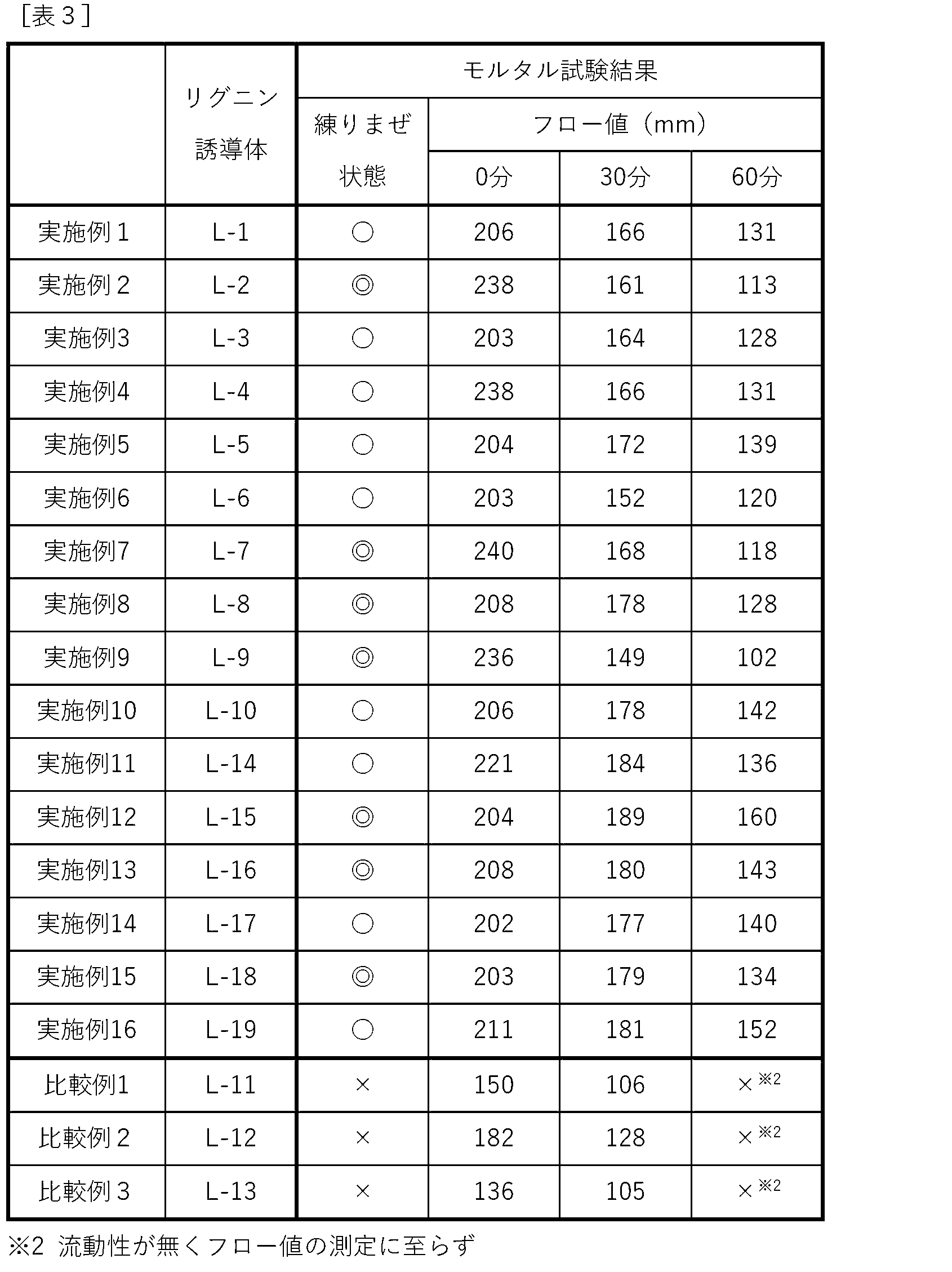
なおセメント・モルタル等の水硬性組成物の技術分野において、流動性に関する一般的な要求性能として、30分~60分程度の流動性が維持できる性能(保持性能)を挙げることができる。上記実施例1~16の結果は当業界における要求性能を十分に満足するものであり、特にリグニンスルホン酸系化合物/芳香族化合物=20/80~40/60(質量比)とした実施例1、3~6、10、12~14、16は、流動性に関して60分経過後においても初期状態からの変化が少なく、とりわけリグニンスルホン酸系化合物/芳香族化合物=20/80~35/65(質量比)とした実施例12及び16は、30分後のフロー値と60分後のフロー値の差が少なく、高い流動性を保つことが確認された。
また芳香族化合物における化合物Aの割合を10質量%以上とした実施例2、実施例7~9、12、13、15は、練り混ぜ初期の材料均一性に優れることが確認された。
リグニンスルホン酸系化合物を変更した以外は、成分並びにリグニンスルホン酸系化合物/芳香族化合物の割合を同じとした実施例1、4~6は、練り混ぜ初期の材料均一性に大きな差はなく、また初期の流動性に多少の変動はあるものの、60分経過後の流動性はほぼ同じような値に落ち着く傾向がみられた。
同様に上記3成分を同じとした実施例8、15、16においては、リグニンスルホン酸系化合物/芳香族化合物=20/80~35/65(質量比)とした実施例16は、上記範囲外である実施例8、15と比べ、初期の流動性に優れるとともに高い流動性を保つことが確認された。また、リグニンスルホン酸系化合物を滴下添加した実施例15は、実施例8と比べより流動性を高く保つことが確認された。
同様に上記3成分を同じとした実施例10、12においては、リグニンスルホン酸系化合物/芳香族化合物=20/80~35/65(質量比)とした実施例12は、上記範囲外である実施例10と比べ高い流動性を保つことが確認された。
リグニンスルホン酸系化合物/芳香族化合物の配合量を同等とし、化合物Bにおけるアルキレンオキシ基の付加モル数を変えた実施例7(付加モル数90)と実施例8(付加モル数22)を比べると、実施例8は初期の流動性は実施例7と比べ多少劣るものの、60分経過後において高い流動性を保つ傾向が確認された。
Claims (7)
- リグニンスルホン酸系化合物、芳香族化合物(前記リグニンスルホン酸系化合物を除く)及びアルデヒド化合物を含む混合物の反応生成物であるリグニン誘導体であって、
末端がリン酸エステル化された(ポリ)アルキレンオキシ基を有するリグニン誘導体。 - 前記芳香族化合物が、下記式(1)で表される化合物Aを含む、請求項1に記載のリグニン誘導体。

nが1を表す場合、
R1は水素原子又は炭素原子数1乃至24の炭化水素基を表し、
A1Oは、炭素原子数2乃至4のアルキレンオキシ基を表し、
mはA1Oの平均付加モル数であって1乃至300の数を表し、
X1はリン酸エステル基を表し、
nが2を表す場合、
R1は、-CH2-、-C(CH3)2-、又は-SO2-を表し、
A1Oは、炭素原子数2乃至4のアルキレンオキシ基を表し、
mはA1Oの平均付加モル数であって1乃至300の数を表し、
X1はリン酸エステル基を表す。) - 前記芳香族化合物の全質量に対する前記化合物Aの含有割合が3質量%以上である、請求項2に記載のリグニン誘導体。
- 前記芳香族化合物が、式(2)で表される化合物Bをさらに含む、請求項2に記載のリグニン誘導体。

qが1を表す場合、
R3は、水素原子又は炭素原子数1乃至24の炭化水素基を表し、
A2Oは、炭素原子数2乃至4のアルキレンオキシ基を表し、
pはA2Oの平均付加モル数であって1乃至300の数を表し、
R2は水素原子、炭素原子数1乃至10のアルキル基、又は炭素原子数2乃至24のアシル基を表し、
qが2を表す場合、
R3は、-CH2-、-C(CH3)2-、又は-SO2-を表し、
A2Oは、炭素原子数2乃至4のアルキレンオキシ基を表し、
pはA2Oの平均付加モル数であって1乃至300の数を表し、
R2は水素原子、炭素原子数1乃至10のアルキル基、又は炭素原子数2乃至24のアシル基を表す。) - 前記アルデヒド化合物が式(3)で表される化合物Cである、請求項1に記載のリグニン誘導体。

rは1乃至100の数を表す。) - 前記リグニン誘導体が、前記リグニンスルホン酸系化合物及び前記芳香族化合物を質量比にて、リグニンスルホン酸系化合物:芳香族化合物=20:80~35:65にて含む混合物の反応生成物である、請求項1に記載のリグニン誘導体。
- 請求項1~6のいずれか1項に記載のリグニン誘導体を含有する、水硬性組成物用添加剤。
Priority Applications (2)
| Application Number | Priority Date | Filing Date | Title |
|---|---|---|---|
| JP2025528018A JPWO2024257863A1 (ja) | 2023-06-16 | 2024-06-14 | |
| CN202480040078.8A CN121335943A (zh) | 2023-06-16 | 2024-06-14 | 木质素衍生物及含有木质素衍生物的水硬性组合物用添加剂 |
Applications Claiming Priority (2)
| Application Number | Priority Date | Filing Date | Title |
|---|---|---|---|
| JP2023099642 | 2023-06-16 | ||
| JP2023-099642 | 2023-06-16 |
Publications (1)
| Publication Number | Publication Date |
|---|---|
| WO2024257863A1 true WO2024257863A1 (ja) | 2024-12-19 |
Family
ID=93852260
Family Applications (1)
| Application Number | Title | Priority Date | Filing Date |
|---|---|---|---|
| PCT/JP2024/021736 Ceased WO2024257863A1 (ja) | 2023-06-16 | 2024-06-14 | リグニン誘導体及びそれを含有する水硬性組成物用添加剤 |
Country Status (3)
| Country | Link |
|---|---|
| JP (1) | JPWO2024257863A1 (ja) |
| CN (1) | CN121335943A (ja) |
| WO (1) | WO2024257863A1 (ja) |
Citations (5)
| Publication number | Priority date | Publication date | Assignee | Title |
|---|---|---|---|---|
| JP2015120630A (ja) * | 2013-11-22 | 2015-07-02 | コンストラクション リサーチ アンド テクノロジー ゲーエムベーハーConstruction Research & Technology GmbH | セメント組成物 |
| WO2018147378A1 (ja) * | 2017-02-08 | 2018-08-16 | シーカ・テクノロジー・アーゲー | 水硬性組成物用混和剤 |
| JP2019199557A (ja) * | 2018-05-17 | 2019-11-21 | 株式会社日本触媒 | リグニン誘導体 |
| JP2019199556A (ja) * | 2018-05-17 | 2019-11-21 | 株式会社日本触媒 | リグニン誘導体 |
| JP2022176809A (ja) * | 2021-05-17 | 2022-11-30 | 東邦化学工業株式会社 | 重縮合物及び水硬性組成物用添加剤 |
Family Cites Families (5)
| Publication number | Priority date | Publication date | Assignee | Title |
|---|---|---|---|---|
| JPS5896619A (ja) * | 1981-12-04 | 1983-06-08 | Asahi Glass Co Ltd | ポリウレタンフオ−ムの製造方法 |
| JP6567839B2 (ja) * | 2014-03-26 | 2019-08-28 | 株式会社日本触媒 | リグニン誘導体 |
| JP6534551B2 (ja) * | 2015-04-02 | 2019-06-26 | 株式会社日本触媒 | リグニン誘導体の製造方法 |
| JP6330072B1 (ja) * | 2017-03-08 | 2018-05-23 | 株式会社コロプラ | 情報処理方法、装置、および当該情報処理方法をコンピュータに実行させるためのプログラム |
| EP3674352A4 (en) * | 2017-08-24 | 2021-04-14 | Nippon Paper Industries Co., Ltd. | LIGNINE DERIVATIVE ASSOCIATION AND USE THEREOF |
-
2024
- 2024-06-14 CN CN202480040078.8A patent/CN121335943A/zh active Pending
- 2024-06-14 WO PCT/JP2024/021736 patent/WO2024257863A1/ja not_active Ceased
- 2024-06-14 JP JP2025528018A patent/JPWO2024257863A1/ja active Pending
Patent Citations (5)
| Publication number | Priority date | Publication date | Assignee | Title |
|---|---|---|---|---|
| JP2015120630A (ja) * | 2013-11-22 | 2015-07-02 | コンストラクション リサーチ アンド テクノロジー ゲーエムベーハーConstruction Research & Technology GmbH | セメント組成物 |
| WO2018147378A1 (ja) * | 2017-02-08 | 2018-08-16 | シーカ・テクノロジー・アーゲー | 水硬性組成物用混和剤 |
| JP2019199557A (ja) * | 2018-05-17 | 2019-11-21 | 株式会社日本触媒 | リグニン誘導体 |
| JP2019199556A (ja) * | 2018-05-17 | 2019-11-21 | 株式会社日本触媒 | リグニン誘導体 |
| JP2022176809A (ja) * | 2021-05-17 | 2022-11-30 | 東邦化学工業株式会社 | 重縮合物及び水硬性組成物用添加剤 |
Also Published As
| Publication number | Publication date |
|---|---|
| JPWO2024257863A1 (ja) | 2024-12-19 |
| CN121335943A (zh) | 2026-01-13 |
Similar Documents
| Publication | Publication Date | Title |
|---|---|---|
| US20130217808A1 (en) | Production of comb polymers by means of esterification | |
| TWI714615B (zh) | 含有酚系共聚物之縮聚產物及含有其之水硬性組合物用分散劑 | |
| JP7069053B2 (ja) | 水硬性組成物用混和剤 | |
| JP4987533B2 (ja) | セメント混和剤 | |
| RU2613372C2 (ru) | Гидравлическая композиция | |
| JP2008133176A (ja) | セメント混和剤 | |
| JP7687858B2 (ja) | 重縮合物及び水硬性組成物用添加剤 | |
| JP7181197B2 (ja) | 水硬性組成物用分散剤 | |
| CN109704619B (zh) | 一种氨基磺酸盐高效减水剂及其制备工艺 | |
| JP5473997B2 (ja) | セメント混和剤 | |
| CN102239215B (zh) | 含共聚物混合物的分散剂 | |
| JP5107789B2 (ja) | セメント混和剤とその製造方法 | |
| WO2024257863A1 (ja) | リグニン誘導体及びそれを含有する水硬性組成物用添加剤 | |
| JP6839557B2 (ja) | 水硬性組成物用分散剤 | |
| JP6814063B2 (ja) | 重縮合生成物及びそれを含有する水硬性組成物用分散剤 | |
| JP4079589B2 (ja) | ポリカルボン酸系共重合体の製造方法 | |
| JP2020026459A (ja) | 粒状組成物及び分散剤 | |
| JP6906265B1 (ja) | 水硬性組成物用添加剤及び水硬性組成物 | |
| EP1611068B1 (fr) | Utilisation de dispersants pour ameliorer le maintien de fluidite de beton | |
| CN111363159A (zh) | 一种磺化苯乙烯-马来酸酐接枝聚醚型减缩型聚羧酸减水剂 | |
| JP2011116587A (ja) | 水硬性組成物用早強剤 | |
| JP5030333B2 (ja) | セメント混和剤 | |
| JP2006069859A (ja) | セメント混和剤組成物 | |
| JP4540525B2 (ja) | セメント混和剤用ポリカルボン酸系ポリマーの製造方法 | |
| JPH0925149A (ja) | コンクリート混和剤 |
Legal Events
| Date | Code | Title | Description |
|---|---|---|---|
| 121 | Ep: the epo has been informed by wipo that ep was designated in this application |
Ref document number: 24823476 Country of ref document: EP Kind code of ref document: A1 |
|
| ENP | Entry into the national phase |
Ref document number: 2025528018 Country of ref document: JP Kind code of ref document: A |
|
| WWE | Wipo information: entry into national phase |
Ref document number: 2501008559 Country of ref document: TH |
|
| WWE | Wipo information: entry into national phase |
Ref document number: 202617001739 Country of ref document: IN |
|
| NENP | Non-entry into the national phase |
Ref country code: DE |
|
| WWP | Wipo information: published in national office |
Ref document number: 202617001739 Country of ref document: IN |