WO2024257877A1 - Block polymer, and coloring material dispersion and ink composition using same - Google Patents
Block polymer, and coloring material dispersion and ink composition using same Download PDFInfo
- Publication number
- WO2024257877A1 WO2024257877A1 PCT/JP2024/021786 JP2024021786W WO2024257877A1 WO 2024257877 A1 WO2024257877 A1 WO 2024257877A1 JP 2024021786 W JP2024021786 W JP 2024021786W WO 2024257877 A1 WO2024257877 A1 WO 2024257877A1
- Authority
- WO
- WIPO (PCT)
- Prior art keywords
- segment
- mass
- functional group
- block polymer
- monomer
- Prior art date
- Legal status (The legal status is an assumption and is not a legal conclusion. Google has not performed a legal analysis and makes no representation as to the accuracy of the status listed.)
- Ceased
Links
Images


Classifications
-
- C—CHEMISTRY; METALLURGY
- C09—DYES; PAINTS; POLISHES; NATURAL RESINS; ADHESIVES; COMPOSITIONS NOT OTHERWISE PROVIDED FOR; APPLICATIONS OF MATERIALS NOT OTHERWISE PROVIDED FOR
- C09D—COATING COMPOSITIONS, e.g. PAINTS, VARNISHES OR LACQUERS; FILLING PASTES; CHEMICAL PAINT OR INK REMOVERS; INKS; CORRECTING FLUIDS; WOODSTAINS; PASTES OR SOLIDS FOR COLOURING OR PRINTING; USE OF MATERIALS THEREFOR
- C09D11/00—Inks
- C09D11/02—Printing inks
- C09D11/10—Printing inks based on artificial resins
- C09D11/106—Printing inks based on artificial resins containing macromolecular compounds obtained by reactions only involving carbon-to-carbon unsaturated bonds
- C09D11/107—Printing inks based on artificial resins containing macromolecular compounds obtained by reactions only involving carbon-to-carbon unsaturated bonds from unsaturated acids or derivatives thereof
-
- B—PERFORMING OPERATIONS; TRANSPORTING
- B41—PRINTING; LINING MACHINES; TYPEWRITERS; STAMPS
- B41J—TYPEWRITERS; SELECTIVE PRINTING MECHANISMS, i.e. MECHANISMS PRINTING OTHERWISE THAN FROM A FORME; CORRECTION OF TYPOGRAPHICAL ERRORS
- B41J2/00—Typewriters or selective printing mechanisms characterised by the printing or marking process for which they are designed
- B41J2/005—Typewriters or selective printing mechanisms characterised by the printing or marking process for which they are designed characterised by bringing liquid or particles selectively into contact with a printing material
- B41J2/01—Ink jet
-
- B—PERFORMING OPERATIONS; TRANSPORTING
- B41—PRINTING; LINING MACHINES; TYPEWRITERS; STAMPS
- B41M—PRINTING, DUPLICATING, MARKING, OR COPYING PROCESSES; COLOUR PRINTING
- B41M5/00—Duplicating or marking methods; Sheet materials for use therein
-
- C—CHEMISTRY; METALLURGY
- C08—ORGANIC MACROMOLECULAR COMPOUNDS; THEIR PREPARATION OR CHEMICAL WORKING-UP; COMPOSITIONS BASED THEREON
- C08F—MACROMOLECULAR COMPOUNDS OBTAINED BY REACTIONS ONLY INVOLVING CARBON-TO-CARBON UNSATURATED BONDS
- C08F293/00—Macromolecular compounds obtained by polymerisation on to a macromolecule having groups capable of inducing the formation of new polymer chains bound exclusively at one or both ends of the starting macromolecule
-
- C—CHEMISTRY; METALLURGY
- C09—DYES; PAINTS; POLISHES; NATURAL RESINS; ADHESIVES; COMPOSITIONS NOT OTHERWISE PROVIDED FOR; APPLICATIONS OF MATERIALS NOT OTHERWISE PROVIDED FOR
- C09C—TREATMENT OF INORGANIC MATERIALS, OTHER THAN FIBROUS FILLERS, TO ENHANCE THEIR PIGMENTING OR FILLING PROPERTIES ; PREPARATION OF CARBON BLACK ; PREPARATION OF INORGANIC MATERIALS WHICH ARE NO SINGLE CHEMICAL COMPOUNDS AND WHICH ARE MAINLY USED AS PIGMENTS OR FILLERS
- C09C3/00—Treatment in general of inorganic materials, other than fibrous fillers, to enhance their pigmenting or filling properties
- C09C3/04—Physical treatment, e.g. grinding or treatment with ultrasonic vibrations
-
- C—CHEMISTRY; METALLURGY
- C09—DYES; PAINTS; POLISHES; NATURAL RESINS; ADHESIVES; COMPOSITIONS NOT OTHERWISE PROVIDED FOR; APPLICATIONS OF MATERIALS NOT OTHERWISE PROVIDED FOR
- C09C—TREATMENT OF INORGANIC MATERIALS, OTHER THAN FIBROUS FILLERS, TO ENHANCE THEIR PIGMENTING OR FILLING PROPERTIES ; PREPARATION OF CARBON BLACK ; PREPARATION OF INORGANIC MATERIALS WHICH ARE NO SINGLE CHEMICAL COMPOUNDS AND WHICH ARE MAINLY USED AS PIGMENTS OR FILLERS
- C09C3/00—Treatment in general of inorganic materials, other than fibrous fillers, to enhance their pigmenting or filling properties
- C09C3/10—Treatment with macromolecular organic compounds
-
- C—CHEMISTRY; METALLURGY
- C09—DYES; PAINTS; POLISHES; NATURAL RESINS; ADHESIVES; COMPOSITIONS NOT OTHERWISE PROVIDED FOR; APPLICATIONS OF MATERIALS NOT OTHERWISE PROVIDED FOR
- C09D—COATING COMPOSITIONS, e.g. PAINTS, VARNISHES OR LACQUERS; FILLING PASTES; CHEMICAL PAINT OR INK REMOVERS; INKS; CORRECTING FLUIDS; WOODSTAINS; PASTES OR SOLIDS FOR COLOURING OR PRINTING; USE OF MATERIALS THEREFOR
- C09D11/00—Inks
- C09D11/30—Inkjet printing inks
- C09D11/32—Inkjet printing inks characterised by colouring agents
- C09D11/322—Pigment inks
-
- C—CHEMISTRY; METALLURGY
- C09—DYES; PAINTS; POLISHES; NATURAL RESINS; ADHESIVES; COMPOSITIONS NOT OTHERWISE PROVIDED FOR; APPLICATIONS OF MATERIALS NOT OTHERWISE PROVIDED FOR
- C09D—COATING COMPOSITIONS, e.g. PAINTS, VARNISHES OR LACQUERS; FILLING PASTES; CHEMICAL PAINT OR INK REMOVERS; INKS; CORRECTING FLUIDS; WOODSTAINS; PASTES OR SOLIDS FOR COLOURING OR PRINTING; USE OF MATERIALS THEREFOR
- C09D17/00—Pigment pastes, e.g. for mixing in paints
Definitions
- aqueous inks using pigments the pigments are not soluble in water, so when they are used in ink compositions, it is important to stably disperse the pigments in water as fine particles.
- aqueous inks using pigments have a problem of alteration of the recording liquid due to aggregation and precipitation of the pigments, that is, so-called storage stability.
- storage stability it is particularly required that the viscosity and particle size remain within a suitable range even when stored for a long time.
- Other requirements include excellent color characteristics such as color development and gloss, the ink not clogging the nozzles, and quick recovery from nozzle clogging after a long period of inactivity; in other words, excellent ink ejection stability.
- Patent Document 2 also proposes a method for improving storage stability, ejection stability, and redispersibility by using a block polymer and a pigment derivative. Specifically, as in Patent Document 1, a hydrophobic segment made of a monomer having one aromatic ring is used, but the use of a derivative is intended to improve storage stability, ejection stability, and redispersibility.
- Patent Document 3 Besides using block polymers, for example, in Patent Document 3, a water-insoluble polymer dispersant is used to coat (encapsulate) a colorant, thereby dealing with the deterioration of storage stability. Furthermore, Patent Document 4 proposes a method for realizing excellent storage stability, redispersibility, and color properties by using a monomer containing a biphenyl group in the hydrophobic segment of a block polymer.
- the present inventors have found that even when the block polymer described in Patent Document 1 is used, the redispersibility related to the ejection stability is insufficient. Furthermore, when a pigment derivative is used as described in Patent Document 2, it has been found that the problem of color deterioration occurs, and the problem of color characteristics cannot be solved. Furthermore, in the method using a water-insoluble polymer as in Patent Document 3, the highly hydrophobic nature of the dispersant causes a problem that re-dispersibility during head cleaning operation is poor. Furthermore, when the block polymer described in Patent Document 4 is used, the storage stability is improved, but the redispersibility is insufficient, and there is a risk of the ejection stability being reduced depending on the usage environment and the ink composition. In particular, the present inventors have found that sufficient redispersibility tends not to be obtained in ink compositions having a high ratio of solvent.
- the above object can be solved by using as a dispersant a block polymer having segments containing structural units derived from specific monomers in a specific ratio.
- the above object can be solved by using as a dispersant a block polymer having segments containing specific functional groups in a specific ratio.
- the following block polymer and a coloring material dispersion using the block polymer are provided.
- the present invention provides (1) A block polymer having at least one segment (A) satisfying the following (a1) and (a2) and at least one segment (B) satisfying the following (b1) and (b2), and having a peak top molecular weight of 3,000 or more and 16,000 or less.
- Peak top molecular weight is 750 or more.
- the proportion of the total mass of the constituent units derived from the monomer having a hydrophobic functional group and the total mass of the constituent units derived from the monomer having a hydrophilic functional group in the segment (A) is 10 mass% or more, and the proportion of the total mass of the constituent units derived from the monomer having a hydrophobic functional group and the total mass of the constituent units derived from the monomer having a hydrophilic functional group in the segment (B) is 10 mass% or more;
- a method for producing a printing ink comprising mixing the coloring material dispersion liquid according to (10) above with an organic solvent, a resin and a preservative.
- a printing ink containing at least the block polymer according to any one of (1) to (9) above, a coloring material, an organic solvent, a resin, and a preservative. is located.
- the block polymer of the present invention By incorporating the block polymer of the present invention, it is possible to obtain a coloring material dispersion that has excellent storage stability and redispersibility, and can be used to prepare an ink composition that achieves color characteristics.
- FIG. 1 is a photograph of the coating film obtained in Example 6.
- FIG. 1 is a photograph of the coating film obtained in Example 7.
- FIG. 1 is a photograph of the coating film obtained in Example 8.
- the block polymer of the first invention of this application is characterized by having at least one segment (A) that satisfies the following (a1) and (a2) and at least one segment (B) that satisfies the following (b1) and (b2): (a1): Having a structural unit derived from a monomer having a hydrophobic functional group and a structural unit derived from a monomer having a hydrophilic functional group, the mass ratio between the two (total mass of structural units derived from monomers having hydrophobic functional groups/total mass of structural units derived from monomers having hydrophilic functional groups) is 2.3 or more and 19.0 or less.
- the block polymer of the second invention of the present application is characterized in that it has at least one segment (A') that satisfies the following (a1') and (a2), and at least one segment (B') that satisfies the following (b1') and (b2).
- the monomer having a hydrophobic functional group refers to a monomer having at least one of the above-mentioned hydrophobic functional groups. Any monomer having a hydrophobic functional group can be used without any particular limitation.
- these monomers having hydrophobic functional groups those having a phenyl group or a biphenyl group are preferred, and those having one phenyl group and a molecular weight of 140 to 200 are more preferred, of which phenyl acrylate, phenyl methacrylate and phenoxyethyl acrylate are even more preferred, with phenoxyethyl acrylate being the most preferred.
- Block polymers using these preferred monomers have a moderate level of hydrophobicity and are superior in redispersibility and storage stability.
- these preferred monomers have aromatic rings, when the coloring material has an aromatic ring as described below, ⁇ - ⁇ interactions are expressed, which is thought to be further advantageous in terms of storage stability.
- the monomers having hydrophobic functional groups those having a LogP of 2.0 or more and 5.0 or less are preferred. Within this range, the strength of hydrophobicity is adequate, and redispersibility and storage stability are superior. More preferably, the LogP of the monomer having a hydrophobic functional group is 2.0 or more and 3.0 or less.
- the measurement of LogP is based on the method for measuring the partition coefficient described in "OECD GUIDELINE FOR TESTING OF CHEMICALS, "Partition Coefficient (n-octanol/water), High Performance Liquid Chromatography (HPLC) Method", Adopted by the Council on 30th March 1989." Alternatively, other methods capable of obtaining an equivalent value may be used.
- the hydrophilic functional group means a functional group having hydrophilicity
- the hydrophobic functional group in the block polymer of the present invention is not particularly limited, but is preferably one that ionizes to generate an anion by neutralizing with an alkali compound, and representative examples include a carboxy group, a phosphate group, and a sulfonic acid group. These are particularly excellent in wet friction resistance.
- a carboxy group is particularly preferred, which has a good hydrophilicity and can realize a well-balanced combination of redispersibility and solubility in a solvent of a pigment dispersion using the obtained block polymer.
- the monomer having a hydrophilic functional group means a monomer having at least one of the above-mentioned hydrophilic functional groups.
- the monomer having a hydrophilic functional group used in the present invention is not particularly limited, but representative examples include acrylic acid, methacrylic acid, maleic acid, itaconic acid, vinylphosphonic acid, and vinylsulfonic acid.
- monomers having hydrophilic functional groups those with a LogP of -2.0 or more and 1.0 or less are preferred. Within this range, the hydrophilicity is adequate and the storage stability is superior. It is more preferred that the LogP of monomers having hydrophilic functional groups is 0.0 or more and 1.0 or less.
- the method for measuring LogP is as described above.
- Block polymer of the first invention [Segment A]
- the block polymer of the first invention of this application has one or more segments (A) described below.
- segment (A) plays a role in adsorbing the block polymer to the coloring material mainly due to its hydrophobicity, thereby imparting dispersibility.
- Segment (A) contains the above-described constituent units derived from monomers having a hydrophobic functional group and constituent units derived from monomers having a hydrophilic functional group, and the mass ratio between the two (total mass of constituent units derived from monomers having a hydrophobic functional group/total mass of constituent units derived from monomers having a hydrophilic functional group) is 2.3 or more and 19.0 or less.
- the mass ratio of the structural unit derived from a monomer having a hydrophobic functional group and the structural unit derived from a monomer having a hydrophilic functional group within the above range, it is possible to exhibit excellent redispersibility and storage stability.
- the segments (A) of different polymers repel each other slightly due to hydrophilic-hydrophobic interaction, and the adsorption, entanglement, and aggregation of the polymers are suppressed, and many polymers can efficiently adsorb to the coloring material and impart dispersibility.
- the mass ratio between the two is more preferably from 4.0 to 19.0, and even more preferably from 5.0 to 12.0, in which case better redispersibility and storage stability can be achieved.
- the monomer having a hydrophobic functional group and the monomer having a hydrophilic functional group may be polymerized in the above ratio during synthesis of the block polymer.
- H-NMR, GPC, acid value titration, etc. may be used.
- the peak top molecular weight of segment (A) is 750 or more. If the peak top molecular weight is less than 750, the adsorption force to the material may be insufficient, and redispersibility may be deteriorated.
- the peak top molecular weight of segment (A) is preferably 1000 or more, more preferably 2000 or more.
- the method for measuring the peak top molecular weight is as shown in the Examples, but is not limited to this method as long as similar results are obtained.
- the mass ratio of segment (A) is preferably 25% by mass or more and 75% by mass or less. If the proportion of segment (A) is less than 25% by mass, the pigment adsorption performance is insufficient and redispersibility and storage stability tend to be low. On the other hand, if the proportion of segment (A) is more than 75% by mass, it may not dissolve in the solvent.
- the proportion of segment (A) is more preferably 55% by mass or more and 75% by mass or less, and most preferably 55% by mass or more and 65% by mass or less.
- the order of the constituent units derived from each monomer in segment (A) is not particularly limited, but random is preferable.
- various forms such as random copolymers, block copolymers, and alternating copolymers can be used as the form of segment (A), but among them, random copolymers are particularly preferable.
- Segment (A) may contain any other constituent units in addition to the constituent units derived from monomers having hydrophobic functional groups and the constituent units derived from monomers having hydrophilic functional groups.
- segment (A) is taken as 100% by mass
- the total mass of the constituent units derived from monomers having hydrophobic functional groups and the constituent units derived from monomers having hydrophilic functional groups in segment (A) is preferably 10% by mass or more, more preferably 25% by mass or more, and even more preferably 50% by mass or more, and it is most preferable that 100% by mass, i.e., segment (A) is composed only of constituent units derived from monomers having hydrophobic functional groups and constituent units derived from monomers having hydrophilic functional groups.
- segment (B) The block polymer of the first invention of this application has one or more segments (B) described below. In dispersing coloring materials, etc., it is believed that the segment (B) plays a role in dissolving the block polymer in an aqueous solvent mainly due to its hydrophilicity.
- Segment (B) contains a constituent unit derived from the monomer having a hydrophobic functional group and a constituent unit derived from the monomer having a hydrophilic functional group, and the mass ratio between the two (mass of the constituent unit derived from the monomer having a hydrophobic functional group/mass of the constituent unit derived from the monomer having a hydrophilic functional group) is 0.43 or more and less than 2.30.
- the mass ratio of the structural unit derived from the monomer having a hydrophobic functional group and the structural unit derived from the monomer having a hydrophilic functional group within the above range, the redispersibility can be improved and the viscosity of the coloring material dispersion or ink can be reduced to a suitable range.
- the reason why the redispersibility is improved is believed to be that by including the structural unit derived from the monomer having a hydrophilic functional group within the above ratio, the polymer can be uniformly dissolved in the aqueous solvent, and many polymers can be efficiently adsorbed to the coloring material.
- the reason why the viscosity can be reduced is believed to be that by including the structural unit derived from the hydrophilic functional group within the above ratio, the polymer can be sufficiently dissolved in the solvent, and by including the structural unit derived from the hydrophobic functional group within the above ratio, the segments (B) of different polymers are slightly repelled by hydrophilic-hydrophobic interactions, so that adsorption, aggregation, and entanglement are unlikely to occur, and the polymer is easily loosened.
- the mass ratio between the two is more preferably from 0.50 to 1.50, and even more preferably from 0.67 to 1.00. By keeping it within this range, the viscosity reduction and redispersibility are excellent when used in a dispersion or ink.
- the monomers may be polymerized in the above ratio during synthesis of the block polymer.
- H-NMR, GPC, acid value titration, etc. may be used.
- the mass ratio of segment (B) is preferably 25% by mass or more and 75% by mass or less. If the mass ratio of segment (B) is less than 25% by mass, it may not dissolve in a solvent. On the other hand, if the mass ratio of segment (B) is more than 75% by mass, the pigment adsorption performance is insufficient and redispersibility and storage stability tend to be low.
- the mass ratio of segment (B) is more preferably 25% by mass or more and 45% by mass or less, and most preferably 35% by mass or more and 45% by mass or less.
- the order of the constituent units composed of each monomer in segment (B) is not particularly limited, but is preferably random.
- various forms such as random copolymers, block copolymers, and alternating copolymers can be used as the form of segment (B), with random copolymers being particularly preferred.
- Segment (B) may contain any constitutional unit other than the constitutional unit derived from a monomer having a hydrophobic functional group and the constitutional unit derived from a monomer having a hydrophilic functional group.
- the total ratio of the structural units derived from monomers having hydrophobic functional groups and the structural units derived from monomers having hydrophilic functional groups in the segment (B) is preferably 10% by mass or more, more preferably 25% by mass or more, and even more preferably 50% by mass or more, and it is most preferable that 100% by mass, that is, the segment (B) is composed only of structural units derived from monomers having hydrophobic functional groups and structural units derived from monomers having hydrophilic functional groups.
- the block polymer of the first invention of this application may have two or more of the above-described segment (A) and segment (B) in each block polymer. In order to more effectively exert the effects of the present invention, however, it is preferable that each block polymer contains one of each of them.
- the block polymer of the first invention of this application may contain portions other than the segment (A) and the segment (B) as long as the effects of the invention are not impaired.
- the total mass of the segment (A) and the segment (B) is preferably 50% by mass or more. More preferably, it is 90% by mass or more, and most preferably, it is 100% by mass, that is, the block polymer is composed only of the segment (A) and the segment (B). Within the above range, the effects of the present invention can be more effectively exhibited.
- the ratio of segment (A) to segment (B) is preferably 25:75 to 75:25, more preferably 55:45 to 75:25, and particularly preferably 55:45 to 65:35. By keeping it within these preferred ranges, the storage stability is more excellent.
- the ratio of the segment (A) and the segment (B) can be adjusted during synthesis of the block polymer.
- the block polymer of the present invention can be synthesized, for example, by polymerizing the segment (A) and then adding the segment (B), and the amount of the monomer added at this time may be adjusted so that the segments are polymerized and synthesized in the above-mentioned ratio.
- H-NMR, GPC, acid value titration, etc. can be used.
- Block polymer of the second invention [Segment (A')]
- the block polymer of the second invention of this application has one or more segments (A') described below.
- the segment (A') is adsorbed to the coloring material mainly due to its hydrophobicity, and plays a role in imparting dispersibility.
- Segment (A') contains the hydrophobic functional groups and hydrophilic functional groups described above, and the molar ratio of the two (total amount of hydrophobic functional groups in the segment/total amount of hydrophilic functional groups in the segment) is 0.85 or more and 8.50 or less.
- the molar ratio between the two is more preferably from 1.50 to 8.50, and even more preferably from 1.50 to 5.00, in which case better redispersibility and storage stability can be exhibited.
- the above-mentioned monomer having a hydrophobic functional group and the monomer having a hydrophilic functional group may be polymerized so that the amounts of the functional groups are in the above ratio when synthesizing the block polymer.
- H-NMR, GPC, acid value titration, etc. may be used.
- the peak top molecular weight of segment (A') is 750 or more. If the peak top molecular weight is less than 750, the adsorption force to the material may be insufficient, and redispersibility may be deteriorated.
- the peak top molecular weight of segment (A') is preferably 1000 or more, more preferably 2000 or more.
- the method for measuring the peak top molecular weight is as shown in the Examples, but is not limited to this method as long as similar results are obtained.
- the mass ratio of segment (A') is preferably 25% by mass or more and 75% by mass or less. If the proportion of segment (A') is less than 25% by mass, the pigment adsorption performance is insufficient and redispersibility and storage stability tend to be low. On the other hand, if the proportion of segment (A') is more than 75% by mass, it may not dissolve in the solvent.
- the proportion of segment (A') is more preferably 55% by mass or more and 75% by mass or less, and most preferably 55% by mass or more and 65% by mass or less.
- the segment (A') typically has a constituent unit derived from a monomer having a hydrophobic functional group and a constituent unit derived from a monomer having a hydrophilic functional group, but is not limited thereto. Segment (A') may contain any other structural unit besides the structural unit derived from a monomer having a hydrophobic functional group and the structural unit derived from a monomer having a hydrophilic functional group.
- segment (A') When segment (A') is 100% by mass, the total mass of the structural unit derived from a monomer having a hydrophobic functional group and the structural unit derived from a monomer having a hydrophilic functional group in segment (A') is preferably 10% by mass or more, more preferably 25% by mass or more, and even more preferably 50% by mass or more, and most preferably 100% by mass, i.e., composed only of structural units derived from a monomer having a hydrophobic functional group and structural units derived from a monomer having a hydrophilic functional group. By setting it within the above preferred range, the effect of the present invention can be more effectively exhibited.
- the order of the constituent units derived from each monomer in the segment (A') is not particularly limited, but is preferably random. That is, in the present invention, the segment (A') may be in the form of a random copolymer, a block copolymer, an alternating copolymer, or the like, and among these, a random
- segment (A') When segment (A') is taken as 100% by mass, the ratio of the total mass of the hydrophobic functional groups and the hydrophilic functional groups in segment (A') is preferably 5% by mass or more, more preferably 20% by mass or more, and most preferably 35% by mass or more. By keeping it within the above preferred range, the effects of the present invention can be more effectively exhibited.
- the block polymer of the second invention of this application has one or more segments (B') described below.
- the segment (B') plays a role of dissolving the block polymer in a solvent mainly due to its hydrophilicity.
- Segment (B') contains the hydrophobic functional group described above and the hydrophilic functional group described above, and the molar ratio of the two (total amount of hydrophobic functional groups in the segment/total amount of hydrophilic functional groups in the segment) is 0.16 or more and less than 0.85.
- the redispersibility can be improved and the viscosity of the coloring material dispersion or ink can be reduced to a suitable range.
- the reason why the redispersibility is improved is believed to be that the inclusion of the hydrophilic functional group within the above ratio allows the polymer to be uniformly dissolved in the aqueous solvent, and many polymers can be efficiently adsorbed to the coloring material.
- the reason why the viscosity can be reduced is believed to be that the inclusion of the hydrophilic functional group within the above ratio allows the polymer to be sufficiently dissolved in the solvent, and the inclusion of the hydrophobic functional group within the above ratio causes the segments (B) of different polymers to slightly repel each other due to hydrophilic-hydrophobic interactions, making it difficult for adsorption, aggregation, and entanglement to occur, and the polymer becomes easily loosened.
- the molar ratio between the two is more preferably from 0.25 to 0.60, and even more preferably from 0.25 to 0.45, in which case better redispersibility and storage stability can be achieved.
- the above-mentioned monomer having a hydrophobic functional group and the monomer having a hydrophilic functional group may be polymerized so that the functional groups are in the above ratio when synthesizing the block polymer.
- H-NMR, GPC, acid value titration, etc. may be used.
- the peak top molecular weight of segment (B') is 750 or more. If the peak top molecular weight is less than 750, the solubility is insufficient, the viscosity increases, and redispersibility may deteriorate.
- the peak top molecular weight of segment (B') is preferably 1000 or more, more preferably 2000 or more.
- the method for measuring the peak top molecular weight is as shown in the Examples, but is not limited to this method as long as similar results are obtained.
- Segment (B') typically has a constituent unit derived from a monomer having a hydrophobic functional group and a constituent unit derived from a monomer having a hydrophilic functional group, but is not limited thereto. Segment (B') may contain any other structural unit besides the structural unit derived from a monomer having a hydrophobic functional group and the structural unit derived from a monomer having a hydrophilic functional group.
- segment (B') When segment (B') is 100% by mass, the total mass of the structural unit derived from a monomer having a hydrophobic functional group and the structural unit derived from a monomer having a hydrophilic functional group in segment (B') is preferably 10% by mass or more, more preferably 25% by mass or more, and even more preferably 50% by mass or more, and it is most preferable that 100% by mass, that is, segment (B') is composed only of structural units derived from a monomer having a hydrophobic functional group and structural units derived from a monomer having a hydrophilic functional group. By setting it within the above preferred range, the effect of the present invention can be more effectively exhibited.
- each monomer in segment (B') is not particularly limited, but is preferably random. That is, in the present invention, various forms such as random copolymers, block copolymers, and alternating copolymers can be used as the form of segment (B'), and among them, random copolymers are particularly preferred.
- segment (B') When segment (B') is taken as 100% by mass, the ratio of the total mass of the hydrophobic functional groups and the hydrophilic functional groups in segment (B') is preferably 5% by mass or more, more preferably 20% by mass or more, and most preferably 40% by mass or more. By keeping it within the above preferred range, the effects of the present invention can be more effectively exhibited.
- the block polymer of the second invention of the present application may have two or more of the above-described segment (A') and segment (B') in each block polymer. In order to more effectively exert the effects of the present invention, however, it is preferable that the block polymer contains one of each.
- the block polymer of the second invention of the present application may contain portions other than the segment (A') and the segment (B') as long as the effects of the present invention are not impaired.
- the total mass of the segment (A') and the segment (B') is preferably 50% by mass or more. More preferably, it is 90% by mass or more, and most preferably, it is 100% by mass, that is, the block polymer is composed only of the segment (A') and the segment (B'). Within the above range, the effects of the present invention can be more effectively exhibited.
- the ratio of segment (A') to segment (B') is preferably 25:75 to 75:25, more preferably 55:45 to 75:25, and particularly preferably 55:45 to 65:35. By keeping it within these preferred ranges, the storage stability is particularly excellent.
- the ratio of segment (A') to segment (B') can be adjusted by the ratio of monomers used in the synthesis of the block polymer. In addition, when analyzing and confirming the obtained block polymer, H-NMR, GPC, acid value titration, etc. can be used.
- the block structures of the block polymer of the first invention and the block polymer of the second invention are not particularly limited.
- selectable block structures include AB block polymers, ABC triblock polymers, ABA triblock polymers, and triblock structures to which other polymer units are bonded.
- AB block polymers and ABA triblock polymers are preferred, with AB block polymers being particularly preferred.
- the acid value of the block polymer of the present invention is preferably 120 mgKOH/g or more and 190 mgKOH/g or less. If it exceeds 190 mgKOH/g, the affinity to the aqueous medium becomes too high, which may reduce the adsorption performance to the pigment and make dispersion difficult. Conversely, if the acid value is reduced to less than 120 mgKOH/g, the water solubility decreases, which may result in poor redispersibility.
- the acid value is the amount of KOH (mg) required to neutralize 1 g of resin. Specifically, it can be measured by titrating a solution of resin dissolved in methoxypropanol with 1N NaOH solution.
- the aqueous ink or coloring material dispersion using the block polymer of the present invention exhibits extremely excellent dispersibility and storage stability.
- the inventors have found that existing block polymers used for pigment dispersion are not easily disintegrated because the hydrophobic parts and the hydrophilic parts aggregate in a solvent to form micelles, and many polymers remain in a micellar state without adsorbing to the pigment, and dispersion performance may not be fully exhibited.
- the block polymer of the present invention described above has excellent storage stability and redispersibility, if it is used as a dispersant, there is no need to use a separate pigment derivative, and therefore the coloring material dispersion and ink using the block polymer of the present invention also have excellent color properties.
- the block polymer of the first invention of the present application can be produced by polymerizing the above-mentioned monomer having a hydrophilic functional group and monomer having a hydrophobic functional group in the above-mentioned ratio.
- the block polymer of the second invention of the present application can be produced by polymerizing the above-mentioned monomer having a hydrophilic functional group and monomer having a hydrophobic functional group in the above-mentioned ratio of the hydrophilic functional group and the hydrophobic functional group.
- the method for producing (synthesizing) the block polymer is not particularly limited, and examples of the methods generally known for producing block polymers include atom transfer radical polymerization using a metal complex such as copper or ruthenium as a catalyst and an organic halide as an initiator, which is carried out by oxidation-reduction, the nitroxide method in which the -N-O radical of nitroxide is transferred, reversible addition-fragmentation chain transfer polymerization using a dithiocarboxylate ester, and iodine transfer polymerization.
- a metal complex such as copper or ruthenium as a catalyst and an organic halide as an initiator
- the block polymer of the present invention can be produced by first forming segment (A) and then adding a monomer to add segment (B); however, the production method is not limited to these methods as long as similar results can be obtained.
- initiator As the initiator (initiator compound) used in the production of the block polymer of the present invention, general azo initiators such as azobis(isobutyronitrile) (AIBN), azobis(2,4-dimethylvaleronitrile) (V65), 2,2'-azobis(4-methoxy-2,4-dimethylvaleronitrile) (V70), and oxide initiators such as benzoyl peroxide, dicumyl peroxide, t-butyl peroxybenzoate (BPB), di(4-tert-butylcyclohexyl) peroxydicarbonate (PERKADOX16), potassium peroxydisulfate, etc. can be used without limitation.
- AIBN is preferred.
- the block polymer of the present invention When the block polymer of the present invention is used as a dispersant, it can be neutralized with an alkaline compound.
- alkaline compounds that can be used as a neutralizing agent include KOH, NaOH, triethylamine, triethanolamine, ammonia, etc., and particularly preferred are tertiary amines with a boiling point of 100°C or less. By using a tertiary amine with a boiling point of 100°C or less, water resistance and wet friction resistance are further improved.
- the colorant dispersion containing the block polymer of the present invention and the ink using the same have excellent water resistance and wet friction resistance. This is thought to be because, after printing with the ink, the amine compounds volatilize, causing the polymer that was solubilized by neutralization to become insoluble in water, improving the wet friction resistance of the printed matter.
- the amount of alkaline compound to be added should be an amount that can neutralize 20% to 200% of the resin's acid value. It is preferably 40 to 180%, and more preferably 50 to 120%. If the neutralization rate is lower than that, the resin will precipitate over time, and if it is higher, the pH will rise, which may damage the printer head components. In addition, water resistance and wet friction resistance may deteriorate.
- a water-insoluble coloring material is used.
- the coloring material is a pigment or a water-insoluble dye.
- water-insoluble includes so-called poorly water-soluble coloring materials that are difficult to completely dissolve in water.
- pigments for yellow ink include C.I. Pigment Yellow 1, 2, 3, 12, 14, 16, 17, 73, 74, 75, 83, 93, 95, 97, 98, 109, 110, 114, 128, 129, 138, 139, 147, 150, 151, 154, 155, 180, and 185, and one or more of these can be used.
- pigments for magenta ink examples include C.I. Pigment Red 5, 7, 12, 48 (Ca), 48 (Mn), 57 (Ca), 57:1, 112, 122, 123, 150, 168, 184, 202, 209; C.I. Pigment Violet 19, and the like, and one or more of these can be used.
- pigments for cyan ink examples include C.I. Pigment Blue 1, 2, 3, 15:3, 15:4, 16, 22, and 60; C.I. Bat Blue 4 and 60; and any combination of these may be used alone or in combination.
- pigments for black ink examples include carbon blacks (C.I. Pigment Black 7) such as furnace black, lamp black, acetylene black, and channel black, and organic pigments such as aniline black (C.I. Pigment Black 1).
- Inorganic pigments such as titanium oxide and iron oxide can also be used.
- the above various pigments may be pigments that have been mixed with a dispersant.
- the dispersion of the present invention may also contain a disperse dye as a water-insoluble coloring material.
- a disperse dye is a compound that is poorly soluble or insoluble in water. Specific examples of disperse dyes include the following: The yellow disperse dye is not particularly limited, but examples thereof include C.I.
- orange disperse dyes include, but are not limited to, C.I. Disperse Orange 1, 3, 5, 7, 11, 13, 17, 20, 21, 25, 29, 30, 31, 32, 33, 37, 38, 42, 43, 44, 45, 46, 47, 48, 49, 50, 53, 54, 55, 56, 57, 58, 59, 61, 66, 71, 73, 76, 78, 80, 89, 90, 91, 93, 96, 97, 119, 127, 130, 139, and 142.
- the red disperse dye is not particularly limited, but examples thereof include C.I.
- Violet disperse dyes are not particularly limited, but examples thereof include C.I. Disperse Violet 1, 4, 8, 23, 26, 27, 28, 31, 33, 35, 36, 38, 40, 43, 46, 48, 50, 51, 52, 56, 57, 59, 61, 63, 69, and 77.
- the green disperse dye is not particularly limited, but for example, C.I. Disperse Green 9 can be mentioned.
- the blue disperse dye is not particularly limited, but examples thereof include C.I.
- the aqueous medium used in the coloring material dispersion of the present invention is usually water, but a water-soluble organic solvent may be used if necessary.
- the water-soluble organic solvent include 1,2-hexanediol, 1,6-hexanediol, 1,5-pentanediol, 2-pyrrolidone, N-methylpyrrolidone, triethylene glycol monobutyl ether, ethylene glycol, propylene glycol, triethylene glycol, and glycerin.
- 1,2-hexanediol, 2-pyrrolidone, and triethylene glycol monobutyl ether are particularly preferred.
- acetylene glycol-based and silicone-based may be added.
- Commercially available products can be used, for example, acetylene glycol-based products such as Olfine Y, Surfynol 82, 440, 465, STG, and E1010, and polysiloxane-based compounds such as BYK302 and BYK348 (manufactured by BYK Japan) can be used.
- Composition of colorant dispersion In the coloring material dispersion of the present invention, the blending ratio of each of the above components can be appropriately selected depending on the application. In addition to the above components, the coloring material dispersion of the present invention may contain other components depending on the application.
- the above-mentioned components may be dispersed by a known method.
- the coloring material dispersion may be prepared by dispersing the above-mentioned components in a bead mill or other wet dispersing machine.
- the dispersion of the present invention may be subjected to an appropriate crosslinking treatment after dispersion.
- the crosslinking agent an epoxy resin having a glycidyl ether skeleton, a resin having an oxazoline group, or the like can be used.
- the amount of crosslinking agent is preferably in the range of 0.5% to 60% of the resin. If it is less than this, the stabilizing effect of crosslinking cannot be exerted, and if it is more, redispersibility may deteriorate.
- the crosslinking method is to add the crosslinking agent to the coloring material dispersion liquid that has been through the above dispersion process, and heat it to around 80°C to perform crosslinking.
- the coloring material dispersion of the present invention can be subjected to an impurity removal process by ion exchange treatment or ultrafiltration treatment.
- Ionic substances such as cations and anions (divalent metal ions, etc.) can be removed by ion exchange treatment, and dissolved impurities (residual substances from pigment synthesis, excess components in the dispersion composition, resins not adsorbed to organic pigments, contaminants, etc.) can be removed by ultrafiltration treatment.
- the coloring material dispersion of the present invention can have a particle size distribution D50 of 135 nm or less, which is a preferred range.
- the particle size distribution D50 of the coloring material dispersion is particularly preferably 110 nm or less, and most preferably 100 nm or less.
- the time and intensity of dispersion may be appropriately adjusted when preparing the coloring material dispersion liquid, or coarse particles may be removed using a filter or the like.
- the block polymer of the present invention has excellent storage stability and can maintain the above-mentioned preferred particle size for one week or more.
- the method for measuring the particle size distribution D50 is as described in the Examples, but is not limited to this as long as similar results are obtained.
- the block polymer of the present invention is less likely to cause aggregation or entanglement between polymers, and therefore an increase in viscosity is suppressed, so that the coloring material dispersion of the present invention can have a viscosity in the preferred range of 25 mPas or less.
- the viscosity is particularly preferably 10 mPas or less, and most preferably 5 mPas or less.
- the neutralization rate of the block polymer may be appropriately adjusted in accordance with the solvent when the coloring material dispersion liquid is prepared. Furthermore, the block polymer of the present invention has excellent storage stability and can maintain the above-mentioned preferred viscosity for one week or more. The method for measuring viscosity is as described in the Examples, but is not limited to this method as long as similar results are obtained.
- the term "dispersion” means that a water-insoluble coloring material is dispersed in an aqueous medium, and includes so-called “ink” as well as a state in which a coloring material is dispersed in an aqueous medium in advance when producing the ink.
- the coloring material dispersion of the present invention is used as an ink, it is preferable to prepare a dispersion in advance in which each of the components described above is dispersed, and then add other components according to the intended use.
- the coloring material dispersion of the present invention is used to prepare an inkjet ink
- other components such as an organic solvent, a resin, and a preservative may be added.
- the organic solvent is not particularly limited, and examples thereof include polyhydric alcohols and pyrrolidones.
- polyhydric alcohols include ethylene glycol, diethylene glycol, propylene glycol, dipropylene glycol, 1,3-propanediol, 1,4-butanediol, 1,6-hexanediol, trimethylolpropane, and glycerin.
- Polyhydric alcohols have the effect of increasing the wettability of the ink to paper and preventing drying inside the head nozzles, thereby increasing the moisture retention.
- the content of the polyhydric alcohols can be 2% by mass or more and 30% by mass or less with respect to the total mass of the ink.
- Resins have the function of increasing fixation, and examples of such resins include acrylic resins, fluorene resins, urethane resins, olefin resins, rosin-modified resins, terpene resins, ester resins, amide resins, epoxy resins, vinyl chloride resins, vinyl chloride-vinyl acetate copolymers, and ethylene vinyl acetate resins. These resins can be used alone or in combination of two or more. The resins used may be of the emulsion type or solution type. When resins are contained, their content can be 0.1% by mass or more and 6% by mass or less.
- preservatives and antifungal agents examples include sodium benzoate, sodium pentachlorophenol, sodium 2-pyridinethiol-1-oxide, sodium sorbate, sodium dehydroacetate, 1,2-dibenzisothiazolin-3-one (Zeneca's Proxel CRL, Proxel BDN, Proxel GXL, Proxel XL.2, Proxel TN, Proxel LV), and 4-chloro-3-methylphenol (Bayer's Preventol CMK, etc.).
- the neutralization rate of the block polymer may be appropriately adjusted in accordance with the solvent when preparing the coloring material dispersion.
- the block polymer of the present invention has excellent storage stability and can maintain the above-mentioned preferred viscosity for one week or more.
- the method for measuring the ink viscosity is as described in the Examples, but is not limited to this as long as similar results are obtained.
- the application of the ink is not particularly limited, and examples thereof include printing inks that can be used in inkjet printing and inks for writing instruments, but the inks are particularly suitable for use as inkjet printing inks.
- the pressure in the reaction vessel was reduced, and the solvent was distilled off to obtain block polymer 1.
- the molecular weight was 6220 and the molecular weight distribution (Mw / Mn) was 1.21.
- the acid value was 182 mg KOH / g.
- Block polymers 2 to 12 were obtained by changing the monomer ratio as shown in Table 1 using the same procedure as for block polymer 1.
- the physical properties (acid value, peak top molecular weight, Mw/Mn) of these block polymers 2 to 12 are shown in Table 1.
- the resulting block polymers 2 to 12 were used to obtain resin solutions in the same manner as in the resin solution 1. Only 50% neutralized products were prepared for block polymers 2 to 5, 11, and 12, and only 120% neutralized products were prepared for block polymers 6, 9, and 10.
- the system was heated to 70°C in an oil bath with nitrogen bubbling and stirring, and reacted for 6 hours after the temperature increase was completed, synthesizing polymer A'.
- 119 parts of ALEN10 as a monomer having a hydrophobic functional group, 87.5 parts of methacrylic acid and 73.5 parts of acrylic acid as a monomer having a hydrophilic functional group, and 420 parts of methoxypropanol as a reaction solvent were added to the flask, and the mixture was reacted at 70°C for 8 hours while continuing to bubbling with nitrogen and stirring.
- the GPC measurement was carried out under the following conditions.
- Equipment HLC-8220GPC (Tosoh Corporation)
- Detector RI (differential thermal refractive index detector)
- Solvent degassed THF
- Column Gelpack GL-R400M, GL-R440, GL-R450, guard column connected
- Measurement concentration 10mg/ml
- Flow rate 2.0ml/min.
- Injection volume 150 ⁇ L/min
- Column temperature 40°C
- Example 1 40g of resin solution 1, 15g of P.R150, 5g of 1,2-hexanediol, and 40g of water were mixed and dispersed using 0.5mm zirconia beads and a paint shaker for 5 hours, and then further dispersed using 0.1mm zirconia beads for 20 hours.
- the dispersion liquid recovered by separating the zirconia beads was centrifuged at 16,300 rpm for 10 minutes to remove coarse particles, thereby obtaining a pigment dispersion liquid.
- the obtained pigment dispersion liquid, ion-exchanged water, and the clear ink mixed and prepared according to the composition shown in Table 3 were mixed according to the following composition to obtain an ink for evaluation.
- Examples 2 to 5 Comparative Examples 1 to 6
- Pigment dispersions and inks for evaluation were prepared in the same manner as in Example 1, except that the block polymer was changed as shown in Table 4, and then the following evaluations were carried out. The results are shown in Table 4.
- a cone rotor type rotational viscometer (“TV25 Model” manufactured by Toki Sangyo Co., Ltd.) was used as the viscosity measuring device, and "Nanotrac wave II EX-150" (manufactured by Nikkiso Co., Ltd.) was used as the particle size distribution D50 measuring device.
- Viatrac wave II EX-150 manufactured by Nikkiso Co., Ltd.
- the particle size distribution D50 of the pigment dispersion 110 nm or less was rated as ⁇ , 135 nm or less was rated as ⁇ , and larger than 135 nm was rated as x.
- the viscosity of the pigment dispersion was evaluated as follows: 10 mPas or less: ⁇ , 25 mPas or less: ⁇ , and higher than 25 mPas: ⁇ .
- the ink viscosity was rated as ⁇ for 6 mPas or less, ⁇ for 7 mPas or less, and ⁇ for more than 7 mPas.
- Examples 1 to 5 which use the block polymer of the present invention, in which both segment (A) (or segment (A')) and segment (B) (or segment (B')) contain a structural unit composed of a monomer having a hydrophobic functional group and a structural unit composed of a monomer having a hydrophilic functional group in a ratio within a specified range, have high redispersibility.
- the viscosity and particle size distribution D50 remain within a suitable range for inkjet inks, demonstrating high storage stability.
- Example 6 48 g of resin solution 2(1), 18 g of PB-15:3, 5 g of 1,2-hexanediol, and 29 g of water were mixed and dispersed using 0.5 mm zirconia beads and a paint shaker for 5 hours, and then further dispersed using 0.1 mm zirconia beads for 8 hours.
- the dispersion liquid recovered by separating the zirconia beads was centrifuged at a rotation speed of 16,300 rpm for 10 minutes to remove coarse particles, thereby obtaining a pigment dispersion liquid.
- Pigment dispersions were obtained in the same manner, except that Resin Dissolved Material 2(2) and Resin Dissolved Material 2(3) were used instead of Resin Dissolved Material 2(1).
- the pigment dispersions obtained in Examples 6 to 8 were mixed in the following proportions to obtain inks for evaluation.
- the surface conditioner used was "BYK-302" (product name, polyether-modified polydimethylsiloxane manufactured by Byk Chemie).
- the D50 and viscosity of the pigment dispersion and the viscosity of the evaluation ink were measured by the methods described above. The results are shown in Table 5.
- 1-a, 2-a, and 3-a show the state of the film coating after the wet friction test
- 1-b, 2-b, and 3-b show the state of the white cotton cloth used in the wet friction test after the test.
- the present invention makes it possible to obtain a block polymer that exhibits extremely excellent performance as a dispersant, a coloring material dispersion that uses said block polymer and has excellent performance, and an inkjet ink that uses them and has excellent performance.
Landscapes
- Chemical & Material Sciences (AREA)
- Organic Chemistry (AREA)
- Life Sciences & Earth Sciences (AREA)
- Engineering & Computer Science (AREA)
- Materials Engineering (AREA)
- Wood Science & Technology (AREA)
- Chemical Kinetics & Catalysis (AREA)
- Health & Medical Sciences (AREA)
- Medicinal Chemistry (AREA)
- Polymers & Plastics (AREA)
- Graft Or Block Polymers (AREA)
Abstract
Description
本発明は、特定のブロックポリマーを含むことにより、インクジェット用水性インクにも好適に用いることができる着色材料分散液及びインク組成物並びに当該ブロックポリマーに関する。 The present invention relates to a coloring material dispersion and ink composition that contain a specific block polymer and can be suitably used in aqueous inkjet inks, as well as the block polymer.
従来から、インクジェット記録用インクや筆記具用インク等の着色剤として、その耐水性や耐光性等の堅牢性に優れることから、顔料が多数利用されている。顔料を使用した水性インクでは顔料は水への溶解性がないため、インク組成物に使用する際には顔料を水中に微粒子で安定に分散することが重要であるが、顔料を使用した水性インクは、顔料の凝集、沈降による記録液の変性、いわゆる保存安定性が課題である。保存安定性としては、長時間保管しても粘度や粒子径が好適な範囲内であることが特に求められている。
その他にも、発色性、光沢などの色特性が優れること、インクがノズルを詰まらせないこと、長期休止後ノズル詰まりが発生してもすぐに回復すること、すなわちインクの吐出安定性が優れること、が要求される。
Conventionally, many pigments have been used as colorants for inkjet recording inks, inks for writing instruments, and the like, because of their excellent fastness such as water resistance and light resistance. In aqueous inks using pigments, the pigments are not soluble in water, so when they are used in ink compositions, it is important to stably disperse the pigments in water as fine particles. However, aqueous inks using pigments have a problem of alteration of the recording liquid due to aggregation and precipitation of the pigments, that is, so-called storage stability. As for storage stability, it is particularly required that the viscosity and particle size remain within a suitable range even when stored for a long time.
Other requirements include excellent color characteristics such as color development and gloss, the ink not clogging the nozzles, and quick recovery from nozzle clogging after a long period of inactivity; in other words, excellent ink ejection stability.
吐出安定性が低下する原因は、インク中の媒体が蒸発して空気/液体界面においてインクの固形成分が析出又は晶出するためであることが多い。特に、水性着色剤インクについては、蒸発によって生ずる溶剤組成の変化により、分散された着色剤が凝集してしまうことがある。その際に析出した凝集物は、ヘッドクリーニング操作において簡便に再分散される必要性がある。 The cause of the decrease in ejection stability is often the evaporation of the medium in the ink, which causes the solid components of the ink to precipitate or crystallize at the air/liquid interface. In particular, with aqueous colorant inks, the dispersed colorant may aggregate due to changes in the solvent composition caused by evaporation. The precipitated aggregates must be easily redispersed during the head cleaning operation.
これら課題に対し、ランダムポリマーに比べ、顔料吸着性が優れるブロックポリマーを用いることで保存安定性を向上することが提案されている。例えば、特許文献1においては、親疎水性の傾斜を持たせたグラジエント共重合構造とされるブロックポリマーを用いることで分散性と光沢性を両立することが提案され、具体的には、ブロックポリマーとして、疎水性セグメントがスチレン、ベンジルメタクリレート等の1つの芳香環を有するモノマーが使用されている。
In response to these issues, it has been proposed to improve storage stability by using block polymers, which have better pigment adsorption properties than random polymers. For example,
また、特許文献2ではブロックポリマーおよび顔料誘導体を用いることで保存安定性、吐出安定性、再分散性を向上させる方法を提案している。具体的に用いられているのは、特許文献1同様、1つの芳香環を有するモノマーからなる疎水性セグメントであるが、誘導体を用いることにより、保存安定性、吐出安定性、再分散性を向上させようとしている。
また、ブロックポリマーを用いる以外にも、例えば特許文献3では、水不溶性のポリマー分散剤を用いて着色剤を被覆 (カプセル化) することで、保存安定性の悪化に対処している。
また、特許文献4では、ブロックポリマーの疎水セグメントにビフェニル基を含有するモノマーを使用することで、優れた保存安定性、再分散性、色特性を実現する方法を提案している。
Besides using block polymers, for example, in
Furthermore, Patent Document 4 proposes a method for realizing excellent storage stability, redispersibility, and color properties by using a monomer containing a biphenyl group in the hydrophobic segment of a block polymer.
しかしながら、特許文献1に記載のブロックポリマーを用いても、吐出安定性に関わる再分散性が十分でないことが本発明者により、判明した。
また、特許文献2に記載のように顔料誘導体を用いた場合、色の劣化という問題を生じることが判明しており、色特性の問題を解決できない。
また、特許文献3のように水不溶性ポリマーを用いる方法では、分散剤の疎水性の高さが要因となって、ヘッドクリーニング操作時における再分散性に劣る、という問題が残る。
また、特許文献4に記載のブロックポリマーを用いた場合、保存安定性は向上するが、再分散性が不十分であり、使用環境やインク組成によっては吐出安定性が低下するおそれがある。特に、溶剤の割合が高いインク組成では、十分な再分散性が得られない傾向にあることが本発明者らにより判明した。
However, the present inventors have found that even when the block polymer described in
Furthermore, when a pigment derivative is used as described in
Furthermore, in the method using a water-insoluble polymer as in
Furthermore, when the block polymer described in Patent Document 4 is used, the storage stability is improved, but the redispersibility is insufficient, and there is a risk of the ejection stability being reduced depending on the usage environment and the ink composition. In particular, the present inventors have found that sufficient redispersibility tends not to be obtained in ink compositions having a high ratio of solvent.
本発明は、このような従来技術の有する問題点に鑑みてなされたものであり、特定の構造を有するブロックポリマーを使用することにより、優れた保存安定性、より高い再分散性を有し、且つ、色特性を実現するインク組成物を調整することのできる着色材料分散液を提供することにある。 The present invention was made in consideration of the problems associated with the conventional technology, and aims to provide a coloring material dispersion that uses a block polymer with a specific structure to provide an ink composition that has excellent storage stability and higher redispersibility, and that can be used to prepare an ink composition that achieves color characteristics.
本発明者らは上記課題を達成すべく鋭意検討した結果、特定のモノマーに由来する構成単位を特定の比率で含むセグメントを有するブロックポリマーを分散剤として用いることで、前記課題を解決しうることの知見を得た。また、特定の官能基を特定の比率で含むセグメントを有するブロックポリマーを分散剤として用いることで、前記課題を解決し得ることの知見を得た。すなわち、本発明によれば、以下に示すブロックポリマー及び、当該ブロックポリマーを用いた着色材料分散液が提供される。 As a result of intensive research by the inventors to achieve the above object, it was discovered that the above object can be solved by using as a dispersant a block polymer having segments containing structural units derived from specific monomers in a specific ratio. In addition, it was discovered that the above object can be solved by using as a dispersant a block polymer having segments containing specific functional groups in a specific ratio. In other words, according to the present invention, the following block polymer and a coloring material dispersion using the block polymer are provided.
すなわち、本発明は、
(1) 以下の(a1)及び(a2)を満たすセグメント(A)と、以下の(b1)及び(b2)を満たすセグメント(B)とをそれぞれ少なくとも一つ以上有し、かつピークトップ分子量が3000以上16000以下であることを特徴とするブロックポリマー、
(a1):疎水性官能基を有するモノマーに由来する構成単位と親水性官能基を有するモノマーに由来する構成単位とを有し、両者の質量比(疎水性官能基を有するモノマーに由来する構成単位の合計質量/親水性官能基を有するモノマーに由来する構成単位の合計質量)が2.3以上19.0以下
(a2): ピークトップ分子量が750以上
(b1): 疎水性官能基を有するモノマーに由来する構成単位と親水性官能基を有するモノマーに由来する構成単位とを有し、両者の質量比(疎水性官能基を有するモノマーに由来する構成単位の合計質量/親水性官能基を有するモノマーに由来する構成単位の合計質量)が0.43以上2.3未満
(b2): ピークトップ分子量が750以上
(2) 前記セグメント(A)において、前記疎水性官能基を有するモノマーに由来する構成単位の質量と前記親水性官能基を有するモノマーに由来する構成単位の質量の合計が占める割合が10質量%以上であり、かつ前記セグメント(B)において、前記疎水性官能基を有するモノマーに由来する構成単位の質量と前記親水性官能基を有するモノマーに由来する構成単位の質量の合計が占める割合が10質量%以上であることを特徴とする上記(1)に記載のブロックポリマー、
(3) 前記セグメント(A)の質量と前記セグメント(B)の質量の合計がブロックポリマー中で占める割合が50質量%以上であることを特徴とする上記(2)に記載のブロックポリマー、
(4) 前記疎水性官能基を有するモノマーがフェニル基を有するモノマー及び/又はビフェニル基を有するモノマーであり、かつ前記親水性官能基を有するモノマーがカルボキシ基を有するモノマーであることを特徴とする上記(3)に記載のブロックポリマー、
(5) 以下の(a1’)及び(a2)を満たすセグメント(A’)と、以下の(b1’)及び(b2)を満たすセグメント(B’)とをそれぞれ少なくとも一つ以上有し、かつピークトップ分子量が3000以上16000以下であることを特徴とするブロックポリマー、
(a1’): 疎水性官能基と親水性官能基のモル比(疎水性官能基の合計物質量/親水性官能基の合計物質量)が0.85以上8.50以下
(a2): ピークトップ分子量が750以上
(b1’):疎水性官能基と親水性官能基のモル比(疎水性官能基の合計物質量/親水性官能基の合計物質量)が0.16以上0.85未満
(b2): ピークトップ分子量が750以上
(6) 前記セグメント(A’)において、前記疎水性官能基の質量と前記親水性官能基の質量との合計が占める割合が10質量%以上であり、かつ前記セグメント(B’)において、前記疎水性官能基の質量と前記親水性官能基の質量との合計が占める割合が10質量%以上であることを特徴とする上記(5)に記載のブロックポリマー、
(7) 前記セグメント(A’)の質量と前記セグメント(B’)の質量との合計がブロックポリマー中で占める割合が50質量%以上であることを特徴とする上記(6)に記載のブロックポリマー、
(8) 前記疎水性官能基がフェニル基及び/又はビフェニル基であり、かつ前記親水性官能基がカルボキシ基であることを特徴とする上記(7)に記載のブロックポリマー、
(9) 酸価が120 mgKOH/g以上190 mgKOH/g以下であることを特徴とする上記(1)~(8)のいずれかに記載のブロックポリマー、
(10) 上記(1)~(9)のいずれかに記載のブロックポリマーと、水不溶性の着色材料と、水性媒体とを含むことを特徴とする着色材料分散液、
(11) 前記着色材料が顔料及び/又は水不溶性の染料である上記(10)に記載の着色材料分散液、
(12) 上記(10)に記載の着色材料分散液を、有機溶剤、樹脂及び防腐剤と混合することを特徴とする印刷インクの製造方法、
(13) 少なくとも、上記(1)~(9)のいずれかに記載のブロックポリマー、着色材料、有機溶剤、樹脂及び防腐剤を含有する印刷インク、
にある。
That is, the present invention provides
(1) A block polymer having at least one segment (A) satisfying the following (a1) and (a2) and at least one segment (B) satisfying the following (b1) and (b2), and having a peak top molecular weight of 3,000 or more and 16,000 or less.
(a1): Having a structural unit derived from a monomer having a hydrophobic functional group and a structural unit derived from a monomer having a hydrophilic functional group, the mass ratio of the two (total mass of structural units derived from monomers having hydrophobic functional groups / total mass of structural units derived from monomers having hydrophilic functional groups) is 2.3 or more and 19.0 or less. (a2): Peak top molecular weight is 750 or more. (b1): Having a structural unit derived from a monomer having a hydrophobic functional group and a structural unit derived from a monomer having a hydrophilic functional group, the mass ratio of the two (total mass of structural units derived from monomers having hydrophobic functional groups / total mass of structural units derived from monomers having hydrophilic functional groups) is 0.43 or more and less than 2.3. (b2): Peak top molecular weight is 750 or more. (2) the proportion of the total mass of the constituent units derived from the monomer having a hydrophobic functional group and the total mass of the constituent units derived from the monomer having a hydrophilic functional group in the segment (A) is 10 mass% or more, and the proportion of the total mass of the constituent units derived from the monomer having a hydrophobic functional group and the total mass of the constituent units derived from the monomer having a hydrophilic functional group in the segment (B) is 10 mass% or more;
(3) The block polymer according to the above (2), wherein the total mass of the segment (A) and the segment (B) accounts for 50 mass% or more of the block polymer.
(4) The block polymer according to the above (3), wherein the monomer having a hydrophobic functional group is a monomer having a phenyl group and/or a monomer having a biphenyl group, and the monomer having a hydrophilic functional group is a monomer having a carboxy group.
(5) A block polymer having at least one segment (A') satisfying the following (a1') and (a2) and at least one segment (B') satisfying the following (b1') and (b2), and having a peak top molecular weight of 3,000 or more and 16,000 or less.
(a1'): the molar ratio of hydrophobic functional groups to hydrophilic functional groups (total amount of substance of hydrophobic functional groups/total amount of substance of hydrophilic functional groups) is 0.85 or more and 8.50 or less (a2): the peak top molecular weight is 750 or more (b1'): the molar ratio of hydrophobic functional groups to hydrophilic functional groups (total amount of substance of hydrophobic functional groups/total amount of substance of hydrophilic functional groups) is 0.16 or more and less than 0.85 (b2): the peak top molecular weight is 750 or more (6) The block polymer according to (5) above, wherein in the segment (A'), the proportion of the total of the mass of the hydrophobic functional groups and the mass of the hydrophilic functional groups is 10 mass% or more, and in the segment (B'), the proportion of the total of the mass of the hydrophobic functional groups and the mass of the hydrophilic functional groups is 10 mass% or more;
(7) The block polymer according to the above (6), wherein the total mass of the segment (A') and the segment (B') accounts for 50 mass% or more of the block polymer.
(8) The block polymer according to the above (7), wherein the hydrophobic functional group is a phenyl group and/or a biphenyl group, and the hydrophilic functional group is a carboxy group.
(9) The block polymer according to any one of (1) to (8) above, characterized in that the acid value is 120 mgKOH/g or more and 190 mgKOH/g or less.
(10) A coloring material dispersion comprising the block polymer according to any one of (1) to (9) above, a water-insoluble coloring material, and an aqueous medium.
(11) The coloring material dispersion according to the above (10), wherein the coloring material is a pigment and/or a water-insoluble dye.
(12) A method for producing a printing ink, comprising mixing the coloring material dispersion liquid according to (10) above with an organic solvent, a resin and a preservative.
(13) A printing ink containing at least the block polymer according to any one of (1) to (9) above, a coloring material, an organic solvent, a resin, and a preservative.
is located.
本発明のブロックポリマーを含有させることにより、優れた保存安定性、再分散性を有し、且つ、色特性を実現するインク組成物を調製することのできる着色材料分散液を得ることができる。 By incorporating the block polymer of the present invention, it is possible to obtain a coloring material dispersion that has excellent storage stability and redispersibility, and can be used to prepare an ink composition that achieves color characteristics.
以下、本発明を詳細に説明する。
(ブロックポリマー)
本願第一の発明のブロックポリマーは、以下の(a1)及び(a2)を満たすセグメント(A)と、以下の(b1)及び(b2)を満たすセグメント(B)とをそれぞれ少なくとも一つ以上有することを特徴とする。
(a1):疎水性官能基を有するモノマーに由来する構成単位と親水性官能基を有するモノマーに由来する構成単位とを有し、両者の質量比(疎水性官能基を有するモノマーに由来する構成単位の合計質量/親水性官能基を有するモノマーに由来する構成単位の合計質量)が2.3以上19.0以下
(a2): ピークトップ分子量が750以上
(b1): 疎水性官能基を有するモノマーに由来する構成単位と親水性官能基を有するモノマーに由来する構成単位とを有し、両者の質量比(疎水性官能基を有するモノマーに由来する構成単位の合計質量/親水性官能基を有するモノマーに由来する構成単位の合計質量)が0.43以上2.3未満
(b2): ピークトップ分子量が750以上
また、本願第二の発明のブロックポリマーは、以下の(a1’)及び(a2)を満たすセグメント(A’)と、以下の(b1’)及び(b2)を満たすセグメント(B’)とをそれぞれ少なくとも一つ以上有することを特徴とする。
(a1’): 疎水性官能基と親水性官能基のモル比(疎水性官能基の合計物質量/親水性官能基の合計物質量)が0.85以上8.50以下
(a2): ピークトップ分子量が750以上
(b1’):疎水性官能基と親水性官能基のモル比(疎水性官能基の合計物質量/親水性官能基の合計物質量)が0.16以上0.85未満
(b2): ピークトップ分子量が750以上
The present invention will be described in detail below.
(Block polymer)
The block polymer of the first invention of this application is characterized by having at least one segment (A) that satisfies the following (a1) and (a2) and at least one segment (B) that satisfies the following (b1) and (b2):
(a1): Having a structural unit derived from a monomer having a hydrophobic functional group and a structural unit derived from a monomer having a hydrophilic functional group, the mass ratio between the two (total mass of structural units derived from monomers having hydrophobic functional groups/total mass of structural units derived from monomers having hydrophilic functional groups) is 2.3 or more and 19.0 or less. (a2): Peak top molecular weight is 750 or more. (b1): Having a structural unit derived from a monomer having a hydrophobic functional group and a structural unit derived from a monomer having a hydrophilic functional group, the mass ratio between the two (total mass of structural units derived from monomers having hydrophobic functional groups/total mass of structural units derived from monomers having hydrophilic functional groups) is 0.43 or more and less than 2.3. (b2): Peak top molecular weight is 750 or more. The block polymer of the second invention of the present application is characterized in that it has at least one segment (A') that satisfies the following (a1') and (a2), and at least one segment (B') that satisfies the following (b1') and (b2).
(a1'): The molar ratio of hydrophobic functional groups to hydrophilic functional groups (total amount of hydrophobic functional groups/total amount of hydrophilic functional groups) is 0.85 or more and 8.50 or less. (a2): The peak top molecular weight is 750 or more. (b1'): The molar ratio of hydrophobic functional groups to hydrophilic functional groups (total amount of hydrophobic functional groups/total amount of hydrophilic functional groups) is 0.16 or more and less than 0.85. (b2): The peak top molecular weight is 750 or more.
[疎水性官能基]
疎水性官能基とは疎水性を有する官能基を意味し、本発明のブロックポリマーにおける疎水性官能基は特に限定されず、代表的には、アルキル基、フェニル基、ビフェニル基、ナフチル基などがあげられるが、疎水性の強さがほどよく高いビフェニル基及びフェニル基が好ましく、特にフェニル基を有する本発明のブロックポリマーは顔料分散液の再分散性が高いため最も好ましい。
[Hydrophobic functional group]
The hydrophobic functional group means a functional group having hydrophobicity. The hydrophobic functional group in the block polymer of the present invention is not particularly limited and representative examples include an alkyl group, a phenyl group, a biphenyl group, a naphthyl group, and the like. However, a biphenyl group and a phenyl group, which have a moderately high level of hydrophobicity, are preferred. In particular, the block polymer of the present invention having a phenyl group is most preferred because it has high redispersibility in a pigment dispersion.
[疎水性官能基を有するモノマー]
本発明において疎水性官能基を有するモノマーとは、前述の疎水性官能基を少なくとも一つ以上有するモノマーをいう。疎水性官能基を有するモノマーであれば特に限定されず用いることができ、例えば、tert-ブチルアクリレート、tert-ブチルメタクリレート、n-ヘキシルアクリレート、n-ヘキシルメタクリレート、n-オクチルアクリレート、n-オクチルメタクリレート、iso-オクチルアクリレート、iso-オクチルメタクリレート、2-エチルヘキシルアクリレート、2-エチルヘキシルメタクリレート、デシルアクリレート、デシルメタクリレート、ラウリルアクリレート、ラウリルメタクリレート、ステアリルアクリレート、ステアリルメタクリレート、シクロヘキシルアクリレート、シクロヘキシルメタクリレート、フェニルアクリレート、フェニルメタクリレート、フェノキシエチルアクリレート、イソボルニルアクリレート、ノニルフェニルアクリレート、ノニルフェニルメタクリレート、ベンジルアクリレート、ベンジルメタクリレート、ジシクロペンテニルアクリレート、ジシクロペンテニルメタクリレート、スチレン、メチルスチレン、ビニルトルエン、などが挙げられる。
[Monomers with hydrophobic functional groups]
In the present invention, the monomer having a hydrophobic functional group refers to a monomer having at least one of the above-mentioned hydrophobic functional groups. Any monomer having a hydrophobic functional group can be used without any particular limitation. For example, tert-butyl acrylate, tert-butyl methacrylate, n-hexyl acrylate, n-hexyl methacrylate, n-octyl acrylate, n-octyl methacrylate, iso-octyl acrylate, iso-octyl methacrylate, 2-ethylhexyl acrylate, 2-ethylhexyl methacrylate, decyl acrylate, decyl methacrylate, lauryl acrylate, lauryl methacrylate, stearyl acrylate, stearyl methacrylate, cyclohexyl acrylate, cyclohexyl methacrylate, phenyl acrylate, phenyl methacrylate, phenoxyethyl acrylate, isobornyl acrylate, nonylphenyl acrylate, nonylphenyl methacrylate, benzyl acrylate, benzyl methacrylate, dicyclopentenyl acrylate, dicyclopentenyl methacrylate, styrene, methylstyrene, vinyl toluene, and the like can be mentioned.
これらの疎水性官能基を有するモノマーのなかでも、フェニル基又はビフェニル基を有するものが好ましく、フェニル基を1個有し分子量が140以上200以下であるものがより好ましく、その中でもフェニルアクリレート、フェニルメタクリレート及びフェノキシエチルアクリレートがさらに好ましく、フェノキシエチルアクリレートが最も好ましい。これらの好ましいモノマーを用いたブロックポリマーは疎水性の強さがほどよく、再分散性と保存安定性により優れている。また、これらの好ましいモノマーは芳香環を有しているため、後述するように着色材料が芳香環を有する場合には、π-π相互作用が発現し、更に保存安定性に有利に働くものと考えられる。 Among these monomers having hydrophobic functional groups, those having a phenyl group or a biphenyl group are preferred, and those having one phenyl group and a molecular weight of 140 to 200 are more preferred, of which phenyl acrylate, phenyl methacrylate and phenoxyethyl acrylate are even more preferred, with phenoxyethyl acrylate being the most preferred. Block polymers using these preferred monomers have a moderate level of hydrophobicity and are superior in redispersibility and storage stability. In addition, since these preferred monomers have aromatic rings, when the coloring material has an aromatic ring as described below, π-π interactions are expressed, which is thought to be further advantageous in terms of storage stability.
疎水性官能基を有するモノマーの中でも、LogPが2.0以上5.0以下のものが好ましい。この範囲内で疎水性の強さが程よく、再分散性と保存安定性がより優れている。疎水性官能基を有するモノマーのLogPは2.0以上3.0以下のものがより好ましい。
ここでLogPの測定は、分配係数(Partition Coefficient)の測定として”OECD GUIDELINE FOR TESTING OF CHEMICALS, " Partition Coefficient (n-octanol/water), High Performance Liquid Chromatography (HPLC) Method", Adopted by the Council on 30th March 1989.”に記載の方法による。また、同等の値を得ることができる他の方法でもよい。
Among the monomers having hydrophobic functional groups, those having a LogP of 2.0 or more and 5.0 or less are preferred. Within this range, the strength of hydrophobicity is adequate, and redispersibility and storage stability are superior. More preferably, the LogP of the monomer having a hydrophobic functional group is 2.0 or more and 3.0 or less.
Here, the measurement of LogP is based on the method for measuring the partition coefficient described in "OECD GUIDELINE FOR TESTING OF CHEMICALS, "Partition Coefficient (n-octanol/water), High Performance Liquid Chromatography (HPLC) Method", Adopted by the Council on 30th March 1989." Alternatively, other methods capable of obtaining an equivalent value may be used.
[親水性官能基]
親水性官能基とは親水性を有する官能基を意味し、本発明のブロックポリマーにおける疎水性官能基は特に限定されないが、特にアルカリ化合物で中和することにより電離してアニオンを生じるものがよく、代表的には、カルボキシ基、リン酸基、スルホン酸基などが挙げられる。これらは特に耐湿摩擦性にも優れている。これらの中でも特に親水性が程よく、得られるブロックポリマーを用いた顔料分散液の再分散性と溶媒への溶解性とをバランスよく実現できるカルボキシ基が好ましい。
[Hydrophilic functional group]
The hydrophilic functional group means a functional group having hydrophilicity, and the hydrophobic functional group in the block polymer of the present invention is not particularly limited, but is preferably one that ionizes to generate an anion by neutralizing with an alkali compound, and representative examples include a carboxy group, a phosphate group, and a sulfonic acid group. These are particularly excellent in wet friction resistance. Among these, a carboxy group is particularly preferred, which has a good hydrophilicity and can realize a well-balanced combination of redispersibility and solubility in a solvent of a pigment dispersion using the obtained block polymer.
[親水性官能基を有するモノマー]
親水性官能基を有するモノマーとは、前述の親水性官能基を少なくとも一つ以上有するモノマーを意味し、本発明において用いられる親水性官能基を有するモノマーは特に限定されないが、代表的には、アクリル酸、メタクリル酸、マレイン酸、イタコン酸、ビニルホスホン酸、ビニルスルホン酸などが挙げられる。
[Monomers with hydrophilic functional groups]
The monomer having a hydrophilic functional group means a monomer having at least one of the above-mentioned hydrophilic functional groups. The monomer having a hydrophilic functional group used in the present invention is not particularly limited, but representative examples include acrylic acid, methacrylic acid, maleic acid, itaconic acid, vinylphosphonic acid, and vinylsulfonic acid.
親水性官能基を有するモノマーのなかでも、カルボキシ基を有するものが好ましく、カルボキシ基を1個有し分子量が50以上100以下のものがより好ましく、なかでもメタクリル酸及びアクリル酸が特に好ましい。これらの好ましいモノマーを使った場合に、ブロックポリマーの親水性の強さがほどよく保存安定性がより優れている。また、後述するセグメント(B)及びセグメント(B’)においては、メタクリル酸とアクリル酸とを両方含むことが最も好ましい。アクリル酸とメタクリル酸とを両方含むことによって、ポリマー合成時の共重合性が向上して、ポリマーの均一性が良くなる。その結果、着色材料がより微粒子化され、保存安定性がより良好な分散液及びインクを得ることができる。 Among the monomers having hydrophilic functional groups, those having a carboxy group are preferred, and those having one carboxy group and a molecular weight of 50 to 100 are more preferred, with methacrylic acid and acrylic acid being particularly preferred. When these preferred monomers are used, the block polymer has a moderate hydrophilic strength and has better storage stability. Furthermore, it is most preferred that the segments (B) and (B') described below contain both methacrylic acid and acrylic acid. By containing both acrylic acid and methacrylic acid, copolymerization during polymer synthesis is improved, and the uniformity of the polymer is improved. As a result, the coloring material is further finely divided, and a dispersion and ink with better storage stability can be obtained.
親水性官能基を有するモノマーの中でも、LogPが-2.0以上1.0以下のものが好ましい。この範囲内で親水性が程よく、保存安定性がより優れている。親水性官能基を有するモノマーのLogPは0.0以上1.0以下のものがより好ましい。LogPの測定方法は、前述のとおりである。 Among monomers having hydrophilic functional groups, those with a LogP of -2.0 or more and 1.0 or less are preferred. Within this range, the hydrophilicity is adequate and the storage stability is superior. It is more preferred that the LogP of monomers having hydrophilic functional groups is 0.0 or more and 1.0 or less. The method for measuring LogP is as described above.
(本願第一の発明のブロックポリマー)
[セグメントA]
本願第一の発明のブロックポリマーは、以下に説明するセグメント(A)を一つ以上有する。着色材料等の分散において、セグメント(A)は主に疎水性によりブロックポリマーを着色材料に吸着させ、分散性を付与する役割を果たすと考えられる。
(Block polymer of the first invention)
[Segment A]
The block polymer of the first invention of this application has one or more segments (A) described below. In dispersing coloring materials and the like, it is believed that the segment (A) plays a role in adsorbing the block polymer to the coloring material mainly due to its hydrophobicity, thereby imparting dispersibility.
セグメント(A)は、上記説明した疎水性官能基を有するモノマーに由来する構成単位と親水性官能基を有するモノマーに由来する構成単位とを含み、両者の質量比(疎水性官能基を有するモノマーに由来する構成単位の合計質量/親水性官能基を有するモノマーに由来する構成単位の合計質量)が2.3以上19.0以下である。
セグメント(A)において、疎水性官能基を有するモノマーに由来する構成単位と親水性官能基とを有するモノマーに由来する構成単位の質量比を上記範囲内とすることで、優れた再分散性、保存安定性を発揮することができる。これは、疎水官能基を有するモノマーに由来する構成単位を上記比率内で含むことで、着色材料に対する十分な吸着力を有することができ、なおかつ親水性官能基を有するモノマーに由来する構成単位を上記比率内で含むことによって、異なるポリマーのセグメント(A)同士が親水-疎水相互作用により若干反発し、ポリマー同士の吸着・絡まり・凝集が抑制され、多くのポリマーが効率的に着色材料に吸着し分散性を付与することができるからであると考えられる。
両者の質量比は4.0以上19.0以下であることがより好ましく、5.0以上12.0以下であることがさらに好ましい。この範囲内で、より優れた再分散性、保存安定性を発揮させることができる。
疎水性官能基を有するモノマーに由来する構成単位と親水性官能基を有するモノマーに由来する構成単位の質量比を前記範囲内に調整するには、ブロックポリマーの合成時に上記比率で前述の疎水性官能基を有するモノマー及び親水性官能基を有するモノマーを重合させればよい。また、得られたブロックポリマーを分析して確認する場合は、H-NMR、GPC、酸価滴定などを用いることができる。
Segment (A) contains the above-described constituent units derived from monomers having a hydrophobic functional group and constituent units derived from monomers having a hydrophilic functional group, and the mass ratio between the two (total mass of constituent units derived from monomers having a hydrophobic functional group/total mass of constituent units derived from monomers having a hydrophilic functional group) is 2.3 or more and 19.0 or less.
In the segment (A), by setting the mass ratio of the structural unit derived from a monomer having a hydrophobic functional group and the structural unit derived from a monomer having a hydrophilic functional group within the above range, it is possible to exhibit excellent redispersibility and storage stability. This is believed to be because, by including the structural unit derived from a monomer having a hydrophobic functional group within the above ratio, it is possible to have sufficient adsorption power to the coloring material, and by including the structural unit derived from a monomer having a hydrophilic functional group within the above ratio, the segments (A) of different polymers repel each other slightly due to hydrophilic-hydrophobic interaction, and the adsorption, entanglement, and aggregation of the polymers are suppressed, and many polymers can efficiently adsorb to the coloring material and impart dispersibility.
The mass ratio between the two is more preferably from 4.0 to 19.0, and even more preferably from 5.0 to 12.0, in which case better redispersibility and storage stability can be achieved.
In order to adjust the mass ratio of the constituent unit derived from the monomer having a hydrophobic functional group and the constituent unit derived from the monomer having a hydrophilic functional group within the above range, the monomer having a hydrophobic functional group and the monomer having a hydrophilic functional group may be polymerized in the above ratio during synthesis of the block polymer. In addition, when analyzing and confirming the obtained block polymer, H-NMR, GPC, acid value titration, etc. may be used.
セグメント(A)のピークトップ分子量は750以上である。ピークトップ分子量が750より小さい場合は材料への吸着力が不十分で再分散性が悪化するおそれがある。セグメント(A)のピークトップ分子量は、1000以上が好ましく、2000以上がより好ましい。
ピークトップ分子量の測定方法は実施例に示すとおりであるが、同様の結果が得られるのであればこれに限られない。
The peak top molecular weight of segment (A) is 750 or more. If the peak top molecular weight is less than 750, the adsorption force to the material may be insufficient, and redispersibility may be deteriorated. The peak top molecular weight of segment (A) is preferably 1000 or more, more preferably 2000 or more.
The method for measuring the peak top molecular weight is as shown in the Examples, but is not limited to this method as long as similar results are obtained.
本願第一の発明のブロックポリマーにおいて、セグメント(A)の質量が占める割合は25質量%以上75質量%以下であることが好ましい。セグメント(A)の割合が25質量%よりも小さいと、顔料吸着性能が十分でなく、再分散性、保存安定性が低い傾向にある。一方、セグメント(A)の割合が75質量%より多い場合、溶媒に溶解しなくなる場合がある。セグメント(A)の割合は、55質量%以上75質量%以下がより好ましく、55質量%以上65質量%以下が最も好ましい。 In the block polymer of the first invention of this application, the mass ratio of segment (A) is preferably 25% by mass or more and 75% by mass or less. If the proportion of segment (A) is less than 25% by mass, the pigment adsorption performance is insufficient and redispersibility and storage stability tend to be low. On the other hand, if the proportion of segment (A) is more than 75% by mass, it may not dissolve in the solvent. The proportion of segment (A) is more preferably 55% by mass or more and 75% by mass or less, and most preferably 55% by mass or more and 65% by mass or less.
セグメント(A)において各モノマーに由来する構成単位の並び順は特に限定されないが、ランダムが好ましい。すなわち、本発明ではセグメント(A)の形態として、ランダム共重合体、ブロック共重合体、交互共重合体などの各種形態を用いることができるが、中でもランダム共重合体が特に好ましい The order of the constituent units derived from each monomer in segment (A) is not particularly limited, but random is preferable. In other words, in the present invention, various forms such as random copolymers, block copolymers, and alternating copolymers can be used as the form of segment (A), but among them, random copolymers are particularly preferable.
セグメント(A)には疎水性官能基を有するモノマーに由来する構成単位と親水性官能基を有するモノマーに由来する構成単位以外に任意の構成単位を含むことができる。セグメント(A)を100質量%としたとき、セグメント(A)内の疎水性官能基を有するモノマーに由来する構成単位の質量と親水性官能基を有するモノマーに由来する構成単位の合計が占める割合は、10質量%以上であることが好ましく、25質量%以上であることがより好ましく、50質量%以上であることがさらに好ましく、100質量%すなわちセグメント(A)が疎水性官能基を有するモノマーに由来する構成単位と親水性官能基を有するモノマーに由来する構成単位のみから構成されることが最も好ましい。上記好ましい範囲内とすることで、本発明の効果をより発揮させることができる。 Segment (A) may contain any other constituent units in addition to the constituent units derived from monomers having hydrophobic functional groups and the constituent units derived from monomers having hydrophilic functional groups. When segment (A) is taken as 100% by mass, the total mass of the constituent units derived from monomers having hydrophobic functional groups and the constituent units derived from monomers having hydrophilic functional groups in segment (A) is preferably 10% by mass or more, more preferably 25% by mass or more, and even more preferably 50% by mass or more, and it is most preferable that 100% by mass, i.e., segment (A) is composed only of constituent units derived from monomers having hydrophobic functional groups and constituent units derived from monomers having hydrophilic functional groups. By keeping it within the above preferred range, the effects of the present invention can be more effectively exhibited.
[セグメント(B)]
本願第一の発明のブロックポリマーは、以下に説明するセグメント(B)を一つ以上有する。着色材料等の分散において、セグメント(B)は主に親水性によりブロックポリマーを水性溶媒に溶解させる役割を果たすと考えられる。
[Segment (B)]
The block polymer of the first invention of this application has one or more segments (B) described below. In dispersing coloring materials, etc., it is believed that the segment (B) plays a role in dissolving the block polymer in an aqueous solvent mainly due to its hydrophilicity.
セグメント(B)は、上記疎水性官能基を有するモノマーに由来する構成単位と上記親水性官能基を有するモノマーに由来する構成単位とを含み、両者の質量比(疎水性官能基を有するモノマーに由来する構成単位の質量/親水性官能基を有するモノマーに由来する構成単位の質量)が0.43以上2.30未満である。
セグメント(B)において、疎水性官能基を有するモノマーに由来する構成単位と親水性官能基を有するモノマーに由来する構成単位の質量比を上記範囲内とすることで、再分散性を向上させることができるほか、着色材料分散液またはインクの粘度を好適な範囲まで低下させることができる。再分散性が向上するのは、親水性官能基を有するモノマーに由来する構成単位を上記比率内で含むことで、ポリマーが水性溶媒中に均一に溶解することができ、多くのポリマーが効率よく着色材料に吸着することができるからであると考えられる。また、粘度を低下させることができるのは、親水性官能基に由来する構成単位を上記比率内で含むことで溶媒に十分溶解することができるほか、なおかつ疎水性官能基に由来する構成単位を上記比率内で含むことで、異なるポリマーのセグメント(B)同士が親水-疎水相互作用により若干反発するため、吸着・凝集・絡まりが発生しにくく、ポリマーがほぐれやすくなるからであると考えられる。
両者の質量比は0.50以上1.50以下であることがより好ましく、0.67以上1.00以下であることがさらに好ましい。この範囲内とすることで分散液又はインクに用いた場合の粘度の低減及び再分散性がより優れている。
構成単位の比率を前記範囲内に調整するには、ブロックポリマーの合成時に上記比率でモノマーを重合させればよい。また、得られたブロックポリマーを分析して確認する場合は、H-NMR、GPC、酸価滴定などを用いることができる。
Segment (B) contains a constituent unit derived from the monomer having a hydrophobic functional group and a constituent unit derived from the monomer having a hydrophilic functional group, and the mass ratio between the two (mass of the constituent unit derived from the monomer having a hydrophobic functional group/mass of the constituent unit derived from the monomer having a hydrophilic functional group) is 0.43 or more and less than 2.30.
In the segment (B), by setting the mass ratio of the structural unit derived from the monomer having a hydrophobic functional group and the structural unit derived from the monomer having a hydrophilic functional group within the above range, the redispersibility can be improved and the viscosity of the coloring material dispersion or ink can be reduced to a suitable range. The reason why the redispersibility is improved is believed to be that by including the structural unit derived from the monomer having a hydrophilic functional group within the above ratio, the polymer can be uniformly dissolved in the aqueous solvent, and many polymers can be efficiently adsorbed to the coloring material. In addition, the reason why the viscosity can be reduced is believed to be that by including the structural unit derived from the hydrophilic functional group within the above ratio, the polymer can be sufficiently dissolved in the solvent, and by including the structural unit derived from the hydrophobic functional group within the above ratio, the segments (B) of different polymers are slightly repelled by hydrophilic-hydrophobic interactions, so that adsorption, aggregation, and entanglement are unlikely to occur, and the polymer is easily loosened.
The mass ratio between the two is more preferably from 0.50 to 1.50, and even more preferably from 0.67 to 1.00. By keeping it within this range, the viscosity reduction and redispersibility are excellent when used in a dispersion or ink.
In order to adjust the ratio of the constituent units to fall within the above range, the monomers may be polymerized in the above ratio during synthesis of the block polymer. When analyzing and confirming the obtained block polymer, H-NMR, GPC, acid value titration, etc. may be used.
セグメント(B)のピークトップ分子量は750以上である。ピークトップ分子量が750より小さい場合は溶解性が不十分で粘度が高くなるほか、再分散性が悪化するおそれがある。セグメント(B)のピークトップ分子量は、1000以上が好ましく、2000以上がより好ましい。
ピークトップ分子量の測定方法は実施例に示すとおりであるが、同様の結果が得られるのであればこれに限られない。
The peak top molecular weight of segment (B) is 750 or more. If the peak top molecular weight is less than 750, the solubility is insufficient, the viscosity increases, and redispersibility may deteriorate. The peak top molecular weight of segment (B) is preferably 1000 or more, more preferably 2000 or more.
The method for measuring the peak top molecular weight is as shown in the Examples, but is not limited to this method as long as similar results are obtained.
本願第一の発明のブロックポリマーにおいて、セグメント(B)の質量が占める割合は25質量%以上75質量%以下であることが好ましい。セグメント(B)の割合が25質量%よりも小さいと、溶媒に溶解しなくなる場合がある。一方、セグメント(B)の割合が75質量%より多い場合、顔料吸着性能が十分でなく、再分散性、保存安定性が低い傾向にある。セグメント(B)の割合は、25質量%以上45質量%以下がより好ましく、35質量%以上45質量%以下が最も好ましい。 In the block polymer of the first invention of this application, the mass ratio of segment (B) is preferably 25% by mass or more and 75% by mass or less. If the mass ratio of segment (B) is less than 25% by mass, it may not dissolve in a solvent. On the other hand, if the mass ratio of segment (B) is more than 75% by mass, the pigment adsorption performance is insufficient and redispersibility and storage stability tend to be low. The mass ratio of segment (B) is more preferably 25% by mass or more and 45% by mass or less, and most preferably 35% by mass or more and 45% by mass or less.
セグメント(B)において各モノマーから構成される構成単位の並び順は特に限定されないが、ランダムが好ましい。すなわち、本発明ではセグメント(B)の形態として、ランダム共重合体、ブロック共重合体、交互共重合体などの各種形態を用いることができるが、中でもランダム共重合体が特に好ましい。 The order of the constituent units composed of each monomer in segment (B) is not particularly limited, but is preferably random. In other words, in the present invention, various forms such as random copolymers, block copolymers, and alternating copolymers can be used as the form of segment (B), with random copolymers being particularly preferred.
セグメント(B)には疎水性官能基を有するモノマーに由来する構成単位と親水性官能基を有するモノマーに由来する構成単位以外に任意の構成単位を含むことができる。
セグメント(B)全体を100質量%としたとき、セグメント(B)内の疎水性官能基を有するモノマーに由来する構成単位と親水性官能基を有するモノマーに由来する構成単位の合計が占める割合は、10質量%以上であることが好ましく、25質量%以上であることがより好ましく、50質量%以上であることがさらに好ましく、100質量%すなわちセグメント(B)が疎水性官能基を有するモノマーに由来する構成単位と親水性官能基を有するモノマーに由来する構成単位のみから構成されることが最も好ましい。上記好ましい範囲内とすることで、再分散性、粘度低減の効果をより発揮させることができる。
Segment (B) may contain any constitutional unit other than the constitutional unit derived from a monomer having a hydrophobic functional group and the constitutional unit derived from a monomer having a hydrophilic functional group.
When the entire segment (B) is taken as 100% by mass, the total ratio of the structural units derived from monomers having hydrophobic functional groups and the structural units derived from monomers having hydrophilic functional groups in the segment (B) is preferably 10% by mass or more, more preferably 25% by mass or more, and even more preferably 50% by mass or more, and it is most preferable that 100% by mass, that is, the segment (B) is composed only of structural units derived from monomers having hydrophobic functional groups and structural units derived from monomers having hydrophilic functional groups. By keeping it within the above preferred range, the effect of redispersibility and viscosity reduction can be more effectively exhibited.
[セグメントの構成]
本願第一の発明のブロックポリマーは、以上説明したセグメント(A)とセグメント(B)とを各ブロックポリマーに2つ以上有していても差し支えないが、本発明の効果をより高く発現させるためには、各ブロックポリマーに両方を1つずつ含むことが好ましい。
[Segment Configuration]
The block polymer of the first invention of this application may have two or more of the above-described segment (A) and segment (B) in each block polymer. In order to more effectively exert the effects of the present invention, however, it is preferable that each block polymer contains one of each of them.
本願第一の発明のブロックポリマーは、本発明の効果を阻害しない範囲で、セグメント(A)及びセグメント(B)以外の部分を含むことができる。
本願第一の発明のブロックポリマーにおいて、セグメント(A)の質量とセグメント(B)の質量との合計が占める割合は、50質量%以上であることが好ましい。より好ましくは、90質量%以上含むことであり、100質量%含むこと、すなわちブロックポリマーがセグメント(A)及びセグメント(B)のみから構成されることが最も好ましい。上記範囲内で本発明の効果をより高く発揮することができる。
The block polymer of the first invention of this application may contain portions other than the segment (A) and the segment (B) as long as the effects of the invention are not impaired.
In the block polymer of the first invention of this application, the total mass of the segment (A) and the segment (B) is preferably 50% by mass or more. More preferably, it is 90% by mass or more, and most preferably, it is 100% by mass, that is, the block polymer is composed only of the segment (A) and the segment (B). Within the above range, the effects of the present invention can be more effectively exhibited.
本願第一の発明のブロックポリマーにおいて、セグメント(A)とセグメント(B)の比率(セグメントA質量:セグメントB質量)は、25:75~75:25が好ましく、55:45~75:25がより好ましく、55:45~65:35が特に好ましい。これらの好ましい範囲内とすることでより保存安定性が優れる。
セグメント(A)及びセグメント(B)の比率は、ブロックポリマーの合成時に調整することができる。後述するように、本発明のブロックポリマーは例えばセグメント(A)を重合した後セグメント(B)を付加することで合成することができるが、この際に添加するモノマー量を調整して各セグメントが前記比率となるように重合・合成すればよい。
また、得られたブロックポリマーを分析して確認する場合は、H-NMR、GPC、酸価滴定などを用いることができる。
In the block polymer of the first invention of this application, the ratio of segment (A) to segment (B) (segment A mass:segment B mass) is preferably 25:75 to 75:25, more preferably 55:45 to 75:25, and particularly preferably 55:45 to 65:35. By keeping it within these preferred ranges, the storage stability is more excellent.
The ratio of the segment (A) and the segment (B) can be adjusted during synthesis of the block polymer. As described later, the block polymer of the present invention can be synthesized, for example, by polymerizing the segment (A) and then adding the segment (B), and the amount of the monomer added at this time may be adjusted so that the segments are polymerized and synthesized in the above-mentioned ratio.
When the obtained block polymer is analyzed and confirmed, H-NMR, GPC, acid value titration, etc. can be used.
(本願第二の発明のブロックポリマー)
[セグメント(A’)]
本願第二の発明のブロックポリマーは、以下に説明するセグメント(A’)を一つ以上有する。着色材料等の分散において、セグメント(A’)は主に疎水性により着色材料に吸着し、分散性を付与する役割を果たす。
(Block polymer of the second invention)
[Segment (A')]
The block polymer of the second invention of this application has one or more segments (A') described below. In dispersing coloring materials, etc., the segment (A') is adsorbed to the coloring material mainly due to its hydrophobicity, and plays a role in imparting dispersibility.
セグメント(A’)は、上記説明した疎水性官能基と親水性官能基とを含み、両者のモル比(セグメント中の疎水性官能基の合計物質量/セグメント中の親水性官能基の合計物質量)が0.85以上8.50以下である。
セグメント(A’)に含まれる疎水性官能基と親水性官能基のモル比を上記範囲内とすることで、優れた再分散性、保存安定性を発揮することができる。これは、疎水官能基を上記比率内で含むことで、着色材料に対する十分な吸着力を有することができ、なおかつ親水性官能基を上記比率内で含むことによって、異なるポリマーのセグメント(A’)同士が親水-疎水相互作用により若干反発し、ポリマー同士の吸着・絡まり・凝集が抑制され、多くのポリマーが効率的に着色材料に吸着し分散性を付与することができるからであると考えられる。
両者のモル比は1.50以上8.50以下であることがより好ましく、1.50以上5.00以下であることがさらに好ましい。この範囲内でより優れた再分散性、保存安定性を発揮させることができる。
疎水性官能基と親水性官能基のモル比を前記範囲内に調整するには、例えば、ブロックポリマーの合成時にそれぞれの官能基の物質量が上記比率となるように前述の疎水性官能基を有するモノマー及び親水性官能基を有するモノマーを重合させればよい。また、得られたブロックポリマーを分析して確認する場合は、H-NMR、GPC、酸価滴定などを用いることができる。
Segment (A') contains the hydrophobic functional groups and hydrophilic functional groups described above, and the molar ratio of the two (total amount of hydrophobic functional groups in the segment/total amount of hydrophilic functional groups in the segment) is 0.85 or more and 8.50 or less.
By setting the molar ratio of the hydrophobic functional group and the hydrophilic functional group contained in the segment (A') within the above range, it is possible to exhibit excellent redispersibility and storage stability. This is believed to be because, by containing the hydrophobic functional group within the above ratio, it is possible to have sufficient adsorption power to the coloring material, and by containing the hydrophilic functional group within the above ratio, the segments (A') of different polymers are slightly repelled by each other due to hydrophilic-hydrophobic interaction, and the adsorption, entanglement, and aggregation of the polymers are suppressed, and many polymers can efficiently adsorb to the coloring material and impart dispersibility.
The molar ratio between the two is more preferably from 1.50 to 8.50, and even more preferably from 1.50 to 5.00, in which case better redispersibility and storage stability can be exhibited.
In order to adjust the molar ratio of the hydrophobic functional group to the hydrophilic functional group within the above range, for example, the above-mentioned monomer having a hydrophobic functional group and the monomer having a hydrophilic functional group may be polymerized so that the amounts of the functional groups are in the above ratio when synthesizing the block polymer. When analyzing and confirming the obtained block polymer, H-NMR, GPC, acid value titration, etc. may be used.
セグメント(A’)のピークトップ分子量は750以上である。ピークトップ分子量が750より小さい場合は材料への吸着力が不十分で再分散性が悪化するおそれがある。セグメント(A’)のピークトップ分子量は、1000以上が好ましく、2000以上がより好ましい。
ピークトップ分子量の測定方法は実施例に示すとおりであるが、同様の結果が得られるのであればこれに限られない。
The peak top molecular weight of segment (A') is 750 or more. If the peak top molecular weight is less than 750, the adsorption force to the material may be insufficient, and redispersibility may be deteriorated. The peak top molecular weight of segment (A') is preferably 1000 or more, more preferably 2000 or more.
The method for measuring the peak top molecular weight is as shown in the Examples, but is not limited to this method as long as similar results are obtained.
本願第二の発明のブロックポリマーにおいて、セグメント(A’)の質量が占める割合は25質量%以上75質量%以下であることが好ましい。セグメント(A’)の割合が25質量%よりも小さいと、顔料吸着性能が十分でなく、再分散性、保存安定性が低い傾向にある。一方、セグメント(A’)の割合が75質量%より多い場合、溶媒に溶解しなくなる場合がある。セグメント(A’)の割合は、55質量%以上75質量%以下がより好ましく、55質量%以上65質量%以下が最も好ましい。 In the block polymer of the second invention of this application, the mass ratio of segment (A') is preferably 25% by mass or more and 75% by mass or less. If the proportion of segment (A') is less than 25% by mass, the pigment adsorption performance is insufficient and redispersibility and storage stability tend to be low. On the other hand, if the proportion of segment (A') is more than 75% by mass, it may not dissolve in the solvent. The proportion of segment (A') is more preferably 55% by mass or more and 75% by mass or less, and most preferably 55% by mass or more and 65% by mass or less.
セグメント(A’)は、代表的には疎水性官能基を有するモノマーに由来する構成単位と親水性官能基を有するモノマーに由来する構成単位とを有するが、これに限られない。
セグメント(A’)は、疎水性官能基を有するモノマーに由来する構成単位と親水性官能基を有するモノマーに由来する構成単位以外に、任意の構成単位を含むことができる。セグメント(A’)を100質量%としたとき、セグメント(A’)内の疎水性官能基を有するモノマーに由来する構成単位の質量と親水性官能基を有するモノマーに由来する構成単位の合計が占める割合は、10質量%以上であることが好ましく、25質量%以上であることがより好ましく、50質量%以上であることがさらに好ましく、100質量%すなわち疎水性官能基を有するモノマーに由来する構成単位と親水性官能基を有するモノマーに由来する構成単位のみから構成されることが最も好ましい。上記好ましい範囲内とすることで、本発明の効果をより発揮させることができる。
また、セグメント(A’)における各モノマーに由来する構成単位の並び順は特に限定されないが、ランダムが好ましい。すなわち、本発明ではセグメント(A’)の形態として、ランダム共重合体、ブロック共重合体、交互共重合体などの各種形態を用いることができるが、中でもランダム共重合体が特に好ましい。
The segment (A') typically has a constituent unit derived from a monomer having a hydrophobic functional group and a constituent unit derived from a monomer having a hydrophilic functional group, but is not limited thereto.
Segment (A') may contain any other structural unit besides the structural unit derived from a monomer having a hydrophobic functional group and the structural unit derived from a monomer having a hydrophilic functional group. When segment (A') is 100% by mass, the total mass of the structural unit derived from a monomer having a hydrophobic functional group and the structural unit derived from a monomer having a hydrophilic functional group in segment (A') is preferably 10% by mass or more, more preferably 25% by mass or more, and even more preferably 50% by mass or more, and most preferably 100% by mass, i.e., composed only of structural units derived from a monomer having a hydrophobic functional group and structural units derived from a monomer having a hydrophilic functional group. By setting it within the above preferred range, the effect of the present invention can be more effectively exhibited.
The order of the constituent units derived from each monomer in the segment (A') is not particularly limited, but is preferably random. That is, in the present invention, the segment (A') may be in the form of a random copolymer, a block copolymer, an alternating copolymer, or the like, and among these, a random copolymer is particularly preferred.
セグメント(A’)を100質量%としたとき、セグメント(A’)内の疎水性官能基の質量と親水性官能基の質量の合計が占める割合は、5質量%以上であることが好ましく、20質量%以上であることがより好ましく、35質量%以上であることが最も好ましい。上記好ましい範囲内とすることで、本発明の効果をより発揮させることができる。 When segment (A') is taken as 100% by mass, the ratio of the total mass of the hydrophobic functional groups and the hydrophilic functional groups in segment (A') is preferably 5% by mass or more, more preferably 20% by mass or more, and most preferably 35% by mass or more. By keeping it within the above preferred range, the effects of the present invention can be more effectively exhibited.
[セグメント(B’)]
本願第二の発明のブロックポリマーは、以下に説明するセグメント(B’)を一つ以上有する。着色材料等の分散において、セグメント(B’)は主に親水性によりブロックポリマーを溶媒に溶解させる役割を果たす。
[Segment (B')]
The block polymer of the second invention of this application has one or more segments (B') described below. In dispersing coloring materials and the like, the segment (B') plays a role of dissolving the block polymer in a solvent mainly due to its hydrophilicity.
セグメント(B’)は、以上に説明した疎水性官能基と以上に説明した親水性官能基とを含み、両者のモル比(セグメント中の疎水性官能基の合計物質量/セグメント中の前記親水性官能基の合計物質量)が0.16以上0.85未満である。
セグメント(B’)において、疎水性官能基と親水性官能基のモル比を上記範囲内とすることで、再分散性を向上させることができるほか、着色材料分散液またはインクの粘度を好適な範囲まで低下させることができる。再分散性が向上するのは、親水性官能基を上記比率内で含むことで、ポリマーが水性溶媒中に均一に溶解することができ、多くのポリマーが効率よく着色材料に吸着することができるからであると考えられる。また、粘度を低下させることができるのは、親水性官能基を上記比率内で含むことで溶媒に十分溶解することができるほか、疎水性官能基を上記比率内で含むことで、異なるポリマーのセグメント(B)同士が親水-疎水相互作用により若干反発するため、吸着・凝集・絡まりが発生しにくく、ポリマーがほぐれやすくなるからであると考えられる。
両者のモル比は0.25以上0.60以下であることがより好ましく、0.25以上0.45以下であることがさらに好ましい。この範囲内で、より優れた再分散性、保存安定性を発揮させることができる。
疎水性官能基と親水性官能基のモル比を前記範囲内に調整するには、例えば、ブロックポリマーの合成時にそれぞれの官能基が上記比率となるように前述の疎水性官能基を有するモノマー及び親水性官能基を有するモノマーを重合させればよい。また、得られたブロックポリマーを分析して確認する場合は、H-NMR、GPC、酸価滴定などを用いることができる。
Segment (B') contains the hydrophobic functional group described above and the hydrophilic functional group described above, and the molar ratio of the two (total amount of hydrophobic functional groups in the segment/total amount of hydrophilic functional groups in the segment) is 0.16 or more and less than 0.85.
In the segment (B'), by setting the molar ratio of the hydrophobic functional group to the hydrophilic functional group within the above range, the redispersibility can be improved and the viscosity of the coloring material dispersion or ink can be reduced to a suitable range. The reason why the redispersibility is improved is believed to be that the inclusion of the hydrophilic functional group within the above ratio allows the polymer to be uniformly dissolved in the aqueous solvent, and many polymers can be efficiently adsorbed to the coloring material. In addition, the reason why the viscosity can be reduced is believed to be that the inclusion of the hydrophilic functional group within the above ratio allows the polymer to be sufficiently dissolved in the solvent, and the inclusion of the hydrophobic functional group within the above ratio causes the segments (B) of different polymers to slightly repel each other due to hydrophilic-hydrophobic interactions, making it difficult for adsorption, aggregation, and entanglement to occur, and the polymer becomes easily loosened.
The molar ratio between the two is more preferably from 0.25 to 0.60, and even more preferably from 0.25 to 0.45, in which case better redispersibility and storage stability can be achieved.
In order to adjust the molar ratio of the hydrophobic functional group to the hydrophilic functional group within the above range, for example, the above-mentioned monomer having a hydrophobic functional group and the monomer having a hydrophilic functional group may be polymerized so that the functional groups are in the above ratio when synthesizing the block polymer. When analyzing and confirming the obtained block polymer, H-NMR, GPC, acid value titration, etc. may be used.
セグメント(B’)のピークトップ分子量は750以上である。ピークトップ分子量が750より小さい場合は溶解性が不十分で粘度が高くなるほか、再分散性が悪化するおそれがある。セグメント(B’)のピークトップ分子量は、1000以上が好ましく、2000以上がより好ましい。
ピークトップ分子量の測定方法は実施例に示すとおりであるが、同様の結果が得られるのであればこれに限られない。
The peak top molecular weight of segment (B') is 750 or more. If the peak top molecular weight is less than 750, the solubility is insufficient, the viscosity increases, and redispersibility may deteriorate. The peak top molecular weight of segment (B') is preferably 1000 or more, more preferably 2000 or more.
The method for measuring the peak top molecular weight is as shown in the Examples, but is not limited to this method as long as similar results are obtained.
本願第二の発明のブロックポリマーにおいて、セグメント(B’)の質量が占める割合は25質量%以上75質量%以下であることが好ましい。セグメント(B’)の割合が25質量%よりも小さいと、溶媒に溶解しなくなる場合がある。一方、セグメント(A’)の割合が75質量%より多い場合、顔料吸着性能が十分でなく、再分散性、保存安定性が低い傾向にある。セグメント(B’)の割合は、25質量%以上45質量%以下がより好ましく、35質量%以上45質量%以下が最も好ましい。 In the block polymer of the second invention of this application, the mass ratio of segment (B') is preferably 25% by mass or more and 75% by mass or less. If the mass ratio of segment (B') is less than 25% by mass, it may not dissolve in a solvent. On the other hand, if the mass ratio of segment (A') is more than 75% by mass, the pigment adsorption performance is insufficient and redispersibility and storage stability tend to be low. The mass ratio of segment (B') is more preferably 25% by mass or more and 45% by mass or less, and most preferably 35% by mass or more and 45% by mass or less.
セグメント(B’)は、代表的には疎水性官能基を有するモノマーに由来する構成単位と親水性官能基を有するモノマーに由来する構成単位を有するが、これに限られない。
セグメント(B’)は、疎水性官能基を有するモノマーに由来する構成単位と親水性官能基を有するモノマーに由来する構成単位以外に、任意の構成単位を含むことができる。セグメント(B’)を100質量%としたとき、セグメント(B’)内の疎水性官能基を有するモノマーに由来する構成単位の質量と親水性官能基を有するモノマーに由来する構成単位の合計が占める割合は、10質量%以上であることが好ましく、25質量%以上であることがより好ましく、50質量%以上であることがさらに好ましく、100質量%すなわちセグメント(B’)が疎水性官能基を有するモノマーに由来する構成単位と親水性官能基を有するモノマーに由来する構成単位のみから構成されることが最も好ましい。上記好ましい範囲内とすることで、本発明の効果をより発揮させることができる。
また、セグメント(B’)における各モノマーに由来する構成単位の並び順は特に限定されないが、ランダムが好ましい。すなわち、本発明ではセグメント(B’)の形態として、ランダム共重合体、ブロック共重合体、交互共重合体などの各種形態を用いることができるが、中でもランダム共重合体が特に好ましい。
Segment (B') typically has a constituent unit derived from a monomer having a hydrophobic functional group and a constituent unit derived from a monomer having a hydrophilic functional group, but is not limited thereto.
Segment (B') may contain any other structural unit besides the structural unit derived from a monomer having a hydrophobic functional group and the structural unit derived from a monomer having a hydrophilic functional group. When segment (B') is 100% by mass, the total mass of the structural unit derived from a monomer having a hydrophobic functional group and the structural unit derived from a monomer having a hydrophilic functional group in segment (B') is preferably 10% by mass or more, more preferably 25% by mass or more, and even more preferably 50% by mass or more, and it is most preferable that 100% by mass, that is, segment (B') is composed only of structural units derived from a monomer having a hydrophobic functional group and structural units derived from a monomer having a hydrophilic functional group. By setting it within the above preferred range, the effect of the present invention can be more effectively exhibited.
In addition, the order of the constituent units derived from each monomer in segment (B') is not particularly limited, but is preferably random. That is, in the present invention, various forms such as random copolymers, block copolymers, and alternating copolymers can be used as the form of segment (B'), and among them, random copolymers are particularly preferred.
セグメント(B’)を100質量%としたとき、セグメント(B’)内の疎水性官能基の質量と親水性官能基の質量の合計が占める割合は、5質量%以上であることが好ましく、20質量%以上であることがより好ましく、40質量%以上であることが最も好ましい。上記好ましい範囲内とすることで、本発明の効果をより発揮させることができる。 When segment (B') is taken as 100% by mass, the ratio of the total mass of the hydrophobic functional groups and the hydrophilic functional groups in segment (B') is preferably 5% by mass or more, more preferably 20% by mass or more, and most preferably 40% by mass or more. By keeping it within the above preferred range, the effects of the present invention can be more effectively exhibited.
[セグメントの構成]
本願第二の発明のブロックポリマーは、以上説明したセグメント(A’)とセグメント(B’)とを、各ブロックポリマーに2つ以上有していても差し支えないが、本発明の効果をより高く発現させるためには、各1つずつ含むことが好ましい。
[Segment Configuration]
The block polymer of the second invention of the present application may have two or more of the above-described segment (A') and segment (B') in each block polymer. In order to more effectively exert the effects of the present invention, however, it is preferable that the block polymer contains one of each.
本願第二の発明のブロックポリマーは、本発明の効果を阻害しない範囲で、セグメント(A’)及びセグメント(B’)以外の部分を含むことができる。
本願第一の発明のブロックポリマーにおいて、セグメント(A’)の質量とセグメント(B’)の質量との合計が占める割合は、50質量%以上であることが好ましい。より好ましくは、90質量%以上含むことであり、100質量%含むこと、すなわちブロックポリマーがセグメント(A’)及びセグメント(B’)のみから構成されることが最も好ましい。上記範囲内で本発明の効果をより高く発揮することができる。
The block polymer of the second invention of the present application may contain portions other than the segment (A') and the segment (B') as long as the effects of the present invention are not impaired.
In the block polymer of the first invention of this application, the total mass of the segment (A') and the segment (B') is preferably 50% by mass or more. More preferably, it is 90% by mass or more, and most preferably, it is 100% by mass, that is, the block polymer is composed only of the segment (A') and the segment (B'). Within the above range, the effects of the present invention can be more effectively exhibited.
本願第二の発明のブロックポリマーにおいて、セグメント(A’)とセグメント(B’)の比率(セグメント(A’)質量:セグメント(B’)質量)は、25:75~75:25が好ましく、55:45~75:25がより好ましく、55:45~65:35が特に好ましい。これらの好ましい範囲内とすることで保存安定性が特に優れる。
セグメント(A’)とセグメント(B’)の比率は、ブロックポリマーの合成時に用いるモノマーの比率によって調整することができる。また、得られたブロックポリマーを分析して確認する場合は、H-NMR、GPC、酸価滴定などを用いることができる。
In the block polymer of the second invention, the ratio of segment (A') to segment (B') (segment (A') mass:segment (B') mass) is preferably 25:75 to 75:25, more preferably 55:45 to 75:25, and particularly preferably 55:45 to 65:35. By keeping it within these preferred ranges, the storage stability is particularly excellent.
The ratio of segment (A') to segment (B') can be adjusted by the ratio of monomers used in the synthesis of the block polymer. In addition, when analyzing and confirming the obtained block polymer, H-NMR, GPC, acid value titration, etc. can be used.
本願第一の発明のブロックポリマー及び本願第二の発明のブロックポリマーのブロック構造は、特に限定されない。選択可能なブロック構造の例としては、ABブロックポリマー、ABCトリブロックポリマー、ABAトリブロックポリマー、トリブロック構造に他のポリマーユニットを結合したもの等が挙げられるが、これらの中ではABブロックポリマー及びABAトリブロックポリマーが好ましく、ABブロックポリマーが特に好ましい。 The block structures of the block polymer of the first invention and the block polymer of the second invention are not particularly limited. Examples of selectable block structures include AB block polymers, ABC triblock polymers, ABA triblock polymers, and triblock structures to which other polymer units are bonded. Among these, AB block polymers and ABA triblock polymers are preferred, with AB block polymers being particularly preferred.
[ブロックポリマーの樹脂特性について]
本発明のブロックポリマーのピークトップ分子量は、いずれも3000~16000である。4000~14000が好ましく、5000~12000が特に好ましい。ピークトップ分子量が3000未満であると、立体障害や電荷反発力が小さくなり、保存安定性が維持できなくなる。一方、ピークトップ分子量が16000以上になると、インク粘度が高くなる、吸着速度が遅くなり分散が進まないといったことが起こる。また、ポリマー自体の水溶性が顕著に低下してしまう場合がある。
ピークトップ分子量の測定条件は実施例に記載したとおりである。
[Resin properties of block polymers]
The peak top molecular weight of the block polymer of the present invention is 3000 to 16000. It is preferably 4000 to 14000, and particularly preferably 5000 to 12000. If the peak top molecular weight is less than 3000, the steric hindrance and charge repulsion are small, and storage stability cannot be maintained. On the other hand, if the peak top molecular weight is 16000 or more, the ink viscosity increases, the adsorption speed slows, and dispersion does not proceed. In addition, the water solubility of the polymer itself may decrease significantly.
The conditions for measuring the peak top molecular weight are as described in the Examples.
本発明のブロックポリマーの酸価は120 mgKOH/g以上190mgKOH/g以下が好ましい。190mgKOH/gを超えると、水性媒体への親和性が高くなりすぎることによって顔料への吸着性能が落ち、分散が困難となることがある。逆に酸価を120mgKOH/g未満に落とすと、水溶性が落ちる為、再分散性が悪くなることがある。
なお、酸価は、樹脂1gを中和させるのに必要なKOHのmg量である。具体的には、樹脂をメトキシプロパノールに溶解させた溶液を、1規定のNaOH水溶液を用いて滴定することで測定することができる。
The acid value of the block polymer of the present invention is preferably 120 mgKOH/g or more and 190 mgKOH/g or less. If it exceeds 190 mgKOH/g, the affinity to the aqueous medium becomes too high, which may reduce the adsorption performance to the pigment and make dispersion difficult. Conversely, if the acid value is reduced to less than 120 mgKOH/g, the water solubility decreases, which may result in poor redispersibility.
The acid value is the amount of KOH (mg) required to neutralize 1 g of resin. Specifically, it can be measured by titrating a solution of resin dissolved in methoxypropanol with 1N NaOH solution.
以上の本発明のブロックポリマーを用いた水性インクまたは着色材料分散液は、極めて優れた分散性、保存安定性を発揮する。発明者らは、鋭意研究の結果、顔料分散に用いられる既存のブロックポリマーは、溶媒中で疎水性を有する部分同士、親水性を有する部分同士が凝集しそれぞれミセルを形成するなどして容易に解れず、多くのポリマーが顔料に吸着せずにミセル状態のまま残ってしまい、分散性能が十分に発揮されない場合があることを見出した。そして、試行錯誤の結果、疎水性を有し顔料吸着の役割を果たす部分に、顔料吸着能力を損なわない程度に親水性官能基を含ませてセグメント(A)(セグメント(A’))とし、また親水性有し溶媒へ溶解する役割を果たす部分に、溶解性を損なわない程度に疎水性官能基を含ませてセグメント(B)(セグメント(B’))とすることで、親水-疎水相互作用の反発によりポリマー同士の絡まり・凝集が抑制され、保存安定性の向上、分散時間の短縮、再分散性の向上、粘度の低下といった優れた効果が得られるという新規の技術的思想に到達し、本発明を完成した。
また、以上説明した本発明のブロックポリマーはこのように保存安定性と再分散性に優れているため、これを分散剤として用いれば別途顔料誘導体を用いる必要がない。そのため、本発明のブロックポリマーを用いた着色材料分散液及びインクは色特性にも優れている。
The aqueous ink or coloring material dispersion using the block polymer of the present invention exhibits extremely excellent dispersibility and storage stability. As a result of intensive research, the inventors have found that existing block polymers used for pigment dispersion are not easily disintegrated because the hydrophobic parts and the hydrophilic parts aggregate in a solvent to form micelles, and many polymers remain in a micellar state without adsorbing to the pigment, and dispersion performance may not be fully exhibited. Then, as a result of trial and error, the inventors have arrived at a new technical idea that by incorporating a hydrophilic functional group into the hydrophobic part that serves to adsorb the pigment to an extent that does not impair the pigment adsorption ability to form segment (A) (segment (A')), and by incorporating a hydrophobic functional group into the hydrophilic part that serves to dissolve in the solvent to an extent that does not impair the solubility to form segment (B) (segment (B')), entanglement and aggregation of the polymers are suppressed by the repulsion of hydrophilic-hydrophobic interactions, and excellent effects such as improved storage stability, shortened dispersion time, improved redispersibility, and reduced viscosity are obtained, and the present invention has been completed.
In addition, since the block polymer of the present invention described above has excellent storage stability and redispersibility, if it is used as a dispersant, there is no need to use a separate pigment derivative, and therefore the coloring material dispersion and ink using the block polymer of the present invention also have excellent color properties.
[ブロックポリマーの製造]
本願第一の発明のブロックポリマーは、上述の親水性官能基を有するモノマー及び疎水性官能基を有するモノマーを前記比率で重合することで製造することができる。本願第二の発明のブロックポリマーは、上述の親水性官能基を有するモノマー及び疎水性官能基を有するモノマーを、親水性官能基及び疎水性官能基が前記比率となるように重合することで製造することができる。
ブロックポリマーを製造(合成)する方法は特に限定されない。一般にブロックポリマーの製造方法として知られている各種の方法、例えば、触媒として銅やルテニウムなどの金属錯体を用いるとともに、開始剤として有機ハロゲン化物を用いて、酸化還元によって行う原子移動ラジカル重合、ニトロキサイドの-N-O・ラジカルが移動するニトロキサイド方法、ジチオカルボン酸エステルなどを用いる可逆的付加開裂型連鎖移動重合、ヨウ素移動重合などを挙げることができる。
これらの周知のリビングラジカル重合法により、まずセグメント(A)を形成し、さらにモノマーを添加してセグメント(B)を付加することで本発明のブロックポリマーを製造することができるが、同様の結果が得られるのであれば製造方法はこれに限られない。
[Production of block polymers]
The block polymer of the first invention of the present application can be produced by polymerizing the above-mentioned monomer having a hydrophilic functional group and monomer having a hydrophobic functional group in the above-mentioned ratio. The block polymer of the second invention of the present application can be produced by polymerizing the above-mentioned monomer having a hydrophilic functional group and monomer having a hydrophobic functional group in the above-mentioned ratio of the hydrophilic functional group and the hydrophobic functional group.
The method for producing (synthesizing) the block polymer is not particularly limited, and examples of the methods generally known for producing block polymers include atom transfer radical polymerization using a metal complex such as copper or ruthenium as a catalyst and an organic halide as an initiator, which is carried out by oxidation-reduction, the nitroxide method in which the -N-O radical of nitroxide is transferred, reversible addition-fragmentation chain transfer polymerization using a dithiocarboxylate ester, and iodine transfer polymerization.
By these well-known living radical polymerization methods, the block polymer of the present invention can be produced by first forming segment (A) and then adding a monomer to add segment (B); however, the production method is not limited to these methods as long as similar results can be obtained.
[開始剤]
本発明のブロックポリマーの製造に用いる開始剤(開始化合物)としては、一般的なアゾ系開始剤であるアゾビス(イソブチロニトリル)(AIBN)、アゾビス(2,4-ジメチルバレロニトリル)(V65),2,2’-アゾビス(4-メトキシ-2,4-ジメチルバレロニトリル)(V70)、酸化物系開始剤であるベンゾイルパーオキサイド、ジクミルパーオキサイド、t-butyl peroxybenzoate(BPB)、di(4-tert-butylcyclohexyl) peroxydicarbonate(PERKADOX16)、過酸化二硫酸カリウムなどが制限なく使用できる。特にAIBNが好ましい。
[Initiator]
As the initiator (initiator compound) used in the production of the block polymer of the present invention, general azo initiators such as azobis(isobutyronitrile) (AIBN), azobis(2,4-dimethylvaleronitrile) (V65), 2,2'-azobis(4-methoxy-2,4-dimethylvaleronitrile) (V70), and oxide initiators such as benzoyl peroxide, dicumyl peroxide, t-butyl peroxybenzoate (BPB), di(4-tert-butylcyclohexyl) peroxydicarbonate (PERKADOX16), potassium peroxydisulfate, etc. can be used without limitation. In particular, AIBN is preferred.
[中和剤]
本発明のブロックポリマーを分散剤として用いる際にはアルカリ性化合物によって中和することができる。中和剤として用いることができるアルカリ性化合物の具体例としては、KOH、NaOH、トリエチルアミン、トリエタノールアミン、アンモニア等が挙げられるが、特に好ましくは沸点が100℃以下の3級アミンである。沸点が100℃以下の3級アミンを用いることで耐水性、耐湿摩擦性がより向上する。特に前述した親水性官能基としてカルボキシ基を有するモノマーを用いて本発明のブロックポリマーを作製し、これをこのような3級アミンで中和することにより、本発明のブロックポリマーを含有する着色材分散液、これを用いたインクは特に耐水性、耐湿摩擦性が優れたものとなる。
これは、インクで印字・印刷した後、これらアミン化合物が揮発することにより、中和により可溶化していたポリマーが水に不溶化するため、印刷物の耐湿摩擦性が向上すると考えられる。特に、トリエチルアミン又はトリエタノールアミンは、常温では揮発しにくいため、インクの状態では揮発せず、ノズル近辺での再溶解性(再分散性)を維持することもできるため好ましい。
アルカリ性化合物の量は、樹脂酸価に対し20%~200%中和できる量を添加するとよい。好ましくは40~180%、さらに好ましくは50~120%である。中和率がそれよりも低いと経時で樹脂の析出が起こり、高いとpHの上昇から、プリンターヘッドの部材などにダメージを与える可能性があるためである。また、耐水性、耐湿摩擦性が悪化するおそれがある。
[Neutralizer]
When the block polymer of the present invention is used as a dispersant, it can be neutralized with an alkaline compound. Specific examples of alkaline compounds that can be used as a neutralizing agent include KOH, NaOH, triethylamine, triethanolamine, ammonia, etc., and particularly preferred are tertiary amines with a boiling point of 100°C or less. By using a tertiary amine with a boiling point of 100°C or less, water resistance and wet friction resistance are further improved. In particular, by preparing the block polymer of the present invention using a monomer having a carboxyl group as the hydrophilic functional group described above and neutralizing it with such a tertiary amine, the colorant dispersion containing the block polymer of the present invention and the ink using the same have excellent water resistance and wet friction resistance.
This is thought to be because, after printing with the ink, the amine compounds volatilize, causing the polymer that was solubilized by neutralization to become insoluble in water, improving the wet friction resistance of the printed matter. In particular, triethylamine or triethanolamine is preferred because it is difficult to volatilize at room temperature, does not volatilize in the ink state, and can maintain resolubility (redispersibility) in the vicinity of the nozzle.
The amount of alkaline compound to be added should be an amount that can neutralize 20% to 200% of the resin's acid value. It is preferably 40 to 180%, and more preferably 50 to 120%. If the neutralization rate is lower than that, the resin will precipitate over time, and if it is higher, the pH will rise, which may damage the printer head components. In addition, water resistance and wet friction resistance may deteriorate.
(着色材料分散液)
本発明の着色材料分散液は、本発明のブロックポリマーと、水不溶性の着色材料及び水性媒体を含むものであり、これらの成分と任意の添加剤とを混合し後述の方法で分散することで作製することができる。
(Coloring material dispersion)
The coloring material dispersion of the present invention contains the block polymer of the present invention, a water-insoluble coloring material, and an aqueous medium, and can be prepared by mixing these components with any additives and dispersing them by the method described below.
[水不溶性着色材料]
本発明の着色材料分散液では、着色材料として水不溶性のものを用いる。代表的には顔料又は水不溶性の染料である。なおここで「水不溶性」とは、水に完全に溶解するのが難しい、いわゆる水難溶性のものも含む。
顔料としては、例えば、イエローインク用の顔料としてC.I.ピグメントイエロー1,2,3,12,14,16,17,73,74,75,83,93,95,97,98,109,110,114,128,129,138,139,147,150,151,154,155,180,185等が挙げられ、これらの1種又は2種以上が用いることができる。
[Water-insoluble coloring materials]
In the coloring material dispersion of the present invention, a water-insoluble coloring material is used. Typically, the coloring material is a pigment or a water-insoluble dye. Note that the term "water-insoluble" as used herein includes so-called poorly water-soluble coloring materials that are difficult to completely dissolve in water.
Examples of pigments for yellow ink include C.I.
また、マゼンタインクの顔料として例えば、C.I.ピグメントレッド5,7,12,48(Ca),48(Mn),57(Ca),57:1,112,122,123,150,168,184,202,209;C.I.ピグメントバイオレット19等が挙げられ、これらの1種又は2種以上が用いることができる。
また、シアンインクの顔料として例えば、C.I.ピグメントブルー1,2,3,15:3,15:4,16,22,60;C.I.バットブルー4,60等が挙げられ、これらの1種又は2種以上が用いることができる。
また、ブラックインクの顔料として例えば、ファーネスブラック、ランプブラック、アセチレンブラック、チャンネルブラック等のカーボンブラック(C.I.ピグメントブラック7)類、アニリンブラック(C.I.ピグメントブラック1)等の有機顔料等が挙げられる。
また、酸化チタン,酸化鉄等の無機顔料も用いることができる。
Examples of pigments for magenta ink include C.I. Pigment Red 5, 7, 12, 48 (Ca), 48 (Mn), 57 (Ca), 57:1, 112, 122, 123, 150, 168, 184, 202, 209; C.I. Pigment Violet 19, and the like, and one or more of these can be used.
Examples of pigments for cyan ink include C.I.
Examples of pigments for black ink include carbon blacks (C.I. Pigment Black 7) such as furnace black, lamp black, acetylene black, and channel black, and organic pigments such as aniline black (C.I. Pigment Black 1).
Inorganic pigments such as titanium oxide and iron oxide can also be used.
以上の顔料のうち、アントラセン、キナクリドン、ビフェニル構造などのように芳香環が連結した構造をもつ場合、特に保存安定性の効果が優れる。これは、顔料の芳香環と本発明のブロックポリマーのビフェニル基又はフェニル基とのπ-π相互作用が発現することにより、一層安定化に寄与していると推測される。そのような顔料としては、例えば、ピグメントイエロー74、114、147、150、ピグメントレッド5、7、12、48、57、112、122、123、168、184、202、209、ピグメントバイオレット19、ピグメントブルー1、2、22、60、ピグメントブラック7などが挙げられる。
Among the above pigments, those with a structure in which aromatic rings are linked, such as anthracene, quinacridone, and biphenyl structures, have particularly excellent storage stability effects. This is presumably due to the occurrence of π-π interactions between the aromatic rings of the pigment and the biphenyl or phenyl groups of the block polymer of the present invention, which contributes to further stabilization. Examples of such pigments include Pigment Yellow 74, 114, 147, and 150; Pigment Red 5, 7, 12, 48, 57, 112, 122, 123, 168, 184, 202, and 209; Pigment Violet 19;
以上の各種の顔料は、分散剤との混錬処理がされた顔料であってもよい。 The above various pigments may be pigments that have been mixed with a dispersant.
また、本発明の分散液は、水不溶性の着色材料として、分散染料を含んでもよい。分散染料は、水に難溶性または不溶性の化合物である。
分散染料としては、具体的には以下のものが挙げられる。
イエロー分散染料として、特に限定されないが、例えば、C.I.ディスパースイエロー3、4、5、7、9、13、23、24、30、33、34、42、44、49、50、51、54、56、58、60、63、64、66、68、71、74、76、79、82、83、85、86、88、90、91、93、98、99、100、104、108、114、116、118、119、122、124、126、135、140、141、149、160、162、163、164、165、179、180、182、183、184、186、192、198、199、202、204、210、211、215、216、218、224、227、231、232が挙げられる。
The dispersion of the present invention may also contain a disperse dye as a water-insoluble coloring material. A disperse dye is a compound that is poorly soluble or insoluble in water.
Specific examples of disperse dyes include the following:
The yellow disperse dye is not particularly limited, but examples thereof include C.I. Disperse Yellow 3, 4, 5, 7, 9, 13, 23, 24, 30, 33, 34, 42, 44, 49, 50, 51, 54, 56, 58, 60, 63, 64, 66, 68, 71, 74, 76, 79, 82, 83, 85, 86, 88, 90, 91, 93, 98, 99, 100, 104, 108, 114, 116, 1 18, 119, 122, 124, 126, 135, 140, 141, 149, 160, 162, 163, 164, 165, 179, 180, 182, 183, 184, 186, 192, 198, 199, 202, 204, 210, 211, 215, 216, 218, 224, 227, 231, and 232.
オレンジ分散染料として、特に限定されないが、例えば、C.I.ディスパースオレンジ1、3、5、7、11、13、17、20、21、25、29、30、31、32、33、37、38、42、43、44、45、46、47、48、49、50、53、54、55、56、57、58、59、61、66、71、73、76、78、80、89、90、91、93、96、97、119、127、130、139、142が挙げられる。
レッド分散染料として、特に限定されないが、例えば、C.I.ディスパースレッド1、4、5、7、11、12、13、15、17、27、43、44、50、52、53、54、55、56、58、59、60、65、72、73、74、75、76、78、81、82、86、88、90、91、92、93、96、103、105、106、107、108、110、111、113、117、118、121、122、126、127、128、131、132、134、135、137、143、145、146、151、152、153、154、157、159、164、167、169、177、179、181、183、184、185、188、189、190、191、192、200、201、202、203、205、206、207、210、221、224、225、227、229、239、240、257、258、277、278、279、281、288、298、302、303、310、311、312、320、324、328が挙げられる。
Examples of orange disperse dyes include, but are not limited to, C.I. Disperse
The red disperse dye is not particularly limited, but examples thereof include C.I. Disperse Red 1, 4, 5, 7, 11, 12, 13, 15, 17, 27, 43, 44, 50, 52, 53, 54, 55, 56, 58, 59, 60, 65, 72, 73, 74, 75, 76, 78, 81, 82, 86, 88, 90, 91, 92, 93, 96, 103, 105, 106, 107, 108, 110, 111, 113, 117, 118, 121, 122, 126, 127, 128, 131, 132, 134, 135, 137, 143, 145, 146, 1 51, 152, 153, 154, 157, 159, 164, 167, 169, 177, 179, 181, 183, 184, 185, 188, 189, 190, 191, 192, 200, 201, 202, 203, 205, 206, 207, 210, 221, 224, 225, 227, 229, 239, 240, 257, 258, 277, 278, 279, 281, 288, 298, 302, 303, 310, 311, 312, 320, 324, and 328.
バイオレット分散染料として、特に限定されないが、例えば、C.I.ディスパースバイオレット1、4、8、23、26、27、28、31、33、35、36、38、40、43、46、48、50、51、52、56、57、59、61、63、69、77が挙げられる。
グリーン分散染料として、特に限定されないが、例えば、C.I.ディスパースグリーン9が挙げられる。
ブルー分散染料として、特に限定されないが、例えば、C.I.ディスパースブルー3、7、9、14、16、19、20、26、27、35、43、44、54、55、56、58、60、62、64、71、72、73、75、79、81、82、83、87、91、93、94、95、96、102、106、108、112、113、115、118、120、122、125、128、130、139、141、142、143、146、148、149、153、154、158、165、167、171、173、174、176、181、183、185、186、187、189、197、198、200、201、205、207、211、214、224、225、257、259、267、268、270、284、285、287、288、291、293、295、297、301、315、330、333、359、360が挙げられる。
ブラック分散染料として、特に限定されないが、例えば、C.I.ディスパースブラック1、3、10、24が挙げられる。
以上のような顔料又は水不溶性の染料を一種又は二種以上、適宜選択して用いることができる。
Violet disperse dyes are not particularly limited, but examples thereof include C.I. Disperse
The green disperse dye is not particularly limited, but for example, C.I. Disperse Green 9 can be mentioned.
The blue disperse dye is not particularly limited, but examples thereof include C.I. Disperse
Examples of black disperse dyes include, but are not limited to, C.I. Disperse
One or more of the above-mentioned pigments or water-insoluble dyes can be appropriately selected and used.
[水性媒体]
本発明の着色材料分散液に用いられる水性媒体としては、通常、水が使用されるが、必要に応じて水溶性有機溶剤を用いても良い。水溶性有機溶剤の例としては、1,2-ヘキサンジオール、1,6-ヘキサンジオール、1,5-ペンタンジオール、2-ピロリドン、N-メチルピロリドン、トリエチレングリコールモノブチルエーテル、エチレングリコール、プロピレングリコール、トリエチレングリコール、グリセリン等が挙げられる。これらのうち特に好ましくは1,2-ヘキサンジオール、2-ピロリドン、トリエチレングリコールモノブチルエーテルである。
[Aqueous medium]
The aqueous medium used in the coloring material dispersion of the present invention is usually water, but a water-soluble organic solvent may be used if necessary. Examples of the water-soluble organic solvent include 1,2-hexanediol, 1,6-hexanediol, 1,5-pentanediol, 2-pyrrolidone, N-methylpyrrolidone, triethylene glycol monobutyl ether, ethylene glycol, propylene glycol, triethylene glycol, and glycerin. Among these, 1,2-hexanediol, 2-pyrrolidone, and triethylene glycol monobutyl ether are particularly preferred.
[添加剤]
必要に応じてアセチレングリコール系、シリコーン系等の活性剤や防腐剤を添加しても良い。市販されているものを用いることができ、例えば、アセチレングリコール系では、オルフィンY、サーフィノール82,440,465,STG,E1010、ポリシロキサン系化合物としては例えば、BYK302、BYK348(ビックケミージャパン製)等を用いることができる。
[着色材料分散液の組成]
本発明の着色材料分散液においては、上記各成分の配合比は用途に応じて適宜選択することができる。本発明の着色材料分散液は、上記の各成分のほか、用途に応じて他の成分を含有していてもよい。
本発明の着色材料分散液において、着色材料の含有量は、分散液全体を100重量部とした場合に1~60重 量 部であることが好ましく、3~40重量部であることがより好ましく、5~25重量部であることが最も好ましい。
また、ブロックポリマーの含有量は、分散液全体を100重量部とした場 合に0.1~ 30重量部であることが好ましく、0.3~20重量部であることがより好ましく、1~15重量部であることが最も好ましい。
[Additives]
If necessary, activators and preservatives such as acetylene glycol-based and silicone-based may be added. Commercially available products can be used, for example, acetylene glycol-based products such as Olfine Y, Surfynol 82, 440, 465, STG, and E1010, and polysiloxane-based compounds such as BYK302 and BYK348 (manufactured by BYK Japan) can be used.
[Composition of colorant dispersion]
In the coloring material dispersion of the present invention, the blending ratio of each of the above components can be appropriately selected depending on the application. In addition to the above components, the coloring material dispersion of the present invention may contain other components depending on the application.
In the coloring material dispersion of the present invention, the content of the coloring material is preferably 1 to 60 parts by weight, more preferably 3 to 40 parts by weight, and most preferably 5 to 25 parts by weight, based on 100 parts by weight of the entire dispersion.
The content of the block polymer is preferably 0.1 to 30 parts by weight, more preferably 0.3 to 20 parts by weight, and most preferably 1 to 15 parts by weight, based on 100 parts by weight of the entire dispersion.
[着色材料分散液の製造]
本発明の着色材料分散液を作製するには、上記の各成分を公知の方法により分散すればよい。例えば、ビーズミルその他の湿式分散機に上記の各成分を投入して分散処理することで作製することができる。
[Production of colorant dispersion]
To prepare the coloring material dispersion of the present invention, the above-mentioned components may be dispersed by a known method. For example, the coloring material dispersion may be prepared by dispersing the above-mentioned components in a bead mill or other wet dispersing machine.
[架橋処理]
本発明の分散液は、安定性と再分散性を両立する為、分散後に適宜架橋処理を加えることができる。
架橋剤としては、グリシジルエーテルを骨格とするエポキシ樹脂、または、オキサゾリン基を有する樹脂等を用いることができる。
架橋材の量は、樹脂に対して0.5%~60%の範囲が好ましい。これより少ないと架橋による安定化効果が発揮できず、多いと再分散性が悪化してしまうことがある。架橋方法は、上記の分散工程を経た着色材料分散液に架橋剤を添加し、80℃付近に加熱することで架橋を行うことができる。
[Cross-linking treatment]
In order to achieve both stability and redispersibility, the dispersion of the present invention may be subjected to an appropriate crosslinking treatment after dispersion.
As the crosslinking agent, an epoxy resin having a glycidyl ether skeleton, a resin having an oxazoline group, or the like can be used.
The amount of crosslinking agent is preferably in the range of 0.5% to 60% of the resin. If it is less than this, the stabilizing effect of crosslinking cannot be exerted, and if it is more, redispersibility may deteriorate. The crosslinking method is to add the crosslinking agent to the coloring material dispersion liquid that has been through the above dispersion process, and heat it to around 80°C to perform crosslinking.
[限外ろ過]
本発明の着色材料分散液は、イオン交換処理や限外処理による不純物除去工程を行うことができる。イオン交換処理によって、カチオン、アニオンといったイオン性物質 (2価の金属イオン等) を除去することができ、限外処理によって、不純物溶解物質 (顔料合成時の残留物質、分散液組成中の過剰成分、有機顔料に吸着していない樹脂、コンタミ成分等))を除去することができる。
[Ultrafiltration]
The coloring material dispersion of the present invention can be subjected to an impurity removal process by ion exchange treatment or ultrafiltration treatment. Ionic substances such as cations and anions (divalent metal ions, etc.) can be removed by ion exchange treatment, and dissolved impurities (residual substances from pigment synthesis, excess components in the dispersion composition, resins not adsorbed to organic pigments, contaminants, etc.) can be removed by ultrafiltration treatment.
[着色材料分散液の物性]
本発明のブロックポリマーは前述のとおり分散性に優れているため、本発明の着色材料分散液は粒度分布D50を好ましい範囲である135nm以下とすることができる。
粒度分布D50を上記範囲内とすることで、インクがノズルで詰まりにくくなり吐出安定性が向上するほか、着色材料の沈降が抑制され保存安定性が向上する。着色材料分散液の粒度分布D50は110nm以下が特に好ましく、100nm以下が最も好ましい。
着色材料分散液の粒度分布D50を、上記範囲内に調整するには、着色材料分散液を作製する際に分散の時間・強度を適宜調節する、フィルター等で粗大粒子を除外するなどを行えばよい。
また、本発明のブロックポリマーは保存安定性に優れており、上記好ましい粒子径を1週間以上維持することができる。
粒度分布D50の測定方法は実施例のとおりであるが、同様の結果が得られるのであればこれに限られない。
[Physical properties of colorant dispersion]
Since the block polymer of the present invention has excellent dispersibility as described above, the coloring material dispersion of the present invention can have a particle size distribution D50 of 135 nm or less, which is a preferred range.
By setting the particle size distribution D50 within the above range, the ink is less likely to clog the nozzles, improving ejection stability, and the coloring material is prevented from settling, improving storage stability. The particle size distribution D50 of the coloring material dispersion is particularly preferably 110 nm or less, and most preferably 100 nm or less.
In order to adjust the particle size distribution D50 of the coloring material dispersion liquid to be within the above range, the time and intensity of dispersion may be appropriately adjusted when preparing the coloring material dispersion liquid, or coarse particles may be removed using a filter or the like.
Furthermore, the block polymer of the present invention has excellent storage stability and can maintain the above-mentioned preferred particle size for one week or more.
The method for measuring the particle size distribution D50 is as described in the Examples, but is not limited to this as long as similar results are obtained.
本発明のブロックポリマーは前述のとおりポリマー同士の凝集、絡まりが発生しにくく粘度上昇が抑制されるため、本発明の着色材料分散液は粘度を好ましい範囲である25mPas以下とすることができる。
粘度を上記範囲内とすることで、インクとしたときの吐出性及び印刷品質を向上させることができる。粘度は10mPas以下が特に好ましく、5mPas以下が最も好ましい。
着色材料分散液の粘度を、上記範囲内に調整するには、着色材料分散液を作製する際にブロックポリマーの中和率を溶媒に合わせて適宜調節すればよい。
また、本発明のブロックポリマーは保存安定性に優れており、上記好ましい粘度を1週間以上維持することができる。
粘度の測定方法は実施例のとおりであるが、同様の結果が得られるのであればこれに限られない。
As described above, the block polymer of the present invention is less likely to cause aggregation or entanglement between polymers, and therefore an increase in viscosity is suppressed, so that the coloring material dispersion of the present invention can have a viscosity in the preferred range of 25 mPas or less.
By setting the viscosity within the above range, it is possible to improve the ejection properties and printing quality of the ink when it is made into an ink. The viscosity is particularly preferably 10 mPas or less, and most preferably 5 mPas or less.
In order to adjust the viscosity of the coloring material dispersion liquid to fall within the above range, the neutralization rate of the block polymer may be appropriately adjusted in accordance with the solvent when the coloring material dispersion liquid is prepared.
Furthermore, the block polymer of the present invention has excellent storage stability and can maintain the above-mentioned preferred viscosity for one week or more.
The method for measuring viscosity is as described in the Examples, but is not limited to this method as long as similar results are obtained.
(インク)
本発明において「分散液」とは水不溶性である着色材料が水性媒体中に分散していることを意味し、いわゆる「インク」(「インキ」)もこれに該当する他、インクを製造する際に予め着色材料を水性媒体に分散させた状態のものも含む。
本発明の着色材料分散液をインクとして用いる場合には、以上説明した各成分を分散した分散液を予め作製し、その後用途に応じて他の成分を添加するのが好ましい。
(ink)
In the present invention, the term "dispersion" means that a water-insoluble coloring material is dispersed in an aqueous medium, and includes so-called "ink" as well as a state in which a coloring material is dispersed in an aqueous medium in advance when producing the ink.
When the coloring material dispersion of the present invention is used as an ink, it is preferable to prepare a dispersion in advance in which each of the components described above is dispersed, and then add other components according to the intended use.
[インクの他の成分]
本発明の着色材料分散液を用いてインクジェット用インキを作製する場合、その他の成分としては、有機溶剤、樹脂、防腐剤などを添加することができる。
有機溶剤としては特に限定されないが、例えば、多価アルコールやピロリドン類が挙げられる。多価アルコールとしては、例えばエチレングリコール、ジエチレングリコール、プロピレングリコール、ジプロピレングリコール、1,3-プロパンジオール、1,4-ブタンジオール、1,6-ヘキサンジオール、トリメチロールプロパン、グリセリンなどが挙げられる。多価アルコール類は、インクの紙に対する濡れ性を高めたり、ヘッドノズル内での乾燥を防ぐため、保湿性を高める等の効果がある。多価アルコール類を含有する場合には、インクの全質量に対して、2質量%以上30質量%以下とすることができる。
[Other components of ink]
When the coloring material dispersion of the present invention is used to prepare an inkjet ink, other components such as an organic solvent, a resin, and a preservative may be added.
The organic solvent is not particularly limited, and examples thereof include polyhydric alcohols and pyrrolidones. Examples of polyhydric alcohols include ethylene glycol, diethylene glycol, propylene glycol, dipropylene glycol, 1,3-propanediol, 1,4-butanediol, 1,6-hexanediol, trimethylolpropane, and glycerin. Polyhydric alcohols have the effect of increasing the wettability of the ink to paper and preventing drying inside the head nozzles, thereby increasing the moisture retention. When polyhydric alcohols are contained, the content of the polyhydric alcohols can be 2% by mass or more and 30% by mass or less with respect to the total mass of the ink.
樹脂は定着性を上げる機能があるが、例えばアクリル系樹脂、フルオレン系樹脂、ウレタン系樹脂、オレフィン系樹脂、ロジン変性樹脂、テルペン系樹脂、エステル系樹脂、アミド系樹脂、エポキシ系樹脂、塩化ビニル系樹脂、塩化ビニル-酢酸ビニル共重合体、エチレン酢酸ビニル系樹脂などが挙げられる。これらの樹脂は、1種単独または2種以上組み合わせて用いることができる。樹脂には、エマルジョンタイプのものを用いてもよいし、溶液タイプのものを用いてもよい。樹脂を含有する場合には、その含有量を0.1質量%以上6質量%以下とすることができる。 Resins have the function of increasing fixation, and examples of such resins include acrylic resins, fluorene resins, urethane resins, olefin resins, rosin-modified resins, terpene resins, ester resins, amide resins, epoxy resins, vinyl chloride resins, vinyl chloride-vinyl acetate copolymers, and ethylene vinyl acetate resins. These resins can be used alone or in combination of two or more. The resins used may be of the emulsion type or solution type. When resins are contained, their content can be 0.1% by mass or more and 6% by mass or less.
防腐剤、防かび剤としては、例えば、安息香酸ナトリウム、ペンタクロロフェノールナトリウム、2-ピリジンチオール-1-オキサイドナトリウム、ソルビン酸ナトリウム、デヒドロ酢酸ナトリウム、1,2-ジベンゾイソチアゾリン-3-オン(ゼネカ社のプロキセルCRL、プロキセルBDN、プロキセルGXL、プロキセルXL.2、プロキセルTN、プロキセルLV)、4-クロロ-3-メチルフェノール(バイエル社のプリベントールCMK等)などが挙げられる。 Examples of preservatives and antifungal agents include sodium benzoate, sodium pentachlorophenol, sodium 2-pyridinethiol-1-oxide, sodium sorbate, sodium dehydroacetate, 1,2-dibenzisothiazolin-3-one (Zeneca's Proxel CRL, Proxel BDN, Proxel GXL, Proxel XL.2, Proxel TN, Proxel LV), and 4-chloro-3-methylphenol (Bayer's Preventol CMK, etc.).
[インクの物性]
本発明のブロックポリマーは前述のとおりポリマー同士の凝集、絡まりが発生しにくく、粘度上昇が抑制されるため、本発明の着色材料分散液を用いたインクは粘度を好ましい範囲である7mPas以下とすることができる。
インクの粘度を上記範囲内とすることで、吐出性及び印刷品質を向上させることができる。インクジェットインキに用いる場合、粘度は6mPas以下が特に好ましい。また、高彩度のインクジェットインキにおいては、3.0mPas以上5.5mPas以下であることが最も好ましい。
インクの粘度を上記範囲内に調整するには、着色材料分散液を作製する際にブロックポリマーの中和率を溶媒に合わせて適宜調節すればよい。
また、本発明のブロックポリマーは保存安定性に優れており、上記好ましい粘度を1週間以上維持することができる。
インク粘度の測定方法は実施例のとおりであるが、同様の結果が得られるのであればこれに限られない。
インクの用途も特に限定されず、インクジェット印刷等で使用できる印刷インク、筆記具用インクなどが挙げられるが、特にインクジェット印刷用インクとして好適に使用できる。
[Ink properties]
As described above, the block polymer of the present invention is less likely to aggregate or become entangled with other polymers, and an increase in viscosity is suppressed. Therefore, the viscosity of an ink using the coloring material dispersion of the present invention can be set to a preferred range of 7 mPas or less.
By setting the viscosity of the ink within the above range, it is possible to improve the ejection property and the print quality. When used for inkjet ink, the viscosity is particularly preferably 6 mPas or less. Furthermore, for high chroma inkjet ink, the viscosity is most preferably 3.0 mPas or more and 5.5 mPas or less.
In order to adjust the viscosity of the ink to fall within the above range, the neutralization rate of the block polymer may be appropriately adjusted in accordance with the solvent when preparing the coloring material dispersion.
Furthermore, the block polymer of the present invention has excellent storage stability and can maintain the above-mentioned preferred viscosity for one week or more.
The method for measuring the ink viscosity is as described in the Examples, but is not limited to this as long as similar results are obtained.
The application of the ink is not particularly limited, and examples thereof include printing inks that can be used in inkjet printing and inks for writing instruments, but the inks are particularly suitable for use as inkjet printing inks.
以下に本発明を実施例によりさらに具体的に説明する。なお「部」は「重量部」を示す。 The present invention will be explained in more detail below with reference to examples. Note that "parts" refers to "parts by weight."
(ブロックポリマー1の調製)
SUS304製反応容器に疎水性官能基を有するモノマーとしてフェノキシエチルアクリレート(PEA,分子量192.2) 385部、親水性官能基を有するモノマーとしてアクリル酸(AA,分子量72.1) 35部、重合調整剤としてS-ベンジル-S-ドデシルトリチオ炭酸 43 部、ラジカル開始剤としてアゾビスイソブチロニトリル 9.6部、反応溶媒としてイソブチルアルコール 420部を仕込み、反応容器内を窒素置換し、攪拌混合しながらオイルバスを用いて内部温度を70℃まで昇温した。昇温後6時間内部温度を保温し、重合反応を完了した。次いで反応容器内を減圧下で溶剤留去し、重合物Aを得た。得られた重合物AのGPC測定を行ったところ、分子量 3380、分子量分布(Mw/Mn)は1.14であった。
合成した重合物A、疎水性官能基を有するモノマーとしてフェノキシエチルアクリレート 119部、親水性官能基を有するモノマーとしてメタクリル酸(MAA,分子量86.09) 87.5部及びアクリル酸 73.5部、ラジカル開始剤としてアゾビスイソブチロニトリル 1.9部、反応溶媒としてイソブチルアルコール 700部を反応容器に投入し、容器内を窒素置換した後、撹拌混合しながら内部温度を70℃まで昇温した。昇温後、8時間反応し重合を完了した。次いで反応容器内を減圧し、溶媒を留去してブロックポリマー1を得た。得られたブロックポリマー1をGPC測定したところ、分子量6220、分子量分布(Mw/Mn)は1.21であった。また、酸価は182mgKOH/gであった。
(Preparation of Block Polymer 1)
In a SUS304 reaction vessel, 385 parts of phenoxyethyl acrylate (PEA, molecular weight 192.2) as a monomer having a hydrophobic functional group, 35 parts of acrylic acid (AA, molecular weight 72.1) as a monomer having a hydrophilic functional group, 43 parts of S-benzyl-S-dodecyl trithiocarbonate as a polymerization regulator, 9.6 parts of azobisisobutyronitrile as a radical initiator, and 420 parts of isobutyl alcohol as a reaction solvent were charged, and the inside of the reaction vessel was replaced with nitrogen, and the internal temperature was raised to 70 ° C. using an oil bath while stirring and mixing. After the temperature was raised, the internal temperature was maintained for 6 hours to complete the polymerization reaction. Next, the solvent was distilled off from the inside of the reaction vessel under reduced pressure to obtain polymer A. When the obtained polymer A was measured by GPC, the molecular weight was 3380 and the molecular weight distribution (Mw/Mn) was 1.14.
The synthesized polymer A, 119 parts of phenoxyethyl acrylate as a monomer having a hydrophobic functional group, 87.5 parts of methacrylic acid (MAA, molecular weight 86.09) as a monomer having a hydrophilic functional group, 73.5 parts of acrylic acid, 1.9 parts of azobisisobutyronitrile as a radical initiator, and 700 parts of isobutyl alcohol as a reaction solvent were charged into a reaction vessel, and the inside of the vessel was replaced with nitrogen, and the internal temperature was raised to 70 ° C. while stirring and mixing. After the temperature was raised, the reaction was carried out for 8 hours to complete the polymerization. Next, the pressure in the reaction vessel was reduced, and the solvent was distilled off to obtain
(樹脂溶解物1の調製)
合成されたブロックポリマー1に樹脂の酸価を50%中和できる量のKOHを加え、樹脂濃度が15%になるようにイオン交換水を加えた後、80℃×2hかけてディゾルバーで撹拌/溶解することで樹脂溶解物1(50%中和品)を得た。また、KOHの添加量を樹脂の酸価を120%中和できる量に変更し、あとは同様にして樹脂溶解物1(120%中和品)を得た。
(Preparation of resin solution 1)
To the
(ブロックポリマー2~12と樹脂溶解物2~12の調製)
ブロックポリマー1と同様の手順にて、表1のとおりモノマー比率を変更することでブロックポリマー2~12を得た。これらのブロックポリマー2~12の物性(酸価、ピークトップ分子量、Mw/Mn)は表1のとおりである。
得られたブロックポリマー2~12 を用いて、樹脂溶解物1と同様の手順にてそれぞれ樹脂溶解物を得た。なお、ブロックポリマー2~5、11、12については50%中和品のみ作製し、ブロックポリマー6、9、10については120%中和品のみ作製した。
(樹脂溶解物2(1)~(3)の調製)
ブロックポリマー2に樹脂の酸価を50%中和できる量のトリエチルアミンを加え、樹脂濃度が15%になるようにイオン交換水を加えた後、80℃×2hかけてディゾルバーで撹拌/溶解することで樹脂溶解物2(1)(50%中和品)を得た。
トリエチルアミンをトリエタノールアミンに代えた以外は同様にして、樹脂溶解物2(2)(50%中和品)を得た。
トリエチルアミンをKOHに代えた以外は同様にして、樹脂溶解物2(3)(50%中和品)を得た。
(Preparation of
The resulting
(Preparation of Resin Dissolved Materials 2(1) to (3))
To block
Resin solution 2(2) (50% neutralized product) was obtained in the same manner except that triethylamine was replaced with triethanolamine.
Resin solution 2(3) (50% neutralized product) was obtained in the same manner except that triethylamine was replaced with KOH.
(ブロックポリマー13と樹脂溶解物13の調製)
疎水性官能基を有するモノマーとして「A-LEN10」(商品名。新中村化学株式会社製エトキシ化o-フェニルフェノールアクリレート、比重1.135(25℃)、粘度150mPa・s(25℃)、屈折率:1.577、分子量268、log P = 3.98)420部、重合調整剤として S-ベンジル-S-ドデシルトリチオ炭酸 51.6 部、ラジカル開始剤としてアゾビスイソブチロニトリル 11.5部、反応溶媒としてメトキシプロパノール 280部を2L容ステンレス鋼製セパラブルフラスコに仕込み、窒素バブリング及び攪拌をしながら、オイルバスにて系を70℃まで昇温し、昇温が終わってから6時間反応させ、重合物A’を合成した。内容物を少量サンプリングし、GPC測定を行ったところ、ピークトップ分子量 3200、Mw/Mn= 1.21であった。次に疎水官能基を有するモノマーとしてALEN10 119部、親水性官能基を有するモノマーとしてメタクリル酸 87.5部とアクリル酸 73.5部、反応溶媒としてメトキシプロパノール 420部をフラスコに投入し、引き続き窒素バブリング及び撹拌をしながら70℃で8時間反応させた。次いで系内温度を170℃まで昇温し、系内を減圧し、溶媒を留去してブロックポリマー13を取り出した。得られたブロックポリマー13をGPC測定したところ、ピークトップ分子量5000、Mw/Mnは1.30であった。また、酸価は143mgKOH/gであった。ブロックポリマー13の内容は表2に示す。
得られたブロックポリマー13を用いて、樹脂溶解物1と同様の手順で樹脂溶解物13を得た。ただし50%中和品は作製していない。
(Preparation of Block Polymer 13 and Resin Dissolved Material 13)
A 2-liter stainless steel separable flask was charged with 420 parts of "A-LEN10" (trade name; ethoxylated o-phenylphenol acrylate manufactured by Shin-Nakamura Chemical Co., Ltd., specific gravity 1.135 (25°C), viscosity 150 mPa·s (25°C), refractive index: 1.577, molecular weight 268, log P = 3.98) as a monomer having a hydrophobic functional group, 51.6 parts of S-benzyl-S-dodecyl trithiocarbonate as a polymerization regulator, 11.5 parts of azobisisobutyronitrile as a radical initiator, and 280 parts of methoxypropanol as a reaction solvent. The system was heated to 70°C in an oil bath with nitrogen bubbling and stirring, and reacted for 6 hours after the temperature increase was completed, synthesizing polymer A'. A small amount of the content was sampled and subjected to GPC measurement, which showed a peak top molecular weight of 3200 and Mw/Mn = 1.21. Next, 119 parts of ALEN10 as a monomer having a hydrophobic functional group, 87.5 parts of methacrylic acid and 73.5 parts of acrylic acid as a monomer having a hydrophilic functional group, and 420 parts of methoxypropanol as a reaction solvent were added to the flask, and the mixture was reacted at 70°C for 8 hours while continuing to bubbling with nitrogen and stirring. The temperature in the system was then raised to 170°C, the pressure in the system was reduced, and the solvent was distilled off to take out block polymer 13. When the obtained block polymer 13 was measured by GPC, the peak top molecular weight was 5000 and Mw/Mn was 1.30. The acid value was 143 mgKOH/g. The details of block polymer 13 are shown in Table 2.
Using the obtained block polymer 13, a resin solution 13 was obtained in the same manner as in the case of the
なお、GPC測定は下記の条件で実施した。
装置:HLC-8220GPC(東ソー株式会社製)
検出器:RI(示差熱屈折率検出器)
溶媒:脱気したTHF
カラム:Gelpack GL-R400M,GL-R440,GL-R450,ガードカラムを連結して使用
測定濃度:10mg/ml
流量:2.0ml/min.
注入量:150μL/min
カラム温度:40℃
The GPC measurement was carried out under the following conditions.
Equipment: HLC-8220GPC (Tosoh Corporation)
Detector: RI (differential thermal refractive index detector)
Solvent: degassed THF
Column: Gelpack GL-R400M, GL-R440, GL-R450, guard column connected Measurement concentration: 10mg/ml
Flow rate: 2.0ml/min.
Injection volume: 150μL/min
Column temperature: 40℃
(実施例1)
樹脂溶解物1:40g、P.R150:15g、1,2-ヘキサンジオール:5g、水:40gを混合し、0.5mmのジルコニアビーズを用い、ペイントシェイカーを用いて5時間分散した。更に0.1mmのジルコニアビーズを用いて20時間分散した。
ジルコニアビーズを分離して回収した分散液を遠心分離機により回転数16300rpmで10分間処理して粗大粒子を除去することで顔料分散液を得た。得られた顔料分散液、イオン交換水、及び表3の配合で混合・調液したクリアインクを以下の配合で混合し、評価用インクを得た。
評価用インク配合比 (質量%)
顔料分散液 P.R.150が5.60質量%となる量
クリアインク 45.88
イオン交換水 残部
合計 100.00
顔料分散液及び評価用インクについて以下の各評価を行った。結果を表4に示す。
Example 1
40g of
The dispersion liquid recovered by separating the zirconia beads was centrifuged at 16,300 rpm for 10 minutes to remove coarse particles, thereby obtaining a pigment dispersion liquid. The obtained pigment dispersion liquid, ion-exchanged water, and the clear ink mixed and prepared according to the composition shown in Table 3 were mixed according to the following composition to obtain an ink for evaluation.
Evaluation ink blend ratio (mass%)
Pigment dispersion PR150: 5.60% by mass Clear ink 45.88
Ion exchange water Remainder Total 100.00
The pigment dispersion and the evaluation ink were subjected to the following evaluations, and the results are shown in Table 4.
(実施例2~5、比較例1~6)
表4に示すとおりブロックポリマーを変更した以外は実施例1と同様の手順にて顔料分散液及び評価用インクを作製したあと以下の各評価を行った。結果を表4に示す。
(Examples 2 to 5, Comparative Examples 1 to 6)
Pigment dispersions and inks for evaluation were prepared in the same manner as in Example 1, except that the block polymer was changed as shown in Table 4, and then the following evaluations were carried out. The results are shown in Table 4.
(保存安定性の評価)
実施例1~5及び比較例1~6で得た各顔料分散液について、作製直後の粘度及び粒度分布D50を測定した。その後60℃の恒温室で1週間放置し、粘度及び粒度分布D50を測定した。また、実施例1~5及び比較例1~6で得た各インクの粘度についても同様に測定した。粘度測定機器としてコーンローター型回転粘度計(東機産業株式会社製「TV25型」)を、粒度分布D50の測定機として「Nanotrac wave II EX-150」(日機装株式会社製)を用いた。
顔料分散液の粒度分布D50については110nm以下を◎、135nm以下を○、135nmより大きいものを×とした。
顔料分散液の粘度については10mPas以下を◎、25mPas以下を○、25mPasより高いものを×とした。
インクの粘度については6mPas以下を◎、7mPas以下を○、7mPasより高いものを×とした。
(Evaluation of storage stability)
The viscosity and particle size distribution D50 of each of the pigment dispersions obtained in Examples 1 to 5 and Comparative Examples 1 to 6 were measured immediately after preparation. The dispersions were then left to stand for one week in a thermostatic room at 60°C, and the viscosity and particle size distribution D50 were measured. The viscosity of each of the inks obtained in Examples 1 to 5 and Comparative Examples 1 to 6 was also measured in the same manner. A cone rotor type rotational viscometer ("TV25 Model" manufactured by Toki Sangyo Co., Ltd.) was used as the viscosity measuring device, and "Nanotrac wave II EX-150" (manufactured by Nikkiso Co., Ltd.) was used as the particle size distribution D50 measuring device.
Regarding the particle size distribution D50 of the pigment dispersion, 110 nm or less was rated as ⊚, 135 nm or less was rated as ◯, and larger than 135 nm was rated as x.
The viscosity of the pigment dispersion was evaluated as follows: 10 mPas or less: ⊚, 25 mPas or less: ◯, and higher than 25 mPas: ×.
The ink viscosity was rated as ⊚ for 6 mPas or less, ◯ for 7 mPas or less, and × for more than 7 mPas.
(再分散性の評価)
プラスチック容器底に実施例1~5及び比較例1~6の各インク10μLをマイクロピペットで5カ所に滴下し、60℃で1時間、減圧乾燥させた後、顔料分散液以外の評価インク成分の液をプラスチック容器に満たし、再分散するかどうか目視で確認した。ほぼ完全に再分散するものを○、再分散するものの一部凝集塊が見られる、又は全く再分散しないものを×とした。
(Evaluation of redispersibility)
10 μL of each of the inks from Examples 1 to 5 and Comparative Examples 1 to 6 was dropped into five places on the bottom of a plastic container using a micropipette, and dried under reduced pressure at 60° C. for one hour. The plastic container was then filled with the liquids of the ink components to be evaluated other than the pigment dispersion, and it was visually confirmed whether or not they would redisperse. Those that were almost completely redispersed were marked with an O, and those that were redispersed but had some clumps, or those that were not redispersed at all were marked with an X.


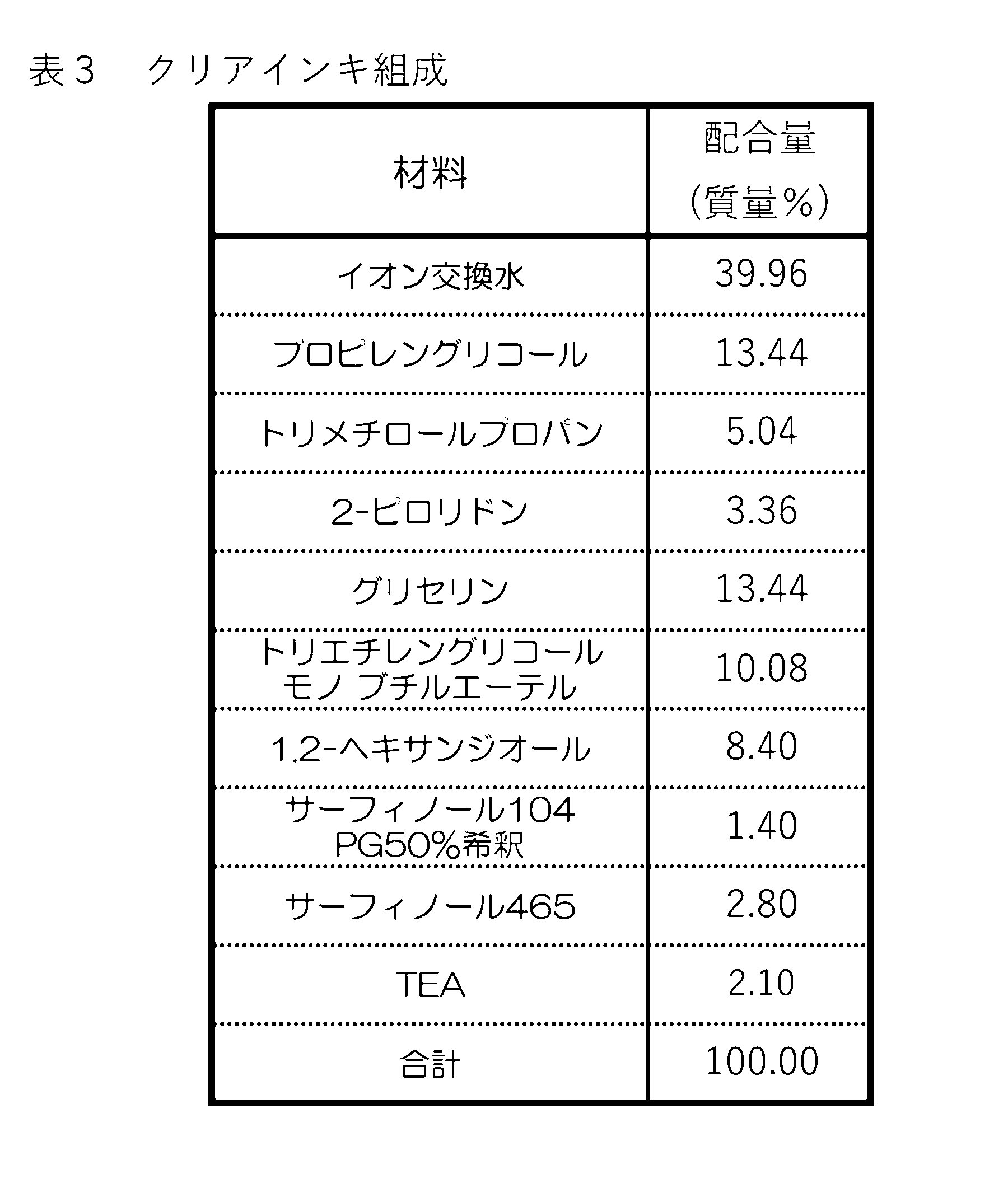
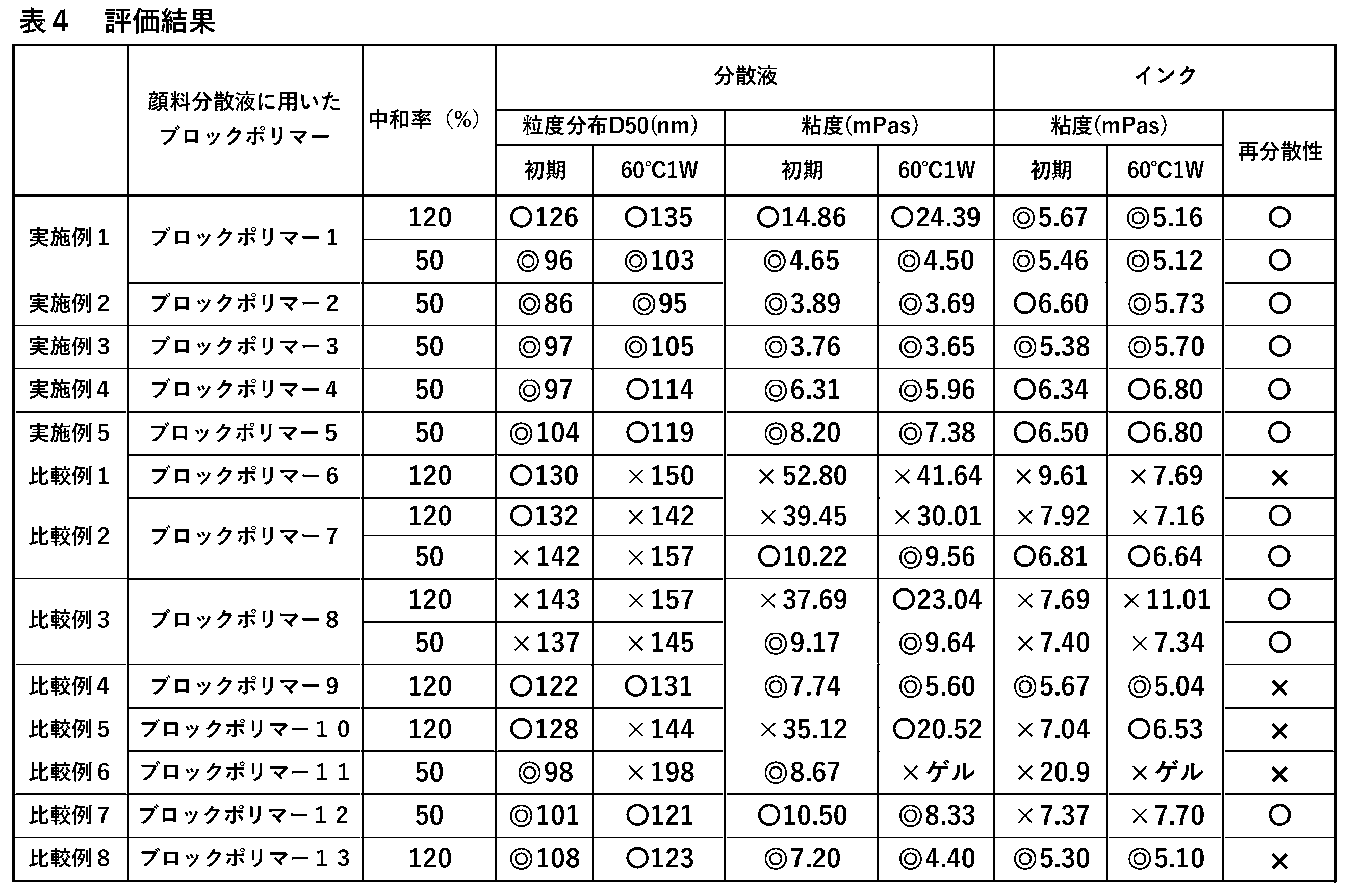
(評価結果)
表4に示すとおり、セグメント(A)(又はセグメント(A’))に親水性官能基を有するモノマーに由来する構成単位を含まない比較例1、4、5及び6では、再分散性が十分でないことが分かる。また、セグメント(B)(又はセグメント(B’))に疎水性官能基を有するモノマーに由来する構成単位を含まない比較例1、2及び3では、初期の粘度または粒度分布D50が好ましい範囲を逸脱していることがわかる。そのほか、比較例1、2、3及び5は、1週間の保管で粒度分布D50が大幅に増粒しており、保存安定性が悪いことがわかる。
(Evaluation Results)
As shown in Table 4, Comparative Examples 1, 4, 5, and 6, which do not contain a structural unit derived from a monomer having a hydrophilic functional group in segment (A) (or segment (A')), show insufficient redispersibility. Also, Comparative Examples 1, 2, and 3, which do not contain a structural unit derived from a monomer having a hydrophobic functional group in segment (B) (or segment (B')), show that the initial viscosity or particle size distribution D50 falls outside the preferred range. In addition, Comparative Examples 1, 2, 3, and 5 show a significant increase in particle size distribution D50 after storage for one week, indicating poor storage stability.
これに対し、セグメント(A)(又はセグメント(A’))及びセグメント(B)(又はセグメント(B’))の双方に疎水性官能基を有するモノマーから構成される構成単位と親水性官能基を有するモノマーから構成される構成単位を所定の範囲内の比率で含む本発明のブロックポリマーを用いた実施例1~5は、高い再分散性を有している。また、1週間の保管を経ても粘度及び粒度分布D50がインクジェット用インキとして好適な範囲を維持しており、高い保存安定性を有していることが分かる。 In contrast, Examples 1 to 5, which use the block polymer of the present invention, in which both segment (A) (or segment (A')) and segment (B) (or segment (B')) contain a structural unit composed of a monomer having a hydrophobic functional group and a structural unit composed of a monomer having a hydrophilic functional group in a ratio within a specified range, have high redispersibility. In addition, even after one week of storage, the viscosity and particle size distribution D50 remain within a suitable range for inkjet inks, demonstrating high storage stability.
(実施例6)
樹脂溶解物2(1) 48g、P.B-15:3 18g、1,2-ヘキサンジオール5g、及び水29gを混合し、0.5mmのジルコニアビーズを用い、ペイントシェイカーを用いて5時間分散した。更に0.1mmのジルコニアビーズを用いて8時間分散した。
ジルコニアビーズを分離して回収した分散液を遠心分離機により回転数16300rpmで10分間処理して粗大粒子を除去することで顔料分散液を得た。
(実施例7、8)
樹脂溶解物2(1)に代えて樹脂溶解物2(2)、樹脂溶解物2(3)を用いた以外は同様にして顔料分散液を得た。
(耐湿摩擦性評価)
実施例6~8で得られた顔料分散液を用い、以下の配合で混合し、評価用インクを得た。
顔料分散液 P.B-15:3が7質量%となる量
バインダー(ウレタン樹脂) 5
1,2-ヘキサンジオール 10
表面調整剤 1
イオン交換水 残部
合計 100
なお表面調整剤としては「BYK-302」(商品名、Byk Chemie社製ポリエーテル変性ポリジメチルシロキサン)を用いた。
顔料分散液のD50と粘度、評価用インクの粘度を前述の方法で測定した。結果を表5に示す。
Example 6
48 g of resin solution 2(1), 18 g of PB-15:3, 5 g of 1,2-hexanediol, and 29 g of water were mixed and dispersed using 0.5 mm zirconia beads and a paint shaker for 5 hours, and then further dispersed using 0.1 mm zirconia beads for 8 hours.
The dispersion liquid recovered by separating the zirconia beads was centrifuged at a rotation speed of 16,300 rpm for 10 minutes to remove coarse particles, thereby obtaining a pigment dispersion liquid.
(Examples 7 and 8)
Pigment dispersions were obtained in the same manner, except that Resin Dissolved Material 2(2) and Resin Dissolved Material 2(3) were used instead of Resin Dissolved Material 2(1).
(Wet friction resistance evaluation)
The pigment dispersions obtained in Examples 6 to 8 were mixed in the following proportions to obtain inks for evaluation.
Pigment dispersion PB-15:3: 7% by mass Binder (urethane resin) 5
1,2-Hexanediol 10
Ion exchange water Remainder Total 100
The surface conditioner used was "BYK-302" (product name, polyether-modified polydimethylsiloxane manufactured by Byk Chemie).
The D50 and viscosity of the pigment dispersion and the viscosity of the evaluation ink were measured by the methods described above. The results are shown in Table 5.
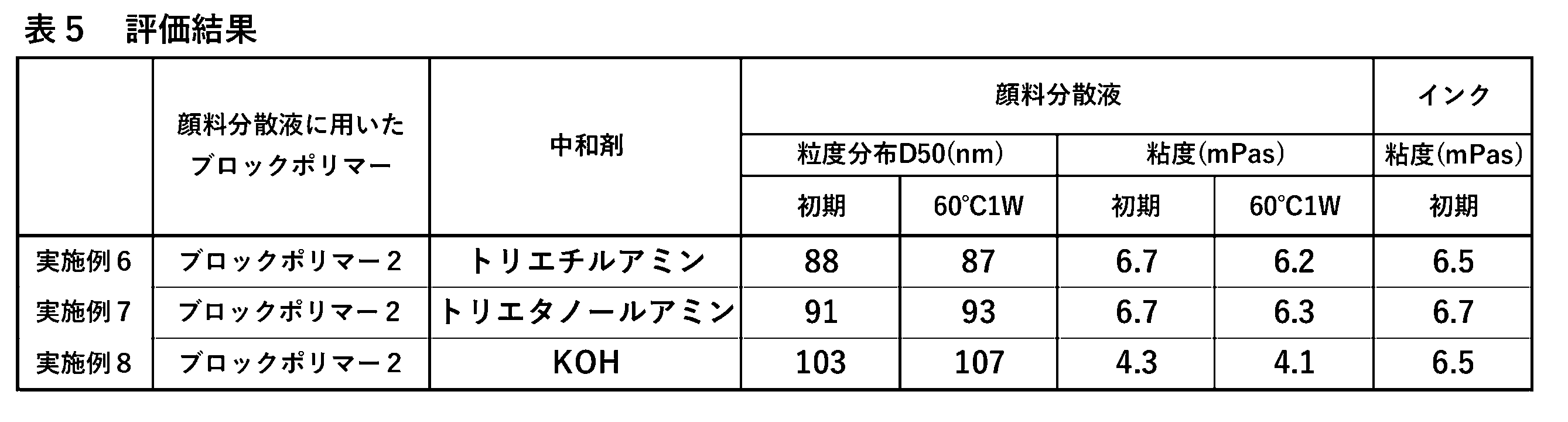
評価用インクをPETフィルムにバーコーター#3で塗工し、オーブンで80℃×3分間乾燥して塗膜を得た。学振型摩擦試験機(株式会社安田精機製作所 摩擦試験機II形)を使用し、イオン交換水で100%湿潤させた白綿布を摩擦子に取り付け、200gの加重で塗膜の表面を10往復する乾摩擦試験を行い、耐湿摩擦性を評価した。10往復後の塗膜の外観を「デジタルカメラ OLYMPUS TOUGH TG-5」で写真撮影した結果を図1~3に示す。図中、1-a、2-a、3-aは耐湿摩擦試験後のフィルム塗膜の状態を示し、1-b、2-b、3-bは耐湿摩擦試験に使用した白綿布の試験後の状態を示す。
中和剤としてトリエチルアミン又はトリエタノールアミンを用いて中和した樹脂溶解物2(1)又は樹脂溶解物2(2)を用いた実施例6及び実施例7は、KOHを用いて中和した樹脂溶解物2(3)を用いた実施例8に比べて塗膜の剥がれている面積が小さく、耐湿摩擦性が優れていることがわかる。これは、樹脂を中和しているアミン化合物が揮発して、樹脂が水に不溶化したためであると考えられる。
The ink for evaluation was applied to a PET film using a
It can be seen that in Examples 6 and 7, which used Resin Dissolved Material 2(1) or Resin Dissolved Material 2(2) neutralized with triethylamine or triethanolamine as a neutralizing agent, the peeled area of the coating film was smaller and the wet friction resistance was superior compared to Example 8, which used Resin Dissolved Material 2(3) neutralized with KOH. This is thought to be because the amine compound neutralizing the resin volatilized, making the resin insoluble in water.
以上のように、本発明により、分散剤として極めて優れた性能を発揮するブロックポリマー及び当該ブロックポリマーを用いた優れた性能を有する着色材料分散液、並びにそれらを用いた優れた性能のインクジェット用インキを得ることができる。 As described above, the present invention makes it possible to obtain a block polymer that exhibits extremely excellent performance as a dispersant, a coloring material dispersion that uses said block polymer and has excellent performance, and an inkjet ink that uses them and has excellent performance.
Claims (13)
(a1):疎水性官能基を有するモノマーに由来する構成単位と親水性官能基を有するモノマーに由来する構成単位とを有し、両者の質量比(疎水性官能基を有するモノマーに由来する構成単位の合計質量/親水性官能基を有するモノマーに由来する構成単位の合計質量)が2.3以上19.0以下
(a2): ピークトップ分子量が750以上
(b1): 疎水性官能基を有するモノマーに由来する構成単位と親水性官能基を有するモノマーに由来する構成単位とを有し、両者の質量比(疎水性官能基を有するモノマーに由来する構成単位の合計質量/親水性官能基を有するモノマーに由来する構成単位の合計質量)が0.43以上2.3未満
(b2): ピークトップ分子量が750以上 A block polymer having at least one segment (A) that satisfies the following (a1) and (a2) and at least one segment (B) that satisfies the following (b1) and (b2), and having a peak top molecular weight of 3,000 or more and 16,000 or less.
(a1): Having a structural unit derived from a monomer having a hydrophobic functional group and a structural unit derived from a monomer having a hydrophilic functional group, the mass ratio between the two (total mass of structural units derived from monomers having hydrophobic functional groups / total mass of structural units derived from monomers having hydrophilic functional groups) is 2.3 or more and 19.0 or less. (a2): Peak top molecular weight is 750 or more. (b1): Having a structural unit derived from a monomer having a hydrophobic functional group and a structural unit derived from a monomer having a hydrophilic functional group, the mass ratio between the two (total mass of structural units derived from monomers having hydrophobic functional groups / total mass of structural units derived from monomers having hydrophilic functional groups) is 0.43 or more and less than 2.3. (b2): Peak top molecular weight is 750 or more.
(a1’): 疎水性官能基と親水性官能基のモル比(疎水性官能基の合計物質量/親水性官能基の合計物質量)が0.85以上8.50以下
(a2): ピークトップ分子量が750以上
(b1’):疎水性官能基と親水性官能基のモル比(疎水性官能基の合計物質量/親水性官能基の合計物質量)が0.16以上0.85未満
(b2): ピークトップ分子量が750以上 A block polymer having at least one segment (A') that satisfies the following (a1') and (a2) and at least one segment (B') that satisfies the following (b1') and (b2), and having a peak top molecular weight of 3,000 or more and 16,000 or less.
(a1'): The molar ratio of hydrophobic functional groups to hydrophilic functional groups (total amount of hydrophobic functional groups/total amount of hydrophilic functional groups) is 0.85 or more and 8.50 or less. (a2): The peak top molecular weight is 750 or more. (b1'): The molar ratio of hydrophobic functional groups to hydrophilic functional groups (total amount of hydrophobic functional groups/total amount of hydrophilic functional groups) is 0.16 or more and less than 0.85. (b2): The peak top molecular weight is 750 or more.
Priority Applications (2)
| Application Number | Priority Date | Filing Date | Title |
|---|---|---|---|
| JP2025528035A JPWO2024257877A1 (en) | 2023-06-15 | 2024-06-14 | |
| EP24823490.8A EP4729553A1 (en) | 2023-06-15 | 2024-06-14 | Block polymer, and coloring material dispersion and ink composition using same |
Applications Claiming Priority (2)
| Application Number | Priority Date | Filing Date | Title |
|---|---|---|---|
| JP2023-098833 | 2023-06-15 | ||
| JP2023098833 | 2023-06-15 |
Publications (1)
| Publication Number | Publication Date |
|---|---|
| WO2024257877A1 true WO2024257877A1 (en) | 2024-12-19 |
Family
ID=93852290
Family Applications (1)
| Application Number | Title | Priority Date | Filing Date |
|---|---|---|---|
| PCT/JP2024/021786 Ceased WO2024257877A1 (en) | 2023-06-15 | 2024-06-14 | Block polymer, and coloring material dispersion and ink composition using same |
Country Status (3)
| Country | Link |
|---|---|
| EP (1) | EP4729553A1 (en) |
| JP (1) | JPWO2024257877A1 (en) |
| WO (1) | WO2024257877A1 (en) |
Citations (8)
| Publication number | Priority date | Publication date | Assignee | Title |
|---|---|---|---|---|
| JP2008195769A (en) | 2007-02-09 | 2008-08-28 | Canon Inc | Block polymer compound, liquid composition, and inkjet ink |
| WO2011108435A1 (en) * | 2010-03-02 | 2011-09-09 | 大日精化工業株式会社 | Alkoxysilyl group-containing block copolymer, method for producing the same, resin-treated pigment, and pigment dispersion |
| JP2011225834A (en) | 2010-04-01 | 2011-11-10 | Dainichiseika Color & Chem Mfg Co Ltd | Aqueous inkjet pigment dispersion and aqueous inkjet pigment ink |
| JP2013032441A (en) * | 2011-08-02 | 2013-02-14 | Dainichiseika Color & Chem Mfg Co Ltd | Sulfonate group-containing block copolymer, method for production thereof, pigment dispersant, pigment colorant composition, resin-treated pigment composition, method for production thereof, and pigment colorant composition for color filter |
| JP2016026256A (en) | 2009-11-23 | 2016-02-12 | イー・アイ・デュポン・ドウ・ヌムール・アンド・カンパニーE.I.Du Pont De Nemours And Company | Crosslinked pigment dispersion based on structured vinyl polymeric dispersant |
| JP2017008217A (en) * | 2015-06-23 | 2017-01-12 | 日油株式会社 | Antifogging composition |
| JP2020111683A (en) | 2019-01-11 | 2020-07-27 | 御国色素株式会社 | Coloring material dispersion |
| JP2023116301A (en) * | 2022-02-09 | 2023-08-22 | 大日精化工業株式会社 | Water-based OP varnish and water-based flexographic ink |
-
2024
- 2024-06-14 JP JP2025528035A patent/JPWO2024257877A1/ja active Pending
- 2024-06-14 EP EP24823490.8A patent/EP4729553A1/en active Pending
- 2024-06-14 WO PCT/JP2024/021786 patent/WO2024257877A1/en not_active Ceased
Patent Citations (8)
| Publication number | Priority date | Publication date | Assignee | Title |
|---|---|---|---|---|
| JP2008195769A (en) | 2007-02-09 | 2008-08-28 | Canon Inc | Block polymer compound, liquid composition, and inkjet ink |
| JP2016026256A (en) | 2009-11-23 | 2016-02-12 | イー・アイ・デュポン・ドウ・ヌムール・アンド・カンパニーE.I.Du Pont De Nemours And Company | Crosslinked pigment dispersion based on structured vinyl polymeric dispersant |
| WO2011108435A1 (en) * | 2010-03-02 | 2011-09-09 | 大日精化工業株式会社 | Alkoxysilyl group-containing block copolymer, method for producing the same, resin-treated pigment, and pigment dispersion |
| JP2011225834A (en) | 2010-04-01 | 2011-11-10 | Dainichiseika Color & Chem Mfg Co Ltd | Aqueous inkjet pigment dispersion and aqueous inkjet pigment ink |
| JP2013032441A (en) * | 2011-08-02 | 2013-02-14 | Dainichiseika Color & Chem Mfg Co Ltd | Sulfonate group-containing block copolymer, method for production thereof, pigment dispersant, pigment colorant composition, resin-treated pigment composition, method for production thereof, and pigment colorant composition for color filter |
| JP2017008217A (en) * | 2015-06-23 | 2017-01-12 | 日油株式会社 | Antifogging composition |
| JP2020111683A (en) | 2019-01-11 | 2020-07-27 | 御国色素株式会社 | Coloring material dispersion |
| JP2023116301A (en) * | 2022-02-09 | 2023-08-22 | 大日精化工業株式会社 | Water-based OP varnish and water-based flexographic ink |
Non-Patent Citations (1)
| Title |
|---|
| "Partition Coefficient (n-octanol/water), High Performance Liquid Chromatography (HPLC) Method", OECD GUIDELINE FOR TESTING OF CHEMICALS, 30 March 1989 (1989-03-30) |
Also Published As
| Publication number | Publication date |
|---|---|
| JPWO2024257877A1 (en) | 2024-12-19 |
| EP4729553A1 (en) | 2026-04-22 |
Similar Documents
| Publication | Publication Date | Title |
|---|---|---|
| RU2261260C2 (en) | Aqueous dispersion of particles comprising water-insoluble pigment and method for its preparing, particles comprising water-insoluble pigment and method for their preparing and ink | |
| CN101139444B (en) | Cross-linked core-shell polymer particles | |
| US9296908B2 (en) | Aqueous inkjet ink composition | |
| CN104114654B (en) | Water dispersible pigment dispersion and the aqueous inkjet pigment inks employing it | |
| JP4758652B2 (en) | Method for producing graft copolymer having excellent pigment dispersibility, method for producing emulsions using the graft copolymers, and pigment dispersions using the graft copolymers or emulsions | |
| JP2020117725A (en) | Pigment water dispersion | |
| JP6886062B1 (en) | AB block copolymers, polymer emulsions, and water-based inkjet inks | |
| CN107108902B (en) | Process for producing modified polymer particles containing pigments | |
| CN102272248B (en) | Water-based ink for ink-jet printing | |
| JP5746837B2 (en) | Aqueous pigment dispersion for inkjet ink and aqueous pigment ink for inkjet printer | |
| CN102257080B (en) | Water-based ink for inkjet printing | |
| CN120548346B (en) | Pigment dispersion | |
| JP6482025B2 (en) | Polymer aqueous dispersion, process for producing the same, aqueous pigment dispersion and ink jet recording ink | |
| JP5451294B2 (en) | Ink jet ink, ink jet recording method, and ink cartridge | |
| JP7166532B2 (en) | Coloring material dispersion | |
| WO2024257877A1 (en) | Block polymer, and coloring material dispersion and ink composition using same | |
| JP7717043B2 (en) | Pigment dispersions, UV-curable inkjet inks, and printing films | |
| JP4672360B2 (en) | Water-based ink for inkjet recording | |
| CN100480340C (en) | Aqueous ink | |
| JP2015183161A (en) | Aqueous pigment dispersion for inkjet ink | |
| JP7545291B2 (en) | Water-based ink | |
| JP7747511B2 (en) | Water-based pigment dispersions | |
| JP6406089B2 (en) | Aqueous pigment dispersion for inkjet ink | |
| JP7740985B2 (en) | Method for producing aqueous pigment dispersion | |
| JP2025166315A (en) | Polymer dispersant and its manufacturing method, aqueous pigment dispersion, and aqueous inkjet ink |
Legal Events
| Date | Code | Title | Description |
|---|---|---|---|
| 121 | Ep: the epo has been informed by wipo that ep was designated in this application |
Ref document number: 24823490 Country of ref document: EP Kind code of ref document: A1 |
|
| ENP | Entry into the national phase |
Ref document number: 2025528035 Country of ref document: JP Kind code of ref document: A |
|
| WWE | Wipo information: entry into national phase |
Ref document number: 2025528035 Country of ref document: JP |
|
| WWE | Wipo information: entry into national phase |
Ref document number: 2024823490 Country of ref document: EP |
|
| NENP | Non-entry into the national phase |
Ref country code: DE |
|
| ENP | Entry into the national phase |
Ref document number: 2024823490 Country of ref document: EP Effective date: 20260115 |
|
| ENP | Entry into the national phase |
Ref document number: 2024823490 Country of ref document: EP Effective date: 20260115 |
|
| ENP | Entry into the national phase |
Ref document number: 2024823490 Country of ref document: EP Effective date: 20260115 |
|
| WWP | Wipo information: published in national office |
Ref document number: 2024823490 Country of ref document: EP |