WO2024258519A1 - Methods, systems, and compositions for oxidation of a substrate - Google Patents

Methods, systems, and compositions for oxidation of a substrate Download PDF

Info

Publication number
WO2024258519A1
WO2024258519A1 PCT/US2024/027594 US2024027594W WO2024258519A1 WO 2024258519 A1 WO2024258519 A1 WO 2024258519A1 US 2024027594 W US2024027594 W US 2024027594W WO 2024258519 A1 WO2024258519 A1 WO 2024258519A1
Authority
WO
WIPO (PCT)
Prior art keywords
aqueous composition
catalyst
range
substrate
oxidation
Prior art date
Legal status (The legal status is an assumption and is not a legal conclusion. Google has not performed a legal analysis and makes no representation as to the accuracy of the status listed.)
Pending
Application number
PCT/US2024/027594
Other languages
French (fr)
Inventor
Matthew Mills
Current Assignee (The listed assignees may be inaccurate. Google has not performed a legal analysis and makes no representation or warranty as to the accuracy of the list.)
Sudoc LLC
Original Assignee
Sudoc LLC
Priority date (The priority date is an assumption and is not a legal conclusion. Google has not performed a legal analysis and makes no representation as to the accuracy of the date listed.)
Filing date
Publication date
Application filed by Sudoc LLC filed Critical Sudoc LLC
Priority to US18/849,873 priority Critical patent/US12410077B1/en
Priority to CN202480048497.6A priority patent/CN121605089A/en
Publication of WO2024258519A1 publication Critical patent/WO2024258519A1/en
Anticipated expiration legal-status Critical
Pending legal-status Critical Current

Links

Classifications

    • CCHEMISTRY; METALLURGY
    • C02TREATMENT OF WATER, WASTE WATER, SEWAGE, OR SLUDGE
    • C02FTREATMENT OF WATER, WASTE WATER, SEWAGE, OR SLUDGE
    • C02F1/00Treatment of water, waste water, or sewage
    • C02F1/46Treatment of water, waste water, or sewage by electrochemical methods
    • C02F1/461Treatment of water, waste water, or sewage by electrochemical methods by electrolysis
    • C02F1/467Treatment of water, waste water, or sewage by electrochemical methods by electrolysis by electrochemical disinfection; by electrooxydation or by electroreduction
    • C02F1/4672Treatment of water, waste water, or sewage by electrochemical methods by electrolysis by electrochemical disinfection; by electrooxydation or by electroreduction by electrooxydation
    • CCHEMISTRY; METALLURGY
    • C02TREATMENT OF WATER, WASTE WATER, SEWAGE, OR SLUDGE
    • C02FTREATMENT OF WATER, WASTE WATER, SEWAGE, OR SLUDGE
    • C02F1/00Treatment of water, waste water, or sewage
    • C02F1/46Treatment of water, waste water, or sewage by electrochemical methods
    • C02F1/461Treatment of water, waste water, or sewage by electrochemical methods by electrolysis
    • CCHEMISTRY; METALLURGY
    • C02TREATMENT OF WATER, WASTE WATER, SEWAGE, OR SLUDGE
    • C02FTREATMENT OF WATER, WASTE WATER, SEWAGE, OR SLUDGE
    • C02F1/00Treatment of water, waste water, or sewage
    • C02F1/46Treatment of water, waste water, or sewage by electrochemical methods
    • C02F1/461Treatment of water, waste water, or sewage by electrochemical methods by electrolysis
    • C02F1/46104Devices therefor; Their operating or servicing
    • CCHEMISTRY; METALLURGY
    • C02TREATMENT OF WATER, WASTE WATER, SEWAGE, OR SLUDGE
    • C02FTREATMENT OF WATER, WASTE WATER, SEWAGE, OR SLUDGE
    • C02F1/00Treatment of water, waste water, or sewage
    • C02F1/68Treatment of water, waste water, or sewage by addition of specified substances, e.g. trace elements, for ameliorating potable water
    • C02F1/683Treatment of water, waste water, or sewage by addition of specified substances, e.g. trace elements, for ameliorating potable water by addition of complex-forming compounds
    • CCHEMISTRY; METALLURGY
    • C02TREATMENT OF WATER, WASTE WATER, SEWAGE, OR SLUDGE
    • C02FTREATMENT OF WATER, WASTE WATER, SEWAGE, OR SLUDGE
    • C02F1/00Treatment of water, waste water, or sewage
    • C02F1/72Treatment of water, waste water, or sewage by oxidation
    • C02F1/725Treatment of water, waste water, or sewage by oxidation by catalytic oxidation
    • CCHEMISTRY; METALLURGY
    • C02TREATMENT OF WATER, WASTE WATER, SEWAGE, OR SLUDGE
    • C02FTREATMENT OF WATER, WASTE WATER, SEWAGE, OR SLUDGE
    • C02F1/00Treatment of water, waste water, or sewage
    • C02F1/66Treatment of water, waste water, or sewage by neutralisation; pH adjustment
    • CCHEMISTRY; METALLURGY
    • C02TREATMENT OF WATER, WASTE WATER, SEWAGE, OR SLUDGE
    • C02FTREATMENT OF WATER, WASTE WATER, SEWAGE, OR SLUDGE
    • C02F2101/00Nature of the contaminant
    • C02F2101/30Organic compounds
    • C02F2101/308Dyes; Colorants; Fluorescent agents
    • CCHEMISTRY; METALLURGY
    • C02TREATMENT OF WATER, WASTE WATER, SEWAGE, OR SLUDGE
    • C02FTREATMENT OF WATER, WASTE WATER, SEWAGE, OR SLUDGE
    • C02F2101/00Nature of the contaminant
    • C02F2101/30Organic compounds
    • C02F2101/34Organic compounds containing oxygen
    • CCHEMISTRY; METALLURGY
    • C02TREATMENT OF WATER, WASTE WATER, SEWAGE, OR SLUDGE
    • C02FTREATMENT OF WATER, WASTE WATER, SEWAGE, OR SLUDGE
    • C02F2101/00Nature of the contaminant
    • C02F2101/30Organic compounds
    • C02F2101/38Organic compounds containing nitrogen
    • CCHEMISTRY; METALLURGY
    • C02TREATMENT OF WATER, WASTE WATER, SEWAGE, OR SLUDGE
    • C02FTREATMENT OF WATER, WASTE WATER, SEWAGE, OR SLUDGE
    • C02F2101/00Nature of the contaminant
    • C02F2101/30Organic compounds
    • C02F2101/40Organic compounds containing sulfur
    • CCHEMISTRY; METALLURGY
    • C02TREATMENT OF WATER, WASTE WATER, SEWAGE, OR SLUDGE
    • C02FTREATMENT OF WATER, WASTE WATER, SEWAGE, OR SLUDGE
    • C02F2103/00Nature of the water, waste water, sewage or sludge to be treated
    • C02F2103/30Nature of the water, waste water, sewage or sludge to be treated from the textile industry
    • CCHEMISTRY; METALLURGY
    • C02TREATMENT OF WATER, WASTE WATER, SEWAGE, OR SLUDGE
    • C02FTREATMENT OF WATER, WASTE WATER, SEWAGE, OR SLUDGE
    • C02F2103/00Nature of the water, waste water, sewage or sludge to be treated
    • C02F2103/34Nature of the water, waste water, sewage or sludge to be treated from industrial activities not provided for in groups C02F2103/12 - C02F2103/32
    • C02F2103/343Nature of the water, waste water, sewage or sludge to be treated from industrial activities not provided for in groups C02F2103/12 - C02F2103/32 from the pharmaceutical industry, e.g. containing antibiotics
    • CCHEMISTRY; METALLURGY
    • C02TREATMENT OF WATER, WASTE WATER, SEWAGE, OR SLUDGE
    • C02FTREATMENT OF WATER, WASTE WATER, SEWAGE, OR SLUDGE
    • C02F2305/00Use of specific compounds during water treatment
    • C02F2305/02Specific form of oxidant
    • CCHEMISTRY; METALLURGY
    • C02TREATMENT OF WATER, WASTE WATER, SEWAGE, OR SLUDGE
    • C02FTREATMENT OF WATER, WASTE WATER, SEWAGE, OR SLUDGE
    • C02F2305/00Use of specific compounds during water treatment
    • C02F2305/04Surfactants, used as part of a formulation or alone

Definitions

  • FIG. l is a schematic diagram of an electrolysis cell according to the present disclosure.
  • the catalyst can be added in an amount to achieve a concentration in the aqueous composition in a range of 10 nM to 100 pM of the catalyst, such as, for example, 20 nM to 50 pM, 100 nM to 50 pM, 0.5 pM to 50 pM catalyst, 0.5 pM to 25 pM catalyst, 0.5 pM to 25 pM catalyst, or 0.5 pM to 10 pM catalyst.
  • the catalyst can be provided as an aqueous composition, a slurry, a powder, granules, and/or a tablet.
  • the metal in the catalyst can be a transition metal, such as, for example, iron, manganese, cobalt, and/or copper.
  • the metal in the catalyst can be iron and/or manganese.
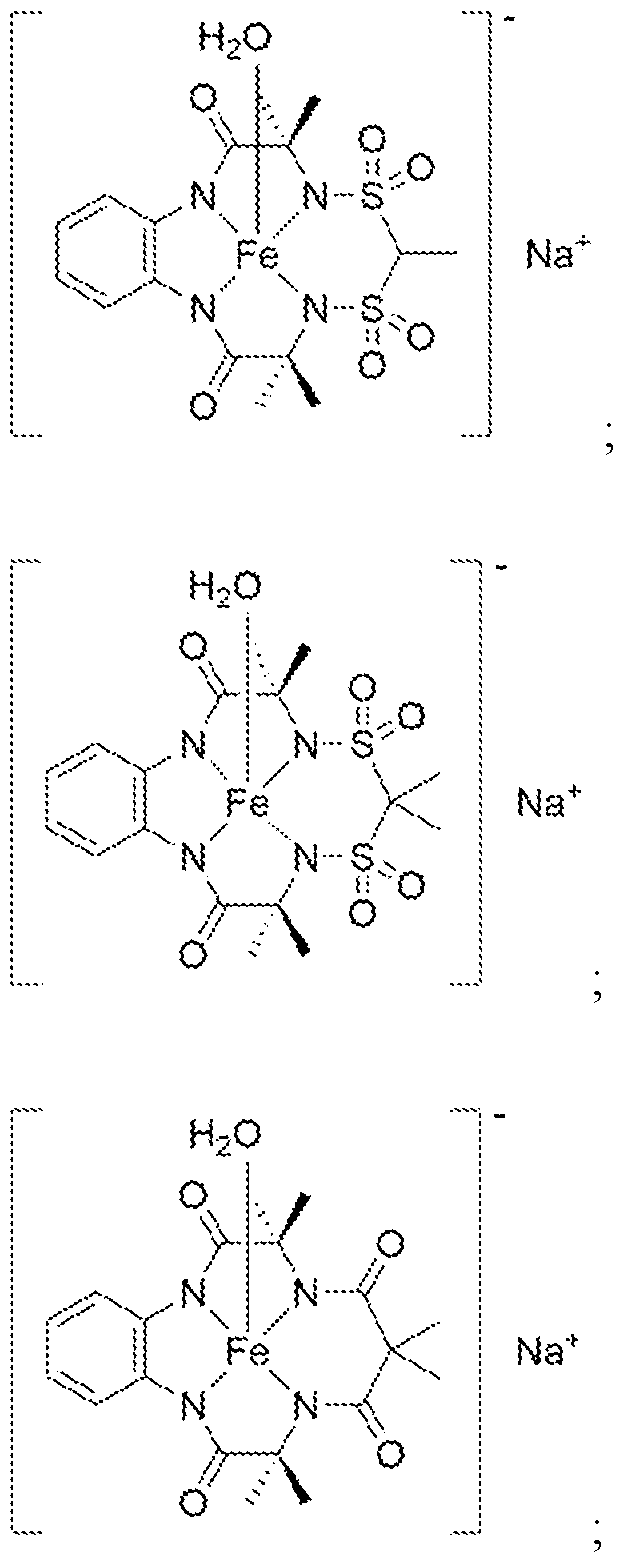
  • the catalyst can comprise at least one of the following structures 1-6: Structure 1
  • an additional reagent can be added to the aqueous composition for enhancing scouring, dispersion, wetting, alkalinity, salinity, and/or buffering capacity of the aqueous composition.
  • the additional reagent can comprise a wetting agent, a surfactant, denaturing agent, co-solvent, and/or a buffer.
  • the aqueous composition 106 can be added to the electrolysis cell 100 at a single time or the aqueous composition can be continuously cycled through the electrolysis cell 100 with a pump.
  • the method could also comprise a series of electrode pair through which the aqueous composition travels.
  • the electrical voltage can be applied at a sufficient level to facilitate oxidation of the substrate, such as, for example, a sufficient level to activate the catalyst and/or generate oxidant from the electrolyte.
  • An electrical current can be applied to the aqueous composition to achieve a current density in the aqueous composition in a range of greater than 0 to 500 mA/cm 2 , such as, for example, 1 mA/cm 2 to 100 mA/cm 2 , 1 mA/cm 2 to 50 mA/cm 2 , 1 mA/cm 2 to 25 mA/cm 2 , or 1 mA/cm 2 to 10 mA/cm 2 .
  • the current density is based on the current applied to the working electrode and the surface area of the working electrode.
  • the aqueous composition can be at a temperature in a range of 0 °C to 95 °C, such as, for example, 5 °C to 90 °C, 5 °C to 70 °C, 5 °C to 50 °C , 10 °C to 50 °C, 10 °C to 45 °C, or 15 °C to 45 °C.
  • the use of the catalyst can enable a reduced temperature for the oxidation, which can reduce the energy requirements for the process.
  • the pH of the aqueous composition can be in a range of 4 to 13, such as, for example, 4 to 11, 4 to 10, 5 to 9, 5.5 to 8.5, 6 to 8, or 6.2 to 7.8.
  • the aqueous composition is oxidant free prior to applying the voltage and any oxidant present may be generated by the applied electrical voltage.
  • Oxidant free means that the aqueous composition comprises no greater than 0.1% by weight oxidant, such as, for example, no greater than 0.05% by weight oxidant, no greater than 0.01% by weight oxidant, or no greater than 0.001% by weight oxidant.
  • the aqueous composition can comprise no intentionally added oxidant.
  • the present disclosure also provides an aqueous composition for oxidation of a substrate.
  • the aqueous composition can comprise a catalyst, an electrolyte, and water.
  • aqueous compositions were prepared with varying amounts of electrolyte and catalyst.
  • deionized water was added to a glass beaker with a stir bar and placed on a stir plate to provide constant mixing.
  • an electrolyte, a substrate of Orange II dye (4-(2-Hydroxy-l-naphthylazo)benzenesulfonic acid sodium salt), and, if present, a metal complex catalyst were added and mixed together.
  • the metal in the catalyst was iron.
  • Orange II dye was used as a surrogate for other substrates as quantifying the oxidation of Orange II dye was simpler to perform.
  • An electrolysis cell was prepared for applying an electric voltage to each aqueous composition.
  • the electrolysis cell was configured according to FIG. 1 and included placing a boron-doped diamond anode and a titanium based cathode with a 13 mm electrode gap into the glass beaker that the solution was prepared in.
  • the anode included a surface area of 8.1 cm 2 and the cathode included a surface area of 19 cm 2 .
  • the cathode and anode were connected to a three-electrode potentiostat for control and monitoring of system voltage, system current, and electrode (anode) potential in reference to a Ag/AgCl reference-electrode.
  • the referenceelectrode was suspended in the glass beaker such that it is within 2 mm of the anode surface.
  • the experiments were conducted either in potentiostatic mode (controlled anode potential) or galvanstatic (controlled current) mode.
  • the aqueous composition was pumped from the glass beaker through an inline ultraviolet-visible wavelength spectrophotometer (UV-VIS Spec) using a peristaltic pump at a flow rate of 100 mL/min and at ambient temperature (e.g., 20 degrees Celsius +/- 2 degrees Celsius). This was pumped through an electrochemical cell with a volume of 0.25 mL across an anode with a surface area of 4.5 cm 2 .
  • the UV-Vis spec measured absorbance of the aqueous composition in a wavelength range of 200 to 600 nanometers (nm) as the aqueous composition was pumped through the cell over 15 minutes.
  • the change in the absorbance at 484 nm was used to infer degradation of Orange II dye using molar absorptivity calculations that are governed by the Beer-Lambert Law, also referred to as Beer’s Law.
  • An aqueous composition consisting of 150 mL of 20 mM phosphate buffer at pH 7.9, 0.5 mg/L acetaminophen, and 0 or 1 pM catalyst was added to an electrochemical reactor.
  • the electrochemical cell consisted of a 12 cm 2 boron-doped diamond anode and titanium cathode. The current density of the cell was set to 10 mA cm' 2 .
  • the reaction mixture was agitated by magnetic stirring at a rate of 400 rpm.
  • the concentration of acetaminophen was measured by LC-MS/MS and the data was plotted to measure rates of degradation as shown in FIG. 2.
  • a method for oxidation of a substrate comprising: combining a macrocyclic ligand and metal complex catalyst, an electrolyte, the substrate, and water to form an aqueous composition; and applying an electrical voltage to the aqueous composition and oxidizing the substrate in the presence of the catalyst.
  • Clause 2 The method of clause 1, wherein the electrolyte is added in an amount to achieve a conductivity in the aqueous composition in a range of 0.1 pS/cm to 100 mS/cm.
  • Clause 3 The method of clause 1, wherein the electrolyte is added in an amount to achieve a conductivity in the aqueous composition in a range of 50 pS/cm to 100 pS/cm.
  • Clause 4 The method of any of clauses 1-3, wherein the electrolyte comprises a salt.
  • Clause 5 The method of any of clauses 1-4, wherein the electrolyte comprises a halogen salt, a sulfate salt, a phosphate salt, a nitrate salt, and/or a carbonate salt.
  • Clause 6 The method of any of clauses 1-5, wherein the electrolyte comprises sodium chloride, sodium sulfate, sodium phosphate, or a combination thereof.
  • Clause 7 The method of any of clauses 1-6, wherein the substrate comprises organic compounds.
  • Clause 8 The method of any of clauses 1-7, wherein the substrate comprises inorganic compounds.
  • Clause 9 The method of any of clauses 1-8, wherein the water is added in an amount to achieve a concentration in the aqueous composition of at least 50 % by weight based on a total weight of the aqueous composition.
  • Clause 10 The method of any of clauses 1-9, wherein the catalyst is added in an amount to achieve a concentration in the aqueous composition in a range of 10 nM to 100 pM of the catalyst.
  • Clause 11 The method of any of clauses 1-10, wherein the catalyst is added in an amount to achieve a concentration in the aqueous composition in a range of 1 pM to 10 pM of the catalyst.
  • Clause 12 The method of any of clauses 1-11, wherein the catalyst comprises four N- groups bonded to a metal and each N-group is selected from the group consisting of amide, sulfonamide, and phosphoramide.
  • Clause 13 The method of clause 12, wherein the catalyst comprises iron, manganese, cobalt, copper, or a combination thereof as the metal.
  • Clause 14 The method of any of clauses 1-13, wherein the catalyst comprises at least one of the following structures:
  • Clause 15 The method of any of clauses 1-14, further comprising adding an additional reagent to the aqueous composition, wherein the additional reagent is selected from the group consisting of a wetting agent, a surfactant, denaturing agent, co-solvent, and a buffer.
  • the additional reagent is selected from the group consisting of a wetting agent, a surfactant, denaturing agent, co-solvent, and a buffer.
  • Clause 16 The method of any of clauses 1-15, wherein the aqueous composition is oxidant free prior to applying the voltage.
  • Clause 17 The method of any of clauses 1-16, wherein during the oxidation, a pH of the aqueous composition is in a range of 4 to 13.
  • Clause 18 The method of any of clauses 1-17, wherein during the oxidation, a pH of the aqueous composition is in a range of 6 to 8.
  • Clause 19 The method of any of clauses 1-18, wherein during the oxidation, the aqueous composition is at a temperature in a range of 0 °C to 95 °C.
  • Clause 20 The method of any of clauses 1-19, wherein the electrical voltage is applied to the aqueous composition to achieve a current density in the aqueous composition is in a range of greater than 0 to 500 mA/cm 2 .
  • Clause 21 The method of any of clauses 1-20, wherein the electrical voltage is applied to the aqueous composition to achieve a current density in the aqueous composition is in a range of greater than 0 mA/cm 2 to 100 mA/cm 2 .
  • Clause 22 The method of any of clauses 1-21, wherein the electrical voltage is applied to the aqueous composition to achieve a current density in the aqueous composition is in a range of 1 mA/cm 2 to 10 mA/cm 2 .
  • Clause 23 The method of any of clauses 1-22, further comprising introducing the aqueous composition into an electrolysis cell comprising an anode and a cathode, wherein the aqueous composition is disposed in contact with the anode and the cathode, and the electrical voltage is applied across the anode and cathode such that the substrate is oxidized in the presence of the catalyst.
  • Clause 24 A system for oxidation of a substrate, the system configured to perform the method of any of clauses 1-23.
  • any numerical range recited herein includes all sub-ranges subsumed within the recited range.
  • a range of "1 to 10" includes all sub-ranges between (and including) the recited minimum value of 1 and the recited maximum value of 10, that is, having a minimum value equal to or greater than 1 and a maximum value equal to or less than 10.
  • Any maximum numerical limitation recited in this specification is intended to include all lower numerical limitations subsumed therein and any minimum numerical limitation recited in this specification is intended to include all higher numerical limitations subsumed therein. Accordingly, Applicant reserves the right to amend this specification, including the claims, to expressly recite any sub-range subsumed within the ranges expressly recited. All ranges are inherently described in this specification.
  • compositions, methods, and the discussion accompanying them are used as examples for the sake of conceptual clarity and that various configuration modifications are contemplated. Consequently, as used herein, the specific exemplars set forth and the accompanying discussion are intended to be representative of their more general classes. In general, use of any specific exemplar is intended to be representative of its class, and the non-inclusion of specific components (e.g., operations), devices, and objects should not be taken as limiting.

Landscapes

  • Chemical & Material Sciences (AREA)
  • Organic Chemistry (AREA)
  • Life Sciences & Earth Sciences (AREA)
  • Hydrology & Water Resources (AREA)
  • Engineering & Computer Science (AREA)
  • Environmental & Geological Engineering (AREA)
  • Water Supply & Treatment (AREA)
  • Chemical Kinetics & Catalysis (AREA)
  • Electrochemistry (AREA)
  • General Chemical & Material Sciences (AREA)
  • Health & Medical Sciences (AREA)
  • Medicinal Chemistry (AREA)
  • Water Treatment By Electricity Or Magnetism (AREA)
  • Electrolytic Production Of Non-Metals, Compounds, Apparatuses Therefor (AREA)

Abstract

Methods, systems, and compositions for oxidation are provided. The method comprises combining a macrocyclic ligand and metal complex catalyst, an electrolyte, the substrate, and water to form an aqueous composition. The method comprises applying an electrical voltage to the aqueous composition and oxidizing the substrate in the presence of the catalyst.

Description

TITLE
METHODS, SYSTEMS, AND COMPOSITIONS FOR OXIDATION OF A SUBSTRATE
INVENTORS
Matthew Mills
FIELD
[0001] The present disclosure relates to methods, systems, and compositions for oxidation of a substrate.
BACKGROUND
[0002] Electrochemical oxidation has been used for treating concentrated waste streams containing organic and inorganic compounds. However, typical electrochemical oxidation system present challenges.
SUMMARY
[0003] In one aspect, the present disclosure provides a method for oxidation of a substrate. The method comprises combining a metal complex catalyst, an electrolyte, the substrate, and water to form an aqueous composition. The method comprises applying an electrical voltage to the aqueous composition and oxidizing the substrate in the presence of the catalyst.
[0004] In another aspect, the present disclosure provides an aqueous composition for oxidation.
[0005] It is understood that the inventions described in this specification are not limited to the examples summarized in this Summary. Various other aspects are described and exemplified herein.
BRIEF DESCRIPTION OF THE DRAWINGS
[0006] The features and advantages of the examples, and the manner of attaining them, will become more apparent and the examples will be better understood by reference to the following description of examples taken in conjunction with the accompanying drawings, wherein: [0007] FIG. l is a schematic diagram of an electrolysis cell according to the present disclosure; and
[0008] FIG. 2 is a graph of the concentration of acetaminophen measured by LC-MS/MS and the data was plotted to measure rates of degradation.
[0009] Corresponding reference characters indicate corresponding parts throughout the several views. The exemplifications set out herein illustrate certain examples, in one form, and such exemplifications are not to be construed as limiting the scope of the examples in any manner.
DETAILED DESCRIPTION
[0010] Certain exemplary aspects of the present disclosure will now be described to provide an overall understanding of the principles of the composition, function, manufacture, and use of the compositions and methods disclosed herein. One or more examples of these aspects are illustrated in the accompanying drawing. Those of ordinary skill in the art will understand that the compositions and methods specifically described herein are non-limiting exemplary aspects and that the scope of the various examples of the present invention is defined solely by the claims. The features illustrated or described in connection with one exemplary aspect may be combined with the features of other aspects. Such modifications and variations are intended to be included within the scope of the present invention.
[0011] Typically, large quantities of electrolyte and high current densities have been used to oxidize substrates in waste streams through electrochemical reactions. However, these prior processes can be inefficient, costly, and may require significant remediation efforts for waste streams. Thus, the present disclosure provides methods, apparatus, and compositions for oxidation of substrates that can reduce the reaction temperature, reduce the concentration of electrolyte, reduce the need for oxidant, reduce the current density used and/or the size of the electrodes needed.
[0012] The method for oxidation of a substrate according to the present disclosure can comprise combining a metal complex catalyst, an electrolyte, a substrate, and water to form an aqueous composition. The combining can comprise mixing the materials together in a vessel. In various examples, the catalyst, electrolyte, and/or substrate are first combined with water prior to combining with the other materials. For example, the substrate and/or electrolyte can be combined with water prior to adding the catalyst. Additional water may be added to the process as necessary.
[0013] The substrate can be present in a waste stream, such as, for example, an aqueous waste stream. The aqueous waste stream can comprise textile dye wastewater, a pharmaceutical waste stream, an oil and gas waste stream, a remediation stream, and/or other waste stream type. In various examples, at least a portion of the electrolyte can be present in the aqueous waste stream. The combining can comprise adding the catalyst to the aqueous waste stream and optionally water and/or electrolyte, depending on the water content and/or conductivity of the aqueous waste stream.
[0014] The catalyst can be added in an amount to achieve a concentration in the aqueous composition in a range of 10 nM to 100 pM of the catalyst, such as, for example, 20 nM to 50 pM, 100 nM to 50 pM, 0.5 pM to 50 pM catalyst, 0.5 pM to 25 pM catalyst, 0.5 pM to 25 pM catalyst, or 0.5 pM to 10 pM catalyst. The catalyst can be provided as an aqueous composition, a slurry, a powder, granules, and/or a tablet.
[0015] The catalyst can comprise four N-groups bonded to the metal. The N-groups are nitrogen containing groups selected from the group consisting of amide, sulfonamide, and phosphoramide. The nitrogen in the N-groups can be directly bonded to the metal. In various examples, the N-groups comprises at least one nitrogen containing group selected from the group consisting of sulfonamide and phosphoramide. In certain examples, the catalyst can comprise a diamido-disulfonamide macrocyclic ligand and metal complex and/or a tetrasulfonamide macrocyclic ligand and metal catalyst. The catalyst can comprise a catalyst as described in U.S. Patent No. 7,060,818 and/or U.S. Patent No. 10,926,248, which are hereby incorporated by reference in their entirety. The metal in the catalyst can be a transition metal, such as, for example, iron, manganese, cobalt, and/or copper. For example, the metal in the catalyst can be iron and/or manganese. In various examples, the catalyst can comprise at least one of the following structures 1-6: Structure 1
Figure imgf000006_0001
Structure 3
Figure imgf000006_0002
Structure 5
Figure imgf000007_0001
[0016] The electrolyte can be added in an amount to achieve a conductivity in the aqueous composition in a range of 0.1 pS to 100 mS, such as, for example, 1 pS/cm to 50 mS/cm, 1 pS/cm to 3 mS/cm, 1 pS/cm to 2 mS/cm, 1 pS/cm to 1 mS/cm, 1 pS to 900 pS/cm, 5 pS/cm to 800 pS/cm, 25 pS/cm to 700 pS/cm, 20 pS/cm to 600 pS/cm, 50 pS/cm to 500 pS/cm, 50 pS/cm to 400 pS/cm, 50 pS/cm to 100 pS/cm, or 100 pS/cm to 400 pS/cm. In various examples, the electrolyte can be present in an amount of 10 mg/L to 5000 mg/L, such as, for example 100 mg/L to 4000 mg/L, 500 mg/L to 3000 mg/L, or 1000 mg/L to 2500 mg/L. Conductivity can be measured with a conductivity meter, such as, for example, an Orion Star 212 Conductivity Benchtop Meter available from ThermoFisher, Waltham, MA, USA.
[0017] The use of the catalyst can enable a reduced amount of electrolyte to be present during the oxidation. For example, the catalyst can participate in the oxidation reaction by facilitating electron transfer from the working electrode to the substrate by acting as a catalytic intermediate. The oxidized catalyst can then oxidize the substrate.
[0018] The electrolyte can comprise a salt, such as, for example, a halogen salt, a sulfate salt, a phosphate salt, a nitrate salt, and/or a carbonate salt. For example, the electrolyte can comprise sodium chloride, sodium sulfate, and/or sodium phosphate. In various examples, the electrolyte can be sodium chloride, and the oxidant produced during the oxidation can be chlorine, which can be converted to hypochlorite and/or hypochlorous acid. In certain examples, the electrolyte can comprise a sulfate salt, and the oxidant produced during the oxidation can be peroxodisulfate. In various examples, other oxidants can be generated at the working electrode (e.g., anode, cathode) under electrochemical conditions such as, for example, ozone, hydrogen peroxide, and/or hydroxyl radicals. In various examples, the oxidant can be produced during the oxidation and the oxidant can activate the catalyst and the oxidized catalyst can then oxidize the substrate.
[0019] The substrate can be added in an amount to achieve a concentration in the aqueous composition in a range of 0.001 mg/L to 100,000 mg/L, such as, for example, 1 mg/L to 10,000 mg/L, 5 mg/L to 1,000 mg/L, or 10 mg/L to 100 mg/L. The substrate can comprise an organic compound, such as, for example, a textile dye or an active pharmaceutical ingredient.
[0020] Water can be added in an amount to achieve a concentration in the aqueous composition of least 50% by weight based on the total weight of the composition, such as, for example, at least 55% by weight, at least 60% by weight, at least 70% by weight, at least 80% by weight, or at least 90% by weight of water, all based on the total weight of the aqueous composition.
[0021] Optionally, an additional reagent can be added to the aqueous composition for enhancing scouring, dispersion, wetting, alkalinity, salinity, and/or buffering capacity of the aqueous composition. For example, the additional reagent can comprise a wetting agent, a surfactant, denaturing agent, co-solvent, and/or a buffer.
[0022] The method can comprise applying an electrical voltage to the aqueous composition and oxidizing the substrate in the presence of the catalyst in the aqueous composition. In various examples, the oxidized substrate can be broken down, decolorized, reduced in toxicity, reduced in chemical and/or biological oxygen demand to further process the substrate and/or other chemical modification. The method can be performed as a batch process, a continuous process, or a semi-batch process.
[0023] The method can comprise introducing the aqueous composition into an electrolysis cell, such as, for example, electrolysis cell 100 as illustrated in the Figure. The electrolysis cell 100 can comprise an anode 102 and a cathode 104 and the electrical voltage can be applied with the anode 102 and the cathode 104. The aqueous composition 106 can be disposed in contact with the anode 102 and the cathode 104. The anode 102 and the cathode 106 can be in electrical communication with a power supply 108, such as, for example, a DC power supply. The electrolysis cell 100 can be configured to operate in a batch mode, continuous mode, or semi- continuous mode depending on the configuration of the electrolysis cell 100. For example, the aqueous composition 106 can be added to the electrolysis cell 100 at a single time or the aqueous composition can be continuously cycled through the electrolysis cell 100 with a pump. The method could also comprise a series of electrode pair through which the aqueous composition travels.
[0024] The electrical voltage can be applied at a sufficient level to facilitate oxidation of the substrate, such as, for example, a sufficient level to activate the catalyst and/or generate oxidant from the electrolyte. An electrical current can be applied to the aqueous composition to achieve a current density in the aqueous composition in a range of greater than 0 to 500 mA/cm2, such as, for example, 1 mA/cm2 to 100 mA/cm2, 1 mA/cm2 to 50 mA/cm2, 1 mA/cm2 to 25 mA/cm2, or 1 mA/cm2 to 10 mA/cm2. The current density is based on the current applied to the working electrode and the surface area of the working electrode.
[0025] During oxidation, the aqueous composition can be at a temperature in a range of 0 °C to 95 °C, such as, for example, 5 °C to 90 °C, 5 °C to 70 °C, 5 °C to 50 °C , 10 °C to 50 °C, 10 °C to 45 °C, or 15 °C to 45 °C. The use of the catalyst can enable a reduced temperature for the oxidation, which can reduce the energy requirements for the process.
[0026] During oxidation, the pH of the aqueous composition can be in a range of 4 to 13, such as, for example, 4 to 11, 4 to 10, 5 to 9, 5.5 to 8.5, 6 to 8, or 6.2 to 7.8.
[0027] In various examples, the aqueous composition is oxidant free prior to applying the voltage and any oxidant present may be generated by the applied electrical voltage. Oxidant free means that the aqueous composition comprises no greater than 0.1% by weight oxidant, such as, for example, no greater than 0.05% by weight oxidant, no greater than 0.01% by weight oxidant, or no greater than 0.001% by weight oxidant. The aqueous composition can comprise no intentionally added oxidant.
[0028] The present disclosure also provides an aqueous composition for oxidation of a substrate. The aqueous composition can comprise a catalyst, an electrolyte, and water.
[0029] EXAMPLES [0030] The present disclosure will be more fully understood by reference to the following examples, which provide illustrative non-limiting aspects of the invention. It is understood that the invention described in this specification is not necessarily limited to the examples described in this section.
[0031] Aqueous Composition Preparation Procedure
[0032] Multiple aqueous compositions were prepared with varying amounts of electrolyte and catalyst. For each aqueous composition, deionized water was added to a glass beaker with a stir bar and placed on a stir plate to provide constant mixing. Then, an electrolyte, a substrate of Orange II dye (4-(2-Hydroxy-l-naphthylazo)benzenesulfonic acid sodium salt), and, if present, a metal complex catalyst were added and mixed together. The metal in the catalyst was iron. Orange II dye was used as a surrogate for other substrates as quantifying the oxidation of Orange II dye was simpler to perform.
[0033] Electrolysis Cell Configuration
[0034] An electrolysis cell was prepared for applying an electric voltage to each aqueous composition. The electrolysis cell was configured according to FIG. 1 and included placing a boron-doped diamond anode and a titanium based cathode with a 13 mm electrode gap into the glass beaker that the solution was prepared in. The anode included a surface area of 8.1 cm2 and the cathode included a surface area of 19 cm2. The cathode and anode were connected to a three-electrode potentiostat for control and monitoring of system voltage, system current, and electrode (anode) potential in reference to a Ag/AgCl reference-electrode. The referenceelectrode was suspended in the glass beaker such that it is within 2 mm of the anode surface. The experiments were conducted either in potentiostatic mode (controlled anode potential) or galvanstatic (controlled current) mode.
[0035] Measurement Procedure
[0036] The aqueous composition was pumped from the glass beaker through an inline ultraviolet-visible wavelength spectrophotometer (UV-VIS Spec) using a peristaltic pump at a flow rate of 100 mL/min and at ambient temperature (e.g., 20 degrees Celsius +/- 2 degrees Celsius). This was pumped through an electrochemical cell with a volume of 0.25 mL across an anode with a surface area of 4.5 cm2. The UV-Vis spec measured absorbance of the aqueous composition in a wavelength range of 200 to 600 nanometers (nm) as the aqueous composition was pumped through the cell over 15 minutes. The change in the absorbance at 484 nm was used to infer degradation of Orange II dye using molar absorptivity calculations that are governed by the Beer-Lambert Law, also referred to as Beer’s Law.
Figure imgf000011_0001
[0037] An aqueous composition consisting of 150 mL of 20 mM phosphate buffer at pH 7.9, 0.5 mg/L acetaminophen, and 0 or 1 pM catalyst was added to an electrochemical reactor. The electrochemical cell consisted of a 12 cm2 boron-doped diamond anode and titanium cathode. The current density of the cell was set to 10 mA cm'2. The reaction mixture was agitated by magnetic stirring at a rate of 400 rpm. The concentration of acetaminophen was measured by LC-MS/MS and the data was plotted to measure rates of degradation as shown in FIG. 2.
[0038] Various aspects of the invention according to the present disclosure include, but are not limited to, the aspects listed in the following numbered clauses.
[0039] Clause 1. A method for oxidation of a substrate, the method comprising: combining a macrocyclic ligand and metal complex catalyst, an electrolyte, the substrate, and water to form an aqueous composition; and applying an electrical voltage to the aqueous composition and oxidizing the substrate in the presence of the catalyst.
[0040] Clause 2. The method of clause 1, wherein the electrolyte is added in an amount to achieve a conductivity in the aqueous composition in a range of 0.1 pS/cm to 100 mS/cm.
[0041] Clause 3. The method of clause 1, wherein the electrolyte is added in an amount to achieve a conductivity in the aqueous composition in a range of 50 pS/cm to 100 pS/cm. [0042] Clause 4. The method of any of clauses 1-3, wherein the electrolyte comprises a salt.
[0043] Clause 5. The method of any of clauses 1-4, wherein the electrolyte comprises a halogen salt, a sulfate salt, a phosphate salt, a nitrate salt, and/or a carbonate salt.
[0044] Clause 6. The method of any of clauses 1-5, wherein the electrolyte comprises sodium chloride, sodium sulfate, sodium phosphate, or a combination thereof.
[0045] Clause 7. The method of any of clauses 1-6, wherein the substrate comprises organic compounds.
[0046] Clause 8. The method of any of clauses 1-7, wherein the substrate comprises inorganic compounds.
[0047] Clause 9. The method of any of clauses 1-8, wherein the water is added in an amount to achieve a concentration in the aqueous composition of at least 50 % by weight based on a total weight of the aqueous composition.
[0048] Clause 10. The method of any of clauses 1-9, wherein the catalyst is added in an amount to achieve a concentration in the aqueous composition in a range of 10 nM to 100 pM of the catalyst.
[0049] Clause 11. The method of any of clauses 1-10, wherein the catalyst is added in an amount to achieve a concentration in the aqueous composition in a range of 1 pM to 10 pM of the catalyst.
[0050] Clause 12. The method of any of clauses 1-11, wherein the catalyst comprises four N- groups bonded to a metal and each N-group is selected from the group consisting of amide, sulfonamide, and phosphoramide.
[0051] Clause 13. The method of clause 12, wherein the catalyst comprises iron, manganese, cobalt, copper, or a combination thereof as the metal.
[0052] Clause 14. The method of any of clauses 1-13, wherein the catalyst comprises at least one of the following structures:
Figure imgf000013_0001
Figure imgf000014_0001
[0053] Clause 15. The method of any of clauses 1-14, further comprising adding an additional reagent to the aqueous composition, wherein the additional reagent is selected from the group consisting of a wetting agent, a surfactant, denaturing agent, co-solvent, and a buffer.
[0054] Clause 16. The method of any of clauses 1-15, wherein the aqueous composition is oxidant free prior to applying the voltage.
[0055] Clause 17. The method of any of clauses 1-16, wherein during the oxidation, a pH of the aqueous composition is in a range of 4 to 13.
[0056] Clause 18. The method of any of clauses 1-17, wherein during the oxidation, a pH of the aqueous composition is in a range of 6 to 8.
[0057] Clause 19. The method of any of clauses 1-18, wherein during the oxidation, the aqueous composition is at a temperature in a range of 0 °C to 95 °C.
[0058] Clause 20. The method of any of clauses 1-19, wherein the electrical voltage is applied to the aqueous composition to achieve a current density in the aqueous composition is in a range of greater than 0 to 500 mA/cm2.
[0059] Clause 21. The method of any of clauses 1-20, wherein the electrical voltage is applied to the aqueous composition to achieve a current density in the aqueous composition is in a range of greater than 0 mA/cm2 to 100 mA/cm2.
[0060] Clause 22. The method of any of clauses 1-21, wherein the electrical voltage is applied to the aqueous composition to achieve a current density in the aqueous composition is in a range of 1 mA/cm2 to 10 mA/cm2.
[0061] Clause 23. The method of any of clauses 1-22, further comprising introducing the aqueous composition into an electrolysis cell comprising an anode and a cathode, wherein the aqueous composition is disposed in contact with the anode and the cathode, and the electrical voltage is applied across the anode and cathode such that the substrate is oxidized in the presence of the catalyst.
[0062] Clause 24. A system for oxidation of a substrate, the system configured to perform the method of any of clauses 1-23.
[0063] Clause 25. A system for oxidation of a substrate, the system comprising: an electrolysis cell comprising an anode and a cathode; and a catalyst comprising at least one of the following structures:
Figure imgf000015_0001
Figure imgf000016_0001
[0064] Reference throughout the specification to “various examples,” “some examples,” “one example,” or “an example”, or the like, means that a particular feature, structure, or characteristic described in connection with the example is included in at least one example. Thus, appearances of the phrases “in various examples,” “in some examples,” “in one example”, or “in an example”, or the like, in places throughout the specification are not necessarily all referring to the same example. Furthermore, the particular features, structures, or characteristics may be combined in any suitable manner in one or more examples. Thus, the particular features, structures, or characteristics illustrated or described in connection with one example may be combined, in whole or in part, with the features structures, or characteristics of one or more other examples without limitation. Such modifications and variations are intended to be included within the scope of the present examples.
[0065] In this specification, unless otherwise indicated, all numerical parameters are to be understood as being prefaced and modified in all instances by the term "about", in which the numerical parameters possess the inherent variability characteristic of the underlying measurement techniques used to determine the numerical value of the parameter. At the very least, and not as an attempt to limit the application of the doctrine of equivalents to the scope of the claims, each numerical parameter described herein should at least be construed in light of the number of reported significant digits and by applying ordinary rounding techniques.
[0066] Also, any numerical range recited herein includes all sub-ranges subsumed within the recited range. For example, a range of "1 to 10" includes all sub-ranges between (and including) the recited minimum value of 1 and the recited maximum value of 10, that is, having a minimum value equal to or greater than 1 and a maximum value equal to or less than 10. Any maximum numerical limitation recited in this specification is intended to include all lower numerical limitations subsumed therein and any minimum numerical limitation recited in this specification is intended to include all higher numerical limitations subsumed therein. Accordingly, Applicant reserves the right to amend this specification, including the claims, to expressly recite any sub-range subsumed within the ranges expressly recited. All ranges are inherently described in this specification.
[0067] The grammatical articles "a", "an", and "the", as used herein, are intended to include "at least one" or "one or more", unless otherwise indicated, even if “at least one” or “one or more” is expressly used in certain instances. Thus, the articles are used herein to refer to one or more than one (i.e., to "at least one") of the grammatical objects of the article. Further, the use of a singular noun includes the plural, and the use of a plural noun includes the singular, unless the context of the usage requires otherwise.
[0068] One skilled in the art will recognize that the herein described compositions, methods, and the discussion accompanying them are used as examples for the sake of conceptual clarity and that various configuration modifications are contemplated. Consequently, as used herein, the specific exemplars set forth and the accompanying discussion are intended to be representative of their more general classes. In general, use of any specific exemplar is intended to be representative of its class, and the non-inclusion of specific components (e.g., operations), devices, and objects should not be taken as limiting.
[0069] Whereas particular examples of this invention have been described above for purposes of illustration, it will be evident to those skilled in the art that numerous variations of the details of the present invention may be made without departing from the invention as defined in the appended claims. For example, various other ketones, glycol ethers, salts, alcohols, and addition components in addition to the ones used in the Examples, could be employed in a cleaning fluid composition of the present invention.
[0070] With respect to the appended claims, those skilled in the art will appreciate that recited operations therein may generally be performed in any order. Also, although various operational flows are presented in a sequence(s), it should be understood that the various operations may be performed in other orders than those which are illustrated, or may be performed concurrently. Examples of such alternate orderings may include overlapping, interleaved, interrupted, reordered, incremental, preparatory, supplemental, simultaneous, reverse, or other variant orderings, unless context dictates otherwise. Furthermore, terms like “responsive to,” “related to,” or other past-tense adjectives are generally not intended to exclude such variants, unless context dictates otherwise.
[0071] Although various examples have been described herein, many modifications, variations, substitutions, changes, and equivalents to those examples may be implemented and will occur to those skilled in the art. Also, where materials are disclosed for certain components, other materials may be used. It is therefore to be understood that the foregoing description and the appended claims are intended to cover all such modifications and variations as falling within the scope of the disclosed examples. The following claims are intended to cover all such modification and variations.
[0072] Any patent, publication, or other disclosure material, in whole or in part, that is said to be incorporated by reference herein is incorporated herein only to the extent that the incorporated materials does not conflict with existing definitions, statements, or other disclosure material set forth in this disclosure. As such, and to the extent necessary, the disclosure as explicitly set forth herein supersedes any conflicting material incorporated herein by reference. Any material, or portion thereof, that is said to be incorporated by reference herein, but which conflicts with existing definitions, statements, or other disclosure material set forth herein will only be incorporated to the extent that no conflict arises between that incorporated material and the existing disclosure material.
[0073] In summary, numerous benefits have been described which result from employing the concepts described herein. The foregoing description of the one or more examples has been presented for purposes of illustration and description. It is not intended to be exhaustive or limiting to the precise form disclosed. Modifications or variations are possible in light of the above teachings. The one or more examples were chosen and described in order to illustrate principles and practical application to thereby enable one of ordinary skill in the art to utilize the various examples and with various modifications as are suited to the particular use contemplated. It is intended that the claims submitted herewith define the overall scope.
[0074] While the present disclosure provides descriptions of various specific aspects for the purpose of illustrating various aspects of the present disclosure and/or its potential applications, it is understood that variations and modifications will occur to those skilled in the art.
Accordingly, the invention or inventions described herein should be understood to be at least as broad as they are claimed, and not as more narrowly defined by particular illustrative aspects provided herein.

Claims

WHAT IS CLAIMED IS:
1. A method for oxidation of a substrate, the method comprising: combining a macrocyclic ligand and metal complex catalyst, an electrolyte, the substrate, and water to form an aqueous composition; and applying an electrical voltage to the aqueous composition and oxidizing the substrate in the presence of the catalyst.
2. The method of claim 1, wherein the electrolyte is added in an amount to achieve a conductivity in the aqueous composition in a range of 0.1 pS/cm to 100 mS/cm.
3. The method of claim 1, wherein the electrolyte is added in an amount to achieve a conductivity in the aqueous composition in a range of 50 pS/cm to 100 pS/cm.
4. The method of claim 1, wherein the electrolyte comprises a salt.
5. The method of claim 1, wherein the electrolyte comprises a halogen salt, a sulfate salt, a phosphate salt, a nitrate salt, and/or a carbonate salt.
6. The method of claim 1, wherein the electrolyte comprises sodium chloride, sodium sulfate, sodium phosphate, or a combination thereof.
7. The method of claim 1, wherein the substrate comprises organic compounds.
8. The method of claim 1, wherein the substrate comprises inorganic compounds.
9. The method of claim 1, wherein the water is added in an amount to achieve a concentration in the aqueous composition of at least 50 % by weight based on a total weight of the aqueous composition.
10. The method of claim 1, wherein the catalyst is added in an amount to achieve a concentration in the aqueous composition in a range of 10 nM to 100 pM of the catalyst.
11. The method of claim 1, wherein the catalyst is added in an amount to achieve a concentration in the aqueous composition in a range of 1 pM to 10 pM of the catalyst.
12. The method of claim 1, wherein the catalyst comprises four N-groups bonded to a metal and each N-group is selected from the group consisting of amide, sulfonamide, and phosphoramide.
13. The method of claim 12, wherein the catalyst comprises iron, manganese, cobalt, copper, or a combination thereof as the metal.
14. The method of claim 1, wherein the catalyst comprises at least one of the following structures:
Figure imgf000021_0001
Figure imgf000022_0001
15. The method of claim 1, further comprising adding an additional reagent to the aqueous composition, wherein the additional reagent is selected from the group consisting of a wetting agent, a surfactant, denaturing agent, co-solvent, and a buffer.
16. The method of claim 1, wherein the aqueous composition is oxidant free prior to applying the voltage.
17. The method of claim 1, wherein during the oxidation, a pH of the aqueous composition is in a range of 4 to 13.
18. The method of claim 1, wherein during the oxidation, a pH of the aqueous composition is in a range of 6 to 8.
19. The method of claim 1, wherein during the oxidation, the aqueous composition is at a temperature in a range of 0 °C to 95 °C.
20. The method of claim 1, wherein the electrical voltage is applied to the aqueous composition to achieve a current density in the aqueous composition is in a range of greater than 0 to 100 mA/cm2.
21. The method of claim 1, wherein the electrical voltage is applied to the aqueous composition to achieve a current density in the aqueous composition is in a range of greater than 0 mA/cm2 to 500 mA/cm2.
22. The method of claim 1, wherein the electrical voltage is applied to the aqueous composition to achieve a current density in the aqueous composition is in a range of 1 mA/cm2 to 10 mA/cm2.
23. The method of claim 1, further comprising introducing the aqueous composition into an electrolysis cell comprising an anode and a cathode, wherein the aqueous composition is disposed in contact with the anode and the cathode, and the electrical voltage is applied across the anode and cathode such that the substrate is oxidized in the presence of the catalyst.
24. A system for oxidation of a substrate, the system comprising: an electrolysis cell comprising an anode and a cathode; and a catalyst comprising at least one of the following structures:
Figure imgf000023_0001
Figure imgf000024_0001
PCT/US2024/027594 2023-06-16 2024-05-03 Methods, systems, and compositions for oxidation of a substrate Pending WO2024258519A1 (en)

Priority Applications (2)

Application Number Priority Date Filing Date Title
US18/849,873 US12410077B1 (en) 2023-06-16 2024-05-03 Methods, systems, and compositions for oxidation of a substrate
CN202480048497.6A CN121605089A (en) 2023-06-16 2024-05-03 Methods, systems, and compositions for oxidizing substrates

Applications Claiming Priority (2)

Application Number Priority Date Filing Date Title
US202363508701P 2023-06-16 2023-06-16
US63/508,701 2023-06-16

Publications (1)

Publication Number Publication Date
WO2024258519A1 true WO2024258519A1 (en) 2024-12-19

Family

ID=91302379

Family Applications (1)

Application Number Title Priority Date Filing Date
PCT/US2024/027594 Pending WO2024258519A1 (en) 2023-06-16 2024-05-03 Methods, systems, and compositions for oxidation of a substrate

Country Status (3)

Country Link
US (1) US12410077B1 (en)
CN (1) CN121605089A (en)
WO (1) WO2024258519A1 (en)

Citations (6)

* Cited by examiner, † Cited by third party
Publication number Priority date Publication date Assignee Title
US20020050451A1 (en) * 2000-07-05 2002-05-02 William Ford Electrochemical apparatus and process for purification of fluids
US7060818B2 (en) 2003-02-21 2006-06-13 Carnegie Mellon University Synthesis of macrocyclic tetraamido compounds and new metal insertion process
EP2064367A1 (en) * 2006-09-21 2009-06-03 Industrie de Nora S.p.A. Electrolysis cell for hydrogen peroxide production and method of use
US20110094043A1 (en) * 2009-10-13 2011-04-28 Anindya Ghosh Method of synthesis of tetradentate amide macrocycle ligand and its metal-complex
US10926248B2 (en) 2015-09-25 2021-02-23 Carnegie Mellon University Far superior oxidation catalysts based on macrocyclic compounds
US11465136B2 (en) * 2019-10-23 2022-10-11 Wisconsin Alumni Research Foundation Metal-metal bonded ammonia oxidation catalysts

Family Cites Families (4)

* Cited by examiner, † Cited by third party
Publication number Priority date Publication date Assignee Title
GB2306507B (en) * 1995-10-21 1999-06-02 Atomic Energy Authority Uk A method of oxidation
US6054580A (en) * 1996-07-22 2000-04-25 Carnegie Mellon University Long-lived homogenous amide containing macrocyclic compounds
US20200321630A1 (en) * 2019-04-05 2020-10-08 King Fahd University Of Petroleum And Minerals Droplet-impingement, flow-assisted electro-fenton purification using heterogeneous silica/iron nanocomposite catalyst
US20240166538A1 (en) * 2022-11-21 2024-05-23 Oxbyel Technologies, Inc. Water treatment process incorporating a split cell electrochemical reactor

Patent Citations (6)

* Cited by examiner, † Cited by third party
Publication number Priority date Publication date Assignee Title
US20020050451A1 (en) * 2000-07-05 2002-05-02 William Ford Electrochemical apparatus and process for purification of fluids
US7060818B2 (en) 2003-02-21 2006-06-13 Carnegie Mellon University Synthesis of macrocyclic tetraamido compounds and new metal insertion process
EP2064367A1 (en) * 2006-09-21 2009-06-03 Industrie de Nora S.p.A. Electrolysis cell for hydrogen peroxide production and method of use
US20110094043A1 (en) * 2009-10-13 2011-04-28 Anindya Ghosh Method of synthesis of tetradentate amide macrocycle ligand and its metal-complex
US10926248B2 (en) 2015-09-25 2021-02-23 Carnegie Mellon University Far superior oxidation catalysts based on macrocyclic compounds
US11465136B2 (en) * 2019-10-23 2022-10-11 Wisconsin Alumni Research Foundation Metal-metal bonded ammonia oxidation catalysts

Also Published As

Publication number Publication date
US12410077B1 (en) 2025-09-09
CN121605089A (en) 2026-03-03

Similar Documents

Publication Publication Date Title
CN111196653B (en) Electrocatalytic Fenton Oxidation-Electrochemical Oxidation Coupling Process and Device for Efficient Treatment of Chemical Wastewater
Shen et al. Methods to improve electrochemical treatment effect of dye wastewater
EP2563725B1 (en) Membrane-electrode assembly, electrolytic cell using the same, method and apparatus for producing ozone water, method for disinfection and method for wastewater or waste fluid treatment
Canizares et al. Treatment of Fenton‐refractory olive oil mill wastes by electrochemical oxidation with boron‐doped diamond anodes
EP2035599B1 (en) Electrode, method of manufacture and use thereof
Chen et al. Visualization of electrochemically accessible sites in flow-through mode for maximizing available active area toward superior electrocatalytic ammonia oxidation
Zhu et al. Toward a green generation of oxidant on demand: practical electrosynthesis of ammonium persulfate
Pangotra et al. Anodic generation of hydrogen peroxide in continuous flow
WO2020264112A1 (en) Reactive electrochemical membrane for wastewater treatment
Santos et al. Application of TiO2-nanotubes/PbO2 as an anode for the electrochemical elimination of Acid Red 1 dye
EP2792702A1 (en) Chrome-free methods of etching organic polymers with mixed acid solutions
AU2018232301B2 (en) Electrodes comprising metal introduced into a solid-state electrolyte
de Araujo et al. Activation by light irradiation of oxidants electrochemically generated during Rhodamine B elimination
Asghar et al. Recent advances, challenges and prospects of in situ production of hydrogen peroxide for textile wastewater treatment in microbial fuel cells
Mahdi Najafpour et al. Treated nanolayered Mn oxide by oxidizable compounds: a strategy to improve the catalytic activity toward water oxidation
Cañizares et al. Electrochemical oxidation of wastewaters polluted with aromatics and heterocyclic compounds: A comparison with other AOPs
Gonzalez Perez et al. Electrochemical synthesis of hydrogen peroxide with a three‐dimensional rotating cylinder electrode
Di et al. Enhanced oxidation of organic pollutants by regulating the interior reaction region of reactive electrochemical membranes
Chianeh et al. Decolorization of azo dye CI Acid Red 33 from aqueous solutions by anodic oxidation on MWCNTs/Ti electrodes
Bertazzoli et al. Electrolytic removal of metals using a flow-through cell with a reticulated vitreous carbon cathode
Zhang et al. Electrochemical treatment of antibiotic wastewater containing ceftriaxone sodium by porous Ti/Magnéli Ti4O7 nanotube arrays
US12410077B1 (en) Methods, systems, and compositions for oxidation of a substrate
Patil et al. A polarity switching technique for the efficient production of sodium hypochlorite from aqueous sodium chloride using platinum electrodes
AU2018232323B2 (en) Low solubility salts as an additive in gas diffusion electrodes for increasing the CO2 selectivity at high current densities
Rahman et al. Spectrophotometric and cyclic voltammetric study of interaction of Fe (III) with vitamin B3 and vitamin B6

Legal Events

Date Code Title Description
WWE Wipo information: entry into national phase

Ref document number: 18849873

Country of ref document: US

121 Ep: the epo has been informed by wipo that ep was designated in this application

Ref document number: 24729516

Country of ref document: EP

Kind code of ref document: A1

WWG Wipo information: grant in national office

Ref document number: 18849873

Country of ref document: US

WWE Wipo information: entry into national phase

Ref document number: 2024729516

Country of ref document: EP

NENP Non-entry into the national phase

Ref country code: DE

ENP Entry into the national phase

Ref document number: 2024729516

Country of ref document: EP

Effective date: 20260116

ENP Entry into the national phase

Ref document number: 2024729516

Country of ref document: EP

Effective date: 20260116

ENP Entry into the national phase

Ref document number: 2024729516

Country of ref document: EP

Effective date: 20260116