WO2024258613A2 - Tetrachlorovancomycin and derivatives - Google Patents
Tetrachlorovancomycin and derivatives Download PDFInfo
- Publication number
- WO2024258613A2 WO2024258613A2 PCT/US2024/031453 US2024031453W WO2024258613A2 WO 2024258613 A2 WO2024258613 A2 WO 2024258613A2 US 2024031453 W US2024031453 W US 2024031453W WO 2024258613 A2 WO2024258613 A2 WO 2024258613A2
- Authority
- WO
- WIPO (PCT)
- Prior art keywords
- compound
- vancomycin
- equiv
- pharmaceutically acceptable
- tetrachlorovancomycin
- Prior art date
- Legal status (The legal status is an assumption and is not a legal conclusion. Google has not performed a legal analysis and makes no representation as to the accuracy of the status listed.)
- Ceased
Links
Classifications
-
- C—CHEMISTRY; METALLURGY
- C07—ORGANIC CHEMISTRY
- C07K—PEPTIDES
- C07K9/00—Peptides having up to 20 amino acids, containing saccharide radicals and having a fully defined sequence; Derivatives thereof
- C07K9/006—Peptides having up to 20 amino acids, containing saccharide radicals and having a fully defined sequence; Derivatives thereof the peptide sequence being part of a ring structure
- C07K9/008—Peptides having up to 20 amino acids, containing saccharide radicals and having a fully defined sequence; Derivatives thereof the peptide sequence being part of a ring structure directly attached to a hetero atom of the saccharide radical, e.g. actaplanin, avoparcin, ristomycin, vancomycin
-
- A—HUMAN NECESSITIES
- A61—MEDICAL OR VETERINARY SCIENCE; HYGIENE
- A61K—PREPARATIONS FOR MEDICAL, DENTAL OR TOILETRY PURPOSES
- A61K38/00—Medicinal preparations containing peptides
Definitions
- a new class of structurally simplified synthetic glycopeptide antibiotics is disclosed that is now easily accessible by total synthesis and directly addresses this challenge.
- the class retains all the intricate vancomycin structural features that contribute to its target binding affinity and selectivity, maintains the potent antimicrobial activity of vancomycin, and achieves this simplification by an unusual addition, not removal, of benign substituents to the core structure.
- the diastereoselective introduction of the three elements of atropisomerism embedded in the vancomycin structure is the central challenge to its synthesis (Fig. 1).
- this simplification allows full control of all stereochemical features, results in a technically straightforward total synthesis with reduction in the step count [15 steps in longest linear sequence (LLS), 15% overall yield], improves the CD/DE macrocyclization rates and efficiencies that are now run concurrently, and provides a synthetic glycopeptide antibiotic that maintains the ligand binding and antimicrobial activity of the natural product.
- the class of compounds (derivatives) retains all the intricate vancomycin structural features that contribute to its target binding affinity and selectivity, maintains the potent antimicrobial activity of vancomycin, and achieves this simplification by an unusual addition, not removal, of benign substituents to the core structure.
- tetrachlrovancomycin aglycon The structural formula for tetrachlrovancomycin aglycon that is produced solely using synthetic organic chemistry is shown below as Formula II.
- the above two compounds surprisingly exhibit activity against methicillin-resistant S. aureus at about a factor of 10 or less than the activity of vancomycin against vancomycin-sensitive and vancomycin-resistant bacteria.
- their derivatives substituted similarly to some of the most active vancomycin derivatives show almost the same activities. Being chemically prepared in relatively high yield provides a route to less expensive very active antibiotics.
- a generic formula that can encompass tetrachlorovancomycin, contemplated derivatives and a pharmaceutically acceptable salt is shown below as Formula III.
- R 1 is selected from the group consisting of hydrido (hydrogen), (C 1 -C 16 )hydrocarbyl, aryl(C 1 -C 6 )- hydrocarbyldiyl, heteroaryl-(C 1 -C 6 )hydrocarbyldiyl, (C 1 -C 6 )hydrocarbyldiylheteroaryl, halo(C 2 -C 12 )- hydrocarbyldiyl, and (C 1 -C 16 )amido substituents, wherein an aryl or heteroaryl group is itself optionally substituted with up to three substituents independently selected from the group consisting of: (i) hydroxy, (ii) halo, (iii) nitro, ( iv) (C 1 -C 6 )hydrocarbyl, (v) halo(C 1 -C 16 )hydrocarbyl, (vi) (C 1 -C 6 )hydrocarby
- the compound above when is H (hydrido), and R 2 is OH, the compound above is tetrachloro- vancomycin.
- R 1 and R 2 are other than H and OH, respectively, a derivative of tetra- chlorovancomycin is being contemplated.
- the “X” moiety above can be H,H making the carbon to which the two hydrogens are bonded a methylene group.
- “X” is O (oxygen) double bonded to the depicted carbon atom as the carbonyl group of an amide.
- X can also be S (sulfur) double-bonded to the depicted carbon, making that carbon a thiocarbonyl moiety and thereby, the thiocarbonyl bonded to the –NH- group form a thioamide linkage.
- a compound where “X” is “S” is usually used as an intermediate to the preparation of a compound of Formula I, II and III in which “X” is “H,H” forming a methylene group as above, or is “NH”, forming an amidine linkage. T urning to the R 1 substituents other than H, those hydrophobic materials are present and discussed in one of the inventors’ U.S. Patents No.9,879,049, No. 10,577,395, No.
- T he substituents can be added to the tetrachlorovancosaminyl amino group by NaCNBH 4 reduction of the corresponding aldehyde as is shown in Scheme 5 hereinafter.
- T he substituents, other than OH contain at least two nitrogen atoms separated by a linker group referred to as Circle A and depicted as , wherein the remaining valence of the nitrogen in the depicted “-HN-“ group bonds to carboxyl group of the tetrachlorovancomycinyl portion of the molecule to form an amido group.
- the R 3 contains at least a second nitrogen atom bonded directly to the Circle A linker.
- the second nitrogen of Circle A is the nitrogen of a tertiary amine or a quaternary ammonium group, as noted above.
- W hen R 3 is a quaternary ammonium group, an optional anion, Y - , that is preferably pharmaceutically acceptable is also present to balance the charge.
- R 3 is a tertiary amine or guanidinyl group, both of which are typically basic, a compound containing such a group can also be present as a salt with an acid.
- the acid of such an acid salt is a pharmaceutically acceptable acid, that provides the optional anion, Y - .
- a pharmaceutical composition containing an anti- bacterially effective amount a before-described tetrachlorovancomycin or derivative, or a pharmaceutically acceptable salt dissolved or dispersed in a pharmaceutically (physiologically) diluent acceptable diluent is also contemplated.
- Such a composition can be in solid, liquid, gel or other appropriate form.
- a method of treating a bacterial infection, particularly from Gram positive bacteria, is also contemplated.
- Fig. 1 shows a comparison of vancomycin and tetrachlorovancomycin that highlights the structural and synthetic simplification and atropisomerism elimination achieved by adding two benign chlorine substituents
- Fig. 2 is a schematic representation of key elements of a retrosynthetic analysis for tetrachlorovancomycin
- Fig. 2 is a schematic representation of key elements of a retrosynthetic analysis for tetrachlorovancomycin
- FIG. 3 illustrates reaction Scheme 4 that illustrates a direct synthetic route from Compound 27 to Compound 29 in 56% yield and five steps followed by the one-pot two-step enzymatic glycosylation of tetrachlorovancomycin aglycon (29) to form tetrachlorovancomycin (Compound 1) that proceeded in high yield (82%) for installation of both sugar residues despite the added 2 e and 6 e aryl chlorides;
- Fig. 4 outlines a synthetic pathway by which a tetrachlorovancomycin derivative of Formula III where can be prepared;
- Fig. 5 shows a reaction scheme whereby the 4-thioamide derivative, Compound 41, can be prepared from Compound 38; Fig.
- FIG. 6 shows two reaction schemes by which Compounds 40 and 39 can be prepared from Compound 38;
- Fig. 7B in which Compound 44 is used to prepare Compound 47, that in turn is used to prepare Compounds 48 and 49;
- Fig. 8 in two panels, as Fig.
- FIG. 9 in two panels as Figs. 9A and 9B, are tables showing minimum inhibitory concentrations (MIC values) for tetrachlorovancomycin analogue Compounds 41, 44, 47, 48 and 49 against bacteria that are vancomycin-sensitive (Fig. 9A) and vancomycin- resistant (Fig. 9B); data for Figs.
- hydrocarbyl is used herein as a short-hand term for a non-aromatic group that includes straight and branched chain aliphatic as well as alicyclic groups or radicals that contain only carbon and hydrogen.
- alkyl, alkenyl and alkynyl groups are contemplated, whereas aromatic hydrocarbons such as phenyl are grouped as an “aryl“ group.
- aryl“ group is a specific aliphatic hydrocarbyl substituent group.
- Exemplary hydrocarbyl groups contain a chain of 2 to about77 carbon atoms, and preferably 2 to about 6 carbon atoms.
- a particularly preferred hydrocarbyl group is an alkyl group.
- alkyl radicals include methyl, ethyl, n-propyl, isopropyl, n-butyl, isobutyl, sec-butyl, tert-butyl.
- suitable alkenyl radicals include ethenyl (vinyl), 2-propenyl, 3- propenyl, 1,4-butadienyl, 1-butenyl, 2-butenyl, and 3-butenyl.
- alkynyl radicals examples include ethynyl, 2-propynyl, 1-propynyl, 1-butynyl, 2- butynyl, 3-butynyl, and 1-methyl-2-propynyl.
- a substituent that cannot exist such as a C 1 alkenyl group is not intended to be encompassed by the word "hydrocarbyl", although such substituents with two or more carbon atoms are intended.
- Usual chemical suffix nomenclature is followed when using the word "hydrocarbyl” except that the usual practice of removing the terminal "yl" and adding an appropriate suffix is not always followed because of the possible similarity of a resulting name to one or more substituents.
- hydrocarbyl ether is referred to as a "hydrocarbyloxy" group rather than a "hydrocarboxy” group as may possibly be more proper when following the usual rules of chemical nomenclature.
- Illustrative hydrocarbyloxy groups include methoxy, ethoxy, n-propoxy, isopropoxy, allyloxy, n-butoxy, iso-butoxy, sec-butoxy, and tert-butoxy groups.
- a wavy line as shown for example in the following representation “ X ” is used to indicate that only a portion of a molecule is being shown, and two bonds of the carbon atom doubly bonded to X are severed from the remainder of the molecule.
- the present invention has several benefits and advantages.
- One salient benefit of the invention is the relative ease and enhanced yield of synthetically- prepared tetrachlorovancomycin and derivatives as compared to vancomycin itself when synthetically prepared, and also when compared to vancomycin preparation by fermentation using bacteria whose 4-postiion derivatives are very difficult prepare.
- a salient advantage of the invention is that the antibacterial activity of tetrachloro- vancomycin compared to that of vancomycin itself is almost identical.
- tetrachlorovancomycin aglycon The structural formula for tetrachlorovancomycin aglycon that is produced solely using synthetic organic chemistry is shown below as Formula II.
- the above two compounds surprisingly exhibit activity against methicillin-resistant S. aureus and about a factor of 10 or less the activity of vancomycin against vancomycin-sensitive and vancomycin-resistant bacteria.
- their derivatives substituted similarly to the most active vancomycin derivatives show almost the same activities as those similarly substituted vancomycins. Being chemically prepared in relatively high yield provide a route to less expensive very active antibiotics.
- a generic formula that can encompass tetrachlorovancomycin, contemplated derivatives and a pharmaceutically acceptable salt is shown below as Formula III.
- T hus when is H (hydrido), and R 2 is OH, the compound above is tetrachloro- vancomycin.
- R 1 and R 2 are other than H and OH, respectively, a derivative of tetra- chlorovancomycin is being contemplated.
- the chemical syntheses of the tetrachloro- vancomycin and tetrachlorovancomycin aglycon are shown and discussed hereinafter. These syntheses require fewer steps and provide higher yields of the desired compounds in part because of the symmetry provided by the two chloro groups on each substituted phenyl ring that flanks the central substituted phenyl ring to which the vancosaminyl group is bonded.
- the “X” moiety above can be H,H making the carbon to which the two hydrogens are bonded a methylene group.
- “X” is O (oxygen) double bonded to the depicted carbon atom as the carbonyl group of an amide.
- X can also be S (sulfur) double-bonded to the depicted carbon, making that carbon a thiocarbonyl moiety and thereby, the thiocarbonyl bonded to the –NH- group form a thioamide linkage.
- a compound where “X” is S is usually used as an intermediate to the preparation of a compound of Formula I, II and III in which “X” is H,H forming a methylene group as above, or is NH, forming an amidine linkage.
- “X” is H,H forming a methylene group as above, or is NH, forming an amidine linkage.
- R 1 substituents that are presently preferred are the benzyl, 4-chlorobenzyl, (biphenyl)methyl, (4-chlorobiphenyl)methyl [CBP], 4- fluorobenzyl, and (4-fluorobiphenyl)methyl substituent groups.
- benzyl, 4-chlorobenzyl, (biphenyl)methyl, (4-chlorobiphenyl)methyl [CBP], 4- fluorobenzyl, and (4-fluorobiphenyl)methyl substituent groups Each of these four substituents can be added to the vancosaminyl amino group by NaCNBH 4 reduction of the corresponding aldehyde as is shown in Scheme 5 hereinafter.
- T he substituents, other than H contain at least two nitrogen atoms separated by a divalent linker group referred to as Circle A and depicted as , wherein the remaining valence of the nitrogen in the depicted “HN“ group bonds to carboxyl group of the tetrachlorovancomycinyl portion of the molecule to form an amido group, and R 3 contains at least a second nitrogen atom.
- the second nitrogen of Circle A is the nitrogen of a tertiary amine or a quaternary ammonium group.
- the preparation of the compounds in which the second nitrogen of a Circle A group is the nitrogen of a tertiary amine or a quaternary ammonium group can be carried out as discussed in US Patent No. 10,934,326 and in Okano et al., Proc Natl Acad Sci, USA 114(26):E5052-E5061 (Pub. online 05-30-2017) for otherwise similar derivatives of vancomycin.
- the chain lengths herein are measured along the longest linear atom chain in the radical between the amido nitrogen and the first nitrogen atom of a guanidinyl group or the nitrogen of a tertiary amine or a quaternary ammonium group.
- Each atom in the chain is presumed to be carbon for ease in calculation.
- the lengths are thus recited in terms of carbon atoms.
- Such lengths can be readily determined by using published bond angles, bond lengths and atomic radii, as needed, to draw and measure a staggered chain, or by building models using commercially available kits whose bond angles, lengths and atomic radii are in accord with accepted, published values.
- a 1,4-bonded 6-membered aromatic ring group (phenyl) not part of a fused ring system has a length of about a butyl group.
- a 1,2- or 1,3-bonded 6-ring has a length of a 2- or 3-carbon chain, respectively, as the shortest path around the ring between the two bonding position regardless of formal naming criteria. Where a 5-membered ring is present, length is calculated as the length of a 2-carbon chain. Thus, for single ring systems, length is calculated as the shortest path around the rings between the two bonding positions to the amido and guanidinyl, quaternary ammonium or tertiary amine nitrogen atoms of a compound of Formula III regardless of formal naming criteria.
- Radical lengths can also be determined somewhat less exactly by assuming that all atoms have bond lengths of saturated C-C bonds, that unsaturated bonds have the same lengths as saturated bonds, and that bond angles for unsaturated bonds are the same as those for saturated C-C bonds (108 o ), although the above-mentioned modes of measurement are preferred. Both methods produce similar results within one or two carbon atoms, and thus the use of "about”.
- a contemplated linker moiety Circle A can also be a hydrocarbyl chain of two to about 12 saturated carbon atoms, or preferably two to about ten saturated carbon atoms.
- a more preferred linking Circle A group contains a chain of atoms that is equal to or greater than the length of two saturated carbons and is shorter than about a saturated ten carbon (decyl) chain. More preferably still, the hydrocarbyl chain has a chain length of two saturated carbon atoms to about eight saturated carbon (octyl) atoms. In one illustrative instance, when there is a chain of Circle A atoms linking the amido and guanidinyl nitrogen atoms together, the length is simply the length of the longest chain of atoms linking those two nitrogens.
- hydrocarbyl linker groups can contain a substituent that is pendant from the chain of atoms that link the amido and second nitrogens (e.g., guanidinyl) shown in Formula III.
- a substituent are selected from amino acid side chain substituents other than those containing a carboxyl group, a sulfhydryl group (-SH) or a substituent that provides a negative charge in an aqueous solution at physiological pH values, e.g., pH 7.2-7.4.
- Additional pendant substituents include 2-hydroxyethyl and 2-hydroxypropyl, C 1 -C 3 - hydrocarbyl C 0 -C 2 -carboxylate, and C 0 -C 2 - carboxamide whose amido nitrogen is unsubsubstituted (-NH 2 ), monosubstituted (-NHR 4 ) or disubstituted which the substituent (R4 and/or R5) is one or two same or different C 1 -C 4 - hydrocarbyl group, or whose amido nitrogen along with two substituents together form a 5- or 6- membered hydrocarbyl ring, or a heterocyclic ring containing one additional oxygen (O) atom or a N- methyl group in the ring.
- substituents include 2-hydroxyethyl and 2-hydroxypropyl, C 1 -C 3 - hydrocarbyl C 0 -C 2 -carboxylate, and C 0 -C 2 - carboxamide whose amido nitrogen is
- Circle A atom chain need not be entirely hydrocarbyl, but can also be contain 1, 2, or 3 oxygens in place of carbon atoms as when a -CH 2 -CH 2 -0-CH 2 -CH 2 -, -CH 2 -CH 2 -0-CH 2 -CH 2 -0-CH 2 -CH 2 -, or -CH 2 -CH 2 -0-CH 2 - CH 2 -0-CH 2 -CH 2 -0-CH 2 -CH 2 - Circle A linker moiety is utilized.
- a contemplated divalent Circle A linker moiety also can comprise a ring system that can be carbocyclic or heterocyclic as discussed below.
- a single 5- or 6-membered ring optionally contains one or two ring hetero atoms that can independently be nitrogen, oxygen or sulfur.
- Individual rings can be aliphatic or aromatic, including heteroaromatic, and also be aralkyl as in a benzyl group.
- exemplary divalent aromatic carbocyclic ring moieties include phenyl and naphthyl groups.
- exemplary divalent heteroaryl groups include 6-membered ring substituents such as pyridyl, pyrazyl, pyrimidinyl, and pyridazinyl; 5-membered ring substituents such as 1,3,5-, 1,2,4- or 1,2,3- triazinyl, imidazyl, furanyl, thiophenyl, pyrazolyl, oxazolyl, isoxazolyl, thiazolyl, 1,2,3-, 1,2,4-, 1,2,5-, or 1,3,4-oxadiazolyl and isothiazolyl groups.
- Aliphatic 5- and 6-membered carbocyclic rings are contemplated such as cyclohexyl and cyclopentyl, as well as their mono- and diethylenically unsaturated derivatives, using monovalent names for convenience.
- divalent aliphatic 5- and 6-membered heterocyclic rings include, piperidinyl, piperazinyl, imidazolinyl, imidazolidinyl, pyrrolinyl, pyrrolidinyl, pyrazolidinyl, pyrazolinyl, pyranyl, morpholinyl, oxazinyl, isooxazinyl, and oxathiolyl.
- a further aspect of the invention is a method of treating a mammal infected with a microbial infection such as a bacterial infection, typically either a Gram-positive infection or a Gram-negative bacterium; i.e., an infection caused by Gram-positive or Gram-negative bacteria, and the infected mammal is in need of antimicrobial (antibacterial) treatment.
- a mammal infected with a microbial infection such as a bacterial infection, typically either a Gram-positive infection or a Gram-negative bacterium; i.e., an infection caused by Gram-positive or Gram-negative bacteria, and the infected mammal is in need of antimicrobial (antibacterial) treatment.
- Treatment of Gram-positive bacteria are typically more successful that treatment of Gram-negative bacteria.
- an antibacterial-effective amount of one or more compounds of Formula III or a pharmaceutically acceptable salt of such a compound is administered to an infected mammal in need.
- the compound can be administered as a solid, as a liquid formulation, as a thickened preparation e.g., as a gel, as for topical use, and is preferably administered via a pharmaceutical composition discussed hereinafter. That administration can also be oral or parenteral, as are also discussed further hereinafter.
- mammals are infected with bacteria and other microbes.
- the present invention’s method of treatment is intended for use against infections of pathogenic bacteria that cause illness in the mammal to be treated.
- Illustrative pathogenic microbes include S.
- a mammal in need of treatment (a subject) and to which a pharmaceutical composition containing a Compound of Formula III or its pharmaceutically acceptable salt to be administered can be a primate such as a human, an ape such as a chimpanzee or gorilla, a monkey such as a cynomolgus monkey or a macaque, a laboratory animal such as a rat, mouse or rabbit, a companion animal such as a dog, cat, horse, or a food animal such as a cow or steer, sheep, lamb, pig, goat, llama or the like.
- a contemplated compound is active in in vitro assay studies at less than 1 ⁇ g/mL amounts, which corresponds to a molar concentration of about 1 to about 100 nanomolar (nM), using the molecular weight of G3-CBP-tetrachlorovancomycin (Compound 31).
- a contemplated compound is typically present in the composition in an amount that is sufficient to provide a concentration of about 0.1 nM to about 1 ⁇ M to contact microbes to be assayed.
- the amount of a compound of Formula III or a pharmaceutically acceptable salt of such a compound that is administered to a mammal in a before- discussed method or that is present in a pharmaceutical composition discussed below, which can be used for that administration, is an antibiotic (or antibacterial or antimicrobial) effective amount. It is to be understood that that amount is not an amount that is effective to kill all of the pathogenic bacteria or other microbes present in an infected mammal in one administration. Rather, that amount is effective to kill some of the pathogenic organisms present without also killing the mammal to which it is administered, or otherwise harming the recipient mammal as is well known in the art. As a consequence, the compound usually has to be administered a plurality of times, as is discussed in more detail hereinafter.
- a contemplated pharmaceutical composition contains an effective antibiotic (or antimicrobial) amount of a Compound of Formula III or a pharmaceutically acceptable salt thereof dissolved or dispersed in a physiologically (pharmaceutically) acceptable diluent or carrier.
- An effective antibiotic amount depends on several factors as is well known in the art. However, based upon the relative potency of a contemplated compound relative to that of vancomycin itself for a susceptible strain of S. aureus shown hereinafter, and the relative potencies of vancomycin and a contemplated compound against the VanA E. faecalis and E. faecium strains, a skilled worker can readily determine an appropriate dosage amount.
- Exemplary salts useful for a contemplated compound include but are not limited to the following: sulfate, hydrochloride, hydro bromides, acetate, adipate, alginate, citrate, aspartate, benzoate, benzenesulfonate, bisulfate, butyrate, camphorate, camphorsulfonate, digluconate, cyclopentanepropionate, dodecylsulfate, ethanesulfonate, glucoheptanoate, glycerophosphate, hemisulfate, heptanoate, hexanoate, fumarate, hydrochloride, hydrobromide, hydroiodide, 2-hydroxy- ethanesulfonate, lactate, maleate, methanesulfonate, nicotinate, 2-naphthalenesulfonate, oxalate, palmoate, pectinate, persulfate, 3-phen
- a contemplated composition is typically administered repeatedly in vivo to a mammal in need thereof until the infection is diminished to a desired extent, such as cannot be detected.
- the administration to a mammal in need can occur a plurality of times within one day, daily, weekly, monthly or over a period of several months to several years as directed by the treating physician.
- a contemplated composition is administered a plurality of times over a course of treatment until a desired effect is achieved, typically until the bacterial infection to be treated has ceased to be evident.
- a contemplated pharmaceutical composition can be administered orally (perorally) or parenterally, in a formulation containing conventional nontoxic physiologically acceptable carrier or diluent, adjuvant, and vehicle as desired.
- parenteral as used herein includes subcutaneous injections, intravenous, intramuscular, intrasternal injection, or infusion techniques. Formulation of drugs is discussed in, for example, Hoover, John E., Remington's Pharmaceutical Sciences, Mack Publishing Co., Easton, Pennsylvania; 1975 and Liberman, H.A.
- a contemplated pharmaceutical composition is preferably adapted for parenteral administration.
- a pharmaceutical composition is preferably in liquid form when administered, and most preferably, the liquid is an aqueous liquid, although other liquids are contemplated as discussed below, and a presently most preferred composition is an injectable preparation.
- injectable preparations for example, sterile injectable aqueous or oleaginous solutions or suspensions can be formulated according to the known art using suitable dispersing or wetting agents and suspending agents.
- the sterile injectable preparation can also be a sterile injectable solution or suspension in a physiologically acceptable diluent or solvent, for example, as a solution in 1,3- butanediol.
- a physiologically acceptable diluent or solvent for example, as a solution in 1,3- butanediol.
- acceptable vehicles and solvents that can be employed are water, Ringer's solution, isotonic sodium chloride solution, and phosphate-buffered saline.
- Other liquid pharmaceutical compositions include, for example, solutions suitable for parenteral administration.
- Sterile water solutions of a Compound of Formula III or its salt or sterile solution of a Compound of Formula III in a solvent comprising water, ethanol, or propylene glycol are examples of liquid compositions suitable for parenteral administration.
- a contemplated Compound of Formula III is provided as a dry powder that is to be dissolved in an appropriate liquid medium such as sodium chloride for injection prior to use.
- an appropriate liquid medium such as sodium chloride for injection prior to use.
- sterile, fixed oils are conventionally employed as a solvent or suspending medium.
- any bland fixed oil can be employed including synthetic mono- or diglycerides.
- fatty acids such as oleic acid find use in the preparation of an injectable composition.
- Dimethyl acetamide, surfactants including ionic and non-ionic detergents, polyethylene glycols can be used. Mixtures of solvents and wetting agents such as those discussed above are also useful.
- a sterile solution can be prepared by dissolving the active component in the desired solvent system, and then passing the resulting solution through a membrane filter to sterilize it or, alternatively, by dissolving the sterile compound in a previously sterilized solvent under sterile conditions.
- Solid dosage forms for oral administration can include capsules, tablets, pills, powders, and granules.
- the amount of a contemplated Compound or salt of Formula III such as Compounds 48 or 49 in a solid dosage form is as discussed previously, an amount sufficient to provide an effective antibiotic (or antimicrobial) amount.
- a solid dosage form can also be administered a plurality of times during a one-week time period.
- a compound of this invention is ordinarily admixed as a solution or suspension in one or more diluents appropriate to the indicated route of administration.
- the compounds can be admixed with lactose, sucrose, starch powder, cellulose esters of alkanoic acids, cellulose alkyl esters, talc, stearic acid, magnesium stearate, magnesium oxide, sodium and calcium salts of phosphoric and sulfuric acids, gelatin, acacia gum, sodium alginate, polyvinylpyrrolidone, and/or polyvinyl alcohol, and then tableted or encapsulated for convenient administration.
- Such capsules or tablets can contain a controlled-release formulation as can be provided in a dispersion of active compound in hydroxypropylmethyl cellulose.
- the dosage forms can also comprise buffering agents such as sodium citrate, magnesium or calcium carbonate or bicarbonate. Tablets and pills can additionally be prepared with enteric coatings.
- a sample to be assayed such as cells and tissue can be used.
- compositions typically contain water, sodium or potassium chloride, and one or more buffer salts such as and acetate and phosphate salts, Hepes or the like, a metal ion chelator such as EDTA that are buffered to a desired pH value such as pH 4.0 -8.5, preferably about pH 7.2-7.4, depending on the assay to be performed, as is well known.
- the pharmaceutical composition is in unit dosage form. In such form, the composition is divided into unit doses containing appropriate quantities of the active compound.
- the unit dosage form can be a packaged preparation, the package containing discrete quantities of the preparation, for example, in vials or ampules.
- Saponification of the isopropyl ester Compound 10 was surprisingly clean (Me 3 SnOH, 26 ClCH 2 CH 2 Cl, 96%), providing carboxylic acid Compound 11 without detectable epimerization of the ⁇ -stereocenter.
- use of even carefully controlled aqueous saponification conditions (3 equiv LiOH, 2:1 t-BuOH– H 2 O, 0 ⁇ C, 1 h) led to significant C ⁇ epimerization (4:1 dr).
- a one-pot Miyaura borylation–Suzuki coupling sequence conducted with an in situ generated (R)-BINAP(O)-Pd 0 catalyst system 6,31 provided Compound 22 exclusively as a single diastereomer (72%, >30:1 dr), setting the AB biaryl atropisomer stereochemistry.
- Macrolactamization of Compound 24 under simulated high-dilution conditions promoted by 4-(4,6-dimethoxy-1,3,5-triazin-2-yl)-4-methyl- morpholinium hexafluorophosphate 34 provided the AB macrocycle Compound 25 in superb yield (83%/2 steps).
- the cyclization reaction proceeds essentially instantaneously upon dropwise addition of Compound 24 to a solution containing DMTMMH without trace of epimerization (>30:1 dr) and benefits from the modulated nucleophilicity of the reacting amine that precludes its competitive addition to the coupling reagent.
- Boc deprotection of Compound 25 was accomplished under conditions that may allow reversible deprotection of the slightly acid-labile t-butyl ester 36 (8 equiv H 2 SO 4 , t-BuOAc, 0 to 23 ⁇ C, 2 h), providing Compound 26 (82%) that serves as the common precursor to tetrachlorovancomycin (Compound 1) as well as future the subsequent binding pocket- modified analogues. Strikingly, NOESY studies of the AB macrocycle Compound 26, bearing the free amine, revealed exclusive adoption of the 5,6-cis amide conformation. The final steps to the full tricyclic skeleton of tetrachlorovancomycin proved exceptionally smooth (Scheme 4, Fig. 3).
- Highlights in this sequence include not only the mild room temperature double S N Ar cyclization of Compound 27 ( ⁇ 4 h, 95%), but also the clean Fe- mediated dual nitro group reduction with avoidance of hydroxylamine byproducts, 7 a highly refined two-fold Sandmeyer substitution reaction with Lewis acid- mediated diazonium salt formation 7 and deuterated solvent suppression 6 of competitive reduction, a remarkably effective TFA-mediated nitrile hydration, 40 and a scalable AlBr 3 /EtSH-mediated global deprotection.
- Compound 30 displays activity against the VRE strain comparable to that of CBP- vancomycin, which is derived from direct competitive inhibition of transglycosylase (a second independent mechanism of action) that does not require Ac 2 -L-Lys- D-Ala-D-Ala binding. 49,50 This activity of CBP- tetrachloro-vancomycin (Compound 30) is improved about 100-fold against the sensitive strains due to the expression of two independent and synergistic mechanisms of action.
- This activity is derived from the direct competitive inhibition of transglycosylase and does not rely on D-Ala-D-Ala or D-Ala-D-Lac binding or transpeptidase inhibition.
- the increase in potency attributable to G3 is derived from a newly added mechanism of action, permeabilization of the cell envelop without membrane disruption or lysis, 58 that is independent of both the CBP-mediated transglycosylase competitive inhibition and pocket-derived ligand binding and transpeptidase inhibition.
- Compound 47 expresses this activity now through two synergistic and independent mechanisms of action, neither of which require D-Ala- D-Ala or D-Ala-D-Lac binding.
- the two peripheral modifications (2 > 1 > 0; CBP and G3) incrementally improve potency regardless of whether the organism is resistant or sensitive to vancomycin.
- This synergistic behavior is unusual and need not have been the case. It arises presumably because the peripheral modifications express their activity by mechanisms of action independent of one another as well as D-Ala-D-Ala/D-Lac binding, and all, including the pocket modifications, impact bacterial cell wall synthesis or its integrity.
- the synergistic antimicrobial activity observed with the combined peripheral and pocket modifications within tetrachlorovancomycin analogues likely requires their incorporation in a single molecule as we have demonstrated with vancomycin and its pocket-modified analogues.
- the defining feature of this class is the introduction of an added chlorine substituent on the vancomycin C and E rings, which reduces synthetic complexity.
- the class retains the intricate vancomycin structural features that contribute to its target binding affinity and selectivity, maintains the potent antimicrobial activity of vancomycin, and achieves this simplification by an unusual addition of benign substituents to the core structure.
- This added two chlorine substituent modification permitted a streamlined total synthesis of the new glycopeptide antibiotic analogue by removing the challenges associated with CD and DE ring system atropisomer stereochemical control and enabled their simultaneous and further activated S N Ar macrocyclizations that establish the tricyclic skeleton of Compound 1.
- Additional key elements of the approach include a catalyst-controlled diastereoselective formation of the AB biaryl axis of chirality (>30:1 dr), an instantaneous macrolactamization of the AB ring system free of competitive epimerization (>30:1 dr), an epimerization free coupling of the E ring tetrapeptide, the room temperature dual CD/DE ring system S N Ar cyclizations, a refined 4-step conversion of the product to the aglycon, and a one-pot enzymatic glycosylation for disaccharide introduction.
- this includes the preparation of binding pocket-modified analogues 4 of tetrachlorovancomycin to reinstate binding to the altered target D-Ala-D-Lac of vancomycin-resistant bacteria while maintaining binding for the unaltered target D-Ala-D-Ala found in sensitive bacteria as well as extension to their even more potent and durable peripherally-modified derivatives.
- 4,7 General Experimental All reagents and solvents were used as supplied without further purification unless otherwise noted. CHCl 3 was pre-treated with alumina for at least 24 h (hours) prior to use.
- Preparative TLC (PTLC) and column chromatography were conducted using Millipore SiO 2 60 F254 PTLC (0.5 mm) and Zeochem ZEOprep® 60 ECO SiO 2 (40–63 ⁇ m), respectively.
- Analytical TLC was conducted using Millipore SiO 2 60 F254 TLC (0.250 mm) plates.
- 1H and 13 C ⁇ 1 H ⁇ NMR spectra were obtained on a Bruker Avance IIITM HD 600 MHz spectrometer equipped with either a 5 mm QCI or 5 mm CPDCH probe. Chemical shifts ( ⁇ ) are reported in parts per million (ppm).
- reaction mixture was poured into aqueous 1 M HCl (12 mL) and stirred for 5 min, then extracted with CH 2 Cl 2 (3 x 50 mL). The combined organic layers were dried with MgSO 4 , concentrated under reduced pressure, and the residue was purified by chromatography (SiO 2 , wet load 50% CH 2 Cl 2 –hexanes, 50–100% CH 2 Cl 2 –hexanes, rapid elution) to provide 4 (872 mg, 65%) as a yellow foam and recycled 2.
- reaction mixture was cooled to 23 ⁇ C, concentrated under reduced pressure and the residue was purified by chromatography (SiO 2 , 20–60% EtOAc–hexanes + 1% Et 3 N, rapid elution) to provide 7 (3.84 g, 89%) as a moisture-sensitive yellow oil.
- the workup is ideally performed immediately upon completion of the hydrolysis. Degradation of 9 is observed after prolonged exposure to the reaction conditions. Free base 9 is unstable at 23 ⁇ C and should either be stored cold ( ⁇ –20 ⁇ C), or preferably used immediately in the following step.
- the combined filtrate was concentrated under reduced pressure and purified by column chromatography (50 g SiO 2 , wet-load CH 2 Cl 2 , washed with 100% CH 2 Cl 2 (1.5 L) to remove trichloroacetamide, then eluted with 0–10% acetone– CH 2 Cl 2 over 500 mL) to provide 23 (1.87 g, 90%) as a tan solid.
- Trituration of this sample of 25 with Et 2 O (4 mL) afforded analytically pure 25 (217 mg, 83%/2 steps) as a light tan solid.
- the structure, relative and absolute stereochemistry, and 5,6-cis amide conformation of 25 were confirmed with a single-crystal X-ray structure determination conducted on crystals grown from MeOH.
- the structure of 25 has been deposited with the Cambridge Crystallographic Data Center (CCDC 2150607 Crystal data and structure refinement for 25.
- the light yellow-green reaction mixture was stirred at 0 ⁇ C for 30 min, cooled to –35 ⁇ C, and stirred vigorously as a chilled (0 ⁇ C) suspension of CuCl (320 mg, 3.2 mmol, 250 equiv) and CuCl 2 (520 mg, 3.9 mmol, 300 equiv) in 50% CD 3 CN–H 2 O (1.6 mL) was added by syringe.
- the reaction mixture was slowly warmed to 5 ⁇ C over 2 h, added to saturated aqueous NH 4 Cl (100 mL), adjusted to pH 9 with the addition of concentrated NH 4 OH, and extracted with EtOAc (100 mL).
- Tetrachlorovancomycin (1) A solution of 29 (7.5 mg, 5.7 ⁇ mol, 1 equiv) in DMSO (250 ⁇ L) was treated sequentially with TCEP•HCl (3.5 mg, 11.4 ⁇ mol, 2 equiv), commercially available UDP-glucose•2Na (7 mg, 11.4 ⁇ mol, 2 equiv), aqueous 750 mM tricine-NaOH (pH 9, 0.6 mL), H 2 O (2 mL), glycerol (300 ⁇ L), GtfE (50 ⁇ M, 1.2 mL, 0.06 ⁇ mol, 1 mol %) 41 and commercially available calf intestinal alkaline phosphatase (CIAP, Promega, 1 U/ ⁇ L, 5 ⁇ L, 5 U).
- TCEP•HCl 3.5 mg, 11.4 ⁇ mol, 2 equiv
- UDP-glucose•2Na 7 mg, 11.4 ⁇ mol, 2 e
- the reaction mixture was warmed to 37 ⁇ C for 17 h, cooled to 23 ⁇ C, and treated with additional TCEP•HCl (10.5 mg, 35 ⁇ mol, 6 equiv), 750 mM tricine-NaOH (pH 9, 1 mL), the azide precursor to UDP-vancosamine 41 (45 ⁇ mol, 8 equiv), and GtfD 41 (65 ⁇ M, 0.92 mL, 1 mol %).
- the reaction mixture was warmed to 37 ⁇ C for 16 h, cooled to 23 ⁇ C, diluted with 50% MeOH–MeCN (32 mL), and filtered through a 0.22 ⁇ m PES membrane, rinsing with MeOH.
- CBP-Tetrachlorovancomycin (30) A solution of tetrachlorovancomycin (1, 6.9 mg, 4.0 ⁇ mol, 1 equiv), i-Pr 2 NEt (3.5 ⁇ L, 20 ⁇ mol, 5 equiv), and 4-(4-chlorophenyl)benzaldehyde (1.2 mg, 5.2 ⁇ mol, 1.3 equiv) in DMF (0.69 mL, 100 vol) was warmed to 70 ⁇ C for 2 h, cooled to 50 ⁇ C, and treated with NaCNBH 3 (1 M in THF, 400 ⁇ L, 400 ⁇ mol, 100 equiv).
- G3,CBP-Tetrachlorovancomycin (31) A solution of 30 (1.1 mg, 0.57 ⁇ mol, 1 equiv), 1-(3-aminopropyl)guanidine 44 (bis-TFA salt, 0.96 mg, 2.8 ⁇ mol, 5 equiv) and NMM (1.9 ⁇ L, 17 ⁇ mol, 30 equiv) in DMF (200 ⁇ L) was cooled to 0 ⁇ C and treated with T3P (50 wt % in EtOAc, 3.5 ⁇ L, 5.7 ⁇ mol, 10 equiv).
- Amine 36A is unstable, especially in its free base form, and could not be isolated without decomposition.
- reaction was quenched by transferring the mixture into a saturated solution of EDTA in H 2 O–MeOH (1:1, 10 mL), and the resulting mixture was stirred at 23 ⁇ C for 1 h with the color changing from dark to light blue.
- reaction mixture was purged with Ar and warmed at 37 ⁇ C.
- Compound 38 was initially not completely dissolved in the solution, but slowly goes into the solution as the reaction proceeds (occasional swirling the flask is needed to prevent the suspended solids from sticking to the side wall of flask).
- reaction was quenched by addition of cold H 2 O (0 ⁇ C, 0.07% TFA, 5 mL) and transferred into a saturated EDTA H 2 O–MeOH (1:1, 5 mL), and the resulting mixture was stirred at 23 ⁇ C for 1 h with the color changing from dark to light blue.
- tetrachlorovancomycin (1) like vancomycin, fails to bind to an appreciable extent the model ligand of the peptidoglycan precursor found in vancomycin-resistant organisms, Ac 2 -L-Lys-D-Ala-D-Lac (Compound 33). 48 Finally, and although not examined herein, it has been shown elsewhere that addition of the peripheral 4- chlorobiphenylmethyl (CBP) group to vancomycin and related structures does not impact (increase) the solution phase binding affinity for model ligands.
- CBP peripheral 4- chlorobiphenylmethyl
- UV spectra were recorded after each addition of a solution of N,N’-Ac 2 -Lys-D- Ala-D-Ala (A) or N,N’-Ac 2 -Lys-D-Ala-D-Lac (B) in 20 mM sodium citrate buffer to each cell from 0.1 to up to 60.0 equiv for the weaker binding partners.
- the absorbance value at the ⁇ max was recorded, measuring the running change in absorbance.
- the binding constants were calculated from the well-defined binding curves that plot the absorbance readings versus equiv ligand added ([ligand]/[tetrachlorovancomycin analogue]).
- Control titration runs were conducted by using blank buffer solution against blank buffer solution, each antibiotic, and the two ligands, respectively to show no heat contribution from the individual binding components.
- the titration data were processed by using OriginLab software (for ITC) and “one set of sites” fitting model for curve fitting.
- a solution of the tetrachloro- vancomycin derivative (8 ⁇ 10 –5 M in 20 mM sodium citrate buffer) was placed in a quartz UV cuvette (0.1 cm path length) and the UV spectrum recorded versus a reference cell containing 20 mM sodium citrate buffer.
- UV spectra were recorded after each addition of a solution of N,N’-Ac 2 -Lys-D-Ala-D-Ala (A) or N,N’-Ac 2 -Lys-D-Ala-D-Lac (B) in 20 mM sodium citrate buffer to each cell from 0.1 to up to 60.0 equiv for the weaker binding partners.
- the absorbance value at the ⁇ max was recorded, measuring the running change in absorbance.
- This diluted bacterial stock solution was then inoculated in a 96-well U-shaped glass coated microtiter plate, supplemented with serial diluted aliquots of the antibiotic solution in DMSO (4 ⁇ L), to achieve a total assay volume of 0.1 mL.
- MICs minimal inhibitory concentrations
- the plate was then incubated at 37 °C for 18 h, after which minimal inhibitory concentrations (MICs) were determined by monitoring the cell growth (observed as a pellet) in the wells.
- the lowest concentration of antibiotic (in ⁇ g/mL) capable of eliminating cell growth in the wells is the reported MIC value.
- the reported MIC values for the vancomycin analogues were determined against vancomycin as a standard in the first well.
- the initial fresh cultures were grown in the presence of vancomycin (1 ⁇ g/mL) for resistant strains and chloramphenicol for sensitive strains (1 ⁇ g/mL). In the instances of protein removal, filtration of the broth through an Amicon MWCO 3000 membrane was used for protein removal.
- Tetrachlorovancomycin (1) like vancomycin, fails to bind Ac 2 -L-Lys-D-Ala-D-Lac (33) to an appreciable extent (K a ⁇ 470 M -1 ) being 1000- fold less effective than its binding with Ac 2 -L-Lys-D- Ala-D-Ala. 49.
Landscapes
- Chemical & Material Sciences (AREA)
- Organic Chemistry (AREA)
- Genetics & Genomics (AREA)
- Biochemistry (AREA)
- Biophysics (AREA)
- General Health & Medical Sciences (AREA)
- Health & Medical Sciences (AREA)
- Medicinal Chemistry (AREA)
- Molecular Biology (AREA)
- Proteomics, Peptides & Aminoacids (AREA)
- Life Sciences & Earth Sciences (AREA)
- Medicines That Contain Protein Lipid Enzymes And Other Medicines (AREA)
- Pharmaceuticals Containing Other Organic And Inorganic Compounds (AREA)
Abstract
A total synthesis of a new class of vancomycin analogues of reduced synthetic complexity was developed. The synthesis, achieved by the addition of two aryl chloride substituents to provide tetrachlorovancomcyin aglycon (Compound II), tetrachlorovancomcyin (Compound I ), and their derivatives, permitted a streamlined total synthesis of the new class of glycopeptide antibiotics by removing atropisomer stereochemical control and enabled the simultaneous and further activated SNAr macrocyclizations that establish the tricyclic skeleton of Compound I. In addition to the antimicrobial evaluation of tetrachlorovancomycin (Compound I), the preparation of key binding pocket and peripherally-modi fied derivatives, which overcome vancomycin resistance and introduce independent and synergistic mechanisms of action, revealed their exceptional antimicrobial potency and provide the foundation for use of this new class of synthetic glycopeptide analogues. Also disclosed are a pharmaceutical composition containing bactericidal amount of tetrachlorovancomycin, a derivative thereof or a salt of either dissolved or dispersed in a pharmaceutically acceptable diluent.
Description
TSRI-2209.1 9709-299 TETRACHLOROVANCOMYCIN AND DERIVATIVES Description CROSS-REFEREENCE TO RELATED APPLICATION This application claims priority to US application Serial No. 63/521,400, filed on June 16, 2023, whose disclosures are incorporated herein by reference. GOVERNMENTAL SUPPORT This invention was made with governmental support under CA041101 awarded by the National Institutes of Health. The government has certain rights in the invention. BACKGROUND ART In a series of studies, it has been shown that deep-seated changes in the binding pocket of vancomycin1,2 can be used to overcome vancomycin resistance by reinstating binding to the altered target D-Ala-D-Lac while maintaining binding for the unaltered target D-Ala-D-Ala found in sensitive bacteria.3 This redesign, along with peripheral modifications to the glycopeptides that introduce independent synergistic mechanisms of action, have provided an exciting advance in the development of durable antibiotics that are less susceptible to raising resistance than vancomycin itself.4 A remaining challenge enroute to their translation to the clinic is their accessibility, presently requiring total syntheses to obtain the targeted glycopeptide analogues.5 A new class of structurally simplified synthetic glycopeptide
antibiotics is disclosed that is now easily accessible by total synthesis and directly addresses this challenge. The class retains all the intricate vancomycin structural features that contribute to its target binding affinity and selectivity, maintains the potent antimicrobial activity of vancomycin, and achieves this simplification by an unusual addition, not removal, of benign substituents to the core structure. The diastereoselective introduction of the three elements of atropisomerism embedded in the vancomycin structure is the central challenge to its synthesis (Fig. 1).5 In the most recent next generation total synthesis of vancomycin,6 the AB biaryl axis of chirality was set through a diastereoselective (>20:1 dr), chiral catalyst- controlled Suzuki–Miyaura coupling. Preorganization provided by the rigid AB macrocycle was used to then construct the CD and subsequently the DE macrocyclic diaryl ethers with high substrate-controlled atroposelectivity. Substantial improvements in the syntheses of the unnatural amino acid subunits were also introduced such that five subunits are now derived from inexpensive chiral pool starting materials of which one is commercially available, only two require asymmetric synthesis, all require ≤5 steps to access, and all but one are obtained in >50% overall yield.6 The extension of the work to [Ψ[C(=S)NH]Tpg4]- vancomycin for accessing pocket-modified vancomycin analogues further improved on the approach and established a scalable synthesis.7 The modification in the vancomycin structure detailed herein that simplifies the total
synthesis is exemplified by 2e,6e-dichlorovancomycin (1), a fully synthetic analogue of vancomycin in which two added chlorines are placed opposite those naturally present on the C and E rings (Fig. 1). This modification renders the CD and DE diaryl ethers symmetrical and eliminates the two atropisomer elements that are most challenging to control. As detailed herein, this simplification allows full control of all stereochemical features, results in a technically straightforward total synthesis with reduction in the step count [15 steps in longest linear sequence (LLS), 15% overall yield], improves the CD/DE macrocyclization rates and efficiencies that are now run concurrently, and provides a synthetic glycopeptide antibiotic that maintains the ligand binding and antimicrobial activity of the natural product. The class of compounds (derivatives) retains all the intricate vancomycin structural features that contribute to its target binding affinity and selectivity, maintains the potent antimicrobial activity of vancomycin, and achieves this simplification by an unusual addition, not removal, of benign substituents to the core structure. For convenience, these 2e,6e-dichlorovanco- mycin analogues as tetrachlorovancomycins (e.g., 2e,6e-dichlorovancomycin (Compound 1) = tetrachlorovancomycin), highlighting the four aryl chlorides now present on the core structure. SUMMARY The present invention contemplates a new, biologically active vancomycin analogue called
tetrachlorovancomycin and its derivatives that are produced, except for glycosylation, solely by synthetic organic chemistry. Key elements of the synthetic approach include a catalyst-controlled diastereoselective formation of the AB biaryl axis of chirality (>30:1 dr), an instantaneous macrolactamization of the AB ring system free of competitive epimerization (>30:1 dr), an epimerization free coupling of the E ring tetrapeptide, the room temperature dual CD/DE ring system SNAr cyclizations, a highly refined 4-step conversion of the product to the aglycon, and a protecting group free one-pot enzymatic glycosylation for disaccharide introduction. The structural formula for tetrachlrovancomycin itself is shown below as Formula I.
 The structural formula for tetrachlrovancomycin aglycon that is produced solely using synthetic organic chemistry is shown below as Formula II.
The above two compounds surprisingly exhibit activity against methicillin-resistant S. aureus at about a factor of 10 or less than the activity of vancomycin against vancomycin-sensitive and vancomycin-resistant bacteria. However, their derivatives substituted similarly to some of the most active vancomycin derivatives show almost the same activities. Being chemically prepared in relatively high yield provides a route to less expensive very active antibiotics. A generic formula that can encompass tetrachlorovancomycin, contemplated derivatives and a pharmaceutically acceptable salt is shown below as Formula III.
The structural formula for tetrachlrovancomycin aglycon that is produced solely using synthetic organic chemistry is shown below as Formula II.
The above two compounds surprisingly exhibit activity against methicillin-resistant S. aureus at about a factor of 10 or less than the activity of vancomycin against vancomycin-sensitive and vancomycin-resistant bacteria. However, their derivatives substituted similarly to some of the most active vancomycin derivatives show almost the same activities. Being chemically prepared in relatively high yield provides a route to less expensive very active antibiotics. A generic formula that can encompass tetrachlorovancomycin, contemplated derivatives and a pharmaceutically acceptable salt is shown below as Formula III.
 wherein
 R1 is selected from the group consisting of hydrido (hydrogen), (C 1 -C 16 )hydrocarbyl, aryl(C 1 -C 6 )- hydrocarbyldiyl, heteroaryl-(C 1 -C 6 )hydrocarbyldiyl, (C 1 -C 6 )hydrocarbyldiylheteroaryl, halo(C 2 -C 12 )- hydrocarbyldiyl, and (C 1 -C 16 )amido substituents, wherein an aryl or heteroaryl group is itself optionally substituted with up to three substituents independently selected from the group consisting of: (i) hydroxy, (ii) halo, (iii) nitro, (iv) (C 1 -C 6 )hydrocarbyl, (v) halo(C 1 -C 16 )hydrocarbyl, (vi) (C 1 -C 6 )hydrocarbyloxy, (vii) halo(C 1 -C 6 )hydrocarbyloxy, (viii) aryl, and (ix) aryloxy, wherein an aryl or aryloxy substituent can itself be substituted with up to three substituents independently selected from the group consisting of: (i) hydroxy, (ii) halo, (iii) nitro, (iv) (C 1 -C 6 )hydrocarbyl, (v) halo(C 1 -C 16 )hydrocarbyl, (vi) (C 1 -C 6 )hydrocarbyloxy, and (vii) halo(C 1 -C 6 )hydrocarbyloxy; and
R 2 is OH or where Circle A is a linking moiety having the length of a saturated chain of 2 carbon atoms and less than a saturated chain of about 12 carbon atoms, and R 3 is guanidinyl [H 2 N(C=NH)NH-], N,N-(di-C 1 -C 6 -hydrocarbyl)amino, or N,N,N-(tri-C 1 -C 6 -hydrocarbyl)ammonium, and an optional pharmaceutically acceptable anion, Y-, to balance charge as needed. Thus, when is H (hydrido), and
R1 is selected from the group consisting of hydrido (hydrogen), (C 1 -C 16 )hydrocarbyl, aryl(C 1 -C 6 )- hydrocarbyldiyl, heteroaryl-(C 1 -C 6 )hydrocarbyldiyl, (C 1 -C 6 )hydrocarbyldiylheteroaryl, halo(C 2 -C 12 )- hydrocarbyldiyl, and (C 1 -C 16 )amido substituents, wherein an aryl or heteroaryl group is itself optionally substituted with up to three substituents independently selected from the group consisting of: (i) hydroxy, (ii) halo, (iii) nitro, (iv) (C 1 -C 6 )hydrocarbyl, (v) halo(C 1 -C 16 )hydrocarbyl, (vi) (C 1 -C 6 )hydrocarbyloxy, (vii) halo(C 1 -C 6 )hydrocarbyloxy, (viii) aryl, and (ix) aryloxy, wherein an aryl or aryloxy substituent can itself be substituted with up to three substituents independently selected from the group consisting of: (i) hydroxy, (ii) halo, (iii) nitro, (iv) (C 1 -C 6 )hydrocarbyl, (v) halo(C 1 -C 16 )hydrocarbyl, (vi) (C 1 -C 6 )hydrocarbyloxy, and (vii) halo(C 1 -C 6 )hydrocarbyloxy; and
R 2 is OH or where Circle A is a linking moiety having the length of a saturated chain of 2 carbon atoms and less than a saturated chain of about 12 carbon atoms, and R 3 is guanidinyl [H 2 N(C=NH)NH-], N,N-(di-C 1 -C 6 -hydrocarbyl)amino, or N,N,N-(tri-C 1 -C 6 -hydrocarbyl)ammonium, and an optional pharmaceutically acceptable anion, Y-, to balance charge as needed. Thus, when is H (hydrido), and
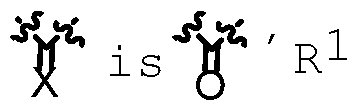 R 2 is OH, the compound above is tetrachloro- vancomycin. When one or both of R 1 and R 2 are other than H and OH, respectively, a derivative of tetra- chlorovancomycin is being contemplated. In one aspect, the “X” moiety above can be H,H making the carbon to which the two hydrogens are bonded a methylene group. In another aspect, “X” is O (oxygen) double bonded to the depicted carbon atom as the carbonyl group of an amide. X can also be S (sulfur) double-bonded to the depicted carbon, making that carbon a thiocarbonyl moiety and thereby, the thiocarbonyl bonded to the –NH- group form a thioamide linkage. A compound where “X” is “S” is usually used as an intermediate to the preparation of a compound of Formula I, II and III in which “X” is “H,H” forming a methylene group as above, or is “NH”, forming an amidine linkage. Turning to the R 1 substituents other than H, those hydrophobic materials are present and discussed in one of the inventors’ U.S. Patents No.9,879,049, No. 10,577,395, No. 10,934,326, well as to U.S. Patent Publication 2023/0146239, and the
papers cited therein. Many of these substituents are present in commercially available in semisynthetic derivatives of vancomycin and similar glycopeptide antibiotics such as teicoplanin A2, oritavancin, dalbavancin and telavancin. Hydrophobic R 1 substituents that are presently preferred are the benzyl, 4-chlorobenzyl, (biphenyl)methyl,(4-chlorobiphenyl)methyl [CBP], 4- fluorobenzyl, and (4-fluorobiphenyl)methyl substituent groups. Each of these six substituents can be added to the tetrachlorovancosaminyl amino group by NaCNBH 4 reduction of the corresponding aldehyde as is shown in Scheme 5 hereinafter. The
R 2 is OH, the compound above is tetrachloro- vancomycin. When one or both of R 1 and R 2 are other than H and OH, respectively, a derivative of tetra- chlorovancomycin is being contemplated. In one aspect, the “X” moiety above can be H,H making the carbon to which the two hydrogens are bonded a methylene group. In another aspect, “X” is O (oxygen) double bonded to the depicted carbon atom as the carbonyl group of an amide. X can also be S (sulfur) double-bonded to the depicted carbon, making that carbon a thiocarbonyl moiety and thereby, the thiocarbonyl bonded to the –NH- group form a thioamide linkage. A compound where “X” is “S” is usually used as an intermediate to the preparation of a compound of Formula I, II and III in which “X” is “H,H” forming a methylene group as above, or is “NH”, forming an amidine linkage. Turning to the R 1 substituents other than H, those hydrophobic materials are present and discussed in one of the inventors’ U.S. Patents No.9,879,049, No. 10,577,395, No. 10,934,326, well as to U.S. Patent Publication 2023/0146239, and the
papers cited therein. Many of these substituents are present in commercially available in semisynthetic derivatives of vancomycin and similar glycopeptide antibiotics such as teicoplanin A2, oritavancin, dalbavancin and telavancin. Hydrophobic R 1 substituents that are presently preferred are the benzyl, 4-chlorobenzyl, (biphenyl)methyl,(4-chlorobiphenyl)methyl [CBP], 4- fluorobenzyl, and (4-fluorobiphenyl)methyl substituent groups. Each of these six substituents can be added to the tetrachlorovancosaminyl amino group by NaCNBH 4 reduction of the corresponding aldehyde as is shown in Scheme 5 hereinafter. The
 substituents, other than OH, contain at least two nitrogen atoms separated by a linker group referred to as Circle A and depicted as , wherein the remaining valence of the
 nitrogen in the depicted “-HN-“ group bonds to carboxyl group of the tetrachlorovancomycinyl portion of the molecule to form an amido group. The R 3 contains at least a second nitrogen atom bonded directly to the Circle A linker. In one contemplated aspect, the second nitrogen atom is part of a guanidinyl group [H 2 N(C=NH)NH-]. In another contemplated aspect, the second nitrogen of Circle A is the nitrogen of a tertiary amine or a quaternary ammonium group, as noted above. When R 3 is a quaternary ammonium group, an optional anion, Y-, that is preferably pharmaceutically acceptable is also present to balance the charge. R 3 is a tertiary amine or guanidinyl group, both of which are typically basic,
a compound containing such a group can also be present as a salt with an acid. Preferably, the acid of such an acid salt is a pharmaceutically acceptable acid, that provides the optional anion, Y-. A pharmaceutical composition containing an anti- bacterially effective amount a before-described tetrachlorovancomycin or derivative, or a pharmaceutically acceptable salt dissolved or dispersed in a pharmaceutically (physiologically) diluent acceptable diluent is also contemplated. Such a composition can be in solid, liquid, gel or other appropriate form. A method of treating a bacterial infection, particularly from Gram positive bacteria, is also contemplated. BRIEF DESCRIPTION OF THE DRAWINGS In the drawings forming a portion of this disclosure: Fig. 1 shows a comparison of vancomycin and tetrachlorovancomycin that highlights the structural and synthetic simplification and atropisomerism elimination achieved by adding two benign chlorine substituents; Fig. 2 is a schematic representation of key elements of a retrosynthetic analysis for tetrachlorovancomycin; Fig. 3 illustrates reaction Scheme 4 that illustrates a direct synthetic route from Compound 27 to Compound 29 in 56% yield and five steps followed by the one-pot two-step enzymatic glycosylation of tetrachlorovancomycin aglycon (29) to form tetrachlorovancomycin (Compound 1) that proceeded in
high yield (82%) for installation of both sugar residues despite the added 2e and 6e aryl chlorides; Fig. 4 outlines a synthetic pathway by which a tetrachlorovancomycin derivative of Formula III where can be prepared;
nitrogen in the depicted “-HN-“ group bonds to carboxyl group of the tetrachlorovancomycinyl portion of the molecule to form an amido group. The R 3 contains at least a second nitrogen atom bonded directly to the Circle A linker. In one contemplated aspect, the second nitrogen atom is part of a guanidinyl group [H 2 N(C=NH)NH-]. In another contemplated aspect, the second nitrogen of Circle A is the nitrogen of a tertiary amine or a quaternary ammonium group, as noted above. When R 3 is a quaternary ammonium group, an optional anion, Y-, that is preferably pharmaceutically acceptable is also present to balance the charge. R 3 is a tertiary amine or guanidinyl group, both of which are typically basic,
a compound containing such a group can also be present as a salt with an acid. Preferably, the acid of such an acid salt is a pharmaceutically acceptable acid, that provides the optional anion, Y-. A pharmaceutical composition containing an anti- bacterially effective amount a before-described tetrachlorovancomycin or derivative, or a pharmaceutically acceptable salt dissolved or dispersed in a pharmaceutically (physiologically) diluent acceptable diluent is also contemplated. Such a composition can be in solid, liquid, gel or other appropriate form. A method of treating a bacterial infection, particularly from Gram positive bacteria, is also contemplated. BRIEF DESCRIPTION OF THE DRAWINGS In the drawings forming a portion of this disclosure: Fig. 1 shows a comparison of vancomycin and tetrachlorovancomycin that highlights the structural and synthetic simplification and atropisomerism elimination achieved by adding two benign chlorine substituents; Fig. 2 is a schematic representation of key elements of a retrosynthetic analysis for tetrachlorovancomycin; Fig. 3 illustrates reaction Scheme 4 that illustrates a direct synthetic route from Compound 27 to Compound 29 in 56% yield and five steps followed by the one-pot two-step enzymatic glycosylation of tetrachlorovancomycin aglycon (29) to form tetrachlorovancomycin (Compound 1) that proceeded in
high yield (82%) for installation of both sugar residues despite the added 2e and 6e aryl chlorides; Fig. 4 outlines a synthetic pathway by which a tetrachlorovancomycin derivative of Formula III where can be prepared;
 Fig. 5 shows a reaction scheme whereby the 4-thioamide derivative, Compound 41, can be prepared from Compound 38; Fig. 6 shows two reaction schemes by which Compounds 40 and 39 can be prepared from Compound 38; Fig. 7, in two panels, as Fig.7A that illustrates two reaction schemes by which Compounds 42, 43, and 44 can be prepared from Compound 41, and in which Compounds 46 and 45 can also be prepared from Compound 44, and Fig. 7B in which Compound 44 is used to prepare Compound 47, that in turn is used to prepare Compounds 48 and 49; Fig. 8, in two panels, as Fig. 8A that illustrates tetrachlorovancomycin, Compound 1, and its three 4-position differently substituted analogues, Compounds 41, 42 and 43, titration binding study results of with model ligands A and B, and similar studies with vancomycin itself and its three similarly substituted analogues in Fig. 8B; Fig. 9, in two panels as Figs. 9A and 9B, are tables showing minimum inhibitory concentrations (MIC values) for tetrachlorovancomycin analogue Compounds 41, 44, 47, 48 and 49 against bacteria that are vancomycin-sensitive (Fig. 9A) and vancomycin- resistant (Fig. 9B); data for
 Figs. 10 through 15 provide illustrative tetrachlorovancomycin derivative compounds with
varying 4-position substituents, as well as various substituents bonded to the vancosaminyl nitrogen, and also still further substituents bonded to the vancomycin usually unsubstituted (C-14) carboxyl group. Each of the patents, patent applications and articles cited herein is incorporated by reference. Definitions In the context of the present invention and the associated claims, the following terms have the following meanings: The articles “a” and “an” are used herein to refer to one or to more than one (i.e., to at least one) of the grammatical object of the article. By way of example, “an element” means one element or more than one element. The word "hydrocarbyl" is used herein as a short-hand term for a non-aromatic group that includes straight and branched chain aliphatic as well as alicyclic groups or radicals that contain only carbon and hydrogen. Thus, alkyl, alkenyl and alkynyl groups are contemplated, whereas aromatic hydrocarbons such as phenyl are grouped as an “aryl“ group. Where a specific aliphatic hydrocarbyl substituent group is intended, that group is recited; i.e., C 1 -C 4 alkyl, methyl or tert-butyl. Exemplary hydrocarbyl groups contain a chain of 2 to about77 carbon atoms, and preferably 2 to about 6 carbon atoms.
A particularly preferred hydrocarbyl group is an alkyl group. As a consequence, a generalized, but more preferred substituent can be recited by replacing the descriptor "hydrocarbyl" with "alkyl" in any of the substituent groups enumerated herein. Examples of alkyl radicals include methyl, ethyl, n-propyl, isopropyl, n-butyl, isobutyl, sec-butyl, tert-butyl. Examples of suitable alkenyl radicals include ethenyl (vinyl), 2-propenyl, 3- propenyl, 1,4-butadienyl, 1-butenyl, 2-butenyl, and 3-butenyl. Examples of alkynyl radicals include ethynyl, 2-propynyl, 1-propynyl, 1-butynyl, 2- butynyl, 3-butynyl, and 1-methyl-2-propynyl. As a skilled worker will understand, a substituent that cannot exist such as a C 1 alkenyl group is not intended to be encompassed by the word "hydrocarbyl", although such substituents with two or more carbon atoms are intended. Usual chemical suffix nomenclature is followed when using the word "hydrocarbyl" except that the usual practice of removing the terminal "yl" and adding an appropriate suffix is not always followed because of the possible similarity of a resulting name to one or more substituents. Thus, a hydrocarbyl ether is referred to as a "hydrocarbyloxy" group rather than a "hydrocarboxy" group as may possibly be more proper when following the usual rules of chemical nomenclature. Illustrative hydrocarbyloxy groups include methoxy, ethoxy, n-propoxy, isopropoxy, allyloxy, n-butoxy, iso-butoxy, sec-butoxy, and tert-butoxy groups. In the structural formulas shown throughout this application, a wavy line as shown for example in
the following representation “ X ” is used to indicate that only a portion of a molecule is being shown, and two bonds of the carbon atom doubly bonded to X are severed from the remainder of the molecule. Similar representations are used for the same purpose with other chemical entities to save space in the text and possible confusion. “h” = hour(s); “min” minute(s); TFA = trifluoroacetic acid; NMM = N-methylmorpholine: DMSO = dimethylsulfoxide: AcOH = acetic acid; EtOAc = ethyl acetate; MeOH = methanol; THF = tetrahydrofuran; DMF = dimethyl formamide; MeCN = acetonitrile; HBTU = 2-(1h-benzotriazole-1-yl)- 1,1,3,3-tetramethyluronium hexafluorophosphate and/or o-benzotriazol-1-yl-N,N,N',N'-tetramethyluronium hexafluorophosphate; AgOAc = silver acetate; TCEP•HCl = tris(carboxyethyl)phosphine hydrochloride; T3P® = propanephosphonic acid anhydride; Bu4NF = tetrabutylammonium fluoride; THF = tetrahydrofuran; equiv = equivalent(s); mmol = millimole(s); µmol = micromole(s); calcd = calculated; HRMS = high resolution mass spectroscopy; ESI-TOF = electrospray ionization time-of-flight mass spectroscopy; m/z = mass-to-charge ratio; brsm = based on recovered starting material; MHz = megaHertz; PES = polyethersulfone; PTLC = preparative thin layer chromatography; mL = microliter(s); µmol = micromole(s); ca. = circa = about. The present invention has several benefits and advantages. One salient benefit of the invention is the relative ease and enhanced yield of synthetically-
prepared tetrachlorovancomycin and derivatives as compared to vancomycin itself when synthetically prepared, and also when compared to vancomycin preparation by fermentation using bacteria whose 4-postiion derivatives are very difficult prepare. A salient advantage of the invention is that the antibacterial activity of tetrachloro- vancomycin compared to that of vancomycin itself is almost identical. Another benefit of the invention is that the activity of the herein discussed derivatized tetrachloro-vancomycins against both vancomycin- resistant bacteria (VRE) and those bacteria that are not vancomycin-resistant compared to the activities of identically derivatized vancomycin are also almost identical. Still further benefits and advantages will be apparent to the skilled worker from the detailed description that follows. DETAILED DESCRIPTION OF PREFERRED EMBODIMENTS The present invention contemplates a new, biologically active vancomycin derivative called tetrachlorovancomycin that is produced, except for glycosylation, solely by synthetic organic chemistry. The structural formula for tetrachlrovancomycin itself is shown below as Formula I.
The structural formula for tetrachlorovancomycin aglycon that is produced solely using synthetic organic chemistry is shown below as Formula II.
Figs. 10 through 15 provide illustrative tetrachlorovancomycin derivative compounds with
varying 4-position substituents, as well as various substituents bonded to the vancosaminyl nitrogen, and also still further substituents bonded to the vancomycin usually unsubstituted (C-14) carboxyl group. Each of the patents, patent applications and articles cited herein is incorporated by reference. Definitions In the context of the present invention and the associated claims, the following terms have the following meanings: The articles “a” and “an” are used herein to refer to one or to more than one (i.e., to at least one) of the grammatical object of the article. By way of example, “an element” means one element or more than one element. The word "hydrocarbyl" is used herein as a short-hand term for a non-aromatic group that includes straight and branched chain aliphatic as well as alicyclic groups or radicals that contain only carbon and hydrogen. Thus, alkyl, alkenyl and alkynyl groups are contemplated, whereas aromatic hydrocarbons such as phenyl are grouped as an “aryl“ group. Where a specific aliphatic hydrocarbyl substituent group is intended, that group is recited; i.e., C 1 -C 4 alkyl, methyl or tert-butyl. Exemplary hydrocarbyl groups contain a chain of 2 to about77 carbon atoms, and preferably 2 to about 6 carbon atoms.
A particularly preferred hydrocarbyl group is an alkyl group. As a consequence, a generalized, but more preferred substituent can be recited by replacing the descriptor "hydrocarbyl" with "alkyl" in any of the substituent groups enumerated herein. Examples of alkyl radicals include methyl, ethyl, n-propyl, isopropyl, n-butyl, isobutyl, sec-butyl, tert-butyl. Examples of suitable alkenyl radicals include ethenyl (vinyl), 2-propenyl, 3- propenyl, 1,4-butadienyl, 1-butenyl, 2-butenyl, and 3-butenyl. Examples of alkynyl radicals include ethynyl, 2-propynyl, 1-propynyl, 1-butynyl, 2- butynyl, 3-butynyl, and 1-methyl-2-propynyl. As a skilled worker will understand, a substituent that cannot exist such as a C 1 alkenyl group is not intended to be encompassed by the word "hydrocarbyl", although such substituents with two or more carbon atoms are intended. Usual chemical suffix nomenclature is followed when using the word "hydrocarbyl" except that the usual practice of removing the terminal "yl" and adding an appropriate suffix is not always followed because of the possible similarity of a resulting name to one or more substituents. Thus, a hydrocarbyl ether is referred to as a "hydrocarbyloxy" group rather than a "hydrocarboxy" group as may possibly be more proper when following the usual rules of chemical nomenclature. Illustrative hydrocarbyloxy groups include methoxy, ethoxy, n-propoxy, isopropoxy, allyloxy, n-butoxy, iso-butoxy, sec-butoxy, and tert-butoxy groups. In the structural formulas shown throughout this application, a wavy line as shown for example in
the following representation “ X ” is used to indicate that only a portion of a molecule is being shown, and two bonds of the carbon atom doubly bonded to X are severed from the remainder of the molecule. Similar representations are used for the same purpose with other chemical entities to save space in the text and possible confusion. “h” = hour(s); “min” minute(s); TFA = trifluoroacetic acid; NMM = N-methylmorpholine: DMSO = dimethylsulfoxide: AcOH = acetic acid; EtOAc = ethyl acetate; MeOH = methanol; THF = tetrahydrofuran; DMF = dimethyl formamide; MeCN = acetonitrile; HBTU = 2-(1h-benzotriazole-1-yl)- 1,1,3,3-tetramethyluronium hexafluorophosphate and/or o-benzotriazol-1-yl-N,N,N',N'-tetramethyluronium hexafluorophosphate; AgOAc = silver acetate; TCEP•HCl = tris(carboxyethyl)phosphine hydrochloride; T3P® = propanephosphonic acid anhydride; Bu4NF = tetrabutylammonium fluoride; THF = tetrahydrofuran; equiv = equivalent(s); mmol = millimole(s); µmol = micromole(s); calcd = calculated; HRMS = high resolution mass spectroscopy; ESI-TOF = electrospray ionization time-of-flight mass spectroscopy; m/z = mass-to-charge ratio; brsm = based on recovered starting material; MHz = megaHertz; PES = polyethersulfone; PTLC = preparative thin layer chromatography; mL = microliter(s); µmol = micromole(s); ca. = circa = about. The present invention has several benefits and advantages. One salient benefit of the invention is the relative ease and enhanced yield of synthetically-
prepared tetrachlorovancomycin and derivatives as compared to vancomycin itself when synthetically prepared, and also when compared to vancomycin preparation by fermentation using bacteria whose 4-postiion derivatives are very difficult prepare. A salient advantage of the invention is that the antibacterial activity of tetrachloro- vancomycin compared to that of vancomycin itself is almost identical. Another benefit of the invention is that the activity of the herein discussed derivatized tetrachloro-vancomycins against both vancomycin- resistant bacteria (VRE) and those bacteria that are not vancomycin-resistant compared to the activities of identically derivatized vancomycin are also almost identical. Still further benefits and advantages will be apparent to the skilled worker from the detailed description that follows. DETAILED DESCRIPTION OF PREFERRED EMBODIMENTS The present invention contemplates a new, biologically active vancomycin derivative called tetrachlorovancomycin that is produced, except for glycosylation, solely by synthetic organic chemistry. The structural formula for tetrachlrovancomycin itself is shown below as Formula I.
The structural formula for tetrachlorovancomycin aglycon that is produced solely using synthetic organic chemistry is shown below as Formula II.
 The above two compounds surprisingly exhibit activity against methicillin-resistant S. aureus and about a factor of 10 or less the activity of vancomycin against vancomycin-sensitive and vancomycin-resistant bacteria. However, their derivatives substituted similarly to the most active vancomycin derivatives show almost the same activities as those similarly substituted vancomycins. Being chemically prepared in relatively
high yield provide a route to less expensive very active antibiotics. A generic formula that can encompass tetrachlorovancomycin, contemplated derivatives and a pharmaceutically acceptable salt is shown below as Formula III.
The above two compounds surprisingly exhibit activity against methicillin-resistant S. aureus and about a factor of 10 or less the activity of vancomycin against vancomycin-sensitive and vancomycin-resistant bacteria. However, their derivatives substituted similarly to the most active vancomycin derivatives show almost the same activities as those similarly substituted vancomycins. Being chemically prepared in relatively
high yield provide a route to less expensive very active antibiotics. A generic formula that can encompass tetrachlorovancomycin, contemplated derivatives and a pharmaceutically acceptable salt is shown below as Formula III.
 wherein

 the group consisting of hydrido (hydrogen), (C 1 -C 16 )hydrocarbyl, aryl(C 1 -C 6 )- hydrocarbyldiyl, heteroaryl-(C 1 -C 6 )hydrocarbyldiyl, (C 1 -C 6 )hydrocarbyldiylheteroaryl, halo(C 2 -C 12 )- hydrocarbyldiyl, and (C 1 -C 16 )amido substituents, wherein an aryl or heteroaryl group is itself optionally substituted with up to three substituents independently selected from the group consisting of: (i) hydroxy, (ii) halo,
(iii) nitro, (iv) (C 1 -C 6 )hydrocarbyl, (v) halo(C 1 -C 16 )hydrocarbyl, (vi) (C 1 -C 6 )hydrocarbyloxy, (vii) halo(C 1 -C 6 )hydrocarbyloxy, (viii) aryl, and (ix) aryloxy, wherein an aryl or aryloxy substituent can itself be substituted with up to three substituents independently selected from the group consisting of: (i) hydroxy, (ii) halo, (iii) nitro, (iv) (C 1 -C 6 )hydrocarbyl, (v) halo(C 1 -C 16 )hydrocarbyl, (vi) (C 1 -C 6 )hydrocarbyloxy, and (vii) halo(C 1 -C 6 )hydrocarbyloxy; and R2 is OH or where Circle A is a
the group consisting of hydrido (hydrogen), (C 1 -C 16 )hydrocarbyl, aryl(C 1 -C 6 )- hydrocarbyldiyl, heteroaryl-(C 1 -C 6 )hydrocarbyldiyl, (C 1 -C 6 )hydrocarbyldiylheteroaryl, halo(C 2 -C 12 )- hydrocarbyldiyl, and (C 1 -C 16 )amido substituents, wherein an aryl or heteroaryl group is itself optionally substituted with up to three substituents independently selected from the group consisting of: (i) hydroxy, (ii) halo,
(iii) nitro, (iv) (C 1 -C 6 )hydrocarbyl, (v) halo(C 1 -C 16 )hydrocarbyl, (vi) (C 1 -C 6 )hydrocarbyloxy, (vii) halo(C 1 -C 6 )hydrocarbyloxy, (viii) aryl, and (ix) aryloxy, wherein an aryl or aryloxy substituent can itself be substituted with up to three substituents independently selected from the group consisting of: (i) hydroxy, (ii) halo, (iii) nitro, (iv) (C 1 -C 6 )hydrocarbyl, (v) halo(C 1 -C 16 )hydrocarbyl, (vi) (C 1 -C 6 )hydrocarbyloxy, and (vii) halo(C 1 -C 6 )hydrocarbyloxy; and R2 is OH or where Circle A is a
 linking moiety having the length of a saturated chain of 2 carbon atoms and less than a saturated chain of about 12 carbon atoms, and R 3 is selected from the group consisting of guanidinyl [H 2 N(C=NH)NH-], N,N- (di-C 1 -C 6 -hydrocarbyl)amino, N,N,N-(tri-C 1 -C 6- hydrocarbyl)ammonium, and N-(C 1 -C 6 -hydrocarbyl)-N- (C 5 -C 7 -cyclohydrocarbyl)ammonium, and an optional pharmaceutically acceptable anion, Y-, as needed to balance charge. Thus, when
 is H (hydrido), and R 2 is OH, the compound above is tetrachloro- vancomycin. When one or both of R 1 and R 2 are other
than H and OH, respectively, a derivative of tetra- chlorovancomycin is being contemplated. The chemical syntheses of the tetrachloro- vancomycin and tetrachlorovancomycin aglycon are shown and discussed hereinafter. These syntheses require fewer steps and provide higher yields of the desired compounds in part because of the symmetry provided by the two chloro groups on each substituted phenyl ring that flanks the central substituted phenyl ring to which the vancosaminyl group is bonded. That symmetry removes two atropisomers whose presence in vancomycin itself reduces the yield of desired isomers when the compound is chemically rather than biologically prepared. In one aspect, the “X” moiety above can be H,H making the carbon to which the two hydrogens are bonded a methylene group. In another aspect, “X” is O (oxygen) double bonded to the depicted carbon atom as the carbonyl group of an amide. X can also be S (sulfur) double-bonded to the depicted carbon, making that carbon a thiocarbonyl moiety and thereby, the thiocarbonyl bonded to the –NH- group form a thioamide linkage. A compound where “X” is S is usually used as an intermediate to the preparation of a compound of Formula I, II and III in which “X” is H,H forming a methylene group as above, or is NH, forming an amidine linkage. Turning to the R 1 substituents other than H, those hydrophobic materials are present and discussed in the inventor’s U.S. Patents No.9,879,049, No. 10,577,395, No. 10,934,326, well as to U.S. Patent Publication 2023/0146239, and the papers cited therein. Many of these substituents are present in commercially available derivatives of
vancomycin and similar glycopeptide antibiotics such as teicoplanin A2, oritavancin, dalbavancin and telavancin. Hydrophobic R 1 substituents that are presently preferred are the benzyl, 4-chlorobenzyl, (biphenyl)methyl, (4-chlorobiphenyl)methyl [CBP], 4- fluorobenzyl, and (4-fluorobiphenyl)methyl substituent groups. Each of these four substituents can be added to the vancosaminyl amino group by NaCNBH 4 reduction of the corresponding aldehyde as is shown in Scheme 5 hereinafter. The
is H (hydrido), and R 2 is OH, the compound above is tetrachloro- vancomycin. When one or both of R 1 and R 2 are other
than H and OH, respectively, a derivative of tetra- chlorovancomycin is being contemplated. The chemical syntheses of the tetrachloro- vancomycin and tetrachlorovancomycin aglycon are shown and discussed hereinafter. These syntheses require fewer steps and provide higher yields of the desired compounds in part because of the symmetry provided by the two chloro groups on each substituted phenyl ring that flanks the central substituted phenyl ring to which the vancosaminyl group is bonded. That symmetry removes two atropisomers whose presence in vancomycin itself reduces the yield of desired isomers when the compound is chemically rather than biologically prepared. In one aspect, the “X” moiety above can be H,H making the carbon to which the two hydrogens are bonded a methylene group. In another aspect, “X” is O (oxygen) double bonded to the depicted carbon atom as the carbonyl group of an amide. X can also be S (sulfur) double-bonded to the depicted carbon, making that carbon a thiocarbonyl moiety and thereby, the thiocarbonyl bonded to the –NH- group form a thioamide linkage. A compound where “X” is S is usually used as an intermediate to the preparation of a compound of Formula I, II and III in which “X” is H,H forming a methylene group as above, or is NH, forming an amidine linkage. Turning to the R 1 substituents other than H, those hydrophobic materials are present and discussed in the inventor’s U.S. Patents No.9,879,049, No. 10,577,395, No. 10,934,326, well as to U.S. Patent Publication 2023/0146239, and the papers cited therein. Many of these substituents are present in commercially available derivatives of
vancomycin and similar glycopeptide antibiotics such as teicoplanin A2, oritavancin, dalbavancin and telavancin. Hydrophobic R 1 substituents that are presently preferred are the benzyl, 4-chlorobenzyl, (biphenyl)methyl, (4-chlorobiphenyl)methyl [CBP], 4- fluorobenzyl, and (4-fluorobiphenyl)methyl substituent groups. Each of these four substituents can be added to the vancosaminyl amino group by NaCNBH 4 reduction of the corresponding aldehyde as is shown in Scheme 5 hereinafter. The
 substituents, other than H, contain at least two nitrogen atoms separated by a divalent linker group referred to as Circle A and depicted as , wherein the remaining valence of the
 nitrogen in the depicted “HN“ group bonds to carboxyl group of the tetrachlorovancomycinyl portion of the molecule to form an amido group, and R 3 contains at least a second nitrogen atom. In one contemplated aspect, the second nitrogen atom is part of a guanidinyl group [H 2 N(C=NH)NH-]. In another contemplated aspect, the second nitrogen of Circle A is the nitrogen of a tertiary amine or a quaternary ammonium group. The preparation of the compounds in which the second nitrogen of a Circle A group is the nitrogen of a tertiary amine or a quaternary ammonium group can be carried out as discussed in US Patent No. 10,934,326 and in Okano et al., Proc Natl Acad Sci, USA 114(26):E5052-E5061 (Pub. online 05-30-2017) for otherwise similar derivatives of vancomycin. The chain lengths herein are measured along the longest linear atom chain in the radical between
the amido nitrogen and the first nitrogen atom of a guanidinyl group or the nitrogen of a tertiary amine or a quaternary ammonium group. Each atom in the chain is presumed to be carbon for ease in calculation. The lengths are thus recited in terms of carbon atoms. Such lengths can be readily determined by using published bond angles, bond lengths and atomic radii, as needed, to draw and measure a staggered chain, or by building models using commercially available kits whose bond angles, lengths and atomic radii are in accord with accepted, published values. For example, a 1,4-bonded 6-membered aromatic ring group (phenyl) not part of a fused ring system has a length of about a butyl group. A 1,2- or 1,3-bonded 6-ring has a length of a 2- or 3-carbon chain, respectively, as the shortest path around the ring between the two bonding position regardless of formal naming criteria. Where a 5-membered ring is present, length is calculated as the length of a 2-carbon chain. Thus, for single ring systems, length is calculated as the shortest path around the rings between the two bonding positions to the amido and guanidinyl, quaternary ammonium or tertiary amine nitrogen atoms of a compound of Formula III regardless of formal naming criteria. Radical lengths can also be determined somewhat less exactly by assuming that all atoms have bond lengths of saturated C-C bonds, that unsaturated bonds have the same lengths as saturated bonds, and that bond angles for unsaturated bonds are the same as those for saturated C-C bonds (108 o ), although the above-mentioned modes of measurement are
preferred. Both methods produce similar results within one or two carbon atoms, and thus the use of "about". A contemplated linker moiety Circle A can also be a hydrocarbyl chain of two to about 12 saturated carbon atoms, or preferably two to about ten saturated carbon atoms. A more preferred linking Circle A group contains a chain of atoms that is equal to or greater than the length of two saturated carbons and is shorter than about a saturated ten carbon (decyl) chain. More preferably still, the hydrocarbyl chain has a chain length of two saturated carbon atoms to about eight saturated carbon (octyl) atoms. In one illustrative instance, when there is a chain of Circle A atoms linking the amido and guanidinyl nitrogen atoms together, the length is simply the length of the longest chain of atoms linking those two nitrogens. In further examining Circle A hydrocarbyl linker groups, it is noted that such groups can contain a substituent that is pendant from the chain of atoms that link the amido and second nitrogens (e.g., guanidinyl) shown in Formula III. Such a substituent are selected from amino acid side chain substituents other than those containing a carboxyl group, a sulfhydryl group (-SH) or a substituent that provides a negative charge in an aqueous solution at physiological pH values, e.g., pH 7.2-7.4. Additional pendant substituents include 2-hydroxyethyl and 2-hydroxypropyl, C 1 -C 3- hydrocarbyl C 0 -C 2 -carboxylate, and C 0 -C 2-
carboxamide whose amido nitrogen is unsubsubstituted (-NH2), monosubstituted (-NHR4) or disubstituted
nitrogen in the depicted “HN“ group bonds to carboxyl group of the tetrachlorovancomycinyl portion of the molecule to form an amido group, and R 3 contains at least a second nitrogen atom. In one contemplated aspect, the second nitrogen atom is part of a guanidinyl group [H 2 N(C=NH)NH-]. In another contemplated aspect, the second nitrogen of Circle A is the nitrogen of a tertiary amine or a quaternary ammonium group. The preparation of the compounds in which the second nitrogen of a Circle A group is the nitrogen of a tertiary amine or a quaternary ammonium group can be carried out as discussed in US Patent No. 10,934,326 and in Okano et al., Proc Natl Acad Sci, USA 114(26):E5052-E5061 (Pub. online 05-30-2017) for otherwise similar derivatives of vancomycin. The chain lengths herein are measured along the longest linear atom chain in the radical between
the amido nitrogen and the first nitrogen atom of a guanidinyl group or the nitrogen of a tertiary amine or a quaternary ammonium group. Each atom in the chain is presumed to be carbon for ease in calculation. The lengths are thus recited in terms of carbon atoms. Such lengths can be readily determined by using published bond angles, bond lengths and atomic radii, as needed, to draw and measure a staggered chain, or by building models using commercially available kits whose bond angles, lengths and atomic radii are in accord with accepted, published values. For example, a 1,4-bonded 6-membered aromatic ring group (phenyl) not part of a fused ring system has a length of about a butyl group. A 1,2- or 1,3-bonded 6-ring has a length of a 2- or 3-carbon chain, respectively, as the shortest path around the ring between the two bonding position regardless of formal naming criteria. Where a 5-membered ring is present, length is calculated as the length of a 2-carbon chain. Thus, for single ring systems, length is calculated as the shortest path around the rings between the two bonding positions to the amido and guanidinyl, quaternary ammonium or tertiary amine nitrogen atoms of a compound of Formula III regardless of formal naming criteria. Radical lengths can also be determined somewhat less exactly by assuming that all atoms have bond lengths of saturated C-C bonds, that unsaturated bonds have the same lengths as saturated bonds, and that bond angles for unsaturated bonds are the same as those for saturated C-C bonds (108 o ), although the above-mentioned modes of measurement are
preferred. Both methods produce similar results within one or two carbon atoms, and thus the use of "about". A contemplated linker moiety Circle A can also be a hydrocarbyl chain of two to about 12 saturated carbon atoms, or preferably two to about ten saturated carbon atoms. A more preferred linking Circle A group contains a chain of atoms that is equal to or greater than the length of two saturated carbons and is shorter than about a saturated ten carbon (decyl) chain. More preferably still, the hydrocarbyl chain has a chain length of two saturated carbon atoms to about eight saturated carbon (octyl) atoms. In one illustrative instance, when there is a chain of Circle A atoms linking the amido and guanidinyl nitrogen atoms together, the length is simply the length of the longest chain of atoms linking those two nitrogens. In further examining Circle A hydrocarbyl linker groups, it is noted that such groups can contain a substituent that is pendant from the chain of atoms that link the amido and second nitrogens (e.g., guanidinyl) shown in Formula III. Such a substituent are selected from amino acid side chain substituents other than those containing a carboxyl group, a sulfhydryl group (-SH) or a substituent that provides a negative charge in an aqueous solution at physiological pH values, e.g., pH 7.2-7.4. Additional pendant substituents include 2-hydroxyethyl and 2-hydroxypropyl, C 1 -C 3- hydrocarbyl C 0 -C 2 -carboxylate, and C 0 -C 2-
carboxamide whose amido nitrogen is unsubsubstituted (-NH2), monosubstituted (-NHR4) or disubstituted
 which the substituent (R4 and/or R5) is one or two same or different C 1 -C 4- hydrocarbyl group, or whose amido nitrogen along with two substituents together form a 5- or 6- membered hydrocarbyl ring, or a heterocyclic ring containing one additional oxygen (O) atom or a N- methyl group in the ring. In the previous sentence, "C 0 " is intended to indicate that the carbonyl carbon is bonded directly to an atom of the Circle A linking chain. A contemplated linker moiety Circle A atom chain need not be entirely hydrocarbyl, but can also be contain 1, 2, or 3 oxygens in place of carbon atoms as when a -CH 2 -CH 2 -0-CH 2 -CH 2 -, -CH 2 -CH 2 -0-CH 2 -CH 2 -0-CH 2 -CH 2 -, or -CH 2 -CH 2 -0-CH 2- CH 2 -0-CH 2 -CH 2 -0-CH 2 -CH 2 - Circle A linker moiety is utilized. A contemplated divalent Circle A linker moiety also can comprise a ring system that can be carbocyclic or heterocyclic as discussed below. Thus, a single 5- or 6-membered ring optionally contains one or two ring hetero atoms that can independently be nitrogen, oxygen or sulfur. Individual rings can be aliphatic or aromatic, including heteroaromatic, and also be aralkyl as in a benzyl group. Using monovalent substituent names for convenience, exemplary divalent aromatic carbocyclic ring moieties include phenyl and naphthyl groups. Again, using monovalent names for convenience, exemplary divalent heteroaryl groups include
6-membered ring substituents such as pyridyl, pyrazyl, pyrimidinyl, and pyridazinyl; 5-membered ring substituents such as 1,3,5-, 1,2,4- or 1,2,3- triazinyl, imidazyl, furanyl, thiophenyl, pyrazolyl, oxazolyl, isoxazolyl, thiazolyl, 1,2,3-, 1,2,4-, 1,2,5-, or 1,3,4-oxadiazolyl and isothiazolyl groups. Aliphatic 5- and 6-membered carbocyclic rings are contemplated such as cyclohexyl and cyclopentyl, as well as their mono- and diethylenically unsaturated derivatives, using monovalent names for convenience. Again, using monovalent radical names for convenience, divalent aliphatic 5- and 6-membered heterocyclic rings include, piperidinyl, piperazinyl, imidazolinyl, imidazolidinyl, pyrrolinyl, pyrrolidinyl, pyrazolidinyl, pyrazolinyl, pyranyl, morpholinyl, oxazinyl, isooxazinyl, and oxathiolyl. The present invention is exemplified in part by the illustrative listing of Circle A linker moieties shown below: Illustrative Circle A Linker Moieties
which the substituent (R4 and/or R5) is one or two same or different C 1 -C 4- hydrocarbyl group, or whose amido nitrogen along with two substituents together form a 5- or 6- membered hydrocarbyl ring, or a heterocyclic ring containing one additional oxygen (O) atom or a N- methyl group in the ring. In the previous sentence, "C 0 " is intended to indicate that the carbonyl carbon is bonded directly to an atom of the Circle A linking chain. A contemplated linker moiety Circle A atom chain need not be entirely hydrocarbyl, but can also be contain 1, 2, or 3 oxygens in place of carbon atoms as when a -CH 2 -CH 2 -0-CH 2 -CH 2 -, -CH 2 -CH 2 -0-CH 2 -CH 2 -0-CH 2 -CH 2 -, or -CH 2 -CH 2 -0-CH 2- CH 2 -0-CH 2 -CH 2 -0-CH 2 -CH 2 - Circle A linker moiety is utilized. A contemplated divalent Circle A linker moiety also can comprise a ring system that can be carbocyclic or heterocyclic as discussed below. Thus, a single 5- or 6-membered ring optionally contains one or two ring hetero atoms that can independently be nitrogen, oxygen or sulfur. Individual rings can be aliphatic or aromatic, including heteroaromatic, and also be aralkyl as in a benzyl group. Using monovalent substituent names for convenience, exemplary divalent aromatic carbocyclic ring moieties include phenyl and naphthyl groups. Again, using monovalent names for convenience, exemplary divalent heteroaryl groups include
6-membered ring substituents such as pyridyl, pyrazyl, pyrimidinyl, and pyridazinyl; 5-membered ring substituents such as 1,3,5-, 1,2,4- or 1,2,3- triazinyl, imidazyl, furanyl, thiophenyl, pyrazolyl, oxazolyl, isoxazolyl, thiazolyl, 1,2,3-, 1,2,4-, 1,2,5-, or 1,3,4-oxadiazolyl and isothiazolyl groups. Aliphatic 5- and 6-membered carbocyclic rings are contemplated such as cyclohexyl and cyclopentyl, as well as their mono- and diethylenically unsaturated derivatives, using monovalent names for convenience. Again, using monovalent radical names for convenience, divalent aliphatic 5- and 6-membered heterocyclic rings include, piperidinyl, piperazinyl, imidazolinyl, imidazolidinyl, pyrrolinyl, pyrrolidinyl, pyrazolidinyl, pyrazolinyl, pyranyl, morpholinyl, oxazinyl, isooxazinyl, and oxathiolyl. The present invention is exemplified in part by the illustrative listing of Circle A linker moieties shown below: Illustrative Circle A Linker Moieties
 COMPOSITION AND TREATMENT METHOD A further aspect of the invention is a method of treating a mammal infected with a microbial infection such as a bacterial infection, typically either a Gram-positive infection or a Gram-negative bacterium; i.e., an infection caused by Gram-positive or Gram-negative bacteria, and the infected mammal is in need of antimicrobial (antibacterial) treatment. Treatment of Gram-positive bacteria are typically more successful that treatment of Gram-negative bacteria. In accordance with a contemplated method, an antibacterial-effective amount of one or more compounds of Formula III or a pharmaceutically acceptable salt of such a compound is administered to an infected mammal in need. The compound can be administered as a solid, as a liquid formulation, as a thickened preparation e.g., as a gel, as for topical use, and is preferably administered via a pharmaceutical composition discussed hereinafter. That administration can also be oral or parenteral, as are also discussed further hereinafter. It is to be understood that mammals are infected with bacteria and other microbes. The present invention’s method of treatment is intended for use against infections of pathogenic bacteria that cause illness in the mammal to be treated. Illustrative pathogenic microbes include S. aureus, methicilin-resistant S. aureus (MRSA), VanA strains of E. faecalis and E. feacium, as well as VanB strains of E. faecalis. Evidence of the presence of infection by pathogenic microbes is typically understood by physicians and other skilled medical workers.
A mammal in need of treatment (a subject) and to which a pharmaceutical composition containing a Compound of Formula III or its pharmaceutically acceptable salt to be administered can be a primate such as a human, an ape such as a chimpanzee or gorilla, a monkey such as a cynomolgus monkey or a macaque, a laboratory animal such as a rat, mouse or rabbit, a companion animal such as a dog, cat, horse, or a food animal such as a cow or steer, sheep, lamb, pig, goat, llama or the like. As is seen from the data that follow, a contemplated compound is active in in vitro assay studies at less than 1 µg/mL amounts, which corresponds to a molar concentration of about 1 to about 100 nanomolar (nM), using the molecular weight of G3-CBP-tetrachlorovancomycin (Compound 31). When used in an assay such as an in vitro assay, a contemplated compound is typically present in the composition in an amount that is sufficient to provide a concentration of about 0.1 nM to about 1 µM to contact microbes to be assayed. The amount of a compound of Formula III or a pharmaceutically acceptable salt of such a compound that is administered to a mammal in a before- discussed method or that is present in a pharmaceutical composition discussed below, which can be used for that administration, is an antibiotic (or antibacterial or antimicrobial) effective amount. It is to be understood that that amount is not an amount that is effective to kill all of the pathogenic bacteria or other microbes present in an infected mammal in one administration. Rather, that amount is effective to kill some of the pathogenic organisms present without also killing the mammal to which it
is administered, or otherwise harming the recipient mammal as is well known in the art. As a consequence, the compound usually has to be administered a plurality of times, as is discussed in more detail hereinafter. A contemplated pharmaceutical composition contains an effective antibiotic (or antimicrobial) amount of a Compound of Formula III or a pharmaceutically acceptable salt thereof dissolved or dispersed in a physiologically (pharmaceutically) acceptable diluent or carrier. An effective antibiotic amount depends on several factors as is well known in the art. However, based upon the relative potency of a contemplated compound relative to that of vancomycin itself for a susceptible strain of S. aureus shown hereinafter, and the relative potencies of vancomycin and a contemplated compound against the VanA E. faecalis and E. faecium strains, a skilled worker can readily determine an appropriate dosage amount. Exemplary salts useful for a contemplated compound include but are not limited to the following: sulfate, hydrochloride, hydro bromides, acetate, adipate, alginate, citrate, aspartate, benzoate, benzenesulfonate, bisulfate, butyrate, camphorate, camphorsulfonate, digluconate, cyclopentanepropionate, dodecylsulfate, ethanesulfonate, glucoheptanoate, glycerophosphate, hemisulfate, heptanoate, hexanoate, fumarate, hydrochloride, hydrobromide, hydroiodide, 2-hydroxy- ethanesulfonate, lactate, maleate, methanesulfonate, nicotinate, 2-naphthalenesulfonate, oxalate, palmoate, pectinate, persulfate, 3-phenyl-propionate,
picrate, pivalate, propionate, succinate, tartrate, thiocyanate, tosylate, mesylate and undecanoate. The reader is directed to Berge, J. Pharm. Sci. 197768(1):1-19 for lists of commonly used pharmaceutically acceptable acids and bases that form pharmaceutically acceptable salts with pharmaceutical compounds. In some cases, the salts can also be used as an aid in the isolation, purification or resolution of the compounds of this invention. In such uses, the salt prepared need not be pharmaceutically acceptable. A contemplated composition is typically administered repeatedly in vivo to a mammal in need thereof until the infection is diminished to a desired extent, such as cannot be detected. Thus, the administration to a mammal in need can occur a plurality of times within one day, daily, weekly, monthly or over a period of several months to several years as directed by the treating physician. More usually, a contemplated composition is administered a plurality of times over a course of treatment until a desired effect is achieved, typically until the bacterial infection to be treated has ceased to be evident. A contemplated pharmaceutical composition can be administered orally (perorally) or parenterally, in a formulation containing conventional nontoxic physiologically acceptable carrier or diluent, adjuvant, and vehicle as desired. The term parenteral as used herein includes subcutaneous injections, intravenous, intramuscular, intrasternal injection, or infusion techniques. Formulation of drugs is discussed in, for example,
Hoover, John E., Remington's Pharmaceutical Sciences, Mack Publishing Co., Easton, Pennsylvania; 1975 and Liberman, H.A. and Lachman, L., Eds., Pharmaceutical Dosage Forms, Marcel Decker, New York, N.Y., 1980. In some embodiments, a contemplated pharmaceutical composition is preferably adapted for parenteral administration. Thus, a pharmaceutical composition is preferably in liquid form when administered, and most preferably, the liquid is an aqueous liquid, although other liquids are contemplated as discussed below, and a presently most preferred composition is an injectable preparation. Thus, injectable preparations, for example, sterile injectable aqueous or oleaginous solutions or suspensions can be formulated according to the known art using suitable dispersing or wetting agents and suspending agents. The sterile injectable preparation can also be a sterile injectable solution or suspension in a physiologically acceptable diluent or solvent, for example, as a solution in 1,3- butanediol. Among the acceptable vehicles and solvents that can be employed are water, Ringer's solution, isotonic sodium chloride solution, and phosphate-buffered saline. Other liquid pharmaceutical compositions include, for example, solutions suitable for parenteral administration. Sterile water solutions of a Compound of Formula III or its salt or sterile solution of a Compound of Formula III in a solvent comprising water, ethanol, or propylene glycol are examples of liquid compositions suitable for parenteral administration. In some aspects, a contemplated Compound of Formula III is provided as a dry powder that is to be dissolved in an appropriate
liquid medium such as sodium chloride for injection prior to use. In addition, sterile, fixed oils are conventionally employed as a solvent or suspending medium. For this purpose any bland fixed oil can be employed including synthetic mono- or diglycerides. In addition, fatty acids such as oleic acid find use in the preparation of an injectable composition. Dimethyl acetamide, surfactants including ionic and non-ionic detergents, polyethylene glycols can be used. Mixtures of solvents and wetting agents such as those discussed above are also useful. A sterile solution can be prepared by dissolving the active component in the desired solvent system, and then passing the resulting solution through a membrane filter to sterilize it or, alternatively, by dissolving the sterile compound in a previously sterilized solvent under sterile conditions. Solid dosage forms for oral administration can include capsules, tablets, pills, powders, and granules. The amount of a contemplated Compound or salt of Formula III such as Compounds 48 or 49 in a solid dosage form is as discussed previously, an amount sufficient to provide an effective antibiotic (or antimicrobial) amount. A solid dosage form can also be administered a plurality of times during a one-week time period. In such solid dosage forms, a compound of this invention is ordinarily admixed as a solution or suspension in one or more diluents appropriate to the indicated route of administration. If administered per os, the compounds can be admixed with lactose, sucrose, starch powder, cellulose esters of alkanoic
acids, cellulose alkyl esters, talc, stearic acid, magnesium stearate, magnesium oxide, sodium and calcium salts of phosphoric and sulfuric acids, gelatin, acacia gum, sodium alginate, polyvinylpyrrolidone, and/or polyvinyl alcohol, and then tableted or encapsulated for convenient administration. Such capsules or tablets can contain a controlled-release formulation as can be provided in a dispersion of active compound in hydroxypropylmethyl cellulose. In the case of capsules, tablets, and pills, the dosage forms can also comprise buffering agents such as sodium citrate, magnesium or calcium carbonate or bicarbonate. Tablets and pills can additionally be prepared with enteric coatings. Where an in vitro assay is contemplated, a sample to be assayed such as cells and tissue can be used. These in vitro compositions typically contain water, sodium or potassium chloride, and one or more buffer salts such as and acetate and phosphate salts, Hepes or the like, a metal ion chelator such as EDTA that are buffered to a desired pH value such as pH 4.0 -8.5, preferably about pH 7.2-7.4, depending on the assay to be performed, as is well known. Preferably, the pharmaceutical composition is in unit dosage form. In such form, the composition is divided into unit doses containing appropriate quantities of the active compound. The unit dosage form can be a packaged preparation, the package containing discrete quantities of the preparation, for example, in vials or ampules.
RESULTS AND DISCUSSION Two key features were required for the present synthetic simplification to be beneficial. First, the two added chlorine substituents need to be benign and not have a significant effect on the target D-Ala-D-Ala binding and resulting antimicrobial activity. Second, they would need to be compatible with the enzymatic glycosylations used to introduce the disaccharide. The latter could only be established experimentally as little is known about the stringency of the glycopeptide substrate requirements for the native glycosyltransferases, especially what might be accommodated on the proximal D-ring phenol by GtfE in the initial glycosylation reaction. Role of the Vancomycin C and E Ring Aryl Chlorides In contrast to the unknown stringency of the glycopeptide substrate requirements for the native glycosyltransferases, a great deal is known about the impact of the aryl chlorides. The presence of both the vancomycin C and E ring aryl chlorides play important roles in ligand binding and antimicrobial activity as shown below in Table A that shows antimicrobial activity and D-Ala-D-Ala binding affinity of dechlorovancomycins and aglycons. Both chlorine substituents contribute to ligand binding affinity (C-ring > E-ring chloride) and their cumulative removal results in a >10-fold loss in ligand binding affinity and antimicrobial activity.8-10
Table A
COMPOSITION AND TREATMENT METHOD A further aspect of the invention is a method of treating a mammal infected with a microbial infection such as a bacterial infection, typically either a Gram-positive infection or a Gram-negative bacterium; i.e., an infection caused by Gram-positive or Gram-negative bacteria, and the infected mammal is in need of antimicrobial (antibacterial) treatment. Treatment of Gram-positive bacteria are typically more successful that treatment of Gram-negative bacteria. In accordance with a contemplated method, an antibacterial-effective amount of one or more compounds of Formula III or a pharmaceutically acceptable salt of such a compound is administered to an infected mammal in need. The compound can be administered as a solid, as a liquid formulation, as a thickened preparation e.g., as a gel, as for topical use, and is preferably administered via a pharmaceutical composition discussed hereinafter. That administration can also be oral or parenteral, as are also discussed further hereinafter. It is to be understood that mammals are infected with bacteria and other microbes. The present invention’s method of treatment is intended for use against infections of pathogenic bacteria that cause illness in the mammal to be treated. Illustrative pathogenic microbes include S. aureus, methicilin-resistant S. aureus (MRSA), VanA strains of E. faecalis and E. feacium, as well as VanB strains of E. faecalis. Evidence of the presence of infection by pathogenic microbes is typically understood by physicians and other skilled medical workers.
A mammal in need of treatment (a subject) and to which a pharmaceutical composition containing a Compound of Formula III or its pharmaceutically acceptable salt to be administered can be a primate such as a human, an ape such as a chimpanzee or gorilla, a monkey such as a cynomolgus monkey or a macaque, a laboratory animal such as a rat, mouse or rabbit, a companion animal such as a dog, cat, horse, or a food animal such as a cow or steer, sheep, lamb, pig, goat, llama or the like. As is seen from the data that follow, a contemplated compound is active in in vitro assay studies at less than 1 µg/mL amounts, which corresponds to a molar concentration of about 1 to about 100 nanomolar (nM), using the molecular weight of G3-CBP-tetrachlorovancomycin (Compound 31). When used in an assay such as an in vitro assay, a contemplated compound is typically present in the composition in an amount that is sufficient to provide a concentration of about 0.1 nM to about 1 µM to contact microbes to be assayed. The amount of a compound of Formula III or a pharmaceutically acceptable salt of such a compound that is administered to a mammal in a before- discussed method or that is present in a pharmaceutical composition discussed below, which can be used for that administration, is an antibiotic (or antibacterial or antimicrobial) effective amount. It is to be understood that that amount is not an amount that is effective to kill all of the pathogenic bacteria or other microbes present in an infected mammal in one administration. Rather, that amount is effective to kill some of the pathogenic organisms present without also killing the mammal to which it
is administered, or otherwise harming the recipient mammal as is well known in the art. As a consequence, the compound usually has to be administered a plurality of times, as is discussed in more detail hereinafter. A contemplated pharmaceutical composition contains an effective antibiotic (or antimicrobial) amount of a Compound of Formula III or a pharmaceutically acceptable salt thereof dissolved or dispersed in a physiologically (pharmaceutically) acceptable diluent or carrier. An effective antibiotic amount depends on several factors as is well known in the art. However, based upon the relative potency of a contemplated compound relative to that of vancomycin itself for a susceptible strain of S. aureus shown hereinafter, and the relative potencies of vancomycin and a contemplated compound against the VanA E. faecalis and E. faecium strains, a skilled worker can readily determine an appropriate dosage amount. Exemplary salts useful for a contemplated compound include but are not limited to the following: sulfate, hydrochloride, hydro bromides, acetate, adipate, alginate, citrate, aspartate, benzoate, benzenesulfonate, bisulfate, butyrate, camphorate, camphorsulfonate, digluconate, cyclopentanepropionate, dodecylsulfate, ethanesulfonate, glucoheptanoate, glycerophosphate, hemisulfate, heptanoate, hexanoate, fumarate, hydrochloride, hydrobromide, hydroiodide, 2-hydroxy- ethanesulfonate, lactate, maleate, methanesulfonate, nicotinate, 2-naphthalenesulfonate, oxalate, palmoate, pectinate, persulfate, 3-phenyl-propionate,
picrate, pivalate, propionate, succinate, tartrate, thiocyanate, tosylate, mesylate and undecanoate. The reader is directed to Berge, J. Pharm. Sci. 197768(1):1-19 for lists of commonly used pharmaceutically acceptable acids and bases that form pharmaceutically acceptable salts with pharmaceutical compounds. In some cases, the salts can also be used as an aid in the isolation, purification or resolution of the compounds of this invention. In such uses, the salt prepared need not be pharmaceutically acceptable. A contemplated composition is typically administered repeatedly in vivo to a mammal in need thereof until the infection is diminished to a desired extent, such as cannot be detected. Thus, the administration to a mammal in need can occur a plurality of times within one day, daily, weekly, monthly or over a period of several months to several years as directed by the treating physician. More usually, a contemplated composition is administered a plurality of times over a course of treatment until a desired effect is achieved, typically until the bacterial infection to be treated has ceased to be evident. A contemplated pharmaceutical composition can be administered orally (perorally) or parenterally, in a formulation containing conventional nontoxic physiologically acceptable carrier or diluent, adjuvant, and vehicle as desired. The term parenteral as used herein includes subcutaneous injections, intravenous, intramuscular, intrasternal injection, or infusion techniques. Formulation of drugs is discussed in, for example,
Hoover, John E., Remington's Pharmaceutical Sciences, Mack Publishing Co., Easton, Pennsylvania; 1975 and Liberman, H.A. and Lachman, L., Eds., Pharmaceutical Dosage Forms, Marcel Decker, New York, N.Y., 1980. In some embodiments, a contemplated pharmaceutical composition is preferably adapted for parenteral administration. Thus, a pharmaceutical composition is preferably in liquid form when administered, and most preferably, the liquid is an aqueous liquid, although other liquids are contemplated as discussed below, and a presently most preferred composition is an injectable preparation. Thus, injectable preparations, for example, sterile injectable aqueous or oleaginous solutions or suspensions can be formulated according to the known art using suitable dispersing or wetting agents and suspending agents. The sterile injectable preparation can also be a sterile injectable solution or suspension in a physiologically acceptable diluent or solvent, for example, as a solution in 1,3- butanediol. Among the acceptable vehicles and solvents that can be employed are water, Ringer's solution, isotonic sodium chloride solution, and phosphate-buffered saline. Other liquid pharmaceutical compositions include, for example, solutions suitable for parenteral administration. Sterile water solutions of a Compound of Formula III or its salt or sterile solution of a Compound of Formula III in a solvent comprising water, ethanol, or propylene glycol are examples of liquid compositions suitable for parenteral administration. In some aspects, a contemplated Compound of Formula III is provided as a dry powder that is to be dissolved in an appropriate
liquid medium such as sodium chloride for injection prior to use. In addition, sterile, fixed oils are conventionally employed as a solvent or suspending medium. For this purpose any bland fixed oil can be employed including synthetic mono- or diglycerides. In addition, fatty acids such as oleic acid find use in the preparation of an injectable composition. Dimethyl acetamide, surfactants including ionic and non-ionic detergents, polyethylene glycols can be used. Mixtures of solvents and wetting agents such as those discussed above are also useful. A sterile solution can be prepared by dissolving the active component in the desired solvent system, and then passing the resulting solution through a membrane filter to sterilize it or, alternatively, by dissolving the sterile compound in a previously sterilized solvent under sterile conditions. Solid dosage forms for oral administration can include capsules, tablets, pills, powders, and granules. The amount of a contemplated Compound or salt of Formula III such as Compounds 48 or 49 in a solid dosage form is as discussed previously, an amount sufficient to provide an effective antibiotic (or antimicrobial) amount. A solid dosage form can also be administered a plurality of times during a one-week time period. In such solid dosage forms, a compound of this invention is ordinarily admixed as a solution or suspension in one or more diluents appropriate to the indicated route of administration. If administered per os, the compounds can be admixed with lactose, sucrose, starch powder, cellulose esters of alkanoic
acids, cellulose alkyl esters, talc, stearic acid, magnesium stearate, magnesium oxide, sodium and calcium salts of phosphoric and sulfuric acids, gelatin, acacia gum, sodium alginate, polyvinylpyrrolidone, and/or polyvinyl alcohol, and then tableted or encapsulated for convenient administration. Such capsules or tablets can contain a controlled-release formulation as can be provided in a dispersion of active compound in hydroxypropylmethyl cellulose. In the case of capsules, tablets, and pills, the dosage forms can also comprise buffering agents such as sodium citrate, magnesium or calcium carbonate or bicarbonate. Tablets and pills can additionally be prepared with enteric coatings. Where an in vitro assay is contemplated, a sample to be assayed such as cells and tissue can be used. These in vitro compositions typically contain water, sodium or potassium chloride, and one or more buffer salts such as and acetate and phosphate salts, Hepes or the like, a metal ion chelator such as EDTA that are buffered to a desired pH value such as pH 4.0 -8.5, preferably about pH 7.2-7.4, depending on the assay to be performed, as is well known. Preferably, the pharmaceutical composition is in unit dosage form. In such form, the composition is divided into unit doses containing appropriate quantities of the active compound. The unit dosage form can be a packaged preparation, the package containing discrete quantities of the preparation, for example, in vials or ampules.
RESULTS AND DISCUSSION Two key features were required for the present synthetic simplification to be beneficial. First, the two added chlorine substituents need to be benign and not have a significant effect on the target D-Ala-D-Ala binding and resulting antimicrobial activity. Second, they would need to be compatible with the enzymatic glycosylations used to introduce the disaccharide. The latter could only be established experimentally as little is known about the stringency of the glycopeptide substrate requirements for the native glycosyltransferases, especially what might be accommodated on the proximal D-ring phenol by GtfE in the initial glycosylation reaction. Role of the Vancomycin C and E Ring Aryl Chlorides In contrast to the unknown stringency of the glycopeptide substrate requirements for the native glycosyltransferases, a great deal is known about the impact of the aryl chlorides. The presence of both the vancomycin C and E ring aryl chlorides play important roles in ligand binding and antimicrobial activity as shown below in Table A that shows antimicrobial activity and D-Ala-D-Ala binding affinity of dechlorovancomycins and aglycons. Both chlorine substituents contribute to ligand binding affinity (C-ring > E-ring chloride) and their cumulative removal results in a >10-fold loss in ligand binding affinity and antimicrobial activity.8-10
Table A
 Compound R1 R2 R3 MIC (µ g/mL) a glycopeptides MSSAb MRSAc VSEd
 4.2 Cl Cl sugar 1 1 2 1.5 x 10⁶ 4.3 H Cl sugar 4 4 8 5.9 x 10⁵ 4.4 H H sugar 8 8 32 1.6 x 10⁵ aglyconsf MSSAg 4.5 Cl Cl H 1.25 1.4 x 10⁵ 4.6 H Cl H 5 6.8 x 10⁴ 4.7 Cl H H 10 3.8 x 10⁴ 4.8 H H H 20 1.8 x 10⁴ aRef 9. bMethicillin-sensitive S. aureus cMethicillin- resistant S. aureus (MMX 2002). d (ATCC 29213). Va E. faecalis (MMX 101). e ncomycin-sensitive Ref 8. fRef 10. gATCC 25923. In addition to its stabilizing hydrophobic interaction with the ligand terminal D-Ala methyl group, the C-ring chloride also provides a cap to the binding pocket, which provides selectivity for D-Ala- D-Ala binding by restricting the size of peptide substituent that it can accommodate (Me > H >> all
others).11 Thus, a vancomycin structural simplification achieved through removal of both aryl chlorides may be too detrimental to be useful. Complementary to these studies, placement of an isomeric E-ring chloride over the binding pocket has only a small effect.12 This observation, combined with expectations that incorporation of an isomeric C-ring chloride distal from the binding pocket was unlikely to have a significant impact,13 suggested that the addition of two chlorides would be more effective than removal of the two key chlorides, providing the synthetic simplification sought with modest impact on the ligand binding affinity/selectivity and antimicrobial properties. To our knowledge, no member of the glycopeptide antibiotics has been discovered that contains the proposed 2c,2e,6c,6e-tetrachlorination pattern. Therefore, determining the effect of the tetrachloro modification on ligand binding affinity and antimicrobial activity through the total synthesis of tetrachlorovancomycin (1) as well as its peripherally modified derivatives for direct comparison with vancomycin and its derivatives was begun. Synthetic Strategy A concise route to tetrachlorovancomycin (Compound 1, and Formula I) was designed that takes advantage of the increased symmetry (Fig. 2). Both the CD and DE macrocyclizations, with each chlorinated o-fluoronitrophenyl group now more activated toward SNAr substitution, would be accomplished in a single operation as their stereochemical outcome is inconsequential following
Sandmeyer chlorination. The only remaining element of atropisomerism, the AB biaryl axis of chirality embedded in AB macrocycle, would be set by a reliable, highly diastereoselective catalyst- controlled Suzuki–Miyaura coupling.6 Although confident in the ability of the approach to provide tetrachlorovancomycin aglycon, it was less clear whether the glycosyltransferases GtfE and GtfD would recognize it as a substrate for the disaccharide introduction. These native glycosyltransferases14-17 were instrumental to our total synthesis of vancomycin,6,18 allowing direct aglycon glycosylation without the need for protecting groups and avoiding the less efficient chemical glycosylation methods.19-21 The success of the enzymatic glycosylations of tetrachlorovancomycin, as established herein, is key to direct synthetic access to not only Compound 1, but also future pocket- modified analogues. Preparation of the Modified C and E Ring Subunits In addition to residues 1, 3, 4, 5, and 7 already in hand,6 preparation of the chlorinated C and E ring β-hydroxyphenylalanine subunits were required (Scheme 1, below). Diastereoselective Crimmins aldol22 addition of Compound 2 to 3-choro-4-fluoro-5- nitro-benzaldehyde (Compound 3)23 followed by in situ methanolysis of the imide provided the syn aldol product Compound 4 as a single diastereomer (66%, anti-diastereomer not detected). TBS protection of the secondary alcohol to provide Compound 5 was followed by Staudinger reduction to afford the C ring (residue 6) free amine Compound 6 (50% overall yield/3 steps).
Preparation of the E ring anti β- hydroxyphenyl-alanine Compound 9 was accomplished by modification of the method of Solladié–Cavallo24 that allowed use of commercially available ClTi(OiPr)3. Accordingly, diastereoselective Ti-promoted aldol Scheme 1
4.2 Cl Cl sugar 1 1 2 1.5 x 10⁶ 4.3 H Cl sugar 4 4 8 5.9 x 10⁵ 4.4 H H sugar 8 8 32 1.6 x 10⁵ aglyconsf MSSAg 4.5 Cl Cl H 1.25 1.4 x 10⁵ 4.6 H Cl H 5 6.8 x 10⁴ 4.7 Cl H H 10 3.8 x 10⁴ 4.8 H H H 20 1.8 x 10⁴ aRef 9. bMethicillin-sensitive S. aureus cMethicillin- resistant S. aureus (MMX 2002). d (ATCC 29213). Va E. faecalis (MMX 101). e ncomycin-sensitive Ref 8. fRef 10. gATCC 25923. In addition to its stabilizing hydrophobic interaction with the ligand terminal D-Ala methyl group, the C-ring chloride also provides a cap to the binding pocket, which provides selectivity for D-Ala- D-Ala binding by restricting the size of peptide substituent that it can accommodate (Me > H >> all
others).11 Thus, a vancomycin structural simplification achieved through removal of both aryl chlorides may be too detrimental to be useful. Complementary to these studies, placement of an isomeric E-ring chloride over the binding pocket has only a small effect.12 This observation, combined with expectations that incorporation of an isomeric C-ring chloride distal from the binding pocket was unlikely to have a significant impact,13 suggested that the addition of two chlorides would be more effective than removal of the two key chlorides, providing the synthetic simplification sought with modest impact on the ligand binding affinity/selectivity and antimicrobial properties. To our knowledge, no member of the glycopeptide antibiotics has been discovered that contains the proposed 2c,2e,6c,6e-tetrachlorination pattern. Therefore, determining the effect of the tetrachloro modification on ligand binding affinity and antimicrobial activity through the total synthesis of tetrachlorovancomycin (1) as well as its peripherally modified derivatives for direct comparison with vancomycin and its derivatives was begun. Synthetic Strategy A concise route to tetrachlorovancomycin (Compound 1, and Formula I) was designed that takes advantage of the increased symmetry (Fig. 2). Both the CD and DE macrocyclizations, with each chlorinated o-fluoronitrophenyl group now more activated toward SNAr substitution, would be accomplished in a single operation as their stereochemical outcome is inconsequential following
Sandmeyer chlorination. The only remaining element of atropisomerism, the AB biaryl axis of chirality embedded in AB macrocycle, would be set by a reliable, highly diastereoselective catalyst- controlled Suzuki–Miyaura coupling.6 Although confident in the ability of the approach to provide tetrachlorovancomycin aglycon, it was less clear whether the glycosyltransferases GtfE and GtfD would recognize it as a substrate for the disaccharide introduction. These native glycosyltransferases14-17 were instrumental to our total synthesis of vancomycin,6,18 allowing direct aglycon glycosylation without the need for protecting groups and avoiding the less efficient chemical glycosylation methods.19-21 The success of the enzymatic glycosylations of tetrachlorovancomycin, as established herein, is key to direct synthetic access to not only Compound 1, but also future pocket- modified analogues. Preparation of the Modified C and E Ring Subunits In addition to residues 1, 3, 4, 5, and 7 already in hand,6 preparation of the chlorinated C and E ring β-hydroxyphenylalanine subunits were required (Scheme 1, below). Diastereoselective Crimmins aldol22 addition of Compound 2 to 3-choro-4-fluoro-5- nitro-benzaldehyde (Compound 3)23 followed by in situ methanolysis of the imide provided the syn aldol product Compound 4 as a single diastereomer (66%, anti-diastereomer not detected). TBS protection of the secondary alcohol to provide Compound 5 was followed by Staudinger reduction to afford the C ring (residue 6) free amine Compound 6 (50% overall yield/3 steps).
Preparation of the E ring anti β- hydroxyphenyl-alanine Compound 9 was accomplished by modification of the method of Solladié–Cavallo24 that allowed use of commercially available ClTi(OiPr)3. Accordingly, diastereoselective Ti-promoted aldol Scheme 1

 addition of imine Compound 7 to the same aldehyde Compound 323 provided the anti-product Compound 8 in good yield (59%, syn diastereomer not detected).
Hydrolytic removal of the chiral auxiliary with dilute aqueous HCl provided the E ring (residue 2) amine Compound 9 (86%, 51% overall yield/2 steps). Preparation of the Linear DE Tetrapeptide As shown in Scheme 2, below, Compound 9 was incorporated into the DE tetrapeptide Compound 17 through a series of straightforward stepwise peptide coupling reactions, starting with its coupling with commercially available BocNMe-D-Leu-OH (2,4,6- tripropyl-1,3,5,2,4,6-trioxatriphosphorinane-2,4,6- trioxide (T3P®),25 N-methylmorpholine (NMM), THF, 0 ˚C) to provide Compound 10 (89%). Saponification of the isopropyl ester Compound 10 was surprisingly clean (Me3SnOH,26 ClCH2CH2Cl, 96%), providing carboxylic acid Compound 11 without detectable epimerization of the α-stereocenter. By contrast, use of even carefully controlled aqueous saponification conditions (3 equiv LiOH, 2:1 t-BuOH– H2O, 0 ˚C, 1 h) led to significant Cα epimerization (4:1 dr). Coupling of Compound 11 with β-cyanoalanine methyl ester Compound 1227 promoted by 4-(4,6- dimethoxy-1,3,5-triazin-2-yl)-4-methylmorpholinium chloride28 (DMTMM, EtOAc, 97%) provided tripeptide Compound 13. Saponification (Me3SnOH, ClCH2CH2Cl, 93%) provided carboxylic acid Compound 14, which was coupled with the D ring free amine 156 (DMTMM, THF, 89%) to afford Compound 16.29 Methyl ester hydrolysis (Me3SnOH, ClCH2CH2Cl, 81%) provided the tetrapeptide Compound 17 without Cα epimerization or competitive desilylation of the base-sensitive phenol TBS ethers.
Scheme 2
addition of imine Compound 7 to the same aldehyde Compound 323 provided the anti-product Compound 8 in good yield (59%, syn diastereomer not detected).
Hydrolytic removal of the chiral auxiliary with dilute aqueous HCl provided the E ring (residue 2) amine Compound 9 (86%, 51% overall yield/2 steps). Preparation of the Linear DE Tetrapeptide As shown in Scheme 2, below, Compound 9 was incorporated into the DE tetrapeptide Compound 17 through a series of straightforward stepwise peptide coupling reactions, starting with its coupling with commercially available BocNMe-D-Leu-OH (2,4,6- tripropyl-1,3,5,2,4,6-trioxatriphosphorinane-2,4,6- trioxide (T3P®),25 N-methylmorpholine (NMM), THF, 0 ˚C) to provide Compound 10 (89%). Saponification of the isopropyl ester Compound 10 was surprisingly clean (Me3SnOH,26 ClCH2CH2Cl, 96%), providing carboxylic acid Compound 11 without detectable epimerization of the α-stereocenter. By contrast, use of even carefully controlled aqueous saponification conditions (3 equiv LiOH, 2:1 t-BuOH– H2O, 0 ˚C, 1 h) led to significant Cα epimerization (4:1 dr). Coupling of Compound 11 with β-cyanoalanine methyl ester Compound 1227 promoted by 4-(4,6- dimethoxy-1,3,5-triazin-2-yl)-4-methylmorpholinium chloride28 (DMTMM, EtOAc, 97%) provided tripeptide Compound 13. Saponification (Me3SnOH, ClCH2CH2Cl, 93%) provided carboxylic acid Compound 14, which was coupled with the D ring free amine 156 (DMTMM, THF, 89%) to afford Compound 16.29 Methyl ester hydrolysis (Me3SnOH, ClCH2CH2Cl, 81%) provided the tetrapeptide Compound 17 without Cα epimerization or competitive desilylation of the base-sensitive phenol TBS ethers.
Scheme 2
 Preparation of the AB Macrocycle and Total Synthesis of Tetrachlorovancomycin Coupling of Compound 6 with Compound 1830 (DMTMM, MeCN, 0 ˚C, 1 h) followed by phenol methylation (TMSCHN2, 20% MeOH–CH2Cl2, 5 ˚C, 36 h) provided dipeptide Compound 20 (82%/2 steps) (Scheme 3, below). A one-pot Miyaura borylation–Suzuki coupling sequence conducted with an in situ generated (R)-BINAP(O)-Pd0 catalyst system6,31 provided Compound 22 exclusively as a single diastereomer (72%, >30:1
dr), setting the AB biaryl atropisomer stereochemistry. This telescoped reaction sequence, with in situ generation of Compound 21 from the corresponding bromide, was conducted under mild reaction conditions nearly identical to those recently disclosed in the total synthesis of vancomycin6 (Pd(OAc)2, (R)-BINAP, aq NaHCO3, MeTHF) and did not require tailoring to accommodate the modified substrate Compound 20, which is intrinsically more reactive toward SNAr substitution and contains a potentially reactive aryl chloride. Scheme 3
Preparation of the AB Macrocycle and Total Synthesis of Tetrachlorovancomycin Coupling of Compound 6 with Compound 1830 (DMTMM, MeCN, 0 ˚C, 1 h) followed by phenol methylation (TMSCHN2, 20% MeOH–CH2Cl2, 5 ˚C, 36 h) provided dipeptide Compound 20 (82%/2 steps) (Scheme 3, below). A one-pot Miyaura borylation–Suzuki coupling sequence conducted with an in situ generated (R)-BINAP(O)-Pd0 catalyst system6,31 provided Compound 22 exclusively as a single diastereomer (72%, >30:1
dr), setting the AB biaryl atropisomer stereochemistry. This telescoped reaction sequence, with in situ generation of Compound 21 from the corresponding bromide, was conducted under mild reaction conditions nearly identical to those recently disclosed in the total synthesis of vancomycin6 (Pd(OAc)2, (R)-BINAP, aq NaHCO3, MeTHF) and did not require tailoring to accommodate the modified substrate Compound 20, which is intrinsically more reactive toward SNAr substitution and contains a potentially reactive aryl chloride. Scheme 3
 Oxidation of the C-terminus primary alcohol to the corresponding carboxylic acid (PhI(OAc)2, cat. TEMPO, 2:1 MeCN–H2O, 23 ˚C, 1 h)32 and esterification with t-butyl trichloroacetimidate (CH2Cl2–cyclohexane, 23 ˚C, 16 h) provided Compound 23 cleanly (90%/2 steps, Scheme 3). Simultaneous hydrolysis of the methyl ester and trifluoroacetamide was best accomplished with Ba(OH)2 (5 equiv, 2:1 t-BuOH–H2O, 23 ˚C, 95%). This reagent proved to be milder33 than LiOH and more easily removed by precipitation as BaCO3, thus avoiding minor losses of Compound 24 due to aqueous extraction and chromatography. Macrolactamization of Compound 24 under simulated high-dilution conditions promoted by 4-(4,6-dimethoxy-1,3,5-triazin-2-yl)-4-methyl- morpholinium hexafluorophosphate34 (DMTMMH, 1.5 equiv, 3 equiv i-Pr2NEt, NMP, 0.1 M) provided the AB macrocycle Compound 25 in superb yield (83%/2 steps). Importantly, the cyclization reaction proceeds essentially instantaneously upon dropwise addition of Compound 24 to a solution containing DMTMMH without trace of epimerization (>30:1 dr) and benefits from the modulated nucleophilicity of the reacting amine that precludes its competitive addition to the coupling reagent.6 The structure, relative stereochemistry, and absolute configuration of Compound 25, including the AB biaryl atropisomer stereochemistry, were confirmed in single crystal X-ray structure determination. The cis amide between residues 5 and 6 in the crystal structure is characteristic of the strained 12-membered ring system,35 both in related AB macrocycles and within the tricyclic core structure of vancomycin.5 Boc deprotection of Compound 25 was
accomplished under conditions that may allow reversible deprotection of the slightly acid-labile t-butyl ester36 (8 equiv H2SO4, t-BuOAc, 0 to 23 ˚C, 2 h), providing Compound 26 (82%) that serves as the common precursor to tetrachlorovancomycin (Compound 1) as well as future the subsequent binding pocket- modified analogues. Strikingly, NOESY studies of the AB macrocycle Compound 26, bearing the free amine, revealed exclusive adoption of the 5,6-cis amide conformation. The final steps to the full tricyclic skeleton of tetrachlorovancomycin proved exceptionally smooth (Scheme 4, Fig. 3). Although the D ring phenylglycine is prone to epimerization,1,37 coupling of Compound 26 with the linear DE tetrapeptide Compound 17 mediated by 3-(diethoxy- phosphoryloxy)1,2,3-benzotriazin-4 (3H)-one38 (DEPBT, 2 equiv, 4.5 equiv NaHCO3, 23 ˚C, 17 h) proceeded in excellent yield (93%), providing heptapeptide Compound 27 without detectable epimerization (>30:1 dr). A room temperature in situ double SNAr cyclization of Compound 27 was observed under the conditions of desilylation with Bu4NF (5 equiv, MeCN, 23 ˚ C, 4 h), establishing both the CD and DE macrocycles in a single step and providing Compound 28 in superb yield (95%) as an inconsequential mixture of atropisomers. The ease of the two-fold intramolecular SNAr macrocyclizations of Compound 27 is noteworthy, being conducted at room temperature with a mild desilylating agent (Bu4NF) in a relatively nonpolar solvent that is conveniently removed by evaporation upon reaction completion (MeCN). The effortless cyclization of Compound 27 relative to related
substrates5,35,39 can be attributed to the inductive electron-withdrawing effect of the added aryl chloride substituent on each the C and E rings, increasing the ease of SNAr reaction.23 The cyclized product Compound 28, as a mixture of isomers, was directly subjected to dual nitro group reduction (Fe, AcOH), two-fold Sandmeyer chlorination (BF3•Et2O, t-BuONO; CuCl, CuCl2, CD3CN),6,7 and a final global deprotection by neat TFA cleavage of the Boc group and t-butyl ester concurrent with nitrile hydration,40 and subsequent removal of four methyl ethers (5:1 AlBr3/EtSH) to afford tetrachlorovancomycin aglycon (Compound 29, 56%/5 steps from Compound 27) as a single diastereomer. Remarkably, the conversion of AB macrocycle Compound 26 to the fully functionalized, deprotected aglycon Compound 29 now requires only 6 steps, proceeds in 52% overall yield, and avoids the generation of undesired atropisomers or Cα diastereomers. See, Scheme 4, Fig. 3. Highlights in this sequence include not only the mild room temperature double SNAr cyclization of Compound 27 (<4 h, 95%), but also the clean Fe- mediated dual nitro group reduction with avoidance of hydroxylamine byproducts,7 a highly refined two-fold Sandmeyer substitution reaction with Lewis acid- mediated diazonium salt formation7 and deuterated solvent suppression6 of competitive reduction, a remarkably effective TFA-mediated nitrile hydration,40 and a scalable AlBr3/EtSH-mediated global deprotection.7 Finally, to find that the one-pot two-step enzymatic glycosylation of tetrachlorovancomycin aglycon (Compound 29) proceeded in high yield (82%)
for installation of both sugar residues despite the added 2e and 6e aryl chlorides (Scheme 4, Fig. 3) was delighting. The disaccharide introduction makes use of the two overexpressed recombinant glycosyl- transferases, GftE and GftD, involved in the native glycosylation of vancomycin and the glycosyl donors UDP-glucose (commercially available) and UDP- vancosamine.41 UDP-substrate loadings were reduced in a recent optimization of the scaled enzymatic reactions,41 and these reversible reactions are driven to completion by addition of calf intestinal alkaline phosphatase42 to each glycosylation reaction. This latter feature, which results in hydrolysis of the byproduct uridine-5’-diphosphate (UDP), also prevents product inhibition and permits the sequential reactions to be conducted in a one-pot procedure without intermediate isolation of the pseudoaglycon. In addition to providing Compound 1, the bonus of this latter work is that it also helps define the glycopeptide substrate tolerance of the native glycosyltransferases. Combined, this allowed the total synthesis of tetrachlorovancomycin (Compound 1) to be completed in a straightforward manner (LLS = 15 steps, 15% overall yield from the amino acid subunits), avoiding generation of minor undesired atropisomers and past problematic Cα epimerizations. Even within the constraints of an academic lab, this permits substantial quantities of a fully synthetic glycopeptide antibiotic to be prepared by total synthesis, and for us includes its ongoing extension to analogues bearing deep-seated binding- pocket modifications. The concise, technically straightforward approach proceeds in 15% overall
yield to provide Compound 1 and nearly 20% overall yield to provide the aglycon Compound 29 with complete control of all stereochemistry and was unimaginable at the time these studies were initiated (Table B, below). Table B Comparison of Total Vancomycin Syntheses Vancomycin Atroposelectivity Glycosylation Total Syntheses LLS Yield AB CD DE method steps yield
Oxidation of the C-terminus primary alcohol to the corresponding carboxylic acid (PhI(OAc)2, cat. TEMPO, 2:1 MeCN–H2O, 23 ˚C, 1 h)32 and esterification with t-butyl trichloroacetimidate (CH2Cl2–cyclohexane, 23 ˚C, 16 h) provided Compound 23 cleanly (90%/2 steps, Scheme 3). Simultaneous hydrolysis of the methyl ester and trifluoroacetamide was best accomplished with Ba(OH)2 (5 equiv, 2:1 t-BuOH–H2O, 23 ˚C, 95%). This reagent proved to be milder33 than LiOH and more easily removed by precipitation as BaCO3, thus avoiding minor losses of Compound 24 due to aqueous extraction and chromatography. Macrolactamization of Compound 24 under simulated high-dilution conditions promoted by 4-(4,6-dimethoxy-1,3,5-triazin-2-yl)-4-methyl- morpholinium hexafluorophosphate34 (DMTMMH, 1.5 equiv, 3 equiv i-Pr2NEt, NMP, 0.1 M) provided the AB macrocycle Compound 25 in superb yield (83%/2 steps). Importantly, the cyclization reaction proceeds essentially instantaneously upon dropwise addition of Compound 24 to a solution containing DMTMMH without trace of epimerization (>30:1 dr) and benefits from the modulated nucleophilicity of the reacting amine that precludes its competitive addition to the coupling reagent.6 The structure, relative stereochemistry, and absolute configuration of Compound 25, including the AB biaryl atropisomer stereochemistry, were confirmed in single crystal X-ray structure determination. The cis amide between residues 5 and 6 in the crystal structure is characteristic of the strained 12-membered ring system,35 both in related AB macrocycles and within the tricyclic core structure of vancomycin.5 Boc deprotection of Compound 25 was
accomplished under conditions that may allow reversible deprotection of the slightly acid-labile t-butyl ester36 (8 equiv H2SO4, t-BuOAc, 0 to 23 ˚C, 2 h), providing Compound 26 (82%) that serves as the common precursor to tetrachlorovancomycin (Compound 1) as well as future the subsequent binding pocket- modified analogues. Strikingly, NOESY studies of the AB macrocycle Compound 26, bearing the free amine, revealed exclusive adoption of the 5,6-cis amide conformation. The final steps to the full tricyclic skeleton of tetrachlorovancomycin proved exceptionally smooth (Scheme 4, Fig. 3). Although the D ring phenylglycine is prone to epimerization,1,37 coupling of Compound 26 with the linear DE tetrapeptide Compound 17 mediated by 3-(diethoxy- phosphoryloxy)1,2,3-benzotriazin-4 (3H)-one38 (DEPBT, 2 equiv, 4.5 equiv NaHCO3, 23 ˚C, 17 h) proceeded in excellent yield (93%), providing heptapeptide Compound 27 without detectable epimerization (>30:1 dr). A room temperature in situ double SNAr cyclization of Compound 27 was observed under the conditions of desilylation with Bu4NF (5 equiv, MeCN, 23 ˚ C, 4 h), establishing both the CD and DE macrocycles in a single step and providing Compound 28 in superb yield (95%) as an inconsequential mixture of atropisomers. The ease of the two-fold intramolecular SNAr macrocyclizations of Compound 27 is noteworthy, being conducted at room temperature with a mild desilylating agent (Bu4NF) in a relatively nonpolar solvent that is conveniently removed by evaporation upon reaction completion (MeCN). The effortless cyclization of Compound 27 relative to related
substrates5,35,39 can be attributed to the inductive electron-withdrawing effect of the added aryl chloride substituent on each the C and E rings, increasing the ease of SNAr reaction.23 The cyclized product Compound 28, as a mixture of isomers, was directly subjected to dual nitro group reduction (Fe, AcOH), two-fold Sandmeyer chlorination (BF3•Et2O, t-BuONO; CuCl, CuCl2, CD3CN),6,7 and a final global deprotection by neat TFA cleavage of the Boc group and t-butyl ester concurrent with nitrile hydration,40 and subsequent removal of four methyl ethers (5:1 AlBr3/EtSH) to afford tetrachlorovancomycin aglycon (Compound 29, 56%/5 steps from Compound 27) as a single diastereomer. Remarkably, the conversion of AB macrocycle Compound 26 to the fully functionalized, deprotected aglycon Compound 29 now requires only 6 steps, proceeds in 52% overall yield, and avoids the generation of undesired atropisomers or Cα diastereomers. See, Scheme 4, Fig. 3. Highlights in this sequence include not only the mild room temperature double SNAr cyclization of Compound 27 (<4 h, 95%), but also the clean Fe- mediated dual nitro group reduction with avoidance of hydroxylamine byproducts,7 a highly refined two-fold Sandmeyer substitution reaction with Lewis acid- mediated diazonium salt formation7 and deuterated solvent suppression6 of competitive reduction, a remarkably effective TFA-mediated nitrile hydration,40 and a scalable AlBr3/EtSH-mediated global deprotection.7 Finally, to find that the one-pot two-step enzymatic glycosylation of tetrachlorovancomycin aglycon (Compound 29) proceeded in high yield (82%)
for installation of both sugar residues despite the added 2e and 6e aryl chlorides (Scheme 4, Fig. 3) was delighting. The disaccharide introduction makes use of the two overexpressed recombinant glycosyl- transferases, GftE and GftD, involved in the native glycosylation of vancomycin and the glycosyl donors UDP-glucose (commercially available) and UDP- vancosamine.41 UDP-substrate loadings were reduced in a recent optimization of the scaled enzymatic reactions,41 and these reversible reactions are driven to completion by addition of calf intestinal alkaline phosphatase42 to each glycosylation reaction. This latter feature, which results in hydrolysis of the byproduct uridine-5’-diphosphate (UDP), also prevents product inhibition and permits the sequential reactions to be conducted in a one-pot procedure without intermediate isolation of the pseudoaglycon. In addition to providing Compound 1, the bonus of this latter work is that it also helps define the glycopeptide substrate tolerance of the native glycosyltransferases. Combined, this allowed the total synthesis of tetrachlorovancomycin (Compound 1) to be completed in a straightforward manner (LLS = 15 steps, 15% overall yield from the amino acid subunits), avoiding generation of minor undesired atropisomers and past problematic Cα epimerizations. Even within the constraints of an academic lab, this permits substantial quantities of a fully synthetic glycopeptide antibiotic to be prepared by total synthesis, and for us includes its ongoing extension to analogues bearing deep-seated binding- pocket modifications. The concise, technically straightforward approach proceeds in 15% overall
yield to provide Compound 1 and nearly 20% overall yield to provide the aglycon Compound 29 with complete control of all stereochemistry and was unimaginable at the time these studies were initiated (Table B, below). Table B Comparison of Total Vancomycin Syntheses Vancomycin Atroposelectivity Glycosylation Total Syntheses LLS Yield AB CD DE method steps yield
 Tetrachlorovancomycin Atroposelectivity Glycosylation Total Synthesis LLS Yield AB CD DE method steps yield − − This work 15 15% >30:1 enzymatic 1 82% Peripherally-modified Tetrachlorovancomycins Two key peripheral modifications have emerged in studies with vancomycin that introduce independent mechanisms of action, further inhibit cell wall biosynthesis or its integrity, overcome vancomycin resistance, synergistically improve antimicrobial potency, reduce susceptibility toward raising resistance, and even improve in vivo pharmacokinetic (PK) properties.4 For comparison purposes and representative of these modifications, the 4-chlorobiphenylmethyl (CBP)43 derivatization of the vancosamine residue by reductive amination and the cationic 3-guanidylpropyl-1-amine amidation (G3)44 of the C-terminus carboxylic acid were sequentially introduced in a single step each from Compound 1 (TCV, tetrachlorovancomycin) without need for
protecting groups under established conditions (Scheme 5, below). Scheme 5
Tetrachlorovancomycin Atroposelectivity Glycosylation Total Synthesis LLS Yield AB CD DE method steps yield − − This work 15 15% >30:1 enzymatic 1 82% Peripherally-modified Tetrachlorovancomycins Two key peripheral modifications have emerged in studies with vancomycin that introduce independent mechanisms of action, further inhibit cell wall biosynthesis or its integrity, overcome vancomycin resistance, synergistically improve antimicrobial potency, reduce susceptibility toward raising resistance, and even improve in vivo pharmacokinetic (PK) properties.4 For comparison purposes and representative of these modifications, the 4-chlorobiphenylmethyl (CBP)43 derivatization of the vancosamine residue by reductive amination and the cationic 3-guanidylpropyl-1-amine amidation (G3)44 of the C-terminus carboxylic acid were sequentially introduced in a single step each from Compound 1 (TCV, tetrachlorovancomycin) without need for
protecting groups under established conditions (Scheme 5, below). Scheme 5

 Divergent total synthesis of pocket-modified tetrachlorovancomycins The exciting biological activity of the tetrachlorovancomycins provided the basis to pursue
binding pocket-modified analogues through total synthesis of the corresponding residue 4 thioamide. The route developed to access the divergent precursor to these analogues, [Ψ[C(=S)NH]Tpg4]tetrachloro- vancomycin aglycon (Compound 38), required only slight modification for incorporation of the residue 4 thioamide (Fig. 4). Towards this end, direct thioacylation35 of AB macrocycle Compound 25 with Compound 3557 provided 36 in superb yield (89%). Subsequent Boc deprotection (TFA) and coupling with E ring tripeptide Compound 14 (T3P®, NMM, 0 ˚C) provided Compound 37 without detectable epimerization (85%,69%/2 steps from Compound 14) as is also shown in Fig. 4. Desilylation of heptapeptide Compound 37 (Bu4NF, MeCN, 23 ˚C) triggered a spontaneous double SNAr cyclization that established the full tricyclic framework of [Ψ[C(=S)NH]Tpg4]tetrachlorovancomycin aglycon (Compound 38) in a single step (Fig. 4). Dual nitro reduction (Fe, AcOH), Sandmeyer substitution (BF3•Et2O, t-BuONO; CuCl, CuCl2), nitrile hydration with concomitant Boc and t-butyl ester deprotection (TFA, 23 ˚C), and global demethylation (5:1 AlBr3:EtSH) provided [Ψ[C(=S)NH]Tpg4]tetrachloro- vancomycin aglycon (Compound 38) in good overall yield (43%/5 steps from Compound 37, with an average yield of 84%/step), setting the stage for the introduction of the residue 4 binding pocket modifications. Several improvements in the present route (to Compound 38) are worth highlighting in comparison with the total synthesis of [Ψ[C(=S)NH]Tpg4]vancomycin disclosed previously. First, both the CD and DE ring closures are now performed in a single operation at
room temperature and with no special precautions to exclude moisture (e.g., molecular sieves, flame-dried glassware and reagents). Second, the double SNAr cyclization of Compound 36 does not require the carefully controlled reaction conditions (5 ˚C, NMP) that were necessary to obtain good atroposelectivity in the CD ring closure enroute to [Ψ[C(=S)NH]Tpg4]vancomycin. Finally, coupling of Compound 36 to the E ring tripeptide Compound 14 prior to cyclization of the CD ring system does not result in epimerization of the sensitive1, 32 β-cyanoalanine residue. Moreover, the late-stage divergent strategy developed to access pocket-modified tetrachlorovancomycin analogues directly from the fully deprotected thioamide aglycon (Compound 38) was maintained (Scheme 6). The residue 4 amidine modification was introduced under mild, pH-neutral conditions (100 mM AgOAc, saturated aqueous NH4OAc, 23 ˚C) to provide [Ψ[C(=NH)NH]Tpg4]tetrachlorovancomycin aglycon (Compound 39, 70% yield). The unique method for reductive desulfurization developed in this work (H2O2; NaCNBH3, AcOH) performed similarly well for aglycon Compound 38, delivering [Ψ[CH2NH]Tpg4]- tetrachloro-vancomycin aglycon (Compound 40) in high yield (74%).
Divergent total synthesis of pocket-modified tetrachlorovancomycins The exciting biological activity of the tetrachlorovancomycins provided the basis to pursue
binding pocket-modified analogues through total synthesis of the corresponding residue 4 thioamide. The route developed to access the divergent precursor to these analogues, [Ψ[C(=S)NH]Tpg4]tetrachloro- vancomycin aglycon (Compound 38), required only slight modification for incorporation of the residue 4 thioamide (Fig. 4). Towards this end, direct thioacylation35 of AB macrocycle Compound 25 with Compound 3557 provided 36 in superb yield (89%). Subsequent Boc deprotection (TFA) and coupling with E ring tripeptide Compound 14 (T3P®, NMM, 0 ˚C) provided Compound 37 without detectable epimerization (85%,69%/2 steps from Compound 14) as is also shown in Fig. 4. Desilylation of heptapeptide Compound 37 (Bu4NF, MeCN, 23 ˚C) triggered a spontaneous double SNAr cyclization that established the full tricyclic framework of [Ψ[C(=S)NH]Tpg4]tetrachlorovancomycin aglycon (Compound 38) in a single step (Fig. 4). Dual nitro reduction (Fe, AcOH), Sandmeyer substitution (BF3•Et2O, t-BuONO; CuCl, CuCl2), nitrile hydration with concomitant Boc and t-butyl ester deprotection (TFA, 23 ˚C), and global demethylation (5:1 AlBr3:EtSH) provided [Ψ[C(=S)NH]Tpg4]tetrachloro- vancomycin aglycon (Compound 38) in good overall yield (43%/5 steps from Compound 37, with an average yield of 84%/step), setting the stage for the introduction of the residue 4 binding pocket modifications. Several improvements in the present route (to Compound 38) are worth highlighting in comparison with the total synthesis of [Ψ[C(=S)NH]Tpg4]vancomycin disclosed previously. First, both the CD and DE ring closures are now performed in a single operation at
room temperature and with no special precautions to exclude moisture (e.g., molecular sieves, flame-dried glassware and reagents). Second, the double SNAr cyclization of Compound 36 does not require the carefully controlled reaction conditions (5 ˚C, NMP) that were necessary to obtain good atroposelectivity in the CD ring closure enroute to [Ψ[C(=S)NH]Tpg4]vancomycin. Finally, coupling of Compound 36 to the E ring tripeptide Compound 14 prior to cyclization of the CD ring system does not result in epimerization of the sensitive1, 32 β-cyanoalanine residue. Moreover, the late-stage divergent strategy developed to access pocket-modified tetrachlorovancomycin analogues directly from the fully deprotected thioamide aglycon (Compound 38) was maintained (Scheme 6). The residue 4 amidine modification was introduced under mild, pH-neutral conditions (100 mM AgOAc, saturated aqueous NH4OAc, 23 ˚C) to provide [Ψ[C(=NH)NH]Tpg4]tetrachlorovancomycin aglycon (Compound 39, 70% yield). The unique method for reductive desulfurization developed in this work (H2O2; NaCNBH3, AcOH) performed similarly well for aglycon Compound 38, delivering [Ψ[CH2NH]Tpg4]- tetrachloro-vancomycin aglycon (Compound 40) in high yield (74%).
Scheme 6. Divergent synthesis of [Ψ[C(=NH)NH]Tpg4]tetrachlorovancomycin aglycon (39) and [Ψ[CH2NH]Tpg4]tetrachlorovancomycin aglycon (40).
 Similar, alternative syntheses of Compounds Compound 39 and 40 from Compound 38 are illustrated in Fig. 5. The aglycon substrate Compound 38, which additionally bears a residue 4 thioamide, was well- tolerated in the one-pot enzymatic glycosylation (UDP-glucose, GtfE; UDP-vancosamine, GtfD) to provide [Ψ[C(=S)NH]Tpg4]tetrachlorovancomycin (Compound 41) in excellent yield (84%). Sequential conversions of Compound 41 to CBP-[Ψ[C(=S)NH]Tpg4]tetrachloro- vancomycin (Compound 44) and G3,CBP-[Ψ[C(=S)NH]Tpg4]- tetrachlorovancomycin (Compound 47) following our established protocols and their subsequent divergent conversions to either the amidine or aminomethylene
pocket modifications following our newly devised methods smoothly provided a key series of pocket modified tetrachlorovancomyin analogues bearing one or two additional peripheral modifications that introduce one or two additional synergistic mechanisms of antibacterial activity is shown in Figs. 6A and 6B. Although our experience in the preparative- scale enzymatic glycosylation of Compound 38 is still limited, the conversion of Compound 38 to Compound 41 appears to be nearly quantitative (84%). This conversion is shown in Scheme 7, below. Scheme 7. Enzymatic glycosylation of [Ψ[C(=S)NH]Tpg4]tetrachlorovancomycin aglycon
Similar, alternative syntheses of Compounds Compound 39 and 40 from Compound 38 are illustrated in Fig. 5. The aglycon substrate Compound 38, which additionally bears a residue 4 thioamide, was well- tolerated in the one-pot enzymatic glycosylation (UDP-glucose, GtfE; UDP-vancosamine, GtfD) to provide [Ψ[C(=S)NH]Tpg4]tetrachlorovancomycin (Compound 41) in excellent yield (84%). Sequential conversions of Compound 41 to CBP-[Ψ[C(=S)NH]Tpg4]tetrachloro- vancomycin (Compound 44) and G3,CBP-[Ψ[C(=S)NH]Tpg4]- tetrachlorovancomycin (Compound 47) following our established protocols and their subsequent divergent conversions to either the amidine or aminomethylene
pocket modifications following our newly devised methods smoothly provided a key series of pocket modified tetrachlorovancomyin analogues bearing one or two additional peripheral modifications that introduce one or two additional synergistic mechanisms of antibacterial activity is shown in Figs. 6A and 6B. Although our experience in the preparative- scale enzymatic glycosylation of Compound 38 is still limited, the conversion of Compound 38 to Compound 41 appears to be nearly quantitative (84%). This conversion is shown in Scheme 7, below. Scheme 7. Enzymatic glycosylation of [Ψ[C(=S)NH]Tpg4]tetrachlorovancomycin aglycon
 Model Ligand Binding Studies The binding of tetrachlorovancomycin (Compound 1) and its aglycon Compound 29 to the model
cell wall ligand Ac2-L-Lys-D-Ala-D-Ala(A) and Ac2-L- Lys-D-Ala-D-Lac (B) 45,46 was examined by UV measurement of the change in absorbance upon titration of the ligand into a solution of glycopeptide (8.0 x 10⁻⁵ M, 20 mM sodium citrate buffer, pH = 5.1)45,46 as shown in Figs. 8A and 8B alongside those of tetrachlorovancomycin57 as well as the corresponding vancomycin pocket modified analogues reported earlier as well as by isothermal titration calorimetry (ITC, 8.0 x 10⁻⁵ M, 100 mM sodium citrate buffer, pH 5.1, 298 K)47 and compared alongside vancomycin and its aglycon. Studies established that tetrachloro- vancomycin maintains a high affinity for the model ligand A, displaying a binding constant approximately 5-fold lower than vancomycin. This small difference in ligand binding affinity correspondingly reduced the antimicrobial activity of relative to vancomycin, but also proved inconsequential to the activity of the more potent peripherally-modified tetrachlorovancomycin analogues where differences in potency were not distinguishable. Tetrachlorovancomycin, like vancomycin, failed to bind to an appreciable extent the model ligand of the peptidoglycan precursor found in vancomycin-resistant organisms, Ac2-L-Lys-D-Ala-D-Lac (B). As expected, the thioamide Compound 41 of tetrachlorovancomycin, like that of vancomycin, failed to bind either ligand effectively and correspondingly exhibits no appreciable antimicrobial activity. Consistent with expectations, both the amidine and aminomethylene analogues of tetrachlorovancomycin displayed dual ligand binding
with near equal affinities in which the amidine was roughly 10-fold (8−12-fold) more effective. Notably, the amidine pocket modified tetrachlorovancomycin binds both ligands with affinities roughly only two-fold lower than the affinity of tetrachlorovancomycin for Ac2-L-Lys-D-Ala- D-Ala (A). In addition, and further consistent with expectations, these affinities proved to be only 3−5- fold lower than those of the corresponding vancomycin pocket modified analogues.58 The lower antimicrobial potency of these latter two pocket modified tetrachlorovancomycin analogues, like that of tetrachlorovancomycin itself, that smoothly follow the ligand binding affinity differences proved to incrementally diminish and ultimately disappear with each subsequent peripheral modification (CBP, G3). Thus, the peripheral modifications, which sequentially introduce two additional independent mechanisms of action that do not rely on ligand binding,59 not only synergistically improve potency but also largely eliminate potential small distinguishing activity differences due to relative ligand binding affinities. The key feature of which is the equipotent antimicrobial activity of the peripherally- and pocket-modified [C(=NH)NH and CH2NH vs CONH] tetrachlorovancomycins against both vancomycin-sensitive and vancomycin-resistant Gram positive bacteria that is observed at superb potencies. The results establish that Compound 1 maintains a high affinity for the model ligand Compound 32 (Ka = 1.1 x 10⁵ M-1), displaying a binding constant only 5-fold lower than vancomycin (Ka = 5.4 x 10⁵ M-1) and the difference was even smaller (3-fold)
for the aglycons.48 This minor difference in ligand binding affinity correspondingly reduced the antimicrobial activity of Compound 1 relative to vancomycin, but proved inconsequential for the antimicrobial activity of the more potent peripherally-modified tetrachlorovancomycin analogues as discussed hereinafter. In Vitro Antimicrobial Activity The antimicrobial activity of the series of tetrachlorovancomycin analogues against representative vancomycin sensitive methicillin- susceptible and methicillin-resistant S. aureus (MSSA and MRSA), vancomycin-sensitive E. faecium and E. faecalis, as well as vancomycin-resistant E. faecium and E. faecalis (VanA and VanB VRE) strains is summarized in Table C, below. Table C Antimicrobial activity MIC (µ a g/mL) Compound VREb MSSAc MRSAd vancomycin aglycon >250 2 2 29 , tetrachlorovancomycin aglycon >250 8 8 vancomycin 250 0.5 0.5 1, tetrachlorovancomycin >250 4 4 CBP-vancomycin 2.5 0.08 0.08 30 , CBP-tetrachlorovancomycin 10 0.08 0.08 G3-CBP-vancomycin 0.3 0.04 0.04 31 , G3-CBP-tetrachlorovancomycin 0.3 0.04 0.08 aMinimum inhibitory concentration. b (ATCC BAA-2317). c Vancomycin-resistant E. faecalis Methicillin-sensitive S. aureus (ATCC 25923). dMethicillin-resistant S. aureus (ATCC 43300).
Tetrachlorovancomycin (Compound 1) and its aglycon Compound 29 were found to be slightly less potent than vancomycin and its aglycon (about 4-fold) consistent with their relative ligand binding affinities toward Ac2-L-Lys-D-Ala-D-Ala. However, with incorporation of the CBP peripheral modification, the activity of CBP- tetrachlorovancomycin (Compound 30) and CBP- vancomycin were indistinguishable in sensitive strains. Moreover, Compound 30 displays activity against the VRE strain comparable to that of CBP- vancomycin, which is derived from direct competitive inhibition of transglycosylase (a second independent mechanism of action) that does not require Ac2-L-Lys- D-Ala-D-Ala binding.49,50 This activity of CBP- tetrachloro-vancomycin (Compound 30) is improved about 100-fold against the sensitive strains due to the expression of two independent and synergistic mechanisms of action. Combined, these studies highlight both that the vancomycin core mechanism of action (D-Ala-D-Ala binding) is operative and highly effective in the sensitive strains and that the added CBP peripheral modification introduces a well-established second mechanism of action independent of D-Ala-D-Ala binding (direct transglycosylase inhibition).49,50 Most significantly, G3,CBP-tetrachloro- vancomycin (Compound 31) exhibited exceptional potency against all three pathogens, including the VanA vancomycin-resistant enterococci (VRE) that was indistinguishable from G3-CBP-vancomycin.44 Even against VRE (2 effective mechanisms of action now including G3 induced cell permeability),44 the
antimicrobial activity of Compound 31 is superb (MIC = 0.3 μg/mL), and it is even more potent by an order of magnitude against the vancomycin sensitive strains (3 effective mechanisms of action). These results suggest that even greater VanA antimicrobial activity may be achieved with pocket-modified7,51 analogues of G3-CBP-tetrachloro-vancomycin (Compound 31) that reinstate binding to the modified cell wall precursor terminating in D-Ala-D-Lac. Although not examined with this tetrachlorovancomycin series, two additional features are worth noting. First, the synergistic antimicrobial activity observed with the added peripheral modifications to tetrachlorovancomycin likely requires their incorporation in a single molecule as has been demonstrated with vancomycin44 and its pocket-modified analogues.7 Second, the peripherally-modified analogues of Compound 1 that act by two or three independent mechanisms of action are unlikely to raise resistance and would be expected to be the newest members of an unusually durable antibiotic class.4,44,51,52 Added In Vitro Antimicrobial Activity of Peripherally and Pocket Modified Tetrachlorovancomycins The antimicrobial activity of a key series of pocket modified tetrachlorovancomycin analogues against additional representative vancomycin- sensitive methicillin-susceptible and methicillin- resistant S. aureus (MSSA and MRSA), vancomycin- sensitive E. faecium and E. faecalis, as well as vancomycin-resistant E. faecium and E. faecalis (VanA and VanB VRE) strains is summarized in the tables of Figs. 9A and 9B.
To highlight both the synergistic activity that results from the combined peripheral and productive pocket modifications and to define the distinguishing activity derived from each modification and their independent mechanisms of action, further tetrachlorovancomycin thioamide derivatives were examined. [Ψ[C(=S)NH]Tpg4]Tetrachlorovancomycin (Compound 41) was found to be inactive (MICs >80 μg/mL, highest concentration tested) against all strains as expected as it is incapable of effectively binding either D-Ala-D-Ala to D-Ala-D-Lac required for inhibition of the penultimate transpeptidase- catalyzed cell wall cross-linking reaction and maturation. Sequential additions of the peripheral modifications CBP and G3 impart and incrementally improve antimicrobial activity. The CBP modification on the disaccharide provides CBP-[Ψ[C(=S)NH]Tpg4]- tetrachlorovancomycin (Compound 44) that displays effective and equipotent activity (MICs 5–10 μg/mL) against both the vancomycin-sensitive and vancomycin- resistant pathogens despite being incapable of binding either D-Ala-D-Ala or D-Ala-D-Lac. Earlier studies have shown this activity is derived from the direct competitive inhibition of transglycosylase and does not rely on D-Ala-D-Ala or D-Ala-D-Lac binding or transpeptidase inhibition.58 Further addition of the C-terminus G3 modification provides G3,CBP-[Ψ[C(=S)NH]Tpg4]tetrachlorovancomycin (Compound 47) that now exhibits further improved antimicrobial activity (MICs 0.3–1.2 μg/mL), displaying essentially equipotent activity against either vancomycin-sensitive or vancomycin-resistant bacteria. The increase in potency attributable to G3
is derived from a newly added mechanism of action, permeabilization of the cell envelop without membrane disruption or lysis,58 that is independent of both the CBP-mediated transglycosylase competitive inhibition and pocket-derived ligand binding and transpeptidase inhibition.58 Notably, Compound 47 expresses this activity now through two synergistic and independent mechanisms of action, neither of which require D-Ala- D-Ala or D-Ala-D-Lac binding. Incorporation of the two productive pocket modifications at residue 4 that maintain binding to D-Ala-D-Ala and impart binding to D-Ala-D-Lac, the amidine and aminomethylene, into the peripherally modified tetrachlorovancomycin analogues with Compounds 48 and 49, respectively, provided potent antimicrobial agents equally active against vancomycin-sensitive and vancomycin-resistant bacteria. The most potent of these displayed superb activity (MICs 0.02–0.08 μg/mL), representing a 15- fold improvement in activity relative to the corresponding thioamide derivative. This increased activity can be ascribed to the pocket dual ligand binding where that to D-Ala-D-Ala is operative and that to D-Ala-D-Lac is newly installed, inhibiting transpeptidase-catalyzed cell wall cross-linking and maturation in both vancomycin-sensitive and vancomycin-resistant bacteria. Such analogues, which we have come to refer to as maxamycins, display their activity through three independent and synergistic mechanisms of action of which only one requires D-Ala-D-Ala/D- Lac binding. Moreover, and like the preceding studies with the original vancomycin versus tetrachloro-
vancomycin series (residue 4 amide),58 the small potency differences observed between vancomycin and tetrachlorovancomycin diminish and ultimately disappear against even sensitive bacteria with the progressive introduction of the two peripheral and subsequent pocket modifications. That is, a tetrachlorovancomycin analogue that contains two peripheral modifications and a pocket modification displays antimicrobial potency that is not distinguishable from that the corresponding vancomycin analogue, indicating the additional two chloride substitutions in the former no longer result in a measurable difference in the expression of activity. Important general trends observed in prior studies continue to be seen with tetrachloro- vancomycin. First, the two peripheral modifications (2 > 1 > 0; CBP and G3) incrementally improve potency regardless of whether the organism is resistant or sensitive to vancomycin. This synergistic behavior is unusual and need not have been the case. It arises presumably because the peripheral modifications express their activity by mechanisms of action independent of one another as well as D-Ala-D-Ala/D-Lac binding, and all, including the pocket modifications, impact bacterial cell wall synthesis or its integrity. In addition, the synergistic antimicrobial activity observed with the combined peripheral and pocket modifications within tetrachlorovancomycin analogues likely requires their incorporation in a single molecule as we have demonstrated with vancomycin and its pocket-modified analogues. This atypical behavior further suggests that the spatial
and temporal localization of the individual effects is needed to provide the observed synergistic activity. Finally, the peripherally-modified pocket analogues of tetrachlorovancomycin that act by three independent mechanisms of action against both vancomycin-sensitive and vancomycin-resistant bacteria are unlikely to raise resistance and represent the newest members of what can be expected to be an unusually durable antibiotic class we refer to as maxamycins. CONCLUSION A concise and easily scalable synthesis of a new class of structurally simplified synthetic vancomycin analogues was developed (Compound 1, LLS = 15 steps, 15% overall yield; precursor aglycon Compound 29 in nearly 20% overall yield). The defining feature of this class is the introduction of an added chlorine substituent on the vancomycin C and E rings, which reduces synthetic complexity. The class retains the intricate vancomycin structural features that contribute to its target binding affinity and selectivity, maintains the potent antimicrobial activity of vancomycin, and achieves this simplification by an unusual addition of benign substituents to the core structure. This added two chlorine substituent modification permitted a streamlined total synthesis of the new glycopeptide antibiotic analogue by removing the challenges associated with CD and DE ring system atropisomer stereochemical control and enabled their simultaneous and further activated SNAr
macrocyclizations that establish the tricyclic skeleton of Compound 1. Additional key elements of the approach include a catalyst-controlled diastereoselective formation of the AB biaryl axis of chirality (>30:1 dr), an instantaneous macrolactamization of the AB ring system free of competitive epimerization (>30:1 dr), an epimerization free coupling of the E ring tetrapeptide, the room temperature dual CD/DE ring system SNAr cyclizations, a refined 4-step conversion of the product to the aglycon, and a one-pot enzymatic glycosylation for disaccharide introduction. The results of the study not only highlight the key role of the natural product chloride substituents, improving target ligand binding affinity and selectivity, but also help define the glycopeptide substrate tolerance of the native glycosyltransferases enlisted to enzymatically introduce the disaccharide for which little is known. Finally, these studies, enabled by total synthesis, complement those detailed with other complex antibiotics53 and hopefully help dispel the perception that they are beyond practical synthetic access. In addition to the antimicrobial evaluation of tetrachlorovancomycin, the subsequent preparation and examination of two key peripherally-modified derivatives, which introduce independent and synergistic mechanisms of action, revealed their exceptional antimicrobial potency and provide the foundation for use of this new family of synthetic glycopeptide analogues. For us, this includes the preparation of binding pocket-modified analogues4 of tetrachlorovancomycin to reinstate binding to the
altered target D-Ala-D-Lac of vancomycin-resistant bacteria while maintaining binding for the unaltered target D-Ala-D-Ala found in sensitive bacteria as well as extension to their even more potent and durable peripherally-modified derivatives.4,7 General Experimental All reagents and solvents were used as supplied without further purification unless otherwise noted. CHCl3 was pre-treated with alumina for at least 24 h (hours) prior to use. Preparative TLC (PTLC) and column chromatography were conducted using Millipore SiO260 F254 PTLC (0.5 mm) and Zeochem ZEOprep® 60 ECO SiO2 (40–63 μm), respectively. Analytical TLC was conducted using Millipore SiO260 F254 TLC (0.250 mm) plates. 1H and 13C{1H} NMR spectra were obtained on a Bruker Avance III™ HD 600 MHz spectrometer equipped with either a 5 mm QCI or 5 mm CPDCH probe. Chemical shifts (δ) are reported in parts per million (ppm). Abbreviations used to designate multiplicities are: s = singlet, d = doublet, t = triplet, q = quartet, m = multiplet. Coupling constants (J) are reported in Hertz (Hz). IR spectra were obtained on a Thermo Nicolet 380 FT-IR with a SmartOrbit Diamond ATR accessory. Specific rotations were determined at the sodium D line (λ = 589 nm) at specific temperatures and are reported as follows: [α]temp D , concentration (c = g/100 mL), and solvent. Mass spectrometry analysis was performed by direct sample injection on an Agilent G1969A ESI-TOF mass spectrometer. Melting points are uncorrected. The single crystal X-ray diffraction studies were carried out on
a Bruker Platinum Pt135 CCD diffractometer equipped with Cu Ka radiation (l = 1.54178). Preparations
Model Ligand Binding Studies The binding of tetrachlorovancomycin (Compound 1) and its aglycon Compound 29 to the model
cell wall ligand Ac2-L-Lys-D-Ala-D-Ala(A) and Ac2-L- Lys-D-Ala-D-Lac (B) 45,46 was examined by UV measurement of the change in absorbance upon titration of the ligand into a solution of glycopeptide (8.0 x 10⁻⁵ M, 20 mM sodium citrate buffer, pH = 5.1)45,46 as shown in Figs. 8A and 8B alongside those of tetrachlorovancomycin57 as well as the corresponding vancomycin pocket modified analogues reported earlier as well as by isothermal titration calorimetry (ITC, 8.0 x 10⁻⁵ M, 100 mM sodium citrate buffer, pH 5.1, 298 K)47 and compared alongside vancomycin and its aglycon. Studies established that tetrachloro- vancomycin maintains a high affinity for the model ligand A, displaying a binding constant approximately 5-fold lower than vancomycin. This small difference in ligand binding affinity correspondingly reduced the antimicrobial activity of relative to vancomycin, but also proved inconsequential to the activity of the more potent peripherally-modified tetrachlorovancomycin analogues where differences in potency were not distinguishable. Tetrachlorovancomycin, like vancomycin, failed to bind to an appreciable extent the model ligand of the peptidoglycan precursor found in vancomycin-resistant organisms, Ac2-L-Lys-D-Ala-D-Lac (B). As expected, the thioamide Compound 41 of tetrachlorovancomycin, like that of vancomycin, failed to bind either ligand effectively and correspondingly exhibits no appreciable antimicrobial activity. Consistent with expectations, both the amidine and aminomethylene analogues of tetrachlorovancomycin displayed dual ligand binding
with near equal affinities in which the amidine was roughly 10-fold (8−12-fold) more effective. Notably, the amidine pocket modified tetrachlorovancomycin binds both ligands with affinities roughly only two-fold lower than the affinity of tetrachlorovancomycin for Ac2-L-Lys-D-Ala- D-Ala (A). In addition, and further consistent with expectations, these affinities proved to be only 3−5- fold lower than those of the corresponding vancomycin pocket modified analogues.58 The lower antimicrobial potency of these latter two pocket modified tetrachlorovancomycin analogues, like that of tetrachlorovancomycin itself, that smoothly follow the ligand binding affinity differences proved to incrementally diminish and ultimately disappear with each subsequent peripheral modification (CBP, G3). Thus, the peripheral modifications, which sequentially introduce two additional independent mechanisms of action that do not rely on ligand binding,59 not only synergistically improve potency but also largely eliminate potential small distinguishing activity differences due to relative ligand binding affinities. The key feature of which is the equipotent antimicrobial activity of the peripherally- and pocket-modified [C(=NH)NH and CH2NH vs CONH] tetrachlorovancomycins against both vancomycin-sensitive and vancomycin-resistant Gram positive bacteria that is observed at superb potencies. The results establish that Compound 1 maintains a high affinity for the model ligand Compound 32 (Ka = 1.1 x 10⁵ M-1), displaying a binding constant only 5-fold lower than vancomycin (Ka = 5.4 x 10⁵ M-1) and the difference was even smaller (3-fold)
for the aglycons.48 This minor difference in ligand binding affinity correspondingly reduced the antimicrobial activity of Compound 1 relative to vancomycin, but proved inconsequential for the antimicrobial activity of the more potent peripherally-modified tetrachlorovancomycin analogues as discussed hereinafter. In Vitro Antimicrobial Activity The antimicrobial activity of the series of tetrachlorovancomycin analogues against representative vancomycin sensitive methicillin- susceptible and methicillin-resistant S. aureus (MSSA and MRSA), vancomycin-sensitive E. faecium and E. faecalis, as well as vancomycin-resistant E. faecium and E. faecalis (VanA and VanB VRE) strains is summarized in Table C, below. Table C Antimicrobial activity MIC (µ a g/mL) Compound VREb MSSAc MRSAd vancomycin aglycon >250 2 2 29 , tetrachlorovancomycin aglycon >250 8 8 vancomycin 250 0.5 0.5 1, tetrachlorovancomycin >250 4 4 CBP-vancomycin 2.5 0.08 0.08 30 , CBP-tetrachlorovancomycin 10 0.08 0.08 G3-CBP-vancomycin 0.3 0.04 0.04 31 , G3-CBP-tetrachlorovancomycin 0.3 0.04 0.08 aMinimum inhibitory concentration. b (ATCC BAA-2317). c Vancomycin-resistant E. faecalis Methicillin-sensitive S. aureus (ATCC 25923). dMethicillin-resistant S. aureus (ATCC 43300).
Tetrachlorovancomycin (Compound 1) and its aglycon Compound 29 were found to be slightly less potent than vancomycin and its aglycon (about 4-fold) consistent with their relative ligand binding affinities toward Ac2-L-Lys-D-Ala-D-Ala. However, with incorporation of the CBP peripheral modification, the activity of CBP- tetrachlorovancomycin (Compound 30) and CBP- vancomycin were indistinguishable in sensitive strains. Moreover, Compound 30 displays activity against the VRE strain comparable to that of CBP- vancomycin, which is derived from direct competitive inhibition of transglycosylase (a second independent mechanism of action) that does not require Ac2-L-Lys- D-Ala-D-Ala binding.49,50 This activity of CBP- tetrachloro-vancomycin (Compound 30) is improved about 100-fold against the sensitive strains due to the expression of two independent and synergistic mechanisms of action. Combined, these studies highlight both that the vancomycin core mechanism of action (D-Ala-D-Ala binding) is operative and highly effective in the sensitive strains and that the added CBP peripheral modification introduces a well-established second mechanism of action independent of D-Ala-D-Ala binding (direct transglycosylase inhibition).49,50 Most significantly, G3,CBP-tetrachloro- vancomycin (Compound 31) exhibited exceptional potency against all three pathogens, including the VanA vancomycin-resistant enterococci (VRE) that was indistinguishable from G3-CBP-vancomycin.44 Even against VRE (2 effective mechanisms of action now including G3 induced cell permeability),44 the
antimicrobial activity of Compound 31 is superb (MIC = 0.3 μg/mL), and it is even more potent by an order of magnitude against the vancomycin sensitive strains (3 effective mechanisms of action). These results suggest that even greater VanA antimicrobial activity may be achieved with pocket-modified7,51 analogues of G3-CBP-tetrachloro-vancomycin (Compound 31) that reinstate binding to the modified cell wall precursor terminating in D-Ala-D-Lac. Although not examined with this tetrachlorovancomycin series, two additional features are worth noting. First, the synergistic antimicrobial activity observed with the added peripheral modifications to tetrachlorovancomycin likely requires their incorporation in a single molecule as has been demonstrated with vancomycin44 and its pocket-modified analogues.7 Second, the peripherally-modified analogues of Compound 1 that act by two or three independent mechanisms of action are unlikely to raise resistance and would be expected to be the newest members of an unusually durable antibiotic class.4,44,51,52 Added In Vitro Antimicrobial Activity of Peripherally and Pocket Modified Tetrachlorovancomycins The antimicrobial activity of a key series of pocket modified tetrachlorovancomycin analogues against additional representative vancomycin- sensitive methicillin-susceptible and methicillin- resistant S. aureus (MSSA and MRSA), vancomycin- sensitive E. faecium and E. faecalis, as well as vancomycin-resistant E. faecium and E. faecalis (VanA and VanB VRE) strains is summarized in the tables of Figs. 9A and 9B.
To highlight both the synergistic activity that results from the combined peripheral and productive pocket modifications and to define the distinguishing activity derived from each modification and their independent mechanisms of action, further tetrachlorovancomycin thioamide derivatives were examined. [Ψ[C(=S)NH]Tpg4]Tetrachlorovancomycin (Compound 41) was found to be inactive (MICs >80 μg/mL, highest concentration tested) against all strains as expected as it is incapable of effectively binding either D-Ala-D-Ala to D-Ala-D-Lac required for inhibition of the penultimate transpeptidase- catalyzed cell wall cross-linking reaction and maturation. Sequential additions of the peripheral modifications CBP and G3 impart and incrementally improve antimicrobial activity. The CBP modification on the disaccharide provides CBP-[Ψ[C(=S)NH]Tpg4]- tetrachlorovancomycin (Compound 44) that displays effective and equipotent activity (MICs 5–10 μg/mL) against both the vancomycin-sensitive and vancomycin- resistant pathogens despite being incapable of binding either D-Ala-D-Ala or D-Ala-D-Lac. Earlier studies have shown this activity is derived from the direct competitive inhibition of transglycosylase and does not rely on D-Ala-D-Ala or D-Ala-D-Lac binding or transpeptidase inhibition.58 Further addition of the C-terminus G3 modification provides G3,CBP-[Ψ[C(=S)NH]Tpg4]tetrachlorovancomycin (Compound 47) that now exhibits further improved antimicrobial activity (MICs 0.3–1.2 μg/mL), displaying essentially equipotent activity against either vancomycin-sensitive or vancomycin-resistant bacteria. The increase in potency attributable to G3
is derived from a newly added mechanism of action, permeabilization of the cell envelop without membrane disruption or lysis,58 that is independent of both the CBP-mediated transglycosylase competitive inhibition and pocket-derived ligand binding and transpeptidase inhibition.58 Notably, Compound 47 expresses this activity now through two synergistic and independent mechanisms of action, neither of which require D-Ala- D-Ala or D-Ala-D-Lac binding. Incorporation of the two productive pocket modifications at residue 4 that maintain binding to D-Ala-D-Ala and impart binding to D-Ala-D-Lac, the amidine and aminomethylene, into the peripherally modified tetrachlorovancomycin analogues with Compounds 48 and 49, respectively, provided potent antimicrobial agents equally active against vancomycin-sensitive and vancomycin-resistant bacteria. The most potent of these displayed superb activity (MICs 0.02–0.08 μg/mL), representing a 15- fold improvement in activity relative to the corresponding thioamide derivative. This increased activity can be ascribed to the pocket dual ligand binding where that to D-Ala-D-Ala is operative and that to D-Ala-D-Lac is newly installed, inhibiting transpeptidase-catalyzed cell wall cross-linking and maturation in both vancomycin-sensitive and vancomycin-resistant bacteria. Such analogues, which we have come to refer to as maxamycins, display their activity through three independent and synergistic mechanisms of action of which only one requires D-Ala-D-Ala/D- Lac binding. Moreover, and like the preceding studies with the original vancomycin versus tetrachloro-
vancomycin series (residue 4 amide),58 the small potency differences observed between vancomycin and tetrachlorovancomycin diminish and ultimately disappear against even sensitive bacteria with the progressive introduction of the two peripheral and subsequent pocket modifications. That is, a tetrachlorovancomycin analogue that contains two peripheral modifications and a pocket modification displays antimicrobial potency that is not distinguishable from that the corresponding vancomycin analogue, indicating the additional two chloride substitutions in the former no longer result in a measurable difference in the expression of activity. Important general trends observed in prior studies continue to be seen with tetrachloro- vancomycin. First, the two peripheral modifications (2 > 1 > 0; CBP and G3) incrementally improve potency regardless of whether the organism is resistant or sensitive to vancomycin. This synergistic behavior is unusual and need not have been the case. It arises presumably because the peripheral modifications express their activity by mechanisms of action independent of one another as well as D-Ala-D-Ala/D-Lac binding, and all, including the pocket modifications, impact bacterial cell wall synthesis or its integrity. In addition, the synergistic antimicrobial activity observed with the combined peripheral and pocket modifications within tetrachlorovancomycin analogues likely requires their incorporation in a single molecule as we have demonstrated with vancomycin and its pocket-modified analogues. This atypical behavior further suggests that the spatial
and temporal localization of the individual effects is needed to provide the observed synergistic activity. Finally, the peripherally-modified pocket analogues of tetrachlorovancomycin that act by three independent mechanisms of action against both vancomycin-sensitive and vancomycin-resistant bacteria are unlikely to raise resistance and represent the newest members of what can be expected to be an unusually durable antibiotic class we refer to as maxamycins. CONCLUSION A concise and easily scalable synthesis of a new class of structurally simplified synthetic vancomycin analogues was developed (Compound 1, LLS = 15 steps, 15% overall yield; precursor aglycon Compound 29 in nearly 20% overall yield). The defining feature of this class is the introduction of an added chlorine substituent on the vancomycin C and E rings, which reduces synthetic complexity. The class retains the intricate vancomycin structural features that contribute to its target binding affinity and selectivity, maintains the potent antimicrobial activity of vancomycin, and achieves this simplification by an unusual addition of benign substituents to the core structure. This added two chlorine substituent modification permitted a streamlined total synthesis of the new glycopeptide antibiotic analogue by removing the challenges associated with CD and DE ring system atropisomer stereochemical control and enabled their simultaneous and further activated SNAr
macrocyclizations that establish the tricyclic skeleton of Compound 1. Additional key elements of the approach include a catalyst-controlled diastereoselective formation of the AB biaryl axis of chirality (>30:1 dr), an instantaneous macrolactamization of the AB ring system free of competitive epimerization (>30:1 dr), an epimerization free coupling of the E ring tetrapeptide, the room temperature dual CD/DE ring system SNAr cyclizations, a refined 4-step conversion of the product to the aglycon, and a one-pot enzymatic glycosylation for disaccharide introduction. The results of the study not only highlight the key role of the natural product chloride substituents, improving target ligand binding affinity and selectivity, but also help define the glycopeptide substrate tolerance of the native glycosyltransferases enlisted to enzymatically introduce the disaccharide for which little is known. Finally, these studies, enabled by total synthesis, complement those detailed with other complex antibiotics53 and hopefully help dispel the perception that they are beyond practical synthetic access. In addition to the antimicrobial evaluation of tetrachlorovancomycin, the subsequent preparation and examination of two key peripherally-modified derivatives, which introduce independent and synergistic mechanisms of action, revealed their exceptional antimicrobial potency and provide the foundation for use of this new family of synthetic glycopeptide analogues. For us, this includes the preparation of binding pocket-modified analogues4 of tetrachlorovancomycin to reinstate binding to the
altered target D-Ala-D-Lac of vancomycin-resistant bacteria while maintaining binding for the unaltered target D-Ala-D-Ala found in sensitive bacteria as well as extension to their even more potent and durable peripherally-modified derivatives.4,7 General Experimental All reagents and solvents were used as supplied without further purification unless otherwise noted. CHCl3 was pre-treated with alumina for at least 24 h (hours) prior to use. Preparative TLC (PTLC) and column chromatography were conducted using Millipore SiO260 F254 PTLC (0.5 mm) and Zeochem ZEOprep® 60 ECO SiO2 (40–63 μm), respectively. Analytical TLC was conducted using Millipore SiO260 F254 TLC (0.250 mm) plates. 1H and 13C{1H} NMR spectra were obtained on a Bruker Avance III™ HD 600 MHz spectrometer equipped with either a 5 mm QCI or 5 mm CPDCH probe. Chemical shifts (δ) are reported in parts per million (ppm). Abbreviations used to designate multiplicities are: s = singlet, d = doublet, t = triplet, q = quartet, m = multiplet. Coupling constants (J) are reported in Hertz (Hz). IR spectra were obtained on a Thermo Nicolet 380 FT-IR with a SmartOrbit Diamond ATR accessory. Specific rotations were determined at the sodium D line (λ = 589 nm) at specific temperatures and are reported as follows: [α]temp D , concentration (c = g/100 mL), and solvent. Mass spectrometry analysis was performed by direct sample injection on an Agilent G1969A ESI-TOF mass spectrometer. Melting points are uncorrected. The single crystal X-ray diffraction studies were carried out on
a Bruker Platinum Pt135 CCD diffractometer equipped with Cu Ka radiation (l = 1.54178). Preparations
 Compound 4 A solution of 26 (20.5 g, 76.4 mmol, 1.0 equiv) in CH2Cl2 (760 mL) was cooled to –78 ˚C and treated with TiCl4 (8.8 mL, 80.3 mmol, 1.05 equiv). The resulting yellow solution was stirred for 15 minutes (min) at –78 ˚C, then treated dropwise with i-Pr2NEt (14.7 mL, 84.1 mmol, 1.1 equiv). The resulting dark purple solution was stirred at –78 ˚C for 1 h, then treated with NMP (14.7 mL, 153 mmol, 2.0 equiv) and stirred for an additional 15 min at -78 ˚C. Aldehyde 3 (20.23 g, 99.4 mmol, 1.3 equiv) in CH2Cl2 (99 mL) was added dropwise to this solution at –78 ˚C, and the reaction mixture was subsequently warmed to –20 ˚C and stirred for 2 h. The resulting brown solution was treated with imidazole (26.02 g, 382 mmol, 5.0 equiv) in MeOH (76 mL) and stirred at 23 ˚C overnight (about 16-18 h). The dark orange suspension was warmed to 23 ˚C, quenched with the addition of saturated aqueous NH4Cl (200 mL), and filtered through Celite. The filtrate was concentrated under reduced pressure to remove MeOH, and the aqueous layer was extracted with CH2Cl2 (3 x 200 mL). The combined organic layers were dried with Na2SO4, concentrated under reduced pressure, and chromatography (SiO2, 33% EtOAc–hexanes, rapid elution) provided an inseparable mixture of 4 (16.18 g, 66%) and (S)-4-phenyloxa-
zolidine-2-thione (auxiliary S1) (10.39 g, 76%). The crude mixture was used in the next step without further purification. For characterization, the material from a 4.2 mmol scale reaction was subjected directly to the following conditions to regenerate 2, which is conveniently separated from 4. The mixture of 4 and S1 was combined with 2-azidoacetic acid54 (579 mg, 5.7 mmol, 1.4 equiv) in CH2Cl2 (50 mL) and cooled to 0 ˚C. i-Pr2NEt (2.16 mL, 12.4 mmol, 3 equiv) was added dropwise to this solution at 0 ˚C, followed by T3P (50 wt % in CH2Cl2, 3.95 g, 6.2 mmol, 1.5 equiv), and the reaction mixture was warmed to 23 ˚C and stirred for 15 min. The reaction mixture was poured into aqueous 1 M HCl (12 mL) and stirred for 5 min, then extracted with CH2Cl2 (3 x 50 mL). The combined organic layers were dried with MgSO4, concentrated under reduced pressure, and the residue was purified by chromatography (SiO2, wet load 50% CH2Cl2–hexanes, 50–100% CH2Cl2–hexanes, rapid elution) to provide 4 (872 mg, 65%) as a yellow foam and recycled 2. For 4: [α]2 D5 –106 (c 0.72, MeOH); 1H NMR (600 MHz, CDCl3) δ 7.99 (dd, J = 6.1, 2.2 Hz, 1H), 7.81– 7.78 (m, 1H), 5.26 (d, J = 3.7 Hz, 1H), 4.09 (dd, J = 3.7, 1.3 Hz, 1H), 3.88 (d, J = 1.3 Hz, 3H), 3.08 (m, 1H); 13C{1H} NMR (151 MHz, CDCl3) δ 168.6, 151.4 (d, J = 269 Hz), 138.3 (d, J = 7.9 Hz), 136.7 (d, J = 5.3 Hz), 133.7, 124.7 (d, J = 17.6 Hz), 124.6, 122.3, 122.2, 72.3, 66.7, 53.5; IR (film) νmax 3506, 1740, 1613, 1542, 1486, 1438, 1349, 1271, 1211, 1101, 1013 cm-1; HRMS (ESI-TOF) m/z [M+Cl]- calcd for C10H8ClFN4O5, 352.9856; found, 352.9862.
Compound 5 The above crude mixture of alcohol 4 (16.18 g, 55.8 mmol, 1.0 equiv) and auxiliary S1 (10.39 g, 58.0 mmol) was dissolved in CH2Cl2 (169 mL) and treated with 2,6-lutidine (23.7 mL, 203 mmol, 4.0 equiv) followed by TBSOTf (58.3 mL, 254 mmol, 5.00 equiv). The reaction mixture was warmed at reflux overnight (about 16-18 h), quenched with the addition of saturated aqueous NH4Cl (80 mL, exothermic) at 0 ˚C and extracted with CH2Cl2 (3 × 80 mL). Column chromatography (SiO2, 0–100% EtOAc–hexanes gradient elution) afforded 5 (19.04 g, 87%; typically 85–100%, 1–20 g scale) as a white solid. For 5: [α]2 D5 –137 (c 3.9, MeOH); 1H NMR (600 MHz, CDCl3) δ 7.98 (ddd, J = 6.2, 2.3, 0.7 Hz, 1H), 7.75 (ddd, J = 5.9, 2.3, 0.6 Hz, 1H), 5.36 (d, J = 2.4 Hz, 1H), 3.85 (s, 3H), 3.61 (d, J = 2.8 Hz, 1H), 0.91 (s, 9H), 0.06 (s, 3H), –0.11 (s, 3H); 13C{1H} NMR (151 MHz, CDCl3) δ 168.3, 151.3 (d, J = 267 Hz), 138.2 (d, J = 7.7 Hz), 138.1 (d, J = 5.5 Hz), 133.5, 124.5 (d, J = 17.6 Hz), 122.1 (d, J = 3.1 Hz), 75.0, 67.2, 53.1, 25.5, 18.0, –4.5, –5.4; IR (film) νmax 2955, 2932, 2859, 2360, 2113, 1749, 1613, 1543, 1472, 1437, 1345, 1296, 1267, 1203, 1103, 1018 cm-1; HRMS (ESI- TOF) m/z [M-H]- calcd for C16H22ClFN4O5Si, 431.0954; found, 431.0947.
Compound 4 A solution of 26 (20.5 g, 76.4 mmol, 1.0 equiv) in CH2Cl2 (760 mL) was cooled to –78 ˚C and treated with TiCl4 (8.8 mL, 80.3 mmol, 1.05 equiv). The resulting yellow solution was stirred for 15 minutes (min) at –78 ˚C, then treated dropwise with i-Pr2NEt (14.7 mL, 84.1 mmol, 1.1 equiv). The resulting dark purple solution was stirred at –78 ˚C for 1 h, then treated with NMP (14.7 mL, 153 mmol, 2.0 equiv) and stirred for an additional 15 min at -78 ˚C. Aldehyde 3 (20.23 g, 99.4 mmol, 1.3 equiv) in CH2Cl2 (99 mL) was added dropwise to this solution at –78 ˚C, and the reaction mixture was subsequently warmed to –20 ˚C and stirred for 2 h. The resulting brown solution was treated with imidazole (26.02 g, 382 mmol, 5.0 equiv) in MeOH (76 mL) and stirred at 23 ˚C overnight (about 16-18 h). The dark orange suspension was warmed to 23 ˚C, quenched with the addition of saturated aqueous NH4Cl (200 mL), and filtered through Celite. The filtrate was concentrated under reduced pressure to remove MeOH, and the aqueous layer was extracted with CH2Cl2 (3 x 200 mL). The combined organic layers were dried with Na2SO4, concentrated under reduced pressure, and chromatography (SiO2, 33% EtOAc–hexanes, rapid elution) provided an inseparable mixture of 4 (16.18 g, 66%) and (S)-4-phenyloxa-
zolidine-2-thione (auxiliary S1) (10.39 g, 76%). The crude mixture was used in the next step without further purification. For characterization, the material from a 4.2 mmol scale reaction was subjected directly to the following conditions to regenerate 2, which is conveniently separated from 4. The mixture of 4 and S1 was combined with 2-azidoacetic acid54 (579 mg, 5.7 mmol, 1.4 equiv) in CH2Cl2 (50 mL) and cooled to 0 ˚C. i-Pr2NEt (2.16 mL, 12.4 mmol, 3 equiv) was added dropwise to this solution at 0 ˚C, followed by T3P (50 wt % in CH2Cl2, 3.95 g, 6.2 mmol, 1.5 equiv), and the reaction mixture was warmed to 23 ˚C and stirred for 15 min. The reaction mixture was poured into aqueous 1 M HCl (12 mL) and stirred for 5 min, then extracted with CH2Cl2 (3 x 50 mL). The combined organic layers were dried with MgSO4, concentrated under reduced pressure, and the residue was purified by chromatography (SiO2, wet load 50% CH2Cl2–hexanes, 50–100% CH2Cl2–hexanes, rapid elution) to provide 4 (872 mg, 65%) as a yellow foam and recycled 2. For 4: [α]2 D5 –106 (c 0.72, MeOH); 1H NMR (600 MHz, CDCl3) δ 7.99 (dd, J = 6.1, 2.2 Hz, 1H), 7.81– 7.78 (m, 1H), 5.26 (d, J = 3.7 Hz, 1H), 4.09 (dd, J = 3.7, 1.3 Hz, 1H), 3.88 (d, J = 1.3 Hz, 3H), 3.08 (m, 1H); 13C{1H} NMR (151 MHz, CDCl3) δ 168.6, 151.4 (d, J = 269 Hz), 138.3 (d, J = 7.9 Hz), 136.7 (d, J = 5.3 Hz), 133.7, 124.7 (d, J = 17.6 Hz), 124.6, 122.3, 122.2, 72.3, 66.7, 53.5; IR (film) νmax 3506, 1740, 1613, 1542, 1486, 1438, 1349, 1271, 1211, 1101, 1013 cm-1; HRMS (ESI-TOF) m/z [M+Cl]- calcd for C10H8ClFN4O5, 352.9856; found, 352.9862.
Compound 5 The above crude mixture of alcohol 4 (16.18 g, 55.8 mmol, 1.0 equiv) and auxiliary S1 (10.39 g, 58.0 mmol) was dissolved in CH2Cl2 (169 mL) and treated with 2,6-lutidine (23.7 mL, 203 mmol, 4.0 equiv) followed by TBSOTf (58.3 mL, 254 mmol, 5.00 equiv). The reaction mixture was warmed at reflux overnight (about 16-18 h), quenched with the addition of saturated aqueous NH4Cl (80 mL, exothermic) at 0 ˚C and extracted with CH2Cl2 (3 × 80 mL). Column chromatography (SiO2, 0–100% EtOAc–hexanes gradient elution) afforded 5 (19.04 g, 87%; typically 85–100%, 1–20 g scale) as a white solid. For 5: [α]2 D5 –137 (c 3.9, MeOH); 1H NMR (600 MHz, CDCl3) δ 7.98 (ddd, J = 6.2, 2.3, 0.7 Hz, 1H), 7.75 (ddd, J = 5.9, 2.3, 0.6 Hz, 1H), 5.36 (d, J = 2.4 Hz, 1H), 3.85 (s, 3H), 3.61 (d, J = 2.8 Hz, 1H), 0.91 (s, 9H), 0.06 (s, 3H), –0.11 (s, 3H); 13C{1H} NMR (151 MHz, CDCl3) δ 168.3, 151.3 (d, J = 267 Hz), 138.2 (d, J = 7.7 Hz), 138.1 (d, J = 5.5 Hz), 133.5, 124.5 (d, J = 17.6 Hz), 122.1 (d, J = 3.1 Hz), 75.0, 67.2, 53.1, 25.5, 18.0, –4.5, –5.4; IR (film) νmax 2955, 2932, 2859, 2360, 2113, 1749, 1613, 1543, 1472, 1437, 1345, 1296, 1267, 1203, 1103, 1018 cm-1; HRMS (ESI- TOF) m/z [M-H]- calcd for C16H22ClFN4O5Si, 431.0954; found, 431.0947.
 Compound 6
A solution of 5 (19.04 g, 44.0 mmol, 1 equiv) in dioxane (63 mL) was treated portion-wise with Ph3P (11.54 g, 44.0 mmol, 1.0 equiv) at 0 ˚C. The resulting solution was stirred for 2 h at 23 ˚C before additional Ph3P (2.31 g, 8.80 mmol, 0.20 equiv) was added. After 1 h, the solution was treated with 75% dioxane–H2O (63 mL) and stirred at 23 ˚C overnight (about 16-18 h). The reaction mixture was then concentrated under reduced pressure and the residue was purified by column chromatography (SiO2, 10–20% EtOAc–hexanes gradient elution) to afford 6 (15.61 g, 87%) as a yellow oil. For 6: [α]2 ^^^^ 3 +9.1 (c 0.67, MeOH); 1H NMR (500 MHz, CDCl3) δ 7.99 (dd, J = 6.4, 2.1 Hz, 1H), 7.74 (dd, J = 5.7, 2.2 Hz, 1H), 5.22 (d, J = 2.0 Hz, 1H), 3.78 (s, 3H), 3.47 (d, J = 2.6 Hz, 1H), 0.90 (s, 8H), 0.02 (s, 3H), –0.12 (s, 3H); 13C{1H} NMR (151 MHz, CDCl3) δ 173.5, 151.0 (d, J = 267 Hz), 139.4, 138.0, 133.7, 124.0 (d, J = 17.4 Hz), 122.3, 74.0, 61.4, 52.5, 25.7, 18.1, –4.5, –5.3; IR (film) νmax 2954, 2931, 2857, 1744, 1542, 1347, 1257, 1096 cm-1; HRMS (ESI-TOF) m/z [M+H]+ calcd for C16H24ClFN2O5Si, 407.1205; found, 407.1211.
Compound 6
A solution of 5 (19.04 g, 44.0 mmol, 1 equiv) in dioxane (63 mL) was treated portion-wise with Ph3P (11.54 g, 44.0 mmol, 1.0 equiv) at 0 ˚C. The resulting solution was stirred for 2 h at 23 ˚C before additional Ph3P (2.31 g, 8.80 mmol, 0.20 equiv) was added. After 1 h, the solution was treated with 75% dioxane–H2O (63 mL) and stirred at 23 ˚C overnight (about 16-18 h). The reaction mixture was then concentrated under reduced pressure and the residue was purified by column chromatography (SiO2, 10–20% EtOAc–hexanes gradient elution) to afford 6 (15.61 g, 87%) as a yellow oil. For 6: [α]2 ^^^^ 3 +9.1 (c 0.67, MeOH); 1H NMR (500 MHz, CDCl3) δ 7.99 (dd, J = 6.4, 2.1 Hz, 1H), 7.74 (dd, J = 5.7, 2.2 Hz, 1H), 5.22 (d, J = 2.0 Hz, 1H), 3.78 (s, 3H), 3.47 (d, J = 2.6 Hz, 1H), 0.90 (s, 8H), 0.02 (s, 3H), –0.12 (s, 3H); 13C{1H} NMR (151 MHz, CDCl3) δ 173.5, 151.0 (d, J = 267 Hz), 139.4, 138.0, 133.7, 124.0 (d, J = 17.4 Hz), 122.3, 74.0, 61.4, 52.5, 25.7, 18.1, –4.5, –5.3; IR (film) νmax 2954, 2931, 2857, 1744, 1542, 1347, 1257, 1096 cm-1; HRMS (ESI-TOF) m/z [M+H]+ calcd for C16H24ClFN2O5Si, 407.1205; found, 407.1211.
 Compound 7 A suspension of isopropyl glycinate hydrochloride (5 g, 33 mmol, 2 equiv) and K2CO3 (8.8 g, 66 mmol, 4 equiv) in 2:1 CH2Cl2/H2O (75 mL total) was stirred at 23 ˚C for 15 min, transferred to separatory funnel, and the organic layer was collected. The aqueous layer was extracted with
additional CH2Cl2 (3 × 50 mL). The combined organic layers were dried over MgSO4 and concentrated under reduced pressure to provide isopropyl glycinate (free base) as a volatile yellow oil (assumed quantitative), used directly in the following step. The residue containing crude isopropyl glycinate (free base, 2 equiv) was combined with (1R,2R,5R)-(+)-2-hydroxy-3-pinanone (2.7 g, 16 mmol, 1 equiv) and dissolved in PhMe (25 mL). The resulting solution was treated dropwise with BF3•OEt2 (0.39 mL, 3 mmol, 20 mol %) at 23 ˚C, and then warmed at reflux (Dean–Stark apparatus) for 3 h. The reaction mixture was cooled to 23 ˚C, concentrated under reduced pressure and the residue was purified by chromatography (SiO2, 20–60% EtOAc–hexanes + 1% Et3N, rapid elution) to provide 7 (3.84 g, 89%) as a moisture-sensitive yellow oil. For 7: [α]2 D5 +16 (c 1.0, MeOH); 1H NMR (600 MHz, CDCl3) δ 5.12–5.04 (m, 1H), 4.20–4.10 (m, 2H), 2.55–2.43 (m, 2H), 2.35 (dtd, J = 10.7, 6.0, 2.2 Hz, 1H), 2.08 (t, J = 5.9 Hz, 1H), 2.04 (tt, J = 6.0, 3.0 Hz, 1H), 1.56 (d, J = 10.7 Hz, 1H), 1.52 (s, 3H), 1.38 (d, J = 9.8 Hz, 1H), 1.33 (s, 3H), 1.27 (d, J = 6.3 Hz, 6H), 0.88 (s, 3H); 13C{1H} NMR (126 MHz, CDCl3) δ 180.1, 169.8, 68.6, 53.0, 50.4, 38.7, 38.4, 33.8, 28.4, 28.2, 27.5, 23.0, 22.0; IR (film) νmax 3427, 2980, 2918, 1735, 1654, 1469, 1371, 1190, 1106 cm-1; HRMS (ESI-TOF) m/z [M+H]+ calcd for C15H25NO3, 268.1913; found, 268.1918.
Compound 8 A solution of 7 (2.47 g, 9.24 mmol, 1 equiv) in CH2Cl2 (25 mL) at 0 °C was treated sequentially with TiCl(OiPr)3 (50 wt % in CH2Cl2, 5.30 g, 10.2 mmol, 1.1 equiv), 3 (2.26 g in 7 mL CH2Cl2, 10.9 mmol, 1.2 equiv), and Et3N (2.57 mL, 18.5 mmol, 2 equiv). The resulting white suspension was stirred at 0 ˚C overnight (about 16-18 h), poured into cold (0 °C) saturated aqueous NaCl (30 mL), and stirred vigorously for 10 min. The resulting suspension was filtered and the filtrate was transferred to separatory funnel. The aqueous layer was extracted with CH2Cl2 (3 × 30 mL). The combined organic layers were dried over MgSO4, concentrated under reduced pressure, and the residue was purified by chromatography (SiO2, 10–50% EtOAc–hexanes + 1% Et3N, rapid elution) to provide 8 (2.56 g, 59%) as a moisture-sensitive yellow oil. For 8: 1H NMR (400 MHz, CDCl3) δ 8.03 (dd, J = 6.3, 2.2 Hz, 1H), 7.80 (dd, J = 6.1, 2.2 Hz, 1H), 5.23 (d, J = 7.1 Hz, 1H), 5.05 (p, J = 6.2 Hz, 1H), 4.22 (d, J = 7.1 Hz, 1H), 3.97 (s, 1H), 2.50–2.43 (m, 1H), 2.33–2.22 (m, 1H), 2.14 (dd, J = 18.1, 3.0 Hz, 1H), 2.02 (d, J = 5.9 Hz, 1H), 1.99 (s, 1H), 1.97 (dt, J = 5.8, 3.1 Hz, 1H), 1.50 (s, 3H), 1.30 (s, 3H), 1.19 (dd, J = 6.3, 1.6 Hz, 6H), 0.84 (s, 3H); 13C{1H} NMR (151 MHz, CDCl3) δ 169.1, 168.4, 150.9 (d, J = 266 Hz), 137.9, 134.6, 134.2, 123.5 (d, J = 17.6 Hz), 123.3, 83.9, 76.6, 73.0, 69.8, 50.6, 38.8, 38.4,
34.6, 28.2, 28.0, 27.3, 23.0, 21.8; IR (film) νmax 3388, 2982, 2924, 1726, 1655, 1609, 1543, 1480, 1372, 1347, 1271, 1208, 1104 cm-1; HRMS (ESI-TOF) m/z [M+H]+ calcd for C15H25NO3, 268.1913; found, 268.1918.
Compound 7 A suspension of isopropyl glycinate hydrochloride (5 g, 33 mmol, 2 equiv) and K2CO3 (8.8 g, 66 mmol, 4 equiv) in 2:1 CH2Cl2/H2O (75 mL total) was stirred at 23 ˚C for 15 min, transferred to separatory funnel, and the organic layer was collected. The aqueous layer was extracted with
additional CH2Cl2 (3 × 50 mL). The combined organic layers were dried over MgSO4 and concentrated under reduced pressure to provide isopropyl glycinate (free base) as a volatile yellow oil (assumed quantitative), used directly in the following step. The residue containing crude isopropyl glycinate (free base, 2 equiv) was combined with (1R,2R,5R)-(+)-2-hydroxy-3-pinanone (2.7 g, 16 mmol, 1 equiv) and dissolved in PhMe (25 mL). The resulting solution was treated dropwise with BF3•OEt2 (0.39 mL, 3 mmol, 20 mol %) at 23 ˚C, and then warmed at reflux (Dean–Stark apparatus) for 3 h. The reaction mixture was cooled to 23 ˚C, concentrated under reduced pressure and the residue was purified by chromatography (SiO2, 20–60% EtOAc–hexanes + 1% Et3N, rapid elution) to provide 7 (3.84 g, 89%) as a moisture-sensitive yellow oil. For 7: [α]2 D5 +16 (c 1.0, MeOH); 1H NMR (600 MHz, CDCl3) δ 5.12–5.04 (m, 1H), 4.20–4.10 (m, 2H), 2.55–2.43 (m, 2H), 2.35 (dtd, J = 10.7, 6.0, 2.2 Hz, 1H), 2.08 (t, J = 5.9 Hz, 1H), 2.04 (tt, J = 6.0, 3.0 Hz, 1H), 1.56 (d, J = 10.7 Hz, 1H), 1.52 (s, 3H), 1.38 (d, J = 9.8 Hz, 1H), 1.33 (s, 3H), 1.27 (d, J = 6.3 Hz, 6H), 0.88 (s, 3H); 13C{1H} NMR (126 MHz, CDCl3) δ 180.1, 169.8, 68.6, 53.0, 50.4, 38.7, 38.4, 33.8, 28.4, 28.2, 27.5, 23.0, 22.0; IR (film) νmax 3427, 2980, 2918, 1735, 1654, 1469, 1371, 1190, 1106 cm-1; HRMS (ESI-TOF) m/z [M+H]+ calcd for C15H25NO3, 268.1913; found, 268.1918.
Compound 8 A solution of 7 (2.47 g, 9.24 mmol, 1 equiv) in CH2Cl2 (25 mL) at 0 °C was treated sequentially with TiCl(OiPr)3 (50 wt % in CH2Cl2, 5.30 g, 10.2 mmol, 1.1 equiv), 3 (2.26 g in 7 mL CH2Cl2, 10.9 mmol, 1.2 equiv), and Et3N (2.57 mL, 18.5 mmol, 2 equiv). The resulting white suspension was stirred at 0 ˚C overnight (about 16-18 h), poured into cold (0 °C) saturated aqueous NaCl (30 mL), and stirred vigorously for 10 min. The resulting suspension was filtered and the filtrate was transferred to separatory funnel. The aqueous layer was extracted with CH2Cl2 (3 × 30 mL). The combined organic layers were dried over MgSO4, concentrated under reduced pressure, and the residue was purified by chromatography (SiO2, 10–50% EtOAc–hexanes + 1% Et3N, rapid elution) to provide 8 (2.56 g, 59%) as a moisture-sensitive yellow oil. For 8: 1H NMR (400 MHz, CDCl3) δ 8.03 (dd, J = 6.3, 2.2 Hz, 1H), 7.80 (dd, J = 6.1, 2.2 Hz, 1H), 5.23 (d, J = 7.1 Hz, 1H), 5.05 (p, J = 6.2 Hz, 1H), 4.22 (d, J = 7.1 Hz, 1H), 3.97 (s, 1H), 2.50–2.43 (m, 1H), 2.33–2.22 (m, 1H), 2.14 (dd, J = 18.1, 3.0 Hz, 1H), 2.02 (d, J = 5.9 Hz, 1H), 1.99 (s, 1H), 1.97 (dt, J = 5.8, 3.1 Hz, 1H), 1.50 (s, 3H), 1.30 (s, 3H), 1.19 (dd, J = 6.3, 1.6 Hz, 6H), 0.84 (s, 3H); 13C{1H} NMR (151 MHz, CDCl3) δ 169.1, 168.4, 150.9 (d, J = 266 Hz), 137.9, 134.6, 134.2, 123.5 (d, J = 17.6 Hz), 123.3, 83.9, 76.6, 73.0, 69.8, 50.6, 38.8, 38.4,
34.6, 28.2, 28.0, 27.3, 23.0, 21.8; IR (film) νmax 3388, 2982, 2924, 1726, 1655, 1609, 1543, 1480, 1372, 1347, 1271, 1208, 1104 cm-1; HRMS (ESI-TOF) m/z [M+H]+ calcd for C15H25NO3, 268.1913; found, 268.1918.
 Compound 9 A solution of 8 (10.05 g, 21.34 mmol, 1 equiv) in THF (200 mL) was treated with aqueous 1 M HCl (200 mL, 200 mmol, 9 equiv) and stirred overnight (about 16-18 h) at 23 ˚C. The reaction mixture was concentrated under reduced pressure to remove THF, basified with the addition of concentrated aqueous NH4OH (10 mL), and extracted with EtOAc (3 × 200 mL). The combined organic layers were dried over MgSO4, concentrated under reduced pressure, and the residue was purified by column chromatography (SiO2, 40–100% EtOAc–hexanes gradient elution) to provide 9 (5.86 g, 86%) as a yellow solid. For 9: 1H NMR (600 MHz, CDCl3) δ 7.93 (dd, J = 6.2, 2.3 Hz, 1H), 7.72 (dd, J = 6.0, 2.2 Hz, 1H), 5.06 (t, J = 4.4 Hz, 1H), 4.97 (p, J = 6.3 Hz, 1H), 3.86 (d, J = 4.7 Hz, 1H), 2.00 (s, 1H), 1.17 (dd, J = 6.4, 2.4 Hz, 6H); 13C{1H} NMR (151 MHz, CDCl3) δ 171.8, 151.1 (d, J = 267 Hz), 138.0, 137.7 (d, J = 5.4 Hz), 133.9, 124.0 (d, J = 17.6 Hz), 122.5 (d, J = 3.3 Hz), 72.3, 70.1, 59.4, 21.9, 21.8; IR (film) νmax 2985, 1732, 1613, 1542, 1485, 1348, 1269, 1102 cm-1. The workup is ideally performed immediately upon completion of the hydrolysis. Degradation of 9 is observed after prolonged exposure to the reaction conditions. Free base 9 is unstable at 23 ˚C and
should either be stored cold (≤ –20 ˚C), or preferably used immediately in the following step.
Compound 9 A solution of 8 (10.05 g, 21.34 mmol, 1 equiv) in THF (200 mL) was treated with aqueous 1 M HCl (200 mL, 200 mmol, 9 equiv) and stirred overnight (about 16-18 h) at 23 ˚C. The reaction mixture was concentrated under reduced pressure to remove THF, basified with the addition of concentrated aqueous NH4OH (10 mL), and extracted with EtOAc (3 × 200 mL). The combined organic layers were dried over MgSO4, concentrated under reduced pressure, and the residue was purified by column chromatography (SiO2, 40–100% EtOAc–hexanes gradient elution) to provide 9 (5.86 g, 86%) as a yellow solid. For 9: 1H NMR (600 MHz, CDCl3) δ 7.93 (dd, J = 6.2, 2.3 Hz, 1H), 7.72 (dd, J = 6.0, 2.2 Hz, 1H), 5.06 (t, J = 4.4 Hz, 1H), 4.97 (p, J = 6.3 Hz, 1H), 3.86 (d, J = 4.7 Hz, 1H), 2.00 (s, 1H), 1.17 (dd, J = 6.4, 2.4 Hz, 6H); 13C{1H} NMR (151 MHz, CDCl3) δ 171.8, 151.1 (d, J = 267 Hz), 138.0, 137.7 (d, J = 5.4 Hz), 133.9, 124.0 (d, J = 17.6 Hz), 122.5 (d, J = 3.3 Hz), 72.3, 70.1, 59.4, 21.9, 21.8; IR (film) νmax 2985, 1732, 1613, 1542, 1485, 1348, 1269, 1102 cm-1. The workup is ideally performed immediately upon completion of the hydrolysis. Degradation of 9 is observed after prolonged exposure to the reaction conditions. Free base 9 is unstable at 23 ˚C and
should either be stored cold (≤ –20 ˚C), or preferably used immediately in the following step.
 Compound 10 A solution of 9 (1.62 g, 5.0 mmol, 1 equiv) and BocNMe-D-Leu-OH (1.61 g, 6.5 mmol, 1.3 equiv) in THF (18 mL) was cooled to 0 °C and treated with i- Pr2NEt (2.6 mL, 15 mmol, 3 equiv) followed by T3P® (50 wt % in CH2Cl2, 4.82 g, 7.5 mmol, 1.5 equiv). The reaction mixture was stirred for 1 h at 0 °C, quenched with the addition of H2O (20 mL), and warmed to 23 ˚C. The THF was removed by concentration of the reaction mixture under reduced pressure, and the residue was extracted with CH2Cl2 (3 × 20 mL). The combined organic layers were dried over MgSO4, concentrated under reduced pressure, and the residue was purified by chromatography (SiO2, wet-load CH2Cl2, 5–10% EtOAc–hexanes gradient) to afford 10 (2.46 g, 89%) as a yellow foam. For 10: [α]2 D5 +26 (c 5.9, MeOH); 1H NMR (600 MHz, CDCl3) δ 7.84 (dt, J = 6.2, 2.4 Hz, 1H), 7.67– 7.63 (m, 1H), 7.13 (s, 1H), 6.86 (s, 1H), 5.06 (s, 1H), 4.79 (s, 1H), 4.59 (s, 1H), 2.79–2.58 (m, 3H), 1.68 (s, 2H), 1.52–1.44 (m, 2H), 1.41 (s, 9H), 1.31– 1.14 (m, 6H), 1.00–0.80 (m, 6H); 13C{1H} NMR (151 MHz, CDCl3) δ 174.0, 167.7, 156.8, 155.2, 151.0 (d, J = 267 Hz), 138.0 (d, J = 7.6 Hz), 137.4, 133.6, 123.9 (d, J = 18.9 Hz), 122.1, 81.2, 73.1, 71.1, 59.6, 57.2, 36.8, 36.0, 31.0, 28.3, 25.0, 23.2, 21.8, 21.7; IR
(film) νmax 3392, 2961, 1737, 1670, 1543, 1483, 1368, 1347, 1322, 1269, 1152, 1104 cm-1; HRMS (ESI-TOF) m/z [M-H]- calcd for C24H35ClFN3O8, 546.2018; found, 546.2022.
Compound 10 A solution of 9 (1.62 g, 5.0 mmol, 1 equiv) and BocNMe-D-Leu-OH (1.61 g, 6.5 mmol, 1.3 equiv) in THF (18 mL) was cooled to 0 °C and treated with i- Pr2NEt (2.6 mL, 15 mmol, 3 equiv) followed by T3P® (50 wt % in CH2Cl2, 4.82 g, 7.5 mmol, 1.5 equiv). The reaction mixture was stirred for 1 h at 0 °C, quenched with the addition of H2O (20 mL), and warmed to 23 ˚C. The THF was removed by concentration of the reaction mixture under reduced pressure, and the residue was extracted with CH2Cl2 (3 × 20 mL). The combined organic layers were dried over MgSO4, concentrated under reduced pressure, and the residue was purified by chromatography (SiO2, wet-load CH2Cl2, 5–10% EtOAc–hexanes gradient) to afford 10 (2.46 g, 89%) as a yellow foam. For 10: [α]2 D5 +26 (c 5.9, MeOH); 1H NMR (600 MHz, CDCl3) δ 7.84 (dt, J = 6.2, 2.4 Hz, 1H), 7.67– 7.63 (m, 1H), 7.13 (s, 1H), 6.86 (s, 1H), 5.06 (s, 1H), 4.79 (s, 1H), 4.59 (s, 1H), 2.79–2.58 (m, 3H), 1.68 (s, 2H), 1.52–1.44 (m, 2H), 1.41 (s, 9H), 1.31– 1.14 (m, 6H), 1.00–0.80 (m, 6H); 13C{1H} NMR (151 MHz, CDCl3) δ 174.0, 167.7, 156.8, 155.2, 151.0 (d, J = 267 Hz), 138.0 (d, J = 7.6 Hz), 137.4, 133.6, 123.9 (d, J = 18.9 Hz), 122.1, 81.2, 73.1, 71.1, 59.6, 57.2, 36.8, 36.0, 31.0, 28.3, 25.0, 23.2, 21.8, 21.7; IR
(film) νmax 3392, 2961, 1737, 1670, 1543, 1483, 1368, 1347, 1322, 1269, 1152, 1104 cm-1; HRMS (ESI-TOF) m/z [M-H]- calcd for C24H35ClFN3O8, 546.2018; found, 546.2022.
 Compound 11 A solution 10 (2.67 g, 4.87 mmol, 1 equiv) in 1,2-dichloroethane (25 mL) was treated with Me3SnOH (8.81 g, 48.7 mmol, 10 equiv) and warmed at 78 °C overnight (about 16-18 h). The reaction mixture was then cooled to 23 ˚C, treated with aqueous 1 M HCl (50 mL), and stirred at 23 ˚C until all solids dissolved. The organic layer was collected and washed with additional aqueous 1 M HCl (3 × 50 mL) and saturated aqueous NaCl (50 mL), dried over MgSO4, and concentrated under reduced pressure. Purification of the residue by chromatography (SiO2, 5% MeOH–CH2Cl2 + 2% AcOH) was followed by coevaporation with PhMe to ensure removal of residual AcOH, providing 11 (2.36 g, 96%) as a yellow oil. For 11: [α]2 D5 +28 (c 4.32, MeOH); 1H NMR (600 MHz, CD3OD) δ 8.06 (dd, J = 6.2, 2.2 Hz, 1H), 7.88 (dd, J = 6.1, 2.3 Hz, 1H), 5.09 (s, 1H), 4.72–4.66 (m, 1H), 4.64 (s, 1H), 2.73 (s, 3H), 1.57 (ddd, J = 14.1, 9.1, 5.3 Hz, 1H), 1.52–1.46 (m, 2H), 1.45 (s, 9H), 0.99–0.88 (m, 6H); 13C{1H} NMR (151 MHz, CD3OD) δ 173.6, 172.0, 165.4, 158.0, 157.2, 152.8, 151.0, 140.5, 139.3, 139.2, 134.9, 124.3, 124.2, 123.8, 82.1, 72.9, 59.3, 58.6, 57.4, 38.2, 30.7, 28.5, 25.9,
23.4, 21.8; IR (film) νmax 3311, 2956, 1654, 1543, 1481, 1392, 1367, 1346, 1269, 1152, 1101 cm-1; HRMS (ESI-TOF) m/z [M-H]- calcd for C21H29ClFN3O8, 504.1549; found, 504.1541.
Compound 11 A solution 10 (2.67 g, 4.87 mmol, 1 equiv) in 1,2-dichloroethane (25 mL) was treated with Me3SnOH (8.81 g, 48.7 mmol, 10 equiv) and warmed at 78 °C overnight (about 16-18 h). The reaction mixture was then cooled to 23 ˚C, treated with aqueous 1 M HCl (50 mL), and stirred at 23 ˚C until all solids dissolved. The organic layer was collected and washed with additional aqueous 1 M HCl (3 × 50 mL) and saturated aqueous NaCl (50 mL), dried over MgSO4, and concentrated under reduced pressure. Purification of the residue by chromatography (SiO2, 5% MeOH–CH2Cl2 + 2% AcOH) was followed by coevaporation with PhMe to ensure removal of residual AcOH, providing 11 (2.36 g, 96%) as a yellow oil. For 11: [α]2 D5 +28 (c 4.32, MeOH); 1H NMR (600 MHz, CD3OD) δ 8.06 (dd, J = 6.2, 2.2 Hz, 1H), 7.88 (dd, J = 6.1, 2.3 Hz, 1H), 5.09 (s, 1H), 4.72–4.66 (m, 1H), 4.64 (s, 1H), 2.73 (s, 3H), 1.57 (ddd, J = 14.1, 9.1, 5.3 Hz, 1H), 1.52–1.46 (m, 2H), 1.45 (s, 9H), 0.99–0.88 (m, 6H); 13C{1H} NMR (151 MHz, CD3OD) δ 173.6, 172.0, 165.4, 158.0, 157.2, 152.8, 151.0, 140.5, 139.3, 139.2, 134.9, 124.3, 124.2, 123.8, 82.1, 72.9, 59.3, 58.6, 57.4, 38.2, 30.7, 28.5, 25.9,
23.4, 21.8; IR (film) νmax 3311, 2956, 1654, 1543, 1481, 1392, 1367, 1346, 1269, 1152, 1101 cm-1; HRMS (ESI-TOF) m/z [M-H]- calcd for C21H29ClFN3O8, 504.1549; found, 504.1541.
 Compound 13 A solution of β-cyanoalanine methyl ester 12,27 (824 mg, 6.4 mmol, 1.5 equiv) and 11 (2.16 g, 4.3 mmol, 1 equiv) in EtOAc (20 mL) was treated with DMTMM (1.77 g, 6.4 mmol, 1.5 equiv). The reaction mixture was stirred at 23 ˚C overnight (about 16-18 h), quenched with the addition of aqueous 1 M HCl (20 mL) and transferred to a separatory funnel. The aqueous acid layer was discarded, and the organic layer was washed with additional aqueous 1 M HCl (3 × 20 mL). The organic layer was dried over MgSO4, concentrated under reduced pressure, and the residue was purified by chromatography (SiO2, 40–60% EtOAc– hexanes gradient) to provide 13 (2.18 g, 83%; typically 83–97%, 0.5–3 g scale) as a white foam. For 13: [α]2 D5 +18 (c 3.55, MeOH); 1H NMR (500 MHz, CD3OD) δ 8.08 (dd, J = 6.4, 2.1 Hz, 1H), 7.91 (dd, J = 6.1, 2.2 Hz, 1H), 4.96 (d, J = 7.8 Hz, 1H), 4.78 (t, J = 6.3 Hz, 1H), 4.70 (d, J = 7.7 Hz, 1H), 4.57 (br s, 1H), 3.79 (s, 3H), 3.31 (br s, 1H), 3.08– 2.95 (m, 2H), 2.63 (s, 3H), 1.60 (ddd, J = 14.9, 10.6, 4.5 Hz, 1H), 1.55–1.46 (m, 2H), 1.44 (s, 9H), 0.91 (overlapping doublets, 6H); 13C{1H} NMR (151 MHz, CD3OD) δ 173.3, 171.4, 170.6, 153.0, 151.3, 140.5,
139.3, 135.4, 124.4, 124.4, 124.3, 117.9, 73.1, 73.1, 58.9, 57.4, 53.5, 50.4, 50.3, 38.3, 30.6, 28.6, 26.0, 23.5, 21.8, 20.8; IR (film) νmax 3630, 3025, 2040, 1739, 1372, 1215 cm-1; HRMS (ESI-TOF) m/z [M-H]- calcd for C26H34ClFN5O9, 614.2029; found, 614.2030.
Compound 13 A solution of β-cyanoalanine methyl ester 12,27 (824 mg, 6.4 mmol, 1.5 equiv) and 11 (2.16 g, 4.3 mmol, 1 equiv) in EtOAc (20 mL) was treated with DMTMM (1.77 g, 6.4 mmol, 1.5 equiv). The reaction mixture was stirred at 23 ˚C overnight (about 16-18 h), quenched with the addition of aqueous 1 M HCl (20 mL) and transferred to a separatory funnel. The aqueous acid layer was discarded, and the organic layer was washed with additional aqueous 1 M HCl (3 × 20 mL). The organic layer was dried over MgSO4, concentrated under reduced pressure, and the residue was purified by chromatography (SiO2, 40–60% EtOAc– hexanes gradient) to provide 13 (2.18 g, 83%; typically 83–97%, 0.5–3 g scale) as a white foam. For 13: [α]2 D5 +18 (c 3.55, MeOH); 1H NMR (500 MHz, CD3OD) δ 8.08 (dd, J = 6.4, 2.1 Hz, 1H), 7.91 (dd, J = 6.1, 2.2 Hz, 1H), 4.96 (d, J = 7.8 Hz, 1H), 4.78 (t, J = 6.3 Hz, 1H), 4.70 (d, J = 7.7 Hz, 1H), 4.57 (br s, 1H), 3.79 (s, 3H), 3.31 (br s, 1H), 3.08– 2.95 (m, 2H), 2.63 (s, 3H), 1.60 (ddd, J = 14.9, 10.6, 4.5 Hz, 1H), 1.55–1.46 (m, 2H), 1.44 (s, 9H), 0.91 (overlapping doublets, 6H); 13C{1H} NMR (151 MHz, CD3OD) δ 173.3, 171.4, 170.6, 153.0, 151.3, 140.5,
139.3, 135.4, 124.4, 124.4, 124.3, 117.9, 73.1, 73.1, 58.9, 57.4, 53.5, 50.4, 50.3, 38.3, 30.6, 28.6, 26.0, 23.5, 21.8, 20.8; IR (film) νmax 3630, 3025, 2040, 1739, 1372, 1215 cm-1; HRMS (ESI-TOF) m/z [M-H]- calcd for C26H34ClFN5O9, 614.2029; found, 614.2030.
 Compound 14 A suspension of 13 (3.90 g, 6.33 mmol, 1 equiv) and Me3SnOH (5.76 g, 31.7 mmol, 5 equiv) in 1,2-dichloroethane (32 mL) was stirred at 70 °C for 1.5 h. The reaction mixture was cooled to 23 ˚C, quenched with the addition of aqueous 1 M HCl (30 mL), stirred vigorously for 10 min, and the aqueous layer was discarded. The organic layer was washed with additional aqueous 1 M HCl (3 × 30 mL), dried over MgSO4, and the residue was purified by chromatography (SiO2, wet-load 1–2% MeOH–CH2Cl2, eluted with 2% MeOH–CH2Cl2, then 90:6:4 CH2Cl2/MeOH/AcOH) to provide 14 (3.53 g, 93%) as an off-white solid. For 14: [α]2 D5 +27 (c 3.8, MeOH); 1H NMR (600 MHz, CD3OD) δ 8.08 (d, J = 6.1 Hz, 1H), 7.91 (d, J = 5.7 Hz, 1H), 4.97 (d, J = 7.6 Hz, 1H), 4.74 (q, J = 6.7, 5.4 Hz, 2H), 4.58 (br s, 1H), 3.31 (s, 1H), 3.02 (qd, J = 17.1, 6.1 Hz, 2H), 2.63 (s, 3H), 1.64–1.56 (m, 1H), 1.54–1.48 (m, 2H), 1.44 (s, 9H), 0.94–0.88 (m, 6H); 13C{1H} NMR (151 MHz, CD3OD) δ 173.4, 171.6, 151.9 (d, J = 264 Hz), 140.4, 139.2 (d, J = 7.4 Hz), 135.5, 124.2 (d, J = 17.1 Hz), 118.1, 73.1, 73.0,
58.8, 50.4, 38.2, 28.6, 25.9, 23.5, 21.8, 21.1; IR (film) νmax 3274, 2961, 1731, 1653, 1543, 1482, 1425, 1393, 1347, 1269, 1221, 1153, 1069 cm-1; HRMS (ESI- TOF) m/z [M+H]+ calcd for C25H33ClFN5O9, 602.2029; found, 602.2023.
Compound 14 A suspension of 13 (3.90 g, 6.33 mmol, 1 equiv) and Me3SnOH (5.76 g, 31.7 mmol, 5 equiv) in 1,2-dichloroethane (32 mL) was stirred at 70 °C for 1.5 h. The reaction mixture was cooled to 23 ˚C, quenched with the addition of aqueous 1 M HCl (30 mL), stirred vigorously for 10 min, and the aqueous layer was discarded. The organic layer was washed with additional aqueous 1 M HCl (3 × 30 mL), dried over MgSO4, and the residue was purified by chromatography (SiO2, wet-load 1–2% MeOH–CH2Cl2, eluted with 2% MeOH–CH2Cl2, then 90:6:4 CH2Cl2/MeOH/AcOH) to provide 14 (3.53 g, 93%) as an off-white solid. For 14: [α]2 D5 +27 (c 3.8, MeOH); 1H NMR (600 MHz, CD3OD) δ 8.08 (d, J = 6.1 Hz, 1H), 7.91 (d, J = 5.7 Hz, 1H), 4.97 (d, J = 7.6 Hz, 1H), 4.74 (q, J = 6.7, 5.4 Hz, 2H), 4.58 (br s, 1H), 3.31 (s, 1H), 3.02 (qd, J = 17.1, 6.1 Hz, 2H), 2.63 (s, 3H), 1.64–1.56 (m, 1H), 1.54–1.48 (m, 2H), 1.44 (s, 9H), 0.94–0.88 (m, 6H); 13C{1H} NMR (151 MHz, CD3OD) δ 173.4, 171.6, 151.9 (d, J = 264 Hz), 140.4, 139.2 (d, J = 7.4 Hz), 135.5, 124.2 (d, J = 17.1 Hz), 118.1, 73.1, 73.0,
58.8, 50.4, 38.2, 28.6, 25.9, 23.5, 21.8, 21.1; IR (film) νmax 3274, 2961, 1731, 1653, 1543, 1482, 1425, 1393, 1347, 1269, 1221, 1153, 1069 cm-1; HRMS (ESI- TOF) m/z [M+H]+ calcd for C25H33ClFN5O9, 602.2029; found, 602.2023.
 Compound S3 A solution of S26 (1.03 g, 2.77 mmol, 1 equiv) and imidazole (0.565 g, 8.30 mmol, 3 equiv) in CH2Cl2 (10 mL) was cooled to 0 °C and treated with TBSCl (1.25 g, 8.30 mmol, 3 equiv). The reaction mixture was stirred for 1 h at 0 °C, quenched with the dropwise addition of aqueous 1 M HCl (10 mL), and warmed to 23 ˚C. The organic layer was collected, and the aqueous layer was extracted with additional CH2Cl2 (3 × 10 mL). The combined organic layers were dried over MgSO4, concentrated under reduced pressure, and the residue was purified by chromatography (wet- load 20% CH2Cl2–hexanes, eluted with 5% EtOAc–hexanes) to provide S3 (1.51 g, 98%) as a white foam. For S3: [α]2 D5 –56 (c 6.8, MeOH); 1H NMR (600 MHz, CDCl3) δ 6.47 (s, 2H), 5.40 (d, J = 7.8 Hz, 1H), 5.14 (d, J = 7.7 Hz, 1H), 3.69 (s, 6H), 1.42 (s, 6H), 0.98 (s, 18H), 0.15 (s, 12H); 13C{1H} NMR (151 MHz, CDCl3) δ 171.6, 154.8, 150.0, 143.0, 131.7, 113.4, 80.1, 60.0, 57.0, 52.6, 28.4, 25.8, 18.4, –4.5; IR (film) νmax 2955, 2931, 2889, 2858, 1718, 1580, 1491, 1433, 1342, 1253, 1223, 1162, 1089, 1055, 1009 cm-1; HRMS (ESI-TOF) m/z [M+Na]+ calcd for C27H49NO7Si2, 578.2945; found, 578.2946.
Compound 15 A stirred solution of S3 (1.15 g, 2.0 mmol, 1 equiv) in CH2Cl2 (4 mL) at 23 °C was treated dropwise with TFA (1.2 mL). The reaction mixture was stirred at 23 ˚C for 1 h, diluted with PhMe (20 mL), and concentrated under a stream of N2. The residue was dissolved in Et2O (20 mL) and washed with saturated aqueous NaHCO3 (3 × 10 mL). The organic layer was dried over MgSO4 and concentrated to provide 15 (assumed quantitative), which was used immediately in the following step.
Compound S3 A solution of S26 (1.03 g, 2.77 mmol, 1 equiv) and imidazole (0.565 g, 8.30 mmol, 3 equiv) in CH2Cl2 (10 mL) was cooled to 0 °C and treated with TBSCl (1.25 g, 8.30 mmol, 3 equiv). The reaction mixture was stirred for 1 h at 0 °C, quenched with the dropwise addition of aqueous 1 M HCl (10 mL), and warmed to 23 ˚C. The organic layer was collected, and the aqueous layer was extracted with additional CH2Cl2 (3 × 10 mL). The combined organic layers were dried over MgSO4, concentrated under reduced pressure, and the residue was purified by chromatography (wet- load 20% CH2Cl2–hexanes, eluted with 5% EtOAc–hexanes) to provide S3 (1.51 g, 98%) as a white foam. For S3: [α]2 D5 –56 (c 6.8, MeOH); 1H NMR (600 MHz, CDCl3) δ 6.47 (s, 2H), 5.40 (d, J = 7.8 Hz, 1H), 5.14 (d, J = 7.7 Hz, 1H), 3.69 (s, 6H), 1.42 (s, 6H), 0.98 (s, 18H), 0.15 (s, 12H); 13C{1H} NMR (151 MHz, CDCl3) δ 171.6, 154.8, 150.0, 143.0, 131.7, 113.4, 80.1, 60.0, 57.0, 52.6, 28.4, 25.8, 18.4, –4.5; IR (film) νmax 2955, 2931, 2889, 2858, 1718, 1580, 1491, 1433, 1342, 1253, 1223, 1162, 1089, 1055, 1009 cm-1; HRMS (ESI-TOF) m/z [M+Na]+ calcd for C27H49NO7Si2, 578.2945; found, 578.2946.
Compound 15 A stirred solution of S3 (1.15 g, 2.0 mmol, 1 equiv) in CH2Cl2 (4 mL) at 23 °C was treated dropwise with TFA (1.2 mL). The reaction mixture was stirred at 23 ˚C for 1 h, diluted with PhMe (20 mL), and concentrated under a stream of N2. The residue was dissolved in Et2O (20 mL) and washed with saturated aqueous NaHCO3 (3 × 10 mL). The organic layer was dried over MgSO4 and concentrated to provide 15 (assumed quantitative), which was used immediately in the following step.
 Compound 16 A solution of carboxylic acid 14 (103 mg, 0.173 mmol, 1 equiv) and amine 15 (102 mg, 0.224 mmol, 1.3 equiv) in THF (1 mL) was treated with DMTMM (71.7 mg, 0.259 mmol, 1.5 equiv) and stirred overnight (about 16-18 h) at 23 ˚C. The reaction mixture was diluted with H2O (1 mL) and concentrated under reduced pressure to remove THF. The residue was treated with saturated aqueous NH4Cl (1 mL) and extracted with EtOAc (3 × 3 mL). The combined organic layers were dried over MgSO4, concentrated under reduced pressure, and purified by
chromatography (SiO2, dry-load SiO2, washed with 6% acetone–CH2Cl2, eluted with 10% acetone–CH2Cl2) to afford 16 (159 mg, 89%; typically 63–89%, 100–800 mg scale) as a tan solid. For 16: [α]2 D5 –24 (c 1.63, 70% i-PrOH–CHCl3); 1H NMR (600 MHz, CD3OD) δ 8.09 (d, J = 6.0 Hz, 1H), 7.92 (d, J = 5.8 Hz, 1H), 6.61 (s, 2H), 5.30 (s, 1H), 4.96 (d, J = 8.0 Hz, 1H), 4.80 (t, J = 6.5 Hz, 1H), 4.69 (s, 1H), 4.56 (s, 1H), 3.70 (s, 3H), 3.05–2.88 (m, 2H), 2.61 (s, 3H), 1.56 (s, 1H), 1.43 (s, 11H), 1.01 (s, 18H), 0.93–0.86 (m, 6H), 0.18 (s, 12H); 13C{1H} NMR (151 MHz, CD3OD) δ 177.7, 173.8, 173.4, 171.7, 169.6, 157.9, 157.2, 153.0, 152.2 (d, J = 264 Hz), 144.1, 140.6, 139.3, 135.5, 133.3, 125.9, 125.2, 124.4, 118.0, 115.3, 81.7, 73.1, 60.6, 59.3, 58.1, 57.3, 50.9, 38.2, 35.9, 35.5, 35.0, 33.1, 31.8, 30.8, 30.7, 30.6, 30.5, 30.4, 30.2, 28.6, 26.2, 25.9, 23.6, 21.9, 21.1, 19.2, 14.5, –4.37, –4.38; IR (film) νmax 3312, 2928, 2357, 2219, 1748, 1644, 1580, 1539, 1492, 1433, 1391, 1345, 1255, 1227, 1154, 1092, 1010 cm-1; HRMS (ESI-TOF) m/z [M-H]- calcd for C47H72ClFN6O13Si2, 1037.4290; found, 1037.4298.
Compound 16 A solution of carboxylic acid 14 (103 mg, 0.173 mmol, 1 equiv) and amine 15 (102 mg, 0.224 mmol, 1.3 equiv) in THF (1 mL) was treated with DMTMM (71.7 mg, 0.259 mmol, 1.5 equiv) and stirred overnight (about 16-18 h) at 23 ˚C. The reaction mixture was diluted with H2O (1 mL) and concentrated under reduced pressure to remove THF. The residue was treated with saturated aqueous NH4Cl (1 mL) and extracted with EtOAc (3 × 3 mL). The combined organic layers were dried over MgSO4, concentrated under reduced pressure, and purified by
chromatography (SiO2, dry-load SiO2, washed with 6% acetone–CH2Cl2, eluted with 10% acetone–CH2Cl2) to afford 16 (159 mg, 89%; typically 63–89%, 100–800 mg scale) as a tan solid. For 16: [α]2 D5 –24 (c 1.63, 70% i-PrOH–CHCl3); 1H NMR (600 MHz, CD3OD) δ 8.09 (d, J = 6.0 Hz, 1H), 7.92 (d, J = 5.8 Hz, 1H), 6.61 (s, 2H), 5.30 (s, 1H), 4.96 (d, J = 8.0 Hz, 1H), 4.80 (t, J = 6.5 Hz, 1H), 4.69 (s, 1H), 4.56 (s, 1H), 3.70 (s, 3H), 3.05–2.88 (m, 2H), 2.61 (s, 3H), 1.56 (s, 1H), 1.43 (s, 11H), 1.01 (s, 18H), 0.93–0.86 (m, 6H), 0.18 (s, 12H); 13C{1H} NMR (151 MHz, CD3OD) δ 177.7, 173.8, 173.4, 171.7, 169.6, 157.9, 157.2, 153.0, 152.2 (d, J = 264 Hz), 144.1, 140.6, 139.3, 135.5, 133.3, 125.9, 125.2, 124.4, 118.0, 115.3, 81.7, 73.1, 60.6, 59.3, 58.1, 57.3, 50.9, 38.2, 35.9, 35.5, 35.0, 33.1, 31.8, 30.8, 30.7, 30.6, 30.5, 30.4, 30.2, 28.6, 26.2, 25.9, 23.6, 21.9, 21.1, 19.2, 14.5, –4.37, –4.38; IR (film) νmax 3312, 2928, 2357, 2219, 1748, 1644, 1580, 1539, 1492, 1433, 1391, 1345, 1255, 1227, 1154, 1092, 1010 cm-1; HRMS (ESI-TOF) m/z [M-H]- calcd for C47H72ClFN6O13Si2, 1037.4290; found, 1037.4298.
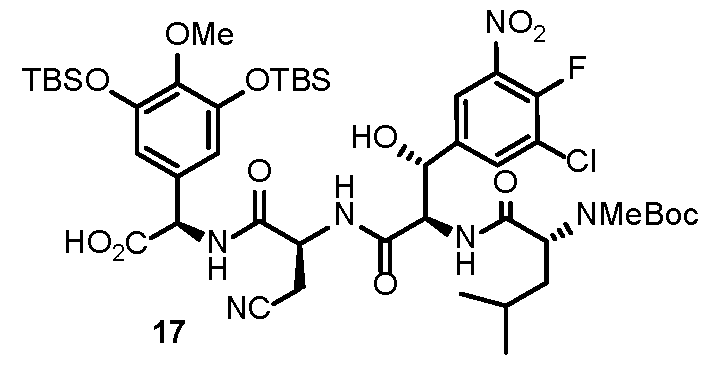 Compound 17 A suspension of 16 (747 mg, 0.718 mmol, 1 equiv) and Me3SnOH (653 mg, 3.59 mmol, 5 equiv) in 1,2-dichloroethane (15 mL) was stirred at 70 °C overnight (about 16-18 h), cooled to 23 ˚C, and quenched with the addition of aqueous 1 M HCl (20
mL). The aqueous layer was discarded, and the organic layer was washed with additional aqueous 1 M HCl (3 × 20 mL), dried over MgSO4, and concentrated under reduced pressure. Chromatography (SiO2, 45% EtOAc–hexanes + 2% AcOH) provided 17 (593 mg, 81%) as a light tan solid. For 17: [α]2 D5 –25 (c 0.46, MeOH); 1H NMR (400 MHz, CDCl3) δ 7.94–7.88 (m, 1H), 7.72 (m, 2H), 6.61 (m, 2H), 5.40 (m, 1H), 5.12 (m, 1H), 4.68 (m, 1H), 4.65–4.58 (m, 1H), 3.71 (s, 3H), 2.81 (m, 2H), 2.29 (br s, 2H), 1.58–1.43 (m, 4H), 1.38 (s, 6H), 0.96 (s, 18H), 0.92–0.81 (m, 6H), 0.15 (m, 12H); 13C{1H} NMR (151 MHz, CD3OD) δ 173.3, 171.5, 171.3, 152.9, 151.2, 140.4, 139.2, 135.4, 124.3, 124.2, 118.1, 73.12, 73.10, 58.8, 50.3, 38.2, 28.6, 28.5, 25.9, 23.5, 21.8, 21.1; IR (film) νmax 2955, 2932, 2857, 2343, 1642, 1579, 1542, 1493, 1436, 1392, 1346, 1254, 1224, 1155, 1091, 1008 cm-1; HRMS (ESI-TOF) m/z [M-H]- calcd for C46H70ClFN6O13Si2, 1023.4134; found, 1023.4139.
Compound 17 A suspension of 16 (747 mg, 0.718 mmol, 1 equiv) and Me3SnOH (653 mg, 3.59 mmol, 5 equiv) in 1,2-dichloroethane (15 mL) was stirred at 70 °C overnight (about 16-18 h), cooled to 23 ˚C, and quenched with the addition of aqueous 1 M HCl (20
mL). The aqueous layer was discarded, and the organic layer was washed with additional aqueous 1 M HCl (3 × 20 mL), dried over MgSO4, and concentrated under reduced pressure. Chromatography (SiO2, 45% EtOAc–hexanes + 2% AcOH) provided 17 (593 mg, 81%) as a light tan solid. For 17: [α]2 D5 –25 (c 0.46, MeOH); 1H NMR (400 MHz, CDCl3) δ 7.94–7.88 (m, 1H), 7.72 (m, 2H), 6.61 (m, 2H), 5.40 (m, 1H), 5.12 (m, 1H), 4.68 (m, 1H), 4.65–4.58 (m, 1H), 3.71 (s, 3H), 2.81 (m, 2H), 2.29 (br s, 2H), 1.58–1.43 (m, 4H), 1.38 (s, 6H), 0.96 (s, 18H), 0.92–0.81 (m, 6H), 0.15 (m, 12H); 13C{1H} NMR (151 MHz, CD3OD) δ 173.3, 171.5, 171.3, 152.9, 151.2, 140.4, 139.2, 135.4, 124.3, 124.2, 118.1, 73.12, 73.10, 58.8, 50.3, 38.2, 28.6, 28.5, 25.9, 23.5, 21.8, 21.1; IR (film) νmax 2955, 2932, 2857, 2343, 1642, 1579, 1542, 1493, 1436, 1392, 1346, 1254, 1224, 1155, 1091, 1008 cm-1; HRMS (ESI-TOF) m/z [M-H]- calcd for C46H70ClFN6O13Si2, 1023.4134; found, 1023.4139.
 Compound 19 A stirred solution of amine 6 (11.28 g, 27.7 mmol, 1 equiv) and carboxylic acid 1830 (12.5 g, 36.1 mmol, 1.3 equiv) in MeCN (70 mL) was cooled to 0 °C and treated with DMTMM (9.98 g, 36.1 mmol, 1.3 equiv). The reaction mixture was stirred at 0 ˚C for 1 h, diluted with H2O (200 mL), and extracted with PhMe (3 × 300 mL). The combined organic layers were
dried over Na2SO4 and concentrated under reduced pressure. Chromatography (SiO2, 20–40% EtOAc–hexane gradient) provided 19 (17.1 g, 84%) as a yellow solid. For 19: 1H NMR (500 MHz, CDCl3) δ 7.70 (d, J = 5.0 Hz, 1H), 7.41 (d, J = 5.0 Hz, 1H), 7.36 (d, J = 2.2 Hz, 1H), 6.96 (dd, J = 2.2, 8.4 Hz, 1H), 6.77 (d, J = 8.5 Hz, 1H), 6.58 (bs, 1H), 5.58 (d, J = 6.0 Hz, 1H), 5.29 (s, 1H), 4.98 (bs, 1H), 4.78 (dd, J = 1.5, 9.5 Hz, 1H), 3.82 (s, 3H), 1.39 (s, 9H), 0.84 (s, 9H), -0.02 (s, 3H), -0.19 (s, 3H); 13C{1H} NMR (126 MHz, CDCl3) δ 170.0, 169.4, 155.2, 153.2, 151.1 (d, J = 268.6 Hz), 137.9 (d, J = 7.6 Hz), 137.5 (d, J = 3.8 Hz), 132.8, 131.1, 127.6, 124.1 (d, J = 17.6 Hz), 121.7, 116.9, 110.9, 80.7, 72.6, 58.4, 57.9, 53.2, 28.4, 25.5, 17.9, –4.7, –5.5; IR (film) νmax 3414, 2954, 2931, 1678, 1543, 1493, 1346, 1257, 1161, 1103, 837, 733 cm-1; HRMS (ESI-TOF) m/z [M+H]+ calcd for C29H38BrClFN3O9Si, 734.1312; found, 734.1321.
Compound 19 A stirred solution of amine 6 (11.28 g, 27.7 mmol, 1 equiv) and carboxylic acid 1830 (12.5 g, 36.1 mmol, 1.3 equiv) in MeCN (70 mL) was cooled to 0 °C and treated with DMTMM (9.98 g, 36.1 mmol, 1.3 equiv). The reaction mixture was stirred at 0 ˚C for 1 h, diluted with H2O (200 mL), and extracted with PhMe (3 × 300 mL). The combined organic layers were
dried over Na2SO4 and concentrated under reduced pressure. Chromatography (SiO2, 20–40% EtOAc–hexane gradient) provided 19 (17.1 g, 84%) as a yellow solid. For 19: 1H NMR (500 MHz, CDCl3) δ 7.70 (d, J = 5.0 Hz, 1H), 7.41 (d, J = 5.0 Hz, 1H), 7.36 (d, J = 2.2 Hz, 1H), 6.96 (dd, J = 2.2, 8.4 Hz, 1H), 6.77 (d, J = 8.5 Hz, 1H), 6.58 (bs, 1H), 5.58 (d, J = 6.0 Hz, 1H), 5.29 (s, 1H), 4.98 (bs, 1H), 4.78 (dd, J = 1.5, 9.5 Hz, 1H), 3.82 (s, 3H), 1.39 (s, 9H), 0.84 (s, 9H), -0.02 (s, 3H), -0.19 (s, 3H); 13C{1H} NMR (126 MHz, CDCl3) δ 170.0, 169.4, 155.2, 153.2, 151.1 (d, J = 268.6 Hz), 137.9 (d, J = 7.6 Hz), 137.5 (d, J = 3.8 Hz), 132.8, 131.1, 127.6, 124.1 (d, J = 17.6 Hz), 121.7, 116.9, 110.9, 80.7, 72.6, 58.4, 57.9, 53.2, 28.4, 25.5, 17.9, –4.7, –5.5; IR (film) νmax 3414, 2954, 2931, 1678, 1543, 1493, 1346, 1257, 1161, 1103, 837, 733 cm-1; HRMS (ESI-TOF) m/z [M+H]+ calcd for C29H38BrClFN3O9Si, 734.1312; found, 734.1321.
 Compound 20 A solution of 19 (30 g, 40.8 mmol, 1 equiv) in MeOH (16 mL) and CH2Cl2 (65 mL) was cooled to 0 ˚C. The mixture was treated with TMSCHN2 (2 M in hexane, 81.6 mL, 163 mmol, 4 equiv) and stirred at 5 ˚C for 36 h (TLC indicated complete reaction). The reaction mixture was cooled to 0 ˚C and quenched by dropwise addition of AcOH (until no further gas evolution
occurred) and concentrated under reduced pressure. Column chromatography (SiO2, loaded with CH2Cl2, 20– 35% EtOAc–hexanes gradient elution) gave 20 (29.96 g, 98%) as a yellow solid. For 20: [α]2 D5 –41 (c 0.67, MeOH); 1H NMR (600 MHz, CDCl3) δ 7.64 (s, 1H), 7.47 (d, J = 2.3 Hz, 1H), 7.42 (d, J = 4.7 Hz, 1H), 7.07 (d, J = 8.4 Hz, 1H), 6.85 (d, J = 8.5 Hz, 1H), 6.41 (s, 1H), 5.54 (d, J = 5.7 Hz, 1H), 5.28 (s, 1H), 4.99 (s, 1H), 4.77 (dd, J = 9.4, 1.8 Hz, 1H), 3.92 (s, 3H), 3.82 (s, 3H), 1.39 (s, 9H), 0.85 (s, 9H), –0.02 (s, 3H), –0.18 (s, 3H); 13C{1H} NMR (151 MHz, CD3OD) δ 171.3, 169.3, 155.8, 155.6, 150.9 (d, J = 223 Hz), 138.0, 137.3, 133.2, 131.9, 131.4, 127.2, 123.9 (d, J = 13.9 Hz), 122.1, 111.3 (d, J = 22.2 Hz), 79.5, 72.5, 57.9, 56.6, 55.1, 51.9, 27.3, 24.8, 17.6, –5.9, –6.6; IR (film) νmax 2931, 1716, 1542, 1346, 1257, 1203, 1157, 837 cm-1; HRMS (ESI-TOF) m/z [M+Na]+ calcd for C30H40BrClFN3O9Si, 770.1287; found, 770.1260.
Compound 20 A solution of 19 (30 g, 40.8 mmol, 1 equiv) in MeOH (16 mL) and CH2Cl2 (65 mL) was cooled to 0 ˚C. The mixture was treated with TMSCHN2 (2 M in hexane, 81.6 mL, 163 mmol, 4 equiv) and stirred at 5 ˚C for 36 h (TLC indicated complete reaction). The reaction mixture was cooled to 0 ˚C and quenched by dropwise addition of AcOH (until no further gas evolution
occurred) and concentrated under reduced pressure. Column chromatography (SiO2, loaded with CH2Cl2, 20– 35% EtOAc–hexanes gradient elution) gave 20 (29.96 g, 98%) as a yellow solid. For 20: [α]2 D5 –41 (c 0.67, MeOH); 1H NMR (600 MHz, CDCl3) δ 7.64 (s, 1H), 7.47 (d, J = 2.3 Hz, 1H), 7.42 (d, J = 4.7 Hz, 1H), 7.07 (d, J = 8.4 Hz, 1H), 6.85 (d, J = 8.5 Hz, 1H), 6.41 (s, 1H), 5.54 (d, J = 5.7 Hz, 1H), 5.28 (s, 1H), 4.99 (s, 1H), 4.77 (dd, J = 9.4, 1.8 Hz, 1H), 3.92 (s, 3H), 3.82 (s, 3H), 1.39 (s, 9H), 0.85 (s, 9H), –0.02 (s, 3H), –0.18 (s, 3H); 13C{1H} NMR (151 MHz, CD3OD) δ 171.3, 169.3, 155.8, 155.6, 150.9 (d, J = 223 Hz), 138.0, 137.3, 133.2, 131.9, 131.4, 127.2, 123.9 (d, J = 13.9 Hz), 122.1, 111.3 (d, J = 22.2 Hz), 79.5, 72.5, 57.9, 56.6, 55.1, 51.9, 27.3, 24.8, 17.6, –5.9, –6.6; IR (film) νmax 2931, 1716, 1542, 1346, 1257, 1203, 1157, 837 cm-1; HRMS (ESI-TOF) m/z [M+Na]+ calcd for C30H40BrClFN3O9Si, 770.1287; found, 770.1260.
 Compound 22 The following reaction has been performed on scales between 100 mg – 10 g (53–72%), and a representative procedure follows. A solution of 20 (10 g, 13.3 mmol, 1 equiv), Pd(OAc)2 (900 mg, 4.01 mmol, 0.3 equiv), and (R)-BINAP (2.75 g, 4.42 mmol, 0.33 equiv) in MeTHF (134 mL) was stirred for 15 min at room temperature while sparged with Ar and then treated with solid NaHCO3 (22.4 g, 267 mmol, 20 equiv)
and H2O (27 mL). The reaction mixture was immediately warmed to 70 °C and stirred for 45 min. A solution of boronate 216 (0.20 M in MeTHF, 200 mL, 40 mmol, 3 equiv) was added dropwise to the reaction mixture over 4 h by an addition funnel, and the resulting solution was stirred for an additional 1 h at 70 ˚C. The reaction mixture was then cooled to 23 ˚C, H2O added (200 mL) to dissolve solid NaHCO3, transferred to separatory funnel, and the aqueous layer was discarded. The organic layer was washed with H2O (200 mL), dried over Na2SO4, and concentrated under reduced pressure. Column chromatography (SiO2, wet-load CH2Cl2, 15–35% EtOAc–hexanes to recover A ring (ca. 50%) and 45–55% EtOAc–hexanes to collect product) provided 22 (9.36 g, 72%) as a light-yellow solid. For 22: [α]2 D5 +4.7 (c 0.9, MeOH); 1H NMR (600 MHz, CDCl3) δ 7.91 (dd, J = 6.3, 2.3 Hz, 1H), 7.66 (dd, J = 5.7, 2.2 Hz, 1H), 7.41 (m, 1H), 7.12 (m, 1H), 7.00–6.87 (m, 1H), 6.80 (d, J = 20.3 Hz, 1H), 6.58–6.53 (m, 1H), 6.51 (d, J = 2.3 Hz, 1H), 5.75 (s, 1H), 5.05 (s, 1H), 4.93 (s, 1H), 4.88–4.80 (m, 1H), 3.87 (s, 3H), 3.77 (s, 3H), 3.74 (s, 3H), 3.66 (s, 3H), 2.62 (s, 4H), 1.41 (d, J = 17.9 Hz, 9H), 0.87 (s, 9H), 0.03 (d, J = 2.4 Hz, 3H), –0.08 to –0.17 (m, 3H); 13C{1H} NMR (151 MHz, CDCl3) δ 171.2, 169.4, 160.4, 158.6, 157.7, 156.5 (q, J = 36.2 Hz), 155.3, 150.8 (d, J = 266 Hz), 138.1, 137.8, 133.3, 132.3, 129.1, 127.7, 125.1, 123.7 (d, J = 16.7 Hz), 122.4, 119.7, 115.8 (q, J = 288 Hz), 110.5, 103.3, 97.9, 79.8, 72.8, 64.0, 58.2, 55.7, 55.4, 55.3, 53.0, 52.5, 28.1, 25.4, 17.8, –4.7, –5.5; IR (film) νmax 2931, 1713, 1543, 1504, 1203, 1161, 1092, 891 cm-1; HRMS (ESI-TOF) m/z [M+Na]+ calcd for C42H53ClF4N4O13Si, 961.3081; found, 961.3073.
Compound S4 A stirred solution of 22 (2.00 g, 2.08 mmol, 1 equiv) in MeCN (30 mL) was diluted with H2O (15 mL) and treated with TEMPO (195 mg, 1.25 mmol, 0.6 equiv), followed by PhI(OAc)2 (1.67 g, 5.20 mmol, 2.5 equiv). The reaction mixture was stirred at 23 ˚C for 1 h, then chromatographed directly (60 g C18, wet-load minimal MeCN–H2O, 20–100% MeCN–H2O + 0.1% formic acid over 300 mL) to afford semi-pure S4 an orange solid, which was carried forward without further purification. An aliquot of this material was purified by HPLC (Phenomenex Luna® C18(2), 100 × 30 mm, 20 mL/min, 60–100% MeCN–H2O + 0.07% TFA over 20 min, tR = 14.0 min) to provide analytically pure S4 (65 mg) as a white solid. For S4: [α]2 D5 +39 (c 4.63, MeOH); 1H NMR (600 MHz, CDCl3) δ 7.88 (d, J = 5.7 Hz, 1H), 7.60 (s, 1H), 7.53 (s, 1H), 7.17 (d, J = 8.5 Hz, 1H), 7.04–6.96 (m, 2H), 6.62 (s, 1H), 6.56 (d, J = 2.3 Hz, 1H), 5.55 (s, 1H), 5.33 (d, J = 8.6 Hz, 2H), 4.98 (s, 1H), 4.89 (d, J = 9.2 Hz, 1H), 3.88 (s, 3Hz), 3.81 (s, 3H), 3.80 (s, 3H), 3.65 (s, 3H), 1.45 (s, 9H), 0.88 (s, 9H), 0.02 (s, 3H), –0.12 (s, 3H); 13C{1H} NMR (151 MHz, CD3OD) δ 169.3, 160.6, 158.7, 158.1, 149.7, 136.2, 120.5, 98.6, 79.1, 72.7, 58.2, 54.9, 54.5, 53.8, 51.7, 27.3, 24.8, 17.5, –6.0, –6.6; IR (film) νmax
3363, 2934, 1713, 1608, 1543, 1488, 1346, 1259, 1160, 1100 837, 779 cm-1; HRMS (ESI-TOF) m/z [M+Na]+ calcd for C42H51ClF4N4O14Si, 997.2693; found, 997.2717.
Compound 22 The following reaction has been performed on scales between 100 mg – 10 g (53–72%), and a representative procedure follows. A solution of 20 (10 g, 13.3 mmol, 1 equiv), Pd(OAc)2 (900 mg, 4.01 mmol, 0.3 equiv), and (R)-BINAP (2.75 g, 4.42 mmol, 0.33 equiv) in MeTHF (134 mL) was stirred for 15 min at room temperature while sparged with Ar and then treated with solid NaHCO3 (22.4 g, 267 mmol, 20 equiv)
and H2O (27 mL). The reaction mixture was immediately warmed to 70 °C and stirred for 45 min. A solution of boronate 216 (0.20 M in MeTHF, 200 mL, 40 mmol, 3 equiv) was added dropwise to the reaction mixture over 4 h by an addition funnel, and the resulting solution was stirred for an additional 1 h at 70 ˚C. The reaction mixture was then cooled to 23 ˚C, H2O added (200 mL) to dissolve solid NaHCO3, transferred to separatory funnel, and the aqueous layer was discarded. The organic layer was washed with H2O (200 mL), dried over Na2SO4, and concentrated under reduced pressure. Column chromatography (SiO2, wet-load CH2Cl2, 15–35% EtOAc–hexanes to recover A ring (ca. 50%) and 45–55% EtOAc–hexanes to collect product) provided 22 (9.36 g, 72%) as a light-yellow solid. For 22: [α]2 D5 +4.7 (c 0.9, MeOH); 1H NMR (600 MHz, CDCl3) δ 7.91 (dd, J = 6.3, 2.3 Hz, 1H), 7.66 (dd, J = 5.7, 2.2 Hz, 1H), 7.41 (m, 1H), 7.12 (m, 1H), 7.00–6.87 (m, 1H), 6.80 (d, J = 20.3 Hz, 1H), 6.58–6.53 (m, 1H), 6.51 (d, J = 2.3 Hz, 1H), 5.75 (s, 1H), 5.05 (s, 1H), 4.93 (s, 1H), 4.88–4.80 (m, 1H), 3.87 (s, 3H), 3.77 (s, 3H), 3.74 (s, 3H), 3.66 (s, 3H), 2.62 (s, 4H), 1.41 (d, J = 17.9 Hz, 9H), 0.87 (s, 9H), 0.03 (d, J = 2.4 Hz, 3H), –0.08 to –0.17 (m, 3H); 13C{1H} NMR (151 MHz, CDCl3) δ 171.2, 169.4, 160.4, 158.6, 157.7, 156.5 (q, J = 36.2 Hz), 155.3, 150.8 (d, J = 266 Hz), 138.1, 137.8, 133.3, 132.3, 129.1, 127.7, 125.1, 123.7 (d, J = 16.7 Hz), 122.4, 119.7, 115.8 (q, J = 288 Hz), 110.5, 103.3, 97.9, 79.8, 72.8, 64.0, 58.2, 55.7, 55.4, 55.3, 53.0, 52.5, 28.1, 25.4, 17.8, –4.7, –5.5; IR (film) νmax 2931, 1713, 1543, 1504, 1203, 1161, 1092, 891 cm-1; HRMS (ESI-TOF) m/z [M+Na]+ calcd for C42H53ClF4N4O13Si, 961.3081; found, 961.3073.
Compound S4 A stirred solution of 22 (2.00 g, 2.08 mmol, 1 equiv) in MeCN (30 mL) was diluted with H2O (15 mL) and treated with TEMPO (195 mg, 1.25 mmol, 0.6 equiv), followed by PhI(OAc)2 (1.67 g, 5.20 mmol, 2.5 equiv). The reaction mixture was stirred at 23 ˚C for 1 h, then chromatographed directly (60 g C18, wet-load minimal MeCN–H2O, 20–100% MeCN–H2O + 0.1% formic acid over 300 mL) to afford semi-pure S4 an orange solid, which was carried forward without further purification. An aliquot of this material was purified by HPLC (Phenomenex Luna® C18(2), 100 × 30 mm, 20 mL/min, 60–100% MeCN–H2O + 0.07% TFA over 20 min, tR = 14.0 min) to provide analytically pure S4 (65 mg) as a white solid. For S4: [α]2 D5 +39 (c 4.63, MeOH); 1H NMR (600 MHz, CDCl3) δ 7.88 (d, J = 5.7 Hz, 1H), 7.60 (s, 1H), 7.53 (s, 1H), 7.17 (d, J = 8.5 Hz, 1H), 7.04–6.96 (m, 2H), 6.62 (s, 1H), 6.56 (d, J = 2.3 Hz, 1H), 5.55 (s, 1H), 5.33 (d, J = 8.6 Hz, 2H), 4.98 (s, 1H), 4.89 (d, J = 9.2 Hz, 1H), 3.88 (s, 3Hz), 3.81 (s, 3H), 3.80 (s, 3H), 3.65 (s, 3H), 1.45 (s, 9H), 0.88 (s, 9H), 0.02 (s, 3H), –0.12 (s, 3H); 13C{1H} NMR (151 MHz, CD3OD) δ 169.3, 160.6, 158.7, 158.1, 149.7, 136.2, 120.5, 98.6, 79.1, 72.7, 58.2, 54.9, 54.5, 53.8, 51.7, 27.3, 24.8, 17.5, –6.0, –6.6; IR (film) νmax
3363, 2934, 1713, 1608, 1543, 1488, 1346, 1259, 1160, 1100 837, 779 cm-1; HRMS (ESI-TOF) m/z [M+Na]+ calcd for C42H51ClF4N4O14Si, 997.2693; found, 997.2717.
 Compound 23 The semi-pure carboxylic acid S4 from the previous step (2.0 mmol) was coevaporated with PhMe (2 × 50 mL), dissolved in CH2Cl2 (2 mL), and diluted with cyclohexane (6 mL). A solution of t-butyl trichloroacetimidate (3.6 mL, 20 mmol, 10 equiv) in cyclohexane (3.6 mL) was added to the reaction mixture over 7 h by syringe pump. The reaction mixture was stirred at 23 ˚C for an additional 9 h, filtered, and the filter cake was washed with minimal 30% CH2Cl2–hexanes (3 × 5 mL). The combined filtrate was concentrated under reduced pressure and purified by column chromatography (50 g SiO2, wet-load CH2Cl2, washed with 100% CH2Cl2 (1.5 L) to remove trichloroacetamide, then eluted with 0–10% acetone– CH2Cl2 over 500 mL) to provide 23 (1.87 g, 90%) as a tan solid. For 23: 1H NMR (600 MHz, CD3OD, 2:1 rotamers, major given) δ 8.06–7.93 (m, 1H), 7.89–7.78 (m, 1H), 6.86 (s, 1H), 6.81–6.70 (m, 2H), 6.66 (s, 1H), 6.58 (s, 1H), 5.55 (s, 1H), 5.36 (s, 1H), 5.01 (s, 1H), 4.93 (d, J = 6.5 Hz, 1H), 3.84 (s, 3H), 3.77 (d, J = 11.8 Hz, 3H), 3.70 (s, 3H), 3.63 (d, J = 11.9 Hz, 3H), 1.54–1.21 (m, 18H), 0.84 (s, 9H), 0.03 (s,
3H), –0.16 (s, 3H); 13C{1H} NMR (151 MHz, CD3OD,rotamers, major given) δ 173.2, 170.7, 170.4, 162.0, 160.2, 159.6, 157.8, 157.1, 156.6, 152.0 (d, J = 217 Hz), 139.7, 137.6, 136.2, 135.2, 133.9, 130.0, 129.6, 128.7, 126.8, 126.4, 125.82,124.4, 123.6, 122.1, 115.68 (q, J = 238 Hz), 111.75, 104.9, 100.0, 97.8, 59.6, 59.3, 56.5, 56.3, 56.0 , 55.6, 51.1, 28.5, 28.1, 26.2 , 18.9, –4.6, –5.4; IR (film) νmax 2955, 2838, 1747, 1686, 1543, 1497, 1364, 1261, 1164, 1103, 837 cm-1; HRMS (ESI-TOF) m/z [M+H]+ calcd for C46H59ClF4N4O14Si, 1053.3319; found, 1053.3284.
Compound 23 The semi-pure carboxylic acid S4 from the previous step (2.0 mmol) was coevaporated with PhMe (2 × 50 mL), dissolved in CH2Cl2 (2 mL), and diluted with cyclohexane (6 mL). A solution of t-butyl trichloroacetimidate (3.6 mL, 20 mmol, 10 equiv) in cyclohexane (3.6 mL) was added to the reaction mixture over 7 h by syringe pump. The reaction mixture was stirred at 23 ˚C for an additional 9 h, filtered, and the filter cake was washed with minimal 30% CH2Cl2–hexanes (3 × 5 mL). The combined filtrate was concentrated under reduced pressure and purified by column chromatography (50 g SiO2, wet-load CH2Cl2, washed with 100% CH2Cl2 (1.5 L) to remove trichloroacetamide, then eluted with 0–10% acetone– CH2Cl2 over 500 mL) to provide 23 (1.87 g, 90%) as a tan solid. For 23: 1H NMR (600 MHz, CD3OD, 2:1 rotamers, major given) δ 8.06–7.93 (m, 1H), 7.89–7.78 (m, 1H), 6.86 (s, 1H), 6.81–6.70 (m, 2H), 6.66 (s, 1H), 6.58 (s, 1H), 5.55 (s, 1H), 5.36 (s, 1H), 5.01 (s, 1H), 4.93 (d, J = 6.5 Hz, 1H), 3.84 (s, 3H), 3.77 (d, J = 11.8 Hz, 3H), 3.70 (s, 3H), 3.63 (d, J = 11.9 Hz, 3H), 1.54–1.21 (m, 18H), 0.84 (s, 9H), 0.03 (s,
3H), –0.16 (s, 3H); 13C{1H} NMR (151 MHz, CD3OD,rotamers, major given) δ 173.2, 170.7, 170.4, 162.0, 160.2, 159.6, 157.8, 157.1, 156.6, 152.0 (d, J = 217 Hz), 139.7, 137.6, 136.2, 135.2, 133.9, 130.0, 129.6, 128.7, 126.8, 126.4, 125.82,124.4, 123.6, 122.1, 115.68 (q, J = 238 Hz), 111.75, 104.9, 100.0, 97.8, 59.6, 59.3, 56.5, 56.3, 56.0 , 55.6, 51.1, 28.5, 28.1, 26.2 , 18.9, –4.6, –5.4; IR (film) νmax 2955, 2838, 1747, 1686, 1543, 1497, 1364, 1261, 1164, 1103, 837 cm-1; HRMS (ESI-TOF) m/z [M+H]+ calcd for C46H59ClF4N4O14Si, 1053.3319; found, 1053.3284.
 Compound 24 A slightly warm (25 ˚C) solution of 23 (450 mg, 0.44 mmol, 1 equiv) in t-BuOH (18 mL) was treated with saturated aqueous Ba(OH)2 (ca. 0.25 M, 9 mL, 2.25 mmol, 5 equiv). The reaction mixture was stirred at 23 ˚C for 6 h, at which point TLC (5:10:85 AcOH/MeOH/EtOAc) indicated complete consumption of 23 with <5% of the monodeprotected intermediate remaining. The reaction mixture was sparged with CO2 (g) for 30 min and filtered through a 0.22 μm PES membrane, rinsing with MeOH (20 mL). The filtrate was concentrated under reduced pressure and lyophilized to remove residual H2O, providing 533 mg of crude 24, carried forward without further purification.
For 24: HRMS (ESI-TOF) m/z [M+H]+ calcd for C43H58ClFN4O13Si, 921.3520; found, 921.3503.
Compound 24 A slightly warm (25 ˚C) solution of 23 (450 mg, 0.44 mmol, 1 equiv) in t-BuOH (18 mL) was treated with saturated aqueous Ba(OH)2 (ca. 0.25 M, 9 mL, 2.25 mmol, 5 equiv). The reaction mixture was stirred at 23 ˚C for 6 h, at which point TLC (5:10:85 AcOH/MeOH/EtOAc) indicated complete consumption of 23 with <5% of the monodeprotected intermediate remaining. The reaction mixture was sparged with CO2 (g) for 30 min and filtered through a 0.22 μm PES membrane, rinsing with MeOH (20 mL). The filtrate was concentrated under reduced pressure and lyophilized to remove residual H2O, providing 533 mg of crude 24, carried forward without further purification.
For 24: HRMS (ESI-TOF) m/z [M+H]+ calcd for C43H58ClFN4O13Si, 921.3520; found, 921.3503.
 Compound 25 A portion of crude 24 from the above reaction (355 mg, 0.29 mmol, 1 equiv) was dissolved in NMP (1.45 mL, [substrate] = 0.2 M) and added over 30 min by syringe pump to a stirred suspension of Phenomenex Luna® (168 mg, 0.44 mmol, 1.5 equiv) and i-Pr2NEt (0.15 mL, 0.87 mmol, 3 equiv) in NMP (1.45 mL, final [S] = 0.1 M). The vial and syringe used to transfer 24 were rinsed with additional NMP (2 × 0.5 mL) and added to the reaction mixture. The reaction mixture was stirred at 23 ˚C for an additional 15 min and purified directly by preparative HPLC (Phenomenex Luna® C18(2), 100 × 30 mm, 60–100% MeCN–H2O + 0.07% TFA over 20 min, 20 mL/min, tR = 14–19 min) to afford 25 (230 mg) as a light green solid containing minor impurities. Trituration of this sample of 25 with Et2O (4 mL) afforded analytically pure 25 (217 mg, 83%/2 steps) as a light tan solid. For 25: [α]2 D5 +16 (c 0.57, MeOH); 1H NMR (600 MHz, CD3CN, 3.7:1 rotamers, major given) δ 8.12–8.08 (m, 1H), 7.93–7.91 (m, 1H), 7.07 (dd, J = 8.7, 2.3 Hz, 1H), 7.01 (d, J = 8.7 Hz, 1H), 6.97 (br s, 1H), 6.66 (br s, 1H), 6.41 (d, J = 2.3 Hz, 1H), 5.12 (br s, 1H), 4.81 (d, J = 6.2 Hz, 1H), 4.68 (s, 1H), 4.14
(d, J = 11.0 Hz, 1H), 3.82 (s, 3H), 3.71 (s, 3H), 3.70 (s, 3H), 1.45 (s, 9H), 1.29 (s, 9H), 0.81 (s, 9H), –0.02 (s, 3H), –0.17 (s, 3H); 13C{1H} NMR (151 MHz, CD3CN) δ 172.1, 171.9, 170.8, 170.1, 167.8, 161.3, 159.6, 158.0, 155.3, 152.0 (d, J = 264 Hz), 139.3, 138.92, 138.87, 136.2, 135.0, 132.0, 129.4, 128.2, 123.8, 122.3, 114.2, 112.3, 104.8, 99.7, 82.9, 79.8, 73.5, 61.7, 56.5, 56.4, 56.2, 56.1, 55.9, 28.5, 28.1, 26.0, 18.6, –4.3, –5.2; IR (film) νmax 2932, 1696, 1660, 1609, 1508, 1485, 1367, 1254, 1160 cm-1; HRMS (ESI-TOF) m/z [M+H]+ calcd for C43H56ClFN4O12Si, 903.3415; found, 903.3391. The structure, relative and absolute stereochemistry, and 5,6-cis amide conformation of 25 were confirmed with a single-crystal X-ray structure determination conducted on crystals grown from MeOH. The structure of 25 has been deposited with the Cambridge Crystallographic Data Center (CCDC 2150607 Crystal data and structure refinement for 25. Report date 2022-02-04 Identification code boger128 Empirical formula C43 H56 Cl F N4 O12 Si Molecular formula C43 H56 Cl F N4 O12 Si Formula weight 903.45 Temperature 100.15 K Wavelength 1.54178 Å Crystal system Monoclinic Space group C 12 1 Unit cell dimensions: a=27.4790(11) Å a=90° b=13.7793(5) Å b=99.636(2)° c=14.8814(6) Å g=90°
Volume 5555.2(4) Å3 Z 4 Density (calculated) 1.080 Mg/m3 Absorption coefficient 1.293 mm-1 F(000) 1912 Crystal size 0.2 x 0.2 x 0.14 mm3 Crystal color, habit colorless plank Theta range for data collection 3.012 to 68.732°. Index ranges -33<=h<=32, -16<=k<=16, -17<=l<=17 Reflections collected 46418 Independent reflections 10131 [R(int) = 0.0482] Completeness to theta=67.679° 99.7 % Absorption correction Semi-empirical from equivalents Max. and min. transmission 0.7531 and 0.6174 Refinement method Full-matrix least-squares on F2 Data / restraints / parameters 10131 / 310 / 697 Goodness-of-fit on F2 1.042 Final R indices [I>2sigma(I)] R1=0.0583, wR2=0.1643 R indices (all data) R1=0.0633, wR2=0.1727 Absolute structure parameter 0.034(8) Largest diff. peak and hole 0.418 and -0.304 e.Å-3. On 3.0 gram-scale, the macrolactamization reaction was quenched with the addition of water (100 mL) and diluted with EtOAc (300 mL). The mixture was transferred to separatory funnel, and the organic layer was washed with H2O (3 x 200 mL), saturated aqueous NaCl (200 mL), dried over Na2SO4, and concentrated under reduced pressure. Column chromatography (SiO2, wet load CH2Cl2, 0–10% EtOAc– CH2Cl2) provided 25 as a white powder (1.91 g, 72%/2 steps).
Compound 26 A stirred suspension of 25 (450 mg, 0.50 mmol, 1 equiv) in t-BuOAc (9 mL, 20 vol) was treated with H2SO4 (214 μL, 4 mmol, 8 equiv) and stirred at 23 ˚C for 2 h. The reaction mixture was carefully quenched with the addition of Et3N (1.4 mL, 10 mmol, 20 equiv) and concentrated under a stream of N2. Preparative HPLC (Phenomenex Luna® C18(2) 100 × 30 mm, wet-load MeOH–H2O, 30–90% MeCN–H2O + 0.07% TFA, tR = 14.2 min) provided 26 (TFA salt, 378 mg, 82%) as a white solid. For 26 (TFA salt): 1H NMR (600 MHz, CD3OD) δ 8.82 (d, J = 8.3 Hz, 1H, W7), 8.26 (dd, J = 6.2, 2.2 Hz, 1H, 6B), 8.06 (dd, J = 6.0, 2.2 Hz, 1H, 6F), 7.39 (dd, J = 8.8, 2.5 Hz, 1H, 5F), 7.17 (d, J = 8.8 Hz, 1H, 5D), 7.13 (d, J = 2.5 Hz, 1H, 5B), 6.71 (d, J = 2.3 Hz, 1H, 7D), 6.52 (d, J = 2.3 Hz, 1H, 7F), 5.31 (d, J = 1.8 Hz, 1H, Z6), 5.05 (s, 1H, X5), 4.84 (d, J = 8.3 Hz, 1H, X7), 4.34 (d, J = 1.8 Hz, 1H, X6), 3.88 (s, 3H, 7E-OCH3), 3.83 (s, 3H, 5D-OCH3), 3.70 (s, 3H, 7C-OCH3), 1.53 (s, 9H, C7-OC(CH3)3), 0.89 (s, 9H, Z6- OSiC(CH3)3), 0.04 (s, 3H, Z6-OSiCH3), –0.06 (s, 3H, Z6-OSiCH3); 13C{1H} NMR (151 MHz, CD3OD) δ 170.0, 169.2, 167.4, 160.6, 158.6, 158.5, 151.7, 149.9, 138.37, 138.34, 137.99, 137.93, 136.4, 135.89, 135.84, 133.6, 127.1, 124.1, 123.3, 123.1, 122.6, 121.4, 120.6, 113.2, 104.3, 98.1, 81.9, 72.6, 60.7,
55.4, 55.3, 54.97, 54.93, 54.6, 54.2, 26.9, 24.8, 17.5, –6.0, –6.2; IR (film) νmax 3400, 2935, 1672, 1608, 1543, 1464, 1349, 1201, 1151, 836 cm-1; HRMS (ESI-TOF) m/z [M+H]+ calcd for C38H48ClFN4O10Si, 803.2891; found, 803.2879. The 1H–1H NOESY spectrum of 26 (600 MHz, CD3OD) displayed the following diagnostic nOe cross- peaks: 8.26/5.31 (6B/Z6), 8.26/4.34 (6B/X6), 8.06/5.31 (6F/Z6), 8.06/4.34 (6F/X6), 7.14/5.05 (5B/X5), 7.14/4.34 (5B/X6), 5.05/4.34 (X5/X6). The latter correlation is indicative of a 5,6-cis amide conformation.35 Compound 26 was most conveniently stored as its stable TFA salt and free based immediately prior to the coupling with 17. Minor decomposition of 26 as its free base was observed upon prolonged storage. The quantitative conversion of 26 (TFA salt) to its free base form is detailed in the preparation of 27 below.
Compound 25 A portion of crude 24 from the above reaction (355 mg, 0.29 mmol, 1 equiv) was dissolved in NMP (1.45 mL, [substrate] = 0.2 M) and added over 30 min by syringe pump to a stirred suspension of Phenomenex Luna® (168 mg, 0.44 mmol, 1.5 equiv) and i-Pr2NEt (0.15 mL, 0.87 mmol, 3 equiv) in NMP (1.45 mL, final [S] = 0.1 M). The vial and syringe used to transfer 24 were rinsed with additional NMP (2 × 0.5 mL) and added to the reaction mixture. The reaction mixture was stirred at 23 ˚C for an additional 15 min and purified directly by preparative HPLC (Phenomenex Luna® C18(2), 100 × 30 mm, 60–100% MeCN–H2O + 0.07% TFA over 20 min, 20 mL/min, tR = 14–19 min) to afford 25 (230 mg) as a light green solid containing minor impurities. Trituration of this sample of 25 with Et2O (4 mL) afforded analytically pure 25 (217 mg, 83%/2 steps) as a light tan solid. For 25: [α]2 D5 +16 (c 0.57, MeOH); 1H NMR (600 MHz, CD3CN, 3.7:1 rotamers, major given) δ 8.12–8.08 (m, 1H), 7.93–7.91 (m, 1H), 7.07 (dd, J = 8.7, 2.3 Hz, 1H), 7.01 (d, J = 8.7 Hz, 1H), 6.97 (br s, 1H), 6.66 (br s, 1H), 6.41 (d, J = 2.3 Hz, 1H), 5.12 (br s, 1H), 4.81 (d, J = 6.2 Hz, 1H), 4.68 (s, 1H), 4.14
(d, J = 11.0 Hz, 1H), 3.82 (s, 3H), 3.71 (s, 3H), 3.70 (s, 3H), 1.45 (s, 9H), 1.29 (s, 9H), 0.81 (s, 9H), –0.02 (s, 3H), –0.17 (s, 3H); 13C{1H} NMR (151 MHz, CD3CN) δ 172.1, 171.9, 170.8, 170.1, 167.8, 161.3, 159.6, 158.0, 155.3, 152.0 (d, J = 264 Hz), 139.3, 138.92, 138.87, 136.2, 135.0, 132.0, 129.4, 128.2, 123.8, 122.3, 114.2, 112.3, 104.8, 99.7, 82.9, 79.8, 73.5, 61.7, 56.5, 56.4, 56.2, 56.1, 55.9, 28.5, 28.1, 26.0, 18.6, –4.3, –5.2; IR (film) νmax 2932, 1696, 1660, 1609, 1508, 1485, 1367, 1254, 1160 cm-1; HRMS (ESI-TOF) m/z [M+H]+ calcd for C43H56ClFN4O12Si, 903.3415; found, 903.3391. The structure, relative and absolute stereochemistry, and 5,6-cis amide conformation of 25 were confirmed with a single-crystal X-ray structure determination conducted on crystals grown from MeOH. The structure of 25 has been deposited with the Cambridge Crystallographic Data Center (CCDC 2150607 Crystal data and structure refinement for 25. Report date 2022-02-04 Identification code boger128 Empirical formula C43 H56 Cl F N4 O12 Si Molecular formula C43 H56 Cl F N4 O12 Si Formula weight 903.45 Temperature 100.15 K Wavelength 1.54178 Å Crystal system Monoclinic Space group C 12 1 Unit cell dimensions: a=27.4790(11) Å a=90° b=13.7793(5) Å b=99.636(2)° c=14.8814(6) Å g=90°
Volume 5555.2(4) Å3 Z 4 Density (calculated) 1.080 Mg/m3 Absorption coefficient 1.293 mm-1 F(000) 1912 Crystal size 0.2 x 0.2 x 0.14 mm3 Crystal color, habit colorless plank Theta range for data collection 3.012 to 68.732°. Index ranges -33<=h<=32, -16<=k<=16, -17<=l<=17 Reflections collected 46418 Independent reflections 10131 [R(int) = 0.0482] Completeness to theta=67.679° 99.7 % Absorption correction Semi-empirical from equivalents Max. and min. transmission 0.7531 and 0.6174 Refinement method Full-matrix least-squares on F2 Data / restraints / parameters 10131 / 310 / 697 Goodness-of-fit on F2 1.042 Final R indices [I>2sigma(I)] R1=0.0583, wR2=0.1643 R indices (all data) R1=0.0633, wR2=0.1727 Absolute structure parameter 0.034(8) Largest diff. peak and hole 0.418 and -0.304 e.Å-3. On 3.0 gram-scale, the macrolactamization reaction was quenched with the addition of water (100 mL) and diluted with EtOAc (300 mL). The mixture was transferred to separatory funnel, and the organic layer was washed with H2O (3 x 200 mL), saturated aqueous NaCl (200 mL), dried over Na2SO4, and concentrated under reduced pressure. Column chromatography (SiO2, wet load CH2Cl2, 0–10% EtOAc– CH2Cl2) provided 25 as a white powder (1.91 g, 72%/2 steps).
Compound 26 A stirred suspension of 25 (450 mg, 0.50 mmol, 1 equiv) in t-BuOAc (9 mL, 20 vol) was treated with H2SO4 (214 μL, 4 mmol, 8 equiv) and stirred at 23 ˚C for 2 h. The reaction mixture was carefully quenched with the addition of Et3N (1.4 mL, 10 mmol, 20 equiv) and concentrated under a stream of N2. Preparative HPLC (Phenomenex Luna® C18(2) 100 × 30 mm, wet-load MeOH–H2O, 30–90% MeCN–H2O + 0.07% TFA, tR = 14.2 min) provided 26 (TFA salt, 378 mg, 82%) as a white solid. For 26 (TFA salt): 1H NMR (600 MHz, CD3OD) δ 8.82 (d, J = 8.3 Hz, 1H, W7), 8.26 (dd, J = 6.2, 2.2 Hz, 1H, 6B), 8.06 (dd, J = 6.0, 2.2 Hz, 1H, 6F), 7.39 (dd, J = 8.8, 2.5 Hz, 1H, 5F), 7.17 (d, J = 8.8 Hz, 1H, 5D), 7.13 (d, J = 2.5 Hz, 1H, 5B), 6.71 (d, J = 2.3 Hz, 1H, 7D), 6.52 (d, J = 2.3 Hz, 1H, 7F), 5.31 (d, J = 1.8 Hz, 1H, Z6), 5.05 (s, 1H, X5), 4.84 (d, J = 8.3 Hz, 1H, X7), 4.34 (d, J = 1.8 Hz, 1H, X6), 3.88 (s, 3H, 7E-OCH3), 3.83 (s, 3H, 5D-OCH3), 3.70 (s, 3H, 7C-OCH3), 1.53 (s, 9H, C7-OC(CH3)3), 0.89 (s, 9H, Z6- OSiC(CH3)3), 0.04 (s, 3H, Z6-OSiCH3), –0.06 (s, 3H, Z6-OSiCH3); 13C{1H} NMR (151 MHz, CD3OD) δ 170.0, 169.2, 167.4, 160.6, 158.6, 158.5, 151.7, 149.9, 138.37, 138.34, 137.99, 137.93, 136.4, 135.89, 135.84, 133.6, 127.1, 124.1, 123.3, 123.1, 122.6, 121.4, 120.6, 113.2, 104.3, 98.1, 81.9, 72.6, 60.7,
55.4, 55.3, 54.97, 54.93, 54.6, 54.2, 26.9, 24.8, 17.5, –6.0, –6.2; IR (film) νmax 3400, 2935, 1672, 1608, 1543, 1464, 1349, 1201, 1151, 836 cm-1; HRMS (ESI-TOF) m/z [M+H]+ calcd for C38H48ClFN4O10Si, 803.2891; found, 803.2879. The 1H–1H NOESY spectrum of 26 (600 MHz, CD3OD) displayed the following diagnostic nOe cross- peaks: 8.26/5.31 (6B/Z6), 8.26/4.34 (6B/X6), 8.06/5.31 (6F/Z6), 8.06/4.34 (6F/X6), 7.14/5.05 (5B/X5), 7.14/4.34 (5B/X6), 5.05/4.34 (X5/X6). The latter correlation is indicative of a 5,6-cis amide conformation.35 Compound 26 was most conveniently stored as its stable TFA salt and free based immediately prior to the coupling with 17. Minor decomposition of 26 as its free base was observed upon prolonged storage. The quantitative conversion of 26 (TFA salt) to its free base form is detailed in the preparation of 27 below.
 Compound 27 A solution of 26 (TFA salt, 85 mg, 93 μmol, 1 equiv) in CH2Cl2 (2 mL) was treated with saturated aqueous NaHCO3 (2 mL) and stirred at 23 ˚C for 10 min. The organic layer was removed, and the aqueous layer was extracted with additional CH2Cl2 (3 × 2 mL). The combined organic layers were dried over Na2SO4 and concentrated to provide a light-yellow solid (free
base, 75 mg, quant), used directly in the coupling reaction. Compound 26 was combined with 17 (115 mg, 112 μmol, 1.2 equiv) and solid NaHCO3 (34 mg, 415 μmol, 4.5 equiv) in THF (750 μL) and the resulting suspension was treated with DEPBT (60 mg, 186 μmol, 2 equiv). The reaction mixture was stirred at 23 ˚C for 17 h, concentrated under a stream of N2, and the residue was purified by chromatography (10 g SiO2, wet-load 50% CH2Cl2–hexanes, 30–60% EtOAc–hexanes over 100 mL) to provide 27 (158 mg, 93%) as a light tan solid. For 27: [α]2 D2 –14 (c 1.0, CH2Cl2); 1H NMR (600 MHz, CD3OD, rotameric, integration relative to major conformer) δ 8.24 (d, J = 6.3 Hz, 1H), 8.15 (br s, 1H), 8.11 (br s, 1H), 8.03 (br s, 1H), 8.01 (d, J = 6.0 Hz, 1H), 7.95 (br s, 1H), 7.93 (dd, J = 6.1, 2.2 Hz, 1H), 7.87 (d, J = 6.2 Hz, 1H), 7.51 (d, J = 8.6 Hz, 1H), 7.30 (d, J = 8.0 Hz, 1H), 7.08–6.99 (m, 3H), 6.79 (s, 1H), 6.70 (d, J = 2.3 Hz, 1H), 6.61 (d, J = 2.3 Hz, 1H), 6.60–6.55 (m, 2H), 6.49 (d, J = 2.3 Hz, 1H), 6.34 (br s, 1H), 5.48 (d, J = 2.1 Hz, 1H), 5.22 (s, 1H), 5.15 (s, 1H), 5.07–4.92 (m, 2H), 4.80 (s, 1H), 4.70–4.61 (m, 5H), 4.29–4.18 (m, 1H), 3.87 (s, 3H), 3.78 (s, 3H), 3.77 (s, 2H), 3.75 (s, 4H), 3.72 (s, 2H), 3.70 (s, 2H), 3.68 (s, 3H), 3.17–3.05 (m, 1H), 3.00 (dd, J = 16.9, 7.6 Hz, 1H), 2.93 (dd, J = 16.9, 5.5 Hz, 1H), 2.88 (dd, J = 17.0, 7.0 Hz, 1H), 2.74–2.61 (m, 3H), 2.59 (s, 3H), 1.52 (s, 9H), 1.49– 1.37 (m, 20H), 1.31 (s, 8H), 1.08–1.03 (m, 14H), 1.03–0.98 (m, 16H), 0.96–0.84 (m, 22H), 0.79 (s, 7H), 0.23 (s, 8H), 0.15 (s, 6H), 0.13 (s, 6H), 0.02 (s, 3H), –0.09 (s, 3H), –0.12 (s, 2H); 13C{1H} NMR (151 MHz, CD3OD, rotameric) δ 173.0, 172.3, 171.2, 170.7,
170.3, 169.8, 169.5, 168.2, 167.5, 160.4, 158.8, 158.7, 157.4, 156.5, 155.7, 151.7, 149.9, 149.8, 143.0, 142.7, 139.1, 138.4, 137.9, 135.9, 135.8, 134.0, 133.4, 131.8, 130.7, 127.4, 125.9, 123.4, 123.2, 122.9, 122.6, 121.4, 121.2, 116.9, 116.6, 114.6, 113.7, 113.1, 111.1, 104.1, 103.5, 98.3, 98.0, 81.8, 81.5, 80.6, 80.2, 72.7, 71.5, 61.0, 59.3, 59.2, 58.1, 57.0, 56.7, 56.2, 56.0, 55.9, 55.4, 55.0, 54.9, 54.6, 54.5, 49.4, 36.7, 29.3, 29.0, 27.2, 26.9, 26.6, 24.9, 24.5, 22.3, 20.6, 19.6, 17.8, 17.5, –5.5, –5.7, –6.0, –6.1; IR (film) νmax 3389, 3306, 2955, 2932, 2858, 1740, 1681, 1651, 1609, 1579, 1543, 1489, 1429, 1392, 1348, 1254, 1201, 1156, 1099, 1008 cm-1; HRMS (ESI-TOF) m/z [M-H]- calcd for C84H116Cl2F2N10O22Si3, 1807.6840; found, 1807.6808.
Compound 27 A solution of 26 (TFA salt, 85 mg, 93 μmol, 1 equiv) in CH2Cl2 (2 mL) was treated with saturated aqueous NaHCO3 (2 mL) and stirred at 23 ˚C for 10 min. The organic layer was removed, and the aqueous layer was extracted with additional CH2Cl2 (3 × 2 mL). The combined organic layers were dried over Na2SO4 and concentrated to provide a light-yellow solid (free
base, 75 mg, quant), used directly in the coupling reaction. Compound 26 was combined with 17 (115 mg, 112 μmol, 1.2 equiv) and solid NaHCO3 (34 mg, 415 μmol, 4.5 equiv) in THF (750 μL) and the resulting suspension was treated with DEPBT (60 mg, 186 μmol, 2 equiv). The reaction mixture was stirred at 23 ˚C for 17 h, concentrated under a stream of N2, and the residue was purified by chromatography (10 g SiO2, wet-load 50% CH2Cl2–hexanes, 30–60% EtOAc–hexanes over 100 mL) to provide 27 (158 mg, 93%) as a light tan solid. For 27: [α]2 D2 –14 (c 1.0, CH2Cl2); 1H NMR (600 MHz, CD3OD, rotameric, integration relative to major conformer) δ 8.24 (d, J = 6.3 Hz, 1H), 8.15 (br s, 1H), 8.11 (br s, 1H), 8.03 (br s, 1H), 8.01 (d, J = 6.0 Hz, 1H), 7.95 (br s, 1H), 7.93 (dd, J = 6.1, 2.2 Hz, 1H), 7.87 (d, J = 6.2 Hz, 1H), 7.51 (d, J = 8.6 Hz, 1H), 7.30 (d, J = 8.0 Hz, 1H), 7.08–6.99 (m, 3H), 6.79 (s, 1H), 6.70 (d, J = 2.3 Hz, 1H), 6.61 (d, J = 2.3 Hz, 1H), 6.60–6.55 (m, 2H), 6.49 (d, J = 2.3 Hz, 1H), 6.34 (br s, 1H), 5.48 (d, J = 2.1 Hz, 1H), 5.22 (s, 1H), 5.15 (s, 1H), 5.07–4.92 (m, 2H), 4.80 (s, 1H), 4.70–4.61 (m, 5H), 4.29–4.18 (m, 1H), 3.87 (s, 3H), 3.78 (s, 3H), 3.77 (s, 2H), 3.75 (s, 4H), 3.72 (s, 2H), 3.70 (s, 2H), 3.68 (s, 3H), 3.17–3.05 (m, 1H), 3.00 (dd, J = 16.9, 7.6 Hz, 1H), 2.93 (dd, J = 16.9, 5.5 Hz, 1H), 2.88 (dd, J = 17.0, 7.0 Hz, 1H), 2.74–2.61 (m, 3H), 2.59 (s, 3H), 1.52 (s, 9H), 1.49– 1.37 (m, 20H), 1.31 (s, 8H), 1.08–1.03 (m, 14H), 1.03–0.98 (m, 16H), 0.96–0.84 (m, 22H), 0.79 (s, 7H), 0.23 (s, 8H), 0.15 (s, 6H), 0.13 (s, 6H), 0.02 (s, 3H), –0.09 (s, 3H), –0.12 (s, 2H); 13C{1H} NMR (151 MHz, CD3OD, rotameric) δ 173.0, 172.3, 171.2, 170.7,
170.3, 169.8, 169.5, 168.2, 167.5, 160.4, 158.8, 158.7, 157.4, 156.5, 155.7, 151.7, 149.9, 149.8, 143.0, 142.7, 139.1, 138.4, 137.9, 135.9, 135.8, 134.0, 133.4, 131.8, 130.7, 127.4, 125.9, 123.4, 123.2, 122.9, 122.6, 121.4, 121.2, 116.9, 116.6, 114.6, 113.7, 113.1, 111.1, 104.1, 103.5, 98.3, 98.0, 81.8, 81.5, 80.6, 80.2, 72.7, 71.5, 61.0, 59.3, 59.2, 58.1, 57.0, 56.7, 56.2, 56.0, 55.9, 55.4, 55.0, 54.9, 54.6, 54.5, 49.4, 36.7, 29.3, 29.0, 27.2, 26.9, 26.6, 24.9, 24.5, 22.3, 20.6, 19.6, 17.8, 17.5, –5.5, –5.7, –6.0, –6.1; IR (film) νmax 3389, 3306, 2955, 2932, 2858, 1740, 1681, 1651, 1609, 1579, 1543, 1489, 1429, 1392, 1348, 1254, 1201, 1156, 1099, 1008 cm-1; HRMS (ESI-TOF) m/z [M-H]- calcd for C84H116Cl2F2N10O22Si3, 1807.6840; found, 1807.6808.
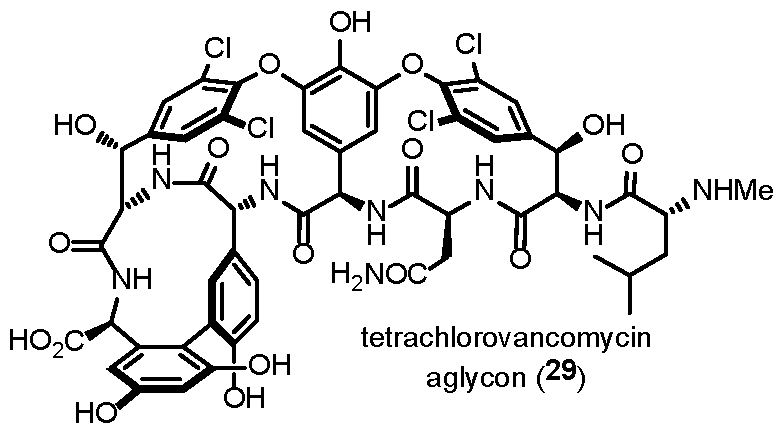 Tetrachlorovancomycin Aglycon (29) SNAr reaction: A solution of 27 (35 mg, 19 μmol, 1 equiv) in MeCN (6.4 mL, [27] = 3 mM) was treated with Bu4NF (1 M solution in THF, 100 μL, 100 μmol, 5 equiv), stirred at 23 ˚C for 4 h, and quenched with the addition of AcOH (23 μL, 400 μmol, 20 equiv) before concentrating under a stream of N2 to provide crude 28 as tan oil (inconsequential mixture of atropisomers, >95% crude purity as determined by LC/MS integration at 254 nm) that was carried forward without purification. Nitro group reduction: Crude 28 was dissolved in AcOH (2 mL) and treated with Fe powder
(325 mesh, 110 mg, 1900 μmol, 100 equiv). The reaction mixture was stirred vigorously at 35 ˚C for 16 h, concentrated under a stream of N2, and resuspended in EtOAc (4 mL). The organic layer was washed sequentially with H2O (3 mL) and saturated aqueous NaCl (3 mL), dried over Na2SO4, and concentrated under a stream of N2. Rapid PTLC (SiO2, 100% acetone) provided the bis-aniline (30 mg, inconsequential mixture of atropisomers) as an air- sensitive white solid, used immediately in the following step. Sandmeyer substitution: A portion of the bis-aniline (20 mg, ≤13 μmol) from the previous step was dissolved in CD3CN (0.8 mL) and cooled to 0 ˚C. The reaction mixture was treated with BF3•Et2O (6.4 μL, 52 μmol, 4 equiv), followed immediately by t-BuONO (6.4 μL, 52 μmol, 4 equiv). The light yellow-green reaction mixture was stirred at 0 ˚C for 30 min, cooled to –35 ˚C, and stirred vigorously as a chilled (0 ˚C) suspension of CuCl (320 mg, 3.2 mmol, 250 equiv) and CuCl2 (520 mg, 3.9 mmol, 300 equiv) in 50% CD3CN–H2O (1.6 mL) was added by syringe. The reaction mixture was slowly warmed to 5 ˚C over 2 h, added to saturated aqueous NH4Cl (100 mL), adjusted to pH 9 with the addition of concentrated NH4OH, and extracted with EtOAc (100 mL). The organic layer was washed sequentially with H2O (100 mL) and saturated aqueous NaCl (100 mL), dried over Na2SO4, and concentrated under reduced pressure to provide the product as a tan solid that was carried forward without further purification. Global deprotections: The crude Sandmeyer product was dissolved in TFA (1 mL) and stirred at 23 ˚C for 36 h. The reaction mixture was concentrated
under a stream of N2, coevaporated with MeOH (1 mL), and further dried under high vacuum. The resulting solid was treated with a solution of AlBr3 (1.5 g, 5.6 mmol, 430 equiv) in EtSH (300 μL, 4.2 mmol, 320 equiv), sonicated until homogeneous (3 min), and stirred at 23 ˚C for 3 h. The reaction mixture was then added dropwise to cold (0 ˚C) MeOH (15 mL) with vigorous stirring, rinsing the vial and pipette used to transfer the product with additional MeOH (3 × 1 mL). The MeOH was removed under a stream of N2 at 23 ˚C, and the residue was purified by HPLC (Phenomenex Luna® C18(2), 250 × 4.6 mm, 5 mL/min, 20–30% MeCN–H2O + 0.07% TFA over 20 min, tR = 16.5 min) to provide 29 (TFA salt, 8.1 mg, 56%/5 steps) as a white solid. For 29: [α]2 D5 +81 (c 0.1, MeOH); 1H NMR (600 MHz, CD3OD) δ 9.44 (br s, 1H, NH), 8.88 (d, J = 6.3 Hz, 1H, NH), 8.72 (d, J = 5.9 Hz, 1H, NH), 7.81 (s, 1H), 7.69 (s, 1H), 7.65 (s, 1H), 7.64 (s, 1H), 7.08 (s, 1H), 6.98 (br s, 1H), 6.79–6.67 (m, 1H), 6.46 (d, J = 2.3 Hz, 1H), 6.42 (d, J = 2.2 Hz, 1H), 6.21 (br s, 1H), 6.13 (br s, 1H), 5.40 (d, J = 2.1 Hz, 1H), 5.34 (s, 1H), 5.27 (d, J = 3.7 Hz, 1H), 4.80 (d, J = 6.1 Hz, 1H), 4.74 (d, J = 5.9 Hz, 1H), 4.24 (d, J = 9.2 Hz, 1H), 4.20–4.14 (m, 1H), 4.05 (t, J = 7.0 Hz, 1H), 2.91 (d, J = 15.5 Hz, 1H), 2.79 (s, 3H), 1.94– 1.79 (m, 2H), 1.77–1.66 (m, 2H), 0.99–0.93 (m, 6H); 13C{1H} NMR (151 MHz, CD3OD) δ 175.8, 174.8, 172.7, 171.8, 170.0, 169.8, 169.4, 168.5, 159.2, 158.0, 156.6, 149.6, 147.7, 146.6, 142.9, 141.9, 137.4, 137.1, 136.8, 132.9, 132.6, 131.4, 130.4, 129.8, 127.9, 127.6, 127.5, 127.2, 126.5, 122.4, 118.8, 118.4, 110.2, 107.7, 106.5, 104.0, 73.4, 72.9, 63.6, 61.9, 59.0, 58.4, 56.6, 55.2, 54.0, 52.2, 40.2, 36.6, 33.1, 25.4, 23.0, 22.6; IR (film) νmax 3300, 3252,
1673, 1538, 1516, 1508, 1204, 1190, 1140, 1057, 1033 cm-1; HRMS (ESI-TOF) m/z [M+H]+ calcd for C53H50Cl4N8O17, 1211.2126; found, 1211.2107.
Tetrachlorovancomycin Aglycon (29) SNAr reaction: A solution of 27 (35 mg, 19 μmol, 1 equiv) in MeCN (6.4 mL, [27] = 3 mM) was treated with Bu4NF (1 M solution in THF, 100 μL, 100 μmol, 5 equiv), stirred at 23 ˚C for 4 h, and quenched with the addition of AcOH (23 μL, 400 μmol, 20 equiv) before concentrating under a stream of N2 to provide crude 28 as tan oil (inconsequential mixture of atropisomers, >95% crude purity as determined by LC/MS integration at 254 nm) that was carried forward without purification. Nitro group reduction: Crude 28 was dissolved in AcOH (2 mL) and treated with Fe powder
(325 mesh, 110 mg, 1900 μmol, 100 equiv). The reaction mixture was stirred vigorously at 35 ˚C for 16 h, concentrated under a stream of N2, and resuspended in EtOAc (4 mL). The organic layer was washed sequentially with H2O (3 mL) and saturated aqueous NaCl (3 mL), dried over Na2SO4, and concentrated under a stream of N2. Rapid PTLC (SiO2, 100% acetone) provided the bis-aniline (30 mg, inconsequential mixture of atropisomers) as an air- sensitive white solid, used immediately in the following step. Sandmeyer substitution: A portion of the bis-aniline (20 mg, ≤13 μmol) from the previous step was dissolved in CD3CN (0.8 mL) and cooled to 0 ˚C. The reaction mixture was treated with BF3•Et2O (6.4 μL, 52 μmol, 4 equiv), followed immediately by t-BuONO (6.4 μL, 52 μmol, 4 equiv). The light yellow-green reaction mixture was stirred at 0 ˚C for 30 min, cooled to –35 ˚C, and stirred vigorously as a chilled (0 ˚C) suspension of CuCl (320 mg, 3.2 mmol, 250 equiv) and CuCl2 (520 mg, 3.9 mmol, 300 equiv) in 50% CD3CN–H2O (1.6 mL) was added by syringe. The reaction mixture was slowly warmed to 5 ˚C over 2 h, added to saturated aqueous NH4Cl (100 mL), adjusted to pH 9 with the addition of concentrated NH4OH, and extracted with EtOAc (100 mL). The organic layer was washed sequentially with H2O (100 mL) and saturated aqueous NaCl (100 mL), dried over Na2SO4, and concentrated under reduced pressure to provide the product as a tan solid that was carried forward without further purification. Global deprotections: The crude Sandmeyer product was dissolved in TFA (1 mL) and stirred at 23 ˚C for 36 h. The reaction mixture was concentrated
under a stream of N2, coevaporated with MeOH (1 mL), and further dried under high vacuum. The resulting solid was treated with a solution of AlBr3 (1.5 g, 5.6 mmol, 430 equiv) in EtSH (300 μL, 4.2 mmol, 320 equiv), sonicated until homogeneous (3 min), and stirred at 23 ˚C for 3 h. The reaction mixture was then added dropwise to cold (0 ˚C) MeOH (15 mL) with vigorous stirring, rinsing the vial and pipette used to transfer the product with additional MeOH (3 × 1 mL). The MeOH was removed under a stream of N2 at 23 ˚C, and the residue was purified by HPLC (Phenomenex Luna® C18(2), 250 × 4.6 mm, 5 mL/min, 20–30% MeCN–H2O + 0.07% TFA over 20 min, tR = 16.5 min) to provide 29 (TFA salt, 8.1 mg, 56%/5 steps) as a white solid. For 29: [α]2 D5 +81 (c 0.1, MeOH); 1H NMR (600 MHz, CD3OD) δ 9.44 (br s, 1H, NH), 8.88 (d, J = 6.3 Hz, 1H, NH), 8.72 (d, J = 5.9 Hz, 1H, NH), 7.81 (s, 1H), 7.69 (s, 1H), 7.65 (s, 1H), 7.64 (s, 1H), 7.08 (s, 1H), 6.98 (br s, 1H), 6.79–6.67 (m, 1H), 6.46 (d, J = 2.3 Hz, 1H), 6.42 (d, J = 2.2 Hz, 1H), 6.21 (br s, 1H), 6.13 (br s, 1H), 5.40 (d, J = 2.1 Hz, 1H), 5.34 (s, 1H), 5.27 (d, J = 3.7 Hz, 1H), 4.80 (d, J = 6.1 Hz, 1H), 4.74 (d, J = 5.9 Hz, 1H), 4.24 (d, J = 9.2 Hz, 1H), 4.20–4.14 (m, 1H), 4.05 (t, J = 7.0 Hz, 1H), 2.91 (d, J = 15.5 Hz, 1H), 2.79 (s, 3H), 1.94– 1.79 (m, 2H), 1.77–1.66 (m, 2H), 0.99–0.93 (m, 6H); 13C{1H} NMR (151 MHz, CD3OD) δ 175.8, 174.8, 172.7, 171.8, 170.0, 169.8, 169.4, 168.5, 159.2, 158.0, 156.6, 149.6, 147.7, 146.6, 142.9, 141.9, 137.4, 137.1, 136.8, 132.9, 132.6, 131.4, 130.4, 129.8, 127.9, 127.6, 127.5, 127.2, 126.5, 122.4, 118.8, 118.4, 110.2, 107.7, 106.5, 104.0, 73.4, 72.9, 63.6, 61.9, 59.0, 58.4, 56.6, 55.2, 54.0, 52.2, 40.2, 36.6, 33.1, 25.4, 23.0, 22.6; IR (film) νmax 3300, 3252,
1673, 1538, 1516, 1508, 1204, 1190, 1140, 1057, 1033 cm-1; HRMS (ESI-TOF) m/z [M+H]+ calcd for C53H50Cl4N8O17, 1211.2126; found, 1211.2107.
 Tetrachlorovancomycin (1) A solution of 29 (7.5 mg, 5.7 μmol, 1 equiv) in DMSO (250 μL) was treated sequentially with TCEP•HCl (3.5 mg, 11.4 μmol, 2 equiv), commercially available UDP-glucose•2Na (7 mg, 11.4 μmol, 2 equiv), aqueous 750 mM tricine-NaOH (pH 9, 0.6 mL), H2O (2 mL), glycerol (300 μL), GtfE (50 μM, 1.2 mL, 0.06 μmol, 1 mol %)41 and commercially available calf intestinal alkaline phosphatase (CIAP, Promega, 1 U/μL, 5 μL, 5 U). The reaction mixture was warmed to 37 ˚C for 17 h, cooled to 23 ˚C, and treated with additional TCEP•HCl (10.5 mg, 35 μmol, 6 equiv), 750 mM tricine-NaOH (pH 9, 1 mL), the azide precursor to UDP-vancosamine41 (45 μmol, 8 equiv), and GtfD41 (65 μM, 0.92 mL, 1 mol %). The reaction mixture was warmed to 37 ˚C for 16 h, cooled to 23 ˚C, diluted with 50% MeOH–MeCN (32 mL), and filtered through a 0.22 μm PES membrane, rinsing with MeOH. The filtrate was concentrated under reduced pressure and purified by HPLC (Phenomenex Luna® C18(2), 250 × 4.6
mm, 5 mL/min, 5–30% MeCN–H2O + 0.07% TFA, tR = 16.9 min) to provide 1 (bis-TFA salt, 8.3 mg, 82%) as a white solid. For 1: 1H NMR (600 MHz, CD3OD) δ 8.91 (br s, 1H, NH), 8.70 (d, J = 5.9 Hz, 1H, NH), 8.66 (br s, 1H, NH), 7.82 (s, 1H), 7.72 (s, 1H), 7.69 (s, 1H), 7.67 (s, 1H), 7.07 (s, 1H), 6.82–6.65 (m, 2H), 6.46 (d, J = 2.3 Hz, 1H), 6.40 (d, J = 2.3 Hz, 1H), 6.14– 6.06 (m, 2H), 6.04 (s, 1H), 5.76 (d, J = 7.8 Hz, 1H), 5.45 (d, J = 4.2 Hz, 1H), 5.39 (d, J = 2.0 Hz, 1H), 5.35 (s, 1H), 5.27 (d, J = 3.7 Hz, 1H), 4.83 (q, J = 6.7 Hz, 1H), 4.79 (s, 1H), 4.73 (s, 1H), 4.72 (s, 1H), 4.24 (d, J = 9.3 Hz, 1H), 4.18 (s, 1H), 4.06 (t, J = 6.8 Hz, 1H), 3.93 (d, J = 11.5 Hz, 1H), 3.83 (t, J = 8.2 Hz, 1H), 3.78 (dd, J = 12.0, 4.0 Hz, 1H), 3.69–3.54 (m, 2H), 3.35 (s, 1H), 2.95 (d, J = 15.2 Hz, 1H), 2.76 (s, 3H), 2.06 (dd, J = 13.6, 4.6 Hz, 1H), 1.95 (d, J = 13.3 Hz, 1H), 1.93–1.77 (m, 2H), 1.68 (td, J = 12.3, 11.4, 6.9 Hz, 2H), 1.51 (s, 3H), 1.19 (d, J = 6.4 Hz, 3H), 0.95 (d, J = 6.0 Hz, 3H), 0.93 (d, J = 6.1 Hz, 3H); 13C{1H} NMR (151 MHz, CD3OD) δ 174.2, 173.4, 171.6, 170.4, 168.4, 168.3, 168.0, 166.8, 157.8, 156.6, 155.3, 151.3, 149.9, 146.6, 145.1, 142.4, 141.3, 136.5, 136.1, 135.7, 132.5, 131.0, 129.5, 128.9, 128.8, 128.4, 127.0, 126.5, 126.0, 125.9, 125.6, 121.2, 117.3, 117.1, 107.6, 106.4, 104.8, 102.6, 101.3, 97.1, 78.1, 77.9, 76.8, 71.7, 71.3, 71.1, 69.7, 63.5, 62.4, 60.9, 60.3, 58.1, 57.0, 55.2, 54.4, 53.9, 51.1, 39.1, 35.2, 33.0, 31.5, 24.0, 22.0, 21.48, 21.40, 15.8; IR (film) νmax 3484, 3434, 3420, 3406, 3387, 3372, 3352, 3328, 3316, 3302, 3279, 3245, 3225, 3199, 1666, 1592, 1489, 1186, 1139, 1058, 1018 cm-1; HRMS (ESI-TOF) m/z [M+H]+ calcd for C66H73Cl4N9O24, 1516.3601; found, 1516.3567.
CBP-Tetrachlorovancomycin (30) A solution of tetrachlorovancomycin (1, 6.9 mg, 4.0 μmol, 1 equiv), i-Pr2NEt (3.5 μL, 20 μmol, 5 equiv), and 4-(4-chlorophenyl)benzaldehyde (1.2 mg, 5.2 μmol, 1.3 equiv) in DMF (0.69 mL, 100 vol) was warmed to 70 ˚C for 2 h, cooled to 50 ˚C, and treated with NaCNBH3 (1 M in THF, 400 μL, 400 μmol, 100 equiv). The reaction mixture was stirred at 50 ˚C for 18 h, diluted with H2O (2 mL), and purified by HPLC (Phenomenex Luna® C18(2), 250 × 4.6 mm, 5 mL/min, 10–40% MeCN–H2O + 0.07% TFA over 20 min, tR = 19.4 min) to provide 30 (bis-TFA salt, 1.8 mg, 23%, 52% brsm) as a white solid and recovered starting material 1 (tR = 10.0 min, 3.9 mg, 57% brsm). For 30: 1H NMR (600 MHz, CD3OD) δ 7.78–7.68 (m, 7H), 7.66–7.62 (m, 2H), 7.59–7.55 (m, 2H), 7.51– 7.46 (m, 2H), 7.07 (d, J = 2.4 Hz, 1H), 7.03–6.96 (m, 1H), 6.83 (d, J = 8.6 Hz, 1H), 6.47 (d, J = 2.3 Hz, 1H), 6.43 (d, J = 2.3 Hz, 1H), 5.97–5.90 (m, 2H), 5.68 (d, J = 7.9 Hz, 1H), 5.47–5.42 (m, 2H), 5.37 (s, 1H), 5.35 (s, 1H), 5.31 (d, J = 3.6 Hz, 1H), 4.79 (d, J = 6.2 Hz, 1H), 4.74 (d, J = 6.0 Hz, 1H), 4.24 (d, J = 9.6 Hz, 1H), 4.22–4.19 (m, 1H), 4.18 (s, 1H), 4.12 (s, 1H), 4.11–4.07 (m, 2H), 3.91–3.83 (m, 2H), 3.77
(dd, J = 11.6, 4.6 Hz, 1H), 3.64 (s, 1H), 3.60 (t, J = 9.0 Hz, 1H), 3.56 (t, J = 9.2 Hz, 1H), 3.03 (d, J = 15.5 Hz, 1H), 2.77 (s, 3H), 2.20 (dd, J = 13.6, 4.7 Hz, 1H), 2.12–1.99 (m, 2H), 1.91–1.81 (m, 1H), 1.78 (q, J = 6.6 Hz, 1H), 1.73–1.64 (m, 4H), 1.28 (d, J = 6.6 Hz, 3H), 1.04 (d, J = 6.4 Hz, 3H), 1.01 (d, J = 6.5 Hz, 3H); HRMS (ESI-TOF) m/z [M+H]+ calcd for C79H82Cl5N9O24, 1716.3994; found, 1716.3938.
Tetrachlorovancomycin (1) A solution of 29 (7.5 mg, 5.7 μmol, 1 equiv) in DMSO (250 μL) was treated sequentially with TCEP•HCl (3.5 mg, 11.4 μmol, 2 equiv), commercially available UDP-glucose•2Na (7 mg, 11.4 μmol, 2 equiv), aqueous 750 mM tricine-NaOH (pH 9, 0.6 mL), H2O (2 mL), glycerol (300 μL), GtfE (50 μM, 1.2 mL, 0.06 μmol, 1 mol %)41 and commercially available calf intestinal alkaline phosphatase (CIAP, Promega, 1 U/μL, 5 μL, 5 U). The reaction mixture was warmed to 37 ˚C for 17 h, cooled to 23 ˚C, and treated with additional TCEP•HCl (10.5 mg, 35 μmol, 6 equiv), 750 mM tricine-NaOH (pH 9, 1 mL), the azide precursor to UDP-vancosamine41 (45 μmol, 8 equiv), and GtfD41 (65 μM, 0.92 mL, 1 mol %). The reaction mixture was warmed to 37 ˚C for 16 h, cooled to 23 ˚C, diluted with 50% MeOH–MeCN (32 mL), and filtered through a 0.22 μm PES membrane, rinsing with MeOH. The filtrate was concentrated under reduced pressure and purified by HPLC (Phenomenex Luna® C18(2), 250 × 4.6
mm, 5 mL/min, 5–30% MeCN–H2O + 0.07% TFA, tR = 16.9 min) to provide 1 (bis-TFA salt, 8.3 mg, 82%) as a white solid. For 1: 1H NMR (600 MHz, CD3OD) δ 8.91 (br s, 1H, NH), 8.70 (d, J = 5.9 Hz, 1H, NH), 8.66 (br s, 1H, NH), 7.82 (s, 1H), 7.72 (s, 1H), 7.69 (s, 1H), 7.67 (s, 1H), 7.07 (s, 1H), 6.82–6.65 (m, 2H), 6.46 (d, J = 2.3 Hz, 1H), 6.40 (d, J = 2.3 Hz, 1H), 6.14– 6.06 (m, 2H), 6.04 (s, 1H), 5.76 (d, J = 7.8 Hz, 1H), 5.45 (d, J = 4.2 Hz, 1H), 5.39 (d, J = 2.0 Hz, 1H), 5.35 (s, 1H), 5.27 (d, J = 3.7 Hz, 1H), 4.83 (q, J = 6.7 Hz, 1H), 4.79 (s, 1H), 4.73 (s, 1H), 4.72 (s, 1H), 4.24 (d, J = 9.3 Hz, 1H), 4.18 (s, 1H), 4.06 (t, J = 6.8 Hz, 1H), 3.93 (d, J = 11.5 Hz, 1H), 3.83 (t, J = 8.2 Hz, 1H), 3.78 (dd, J = 12.0, 4.0 Hz, 1H), 3.69–3.54 (m, 2H), 3.35 (s, 1H), 2.95 (d, J = 15.2 Hz, 1H), 2.76 (s, 3H), 2.06 (dd, J = 13.6, 4.6 Hz, 1H), 1.95 (d, J = 13.3 Hz, 1H), 1.93–1.77 (m, 2H), 1.68 (td, J = 12.3, 11.4, 6.9 Hz, 2H), 1.51 (s, 3H), 1.19 (d, J = 6.4 Hz, 3H), 0.95 (d, J = 6.0 Hz, 3H), 0.93 (d, J = 6.1 Hz, 3H); 13C{1H} NMR (151 MHz, CD3OD) δ 174.2, 173.4, 171.6, 170.4, 168.4, 168.3, 168.0, 166.8, 157.8, 156.6, 155.3, 151.3, 149.9, 146.6, 145.1, 142.4, 141.3, 136.5, 136.1, 135.7, 132.5, 131.0, 129.5, 128.9, 128.8, 128.4, 127.0, 126.5, 126.0, 125.9, 125.6, 121.2, 117.3, 117.1, 107.6, 106.4, 104.8, 102.6, 101.3, 97.1, 78.1, 77.9, 76.8, 71.7, 71.3, 71.1, 69.7, 63.5, 62.4, 60.9, 60.3, 58.1, 57.0, 55.2, 54.4, 53.9, 51.1, 39.1, 35.2, 33.0, 31.5, 24.0, 22.0, 21.48, 21.40, 15.8; IR (film) νmax 3484, 3434, 3420, 3406, 3387, 3372, 3352, 3328, 3316, 3302, 3279, 3245, 3225, 3199, 1666, 1592, 1489, 1186, 1139, 1058, 1018 cm-1; HRMS (ESI-TOF) m/z [M+H]+ calcd for C66H73Cl4N9O24, 1516.3601; found, 1516.3567.
CBP-Tetrachlorovancomycin (30) A solution of tetrachlorovancomycin (1, 6.9 mg, 4.0 μmol, 1 equiv), i-Pr2NEt (3.5 μL, 20 μmol, 5 equiv), and 4-(4-chlorophenyl)benzaldehyde (1.2 mg, 5.2 μmol, 1.3 equiv) in DMF (0.69 mL, 100 vol) was warmed to 70 ˚C for 2 h, cooled to 50 ˚C, and treated with NaCNBH3 (1 M in THF, 400 μL, 400 μmol, 100 equiv). The reaction mixture was stirred at 50 ˚C for 18 h, diluted with H2O (2 mL), and purified by HPLC (Phenomenex Luna® C18(2), 250 × 4.6 mm, 5 mL/min, 10–40% MeCN–H2O + 0.07% TFA over 20 min, tR = 19.4 min) to provide 30 (bis-TFA salt, 1.8 mg, 23%, 52% brsm) as a white solid and recovered starting material 1 (tR = 10.0 min, 3.9 mg, 57% brsm). For 30: 1H NMR (600 MHz, CD3OD) δ 7.78–7.68 (m, 7H), 7.66–7.62 (m, 2H), 7.59–7.55 (m, 2H), 7.51– 7.46 (m, 2H), 7.07 (d, J = 2.4 Hz, 1H), 7.03–6.96 (m, 1H), 6.83 (d, J = 8.6 Hz, 1H), 6.47 (d, J = 2.3 Hz, 1H), 6.43 (d, J = 2.3 Hz, 1H), 5.97–5.90 (m, 2H), 5.68 (d, J = 7.9 Hz, 1H), 5.47–5.42 (m, 2H), 5.37 (s, 1H), 5.35 (s, 1H), 5.31 (d, J = 3.6 Hz, 1H), 4.79 (d, J = 6.2 Hz, 1H), 4.74 (d, J = 6.0 Hz, 1H), 4.24 (d, J = 9.6 Hz, 1H), 4.22–4.19 (m, 1H), 4.18 (s, 1H), 4.12 (s, 1H), 4.11–4.07 (m, 2H), 3.91–3.83 (m, 2H), 3.77
(dd, J = 11.6, 4.6 Hz, 1H), 3.64 (s, 1H), 3.60 (t, J = 9.0 Hz, 1H), 3.56 (t, J = 9.2 Hz, 1H), 3.03 (d, J = 15.5 Hz, 1H), 2.77 (s, 3H), 2.20 (dd, J = 13.6, 4.7 Hz, 1H), 2.12–1.99 (m, 2H), 1.91–1.81 (m, 1H), 1.78 (q, J = 6.6 Hz, 1H), 1.73–1.64 (m, 4H), 1.28 (d, J = 6.6 Hz, 3H), 1.04 (d, J = 6.4 Hz, 3H), 1.01 (d, J = 6.5 Hz, 3H); HRMS (ESI-TOF) m/z [M+H]+ calcd for C79H82Cl5N9O24, 1716.3994; found, 1716.3938.
 G3,CBP-Tetrachlorovancomycin (31) A solution of 30 (1.1 mg, 0.57 μmol, 1 equiv), 1-(3-aminopropyl)guanidine44 (bis-TFA salt, 0.96 mg, 2.8 μmol, 5 equiv) and NMM (1.9 μL, 17 μmol, 30 equiv) in DMF (200 μL) was cooled to 0 ˚ C and treated with T3P (50 wt % in EtOAc, 3.5 μL, 5.7 μmol, 10 equiv). The reaction mixture was stirred at 0 ˚C for 10 min, diluted with H2O (1 mL), and purified directly by HPLC (Phenomenex Luna® C18(2), 250 × 4.6 mm, 5 mL/min, 25–40% MeCN–H2O + 0.07% TFA over 20 min, tR = 10.1 min) to afford 31 (0.90 mg, 74%) as a white solid. For 31: 1H NMR (600 MHz, CD3OD) δ 7.78–7.69 (m, 6H), 7.67–7.61 (m, 2H), 7.58 (m, 2H), 7.53–7.44 (m, 2H), 7.11 (s, 1H), 7.05 (d, J = 8.6 Hz, 1H), 6.86 (d, J = 8.5 Hz, 1H), 6.47 (d, J = 2.3 Hz, 1H), 6.39
(d, J = 2.3 Hz, 1H), 5.96–5.83 (m, 2H), 5.67 (d, J = 7.8 Hz, 1H), 5.45 (d, J = 4.7 Hz, 1H), 5.40 (s, 1H), 5.36 (s, 1H), 5.32 (d, J = 3.6 Hz, 1H), 4.97 (s, 1H), 4.74 (d, J = 6.0 Hz, 1H), 4.63 (d, J = 5.8 Hz, 1H), 4.29–4.22 (m, 2H), 4.19 (d, J = 12.7 Hz, 1H), 4.13– 4.07 (m, 2H), 3.88–3.81 (m, 2H), 3.76 (dd, J = 11.6, 4.9 Hz, 1H), 3.65 (s, 1H), 3.60 (t, J = 9.1 Hz, 1H), 3.54 (t, J = 9.3 Hz, 1H), 3.51–3.45 (m, 1H), 3.25 (t, J = 6.9 Hz, 2H), 3.03 (d, J = 16.7 Hz, 1H), 3.02–2.99 (m, 2H), 2.88 (s, 1H), 2.76 (s, 3H), 2.24–2.18 (m, 1H), 2.13–2.02 (m, 2H), 1.91–1.74 (m, 4H), 1.72–1.63 (m, 4H), 1.28 (d, J = 6.7 Hz, 3H), 1.05 (d, J = 6.5 Hz, 3H), 1.01 (d, J = 6.5 Hz, 3H); HRMS (ESI-TOF) m/z [M+3H]3+ calcd for C83H92Cl5N13O23, 605.5035; found, 605.5016.
G3,CBP-Tetrachlorovancomycin (31) A solution of 30 (1.1 mg, 0.57 μmol, 1 equiv), 1-(3-aminopropyl)guanidine44 (bis-TFA salt, 0.96 mg, 2.8 μmol, 5 equiv) and NMM (1.9 μL, 17 μmol, 30 equiv) in DMF (200 μL) was cooled to 0 ˚ C and treated with T3P (50 wt % in EtOAc, 3.5 μL, 5.7 μmol, 10 equiv). The reaction mixture was stirred at 0 ˚C for 10 min, diluted with H2O (1 mL), and purified directly by HPLC (Phenomenex Luna® C18(2), 250 × 4.6 mm, 5 mL/min, 25–40% MeCN–H2O + 0.07% TFA over 20 min, tR = 10.1 min) to afford 31 (0.90 mg, 74%) as a white solid. For 31: 1H NMR (600 MHz, CD3OD) δ 7.78–7.69 (m, 6H), 7.67–7.61 (m, 2H), 7.58 (m, 2H), 7.53–7.44 (m, 2H), 7.11 (s, 1H), 7.05 (d, J = 8.6 Hz, 1H), 6.86 (d, J = 8.5 Hz, 1H), 6.47 (d, J = 2.3 Hz, 1H), 6.39
(d, J = 2.3 Hz, 1H), 5.96–5.83 (m, 2H), 5.67 (d, J = 7.8 Hz, 1H), 5.45 (d, J = 4.7 Hz, 1H), 5.40 (s, 1H), 5.36 (s, 1H), 5.32 (d, J = 3.6 Hz, 1H), 4.97 (s, 1H), 4.74 (d, J = 6.0 Hz, 1H), 4.63 (d, J = 5.8 Hz, 1H), 4.29–4.22 (m, 2H), 4.19 (d, J = 12.7 Hz, 1H), 4.13– 4.07 (m, 2H), 3.88–3.81 (m, 2H), 3.76 (dd, J = 11.6, 4.9 Hz, 1H), 3.65 (s, 1H), 3.60 (t, J = 9.1 Hz, 1H), 3.54 (t, J = 9.3 Hz, 1H), 3.51–3.45 (m, 1H), 3.25 (t, J = 6.9 Hz, 2H), 3.03 (d, J = 16.7 Hz, 1H), 3.02–2.99 (m, 2H), 2.88 (s, 1H), 2.76 (s, 3H), 2.24–2.18 (m, 1H), 2.13–2.02 (m, 2H), 1.91–1.74 (m, 4H), 1.72–1.63 (m, 4H), 1.28 (d, J = 6.7 Hz, 3H), 1.05 (d, J = 6.5 Hz, 3H), 1.01 (d, J = 6.5 Hz, 3H); HRMS (ESI-TOF) m/z [M+3H]3+ calcd for C83H92Cl5N13O23, 605.5035; found, 605.5016.
 Compound 36 A solution of 25 (TFA salt, 60 mg, 65 μmol, 1 equiv) and 35 (82 mg, 130 μmol, 2 equiv) in THF (0.6 mL, 10 vol) was treated with i-Pr2NEt (16 μL, 98 μmol, 1.5 equiv) and stirred at 23 ˚C for 6 h. The reaction mixture was concentrated under a stream of N2 and purified by PTLC (SiO2, 40% EtOAc–hexanes) to provide 36 (78.2 mg, 89%) as a white solid. For 36: [α]2 D3 –6.0 (c 1.0, CH2Cl2); 1H NMR (600 MHz, CDCl3) δ 9.36 (s, 1H), 7.99–7.91 (m, 1H), 7.78–7.69 (m, 1H), 7.13 (d, J = 7.9 Hz, 1H), 7.05 (d,
J = 2.4 Hz, 1H), 6.97 (d, J = 8.7 Hz, 1H), 6.55 (d, J = 2.3 Hz, 1H), 6.51–6.39 (m, 2H), 6.37 (d, J = 2.3 Hz, 1H), 6.00 (d, J = 10.8 Hz, 1H), 5.93–5.74 (m, 1H), 5.48 (d, J = 5.9 Hz, 1H), 5.28 (s, 1H), 5.05 (d, J = 13.8 Hz, 1H), 4.95 (d, J = 8.7 Hz, 1H), 4.08 (dd, J = 10.8, 2.1 Hz, 1H), 3.78 (s, 3H), 3.76 (s, 3H), 3.69 (s, 3H), 3.66 (s, 3H), 2.28 (s, 1H), 1.46 (s, 9H), 1.39 (s, 9H), 0.96 (d, J = 3.1 Hz, 18H), 0.83 (d, J = 4.5 Hz, 9H), 0.11 (s, 6H), 0.10–0.05 (s, 6H), 0.01 (s, 3H), –0.13 (s, 3H); 13C NMR (151 MHz, CDCl3) δ 199.6, 170.3, 170.1, 165.5, 160.1, 158.8, 157.3, 154.7, 152.3, 150.6, 150.1, 149.9, 142.9, 138.0, 137.7, 137.5, 137.4, 137.2, 136.0, 134.3, 133.5, 127.4, 124.8, 124.6, 124.0, 122.6, 122.1, 121.2, 113.2, 103.8, 99.1, 82.4, 80.2, 73.1, 63.8, 61.0, 59.9, 59.5, 56.0, 55.7, 55.3, 28.3, 27.8, 25.7, 18.2, 17.9, –4.6, –4.9, –5.2; IR (film) νmax 3319, 2977, 2954, 2931, 2898, 2858, 1679, 1605, 1579, 1544, 1490, 1473, 1433, 1393, 1343, 1326, 1256, 1158, 1088, 1030, 1007 cm-1; HRMS (ESI-TOF) m/z [M+H]+ calcd for C64H93ClFN5O15SSi3, 1342.5447; found, 1342.5472.
Compound 36 A solution of 25 (TFA salt, 60 mg, 65 μmol, 1 equiv) and 35 (82 mg, 130 μmol, 2 equiv) in THF (0.6 mL, 10 vol) was treated with i-Pr2NEt (16 μL, 98 μmol, 1.5 equiv) and stirred at 23 ˚C for 6 h. The reaction mixture was concentrated under a stream of N2 and purified by PTLC (SiO2, 40% EtOAc–hexanes) to provide 36 (78.2 mg, 89%) as a white solid. For 36: [α]2 D3 –6.0 (c 1.0, CH2Cl2); 1H NMR (600 MHz, CDCl3) δ 9.36 (s, 1H), 7.99–7.91 (m, 1H), 7.78–7.69 (m, 1H), 7.13 (d, J = 7.9 Hz, 1H), 7.05 (d,
J = 2.4 Hz, 1H), 6.97 (d, J = 8.7 Hz, 1H), 6.55 (d, J = 2.3 Hz, 1H), 6.51–6.39 (m, 2H), 6.37 (d, J = 2.3 Hz, 1H), 6.00 (d, J = 10.8 Hz, 1H), 5.93–5.74 (m, 1H), 5.48 (d, J = 5.9 Hz, 1H), 5.28 (s, 1H), 5.05 (d, J = 13.8 Hz, 1H), 4.95 (d, J = 8.7 Hz, 1H), 4.08 (dd, J = 10.8, 2.1 Hz, 1H), 3.78 (s, 3H), 3.76 (s, 3H), 3.69 (s, 3H), 3.66 (s, 3H), 2.28 (s, 1H), 1.46 (s, 9H), 1.39 (s, 9H), 0.96 (d, J = 3.1 Hz, 18H), 0.83 (d, J = 4.5 Hz, 9H), 0.11 (s, 6H), 0.10–0.05 (s, 6H), 0.01 (s, 3H), –0.13 (s, 3H); 13C NMR (151 MHz, CDCl3) δ 199.6, 170.3, 170.1, 165.5, 160.1, 158.8, 157.3, 154.7, 152.3, 150.6, 150.1, 149.9, 142.9, 138.0, 137.7, 137.5, 137.4, 137.2, 136.0, 134.3, 133.5, 127.4, 124.8, 124.6, 124.0, 122.6, 122.1, 121.2, 113.2, 103.8, 99.1, 82.4, 80.2, 73.1, 63.8, 61.0, 59.9, 59.5, 56.0, 55.7, 55.3, 28.3, 27.8, 25.7, 18.2, 17.9, –4.6, –4.9, –5.2; IR (film) νmax 3319, 2977, 2954, 2931, 2898, 2858, 1679, 1605, 1579, 1544, 1490, 1473, 1433, 1393, 1343, 1326, 1256, 1158, 1088, 1030, 1007 cm-1; HRMS (ESI-TOF) m/z [M+H]+ calcd for C64H93ClFN5O15SSi3, 1342.5447; found, 1342.5472.
 Compound 36A A solution of 36 (150 mg, 0.11 mmol, 1 equiv) in t-BuOAc (3 mL, 20 vol) was treated with H2SO4 (45 μL, 0.9 mmol, 8 equiv) and stirred at 23 ˚C
for 1 h. The reaction mixture was quenched with the addition of Et3N (182 μL, 1.32 mmol, 12 equiv) and purified directly by HPLC (Phenomenex Luna® C18(2), 100 × 30 mm, 20 mL/min, 50–100% MeCN–H2O + 0.07% TFA over 10 min, tR = 12.3 min) to provide semi-pure 36A (TFA salt, 124 mg, 83%) as a light-yellow solid, used immediately in the following step. Amine 36A is unstable, especially in its free base form, and could not be isolated without decomposition.
Compound 36A A solution of 36 (150 mg, 0.11 mmol, 1 equiv) in t-BuOAc (3 mL, 20 vol) was treated with H2SO4 (45 μL, 0.9 mmol, 8 equiv) and stirred at 23 ˚C
for 1 h. The reaction mixture was quenched with the addition of Et3N (182 μL, 1.32 mmol, 12 equiv) and purified directly by HPLC (Phenomenex Luna® C18(2), 100 × 30 mm, 20 mL/min, 50–100% MeCN–H2O + 0.07% TFA over 10 min, tR = 12.3 min) to provide semi-pure 36A (TFA salt, 124 mg, 83%) as a light-yellow solid, used immediately in the following step. Amine 36A is unstable, especially in its free base form, and could not be isolated without decomposition.
 Compound 37 A solution of 36A (TFA salt, 124 mg, 92 μmol, 1 equiv) and 14 (112 mg, 150 μmol, 1.6 equiv) in THF (2 mL) was cooled to 0 ˚C and treated with NMM (41 μL, 370 μmol, 4 equiv), followed by T3P® (50 wt % in EtOAc, 90 μL, 150 μmol, 1.6 equiv). The reaction mixture was stirred at 0 ˚C for 10 min, quenched with the addition of H2O (5 mL), and concentrated under a stream of N2 to remove THF. The residue was extracted with CH2Cl2 (5 × 3 mL) and dried over Na2SO4. Chromatography (10 g SiO2, wet-load CH2Cl2, 0–30% Et2O- CH2Cl2) provided 37 (141 mg, 85%, 69%/2 steps from 14) as a yellow solid. For 37: [α]2 D4 –4.0 (c 1.0, CH2Cl2); 1H NMR (600 MHz, CD3OD, rotamers, major given) δ 8.23 (dd, J = 6.2, 2.2 Hz, 1H), 8.15–8.07 (m, 1H), 7.99 (dd, J =
5.9, 2.3 Hz, 1H), 7.93 (dd, J = 6.0, 2.2 Hz, 1H), 7.33 (dd, J = 8.7, 2.3 Hz, 1H), 7.00 (d, J = 2.4 Hz, 1H), 6.68 (d, J = 2.2 Hz, 1H), 6.64–6.59 (m, 2H), 6.49 (d, J = 2.3 Hz, 1H), 5.87 (s, 1H), 5.60 (s, 1H), 5.24 (s, 1H), 5.03–4.90 (m, 2H), 4.79 (s, 1H), 4.73– 4.60 (m, 1H), 4.60–4.44 (m, 1H), 4.29 (s, 1H), 3.85 (s, 3H), 3.76 (d, J = 2.9 Hz, 3H), 3.74–3.63 (m, 7H), 3.05–2.78 (m, 1H), 2.77–2.55 (m, 1H), 2.49 (s, 3H), 1.50 (s, 9H), 1.48–1.36 (m, 12H), 1.04–1.02 (m, 3H), 1.01 (m, 3H), 0.99 (s, 18H), 0.87 (s, 9H), 0.13 (s, 6H), 0.12 (s, 6H), 0.01 (s, 3H), –0.07 (s, 3H); 13C NMR (151 MHz, CD3OD, rotamers) δ 200.6, 200.5, 172.4, 170.3, 170.2, 167.8, 167.5, 160.4, 158.8, 157.7, 156.4, 155.7, 151.7, 151.6, 150.0, 149.9, 149.5, 142.7, 142.4, 139.2, 138.6, 138.5, 137.96, 137.91, 137.1, 135.8, 134.1, 133.5, 133.0, 130.7, 128.2, 123.6, 123.44, 123.42, 123.1, 123.0, 122.9, 122.4, 121.4, 121.1, 121.0, 117.0, 116.6, 114.1, 113.8, 113.7, 113.3, 112.8, 104.2, 103.4, 98.2, 98.19, 98.13, 81.8, 81.5, 80.7, 80.2, 72.6, 71.5, 66.1, 61.2, 60.3, 59.3, 59.2, 58.2, 57.0, 55.9, 55.5, 55.1, 55.0, 54.9, 54.95, 54.91, 54.6, 54.5, 53.7, 49.4, 27.3, 27.2, 26.9, 26.6, 24.99, 24.93, 24.8, 24.4, 22.3, 20.5, 19.6, 17.87, 17.82, 17.6, 17.5, –5.40, – 5.44, –5.48, –5.61, –5.67, –6.0, –6.1; IR (film) νmax 3274, 2931, 2857, 1738, 1654, 1607, 1580, 1543, 1489, 1431, 1391, 1346, 1252, 1201, 1155, 1089, 1007 cm-1; HRMS (ESI-TOF) m/z [M-H]- calcd for C84H116Cl2F2N10O21SSi3, 1823.6612; found, 1823.6617. Important note: The streamlined 5-step conversion of 37 to 38 (below) was both higher-yielding and more conveniently performed without HPLC purification of
the intermediate atropisomer mixtures. Final purification of 38 by HPLC was sufficient to obtain pure samples of [Ψ[C(=S)NH]Tpg4]tetrachlorovancomycin aglycon.
Compound 37 A solution of 36A (TFA salt, 124 mg, 92 μmol, 1 equiv) and 14 (112 mg, 150 μmol, 1.6 equiv) in THF (2 mL) was cooled to 0 ˚C and treated with NMM (41 μL, 370 μmol, 4 equiv), followed by T3P® (50 wt % in EtOAc, 90 μL, 150 μmol, 1.6 equiv). The reaction mixture was stirred at 0 ˚C for 10 min, quenched with the addition of H2O (5 mL), and concentrated under a stream of N2 to remove THF. The residue was extracted with CH2Cl2 (5 × 3 mL) and dried over Na2SO4. Chromatography (10 g SiO2, wet-load CH2Cl2, 0–30% Et2O- CH2Cl2) provided 37 (141 mg, 85%, 69%/2 steps from 14) as a yellow solid. For 37: [α]2 D4 –4.0 (c 1.0, CH2Cl2); 1H NMR (600 MHz, CD3OD, rotamers, major given) δ 8.23 (dd, J = 6.2, 2.2 Hz, 1H), 8.15–8.07 (m, 1H), 7.99 (dd, J =
5.9, 2.3 Hz, 1H), 7.93 (dd, J = 6.0, 2.2 Hz, 1H), 7.33 (dd, J = 8.7, 2.3 Hz, 1H), 7.00 (d, J = 2.4 Hz, 1H), 6.68 (d, J = 2.2 Hz, 1H), 6.64–6.59 (m, 2H), 6.49 (d, J = 2.3 Hz, 1H), 5.87 (s, 1H), 5.60 (s, 1H), 5.24 (s, 1H), 5.03–4.90 (m, 2H), 4.79 (s, 1H), 4.73– 4.60 (m, 1H), 4.60–4.44 (m, 1H), 4.29 (s, 1H), 3.85 (s, 3H), 3.76 (d, J = 2.9 Hz, 3H), 3.74–3.63 (m, 7H), 3.05–2.78 (m, 1H), 2.77–2.55 (m, 1H), 2.49 (s, 3H), 1.50 (s, 9H), 1.48–1.36 (m, 12H), 1.04–1.02 (m, 3H), 1.01 (m, 3H), 0.99 (s, 18H), 0.87 (s, 9H), 0.13 (s, 6H), 0.12 (s, 6H), 0.01 (s, 3H), –0.07 (s, 3H); 13C NMR (151 MHz, CD3OD, rotamers) δ 200.6, 200.5, 172.4, 170.3, 170.2, 167.8, 167.5, 160.4, 158.8, 157.7, 156.4, 155.7, 151.7, 151.6, 150.0, 149.9, 149.5, 142.7, 142.4, 139.2, 138.6, 138.5, 137.96, 137.91, 137.1, 135.8, 134.1, 133.5, 133.0, 130.7, 128.2, 123.6, 123.44, 123.42, 123.1, 123.0, 122.9, 122.4, 121.4, 121.1, 121.0, 117.0, 116.6, 114.1, 113.8, 113.7, 113.3, 112.8, 104.2, 103.4, 98.2, 98.19, 98.13, 81.8, 81.5, 80.7, 80.2, 72.6, 71.5, 66.1, 61.2, 60.3, 59.3, 59.2, 58.2, 57.0, 55.9, 55.5, 55.1, 55.0, 54.9, 54.95, 54.91, 54.6, 54.5, 53.7, 49.4, 27.3, 27.2, 26.9, 26.6, 24.99, 24.93, 24.8, 24.4, 22.3, 20.5, 19.6, 17.87, 17.82, 17.6, 17.5, –5.40, – 5.44, –5.48, –5.61, –5.67, –6.0, –6.1; IR (film) νmax 3274, 2931, 2857, 1738, 1654, 1607, 1580, 1543, 1489, 1431, 1391, 1346, 1252, 1201, 1155, 1089, 1007 cm-1; HRMS (ESI-TOF) m/z [M-H]- calcd for C84H116Cl2F2N10O21SSi3, 1823.6612; found, 1823.6617. Important note: The streamlined 5-step conversion of 37 to 38 (below) was both higher-yielding and more conveniently performed without HPLC purification of
the intermediate atropisomer mixtures. Final purification of 38 by HPLC was sufficient to obtain pure samples of [Ψ[C(=S)NH]Tpg4]tetrachlorovancomycin aglycon.
 aglycon Desilylation of heptapeptide 37 (Bu4NF, MeCN, 23 ˚C) triggered a spontaneous double SNAr cyclization that established the full tricyclic framework of [Ψ[C(=S)NH]Tpg4]tetrachlorovancomycin aglycon (38) in a single step. Dual nitro reduction (Fe, AcOH), Sandmeyer substitution (BF3•Et2O, t-BuONO; CuCl, CuCl2), nitrile hydration with concomitant Boc and t-butyl ester deprotection (TFA, 23 ˚C), and global demethylation (5:1 AlBr3:EtSH) provided [Ψ[C(=S)NH]Tpg4]tetrachlorovancomycin aglycon (38) in good overall yield (42%/5 steps from 37, with an average yield of 84%/step), below, setting the stage for the introduction of the residue 4 binding pocket modifications.
For 38: [α]2 D4 +77 (c 1.0, MeOH); 1H NMR (600 MHz, CD3OD) δ 9.02 (s, 1H, NH), 8.77 (d, J = 5.9 Hz, 1H, NH), 7.84 (d, J = 1.9 Hz, 1H), 7.67 (d, J = 2.1 Hz, 1H), 7.65 (d, J = 1.9 Hz, 1H), 7.59 (d, J = 1.9 Hz, 1H), 7.23 (d, J = 2.2 Hz, 1H), 7.09 (s, 1H), 6.66 (s, 1H), 6.65 (s, 1H), 6.62 (br s, 1H), 6.61 (br s, 1H), 6.51–6.46 (m, 1H), 6.44 (d, J = 2.3 Hz, 1H), 6.38 (s, 1H), 5.94 (s, 1H), 5.56 (s, 1H), 5.47 (d, J = 2.2 Hz, 1H), 5.33 (d, J = 1.4 Hz, 1H), 5.22 (d, J = 3.9 Hz, 1H), 4.69 (d, J = 5.8 Hz, 1H), 4.34–4.28 (m, 1H), 4.26 (d, J = 2.5 Hz, 1H), 4.03 (t, J = 7.1 Hz, 1H), 2.90 (d, J = 16.5 Hz, 1H), 2.77 (s, 3H), 1.88– 1.80 (m, 1H), 1.80–1.56 (m, 2H), 0.92 (d, J = 6.4 Hz, 3H), 0.89 (d, J = 6.3 Hz, 3H); 13C{1H} NMR (151 MHz, CD3OD) δ 173.5, 170.8, 170.4, 168.5, 168.2, 157.9, 156.7, 155.4, 148.4, 146.6, 146.1, 145.3, 141.5, 140.5, 137.6, 135.8, 132.6, 130.4, 129.3, 129.2, 129.0, 128.4, 128.1, 126.6, 126.1, 125.1, 125.0, 121.0, 117.3, 116.9, 106.3, 102.6, 72.0, 71.6, 62.3, 60.5, 59.5, 57.2, 52.7, 51.0, 48.5, 48.2, 38.9, 35.3, 31.9, 31.7, 29.4, 29.1, 25.5, 24.0, 22.3, 21.7, 21.2, 19.5, 12.5; IR (film) νmax 3386, 3361, 3347, 3324, 3305, 3285, 3272, 3248, 3231, 3206, 1668, 1621, 1538, 1507, 1463, 1431, 1396, 1251, 1201, 1140 cm-1; HRMS (ESI-TOF) m/z [M+H]+ calcd for C53H50Cl4N8O16S, 1227.1898; found, 1227.1879.
(=NH)NH]Tpg4]Tetrachlorovancomycin Aglycon (39) A solution of 38 (3.74 mg, 3.04 μmol, 1 equiv) in saturated aqueous NH4OAc (1.2 mL) was treated with AgOAc (20.3 mg, 122 µmol, 40 equiv, [Ag] = 100 mM). The mixture was stirred at 23 ˚C with protection from light for 40 h. Direct HPLC purification (Phenomenex Luna® C18(2), 250 × 4.6 mm, 5 mL/min, 1–15% MeCN/H2O–0.07% TFA over 3 min then 15– 30% MeCN/H2O–0.07% TFA over 30 min, tR = 16 min) afforded 39 (2.81 mg, 76%) as a white solid. For 39: 1H NMR (600 MHz, CD3OD) δ 7.78 (s, 1H), 7.74 (s, 1H), 7.68 (s, 1H), 7.43 (s, 1H), 7.10 (s, 1H), 7.09 (s, 1H), 6.91 (s, 1H), 6.90 (s, 1H), 6.51 (s, 1H), 6.49 (s, 1H), 6.18 (s, 1H), 5.68 (s, 1H), 5.44 (d, J = 5.4 Hz, 1H), 5.40–5.35 (m, 2H), 5.32 (s, 1H), 4.78 (s, 1H), 4.74 (s, 1H), 4.27 (s, 1H), 4.22 (s, 1H), 4.11 (s, 1H), 2.91–2.85 (m, 1H), 2.84 (d, J = 4.0 Hz, 3H), 2.44 (dd, J = 16.0, 5.5 Hz, 1H), 1.91–1.76 (m, 1H), 1.70–1.55 (m, 2H), 0.92 (d, J = 6.1 Hz, 3H), 0.89 (d, J = 6.2 Hz, 3H); HRMS (ESI- TOF) m/z [M+2H]2+ calcd for C53H51Cl4N9O16, 605.6182; found, 605.6172.
[Ψ[CH2NH]Tpg4]Tetrachlorovancomycin Aglycon (40) A solution of 38 (1.1 mg, 0.82 μmol, 1 equiv) in MeOH (250 μL) was treated with H2O2 (35% aqueous solution, 50 μL, 20% v/v) and stirred at 23 ˚C for 1 h. The reaction mixture was cooled to 0 ˚C and treated with NaCNBH3 (300 mg, 50% w/v). The resulting suspension was stirred at 0 ˚C for 30 min, acidified with the addition of AcOH (10 μL), and stirred at 5 ˚C for 12 h. The resulting solution was warmed to 23 ˚C and stirred for an additional 24 h, diluted with H2O (1 mL), and purified by HPLC (Phenomenex Luna® C18(2), 250 × 4.6 mm, 5 mL/min, 1-30% MeCN–H2O + 0.07% TFA over 20 min, tR = 22.7 min) to provide 40 (bis-TFA salt, 867 μg, 74%) as a white solid. Alternatively, a solution of 38 (3.3 mg, 2.68 μmol, 1 equiv), anhydrous NiCl2 (7.0 mg, 54 μmol, 20 equiv) and 1,2-dichlorobenzene (0.3 mL) in anhydrous MeOH (3 mL) was purged with Ar and cooled to –78 ˚C. NaBH4 (5.1 mg, 0.135 mmol, 50 equiv) was added, and the mixture was stirred at –40 ˚C, whereupon the solution color turned brown and then dark. After 40 min, the reaction was quenched by transferring the mixture into a saturated solution of EDTA in H2O–MeOH (1:1, 10 mL), and the resulting
mixture was stirred at 23 ˚C for 1 h with the color changing from dark to light blue. After filtration through a 0.22 μm PES membrane, rinsing with MeOH, the filtrate was concentrated under a nitrogen flow to remove MeOH, diluted with H2O (10 mL), and purified by semi- preparative reverse-phase HPLC (Luna®-5 μm-C18, 100 Å, 100 × 30 mm, 15–25% MeCN/H2O–0.07% TFA gradient over 20 min, 20 mL/min, tR = 20.5 min) to afford 40 (2.20 mg, 68%) as a white solid. For 40: 1H NMR (600 MHz, CD3OD) δ 7.94 (d, J = 2.0 Hz, 1H), 7.89 (d, J = 2.0 Hz, 1H), 7.50 (d, J = 2.0 Hz, 1H), 7.32 (d, J = 2.1 Hz, 1H), 7.17 (dd, J = 8.6, 2.5 Hz, 1H), 7.05 (d, J = 2.5 Hz, 1H), 6.96 (d, J = 8.6 Hz, 1H), 6.47 (d, J = 2.2 Hz, 1H), 6.43 (d, J = 2.3 Hz, 1H), 5.49 (d, J = 2.0 Hz, 1H), 5.38 (d, J = 2.4 Hz, 1H), 5.29 (d, J = 5.6 Hz, 1H), 5.03 (s, 1H), 4.98 (d, J = 2.2 Hz, 1H), 4.93 (d, J = 5.6 Hz, 1H), 4.91 (s, 1H, obscured by solvent), 4.89–4.80 (m, 2H), 4.53 (dd, J = 15.2, 9.8 Hz, 1H), 4.40 (t, J = 5.2 Hz, 1H), 4.26 (dd, J = 8.9, 5.8 Hz, 1H), 4.11 (d, J = 2.7 Hz, 1H), 2.75 (s, 3H), 2.68 (d, J = 5.2 Hz, 2H), 2.24 (d, J = 15.1 Hz, 1H), 1.82 (ddd, J = 13.8, 9.0, 5.5 Hz, 1H), 1.75–1.58 (m, 2H), 1.04 (d, J = 6.4 Hz, 3H), 0.95 (d, J = 6.4 Hz, 3H); HRMS (ESI-TOF) m/z [M+H]+ calcd for C53H52Cl4N8O16, 1197.2334; found, 1197.2291.
aglycon Desilylation of heptapeptide 37 (Bu4NF, MeCN, 23 ˚C) triggered a spontaneous double SNAr cyclization that established the full tricyclic framework of [Ψ[C(=S)NH]Tpg4]tetrachlorovancomycin aglycon (38) in a single step. Dual nitro reduction (Fe, AcOH), Sandmeyer substitution (BF3•Et2O, t-BuONO; CuCl, CuCl2), nitrile hydration with concomitant Boc and t-butyl ester deprotection (TFA, 23 ˚C), and global demethylation (5:1 AlBr3:EtSH) provided [Ψ[C(=S)NH]Tpg4]tetrachlorovancomycin aglycon (38) in good overall yield (42%/5 steps from 37, with an average yield of 84%/step), below, setting the stage for the introduction of the residue 4 binding pocket modifications.
For 38: [α]2 D4 +77 (c 1.0, MeOH); 1H NMR (600 MHz, CD3OD) δ 9.02 (s, 1H, NH), 8.77 (d, J = 5.9 Hz, 1H, NH), 7.84 (d, J = 1.9 Hz, 1H), 7.67 (d, J = 2.1 Hz, 1H), 7.65 (d, J = 1.9 Hz, 1H), 7.59 (d, J = 1.9 Hz, 1H), 7.23 (d, J = 2.2 Hz, 1H), 7.09 (s, 1H), 6.66 (s, 1H), 6.65 (s, 1H), 6.62 (br s, 1H), 6.61 (br s, 1H), 6.51–6.46 (m, 1H), 6.44 (d, J = 2.3 Hz, 1H), 6.38 (s, 1H), 5.94 (s, 1H), 5.56 (s, 1H), 5.47 (d, J = 2.2 Hz, 1H), 5.33 (d, J = 1.4 Hz, 1H), 5.22 (d, J = 3.9 Hz, 1H), 4.69 (d, J = 5.8 Hz, 1H), 4.34–4.28 (m, 1H), 4.26 (d, J = 2.5 Hz, 1H), 4.03 (t, J = 7.1 Hz, 1H), 2.90 (d, J = 16.5 Hz, 1H), 2.77 (s, 3H), 1.88– 1.80 (m, 1H), 1.80–1.56 (m, 2H), 0.92 (d, J = 6.4 Hz, 3H), 0.89 (d, J = 6.3 Hz, 3H); 13C{1H} NMR (151 MHz, CD3OD) δ 173.5, 170.8, 170.4, 168.5, 168.2, 157.9, 156.7, 155.4, 148.4, 146.6, 146.1, 145.3, 141.5, 140.5, 137.6, 135.8, 132.6, 130.4, 129.3, 129.2, 129.0, 128.4, 128.1, 126.6, 126.1, 125.1, 125.0, 121.0, 117.3, 116.9, 106.3, 102.6, 72.0, 71.6, 62.3, 60.5, 59.5, 57.2, 52.7, 51.0, 48.5, 48.2, 38.9, 35.3, 31.9, 31.7, 29.4, 29.1, 25.5, 24.0, 22.3, 21.7, 21.2, 19.5, 12.5; IR (film) νmax 3386, 3361, 3347, 3324, 3305, 3285, 3272, 3248, 3231, 3206, 1668, 1621, 1538, 1507, 1463, 1431, 1396, 1251, 1201, 1140 cm-1; HRMS (ESI-TOF) m/z [M+H]+ calcd for C53H50Cl4N8O16S, 1227.1898; found, 1227.1879.
(=NH)NH]Tpg4]Tetrachlorovancomycin Aglycon (39) A solution of 38 (3.74 mg, 3.04 μmol, 1 equiv) in saturated aqueous NH4OAc (1.2 mL) was treated with AgOAc (20.3 mg, 122 µmol, 40 equiv, [Ag] = 100 mM). The mixture was stirred at 23 ˚C with protection from light for 40 h. Direct HPLC purification (Phenomenex Luna® C18(2), 250 × 4.6 mm, 5 mL/min, 1–15% MeCN/H2O–0.07% TFA over 3 min then 15– 30% MeCN/H2O–0.07% TFA over 30 min, tR = 16 min) afforded 39 (2.81 mg, 76%) as a white solid. For 39: 1H NMR (600 MHz, CD3OD) δ 7.78 (s, 1H), 7.74 (s, 1H), 7.68 (s, 1H), 7.43 (s, 1H), 7.10 (s, 1H), 7.09 (s, 1H), 6.91 (s, 1H), 6.90 (s, 1H), 6.51 (s, 1H), 6.49 (s, 1H), 6.18 (s, 1H), 5.68 (s, 1H), 5.44 (d, J = 5.4 Hz, 1H), 5.40–5.35 (m, 2H), 5.32 (s, 1H), 4.78 (s, 1H), 4.74 (s, 1H), 4.27 (s, 1H), 4.22 (s, 1H), 4.11 (s, 1H), 2.91–2.85 (m, 1H), 2.84 (d, J = 4.0 Hz, 3H), 2.44 (dd, J = 16.0, 5.5 Hz, 1H), 1.91–1.76 (m, 1H), 1.70–1.55 (m, 2H), 0.92 (d, J = 6.1 Hz, 3H), 0.89 (d, J = 6.2 Hz, 3H); HRMS (ESI- TOF) m/z [M+2H]2+ calcd for C53H51Cl4N9O16, 605.6182; found, 605.6172.
[Ψ[CH2NH]Tpg4]Tetrachlorovancomycin Aglycon (40) A solution of 38 (1.1 mg, 0.82 μmol, 1 equiv) in MeOH (250 μL) was treated with H2O2 (35% aqueous solution, 50 μL, 20% v/v) and stirred at 23 ˚C for 1 h. The reaction mixture was cooled to 0 ˚C and treated with NaCNBH3 (300 mg, 50% w/v). The resulting suspension was stirred at 0 ˚C for 30 min, acidified with the addition of AcOH (10 μL), and stirred at 5 ˚C for 12 h. The resulting solution was warmed to 23 ˚C and stirred for an additional 24 h, diluted with H2O (1 mL), and purified by HPLC (Phenomenex Luna® C18(2), 250 × 4.6 mm, 5 mL/min, 1-30% MeCN–H2O + 0.07% TFA over 20 min, tR = 22.7 min) to provide 40 (bis-TFA salt, 867 μg, 74%) as a white solid. Alternatively, a solution of 38 (3.3 mg, 2.68 μmol, 1 equiv), anhydrous NiCl2 (7.0 mg, 54 μmol, 20 equiv) and 1,2-dichlorobenzene (0.3 mL) in anhydrous MeOH (3 mL) was purged with Ar and cooled to –78 ˚C. NaBH4 (5.1 mg, 0.135 mmol, 50 equiv) was added, and the mixture was stirred at –40 ˚C, whereupon the solution color turned brown and then dark. After 40 min, the reaction was quenched by transferring the mixture into a saturated solution of EDTA in H2O–MeOH (1:1, 10 mL), and the resulting
mixture was stirred at 23 ˚C for 1 h with the color changing from dark to light blue. After filtration through a 0.22 μm PES membrane, rinsing with MeOH, the filtrate was concentrated under a nitrogen flow to remove MeOH, diluted with H2O (10 mL), and purified by semi- preparative reverse-phase HPLC (Luna®-5 μm-C18, 100 Å, 100 × 30 mm, 15–25% MeCN/H2O–0.07% TFA gradient over 20 min, 20 mL/min, tR = 20.5 min) to afford 40 (2.20 mg, 68%) as a white solid. For 40: 1H NMR (600 MHz, CD3OD) δ 7.94 (d, J = 2.0 Hz, 1H), 7.89 (d, J = 2.0 Hz, 1H), 7.50 (d, J = 2.0 Hz, 1H), 7.32 (d, J = 2.1 Hz, 1H), 7.17 (dd, J = 8.6, 2.5 Hz, 1H), 7.05 (d, J = 2.5 Hz, 1H), 6.96 (d, J = 8.6 Hz, 1H), 6.47 (d, J = 2.2 Hz, 1H), 6.43 (d, J = 2.3 Hz, 1H), 5.49 (d, J = 2.0 Hz, 1H), 5.38 (d, J = 2.4 Hz, 1H), 5.29 (d, J = 5.6 Hz, 1H), 5.03 (s, 1H), 4.98 (d, J = 2.2 Hz, 1H), 4.93 (d, J = 5.6 Hz, 1H), 4.91 (s, 1H, obscured by solvent), 4.89–4.80 (m, 2H), 4.53 (dd, J = 15.2, 9.8 Hz, 1H), 4.40 (t, J = 5.2 Hz, 1H), 4.26 (dd, J = 8.9, 5.8 Hz, 1H), 4.11 (d, J = 2.7 Hz, 1H), 2.75 (s, 3H), 2.68 (d, J = 5.2 Hz, 2H), 2.24 (d, J = 15.1 Hz, 1H), 1.82 (ddd, J = 13.8, 9.0, 5.5 Hz, 1H), 1.75–1.58 (m, 2H), 1.04 (d, J = 6.4 Hz, 3H), 0.95 (d, J = 6.4 Hz, 3H); HRMS (ESI-TOF) m/z [M+H]+ calcd for C53H52Cl4N8O16, 1197.2334; found, 1197.2291.
[Ψ[C(=S)NH]Tpg4]Tetrachlorovancomycin (41) A solution of 38 (200 mg, 0.163 mmol, 1 equiv) and UDP-glucose•2Na (199 mg, 0.326 mmol, 2 equiv) in 750 mM tricine-NaOH (pH 9, 16 mL) was treated with GtfE (50 μM in protein storage buffer*, 8.1 mL, 0.405 μmol, 0.25 mol%), TCEP•HCl (93 mg, 0.324 mmol, 2 equiv) and calf intestinal alkaline phosphatase (CIAP, Promega, 1 U/µL in storage buffer**, 57.2 μL, 57 U). The reaction mixture was purged with Ar and warmed at 37 ˚C. Compound 38 was initially not completely dissolved in the solution, but slowly goes into the solution as the reaction proceeds (occasional swirling the flask is needed to prevent the suspended solids from sticking to the side wall of flask). After 60 h, LCMS indicates <2% of 38 left, and the reaction was cooled to 23 ˚C, and treated with additional 750 mM tricine-NaOH (pH 9, 16 mL), GtfD (65 μM in protein storage buffer*, 5.0 mL, 0.325 μmol, 0.2 mol%), TCEP•HCl (606 mg, 2.11 mmol, 13 equiv) and calf intestinal alkaline phosphatase (CIAP, Promega, 1 U/µL in storage buffer**, 57.2 μL, 57 U). The reaction mixture was warmed to 37 ˚C, and freshly OBz-deprotected UDP-vancosamine precursor (ca. 179 mg as a bis-ammonium salt, 0.293 mmol, 1.8
equiv, assumed 60% yield from the deprotection step)were added at a rate of 0.6 equiv/1.5 h. After the addition was complete (4 h), the reaction mixture was allowed to stand for an additional 2 h at 37 ˚C. LCMS indicated >97% conversion of the pseudoaglycone intermediate. The mixture was cooled to 23 ˚C, diluted with 500 mL of MeOH, stirred at 23 ˚C for 30 min, filtered through a 0.22 μm PES membrane, and rinsed with MeOH. The filtrate was concentrated under reduced pressure, redissolved in 100 mL of H2O and purified by semi-preparative reverse-phase HPLC (Luna®-5 μm-C18, 100 Å, 100 × 30 mm, 10–28% MeCN/H2O– 0.07% TFA gradient over 25 min, 20 mL/min, tR = 12.5 min) to afford 41 (209 mg, 84%/2 steps in one pot) as a white solid. For 41: [α]2 D5 +9.8 (c 0.2, MeOH); 1H NMR (600 MHz, CD3OD) δ 9.20 (s, 1H, NH), 8.79 (s, 1H, NH), 7.77 (s, 1H), 7.75 (s, 1H), 7.73 (s, 1H), 7.69 (s, 1H), 7.23 (s, 1H), 6.93 (d, J = 8.2 Hz, 1H), 6.80 (dd, J = 8.5, 2.5 Hz, 1H), 6.76 (s, 1H), 6.48 (t, J = 2.5 Hz, 1H), 6.42 (d, J = 2.6 Hz, 1H), 6.29 (d, J = 7.8 Hz, 1H), 5.94 (s, 1H), 5.71 (d, J = 7.7 Hz, 1H), 5.47– 5.38 (m, 2H), 5.36 (s, 1H), 5.34 (s, 1H), 5.33–5.28 (m, 1H), 4.77 (dd, J = 6.1, 2.4 Hz, 1H), 4.36–4.30 (m, 1H), 4.30 (s, 1H), 4.10 (td, J = 7.3, 2.5 Hz, 1H), 3.90 (d, J = 11.7 Hz, 1H), 3.83 (td, J = 8.4, 2.5 Hz, 1H), 3.78 (dt, J = 11.9, 3.4 Hz, 1H), 3.64– 3.51 (m, 2H), 3.36–3.34 (m, 3H), 3.03 (d, J = 15.9 Hz, 1H), 2.77 (d, J = 2.5 Hz, 3H), 2.15–2.02 (m, 2H), 1.97 (d, J = 13.3 Hz, 1H), 1.91–1.81 (m, 1H), 1.80– 1.62 (m, 2H), 1.51 (s, 3H), 1.21 (d, J = 6.5 Hz, 3H), 1.01 (d, J = 6.5 Hz, 3H), 0.99 (d, J = 6.6 Hz, 3H); 13C{1H} NMR (151 MHz, CD3OD) δ 200.6, 175.1, 172.9, 172.2, 171.5, 170.5, 169.8, 168.2, 162.6, 162.3,
159.3, 159.1, 158.6, 157.5, 156.4, 152.1, 151.4, 147.3, 146.2, 143.3, 142.1, 138.7, 136.8, 134.4, 134.2, 133.4, 133.2, 131.8, 131.2, 130.9, 130.6, 130.5, 130.0, 129.6, 129.5, 128.5, 128.3, 128.2, 128.0, 127.1, 125.8, 122.4, 120.4, 118.8, 118.4, 116.7, 116.5, 114.8, 114.6, 107.9, 106.4, 104.1, 102.8, 98.8, 80.1, 78.6, 77.9, 72.6, 72.4, 72.2, 70.6, 65.0, 63.9, 62.1, 61.5, 60.9, 59.8, 58.3, 55.7, 52.5, 49.8, 40.3, 36.5, 34.3, 32.7, 25.3, 23.1, 22.9, 22.6, 17.1; IR (film) νmax 3484, 3434, 3420, 3405, 3387, 3372, 3352, 3328, 3316, 3302, 3279, 3245, 3225, 3199, 1666, 1592, 1489, 1186, 1139, 1058, 1018 cm-1; HRMS (ESI-TOF) m/z [M+H]+ calcd for C66H73Cl4N9O23S, 1532.3372; found, 1532.3391. *Protein storage buffer contains 50% v/v glycerol, 30 mM Tris–HCl and 1 mM DTT (pH = 8). **Storage buffer of CIAP contains 10 mM Tris HCl (pH 8), 1 mM MgCl2, 0.1 mM ZnCl2, 50 mM KCl and 50% glycerol.
 [Ψ[C(=NH)NH]Tpg4]Tetrachlorovancomycin (42) A solution of 41 (2.02 mg, 1.32 µmol, 1 equiv) in saturated aqueous NH4OAc (0.53 mL) was treated with AgOAc (8.80 mg, 52.7 μmol, 40 equiv, [Ag] = 100 mM). After the resulting mixture was
stirred at ambient temperature for 24 h, HPLC purification (Phenomenex Luna® C18(2), 250 × 4.6 mm, 1–20% MeCN/H2O–0.07% TFA gradient over 25 min, 5 mL/min, tR = 24 min) afforded 42 (1.54 mg, 77%) as a white solid. For 42: 1H NMR (600 MHz, CD3OD) δ 7.75 (d, J = 2.0 Hz, 3H), 7.72 (s, 1H), 7.42 (s, 1H), 7.08 (d, J = 8.6 Hz, 1H), 6.88 (d, J = 8.6 Hz, 1H), 6.47 (d, J = 23.9 Hz, 2H), 6.21 (s, 1H), 5.68 (s, 1H), 5.66 (d, J = 9.1 Hz, 1H), 5.57 (t, J = 7.4 Hz, 1H), 5.50 (s, 1H), 5.48 (d, J = 5.6 Hz, 1H), 5.43 (d, J = 4.5 Hz, 1H), 5.38 (s, 2H), 5.33 (s, 2H), 4.30 (d, J = 7.3 Hz, 1H), 3.85 (t, J = 8.1 Hz, 1H), 3.80 (d, J = 11.4 Hz, 1H), 3.76 (d, J = 11.9 Hz, 1H), 3.58 (d, J = 7.8 Hz, 2H), 3.42 (s, 1H), 2.88 (s, 1H), 2.86 (s, 3H), 2.83 (s, 1H), 2.39 (dd, J = 16.1, 4.8 Hz, 1H), 2.09–1.91 (m, 1H), 1.85–1.78 (m, 1H), 1.62 (s, 1H), 1.59 (d, J = 6.7 Hz, 2H), 1.47 (s, 3H), 1.19 (d, J = 7.2 Hz, 3H), 0.87 (d, J = 6.0 Hz, 3H), 0.85 (d, J = 6.0 Hz, 3H); HRMS (ESI-TOF) m/z [M+2H]+ calcd for C66H74Cl4N10O23, 758.1919; found, 758.1898.
[Ψ[C(=NH)NH]Tpg4]Tetrachlorovancomycin (42) A solution of 41 (2.02 mg, 1.32 µmol, 1 equiv) in saturated aqueous NH4OAc (0.53 mL) was treated with AgOAc (8.80 mg, 52.7 μmol, 40 equiv, [Ag] = 100 mM). After the resulting mixture was
stirred at ambient temperature for 24 h, HPLC purification (Phenomenex Luna® C18(2), 250 × 4.6 mm, 1–20% MeCN/H2O–0.07% TFA gradient over 25 min, 5 mL/min, tR = 24 min) afforded 42 (1.54 mg, 77%) as a white solid. For 42: 1H NMR (600 MHz, CD3OD) δ 7.75 (d, J = 2.0 Hz, 3H), 7.72 (s, 1H), 7.42 (s, 1H), 7.08 (d, J = 8.6 Hz, 1H), 6.88 (d, J = 8.6 Hz, 1H), 6.47 (d, J = 23.9 Hz, 2H), 6.21 (s, 1H), 5.68 (s, 1H), 5.66 (d, J = 9.1 Hz, 1H), 5.57 (t, J = 7.4 Hz, 1H), 5.50 (s, 1H), 5.48 (d, J = 5.6 Hz, 1H), 5.43 (d, J = 4.5 Hz, 1H), 5.38 (s, 2H), 5.33 (s, 2H), 4.30 (d, J = 7.3 Hz, 1H), 3.85 (t, J = 8.1 Hz, 1H), 3.80 (d, J = 11.4 Hz, 1H), 3.76 (d, J = 11.9 Hz, 1H), 3.58 (d, J = 7.8 Hz, 2H), 3.42 (s, 1H), 2.88 (s, 1H), 2.86 (s, 3H), 2.83 (s, 1H), 2.39 (dd, J = 16.1, 4.8 Hz, 1H), 2.09–1.91 (m, 1H), 1.85–1.78 (m, 1H), 1.62 (s, 1H), 1.59 (d, J = 6.7 Hz, 2H), 1.47 (s, 3H), 1.19 (d, J = 7.2 Hz, 3H), 0.87 (d, J = 6.0 Hz, 3H), 0.85 (d, J = 6.0 Hz, 3H); HRMS (ESI-TOF) m/z [M+2H]+ calcd for C66H74Cl4N10O23, 758.1919; found, 758.1898.
 [Ψ[CH2NH]Tpg4]Tetrachlorovancomycin (43)
A solution of 41 (2.01 mg, 1.31 µmol, 1 equiv) in anhydrous MeOH (1.5 mL) was treated with anhydrous NiCl2 (3.38 mg, 26 μmol, 20 equiv) and 1,2- dichlorobenzene (0.15 mL). After purging with Ar and being cooled to –78 ˚C, NaBH4 (3.45 mg, 91 µmol,70 equiv) was added, and the mixture was stirred at –40 ˚C for 40 min. The reaction was quenched by addition to and EDTA suspension (saturated, H2O–MeOH, 1:1, 10 mL), and the resulting mixture was stirred at 23 ˚C for 1 h with the color changing from dark to light blue. After filtration through a 0.22 μm PES membrane, MeOH was removed under a nitrogen flow, and the residue was dissolved in H2O (10 mL). Semi- preparative reverse-phase HPLC purification (Luna®-5 μm-C18, 100 Å, 100 × 30 mm, 7–21% MeCN/H2O–0.07% TFA gradient over 20 min, 20 mL/min, tR = 9.5 min) provided 43 (820 µg, 42%) as a white solid. For 43: 1H NMR (600 MHz, CD3OD) δ 7.97 (s, 1H), 7.90–7.87 (m, 1H), 7.56 (s, 1H), 7.31 (d, J = 2.0 Hz, 1H), 7.14 (d, J = 8.9 Hz, 1H), 7.07 (d, J = 2.5 Hz, 1H), 6.94 (d, J = 8.7 Hz, 1H), 6.46 (d, J = 2.2 Hz, 1H), 6.41 (d, J = 2.1 Hz, 1H), 5.60 (d, J = 7.8 Hz, 1H), 5.50 (s, 1H), 5.42–5.37 (m, 2H), 5.31 (d, J = 5.7 Hz, 1H), 5.02 (d, J = 9.1 Hz, 2H), 4.98 (d, J = 5.6 Hz, 1H), 4.52–4.42 (m, 3H), 4.31–4.24 (m, 2H), 4.16 (s, 1H), 3.86–3.80 (m, 2H), 3.73 (dd, J = 11.7, 4.7 Hz, 2H), 3.58 (t, J = 9.2 Hz, 3H), 3.53 (q, J = 8.2 Hz, 2H), 2.75 (s, 2H), 2.65 (qd, J = 15.0, 5.1 Hz, 3H), 2.37 (d, J = 15.2 Hz, 2H), 2.11–2.04 (m, 2H), 1.96 (d, J = 13.4 Hz, 2H), 1.80 (s, 2H), 1.63 (td, J = 13.3, 5.9 Hz, 4H), 1.29 (s, 1H), 1.20 (d, J = 6.6 Hz, 3H), 1.00 (d, J = 6.2 Hz, 3H), 0.92 (d, J = 6.2 Hz, 3H); HRMS (ESI-TOF) m/z [M+2H]+ calcd for C66H75Cl4N9O23, 751.6943; found, 751.6945.
CBP-[Ψ[C(=S)NH]Tpg4]Tetrachlorovancomycin (44) A solution of 41 (220 mg, 0.143 mmol, 1 equiv), 4-(4-chlorophenyl)benzaldehyde (40.4 mg, 0.186 mmol, 1.3 equiv), and i-Pr2NEt (0.125 mL, 0.718 mmol, 5 equiv) in anhydrous DMF (5.5 mL) was stirred at 70 ˚C for 2.5 h. The solution was subsequently treated with NaCNBH3 (901 mg, 14.34 mmol, 100 equiv) and allow to stir at 70 ˚C for an additional 6 h. After cooling to ambient temperature, the mixture was diluted with H2O (40 mL), and reverse-phase HPLC purification (Luna®-5 μm-C18, 100 Å, 100 × 30 mm, 1-40% MeCN/H2O–0.07% TFA gradient over 20 min, 20 mL/min, tR = 19 min) provided 44 (170 mg, 68%, 82% brsm) as a white solid and recovered starting material 41 (tR = 12 min, 36.2 mg). For 44: 1H NMR (600 MHz, CD3OD) δ 7.77–7.68 (m, 5H), 7.62 (d, J = 8.6 Hz, 2H), 7.55 (d, J = 8.0 Hz, 2H), 7.49–7.44 (m, 2H), 7.22 (s, 1H), 6.94 (s, 2H), 6.79 (d, J = 8.8 Hz, 1H), 6.46 (d, J = 2.3 Hz, 1H), 6.40 (d, J = 2.3 Hz, 1H), 6.26 (s, 1H), 5.92 (s,
1H), 5.72 (s, 1H), 5.43 (s, 1H), 5.39 (s, 1H), 5.36– 5.27 (m, 3H), 4.76 (d, J = 5.8 Hz, 2H), 4.30 (d, J = 12.4 Hz, 2H), 4.16 (d, J = 12.6 Hz, 1H), 4.11–4.05 (m, 2H), 3.93–3.79 (m, 3H), 3.77–3.74 (m, 1H), 3.64– 3.54 (m, 3H), 3.02 (d, J = 15.9 Hz, 1H), 2.75 (s, 3H), 2.18 (d, J = 9.1 Hz, 2H), 2.04 (d, J = 13.3 Hz, 1H), 1.84 (dt, J = 13.8, 7.2 Hz, 2H), 1.80–1.71 (m, 2H), 1.67 (s, 3H), 1.29 (s, 2H), 1.26 (d, J = 6.5 Hz, 3H), 1.00 (d, J = 6.5 Hz, 3H), 0.97 (d, J = 6.0 Hz, 3H); 13C{1H} NMR (151 MHz, CD3OD) δ 200.5, 175.3, 175.1, 172.3, 171.6, 170.3, 169.8, 169.7, 168.2, 162.2, 161.9, 159.2, 158.9, 157.8, 156.6, 152.2, 151.5, 147.5, 146.4, 143.5, 142.4, 142.0, 139.9, 138.9, 137.0, 134.8, 134.2, 133.6, 131.9, 131.8, 131.5, 131.1, 130.6, 130.0, 129.7, 129.5, 129.4, 128.5, 128.1, 127.2, 125.9, 122.6, 120.3, 118.7, 118.4, 116.8, 116.5, 115.0, 114.6, 107.9, 106.7, 104.1, 102.8, 98.8, 80.0, 78.9, 78.1, 72.8, 72.5, 71.0, 70.1, 65.0, 64.0, 62.3, 61.6, 61.4, 61.0, 59.8, 58.4, 52.6, 49.8, 44.2, 40.4, 36.6, 34.4, 32.8, 25.4, 22.9, 22.7, 20.3, 17.3; HRMS (ESI-TOF) m/z [M+H]+ calcd for C79H82Cl5N9O23S, 1732.3765; found, 1732.3741.
[Ψ[CH2NH]Tpg4]Tetrachlorovancomycin (43)
A solution of 41 (2.01 mg, 1.31 µmol, 1 equiv) in anhydrous MeOH (1.5 mL) was treated with anhydrous NiCl2 (3.38 mg, 26 μmol, 20 equiv) and 1,2- dichlorobenzene (0.15 mL). After purging with Ar and being cooled to –78 ˚C, NaBH4 (3.45 mg, 91 µmol,70 equiv) was added, and the mixture was stirred at –40 ˚C for 40 min. The reaction was quenched by addition to and EDTA suspension (saturated, H2O–MeOH, 1:1, 10 mL), and the resulting mixture was stirred at 23 ˚C for 1 h with the color changing from dark to light blue. After filtration through a 0.22 μm PES membrane, MeOH was removed under a nitrogen flow, and the residue was dissolved in H2O (10 mL). Semi- preparative reverse-phase HPLC purification (Luna®-5 μm-C18, 100 Å, 100 × 30 mm, 7–21% MeCN/H2O–0.07% TFA gradient over 20 min, 20 mL/min, tR = 9.5 min) provided 43 (820 µg, 42%) as a white solid. For 43: 1H NMR (600 MHz, CD3OD) δ 7.97 (s, 1H), 7.90–7.87 (m, 1H), 7.56 (s, 1H), 7.31 (d, J = 2.0 Hz, 1H), 7.14 (d, J = 8.9 Hz, 1H), 7.07 (d, J = 2.5 Hz, 1H), 6.94 (d, J = 8.7 Hz, 1H), 6.46 (d, J = 2.2 Hz, 1H), 6.41 (d, J = 2.1 Hz, 1H), 5.60 (d, J = 7.8 Hz, 1H), 5.50 (s, 1H), 5.42–5.37 (m, 2H), 5.31 (d, J = 5.7 Hz, 1H), 5.02 (d, J = 9.1 Hz, 2H), 4.98 (d, J = 5.6 Hz, 1H), 4.52–4.42 (m, 3H), 4.31–4.24 (m, 2H), 4.16 (s, 1H), 3.86–3.80 (m, 2H), 3.73 (dd, J = 11.7, 4.7 Hz, 2H), 3.58 (t, J = 9.2 Hz, 3H), 3.53 (q, J = 8.2 Hz, 2H), 2.75 (s, 2H), 2.65 (qd, J = 15.0, 5.1 Hz, 3H), 2.37 (d, J = 15.2 Hz, 2H), 2.11–2.04 (m, 2H), 1.96 (d, J = 13.4 Hz, 2H), 1.80 (s, 2H), 1.63 (td, J = 13.3, 5.9 Hz, 4H), 1.29 (s, 1H), 1.20 (d, J = 6.6 Hz, 3H), 1.00 (d, J = 6.2 Hz, 3H), 0.92 (d, J = 6.2 Hz, 3H); HRMS (ESI-TOF) m/z [M+2H]+ calcd for C66H75Cl4N9O23, 751.6943; found, 751.6945.
CBP-[Ψ[C(=S)NH]Tpg4]Tetrachlorovancomycin (44) A solution of 41 (220 mg, 0.143 mmol, 1 equiv), 4-(4-chlorophenyl)benzaldehyde (40.4 mg, 0.186 mmol, 1.3 equiv), and i-Pr2NEt (0.125 mL, 0.718 mmol, 5 equiv) in anhydrous DMF (5.5 mL) was stirred at 70 ˚C for 2.5 h. The solution was subsequently treated with NaCNBH3 (901 mg, 14.34 mmol, 100 equiv) and allow to stir at 70 ˚C for an additional 6 h. After cooling to ambient temperature, the mixture was diluted with H2O (40 mL), and reverse-phase HPLC purification (Luna®-5 μm-C18, 100 Å, 100 × 30 mm, 1-40% MeCN/H2O–0.07% TFA gradient over 20 min, 20 mL/min, tR = 19 min) provided 44 (170 mg, 68%, 82% brsm) as a white solid and recovered starting material 41 (tR = 12 min, 36.2 mg). For 44: 1H NMR (600 MHz, CD3OD) δ 7.77–7.68 (m, 5H), 7.62 (d, J = 8.6 Hz, 2H), 7.55 (d, J = 8.0 Hz, 2H), 7.49–7.44 (m, 2H), 7.22 (s, 1H), 6.94 (s, 2H), 6.79 (d, J = 8.8 Hz, 1H), 6.46 (d, J = 2.3 Hz, 1H), 6.40 (d, J = 2.3 Hz, 1H), 6.26 (s, 1H), 5.92 (s,
1H), 5.72 (s, 1H), 5.43 (s, 1H), 5.39 (s, 1H), 5.36– 5.27 (m, 3H), 4.76 (d, J = 5.8 Hz, 2H), 4.30 (d, J = 12.4 Hz, 2H), 4.16 (d, J = 12.6 Hz, 1H), 4.11–4.05 (m, 2H), 3.93–3.79 (m, 3H), 3.77–3.74 (m, 1H), 3.64– 3.54 (m, 3H), 3.02 (d, J = 15.9 Hz, 1H), 2.75 (s, 3H), 2.18 (d, J = 9.1 Hz, 2H), 2.04 (d, J = 13.3 Hz, 1H), 1.84 (dt, J = 13.8, 7.2 Hz, 2H), 1.80–1.71 (m, 2H), 1.67 (s, 3H), 1.29 (s, 2H), 1.26 (d, J = 6.5 Hz, 3H), 1.00 (d, J = 6.5 Hz, 3H), 0.97 (d, J = 6.0 Hz, 3H); 13C{1H} NMR (151 MHz, CD3OD) δ 200.5, 175.3, 175.1, 172.3, 171.6, 170.3, 169.8, 169.7, 168.2, 162.2, 161.9, 159.2, 158.9, 157.8, 156.6, 152.2, 151.5, 147.5, 146.4, 143.5, 142.4, 142.0, 139.9, 138.9, 137.0, 134.8, 134.2, 133.6, 131.9, 131.8, 131.5, 131.1, 130.6, 130.0, 129.7, 129.5, 129.4, 128.5, 128.1, 127.2, 125.9, 122.6, 120.3, 118.7, 118.4, 116.8, 116.5, 115.0, 114.6, 107.9, 106.7, 104.1, 102.8, 98.8, 80.0, 78.9, 78.1, 72.8, 72.5, 71.0, 70.1, 65.0, 64.0, 62.3, 61.6, 61.4, 61.0, 59.8, 58.4, 52.6, 49.8, 44.2, 40.4, 36.6, 34.4, 32.8, 25.4, 22.9, 22.7, 20.3, 17.3; HRMS (ESI-TOF) m/z [M+H]+ calcd for C79H82Cl5N9O23S, 1732.3765; found, 1732.3741.
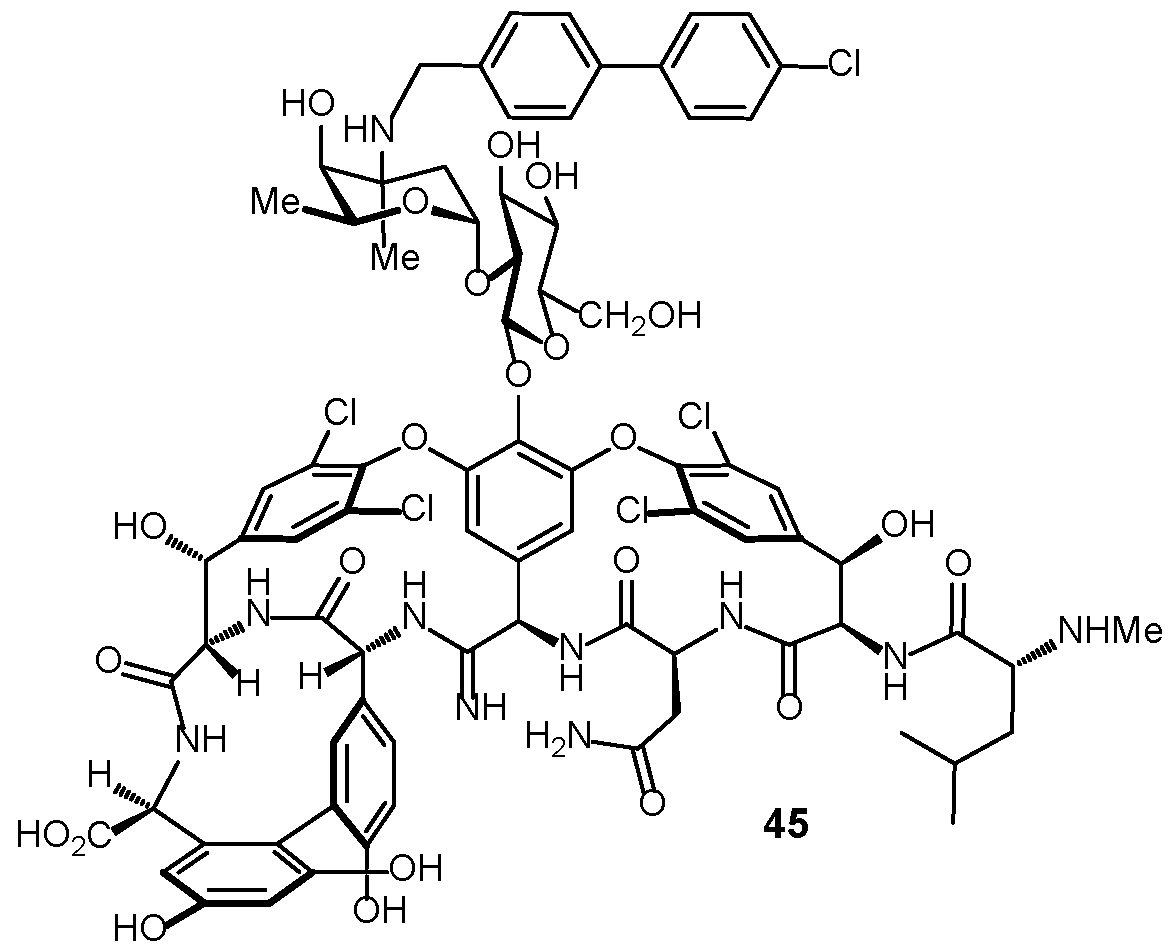 CBP-[Ψ[C(=NH)NH]Tpg4]Tetrachlorovancomycin (45) A solution of 44 (1.51 mg, 0.87 µmol, 1 equiv) in saturated aqueous NH4OAc (0.5 mL) was treated with AgOAc (6.0 mg, 36 μmol, 41 equiv). After the resulting mixture was stirred at ambient temperature for 24 h, HPLC purification (Phenomenex Luna® C18(2), 250 × 4.6 mm, 5 mL/min, 1–20% MeCN/H2O– 0.07% TFA over 3 min then 20–40% MeCN/H2O–0.07% TFA over 30 min, tR = 21 min) afforded 45 (1.12 mg, 75%) as a white solid. For 45: 1H NMR (600 MHz, CD3OD) δ 7.76 (s, 1H), 7.71 (d, J = 7.8 Hz, 2H), 7.63 (d, J = 8.3 Hz, 2H), 7.55 (d, J = 8.0 Hz, 1H), 7.47 (d, J = 8.4 Hz, 2H), 7.43 (s, 1H), 7.13 (s, 1H), 7.09 (d, J = 8.8 Hz, 1H), 6.89 (d, J = 8.6 Hz, 1H), 6.48 (s, 2H), 6.22 (s, 1H), 5.71 (s, 1H), 5.62 (s, 1H), 5.54–5.46 (m, 3H), 5.40 (s, 1H), 5.35 (s, 1H), 4.29 (s, 1H), 4.16 (d, J = 12.5 Hz, 2H), 4.06 (d, J = 12.6 Hz, 2H), 3.87 (d, J = 8.1 Hz, 2H), 3.83–3.75 (m, 3H), 3.60 (d, J = 10.0 Hz, 3H), 2.89 (s, 1H), 2.86 (s, 2H), 2.67 (s, 3H), 2.42 (d, J = 13.3 Hz, 2H), 2.19 (d, J = 14.3 Hz, 2H), 2.07 (dd, J = 19.5, 12.1 Hz, 3H), 1.87 (s, 1H), 1.76 (s, 1H), 1.65 (s, 3H), 1.35 (s, 1H), 1.27 (d, J = 6.6 Hz, 3H), 0.93 (m, 6H); HRMS (ESI-TOF) m/z [M+2H]+ calcd for C79H83Cl5N10O23, 858.2116; found, 858.2078.
CBP-[Ψ[CH2NH]Tpg4]Tetrachlorovancomycin (46) A 4 mL glass vessel was charged with 44 (1.98 mg, 1.14 µmol, 1 equiv), anhydrous NiCl2 (3.4 mg, 26.2 µmol, 23 equiv), anhydrous MeOH (2 mL), and 1,2-dichlorobenzene (0.2 mL). The reaction mixture was purged with Ar and cooled to –78 ˚C. NaBH4 (2.5 mg, 66 µmol, 60 equiv) was added and the mixture was stirred at –40 ˚C, whereupon the solution color turned brown and then dark. After 40 min, the reaction was quenched by addition of cold H2O (0 ˚C, 0.07% TFA, 5 mL), and filtered through a 0.22 μm PES membrane, rinsing with MeOH. The filtrate was concentrated under a nitrogen flow to remove MeOH, diluted with H2O (5 mL), and purified by semi- preparative reverse-phase HPLC (Luna®-5 μm-C18, 100 Å, 100 × 30 mm, 18–28% MeCN/H2O–0.07% TFA gradient over 30 min, 20 mL/min, tR = 24 min) to provide 46 (930 µg, 48%) as a white solid. For 46: 1H NMR (600 MHz, CD3OD) δ 7.98 (d, J = 2.0 Hz, 1H), 7.90 (d, J = 2.0 Hz, 1H), 7.70 (d, J = 8.2 Hz, 2H), 7.64–7.61 (m, 2H), 7.58–7.53 (m, 3H),
7.47 (d, J = 8.5 Hz, 2H), 7.33 (d, J = 2.0 Hz, 1H), 7.15 (dd, J = 8.6, 2.4 Hz, 2H), 7.06 (d, J = 2.4 Hz, 1H), 6.95 (d, J = 8.6 Hz, 1H), 6.45 (d, J = 2.3 Hz, 2H), 6.41 (d, J = 2.2 Hz, 2H), 5.64 (d, J = 7.8 Hz, 2H), 5.52 (s, 1H), 5.45 (d, J = 4.5 Hz, 2H), 5.39 (s, 1H), 5.31 (d, J = 5.7 Hz, 1H), 5.01 (d, J = 12.9 Hz, 3H), 4.96 (d, J = 5.0 Hz, 2H), 4.54–4.50 (m, 2H), 4.48 (t, J = 5.1 Hz, 2H), 4.28 (dd, J = 8.9, 5.7 Hz, 3H), 4.17 (d, J = 12.6 Hz, 2H), 4.14 (d, J = 2.7 Hz, 2H), 4.09 (d, J = 12.6 Hz, 2H), 3.88–3.81 (m, 4H), 3.73 (dd, J = 11.6, 4.8 Hz, 3H), 3.63 (s, 1H), 3.60 (t, J = 9.2 Hz, 4H), 3.53 (t, J = 9.3 Hz, 3H), 2.80 (s, 1H), 2.75 (s, 3H), 2.65 (d, J = 5.7 Hz, 2H), 2.37 (d, J = 15.3 Hz, 2H), 2.20 (d, J = 9.3 Hz, 2H), 2.05 (d, J = 13.3 Hz, 2H), 1.81 (s, 3H), 1.71 (s, 3H), 1.64–1.57 (m, 4H), 1.28 (d, J = 6.6 Hz, 3H), 1.01 (d, J = 6.4 Hz, 3H), 0.93 (d, J = 6.3 Hz, 3H); HRMS (ESI- TOF) m/z [M+2H]+ calcd for C79H84Cl5N9O23, 851.7140; found, 851.7128.
 G3,CBP-[Ψ[C(=S)NH]Tpg4]Tetrachlorovancomycin (47) A 4 mL glass vial was charged with 44 (10.0 mg, 5.76 µmol, 1 equiv), 1-(3-aminopropyl)guanidine
(bis-TFA salt, 20 mg, 58 µmol, 10 equiv), N-methylmorpholine (NMM, 13 μL, 0.115 mmol, 20 equiv), and anhydrous DMSO–DMF (1:1, 1.16 mL). After the resulting solution was treated with HBTU (22 mg, 58 µmol, 10 equiv) and stirred at 23 ˚C under Ar for 20 min, 10 mL of H2O was added to quench the reaction. Semi-preparative reverse-phase HPLC (Luna®-5 μm-C18, 100 Å, 100 × 30 mm, 1–22% MeCN/H2O–0.07% TFA gradient over 2 min then 22–35% MeCN/H2O–0.07% TFA over 20 min, 20 mL/min, tR = 11.5 min) provided 47 (9.3 mg, 88%) as a white solid. For 47: 1H NMR (600 MHz, CD3OD) δ 7.75 (s, 1H), 7.74–7.70 (m, 3H), 7.69 (s, 1H), 7.62 (d, J = 8.2 Hz, 2H), 7.55 (d, J = 7.9 Hz, 2H), 7.46 (d, J = 8.3 Hz, 2H), 7.24 (s, 1H), 7.02 (d, J = 8.6 Hz, 1H), 6.83 (d, J = 8.5 Hz, 1H), 6.46 (d, J = 2.3 Hz, 1H), 6.36 (d, J = 2.3 Hz, 1H), 6.22 (s, 1H), 5.85 (s, 1H), 5.67 (d, J = 7.9 Hz, 1H), 5.42 (d, J = 4.6 Hz, 1H), 5.38 (s, 1H), 5.35 (s, 1H), 5.32 (s, 2H), 4.62 (d, J = 5.4 Hz, 1H), 4.35 (s, 1H), 4.30 (d, J = 9.2 Hz, 1H), 4.17 (d, J = 12.5 Hz, 1H), 4.08 (d, J = 12.9 Hz, 2H), 3.86–3.81 (m, 2H), 3.75 (dd, J = 11.7, 4.6 Hz, 1H), 3.62 (s, 1H), 3.59 (d, J = 9.3 Hz, 1H), 3.53 (t, J = 9.3 Hz, 1H), 3.44 (d, J = 13.6 Hz, 2H), 3.35 (s, 2H), 3.23 (t, J = 6.9 Hz, 2H), 3.03 (d, J = 15.8 Hz, 1H), 2.75 (s, 3H), 2.21–2.09 (m, 3H), 2.05 (d, J = 13.3 Hz, 2H), 1.84 (dq, J = 12.8, 6.7 Hz, 3H), 1.81– 1.73 (m, 2H), 1.66 (s, 3H), 1.26 (d, J = 6.4 Hz, 3H), 1.03 (d, J = 6.1 Hz, 3H), 0.98 (d, J = 6.0 Hz, 3H); 13C{1H} NMR (151 MHz, CD3OD) δ 200.9, 175.1, 173.4, 172.2, 171.4, 170.5, 169.9, 168.2, 165.4, 163.0, 162.8, 162.6, 162.3, 158.5, 158.1, 157.3, 156.0, 151.9, 151.6, 147.0, 146.2, 143.2, 141.8, 139.6, 138.4, 137.8, 134.7, 133.1, 131.7, 131.6, 130.8,
130.6, 130.0, 129.3, 128.4, 127.3, 126.1, 122.6, 120.4, 118.8, 118.5, 116.6, 114.6, 107.9, 107.4, 106.1, 104.0, 102.8, 98.8, 80.2, 78.4, 77.9, 72.4, 72.3, 70.6, 70.0, 65.1, 63.9, 62.0, 61.6, 61.4, 61.2, 61.0, 60.0, 59.4, 52.5, 44.2, 40.3, 40.1, 39.9, 37.9, 37.5, 36.5, 34.3, 32.5, 29.2, 25.3, 22.9, 22.5, 20.1, 17.1; HRMS (ESI-TOF) m/z [M+3H]+ calcd for C83H92Cl5N13O22S, 610.8269; found, 610.8256.
G3,CBP-[Ψ[C(=S)NH]Tpg4]Tetrachlorovancomycin (47) A 4 mL glass vial was charged with 44 (10.0 mg, 5.76 µmol, 1 equiv), 1-(3-aminopropyl)guanidine
(bis-TFA salt, 20 mg, 58 µmol, 10 equiv), N-methylmorpholine (NMM, 13 μL, 0.115 mmol, 20 equiv), and anhydrous DMSO–DMF (1:1, 1.16 mL). After the resulting solution was treated with HBTU (22 mg, 58 µmol, 10 equiv) and stirred at 23 ˚C under Ar for 20 min, 10 mL of H2O was added to quench the reaction. Semi-preparative reverse-phase HPLC (Luna®-5 μm-C18, 100 Å, 100 × 30 mm, 1–22% MeCN/H2O–0.07% TFA gradient over 2 min then 22–35% MeCN/H2O–0.07% TFA over 20 min, 20 mL/min, tR = 11.5 min) provided 47 (9.3 mg, 88%) as a white solid. For 47: 1H NMR (600 MHz, CD3OD) δ 7.75 (s, 1H), 7.74–7.70 (m, 3H), 7.69 (s, 1H), 7.62 (d, J = 8.2 Hz, 2H), 7.55 (d, J = 7.9 Hz, 2H), 7.46 (d, J = 8.3 Hz, 2H), 7.24 (s, 1H), 7.02 (d, J = 8.6 Hz, 1H), 6.83 (d, J = 8.5 Hz, 1H), 6.46 (d, J = 2.3 Hz, 1H), 6.36 (d, J = 2.3 Hz, 1H), 6.22 (s, 1H), 5.85 (s, 1H), 5.67 (d, J = 7.9 Hz, 1H), 5.42 (d, J = 4.6 Hz, 1H), 5.38 (s, 1H), 5.35 (s, 1H), 5.32 (s, 2H), 4.62 (d, J = 5.4 Hz, 1H), 4.35 (s, 1H), 4.30 (d, J = 9.2 Hz, 1H), 4.17 (d, J = 12.5 Hz, 1H), 4.08 (d, J = 12.9 Hz, 2H), 3.86–3.81 (m, 2H), 3.75 (dd, J = 11.7, 4.6 Hz, 1H), 3.62 (s, 1H), 3.59 (d, J = 9.3 Hz, 1H), 3.53 (t, J = 9.3 Hz, 1H), 3.44 (d, J = 13.6 Hz, 2H), 3.35 (s, 2H), 3.23 (t, J = 6.9 Hz, 2H), 3.03 (d, J = 15.8 Hz, 1H), 2.75 (s, 3H), 2.21–2.09 (m, 3H), 2.05 (d, J = 13.3 Hz, 2H), 1.84 (dq, J = 12.8, 6.7 Hz, 3H), 1.81– 1.73 (m, 2H), 1.66 (s, 3H), 1.26 (d, J = 6.4 Hz, 3H), 1.03 (d, J = 6.1 Hz, 3H), 0.98 (d, J = 6.0 Hz, 3H); 13C{1H} NMR (151 MHz, CD3OD) δ 200.9, 175.1, 173.4, 172.2, 171.4, 170.5, 169.9, 168.2, 165.4, 163.0, 162.8, 162.6, 162.3, 158.5, 158.1, 157.3, 156.0, 151.9, 151.6, 147.0, 146.2, 143.2, 141.8, 139.6, 138.4, 137.8, 134.7, 133.1, 131.7, 131.6, 130.8,
130.6, 130.0, 129.3, 128.4, 127.3, 126.1, 122.6, 120.4, 118.8, 118.5, 116.6, 114.6, 107.9, 107.4, 106.1, 104.0, 102.8, 98.8, 80.2, 78.4, 77.9, 72.4, 72.3, 70.6, 70.0, 65.1, 63.9, 62.0, 61.6, 61.4, 61.2, 61.0, 60.0, 59.4, 52.5, 44.2, 40.3, 40.1, 39.9, 37.9, 37.5, 36.5, 34.3, 32.5, 29.2, 25.3, 22.9, 22.5, 20.1, 17.1; HRMS (ESI-TOF) m/z [M+3H]+ calcd for C83H92Cl5N13O22S, 610.8269; found, 610.8256.
 G3,CBP-[Ψ[C(=NH)NH]Tpg4]Tetrachlorovancomycin (48) A solution of 47 (10.0 mg, 5.46 µmol, 1 equiv) in saturated aqueous NH4OAc (2.2 mL) was treated with AgOAc (36.4 mg, 218 μmol, 40 equiv). After the resulting mixture was stirred at ambient temperature under Ar in the dark for 24 h, LCMS indicated >97% conversion of starting material. The mixture was diluted with H2O (5 mL), and semi- preparative reverse-phase HPLC (Luna®-5 μm-C18, 100 Å, 100 × 30 mm, 1–22% MeCN/H2O–0.07% TFA gradient over 2 min then 22–26% MeCN/H2O–0.07% TFA over 20 min, 20 mL/min, tR = 11 min) provided 48 (8.12 mg, 82%) as a white solid.
For 48: 1H NMR (600 MHz, CD3OD) δ 8.33 (s, 1H), 7.83 (s, 1H), 7.76 (s, 1H), 7.75 (s, 2H), 7.71– 7.68 (m, 2H), 7.62 (dd, J = 8.4, 3.8 Hz, 2H), 7.55 (t, J = 7.6 Hz, 2H), 7.46 (d, J = 8.3 Hz, 2H), 7.44 (d, J = 4.0 Hz, 1H), 7.28 (s, 2H), 7.10 (d, J = 8.6 Hz, 2H), 6.89 (dd, J = 8.6, 2.1 Hz, 1H), 6.48 (d, J = 1.7 Hz, 1H), 6.42 (s, 1H), 6.39 (d, J = 4.2 Hz, 1H), 6.20 (s, 1H), 5.69 (s, 1H), 5.62 (s, 3H), 5.52–5.45 (m, 4H), 5.35 (d, J = 2.0 Hz, 1H), 4.63 (s, 2H), 4.42 (s, 1H), 4.34 (s, 1H), 4.30 (s, 2H), 4.20 (d, J = 12.5 Hz, 1H), 4.15 (d, J = 12.5 Hz, 2H), 4.11 (d, J = 12.5 Hz, 1H), 4.05 (d, J = 12.6 Hz, 2H), 3.87 (t, J = 8.4 Hz, 2H), 3.79 (q, J = 12.3 Hz, 3H), 3.66 (s, 1H), 3.59 (d, J = 9.2 Hz, 4H), 3.44–3.41 (m, 1H), 3.23 (d, J = 6.9 Hz, 2H), 2.89 (s, 1H), 2.87 (d, J = 1.7 Hz, 3H), 2.83 (s, 1H), 2.40 (dd, J = 16.1, 4.9 Hz, 2H), 2.22–2.16 (m, 2H), 2.04 (d, J = 13.4 Hz, 2H), 1.84 (dq, J = 15.9, 7.1 Hz, 5H), 1.75 (s, 1H), 1.64 (d, J = 8.7 Hz, 3H), 1.60 (d, J = 7.1 Hz, 2H), 1.26 (d, J = 6.5 Hz, 3H), 0.86 (dd, J = 10.4, 5.9 Hz, 6H); 13C{1H} NMR (151 MHz, CD3OD) δ 173.8, 173.4, 171.9, 170.8, 170.5, 169.4, 168.5, 161.9, 161.6, 159.5, 158.5, 157.5, 153.5, 152.8, 148.6, 146.7, 143.8, 142.2, 140.8, 140.0, 138.0, 137.1, 134.93, 134.88, 132.8, 132.1, 131.9, 130.9, 130.8, 130.5, 130.1, 129.9, 129.7, 129.6, 129.5, 129.2, 128.5, 127.8, 127.6, 123.5, 123.3, 120.6, 118.9, 118.7, 118.2, 116.9, 116.8, 114.8, 108.3, 106.9, 104.5, 103.9, 103.6, 98.6, 79.7, 78.8, 77.9, 72.3, 72.0, 71.2, 70.2, 65.1, 64.1, 62.5, 61.5, 61.2, 60.2, 60.1, 58.3, 55.1, 54.5, 52.4, 44.2, 40.8, 40.1, 38.0, 34.4, 32.5, 29.8, 25.3, 23.0, 22.3, 20.2, 17.3; HRMS (ESI-TOF) m/z [M+3H]+ calcd for C83H93Cl5N14O22, 605.1755; found, 605.1736.
G3,CBP-[Ψ[CH2NH]Tpg4]Tetrachlorovancomycin (49) A solution of 47 (5.10 mg, 2.78 μmol, 1 equiv), anhydrous NiCl2 (7.0 mg, 54 μmol, 20 equiv) and 1,2-dichlorobenzene (0.3 mL) in anhydrous MeOH (3 mL) was purged with Ar and then cooled to –78 ˚C. NaBH4 (5.2 mg, 0.137 mmol, 50 equiv) was added and the mixture was stirred at –40 ˚C for 40 min. The reaction was quenched by addition of cold H2O (0 ˚C, 0.07% TFA, 5 mL) and transferred into a saturated EDTA H2O–MeOH (1:1, 5 mL), and the resulting mixture was stirred at 23 ˚C for 1 h with the color changing from dark to light blue. After filtration through a 0.22 μm PES membrane, rinsing with MeOH, and concentrated under reduced pressure, diluted with H2O (5 mL), purification by semi-preparative reverse- phase HPLC (Luna®-5 μm-C18, 100 Å, 100 × 30 mm, 1–18% MeCN/H2O–0.07% TFA gradient over 2 min then 18–28% MeCN/H2O–0.07% TFA gradient over 20 min, 20 mL/min, tR = 15 min) provided 49 (2.31 mg, 46%) as a white solid.
Alternatively, a solution of 46 (1.21 mg, 0.709 µmol, 1 equiv), 1-(3-aminopropyl)guanidine (bis-TFA salt, 1.20 mg, 3.49 µmol, 5 equiv) and N-methylmorpholine (NMM, 1.6 μL, 14 μmol, 20 equiv) in anhydrous DMSO and DMF (1:1, 0.3 mL) was treated with solid HBTU (2.7 mg, 7.1 μmol, 10 equiv). The mixture was stirred at ambient temperature for 30 min, and then the reaction was quenched by addition of H2O (5 mL). Semi-preparative reverse-phase HPLC (Luna®-5 μm-C18, 100 Å, 100 × 30 mm, 1–40% MeCN/H2O– 0.07% TFA gradient over 20 min, 20 mL/min, tR = 11 min) afforded 49 (994 µg, 78%) as a white solid. For 49: 1H NMR (600 MHz, CD3OD) δ 7.95 (d, J = 1.9 Hz, 1H), 7.89 (d, J = 1.9 Hz, 1H), 7.72–7.68 (m, 2H), 7.64–7.61 (m, 2H), 7.60 (d, J = 2.0 Hz, 1H), 7.57–7.54 (m, 2H), 7.48–7.45 (m, 2H), 7.33 (d, J = 2.0 Hz, 1H), 7.18 (d, J = 2.4 Hz, 1H), 7.17 (d, J = 2.4 Hz, 1H), 7.15 (d, J = 2.4 Hz, 1H), 6.95 (d, J = 8.6 Hz, 1H), 6.45 (d, J = 2.3 Hz, 1H), 6.35 (d, J = 2.3 Hz, 1H), 5.63 (d, J = 7.8 Hz, 1H), 5.51–5.47 (m, 2H), 5.45 (d, J = 4.6 Hz, 1H), 5.33 (d, J = 5.7 Hz, 1H), 5.08 (d, J = 9.6 Hz, 2H), 5.06–5.02 (m, 2H), 4.97 (d, J = 2.1 Hz, 1H), 4.54 (t, J = 5.3 Hz, 1H), 4.40 (dd, J = 15.2, 9.6 Hz, 2H), 4.34–4.27 (m, 3H), 4.17 (d, J = 12.6 Hz, 2H), 4.09 (d, J = 12.6 Hz, 2H), 3.87–3.80 (m, 3H), 3.74 (dd, J = 11.6, 4.7 Hz, 2H), 3.63 (s, 1H), 3.60 (t, J = 9.2 Hz, 2H), 3.54 (t, J = 9.3 Hz, 2H), 3.42 (d, J = 1.4 Hz, 1H), 3.39 (q, J = 6.6 Hz, 2H), 3.23 (t, J = 7.0 Hz, 2H), 2.77 (s, 3H), 2.70 (dd, J = 15.1, 4.5 Hz, 2H), 2.62 (dd, J = 15.1, 6.1 Hz, 2H), 2.39 (d, J = 15.2 Hz, 2H), 2.20 (dd, J = 13.6, 4.7 Hz, 2H), 2.06 (d, J = 13.3 Hz, 2H), 1.84 (p, J = 7.0 Hz, 3H), 1.81–1.76 (m, 2H), 1.71 (s, 3H), 1.63 (ddt, J = 21.3, 14.2, 7.7 Hz, 4H), 1.27 (d, J =
6.5 Hz, 3H), 0.99 (d, J = 6.2 Hz, 3H), 0.92 (d, J = 6.2 Hz, 3H); 13C{1H} NMR (151 MHz, CD3OD) δ 175.5, 174.1, 173.0, 171.6, 170.6, 170.2, 169.5, 168.1, 165.0, 161.9, 159.2, 158.8, 157.9, 156.4, 152.7, 151.8, 147.5, 146.5, 143.7, 142.6, 142.1, 139.9, 138.0, 137.5, 137.2, 134.9, 133.7, 132.0, 131.9, 130.7, 130.5, 130.3, 130.1, 129.7, 129.4, 128.6, 128.5, 128.2, 127.8, 127.6, 127.5, 122.9, 120.5, 118.8, 116.9, 116.6, 115.0, 114.7, 108.2, 108.0, 105.7, 104.1, 102.7, 98.7, 79.8, 79.0, 78.2, 72.9, 72.6, 71.2, 70.0, 65.0, 64.0, 62.5, 61.54, 61.48, 59.6, 56.6, 55.6, 52.6, 44.2, 41.6, 40.6, 40.3, 39.6, 37.1, 36.8, 34.5, 32.5, 25.5, 23.2, 22.5, 20.3, 17.2; HRMS (ESI-TOF) m/z [M+2H]+ calcd for C83H94Cl5N13O22, 900.7618; found, 900.7598. Model Ligand Binding Studies The binding of tetrachlorovancomycin (Compound 1) and its aglycon Compound 29 to the model cell wall ligand Ac2-L-Lys-D-Ala-D-Ala (32)45 was examined by UV measurement of the change in absorbance upon titration of the ligand into a solution of glycopeptide (8.0 x 10⁻⁵ M, 20 mM sodium citrate buffer, pH = 5.1)45,46 and by isothermal titration calorimetry (ITC, 8.0 x 10⁻⁵ M, 100 mM sodium citrate buffer, pH 5.1, 298 K)47 and compared alongside vancomycin and its aglycon. The study established that Compound 1 maintains a high affinity for the model ligand 32 (Ka = 1.1 x 10⁵ M-1), displaying a binding constant only 5-fold lower than vancomycin (Ka = 5.4 x 10⁵ M-1) and the difference was even smaller (3-fold) for the aglycons.48 This small difference in ligand binding
affinity correspondingly reduced the antimicrobial activity of 1 relative to vancomycin, but proved inconsequential to the activity of the more potent peripherally-modified tetrachlorovancomycin analogues. Additionally, tetrachlorovancomycin (1), like vancomycin, fails to bind to an appreciable extent the model ligand of the peptidoglycan precursor found in vancomycin-resistant organisms, Ac2-L-Lys-D-Ala-D-Lac (Compound 33).48 Finally, and although not examined herein, it has been shown elsewhere that addition of the peripheral 4- chlorobiphenylmethyl (CBP) group to vancomycin and related structures does not impact (increase) the solution phase binding affinity for model ligands.43b Similarly, we have found that a vancomycin G3 C- terminus modification does not impact (increase) the binding to Ac2-L-Lys-D-Ala-D-Ala (ITC Ka = 2.9 x 10⁵ M- 1, for G3-vancomycin). compo Ka a ITC, Ka a − UV, ∆Hb vancomycin 5 5.5 5
G3,CBP-[Ψ[C(=NH)NH]Tpg4]Tetrachlorovancomycin (48) A solution of 47 (10.0 mg, 5.46 µmol, 1 equiv) in saturated aqueous NH4OAc (2.2 mL) was treated with AgOAc (36.4 mg, 218 μmol, 40 equiv). After the resulting mixture was stirred at ambient temperature under Ar in the dark for 24 h, LCMS indicated >97% conversion of starting material. The mixture was diluted with H2O (5 mL), and semi- preparative reverse-phase HPLC (Luna®-5 μm-C18, 100 Å, 100 × 30 mm, 1–22% MeCN/H2O–0.07% TFA gradient over 2 min then 22–26% MeCN/H2O–0.07% TFA over 20 min, 20 mL/min, tR = 11 min) provided 48 (8.12 mg, 82%) as a white solid.
For 48: 1H NMR (600 MHz, CD3OD) δ 8.33 (s, 1H), 7.83 (s, 1H), 7.76 (s, 1H), 7.75 (s, 2H), 7.71– 7.68 (m, 2H), 7.62 (dd, J = 8.4, 3.8 Hz, 2H), 7.55 (t, J = 7.6 Hz, 2H), 7.46 (d, J = 8.3 Hz, 2H), 7.44 (d, J = 4.0 Hz, 1H), 7.28 (s, 2H), 7.10 (d, J = 8.6 Hz, 2H), 6.89 (dd, J = 8.6, 2.1 Hz, 1H), 6.48 (d, J = 1.7 Hz, 1H), 6.42 (s, 1H), 6.39 (d, J = 4.2 Hz, 1H), 6.20 (s, 1H), 5.69 (s, 1H), 5.62 (s, 3H), 5.52–5.45 (m, 4H), 5.35 (d, J = 2.0 Hz, 1H), 4.63 (s, 2H), 4.42 (s, 1H), 4.34 (s, 1H), 4.30 (s, 2H), 4.20 (d, J = 12.5 Hz, 1H), 4.15 (d, J = 12.5 Hz, 2H), 4.11 (d, J = 12.5 Hz, 1H), 4.05 (d, J = 12.6 Hz, 2H), 3.87 (t, J = 8.4 Hz, 2H), 3.79 (q, J = 12.3 Hz, 3H), 3.66 (s, 1H), 3.59 (d, J = 9.2 Hz, 4H), 3.44–3.41 (m, 1H), 3.23 (d, J = 6.9 Hz, 2H), 2.89 (s, 1H), 2.87 (d, J = 1.7 Hz, 3H), 2.83 (s, 1H), 2.40 (dd, J = 16.1, 4.9 Hz, 2H), 2.22–2.16 (m, 2H), 2.04 (d, J = 13.4 Hz, 2H), 1.84 (dq, J = 15.9, 7.1 Hz, 5H), 1.75 (s, 1H), 1.64 (d, J = 8.7 Hz, 3H), 1.60 (d, J = 7.1 Hz, 2H), 1.26 (d, J = 6.5 Hz, 3H), 0.86 (dd, J = 10.4, 5.9 Hz, 6H); 13C{1H} NMR (151 MHz, CD3OD) δ 173.8, 173.4, 171.9, 170.8, 170.5, 169.4, 168.5, 161.9, 161.6, 159.5, 158.5, 157.5, 153.5, 152.8, 148.6, 146.7, 143.8, 142.2, 140.8, 140.0, 138.0, 137.1, 134.93, 134.88, 132.8, 132.1, 131.9, 130.9, 130.8, 130.5, 130.1, 129.9, 129.7, 129.6, 129.5, 129.2, 128.5, 127.8, 127.6, 123.5, 123.3, 120.6, 118.9, 118.7, 118.2, 116.9, 116.8, 114.8, 108.3, 106.9, 104.5, 103.9, 103.6, 98.6, 79.7, 78.8, 77.9, 72.3, 72.0, 71.2, 70.2, 65.1, 64.1, 62.5, 61.5, 61.2, 60.2, 60.1, 58.3, 55.1, 54.5, 52.4, 44.2, 40.8, 40.1, 38.0, 34.4, 32.5, 29.8, 25.3, 23.0, 22.3, 20.2, 17.3; HRMS (ESI-TOF) m/z [M+3H]+ calcd for C83H93Cl5N14O22, 605.1755; found, 605.1736.
G3,CBP-[Ψ[CH2NH]Tpg4]Tetrachlorovancomycin (49) A solution of 47 (5.10 mg, 2.78 μmol, 1 equiv), anhydrous NiCl2 (7.0 mg, 54 μmol, 20 equiv) and 1,2-dichlorobenzene (0.3 mL) in anhydrous MeOH (3 mL) was purged with Ar and then cooled to –78 ˚C. NaBH4 (5.2 mg, 0.137 mmol, 50 equiv) was added and the mixture was stirred at –40 ˚C for 40 min. The reaction was quenched by addition of cold H2O (0 ˚C, 0.07% TFA, 5 mL) and transferred into a saturated EDTA H2O–MeOH (1:1, 5 mL), and the resulting mixture was stirred at 23 ˚C for 1 h with the color changing from dark to light blue. After filtration through a 0.22 μm PES membrane, rinsing with MeOH, and concentrated under reduced pressure, diluted with H2O (5 mL), purification by semi-preparative reverse- phase HPLC (Luna®-5 μm-C18, 100 Å, 100 × 30 mm, 1–18% MeCN/H2O–0.07% TFA gradient over 2 min then 18–28% MeCN/H2O–0.07% TFA gradient over 20 min, 20 mL/min, tR = 15 min) provided 49 (2.31 mg, 46%) as a white solid.
Alternatively, a solution of 46 (1.21 mg, 0.709 µmol, 1 equiv), 1-(3-aminopropyl)guanidine (bis-TFA salt, 1.20 mg, 3.49 µmol, 5 equiv) and N-methylmorpholine (NMM, 1.6 μL, 14 μmol, 20 equiv) in anhydrous DMSO and DMF (1:1, 0.3 mL) was treated with solid HBTU (2.7 mg, 7.1 μmol, 10 equiv). The mixture was stirred at ambient temperature for 30 min, and then the reaction was quenched by addition of H2O (5 mL). Semi-preparative reverse-phase HPLC (Luna®-5 μm-C18, 100 Å, 100 × 30 mm, 1–40% MeCN/H2O– 0.07% TFA gradient over 20 min, 20 mL/min, tR = 11 min) afforded 49 (994 µg, 78%) as a white solid. For 49: 1H NMR (600 MHz, CD3OD) δ 7.95 (d, J = 1.9 Hz, 1H), 7.89 (d, J = 1.9 Hz, 1H), 7.72–7.68 (m, 2H), 7.64–7.61 (m, 2H), 7.60 (d, J = 2.0 Hz, 1H), 7.57–7.54 (m, 2H), 7.48–7.45 (m, 2H), 7.33 (d, J = 2.0 Hz, 1H), 7.18 (d, J = 2.4 Hz, 1H), 7.17 (d, J = 2.4 Hz, 1H), 7.15 (d, J = 2.4 Hz, 1H), 6.95 (d, J = 8.6 Hz, 1H), 6.45 (d, J = 2.3 Hz, 1H), 6.35 (d, J = 2.3 Hz, 1H), 5.63 (d, J = 7.8 Hz, 1H), 5.51–5.47 (m, 2H), 5.45 (d, J = 4.6 Hz, 1H), 5.33 (d, J = 5.7 Hz, 1H), 5.08 (d, J = 9.6 Hz, 2H), 5.06–5.02 (m, 2H), 4.97 (d, J = 2.1 Hz, 1H), 4.54 (t, J = 5.3 Hz, 1H), 4.40 (dd, J = 15.2, 9.6 Hz, 2H), 4.34–4.27 (m, 3H), 4.17 (d, J = 12.6 Hz, 2H), 4.09 (d, J = 12.6 Hz, 2H), 3.87–3.80 (m, 3H), 3.74 (dd, J = 11.6, 4.7 Hz, 2H), 3.63 (s, 1H), 3.60 (t, J = 9.2 Hz, 2H), 3.54 (t, J = 9.3 Hz, 2H), 3.42 (d, J = 1.4 Hz, 1H), 3.39 (q, J = 6.6 Hz, 2H), 3.23 (t, J = 7.0 Hz, 2H), 2.77 (s, 3H), 2.70 (dd, J = 15.1, 4.5 Hz, 2H), 2.62 (dd, J = 15.1, 6.1 Hz, 2H), 2.39 (d, J = 15.2 Hz, 2H), 2.20 (dd, J = 13.6, 4.7 Hz, 2H), 2.06 (d, J = 13.3 Hz, 2H), 1.84 (p, J = 7.0 Hz, 3H), 1.81–1.76 (m, 2H), 1.71 (s, 3H), 1.63 (ddt, J = 21.3, 14.2, 7.7 Hz, 4H), 1.27 (d, J =
6.5 Hz, 3H), 0.99 (d, J = 6.2 Hz, 3H), 0.92 (d, J = 6.2 Hz, 3H); 13C{1H} NMR (151 MHz, CD3OD) δ 175.5, 174.1, 173.0, 171.6, 170.6, 170.2, 169.5, 168.1, 165.0, 161.9, 159.2, 158.8, 157.9, 156.4, 152.7, 151.8, 147.5, 146.5, 143.7, 142.6, 142.1, 139.9, 138.0, 137.5, 137.2, 134.9, 133.7, 132.0, 131.9, 130.7, 130.5, 130.3, 130.1, 129.7, 129.4, 128.6, 128.5, 128.2, 127.8, 127.6, 127.5, 122.9, 120.5, 118.8, 116.9, 116.6, 115.0, 114.7, 108.2, 108.0, 105.7, 104.1, 102.7, 98.7, 79.8, 79.0, 78.2, 72.9, 72.6, 71.2, 70.0, 65.0, 64.0, 62.5, 61.54, 61.48, 59.6, 56.6, 55.6, 52.6, 44.2, 41.6, 40.6, 40.3, 39.6, 37.1, 36.8, 34.5, 32.5, 25.5, 23.2, 22.5, 20.3, 17.2; HRMS (ESI-TOF) m/z [M+2H]+ calcd for C83H94Cl5N13O22, 900.7618; found, 900.7598. Model Ligand Binding Studies The binding of tetrachlorovancomycin (Compound 1) and its aglycon Compound 29 to the model cell wall ligand Ac2-L-Lys-D-Ala-D-Ala (32)45 was examined by UV measurement of the change in absorbance upon titration of the ligand into a solution of glycopeptide (8.0 x 10⁻⁵ M, 20 mM sodium citrate buffer, pH = 5.1)45,46 and by isothermal titration calorimetry (ITC, 8.0 x 10⁻⁵ M, 100 mM sodium citrate buffer, pH 5.1, 298 K)47 and compared alongside vancomycin and its aglycon. The study established that Compound 1 maintains a high affinity for the model ligand 32 (Ka = 1.1 x 10⁵ M-1), displaying a binding constant only 5-fold lower than vancomycin (Ka = 5.4 x 10⁵ M-1) and the difference was even smaller (3-fold) for the aglycons.48 This small difference in ligand binding
affinity correspondingly reduced the antimicrobial activity of 1 relative to vancomycin, but proved inconsequential to the activity of the more potent peripherally-modified tetrachlorovancomycin analogues. Additionally, tetrachlorovancomycin (1), like vancomycin, fails to bind to an appreciable extent the model ligand of the peptidoglycan precursor found in vancomycin-resistant organisms, Ac2-L-Lys-D-Ala-D-Lac (Compound 33).48 Finally, and although not examined herein, it has been shown elsewhere that addition of the peripheral 4- chlorobiphenylmethyl (CBP) group to vancomycin and related structures does not impact (increase) the solution phase binding affinity for model ligands.43b Similarly, we have found that a vancomycin G3 C- terminus modification does not impact (increase) the binding to Ac2-L-Lys-D-Ala-D-Ala (ITC Ka = 2.9 x 10⁵ M- 1, for G3-vancomycin). compo Ka a ITC, Ka a − UV, ∆Hb vancomycin 5 5.5 5
 − 2 x 10 x 10 10.7 , tetrachlorovancomycin 3.3 x 10⁴ 05 − − 1 1.1 x 1 6.9 10.3 +3.4 aAssociation consta -1 b ` nt, in M ; In kcal/mol Titration Binding Studies with Model D-Ala-D-Ala and D-Ala-D-Lac Ligands The binding constants for association with the model ligands N,N’-Ac2-Lys-D-Ala-D-Ala (A) and N,N’-Ac2-Lys-D-Ala-D-Lac (B) were determined according to literature protocol.45,11a UV difference experiments were carried out on a CARY 3E UV-Vis spectrometer. UV scans were run with a baseline correction that consisted of 20 mM sodium citrate buffer (pH = 5.1) and covered a range from 200 to 345 nm. A solution of
the tetrachlorovancomycin derivative (8 × 10⁻⁵ M in 20 mM sodium citrate buffer) was placed in a quartz UV cuvette (0.1 cm path length) and the UV spectrum recorded versus a reference cell containing 20 mM sodium citrate buffer. UV spectra were recorded after each addition of a solution of N,N’-Ac2-Lys-D- Ala-D-Ala (A) or N,N’-Ac2-Lys-D-Ala-D-Lac (B) in 20 mM sodium citrate buffer to each cell from 0.1 to up to 60.0 equiv for the weaker binding partners. The absorbance value at the λmax was recorded, measuring the running change in absorbance. The binding constants were calculated from the well-defined binding curves that plot the absorbance readings versus equiv ligand added ([ligand]/[tetrachlorovancomycin analogue]).45,11a The accuracy of the measured binding constants, especially for the weak binding partners, was improved by titration with sufficient ligand to characterize the binding event at the dilute concentrations employed and with use of direct curve fitting methods45,11a (vs Scatchard analysis) and single site binding to quantitate the results of the well-behaved binding curves. The results are summarized in Figs. 8A and 8B alongside those of vancomycin and its tetrachloro analogues. ITC measurements were carried out in a MicroCalTM Auto-iTC200 system with 400 mL of antibiotic solution as the cell sample and 120 mL of ligand solution as syringe sample (2.5 mL of each injection volume). Control titration runs were conducted by using blank buffer solution against blank buffer solution, each antibiotic, and the two ligands, respectively to show no heat contribution from the individual binding components. The titration data
were processed by using OriginLab software (for ITC) and “one set of sites” fitting model for curve fitting. UV difference experiments were carried out on a CARY 3E UV-Vis spectrometer. UV scans were run with a baseline correction that consisted of 20 mM sodium citrate buffer (pH = 5.1) and covered a range from 200 to 345 nm. A solution of the tetrachloro- vancomycin derivative (8 × 10⁻⁵ M in 20 mM sodium citrate buffer) was placed in a quartz UV cuvette (0.1 cm path length) and the UV spectrum recorded versus a reference cell containing 20 mM sodium citrate buffer. UV spectra were recorded after each addition of a solution of N,N’-Ac2-Lys-D-Ala-D-Ala (A) or N,N’-Ac2-Lys-D-Ala-D-Lac (B) in 20 mM sodium citrate buffer to each cell from 0.1 to up to 60.0 equiv for the weaker binding partners. The absorbance value at the λmax was recorded, measuring the running change in absorbance. In Vitro Antimicrobial Activity Assay of Pocket and Peripherally Modified Tetrachlorovancomycins 55 One day before studies were run, fresh cultures of vancomycin-sensitive Staphlococcus aureus (VSSA strain ATCC 25923), methicillin and oxacillin- resistant Staphlococcus aureus (MRSA strain ATCC 43300), vancomycin-resistant Enterococcus faecium (VanA VRE, ATCC BAA-2317), vancomycin-resistant Enterococcus faecalis (VanA VRE, ATCC BAA-2573) and (VanB VRE, TX-2516), vancomycin-sensitive Enterococcus faecium (unknown origin) and vancomycin- sensitive Enterococcus faecalis (unknown origin) were inoculated and grown in an orbital shaker at 37 °C in
100% Mueller-Hinton (MH, for VSSA and MRSA) or brain- heart infusion (BHI, for VRE and VSE) broth. After 24 h, the bacterial stock solutions were serial diluted with 5% MH (for VSSA and MRSA) or BHI (for VRE) broth supplemented by 0.002% P-80 to achieve a turbidity equivalent to a 1:100 dilution of a 0.5 M McFarland solution (bacteria concentration = 1.5 × 10⁶ CFU/mL). This diluted bacterial stock solution was then inoculated in a 96-well U-shaped glass coated microtiter plate, supplemented with serial diluted aliquots of the antibiotic solution in DMSO (4 μL), to achieve a total assay volume of 0.1 mL. The plate was then incubated at 37 °C for 18 h, after which minimal inhibitory concentrations (MICs) were determined by monitoring the cell growth (observed as a pellet) in the wells. The lowest concentration of antibiotic (in μg/mL) capable of eliminating cell growth in the wells is the reported MIC value. The reported MIC values for the vancomycin analogues were determined against vancomycin as a standard in the first well. For the thioamide series, the initial fresh cultures were grown in the presence of vancomycin (1 μg/mL) for resistant strains and chloramphenicol for sensitive strains (1 μg/mL). In the instances of protein removal, filtration of the broth through an Amicon MWCO 3000 membrane was used for protein removal. Notably, assessing the antimicrobial activity of [Ψ(CH2NH)]Tpg4]tetrachlorovancomycin (Compound 49) with protein removal had no effect on potency against any of the strains examined, whereas small improvements in the MICs of [Ψ[C(=NH)NH]Tpg4]- tetrachlorovancomycin (Compound 48) were observed
against a few strains as indicated in the tabulated data in Fig. 9. CITATIONS 1. (a) McCormick, M. H.; McGuire, J. M.; Pittenger, G. E.; Pittenger, R. C.; Stark, W. M. Vancomycin, a new antibiotic. I. Chemical and biologic properties. Antibiot. Ann. 1955, 3, 606–611. (b) McGuire, J.; Wolfe, R.; Ziegler, D. Vancomycin, a new antibiotic. II. In vitro antibacterial studies. Antibiot. Ann. 1955, 3, 612–618. 2. (a) Kahne, D.; Leimkuhler, C.; Lu, W.; Walsh, C. Glycopeptide and lipoglycopeptide antibiotics. Chem. Rev. 2005, 105, 425−448. (b) Levine, D. P. Vancomycin: A history. Clin. Infect. Dis. 2006, 42, S5–S12. 3. James, R. C.; Pierce, J. G.; Okano, A.; Xie, J.; Boger, D. L. Redesign of glycopeptide antibiotics: Back to the future. ACS Chem. Biol. 2012, 7, 797–804. 4. Wu, Z.–C.; Boger, D. L. Maxamycins: Durable antibiotics derived by rational redesign of vancomycin. Acc. Chem. Res. 2020, 53, 2587–2599. 5. Okano, A.; Isley, N. A.; Boger, D. L. Total synthesis of vancomycin related glycopeptide antibiotics and key analogues. Chem. Rev. 2017, 117, 11952–11993. 6. Moore, M. J.; Qu, S.; Tan, C.; Cai, Y.; Mogi, Y.; Keith, D. J.; Boger, D. L. Next- generation total synthesis of vancomycin. J. Am. Chem. Soc. 2020, 142, 16039–16050. 7. Moore, M. J.; Qin, P.; Keith, D. J.; Wu, Z.–C.; Jung, S.; Chatterjee, S.; Tan, C.; Qu, S.; Cai, Y.; Stanfield, R. L.; Boger, D. L. Divergent
total synthesis and characterization of maxamycins, submitted. 8. Harris, C. M.; Kannan, R.; Kopecka, H.; Harris, T. M. The role of the chlorine substituents in the antibiotic vancomycin: preparation and characterization of mono-and didechlorovancomycin. J. Am. Chem. Soc. 1985, 107, 6652–6658. 9. Wadzinski, T. J.; Gea, K. D.; Miller, S. J. A stepwise dechlorination/cross-coupling strategy to diversify the vancomycin ‘in-chloride’. Bioorg. Med. Chem. Lett. 2016, 26, 1025–1028. 10. Pinchman, J. R.; Boger, D. L. Investigation into the functional impact of the vancomycin C-ring aryl chloride. Bioorg. Med. Chem. Lett. 2013, 23, 4817–4819. 11. (a) Nieto, M.; Perkins, H. R. Modifications of the acyl-D-alanyl-D-alanine terminus affecting complex-formation with vancomycin. Biochem. J. 1971, 123, 789–803. (b) Perkins, H. R. Vancomycin and related antibiotics. Pharmacol. Ther. 1982, 16, 181–197. 12. Boger, D. L.; Miyazaki, S.; Loiseleur, O.; Beresis, R. T.; Castle, S. L.; Wu, J. H.; Jin, Q. Thermal atropisomerism of aglucovancomycin derivatives: Preparation of (M,M,M)-and (P,M,M)- aglucovancomycins. J. Am. Chem. Soc. 1998, 120, 8920– 8926. 13. Jeffs, P. W.; Muller, L.; DeBrosse, C.; Heald, S. L.; Fisher, R. The structure of aridicin A. An integrated approach employing 2D NMR, energy minimization and distance constraints. J. Am. Chem. Soc. 1986, 108, 3063–3075.
14. Zmijewski, M. J.; Briggs, B. Biosynthesis of vancomycin: Identification of TDP- glucose:aglycosyl-vancomycin glucosyltransferase from Amycolatopsis orientalis. FEMS Microbiol. Lett. 1989, 59, 129–134. 15. Losey, H. C.; Peczuh, M. W.; Chen, Z.; Eggert, U. S.; Dong, S. D.; Pelczer, I.; Kahne, D.; Walsh, C. T. Tandem action of glycosyltransferases in the maturation of vancomycin and teicoplanin aglycones: Novel glycopeptides. Biochemistry 2001, 40, 4745–4755. 16. Thayer, D. A.; Wong C−H. Vancomycin analogues containing monosaccharides exhibit improved antibiotic activity: A combined one-pot enzymatic glycosylation and chemical diversification strategy. Chem.−Asian J. 2006, 1, 445–452. 17. Hubbard, B. K.; Walsh, C. T. Vancomycin assembly: Nature's way. Angew. Chem. Int. Ed. 2003, 42, 730–765. 18. Nakayama, A.; Okano, A.; Feng, Y.; Collins, J. C.; Collins, K. C.; Walsh, C. T.; Boger, D. L. Enzymatic glycosylation of vancomycin aglycon: Completion of a total synthesis of vancomycin and N-and C-terminus substituent effects of the aglycon substrate. Org. Lett. 2014, 16, 3572– 3575. 19. Thompson, C.; Ge, M.; Kahne, D. Synthesis of vancomycin from the aglycon. J. Am. Chem. Soc. 1999, 121, 1237–1244. 20. (a) Nicolaou, K. C.; Mitchell, H. J.; Jain, N. F.; Winssinger, N.; Hughes, R.; Bando, T. Total synthesis of vancomycin. Angew. Chem. Int. Ed. 1999, 38, 240–244. (b) Nicolaou, K. C.; Mitchell, H. J.; Jain, N. F.; Bando, T.; Hughes, R.; Winssinger,
N.; Natarajan, S.; Koumbis, A. E. Total synthesis of vancomycin—part 4: Attachment of the sugar moieties and completion of the synthesis. Chem. Eur. J. 1999, 5, 2648–2667. 21. Ritter, T. K.; Mong, K.–K. T.; Liu, T.; Nakatani, T.; Wong, C.−H. A programmable one-pot oligosaccharide synthesis for diversifying the sugar domains of natural products: A case study of vancomycin. Angew. Chem. Int. Ed. 2003, 42, 4657– 4660. 22. (a) Crimmins, M. T.; She, J. An improved procedure for asymmetric aldol additions with N-acyl oxazolidinones, oxazolidinethiones and thiazolidinethiones. Synlett 2004, 1371–1374. (b) Patel, J.; Clavé, G.; Renard, P.-Y.; Franck, X. Straightforward access to protected syn α-amino-β- hydroxy acid derivatives. Angew. Chem. Int. Ed. 2008, 47, 4224–4227. 23. Evans, D. A.; Wood, M. R.; Trotter, B. W.; Richardson, T. I.; Barrow, J. C.; Katz, J. L. Total syntheses of vancomycin and eremomycin aglycons. Angew. Chem. Int. Ed. 1998, 37, 2700–2704. 24. (a) Solladié–Cavallo, A.; Nsenda, T. A four-step synthesis of erythro-m-chloro-3- hydroxytyrosine ethyl ester enantiomerically pure. Tetrahedron Lett. 1998, 39, 2191–2194. (b) Crowley, B. M.; Mori, Y.; McComas, C. C.; Tang, D.; Boger, D. L. Total synthesis of the ristocetin aglycon. J. Am. Chem. Soc. 2004, 126, 4310–4317. 25. Dunetz, J. R.; Xiang, Y.; Baldwin, A.; Ringling, J. General and scalable amide bond formation with epimerization prone substrates using T3P® and pyridine. Org. Lett. 2011, 13, 5048−5051.
26. Nicolaou, K. C.; Estrada, A. A.; Zak, M.; Lee, S. H.; Safina, B. S. A mild and selective method for the hydrolysis of esters with trimethyltin hydroxide. Angew. Chem. Int. Ed. 2005, 44, 1378–1382. 27. Boger, D. L.; Borzilleri, R. M.; Nukui, S.; Beresis, R. T. Synthesis of the vancomycin CD and DE ring systems. J. Org. Chem. 1997, 62, 4721– 4736. 28. Kunishima, M.; Kawachi, C.; Iwasaki, F.; Terao, K.; Tani, S. Synthesis and characterization of 4-(4,6-dimethoxy-1,3,5-triazin-2- yl)-4-methylmorpholinium chloride. Tetrahedron Lett. 1999, 40, 5327−5330. 29. In addition to improving the convergency of the approach, the incorporation of the D ring amino acid into tetrapeptide 17 also avoids the challenging and epimerization prone coupling of the corresponding E ring tripeptide with the D ring amine when embedded in the ABCD ring system (see cites 6 and 7). 30. Prieto, M.; Mayor, S.; Rodríguez, K.; Lloyd-Williams, P.; Giralt, E. Racemization in Suzuki couplings: A quantitative study using 4- hydroxyphenylglycine and tyrosine derivatives as probe molecules. J. Org. Chem. 2007, 72, 1047–1050. 31. (a) Ji, Y.; Plata, R. E.; Regens, C. S.; Hay, M.; Schmidt, M.; Razler, T.; Qiu, Y.; Geng, P.; Hsiao, Y.; Rosner, T.; Eastgate, M. D.; Blackmond, D. G. Mono-oxidation of bidentate bis- phosphines in catalyst activation: Kinetic and mechanistic studies of a Pd/Xantphos-catalyzed C–H functionalization. J. Am. Chem. Soc. 2015, 137, 13272–13281. (b) Beutner, G.; Carrasquillo, R.; Geng, P.; Hsiao, Y.; Huang, E. C.; Janey, J.;
Katipally, K.; Kolotuchin, S.; La Porte, T.; Lee, A.; Lobben, P.; Lora-Gonzalez, F.; Mack, B.; Mudryk, B.; Qiu, Y.; Qian, X.; Ramirez, A.; Razler, T. M.; Rosner, T.; Shi, Z.; Simmons, E.; Stevens, J.; Wang, J.; Wei, C.; Wisniewski, S. R.; Zhu, Y. Adventures in atropisomerism: Total synthesis of a complex active pharmaceutical ingredient with two chirality axes. Org. Lett. 2018, 20, 3736–3740. 32. De Mico, A.; Margarita, R.; Parlanti, L.; Vescovi, A.; Piancatelli, G. A versatile and highly selective hypervalent iodine (III)/2,2,6,6-tetramethyl-1-piperidinyloxyl-mediated oxidation of alcohols to carbonyl compounds. J. Org. Chem. 1997, 62, 6974–6977. 33. He, C.; Chu, H.; Stratton, T. P.; Kossler, D.; Eberle, K. J.; Flood, D. T.; Baran, P. S. Total synthesis of tagetitoxin. J. Am. Chem. Soc. 2020, 142, 13683–13688. 34. Raw, S. A. An improved process for the synthesis of DMTMM-based coupling reagents. Tetrahedron Lett. 2009, 50, 946–948. 35. Boger, D. L.; Miyazaki, S.; Kim, S. H.; Wu, J. H.; Castle, S. L.; Loiseleur, O.; Jin, Q. Total synthesis of the vancomycin aglycon. J. Am. Chem. Soc. 1999, 12, 10004–10011. 36. Lin, L. S.; Lanza, T.; de Laszlo, S. E.; Truong, Q.; Kamenecka, T.; Hagmann, W. K. Deprotection of N-tert-butoxycarbonyl (Boc) groups in the presence of tert-butyl esters. Tetrahedron Lett. 2000, 41, 7013–7016. 37. Smith, G. G.; Sivakua, T. Mechanism of the racemization of amino acids. Kinetics of racemization of arylglycines. J. Org. Chem. 1983, 48, 627–634.
38. Li, H.; Jiang, X.; Ye, Y.-h.; Fan, C.; Romoff, T.; Goodman, M. 3-(Diethoxy- phosphoryloxy)-1,2,3-benzotriazin-4 (3H)-one (DEPBT): A new coupling reagent with remarkable resistance to racemization. Org. Lett. 1999, 1, 91–94. 39. Nicolaou, K.; Boddy, C. N.; Bräse, S.; Winssinger, N., Chemistry, biology, and medicine of the glycopeptide antibiotics. Angew. Chem. Int. Ed. 1999, 38, 2096−2152. 40. Moorthy, J. N.; Singhal, N. Facile and highly selective conversion of nitriles to amides via indirect acid-catalyzed hydration using TFA or AcOH−H2SO4. J. Org. Chem. 2005, 70, 1926−1929. 41. Moore, M. J.; Qin, P.; Keith, D. J.; Boger, D. L. Improved preparative enzymatic glycosylation of vancomycin aglycon and analogues. Tetrahedron 2023, 131, Article 133211. 42. Unverzagt, C.; Kunz, H.; Paulson, J. C. High-efficiency synthesis of sialyloligosaccharides and sialoglycopeptides. J. Am. Chem. Soc. 1990, 112, 9308–9309. 43. Nagarajan, R.; Schabel, A.; Occolowitz, J.; Counter, F.; Ott, J.; Felty– Duckworth, A. Synthesis and antibacterial evaluation of N-alkyl vancomycins. J. Antibiot. 1989, 42, 63–72. 44. Wu, Z.–C.; Cameron, M. D.; Boger, D. L. Vancomycin C-terminus guanidine modifications and further insights into an added mechanism of action imparted by a peripheral structural modification. ACS Infec. Dis. 2020, 6, 2169–2180. 45. Perkins, H. R. Specificity of combination between mucopeptide precursors and vancomycin or ristocetin. Biochem. J. 1969, 111, 195– 205.
46. Thordarson, P. Determining association constants from titration experiments in supramolecular chemistry. Chem. Soc. Rev. 2011, 40, 1305–1323. 47. McPhail, D.; Cooper. A. Microcalorimetric studies of ligand-induced vancomycin dimerisation and molecular recognition; in Coleman, A.W. ed, Molecular Recognition and Inclusion, Springer, 1998, pp 415–418. 48. Tetrachlorovancomycin (1), like vancomycin, fails to bind Ac2-L-Lys-D-Ala-D-Lac (33) to an appreciable extent (Ka < 470 M-1) being 1000- fold less effective than its binding with Ac2-L-Lys-D- Ala-D-Ala. 49. (a) Allen, N. E.; Hobbs, J. N., Jr.; Nicas, T. I. Inhibition of peptidoglycan biosynthesis in vancomycin-susceptible and -resistant bacteria by a semisynthetic glycopeptide antibiotic. Antimicrob. Agents Chemother. 1996, 40, 2356–2362. (b) Goldman, R. C.; Baizman, E. R.; Longley, C. B.; Branstrom, A. Chlorobiphenyl-desleucyl-vancomycin inhibits the transglycosylation process required for peptidoglycan synthesis in bacteria in the absence of dipeptide binding. FEMS Microbiol. Lett. 2000, 183, 209–214. 50. (a) Ge, M.; Chen, Z.; Russell, H.; Onishi; Kohler, J.; Silver, L. L.; Kerns, R.; Fukuzawa, S.; Thompson, C.; Kahne, D. Vancomycin derivatives that inhibit peptidoglycan biosynthesis without binding D-Ala-D-Ala. Science 1999, 284, 507– 511. (b) Chen, L.; Walker, D.; Sun, B.; Hu, Y.; Walker, S.; Kahne, D. Vancomycin analogues active against VanA-resistant strains inhibit bacterial transglycosylase without binding substrate. Proc. Natl. Acad. Sci. USA 2003, 100, 5658–5663.
51. Okano, A.; Isley, N. A.; Boger, D. L. Peripheral modifications of [Y(CH2NH)Tpg4]vancomycin with added synergistic mechanisms of action provide durable and potent antibiotics. Proc. Natl. Acad. Sci. U.S.A. 2017, 114, E5052–E5061. 52. Wu, Z.–C.; Isley, N. A.; Okano, A.; Weiss, W. J.; Boger, D. L. C1-CBP-Vancomycin: Impact of a vancomycin C-terminus trimethylammonium cation on pharmacological properties and insights into its newly introduced mechanism of action, J. Org. Chem. 2020, 85, 1365–1375. 53. Wright, P. M.; Seiple, I. B.; Myers, A. G. The evolving role of chemical synthesis in antibacterial drug discovery. Angew. Chem. Int. Ed. 2014, 53, 8840–8869. 54. Dyke, J. M.; Groves, A. P.; Morris, A.; Ogden, J. S.; Dias, A. A.; Oliveira, A. M. S.; Costa, M. L.; Barros, M. T.; Cabral, M. H.; Moutinho, A. M. C. Study of the thermal decomposition of 2- azidoacetic acid by photoelectron and matrix isolation infrared spectroscopy. J. Am. Chem. Soc. 1997, 119, 6883–6887. 55. Clinical and Laboratory Standards Institute, Methods for Dilution Antimicrobial Susceptibility Tests for Bacteria That Grow Aerobically, Approved Standard, 7th ed, CLSI document M07-A8, Clinical and Laboratory Standards Institute: Wayne, PA; 2009. 56. Moore, M. J.; Qu, S.; Tan, C.; Cai, Y.; Mogi, Y.; Keith, D. J.; Boger, D. L. Next- generation total synthesis of vancomycin. J. Am. Chem. Soc. 2020, 142, 16039–16050.
57. Moore, M. J.; Qin, P.; Yamasaki, N.; Zeng, X.; Keith, D. J.; Jung, S.; Fukazawa, T.; Graham-O'Regan, K.; Wu, Z.-C.; Chatterjee, S.; Boger, D. L. Tetrachlorovancomycin: total synthesis of a designed glycopeptide antibiotic of reduced synthetic complexity, J. Am. Chem. Soc. 2023, 145, 21132−21141. 58. Moore, M. J.; Qin, P.; Keith, D. J.; Wu, Z.–C.; Jung, S.; Chatterjee, S.; Tan, C.; Qu, S.; Cai, Y.; Stanfield, R. L.; Boger, D. L. Divergent total synthesis and characterization of maxamycins. J. Am. Chem. Soc. 2023, 145, 12837−12852. 59. It has been shown elsewhere that addition of the peripheral 4-chlorobiphenylmethyl (CBP) group to vancomycin and related structures does not impact (increase) the solution phase binding affinity for model ligands: Allen, N. E.; Nicas, T. I. Mechanism of action of oritavancin and related glycopeptide antibiotics, FEMS Microbiol. Rev. 2003, 26, 511–532. Similarly, we have found that a vancomycin G3 C-terminus modification does not impact (increase) the binding to Ac2-L-Lys-D-Ala-D-Ala.58 60. (a) Perkins, H. R. Specificity of combination between mucopeptide precursors and vancomycin or ristocetin. Biochem. J. 1969, 111, 195– 205. (b) Nieto, M.; Perkins, H. R. Modifications of the acyl-D-alanyl-D-alanine terminus affecting complex-formation with vancomycin. Biochem. J. 1971, 123, 789–803. 61. (a) Thordarson, P. Determining association constants from titration experiments in
supramolecular chemistry. Chem. Soc. Rev. 2011, 40, 1305–1323. (b) Hibbert, D. B.; Thordarson, P. The death of the Job plot, transparency, open science and online tools, uncertainty estimation methods and other developments in supramolecular chemistry data analysis. Chem. Commun. 2016, 52, 12792–12805. The program used may be accessed free at supramolecular.org or directly at app.supramolecular.org/bindfit.
− 2 x 10 x 10 10.7 , tetrachlorovancomycin 3.3 x 10⁴ 05 − − 1 1.1 x 1 6.9 10.3 +3.4 aAssociation consta -1 b ` nt, in M ; In kcal/mol Titration Binding Studies with Model D-Ala-D-Ala and D-Ala-D-Lac Ligands The binding constants for association with the model ligands N,N’-Ac2-Lys-D-Ala-D-Ala (A) and N,N’-Ac2-Lys-D-Ala-D-Lac (B) were determined according to literature protocol.45,11a UV difference experiments were carried out on a CARY 3E UV-Vis spectrometer. UV scans were run with a baseline correction that consisted of 20 mM sodium citrate buffer (pH = 5.1) and covered a range from 200 to 345 nm. A solution of
the tetrachlorovancomycin derivative (8 × 10⁻⁵ M in 20 mM sodium citrate buffer) was placed in a quartz UV cuvette (0.1 cm path length) and the UV spectrum recorded versus a reference cell containing 20 mM sodium citrate buffer. UV spectra were recorded after each addition of a solution of N,N’-Ac2-Lys-D- Ala-D-Ala (A) or N,N’-Ac2-Lys-D-Ala-D-Lac (B) in 20 mM sodium citrate buffer to each cell from 0.1 to up to 60.0 equiv for the weaker binding partners. The absorbance value at the λmax was recorded, measuring the running change in absorbance. The binding constants were calculated from the well-defined binding curves that plot the absorbance readings versus equiv ligand added ([ligand]/[tetrachlorovancomycin analogue]).45,11a The accuracy of the measured binding constants, especially for the weak binding partners, was improved by titration with sufficient ligand to characterize the binding event at the dilute concentrations employed and with use of direct curve fitting methods45,11a (vs Scatchard analysis) and single site binding to quantitate the results of the well-behaved binding curves. The results are summarized in Figs. 8A and 8B alongside those of vancomycin and its tetrachloro analogues. ITC measurements were carried out in a MicroCalTM Auto-iTC200 system with 400 mL of antibiotic solution as the cell sample and 120 mL of ligand solution as syringe sample (2.5 mL of each injection volume). Control titration runs were conducted by using blank buffer solution against blank buffer solution, each antibiotic, and the two ligands, respectively to show no heat contribution from the individual binding components. The titration data
were processed by using OriginLab software (for ITC) and “one set of sites” fitting model for curve fitting. UV difference experiments were carried out on a CARY 3E UV-Vis spectrometer. UV scans were run with a baseline correction that consisted of 20 mM sodium citrate buffer (pH = 5.1) and covered a range from 200 to 345 nm. A solution of the tetrachloro- vancomycin derivative (8 × 10⁻⁵ M in 20 mM sodium citrate buffer) was placed in a quartz UV cuvette (0.1 cm path length) and the UV spectrum recorded versus a reference cell containing 20 mM sodium citrate buffer. UV spectra were recorded after each addition of a solution of N,N’-Ac2-Lys-D-Ala-D-Ala (A) or N,N’-Ac2-Lys-D-Ala-D-Lac (B) in 20 mM sodium citrate buffer to each cell from 0.1 to up to 60.0 equiv for the weaker binding partners. The absorbance value at the λmax was recorded, measuring the running change in absorbance. In Vitro Antimicrobial Activity Assay of Pocket and Peripherally Modified Tetrachlorovancomycins 55 One day before studies were run, fresh cultures of vancomycin-sensitive Staphlococcus aureus (VSSA strain ATCC 25923), methicillin and oxacillin- resistant Staphlococcus aureus (MRSA strain ATCC 43300), vancomycin-resistant Enterococcus faecium (VanA VRE, ATCC BAA-2317), vancomycin-resistant Enterococcus faecalis (VanA VRE, ATCC BAA-2573) and (VanB VRE, TX-2516), vancomycin-sensitive Enterococcus faecium (unknown origin) and vancomycin- sensitive Enterococcus faecalis (unknown origin) were inoculated and grown in an orbital shaker at 37 °C in
100% Mueller-Hinton (MH, for VSSA and MRSA) or brain- heart infusion (BHI, for VRE and VSE) broth. After 24 h, the bacterial stock solutions were serial diluted with 5% MH (for VSSA and MRSA) or BHI (for VRE) broth supplemented by 0.002% P-80 to achieve a turbidity equivalent to a 1:100 dilution of a 0.5 M McFarland solution (bacteria concentration = 1.5 × 10⁶ CFU/mL). This diluted bacterial stock solution was then inoculated in a 96-well U-shaped glass coated microtiter plate, supplemented with serial diluted aliquots of the antibiotic solution in DMSO (4 μL), to achieve a total assay volume of 0.1 mL. The plate was then incubated at 37 °C for 18 h, after which minimal inhibitory concentrations (MICs) were determined by monitoring the cell growth (observed as a pellet) in the wells. The lowest concentration of antibiotic (in μg/mL) capable of eliminating cell growth in the wells is the reported MIC value. The reported MIC values for the vancomycin analogues were determined against vancomycin as a standard in the first well. For the thioamide series, the initial fresh cultures were grown in the presence of vancomycin (1 μg/mL) for resistant strains and chloramphenicol for sensitive strains (1 μg/mL). In the instances of protein removal, filtration of the broth through an Amicon MWCO 3000 membrane was used for protein removal. Notably, assessing the antimicrobial activity of [Ψ(CH2NH)]Tpg4]tetrachlorovancomycin (Compound 49) with protein removal had no effect on potency against any of the strains examined, whereas small improvements in the MICs of [Ψ[C(=NH)NH]Tpg4]- tetrachlorovancomycin (Compound 48) were observed
against a few strains as indicated in the tabulated data in Fig. 9. CITATIONS 1. (a) McCormick, M. H.; McGuire, J. M.; Pittenger, G. E.; Pittenger, R. C.; Stark, W. M. Vancomycin, a new antibiotic. I. Chemical and biologic properties. Antibiot. Ann. 1955, 3, 606–611. (b) McGuire, J.; Wolfe, R.; Ziegler, D. Vancomycin, a new antibiotic. II. In vitro antibacterial studies. Antibiot. Ann. 1955, 3, 612–618. 2. (a) Kahne, D.; Leimkuhler, C.; Lu, W.; Walsh, C. Glycopeptide and lipoglycopeptide antibiotics. Chem. Rev. 2005, 105, 425−448. (b) Levine, D. P. Vancomycin: A history. Clin. Infect. Dis. 2006, 42, S5–S12. 3. James, R. C.; Pierce, J. G.; Okano, A.; Xie, J.; Boger, D. L. Redesign of glycopeptide antibiotics: Back to the future. ACS Chem. Biol. 2012, 7, 797–804. 4. Wu, Z.–C.; Boger, D. L. Maxamycins: Durable antibiotics derived by rational redesign of vancomycin. Acc. Chem. Res. 2020, 53, 2587–2599. 5. Okano, A.; Isley, N. A.; Boger, D. L. Total synthesis of vancomycin related glycopeptide antibiotics and key analogues. Chem. Rev. 2017, 117, 11952–11993. 6. Moore, M. J.; Qu, S.; Tan, C.; Cai, Y.; Mogi, Y.; Keith, D. J.; Boger, D. L. Next- generation total synthesis of vancomycin. J. Am. Chem. Soc. 2020, 142, 16039–16050. 7. Moore, M. J.; Qin, P.; Keith, D. J.; Wu, Z.–C.; Jung, S.; Chatterjee, S.; Tan, C.; Qu, S.; Cai, Y.; Stanfield, R. L.; Boger, D. L. Divergent
total synthesis and characterization of maxamycins, submitted. 8. Harris, C. M.; Kannan, R.; Kopecka, H.; Harris, T. M. The role of the chlorine substituents in the antibiotic vancomycin: preparation and characterization of mono-and didechlorovancomycin. J. Am. Chem. Soc. 1985, 107, 6652–6658. 9. Wadzinski, T. J.; Gea, K. D.; Miller, S. J. A stepwise dechlorination/cross-coupling strategy to diversify the vancomycin ‘in-chloride’. Bioorg. Med. Chem. Lett. 2016, 26, 1025–1028. 10. Pinchman, J. R.; Boger, D. L. Investigation into the functional impact of the vancomycin C-ring aryl chloride. Bioorg. Med. Chem. Lett. 2013, 23, 4817–4819. 11. (a) Nieto, M.; Perkins, H. R. Modifications of the acyl-D-alanyl-D-alanine terminus affecting complex-formation with vancomycin. Biochem. J. 1971, 123, 789–803. (b) Perkins, H. R. Vancomycin and related antibiotics. Pharmacol. Ther. 1982, 16, 181–197. 12. Boger, D. L.; Miyazaki, S.; Loiseleur, O.; Beresis, R. T.; Castle, S. L.; Wu, J. H.; Jin, Q. Thermal atropisomerism of aglucovancomycin derivatives: Preparation of (M,M,M)-and (P,M,M)- aglucovancomycins. J. Am. Chem. Soc. 1998, 120, 8920– 8926. 13. Jeffs, P. W.; Muller, L.; DeBrosse, C.; Heald, S. L.; Fisher, R. The structure of aridicin A. An integrated approach employing 2D NMR, energy minimization and distance constraints. J. Am. Chem. Soc. 1986, 108, 3063–3075.
14. Zmijewski, M. J.; Briggs, B. Biosynthesis of vancomycin: Identification of TDP- glucose:aglycosyl-vancomycin glucosyltransferase from Amycolatopsis orientalis. FEMS Microbiol. Lett. 1989, 59, 129–134. 15. Losey, H. C.; Peczuh, M. W.; Chen, Z.; Eggert, U. S.; Dong, S. D.; Pelczer, I.; Kahne, D.; Walsh, C. T. Tandem action of glycosyltransferases in the maturation of vancomycin and teicoplanin aglycones: Novel glycopeptides. Biochemistry 2001, 40, 4745–4755. 16. Thayer, D. A.; Wong C−H. Vancomycin analogues containing monosaccharides exhibit improved antibiotic activity: A combined one-pot enzymatic glycosylation and chemical diversification strategy. Chem.−Asian J. 2006, 1, 445–452. 17. Hubbard, B. K.; Walsh, C. T. Vancomycin assembly: Nature's way. Angew. Chem. Int. Ed. 2003, 42, 730–765. 18. Nakayama, A.; Okano, A.; Feng, Y.; Collins, J. C.; Collins, K. C.; Walsh, C. T.; Boger, D. L. Enzymatic glycosylation of vancomycin aglycon: Completion of a total synthesis of vancomycin and N-and C-terminus substituent effects of the aglycon substrate. Org. Lett. 2014, 16, 3572– 3575. 19. Thompson, C.; Ge, M.; Kahne, D. Synthesis of vancomycin from the aglycon. J. Am. Chem. Soc. 1999, 121, 1237–1244. 20. (a) Nicolaou, K. C.; Mitchell, H. J.; Jain, N. F.; Winssinger, N.; Hughes, R.; Bando, T. Total synthesis of vancomycin. Angew. Chem. Int. Ed. 1999, 38, 240–244. (b) Nicolaou, K. C.; Mitchell, H. J.; Jain, N. F.; Bando, T.; Hughes, R.; Winssinger,
N.; Natarajan, S.; Koumbis, A. E. Total synthesis of vancomycin—part 4: Attachment of the sugar moieties and completion of the synthesis. Chem. Eur. J. 1999, 5, 2648–2667. 21. Ritter, T. K.; Mong, K.–K. T.; Liu, T.; Nakatani, T.; Wong, C.−H. A programmable one-pot oligosaccharide synthesis for diversifying the sugar domains of natural products: A case study of vancomycin. Angew. Chem. Int. Ed. 2003, 42, 4657– 4660. 22. (a) Crimmins, M. T.; She, J. An improved procedure for asymmetric aldol additions with N-acyl oxazolidinones, oxazolidinethiones and thiazolidinethiones. Synlett 2004, 1371–1374. (b) Patel, J.; Clavé, G.; Renard, P.-Y.; Franck, X. Straightforward access to protected syn α-amino-β- hydroxy acid derivatives. Angew. Chem. Int. Ed. 2008, 47, 4224–4227. 23. Evans, D. A.; Wood, M. R.; Trotter, B. W.; Richardson, T. I.; Barrow, J. C.; Katz, J. L. Total syntheses of vancomycin and eremomycin aglycons. Angew. Chem. Int. Ed. 1998, 37, 2700–2704. 24. (a) Solladié–Cavallo, A.; Nsenda, T. A four-step synthesis of erythro-m-chloro-3- hydroxytyrosine ethyl ester enantiomerically pure. Tetrahedron Lett. 1998, 39, 2191–2194. (b) Crowley, B. M.; Mori, Y.; McComas, C. C.; Tang, D.; Boger, D. L. Total synthesis of the ristocetin aglycon. J. Am. Chem. Soc. 2004, 126, 4310–4317. 25. Dunetz, J. R.; Xiang, Y.; Baldwin, A.; Ringling, J. General and scalable amide bond formation with epimerization prone substrates using T3P® and pyridine. Org. Lett. 2011, 13, 5048−5051.
26. Nicolaou, K. C.; Estrada, A. A.; Zak, M.; Lee, S. H.; Safina, B. S. A mild and selective method for the hydrolysis of esters with trimethyltin hydroxide. Angew. Chem. Int. Ed. 2005, 44, 1378–1382. 27. Boger, D. L.; Borzilleri, R. M.; Nukui, S.; Beresis, R. T. Synthesis of the vancomycin CD and DE ring systems. J. Org. Chem. 1997, 62, 4721– 4736. 28. Kunishima, M.; Kawachi, C.; Iwasaki, F.; Terao, K.; Tani, S. Synthesis and characterization of 4-(4,6-dimethoxy-1,3,5-triazin-2- yl)-4-methylmorpholinium chloride. Tetrahedron Lett. 1999, 40, 5327−5330. 29. In addition to improving the convergency of the approach, the incorporation of the D ring amino acid into tetrapeptide 17 also avoids the challenging and epimerization prone coupling of the corresponding E ring tripeptide with the D ring amine when embedded in the ABCD ring system (see cites 6 and 7). 30. Prieto, M.; Mayor, S.; Rodríguez, K.; Lloyd-Williams, P.; Giralt, E. Racemization in Suzuki couplings: A quantitative study using 4- hydroxyphenylglycine and tyrosine derivatives as probe molecules. J. Org. Chem. 2007, 72, 1047–1050. 31. (a) Ji, Y.; Plata, R. E.; Regens, C. S.; Hay, M.; Schmidt, M.; Razler, T.; Qiu, Y.; Geng, P.; Hsiao, Y.; Rosner, T.; Eastgate, M. D.; Blackmond, D. G. Mono-oxidation of bidentate bis- phosphines in catalyst activation: Kinetic and mechanistic studies of a Pd/Xantphos-catalyzed C–H functionalization. J. Am. Chem. Soc. 2015, 137, 13272–13281. (b) Beutner, G.; Carrasquillo, R.; Geng, P.; Hsiao, Y.; Huang, E. C.; Janey, J.;
Katipally, K.; Kolotuchin, S.; La Porte, T.; Lee, A.; Lobben, P.; Lora-Gonzalez, F.; Mack, B.; Mudryk, B.; Qiu, Y.; Qian, X.; Ramirez, A.; Razler, T. M.; Rosner, T.; Shi, Z.; Simmons, E.; Stevens, J.; Wang, J.; Wei, C.; Wisniewski, S. R.; Zhu, Y. Adventures in atropisomerism: Total synthesis of a complex active pharmaceutical ingredient with two chirality axes. Org. Lett. 2018, 20, 3736–3740. 32. De Mico, A.; Margarita, R.; Parlanti, L.; Vescovi, A.; Piancatelli, G. A versatile and highly selective hypervalent iodine (III)/2,2,6,6-tetramethyl-1-piperidinyloxyl-mediated oxidation of alcohols to carbonyl compounds. J. Org. Chem. 1997, 62, 6974–6977. 33. He, C.; Chu, H.; Stratton, T. P.; Kossler, D.; Eberle, K. J.; Flood, D. T.; Baran, P. S. Total synthesis of tagetitoxin. J. Am. Chem. Soc. 2020, 142, 13683–13688. 34. Raw, S. A. An improved process for the synthesis of DMTMM-based coupling reagents. Tetrahedron Lett. 2009, 50, 946–948. 35. Boger, D. L.; Miyazaki, S.; Kim, S. H.; Wu, J. H.; Castle, S. L.; Loiseleur, O.; Jin, Q. Total synthesis of the vancomycin aglycon. J. Am. Chem. Soc. 1999, 12, 10004–10011. 36. Lin, L. S.; Lanza, T.; de Laszlo, S. E.; Truong, Q.; Kamenecka, T.; Hagmann, W. K. Deprotection of N-tert-butoxycarbonyl (Boc) groups in the presence of tert-butyl esters. Tetrahedron Lett. 2000, 41, 7013–7016. 37. Smith, G. G.; Sivakua, T. Mechanism of the racemization of amino acids. Kinetics of racemization of arylglycines. J. Org. Chem. 1983, 48, 627–634.
38. Li, H.; Jiang, X.; Ye, Y.-h.; Fan, C.; Romoff, T.; Goodman, M. 3-(Diethoxy- phosphoryloxy)-1,2,3-benzotriazin-4 (3H)-one (DEPBT): A new coupling reagent with remarkable resistance to racemization. Org. Lett. 1999, 1, 91–94. 39. Nicolaou, K.; Boddy, C. N.; Bräse, S.; Winssinger, N., Chemistry, biology, and medicine of the glycopeptide antibiotics. Angew. Chem. Int. Ed. 1999, 38, 2096−2152. 40. Moorthy, J. N.; Singhal, N. Facile and highly selective conversion of nitriles to amides via indirect acid-catalyzed hydration using TFA or AcOH−H2SO4. J. Org. Chem. 2005, 70, 1926−1929. 41. Moore, M. J.; Qin, P.; Keith, D. J.; Boger, D. L. Improved preparative enzymatic glycosylation of vancomycin aglycon and analogues. Tetrahedron 2023, 131, Article 133211. 42. Unverzagt, C.; Kunz, H.; Paulson, J. C. High-efficiency synthesis of sialyloligosaccharides and sialoglycopeptides. J. Am. Chem. Soc. 1990, 112, 9308–9309. 43. Nagarajan, R.; Schabel, A.; Occolowitz, J.; Counter, F.; Ott, J.; Felty– Duckworth, A. Synthesis and antibacterial evaluation of N-alkyl vancomycins. J. Antibiot. 1989, 42, 63–72. 44. Wu, Z.–C.; Cameron, M. D.; Boger, D. L. Vancomycin C-terminus guanidine modifications and further insights into an added mechanism of action imparted by a peripheral structural modification. ACS Infec. Dis. 2020, 6, 2169–2180. 45. Perkins, H. R. Specificity of combination between mucopeptide precursors and vancomycin or ristocetin. Biochem. J. 1969, 111, 195– 205.
46. Thordarson, P. Determining association constants from titration experiments in supramolecular chemistry. Chem. Soc. Rev. 2011, 40, 1305–1323. 47. McPhail, D.; Cooper. A. Microcalorimetric studies of ligand-induced vancomycin dimerisation and molecular recognition; in Coleman, A.W. ed, Molecular Recognition and Inclusion, Springer, 1998, pp 415–418. 48. Tetrachlorovancomycin (1), like vancomycin, fails to bind Ac2-L-Lys-D-Ala-D-Lac (33) to an appreciable extent (Ka < 470 M-1) being 1000- fold less effective than its binding with Ac2-L-Lys-D- Ala-D-Ala. 49. (a) Allen, N. E.; Hobbs, J. N., Jr.; Nicas, T. I. Inhibition of peptidoglycan biosynthesis in vancomycin-susceptible and -resistant bacteria by a semisynthetic glycopeptide antibiotic. Antimicrob. Agents Chemother. 1996, 40, 2356–2362. (b) Goldman, R. C.; Baizman, E. R.; Longley, C. B.; Branstrom, A. Chlorobiphenyl-desleucyl-vancomycin inhibits the transglycosylation process required for peptidoglycan synthesis in bacteria in the absence of dipeptide binding. FEMS Microbiol. Lett. 2000, 183, 209–214. 50. (a) Ge, M.; Chen, Z.; Russell, H.; Onishi; Kohler, J.; Silver, L. L.; Kerns, R.; Fukuzawa, S.; Thompson, C.; Kahne, D. Vancomycin derivatives that inhibit peptidoglycan biosynthesis without binding D-Ala-D-Ala. Science 1999, 284, 507– 511. (b) Chen, L.; Walker, D.; Sun, B.; Hu, Y.; Walker, S.; Kahne, D. Vancomycin analogues active against VanA-resistant strains inhibit bacterial transglycosylase without binding substrate. Proc. Natl. Acad. Sci. USA 2003, 100, 5658–5663.
51. Okano, A.; Isley, N. A.; Boger, D. L. Peripheral modifications of [Y(CH2NH)Tpg4]vancomycin with added synergistic mechanisms of action provide durable and potent antibiotics. Proc. Natl. Acad. Sci. U.S.A. 2017, 114, E5052–E5061. 52. Wu, Z.–C.; Isley, N. A.; Okano, A.; Weiss, W. J.; Boger, D. L. C1-CBP-Vancomycin: Impact of a vancomycin C-terminus trimethylammonium cation on pharmacological properties and insights into its newly introduced mechanism of action, J. Org. Chem. 2020, 85, 1365–1375. 53. Wright, P. M.; Seiple, I. B.; Myers, A. G. The evolving role of chemical synthesis in antibacterial drug discovery. Angew. Chem. Int. Ed. 2014, 53, 8840–8869. 54. Dyke, J. M.; Groves, A. P.; Morris, A.; Ogden, J. S.; Dias, A. A.; Oliveira, A. M. S.; Costa, M. L.; Barros, M. T.; Cabral, M. H.; Moutinho, A. M. C. Study of the thermal decomposition of 2- azidoacetic acid by photoelectron and matrix isolation infrared spectroscopy. J. Am. Chem. Soc. 1997, 119, 6883–6887. 55. Clinical and Laboratory Standards Institute, Methods for Dilution Antimicrobial Susceptibility Tests for Bacteria That Grow Aerobically, Approved Standard, 7th ed, CLSI document M07-A8, Clinical and Laboratory Standards Institute: Wayne, PA; 2009. 56. Moore, M. J.; Qu, S.; Tan, C.; Cai, Y.; Mogi, Y.; Keith, D. J.; Boger, D. L. Next- generation total synthesis of vancomycin. J. Am. Chem. Soc. 2020, 142, 16039–16050.
57. Moore, M. J.; Qin, P.; Yamasaki, N.; Zeng, X.; Keith, D. J.; Jung, S.; Fukazawa, T.; Graham-O'Regan, K.; Wu, Z.-C.; Chatterjee, S.; Boger, D. L. Tetrachlorovancomycin: total synthesis of a designed glycopeptide antibiotic of reduced synthetic complexity, J. Am. Chem. Soc. 2023, 145, 21132−21141. 58. Moore, M. J.; Qin, P.; Keith, D. J.; Wu, Z.–C.; Jung, S.; Chatterjee, S.; Tan, C.; Qu, S.; Cai, Y.; Stanfield, R. L.; Boger, D. L. Divergent total synthesis and characterization of maxamycins. J. Am. Chem. Soc. 2023, 145, 12837−12852. 59. It has been shown elsewhere that addition of the peripheral 4-chlorobiphenylmethyl (CBP) group to vancomycin and related structures does not impact (increase) the solution phase binding affinity for model ligands: Allen, N. E.; Nicas, T. I. Mechanism of action of oritavancin and related glycopeptide antibiotics, FEMS Microbiol. Rev. 2003, 26, 511–532. Similarly, we have found that a vancomycin G3 C-terminus modification does not impact (increase) the binding to Ac2-L-Lys-D-Ala-D-Ala.58 60. (a) Perkins, H. R. Specificity of combination between mucopeptide precursors and vancomycin or ristocetin. Biochem. J. 1969, 111, 195– 205. (b) Nieto, M.; Perkins, H. R. Modifications of the acyl-D-alanyl-D-alanine terminus affecting complex-formation with vancomycin. Biochem. J. 1971, 123, 789–803. 61. (a) Thordarson, P. Determining association constants from titration experiments in
supramolecular chemistry. Chem. Soc. Rev. 2011, 40, 1305–1323. (b) Hibbert, D. B.; Thordarson, P. The death of the Job plot, transparency, open science and online tools, uncertainty estimation methods and other developments in supramolecular chemistry data analysis. Chem. Commun. 2016, 52, 12792–12805. The program used may be accessed free at supramolecular.org or directly at app.supramolecular.org/bindfit.
Claims
TSRI-2209.1 9709-299 CLAIMS 1. A compound that corresponds in structure to that shown in Formula III or its pharmaceutically acceptable salt,
 , R1 is selected from the group consisting of hydrido, (C 1 -C 16 )hydrocarbyl, aryl(C 1 -C 6 )- hydrocarbyldiyl, heteroaryl(C 1 -C 6 )hydrocarbyldiyl, (C 1 -C 6 )hydrocarbyldiylheteroaryl, halo(C 1 -C 12 )- hydrocarbyldiyl, and (C 1 -C 16 )amido substituents, wherein an aryl or heteroaryl group is itself optionally substituted with up to three substituents independently selected from the group consisting of:
(i) hydroxy, (ii) halo, (iii) nitro, (iv) (C 1 -C 6 )hydrocarbyl, (v) halo(C 1 -C 16 )hydrocarbyl, (vi) (C 1 -C 6 )hydrocarbyloxy, (vii) halo(C 1 -C 6 )hydrocarbyloxy, (viii) aryl, and (ix) aryloxy, wherein an aryl or aryloxy substituent can itself be substituted with up to three substituents independently selected from the group consisting of: (i) hydroxy, (ii) halo, (iii) nitro, (iv) (C 1 -C 6 )hydrocarbyl, (v) halo(C 1 -C 16 )hydrocarbyl, (vi) (C 1 -C 6 )hydrocarbyloxy, and (vii) halo(C 1 -C 6 )hydrocarbyloxy; and R2 is where Circle A
, R1 is selected from the group consisting of hydrido, (C 1 -C 16 )hydrocarbyl, aryl(C 1 -C 6 )- hydrocarbyldiyl, heteroaryl(C 1 -C 6 )hydrocarbyldiyl, (C 1 -C 6 )hydrocarbyldiylheteroaryl, halo(C 1 -C 12 )- hydrocarbyldiyl, and (C 1 -C 16 )amido substituents, wherein an aryl or heteroaryl group is itself optionally substituted with up to three substituents independently selected from the group consisting of:
(i) hydroxy, (ii) halo, (iii) nitro, (iv) (C 1 -C 6 )hydrocarbyl, (v) halo(C 1 -C 16 )hydrocarbyl, (vi) (C 1 -C 6 )hydrocarbyloxy, (vii) halo(C 1 -C 6 )hydrocarbyloxy, (viii) aryl, and (ix) aryloxy, wherein an aryl or aryloxy substituent can itself be substituted with up to three substituents independently selected from the group consisting of: (i) hydroxy, (ii) halo, (iii) nitro, (iv) (C 1 -C 6 )hydrocarbyl, (v) halo(C 1 -C 16 )hydrocarbyl, (vi) (C 1 -C 6 )hydrocarbyloxy, and (vii) halo(C 1 -C 6 )hydrocarbyloxy; and R2 is where Circle A
 is a linking moiety having the length of a saturated chain of 2 carbon atoms and less than a saturated chain of about 12 carbon atoms, and R 3 is guanidinyl [H 2 N(C=NH)NH-], N,N-(di-C 1 -C 6 -hydrocarbyl)amino, or N,N,N-(tri-C 1 -C 6 -hydrocarbyl)ammonium, and an optional pharmaceutically acceptable anion, Y-, to balance charges needed.
2. The compound or its pharmaceutically acceptable salt according to claim 1, wherein
 is
(C 1 -C 16 )hydrocarbyl, aryl(C 1 -C 6 )-hydrocarbyldiyl, or halo(C 1 -C 12 )-hydrocarbyldiyl.
is
(C 1 -C 16 )hydrocarbyl, aryl(C 1 -C 6 )-hydrocarbyldiyl, or halo(C 1 -C 12 )-hydrocarbyldiyl.
3. The compound or its pharmaceutically acceptable salt according to claim 2, wherein said Circle A linker moiety is selected from the group consisting of
 .
.
4. The compound or its pharmaceutically acceptable salt according to claim 3, wherein
 is guanidinyl

5. The compound or its pharmaceutically acceptable salt according to claim 3, wherein
 is N,N,N-(tri-C 1 -C 6 -hydrocarbyl)ammonium.
6. The compound or its pharmaceutically acceptable salt according to claim 1 that corresponds in structure to that shown in the structural formula below,
7. A compound that corresponds in structure to that shown in the structural formula below or its pharmaceutically acceptable salt,
.
8. A compound that corresponds in structure to that shown in the structural formula below or its pharmaceutically acceptable salt,
.
9. A pharmaceutical composition that comprises an antimicrobial amount of a compound of claim 1 or a pharmaceutically acceptable salt thereof dissolved or dispersed in a physiologically acceptable diluent.
10. A method of treating a bacterially- infected mammal in need of antibacterial treatment that comprises administering an antibacterial- effective amount of a compound according to claim 1 or a pharmaceutically acceptable salt of such a compound to said infected mammal in need.
11. The method according to claim 10, wherein the bacteria that infect said bacterially- infected mammal are Gram-positive bacteria.
12. The method according to claim 11, wherein said Gram-positive bacteria are selected from the group consisting of one or more of S. aureus, methicillin-resistant S. aureus (MRSA), VanA E. faecalis, VanA E. faecium, and VanB E. faecalis.
13. The method according to claim 12, wherein said administration is repeated a plurality of times.
14. The method according to claim 10, wherein said administered compound corresponds in structure to the formula shown below or a pharmaceutically acceptable salt thereof
 .
.
15. The method according to claim 10, wherein said administered compound corresponds in structure to the formula shown below or a pharmaceutically acceptable salt thereof
.
16. The method according to claim 10, wherein said administered compound corresponds in structure to the formula shown below or a pharmaceutically acceptable salt thereof
 .
.
17. A compound of the structural formula shown below
.
18. A compound of the structural formula shown below
 wherein
 .
.
Applications Claiming Priority (2)
| Application Number | Priority Date | Filing Date | Title |
|---|---|---|---|
| US202363521400P | 2023-06-16 | 2023-06-16 | |
| US63/521,400 | 2023-06-16 |
Publications (3)
| Publication Number | Publication Date |
|---|---|
| WO2024258613A2 true WO2024258613A2 (en) | 2024-12-19 |
| WO2024258613A3 WO2024258613A3 (en) | 2025-01-23 |
| WO2024258613A9 WO2024258613A9 (en) | 2025-05-30 |
Family
ID=93852816
Family Applications (1)
| Application Number | Title | Priority Date | Filing Date |
|---|---|---|---|
| PCT/US2024/031453 Ceased WO2024258613A2 (en) | 2023-06-16 | 2024-05-29 | Tetrachlorovancomycin and derivatives |
Country Status (1)
| Country | Link |
|---|---|
| WO (1) | WO2024258613A2 (en) |
-
2024
- 2024-05-29 WO PCT/US2024/031453 patent/WO2024258613A2/en not_active Ceased
Also Published As
| Publication number | Publication date |
|---|---|
| WO2024258613A3 (en) | 2025-01-23 |
| WO2024258613A9 (en) | 2025-05-30 |
Similar Documents
| Publication | Publication Date | Title |
|---|---|---|
| AU2009308180B2 (en) | Methods for treating gastrointestinal diseases | |
| HK1252318A1 (en) | Antibacterial therapeutics and prophylactics | |
| NO323103B1 (en) | Antibiotic glycopeptide derivatives, processes for their preparation, and pharmaceutical preparations containing the derivatives. | |
| HU229483B1 (en) | Mutilin derivatives and their use as antibacterials | |
| WO2002009758A2 (en) | Inhibitors of cellular efflux pumps of microbes | |
| JP6471236B2 (en) | Polymyxin derivatives and uses thereof | |
| US12459936B2 (en) | Benzamide antibacterial agents | |
| US20160194360A1 (en) | Peptide-based quorum sensing inhibitors for the attenuation of virulence in staphylococcus aureus | |
| EP2739289B1 (en) | Glycopeptide antibiotic analogs effective against vancomycin-resistant bacterial strains | |
| TW200307556A (en) | Cross-linked glycopeptide-cephalosporin antibiotics | |
| US10308683B2 (en) | Bicyclic lipolantipeptide, preparation and use as antimicrobial agent | |
| WO2020219792A1 (en) | Cf3-, ocf3-, scf3- and sf5-containing antibacterial agents | |
| AU2006300320B2 (en) | Antituberculous composition comprising oxazole compounds | |
| US11014891B2 (en) | Reduction-triggered antibacterial sideromycins | |
| CN101328156B (en) | Hydroxamic acid derivative containing 1,3 dihetero five-membered ring and application thereof | |
| JP2017521432A (en) | N- (hydrophobic substituted) vancosaminyl [Ψ [C (═NH) NH] Tpg4] vancomycin and [Ψ [CH2NH] Tpg4] vancomycin | |
| WO2024258613A2 (en) | Tetrachlorovancomycin and derivatives | |
| JP7104424B2 (en) | Peripheral modification to a pocket redesigned vancomycin analog that synergistically improves antibacterial efficacy and durability | |
| US20240287139A1 (en) | A novel compound acting against a select group of bacteria | |
| Batra et al. | Medicinal chemistry of ureido derivatives as anti-infectives | |
| Bacque et al. | Recent progress in the field of antibacterial pristinamycins | |
| Xu et al. | New synthetic antibiotics for the treatment of Enterococcus and Campylobacter infection | |
| JP5391721B2 (en) | Antituberculosis compounds and their use | |
| RU2708628C1 (en) | Novel derivatives of eremomycin and use thereof for treating bacterial infections | |
| US10961214B2 (en) | Small molecule lipid II inhibitors |
Legal Events
| Date | Code | Title | Description |
|---|---|---|---|
| NENP | Non-entry into the national phase |
Ref country code: DE |