WO2024258701A1 - Process to stabilize soil - Google Patents
Process to stabilize soil Download PDFInfo
- Publication number
- WO2024258701A1 WO2024258701A1 PCT/US2024/032523 US2024032523W WO2024258701A1 WO 2024258701 A1 WO2024258701 A1 WO 2024258701A1 US 2024032523 W US2024032523 W US 2024032523W WO 2024258701 A1 WO2024258701 A1 WO 2024258701A1
- Authority
- WO
- WIPO (PCT)
- Prior art keywords
- weight percent
- soil
- clay soil
- clay
- polyacrylic acid
- Prior art date
- Legal status (The legal status is an assumption and is not a legal conclusion. Google has not performed a legal analysis and makes no representation as to the accuracy of the status listed.)
- Ceased
Links
Classifications
-
- C—CHEMISTRY; METALLURGY
- C09—DYES; PAINTS; POLISHES; NATURAL RESINS; ADHESIVES; COMPOSITIONS NOT OTHERWISE PROVIDED FOR; APPLICATIONS OF MATERIALS NOT OTHERWISE PROVIDED FOR
- C09K—MATERIALS FOR MISCELLANEOUS APPLICATIONS, NOT PROVIDED FOR ELSEWHERE
- C09K17/00—Soil-conditioning materials or soil-stabilising materials
- C09K17/14—Soil-conditioning materials or soil-stabilising materials containing organic compounds only
- C09K17/18—Prepolymers; Macromolecular compounds
- C09K17/20—Vinyl polymers
- C09K17/22—Polyacrylates; Polymethacrylates
Definitions
- This invention relates to the art of stabilizing soil.
- Soil normally comprises a mix of sand, silt, clay and organic material. Different soil types provide different levels of support for roads and structures. Soils that contain high levels of sand often provide good support. On the other hand, soils that contain high levels of silt or clay may provide less support. In particular, soils that contain high levels of clay may turn plastic or even liquid when saturated with water and provide poor support.
- Soil that must support roads or other paved surfaces is often classified and tested for bearing capacity and then stabilized as needed before the base and paved surface is added.
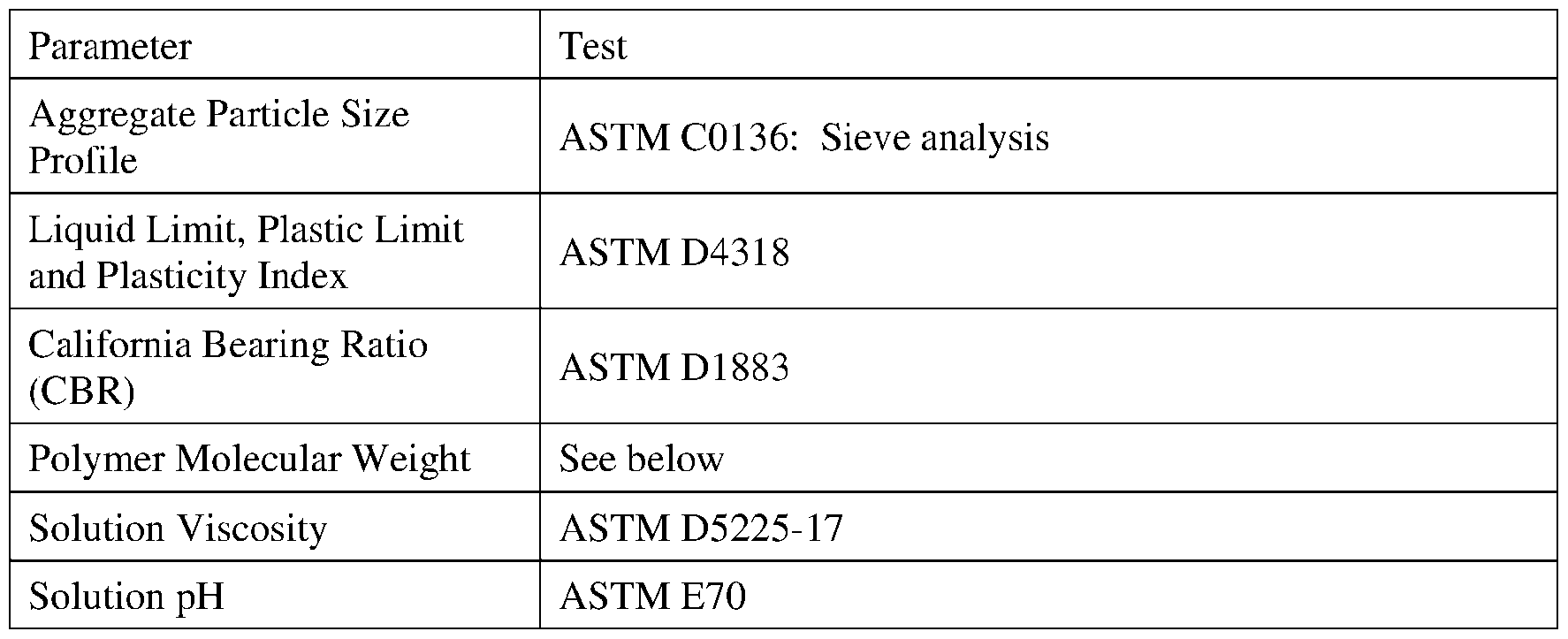
- a standard test to measure the bearing capacity of soil is the California Bearing Ratio test (ASTM D1883), which measures the penetration of a piston into a soil sample. The results are reported as a percent of the bearing ability of an idealized sample, so that higher percentage is better.
- Soils in AASHTO categories A- 1, A-2 and A-3 may need only compaction.
- soils in AASHTO categories A-4 to A-7 frequently need chemical stabilization in addition to compaction. It is common to stabilize high-clay soils by adding in cement, but cement is an expensive stabilizer. Depending on the soil and its intended use, the added cement may make up 1 to 10 weight percent of the soil.
- One aspect of the present invention is a process to stabilize a layer of soil that contains high levels of clay, called “high-clay soil”, comprising the steps of
- (i) has a weight average molecular weight (M w ) from 10,000 Da to 500,000 Da;
- a second aspect of the present invention is a compacted soil layer comprising:
- (i) has a weight average molecular weight (M w ) from 10,000 Da to 500,000 Da;
- the polyacrylic acid polymers described above can significantly increase the stability of high-clay soils. We hypothesize, without intending to be bound, that interactions between acid groups on the polyacrylic acid polymer and anionic components in the high-clay soil may contribute to stabilizing the high-clay soil. Further, the polymer may form a coating adhered to the clay particles that protects the clay particles from water.
- the present invention stabilizes a soil that contains high levels of clay, called a “high- clay soil”.
- the high-clay soil contains at least 35 weight percent clay or at least 40 weight percent clay or at least 50 weight percent clay or at least 60 weight percent clay.
- the high-clay soil contains no more than 65 weight percent sand or no more than 60 weight percent sand or no more than 50 weight percent sand or no more than 40 weight percent sand or no more than 30 weight percent sand.
- the high-clay soil meets AASHTO classification A-6 or A-7.
- the high-clay soil meets AASHTO Classification A-6.
- the high-clay soil meets AASHTO Classification A-7.
- the high-clay soil meets USCS Classification SC, CL, CH or OH. In some embodiments, the high-clay soil meets USCS Classification CH or OH.
- the high-clay soil meets the USDA Classification for Clay, Sandy-Clay, Clay Loam, Silty-Clay Loam or Silty Clay. In some embodiments, the high-clay soil meets the USDA Classification for Clay. In some embodiments, the high-clay soil meets the USDA Classification for Silty-Clay Loam or Silty Clay.
- At least 36 weight percent of the high-clay soil particles pass through a 200 mesh screen, or at least 40 weight percent or at least 45 weight percent or at least 50 weight percent or at least 55 weight percent. In some embodiments, no more than 90 weight percent of the high-clay soil particles pass through a 200 mesh screen or no more than 80 weight percent or no more than 70 weight percent.
- the liquid limit of the high-clay soil is at least 20 percent or at least 30 percent or at least 40 percent or at least 50 percent. In some embodiments, the liquid limit of the high-clay soil is at most 80 percent or at most 70 percent or at most 60 precent. In some embodiments, the liquid limit of the high-clay soil is 40 percent to 60 percent.
- the plasticity index of the high-clay soil is at least 11 percent, or at least 15 percent or at least 20 percent or at least 25 percent. In some embodiments, the plasticity index of the high-clay soil is at most 50 percent or at most 40 percent or at most 30 percent.
- the stability of high-clay soil can be rated according to California Bearing Ratio (CBR) test, as measured by ASTM D1883.
- CBR California Bearing Ratio
- the unstabilized high-clay soil has a CBR of no more than 30 percent or no more than 25 percent or no more than 20 percent.
- the unstabilized high-clay soil has a CBR of at least 10 percent or at least 12 percent or at least 14 percent or at least 16 percent.
- the high-clay soil is mixed in a loosened soil layer with an aqueous stabilizer solution that contains a dissolved polyacrylic acid (PAA) polymer.
- PAA polyacrylic acid
- Polyacrylic acid polymers contain repeating units derived from acrylic acid, as shown in Formula 1 : CO 2 H
- PAA polymers used in this invention at least 60 weight percent of the repeating units are derived from acrylic acid.
- the PAA polymer is a homopolymer, in which essentially all repeating units are derived from acrylic acid.
- the PAA polymer is a copolymer in which at least 60 weight percent of repeating units are derived from acrylic acid and up to 40 weight percent of repeating units are derived from a comonomer. In some embodiments, at least 65 weight percent of repeating units in the PAA polymer are derived from acrylic acid, or at least 70 weight percent or at least 75 weight percent or at least 80 weight percent or at least 85 weight percent or at least 88 weight percent or at least 90 weight percent. In some embodiments, up to 100 weight percent of repeating units in the PAA polymer are derived from acrylic acid, or at most 99 weight percent or at most 95 weight percent or at most 92 weight percent or at most 90 weight percent.
- At least 1 weight percent of repeating units in the PAA polymer are derived from comonomers, or at least 5 weight percent or at least 8 weight percent or at least 10 weight percent. In some embodiments, up to 35 weight percent of repeating units in the PAA polymer are derived from comonomers, or up to 30 weight percent or up to 25 weight percent or up to 20 weight percent or up to 15 weight percent or up to 12 weight percent or up to 10 weight percent.
- Suitable comonomers include unsaturated monomers capable of free-radical polymerization.
- suitable comonomers include methacrylic acid, methyl acrylate, ethyl acrylate, butyl acrylate, methyl methacrylate, ethylene, propylene and styrene.
- the comonomer is ethyl acrylate.
- the PAA polymer contains repeating units derived from 88 to 100 weight percent acrylic acid and 0 to 12 weight percent ethyl acrylate.
- the comonomer and its concentration in the polymer are selected such that the PAA polymer can dissolve in the aqueous stabilizer solution while maintaining useful viscosity under conditions that it is used, which may entail high concentrations of PAA polymer in a low pH solution as described below.
- the PAA polymer has a weight average molecular weight of 10,000 Da to 500,000 Da. In some embodiments, the PAA polymer has a weight average molecular weight of at least 15,000 Da or at least 20,000 Da or at least 30,000 Da or at least 40,000 Da or at least 50,000 Da or at least 60,000 Da or at least 70,000 Da or at least 80,000 Da or at least 90,000 Da. In some embodiments, the PAA polymer has a weight average molecular weight of at most 400,000 Da or at most 300,000 Da or at most 260,000 Da or at most 200.000 Da or at most 150,000 Da.
- At least 50 percent of acid groups in the PAA polymer remain in an acidic state (i.e. the hydrogen has not been neutralized with a base or otherwise replaced with another substituent), or at least 60 percent or at least 70 percent or at least 80 percent or at least 90 percent. In some embodiments, essentially all of acid groups in the PAA polymer (up to 100 percent) remain in an acidic state.
- the PAA polymer is dissolved in water to form an aqueous stabilizer solution.
- the aqueous stabilizer solution contains at least 5 weight percent PAA polymer or at least 10 weight percent PAA polymer or at least 15 weight percent PAA polymer or at least 20 weight percent PAA polymer or at least 22 weight percent PAA polymer or at least 24 weight percent PAA polymer.
- the PAA polymer is acidic, and as a result the aqueous stabilizer solution containing high loadings of PAA polymer may have a low pH.
- the aqueous stabilizer solution has a pH of no more than 4 or no more than 3 or no more than 2.5 or no more than 2.3 or no more than 2.1.
- the aqueous stabilizer solution has a pH of at least 1.5 or at least 1.7 or at least 1.9 or at least 2.
- Some PAA polymers can increase the viscosity of an aqueous stabilizer solution, especially with high polymer content and/or low pH.
- the aqueous stabilizer solution containing stabilizer has a viscosity of no more than 2000 cP or no more than 1000 cP or no more than 800 cP or no more than 600 cP or no more than 400 cP or no more than 300 cP.
- the viscosity of the aqueous stabilizer solution is at least 10 cP or 50 cP or 90 cP.
- PAA polymers and their aqueous solutions are commercially available.
- Other PAA polymers can be made by free-radical polymerization of acrylic acid, optionally with comonomers, according to known processes. See for example, US Patent 2,289,540 and Zahran et al., Poly Acrylic Acid: Synthesis, Aqueous Properties and their Applications as scale Inhibitor, published by KGK Rubberpoint at
- the aqueous stabilizer solution can be mixed with the layer of loose soil using known methods. Methods to mix soil with stabilizers are known, and equipment is commercially available. In some embodiments, the mixing is performed in place; and in some embodiments, the mixing is performed remotely, and the mixture is deposited where needed.
- equipment can simultaneously loosen the soil and apply the aqueous stabilizer solution.
- the soil can be loosed by scarifying (breaking up and turning up) the existing surface using known equipment such as scarifiers, pulverizers and graders with scarifying blades.
- the aqueous stabilizer solution can be added to the loose soil layer by known means, such as spraying or pouring. If necessary, the aqueous stabilizer solution can be further mixed into the loose soil layer using known soilmixing equipment.
- the quantity of aqueous stabilizer solution mixed into the high-clay soil should be high enough to stabilize the layer of loose high-clay soil after compaction.
- the weight ratio of PAA polymer to loose high-clay soil is at least 0.1 weight percent or at least 0.3 weight percent or at least 0.5 weight percent or at least 0.7 weight percent or at least 0.9 weight percent. In some embodiments, the weight ratio of PAA polymer to loose high-clay soil is at most 8 weight percent or 5 weight percent or 4 weight percent or 3 weight percent or 2 weight percent or 1.5 weight percent or 1.2 weight percent.
- organic amines are not a critical part of the stabilizing additives in this invention and are not added to the high-clay soil.
- the aqueous stabilizer solution contains less than 0.05 parts organic amine per 100 parts high-clay soil. In some embodiments, the aqueous stabilizer solution contains no more than 0.045 parts organic amine per 100 parts high-clay soil, or no more than 0.040 parts organic amine per 100 parts high-clay soil, or no more than 0.03 parts organic amine per 100 parts high-clay soil, or no more than 0.02 parts organic amine per 100 parts high-clay soil, or no more than 0.01 parts organic amine per 100 parts high-clay soil. In some embodiments, the aqueous stabilizer solution contains essentially no organic amine (0 parts organic amine per 100 parts high-clay soil).
- other stabilizing additives may also be added to the high-clay soil to further stabilize it, if the other additives do not interfere with the PAA polymer. Examples of other stabilizing additives are discussed in the background.
- large quantities of cement stabilizers are not added to the high- clay soil.
- the quantity of cement added to the high-clay soil is from 0 weight percent to no more than 2 weight percent or no more than 1 weight percent or no more than 0.9 weight percent or no more than 0.8 weight percent or no more than 0.7 weight percent or no more than 0.5 weight percent or no more than 0.3 weight percent or no more than 0.1 weight percent.
- the mixing step creates a loosened soil layer mixed with an aqueous stabilizer solution.
- the layer of loose high-clay soil is at least 5 cm deep or at least 10 cm or at least 12 cm or at least 15 cm or at least 18 cm or at least 20 cm. In some embodiments, the layer of loose high-clay soil is at most 100 cm deep or at most 80 cm or at most 60 cm or at most 50 cm or at most 40 cm or at most 30 cm or at most 25 cm or at most 20 cm.
- the loose soil layer is spread, graded and/or leveled to create the desired shape and grade after the aqueous stabilizer solution is mixed in and before the soil is compacted. This can be accomplished with known plows, dozers and graders.
- the soil is compacted.
- Compaction can be accomplished by known means, such as with rollers, rammers or vibratory compactors. In some embodiments, the compaction is accomplished using a roller.
- the desired level of compaction may vary depending on the intended use of the site. In some applications, a compaction of at least 80 to 85 percent of maximum dry density is desirable. In some applications, a compaction of at least 90 or 95 percent maximum dry density is desirable.
- the process creates a stabilized layer of high-clay soil that contains the PAA polymer and optionally other additives in the quantities previously described.
- the description and concentration of PAA polymer are as previously described.
- the stabilized layer of high-clay soil contains less than 0.05 parts organic amine per 100 parts high-clay soil, as previously described.
- the stabilized layer of high-clay soil has a CBR of at least 20 percent or at least 25 percent or at least 30 percent or at least 35 percent or at least 40 percent or at least 45 percent.
- the CBR of soil stabilized using this invention is at least 1.5 times the CBR of the unstabilized soil, or at least 2.0 times the CBR of the unstabilized soil or at least 2.5 times the CBR of the unstabilized soil or at least 3 times the CBR of the unstabilized soil, when measured according to the Test Methods. There is no maximum desirable improvement in CBR, but it may be unnecessary to seek CBR improvement more than 5 times the CBR of the unstabilized soil. Test Methods
- Polymer Molecular Weight Molecular weight (Mw) is measured using gel permeation chromatography (GPC), also known as size exclusion chromatography (SEC). This technique utilizes an instrament containing columns packed with porous beads, an elution solvent, and detector in order to separate polymer molecules of different sizes. Measurement of molecular weight by SEC is well known in the art and is discussed in more detail in, for example, Slade, P. E. Ed., Polymer Molecular Weights Part II, Marcel Dekker, Inc., NY, (1975) 287-368;
- a 5-liter 4 neck round bottom glass reactor is equipped with C-shaped stirring shaft, condenser, thermocouple, adapter for nitrogen, and feed ports for monomer and catalyst feeds.
- the reactor is charged with 1768 g of deionized water (DI) and blanketed with nitrogen.
- DI deionized water
- the reactor is heated to 90°C and maintained at 90°C +/- 2°C during the reaction.
- An initial catalyst feed consisting of 5.7 g of ammonium persulfate (APS) dissolved in 46 g of DI is added to the reactor.
- a 986 g quantity of monomer shown in Table 1 is fed to the reactor at a rate of 657 grams per hour.
- a catalyst cofeed consisting of 8.2 g of APS dissolved in 277 g of DI is fed to the reactor at a rate of 190 grams per hour.
- a dilution feed of 196 g of DI is also fed to the reactor during the monomer feeds.
- the dilution water is fed at 130 grams per hour.
- the product is an aqueous polyacrylic acid solution that contains 25.4 percent solids, has a pH of 2.1, has a viscosity of 128 cps (Brookfield #2 at 30 rpm), and has a polymer weight average molecular weight (M w ) of 99732 Da.
- the solution is labelled Inventive Stabilizer 1 (IS 1).
- AA acrylic acid.
- EA ethyl acrylate.
- MAA methacrylic acid.
- the stabilizer solutions in Table 2 are mixed with loose samples of soil in an amount such that the ratio of soil to stabilizer meets the ratio shown in Table 3.
- Two compacted soil samples are made from each mixed soil, using the methods described in ASTM D698-12: Standard Test Methods for Laboratory Compaction Characteristics of Soil Using Standard Effort.
Landscapes
- Chemical & Material Sciences (AREA)
- Life Sciences & Earth Sciences (AREA)
- General Life Sciences & Earth Sciences (AREA)
- Soil Sciences (AREA)
- Engineering & Computer Science (AREA)
- Materials Engineering (AREA)
- Organic Chemistry (AREA)
- Soil Conditioners And Soil-Stabilizing Materials (AREA)
Abstract
Description




Claims
Priority Applications (2)
| Application Number | Priority Date | Filing Date | Title |
|---|---|---|---|
| CN202480032615.4A CN121127561A (en) | 2023-06-12 | 2024-06-05 | Methods of stabilizing soil |
| MX2025014570A MX2025014570A (en) | 2023-06-12 | 2025-12-04 | Process to stabilize soil |
Applications Claiming Priority (2)
| Application Number | Priority Date | Filing Date | Title |
|---|---|---|---|
| US202363507559P | 2023-06-12 | 2023-06-12 | |
| US63/507,559 | 2023-06-12 |
Publications (1)
| Publication Number | Publication Date |
|---|---|
| WO2024258701A1 true WO2024258701A1 (en) | 2024-12-19 |
Family
ID=91758810
Family Applications (1)
| Application Number | Title | Priority Date | Filing Date |
|---|---|---|---|
| PCT/US2024/032523 Ceased WO2024258701A1 (en) | 2023-06-12 | 2024-06-05 | Process to stabilize soil |
Country Status (3)
| Country | Link |
|---|---|
| CN (1) | CN121127561A (en) |
| MX (1) | MX2025014570A (en) |
| WO (1) | WO2024258701A1 (en) |
Citations (5)
| Publication number | Priority date | Publication date | Assignee | Title |
|---|---|---|---|---|
| US2289540A (en) | 1939-04-18 | 1942-07-14 | Du Pont | Polymerization of water soluble polymers |
| US4540753A (en) | 1983-06-15 | 1985-09-10 | Exxon Research & Engineering Co. | Narrow MWD alpha-olefin copolymers |
| CN1393502A (en) * | 2001-07-02 | 2003-01-29 | 张振慧 | Soil stabilizer for road bed and its application technique |
| WO2013049894A1 (en) * | 2011-10-06 | 2013-04-11 | Pmb Technologies Pty Ltd | Surface stabiliser and uses thereof |
| US9670345B2 (en) | 2013-10-18 | 2017-06-06 | Dow Global Technologies Llc | Optical fiber cable components |
-
2024
- 2024-06-05 WO PCT/US2024/032523 patent/WO2024258701A1/en not_active Ceased
- 2024-06-05 CN CN202480032615.4A patent/CN121127561A/en active Pending
-
2025
- 2025-12-04 MX MX2025014570A patent/MX2025014570A/en unknown
Patent Citations (5)
| Publication number | Priority date | Publication date | Assignee | Title |
|---|---|---|---|---|
| US2289540A (en) | 1939-04-18 | 1942-07-14 | Du Pont | Polymerization of water soluble polymers |
| US4540753A (en) | 1983-06-15 | 1985-09-10 | Exxon Research & Engineering Co. | Narrow MWD alpha-olefin copolymers |
| CN1393502A (en) * | 2001-07-02 | 2003-01-29 | 张振慧 | Soil stabilizer for road bed and its application technique |
| WO2013049894A1 (en) * | 2011-10-06 | 2013-04-11 | Pmb Technologies Pty Ltd | Surface stabiliser and uses thereof |
| US9670345B2 (en) | 2013-10-18 | 2017-06-06 | Dow Global Technologies Llc | Optical fiber cable components |
Non-Patent Citations (8)
| Title |
|---|
| "Geotechnical Manual", 2017, WISCONSIN (USA) DEPARTMENT OF TRANSPORTATION, article "Soil Classification Systems" |
| FIROOZI ET AL.: "Fundamentals of Soil Stabilization", GEO-ENGINEERING, vol. 8, 2017, pages 26, Retrieved from the Internet <URL:https://doi.org/10.1186/s40703-017-0064-9> |
| GHASEMZADEH HASAN ET AL: "Compressive Strength of Acrylic Polymer-Stabilized Kaolinite Clay Modified with Different Additives", ACS OMEGA, vol. 7, no. 23, 2 June 2022 (2022-06-02), US, pages 19204 - 19215, XP093203570, ISSN: 2470-1343, DOI: 10.1021/acsomega.2c00236 * |
| KHAN ET AL.: "Di erent Soil Stabilization Techniques", INT'1 J. ADV. SCI. & TECH., vol. 29, no. 9, 2020, pages 7778 - 7791 |
| RODRIGUEZ, F.: "Principles of Polymer Systems", 1989, HEMISPHERE PUB. CORP., pages: 155 - 160 |
| T. SUN ET AL., MACROMOLECULES, vol. 34, 2001, pages 6812 - 6820 |
| VERSTRATE ET AL., MACROMOLECULES, vol. 21, 1988, pages 3360 |
| ZAHRAN ET AL.: "Poly Acrylic Acid: Synthesis, Aqueous Properties and their Applications as scale Inhibitor", 1975, MARCEL DEKKER, INC., pages: 287 - 368 |
Also Published As
| Publication number | Publication date |
|---|---|
| MX2025014570A (en) | 2026-01-07 |
| CN121127561A (en) | 2025-12-12 |
Similar Documents
| Publication | Publication Date | Title |
|---|---|---|
| Fielding et al. | RAFT dispersion polymerization in non-polar solvents: facile production of block copolymer spheres, worms and vesicles in n-alkanes | |
| US10266617B2 (en) | Cationic copolymer and use thereof in lost circulation additive | |
| Ghasemzadeh et al. | Laboratory analyses of Kaolinite stabilized by vinyl polymers with different monomer types | |
| Zhang et al. | Effects of comb-shaped superplasticizers with different charge characteristics on the microstructure and properties of fresh cement pastes | |
| US20060128838A1 (en) | Process for the stabilization of dusting surfaces | |
| Wright et al. | Tuning the aggregation behavior of pH-responsive micelles by copolymerization | |
| CN112409611A (en) | Mussel biomimetic gel composition, self-healing gel and plugging agent and preparation method and application thereof | |
| WO2006002936A1 (en) | Water-soluble copolymers containing sulfo groups, method for the production and use thereof | |
| Bai et al. | High stability polymer gel for lost circulation control when drilling in fractured oil and gas formations | |
| DE60217000T2 (en) | An aqueous coating composition comprising vinylamine polymers | |
| Ji et al. | Both-branch amphiphilic polymer oil displacing system: Molecular weight, surfactant interactions and enhanced oil recovery performance | |
| CN106565921A (en) | Nanometer polycarboxylic acid water reducer and preparation method thereof | |
| Li et al. | Improving soil resilience to drought climate by an eco-friendly approach | |
| Rezaeimalek et al. | Performance evaluation for polymer-stabilized soils | |
| EP2770034B1 (en) | Polymeric composition for soil stabilization and for controlling dust and embankment erosion | |
| WO2024258701A1 (en) | Process to stabilize soil | |
| Meng et al. | Synthesis and sand-fixing properties of cationic poly (vinyl acetate-butyl acrylate-2-hydroxyethyl acrylate-DMC) copolymer emulsions | |
| CN104876466A (en) | Asphalt concrete modifier, preparation method thereof, and modified asphalt concrete | |
| JP7318902B2 (en) | Excavation Additives and Mud Pressure Shield Construction Method | |
| CN106496406B (en) | A kind of polymer and its preparation method and application of tool surface active function | |
| Mpekris et al. | Mechanical properties of structurally-defined magnetoactive polymer (co) networks | |
| Yue et al. | Experimental study on crack development of subgrade soil under rainfall and polymer material repair | |
| JP2020001962A (en) | Polymer cement composition, hardened matter, and concrete structure | |
| Cheng et al. | Study on engineering properties of xanthan gum reinforced kaolinite | |
| RU2382138C1 (en) | Composition for development of antifiltration screen in low-temperature soils and rocks and method for production of this composition |
Legal Events
| Date | Code | Title | Description |
|---|---|---|---|
| 121 | Ep: the epo has been informed by wipo that ep was designated in this application |
Ref document number: 24737586 Country of ref document: EP Kind code of ref document: A1 |
|
| REG | Reference to national code |
Ref country code: BR Ref legal event code: B01A Ref document number: 112025025471 Country of ref document: BR |
|
| WWE | Wipo information: entry into national phase |
Ref document number: 202517121916 Country of ref document: IN Ref document number: MX/A/2025/014570 Country of ref document: MX |
|
| WWP | Wipo information: published in national office |
Ref document number: 202517121916 Country of ref document: IN |
|
| WWP | Wipo information: published in national office |
Ref document number: MX/A/2025/014570 Country of ref document: MX |
|
| NENP | Non-entry into the national phase |
Ref country code: DE |