WO2024258974A1 - Ligands and complexes and uses thereof - Google Patents
Ligands and complexes and uses thereof Download PDFInfo
- Publication number
- WO2024258974A1 WO2024258974A1 PCT/US2024/033623 US2024033623W WO2024258974A1 WO 2024258974 A1 WO2024258974 A1 WO 2024258974A1 US 2024033623 W US2024033623 W US 2024033623W WO 2024258974 A1 WO2024258974 A1 WO 2024258974A1
- Authority
- WO
- WIPO (PCT)
- Prior art keywords
- salt
- rare earth
- earth metal
- ligand
- hopo
- Prior art date
- Legal status (The legal status is an assumption and is not a legal conclusion. Google has not performed a legal analysis and makes no representation as to the accuracy of the status listed.)
- Ceased
Links
Classifications
-
- C—CHEMISTRY; METALLURGY
- C07—ORGANIC CHEMISTRY
- C07D—HETEROCYCLIC COMPOUNDS
- C07D401/00—Heterocyclic compounds containing two or more hetero rings, having nitrogen atoms as the only ring hetero atoms, at least one ring being a six-membered ring with only one nitrogen atom
- C07D401/14—Heterocyclic compounds containing two or more hetero rings, having nitrogen atoms as the only ring hetero atoms, at least one ring being a six-membered ring with only one nitrogen atom containing three or more hetero rings
-
- C—CHEMISTRY; METALLURGY
- C02—TREATMENT OF WATER, WASTE WATER, SEWAGE, OR SLUDGE
- C02F—TREATMENT OF WATER, WASTE WATER, SEWAGE, OR SLUDGE
- C02F1/00—Treatment of water, waste water, or sewage
- C02F1/68—Treatment of water, waste water, or sewage by addition of specified substances, e.g. trace elements, for ameliorating potable water
- C02F1/683—Treatment of water, waste water, or sewage by addition of specified substances, e.g. trace elements, for ameliorating potable water by addition of complex-forming compounds
-
- A—HUMAN NECESSITIES
- A61—MEDICAL OR VETERINARY SCIENCE; HYGIENE
- A61P—SPECIFIC THERAPEUTIC ACTIVITY OF CHEMICAL COMPOUNDS OR MEDICINAL PREPARATIONS
- A61P7/00—Drugs for disorders of the blood or the extracellular fluid
-
- C—CHEMISTRY; METALLURGY
- C02—TREATMENT OF WATER, WASTE WATER, SEWAGE, OR SLUDGE
- C02F—TREATMENT OF WATER, WASTE WATER, SEWAGE, OR SLUDGE
- C02F2101/00—Nature of the contaminant
- C02F2101/10—Inorganic compounds
- C02F2101/105—Phosphorus compounds
-
- C—CHEMISTRY; METALLURGY
- C02—TREATMENT OF WATER, WASTE WATER, SEWAGE, OR SLUDGE
- C02F—TREATMENT OF WATER, WASTE WATER, SEWAGE, OR SLUDGE
- C02F2305/00—Use of specific compounds during water treatment
- C02F2305/08—Nanoparticles or nanotubes
Definitions
- Hyperphosphatemia is a condition whereby phosphate concentration in the blood reaches levels above 1.46 mmol/L. It appears primarily in patients with chronic kidney diseases (CKD) and those undergoing dialysis because the latter is inefficient at removing phosphate from the blood (Desoi, C. A.; et al., J. Am. Soc. Nephrol. 1993, 1214-1218). If left untreated, the condition leads to vascular calcification, up to 200 mg/week, and thus, in the long term, increased morbidity and mortality (Cupisti, A.; et al., Int. J. Nephrol. Renovasc. Dis. 2013, 193-205).
- Hyperphosphatemia is currently managed by phosphate binders, oral salts such as CaCCh or La2(CO3)2, or polymers such as Sevelamer®, that bind phosphate in the blood (G. London.; et al. Clin. Nephrol. 2010, 74, 423-432; Zhang, C.; et al., BMC Nephrol. 2013, 14, 226; Steven Fishbane; Am. J. of Kidney Dis. 2009, 55, 307-315). Beyond significant side effects and poor patient compliance due to the high pill burden, phosphate binders have limited success rates. For instance, in one study only 17% of patients taking La2(CO3)3 achieved target blood phosphate levels (Bhargava, R.; et al., BMC Nephrol. 2019, 20, 37).
- Affinity for phosphate can then be fine-tuned without affecting selectivity by either changing the lanthanide ion (Wilharm, R. K.; et al., Inorg. Chem. 2021, 60, 15808-15817) or the charge of the complex (Huang, S.-Y.; et al., Inorg. Chem. 2019, 58, 16087-16099).
- ligands and metal complexes e.g., rare earth metal complexes such as Eu 111 complexes
- Such ligands and metal complexes may be more stable (e.g., less leaching of metal) and/or may be useful for detecting ions (e.g., anions such as phosphate), for capturing and/or removing ions (e.g., anions such as phosphate) from aqueous solutions or mixtures (e.g., aqueous mixtures, blood, serum, waste water), and/or for treating hyperphosphatemia.
- ions e.g., anions such as phosphate
- aqueous solutions or mixtures e.g., aqueous mixtures, blood, serum, waste water
- One embodiment provides a ligand of formula I or a salt thereof, or a rare earth metal complex of the ligand of formula I or a salt thereof or hydrate thereof,
- X is -(CH 2 ) 2 -, -(CH 2 ) 3 -, -(CH 2 ) P N(CH 2 ) q -
- Y 1 is -(CH 2 )-, or -(CH 2 ) 2 -;
- Y 2 is -(CH 2 )-, or -(CH 2 ) 2 -; wherein Y 1 is -(CH 2 ) 2 - when X is -(CH 2 ) 2 - and Y 2 is -(CH 2 )-; p is 2 or 3; q is 2 or 3; and wherein the compound of formula I is optionally substituted with one or more (e.g., 1, 2, or 3) linking groups.
- One embodiment provides a material or device comprising one or more ligands or a salt thereof, or one or more metal complexes or a salt thereof or a hydrate thereof, as described herein.
- One embodiment provides a method to detect or capture inorganic phosphate, comprising contacting the phosphate with a ligand or salt thereof, or a metal complex or a salt thereof or a hydrate thereof, or a material or device as described herein.
- One embodiment provides a method to treat hyperphosphatemia in a mammal in need thereof comprising contacting the blood of the mammal in need thereof, with a ligand or salt thereof, or a metal complex or a salt thereof or a hydrate thereof, or a material or device as described herein.
- One embodiment provides the use of a ligand or salt thereof, or a rare earth metal complex or a salt thereof, or a material or device as described herein for the treatment of hyperphosphatemia in a mammal in need thereof.
- One embodiment provides the use of a ligand or salt thereof, or a rare earth metal complex or a salt thereof, or a material or device as described herein for medical therapy.
- One embodiment provides the use of a ligand or salt thereof, or a rare earth metal complex or a salt thereof as described herein to prepare a device or material for the treatment of hyperphosphatemia.
- One embodiment provides processes and intermediates disclosed herein that are useful for preparing a ligand of formula I or a salt thereof, or a metal complex of (e.g., a rare earth metal complex) of a ligand of formula I or a salt thereof.
- a metal complex of e.g., a rare earth metal complex
- Figure 1 shows the chemical structures structure of the linear phosphate receptors Eu 111 - 3,3-Ser-HOPO (1), Eu ni -3,3-Gly-HOPO (2), and Eu ni -2,2-Li-HOPO (3) as well as the macrocyclic Eu ni -TACN-HOPO (4), Eu ni -TACD-HOPO (5), Eu ni -cyclen-HOPO (6), and Eu 111 - cyclam-HOPO (7).
- Figure 2 shows the time-delayed luminescence intensity of Eu ni -L-HOPO upon titration with HPO 4 2 7H 2 PO 4 -.
- the binding isotherms (solid lines) were fitted to a 1 : 1 stoichiomery for Eu ni -TACN-HOPO (4) or a 1 :2 stoichiometry for Eu ni -cyclen-HOPO (6) and Eu ni -cyclam-HOPO (7) based on the results from the luminescence lifetimes studies.
- Figures 3 A-3C show the selectivity of macrocylic compounds.
- Figure 3 A shows Eu 111 - cyclen-HOPO
- Figure 3B shows Eu ni -cyclam-HOPO
- Figure 3C shows Eu ni -TACN-HOPO for competing anions in water.
- White bars represent the time-delayed relative luminescence intensity after addition of 10 equiv of the appropriate anions (NaF, NaCl, NaBr, Nal, K2SO4, NaHCCE, KNO3, Na2AsO 4 , Na 4 P2O?, NaC2HsO2, NasCeHsCE, and NaCsHsCE).
- Dark grey bars represent the time-delayed relative luminescence intensity after subsequent addition of 10 eq. of phosphate.
- I integrated luminescence intensity from 550 to 750 nm
- Io integrated luminescence intensity in absence of [HPO 4 2 /H2PO 4 ].
- Figure 4 shows intensity time traces of ligand exchange of Eu ni -L-HOPO complexes with DTPA (diethylene triamine peracetic acid).
- I integrated luminescence intensity from 550 to 750 nm in the presence of 5 equivalents of DTPA
- Io integrated luminescence intensity in absence of DTPA.
- Ligand exchange with Eu ni -Ser-HOPO (1) and Eu ni -TACN-HOPO (4) follows first order kinetics, whereas ligand exchange with Eu ni -cyclam-HOPO (7) follows second order kinetics.
- Ligand exchange with Eu ni -cyclen-HOPO (6) does not fit either first or second order kinetics suggesting a more complex mechanism of ligand exchange.
- Figures 5A-5C show excitation (black (left side)) and emission (grey (right side)) profiles of Eu ni -L-HOPO.
- Figure 5 A shows Eu ni -cyclen-HOPO.
- Figure 5B shows Eu ni -cyclam-HOPO, and
- Figure 5C shows Eu ni -TACN-HOPO.
- Figure 6 shows time-delayed luminescence host-guest titration data of Eu ni -cyclen-HOPO to phosphate. Intensity was closely monitored between two samples of identical concentration; the non-aggregated sample having been left to equilibrate at 60°C overnight and sonicated prior to measurement.
- Figures 8A-8C show time-dependent luminescence response of Eu ni -L-HOPO to phosphate.
- Figure 8A shows Eu ni -cyclen-HOPO;
- Figure 8B shows Eu ni -cyclam-HOPO;
- Figure 8C shows Eu ni -TACN-HOPO.
- I integrated luminescence intensity from 550-750 nm in the prescence of 10 eq. of phosphate
- Io integrated luminescence intensity in the absence of phosphate.
- Figures 9A-9C show gradients of Eu 111 complexes and coumarin utilized to determine relative quantum yield. Intensity of coumarin was integrated from 335-590 nm. Intensity of Eu 111 - L-HOPO was integrated from a varying range to avoid Rayleigh scattering from the excitation wavelength.
- Figure 9A shows Eu ni -cyclen-HOPO (515-640 nm, 693-750 nm)
- Figure 9B shows Eu ni -cyclam-HOPO (515-635 nm, 685-750 nm)
- Figure 9C shows Eu ni -TACN-HOPO (515- 645 nm, 705-750 nm).
- Figure 11 shows the time-dependent luminescence competition titration data of Eu 111 - cyclen-HOPO to DTPA approaching thermodynamic equilibrium KL in presence of 0.01 M HEPES.
- I integrated luminescence intensity from 550-750 nm in the prescence of 10 eq. of phosphate
- Io integrated luminescence intensity in the absence of phosphate
- leq the integrated luminescence intensity once thermodynamic equilibrium is reached.
- Plotted nonlinear fittings demonstrate the data fit to the respective decay kinetics.
- Figure 12 shows the time-delayed luminescence competition titration data of Eu ni -L- HOPO to DTPA approaching thermodynamic equilibrium KL unadjusted for leq: integrated luminescence intensity at equilibrium.
- I integrated luminescence intensity from 550-750 nm in the prescence of 10 eq. of phosphate
- Io integrated luminescence intensity in the absence of phosphate.
- Figures 13A-13D show the time-dependent luminescence competition titration data of Eu ni -L-HOPO to DTPA approaching thermodynamic equilibrium KL.
- Figure 13 A shows Eu 111 - Ser-HOPO
- Figure 13B shows Eu ni -TACN-HOPO
- Figure 13C shows Eu ni -cyclen-HOPO
- Figure 13D shows Eu ni -cyclam-HOPO.
- I integrated luminescence intensity from 550-750 nm in the prescence of 10 eq. of phosphate
- Io integrated luminescence intensity in the absence of phosphate.
- leq the integrated luminescence intensity once thermodynamic equilibrium is reached.
- the plotted nonlinear fittings demonstrate the data fit to the respective decay kinetics.
- Figure 14 shows the time-delayed luminescence competition titration data of Eu ni -L- HOPO to DTPA.
- I integrated luminescence intensity from 550 nm to 750 nm in the presence of 1-15 eq.
- DTPA integrated luminescence intensity in the absence of DTPA.
- the 0-0.8 Flo range is intensified for clarity.
- halo or halogen is fluoro, chloro, bromo, or iodo.
- Alkyl and alkoxy, etc. denote both straight and branched groups but reference to an individual radical such as propyl embraces only the straight chain radical (a branched chain isomer such as isopropyl being specifically referred to).
- linker refers to any molecular moiety that connects the ligand of formula I (or a complex thereof) to another entity such as a material or device.
- linker also includes linkers which include within the linker a reactive group that is useful to connect the ligand of formula I (or a complex thereof) to another entity such as a material or device (e.g., linkers that include reactive groups wherein the reactive group is useful for covalently binding to the material or device).
- materials include polymers (e.g., a synthetic or natural polymer), hydrogels, membranes, nanoparticles, or other materials (e.g., solid material). Materials also include conducting polymers and conducting materials (e.g., metal or carbon materials).
- a device can be any device (e.g., electronic device, solid device) that the metal complex can be attached (e.g., attached through a linker).
- the linker can be variable, provided it functions to connect the ligand of formula I to another molecular entity, so that both the ligand of formula I (or a complex thereof) and the other molecular entity can function as described herein.
- the linker can be covalently bonded to the ligand of formula I at any suitable atom such as a carbon or nitrogen atom.
- the linker can vary in length and atom composition (e.g., C, H, N, O, S, halo, P) and for example can be branched or non-branched or saturated or unsaturated or a combination thereof.
- the linker connects the ligand of formula I (or a complex thereof) to another entity such as a material or device (e.g., through covalent bonds).
- the linker includes one or more reactive groups.
- the reactive group is useful for covalently bonding the remainder of the linker to a material or device. Examples of reactive groups include amines, alcohols, thiols, amides, esters, carboxylic acids, aldehydes and epoxides.
- polymer includes any polymer suitable for linking to the metal complex described herein (e.g., synthetic or natural polymer).
- examples include polyamides (including star polyamides), polyethyleneglycol, polyethylenemine, polysulfone, polyethersulfone, and conducting polymers (e.g., conducting polymers for electronic devices).
- hydrogel includes any hydrogel suitable for linking to the metal complex described herein. Examples include crosslinked poly(N-isopropylacrylamide), crosslinked polyvinyl alcohol, PMA (polymethacrylate), PMMA (polymethylmethacrylate), PEMA (polyethylmethacrylate), and chitosan.
- membrane includes any membrane suitable for linking to the metal complex described herein.
- nanoparticle includes any nanoparticle suitable for linking to the metal complex described herein (e.g., metal-based, silica-based). Examples include gold nanoparticles, iron oxide nanoparticles, and silica nanoparticles.
- material includes any material suitable for linking to the metal complex (e.g., a solid material). Examples include carbon, porous carbon, gold, carbon nanotubes, CuO nanowires, and WO3 nanowires.
- One embodiment provides a rare earth metal complex of claim or a salt thereof or a hydrate thereof, wherein the rare earth metal complex is a complex of formula II or salt thereof or hydrate thereof:
- rare earth metal is M 111 .
- One embodiment provides a rare earth metal complex or a salt thereof of claim 1, wherein the rare earth metal complex is a Eu 111 complex of formula Ila: or salt thereof.
- X is -(CH 2 ) 2 -, -(CH 2 ) 3 -, -(CH 2 ) 2 N(CH 2 ) 2 -, or -(CH 2 ) 3 N(CH 2 ) 2 -.
- Y 1 is -(CH 2 )-.
- Y 1 is -(CH 2 ) 2 -.
- Y 2 is -(CH 2 )-.
- Y 2 is -(CH 2 ) 2 -.
- another six corresponding embodiments provide P in addition to -O-, -S, -N(R a )- so that one or more of the carbon atoms is optionally replaced independently by -O-, -S, -N(R a )-, and P.
- the linker is a branched or unbranched, saturated or unsaturated, hydrocarbon chain, having from 1 to 6 carbon atoms wherein one or more of the carbon atoms is optionally replaced by a N(R a )-, wherein the R a is H or (Ci-Ce)alkyl.
- the linker is -(C2-Ce)alkylNH2 or -(C2-Ce)alkylNH.
- One embodiment provides a ligand or salt thereof that is or a salt thereof.
- One embodiment provides a metal complex or a salt thereof that is metal complex is a complex of formula II or salt thereof: wherein the M is a metal (e.g., a rare earth metal).
- M 111 is a metal (e.g., a rare earth metal).
- M is a metal (e.g., a rare earth metal, or a metal “M 111 ” or a rare earth metal M 111 ).
- a metal e.g., a rare earth metal, or a metal “M 111 ” or a rare earth metal M 111 ).
- One embodiment provides a metal complex or a salt thereof that is or a salt thereof.
- R is H or OH.
- M is a rare earth metal and R is H or OH.
- the rare earth metal is lanthanum(La), cerium(Ce), praseodymium(Pr), neodymium(Nd), samarium(Sm), europium(Eu), gadolinium(Gd), terbium(Tb), dysprosium(Dy), holmium(Ho), erbium(Er), thulium(Tm), ytterbium(Yb), lutetium(Lu), scandium(Sc), yttrium(Y) or promethium (Pm).
- the rare earth metal is La 111 , Ce 111 , Pr 111 , Nd 111 , Sm 111 , Eu 111 , Gd 111 , Tb 111 ,
- Dy 111 Ho 111 , Er 111 , Tm 111 , Yb 111 , Lu 111 , Sc 111 , Y 111 or Pm 111 .
- the rare earth metal is Eu 111 .
- the metal complex is a metal complex or hydrate thereof.
- One embodiment provides a material or device comprising one or more ligands or a salt thereof, or one or more complexes or a salt thereof, as described herein.
- the material or device is a hydrogel, membrane, nanoparticle, or other material.
- One embodiment provides a method to detect or capture inorganic phosphate, comprising contacting the phosphate with a ligand or salt thereof, or a complex or a salt thereof, or a material or device as described herein.
- the phosphate is selectively detected or captured in the presence of other anions.
- the other anions are selected from the group consisting of carbonate, nitrate, sulfate, halides, arsenate and pyrophosphate.
- the phosphate is contacted with a ligand or salt thereof, or a complex or a salt thereof, or a material or device, as a liquid sample at about neutral pH.
- the liquid sample is sample is an aqueous sample.
- the phosphate is detected with fluorescence sensing by an indicator displacement assay.
- the phosphate is captured.
- the phosphate is captured from an aqueous mixture or solution.
- One embodiment provides a method to treat hyperphosphatemia in a mammal in need thereof comprising contacting the blood of the mammal in need thereof, with a ligand or salt thereof, or a complex or a salt thereof, or a material or device as described in herein.
- the mammal has kidney disease (e.g., chronic kidney disease).
- One embodiment provides a device or material with a ligand or a rare earth metal complex of the ligand as described herein attached thereto.
- One embodiment provides a device or material for sensing, detecting, and/or selectively capturing phosphate from a mixture (e.g., aqueous mixture), water or blood with a ligand or a rare earth metal complex of the ligand as described herein attached thereto.
- a mixture e.g., aqueous mixture
- water or blood with a ligand or a rare earth metal complex of the ligand as described herein attached thereto.
- One embodiment provides a method for sensing, detecting, and/or selectively capturing phosphate from a mixture (e.g., an aqueous mixture), water or blood comprising contacting the device or material as described herein with the mixture (e.g., an aqueous mixture), water or blood, wherein the device or material has a ligand or a rare earth metal complex of the ligand as described herein attached thereto.
- a mixture e.g., an aqueous mixture
- water or blood comprising contacting the device or material as described herein with the mixture (e.g., an aqueous mixture), water or blood, wherein the device or material has a ligand or a rare earth metal complex of the ligand as described herein attached thereto.
- One embodiment provides a device or material comprising one or more ligands or arare earth metal complexes of the ligands as described herein attached thereto.
- One embodiment provides a device or material for sensing, detecting, and/or selectively capturing phosphate from a mixture (e.g., an aqueous mixture), water or blood wherein the device comprises one or more ligands or a rare earth metal complexes of the ligands as described herein.
- a mixture e.g., an aqueous mixture
- the device comprises one or more ligands or a rare earth metal complexes of the ligands as described herein.
- One embodiment provides a method for sensing, detecting, and/or selectively capturing phosphate from a mixture (e.g., aqueous mixture), water or blood comprising contacting the device or material as described herein with the mixture (e.g., an aqueous mixture), water or blood, wherein the device or material comprises one or more ligands or a rare earth metal complexes of the ligands as described herein attached thereto.
- a mixture e.g., aqueous mixture
- the mixture e.g., an aqueous mixture
- the device or material comprises one or more ligands or a rare earth metal complexes of the ligands as described herein attached thereto.
- ligand geometry is one of the predominant parameters governing the affinity of tripodal, tris-HOPO complexes for phosphate. Minor differences in geometry arising from small modifications in the ligand cap causes substantial effect in the affinity of HOPO-based europium(III) complexes for phosphate (Huang, S.-Y.; et al., Inorg. Chem. 2020, 59, 4096-4108). Moreover, even though such changes also affect the coordination number of the europium(III) complex, there is no relationship between its number of inner-sphere water molecules (q) and its affinity for phosphate.
- the two complexes comprising a cyclotriaza ligand cap, Eu ni -TACN-HOPO (4) and Eu 111 - TACD-HOPO (5), were synthesized according to Schemes 1 and 2, respectively.
- all the cyclic secondary amines were TV-alkylated with BOC-protected 2-bromoethylamine to yield the extended caps 8 and 12, respectively.
- Deprotection with trifluoroacetic acid yielded the primary amines that were then coupled with HOPO(Bn)-Su (9) to yield the protected ligands TACN-HOPO-Bn (10) and TACD-HOPO-Bn (13), respectively.
- a Reagents and conditions a) BOC-NH-CJh-CJh-Br, Cs 2 CO 3 , DMF, 80°C, 48 h; b) i: CH2CI2, TFA, 0°C to rt; ii: HOPO(Bn)-OSu (9), CH3CN/H2O (1/1 v), K2CO3, 12 h; c) HCl/AcOH (1/1 v), 48 h; d) EuC13*6H 2 O, MeOH, pyridine, 65°C, 60 h.
- the two complexes comprising a tetraaza ligand cap, Eu ni -cyclen-HOPO (6) and Eu 111 - cyclam-HOPO (7), were synthesized according to Schemes 3 and 4, respectively. Since only three HOPO podands are to be conjugated on a tetraaza ligand cap, the synthesis of the cyclen derivative starts with mono-benzyl protected ligand cap (Massue, J.; et al., Tetrahedron Lett. 2007, 48, 8052-8055). A-alkylation of the unprotected secondary amine with BOC-protected 2- bromoethyl amine yielded the extended cap 16.
- the cyclam derivative follows a similar scheme except that the cyclam cap did not require mono-protection prior to its A-alkylation.
- the cyclam is poorly reactive, so that only three of its four secondary amines could be coupled with BOC-protected 2-bromoethylamine to yield the extended cap 19.
- Deprotection under acidic condition yielded the extended cap that was immediately coupled with HOPO(Bn)-Su (9) moiety to yield the protected ligands cyclam-HOPO-Bn (20).
- Deprotection under acidic conditions yielded the free ligand cyclam-HOPO (21) that was subsequently complexed with EUC1 3 6H 2 O to yield the final complex Eu ni -cyclam-HOPO (7).
- 1,2-Hydroxypyridine is an excellent sensitizer of europium (III). Moreover, both the luminescence intensity and the lifetime of Eu 111 complexes are highly dependent on the number of inner-sphere water molecules. As phosphate or other anions coordinate Eu 111 , they displace the inner-sphere water molecules, resulting in an increase in both the luminescence intensity and the lifetimes of the excited states of the Eu 111 center. Together, these characteristics not only facilitate the study of anion recognition by aqueous Eu 111 complexes of 1,2-HOPO with open coordination sites, but essentially render any such complex a luminescent probe (Martinon, T. L. M.; et al., Chem. Asian J. 2022, 77, e202200495; Thibon, A.; Qi a ⁇ . Anal. BioanaL Chem. 2009, 394, 107- 120).
- the number of inner-sphere water molecule of each receptor in the presence and absence of 10 equivalents of phosphate can be determined from the luminescence lifetime of the complexes in H2O and D2O according to the classical Parker-Horrocks equation (Dickins, R. S.; et al., Chem. Commun. 1996, 697-698; Beeby, A.; et al., J. Chem. Soc., Perkin Trans 2 1999, 493- 504; Supkowski, R. M.; et al., Inorganica Chim.
- Acta 2002, 340, 44-48 are the luminescence lifetimes of the Eu 111 in H2O and D2O, respectively, and x is the number of N-H oscillators in close proximity to the Eu 111 ion.
- the luminescence lifetime in D2O was extrapolated from serial dilution of an aqueous solution by D2O (see Figure 7).
- Eu ni -TACN-HOPO (4) is displaced by water, resulting in the formation of a Eu ni L Pi ternary complex with a 1 : 1 stoichiometry.
- Eu ni -cyclen-HOPO (6) which has only two inner-sphere water molecules, is the only receptor that has high affinity for phosphate such that the anion displaces all its inner-sphere water molecules.
- Displacement of the inner-sphere water molecules by phosphate also increases the luminescence intensity of the Eu 111 complex, a characteristic that enables rapid determination of the affinity of each receptor for the anion.
- the titrations of each Eu 111 complex with phosphate in water at neutral pH and room temperature are shown in Figure 2. Based on kinetic studies, in each case, measurements were performed at least 60 min after addition of the anion so as to ensure that thermodynamic equilibrium is reached.
- the 1 : 1 and 1 :2 equilibria were fitted to equations 5 and 6, respectively, as described by Thordarson (Thordarson, P., Chem. Soc. Rev. 2011, 40, 1305-1323.) where I and Io are the integrated intensity of the receptor in the presence and absence of phosphate, respectively and j and K are the first and second association constants, respectively.
- the resulting derived constants (ao, ai and a?) after simplifying the proportionality constant are determined through fitting, of which ao is equal to the Flo prior to introduction of the guest.
- the stepwise and overall association constants of the three Eu 111 receptors for phosphate are given in Table 2. All three complexes have similar first association constants.
- the tetraaza derivatives 6 and 7 differentiate themselves from the triaza derivative (4) in that they can also coordinate a second phosphate anion.
- the second association constant of Eu ni -cyclen-HOPO (6) for Pi is approximately an order of magnitude higher than that of Eu ni -cyclam-HOPO (7).
- the cyclen derivative 6 has an overall association constant, , for phosphate fifty times higher than the cyclam analog and five order of magnitudes higher than the TACN one. Its high affinity for phosphate makes it a promising receptor for the treatment of hyperphosphatemia.
- the affinity for phosphate of Eu ni -cyclen-HOPO (6) is comparable to that of Eu ni -2,2-Li-HOPO (3), a HOPO- based Eu 111 receptor previously reported, that also binds the anion in a 1 :2 stoichiometry (Huang, S.-Y.; et al., Inorg. Chem. 2020, 59, 4096-4108). Although it is sufficiently high for medical applications, the overall affinity for Pi (P) remains noticeably lower than that of Eu ni -Gly-HOPO (2), which binds phosphate with a 1 :3 stoichiometry (Huang, S.-Y.; et al., Inorg. Chem.
- the receptors also do not have any affinity for bicarbonate, nor does bicarbonate affect coordination to phosphate.
- This selectivity for phosphate over bicarbonate is difficult to achieve for lanthanide-based receptors and probes, but it is crucial for the intended application (Martinon, T. L. M.; et al., Chem. Asian J. 2022, 17, e202200495; Thibon, A.; et aC, Anal. Bioanal. Chem. 2009, 394, 107- 120; Cacheris, W. P.; et al., Magn. Reson. Imaging 1990, 8, 467-481).
- the macrocyclic HOPO receptors were designed to not only bind phosphate, but to have improved kinetic inertness over their linear analogues.
- macrocyclic MRI contrast agents were observed to be less toxic and to transmetallate in vivo with physiological ions to a lesser extent then their linear analogues (Radbruch, A.; et al., Invest Radiol 2019, 54, 531- 536).
- the kinetic inertness of the macrocyclic receptors 1, 4, 6, and the linear analog 7 were determined by monitoring the ligand exchange of the Eu 111 complexes in the presence of a fivefold excess of diethylentriaminepentaaacetate (DTP A) in water at neutral pH by time-gated luminescence spectroscopy (Eq. 8).
- DTP A diethylentriaminepentaaacetate
- DTPA was chosen for these studies since the ligand forms stable lanthanide complexes (thereby making it a strong competitor) and because it is a labile ligand that undergoes transmetallation rapidly.
- 1,2-HOPO is an excellent sensitizer for Eu 111
- DTPA is not.
- the equilibrium can thus be readily monitored via the Eu ni -centered luminescence sensitized at 334 nm.
- the half-life, ti/2, or time required for half of the Eu ni -L-HOPO complexes to transmetallate to DTPA are reported in Table 3. This data corresponds to the time half of the signal have decayed.
- the linear analog, Eu ni -Ser-HOPO (1) was included in the study as a comparison. HEPES was not utilized in these studies, as it was found to affect the rate of transmetellation (Figure 11).
- Eu ni -cyclam-HOPO (7) follows a second order kinetics which can be fitted to equation 10:
- conditional stability constant T C EUL of each europium(III) complex at pH 7.4 can also be measured by direct competition with DTPA. These equilibria were directly monitored by UV-visible spectroscopy using the luminescence spectroscopy using the free and complexed HOPO ligands as references. As depicted in equation 12, because this conditional equilibrium constant essentially reflects the competition between the metal ion and protons for the ligand, Aui. is a function of pH:
- K K 2 ... are the protonation constants of the ligand L (where L is the fully deprotonated ligand) (Caravan, P.; et al., Chem. Rev. 1999, 99, 2293-2352; Caravan, P.; et al., Chem. Rev. 1999, 99, 2293-2352).
- the conditional stability constant of Eu ni -DTPA at pH 7.4 calculated from the published formation constant of Eu ni -DTPA ( TEUDTPA) and the protonation constants of DTPA is given in Table 3.
- conditional stability (A C E U L) of the Eu ni -HOPO complexes can then be calculated from the same spectrophotometric competition data used above and from the conditional stability constant of the completing Eu ni -DTPA, T C EUDTPA, under the specific conditions considered according to equation 13: where [DTPA] f and [L] f are the total (free and metal-bound) concentrations of the competing DTPA and HOPO ligands, respectively.
- T C EUL The conditional stability constant, T C EUL, of complexes 1, 4, 6, and 7 are given in Table 3. All four complexes show similar stability, with Log 77 C EUL ranging between 17.83 and 17.
- Macrocyclic tris-bidentate Eu 111 complexes bearing three 1,2-hydroxypyridinonate have lower solubility in water then their linear analogues such that only three of the four complexes could be evaluated.
- One of these complexes — Eu ni -cyclen-HOPO (6) — is eight coordinate whereas the other two — Eu ni -TACN-HOPO (4) and Eu ni -cyclam-HOPO (7) — are nine coordinate. This difference highlight the closeness in energy of the two coordination geometries.
- all three macrocyclic complexes bind orthophosphate, albeit with different affinities.
- the affinities of the macrocyclic complexes for phosphate is lower than the parent Eu ni -Ser-HOPO (1), they remain sufficient for medical applications of phosphate sequestration.
- all macrocyclics are selective over other competing anions, notably HCCL’ and Cl’, two anions present in higher concentrations in the blood.
- the macrocyclic ligand caps do, however, affect the kinetic lability of the europium(III) complex and the rate at which it exchanges ligand with DTP A, but not to the same extent.
- Luminescence data were acquired on a Varian Cary Eclipse fluorescence spectrophotometer using a quartz cell with a path length of 1 cm and a chamber volume of 500 pL. Time-gated luminescent spectra were recorded with a time delay of 0.1 ms and a gate time of 5 ms. Unless otherwise stated, sample solutions were allowed to equilibrate for 10 min before measurement of their luminescence spectra, as it has been demonstrated that this time was sufficient to achieve thermodynamic equilibrium (Figure 8). Luminescence data were processed with Scilab 6.0.2 and QtiPlot 0.9.8.9 software. All pH measurements were performed using a Thermo Scientific Ag/AgCl refillable probe and a Thermo Orion 3 Benchtop pH meter.
- the benzyl-protected HOPO hydroxysuccinimide activated analogue 9 were synthesized according published procedures with successful synthesis established by 1 H NMR, 13 C NMR and ESI-MS (Guerard, F.; et al., Dalton Trans. 2017, 46, 4749-4758).
- the linear receptor Eu ni -Ser- HOPO (1) was previously synthesized according to published procedures with successful synthesis established by 'H NMR, 13 C NMR and ESI-MS (Huang, S.-Y.; et al., Inorg. Chem. 2019, 58, 16087-16099.
- Trifluoroacetic acid (TFA, 5 mL) was added to a stirred solution of the BOC protected ligand cap 8 (500 mg, 0.895 mmol) in CH2Q2 (10 mL) cooled to 0°C.
- the reaction mixture was stirred at room temperature for 4 h, after which excess solvent and acid were removed under reduced pressure.
- the resulting TFA salt was used without further purification.
- This TFA salt was then dissolved in milli-Q water (20 mL).
- a solution of HOPO(Bn)-OSu (9, 1.01 g, 2.95 mmol) in CH3CN (20 mL) was then added to the reaction mixture, followed by K2CO3 (620 mg, 4.47 mmol).
- the reaction mixture was stirred for 12 h at room temperature.
- the homogenous reaction mixture was extracted with ethyl acetate (4 x 40 mL) and the combined organic phases were washed with 10% NaHCCL (2 x 30 mL) and brine (30 mL).
- the organic phase dried over anhydrous MgSO4 (5) and concentrated under reduced pressure.
- the crude product was purified by flash column chromatography over neutral alumina, eluting with 1% methanol/99% CThChto yield 10 as a viscous foaming liquid (650 mg, 77.3%).
- the benzyl-protected TACN-HOPO ligand 10 (100 mg, 0.106 mmol) was dissolved in a 1 : 1 mixture of glacial acetic acid (2.5 mL) and HC1 (2.5 mL). The reaction mixture was stirred at room temperature for 2 days. The volatiles were then removed under reduced pressure. The crude product was further co-evaporated with methanol (3 x 15 mL) and triturated with diethyl ether (2 x 20 mL). The crude product was further purified by Cis-reverse phase column chromatography using 20% acetonitrile/80% CH2Q2 water to afford the TACN-HOPO ligand as a white powder (60 mg, 84%).
- CS2CO3 (2.28 g, 7.00 mmol) was added to a stirred solution of TACD (200 mg, 1.16 mmol) in dry dimethylformamide (10 mL) under N2 (g) atmosphere at room temperature. The resulting mixture was stirred at room temperature for 20 min, after which /c/7-butyl (2- (bromoamino)ethyl)carbamate (825 mg, 3.67 mmol) was added. The resulting reaction mixture was heated at 80°C for 2 days. The reaction mixture was then cooled to room temperature and filtered. The residue was washed with ethylacetate (40 mL), and the combined organic phases were concentrated under reduced pressure.
- Trifluoroacetic acid (TFA, 5 mL) was added to a stirred solution of ethylene-BOC protected ligand cap 12 (200 mg, 0.333 mmol) in CH2CI2 (10 mL) at 0°C. The reaction mixture was stirred at room temperature for 4 h, after which excess solvent and acid were removed under reduced pressure. The resulting TFA salt was used without further purification. This deprotected ligand cap was then dissolved in mQ water (20 mL). A solution of HOPO(Bn)-OSu (9, 376 mg, 1.09 mmol) in CH3CN (20 mL) was then added to the reaction mixture, followed by K2CO3 (230 mg, 1.66 mmol).
- the reaction mixture was stirred for 12 h at room temperature.
- the homogenous reaction mixture extracted with ethyl acetetate (4 x 40 mL).
- the combined organic phases were washed with 10% NaHCCL (2 x 30 mL), brine (30 mL) dried over anhydrous MgSO4 (s), and concentrated under reduced pressure.
- the crude product was purified by flash column chromatography over neutral alumina, eluting with 1% methanol/99% CFhChto yield the protected ligand 13 as a viscous foaming liquid (205 mg, 62.7%).
- the benzyl-protected TACN-HOPO ligand 13 (0.10 g, 0.10 mmol) was dissolved in a 1 : 1 mixture of glacial acetic acid (2.5 mL) and HC1 (2.5 mL). The reaction mixture was stirred at room temperature for 2 days. The solvents were then removed under reduced pressure. The crude product was further co-evaporated with methanol (3 x 15 mL) and further triturated diethyl ether (2 x 20 mL). The crude product was further purified by Cis-reverse phase column chromatography 20% acetonitrile/80% CH2Q2 water to yield the 14 ligand as white powder (60 mg, 84%).
- the TACD-HOPO ligand 14 (50 mg, 0.070 mmol) and EuCh 6H2O (25 mg, 0.070 mmol) were dissolved in methanol (10 mL). Pyridine (113 pL, 1.40 mmol) was subsequently added to the reaction mixture, which was stirred at 65 °C for 5 days. The reaction mixture was cooled to room temperature and the volatiles removed under reduced pressure. The product was further triturated with diethyl ether (3 x 10 mL), dissolved in mQ water (5 mL) and lyophilized to yield the Eu 111 complex 5 as a beige powder (45 mg, 75%).
- ESI-LRMS Calcd for C33H43EUN9O9 [M+H] + : m/z 862.23. Found: m/z 862.24.
- CS2CO3 (3.72 g, 11.4 mmol) was added to a stirred solution of mono(Bn)-cyclen (500 mg, 1.90 mmol) in dry CH3CN (50 mL) under N2 (g) atmosphere at room temperature.
- the reaction mixture was stirred at room temperature for 20 min before the addition of tert-butyl (2- (bromoamino)ethyl)carbamate (1.34 g, 6.00 mmol).
- the resulting reaction mixture was stirred at 80°C for 2 days.
- the reaction mixture was then cooled to room temperature, filtered and the residue washed with ethyl acetate (40 mL).
- the protected ligand 15 (600 mg, 0.867 mmol) was dissolved in anhydrous methanol (30 mL) and the solution was degassed before addition of 10 wt% Pd/C (100 mg). The suspension was further stirred under H2 (g) (4 atm) in a Parr hydrogenator. The reaction mixture was further filtered over celite, and the residue washed with methanol (30 mL). The combined organic phases were concentrated under reduced pressure. The crude material was purified by column chromatography on neutral alumina using 0 to 1.5% CH3OH in CH2CI2 to obtain the desired deprotected 16 as a colorless sticky-solid (450 mg, 86.2%).
- the benzyl-protected cyclen-HOPO ligand 17 (100 mg, 0.0102 mmol) was dissolved in a 1 : 1 mixture of glacial acetic acid (2.5 mL) and HC1 (2.5 mL). The reaction mixture was stirred at room temperature for 2 days. The volatiles were removed under reduced pressure. The crude product was further co-evaporated with methanol (3 x 15 mL) and triturated with diethyl ether (2 x 20 L). The crude product further purified by Cis-revese phase chromatography 20% acetonitrile/80% CH2CI2 water to yield 18 as white powder (62 mg, 86%).
- CS2CO3 (4.87 g, 15.0 mmol) was added to a stirred solution of cyclam (500 mg, 2.49 mmol) in dry CH3CN (50 mL) under N2 (g) atmosphere at room temperature. The resulting suspension was stirred at room temperature for 20 min, after which tert-butyl (2- (bromoamino)ethyl)carbamate (1.76 g, 7.86 mmol) was added. The resulting reaction mixture was heated at 80°C for 2 days. The reaction mixture was then cooled to room temperature, filtered, and the residues washed with ethyl acetate (40 mL). The organic phases were combined and concentrated under reduced pressure.
- the reaction mixture extracted with ethyl acetate (4 x 40 mL). The organic phases were combined, washed with 10% NaHCCL (2 x 30 mL) and brine (30 mL), dried over anhydrous MgSO4 (s), and concentrated under reduced pressure. The crude product was purified by flash column chromatography over neutral alumina, eluting with 1% methanol/99% CH2CI2 to yield the protected ligand 20 as a viscous foaming liquid (450 mg, 62.3%).
- the benzyl-protected cyclam-HOPO ligand 20 (100 mg, 0.0989 mmol) was dissolved in a 1 : 1 mixture of glacial acetic acid (2.5 mL) and HC1 (2.5 mL). The reaction mixture was stirred at room temperature for 2 days. The volatile were removed under reduced pressure. The crude product was further co-evaporated with methanol (3 x 15 mL) and triturated diethyl ether (2 x 20 mL). The crude product was further purified by Cis-revese phase column chromatography using 20% acetonitrile/80% CH2Q2 water to yield the cyclam-HOPO ligand as white powder (65 mg, 89%).
- the cyclam-HOPO ligand 21 (50 mg, 0.067 mmol) and EuCh 6H2O (24 mg, 0.067 mmol) were dissolved in methanol (10 mL). Pyridine (108 pL, 1.35 mmol) was subsequently added to the reaction mixture, which was stirred at 65 °C for 5 days. The reaction mixture was cooled down to room temperature and further evaporated under reduced pressure. The product was further triturated with diethyl ether (3 x 10 mL), dissolved in MQ water (5 mL) and lyophilized to yield the Eu 111 complex as a beige powder (50 mg, 83%). ESI-LRMS. Calcd for C34H46EUN10O9 [M+H] + : m/z 891.26. Found: m/z 891.35.
- Relative quantum yield was measured according to the reported procedure (Wurth, C.; et al., Nat. Protoc. 2013, 8, 1535-1550) using coumarin as a reference (0.32%) (Taniguchi, M.; et al., Photochem. PhotobioL 2018, 94, N3 T).
- DTPA diethyelentriaminepentaacetic acid
- concentrations of free and complexed ligand in each solution were determined from reference solutions of the pure free ligand and Eu 111 complex.
- the log/L were determined as previously published from the reported stability constants for DTPA with Eu 111 ions (Moeller, T.; et al., J. Inorg. Nucl. Chem. 1962, 24, 499-510), the complex’s hydrolysis constants (Brown, P.
Landscapes
- Chemical & Material Sciences (AREA)
- Organic Chemistry (AREA)
- Health & Medical Sciences (AREA)
- Medicinal Chemistry (AREA)
- Life Sciences & Earth Sciences (AREA)
- Hydrology & Water Resources (AREA)
- Engineering & Computer Science (AREA)
- Environmental & Geological Engineering (AREA)
- Water Supply & Treatment (AREA)
Abstract
Disclosed herein are ligands of formula I or salts thereof, and rare earth metal complexes of the ligands of formula I or salts thereof, Also disclosed herein are devices and materials comprising ligands of formula I or salts thereof, or rare earth metal complexes of the ligands of formula I or salts thereof as well as methods of using the ligands, complexes, devices and materials for detecting ions such as phosphate, methods for removing ions such as phosphate from aqueous solutions or mixtures, and methods for treating hyperphosphatemia. Also disclosed herein are additional ligands and metal complexes thereof as well as uses for these ligands and metal complexes.
Description
LIGANDS AND COMPLEXES AND USES THEREOF
CROSS REFERENCE TO RELATED APPLICATION
This application claims priority to United States Provisional Application Number 63/472,542 filed on 12 June 2023, which is incorporated by reference herein.
GOVERNMENT FUNDING
This invention was made with government support under DK124333 awarded by the National Institutes of Health. The government has certain rights in the invention.
BACKGROUND OF THE INVENTION
Hyperphosphatemia is a condition whereby phosphate concentration in the blood reaches levels above 1.46 mmol/L. It appears primarily in patients with chronic kidney diseases (CKD) and those undergoing dialysis because the latter is inefficient at removing phosphate from the blood (Desoi, C. A.; et al., J. Am. Soc. Nephrol. 1993,
 1214-1218). If left untreated, the condition leads to vascular calcification, up to 200 mg/week, and thus, in the long term, increased morbidity and mortality (Cupisti, A.; et al., Int. J. Nephrol. Renovasc. Dis. 2013, 193-205). Hyperphosphatemia is currently managed by phosphate binders, oral salts such as CaCCh or La2(CO3)2, or polymers such as Sevelamer®, that bind phosphate in the blood (G. London.; et al. Clin. Nephrol. 2010, 74, 423-432; Zhang, C.; et al., BMC Nephrol. 2013, 14, 226; Steven Fishbane; Am. J. of Kidney Dis. 2009, 55, 307-315). Beyond significant side effects and poor patient compliance due to the high pill burden, phosphate binders have limited success rates. For instance, in one study only 17% of patients taking La2(CO3)3 achieved target blood phosphate levels (Bhargava, R.; et al., BMC Nephrol. 2019, 20, 37).
An alternative to using oral phosphate binders is to directly scrub the blood from excess phosphate. With the goal of developing a new paradigm to the treatment of hyperphosphatemia via blood filtration, inorganic phosphate receptors capable of removing phosphate from complex aqueous systems such as blood with high affinity and high selectivity over other endogenous anions have been developed (Pierre, V. C.; et al., . Front. Chem. 2022, 10, 821020). Due to their high oxophilicity and lability, lanthanide complexes (Martinon, T. L. M.; et al., Chem. Asian J. 2022, 17, e202200495; Ramakrishnam Raju, M. V.; et al., Chem. Soc. Rev. 2020, 49, 1090-1108; Harris, S. M.; et al., Environ. Sci. Technol. 2017, 51, 4549-4558) are better suited for this application than other metals such as copper (Tobey, S. L.; et al., J. Am. Chem. Soc. 2003, 125, 4026-4027; Goswami, S.; et al., Tetrahedron Lett. 2010, 51, 6707-6710), zinc (Singh, R.; et al.,
RSCAdv. 2016, 6, 112246-112252; Shi, B.; et. al., Sens. Actuators B Chem. 2014, 190, 555-561; Lee, H. N.; et al., Org. Lett. 2007, 9, 243-246), and iron (Huang, S.-Y.; et al., JACS Au 2022, 2, 1604-1609). The key to achieving both sensitivity and selectivity in a flexible lanthanide(III) receptor (Wilharm, R. K.; et al., Inorg. Chem. 2022, 61, 4130-4142) is to optimize the basicity of the chelating podand (Ramakrishnam Raju; et al., Inorg. Chem. 2019, 58, 15189-15201) and the geometry of the ligand (Huang, S.-Y.; et al., Inorg. Chem. 2020, 59, 4096-4108). Affinity for phosphate can then be fine-tuned without affecting selectivity by either changing the lanthanide ion (Wilharm, R. K.; et al., Inorg. Chem. 2021, 60, 15808-15817) or the charge of the complex (Huang, S.-Y.; et al., Inorg. Chem. 2019, 58, 16087-16099).
Although these phosphate receptors are intended for ex-vivo use while immobilized on a polymer support in conjunction with dialysis, for safety reasons no lanthanide ion must leach from the receptor during the procedure. Indeed, uncomplexed or “free” gadolinium(III) ions released by weak gadolinium-based MRI contrast agents have been linked to nephrogenic system fibrosis and brain deposits (Weller, A.; et al., Pediatr. Nephrol. 2014, 29, 1927-1937); similar toxicity is anticipated for the other lanthanide ions. Therefore, both the thermodynamic stability and the kinetic inertness of the complexes are important parameters to consider in the design of the receptor.
Accordingly, there is an ongoing need for ligands and metal complexes (e.g., rare earth metal complexes such as Eu111 complexes), that have one or more improved properties and/or are useful. Such ligands and metal complexes may be more stable (e.g., less leaching of metal) and/or may be useful for detecting ions (e.g., anions such as phosphate), for capturing and/or removing ions (e.g., anions such as phosphate) from aqueous solutions or mixtures (e.g., aqueous mixtures, blood, serum, waste water), and/or for treating hyperphosphatemia.
SUMMARY OF THE INVENTION
One embodiment provides a ligand of formula I or a salt thereof, or a rare earth metal complex of the ligand of formula I or a salt thereof or hydrate thereof,

I wherein:
X is -(CH2)2-, -(CH2)3-, -(CH2)PN(CH2)q-
Y1 is -(CH2)-, or -(CH2)2-;
Y2 is -(CH2)-, or -(CH2)2-; wherein Y1 is -(CH2)2- when X is -(CH2)2- and Y2 is -(CH2)-; p is 2 or 3; q is 2 or 3; and wherein the compound of formula I is optionally substituted with one or more (e.g., 1, 2, or 3) linking groups.
One embodiment provides a material or device comprising one or more ligands or a salt thereof, or one or more metal complexes or a salt thereof or a hydrate thereof, as described herein.
One embodiment provides a method to detect or capture inorganic phosphate, comprising contacting the phosphate with a ligand or salt thereof, or a metal complex or a salt thereof or a hydrate thereof, or a material or device as described herein.
One embodiment provides a method to treat hyperphosphatemia in a mammal in need thereof comprising contacting the blood of the mammal in need thereof, with a ligand or salt thereof, or a metal complex or a salt thereof or a hydrate thereof, or a material or device as described herein.
One embodiment provides the use of a ligand or salt thereof, or a rare earth metal complex or a salt thereof, or a material or device as described herein for the treatment of hyperphosphatemia in a mammal in need thereof.
One embodiment provides the use of a ligand or salt thereof, or a rare earth metal complex or a salt thereof, or a material or device as described herein for medical therapy.
One embodiment provides the use of a ligand or salt thereof, or a rare earth metal complex or a salt thereof as described herein to prepare a device or material for the treatment of hyperphosphatemia.
One embodiment provides processes and intermediates disclosed herein that are useful for preparing a ligand of formula I or a salt thereof, or a metal complex of (e.g., a rare earth metal complex) of a ligand of formula I or a salt thereof.
BRIEF DESCRIPTION OF THE FIGURES
Figure 1 shows the chemical structures structure of the linear phosphate receptors Eu111- 3,3-Ser-HOPO (1), Euni-3,3-Gly-HOPO (2), and Euni-2,2-Li-HOPO (3) as well as the macrocyclic Euni-TACN-HOPO (4), Euni-TACD-HOPO (5), Euni-cyclen-HOPO (6), and Eu111- cyclam-HOPO (7).
Figure 2 shows the time-delayed luminescence intensity of Euni-L-HOPO upon titration with HPO4 27H2PO4-. The binding isotherms (solid lines) were fitted to a 1 : 1 stoichiomery for Euni-TACN-HOPO (4) or a 1 :2 stoichiometry for Euni-cyclen-HOPO (6) and Euni-cyclam-HOPO (7) based on the results from the luminescence lifetimes studies. Experimental conditions: [Eu111- L-HOPO] = 7.35 pM in H2O, pH = 7.4, Xex = 334 nm, excitation and emission slit widths = 10 nm, I = integrated luminescence intensity from 550 to 750 nm, Io: integrated luminescence intensity in the absence of [HPO4 2 /H2PO4 ], time delay = 0.1 ms. Error bars represent standard deviation, n = 3.
Figures 3 A-3C show the selectivity of macrocylic compounds. Figure 3 A shows Eu111- cyclen-HOPO, Figure 3B shows Euni-cyclam-HOPO, and Figure 3C shows Euni-TACN-HOPO for competing anions in water. White bars represent the time-delayed relative luminescence intensity after addition of 10 equiv of the appropriate anions (NaF, NaCl, NaBr, Nal, K2SO4, NaHCCE, KNO3, Na2AsO4, Na4P2O?, NaC2HsO2, NasCeHsCE, and NaCsHsCE). Dark grey bars represent the time-delayed relative luminescence intensity after subsequent addition of 10 eq. of phosphate. I = integrated luminescence intensity from 550 to 750 nm, Io = integrated luminescence intensity in absence of [HPO4 2 /H2PO4 ]. Experimental conditions: [Euni-L-HOPO] = 7.35 pM in H2O, pH of 7.4, T = 25°C, A-x = 334-340 nm, excitation and emission slit widths =10 nm, time delay = 0.1 ms. Error bars represent standard deviation, n = 3.
Figure 4 shows intensity time traces of ligand exchange of Euni-L-HOPO complexes with DTPA (diethylene triamine peracetic acid). I = integrated luminescence intensity from 550 to 750 nm in the presence of 5 equivalents of DTPA, Io = integrated luminescence intensity in absence of DTPA. Ligand exchange with Euni-Ser-HOPO (1) and Euni-TACN-HOPO (4) follows first order
kinetics, whereas ligand exchange with Euni-cyclam-HOPO (7) follows second order kinetics. Ligand exchange with Euni-cyclen-HOPO (6) does not fit either first or second order kinetics suggesting a more complex mechanism of ligand exchange. Experimental conditions: [Euni-L- HOPO] = 7.35 pM in 0.1 M KC1, pH of 7.4, T = 25°C, Lx = 334-340 nm; excitation and emission slit widths =10 nm, time delay = 0.1 ms.
Figures 5A-5C show excitation (black (left side)) and emission (grey (right side)) profiles of Euni-L-HOPO. Figure 5 A shows Euni-cyclen-HOPO. Figure 5B shows Euni-cyclam-HOPO, and Figure 5C shows Euni-TACN-HOPO. Experimental conditions: [Euni-L-HOPO] = 7.35 pM in H2O, pH 7.4, T = 25°C; Ax, 334-340 nm, Am, 615 nm; excitation and emission slit widths, 10 nm; gate time, 5 ms; decay time, 0.02 ms; time delay, 0.1 ms.
Figure 6 shows time-delayed luminescence host-guest titration data of Euni-cyclen-HOPO to phosphate. Intensity was closely monitored between two samples of identical concentration; the non-aggregated sample having been left to equilibrate at 60°C overnight and sonicated prior to measurement. Experimental conditions: [Euni-cyclen-HOPO] = 7.35 pM in H2O, pH 7.4, T = 25°C; kex, 334 nm; gate time; 5 ms; decay time, 0.02 ms; time delay, 0.1 ms.
Figure 7 shows luminescence lifetime of Euni-L-HOPO in presence or absence of 10 eq. phosphate: emission intensity decay of Euni-L-HOPO with variant mole fraction of H2O (XH2O) (left); extrapolation of lifetime in D2O of Euni-L-HOPO at XH2O = 0 (right). Experimental conditions: [Euin-L-HOPO] = 7.35 pM in H2O, pH 7.4, T = 25°C; kex = 334-341 nm, kern = 615 nm; gate time 0.02 ms, excitation and emission slit widths, 10 nm, delay time, 0.1 ms.
Figures 8A-8C show time-dependent luminescence response of Euni-L-HOPO to phosphate. Figure 8A shows Euni-cyclen-HOPO; Figure 8B shows Euni-cyclam-HOPO; and Figure 8C shows Euni-TACN-HOPO. I: integrated luminescence intensity from 550-750 nm in the prescence of 10 eq. of phosphate, Io: integrated luminescence intensity in the absence of phosphate. Experimental conditions: [Euni-L-HOPO] = 7.35 pM in H2O, pH 7.4, T = 25°C; kex, 334-340 nm; gate time, 5 ms; decay time, 0.02; time delay, 0.1 ms.
Figures 9A-9C show gradients of Eu111 complexes and coumarin utilized to determine relative quantum yield. Intensity of coumarin was integrated from 335-590 nm. Intensity of Eu111- L-HOPO was integrated from a varying range to avoid Rayleigh scattering from the excitation wavelength. Figure 9A shows Euni-cyclen-HOPO (515-640 nm, 693-750 nm), Figure 9B shows Euni-cyclam-HOPO (515-635 nm, 685-750 nm), and Figure 9C shows Euni-TACN-HOPO (515- 645 nm, 705-750 nm). Experimental conditions: [Euni-L-HOPO] = 7.35 pM in H2O, pH 7.4, T = 25°C; kex Euni-L-HOPO, 334-338 nm; kex coumarin, 311 nm; gate time, 0.1 ms.
Figure 10 shows the time-delayed luminescence response of Euni-cyclen-HOPO to 0.01 M HEPES in presence and absence of 10 eq. phosphate, intensity integrated from 550-750 nm. Experimental conditions: [Euni-cyclen-HOPO] = 7.35 pM in H2O, pH 7.4, T = 25°C; Xex, 334 nm; gate time, 5 ms; decay time, 0.02 ms; time delay, 0.1 ms.
Figure 11 shows the time-dependent luminescence competition titration data of Eu111- cyclen-HOPO to DTPA approaching thermodynamic equilibrium KL in presence of 0.01 M HEPES. I: integrated luminescence intensity from 550-750 nm in the prescence of 10 eq. of phosphate, Io: integrated luminescence intensity in the absence of phosphate. leq: the integrated luminescence intensity once thermodynamic equilibrium is reached. Plotted nonlinear fittings demonstrate the data fit to the respective decay kinetics. Experimental conditions: [Euni-cyclen- HOPO] = 7.35 pM in 0.01 M HEPES, pH 7.4, T = 25°C; kex, 334 nm; gate time, 5 ms; decay time, 0.02 ms; time delay, 0.1 ms.
Figure 12 shows the time-delayed luminescence competition titration data of Euni-L- HOPO to DTPA approaching thermodynamic equilibrium KL unadjusted for leq: integrated luminescence intensity at equilibrium. I: integrated luminescence intensity from 550-750 nm in the prescence of 10 eq. of phosphate, Io: integrated luminescence intensity in the absence of phosphate. Experimental conditions: [Euni-cyclen-HOPO] = 7.35 pM in H2O, pH 7.4, T = 25°C; kex, 334-380 nm; gate time, 5 ms; decay time, 0.02 ms; time delay, 0.1 ms.
Figures 13A-13D show the time-dependent luminescence competition titration data of Euni-L-HOPO to DTPA approaching thermodynamic equilibrium KL. Figure 13 A shows Eu111- Ser-HOPO, Figure 13B shows Euni-TACN-HOPO, Figure 13C shows Euni-cyclen-HOPO, Figure 13D shows Euni-cyclam-HOPO. I: integrated luminescence intensity from 550-750 nm in the prescence of 10 eq. of phosphate, Io: integrated luminescence intensity in the absence of phosphate. leq: the integrated luminescence intensity once thermodynamic equilibrium is reached. The plotted nonlinear fittings demonstrate the data fit to the respective decay kinetics. Experimental conditions: [Euni-cyclen-HOPO] = 7.35 pM in H2O, pH 7.4, T = 25°C; kex, 334- 340 nm; gate time, 5 ms; decay time, 0.02 ms; time delay, 0.1 ms.
Figure 14 shows the time-delayed luminescence competition titration data of Euni-L- HOPO to DTPA. I: integrated luminescence intensity from 550 nm to 750 nm in the presence of 1-15 eq. DTPA, L: integrated luminescence intensity in the absence of DTPA. The 0-0.8 Flo range is intensified for clarity. Experimental conditions: [Euni-L-HOPO] = 7.35 pM in 0.1 M KC1, pH 7.4; T = 25°C; kex, 334-340 nm; gate time, 5 ms; decay time, 0.02; time delay, 0.1 ms. Error bars represent std. dev., n = 3.
DETAILED DESCRIPTION
The following definitions are used, unless otherwise described: halo or halogen is fluoro, chloro, bromo, or iodo. Alkyl and alkoxy, etc. denote both straight and branched groups but reference to an individual radical such as propyl embraces only the straight chain radical (a branched chain isomer such as isopropyl being specifically referred to).
As described herein, the term linker refers to any molecular moiety that connects the ligand of formula I (or a complex thereof) to another entity such as a material or device. The term linker also includes linkers which include within the linker a reactive group that is useful to connect the ligand of formula I (or a complex thereof) to another entity such as a material or device (e.g., linkers that include reactive groups wherein the reactive group is useful for covalently binding to the material or device). Examples of materials include polymers (e.g., a synthetic or natural polymer), hydrogels, membranes, nanoparticles, or other materials (e.g., solid material). Materials also include conducting polymers and conducting materials (e.g., metal or carbon materials). A device can be any device (e.g., electronic device, solid device) that the metal complex can be attached (e.g., attached through a linker). The linker can be variable, provided it functions to connect the ligand of formula I to another molecular entity, so that both the ligand of formula I (or a complex thereof) and the other molecular entity can function as described herein. The linker can be covalently bonded to the ligand of formula I at any suitable atom such as a carbon or nitrogen atom. The linker can vary in length and atom composition (e.g., C, H, N, O, S, halo, P) and for example can be branched or non-branched or saturated or unsaturated or a combination thereof. In one embodiment the linker connects the ligand of formula I (or a complex thereof) to another entity such as a material or device (e.g., through covalent bonds). In one embodiment the linker includes one or more reactive groups. The reactive group is useful for covalently bonding the remainder of the linker to a material or device. Examples of reactive groups include amines, alcohols, thiols, amides, esters, carboxylic acids, aldehydes and epoxides.
In one embodiment the ligand of formula I (or a metal complex thereof) can be combined with one or more other materials without being bonded (e.g., covalently bonded) to the material(s). Thus, one embodiment provides a material comprising a ligand of formula I (or a metal complex thereof).
The term polymer includes any polymer suitable for linking to the metal complex described herein (e.g., synthetic or natural polymer). Examples include polyamides (including star polyamides), polyethyleneglycol, polyethylenemine, polysulfone, polyethersulfone, and conducting polymers (e.g., conducting polymers for electronic devices). The term hydrogel includes any hydrogel suitable for linking to the metal complex described herein. Examples
include crosslinked poly(N-isopropylacrylamide), crosslinked polyvinyl alcohol, PMA (polymethacrylate), PMMA (polymethylmethacrylate), PEMA (polyethylmethacrylate), and chitosan. The term membrane includes any membrane suitable for linking to the metal complex described herein. The term nanoparticle includes any nanoparticle suitable for linking to the metal complex described herein (e.g., metal-based, silica-based). Examples include gold nanoparticles, iron oxide nanoparticles, and silica nanoparticles. The term material includes any material suitable for linking to the metal complex (e.g., a solid material). Examples include carbon, porous carbon, gold, carbon nanotubes, CuO nanowires, and WO3 nanowires.
One embodiment provides a rare earth metal complex of claim or a salt thereof or a hydrate thereof, wherein the rare earth metal complex is a complex of formula II or salt thereof or hydrate thereof:

II wherein the rare earth metal is M111. One embodiment provides a rare earth metal complex or a salt thereof of claim 1, wherein the rare earth metal complex is a Eu111 complex of formula Ila:
 or salt thereof.
In one embodiment X is -(CH2)2-, -(CH2)3-, -(CH2)2N(CH2)2-, or -(CH2)3N(CH2)2-.
or salt thereof.
In one embodiment X is -(CH2)2-, -(CH2)3-, -(CH2)2N(CH2)2-, or -(CH2)3N(CH2)2-.
In one embodiment Y1 is -(CH2)-.
In one embodiment Y1 is -(CH2)2-.
In one embodiment Y2 is -(CH2)-.
In one embodiment Y2 is -(CH2)2-.
In one embodiment the linker comprises a branched or unbranched, saturated or unsaturated, hydrocarbon chain, having from 2 to 50 carbon atoms wherein one or more of the carbon atoms is optionally replaced independently by -O-, -S, -N(Ra)-, and wherein the chain is optionally substituted with one or more (e.g. 1, 2, 3, 4, 5 or more) substituents independently selected from (Ci-C4)alkyl, (Ci-Ce)alkoxy, oxo (=0), and halo, wherein each Rais independently H or (Ci-C6)alkyl.
In one embodiment the linker comprises a branched or unbranched, saturated or unsaturated, hydrocarbon chain, having from 1 to 15 carbon atoms wherein one or more of the carbon atoms is optionally replaced independently by -O-, -S, -N(Ra)-, and wherein the chain is optionally substituted with one or more (e.g. 1, 2, 3, 4, 5 or more) substituents independently selected from (Ci-C4)alkyl, (Ci-Ce)alkoxy, oxo (=0), and halo, wherein each Rais independently H or (Ci-C6)alkyl.
In one embodiment the linker comprises a branched or unbranched, saturated or unsaturated, hydrocarbon chain, having from 1 to 10 carbon atoms wherein one or more of the carbon atoms is optionally replaced independently by -O-, -S, -N(Ra)-, and wherein the chain is optionally substituted with one or more (e.g. 1, 2, 3, 4, 5 or more) substituents independently selected from (Ci-C4)alkyl, (Ci-Ce)alkoxy, oxo (=0), and halo, wherein each Rais independently H or (Ci-C6)alkyl.
In one embodiment the linker comprises a branched or unbranched, saturated or unsaturated, hydrocarbon chain, having from 1 to 20 carbon atoms wherein one or more of the carbon atoms is optionally replaced independently by -O-, -S, -N(Ra)-, and wherein the chain is optionally substituted with one or more (e.g. 1, 2, 3, 4, 5 or more) substituents independently selected from (Ci-C4)alkyl, (Ci-Ce)alkoxy, oxo (=0), and halo, wherein each Rais independently H or (Ci-Ce)alkyl, wherein the linker includes one or more reactive groups.
In one embodiment the linker comprises a branched or unbranched, saturated or unsaturated, hydrocarbon chain, having from 1 to 15 carbon atoms wherein one or more of the carbon atoms is optionally replaced independently by -O-, -S, -N(Ra)-, and wherein the chain is optionally substituted with one or more (e.g. 1, 2, 3, 4, 5 or more) substituents independently
selected from (Ci-C4)alkyl, (Ci-Ce)alkoxy, oxo (=0), and halo, wherein each Rais independently H or (Ci-Ce)alkyl, wherein the linker includes one or more reactive groups.
In one embodiment the linker comprises a branched or unbranched, saturated or unsaturated, hydrocarbon chain, having from 1 to 10 carbon atoms wherein one or more of the carbon atoms is optionally replaced independently by -O-, -S, -N(Ra)-, and wherein the chain is optionally substituted with one or more (e.g. 1, 2, 3, 4, 5 or more) substituents independently selected from (Ci-C4)alkyl, (Ci-Ce)alkoxy, oxo (=0), and halo, wherein each Rais independently H or (Ci-Ce)alkyl, wherein the linker includes one or more reactive groups.
For the six embodiments listed above, another six corresponding embodiments provide P in addition to -O-, -S, -N(Ra)- so that one or more of the carbon atoms is optionally replaced independently by -O-, -S, -N(Ra)-, and P.
In one embodiment the linker is a branched or unbranched, saturated or unsaturated, hydrocarbon chain, having from 1 to 6 carbon atoms wherein one or more of the carbon atoms is optionally replaced by a N(Ra)-, wherein the Rais H or (Ci-Ce)alkyl. In one embodiment the linker is -(C2-Ce)alkylNH2 or -(C2-Ce)alkylNH.
One embodiment provides a ligand or salt thereof that is
 or a salt thereof.
One embodiment provides a metal complex or a salt thereof that is metal complex is a complex of formula II or salt thereof:
or a salt thereof.
One embodiment provides a metal complex or a salt thereof that is metal complex is a complex of formula II or salt thereof:
 wherein the M is a metal (e.g., a rare earth metal).
One embodiment provides a metal complex or a salt thereof that is metal complex is a complex of formula II or salt thereof:

II wherein the M111 is a metal (e.g., a rare earth metal).
One embodiment provides a metal complex or a salt thereof that is


One embodiment provides a metal complex or a salt thereof that is
 or a salt thereof.
One embodiment provides a ligand or salt thereof that is

One embodiment provides a rare earth metal complex or salt thereof that is

3 wherein M is a rare earth metal and R is H or OH.
In one embodiment the rare earth metal is lanthanum(La), cerium(Ce), praseodymium(Pr), neodymium(Nd), samarium(Sm), europium(Eu), gadolinium(Gd), terbium(Tb), dysprosium(Dy), holmium(Ho), erbium(Er), thulium(Tm), ytterbium(Yb), lutetium(Lu), scandium(Sc), yttrium(Y) or promethium (Pm). In one embodiment the rare earth metal is La111, Ce111, Pr111, Nd111, Sm111, Eu111, Gd111, Tb111,
Dy111, Ho111, Er111, Tm111, Yb111, Lu111, Sc111, Y111 or Pm111.
In one embodiment the rare earth metal is Eu111.
In one embodiment the metal complex is a metal complex or hydrate thereof.
One embodiment provides a material or device comprising one or more ligands or a salt thereof, or one or more complexes or a salt thereof, as described herein.
In one embodiment the material or device is a hydrogel, membrane, nanoparticle, or other material.
One embodiment provides a method to detect or capture inorganic phosphate, comprising contacting the phosphate with a ligand or salt thereof, or a complex or a salt thereof, or a material or device as described herein. In one embodiment, the phosphate is selectively detected or captured in the presence of other anions. In one embodiment the other anions are selected from the group consisting of carbonate, nitrate, sulfate, halides, arsenate and pyrophosphate. In one embodiment the phosphate is contacted with a ligand or salt thereof, or a complex or a salt thereof, or a material or device, as a liquid sample at about neutral pH. In one embodiment the liquid sample is sample is an aqueous sample. In one embodiment the phosphate is detected with fluorescence sensing by an indicator displacement assay. In one embodiment the phosphate is captured. In one embodiment the phosphate is captured from an aqueous mixture or solution.
One embodiment provides a method to treat hyperphosphatemia in a mammal in need thereof comprising contacting the blood of the mammal in need thereof, with a ligand or salt thereof, or a complex or a salt thereof, or a material or device as described in herein. Ine one embodiment the mammal has kidney disease (e.g., chronic kidney disease).
One embodiment provides a device or material with a ligand or a rare earth metal complex of the ligand as described herein attached thereto.
One embodiment provides a device or material for sensing, detecting, and/or selectively capturing phosphate from a mixture (e.g., aqueous mixture), water or blood with a ligand or a rare earth metal complex of the ligand as described herein attached thereto.
One embodiment provides a method for sensing, detecting, and/or selectively capturing phosphate from a mixture (e.g., an aqueous mixture), water or blood comprising contacting the device or material as described herein with the mixture (e.g., an aqueous mixture), water or blood, wherein the device or material has a ligand or a rare earth metal complex of the ligand as described herein attached thereto.
One embodiment provides a device or material comprising one or more ligands or arare earth metal complexes of the ligands as described herein attached thereto.
One embodiment provides a device or material for sensing, detecting, and/or selectively capturing phosphate from a mixture (e.g., an aqueous mixture), water or blood wherein the device comprises one or more ligands or a rare earth metal complexes of the ligands as described herein.
One embodiment provides a method for sensing, detecting, and/or selectively capturing phosphate from a mixture (e.g., aqueous mixture), water or blood comprising contacting the device or material as described herein with the mixture (e.g., an aqueous mixture), water or blood,
wherein the device or material comprises one or more ligands or a rare earth metal complexes of the ligands as described herein attached thereto.
The invention will now be illustrated by the following non-limiting example.
Ligand Design
Much has been learned on the kinetic inertness of lanthanide complexes intended for biomedical applications from gadolinium-based MRI contrast agents (Caravan, P.; et al., Chem. Rev. 1999, 99, 2293-2352; Thibon, A.; et al., / . Bioanal. Chem. 2009, 394, 107-120). Macrocyclic complexes such as Gd-DOTA are significantly more kinetically inert than linear analogues such as Gd-DTPA even though they have similar thermodynamic stability (Cacheris, W. P.; et al., Magn. Reson. Imaging 1990, 8, 467-481). It was postulated that HOPO-based phosphate receptors could be rendered more kinetically inert by replacing the linear backbone with a macrocyclic one.
Importantly, has been previously determined that ligand geometry is one of the predominant parameters governing the affinity of tripodal, tris-HOPO complexes for phosphate. Minor differences in geometry arising from small modifications in the ligand cap causes substantial effect in the affinity of HOPO-based europium(III) complexes for phosphate (Huang, S.-Y.; et al., Inorg. Chem. 2020, 59, 4096-4108). Moreover, even though such changes also affect the coordination number of the europium(III) complex, there is no relationship between its number of inner-sphere water molecules (q) and its affinity for phosphate. Therefore, although it can be postulated that by replacing the linear cap of Euni-3,3-Ser-HOPO (1) for a macrocyclic one may increase its kinetic inertness, its effect on the affinity of the receptor for phosphate cannot be predetermined.
With this in mind, four different macrocyclic HOPO-based Eu111 complexes (Figure 1): Euni-TACN-HOPO (4), Euni-TACD-HOPO (5), Euni-cyclen-HOPO (6) and Euni-cyclam-HOPO (7) were designed and evaluated. Each comprise a different macrocyclic cap, which is expected to increase the inertness of the europium(III) complex and also to influence its affinity for anions. The tris-bidentate ligands ensure that the complexes have either 2 or 3 open coordination sites for water or anion coordination. Of note, in each case a small ethylene linker bridges the HOPO moieties to the cap. These linkers were incorporated for synthetic reasons: the syntheses of the analogous ligands without the linker were very poor yielding. Notably, similar tripodal TACN- based and tetrapodal cyclen-based HOPO complexes were previously reported by Raymond (Werner, E. J.; et al., J. Am. Chem. Soc. 2007, 129, 1870-1871) and Law (Dai, L.; et al., Chem.
Sci. 2019, 10, 4550-4559; Amedo- Sanchez, L.; et al., ChemPlusChem 2021, 86, 483-491), respectively, for imaging applications, although neither their kinetic inertness nor their affinity for anions were investigated.
RESULTS AND DISCUSSION
Synthesis
The two complexes comprising a cyclotriaza ligand cap, Euni-TACN-HOPO (4) and Eu111- TACD-HOPO (5), were synthesized according to Schemes 1 and 2, respectively. In a first step, all the cyclic secondary amines were TV-alkylated with BOC-protected 2-bromoethylamine to yield the extended caps 8 and 12, respectively. Deprotection with trifluoroacetic acid yielded the primary amines that were then coupled with HOPO(Bn)-Su (9) to yield the protected ligands TACN-HOPO-Bn (10) and TACD-HOPO-Bn (13), respectively. The A-hydroxysuccinimide- activated and benzyl-protected 1,2-hydroxypyridinone moiety HOPO(Bn)-Su (9) was previously synthesized according to literature procedures (Guerard, F.; et al., Dalton Trans. 2017, 46, 4749- 4758). Deprotection of 10 and 13 under acidic conditions yielded the free ligand TACN-HOPO (11) and TACD-HOPO (14) that were subsequently complexed with EuCh 6H2O in the presence of pyridine to yield the final receptors 4 and 5. Importantly, since these complexes are kinetically inert, their formation requires reflux in methanol for extended periods of time (5 days).
Scheme 1. Synthesis of Euni-TACN-HOPO (4).a
 a Reagents and conditions: a) BOC-NH-CH2-CH2-Br, CS2CO3, CH3CN, 80°C, 48 h; b) i: CH2CI2, TFA, 0°C to rt; ii: HOPO(Bn)-OSu (9), CH3CN/H2O (1/1 v), K2CO3, 12 h; c) HCl/AcOH (1/1 v), 48 h; d) EuC13*6H2O, MeOH, pyridine, 65°C, 60 h.
Scheme 2. Synthesis of Euni-TACD-HOPO (5).
a Reagents and conditions: a) BOC-NH-CH2-CH2-Br, CS2CO3, CH3CN, 80°C, 48 h; b) i: CH2CI2, TFA, 0°C to rt; ii: HOPO(Bn)-OSu (9), CH3CN/H2O (1/1 v), K2CO3, 12 h; c) HCl/AcOH (1/1 v), 48 h; d) EuC13*6H2O, MeOH, pyridine, 65°C, 60 h.
Scheme 2. Synthesis of Euni-TACD-HOPO (5).
 a Reagents and conditions: a) BOC-NH-CJh-CJh-Br, Cs2CO3, DMF, 80°C, 48 h; b) i: CH2CI2, TFA, 0°C to rt; ii: HOPO(Bn)-OSu (9), CH3CN/H2O (1/1 v), K2CO3, 12 h; c) HCl/AcOH (1/1 v), 48 h; d) EuC13*6H2O, MeOH, pyridine, 65°C, 60 h.
The two complexes comprising a tetraaza ligand cap, Euni-cyclen-HOPO (6) and Eu111- cyclam-HOPO (7), were synthesized according to Schemes 3 and 4, respectively. Since only three HOPO podands are to be conjugated on a tetraaza ligand cap, the synthesis of the cyclen derivative starts with mono-benzyl protected ligand cap (Massue, J.; et al., Tetrahedron Lett. 2007, 48, 8052-8055). A-alkylation of the unprotected secondary amine with BOC-protected 2- bromoethyl amine yielded the extended cap 16. Benzyl deprotection of the cyclen cap with Pd/C, followed by BOC deprotection of the primary amine under acidic condition enabled conjugation of the HOPO(Bn)-Su (9) moiety to yield the protected ligands cyclen-HOPO-Bn (17). This approach exploits the poor reactivity of the cyclen’ s nitrogen compared to the primary amines of the arms. Deprotection under acidic conditions yielded the free ligand cyclen-HOPO (18) that was subsequently complexed with EuCh 6H2O in the presence of pyridine in refluxing methanol for 5 days to yield the final complex Euni-cyclen-HOPO (6). The cyclam derivative follows a similar scheme except that the cyclam cap did not require mono-protection prior to its A-alkylation. The cyclam is poorly reactive, so that only three of its four secondary amines could be coupled with BOC-protected 2-bromoethylamine to yield the extended cap 19. Deprotection under acidic condition yielded the extended cap that was immediately coupled with HOPO(Bn)-Su (9) moiety
to yield the protected ligands cyclam-HOPO-Bn (20). Deprotection under acidic conditions yielded the free ligand cyclam-HOPO (21) that was subsequently complexed with EUC13 6H2O to yield the final complex Euni-cyclam-HOPO (7).
Scheme 3. Synthesis of Euni-cyclen-HOPO (6).a
 a Reagents and conditions: a) BOC-NH-CH2-CH2-Br, Cs2CO3, DMF, 80°C, 48 h; b) H2 (g), 10 wt% Pd/C, MeOH, rt, 12 h C) i: CH2C12, TFA, 0°C to rt; ii: HOPO(Bn)-OSu (9), CH3CN/H2O (1/1 v), K2CO3, 12 h; d) HCl/AcOH (1/1 v), 2 day; e) EUC13«6H2O, MeOH, pyridine, 65°C, 60 h.
Scheme 4. Synthesis of Euni-cyclam-HOPO (7).a
a Reagents and conditions: a) BOC-NH-CH2-CH2-Br, Cs2CO3, DMF, 80°C, 48 h; b) H2 (g), 10 wt% Pd/C, MeOH, rt, 12 h C) i: CH2C12, TFA, 0°C to rt; ii: HOPO(Bn)-OSu (9), CH3CN/H2O (1/1 v), K2CO3, 12 h; d) HCl/AcOH (1/1 v), 2 day; e) EUC13«6H2O, MeOH, pyridine, 65°C, 60 h.
Scheme 4. Synthesis of Euni-cyclam-HOPO (7).a
 a Reagents and conditions: a) BOC-NH-CH2-CH2-Br, Cs2CO3, CH3CN, 80°C, 48 h; b) i: CH2C12, TFA, 0°C to rt; ii: HOPO(Bn)-OSu (9), CH3CN/H2O (1/1 v), K2CO3, 12 h; c) HCl/AcOH (1/1 v), 48 h; EUC13*6H2O, MeOH, pyridine, 65°C, 60 h.
Affinity of lanthanide complexes for phosphate
1,2-Hydroxypyridine is an excellent sensitizer of europium (III). Moreover, both the luminescence intensity and the lifetime of Eu111 complexes are highly dependent on the number of inner-sphere water molecules. As phosphate or other anions coordinate Eu111, they displace the inner-sphere water molecules, resulting in an increase in both the luminescence intensity and the lifetimes of the excited states of the Eu111 center. Together, these characteristics not only facilitate the study of anion recognition by aqueous Eu111 complexes of 1,2-HOPO with open coordination sites, but essentially render any such complex a luminescent probe (Martinon, T. L. M.; et al., Chem. Asian J. 2022, 77, e202200495; Thibon, A.; Qi a\ . Anal. BioanaL Chem. 2009, 394, 107- 120).
The affinity of the macrocyclic HOPO complexes 4 - 7 for phosphate were thus initially studied by monitoring the europium-centered emission by time-gated luminescence spectroscopy with time. Unfortunately, the solubility of Euni-TACD-HOPO (5) in water at neutral pH was so poor that this complex could not be studied. Euni-cyclen-HOPO (6) also tends to aggregate in neutral water with time due to the hydrophobic nature of the ethylene groups of the cyclen
backbone. This tendency of cyclen-based lanthanide complexes to form supramolecular assemblies due to hydrophobic interactions was exploited successfully by Ferrauto and Gianolio to develop high-relaxivity gadolinium(III) MRI contrast agents (Di Gregorio, E.; et al., Chem. Set. 2021, 72, 1368-1377). However, in this case, similar aggregation mutes the luminescence response of the Euni-cyclen-HOPO (6) receptor. Any solution of macrocycle complexes thus must be freshly prepared before study (Figure 6).
The number of inner-sphere water molecule of each receptor in the presence and absence of 10 equivalents of phosphate can be determined from the luminescence lifetime of the complexes in H2O and D2O according to the classical Parker-Horrocks equation (Dickins, R. S.; et al., Chem. Commun. 1996, 697-698; Beeby, A.; et al., J. Chem. Soc., Perkin Trans 2 1999, 493- 504; Supkowski, R. M.; et al., Inorganica Chim. Acta 2002, 340, 44-48):

 are the luminescence lifetimes of the Eu111 in H2O and D2O, respectively, and x is the number of N-H oscillators in close proximity to the Eu111 ion. The luminescence lifetime in D2O was extrapolated from serial dilution of an aqueous solution by D2O (see Figure 7).
The luminescence lifetimes and corresponding number of inner-sphere water molecules for each complex in the absence and presence of phosphate are reported in Table 1. As can be seen from these results, even though all complexes use tripodal tris-bidentate ligands, their coordination number differs. Whereas Euni-TACN-HOPO (4) and Euni-cyclam-HOPO (7) bind three inner-sphere water molecules and are thus nine coordinate, Euni-cyclen-HOPO (6) is eightcoordinate with two inner-sphere water molecules. Of note, the q value of Euni-TACN-HOPO (4) matches that previously determined by Werner and Raymond (Guerard, F.; et al., Dalton Trans. 2017, 46, 4749-4758). The observations that Eu111 complexes of tris-tripodal HOPO ligands can have either eight or nine coordinate ground states are consistent with previous reports (Pierre, V. C.; et al, Front. Chem. 2022, 10, 821020; Ramakrishnam Raju, M. V.; et al., Chem. Soc. Rev. 2020, 49, 1090-1108; Pierre, V. C.; et al., Inorg. Chem. 2006, 45, 8355-8364; Pierre, V. C.; et al. J. Am. Chem. Soc. 2006, 128, 5344-5345). Because the eight and nine coordination states of this class of complexes are very close in energy, minor modifications in the ligand cap are sufficient to favor one or the other ground-state coordination number.
Table 1. Luminescence lifetime and number of inner-sphere water molecules (q) of Euni-L-HOPO receptors in the absence and presence of 10 eq. HPC /FhPOE a
 nm, Xem= 615 nm; delay time, 0.1 ms.
All three complexes bind phosphate. Unlike the linear receptors exemplified by Euni-3,3- Ser-HOPO (1), the macrocycle complexes, particularly the tetra-aza complexes, bind phosphate with significantly slower kinetics. Euni-3,3-cyclen-HOPO (6), for instance, requires an hour to reach equilibrium (Figure 8). These kinetic studies enable us to ensure that all titrations and solutions studies discussed hereafter were performed at thermodynamic equilibrium. In each case, every measurement — luminescence intensity or lifetime — was performed at least 1 hour after addition of an anion.
Although all three complexes bind phosphate, they do not do so with the same stoichiometry. Phosphate is known to coordinate lanthanide ion in a mono-dentate manner (Dickins, R. S.; et al., J. Am. Chem. Soc. 2002, 124, 12697-12705). Both Euni-cyclen-HOPO (6) and Euni-cyclam-HOPO (7) lose two inner-sphere water molecules in the presence of 10 equivalents of phosphate and can thus be inferred to bind two phosphate anions, resulting in the formation of EuniL Pi2 complexes with a 1 :2 stoichiometry. On the other hand, only one of the three inner-sphere water molecules of Euni-TACN-HOPO (4) is displaced by water, resulting in the formation of a EuniL Pi ternary complex with a 1 : 1 stoichiometry. As is apparent from these results, there is no relationship between the number of open coordination sites on the receptor and its affinity for phosphate. Euni-cyclen-HOPO (6), which has only two inner-sphere water molecules, is the only receptor that has high affinity for phosphate such that the anion displaces all its inner-sphere water molecules. On the other hand, both Euni-TACN-HOPO (4) and Eu111- cyclam-HOPO (5), which are nine coordinates, retain either 2 or 1 of their inner-sphere water molecules in the presence of excess phosphate, respectively. The same lack of relationship between number of inner-sphere water molecules and affinity for coordinating anions with linear
analogues has been previously demonstrated (Huang, S.-Y.; et al., Inorg. Chem. 2020, 59, 4096-
4108; Pierre, V. C.; et al., Inorg. Chem. 2006, 45, 8355-8364; Pierre, V. C.; at al., J. Am. Chem. Soc. 2006, 128, 5344-5345). The lack of predictability of these results highlights some of the difficulties in designing lanthanide based receptors for anions.
Displacement of the inner-sphere water molecules by phosphate also increases the luminescence intensity of the Eu111 complex, a characteristic that enables rapid determination of the affinity of each receptor for the anion. The titrations of each Eu111 complex with phosphate in water at neutral pH and room temperature are shown in Figure 2. Based on kinetic studies, in each case, measurements were performed at least 60 min after addition of the anion so as to ensure that thermodynamic equilibrium is reached.
Based on the stoichiometry determined from the luminescence lifetimes studies, those titrations were fitted to either 1 :2 or 1 : 1 equilibria. The stepwise (K) and cumulative (P) association constants correspond to the following equilibria where EuniL corresponds to europium(III) receptors (Figure 1); phosphate is abbreviated as Pi (charges are omitted for clarity). Do note that at neutral pH, phosphate is present as a near 1 : 1 ratio of H2PO4' and HPCE2'.

The 1 : 1 and 1 :2 equilibria were fitted to equations 5 and 6, respectively, as described by Thordarson (Thordarson, P., Chem. Soc. Rev. 2011, 40, 1305-1323.) where I and Io are the integrated intensity of the receptor in the presence and absence of phosphate, respectively and j and K are the first and second association constants, respectively. The resulting derived constants (ao, ai and a?) after simplifying the proportionality constant are determined through fitting, of which ao is equal to the Flo prior to introduction of the guest.
 The stepwise and overall association constants of the three Eu111 receptors for phosphate are given in Table 2. All three complexes have similar first association constants. The tetraaza derivatives 6 and 7 differentiate themselves from the triaza derivative (4) in that they can also coordinate a second phosphate anion. The second association constant of Euni-cyclen-HOPO (6) for Pi is approximately an order of magnitude higher than that of Euni-cyclam-HOPO (7). The cyclen derivative 6 has an overall association constant, , for phosphate fifty times higher than the cyclam analog and five order of magnitudes higher than the TACN one. Its high affinity for phosphate makes it a promising receptor for the treatment of hyperphosphatemia. The affinity for phosphate of Euni-cyclen-HOPO (6) is comparable to that of Euni-2,2-Li-HOPO (3), a HOPO- based Eu111 receptor previously reported, that also binds the anion in a 1 :2 stoichiometry (Huang, S.-Y.; et al., Inorg. Chem. 2020, 59, 4096-4108). Although it is sufficiently high for medical applications, the overall affinity for Pi (P) remains noticeably lower than that of Euni-Gly-HOPO (2), which binds phosphate with a 1 :3 stoichiometry (Huang, S.-Y.; et al., Inorg. Chem. 2020, 59, 4096-4108). It is, however, noticeably higher than that of other receptors that function in water at neutral pH (Ramakrishnam Raju, M. V.; et al., Chem. Soc. Rev. 2020, 49, 1090-1108).
Table 2. Stepwise ( Ta) and cumulative (P) association constants of Eu111 receptors for phosphate and quantum yields ( EUL) of Euni-L-HOPO in the absence of any anion."
 a Experimental conditions: [Euni-L-HOPO] = 7.35 pM in H2O, pH of 7.4; T = 25°C; kex, 334- 340 nm; time delay, 0.1 ms.
It has been previously determined that for the linear analogues, there is a relationship between the quantum yield ( EUL) of HOPO-based Eu111 complexes and their affinity for phosphate. Euni-2,2-Li-HOPO (3) and Euni-Gly-HOPO (2) had significantly lower quantum yield than their counterparts that do not bind phosphate, even after accounting for difference in hydration numbers. This suggest that phosphate coordination requires minor destabilization of the complex. If this destabilization occurs by slightly altering the coordination of Eu111 by 1,2-HOPO, this also affects the efficiency of 1,2-HOPO to sensitize europium(III), thereby decreasing <I>EUL.
(Pierre, V. C.; et al., Front. Chem. 2022, 10, 82102; Huang, S.-Y.; et al., Inorg. Chem. 2020, 59, 4096-4108).
The quantum yields of all three water-soluble macrocyclic complexes were determined by comparison with a coumarin reference according to equation 7 (Williams, A. T. R.; et al., Analyst 1983, 108, 1067-1071):
 ) where <J>r denotes the quantum yield of coumarin, ms and mr the luminescence emission of the sample and reference, respectively, and ns and nr the refractive indexes of the solutions containing the sample and reference, respectively. The measured quantum yields are reported in Table 2 and Figure 9. Interestingly, the relationship noted above also holds for these macrocyclic analogues but to a lesser extent. The quantum yields of all three complexes are lower than those of linear analogues with equal number of inner-sphere water molecules that do not bind phosphate (Huang, S.-Y.; et al., Inorg. Chem. 2020, 59, 4096-4108). Of note, they are noticeably lower than those observed by Wong and Law for the octadentate analog (Dai, L.; et al., Chem. Set. 2019, 10, 4550- 4559). This suggests that phosphate coordination requires minor destabilization of the complex, even for macrocyclic analogues.
Selectivity of receptors
While affinity for phosphate in water at neutral pH is critical to the translation of the receptor for the treatment of hyperphosphatemia, its selectivity against endogenous anions is just as important. The selectivity of all three macrocyclics receptors against anions of physiological significance are shown in Figure 3. Except for citrate, the luminescence intensity of each receptor does not increase in the presence of excess competing anions (white bars). Moreover, the luminescence intensity increase of the receptor upon addition of phosphate is independent of the presence of the competing anion (grey bars), which indicates that those competing anions do not interfere with phosphate coordination. As expected, none of the receptors bind chloride, which is present at 98-106 mM concentration in blood, or any other halide. Importantly, the receptors also do not have any affinity for bicarbonate, nor does bicarbonate affect coordination to phosphate. This selectivity for phosphate over bicarbonate is difficult to achieve for lanthanide-based receptors and probes, but it is crucial for the intended application (Martinon, T. L. M.; et al., Chem. Asian J. 2022, 17, e202200495; Thibon, A.; et aC, Anal. Bioanal. Chem. 2009, 394, 107- 120; Cacheris, W. P.; et al., Magn. Reson. Imaging 1990, 8, 467-481). Indeed, bicarbonate is present at much higher concentration in the blood (23-30 mM for HCCL' vs 0.8-1.45 mM for Pi),
and 19.1% of patients with CKD, stages 4-5, suffer from low carbonate levels < 22 mmol/L (Eustace, J. A.; et al., Kidney Int. 2004, 65, 1031-1040). Removing excess phosphate from blood without further decreasing bicarbonate levels is thus important. It should be noted, however, that there is no selectivity between orthophosphate and pyrophosphate, which is typical of receptors who operate through direct phosphate coordination binding mode (Martinon, T. L. M.; et al., Chem. Asian J. 2022, 77, e202200495). This is not detrimental, given as excess orthophosphate should also be removed from the blood of hyperphosphatemic patients.
Interestingly, the selectivities of these macrocyclic complexes are a little worse than their linear analogues, with some affinity for bidentate anions such as pyrophosphate and citrate. This affinity for bidentate anions could be due to the placement of the open (water-filled) coordination sites on the Eu111 cis to each other. This cis organization has been observed in the crystal structures of macrocyclic lanthanide complexes bearing two open coordination sites such as that of Gd- DO3A (Chang, C. A.; et al., Inorg. Chem. 1993, 32, 3501-3508). This cis orientation positions the open coordination sites closer to each other such that coordination of pyrophosphate and citrate becomes possible. On the other hand, the open coordination sites in the tripodal tris- bidentate complexes such as Ln-TREN-MAM are much further from each other, which would disfavor pyrophosphate and citrate coordination (Wilharm, R. K.; et al., Inorg. Chem. 2022, 61, 4130-4142).
Unusually, all three receptors are highly selective for phosphate over arsenate, making them unique among both organic and inorganic receptors. Indeed, since orthophosphate and arsenate have the same geometry and similar basicity, no other receptor that function in water at neutral pH has been able to achieve this selectivity (Ramakrishnam Raju, M. V.; et al, Chem. Soc. Rev. 2020, 49, 1090-1108). A last note should be made on buffers. The results noted above were performed in water at neutral pH in the absence of organic buffers. Good’s buffers such as HEPES are known to bind some metal ions and anions (Jordan, J. H.; et al., J. Am. Chem. Soc. 2021, 143, 18605-18616). Increasing number of reports highlight the effect that common buffers such as HEPES have on the apparent selectivity and affinity of inorganic luminescent probes and MRI contrast agent (Babel, L.; et al., Chem. 2020, 2, 193-202; Ferreira, C. M. H.; et al., RSC Adv. 2015, 5, 30989-31003; Mandal, P.; et al., J. Biol. Inorg. Chem. 2022, 27, 249-260; Major, J. L.; et al., Proc. Natl. Acad. Sci. U.S.A. 2007, 104, 13881-13886). Such an effect was also observed (Figure 10).
Kinetic inertness of lanthanide complexes
The macrocyclic HOPO receptors were designed to not only bind phosphate, but to have improved kinetic inertness over their linear analogues. As discussed above, macrocyclic MRI contrast agents were observed to be less toxic and to transmetallate in vivo with physiological ions to a lesser extent then their linear analogues (Radbruch, A.; et al., Invest Radiol 2019, 54, 531- 536). The kinetic inertness of the macrocyclic receptors 1, 4, 6, and the linear analog 7 were determined by monitoring the ligand exchange of the Eu111 complexes in the presence of a fivefold excess of diethylentriaminepentaaacetate (DTP A) in water at neutral pH by time-gated luminescence spectroscopy (Eq. 8).

DTPA was chosen for these studies since the ligand forms stable lanthanide complexes (thereby making it a strong competitor) and because it is a labile ligand that undergoes transmetallation rapidly. Advantageously, whereas 1,2-HOPO is an excellent sensitizer for Eu111, DTPA is not. The equilibrium can thus be readily monitored via the Euni-centered luminescence sensitized at 334 nm. The half-life, ti/2, or time required for half of the Euni-L-HOPO complexes to transmetallate to DTPA are reported in Table 3. This data corresponds to the time half of the signal have decayed. The linear analog, Euni-Ser-HOPO (1) was included in the study as a comparison. HEPES was not utilized in these studies, as it was found to affect the rate of transmetellation (Figure 11).
Table 3. Conditional stability constants, Log KCEUL and half-life of transmetallation with DTPA (tl/2) a
 a Experimental conditions'. [Euni-L-HOPO] = 7.35 pM in 0.1 M KC1 (aq), pH = 7.4, T = 25°C, kex = 334-340 nm, km = 615 nm, delay time = 0.1 ms. The ti/2, time at which half of the transmetallation occurred, were determined from graphical interpolation of experimental data shown in Figure 4.
As anticipated, the parent linear receptor Euni-Ser-HOPO (1) is labile and undergoes ligand exchange with DTPA very rapidly, with a half-life of ca. half a minute. Thermodynamic equilibrium of ligand exchange for this complex is reached within 5 min (Figure 4). As hypothesized, the macrocyclic analogues are more kinetically inert, but with significant differences. Euni-cyclam-HOPO (7) also displays rapid ligand exchange with DTPA, with a halflife comparable to the linear complex. The cyclam is nonetheless more inert than the linear analogue: 30 min are required for equilibrium and full ligand exchange to occur. Euni-TACN- HOPO (4) is even more inert, with a half-life of 2.5 min, and requiring an hour to reach equilibrium. Euni-cyclen-HOPO (6) is the most inert of all the complexes, with the longest ti/2. In this case, ligand exchange requires at least 2 hours to reach equilibrium.
a Experimental conditions'. [Euni-L-HOPO] = 7.35 pM in 0.1 M KC1 (aq), pH = 7.4, T = 25°C, kex = 334-340 nm, km = 615 nm, delay time = 0.1 ms. The ti/2, time at which half of the transmetallation occurred, were determined from graphical interpolation of experimental data shown in Figure 4.
As anticipated, the parent linear receptor Euni-Ser-HOPO (1) is labile and undergoes ligand exchange with DTPA very rapidly, with a half-life of ca. half a minute. Thermodynamic equilibrium of ligand exchange for this complex is reached within 5 min (Figure 4). As hypothesized, the macrocyclic analogues are more kinetically inert, but with significant differences. Euni-cyclam-HOPO (7) also displays rapid ligand exchange with DTPA, with a halflife comparable to the linear complex. The cyclam is nonetheless more inert than the linear analogue: 30 min are required for equilibrium and full ligand exchange to occur. Euni-TACN- HOPO (4) is even more inert, with a half-life of 2.5 min, and requiring an hour to reach equilibrium. Euni-cyclen-HOPO (6) is the most inert of all the complexes, with the longest ti/2. In this case, ligand exchange requires at least 2 hours to reach equilibrium.
Noticeably, the kinetics of ligand exchange with DTPA mirror those of phosphate coordination (Figure 13). Indeed, Euni-Ser-HOPO (1) binds phosphate significantly faster than Euni-cyclen-HOPO (6). This similarity in trends suggests that ligand exchange with DTPA likely begins with coordination of the Eu111 center by one of the carboxylate arms via displacement of the inner-sphere water molecules. Although a complete determination of the mechanism of ligand exchange of these macrocyclic complexes is beyond the scope of this study, it is worth noting that not all four complexes follow the same kinetics of ligand exchange, and therefore the same mechanism. Indeed, Euni-TACN-HOPO (4) and Euni-Ser-HOPO (1) both follow 1st order kinetics, where the rate of ligand exchange can be fitted to equation 9:
 where [A] = the concentration of complex as it progresses towards equilibrium, [Ao] = the starting concentration of complex, t = time, and Zr = the rate constant of trans-chelation reaction of the EuniL complex with DTPA. Euni-cyclam-HOPO (7) on the other hand, follows a second order kinetics which can be fitted to equation 10:

Interestingly, the data for Euni-cyclen-HOPO (6) does not fit to either a 1st order or a 2nd order kinetics, which suggests that, in this case, ligand exchange occurs via multiple competing mechanisms.
Stability of lanthanide complexes
Once the kinetics of ligand exchange with DTPA has been determined, including the time needed to reach equilibrium, the conditional stability constant TCEUL of each europium(III) complex at pH 7.4 can also be measured by direct competition with DTPA. These equilibria were
directly monitored by UV-visible spectroscopy using the luminescence spectroscopy using the free and complexed HOPO ligands as references. As depicted in equation 12, because this conditional equilibrium constant essentially reflects the competition between the metal ion and protons for the ligand, Aui. is a function of pH:
^cEuL = u i . I an (11)
Where

In equation 12, K K2 ... are the protonation constants of the ligand L (where L is the fully deprotonated ligand) (Caravan, P.; et al., Chem. Rev. 1999, 99, 2293-2352; Caravan, P.; et al., Chem. Rev. 1999, 99, 2293-2352). The conditional stability constant of Euni-DTPA at pH 7.4 calculated from the published formation constant of Euni-DTPA ( TEUDTPA) and the protonation constants of DTPA is given in Table 3. The conditional stability (ACEUL) of the Euni-HOPO complexes can then be calculated from the same spectrophotometric competition data used above and from the conditional stability constant of the completing Euni-DTPA, TCEUDTPA, under the specific conditions considered according to equation 13:
 where [DTPA]f and [L]f are the total (free and metal-bound) concentrations of the competing DTPA and HOPO ligands, respectively.
The conditional stability constant, TCEUL, of complexes 1, 4, 6, and 7 are given in Table 3. All four complexes show similar stability, with Log 77CEUL ranging between 17.83 and 17. The stability of Euni-TACN-HOPO (4) matches that previously determined by Raymond for the Gd111 analog (Werner, E. J.; et al., J. Am. Chem. Soc. 2007, 729, 1870-1871). These values are comparable to that of Euni-DTPA (log AEUDTPA = 17.86) (Moeller, T.; et al., J. Inorg. Nucl. Chem. 1962, 24, 499-510) and to those of other macrocyclic gadolinium -based MRI contrast agents (Caravan, P.; et al., Chem. Rev. 1999, 99, 2293-2352). Increasing the kinetic inertness of highly- stable HOPO-based Eu111 phosphate receptors was thus successfully achieved.
Conclusion
Macrocyclic tris-bidentate Eu111 complexes bearing three 1,2-hydroxypyridinonate have lower solubility in water then their linear analogues such that only three of the four complexes could be evaluated. One of these complexes — Euni-cyclen-HOPO (6) — is eight coordinate whereas the other two — Euni-TACN-HOPO (4) and Euni-cyclam-HOPO (7) — are nine coordinate. This difference highlight the closeness in energy of the two coordination geometries.
Unlike their linear counterparts, all three macrocyclic complexes bind orthophosphate, albeit with different affinities. As previously observed with the linear analogues (Huang, S.-Y.; et al., Inorg. Chem. 2020, 59, 4096-4108; Pierre, V. C.; et al., Inorg. Chem. 2006, 45, 8355-8364; Pierre, V. C.; et al., J. Am. Chem. Soc. 2006, 128, 5344-5345), there is no relationship between the number of inner-sphere water molecules (or open coordination sites) and the affinity of the lanthanide complex for anions. Euni-cyclen-HOPO (6), which only has two inner-sphere water molecules, has higher affinity for phosphate than both Euni-TACN-HOPO (4) and Euni-cyclam-HOPO (7), which have a q =3. Although the affinities of the macrocyclic complexes for phosphate is lower than the parent Euni-Ser-HOPO (1), they remain sufficient for medical applications of phosphate sequestration. Importantly, all macrocyclics are selective over other competing anions, notably HCCL’ and Cl’, two anions present in higher concentrations in the blood.
The macrocyclics tripodal complexes Euni-TACN-HOPO (4), Euni-cyclen-HOPO (6), and Euni-cyclam-HOPO (7) all have thermodynamic stability comparable to the linear analog Eu111- Ser-HOPO (1), with log Kc = 17.8±0.1. Replacement of a linear cap with a macrocyclic one therefore does not affect the high stability of these complexes, which is necessary for biomedical applications. The macrocyclic ligand caps do, however, affect the kinetic lability of the europium(III) complex and the rate at which it exchanges ligand with DTP A, but not to the same extent. Whereas 30 min is required for DTPA to completely exchange Eu111 with cyclam-HOPO (7), 1 hour is required for TACN-HOPO (4) and 2 hours for cyclen-HOPO (6). In comparison, complete ligand exchange between Euni-Ser-HOPO (1) and DTPA occurs in less than 5 min. The combination of high affinity for phosphate in water at neutral pH, high selectivity over bicarbonate and chloride, high stability and high kinetic inertness render Euni-cyclen-HOPO a promising candidate for the treatment of hyperphosphatemia via sequestration of excess phosphate in blood via membrane-immobilized receptors.
EXPERIMENTAL
General Considerations.
Unless stated otherwise, all chemicals were purchased from commercial suppliers and used without further purification. Deuterated solvents were obtained from Cambridge Isotope Laboratories (Tewskbury, MA). Distilled water was further purified by a Millipore Simplicity UV system (resistivity of 18* 106 Q). All organic extracts were dried over anhydrous MgSO4(s). Flash chromatography was performed on Merck Silica Gel. 1 H NMR and 13C NMR spectra were recorded on a Bruker Advance III 400 instrument at 400 and 100 MHz, respectively, or a Bruker
Advance III AV 500 instrument at 500 and 125 MHz, respectively, at the LeClaire-Dow instrumentation facility of the Department of Chemistry of the University of Minnesota. The residual solvent peaks were used as internal references. Data for 1 H NMR are recorded as follows: chemical shift (5, parts per million), multiplicity (s, singlet; d, doublet; t, triplet; q, quartet; br, broad; m, multiplet), coupling constant (Hz), integration. Data for 13C NMR are recorded as follows: chemical shift (5, parts per million). Low-resolution (LR) and high-resolution (HR) electrospray ionization time-of-flight mass spectrometry (ESI/TOF- MS) data were recorded on a Bruker BioTOF I instrument at the LeClaire-Dow instrumentation facility of the Department of Chemistry of the University of Minnesota. Ultraviolet-visible spectra were recorded on a Varian Cary 100 Bio Spectrophotometer. Data were collected over the range of 250-400 nm.
Luminescence data were acquired on a Varian Cary Eclipse fluorescence spectrophotometer using a quartz cell with a path length of 1 cm and a chamber volume of 500 pL. Time-gated luminescent spectra were recorded with a time delay of 0.1 ms and a gate time of 5 ms. Unless otherwise stated, sample solutions were allowed to equilibrate for 10 min before measurement of their luminescence spectra, as it has been demonstrated that this time was sufficient to achieve thermodynamic equilibrium (Figure 8). Luminescence data were processed with Scilab 6.0.2 and QtiPlot 0.9.8.9 software. All pH measurements were performed using a Thermo Scientific Ag/AgCl refillable probe and a Thermo Orion 3 Benchtop pH meter.
Synthesis.
The benzyl-protected HOPO hydroxysuccinimide activated analogue 9 were synthesized according published procedures with successful synthesis established by 1 H NMR, 13C NMR and ESI-MS (Guerard, F.; et al., Dalton Trans. 2017, 46, 4749-4758). The linear receptor Euni-Ser- HOPO (1) was previously synthesized according to published procedures with successful synthesis established by 'H NMR, 13C NMR and ESI-MS (Huang, S.-Y.; et al., Inorg. Chem. 2019, 58, 16087-16099.
Preparation of tri -tert-butyl ((l,4,7-triazonane-l,4,7-triyl)tris(ethane-2,l-diyl))tricarbamate (8). CS2CO3 (7.56 g, 23.2 mmol) was added to a stirred solution of TACN (500. mg, 3.86 mmol) in dry CH3CN (50 mL) under N2 (g) atmosphere at room temperature. The resulting suspension was stirred at room temperature for 20 min followed by addition of /c/7-butyl (2- (bromoamino)ethyl)carbamate (2.73 g, 12.2 mmol). The reaction mixture was stirred at 80°C for 2 days, then cooled to room temperature. The reaction mixture was filter and the residue further washed with EtOAc (40 mL). The combined filtrates were concentrated under reduced pressure.
The crude product was purified by column chromatography on neutral alumina using 0 to 1.5% CH3OH in CH2Q2 as an eluent to yield the desired compound as a colorless sticky-solid (1.56 g, 72%). 'HNMR (400 MHz, CDCI3): 8 5.58 (br, 1H), 3.28-3.19 (m, 6H), 2.70-2.64 (m, 18H), 1.43 (s, 27H) ppm. 13C NMR (100 MHZ, CDCI3): 6 156.1, 79.1, 57.7, 56.7, 38.8, 28.6 ppm. ESI- LRMS. Calcd for C27H55N6O6 [M+H]+ : m/z 559.42. Found: m/z 559.24.
Preparation of N,N',N"-((l,4,7-Triazonane-l,4,7-triyl)tris(ethane-2,l-diyl))tris(l-(benzyloxy)-6- oxo-l,6-dihydropyridine-2-carboxamide) (TACN-HOPO-OBn, 10).
Trifluoroacetic acid (TFA, 5 mL) was added to a stirred solution of the BOC protected ligand cap 8 (500 mg, 0.895 mmol) in CH2Q2 (10 mL) cooled to 0°C. The reaction mixture was stirred at room temperature for 4 h, after which excess solvent and acid were removed under reduced pressure. The resulting TFA salt was used without further purification. This TFA salt was then dissolved in milli-Q water (20 mL). A solution of HOPO(Bn)-OSu (9, 1.01 g, 2.95 mmol) in CH3CN (20 mL) was then added to the reaction mixture, followed by K2CO3 (620 mg, 4.47 mmol). The reaction mixture was stirred for 12 h at room temperature. The homogenous reaction mixture was extracted with ethyl acetate (4 x 40 mL) and the combined organic phases were washed with 10% NaHCCL (2 x 30 mL) and brine (30 mL). The organic phase dried over anhydrous MgSO4 (5) and concentrated under reduced pressure. The crude product was purified by flash column chromatography over neutral alumina, eluting with 1% methanol/99% CThChto yield 10 as a viscous foaming liquid (650 mg, 77.3%). 'H NMR (400 MHz, CDCI3): 6 7.55-7.52 (m, 3H), 7.48-7.46 (m, 3H), 7.39-7.29 (m, 15H), 6.73-6.71 (m, 1H), 6.42-6.33 (m, 3H), 5.36-5.30 (br, 6H), 3.29-3.25 (m, 6H), 2.52-2.17 (m, 18H) ppm. 13C NMR (100 MHz, CDCI3): 6 158.7, 142.9, 138.3, 133.4, 130.8, 129.5, 128.6, 123.9, 79.5, 56.5, 56.2, 53.5, 38.0 ppm. ESI-LRMS. Calcd for C5iH58N9O9 [M+H]+ : m/z 940.44. Found: 940.35.
Preparation of N,N',N"-((l,4,7-Triazonane-l,4,7-triyl)tris(ethane-2,l-diyl))tris(l-hydroxy-6-oxo- l,6-dihydropyridine-2-carboxamide) (TACN-HOPO, 11).
The benzyl-protected TACN-HOPO ligand 10 (100 mg, 0.106 mmol) was dissolved in a 1 : 1 mixture of glacial acetic acid (2.5 mL) and HC1 (2.5 mL). The reaction mixture was stirred at room temperature for 2 days. The volatiles were then removed under reduced pressure. The crude product was further co-evaporated with methanol (3 x 15 mL) and triturated with diethyl ether (2 x 20 mL). The crude product was further purified by Cis-reverse phase column chromatography using 20% acetonitrile/80% CH2Q2 water to afford the TACN-HOPO ligand as a white powder (60 mg, 84%). 1 H NMR (400 MHz, CD3OD): 6 7.31 (dd, Ji = 8 Hz, J2 = 4 Hz, 3H), 6.72 (dd, Ji =
8 Hz, J2 = 4 Hz, 3H), 6.60 (dd, Ji = 8 Hz, J2 = 4 Hz, 3H), 3.63 (t, J= 4 Hz, 6H), 3.14 (t, J = 4 Hz, 6H), 3.07 (br, 12H) ppm. 13C NMR (100 MHz, (CD3)2SO): 5 160.9, 159.2, 141.5, 134.6, 118.6, 105.2, 55.4, 51.4, 36.6 ppm. ESI-LRMS. Calcd for C30H40N9O9 [M+H]+ : m/z 670.29. Found: m/z 670.18.
Preparation of Euni-TACN-HOPO (4).
The deprotected TACN-HOPO ligand 11 (50 mg, 0.074 mmol) and EuCh 6H2O (27 mg, 0.074 mmol) were dissolved in methanol (10 mL). Pyridine (120 pL, 1.49 mmol) was subsequently added to the reaction mixture, which was stirred at 65 °C for 5 days. The reaction mixture was cooled to room temperature and the volatiles were removed under reduced pressure. The complex was then triturated with diethyl ether (3 x 10 mL), filtered, dissolved in mQ water (5 mL) and lyophilized to yield 4 as a beige powder (55 mg, 90%). ESI-LRMS. Calcd for C30H37EUN9O9 [M+H]+ : m/z 820.19. Found: m/z 820.12
Preparation of tri -tert-butyl ((l,5,9-triazacyclododecane-l,5,9-triyl)tris(ethane-2,l- diyl))tricarbamate (12)
CS2CO3 (2.28 g, 7.00 mmol) was added to a stirred solution of TACD (200 mg, 1.16 mmol) in dry dimethylformamide (10 mL) under N2 (g) atmosphere at room temperature. The resulting mixture was stirred at room temperature for 20 min, after which /c/7-butyl (2- (bromoamino)ethyl)carbamate (825 mg, 3.67 mmol) was added. The resulting reaction mixture was heated at 80°C for 2 days. The reaction mixture was then cooled to room temperature and filtered. The residue was washed with ethylacetate (40 mL), and the combined organic phases were concentrated under reduced pressure. The crude material was further purified by column chromatography on neutral alumina using 0 to 1.5% CH3OH in CH2CI2 to obtain the protected ligand cap 12 as a colorless sticky-solid (390 mg, 56.0%). 'HNMR (400 MHz, CDCI3): 8 5.28 (br), 3.23-3.18 (m., 3H), 2.50-2.44 (m, 18H), 1.64 (t, J= 8 Hz, 6H), 1.42 (s, 27H) ppm. 13C NMR (100 MHz, CDCI3): 6 156.0, 70.0, 53.1, 49.8, 37.7, 28.5, 22.2 ppm. ESI-LRMS. Calcd for CsoHeiNeOe [M+H]+ : m/z 601.47. Found: m/z 601.38.
Preparation of N,N',N"-((l,5,9-triazacyclododecane-l,5,9-triyl)tris(ethane-2,l-diyl))tris(l- (benzyloxy)-6-oxo-l,6-dihydropyridine-2-carboxamide) (TACD-HOPO-OBn, 13).
Trifluoroacetic acid (TFA, 5 mL) was added to a stirred solution of ethylene-BOC protected ligand cap 12 (200 mg, 0.333 mmol) in CH2CI2 (10 mL) at 0°C. The reaction mixture was stirred at room temperature for 4 h, after which excess solvent and acid were removed under
reduced pressure. The resulting TFA salt was used without further purification. This deprotected ligand cap was then dissolved in mQ water (20 mL). A solution of HOPO(Bn)-OSu (9, 376 mg, 1.09 mmol) in CH3CN (20 mL) was then added to the reaction mixture, followed by K2CO3 (230 mg, 1.66 mmol). The reaction mixture was stirred for 12 h at room temperature. The homogenous reaction mixture extracted with ethyl acetetate (4 x 40 mL). The combined organic phases were washed with 10% NaHCCL (2 x 30 mL), brine (30 mL) dried over anhydrous MgSO4 (s), and concentrated under reduced pressure. The crude product was purified by flash column chromatography over neutral alumina, eluting with 1% methanol/99% CFhChto yield the protected ligand 13 as a viscous foaming liquid (205 mg, 62.7%). JH NMR (400 MHz, CDCI3): 8 7.49-7.47 z(m, 6H), 7.37-7.33 (m, 10 H), 7.32-7.31 (m, 2H), 7.29 (br, 1H), 6.72 (dd, Ji = 8 Hz, J2 = 4 Hz, 3H), 6.42 (dd, Ji = 8 Hz, J2 = 4 Hz, 3H), 5.29 (br, 6H), 3.32-3.21 (m, 6H), 2.35 (br, 6H), 2.18 (br, 12H), 1.23 (t, J= 8 Hz, 6H) ppm. 13C NMR (100 MHz, CDCI3): 6 160.0, 158.6, 142.6, 138.2, 133.3, 130.4, 129.5, 128.6, 124.0, 106.1, 79.4, 52.0, 43.9, 37.1, 21.5 ppm. ESI-LRMS. Calcd for C54H64N9O9 [M+H]+ : m/z 982.48. Found: m/z 982.50
Preparation of N,N',N"-((l,5,9-Triazacyclododecane-l,5,9-triyl)tris(ethane-2,l-diyl))tris(l- hydroxy-6-oxo-l,6-dihydropyridine-2-carboxamide) (TACD-HOPO, 14).
The benzyl-protected TACN-HOPO ligand 13 (0.10 g, 0.10 mmol) was dissolved in a 1 : 1 mixture of glacial acetic acid (2.5 mL) and HC1 (2.5 mL). The reaction mixture was stirred at room temperature for 2 days. The solvents were then removed under reduced pressure. The crude product was further co-evaporated with methanol (3 x 15 mL) and further triturated diethyl ether (2 x 20 mL). The crude product was further purified by Cis-reverse phase column chromatography 20% acetonitrile/80% CH2Q2 water to yield the 14 ligand as white powder (60 mg, 84%). ‘HNMR (400 MHz, CD3OD): 5 7.19 (t, J= 8 Hz, 3H), 6.76-6.74 (m, 3H), 6.51-6.49 (m, 3H), 3.59 (br, 6H), 3.01 (br, 18H), 1.88 (br, 6H) ppm. 13C NMR (100 MHz, CD3CN): 5 163.1, 161.9, 139.6, 134.9, 119.6, 110.1, 53.6, 49.9, 36.1, 20.5 ppm. ESI-LRMS. Calcd for C33H46N9O9 [M+H]+ : m/z 712.34. Found: m/z 712.30.
Preparation of Euni-TACD-HOPO (5).
The TACD-HOPO ligand 14 (50 mg, 0.070 mmol) and EuCh 6H2O (25 mg, 0.070 mmol) were dissolved in methanol (10 mL). Pyridine (113 pL, 1.40 mmol) was subsequently added to the reaction mixture, which was stirred at 65 °C for 5 days. The reaction mixture was cooled to room temperature and the volatiles removed under reduced pressure. The product was further triturated with diethyl ether (3 x 10 mL), dissolved in mQ water (5 mL) and lyophilized to yield
the Eu111 complex 5 as a beige powder (45 mg, 75%). ESI-LRMS. Calcd for C33H43EUN9O9 [M+H]+ : m/z 862.23. Found: m/z 862.24.
Preparation of tert-butyl (2-(7-benzyl-4,10-bis(2-((tert-butoxycarbonyl)amino)ethyl)- 1,4, 7,10- tetraazacyclododecan-l-yl)ethyl)carbamate (15).
CS2CO3 (3.72 g, 11.4 mmol) was added to a stirred solution of mono(Bn)-cyclen (500 mg, 1.90 mmol) in dry CH3CN (50 mL) under N2 (g) atmosphere at room temperature. The reaction mixture was stirred at room temperature for 20 min before the addition of tert-butyl (2- (bromoamino)ethyl)carbamate (1.34 g, 6.00 mmol). The resulting reaction mixture was stirred at 80°C for 2 days. The reaction mixture was then cooled to room temperature, filtered and the residue washed with ethyl acetate (40 mL). The organic phase was then concentrated under reduced pressure and the crude material purified by column-chromatography on neutral alumina using 0 to 1.5% CH3OH in CH2CI2 to obtain the protected ligand 15 as a colorless sticky-solid (810 mg, 61.7%). 1H NMR (400 MHz, CDCI3): 8 7.30-7.26 (m, 5H), 6.10-6.05 (m, 2H), 3.53-3.49 (m, 2H), 3.19-3.16 (m, 6H), 2.63-2.06 (m, 22H), 1.44 (s, 27H) ppm. ESI-LRMS. Calcd for C36H66N7O6 [M+H]+: m/z 692.50. Found: m/z 692.48
Preparation of tert-butyl (2-(4,10-bis(2-((tert-butoxycarbonyl)amino)ethyl)- 1,4, 7,10- tetraazacyclododecan- 1 -yl)ethyl)carbamate (16).
The protected ligand 15 (600 mg, 0.867 mmol) was dissolved in anhydrous methanol (30 mL) and the solution was degassed before addition of 10 wt% Pd/C (100 mg). The suspension was further stirred under H2 (g) (4 atm) in a Parr hydrogenator. The reaction mixture was further filtered over celite, and the residue washed with methanol (30 mL). The combined organic phases were concentrated under reduced pressure. The crude material was purified by column chromatography on neutral alumina using 0 to 1.5% CH3OH in CH2CI2 to obtain the desired deprotected 16 as a colorless sticky-solid (450 mg, 86.2%). 'H NMR (400 MHz, CDCI3): 6 10.31 (br, 2H), 6.04 (br, 1H), 5.52 (br, 1H), 3.26-3.19 (m, 6H), 3.00 (br, 4H), 2.89-2.87 (m, 4H), 2.72- 2.59 (m, 14H), 1.42 (s, 27H) ppm. 13C NMR (100 MHz, CDCI3): 6 156.2, 79.3, 56.6, 51.4, 49.3, 46.3, 38.5, 28.5 ppm. ESI-LRMS. Calcd for C29H60N7O6 [M+H]+ : m/z 602.46. Found: m/z 602.41.
Preparation of N,N',N"-((l,4,7,10-Tetraazacyclododecane-l,4,7-triyl)tris(ethane-2,l-diyl))tris(l- (benzyloxy)-6-oxo-l,6-dihydropyridine-2-carboxamide) (Cyclen-HOPO-OBn, 17).
TFA (5 mL) was added to a stirred solution of the ethylene-BOC protected backbone 16 (400 mg, 0.665 mmol) in CH2CI2 (10 mL) at 0°C. The reaction mixture was then stirred at room temperature for 4 h, after which excess solvent and acid were removed under reduced pressure. The resulting TFA salt was used without further purification. A solution of HOPO(Bn)-OSu (9, 750 mg, 2.19 mmol) in CH3CN (5 mL) followed by K2CO3 (460 mg, 3.32 mmol) were then added to a solution of the TFA salt of the ligand cap in mQ water (10 mL). The reaction mixture was stirred for 12 h at room temperature. The homogenous reaction mixture extracted with ethylacetate (4 x 40 mL). The combined organic phases were washed with 10% NaHCCh (2 x 30 mL), brine (30 mL), dried over anhydrous MgSO4 (s), and concentrated under reduced pressure. The crude product was purified by flash column chromatography over silica, eluting with 1% methanol/99% CFhChto yield the protected ligand 17 as a viscous foaming liquid (490 mg, 74.9%). 'HNMR (400 MHz, CDCI3): 8 9.93 (br, 2H), 8.26 (br, 2H), 7.56-7.53 (m, 4H), 7.49-7.46 (m, 2H), 7.41-7.28 (m, 12H), 6.73 (dd, Ji = 8 Hz, J2 = 8 Hz, 1H), 6.63 (dd, Ji = 4 Hz, J2 = 4 Hz, 2H), 6.41-6.39 (m, 2H), 6.12-6.10 (m, 1H), 5.38 (br, 6H), 3.25 (br, 6H), 2.82- 2.54 (m, 12H), 2.31-2.1'3 (m, 6H), 1.95-1.78 (m, 4H) ppm. ESI-LRMS. Calcd for C53H63N10O9 [M+H]+ : m/z 983.47. Found: m/z 983.55.
Preparation of N,N',N"-((l,4,7,10-Tetraazacyclododecane-l,4,7-triyl)tris(ethane-2,l-diyl))tris(l- hydroxy-6-oxo-l,6-dihydropyridine-2-carboxamide) (cyclen-HOPO, 18).
The benzyl-protected cyclen-HOPO ligand 17 (100 mg, 0.0102 mmol) was dissolved in a 1 : 1 mixture of glacial acetic acid (2.5 mL) and HC1 (2.5 mL). The reaction mixture was stirred at room temperature for 2 days. The volatiles were removed under reduced pressure. The crude product was further co-evaporated with methanol (3 x 15 mL) and triturated with diethyl ether (2 x 20 L). The crude product further purified by Cis-revese phase chromatography 20% acetonitrile/80% CH2CI2 water to yield 18 as white powder (62 mg, 86%). 'H NMR (400 MHz, CD3OD): 5 7.56-7.51 (m, 3H, b,b’,b”), 6.91-6.89 (m, 1H), 6.83-6.77 (m, 3H), 6.69-6.67 (m, 2H), 3.93 (t, J= 8 Hz, 2H), 3.70 (t, J= 4 Hz, 2H), 3.60-3.57 (m, 8H), 3.53-3.30 (m, 4H), 3.18 (t, J= 4 Hz, 4H),3.05 (br, 4H), 2.88 (t, J= 8 Hz, 4H) ppm. 13C NMR (100 MHz, CD3OD): 5 163.9, 162.9, 160.3, 160.2, 141.4, 140.2, 139.4, 138.9, 121.6, 121.2, 110.3, 109.1, 55.4, 52.9, 47.9. 44.1, 36.0 ppm. ESI-LRMS. Calcd for C53H63N10O9 [M+H]+ : m/z 713.34. Found: 713.33.
Preparation of Eu111- Cyclen-HOPO (6).
The cyclen-HOPO ligand 18 (50 mg, 0.070 mmol) and EuCh 6H2O (25 mg, 0.070 mmol) were dissolved in methanol (10 mL). Pyridine (113 pL, 1.40 mmol) was subsequently added to
the reaction mixture, which was stirred at 65 °C for 5 days. The reaction mixture was cooled to room temperature and the volatiles removed under reduced pressure. The product was triturated with diethyl ether (3 x 10 mL), dissolved in mQ water (5 mL) and lyophilized to yield the Eu111 complex as a beige powder (45 mg, 75%). ESI-LRMS. Calcd for C32H42EUN10O9 [M+H]+ : m/z 863.23. Found: m/z 863.27.
Preparation of di-tert-butyl ((4-(2-((tert-butoxycarbonyl)amino)ethyl)-l,4,8,l 1- tetraazacyclotetradecane- 1 ,8-diyl)bis(ethane-2, 1 -diyl))dicarbamate (19).
CS2CO3 (4.87 g, 15.0 mmol) was added to a stirred solution of cyclam (500 mg, 2.49 mmol) in dry CH3CN (50 mL) under N2 (g) atmosphere at room temperature. The resulting suspension was stirred at room temperature for 20 min, after which tert-butyl (2- (bromoamino)ethyl)carbamate (1.76 g, 7.86 mmol) was added. The resulting reaction mixture was heated at 80°C for 2 days. The reaction mixture was then cooled to room temperature, filtered, and the residues washed with ethyl acetate (40 mL). The organic phases were combined and concentrated under reduced pressure. The crude product was purified by column-chromatography on neutral alumina using 0 to 1.5% CH3OH in CH2CI2 to yield the protected ligand cap 19 as a colorless sticky-solid (950 mg, 60.6%). 'HNMR (400 MHz, CDCI3): 8 5.57 (br, 1H), 5.31 (br, 1H), 5.09 (br, 1H), 3.30-3.24 (m, 6H), 3.08-3.00 (m, 6H), 2.67-2.43 (m, 16H), 2.06 (br, 2H), 1.76- 1.72 (m, 2H), 1.42 (s, 27H) ppm. ESI-LRMS. Calcd for C31H64N7O6 [M+H]+ : m/z 630.49. Found: m/z 630.48.
Preparation of N,N',N"-((1,4,8,1 l-Tetraazacyclotetradecane-l,4,8-triyl)tris(ethane-2,l-diyl))tris(l- (benzyloxy)-6-oxo-l,6-dihydropyridine-2-carboxamide) (Cyclam-HOPO-OBn, 20).
TFA (5 mL) was added to a stirred solution of ethylene-BOC protected backbone 19 (450 mg, 0.714 mmol) in CH2Q2 (10 mL) at 0°C. The reaction mixture was then allowed to stir at room temperature for 4 h, after which the volatiles were removed under reduced pressure. The resulting TFA salt of the ligand cap was used without further purification. A solution of HOPO(Bn)-OSu (9, 807 mg, 2.35 mmol) in CH3CN (20 mL) and K2CO3 (493 mg, 3.57 mmol) were then added to a solution of the TFA salt of the ligand cap in mQ water (20 mL). The reaction mixture was stirred for 12 h at room temperature. The reaction mixture extracted with ethyl acetate (4 x 40 mL). The organic phases were combined, washed with 10% NaHCCL (2 x 30 mL) and brine (30 mL), dried over anhydrous MgSO4 (s), and concentrated under reduced pressure. The crude product was purified by flash column chromatography over neutral alumina, eluting with 1% methanol/99% CH2CI2 to yield the protected ligand 20 as a viscous foaming liquid (450
mg, 62.3%). 'HNMR (400 MHz, CDC13): 6 7.74 (br, 1H), 7.55-7.48 (m, 6H), 7.43 (br, 1H), 7.39-7.36 (m, 4H), 7.32-7.28 (m, 6H), 7.25-7.21 (m, 2H), 6.74-6.72 (m, 2H), 6.63-6.61 (m, 1H), 6.51-6.44 (m, 2H), 6.22 (br, 1H), 5.38-5.34 (m, 6H, h), 3.38-2.72 (m, 12H), 2.24-2.16 (m, 12H), 1.83 (br, 6H), 1.33-1.25 (m, 2H) ppm. ESI-LRMS. Calcd for C55H67N10O9 [M+H]+ : m/z 1011.50. Found: m/z 1011.62.
Preparation of N,N',N"-((1,4,8,1 l-Tetraazacyclotetradecane-l,4,8-triyl)tris(ethane-2,l-diyl))tris(l- hydroxy-6-oxo-l,6-dihydropyridine-2-carboxamide) (cyclam-HOPO, 21).
The benzyl-protected cyclam-HOPO ligand 20 (100 mg, 0.0989 mmol) was dissolved in a 1 : 1 mixture of glacial acetic acid (2.5 mL) and HC1 (2.5 mL). The reaction mixture was stirred at room temperature for 2 days. The volatile were removed under reduced pressure. The crude product was further co-evaporated with methanol (3 x 15 mL) and triturated diethyl ether (2 x 20 mL). The crude product was further purified by Cis-revese phase column chromatography using 20% acetonitrile/80% CH2Q2 water to yield the cyclam-HOPO ligand as white powder (65 mg, 89%). ‘HNMR (400 MHz, CD3OD): 5 7.55-7.50 (m, 3H), 6.83-6.75 (m, 6H), 3.84 (t, J= 6 HZ, 2H), 3.68-3.63 (m, 6H), 3.52-3.41 (m, 10H), 3.17-3.02 (m, 10H), 2.20 (br, 4H) ppm 13C NMR (100 MHz, CD3OD): 5 163.7, 163.1, 163.0, 160.4, 160.3 x 2, 141.6, 141.4 x 2, 139.0 x 2, 138.7, 121.3, 121.1, 109.4, 109.2, 54.5, 54.2, 52.8, 51.5, 50.0, 46.1, 44.2, 37.7, 36.9, 36.1, 23.1 ppm. ESI-LRMS. Calcd for C34H49N10O9 [M+H]+ : m/z 741.36. Found: m/z 741.38.
Preparation of Euni-cyclam-HOPO (7).
The cyclam-HOPO ligand 21 (50 mg, 0.067 mmol) and EuCh 6H2O (24 mg, 0.067 mmol) were dissolved in methanol (10 mL). Pyridine (108 pL, 1.35 mmol) was subsequently added to the reaction mixture, which was stirred at 65 °C for 5 days. The reaction mixture was cooled down to room temperature and further evaporated under reduced pressure. The product was further triturated with diethyl ether (3 x 10 mL), dissolved in MQ water (5 mL) and lyophilized to yield the Eu111 complex as a beige powder (50 mg, 83%). ESI-LRMS. Calcd for C34H46EUN10O9 [M+H]+ : m/z 891.26. Found: m/z 891.35.
Determination of the number of inner-sphere water molecules, q.
The number of inner-sphere water molecules were determined by luminescence spectroscopy following published procedure (Pierre, V; et al., Royal Society of Chemistry, 2017; pp 142-149), using the modified Horrocks equation (Dickins, R. S.; et al, Chem. Commun. 1996, 697-698; Beeby, A.; et al., J. Chem. Soc., Perkin Trans 2 1999, 493-504; Supkowski, R. M.; et
al., Inorganica Chim. Acta 2002, 340, 44-48). Samples were either independently prepared in different ratios of H2O/D2O (4, 7) or were prepared through serial dilution with D2O (6) to alleviate error from aggregation (Figure 7).
Affinity of EuniL complexes for phosphate.
Batch titrations conducted to determine the binding affinity (Ka) of each Euni-L-HOPO complex for phosphate were performed by generating two aqueous solutions: one of the Eu111 complex and one of the anion at pH 7.4). Appropriate volumes of each solution were added and diluted with H2O to the desired concentrations. Each sample was allowed to equilibrate for at least 2 hours for phosphate to ensure that thermodynamic equilibrium was reached. For each titration, 8-10 points were collected between 1.47 pM - 184 pM of the anion alongside 7.35 pM of Euni-L- HOPO .
Quantum Yield.
Relative quantum yield was measured according to the reported procedure (Wurth, C.; et al., Nat. Protoc. 2013, 8, 1535-1550) using coumarin as a reference (0.32%) (Taniguchi, M.; et al., Photochem. PhotobioL 2018, 94, N3 T).
Selectivity.
Responses to anions were evaluated against 10 equivalents of the following solutions: NaF, NaCl, NaBr, Nal, K2SO4, NaHCO3, KNO3, Na2AsO4, Na4P2O7, NaC2H3O2, Na3C6H5O7, and NaC3HsO3 dissolved to 10 mM stocks and pH adjusted to 7.4 using NaOH or HC1 as necessary. Sample solutions were allowed to equilibrate for 3 hours before measurement of their time-gated luminescence spectra. Every data point was measured in triplicate from three independently prepared samples.
Kinetics of transmetallation with DTPA.
The inertness of the Eu111 complexes were determined by monitoring the luminescence spectra of each Eu111 complex before and continuously after addition of 5 equivalents of diethyelentriaminepentaacetic acid (DTPA). Samples were prepared from stock solution of concentrated complexes and ligands both at pH = 7.4 and T=25°C. A solution of DTPA (5 equivalents) was added a solution of the Eu111 complex (7.35 pM) in KC1 (0.1 M). The time-gated luminescence was measured continuously over time after addition of DTPA, beginning at intervals of 1 min. The concentrations of free and complexed ligand in each solution were
determined from reference solutions of the pure free ligand and Eu111 complex. Thermodynamic equilibrium was reached after no significant changes in the spectra were observed for at least 20 min.
Stability of lanthanide complexes.
The stability of the Euni-L-HOPO complexes were determined by competition with DTPA following a procedure previously reported (Doble, D. M. J.; et al., Inorg. Chem. 2003, 42, 4930- 4937). The equilibria were monitored by luminescence spectroscopy. Samples were prepared from stock solutions of concentrated complexes (pH = 7.4) equilibrated at 60°C for 24 h. Samples containing known concentrations of each Eu111 complex (7.35 pM) with KC1 (0.1 M) were added to solutions containing 1-10 equivalents DTPA. Upon addition of DTPA, the timegated luminescence (delay time of 0.1 ms, gate time excitation slit width = 10 nm, emission slit width = 10 nm, T = 25 °C) was measured after 3 hours to ensure thermodynamic equilibrium was reached. The concentrations of free and complexed ligand in each solution were determined from reference solutions of the pure free ligand and Eu111 complex. The log/L were determined as previously published from the reported stability constants for DTPA with Eu111 ions (Moeller, T.; et al., J. Inorg. Nucl. Chem. 1962, 24, 499-510), the complex’s hydrolysis constants (Brown, P. L.; et al., Scandium , Yttrium and the Lanthanide Metals. In Hydrolysis of Metal Ions,' John Wiley & Sons, Incorporated: Weinheim, Germany, 2016; pp 5103c-5107y) and the protonation constants of DTPA (Pniok, M., Kubicek, V., Havlickova, J., Kotek, J., Sabatie-Gogova, A., Plutnar, J., Huclier-Markai, S.; Hermann, P. Thermodynamic and Kinetic Study of Scandium(III) Complexes of DTPA and DOTA: A Step Toward Scandium Radiopharmaceuticals. Chem. Eur. J. 2014, 20, 7944-7955).
All publications, patents, and patent documents are incorporated by reference herein, as though individually incorporated by reference. The document, Martinon, T.L.M.; et al., Kinetically Inert Macrocyclic Europium (III) Receptors for Phosphate, Inorg. Chem. 2023, 62, 10064-10076, is incorporated by reference herein. The invention has been described with reference to various specific and preferred embodiments and techniques. However, it should be understood that many variations and modifications may be made while remaining within the spirit and scope of the invention.
Claims
1. A ligand of formula I or a salt thereof, or a rare earth metal complex of the ligand of formula I or a salt thereof,

I wherein:
X is -(CH2)2-, -(CH2)3-, -(CH2)PN(CH2)q-
Y1 is -(CH2)-, or -(CH2)2-;
Y2 is -(CH2)-, or -(CH2)2-; wherein Y1 is -(CH2)2- when X is -(CH2)2- and Y2 is -(CH2)-; p is 2 or 3; q is 2 or 3; and wherein the compound of formula I is optionally substituted with one or more linking groups.
2. The rare earth metal complex of claim 1 or a salt thereof, wherein the rare earth metal complex is a complex of formula II or salt thereof:
 wherein the rare earth metal is M111.
3. The rare earth metal complex or a salt thereof of claim 1, wherein the rare earth metal complex is a Eu111 complex of formula Ila:
 or salt thereof.
4. The ligand or salt thereof or rare earth metal complex or a salt thereof of any one of claims 1-3, wherein X is -(CH2)2-, -(CH2)3-, -(CH2)2N(CH2)2-, or -(CH2)3N(CH2)2-.
5. The ligand or salt thereof or rare earth metal complex or a salt thereof of any one of claims 1-4, wherein Y1 is -(CH2)-.
6. The ligand or salt thereof or rare earth metal complex or a salt thereof of any one of claims 1-4, wherein Y1 is -(CH2)2-.
7. The ligand or salt thereof or rare earth metal complex or a salt thereof of any one of claims 1-6, wherein Y2 is -(CH2)-.
8. The ligand or salt thereof or rare earth metal complex or a salt thereof of any one of claims 1-6, wherein Y2 is -(CH2)2-.
9. The ligand or salt thereof or rare earth metal complex of any one of claims 1-8, wherein the linker comprises a branched or unbranched, saturated or unsaturated, hydrocarbon chain, having from 1 to 10 carbon atoms wherein one or more of the carbon atoms is optionally replaced independently by -O-, -S, -N(Ra)-, and wherein the chain is optionally substituted with one or more (e.g. 1, 2, 3, 4, 5 or more) substituents independently selected from (Ci-C4)alkyl, (Ci-Ce)alkoxy, oxo (=0), and halo, wherein each Rais independently H or (Ci-Ce)alkyl.
10. The ligand or salt thereof of claim 1 that is
 or a salt thereof.
11. The rare earth metal complex or a salt thereof of claim 1 that is


12. A ligand or salt thereof that is
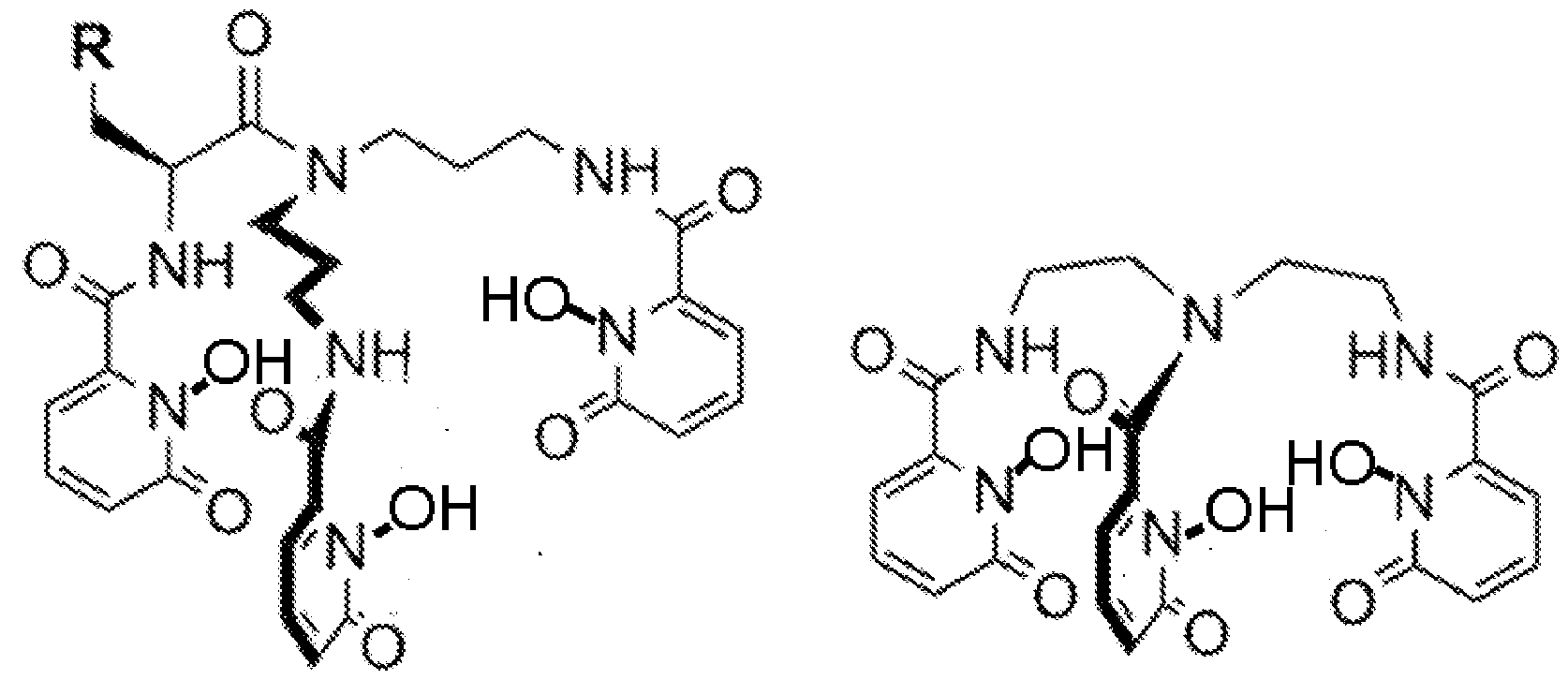
13. A rare earth metal complex or salt thereof that is
 wherein M is a rare earth metal and R is H or OH.
14. The rare earth metal complex or a salt thereof of claim 13, wherein the rare earth metal is Eu111.
15. A material or device comprising one or more ligands or a salt thereof, or one or more rare earth metal complex or a salt thereof, as described in any one of claims 1-14.
16. The material or device of claim 15, wherein the material or device is a hydrogel, membrane, nanoparticle, polymer, conducting polymer, conducting material (e.g., metal or carbon), or other material.
17. A method to detect or capture inorganic phosphate, comprising contacting the phosphate with a ligand or salt thereof, or a rare earth metal complex or a salt thereof, or a material or device as described in any one of claims 1-16.
18. The method of claim 17, wherein the phosphate is selectively detected or captured in the presence of other anions.
19. The method of claim 18, wherein the other anions are selected from the group consisting of carbonate, nitrate, sulfate, halides, arsenate and pyrophosphate.
20. The method of any one of claims 17-19, wherein the phosphate is contacted with the with a ligand or salt thereof, or a rare earth metal complex or a salt thereof, or a material or device, as a liquid sample at about neutral pH.
21. The method of claim 18, wherein the liquid sample is sample is an aqueous sample.
22. The method of any one of claims 17-21, wherein the phosphate is detected with fluorescence sensing by an indicator displacement assay.
23. The method of any one of claims 17-21, wherein the phosphate is captured.
24. The method of claim 23, wherein the phosphate is captured from an aqueous mixture or solution.
25. A method to treat hyperphosphatemia in a mammal in need thereof comprising contacting the blood of the mammal in need thereof, with a ligand or salt thereof, or a rare earth metal complex or a salt thereof, or a material or device as described in any one of claims 1-16.
26. The method of claim 25, wherein the mammal has kidney disease (e.g., chronic, advanced, acute or advanced/acute kidney disease).
27. The use of a ligand or salt thereof, or a rare earth metal complex or a salt thereof, or a material or device as described in any one of claims 1-16 for the treatment of hyperphosphatemia in a mammal in need thereof.
28. The use of a ligand or salt thereof, or a rare earth metal complex or a salt thereof, or a material or device as described in any one of claims 1-16 for medical therapy.
29. The use of a ligand or salt thereof, or a rare earth metal complex or a salt thereof as described in any one of claims 1-14 to prepare a device or material for the treatment of hyperphosphatemia.
Applications Claiming Priority (2)
| Application Number | Priority Date | Filing Date | Title |
|---|---|---|---|
| US202363472542P | 2023-06-12 | 2023-06-12 | |
| US63/472,542 | 2023-06-12 |
Publications (1)
| Publication Number | Publication Date |
|---|---|
| WO2024258974A1 true WO2024258974A1 (en) | 2024-12-19 |
Family
ID=93852601
Family Applications (1)
| Application Number | Title | Priority Date | Filing Date |
|---|---|---|---|
| PCT/US2024/033623 Ceased WO2024258974A1 (en) | 2023-06-12 | 2024-06-12 | Ligands and complexes and uses thereof |
Country Status (1)
| Country | Link |
|---|---|
| WO (1) | WO2024258974A1 (en) |
Citations (3)
| Publication number | Priority date | Publication date | Assignee | Title |
|---|---|---|---|---|
| US5741912A (en) * | 1993-06-15 | 1998-04-21 | Bracco International B.V. | Methods for preparing heteroatom-bearing ligands and metal complexes thereof |
| WO2018097871A2 (en) * | 2016-09-29 | 2018-05-31 | The Regents Of The University Of California | Separation of metal ions by liquid-liquid extraction |
| US20180273406A1 (en) * | 2017-03-23 | 2018-09-27 | Regents Of The University Of Minnesota | Compositions, methods, and devices for capturing phosphate from water |
-
2024
- 2024-06-12 WO PCT/US2024/033623 patent/WO2024258974A1/en not_active Ceased
Patent Citations (3)
| Publication number | Priority date | Publication date | Assignee | Title |
|---|---|---|---|---|
| US5741912A (en) * | 1993-06-15 | 1998-04-21 | Bracco International B.V. | Methods for preparing heteroatom-bearing ligands and metal complexes thereof |
| WO2018097871A2 (en) * | 2016-09-29 | 2018-05-31 | The Regents Of The University Of California | Separation of metal ions by liquid-liquid extraction |
| US20180273406A1 (en) * | 2017-03-23 | 2018-09-27 | Regents Of The University Of Minnesota | Compositions, methods, and devices for capturing phosphate from water |
Similar Documents
| Publication | Publication Date | Title |
|---|---|---|
| Bruce et al. | The selectivity of reversible oxy-anion binding in aqueous solution at a chiral europium and terbium center: Signaling of carbonate chelation by changes in the form and circular polarization of luminescence emission | |
| EP0232751B1 (en) | 1-substituted-4,7,10-triscarboxymethyl-1,4,7,10-tetraazacyclododecane and analogs | |
| US11357873B2 (en) | Chiral cyclen compounds and their uses | |
| Kumar et al. | A pyrenesulfonyl-imidazolium derivative as a selective cyanide ion sensor in aqueous media | |
| Escande et al. | Complexation of trivalent lanthanides with planar tridentate aromatic ligands tuned by counteranions and steric constraints | |
| Janrao et al. | An over view of potentiometric determination of stability constants of metal complexes | |
| Scrivanti et al. | Synthesis and characterization of yttrium, europium, terbium and dysprosium complexes containing a novel type of triazolyl–oxazoline ligand | |
| WO2014079953A1 (en) | SYNTHESIS OF IMIDAZO[1,2-a]PYRAZIN-4-IUM SALTS FOR THE SYNTHESIS OF 1,4,7-TRIAZACYCLONONANE (TACN) AND N- AND/OR C-FUNCTIONALIZED DERIVATIVES THEREOF | |
| Nizou et al. | Pyclen-based ligands bearing pendant picolinate arms for gadolinium complexation | |
| CN110944676A (en) | Compounds useful as iron(III) MRI contrast agents | |
| Knighton et al. | Formation of Heteropolynuclear Lanthanide Complexes Using Macrocyclic Phosphonated Cyclam-Based Ligands | |
| JP2025524769A (en) | Method for producing 2,4,6-triiodophenol derivatives | |
| EP2788354B1 (en) | Functionalisation of cage amine ligands for metallo-radiopharmaceuticals | |
| Pradhan et al. | Water soluble Eu (III) complexes of macrocyclic triamide ligands: Structure, stability, luminescence and redox properties | |
| WO2024258974A1 (en) | Ligands and complexes and uses thereof | |
| Elemento et al. | Variation of water exchange dynamics with ligand structure and stereochemistry in lanthanide complexes based on 1, 4-diazepine derivatives | |
| Rohovec et al. | Derivative of cyclen with three methylene (phenyl) phosphinic acid pendant arms. Synthesis and crystal structures of its lanthanide complexes | |
| WO2022204065A1 (en) | Iron(iii) macrocyclic complexes with mixed hyroxyl pendants as mri contrast agents | |
| AU2020306219A1 (en) | Cyclen based compounds, coordination compounds, peptides, pharmaceutical preparation, and use thereof | |
| Werner et al. | Effect of a mesitylene‐based ligand cap on the relaxometric properties of Gd (III) hydroxypyridonate MRI contrast agents | |
| Piskula et al. | Kinetic study of dissociation of Eu (III) complex with H8dotp (H8dotp= 1, 4, 7, 10-tetraazacyclododecane-1, 4, 7, 10-tetrakis (methylphosphonic acid)) | |
| Ozsváth et al. | Pd (II)-Complexes of a novel pyridinone based tripeptide conjugate: solution and solid state studies | |
| Ju et al. | Bis-Argentivorous Molecules Bridged by Phenyl and 4, 4′-Biphenyl Groups: Structural and Dynamic Behavior of Silver Complexes | |
| Martinelli et al. | The critical role of ligand topology: strikingly different properties of Gd (III) complexes with regioisomeric AAZTA derivatives | |
| Dugoni et al. | Synthesis and characterization of a novel lanthanum (III) complex with a di (2-picolyl) amine-based ligand endowed with fluorescent properties |
Legal Events
| Date | Code | Title | Description |
|---|---|---|---|
| 121 | Ep: the epo has been informed by wipo that ep was designated in this application |
Ref document number: 24824078 Country of ref document: EP Kind code of ref document: A1 |
|
| NENP | Non-entry into the national phase |
Ref country code: DE |