WO2024259060A1 - Inhibitors of met kinase - Google Patents

Inhibitors of met kinase Download PDF

Info

Publication number
WO2024259060A1
WO2024259060A1 PCT/US2024/033746 US2024033746W WO2024259060A1 WO 2024259060 A1 WO2024259060 A1 WO 2024259060A1 US 2024033746 W US2024033746 W US 2024033746W WO 2024259060 A1 WO2024259060 A1 WO 2024259060A1
Authority
WO
WIPO (PCT)
Prior art keywords
optionally substituted
compound
pharmaceutically acceptable
solvate
acceptable salt
Prior art date
Legal status (The legal status is an assumption and is not a legal conclusion. Google has not performed a legal analysis and makes no representation as to the accuracy of the status listed.)
Ceased
Application number
PCT/US2024/033746
Other languages
French (fr)
Inventor
Xiaohu S. OUYANG
John S. Tyhonas
Andrew John Jennings
Jason M. Cox
Robert S. Kania
Current Assignee (The listed assignees may be inaccurate. Google has not performed a legal analysis and makes no representation or warranty as to the accuracy of the list.)
Kinnate Biopharma Inc
Original Assignee
Kinnate Biopharma Inc
Priority date (The priority date is an assumption and is not a legal conclusion. Google has not performed a legal analysis and makes no representation as to the accuracy of the date listed.)
Filing date
Publication date
Application filed by Kinnate Biopharma Inc filed Critical Kinnate Biopharma Inc
Priority to EP24824129.1A priority Critical patent/EP4727943A1/en
Publication of WO2024259060A1 publication Critical patent/WO2024259060A1/en
Anticipated expiration legal-status Critical
Ceased legal-status Critical Current

Links

Classifications

    • AHUMAN NECESSITIES
    • A61MEDICAL OR VETERINARY SCIENCE; HYGIENE
    • A61KPREPARATIONS FOR MEDICAL, DENTAL OR TOILETRY PURPOSES
    • A61K9/00Medicinal preparations characterised by special physical form
    • A61K9/0012Galenical forms characterised by the site of application
    • A61K9/0019Injectable compositions; Intramuscular, intravenous, arterial, subcutaneous administration; Compositions to be administered through the skin in an invasive manner
    • AHUMAN NECESSITIES
    • A61MEDICAL OR VETERINARY SCIENCE; HYGIENE
    • A61PSPECIFIC THERAPEUTIC ACTIVITY OF CHEMICAL COMPOUNDS OR MEDICINAL PREPARATIONS
    • A61P35/00Antineoplastic agents
    • CCHEMISTRY; METALLURGY
    • C07ORGANIC CHEMISTRY
    • C07DHETEROCYCLIC COMPOUNDS
    • C07D215/00Heterocyclic compounds containing quinoline or hydrogenated quinoline ring systems
    • C07D215/02Heterocyclic compounds containing quinoline or hydrogenated quinoline ring systems having no bond between the ring nitrogen atom and a non-ring member or having only hydrogen atoms or carbon atoms directly attached to the ring nitrogen atom
    • C07D215/16Heterocyclic compounds containing quinoline or hydrogenated quinoline ring systems having no bond between the ring nitrogen atom and a non-ring member or having only hydrogen atoms or carbon atoms directly attached to the ring nitrogen atom with hetero atoms or with carbon atoms having three bonds to hetero atoms with at the most one bond to halogen, e.g. ester or nitrile radicals, directly attached to ring carbon atoms
    • C07D215/20Oxygen atoms
    • C07D215/22Oxygen atoms attached in position 2 or 4
    • C07D215/233Oxygen atoms attached in position 2 or 4 only one oxygen atom which is attached in position 4
    • CCHEMISTRY; METALLURGY
    • C07ORGANIC CHEMISTRY
    • C07DHETEROCYCLIC COMPOUNDS
    • C07D401/00Heterocyclic compounds containing two or more hetero rings, having nitrogen atoms as the only ring hetero atoms, at least one ring being a six-membered ring with only one nitrogen atom
    • C07D401/02Heterocyclic compounds containing two or more hetero rings, having nitrogen atoms as the only ring hetero atoms, at least one ring being a six-membered ring with only one nitrogen atom containing two hetero rings
    • C07D401/12Heterocyclic compounds containing two or more hetero rings, having nitrogen atoms as the only ring hetero atoms, at least one ring being a six-membered ring with only one nitrogen atom containing two hetero rings linked by a chain containing hetero atoms as chain links
    • CCHEMISTRY; METALLURGY
    • C07ORGANIC CHEMISTRY
    • C07DHETEROCYCLIC COMPOUNDS
    • C07D471/00Heterocyclic compounds containing nitrogen atoms as the only ring hetero atoms in the condensed system, at least one ring being a six-membered ring with one nitrogen atom, not provided for by groups C07D451/00 - C07D463/00
    • C07D471/02Heterocyclic compounds containing nitrogen atoms as the only ring hetero atoms in the condensed system, at least one ring being a six-membered ring with one nitrogen atom, not provided for by groups C07D451/00 - C07D463/00 in which the condensed system contains two hetero rings
    • C07D471/04Ortho-condensed systems
    • CCHEMISTRY; METALLURGY
    • C07ORGANIC CHEMISTRY
    • C07DHETEROCYCLIC COMPOUNDS
    • C07D491/00Heterocyclic compounds containing in the condensed ring system both one or more rings having oxygen atoms as the only ring hetero atoms and one or more rings having nitrogen atoms as the only ring hetero atoms, not provided for by groups C07D451/00 - C07D459/00, C07D463/00, C07D477/00 or C07D489/00
    • C07D491/02Heterocyclic compounds containing in the condensed ring system both one or more rings having oxygen atoms as the only ring hetero atoms and one or more rings having nitrogen atoms as the only ring hetero atoms, not provided for by groups C07D451/00 - C07D459/00, C07D463/00, C07D477/00 or C07D489/00 in which the condensed system contains two hetero rings
    • C07D491/04Ortho-condensed systems
    • C07D491/044Ortho-condensed systems with only one oxygen atom as ring hetero atom in the oxygen-containing ring
    • C07D491/052Ortho-condensed systems with only one oxygen atom as ring hetero atom in the oxygen-containing ring the oxygen-containing ring being six-membered
    • CCHEMISTRY; METALLURGY
    • C07ORGANIC CHEMISTRY
    • C07DHETEROCYCLIC COMPOUNDS
    • C07D491/00Heterocyclic compounds containing in the condensed ring system both one or more rings having oxygen atoms as the only ring hetero atoms and one or more rings having nitrogen atoms as the only ring hetero atoms, not provided for by groups C07D451/00 - C07D459/00, C07D463/00, C07D477/00 or C07D489/00
    • C07D491/02Heterocyclic compounds containing in the condensed ring system both one or more rings having oxygen atoms as the only ring hetero atoms and one or more rings having nitrogen atoms as the only ring hetero atoms, not provided for by groups C07D451/00 - C07D459/00, C07D463/00, C07D477/00 or C07D489/00 in which the condensed system contains two hetero rings
    • C07D491/04Ortho-condensed systems
    • C07D491/056Ortho-condensed systems with two or more oxygen atoms as ring hetero atoms in the oxygen-containing ring
    • CCHEMISTRY; METALLURGY
    • C07ORGANIC CHEMISTRY
    • C07DHETEROCYCLIC COMPOUNDS
    • C07D498/00Heterocyclic compounds containing in the condensed system at least one hetero ring having nitrogen and oxygen atoms as the only ring hetero atoms
    • C07D498/02Heterocyclic compounds containing in the condensed system at least one hetero ring having nitrogen and oxygen atoms as the only ring hetero atoms in which the condensed system contains two hetero rings
    • C07D498/04Ortho-condensed systems
    • AHUMAN NECESSITIES
    • A61MEDICAL OR VETERINARY SCIENCE; HYGIENE
    • A61KPREPARATIONS FOR MEDICAL, DENTAL OR TOILETRY PURPOSES
    • A61K31/00Medicinal preparations containing organic active ingredients
    • A61K31/33Heterocyclic compounds
    • A61K31/395Heterocyclic compounds having nitrogen as a ring hetero atom, e.g. guanethidine or rifamycins
    • A61K31/435Heterocyclic compounds having nitrogen as a ring hetero atom, e.g. guanethidine or rifamycins having six-membered rings with one nitrogen as the only ring hetero atom
    • A61K31/4353Heterocyclic compounds having nitrogen as a ring hetero atom, e.g. guanethidine or rifamycins having six-membered rings with one nitrogen as the only ring hetero atom ortho- or peri-condensed with heterocyclic ring systems
    • A61K31/4375Heterocyclic compounds having nitrogen as a ring hetero atom, e.g. guanethidine or rifamycins having six-membered rings with one nitrogen as the only ring hetero atom ortho- or peri-condensed with heterocyclic ring systems the heterocyclic ring system containing a six-membered ring having nitrogen as a ring heteroatom, e.g. quinolizines, naphthyridines, berberine, vincamine
    • AHUMAN NECESSITIES
    • A61MEDICAL OR VETERINARY SCIENCE; HYGIENE
    • A61KPREPARATIONS FOR MEDICAL, DENTAL OR TOILETRY PURPOSES
    • A61K31/00Medicinal preparations containing organic active ingredients
    • A61K31/33Heterocyclic compounds
    • A61K31/395Heterocyclic compounds having nitrogen as a ring hetero atom, e.g. guanethidine or rifamycins
    • A61K31/435Heterocyclic compounds having nitrogen as a ring hetero atom, e.g. guanethidine or rifamycins having six-membered rings with one nitrogen as the only ring hetero atom
    • A61K31/47Quinolines; Isoquinolines
    • AHUMAN NECESSITIES
    • A61MEDICAL OR VETERINARY SCIENCE; HYGIENE
    • A61KPREPARATIONS FOR MEDICAL, DENTAL OR TOILETRY PURPOSES
    • A61K31/00Medicinal preparations containing organic active ingredients
    • A61K31/33Heterocyclic compounds
    • A61K31/395Heterocyclic compounds having nitrogen as a ring hetero atom, e.g. guanethidine or rifamycins
    • A61K31/535Heterocyclic compounds having nitrogen as a ring hetero atom, e.g. guanethidine or rifamycins having six-membered rings with at least one nitrogen and one oxygen as the ring hetero atoms, e.g. 1,2-oxazines
    • A61K31/53751,4-Oxazines, e.g. morpholine
    • A61K31/53771,4-Oxazines, e.g. morpholine not condensed and containing further heterocyclic rings, e.g. timolol
    • AHUMAN NECESSITIES
    • A61MEDICAL OR VETERINARY SCIENCE; HYGIENE
    • A61KPREPARATIONS FOR MEDICAL, DENTAL OR TOILETRY PURPOSES
    • A61K47/00Medicinal preparations characterised by the non-active ingredients used, e.g. carriers or inert additives; Targeting or modifying agents chemically bound to the active ingredient
    • A61K47/44Oils, fats or waxes according to two or more groups of A61K47/02-A61K47/42; Natural or modified natural oils, fats or waxes, e.g. castor oil, polyethoxylated castor oil, montan wax, lignite, shellac, rosin, beeswax or lanolin

Definitions

  • MET is a member of the class IV receptor tyrosine kinase family and is expressed on the surfaces of many different cell types, including epithelial cells of many organs, including the liver, pancreas, prostate, kidney, muscle, and bone marrow, during both embryogenesis and adulthood. Binding of the hepatocyte growth factor induces dimerization and activation of the receptor.
  • MET modulates many essential cellular processes during development and wound healing, including cell proliferation, survival, motility, and morphogenesis. Aberrant MET activity is found in many different human cancers. Accordingly, therapies that target MET kinase activity are desired for use in the treatment of cancer and other disorders characterized by aberrant MET pathway signaling. BRIEF SUMMARY OF THE INVENTION [0003] Provided herein are inhibitors of MET kinase, pharmaceutical compositions comprising said inhibitory compounds, and methods for using said inhibitory compounds for the treatment of disease.
  • V is independently N, C-H, or C-L-R;
  • X is independently N, C-H, or C-L 1 -R 1 ;
  • Z is independently N, C-H, or C-L 2 -R 2 ;
  • W is C-H or N;
  • Y 1 is independently N or C-R 3 ;
  • Y 2 is independently N or C-R 4 ;
  • Y 3 is independently N or C-R 3 ;
  • Y 4 is independently N or C-R 3 ;
  • L is a bond, halogen, -C-, -O-, -NH-, -N(optionally substituted C1-C6 alkyl)-, - N(optionally substituted C3-C6 cycloalkyl)-, -NHCO-, or -CONH-;
  • L 1 is a bond, halogen, -
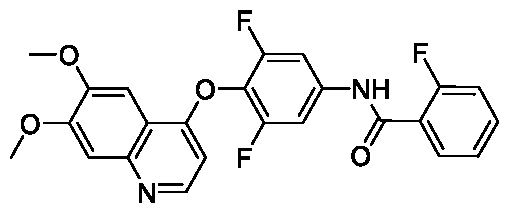
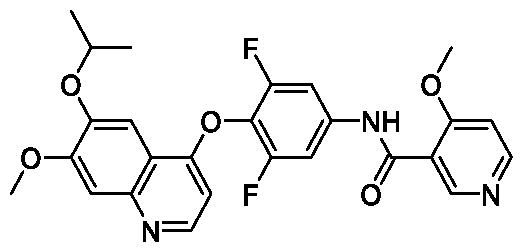
  • One embodiment provides a compound, or a pharmaceutically acceptable salt or solvate thereof, as described in Table 1.
  • One embodiment provides a pharmaceutical composition comprising a compound of Formula (I), Formula (II), Formula (III), or Table 1, or a pharmaceutically acceptable salt or solvate thereof, and at least one pharmaceutically acceptable excipient.
  • One embodiment provides a method of treating a disease or disorder in a patient in need thereof comprising administering to the patient a compound of Formula (I), Formula (II), Formula (III), or Table 1, or pharmaceutically acceptable salt or solvate thereof.
  • Another embodiment provides the method wherein the disease or disorder is cancer.
  • Oxa refers to the -O- radical.
  • Alkyl refers to a straight or branched hydrocarbon chain radical consisting solely of carbon and hydrogen atoms, containing no unsaturation, having from one to fifteen carbon atoms (e.g., C 1 -C 15 alkyl).
  • an alkyl comprises one to thirteen carbon atoms (e.g., C 1 -C 13 alkyl). In certain embodiments, an alkyl comprises one to eight carbon atoms (e.g., C 1 - C 8 alkyl). In other embodiments, an alkyl comprises one to five carbon atoms (e.g., C 1 -C 5 alkyl). In other embodiments, an alkyl comprises one to four carbon atoms (e.g., C 1 -C 4 alkyl). In other embodiments, an alkyl comprises one to three carbon atoms (e.g., C 1 -C 3 alkyl).
  • an alkyl comprises one to two carbon atoms (e.g., C 1 -C 2 alkyl). In other embodiments, an alkyl comprises one carbon atom (e.g., C 1 alkyl). In other embodiments, an alkyl comprises five to fifteen carbon atoms (e.g., C 5 -C 15 alkyl). In other embodiments, an alkyl comprises five to eight carbon atoms (e.g., C 5 -C 8 alkyl). In other embodiments, an alkyl comprises two to five carbon atoms (e.g., C 2 -C 5 alkyl). In other embodiments, an alkyl comprises three to five carbon atoms (e.g., C 3 -C 5 alkyl).
  • the alkyl group is selected from methyl, ethyl, 1-propyl (n-propyl), 1-methylethyl (iso-propyl), 1-butyl (n-butyl), 1-methylpropyl (sec-butyl), 2-methylpropyl (iso-butyl), 1,1-dimethylethyl (tert-butyl), 1-pentyl (n-pentyl).
  • the alkyl is attached to the rest of the molecule by a single bond.
  • an alkyl group is optionally substituted by one or more of the following substituents: halo, cyano, nitro, oxo, thioxo, imino, oximo, trimethylsilanyl, -OR a , -SR a , -OC(O)-R a , -N(R a ) 2 , -C(O)R a , -C(O)OR a , -C(O)N(R a ) 2 , - N(R a )C(O)OR a , -OC(O)-N(R a ) 2 , -N(R a )C(O)R a , -N(R a )S(O) t R a (where t is 1 or 2), -S(O) t OR a (where t is 1 or
  • Alkoxy refers to a radical bonded through an oxygen atom of the formula –O-alkyl, where alkyl is an alkyl chain as defined above.
  • Alkenyl refers to a straight or branched hydrocarbon chain radical group consisting solely of carbon and hydrogen atoms, containing at least one carbon-carbon double bond, and having from two to twelve carbon atoms. In certain embodiments, an alkenyl comprises two to eight carbon atoms. In other embodiments, an alkenyl comprises two to four carbon atoms.
  • alkenyl is attached to the rest of the molecule by a single bond, for example, ethenyl (i.e., vinyl), prop-1-enyl (i.e., allyl), but-1-enyl, pent-1-enyl, penta-1,4-dienyl, and the like.
  • ethenyl i.e., vinyl
  • prop-1-enyl i.e., allyl
  • but-1-enyl i.e., pent-1-enyl, penta-1,4-dienyl, and the like.
  • an alkenyl group is optionally substituted by one or more of the following substituents: halo, cyano, nitro, oxo, thioxo, imino, oximo, trimethylsilanyl, -OR a , -SR a , -OC(O)-R a , -N(R a ) 2 , -C(O)R a , -C(O)OR a , -C(O)N(R a ) 2 , - N(R a )C(O)OR a , -OC(O)-N(R a ) 2 , -N(R a )C(O)R a , -N(R a )S(O) t R a (where t is 1 or 2), -S(O) t OR a (where t is 1 or 2), -S(O) t R a (where t is 1 or
  • Alkynyl refers to a straight or branched hydrocarbon chain radical group consisting solely of carbon and hydrogen atoms, containing at least one carbon-carbon triple bond, having from two to twelve carbon atoms.
  • an alkynyl comprises two to eight carbon atoms.
  • an alkynyl comprises two to six carbon atoms.
  • an alkynyl comprises two to four carbon atoms.
  • the alkynyl is attached to the rest of the molecule by a single bond, for example, ethynyl, propynyl, butynyl, pentynyl, hexynyl, and the like.
  • an alkynyl group is optionally substituted by one or more of the following substituents: halo, cyano, nitro, oxo, thioxo, imino, oximo, trimethylsilanyl, -OR a , -SR a , -OC(O)-R a , -N(R a ) 2 , -C(O)R a , -C(O)OR a , - C(O)N(R a ) 2 , -N(R a )C(O)OR a , -OC(O)-N(R a ) 2 , -N(R a )C(O)R a , -N(R a )S(O) t R a (where t is 1 or 2), -S(O) t OR a (where t is 1 or 2), -S(O) t R
  • Alkylene or "alkylene chain” refers to a straight or branched divalent hydrocarbon chain linking the rest of the molecule to a radical group, consisting solely of carbon and hydro gen, containing no unsaturation, and having from one to twelve carbon atoms, for example, methylene, ethylene, propylene, n-butylene, and the like.
  • the alkylene chain is attached to the rest of the molecule through a single bond and to the radical group through a single bond.
  • the points of attachment of the alkylene chain to the rest of the molecule and to the radical group are through one carbon in the alkylene chain or through any two carbons within the chain.
  • an alkylene comprises one to eight carbon atoms (e.g., C 1 -C 8 alkylene). In other embodiments, an alkylene comprises one to five carbon atoms (e.g., C 1 -C 5 alkylene). In other embodiments, an alkylene comprises one to four carbon atoms (e.g., C 1 -C 4 alkylene). In other embodiments, an alkylene comprises one to three carbon atoms (e.g., C 1 -C 3 alkylene). In other WSGR Ref: 54004-764.601 embodiments, an alkylene comprises one to two carbon atoms (e.g., C 1 -C 2 alkylene).
  • an alkylene comprises one carbon atom (e.g., C 1 alkylene). In other embodiments, an alkylene comprises five to eight carbon atoms (e.g., C 5 -C 8 alkylene). In other embodiments, an alkylene comprises two to five carbon atoms (e.g., C 2 -C 5 alkylene). In other embodiments, an alkylene comprises three to five carbon atoms (e.g., C 3 -C 5 alkylene).
  • an alkylene chain is optionally substituted by one or more of the following substituents: halo, cyano, nitro, oxo, thioxo, imino, oximo, trimethylsilanyl, -OR a , - SR a , -OC(O)-R a , -N(R a ) 2 , -C(O)R a , -C(O)OR a , -C(O)N(R a ) 2 , -N(R a )C(O)OR a , -OC(O)-N(R a ) 2 , - N(R a )C(O)R a , -N(R a )S(O) t R a (where t is 1 or 2), -S(O) t OR a (where t is 1 or 2), -S(O) t R a (where t is 1 or
  • alkenylene or "alkenylene chain” refers to a straight or branched divalent hydrocarbon chain linking the rest of the molecule to a radical group, consisting solely of carbon and hydrogen, containing at least one carbon-carbon double bond, and having from two to twelve carbon atoms.
  • the alkenylene chain is attached to the rest of the molecule through a single bond and to the radical group through a single bond.
  • an alkenylene comprises two to eight carbon atoms (e.g., C 2 -C 8 alkenylene).
  • an alkenylene comprises two to five carbon atoms (e.g., C 2 -C 5 alkenylene).
  • an alkenylene comprises two to four carbon atoms (e.g., C 2 -C 4 alkenylene). In other embodiments, an alkenylene comprises two to three carbon atoms (e.g., C 2 -C 3 alkenylene). In other embodiments, an alkenylene comprises two carbon atoms (e.g., C 2 alkenylene). In other embodiments, an alkenylene comprises five to eight carbon atoms (e.g., C 5 -C 8 alkenylene). In other embodiments, an alkenylene comprises three to five carbon atoms (e.g., C 3 -C 5 alkenylene).
  • an alkenylene chain is optionally substituted by one or more of the following substituents: halo, cyano, nitro, oxo, thioxo, imino, oximo, trimethylsilanyl, -OR a , -SR a , -OC(O)-R a , -N(R a ) 2 , -C(O)R a , -C(O)OR a , -C(O)N(R a ) 2 , - N(R a )C(O)OR a , -OC(O)-N(R a ) 2 , -N(R a )C(O)R a , -N(R a )S(O) t R a (where t is 1 or 2), -S(O) t OR a WSGR Ref: 54004-764.601 (where t is 1
  • Alkynylene or “alkynylene chain” refers to a straight or branched divalent hydrocarbon chain linking the rest of the molecule to a radical group, consisting solely of carbon and h ydrogen, containing at least one carbon-carbon triple bond, and having from two to twelve carbon atoms.
  • the alkynylene chain is attached to the rest of the molecule through a single bond and to the radical group through a single bond.
  • an alkynylene comprises two to eight carbon atoms (e.g., C 2 -C 8 alkynylene).
  • an alkynylene comprises two to five carbon atoms (e.g., C 2 -C 5 alkynylene).
  • an alkynylene comprises two to four carbon atoms (e.g., C 2 -C 4 alkynylene). In other embodiments, an alkynylene comprises two to three carbon atoms (e.g., C 2 -C 3 alkynylene). In other embodiments, an alkynylene comprises two carbon atoms (e.g., C 2 alkynylene). In other embodiments, an alkynylene comprises five to eight carbon atoms (e.g., C 5 -C 8 alkynylene). In other embodiments, an alkynylene comprises three to five carbon atoms (e.g., C 3 -C 5 alkynylene).
  • an alkynylene chain is optionally substituted by one or more of the following substituents: halo, cyano, nitro, oxo, thioxo, imino, oximo, trimethylsilanyl, -OR a , -SR a , -OC(O)-R a , -N(R a ) 2 , -C(O)R a , -C(O)OR a , -C(O)N(R a ) 2 , - N(R a )C(O)OR a , -OC(O)-N(R a ) 2 , -N(R a )C(O)R a , -N(R a )S(O) t R a (where t is 1 or 2), -S(O) t OR a (where t is 1 or 2), -S(O) t R
  • Aryl refers to a radical derived from an aromatic monocyclic or multicyclic hydrocarbon ring system by removing a hydrogen atom from a ring carbon atom.
  • the aromatic monocyclic o r multicyclic hydrocarbon ring system contains only hydrogen and carbon from five to eighteen carbon atoms, where at least one of the rings in the ring system is fully unsaturated, i.e., it contains a cyclic, delocalized (4n+2) ⁇ –electron system in accordance with the Hückel theory.
  • the ring system from which aryl groups are derived include, but are not limited to, groups such as benzene, fluorene, indane, indene, tetralin and naphthalene.
  • aryl or the prefix “ar-” (such as in “aralkyl”) is meant to include aryl radicals optionally substituted by one or more substituents independently selected from optionally substituted alkyl, optionally substituted alkenyl, optionally substituted alkynyl, halo, cyano, nitro, -R b -OR a , -R b -OC(O)-R a , -R b -OC(O)-OR a , -R b -OC(O)-N(R a ) 2 , -R b -N(R a ) 2 , - R b -C(O)R a , -R b -C(O)OR a , -R b -C(O)N(R a ) 2 , -R b -O-R c -C(O)N(R a
  • Aralkyl refers to a radical of the formula -R c -aryl where R c is an alkylene chain as defined above, for example, methylene, ethylene, and the like.
  • the alkylene chain part of the aralkyl radical is optionally substituted as described above for an alkylene chain.
  • the aryl part of the aralkyl radical is optionally substituted as described above for an aryl group.
  • “Aralkenyl” refers to a radical of the formula –R d -aryl where R d is an alkenylene chain as defined above.
  • the aryl part of the aralkenyl radical is optionally substituted as described above WSGR Ref: 54004-764.601 for an aryl group.
  • the alkenylene chain part of the aralkenyl radical is optionally substituted as defined above for an alkenylene group.
  • "Aralkynyl" refers to a radical of the formula -R e -aryl, where R e is an alkynylene chain as defined above.
  • the aryl part of the aralkynyl radical is optionally substituted as described above for an aryl group.
  • the alkynylene chain part of the aralkynyl radical is optionally substituted as defined above for an alkynylene chain.
  • Alkoxy refers to a radical bonded through an oxygen atom of the formula -O-R c -aryl where R c is an alkylene chain as defined above, for example , methylene, ethylene, and the like.
  • the alkylene chain part of the aralkyl radical is optionally substituted as described above for an alkylene chain.
  • the aryl part of the aralkyl radical is optionally substituted as described above for an aryl group.
  • Carbocyclyl refers to a stable non-aromatic monocyclic or polycyclic hydrocarbon radical consisting solely of carbon and hydrogen atoms, which includes fused or bridged ring systems, having from three to fifteen carbon atoms.
  • a carbocyclyl comprises three to ten carbon atoms. In other embodiments, a carbocyclyl comprises five to seven carbon atoms. The carbocyclyl is attached to the rest of the molecule by a single bond. Carbocyclyl is saturated (i.e., containing single C-C bonds only) or unsaturated (i.e., containing one or more double bonds or triple bonds).
  • a fully saturated carbocyclyl radical is also referred to as "cycloalkyl.”
  • monocyclic cycloalkyls include, e.g., cyclopropyl, cyclobutyl, cyclopentyl, cyclohexyl, cycloheptyl, and cyclooctyl.
  • An unsaturated carbocyclyl is also referred to as "cycloalkenyl.”
  • Examples of monocyclic cycloalkenyls include, e.g., cyclopentenyl, cyclohexenyl, cycloheptenyl, and cyclooctenyl.
  • Polycyclic carbocyclyl radicals include, for example, adamantyl, norbornyl (i.e., bicyclo[2.2.1]heptanyl), norbornenyl, decalinyl, 7,7-dimethyl-bicyclo[2.2.1]heptanyl, and the like.
  • carbocyclyl is meant to include carbocyclyl radicals that are optionally substituted by one or more substituents independently selected from optionally substituted alkyl, optionally substituted alkenyl, optionally substituted alkynyl, halo, oxo, thioxo, cyano, nitro, -R b -OR a , -R b -OC(O)-R a , -R b -OC(O)-OR a , -R b -OC(O)-N(R a ) 2 , -R b - N(R a ) 2 , -R b -C(O)R a , -R b -C(O)OR a , -R b -C(O)N(R a ) 2 , -R b -O-R c -C(O)N(R b -OR a , -R b
  • Carbocyclylalkyl refers to a radical of the formula –R c -carbocyclyl where R c is an alkylene chain as defined above. The alkylene chain and the carbocyclyl radical is optionally substituted as defined above.
  • Carbocyclylalkynyl refers to a radical of the formula –R c -carbocyclyl where R c is an alkynylene chain as defined above. The alkynylene chain and the carbocyclyl radical is optionally substituted as defined above.
  • Carbocyclylalkoxy refers to a radical bonded through an oxygen atom of the formula –O- R c -carbocyclyl where R c is an alkylene chain as defined above. The alkylene chain and the carbocyclyl radical is optionally substituted as defined above.
  • Halo or “halogen” refers to bromo, chloro, fluoro or iodo substituents.
  • Fluoroalkyl refers to an alkyl radical, as defined above, that is substituted by one or more fluoro radicals, as defined above, for example, trifluoromethyl, difluoromethyl, fluoromethyl, 2,2,2-trifluoroethyl, 1-fluoromethyl-2-fluoroethyl, and the like.
  • the alkyl part of the fluoroalkyl radical is optionally substituted as defined above for an alkyl group.
  • Heterocyclyl refers to a stable 3- to 18-membered non-aromatic ring radical that comprises two to twelve carbon atoms and from one to six heteroatoms selected from nitrogen, oxygen and sulfur.
  • the heterocyclyl radical is a monocyclic, bicyclic, tricyclic, or tetracyclic ring system, which optionally includes fused or bridged ring systems.
  • the heteroatoms in the heterocyclyl radical are optionally oxidized.
  • One or more nitrogen atoms, if present, are optionally quaternized.
  • the heterocyclyl radical is partially or fully saturated.
  • the heterocyclyl is attached to the rest of the molecule through any atom of the ring(s).
  • heterocyclyl radicals include, but are not limited to, dioxolanyl, thienyl[1,3]dithianyl, decahydroisoquinolyl, imidazolinyl, imidazolidinyl, isothiazolidinyl, isoxazolidinyl, morpholinyl, octahydroindolyl, octahydroisoindolyl, 2-oxopiperazinyl, 2-oxopiperidinyl, 2-oxopyrrolidinyl, oxazolidinyl, piperidinyl, piperazinyl, 4-piperidonyl, pyrrolidinyl, pyrazolidinyl, quinuclidinyl, thiazolidinyl, tetrahydrofuryl, trithianyl, tetrahydropyranyl, thiomorpholinyl, thiamorpholinyl, 1-oxo-thio
  • heterocyclyl is meant to include heterocyclyl radicals as defined above that are optionally substituted by one or more substituents selected from optionally substituted alkyl, optionally substituted alkenyl, optionally substituted alkynyl, halo, fluoroalkyl, oxo, thioxo, cyano, nitro, - R b -OR a , -R b -OC(O)-R a , -R b -OC(O)-OR a , -R b -OC(O)-N(R a ) 2 , -R b -N(R a ) 2 , -R b -C(O)R a , -R b - C(O)OR a , -R b -C(O)N(R a ) 2 , -R b -O-R c -
  • N-heterocyclyl or “N-attached heterocyclyl” refers to a heterocyclyl radical as defined above containing at least one nitrogen and where the point of attachment of the heterocyclyl radical to the rest of the molecule is through a nitrogen atom in the heterocyclyl radical.
  • An N-heterocyclyl radical is optionally substituted as described above for heterocyclyl radicals. Examples of such N-heterocyclyl radicals include, but are not limited to, 1-morpholinyl, 1- piperidinyl, 1-piperazinyl, 1-pyrrolidinyl, pyrazolidinyl, imidazolinyl, and imidazolidinyl.
  • C-heterocyclyl or “C-attached heterocyclyl” refers to a heterocyclyl radical as defined above containing at least one heteroatom and where the point of attachment of the heterocyclyl radical to the rest of the molecule is through a carbon atom in the heterocyclyl radical.
  • a C-heterocyclyl radical is optionally substituted as described above for heterocyclyl radicals. Examples of such C-heterocyclyl radicals include, but are not limited to, 2-morpholinyl, 2- or 3- or 4-piperidinyl, 2-piperazinyl, 2- or 3-pyrrolidinyl, and the like.
  • Heterocyclylalkyl refers to a radical of the formula –R c -heterocyclyl where R c is an alkylene chain as defined above. If the heterocyclyl is a nitrogen-containing heterocyclyl, the heterocyclyl is optionally attached to the alkyl radical at the nitrogen atom.
  • the alkylene chain WSGR Ref: 54004-764.601 of the heterocyclylalkyl radical is optionally substituted as defined above for an alkylene chain.
  • the heterocyclyl part of the heterocyclylalkyl radical is optionally substituted as defined above for a heterocyclyl group.
  • Heterocyclylalkoxy refers to a radical bonded through an oxygen atom of the formula –O- R c -heterocyclyl where R c is an alkylene chain as defined above. If the heterocyclyl is a nitrogen-containing heterocyclyl, the heterocyclyl is optionally attached to the alkyl radical at the nitrogen atom.
  • the alkylene chain of the heterocyclylalkoxy radical is optionally substituted as defined above for an alkylene chain.
  • the heterocyclyl part of the heterocyclylalkoxy radical is optionally substituted as defined above for a heterocyclyl group.
  • Heteroaryl refers to a radical derived from a 3- to 18-membered aromatic ring radical that comprises two to seventeen carbon atoms and from one to six heteroatoms selected from nitrogen, oxygen and sulfur.
  • the heteroaryl radical is a monocyclic, bicyclic, tricyclic or tetracyclic ring system, wherein at least one of the rings in the ring system is fully unsaturated, i.e., it contains a cyclic, delocalized (4n+2) ⁇ –electron system in accordance with the Hückel theory.
  • Heteroaryl includes fused or bridged ring systems.
  • the heteroatom(s) in the heteroaryl radical is optionally oxidized.
  • heteroaryl is attached to the rest of the molecule through any atom of the ring(s).
  • heteroaryls include, but are not limited to, azepinyl, acridinyl, benzimidazolyl, benzindolyl, 1,3-benzodioxolyl, benzofuranyl, benzooxazolyl, benzo[d]thiazolyl, benzothiadiazolyl, benzo[b][1,4]dioxepinyl, benzo[b][1,4]oxazinyl, 1,4-benzodioxanyl, benzonaphthofuranyl, benzoxazolyl, benzodioxolyl, benzodioxinyl, benzopyranyl, benzopyranonyl, benzofuranyl, benzofuranonyl, benzothienyl (benzothienyl (benzothion
  • heteroaryl is meant to include heteroaryl radicals as defined above which are optionally substituted by one or more substituents selected from optionally substituted alkyl, optionally substituted alkenyl, optionally substituted alkynyl, halo, optionally substituted fluoroalkyl, optionally substituted haloalkenyl, optionally substituted haloalkynyl, oxo, thioxo, cyano, nitro, -R b -OR a , -R b -OC(O)-R a , -R b - OC(O)-OR a , -R b -OC(O)-N(R a ) 2 , -R b -N(R a ) 2 , -R b -C(O)R a , -R b -C(O)OR a ,
  • N-heteroaryl refers to a heteroaryl radical as defined above containing at least one nitrogen and where the point of attachment of the heteroaryl radical to the rest of the molecule is through a nitrogen atom in the heteroaryl radical.
  • An N-heteroaryl radical is optionally substituted as described above for heteroaryl radicals.
  • C-heteroaryl refers to a heteroaryl radical as defined above and where the point of attachment of the heteroaryl radical to the rest of the molecule is through a carbon atom in the heteroaryl radical.
  • a C-heteroaryl radical is optionally substituted as described above for heteroaryl radicals.
  • Heteroarylalkyl refers to a radical of the formula –R c -heteroaryl, where R c is an alkylene chain as defined above. If the heteroaryl is a nitrogen-containing heteroaryl, the heteroaryl is WSGR Ref: 54004-764.601 optionally attached to the alkyl radical at the nitrogen atom.
  • the alkylene chain of the heteroarylalkyl radical is optionally substituted as defined above for an alkylene chain.
  • the heteroaryl part of the heteroarylalkyl radical is optionally substituted as defined above for a heteroaryl group.
  • Heteroarylalkoxy refers to a radical bonded through an oxygen atom of the formula –O- R c -heteroaryl, where R c is an alkylene chain as defined above. If the heteroaryl is a nitrogen-containing heteroaryl, the heteroaryl is optionally attached to the alkyl radical at the nitrogen atom.
  • the alkylene chain of the heteroarylalkoxy radical is optionally substituted as defined above for an alkylene chain.
  • the heteroaryl part of the heteroarylalkoxy radical is optionally substituted as defined above for a heteroaryl group.
  • the compounds disclosed herein in some embodiments, contain one or more asymmetric centers and thus give rise to enantiomers, diastereomers, and other stereoisomeric forms that are defined, in terms of absolute stereochemistry, as (R)- or (S)-. Unless stated otherwise, it is intended that all stereoisomeric forms of the compounds disclosed herein are contemplated by this disclosure. When the compounds described herein contain alkene double bonds, and unless specified otherwise, it is intended that this disclosure includes both E and Z geometric isomers (e.g., cis or trans.) Likewise, all possible isomers, as well as their racemic and optically pure forms, and all tautomeric forms are also intended to be included.
  • geometric isomer refers to E or Z geometric isomers (e.g., cis or trans) of an alkene double bond.
  • positional isomer refers to structural isomers around a central ring, such as ortho-, meta-, and para- isomers around a benzene ring.
  • a "tautomer” refers to a molecule wherein a proton shift from one atom of a molecule to another atom of the same molecule is possible.
  • the exact ratio of the tautomers depends on several factors, including physical state, temperature, solvent, and pH.
  • Some examples of tautomeric equilibrium include: WSGR Ref: 54004-764.601 OH O O OH
  • the isotopic forms e.g., enriched in the content of 2 H, 3 H, 11 C, 13 C and/or 14 C.
  • the compound is deuterated in at least one position.
  • deuterated forms can be made by the procedure described in U.S. Patent Nos.5,846,514 and 6,334,997. As described in U.S. Patent Nos.5,846,514 and 6,334,997, deuteration can improve the metabolic stability and or efficacy, thus increasing the duration of action of drugs.
  • structures depicted herein are intended to include compounds which differ only in the presence of one or more isotopically enriched atoms.
  • compounds having the present structures except for the replacement of a hydrogen by a deuterium or tritium, or the replacement of a carbon by 13 C- or 14 C-enriched carbon are within the scope of the present disclosure.
  • the compounds of the present disclosure optionally contain unnatural proportions of atomic isotopes at one or more atoms that constitute such compounds.
  • the compounds may be labeled with isotopes, such as for example, deuterium ( 2 H), tritium ( 3 H), iodine-125 ( 125 I) or carbon-14 ( 14 C).
  • deuterium substituted compounds are synthesized using various methods such as described in: Dean, Dennis C.; Editor. Recent Advances in the Synthesis and Applications of Radiolabeled Compounds for Drug Discovery and Development. [Curr., Pharm. Des., 2000; 6(10)] 2000, 110 pp; George W.; Varma, Rajender S. The Synthesis of Radiolabeled Compounds via Organometallic Intermediates, Tetrahedron, 1989, 45(21), 6601-21; and Evans, E. Anthony. Synthesis of radiolabeled compounds, J. Radioanal.
  • Deuterated starting materials are readily available and are subjected to the synthetic methods described herein to provide for the synthesis of deuterium-containing compounds. Large numbers of deuterium-containing reagents and building blocks are available commercially from chemical vendors, such as Aldrich Chemical Co.
  • Deuterium-transfer reagents suitable for use in nucleophilic substitution reactions such as iodomethane-d 3 (CD 3 I) are readily available and may be employed to transfer a deuterium- substituted carbon atom under nucleophilic substitution reaction conditions to the reaction substrate. The use of CD 3 I is illustrated, by way of example only, in the reaction schemes below.
  • Deuterium-transfer are employed to transfer deuterium under reducing conditions to the reaction substrate.
  • the use of LiAlD 4 is illustrated, by way of example only, in the reaction schemes below.
  • the compounds disclosed herein contain one deuterium atom. In another embodiment, the compounds disclosed herein contain two deuterium atoms.
  • the compounds disclosed herein contain three deuterium atoms. In another embodiment, the compounds disclosed herein contain four deuterium atoms. In another embodiment, the compounds disclosed herein contain five deuterium atoms. In another embodiment, the compounds disclosed herein contain six deuterium atoms. In another embodiment, the compounds disclosed herein contain more than six deuterium atoms. In another embodiment, the compound disclosed herein is fully substituted with deuterium atoms and contains no non-exchangeable 1 H hydrogen atoms. In one embodiment, the level of deuterium incorporation is determined by synthetic methods in which a deuterated synthetic building block is used as a starting material. [0062] "Pharmaceutically acceptable salt” includes both acid and base addition salts.
  • a pharmaceutically acceptable salt of any one of the MET kinase inhibitory compounds described herein is intended to encompass any and all pharmaceutically suitable salt forms.
  • Preferred pharmaceutically acceptable salts of the compounds described herein are pharmaceutically acceptable acid addition salts and pharmaceutically acceptable base addition salts.
  • “Pharmaceutically acceptable acid addition salt” refers to those salts which retain the biological effectiveness and properties of the free bases, which are not biologically or otherwise undesirable, and which are formed with inorganic acids such as hydrochloric acid, hydrobromic acid, sulfuric acid, nitric acid, phosphoric acid, hydroiodic acid, hydrofluoric acid, phosphorous acid, and the like.
  • salts that are formed with organic acids such as aliphatic mono- and dicarboxylic acids, phenyl-substituted alkanoic acids, hydroxy alkanoic acids, alkanedioic acids, aromatic acids, aliphatic and. aromatic sulfonic acids, etc.
  • acetic acid trifluoroacetic acid, propionic acid, glycolic acid, pyruvic acid, oxalic acid, maleic acid, malonic acid, succinic acid, fumaric acid, tartaric acid, citric acid, benzoic acid, cinnamic acid, mandelic acid, methanesulfonic acid, ethanesulfonic acid, p-toluenesulfonic acid, salicylic acid, and the like.
  • Exemplary salts thus include sulfates, pyrosulfates, bisulfates, sulfites, bisulfites, nitrates, phosphates, monohydrogenphosphates, dihydrogenphosphates, metaphosphates, pyrophosphates, chlorides, bromides, iodides, acetates, trifluoroacetates, propionates, caprylates, isobutyrates, oxalates, malonates, succinate suberates, sebacates, fumarates, maleates, mandelates, benzoates, chlorobenzoates, methylbenzoates, dinitrobenzoates, phthalates, benzenesulfonates, toluenesulfonates, phenylacetates, citrates, lactates, malates, tartrates, methanesulfonates, and the like.
  • salts of amino acids such as arginates, gluconates, and galacturonates
  • Acid addition salts of basic compounds are, in some embodiments, prepared by WSGR Ref: 54004-764.601 contacting the free base forms with a sufficient amount of the desired acid to produce the salt according to methods and techniques with which a skilled artisan is familiar.
  • “Pharmaceutically acceptable base addition salt” refers to those salts that retain the biological effectiveness and properties of the free acids, which are not biologically or otherwise undesirable.
  • salts are prepared from addition of an inorganic base or an organic base to the free acid.
  • Pharmaceutically acceptable base addition salts are, in some embodiments, formed with metals or amines, such as alkali and alkaline earth metals or organic amines.
  • Salts derived from inorganic bases include, but are not limited to, sodium, potassium, lithium, ammonium, calcium, magnesium, iron, zinc, copper, manganese, aluminum salts and the like.
  • Salts derived from organic bases include, but are not limited to, salts of primary, secondary, and tertiary amines, substituted amines including naturally occurring substituted amines, cyclic amines and basic ion exchange resins, for example, isopropylamine, trimethylamine, diethylamine, triethylamine, tripropylamine, ethanolamine, diethanolamine, 2-dimethylaminoethanol, 2-diethylaminoethanol, dicyclohexylamine, lysine, arginine, histidine, caffeine, procaine, N,N- dibenzylethylenediamine, chloroprocaine, hydrabamine, choline, betaine, ethylenediamine, ethylenedianiline, N-methylglucamine, glucosamine, methylglucamine, theobromine, purines, piperazine, piperidine, N-ethylpiperidine, polyamine resins and the like.
  • solvates refers to a composition of matter that is the solvent addition form.
  • solvates contain either stoichiometric or non - stoichiometric amounts of a solvent, and are formed during the process of making with pharmaceutically acceptable solvents such as water, ethanol, and the like. Hydrates are formed when the solvent is water, or alcoholates are formed when the solvent is alcohol. Solvates of compounds described herein are conveniently prepared or formed during the processes described herein. The compounds provided herein optionally exist in unsolvated as well as solvated forms.
  • subject or “patient” encompasses mammals.
  • mammals include, but are not limited to, any member of the Mammalian class: humans, non-human primates such as chimpanzees, and other apes and monkey species; farm animals such as cattle, horses, sheep, goats, swine; domestic animals such as rabbits, dogs, and cats; laboratory animals including rodents, such as rats, mice and guinea pigs, and the like.
  • the mammal is a human.
  • “treatment” or “treating,” or “palliating” or “ameliorating” are used interchangeably. These terms refer to an approach for obtaining beneficial or desired results including but not limited to therapeutic benefit and/or a prophylactic bene fit.
  • compositions are, in some embodiments, administered to a patient at risk of developing a particular disease, or to a patient reporting one or more of the physiological symptoms of a disease, even though a diagnosis of this disease has not been made.
  • the MET protein is a member of the class IV receptor tyrosine kinase family and is expressed on the surfaces of many different cell types, including epithelial cells of many organs, such as liver, pancreas, prostate, kidney, muscle, and bone marrow, during both embryogenesis and adulthood.
  • MET modulates many essential cellular processes during development and wound healing, including cell proliferation, survival, motility, and morphogenesis.
  • MET activity is found in many different human cancers, such as non-small cell lung cancer, medulloblastoma , lymphoma, melanoma, glioma, breast cancer, pancreatic cancer, colorectal cancer, ovarian cancer, and prostate cancer, as well as osteo- and some soft-tissue sarcomas.
  • the c-MET proto-oncogene is located on chromosome 7q21-31 and its transcription is regulated by Ets (E-twenty six), Pax3 (paired box 3), AP2 (activator protein-2) and Tcf-4 (transcription factor 4). It is expressed as multiple mRNA transcripts of 8, 7, 4.5, 3 and 1.5 kilobases.
  • MET is a single pass transmembrane protein with an extracellular domain, a transmembrane hydrophobic sequence and an intracellular portion that comprises the ty rosine kinase domain.
  • the extracellular domain of MET is composed of three domain types: a Semaphorin (Sema) domain, a PSI domain, and four immunoglobulin–plexin–transcription (IPT) domains.
  • Sema Semaphorin
  • PSI PSI domain
  • IPT immunoglobulin–plexin–transcription
  • the PSI domain (found in plexins, semaphorins and integrins) follows the Sema domain, spans approximately 50 residues and connected the Sema domain to the IPT domains.
  • the four IPT domains are related to immunoglobulin-like domains and are found in integrins, plexins and transcription factors.
  • the IPT domain on the c-terminal side is, in turn, connected to the single transmembrane helix, which connects the extracellular domain to the intracellular domain.
  • the intracellular domain of the MET receptor contains a juxtamembrane domain containing the Y1003 residue, which is involved in the receptor’s down-regulation; a tyrosine kinase catalytic domain containing the Y1234 and Y1235 residues, which is involved in signal transduction; and a docking site for adaptor proteins containing Y1349 and Y1356 residues.
  • the extracellular portion of MET binds to its cognate ligands, hepatocyte growth factor (HGF) and its natural isoform, NK1, leading to the dimerization of two MET proteins.
  • HGF hepatocyte growth factor
  • Dimerization leads to trans-autophosphorylation of two tyrosine residues (Y1234 and Y1235) located within WSGR Ref: 54004-764.601 the catalytic loop of the tyrosine kinase domain of the intracellular portion. Subsequently , tyrosine residues 1349 and 1356 in the carboxy-terminal tail are phosphorylated, thereby forming a unique tandem SH2 recognition motif , and leading to recruitment of signal effector proteins (e.g., GAB1, GRB2, SHC, CRK, PI3K, PLC ⁇ 1, SHP2 and STAT3) responsible for downstream signaling.
  • signal effector proteins e.g., GAB1, GRB2, SHC, CRK, PI3K, PLC ⁇ 1, SHP2 and STAT3 responsible for downstream signaling.
  • HGF the primary ligand of MET
  • Full length HGF contains an N-terminal (N) domain, four consecutive kringle (K1–K4) domains, and a serine protease homology (SPH) domain.
  • N N-terminal domain
  • K1–K4 four consecutive kringle domains
  • SPH serine protease homology domain.
  • Proteolytic cleavage between Arg494 and Val495 of HGF generates the 57 kDa ⁇ subunit and the 26 kDa ⁇ subunit, which are covalently linked by a disulfide bond between Cys487 of the ⁇ -subunit and Cys604 of the ⁇ -subunit.
  • HGF is primarily expressed and released by surrounding stromal cells, allowing the tumor and stromal cells communicate with each other through HGF, creating a microenvironment that contributes to cancer progression.
  • the HGF from the tumor stroma acts on tumor cells, stimulating not only to proliferation and metastasis, but also production of HGF-inducers.
  • HGF-inducers including bFGF, IL-1 ⁇ , TGF- ⁇ , PDGF and prostaglandin E2 (PGE2), act on stromal fibroblasts, inducing further HGF expression. This creates a feedback loop that drives increased MET activation in the tumor. In this way, the mutual interaction between tumor and stromal cells continually drives tumor growth, invasion, and metastasis. Furthermore, HGF can also be produced by the tumor itself, and this phenomenon has been detected in the renal cell carcinoma, colorectal cancer, breast cancer, glioma, multiple myeloma, and synovial sarcoma, osteosarcoma and fibrosarcoma.
  • Dysregulation of the MET pathway in cancer occurs through a variety of mechanisms, including gene mutation, amplification, rearrangement, and protein overexpression.
  • MET fusions have been identified including a fusion between c-MET and TPR (translocated promoter region nuclear basket protein gene) found in a mutagenized osteosarcoma cell line, and a fusion between c-MET-KIF5B (kinesin family member 5B gene) detected in a patient with lung adenocarcinoma.
  • TPR translocated promoter region nuclear basket protein gene
  • c-MET-KIF5B kinesin family member 5B gene
  • Activation of MET initiates a series of intracellular signaling pathways, including PI3K/AKT, Ras/MAPK, JAK/STAT, SRC, Wnt/ ⁇ -catenin, and other signaling pathways, thereby modulating proliferation, motility, migration, and invasion.
  • the Ras/MAPK/ERK signaling pathway communicates signals from cell surface receptors, including MET, to the DNA in the nucleus of the cell, where modulation of gene expression occurs.
  • the signaling cascade comprises many different proteins that propagate the signal through protein phosphorylation, the pathway can generally be divided into 3 steps: (i) Ras activation, (ii) a kinase signal transduction cascade, and (iii) regulation of translation and transcription.
  • MET activation results in Ras activation, which phosphorylates and activates the protein kinase activity of RAF kinase.
  • RAF kinase in turn, phosphorylates and activates MEK (MEK1 and MEK2), which phosphorylates and activates a MAPK (also known as ERK) protein.
  • MAPK activation regulates activities of several transcription factors and modulates protein expression. By altering the levels and activities of transcription factors, MAPK leads to altered transcription of genes that are important for the cell cycle . Depending upon the stimulus and cell type, this pathway can transmit signals that result in the prevention or induction of apoptosis or cell cycle progression.
  • PI3K phosphatidylinositol 3 ⁇ kinase
  • PBB/AKT protein kinase B
  • Phosphatidylinositol (3,4,5)-trisphosphate Phosphatidylinositol (3,4,5)-trisphosphate
  • PIP3 binds to PKB/Akt at the plasma membrane, allowing pyruvate dehydrogenase kinase 1 (PDK1) to access and phosphorylate T308 in the “activation loop” of AKT leading to partial PKB/Akt activation.
  • PDK1 pyruvate dehydrogenase kinase 1
  • Activation of Akt leads to additional substrate-specific phosphorylation events in both the cytoplasm and nucleus, including activation of CREB, inhibition of p27, localization of FOXO in the cytoplasm, activation of PtdIns-3ps, and activation of mTOR.
  • the JAK-STAT pathway is essential for a wide range of cytokines and growth factors, leading to critical cellular events, such as cell differentiation, hematopoiesis, and immune system development.
  • the JAK/STAT signaling pathway also plays a major role in the proliferation and survival of different cancer types.
  • STAT3 is a key driver of tumorigenesis, and modulates the expression of many oncogenes, including BCL-XL, c-MYC, Mcl1, Survivin, BEGF, HIF-1 ⁇ , HGF, IL-12, and MMPs.
  • oncogenes including BCL-XL, c-MYC, Mcl1, Survivin, BEGF, HIF-1 ⁇ , HGF, IL-12, and MMPs.
  • the Wnt/ ⁇ -catenin signaling pathway is a conserved signaling axis participating in diverse physiological processes such as proliferation, differentiation, apoptosis, migration, invasion, and tissue homeostasis. Activation of the Wnt/ ⁇ -catenin signaling pathway leads to an elevation of cytosolic concentration of ⁇ -catenin, which migrates to the nucleus and interacts with T cell-specific factor (TCF)/lymphoid enhancer-binding factor (LEF) and its co-activators, such as Pygopus and Bcl-9.
  • TCF T cell-specific factor
  • LEF lymphoid enhancer-binding factor
  • MET is a major driver of tumor growth, survival, invasion, and metastesis.
  • MET Kinase Inhibitors [0079] Several agents have been developed to target MET or HGF, including small molecule inhibitors and monoclonal antibodies.
  • Monoclonal antibodies currently FDA-approved or undergoing clinical evaluation includes anti-MET antibodies (e.g., onartuzumab and emibetuzumab), anti- HGF antibodies (e.g., ficlatuzumab and rilotumumab), and anti-MET/EGFR bispecific (e.g., amivantamab). These therapies prevent HGF from binding to MET, thereby shutting down MET activation.
  • many small molecule MET inhibitors have received FDA approval for the treatment of cancer, including capmatinib, tepotinib, crizotinib, cabozantinib, MGCD265, AMG208, altiratinib, and golvatinib.
  • capmatinib Tabrecta®
  • tepotinib Tepmetko®
  • Cabozantinib Cabometyx® is FDA-approved for the treatment of locally advanced or metastatic differentiated thyroid cancer.
  • MET-specific inhibitors are divided into two functionally distinct classes: type I inhibitors (e.g., crizotinib, capmatinib, tepotinib, and savolitinib), which preferentially bind to WSGR Ref: 54004-764.601 the active conformation of MET, and type II inhibitors (e.g., cabozantinib and glesatinib ), which preferentially bind to the inactive conformations of MET.
  • type II inhibitors e.g., cabozantinib and glesatinib
  • selective MET inhibitors include the adenosine triphosphate–competitive agents and the adenosine triphosphate–noncompetitive agents (e.g., tivantinib).
  • Type I MET inhibitors are further subclassified as type Ia (e.g., crizotinib), which interact with the solvent front G1163 residue, and type Ib (e.g., capmatinib, tepotinib, and savolitinib), which binds to the kinase domain.
  • type Ia e.g., crizotinib
  • type Ib e.g., capmatinib, tepotinib, and savolitinib
  • Type I and type II inhibitors each have unique efficacy profiles with respect to secondary MET mutations that confer resistance to MET inhibitors. For example, mutation in residues D1228 and Y1230 of the kinase domain confers resistance to type I MET inhibitors in vitro by weakening the interaction between the drug and the MET kinase domain.
  • a MET kinase inhibitory compound having the structure of Formula (I): V is independently N, C-H, or C-L-R; X is independently N, C-H, or C-L 1 -R 1 ; Z is independently N, C-H, or C-L 2 -R 2 ; W is C-H or N; Y 1 is independently N or C-R 3 ; Y 2 is independently N or C-R 4 ; WSGR Ref: 54004-764.601 Y 3 is independently N or C-R 3 ; Y 4 is independently N or C-R 3 ; L is a bond, halogen, -C-, -O-, -NH-, -N(optionally substituted C1-C6 alkyl)-, - N(optionally substituted C3-
  • One embodiment provide a compound, or a pharmaceutically acceptable salt or solvate thereof, having the structure of Formula (II): W is C-H or N; Y 1 is independently N or C-R 3 ; Y 2 is independently N or C-R 4 ; Y 3 is independently N or C-R 3 ; Y 4 is independently N or C-R 3 ; L is a bond, -O-, -NH-, -NHCO-, or -CONH-; L 1 is a bond, -O-, -NH-, -NHCO-, or -CONH-; R 1 and R 2 are each independently selected from the group consisting of optionally substituted C1-C6 alkyl, optionally substituted C1-C6 alkenyl, optionally substituted C1-C6 alkynyl, optionally substituted C3-C6 cycloalkyl, optionally substituted cycloalkylalkyl, optionally substituted heterocyclyl, optionally substituted heterocyclyl,
  • the MET kinase inhibitory compound, or a pharmaceutically acceptable salt or solvate thereof, as described herein has a structure provided in Table 1.
  • Table 1 Example WSGR Ref: 54004-764.601
  • Example WSGR Ref: 54004-764.601 Example WSGR Ref: 54004-764.601
  • Embodiment 3 A compound, or a pharmaceutically acceptable salt or solvate thereof, having the structure of Formula (III): W is C-H or N; Y 1 is independently N or C-R 3 ; Y 2 is independently N or C-R 4 ; Y 3 is independently N or C-R 3 ; Y 4 is independently N or C-R 3 ; L is a bond, -O-, -NH-, or -N(optionally substituted C3-C6 cycloalkyl)-; L 1 is a bond, -O-, -NH-, or -N(optionally substituted C3-C6 cycloalkyl)-; R 1 and R 2 are each independently selected from the group consisting of optionally substituted C1-C6 alkyl, optionally substituted C1-C6 alkenyl, optionally substituted C1-C6 alkynyl, optionally substituted C3-C6 cycloalkyl, optionally substituted cycloalkylalky
  • Embodiment 4 The compound of embodiment 1, or a pharmaceutically acceptable salt or solvate thereof, wherein V is N.
  • Embodiment 5. The compound of embodiment 1, or a pharmaceutically acceptable salt or solvate thereof, wherein V is C-L-R.
  • Embodiment 6. The compound of any one of embodiments 1, or 4-5, or a pharmaceutically acceptable salt or solvate thereof, wherein X is N.
  • Embodiment 7. The compound of any one of embodiments 1, or 4-5, or a pharmaceutically acceptable salt or solvate thereof, wherein X is C-L 1 -R 1 .
  • Embodiment 8. The compound of any one of embodiments 1, or 4-5, or a pharmaceutically acceptable salt or solvate thereof, wherein Z is N.
  • Embodiment 10 The compound of any one of embodiments 1, or 4-7, or a pharmaceutically acceptable salt or solvate thereof, wherein R 2 is optionally substituted C3-C4 cycloalkyl or optionally substituted C3-C4 cycloalkyloxy.
  • Embodiment 10. The compound of any one of embodiments 1-9, or a pharmaceutically acceptable salt or solvate thereof, wherein W is C-H.
  • Embodiment 11 The compound of any one of embodiments 1-9, or a pharmaceutically acceptable salt or solvate thereof, wherein W is N.
  • Embodiment 12 The compound of any one of embodiments 1-11, or a pharmaceutically acceptable salt or solvate thereof, wherein Y 1 is N.
  • WSGR Ref 54004-764.601 Embodiment 13.
  • Embodiment 14 The compound of any one of embodiments 1-13, or a pharmaceutically acceptable salt or solvate thereof, wherein Y 2 is N.
  • Embodiment 15. The compound of any one of embodiments 1-13, or a pharmaceutically acceptable salt or solvate thereof, wherein Y 2 is C-R 3 .
  • Embodiment 16. The compound of any one of embodiments 1-15, or a pharmaceutically acceptable salt or solvate thereof, wherein Y 3 is N.
  • Embodiment 17 The compound of any one of embodiments 1-15, or a pharmaceutically acceptable salt or solvate thereof, wherein Y 3 is C-R 4 .
  • Embodiment 18 The compound of any one of embodiments 1-17, or a pharmaceutically acceptable salt or solvate thereof, wherein Y 4 is N.
  • Embodiment 19 The compound of any one of embodiments 1-17, or a pharmaceutically acceptable salt or solvate thereof, wherein Y 4 is C-R 3 .
  • Embodiment 20 The compound of any one of embodiments 1-19, or a pharmaceutically acceptable salt or solvate thereof, wherein R 6 is fluoro.
  • Embodiment 21 The compound of any one of embodiments 1-20, or a pharmaceutically acceptable salt or solvate thereof, wherein L 2 is -O-.
  • Embodiment 22 The compound of any one of embodiments 1-17, or a pharmaceutically acceptable salt or solvate thereof, wherein L 2 is -O-.
  • Embodiment 27 The compound of any one of embodiments 23-25, or a pharmaceutically acceptable salt or solvate thereof, wherein R 1 is optionally substituted C1-C6 alkyl.
  • Embodiment 28 The compound of any one of embodiments 23-27, or a pharmaceutically acceptable salt or solvate thereof, wherein R 2 is optionally substituted C1-C6 alkyl.
  • Embodiment 29 The compound of any one of embodiments 23-27, or a pharmaceutically acceptable salt or solvate thereof, wherein R 2 is optionally substituted C1-C2 alkyl.
  • Embodiment 30 The compound of any one of embodiments 1-29, or a pharmaceutically acceptable salt or solvate thereof, wherein R 9 is optionally substituted C1-C6 alkyl.
  • Embodiment 31 The compound of any one of embodiments 1-30, or a pharmaceutically acceptable salt or solvate thereof, wherein R 9 is optionally substituted C1-C4 alkyl.
  • Embodiment 32 The compound of any one of embodiments 1-30, or a pharmaceutically acceptable salt or solvate thereof, wherein R 9 is optionally substituted C1-C2 alkyl.
  • Embodiment 33 The compound of any one of embodiments 1-30, or a pharmaceutically acceptable salt or solvate thereof, wherein R 9 is optionally substituted C1 alkyl.
  • Embodiment 34 The compound of any one of embodiments 1-30, or a pharmaceutically acceptable salt or solvate thereof, wherein R 9 is CH 3 .
  • Embodiment 35 The compound of any one of embodiments 1-29, or a pharmaceutically acceptable salt or solvate thereof, wherein R 9 is optionally substituted C3-C6 cycloalkyl.
  • Embodiment 36 The compound of any one of embodiments 1-29, or a pharmaceutically acceptable salt or solvate thereof, wherein R 9 is optionally substituted C3-C4 cycloalkyl.
  • Embodiment 37 The compound of any one of embodiments 1-29, or a pharmaceutically acceptable salt or solvate thereof, wherein R 9 is optionally substituted C5-C6 cycloalkyl.
  • Embodiment 38 The compound of any one of embodiments 1-29, or a pharmaceutically acceptable salt or solvate thereof, wherein R 9 is optionally substituted cyclopropyl.
  • WSGR Ref 54004-764.601
  • Embodiment 39 The compound of any one of embodiments 1-29, or a pharmaceutically acceptable salt or solvate thereof, wherein R 9 is cyclopropyl.
  • Embodiment 40 The compound of any one of embodiments 1-39, or a pharmaceutically acceptable salt or solvate thereof, wherein R 8 is fluoro.
  • Embodiment 41 The compound of any one of embodiments 1-39, or a pharmaceutically acceptable salt or solvate thereof, wherein R 8 is hydrogen.
  • Embodiment 42 The compound of any one of embodiments 1-39, or a pharmaceutically acceptable salt or solvate thereof, wherein R 8 is hydrogen.
  • Embodiment 47 A compound, or pharmaceutically acceptable salt or solvate thereof, as provided in Table 1.
  • Embodiment 48 A pharmaceutical composition comprising a compound, or pharmaceutically acceptable salt or solvate thereof, as described in any one of embodiments 1 - 47 and a pharmaceutically acceptable excipient.
  • Embodiment 49 A method of preparing a pharmaceutical composition comprising mixing a compound, or pharmaceutically acceptable salt or solvate thereof, of any one of embodiments 1 - 47, and a pharmaceutically acceptable carrier.
  • Embodiment 50 A compound of any one of embodiments 1 - 47, or pharmaceutically acceptable salt or solvate thereof, for use in a method of treatment of the human or animal body.
  • Embodiment 51 A compound of any one of embodiments 1 - 47, or pharmaceutically acceptable salt or solvate thereof, for use in a method of treatment of the human or animal body.
  • WSGR Ref 54004-764.601
  • Embodiment 52 Use of a compound of any one of embodiments 1 - 47, or pharmaceutically acceptable salt or solvate thereof, in the manufacture of a medicament for the treatment of cancer or neoplastic disease.
  • Embodiment 53 A method of treating cancer in a patient in need thereof, comprising administering to the patient a compound as described in any one of embodiments 1 - 47, or pharmaceutically acceptable salt or solvate thereof.
  • Embodiment 54 A method of treating cancer in a patient in need thereof, comprising administering to the patient a compound as described in any one of embodiments 1 - 47, or pharmaceutically acceptable salt or solvate thereof.
  • a method of treating cancer in a patient in need thereof comprising administering to the patient a pharmaceutical composition comprising a compound as described in any one of embodiments 1 - 47, or pharmaceutically acceptable salt or solvate thereof, and a pharmaceutically acceptable excipient.
  • Embodiment 55 A method of inhibiting a MET kinase enzyme comprising contacting the enzyme with a compound of any one of embodiments 1 – 47, wherein the MET kinase is contacted in an in vitro setting.
  • “Commercially available chemicals” are obtained from standard commercial sources including Acros Organics (Pittsburgh, PA), Aldrich Chemical (Milwaukee, WI, including Sigma Chemical and Fluka), Apin Chemicals Ltd. (Milton Park, UK), Avocado Research (Lancashire, U.K.), BDH Inc. (Toronto, Canada), Bionet (Cornwall, U.K.), Chemservice Inc. (West Chester, PA), Crescent Chemical Co. (Hauppauge, NY), Eastman Organic Chemicals, Eastman Kodak Company (Rochester, NY), Fisher Scientific Co. (Pittsburgh, PA), Fisons Chemicals (Leicestershire, UK), Frontier Scientific (Logan, UT), ICN Biomedicals, Inc.
  • Suitable reference books and treatise that detail the synthesis of reactants useful in the preparation of compounds described herein, or provide references to articles that describe the preparation include for example, "Synthetic Organic Chemistry", John Wiley & Sons, Inc., New WSGR Ref: 54004-764.601 York; S. R. Sandler et al., "Organic Functional Group Preparations,” 2nd Ed., Academic Press, New York, 1983; H. O. House, “Modern Synthetic Reactions", 2nd Ed., W. A. Benjamin, Inc. Menlo Park, Calif.1972; T. L. Gilchrist, "Heterocyclic Chemistry", 2nd Ed., John Wiley & Sons, New York, 1992; J.
  • Esters (n) were reacted with alcohols (m) using a base, such as DBU, to give intermediates (o), which were then saponified to acids (p) with a base, such as lithium hydroxide, in water. Subsequently, acids (p) were coupled with amines (j) using a coupling agent, such as HATU, to yield compounds with formula (C).
  • a base such as DBU
  • acids (p) were coupled with amines (j) using a coupling agent, such as HATU, to yield compounds with formula (C).
  • General Synthetic Method 3 WSGR Ref: 54004-764.601 [0093] Using herein by Table 1 were synthesized using the General Synthetic Methods 1, 2, or 3 described above for the synthesis of compounds with formula (A), (B), or (C).
  • compositions [0094] In certain embodiments, the MET kinase inhibitory compound described herein is administered as a pure chemical. In other embodiments, the MET kinase inhibitory compound described herein is combined with a pharmaceutically suitable or acceptable carrier (also referred to herein as a pharmaceutically suitable (or acceptable) excipient, physiologically suitable (or acceptable) excipient, or physiologically suitable (or acceptable) carrier) selected on the basis of a chosen route of administration and standard pharmaceutical practice as described, for example, in Remington: The Science and Practice of Pharmacy (Gennaro, 21 st Ed. Mack Pub. Co., Easton, PA (2005)).
  • a pharmaceutically suitable or acceptable carrier also referred to herein as a pharmaceutically suitable (or acceptable) excipient, physiologically suitable (or acceptable) excipient, or physiologically suitable (or acceptable) carrier
  • a pharmaceutical composition comprising at least one MET kinase inhibitory compound as described herein, or a stereoisomer, pharmaceutically acceptable salt, hydrate, or solvate thereof, together with one or more pharmaceutically acceptable carriers.
  • the carrier(s) or excipient(s)
  • One embodiment provides a pharmaceutical composition comprising a pharmaceutically acceptable excipient and a compound of Formula (I)-(III) or Table 1, or a pharmaceutically acceptable salt or solvate thereof.
  • One embodiment provides a method of preparing a pharmaceutical composition
  • a method of preparing a pharmaceutical composition comprising mixing a compound of Formula (I)-(III) or Table 1, or a pharmaceutically acceptable salt or solvate thereof, and a pharmaceutically acceptable carrier.
  • the MET kinase inhibitory compound as described by Formula (I)-(III) or Table 1, or a pharmaceutically acceptable salt or solvate thereof is substantially pure, in that it contains less than about 5%, or less than about 2%, or less than about 1%, or less than about 0.5%, or less than about 0.1%, of other organic small molecules, such as unreacted intermediates WSGR Ref: 54004-764.601 or synthesis by-products that are created, for example, in one or more of the steps of a synthesis method.
  • Suitable oral dosage forms include, for example, tablets, pills, sachets, or capsules of hard or soft gelatin, methylcellulose or of another suitable material easily dissolved in the digestive tract.
  • suitable nontoxic solid carriers include, for example, pharmaceutical grades of mannitol, lactose, starch, magnesium stearate, sodium saccharin, talcum, cellulose, glucose, sucrose, magnesium carbonate, and the like. (See, e.g., Remington: The Science and Practice of Pharmacy (Gennaro, 21 st Ed. Mack Pub. Co., Easton, PA (2005)).
  • the MET kinase inhibitory compound as described by Table 1, or pharmaceutically acceptable salt or solvate thereof is formulated for administration by injection.
  • the injection formulation is an aqueous formulation.
  • the injection formulation is a non-aqueous formulation.
  • the injection formulation is an oil-based formulation, such as sesame oil, or the like.
  • the dose of the composition comprising at least one MET kinase inhibitory compound as described herein differs depending upon the subject or patient's (e.g., human) condition. In some embodiments, such factors include general health status, age, and other factors.
  • Pharmaceutical compositions are administered in a manner appropriate to the disease to be treated (or prevented).
  • an appropriate dose and a suitable duration and frequency of administration will be determined by such factors as the condition of the patient, the type and severity of the patient's disease, the particular form of the active ingredient, and the method of administration.
  • an appropriate dose and treatment regimen provides the composition(s) in an amount sufficient to provide therapeutic and/or prophylactic benefit (e.g., an improved clinical outcome, such as more frequent complete or partial remissions, or longer disease-free and/or overall survival, or a lessening of symptom severity.
  • Optimal doses are generally determined using experimental models and/or clinical trials. The optimal dose depends upon the body mass, weight, or blood volume of the patient.
  • Oral doses typically range from about 1.0 mg to about 1000 mg, one to four times, or more, per day.
  • One embodiment provides a compound of Formula (I)-(III) or Table 1, or a pharmaceutically acceptable salt or solvate thereof, for use in a method of treatment of the human or animal body.
  • One embodiment provides a compound of Formula (I)-(III) or Table 1, or a pharmaceutically acceptable salt or solvate thereof, for use in a method of treatment of cancer or neoplastic disease.
  • WSGR Ref 54004-764.601
  • One embodiment provides a pharmaceutical composition comprising a compound of Formula (I)-(III) or Table 1, or a pharmaceutically acceptable salt or solvate thereof, and a pharmaceutically acceptable excipient for use in a method of treatment of cancer or neoplastic disease.
  • One embodiment provides a use of a compound of Formula (I)-(III) or Table 1, or a pharmaceutically acceptable salt or solvate thereof, in the manufacture of a medicament for the treatment of cancer or neoplastic disease.
  • a method of treating cancer in a patient in need thereof, comprising administering to the patient a compound of Formula (I)-(III) or Table 1, or a pharmaceutically acceptable salt or solvate thereof.
  • a method of treating cancer in a patient in need thereof, comprising administering to the patient a pharmaceutical composition comprising a compound of Table 1, or a pharmaceutically acceptable salt or solvate thereof, and a pharmaceutically acceptable excipient.
  • One embodiment provides a method of inhibiting a MET kinase comprising contacting the MET kinase with a compound of Formula (I)-(III) or Table 1. Another embodiment provides the method of inhibiting a MET kinase, wherein the MET kinase is contacted in an in vivo setting. Another embodiment provides the method of inhibiting a MET kinase, wherein the MET kinase is contacted in an in vitro setting. [00111] Other embodiments and uses will be apparent to one skilled in the art in light of the present disclosures.
  • Example 5 N-(3,5-difluoro-4-((7-(2-hydroxyethoxy)-6-methoxyquinolin-4-yl)oxy)phenyl)-2,6- difluorobenzamide [00122] for C 25 H 18 F 4 N 2 O 5 [M+H] + , 503.12 found 503.15.
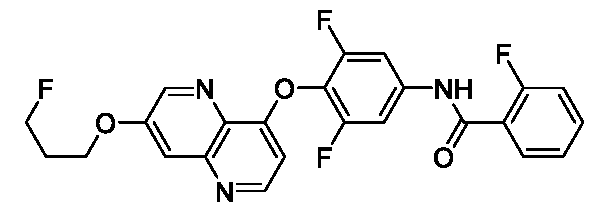
  • the resulting reaction mixture was stirred at 90 °C for 1h. The progress of the reaction was monitored by TLC. After complete consumption of starting material, the reaction mixture was quenched with H 2 O (100 mL) and extracted with EtOAc (100 mL ⁇ 2). The combined organic extracts were washed with brine solution (100 mL), dried over anhydrous Na 2 SO 4, filtered, and concentrated under reduced pressure to give crude material. The crude compound was purified by silica-gel column chromatography and eluted with 20% EtOAc/Petroleum ether to afford 3- bromo-5-(3-fluoropropoxy)pyridine (4 g, 99%) as a colorless liquid.
  • Step 2 N-(5-(3-Fluoropropoxy)pyridin-3-yl)-1,1-diphenylmethanimine
  • Step 3 5-(3-Fluoropropoxy)pyridin-3-amine
  • N-(5-(3-fluoropropoxy)pyridin-3-yl)-1,1-diphenylmethanimine 4.0 g, 11.96 mmol
  • 1,4 Dioxane HCl 4N, 20 mL
  • Step 4 5-(((5-(3-Fluoropropoxy)pyridin-3-yl)amino)methylene)-2,2-dimethyl-1,3-dioxane-4,6- dione
  • 5-(3-fluoropropoxy)pyridin-3-amine 2.3 g, 13.52 mmol
  • ethanol 25 mL
  • compound 5.4 g, 27.059 mmol
  • Step 5 7-(3-Fluoropropoxy)-1,5-naphthyridin-4-ol
  • Step 6 8-(2,6-Difluoro-4-nitrophenoxy)-3-(3-fluoropropoxy)-1,5-naphthyridine
  • 6-(2,2-difluorocyclopropoxy)-7-methoxyquinolin-4-ol 1.3 g, 5.85 mmol
  • DMF 13 mL
  • Cs 2 CO 3 3.81 g, 11.7 mmol
  • 1,2,3-trifluoro-5- WSGR Ref 54004-764.601 nitrobenzene (1.24 g, 7.02 mmol
  • reaction mixture was quenched with H 2 O (100 mL) and extracted with EtOAc (50 mL ⁇ 2). The combined organic extracts were washed with brine solution (50 mL), dried over anhydrous Na 2 SO 4 , filtered, and concentrated under reduced pressure to give crude material, which was purified by column chromatography using 50%-80% petroleum ether and ethyl acetate to get 8- (2,6-difluoro-4-nitrophenoxy)-3-(3-fluoropropoxy)-1,5-naphthyridine (0.8 g, 36.5%) as an off white solid. The regio-isomer was confirmed by 1 H NMR analysis.
  • Step 7 3,5-Difluoro-4-((7-(3-fluoropropoxy)-1,5-naphthyridin-4-yl)oxy)aniline
  • 2-chloro-8-(2,6-difluoro-4-nitrophenoxy)-3-methoxy-1,5-naphthyridine 0.6 g, 1.58 mmol
  • iron powder 0.44 g, 7.90 mmol
  • ammonium chloride 0.42 g, 7.90 mmol
  • Step 8 N-(3,5-Difluoro-4-((7-(3-fluoropropoxy)-1,5-naphthyridin-4-yl)oxy)phenyl)-2- fluorobenzamide
  • 3,5-difluoro-4-((7-(3-fluoropropoxy)-1,5-naphthyridin-4-yl)oxy)aniline 0.1 g, 0.29 mmol
  • DIPEA 0.23 mL, 1.43 mmol
  • 2-fluoro- benzoyl chloride 0.05 g, 0.315 mmol
  • Example 21 N-(3,5-difluoro-4-((7-(3-fluoropropoxy)-1,5-naphthyridin-4-yl)oxy)phenyl)-4- fluoronicotinamide
  • Example 33 N-(4-((2,3-dihydro-[1,4]dioxino[2,3-f]quinolin-10-yl)oxy)-3,5-difluorophenyl)-4- methoxynicotinamide [00147] [b][1,4]dioxin-6-amine [00148] To a stirred solution of 2,3-dihydrobenzo[b][1,4]dioxin-6-amine (10 g, 66.15 mmol) in THF (100 mL) was charged with N-bromosuccinimide (12 g, 67.48 mmol) and a drop of H 2 SO 4 at -78 oC.
  • reaction mixture was allowed to room temperature and stirred for 3 h. Progress of the reaction was monitored by TLC. After completion of the reaction, the reaction mixture was poured into ice cold water and compound was extracted using EtOAc (2 x 300 mL). The combined organic layer was washed with water (100 mL), brine solution (200 mL), dried over anhydrous Na 2 SO 4 and concentrated under reduced pressure to get 7-bromo-2,3-dihydrobenzo- WSGR Ref: 54004-764.601 [b][1,4]dioxin-6-amine (14 g, 91%) as a brown solid. The compound was used for the next step without further purification.
  • Step 2 5-(((7-Bromo-2,3-dihydrobenzo[b][1,4]dioxin-6-yl)amino)methylene)-2,2-dimethyl-1,3- dioxane-4,6-dione
  • 5-bromo-2,3-dihydrobenzo[b][1,4]dioxin-6-amine (6 g, 26.08 mmol) in EtOH (60 mL) was added 5-(ethoxymethylene)-2,2-dimethyl-1,3-dioxane-4,6-dione (5.34 g, 28.69 mmol) at room temperature.
  • Step 3 6-bromo-2,3-dihydro-[1,4]dioxino[2,3-f]quinolin-10-ol
  • 5-(((7-bromo-2,3-dihydrobenzo[b][1,4]dioxin-6-yl)amino)methylene)- 2,2-dimethyl-1,3-dioxane-4,6-dione 5 g, 13.01 mmol
  • diphenyl ether 50 mL
  • Step 4 2,3-dihydro-[1,4]dioxino[2,3-f]quinolin-10-ol
  • 6-bromo-2,3-dihydro-[1,4]dioxino[2,3-f]quinolin-10-ol 5 g, 17.72 mmol
  • MeOH 25 mL
  • THF 25 mL
  • Pd/C 0.9 g
  • the progress of the reaction monitored by TLC. After complete consumption of starting material, the reaction mixture was filtered through Celite pad.
  • Step 6 10-(2,6-difluoro-4-nitrophenoxy)-2,3-dihydro-[1,4]dioxino[2,3-f]quinoline
  • 10-chloro-2,3-dihydro-[1,4]dioxino[2,3-f]quinolone 7 (900 mg, 4.6 mmol) in diglyme (15 mL)
  • 2,6-difluoro-4-nitrophenol (1.07g, 6.09 mmol
  • potassium carbonate 280.60 mg, 2.03 mmol
  • N-ethyl-N-isopropylpropan-2-amine (1.57 g, 12.18 mmol
  • Step 7 4-((2,3-dihydro-[1,4]dioxino[2,3-f]quinolin-10-yl)oxy)-3,5-difluoroaniline
  • 10-(2,6-difluoro-4-nitrophenoxy)-2,3-dihydro-[1,4]dioxino[2,3- f]quinoline 100 mg, 0.6 mmol
  • MeOH 2 mL
  • the resulting reaction mixture was stirred under H 2 bladder pressure (1 atm) for 16 h. The progress of the reaction was monitored by TLC.
  • Step 8 N-(4-((2,3-dihydro-[1,4]dioxino[2,3-f]quinolin-10-yl)oxy)-3,5-difluorophenyl)-4- methoxynicotinamide
  • HATU 345.3 mg, 0.9 mmol
  • 4-methoxynicotinic acid 55 mg, 0.36 mmol
  • DIPEA 117 mg, 0.9 mmol
  • reaction mixture was stirred for 2 h at room temperature. The progress of the reaction was monitored by TLC. After consumption of starting material, the reaction mixture was quenched with H 2 O (50 mL) and extracted with EtOAc (50 mL ⁇ 2). The combined organic extracts were washed with brine solution (50 mL), dried over anhydrous Na 2 SO 4, filtered, and concentrated under reduced pressure to give crude material.
  • Step 2 4-((2,3-dihydro-[1,4]dioxino[2,3-f]quinolin-10-yl)oxy)-2,3,5-trifluoroaniline
  • 6-bromo-10-(2,3,6-trifluoro-4-nitrophenoxy)-2,3-dihydro-[1,4]dioxino- [2,3-f]quinoline (1 g, 2.18 mmol) in ethyl acetate (15 mL) was added Pd/C 10% wet (100 mg, cat.) and stirred reaction mixture under hydrogen balloon pressure for 16 h. The progress of the reaction was monitored by LCMS.
  • Step 3 N-(4-((2,3-dihydro-[1,4]dioxino[2,3-f]quinolin-10-yl)oxy)-2,3,5-trifluorophenyl)-4- methoxynicotinamide WSGR Ref: 54004-764.601 [00169] To a stirred solution of 4-methoxynicotinic acid (0.3 g, 0.86 mmol) in DCM was added to oxalyl chloride (0.11 mL, 1.29 mmol) at 0 °C. Then catalytic amount of DMF was added and continued stirring at room temperature for 1h. After complete consumption of starting material concentrated the reaction mass under vacuum.
  • the crude acid chloride was dissolved in DCM and was added into a solution of 4-((2,3-dihydro-[1,4]dioxino[2,3-f]quinolin-10-yl)oxy)-2,3,5- trifluoroaniline and DIPEA (0.594 mL, 3.594 mmol) at 0 °C.
  • the resulting reaction mixture was allowed to stir at room temperature for 2 h. The progress of the reaction monitored by LCMS. After completion of starting material, the reaction mixture was diluted with DCM (20 mL) and the organic layer washed with water (10 mL) and brine (10 mL), dried over sodium sulphate, and concentrated to get crude compound.
  • Example 36 N-(4-((2,2-dimethyl-[1,3]dioxolo[4,5-f]quinolin-9-yl)oxy)-3,5-difluorophenyl)-4- methoxynicotinamide [00171] [d][1,3]dioxol-5-amine [00172] To a stirred solution of 2,2-dimethylbenzo[d][1,3]dioxol-5-amine (3 g, 18.161 mmol) in ACN (75 mL) was added NBS (3.2 g, 18.161 mmol) at 0 °C portion wise for 10 min. The resulting reaction mixture was stirred at room temperature for 1 h.
  • Step 2 (E)-5-(((6-bromo-2,2-dimethylbenzo[d][1,3]dioxol-5-yl)imino)methyl)-2,2-dimethyl- 1,3-dioxane-4,6-dione WSGR Ref: 54004-764.601 [00174] To a stirred solution of 6-bromo-2,2-dimethylbenzo[d][1,3]dioxol-5-amine (1.5 g, 6.145 mmol) in EtOH (26 mL) was added 5-(ethoxymethylene)-2,2-dimethyl-1,3-dioxane-4,6-dione (1.26 g, 6.33 mmol) at room temperature.
  • Step 3 5-bromo-2,2-dimethyl-[1,3]dioxolo[4,5-f]quinolin-9-ol
  • reaction mixture was cooled to 40 °C then added petroleum ether (50 mL), obtained precipitate was collected by filtration to afford 5-bromo-2,2-dimethyl-[1,3]dioxolo[4,5- f]quinolin-9-ol (0.65 g, 54%) as a brown solid.
  • the crude compound was as such used in the next step without further purification.
  • Step 4 5-bromo-9-(2,6-difluoro-4-nitrophenoxy)-2,2-dimethyl-[1,3]dioxolo[4,5-f]quinoline
  • 5-bromo-2,2-dimethyl-[1,3]dioxolo[4,5-f]quinolin-9-ol 0.6 g, 2.026 mmol
  • DMF 15 mL
  • Cs 2 CO 3 1,2,3-trifluoro-5- nitrobenzene
  • reaction mixture was diluted with water (50 mL) and extracted with ethyl acetate (2 x 50 mL). The combined organic extracts were washed with brine (50 mL), dried over anhydrous sodium sulphate, filtered, and concentrated under reduced pressure to get crude compound.
  • Step 5 4-((2,2-dimethyl-[1,3]dioxolo[4,5-f]quinolin-9-yl)oxy)-3,5-difluoroaniline
  • To stirred solution of 5-bromo-9-(2,6-difluoro-4-nitrophenoxy)-2,2-dimethyl-[1,3]dioxolo[4,5- f]quinolone (0.2 g, 0.441 mmol) in EtOAc (10 mL) was added 10% Pd/C (50 mg, dry) at room temperature.
  • the resulting reaction mixture was stirred at room temperature for 16 h under H 2 gas bladder pressure. The progress of the reaction was monitored by LCMS.
  • reaction mixture was filtered through a small pad of Celite and washed with EtOAc (50 mL) and concentrated under reduced pressure to afford 4 -((2,2-dimethyl- [1,3]dioxolo-[4,5-f]quinolin-9-yl)oxy)-3,5-difluoroaniline (0.12 g, 79%) an off white solid.
  • Step 6 N-(4-((2,2-dimethyl-[1,3]dioxolo[4,5-f]quinolin-9-yl)oxy)-3,5-difluorophenyl)-4- methoxynicotinamide
  • oxalyl chloride 0.1 mL
  • Example 38 4-cyclopropoxy-N-(4-((5,7-dimethoxy-1,6-naphthyridin-4-yl)oxy)-3,5- difluorophenyl)nicotinamide [00184] for C 25 H 20 F 2 N 4 O 5 [M + H] + , 495.14, found 495.10.
  • Example 39 N-(4-((5,7-dimethoxy-1,6-naphthyridin-4-yl)oxy)-3,5-difluorophenyl)-4- methoxynicotinamide WSGR Ref: 54004-764.601 [00186] for C 23 H 18 F 2 N 4 O 5 [M + H] + , 469.12 found 469.10.
  • Example 42 4-cyclopropoxy-N-(3,5-difluoro-4-((5-methoxy-1,6-naphthyridin-4- yl)oxy)phenyl)nicotinamide [00188] for C 24 H 18 F 2 N 4 O 4 [M + H] + , 465.13 found 465.10.
  • Example 53 N-(4-((6-(1-carbamoylcyclopropoxy)-7-methoxyquinolin-4-yl)oxy)-3,5- difluorophenyl)-4-methoxynicotinamide
  • Example 55 N-(3,5-difluoro-4-((7-methoxy-6-(1-methylcyclopropoxy)quinolin-4- yl)oxy)phenyl)-4-methoxynicotinamide [00194] -4-nitrobenzene [00195] To a stirred solution of 1-methylcyclopropan-1-ol (0.758 g, 10.52 mmol) in DMF (15 mL) was added sodium hydride (0.31 g, 13.14 mmol) at 0 °C. The reaction mixture was stirred for 15 mins and then 1-fluoro-2-methoxy-4-nitrobenzene (1.5 g, 8.765 mmol) was added into the reaction mixture.
  • Step 2 3-Methoxy-4-(1-methylcyclopropoxy)aniline
  • 2-methoxy-1-(1-methylcyclopropoxy)-4-nitrobenzene 1.2 g, 5.37 mmol
  • ethyl acetate 15 mL
  • Palladium on activated carbon 0.25 g
  • the resulting reaction mixture was allowed to stir at room temperature for 16 h under hydrogen balder pressure. The progress of the reaction monitored by TLC.
  • Step 3 7-methoxy-6-(1-methylcyclopropoxy)quinolin-4-ol
  • 3-methoxy-4-(1-methylcyclopropoxy)aniline 4 (1 g, 5.17 mmol) in EtOH (10 mL)
  • 2-(ethoxymethylene)-5,5-dimethyl-1,3-dioxane-4,6-dione (1.55 g, 7.76 mmol)
  • the resulting reaction mixture was heated at 90 o C for 1 h.
  • the progress of the reaction was monitored by TLC.
  • the reaction mixture was diluted with EtOH (30 mL) and filtered to obtain solid mass which was dried to get off white solid.
  • Step 4 4-(2,6-difluoro-4-nitrophenoxy)-7-methoxy-6-(1-methylcyclopropoxy)quinoline
  • reaction mixture was filtered through a small pad of Celite and washed with EtOAc (100 mL) and concentrated under reduced pressure.
  • the crude compound was dissolved in ethyl acetate (100 mL) and the organic layer washed with water (50 mL) and brine (50 mL), dried over sodium sulphate and concentrated to get crude compound which was purified by column chromatography using 40% ethyl acetate in petroleum-ether as an eluent to get 4-(2,6-difluoro- 4-nitrophenoxy)-7-methoxy-6-(1-methylcyclopropoxy)quinoline (0.5 g, 30%) as an yellow solid.
  • Step 5 3,5-difluoro-4-((7-methoxy-6-(1-methylcyclopropoxy)quinolin-4-yl)oxy)aniline
  • 4-(2,6-difluoro-4-nitrophenoxy)-7-methoxy-6-(1-methylcyclopropoxy)- quinoline 0.5 g, 1.24 mmol
  • iron powder 0.35 g, 6.21 mmol
  • ammonium chloride 0.33 g, 6.21 mmol
  • reaction mixture was filtered through a small pad of Celite and washed with EtOAc (100 mL) and concentrated under reduced pressure .
  • the crude compound was dissolved in ethyl acetate (50 mL) and the organic layer washed with water (50 mL) and brine (50 mL), dried over anhydrous sodium sulphate.
  • the organic layer was concentrated to get crude compound which was purified by column chromatography using 60% ethyl acetate in petroleum-ether as an eluent to get 3,5-difluoro-4-((7-methoxy-6-(1- methylcyclo-propoxy)quinolin-4-yl)oxy)aniline (0.35 g, 75%) as off white solid.
  • Step 6 N-(3,5-difluoro-4-((7-methoxy-6-(1-methylcyclopropoxy)quinolin-4-yl)oxy) phenyl)-4- methoxynicotinamide WSGR Ref: 54004-764.601 [00205] To a stirred solution of methyl 3,5-difluoro-4-((7-methoxy-6-(1-methylcyclopropoxy)quinolin- 4-yl)oxy)aniline (0.1 g, 0.27 mmol) in DCM (5 mL) were added DIPEA (0.13 mL, 0.8 mmol) and 4-methoxynicotinoyl chloride (0.055 g, 0.32 mmol) at 0 °C.
  • reaction mixture was stirred at room temperature for 30 minutes. The progress of the reaction monitored by LCMS. After completion of starting material, the reaction mixture was diluted with DCM (50 mL) and the organic layer washed with water (50 mL) and brine (50 mL) and dried over anhydrous sodium sulphate. The organic layer was concentrated under reduced pressu re to get crude compound which was purified by prep HPLC to afford N-(3,5-difluoro-4-((7-methoxy-6- (1-methyl-cyclo-propoxy) quinolin-4-yl)oxy) phenyl)-4-methoxynicotinamide (0.012 g, 8%) as off-white solid.
  • Example 57 N-(4-((6-cyclopropoxy-7-methoxyquinolin-4-yl)oxy)-3,5-difluorophenyl)-4- methoxynicotinamide
  • Example 67 N-(4-((1-cyclopropyl-2,3-dihydro-1H-[1,4]oxazino[3,2-g]quinolin-9-yl)oxy)-3,5- [00213] nitro-3,4-dihydro-2H-benzo[b][1,4]oxazine [00214] To a stirred solution of 7-nitro-3,4-dihydro-2H-benzo[b][1,4]oxazine (1 g, 5.55 mmol) and cyclopropylboronic acid (1.43 g, 16.65 mmol) in toluene (10 mL) were added 4-dimethylamino- pyridine (2.034 g, 16.65 mmol) and potassium bis(trimethylsilyl)amide (1M in THF, 5.5 mL, 5.5 mmol) at room temperature.
  • 4-dimethylamino- pyridine 2.034 g, 16.65 mmol
  • reaction mass was degassed with O 2 gas for 5 min followed by the addition of copper(II) acetate, anhydrous (2.016 g, 11.10 mmol) at room temperature.
  • the resulting reaction mixture was stirred at 100 °C for 16 h under O 2 gas.
  • the progress of the reaction was monitored by TLC.
  • the reaction mixture was filtered through Celite pad and washed the pad with EtOAc (25 mL), collected filtrate was washed with water (50 mL), brine (50 mL) and dried over anhydrous Na 2 SO 4 , filtered, and concentrated under reduced pressure to get crude compound.
  • Step 2 4-cyclopropyl-3,4-dihydro-2H-benzo[b][1,4]oxazin-7-amine
  • 4-cyclopropyl-7-nitro-3,4-dihydro-2H-benzo[b][1,4]oxazine 0.8 g, 3.63 mmol
  • iron powder 1.014 g, 18.16 mmol
  • ammonium chloride 0.972 g, 18.163 mmol
  • Step 3 (E)-5-(((4-cyclopropyl-3,4-dihydro-2H-benzo[b][1,4]oxazin-7-yl)imino)methyl)-2,2- dimethyl-1,3-dioxane-4,6-dione
  • 4-cyclopropyl-3,4-dihydro-2H-benzo[b][1,4]oxazin-7-amine (0.65 g, 3.417 mmol)
  • 5-(ethoxymethylene)-2,2-dimethyl-1,3-dioxane-4,6- dione 0.821 g, 4.1 mmol
  • Step 5 1-Cyclopropyl-9-(2,6-difluoro-4-nitrophenoxy)-2,3-dihydro-1H-[1,4]oxazino[3,2- g]quinoline
  • 1-cyclopropyl-2,3-dihydro-1H-[1,4]oxazino[3,2-g]quinolin-9-ol 7 0.130 g, 0.53 mmol
  • DMF 6.5 mL
  • Cesium carbonate 0.437 g, 1.34 mmol
  • 1,2,3- trifluoro-5-nitrobenzene (0.124 g, 0.698 mmol
  • reaction mixture was stirred at room temperature for 2 h. The progress of the reaction was monitored by TLC. After complete consumption of starting material, reaction mixture was diluted with water (25 mL) and extracted with ethyl acetate (2 x 25 mL). The combined organic extracts were washed with brine (25 mL), dried over anhydrous sodium sulphate, filtered, and concentrated WSGR Ref: 54004-764.601 under reduced pressure to get crude compound (0.2 g).
  • Step 6 4-((1-Cyclopropyl-2,3-dihydro-1H-[1,4]oxazino[3,2-g]quinolin-9-yl)oxy)-3,5- difluoroaniline
  • 1-cyclopropyl-9-(2,6-difluoro-4-nitrophenoxy)-2,3-dihydro-1H- [1,4]oxazino[3,2-g]quinoline 0.1 g, 0.25 mmol
  • EtOH 2 mL
  • water 2 mL
  • iron powder 0.042 g, 0.75 mmol
  • ammonium chloride 0.040 g, 0.75 mmol
  • reaction mixture was stirred at 80 °C for 2 h. Progress of the reaction was monitored by TLC. After completion of starting material, the reaction mixture was filtered through a small pad of Celite and washed with EtOAc (25 mL) and concentrated under reduced pressure.
  • Step 7 N-(4-((1-cyclopropyl-2,3-dihydro-1H-[1,4]oxazino[3,2-g]quinolin-9-yl)oxy)-3,5- difluorophenyl)-4-methoxynicotinamide
  • 4-((1-cyclopropyl-2,3-dihydro-1H-[1,4]oxazino[3,2-g]quinolin-9- yl)oxy)-3,5-difluoroaniline (0.06 g, 0.16 mmol) and methyl 4-methoxynicotinate (0.032 g, 0.195 mmol) in toluene (1.2 mL) was added trimethylaluminium (1.0 M solution in toluene, 0.325 mL, 0.325 mmol) at room temperature.
  • reaction mixture was stirred at 90 °C for 1 h. The progress of the reaction was monitored by TLC. After complete consumption of starting material, the reaction mixture was diluted with water (25 mL) and extracted with DCM (2 x 25 mL). The combined organic layers were washed with brine (25 mL), dried over anhydrous sodium sulphate, filtered, and concentrated under reduced pressure to get crude (0.08 g) compound.
  • Example 68 N-(4-((6-(cyclopropylamino)-7-fluoroquinolin-4-yl)oxy)-3,5-difluorophenyl)-4- methoxynicotinamide
  • fluoro-4-nitroaniline [00229] To a mixture of 1,2-difluoro-4-nitrobenzene (2.5 g, 15.714 mmol) and cyclopropanamine (1.077 g, 18.857 mmol) in DMSO (37.5 mL), was added potassium carbonate, (3.9 g, 28.29 mmol) at room temperature. Then the resulting reaction mixture was stirred for 3h. The progress of the reaction was monitored by LC-MS.
  • Step 2 Tert-butyl cyclopropyl(2-fluoro-4-nitrophenyl)carbamate
  • N-cyclopropyl-2-fluoro-4-nitroaniline 0.2 g, 1.019 mmol
  • Boc-anhydride 0.556 g, 2.55 mmol
  • THF 3.0 mL
  • LiHMDS 1.00 mL, 1.2 molar in THF, 1.2 mmol
  • Step 3 Tert-butyl (4-amino-2-fluorophenyl)(cyclopropyl)carbamate
  • tert-butyl cyclopropyl(2-fluoro-4-nitrophenyl)carbamate 2.1 g, 7.087 mmol
  • EtOH EtOH
  • water 21.0 mL, 2:1
  • iron powder (2.77 g, 49.61 mmol, )
  • ammonium chloride 2.65 g, 49.61 mmol
  • Step 4 Tert-butylcyclopropyl(4-(((2,2-dimethyl-4,6-dioxo-1,3-dioxan-5 ylidene)methyl)amino)- 2- carbamate
  • Step 5 Tert-butyl cyclopropyl(7-fluoro-4-hydroxyquinolin-6-yl)carbamate
  • Step 6 Tert-butyl (4-chloro-7-fluoroquinolin-6-yl)(cyclopropyl)carbamate
  • phosphorus oxychloride 4.81 g, 31.41 mmol
  • the reaction mass was diluted with DCM (30 mL) and washed with NaHCO 3 solution.
  • the organic layer was dried over anhydrous Na 2 SO 4. and concentrated under reduced pressure to get the crude product.
  • the crude compound was dissolved in THF (20 mL), was added KHMDS (7.85 mL, 15.70 mmol) and Boc-anhydride (3.43 g, 15.70 mmol) was added at room temperature and stirred for 3 h. Progress of the reaction was monitored by LC-MS. The reaction mixture was diluted with EtOAc (100 mL) and washed with saturated NaHCO 3 solution (100 mL). The organic layer was dried over Na 2 SO 4 and concentrated. The crude compound was purified by ISCO, product eluted in 25-35% EA:PE.
  • Step 7 Tert-butyl cyclopropyl(4-(2,6-difluoro-4-nitrophenoxy)-7-fluoroquinolin-6-yl)carbamate
  • tert-butyl (4-chloro-7-fluoroquinolin-6-yl)(cyclopropyl)carbamate 0.2 g, 0.594 mmol
  • 2,6-difluoro-4-nitrophenol 0.104 g, 0.594 mmol
  • potassium carbonate (0.123 g, 0.891 mmol
  • Step 8 Tert-butyl (4-(4-amino-2,6-difluorophenoxy)-7-fluoroquinolin-6- yl)(cyclopropyl)carbamate
  • tert-butyl cyclopropyl(4-(2,6-difluoro-4-nitrophenoxy)-7-fluoroquinolin- 6-yl)carbamate (0.35 g, 0.736 mmol) in EtOH (5.25 mL) and water (1.75 mL) were added iron powder(0.206 g, 3.68 mmol) and ammonium chloride (0.195 g, 3.681 mmol) at RT and then the resulting reaction mixture was heated for 3 h at 80 o C.
  • Step 9 N-(4-((6-(cyclopropylamino)-7-fluoroquinolin-4-yl)oxy)-3,5-difluorophenyl)-4- methoxynicotinamide
  • tert-butyl (4-(4-amino-2,6-difluorophenoxy)-7-fluoroquinolin-6- yl)(cyclopropyl)carbamate (0.25 g, 0.561 mmol)
  • methyl 4-methoxynicotinate (0.141 g, 0.842 mmol) in toluene (5.0 mL) was added trimethylaluminum 2.0 M in toluene (0.70 mL, 1.403 mmol) at room temperature.
  • the resulting reaction mixture was then heated to 90 o C for 3 h.
  • the reaction was monitored by LC-MS.
  • the reaction was quenched with water (30 mL) and extracted into EtOAc (2 x 30 mL).
  • the combined organic layer was dried over Na 2 SO 4 and concentrated under reduced pressure to get the crude compound.
  • the crude compound was dissolved in 1,4-dioxane (5.0 mL) and was added HCl in dioxane (2.105 mL, 8.419 mmol) at room temperature and stirred for 1 h.
  • the reaction mixture was concentrated under reduced pressure and crude product was diluted with EtOAc (100 mL) and washed with water (100 mL).
  • Example 70 N-(4-((6-(cyclopropylamino)-7-methoxyquinolin-4-yl)oxy)-3,5-difluorophenyl)-4- methoxynicotinamide
  • 4-nitrophenoxy)-7-methoxyquinoline [00248] To a stirred solution of 6-bromo-4-chloro-7-methoxyquinoline (1 g, 3.669 mmol) in Di phenyl ether (10 mL), was added potassium carbonate (1.26 g, 9.173 mmol) and 2,6-difluoro-4- nitrophenol (0.964 mg, 5.504 mmol) at RT, heated to 150° C for 2 h.
  • Step 2 4-((6-Bromo-7-methoxyquinolin-4-yl)oxy)-3,5-difluoroaniline
  • 6-bromo-4-(2, 6-difluoro-4-nitrophenoxy)-7-methoxyquinoline 0.5 g, 1.216 mmol
  • ethanol 10 mL
  • iron 0.99 g, 7.296 mmol
  • ammonium chloride 0.06 g, 7.296 mmol
  • Step 3 N-(4-((6-bromo-7-methoxyquinolin-4-yl)oxy)-3,5-difluorophenyl)-4- methoxynicotinamide
  • 4-((6-bromo-7-methoxyquinolin-4-yl) oxy)-3, 5-difluoroaniline 0.2 g, 0.525 mmol
  • Toluene 4 mL
  • methyl 4-methoxynicotinate (0.132 g, 0.787 mmol)
  • WSGR Ref 54004-764.601
  • Trimethylaluminum 0.227 g, 1.574 mmol
  • the resulting reaction mixture was stirred at 70° C for 2 h. After completion of the reaction.
  • the reaction mixture was diluted with ethyl acetate (50 mL), organic layer washed with brine (2 x 30 mL), dried over anhydrous sodium sulphate and dried to get crude compound.
  • the crude compound was purified by using Combiflash (24 g YMC silica column), compound was eluted at 5-10% Me OH in DCM.
  • reaction mixture was heated to 90 °C for 4 h.
  • the reaction mixture was filtrated through the celite and washed with ethyl acetate (50 mL), the organic layer was washed with brine (3 x 30 mL), dried over anhydrous sodium sulphate, and concentrated to give crude compound.
  • the crude compound was purified by reverse phase chromatography to give the title compound N-(4-((6-(cyclopropylamino)-7-methoxyquinolin-4- yl)oxy)-3,5-difluorophenyl)-4-methoxynicotinamide as an off white solid.
  • Example 76 N-(4-((6-cyclopropyl-7-methoxyquinolin-4-yl)oxy)-3,5-difluorophenyl)-4- methoxynicotinamide [00256] for C 26 H 21 F 2 N 3 O 4 [M + H] + , 478.15 found 478.10.
  • Example 1a MET Mobility Shift Assay
  • Small molecule inhibition of MET kinase activity was evaluated using a fluorescence-based microfluidic mobility shift assay. MET catalyzes the production of ADP from ATP during phosphoryl transfer to the substrate peptide, FLPeptide30 (5-FAM-KKKKEEIYFFF-CONH2) (Perkin Elmer, 760430).
  • MET enzme (Carna Biosciences, 08-151) at 0.625 nM was prepared with 10 mM MgCl 2 and 1.5 ⁇ M substrate peptide in a buffer containing 50 mM HEPES, 1 mM EGTA, 0.01% Brij-35, 0.05% BSA, and 2 mM DTT and pre-incubated at room temperature for 30 min prior to the start of the reaction.100 ⁇ M ATP was added to start the reaction.
  • the mobility shift assay electrophoretically separates the fluorescently labeled peptides (substrate and phosphorylated product) following the 60 minute kinase reaction. The reaction was terminated by addition of 0.5 M EDTA.
  • MET D1228N catalyzes the production of ADP from ATP during phosphoryl transfer to the substrate peptide, FLPeptide30 (5-FAM- KKKKEEIYFFF-CONH2) (Perkin Elmer, 760430).
  • MET D1228N enzyme (Signalchem, M52- 12IG) at 0.313 nM was prepared with 10 mM MgCl 2 and 1.5 ⁇ M substrate peptide in a buffer containing 50 mM HEPES, 1 mM EGTA, 0.01% Brij-35, 0.05% BSA, and 2 mM DTT and pre- incubated at room temperature for 30 min prior to the start of the reaction.100 ⁇ M ATP was WSGR Ref: 54004-764.601 added to start the reaction.
  • the mobility shift assay electrophoretically separates the fluorescently labeled peptides (substrate and phosphorylated product) following the 60 minute kinase reaction.
  • the reaction was terminated by addition of 0.5 M EDTA. Both substrate and product were measured and the ratio of these values used to generate % conversion of su bstrate to product by the LabChip EZ reader (Perkin Elmer).
  • IC 50 values were calculated using the inhibition of conversion ratio using Dotmatics Knowledge Solutions Studies curve fitting environment (Dotmatics, Bishops Stortford, UK, CM23) and are presented in Table 2.
  • Example 1c CellTiter-Glo Cell Viability Assay
  • Ba/F3-TPR-MET and Ba/F3-TPR-MET-D1228N cells were seeded at 3000 cells per well in a 96 well plate in 90 ⁇ L growth media and allowed to incubate overnight at 37 °C with 5% CO 2 . The following day, compounds were serially diluted from a 10 mM top dose for a 9-point 3-fold dilution curve in DMSO. Following a 100-fold dilution in growth media, a further 10-fold dilution was made into the cell plate for a final volume of 100 ⁇ L and 0.1% DMSO.
  • the CellTiter-Glo® 2.0 Assay determines the number of viable cells in culture by quantifying ATP, which indicates the presence of metabolically active cells. Luminescence readout is directly proportional to the number of viable cells in culture.
  • CellTiter-Glo reagent Promega, G9243
  • cell plates were allowed to equilibrate to room temperature for at least 15 min, then 100 ⁇ L of CellTiter-Glo was added to each well for a 1:1 ratio of reagent to media. Samples were placed on a shaker for 2 min prior to a 30 min incubation at room temperature protected from light.
  • Luminescence was read on a Perkin Elmer Envision plate reader 2105 and used to calculate IC 50 values within the Dotmatics Knowledge Solutions Studies curve fitting environment (Dotmatics, Bishops Stortford, UK, CM23) and are presented in Table 2. [00265] Representative data for exemplary compounds is presented in Table 2.
  • Example 1 Oral capsule [00267]
  • the active ingredient is a compound of Table 1, or a pharmaceutically acceptable salt or solvate thereof.
  • a capsule for oral administration is prepared by mixing 1-1000 mg of active ingredient with starch or other suitable powder blend. The mixture is incorporated into an oral dosage unit such as a hard gelatin capsule, which is suitable for oral administration.
  • Example 2 Solution for injection
  • the active ingredient is a compound of Table 1, or a pharmaceutically acceptable salt or solvate thereof, and is formulated as a solution in sesame oil at a concentration of 50 mg-eq/mL.
  • the examples and embodiments described herein are for illustrative purposes only and various modifications or changes suggested to persons skilled in the art are to be included within the spirit and purview of this application and scope of the appended claims.

Landscapes

  • Chemical & Material Sciences (AREA)
  • Organic Chemistry (AREA)
  • Health & Medical Sciences (AREA)
  • Animal Behavior & Ethology (AREA)
  • Public Health (AREA)
  • Pharmacology & Pharmacy (AREA)
  • Veterinary Medicine (AREA)
  • Life Sciences & Earth Sciences (AREA)
  • Medicinal Chemistry (AREA)
  • General Health & Medical Sciences (AREA)
  • Epidemiology (AREA)
  • Dermatology (AREA)
  • Chemical Kinetics & Catalysis (AREA)
  • General Chemical & Material Sciences (AREA)
  • Nuclear Medicine, Radiotherapy & Molecular Imaging (AREA)
  • Oil, Petroleum & Natural Gas (AREA)
  • Pharmaceuticals Containing Other Organic And Inorganic Compounds (AREA)

Abstract

Provided herein are inhibitors of MET receptor tyrosine kinase, pharmaceutical compositions comprising said inhibitory compounds, and methods for using said MET kinase inhibitory compounds for the treatment of disease.

Description

WSGR Ref: 54004-764.601 INHIBITORS OF MET KINASE CROSS-REFERENCE TO RELATED APPLICATION [0001] This application claims the benefit of U.S. Patent Application No.63/508,859, filed on June 16, 2023, which is hereby incorporated by reference in its entirety . BACKGROUND [0002] MET is a member of the class IV receptor tyrosine kinase family and is expressed on the surfaces of many different cell types, including epithelial cells of many organs, including the liver, pancreas, prostate, kidney, muscle, and bone marrow, during both embryogenesis and adulthood. Binding of the hepatocyte growth factor induces dimerization and activation of the receptor. MET modulates many essential cellular processes during development and wound healing, including cell proliferation, survival, motility, and morphogenesis. Aberrant MET activity is found in many different human cancers. Accordingly, therapies that target MET kinase activity are desired for use in the treatment of cancer and other disorders characterized by aberrant MET pathway signaling. BRIEF SUMMARY OF THE INVENTION [0003] Provided herein are inhibitors of MET kinase, pharmaceutical compositions comprising said inhibitory compounds, and methods for using said inhibitory compounds for the treatment of disease. [0004] One embodiment provide a compound, or a pharmaceutically acceptable salt or solvate thereof, having the structure of Formula (I):
Figure imgf000002_0001
V is independently N, C-H, or C-L-R; X is independently N, C-H, or C-L1-R1; Z is independently N, C-H, or C-L2-R2; W is C-H or N; Y1 is independently N or C-R3; Y2 is independently N or C-R4; WSGR Ref: 54004-764.601 Y3 is independently N or C-R3; Y4 is independently N or C-R3; L is a bond, halogen, -C-, -O-, -NH-, -N(optionally substituted C1-C6 alkyl)-, - N(optionally substituted C3-C6 cycloalkyl)-, -NHCO-, or -CONH-; L1 is a bond, halogen, -C-, -O-, -NH-, -N(optionally substituted C1-C6 alkyl)-, - N(optionally substituted C3-C6 cycloalkyl)-, -NHCO-, or -CONH-; L2 is a bond, halogen, -C-, -O-, -NH-, -N(optionally substituted C1-C6 alkyl)-, - N(optionally substituted C3-C6 cycloalkyl)-, -NHCO-, or -CONH-; R is selected from the group consisting of H, halogen, -CN, optionally substituted C1-C6 alkyl, optionally substituted C1-C6 alkenyl, optionally substituted C1-C6 alkynyl, optionally substituted C3-C6 cycloalkyl, optionally substituted cycloalkylalkyl, optionally substituted heterocyclyl, optionally substituted heterocyclylalkyl, optionally substituted heteroaryl, and optionally substituted heteroarylalkyl; R1 is selected from the group consisting of H, halogen, -CN, optionally substituted C1- C6 alkyl, optionally substituted C1-C6 alkenyl, optionally substituted C1-C6 alkynyl, optionally substituted C3-C6 cycloalkyl, optionally substituted cycloalkylalkyl, optionally substituted heterocyclyl, optionally substituted heterocyclylalkyl, optionally substituted heteroaryl, and optionally substituted heteroarylalkyl; R2 is optionally substituted C1-C6 alkyl, optionally substituted C3-C6 cycloalkyl, - NH(optionally substituted C3-C6 cycloalkyl), or optionally substituted C3-C6 cycloalkyl oxy; each R3 is selected from H, halogen, -CN, -NH2, -NH(optionally substituted C1-C6 alkyl), -N(optionally substituted C1-C6 alkyl)2, optionally substituted C1-C4 alkoxy, or optionally substituted C1-C4 alkyl; or R3 and R4 join to form a carbocyclyl ring; R4 is independently selected from H, halogen, -CN, optionally substituted C1-C6 alkyl, optionally substituted C1-C6 alkoxy, optionally substituted C3-C6 cycloalkyl, optionally substituted cycloalkylalkyl, optionally substituted heterocyclyl, optionally substituted heterocyclylalkyl, -NH2, -NH(optionally substituted C1-C6 alkyl), or -N(optionally substituted C1-C6 alkyl)2; R5 is fluoro; R6, R7 and R8 are each independently selected from H, halogen, optionally substituted C1-C4 alkyl, optionally substituted C1-C4 alkoxy, or -CN; provided that at least one of R6, R7 or R8 is not H; Q is fluoro, or -L2-R9; L2 is bond, -O-, or optionally substituted C1-C5 alkylene; and R9 is selected from the group consisting of hydrogen, halogen, optionally substituted C1- WSGR Ref: 54004-764.601 C6 alkyl, optionally substituted C1-C6 alkynyl, optionally substituted C1-C6 alkenyl, optionally substituted C3-C6 cycloalkyl, optionally substituted cycloalkylalkyl, optionally substituted heterocyclyl, and optionally substituted heterocyclylalkyl. [0005] One embodiment provide a compound, or a pharmaceutically acceptable salt or solvate thereof, having the structure of Formula (II):
Figure imgf000004_0001
W is C-H or N; Y1 is independently N or C-R3; Y2 is independently N or C-R4; Y3 is independently N or C-R3; Y4 is independently N or C-R3; L is a bond, -O-, -NH-, -NHCO-, or -CONH-; L1 is a bond, -O-, -NH-, -NHCO-, or -CONH-; R1 and R2 are each independently selected from the group consisting of optionally substituted C1-C6 alkyl, optionally substituted C1-C6 alkenyl, optionally substituted C1-C6 alkynyl, optionally substituted C3-C6 cycloalkyl, optionally substituted cycloalkylalkyl, optionally substituted heterocyclyl, optionally substituted heterocyclylalkyl, optionally substituted heteroaryl, and optionally substituted heteroarylalkyl; and R1 and R2 are joined to form a carbocycle or heterocycle; each R3 is selected from H, halogen, -CN, -NH2, -NH(optionally substituted C1-C6 alkyl), -N(optionally substituted C1-C6 alkyl)2, optionally substituted C1-C4 alkoxy, or optionally substituted C1-C4 alkyl; or R3 and R4 join to form a carbocyclyl ring R4 is independently selected from H, halogen, -CN, optionally substituted C1-C6 alkyl, optionally substituted C1-C6 alkoxy, optionally substituted C3-C6 cycloalkyl, optionally substituted cycloalkylalkyl, optionally substituted heterocyclyl, optionally substituted heterocyclylalkyl, -NH2, -NH(optionally substituted C1-C6 alkyl), or -N(optionally substituted C1-C6 alkyl)2; R5 is fluoro; R6, R7 and R8 are each independently selected from H, halogen, optionally substituted WSGR Ref: 54004-764.601 C1-C4 alkyl, optionally substituted C1-C4 alkoxy, or -CN; provided that at least one of R6, R7 or R8 is not H; Q is fluoro, or -L2-R9; L2 is bond, -O-, or optionally substituted C1-C5 alkylene; and R9 is selected from the group consisting of hydrogen, halogen, optionally substituted C1- C6 alkyl, optionally substituted C1-C6 alkynyl, optionally substituted C1-C6 alkenyl, optionally substituted C3-C6 cycloalkyl, optionally substituted cycloalkylalkyl, optionally substituted heterocyclyl, and optionally substituted heterocyclylalkyl. [0006] One embodiment provide a compound, or a pharmaceutically acceptable salt or solvate thereof, having the structure of Formula (III):
Figure imgf000005_0001
W is C-H or N; Y1 is independently N or C-R3; Y2 is independently N or C-R4; Y3 is independently N or C-R3; Y4 is independently N or C-R3; L is a bond, -O-, -NH-, or -N(optionally substituted C3-C6 cycloalkyl)-; L1 is a bond, -O-, -NH-, or -N(optionally substituted C3-C6 cycloalkyl)-; R1 and R2 are each independently selected from the group consisting of optionally substituted C1-C6 alkyl, optionally substituted C1-C6 alkenyl, optionally substituted C1-C6 alkynyl, optionally substituted C3-C6 cycloalkyl, optionally substituted cycloalkylalkyl, optionally substituted heterocyclyl, optionally substituted heterocyclylalkyl, optionally substituted heteroaryl, and optionally substituted heteroarylalkyl; and R1 and R2 are joined to form a carbocycle or heterocycle; each R3 is selected from H, halogen, -CN, -NH2, -NH(optionally substituted C1-C6 alkyl), -N(optionally substituted C1-C6 alkyl)2, optionally substituted C1-C4 alkoxy, or optionally substituted C1-C4 alkyl; R4 is independently selected from H, halogen, -CN, optionally substituted C1-C6 alkyl, optionally substituted C1-C6 alkoxy, optionally substituted C3-C6 cycloalkyl, optionally WSGR Ref: 54004-764.601 substituted cycloalkylalkyl, optionally substituted heterocyclyl, optionally substituted heterocyclylalkyl, -NH2, -NH(optionally substituted C1-C6 alkyl), or -N(optionally substituted C1-C6 alkyl)2; R5 is fluoro; R6, R7 and R8 are each independently selected from H, halogen, optionally substituted C1-C4 alkyl, optionally substituted C1-C4 alkoxy, or -CN; provided that at least one of R6, R7 or R8 is not H; Q is fluoro, or -L2-R9; L2 is a bond, -O-, or optionally substituted C1-C5 alkylene; and R9 is selected from the group consisting of hydrogen, halogen, optionally substituted C1- C6 alkyl, optionally substituted C1-C6 alkynyl, optionally substituted C1-C6 alkenyl, optionally substituted C3-C6 cycloalkyl, optionally substituted cycloalkylalkyl, optionally substituted heterocyclyl, and optionally substituted heterocyclylalkyl. [0007] One embodiment provides a compound, or a pharmaceutically acceptable salt or solvate thereof, as described in Table 1. [0008] One embodiment provides a pharmaceutical composition comprising a compound of Formula (I), Formula (II), Formula (III), or Table 1, or a pharmaceutically acceptable salt or solvate thereof, and at least one pharmaceutically acceptable excipient. [0009] One embodiment provides a method of treating a disease or disorder in a patient in need thereof comprising administering to the patient a compound of Formula (I), Formula (II), Formula (III), or Table 1, or pharmaceutically acceptable salt or solvate thereof. Another embodiment provides the method wherein the disease or disorder is cancer. INCORPORATION BY REFERENCE [0010] All publications, patents, and patent applications mentioned in this specification are herein incorporated by reference for the specific purposes identified herein. DETAILED DESCRIPTION OF THE INVENTION [0011] As used herein and in the appended claims, the singular forms "a," "and," and "the" includ e plural referents unless the context clearly dictates otherwise. Thus, for example, reference to "an agent" includes a plurality of such agents, and reference to "the cell" includes reference to one or more cells (or to a plurality of cells) and equivalents thereof known to those skilled in the art, and so forth. When ranges are used herein for physical properties, such as molecular weight, or chemical properties, such as chemical formulae, all combinations and subcombinations of ranges and specific embodiments therein are intended to be included. The term "about" when referring to a number or a numerical range means that the number or numerical range referred to WSGR Ref: 54004-764.601 is an approximation within experimental variability (or within statistical experimental error), and thus the number or numerical range, in some instances, will vary between 1% and 15% of the stated number or numerical range. The term "comprising" (and related terms such as "comprise" or "comprises" or "having" or "including") is not intended to exclude that in other certain embodiments, for example, an embodiment of any composition of matter, composition, method, or process, or the like, described herein, "consist of" or "consist essentially of" the described features. Definitions [0012] As used in the specification and appended claims, unless specified to the contrary, the following terms have the meaning indicated below. [0013] "Amino" refers to the –NH2 radical. [0014] "Cyano" refers to the -CN radical. [0015] "Nitro" refers to the -NO2 radical. [0016] "Oxa" refers to the -O- radical. [0017] "Oxo" refers to the =O radical. [0018] "Thioxo" refers to the =S radical. [0019] "Imino" refers to the =N-H radical. [0020] "Oximo" refers to the =N-OH radical. [0021] "Hydrazino" refers to the =N-NH2 radical. [0022] "Alkyl" refers to a straight or branched hydrocarbon chain radical consisting solely of carbon and hydrogen atoms, containing no unsaturation, having from one to fifteen carbon atoms (e.g., C1-C15 alkyl). In certain embodiments, an alkyl comprises one to thirteen carbon atoms (e.g., C1-C13 alkyl). In certain embodiments, an alkyl comprises one to eight carbon atoms (e.g., C1- C8 alkyl). In other embodiments, an alkyl comprises one to five carbon atoms (e.g., C1-C5 alkyl). In other embodiments, an alkyl comprises one to four carbon atoms (e.g., C1-C4 alkyl). In other embodiments, an alkyl comprises one to three carbon atoms (e.g., C1-C3 alkyl). In other embodiments, an alkyl comprises one to two carbon atoms (e.g., C1-C2 alkyl). In other embodiments, an alkyl comprises one carbon atom (e.g., C1 alkyl). In other embodiments, an alkyl comprises five to fifteen carbon atoms (e.g., C5-C15 alkyl). In other embodiments, an alkyl comprises five to eight carbon atoms (e.g., C5-C8 alkyl). In other embodiments, an alkyl comprises two to five carbon atoms (e.g., C2-C5 alkyl). In other embodiments, an alkyl comprises three to five carbon atoms (e.g., C3-C5 alkyl). In other embodiments, the alkyl group is selected from methyl, ethyl, 1-propyl (n-propyl), 1-methylethyl (iso-propyl), 1-butyl (n-butyl), 1-methylpropyl (sec-butyl), 2-methylpropyl (iso-butyl), 1,1-dimethylethyl (tert-butyl), 1-pentyl (n-pentyl). The alkyl is attached to the rest of the molecule by a single bond. Unless stated WSGR Ref: 54004-764.601 otherwise specifically in the specification, an alkyl group is optionally substituted by one or more of the following substituents: halo, cyano, nitro, oxo, thioxo, imino, oximo, trimethylsilanyl, -ORa, -SRa, -OC(O)-Ra, -N(Ra)2, -C(O)Ra, -C(O)ORa, -C(O)N(Ra)2, - N(Ra)C(O)ORa, -OC(O)-N(Ra)2, -N(Ra)C(O)Ra, -N(Ra)S(O)tRa (where t is 1 or 2), -S(O)tORa (where t is 1 or 2), -S(O)tRa (where t is 1 or 2) and -S(O)tN(Ra)2 (where t is 1 or 2) where each Ra is independently hydrogen, alkyl (optionally substituted with halogen, hydroxy, methoxy, or trifluoromethyl), fluoroalkyl, carbocyclyl (optionally substituted with halogen, hydroxy, methoxy, or trifluoromethyl), carbocyclylalkyl (optionally substituted with halogen, hydroxy, methoxy, or trifluoromethyl), aryl (optionally substituted with halogen, hydroxy, methoxy, or trifluoromethyl), aralkyl (optionally substituted with halogen, hydroxy, methoxy, or trifluoromethyl), heterocyclyl (optionally substituted with halogen, hydroxy, methoxy, or trifluoromethyl), heterocyclylalkyl (optionally substituted with halogen, hydroxy, methoxy , or trifluoromethyl), heteroaryl (optionally substituted with halogen, hydroxy, methoxy, or trifluoromethyl), or heteroarylalkyl (optionally substituted with halogen, hydroxy, methoxy, or trifluoromethyl). [0023] "Alkoxy" refers to a radical bonded through an oxygen atom of the formula –O-alkyl, where alkyl is an alkyl chain as defined above. [0024] "Alkenyl" refers to a straight or branched hydrocarbon chain radical group consisting solely of carbon and hydrogen atoms, containing at least one carbon-carbon double bond, and having from two to twelve carbon atoms. In certain embodiments, an alkenyl comprises two to eight carbon atoms. In other embodiments, an alkenyl comprises two to four carbon atoms. The alkenyl is attached to the rest of the molecule by a single bond, for example, ethenyl (i.e., vinyl), prop-1-enyl (i.e., allyl), but-1-enyl, pent-1-enyl, penta-1,4-dienyl, and the like. Unless stated otherwise specifically in the specification, an alkenyl group is optionally substituted by one or more of the following substituents: halo, cyano, nitro, oxo, thioxo, imino, oximo, trimethylsilanyl, -ORa, -SRa, -OC(O)-Ra, -N(Ra)2, -C(O)Ra, -C(O)ORa, -C(O)N(Ra)2, - N(Ra)C(O)ORa, -OC(O)-N(Ra)2, -N(Ra)C(O)Ra, -N(Ra)S(O)tRa (where t is 1 or 2), -S(O)tORa (where t is 1 or 2), -S(O)tRa (where t is 1 or 2) and -S(O)tN(Ra)2 (where t is 1 or 2) where each Ra is independently hydrogen, alkyl (optionally substituted with halogen, hydroxy, methoxy, or trifluoromethyl), fluoroalkyl, carbocyclyl (optionally substituted with halogen, hydroxy, methoxy, or trifluoromethyl), carbocyclylalkyl (optionally substituted with halogen, hydroxy, methoxy, or trifluoromethyl), aryl (optionally substituted with halogen, hydroxy, methoxy, or trifluoromethyl), aralkyl (optionally substituted with halogen, hydroxy, methoxy, or trifluoromethyl), heterocyclyl (optionally substituted with halogen, hydroxy, methoxy, or trifluoromethyl), heterocyclylalkyl (optionally substituted with halogen, hydroxy, methoxy, or WSGR Ref: 54004-764.601 trifluoromethyl), heteroaryl (optionally substituted with halogen, hydroxy, methoxy, or trifluoromethyl), or heteroarylalkyl (optionally substituted with halogen, hydroxy, methoxy, or trifluoromethyl). [0025] "Alkynyl" refers to a straight or branched hydrocarbon chain radical group consisting solely of carbon and hydrogen atoms, containing at least one carbon-carbon triple bond, having from two to twelve carbon atoms. In certain embodiments, an alkynyl comprises two to eight carbon atoms. In other embodiments, an alkynyl comprises two to six carbon atoms. In other embodiments, an alkynyl comprises two to four carbon atoms. The alkynyl is attached to the rest of the molecule by a single bond, for example, ethynyl, propynyl, butynyl, pentynyl, hexynyl, and the like. Unless stated otherwise specifically in the specification, an alkynyl group is optionally substituted by one or more of the following substituents: halo, cyano, nitro, oxo, thioxo, imino, oximo, trimethylsilanyl, -ORa, -SRa, -OC(O)-Ra, -N(Ra)2, -C(O)Ra, -C(O)ORa, - C(O)N(Ra)2, -N(Ra)C(O)ORa, -OC(O)-N(Ra)2, -N(Ra)C(O)Ra, -N(Ra)S(O)tRa (where t is 1 or 2), -S(O)tORa (where t is 1 or 2), -S(O)tRa (where t is 1 or 2) and -S(O)tN(Ra)2 (where t is 1 or 2) where each Ra is independently hydrogen, alkyl (optionally substituted with halogen, hydroxy, methoxy, or trifluoromethyl), fluoroalkyl, carbocyclyl (optionally substituted with halogen, hydroxy, methoxy, or trifluoromethyl), carbocyclylalkyl (optionally substituted with halogen, hydroxy, methoxy, or trifluoromethyl), aryl (optionally substituted with halogen, hydroxy, methoxy, or trifluoromethyl), aralkyl (optionally substituted with halogen, hydroxy, methoxy, or trifluoromethyl), heterocyclyl (optionally substituted with halogen, hydroxy, methoxy, or trifluoromethyl), heterocyclylalkyl (optionally substituted with halogen, hydroxy, methoxy, or trifluoromethyl), heteroaryl (optionally substituted with halogen, hydroxy, methoxy, or trifluoromethyl), or heteroarylalkyl (optionally substituted with halogen, hydroxy, methoxy, or trifluoromethyl). [0026] "Alkylene" or "alkylene chain" refers to a straight or branched divalent hydrocarbon chain linking the rest of the molecule to a radical group, consisting solely of carbon and hydro gen, containing no unsaturation, and having from one to twelve carbon atoms, for example, methylene, ethylene, propylene, n-butylene, and the like. The alkylene chain is attached to the rest of the molecule through a single bond and to the radical group through a single bond. The points of attachment of the alkylene chain to the rest of the molecule and to the radical group are through one carbon in the alkylene chain or through any two carbons within the chain. In certain embodiments, an alkylene comprises one to eight carbon atoms (e.g., C1-C8 alkylene). In other embodiments, an alkylene comprises one to five carbon atoms (e.g., C1-C5 alkylene). In other embodiments, an alkylene comprises one to four carbon atoms (e.g., C1-C4 alkylene). In other embodiments, an alkylene comprises one to three carbon atoms (e.g., C1-C3 alkylene). In other WSGR Ref: 54004-764.601 embodiments, an alkylene comprises one to two carbon atoms (e.g., C1-C2 alkylene). In other embodiments, an alkylene comprises one carbon atom (e.g., C1 alkylene). In other embodiments, an alkylene comprises five to eight carbon atoms (e.g., C5-C8 alkylene). In other embodiments, an alkylene comprises two to five carbon atoms (e.g., C2-C5 alkylene). In other embodiments, an alkylene comprises three to five carbon atoms (e.g., C3-C5 alkylene). Unless stated otherwise specifically in the specification, an alkylene chain is optionally substituted by one or more of the following substituents: halo, cyano, nitro, oxo, thioxo, imino, oximo, trimethylsilanyl, -ORa, - SRa, -OC(O)-Ra, -N(Ra)2, -C(O)Ra, -C(O)ORa, -C(O)N(Ra)2, -N(Ra)C(O)ORa, -OC(O)-N(Ra)2, - N(Ra)C(O)Ra, -N(Ra)S(O)tRa (where t is 1 or 2), -S(O)tORa (where t is 1 or 2), -S(O)tRa (where t is 1 or 2) and -S(O)tN(Ra)2 (where t is 1 or 2) where each Ra is independently hydrogen, alkyl (optionally substituted with halogen, hydroxy, methoxy, or trifluoromethyl), fluoroalkyl, carbocyclyl (optionally substituted with halogen, hydroxy, methoxy, or trifluoromethyl), carbocyclylalkyl (optionally substituted with halogen, hydroxy, methoxy, or trifluoromethyl), aryl (optionally substituted with halogen, hydroxy, methoxy, or trifluoromethyl), aralkyl (optionally substituted with halogen, hydroxy, methoxy, or trifluoromethyl), heterocyclyl (optionally substituted with halogen, hydroxy, methoxy, or trifluoromethyl), heterocyclylalkyl (optionally substituted with halogen, hydroxy, methoxy, or trifluoromethyl), heteroaryl (optionally substituted with halogen, hydroxy, methoxy, or trifluoromethyl), or heteroarylalkyl (optionally substituted with halogen, hydroxy, methoxy, or trifluoromethyl). [0027] "Alkenylene" or "alkenylene chain" refers to a straight or branched divalent hydrocarbon chain linking the rest of the molecule to a radical group, consisting solely of carbon and hydrogen, containing at least one carbon-carbon double bond, and having from two to twelve carbon atoms. The alkenylene chain is attached to the rest of the molecule through a single bond and to the radical group through a single bond. In certain embodiments, an alkenylene comprises two to eight carbon atoms (e.g., C2-C8 alkenylene). In other embodiments, an alkenylene comprises two to five carbon atoms (e.g., C2-C5 alkenylene). In other embodiments, an alkenylene comprises two to four carbon atoms (e.g., C2-C4 alkenylene). In other embodiments, an alkenylene comprises two to three carbon atoms (e.g., C2-C3 alkenylene). In other embodiments, an alkenylene comprises two carbon atoms (e.g., C2 alkenylene). In other embodiments, an alkenylene comprises five to eight carbon atoms (e.g., C5-C8 alkenylene). In other embodiments, an alkenylene comprises three to five carbon atoms (e.g., C3-C5 alkenylene). Unless stated otherwise specifically in the specification, an alkenylene chain is optionally substituted by one or more of the following substituents: halo, cyano, nitro, oxo, thioxo, imino, oximo, trimethylsilanyl, -ORa, -SRa, -OC(O)-Ra, -N(Ra)2, -C(O)Ra, -C(O)ORa, -C(O)N(Ra)2, - N(Ra)C(O)ORa, -OC(O)-N(Ra)2, -N(Ra)C(O)Ra, -N(Ra)S(O)tRa (where t is 1 or 2), -S(O)tORa WSGR Ref: 54004-764.601 (where t is 1 or 2), -S(O)tRa (where t is 1 or 2) and -S(O)tN(Ra)2 (where t is 1 or 2) where each Ra is independently hydrogen, alkyl (optionally substituted with halogen, hydroxy, methoxy, or trifluoromethyl), fluoroalkyl, carbocyclyl (optionally substituted with halogen, hydroxy, methoxy, or trifluoromethyl), carbocyclylalkyl (optionally substituted with halogen, hydroxy, methoxy, or trifluoromethyl), aryl (optionally substituted with halogen, hydroxy, methoxy, or trifluoromethyl), aralkyl (optionally substituted with halogen, hydroxy, methoxy, or trifluoromethyl), heterocyclyl (optionally substituted with halogen, hydroxy, methoxy, or trifluoromethyl), heterocyclylalkyl (optionally substituted with halogen, hydroxy, methoxy, or trifluoromethyl), heteroaryl (optionally substituted with halogen, hydroxy, methoxy, or trifluoromethyl), or heteroarylalkyl (optionally substituted with halogen, hydroxy, methoxy, or trifluoromethyl). [0028] "Alkynylene" or "alkynylene chain" refers to a straight or branched divalent hydrocarbon chain linking the rest of the molecule to a radical group, consisting solely of carbon and h ydrogen, containing at least one carbon-carbon triple bond, and having from two to twelve carbon atoms. The alkynylene chain is attached to the rest of the molecule through a single bond and to the radical group through a single bond. In certain embodiments, an alkynylene comprises two to eight carbon atoms (e.g., C2-C8 alkynylene). In other embodiments, an alkynylene comprises two to five carbon atoms (e.g., C2-C5 alkynylene). In other embodiments, an alkynylene comprises two to four carbon atoms (e.g., C2-C4 alkynylene). In other embodiments, an alkynylene comprises two to three carbon atoms (e.g., C2-C3 alkynylene). In other embodiments, an alkynylene comprises two carbon atoms (e.g., C2 alkynylene). In other embodiments, an alkynylene comprises five to eight carbon atoms (e.g., C5-C8 alkynylene). In other embodiments, an alkynylene comprises three to five carbon atoms (e.g., C3-C5 alkynylene). Unless stated otherwise specifically in the specification, an alkynylene chain is optionally substituted by one or more of the following substituents: halo, cyano, nitro, oxo, thioxo, imino, oximo, trimethylsilanyl, -ORa, -SRa, -OC(O)-Ra, -N(Ra)2, -C(O)Ra, -C(O)ORa, -C(O)N(Ra)2, - N(Ra)C(O)ORa, -OC(O)-N(Ra)2, -N(Ra)C(O)Ra, -N(Ra)S(O)tRa (where t is 1 or 2), -S(O)tORa (where t is 1 or 2), -S(O)tRa (where t is 1 or 2) and -S(O)tN(Ra)2 (where t is 1 or 2) where each Ra is independently hydrogen, alkyl (optionally substituted with halogen, hydroxy, methoxy, or trifluoromethyl), fluoroalkyl, carbocyclyl (optionally substituted with halogen, hydroxy, methoxy, or trifluoromethyl), carbocyclylalkyl (optionally substituted with halogen, hydroxy, methoxy, or trifluoromethyl), aryl (optionally substituted with halogen, hydroxy, methoxy, or trifluoromethyl), aralkyl (optionally substituted with halogen, hydroxy, methoxy, or trifluoromethyl), heterocyclyl (optionally substituted with halogen, hydroxy, methoxy, or trifluoromethyl), heterocyclylalkyl (optionally substituted with halogen, hydroxy, methoxy, or WSGR Ref: 54004-764.601 trifluoromethyl), heteroaryl (optionally substituted with halogen, hydroxy, methoxy, or trifluoromethyl), or heteroarylalkyl (optionally substituted with halogen, hydroxy, methoxy, or trifluoromethyl). [0029] "Aryl" refers to a radical derived from an aromatic monocyclic or multicyclic hydrocarbon ring system by removing a hydrogen atom from a ring carbon atom. The aromatic monocyclic o r multicyclic hydrocarbon ring system contains only hydrogen and carbon from five to eighteen carbon atoms, where at least one of the rings in the ring system is fully unsaturated, i.e., it contains a cyclic, delocalized (4n+2) ^–electron system in accordance with the Hückel theory. The ring system from which aryl groups are derived include, but are not limited to, groups such as benzene, fluorene, indane, indene, tetralin and naphthalene. Unless stated otherwise specifically in the specification, the term "aryl" or the prefix "ar-" (such as in "aralkyl") is meant to include aryl radicals optionally substituted by one or more substituents independently selected from optionally substituted alkyl, optionally substituted alkenyl, optionally substituted alkynyl, halo, cyano, nitro, -Rb-ORa, -Rb-OC(O)-Ra, -Rb-OC(O)-ORa, -Rb-OC(O)-N(Ra)2, -Rb-N(Ra)2, - Rb-C(O)Ra, -Rb-C(O)ORa, -Rb-C(O)N(Ra)2, -Rb-O-Rc-C(O)N(Ra)2, -Rb-N(Ra)C(O)ORa, -Rb- N(Ra)C(O)Ra, -Rb-N(Ra)S(O)tRa (where t is 1 or 2), -Rb-S(O)tRa (where t is 1 or 2), -Rb- S(O)tORa (where t is 1 or 2) and -Rb-S(O)tN(Ra)2 (where t is 1 or 2), where each Ra is independently hydrogen, alkyl (optionally substituted with halogen, hydroxy, methoxy, or trifluoromethyl), fluoroalkyl, cycloalkyl (optionally substituted with halogen, hydroxy, methoxy, or trifluoromethyl), cycloalkylalkyl (optionally substituted with halogen, hydroxy, methoxy, or trifluoromethyl), aryl (optionally substituted with halogen, hydroxy, methoxy, or trifluoromethyl), aralkyl (optionally substituted with halogen, hydroxy, methoxy, or trifluoromethyl), heterocyclyl (optionally substituted with halogen, hydroxy, methoxy, or trifluoromethyl), heterocyclylalkyl (optionally substituted with halogen, hydroxy, methoxy, or trifluoromethyl), heteroaryl (optionally substituted with halogen, hydroxy, methoxy, or trifluoromethyl), or heteroarylalkyl (optionally substituted with halogen, hydroxy, methoxy, or trifluoromethyl), each Rb is independently a direct bond or a straight or branched alkylene or alkenylene chain, and Rc is a straight or branched alkylene or alkenylene chain, and where each of the above substituents is unsubstituted unless otherwise indicated. [0030] "Aralkyl" refers to a radical of the formula -Rc-aryl where Rc is an alkylene chain as defined above, for example, methylene, ethylene, and the like. The alkylene chain part of the aralkyl radical is optionally substituted as described above for an alkylene chain. The aryl part of the aralkyl radical is optionally substituted as described above for an aryl group. [0031] "Aralkenyl" refers to a radical of the formula –Rd-aryl where Rd is an alkenylene chain as defined above. The aryl part of the aralkenyl radical is optionally substituted as described above WSGR Ref: 54004-764.601 for an aryl group. The alkenylene chain part of the aralkenyl radical is optionally substituted as defined above for an alkenylene group. [0032] "Aralkynyl" refers to a radical of the formula -Re-aryl, where Re is an alkynylene chain as defined above. The aryl part of the aralkynyl radical is optionally substituted as described above for an aryl group. The alkynylene chain part of the aralkynyl radical is optionally substituted as defined above for an alkynylene chain. [0033] "Aralkoxy" refers to a radical bonded through an oxygen atom of the formula -O-Rc-aryl where Rc is an alkylene chain as defined above, for example , methylene, ethylene, and the like. The alkylene chain part of the aralkyl radical is optionally substituted as described above for an alkylene chain. The aryl part of the aralkyl radical is optionally substituted as described above for an aryl group. [0034] "Carbocyclyl" refers to a stable non-aromatic monocyclic or polycyclic hydrocarbon radical consisting solely of carbon and hydrogen atoms, which includes fused or bridged ring systems, having from three to fifteen carbon atoms. In certain embodiments, a carbocyclyl comprises three to ten carbon atoms. In other embodiments, a carbocyclyl comprises five to seven carbon atoms. The carbocyclyl is attached to the rest of the molecule by a single bond. Carbocyclyl is saturated (i.e., containing single C-C bonds only) or unsaturated (i.e., containing one or more double bonds or triple bonds). A fully saturated carbocyclyl radical is also referred to as "cycloalkyl." Examples of monocyclic cycloalkyls include, e.g., cyclopropyl, cyclobutyl, cyclopentyl, cyclohexyl, cycloheptyl, and cyclooctyl. An unsaturated carbocyclyl is also referred to as "cycloalkenyl." Examples of monocyclic cycloalkenyls include, e.g., cyclopentenyl, cyclohexenyl, cycloheptenyl, and cyclooctenyl. Polycyclic carbocyclyl radicals include, for example, adamantyl, norbornyl (i.e., bicyclo[2.2.1]heptanyl), norbornenyl, decalinyl, 7,7-dimethyl-bicyclo[2.2.1]heptanyl, and the like. Unless otherwise stated specifically in the specification, the term "carbocyclyl" is meant to include carbocyclyl radicals that are optionally substituted by one or more substituents independently selected from optionally substituted alkyl, optionally substituted alkenyl, optionally substituted alkynyl, halo, oxo, thioxo, cyano, nitro, -Rb-ORa, -Rb-OC(O)-Ra, -Rb-OC(O)-ORa, -Rb-OC(O)-N(Ra)2, -Rb- N(Ra)2, -Rb-C(O)Ra, -Rb-C(O)ORa, -Rb-C(O)N(Ra)2, -Rb-O-Rc-C(O)N(Ra)2, -Rb-N(Ra)C(O)ORa, -Rb-N(Ra)C(O)Ra, -Rb-N(Ra)S(O)tRa (where t is 1 or 2), -Rb-S(O)tRa (where t is 1 or 2), -Rb- S(O)tORa (where t is 1 or 2) and -Rb-S(O)tN(Ra)2 (where t is 1 or 2), where each Ra is independently hydrogen, alkyl (optionally substituted with halogen, hydroxy, methoxy, or trifluoromethyl), fluoroalkyl, cycloalkyl (optionally substituted with halogen, hydroxy, methoxy, or trifluoromethyl), cycloalkylalkyl (optionally substituted with halogen, hydroxy, methoxy, or trifluoromethyl), aryl (optionally substituted with halogen, hydroxy, methoxy, or WSGR Ref: 54004-764.601 trifluoromethyl), aralkyl (optionally substituted with halogen, hydroxy, methoxy, or trifluoromethyl), heterocyclyl (optionally substituted with halogen, hydroxy, methoxy, or trifluoromethyl), heterocyclylalkyl (optionally substituted with halogen, hydroxy, methoxy, or trifluoromethyl), heteroaryl (optionally substituted with halogen, hydroxy, methoxy, or trifluoromethyl), or heteroarylalkyl (optionally substituted with halogen, hydroxy, methoxy, or trifluoromethyl), each Rb is independently a direct bond or a straight or branched alkylene or alkenylene chain, and Rc is a straight or branched alkylene or alkenylene chain, and where each of the above substituents is unsubstituted unless otherwise indicated. [0035] "Carbocyclylalkyl" refers to a radical of the formula –Rc-carbocyclyl where Rc is an alkylene chain as defined above. The alkylene chain and the carbocyclyl radical is optionally substituted as defined above. [0036] "Carbocyclylalkynyl" refers to a radical of the formula –Rc-carbocyclyl where Rc is an alkynylene chain as defined above. The alkynylene chain and the carbocyclyl radical is optionally substituted as defined above. [0037] "Carbocyclylalkoxy" refers to a radical bonded through an oxygen atom of the formula –O- Rc-carbocyclyl where Rc is an alkylene chain as defined above. The alkylene chain and the carbocyclyl radical is optionally substituted as defined above. [0038] "Halo" or "halogen" refers to bromo, chloro, fluoro or iodo substituents. [0039] "Fluoroalkyl" refers to an alkyl radical, as defined above, that is substituted by one or more fluoro radicals, as defined above, for example, trifluoromethyl, difluoromethyl, fluoromethyl, 2,2,2-trifluoroethyl, 1-fluoromethyl-2-fluoroethyl, and the like. In some embodiments, the alkyl part of the fluoroalkyl radical is optionally substituted as defined above for an alkyl group. [0040] "Heterocyclyl" refers to a stable 3- to 18-membered non-aromatic ring radical that comprises two to twelve carbon atoms and from one to six heteroatoms selected from nitrogen, oxygen and sulfur. Unless stated otherwise specifically in the specification, the heterocyclyl radical is a monocyclic, bicyclic, tricyclic, or tetracyclic ring system, which optionally includes fused or bridged ring systems. The heteroatoms in the heterocyclyl radical are optionally oxidized. One or more nitrogen atoms, if present, are optionally quaternized. The heterocyclyl radical is partially or fully saturated. The heterocyclyl is attached to the rest of the molecule through any atom of the ring(s). Examples of such heterocyclyl radicals include, but are not limited to, dioxolanyl, thienyl[1,3]dithianyl, decahydroisoquinolyl, imidazolinyl, imidazolidinyl, isothiazolidinyl, isoxazolidinyl, morpholinyl, octahydroindolyl, octahydroisoindolyl, 2-oxopiperazinyl, 2-oxopiperidinyl, 2-oxopyrrolidinyl, oxazolidinyl, piperidinyl, piperazinyl, 4-piperidonyl, pyrrolidinyl, pyrazolidinyl, quinuclidinyl, thiazolidinyl, tetrahydrofuryl, trithianyl, tetrahydropyranyl, thiomorpholinyl, thiamorpholinyl, 1-oxo-thiomorpholinyl, and WSGR Ref: 54004-764.601 1,1-dioxo-thiomorpholinyl. Unless stated otherwise specifically in the specification, the term "heterocyclyl" is meant to include heterocyclyl radicals as defined above that are optionally substituted by one or more substituents selected from optionally substituted alkyl, optionally substituted alkenyl, optionally substituted alkynyl, halo, fluoroalkyl, oxo, thioxo, cyano, nitro, - Rb-ORa, -Rb-OC(O)-Ra, -Rb-OC(O)-ORa, -Rb-OC(O)-N(Ra)2, -Rb-N(Ra)2, -Rb-C(O)Ra, -Rb- C(O)ORa, -Rb-C(O)N(Ra)2, -Rb-O-Rc-C(O)N(Ra)2, -Rb-N(Ra)C(O)ORa, -Rb-N(Ra)C(O)Ra, -Rb- N(Ra)S(O)tRa (where t is 1 or 2), -Rb-S(O)tRa (where t is 1 or 2), -Rb-S(O)tORa (where t is 1 or 2) and -Rb-S(O)tN(Ra)2 (where t is 1 or 2), where each Ra is independently hydrogen, alkyl (optionally substituted with halogen, hydroxy, methoxy, or trifluoromethyl), fluoroalkyl, cycloalkyl (optionally substituted with halogen, hydroxy, methoxy, or trifluoromethyl), cycloalkylalkyl (optionally substituted with halogen, hydroxy, methoxy, or trifluoromethyl), aryl (optionally substituted with halogen, hydroxy, methoxy, or trifluoromethyl), aralkyl (optionally substituted with halogen, hydroxy, methoxy, or trifluoromethyl), heterocyclyl (optionally substituted with halogen, hydroxy, methoxy, or trifluoromethyl), heterocyclylalkyl (optionally substituted with halogen, hydroxy, methoxy, or trifluoromethyl), heteroaryl (optionally substituted with halogen, hydroxy, methoxy, or trifluoromethyl), or heteroarylalkyl (optionally substituted with halogen, hydroxy, methoxy, or trifluoromethyl), each Rb is independently a direct bond or a straight or branched alkylene or alkenylene chain, and R c is a straight or branched alkylene or alkenylene chain, and where each of the above substituents is unsubstituted unless otherwise indicated. [0041] "N-heterocyclyl" or “N-attached heterocyclyl” refers to a heterocyclyl radical as defined above containing at least one nitrogen and where the point of attachment of the heterocyclyl radical to the rest of the molecule is through a nitrogen atom in the heterocyclyl radical. An N-heterocyclyl radical is optionally substituted as described above for heterocyclyl radicals. Examples of such N-heterocyclyl radicals include, but are not limited to, 1-morpholinyl, 1- piperidinyl, 1-piperazinyl, 1-pyrrolidinyl, pyrazolidinyl, imidazolinyl, and imidazolidinyl. [0042] "C-heterocyclyl" or “C-attached heterocyclyl” refers to a heterocyclyl radical as defined above containing at least one heteroatom and where the point of attachment of the heterocyclyl radical to the rest of the molecule is through a carbon atom in the heterocyclyl radical. A C-heterocyclyl radical is optionally substituted as described above for heterocyclyl radicals. Examples of such C-heterocyclyl radicals include, but are not limited to, 2-morpholinyl, 2- or 3- or 4-piperidinyl, 2-piperazinyl, 2- or 3-pyrrolidinyl, and the like. [0043] "Heterocyclylalkyl" refers to a radical of the formula –Rc-heterocyclyl where Rc is an alkylene chain as defined above. If the heterocyclyl is a nitrogen-containing heterocyclyl, the heterocyclyl is optionally attached to the alkyl radical at the nitrogen atom. The alkylene chain WSGR Ref: 54004-764.601 of the heterocyclylalkyl radical is optionally substituted as defined above for an alkylene chain. The heterocyclyl part of the heterocyclylalkyl radical is optionally substituted as defined above for a heterocyclyl group. [0044] "Heterocyclylalkoxy" refers to a radical bonded through an oxygen atom of the formula –O- Rc-heterocyclyl where Rc is an alkylene chain as defined above. If the heterocyclyl is a nitrogen-containing heterocyclyl, the heterocyclyl is optionally attached to the alkyl radical at the nitrogen atom. The alkylene chain of the heterocyclylalkoxy radical is optionally substituted as defined above for an alkylene chain. The heterocyclyl part of the heterocyclylalkoxy radical is optionally substituted as defined above for a heterocyclyl group. [0045] "Heteroaryl" refers to a radical derived from a 3- to 18-membered aromatic ring radical that comprises two to seventeen carbon atoms and from one to six heteroatoms selected from nitrogen, oxygen and sulfur. As used herein, the heteroaryl radical is a monocyclic, bicyclic, tricyclic or tetracyclic ring system, wherein at least one of the rings in the ring system is fully unsaturated, i.e., it contains a cyclic, delocalized (4n+2) ^–electron system in accordance with the Hückel theory. Heteroaryl includes fused or bridged ring systems. The heteroatom(s) in the heteroaryl radical is optionally oxidized. One or more nitrogen atoms, if present, are optionally quaternized. The heteroaryl is attached to the rest of the molecule through any atom of the ring(s). Examples of heteroaryls include, but are not limited to, azepinyl, acridinyl, benzimidazolyl, benzindolyl, 1,3-benzodioxolyl, benzofuranyl, benzooxazolyl, benzo[d]thiazolyl, benzothiadiazolyl, benzo[b][1,4]dioxepinyl, benzo[b][1,4]oxazinyl, 1,4-benzodioxanyl, benzonaphthofuranyl, benzoxazolyl, benzodioxolyl, benzodioxinyl, benzopyranyl, benzopyranonyl, benzofuranyl, benzofuranonyl, benzothienyl (benzothiophenyl), benzothieno[3,2-d]pyrimidinyl, benzotriazolyl, benzo[4,6]imidazo[1,2-a]pyridinyl, carbazolyl, cinnolinyl, cyclopenta[d]pyrimidinyl, 6,7-dihydro-5H-cyclopenta[4,5]thieno[2,3-d]pyrimidinyl, 5,6-dihydrobenzo[h]quinazolinyl, 5,6-dihydrobenzo[h]cinnolinyl, 6,7-dihydro-5H- benzo[6,7]cyclohepta[1,2-c]pyridazinyl, dibenzofuranyl, dibenzothiophenyl, furanyl, furanonyl, furo[3,2-c]pyridinyl, 5,6,7,8,9,10-hexahydrocycloocta[d]pyrimidinyl, 5,6,7,8,9,10-hexahydrocycloocta[d]pyridazinyl, 5,6,7,8,9,10-hexahydrocycloocta[d]pyridinyl, isothiazolyl, imidazolyl, indazolyl, indolyl, indazolyl, isoindolyl, indolinyl, isoindolinyl, isoquinolyl, indolizinyl, isoxazolyl, 5,8-methano-5,6,7,8-tetrahydroquinazolinyl, naphthyridinyl, 1,6-naphthyridinonyl, oxadiazolyl, 2-oxoazepinyl, oxazolyl, oxiranyl, 5,6,6a,7,8,9,10,10a-octahydrobenzo[h]quinazolinyl, 1-phenyl-1H-pyrrolyl, phenazinyl, phenothiazinyl, phenoxazinyl, phthalazinyl, pteridinyl, purinyl, pyrrolyl, pyrazolyl, pyrazolo[3,4-d]pyrimidinyl, pyridinyl, pyrido[3,2-d]pyrimidinyl, pyrido[3,4-d]pyrimidinyl, pyrazinyl, pyrimidinyl, pyridazinyl, pyrrolyl, quinazolinyl, quinoxalinyl, quinolinyl, WSGR Ref: 54004-764.601 isoquinolinyl, tetrahydroquinolinyl, 5,6,7,8-tetrahydroquinazolinyl, 5,6,7,8-tetrahydrobenzo[4,5]thieno[2,3-d]pyrimidinyl, 6,7,8,9-tetrahydro-5H-cyclohepta[4,5]thieno[2,3-d]pyrimidinyl, 5,6,7,8-tetrahydropyrido[4,5-c]pyridazinyl, thiazolyl, thiadiazolyl, triazolyl, tetrazolyl, triazinyl, thieno[2,3-d]pyrimidinyl, thieno[3,2-d]pyrimidinyl, thieno[2,3-c]pridinyl, and thiophenyl (i.e. thienyl). Unless stated otherwise specifically in the specification, the term "heteroaryl" is meant to include heteroaryl radicals as defined above which are optionally substituted by one or more substituents selected from optionally substituted alkyl, optionally substituted alkenyl, optionally substituted alkynyl, halo, optionally substituted fluoroalkyl, optionally substituted haloalkenyl, optionally substituted haloalkynyl, oxo, thioxo, cyano, nitro, -Rb-ORa, -Rb-OC(O)-Ra, -Rb- OC(O)-ORa, -Rb-OC(O)-N(Ra)2, -Rb-N(Ra)2, -Rb-C(O)Ra, -Rb-C(O)ORa, -Rb-C(O)N(Ra)2, -Rb- O-Rc-C(O)N(Ra)2, -Rb-N(Ra)C(O)ORa, -Rb-N(Ra)C(O)Ra, -Rb-N(Ra)S(O)tRa (where t is 1 or 2), - Rb-S(O)tRa (where t is 1 or 2), -Rb-S(O)tORa (where t is 1 or 2) and -Rb-S(O)tN(Ra)2 (where t is 1 or 2), where each Ra is independently hydrogen, alkyl (optionally substituted with halogen, hydroxy, methoxy, or trifluoromethyl), fluoroalkyl, cycloalkyl (optionally substituted with halogen, hydroxy, methoxy, or trifluoromethyl), cycloalkylalkyl (optionally substituted with halogen, hydroxy, methoxy, or trifluoromethyl), aryl (optionally substituted with halogen, hydroxy, methoxy, or trifluoromethyl), aralkyl (optionally substituted with halogen, hydroxy, methoxy, or trifluoromethyl), heterocyclyl (optionally substituted with halogen, hydroxy, methoxy, or trifluoromethyl), heterocyclylalkyl (optionally substituted with halogen, hydroxy, methoxy, or trifluoromethyl), heteroaryl (optionally substituted with halogen, hydroxy, methoxy, or trifluoromethyl), or heteroarylalkyl (optionally substituted with halogen, hydroxy, methoxy, or trifluoromethyl), each Rb is independently a direct bond or a straight or branched alkylene or alkenylene chain, and Rc is a straight or branched alkylene or alkenylene chain, and where each of the above substituents is unsubstituted unless otherwise indicated. [0046] "N-heteroaryl" refers to a heteroaryl radical as defined above containing at least one nitrogen and where the point of attachment of the heteroaryl radical to the rest of the molecule is through a nitrogen atom in the heteroaryl radical. An N-heteroaryl radical is optionally substituted as described above for heteroaryl radicals. [0047] "C-heteroaryl" refers to a heteroaryl radical as defined above and where the point of attachment of the heteroaryl radical to the rest of the molecule is through a carbon atom in the heteroaryl radical. A C-heteroaryl radical is optionally substituted as described above for heteroaryl radicals. [0048] "Heteroarylalkyl" refers to a radical of the formula –Rc-heteroaryl, where Rc is an alkylene chain as defined above. If the heteroaryl is a nitrogen-containing heteroaryl, the heteroaryl is WSGR Ref: 54004-764.601 optionally attached to the alkyl radical at the nitrogen atom. The alkylene chain of the heteroarylalkyl radical is optionally substituted as defined above for an alkylene chain. The heteroaryl part of the heteroarylalkyl radical is optionally substituted as defined above for a heteroaryl group. [0049] "Heteroarylalkoxy" refers to a radical bonded through an oxygen atom of the formula –O- Rc-heteroaryl, where Rc is an alkylene chain as defined above. If the heteroaryl is a nitrogen-containing heteroaryl, the heteroaryl is optionally attached to the alkyl radical at the nitrogen atom. The alkylene chain of the heteroarylalkoxy radical is optionally substituted as defined above for an alkylene chain. The heteroaryl part of the heteroarylalkoxy radical is optionally substituted as defined above for a heteroaryl group. [0050] The compounds disclosed herein, in some embodiments, contain one or more asymmetric centers and thus give rise to enantiomers, diastereomers, and other stereoisomeric forms that are defined, in terms of absolute stereochemistry, as (R)- or (S)-. Unless stated otherwise, it is intended that all stereoisomeric forms of the compounds disclosed herein are contemplated by this disclosure. When the compounds described herein contain alkene double bonds, and unless specified otherwise, it is intended that this disclosure includes both E and Z geometric isomers (e.g., cis or trans.) Likewise, all possible isomers, as well as their racemic and optically pure forms, and all tautomeric forms are also intended to be included. The term “geometric isomer” refers to E or Z geometric isomers (e.g., cis or trans) of an alkene double bond. The term “positional isomer” refers to structural isomers around a central ring, such as ortho-, meta-, and para- isomers around a benzene ring. [0051] A "tautomer" refers to a molecule wherein a proton shift from one atom of a molecule to another atom of the same molecule is possible. The compounds presented herein, in certain embodiments, exist as tautomers. In circumstances where tautomerization is possible, a chemical equilibrium of the tautomers will exist. The exact ratio of the tautomers depends on several factors, including physical state, temperature, solvent, and pH. Some examples of tautomeric equilibrium include: WSGR Ref: 54004-764.601 OH O O OH [0052] The
Figure imgf000019_0001
isotopic forms, e.g., enriched in the content of 2H, 3H, 11C, 13C and/or 14C. In one particular embodiment, the compound is deuterated in at least one position. Such deuterated forms can be made by the procedure described in U.S. Patent Nos.5,846,514 and 6,334,997. As described in U.S. Patent Nos.5,846,514 and 6,334,997, deuteration can improve the metabolic stability and or efficacy, thus increasing the duration of action of drugs. [0053] Unless otherwise stated, structures depicted herein are intended to include compounds which differ only in the presence of one or more isotopically enriched atoms. For example, compounds having the present structures except for the replacement of a hydrogen by a deuterium or tritium, or the replacement of a carbon by 13C- or 14C-enriched carbon are within the scope of the present disclosure. [0054] The compounds of the present disclosure optionally contain unnatural proportions of atomic isotopes at one or more atoms that constitute such compounds. For example, the compounds may be labeled with isotopes, such as for example, deuterium (2H), tritium (3H), iodine-125 (125I) or carbon-14 (14C). Isotopic substitution with 2H, 11C, 13C, 14C, 15C, 12N, 13N, 15N, 16N, 16O, 17O, 14F, 15F, 16F, 17F, 18F, 33S, 34S, 35S, 36S, 35Cl, 37Cl, 79Br, 81Br, 125I are all contemplated. In some embodiments, isotopic substitution with 18F is contemplated. All isotopic variations of the compounds of the present invention, whether radioactive or not, are encompassed within the scope of the present invention. [0055] In certain embodiments, the compounds disclosed herein have some or all of the 1H atoms replaced with 2H atoms. The methods of synthesis for deuterium-containing compounds are known in the art and include, by way of non-limiting example only, the following synthetic methods. WSGR Ref: 54004-764.601 [0056] Deuterium substituted compounds are synthesized using various methods such as described in: Dean, Dennis C.; Editor. Recent Advances in the Synthesis and Applications of Radiolabeled Compounds for Drug Discovery and Development. [Curr., Pharm. Des., 2000; 6(10)] 2000, 110 pp; George W.; Varma, Rajender S. The Synthesis of Radiolabeled Compounds via Organometallic Intermediates, Tetrahedron, 1989, 45(21), 6601-21; and Evans, E. Anthony. Synthesis of radiolabeled compounds, J. Radioanal. Chem., 1981, 64(1-2), 9-32. [0057] Deuterated starting materials are readily available and are subjected to the synthetic methods described herein to provide for the synthesis of deuterium-containing compounds. Large numbers of deuterium-containing reagents and building blocks are available commercially from chemical vendors, such as Aldrich Chemical Co. [0058] Deuterium-transfer reagents suitable for use in nucleophilic substitution reactions, such as iodomethane-d3 (CD3I), are readily available and may be employed to transfer a deuterium- substituted carbon atom under nucleophilic substitution reaction conditions to the reaction substrate. The use of CD3I is illustrated, by way of example only, in the reaction schemes below. OH CD3I O D [0059] Deuterium-transfer
Figure imgf000020_0001
, are employed to transfer deuterium under reducing conditions to the reaction substrate. The use of LiAlD 4 is illustrated, by way of example only, in the reaction schemes below. R LiAlD4 R NH2 LiAlD4 D D O LiAlD4 D R' [0060]
Figure imgf000020_0002
linkages and to perform a reductive substitution of aryl carbon-halogen bonds as illustrated, by way of example only, in the reaction schemes below. Br D H D2 H D
Figure imgf000020_0003
WSGR Ref: 54004-764.601 [0061] In one embodiment, the compounds disclosed herein contain one deuterium atom. In another embodiment, the compounds disclosed herein contain two deuterium atoms. In another embodiment, the compounds disclosed herein contain three deuterium atoms. In another embodiment, the compounds disclosed herein contain four deuterium atoms. In another embodiment, the compounds disclosed herein contain five deuterium atoms. In another embodiment, the compounds disclosed herein contain six deuterium atoms. In another embodiment, the compounds disclosed herein contain more than six deuterium atoms. In another embodiment, the compound disclosed herein is fully substituted with deuterium atoms and contains no non-exchangeable 1H hydrogen atoms. In one embodiment, the level of deuterium incorporation is determined by synthetic methods in which a deuterated synthetic building block is used as a starting material. [0062] "Pharmaceutically acceptable salt" includes both acid and base addition salts. A pharmaceutically acceptable salt of any one of the MET kinase inhibitory compounds described herein is intended to encompass any and all pharmaceutically suitable salt forms. Preferred pharmaceutically acceptable salts of the compounds described herein are pharmaceutically acceptable acid addition salts and pharmaceutically acceptable base addition salts. [0063] "Pharmaceutically acceptable acid addition salt" refers to those salts which retain the biological effectiveness and properties of the free bases, which are not biologically or otherwise undesirable, and which are formed with inorganic acids such as hydrochloric acid, hydrobromic acid, sulfuric acid, nitric acid, phosphoric acid, hydroiodic acid, hydrofluoric acid, phosphorous acid, and the like. Also included are salts that are formed with organic acids such as aliphatic mono- and dicarboxylic acids, phenyl-substituted alkanoic acids, hydroxy alkanoic acids, alkanedioic acids, aromatic acids, aliphatic and. aromatic sulfonic acids, etc. and include, for example, acetic acid, trifluoroacetic acid, propionic acid, glycolic acid, pyruvic acid, oxalic acid, maleic acid, malonic acid, succinic acid, fumaric acid, tartaric acid, citric acid, benzoic acid, cinnamic acid, mandelic acid, methanesulfonic acid, ethanesulfonic acid, p-toluenesulfonic acid, salicylic acid, and the like. Exemplary salts thus include sulfates, pyrosulfates, bisulfates, sulfites, bisulfites, nitrates, phosphates, monohydrogenphosphates, dihydrogenphosphates, metaphosphates, pyrophosphates, chlorides, bromides, iodides, acetates, trifluoroacetates, propionates, caprylates, isobutyrates, oxalates, malonates, succinate suberates, sebacates, fumarates, maleates, mandelates, benzoates, chlorobenzoates, methylbenzoates, dinitrobenzoates, phthalates, benzenesulfonates, toluenesulfonates, phenylacetates, citrates, lactates, malates, tartrates, methanesulfonates, and the like. Also contemplated are salts of amino acids, such as arginates, gluconates, and galacturonates (see, for example, Berge S.M. et al., "Pharmaceutical Salts," Journal of Pharmaceutical Science, 66:1- 19 (1997)). Acid addition salts of basic compounds are, in some embodiments, prepared by WSGR Ref: 54004-764.601 contacting the free base forms with a sufficient amount of the desired acid to produce the salt according to methods and techniques with which a skilled artisan is familiar. [0064] "Pharmaceutically acceptable base addition salt" refers to those salts that retain the biological effectiveness and properties of the free acids, which are not biologically or otherwise undesirable. These salts are prepared from addition of an inorganic base or an organic base to the free acid. Pharmaceutically acceptable base addition salts are, in some embodiments, formed with metals or amines, such as alkali and alkaline earth metals or organic amines. Salts derived from inorganic bases include, but are not limited to, sodium, potassium, lithium, ammonium, calcium, magnesium, iron, zinc, copper, manganese, aluminum salts and the like. Salts derived from organic bases include, but are not limited to, salts of primary, secondary, and tertiary amines, substituted amines including naturally occurring substituted amines, cyclic amines and basic ion exchange resins, for example, isopropylamine, trimethylamine, diethylamine, triethylamine, tripropylamine, ethanolamine, diethanolamine, 2-dimethylaminoethanol, 2-diethylaminoethanol, dicyclohexylamine, lysine, arginine, histidine, caffeine, procaine, N,N- dibenzylethylenediamine, chloroprocaine, hydrabamine, choline, betaine, ethylenediamine, ethylenedianiline, N-methylglucamine, glucosamine, methylglucamine, theobromine, purines, piperazine, piperidine, N-ethylpiperidine, polyamine resins and the like. See Berge et al., supra. [0065] "Pharmaceutically acceptable solvate" refers to a composition of matter that is the solvent addition form. In some embodiments, solvates contain either stoichiometric or non - stoichiometric amounts of a solvent, and are formed during the process of making with pharmaceutically acceptable solvents such as water, ethanol, and the like. Hydrates are formed when the solvent is water, or alcoholates are formed when the solvent is alcohol. Solvates of compounds described herein are conveniently prepared or formed during the processes described herein. The compounds provided herein optionally exist in unsolvated as well as solvated forms. The term “subject” or “patient” encompasses mammals. Examples of mammals include, but are not limited to, any member of the Mammalian class: humans, non-human primates such as chimpanzees, and other apes and monkey species; farm animals such as cattle, horses, sheep, goats, swine; domestic animals such as rabbits, dogs, and cats; laboratory animals including rodents, such as rats, mice and guinea pigs, and the like. In one aspect, the mammal is a human. [0066] As used herein, “treatment” or “treating,” or “palliating” or “ameliorating” are used interchangeably. These terms refer to an approach for obtaining beneficial or desired results including but not limited to therapeutic benefit and/or a prophylactic bene fit. By “therapeutic benefit” is meant eradication or amelioration of the underlying disorder being treated. Also, a therapeutic benefit is achieved with the eradication or amelioration of one or more of the physiological symptoms associated with the underlying disorder such that an improvement is WSGR Ref: 54004-764.601 observed in the patient, notwithstanding that the patient is still afflicted with the underlying disorder. For prophylactic benefit, the compositions are, in some embodiments, administered to a patient at risk of developing a particular disease, or to a patient reporting one or more of the physiological symptoms of a disease, even though a diagnosis of this disease has not been made. MET Tyrosine Kinase [0067] The MET protein is a member of the class IV receptor tyrosine kinase family and is expressed on the surfaces of many different cell types, including epithelial cells of many organs, such as liver, pancreas, prostate, kidney, muscle, and bone marrow, during both embryogenesis and adulthood. MET modulates many essential cellular processes during development and wound healing, including cell proliferation, survival, motility, and morphogenesis. Aberrant MET activity is found in many different human cancers, such as non-small cell lung cancer, medulloblastoma , lymphoma, melanoma, glioma, breast cancer, pancreatic cancer, colorectal cancer, ovarian cancer, and prostate cancer, as well as osteo- and some soft-tissue sarcomas. [0068] The c-MET proto-oncogene is located on chromosome 7q21-31 and its transcription is regulated by Ets (E-twenty six), Pax3 (paired box 3), AP2 (activator protein-2) and Tcf-4 (transcription factor 4). It is expressed as multiple mRNA transcripts of 8, 7, 4.5, 3 and 1.5 kilobases. The protein product of this gene is the MET receptor tyrosine kinase. [0069] Structurally, MET is a single pass transmembrane protein with an extracellular domain, a transmembrane hydrophobic sequence and an intracellular portion that comprises the ty rosine kinase domain. The extracellular domain of MET is composed of three domain types: a Semaphorin (Sema) domain, a PSI domain, and four immunoglobulin–plexin–transcription (IPT) domains. The N-terminal 500 residues fold to form the large Sema domain, which shares sequence homology with domains found in the semaphorin and plexin families. The PSI domain (found in plexins, semaphorins and integrins) follows the Sema domain, spans approximately 50 residues and connected the Sema domain to the IPT domains. The four IPT domains are related to immunoglobulin-like domains and are found in integrins, plexins and transcription factors. The IPT domain on the c-terminal side is, in turn, connected to the single transmembrane helix, which connects the extracellular domain to the intracellular domain. The intracellular domain of the MET receptor contains a juxtamembrane domain containing the Y1003 residue, which is involved in the receptor’s down-regulation; a tyrosine kinase catalytic domain containing the Y1234 and Y1235 residues, which is involved in signal transduction; and a docking site for adaptor proteins containing Y1349 and Y1356 residues. [0070] The extracellular portion of MET binds to its cognate ligands, hepatocyte growth factor (HGF) and its natural isoform, NK1, leading to the dimerization of two MET proteins. Dimerization leads to trans-autophosphorylation of two tyrosine residues (Y1234 and Y1235) located within WSGR Ref: 54004-764.601 the catalytic loop of the tyrosine kinase domain of the intracellular portion. Subsequently , tyrosine residues 1349 and 1356 in the carboxy-terminal tail are phosphorylated, thereby forming a unique tandem SH2 recognition motif , and leading to recruitment of signal effector proteins (e.g., GAB1, GRB2, SHC, CRK, PI3K, PLCγ1, SHP2 and STAT3) responsible for downstream signaling. [0071] HGF, the primary ligand of MET, is a secreted single chain 83 kDa precursor protein. Full length HGF contains an N-terminal (N) domain, four consecutive kringle (K1–K4) domains, and a serine protease homology (SPH) domain. Proteolytic cleavage between Arg494 and Val495 of HGF generates the 57 kDa α subunit and the 26 kDa β subunit, which are covalently linked by a disulfide bond between Cys487 of the α-subunit and Cys604 of the β-subunit. While both of pro- HGF and cleaved HGF can bind to MET with high affinity, only cleaved mature HGF can activate MET signaling. NK1, a natural isoform of HGF can also bind to and activate MET. [0072] In malignant solid tumors, HGF is primarily expressed and released by surrounding stromal cells, allowing the tumor and stromal cells communicate with each other through HGF, creating a microenvironment that contributes to cancer progression. For example, the HGF from the tumor stroma acts on tumor cells, stimulating not only to proliferation and metastasis, but also production of HGF-inducers. These HGF-inducers, including bFGF, IL-1β, TGF-α, PDGF and prostaglandin E2 (PGE2), act on stromal fibroblasts, inducing further HGF expression. This creates a feedback loop that drives increased MET activation in the tumor. In this way, the mutual interaction between tumor and stromal cells continually drives tumor growth, invasion, and metastasis. Furthermore, HGF can also be produced by the tumor itself, and this phenomenon has been detected in the renal cell carcinoma, colorectal cancer, breast cancer, glioma, multiple myeloma, and synovial sarcoma, osteosarcoma and fibrosarcoma. [0073] Dysregulation of the MET pathway in cancer occurs through a variety of mechanisms, including gene mutation, amplification, rearrangement, and protein overexpression. Several MET fusions have been identified including a fusion between c-MET and TPR (translocated promoter region nuclear basket protein gene) found in a mutagenized osteosarcoma cell line, and a fusion between c-MET-KIF5B (kinesin family member 5B gene) detected in a patient with lung adenocarcinoma. Furthermore, Mutations in the splice site of MET that result in skipping of exon 14 are important molecular drivers in non-small cell lung cancer (NSCLC). Such exon- skipping mutations have recently been shown to occur in 3% to 4% of NSCLC adenocarcinomas, 2% of squamous cell carcinomas, and 1% to 8% of other subtypes of lung cancer. These exon-skipping mutations often result in perpetual MET activation, driving tumorigenesis through downstream signaling pathways. MET Activation and Intracellular Signaling Pathways WSGR Ref: 54004-764.601 [0074] Activation of MET initiates a series of intracellular signaling pathways, including PI3K/AKT, Ras/MAPK, JAK/STAT, SRC, Wnt/β-catenin, and other signaling pathways, thereby modulating proliferation, motility, migration, and invasion. Under normal physiological conditions, MET is important in the control of tissue homeostasis and wound healing, but in cancer, abnormal MET activation drives tumor proliferation, enhanced metastasis, and drug resistance through these pathways. [0075] The Ras/MAPK/ERK signaling pathway communicates signals from cell surface receptors, including MET, to the DNA in the nucleus of the cell, where modulation of gene expression occurs. Although the signaling cascade comprises many different proteins that propagate the signal through protein phosphorylation, the pathway can generally be divided into 3 steps: (i) Ras activation, (ii) a kinase signal transduction cascade, and (iii) regulation of translation and transcription. Briefly, MET activation results in Ras activation, which phosphorylates and activates the protein kinase activity of RAF kinase. RAF kinase, in turn, phosphorylates and activates MEK (MEK1 and MEK2), which phosphorylates and activates a MAPK (also known as ERK) protein. MAPK activation regulates activities of several transcription factors and modulates protein expression. By altering the levels and activities of transcription factors, MAPK leads to altered transcription of genes that are important for the cell cycle . Depending upon the stimulus and cell type, this pathway can transmit signals that result in the prevention or induction of apoptosis or cell cycle progression. In cancer, aberrant Ras activation can lead to tumor growth, evasion of apoptosis, local tissue invasion, and metastasis. [0076] The phosphatidylinositol 3‑kinase (PI3K)/protein kinase B (PKB/AKT) signaling pathway is involved in the regulation of multiple cellular physiological processes, including metabolism, proliferation, cell survival, growth, and angiogenesis. PI3K is a member of the lipid kinases family and is activated by phosphorylation of the 3-hydroxyl group of phosphatidylinositol lipids in the plasma membrane forming Phosphatidylinositol (3,4,5)-trisphosphate (PIP3). PIP3 binds to PKB/Akt at the plasma membrane, allowing pyruvate dehydrogenase kinase 1 (PDK1) to access and phosphorylate T308 in the “activation loop” of AKT leading to partial PKB/Akt activation. Subsequent phosphorylation of Akt at S473 in the carboxy-terminal hydrophobic motif, either by mTOR or by DNA-PK, stimulates full Akt activity. Activation of Akt leads to additional substrate-specific phosphorylation events in both the cytoplasm and nucleus, including activation of CREB, inhibition of p27, localization of FOXO in the cytoplasm, activation of PtdIns-3ps, and activation of mTOR. Through these downstream effectors, the PI3K/Akt pathway mediates numerous cellular functions that drive cancer progression including angiogenesis, metabolism, growth, proliferation, survival, protein synthesis, transcription, and apoptosis. WSGR Ref: 54004-764.601 [0077] The JAK-STAT pathway is essential for a wide range of cytokines and growth factors, leading to critical cellular events, such as cell differentiation, hematopoiesis, and immune system development. The JAK/STAT signaling pathway also plays a major role in the proliferation and survival of different cancer types. Activation of Janus Kinases (JAKs) by MET leads to phosphorylation of Signal Transducers and Activators of Transcription (STAT) proteins, which subsequently dimerize and translocate into the nucleus, where they modulate gene expression and drive tumor proliferation. For example, STAT3 is a key driver of tumorigenesis, and modulates the expression of many oncogenes, including BCL-XL, c-MYC, Mcl1, Survivin, BEGF, HIF-1α, HGF, IL-12, and MMPs. In this way, the JAK/STAT pathway drives tumor progression by enhancing cell proliferation, angiogenesis, metastasis, and immune escape. [0078] The Wnt/β-catenin signaling pathway, is a conserved signaling axis participating in diverse physiological processes such as proliferation, differentiation, apoptosis, migration, invasion, and tissue homeostasis. Activation of the Wnt/β-catenin signaling pathway leads to an elevation of cytosolic concentration of β-catenin, which migrates to the nucleus and interacts with T cell- specific factor (TCF)/lymphoid enhancer-binding factor (LEF) and its co-activators, such as Pygopus and Bcl-9. This, in turn, enhances expression of target genes, including c-Myc, cyclin D1 and CDKN1A, which drive cancer stem cell renewal, cell proliferation and differentiation, thus exerting crucial roles in tumorigenesis and therapy response. Thus, by modulating a variety of tumorigenic signaling pathways, MET is a major driver of tumor growth, survival, invasion, and metastesis. MET Kinase Inhibitors [0079] Several agents have been developed to target MET or HGF, including small molecule inhibitors and monoclonal antibodies. Monoclonal antibodies currently FDA-approved or undergoing clinical evaluation includes anti-MET antibodies (e.g., onartuzumab and emibetuzumab), anti- HGF antibodies (e.g., ficlatuzumab and rilotumumab), and anti-MET/EGFR bispecific (e.g., amivantamab). These therapies prevent HGF from binding to MET, thereby shutting down MET activation. In addition, many small molecule MET inhibitors have received FDA approval for the treatment of cancer, including capmatinib, tepotinib, crizotinib, cabozantinib, MGCD265, AMG208, altiratinib, and golvatinib. Of those, two selective MET inhibitors, capmatinib (Tabrecta®) and tepotinib (Tepmetko®), are FDA-approved for the treatment of patients with advanced NSCLC harboring MET exon 14 skipping mutations. Cabozantinib (Cabometyx®) is FDA-approved for the treatment of locally advanced or metastatic differentiated thyroid cancer. [0080] Small-molecule MET-specific inhibitors are divided into two functionally distinct classes: type I inhibitors (e.g., crizotinib, capmatinib, tepotinib, and savolitinib), which preferentially bind to WSGR Ref: 54004-764.601 the active conformation of MET, and type II inhibitors (e.g., cabozantinib and glesatinib ), which preferentially bind to the inactive conformations of MET. Additionally, selective MET inhibitors include the adenosine triphosphate–competitive agents and the adenosine triphosphate–noncompetitive agents (e.g., tivantinib). Type I MET inhibitors are further subclassified as type Ia (e.g., crizotinib), which interact with the solvent front G1163 residue, and type Ib (e.g., capmatinib, tepotinib, and savolitinib), which binds to the kinase domain. [0081] Type I and type II inhibitors each have unique efficacy profiles with respect to secondary MET mutations that confer resistance to MET inhibitors. For example, mutation in residues D1228 and Y1230 of the kinase domain confers resistance to type I MET inhibitors in vitro by weakening the interaction between the drug and the MET kinase domain. Resistance to all type I MET inhibitors have been identified in the clinic, with patients having secondary mutations at these positions. In addition, the mutation at the solvent front G1163R confers resistance to crizotinib, a type Ia MET inhibitor, but not to type Ib MET inhibitors like tepotinib, savolitinib, or capmatinib in vitro. However, type II MET inhibitors retain varying degrees of efficacy against many cancers bearing these mutations that render type I inhibitors ineffective. In view of the considerable resistance that mutations confer against MET inhibitors, there is a serious unmet clinical need for MET inhibitors that maintain efficacy against tumors bearing these mutations and other mutations. MET Kinase Inhibitory Compounds [0082] In one aspect, provided herein is a MET kinase inhibitory compound. [0083] One embodiment provide a compound, or a pharmaceutically acceptable salt or solvate thereof, having the structure of Formula (I):
Figure imgf000027_0001
V is independently N, C-H, or C-L-R; X is independently N, C-H, or C-L1-R1; Z is independently N, C-H, or C-L2-R2; W is C-H or N; Y1 is independently N or C-R3; Y2 is independently N or C-R4; WSGR Ref: 54004-764.601 Y3 is independently N or C-R3; Y4 is independently N or C-R3; L is a bond, halogen, -C-, -O-, -NH-, -N(optionally substituted C1-C6 alkyl)-, - N(optionally substituted C3-C6 cycloalkyl)-, -NHCO-, or -CONH-; L1 is a bond, halogen, -C-, -O-, -NH-, -N(optionally substituted C1-C6 alkyl)-, - N(optionally substituted C3-C6 cycloalkyl)-, -NHCO-, or -CONH-; L2 is a bond, halogen, -C-, -O-, -NH-, -N(optionally substituted C1-C6 alkyl)-, - N(optionally substituted C3-C6 cycloalkyl)-, -NHCO-, or -CONH-; R is selected from the group consisting of H, halogen, -CN, optionally substituted C1-C6 alkyl, optionally substituted C1-C6 alkenyl, optionally substituted C1-C6 alkynyl, optionally substituted C3-C6 cycloalkyl, optionally substituted cycloalkylalkyl, optionally substituted heterocyclyl, optionally substituted heterocyclylalkyl, optionally substituted heteroaryl, and optionally substituted heteroarylalkyl; R1 is selected from the group consisting of H, halogen, -CN, optionally substituted C1- C6 alkyl, optionally substituted C1-C6 alkenyl, optionally substituted C1-C6 alkynyl, optionally substituted C3-C6 cycloalkyl, optionally substituted cycloalkylalkyl, optionally substituted heterocyclyl, optionally substituted heterocyclylalkyl, optionally substituted heteroaryl, and optionally substituted heteroarylalkyl; R2 is optionally substituted C1-C6 alkyl, optionally substituted C3-C6 cycloalkyl, - NH(optionally substituted C3-C6 cycloalkyl), or optionally substituted C3-C6 cycloalkyl oxy; each R3 is selected from H, halogen, -CN, -NH2, -NH(optionally substituted C1-C6 alkyl), -N(optionally substituted C1-C6 alkyl)2, optionally substituted C1-C4 alkoxy, or optionally substituted C1-C4 alkyl; or R3 and R4 join to form a carbocyclyl ring; R4 is independently selected from H, halogen, -CN, optionally substituted C1-C6 alkyl, optionally substituted C1-C6 alkoxy, optionally substituted C3-C6 cycloalkyl, optionally substituted cycloalkylalkyl, optionally substituted heterocyclyl, optionally substituted heterocyclylalkyl, -NH2, -NH(optionally substituted C1-C6 alkyl), or -N(optionally substituted C1-C6 alkyl)2; R5 is fluoro; R6, R7 and R8 are each independently selected from H, halogen, optionally substituted C1-C4 alkyl, optionally substituted C1-C4 alkoxy, or -CN; provided that at least one of R6, R7 or R8 is not H; Q is fluoro, or -L2-R9; L2 is bond, -O-, or optionally substituted C1-C5 alkylene; and R9 is selected from the group consisting of hydrogen, halogen, optionally substituted C1- WSGR Ref: 54004-764.601 C6 alkyl, optionally substituted C1-C6 alkynyl, optionally substituted C1-C6 alkenyl, optionally substituted C3-C6 cycloalkyl, optionally substituted cycloalkylalkyl, optionally substituted heterocyclyl, and optionally substituted heterocyclylalkyl. [0084] One embodiment provide a compound, or a pharmaceutically acceptable salt or solvate thereof, having the structure of Formula (II):
Figure imgf000029_0001
W is C-H or N; Y1 is independently N or C-R3; Y2 is independently N or C-R4; Y3 is independently N or C-R3; Y4 is independently N or C-R3; L is a bond, -O-, -NH-, -NHCO-, or -CONH-; L1 is a bond, -O-, -NH-, -NHCO-, or -CONH-; R1 and R2 are each independently selected from the group consisting of optionally substituted C1-C6 alkyl, optionally substituted C1-C6 alkenyl, optionally substituted C1-C6 alkynyl, optionally substituted C3-C6 cycloalkyl, optionally substituted cycloalkylalkyl, optionally substituted heterocyclyl, optionally substituted heterocyclylalkyl, optionally substituted heteroaryl, and optionally substituted heteroarylalkyl; and R1 and R2 are joined to form a carbocycle or heterocycle; each R3 is selected from H, halogen, -CN, -NH2, -NH(optionally substituted C1-C6 alkyl), -N(optionally substituted C1-C6 alkyl)2, optionally substituted C1-C4 alkoxy, or optionally substituted C1-C4 alkyl; or R3 and R4 join to form a carbocyclyl ring R4 is independently selected from H, halogen, -CN, optionally substituted C1-C6 alkyl, optionally substituted C1-C6 alkoxy, optionally substituted C3-C6 cycloalkyl, optionally substituted cycloalkylalkyl, optionally substituted heterocyclyl, optionally substituted heterocyclylalkyl, -NH2, -NH(optionally substituted C1-C6 alkyl), or -N(optionally substituted C1-C6 alkyl)2; R5 is fluoro; R6, R7 and R8 are each independently selected from H, halogen, optionally substituted WSGR Ref: 54004-764.601 C1-C4 alkyl, optionally substituted C1-C4 alkoxy, or -CN; provided that at least one of R6, R7 or R8 is not H; Q is fluoro, or -L2-R9; L2 is bond, -O-, or optionally substituted C1-C5 alkylene; and R9 is selected from the group consisting of hydrogen, halogen, optionally substituted C1- C6 alkyl, optionally substituted C1-C6 alkynyl, optionally substituted C1-C6 alkenyl, optionally substituted C3-C6 cycloalkyl, optionally substituted cycloalkylalkyl, optionally substituted heterocyclyl, and optionally substituted heterocyclylalkyl. [0085] One embodiment provide a compound, or a pharmaceutically acceptable salt or solvate thereof, having the structure of Formula (III):
Figure imgf000030_0001
W is C-H or N; Y1 is independently N or C-R3; Y2 is independently N or C-R4; Y3 is independently N or C-R3; Y4 is independently N or C-R3; L is a bond, -O-, -NH-, or -N(optionally substituted C3-C6 cycloalkyl)-; L1 is a bond, -O-, -NH-, or -N(optionally substituted C3-C6 cycloalkyl)-; R1 and R2 are each independently selected from the group consisting of optionally substituted C1-C6 alkyl, optionally substituted C1-C6 alkenyl, optionally substituted C1-C6 alkynyl, optionally substituted C3-C6 cycloalkyl, optionally substituted cycloalkylalkyl, optionally substituted heterocyclyl, optionally substituted heterocyclylalkyl, optionally substituted heteroaryl, and optionally substituted heteroarylalkyl; and R1 and R2 are joined to form a carbocycle or heterocycle; each R3 is selected from H, halogen, -CN, -NH2, -NH(optionally substituted C1-C6 alkyl), -N(optionally substituted C1-C6 alkyl)2, optionally substituted C1-C4 alkoxy, or optionally substituted C1-C4 alkyl; R4 is independently selected from H, halogen, -CN, optionally substituted C1-C6 alkyl, optionally substituted C1-C6 alkoxy, optionally substituted C3-C6 cycloalkyl, optionally WSGR Ref: 54004-764.601 substituted cycloalkylalkyl, optionally substituted heterocyclyl, optionally substituted heterocyclylalkyl, -NH2, -NH(optionally substituted C1-C6 alkyl), or -N(optionally substituted C1-C6 alkyl)2; R5 is fluoro; R6, R7 and R8 are each independently selected from H, halogen, optionally substituted C1-C4 alkyl, optionally substituted C1-C4 alkoxy, or -CN; provided that at least one of R6, R7 or R8 is not H; Q is fluoro, or -L2-R9; L2 is a bond, -O-, or optionally substituted C1-C5 alkylene; and R9 is selected from the group consisting of hydrogen, halogen, optionally substituted C1- C6 alkyl, optionally substituted C1-C6 alkynyl, optionally substituted C1-C6 alkenyl, optionally substituted C3-C6 cycloalkyl, optionally substituted cycloalkylalkyl, optionally substituted heterocyclyl, and optionally substituted heterocyclylalkyl. [0086] In some embodiments, the MET kinase inhibitory compound, or a pharmaceutically acceptable salt or solvate thereof, as described herein has a structure provided in Table 1. Table 1 Example
Figure imgf000031_0001
WSGR Ref: 54004-764.601 Example
Figure imgf000032_0001
WSGR Ref: 54004-764.601 Example
Figure imgf000033_0001
WSGR Ref: 54004-764.601 Example
Figure imgf000034_0001
WSGR Ref: 54004-764.601 Example
Figure imgf000035_0001
WSGR Ref: 54004-764.601 Example
Figure imgf000036_0001
WSGR Ref: 54004-764.601 Example
Figure imgf000037_0001
WSGR Ref: 54004-764.601 Example
Figure imgf000038_0001
WSGR Ref: 54004-764.601 Example
Figure imgf000039_0002
Numbered Embodiments Embodiment 1. A compound, or a pharmaceutically acceptable salt or solvate thereof, having the structure of Formula (I):
Figure imgf000039_0001
V is independently N, C-H, or C-L-R; X is independently N, C-H, or C-L1-R1; Z is independently N, C-H, or C-L2-R2; W is C-H or N; Y1 is independently N or C-R3; Y2 is independently N or C-R4; Y3 is independently N or C-R3; Y4 is independently N or C-R3; L is a bond, halogen, -C-, -O-, -NH-, -N(optionally substituted C1-C6 alkyl)-, - N(optionally substituted C3-C6 cycloalkyl)-, -NHCO-, or -CONH-; L1 is a bond, halogen, -C-, -O-, -NH-, -N(optionally substituted C1-C6 alkyl)-, - WSGR Ref: 54004-764.601 N(optionally substituted C3-C6 cycloalkyl)-, -NHCO-, or -CONH-; L2 is a bond, halogen, -C-, -O-, -NH-, -N(optionally substituted C1-C6 alkyl)-, - N(optionally substituted C3-C6 cycloalkyl)-, -NHCO-, or -CONH-; R is selected from the group consisting of H, halogen, -CN, optionally substituted C1-C6 alkyl, optionally substituted C1-C6 alkenyl, optionally substituted C1-C6 alkynyl, optionally substituted C3-C6 cycloalkyl, optionally substituted cycloalkylalkyl, optionally substituted heterocyclyl, optionally substituted heterocyclylalkyl, optionally substituted heteroaryl, and optionally substituted heteroarylalkyl; R1 is selected from the group consisting of H, halogen, -CN, optionally substituted C1- C6 alkyl, optionally substituted C1-C6 alkenyl, optionally substituted C1-C6 alkynyl, optionally substituted C3-C6 cycloalkyl, optionally substituted cycloalkylalkyl, optionally substituted heterocyclyl, optionally substituted heterocyclylalkyl, optionally substituted heteroaryl, and optionally substituted heteroarylalkyl; R2 is optionally substituted C1-C6 alkyl, optionally substituted C3-C6 cycloalkyl, - NH(optionally substituted C3-C6 cycloalkyl), or optionally substituted C3-C6 cycloalkyl oxy; each R3 is selected from H, halogen, -CN, -NH2, -NH(optionally substituted C1-C6 alkyl), -N(optionally substituted C1-C6 alkyl)2, optionally substituted C1-C4 alkoxy, or optionally substituted C1-C4 alkyl; or R3 and R4 join to form a carbocyclyl ring; R4 is independently selected from H, halogen, -CN, optionally substituted C1-C6 alkyl, optionally substituted C1-C6 alkoxy, optionally substituted C3-C6 cycloalkyl, optionally substituted cycloalkylalkyl, optionally substituted heterocyclyl, optionally substituted heterocyclylalkyl, -NH2, -NH(optionally substituted C1-C6 alkyl), or -N(optionally substituted C1-C6 alkyl)2; R5 is fluoro; R6, R7 and R8 are each independently selected from H, halogen, optionally substituted C1-C4 alkyl, optionally substituted C1-C4 alkoxy, or -CN; provided that at least one of R6, R7 or R8 is not H; Q is fluoro, or -L2-R9; L2 is bond, -O-, or optionally substituted C1-C5 alkylene; and R9 is selected from the group consisting of hydrogen, halogen, optionally substituted C1- C6 alkyl, optionally substituted C1-C6 alkynyl, optionally substituted C1-C6 alkenyl, optionally substituted C3-C6 cycloalkyl, optionally substituted cycloalkylalkyl, optionally substituted heterocyclyl, and optionally substituted heterocyclylalkyl. WSGR Ref: 54004-764.601 Embodiment 2. A compound, or a pharmaceutically acceptable salt or solvate thereof, having the structure of Formula (II):
Figure imgf000041_0001
W is C-H or N; Y1 is independently N or C-R3; Y2 is independently N or C-R4; Y3 is independently N or C-R3; Y4 is independently N or C-R3; L is a bond, -O-, -NH-, -NHCO-, or -CONH-; L1 is a bond, -O-, -NH-, -NHCO-, or -CONH-; R1 and R2 are each independently selected from the group consisting of optionally substituted C1-C6 alkyl, optionally substituted C1-C6 alkenyl, optionally substituted C1-C6 alkynyl, optionally substituted C3-C6 cycloalkyl, optionally substituted cycloalkylalkyl, optionally substituted heterocyclyl, optionally substituted heterocyclylalkyl, optionally substituted heteroaryl, and optionally substituted heteroarylalkyl; and R1 and R2 are joined to form a carbocycle or heterocycle; each R3 is selected from H, halogen, -CN, -NH2, -NH(optionally substituted C1-C6 alkyl), -N(optionally substituted C1-C6 alkyl)2, optionally substituted C1-C4 alkoxy, or optionally substituted C1-C4 alkyl; or R3 and R4 join to form a carbocyclyl ring R4 is independently selected from H, halogen, -CN, optionally substituted C1-C6 alkyl, optionally substituted C1-C6 alkoxy, optionally substituted C3-C6 cycloalkyl, optionally substituted cycloalkylalkyl, optionally substituted heterocyclyl, optionally substituted heterocyclylalkyl, -NH2, -NH(optionally substituted C1-C6 alkyl), or -N(optionally substituted C1-C6 alkyl)2; R5 is fluoro; R6, R7 and R8 are each independently selected from H, halogen, optionally substituted C1-C4 alkyl, optionally substituted C1-C4 alkoxy, or -CN; provided that at least one of R6, R7 or R8 is not H; Q is fluoro, or -L2-R9; WSGR Ref: 54004-764.601 L2 is bond, -O-, or optionally substituted C1-C5 alkylene; and R9 is selected from the group consisting of hydrogen, halogen, optionally substituted C1- C6 alkyl, optionally substituted C1-C6 alkynyl, optionally substituted C1-C6 alkenyl, optionally substituted C3-C6 cycloalkyl, optionally substituted cycloalkylalkyl, optionally substituted heterocyclyl, and optionally substituted heterocyclylalkyl. Embodiment 3. A compound, or a pharmaceutically acceptable salt or solvate thereof, having the structure of Formula (III):
Figure imgf000042_0001
W is C-H or N; Y1 is independently N or C-R3; Y2 is independently N or C-R4; Y3 is independently N or C-R3; Y4 is independently N or C-R3; L is a bond, -O-, -NH-, or -N(optionally substituted C3-C6 cycloalkyl)-; L1 is a bond, -O-, -NH-, or -N(optionally substituted C3-C6 cycloalkyl)-; R1 and R2 are each independently selected from the group consisting of optionally substituted C1-C6 alkyl, optionally substituted C1-C6 alkenyl, optionally substituted C1-C6 alkynyl, optionally substituted C3-C6 cycloalkyl, optionally substituted cycloalkylalkyl, optionally substituted heterocyclyl, optionally substituted heterocyclylalkyl, optionally substituted heteroaryl, and optionally substituted heteroarylalkyl; and R1 and R2 are joined to form a carbocycle or heterocycle; each R3 is selected from H, halogen, -CN, -NH2, -NH(optionally substituted C1-C6 alkyl), -N(optionally substituted C1-C6 alkyl)2, optionally substituted C1-C4 alkoxy, or optionally substituted C1-C4 alkyl; R4 is independently selected from H, halogen, -CN, optionally substituted C1-C6 alkyl, optionally substituted C1-C6 alkoxy, optionally substituted C3-C6 cycloalkyl, optionally substituted cycloalkylalkyl, optionally substituted heterocyclyl, optionally substituted heterocyclylalkyl, -NH2, -NH(optionally substituted C1-C6 alkyl), or -N(optionally substituted C1-C6 alkyl)2; WSGR Ref: 54004-764.601 R5 is fluoro; R6, R7 and R8 are each independently selected from H, halogen, optionally substituted C1-C4 alkyl, optionally substituted C1-C4 alkoxy, or -CN; provided that at least one of R6, R7 or R8 is not H; Q is fluoro, or -L2-R9; L2 is a bond, -O-, or optionally substituted C1-C5 alkylene; and R9 is selected from the group consisting of hydrogen, halogen, optionally substituted C1- C6 alkyl, optionally substituted C1-C6 alkynyl, optionally substituted C1-C6 alkenyl, optionally substituted C3-C6 cycloalkyl, optionally substituted cycloalkylalkyl, optionally substituted heterocyclyl, and optionally substituted heterocyclylalkyl. Embodiment 4. The compound of embodiment 1, or a pharmaceutically acceptable salt or solvate thereof, wherein V is N. Embodiment 5. The compound of embodiment 1, or a pharmaceutically acceptable salt or solvate thereof, wherein V is C-L-R. Embodiment 6. The compound of any one of embodiments 1, or 4-5, or a pharmaceutically acceptable salt or solvate thereof, wherein X is N. Embodiment 7. The compound of any one of embodiments 1, or 4-5, or a pharmaceutically acceptable salt or solvate thereof, wherein X is C-L1-R1. Embodiment 8. The compound of any one of embodiments 1, or 4-5, or a pharmaceutically acceptable salt or solvate thereof, wherein Z is N. Embodiment 9. The compound of any one of embodiments 1, or 4-7, or a pharmaceutically acceptable salt or solvate thereof, wherein R2 is optionally substituted C3-C4 cycloalkyl or optionally substituted C3-C4 cycloalkyloxy. Embodiment 10. The compound of any one of embodiments 1-9, or a pharmaceutically acceptable salt or solvate thereof, wherein W is C-H. Embodiment 11. The compound of any one of embodiments 1-9, or a pharmaceutically acceptable salt or solvate thereof, wherein W is N. Embodiment 12. The compound of any one of embodiments 1-11, or a pharmaceutically acceptable salt or solvate thereof, wherein Y1 is N. WSGR Ref: 54004-764.601 Embodiment 13. The compound of any one of embodiments 1-11, or a pharmaceutically acceptable salt or solvate thereof, wherein Y1 is C-R3. Embodiment 14. The compound of any one of embodiments 1-13, or a pharmaceutically acceptable salt or solvate thereof, wherein Y2 is N. Embodiment 15. The compound of any one of embodiments 1-13, or a pharmaceutically acceptable salt or solvate thereof, wherein Y2 is C-R3. Embodiment 16. The compound of any one of embodiments 1-15, or a pharmaceutically acceptable salt or solvate thereof, wherein Y3 is N. Embodiment 17. The compound of any one of embodiments 1-15, or a pharmaceutically acceptable salt or solvate thereof, wherein Y3 is C-R4. Embodiment 18. The compound of any one of embodiments 1-17, or a pharmaceutically acceptable salt or solvate thereof, wherein Y4 is N. Embodiment 19. The compound of any one of embodiments 1-17, or a pharmaceutically acceptable salt or solvate thereof, wherein Y4 is C-R3. Embodiment 20. The compound of any one of embodiments 1-19, or a pharmaceutically acceptable salt or solvate thereof, wherein R6 is fluoro. Embodiment 21. The compound of any one of embodiments 1-20, or a pharmaceutically acceptable salt or solvate thereof, wherein L2 is -O-. Embodiment 22. The compound of any one of embodiments 1-21, or a pharmaceutically acceptable salt or solvate thereof, wherein R9 is optionally substituted C1-C6 alkyl, or optionally substituted C3-C6 cycloalkyl. Embodiment 23. The compound of embodiment 2 or 3 , or a pharmaceutically acceptable salt or solvate thereof, wherein L1 is -O-. Embodiment 24. The compound of embodiment 2 or 3, or a pharmaceutically acceptable salt or solvate thereof, wherein L1 is a bond. Embodiment 25. The compound of embodiment 2 or 3, or a pharmaceutically acceptable salt or solvate thereof, wherein L1 is a bond or -O-. WSGR Ref: 54004-764.601 Embodiment 26. The compound of any one of embodiments 23-25, or a pharmaceutically acceptable salt or solvate thereof, wherein R1 is optionally substituted C1-C6 alkyl. Embodiment 27. The compound of any one of embodiments 23-25, or a pharmaceutically acceptable salt or solvate thereof , wherein R1 is optionally substituted C1-C2 alkyl. Embodiment 28. The compound of any one of embodiments 23-27, or a pharmaceutically acceptable salt or solvate thereof, wherein R2 is optionally substituted C1-C6 alkyl. Embodiment 29. The compound of any one of embodiments 23-27, or a pharmaceutically acceptable salt or solvate thereof, wherein R2 is optionally substituted C1-C2 alkyl. Embodiment 30. The compound of any one of embodiments 1-29, or a pharmaceutically acceptable salt or solvate thereof, wherein R9 is optionally substituted C1-C6 alkyl. Embodiment 31. The compound of any one of embodiments 1-30, or a pharmaceutically acceptable salt or solvate thereof, wherein R9 is optionally substituted C1-C4 alkyl. Embodiment 32. The compound of any one of embodiments 1-30, or a pharmaceutically acceptable salt or solvate thereof, wherein R9 is optionally substituted C1-C2 alkyl. Embodiment 33. The compound of any one of embodiments 1-30, or a pharmaceutically acceptable salt or solvate thereof, wherein R9 is optionally substituted C1 alkyl. Embodiment 34. The compound of any one of embodiments 1-30, or a pharmaceutically acceptable salt or solvate thereof, wherein R9 is CH3. Embodiment 35. The compound of any one of embodiments 1-29, or a pharmaceutically acceptable salt or solvate thereof, wherein R9 is optionally substituted C3-C6 cycloalkyl. Embodiment 36. The compound of any one of embodiments 1-29, or a pharmaceutically acceptable salt or solvate thereof, wherein R9 is optionally substituted C3-C4 cycloalkyl. Embodiment 37. The compound of any one of embodiments 1-29, or a pharmaceutically acceptable salt or solvate thereof, wherein R9 is optionally substituted C5-C6 cycloalkyl. Embodiment 38. The compound of any one of embodiments 1-29, or a pharmaceutically acceptable salt or solvate thereof, wherein R9 is optionally substituted cyclopropyl. WSGR Ref: 54004-764.601 Embodiment 39. The compound of any one of embodiments 1-29, or a pharmaceutically acceptable salt or solvate thereof, wherein R9 is cyclopropyl. Embodiment 40. The compound of any one of embodiments 1-39, or a pharmaceutically acceptable salt or solvate thereof, wherein R8 is fluoro. Embodiment 41. The compound of any one of embodiments 1-39, or a pharmaceutically acceptable salt or solvate thereof, wherein R8 is hydrogen. Embodiment 42. The compound of any one of embodiments 1-41, or a pharmaceutically acceptable salt or solvate thereof, wherein R7 is fluoro. Embodiment 43. The compound of any one of embodiments 1-41, or a pharmaceutically acceptable salt or solvate thereof, wherein R7 is hydrogen. Embodiment 44. The compound of any one of embodiments 1-43, or a pharmaceutically acceptable salt or solvate thereof, wherein R6 is hydrogen. Embodiment 45. The compound of any one of embodiments 1-43, or a pharmaceutically acceptable salt or solvate thereof, wherein R6 is fluoro. Embodiment 46. The compound of any one of the preceding embodiments, or a pharmaceutically acceptable salt or solvate thereof, wherein Q is -L2-R9. Embodiment 47. A compound, or pharmaceutically acceptable salt or solvate thereof, as provided in Table 1. Embodiment 48. A pharmaceutical composition comprising a compound, or pharmaceutically acceptable salt or solvate thereof, as described in any one of embodiments 1 - 47 and a pharmaceutically acceptable excipient. Embodiment 49. A method of preparing a pharmaceutical composition comprising mixing a compound, or pharmaceutically acceptable salt or solvate thereof, of any one of embodiments 1 - 47, and a pharmaceutically acceptable carrier. Embodiment 50. A compound of any one of embodiments 1 - 47, or pharmaceutically acceptable salt or solvate thereof, for use in a method of treatment of the human or animal body. Embodiment 51. A compound of any one of embodiments 1 - 47, or pharmaceutically acceptable salt or solvate thereof, for use in a method of treatment of cancer or neoplastic disease. WSGR Ref: 54004-764.601 Embodiment 52. Use of a compound of any one of embodiments 1 - 47, or pharmaceutically acceptable salt or solvate thereof, in the manufacture of a medicament for the treatment of cancer or neoplastic disease. Embodiment 53. A method of treating cancer in a patient in need thereof, comprising administering to the patient a compound as described in any one of embodiments 1 - 47, or pharmaceutically acceptable salt or solvate thereof. Embodiment 54. A method of treating cancer in a patient in need thereof, comprising administering to the patient a pharmaceutical composition comprising a compound as described in any one of embodiments 1 - 47, or pharmaceutically acceptable salt or solvate thereof, and a pharmaceutically acceptable excipient. Embodiment 55. A method of inhibiting a MET kinase enzyme comprising contacting the enzyme with a compound of any one of embodiments 1 – 47, wherein the MET kinase is contacted in an in vitro setting. Preparation of Compounds [0087] The compounds used in the synthetic chemistry reactions described herein are made according to organic synthesis techniques known to those skilled in this art, starting from commercially available chemicals and/or from compounds described in the chemical literature. "Commercially available chemicals" are obtained from standard commercial sources including Acros Organics (Pittsburgh, PA), Aldrich Chemical (Milwaukee, WI, including Sigma Chemical and Fluka), Apin Chemicals Ltd. (Milton Park, UK), Avocado Research (Lancashire, U.K.), BDH Inc. (Toronto, Canada), Bionet (Cornwall, U.K.), Chemservice Inc. (West Chester, PA), Crescent Chemical Co. (Hauppauge, NY), Eastman Organic Chemicals, Eastman Kodak Company (Rochester, NY), Fisher Scientific Co. (Pittsburgh, PA), Fisons Chemicals (Leicestershire, UK), Frontier Scientific (Logan, UT), ICN Biomedicals, Inc. (Costa Mesa, CA), Key Organics (Cornwall, U.K.), Lancaster Synthesis (Windham, NH), Maybridge Chemical Co. Ltd. (Cornwall, U.K.), Parish Chemical Co. (Orem, UT), Pfaltz & Bauer, Inc. (Waterbury, CN), Polyorganix (Houston, TX), Pierce Chemical Co. (Rockford, IL), Riedel de Haen AG (Hanover, Germany), Spectrum Quality Product, Inc. (New Brunswick, NJ), TCI America (Portland, OR), Trans World Chemicals, Inc. (Rockville, MD), and Wako Chemicals USA, Inc. (Richmond, VA). [0088] Suitable reference books and treatise that detail the synthesis of reactants useful in the preparation of compounds described herein, or provide references to articles that describe the preparation, include for example, "Synthetic Organic Chemistry", John Wiley & Sons, Inc., New WSGR Ref: 54004-764.601 York; S. R. Sandler et al., "Organic Functional Group Preparations," 2nd Ed., Academic Press, New York, 1983; H. O. House, "Modern Synthetic Reactions", 2nd Ed., W. A. Benjamin, Inc. Menlo Park, Calif.1972; T. L. Gilchrist, "Heterocyclic Chemistry", 2nd Ed., John Wiley & Sons, New York, 1992; J. March, "Advanced Organic Chemistry: Reactions, Mechanisms and Structure", 4th Ed., Wiley-Interscience, New York, 1992. Additional suitable reference books and treatise that detail the synthesis of reactants useful in the preparation of compounds described herein, or provide references to articles that describe the preparation, include for example, Fuhrhop, J. and Penzlin G. "Organic Synthesis: Concepts, Methods, Starting Materials", Second, Revised and Enlarged Edition (1994) John Wiley & Sons ISBN: 3-527- 29074-5; Hoffman, R.V. "Organic Chemistry, An Intermediate Text" (1996) Oxford University Press, ISBN 0-19-509618-5; Larock, R. C. "Comprehensive Organic Transformations: A Guide to Functional Group Preparations" 2nd Edition (1999) Wiley-VCH, ISBN: 0-471-19031-4; March, J. "Advanced Organic Chemistry: Reactions, Mechanisms, and Structure" 4th Edition (1992) John Wiley & Sons, ISBN: 0-471-60180-2; Otera, J. (editor) "Modern Carbonyl Chemistry" (2000) Wiley-VCH, ISBN: 3-527-29871-1; Patai, S. "Patai's 1992 Guide to the Chemistry of Functional Groups" (1992) Interscience ISBN: 0-471-93022-9; Solomons, T. W. G. "Organic Chemistry" 7th Edition (2000) John Wiley & Sons, ISBN: 0-471-19095-0; Stowell, J.C., "Intermediate Organic Chemistry" 2nd Edition (1993) Wiley-Interscience, ISBN: 0-471- 57456-2; "Industrial Organic Chemicals: Starting Materials and Intermediates: An Ullmann's Encyclopedia" (1999) John Wiley & Sons, ISBN: 3-527-29645-X, in 8 volumes; "Organic Reactions" (1942-2000) John Wiley & Sons, in over 55 volumes; and "Chemistry of Functional Groups" John Wiley & Sons, in 73 volumes. [0089] Specific and analogous reactants are optionally identified through the indices of known chemicals prepared by the Chemical Abstract Service of the American Chemical Society, which are available in most public and university libraries, as well as through on-line databases (contact the American Chemical Society, Washington, D.C. for more details). Chemicals that are known but not commercially available in catalogs are optionally prepared by custom chemical synthesis houses, where many of the standard chemical supply houses (e.g., those listed above) provide custom synthesis services. A reference useful for the preparation and selection of pharmaceutical salts of the compounds described herein is P. H. Stahl & C. G. Wermuth "Handbook of Pharmaceutical Salts", Verlag Helvetica Chimica Acta, Zurich, 2002. [0090] General Synthetic Method 1 (below) was used to prepare certain examples provided herein. Halo-heterocycles (a) were reacted with nitrophenols (b) in the presence of a base such as DIEA (N,N-diisopropylethylamine) to give nitro compounds (c). Compounds (c) were reduced with a reducing agent, such as hydrogen gas in the presence of Pd/C, to yield amine compounds (d). WSGR Ref: 54004-764.601 Subsequently, amines (d) were coupled with acids (e) using a coupling agent, such as HATU, to provide compounds of formula (A). Alternatively, amines (d) were reacted with acid chlorides (f) in the presence of a base such as DIEA to provide compounds with formula (A). General Synthetic Method 1 Halo-
Figure imgf000049_0001
, which were reduced to amines (j) using the same method described in General Synthetic Method 1.
Figure imgf000049_0002
[0091] General Synthetic Method 2 (below) was used to prepare further examples provided herein. Amines (j) were coupled with acids (k) using a coupling agent, such as HATU, to give (l). Compounds (l) were then reacted with alcohols (m) using a base, such as DBU, to yield compounds with formula (B). General Synthetic Method 2 [0092] General
Figure imgf000049_0003
herein. Esters (n) were reacted with alcohols (m) using a base, such as DBU, to give intermediates (o), which were then saponified to acids (p) with a base, such as lithium hydroxide, in water. Subsequently, acids (p) were coupled with amines (j) using a coupling agent, such as HATU, to yield compounds with formula (C). General Synthetic Method 3 WSGR Ref: 54004-764.601 [0093] Using
Figure imgf000050_0001
herein by Table 1 were synthesized using the General Synthetic Methods 1, 2, or 3 described above for the synthesis of compounds with formula (A), (B), or (C). Pharmaceutical Compositions [0094] In certain embodiments, the MET kinase inhibitory compound described herein is administered as a pure chemical. In other embodiments, the MET kinase inhibitory compound described herein is combined with a pharmaceutically suitable or acceptable carrier (also referred to herein as a pharmaceutically suitable (or acceptable) excipient, physiologically suitable (or acceptable) excipient, or physiologically suitable (or acceptable) carrier) selected on the basis of a chosen route of administration and standard pharmaceutical practice as described, for example, in Remington: The Science and Practice of Pharmacy (Gennaro, 21st Ed. Mack Pub. Co., Easton, PA (2005)). [0095] Provided herein is a pharmaceutical composition comprising at least one MET kinase inhibitory compound as described herein, or a stereoisomer, pharmaceutically acceptable salt, hydrate, or solvate thereof, together with one or more pharmaceutically acceptable carriers. The carrier(s) (or excipient(s)) is acceptable or suitable if the carrier is compatible with the other ingredients of the composition and not deleterious to the recipient (i.e., the subject or the patient) of the composition. [0096] One embodiment provides a pharmaceutical composition comprising a pharmaceutically acceptable excipient and a compound of Formula (I)-(III) or Table 1, or a pharmaceutically acceptable salt or solvate thereof. [0097] One embodiment provides a method of preparing a pharmaceutical composition comprising mixing a compound of Formula (I)-(III) or Table 1, or a pharmaceutically acceptable salt or solvate thereof, and a pharmaceutically acceptable carrier. [0098] In certain embodiments, the MET kinase inhibitory compound as described by Formula (I)-(III) or Table 1, or a pharmaceutically acceptable salt or solvate thereof, is substantially pure, in that it contains less than about 5%, or less than about 2%, or less than about 1%, or less than about 0.5%, or less than about 0.1%, of other organic small molecules, such as unreacted intermediates WSGR Ref: 54004-764.601 or synthesis by-products that are created, for example, in one or more of the steps of a synthesis method. [0099] Suitable oral dosage forms include, for example, tablets, pills, sachets, or capsules of hard or soft gelatin, methylcellulose or of another suitable material easily dissolved in the digestive tract. In some embodiments, suitable nontoxic solid carriers are used which include, for example, pharmaceutical grades of mannitol, lactose, starch, magnesium stearate, sodium saccharin, talcum, cellulose, glucose, sucrose, magnesium carbonate, and the like. (See, e.g., Remington: The Science and Practice of Pharmacy (Gennaro, 21st Ed. Mack Pub. Co., Easton, PA (2005)). [00100] In some embodiments, the MET kinase inhibitory compound as described by Table 1, or pharmaceutically acceptable salt or solvate thereof, is formulated for administration by injection. In some instances, the injection formulation is an aqueous formulation. In some instances, the injection formulation is a non-aqueous formulation. In some instances, the injection formulation is an oil-based formulation, such as sesame oil, or the like. [00101] The dose of the composition comprising at least one MET kinase inhibitory compound as described herein differs depending upon the subject or patient's (e.g., human) condition. In some embodiments, such factors include general health status, age, and other factors. [00102] Pharmaceutical compositions are administered in a manner appropriate to the disease to be treated (or prevented). An appropriate dose and a suitable duration and frequency of administration will be determined by such factors as the condition of the patient, the type and severity of the patient's disease, the particular form of the active ingredient, and the method of administration. In general, an appropriate dose and treatment regimen provides the composition(s) in an amount sufficient to provide therapeutic and/or prophylactic benefit (e.g., an improved clinical outcome, such as more frequent complete or partial remissions, or longer disease-free and/or overall survival, or a lessening of symptom severity. Optimal doses are generally determined using experimental models and/or clinical trials. The optimal dose depends upon the body mass, weight, or blood volume of the patient. [00103] Oral doses typically range from about 1.0 mg to about 1000 mg, one to four times, or more, per day. Methods of Treatment [00104] One embodiment provides a compound of Formula (I)-(III) or Table 1, or a pharmaceutically acceptable salt or solvate thereof, for use in a method of treatment of the human or animal body. [00105] One embodiment provides a compound of Formula (I)-(III) or Table 1, or a pharmaceutically acceptable salt or solvate thereof, for use in a method of treatment of cancer or neoplastic disease. WSGR Ref: 54004-764.601 [00106] One embodiment provides a pharmaceutical composition comprising a compound of Formula (I)-(III) or Table 1, or a pharmaceutically acceptable salt or solvate thereof, and a pharmaceutically acceptable excipient for use in a method of treatment of cancer or neoplastic disease. [00107] One embodiment provides a use of a compound of Formula (I)-(III) or Table 1, or a pharmaceutically acceptable salt or solvate thereof, in the manufacture of a medicament for the treatment of cancer or neoplastic disease. [00108] In some embodiments is provided a method of treating cancer, in a patient in need thereof, comprising administering to the patient a compound of Formula (I)-(III) or Table 1, or a pharmaceutically acceptable salt or solvate thereof. In some embodiments is provided a method of treating cancer, in a patient in need thereof, comprising administering to the patient a pharmaceutical composition comprising a compound of Table 1, or a pharmaceutically acceptable salt or solvate thereof, and a pharmaceutically acceptable excipient. [00109] Provided herein is the method wherein the pharmaceutical composition is administered orally. Provided herein is the method wherein the pharmaceutical composition is administered by injection. [00110] One embodiment provides a method of inhibiting a MET kinase comprising contacting the MET kinase with a compound of Formula (I)-(III) or Table 1. Another embodiment provides the method of inhibiting a MET kinase, wherein the MET kinase is contacted in an in vivo setting. Another embodiment provides the method of inhibiting a MET kinase, wherein the MET kinase is contacted in an in vitro setting. [00111] Other embodiments and uses will be apparent to one skilled in the art in light of the present disclosures. The following examples are provided merely as illustrative of various embodiments and shall not be construed to limit the invention in any way. EXAMPLES I. Chemical Synthesis [00112] In some embodiments, the MET kinase inhibitory compounds disclosed herein are synthesized according to the following examples. As used below, and throughout the description of the invention, the following abbreviations, unless otherwise indicated, shall be understood to have the following meanings: oC degrees Celsius δH chemical shift in parts per million downfield from tetramethylsilane DCM dichloromethane (CH2Cl2) DMF dimethylformamide DMSO dimethylsulfoxide WSGR Ref: 54004-764.601 EA ethyl acetate ESI electrospray ionization Et ethyl g gram(s) h hour(s) HPLC high performance liquid chromatography Hz hertz J coupling constant (in NMR spectrometry) LCMS liquid chromatography mass spectrometry μ micro m multiplet (spectral); meter(s); milli M molar M+ parent molecular ion Me methyl MHz megahertz min minute(s) mol mole(s); molecular (as in mol wt) mL milliliter MS mass spectrometry nm nanometer(s) NMR nuclear magnetic resonance pH potential of hydrogen; a measure of the acidity or basicity of an aqueous solution PE petroleum ether RT room temperature s singlet (spectral) t triplet (spectral) T temperature TFA trifluoroacetic acid THF tetrahydrofuran [00113] Example 1: N-(4-((6,7-dimethoxyquinolin-4-yl)oxy)-3,5-difluorophenyl)-2-fluorobenzamide [00114]
Figure imgf000053_0001
for C24H17F3N2O4 [M+H]+, 455.11 found 455.05.1H NMR (400 MHz, DMSO-d6) δ 10.95 (s, 1H), 8.51 (d, J = 5.2 Hz, 1H), 7.79-7.70 (m, 3H), 7.69-7.61 (m, 1H), 7.56 (s, 1H), 7.44 (s, 1H), 7.43-7.36 (m, 2H), 6.63 (d, J = 5.2 Hz, 1H), 3.97 (d, J = 2.8 Hz, 6H).19F NMR (377 MHz, DMSO-d6) δ -114.58 (1F), -126.68 (2F). WSGR Ref: 54004-764.601 [00115] Example 2: N-(3,5-difluoro-4-((6-(2-hydroxyethoxy)-7-methoxyquinolin-4-yl)oxy)phenyl)-2- fluorobenzamide [00116]
Figure imgf000054_0001
for C25H19F3N2O5 [M+H]+, 485.12 found 485.05.1H NMR (400 MHz, DMSO-d6) δ 10.93 (s, 1H), 8.51 (d, J = 5.2 Hz, 1H), 7.80–7.69 (m, 3H), 7.69-7.65 (m, 1H), 7.58 (s, 1H), 7.44 (s, 1H), 7.44–7.36 (m, 2H), 6.62 (d, J = 5.2 Hz, 1H), 4.93 (t, J = 5.2 Hz, 1H), 4.20 (t, J = 4.8 Hz, 2H), 3.98 (s, 3H), 3.82 (t, J = 5.2 Hz, 2H).19F NMR (376 MHz, DMSO-d6) δ -114.57 (1F), -126.49 (2F). [00117] Example 3: (S)-N-(3,5-difluoro-4-((6-((1-hydroxypropan-2-yl)oxy)-7-methoxyquinolin-4- yl)oxy)phenyl)-2-fluorobenzamide [00118]
Figure imgf000054_0002
for C26H21F3N2O5 [M+H]+, 499.14 found 499.10.1H NMR (400 MHz, DMSO-d6) δ 10.93 (s, 1H), 8.50 (d, J = 5.2 Hz, 1H), 7.80-7.69 (m, 3H), 7.68-7.59 (m, 2H), 7.44 (s, 1H), 7.43-7.34 (m, 2H), 6.61 (d, J = 5.2 Hz, 1H), 4.93 (t, J = 5.6 Hz, 1H), 4.68 (t, J = 5.6 Hz, 1H), 3.96 (s, 3H), 3.68-3.64 (m, 1H), 3.57-3.53 (m, 1H), 1.31 (d, J = 6.0 Hz, 3H).19F NMR (377 MHz, DMSO-d6) δ -114.56 (1F), -126.55 (2F). [00119] Example 4: N-(3,5-difluoro-4-((6-(2-hydroxyethoxy)-7-methoxy-1,5-naphthyridin-4- yl)oxy)phenyl)-2-fluorobenzamide [00120]
Figure imgf000054_0003
for C24H18F3N3O5 [M+H]+, 486.12 found 486.15.1H NMR (400 MHz, DMSO-d6) δ 10.86 (s, 1H), 8.56 (d, J = 5.2 Hz, 1H), 7.76-7.59 (m, 5H), 7.45-7.34 (m, 2H), 6.94 (d, J = 5.2 Hz, 1H), 4.86 (s, 1H), 4.38 (t, J = 5.2 Hz, 2H), 3.99 (s, 3H), 3.77 (t, J = 5.2 Hz, 2H).19F NMR (377 MHz, DMSO-d6) δ -114.55 (1F), -126.77 (2F). [00121] Example 5: N-(3,5-difluoro-4-((7-(2-hydroxyethoxy)-6-methoxyquinolin-4-yl)oxy)phenyl)-2,6- difluorobenzamide [00122]
Figure imgf000054_0004
for C25H18F4N2O5 [M+H]+, 503.12 found 503.15.1H NMR (400 MHz, DMSO-d6) δ 11.32 (s, 1H), 8.50 (d, J = 5.2, 1H), 7.73-7.65 (m, 2H), 7.65-7.63 (m, WSGR Ref: 54004-764.601 1H), 7.56 (s, 1H), 7.45 (s, 1H), 7.37-7.27 (m, 2H), 6.67 (d, J = 5.2 Hz, 1H), 4.95 (t, J = 5.6 Hz, 1H), 4.19 (t, J = 4.8 Hz, 2H), 4.01 (s, 3H), 3.84 (t, J = 4.8 Hz, 2H).19F NMR (376 MHz, DMSO-d6) δ -113.80 (2F), -126.01 (2F). [00123] Example 6: N-(3,5-difluoro-4-((6-methoxy-7-(2-morpholinoethoxy)quinolin-4-yl)oxy)phenyl)- 2-fluorobenzamide [00124]
Figure imgf000055_0001
for C29H26F3N3O5 [M+H]+, 554.18 found 554.20.1H NMR (400 MHz, DMSO-d6) δ 10.92 (s, 1H), 8.51 (d, J = 5.2 Hz, 1H), 7.80–7.69 (m, 3H), 7.65-7.60 (m, 1H), 7.56 (s, 1H), 7.47 (s, 1H), 7.45-7.35 (m, 2H), 6.62 (d, J = 5.2 Hz, 1H), 4.30 (t, J = 5.6 Hz, 2H), 3.97 (s, 3H), 3.64-3.57 (m, 4H), 2.81 (t, J = 5.6 Hz, 2H), 2.62-2.54 (m, 4H).19F NMR (377 MHz, DMSO-d6) δ -114.57 (1F), -126.48 (2F). [00125] Example 7: N-(3,5-difluoro-4-((7-(3-fluoropropoxy)-1,5-naphthyridin-4-yl)oxy)phenyl)-2- fluorobenzamide [00126]
Figure imgf000055_0002
pyridine [00127] To a stirred solution of 5-bromopyridin-3-ol (3 g, 17.24 mmol) in DMF (30 mL) were added Cs2CO3 (11.2 g, 34.48 mmol) and 1-bromo-3-fluoropropane (2.93 g, 20.6 mmol) at RT. The resulting reaction mixture was stirred at 90 °C for 1h. The progress of the reaction was monitored by TLC. After complete consumption of starting material, the reaction mixture was quenched with H2O (100 mL) and extracted with EtOAc (100 mL × 2). The combined organic extracts were washed with brine solution (100 mL), dried over anhydrous Na2SO4, filtered, and concentrated under reduced pressure to give crude material. The crude compound was purified by silica-gel column chromatography and eluted with 20% EtOAc/Petroleum ether to afford 3- bromo-5-(3-fluoropropoxy)pyridine (4 g, 99%) as a colorless liquid. LC-MS: m/z 236.18 [M+H]+; 1H NMR (400 MHz, CDCl3) δ: 8.29-8.24 (m, 2H), 7.37 (t, J = 2.4 Hz, 1H), 4.70 (t, J = 6.0 Hz, 1H), 4.58 (t, J = 5.6 Hz, 1H), 4.14 (t, J = 5.6 Hz, 2H), 2.25–2.13 (m, 2H). [00128] Step 2: N-(5-(3-Fluoropropoxy)pyridin-3-yl)-1,1-diphenylmethanimine [00129] To a stirred solution of 3-bromo-5-(3-fluoropropoxy)pyridine (3.5 g, 14.95 mmol) in toluene (35 mL) was added BINAP (1.86 g, 2.99 mmol), Cs2CO3 (14.6 g, 44.85 mmol), diphenylmethanimine (4 g, 22.4 mmol) in a sealed tube and purged with nitrogen gas. Then Pd(OAc)2 (0.33 g, 1.49 mmol) was added at room temperature and the resulting reaction mixture WSGR Ref: 54004-764.601 was heated at 90 °C for 16 h. The progress of the reaction was monitored by TLC. After complete consumption of starting material, the reaction mixture was filtered through a small pad of Celite and washed with EtOAc (100 mL) and concentrated under reduced pressure. The crude compound was purified by silica-gel (100-200 mesh) column chromatography and eluted with 20% EtOAc/Petroleum ether to afford N-(5-(3-fluoropropoxy)pyridin-3-yl)-1,1- diphenylmethanimine (4 g, 80%) as yellow liquid. LC-MS: m/z 335.45 [M+H]+. [00130] Step 3: 5-(3-Fluoropropoxy)pyridin-3-amine [00131] To a stirred solution of N-(5-(3-fluoropropoxy)pyridin-3-yl)-1,1-diphenylmethanimine (4.0 g, 11.96 mmol) in 1,4 Dioxane HCl (4N, 20 mL) was stirred for 4 h at 0 °C. The progress of the reaction monitored by TLC. After complete consumption of starting material, the reaction mixture was concentrated under reduced pressure and washed with diethyl ether (100 mL) to the obtained crude compound. The crude mass was dissolved in DCM (100 mL) and washed with aqueous NaOH solution (50 mL), and the organic layer was washed with brine solution (50 mL), dried over anhydrous Na2SO4, filtered and concentrated under reduced pressure to afford 5-(3- fluoropropoxy)pyridin-3-amine (2 g, 98%) as a brown liquid. LC-MS: m/z 170.1 [M+H]+. [00132] Step 4: 5-(((5-(3-Fluoropropoxy)pyridin-3-yl)amino)methylene)-2,2-dimethyl-1,3-dioxane-4,6- dione [00133] To a stirred solution of 5-(3-fluoropropoxy)pyridin-3-amine (2.3 g, 13.52 mmol) in ethanol (25 mL) was added compound (5.4 g, 27.059 mmol) at room temperature under nitrogen atmosphere. After completion of starting material, the reaction mixture was filtered and washed with EtOH (20 mL) and dried under vacuum to afford 5-(((5-(3-fluoropropoxy)pyridin-3- yl)amino)-methylene)-2,2-dimethyl-1,3-dioxane-4,6-dione (3.2 g, 73%) as an off white solid. The crude compound was used for the next step without further purification. LC-MS: m/z [M+H]+ = 324.34. [00134] Step 5: 7-(3-Fluoropropoxy)-1,5-naphthyridin-4-ol [00135] To a stirred solution of 5-(((4-(2,2-difluorocyclopropoxy)-3-methoxyphenyl)amino)methylene)- 2,2-dimethyl-1,3-dioxane-4,6-dione 7 (3.2 g, 9.86 mmol) in diphenyl ether (35 mL) under inert atmosphere was heated at 220 oC for 15 mins. The reaction was monitored by LCMS. After completion of starting material, the reaction mixture was poured in petroleum ether (100 mL) and a solid was precipitated. The obtained solid precipitate was filtered and dried under vacuum to afford 7-(3-fluoropropoxy)-1,5-naphthyridin-4-ol (1.3 g, 59.2%) as a yellow solid. The crude compound was used for the next step without further purification. LC-MS: m/z [M-H]- = 221.30. [00136] Step 6: 8-(2,6-Difluoro-4-nitrophenoxy)-3-(3-fluoropropoxy)-1,5-naphthyridine [00137] To a stirred solution of 6-(2,2-difluorocyclopropoxy)-7-methoxyquinolin-4-ol (1.3 g, 5.85 mmol) in DMF (13 mL) were added Cs2CO3 (3.81 g, 11.7 mmol) and 1,2,3-trifluoro-5- WSGR Ref: 54004-764.601 nitrobenzene (1.24 g, 7.02 mmol) at room temperature under inert atmosphere. The progress of the reaction was monitored by TLC. After complete consumption of starting material, the reaction mixture was quenched with H2O (100 mL) and extracted with EtOAc (50 mL × 2). The combined organic extracts were washed with brine solution (50 mL), dried over anhydrous Na2SO4, filtered, and concentrated under reduced pressure to give crude material, which was purified by column chromatography using 50%-80% petroleum ether and ethyl acetate to get 8- (2,6-difluoro-4-nitrophenoxy)-3-(3-fluoropropoxy)-1,5-naphthyridine (0.8 g, 36.5%) as an off white solid. The regio-isomer was confirmed by 1H NMR analysis. LC-MS: m/z 380.04 [M+H]+; 1H NMR (400 MHz, CDCl3) δ: 8.76-8.72 (m, 2H), 8.01 (dd, J = 4.0 Hz, 10.8 Hz, 2H), 7.69 (d, J = 2.8 Hz, 1 H), 6.76 (d, J = 5.2 Hz, 1H), 4.77 (t, J = 5.6 Hz, 1H), 4.66 (t, J = 5.6 Hz, 1H), 4.31 (t, J = 6.0 Hz, 2H), 2.35-2.26 (m, 2H). [00138] Step 7: 3,5-Difluoro-4-((7-(3-fluoropropoxy)-1,5-naphthyridin-4-yl)oxy)aniline [00139] To stirred solution of 2-chloro-8-(2,6-difluoro-4-nitrophenoxy)-3-methoxy-1,5-naphthyridine (0.6 g, 1.58 mmol) in ethanol (6 mL) and water (3 mL) was added iron powder (0.44 g, 7.90 mmol) and ammonium chloride (0.42 g, 7.90 mmol). The resulting reaction mixture was heated at 80 °C for 1 h. The progress of the reaction monitored by LCMS. After completion of starting material, the reaction mixture was filtered through a small pad of Celite and washed with EtOAc (100 mL) The crude compound was dissolved in ethyl acetate (100 mL) and the organic layer washed with water (50 mL) and brine (50 mL), dried over sodium sulphate and concentrated under reduced pressure to get 3,5-difluoro-4-((7-(3-fluoropropoxy)-1,5-naphthyridin-4- yl)oxy)aniline (0.170 g, 30.7%) as an off white solid. The crude compound was used for the next step without further purification. LC-MS: m/z [M+H]+ = 350.15; 1H NMR (400 MHz, DMSO- d6) δ: 8.75 (d, J = 2.8 Hz, 1H), 8.70 (d, J = 5.2 Hz, 1H), 7.81 (d, J = 2.8 Hz, 1H), 6.74 (d, J = 5.2 Hz, 1H), 6.42 (d, J = 10.8 Hz, 2H), 5.83 (s, 2H), 4.74 (t, J = 6.0 Hz, 1H), 4.62 (t, J = 6.0 Hz, 1H), 4.34 (t, J = 6.4 Hz, 2H), 2.29-2.07 (m, 2H). [00140] Step 8: N-(3,5-Difluoro-4-((7-(3-fluoropropoxy)-1,5-naphthyridin-4-yl)oxy)phenyl)-2- fluorobenzamide [00141] To a stirred solution of 3,5-difluoro-4-((7-(3-fluoropropoxy)-1,5-naphthyridin-4-yl)oxy)aniline (0.1 g, 0.29 mmol) in DCM (2 mL) were added DIPEA (0.23 mL, 1.43 mmol) and 2-fluoro- benzoyl chloride (0.05 g, 0.315 mmol) at 0 °C. The resulting reaction mixture was allowed to stir at RT for 30 minutes. The progress of the reaction monitored by LCMS. After completion of starting material, the reaction mixture was diluted with DCM (20 mL) and organic layer washed with water (10 mL) and brine (10 mL), dried over sodium sulphate, and concentrated to get crude compound. The crude compound was purified by reverse phase prep HPLC to afford N- (3,5-difluoro-4-((7-(3-fluoropropoxy)-1,5-naphthyridin-4-yl)oxy)phenyl)-2-fluorobenzamide WSGR Ref: 54004-764.601 (0.018 g, 13.34%) as an off white solid. LC-MS: m/z [M+H]+ = 472.18; 1H NMR (400 MHz, DMSO-d6) δ: 10.92 (s, 1H), 8.78 (d, J = 2.8 Hz, 1H), 8.73 (d, J = 5.2 Hz, 1H), 7.85 (d, J = 2.8 Hz, 1H), 7.75-7.69 (m, 3H), 7.67-7.61 (m, 1H), 7.43-7.36 (m, 2H), 6.90 (d, J = 4.8 Hz, 1H), 4.74 (t, J = 6.0 Hz, 1H), 4.63 (t, J = 6.0 Hz, 1H), 4.35 (t, J = 6.4 Hz, 2H), 2.28-2.19 (m, 2H). [00142] Example 14: N-(4-((5,7-dimethoxy-1,6-naphthyridin-4-yl)oxy)-3,5-difluorophenyl)-2- fluorobenzamide [00143]
Figure imgf000058_0001
for C23H16F3N3O4 [M+H]+ , 456.11 found 456.00.1H NMR (400 MHz, DMSO-d6) δ 10.93 (s, 1H), 8.65 (d, J = 5.2 Hz, 1H), 7.79-7.60 (m, 4H), 7.50-7.32 (m, 2H), 6.75 (s, 1H), 6.61 (d, J = 5.2 Hz, 1H), 4.09 (s, 3H), 3.98 (s, 3H). 19F NMR (400 MHz, DMSO-d6) δ -114.53 (1F), -126.51 (2F). [00144] Example 21: N-(3,5-difluoro-4-((7-(3-fluoropropoxy)-1,5-naphthyridin-4-yl)oxy)phenyl)-4- fluoronicotinamide [00145]
Figure imgf000058_0002
MHz, DMSO-d6) δ: 11.19 (br s, 1H), 8.82 (d, J = 0.8 Hz, 1H), 8.78 (d, J = 2.8 Hz, 1H), 8.73 (d, J = 5.2 Hz, 1H), 8.65 (dd, J = 4.8 Hz, 0.80 Hz, 1H), 7.85 (d, J = 2.8 Hz, 1H), 7.78-7.70 (m, 3H), 6.91 (d, J = 5.2 Hz, 1H), 4.74 (t, J = 6.0 Hz, 1H), 4.62 (t, J = 6.0 Hz, 1H), 4.35 (t, J = 6.0 Hz, 2H), 2.28-2.18 (m, 2H); LCMS: 98.66%, m/z 473.21 [M+H]+. [00146] Example 33: N-(4-((2,3-dihydro-[1,4]dioxino[2,3-f]quinolin-10-yl)oxy)-3,5-difluorophenyl)-4- methoxynicotinamide [00147]
Figure imgf000058_0003
[b][1,4]dioxin-6-amine [00148] To a stirred solution of 2,3-dihydrobenzo[b][1,4]dioxin-6-amine (10 g, 66.15 mmol) in THF (100 mL) was charged with N-bromosuccinimide (12 g, 67.48 mmol) and a drop of H2SO4 at -78 oC. The resulting reaction mixture was allowed to room temperature and stirred for 3 h. Progress of the reaction was monitored by TLC. After completion of the reaction, the reaction mixture was poured into ice cold water and compound was extracted using EtOAc (2 x 300 mL). The combined organic layer was washed with water (100 mL), brine solution (200 mL), dried over anhydrous Na2SO4 and concentrated under reduced pressure to get 7-bromo-2,3-dihydrobenzo- WSGR Ref: 54004-764.601 [b][1,4]dioxin-6-amine (14 g, 91%) as a brown solid. The compound was used for the next step without further purification. LC-MS: m/z 232.08 [M+2]+. [00149] Step 2: 5-(((7-Bromo-2,3-dihydrobenzo[b][1,4]dioxin-6-yl)amino)methylene)-2,2-dimethyl-1,3- dioxane-4,6-dione [00150] To a stirred solution of 5-bromo-2,3-dihydrobenzo[b][1,4]dioxin-6-amine (6 g, 26.08 mmol) in EtOH (60 mL) was added 5-(ethoxymethylene)-2,2-dimethyl-1,3-dioxane-4,6-dione (5.34 g, 28.69 mmol) at room temperature. The resulting reaction mixture was heated to reflux for 1h. The progress of the reaction monitored by TLC. After completion of starting material, the reaction mixture was filtered and dried under reduced pressure to give 5-(((7-bromo-2,3- dihydro-benzo-[b][1,4]dioxin-6-yl)amino)methylene)-2,2-dimethyl-1,3-dioxane-4,6-dione (9 g, 89%) as off white solid. LC-MS: m/z 384.17 [M+H]+; 1H NMR (400 MHz, CDCl3) δ: 11.49 (d, J = 13.6 Hz, 1H), 8.47 (d, J = 14.0 Hz, 1H), 7.14 (s, 1H), 6.92 (s, 1H), 4.28 (s, 4H), 1.75 (s, 6H). [00151] Step 3: 6-bromo-2,3-dihydro-[1,4]dioxino[2,3-f]quinolin-10-ol [00152] To a stirred solution of 5-(((7-bromo-2,3-dihydrobenzo[b][1,4]dioxin-6-yl)amino)methylene)- 2,2-dimethyl-1,3-dioxane-4,6-dione (5 g, 13.01 mmol) in diphenyl ether (50 mL), was heated to 220 oC for 1h. The progress of the reaction was monitored by TLC. After complete consumption of starting material, the reaction mixture was diluted with Petroleum ether (150 mL), filtered, and dried under reduced pressure to give 6-bromo-2,3-dihydro-[1,4]dioxino[2,3-f]quinolin-10-ol (3 g, 81%) as an off white solid. LC-MS: m/z 280.09 [M+H]+. [00153] Step 4: 2,3-dihydro-[1,4]dioxino[2,3-f]quinolin-10-ol [00154] To a stirred solution of 6-bromo-2,3-dihydro-[1,4]dioxino[2,3-f]quinolin-10-ol (5 g, 17.72 mmol) in MeOH (25 mL) and THF (25 mL) was added Pd/C (0.9 g) at room temperature. Then the resulting reaction mixture was stirred under H2 bladder (1 atm) for 16 h. The progress of the reaction monitored by TLC. After complete consumption of starting material, the reaction mixture was filtered through Celite pad. The filtrate was concentrated to get 2,3-dihydro- [1,4]dioxino[2,3-f]quinolin-10-ol (3 g, 83%) as a brown solid. LC-MS: m/z 204.00 [M+H]+. [00155] Step 5: 10-chloro-2,3-dihydro-[1,4]dioxino[2,3-f]quinoline [00156] To a stirred solution of 2,3-dihydro-[1,4]dioxino[2,3-f]quinolin-10-ol (4 g, 19.69 mmol) in DCM (10 mL), was added phosphoryl chloride (18.40 mL, 190.0 mmol) at room temperature. Then the resulting reaction mixture was heated to 80 oC for 6 h. The progress of the reaction was monitored by TLC. After complete consumption of starting material, the reaction mixture was diluted with DCM (200 mL) and washed with NaHCO3 (5 x 100 mL). The organic layer was dried over Na2SO4 and concentrated under reduced pressure to get 10-chloro-2,3-dihydro- [1,4]dioxino[2,3-f]quinolone (3 g, 73%) as a brown solid, which was used for the next step without further purification. LC-MS: m/z 222.17 [M+H]+. WSGR Ref: 54004-764.601 [00157] Step 6: 10-(2,6-difluoro-4-nitrophenoxy)-2,3-dihydro-[1,4]dioxino[2,3-f]quinoline [00158] To a stirred solution of 10-chloro-2,3-dihydro-[1,4]dioxino[2,3-f]quinolone 7 (900 mg, 4.6 mmol) in diglyme (15 mL), was added 2,6-difluoro-4-nitrophenol (1.07g, 6.09 mmol), potassium carbonate (280.60 mg, 2.03 mmol) and N-ethyl-N-isopropylpropan-2-amine (1.57 g, 12.18 mmol) at room temperature. Then the resulting reaction mixture was heated to 130 oC for 16 h. The progress of the reaction was monitored by TLC. After complete consumption of starting material, the reaction mixture was diluted with EtOAc (30 mL) and washed ice-cold water (30 mL). Organic layer was dried over Na2SO4 and concentrated under reduced pressure. The crude product was purified by ISCO, product eluted in 45-60% EA:PE. Pure fractions were concentrated to get 10-(2,6-difluoro-4-nitrophenoxy)-2,3-dihydro-[1,4]dioxino[2,3-f]quinoline (700 mg, 47%) as a brown solid. LC-MS: m/z 361.18 [M+H]+.1H NMR (400 MHz, CDCl3) δ: 8.55 (d, J = 4.8 Hz, 1H), 8.01 (d, J = 7.2 Hz, 2H), 7.67 (d, J = 9.2 Hz, 1H), 7.39 (d, J = 9.2 Hz, 1H), 6.53 (d, J = 5.2 Hz, 1H), 4.39-4.37 (m, 4H). [00159] Step 7: 4-((2,3-dihydro-[1,4]dioxino[2,3-f]quinolin-10-yl)oxy)-3,5-difluoroaniline [00160] To a stirred solution of 10-(2,6-difluoro-4-nitrophenoxy)-2,3-dihydro-[1,4]dioxino[2,3- f]quinoline (100 mg, 0.6 mmol) in THF (2 mL) and MeOH (2 mL), was added palladium on carbon (20 mg) at room temperature. Then the resulting reaction mixture was stirred under H2 bladder pressure (1 atm) for 16 h. The progress of the reaction was monitored by TLC. After complete consumption of starting material, the reaction mixture was filtered through Celite pad. The filtrate was concentrated under reduced pressure to get 4-((2,3-dihydro-[1,4]dioxino[2,3- f]quinolin-10-yl)oxy)-3,5-difluoroaniline (60 mg, 87%) as a brown solid. The amine was used for the next step without further purification. LC-MS: m/z 331.18 [M+H] +. [00161] Step 8: N-(4-((2,3-dihydro-[1,4]dioxino[2,3-f]quinolin-10-yl)oxy)-3,5-difluorophenyl)-4- methoxynicotinamide [00162] To a stirred solution of 4-((2,3-dihydro-[1,4]dioxino[2,3-f]quinolin-10-yl)oxy)-3,5- difluoroaniline (100 mg, 0.32 mmol) in DME (5 mL) was added HATU (345.3 mg, 0.9 mmol), 4-methoxynicotinic acid (55 mg, 0.36 mmol) and DIPEA (117 mg, 0.9 mmol) at room temperature. Then the resulting reaction mixture was heated to 90 oC for 16 h. The progress of the reaction was monitored by LCMS. After complete consumption of starting material, the reaction mixture was diluted with EtOAc (20 mL) and washed with ice cold water (2 x 20 mL). The organic layer was dried over Na2SO4 and concentrated under reduced pressure. The crude product was purified by MS-prep HPLC to get N-(4-((2,3-dihydro-[1,4]dioxino[2,3-f]quinolin- 10-yl)oxy)-3,5-difluorophenyl)-4-methoxynicotinamide (55 mg, 39%) as white solid. 1H NMR (400 MHz, DMSO-d6) δ: 10.68 (s, 1H), 8.63 (s, 1H), 8.61 (d, J = 6.0 Hz, 1H), 8.48 (d, J = 5.2 Hz, 1H), 7.74 (d, J = 10.0 Hz, 2H), 7.55 (d, J = 8.8 Hz, 1H), 7.42 (d, J = 8.8 Hz, 1H), 7.27 (d, J WSGR Ref: 54004-764.601 = 6.0 Hz, 1H), 6.66 (d, J = 5.2 Hz, 1H), 4.44-4.39 (m, 4H), 3.97 (s, 3H). LC-MS: m/z 464.20 [M-H]-. [00163] Example 35: N-(4-((2,3-dihydro-[1,4]dioxino[2,3-f]quinolin-10-yl)oxy)-2,3,5-trifluorophenyl)- 4-methoxynicotinamide
Figure imgf000061_0001
[00164]
Figure imgf000061_0002
trifluoro-4-nitrophenoxy)-2,3-dihydro-[1,4]dioxino[2,3-f]quinoline [00165] To a stirred solution of 6-bromo-2,3-dihydro-[1,4]dioxino[2,3-f]quinolin-10-ol (1.2 g, 4.25 mmol) in ACN (25 mL) were added Cs2CO3 (2.76 g, 8.5 mmol) and 1,2,3,4-tetrafluoro-5- nitrobenzene (0.82 g, 4.25 mmol) at room temperature. The resulting reaction mixture was stirred for 2 h at room temperature. The progress of the reaction was monitored by TLC. After consumption of starting material, the reaction mixture was quenched with H2O (50 mL) and extracted with EtOAc (50 mL × 2). The combined organic extracts were washed with brine solution (50 mL), dried over anhydrous Na2SO4, filtered, and concentrated under reduced pressure to give crude material. The crude compound was purified by silica-gel (100-200 mesh) column chromatography and eluted with 70% EtOAc/petroleum ether to afford 6-bromo-10- (2,3,6-trifluoro-4-nitrophenoxy)-2,3-dihydro-[1,4]dioxino[2,3-f]quinolone (1 g, 51.5%) as a pale-yellow solid. The structure was confirmed by 2D NMR analysis. LC-MS: m/z 459 [M+H]+. 1H NMR (400 MHz, DMSO-d6) δ: 8.70 (d, J = 4.8 Hz, 1H), 8.44-8.41 (m, 1H), 7.91 (s, 1H), 7.17 (d, J = 5.2 Hz 1H), 4.39 (s, 4H). [00166] Step 2: 4-((2,3-dihydro-[1,4]dioxino[2,3-f]quinolin-10-yl)oxy)-2,3,5-trifluoroaniline [00167] To a stirred solution of 6-bromo-10-(2,3,6-trifluoro-4-nitrophenoxy)-2,3-dihydro-[1,4]dioxino- [2,3-f]quinoline (1 g, 2.18 mmol) in ethyl acetate (15 mL) was added Pd/C 10% wet (100 mg, cat.) and stirred reaction mixture under hydrogen balloon pressure for 16 h. The progress of the reaction was monitored by LCMS. After completion of starting material, the reaction mass was filtered through Celite bed and washed with MeOH (15 mL), the filtrate was concentrated to give crude compound. The crude compound was purified by silica-gel (100-200 mesh) column chromatography and eluted with 70% EtOAc/petroleum ether to afford the 4-((2,3-dihydro- [1,4]dioxino-[2,3-f]quinolin-10-yl)oxy)-2,3,5-trifluoroaniline (0.5 g, 65.7%) as an off-white solid. LC-MS: m/z 349.43 [M+H]+.1H NMR (400 MHz, DMSO-d6) δ: 8.47 (d, J = 5.2 Hz, 1H), 7.53 (d, J = 8.8 Hz, 1H), 7.40 (d, J = 9.2 Hz, 1H), 6.66-6.60 (m, 2H), 5.90 (s, 2H), 4.42-4.37 (m, 4H). [00168] Step 3: N-(4-((2,3-dihydro-[1,4]dioxino[2,3-f]quinolin-10-yl)oxy)-2,3,5-trifluorophenyl)-4- methoxynicotinamide WSGR Ref: 54004-764.601 [00169] To a stirred solution of 4-methoxynicotinic acid (0.3 g, 0.86 mmol) in DCM was added to oxalyl chloride (0.11 mL, 1.29 mmol) at 0 °C. Then catalytic amount of DMF was added and continued stirring at room temperature for 1h. After complete consumption of starting material concentrated the reaction mass under vacuum. The crude acid chloride was dissolved in DCM and was added into a solution of 4-((2,3-dihydro-[1,4]dioxino[2,3-f]quinolin-10-yl)oxy)-2,3,5- trifluoroaniline and DIPEA (0.594 mL, 3.594 mmol) at 0 °C. The resulting reaction mixture was allowed to stir at room temperature for 2 h. The progress of the reaction monitored by LCMS. After completion of starting material, the reaction mixture was diluted with DCM (20 mL) and the organic layer washed with water (10 mL) and brine (10 mL), dried over sodium sulphate, and concentrated to get crude compound. The crude compound was purified by reverse phase prep HPLC to afford N-(4-((2,3-dihydro-[1,4]dioxino[2,3-f]quinolin-10-yl)oxy)-2,3,5- trifluorophenyl)-4-methoxy-nicotinamide (0.012 g, 4.8%) as an off white solid. LC-MS: m/z = 484.27 [M+H]+; 1H NMR (400 MHz, DMSO-d6) δ: 10.43 (s, 1H), 8.73 (s, 1H), 8.59 (d, J = 6.0 Hz, 1H), 8.51 (d, J = 5.2 Hz, 1H), 8.17-8.13 (m, 1H), 7.57 (d, J = 9.2 Hz, 1H), 7.43 (d, J = 9.2 Hz, 1H), 7.26 (d, J = 6.0 Hz, 1H), 6.79 (d, J = 5.2 Hz, 1H), 4.43-4.39 (m, 4H), 3.99 (s, 3H). [00170] Example 36: N-(4-((2,2-dimethyl-[1,3]dioxolo[4,5-f]quinolin-9-yl)oxy)-3,5-difluorophenyl)-4- methoxynicotinamide [00171]
Figure imgf000062_0001
[d][1,3]dioxol-5-amine [00172] To a stirred solution of 2,2-dimethylbenzo[d][1,3]dioxol-5-amine (3 g, 18.161 mmol) in ACN (75 mL) was added NBS (3.2 g, 18.161 mmol) at 0 °C portion wise for 10 min. The resulting reaction mixture was stirred at room temperature for 1 h. The progress of the reaction was monitored by TLC. After complete consumption of starting material, the reaction mixture was evaporated under reduced pressure, obtained residue was diluted with water (50 mL) and extracted with ethyl acetate (2 x 50 mL). The combined organic extracts were washed with brine (100 mL), dried over anhydrous sodium sulphate, filtered, and concentrated under reduced pressure to get crude compound. The crude compound was purified by silica-gel (100-200 mesh) flash column chromatography and eluted with 5% EtOAc/Petroleum ether to afford 6-bromo- 2,2-dimethyl-benzo[d][1,3]dioxol-5-amine (1.5 g, 33%) as a brown liquid. LC-MS: m/z 246.06 [M+2]+. [00173] Step 2: (E)-5-(((6-bromo-2,2-dimethylbenzo[d][1,3]dioxol-5-yl)imino)methyl)-2,2-dimethyl- 1,3-dioxane-4,6-dione WSGR Ref: 54004-764.601 [00174] To a stirred solution of 6-bromo-2,2-dimethylbenzo[d][1,3]dioxol-5-amine (1.5 g, 6.145 mmol) in EtOH (26 mL) was added 5-(ethoxymethylene)-2,2-dimethyl-1,3-dioxane-4,6-dione (1.26 g, 6.33 mmol) at room temperature. The resulting reaction mixture was stirred at room temperature for 1h. The progress of the reaction monitored by TLC. After complete consumption of starting material, resulted precipitate was collected by filtration, washed with n-pentane then dried under vacuum to afford (E)-5-(((6-bromo-2,2-dimethylbenzo[d][1,3]dioxol-5-yl)imino)methyl)-2,2- dimethyl-1,3-dioxane-4,6-dione (1.6 g, 65%) as an off white solid. LC-MS: m/z 400.20 [M+2]+. [00175] Step 3: 5-bromo-2,2-dimethyl-[1,3]dioxolo[4,5-f]quinolin-9-ol [00176] (E)-5-(((6-bromo-2,2-dimethylbenzo[d][1,3]dioxol-5-yl)imino)methyl)-2,2-dimethyl-1,3- dioxane-4,6-dione (1.6 g, 4.018 mmol) was stirred in diphenyl ether at 210 °C for 1 h. After 1 h, the progress of the reaction was monitored by TLC. After complete consumption of starting material, reaction mixture was cooled to 40 °C then added petroleum ether (50 mL), obtained precipitate was collected by filtration to afford 5-bromo-2,2-dimethyl-[1,3]dioxolo[4,5- f]quinolin-9-ol (0.65 g, 54%) as a brown solid. The crude compound was as such used in the next step without further purification. LC-MS: m/z 298.12 [M+2]+. [00177] Step 4: 5-bromo-9-(2,6-difluoro-4-nitrophenoxy)-2,2-dimethyl-[1,3]dioxolo[4,5-f]quinoline [00178] To a stirred solution of 5-bromo-2,2-dimethyl-[1,3]dioxolo[4,5-f]quinolin-9-ol (0.6 g, 2.026 mmol) in DMF (15 mL) were added Cs2CO3 (1.65 g, 5.066 mmol) and 1,2,3-trifluoro-5- nitrobenzene (0.43 g, 2.431 mmol) at room temperature. The resulting reaction mixture was stirred at room temperature for 16 h. The progress of the reaction was monitored by TLC. After complete consumption of starting material, the reaction mixture was diluted with water (50 mL) and extracted with ethyl acetate (2 x 50 mL). The combined organic extracts were washed with brine (50 mL), dried over anhydrous sodium sulphate, filtered, and concentrated under reduced pressure to get crude compound. The crude (2.0 g) compound was purified by silica-gel (100- 200 mesh) flash column chromatography and eluted with 25% EtOAc/Petroleum ether to afford 5-bromo-9-(2,6-difluoro-4-nitrophenoxy)-2,2-dimethyl-[1,3]dioxolo[4,5-f]quinoline (0.55 g, 59%) as a pale-yellow solid. LC-MS: m/z 455.19 [M+2]+. [00179] Step 5: 4-((2,2-dimethyl-[1,3]dioxolo[4,5-f]quinolin-9-yl)oxy)-3,5-difluoroaniline [00180] To stirred solution of 5-bromo-9-(2,6-difluoro-4-nitrophenoxy)-2,2-dimethyl-[1,3]dioxolo[4,5- f]quinolone (0.2 g, 0.441 mmol) in EtOAc (10 mL) was added 10% Pd/C (50 mg, dry) at room temperature. The resulting reaction mixture was stirred at room temperature for 16 h under H 2 gas bladder pressure. The progress of the reaction was monitored by LCMS. After completion of starting material, the reaction mixture was filtered through a small pad of Celite and washed with EtOAc (50 mL) and concentrated under reduced pressure to afford 4 -((2,2-dimethyl- [1,3]dioxolo-[4,5-f]quinolin-9-yl)oxy)-3,5-difluoroaniline (0.12 g, 79%) an off white solid. LC- WSGR Ref: 54004-764.601 MS: m/z [M+H]+ = 345.27; 1H NMR (400 MHz, DMSO-d6) δ: 8.46 (d, J = 5.2 Hz, 1H), 7.56 (d, J = 8.8 Hz, 1H), 7.49 (d, J = 8.8 Hz, 1H), 6.52 (d, J = 5.2 Hz, 1H), 6.42-6.39 (m, 2H), 5.83 (s, 2H), 1.76 (s, 6H). [00181] Step 6: N-(4-((2,2-dimethyl-[1,3]dioxolo[4,5-f]quinolin-9-yl)oxy)-3,5-difluorophenyl)-4- methoxynicotinamide [00182] To a stirred solution of 4-methoxynicotinic acid (0.025 g, 0.16 mmol) in DCM (2 mL) was added oxalyl chloride (0.1 mL) at room temperature. The resulting reaction mixture was allowed to stir at room temperature for 30 minutes. The progress of the reaction monitored by TLC. After completion of starting material, the reaction mixture was concentrated under reduced pressure under N2 gas atmosphere. Then a solution of 4-((2,2-dimethyl-[1,3]dioxolo[4,5- f]quinolin-9-yl)oxy)-3,5-difluoroaniline (0.1 g, 0.29 mmol) in DCM (3 mL) and DIPEA (0.06 mL, 0.349 mmol) at room temperature were added into the freshly prepared acid chloride. The resulting reaction mixture was stirred at room temperature for 1 h. The progress of the reaction was monitored by TLC. After complete consumption of starting material, reaction mixture was diluted with water (25 mL) and extracted with DCM (2 x 25 mL). The combined organic layers were washed with brine (50 mL), dried over anhydrous sodium sulphate, filtered, and concentrated under reduced pressure to get crude compound. The crude compound (150 mg) was purified by preparative HPLC to afford N-(4-((2,2-dimethyl-[1,3]dioxolo[4,5-f]quinolin-9- yl)oxy)-3,5-difluorophenyl)-4-methoxynicotinamide (15 mg, 10.7%) as an off white solid. LC- MS: m/z [M+H]+ = 480.30; 1H NMR (400 MHz, DMSO-d6) δ: 10.69 (s, 1H), 8.63 (s, 1H), 8.61 (d, J = 5.6 Hz, 1H), 8.48 (d, J = 5.2 Hz, 1H), 7.75 (d, J = 10.4 Hz, 2H), 7.60 (d, J = 8.8 Hz, 1H), 7.53 (d, J = 8.8 Hz, 1H), 7.27 (d, J = 6.0 Hz, 1H), 6.63 (d, J = 5.2 Hz, 1H), 3.97 (s, 3H), 1.78 (s, 6H). [00183] Example 38: 4-cyclopropoxy-N-(4-((5,7-dimethoxy-1,6-naphthyridin-4-yl)oxy)-3,5- difluorophenyl)nicotinamide [00184]
Figure imgf000064_0001
for C25H20F2N4O5 [M + H]+, 495.14, found 495.10. 1H NMR (400 MHz, DMSO-d6) δ 10.63 (s, 1H), 8.66-8.62 (m, 3H), 7.72 (s, 1H), 7.69 (s, 1H), 7.51 (d, J = 5.6 Hz, 1H), 6.76 (s, 1H), 6.61 (d, J = 5.2 Hz, 1H), 4.11 (s, 3H), 4.10-4.08 (m, 1H), 3.98 (s, 3H), 1.04-0.72 (m, 4H).19F NMR (376 MHz, DMSO-d6) δ -126.53 (2F). [00185] Example 39: N-(4-((5,7-dimethoxy-1,6-naphthyridin-4-yl)oxy)-3,5-difluorophenyl)-4- methoxynicotinamide WSGR Ref: 54004-764.601 [00186]
Figure imgf000065_0001
for C23H18F2N4O5 [M + H]+, 469.12 found 469.10.1H NMR (400 MHz, DMSO-d6) δ 10.70 (s, 1H), 8.65 (d, J = 5.2 Hz, 1H), 8.64 (s, 1H), 8.62 (d, J = 6.0 Hz, 1H), 7.76-7.70 (m, 2H), 7.28 (d, J = 6.0 Hz, 1H), 6.76 (s, 1H), 6.60 (d, J = 5.2 Hz, 1H), 4.09 (s, 3H), 3.98 (s, 3H), 3.96 (s, 3H).19F NMR (400 MHz, DMSO-d6) δ -126.61 (2F). [00187] Example 42: 4-cyclopropoxy-N-(3,5-difluoro-4-((5-methoxy-1,6-naphthyridin-4- yl)oxy)phenyl)nicotinamide [00188]
Figure imgf000065_0002
for C24H18F2N4O4 [M + H]+, 465.13 found 465.10. 1H NMR (400 MHz, DMSO-d6) δ 10.64 (s, 1H), 8.81 (d, J = 5.2 Hz, 1H), 8.64 (d, J = 6.0 Hz, 1H), 8.62 (s, 1H), 8.29 (d, J = 6.0 Hz, 1H), 7.73 (s, 1H), 7.71 (s, 1H), 7.51 (d, J = 6.0 Hz, 1H), 7.48 (d, J = 6.0 Hz, 1H), 6.90 (d, J = 5.2 Hz, 1H), 4.11 (s, 3H), 4.10-4.09 (m, 1H), 0.98-0.74 (m, 4H). 19F NMR (376 MHz, DMSO-d6) δ -126.48 (2F). [00189] Example 45: N-(3,5-difluoro-4-((5-methoxy-1,6-naphthyridin-4-yl)oxy)phenyl)-4- methoxynicotinamide [00190]
Figure imgf000065_0003
for C22H16F2N4O4 [M + H]+, 439.11 found 439.05.1H NMR (400 MHz, DMSO-d6) δ 10.70 (s, 1H), 8.81 (d, J = 5.2 Hz, 1H), 8.64 (s, 1H), 8.62 (d, J = 6.0 Hz, 1H), 8.29 (d, J = 6.0 Hz, 1H), 7.78 (s, 1H), 7.76 (s, 1H), 7.48 (d, J = 6.0 Hz, 1H), 7.28 (d, J = 6.0 Hz, 1H), 6.89 (d, J = 5.2 Hz, 1H), 4.09 (s, 3H), 3.98 (s, 3H).19F NMR (376 MHz, DMSO- d6) δ -126.56 (2F). [00191] Example 53: N-(4-((6-(1-carbamoylcyclopropoxy)-7-methoxyquinolin-4-yl)oxy)-3,5- difluorophenyl)-4-methoxynicotinamide [00192]
Figure imgf000065_0004
MHz, DMSO-d6) δ: 10.69 (s, 1H), 8.71-8.53 (m, 3H), 7.74 (d, J = 10.0 Hz, 2H), 7.56 (s, 1H), 7.55 (d, J = 10.0 Hz, 1H), 7.46-7.44 (m, 2H), 7.29 (br s, 1H), 6.61 WSGR Ref: 54004-764.601 (d, J = 5.2 Hz, 1H), 3.96 (s, 3H), 3.95 (s, 3H), 1.51-1.48 (m, 2H), 1.2-1.17 (m, 2H); LC-MS: m/z [M+H]+ = 537.22. [00193] Example 55: N-(3,5-difluoro-4-((7-methoxy-6-(1-methylcyclopropoxy)quinolin-4- yl)oxy)phenyl)-4-methoxynicotinamide [00194]
Figure imgf000066_0001
-4-nitrobenzene [00195] To a stirred solution of 1-methylcyclopropan-1-ol (0.758 g, 10.52 mmol) in DMF (15 mL) was added sodium hydride (0.31 g, 13.14 mmol) at 0 °C. The reaction mixture was stirred for 15 mins and then 1-fluoro-2-methoxy-4-nitrobenzene (1.5 g, 8.765 mmol) was added into the reaction mixture. The resulting reaction mixture was allowed to stir at room temperature for 16 h. The progress of the reaction was monitored by TLC. After completion of the reaction, the reaction mixture was poured into ice cold water and extracted using EtOAc (3 x 50 mL). The combined organic layers were washed with water (50 mL), brine solution (2 x 50 mL), dried over anhydrous Na2SO4 and concentrated under reduced pressure to get 2-methoxy-1-(1- methylcyclopropoxy)-4-nitrobenzene (1.2 g, 61%) as a white solid. The compound was used for the next step without further purification. LC-MS: m/z [M+H]+ = 224.19. [00196] Step 2: 3-Methoxy-4-(1-methylcyclopropoxy)aniline [00197] To a stirred solution of 2-methoxy-1-(1-methylcyclopropoxy)-4-nitrobenzene (1.2 g, 5.37 mmol) in ethyl acetate (15 mL) was added Palladium on activated carbon (0.25 g). The resulting reaction mixture was allowed to stir at room temperature for 16 h under hydrogen balder pressure. The progress of the reaction monitored by TLC. After completion of starting material, the reaction mixture was filtered through a small pad of Celite and washed with EtOAc (100 mL) and concentrated under reduced pressure to get 3-methoxy-4-(1- methylcyclopropoxy)aniline (1 g, 96%). The crude compound was used for the next step without further purification. LC-MS: m/z [M+H]+ = 194.18. [00198] Step 3: 7-methoxy-6-(1-methylcyclopropoxy)quinolin-4-ol [00199] To a stirred solution of 3-methoxy-4-(1-methylcyclopropoxy)aniline 4 (1 g, 5.17 mmol) in EtOH (10 mL), was added 2-(ethoxymethylene)-5,5-dimethyl-1,3-dioxane-4,6-dione (1.55 g, 7.76 mmol) at room temperature. The resulting reaction mixture was heated at 90 oC for 1 h. The progress of the reaction was monitored by TLC. After complete consumption of starting material, the reaction mixture was diluted with EtOH (30 mL) and filtered to obtain solid mass which was dried to get off white solid. The obtained solid was heated to 225 oC in diphenyl ether (10 mL) for 30 min. After completion of the reaction (monitored by TLC), the reaction mixture WSGR Ref: 54004-764.601 was allowed to cool to room temperature and diluted with petroleum ether (100 mL). The petroleum ether was decanted and again stirred in ethyl acetate (50 mL), filtered and dried to obtain 7-methoxy-6-(1-methylcyclopropoxy)quinolin-4-ol (1 g, 80%) as a brown solid. LC-MS: m/z 246.22 [M+H]+. [00200] Step 4: 4-(2,6-difluoro-4-nitrophenoxy)-7-methoxy-6-(1-methylcyclopropoxy)quinoline [00201] To a stirred solution of 7-methoxy-6-(1-methylcyclopropoxy)quinolin-4-ol (1.0 g, 4.07 mmol) in ACN (25 mL) was added 1,2,3-trifluoro-5-nitrobenzene 7 (0.88 g, 4.89 mmol) and Cs2CO3 (3.98 g, 12.23 mmol) at room temperature. Then the resulting reaction mixture was stirred for 16 h. The progress of the reaction was monitored by TLC. After complete consumption of starting material, the reaction mixture was filtered through a small pad of Celite and washed with EtOAc (100 mL) and concentrated under reduced pressure. The crude compound was dissolved in ethyl acetate (100 mL) and the organic layer washed with water (50 mL) and brine (50 mL), dried over sodium sulphate and concentrated to get crude compound which was purified by column chromatography using 40% ethyl acetate in petroleum-ether as an eluent to get 4-(2,6-difluoro- 4-nitrophenoxy)-7-methoxy-6-(1-methylcyclopropoxy)quinoline (0.5 g, 30%) as an yellow solid.1H NMR (400 MHz, CDCl3) δ: 8.53 (d, J = 5.2 Hz, 1H), 8.07-8.03 (m, 2H), 7.85 (s, 1H), 7.45 (s, 1H), 6.41 (d, J = 5.2 Hz, 1H), 4.02 (s, 3H), 1.7 (s, 3H), 1.22-1.16 (m, 2H), 0.86-0.83 (m, 2H); LC-MS: m/z 403.17 [M+H]+. [00202] Step 5: 3,5-difluoro-4-((7-methoxy-6-(1-methylcyclopropoxy)quinolin-4-yl)oxy)aniline [00203] To stirred solution of 4-(2,6-difluoro-4-nitrophenoxy)-7-methoxy-6-(1-methylcyclopropoxy)- quinoline (0.5 g, 1.24 mmol) in ethanol (10 mL) and water (4 mL) were added iron powder (0.35 g, 6.21 mmol) and ammonium chloride (0.33 g, 6.21 mmol). The resulting reaction mixture was allowed to stir at 80 °C for 1 h. The progress of the reaction was monitored by LCMS. After completion of starting material, the reaction mixture was filtered through a small pad of Celite and washed with EtOAc (100 mL) and concentrated under reduced pressure . The crude compound was dissolved in ethyl acetate (50 mL) and the organic layer washed with water (50 mL) and brine (50 mL), dried over anhydrous sodium sulphate. The organic layer was concentrated to get crude compound which was purified by column chromatography using 60% ethyl acetate in petroleum-ether as an eluent to get 3,5-difluoro-4-((7-methoxy-6-(1- methylcyclo-propoxy)quinolin-4-yl)oxy)aniline (0.35 g, 75%) as off white solid.1H NMR (400 MHz, DMSO-d6) δ: 8.49 (d, J = 5.2 Hz, 1H), 7.76 (s, 1H), 7.39 (s, 1H), 6.52 (d, J = 5.2 Hz, 1H), 6.41 (d, J = 10.4 Hz, 2H), 5.82 (s, 2H), 3.91 (s, 3H), 1.59 (s, 3H), 1.00-0.98 (m, 2H), 0.88-0.85 (m, 2H); LC-MS: m/z [M+H]+ = 373.25. [00204] Step 6: N-(3,5-difluoro-4-((7-methoxy-6-(1-methylcyclopropoxy)quinolin-4-yl)oxy) phenyl)-4- methoxynicotinamide WSGR Ref: 54004-764.601 [00205] To a stirred solution of methyl 3,5-difluoro-4-((7-methoxy-6-(1-methylcyclopropoxy)quinolin- 4-yl)oxy)aniline (0.1 g, 0.27 mmol) in DCM (5 mL) were added DIPEA (0.13 mL, 0.8 mmol) and 4-methoxynicotinoyl chloride (0.055 g, 0.32 mmol) at 0 °C. The resulting reaction mixture was stirred at room temperature for 30 minutes. The progress of the reaction monitored by LCMS. After completion of starting material, the reaction mixture was diluted with DCM (50 mL) and the organic layer washed with water (50 mL) and brine (50 mL) and dried over anhydrous sodium sulphate. The organic layer was concentrated under reduced pressu re to get crude compound which was purified by prep HPLC to afford N-(3,5-difluoro-4-((7-methoxy-6- (1-methyl-cyclo-propoxy) quinolin-4-yl)oxy) phenyl)-4-methoxynicotinamide (0.012 g, 8%) as off-white solid.1H NMR (400 MHz, DMSO-d6) δ: 10.69 (s, 1H), 8.63-8.60 (m, 2H), 8.51 (d, J = 5.2 Hz, 1H), 7.79-7.74 (m, 3H), 7.43 (s, 1H), 7.28 (d, J = 6.0 Hz, 1H), 6.63 (d, J = 5.2 Hz, 1H), 3.97 (s, 3H), 3.93 (s, 3H), 1.60 (s, 3H), 1.03-1.00 (m, 2H), 0.89-0.87 (m, 2H); LC-MS: m/z [M+H]+ = 508.11. [00206] Example 57: N-(4-((6-cyclopropoxy-7-methoxyquinolin-4-yl)oxy)-3,5-difluorophenyl)-4- methoxynicotinamide [00207]
Figure imgf000068_0001
(400 MHz, DMSO-d6) δ: 10.70 (s, 1H), 8.63 (s, 1H), 8.61 (d, J = 6.0 Hz, 1H), 8.51 (d, J = 5.2 Hz, 1H), 7.88 (s, 1H), 7.75 (d, J = 10.4 Hz, 2H), 7.43 (s, 1H), 7.28 (d, J = 6.0 Hz, 1H), 6.62 (d, J = 5.2 Hz, 1H), 4.10-4.06 (m, 1H), 3.97 (s, 3H), 3.94 (s, 3H), 0.92-0.87 (m, 2H), 0.79-0.75 (m, 2H). LC-MS: m/z 494.32 [M+H]+. [00208] Example 64: N-(3,5-difluoro-4-((6-isopropoxy-7-methoxyquinolin-4-yl)oxy)phenyl)-4- methoxynicotinamide [00209]
Figure imgf000068_0002
(400 MHz, DMSO-d6) δ: 10.69 (s, 1H), 8.63-8.60 (m, 2H), 8.49 (d, J = 5.2 Hz, 1H), 7.74 (d, J = 10.4 Hz, 2H), 7.56 (s, 1H), 7.43 (s, 1H), 7.27 (d, J = 5.6 Hz, 1H), 6.59 (d, J = 5.2 Hz, 1H), 4.88-4.82 (m, 1H), 3.96 (s, 3H), 3.94 (s, 3H) 1.36 (d, J = 6.0 Hz, 6H). LC-MS: m/z 496.14 [M+H]+. [00210] Example 66: N-(4-((6-(cyclopropylamino)-7-methoxy-1,5-naphthyridin-4-yl)oxy)-3,5- difluorophenyl)-4-methoxynicotinamide WSGR Ref: 54004-764.601 [00211]
Figure imgf000069_0001
(400 MHz, DMSO-d6) δ: 10.59 (s, 1H), 8.60 (m, 2H), 8.38 (d, J = 5.2 Hz, 1H), 7.63 (d, J = 10.0 Hz, 2H), 7.34 (s, 1H), 7.28 (d, J = 6.0 Hz, 1H), 7.14 (br s, 1H), 6.95 (d, J= 4.8 Hz, 1H), 3.96 (s, 6H), 2.85-2.78 (m, 1H), 0.67-0.56 (m, 4H); LCMS: m/z 494.23 [M+H]+. [00212] Example 67: N-(4-((1-cyclopropyl-2,3-dihydro-1H-[1,4]oxazino[3,2-g]quinolin-9-yl)oxy)-3,5-
Figure imgf000069_0002
Figure imgf000069_0003
[00213]
Figure imgf000069_0004
nitro-3,4-dihydro-2H-benzo[b][1,4]oxazine [00214] To a stirred solution of 7-nitro-3,4-dihydro-2H-benzo[b][1,4]oxazine (1 g, 5.55 mmol) and cyclopropylboronic acid (1.43 g, 16.65 mmol) in toluene (10 mL) were added 4-dimethylamino- pyridine (2.034 g, 16.65 mmol) and potassium bis(trimethylsilyl)amide (1M in THF, 5.5 mL, 5.5 mmol) at room temperature. Then the reaction mass was degassed with O2 gas for 5 min followed by the addition of copper(II) acetate, anhydrous (2.016 g, 11.10 mmol) at room temperature. The resulting reaction mixture was stirred at 100 °C for 16 h under O2 gas. The progress of the reaction was monitored by TLC. After complete consumption of starting material, the reaction mixture was filtered through Celite pad and washed the pad with EtOAc (25 mL), collected filtrate was washed with water (50 mL), brine (50 mL) and dried over anhydrous Na2SO4, filtered, and concentrated under reduced pressure to get crude compound. The crude compound was purified by silica-gel (100-200 mesh) column chromatography and eluted with 13% EtOAc/petroleum ether to afford 4-cyclopropyl-7-nitro-3,4-dihydro-2H- benzo[b][1,4]oxazine (0.6 g, 57%) as a yellow solid.1H NMR (400 MHz, CDCl3) δ: 7.81 (dd, J = 2.4 Hz, J = 8.8 Hz, 1H), 7.66 (d, J = 2.8 Hz, 1H), 7.11 (d, J = 9.2 Hz, 1H), 4.25–4.23 (m, 2H), 3.45–3.43 (m, 2H), 2.52–2.45 (m, 1H), 0.97-0.92 (m, 2H), 0.71-0.67 (m, 2H). [00215] Step 2: 4-cyclopropyl-3,4-dihydro-2H-benzo[b][1,4]oxazin-7-amine [00216] To a stirred solution of 4-cyclopropyl-7-nitro-3,4-dihydro-2H-benzo[b][1,4]oxazine (0.8 g, 3.63 mmol) in ethanol (8 mL) and water (8 mL) were added iron powder (1.014 g, 18.16 mmol) and ammonium chloride (0.972 g, 18.163 mmol) at room temperature. The resulting reaction mixture was stirred at 90 °C for 3 h. The progress of the reaction was monitored by TLC. After complete consumption of starting material, the reaction mixture was diluted with EtOAc (50 mL) then filtered through Celite pad and washed the pad with excess EtOAc, collected filtrate WSGR Ref: 54004-764.601 was washed with H2O (50 mL), brine (50 mL), filtered, and evaporated to afford 4-cyclopropyl- 3,4-dihydro-2H-benzo[b][1,4]oxazin-7-amine (0.65 g, 97%) as a brown sticky liquid and crude compound was used in next step without further purification. LC-MS: m/z 191.06 [M+H]+ . [00217] Step 3: (E)-5-(((4-cyclopropyl-3,4-dihydro-2H-benzo[b][1,4]oxazin-7-yl)imino)methyl)-2,2- dimethyl-1,3-dioxane-4,6-dione [00218] To a stirred solution of 4-cyclopropyl-3,4-dihydro-2H-benzo[b][1,4]oxazin-7-amine (0.65 g, 3.417 mmol) in ethanol (6.5 mL) was added 5-(ethoxymethylene)-2,2-dimethyl-1,3-dioxane-4,6- dione (0.821 g, 4.1 mmol) at room temperature. The resulting reaction mixture was stirred at room temperature for 1 h. The progress of the reaction was monitored by TLC. After 1 h stirring at room temperature, the resulting precipitate was collected by filtration, washed with petroleum ether then dried under vacuum to afford (E)-5-(((4-cyclopropyl-3,4-dihydro-2H-benzo[b][1,4]- oxazin-7-yl)imino)methyl)-2,2-dimethyl-1,3-dioxane-4,6-dione (1.0 g, 84%) as a pale yellow solid which was used in next the step without further purification. LC-MS: m/z 287.04 [M+H]+. [00219] Step 4: 1-cyclopropyl-2,3-dihydro-1H-[1,4]oxazino[3,2-g]quinolin-9-ol [00220] (E)-5-(((4-cyclopropyl-3,4-dihydro-2H-benzo[b][1,4]oxazin-7-yl)imino)methyl)-2,2-dimethyl- 1,3-dioxane-4,6-dione (0.2 g, 0.58 mmol) was stirred in diphenyl ether (2 mL) at 220 °C for 30 min. The progress of the reaction was monitored by TLC. After complete consumption of starting material, the reaction mixture was diluted with water and extracted with DCM (2 x 50 mL). The combined organic extracts were washed with brine (50 mL), dried over anhydrous sodium sulphate, filtered, and concentrated under reduced pressure to get crude (120 mg) compound. The crude compound was purified by silica-gel (230-400 mesh) flash column chromatography and eluted with 5% MeOH/DCM to afford 1-cyclopropyl-2,3-dihydro-1H- [1,4]oxazino[3,2-g]-quinolin-9-ol (57 mg, 40%) as a light brown solid. 1H NMR (400 MHz, DMSO-d6) δ: 11.37 (s, 1H), 7.70-7.68 (m, 2H), 6.81 (s, 1H), 5.88 (d, J = 7.2 Hz, 1H), 4.29 (t, J = 4.4 Hz, J = 8.8 Hz, 2H), 3.31-3.30 (m, 2H), 2.35-2.32 (m, 1H), 0.86-0.84 (m, 2H), 0.60-0.59 (m, 2H). [00221] Step 5: 1-Cyclopropyl-9-(2,6-difluoro-4-nitrophenoxy)-2,3-dihydro-1H-[1,4]oxazino[3,2- g]quinoline [00222] To a stirred solution of 1-cyclopropyl-2,3-dihydro-1H-[1,4]oxazino[3,2-g]quinolin-9-ol 7 (0.130 g, 0.53 mmol) in DMF (6.5 mL) were added Cesium carbonate (0.437 g, 1.34 mmol) and 1,2,3- trifluoro-5-nitrobenzene (0.124 g, 0.698 mmol) at room temperature. The resulting reaction mixture was stirred at room temperature for 2 h. The progress of the reaction was monitored by TLC. After complete consumption of starting material, reaction mixture was diluted with water (25 mL) and extracted with ethyl acetate (2 x 25 mL). The combined organic extracts were washed with brine (25 mL), dried over anhydrous sodium sulphate, filtered, and concentrated WSGR Ref: 54004-764.601 under reduced pressure to get crude compound (0.2 g). The crude compound was purified by silica-gel (100-200 mesh) flash column chromatography and eluted with 40% EtOAc/petroleum ether to afford 1-cyclopropyl-9-(2,6-difluoro-4-nitrophenoxy)-2,3-dihydro-1H-[1,4]oxazino[3,2- g]quinoline (0.1 g, 46%) as a yellow solid. LC-MS: m/z 400.03 [M+H]+. [00223] Step 6: 4-((1-Cyclopropyl-2,3-dihydro-1H-[1,4]oxazino[3,2-g]quinolin-9-yl)oxy)-3,5- difluoroaniline [00224] To a stirred solution of 1-cyclopropyl-9-(2,6-difluoro-4-nitrophenoxy)-2,3-dihydro-1H- [1,4]oxazino[3,2-g]quinoline (0.1 g, 0.25 mmol) in EtOH (2 mL) and water (2 mL) were added iron powder (0.042 g, 0.75 mmol) and ammonium chloride (0.040 g, 0.75 mmol) at room temperature. The resulting reaction mixture was stirred at 80 °C for 2 h. Progress of the reaction was monitored by TLC. After completion of starting material, the reaction mixture was filtered through a small pad of Celite and washed with EtOAc (25 mL) and concentrated under reduced pressure. The crude compound was dissolved in ethyl acetate (25 mL) and the organic layer washed with water (25 mL) and brine (25 mL), dried over sodium sulphate and concentrated under reduced pressure to get 4-((1-cyclopropyl-2,3-dihydro-1H-[1,4]oxazino[3,2-g]quinolin-9- yl)oxy)-3,5-difluoroaniline (0.08 g, 86%) an off white solid. LC-MS: m/z [M+H]+ = 370.18; 1H NMR (400 MHz, DMSO-d6) δ: 8.33 (d, J = 5.2 Hz, 1H), 7.67 (s, 1H), 7.20 (s, 1H), 6.43-6.38 (m, 3H), 5.80 (s, 2H), 4.33 (t, J = 4.4 Hz, 2H), 3.42 (t, J = 4.8 Hz, 2H), 2.50-2.49 (m, 1H), 0.93- 0.89 (m, 2H), 0.69-0.65 (m, 2H). [00225] Step 7: N-(4-((1-cyclopropyl-2,3-dihydro-1H-[1,4]oxazino[3,2-g]quinolin-9-yl)oxy)-3,5- difluorophenyl)-4-methoxynicotinamide
Figure imgf000071_0001
[00226] To a stirred solution of 4-((1-cyclopropyl-2,3-dihydro-1H-[1,4]oxazino[3,2-g]quinolin-9- yl)oxy)-3,5-difluoroaniline (0.06 g, 0.16 mmol) and methyl 4-methoxynicotinate (0.032 g, 0.195 mmol) in toluene (1.2 mL) was added trimethylaluminium (1.0 M solution in toluene, 0.325 mL, 0.325 mmol) at room temperature. The resulting reaction mixture was stirred at 90 °C for 1 h. The progress of the reaction was monitored by TLC. After complete consumption of starting material, the reaction mixture was diluted with water (25 mL) and extracted with DCM (2 x 25 mL). The combined organic layers were washed with brine (25 mL), dried over anhydrous sodium sulphate, filtered, and concentrated under reduced pressure to get crude (0.08 g) compound. The crude compound was purified by reverse phase prep-HPLC to afford N-(4-((1- cyclopropyl-2,3-dihydro-1H-[1,4]oxazino[3,2-g]quinolin-9-yl)oxy)-3,5-difluorophenyl)-4- methoxynicotinamide (0.018 g, 22%) as an off-white solid. LC-MS: m/z [M+H]+ = 505.20; 1H NMR (400 MHz, DMSO-d6) δ: 10.68 (s, 1H), 8.63 (s, 1H), 8.61 (d, J = 5.6 Hz, 1H), 8.35 (d, J = 5.2 Hz, 1H), 7.74 (d, J = 10.4 Hz, 2H), 7.69 (s, 1H), 7.27 (d, J = 6.0 Hz, 1H), 7.24 (s, 1H), 6.49 WSGR Ref: 54004-764.601 (d, J = 5.2 Hz, 1H), 4.34 (t, J = 4.4 Hz, 2H), 3.97 (s, 3H), 3.44 (t, J = 4.4 Hz, 2H), 2.55-2.51 (m, 1H), 0.93-0.91 (m, 2H), 0.70-0.68 (m, 2H). [00227] Example 68: N-(4-((6-(cyclopropylamino)-7-fluoroquinolin-4-yl)oxy)-3,5-difluorophenyl)-4- methoxynicotinamide [00228]
Figure imgf000072_0001
fluoro-4-nitroaniline [00229] To a mixture of 1,2-difluoro-4-nitrobenzene (2.5 g, 15.714 mmol) and cyclopropanamine (1.077 g, 18.857 mmol) in DMSO (37.5 mL), was added potassium carbonate, (3.9 g, 28.29 mmol) at room temperature. Then the resulting reaction mixture was stirred for 3h. The progress of the reaction was monitored by LC-MS. After completion of the reaction, the reaction mixture was quenched with ice cold water (150 mL) and obtained suspension was filtered and dried to get N- cyclopropyl-2-fluoro-4-nitroaniline (3g, 97%) as a yellow solid which was used for the next step without further purification. LC-MS: m/z 197.00 [M+H]+.1H NMR (400 MHz, CDCl3) δ: 8.04- 8.01 (m, 1H), 7.87 (dd, J = 2.4 Hz, 11.6 Hz, 1H), 7.04 (t, J = 8.8 Hz, 1H), 5.02 (br s, 1H), 2.57- 2.54 (m, 1H), 0.92-0.87 (m, 2H), 0.65-0.62 (m, 2H). [00230] Step 2: Tert-butyl cyclopropyl(2-fluoro-4-nitrophenyl)carbamate [00231] To a mixture of N-cyclopropyl-2-fluoro-4-nitroaniline (0.2 g, 1.019 mmol) and Boc-anhydride, (0.556 g, 2.55 mmol) in THF (3.0 mL), was added LiHMDS (1.00 mL, 1.2 molar in THF, 1.2 mmol) at room temperature. Then the resulting mixture was heated for 6 h at 40 oC. The progress of the reaction was monitored by LCMS. After completion of the reaction, the reaction mixture was diluted with EtOAc (30 mL) and washed with water (30 mL). The organic layer was dried over anhydrous Na2SO4 and concentrated to get tert-butyl cyclopropyl(2-fluoro-4- nitrophenyl)-carbamate (0.10 g, 89%) as off-white solid which was used for the next step without further purification. LC-MS: m/z 197 [M+H-100]+. [00232] Step 3: Tert-butyl (4-amino-2-fluorophenyl)(cyclopropyl)carbamate [00233] To a stirred solution of tert-butyl cyclopropyl(2-fluoro-4-nitrophenyl)carbamate (2.1 g, 7.087 mmol) in EtOH and water (21.0 mL, 2:1) was added iron powder, (2.77 g, 49.61 mmol, ) and ammonium chloride (2.65 g, 49.61 mmol) at room temperature. Then the resulting mixture was heated for 3 h at 80 oC. The progress of the reaction was monitored by TLC. After complete consumption of starting material, the reaction mixture was filtered and concentrated under reduced pressure. The crude compound was diluted with EtOAc (150 mL) and washed with water (150 mL). The organic layer was dried over Na2SO4 and concentrated to get tert-butyl (4- WSGR Ref: 54004-764.601 amino-2-fluorophenyl)(cyclopropyl)carbamate (1.8 g, 66%) as a yellow syrup which was used for the next step without further purification. LC-MS: m/z 267.40 [M+H]+. [00234] Step 4: Tert-butylcyclopropyl(4-(((2,2-dimethyl-4,6-dioxo-1,3-dioxan-5 ylidene)methyl)amino)- 2- carbamate [00235] A mixture of tert-butyl(4-amino-2-fluorophenyl)(cyclopropyl)carbamate (0.5 g, 1.88 mmol) and 5-(methoxymethylene)-2,2-dimethyl-1,3-dioxane-4,6-dione (0.350 g, 1.88 mmol) in EtOH (7.5 mL) was heated for 1 h at 80 oC. The progress of the reaction was monitored by LCMS. After complete consumption of starting material, the reaction mass was concentrated under reduced pressure. The crude product was purified silica gel column chromatography using 10- 15% ethyl acetate in petroleum ether to get tert-butylcyclopropyl(4-(((2,2-dimethyl-4,6-dioxo- 1,3-dioxan-5ylidene)methyl)amino)-2-fluorophenyl)carbamate (3 g, 83%) as a yellow syrup. LC-MS: m/z 419.49 [M-H]-. [00236] Step 5: Tert-butyl cyclopropyl(7-fluoro-4-hydroxyquinolin-6-yl)carbamate [00237] A stirred solution of tert-butyl cyclopropyl(4-(((2,2-dimethyl-4,6-dioxo-1,3-dioxan-5- ylidene)methyl)amino)-2-fluorophenyl)carbamate (0.6 g, 1.43 mmol) in DowthermTM (2.4 mL) was heated for 1 h at 220 oC. The progress of the reaction monitored by TLC. After complete consumption of starting material, the reaction mixture was diluted with petroleum ether (100 mL) and filtered and dried to get tert-butyl cyclopropyl(7-fluoro-4-hydroxyquinolin- 6-yl)carbamate (0.25 g, 55%) as a brown solid, which was used for the next step without further purification. LC-MS: m/z 319.41 [M+H]+. [00238] Step 6: Tert-butyl (4-chloro-7-fluoroquinolin-6-yl)(cyclopropyl)carbamate [00239] To a stirred solution of tert-butyl cyclopropyl(7-fluoro-4-hydroxyquinolin-6-yl)carbamate (2 g, crude) in DCE (30.0 mL) was added phosphorus oxychloride (4.81 g, 31.41 mmol) at room temperature. Then the resulting reaction mixture was heated for 1 h at 60 oC. Progress of the reaction was monitored by LCMS. After complete consumption of starting material, the reaction mass was diluted with DCM (30 mL) and washed with NaHCO3 solution. The organic layer was dried over anhydrous Na2SO4. and concentrated under reduced pressure to get the crude product. The crude compound was dissolved in THF (20 mL), was added KHMDS (7.85 mL, 15.70 mmol) and Boc-anhydride (3.43 g, 15.70 mmol) was added at room temperature and stirred for 3 h. Progress of the reaction was monitored by LC-MS. The reaction mixture was diluted with EtOAc (100 mL) and washed with saturated NaHCO3 solution (100 mL). The organic layer was dried over Na2SO4 and concentrated. The crude compound was purified by ISCO, product eluted in 25-35% EA:PE. Obtained fractions were concentrated to get tert-butyl (4-chloro-7- fluoroquinolin-6-yl)(cyclopropyl)carbamate (1.2 g, 56%) as a yellow syrup. LC-MS: m/z 337.39 [M+H]+. WSGR Ref: 54004-764.601 [00240] Step 7: Tert-butyl cyclopropyl(4-(2,6-difluoro-4-nitrophenoxy)-7-fluoroquinolin-6-yl)carbamate [00241] To a mixture of tert-butyl (4-chloro-7-fluoroquinolin-6-yl)(cyclopropyl)carbamate (0.2 g, 0.594 mmol) and 2,6-difluoro-4-nitrophenol (0.104 g, 0.594 mmol) in diphenyl ether (3.0 mL) was added potassium carbonate (0.123 g, 0.891 mmol) at room temperature. Then the resulting reaction mixture was heated for 4 h at 140 oC. Progress of the reaction was monitored by LCMS. After completion of the reaction, the reaction mass was diluted with EtOAc (30 mL) and washed with water (30 mL). Organic layer was dried over Na2SO4 and concentrated under reduced pressure. Crude product was purified by ISCO, product eluted in 20-35% EA:PE. Obtained fractions were concentrated to get tert-butyl cyclopropyl(4-(2,6-difluoro-4-nitrophenoxy)-7- fluoroquinolin-6-yl)carbamate (0.1 g, 35%) as a yellow solid, which was used for the next step without further purification. LC-MS: m/z 476.50 [M+H]+ [00242] Step 8: Tert-butyl (4-(4-amino-2,6-difluorophenoxy)-7-fluoroquinolin-6- yl)(cyclopropyl)carbamate [00243] To a stirred solution of tert-butyl cyclopropyl(4-(2,6-difluoro-4-nitrophenoxy)-7-fluoroquinolin- 6-yl)carbamate (0.35 g, 0.736 mmol) in EtOH (5.25 mL) and water (1.75 mL) were added iron powder(0.206 g, 3.68 mmol) and ammonium chloride (0.195 g, 3.681 mmol) at RT and then the resulting reaction mixture was heated for 3 h at 80 oC. Progress of the reaction was monitored by LCMS. After completion of the reaction, the reaction mass was filtered through Celite pad, and the filtrate was concentrated under reduced pressure. The crude compound was diluted with EtOAc (50 mL) and washed with water (50 mL). The organic layer was dried over Na2SO4 and concentrated to get to get tert-butyl (4-(4-amino-2,6-difluoro-phenoxy)-7- fluoroquinolin-6-yl)(cyclopropyl)carbamate (250 mg, 76%) as white solid. LC-MS: m/z 446.21 [M+H]+. [00244] Step 9: N-(4-((6-(cyclopropylamino)-7-fluoroquinolin-4-yl)oxy)-3,5-difluorophenyl)-4- methoxynicotinamide [00245] To a stirred solution of tert-butyl (4-(4-amino-2,6-difluorophenoxy)-7-fluoroquinolin-6- yl)(cyclopropyl)carbamate (0.25 g, 0.561 mmol) and methyl 4-methoxynicotinate (0.141 g, 0.842 mmol) in toluene (5.0 mL) was added trimethylaluminum 2.0 M in toluene (0.70 mL, 1.403 mmol) at room temperature. The resulting reaction mixture was then heated to 90 oC for 3 h. The reaction was monitored by LC-MS. The reaction was quenched with water (30 mL) and extracted into EtOAc (2 x 30 mL). The combined organic layer was dried over Na2SO4 and concentrated under reduced pressure to get the crude compound. The crude compound was dissolved in 1,4-dioxane (5.0 mL) and was added HCl in dioxane (2.105 mL, 8.419 mmol) at room temperature and stirred for 1 h. The reaction mixture was concentrated under reduced pressure and crude product was diluted with EtOAc (100 mL) and washed with water (100 mL). WSGR Ref: 54004-764.601 The organic layer was dried over Na2SO4 and concentrated to get crude product which was purified by reverse phase prep-HPLC to afford N-(4-((6-(cyclopropylamino)-7-fluoroquinolin-4- yl)oxy)-3,5-difluorophenyl)-4-methoxynicotinamide (36 mg, 13%) as white solid.1H NMR (400 MHz, DMSO-d6) δ: 10.70 (s, 1H), 8.63 (s, 1H), 8.61 (d, J = 6.0 Hz, 1H), 8.41 (d, J = 4.8 Hz, 1H), 7.75 (d, J = 10.0 Hz, 2H), 7.65 (d, J = 12.4 Hz, 1H), 7.50 (d, J = 9.2 Hz, 1H), 7.27 (d, J = 5.6 Hz, 1H), 6.73 (br s, 1H), 6.62 (d, J = 5.2 Hz, 1H), 3.97 (s, 3H), 2.59-2.50 (m, 1H), 0.82-0.79 (m, 2H), 0.57-0.56 (m, 2H); LC-MS: m/z 481.24 [M+H]+. [00246] Example 70: N-(4-((6-(cyclopropylamino)-7-methoxyquinolin-4-yl)oxy)-3,5-difluorophenyl)-4- methoxynicotinamide [00247]
Figure imgf000075_0001
4-nitrophenoxy)-7-methoxyquinoline [00248] To a stirred solution of 6-bromo-4-chloro-7-methoxyquinoline (1 g, 3.669 mmol) in Di phenyl ether (10 mL), was added potassium carbonate (1.26 g, 9.173 mmol) and 2,6-difluoro-4- nitrophenol (0.964 mg, 5.504 mmol) at RT, heated to 150° C for 2 h. The progress of the reaction was monitored by TLC (TLC: Mobile phase: 70% EtOAc-hexane, RF: 0.4, UV visible). After complete consumption of starting material. The RM was poured into ice cold water to get the solid, the solid was filtered, dried under high-vacuum to obtain 6-bromo-4-(2, 6-difluoro-4- nitrophenoxy)-7-methoxyquinoline (1.1 g, 73.33%) as a yellow solid. 1H NMR (400 MHz, CDCl3) δ: 8.67 (d, J = 5.2 Hz, 1H), 8.58 (s, 1H), 8.08 (dd, J = 4.0, 8.8 Hz, 2H), 7.49 (s, 1H), 6.40 (d, J = 5.2 Hz, 1H), 4.07 (s, 3H); LC-MS: m/z 413.27 [M+H] +. [00249] Step 2: 4-((6-Bromo-7-methoxyquinolin-4-yl)oxy)-3,5-difluoroaniline [00250] To a stirred solution of 6-bromo-4-(2, 6-difluoro-4-nitrophenoxy)-7-methoxyquinoline (0.5 g, 1.216 mmol) in ethanol (10 mL), water (5 mL), was added iron (0.399 g, 7.296 mmol) and ammonium chloride (0.406 g, 7.296 mmol). The resulting reaction mixture was allowed to stir at 70° C for 3 h. After complete conversion of starting material, the reaction mixture was filtered through the celite and washed with ethyl acetate. Both the layers were separated , the organic layer was washed with brine (3 x 20 mL), dried over anhydrous sodium sulphate, concentrated to give the 4-((6-bromo-7-methoxyquinolin-4-yl)oxy)-3,5-difluoroaniline (0.35 g, 76.4%) as a mint green color solid. LC-MS: m/z 381.34 [M+H] +. [00251] Step 3: N-(4-((6-bromo-7-methoxyquinolin-4-yl)oxy)-3,5-difluorophenyl)-4- methoxynicotinamide [00252] To a stirred solution of 4-((6-bromo-7-methoxyquinolin-4-yl) oxy)-3, 5-difluoroaniline (0.2 g, 0.525 mmol) in Toluene (4 mL), was added methyl 4-methoxynicotinate (0.132 g, 0.787 mmol) WSGR Ref: 54004-764.601 and Trimethylaluminum (0.227 g, 1.574 mmol). The resulting reaction mixture was stirred at 70° C for 2 h. After completion of the reaction. The reaction mixture was diluted with ethyl acetate (50 mL), organic layer washed with brine (2 x 30 mL), dried over anhydrous sodium sulphate and dried to get crude compound. The crude compound was purified by using Combiflash (24 g YMC silica column), compound was eluted at 5-10% Me OH in DCM. The required fractions were concentrated under reduced pressure to obtain N-(4-((6-bromo-7- methoxyquinolin-4-yl) oxy)-3, 5-difluorophenyl)-4-methoxynicotinamide (0.18 g, 98.61%) as an off white solid. 1H NMR (400 MHz, DMSO) δ: 10.70 (s, 1H), 8.70 (d, J = 5.2 Hz, 1H), 8.62 - 8.60 (m, 2H), 8.54 (s, 1H), 7.76 (d, J = 5.2 Hz, 1H), 7.58 (s, 1H), 7.28 (s, J = 6.0, 1H), 6.72 (s, J = 5.2 Hz, 1H), 4.04 (s, 3H), 3.96 (s, 1H); LC-MS: m/z 516.29 [M+H] +. [00253] Step 4: Synthesis of N-(4-((6-(cyclopropylamino)-7-methoxyquinolin-4-yl)oxy)-3,5- difluorophenyl)-4-methoxynicotinamide [00254] To a stirred solution of N-(4-((6-bromo-7-methoxyquinolin-4-yl) oxy)-3, 5-difluorophenyl)-4- methoxynicotinamide (0.3 g, 0.581 mmol) in dioxane (3 mL), was added cyclopropanamine (0.083 g, 1.453 mmol) followed by cesium carbonate (0.473 g, 1.453 mmol) at RT, purged with N2 for 10 minutes, Then Pd2(dba)3 (0.027 g, 0.029 mmol) and xanthphos ( 0.003 mg, 0.006 mmol) were added under N2 atmosphere. Reaction mixture was heated to 90 °C for 4 h. The reaction mixture was filtrated through the celite and washed with ethyl acetate (50 mL), the organic layer was washed with brine (3 x 30 mL), dried over anhydrous sodium sulphate, and concentrated to give crude compound. The crude compound was purified by reverse phase chromatography to give the title compound N-(4-((6-(cyclopropylamino)-7-methoxyquinolin-4- yl)oxy)-3,5-difluorophenyl)-4-methoxynicotinamide as an off white solid.1H NMR (400 MHz, DMSO) δ: 10.68 (s, 1H), 8.61 (t, J = 5.6 Hz, 2H), 8.31 (d, J = 5.2 Hz, 1H), 7.75 (d, J = 10 Hz, 2H), 7.34 (s, 1H), 7.28-7.26 (m, 2H), 6.48 (d, J = 5.2 Hz, 1H), 6.07 – 6.06 (br s, 1H), 3.96 (s, 6H), 2.49 (m, 1H), 0.8-0.76 (m, 2H), 0.57-0.53 (m, 2H). LC-MS: m/z 492.483 [M+H] +. [00255] Example 76: N-(4-((6-cyclopropyl-7-methoxyquinolin-4-yl)oxy)-3,5-difluorophenyl)-4- methoxynicotinamide [00256]
Figure imgf000076_0001
for C26H21F2N3O4 [M + H]+, 478.15 found 478.10. 1H NMR (400 MHz, DMSO-d6) δ 10.69 (s, 1H), 8.63 (s, 1H), 8.61 (d, J = 5.6 Hz, 1H), 8.57 (d, J = 5.2 Hz, 1H), 7.76 (s, 1H), 7.74 (s, 2H), 7.42 (s, 1H), 7.28 (d, J = 5.6 Hz, 1H), 6.58 (d, J = 5.2 Hz, 1H), 4.02 (s, 3H), 3.97 (s, 3H), 2.28-2.24 (m, 1H), 1.08-0.97 (m, 2H), 0.86-0.77 (m, 2H).19F NMR (376 MHz, DMSO-d6) δ -126.66 (2F). WSGR Ref: 54004-764.601 [00257] Example 88: N-(3,5-difluoro-4-((7-(2-hydroxyethoxy)-6-methoxyquinolin-4- yl)oxy)phenyl)nicotinamide [00258]
Figure imgf000077_0001
for C24H19F2N3O5 [M + H]+, 468.13, found 468.15. 1H NMR (400 MHz, DMSO-d6) δ 10.89 (s, 1H), 9.14 (d, J = 0.8 Hz, 1H), 8.82 (dd, J = 4.8, 2.8 Hz, 1H), 8.51 (d, J = 5.2 Hz, 1H), 8.35-8.31 (m, 1H), 7.88-7.80 (m, 2H), 7.65-7.60 (m, 1H), 7.57 (s, 1H), 7.45 (s, 1H), 6.60 (d, J = 5.2 Hz, 1H), 4.96 (t, J = 5.2 Hz, 1H), 4.20 (t, J = 4.8 Hz, 2H), 3.98 (s, 3H), 3.89-3.84 (m, 2H).19F NMR (376 MHz, DMSO-d6) δ -126.62 (2F). II. Biological Evaluation [00259] Example 1a: MET Mobility Shift Assay [00260] Small molecule inhibition of MET kinase activity was evaluated using a fluorescence-based microfluidic mobility shift assay. MET catalyzes the production of ADP from ATP during phosphoryl transfer to the substrate peptide, FLPeptide30 (5-FAM-KKKKEEIYFFF-CONH2) (Perkin Elmer, 760430). MET enzme (Carna Biosciences, 08-151) at 0.625 nM was prepared with 10 mM MgCl2 and 1.5 ^M substrate peptide in a buffer containing 50 mM HEPES, 1 mM EGTA, 0.01% Brij-35, 0.05% BSA, and 2 mM DTT and pre-incubated at room temperature for 30 min prior to the start of the reaction.100 ^M ATP was added to start the reaction. The mobility shift assay electrophoretically separates the fluorescently labeled peptides (substrate and phosphorylated product) following the 60 minute kinase reaction. The reaction was terminated by addition of 0.5 M EDTA. Both substrate and product were measured and the ratio of these values used to generate % conversion of substrate to product by the LabChip EZ reader (Perkin Elmer). IC50 values were calculated using the inhibition of conversion ratio using Dotmatics Knowledge Solutions Studies curve fitting environment (Dotmatics, Bishops Stortford, UK, CM23) and are presented in Table 2. [00261] Example 1b: MET D1228N Mobility Shift Assay [00262] Small molecule inhibition of MET D1228N kinase activity was evaluated using a fluorescence- based microfluidic mobility shift assay. MET D1228N catalyzes the production of ADP from ATP during phosphoryl transfer to the substrate peptide, FLPeptide30 (5-FAM- KKKKEEIYFFF-CONH2) (Perkin Elmer, 760430). MET D1228N enzyme (Signalchem, M52- 12IG) at 0.313 nM was prepared with 10 mM MgCl2 and 1.5 ^M substrate peptide in a buffer containing 50 mM HEPES, 1 mM EGTA, 0.01% Brij-35, 0.05% BSA, and 2 mM DTT and pre- incubated at room temperature for 30 min prior to the start of the reaction.100 ^M ATP was WSGR Ref: 54004-764.601 added to start the reaction. The mobility shift assay electrophoretically separates the fluorescently labeled peptides (substrate and phosphorylated product) following the 60 minute kinase reaction. The reaction was terminated by addition of 0.5 M EDTA. Both substrate and product were measured and the ratio of these values used to generate % conversion of su bstrate to product by the LabChip EZ reader (Perkin Elmer). IC50 values were calculated using the inhibition of conversion ratio using Dotmatics Knowledge Solutions Studies curve fitting environment (Dotmatics, Bishops Stortford, UK, CM23) and are presented in Table 2. [00263] Example 1c: CellTiter-Glo Cell Viability Assay [00264] Ba/F3-TPR-MET and Ba/F3-TPR-MET-D1228N cells were seeded at 3000 cells per well in a 96 well plate in 90 µL growth media and allowed to incubate overnight at 37 °C with 5% CO2. The following day, compounds were serially diluted from a 10 mM top dose for a 9-point 3-fold dilution curve in DMSO. Following a 100-fold dilution in growth media, a further 10-fold dilution was made into the cell plate for a final volume of 100 ^L and 0.1% DMSO. Compounds and cells were incubated together for 72 hours at 37 °C with 5% CO2. The CellTiter-Glo® 2.0 Assay determines the number of viable cells in culture by quantifying ATP, which indicates the presence of metabolically active cells. Luminescence readout is directly proportional to the number of viable cells in culture. CellTiter-Glo reagent (Promega, G9243) and cell plates were allowed to equilibrate to room temperature for at least 15 min, then 100 ^L of CellTiter-Glo was added to each well for a 1:1 ratio of reagent to media. Samples were placed on a shaker for 2 min prior to a 30 min incubation at room temperature protected from light. Luminescence was read on a Perkin Elmer Envision plate reader 2105 and used to calculate IC50 values within the Dotmatics Knowledge Solutions Studies curve fitting environment (Dotmatics, Bishops Stortford, UK, CM23) and are presented in Table 2. [00265] Representative data for exemplary compounds is presented in Table 2. Table 2 Exact Observed
Figure imgf000078_0001
WSGR Ref: 54004-764.601 Exact Observed
Figure imgf000079_0001
WSGR Ref: 54004-764.601 Exact Observed
Figure imgf000080_0001
WSGR Ref: 54004-764.601 Exact Observed Note
Figure imgf000081_0001
wing ranges: A: ≤ 0.10 µM B: > 0.10 µM to ≤ 1.0 µM C: > 1.0 µM to ≤ 10 µM D: > 10 µM NT: not tested III. Preparation of Pharmaceutical Dosage Forms [00266] Example 1: Oral capsule [00267] The active ingredient is a compound of Table 1, or a pharmaceutically acceptable salt or solvate thereof. A capsule for oral administration is prepared by mixing 1-1000 mg of active ingredient with starch or other suitable powder blend. The mixture is incorporated into an oral dosage unit such as a hard gelatin capsule, which is suitable for oral administration. [00268] Example 2: Solution for injection [00269] The active ingredient is a compound of Table 1, or a pharmaceutically acceptable salt or solvate thereof, and is formulated as a solution in sesame oil at a concentration of 50 mg-eq/mL. [00270] The examples and embodiments described herein are for illustrative purposes only and various modifications or changes suggested to persons skilled in the art are to be included within the spirit and purview of this application and scope of the appended claims.

Claims

WSGR Ref: 54004-764.601 CLAIMS What is Claimed is: 1. A compound, or a pharmaceutically acceptable salt or solvate thereof, having the structure of Formula (I):
Figure imgf000082_0001
V is independently N, C-H, or C-L-R; X is independently N, C-H, or C-L1-R1; Z is independently N, C-H, or C-L2-R2; W is C-H or N; Y1 is independently N or C-R3; Y2 is independently N or C-R4; Y3 is independently N or C-R3; Y4 is independently N or C-R3; L is a bond, halogen, -C-, -O-, -NH-, -N(optionally substituted C1-C6 alkyl)-, - N(optionally substituted C3-C6 cycloalkyl)-, -NHCO-, or -CONH-; L1 is a bond, halogen, -C-, -O-, -NH-, -N(optionally substituted C1-C6 alkyl)-, - N(optionally substituted C3-C6 cycloalkyl)-, -NHCO-, or -CONH-; L2 is a bond, halogen, -C-, -O-, -NH-, -N(optionally substituted C1-C6 alkyl)-, - N(optionally substituted C3-C6 cycloalkyl)-, -NHCO-, or -CONH-; R is selected from the group consisting of H, halogen, -CN, optionally substituted C1-C6 alkyl, optionally substituted C1-C6 alkenyl, optionally substituted C1-C6 alkynyl, optionally substituted C3-C6 cycloalkyl, optionally substituted cycloalkylalkyl, optionally substituted heterocyclyl, optionally substituted heterocyclylalkyl, optionally substituted heteroaryl, and optionally substituted heteroarylalkyl; R1 is selected from the group consisting of H, halogen, -CN, optionally substituted C1- C6 alkyl, optionally substituted C1-C6 alkenyl, optionally substituted C1-C6 alkynyl, optionally substituted C3-C6 cycloalkyl, optionally substituted cycloalkylalkyl, optionally substituted heterocyclyl, optionally substituted heterocyclylalkyl, optionally substituted heteroaryl, and optionally substituted heteroarylalkyl; WSGR Ref: 54004-764.601 R2 is optionally substituted C1-C6 alkyl, optionally substituted C3-C6 cycloalkyl, - NH(optionally substituted C3-C6 cycloalkyl), or optionally substituted C3-C6 cycloalkyl oxy; each R3 is selected from H, halogen, -CN, -NH2, -NH(optionally substituted C1-C6 alkyl), -N(optionally substituted C1-C6 alkyl)2, optionally substituted C1-C4 alkoxy, or optionally substituted C1-C4 alkyl; or R3 and R4 join to form a carbocyclyl ring; R4 is independently selected from H, halogen, -CN, optionally substituted C1-C6 alkyl, optionally substituted C1-C6 alkoxy, optionally substituted C3-C6 cycloalkyl, optionally substituted cycloalkylalkyl, optionally substituted heterocyclyl, optionally substituted heterocyclylalkyl, -NH2, -NH(optionally substituted C1-C6 alkyl), or -N(optionally substituted C1-C6 alkyl)2; R5 is fluoro; R6, R7 and R8 are each independently selected from H, halogen, optionally substituted C1-C4 alkyl, optionally substituted C1-C4 alkoxy, or -CN; provided that at least one of R6, R7 or R8 is not H; Q is fluoro, or -L2-R9; L2 is bond, -O-, or optionally substituted C1-C5 alkylene; and R9 is selected from the group consisting of hydrogen, halogen, optionally substituted C1- C6 alkyl, optionally substituted C1-C6 alkynyl, optionally substituted C1-C6 alkenyl, optionally substituted C3-C6 cycloalkyl, optionally substituted cycloalkylalkyl, optionally substituted heterocyclyl, and optionally substituted heterocyclylalkyl. A compound, or a pharmaceutically acceptable salt or solvate thereof, having the structure of Formula (II):
Figure imgf000083_0001
W is C-H or N; Y1 is independently N or C-R3; Y2 is independently N or C-R4; Y3 is independently N or C-R3; Y4 is independently N or C-R3; L is a bond, -O-, -NH-, -NHCO-, or -CONH-; WSGR Ref: 54004-764.601 L1 is a bond, -O-, -NH-, -NHCO-, or -CONH-; R1 and R2 are each independently selected from the group consisting of optionally substituted C1-C6 alkyl, optionally substituted C1-C6 alkenyl, optionally substituted C1-C6 alkynyl, optionally substituted C3-C6 cycloalkyl, optionally substituted cycloalkylalkyl, optionally substituted heterocyclyl, optionally substituted heterocyclylalkyl, optionally substituted heteroaryl, and optionally substituted heteroarylalkyl; and R1 and R2 are joined to form a carbocycle or heterocycle; each R3 is selected from H, halogen, -CN, -NH2, -NH(optionally substituted C1-C6 alkyl), -N(optionally substituted C1-C6 alkyl)2, optionally substituted C1-C4 alkoxy, or optionally substituted C1-C4 alkyl; or R3 and R4 join to form a carbocyclyl ring R4 is independently selected from H, halogen, -CN, optionally substituted C1-C6 alkyl, optionally substituted C1-C6 alkoxy, optionally substituted C3-C6 cycloalkyl, optionally substituted cycloalkylalkyl, optionally substituted heterocyclyl, optionally substituted heterocyclylalkyl, -NH2, -NH(optionally substituted C1-C6 alkyl), or -N(optionally substituted C1-C6 alkyl)2; R5 is fluoro; R6, R7 and R8 are each independently selected from H, halogen, optionally substituted C1-C4 alkyl, optionally substituted C1-C4 alkoxy, or -CN; provided that at least one of R6, R7 or R8 is not H; Q is fluoro, or -L2-R9; L2 is bond, -O-, or optionally substituted C1-C5 alkylene; and R9 is selected from the group consisting of hydrogen, halogen, optionally substituted C1- C6 alkyl, optionally substituted C1-C6 alkynyl, optionally substituted C1-C6 alkenyl, optionally substituted C3-C6 cycloalkyl, optionally substituted cycloalkylalkyl, optionally substituted heterocyclyl, and optionally substituted heterocyclylalkyl. A compound, or a pharmaceutically acceptable salt or solvate thereof, having the structure of Formula (III):
Figure imgf000084_0001
W is C-H or N; WSGR Ref: 54004-764.601 Y1 is independently N or C-R3; Y2 is independently N or C-R4; Y3 is independently N or C-R3; Y4 is independently N or C-R3; L is a bond, -O-, -NH-, or -N(optionally substituted C3-C6 cycloalkyl)-; L1 is a bond, -O-, -NH-, or -N(optionally substituted C3-C6 cycloalkyl)-; R1 and R2 are each independently selected from the group consisting of optionally substituted C1-C6 alkyl, optionally substituted C1-C6 alkenyl, optionally substituted C1-C6 alkynyl, optionally substituted C3-C6 cycloalkyl, optionally substituted cycloalkylalkyl, optionally substituted heterocyclyl, optionally substituted heterocyclylalkyl, optionally substituted heteroaryl, and optionally substituted heteroarylalkyl; and R1 and R2 are joined to form a carbocycle or heterocycle; each R3 is selected from H, halogen, -CN, -NH2, -NH(optionally substituted C1-C6 alkyl), -N(optionally substituted C1-C6 alkyl)2, optionally substituted C1-C4 alkoxy, or optionally substituted C1-C4 alkyl; R4 is independently selected from H, halogen, -CN, optionally substituted C1-C6 alkyl, optionally substituted C1-C6 alkoxy, optionally substituted C3-C6 cycloalkyl, optionally substituted cycloalkylalkyl, optionally substituted heterocyclyl, optionally substituted heterocyclylalkyl, -NH2, -NH(optionally substituted C1-C6 alkyl), or -N(optionally substituted C1-C6 alkyl)2; R5 is fluoro; R6, R7 and R8 are each independently selected from H, halogen, optionally substituted C1-C4 alkyl, optionally substituted C1-C4 alkoxy, or -CN; provided that at least one of R6, R7 or R8 is not H; Q is fluoro, or -L2-R9; L2 is a bond, -O-, or optionally substituted C1-C5 alkylene; and R9 is selected from the group consisting of hydrogen, halogen, optionally substituted C1- C6 alkyl, optionally substituted C1-C6 alkynyl, optionally substituted C1-C6 alkenyl, optionally substituted C3-C6 cycloalkyl, optionally substituted cycloalkylalkyl, optionally substituted heterocyclyl, and optionally substituted heterocyclylalkyl. The compound of claim 1, or a pharmaceutically acceptable salt or solvate thereof, wherein V is N. The compound of claim 1, or a pharmaceutically acceptable salt or solvate thereof, wherein V is C-L-R. WSGR Ref: 54004-764.601 6. The compound of any one of claims 1, or 4-5, or a pharmaceutically acceptable salt or solvate thereof, wherein X is N. 7. The compound of any one of claims 1, or 4-5, or a pharmaceutically acceptable salt or solvate thereof, wherein X is C-L1-R1. 8. The compound of any one of claims 1, or 4-5, or a pharmaceutically acceptable salt or solvate thereof, wherein Z is N. 9. The compound of any one of claims 1, or 4-7, or a pharmaceutically acceptable salt or solvate thereof, wherein R2 is optionally substituted C3-C4 cycloalkyl or optionally substituted C3-C4 cycloalkyloxy. 10. The compound of any one of claims 1-9, or a pharmaceutically acceptable salt or solvate thereof, wherein W is C-H. 11. The compound of any one of claims 1-9, or a pharmaceutically acceptable salt or solvate thereof, wherein W is N. 12. The compound of any one of claims 1-11, or a pharmaceutically acceptable salt or solvate thereof, wherein Y1 is N. 13. The compound of any one of claims 1-11, or a pharmaceutically acceptable salt or solvate thereof, wherein Y1 is C-R3. 14. The compound of any one of claims 1-13, or a pharmaceutically acceptable salt or solvate thereof, wherein Y2 is N. 15. The compound of any one of claims 1-13, or a pharmaceutically acceptable salt or solvate thereof, wherein Y2 is C-R3. 16. The compound of any one of claims 1-15, or a pharmaceutically acceptable salt or solvate thereof, wherein Y3 is N. 17. The compound of any one of claims 1-15, or a pharmaceutically acceptable salt or solvate thereof, wherein Y3 is C-R4. 18. The compound of any one of claims 1-17, or a pharmaceutically acceptable salt or solvate thereof, wherein Y4 is N. WSGR Ref: 54004-764.601 19. The compound of any one of claims 1-17, or a pharmaceutically acceptable salt or solvate thereof, wherein Y4 is C-R3. 20. The compound of any one of claims 1-19, or a pharmaceutically acceptable salt or solvate thereof, wherein R6 is fluoro. 21. The compound of any one of claims 1-20, or a pharmaceutically acceptable salt or solvate thereof, wherein L2 is -O-. 22. The compound of any one of claims 1-21, or a pharmaceutically acceptable salt or solvate thereof, wherein R9 is optionally substituted C1-C6 alkyl, or optionally substituted C3-C6 cycloalkyl. 23. The compound of claim 2 or 3 , or a pharmaceutically acceptable salt or solvate thereof, wherein L1 is -O-. 24. The compound of claim 2 or 3, or a pharmaceutically acceptable salt or solvate thereof, wherein L1 is a bond. 25. The compound of claim 2 or 3, or a pharmaceutically acceptable salt or solvate thereof, wherein L1 is a bond or -O-. 26. The compound of any one of claims 23-25, or a pharmaceutically acceptable salt or solvate thereof, wherein R1 is optionally substituted C1-C6 alkyl. 27. The compound of any one of claims 23-25, or a pharmaceutically acceptable salt or solvate thereof, wherein R1 is optionally substituted C1-C2 alkyl. 28. The compound of any one of claims 23-27, or a pharmaceutically acceptable salt or solvate thereof, wherein R2 is optionally substituted C1-C6 alkyl. 29. The compound of any one of claims 23-27, or a pharmaceutically acceptable salt or solvate thereof, wherein R2 is optionally substituted C1-C2 alkyl. 30. The compound of any one of claims 1-29, or a pharmaceutically acceptable salt or solvate thereof, wherein R9 is optionally substituted C1-C6 alkyl. 31. The compound of any one of claims 1-30, or a pharmaceutically acceptable salt or solvate thereof, wherein R9 is optionally substituted C1-C4 alkyl. WSGR Ref: 54004-764.601 32. The compound of any one of claims 1-30, or a pharmaceutically acceptable salt or solvate thereof, wherein R9 is optionally substituted C1-C2 alkyl. 33. The compound of any one of claims 1-30, or a pharmaceutically acceptable salt or solvate thereof, wherein R9 is optionally substituted C1 alkyl. 34. The compound of any one of claims 1-30, or a pharmaceutically acceptable salt or solvate thereof, wherein R9 is CH3. 35. The compound of any one of claims 1-29, or a pharmaceutically acceptable salt or solvate thereof, wherein R9 is optionally substituted C3-C6 cycloalkyl. 36. The compound of any one of claims 1-29, or a pharmaceutically acceptable salt or solvate thereof, wherein R9 is optionally substituted C3-C4 cycloalkyl. 37. The compound of any one of claims 1-29, or a pharmaceutically acceptable salt or solvate thereof, wherein R9 is optionally substituted C5-C6 cycloalkyl. 38. The compound of any one of claims 1-29, or a pharmaceutically acceptable salt or solvate thereof, wherein R9 is optionally substituted cyclopropyl. 39. The compound of any one of claims 1-29, or a pharmaceutically acceptable salt or solvate thereof, wherein R9 is cyclopropyl. 40. The compound of any one of claims 1-39, or a pharmaceutically acceptable salt or solvate thereof, wherein R8 is fluoro. 41. The compound of any one of claims 1-39, or a pharmaceutically acceptable salt or solvate thereof, wherein R8 is hydrogen. 42. The compound of any one of claims 1-41, or a pharmaceutically acceptable salt or solvate thereof, wherein R7 is fluoro. 43. The compound of any one of claims 1-41, or a pharmaceutically acceptable salt or solvate thereof, wherein R7 is hydrogen. 44. The compound of any one of claims 1-43, or a pharmaceutically acceptable salt or solvate thereof, wherein R6 is hydrogen. WSGR Ref: 54004-764.601 45. The compound of any one of claims 1-43, or a pharmaceutically acceptable salt or solvate thereof, wherein R6 is fluoro. 46. The compound of any one of the preceding claims, or a pharmaceutically acceptable salt or solvate thereof, wherein Q is -L2-R9. 47. A compound, or pharmaceutically acceptable salt or solvate thereof, as provided in Table 1. 48. A pharmaceutical composition comprising a compound, or pharmaceutically acceptable salt or solvate thereof, as described in any one of claims 1 - 47 and a pharmaceutically acceptable excipient. 49. A method of preparing a pharmaceutical composition comprising mixing a compound, or pharmaceutically acceptable salt or solvate thereof, of any one of claims 1 - 47, and a pharmaceutically acceptable carrier. 50. A compound of any one of claims 1 - 47, or pharmaceutically acceptable salt or solvate thereof, for use in a method of treatment of the human or animal body. 51. A compound of any one of claims 1 - 47, or pharmaceutically acceptable salt or solvate thereof, for use in a method of treatment of cancer or neoplastic disease. 52. Use of a compound of any one of claims 1 - 47, or pharmaceutically acceptable salt or solvate thereof, in the manufacture of a medicament for the treatment of cancer or neoplastic disease. 53. A method of treating cancer in a patient in need thereof, comprising administering to the patient a compound as described in any one of claims 1 - 47, or pharmaceutically acceptable salt or solvate thereof. 54. A method of treating cancer in a patient in need thereof, comprising administering to the patient a pharmaceutical composition comprising a compound as described in any one of claims 1 - 47, or pharmaceutically acceptable salt or solvate thereof, and a pharmaceutically acceptable excipient. 55. A method of inhibiting a MET kinase enzyme comprising contacting the enzyme with a compound of any one of claims 1 – 47, wherein the MET kinase is contacted in an in vitro setting.
PCT/US2024/033746 2023-06-16 2024-06-13 Inhibitors of met kinase Ceased WO2024259060A1 (en)

Priority Applications (1)

Application Number Priority Date Filing Date Title
EP24824129.1A EP4727943A1 (en) 2023-06-16 2024-06-13 Inhibitors of met kinase

Applications Claiming Priority (2)

Application Number Priority Date Filing Date Title
US202363508859P 2023-06-16 2023-06-16
US63/508,859 2023-06-16

Publications (1)

Publication Number Publication Date
WO2024259060A1 true WO2024259060A1 (en) 2024-12-19

Family

ID=93852653

Family Applications (1)

Application Number Title Priority Date Filing Date
PCT/US2024/033746 Ceased WO2024259060A1 (en) 2023-06-16 2024-06-13 Inhibitors of met kinase

Country Status (2)

Country Link
EP (1) EP4727943A1 (en)
WO (1) WO2024259060A1 (en)

Citations (7)

* Cited by examiner, † Cited by third party
Publication number Priority date Publication date Assignee Title
WO2001021596A1 (en) * 1999-09-21 2001-03-29 Astrazeneca Ab Quinazoline derivatives and their use as pharmaceuticals
US20070060613A1 (en) * 2005-09-14 2007-03-15 Bristol-Myers Squibb Company Met kinase inhibitors
WO2013074633A1 (en) * 2011-11-14 2013-05-23 Cephalon, Inc. Uracil derivatives as axl and c-met kinase inhibitors
CN109896997A (en) * 2017-12-08 2019-06-18 中国药科大学 The preparation method and its usage of N- anilid class c-Met kinase inhibitor
WO2021062245A1 (en) * 2019-09-26 2021-04-01 Exelixis, Inc. Pyridone compounds and methods of use in the modulation of a protein kinase
WO2022178205A1 (en) * 2021-02-19 2022-08-25 Exelixis, Inc. Pyridone compounds and methods of use
WO2023114809A1 (en) * 2021-12-16 2023-06-22 Kinnate Biopharma Inc. Inhibitors of met kinase

Patent Citations (7)

* Cited by examiner, † Cited by third party
Publication number Priority date Publication date Assignee Title
WO2001021596A1 (en) * 1999-09-21 2001-03-29 Astrazeneca Ab Quinazoline derivatives and their use as pharmaceuticals
US20070060613A1 (en) * 2005-09-14 2007-03-15 Bristol-Myers Squibb Company Met kinase inhibitors
WO2013074633A1 (en) * 2011-11-14 2013-05-23 Cephalon, Inc. Uracil derivatives as axl and c-met kinase inhibitors
CN109896997A (en) * 2017-12-08 2019-06-18 中国药科大学 The preparation method and its usage of N- anilid class c-Met kinase inhibitor
WO2021062245A1 (en) * 2019-09-26 2021-04-01 Exelixis, Inc. Pyridone compounds and methods of use in the modulation of a protein kinase
WO2022178205A1 (en) * 2021-02-19 2022-08-25 Exelixis, Inc. Pyridone compounds and methods of use
WO2023114809A1 (en) * 2021-12-16 2023-06-22 Kinnate Biopharma Inc. Inhibitors of met kinase

Also Published As

Publication number Publication date
EP4727943A1 (en) 2026-04-22

Similar Documents

Publication Publication Date Title
WO2024178313A1 (en) Kras modulators
US11667634B2 (en) Inhibitors of RAF kinases
US20240182490A1 (en) Bromodomain inhibitors
US12384808B2 (en) Modulators of TNF-α activity
US12595245B2 (en) Inhibitors of MET kinase
EA036672B1 (en) Inhibitors of lysine specific demethylase-1
US12122800B2 (en) Inhibitors of MEK kinase
CA3139161A1 (en) Inhibitors of fibroblast growth factor receptor kinases
WO2022081469A1 (en) Inhibitors of raf kinases
US20250145599A1 (en) Certain chemical entities, compositions, and methods
WO2024259060A1 (en) Inhibitors of met kinase
WO2023070053A1 (en) Inhibitors of raf kinases
WO2025054260A1 (en) Inhibitors of mek kinase
CN118742542A (en) Inhibitors of MET kinase
WO2026015385A1 (en) Substituted pyrido[4,3-d]pyrimidines as kras modulators
WO2025137267A1 (en) Modulators of tnf-alpha activity
WO2026060099A1 (en) Selective pi3k inhibitors
WO2025250545A1 (en) Akt1 modulators

Legal Events

Date Code Title Description
121 Ep: the epo has been informed by wipo that ep was designated in this application

Ref document number: 24824129

Country of ref document: EP

Kind code of ref document: A1

WWE Wipo information: entry into national phase

Ref document number: 202690060

Country of ref document: EA

WWE Wipo information: entry into national phase

Ref document number: 2024824129

Country of ref document: EP

NENP Non-entry into the national phase

Ref country code: DE

ENP Entry into the national phase

Ref document number: 2024824129

Country of ref document: EP

Effective date: 20260116

ENP Entry into the national phase

Ref document number: 2024824129

Country of ref document: EP

Effective date: 20260116

ENP Entry into the national phase

Ref document number: 2024824129

Country of ref document: EP

Effective date: 20260116

WWP Wipo information: published in national office

Ref document number: 2024824129

Country of ref document: EP