WO2024259328A1 - Inhibitors of ripk2 and uses thereof - Google Patents
Inhibitors of ripk2 and uses thereof Download PDFInfo
- Publication number
- WO2024259328A1 WO2024259328A1 PCT/US2024/034141 US2024034141W WO2024259328A1 WO 2024259328 A1 WO2024259328 A1 WO 2024259328A1 US 2024034141 W US2024034141 W US 2024034141W WO 2024259328 A1 WO2024259328 A1 WO 2024259328A1
- Authority
- WO
- WIPO (PCT)
- Prior art keywords
- alkyl
- compound
- alkoxy
- halo
- optionally substituted
- Prior art date
- Legal status (The legal status is an assumption and is not a legal conclusion. Google has not performed a legal analysis and makes no representation as to the accuracy of the status listed.)
- Ceased
Links
Classifications
-
- C—CHEMISTRY; METALLURGY
- C07—ORGANIC CHEMISTRY
- C07D—HETEROCYCLIC COMPOUNDS
- C07D471/00—Heterocyclic compounds containing nitrogen atoms as the only ring hetero atoms in the condensed system, at least one ring being a six-membered ring with one nitrogen atom, not provided for by groups C07D451/00 - C07D463/00
- C07D471/02—Heterocyclic compounds containing nitrogen atoms as the only ring hetero atoms in the condensed system, at least one ring being a six-membered ring with one nitrogen atom, not provided for by groups C07D451/00 - C07D463/00 in which the condensed system contains two hetero rings
- C07D471/04—Ortho-condensed systems
-
- A—HUMAN NECESSITIES
- A61—MEDICAL OR VETERINARY SCIENCE; HYGIENE
- A61P—SPECIFIC THERAPEUTIC ACTIVITY OF CHEMICAL COMPOUNDS OR MEDICINAL PREPARATIONS
- A61P25/00—Drugs for disorders of the nervous system
- A61P25/28—Drugs for disorders of the nervous system for treating neurodegenerative disorders of the central nervous system, e.g. nootropic agents, cognition enhancers, drugs for treating Alzheimer's disease or other forms of dementia
-
- A—HUMAN NECESSITIES
- A61—MEDICAL OR VETERINARY SCIENCE; HYGIENE
- A61P—SPECIFIC THERAPEUTIC ACTIVITY OF CHEMICAL COMPOUNDS OR MEDICINAL PREPARATIONS
- A61P29/00—Non-central analgesic, antipyretic or antiinflammatory agents, e.g. antirheumatic agents; Non-steroidal antiinflammatory drugs [NSAID]
-
- A—HUMAN NECESSITIES
- A61—MEDICAL OR VETERINARY SCIENCE; HYGIENE
- A61P—SPECIFIC THERAPEUTIC ACTIVITY OF CHEMICAL COMPOUNDS OR MEDICINAL PREPARATIONS
- A61P35/00—Antineoplastic agents
-
- C—CHEMISTRY; METALLURGY
- C07—ORGANIC CHEMISTRY
- C07D—HETEROCYCLIC COMPOUNDS
- C07D401/00—Heterocyclic compounds containing two or more hetero rings, having nitrogen atoms as the only ring hetero atoms, at least one ring being a six-membered ring with only one nitrogen atom
- C07D401/14—Heterocyclic compounds containing two or more hetero rings, having nitrogen atoms as the only ring hetero atoms, at least one ring being a six-membered ring with only one nitrogen atom containing three or more hetero rings
-
- C—CHEMISTRY; METALLURGY
- C07—ORGANIC CHEMISTRY
- C07D—HETEROCYCLIC COMPOUNDS
- C07D403/00—Heterocyclic compounds containing two or more hetero rings, having nitrogen atoms as the only ring hetero atoms, not provided for by group C07D401/00
- C07D403/14—Heterocyclic compounds containing two or more hetero rings, having nitrogen atoms as the only ring hetero atoms, not provided for by group C07D401/00 containing three or more hetero rings
-
- C—CHEMISTRY; METALLURGY
- C07—ORGANIC CHEMISTRY
- C07D—HETEROCYCLIC COMPOUNDS
- C07D487/00—Heterocyclic compounds containing nitrogen atoms as the only ring hetero atoms in the condensed system, not provided for by groups C07D451/00 - C07D477/00
- C07D487/02—Heterocyclic compounds containing nitrogen atoms as the only ring hetero atoms in the condensed system, not provided for by groups C07D451/00 - C07D477/00 in which the condensed system contains two hetero rings
- C07D487/04—Ortho-condensed systems
-
- C—CHEMISTRY; METALLURGY
- C07—ORGANIC CHEMISTRY
- C07D—HETEROCYCLIC COMPOUNDS
- C07D491/00—Heterocyclic compounds containing in the condensed ring system both one or more rings having oxygen atoms as the only ring hetero atoms and one or more rings having nitrogen atoms as the only ring hetero atoms, not provided for by groups C07D451/00 - C07D459/00, C07D463/00, C07D477/00 or C07D489/00
- C07D491/02—Heterocyclic compounds containing in the condensed ring system both one or more rings having oxygen atoms as the only ring hetero atoms and one or more rings having nitrogen atoms as the only ring hetero atoms, not provided for by groups C07D451/00 - C07D459/00, C07D463/00, C07D477/00 or C07D489/00 in which the condensed system contains two hetero rings
- C07D491/10—Spiro-condensed systems
- C07D491/107—Spiro-condensed systems with only one oxygen atom as ring hetero atom in the oxygen-containing ring
Definitions
- NOD1 and NOD2 are members of the NOD-like receptor (NLR) family, which represent important components of the mammalian innate immune system, serving as intracellular receptors for peptidoglycan (PGN), a component of bacterial cell walls.
- PGN peptidoglycan
- NOD1 and NOD2 have been associated with inflammatory disorders. Once activated, NOD signaling leads to activation of NF-kB and MAP kinases, resulting in the transcription of pro-inflammatory kinases and the induction of autophagy.
- NOD1 and NOD2 require RIPK2 as a common scaffolding (adaptor) protein to propagate downstream signals that lead to aberrant proinflammatory innate immune activation.
- RIPK2 is critical for NF-kB activation and subsequent cytokine production. Inhibition of RIPK2 resolves abnormal inflammation states such as intestinal inflammation.
- inhibitors of RIPK2 have potential to act as therapeutic agents, for example, to reduce or resolve inflammation for inflammatory disorders such as inflammatory bowel disease (including Crohn’s disease and ulcerative colitis), sarcoidosis, inflammatory arthritis, peritonitis, multiple sclerosis, rheumatoid arthritis, and Wegener’s granulomatosis.
- inflammatory disorders such as inflammatory bowel disease (including Crohn’s disease and ulcerative colitis), sarcoidosis, inflammatory arthritis, peritonitis, multiple sclerosis, rheumatoid arthritis, and Wegener’s granulomatosis.
- inflammatory disorders such as inflammatory bowel disease (including Crohn’s disease and ulcerative colitis), sarcoidosis, inflammatory arthritis, peritonitis, multiple sclerosis, rheumatoid arthritis, and Wegener’s granulomatosis.
- EMT epithelial-to- mesenchymal transition
- the present invention relates a compound represented by structural formula (I’) or a pharmaceutically acceptable salt thereof: wherein: G is selected from the following moieties oriented in either direction unless indicated otherwise: , where * indicates the point of attachment to X; U 1 , U 2 , U 3 , and U 4 is each independently CH or N, provided that at least one and no more than two of U 1 , U 2 , U 3 , and U 4 are N; A 1 is CH, C(C 1-3 alkyl), or N; A 2 and A 3 is each independently CH or N; X is a moiety represented by one of the following structural formulas: A 4 is N or CR 8 ; A 5 , A 6 , and Q is each independently CH or N; Y is -NHC(O)-*, -C(O)NH-*, or -C(O)(C 1-3 alkylene)-*, where * indicates the point of attachment to R 3
- the present disclosure relates to a compound represented by structural formula (X”) or a pharmaceutically acceptable salt thereof: wherein: X ’ is a moiety represented by one of the following structural formulas: , wherein # indicates the point of attachment to the pyridyl group; A 1* N or CH; A 2* CH or N; R 1* is selected from C 1-6 alkyl, H, halogen, C 1-6 haloalkyl a ⁇ nd C 1-6 alkoxy; R 2* is selected from halogen, C 1-6 alkyl, H, C 1-6 haloalkyl a ⁇ nd C 1-6 alkoxy; R 3* is C 3 -6 cycloalkyl or C 1-6 alkyl; R 4* is a halogen; and R 5* is 4- to 10-membered heterocyclyl; wherein each C 1-6 alkyl, C 3 -6 cycloalkyl, and 4- to 10-membered heterocyclyl is optionally substituted with 1 to
- the present invention relates to a pharmaceutical composition
- a pharmaceutical composition comprising a compound or pharmaceutically acceptable salt thereof described herein with respect to the first and second embodiment and various aspects thereof (e.g., a compound of formula (I’) or (X”) or a pharmaceutically acceptable salt thereof), and a pharmaceutically acceptable excipient.
- the present invention relates to a method of treating a disease or disorder, comprising administering to a subject in need thereof a compound or a pharmaceutically acceptable salt of the compound described herein with respect to the first and second embodiments and various aspects thereof (e.g., a compound of formula (I’) or (X”) or a pharmaceutically acceptable salt thereof) or a pharmaceutical composition described herein with respect to the second embodiment and various aspects thereof, wherein the disease or disorder is selected from inflammatory diseases, autoimmune diseases, granulomatous diseases, cancer and neurodegenerative diseases.
- a compound or a pharmaceutically acceptable salt of the compound described herein with respect to the first and second embodiments and various aspects thereof e.g., a compound of formula (I’) or (X”) or a pharmaceutically acceptable salt thereof
- the disease or disorder is selected from inflammatory diseases, autoimmune diseases, granulomatous diseases, cancer and neurodegenerative diseases.
- the present relates to a method of treating a RIP2 kinase- mediated disease or disorder, comprising administering to a subject in need thereof a compound described herein with respect to the first and second embodiments and various aspects thereof (e.g., a compound of formula (I’) or (X”) or a pharmaceutically acceptable salt thereof) or a pharmaceutical composition described herein with respect to the second embodiment and various aspects thereof.
- the RIP2 kinase-mediated disease or disorder is a disease or disorder wherein inhibition of RIP2 kinase would provide benefit.
- the disease or disorder is selected from an inflammatory disease, autoimmune disease, granulomatous disease, cancer, and neurodegenerative disease.
- the present invention relates to the use of a compound described herein with respect to the first and second embodiments and various aspects thereof (e.g., a compound of formula (I’) or (X”) or a pharmaceutically acceptable salt thereof) in the manufacture of a medicament for use in treating RIP2 kinase-mediated diseases or disorders (e.g., inflammatory diseases, autoimmune diseases, granulomatous diseases, cancer or neurodegenerative diseases).
- a compound described herein with respect to the first and second embodiments and various aspects thereof e.g., a compound of formula (I’) or (X”) or a pharmaceutically acceptable salt thereof
- RIP2 kinase-mediated diseases or disorders e.g., inflammatory diseases, autoimmune diseases, granulomatous diseases, cancer or neurodegenerative diseases.
- the present invention relates to a compound described herein with respect to the first and second embodiments and various aspects thereof (e.g., a compound of formula (I’) or (X”) or a pharmaceutically acceptable salt thereof) for use in treating RIP2 kinase-mediated diseases and disorders (e.g., inflammatory diseases, autoimmune diseases, granulomatous diseases, cancer or neurodegenerative diseases).
- RIP2 kinase-mediated diseases and disorders e.g., inflammatory diseases, autoimmune diseases, granulomatous diseases, cancer or neurodegenerative diseases.
- RIP2 kinase-mediated diseases and disorders e.g., inflammatory diseases, autoimmune diseases, granulomatous diseases, cancer or neurodegenerative diseases.
- RIP2 kinase-mediated diseases and disorders e.g., inflammatory diseases, autoimmune diseases, granulomatous diseases, cancer or neurodegenerative diseases.
- RIP2 kinase-mediated diseases and disorders e.g., inflammatory diseases, autoimmune
- RIPK2 is composed of an N- terminal kinase domain and a C-terminal caspase-recruitment domain (CARD) linked via an intermediate (IM) region.
- NOD1 and NOD2 are cytoplasmic receptors which are activated by specific bacterial peptidoglycan motifs and play a key role in innate immune surveillance.
- NOD1 or NOD2 binds to RIPK2 to coordinate NF-kB (nuclear factor k B)-mediated cytokine responses.
- NF-kB nuclear factor k B
- RIPK2 undergoes autophosphorylation on Tyr 474 (Y474), and acts as a molecular scaffold to bring together other kinases (TAK1, IKKb involved in NF- kB, and MAPK activation).
- NOD1/2 and RIPK2 are NF-kB regulated genes, and as such, their activation causes a positive feedback loop in which activation of NOD1/2:RIPK2 stimulates further activation and further inflammation. Additionally, NOD1/2 and RIPK2 expression are stimulated by a variety of mediators of inflammation, including TNF (Tumor Necrosis Factor) and IFN (Interferon). In addition to NF-kB pathway activation, the NOD1/2:RIPK2 complex stimulates autophagy, bactericidal activity, MHC Class II presentation and MAPK (Mitogen-Activated Protein Kinase) activation. Overall, this pathway modulates the innate immune system to help tailor the adaptive immune response to eradicate the offending pathogen.
- TNF Tumor Necrosis Factor
- IFN Interferon
- Dysregulation of RIPK2-dependent signaling has been linked to autoinflammatory diseases. Patients with loss-of-function NOD2 alleles are prone to the development of Crohn’s disease (CD), an inflammatory disorder of the gastrointestinal tract. NOD2/RIPK2 pathway is involved in the pathogenesis of inflammatory bowel disease (IBD). Both NOD2 and RIPK2 are upregulated in colon biopsies from CD patients as well as ulcerative colitis (UC) pediatric population. A selective RIPK2 inhibitor has been shown to block the spontaneous pro-inflammatory cytokines secretion from UC/CD patient’s biopsies.
- RA Rheumatoid arthritis
- NOD2/RIPK2 plays a role.
- NOD2/RIPK2 pathway has been shown to be upregulated in immune cells of RA patients, suggesting that RIPK2 inhibition could be beneficial in this population.
- Gain-of-function NOD2 mutations have been genetically linked to other inflammatory diseases, such as Blau Syndrome/Early Onset Sarcoidosis (EOS), a pediatric granulomateous disease characterized by uveitis, dermatitis, and arthritis.
- EOS Blau Syndrome/Early Onset Sarcoidosis
- NOD1 has been associated with asthma and early-onset and extra- intestinal inflammatory bowel disease. Genetic and functional studies have also suggested a role for RIP2-dependent signaling in a variety of other granulomateous disorders, such as sarcoidosis.
- Metabolic syndrome a pathology closely related to obesity and overweight, results from a chronic inflammation and is characterized by hypertension, hyperglycemia and lipolysis dysfunction. Activation of the immune system through NOD1 pathway was observed in patients suffering from metabolic syndrome.
- RIPK2 knockdown increases docetaxel sensitivity and decreases tumor and lung metastasis.
- Another study focusing on a new cancer gene cassette on breast cancer patients’ chromosome 8 discovered RIPK2 coamplification with other tested oncogenes (such as MYC).
- TNBC biopsies performed in order to find druggable kinases beyond HER2 demonstrated that RIPK2 was hyper-phosphorylated in basal-like and luminal B breast cancer biopsies suggesting that this pathway could be activated in these type of TNBC. More recently, phospho-RIPK2 levels as well as NF-kB activity were shown elevated in biopsies of Inflammatory Breast Cancer.
- RIPK2 was identified as a kinase involved in lymphatic vessel remodeling, a key factor for the metastatic spread of cancer. Taken together these data strongly support the development of RIPK2 inhibitors in oncology. [0024] RIPK2 and RIP2 kinase are used interchangeably herein and refer to Receptor- interacting protein kinase 2. [0025] DEFINITIONS [0026] Definitions of specific functional groups and chemical terms are described in more detail below. The chemical elements are identified in accordance with the Periodic Table of the Elements, CAS version, Handbook of Chemistry and Physics, 75 th Ed., inside cover, and specific functional groups are generally defined as described therein.
- the compounds described herein can be in the form of an individual enantiomer, diastereomer or geometric isomer, or can be in the form of a mixture of stereoisomers, including racemic mixtures and mixtures enriched in one or more stereoisomer.
- Isomers can be isolated from mixtures by methods known to those skilled in the art, including chiral high pressure liquid chromatography (HPLC) and the formation and crystallization of chiral salts; or preferred isomers can be prepared by asymmetric syntheses. See, for example, Jacques et al., Enantiomers, Racemates and Resolutions, Wiley Interscience, New York, 1981; Wilen et al., Tetrahedron 33:2725 (1977); Eliel, E.L.
- each can be depicted by a chemical structure with an asterisk (*) next to the stereocenter, which would indicate that the absolute configuration for the stereocenter of a given enantiomer is not defined.
- structures depicted herein are also meant to include all isomeric (e.g., enantiomeric, diastereomeric, and geometric (or conformational)) forms of the structure; for example, the R and S configurations for each stereocenter. Therefore, single stereochemical isomers as well as enantiomeric, diastereomeric, and geometric (or conformational) mixtures of the present compounds are within the scope of the invention.
- C 1-6 alkyl is intended to encompass C 1 , C 2 , C 3 , C4, C 5 , C 6 , C 1-6 , C 1-5 , C 1-4 , C 1-3 , C 1-2 , C 2-6 , C 2-5 , C 2-4 , C 2-3 , C 3-6 , C 3-5 , C 3-4 , C 4-6 , C 4-5 , and C 5-6 alkyl.
- aliphatic refers to alkyl, alkenyl, alkynyl, and carbocyclic groups.
- heteroaliphatic refers to heteroalkyl, heteroalkenyl, heteroalkynyl, and heterocyclic groups.
- alkyl refers to a radical of a straight-chain or branched saturated hydrocarbon group having from 1 to 10 carbon atoms (“C 1-10 alkyl”). In some embodiments, an alkyl group has 1 to 9 carbon atoms ("C 1-9 alkyl”). In some embodiments, an alkyl group has 1 to 8 carbon atoms ("C 1-8 alkyl”). In some embodiments, an alkyl group has 1 to 7 carbon atoms (“C 1-7 alkyl”). In some embodiments, an alkyl group has 1 to 6 carbon atoms (“C 1-6 alkyl”). In some embodiments, an alkyl group has 1 to 5 carbon atoms (“C 1-5 alkyl”).
- C 1-6 alkyl groups include methyl (C1), ethyl (C 2 ), propyl (C 3 ) (e.g., n-propyl, isopropyl), butyl (C4) (e.g., n-butyl, tert-butyl, sec-butyl, iso-butyl), pentyl (C 5 ) (e.g., n-pentyl, 3-pentanyl, amyl, neopentyl, 3- methyl-2-butanyl, tertiary amyl), and hexyl (C6) (e.g., n-hexyl).
- alkyl groups include n-heptyl (C7), n- octyl (C8), and the like. Unless otherwise specified, each instance of an alkyl group is independently unsubstituted (an "unsubstituted alkyl") or substituted (a "substituted alkyl") with one or more substituents (e.g., halogen, such as F).
- substituents e.g., halogen, such as F
- the alkyl group is an unsubstituted C1-10 alkyl (such as unsubstituted C 1-6 alkyl, e.g., -CH3 (Me), unsubstituted ethyl (Et), unsubstituted propyl (Pr, e.g., unsubstituted n-propyl (n-Pr), unsubstituted isopropyl (i-Pr)), unsubstituted butyl (Bu, e.g., unsubstituted n-butyl (n-Bu), unsubstituted tert-butyl (tert-Bu or t-Bu), unsubstituted sec-butyl (sec-Bu), unsubstituted isobutyl (i-Bu)).
- unsubstituted C 1-6 alkyl e.g., -CH3 (Me), unsubstituted ethyl (Et),
- the alkyl group is a substituted C 1-10 alkyl (such as substituted C 1-6 alkyl, e.g., -CF3, Bn).
- haloalkyl refers to a substituted alkyl group, wherein one or more of the hydrogen atoms are independently replaced by a halogen, e.g., fluoro, bromo, chloro, or iodo.
- the haloalkyl moiety has 1 to 8 carbon atoms ("C1-8 haloalkyl").
- the haloalkyl moiety has 1 to 6 carbon atoms ("C 1-6 haloalkyl").
- the haloalkyl moiety has 1 to 4 carbon atoms ("C 1-4 haloalkyl”). In some embodiments, the haloalkyl moiety has 1 to 3 carbon atoms ("C 1-3 haloalkyl”). In some embodiments, the haloalkyl moiety has 1 to 2 carbon atoms ("C 1-2 haloalkyl”). Examples of haloalkyl groups include -CHF 2 , -CH 2 F, -CF 3 , -CH 2 CF 3 , -CF 2 CF 3 , -CF 2 CF 2 CF 3 , -CCl 3 , - CFCl 2 , -CF 2 Cl, and the like.
- deuteroalkyl refers to an alkyl group, wherein one or more of the hydrogen atoms are independently replaced by deuterium.
- the deuteroalkyl moiety has 1 to 8 carbon atoms ("C1-8 deuteroalkyl”).
- the deuteroalkyl moiety has 1 to 6 carbon atoms ("C 1-6 deuteroalkyl”).
- the deuteroalkyl moiety has 1 to 4 carbon atoms ("C1-4 deuteroalkyl ").
- the deuteroalkyl moiety has 1 to 3 carbon atoms ("C 1-3 deuteroalkyl ").
- the deuteroalkyl moiety has 1 to 2 carbon atoms ("C 1-2 deuteroalkyl"). In some embodiments, the deuteroalkyl moiety is C1, C 2 , C 3 , C4, C5, or C6 deuteroalkyl.
- a deuteroalkyl moiety having n carbon atoms can have from 1 to 2n+1 deuterium atoms. Examples of deuteroalkyl groups include -CHD 2 , -CH 2 D, -CD 3 , -CH 2 CD 3 , -CD 2 CD3, -CD 2 CD2CD3, -CH(CD3)2, -CD(CD3)2, -C(CD3)3, and the like.
- the hydroxyalkyl moiety has 1 to 2 carbon atoms ("C 1-2 hydroxyalkyl”).
- alkoxy refers to an alkyl group, as defined herein, appended to the parent molecular moiety through an oxygen atom.
- the alkoxy moiety has 1 to 8 carbon atoms ("C1-8 alkoxy”).
- the alkoxy moiety has 1 to 6 carbon atoms ("C 1-6 alkoxy”).
- the alkoxy moiety has 1 to 4 carbon atoms ("C 1-4 alkoxy”).
- the alkoxy moiety has 1 to 3 carbon atoms ("C 1-3 alkoxy").
- the alkoxy moiety has 1 to 2 carbon atoms ("C 1-2 alkoxy”).
- Representative examples of alkoxy include, but are not limited to, methoxy, ethoxy, propoxy, 2-propoxy, butoxy and tert-butoxy.
- haloalkoxy refers to a haloalkyl group, as defined herein, appended to the parent molecular moiety through an oxygen atom.
- the alkoxy moiety has 1 to 8 carbon atoms ("C 1-8 haloalkoxy”).
- the alkoxy moiety has 1 to 6 carbon atoms ("C 1-6 haloalkoxy").
- the alkoxy moiety has 1 to 4 carbon atoms ("C 1-4 haloalkoxy”). In some embodiments, the alkoxy moiety has 1 to 3 carbon atoms ("C 1-3 haloalkoxy”). In some embodiments, the alkoxy moiety has 1 to 2 carbon atoms ("C 1-2 haloalkoxy”). Representative examples of haloalkoxy include, but are not limited to, difluoromethoxy, trifluoromethoxy, and 2,2,2-trifluoroethoxy. [0040] The term "alkoxyalkyl” is a substituted alkyl group, wherein one or more of the hydrogen atoms are independently replaced by an alkoxy group, as defined herein.
- the alkoxyalkyl moiety has 1 to 8 carbon atoms ("C 1-8 alkoxyalkyl”). In some embodiments, the alkoxyalkyl moiety has 1 to 6 carbon atoms ("C 1-6 alkoxyalkyl”). In some embodiments, the alkoxyalkyl moiety has 1 to 4 carbon atoms ("C1-4 alkoxyalkyl”). In some embodiments, the alkoxyalkyl moiety has 1 to 3 carbon atoms ("C 1-3 alkoxyalkyl”). In some embodiments, the alkoxyalkyl moiety has 1 to 2 carbon atoms ("C 1-2 alkoxyalkyl”).
- heteroalkyl refers to an alkyl group, which further includes at least one heteroatom (e.g., 1, 2, 3, or 4 heteroatoms) selected from oxygen, nitrogen, or sulfur within (i.e., inserted between adjacent carbon atoms of) and/or placed at one or more terminal position(s) of the parent chain.
- a heteroalkyl group refers to a saturated group having from 1 to 20 carbon atoms and 1 or more heteroatoms within the parent chain ("heteroC 1-2 0 alkyl").
- a heteroalkyl group is a saturated group having 1 to 18 carbon atoms and 1or more heteroatoms within the parent chain (“heteroC 1-18 alkyl").
- a heteroalkyl group is a saturated group having 1 to 16 carbon atoms and1or more heteroatoms within the parent chain ("heteroC1-16 alkyl"). In some embodiments, a heteroalkyl group is a saturated group having 1 to14 carbon atoms and 1 or more heteroatoms within the parent chain ("heteroC 1-14 alkyl”). In some embodiments, a heteroalkyl group is a saturated group having 1 to12 carbon atoms and 1 or more heteroatoms within the parent chain (“heteroC 1-12 alkyl”). In some embodiments, a heteroalkyl group is a saturated group having 1to 10 carbon atoms and 1or more heteroatoms within the parent chain (“heteroC1-10 alkyl").
- a heteroalkyl group is a saturated group having 1 to 8 carbon atoms and 1 or more heteroatoms within the parent chain ("heteroC 1-8 alkyl"). In some embodiments, a heteroalkyl group is a saturated group having 1 to 6 carbon atoms and 1 or more heteroatoms within the parent chain ("heteroC 1-6 alkyl"). In some embodiments, a heteroalkyl group is a saturated group having 1 to 4 carbon atoms and 1 or 2 heteroatoms within the parent chain (“heteroC 1-4 alkyl"). In some embodiments, a heteroalkyl group is a saturated group having 1 to 3 carbon atoms and 1 heteroatom within the parent chain (“heteroC 1-3 alkyl").
- a heteroalkyl group is a saturated group having 1 to 2 carbon atoms and 1 heteroatom within the parent chain ("heteroC 1-2 alkyl"). In some embodiments, a heteroalkyl group is a saturated group having 1 carbon atom and 1 heteroatom (“heteroC 1 alkyl”). In some embodiments, the heteroalkyl group defined herein is a partially unsaturated group having 1 or more heteroatoms within the parent chain and at least one unsaturated carbon, such as a carbonyl group. For example, a heteroalkyl group may comprise an amide or ester functionality in its parent chain such that one or more carbon atoms are unsaturated carbonyl groups.
- each instance of a heteroalkyl group is independently unsubstituted (an "unsubstituted heteroalkyl") or substituted (a "substituted heteroalkyl") with one or more substituents.
- the heteroalkyl group is an unsubstituted heteroC 1-2 0 alkyl.
- the heteroalkyl group is an unsubstituted heteroC1-10 alkyl.
- the heteroalkyl group is a substituted heteroC 1-20 alkyl.
- the heteroalkyl group is an unsubstituted heteroC1-10 alkyl.
- alkenyl refers to a radical of a straight-chain or branched hydrocarbon group having from 2 to 10 carbon atoms and one or more carbon-carbon double bonds (e.g., 1, 2, 3, or 4 double bonds).
- an alkenyl group has 2 to 9 carbon atoms ("C 2- 9 alkenyl”).
- an alkenyl group has 2 to 8 carbon atoms ("C 2-8 alkenyl”).
- an alkenyl group has 2 to 7 carbon atoms (“C 2- 7 alkenyl”).
- an alkenyl group has 2 to 6 carbon atoms (“C 2- 6 alkenyl”).
- an alkenyl group has 2 to 5 carbon atoms ("C 2-5 alkenyl”). In some embodiments, an alkenyl group has 2 to 4 carbon atoms ("C 2-4 alkenyl”). In some embodiments, an alkenyl group has 2 to 3 carbon atoms (“C 2- 3 alkenyl”). In some embodiments, an alkenyl group has 2 carbon atoms ("C 2 alkenyl”).
- the one or more carbon- carbon double bonds can be internal (such as in 2- butenyl) or terminal (such as in 1- butenyl).
- Examples of C 2-4 alkenyl groups include ethenyl (C 2 ), 1-propenyl (C 3 ), 2-propenyl (C 3 ), 1-butenyl (C 4 ), 2-butenyl (C 4 ), butadienyl (C 4 ), and the like.
- Examples of C 2-6 alkenyl groups include the aforementioned C 2-4 alkenyl groups as well as pentenyl (C 5 ), pentadienyl (C5), hexenyl (C6), and the like. Additional examples of alkenyl include heptenyl (C7), octenyl (C 8 ), octatrienyl (C 8 ), and the like.
- each instance of an alkenyl group is independently unsubstituted (an "unsubstituted alkenyl") or substituted (a "substituted alkenyl") with one or more substituents.
- the alkenyl group is an unsubstituted C 2-10 alkenyl.
- the alkenyl group is a substituted C 2-10 alkenyl.
- heteroalkenyl refers to an alkenyl group, which further includes at least one heteroatom (e.g., 1, 2, 3, or 4 heteroatoms) selected from oxygen, nitrogen, or sulfur within (i.e., inserted between adjacent carbon atoms of) and/or placed at one or more terminal position(s) of the parent chain.
- a heteroalkenyl group refers to a group having from 2 to 10 carbon atoms, at least one double bond, and 1 or more heteroatoms within the parent chain (“heteroC 2-10 alkenyl").
- a heteroalkenyl group has 2 to 9 carbon atoms at least one double bond, and 1 or more heteroatoms within the parent chain ("heteroC 2-9 alkenyl"). [0044] In some embodiments, a heteroalkenyl group has 2 to 8 carbon atoms, at least one double bond, and 1 or more heteroatoms within the parent chain ("heteroC 2-8 alkenyl”). In some embodiments, a heteroalkenyl group has 2 to 7 carbon atoms, at least one double bond, and 1 or more heteroatoms within the parent chain (“heteroC 2- 7 alkenyl").
- a heteroalkenyl group has 2 to 6 carbon atoms, at least one double bond, and 1 or more heteroatoms within the parent chain ("heteroC 2-6 alkenyl"). In some embodiments, a heteroalkenyl group has 2 to 5 carbon atoms, at least one double bond, and 1 or 2 heteroatoms within the parent chain ("heteroC 2-5 alkenyl”). In some embodiments, a heteroalkenyl group has 2 to 4 carbon atoms, at least one double bond, and 1 or 2 heteroatoms within the parent chain (“heteroC 2-4 alkenyl").
- a heteroalkenyl group has 2 to 3 carbon atoms, at least one double bond, and 1 heteroatom within the parent chain ("heteroC 2-3 alkenyl"). In some embodiments, a heteroalkenyl group has 2 to 6 carbon atoms, at least one double bond, and 1 or 2 heteroatoms within the parent chain ("heteroC 2-6 alkenyl”). Unless otherwise specified, each instance of a heteroalkenyl group is independently unsubstituted (an "unsubstituted heteroalkenyl") or substituted (a "substituted heteroalkenyl”) with one or more substituents.
- the heteroalkenyl group is an unsubstituted heteroC 2-10 alkenyl. In certain embodiments, the heteroalkenyl group is a substituted heteroC 2-10 alkenyl.
- alkynyl refers to a radical of a straight-chain or branched hydrocarbon group having from 2 to 10 carbon atoms and one or more carbon-carbon triple bonds (e.g., 1, 2, 3, or 4 triple bonds) ("C 2-10 alkynyl"). In some embodiments, an alkynyl group has 2 to 9 carbon atoms ("C 2- 9 alkynyl"). In some embodiments, an alkynyl group has 2 to 8 carbon atoms (“C 2-8 alkynyl”).
- an alkynyl group has 2 to 7 carbon atoms ("C 2-7 alkynyl”). In some embodiments, an alkynyl group has 2 to 6 carbon atoms ("C 2- 6 alkynyl”). In some embodiments, an alkynyl group has 2 to 5 carbon atoms ("C 2-5 alkynyl”). In some embodiments, an alkynyl group has 2 to 4 carbon atoms ("C 2-4 alkynyl”). In some embodiments, an alkynyl group has 2 to 3 carbon atoms (“C 2- 3 alkynyl”). In some embodiments, an alkynyl group has 2 carbon atoms ("C 2 alkynyl”).
- the one or more carbon- carbon triple bonds can be internal (such as in 2-butynyl) or terminal (such as in 1-butynyl).
- Examples of C 2-4 alkynyl groups include, without limitation, ethynyl (C 2 ), 1-propynyl (C 3 ), 2-propynyl (C 3 ), 1-butynyl (C4), 2-butynyl (C4), and the like.
- Examples of C 2- 6 alkynyl groups include the aforementioned C 2-4 alkynyl groups as well as pentynyl (C 5 ), hexynyl (C6), and the like.
- alkynyl examples include heptynyl (C7), octynyl (C8), and the like. Unless otherwise specified, each instance of an alkynyl group is independently unsubstituted (an "unsubstituted alkynyl") or substituted (a "substituted alkynyl") with one or more substituents. In certain embodiments, the alkynyl group is an unsubstituted C 2-10 alkynyl. In certain embodiments, the alkynyl group is a substituted C 2-10 alkynyl.
- heteroalkynyl refers to an alkynyl group, which further includes at least one heteroatom (e.g., 1, 2, 3, or 4 heteroatoms) selected from oxygen, nitrogen, or sulfur within (i.e., inserted between adjacent carbon atoms of) and/or placed at one or more terminal position(s) of the parent chain.
- a heteroalkynyl group refers to a group having from 2 to 10 carbon atoms, at least one triple bond, and 1 or more heteroatoms within the parent chain (“heteroC 2-10 alkynyl").
- a heteroalkynyl group has 2 to 9 carbon atoms, at least one triple bond, and 1or more heteroatoms within the parent chain ("heteroC 2- 9 alkynyl"). In some embodiments, a heteroalkynyl group has 2 to 8 carbon atoms, at least one triple bond, and 1or more heteroatoms within the parent chain ("heteroC 2-8 alkynyl”). In some embodiments, a heteroalkynyl group has 2 to 7 carbon atoms, at least one triple bond, and 1 or more heteroatoms within the parent chain (“heteroC 2-7 alkynyl").
- a heteroalkynyl group has 2 to 6 carbon atoms, at least one triple bond, and 1 or more heteroatoms within the parent chain ("heteroC 2- 6 alkynyl"). In some embodiments, a heteroalkynyl group has 2 to 5 carbon atoms, at least one triple bond, and 1 or 2 heteroatoms within the parent chain ("heteroC 2-5 alkynyl"). In some embodiments, a heteroalkynyl group has 2 to 4 carbon atoms, at least one triple bond, and l or 2 heteroatoms within the parent chain (“heteroC 2-4 alkynyl").
- a heteroalkynyl group has 2 to 3 carbon atoms, at least one triple bond, and 1heteroatom within the parent chain ("heteroC 2- 3 alkynyl"). In some embodiments, a heteroalkynyl group has 2 to 6 carbon atoms, at least one triple bond, and 1 or 2 heteroatoms within the parent chain ("heteroC 2-6 alkynyl"). Unless otherwise specified, each instance of a heteroalkynyl group is independently unsubstituted (an "unsubstituted heteroalkynyl") or substituted (a "substituted heteroalkynyl") with one or more substituents.
- the heteroalkynyl group is an unsubstituted heteroC 2-10 alkynyl. In certain embodiments, the heteroalkynyl group is a substituted heteroC 2-10 alkynyl.
- the term "carbocyclyl” or “carbocyclic” refers to a radical of a non-aromatic cyclic hydrocarbon group having from 3 to 14 ring carbon atoms ("C 3 -14 carbocyclyl”) and zero heteroatoms in the non-aromatic ring system. In some embodiments, a carbocyclyl group has 3 to 10 ring carbon atoms ("C 3-10 carbocyclyl").
- a carbocyclyl group has 3 to 8 ring carbon atoms ("C 3 -8 carbocyclyl”). In some embodiments, a carbocyclyl group has 3 to 7 ring carbon atoms ("C 3 -7 carbocyclyl”). In some embodiments, a carbocyclyl group has 3 to 6 ring carbon atoms ("C 3-6 carbocyclyl”). In some embodiments, a carbocyclyl group has 4 to 6 ring carbon atoms ("C4-6 carbocyclyl”). In some embodiments, a carbocyclyl group has 5 to 6 ring carbon atoms ("C5-6 carbocyclyl”).
- a carbocyclyl group has 5 to 10 ring carbon atoms ("C5-10 carbocyclyl").
- Exemplary C 3 -6 carbocyclyl groups include, without limitation, cyclopropyl (C 3 ), cyclopropenyl (C 3 ), cyclobutyl (C 4 ), cyclobutenyl (C 4 ), cyclopentyl (C 5 ), cyclopentenyl (C 5 ), cyclohexyl (C 6 ), cyclohexenyl (C 6 ), cyclohexadienyl (C 6 ), and the like.
- Exemplary C 3 -8 carbocyclyl groups include, without limitation, the aforementioned C 3-8 carbocyclyl groups as well as cycloheptyl (C 7 ), cycloheptenyl (C 7 ), cycloheptadienyl (C 7 ), cycloheptatrienyl (C 7 ), cyclooctyl (C 8 ), cyclooctenyl (C 8 ), bicyclo[2.2.1]heptanyl (C7), bicyclo[2.2.2]octanyl (C8), and the like.
- Exemplary C 3 -10 carbocyclyl groups include, without limitation, the aforementioned C 3-8 carbocyclyl groups as well as cyclononyl (C 9 ), cyclononenyl [0049] (C 9 ), cyclodecyl (C 10 ), cyclodecenyl (C 10 ), octahydro-1H-indenyl (C 9 ), decahydronaphthalenyl (C10), spiro[4.5]decanyl (C10), and the like.
- the carbocyclyl group is either monocyclic (“monocyclic carbocyclyl”) or polycyclic (e.g., containing a fused, bridged or spiro ring system such as a bicyclic system (“bicyclic carbocyclyl”) or tricyclic system (“tricyclic carbocyclyl”)) and can be saturated or can contain one or more carbon-carbon double or triple bonds.
- Carbocyclyl also includes ring systems wherein the carbocyclyl ring, as defined above, is fused with one or more aryl or heteroaryl groups wherein the point of attachment is on the carbocyclyl ring, and in such instances, the number of carbons continue to designate the number of carbons in the carbocyclic ring system.
- each instance of a carbocyclyl group is independently unsubstituted (an "unsubstituted carbocyclyl") or substituted (a "substituted carbocyclyl”) with one or more substituents.
- the carbocyclyl group is an unsubstituted C 3-14 carbocyclyl.
- the carbocyclyl group is a substituted C 3 -14 carbocyclyl.
- "carbocyclyl” is a monocyclic, saturated carbocyclyl group having from 3 to 14 ring carbon atoms ("C 3 -14 cycloalkyl”).
- a cycloalkyl group has 3 to 10 ring carbon atoms ("C 3 -10 cycloalkyl”).
- a cycloalkyl group has 3 to 8 ring carbon atoms ("C 3-8 cycloalkyl”).
- a cycloalkyl group has 3 to 6 ring carbon atoms ("C 3 -6 cycloalkyl”).
- a cycloalkyl group has 4 to 6 ring carbon atoms ("C4-6 cycloalkyl”). In some embodiments, a cycloalkyl group has 5 to 6 ring carbon atoms ("C 5-6 cycloalkyl”). In some embodiments, a cycloalkyl group has 5 to 10 ring carbon atoms ("C5-10 cycloalkyl”). Examples of C5-6 cycloalkyl groups include cyclopentyl (C 5 ) and cyclohexyl (C 6 ).
- C 3-6 cycloalkyl groups include the aforementioned C 5-6 cycloalkyl groups as well as cyclopropyl (C 3 ) and cyclobutyl (C4).
- C 3 -8 cycloalkyl groups include the aforementioned C 3 -6 cycloalkyl groups as well as cycloheptyl (C 7 ) and cyclooctyl (C 8 ).
- each instance of a cycloalkyl group is independently unsubstituted (an "unsubstituted cycloalkyl") or substituted (a "substituted cycloalkyl") with one or more substituents.
- the cycloalkyl group is an unsubstituted C 3-14 cycloalkyl. In certain embodiments, the cycloalkyl group is a substituted C 3-14 cycloalkyl.
- the term "heterocyclyl” or “heterocyclic” refers to a radical of a 3- to 14- membered non-aromatic ring system having ring carbon atoms and 1 to 4 ring heteroatoms, wherein each heteroatom is independently selected from nitrogen, oxygen, and sulfur ("3-14 membered heterocyclyl"). In heterocyclyl groups that contain one or more nitrogen atoms, the point of attachment can be a carbon or nitrogen atom, as valency permits.
- a heterocyclyl group can either be monocyclic (“monocyclic heterocyclyl”) or polycyclic (e.g., a fused, bridged or spiro ring system such as a bicyclic system (“bicyclic heterocyclyl”) or tricyclic system (“tricyclic heterocyclyl”)), and can be saturated or can contain one or more carbon- carbon double or triple bonds.
- Heterocyclyl polycyclic ring systems can include one or more heteroatoms in one or both rings.
- Heterocyclyl also includes ring systems wherein the heterocyclyl ring, as defined above, is fused with one or more carbocyclyl groups wherein the point of attachment is either on the carbocyclyl or heterocyclyl ring, or ring systems wherein the heterocyclyl ring, as defined above, is fused with one or more aryl or heteroaryl groups, wherein the point of attachment is on the heterocyclyl ring, and in such instances, the number of ring members continue to designate the number of ring members in the heterocyclyl ring system.
- each instance of heterocyclyl is independently unsubstituted (an "unsubstituted heterocyclyl") or substituted (a "substituted heterocyclyl") with one or more substituents.
- the heterocyclyl group is an unsubstituted 3-14 membered heterocyclyl.
- the heterocyclyl group is a substituted 3-14 membered heterocyclyl.
- a heterocyclyl group is a 4-10 membered non-aromatic ring system having ring carbon atoms and 1-4 ring heteroatoms, wherein each heteroatom is independently selected from nitrogen, oxygen, and sulfur (“4-10 membered heterocyclyl").
- a heterocyclyl group is a 4-8 membered non-aromatic ring system having ring carbon atoms and 1-4 ring heteroatoms, wherein each heteroatom is independently selected from nitrogen, oxygen, and sulfur ("5-8 membered heterocyclyl").
- a heterocyclyl group is a 5-6 membered non-aromatic ring system having ring carbon atoms and 1- 4 ring heteroatoms, wherein each heteroatom is independently selected from nitrogen, oxygen, and sulfur ("5-6 membered heterocyclyl").
- the 5-6 membered heterocyclyl has 1-3 ring heteroatoms selected from nitrogen, oxygen, and sulfur.
- the 5-6 membered heterocyclyl has 1-2 ring heteroatoms selected from nitrogen, oxygen, and sulfur. In some embodiments, the 5-6 membered heterocyclyl has 1 ring heteroatom selected from nitrogen, oxygen, and sulfur.
- Exemplary 3-membered heterocyclyl groups containing 1 heteroatom include, without limitation, aziridinyl, oxiranyl, and thiiranyl.
- Exemplary 4-membered heterocyclyl groups containing 1 heteroatom include, without limitation, azetidinyl, oxetanyl, and thietanyl.
- Exemplary 5-membered heterocyclyl groups containing 1 heteroatom include, without limitation, tetrahydrofuranyl, dihydrofurany1, tetrahydrothiopheny1, dihydrothiopheny1, pyrrolidiny1, dihydropyrrolyl, and pyrrolyl-2,5-dione.
- Exemplary 5- membered heterocyclyl groups containing 2 heteroatoms include, without limitation, dioxolanyl, oxathiolanyl and dithiolanyl.
- Exemplary 5-membered heterocyclyl groups containing 3 heteroatoms include, without limitation, triazolinyl, oxadiazolinyl, and thiadiazolinyl.
- Exemplary 6-membered heterocyclyl groups containing 1 heteroatom include, without limitation, piperidinyl, tetrahydropyranyl, dihydropyridinyl, and thianyl.
- Exemplary 6-membered heterocyclyl groups containing 2 heteroatoms include, without limitation, piperazinyl, morpholinyl, dithianyl, and dioxanyl.
- Exemplary 6-membered heterocyclyl groups containing 3 heteroatoms include, without limitation, triazinyl.
- Exemplary 7-membered heterocyclyl groups containing 1 heteroatom include, without limitation, azepanyl, oxepanyl and thiepanyl.
- Exemplary 8-membered heterocyclyl groups containing 1 heteroatom include, without limitation, azocanyl, oxecanyl and thiocanyl.
- Exemplary bicyclic heterocyclyl groups include, without limitation, indolinyl, isoindolinyl, dihydrobenzofuranyl, dihydrobenzothienyl, tetrahydrobenzothienyl, tetrahydrobenzofuranyl, tetrahydroindolyl, tetrahydroquinolinyl, tetrahydroisoquinolinyl, decahydroquinolinyl, decahydroisoquinolinyl, octahydrochromenyl, octahydroisochromenyl, decahydronaphthyridinyl, decahydro-1,8-naphthyridinyl, octahydropyrrolo[3,2-b]pyrrol
- aryl refers to a radical of a monocyclic or polycyclic (e.g., bicyclic or tricyclic) 4n+2 aromatic ring system (e.g., having 6, 10, or, 14 ⁇ electrons shared in a cycle array) having 6-14 ring carbon atoms and zero heteroatoms provided in the aromatic ring system ("C6-14 aryl").
- an aryl group has 6 ring carbon atoms ("C6 aryl”; e.g., phenyl).
- an aryl group has 10 ring carbon atoms ("C10 aryl”; e.g., naphthyl such as 1-naphthyl and 2-naphthyl).
- an aryl group has 14 ring carbon atoms ("C14 aryl”; e.g., anthracyl).
- Aryl also includes ring systems wherein the aryl ring, as defined above, is fused with one or more carbocyclyl or heterocyclyl groups wherein the radical or point of attachment is on the aryl ring, and in such instances, the number of carbon atoms continue to designate the number of carbon atoms in the aryl ring system.
- each instance of an aryl group is independently unsubstituted (an "unsubstituted aryl") or substituted (a "substituted aryl") with one or more substituents.
- the aryl group is an unsubstituted C6- 14 aryl.
- the aryl group is a substituted C6-14 aryl.
- “Aralkyl” is a subset of “alkyl” and refers to an alkyl group substituted by an aryl group, wherein the point of attachment is on the alkyl moiety.
- heteroaryl refers to a radical of a 5-14 membered monocyclic or polycyclic (e.g., bicyclic, tricyclic) 4n+2 aromatic ring system (e.g., having 6, 10, or, 14 ⁇ electrons shared in a cyclic array) having ring carbon atoms and 1-4 ring heteroatoms provided in the aromatic ring system, wherein each heteroatom is independently selected from nitrogen, oxygen, and sulfur ("5-14 membered heteroaryl").
- the point of attachment can be a carbon or nitrogen atom, as valency permits.
- Heteroaryl polycyclic ring systems can include one or more heteroatoms in one or both rings.
- Heteroaryl includes ring systems wherein the heteroaryl ring, as defined above, is fused with one or more carbocyclyl or heterocyclyl groups wherein the point of attachment is on the heteroaryl ring, and in such instances, the number of ring members continue to designate the number of ring members in the heteroaryl ring system.
- Heteroaryl also includes ring systems wherein the heteroaryl ring, as defined above, is fused with one or more aryl groups wherein the point of attachment is either on the aryl or heteroaryl ring, and in such instances, the number of ring members designates the number of ring members in the fused polycyclic (aryl/heteroaryl) ring system.
- a heteroaryl group is a 5-12 membered aromatic ring system having ring carbon atoms and 1-4 ring heteroatoms provided in the aromatic ring system, wherein each heteroatom is independently selected from nitrogen, oxygen, and sulfur ("5-12 membered heteroaryl").
- a heteroaryl group is a 5-10 membered aromatic ring system having ring carbon atoms and 1-4 ring heteroatoms provided in the aromatic ring system, wherein each heteroatom is independently selected from nitrogen, oxygen, and sulfur ("5-10 membered heteroaryl").
- a heteroaryl group is a 5-8 membered aromatic ring system having ring carbon atoms and 1-4 ring heteroatoms provided in the aromatic ring system, wherein each heteroatom is independently selected from nitrogen, oxygen, and sulfur ("5-8 membered heteroaryl").
- a heteroaryl group is a 5-6 membered aromatic ring system having ring carbon atoms and 1-4 ring heteroatoms provided in the aromatic ring system, wherein each heteroatom is independently selected from nitrogen, oxygen, and sulfur ("5-6 membered heteroaryl").
- the 5-6 membered heteroaryl has 1-3 ring heteroatoms selected from nitrogen, oxygen, and sulfur.
- the 5-6 membered heteroaryl has 1-2 ring heteroatoms selected from nitrogen, oxygen, and sulfur.
- the 5-6 membered heteroaryl has 1 ring heteroatom selected from nitrogen, oxygen, and sulfur.
- each instance of a heteroaryl group is independently unsubstituted (an "unsubstituted heteroaryl") or substituted (a "substituted heteroaryl") with one or more substituents.
- the heteroaryl group is an unsubstituted 5-14 membered heteroaryl.
- the heteroaryl group is a substituted 5-14 membered heteroaryl.
- Exemplary 5-membered heteroaryl groups containing 1 heteroatom include, without limitation, pyrrolyl, furanyl, and thiophenyl.
- Exemplary 5-membered heteroaryl groups containing 2 heteroatoms include, without limitation, imidazolyl, pyrazolyl, oxazolyl, isoxazolyl, thiazolyl, and isothiazolyl.
- Exemplary 5-membered heteroaryl groups containing 3 heteroatoms include, without limitation, triazolyl, oxadiazolyl, and thiadiazolyl.
- Exemplary 5-membered heteroaryl groups containing 4 heteroatoms include, without limitation, tetrazolyl.
- Exemplary 6- membered heteroaryl groups containing 1 heteroatom include, without limitation, pyridinyl.
- Exemplary 6-membered heteroaryl groups containing 2 heteroatoms include, without limitation, pyridazinyl, pyrimidinyl, and pyrazinyl.
- Exemplary 6-membered heteroaryl groups containing 3 or 4 heteroatoms include, without limitation, triazinyl and tetrazinyl, respectively.
- Exemplary 7- membered heteroaryl groups containing 1 heteroatom include, without limitation, azepinyl, oxepinyl, and thiepinyl.
- Exemplary 5,6-bicyclic heteroaryl groups include, without limitation, indolyl, isoindolyl, indazolyl, benzotriazolyl, benzothiophenyl, isobenzothiophenyl, benzofuranyl, benzoisofuranyl, benzimidazolyl, benzoxazolyl, benzisoxazolyl, benzoxadiazolyl, benzthiazolyl, benzisothiazolyl, benzthiadiazolyl, indolizinyl, and purinyl.
- Exemplary 6,6- bicyclic heteroaryl groups include, without limitation, naphthyridinyl, pteridinyl, quinolinyl, isoquinolinyl, cinnolinyl, quinoxalinyl, phthalazinyl, and quinazolinyl.
- Exemplary tricyclic heteroaryl groups include, without limitation, phenanthridinyl, dibenzofuranyl, carbazolyl, acridinyl, phenothiazinyl, phenoxazinyl, and phenazinyl.
- Heteroaralkyl is a subset of “alkyl” and refers to an alkyl group substituted by a heteroaryl group, wherein the point of attachment is on the alkyl moiety.
- the term “unsaturated bond” refers to a double or triple bond.
- the term “unsaturated” or “partially unsaturated” refers to a moiety that includes at least one double or triple bond.
- the term “saturated” refers to a moiety that does not contain a double or triple bond, i.e., the moiety only contains single bonds.
- alkylene is the divalent moiety of alkyl
- alkenylene is the divalent moiety of alkenyl
- alkynylene is the divalent moiety of alkynyl
- heteroalkylene is the divalent moiety of heteroalkyl
- heteroalkenylene is the divalent moiety of heteroalkenyl
- heteroalkynylene is the divalent moiety of heteroalkynyl
- carbocyclylene is the divalent moiety of carbocyclyl
- heterocyclylene is the divalent moiety of heterocyclyl
- arylene is the divalent moiety of aryl
- heteroarylene is the divalent moiety of heteroaryl.
- a group is optionally substituted unless expressly provided otherwise.
- the term “optionally substituted” refers to being substituted or unsubstituted.
- alkyl, alkenyl, alkynyl, alkoxy, heteroalkyl, heteroalkenyl, heteroalkynyl, carbocyclyl, cycloalkyl, heterocyclyl, aryl, and heteroaryl groups are optionally substituted.
- Optionally substituted refers to a group which may be substituted or unsubstituted (e.g., “substituted” or “unsubstituted” alkyl, “substituted” or “unsubstituted” alkenyl, “substituted” or “unsubstituted” alkynyl, “substituted” or “unsubstituted” heteroalkyl, “substituted” or “unsubstituted” heteroalkenyl, "substituted” or “unsubstituted” heteroalkynyl, "substituted” or “unsubstituted” carbocyclyl, "substituted” or “unsubstituted” heterocyclyl, "substituted” or “unsubstituted” aryl or “substituted” or “unsubstituted” heteroaryl group).
- substituted means that at least one hydrogen present on a group is replaced with a permissible substituent, e.g., a substituent which upon substitution results in a stable compound, e.g., a compound which does not spontaneously undergo transformation such as by rearrangement, cyclization, elimination, or other reaction.
- a "substituted" group has a substituent at one or more substitutable positions of the group, and when more than one position in any given structure is substituted, the substituent is either the same or different at each position.
- substituted is contemplated to include substitution with all permissible substituents of organic compounds, and includes any of the substituents described herein that results in the formation of a stable compound.
- the present invention contemplates any and all such combinations in order to arrive at a stable compound.
- heteroatoms such as nitrogen may have hydrogen substituents and/or any suitable substituent as described herein which satisfy the valencies of the heteroatoms and results in the formation of a stable moiety.
- the invention is not intended to be limited in any manner by the exemplary substituents described herein.
- halo or halogen refers to fluorine (fluoro, -F), chlorine (chloro, - Cl), bromine (bromo, -Br), or iodine (iodo, -I).
- hydroxyl or “hydroxy” refers to the group -OH.
- amino refers to the group -NH2.
- substituted amino by extension, refers to a monosubstituted amino, a disubstituted amino, or a trisubstituted amino. In certain embodiments, the "substituted amino” is a monosubstituted amino or a disubstituted ammino group.
- trisubstituted amino refers to an amino group wherein the nitrogen atom directly attached to the parent molecule is substituted with three groups, and includes groups selected from -N(R bb )2 and -N(R bb )3 + X – , wherein R bb and X – are as defined herein.
- sulfonyl refers to a group selected from -SO 2 N(R bb ) 2 , -SO 2 R aa , and- SO2OR aa , wherein R aa and R bb are as defined herein.
- acyl groups include aldehydes (-CHO), carboxylic acids (-CO 2 H), ketones, acyl halides, esters, amides, imines, carbonates, carbamates, and ureas.
- Acyl substituents include, butare not limited to, any of the substituents described herein, that result in the formation of a stable moiety (e.g., aliphatic, alkyl, alkenyl, alkynyl, heteroaliphatic, heterocyclic, aryl, heteroaryl, acyl, oxo, imino, thiooxo, cyano, isocyano, amino, azido, nitro, hydroxyl, thiol, halo, aliphaticamino, heteroaliphaticamino, alkylamino, heteroalkylamino, arylamino, heteroarylamino, alkylaryl, arylalkyl, aliphaticoxy, heteroaliphaticoxy,
- Nitrogen atoms can be substituted or unsubstituted as valency permits, and include primary, secondary, tertiary, and quaternary nitrogen atoms.
- the substituent present on the nitrogen atom is an nitrogen protecting group (also referred to herein as an "amino protecting group").
- Nitrogen protecting groups are well known in the art and include those described in detail in Protecting Groups in Organic Synthesis, T. W. Greene and P. G. M. Wuts, 3 rd edition, John Wiley & Sons, 1999, incorporated herein by reference.
- Nitrogen protecting groups such as carbamate groups include, but are not limited to, methyl carbamate, ethyl carbamate, 9-fluorenylmethyl carbamate (Fmoc), 9-(2-sulfa)fluorenylmethy1 carbamate, 9-(2,7-dibromo)fluoroenylmethy1 carbamate, 2,7-di-t-buty1- [9-(10,10-dioxo-10,10,10,10-tetrahydrothioxanthyl)]methyl carbamate (DBD-Tmoc), 4- methoxyphenacyl carbamate (Phenoc), 2,2,2-trichloroethyl carbamate (Troc), 2- trimethylsilylethyl carbamate (Teoc), 2-phenylethyl carbamate (hZ), 1- (1-adamantyl)
- Nitrogen protecting groups such as sulfonamide groups include, but are not limited to, p-toluenesulfonamide (Ts), benzenesulfonamide, 2,3,6- trimethyl-4- methoxybenzenesulfonamide (Mtr), 2,4,6-trimethoxybenzenesulfonamide (Mtb), 2,6-dimethyl-4- methoxybenzenesulfonamide (Pme), 2,3,5,6-tetramethyl-4- methoxybenzenesulfonamide (Mte), 4-methoxybenzenesulfonamide (Mbs), 2,4,6- trimethylbenzenesulfonamide (Mts), 2,6- dimethoxy-4-methylbenzenesulfonamide (iMds), 2,2,5,7,8-pentamethylchroman-6-sulfonamide (Pmc), methane
- Ts p-toluenesulfonamide
- Mtr 2,
- nitrogen protecting groups include, but are not limited to, phenothiazinyl- (10)- acyl derivative, N'-p-toluenesulfonylaminoacyl derivative, N'-phenylaminothioacyl derivative, N-benzoylphenylalanyl derivative, N-acetylmethionine derivative, 4,5-diphenyl- 3-oxazolin-2- one, N-phthalimide, N-dithiasuccinimide (Dts), N-2,3-diphenylmaleimide, N- 2,5- dimethylpyrrole, N-1,1,4,4-tetramethyldisilylazacyclopentane adduct (STABASE), 5- substituted 1,3-dimethy1-1,3,5-triazacyclohexan- 2-one, 5-substituted 1,3-dibenzyl-1 ,3,5- triazacyclohexan- 2-one, 1-substituted 3,5-
- a nitrogen protecting group is benzyl (Bn), tert-butyloxycarbonyl (BOC), carbobenzyloxy (Cbz), 9-flurenylmethyloxycarbonyl (Fmoc), trifluoroacetyl, triphenylmethyl, acetyl (Ac), benzoyl (Bz), p-methoxybenzyl (PMB), 3,4-dimethoxybenzyl (DMPM), p-methoxyphenyl (PMP), 2,2,2- trichloroethyloxycarbonyl (Troc), triphenylmethyl (Tr), tosyl (Ts), brosyl (Bs), nosyl (Ns), mesyl (Ms), triflyl (Tf), or dansyl (Ds).
- Bn benzyl
- BOC tert-butyloxycarbonyl
- Cbz carbobenzyloxy
- Fmoc 9-flurenylmethyloxycarbon
- the substituent present on an oxygen atom is an oxygen protecting group (also referred to herein as an "hydroxyl protecting group").
- Oxygen protecting groups are well known in the art and include those described in detail in Protecting Groups in Organic Synthesis, T. W. Greene and P. G. M. Wuts, 3 rd edition, John Wiley & Sons, 1999, incorporated herein by reference.
- oxygen protecting groups include, but are not limited to, methyl, methoxylmethyl (MOM), methylthiomethyl (MTM), t-butylthiomethyl, (phenyldimethylsilyl)methoxymethyl (SMOM), benzyloxymethyl (BOM), p- methoxybenzyloxymethyl (PMBM), (4-methoxyphenoxy)methyl (p-AOM), guaiacolmethyl (GUM), t-butoxymethyl, 4-pentenyloxymethyl (POM), siloxymethyl, 2- methoxyethoxymethyl (MEM), 2,2,2-trichloroethoxymethy1, bis(2-chloroethoxy)methy1, 2- (trimethylsilyl)ethoxymeth yl (SEMOR), tetrahydropyranyl (THP), 3- bromotetrahydropyranyl, tetrahydrothiopyranyl, 1- methoxycyclohexy1, 4- methoxytetra
- an oxygen protecting group is silyl.
- an oxygen protecting group is t- butyldiphenylsilyl (TBDPS), t- butyldimethylsilyl (TBDMS), triisoproylsilyl (TIPS), triphenylsilyl (TPS), triethylsilyl (TES), trimethylsilyl (TMS), triisopropylsiloxymethyl (TOM), acetyl (Ac), benzoyl (Bz), allyl carbonate, 2,2,2-trichloroethyl carbonate (Troc), 2- trimethylsilylethyl carbonate, methoxymethyl (MOM), 1-ethoxyethyl (EE), 2-methyoxy-2-propyl (MOP), 2,2,2- trichloroethoxyethyl, 2-methoxyethoxymethyl (MEM), 2- trimethylsilylethoxymethyl (SEM), methylthiomethyl (MTM), te
- TDPS t
- the substituent present on a sulfur atom is a sulfur protecting group (also referred to as a "thiol protecting group").
- a sulfur protecting group is acetamidomethyl, t-Bu, 3-nitro-2-pyridine sulfenyl, 2-pyridine-sulfenyl, or triphenylmethyl.
- a "counterion” as used herein can be an anionic counterion or a cationic counterion.
- An “anionic counterion” is a negatively charged group associated with a positively charged group in order to maintain electronic neutrality.
- An anionic counterion may be monovalent (i.e., including one formal negative charge).
- An anionic counterion may also be multivalent (i.e., including more than one formal negative charge), such as divalent or trivalent.
- Exemplary anionic counterions include halide ions (e.g., F – , Cl – , Br – , I – ), NO3 – , ClO4 – , OH – , H2PO4 – , HCO3 – , HSO4 – , sulfonate ions (e.g., methansulfonate, trifluoromethanesulfonate, p- toluenesulfonate, benzenesulfonate, 10-camphor sulfonate, naphthalene-2-sulfonate, naphthalene-1-sulfonic acid-5-sulfonate, ethan-1-sulfonic acid-2-
- Exemplary anionic counterions which may be multivalent include CO 3 2– , HPO 4 2– , PO 4 3– , B 4 O 7 2– , SO 4 2– , S 2 O 3 2– , carboxylate anions (e.g., tartrate, citrate, fumarate, maleate, malate, malonate, gluconate, succinate, glutarate, adipate, pimelate, suberate, azelate, sebacate, salicylate, phthalates, aspartate, glutamate, and the like), and carboranes.
- a “cationic counterion” is a positively charged group associated with a negatively charged group in order to maintain electronic neutrality.
- a cationic counterion may be monovalent (i.e., including one formal positive charge).
- a cationic counterion may also be multivalent (i.e., including more than one formal positive charge), such as divalent or trivalent.
- Exemplary cationic counterions include, for example, cations of metals, such as alkali metals and alkaline earth metals, as well as NH 4 + , NH 3 (C 1-6 alkyl) + , NH 2 (C 1-6 alkyl) 2 + , NH (C 1-6 alkyl)3 + , and N + (C1–6alkyl)4 cations, where the C 1-6 alkyl can be optionally substituted as discussed above.
- compositions comprising a compound of the invention (e.g, a compound of formula (I’) or (X”)), or a pharmaceutically acceptable salt thereof, and a pharmaceutically acceptable carrier, adjuvant, or vehicle.
- a composition of the invention is formulated for administration to a patient in need of the composition.
- a composition of the invention is formulated for oral, intravenous, subcutaneous, intraperitoneal or dermatological administration to a patient in need thereof.
- the term “subject” is intended to include human and non-human animals.
- exemplary human subjects include a human patient having a disorder, e.g., a disorder described herein or a normal subject.
- non-human animals of the invention includes all vertebrates, e.g., non-mammals (such as chickens, amphibians, reptiles) and mammals, such as non-human primates, domesticated and/or agriculturally useful animals, e.g., sheep, cow, pig, etc., and companion animals (dog, cat, horse, etc.).
- the subject is a human, for example, a adult male or female or a male or female child.
- an amount of a compound described herein e.g., a compound of formula (I’) or (X”) that is effective to treat a disorder, or a “therapeutically effective amount” refers to an amount of the compound which is effective, upon single or multiple dose administration to a subject or a cell, in curing, alleviating, relieving or improving one or more symptoms of a disorder.
- an amount of a compound effective to prevent a disorder, or a “prophylactically effective amount” of the compound refers to an amount effective, upon single- or multiple-dose administration to the subject, in preventing or delaying the onset or recurrence of a disorder or one or more symptoms of the disorder.
- the total daily dose of the compounds of formula (I’) or (X”) is typically in the range of about 0.1mg to about 3000 mg depending on the route of administration.
- oral administration can require a total daily dose of from about 1 mg to about 3000 mg
- an intravenous dose can only require a total daily dose of from about 0.1 mg to about 300 mg.
- the total daily dose may be administered in a single or divided doses (e.g., 2, 3, 4, 5 or 6 times per day at evenly space or randomly spaced intervals) or on an as needed basis.
- the typical daily dose can fall outside the ranges above based on the discretion of the physician or drug prescriber.
- the term “treat” or “treatment” is defined as the application or administration of a compound, alone or in combination with a second compound, to a subject, e.g., a patient, or application or administration of the compound to an isolated tissue or cell, e.g., cell line, from a subject, e.g., a patient, who has a disorder (e.g., a disorder as described herein), a symptom of a disorder, or a predisposition toward a disorder, in order to cure, heal, alleviate, relieve, alter, remedy, ameliorate, improve or affect the disorder, one or more symptoms of the disorder or the predisposition toward the disorder (e.g., to prevent at least one symptom of the disorder or to delay onset of at
- “Pharmaceutically or pharmacologically acceptable” includes molecular entities and compositions that do not produce an adverse, allergic or other untoward reaction when administered to an animal, or a human, as appropriate. For human administration, preparations should meet sterility, pyrogenicity, and general safety and purity standards, as required by FDA Office of Biologics standards.
- the term “pharmaceutically acceptable salt” refers to those salts which are, within the scope of sound medical judgment, suitable for use in contact with the tissues of humans and lower animals without undue toxicity, irritation, allergic response and the like, and are commensurate with a reasonable benefit/risk ratio. Pharmaceutically acceptable salts are well known in the art. For example, S. M.
- compositions of this invention include salts derived from suitable inorganic and organic acids and bases that are compatible with the treatment of patients.
- Examples of pharmaceutically acceptable, nontoxic acid addition salts are salts of an amino group formed with inorganic acids such as hydrochloric acid, hydrobromic acid, phosphoric acid, sulfuric acid and perchloric acid or with organic acids such as acetic acid, oxalic acid, maleic acid, tartaric acid, citric acid, succinic acid or malonic acid or by using other methods used in the art such as ion exchange.
- inorganic acids such as hydrochloric acid, hydrobromic acid, phosphoric acid, sulfuric acid and perchloric acid
- organic acids such as acetic acid, oxalic acid, maleic acid, tartaric acid, citric acid, succinic acid or malonic acid or by using other methods used in the art such as ion exchange.
- acid addition salts include adipate, alginate, ascorbate, aspartate, benzenesulfonate, benzoate, bisulfate, borate, butyrate, camphorate, camphorsulfonate, citrate, cyclopentanepropionate, digluconate, dodecylsulfate, ethanesulfonate, formate, fumarate, glucoheptonate, glycerophosphate, gluconate, hemisulfate, heptanoate, hexanoate, hydroiodide, 2–hydroxy– ethanesulfonate, lactobionate, lactate, laurate, lauryl sulfate, malate, maleate, malonate, methanesulfonate, 2–naphthalenesulfonate, nicotinate, nitrate, oleate, oxalate, palmitate, pamoate,
- exemplary inorganic acids which form suitable salts include, but are not limited thereto, hydrochloric, hydrobromic, sulfuric and phosphoric acid and acid metal salts such as sodium monohydrogen orthophosphate and potassium hydrogen sulfate.
- exemplary organic acids which form suitable salts include the mono-, di- and tricarboxylic acids.
- Illustrative of such acids are, for example, acetic, glycolic, lactic, pyruvic, malonic, succinic, glutaric, fumaric, malic, tartaric, citric, ascorbic, maleic, hydroxymaleic, benzoic, hydroxybenzoic, phenylacetic, cinnamic, salicylic, 2- phenoxybenzoic, p-toluenesulfonic acid and other sulfonic acids such as methanesulfonic acid and 2-hydroxyethanesulfonic acid.
- Either the mono- or di-acid salts can be formed, and such salts can exist in either a hydrated, solvated or substantially anhydrous form.
- acid addition salts of these compounds are more soluble in water and various hydrophilic organic solvents, and generally demonstrate higher melting points in comparison to their free base forms.
- acid addition salts of the compounds of formula I are most suitably formed from pharmaceutically acceptable acids, and include, for example, those formed with inorganic acids, e.g., hydrochloric, sulfuric or phosphoric acids and organic acids e.g. succinic, maleic, acetic or fumaric acid.
- Other non-pharmaceutically acceptable salts, e.g., oxalates can be used, for example, in the isolation of compounds of formula I for laboratory use, or for subsequent conversion to a pharmaceutically acceptable acid addition salt.
- a “pharmaceutically acceptable basic addition salt” is any non-toxic organic or inorganic base addition salt of the acid compounds represented by formula I, or any of its intermediates.
- Illustrative inorganic bases which form suitable salts include, but are not limited thereto, lithium, sodium, potassium, calcium, magnesium or barium hydroxides.
- Illustrative organic bases which form suitable salts include aliphatic, alicyclic or aromatic organic amines such as methylamine, trimethylamine and picoline or ammonia.
- the selection of the appropriate salt may be important so that an ester functionality, if any, elsewhere in the molecule is not hydrolyzed.
- the selection criteria for the appropriate salt will be known to one skilled in the art.
- Salts derived from appropriate bases include alkali metal, alkaline earth metal, ammonium and N + (C 1 – 4 alkyl) 4 salts.
- Representative alkali or alkaline earth metal salts include sodium, lithium, potassium, calcium, magnesium, and the like.
- compositions include, when appropriate, nontoxic ammonium, quaternary ammonium, and amine cations formed using counterions such as halide, hydroxide, carboxyl, sulfate, phosphate, nitrate, lower alkyl sulfonate and aryl sulfonate.
- pharmaceutically acceptable carrier, adjuvant, or vehicle refers to a non-toxic carrier, adjuvant, or vehicle that does not destroy the pharmacological activity of the compound with which it is formulated and is nontoxic when administered in doses sufficient to deliver a therapeutic amount of the compound.
- compositions of this invention include, but are not limited to, ion exchangers, alumina, aluminum stearate, lecithin, serum proteins, such as human serum albumin, buffer substances such as phosphates, glycine, sorbic acid, potassium sorbate, partial glyceride mixtures of saturated vegetable fatty acids, water, salts or electrolytes, such as protamine sulfate, disodium hydrogen phosphate, potassium hydrogen phosphate, sodium chloride, zinc salts, colloidal silica, magnesium trisilicate, polyvinyl pyrrolidone, cellulose-based substances, polyethylene glycol, sodium carboxymethylcellulose, polyacrylates, waxes, polyethylene-polyoxypropylene-block polymers, polyethylene glycol and wool fat.
- ion exchangers alumina, aluminum stearate, lecithin
- serum proteins such as human serum albumin
- buffer substances such as phosphates, glycine, sorbic acid, potassium sorbate,
- compositions of the present invention may be administered orally, parenterally (including subcutaneous, intramuscular, intravenous and intradermal), by inhalation spray, topically, rectally, nasally, buccally, vaginally or via an implanted reservoir.
- provided compounds or compositions are administrable intravenously and/or intraperitoneally.
- parenteral includes subcutaneous, intracutaneous, intravenous, intramuscular, intraocular, intravitreal, intra-articular, intra-arterial, intra- synovial, intrasternal, intrathecal, intralesional, intrahepatic, intraperitoneal intralesional and intracranial injection or infusion techniques.
- compositions are administered orally, subcutaneously, intraperitoneally or intravenously.
- Pharmaceutically acceptable compositions of this invention can be orally administered in any orally acceptable dosage form including, but not limited to, capsules, tablets, aqueous suspensions, dispersions and solutions.
- carriers commonly used include lactose and corn starch.
- Lubricating agents, such as magnesium stearate, are also typically added.
- useful diluents include lactose and dried cornstarch.
- the active ingredient can be suspended or dissolved in an oily phase and combined with emulsifying and/or suspending agents.
- an oral formulation is formulated for immediate release or sustained/delayed release.
- Solid dosage forms for oral administration include capsules, tablets, pills, powders, and granules.
- the active compound is mixed with at least one inert, pharmaceutically acceptable excipient or carrier such as sodium citrate or dicalcium phosphate and/or a) fillers or extenders such as starches, lactose, sucrose, glucose, mannitol, and silicic acid, b) binders, such as carboxymethylcellulose, alginates, gelatin, polyvinylpyrrolidinone, sucrose, and acacia, c) humectants such as glycerol, d) disintegrating agents such as agar--agar, calcium carbonate, potato or tapioca starch, alginic acid, certain silicates, and sodium carbonate, e) solution retarding agents such as paraffin, f) absorption accelerators such as quaternary ammonium salts, g) wetting agents, such as acetyl alcohol and glycerol monostearate, h) absorbents such as kaolin and bentonite clay, and
- compositions suitable for buccal or sublingual administration include tablets, lozenges and pastilles, wherein the active ingredient is formulated with a carrier such as sugar and acacia, tragacanth, or gelatin and glycerin.
- a carrier such as sugar and acacia, tragacanth, or gelatin and glycerin.
- Solid compositions of a similar type may also be employed as fillers in soft and hard-filled gelatin capsules using excipients such as lactose or milk sugar, as well as high molecular weight polyethylene glycols and the like.
- the solid dosage forms of tablets, dragees, capsules, pills, and granules can be prepared with coatings and shells such as enteric coatings and other coatings well known in the pharmaceutical formulating art. They may optionally contain opacifying agents and can also be of a composition that they release the active ingredient(s) only, or preferentially, in a certain part of the intestinal tract, optionally, in a delayed manner. Examples of embedding compositions that can be used include polymeric substances and waxes. [00113] A compound of the invention can also be in micro-encapsulated form with one or more excipients, as noted above.
- the compound of the invention can be admixed with at least one inert diluent such as sucrose, lactose or starch.
- inert diluent such as sucrose, lactose or starch.
- dosage forms can also comprise, as is normal practice, additional substances other than inert diluents, e.g., tableting lubricants and other tableting aids such a magnesium stearate and microcrystalline cellulose.
- Compositions for oral administration may be designed to protect the active ingredient against degradation as it passes through the alimentary tract, for example, by an outer coating of the formulation on a tablet or capsule.
- a compound of the invention can be provided in an extended (or “delayed” or “sustained”) release composition.
- This delayed-release composition comprises a compound of the invention in combination with a delayed-release component.
- a delayed-release component allows targeted release of a provided compound into the lower gastrointestinal tract, for example, into the small intestine, the large intestine, the colon and/or the rectum.
- the delayed-release composition comprising a compound of the invention further comprises an enteric or pH-dependent coating, such as cellulose acetate phthalates and other phthalates (e.g., polyvinyl acetate phthalate, methacrylates (Eudragits)).
- the delayed-release composition provides controlled release to the small intestine and/or colon by the provision of pH sensitive methacrylate coatings, pH sensitive polymeric microspheres, or polymers which undergo degradation by hydrolysis.
- the delayed-release composition can be formulated with hydrophobic or gelling excipients or coatings. Colonic delivery can further be provided by coatings which are digested by bacterial enzymes such as amylose or pectin, by pH dependent polymers, by hydrogel plugs swelling with time (Pulsincap), by time-dependent hydrogel coatings and/or by acrylic acid linked to azoaromatic bonds coatings.
- the delayed-release composition of the present invention comprises hypromellose, microcrystalline cellulose, and a lubricant.
- the mixture of a compound of the invention, hypromellose and microcrystalline cellulose can be formulated into a tablet or capsule for oral administration. In certain embodiments, the mixture is granulated and pressed into tablets.
- compositions of this invention can be administered in the form of suppositories for rectal administration. These can be prepared by mixing the compound of the invention with a suitable non-irritating excipient that is solid at room temperature but liquid at rectal temperature and, therefore, will melt in the rectum to release the drug. Such materials include cocoa butter, beeswax and polyethylene glycols.
- Pharmaceutically acceptable compositions of this invention can also be administered topically, especially when the target of treatment includes areas or organs readily accessible by topical application, including diseases of the eye, the skin, or the lower intestinal tract. Suitable topical formulations are readily prepared for each of these areas or organs.
- Topical application for the lower intestinal tract can be effected in a rectal suppository formulation (see above) or in a suitable enema formulation. Topically- transdermal patches can also be used.
- the pharmaceutically acceptable compositions of the invention can be formulated in a suitable ointment containing the active component suspended or dissolved in one or more carriers.
- Carriers for topical administration of compounds of this invention include, but are not limited to, mineral oil, liquid petrolatum, white petrolatum, propylene glycol, polyoxyethylene, polyoxypropylene compound, emulsifying wax and water and penetration enhancers.
- compositions of the invention can be formulated in a suitable lotion or cream containing the active component suspended or dissolved in one or more pharmaceutically acceptable carriers.
- the pharmaceutical composition can be formulated with a suitable lotion or cream containing the active compound suspended or dissolved in a carrier with suitable emulsifying agents.
- suitable carriers include, but are not limited to, mineral oil, sorbitan monostearate, polysorbate 60, cetyl esters wax, cetearyl alcohol, 2-octyldodecanol, benzyl alcohol and water.
- suitable carriers include, but are not limited to, mineral oil, sorbitan monostearate, polysorbate 60, cetyl esters wax, cetearyl alcohol, 2-octyldodecanol, benzyl alcohol and water and penetration enhancers.
- pharmaceutically acceptable compositions of the invention can be formulated as micronized suspensions in isotonic, pH adjusted sterile saline, or, preferably, as solutions in isotonic, pH adjusted sterile saline, either with or without a preservative such as benzylalkonium chloride.
- compositions of this invention can be formulated in an ointment such as petrolatum.
- Pharmaceutically acceptable compositions of this invention can also be administered by nasal aerosol or inhalation. Such compositions are prepared according to techniques well-known in the art of pharmaceutical formulation and can be prepared as solutions in saline, employing benzyl alcohol or other suitable preservatives, absorption promoters to enhance bioavailability, fluorocarbons, and/or other conventional solubilizing or dispersing agents.
- pharmaceutically acceptable compositions of this invention are formulated for oral administration.
- pharmaceutically acceptable compositions of this invention are formulated for intravenous administration.
- compositions of this invention are formulated for topical administration.
- the amount of compounds of the present invention that can be combined with the carrier materials to produce a composition in a single dosage form will vary depending upon the host treated, the particular mode of administration and the activity of the compound employed.
- compositions should be formulated so that a dosage of between 0.01 - 100 mg/kg body weight/day of the inhibitor can be administered to a patient receiving the composition.
- a specific dosage and treatment regimen for any particular patient will depend upon a variety of factors, including the activity of the specific compound employed, the age, body weight, general health, sex, diet, time of administration, rate of excretion, drug combination, the judgment of the treating physician and the severity of the particular disease being treated.
- the amount of a compound of the present invention in the composition will also depend upon the particular compound in the composition.
- compositions of this invention include, but are not limited to, ion exchangers, alumina, aluminum stearate, lecithin, self-emulsifying drug delivery systems (SEDDS) such as d-D-tocopherol polyethylene glycol 1000 succinate, surfactants used in pharmaceutical dosage forms such as Tweens or other similar polymeric delivery matrices, serum proteins, such as human serum albumin, buffer substances such as phosphates, glycine, sorbic acid, potassium sorbate, partial glyceride mixtures of saturated vegetable fatty acids, water, salts or electrolytes, such as protamine sulfate, disodium hydrogen phosphate, potassium hydrogen phosphate, sodium chloride, zinc salts, colloidal silica, magnesium trisilicate, polyvinyl pyrrolidone, cellulose-based substances, polyethylene glycol, sodium carboxymethylcellulose, polyacrylates, waxes,
- Cyclodextrins such as D-, E-, and J-cyclodextrin, or chemically modified derivatives such as hydroxyalkylcyclodextrins, including 2- and 3-hydroxypropyl- ⁇ E-cyclodextrins, or other solubilized derivatives can also be advantageously used to enhance delivery of compounds described herein.
- the pharmaceutical compositions of this invention are preferably administered by oral administration or by injection.
- the pharmaceutical compositions of this invention can contain any conventional non-toxic pharmaceutically-acceptable carriers, adjuvants or vehicles.
- the pH of the formulation can be adjusted with pharmaceutically acceptable acids, bases or buffers to enhance the stability of the formulated compound or its delivery form.
- the pharmaceutical compositions can be in the form of a sterile injectable preparation, for example, as a sterile injectable aqueous or oleaginous suspension.
- This suspension can be formulated according to techniques known in the art using suitable dispersing or wetting agents (such as, for example, Tween 80) and suspending agents.
- the sterile injectable preparation can also be a sterile injectable solution or suspension in a non- toxic parenterally acceptable diluent or solvent, for example, as a solution in 1,3-butanediol.
- suitable vehicles and solvents that can be employed are mannitol, water, Ringer’s solution and isotonic sodium chloride solution.
- sterile, fixed oils are conventionally employed as a solvent or suspending medium.
- any bland fixed oil can be employed including synthetic mono- or diglycerides.
- Fatty acids, such as oleic acid and its glyceride derivatives are useful in the preparation of injectables, as are natural pharmaceutically-acceptable oils, such as olive oil or castor oil, especially in their polyoxyethylated versions.
- These oil solutions or suspensions can also contain a long-chain alcohol diluent or dispersant, or carboxymethyl cellulose or similar dispersing agents which are commonly used in the formulation of pharmaceutically acceptable dosage forms such as emulsions and or suspensions.
- compositions of this invention comprise a combination of a compound of the formulae described herein and one or more additional therapeutic or prophylactic agents
- both the compound and the additional agent should be present at dosage levels of between about 1 to 100%, and more preferably between about 5 to 95% of the dosage normally administered in a monotherapy regimen.
- the additional agent(s) can be administered separately, as part of a multiple dose regimen, from the compounds of this invention.
- the additional agent(s) can be part of a single dosage form, mixed together with the compound of this invention in a single composition.
- the compounds described herein can, for example, be administered by injection, intravenously, intraarterially, intraocularly, intravitreally, subdermally, orally, buccally, nasally, transmucosally, topically, in an ophthalmic preparation, or by inhalation, with a dosage ranging from about 0.5 to about 100 mg/kg of body weight or, alternatively, in a dosage ranging from about 1 mg to about 1000 mg/dose, every 4 to 120 hours, or according to the requirements of the particular drug.
- the methods herein contemplate administration of an effective amount of a compound of the invention, or a composition thereof, to achieve the desired or stated effect.
- the pharmaceutical compositions of this invention will be administered from about 1 to about 6 times per day or, alternatively, as a continuous infusion. Such administration can be used as a chronic or acute therapy.
- the amount of active ingredient that can be combined with a carrier material to produce a single dosage form will vary depending upon the host treated and the particular mode of administration.
- a typical preparation will contain from about 5% to about 95% active compound (w/w).
- a preparation can contain from about 20% to about 80% active compound. [00133] Doses lower or higher than those recited above may be required.
- Specific dosage and treatment regimens for any particular patient will depend upon a variety of factors, including the activity of the specific compound employed, the age, body weight, general health status, sex, diet, time of administration, rate of excretion, drug combination, the severity and course of the disease, condition or symptoms, the patient’s disposition to the disease, condition or symptoms, and the judgment of the treating physician.
- a maintenance dose of a compound, composition or combination of this invention can be administered, if necessary.
- the dosage or frequency of administration, or both can be reduced, as a function of the symptoms, to a level at which the improved condition is retained when the symptoms have been alleviated to the desired level.
- RIPK2-mediated disease, disorder or condition means any disease or other deleterious condition in which RIPK2 plays a role. Accordingly, another embodiment of the present invention relates to treating, for example, lessening the severity of, a RIPK2-mediated disorder or condition.
- RIPK2-mediated disorders include inflammatory disorders, autoimmune disorders, granulomatous diseases, neurodegenerative disorders, and cancer. Specific examples of RIPK2-mediated disorders are set forth in detail below.
- the present invention provides a method for studying an effect of a compound described herein, or a salt or composition thereof, on a sample, the method comprising contacting a sample comprising cells in culture or RIPK2 with the compound, or the salt or composition thereof; and measuring the effect of the compound, or salt or composition thereof, on the cells or RIPK2.
- the compounds described herein can be used as a standard or control substance in binding assays (e.g., competitive binding assays) to identify or evaluate potential RIPK2 modulators or as a discovery tool to probe the role of RIPK2 modulation in certain disorders or conditions, such as those described herein, including inflammatory disorders, autoimmune disorders, and other RIPK2-mediated disorders or conditions.
- binding assays e.g., competitive binding assays
- RIPK2 modulators e.g., competitive binding assays
- the present invention relates to a method of treating a disease or disorder, comprising administering to a subject in need thereof a compound of formula (I’) or (X”) as described herein or a pharmaceutically acceptable salt thereof or a pharmaceutical composition described herein, wherein the disease or disorder is selected from inflammatory diseases, autoimmune diseases, granulomatous diseases, cancer and neurodegenerative diseases.
- compounds and compositions described herein are useful for treating inflammatory disorders in a subject in need thereof.
- the present invention provides a method for treating an inflammatory disorder, comprising the step of administering to a subject in need thereof a compound of the present invention (e.g., a Compound of formula (I’) or (X”)), or pharmaceutically acceptable salt or composition thereof.
- a compound of the present invention e.g., a Compound of formula (I’) or (X”)
- the inflammatory disease can include, but is not limited to uveitis, interleukin-1 converting enzyme fever syndrome, dermatitis, acute lung injury, type 2 diabetes mellitus, arthritis, inflammatory bowel disease (IBD), ischemia reperfusion injury in a solid organ transplant, sepsis, liver disease, allergic disease, and graft versus host disease.
- IBD inflammatory bowel disease
- the inflammatory disease is an IBD.
- the IBD is selected from ulcerative colitis, Crohn's disease, early-onset IBD, and extraintestinal IBD.
- the inflammatory disease can include but is not limited to rheumatoid arthritis, inflammatory arthritis, peritonitis, ischemia reperfusion injury in kidney transplant, non-alcohol steatohepatitis, alcohol steatohepatitis, insulin-resistant type 2 diabetes, allergic rhinitis, asthma, atopic dermatitis, Sjogren’s syndrome, ankylosing spondylitis, pemphigus vulgaris, idiopathic plasmacytic lymphadenopathy, atherosclerosis, myocardial infarction, thrombosis, a-synucleinopathy, Parkinson’s disease, dementia with Lewy body, multiple system atrophy, Alzheimer’s disease, amyotrophic lateral sclerosis, and chronic obstruct
- the disease or disorder is an autoimmune disease.
- the autoimmune disease can include, but is not limited to systemic lupus erythematosus, lupus nephritis, psoriasis, diabetes mellitus type 1, Goodpasture’s syndrome, Guillain-Barre Syndrome, Hashimoto’s disease, Grave’s disease, immune thrombocytopenic purpura, and multiple sclerosis (including relapsing-remitting MS, secondary -progressive MS, primary-progressive MS, progressive-relapsing MS).
- the disease or disorder is a granulomatous disease.
- the granulomatous disease is selected from sarcoidosis, Blau syndrome, Wegner’s granulomatosis, Behcet’s disease, and interstitial pulmonary disease.
- the disease or disorder is a neurodegenerative disorder.
- the neurological disorder is selected from Alzheimer’s disease, amyotrophic lateral sclerosis (ALS/Lou Gehrig’s Disease), Parkinson’s disease, multiple sclerosis, diabetic neurophathy, polyglutamine (polyQ) diseases, stroke, Fahr disease, Menke’s disease, Wilson’s disease, cerebral ischemia, a prion disorder, dementia, corticobasal degeneration, progressive supranuclear palsy, spinocerebellar atrophies, brain injury and spinal cord injury.
- ALS/Lou Gehrig’s Disease amyotrophic lateral sclerosis
- Parkinson’s disease multiple sclerosis
- diabetic neurophathy diabetic neurophathy
- polyglutamine (polyQ) diseases stroke
- Fahr disease Menke’s disease
- Wilson’s disease cerebral ischemia
- dementia corticobasal degeneration
- progressive supranuclear palsy spinocerebellar atrophies
- the disease or disorder is cancer.
- the cancer is selected from a hematological cancer such as leukemia (e.g., acute myeloid leukemia, chronic myelogenous leukemia), lymphoma (e.g., non-Hodgkin’s Lymphoma, Hodgkin’s Lymphoma, diffuse large B-cell lymphoma), myeloma (e.g., multiple myeloma), myelodysplastic syndrome, myelofibrosis), breast cancer, brain cancer (e.g., glioblastoma), colorectal cancer, esophageal cancer, head and neck cancer, melanoma, pancreatic cancer, prostate cancer, stomach cancer, bone cancer, ovarian cancer, uterine cancer, renal cancer, liver cancer and lung cancer.
- leukemia e.g., acute myeloid leukemia, chronic myelogenous leukemia
- lymphoma e.g., non-Hodgkin’
- the cancer can be a soft tissue cancer, including but not limited to, a sarcoma selected from the group consisting of a fibrosarcoma and liposarcoma (e.g., a dedifferentiated liposarcoma and a pleomorphic liposarcoma)
- a sarcoma selected from the group consisting of a fibrosarcoma and liposarcoma (e.g., a dedifferentiated liposarcoma and a pleomorphic liposarcoma)
- the compounds and compositions described herein can also be administered to cells in culture, e.g., in vitro or ex vivo, or to a subject, e.g., in vivo, to treat, prevent, and/or diagnose a variety of disorders, including those described herein below.
- the compounds of this invention can be used alone or in combination with other therapeuctic agents.
- Combination therapies according to the present invention comprise the administration of at least one compound of the invention, and the use of at least one other therapeutically active agent.
- combination therapies according to the present invention comprise the administration of at least one compound of the invention and at least one other therapeutically active agent to a subject in need of treatment for a given disease or disorder, for example, the inflammatory diseases, autoimmune diseases, granulomatous diseases, cancers and neurodegenerative diseases described herein.
- the compounds of the invention and the other therapeutically active agent can be administered together in a single pharmaceutical composition or separately and, when administered separately this can occur simultaneously or sequentially in any order.
- the amounts of the compounds of the invention and other therapeutically active agents and the relative timings of administration can be selected in order to achieve the desired combined therapeutic effect.
- the invention relates to a method of treating a subject suffering from an inflammatory disorder as described herein comprising administering to the subject an effective amount of a compound represented by Formula (I) or a pharmaceutically acceptable salt thereof and an anti-inflammatory agent and/or an anti-TNF agent.
- the invention relates to a method of treating a subject suffering from Crohn's disease as described herein comprising administering to the subject an effective amount of a compound represented by Formula (I) or a pharmaceutically acceptable salt thereof and optionally an anti-inflammatory agent and/or an anti-TNF agent.
- the invention relates to a method of treating a subject suffering from an autoimmune disorder as described herein comprising administering to the subject an effective amount of a compound represented by Formula (I) or a pharmaceutically acceptable salt thereof and an autoimmune agent such as, but not limited to, an anti-TNF agent.
- Suitable anti-inflammatory/autoimmune agents include 5-aminosalicyclic acid a n d mesalamine preparations, sulfasalazine, hydroxycloroquine, thiopurines (azathioprin, mercaptopurin), methotrexate, cyclophosphamide, cyclosporine, calcineurin inhibitors (cyclosporine, pimecrolimus, tacrolimus), mycophenolic acid (CellCept®), mTOR inhibitors (temsirolimus, everolimus), JAK inhibitors (tofacitinib (Xeljan®)), Syk inhibitors (fostamatinib), corticosteroids, particularly low-dose corticosteroids (such as prednisone (Deltasone®) and bundesonide) and anti-inflammatory biologics such as anti- IL6R mAbs (Actemra® (tocilizumab)), anti-IL6 biologics,
- anti-TNF agents include the anti-TNF biologics such as Enbrel® (etanecerpt), Humira® (adalimumab), Remicade® (infliximab), Cimzia® (certolizumab), and Simponi® (golimumab).
- the invention relates to a method of treating a subject suffering from a neurodegenerative disease as described herein such as Parkinson’s comprising administering to the subject an effective amount of a compound represented by Formula (I) or a pharmaceutically acceptable salt thereof and optionally one or more additional therapeutic agents typically used in the treatment of Parkinson’s.
- Such additional therapeutic agents include, but are not limited to levodopa, carbodopa or a combination thereof, pramipexole, ropinirole, rotigotine, selegiline, rasagiline, entacapone, tolcapone, benztropine, trihexyphenidyl, or amantadine, or a pharmaceutically acceptable salt thereof.
- the invention relates to a method of treating a subject suffering from a neurodegenerative disease as described herein such as Alzheimer’s comprising administering to the subject an effective amount of a compound represented by Formula (I) or a pharmaceutically acceptable salt thereof and optionally one or more additional therapeutic agents typically used in the treatment of Alzheimer’s disease.
- Such additional therapeutic agents include, but are not limited to donepezil, galantamine, memantine, rivastigmine, anti-Abeta (amyloid beta) therapies including aducanumab, crenezumab, solanezumab, and gantenerumab, small molecule inhibitors of BACEl including verubecestat, AZD3293 (LY3314814), elenbecestat (E2609), LY2886721, PF- 05297909, JNJ-54861911, TAK-070, VTP-37948, HPP854, CTS-21166, or anti-tau therapies such as LMTM (leuco-methylthioninium-bis (hydromethanesulfonate)), or a pharmaceutically acceptable salt thereof.
- LMTM leuco-methylthioninium-bis (hydromethanesulfonate
- the invention relates to a method of treating a subject with cancer comprising administering to the subject an effective amount of a compound represented by Formuls (I) or a pharmaceutically acceptable salt thereof and an anti-cancer agent.
- An "anti-cancer agent” is a compound, which when administered in an effective amount to a subject with cancer, can achieve, partially or substantially, one or more of the following: arresting the growth, reducing the extent of a cancer (e.g., reducing size of a tumor), inhibiting the growth rate of a cancer, and ameliorating or improving a clinical symptom or indicator associated with a cancer (such as tissue or serum components) or increasing longevity of the subject.
- the anti-cancer agents suitable for use in the methods described herein include any anti-cancer agents that have been approved for the treatment of cancer.
- the anti-cancer agent includes, but is not limited to, a targeted antibody, an angiogenesis inhibitor, an alkylating agent, an antimetabolite, a vinca alkaloid, a taxane, a podophyllotoxin, a topoisomerase inhibitor, a hormonal antineoplastic agent and other antineoplastic agents.
- the anti-cancer agents that can be used in methods described herein include, but are not limited to, paclitaxel, docetaxel, 5-fluorouracil, trastuzumab, lapatinib, bevacizumab, letrozole, goserelin, tamoxifen, cetuximab, panitumumab, gemcitabine, capecitabine, irinotecan, oxaliplatin, carboplatin, cisplatin, doxorubicin, epirubicin, cyclophosphamide, methotrexate, vinblastine, vincristine, melphalan, cytarabine, etoposide, daunorubicin, bleomycin, mitomycin and adriamycin and a combination thereof.
- the anti-cancer agent and the compound represented by Structural Formula (I’) o r (X”) are administered contemporaneously.
- the anti-cancer agent and the compound can be administered in the same formulation or in different formulations.
- the compound and the additional anti-cancer agent can be administered separately at different times.
- the present invention relates a compound represented by structural formula (I’) or a pharmaceutically acceptable salt thereof:
- G is selected from the following moieties oriented in either direction unless indicated otherwise: , where * indicates the point of attachment to X;
- U 1 , U 2 , U 3 , and U 4 is each independently CH or N, provided that at least one and no more than two of U 1 , U 2 , U 3 , and U 4 are N;
- a 1 is CH, C(C 1-3 alkyl), or N;
- a 2 and A 3 is each independently CH or N;
- X is a moiety represented by one of the following structural formulas:
- a 4 is N or CR 8 ;
- a 5 , A 6 , and Q is each independently CH or N;
- Y is -NHC(O)-*, -C(O)NH-*, or -C(O)(C 1-3 alkylene)-*, where * indicates the point of attachment to R 3 ;
- R 1 , R 1a , and R 2 is each independently selected from H, halogen, C 1-6 alkyl, C 1-6 haloalkyl, and C 1-6 alkoxy;
- R 3 is selected from C 1-6 alkyl, C 1-6 haloalkyl, C 1-6 alkoxy, C 3 -6 cycloalkyl, 4- to 10-membered heterocyclyl, 5- to 12-membered heteroaryl, or NR 9 R 10 ;
- the present invention relates to a compound represented by structural formula (I) or a pharmaceutically acceptable salt thereof: wherein: A 1 is CH, C(C 1-3 alkyl), or N, A 2 and A 3 is each independently CH or N, X is a moiety represented by one of the following structural formulas: A 4 is N or CR 8 ; A 5 , A 6 , and Q is each independently CH or N; Y is -NHC(O)-*, -C(O)NH-*, or -C(O)(C 1-3 alkylene)-*, where * indicates the point of attachment to R 3 ; R 1 , R 1a , and R 2 is each independently selected from H, halogen, C 1-6 alkyl, C 1-6 haloalkyl, and C 1-6 alkoxy; R 3 is selected from C 1-6 alkyl, C 1-6 haloalkyl, C 1-6 alkoxy, C 3 -6 cycloalkyl, 4- to
- X is a moiety represented by one of the following structural formulas: example, X is a moiety represented by one of the following structural formulas: example, X is a moiety represented by the following structural formula: [00162]
- a 4 is N.
- a 4 is CR 8 .
- the remainder of features and example features of the second aspect is as described above with respect to the first aspect of the first embodiment.
- R 8 is selected from H, optionally substituted C 1-6 haloalkyl, and optionally substituted C 1-6 alkoxy.
- R 8 is H.
- R 8 is optionally substituted C 1-6 alkoxy is, such as methoxy.
- R 8 is optionally substituted C 1-6 haloalkyl, such as trifluoromethyl or difluoromethyl.
- R 4 is an optionally substitutedC 3-6 cycloalkyl, such as optionally substituted cyclopropyl, optionally substituted cyclobutyl, optionally substituted cyclopentyl, or optionally substituted cyclohexyl.
- R 12 and R 11 is each independently an optionally substituted C 1-6 alkyl, such as such as methyl, ethyl, propyl, isopropyl, butyl, isobutyl, tert-butyl, pentyl, neopentyl, or hexyl.
- R 4 is Z 2 R 13a .
- Z 2 is a bond.
- Z 2 is an optionally substituted C 1-3 alkylene.
- Z 2 is NH.
- the compound is represented by structural formula (IIa) or (IIb): (IIb), wherein A 7 is CR 28 or N; A 8 is NR 29 , CHR 30 , or O; R 28 is selected from H, halogen, OH, CN, and C 1-6 alkoxy; R 29 is selected from H, C 1-6 alkyl, C 3-6 cycloalkyl, C(O)O(C 1-6 alkyl), and 4- to 10-membered heterocyclyl; R 30 is selected from H, OH, and NR 31 R 32 ; and R 31 and R 32 is each independently C 1-6 alkyl, wherein each C 1-6 alkoxy, C 1-6 alkyl, C 3-6 cycloalkyl, and 4- to 10-membered heterocyclyl is optionally substituted.
- the compound is represented by structural formula (IIa).
- the compound is represented by structural formula (IIb).
- a 7 is CR 28 , R 28 is F;
- a 8 is NR 29 ; and
- R 29 is an optionally substituted C 1-6 alkyl, such as optionally substituted methyl, optionally substituted ethyl, optionally substituted propyl, optionally substituted isopropyl, optionally substituted butyl, optionally substituted isobutyl, optionally substituted tert-butyl, optionally substituted pentyl, optionally substituted neopentyl, or optionally substituted hexyl.
- R 29 is methyl.
- a 5 is CH. Alternatively, A 5 is N. The remainder of features and example features of the seventh aspect is as described above with respect to the first through sixth aspects of the first embodiment.
- X is a moiety represented by one of the following structural formulas: example, Q is CH. Alternatively, Q is N.
- X is a moiety represented by the following structural formula: halogen, such as F, or a C 1-6 alkyl, such as methyl or ethyl.
- X is a moiety represented by the following structural formula: .
- Z 1 is selected from O, NH, N(C 1-6 alkyl), C(O)NH, NHC(O), and a bond.
- Z 1 is O.
- Z 1 is NH.
- Z 1 is C(O)NH or NHC(O).
- Z 1 is bond.
- the remainder of features and example features of the ninth aspect is as described above with respect to the first through eighth aspects of the first embodiment.
- R 7 is 4- to 10-membered heterocyclyl or (C 1-6 alkylene)NR 17 R 18 , wherein C 1-6 alkylene or 4- to 10-membered heterocyclyl is optionally substituted .
- R 7 is optionally substituted 7- to 10-membered heterocyclyl, such as a 7- to 10-membered heterocyclyl bicyclic heterocyclyl, such as an optionally substituted 7- to 10-membered bicyclic bridged or spirocyclic heterocyclyl.
- R 7 is an optionally substituted 6-membered heterocyclyl.
- R 7 is an optionally substituted 5-membered heterocyclyl.
- R 7 is (C 1-6 alkylene)NR 17 R 18 , wherein C 1-6 alkylene is optionally substituted.
- R 7 is (C 1-3 alkylene)NR 17 R 18 , wherein C 1-3 alkylene is optionally substituted.
- R 17 and R 18 is each independently an optionally substituted C 1-6 alkyl, such as as methyl, ethyl, propyl, isopropyl, butyl, isobutyl, tert-butyl, pentyl, neopentyl, or hexyl.
- C 1-6 alkyl such as as methyl, ethyl, propyl, isopropyl, butyl, isobutyl, tert-butyl, pentyl, neopentyl, or hexyl.
- the compound is represented by structural formula (III):
- the compound is represented by structural formula (IIIa): wherein: A 10 is O or NR 33 ; A 9 is selected from CH 2 , CHF, CF 2 , CH(OH), CH(OC 1-6 alkyl), and C(C 1-6 alkyl) 2 ; A 10 is O or NR 33 ; R 33 is selected from C 1-6 alkyl, C 3-6 cycloalkyl, and 4- to 10-membered heterocyclyl, wherein each C 1-6 alkyl, C 3-6 cycloalkyl, or 4- to 10-membered heterocyclyl is optionally susbstituted.
- a 10 is NR 33 .
- R 33 is optionally substituted C 1-6 alkyl, such as optionally substituted methyl, optionally substituted ethyl, optionally substituted propyl, optionally substituted isopropyl, optionally substituted butyl, optionally substituted isobutyl, optionally substituted tert-butyl, optionally substituted pentyl, optionally substituted neopentyl, or optionally substituted hexyl.
- a 9 is CH2 or CHF, such CHF.
- a 9 is CHF and A 10 is N(methyl).
- a 9 is CH2 or CHF, such CHF.
- a 9 is CHF and A 10 is N(methyl).
- the remainder of features and example features of the eleventh aspect is as described above with respect to the first through tenth aspects of the first embodiment.
- R 5 is F or H.
- R 5 is F.
- R 5 is H.
- the remainder of features and example features of the twelfth aspect is as described above with respect to the first through eleventh aspects of the first embodiment.
- R 6 is H or methyl.
- R 6 is H.
- R 6 is methyl.
- R 1 is selected from optionally substituted C 1-6 alkyl, optionally substituted C 1-6 haloalkyl , and optionally substituted C 1-6 alkoxy.
- R 1 is optionally substituted C 1-6 alkyl, such as such as optionally substituted methyl, optionally substituted ethyl, optionally substituted propyl, optionally substituted isopropyl, optionally substituted butyl, optionally substituted isobutyl, optionally substituted tert-butyl, optionally substituted pentyl, optionally substituted neopentyl, or optionally substituted hexyl.
- R 1 is methyl.
- R 2 is selected from optionally substituted C 1-6 alkyl, optionally substituted C 1-6 haloalkyl, and optionally substituted C 1-6 alkoxy.
- R 2 a halogen, such as F or Cl.
- R 2 is F.
- Y is -C(O)NH-*. The remainder of features and example features of the sixteenth aspect is as described above with respect to the first through fifteenth aspects of the first embodiment.
- R 3 is selected from optionally substituted C 1-6 alkyl, optionally substituted C 1-6 alkoxy, optionally substituted C 3-6 cycloalkyl, optionally substituted 4- to 10-membered heterocyclyl, and optionally substituted 5- to 12-membered heteroaryl.
- R 3 is optionally substituted C 3 -6 cycloalkyl or optionally substituted 5- to 12-membered heteroaryl.
- R 3 is optionally substituted C 3 -6 cycloalkyl, such as optionally substituted cyclopropyl, optionally substituted cyclobutyl, optionally substituted cyclopentyl, or optionally substituted cyclohexyl.
- R 3 is cyclopropyl.
- R 3 is a substituted 5-membered heteroaryl.
- R 3 is an unsubstituted 5-membered heteroaryl.
- the remainder of features and example features of the seventeenth aspect is as described above with respect to the first through sixteenth aspects of the first embodiment.
- the compound is represented by structural formula (V): The remainder of features and example features of the eighteenth aspect is as described above with respect to the seventeenth aspect of the first embodiment.
- the compound is represented by structural formula (VI), (VII), (VIII), or (IX): For example, the compound is represented by structural formula (VI) or (VII).
- the compound is represented by structural formula (VI).
- the compound is represented by structural formula (VII).
- the compound is represented by structural formula (VIII).
- the compound is represented by structural formula (IX).
- the remainder of features and example features of the nineteenth aspect is as described above with respect to the first through eighteenth aspects of the first embodiment.
- the compound is represented by structural formula (VIa) or (IVb): (VIb).
- the compound is represented by structural formula (VIa).
- the compound is represented by structural formula (VIb).
- the remainder of features and example features of the twentieth aspect is as described above with respect to the first through nineteenth aspects of the first embodiment.
- the compound is represented by structural formula (VIc):
- the compound is represented by structural formula (VIIa) or (VIIb):
- R 7 is an optionally substituted 4-membered, 5-membered, or 6- membered heterocyclyl.
- the remainder of features and example features of the twenty- second aspect is as described above with respect to the first through twenty-first aspects of the first embodiment.
- R 7 is an optionally substituted 4-membered, 5-membered, or 6- membered heterocyclyl.
- the remainder of features and example features of the twenty-third aspect is as described above with respect to the first through twenty-second aspects of the first embodiment.
- the compound is represented by structural formula (VIIc):
- the compound is represented by structural formula (VIId): .
- the remainder of the values and example values of the variables of the twenty-fourth aspect are as described above with respect to the first through the twenty-third aspects of the first embodiment.
- the compound is represented by structural formula (VId) or (VIe):
- R 7 is an optionally substituted 4-membered, 5-membered, or 6- membered heterocyclyl.
- the compound is represented by structural formula (VIf):
- the compound is represented by structural formula (VIg): The remainder of the values and example values of the variables of the twenty-fifth aspect are as described above with respect to the first through the twenty-fourth aspects of the first embodiment.
- G is selected from the following moieties oriented in either direction: , , .
- the remainder of the values and example values of the variables of the fiftieth aspect are as described above with respect to the first through the twenty-fifth aspects of the first embodiment.
- the compound is selected from the compounds in Table 1 or is a pharmaceutically acceptable salt thereof. Table 1.
- the compound is selected from the compounds in Table 2 or is a pharmaceutically acceptable salt thereof. [0026] Table 2.
- the compound is selected from the compounds in Table 3 or is a pharmaceutically acceptable salt thereof. [0028] Table 3. [0029] In a thirtieth aspect of the first embodiment, the compound is selected from the compounds in Table 4 or is a pharmaceutically acceptable salt thereof. [0030] Table 4. Compound number 14 51 57 [0031] In a thirty-first aspect of the first embodiment, the compound is selected from the compounds in Table 5 or is a pharmaceutically acceptable salt thereof. [0032] Table 5. [0033] In a thirty-second aspect of the first embodiment, the compound is selected from the compounds in Table 6 or is a pharmaceutically acceptable salt thereof. [0034] Table 6.
- the compound is selected from the compounds in Table 7 or is a pharmaceutically acceptable salt thereof.
- Table 7. In a thirty-fourth aspect of the first embodiment, the compound is selected from the compounds in Table 8 or is a pharmaceutically acceptable salt thereof.
- Table 8. In a thirthy-fifth aspect of the first embodiment, the compound is selected from the compounds in Table 9 or is a pharmaceutically acceptable salt thereof. [0040] Table 9.
- the present disclosure relates to a compound represented by structural formula (X”) or a pharmaceutically acceptable salt thereof: wherein: X ’ is a moiety represented by one of the following structural formulas: wherein # indicates the point of attachment to the pyridyl group; A 1* N or CH; A 2* CH or N; R 1* is selected from C 1-6 alkyl, H, halogen, C 1-6 haloalkyl a ⁇ nd C 1-6 alkoxy; R 2* is selected from halogen, C 1-6 alkyl, H, C 1-6 haloalkyl a ⁇ nd C 1-6 alkoxy; R 3* is C 3-6 cycloalkyl or C 1-6 alkyl; R 4* is a halogen; and R 5* is 4- to 10-membered heterocyclyl; wherein each C 1-6 alkyl, C 3 -6 cycloalkyl, and 4- to 10-membered heterocyclyl is optionally substituted with 1
- the compound is represented by structural formula (X) or a pharmaceutically acceptable salt thereof: [0043]
- the compound is represented by structural formula (XIII) or a pharmaceutically acceptable salt thereof: [0044]
- X’ is a moiety represented by one of the following structural formulas: . The remainder of features and example features of the third aspect is as described above with respect to the first through second aspects of the second embodiment.
- the compound is represented by structural formula (Xa) or a pharmaceutically acceptable salt thereof: The remainder of features and example features of the fourth aspect is as described above with respect to the first through third aspects of the second embodiment.
- X’ is a moiety represented by one of the following structural formulas: .
- the remainder of features and example features of the fifth aspect is as described above with respect to the first through fourth aspects of the second embodiment.
- the compound is represented by structural formula (Xb) or a pharmaceutically acceptable salt thereof:
- the remainder of features and example features of the sixth aspect is as described above with respect to the first through fifth aspects of the second embodiment.
- X’ is a moiety represented by one of the following structural formulas: a .
- the remainder of features and example features of the seventh aspect is as described above with respect to the first through sixth aspects of the second embodiment.
- the compound is represented by structural formula (Xc) or a pharmaceutically acceptable salt thereof: The remainder of features and example features of the eighth aspect is as described above with respect to the first through seventh aspects of the second embodiment.
- R 1* is C 1-3 alkyl.
- R 1* is methyl, ethyl, propyl, or isopropyl.
- R 1* is methyl.
- the remainder of features and example features of the ninth aspect is as described above with respect to the first through eighth aspects of the second embodiment.
- R 2* is F or Cl.
- R 2* is F.
- the remainder of features and example features of the tenth aspect is as described above with respect to the first through ninth aspects of the second embodiment.
- R 3* is C 3 -6 cycloalkyl.
- R 3* is cyclopropyl.
- the remainder of features and example features of the eleventh aspect is as described above with respect to the first through tenth aspects of the second embodiment.
- R 3* is C 1-6 alkyl, such as C 1-3 alkyl.
- R 3* is methyl, ethyl, propyl, or isopropyl. In some embodiments, R 3* is ethyl.
- the remainder of features and example features of the twelfth aspect is as described above with respect to the first through eleventh aspects of the second embodiment.
- R 4* is F or Cl.
- R 4* is F.
- R 4* is Cl. The remainder of features and example features of the thirteenth aspect is as described above with respect to the first through twelfth aspects of the second embodiment.
- the compound is represented by structural formula (XI) or a pharmaceutically acceptable salt thereof: The remainder of features and example features of the fourteenth aspect is as described above with respect to the first through thirteenth aspects of the second embodiment.
- R 5* is an optionally substituted 5-, 6- or 7-membered heterocyclyl.
- R 5* is a moiety represented by the following structural formula: wherein: A 3* is O or NR 7* , R 6* is selected from H, F, OH, or C 1-3 alkoxy, and 7* R is selected from H, C 1-6 alkyl, C 3 -6 cycloalkyl, and 4- to 10-membered heterocyclyl, wherein the C 1-6 alkyl, C 1-3 alkoxy, C 3 -6 cycloalkyl, and 4- to 10-membered heterocyclyl is optionally substituted.
- R 6* is H or F.
- R 6* is H.
- R 6* is F.
- the remainder of features and example features of the seventeenth aspect is as described above with respect to the first through sixteenth aspects of the second embodiment.
- R 6* is OH or optionally substituted C 1-3 alkoxy.
- R 6* is OH.
- R 6* is optionally substituted C 1-3 alkoxy, such as optionally substituted methoxy, optionally substituted ethoxy, optionally substituted propoxy, or optionally substituted isopropoxy. In some embodiments, R 6* is methoxy.
- a 3* is O. The remainder of features and example features of the nineteenth aspect is as described above with respect to the first through eighteenth aspects of the second embodiment.
- a 3* is NR 7* .
- R 7* is H.
- R 7* is optionally substituted C 1-6 alkyl, such as optionally substituted methyl, optionally substituted ethyl, optionally substituted C 3 alkyl, optionally substituted C 4 alkyl, optionally substituted C 5 alkyl, or optionally substituted C 6 alkyl.
- R 7* is methyl, ethyl, or isopropyl.
- R 7* is optionally substituted 4- to 10-membered heterocyclyl, such as optionally substituted 4-membered heterocyclyl, optionally substituted 5-membered heterocyclyl ⁇ optionally substituted 6-membered heterocyclyl ⁇ or optionally substituted 7-membered heterocyclyl.
- R 7* is selected from oxetanyl, thiatanyl, azetidinyl, tetrahydrofuranyl, tetrahydrothiaphenyl, pyrrolidinyl, tetrahydropyranyl, tetrahydrothiopyranyl, piperidinyl, piperazinyl, and morpholinyl, each of which is optionally substituted.
- R 7* is oxetanyl or tetrahydrofuranyl.
- the compound is represented by structural formula (XIIa) or a pharmaceutically acceptable salt thereof:
- R 28* is optionally substituted C 1-6 alkyl, such as optionally substituted methyl, optionally substituted ethyl, optionally substituted C 3 alkyl, optionally substituted C 4 alkyl, optionally substituted C 5 alkyl, or optionally substituted C6 alkyl.
- R 28* is methyl, ethyl, or isopropyl.
- R 28* is H.
- the remainder of the values and example values of the variables of the twenty-fourth aspect are as described above with respect to the first through the twenty-third aspects of the second embodiment.
- R 28* is optionally substituted 4- to 10-membered heterocyclyl, such as optionally substituted 4-membered heterocyclyl, optionally substituted 5-membered heterocyclyl, optionally substituted 6-membered heterocyclyl, or optionally substituted 7-membered heterocyclyl.
- R 28* is selected from oxetanyl, thiatanyl, azetidinyl, tetrahydrofuranyl, tetrahydrothiaphenyl, pyrrolidinyl, tetrahydropyranyl, tetrahydrothiopyranyl, piperidinyl, piperazinyl, and morpholinyl, each of which is optionally substituted.
- R 28* is oxetanyl or tetrahydrofuranyl. The remainder of the values and example values of the variables of the twenty-fifth aspect are as described above with respect to the first through the twenth-fourth aspects of the second embodiment.
- a 1* is N and A 2* is CH.
- the remainder of the values and example values of the variables of the twenty-sixth aspect are as described above with respect to the first through the twenthy-fifth aspects of the second embodiment.
- a 1* is N and A 2* is N.
- the remainder of the values and example values of the variables of the twenty-seventh aspect are as described above with respect to the first through the twenty-sixth aspects of the second embodiment.
- a 1* is N and A 2* is N.
- the compound is selected from the compounds in Table 10 or is a pharmaceutically acceptable salt thereof.
- Table 10 the compound is selected from the compounds in Table 10 or is a pharmaceutically acceptable salt thereof.
- Table 11 the compound is selected from the compounds in Table 11 or a pharmaceutically acceptable salt thereof.
- the compound is selected from the compounds in Table 12 or a pharmaceutically acceptable salt thereof. [0075] Table 12. [0076] In a thirty-third aspect of the second embodiment, the compound is represented by one of the following structural formulas or is a pharmaceutically acceptable salt thereof:
- the present invention relates to a pharmaceutical composition
- a pharmaceutical composition comprising a compound described herein with respect to the first and embodiments and various aspects thereof (e.g., a compound of formula (f) or (X”) or a pharmaceutically acceptable salt thereof), and a pharmaceutically acceptable excipient.
- the present invention relates to method of treating a disease or disorder, comprising administering to a subject in need thereof a compound described herein with respect to the first and second embodiments and various aspects thereof (e.g., a compound of formula (f) or (X”) or a pharmaceutically acceptable salt thereof) or a pharmaceutical composition described herein with respect to the second embodiment and various aspects thereof, wherein the disease or disorder is selected from inflammatory diseases, autoimmune diseases, granulomatous diseases, cancer and neurodegen erative diseases.
- a compound described herein with respect to the first and second embodiments and various aspects thereof e.g., a compound of formula (f) or (X”) or a pharmaceutically acceptable salt thereof
- the disease or disorder is selected from inflammatory diseases, autoimmune diseases, granulomatous diseases, cancer and neurodegen erative diseases.
- the disease or disorder is an inflammatory disease.
- the inflammatory disease is selected from uveitis, interleukin- 1 converting enzyme fever syndrome, dermatitis, acute lung injury, type 2 diabetes mellitus, arthritis, inflammatory bowel disease (IBD), ischemia reperfusion injury in a solid organ transplant, sepsis, liver disease, allergic disease, and graft versus host disease.
- IBD inflammatory bowel disease
- the inflammatory disease is an IBD.
- the IBD is selected from ulcerative colitis, Crohn's disease, early-onset IBD, and extraintestinal IBD.
- the inflammatory disease is selected from rheumatoid arthritis, inflammatory arthritis, peritonitis, ischemia reperfusion injury in kidney transplant, non-alcohol steatohepatitis, alcohol steatohepatitis, insulin-resistant type 2 diabetes, allergic rhinitis, asthma, atopic dermatitis, Sjogren’s syndrome, ankylosing spondylitis, pemphigus vulgaris, idiopathic plasmacytic lymphadenopathy, atherosclerosis, myocardial infarction, thrombosis, ⁇ -synucleinopathy, Parkinson’s disease, dementia with Lewy body, multiple system atrophy, Alzheimer’s disease, amyotrophic lateral sclerosis, and chronic obstructive pulmonary disease.
- the disease or disorder is an autoimmune disease.
- the autoimmune disease is selected from systemic lupus erythematosus, lupus nephritis, psoriasis, immune thrombocytopenic purpura, and multiple sclerosis.
- the disease or disorder is a granulomatous disease.
- the granulomatous disease is selected from sarcoidosis, Blau syndrome, Wegner’s granulomatosis, Behcet’s disease, and interstitial pulmonary disease.
- the disease or disorder is cancer.
- the cancer is selected from leukemia, breast cancer, brain cancer, colorectal cancer, head and neck cancer, melanoma, pancreatic cancer, prostate cancer, ovarian cancer, renal cancer, and lung cancer.
- the disease or disorder is a neurodegenerative disease.
- the neurodegenerative disease is selected from Alzheimer’s disease, amyotrophic lateral sclerosis (ALS/Lou Gehrig’s Disease), Parkinson’s disease, multiple sclerosis, diabetic neurophathy, polyglutamine (polyQ) diseases, stroke, Fahr disease, Menke’s disease, Wilson’s disease, cerebral ischemia, a prion disorder, dementia, corticobasal degeneration, progressive supranuclear palsy, spinocerebellar atrophies, brain injury, and spinal cord injury.
- the method further comprises administering second agent.
- the second agent is an anti- inflammatory agent or an anti-autoimmune agent.
- the second agent is selected from anti-TNF agent, anti-IL-23 agent, anti-integrin agent, and JAK inhibitor.
- the second agent is anti-TNF agent.
- second agent is anti-IL-23 agent.
- the second agent is anti-integrin agent.
- second agent is JAK inhibitor.
- the remainder of features and example features of the seventh aspect is as described above with respect to the first through sixth aspects of the fourth embodiment.
- the second agent and the compound are administered contemporaneously, such as administered together in a single pharmaceutical formulation.
- the second agent and the compound are formulated for simultaneous administration.
- the remainder of features and example features of the eighth aspect is as described above with respect to the first through seventh aspects of the fourth embodiment.
- the second agent and the compound are administered separately.
- the second agent and the compound are administered separately at different times.
- the second agent and the compound are administered separately at the same time.
- the remainder of features and example features of the ninth aspect is as described above with respect to the first through eighth aspects of the fourth embodiment.
- the present relates to a method of treating a RIP2 kinase- mediated disease or disorder, comprising administering to a subject in need thereof a compound described herein with respect to the first and second embodiments and various aspects thereof (e.g., a compound of formula (I’) or (X”) or a pharmaceutically acceptable salt thereof) or a pharmaceutical composition described herein with respect to the second embodiment and various aspects thereof.
- the RIP2 kinase-mediated disease or disorder is a disease or disorder wherein inhibition of RIP2 kinase would provide benefit.
- the disease or disorder is selected from an inflammatory disease, autoimmune disease, granulomatous disease, cancer, and neurodegenerative disease.
- the present invention relates to the use of a compound described herein with respect to the first embodiment and various aspects thereof (e.g., a compound of formula (I’) or (X”) or a pharmaceutically acceptable salt thereof) in the manufacture of a medicament for use in treating a RIP2 kinase-mediated diseases or disorders (e.g., inflammatory diseases, autoimmune diseases, granulomatous diseases, cancer or neurodegenerative diseases).
- a RIP2 kinase-mediated diseases or disorders e.g., inflammatory diseases, autoimmune diseases, granulomatous diseases, cancer or neurodegenerative diseases.
- the RIP2 kinase-mediated disease or disorder is an inflammatory disease.
- the inflammatory disease is selected from uveitis, interleukin-1 converting enzyme fever syndrome, dermatitis, acute lung injury, type 2 diabetes mellitus, arthritis, inflammatory bowel disease (IBD), ischemia reperfusion injury in a solid organ transplant, sepsis, liver disease, allergic disease, and graft versus host disease.
- IBD inflammatory bowel disease
- the inflammatory disease is an IBD.
- the IBD is selected from ulcerative colitis, Crohn's disease, early-onset IBD, and extraintestinal IBD.
- the inflammatory disease is selected from rheumatoid arthritis, inflammatory arthritis, peritonitis, ischemia reperfusion injury in kidney transplant, non-alcohol steatohepatitis, alcohol steatohepatitis, insulin-resistant type 2 diabetes, allergic rhinitis, asthma, atopic dermatitis, Sjogren’s syndrome, ankylosing spondylitis, pemphigus vulgaris, idiopathic plasmacytic lymphadenopathy, atherosclerosis, myocardial infarction, thrombosis, a-synucleinopathy, Parkinson’s disease, dementia with Lewy body, multiple system atrophy, Alzheimer’s disease, amyotrophic lateral sclerosis, and chronic obstructive pulmonary disease.
- rheumatoid arthritis inflammatory arthritis, peritonitis, ischemia reperfusion injury in kidney transplant
- non-alcohol steatohepatitis alcohol steatohepatitis
- the RIP2 kinase-mediated disease or disorder is an autoimmune disease.
- the autoimmune disease is selected from systemic lupus erythematosus, lupus nephritis, psoriasis, immune thrombocytopenic purpura, and multiple sclerosis.
- the RIP2 kinase-mediated disease or disorder is a granulomatous disease.
- the granulomatous disease is selected from sarcoidosis, Blau syndrome, Wegner’s granulomatosis, Behcet’s disease, and interstitial pulmonary disease.
- the RIP2 kinase-mediated disease or disorder is cancer.
- the cancer is selected from leukemia, breast cancer, brain cancer, colorectal cancer, head and neck cancer, melanoma, pancreatic cancer, prostate cancer, ovarian cancer, renal cancer, and lung cancer.
- the RIP2 kinase-mediated disease or disorder is a neurodegenerative disease.
- the neurodegenerative disease is selected from Alzheimer’s disease, amyotrophic lateral sclerosis (ALS/Lou Gehrig’s Disease), Parkinson’s disease, multiple sclerosis, diabetic neurophathy, polyglutamine (polyQ) diseases, stroke, Fahr disease, Menke’s disease, Wilson’s disease, cerebral ischemia, a prion disorder, dementia, corticobasal degeneration, progressive supranuclear palsy, spinocerebellar atrophies, brain injury, and spinal cord injury.
- ALS/Lou Gehrig’s Disease amyotrophic lateral sclerosis
- Parkinson’s disease multiple sclerosis
- diabetic neurophathy diabetic neurophathy
- polyglutamine (polyQ) diseases stroke
- Fahr disease Menke’s disease
- Wilson’s disease cerebral ischemia
- dementia corticobasal degeneration
- progressive supranuclear palsy spino
- the present invention relates to a compound described herein with respect to the first embodiment and various aspects thereof (e.g., a compound of formula (I') or (X”) or a pharmaceutically acceptable salt thereof) for use in treating RIP2 kinase-mediated diseases and disorders ((e.g., inflammatory diseases, autoimmune diseases, granulomatous diseases, cancer or neurodegenerative diseases).
- a compound described herein with respect to the first embodiment and various aspects thereof (e.g., a compound of formula (I') or (X”) or a pharmaceutically acceptable salt thereof) for use in treating RIP2 kinase-mediated diseases and disorders ((e.g., inflammatory diseases, autoimmune diseases, granulomatous diseases, cancer or neurodegenerative diseases).
- the RIP2 kinase-mediated disease or disorder is an inflammatory disease.
- the inflammatory disease is selected from uveitis, interleukin- 1 converting enzyme fever syndrome, dermatitis, acute lung injury, type 2 diabetes mellitus, arthritis, inflammatory bowel disease (IBD), ischemia reperfusion injury in a solid organ transplant, sepsis, liver disease, allergic disease, and graft versus host disease.
- IBD inflammatory bowel disease
- the inflammatory disease is an IBD.
- the IBD is selected from ulcerative colitis, Crohn's disease, early-onset IBD, and extraintestinal IBD.
- the inflammatory disease is selected from rheumatoid arthritis, inflammatory arthritis, peritonitis, ischemia reperfusion injury in kidney transplant, non-alcohol steatohepatitis, alcohol steatohepatitis, insulin-resistant type 2 diabetes, allergic rhinitis, asthma, atopic dermatitis, Sjogren’s syndrome, ankylosing spondylitis, pemphigus vulgaris, idiopathic plasmacytic lymphadenopathy, atherosclerosis, myocardial infarction, thrombosis, a-synucleinopathy, Parkinson’s disease, dementia with Lewy body, multiple system atrophy, Alzheimer’s disease, amyotrophic lateral sclerosis, and chronic obstructive pulmonary disease.
- rheumatoid arthritis inflammatory arthritis, peritonitis, ischemia reperfusion injury in kidney transplant
- non-alcohol steatohepatitis alcohol steatohepatitis
- the RIP2 kinase-mediated disease or disorder is an autoimmune disease.
- the autoimmune disease is selected from systemic lupus erythematosus, lupus nephritis, psoriasis, immune thrombocytopenic purpura, and multiple sclerosis.
- the RIP2 kinase-mediated disease or disorder is a granulomatous disease.
- the granulomatous disease is selected from sarcoidosis, Blau syndrome, Wegner’s granulomatosis, Behcet’s disease, and interstitial pulmonary disease.
- the RIP2 kinase-mediated disease or disorder is cancer.
- the cancer is selected from leukemia, breast cancer, brain cancer, colorectal cancer, head and neck cancer, melanoma, pancreatic cancer, prostate cancer, ovarian cancer, renal cancer, and lung cancer.
- the RIP2 kinase-mediated disease or disorder is a neurodegenerative disease.
- the neurodegenerative disease is selected from Alzheimer’s disease, amyotrophic lateral sclerosis (ALS/Lou Gehrig’s Disease), Parkinson’s disease, multiple sclerosis, diabetic neurophathy, polyglutamine (polyQ) diseases, stroke, Fahr disease, Menke’s disease, Wilson’s disease, cerebral ischemia, a prion disorder, dementia, corticobasal degeneration, progressive supranuclear palsy, spinocerebellar atrophies, brain injury, and spinal cord injury.
- the compound is formulated to be administered with a second agent.
- the second agent is an anti-inflammatory agent or an anti-autoimmune agent.
- the second agent is selected from anti-TNF agent, anti-IL-23 agent, anti-integrin agent, and JAK inhibitor.
- the second agent is anti-TNF agent.
- second agent is anti-IL-23 agent.
- the second agent is anti-integrin agent.
- second agent is JAK inhibitor.
- the remainder of features and example features of the seventh aspect is as described above with respect to the first through sixth aspects of the seventh embodiment.
- the second agent and the compound are administered contemporaneously, such as administered together in a single pharmaceutical formulation.
- the second agent and the compound are formulated for simultaneous administration.
- the remainder of features and example features of the eighth aspect is as described above with respect to the first through seventh aspects of the seventh embodiment.
- the second agent and the compound are administered separately.
- the second agent and the compound are administered separately at different times.
- the second agent and the compound are administered separately at the same time.
- the remainder of features and example features of the ninth aspect is as described above with respect to the first through eighth aspects of the seventh embodiment.
- Example 1 Synthesis of N-cyclopropyl-2-fluoro-4-methyl-5-(4-(5-((1- methylpiperidin-4-yl)amino)pyridin-3-yl)-1H-pyrazol-1-yl)benzamide (compound 14); Prepared according to General Scheme 16 [00110] Part I – Synthesis of 5-bromo-N-(1-methylpiperidin-4-yl)pyridin-3-amine [00111] A mixture of 3-bromo-5-fluoropyridine (7.68 g, 43.6 mmol, 1.00 equiv.) and 1- methylpiperidin-4-amine (5.00 g, 43.6 mmol, 1.00 equiv.) was heated to 140 °C for 4 d.
- Example 2 Synthesis of N-cyclopropyl-2-fluoro-5-(4-(5-(((3R,4S)-3-fluoro-1- methylpiperidin-4-yl)amino)pyridin-3-yl)-1H-1,2,3-triazol-1-yl)-4-methylbenzamide (compound 115); Prepared according to General Scheme 7 [00117] Part I – Synthesis of tert-butyl (3R,4S)-4-((5-(1-(5-(cyclopropylcarbamoyl)-4- fluoro-2-methylphenyl)-1H-1,2,3-triazol-4-yl)pyridin-3-yl)amino)-3-fluoropiperidine-1- carboxylate [00118] A solution of 5-(4-(5-bromopyridin-3-yl)-1H-1,2,3-triazol-1-yl)-N-cyclopropyl- 2-fluoro
- Example 3 Synthesis of N-cyclopropyl-2-fluoro-4-methyl-5-(4-(5-((1- methylpiperidin-4-yl)amino)pyridin-3-yl)-1H-1,2,3-triazol-1-yl)benzamide (compound 86); Prepared according to General Schemes 7, 8 and 10 [00123] Part I – Synthesis of 2-fluoro-5-iodo-4-methylbenzoic acid [00124] NIS (73.0 g, 324 mmol, 1.00 equiv.) was added to a solution of 2-fluoro-4- methylbenzoic acid (50.0 g, 324 mmol, 1.00 equiv.) in TFA (500 mL) and the mixture was stirred at room temperature overnight.
- Example 6 Synthesis of N-cyclopropyl-2-fluoro-5-(4-(2-fluoro-5-((1- methylpiperidin-4-yl)amino)pyridin-3-yl)-1H-1,2,3-triazol-1-yl)-4-methylbenzamide (compound 57); Prepared according to General Scheme 6 and 8 [00156] Part I – Synthesis of 5-bromo-6-fluoro-N-(1-methylpiperidin-4-yl)pyridin-3- amine [00157] A solution of 5-bromo-6-fluoropyridin-3-amine (5.0 g, 26.2 mmol, 1.00 equiv.), 1-methylpiperidin-4-one (4.44 g, 39.3 mmol, 1.50 equiv.), and p-toluenesulfonic acid (0.23 g, 1.31 mmol, 0.05 equiv.) in toluene (50 mL) was
- Example 7 Preparation of Additional Monocyclic Compounds
- Compounds in the table below were prepared based on experimental procedures described in Examples 1-6 and the detailed description.
- Example 8 Synthesis of N-cyclopropyl-2-fluoro-5-(4-(7-methoxy-6-(4- (oxetan-3-yl)piperazin-1-yl)imidazo[1,2-a]pyridin-3-yl)-1H-1,2,3-triazol-1-yl)-4- methylbenzamide (compound 51); Prepared according to General Scheme 14 [00167] Part I – Synthesis of 6-bromo-7-methoxyimidazo[1,2-a]pyridine [00168] A solution of chloroacetaldehyde in water (55 wt.
- the mixture was diluted with DCM (200 mL) and washed with an aqueous saturated solution of NaHCO3 (3 x 50 mL) and brine (3 x 50 mL).
- the organic phase was dried over Na2SO4, and the solvent was removed under reduced pressure.
- the crude product was purified by reversed-phase flash chromatography (column: C18 silica gel; mobile phase A: water (10 mmol/L NH4HCO3), mobile phase B: ACN, gradient: 5-40% B in 50 min; wavelength: 254 nm).
- the title compound was obtained as a yellow solid (2.1 g, 30%).
- Example 10 Synthesis of N-cyclopropyl-2-fluoro-5-(4-(6-(4-fluoro-1- methylpiperidin-4-yl)-7-methoxyimidazo[1,2-a]pyridin-3-yl)-1H-imidazol-1-yl)-4- methylbenzamide (compound 10); Prepared according to General Scheme 18 [00191] Part I – Synthesis of 5-(4-bromo-1H-imidazol-1-yl)-2-fluoro-4-methylbenzoic acid [00192] A solution of 2-fluoro-5-iodo-4-methylbenzoic acid (8.00 g, 28.6 mmol, 1.00 equiv.), 4-bromo-1H-imidazole (5.04 g, 34.3 mmol, 1.20 equiv.), copper(I) iodide (0.65 g, 3.43 mmol, 0.12 equiv.), and K 2 CO 3 (11.8 g
- Example 11 Synthesis of N-cyclopropyl-2-fluoro-5-(4-(6-(4-fluoro-1- methylpiperidin-4-yl)-7-methoxyimidazo[1,2-a]pyridin-3-yl)-1H-1,2,3-triazol-1-yl)-4- methylbenzamide (compound 8); Prepared according to General Scheme 4 [00198] Part I – Synthesis of tert-butyl 4-hydroxy-4-(7-methoxyimidazo[1,2-a]pyridin-6- yl)piperidine-1-carboxylate [00199] A solution of isopropylmagnesium chloride lithium chloride complex in THF (1.3 M, 618 mL, 802 mmol, 2.00 equiv.) was added dropwise to a solution of 6-bromo-7- methoxyimidazo[1,2-a]pyridine (91.0 g, 401 mmol, 1.00 equiv.) in THF
- Example 12 Synthesis of N-cyclopropyl-2-fluoro-5-(4-(6-(4-fluoro-1- methylpiperidin-4-yl)-7-methoxyimidazo[1,2-a]pyridin-3-yl)-1H-pyrazol-1-yl)-4- methylbenzamide (compound 1); Prepared according to General Scheme 17 [00213] Part I – Synthesis of 5-bromo-N-cyclopropyl-2-fluoro-4-methylbenzamide [00214] Cyclopropylamine (0.37 mg, 6.44 mmol, 1.00 equiv.) was added to a solution of 5-bromo-2-fluoro-4-methylbenzoic acid (1.50 g, 6.44 mmol, 1.00 equiv.), chloro-N,N,N’,N’- tetramethylformamidinium hexafluorophosphate (2.89 g, 10.3 mmol, 1.60 equiv.
- Example 16 Synthesis of N-cyclopropyl-2-fluoro-5-(4-(5-(((3R,4S)-3-fluoro-1- methylpiperidin-4-yl)amino)pyridazin-3-yl)-1H-pyrazol-1-yl)-4-methylbenzamide (compound 162); Prepared according to General Scheme 20 [00240] Part I – Synthesis of tert-butyl (3R,4S)-4-((6-chloropyridazin-4-yl)amino)-3- fluoropiperidine-1-carboxylate [00241] A solution of 5-bromo-3-chloropyridazine (820 mg, 4.24 mmol, 1.00 equiv.), tert-butyl (3R,4S)-4-amino-3-fluoropiperidine-1-carboxylate (1.11 g, 5.09 mmol, 1.20 equiv.), and K
- Example 20 Synthesis of 5-(4-(2-chloro-5-(((3R,4S)-3-fluoro-1-(oxetan-3- yl)piperidin-4-yl)amino)pyridin-3-yl)-1H-imidazol-1-yl)-N-cyclopropyl-2-fluoro-4- methylbenzamide (compound 309); Prepared according to General Scheme 33
- Example 21 Synthesis of N-cyclopropyl-5-(4-(5-(((3R,4S)-1-ethyl-3- fluoropiperidin-4-yl)amino)-2-fluoropyridin-3-yl)-1H-1,2,3-triazol-1-yl)-2-fluoro-4- methylbenzamide (compound 269); Prepared according to General Scheme 30 Part I – Synthesis of 5-bromo-2-fluoro-3-((trimethylsilyl)ethynyl)pyridine A solution of 5-bromo-2-fluoro-3-iodopyridine (7.00 g, 23.2 mmol, 1.00 equiv.), trimethylsilylacetylene (2.28 g, 23.2 mmol, 1.00 equiv.), dicyclohexylamine (2.52 g, 13.9 mmol, 0.60 equiv.), CuI (1.77 g, 9.28 mmol, 0.40
- Example 22 Synthesis of N-cyclopropyl-2-fluoro-5-(4-(2-fluoro-5-(((3R,4S)-3- hydroxy-1-isopropylpiperidin-4-yl)amino)pyridin-3-yl)-1H-pyrazol-1-yl)-4- methylbenzamide (compound 229); Prepared according to General Scheme 33 Part I – Synthesis of tert-butyl (3R,4S)-4-amino-3-((tert-butyldimethylsilyl)oxy)piperidine- 1-carboxylate A solution of tert-butyl (3R,4S)-4-amino-3-hydroxypiperidine-1-carboxylate (300 mg, 1.39 mmol, 1.00 equiv.), tert-butyldimethylsilyl chloride (314 mg, 2.08 mmol, 1.50 equiv.), DMAP (50.8 mg, 416 mmol,
- Example 24 Synthesis of N-cyclopropyl-2-fluoro-5-(4-(2-fluoro-5-(((3R,4S)-3- fluoropiperidin-4-yl)amino)pyridin-3-yl)-1H-imidazol-1-yl)-4-methylbenzamide (compound 267); Prepared according to General Scheme 32
- Example 25 Synthesis of N-cyclopropyl-2-fluoro-5-(4-(2-fluoro-5-(((3R,4S)-3- fluoro-1-(oxetan-3-yl)piperidin-4-yl)amino)pyridin-3-yl)-1H-imidazol-1-yl)-4- methylbenzamide (compound 199); Prepared according to General Scheme 28 Part I – Synthesis of 2-bromo-1-(5-bromo-2-fluoropyridin-3-yl)ethan-1-one Bromine (517 PL, 10.1 mmol, 1.10 equiv.) was added dropwise to a solution of 1-(5-bromo- 2-fluoropyridin-3-yl)ethan-1-one (2.00 g, 9.17 mmol, 1.00 equiv.) in HBr/AcOH (33%, 100 mL) and AcOH (5 mL) and the mixture was stirred at
- the pH of the aqueous phase was adjusted to ⁇ 10 with a saturated aqueous NaHCO 3 solution. Insoluble byproducts were filtered off and the solvent was partially removed under reduced pressure (ca. 40 mL left). Water and CH2Cl2 were added and the organic phase was separated, washed with brine, and dried over Na 2 SO 4 . The solvent was removed under reduced pressure. The title compound was obtained as a brown solid (2.64 g, 92% yield), which was used in the next reaction without further purification.
- Example 26 Synthesis of N-cyclopropyl-2-fluoro-5-(1-(2-fluoro-5-(((3R,4S)-3- fluoro-1-(oxetan-3-yl)piperidin-4-yl)amino)pyridin-3-yl)-1H-imidazol-4-yl)-4- methylbenzamide (compound 314); Prepared according to General Scheme 34 Part I – Synthesis of 5-bromo-N-cyclopropyl-2-fluoro-4-methylbenzamide [00266] Cyclopropylamine (0.37 mg, 6.44 mmol, 1.00 equiv.) was added to a solution of 5-bromo-2-fluoro-4-methylbenzoic acid (1.50 g, 6.44 mmol, 1.00 equiv.), chloro-N,N,N’,N’- tetramethylformamidinium hexafluorophosphate (2.89 g, 10.3
- Example 28 Preparation of compounds 235, 240, 241, 244, 245, and 247.
- Compound 235 can be prepared according to the synthetic protocol in Example 23.
- Compounds 240, 241, 244, 245, and 247 can be prepared according to the synthetic protocol in Example 22.
- Examples 29-33 include data obtained with previously reported compounds 250, 251, 255, 256, and 315, which are provided for comparison: compound 250;
- Example 29 - RIPK2 Inhibition [00279] RIPK2 inhibition was measured as follows: [00280] Materials: RIPK2 enzyme was purchased from Carna (catlogue number 09-128). The V9102 ADP-Glo Kinase Assay (including ultrapure ATP, 10mM) was purchased from Promega. Native swine MBP was used as the substrate for the reaction and was purchased from SignalChem Biotech (catalogue number M42-51N).
- Assay buffer used for the assay consisted of the following components: MgCl 2 (final concentration of 10 mM), Brij-35 (0.01%), DTT (final concentration of 2mM), BSA (0.05%), EGTA (final concentration of 1 mM), and HEPE (pH 7.5 at final concentration of 50 mM).
- Method In a 384 well plate, 10 nL of test compound was dispensed using Echo550 and mixed with RIPK2 enzyme (final concentration of 5nM) in assay buffer for 30 minutes at room temperature.
- ATP final concentration of 150 ⁇ M
- MBP final concentration of 0.02 ⁇ g/ ⁇ L
- test compound 100 – (test compound RLU (relative luminescence units) – low control RLU) / (high control RLU – low control RLU). 4-parametric curve fit was used to determine the test compound concentration that results in 50% of RIPK2 kinase inhibition.
- RIPK2 IC50 values of compound 62, 91, 230, 231, 252, and 309 are as follows: compound 62: 60.5 nM; compound 9: 5.2 nM; compound 230: 3.1 nM; compound 231: 2.8 nM; compound 252: 100.0 nM; and compound 309: 3.0 nM.
- Example 30 Inhibition of human NOD2 signaling
- SEAP embryonic alkaline phosphatase
- the cell maintenance medium consistsed of DMEM (Giboc, 21063-029), heat inactivated FBS, penicillin (100 U/mL), streptomycin (100 ⁇ g/mL), Normocin (100 pg/mL), Blasticidin (30 pg/mL), and Zeocin (100 pg/mL).
- HEK- BlueTM-hNOD2 cells were transferred to assay medium consisting of DMEM (Giboc, 21063-029), heat inactivated FBS, penicillin (100 U/mL) and streptomycin (100 pg/mL) prior to stimulation.
- QUANTI-Blue solution HEK-BlueTM Detection
- Test compounds were prepared into a 10 mM DMSO solution and were serially diluted into 10 points using a 3-fold dilution in a 384 well plate using a TEC AN EV0200.
- Method In a 384 well plate, 40 nL of test compound was dispensed using Echo550.
- HEK-BlueTM-hNOD2 cells (Invivogen) were prepared into a cell suspension and 40 pL of the cell suspension (12500 cells per well) was dispensed into the 384 well plate.
- 40 nL of L18-MDP final concentration of 0.5 ng/mL was added and the plate was incubated at 37 °C in a CO 2 incubator for 24 hours.
- hERG human Ether-a-go-go related gene
- CHO hERG-DUO cell line stably expressing hERG channel was purchased from B’SYS GmbH, had gone through monoclonal screening by pharmaron patch clamp platform.
- the cells were cultured in medium containing of F12 (HAM) medium (Gibco, 11765054), 10% FBS (Excell Bio, FMD500), 100 U/mL Penicillin-Streptomycin (Gibco, 15140122), 100 pg/mL Hygromycin (Invivogen, ant-hg-5), and 100 pg/mL G418 (Gibco, 11811031).
- F12 HAM
- FBS Excell Bio, FMD500
- 100 U/mL Penicillin-Streptomycin Gibco, 15140122
- 100 pg/mL Hygromycin Invivogen, ant-hg-5
- G418 G418
- TrypLETM Express about three times a week, and maintained about 80% confluence.
- hERG assay 40 pL working solution was added to 40pL cell solution, so 2x test concentration working solutions of compound were prepared. hERG current inhibition in the presence of 5 concentrations, including 30, 10, 3.33, 1.11 and 0.37 pM, was tested for ICso determination.
- the hERG current was elicited by depolarizing membrane to +30 mV for 4.8 sec and then the voltage was taken back to -50 mV for 5.2 sec to remove the inactivation and measure the deactivating tail current.
- the sample interval was 15 s.
- the maximum amount of tail current size was used to determine hERG current amplitude.
- Blank vehicle was applied to the cells to establish the baseline.
- the test compound solution was perfused.
- hERG current in the presence of a test compound at individual working concentration was recorded for no less than 5 min to reach steady state and then 5 sweeps were captured. If a steady state was not reached within 10 minutes, the averaged peak current of the last 5 sweeps would be substituted for the steady state value.
- Test compounds were prepared into a 10 mM DMSO solution and were serially diluted into 10 points using a 3-fold dilution in a 384 well plate using a TECAN EVO200.
- Method HEK293T cells were transfected with the RIPK2 HaloTag fusion and XIAP NanoLuc fusion vectors in suspension. Briefly, a 16 mL cell suspension of HEK293T cells (final density of 125000 cells/mL) in assay medium was prepared in a 50 mL tube. Transfection reagents were pre-mixed and incubated at room temperature for 30 minutes. Then the total transfection reagent mixture was added dropwise to the 16 mL cell suspension and mixed gently.
- the plate was then measured using 460 nm filter (donor emission) and 618 nm filter (acceptor emission) in an EnVision multimode plate reader (PerkinElmer).
- the NanoBRET ratio values were determined by dividing the acceptor emission value by the donor emission value for each sample. 4-parametric curve fit was used to determine the test compound concentration that results in 50% reduction of the RIPK2 and XIAP protein-protein interaction relative to assay controls. The results are shown in Table 15. [00293] Table 15.
- Example 33 Inhibition of TNF- ⁇ secretion in human whole blood
- Assay medium consistsed of RPMI 1640 medium (catalogue number: 11875119) and 10% heat inactivated FBS (Cytvia).
- U-PLEX Biomarker Assay (cat# K15067L-4) to detect levels of TNF- ⁇ was purchased from Meso Scale Discovery. Heparinized whole blood from healthy donors/volunteers was obtained through Research Blood Components, LLC.
- 20 pL of 10X IFN-gamma and test compound (or DMSO control) was added to a 96-well plate.
- 160 pL of heparinized whole blood obtained from healthy donors was dispensed into individual wells of the 96-well plate and placed on a plate shaker (150 rpm) and incubated for 60 min at 37 °C in a CO2 incubator.
- 20 pL of L18-MDP final concentration of 100 ng/mL
- the final concentration of DMSO was 0.05% (v/v) in all wells.
Landscapes
- Organic Chemistry (AREA)
- Chemical & Material Sciences (AREA)
- Health & Medical Sciences (AREA)
- General Health & Medical Sciences (AREA)
- Veterinary Medicine (AREA)
- Nuclear Medicine, Radiotherapy & Molecular Imaging (AREA)
- General Chemical & Material Sciences (AREA)
- Pharmacology & Pharmacy (AREA)
- Life Sciences & Earth Sciences (AREA)
- Animal Behavior & Ethology (AREA)
- Chemical Kinetics & Catalysis (AREA)
- Public Health (AREA)
- Medicinal Chemistry (AREA)
- Engineering & Computer Science (AREA)
- Bioinformatics & Cheminformatics (AREA)
- Biomedical Technology (AREA)
- Neurology (AREA)
- Neurosurgery (AREA)
- Hospice & Palliative Care (AREA)
- Psychiatry (AREA)
- Pain & Pain Management (AREA)
- Rheumatology (AREA)
- Pharmaceuticals Containing Other Organic And Inorganic Compounds (AREA)
Abstract
The present disclosure relates to RIPK2 inhibitors represented by structural formula (I') or (X"): The disclosure further relates to pharmaceutical composition comprising the RIPK2 inhibitors and methods of treatment of conditions such as inflammatory diseases, autoimmune diseases, granulomatous disease, neurodegenerative disease and cancer.
Description
INHIBITORS OF RIPK2 AND USES THEREOF RELATED APPLICATIONS [0001] This application claims the benefit of priority to U.S. Provisional Application Nos. 63/521,538 filed June 16, 2023, 63/521,550 filed June 16, 2023, 63/616,937 filed January 2, 2024, 63/616,982 filed January 2, 2024, and 63/616,997 filed January 2, 2024. The entire teachings of each of the above applications are incorporated herein by reference. BACKGROUND OF THE INVENTION [0002] Autoinflammatory disorders are diseases characterized by systemic and organ- specific inflammation due to abnormalities in the innate immune system. These abnormalities are associated with numerous inflammatory disorders such as inflammatory bowel disease (including Crohn’s disease and ulcerative colitis), sarcoidosis, inflammatory arthritis, peritonitis, multiple sclerosis, rheumatoid arthritis, and Wegener’s granulomatosis. These disorders affect millions of people. [0003] NOD1 and NOD2 (nucleotide-binding oligomerization domains 1 and 2) are members of the NOD-like receptor (NLR) family, which represent important components of the mammalian innate immune system, serving as intracellular receptors for peptidoglycan (PGN), a component of bacterial cell walls. NOD1 and NOD2 detect the presence of intracellular bacteria by binding to PGN fragments. Heredity polymorphisms in the genes encoding NOD1 and NOD2 have been associated with inflammatory disorders. Once activated, NOD signaling leads to activation of NF-kB and MAP kinases, resulting in the transcription of pro-inflammatory kinases and the induction of autophagy. [0004] NOD1 and NOD2 require RIPK2 as a common scaffolding (adaptor) protein to propagate downstream signals that lead to aberrant proinflammatory innate immune activation. In particular, RIPK2 is critical for NF-kB activation and subsequent cytokine production. Inhibition of RIPK2 resolves abnormal inflammation states such as intestinal inflammation. Accordingly, inhibitors of RIPK2 have potential to act as therapeutic agents, for example, to reduce or resolve inflammation for inflammatory disorders such as inflammatory bowel disease (including Crohn’s disease and ulcerative colitis), sarcoidosis,
inflammatory arthritis, peritonitis, multiple sclerosis, rheumatoid arthritis, and Wegener’s granulomatosis. [0005] In the context of malignant transformation, knockdown of RIPK2 downregulated RNA expression of E-cadherin and vimentin, proteins involved in epithelial-to- mesenchymal transition (EMT) and the promotion of the metastatic phenotype indicating that RIPK2 is involved in cell migration and metastasis. [0006] Accordingly inhibitors of RIPK2 activity which can block RIPK2-dependent pro- inflammatory signaling and thereby provide a therapeutic benefit in auto-inflammatory diseases and other disorders characterized by increased and/or dysregulated RIPK2 activity are needed. [0007] A description of example embodiments of the invention follows. SUMMARY OF THE INVENTION [0008] In a first embodiment, the present invention relates a compound represented by structural formula (I’) or a pharmaceutically acceptable salt thereof:
 wherein: G is selected from the following moieties oriented in either direction unless indicated otherwise:
 , where * indicates the point of attachment to X;
 U1, U2, U3, and U4 is each independently CH or N, provided that at least one and no more than two of U1, U2, U3, and U4 are N; A1 is CH, C(C1-3 alkyl), or N; A2 and A3 is each independently CH or N; X is a moiety represented by one of the following structural formulas:
 A4 is N or CR8; A5, A6, and Q is each independently CH or N; Y is -NHC(O)-*, -C(O)NH-*, or -C(O)(C1-3 alkylene)-*, where * indicates the point of attachment to R3; R1, R1a, and R2 is each independently selected from H, halogen, C1-6 alkyl, C1-6 haloalkyl, and C1-6 alkoxy; R3 is selected from C1-6 alkyl, C1-6 haloalkyl, C1-6 alkoxy, C3-6 cycloalkyl, 4- to 10-membered heterocyclyl, 5- to 12-membered heteroaryl, or NR9R10; R4 is selected from halogen, C3-6 cycloalkyl, C1-6 alkoxy, 5- to 12-membered heteroaryl, C(=O)NR11R12 , S(O)2R13, and Z2R13a; Q1 is N or CR5; R5 and R6 is each independently selected from H, halogen, and C1-6 alkyl; RG is selected from H, C1-6 alkyl, and C1-6 haloalkyl; Z1 is selected from O, NH, N(C1-6 alkyl), NH(C1-3 alkylene), (C1-3 alkylene)NH, C(O), C(O)NH, NHC(O), NHS(O)2, S(O)2NH, C1-3 alkylene, and a bond; Z2 is selected from C1-3 alkylene, NH, and bond; R7 is selected from C1-6 alkyl, C3-6 cycloalkyl, 4- to 10-membered heterocyclyl, 5-12 membered heteroaryl, (C1-6 alkylene)NR17R18; R8 is selected from H, halogen, C1-6 haloalkyl, 4- to 10-membered heterocyclyl, and C1-6 alkoxy; R9 and R10 is each independently C1-6 alkyl; R11 and R12 is each independently H or C1-6 alkyl, or
R11 and R12 taken together with the nitrogen atom to which they are attached form 4- to 10- membered heterocyclyl; and R13 and R13a is each independently 4- to 10-membered heterocyclyl or NR14R15; R14 and R15 is each independently C1-6 alkyl; and R17 and R18 is each independently C1-6 alkyl or H; wherein each C1-6 alkyl, C1-3 alkyl, C1-3 alkylene, C1-6 alkyleneC,3-6 cycloalkyl, C1-6 alkoxy, 5-12 membered heteroaryl, and 4- to 10-membered heterocyclyl is optionally substituted with 1 to 5 substituents independently selected from deuterium, oxo, F, Cl, Br, CN, OR14a, SR15a, NR16aR17a, S(O)R18a, S(O)2R18b, NR19S(=O)R20, C(=O)OR20a, C(=O)NR21R22, NR23C(=O)R24, C(=S)NR25R26, C(=O)R27, C1-6 alkyl, C3-6 cycloalkyl, C2-6 alkenyl, halo(C1-6)alkyl, C1-3 alkylsulfonylaminoalkyl, hydroxy(C1-6)alkyl, amino(C1-6)alkyl, cyano(C1-6)alkyl, C1-3 alkylcarbonylamino(C1- 6)alkyl, C1-3 alkoxy, halo(C1-3)alkoxy, C1-6 alkoxy(C1-3)alkyl, C6-12 aryl, 4- to 10- membered heterocyclyl, and 5- to 12-membered heteroaryl, wherein each substituent selected from C1-6 alkyl,C3-6 cycloalkyl, C2-6 alkenyl, halo(C1-6)alkyl, C1-3 alkylsulfonylaminoalkyl, hydroxy(C1-6)alkyl, amino(C1-6)alkyl, cyano(C1-6)alkyl, C1-3 alkylcarbonylamino(C1-6)alkyl, C1-3 alkoxy, halo(C1-3)alkoxy, C1-6 alkoxy(C1-3)alkyl, C6-12 aryl, 4- to 10-membered heterocyclyl, and 5- to 12-membered heteroaryl is further optionally substituted with 1 to 5 substituents independently selected from deuterium, oxo, F, Cl, Br, CN, OR14b, NR16bR17b, C(=O)NR21bR22b, NR23bC(=O)R24b, C(=O)R27b, C(=O)OR27c, S(O)R18c, C1-6 alkyl,C3-6 cycloalkyl, halo(C1-6)alkyl, C6-12 aryl, and 4- to 10-membered heterocyclyl, and further wherein R14a, R14b, R15a, R18a, R18b, R18c, R20, R20a, R24, R24b, R27, R27b, and R27care each independently hydrogen or C1-6 alkyl; R16a, R17a, R16b, and R17b are each independently selected from hydrogen, C1-6 alkyl, hydroxy(C1-6)alkyl, and halo(C1-6)alkyl; R19, R23,and R23b are each independently C1-6 alkyl or halo(C1-6)alkyl; R21 , R21b , R22 , R22b , R25 and R26 are each independently selected from H, C1-6 alkyl, C1-3 alkoxy(C1-6)alkyl, hydroxy(C1-6)alkyl, cyano(C1-6)alkyl, amino(C1-6)alkyl, C1-3 alkylamino(C1-6)alkyl, and di(C1-3)alkylamino(C1-6)alkyl; or R21 and R22, R21b and R22b, or R25 and R26, together with the nitrogen to which they are attached, form a 3-8 membered ring optionally substituted with 1 to 3 substituents
independently selected from deuterium, oxo, F, Cl, Br, CN, OR14, SR15, NR16R17, S(O)R18, S(O)2R18a, NR19S(=O)R20, C(=O)OR20a, C(=O)NR21R22, NR23C(=O)R24, C(=S)NR25R26, C(=O)R27, C1-6 alkyl, C3-6 cycloalkyl, C2-6 alkenyl, halo(C1-6)alkyl, C1-3 alkylsulfonylaminoalkyl, hydroxy(C1-6)alkyl, amino(C1-6)alkyl, cyano(C1-6)alkyl, C1-3 alkylcarbonylamino(C1-6)alkyl, C1-3 alkoxy, halo(C1-3)alkoxy, C1-6 alkoxy(C1-3)alkyl, C6-12 aryl, 4- to 10-membered heterocyclyl, and 5- to 12-membered heteroaryl. In a second embodiment, the present disclosure relates to a compound represented by structural formula (X”) or a pharmaceutically acceptable salt thereof:
A4 is N or CR8; A5, A6, and Q is each independently CH or N; Y is -NHC(O)-*, -C(O)NH-*, or -C(O)(C1-3 alkylene)-*, where * indicates the point of attachment to R3; R1, R1a, and R2 is each independently selected from H, halogen, C1-6 alkyl, C1-6 haloalkyl, and C1-6 alkoxy; R3 is selected from C1-6 alkyl, C1-6 haloalkyl, C1-6 alkoxy, C3-6 cycloalkyl, 4- to 10-membered heterocyclyl, 5- to 12-membered heteroaryl, or NR9R10; R4 is selected from halogen, C3-6 cycloalkyl, C1-6 alkoxy, 5- to 12-membered heteroaryl, C(=O)NR11R12 , S(O)2R13, and Z2R13a; Q1 is N or CR5; R5 and R6 is each independently selected from H, halogen, and C1-6 alkyl; RG is selected from H, C1-6 alkyl, and C1-6 haloalkyl; Z1 is selected from O, NH, N(C1-6 alkyl), NH(C1-3 alkylene), (C1-3 alkylene)NH, C(O), C(O)NH, NHC(O), NHS(O)2, S(O)2NH, C1-3 alkylene, and a bond; Z2 is selected from C1-3 alkylene, NH, and bond; R7 is selected from C1-6 alkyl, C3-6 cycloalkyl, 4- to 10-membered heterocyclyl, 5-12 membered heteroaryl, (C1-6 alkylene)NR17R18; R8 is selected from H, halogen, C1-6 haloalkyl, 4- to 10-membered heterocyclyl, and C1-6 alkoxy; R9 and R10 is each independently C1-6 alkyl; R11 and R12 is each independently H or C1-6 alkyl, or
R11 and R12 taken together with the nitrogen atom to which they are attached form 4- to 10- membered heterocyclyl; and R13 and R13a is each independently 4- to 10-membered heterocyclyl or NR14R15; R14 and R15 is each independently C1-6 alkyl; and R17 and R18 is each independently C1-6 alkyl or H; wherein each C1-6 alkyl, C1-3 alkyl, C1-3 alkylene, C1-6 alkyleneC,3-6 cycloalkyl, C1-6 alkoxy, 5-12 membered heteroaryl, and 4- to 10-membered heterocyclyl is optionally substituted with 1 to 5 substituents independently selected from deuterium, oxo, F, Cl, Br, CN, OR14a, SR15a, NR16aR17a, S(O)R18a, S(O)2R18b, NR19S(=O)R20, C(=O)OR20a, C(=O)NR21R22, NR23C(=O)R24, C(=S)NR25R26, C(=O)R27, C1-6 alkyl, C3-6 cycloalkyl, C2-6 alkenyl, halo(C1-6)alkyl, C1-3 alkylsulfonylaminoalkyl, hydroxy(C1-6)alkyl, amino(C1-6)alkyl, cyano(C1-6)alkyl, C1-3 alkylcarbonylamino(C1- 6)alkyl, C1-3 alkoxy, halo(C1-3)alkoxy, C1-6 alkoxy(C1-3)alkyl, C6-12 aryl, 4- to 10- membered heterocyclyl, and 5- to 12-membered heteroaryl, wherein each substituent selected from C1-6 alkyl,C3-6 cycloalkyl, C2-6 alkenyl, halo(C1-6)alkyl, C1-3 alkylsulfonylaminoalkyl, hydroxy(C1-6)alkyl, amino(C1-6)alkyl, cyano(C1-6)alkyl, C1-3 alkylcarbonylamino(C1-6)alkyl, C1-3 alkoxy, halo(C1-3)alkoxy, C1-6 alkoxy(C1-3)alkyl, C6-12 aryl, 4- to 10-membered heterocyclyl, and 5- to 12-membered heteroaryl is further optionally substituted with 1 to 5 substituents independently selected from deuterium, oxo, F, Cl, Br, CN, OR14b, NR16bR17b, C(=O)NR21bR22b, NR23bC(=O)R24b, C(=O)R27b, C(=O)OR27c, S(O)R18c, C1-6 alkyl,C3-6 cycloalkyl, halo(C1-6)alkyl, C6-12 aryl, and 4- to 10-membered heterocyclyl, and further wherein R14a, R14b, R15a, R18a, R18b, R18c, R20, R20a, R24, R24b, R27, R27b, and R27care each independently hydrogen or C1-6 alkyl; R16a, R17a, R16b, and R17b are each independently selected from hydrogen, C1-6 alkyl, hydroxy(C1-6)alkyl, and halo(C1-6)alkyl; R19, R23,and R23b are each independently C1-6 alkyl or halo(C1-6)alkyl; R21 , R21b , R22 , R22b , R25 and R26 are each independently selected from H, C1-6 alkyl, C1-3 alkoxy(C1-6)alkyl, hydroxy(C1-6)alkyl, cyano(C1-6)alkyl, amino(C1-6)alkyl, C1-3 alkylamino(C1-6)alkyl, and di(C1-3)alkylamino(C1-6)alkyl; or R21 and R22, R21b and R22b, or R25 and R26, together with the nitrogen to which they are attached, form a 3-8 membered ring optionally substituted with 1 to 3 substituents
independently selected from deuterium, oxo, F, Cl, Br, CN, OR14, SR15, NR16R17, S(O)R18, S(O)2R18a, NR19S(=O)R20, C(=O)OR20a, C(=O)NR21R22, NR23C(=O)R24, C(=S)NR25R26, C(=O)R27, C1-6 alkyl, C3-6 cycloalkyl, C2-6 alkenyl, halo(C1-6)alkyl, C1-3 alkylsulfonylaminoalkyl, hydroxy(C1-6)alkyl, amino(C1-6)alkyl, cyano(C1-6)alkyl, C1-3 alkylcarbonylamino(C1-6)alkyl, C1-3 alkoxy, halo(C1-3)alkoxy, C1-6 alkoxy(C1-3)alkyl, C6-12 aryl, 4- to 10-membered heterocyclyl, and 5- to 12-membered heteroaryl. In a second embodiment, the present disclosure relates to a compound represented by structural formula (X”) or a pharmaceutically acceptable salt thereof:
 wherein: X’ is a moiety represented by one of the following structural formulas:

 , wherein # indicates the point of attachment to the pyridyl group; A1* N or CH; A2* CH or N; R1* is selected from C1-6 alkyl, H, halogen, C1-6 haloalkyl a¸nd C1-6 alkoxy; R2* is selected from halogen, C1-6 alkyl, H, C1-6 haloalkyl a¸nd C1-6 alkoxy; R3* is C3-6 cycloalkyl or C1-6 alkyl; R4* is a halogen; and R5* is 4- to 10-membered heterocyclyl; wherein each C1-6 alkyl, C3-6 cycloalkyl, and 4- to 10-membered heterocyclyl is optionally substituted with 1 to 5 substituents independently selected from deuterium, oxo, F, Cl, Br, CN, OR14a*, SR15a*, NR16a*R17a*, S(O)R18a*, S(O)2R18b*, NR19*S(=O)R20*, C(=O)OR20a*, C(=O)NR21*R22*, NR23*C(=O)R24*, C(=S)NR25*R26*, C(=O)R27*, C1-6
alkyl, C3-6 cycloalkyl, C2-6 alkenyl, halo(C1-6)alkyl, C1-3 alkylsulfonylaminoalkyl, hydroxy(C1-6)alkyl, amino(C1-6)alkyl, cyano(C1-6)alkyl, C1-3 alkylcarbonylamino(C1- 6)alkyl, C1-3 alkoxy, halo(C1-3)alkoxy, C1-6 alkoxy(C1-3)alkyl, C6-12 aryl, 4- to 10- membered heterocyclyl, and 5- to 12-membered heteroaryl, wherein each substituent selected from C1-6 alkyl, C3-6 cycloalkyl, C2-6 alkenyl, halo(C1-6)alkyl, C1-3 alkylsulfonylaminoalkyl, hydroxy(C1-6)alkyl, amino(C1-6)alkyl, cyano(C1-6)alkyl, C1-3 alkylcarbonylamino(C1-6)alkyl, C1-3 alkoxy, halo(C1-3)alkoxy, C1-6 alkoxy(C1-3)alkyl, C6-12 aryl, 4- to 10-membered heterocyclyl, and 5- to 12-membered heteroaryl is further optionally substituted with 1 to 5 substituents independently selected from deuterium, oxo, F, Cl, Br, CN, OR14b*, NR16b*R17b*, C(=O)NR21b*R22b*, NR23b*C(=O)R24b*, C(=O)R27b*, C(=O)OR27c*, S(O)R18c*, C1-6 alkyl, C3-6 cycloalkyl, halo(C1-6)alkyl, C6-12 aryl, and 4- to 10-membered heterocyclyl, and further wherein R14a* , R14b* , R15a* , R18a* , R18b*, R18c*, R20* , R20a* , R24* , R24b*, R27*, R27b*, and R27c* are each independently hydrogen or C1-6 alkyl; R16a*, R17a*, R16b*, and R17b* are each independently selected from hydrogen, C1-6 alkyl, hydroxy(C1-6)alkyl, and halo(C1-6)alkyl; R19*, R23*,and R23b* are each independently C1-6 alkyl or halo(C1-6)alkyl; R21*, R21b*, R22*, R22b*, R25* and R26* are each independently selected from H, C1-6 alkyl, C1-3 alkoxy(C1-6)alkyl, hydroxy(C1-6)alkyl, cyano(C1-6)alkyl, amino(C1-6)alkyl, C1-3 alkylamino(C1-6)alkyl, and di(C1-3)alkylamino(C1-6)alkyl. [0009] In a third embodiment, the present invention relates to a pharmaceutical composition comprising a compound or pharmaceutically acceptable salt thereof described herein with respect to the first and second embodiment and various aspects thereof (e.g., a compound of formula (I’) or (X”) or a pharmaceutically acceptable salt thereof), and a pharmaceutically acceptable excipient. [0010] In a fourth embodiment, the present invention relates to a method of treating a disease or disorder, comprising administering to a subject in need thereof a compound or a pharmaceutically acceptable salt of the compound described herein with respect to the first and second embodiments and various aspects thereof (e.g., a compound of formula (I’) or (X”) or a pharmaceutically acceptable salt thereof) or a pharmaceutical composition described herein with respect to the second embodiment and various aspects thereof,
wherein the disease or disorder is selected from inflammatory diseases, autoimmune diseases, granulomatous diseases, cancer and neurodegenerative diseases. [0011] In a fifth embodiment, the present relates to a method of treating a RIP2 kinase- mediated disease or disorder, comprising administering to a subject in need thereof a compound described herein with respect to the first and second embodiments and various aspects thereof (e.g., a compound of formula (I’) or (X”) or a pharmaceutically acceptable salt thereof) or a pharmaceutical composition described herein with respect to the second embodiment and various aspects thereof. In one aspect, the RIP2 kinase-mediated disease or disorder is a disease or disorder wherein inhibition of RIP2 kinase would provide benefit. In a particular aspect, the disease or disorder is selected from an inflammatory disease, autoimmune disease, granulomatous disease, cancer, and neurodegenerative disease. [0012] In a sixth embodiment, the present invention relates to the use of a compound described herein with respect to the first and second embodiments and various aspects thereof (e.g., a compound of formula (I’) or (X”) or a pharmaceutically acceptable salt thereof) in the manufacture of a medicament for use in treating RIP2 kinase-mediated diseases or disorders (e.g., inflammatory diseases, autoimmune diseases, granulomatous diseases, cancer or neurodegenerative diseases). [0013] In a seventh embodiment, the present invention relates to a compound described herein with respect to the first and second embodiments and various aspects thereof (e.g., a compound of formula (I’) or (X”) or a pharmaceutically acceptable salt thereof) for use in treating RIP2 kinase-mediated diseases and disorders (e.g., inflammatory diseases, autoimmune diseases, granulomatous diseases, cancer or neurodegenerative diseases). DETAILED DESCRIPTION OF THE INVENTION [0014] RIP Kinases [0015] Protein kinases constitute a large family of structurally related enzymes that are responsible for the control of a wide variety of signal transduction processes in the cell. They have been shown to be key regulators in most cellular functions including proliferation, cell metabolism, cell survival, apoptosis, DNA damage repair, and cell motility. Uncontrolled signaling due to defective control of protein phosphorylation has been implicated in a number of diseases, including, for example, cancer, inflammation, allergies, immune diseases, CNS disorders, and angiogenesis.
[0016] Amongst the families of protein kinases, one particular example is the Receptor- Interacting Serine/Threonine Kinases including RIPK2. RIPK2 is composed of an N- terminal kinase domain and a C-terminal caspase-recruitment domain (CARD) linked via an intermediate (IM) region. The CARD domain of RIP2 kinase mediates interaction with other CARD-containing proteins, such as NOD1 and NOD2. NOD1 and NOD2 are cytoplasmic receptors which are activated by specific bacterial peptidoglycan motifs and play a key role in innate immune surveillance. Upon intracellular bacterial exposure, NOD1 or NOD2 binds to RIPK2 to coordinate NF-kB (nuclear factor k B)-mediated cytokine responses. Once associated with NOD1/2, RIPK2 undergoes autophosphorylation on Tyr 474 (Y474), and acts as a molecular scaffold to bring together other kinases (TAK1, IKKb involved in NF- kB, and MAPK activation). [0017] Both NOD1/2 and RIPK2 are NF-kB regulated genes, and as such, their activation causes a positive feedback loop in which activation of NOD1/2:RIPK2 stimulates further activation and further inflammation. Additionally, NOD1/2 and RIPK2 expression are stimulated by a variety of mediators of inflammation, including TNF (Tumor Necrosis Factor) and IFN (Interferon). In addition to NF-kB pathway activation, the NOD1/2:RIPK2 complex stimulates autophagy, bactericidal activity, MHC Class II presentation and MAPK (Mitogen-Activated Protein Kinase) activation. Overall, this pathway modulates the innate immune system to help tailor the adaptive immune response to eradicate the offending pathogen. [0018] Dysregulation of RIPK2-dependent signaling has been linked to autoinflammatory diseases. Patients with loss-of-function NOD2 alleles are prone to the development of Crohn’s disease (CD), an inflammatory disorder of the gastrointestinal tract. NOD2/RIPK2 pathway is involved in the pathogenesis of inflammatory bowel disease (IBD). Both NOD2 and RIPK2 are upregulated in colon biopsies from CD patients as well as ulcerative colitis (UC) pediatric population. A selective RIPK2 inhibitor has been shown to block the spontaneous pro-inflammatory cytokines secretion from UC/CD patient’s biopsies. This result underlines that RIPK2 activation in the UC/CD patient’s mucosa leads to the pro-inflammatory status of these biopsies. [0019] Rheumatoid arthritis (RA) is a disease where NOD2/RIPK2 plays a role. NOD2/RIPK2 pathway has been shown to be upregulated in immune cells of RA patients, suggesting that RIPK2 inhibition could be beneficial in this population. Gain-of-function
NOD2 mutations have been genetically linked to other inflammatory diseases, such as Blau Syndrome/Early Onset Sarcoidosis (EOS), a pediatric granulomateous disease characterized by uveitis, dermatitis, and arthritis. Broad genotyping of young patients suffering from allergic rhinitis and atopic dermatitis highlighted common NOD2 polymorphism with Crohn’s as probable leading cause of the excessive immune response against skin tissues observed. Mutations in NOD1 have been associated with asthma and early-onset and extra- intestinal inflammatory bowel disease. Genetic and functional studies have also suggested a role for RIP2-dependent signaling in a variety of other granulomateous disorders, such as sarcoidosis. [0020] Metabolic syndrome, a pathology closely related to obesity and overweight, results from a chronic inflammation and is characterized by hypertension, hyperglycemia and lipolysis dysfunction. Activation of the immune system through NOD1 pathway was observed in patients suffering from metabolic syndrome. A recent functional study highlighting the impact of RIPK2 inhibitors on lipolysis suggested a role for RIP2- dependent signaling in dysglycemia and lipolysis. [0021] In cardiac hypertrophy, a complex and multifactorial pathology, inflammation was shown as important hallmark of the disease, notably through the activation of NF-kB signaling. Knockout studies of RIPK2 on hypertrophic heart mice models suggested a role of RIPK2 in the regulation of the inflammation and subsequent tissue fibrosis and hypertrophy. [0022] Beyond immuno-inflammatory diseases, RIPK2 modulation has also been described in several cancers. In triple negative breast cancer (TNBC), RIPK2 high expression has been associated to worse progression-free survival as well as a worse overall survival. It has been shown that RIPK2 knockdown increases docetaxel sensitivity and decreases tumor and lung metastasis. Another study focusing on a new cancer gene cassette on breast cancer patients’ chromosome 8 discovered RIPK2 coamplification with other tested oncogenes (such as MYC). TNBC biopsies performed in order to find druggable kinases beyond HER2 demonstrated that RIPK2 was hyper-phosphorylated in basal-like and luminal B breast cancer biopsies suggesting that this pathway could be activated in these type of TNBC. More recently, phospho-RIPK2 levels as well as NF-kB activity were shown elevated in biopsies of Inflammatory Breast Cancer. 34 head and neck squamous cell carcinoma cell lines showed that RIPK2 knockdown led to cell death, indicating central
roles of the protein for cell survival. It has been proposed that RIPK2 promotes glioma cell growth by regulating TRAF3 and activating the NF-kB pathway and p38 signaling. [0023] A new role for RIPK2 in osteosarcoma invasion was demonstrated when Gefitinib, via RIPK2 inhibition, prevented progression of pulmonary metastasis. Further, non-canonical NF-kB plays a pivotal role in non-Hodgkin’s lymphoma. Finally, using a three-dimensional lymphatic endothelial cell tube formation, RIPK2 was identified as a kinase involved in lymphatic vessel remodeling, a key factor for the metastatic spread of cancer. Taken together these data strongly support the development of RIPK2 inhibitors in oncology. [0024] RIPK2 and RIP2 kinase are used interchangeably herein and refer to Receptor- interacting protein kinase 2. [0025] DEFINITIONS [0026] Definitions of specific functional groups and chemical terms are described in more detail below. The chemical elements are identified in accordance with the Periodic Table of the Elements, CAS version, Handbook of Chemistry and Physics, 75th Ed., inside cover, and specific functional groups are generally defined as described therein. Additionally, general principles of organic chemistry, as well as specific functional moieties and reactivity, are described in Organic Chemistry, Thomas Sorrell, University Science Books, Sausalito, 1999; Smith and March, March's Advanced Organic Chemistry, 5th Edition, John Wiley & Sons, Inc., New York, 2001; Larock, Comprehensive Organic Transformations, VCH Publishers, Inc., New York, 1989; and Carruthers, Some Modern Methods of Organic Synthesis, 3rd Edition, Cambridge University Press, Cambridge, 1987. [0027] Compounds described herein can comprise one or more asymmetric centers, and thus can exist in various stereoisomeric forms, e.g., enantiomers and/or diastereomers. For example, the compounds described herein can be in the form of an individual enantiomer, diastereomer or geometric isomer, or can be in the form of a mixture of stereoisomers, including racemic mixtures and mixtures enriched in one or more stereoisomer. Isomers can be isolated from mixtures by methods known to those skilled in the art, including chiral high pressure liquid chromatography (HPLC) and the formation and crystallization of chiral salts; or preferred isomers can be prepared by asymmetric syntheses. See, for example, Jacques et al., Enantiomers, Racemates and Resolutions, Wiley Interscience, New York, 1981; Wilen et al., Tetrahedron 33:2725 (1977); Eliel, E.L. Stereochemistry of Carbon Compounds,
McGraw-Hill, NY, 1962; and Wilen, S.H., Tables of Resolving Agents and Optical Resolutions p. 268, E.L. Eliel, Ed., Univ. of Notre Dame Press, Notre Dame, IN 1972. The invention additionally encompasses compounds as individual isomers substantially free of other isomers, and alternatively, as mixtures of various isomers. [0028] In a formula, is a single bond where the stereochemistry of the moieties immediately attached thereto is not specified, --- is absent or a single bond, and or is a single or double bond. An asterisk (*) next to an atom indicates that the atom is a stereocenter of unknown absolute configuration. For example, in a pair of enantiomers each can be depicted by a chemical structure with an asterisk (*) next to the stereocenter, which would indicate that the absolute configuration for the stereocenter of a given enantiomer is not defined. [0029] Unless otherwise stated, structures depicted herein are also meant to include all isomeric (e.g., enantiomeric, diastereomeric, and geometric (or conformational)) forms of the structure; for example, the R and S configurations for each stereocenter. Therefore, single stereochemical isomers as well as enantiomeric, diastereomeric, and geometric (or conformational) mixtures of the present compounds are within the scope of the invention. Unless otherwise stated, all tautomeric forms of the compounds of the invention are within the scope of the invention. [0030] Unless otherwise stated, structures depicted herein are also meant to include compounds that differ only in the presence of one or more isotopically enriched atoms. For example, compounds having the present structures except for the replacement of hydrogen by deuterium or tritium, replacement of 19F with 18F, or the replacement of 12C with 13C or 14C are within the scope of the disclosure. Such compounds are useful, for example, as analytical tools or probes in biological assays. [0031] When a range of values is listed, it is intended to encompass each value and sub- range within the range. For example, "C1-6 alkyl" is intended to encompass C1, C2, C3, C4, C5, C6, C1-6, C1-5, C1-4, C1-3, C1-2, C2-6, C2-5, C2-4, C2-3, C3-6, C3-5, C3-4, C4-6, C4-5, and C5-6 alkyl. [0032] The term "aliphatic" refers to alkyl, alkenyl, alkynyl, and carbocyclic groups. Likewise, the term "heteroaliphatic" refers to heteroalkyl, heteroalkenyl, heteroalkynyl, and heterocyclic groups.
[0033] The term "alkyl" refers to a radical of a straight-chain or branched saturated hydrocarbon group having from 1 to 10 carbon atoms ("C1-10 alkyl"). In some embodiments, an alkyl group has 1 to 9 carbon atoms ("C1-9 alkyl"). In some embodiments, an alkyl group has 1 to 8 carbon atoms ("C1-8 alkyl"). In some embodiments, an alkyl group has 1 to 7 carbon atoms ("C1-7 alkyl"). In some embodiments, an alkyl group has 1 to 6 carbon atoms ("C1-6 alkyl"). In some embodiments, an alkyl group has 1 to 5 carbon atoms ("C1-5 alkyl"). In some embodiments, an alkyl group has 1 to 4 carbon atoms ("C1-4 alkyl"). In some embodiments, an alkyl group has 1 to 3 carbon atoms ("C1-3 alkyl"). In some embodiments, an alkyl group has 1 to 2 carbon atoms ("C1-2 alkyl"). In some embodiments, an alkyl group has 1 carbon atom ("C1 alkyl"). In some embodiments, an alkyl group has 2 to 6 carbon atoms ("C2-6 alkyl"). Examples of C1-6 alkyl groups include methyl (C1), ethyl (C2), propyl (C3) (e.g., n-propyl, isopropyl), butyl (C4) (e.g., n-butyl, tert-butyl, sec-butyl, iso-butyl), pentyl (C5) (e.g., n-pentyl, 3-pentanyl, amyl, neopentyl, 3- methyl-2-butanyl, tertiary amyl), and hexyl (C6) (e.g., n-hexyl). Additional examples of alkyl groups include n-heptyl (C7), n- octyl (C8), and the like. Unless otherwise specified, each instance of an alkyl group is independently unsubstituted (an "unsubstituted alkyl") or substituted (a "substituted alkyl") with one or more substituents (e.g., halogen, such as F). In certain embodiments, the alkyl group is an unsubstituted C1-10 alkyl (such as unsubstituted C1-6 alkyl, e.g., -CH3 (Me), unsubstituted ethyl (Et), unsubstituted propyl (Pr, e.g., unsubstituted n-propyl (n-Pr), unsubstituted isopropyl (i-Pr)), unsubstituted butyl (Bu, e.g., unsubstituted n-butyl (n-Bu), unsubstituted tert-butyl (tert-Bu or t-Bu), unsubstituted sec-butyl (sec-Bu), unsubstituted isobutyl (i-Bu)). In certain embodiments, the alkyl group is a substituted C1-10 alkyl (such as substituted C1-6 alkyl, e.g., -CF3, Bn). [0034] The term "haloalkyl" refers to a substituted alkyl group, wherein one or more of the hydrogen atoms are independently replaced by a halogen, e.g., fluoro, bromo, chloro, or iodo. In some embodiments, the haloalkyl moiety has 1 to 8 carbon atoms ("C1-8 haloalkyl"). In some embodiments, the haloalkyl moiety has 1 to 6 carbon atoms ("C1-6 haloalkyl"). In some embodiments, the haloalkyl moiety has 1 to 4 carbon atoms ("C1-4 haloalkyl"). In some embodiments, the haloalkyl moiety has 1 to 3 carbon atoms ("C1-3 haloalkyl"). In some embodiments, the haloalkyl moiety has 1 to 2 carbon atoms ("C1-2 haloalkyl"). Examples of haloalkyl groups include -CHF2, -CH2F, -CF3, -CH2CF3, -CF2CF3, -CF2CF2CF3, -CCl3, - CFCl2, -CF2Cl, and the like.
[0035] The term "deuteroalkyl" refers to an alkyl group, wherein one or more of the hydrogen atoms are independently replaced by deuterium. In some embodiments, the deuteroalkyl moiety has 1 to 8 carbon atoms ("C1-8 deuteroalkyl"). In some embodiments, the deuteroalkyl moiety has 1 to 6 carbon atoms ("C1-6 deuteroalkyl”). In some embodiments, the deuteroalkyl moiety has 1 to 4 carbon atoms ("C1-4 deuteroalkyl "). In some embodiments, the deuteroalkyl moiety has 1 to 3 carbon atoms ("C1-3 deuteroalkyl "). In some embodiments, the deuteroalkyl moiety has 1 to 2 carbon atoms ("C1-2 deuteroalkyl"). In some embodiments, the deuteroalkyl moiety is C1, C2, C3, C4, C5, or C6 deuteroalkyl. A deuteroalkyl moiety having n carbon atoms can have from 1 to 2n+1 deuterium atoms. Examples of deuteroalkyl groups include -CHD2, -CH2D, -CD3, -CH2CD3, -CD2CD3, -CD2CD2CD3, -CH(CD3)2, -CD(CD3)2, -C(CD3)3, and the like. [0036] [0037] The term "hydroxyalkyl" is a substituted alkyl group, wherein one or more of the hydrogen atoms are independently replaced by a hydroxyl. In some embodiments, the hydroxyalkyl moiety has 1 to 8 carbon atoms ("C1-8 hydroxyalkyl"). In some embodiments, the hydroxyalkyl moiety has 1 to 6 carbon atoms ("C1-6 hydroxyalkyl"). In some embodiments, the hydroxyalkyl moiety has 1 to 4 carbon atoms ("C1-4 hydroxyalkyl"). In some embodiments, the hydroxyalkyl moiety has 1 to 3 carbon atoms ("C1-3 hydroxyalkyl"). In some embodiments, the hydroxyalkyl moiety has 1 to 2 carbon atoms ("C1-2 hydroxyalkyl"). [0038] The term "alkoxy" refers to an alkyl group, as defined herein, appended to the parent molecular moiety through an oxygen atom. In some embodiments, the alkoxy moiety has 1 to 8 carbon atoms ("C1-8 alkoxy"). In some embodiments, the alkoxy moiety has 1 to 6 carbon atoms ("C1-6 alkoxy"). In some embodiments, the alkoxy moiety has 1 to 4 carbon atoms ("C1-4 alkoxy"). In some embodiments, the alkoxy moiety has 1 to 3 carbon atoms ("C1-3 alkoxy"). In some embodiments, the alkoxy moiety has 1 to 2 carbon atoms ("C1-2 alkoxy"). Representative examples of alkoxy include, but are not limited to, methoxy, ethoxy, propoxy, 2-propoxy, butoxy and tert-butoxy. [0039] The term "haloalkoxy" refers to a haloalkyl group, as defined herein, appended to the parent molecular moiety through an oxygen atom. In some embodiments, the alkoxy moiety has 1 to 8 carbon atoms ("C1-8 haloalkoxy"). In some embodiments, the alkoxy moiety has 1 to 6 carbon atoms ("C1-6 haloalkoxy"). In some embodiments, the alkoxy
moiety has 1 to 4 carbon atoms ("C1-4 haloalkoxy"). In some embodiments, the alkoxy moiety has 1 to 3 carbon atoms ("C1-3 haloalkoxy"). In some embodiments, the alkoxy moiety has 1 to 2 carbon atoms ("C1-2 haloalkoxy"). Representative examples of haloalkoxy include, but are not limited to, difluoromethoxy, trifluoromethoxy, and 2,2,2-trifluoroethoxy. [0040] The term "alkoxyalkyl" is a substituted alkyl group, wherein one or more of the hydrogen atoms are independently replaced by an alkoxy group, as defined herein. In some embodiments, the alkoxyalkyl moiety has 1 to 8 carbon atoms ("C1-8 alkoxyalkyl"). In some embodiments, the alkoxyalkyl moiety has 1 to 6 carbon atoms ("C1-6 alkoxyalkyl"). In some embodiments, the alkoxyalkyl moiety has 1 to 4 carbon atoms ("C1-4 alkoxyalkyl"). In some embodiments, the alkoxyalkyl moiety has 1 to 3 carbon atoms ("C1-3 alkoxyalkyl"). In some embodiments, the alkoxyalkyl moiety has 1 to 2 carbon atoms ("C1-2 alkoxyalkyl"). [0041] The term "heteroalkyl" refers to an alkyl group, which further includes at least one heteroatom (e.g., 1, 2, 3, or 4 heteroatoms) selected from oxygen, nitrogen, or sulfur within (i.e., inserted between adjacent carbon atoms of) and/or placed at one or more terminal position(s) of the parent chain. In certain embodiments, a heteroalkyl group refers to a saturated group having from 1 to 20 carbon atoms and 1 or more heteroatoms within the parent chain ("heteroC1-20 alkyl"). In some embodiments, a heteroalkyl group is a saturated group having 1 to 18 carbon atoms and 1or more heteroatoms within the parent chain ("heteroC1-18 alkyl"). In some embodiments, a heteroalkyl group is a saturated group having 1 to 16 carbon atoms and1or more heteroatoms within the parent chain ("heteroC1-16 alkyl"). In some embodiments, a heteroalkyl group is a saturated group having 1 to14 carbon atoms and 1 or more heteroatoms within the parent chain ("heteroC1-14 alkyl"). In some embodiments, a heteroalkyl group is a saturated group having 1 to12 carbon atoms and 1 or more heteroatoms within the parent chain ("heteroC1-12 alkyl"). In some embodiments, a heteroalkyl group is a saturated group having 1to 10 carbon atoms and 1or more heteroatoms within the parent chain ("heteroC1-10 alkyl"). In some embodiments, a heteroalkyl group is a saturated group having 1 to 8 carbon atoms and 1 or more heteroatoms within the parent chain ("heteroC1-8 alkyl"). In some embodiments, a heteroalkyl group is a saturated group having 1 to 6 carbon atoms and 1 or more heteroatoms within the parent chain ("heteroC1-6 alkyl"). In some embodiments, a heteroalkyl group is a saturated group having 1 to 4 carbon atoms and 1 or 2 heteroatoms within the parent chain ("heteroC1-4 alkyl"). In some embodiments, a heteroalkyl group is a saturated group having 1 to 3 carbon atoms and 1
heteroatom within the parent chain ("heteroC1-3 alkyl"). In some embodiments, a heteroalkyl group is a saturated group having 1 to 2 carbon atoms and 1 heteroatom within the parent chain ("heteroC1-2 alkyl"). In some embodiments, a heteroalkyl group is a saturated group having 1 carbon atom and 1 heteroatom ("heteroC1 alkyl"). In some embodiments, the heteroalkyl group defined herein is a partially unsaturated group having 1 or more heteroatoms within the parent chain and at least one unsaturated carbon, such as a carbonyl group. For example, a heteroalkyl group may comprise an amide or ester functionality in its parent chain such that one or more carbon atoms are unsaturated carbonyl groups. Unless otherwise specified, each instance of a heteroalkyl group is independently unsubstituted (an "unsubstituted heteroalkyl") or substituted (a "substituted heteroalkyl") with one or more substituents. In certain embodiments, the heteroalkyl group is an unsubstituted heteroC1-20 alkyl. In certain embodiments, the heteroalkyl group is an unsubstituted heteroC1-10 alkyl. In certain embodiments, the heteroalkyl group is a substituted heteroC1-20 alkyl. In certain embodiments, the heteroalkyl group is an unsubstituted heteroC1-10 alkyl. [0042] The term "alkenyl" refers to a radical of a straight-chain or branched hydrocarbon group having from 2 to 10 carbon atoms and one or more carbon-carbon double bonds (e.g., 1, 2, 3, or 4 double bonds). In some embodiments, an alkenyl group has 2 to 9 carbon atoms ("C2-9 alkenyl"). In some embodiments, an alkenyl group has 2 to 8 carbon atoms ("C2-8 alkenyl"). In some embodiments, an alkenyl group has 2 to 7 carbon atoms ("C2-7 alkenyl"). In some embodiments, an alkenyl group has 2 to 6 carbon atoms ("C2-6 alkenyl"). In some embodiments, an alkenyl group has 2 to 5 carbon atoms ("C2-5 alkenyl"). In some embodiments, an alkenyl group has 2 to 4 carbon atoms ("C2-4 alkenyl"). In some embodiments, an alkenyl group has 2 to 3 carbon atoms ("C2-3 alkenyl"). In some embodiments, an alkenyl group has 2 carbon atoms ("C2 alkenyl"). The one or more carbon- carbon double bonds can be internal (such as in 2- butenyl) or terminal (such as in 1- butenyl). Examples of C2-4 alkenyl groups include ethenyl (C2), 1-propenyl (C3), 2-propenyl (C3), 1-butenyl (C4), 2-butenyl (C4), butadienyl (C4), and the like. Examples of C2-6 alkenyl groups include the aforementioned C2-4 alkenyl groups as well as pentenyl (C5), pentadienyl (C5), hexenyl (C6), and the like. Additional examples of alkenyl include heptenyl (C7), octenyl (C8), octatrienyl (C8), and the like. Unless otherwise specified, each instance of an alkenyl group is independently unsubstituted (an "unsubstituted alkenyl") or substituted (a "substituted alkenyl") with one or more substituents. In certain embodiments, the alkenyl
group is an unsubstituted C2-10 alkenyl. In certain embodiments, the alkenyl group is a substituted C2-10 alkenyl. In an alkenyl group, a C=C double bond for which the stereochemistry is not specified (e.g., -CH=CHCH3 or ) may be an (E)- or (Z)- double bond.
, wherein # indicates the point of attachment to the pyridyl group; A1* N or CH; A2* CH or N; R1* is selected from C1-6 alkyl, H, halogen, C1-6 haloalkyl a¸nd C1-6 alkoxy; R2* is selected from halogen, C1-6 alkyl, H, C1-6 haloalkyl a¸nd C1-6 alkoxy; R3* is C3-6 cycloalkyl or C1-6 alkyl; R4* is a halogen; and R5* is 4- to 10-membered heterocyclyl; wherein each C1-6 alkyl, C3-6 cycloalkyl, and 4- to 10-membered heterocyclyl is optionally substituted with 1 to 5 substituents independently selected from deuterium, oxo, F, Cl, Br, CN, OR14a*, SR15a*, NR16a*R17a*, S(O)R18a*, S(O)2R18b*, NR19*S(=O)R20*, C(=O)OR20a*, C(=O)NR21*R22*, NR23*C(=O)R24*, C(=S)NR25*R26*, C(=O)R27*, C1-6
alkyl, C3-6 cycloalkyl, C2-6 alkenyl, halo(C1-6)alkyl, C1-3 alkylsulfonylaminoalkyl, hydroxy(C1-6)alkyl, amino(C1-6)alkyl, cyano(C1-6)alkyl, C1-3 alkylcarbonylamino(C1- 6)alkyl, C1-3 alkoxy, halo(C1-3)alkoxy, C1-6 alkoxy(C1-3)alkyl, C6-12 aryl, 4- to 10- membered heterocyclyl, and 5- to 12-membered heteroaryl, wherein each substituent selected from C1-6 alkyl, C3-6 cycloalkyl, C2-6 alkenyl, halo(C1-6)alkyl, C1-3 alkylsulfonylaminoalkyl, hydroxy(C1-6)alkyl, amino(C1-6)alkyl, cyano(C1-6)alkyl, C1-3 alkylcarbonylamino(C1-6)alkyl, C1-3 alkoxy, halo(C1-3)alkoxy, C1-6 alkoxy(C1-3)alkyl, C6-12 aryl, 4- to 10-membered heterocyclyl, and 5- to 12-membered heteroaryl is further optionally substituted with 1 to 5 substituents independently selected from deuterium, oxo, F, Cl, Br, CN, OR14b*, NR16b*R17b*, C(=O)NR21b*R22b*, NR23b*C(=O)R24b*, C(=O)R27b*, C(=O)OR27c*, S(O)R18c*, C1-6 alkyl, C3-6 cycloalkyl, halo(C1-6)alkyl, C6-12 aryl, and 4- to 10-membered heterocyclyl, and further wherein R14a* , R14b* , R15a* , R18a* , R18b*, R18c*, R20* , R20a* , R24* , R24b*, R27*, R27b*, and R27c* are each independently hydrogen or C1-6 alkyl; R16a*, R17a*, R16b*, and R17b* are each independently selected from hydrogen, C1-6 alkyl, hydroxy(C1-6)alkyl, and halo(C1-6)alkyl; R19*, R23*,and R23b* are each independently C1-6 alkyl or halo(C1-6)alkyl; R21*, R21b*, R22*, R22b*, R25* and R26* are each independently selected from H, C1-6 alkyl, C1-3 alkoxy(C1-6)alkyl, hydroxy(C1-6)alkyl, cyano(C1-6)alkyl, amino(C1-6)alkyl, C1-3 alkylamino(C1-6)alkyl, and di(C1-3)alkylamino(C1-6)alkyl. [0009] In a third embodiment, the present invention relates to a pharmaceutical composition comprising a compound or pharmaceutically acceptable salt thereof described herein with respect to the first and second embodiment and various aspects thereof (e.g., a compound of formula (I’) or (X”) or a pharmaceutically acceptable salt thereof), and a pharmaceutically acceptable excipient. [0010] In a fourth embodiment, the present invention relates to a method of treating a disease or disorder, comprising administering to a subject in need thereof a compound or a pharmaceutically acceptable salt of the compound described herein with respect to the first and second embodiments and various aspects thereof (e.g., a compound of formula (I’) or (X”) or a pharmaceutically acceptable salt thereof) or a pharmaceutical composition described herein with respect to the second embodiment and various aspects thereof,
wherein the disease or disorder is selected from inflammatory diseases, autoimmune diseases, granulomatous diseases, cancer and neurodegenerative diseases. [0011] In a fifth embodiment, the present relates to a method of treating a RIP2 kinase- mediated disease or disorder, comprising administering to a subject in need thereof a compound described herein with respect to the first and second embodiments and various aspects thereof (e.g., a compound of formula (I’) or (X”) or a pharmaceutically acceptable salt thereof) or a pharmaceutical composition described herein with respect to the second embodiment and various aspects thereof. In one aspect, the RIP2 kinase-mediated disease or disorder is a disease or disorder wherein inhibition of RIP2 kinase would provide benefit. In a particular aspect, the disease or disorder is selected from an inflammatory disease, autoimmune disease, granulomatous disease, cancer, and neurodegenerative disease. [0012] In a sixth embodiment, the present invention relates to the use of a compound described herein with respect to the first and second embodiments and various aspects thereof (e.g., a compound of formula (I’) or (X”) or a pharmaceutically acceptable salt thereof) in the manufacture of a medicament for use in treating RIP2 kinase-mediated diseases or disorders (e.g., inflammatory diseases, autoimmune diseases, granulomatous diseases, cancer or neurodegenerative diseases). [0013] In a seventh embodiment, the present invention relates to a compound described herein with respect to the first and second embodiments and various aspects thereof (e.g., a compound of formula (I’) or (X”) or a pharmaceutically acceptable salt thereof) for use in treating RIP2 kinase-mediated diseases and disorders (e.g., inflammatory diseases, autoimmune diseases, granulomatous diseases, cancer or neurodegenerative diseases). DETAILED DESCRIPTION OF THE INVENTION [0014] RIP Kinases [0015] Protein kinases constitute a large family of structurally related enzymes that are responsible for the control of a wide variety of signal transduction processes in the cell. They have been shown to be key regulators in most cellular functions including proliferation, cell metabolism, cell survival, apoptosis, DNA damage repair, and cell motility. Uncontrolled signaling due to defective control of protein phosphorylation has been implicated in a number of diseases, including, for example, cancer, inflammation, allergies, immune diseases, CNS disorders, and angiogenesis.
[0016] Amongst the families of protein kinases, one particular example is the Receptor- Interacting Serine/Threonine Kinases including RIPK2. RIPK2 is composed of an N- terminal kinase domain and a C-terminal caspase-recruitment domain (CARD) linked via an intermediate (IM) region. The CARD domain of RIP2 kinase mediates interaction with other CARD-containing proteins, such as NOD1 and NOD2. NOD1 and NOD2 are cytoplasmic receptors which are activated by specific bacterial peptidoglycan motifs and play a key role in innate immune surveillance. Upon intracellular bacterial exposure, NOD1 or NOD2 binds to RIPK2 to coordinate NF-kB (nuclear factor k B)-mediated cytokine responses. Once associated with NOD1/2, RIPK2 undergoes autophosphorylation on Tyr 474 (Y474), and acts as a molecular scaffold to bring together other kinases (TAK1, IKKb involved in NF- kB, and MAPK activation). [0017] Both NOD1/2 and RIPK2 are NF-kB regulated genes, and as such, their activation causes a positive feedback loop in which activation of NOD1/2:RIPK2 stimulates further activation and further inflammation. Additionally, NOD1/2 and RIPK2 expression are stimulated by a variety of mediators of inflammation, including TNF (Tumor Necrosis Factor) and IFN (Interferon). In addition to NF-kB pathway activation, the NOD1/2:RIPK2 complex stimulates autophagy, bactericidal activity, MHC Class II presentation and MAPK (Mitogen-Activated Protein Kinase) activation. Overall, this pathway modulates the innate immune system to help tailor the adaptive immune response to eradicate the offending pathogen. [0018] Dysregulation of RIPK2-dependent signaling has been linked to autoinflammatory diseases. Patients with loss-of-function NOD2 alleles are prone to the development of Crohn’s disease (CD), an inflammatory disorder of the gastrointestinal tract. NOD2/RIPK2 pathway is involved in the pathogenesis of inflammatory bowel disease (IBD). Both NOD2 and RIPK2 are upregulated in colon biopsies from CD patients as well as ulcerative colitis (UC) pediatric population. A selective RIPK2 inhibitor has been shown to block the spontaneous pro-inflammatory cytokines secretion from UC/CD patient’s biopsies. This result underlines that RIPK2 activation in the UC/CD patient’s mucosa leads to the pro-inflammatory status of these biopsies. [0019] Rheumatoid arthritis (RA) is a disease where NOD2/RIPK2 plays a role. NOD2/RIPK2 pathway has been shown to be upregulated in immune cells of RA patients, suggesting that RIPK2 inhibition could be beneficial in this population. Gain-of-function
NOD2 mutations have been genetically linked to other inflammatory diseases, such as Blau Syndrome/Early Onset Sarcoidosis (EOS), a pediatric granulomateous disease characterized by uveitis, dermatitis, and arthritis. Broad genotyping of young patients suffering from allergic rhinitis and atopic dermatitis highlighted common NOD2 polymorphism with Crohn’s as probable leading cause of the excessive immune response against skin tissues observed. Mutations in NOD1 have been associated with asthma and early-onset and extra- intestinal inflammatory bowel disease. Genetic and functional studies have also suggested a role for RIP2-dependent signaling in a variety of other granulomateous disorders, such as sarcoidosis. [0020] Metabolic syndrome, a pathology closely related to obesity and overweight, results from a chronic inflammation and is characterized by hypertension, hyperglycemia and lipolysis dysfunction. Activation of the immune system through NOD1 pathway was observed in patients suffering from metabolic syndrome. A recent functional study highlighting the impact of RIPK2 inhibitors on lipolysis suggested a role for RIP2- dependent signaling in dysglycemia and lipolysis. [0021] In cardiac hypertrophy, a complex and multifactorial pathology, inflammation was shown as important hallmark of the disease, notably through the activation of NF-kB signaling. Knockout studies of RIPK2 on hypertrophic heart mice models suggested a role of RIPK2 in the regulation of the inflammation and subsequent tissue fibrosis and hypertrophy. [0022] Beyond immuno-inflammatory diseases, RIPK2 modulation has also been described in several cancers. In triple negative breast cancer (TNBC), RIPK2 high expression has been associated to worse progression-free survival as well as a worse overall survival. It has been shown that RIPK2 knockdown increases docetaxel sensitivity and decreases tumor and lung metastasis. Another study focusing on a new cancer gene cassette on breast cancer patients’ chromosome 8 discovered RIPK2 coamplification with other tested oncogenes (such as MYC). TNBC biopsies performed in order to find druggable kinases beyond HER2 demonstrated that RIPK2 was hyper-phosphorylated in basal-like and luminal B breast cancer biopsies suggesting that this pathway could be activated in these type of TNBC. More recently, phospho-RIPK2 levels as well as NF-kB activity were shown elevated in biopsies of Inflammatory Breast Cancer. 34 head and neck squamous cell carcinoma cell lines showed that RIPK2 knockdown led to cell death, indicating central
roles of the protein for cell survival. It has been proposed that RIPK2 promotes glioma cell growth by regulating TRAF3 and activating the NF-kB pathway and p38 signaling. [0023] A new role for RIPK2 in osteosarcoma invasion was demonstrated when Gefitinib, via RIPK2 inhibition, prevented progression of pulmonary metastasis. Further, non-canonical NF-kB plays a pivotal role in non-Hodgkin’s lymphoma. Finally, using a three-dimensional lymphatic endothelial cell tube formation, RIPK2 was identified as a kinase involved in lymphatic vessel remodeling, a key factor for the metastatic spread of cancer. Taken together these data strongly support the development of RIPK2 inhibitors in oncology. [0024] RIPK2 and RIP2 kinase are used interchangeably herein and refer to Receptor- interacting protein kinase 2. [0025] DEFINITIONS [0026] Definitions of specific functional groups and chemical terms are described in more detail below. The chemical elements are identified in accordance with the Periodic Table of the Elements, CAS version, Handbook of Chemistry and Physics, 75th Ed., inside cover, and specific functional groups are generally defined as described therein. Additionally, general principles of organic chemistry, as well as specific functional moieties and reactivity, are described in Organic Chemistry, Thomas Sorrell, University Science Books, Sausalito, 1999; Smith and March, March's Advanced Organic Chemistry, 5th Edition, John Wiley & Sons, Inc., New York, 2001; Larock, Comprehensive Organic Transformations, VCH Publishers, Inc., New York, 1989; and Carruthers, Some Modern Methods of Organic Synthesis, 3rd Edition, Cambridge University Press, Cambridge, 1987. [0027] Compounds described herein can comprise one or more asymmetric centers, and thus can exist in various stereoisomeric forms, e.g., enantiomers and/or diastereomers. For example, the compounds described herein can be in the form of an individual enantiomer, diastereomer or geometric isomer, or can be in the form of a mixture of stereoisomers, including racemic mixtures and mixtures enriched in one or more stereoisomer. Isomers can be isolated from mixtures by methods known to those skilled in the art, including chiral high pressure liquid chromatography (HPLC) and the formation and crystallization of chiral salts; or preferred isomers can be prepared by asymmetric syntheses. See, for example, Jacques et al., Enantiomers, Racemates and Resolutions, Wiley Interscience, New York, 1981; Wilen et al., Tetrahedron 33:2725 (1977); Eliel, E.L. Stereochemistry of Carbon Compounds,
McGraw-Hill, NY, 1962; and Wilen, S.H., Tables of Resolving Agents and Optical Resolutions p. 268, E.L. Eliel, Ed., Univ. of Notre Dame Press, Notre Dame, IN 1972. The invention additionally encompasses compounds as individual isomers substantially free of other isomers, and alternatively, as mixtures of various isomers. [0028] In a formula, is a single bond where the stereochemistry of the moieties immediately attached thereto is not specified, --- is absent or a single bond, and or is a single or double bond. An asterisk (*) next to an atom indicates that the atom is a stereocenter of unknown absolute configuration. For example, in a pair of enantiomers each can be depicted by a chemical structure with an asterisk (*) next to the stereocenter, which would indicate that the absolute configuration for the stereocenter of a given enantiomer is not defined. [0029] Unless otherwise stated, structures depicted herein are also meant to include all isomeric (e.g., enantiomeric, diastereomeric, and geometric (or conformational)) forms of the structure; for example, the R and S configurations for each stereocenter. Therefore, single stereochemical isomers as well as enantiomeric, diastereomeric, and geometric (or conformational) mixtures of the present compounds are within the scope of the invention. Unless otherwise stated, all tautomeric forms of the compounds of the invention are within the scope of the invention. [0030] Unless otherwise stated, structures depicted herein are also meant to include compounds that differ only in the presence of one or more isotopically enriched atoms. For example, compounds having the present structures except for the replacement of hydrogen by deuterium or tritium, replacement of 19F with 18F, or the replacement of 12C with 13C or 14C are within the scope of the disclosure. Such compounds are useful, for example, as analytical tools or probes in biological assays. [0031] When a range of values is listed, it is intended to encompass each value and sub- range within the range. For example, "C1-6 alkyl" is intended to encompass C1, C2, C3, C4, C5, C6, C1-6, C1-5, C1-4, C1-3, C1-2, C2-6, C2-5, C2-4, C2-3, C3-6, C3-5, C3-4, C4-6, C4-5, and C5-6 alkyl. [0032] The term "aliphatic" refers to alkyl, alkenyl, alkynyl, and carbocyclic groups. Likewise, the term "heteroaliphatic" refers to heteroalkyl, heteroalkenyl, heteroalkynyl, and heterocyclic groups.
[0033] The term "alkyl" refers to a radical of a straight-chain or branched saturated hydrocarbon group having from 1 to 10 carbon atoms ("C1-10 alkyl"). In some embodiments, an alkyl group has 1 to 9 carbon atoms ("C1-9 alkyl"). In some embodiments, an alkyl group has 1 to 8 carbon atoms ("C1-8 alkyl"). In some embodiments, an alkyl group has 1 to 7 carbon atoms ("C1-7 alkyl"). In some embodiments, an alkyl group has 1 to 6 carbon atoms ("C1-6 alkyl"). In some embodiments, an alkyl group has 1 to 5 carbon atoms ("C1-5 alkyl"). In some embodiments, an alkyl group has 1 to 4 carbon atoms ("C1-4 alkyl"). In some embodiments, an alkyl group has 1 to 3 carbon atoms ("C1-3 alkyl"). In some embodiments, an alkyl group has 1 to 2 carbon atoms ("C1-2 alkyl"). In some embodiments, an alkyl group has 1 carbon atom ("C1 alkyl"). In some embodiments, an alkyl group has 2 to 6 carbon atoms ("C2-6 alkyl"). Examples of C1-6 alkyl groups include methyl (C1), ethyl (C2), propyl (C3) (e.g., n-propyl, isopropyl), butyl (C4) (e.g., n-butyl, tert-butyl, sec-butyl, iso-butyl), pentyl (C5) (e.g., n-pentyl, 3-pentanyl, amyl, neopentyl, 3- methyl-2-butanyl, tertiary amyl), and hexyl (C6) (e.g., n-hexyl). Additional examples of alkyl groups include n-heptyl (C7), n- octyl (C8), and the like. Unless otherwise specified, each instance of an alkyl group is independently unsubstituted (an "unsubstituted alkyl") or substituted (a "substituted alkyl") with one or more substituents (e.g., halogen, such as F). In certain embodiments, the alkyl group is an unsubstituted C1-10 alkyl (such as unsubstituted C1-6 alkyl, e.g., -CH3 (Me), unsubstituted ethyl (Et), unsubstituted propyl (Pr, e.g., unsubstituted n-propyl (n-Pr), unsubstituted isopropyl (i-Pr)), unsubstituted butyl (Bu, e.g., unsubstituted n-butyl (n-Bu), unsubstituted tert-butyl (tert-Bu or t-Bu), unsubstituted sec-butyl (sec-Bu), unsubstituted isobutyl (i-Bu)). In certain embodiments, the alkyl group is a substituted C1-10 alkyl (such as substituted C1-6 alkyl, e.g., -CF3, Bn). [0034] The term "haloalkyl" refers to a substituted alkyl group, wherein one or more of the hydrogen atoms are independently replaced by a halogen, e.g., fluoro, bromo, chloro, or iodo. In some embodiments, the haloalkyl moiety has 1 to 8 carbon atoms ("C1-8 haloalkyl"). In some embodiments, the haloalkyl moiety has 1 to 6 carbon atoms ("C1-6 haloalkyl"). In some embodiments, the haloalkyl moiety has 1 to 4 carbon atoms ("C1-4 haloalkyl"). In some embodiments, the haloalkyl moiety has 1 to 3 carbon atoms ("C1-3 haloalkyl"). In some embodiments, the haloalkyl moiety has 1 to 2 carbon atoms ("C1-2 haloalkyl"). Examples of haloalkyl groups include -CHF2, -CH2F, -CF3, -CH2CF3, -CF2CF3, -CF2CF2CF3, -CCl3, - CFCl2, -CF2Cl, and the like.
[0035] The term "deuteroalkyl" refers to an alkyl group, wherein one or more of the hydrogen atoms are independently replaced by deuterium. In some embodiments, the deuteroalkyl moiety has 1 to 8 carbon atoms ("C1-8 deuteroalkyl"). In some embodiments, the deuteroalkyl moiety has 1 to 6 carbon atoms ("C1-6 deuteroalkyl”). In some embodiments, the deuteroalkyl moiety has 1 to 4 carbon atoms ("C1-4 deuteroalkyl "). In some embodiments, the deuteroalkyl moiety has 1 to 3 carbon atoms ("C1-3 deuteroalkyl "). In some embodiments, the deuteroalkyl moiety has 1 to 2 carbon atoms ("C1-2 deuteroalkyl"). In some embodiments, the deuteroalkyl moiety is C1, C2, C3, C4, C5, or C6 deuteroalkyl. A deuteroalkyl moiety having n carbon atoms can have from 1 to 2n+1 deuterium atoms. Examples of deuteroalkyl groups include -CHD2, -CH2D, -CD3, -CH2CD3, -CD2CD3, -CD2CD2CD3, -CH(CD3)2, -CD(CD3)2, -C(CD3)3, and the like. [0036] [0037] The term "hydroxyalkyl" is a substituted alkyl group, wherein one or more of the hydrogen atoms are independently replaced by a hydroxyl. In some embodiments, the hydroxyalkyl moiety has 1 to 8 carbon atoms ("C1-8 hydroxyalkyl"). In some embodiments, the hydroxyalkyl moiety has 1 to 6 carbon atoms ("C1-6 hydroxyalkyl"). In some embodiments, the hydroxyalkyl moiety has 1 to 4 carbon atoms ("C1-4 hydroxyalkyl"). In some embodiments, the hydroxyalkyl moiety has 1 to 3 carbon atoms ("C1-3 hydroxyalkyl"). In some embodiments, the hydroxyalkyl moiety has 1 to 2 carbon atoms ("C1-2 hydroxyalkyl"). [0038] The term "alkoxy" refers to an alkyl group, as defined herein, appended to the parent molecular moiety through an oxygen atom. In some embodiments, the alkoxy moiety has 1 to 8 carbon atoms ("C1-8 alkoxy"). In some embodiments, the alkoxy moiety has 1 to 6 carbon atoms ("C1-6 alkoxy"). In some embodiments, the alkoxy moiety has 1 to 4 carbon atoms ("C1-4 alkoxy"). In some embodiments, the alkoxy moiety has 1 to 3 carbon atoms ("C1-3 alkoxy"). In some embodiments, the alkoxy moiety has 1 to 2 carbon atoms ("C1-2 alkoxy"). Representative examples of alkoxy include, but are not limited to, methoxy, ethoxy, propoxy, 2-propoxy, butoxy and tert-butoxy. [0039] The term "haloalkoxy" refers to a haloalkyl group, as defined herein, appended to the parent molecular moiety through an oxygen atom. In some embodiments, the alkoxy moiety has 1 to 8 carbon atoms ("C1-8 haloalkoxy"). In some embodiments, the alkoxy moiety has 1 to 6 carbon atoms ("C1-6 haloalkoxy"). In some embodiments, the alkoxy
moiety has 1 to 4 carbon atoms ("C1-4 haloalkoxy"). In some embodiments, the alkoxy moiety has 1 to 3 carbon atoms ("C1-3 haloalkoxy"). In some embodiments, the alkoxy moiety has 1 to 2 carbon atoms ("C1-2 haloalkoxy"). Representative examples of haloalkoxy include, but are not limited to, difluoromethoxy, trifluoromethoxy, and 2,2,2-trifluoroethoxy. [0040] The term "alkoxyalkyl" is a substituted alkyl group, wherein one or more of the hydrogen atoms are independently replaced by an alkoxy group, as defined herein. In some embodiments, the alkoxyalkyl moiety has 1 to 8 carbon atoms ("C1-8 alkoxyalkyl"). In some embodiments, the alkoxyalkyl moiety has 1 to 6 carbon atoms ("C1-6 alkoxyalkyl"). In some embodiments, the alkoxyalkyl moiety has 1 to 4 carbon atoms ("C1-4 alkoxyalkyl"). In some embodiments, the alkoxyalkyl moiety has 1 to 3 carbon atoms ("C1-3 alkoxyalkyl"). In some embodiments, the alkoxyalkyl moiety has 1 to 2 carbon atoms ("C1-2 alkoxyalkyl"). [0041] The term "heteroalkyl" refers to an alkyl group, which further includes at least one heteroatom (e.g., 1, 2, 3, or 4 heteroatoms) selected from oxygen, nitrogen, or sulfur within (i.e., inserted between adjacent carbon atoms of) and/or placed at one or more terminal position(s) of the parent chain. In certain embodiments, a heteroalkyl group refers to a saturated group having from 1 to 20 carbon atoms and 1 or more heteroatoms within the parent chain ("heteroC1-20 alkyl"). In some embodiments, a heteroalkyl group is a saturated group having 1 to 18 carbon atoms and 1or more heteroatoms within the parent chain ("heteroC1-18 alkyl"). In some embodiments, a heteroalkyl group is a saturated group having 1 to 16 carbon atoms and1or more heteroatoms within the parent chain ("heteroC1-16 alkyl"). In some embodiments, a heteroalkyl group is a saturated group having 1 to14 carbon atoms and 1 or more heteroatoms within the parent chain ("heteroC1-14 alkyl"). In some embodiments, a heteroalkyl group is a saturated group having 1 to12 carbon atoms and 1 or more heteroatoms within the parent chain ("heteroC1-12 alkyl"). In some embodiments, a heteroalkyl group is a saturated group having 1to 10 carbon atoms and 1or more heteroatoms within the parent chain ("heteroC1-10 alkyl"). In some embodiments, a heteroalkyl group is a saturated group having 1 to 8 carbon atoms and 1 or more heteroatoms within the parent chain ("heteroC1-8 alkyl"). In some embodiments, a heteroalkyl group is a saturated group having 1 to 6 carbon atoms and 1 or more heteroatoms within the parent chain ("heteroC1-6 alkyl"). In some embodiments, a heteroalkyl group is a saturated group having 1 to 4 carbon atoms and 1 or 2 heteroatoms within the parent chain ("heteroC1-4 alkyl"). In some embodiments, a heteroalkyl group is a saturated group having 1 to 3 carbon atoms and 1
heteroatom within the parent chain ("heteroC1-3 alkyl"). In some embodiments, a heteroalkyl group is a saturated group having 1 to 2 carbon atoms and 1 heteroatom within the parent chain ("heteroC1-2 alkyl"). In some embodiments, a heteroalkyl group is a saturated group having 1 carbon atom and 1 heteroatom ("heteroC1 alkyl"). In some embodiments, the heteroalkyl group defined herein is a partially unsaturated group having 1 or more heteroatoms within the parent chain and at least one unsaturated carbon, such as a carbonyl group. For example, a heteroalkyl group may comprise an amide or ester functionality in its parent chain such that one or more carbon atoms are unsaturated carbonyl groups. Unless otherwise specified, each instance of a heteroalkyl group is independently unsubstituted (an "unsubstituted heteroalkyl") or substituted (a "substituted heteroalkyl") with one or more substituents. In certain embodiments, the heteroalkyl group is an unsubstituted heteroC1-20 alkyl. In certain embodiments, the heteroalkyl group is an unsubstituted heteroC1-10 alkyl. In certain embodiments, the heteroalkyl group is a substituted heteroC1-20 alkyl. In certain embodiments, the heteroalkyl group is an unsubstituted heteroC1-10 alkyl. [0042] The term "alkenyl" refers to a radical of a straight-chain or branched hydrocarbon group having from 2 to 10 carbon atoms and one or more carbon-carbon double bonds (e.g., 1, 2, 3, or 4 double bonds). In some embodiments, an alkenyl group has 2 to 9 carbon atoms ("C2-9 alkenyl"). In some embodiments, an alkenyl group has 2 to 8 carbon atoms ("C2-8 alkenyl"). In some embodiments, an alkenyl group has 2 to 7 carbon atoms ("C2-7 alkenyl"). In some embodiments, an alkenyl group has 2 to 6 carbon atoms ("C2-6 alkenyl"). In some embodiments, an alkenyl group has 2 to 5 carbon atoms ("C2-5 alkenyl"). In some embodiments, an alkenyl group has 2 to 4 carbon atoms ("C2-4 alkenyl"). In some embodiments, an alkenyl group has 2 to 3 carbon atoms ("C2-3 alkenyl"). In some embodiments, an alkenyl group has 2 carbon atoms ("C2 alkenyl"). The one or more carbon- carbon double bonds can be internal (such as in 2- butenyl) or terminal (such as in 1- butenyl). Examples of C2-4 alkenyl groups include ethenyl (C2), 1-propenyl (C3), 2-propenyl (C3), 1-butenyl (C4), 2-butenyl (C4), butadienyl (C4), and the like. Examples of C2-6 alkenyl groups include the aforementioned C2-4 alkenyl groups as well as pentenyl (C5), pentadienyl (C5), hexenyl (C6), and the like. Additional examples of alkenyl include heptenyl (C7), octenyl (C8), octatrienyl (C8), and the like. Unless otherwise specified, each instance of an alkenyl group is independently unsubstituted (an "unsubstituted alkenyl") or substituted (a "substituted alkenyl") with one or more substituents. In certain embodiments, the alkenyl
group is an unsubstituted C2-10 alkenyl. In certain embodiments, the alkenyl group is a substituted C2-10 alkenyl. In an alkenyl group, a C=C double bond for which the stereochemistry is not specified (e.g., -CH=CHCH3 or ) may be an (E)- or (Z)- double bond.
 [0043] The term "heteroalkenyl" refers to an alkenyl group, which further includes at least one heteroatom (e.g., 1, 2, 3, or 4 heteroatoms) selected from oxygen, nitrogen, or sulfur within (i.e., inserted between adjacent carbon atoms of) and/or placed at one or more terminal position(s) of the parent chain. In certain embodiments, a heteroalkenyl group refers to a group having from 2 to 10 carbon atoms, at least one double bond, and 1 or more heteroatoms within the parent chain ("heteroC2-10 alkenyl"). In some embodiments, a heteroalkenyl group has 2 to 9 carbon atoms at least one double bond, and 1 or more heteroatoms within the parent chain ("heteroC2-9 alkenyl"). [0044] In some embodiments, a heteroalkenyl group has 2 to 8 carbon atoms, at least one double bond, and 1 or more heteroatoms within the parent chain ("heteroC2-8 alkenyl"). In some embodiments, a heteroalkenyl group has 2 to 7 carbon atoms, at least one double bond, and 1 or more heteroatoms within the parent chain ("heteroC2-7 alkenyl"). In some embodiments, a heteroalkenyl group has 2 to 6 carbon atoms, at least one double bond, and 1 or more heteroatoms within the parent chain ("heteroC2-6 alkenyl"). In some embodiments, a heteroalkenyl group has 2 to 5 carbon atoms, at least one double bond, and 1 or 2 heteroatoms within the parent chain ("heteroC2-5 alkenyl"). In some embodiments, a heteroalkenyl group has 2 to 4 carbon atoms, at least one double bond, and 1 or 2 heteroatoms within the parent chain ("heteroC2-4 alkenyl"). In some embodiments, a heteroalkenyl group has 2 to 3 carbon atoms, at least one double bond, and 1 heteroatom within the parent chain ("heteroC2-3 alkenyl"). In some embodiments, a heteroalkenyl group has 2 to 6 carbon atoms, at least one double bond, and 1 or 2 heteroatoms within the parent chain ("heteroC2-6 alkenyl"). Unless otherwise specified, each instance of a heteroalkenyl group is independently unsubstituted (an "unsubstituted heteroalkenyl") or substituted (a "substituted heteroalkenyl") with one or more substituents. In certain embodiments, the heteroalkenyl group is an unsubstituted heteroC2-10 alkenyl. In certain embodiments, the heteroalkenyl group is a substituted heteroC2-10 alkenyl. [0045] The term "alkynyl" refers to a radical of a straight-chain or branched hydrocarbon group having from 2 to 10 carbon atoms and one or more carbon-carbon triple
bonds (e.g., 1, 2, 3, or 4 triple bonds) ("C2-10 alkynyl"). In some embodiments, an alkynyl group has 2 to 9 carbon atoms ("C2-9 alkynyl"). In some embodiments, an alkynyl group has 2 to 8 carbon atoms ("C2-8 alkynyl"). In some embodiments, an alkynyl group has 2 to 7 carbon atoms ("C2-7 alkynyl"). In some embodiments, an alkynyl group has 2 to 6 carbon atoms ("C2-6 alkynyl"). In some embodiments, an alkynyl group has 2 to 5 carbon atoms ("C2-5 alkynyl"). In some embodiments, an alkynyl group has 2 to 4 carbon atoms ("C2-4 alkynyl"). In some embodiments, an alkynyl group has 2 to 3 carbon atoms ("C2-3 alkynyl"). In some embodiments, an alkynyl group has 2 carbon atoms ("C2 alkynyl"). The one or more carbon- carbon triple bonds can be internal (such as in 2-butynyl) or terminal (such as in 1-butynyl). Examples of C2-4 alkynyl groups include, without limitation, ethynyl (C2), 1-propynyl (C3), 2-propynyl (C3), 1-butynyl (C4), 2-butynyl (C4), and the like. Examples of C2-6 alkynyl groups include the aforementioned C2-4 alkynyl groups as well as pentynyl (C5), hexynyl (C6), and the like. Additional examples of alkynyl include heptynyl (C7), octynyl (C8), and the like. Unless otherwise specified, each instance of an alkynyl group is independently unsubstituted (an "unsubstituted alkynyl") or substituted (a "substituted alkynyl") with one or more substituents. In certain embodiments, the alkynyl group is an unsubstituted C2-10 alkynyl. In certain embodiments, the alkynyl group is a substituted C2-10 alkynyl. [0046] The term "heteroalkynyl" refers to an alkynyl group, which further includes at least one heteroatom (e.g., 1, 2, 3, or 4 heteroatoms) selected from oxygen, nitrogen, or sulfur within (i.e., inserted between adjacent carbon atoms of) and/or placed at one or more terminal position(s) of the parent chain. In certain embodiments, a heteroalkynyl group refers to a group having from 2 to 10 carbon atoms, at least one triple bond, and 1 or more heteroatoms within the parent chain ("heteroC2-10 alkynyl"). In some embodiments, a heteroalkynyl group has 2 to 9 carbon atoms, at least one triple bond, and 1or more heteroatoms within the parent chain ("heteroC2-9 alkynyl"). In some embodiments, a heteroalkynyl group has 2 to 8 carbon atoms, at least one triple bond, and 1or more heteroatoms within the parent chain ("heteroC2-8 alkynyl"). In some embodiments, a heteroalkynyl group has 2 to 7 carbon atoms, at least one triple bond, and 1 or more heteroatoms within the parent chain ("heteroC2-7 alkynyl"). In some embodiments, a heteroalkynyl group has 2 to 6 carbon atoms, at least one triple bond, and 1 or more heteroatoms within the parent chain ("heteroC2-6 alkynyl"). In some embodiments, a
heteroalkynyl group has 2 to 5 carbon atoms, at least one triple bond, and 1 or 2 heteroatoms within the parent chain ("heteroC2-5 alkynyl"). In some embodiments, a heteroalkynyl group has 2 to 4 carbon atoms, at least one triple bond, and l or 2 heteroatoms within the parent chain ("heteroC2-4 alkynyl"). In some embodiments, a heteroalkynyl group has 2 to 3 carbon atoms, at least one triple bond, and 1heteroatom within the parent chain ("heteroC2-3 alkynyl"). In some embodiments, a heteroalkynyl group has 2 to 6 carbon atoms, at least one triple bond, and 1 or 2 heteroatoms within the parent chain ("heteroC2-6 alkynyl"). Unless otherwise specified, each instance of a heteroalkynyl group is independently unsubstituted (an "unsubstituted heteroalkynyl") or substituted (a "substituted heteroalkynyl") with one or more substituents. In certain embodiments, the heteroalkynyl group is an unsubstituted heteroC2-10 alkynyl. In certain embodiments, the heteroalkynyl group is a substituted heteroC2-10 alkynyl. [0047] The term "carbocyclyl" or "carbocyclic" refers to a radical of a non-aromatic cyclic hydrocarbon group having from 3 to 14 ring carbon atoms ("C3-14 carbocyclyl") and zero heteroatoms in the non-aromatic ring system. In some embodiments, a carbocyclyl group has 3 to 10 ring carbon atoms ("C3-10 carbocyclyl"). In some embodiments, a carbocyclyl group has 3 to 8 ring carbon atoms ("C3-8 carbocyclyl"). In some embodiments, a carbocyclyl group has 3 to 7 ring carbon atoms ("C3-7 carbocyclyl"). In some embodiments, a carbocyclyl group has 3 to 6 ring carbon atoms ("C3-6 carbocyclyl"). In some embodiments, a carbocyclyl group has 4 to 6 ring carbon atoms ("C4-6 carbocyclyl"). In some embodiments, a carbocyclyl group has 5 to 6 ring carbon atoms ("C5-6 carbocyclyl"). In some embodiments, a carbocyclyl group has 5 to 10 ring carbon atoms ("C5-10 carbocyclyl"). Exemplary C3-6 carbocyclyl groups include, without limitation, cyclopropyl (C3), cyclopropenyl (C3), cyclobutyl (C4), cyclobutenyl (C4), cyclopentyl (C5), cyclopentenyl (C5), cyclohexyl (C6), cyclohexenyl (C6), cyclohexadienyl (C6), and the like. [0048] Exemplary C3-8 carbocyclyl groups include, without limitation, the aforementioned C3-8 carbocyclyl groups as well as cycloheptyl (C7), cycloheptenyl (C7), cycloheptadienyl (C7), cycloheptatrienyl (C7), cyclooctyl (C8), cyclooctenyl (C8), bicyclo[2.2.1]heptanyl (C7), bicyclo[2.2.2]octanyl (C8), and the like. Exemplary C3-10 carbocyclyl groups include, without limitation, the aforementioned C3-8 carbocyclyl groups as well as cyclononyl (C9), cyclononenyl
[0049] (C9), cyclodecyl (C10), cyclodecenyl (C10), octahydro-1H-indenyl (C9), decahydronaphthalenyl (C10), spiro[4.5]decanyl (C10), and the like. As the foregoing examples illustrate, in certain embodiments, the carbocyclyl group is either monocyclic ("monocyclic carbocyclyl") or polycyclic (e.g., containing a fused, bridged or spiro ring system such as a bicyclic system ("bicyclic carbocyclyl") or tricyclic system ("tricyclic carbocyclyl")) and can be saturated or can contain one or more carbon-carbon double or triple bonds. "Carbocyclyl" also includes ring systems wherein the carbocyclyl ring, as defined above, is fused with one or more aryl or heteroaryl groups wherein the point of attachment is on the carbocyclyl ring, and in such instances, the number of carbons continue to designate the number of carbons in the carbocyclic ring system. Unless otherwise specified, each instance of a carbocyclyl group is independently unsubstituted (an "unsubstituted carbocyclyl") or substituted (a "substituted carbocyclyl") with one or more substituents. In certain embodiments, the carbocyclyl group is an unsubstituted C3-14 carbocyclyl. In certain embodiments, the carbocyclyl group is a substituted C3-14 carbocyclyl. [0050] In some embodiments, "carbocyclyl" is a monocyclic, saturated carbocyclyl group having from 3 to 14 ring carbon atoms ("C3-14 cycloalkyl"). In some embodiments, a cycloalkyl group has 3 to 10 ring carbon atoms ("C3-10 cycloalkyl"). In some embodiments, a cycloalkyl group has 3 to 8 ring carbon atoms ("C3-8 cycloalkyl"). In some embodiments, a cycloalkyl group has 3 to 6 ring carbon atoms ("C3-6 cycloalkyl"). In some embodiments, a cycloalkyl group has 4 to 6 ring carbon atoms ("C4-6 cycloalkyl"). In some embodiments, a cycloalkyl group has 5 to 6 ring carbon atoms ("C5-6 cycloalkyl"). In some embodiments, a cycloalkyl group has 5 to 10 ring carbon atoms ("C5-10 cycloalkyl"). Examples of C5-6 cycloalkyl groups include cyclopentyl (C5) and cyclohexyl (C6). Examples of C3-6 cycloalkyl groups include the aforementioned C5-6 cycloalkyl groups as well as cyclopropyl (C3) and cyclobutyl (C4). Examples of C3-8 cycloalkyl groups include the aforementioned C3-6 cycloalkyl groups as well as cycloheptyl (C7) and cyclooctyl (C8). Unless otherwise specified, each instance of a cycloalkyl group is independently unsubstituted (an "unsubstituted cycloalkyl") or substituted (a "substituted cycloalkyl") with one or more substituents. In certain embodiments, the cycloalkyl group is an unsubstituted C3-14 cycloalkyl. In certain embodiments, the cycloalkyl group is a substituted C3-14 cycloalkyl.
[0051] The term "heterocyclyl" or "heterocyclic" refers to a radical of a 3- to 14- membered non-aromatic ring system having ring carbon atoms and 1 to 4 ring heteroatoms, wherein each heteroatom is independently selected from nitrogen, oxygen, and sulfur ("3-14 membered heterocyclyl"). In heterocyclyl groups that contain one or more nitrogen atoms, the point of attachment can be a carbon or nitrogen atom, as valency permits. A heterocyclyl group can either be monocyclic ("monocyclic heterocyclyl") or polycyclic (e.g., a fused, bridged or spiro ring system such as a bicyclic system ("bicyclic heterocyclyl") or tricyclic system ("tricyclic heterocyclyl")), and can be saturated or can contain one or more carbon- carbon double or triple bonds. Heterocyclyl polycyclic ring systems can include one or more heteroatoms in one or both rings. "Heterocyclyl" also includes ring systems wherein the heterocyclyl ring, as defined above, is fused with one or more carbocyclyl groups wherein the point of attachment is either on the carbocyclyl or heterocyclyl ring, or ring systems wherein the heterocyclyl ring, as defined above, is fused with one or more aryl or heteroaryl groups, wherein the point of attachment is on the heterocyclyl ring, and in such instances, the number of ring members continue to designate the number of ring members in the heterocyclyl ring system. Unless otherwise specified, each instance of heterocyclyl is independently unsubstituted (an "unsubstituted heterocyclyl") or substituted (a "substituted heterocyclyl") with one or more substituents. In certain embodiments, the heterocyclyl group is an unsubstituted 3-14 membered heterocyclyl. In certain embodiments, the heterocyclyl group is a substituted 3-14 membered heterocyclyl. [0052] In some embodiments, a heterocyclyl group is a 4-10 membered non-aromatic ring system having ring carbon atoms and 1-4 ring heteroatoms, wherein each heteroatom is independently selected from nitrogen, oxygen, and sulfur ("4-10 membered heterocyclyl"). In some embodiments, a heterocyclyl group is a 4-8 membered non-aromatic ring system having ring carbon atoms and 1-4 ring heteroatoms, wherein each heteroatom is independently selected from nitrogen, oxygen, and sulfur ("5-8 membered heterocyclyl"). In some embodiments, a heterocyclyl group is a 5-6 membered non-aromatic ring system having ring carbon atoms and 1- 4 ring heteroatoms, wherein each heteroatom is independently selected from nitrogen, oxygen, and sulfur ("5-6 membered heterocyclyl"). In some embodiments, the 5-6 membered heterocyclyl has 1-3 ring heteroatoms selected from nitrogen, oxygen, and sulfur. In some embodiments, the 5-6 membered heterocyclyl has 1-2
ring heteroatoms selected from nitrogen, oxygen, and sulfur. In some embodiments, the 5-6 membered heterocyclyl has 1 ring heteroatom selected from nitrogen, oxygen, and sulfur. [0053] Exemplary 3-membered heterocyclyl groups containing 1 heteroatom include, without limitation, aziridinyl, oxiranyl, and thiiranyl. Exemplary 4-membered heterocyclyl groups containing 1 heteroatom include, without limitation, azetidinyl, oxetanyl, and thietanyl. Exemplary 5-membered heterocyclyl groups containing 1 heteroatom include, without limitation, tetrahydrofuranyl, dihydrofurany1, tetrahydrothiopheny1, dihydrothiopheny1, pyrrolidiny1, dihydropyrrolyl, and pyrrolyl-2,5-dione. Exemplary 5- membered heterocyclyl groups containing 2 heteroatoms include, without limitation, dioxolanyl, oxathiolanyl and dithiolanyl. Exemplary 5-membered heterocyclyl groups containing 3 heteroatoms include, without limitation, triazolinyl, oxadiazolinyl, and thiadiazolinyl. Exemplary 6-membered heterocyclyl groups containing 1 heteroatom include, without limitation, piperidinyl, tetrahydropyranyl, dihydropyridinyl, and thianyl. Exemplary 6-membered heterocyclyl groups containing 2 heteroatoms include, without limitation, piperazinyl, morpholinyl, dithianyl, and dioxanyl. Exemplary 6-membered heterocyclyl groups containing 3 heteroatoms include, without limitation, triazinyl. Exemplary 7-membered heterocyclyl groups containing 1 heteroatom include, without limitation, azepanyl, oxepanyl and thiepanyl. Exemplary 8-membered heterocyclyl groups containing 1 heteroatom include, without limitation, azocanyl, oxecanyl and thiocanyl. Exemplary bicyclic heterocyclyl groups include, without limitation, indolinyl, isoindolinyl, dihydrobenzofuranyl, dihydrobenzothienyl, tetrahydrobenzothienyl, tetrahydrobenzofuranyl, tetrahydroindolyl, tetrahydroquinolinyl, tetrahydroisoquinolinyl, decahydroquinolinyl, decahydroisoquinolinyl, octahydrochromenyl, octahydroisochromenyl, decahydronaphthyridinyl, decahydro-1,8-naphthyridinyl, octahydropyrrolo[3,2-b]pyrrole, indolinyl, phthalimidyl, naphthalimidyl, chromanyl, chromenyl, lH-benzo[e][1,4]diazepinyl, 1,4,5,7-tetrahydropyrano[3,4-b]pyrrolyl, 5,6-dihydro-4H-furo[3,2-b]pyrrolyl, 6,7-dihydro- 5H- furo[3,2-b]pyranyl, 5,7-dihydro-4H-thieno[2,3-c]pyranyl, 2,3-dihydro-1H-pyrrolo[2,3- b]pyridinyl, 2,3-dihydrofuro[2,3-b]pyridinyl, 4,5,6,7 -tetrahydro-1H-pyrrolo[2,3-b ]pyridinyl, 4,5,6,7-tetrahydrofuro[3,2-c]pyridinyl, 4,5,6,7-tetrahydrothieno[3,2-b]pyridinyl, 1,2,3,4- tetrahydro-1,6-naphthyridinyl, and the like. [0054] The term "aryl" refers to a radical of a monocyclic or polycyclic (e.g., bicyclic or tricyclic) 4n+2 aromatic ring system (e.g., having 6, 10, or, 14 π electrons shared in a cycle
array) having 6-14 ring carbon atoms and zero heteroatoms provided in the aromatic ring system ("C6-14 aryl"). In some embodiments, an aryl group has 6 ring carbon atoms ("C6 aryl"; e.g., phenyl). In some embodiments, an aryl group has 10 ring carbon atoms ("C10 aryl"; e.g., naphthyl such as 1-naphthyl and 2-naphthyl). In some embodiments, an aryl group has 14 ring carbon atoms ("C14 aryl"; e.g., anthracyl). "Aryl" also includes ring systems wherein the aryl ring, as defined above, is fused with one or more carbocyclyl or heterocyclyl groups wherein the radical or point of attachment is on the aryl ring, and in such instances, the number of carbon atoms continue to designate the number of carbon atoms in the aryl ring system. Unless otherwise specified, each instance of an aryl group is independently unsubstituted (an "unsubstituted aryl") or substituted (a "substituted aryl") with one or more substituents. In certain embodiments, the aryl group is an unsubstituted C6- 14 aryl. In certain embodiments, the aryl group is a substituted C6-14 aryl. [0055] "Aralkyl" is a subset of "alkyl" and refers to an alkyl group substituted by an aryl group, wherein the point of attachment is on the alkyl moiety. [0056] The term "heteroaryl" refers to a radical of a 5-14 membered monocyclic or polycyclic (e.g., bicyclic, tricyclic) 4n+2 aromatic ring system (e.g., having 6, 10, or, 14 π electrons shared in a cyclic array) having ring carbon atoms and 1-4 ring heteroatoms provided in the aromatic ring system, wherein each heteroatom is independently selected from nitrogen, oxygen, and sulfur ("5-14 membered heteroaryl"). In heteroaryl groups that contain one or more nitrogen atoms, the point of attachment can be a carbon or nitrogen atom, as valency permits. Heteroaryl polycyclic ring systems can include one or more heteroatoms in one or both rings. "Heteroaryl" includes ring systems wherein the heteroaryl ring, as defined above, is fused with one or more carbocyclyl or heterocyclyl groups wherein the point of attachment is on the heteroaryl ring, and in such instances, the number of ring members continue to designate the number of ring members in the heteroaryl ring system. "Heteroaryl" also includes ring systems wherein the heteroaryl ring, as defined above, is fused with one or more aryl groups wherein the point of attachment is either on the aryl or heteroaryl ring, and in such instances, the number of ring members designates the number of ring members in the fused polycyclic (aryl/heteroaryl) ring system. Polycyclic heteroaryl groups wherein one ring does not contain a heteroatom (e.g., indolyl, quinolinyl, carbazolyl, and the like) the point of attachment can be on either ring, i.e., either the ring bearing a heteroatom (e.g., 2-indolyl) or the ring that does not contain a heteroatom (e.g., 5-indolyl).
[0057] In some embodiments, a heteroaryl group is a 5-12 membered aromatic ring system having ring carbon atoms and 1-4 ring heteroatoms provided in the aromatic ring system, wherein each heteroatom is independently selected from nitrogen, oxygen, and sulfur ("5-12 membered heteroaryl"). In some embodiments, a heteroaryl group is a 5-10 membered aromatic ring system having ring carbon atoms and 1-4 ring heteroatoms provided in the aromatic ring system, wherein each heteroatom is independently selected from nitrogen, oxygen, and sulfur ("5-10 membered heteroaryl"). In some embodiments, a heteroaryl group is a 5-8 membered aromatic ring system having ring carbon atoms and 1-4 ring heteroatoms provided in the aromatic ring system, wherein each heteroatom is independently selected from nitrogen, oxygen, and sulfur ("5-8 membered heteroaryl"). In some embodiments, a heteroaryl group is a 5-6 membered aromatic ring system having ring carbon atoms and 1-4 ring heteroatoms provided in the aromatic ring system, wherein each heteroatom is independently selected from nitrogen, oxygen, and sulfur ("5-6 membered heteroaryl"). In some embodiments, the 5-6 membered heteroaryl has 1-3 ring heteroatoms selected from nitrogen, oxygen, and sulfur. In some embodiments, the 5-6 membered heteroaryl has 1-2 ring heteroatoms selected from nitrogen, oxygen, and sulfur. In some embodiments, the 5-6 membered heteroaryl has 1 ring heteroatom selected from nitrogen, oxygen, and sulfur. Unless otherwise specified, each instance of a heteroaryl group is independently unsubstituted (an "unsubstituted heteroaryl") or substituted (a "substituted heteroaryl") with one or more substituents. In certain embodiments, the heteroaryl group is an unsubstituted 5-14 membered heteroaryl. In certain embodiments, the heteroaryl group is a substituted 5-14 membered heteroaryl. [0058] Exemplary 5-membered heteroaryl groups containing 1 heteroatom include, without limitation, pyrrolyl, furanyl, and thiophenyl. Exemplary 5-membered heteroaryl groups containing 2 heteroatoms include, without limitation, imidazolyl, pyrazolyl, oxazolyl, isoxazolyl, thiazolyl, and isothiazolyl. Exemplary 5-membered heteroaryl groups containing 3 heteroatoms include, without limitation, triazolyl, oxadiazolyl, and thiadiazolyl. Exemplary 5-membered heteroaryl groups containing 4 heteroatoms include, without limitation, tetrazolyl. Exemplary 6- membered heteroaryl groups containing 1 heteroatom include, without limitation, pyridinyl. Exemplary 6-membered heteroaryl groups containing 2 heteroatoms include, without limitation, pyridazinyl, pyrimidinyl, and pyrazinyl. Exemplary 6-membered heteroaryl groups containing 3 or 4 heteroatoms include, without
limitation, triazinyl and tetrazinyl, respectively. Exemplary 7- membered heteroaryl groups containing 1 heteroatom include, without limitation, azepinyl, oxepinyl, and thiepinyl. Exemplary 5,6-bicyclic heteroaryl groups include, without limitation, indolyl, isoindolyl, indazolyl, benzotriazolyl, benzothiophenyl, isobenzothiophenyl, benzofuranyl, benzoisofuranyl, benzimidazolyl, benzoxazolyl, benzisoxazolyl, benzoxadiazolyl, benzthiazolyl, benzisothiazolyl, benzthiadiazolyl, indolizinyl, and purinyl. Exemplary 6,6- bicyclic heteroaryl groups include, without limitation, naphthyridinyl, pteridinyl, quinolinyl, isoquinolinyl, cinnolinyl, quinoxalinyl, phthalazinyl, and quinazolinyl. Exemplary tricyclic heteroaryl groups include, without limitation, phenanthridinyl, dibenzofuranyl, carbazolyl, acridinyl, phenothiazinyl, phenoxazinyl, and phenazinyl. [0059] "Heteroaralkyl" is a subset of "alkyl" and refers to an alkyl group substituted by a heteroaryl group, wherein the point of attachment is on the alkyl moiety. [0060] The term "unsaturated bond" refers to a double or triple bond. [0061] The term "unsaturated" or "partially unsaturated" refers to a moiety that includes at least one double or triple bond. [0062] The term "saturated" refers to a moiety that does not contain a double or triple bond, i.e., the moiety only contains single bonds. [0063] Affixing the suffix "-ene" to a group indicates the group is a divalent moiety, e.g., alkylene is the divalent moiety of alkyl, alkenylene is the divalent moiety of alkenyl, alkynylene is the divalent moiety of alkynyl, heteroalkylene is the divalent moiety of heteroalkyl, heteroalkenylene is the divalent moiety of heteroalkenyl, heteroalkynylene is the divalent moiety of heteroalkynyl, carbocyclylene is the divalent moiety of carbocyclyl, heterocyclylene is the divalent moiety of heterocyclyl, arylene is the divalent moiety of aryl, and heteroarylene is the divalent moiety of heteroaryl. [0064] A group is optionally substituted unless expressly provided otherwise. The term "optionally substituted" refers to being substituted or unsubstituted. In certain embodiments, alkyl, alkenyl, alkynyl, alkoxy, heteroalkyl, heteroalkenyl, heteroalkynyl, carbocyclyl, cycloalkyl, heterocyclyl, aryl, and heteroaryl groups are optionally substituted. "Optionally substituted" refers to a group which may be substituted or unsubstituted (e.g., "substituted" or "unsubstituted" alkyl, "substituted" or "unsubstituted" alkenyl, "substituted" or "unsubstituted" alkynyl, "substituted" or "unsubstituted" heteroalkyl, "substituted" or "unsubstituted" heteroalkenyl, "substituted" or "unsubstituted" heteroalkynyl, "substituted"
or "unsubstituted" carbocyclyl, "substituted" or "unsubstituted" heterocyclyl, "substituted" or "unsubstituted" aryl or "substituted" or "unsubstituted" heteroaryl group). In general, the term "substituted" means that at least one hydrogen present on a group is replaced with a permissible substituent, e.g., a substituent which upon substitution results in a stable compound, e.g., a compound which does not spontaneously undergo transformation such as by rearrangement, cyclization, elimination, or other reaction. Unless otherwise indicated, a "substituted" group has a substituent at one or more substitutable positions of the group, and when more than one position in any given structure is substituted, the substituent is either the same or different at each position. The term "substituted" is contemplated to include substitution with all permissible substituents of organic compounds, and includes any of the substituents described herein that results in the formation of a stable compound. The present invention contemplates any and all such combinations in order to arrive at a stable compound. For purposes of this invention, heteroatoms such as nitrogen may have hydrogen substituents and/or any suitable substituent as described herein which satisfy the valencies of the heteroatoms and results in the formation of a stable moiety. The invention is not intended to be limited in any manner by the exemplary substituents described herein. [0065] Exemplary carbon atom substituents include, but are not limited to, halogen, - CN, -NO2, -N3, -SO2H, -SO3H, -OH, -ORaa, -ON(Rbb)2, -N(Rbb)2, -N(Rbb)3 +X-, -N(ORcc)Rbb, -SH, -SRaa, -SSRcc, -C(=O)Raa, -CO2H, -CHO, -C(ORcc)3, -CO2Raa, -OC(=O)Raa, -OCO2Raa, - C(=O)N(Rbb)2, -OC(=O)N(Rbb)2, -NRbbC(=O)Raa, -NRbbCO2Raa, -NRbbC(=O)N(Rbb)2, - C(=NRbb)Raa, -C(=NRbb)ORaa, -OC(=NRbb)Raa, -OC(=NRbb)ORaa, -C(=NRbb)N(Rbb)2, - OC(=NRbb)N(Rbb)2, -NRbbC(=NRbb)N(Rbb)2, -C(=O)NRbbSO2Raa, -NRbbSO2Raa, - SO2N(Rbb)2, -SO2Raa, -SO2ORaa, -OSO2Raa, -S(=O)Raa, -OS(=O)Raa, -Si(Raa)3, -OSi(Raa)3, - C(=S)N(Rbb)2, -C(=O)SRaa, -C(=S)SRaa, -SC(=S)SRaa, -SC(=O)SRaa, -OC(=O)SRaa, - SC(=O)ORaa, -SC(=O)Raa, -P(=O)(Raa)2, -P(=O)(ORcc)2, -OP(=O)(Raa)2, -OP(=O)(ORcc)2, - P(=O)(N(Rbb)2)2,-OP(=O)(N(Rbb)2)2, -NRbbP(=O)(Raa)2, -NRbbP(=O)(ORcc)2, - NRbbP(=O)(N(Rbb)2)2, -P(Rcc)2, -P(ORcc)2, -P(Rcc)3 +X–, -P(ORcc)3 +X–, -P(Rcc)4, -P(ORcc)2, - OP(Rcc)2, -OP(Rcc)3+X–, -OP(ORcc)2, -OP(ORcc)3+X–, -OP(Rcc)4, -OP(ORcc)4, -B(Raa)2, - B(ORcc)2, -BRaa(ORcc), C1-10 alkyl, C1-10 perhaloalkyl, C2-10 alkenyl, C2- 10 alkynyl, heteroC1- 10 alkyl, heteroC2-10 alkenyl, heteroC2-10 alkynyl, C3-10 carbocyclyl, 3-14 membered heterocyclyl, C6-14 aryl, and 5-14 membered heteroaryl, wherein each alkyl, alkenyl,
alkynyl, heteroalkyl, heteroalkenyl, heteroalkynyl, carbocyclyl, heterocyclyl, aryl, and heteroaryl is independently substituted with 0, 1, 2, 3, 4, or 5 Rdd groups; wherein X– is a counterion; or two geminal hydrogens on a carbon atom are replaced with the group =O, =S, =NN(Rbb)2, =NNRbbC(=O)Raa, =NNRbbC(=O)ORaa, =NNRbbS(=O)2Raa, =NRbb or =NORcc; each instance of Raa is, independently, selected from C1-10 alkyl, C1-10 perhaloalkyl, C2-10 alkenyl, C2-10 alkynyl, heteroC1-10 alkyl, heteroC2-10 alkenyl, heteroC2-10 alkynyl, C3-10 carbocyclyl, 3-14 membered heterocyclyl, C6-14 aryl, and 5-14 membered heteroaryl, or two Raa groups are joined to form a 3-14 membered heterocyclyl or 5-14 membered heteroaryl ring, wherein each alkyl, alkenyl, alkynyl, heteroalkyl, heteroalkenyl, heteroalkynyl, carbocyclyl, heterocyclyl, aryl, and heteroaryl is independently substituted with 0, 1, 2, 3, 4, or 5 Rdd groups; each instance of Rbb is, independently, selected from hydrogen, -OH, -ORaa, -N(Rcc)2, -CN, -C(=O)Raa, -C(=O)N(Rcc)2, -CO2Raa, -SO2Raa, -C(=NRcc)ORaa, - C(=NRcc)N(Rcc)2, -SO2N(Rcc)2, -SO2Rcc, -SO2ORcc, -SORaa, -C(=S)N(Rcc)2, -C(=O)SRcc, - C(=S)SRcc, -P(=O)(Raa)2, -P(=O)(ORcc)2, -P(=O)(N(Rcc)2)2, C1-10 alkyl, C1-10 perhaloalkyl, C2-10 alkenyl, C2-10 alkynyl, heteroC1-10 alkyl, heteroC2-10 alkenyl, heteroC2-10 alkynyl, C3-10 carbocyclyl, 3-14 membered heterocyclyl, C6-14 aryl, and 5-14 membered heteroaryl, or two Rbb groups are joined to form a 3-14 membered heterocyclyl or 5-14 membered heteroaryl ring, wherein each alkyl, alkenyl, alkynyl, heteroalkyl, heteroalkenyl, heteroalkynyl, carbocyclyl, heterocyclyl, aryl, and heteroaryl is independently substituted with 0, 1, 2, 3, 4, or 5 Rdd groups; wherein X– is a counterion; each instance of Rcc is, independently, selected from hydrogen, C1-10 alkyl, C1-10 perhaloalkyl, C2-10 alkenyl, C2-10 alkynyl, heteroC1- 10 alkyl, heteroC2-10 alkenyl, heteroC2-10 alkynyl, C3-10 carbocyclyl, 3-14 membered heterocyclyl, C6-14 aryl, and 5-14 membered heteroaryl, or two Rcc groups are joined to form a 3-14 membered heterocyclyl or 5-14 membered heteroaryl ring, wherein each alkyl, alkenyl, alkynyl, heteroalkyl, heteroalkenyl, heteroalkynyl, carbocyclyl, heterocyclyl, aryl, and heteroaryl is independently substituted with 0, 1, 2, 3, 4, or 5 Rdd groups; each instance of Rdd is, independently, selected from halogen, -CN, -NO2, -N3, -SO2H, -SO3H, -OH, -ORee, -ON(Rff)2, -N(Rff)2, -N(Rff)3 +X–, -N(ORee)Rff, -SH, -SRee, -SSRee, -C(=O)Ree, -CO2H, - CO2Ree, -OC(=O)Ree, -OCO2Ree, -C(=O)N(Rff)2, -OC(=O)N(Rff)2, -NRffC(=O)Ree, - NRffCO2Ree, -NRffC(=O)N(Rff)2, -C(=NRff)ORee, -OC(=NRff)Ree, -OC(=NRff)ORee, - C(=NRff)N(Rff)2, -OC(=NRff)N(Rff)2, -NRffC(=NRff)N(Rff)2, -NRffSO2Ree, -SO2N(Rff)2, - SO2Ree, -SO2ORee, -OSO2Ree, -S(=O)Ree, -Si(Ree)3, -OSi(Ree)3, -C(=S)N(Rff)2, -C(=O)SRee, -
C(=S)SRee, -SC(=S)SRee, -P(=O)(ORee)2, -P(=O)(Ree)2, -OP(=O)(Ree)2, -OP(=O)(ORee)2, C1- 6 alkyl, C1-6 perhaloalkyl, C2-6 alkenyl, C2-6 alkynyl, heteroC1-6 alkyl, heteroC2-6 alkenyl, heteroC2-6 alkynyl, C3-10 carbocyclyl, 3-10 membered heterocyclyl, C6-10 aryl, 5-10 membered heteroaryl, wherein each alkyl, alkenyl, alkynyl, heteroalkyl, heteroalkenyl, heteroalkynyl, carbocyclyl, heterocyclyl, aryl, and heteroaryl is independently substituted with 0, 1, 2, 3, 4, or 5 Rgg groups, or two geminal Rdd substituents can be joined to form =O or =S; wherein X– is a counterion; each instance of Ree is, independently, selected from C1-6 alkyl, C1-6 perhaloalkyl, C2-6 alkenyl, C2-6 alkynyl, heteroC1-6 alkyl, heteroC2-6 alkenyl, heteroC2-6 alkynyl, C3-10 carbocyclyl, C6-10 aryl, 3-10 membered heterocyclyl, and 3-10 membered heteroaryl, wherein each alkyl, alkenyl, alkynyl, heteroalkyl, heteroalkenyl, heteroalkynyl, carbocyclyl, heterocyclyl, aryl, and heteroaryl is independently substituted with 0, 1, 2, 3, 4, or 5 Rgg groups; each instance of Rff is, independently, selected from hydrogen, C1-6 alkyl, C1-6 perhaloalkyl, C2-6 alkenyl, C2-6 alkynyl, heteroC1-6 alkyl, heteroC2- 6 alkenyl, heteroC2-6 alkynyl, C3-10 carbocyclyl, 3-10 membered heterocyclyl, C6-10 aryl and 5-10 membered heteroaryl, or two Rff groups are joined to form a 3-10 membered heterocyclyl or 5-10 membered heteroaryl ring, wherein each alkyl, alkenyl, alkynyl, heteroalkyl, heteroalkenyl, heteroalkynyl, carbocyclyl, heterocyclyl, aryl, and heteroaryl is independently substituted with 0, 1, 2, 3, 4, or 5 Rgg groups; and each instance of Rgg is, independently, halogen, -CN, -NO2, -N3, -SO2H, -SO3H, -OH, -OC1-6 alkyl, -ON(C1-6 alkyl)2, -N(Cl-6 alkyl)2, -N(Cl-6 alkyl)3+X–, -NH(Cl-6 alkyl)2+ X–, -NH2(C1-6 alkyl)+X–, - NH3+X–, -N(OC1-6 alkyl)(Cl-6 alkyl), -N(OH)(Cl-6 alkyl), -NH(OH), -SH, -SC1-6 alkyl, - SS(Cl-6 alkyl), -C(=O)(Cl-6 alkyl), -CO2H, -CO2(C1-6 alkyl), -OC(=O)(Cl-6 alkyl), -OCO2(C1-6 alkyl), -C(=O)NH2, -C(=O)N(C1-6 alkyl)2, -OC(=O)NH(C1-6 alkyl), -NHC(=O)(Cl-6 alkyl), - N(Cl-6 alkyl)C(=O)( C1-6 alkyl), -NHCO2(C1-6 alkyl), -NHC(=O)N(Cl-6 alkyl)2, - NHC(=O)NH(Cl-6 alkyl), -NHC(=O)NH2, -C(=NH)O(Cl-6 alkyl), -OC(=NH)(Cl-6 alkyl), - OC(=NH)OCl-6 alkyl, -C(=NH)N(Cl-6 alkyl)2, -C(=NH)NH(Cl-6 alkyl), -C(=NH)NH2, - OC(=NH)N(C1-6 alkyl)2, -OC(=NH)NH(C1-6 alkyl), -OC(=NH)NH2, -NHC(=NH)N(C1-6 alkyl)2, -NHC(=NH)NH2, -NHSO2(C1-6 alkyl), -SO2N(C1-6 alkyl)2, -SO2NH(C1-6 alkyl), - SO2NH2, -SO2(C1-6 alkyl), -SO2O(C1-6 alkyl), -OSO2(C1-6 alkyl), -SO(C1-6 alkyl), -Si(Cl-6 alkyl)3, -OSi(Cl-6 alkyl)3, -C(=S)N(Cl-6 alkyl)2, -C(=S)NH(Cl-6 alkyl), -C(=S)NH2, - C(=O)S(Cl-6 alkyl), -C(=S)SC1-6 alkyl, -SC(=S)SC1-6 alkyl, -P(=O)(OC1-6 alkyl)2, -P(=O)(C1- 6 alkyl)2, -OP(=O)(Cl-6 alkyl)2, -OP(=O)(OCl-6 alkyl)2, C1-6 alkyl, C1-6 perhaloalkyl, C2-6
alkenyl, C2-6 alkynyl, heteroC1-6 alkyl, heteroC2-6 alkenyl, heteroC2-6 alkynyl, C3-10 carbocyclyl, C6-10 aryl, 3-10 membered heterocyclyl, 5-10 membered heteroaryl; or two geminal Rgg substituents can be joined to form =O or =S; wherein X– is a counterion. [0066] The term "halo" or "halogen" refers to fluorine (fluoro, -F), chlorine (chloro, - Cl), bromine (bromo, -Br), or iodine (iodo, -I). [0067] The term "hydroxyl" or "hydroxy" refers to the group -OH. The term "substituted hydroxyl" or "substituted hydroxyl," by extension, refers to a hydroxyl group wherein the oxygen atom directly attached to the parent molecule is substituted with a group other than hydrogen, and includes groups selected from -ORaa, -ON(Rbb)2, -OC(=O)SRaa, -OC(=O)Raa, -OCO2Raa, -OC(=O)N(Rbb)2, -OC(=NRbb)Raa, -OC(=NRbb)ORaa, -OC(=NRbb)N(Rbb)2, - OS(=O)Raa, -OSO2Raa, -OSi(Raa)3, -OP(Rcc)2, -OP(Rcc)3+X–, -OP(ORcc)2, -OP(ORcc)3+X–, - OP(=O)(Raa)2, -OP(=O)(ORcc)2, and -OP(=O)(N(Rbb)2)2, wherein X–, Raa, Rbb and Rcc are as defined herein. [0068] The term "amino" refers to the group -NH2. The term "substituted amino," by extension, refers to a monosubstituted amino, a disubstituted amino, or a trisubstituted amino. In certain embodiments, the "substituted amino" is a monosubstituted amino or a disubstituted ammino group. [0069] The term "monosubstituted amino" refers to an amino group wherein the nitrogen atom directly attached to the parent molecule is substituted with one hydrogen and one group other than hydrogen, and includes groups selected from -NH(Rbb), -NHC(=O)Raa, - NHCO2Raa, -NHC(=O)N(Rbb)2, -NHC(=NRbb)N(Rbb)2, -NHSO2Raa, -NHP(=O)(ORcc)2, and -NHP(=O)(N(Rbb)2)2, wherein Raa, Rbb, and Rcc are as defined herein, and wherein Rbb of the group -NH(Rbb) is not hydrogen. [0070] The term "disubstituted amino" refers to an amino group wherein the nitrogen atom directly attached to the parent molecule is substituted with two groups other than hydrogen, and [0071] includes groups selected from -N(Rbb)2, -NRbbC(=O)Raa, -NRbbCO2Raa, - NRbbC(=O)N(Rbb)2, -NRbbC(=NRbb)N(Rbb)2, -NRbbSO2Raa, -NRbbP(=O)(ORcc)2, and - NRbbP(=O)(N(Rbb)2)2, wherein Raa, Rbb, and Rcc are as defined herein, with the proviso that the nitrogen atom directly attached to the parent molecule is not substituted with hydrogen.
[0072] The term "trisubstituted amino" refers to an amino group wherein the nitrogen atom directly attached to the parent molecule is substituted with three groups, and includes groups selected from -N(Rbb)2 and -N(Rbb)3+X–, wherein Rbb and X– are as defined herein. [0073] The term "sulfonyl" refers to a group selected from -SO2N(Rbb)2, -SO2Raa, and- SO2ORaa, wherein Raa and Rbb are as defined herein. [0074] The term "sulfinyl" refers to the group -S(=O)Raa, wherein Raa is as defined herein. [0075] The term "acyl" refers to a group having the general formula -C(=O)RX1, - C(=O)ORX1, -C(=O)-O-C(=O)RX1, -C(=O)SRX1, -C(=O)N(RX1)2, -C(=S)RX1, - C(=S)N(RX1)2, -C(=S)O(RX1), -C(=S)S(RX1), -C(=NRX1)RX1, -C(=NRX1)ORX1, - C(=NRX1)SRX1, and -C(=NRX1)N(RX1)2, wherein RX1 is hydrogen; halogen; substituted or unsubstituted hydroxyl; substituted or unsubstituted thiol; substituted or unsubstituted amino; substituted or unsubstituted acyl, cyclic or acyclic, substituted or unsubstituted, branched or unbranched aliphatic; cyclic or acyclic, substituted or unsubstituted, branched or unbranched heteroaliphatic; cyclic or acyclic, substituted or unsubstituted, branched or unbranched alkyl; cyclic or acyclic, substituted or unsubstituted, branched or unbranched alkenyl; substituted or unsubstituted alkynyl; substituted or unsubstituted aryl, substituted or unsubstituted heteroaryl, aliphaticoxy, heteroaliphaticoxy, alkyloxy, heteroalkyloxy, aryloxy, heteroaryloxy, aliphaticthioxy, heteroaliphaticthioxy, alkylthioxy, heteroalkylthioxy, arylthioxy, heteroarylthioxy, mono- or di- aliphaticamino, mono- or di- heteroaliphaticamino, mono- or di-alkylamino, mono- or di-heteroalkylamino, mono- or di- arylamino, or mono- or di-heteroarylamino; or two RX1 groups taken together form a 5- to 6- membered heterocyclic ring. [0076] Exemplary acyl groups include aldehydes (-CHO), carboxylic acids (-CO2H), ketones, acyl halides, esters, amides, imines, carbonates, carbamates, and ureas. Acyl substituents include, butare not limited to, any of the substituents described herein, that result in the formation of a stable moiety (e.g., aliphatic, alkyl, alkenyl, alkynyl, heteroaliphatic, heterocyclic, aryl, heteroaryl, acyl, oxo, imino, thiooxo, cyano, isocyano, amino, azido, nitro, hydroxyl, thiol, halo, aliphaticamino, heteroaliphaticamino, alkylamino, heteroalkylamino, arylamino, heteroarylamino, alkylaryl, arylalkyl, aliphaticoxy, heteroaliphaticoxy, alkyloxy, heteroalkyloxy, aryloxy, heteroaryloxy, aliphaticthioxy,
heteroaliphaticthioxy, alkylthioxy, heteroalkylthioxy, arylthioxy, heteroarylthioxy, acyloxy, and the like, each of which may or may not be further substituted). [0077] The term "carbonyl" refers a group wherein the carbon directly attached to the parent molecule is sp2 hybridized, and is substituted with an oxygen, nitrogen or sulfur atom, e.g., a group selected from ketones (e.g., -C(=O)Raa), carboxylic acids (e.g., -CO2H), aldehydes(- CHO), esters (e.g., -CO2Raa, -C(=O)SRaa, -C(=S)SRaa), amides (e.g., - C(=O)N(Rbb)2,-C(=O)NRbbSO2Raa, -C(=S)N(Rbb)2, and imines (e.g., -C(=NRbb)Raa, - C(=NRbb)ORaa), -C(=NRbb)N(Rbb)2, wherein Raa and Rbb are as defined herein. [0078] The term "oxo" refers to the group =O, and the term "thiooxo" refers to the group =S. [0079] Nitrogen atoms can be substituted or unsubstituted as valency permits, and include primary, secondary, tertiary, and quaternary nitrogen atoms. Exemplary nitrogen atom substituents include, but are not limited to, hydrogen, -OH, -ORaa, -N(Rcc)2, -CN, - C(=O)Raa, -C(=O)N(Rcc)2, -CO2Raa, -SO2Raa, -C(=NRbb)Raa, -C(=NRcc)ORaa, - C(=NRcc)N(Rcc)2, -SO2N(Rcc)2, -SO2Rcc, -SO2ORcc, -SORaa, -C(=S)N(Rcc)2, -C(=O)SRcc, - C(=S)SRcc, -P(=O)(ORcc)2, -P(=O)(Raa)2, -P(=O)(N(Rcc)2)2, C1-10 alkyl, C1-10 perhaloalkyl, C2-10 alkenyl, C2-10 alkynyl, heteroC1-10 alkyl, heteroC2-10 alkenyl, heteroC2-10 alkynyl, C3-10 carbocyclyl, 3-14 membered heterocyclyl, C6-14 aryl, and 5-14 membered heteroaryl, or two Rcc groups attached to an N atom are joined to form a 3-14 membered heterocyclyl or a 5-14 membered heteroaryl ring, wherein each alkyl, alkenyl, alkynyl, heteroalkyl, heteroalkenyl, heteroalkynyl, carbocyclyl, heterocyclyl, aryl, and heteroaryl is independently substituted with 0, 1, 2, 3, 4, or 5 Rdd groups, and wherein Raa, Rbb, Rcc, and Rdd are as defined herein. [0080] In certain embodiments, the substituent present on the nitrogen atom is an nitrogen protecting group (also referred to herein as an "amino protecting group"). Nitrogen protecting groups include, but are not limited to, -OH, -ORaa, -N(Rcch, -C(=O)Raa, - C(=O)N(Rcc)2, -CO2Raa, -SO2Raa, -C(=NRcc)Raa, -C(=NRcc)ORaa, -C(=NRcc)N(Rcc)2, -SO2N(Rcc)2, -SO2Rcc, -SO2ORcc, -SORaa, -C(=S)N(Rcc)2, -C(=O)SRcc, -C(=S)SRcc, C1-10 alkyl (e.g., aralkyl, heteroaralkyl), C2-10 alkenyl, C2-10 alkynyl, heteroC1-10 alkyl, heteroC2-10 alkenyl, heteroC2-10 alkynyl, C3-10 carbocyclyl, 3-14 membered heterocyclyl, C6-14 aryl, and 5-14 membered heteroaryl groups, wherein each alkyl, alkenyl, alkynyl, heteroalkyl, heteroalkenyl,
heteroalkynyl, carbocyclyl, heterocyclyl, aralkyl, aryl, and heteroaryl is independently substituted with 0, 1, 2, 3, 4, or 5 Rdd groups, and wherein Raa, Rbb, Rcc and Rdd are as defined herein. Nitrogen protecting groups are well known in the art and include those described in detail in Protecting Groups in Organic Synthesis, T. W. Greene and P. G. M. Wuts, 3rd edition, John Wiley & Sons, 1999, incorporated herein by reference. [0081] For example, nitrogen protecting groups such as amide groups (e.g., -C(=O)Raa) include, but are not limited to, formamide, acetamide, chloroacetamide, trichloroacetamide, trifluoroacetamide, phenylacetamide, 3-phenylpropanamide, picolinamide, 3- pyridylcarboxamide, N-benzoylphenylalanyl derivative, benzamide, p-phenylbenzamide, o- nitrophenylacetamide, o-nitrophenoxyacetamide, acetoacetamide, (N'- dithiobenzyloxyacylamina)acetamide, 3-(p-hydroxypheny1)propanamide, 3-(o-nitrophen y1)propanamide, 2-methyl-2-(o-nitrophenoxy)propanamide, 2-methy1-2-(o- phenylazophenoxy )propanamide, 4-chlorobutanamide, 3-methyl-3-nitrobutanamide, o-nitrocinnamide, N-acetylmethionine derivative, o-nitrobenzamide and o-(benzoyloxymethyl)benzamide. [0082] Nitrogen protecting groups such as carbamate groups (e.g., -C(=O)ORaa) include, but are not limited to, methyl carbamate, ethyl carbamate, 9-fluorenylmethyl carbamate (Fmoc), 9-(2-sulfa)fluorenylmethy1 carbamate, 9-(2,7-dibromo)fluoroenylmethy1 carbamate, 2,7-di-t-buty1- [9-(10,10-dioxo-10,10,10,10-tetrahydrothioxanthyl)]methyl carbamate (DBD-Tmoc), 4- methoxyphenacyl carbamate (Phenoc), 2,2,2-trichloroethyl carbamate (Troc), 2- trimethylsilylethyl carbamate (Teoc), 2-phenylethyl carbamate (hZ), 1- (1-adamantyl)-1- methylethyl carbamate (Adpoc), 1,1-dimethyl-2-haloethyl carbamate, 1,1- dimethyl-2,2- dibromoethyl carbamate (DB-t-BOC), 1,1-dimethyl-2,2,2-trichloroethyl carbamate (TCBOC), 1- methyl-1-(4-biphenylyl)ethyl carbamate (Bpoc), 1-(3,5-di-t- butylphenyl)-1-methylethyl carbamate (t-Bumeoc), 2-(2'- and 4'-pyridyl)ethyl carbamate (Pyoc), 2-(N,N- dicyclohexylcarboxamido)ethyl carbamate, t-butyl carbamate (BOC or Boc), 1-adamantyl carbamate (Adoc), vinyl carbamate (Voc), allyl carbamate (Alloc), 1- isopropylallyl carbamate (Ipaoc), cinnamyl carbamate (Coc), 4-nitrocinnamyl carbamate (Noc), 8-quinolyl carbamate, N- hydroxypiperidinyl carbamate, alkyldithio carbamate, benzyl carbamate (Cbz), p-methoxybenzyl carbamate (Moz), p-nitrobenzyl carbamate, p- bromobenzyl carbamate, p-chlorobenzyl carbamate, 2,4-dichlorobenzyl carbamate, 4- methylsulfinylbenzyl carbamate (Msz), 9- anthrylmethyl carbamate, diphenylmethyl
carbamate, 2-methylthioethyl carbamate, 2- methylsulfonylethyl carbamate, 2-(p- toluenesulfonyl)ethyl carbamate, [2-(1,3-dithianyl)]methyl carbamate (Dmoc), 4- methylthiophenyl carbamate (Mtpc), 2,4-dimethylthiophenyl carbamate (Bmpc), 2- phosphonioethyl carbamate (Peoc), 2-triphenylphosphonioisopropyl carbamate (Ppoc), 1,1- dimethyl-2-cyanoethyl carbamate, m-chloro-p-acyloxybenzyl carbamate, p- (dihydroxyboryl)benzyl carbamate, 5-benzisoxazolylmethyl carbamate, 2-(trifluoromethyl)- 6- chromonylmethyl carbamate (Tcroc), m-nitrophenyl carbamate, 3,5-dimethoxybenzyl carbamate, o-nitrobenzyl carbamate, 3,4-dimethoxy-6-nitrobenzyl carbamate, phenyl(o- nitrophenyl)methyl carbamate, t-amyl carbamate, S-benzyl thiocarbamate, p-cyanobenzyl carbamate, cyclobutyl carbamate, cyclohexyl carbamate, cyclopentyl carbamate, cyclopropylmethyl carbamate, p- decyloxybenzyl carbamate, 2,2-dimethoxyacylvinyl carbamate, o-(N,N-dimethylcarboxamido )benzy1 carbamate, 1,1-dimethy1-3-(N,N- dimethylcarboxamido )propy1 carbamate, 1,1-dimethylpropynyl carbamate, di(2- pyridyl)methyl carbamate, 2-furanylmethyl carbamate, 2-iodoethyl carbamate, isoborynl carbamate, isobutyl carbamate, isonicotinyl carbamate, p-(p' -methoxyphenylazo )benzyl carbamate, 1-methylcyclobutyl carbamate, 1- methylcyclohexyl carbamate, 1-methyl-1- cyclopropylmethyl carbamate, 1-methyl-1-(3,5- dimethoxyphenyl)ethyl carbamate, 1- methyl-1-(p-phenylazophenyl)ethyl carbamate, 1-methyl-1- phenylethyl carbamate, 1- methyl-1-(4-pyridyl)ethyl carbamate, phenyl carbamate, p- (phenylazo)benzyl carbamate, 2,4,6-tri-t-butylphenyl carbamate, 4-(trimethylammonium)benzyl carbamate, and 2,4,6- trimethylbenzyl carbamate. [0083] Nitrogen protecting groups such as sulfonamide groups (e.g., -S(=O)2Raa) include, but are not limited to, p-toluenesulfonamide (Ts), benzenesulfonamide, 2,3,6- trimethyl-4- methoxybenzenesulfonamide (Mtr), 2,4,6-trimethoxybenzenesulfonamide (Mtb), 2,6-dimethyl-4- methoxybenzenesulfonamide (Pme), 2,3,5,6-tetramethyl-4- methoxybenzenesulfonamide (Mte), 4-methoxybenzenesulfonamide (Mbs), 2,4,6- trimethylbenzenesulfonamide (Mts), 2,6- dimethoxy-4-methylbenzenesulfonamide (iMds), 2,2,5,7,8-pentamethylchroman-6-sulfonamide (Pmc), methanesulfonamide (Ms), - trimethylsilylethanesulfonamide (SES), 9- anthracenesulfonamide, 4-(4',8'- dimethoxynaphthylmethyl)benzenesulfonamide (DNMBS ), benzylsulfonamide, trifluoromethylsulfonamide, and phenacylsulfonamide.
[0084] Other nitrogen protecting groups include, but are not limited to, phenothiazinyl- (10)- acyl derivative, N'-p-toluenesulfonylaminoacyl derivative, N'-phenylaminothioacyl derivative, N-benzoylphenylalanyl derivative, N-acetylmethionine derivative, 4,5-diphenyl- 3-oxazolin-2- one, N-phthalimide, N-dithiasuccinimide (Dts), N-2,3-diphenylmaleimide, N- 2,5- dimethylpyrrole, N-1,1,4,4-tetramethyldisilylazacyclopentane adduct (STABASE), 5- substituted 1,3-dimethy1-1,3,5-triazacyclohexan- 2-one, 5-substituted 1,3-dibenzyl-1 ,3,5- triazacyclohexan- 2-one, 1-substituted 3,5-dinitro-4-pyridone, N-methylamine, N- allylamine, N-[2- (trimethylsilyl)ethoxy ]methylamine (SEM), N-3-acetoxypropylamine, N- (1-isopropyl-4-nitro-2- oxo-3-pyroolin-3-yl)amine, quaternary ammonium salts, N- benzylamine, N-di(4- methoxyphenyl)methylamine, N-5-dibenzosuberylamine, N- triphenylmethylamine (Tr), N-[(4- methoxyphenyl)diphenylmethyl]amine (MMTr), N-9- phenylfluorenylamine (PhF), N-2,7- dichloro-9-fluorenylmethyleneamine, N- ferrocenylmethylamino (Fern), N-2-picolylamino N'-oxide, N-1,1- dimethylthiomethyleneamine, N-benzylideneamine, N-p-methox ybenzy lideneamine, N- diphenylmethyleneamine, N-[(2-pyrid y1)mesity1]methyleneamine, N-(N' ,N'- dimethylaminomethylene)amine, N,N'-isopropylidenediamine, N-p-nitrobenzylideneamine, N-salicylideneamine, N- 5-chlorosalicylideneamine, N-(5-chloro-2- hydrox yphen y1)phenylmethyleneamine, N -cyclohex ylideneamine, N-(5,5-dimethy1-3-oxo-1- cyclohexenyl)amine, N-borane derivative, N-diphenylborinic acid derivative, N- [phenyl(pentaacylchromium- or tungsten)acyl]amine, N-copper chelate, N-zinc chelate, N- nitroamine, N-nitrosoamine, amine N-oxide, diphenylphosphinamide (Dpp), dimethylthiophosphinamide (Mpt), diphenylthiophosphinamide (Ppt), dialkyl phosphoramidates, dibenzyl phosphoramidate, diphenyl phosphoramidate, benzenesulfenamide, o- nitrobenzenesulfenamide (Nps ), 2,4-dinitrobenzenesulfenamide, pentachlorobenzenesulfenamide, 2-nitro-4-methoxybenzenesulfenamide, triphenylmethylsulfenamide, and 3-nitropyridinesulfenamide (Npys). In certain embodiments, a nitrogen protecting group is benzyl (Bn), tert-butyloxycarbonyl (BOC), carbobenzyloxy (Cbz), 9-flurenylmethyloxycarbonyl (Fmoc), trifluoroacetyl, triphenylmethyl, acetyl (Ac), benzoyl (Bz), p-methoxybenzyl (PMB), 3,4-dimethoxybenzyl (DMPM), p-methoxyphenyl (PMP), 2,2,2- trichloroethyloxycarbonyl (Troc), triphenylmethyl (Tr), tosyl (Ts), brosyl (Bs), nosyl (Ns), mesyl (Ms), triflyl (Tf), or dansyl (Ds).
[0085] In certain embodiments, the substituent present on an oxygen atom is an oxygen protecting group (also referred to herein as an "hydroxyl protecting group"). Oxygen protecting groups include, but are not limited to, -Raa, -N(Rbb)2, -C(=O)SRaa, -C(=O)Raa, - CO2Raa, -C(=O)N(Rbb)2, -C(=NRbb)Raa, -C(=NRbb)ORaa, -C(=NRbb)N(Rbb)2, -S(=O)Raa, - SO2Raa, -Si(Raa)3, -P(Rcc)2, -P(Rcc)3+ X–, -P(ORcc)2, -P(ORcc)3+X–, -P(=O)(Raa)2, - P(=O)(ORcc)2, and -P(=O)(N(Rbb)2)2, wherein X–, Raa, Rbb, and Rcc are as defined herein. Oxygen protecting groups are well known in the art and include those described in detail in Protecting Groups in Organic Synthesis, T. W. Greene and P. G. M. Wuts, 3rd edition, John Wiley & Sons, 1999, incorporated herein by reference. [0086] Exemplary oxygen protecting groups include, but are not limited to, methyl, methoxylmethyl (MOM), methylthiomethyl (MTM), t-butylthiomethyl, (phenyldimethylsilyl)methoxymethyl (SMOM), benzyloxymethyl (BOM), p- methoxybenzyloxymethyl (PMBM), (4-methoxyphenoxy)methyl (p-AOM), guaiacolmethyl (GUM), t-butoxymethyl, 4-pentenyloxymethyl (POM), siloxymethyl, 2- methoxyethoxymethyl (MEM), 2,2,2-trichloroethoxymethy1, bis(2-chloroethoxy)methy1, 2- (trimethylsilyl)ethoxymeth yl (SEMOR), tetrahydropyranyl (THP), 3- bromotetrahydropyranyl, tetrahydrothiopyranyl, 1- methoxycyclohexy1, 4- methoxytetrahydropyrany1 (MTHP), 4-methoxytetrahydrothiopyrany1, 4- methoxytetrahydrothiopyranyl S,S-dioxide, 1-[(2-chloro-4-meth y1)pheny1]-4-methox ypiperidin-4-yl (CTMP), 1,4-dioxan-2-yl, tetrahydrofuranyl, tetrahydrothiofuranyl, 2,3,3a,4,5,6,7,7a-octahydro-7,8,8-trimethyl-4,7-methanobenzofuran-2-yl, 1-ethoxyethyl, 1- (2-chloroethoxy)ethyl, 1-methyl-1-methoxyethyl, 1-methyl-1-benzyloxyethyl, 1-methyl-1- benzyloxy-2-fluoroethyl, 2,2,2-trichloroethyl, 2-trimethylsilylethyl, 2-(phenylselenyl)ethyl, t-butyl, allyl, p-chlorophenyl, p-methoxyphenyl, 2,4-dinitrophenyl, benzyl (Bn), p- methoxybenzyl, 3,4-dimethoxybenzyl, o-nitrobenzyl, p-nitrobenzyl, p-halobenzyl, 2,6- dichlorobenzyl, p-cyanobenzyl, p-phenylbenzyl, 2- picolyl, 4-picolyl, 3-methyl-2-picolyl N- oxido, diphenylmethyl, p,p'-dinitrobenzhydryl, 5-dibenzosuberyl, triphenylmethyl, a- naphthyldiphenylmethyl, p-methoxyphenyldiphenylmethyl, di(p- methoxyphenyl)phenylmethyl, tri(p-methoxyphenyl)methyl, 4-(4'-bromophenacy loxyphen y1)diphen ylmethy1, 4,4',4"-tris(4,5-dichlorophthalimidopheny1)methy1, 4,4',4"- tris(levulinoyloxyphenyl)methyl, 4,4',4"-tris(benzoyloxyphenyl)methyl, 3-(imidazol-1-
yl)bis(4',4"-dimethoxyphenyl)methyl, 1,1-bis(4-methoxyphenyl)-1'-pyrenylmethyl, 9- anthryl, 9- (9-phenyl)xanthenyl, 9-(9-phenyl-10-oxo)anthryl, 1,3-benzodithiolan-2-yl, benzisothiazolyl S,S- dioxido, trimethylsilyl (TMS), triethylsilyl (TES), triisopropylsilyl (TIPS), dimethylisopropylsilyl (IPDMS), diethylisopropylsilyl (DEIPS), dimethylthexylsilyl, t- butyldimethylsilyl (TBDMS), t-butyldiphenylsilyl (TBDPS), tribenzylsilyl, tri-p-xylylsilyl, triphenylsilyl, diphenylmethylsilyl (DPMS), t- butylmethoxyphenylsilyl (TEMPS), formate, benzoylformate, acetate, chloroacetate, dichloroacetate, trichloroacetate, trifluoroacetate, methoxyacetate, triphenylmethoxyacetate, phenoxyacetate, p-chlorophenoxyacetate, 3- phenylpropionate, 4-oxopentanoate (levulinate), 4,4-(ethylenedithio )pentanoate (levulinoyldithioacetal), pivaloate, adamantoate, crotonate, 4-methoxycrotonate, benzoate, p- phenylbenzoate, 2,4,6-trimethylbenzoate (mesitoate), methyl carbonate, 9-fluorenylmethyl carbonate (Fmoc), ethyl carbonate, 2,2,2-trichloroethyl carbonate (Troc), 2-(trimethylsilyl)ethyl carbonate (TMSEC), 2-(phenylsulfonyl) ethyl carbonate (Psec), 2-(triphenylphosphonio) ethyl carbonate (Peoc), isobutyl carbonate, vinyl carbonate, allyl carbonate, t-butyl carbonate (BOC or Boc), p-nitrophenyl carbonate, benzyl carbonate, p-methoxybenzyl carbonate, 3,4- dimethoxybenzyl carbonate, o-nitrobenzyl carbonate, p-nitrobenzyl carbonate, S-benzyl thiocarbonate, 4-ethoxy-1-napththyl carbonate, methyl dithiocarbonate, 2-iodobenzoate, 4-azidobutyrate, 4-nitro-4-methylpentanoate, o- (dibromomethyl)benzoate, 2- formylbenzenesulfonate, 2-(methylthiomethoxy)ethy1, 4- (meth ylthiomethoxy)butyrate, 2-(methylthiomethoxymethy1)benzoate, 2,6-dichloro-4- methylphenoxyacetate, 2,6-dichloro-4- ( 1,1,3,3-tetramethylbuty1)phenoxyacetate, 2,4-bis( 1,1-dimethylpropyl)phenoxyacetate, chlorodiphenylacetate, isobutyrate, monosuccinoate, (E)-2-methyl-2-butenoate, o-(methoxyacyl)benzoate, a-naphthoate, nitrate, alkyl N,N,N',N'- tetramethylphosphorodiamidate, alkyl N-phenylcarbamate, borate, dimethylphosphinothioyl, alkyl2,4-dinitrophenylsulfenate, sulfate, methanesulfonate (mesylate), benzylsulfonate, and tosylate (Ts). In certain embodiments, an oxygen protecting group is silyl. In certain embodiments, an oxygen protecting group is t- butyldiphenylsilyl (TBDPS), t- butyldimethylsilyl (TBDMS), triisoproylsilyl (TIPS), triphenylsilyl (TPS), triethylsilyl (TES), trimethylsilyl (TMS), triisopropylsiloxymethyl (TOM), acetyl (Ac), benzoyl (Bz), allyl carbonate, 2,2,2-trichloroethyl carbonate (Troc), 2- trimethylsilylethyl carbonate, methoxymethyl (MOM), 1-ethoxyethyl (EE), 2-methyoxy-2-propyl (MOP), 2,2,2- trichloroethoxyethyl, 2-methoxyethoxymethyl (MEM), 2- trimethylsilylethoxymethyl
(SEM), methylthiomethyl (MTM), tetrahydropyranyl (THP), tetrahydrofuranyl (THF), p- methoxyphenyl (PMP), triphenylmethyl (Tr), methoxytrityl (MMT), dimethoxytrityl (DMT), allyl, p-methoxybenzyl (PMB), t-butyl, benzyl (Bn), allyl, or pivaloyl (Piv). [0087] In certain embodiments, the substituent present on a sulfur atom is a sulfur protecting group (also referred to as a "thiol protecting group"). Sulfur protecting groups include, but are not limited to, -Raa, -N(Rbb)2, -C(=O)SRaa, -C(=O)Raa, -CO2Raa, - C(=O)N(Rbb)2, -C(=NRbb)Raa, -C(=NRbb)ORaa, -C(=NRbb)N(Rbb)2, -S(=O)Raa, -SO2Raa, - Si(Raa)3, -P(Rcc)2, -P(Rcc)3+X–, -P(ORcc)2, -P(ORcc)3+X–, -P(=O)(Raa)2, -P(=O)(ORcc)2, and - P(=O)(N(Rbb)2)2, wherein Raa, Rbb, and Rcc are as defined herein. Sulfur protecting groups are well known in the art and include those described in detail in Protecting Groups in Organic Synthesis, T. W. Greene and P. G. M. Wuts, 3rd edition, John Wiley & Sons, 1999, incorporated herein by reference. In certain embodiments, a sulfur protecting group is acetamidomethyl, t-Bu, 3-nitro-2-pyridine sulfenyl, 2-pyridine-sulfenyl, or triphenylmethyl. [0088] A "counterion" as used herein can be an anionic counterion or a cationic counterion. [0089] An “anionic counterion" is a negatively charged group associated with a positively charged group in order to maintain electronic neutrality. An anionic counterion may be monovalent (i.e., including one formal negative charge). An anionic counterion may also be multivalent (i.e., including more than one formal negative charge), such as divalent or trivalent. Exemplary anionic counterions include halide ions (e.g., F–, Cl–, Br–, I–), NO3–, ClO4–, OH–, H2PO4–, HCO3–, HSO4–, sulfonate ions (e.g., methansulfonate, trifluoromethanesulfonate, p- toluenesulfonate, benzenesulfonate, 10-camphor sulfonate, naphthalene-2-sulfonate, naphthalene-1-sulfonic acid-5-sulfonate, ethan-1-sulfonic acid-2- sulfonate, and the like), carboxylate ions (e.g., acetate, propanoate, benzoate, glycerate, lactate, tartrate, glycolate, gluconate, and the like), BF4 –, PF4 –, PF6 –, AsF6 –, SbF6 –, B[3,5- (CF3)2C6H3] 4–, B(C6F5) 4–, BPh4–, Al(OC(CF3)3) 4–, and carborane anions (e.g., CB11H12– or (HCB11Me5Br6)–). Exemplary anionic counterions which may be multivalent include CO3 2–, HPO4 2–, PO4 3–, B4O7 2–, SO4 2–, S2O3 2–, carboxylate anions (e.g., tartrate, citrate, fumarate, maleate, malate, malonate, gluconate, succinate, glutarate, adipate, pimelate, suberate, azelate, sebacate, salicylate, phthalates, aspartate, glutamate, and the like), and carboranes. [0090] A “cationic counterion" is a positively charged group associated with a negatively charged group in order to maintain electronic neutrality. A cationic counterion
may be monovalent (i.e., including one formal positive charge). A cationic counterion may also be multivalent (i.e., including more than one formal positive charge), such as divalent or trivalent. Exemplary cationic counterions include, for example, cations of metals, such as alkali metals and alkaline earth metals, as well as NH4 +, NH3(C1-6alkyl)+, NH2(C1-6alkyl)2 +, NH (C1-6alkyl)3+, and N+(C1–6alkyl)4 cations, where the C1-6alkyl can be optionally substituted as discussed above. Representative cations of alkali and alkaline earth metals include Li+, Na+, K+, Mg 2+, and Ca2+, and the like. Formulation and Administration [0091] Another embodiment of the invention is a composition comprising a compound of the invention (e.g, a compound of formula (I’) or (X”)), or a pharmaceutically acceptable salt thereof, and a pharmaceutically acceptable carrier, adjuvant, or vehicle. In certain embodiments, a composition of the invention is formulated for administration to a patient in need of the composition. In some embodiments, a composition of the invention is formulated for oral, intravenous, subcutaneous, intraperitoneal or dermatological administration to a patient in need thereof. [0092] As used herein, the term “subject” is intended to include human and non-human animals. Exemplary human subjects include a human patient having a disorder, e.g., a disorder described herein or a normal subject. The term “non-human animals” of the invention includes all vertebrates, e.g., non-mammals (such as chickens, amphibians, reptiles) and mammals, such as non-human primates, domesticated and/or agriculturally useful animals, e.g., sheep, cow, pig, etc., and companion animals (dog, cat, horse, etc.). In a particular embodiment the subject is a human, for example, a adult male or female or a male or female child. [0093] As used herein, an amount of a compound described herein (e.g., a compound of formula (I’) or (X”)) that is effective to treat a disorder, or a “therapeutically effective amount” refers to an amount of the compound which is effective, upon single or multiple dose administration to a subject or a cell, in curing, alleviating, relieving or improving one or more symptoms of a disorder. [0094] As used herein, an amount of a compound effective to prevent a disorder, or a “prophylactically effective amount” of the compound refers to an amount effective, upon
single- or multiple-dose administration to the subject, in preventing or delaying the onset or recurrence of a disorder or one or more symptoms of the disorder. [0095] For administration to human subjects, the total daily dose of the compounds of formula (I’) or (X”) is typically in the range of about 0.1mg to about 3000 mg depending on the route of administration. For example, oral administration can require a total daily dose of from about 1 mg to about 3000 mg, while an intravenous dose can only require a total daily dose of from about 0.1 mg to about 300 mg. The total daily dose may be administered in a single or divided doses (e.g., 2, 3, 4, 5 or 6 times per day at evenly space or randomly spaced intervals) or on an as needed basis. The typical daily dose can fall outside the ranges above based on the discretion of the physician or drug prescriber. Although these dosages are based on an average human subject having a mass of about 60 kg to 70 kg, the physician will be able to determine the appropriate dose for a subject (e.g., an infant) whose mass falls outside this weight range. [0096] As used herein, the term “treat” or “treatment” is defined as the application or administration of a compound, alone or in combination with a second compound, to a subject, e.g., a patient, or application or administration of the compound to an isolated tissue or cell, e.g., cell line, from a subject, e.g., a patient, who has a disorder (e.g., a disorder as described herein), a symptom of a disorder, or a predisposition toward a disorder, in order to cure, heal, alleviate, relieve, alter, remedy, ameliorate, improve or affect the disorder, one or more symptoms of the disorder or the predisposition toward the disorder (e.g., to prevent at least one symptom of the disorder or to delay onset of at least one symptom of the disorder). [0097] “Pharmaceutically or pharmacologically acceptable” includes molecular entities and compositions that do not produce an adverse, allergic or other untoward reaction when administered to an animal, or a human, as appropriate. For human administration, preparations should meet sterility, pyrogenicity, and general safety and purity standards, as required by FDA Office of Biologics standards. [0098] As used herein, the term “pharmaceutically acceptable salt” refers to those salts which are, within the scope of sound medical judgment, suitable for use in contact with the tissues of humans and lower animals without undue toxicity, irritation, allergic response and the like, and are commensurate with a reasonable benefit/risk ratio. Pharmaceutically acceptable salts are well known in the art. For example, S. M. Berge et al., describe pharmaceutically acceptable salts in detail in J. Pharmaceutical Sciences, 1977, 66, 1–19, the
relevant teachings of which are incorporated herein by reference in their entirety. Pharmaceutically acceptable salts of the compounds of this invention include salts derived from suitable inorganic and organic acids and bases that are compatible with the treatment of patients. [0099] Examples of pharmaceutically acceptable, nontoxic acid addition salts are salts of an amino group formed with inorganic acids such as hydrochloric acid, hydrobromic acid, phosphoric acid, sulfuric acid and perchloric acid or with organic acids such as acetic acid, oxalic acid, maleic acid, tartaric acid, citric acid, succinic acid or malonic acid or by using other methods used in the art such as ion exchange. Other pharmaceutically acceptable acid addition salts include adipate, alginate, ascorbate, aspartate, benzenesulfonate, benzoate, bisulfate, borate, butyrate, camphorate, camphorsulfonate, citrate, cyclopentanepropionate, digluconate, dodecylsulfate, ethanesulfonate, formate, fumarate, glucoheptonate, glycerophosphate, gluconate, hemisulfate, heptanoate, hexanoate, hydroiodide, 2–hydroxy– ethanesulfonate, lactobionate, lactate, laurate, lauryl sulfate, malate, maleate, malonate, methanesulfonate, 2–naphthalenesulfonate, nicotinate, nitrate, oleate, oxalate, palmitate, pamoate, pectinate, persulfate, 3–phenylpropionate, phosphate, pivalate, propionate, stearate, succinate, sulfate, tartrate, thiocyanate, p–toluenesulfonate, undecanoate, valerate salts, and the like. [00100] In some embodiments, exemplary inorganic acids which form suitable salts include, but are not limited thereto, hydrochloric, hydrobromic, sulfuric and phosphoric acid and acid metal salts such as sodium monohydrogen orthophosphate and potassium hydrogen sulfate. Illustrative organic acids which form suitable salts include the mono-, di- and tricarboxylic acids. Illustrative of such acids are, for example, acetic, glycolic, lactic, pyruvic, malonic, succinic, glutaric, fumaric, malic, tartaric, citric, ascorbic, maleic, hydroxymaleic, benzoic, hydroxybenzoic, phenylacetic, cinnamic, salicylic, 2- phenoxybenzoic, p-toluenesulfonic acid and other sulfonic acids such as methanesulfonic acid and 2-hydroxyethanesulfonic acid. Either the mono- or di-acid salts can be formed, and such salts can exist in either a hydrated, solvated or substantially anhydrous form. In general, the acid addition salts of these compounds are more soluble in water and various hydrophilic organic solvents, and generally demonstrate higher melting points in comparison to their free base forms.
[00101] In some embodiments, acid addition salts of the compounds of formula I are most suitably formed from pharmaceutically acceptable acids, and include, for example, those formed with inorganic acids, e.g., hydrochloric, sulfuric or phosphoric acids and organic acids e.g. succinic, maleic, acetic or fumaric acid. [00102] Other non-pharmaceutically acceptable salts, e.g., oxalates can be used, for example, in the isolation of compounds of formula I for laboratory use, or for subsequent conversion to a pharmaceutically acceptable acid addition salt. Also included within the scope of the invention are base addition salts (such as sodium, potassium and ammonium salts), solvates and hydrates of compounds of the invention. The conversion of a given compound salt to a desired compound salt is achieved by applying standard techniques, well known to one skilled in the art. [00103] A “pharmaceutically acceptable basic addition salt” is any non-toxic organic or inorganic base addition salt of the acid compounds represented by formula I, or any of its intermediates. Illustrative inorganic bases which form suitable salts include, but are not limited thereto, lithium, sodium, potassium, calcium, magnesium or barium hydroxides. Illustrative organic bases which form suitable salts include aliphatic, alicyclic or aromatic organic amines such as methylamine, trimethylamine and picoline or ammonia. The selection of the appropriate salt may be important so that an ester functionality, if any, elsewhere in the molecule is not hydrolyzed. The selection criteria for the appropriate salt will be known to one skilled in the art. [00104] Salts derived from appropriate bases include alkali metal, alkaline earth metal, ammonium and N+(C1–4alkyl)4 salts. Representative alkali or alkaline earth metal salts include sodium, lithium, potassium, calcium, magnesium, and the like. Further pharmaceutically acceptable salts include, when appropriate, nontoxic ammonium, quaternary ammonium, and amine cations formed using counterions such as halide, hydroxide, carboxyl, sulfate, phosphate, nitrate, lower alkyl sulfonate and aryl sulfonate. [00105] The phrase “pharmaceutically acceptable carrier, adjuvant, or vehicle” refers to a non-toxic carrier, adjuvant, or vehicle that does not destroy the pharmacological activity of the compound with which it is formulated and is nontoxic when administered in doses sufficient to deliver a therapeutic amount of the compound. Pharmaceutically acceptable carriers, adjuvants or vehicles that may be used in the compositions of this invention include, but are not limited to, ion exchangers, alumina, aluminum stearate, lecithin, serum
proteins, such as human serum albumin, buffer substances such as phosphates, glycine, sorbic acid, potassium sorbate, partial glyceride mixtures of saturated vegetable fatty acids, water, salts or electrolytes, such as protamine sulfate, disodium hydrogen phosphate, potassium hydrogen phosphate, sodium chloride, zinc salts, colloidal silica, magnesium trisilicate, polyvinyl pyrrolidone, cellulose-based substances, polyethylene glycol, sodium carboxymethylcellulose, polyacrylates, waxes, polyethylene-polyoxypropylene-block polymers, polyethylene glycol and wool fat. [00106] Compositions of the present invention may be administered orally, parenterally (including subcutaneous, intramuscular, intravenous and intradermal), by inhalation spray, topically, rectally, nasally, buccally, vaginally or via an implanted reservoir. In some embodiments, provided compounds or compositions are administrable intravenously and/or intraperitoneally. [00107] The term “parenteral,” as used herein, includes subcutaneous, intracutaneous, intravenous, intramuscular, intraocular, intravitreal, intra-articular, intra-arterial, intra- synovial, intrasternal, intrathecal, intralesional, intrahepatic, intraperitoneal intralesional and intracranial injection or infusion techniques. Preferably, the compositions are administered orally, subcutaneously, intraperitoneally or intravenously. [00108] Pharmaceutically acceptable compositions of this invention can be orally administered in any orally acceptable dosage form including, but not limited to, capsules, tablets, aqueous suspensions, dispersions and solutions. In the case of tablets for oral use, carriers commonly used include lactose and corn starch. Lubricating agents, such as magnesium stearate, are also typically added. For oral administration in a capsule form, useful diluents include lactose and dried cornstarch. When aqueous suspensions and/or emulsions are required for oral use, the active ingredient can be suspended or dissolved in an oily phase and combined with emulsifying and/or suspending agents. If desired, certain sweetening, flavoring or coloring agents may also be added. [00109] In some embodiments, an oral formulation is formulated for immediate release or sustained/delayed release. [00110] Solid dosage forms for oral administration include capsules, tablets, pills, powders, and granules. In such solid dosage forms, the active compound is mixed with at least one inert, pharmaceutically acceptable excipient or carrier such as sodium citrate or dicalcium phosphate and/or a) fillers or extenders such as starches, lactose, sucrose, glucose,
mannitol, and silicic acid, b) binders, such as carboxymethylcellulose, alginates, gelatin, polyvinylpyrrolidinone, sucrose, and acacia, c) humectants such as glycerol, d) disintegrating agents such as agar--agar, calcium carbonate, potato or tapioca starch, alginic acid, certain silicates, and sodium carbonate, e) solution retarding agents such as paraffin, f) absorption accelerators such as quaternary ammonium salts, g) wetting agents, such as acetyl alcohol and glycerol monostearate, h) absorbents such as kaolin and bentonite clay, and i) lubricants such as talc, calcium stearate, magnesium stearate, solid polyethylene glycols, sodium lauryl sulfate, and mixtures thereof. In the case of capsules, tablets and pills, the dosage form may also comprise buffering agents. [00111] Compositions suitable for buccal or sublingual administration include tablets, lozenges and pastilles, wherein the active ingredient is formulated with a carrier such as sugar and acacia, tragacanth, or gelatin and glycerin. [00112] Solid compositions of a similar type may also be employed as fillers in soft and hard-filled gelatin capsules using excipients such as lactose or milk sugar, as well as high molecular weight polyethylene glycols and the like. The solid dosage forms of tablets, dragees, capsules, pills, and granules can be prepared with coatings and shells such as enteric coatings and other coatings well known in the pharmaceutical formulating art. They may optionally contain opacifying agents and can also be of a composition that they release the active ingredient(s) only, or preferentially, in a certain part of the intestinal tract, optionally, in a delayed manner. Examples of embedding compositions that can be used include polymeric substances and waxes. [00113] A compound of the invention can also be in micro-encapsulated form with one or more excipients, as noted above. In such solid dosage forms, the compound of the invention can be admixed with at least one inert diluent such as sucrose, lactose or starch. Such dosage forms can also comprise, as is normal practice, additional substances other than inert diluents, e.g., tableting lubricants and other tableting aids such a magnesium stearate and microcrystalline cellulose. [00114] Compositions for oral administration may be designed to protect the active ingredient against degradation as it passes through the alimentary tract, for example, by an outer coating of the formulation on a tablet or capsule. [00115] In another embodiment, a compound of the invention can be provided in an extended (or “delayed” or “sustained”) release composition. This delayed-release
composition comprises a compound of the invention in combination with a delayed-release component. Such a composition allows targeted release of a provided compound into the lower gastrointestinal tract, for example, into the small intestine, the large intestine, the colon and/or the rectum. In certain embodiments, the delayed-release composition comprising a compound of the invention further comprises an enteric or pH-dependent coating, such as cellulose acetate phthalates and other phthalates (e.g., polyvinyl acetate phthalate, methacrylates (Eudragits)). Alternatively, the delayed-release composition provides controlled release to the small intestine and/or colon by the provision of pH sensitive methacrylate coatings, pH sensitive polymeric microspheres, or polymers which undergo degradation by hydrolysis. The delayed-release composition can be formulated with hydrophobic or gelling excipients or coatings. Colonic delivery can further be provided by coatings which are digested by bacterial enzymes such as amylose or pectin, by pH dependent polymers, by hydrogel plugs swelling with time (Pulsincap), by time-dependent hydrogel coatings and/or by acrylic acid linked to azoaromatic bonds coatings. [00116] In certain embodiments, the delayed-release composition of the present invention comprises hypromellose, microcrystalline cellulose, and a lubricant. The mixture of a compound of the invention, hypromellose and microcrystalline cellulose can be formulated into a tablet or capsule for oral administration. In certain embodiments, the mixture is granulated and pressed into tablets. [00117] Alternatively, pharmaceutically acceptable compositions of this invention can be administered in the form of suppositories for rectal administration. These can be prepared by mixing the compound of the invention with a suitable non-irritating excipient that is solid at room temperature but liquid at rectal temperature and, therefore, will melt in the rectum to release the drug. Such materials include cocoa butter, beeswax and polyethylene glycols. [00118] Pharmaceutically acceptable compositions of this invention can also be administered topically, especially when the target of treatment includes areas or organs readily accessible by topical application, including diseases of the eye, the skin, or the lower intestinal tract. Suitable topical formulations are readily prepared for each of these areas or organs. [00119] Topical application for the lower intestinal tract can be effected in a rectal suppository formulation (see above) or in a suitable enema formulation. Topically- transdermal patches can also be used.
[00120] For other topical applications, the pharmaceutically acceptable compositions of the invention can be formulated in a suitable ointment containing the active component suspended or dissolved in one or more carriers. Carriers for topical administration of compounds of this invention include, but are not limited to, mineral oil, liquid petrolatum, white petrolatum, propylene glycol, polyoxyethylene, polyoxypropylene compound, emulsifying wax and water and penetration enhancers. Alternatively, pharmaceutically acceptable compositions of the invention can be formulated in a suitable lotion or cream containing the active component suspended or dissolved in one or more pharmaceutically acceptable carriers. Alternatively, the pharmaceutical composition can be formulated with a suitable lotion or cream containing the active compound suspended or dissolved in a carrier with suitable emulsifying agents. In some embodiments, suitable carriers include, but are not limited to, mineral oil, sorbitan monostearate, polysorbate 60, cetyl esters wax, cetearyl alcohol, 2-octyldodecanol, benzyl alcohol and water. In other embodiments, suitable carriers include, but are not limited to, mineral oil, sorbitan monostearate, polysorbate 60, cetyl esters wax, cetearyl alcohol, 2-octyldodecanol, benzyl alcohol and water and penetration enhancers. [00121] For ophthalmic use, pharmaceutically acceptable compositions of the invention can be formulated as micronized suspensions in isotonic, pH adjusted sterile saline, or, preferably, as solutions in isotonic, pH adjusted sterile saline, either with or without a preservative such as benzylalkonium chloride. Alternatively, for ophthalmic uses, the pharmaceutically acceptable compositions can be formulated in an ointment such as petrolatum. [00122] Pharmaceutically acceptable compositions of this invention can also be administered by nasal aerosol or inhalation. Such compositions are prepared according to techniques well-known in the art of pharmaceutical formulation and can be prepared as solutions in saline, employing benzyl alcohol or other suitable preservatives, absorption promoters to enhance bioavailability, fluorocarbons, and/or other conventional solubilizing or dispersing agents. [00123] In some embodiments, pharmaceutically acceptable compositions of this invention are formulated for oral administration. [00124] In some embodiments, pharmaceutically acceptable compositions of this invention are formulated for intravenous administration.
[00125] In some embodiments, pharmaceutically acceptable compositions of this invention are formulated for topical administration. [00126] The amount of compounds of the present invention that can be combined with the carrier materials to produce a composition in a single dosage form will vary depending upon the host treated, the particular mode of administration and the activity of the compound employed. Preferably, compositions should be formulated so that a dosage of between 0.01 - 100 mg/kg body weight/day of the inhibitor can be administered to a patient receiving the composition. [00127] It should also be understood that a specific dosage and treatment regimen for any particular patient will depend upon a variety of factors, including the activity of the specific compound employed, the age, body weight, general health, sex, diet, time of administration, rate of excretion, drug combination, the judgment of the treating physician and the severity of the particular disease being treated. The amount of a compound of the present invention in the composition will also depend upon the particular compound in the composition. [00128] Other pharmaceutically acceptable carriers, adjuvants and vehicles that can be used in the pharmaceutical compositions of this invention include, but are not limited to, ion exchangers, alumina, aluminum stearate, lecithin, self-emulsifying drug delivery systems (SEDDS) such as d-D-tocopherol polyethylene glycol 1000 succinate, surfactants used in pharmaceutical dosage forms such as Tweens or other similar polymeric delivery matrices, serum proteins, such as human serum albumin, buffer substances such as phosphates, glycine, sorbic acid, potassium sorbate, partial glyceride mixtures of saturated vegetable fatty acids, water, salts or electrolytes, such as protamine sulfate, disodium hydrogen phosphate, potassium hydrogen phosphate, sodium chloride, zinc salts, colloidal silica, magnesium trisilicate, polyvinyl pyrrolidone, cellulose-based substances, polyethylene glycol, sodium carboxymethylcellulose, polyacrylates, waxes, polyethylene- polyoxypropylene-block polymers, polyethylene glycol and wool fat. Cyclodextrins such as D-, E-, and J-cyclodextrin, or chemically modified derivatives such as hydroxyalkylcyclodextrins, including 2- and 3-hydroxypropyl-^E-cyclodextrins, or other solubilized derivatives can also be advantageously used to enhance delivery of compounds described herein. [00129] The pharmaceutical compositions of this invention are preferably administered by oral administration or by injection. The pharmaceutical compositions of this invention
can contain any conventional non-toxic pharmaceutically-acceptable carriers, adjuvants or vehicles. In some cases, the pH of the formulation can be adjusted with pharmaceutically acceptable acids, bases or buffers to enhance the stability of the formulated compound or its delivery form. [00130] The pharmaceutical compositions can be in the form of a sterile injectable preparation, for example, as a sterile injectable aqueous or oleaginous suspension. This suspension can be formulated according to techniques known in the art using suitable dispersing or wetting agents (such as, for example, Tween 80) and suspending agents. The sterile injectable preparation can also be a sterile injectable solution or suspension in a non- toxic parenterally acceptable diluent or solvent, for example, as a solution in 1,3-butanediol. Among the acceptable vehicles and solvents that can be employed are mannitol, water, Ringer’s solution and isotonic sodium chloride solution. In addition, sterile, fixed oils are conventionally employed as a solvent or suspending medium. For this purpose, any bland fixed oil can be employed including synthetic mono- or diglycerides. Fatty acids, such as oleic acid and its glyceride derivatives are useful in the preparation of injectables, as are natural pharmaceutically-acceptable oils, such as olive oil or castor oil, especially in their polyoxyethylated versions. These oil solutions or suspensions can also contain a long-chain alcohol diluent or dispersant, or carboxymethyl cellulose or similar dispersing agents which are commonly used in the formulation of pharmaceutically acceptable dosage forms such as emulsions and or suspensions. Other commonly used surfactants such as Tweens or Spans and/or other similar emulsifying agents or bioavailability enhancers which are commonly used in the manufacture of pharmaceutically acceptable solid, liquid, or other dosage forms can also be used for the purposes of formulation. [00131] When the compositions of this invention comprise a combination of a compound of the formulae described herein and one or more additional therapeutic or prophylactic agents, both the compound and the additional agent should be present at dosage levels of between about 1 to 100%, and more preferably between about 5 to 95% of the dosage normally administered in a monotherapy regimen. The additional agent(s) can be administered separately, as part of a multiple dose regimen, from the compounds of this invention. Alternatively, the additional agent(s) can be part of a single dosage form, mixed together with the compound of this invention in a single composition.
[00132] The compounds described herein can, for example, be administered by injection, intravenously, intraarterially, intraocularly, intravitreally, subdermally, orally, buccally, nasally, transmucosally, topically, in an ophthalmic preparation, or by inhalation, with a dosage ranging from about 0.5 to about 100 mg/kg of body weight or, alternatively, in a dosage ranging from about 1 mg to about 1000 mg/dose, every 4 to 120 hours, or according to the requirements of the particular drug. The methods herein contemplate administration of an effective amount of a compound of the invention, or a composition thereof, to achieve the desired or stated effect. Typically, the pharmaceutical compositions of this invention will be administered from about 1 to about 6 times per day or, alternatively, as a continuous infusion. Such administration can be used as a chronic or acute therapy. The amount of active ingredient that can be combined with a carrier material to produce a single dosage form will vary depending upon the host treated and the particular mode of administration. A typical preparation will contain from about 5% to about 95% active compound (w/w). Alternatively, a preparation can contain from about 20% to about 80% active compound. [00133] Doses lower or higher than those recited above may be required. Specific dosage and treatment regimens for any particular patient will depend upon a variety of factors, including the activity of the specific compound employed, the age, body weight, general health status, sex, diet, time of administration, rate of excretion, drug combination, the severity and course of the disease, condition or symptoms, the patient’s disposition to the disease, condition or symptoms, and the judgment of the treating physician. [00134] Upon improvement of a patient’s condition, a maintenance dose of a compound, composition or combination of this invention can be administered, if necessary. Subsequently, the dosage or frequency of administration, or both, can be reduced, as a function of the symptoms, to a level at which the improved condition is retained when the symptoms have been alleviated to the desired level. Patients may, however, require intermittent treatment on a long-term basis upon recurrence of disease symptoms. Uses of Compounds and Pharmaceutically Acceptable Compositions [00135] As used herein, “RIPK2-mediated” disease, disorder or condition means any disease or other deleterious condition in which RIPK2 plays a role. Accordingly, another embodiment of the present invention relates to treating, for example, lessening the severity of, a RIPK2-mediated disorder or condition. RIPK2-mediated disorders include
inflammatory disorders, autoimmune disorders, granulomatous diseases, neurodegenerative disorders, and cancer. Specific examples of RIPK2-mediated disorders are set forth in detail below. Compounds provided by this invention are also useful as tools, for example, to study RIPK2 modulation in biological and pathological phenomena, to study cancer or for the identification and/or comparative evaluation of RIPK2 modulators. Accordingly, in particular embodiments, the present invention provides a method for studying an effect of a compound described herein, or a salt or composition thereof, on a sample, the method comprising contacting a sample comprising cells in culture or RIPK2 with the compound, or the salt or composition thereof; and measuring the effect of the compound, or salt or composition thereof, on the cells or RIPK2. For example, the compounds described herein can be used as a standard or control substance in binding assays (e.g., competitive binding assays) to identify or evaluate potential RIPK2 modulators or as a discovery tool to probe the role of RIPK2 modulation in certain disorders or conditions, such as those described herein, including inflammatory disorders, autoimmune disorders, and other RIPK2-mediated disorders or conditions. [00136] In a certain embodiment, the present invention relates to a method of treating a disease or disorder, comprising administering to a subject in need thereof a compound of formula (I’) or (X”) as described herein or a pharmaceutically acceptable salt thereof or a pharmaceutical composition described herein, wherein the disease or disorder is selected from inflammatory diseases, autoimmune diseases, granulomatous diseases, cancer and neurodegenerative diseases. [00137] In some embodiments, compounds and compositions described herein are useful for treating inflammatory disorders in a subject in need thereof. Thus, in certain embodiments, the present invention provides a method for treating an inflammatory disorder, comprising the step of administering to a subject in need thereof a compound of the present invention (e.g., a Compound of formula (I’) or (X”)), or pharmaceutically acceptable salt or composition thereof. [00138] In certain aspects, the inflammatory disease can include, but is not limited to uveitis, interleukin-1 converting enzyme fever syndrome, dermatitis, acute lung injury, type 2 diabetes mellitus, arthritis, inflammatory bowel disease (IBD), ischemia reperfusion injury
in a solid organ transplant, sepsis, liver disease, allergic disease, and graft versus host disease.
[0043] The term "heteroalkenyl" refers to an alkenyl group, which further includes at least one heteroatom (e.g., 1, 2, 3, or 4 heteroatoms) selected from oxygen, nitrogen, or sulfur within (i.e., inserted between adjacent carbon atoms of) and/or placed at one or more terminal position(s) of the parent chain. In certain embodiments, a heteroalkenyl group refers to a group having from 2 to 10 carbon atoms, at least one double bond, and 1 or more heteroatoms within the parent chain ("heteroC2-10 alkenyl"). In some embodiments, a heteroalkenyl group has 2 to 9 carbon atoms at least one double bond, and 1 or more heteroatoms within the parent chain ("heteroC2-9 alkenyl"). [0044] In some embodiments, a heteroalkenyl group has 2 to 8 carbon atoms, at least one double bond, and 1 or more heteroatoms within the parent chain ("heteroC2-8 alkenyl"). In some embodiments, a heteroalkenyl group has 2 to 7 carbon atoms, at least one double bond, and 1 or more heteroatoms within the parent chain ("heteroC2-7 alkenyl"). In some embodiments, a heteroalkenyl group has 2 to 6 carbon atoms, at least one double bond, and 1 or more heteroatoms within the parent chain ("heteroC2-6 alkenyl"). In some embodiments, a heteroalkenyl group has 2 to 5 carbon atoms, at least one double bond, and 1 or 2 heteroatoms within the parent chain ("heteroC2-5 alkenyl"). In some embodiments, a heteroalkenyl group has 2 to 4 carbon atoms, at least one double bond, and 1 or 2 heteroatoms within the parent chain ("heteroC2-4 alkenyl"). In some embodiments, a heteroalkenyl group has 2 to 3 carbon atoms, at least one double bond, and 1 heteroatom within the parent chain ("heteroC2-3 alkenyl"). In some embodiments, a heteroalkenyl group has 2 to 6 carbon atoms, at least one double bond, and 1 or 2 heteroatoms within the parent chain ("heteroC2-6 alkenyl"). Unless otherwise specified, each instance of a heteroalkenyl group is independently unsubstituted (an "unsubstituted heteroalkenyl") or substituted (a "substituted heteroalkenyl") with one or more substituents. In certain embodiments, the heteroalkenyl group is an unsubstituted heteroC2-10 alkenyl. In certain embodiments, the heteroalkenyl group is a substituted heteroC2-10 alkenyl. [0045] The term "alkynyl" refers to a radical of a straight-chain or branched hydrocarbon group having from 2 to 10 carbon atoms and one or more carbon-carbon triple
bonds (e.g., 1, 2, 3, or 4 triple bonds) ("C2-10 alkynyl"). In some embodiments, an alkynyl group has 2 to 9 carbon atoms ("C2-9 alkynyl"). In some embodiments, an alkynyl group has 2 to 8 carbon atoms ("C2-8 alkynyl"). In some embodiments, an alkynyl group has 2 to 7 carbon atoms ("C2-7 alkynyl"). In some embodiments, an alkynyl group has 2 to 6 carbon atoms ("C2-6 alkynyl"). In some embodiments, an alkynyl group has 2 to 5 carbon atoms ("C2-5 alkynyl"). In some embodiments, an alkynyl group has 2 to 4 carbon atoms ("C2-4 alkynyl"). In some embodiments, an alkynyl group has 2 to 3 carbon atoms ("C2-3 alkynyl"). In some embodiments, an alkynyl group has 2 carbon atoms ("C2 alkynyl"). The one or more carbon- carbon triple bonds can be internal (such as in 2-butynyl) or terminal (such as in 1-butynyl). Examples of C2-4 alkynyl groups include, without limitation, ethynyl (C2), 1-propynyl (C3), 2-propynyl (C3), 1-butynyl (C4), 2-butynyl (C4), and the like. Examples of C2-6 alkynyl groups include the aforementioned C2-4 alkynyl groups as well as pentynyl (C5), hexynyl (C6), and the like. Additional examples of alkynyl include heptynyl (C7), octynyl (C8), and the like. Unless otherwise specified, each instance of an alkynyl group is independently unsubstituted (an "unsubstituted alkynyl") or substituted (a "substituted alkynyl") with one or more substituents. In certain embodiments, the alkynyl group is an unsubstituted C2-10 alkynyl. In certain embodiments, the alkynyl group is a substituted C2-10 alkynyl. [0046] The term "heteroalkynyl" refers to an alkynyl group, which further includes at least one heteroatom (e.g., 1, 2, 3, or 4 heteroatoms) selected from oxygen, nitrogen, or sulfur within (i.e., inserted between adjacent carbon atoms of) and/or placed at one or more terminal position(s) of the parent chain. In certain embodiments, a heteroalkynyl group refers to a group having from 2 to 10 carbon atoms, at least one triple bond, and 1 or more heteroatoms within the parent chain ("heteroC2-10 alkynyl"). In some embodiments, a heteroalkynyl group has 2 to 9 carbon atoms, at least one triple bond, and 1or more heteroatoms within the parent chain ("heteroC2-9 alkynyl"). In some embodiments, a heteroalkynyl group has 2 to 8 carbon atoms, at least one triple bond, and 1or more heteroatoms within the parent chain ("heteroC2-8 alkynyl"). In some embodiments, a heteroalkynyl group has 2 to 7 carbon atoms, at least one triple bond, and 1 or more heteroatoms within the parent chain ("heteroC2-7 alkynyl"). In some embodiments, a heteroalkynyl group has 2 to 6 carbon atoms, at least one triple bond, and 1 or more heteroatoms within the parent chain ("heteroC2-6 alkynyl"). In some embodiments, a
heteroalkynyl group has 2 to 5 carbon atoms, at least one triple bond, and 1 or 2 heteroatoms within the parent chain ("heteroC2-5 alkynyl"). In some embodiments, a heteroalkynyl group has 2 to 4 carbon atoms, at least one triple bond, and l or 2 heteroatoms within the parent chain ("heteroC2-4 alkynyl"). In some embodiments, a heteroalkynyl group has 2 to 3 carbon atoms, at least one triple bond, and 1heteroatom within the parent chain ("heteroC2-3 alkynyl"). In some embodiments, a heteroalkynyl group has 2 to 6 carbon atoms, at least one triple bond, and 1 or 2 heteroatoms within the parent chain ("heteroC2-6 alkynyl"). Unless otherwise specified, each instance of a heteroalkynyl group is independently unsubstituted (an "unsubstituted heteroalkynyl") or substituted (a "substituted heteroalkynyl") with one or more substituents. In certain embodiments, the heteroalkynyl group is an unsubstituted heteroC2-10 alkynyl. In certain embodiments, the heteroalkynyl group is a substituted heteroC2-10 alkynyl. [0047] The term "carbocyclyl" or "carbocyclic" refers to a radical of a non-aromatic cyclic hydrocarbon group having from 3 to 14 ring carbon atoms ("C3-14 carbocyclyl") and zero heteroatoms in the non-aromatic ring system. In some embodiments, a carbocyclyl group has 3 to 10 ring carbon atoms ("C3-10 carbocyclyl"). In some embodiments, a carbocyclyl group has 3 to 8 ring carbon atoms ("C3-8 carbocyclyl"). In some embodiments, a carbocyclyl group has 3 to 7 ring carbon atoms ("C3-7 carbocyclyl"). In some embodiments, a carbocyclyl group has 3 to 6 ring carbon atoms ("C3-6 carbocyclyl"). In some embodiments, a carbocyclyl group has 4 to 6 ring carbon atoms ("C4-6 carbocyclyl"). In some embodiments, a carbocyclyl group has 5 to 6 ring carbon atoms ("C5-6 carbocyclyl"). In some embodiments, a carbocyclyl group has 5 to 10 ring carbon atoms ("C5-10 carbocyclyl"). Exemplary C3-6 carbocyclyl groups include, without limitation, cyclopropyl (C3), cyclopropenyl (C3), cyclobutyl (C4), cyclobutenyl (C4), cyclopentyl (C5), cyclopentenyl (C5), cyclohexyl (C6), cyclohexenyl (C6), cyclohexadienyl (C6), and the like. [0048] Exemplary C3-8 carbocyclyl groups include, without limitation, the aforementioned C3-8 carbocyclyl groups as well as cycloheptyl (C7), cycloheptenyl (C7), cycloheptadienyl (C7), cycloheptatrienyl (C7), cyclooctyl (C8), cyclooctenyl (C8), bicyclo[2.2.1]heptanyl (C7), bicyclo[2.2.2]octanyl (C8), and the like. Exemplary C3-10 carbocyclyl groups include, without limitation, the aforementioned C3-8 carbocyclyl groups as well as cyclononyl (C9), cyclononenyl
[0049] (C9), cyclodecyl (C10), cyclodecenyl (C10), octahydro-1H-indenyl (C9), decahydronaphthalenyl (C10), spiro[4.5]decanyl (C10), and the like. As the foregoing examples illustrate, in certain embodiments, the carbocyclyl group is either monocyclic ("monocyclic carbocyclyl") or polycyclic (e.g., containing a fused, bridged or spiro ring system such as a bicyclic system ("bicyclic carbocyclyl") or tricyclic system ("tricyclic carbocyclyl")) and can be saturated or can contain one or more carbon-carbon double or triple bonds. "Carbocyclyl" also includes ring systems wherein the carbocyclyl ring, as defined above, is fused with one or more aryl or heteroaryl groups wherein the point of attachment is on the carbocyclyl ring, and in such instances, the number of carbons continue to designate the number of carbons in the carbocyclic ring system. Unless otherwise specified, each instance of a carbocyclyl group is independently unsubstituted (an "unsubstituted carbocyclyl") or substituted (a "substituted carbocyclyl") with one or more substituents. In certain embodiments, the carbocyclyl group is an unsubstituted C3-14 carbocyclyl. In certain embodiments, the carbocyclyl group is a substituted C3-14 carbocyclyl. [0050] In some embodiments, "carbocyclyl" is a monocyclic, saturated carbocyclyl group having from 3 to 14 ring carbon atoms ("C3-14 cycloalkyl"). In some embodiments, a cycloalkyl group has 3 to 10 ring carbon atoms ("C3-10 cycloalkyl"). In some embodiments, a cycloalkyl group has 3 to 8 ring carbon atoms ("C3-8 cycloalkyl"). In some embodiments, a cycloalkyl group has 3 to 6 ring carbon atoms ("C3-6 cycloalkyl"). In some embodiments, a cycloalkyl group has 4 to 6 ring carbon atoms ("C4-6 cycloalkyl"). In some embodiments, a cycloalkyl group has 5 to 6 ring carbon atoms ("C5-6 cycloalkyl"). In some embodiments, a cycloalkyl group has 5 to 10 ring carbon atoms ("C5-10 cycloalkyl"). Examples of C5-6 cycloalkyl groups include cyclopentyl (C5) and cyclohexyl (C6). Examples of C3-6 cycloalkyl groups include the aforementioned C5-6 cycloalkyl groups as well as cyclopropyl (C3) and cyclobutyl (C4). Examples of C3-8 cycloalkyl groups include the aforementioned C3-6 cycloalkyl groups as well as cycloheptyl (C7) and cyclooctyl (C8). Unless otherwise specified, each instance of a cycloalkyl group is independently unsubstituted (an "unsubstituted cycloalkyl") or substituted (a "substituted cycloalkyl") with one or more substituents. In certain embodiments, the cycloalkyl group is an unsubstituted C3-14 cycloalkyl. In certain embodiments, the cycloalkyl group is a substituted C3-14 cycloalkyl.
[0051] The term "heterocyclyl" or "heterocyclic" refers to a radical of a 3- to 14- membered non-aromatic ring system having ring carbon atoms and 1 to 4 ring heteroatoms, wherein each heteroatom is independently selected from nitrogen, oxygen, and sulfur ("3-14 membered heterocyclyl"). In heterocyclyl groups that contain one or more nitrogen atoms, the point of attachment can be a carbon or nitrogen atom, as valency permits. A heterocyclyl group can either be monocyclic ("monocyclic heterocyclyl") or polycyclic (e.g., a fused, bridged or spiro ring system such as a bicyclic system ("bicyclic heterocyclyl") or tricyclic system ("tricyclic heterocyclyl")), and can be saturated or can contain one or more carbon- carbon double or triple bonds. Heterocyclyl polycyclic ring systems can include one or more heteroatoms in one or both rings. "Heterocyclyl" also includes ring systems wherein the heterocyclyl ring, as defined above, is fused with one or more carbocyclyl groups wherein the point of attachment is either on the carbocyclyl or heterocyclyl ring, or ring systems wherein the heterocyclyl ring, as defined above, is fused with one or more aryl or heteroaryl groups, wherein the point of attachment is on the heterocyclyl ring, and in such instances, the number of ring members continue to designate the number of ring members in the heterocyclyl ring system. Unless otherwise specified, each instance of heterocyclyl is independently unsubstituted (an "unsubstituted heterocyclyl") or substituted (a "substituted heterocyclyl") with one or more substituents. In certain embodiments, the heterocyclyl group is an unsubstituted 3-14 membered heterocyclyl. In certain embodiments, the heterocyclyl group is a substituted 3-14 membered heterocyclyl. [0052] In some embodiments, a heterocyclyl group is a 4-10 membered non-aromatic ring system having ring carbon atoms and 1-4 ring heteroatoms, wherein each heteroatom is independently selected from nitrogen, oxygen, and sulfur ("4-10 membered heterocyclyl"). In some embodiments, a heterocyclyl group is a 4-8 membered non-aromatic ring system having ring carbon atoms and 1-4 ring heteroatoms, wherein each heteroatom is independently selected from nitrogen, oxygen, and sulfur ("5-8 membered heterocyclyl"). In some embodiments, a heterocyclyl group is a 5-6 membered non-aromatic ring system having ring carbon atoms and 1- 4 ring heteroatoms, wherein each heteroatom is independently selected from nitrogen, oxygen, and sulfur ("5-6 membered heterocyclyl"). In some embodiments, the 5-6 membered heterocyclyl has 1-3 ring heteroatoms selected from nitrogen, oxygen, and sulfur. In some embodiments, the 5-6 membered heterocyclyl has 1-2
ring heteroatoms selected from nitrogen, oxygen, and sulfur. In some embodiments, the 5-6 membered heterocyclyl has 1 ring heteroatom selected from nitrogen, oxygen, and sulfur. [0053] Exemplary 3-membered heterocyclyl groups containing 1 heteroatom include, without limitation, aziridinyl, oxiranyl, and thiiranyl. Exemplary 4-membered heterocyclyl groups containing 1 heteroatom include, without limitation, azetidinyl, oxetanyl, and thietanyl. Exemplary 5-membered heterocyclyl groups containing 1 heteroatom include, without limitation, tetrahydrofuranyl, dihydrofurany1, tetrahydrothiopheny1, dihydrothiopheny1, pyrrolidiny1, dihydropyrrolyl, and pyrrolyl-2,5-dione. Exemplary 5- membered heterocyclyl groups containing 2 heteroatoms include, without limitation, dioxolanyl, oxathiolanyl and dithiolanyl. Exemplary 5-membered heterocyclyl groups containing 3 heteroatoms include, without limitation, triazolinyl, oxadiazolinyl, and thiadiazolinyl. Exemplary 6-membered heterocyclyl groups containing 1 heteroatom include, without limitation, piperidinyl, tetrahydropyranyl, dihydropyridinyl, and thianyl. Exemplary 6-membered heterocyclyl groups containing 2 heteroatoms include, without limitation, piperazinyl, morpholinyl, dithianyl, and dioxanyl. Exemplary 6-membered heterocyclyl groups containing 3 heteroatoms include, without limitation, triazinyl. Exemplary 7-membered heterocyclyl groups containing 1 heteroatom include, without limitation, azepanyl, oxepanyl and thiepanyl. Exemplary 8-membered heterocyclyl groups containing 1 heteroatom include, without limitation, azocanyl, oxecanyl and thiocanyl. Exemplary bicyclic heterocyclyl groups include, without limitation, indolinyl, isoindolinyl, dihydrobenzofuranyl, dihydrobenzothienyl, tetrahydrobenzothienyl, tetrahydrobenzofuranyl, tetrahydroindolyl, tetrahydroquinolinyl, tetrahydroisoquinolinyl, decahydroquinolinyl, decahydroisoquinolinyl, octahydrochromenyl, octahydroisochromenyl, decahydronaphthyridinyl, decahydro-1,8-naphthyridinyl, octahydropyrrolo[3,2-b]pyrrole, indolinyl, phthalimidyl, naphthalimidyl, chromanyl, chromenyl, lH-benzo[e][1,4]diazepinyl, 1,4,5,7-tetrahydropyrano[3,4-b]pyrrolyl, 5,6-dihydro-4H-furo[3,2-b]pyrrolyl, 6,7-dihydro- 5H- furo[3,2-b]pyranyl, 5,7-dihydro-4H-thieno[2,3-c]pyranyl, 2,3-dihydro-1H-pyrrolo[2,3- b]pyridinyl, 2,3-dihydrofuro[2,3-b]pyridinyl, 4,5,6,7 -tetrahydro-1H-pyrrolo[2,3-b ]pyridinyl, 4,5,6,7-tetrahydrofuro[3,2-c]pyridinyl, 4,5,6,7-tetrahydrothieno[3,2-b]pyridinyl, 1,2,3,4- tetrahydro-1,6-naphthyridinyl, and the like. [0054] The term "aryl" refers to a radical of a monocyclic or polycyclic (e.g., bicyclic or tricyclic) 4n+2 aromatic ring system (e.g., having 6, 10, or, 14 π electrons shared in a cycle
array) having 6-14 ring carbon atoms and zero heteroatoms provided in the aromatic ring system ("C6-14 aryl"). In some embodiments, an aryl group has 6 ring carbon atoms ("C6 aryl"; e.g., phenyl). In some embodiments, an aryl group has 10 ring carbon atoms ("C10 aryl"; e.g., naphthyl such as 1-naphthyl and 2-naphthyl). In some embodiments, an aryl group has 14 ring carbon atoms ("C14 aryl"; e.g., anthracyl). "Aryl" also includes ring systems wherein the aryl ring, as defined above, is fused with one or more carbocyclyl or heterocyclyl groups wherein the radical or point of attachment is on the aryl ring, and in such instances, the number of carbon atoms continue to designate the number of carbon atoms in the aryl ring system. Unless otherwise specified, each instance of an aryl group is independently unsubstituted (an "unsubstituted aryl") or substituted (a "substituted aryl") with one or more substituents. In certain embodiments, the aryl group is an unsubstituted C6- 14 aryl. In certain embodiments, the aryl group is a substituted C6-14 aryl. [0055] "Aralkyl" is a subset of "alkyl" and refers to an alkyl group substituted by an aryl group, wherein the point of attachment is on the alkyl moiety. [0056] The term "heteroaryl" refers to a radical of a 5-14 membered monocyclic or polycyclic (e.g., bicyclic, tricyclic) 4n+2 aromatic ring system (e.g., having 6, 10, or, 14 π electrons shared in a cyclic array) having ring carbon atoms and 1-4 ring heteroatoms provided in the aromatic ring system, wherein each heteroatom is independently selected from nitrogen, oxygen, and sulfur ("5-14 membered heteroaryl"). In heteroaryl groups that contain one or more nitrogen atoms, the point of attachment can be a carbon or nitrogen atom, as valency permits. Heteroaryl polycyclic ring systems can include one or more heteroatoms in one or both rings. "Heteroaryl" includes ring systems wherein the heteroaryl ring, as defined above, is fused with one or more carbocyclyl or heterocyclyl groups wherein the point of attachment is on the heteroaryl ring, and in such instances, the number of ring members continue to designate the number of ring members in the heteroaryl ring system. "Heteroaryl" also includes ring systems wherein the heteroaryl ring, as defined above, is fused with one or more aryl groups wherein the point of attachment is either on the aryl or heteroaryl ring, and in such instances, the number of ring members designates the number of ring members in the fused polycyclic (aryl/heteroaryl) ring system. Polycyclic heteroaryl groups wherein one ring does not contain a heteroatom (e.g., indolyl, quinolinyl, carbazolyl, and the like) the point of attachment can be on either ring, i.e., either the ring bearing a heteroatom (e.g., 2-indolyl) or the ring that does not contain a heteroatom (e.g., 5-indolyl).
[0057] In some embodiments, a heteroaryl group is a 5-12 membered aromatic ring system having ring carbon atoms and 1-4 ring heteroatoms provided in the aromatic ring system, wherein each heteroatom is independently selected from nitrogen, oxygen, and sulfur ("5-12 membered heteroaryl"). In some embodiments, a heteroaryl group is a 5-10 membered aromatic ring system having ring carbon atoms and 1-4 ring heteroatoms provided in the aromatic ring system, wherein each heteroatom is independently selected from nitrogen, oxygen, and sulfur ("5-10 membered heteroaryl"). In some embodiments, a heteroaryl group is a 5-8 membered aromatic ring system having ring carbon atoms and 1-4 ring heteroatoms provided in the aromatic ring system, wherein each heteroatom is independently selected from nitrogen, oxygen, and sulfur ("5-8 membered heteroaryl"). In some embodiments, a heteroaryl group is a 5-6 membered aromatic ring system having ring carbon atoms and 1-4 ring heteroatoms provided in the aromatic ring system, wherein each heteroatom is independently selected from nitrogen, oxygen, and sulfur ("5-6 membered heteroaryl"). In some embodiments, the 5-6 membered heteroaryl has 1-3 ring heteroatoms selected from nitrogen, oxygen, and sulfur. In some embodiments, the 5-6 membered heteroaryl has 1-2 ring heteroatoms selected from nitrogen, oxygen, and sulfur. In some embodiments, the 5-6 membered heteroaryl has 1 ring heteroatom selected from nitrogen, oxygen, and sulfur. Unless otherwise specified, each instance of a heteroaryl group is independently unsubstituted (an "unsubstituted heteroaryl") or substituted (a "substituted heteroaryl") with one or more substituents. In certain embodiments, the heteroaryl group is an unsubstituted 5-14 membered heteroaryl. In certain embodiments, the heteroaryl group is a substituted 5-14 membered heteroaryl. [0058] Exemplary 5-membered heteroaryl groups containing 1 heteroatom include, without limitation, pyrrolyl, furanyl, and thiophenyl. Exemplary 5-membered heteroaryl groups containing 2 heteroatoms include, without limitation, imidazolyl, pyrazolyl, oxazolyl, isoxazolyl, thiazolyl, and isothiazolyl. Exemplary 5-membered heteroaryl groups containing 3 heteroatoms include, without limitation, triazolyl, oxadiazolyl, and thiadiazolyl. Exemplary 5-membered heteroaryl groups containing 4 heteroatoms include, without limitation, tetrazolyl. Exemplary 6- membered heteroaryl groups containing 1 heteroatom include, without limitation, pyridinyl. Exemplary 6-membered heteroaryl groups containing 2 heteroatoms include, without limitation, pyridazinyl, pyrimidinyl, and pyrazinyl. Exemplary 6-membered heteroaryl groups containing 3 or 4 heteroatoms include, without
limitation, triazinyl and tetrazinyl, respectively. Exemplary 7- membered heteroaryl groups containing 1 heteroatom include, without limitation, azepinyl, oxepinyl, and thiepinyl. Exemplary 5,6-bicyclic heteroaryl groups include, without limitation, indolyl, isoindolyl, indazolyl, benzotriazolyl, benzothiophenyl, isobenzothiophenyl, benzofuranyl, benzoisofuranyl, benzimidazolyl, benzoxazolyl, benzisoxazolyl, benzoxadiazolyl, benzthiazolyl, benzisothiazolyl, benzthiadiazolyl, indolizinyl, and purinyl. Exemplary 6,6- bicyclic heteroaryl groups include, without limitation, naphthyridinyl, pteridinyl, quinolinyl, isoquinolinyl, cinnolinyl, quinoxalinyl, phthalazinyl, and quinazolinyl. Exemplary tricyclic heteroaryl groups include, without limitation, phenanthridinyl, dibenzofuranyl, carbazolyl, acridinyl, phenothiazinyl, phenoxazinyl, and phenazinyl. [0059] "Heteroaralkyl" is a subset of "alkyl" and refers to an alkyl group substituted by a heteroaryl group, wherein the point of attachment is on the alkyl moiety. [0060] The term "unsaturated bond" refers to a double or triple bond. [0061] The term "unsaturated" or "partially unsaturated" refers to a moiety that includes at least one double or triple bond. [0062] The term "saturated" refers to a moiety that does not contain a double or triple bond, i.e., the moiety only contains single bonds. [0063] Affixing the suffix "-ene" to a group indicates the group is a divalent moiety, e.g., alkylene is the divalent moiety of alkyl, alkenylene is the divalent moiety of alkenyl, alkynylene is the divalent moiety of alkynyl, heteroalkylene is the divalent moiety of heteroalkyl, heteroalkenylene is the divalent moiety of heteroalkenyl, heteroalkynylene is the divalent moiety of heteroalkynyl, carbocyclylene is the divalent moiety of carbocyclyl, heterocyclylene is the divalent moiety of heterocyclyl, arylene is the divalent moiety of aryl, and heteroarylene is the divalent moiety of heteroaryl. [0064] A group is optionally substituted unless expressly provided otherwise. The term "optionally substituted" refers to being substituted or unsubstituted. In certain embodiments, alkyl, alkenyl, alkynyl, alkoxy, heteroalkyl, heteroalkenyl, heteroalkynyl, carbocyclyl, cycloalkyl, heterocyclyl, aryl, and heteroaryl groups are optionally substituted. "Optionally substituted" refers to a group which may be substituted or unsubstituted (e.g., "substituted" or "unsubstituted" alkyl, "substituted" or "unsubstituted" alkenyl, "substituted" or "unsubstituted" alkynyl, "substituted" or "unsubstituted" heteroalkyl, "substituted" or "unsubstituted" heteroalkenyl, "substituted" or "unsubstituted" heteroalkynyl, "substituted"
or "unsubstituted" carbocyclyl, "substituted" or "unsubstituted" heterocyclyl, "substituted" or "unsubstituted" aryl or "substituted" or "unsubstituted" heteroaryl group). In general, the term "substituted" means that at least one hydrogen present on a group is replaced with a permissible substituent, e.g., a substituent which upon substitution results in a stable compound, e.g., a compound which does not spontaneously undergo transformation such as by rearrangement, cyclization, elimination, or other reaction. Unless otherwise indicated, a "substituted" group has a substituent at one or more substitutable positions of the group, and when more than one position in any given structure is substituted, the substituent is either the same or different at each position. The term "substituted" is contemplated to include substitution with all permissible substituents of organic compounds, and includes any of the substituents described herein that results in the formation of a stable compound. The present invention contemplates any and all such combinations in order to arrive at a stable compound. For purposes of this invention, heteroatoms such as nitrogen may have hydrogen substituents and/or any suitable substituent as described herein which satisfy the valencies of the heteroatoms and results in the formation of a stable moiety. The invention is not intended to be limited in any manner by the exemplary substituents described herein. [0065] Exemplary carbon atom substituents include, but are not limited to, halogen, - CN, -NO2, -N3, -SO2H, -SO3H, -OH, -ORaa, -ON(Rbb)2, -N(Rbb)2, -N(Rbb)3 +X-, -N(ORcc)Rbb, -SH, -SRaa, -SSRcc, -C(=O)Raa, -CO2H, -CHO, -C(ORcc)3, -CO2Raa, -OC(=O)Raa, -OCO2Raa, - C(=O)N(Rbb)2, -OC(=O)N(Rbb)2, -NRbbC(=O)Raa, -NRbbCO2Raa, -NRbbC(=O)N(Rbb)2, - C(=NRbb)Raa, -C(=NRbb)ORaa, -OC(=NRbb)Raa, -OC(=NRbb)ORaa, -C(=NRbb)N(Rbb)2, - OC(=NRbb)N(Rbb)2, -NRbbC(=NRbb)N(Rbb)2, -C(=O)NRbbSO2Raa, -NRbbSO2Raa, - SO2N(Rbb)2, -SO2Raa, -SO2ORaa, -OSO2Raa, -S(=O)Raa, -OS(=O)Raa, -Si(Raa)3, -OSi(Raa)3, - C(=S)N(Rbb)2, -C(=O)SRaa, -C(=S)SRaa, -SC(=S)SRaa, -SC(=O)SRaa, -OC(=O)SRaa, - SC(=O)ORaa, -SC(=O)Raa, -P(=O)(Raa)2, -P(=O)(ORcc)2, -OP(=O)(Raa)2, -OP(=O)(ORcc)2, - P(=O)(N(Rbb)2)2,-OP(=O)(N(Rbb)2)2, -NRbbP(=O)(Raa)2, -NRbbP(=O)(ORcc)2, - NRbbP(=O)(N(Rbb)2)2, -P(Rcc)2, -P(ORcc)2, -P(Rcc)3 +X–, -P(ORcc)3 +X–, -P(Rcc)4, -P(ORcc)2, - OP(Rcc)2, -OP(Rcc)3+X–, -OP(ORcc)2, -OP(ORcc)3+X–, -OP(Rcc)4, -OP(ORcc)4, -B(Raa)2, - B(ORcc)2, -BRaa(ORcc), C1-10 alkyl, C1-10 perhaloalkyl, C2-10 alkenyl, C2- 10 alkynyl, heteroC1- 10 alkyl, heteroC2-10 alkenyl, heteroC2-10 alkynyl, C3-10 carbocyclyl, 3-14 membered heterocyclyl, C6-14 aryl, and 5-14 membered heteroaryl, wherein each alkyl, alkenyl,
alkynyl, heteroalkyl, heteroalkenyl, heteroalkynyl, carbocyclyl, heterocyclyl, aryl, and heteroaryl is independently substituted with 0, 1, 2, 3, 4, or 5 Rdd groups; wherein X– is a counterion; or two geminal hydrogens on a carbon atom are replaced with the group =O, =S, =NN(Rbb)2, =NNRbbC(=O)Raa, =NNRbbC(=O)ORaa, =NNRbbS(=O)2Raa, =NRbb or =NORcc; each instance of Raa is, independently, selected from C1-10 alkyl, C1-10 perhaloalkyl, C2-10 alkenyl, C2-10 alkynyl, heteroC1-10 alkyl, heteroC2-10 alkenyl, heteroC2-10 alkynyl, C3-10 carbocyclyl, 3-14 membered heterocyclyl, C6-14 aryl, and 5-14 membered heteroaryl, or two Raa groups are joined to form a 3-14 membered heterocyclyl or 5-14 membered heteroaryl ring, wherein each alkyl, alkenyl, alkynyl, heteroalkyl, heteroalkenyl, heteroalkynyl, carbocyclyl, heterocyclyl, aryl, and heteroaryl is independently substituted with 0, 1, 2, 3, 4, or 5 Rdd groups; each instance of Rbb is, independently, selected from hydrogen, -OH, -ORaa, -N(Rcc)2, -CN, -C(=O)Raa, -C(=O)N(Rcc)2, -CO2Raa, -SO2Raa, -C(=NRcc)ORaa, - C(=NRcc)N(Rcc)2, -SO2N(Rcc)2, -SO2Rcc, -SO2ORcc, -SORaa, -C(=S)N(Rcc)2, -C(=O)SRcc, - C(=S)SRcc, -P(=O)(Raa)2, -P(=O)(ORcc)2, -P(=O)(N(Rcc)2)2, C1-10 alkyl, C1-10 perhaloalkyl, C2-10 alkenyl, C2-10 alkynyl, heteroC1-10 alkyl, heteroC2-10 alkenyl, heteroC2-10 alkynyl, C3-10 carbocyclyl, 3-14 membered heterocyclyl, C6-14 aryl, and 5-14 membered heteroaryl, or two Rbb groups are joined to form a 3-14 membered heterocyclyl or 5-14 membered heteroaryl ring, wherein each alkyl, alkenyl, alkynyl, heteroalkyl, heteroalkenyl, heteroalkynyl, carbocyclyl, heterocyclyl, aryl, and heteroaryl is independently substituted with 0, 1, 2, 3, 4, or 5 Rdd groups; wherein X– is a counterion; each instance of Rcc is, independently, selected from hydrogen, C1-10 alkyl, C1-10 perhaloalkyl, C2-10 alkenyl, C2-10 alkynyl, heteroC1- 10 alkyl, heteroC2-10 alkenyl, heteroC2-10 alkynyl, C3-10 carbocyclyl, 3-14 membered heterocyclyl, C6-14 aryl, and 5-14 membered heteroaryl, or two Rcc groups are joined to form a 3-14 membered heterocyclyl or 5-14 membered heteroaryl ring, wherein each alkyl, alkenyl, alkynyl, heteroalkyl, heteroalkenyl, heteroalkynyl, carbocyclyl, heterocyclyl, aryl, and heteroaryl is independently substituted with 0, 1, 2, 3, 4, or 5 Rdd groups; each instance of Rdd is, independently, selected from halogen, -CN, -NO2, -N3, -SO2H, -SO3H, -OH, -ORee, -ON(Rff)2, -N(Rff)2, -N(Rff)3 +X–, -N(ORee)Rff, -SH, -SRee, -SSRee, -C(=O)Ree, -CO2H, - CO2Ree, -OC(=O)Ree, -OCO2Ree, -C(=O)N(Rff)2, -OC(=O)N(Rff)2, -NRffC(=O)Ree, - NRffCO2Ree, -NRffC(=O)N(Rff)2, -C(=NRff)ORee, -OC(=NRff)Ree, -OC(=NRff)ORee, - C(=NRff)N(Rff)2, -OC(=NRff)N(Rff)2, -NRffC(=NRff)N(Rff)2, -NRffSO2Ree, -SO2N(Rff)2, - SO2Ree, -SO2ORee, -OSO2Ree, -S(=O)Ree, -Si(Ree)3, -OSi(Ree)3, -C(=S)N(Rff)2, -C(=O)SRee, -
C(=S)SRee, -SC(=S)SRee, -P(=O)(ORee)2, -P(=O)(Ree)2, -OP(=O)(Ree)2, -OP(=O)(ORee)2, C1- 6 alkyl, C1-6 perhaloalkyl, C2-6 alkenyl, C2-6 alkynyl, heteroC1-6 alkyl, heteroC2-6 alkenyl, heteroC2-6 alkynyl, C3-10 carbocyclyl, 3-10 membered heterocyclyl, C6-10 aryl, 5-10 membered heteroaryl, wherein each alkyl, alkenyl, alkynyl, heteroalkyl, heteroalkenyl, heteroalkynyl, carbocyclyl, heterocyclyl, aryl, and heteroaryl is independently substituted with 0, 1, 2, 3, 4, or 5 Rgg groups, or two geminal Rdd substituents can be joined to form =O or =S; wherein X– is a counterion; each instance of Ree is, independently, selected from C1-6 alkyl, C1-6 perhaloalkyl, C2-6 alkenyl, C2-6 alkynyl, heteroC1-6 alkyl, heteroC2-6 alkenyl, heteroC2-6 alkynyl, C3-10 carbocyclyl, C6-10 aryl, 3-10 membered heterocyclyl, and 3-10 membered heteroaryl, wherein each alkyl, alkenyl, alkynyl, heteroalkyl, heteroalkenyl, heteroalkynyl, carbocyclyl, heterocyclyl, aryl, and heteroaryl is independently substituted with 0, 1, 2, 3, 4, or 5 Rgg groups; each instance of Rff is, independently, selected from hydrogen, C1-6 alkyl, C1-6 perhaloalkyl, C2-6 alkenyl, C2-6 alkynyl, heteroC1-6 alkyl, heteroC2- 6 alkenyl, heteroC2-6 alkynyl, C3-10 carbocyclyl, 3-10 membered heterocyclyl, C6-10 aryl and 5-10 membered heteroaryl, or two Rff groups are joined to form a 3-10 membered heterocyclyl or 5-10 membered heteroaryl ring, wherein each alkyl, alkenyl, alkynyl, heteroalkyl, heteroalkenyl, heteroalkynyl, carbocyclyl, heterocyclyl, aryl, and heteroaryl is independently substituted with 0, 1, 2, 3, 4, or 5 Rgg groups; and each instance of Rgg is, independently, halogen, -CN, -NO2, -N3, -SO2H, -SO3H, -OH, -OC1-6 alkyl, -ON(C1-6 alkyl)2, -N(Cl-6 alkyl)2, -N(Cl-6 alkyl)3+X–, -NH(Cl-6 alkyl)2+ X–, -NH2(C1-6 alkyl)+X–, - NH3+X–, -N(OC1-6 alkyl)(Cl-6 alkyl), -N(OH)(Cl-6 alkyl), -NH(OH), -SH, -SC1-6 alkyl, - SS(Cl-6 alkyl), -C(=O)(Cl-6 alkyl), -CO2H, -CO2(C1-6 alkyl), -OC(=O)(Cl-6 alkyl), -OCO2(C1-6 alkyl), -C(=O)NH2, -C(=O)N(C1-6 alkyl)2, -OC(=O)NH(C1-6 alkyl), -NHC(=O)(Cl-6 alkyl), - N(Cl-6 alkyl)C(=O)( C1-6 alkyl), -NHCO2(C1-6 alkyl), -NHC(=O)N(Cl-6 alkyl)2, - NHC(=O)NH(Cl-6 alkyl), -NHC(=O)NH2, -C(=NH)O(Cl-6 alkyl), -OC(=NH)(Cl-6 alkyl), - OC(=NH)OCl-6 alkyl, -C(=NH)N(Cl-6 alkyl)2, -C(=NH)NH(Cl-6 alkyl), -C(=NH)NH2, - OC(=NH)N(C1-6 alkyl)2, -OC(=NH)NH(C1-6 alkyl), -OC(=NH)NH2, -NHC(=NH)N(C1-6 alkyl)2, -NHC(=NH)NH2, -NHSO2(C1-6 alkyl), -SO2N(C1-6 alkyl)2, -SO2NH(C1-6 alkyl), - SO2NH2, -SO2(C1-6 alkyl), -SO2O(C1-6 alkyl), -OSO2(C1-6 alkyl), -SO(C1-6 alkyl), -Si(Cl-6 alkyl)3, -OSi(Cl-6 alkyl)3, -C(=S)N(Cl-6 alkyl)2, -C(=S)NH(Cl-6 alkyl), -C(=S)NH2, - C(=O)S(Cl-6 alkyl), -C(=S)SC1-6 alkyl, -SC(=S)SC1-6 alkyl, -P(=O)(OC1-6 alkyl)2, -P(=O)(C1- 6 alkyl)2, -OP(=O)(Cl-6 alkyl)2, -OP(=O)(OCl-6 alkyl)2, C1-6 alkyl, C1-6 perhaloalkyl, C2-6
alkenyl, C2-6 alkynyl, heteroC1-6 alkyl, heteroC2-6 alkenyl, heteroC2-6 alkynyl, C3-10 carbocyclyl, C6-10 aryl, 3-10 membered heterocyclyl, 5-10 membered heteroaryl; or two geminal Rgg substituents can be joined to form =O or =S; wherein X– is a counterion. [0066] The term "halo" or "halogen" refers to fluorine (fluoro, -F), chlorine (chloro, - Cl), bromine (bromo, -Br), or iodine (iodo, -I). [0067] The term "hydroxyl" or "hydroxy" refers to the group -OH. The term "substituted hydroxyl" or "substituted hydroxyl," by extension, refers to a hydroxyl group wherein the oxygen atom directly attached to the parent molecule is substituted with a group other than hydrogen, and includes groups selected from -ORaa, -ON(Rbb)2, -OC(=O)SRaa, -OC(=O)Raa, -OCO2Raa, -OC(=O)N(Rbb)2, -OC(=NRbb)Raa, -OC(=NRbb)ORaa, -OC(=NRbb)N(Rbb)2, - OS(=O)Raa, -OSO2Raa, -OSi(Raa)3, -OP(Rcc)2, -OP(Rcc)3+X–, -OP(ORcc)2, -OP(ORcc)3+X–, - OP(=O)(Raa)2, -OP(=O)(ORcc)2, and -OP(=O)(N(Rbb)2)2, wherein X–, Raa, Rbb and Rcc are as defined herein. [0068] The term "amino" refers to the group -NH2. The term "substituted amino," by extension, refers to a monosubstituted amino, a disubstituted amino, or a trisubstituted amino. In certain embodiments, the "substituted amino" is a monosubstituted amino or a disubstituted ammino group. [0069] The term "monosubstituted amino" refers to an amino group wherein the nitrogen atom directly attached to the parent molecule is substituted with one hydrogen and one group other than hydrogen, and includes groups selected from -NH(Rbb), -NHC(=O)Raa, - NHCO2Raa, -NHC(=O)N(Rbb)2, -NHC(=NRbb)N(Rbb)2, -NHSO2Raa, -NHP(=O)(ORcc)2, and -NHP(=O)(N(Rbb)2)2, wherein Raa, Rbb, and Rcc are as defined herein, and wherein Rbb of the group -NH(Rbb) is not hydrogen. [0070] The term "disubstituted amino" refers to an amino group wherein the nitrogen atom directly attached to the parent molecule is substituted with two groups other than hydrogen, and [0071] includes groups selected from -N(Rbb)2, -NRbbC(=O)Raa, -NRbbCO2Raa, - NRbbC(=O)N(Rbb)2, -NRbbC(=NRbb)N(Rbb)2, -NRbbSO2Raa, -NRbbP(=O)(ORcc)2, and - NRbbP(=O)(N(Rbb)2)2, wherein Raa, Rbb, and Rcc are as defined herein, with the proviso that the nitrogen atom directly attached to the parent molecule is not substituted with hydrogen.
[0072] The term "trisubstituted amino" refers to an amino group wherein the nitrogen atom directly attached to the parent molecule is substituted with three groups, and includes groups selected from -N(Rbb)2 and -N(Rbb)3+X–, wherein Rbb and X– are as defined herein. [0073] The term "sulfonyl" refers to a group selected from -SO2N(Rbb)2, -SO2Raa, and- SO2ORaa, wherein Raa and Rbb are as defined herein. [0074] The term "sulfinyl" refers to the group -S(=O)Raa, wherein Raa is as defined herein. [0075] The term "acyl" refers to a group having the general formula -C(=O)RX1, - C(=O)ORX1, -C(=O)-O-C(=O)RX1, -C(=O)SRX1, -C(=O)N(RX1)2, -C(=S)RX1, - C(=S)N(RX1)2, -C(=S)O(RX1), -C(=S)S(RX1), -C(=NRX1)RX1, -C(=NRX1)ORX1, - C(=NRX1)SRX1, and -C(=NRX1)N(RX1)2, wherein RX1 is hydrogen; halogen; substituted or unsubstituted hydroxyl; substituted or unsubstituted thiol; substituted or unsubstituted amino; substituted or unsubstituted acyl, cyclic or acyclic, substituted or unsubstituted, branched or unbranched aliphatic; cyclic or acyclic, substituted or unsubstituted, branched or unbranched heteroaliphatic; cyclic or acyclic, substituted or unsubstituted, branched or unbranched alkyl; cyclic or acyclic, substituted or unsubstituted, branched or unbranched alkenyl; substituted or unsubstituted alkynyl; substituted or unsubstituted aryl, substituted or unsubstituted heteroaryl, aliphaticoxy, heteroaliphaticoxy, alkyloxy, heteroalkyloxy, aryloxy, heteroaryloxy, aliphaticthioxy, heteroaliphaticthioxy, alkylthioxy, heteroalkylthioxy, arylthioxy, heteroarylthioxy, mono- or di- aliphaticamino, mono- or di- heteroaliphaticamino, mono- or di-alkylamino, mono- or di-heteroalkylamino, mono- or di- arylamino, or mono- or di-heteroarylamino; or two RX1 groups taken together form a 5- to 6- membered heterocyclic ring. [0076] Exemplary acyl groups include aldehydes (-CHO), carboxylic acids (-CO2H), ketones, acyl halides, esters, amides, imines, carbonates, carbamates, and ureas. Acyl substituents include, butare not limited to, any of the substituents described herein, that result in the formation of a stable moiety (e.g., aliphatic, alkyl, alkenyl, alkynyl, heteroaliphatic, heterocyclic, aryl, heteroaryl, acyl, oxo, imino, thiooxo, cyano, isocyano, amino, azido, nitro, hydroxyl, thiol, halo, aliphaticamino, heteroaliphaticamino, alkylamino, heteroalkylamino, arylamino, heteroarylamino, alkylaryl, arylalkyl, aliphaticoxy, heteroaliphaticoxy, alkyloxy, heteroalkyloxy, aryloxy, heteroaryloxy, aliphaticthioxy,
heteroaliphaticthioxy, alkylthioxy, heteroalkylthioxy, arylthioxy, heteroarylthioxy, acyloxy, and the like, each of which may or may not be further substituted). [0077] The term "carbonyl" refers a group wherein the carbon directly attached to the parent molecule is sp2 hybridized, and is substituted with an oxygen, nitrogen or sulfur atom, e.g., a group selected from ketones (e.g., -C(=O)Raa), carboxylic acids (e.g., -CO2H), aldehydes(- CHO), esters (e.g., -CO2Raa, -C(=O)SRaa, -C(=S)SRaa), amides (e.g., - C(=O)N(Rbb)2,-C(=O)NRbbSO2Raa, -C(=S)N(Rbb)2, and imines (e.g., -C(=NRbb)Raa, - C(=NRbb)ORaa), -C(=NRbb)N(Rbb)2, wherein Raa and Rbb are as defined herein. [0078] The term "oxo" refers to the group =O, and the term "thiooxo" refers to the group =S. [0079] Nitrogen atoms can be substituted or unsubstituted as valency permits, and include primary, secondary, tertiary, and quaternary nitrogen atoms. Exemplary nitrogen atom substituents include, but are not limited to, hydrogen, -OH, -ORaa, -N(Rcc)2, -CN, - C(=O)Raa, -C(=O)N(Rcc)2, -CO2Raa, -SO2Raa, -C(=NRbb)Raa, -C(=NRcc)ORaa, - C(=NRcc)N(Rcc)2, -SO2N(Rcc)2, -SO2Rcc, -SO2ORcc, -SORaa, -C(=S)N(Rcc)2, -C(=O)SRcc, - C(=S)SRcc, -P(=O)(ORcc)2, -P(=O)(Raa)2, -P(=O)(N(Rcc)2)2, C1-10 alkyl, C1-10 perhaloalkyl, C2-10 alkenyl, C2-10 alkynyl, heteroC1-10 alkyl, heteroC2-10 alkenyl, heteroC2-10 alkynyl, C3-10 carbocyclyl, 3-14 membered heterocyclyl, C6-14 aryl, and 5-14 membered heteroaryl, or two Rcc groups attached to an N atom are joined to form a 3-14 membered heterocyclyl or a 5-14 membered heteroaryl ring, wherein each alkyl, alkenyl, alkynyl, heteroalkyl, heteroalkenyl, heteroalkynyl, carbocyclyl, heterocyclyl, aryl, and heteroaryl is independently substituted with 0, 1, 2, 3, 4, or 5 Rdd groups, and wherein Raa, Rbb, Rcc, and Rdd are as defined herein. [0080] In certain embodiments, the substituent present on the nitrogen atom is an nitrogen protecting group (also referred to herein as an "amino protecting group"). Nitrogen protecting groups include, but are not limited to, -OH, -ORaa, -N(Rcch, -C(=O)Raa, - C(=O)N(Rcc)2, -CO2Raa, -SO2Raa, -C(=NRcc)Raa, -C(=NRcc)ORaa, -C(=NRcc)N(Rcc)2, -SO2N(Rcc)2, -SO2Rcc, -SO2ORcc, -SORaa, -C(=S)N(Rcc)2, -C(=O)SRcc, -C(=S)SRcc, C1-10 alkyl (e.g., aralkyl, heteroaralkyl), C2-10 alkenyl, C2-10 alkynyl, heteroC1-10 alkyl, heteroC2-10 alkenyl, heteroC2-10 alkynyl, C3-10 carbocyclyl, 3-14 membered heterocyclyl, C6-14 aryl, and 5-14 membered heteroaryl groups, wherein each alkyl, alkenyl, alkynyl, heteroalkyl, heteroalkenyl,
heteroalkynyl, carbocyclyl, heterocyclyl, aralkyl, aryl, and heteroaryl is independently substituted with 0, 1, 2, 3, 4, or 5 Rdd groups, and wherein Raa, Rbb, Rcc and Rdd are as defined herein. Nitrogen protecting groups are well known in the art and include those described in detail in Protecting Groups in Organic Synthesis, T. W. Greene and P. G. M. Wuts, 3rd edition, John Wiley & Sons, 1999, incorporated herein by reference. [0081] For example, nitrogen protecting groups such as amide groups (e.g., -C(=O)Raa) include, but are not limited to, formamide, acetamide, chloroacetamide, trichloroacetamide, trifluoroacetamide, phenylacetamide, 3-phenylpropanamide, picolinamide, 3- pyridylcarboxamide, N-benzoylphenylalanyl derivative, benzamide, p-phenylbenzamide, o- nitrophenylacetamide, o-nitrophenoxyacetamide, acetoacetamide, (N'- dithiobenzyloxyacylamina)acetamide, 3-(p-hydroxypheny1)propanamide, 3-(o-nitrophen y1)propanamide, 2-methyl-2-(o-nitrophenoxy)propanamide, 2-methy1-2-(o- phenylazophenoxy )propanamide, 4-chlorobutanamide, 3-methyl-3-nitrobutanamide, o-nitrocinnamide, N-acetylmethionine derivative, o-nitrobenzamide and o-(benzoyloxymethyl)benzamide. [0082] Nitrogen protecting groups such as carbamate groups (e.g., -C(=O)ORaa) include, but are not limited to, methyl carbamate, ethyl carbamate, 9-fluorenylmethyl carbamate (Fmoc), 9-(2-sulfa)fluorenylmethy1 carbamate, 9-(2,7-dibromo)fluoroenylmethy1 carbamate, 2,7-di-t-buty1- [9-(10,10-dioxo-10,10,10,10-tetrahydrothioxanthyl)]methyl carbamate (DBD-Tmoc), 4- methoxyphenacyl carbamate (Phenoc), 2,2,2-trichloroethyl carbamate (Troc), 2- trimethylsilylethyl carbamate (Teoc), 2-phenylethyl carbamate (hZ), 1- (1-adamantyl)-1- methylethyl carbamate (Adpoc), 1,1-dimethyl-2-haloethyl carbamate, 1,1- dimethyl-2,2- dibromoethyl carbamate (DB-t-BOC), 1,1-dimethyl-2,2,2-trichloroethyl carbamate (TCBOC), 1- methyl-1-(4-biphenylyl)ethyl carbamate (Bpoc), 1-(3,5-di-t- butylphenyl)-1-methylethyl carbamate (t-Bumeoc), 2-(2'- and 4'-pyridyl)ethyl carbamate (Pyoc), 2-(N,N- dicyclohexylcarboxamido)ethyl carbamate, t-butyl carbamate (BOC or Boc), 1-adamantyl carbamate (Adoc), vinyl carbamate (Voc), allyl carbamate (Alloc), 1- isopropylallyl carbamate (Ipaoc), cinnamyl carbamate (Coc), 4-nitrocinnamyl carbamate (Noc), 8-quinolyl carbamate, N- hydroxypiperidinyl carbamate, alkyldithio carbamate, benzyl carbamate (Cbz), p-methoxybenzyl carbamate (Moz), p-nitrobenzyl carbamate, p- bromobenzyl carbamate, p-chlorobenzyl carbamate, 2,4-dichlorobenzyl carbamate, 4- methylsulfinylbenzyl carbamate (Msz), 9- anthrylmethyl carbamate, diphenylmethyl
carbamate, 2-methylthioethyl carbamate, 2- methylsulfonylethyl carbamate, 2-(p- toluenesulfonyl)ethyl carbamate, [2-(1,3-dithianyl)]methyl carbamate (Dmoc), 4- methylthiophenyl carbamate (Mtpc), 2,4-dimethylthiophenyl carbamate (Bmpc), 2- phosphonioethyl carbamate (Peoc), 2-triphenylphosphonioisopropyl carbamate (Ppoc), 1,1- dimethyl-2-cyanoethyl carbamate, m-chloro-p-acyloxybenzyl carbamate, p- (dihydroxyboryl)benzyl carbamate, 5-benzisoxazolylmethyl carbamate, 2-(trifluoromethyl)- 6- chromonylmethyl carbamate (Tcroc), m-nitrophenyl carbamate, 3,5-dimethoxybenzyl carbamate, o-nitrobenzyl carbamate, 3,4-dimethoxy-6-nitrobenzyl carbamate, phenyl(o- nitrophenyl)methyl carbamate, t-amyl carbamate, S-benzyl thiocarbamate, p-cyanobenzyl carbamate, cyclobutyl carbamate, cyclohexyl carbamate, cyclopentyl carbamate, cyclopropylmethyl carbamate, p- decyloxybenzyl carbamate, 2,2-dimethoxyacylvinyl carbamate, o-(N,N-dimethylcarboxamido )benzy1 carbamate, 1,1-dimethy1-3-(N,N- dimethylcarboxamido )propy1 carbamate, 1,1-dimethylpropynyl carbamate, di(2- pyridyl)methyl carbamate, 2-furanylmethyl carbamate, 2-iodoethyl carbamate, isoborynl carbamate, isobutyl carbamate, isonicotinyl carbamate, p-(p' -methoxyphenylazo )benzyl carbamate, 1-methylcyclobutyl carbamate, 1- methylcyclohexyl carbamate, 1-methyl-1- cyclopropylmethyl carbamate, 1-methyl-1-(3,5- dimethoxyphenyl)ethyl carbamate, 1- methyl-1-(p-phenylazophenyl)ethyl carbamate, 1-methyl-1- phenylethyl carbamate, 1- methyl-1-(4-pyridyl)ethyl carbamate, phenyl carbamate, p- (phenylazo)benzyl carbamate, 2,4,6-tri-t-butylphenyl carbamate, 4-(trimethylammonium)benzyl carbamate, and 2,4,6- trimethylbenzyl carbamate. [0083] Nitrogen protecting groups such as sulfonamide groups (e.g., -S(=O)2Raa) include, but are not limited to, p-toluenesulfonamide (Ts), benzenesulfonamide, 2,3,6- trimethyl-4- methoxybenzenesulfonamide (Mtr), 2,4,6-trimethoxybenzenesulfonamide (Mtb), 2,6-dimethyl-4- methoxybenzenesulfonamide (Pme), 2,3,5,6-tetramethyl-4- methoxybenzenesulfonamide (Mte), 4-methoxybenzenesulfonamide (Mbs), 2,4,6- trimethylbenzenesulfonamide (Mts), 2,6- dimethoxy-4-methylbenzenesulfonamide (iMds), 2,2,5,7,8-pentamethylchroman-6-sulfonamide (Pmc), methanesulfonamide (Ms), - trimethylsilylethanesulfonamide (SES), 9- anthracenesulfonamide, 4-(4',8'- dimethoxynaphthylmethyl)benzenesulfonamide (DNMBS ), benzylsulfonamide, trifluoromethylsulfonamide, and phenacylsulfonamide.
[0084] Other nitrogen protecting groups include, but are not limited to, phenothiazinyl- (10)- acyl derivative, N'-p-toluenesulfonylaminoacyl derivative, N'-phenylaminothioacyl derivative, N-benzoylphenylalanyl derivative, N-acetylmethionine derivative, 4,5-diphenyl- 3-oxazolin-2- one, N-phthalimide, N-dithiasuccinimide (Dts), N-2,3-diphenylmaleimide, N- 2,5- dimethylpyrrole, N-1,1,4,4-tetramethyldisilylazacyclopentane adduct (STABASE), 5- substituted 1,3-dimethy1-1,3,5-triazacyclohexan- 2-one, 5-substituted 1,3-dibenzyl-1 ,3,5- triazacyclohexan- 2-one, 1-substituted 3,5-dinitro-4-pyridone, N-methylamine, N- allylamine, N-[2- (trimethylsilyl)ethoxy ]methylamine (SEM), N-3-acetoxypropylamine, N- (1-isopropyl-4-nitro-2- oxo-3-pyroolin-3-yl)amine, quaternary ammonium salts, N- benzylamine, N-di(4- methoxyphenyl)methylamine, N-5-dibenzosuberylamine, N- triphenylmethylamine (Tr), N-[(4- methoxyphenyl)diphenylmethyl]amine (MMTr), N-9- phenylfluorenylamine (PhF), N-2,7- dichloro-9-fluorenylmethyleneamine, N- ferrocenylmethylamino (Fern), N-2-picolylamino N'-oxide, N-1,1- dimethylthiomethyleneamine, N-benzylideneamine, N-p-methox ybenzy lideneamine, N- diphenylmethyleneamine, N-[(2-pyrid y1)mesity1]methyleneamine, N-(N' ,N'- dimethylaminomethylene)amine, N,N'-isopropylidenediamine, N-p-nitrobenzylideneamine, N-salicylideneamine, N- 5-chlorosalicylideneamine, N-(5-chloro-2- hydrox yphen y1)phenylmethyleneamine, N -cyclohex ylideneamine, N-(5,5-dimethy1-3-oxo-1- cyclohexenyl)amine, N-borane derivative, N-diphenylborinic acid derivative, N- [phenyl(pentaacylchromium- or tungsten)acyl]amine, N-copper chelate, N-zinc chelate, N- nitroamine, N-nitrosoamine, amine N-oxide, diphenylphosphinamide (Dpp), dimethylthiophosphinamide (Mpt), diphenylthiophosphinamide (Ppt), dialkyl phosphoramidates, dibenzyl phosphoramidate, diphenyl phosphoramidate, benzenesulfenamide, o- nitrobenzenesulfenamide (Nps ), 2,4-dinitrobenzenesulfenamide, pentachlorobenzenesulfenamide, 2-nitro-4-methoxybenzenesulfenamide, triphenylmethylsulfenamide, and 3-nitropyridinesulfenamide (Npys). In certain embodiments, a nitrogen protecting group is benzyl (Bn), tert-butyloxycarbonyl (BOC), carbobenzyloxy (Cbz), 9-flurenylmethyloxycarbonyl (Fmoc), trifluoroacetyl, triphenylmethyl, acetyl (Ac), benzoyl (Bz), p-methoxybenzyl (PMB), 3,4-dimethoxybenzyl (DMPM), p-methoxyphenyl (PMP), 2,2,2- trichloroethyloxycarbonyl (Troc), triphenylmethyl (Tr), tosyl (Ts), brosyl (Bs), nosyl (Ns), mesyl (Ms), triflyl (Tf), or dansyl (Ds).
[0085] In certain embodiments, the substituent present on an oxygen atom is an oxygen protecting group (also referred to herein as an "hydroxyl protecting group"). Oxygen protecting groups include, but are not limited to, -Raa, -N(Rbb)2, -C(=O)SRaa, -C(=O)Raa, - CO2Raa, -C(=O)N(Rbb)2, -C(=NRbb)Raa, -C(=NRbb)ORaa, -C(=NRbb)N(Rbb)2, -S(=O)Raa, - SO2Raa, -Si(Raa)3, -P(Rcc)2, -P(Rcc)3+ X–, -P(ORcc)2, -P(ORcc)3+X–, -P(=O)(Raa)2, - P(=O)(ORcc)2, and -P(=O)(N(Rbb)2)2, wherein X–, Raa, Rbb, and Rcc are as defined herein. Oxygen protecting groups are well known in the art and include those described in detail in Protecting Groups in Organic Synthesis, T. W. Greene and P. G. M. Wuts, 3rd edition, John Wiley & Sons, 1999, incorporated herein by reference. [0086] Exemplary oxygen protecting groups include, but are not limited to, methyl, methoxylmethyl (MOM), methylthiomethyl (MTM), t-butylthiomethyl, (phenyldimethylsilyl)methoxymethyl (SMOM), benzyloxymethyl (BOM), p- methoxybenzyloxymethyl (PMBM), (4-methoxyphenoxy)methyl (p-AOM), guaiacolmethyl (GUM), t-butoxymethyl, 4-pentenyloxymethyl (POM), siloxymethyl, 2- methoxyethoxymethyl (MEM), 2,2,2-trichloroethoxymethy1, bis(2-chloroethoxy)methy1, 2- (trimethylsilyl)ethoxymeth yl (SEMOR), tetrahydropyranyl (THP), 3- bromotetrahydropyranyl, tetrahydrothiopyranyl, 1- methoxycyclohexy1, 4- methoxytetrahydropyrany1 (MTHP), 4-methoxytetrahydrothiopyrany1, 4- methoxytetrahydrothiopyranyl S,S-dioxide, 1-[(2-chloro-4-meth y1)pheny1]-4-methox ypiperidin-4-yl (CTMP), 1,4-dioxan-2-yl, tetrahydrofuranyl, tetrahydrothiofuranyl, 2,3,3a,4,5,6,7,7a-octahydro-7,8,8-trimethyl-4,7-methanobenzofuran-2-yl, 1-ethoxyethyl, 1- (2-chloroethoxy)ethyl, 1-methyl-1-methoxyethyl, 1-methyl-1-benzyloxyethyl, 1-methyl-1- benzyloxy-2-fluoroethyl, 2,2,2-trichloroethyl, 2-trimethylsilylethyl, 2-(phenylselenyl)ethyl, t-butyl, allyl, p-chlorophenyl, p-methoxyphenyl, 2,4-dinitrophenyl, benzyl (Bn), p- methoxybenzyl, 3,4-dimethoxybenzyl, o-nitrobenzyl, p-nitrobenzyl, p-halobenzyl, 2,6- dichlorobenzyl, p-cyanobenzyl, p-phenylbenzyl, 2- picolyl, 4-picolyl, 3-methyl-2-picolyl N- oxido, diphenylmethyl, p,p'-dinitrobenzhydryl, 5-dibenzosuberyl, triphenylmethyl, a- naphthyldiphenylmethyl, p-methoxyphenyldiphenylmethyl, di(p- methoxyphenyl)phenylmethyl, tri(p-methoxyphenyl)methyl, 4-(4'-bromophenacy loxyphen y1)diphen ylmethy1, 4,4',4"-tris(4,5-dichlorophthalimidopheny1)methy1, 4,4',4"- tris(levulinoyloxyphenyl)methyl, 4,4',4"-tris(benzoyloxyphenyl)methyl, 3-(imidazol-1-
yl)bis(4',4"-dimethoxyphenyl)methyl, 1,1-bis(4-methoxyphenyl)-1'-pyrenylmethyl, 9- anthryl, 9- (9-phenyl)xanthenyl, 9-(9-phenyl-10-oxo)anthryl, 1,3-benzodithiolan-2-yl, benzisothiazolyl S,S- dioxido, trimethylsilyl (TMS), triethylsilyl (TES), triisopropylsilyl (TIPS), dimethylisopropylsilyl (IPDMS), diethylisopropylsilyl (DEIPS), dimethylthexylsilyl, t- butyldimethylsilyl (TBDMS), t-butyldiphenylsilyl (TBDPS), tribenzylsilyl, tri-p-xylylsilyl, triphenylsilyl, diphenylmethylsilyl (DPMS), t- butylmethoxyphenylsilyl (TEMPS), formate, benzoylformate, acetate, chloroacetate, dichloroacetate, trichloroacetate, trifluoroacetate, methoxyacetate, triphenylmethoxyacetate, phenoxyacetate, p-chlorophenoxyacetate, 3- phenylpropionate, 4-oxopentanoate (levulinate), 4,4-(ethylenedithio )pentanoate (levulinoyldithioacetal), pivaloate, adamantoate, crotonate, 4-methoxycrotonate, benzoate, p- phenylbenzoate, 2,4,6-trimethylbenzoate (mesitoate), methyl carbonate, 9-fluorenylmethyl carbonate (Fmoc), ethyl carbonate, 2,2,2-trichloroethyl carbonate (Troc), 2-(trimethylsilyl)ethyl carbonate (TMSEC), 2-(phenylsulfonyl) ethyl carbonate (Psec), 2-(triphenylphosphonio) ethyl carbonate (Peoc), isobutyl carbonate, vinyl carbonate, allyl carbonate, t-butyl carbonate (BOC or Boc), p-nitrophenyl carbonate, benzyl carbonate, p-methoxybenzyl carbonate, 3,4- dimethoxybenzyl carbonate, o-nitrobenzyl carbonate, p-nitrobenzyl carbonate, S-benzyl thiocarbonate, 4-ethoxy-1-napththyl carbonate, methyl dithiocarbonate, 2-iodobenzoate, 4-azidobutyrate, 4-nitro-4-methylpentanoate, o- (dibromomethyl)benzoate, 2- formylbenzenesulfonate, 2-(methylthiomethoxy)ethy1, 4- (meth ylthiomethoxy)butyrate, 2-(methylthiomethoxymethy1)benzoate, 2,6-dichloro-4- methylphenoxyacetate, 2,6-dichloro-4- ( 1,1,3,3-tetramethylbuty1)phenoxyacetate, 2,4-bis( 1,1-dimethylpropyl)phenoxyacetate, chlorodiphenylacetate, isobutyrate, monosuccinoate, (E)-2-methyl-2-butenoate, o-(methoxyacyl)benzoate, a-naphthoate, nitrate, alkyl N,N,N',N'- tetramethylphosphorodiamidate, alkyl N-phenylcarbamate, borate, dimethylphosphinothioyl, alkyl2,4-dinitrophenylsulfenate, sulfate, methanesulfonate (mesylate), benzylsulfonate, and tosylate (Ts). In certain embodiments, an oxygen protecting group is silyl. In certain embodiments, an oxygen protecting group is t- butyldiphenylsilyl (TBDPS), t- butyldimethylsilyl (TBDMS), triisoproylsilyl (TIPS), triphenylsilyl (TPS), triethylsilyl (TES), trimethylsilyl (TMS), triisopropylsiloxymethyl (TOM), acetyl (Ac), benzoyl (Bz), allyl carbonate, 2,2,2-trichloroethyl carbonate (Troc), 2- trimethylsilylethyl carbonate, methoxymethyl (MOM), 1-ethoxyethyl (EE), 2-methyoxy-2-propyl (MOP), 2,2,2- trichloroethoxyethyl, 2-methoxyethoxymethyl (MEM), 2- trimethylsilylethoxymethyl
(SEM), methylthiomethyl (MTM), tetrahydropyranyl (THP), tetrahydrofuranyl (THF), p- methoxyphenyl (PMP), triphenylmethyl (Tr), methoxytrityl (MMT), dimethoxytrityl (DMT), allyl, p-methoxybenzyl (PMB), t-butyl, benzyl (Bn), allyl, or pivaloyl (Piv). [0087] In certain embodiments, the substituent present on a sulfur atom is a sulfur protecting group (also referred to as a "thiol protecting group"). Sulfur protecting groups include, but are not limited to, -Raa, -N(Rbb)2, -C(=O)SRaa, -C(=O)Raa, -CO2Raa, - C(=O)N(Rbb)2, -C(=NRbb)Raa, -C(=NRbb)ORaa, -C(=NRbb)N(Rbb)2, -S(=O)Raa, -SO2Raa, - Si(Raa)3, -P(Rcc)2, -P(Rcc)3+X–, -P(ORcc)2, -P(ORcc)3+X–, -P(=O)(Raa)2, -P(=O)(ORcc)2, and - P(=O)(N(Rbb)2)2, wherein Raa, Rbb, and Rcc are as defined herein. Sulfur protecting groups are well known in the art and include those described in detail in Protecting Groups in Organic Synthesis, T. W. Greene and P. G. M. Wuts, 3rd edition, John Wiley & Sons, 1999, incorporated herein by reference. In certain embodiments, a sulfur protecting group is acetamidomethyl, t-Bu, 3-nitro-2-pyridine sulfenyl, 2-pyridine-sulfenyl, or triphenylmethyl. [0088] A "counterion" as used herein can be an anionic counterion or a cationic counterion. [0089] An “anionic counterion" is a negatively charged group associated with a positively charged group in order to maintain electronic neutrality. An anionic counterion may be monovalent (i.e., including one formal negative charge). An anionic counterion may also be multivalent (i.e., including more than one formal negative charge), such as divalent or trivalent. Exemplary anionic counterions include halide ions (e.g., F–, Cl–, Br–, I–), NO3–, ClO4–, OH–, H2PO4–, HCO3–, HSO4–, sulfonate ions (e.g., methansulfonate, trifluoromethanesulfonate, p- toluenesulfonate, benzenesulfonate, 10-camphor sulfonate, naphthalene-2-sulfonate, naphthalene-1-sulfonic acid-5-sulfonate, ethan-1-sulfonic acid-2- sulfonate, and the like), carboxylate ions (e.g., acetate, propanoate, benzoate, glycerate, lactate, tartrate, glycolate, gluconate, and the like), BF4 –, PF4 –, PF6 –, AsF6 –, SbF6 –, B[3,5- (CF3)2C6H3] 4–, B(C6F5) 4–, BPh4–, Al(OC(CF3)3) 4–, and carborane anions (e.g., CB11H12– or (HCB11Me5Br6)–). Exemplary anionic counterions which may be multivalent include CO3 2–, HPO4 2–, PO4 3–, B4O7 2–, SO4 2–, S2O3 2–, carboxylate anions (e.g., tartrate, citrate, fumarate, maleate, malate, malonate, gluconate, succinate, glutarate, adipate, pimelate, suberate, azelate, sebacate, salicylate, phthalates, aspartate, glutamate, and the like), and carboranes. [0090] A “cationic counterion" is a positively charged group associated with a negatively charged group in order to maintain electronic neutrality. A cationic counterion
may be monovalent (i.e., including one formal positive charge). A cationic counterion may also be multivalent (i.e., including more than one formal positive charge), such as divalent or trivalent. Exemplary cationic counterions include, for example, cations of metals, such as alkali metals and alkaline earth metals, as well as NH4 +, NH3(C1-6alkyl)+, NH2(C1-6alkyl)2 +, NH (C1-6alkyl)3+, and N+(C1–6alkyl)4 cations, where the C1-6alkyl can be optionally substituted as discussed above. Representative cations of alkali and alkaline earth metals include Li+, Na+, K+, Mg 2+, and Ca2+, and the like. Formulation and Administration [0091] Another embodiment of the invention is a composition comprising a compound of the invention (e.g, a compound of formula (I’) or (X”)), or a pharmaceutically acceptable salt thereof, and a pharmaceutically acceptable carrier, adjuvant, or vehicle. In certain embodiments, a composition of the invention is formulated for administration to a patient in need of the composition. In some embodiments, a composition of the invention is formulated for oral, intravenous, subcutaneous, intraperitoneal or dermatological administration to a patient in need thereof. [0092] As used herein, the term “subject” is intended to include human and non-human animals. Exemplary human subjects include a human patient having a disorder, e.g., a disorder described herein or a normal subject. The term “non-human animals” of the invention includes all vertebrates, e.g., non-mammals (such as chickens, amphibians, reptiles) and mammals, such as non-human primates, domesticated and/or agriculturally useful animals, e.g., sheep, cow, pig, etc., and companion animals (dog, cat, horse, etc.). In a particular embodiment the subject is a human, for example, a adult male or female or a male or female child. [0093] As used herein, an amount of a compound described herein (e.g., a compound of formula (I’) or (X”)) that is effective to treat a disorder, or a “therapeutically effective amount” refers to an amount of the compound which is effective, upon single or multiple dose administration to a subject or a cell, in curing, alleviating, relieving or improving one or more symptoms of a disorder. [0094] As used herein, an amount of a compound effective to prevent a disorder, or a “prophylactically effective amount” of the compound refers to an amount effective, upon
single- or multiple-dose administration to the subject, in preventing or delaying the onset or recurrence of a disorder or one or more symptoms of the disorder. [0095] For administration to human subjects, the total daily dose of the compounds of formula (I’) or (X”) is typically in the range of about 0.1mg to about 3000 mg depending on the route of administration. For example, oral administration can require a total daily dose of from about 1 mg to about 3000 mg, while an intravenous dose can only require a total daily dose of from about 0.1 mg to about 300 mg. The total daily dose may be administered in a single or divided doses (e.g., 2, 3, 4, 5 or 6 times per day at evenly space or randomly spaced intervals) or on an as needed basis. The typical daily dose can fall outside the ranges above based on the discretion of the physician or drug prescriber. Although these dosages are based on an average human subject having a mass of about 60 kg to 70 kg, the physician will be able to determine the appropriate dose for a subject (e.g., an infant) whose mass falls outside this weight range. [0096] As used herein, the term “treat” or “treatment” is defined as the application or administration of a compound, alone or in combination with a second compound, to a subject, e.g., a patient, or application or administration of the compound to an isolated tissue or cell, e.g., cell line, from a subject, e.g., a patient, who has a disorder (e.g., a disorder as described herein), a symptom of a disorder, or a predisposition toward a disorder, in order to cure, heal, alleviate, relieve, alter, remedy, ameliorate, improve or affect the disorder, one or more symptoms of the disorder or the predisposition toward the disorder (e.g., to prevent at least one symptom of the disorder or to delay onset of at least one symptom of the disorder). [0097] “Pharmaceutically or pharmacologically acceptable” includes molecular entities and compositions that do not produce an adverse, allergic or other untoward reaction when administered to an animal, or a human, as appropriate. For human administration, preparations should meet sterility, pyrogenicity, and general safety and purity standards, as required by FDA Office of Biologics standards. [0098] As used herein, the term “pharmaceutically acceptable salt” refers to those salts which are, within the scope of sound medical judgment, suitable for use in contact with the tissues of humans and lower animals without undue toxicity, irritation, allergic response and the like, and are commensurate with a reasonable benefit/risk ratio. Pharmaceutically acceptable salts are well known in the art. For example, S. M. Berge et al., describe pharmaceutically acceptable salts in detail in J. Pharmaceutical Sciences, 1977, 66, 1–19, the
relevant teachings of which are incorporated herein by reference in their entirety. Pharmaceutically acceptable salts of the compounds of this invention include salts derived from suitable inorganic and organic acids and bases that are compatible with the treatment of patients. [0099] Examples of pharmaceutically acceptable, nontoxic acid addition salts are salts of an amino group formed with inorganic acids such as hydrochloric acid, hydrobromic acid, phosphoric acid, sulfuric acid and perchloric acid or with organic acids such as acetic acid, oxalic acid, maleic acid, tartaric acid, citric acid, succinic acid or malonic acid or by using other methods used in the art such as ion exchange. Other pharmaceutically acceptable acid addition salts include adipate, alginate, ascorbate, aspartate, benzenesulfonate, benzoate, bisulfate, borate, butyrate, camphorate, camphorsulfonate, citrate, cyclopentanepropionate, digluconate, dodecylsulfate, ethanesulfonate, formate, fumarate, glucoheptonate, glycerophosphate, gluconate, hemisulfate, heptanoate, hexanoate, hydroiodide, 2–hydroxy– ethanesulfonate, lactobionate, lactate, laurate, lauryl sulfate, malate, maleate, malonate, methanesulfonate, 2–naphthalenesulfonate, nicotinate, nitrate, oleate, oxalate, palmitate, pamoate, pectinate, persulfate, 3–phenylpropionate, phosphate, pivalate, propionate, stearate, succinate, sulfate, tartrate, thiocyanate, p–toluenesulfonate, undecanoate, valerate salts, and the like. [00100] In some embodiments, exemplary inorganic acids which form suitable salts include, but are not limited thereto, hydrochloric, hydrobromic, sulfuric and phosphoric acid and acid metal salts such as sodium monohydrogen orthophosphate and potassium hydrogen sulfate. Illustrative organic acids which form suitable salts include the mono-, di- and tricarboxylic acids. Illustrative of such acids are, for example, acetic, glycolic, lactic, pyruvic, malonic, succinic, glutaric, fumaric, malic, tartaric, citric, ascorbic, maleic, hydroxymaleic, benzoic, hydroxybenzoic, phenylacetic, cinnamic, salicylic, 2- phenoxybenzoic, p-toluenesulfonic acid and other sulfonic acids such as methanesulfonic acid and 2-hydroxyethanesulfonic acid. Either the mono- or di-acid salts can be formed, and such salts can exist in either a hydrated, solvated or substantially anhydrous form. In general, the acid addition salts of these compounds are more soluble in water and various hydrophilic organic solvents, and generally demonstrate higher melting points in comparison to their free base forms.
[00101] In some embodiments, acid addition salts of the compounds of formula I are most suitably formed from pharmaceutically acceptable acids, and include, for example, those formed with inorganic acids, e.g., hydrochloric, sulfuric or phosphoric acids and organic acids e.g. succinic, maleic, acetic or fumaric acid. [00102] Other non-pharmaceutically acceptable salts, e.g., oxalates can be used, for example, in the isolation of compounds of formula I for laboratory use, or for subsequent conversion to a pharmaceutically acceptable acid addition salt. Also included within the scope of the invention are base addition salts (such as sodium, potassium and ammonium salts), solvates and hydrates of compounds of the invention. The conversion of a given compound salt to a desired compound salt is achieved by applying standard techniques, well known to one skilled in the art. [00103] A “pharmaceutically acceptable basic addition salt” is any non-toxic organic or inorganic base addition salt of the acid compounds represented by formula I, or any of its intermediates. Illustrative inorganic bases which form suitable salts include, but are not limited thereto, lithium, sodium, potassium, calcium, magnesium or barium hydroxides. Illustrative organic bases which form suitable salts include aliphatic, alicyclic or aromatic organic amines such as methylamine, trimethylamine and picoline or ammonia. The selection of the appropriate salt may be important so that an ester functionality, if any, elsewhere in the molecule is not hydrolyzed. The selection criteria for the appropriate salt will be known to one skilled in the art. [00104] Salts derived from appropriate bases include alkali metal, alkaline earth metal, ammonium and N+(C1–4alkyl)4 salts. Representative alkali or alkaline earth metal salts include sodium, lithium, potassium, calcium, magnesium, and the like. Further pharmaceutically acceptable salts include, when appropriate, nontoxic ammonium, quaternary ammonium, and amine cations formed using counterions such as halide, hydroxide, carboxyl, sulfate, phosphate, nitrate, lower alkyl sulfonate and aryl sulfonate. [00105] The phrase “pharmaceutically acceptable carrier, adjuvant, or vehicle” refers to a non-toxic carrier, adjuvant, or vehicle that does not destroy the pharmacological activity of the compound with which it is formulated and is nontoxic when administered in doses sufficient to deliver a therapeutic amount of the compound. Pharmaceutically acceptable carriers, adjuvants or vehicles that may be used in the compositions of this invention include, but are not limited to, ion exchangers, alumina, aluminum stearate, lecithin, serum
proteins, such as human serum albumin, buffer substances such as phosphates, glycine, sorbic acid, potassium sorbate, partial glyceride mixtures of saturated vegetable fatty acids, water, salts or electrolytes, such as protamine sulfate, disodium hydrogen phosphate, potassium hydrogen phosphate, sodium chloride, zinc salts, colloidal silica, magnesium trisilicate, polyvinyl pyrrolidone, cellulose-based substances, polyethylene glycol, sodium carboxymethylcellulose, polyacrylates, waxes, polyethylene-polyoxypropylene-block polymers, polyethylene glycol and wool fat. [00106] Compositions of the present invention may be administered orally, parenterally (including subcutaneous, intramuscular, intravenous and intradermal), by inhalation spray, topically, rectally, nasally, buccally, vaginally or via an implanted reservoir. In some embodiments, provided compounds or compositions are administrable intravenously and/or intraperitoneally. [00107] The term “parenteral,” as used herein, includes subcutaneous, intracutaneous, intravenous, intramuscular, intraocular, intravitreal, intra-articular, intra-arterial, intra- synovial, intrasternal, intrathecal, intralesional, intrahepatic, intraperitoneal intralesional and intracranial injection or infusion techniques. Preferably, the compositions are administered orally, subcutaneously, intraperitoneally or intravenously. [00108] Pharmaceutically acceptable compositions of this invention can be orally administered in any orally acceptable dosage form including, but not limited to, capsules, tablets, aqueous suspensions, dispersions and solutions. In the case of tablets for oral use, carriers commonly used include lactose and corn starch. Lubricating agents, such as magnesium stearate, are also typically added. For oral administration in a capsule form, useful diluents include lactose and dried cornstarch. When aqueous suspensions and/or emulsions are required for oral use, the active ingredient can be suspended or dissolved in an oily phase and combined with emulsifying and/or suspending agents. If desired, certain sweetening, flavoring or coloring agents may also be added. [00109] In some embodiments, an oral formulation is formulated for immediate release or sustained/delayed release. [00110] Solid dosage forms for oral administration include capsules, tablets, pills, powders, and granules. In such solid dosage forms, the active compound is mixed with at least one inert, pharmaceutically acceptable excipient or carrier such as sodium citrate or dicalcium phosphate and/or a) fillers or extenders such as starches, lactose, sucrose, glucose,
mannitol, and silicic acid, b) binders, such as carboxymethylcellulose, alginates, gelatin, polyvinylpyrrolidinone, sucrose, and acacia, c) humectants such as glycerol, d) disintegrating agents such as agar--agar, calcium carbonate, potato or tapioca starch, alginic acid, certain silicates, and sodium carbonate, e) solution retarding agents such as paraffin, f) absorption accelerators such as quaternary ammonium salts, g) wetting agents, such as acetyl alcohol and glycerol monostearate, h) absorbents such as kaolin and bentonite clay, and i) lubricants such as talc, calcium stearate, magnesium stearate, solid polyethylene glycols, sodium lauryl sulfate, and mixtures thereof. In the case of capsules, tablets and pills, the dosage form may also comprise buffering agents. [00111] Compositions suitable for buccal or sublingual administration include tablets, lozenges and pastilles, wherein the active ingredient is formulated with a carrier such as sugar and acacia, tragacanth, or gelatin and glycerin. [00112] Solid compositions of a similar type may also be employed as fillers in soft and hard-filled gelatin capsules using excipients such as lactose or milk sugar, as well as high molecular weight polyethylene glycols and the like. The solid dosage forms of tablets, dragees, capsules, pills, and granules can be prepared with coatings and shells such as enteric coatings and other coatings well known in the pharmaceutical formulating art. They may optionally contain opacifying agents and can also be of a composition that they release the active ingredient(s) only, or preferentially, in a certain part of the intestinal tract, optionally, in a delayed manner. Examples of embedding compositions that can be used include polymeric substances and waxes. [00113] A compound of the invention can also be in micro-encapsulated form with one or more excipients, as noted above. In such solid dosage forms, the compound of the invention can be admixed with at least one inert diluent such as sucrose, lactose or starch. Such dosage forms can also comprise, as is normal practice, additional substances other than inert diluents, e.g., tableting lubricants and other tableting aids such a magnesium stearate and microcrystalline cellulose. [00114] Compositions for oral administration may be designed to protect the active ingredient against degradation as it passes through the alimentary tract, for example, by an outer coating of the formulation on a tablet or capsule. [00115] In another embodiment, a compound of the invention can be provided in an extended (or “delayed” or “sustained”) release composition. This delayed-release
composition comprises a compound of the invention in combination with a delayed-release component. Such a composition allows targeted release of a provided compound into the lower gastrointestinal tract, for example, into the small intestine, the large intestine, the colon and/or the rectum. In certain embodiments, the delayed-release composition comprising a compound of the invention further comprises an enteric or pH-dependent coating, such as cellulose acetate phthalates and other phthalates (e.g., polyvinyl acetate phthalate, methacrylates (Eudragits)). Alternatively, the delayed-release composition provides controlled release to the small intestine and/or colon by the provision of pH sensitive methacrylate coatings, pH sensitive polymeric microspheres, or polymers which undergo degradation by hydrolysis. The delayed-release composition can be formulated with hydrophobic or gelling excipients or coatings. Colonic delivery can further be provided by coatings which are digested by bacterial enzymes such as amylose or pectin, by pH dependent polymers, by hydrogel plugs swelling with time (Pulsincap), by time-dependent hydrogel coatings and/or by acrylic acid linked to azoaromatic bonds coatings. [00116] In certain embodiments, the delayed-release composition of the present invention comprises hypromellose, microcrystalline cellulose, and a lubricant. The mixture of a compound of the invention, hypromellose and microcrystalline cellulose can be formulated into a tablet or capsule for oral administration. In certain embodiments, the mixture is granulated and pressed into tablets. [00117] Alternatively, pharmaceutically acceptable compositions of this invention can be administered in the form of suppositories for rectal administration. These can be prepared by mixing the compound of the invention with a suitable non-irritating excipient that is solid at room temperature but liquid at rectal temperature and, therefore, will melt in the rectum to release the drug. Such materials include cocoa butter, beeswax and polyethylene glycols. [00118] Pharmaceutically acceptable compositions of this invention can also be administered topically, especially when the target of treatment includes areas or organs readily accessible by topical application, including diseases of the eye, the skin, or the lower intestinal tract. Suitable topical formulations are readily prepared for each of these areas or organs. [00119] Topical application for the lower intestinal tract can be effected in a rectal suppository formulation (see above) or in a suitable enema formulation. Topically- transdermal patches can also be used.
[00120] For other topical applications, the pharmaceutically acceptable compositions of the invention can be formulated in a suitable ointment containing the active component suspended or dissolved in one or more carriers. Carriers for topical administration of compounds of this invention include, but are not limited to, mineral oil, liquid petrolatum, white petrolatum, propylene glycol, polyoxyethylene, polyoxypropylene compound, emulsifying wax and water and penetration enhancers. Alternatively, pharmaceutically acceptable compositions of the invention can be formulated in a suitable lotion or cream containing the active component suspended or dissolved in one or more pharmaceutically acceptable carriers. Alternatively, the pharmaceutical composition can be formulated with a suitable lotion or cream containing the active compound suspended or dissolved in a carrier with suitable emulsifying agents. In some embodiments, suitable carriers include, but are not limited to, mineral oil, sorbitan monostearate, polysorbate 60, cetyl esters wax, cetearyl alcohol, 2-octyldodecanol, benzyl alcohol and water. In other embodiments, suitable carriers include, but are not limited to, mineral oil, sorbitan monostearate, polysorbate 60, cetyl esters wax, cetearyl alcohol, 2-octyldodecanol, benzyl alcohol and water and penetration enhancers. [00121] For ophthalmic use, pharmaceutically acceptable compositions of the invention can be formulated as micronized suspensions in isotonic, pH adjusted sterile saline, or, preferably, as solutions in isotonic, pH adjusted sterile saline, either with or without a preservative such as benzylalkonium chloride. Alternatively, for ophthalmic uses, the pharmaceutically acceptable compositions can be formulated in an ointment such as petrolatum. [00122] Pharmaceutically acceptable compositions of this invention can also be administered by nasal aerosol or inhalation. Such compositions are prepared according to techniques well-known in the art of pharmaceutical formulation and can be prepared as solutions in saline, employing benzyl alcohol or other suitable preservatives, absorption promoters to enhance bioavailability, fluorocarbons, and/or other conventional solubilizing or dispersing agents. [00123] In some embodiments, pharmaceutically acceptable compositions of this invention are formulated for oral administration. [00124] In some embodiments, pharmaceutically acceptable compositions of this invention are formulated for intravenous administration.
[00125] In some embodiments, pharmaceutically acceptable compositions of this invention are formulated for topical administration. [00126] The amount of compounds of the present invention that can be combined with the carrier materials to produce a composition in a single dosage form will vary depending upon the host treated, the particular mode of administration and the activity of the compound employed. Preferably, compositions should be formulated so that a dosage of between 0.01 - 100 mg/kg body weight/day of the inhibitor can be administered to a patient receiving the composition. [00127] It should also be understood that a specific dosage and treatment regimen for any particular patient will depend upon a variety of factors, including the activity of the specific compound employed, the age, body weight, general health, sex, diet, time of administration, rate of excretion, drug combination, the judgment of the treating physician and the severity of the particular disease being treated. The amount of a compound of the present invention in the composition will also depend upon the particular compound in the composition. [00128] Other pharmaceutically acceptable carriers, adjuvants and vehicles that can be used in the pharmaceutical compositions of this invention include, but are not limited to, ion exchangers, alumina, aluminum stearate, lecithin, self-emulsifying drug delivery systems (SEDDS) such as d-D-tocopherol polyethylene glycol 1000 succinate, surfactants used in pharmaceutical dosage forms such as Tweens or other similar polymeric delivery matrices, serum proteins, such as human serum albumin, buffer substances such as phosphates, glycine, sorbic acid, potassium sorbate, partial glyceride mixtures of saturated vegetable fatty acids, water, salts or electrolytes, such as protamine sulfate, disodium hydrogen phosphate, potassium hydrogen phosphate, sodium chloride, zinc salts, colloidal silica, magnesium trisilicate, polyvinyl pyrrolidone, cellulose-based substances, polyethylene glycol, sodium carboxymethylcellulose, polyacrylates, waxes, polyethylene- polyoxypropylene-block polymers, polyethylene glycol and wool fat. Cyclodextrins such as D-, E-, and J-cyclodextrin, or chemically modified derivatives such as hydroxyalkylcyclodextrins, including 2- and 3-hydroxypropyl-^E-cyclodextrins, or other solubilized derivatives can also be advantageously used to enhance delivery of compounds described herein. [00129] The pharmaceutical compositions of this invention are preferably administered by oral administration or by injection. The pharmaceutical compositions of this invention
can contain any conventional non-toxic pharmaceutically-acceptable carriers, adjuvants or vehicles. In some cases, the pH of the formulation can be adjusted with pharmaceutically acceptable acids, bases or buffers to enhance the stability of the formulated compound or its delivery form. [00130] The pharmaceutical compositions can be in the form of a sterile injectable preparation, for example, as a sterile injectable aqueous or oleaginous suspension. This suspension can be formulated according to techniques known in the art using suitable dispersing or wetting agents (such as, for example, Tween 80) and suspending agents. The sterile injectable preparation can also be a sterile injectable solution or suspension in a non- toxic parenterally acceptable diluent or solvent, for example, as a solution in 1,3-butanediol. Among the acceptable vehicles and solvents that can be employed are mannitol, water, Ringer’s solution and isotonic sodium chloride solution. In addition, sterile, fixed oils are conventionally employed as a solvent or suspending medium. For this purpose, any bland fixed oil can be employed including synthetic mono- or diglycerides. Fatty acids, such as oleic acid and its glyceride derivatives are useful in the preparation of injectables, as are natural pharmaceutically-acceptable oils, such as olive oil or castor oil, especially in their polyoxyethylated versions. These oil solutions or suspensions can also contain a long-chain alcohol diluent or dispersant, or carboxymethyl cellulose or similar dispersing agents which are commonly used in the formulation of pharmaceutically acceptable dosage forms such as emulsions and or suspensions. Other commonly used surfactants such as Tweens or Spans and/or other similar emulsifying agents or bioavailability enhancers which are commonly used in the manufacture of pharmaceutically acceptable solid, liquid, or other dosage forms can also be used for the purposes of formulation. [00131] When the compositions of this invention comprise a combination of a compound of the formulae described herein and one or more additional therapeutic or prophylactic agents, both the compound and the additional agent should be present at dosage levels of between about 1 to 100%, and more preferably between about 5 to 95% of the dosage normally administered in a monotherapy regimen. The additional agent(s) can be administered separately, as part of a multiple dose regimen, from the compounds of this invention. Alternatively, the additional agent(s) can be part of a single dosage form, mixed together with the compound of this invention in a single composition.
[00132] The compounds described herein can, for example, be administered by injection, intravenously, intraarterially, intraocularly, intravitreally, subdermally, orally, buccally, nasally, transmucosally, topically, in an ophthalmic preparation, or by inhalation, with a dosage ranging from about 0.5 to about 100 mg/kg of body weight or, alternatively, in a dosage ranging from about 1 mg to about 1000 mg/dose, every 4 to 120 hours, or according to the requirements of the particular drug. The methods herein contemplate administration of an effective amount of a compound of the invention, or a composition thereof, to achieve the desired or stated effect. Typically, the pharmaceutical compositions of this invention will be administered from about 1 to about 6 times per day or, alternatively, as a continuous infusion. Such administration can be used as a chronic or acute therapy. The amount of active ingredient that can be combined with a carrier material to produce a single dosage form will vary depending upon the host treated and the particular mode of administration. A typical preparation will contain from about 5% to about 95% active compound (w/w). Alternatively, a preparation can contain from about 20% to about 80% active compound. [00133] Doses lower or higher than those recited above may be required. Specific dosage and treatment regimens for any particular patient will depend upon a variety of factors, including the activity of the specific compound employed, the age, body weight, general health status, sex, diet, time of administration, rate of excretion, drug combination, the severity and course of the disease, condition or symptoms, the patient’s disposition to the disease, condition or symptoms, and the judgment of the treating physician. [00134] Upon improvement of a patient’s condition, a maintenance dose of a compound, composition or combination of this invention can be administered, if necessary. Subsequently, the dosage or frequency of administration, or both, can be reduced, as a function of the symptoms, to a level at which the improved condition is retained when the symptoms have been alleviated to the desired level. Patients may, however, require intermittent treatment on a long-term basis upon recurrence of disease symptoms. Uses of Compounds and Pharmaceutically Acceptable Compositions [00135] As used herein, “RIPK2-mediated” disease, disorder or condition means any disease or other deleterious condition in which RIPK2 plays a role. Accordingly, another embodiment of the present invention relates to treating, for example, lessening the severity of, a RIPK2-mediated disorder or condition. RIPK2-mediated disorders include
inflammatory disorders, autoimmune disorders, granulomatous diseases, neurodegenerative disorders, and cancer. Specific examples of RIPK2-mediated disorders are set forth in detail below. Compounds provided by this invention are also useful as tools, for example, to study RIPK2 modulation in biological and pathological phenomena, to study cancer or for the identification and/or comparative evaluation of RIPK2 modulators. Accordingly, in particular embodiments, the present invention provides a method for studying an effect of a compound described herein, or a salt or composition thereof, on a sample, the method comprising contacting a sample comprising cells in culture or RIPK2 with the compound, or the salt or composition thereof; and measuring the effect of the compound, or salt or composition thereof, on the cells or RIPK2. For example, the compounds described herein can be used as a standard or control substance in binding assays (e.g., competitive binding assays) to identify or evaluate potential RIPK2 modulators or as a discovery tool to probe the role of RIPK2 modulation in certain disorders or conditions, such as those described herein, including inflammatory disorders, autoimmune disorders, and other RIPK2-mediated disorders or conditions. [00136] In a certain embodiment, the present invention relates to a method of treating a disease or disorder, comprising administering to a subject in need thereof a compound of formula (I’) or (X”) as described herein or a pharmaceutically acceptable salt thereof or a pharmaceutical composition described herein, wherein the disease or disorder is selected from inflammatory diseases, autoimmune diseases, granulomatous diseases, cancer and neurodegenerative diseases. [00137] In some embodiments, compounds and compositions described herein are useful for treating inflammatory disorders in a subject in need thereof. Thus, in certain embodiments, the present invention provides a method for treating an inflammatory disorder, comprising the step of administering to a subject in need thereof a compound of the present invention (e.g., a Compound of formula (I’) or (X”)), or pharmaceutically acceptable salt or composition thereof. [00138] In certain aspects, the inflammatory disease can include, but is not limited to uveitis, interleukin-1 converting enzyme fever syndrome, dermatitis, acute lung injury, type 2 diabetes mellitus, arthritis, inflammatory bowel disease (IBD), ischemia reperfusion injury
in a solid organ transplant, sepsis, liver disease, allergic disease, and graft versus host disease.
[00139] In certain instances, the inflammatory disease is an IBD. For example, the IBD is selected from ulcerative colitis, Crohn's disease, early-onset IBD, and extraintestinal IBD. [00140] Alternatively, the inflammatory disease can include but is not limited to rheumatoid arthritis, inflammatory arthritis, peritonitis, ischemia reperfusion injury in kidney transplant, non-alcohol steatohepatitis, alcohol steatohepatitis, insulin-resistant type 2 diabetes, allergic rhinitis, asthma, atopic dermatitis, Sjogren’s syndrome, ankylosing spondylitis, pemphigus vulgaris, idiopathic plasmacytic lymphadenopathy, atherosclerosis, myocardial infarction, thrombosis, a-synucleinopathy, Parkinson’s disease, dementia with Lewy body, multiple system atrophy, Alzheimer’s disease, amyotrophic lateral sclerosis, and chronic obstructive pulmonary disease.
[00141] In a particular embodiment, the disease or disorder is an autoimmune disease. For example, the autoimmune disease can include, but is not limited to systemic lupus erythematosus, lupus nephritis, psoriasis, diabetes mellitus type 1, Goodpasture’s syndrome, Guillain-Barre Syndrome, Hashimoto’s disease, Grave’s disease, immune thrombocytopenic purpura, and multiple sclerosis (including relapsing-remitting MS, secondary -progressive MS, primary-progressive MS, progressive-relapsing MS).
[00142] In a further embodiment, the disease or disorder is a granulomatous disease. For example, the granulomatous disease is selected from sarcoidosis, Blau syndrome, Wegner’s granulomatosis, Behcet’s disease, and interstitial pulmonary disease.
[00143] In another embodiment, the disease or disorder is a neurodegenerative disorder. For example, the neurological disorder is selected from Alzheimer’s disease, amyotrophic lateral sclerosis (ALS/Lou Gehrig’s Disease), Parkinson’s disease, multiple sclerosis, diabetic neurophathy, polyglutamine (polyQ) diseases, stroke, Fahr disease, Menke’s disease, Wilson’s disease, cerebral ischemia, a prion disorder, dementia, corticobasal degeneration, progressive supranuclear palsy, spinocerebellar atrophies, brain injury and spinal cord injury.
[00144] In yet another embodiment, the disease or disorder is cancer. For example, the cancer is selected from a hematological cancer such as leukemia (e.g., acute myeloid leukemia, chronic myelogenous leukemia), lymphoma (e.g., non-Hodgkin’s Lymphoma, Hodgkin’s Lymphoma, diffuse large B-cell lymphoma), myeloma (e.g., multiple myeloma),
myelodysplastic syndrome, myelofibrosis), breast cancer, brain cancer (e.g., glioblastoma), colorectal cancer, esophageal cancer, head and neck cancer, melanoma, pancreatic cancer, prostate cancer, stomach cancer, bone cancer, ovarian cancer, uterine cancer, renal cancer, liver cancer and lung cancer. The cancer can be a soft tissue cancer, including but not limited to, a sarcoma selected from the group consisting of a fibrosarcoma and liposarcoma (e.g., a dedifferentiated liposarcoma and a pleomorphic liposarcoma) [00145] The compounds and compositions described herein can also be administered to cells in culture, e.g., in vitro or ex vivo, or to a subject, e.g., in vivo, to treat, prevent, and/or diagnose a variety of disorders, including those described herein below. [00146] The compounds of this invention can be used alone or in combination with other therapeuctic agents. Combination therapies according to the present invention comprise the administration of at least one compound of the invention, and the use of at least one other therapeutically active agent. For example, combination therapies according to the present invention comprise the administration of at least one compound of the invention and at least one other therapeutically active agent to a subject in need of treatment for a given disease or disorder, for example, the inflammatory diseases, autoimmune diseases, granulomatous diseases, cancers and neurodegenerative diseases described herein. [00147] The compounds of the invention and the other therapeutically active agent can be administered together in a single pharmaceutical composition or separately and, when administered separately this can occur simultaneously or sequentially in any order. The amounts of the compounds of the invention and other therapeutically active agents and the relative timings of administration can be selected in order to achieve the desired combined therapeutic effect. Thus in a further aspect, there is provided a combination comprising a compound of the invention together with one or more other therapeutically active agents. [00148] In certain embodiments, the invention relates to a method of treating a subject suffering from an inflammatory disorder as described herein comprising administering to the subject an effective amount of a compound represented by Formula (I) or a pharmaceutically acceptable salt thereof and an anti-inflammatory agent and/or an anti-TNF agent. [00149] In a particular embodiment, the invention relates to a method of treating a subject suffering from Crohn's disease as described herein comprising administering to the subject an effective amount of a compound represented by Formula (I) or a pharmaceutically acceptable salt thereof and optionally an anti-inflammatory agent and/or an anti-TNF agent.
[00150] In another embodiment, the invention relates to a method of treating a subject suffering from an autoimmune disorder as described herein comprising administering to the subject an effective amount of a compound represented by Formula (I) or a pharmaceutically acceptable salt thereof and an autoimmune agent such as, but not limited to, an anti-TNF agent. [00151] Suitable anti-inflammatory/autoimmune agents include 5-aminosalicyclic acid a n d mesalamine preparations, sulfasalazine, hydroxycloroquine, thiopurines (azathioprin, mercaptopurin), methotrexate, cyclophosphamide, cyclosporine, calcineurin inhibitors (cyclosporine, pimecrolimus, tacrolimus), mycophenolic acid (CellCept®), mTOR inhibitors (temsirolimus, everolimus), JAK inhibitors (tofacitinib (Xeljan®)), Syk inhibitors (fostamatinib), corticosteroids, particularly low-dose corticosteroids (such as prednisone (Deltasone®) and bundesonide) and anti-inflammatory biologics such as anti- IL6R mAbs (Actemra® (tocilizumab)), anti-IL6 biologics, anti-IL I (anakinra (Kineret®), canakinumab (Ilaris®), rilonacept (Arcalyst®)), anti-or IL12 or and IL23 biologics (ustekinumab (Stelara®)), anti-IL 17 biologics (secukinumab), anti-CD22 (epratuzumab), anti-integrin agents (natalizumab (Tysabri®), vedolizumab (Entyvio®)), anti-IFNa (sifalimumab), anti-CD20 mAbs (rituximab (Rituxan®) and ofatumumab (Arzerra®)), and other agents, such as abatacept (Orencia®), anakinra (Kineret®), canakinumab (Ilaris®), rilonacept (Arcalyst®), secukinumab, epratuzumab, sifalimumab, and belimumab (Benlysta®), CD4 biologics and other cytokine inhibitors or biologics to T- cell or B-cell receptors or interleukins. [00152] Examples of suitable anti-TNF agents include the anti-TNF biologics such as Enbrel® (etanecerpt), Humira® (adalimumab), Remicade® (infliximab), Cimzia® (certolizumab), and Simponi® (golimumab). [00153] In a particular embodiment, the invention relates to a method of treating a subject suffering from a neurodegenerative disease as described herein such as Parkinson’s comprising administering to the subject an effective amount of a compound represented by Formula (I) or a pharmaceutically acceptable salt thereof and optionally one or more additional therapeutic agents typically used in the treatment of Parkinson’s. Such additional therapeutic agents include, but are not limited to levodopa, carbodopa or a combination thereof, pramipexole, ropinirole, rotigotine, selegiline, rasagiline, entacapone, tolcapone,
benztropine, trihexyphenidyl, or amantadine, or a pharmaceutically acceptable salt thereof. [00154] In a particular embodiment, the invention relates to a method of treating a subject suffering from a neurodegenerative disease as described herein such as Alzheimer’s comprising administering to the subject an effective amount of a compound represented by Formula (I) or a pharmaceutically acceptable salt thereof and optionally one or more additional therapeutic agents typically used in the treatment of Alzheimer’s disease. Such additional therapeutic agents include, but are not limited to donepezil, galantamine, memantine, rivastigmine, anti-Abeta (amyloid beta) therapies including aducanumab, crenezumab, solanezumab, and gantenerumab, small molecule inhibitors of BACEl including verubecestat, AZD3293 (LY3314814), elenbecestat (E2609), LY2886721, PF- 05297909, JNJ-54861911, TAK-070, VTP-37948, HPP854, CTS-21166, or anti-tau therapies such as LMTM (leuco-methylthioninium-bis (hydromethanesulfonate)), or a pharmaceutically acceptable salt thereof. [00155] In certain embodiments, the invention relates to a method of treating a subject with cancer comprising administering to the subject an effective amount of a compound represented by Formuls (I) or a pharmaceutically acceptable salt thereof and an anti-cancer agent. An "anti-cancer agent" is a compound, which when administered in an effective amount to a subject with cancer, can achieve, partially or substantially, one or more of the following: arresting the growth, reducing the extent of a cancer (e.g., reducing size of a tumor), inhibiting the growth rate of a cancer, and ameliorating or improving a clinical symptom or indicator associated with a cancer (such as tissue or serum components) or increasing longevity of the subject. [00156] The anti-cancer agents suitable for use in the methods described herein include any anti-cancer agents that have been approved for the treatment of cancer. In one embodiment, the anti-cancer agent includes, but is not limited to, a targeted antibody, an angiogenesis inhibitor, an alkylating agent, an antimetabolite, a vinca alkaloid, a taxane, a podophyllotoxin, a topoisomerase inhibitor, a hormonal antineoplastic agent and other antineoplastic agents. [00157] In one embodiment, the anti-cancer agents that can be used in methods described herein include, but are not limited to, paclitaxel, docetaxel, 5-fluorouracil, trastuzumab, lapatinib, bevacizumab, letrozole, goserelin, tamoxifen, cetuximab,
panitumumab, gemcitabine, capecitabine, irinotecan, oxaliplatin, carboplatin, cisplatin, doxorubicin, epirubicin, cyclophosphamide, methotrexate, vinblastine, vincristine, melphalan, cytarabine, etoposide, daunorubicin, bleomycin, mitomycin and adriamycin and a combination thereof. [00158] In one embodiment, the anti-cancer agent and the compound represented by Structural Formula (I’) o r (X”) are administered contemporaneously. When administered contemporaneously, the anti-cancer agent and the compound can be administered in the same formulation or in different formulations. Alternatively, the compound and the additional anti-cancer agent can be administered separately at different times. [00159] In a first embodiment, the present invention relates a compound represented by structural formula (I’) or a pharmaceutically acceptable salt thereof:
 G is selected from the following moieties oriented in either direction unless indicated otherwise: ,

 , where * indicates the point of attachment to X; U1, U2, U3, and U4 is each independently CH or N, provided that at least one and no more than two of U1, U2, U3, and U4 are N; A1 is CH, C(C1-3 alkyl), or N; A2 and A3 is each independently CH or N; X is a moiety represented by one of the following structural formulas:


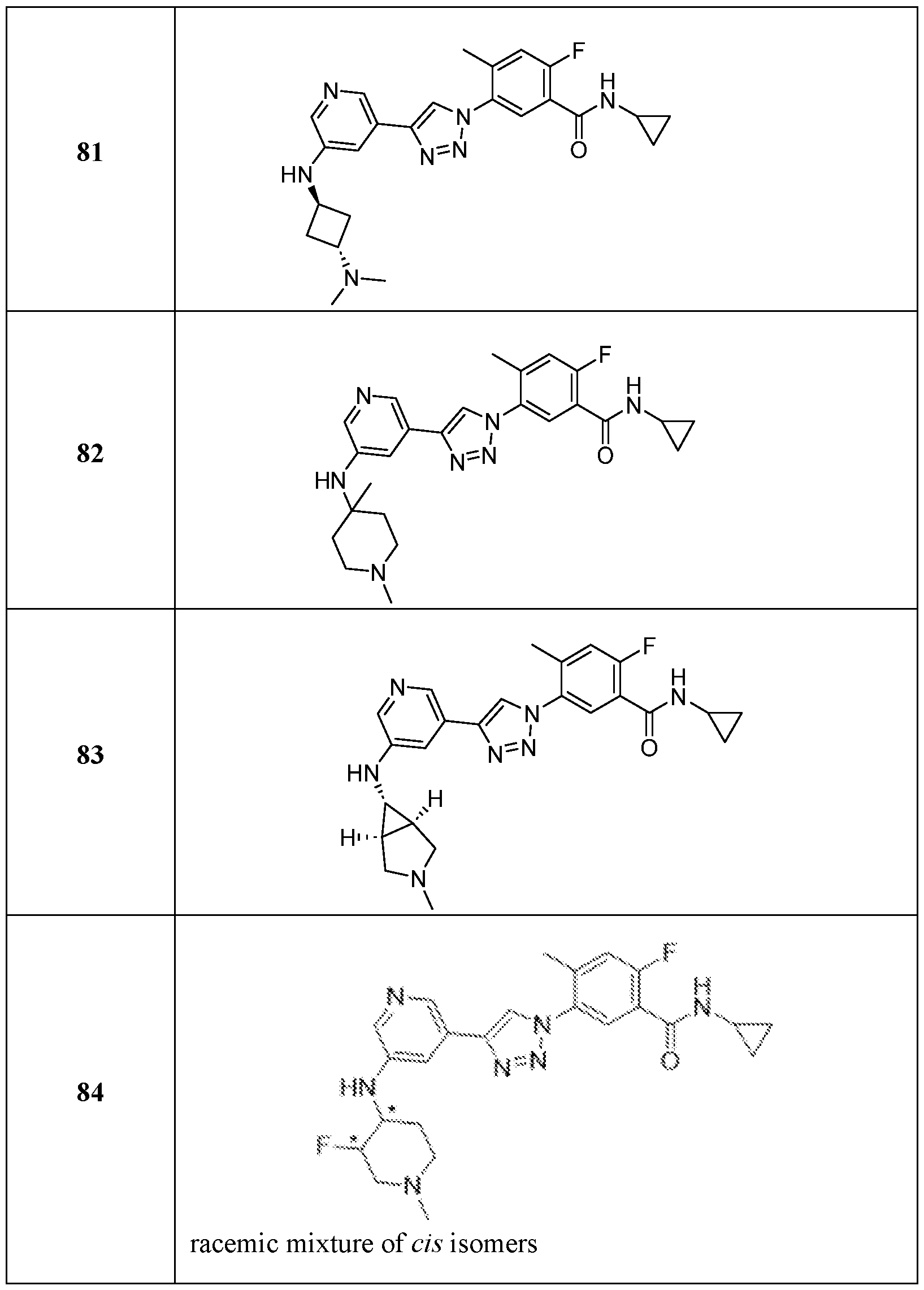


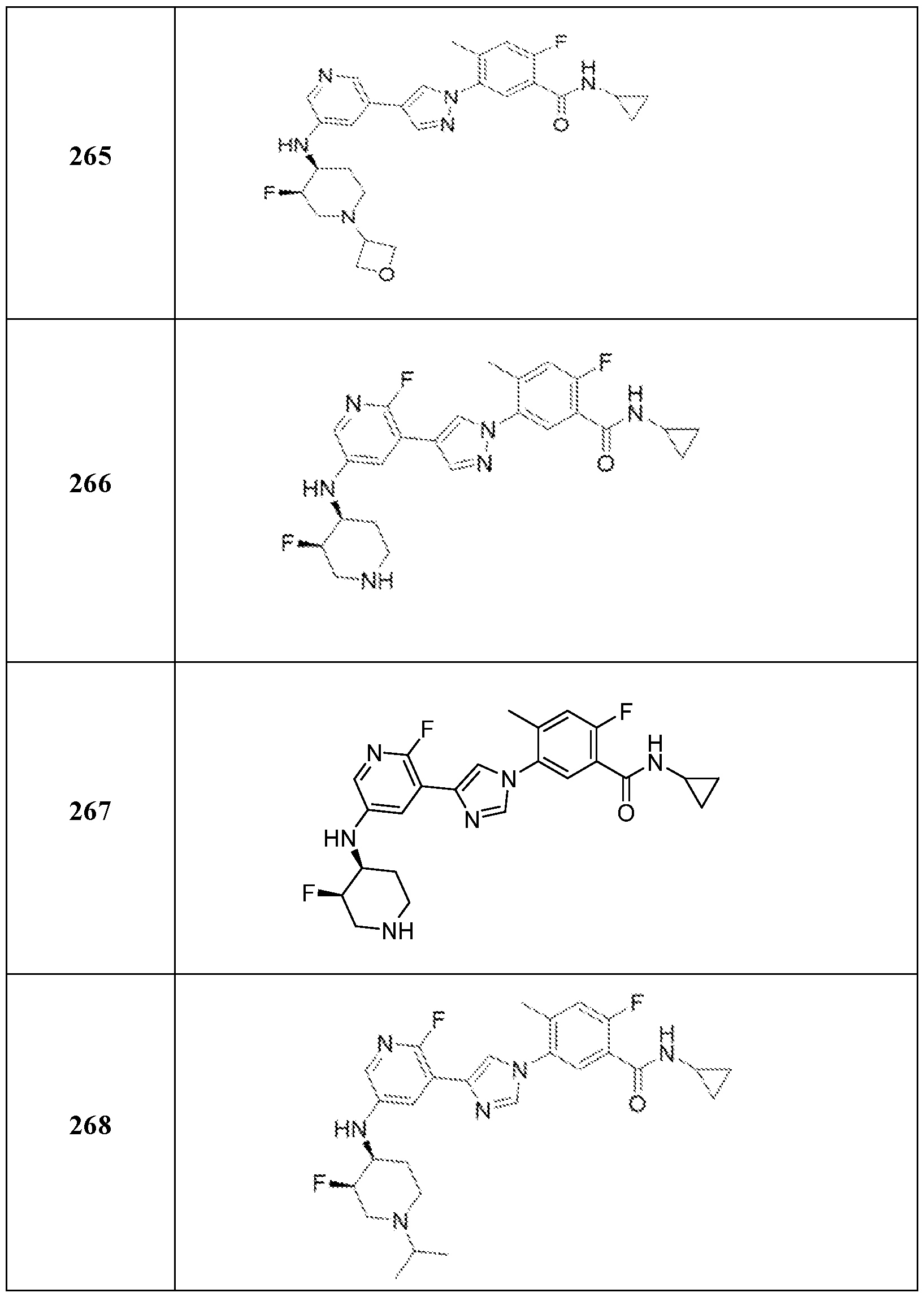


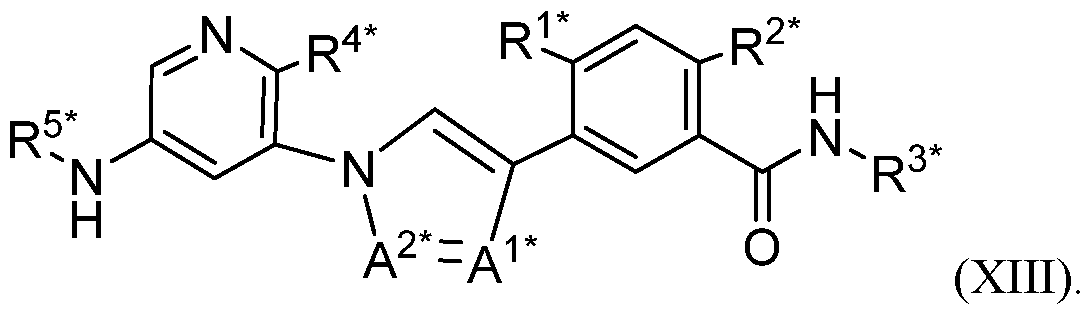
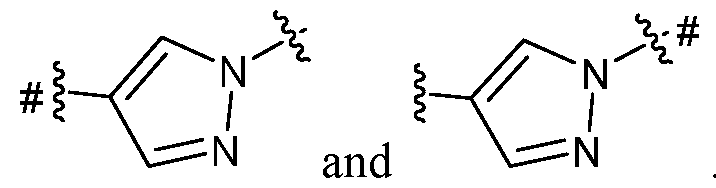
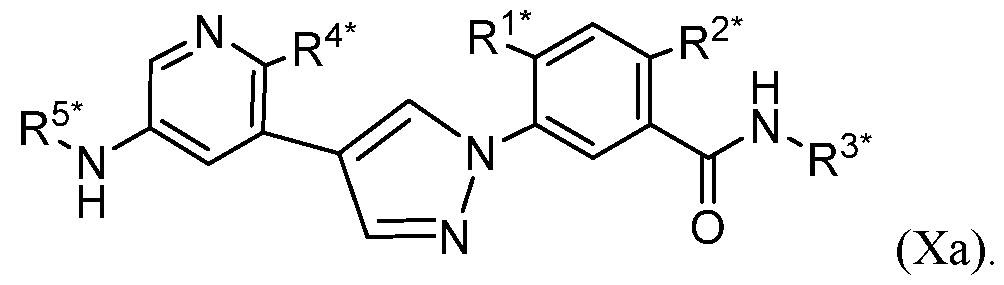


[0077]
[0078] In a third embodiment, the present invention relates to a pharmaceutical composition comprising a compound described herein with respect to the first and embodiments and various aspects thereof (e.g., a compound of formula (f) or (X”) or a pharmaceutically acceptable salt thereof), and a pharmaceutically acceptable excipient. [0079] In a fourth embodiment, the present invention relates to method of treating a disease or disorder, comprising administering to a subject in need thereof a compound described herein with respect to the first and second embodiments and various aspects thereof (e.g., a compound of formula (f) or (X”) or a pharmaceutically acceptable salt thereof) or a pharmaceutical composition described herein with respect to the second embodiment and various aspects thereof, wherein the disease or disorder is selected from inflammatory diseases, autoimmune diseases, granulomatous diseases, cancer and neurodegen erative diseases.
[0080] In a first aspect of the fourth embodiment, the disease or disorder is an inflammatory disease. For example, the inflammatory disease is selected from uveitis, interleukin- 1 converting enzyme fever syndrome, dermatitis, acute lung injury, type 2 diabetes mellitus, arthritis, inflammatory bowel disease (IBD), ischemia reperfusion injury in a solid organ transplant, sepsis, liver disease, allergic disease, and graft versus host disease. For example, the inflammatory disease is an IBD. For example, the IBD is selected from ulcerative colitis, Crohn's disease, early-onset IBD, and extraintestinal IBD. Alternatively, the inflammatory disease is selected from rheumatoid arthritis, inflammatory arthritis, peritonitis, ischemia reperfusion injury in kidney transplant, non-alcohol steatohepatitis, alcohol steatohepatitis, insulin-resistant type 2 diabetes, allergic rhinitis, asthma, atopic dermatitis, Sjogren’s syndrome, ankylosing spondylitis, pemphigus vulgaris, idiopathic plasmacytic lymphadenopathy, atherosclerosis, myocardial infarction, thrombosis, α-synucleinopathy, Parkinson’s disease, dementia with Lewy body, multiple system atrophy,
Alzheimer’s disease, amyotrophic lateral sclerosis, and chronic obstructive pulmonary disease. [0081] In a second aspect of the fourth embodiment, the disease or disorder is an autoimmune disease. For example, the autoimmune disease is selected from systemic lupus erythematosus, lupus nephritis, psoriasis, immune thrombocytopenic purpura, and multiple sclerosis. [0082] In a third aspect of the fourth embodiment, the disease or disorder is a granulomatous disease. For example, the granulomatous disease is selected from sarcoidosis, Blau syndrome, Wegner’s granulomatosis, Behcet’s disease, and interstitial pulmonary disease. [0083] In a fourth aspect of the fourth embodiment, the disease or disorder is cancer. For example, the cancer is selected from leukemia, breast cancer, brain cancer, colorectal cancer, head and neck cancer, melanoma, pancreatic cancer, prostate cancer, ovarian cancer, renal cancer, and lung cancer. [0084] In a fifth aspect of the fourth embodiment, the disease or disorder is a neurodegenerative disease. For example, the neurodegenerative disease is selected from Alzheimer’s disease, amyotrophic lateral sclerosis (ALS/Lou Gehrig’s Disease), Parkinson’s disease, multiple sclerosis, diabetic neurophathy, polyglutamine (polyQ) diseases, stroke, Fahr disease, Menke’s disease, Wilson’s disease, cerebral ischemia, a prion disorder, dementia, corticobasal degeneration, progressive supranuclear palsy, spinocerebellar atrophies, brain injury, and spinal cord injury. [0085] In a sixth aspect of the fourth embodiment, the method further comprises administering second agent. For example, in some embodiments, the second agent is an anti- inflammatory agent or an anti-autoimmune agent. The remainder of features and example features of the sixth aspect is as described above with respect to the first through fifth aspects of the fourth embodiment. [0086] In a seventh aspect of the fourth embodiment, the second agent is selected from anti-TNF agent, anti-IL-23 agent, anti-integrin agent, and JAK inhibitor. In a particular aspect, the second agent is anti-TNF agent. In a particular aspect, second agent is anti-IL-23 agent. In a particular aspect, the second agent is anti-integrin agent. In a particular aspect, second agent is JAK inhibitor. The remainder of features and example features of the
seventh aspect is as described above with respect to the first through sixth aspects of the fourth embodiment. [0087] In an eighth aspect of the fourth embodiment, the second agent and the compound are administered contemporaneously, such as administered together in a single pharmaceutical formulation. In a particular aspect, the second agent and the compound are formulated for simultaneous administration. The remainder of features and example features of the eighth aspect is as described above with respect to the first through seventh aspects of the fourth embodiment. [0088] In a ninth aspect of the fourth embodiment, the second agent and the compound are administered separately. In a particlur aspect, the second agent and the compound are administered separately at different times. In a particlur aspect, the second agent and the compound are administered separately at the same time. The remainder of features and example features of the ninth aspect is as described above with respect to the first through eighth aspects of the fourth embodiment. [0089] In a fifth embodiment, the present relates to a method of treating a RIP2 kinase- mediated disease or disorder, comprising administering to a subject in need thereof a compound described herein with respect to the first and second embodiments and various aspects thereof (e.g., a compound of formula (I’) or (X”) or a pharmaceutically acceptable salt thereof) or a pharmaceutical composition described herein with respect to the second embodiment and various aspects thereof. In one aspect, the RIP2 kinase-mediated disease or disorder is a disease or disorder wherein inhibition of RIP2 kinase would provide benefit. In a particular aspect, the disease or disorder is selected from an inflammatory disease, autoimmune disease, granulomatous disease, cancer, and neurodegenerative disease. [0090] In a sixth embodiment, the present invention relates to the use of a compound described herein with respect to the first embodiment and various aspects thereof (e.g., a compound of formula (I’) or (X”) or a pharmaceutically acceptable salt thereof) in the manufacture of a medicament for use in treating a RIP2 kinase-mediated diseases or disorders (e.g., inflammatory diseases, autoimmune diseases, granulomatous diseases, cancer or neurodegenerative diseases). [0091] In a first aspect of the sixth embodiment, the RIP2 kinase-mediated disease or disorder is an inflammatory disease. For example, the inflammatory disease is selected from uveitis, interleukin-1 converting enzyme fever syndrome, dermatitis, acute lung injury, type
2 diabetes mellitus, arthritis, inflammatory bowel disease (IBD), ischemia reperfusion injury in a solid organ transplant, sepsis, liver disease, allergic disease, and graft versus host disease. For example, the inflammatory disease is an IBD. For example, the IBD is selected from ulcerative colitis, Crohn's disease, early-onset IBD, and extraintestinal IBD. Alternatively, the inflammatory disease is selected from rheumatoid arthritis, inflammatory arthritis, peritonitis, ischemia reperfusion injury in kidney transplant, non-alcohol steatohepatitis, alcohol steatohepatitis, insulin-resistant type 2 diabetes, allergic rhinitis, asthma, atopic dermatitis, Sjogren’s syndrome, ankylosing spondylitis, pemphigus vulgaris, idiopathic plasmacytic lymphadenopathy, atherosclerosis, myocardial infarction, thrombosis, a-synucleinopathy, Parkinson’s disease, dementia with Lewy body, multiple system atrophy, Alzheimer’s disease, amyotrophic lateral sclerosis, and chronic obstructive pulmonary disease.
[0092] In a second aspect of the sixth embodiment, the RIP2 kinase-mediated disease or disorder is an autoimmune disease. For example, the autoimmune disease is selected from systemic lupus erythematosus, lupus nephritis, psoriasis, immune thrombocytopenic purpura, and multiple sclerosis.
[0093] In a third aspect of the sixth embodiment, the RIP2 kinase-mediated disease or disorder is a granulomatous disease. For example, the granulomatous disease is selected from sarcoidosis, Blau syndrome, Wegner’s granulomatosis, Behcet’s disease, and interstitial pulmonary disease.
[0094] In a fourth aspect of the sixth embodiment, the RIP2 kinase-mediated disease or disorder is cancer. For example, the cancer is selected from leukemia, breast cancer, brain cancer, colorectal cancer, head and neck cancer, melanoma, pancreatic cancer, prostate cancer, ovarian cancer, renal cancer, and lung cancer.
[0095] In a fifth aspect of the sixth embodiment, the RIP2 kinase-mediated disease or disorder is a neurodegenerative disease. For example, the neurodegenerative disease is selected from Alzheimer’s disease, amyotrophic lateral sclerosis (ALS/Lou Gehrig’s Disease), Parkinson’s disease, multiple sclerosis, diabetic neurophathy, polyglutamine (polyQ) diseases, stroke, Fahr disease, Menke’s disease, Wilson’s disease, cerebral ischemia, a prion disorder, dementia, corticobasal degeneration, progressive supranuclear palsy, spinocerebellar atrophies, brain injury, and spinal cord injury.
[0096] In a seventh embodiment, the present invention relates to a compound described herein with respect to the first embodiment and various aspects thereof (e.g., a compound of formula (I') or (X”) or a pharmaceutically acceptable salt thereof) for use in treating RIP2 kinase-mediated diseases and disorders ((e.g., inflammatory diseases, autoimmune diseases, granulomatous diseases, cancer or neurodegenerative diseases).
[0097] In a first aspect of the seventh embodiment, the RIP2 kinase-mediated disease or disorder is an inflammatory disease. For example, the inflammatory disease is selected from uveitis, interleukin- 1 converting enzyme fever syndrome, dermatitis, acute lung injury, type 2 diabetes mellitus, arthritis, inflammatory bowel disease (IBD), ischemia reperfusion injury in a solid organ transplant, sepsis, liver disease, allergic disease, and graft versus host disease. For example, the inflammatory disease is an IBD. For example, the IBD is selected from ulcerative colitis, Crohn's disease, early-onset IBD, and extraintestinal IBD. Alternatively, the inflammatory disease is selected from rheumatoid arthritis, inflammatory arthritis, peritonitis, ischemia reperfusion injury in kidney transplant, non-alcohol steatohepatitis, alcohol steatohepatitis, insulin-resistant type 2 diabetes, allergic rhinitis, asthma, atopic dermatitis, Sjogren’s syndrome, ankylosing spondylitis, pemphigus vulgaris, idiopathic plasmacytic lymphadenopathy, atherosclerosis, myocardial infarction, thrombosis, a-synucleinopathy, Parkinson’s disease, dementia with Lewy body, multiple system atrophy, Alzheimer’s disease, amyotrophic lateral sclerosis, and chronic obstructive pulmonary disease.
[0098] In a second aspect of the seventh embodiment, the RIP2 kinase-mediated disease or disorder is an autoimmune disease. For example, the autoimmune disease is selected from systemic lupus erythematosus, lupus nephritis, psoriasis, immune thrombocytopenic purpura, and multiple sclerosis.
[0099] In a third aspect of the seventh embodiment, the RIP2 kinase-mediated disease or disorder is a granulomatous disease. For example, the granulomatous disease is selected from sarcoidosis, Blau syndrome, Wegner’s granulomatosis, Behcet’s disease, and interstitial pulmonary disease.
[00100] In a fourth aspect of the seventh embodiment, the RIP2 kinase-mediated disease or disorder is cancer. For example, the cancer is selected from leukemia, breast cancer, brain cancer, colorectal cancer, head and neck cancer, melanoma, pancreatic cancer, prostate cancer, ovarian cancer, renal cancer, and lung cancer.
[00101] In a fifth aspect of the seventh embodiment, the RIP2 kinase-mediated disease or disorder is a neurodegenerative disease. For example, the neurodegenerative disease is selected from Alzheimer’s disease, amyotrophic lateral sclerosis (ALS/Lou Gehrig’s Disease), Parkinson’s disease, multiple sclerosis, diabetic neurophathy, polyglutamine (polyQ) diseases, stroke, Fahr disease, Menke’s disease, Wilson’s disease, cerebral ischemia, a prion disorder, dementia, corticobasal degeneration, progressive supranuclear palsy, spinocerebellar atrophies, brain injury, and spinal cord injury. [00102] In a sixth aspect of the seventh embodiment, the compound is formulated to be administered with a second agent. For example, in some embodiments, the second agent is an anti-inflammatory agent or an anti-autoimmune agent. The remainder of features and example features of the sixth aspect is as described above with respect to the first through fifth aspects of the seventh embodiment. [00103] In a seventh aspect of the seventh embodiment, the second agent is selected from anti-TNF agent, anti-IL-23 agent, anti-integrin agent, and JAK inhibitor. In a particular aspect, the second agent is anti-TNF agent. In a particular aspect, second agent is anti-IL-23 agent. In a particular aspect, the second agent is anti-integrin agent. In a particular aspect, second agent is JAK inhibitor. The remainder of features and example features of the seventh aspect is as described above with respect to the first through sixth aspects of the seventh embodiment. [00104] In an eighth aspect of the seventh embodiment, the second agent and the compound are administered contemporaneously, such as administered together in a single pharmaceutical formulation. In a particular aspect, the second agent and the compound are formulated for simultaneous administration. The remainder of features and example features of the eighth aspect is as described above with respect to the first through seventh aspects of the seventh embodiment. [00105] In a ninth aspect of the seventh embodiment, the second agent and the compound are administered separately. In a particlur aspect, the second agent and the compound are administered separately at different times. In a particlur aspect, the second agent and the compound are administered separately at the same time. The remainder of features and example features of the ninth aspect is as described above with respect to the first through eighth aspects of the seventh embodiment.
[00106] The invention now being generally described, will be more readily understood by reference to the following examples, which are included merely for purposes of illustration of certain aspects and embodiments of the present invention, and are not intended to limit the invention. Starting materials described herein can be obtained from commercial sources or may be readily prepared from commercially available materials using transformations known to those skilled in the art.
[00107] EXAMPLES [00108] The following General Schemes depict synthetic sequences for Examples 1-24. General Scheme 1


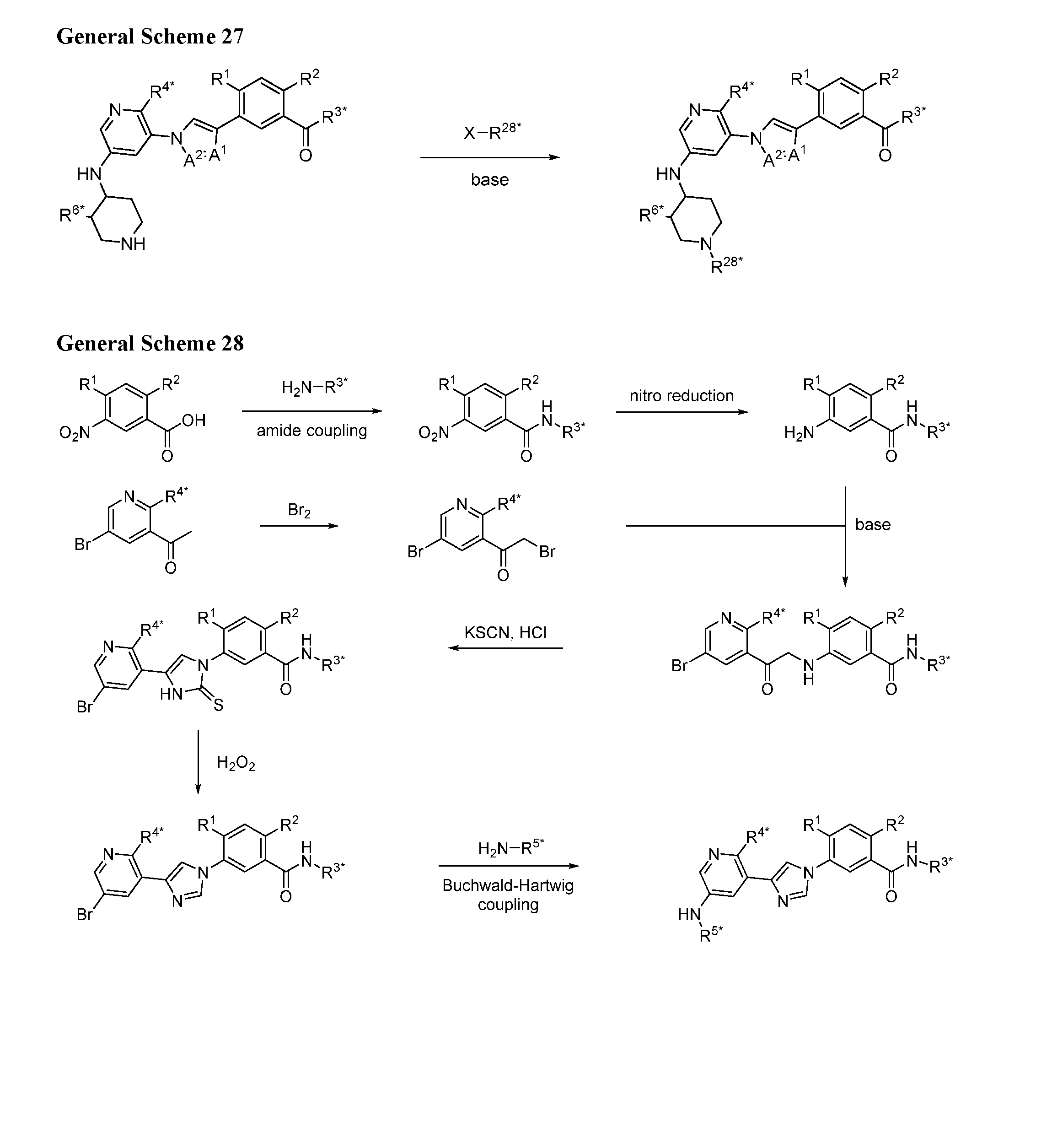


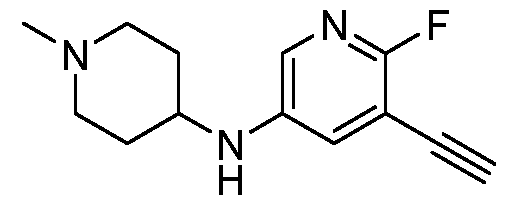


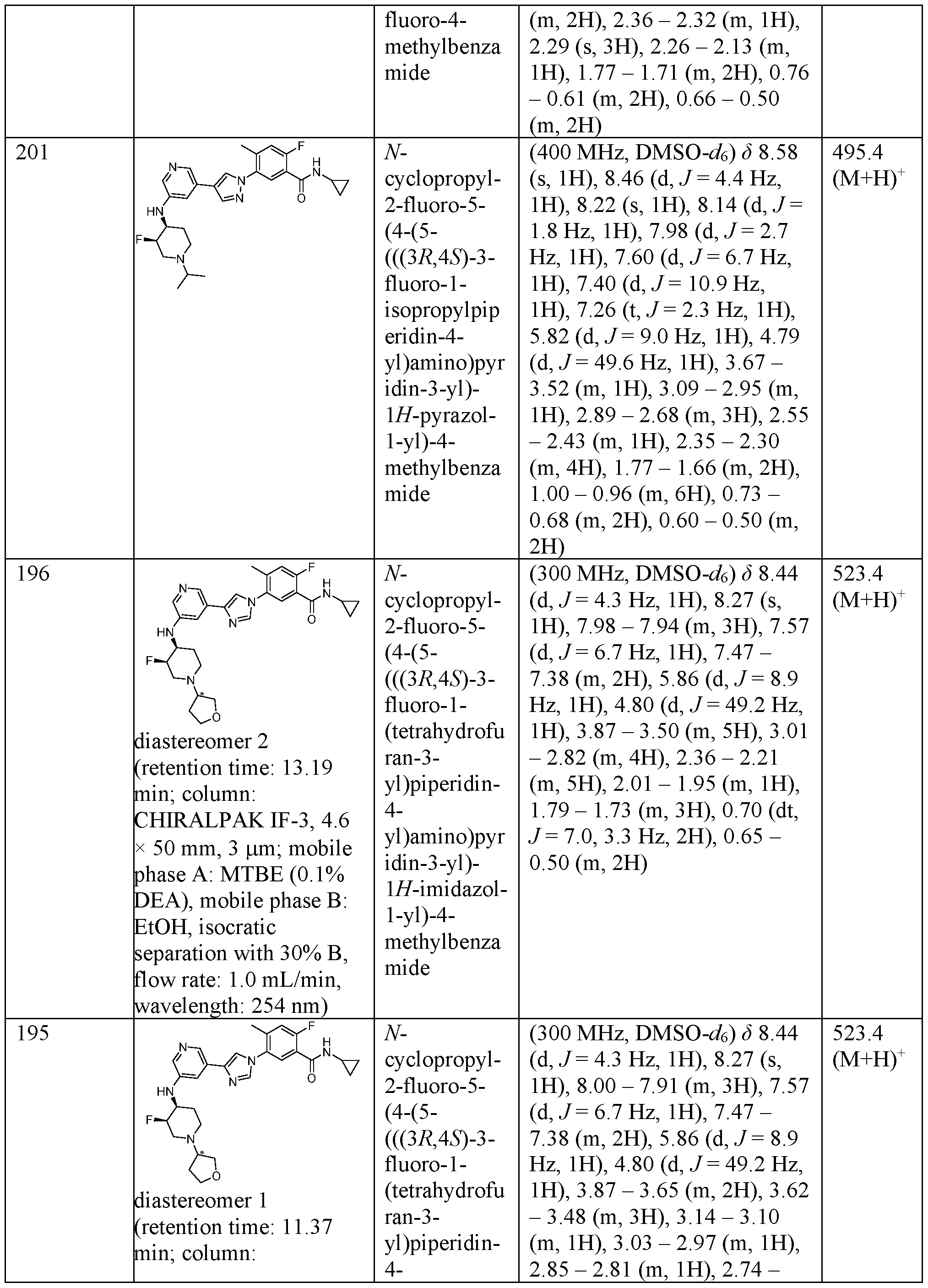


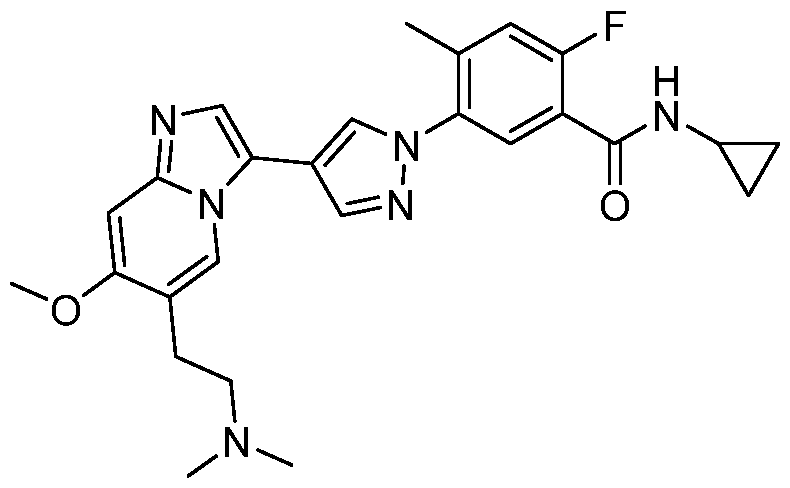


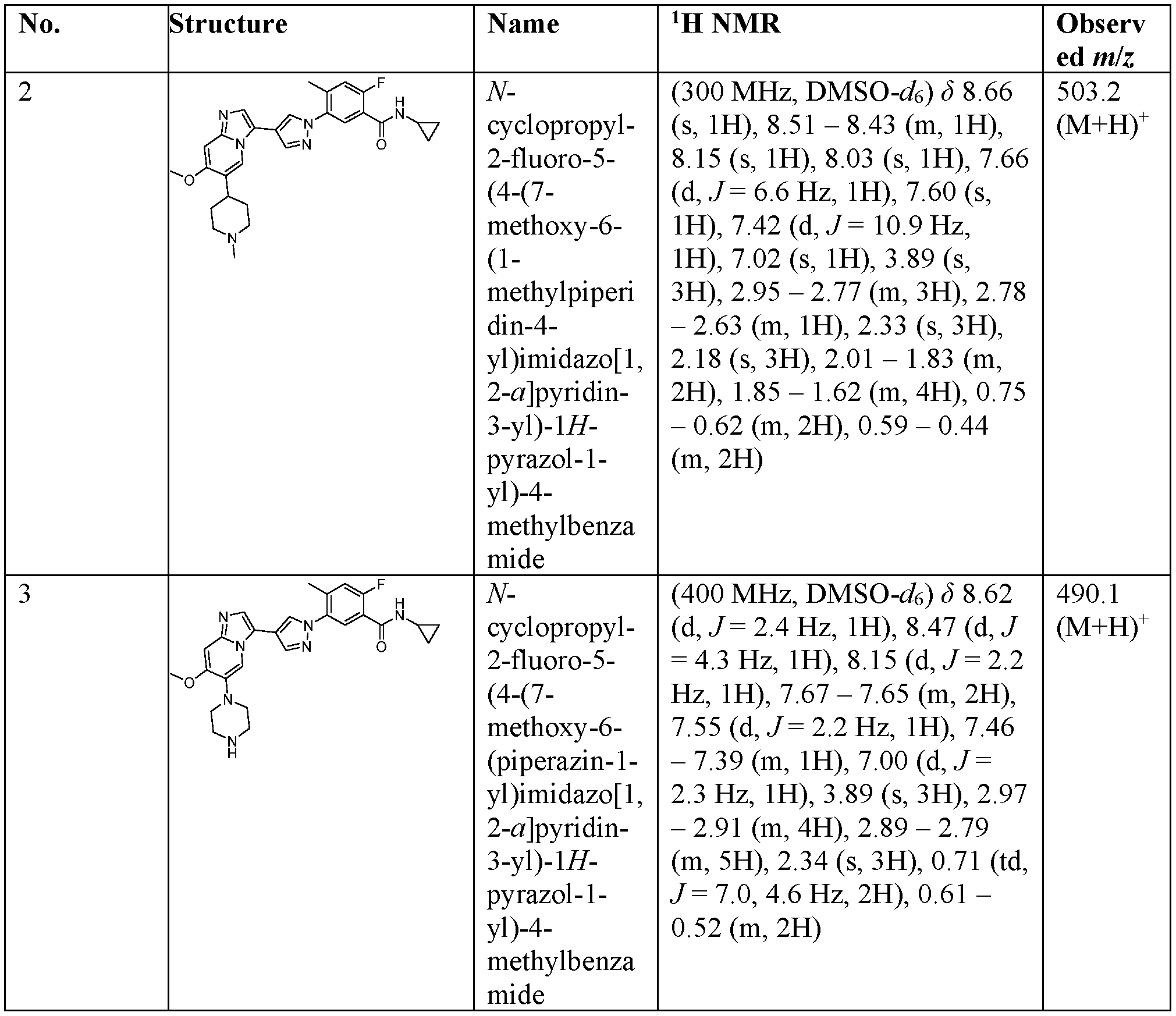


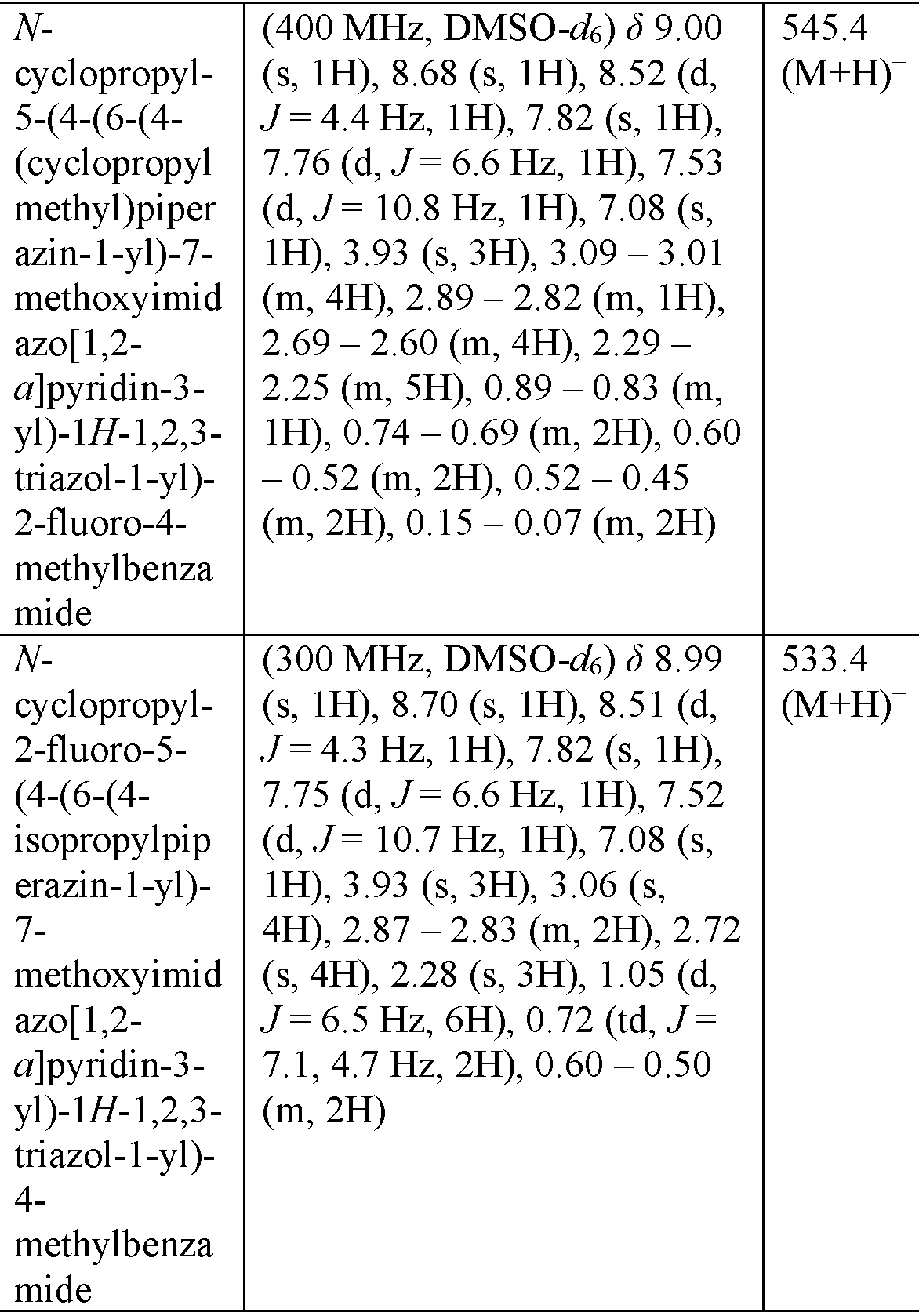


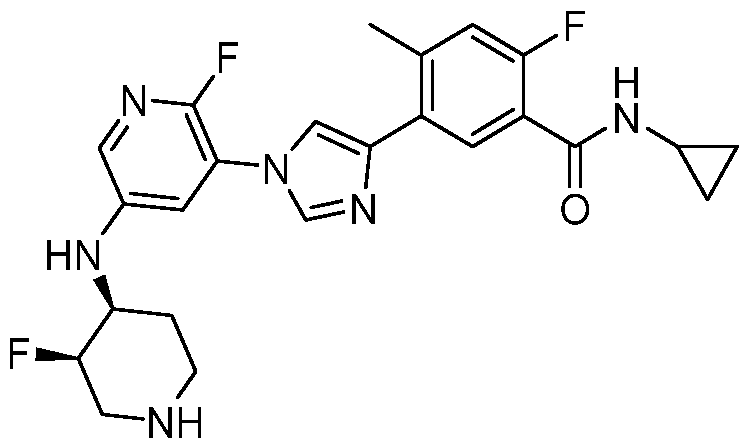


[00285] Table 13.


[00286] Example 31 - Inhibition of hERG
[00287] The potential inhibitory effect of test compounds on human Ether-a-go-go related gene (hERG) channel was evaluated by automated patch-clamp system. CHO cell line stably expressing hERG gene was employed and Cisapride was used as a positive control.
[00288] SyncroPatch 384i automated patch clamp system was used. CHO hERG-DUO cell line stably expressing hERG channel was purchased from B’SYS GmbH, had gone through monoclonal screening by pharmaron patch clamp platform. The cells were cultured in medium containing of F12 (HAM) medium (Gibco, 11765054), 10% FBS (Excell Bio, FMD500), 100 U/mL Penicillin-Streptomycin (Gibco, 15140122), 100 pg/mL Hygromycin (Invivogen, ant-hg-5), and 100 pg/mL G418 (Gibco, 11811031). Cells were split using
TrypLE™ Express about three times a week, and maintained about 80% confluence.
[00289] Test compounds were initially prepared in DMSO with final concentration of 10 mM as stock solution. The stock solution of each compound was then serially diluted with DMSO by ratio of 1 :3 to prepare additional intermediate solutions at 10, 3.33, 1.11 and 0.37
mM concentration, respectively. Before hERG measurement, the working solutions at concentration of 20, 6.66, 2.22 and 0.74 uM were prepared by 500-fold dilution of the above described 10, 3.33, 1.11 and 0.37 mM serial solutions respectively, using extracellular NMDG60 solution (NMDG Sigma, M2004). The 60 pM working solution was prepared by 166.67-fold dilution of 10 mM DMSO stock solution. In hERG assay, 40 pL working solution was added to 40pL cell solution, so 2x test concentration working solutions of compound were prepared. hERG current inhibition in the presence of 5 concentrations, including 30, 10, 3.33, 1.11 and 0.37 pM, was tested for ICso determination.
The hERG current was elicited by depolarizing membrane to +30 mV for 4.8 sec and then the voltage was taken back to -50 mV for 5.2 sec to remove the inactivation and measure the deactivating tail current. The sample interval was 15 s. The maximum amount of tail current size was used to determine hERG current amplitude. Blank vehicle was applied to the cells to establish the baseline. After stabilizing hERG current for at least 5 min, the test compound solution was perfused. hERG current in the presence of a test compound at individual working concentration was recorded for no less than 5 min to reach steady state and then 5 sweeps were captured. If a steady state was not reached within 10 minutes, the averaged peak current of the last 5 sweeps would be substituted for the steady state value. Positive control, Cisapride, was used in the experiments to ensure good performance of the cells and operations. The hERG current inhibition in presence of 5 concentrations of a test compound was examined in 2 independent experiments (n=2) for ICso determination. The results are shown in Table 14. Table 14.

 [00290] Example 32 - Inhibition of the interaction of RIPK2 with XIAP [00291] An assay measuring the RIPK2 and XIAP protein-protein interaction was generated using the NanoBRET protein:protein interaction system (Promega) which measures the energy transfer from a bioluminescent protein donor (NanoLuc fusion protein) to a fluorescent protein acceptor (Halotag fusion protein). In this assay, the C-terminus of full-length XIAP was appended with the NanoLuc fusion protein and the N-terminus of full- length RIPK2 was appended with the HaloTag fusion protein. Assay medium consistsed of Opti-MEM I reduced serum medium with no phenol red plus 4% heat inactivated FBS. Transfection reagents were combined in a microfuge tube as follows: 400 uL of assay medium, 8 µL of vector with N-terminus of RIPK2 HaloTag fusion protein (vector concentration at 1 µg/µL), 0.8 uL of vector with C-terminus of XIAP NanoLuc fusion protein (vector concentration at 1 µg/µL), and 24 µL of FuGENE HD transfection reagent (Promega, catalogue number E2312). NanoBRET Nano-Glo Detection System was purchased from Promega (catalogue number N1663) and contained the HaloTag NanoBRET 618 ligand and NanoBRET Nano-Glo substrate. Test compounds were prepared into a 10 mM DMSO solution and were serially diluted into 10 points using a 3-fold dilution in a 384 well plate using a TECAN EVO200. [00292] Method: HEK293T cells were transfected with the RIPK2 HaloTag fusion and XIAP NanoLuc fusion vectors in suspension. Briefly, a 16 mL cell suspension of HEK293T cells (final density of 125000 cells/mL) in assay medium was prepared in a 50 mL tube. Transfection reagents were pre-mixed and incubated at room temperature for 30 minutes. Then the total transfection reagent mixture was added dropwise to the 16 mL cell suspension and mixed gently. 40 µL of the cells and transfection reagent suspension was plated into a white 384 well plate and incubated at 37 °C in a CO2 incubator for 24 hours. The next day, transfected cells were first treated with test compound (total volume of 40 nL) and incubated for 2 hours followed by addition of the HaloTag NanoBRET 618 ligand (100 nM, total volume of 40 nL) and again incubated for 2 hours. Lastly, a 3X solution of NanoBRET Nano-Glo substrate in Opti-MEM I reduced serum media (no phenol red; 20 µL total volume) was added to each well and incubated for 2-3 minutes at room temperature. The plate was then measured using 460 nm filter (donor emission) and 618 nm filter (acceptor
emission) in an EnVision multimode plate reader (PerkinElmer). The NanoBRET ratio values were determined by dividing the acceptor emission value by the donor emission value for each sample. 4-parametric curve fit was used to determine the test compound concentration that results in 50% reduction of the RIPK2 and XIAP protein-protein interaction relative to assay controls. The results are shown in Table 15. [00293] Table 15.
[00290] Example 32 - Inhibition of the interaction of RIPK2 with XIAP [00291] An assay measuring the RIPK2 and XIAP protein-protein interaction was generated using the NanoBRET protein:protein interaction system (Promega) which measures the energy transfer from a bioluminescent protein donor (NanoLuc fusion protein) to a fluorescent protein acceptor (Halotag fusion protein). In this assay, the C-terminus of full-length XIAP was appended with the NanoLuc fusion protein and the N-terminus of full- length RIPK2 was appended with the HaloTag fusion protein. Assay medium consistsed of Opti-MEM I reduced serum medium with no phenol red plus 4% heat inactivated FBS. Transfection reagents were combined in a microfuge tube as follows: 400 uL of assay medium, 8 µL of vector with N-terminus of RIPK2 HaloTag fusion protein (vector concentration at 1 µg/µL), 0.8 uL of vector with C-terminus of XIAP NanoLuc fusion protein (vector concentration at 1 µg/µL), and 24 µL of FuGENE HD transfection reagent (Promega, catalogue number E2312). NanoBRET Nano-Glo Detection System was purchased from Promega (catalogue number N1663) and contained the HaloTag NanoBRET 618 ligand and NanoBRET Nano-Glo substrate. Test compounds were prepared into a 10 mM DMSO solution and were serially diluted into 10 points using a 3-fold dilution in a 384 well plate using a TECAN EVO200. [00292] Method: HEK293T cells were transfected with the RIPK2 HaloTag fusion and XIAP NanoLuc fusion vectors in suspension. Briefly, a 16 mL cell suspension of HEK293T cells (final density of 125000 cells/mL) in assay medium was prepared in a 50 mL tube. Transfection reagents were pre-mixed and incubated at room temperature for 30 minutes. Then the total transfection reagent mixture was added dropwise to the 16 mL cell suspension and mixed gently. 40 µL of the cells and transfection reagent suspension was plated into a white 384 well plate and incubated at 37 °C in a CO2 incubator for 24 hours. The next day, transfected cells were first treated with test compound (total volume of 40 nL) and incubated for 2 hours followed by addition of the HaloTag NanoBRET 618 ligand (100 nM, total volume of 40 nL) and again incubated for 2 hours. Lastly, a 3X solution of NanoBRET Nano-Glo substrate in Opti-MEM I reduced serum media (no phenol red; 20 µL total volume) was added to each well and incubated for 2-3 minutes at room temperature. The plate was then measured using 460 nm filter (donor emission) and 618 nm filter (acceptor
emission) in an EnVision multimode plate reader (PerkinElmer). The NanoBRET ratio values were determined by dividing the acceptor emission value by the donor emission value for each sample. 4-parametric curve fit was used to determine the test compound concentration that results in 50% reduction of the RIPK2 and XIAP protein-protein interaction relative to assay controls. The results are shown in Table 15. [00293] Table 15.


[00294] Example 33 - Inhibition of TNF-α secretion in human whole blood
[00295] Materials: Assay medium consistsed of RPMI 1640 medium (catalogue number: 11875119) and 10% heat inactivated FBS (Cytvia). U-PLEX Biomarker Assay (cat# K15067L-4) to detect levels of TNF-α was purchased from Meso Scale Discovery. Heparinized whole blood from healthy donors/volunteers was obtained through Research Blood Components, LLC.
[00296] Method: Priming of human whole blood with IFN-gamma (catalogue number: 285-IF-100) followed by stimulation with a NOD2 ligand, L18-MDP (Invivogen, catalogue number: tlrl-lmdp), resulted in secretion of TNF-α. Test compounds were prepared into a 10 mM DMSO solution and serially diluted into 9 points using a 3 -fold dilution in a 96 well plate. A 10X working stock solution of recombinant human IFN-gamma (final concentration of 10 ng/mL) was prepared in assay medium and used to prepare a 10X solution of test compound. 20 pL of 10X IFN-gamma and test compound (or DMSO control) was added to a 96-well plate. 160 pL of heparinized whole blood obtained from healthy donors was dispensed into individual wells of the 96-well plate and placed on a plate shaker (150 rpm) and incubated for 60 min at 37 °C in a CO2 incubator. Subsequently, 20 pL of L18-MDP (final concentration of 100 ng/mL) was added to the appropriate wells and further incubated for 16 hours on a plate shaker (150 rpm) at 37 °C in a CO2 incubator. The final concentration of DMSO was 0.05% (v/v) in all wells. After incubation, 100 pL of DPBS was added per well, mixed by shaking at 500 rpm for 2 minutes, followed by centrifugation (400xg for 10 minutes) and collection of supernatants. TNF-α in supernatants was measured using MSD immunoassay (MesoScale Discovery). 4-parametric curve fit was used to determine the test compound concentration that results in 50% reduction of TNF-α concentration in supernatant relative to assay controls. The results are shown in Table 16. [00297] Table 16


Claims
What is claimed is: 1. A compound represented by structural formula (X”) or a pharmaceutically acceptable salt thereof:
 wherein: X’ is a moiety represented by one of the following structural formulas:
 and
and
 , wherein # indicates the point of attachment to the pyridyl group; A1* N or CH; A2* CH or N; R1* is selected from C1-6 alkyl, H, halogen, C1-6 haloalkyl a¸nd C1-6 alkoxy; R2* is selected from halogen, C1-6 alkyl, H, C1-6 haloalkyl a¸nd C1-6 alkoxy; R3* is C3-6 cycloalkyl or C1-6 alkyl; R4* is a halogen; and R5* is 4- to 10-membered heterocyclyl; wherein each C1-6 alkyl, C3-6 cycloalkyl, and 4- to 10-membered heterocyclyl is optionally substituted with 1 to 5 substituents independently selected from deuterium, oxo, F, Cl, Br, CN, OR14a*, SR15a*, NR16a*R17a*, S(O)R18a*, S(O)2R18b*, NR19*S(=O)R20*, C(=O)OR20a*, C(=O)NR21*R22*, NR23*C(=O)R24*, C(=S)NR25*R26*, C(=O)R27*, C1-6 alkyl, C3-6 cycloalkyl, C2-6 alkenyl, halo(C1-6)alkyl, C1-3 alkylsulfonylaminoalkyl, hydroxy(C1-6)alkyl, amino(C1-6)alkyl, cyano(C1-6)alkyl, C1-3 alkylcarbonylamino(C1- 6)alkyl, C1-3 alkoxy, halo(C1-3)alkoxy, C1-6 alkoxy(C1-3)alkyl, C6-12 aryl, 4- to 10- membered heterocyclyl, and 5- to 12-membered heteroaryl, wherein each substituent selected from C1-6 alkyl, C3-6 cycloalkyl, C2-6 alkenyl, halo(C1-6)alkyl, C1-3 alkylsulfonylaminoalkyl, hydroxy(C1-6)alkyl, amino(C1-6)alkyl, cyano(C1-6)alkyl, C1-3 alkylcarbonylamino(C1-6)alkyl, C1-3 alkoxy, halo(C1-3)alkoxy, C1-6 alkoxy(C1-3)alkyl, C6-12 aryl, 4- to 10-membered heterocyclyl, and 5- to 12-membered heteroaryl is further optionally substituted with 1 to 5 substituents independently selected from
deuterium, oxo, F, Cl, Br, CN, OR14b*, NR16b*R17b*, C(=O)NR21b*R22b*, NR23b*C(=O)R24b*, C(=O)R27b*, C(=O)OR27c*, S(O)R18c*, C1-6 alkyl, C3-6 cycloalkyl, halo(C1-6)alkyl, C6-12 aryl, and 4- to 10-membered heterocyclyl, and further wherein R14a* , R14b* , R15a* , R18a* , R18b*, R18c*, R20* , R20a* , R24* , R24b*, R27*, R27b*, and R27c* are each independently hydrogen or C1-6 alkyl; R16a*, R17a*, R16b*, and R17b* are each independently selected from hydrogen, C1-6 alkyl, hydroxy(C1-6)alkyl, and halo(C1-6)alkyl; R19*, R23*,and R23b* are each independently C1-6 alkyl or halo(C1-6)alkyl; R21*, R21b*, R22*, R22b*, R25* and R26* are each independently selected from H, C1-6 alkyl, C1-3 alkoxy(C1-6)alkyl, hydroxy(C1-6)alkyl, cyano(C1-6)alkyl, amino(C1-6)alkyl, C1-3 alkylamino(C1-6)alkyl, and di(C1-3)alkylamino(C1-6)alkyl. 2. The compound of claim 14, wherein the compound is represented by structural formula (X) or a pharmaceutically acceptable salt thereof:
, wherein # indicates the point of attachment to the pyridyl group; A1* N or CH; A2* CH or N; R1* is selected from C1-6 alkyl, H, halogen, C1-6 haloalkyl a¸nd C1-6 alkoxy; R2* is selected from halogen, C1-6 alkyl, H, C1-6 haloalkyl a¸nd C1-6 alkoxy; R3* is C3-6 cycloalkyl or C1-6 alkyl; R4* is a halogen; and R5* is 4- to 10-membered heterocyclyl; wherein each C1-6 alkyl, C3-6 cycloalkyl, and 4- to 10-membered heterocyclyl is optionally substituted with 1 to 5 substituents independently selected from deuterium, oxo, F, Cl, Br, CN, OR14a*, SR15a*, NR16a*R17a*, S(O)R18a*, S(O)2R18b*, NR19*S(=O)R20*, C(=O)OR20a*, C(=O)NR21*R22*, NR23*C(=O)R24*, C(=S)NR25*R26*, C(=O)R27*, C1-6 alkyl, C3-6 cycloalkyl, C2-6 alkenyl, halo(C1-6)alkyl, C1-3 alkylsulfonylaminoalkyl, hydroxy(C1-6)alkyl, amino(C1-6)alkyl, cyano(C1-6)alkyl, C1-3 alkylcarbonylamino(C1- 6)alkyl, C1-3 alkoxy, halo(C1-3)alkoxy, C1-6 alkoxy(C1-3)alkyl, C6-12 aryl, 4- to 10- membered heterocyclyl, and 5- to 12-membered heteroaryl, wherein each substituent selected from C1-6 alkyl, C3-6 cycloalkyl, C2-6 alkenyl, halo(C1-6)alkyl, C1-3 alkylsulfonylaminoalkyl, hydroxy(C1-6)alkyl, amino(C1-6)alkyl, cyano(C1-6)alkyl, C1-3 alkylcarbonylamino(C1-6)alkyl, C1-3 alkoxy, halo(C1-3)alkoxy, C1-6 alkoxy(C1-3)alkyl, C6-12 aryl, 4- to 10-membered heterocyclyl, and 5- to 12-membered heteroaryl is further optionally substituted with 1 to 5 substituents independently selected from
deuterium, oxo, F, Cl, Br, CN, OR14b*, NR16b*R17b*, C(=O)NR21b*R22b*, NR23b*C(=O)R24b*, C(=O)R27b*, C(=O)OR27c*, S(O)R18c*, C1-6 alkyl, C3-6 cycloalkyl, halo(C1-6)alkyl, C6-12 aryl, and 4- to 10-membered heterocyclyl, and further wherein R14a* , R14b* , R15a* , R18a* , R18b*, R18c*, R20* , R20a* , R24* , R24b*, R27*, R27b*, and R27c* are each independently hydrogen or C1-6 alkyl; R16a*, R17a*, R16b*, and R17b* are each independently selected from hydrogen, C1-6 alkyl, hydroxy(C1-6)alkyl, and halo(C1-6)alkyl; R19*, R23*,and R23b* are each independently C1-6 alkyl or halo(C1-6)alkyl; R21*, R21b*, R22*, R22b*, R25* and R26* are each independently selected from H, C1-6 alkyl, C1-3 alkoxy(C1-6)alkyl, hydroxy(C1-6)alkyl, cyano(C1-6)alkyl, amino(C1-6)alkyl, C1-3 alkylamino(C1-6)alkyl, and di(C1-3)alkylamino(C1-6)alkyl. 2. The compound of claim 14, wherein the compound is represented by structural formula (X) or a pharmaceutically acceptable salt thereof:
 3. The compound of claim 1, wherein the compound is represented by structural formula (XIII) or a pharmaceutically acceptable salt thereof:
 4. The compound of any one of claims 1-3, wherein X’ is a moiety represented by one of the following structural formulas:
 .
.
5. The compound of claim 1, wherein the compound is represented by structural formula (Xa) or a pharmaceutically acceptable salt thereof:
 6. The compound of any one of claims 1-3, wherein X’ is a moiety represented by one of the following structural formulas:
 . 7. The compound of claim 1, wherein the compound is represented by structural formula (Xb) or a pharmaceutically acceptable salt thereof:
 8. The compound of any one of claims 1-3, wherein X’ is a moiety represented by one of the following structural formulas:
 . 9. The compound of claim 1, wherein the compound is represented by structural formula (Xc) or a pharmaceutically acceptable salt thereof:

10. The compound of any one of claims 1-9, wherein R1* is methyl. 11. The compound of any one of claims 1-10, wherein R2* is F. 12. The compound of any one of claims 1-11, wherein R3* is optionally substituted C3-6 cycloalkyl. 13. The compound of claim 12, wherein R3* is cyclopropyl. 14. The compound of any one of claims 1-11, wherein R3* is optionally substituted C1-6 alkyl. 15. The compound of claim 14 wherein R3* is ethyl. 16. The compound of any one of claims 1-15, wherein R4* is F. 17. The compound of any one of claims 1-15, wherein R4* is Cl. 18. The compound of claim 1, wherein the compound is represented by structural formula (XI) or a pharmaceutically acceptable salt thereof:
 19. The compound of any one of claims 1-18, wherein R5* is a 6-membered heterocyclyl, wherein the 6-membered heterocyclyl is optionally substituted with 1 to 5 substituents independently selected from deuterium, oxo, F, Cl, Br, CN, OR14a*, SR15a*, NR16a*R17a*, S(O)R18a*, S(O)2R18b*, NR19*S(=O)R20*, C(=O)OR20a*, C(=O)NR21*R22*, NR23*C(=O)R24*, C(=S)NR25*R26*, C(=O)R27*, C1-6 alkyl, C3-6 cycloalkyl, C2-6 alkenyl, halo(C1-6)alkyl, C1-3 alkylsulfonylaminoalkyl, hydroxy(C1- 6)alkyl, amino(C1-6)alkyl, cyano(C1-6)alkyl, C1-3 alkylcarbonylamino(C1-6)alkyl, C1-3
alkoxy, halo(C1-3)alkoxy, C1-6 alkoxy(C1-3)alkyl, C6-12 aryl, 4- to 10-membered heterocyclyl, and 5- to 12-membered heteroaryl, wherein each substituent selected from C1-6 alkyl, C3-6 cycloalkyl, C2-6 alkenyl, halo(C1-6)alkyl, C1-3 alkylsulfonylaminoalkyl, hydroxy(C1-6)alkyl, amino(C1-6)alkyl, cyano(C1-6)alkyl, C1-3 alkylcarbonylamino(C1-6)alkyl, C1-3 alkoxy, halo(C1-3)alkoxy, C1-6 alkoxy(C1-3)alkyl, C6-12 aryl, 4- to 10-membered heterocyclyl, and 5- to 12-membered heteroaryl is further optionally substituted with 1 to 5 substituents independently selected from deuterium, oxo, F, Cl, Br, CN, OR14b*, NR16b*R17b*, C(=O)NR21b*R22b*, NR23b*C(=O)R24b*, C(=O)R27b*, C(=O)OR27c*, S(O)R18c*, C1-6 alkyl, C3-6 cycloalkyl, halo(C1-6)alkyl, C6-12 aryl, and 4- to 10-membered heterocyclyl, and further wherein R14a*, R14b*, R15a*, R18a*, R18b*, R18c*, R20*, R20a*, R24*, R24b*, R27*, R27b*, and R27c* are each independently hydrogen or C1-6 alkyl; R16a*, R17a*, R16b*, and R17b* are each independently selected from hydrogen, C1-6 alkyl, hydroxy(C1-6)alkyl, and halo(C1-6)alkyl; R19*, R23*,and R23b* are each independently C1-6 alkyl or halo(C1-6)alkyl; R21* , R21b* , R22* , R22b* , R25* and R26* are each independently selected from H, C1-6 alkyl, C1-3 alkoxy(C1-6)alkyl, hydroxy(C1-6)alkyl, cyano(C1-6)alkyl, amino(C1-6)alkyl, C1-3 alkylamino(C1-6)alkyl, and di(C1-3)alkylamino(C1-6)alkyl. 20. The compound of claim 19, wherein R5* is a moiety represented by the following structural formula:
19. The compound of any one of claims 1-18, wherein R5* is a 6-membered heterocyclyl, wherein the 6-membered heterocyclyl is optionally substituted with 1 to 5 substituents independently selected from deuterium, oxo, F, Cl, Br, CN, OR14a*, SR15a*, NR16a*R17a*, S(O)R18a*, S(O)2R18b*, NR19*S(=O)R20*, C(=O)OR20a*, C(=O)NR21*R22*, NR23*C(=O)R24*, C(=S)NR25*R26*, C(=O)R27*, C1-6 alkyl, C3-6 cycloalkyl, C2-6 alkenyl, halo(C1-6)alkyl, C1-3 alkylsulfonylaminoalkyl, hydroxy(C1- 6)alkyl, amino(C1-6)alkyl, cyano(C1-6)alkyl, C1-3 alkylcarbonylamino(C1-6)alkyl, C1-3
alkoxy, halo(C1-3)alkoxy, C1-6 alkoxy(C1-3)alkyl, C6-12 aryl, 4- to 10-membered heterocyclyl, and 5- to 12-membered heteroaryl, wherein each substituent selected from C1-6 alkyl, C3-6 cycloalkyl, C2-6 alkenyl, halo(C1-6)alkyl, C1-3 alkylsulfonylaminoalkyl, hydroxy(C1-6)alkyl, amino(C1-6)alkyl, cyano(C1-6)alkyl, C1-3 alkylcarbonylamino(C1-6)alkyl, C1-3 alkoxy, halo(C1-3)alkoxy, C1-6 alkoxy(C1-3)alkyl, C6-12 aryl, 4- to 10-membered heterocyclyl, and 5- to 12-membered heteroaryl is further optionally substituted with 1 to 5 substituents independently selected from deuterium, oxo, F, Cl, Br, CN, OR14b*, NR16b*R17b*, C(=O)NR21b*R22b*, NR23b*C(=O)R24b*, C(=O)R27b*, C(=O)OR27c*, S(O)R18c*, C1-6 alkyl, C3-6 cycloalkyl, halo(C1-6)alkyl, C6-12 aryl, and 4- to 10-membered heterocyclyl, and further wherein R14a*, R14b*, R15a*, R18a*, R18b*, R18c*, R20*, R20a*, R24*, R24b*, R27*, R27b*, and R27c* are each independently hydrogen or C1-6 alkyl; R16a*, R17a*, R16b*, and R17b* are each independently selected from hydrogen, C1-6 alkyl, hydroxy(C1-6)alkyl, and halo(C1-6)alkyl; R19*, R23*,and R23b* are each independently C1-6 alkyl or halo(C1-6)alkyl; R21* , R21b* , R22* , R22b* , R25* and R26* are each independently selected from H, C1-6 alkyl, C1-3 alkoxy(C1-6)alkyl, hydroxy(C1-6)alkyl, cyano(C1-6)alkyl, amino(C1-6)alkyl, C1-3 alkylamino(C1-6)alkyl, and di(C1-3)alkylamino(C1-6)alkyl. 20. The compound of claim 19, wherein R5* is a moiety represented by the following structural formula:
 wherein: A3* is O or NR7*, R6* is selected from H, F, OH, or C1-3 alkoxy, and R7* is selected from H, C1-6 alkyl, C3-6 cycloalkyl, and 4- to 10-membered heterocyclyl, wherein C1-6 alkyl, C3-6 cycloalkyl, or 4- to 10-membered heterocyclyl is optionally substituted. 21. The compound of claim 20, wherein R6* is F.
22. The compound of claim 20, wherein R6* is H. 23. The compound of claim 20, wherein R6* is OMe. 24. The compound of any one of claims 20-23, wherein A3* is O. 25. The compound of any one of claims 20-23, wherein A3* is NR7*. 26. The compound of claim 1, wherein the compound is represented by structural formula (XII) or a pharmaceutically acceptable salt thereof:
 wherein R28* is selected from H, C1-6 alkyl, C3-6 cycloalkyl, and 4- to 10-membered heterocyclyl, wherein each C1-6 alkyl, C3-6 cycloalkyl, and 4- to 10-membered heterocyclyl is optionally substituted with 1 to 5 deuterium, oxo, F, Cl, Br, CN, OR14a*, SR15a*, NR16a*R17a*, S(O)R18a*, S(O)2R18b*, NR19*S(=O)R20*, C(=O)OR20a*, C(=O)NR21*R22*, NR23*C(=O)R24*, C(=S)NR25*R26*, C(=O)R27*, C1-6 alkyl, C3-6 cycloalkyl, C2-6 alkenyl, halo(C1-6)alkyl, C1-3 alkylsulfonylaminoalkyl, hydroxy(C1- 6)alkyl, amino(C1-6)alkyl, cyano(C1-6)alkyl, C1-3 alkylcarbonylamino(C1-6)alkyl, C1-3 alkoxy, halo(C1-3)alkoxy, C1-6 alkoxy(C1-3)alkyl, C6-12 aryl, 4- to 10-membered heterocyclyl, and 5- to 12-membered heteroaryl, wherein each substituent selected from C1-6 alkyl, C3-6 cycloalkyl, C2-6 alkenyl, halo(C1-6)alkyl, C1-3 alkylsulfonylaminoalkyl, hydroxy(C1-6)alkyl, amino(C1-6)alkyl, cyano(C1-6)alkyl, C1-3 alkylcarbonylamino(C1-6)alkyl, C1-3 alkoxy, halo(C1-3)alkoxy, C1-6 alkoxy(C1-3)alkyl, C6-12 aryl, 4- to 10-membered heterocyclyl, and 5- to 12-membered heteroaryl is further optionally substituted with 1 to 5 substituents independently selected from deuterium, oxo, F, Cl, Br, CN, OR14b*, NR16b*R17b*, C(=O)NR21b*R22b*, NR23b*C(=O)R24b*, C(=O)R27b*, C(=O)OR27c*, S(O)R18c*, C1-6 alkyl, C3-6 cycloalkyl, halo(C1-6)alkyl, C6-12 aryl, and 4- to 10-membered heterocyclyl, and further wherein R14a*, R14b*, R15a*, R18a*, R18b*, R18c*, R20*, R20a*, R24*, R24b*, R27*, R27b*, and R27c* are each independently hydrogen or C1-6 alkyl;
R16a*, R17a*, R16b*, and R17b* are each independently selected from hydrogen, C1-6 alkyl, hydroxy(C1-6)alkyl, and halo(C1-6)alkyl; R19*, R23*,and R23b* are each independently C1-6 alkyl or halo(C1-6)alkyl; R21* , R21b* , R22* , R22b* , R25* and R26* are each independently selected from H, C1-6 alkyl, C1-3 alkoxy(C1-6)alkyl, hydroxy(C1-6)alkyl, cyano(C1-6)alkyl, amino(C1-6)alkyl, C1-3 alkylamino(C1-6)alkyl, and di(C1-3)alkylamino(C1-6)alkyl. 27. The compound of claim 26, wherein the compound is represented by structural formula (XIIa) or a pharmaceutically acceptable salt thereof:
wherein R28* is selected from H, C1-6 alkyl, C3-6 cycloalkyl, and 4- to 10-membered heterocyclyl, wherein each C1-6 alkyl, C3-6 cycloalkyl, and 4- to 10-membered heterocyclyl is optionally substituted with 1 to 5 deuterium, oxo, F, Cl, Br, CN, OR14a*, SR15a*, NR16a*R17a*, S(O)R18a*, S(O)2R18b*, NR19*S(=O)R20*, C(=O)OR20a*, C(=O)NR21*R22*, NR23*C(=O)R24*, C(=S)NR25*R26*, C(=O)R27*, C1-6 alkyl, C3-6 cycloalkyl, C2-6 alkenyl, halo(C1-6)alkyl, C1-3 alkylsulfonylaminoalkyl, hydroxy(C1- 6)alkyl, amino(C1-6)alkyl, cyano(C1-6)alkyl, C1-3 alkylcarbonylamino(C1-6)alkyl, C1-3 alkoxy, halo(C1-3)alkoxy, C1-6 alkoxy(C1-3)alkyl, C6-12 aryl, 4- to 10-membered heterocyclyl, and 5- to 12-membered heteroaryl, wherein each substituent selected from C1-6 alkyl, C3-6 cycloalkyl, C2-6 alkenyl, halo(C1-6)alkyl, C1-3 alkylsulfonylaminoalkyl, hydroxy(C1-6)alkyl, amino(C1-6)alkyl, cyano(C1-6)alkyl, C1-3 alkylcarbonylamino(C1-6)alkyl, C1-3 alkoxy, halo(C1-3)alkoxy, C1-6 alkoxy(C1-3)alkyl, C6-12 aryl, 4- to 10-membered heterocyclyl, and 5- to 12-membered heteroaryl is further optionally substituted with 1 to 5 substituents independently selected from deuterium, oxo, F, Cl, Br, CN, OR14b*, NR16b*R17b*, C(=O)NR21b*R22b*, NR23b*C(=O)R24b*, C(=O)R27b*, C(=O)OR27c*, S(O)R18c*, C1-6 alkyl, C3-6 cycloalkyl, halo(C1-6)alkyl, C6-12 aryl, and 4- to 10-membered heterocyclyl, and further wherein R14a*, R14b*, R15a*, R18a*, R18b*, R18c*, R20*, R20a*, R24*, R24b*, R27*, R27b*, and R27c* are each independently hydrogen or C1-6 alkyl;
R16a*, R17a*, R16b*, and R17b* are each independently selected from hydrogen, C1-6 alkyl, hydroxy(C1-6)alkyl, and halo(C1-6)alkyl; R19*, R23*,and R23b* are each independently C1-6 alkyl or halo(C1-6)alkyl; R21* , R21b* , R22* , R22b* , R25* and R26* are each independently selected from H, C1-6 alkyl, C1-3 alkoxy(C1-6)alkyl, hydroxy(C1-6)alkyl, cyano(C1-6)alkyl, amino(C1-6)alkyl, C1-3 alkylamino(C1-6)alkyl, and di(C1-3)alkylamino(C1-6)alkyl. 27. The compound of claim 26, wherein the compound is represented by structural formula (XIIa) or a pharmaceutically acceptable salt thereof:
 28. The compound of claim 26 or 27, wherein R28* is H. 29. The compound of claim 26 or 27, wherein R28* is optionally substituted 4- to 10- membered heterocyclyl. 30. The compound of claim 26 or 27, wherein R28* is optionally substituted C1-6 alkyl. 31. The compound of any one of claims 1-3 and 18-30, wherein A1* is N and A2* is CH. 32. The compound of any one of claims 1-3 and 18-30, wherein A1* is N and A2* is N. 33. The compound of any one of claims 1-3 and 18-30, wherein A1* is CH and A2* is N. 34. The compound of claim 1, wherein the compound is selected from the compounds in Table 10 or is a pharmaceutically acceptable salt thereof.
35. The compound of claim 1, wherein the compound is selected from the compounds in Table 11 or is a pharmaceutically acceptable salt thereof. 36. The compound of claim 1, wherein the compound is selected from the compounds in Table 12 or is a pharmaceutically acceptable salt thereof. 37. The compound of claim 1, wherein the compound is represented by one of the following structural formulas:
 pharmaceutically acceptable salt thereof. 38. A compound represented by structural formula (I’) or a pharmaceutically acceptable salt thereof:
 wherein: G is selected from the following moieties oriented in either direction unless indicated otherwise:
,
wherein: G is selected from the following moieties oriented in either direction unless indicated otherwise:
,

 indicates the point of attachment to X; U1, U2, U3, and U4 is each CH or N, provided that at least one and no more than two of U1, U2, U3, and U4 are N; A1 is CH, C(C1-3 alkyl), or N, A2 and A3 is each independently CH or N, X is a moiety represented by one of the following structural formulas:
 A4 is N or CR8; A5, A6, and Q is each independently CH or N; Y is -NHC(O)-*, -C(O)NH-*, or -C(O)(C1-3 alkylene)-*, where * indicates the point of attachment to R3; R1, R1a, and R2 is each independently selected from H, halogen, C1-6 alkyl, C1-6 haloalkyl, and C1-6 alkoxy; R3 is selected from C1-6 alkyl, C1-6 haloalkyl, C1-6 alkoxy, C3-6 cycloalkyl, 4- to 10-membered heterocyclyl, 5- to 12-membered heteroaryl, or NR9R10; R4 is selected from halogen, C3-6 cycloalkyl, C1-6 alkoxy, 5- to 12-membered heteroaryl, C(=O)NR11R12 , S(O)2R13, and Z2R13a; Q1 is N or CR5; R5 and R6 is each independently selected from H, halogen, and C1-6 alkyl; RG is selected from H, C1-6 alkyl, and C1-6 haloalkyl;
Z1 is selected from O, NH, N(C1-6 alkyl), NH(C1-3 alkylene), (C1-3 alkylene)NH, C(O), C(O)NH, NHC(O), NHS(O)2, S(O)2NH, C1-3 alkylene, and a bond; Z2 is selected from C1-3 alkylene, NH, and bond; R7 is selected from C1-6 alkyl, C3-6 cycloalkyl, 4- to 10-membered heterocyclyl, 5-12 membered heteroaryl, (C1-6 alkylene)NR17R18; R8 is selected from H, halogen, C1-6 haloalkyl, 4- to 10-membered heterocyclyl, and C1-6 alkoxy; R9 and R10 is each independently C1-6 alkyl; R11 and R12 is each independently H or C1-6 alkyl, or R11 and R12 taken together with the nitrogen atom to which they are attached form 4- to 10- membered heterocyclyl; and R13 and R13a is each independently 4- to 10-membered heterocyclyl or NR14R15; R14 and R15 is each independently C1-6 alkyl; and R17 and R18 is each independently C1-6 alkyl or H; wherein each C1-6 alkyl, C1-3 alkyl, C1-3 alkylene, C1-6 alkylene, C3-6 cycloalkyl, C1-6 alkoxy, 5-12 membered heteroaryl, and 4- to 10-membered heterocyclyl is optionally substituted with 1 to 5 substituents independently selected from deuterium, oxo, F, Cl, Br, CN, OR14a, SR15a, NR16aR17a, S(O)R18a, S(O)2R18b, NR19S(=O)R20, C(=O)OR20a, C(=O)NR21R22, NR23C(=O)R24, C(=S)NR25R26, C(=O)R27, C1-6 alkyl, C3-6 cycloalkyl, C2-6 alkenyl, halo(C1-6)alkyl, C1-3 alkylsulfonylaminoalkyl, hydroxy(C1-6)alkyl, amino(C1-6)alkyl, cyano(C1-6)alkyl, C1-3 alkylcarbonylamino(C1- 6)alkyl, C1-3 alkoxy, halo(C1-3)alkoxy, C1-6 alkoxy(C1-3)alkyl, C6-12 aryl, 4- to 10- membered heterocyclyl, and 5- to 12-membered heteroaryl, wherein each substituent selected from C1-6 alkyl, C3-6 cycloalkyl, C2-6 alkenyl, halo(C1-6)alkyl, C1-3 alkylsulfonylaminoalkyl, hydroxy(C1-6)alkyl, amino(C1-6)alkyl, cyano(C1-6)alkyl, C1-3 alkylcarbonylamino(C1-6)alkyl, C1-3 alkoxy, halo(C1-3)alkoxy, C1-6 alkoxy(C1-3)alkyl, C6-12 aryl, 4- to 10-membered heterocyclyl, and 5- to 12-membered heteroaryl is further optionally substituted with 1 to 5 substituents independently selected from deuterium, oxo, F, Cl, Br, CN, OR14b, NR16bR17b, C(=O)NR21bR22b, NR23bC(=O)R24b, C(=O)R27b, C(=O)OR27c, S(O)R18c, C1-6 alkyl, C3-6 cycloalkyl, halo(C1-6)alkyl, C6-12 aryl, and 4- to 10-membered heterocyclyl, and further wherein
R14a , R14b , R15a , R18a , R18b, R18c, R20 , R20a , R24 , R24b, R27, R27b, and R27care each independently hydrogen or C1-6 alkyl; R16a, R17a, R16b, and R17b are each independently selected from hydrogen, C1-6 alkyl, hydroxy(C1-6)alkyl, and halo(C1-6)alkyl; R19, R23,and R23b are each independently C1-6 alkyl or halo(C1-6)alkyl; R21, R21b, R22, R22b, R25 and R26 are each independently selected from H, C1-6 alkyl, C1-3 alkoxy(C1-6)alkyl, hydroxy(C1-6)alkyl, cyano(C1-6)alkyl, amino(C1-6)alkyl, C1-3 alkylamino(C1-6)alkyl, and di(C1-3)alkylamino(C1-6)alkyl; or R21 and R22, R21b and R22b, or R25 and R26, together with the nitrogen to which they are attached, form a 3-8 membered ring optionally substituted with 1 to 3 substituents independently selected from deuterium, oxo, F, Cl, Br, CN, OR14, SR15, NR16R17, S(O)R18, S(O)2R18a, NR19S(=O)R20, C(=O)OR20a, C(=O)NR21R22, NR23C(=O)R24, C(=S)NR25R26, C(=O)R27, C1-6 alkyl, C3-6 cycloalkyl, C2-6 alkenyl, halo(C1-6)alkyl, C1-3 alkylsulfonylaminoalkyl, hydroxy(C1-6)alkyl, amino(C1-6)alkyl, cyano(C1-6)alkyl, C1-3 alkylcarbonylamino(C1-6)alkyl, C1-3 alkoxy, halo(C1-3)alkoxy, C1-6 alkoxy(C1- 3)alkyl, C6-12 aryl, 4- to 10-membered heterocyclyl, and 5- to 12-membered heteroaryl. 39. The compound of claim 38, wherein the compound is represented by structural formula (I) or a pharmaceutically acceptable salt thereof:
A4 is N or CR8; A5, A6, and Q is each independently CH or N; Y is -NHC(O)-*, -C(O)NH-*, or -C(O)(C1-3 alkylene)-*, where * indicates the point of attachment to R3; R1, R1a, and R2 is each independently selected from H, halogen, C1-6 alkyl, C1-6 haloalkyl, and C1-6 alkoxy; R3 is selected from C1-6 alkyl, C1-6 haloalkyl, C1-6 alkoxy, C3-6 cycloalkyl, 4- to 10-membered heterocyclyl, 5- to 12-membered heteroaryl, or NR9R10; R4 is selected from halogen, C3-6 cycloalkyl, C1-6 alkoxy, 5- to 12-membered heteroaryl, C(=O)NR11R12 , S(O)2R13, and Z2R13a; Q1 is N or CR5; R5 and R6 is each independently selected from H, halogen, and C1-6 alkyl; RG is selected from H, C1-6 alkyl, and C1-6 haloalkyl;
Z1 is selected from O, NH, N(C1-6 alkyl), NH(C1-3 alkylene), (C1-3 alkylene)NH, C(O), C(O)NH, NHC(O), NHS(O)2, S(O)2NH, C1-3 alkylene, and a bond; Z2 is selected from C1-3 alkylene, NH, and bond; R7 is selected from C1-6 alkyl, C3-6 cycloalkyl, 4- to 10-membered heterocyclyl, 5-12 membered heteroaryl, (C1-6 alkylene)NR17R18; R8 is selected from H, halogen, C1-6 haloalkyl, 4- to 10-membered heterocyclyl, and C1-6 alkoxy; R9 and R10 is each independently C1-6 alkyl; R11 and R12 is each independently H or C1-6 alkyl, or R11 and R12 taken together with the nitrogen atom to which they are attached form 4- to 10- membered heterocyclyl; and R13 and R13a is each independently 4- to 10-membered heterocyclyl or NR14R15; R14 and R15 is each independently C1-6 alkyl; and R17 and R18 is each independently C1-6 alkyl or H; wherein each C1-6 alkyl, C1-3 alkyl, C1-3 alkylene, C1-6 alkylene, C3-6 cycloalkyl, C1-6 alkoxy, 5-12 membered heteroaryl, and 4- to 10-membered heterocyclyl is optionally substituted with 1 to 5 substituents independently selected from deuterium, oxo, F, Cl, Br, CN, OR14a, SR15a, NR16aR17a, S(O)R18a, S(O)2R18b, NR19S(=O)R20, C(=O)OR20a, C(=O)NR21R22, NR23C(=O)R24, C(=S)NR25R26, C(=O)R27, C1-6 alkyl, C3-6 cycloalkyl, C2-6 alkenyl, halo(C1-6)alkyl, C1-3 alkylsulfonylaminoalkyl, hydroxy(C1-6)alkyl, amino(C1-6)alkyl, cyano(C1-6)alkyl, C1-3 alkylcarbonylamino(C1- 6)alkyl, C1-3 alkoxy, halo(C1-3)alkoxy, C1-6 alkoxy(C1-3)alkyl, C6-12 aryl, 4- to 10- membered heterocyclyl, and 5- to 12-membered heteroaryl, wherein each substituent selected from C1-6 alkyl, C3-6 cycloalkyl, C2-6 alkenyl, halo(C1-6)alkyl, C1-3 alkylsulfonylaminoalkyl, hydroxy(C1-6)alkyl, amino(C1-6)alkyl, cyano(C1-6)alkyl, C1-3 alkylcarbonylamino(C1-6)alkyl, C1-3 alkoxy, halo(C1-3)alkoxy, C1-6 alkoxy(C1-3)alkyl, C6-12 aryl, 4- to 10-membered heterocyclyl, and 5- to 12-membered heteroaryl is further optionally substituted with 1 to 5 substituents independently selected from deuterium, oxo, F, Cl, Br, CN, OR14b, NR16bR17b, C(=O)NR21bR22b, NR23bC(=O)R24b, C(=O)R27b, C(=O)OR27c, S(O)R18c, C1-6 alkyl, C3-6 cycloalkyl, halo(C1-6)alkyl, C6-12 aryl, and 4- to 10-membered heterocyclyl, and further wherein
R14a , R14b , R15a , R18a , R18b, R18c, R20 , R20a , R24 , R24b, R27, R27b, and R27care each independently hydrogen or C1-6 alkyl; R16a, R17a, R16b, and R17b are each independently selected from hydrogen, C1-6 alkyl, hydroxy(C1-6)alkyl, and halo(C1-6)alkyl; R19, R23,and R23b are each independently C1-6 alkyl or halo(C1-6)alkyl; R21, R21b, R22, R22b, R25 and R26 are each independently selected from H, C1-6 alkyl, C1-3 alkoxy(C1-6)alkyl, hydroxy(C1-6)alkyl, cyano(C1-6)alkyl, amino(C1-6)alkyl, C1-3 alkylamino(C1-6)alkyl, and di(C1-3)alkylamino(C1-6)alkyl; or R21 and R22, R21b and R22b, or R25 and R26, together with the nitrogen to which they are attached, form a 3-8 membered ring optionally substituted with 1 to 3 substituents independently selected from deuterium, oxo, F, Cl, Br, CN, OR14, SR15, NR16R17, S(O)R18, S(O)2R18a, NR19S(=O)R20, C(=O)OR20a, C(=O)NR21R22, NR23C(=O)R24, C(=S)NR25R26, C(=O)R27, C1-6 alkyl, C3-6 cycloalkyl, C2-6 alkenyl, halo(C1-6)alkyl, C1-3 alkylsulfonylaminoalkyl, hydroxy(C1-6)alkyl, amino(C1-6)alkyl, cyano(C1-6)alkyl, C1-3 alkylcarbonylamino(C1-6)alkyl, C1-3 alkoxy, halo(C1-3)alkoxy, C1-6 alkoxy(C1- 3)alkyl, C6-12 aryl, 4- to 10-membered heterocyclyl, and 5- to 12-membered heteroaryl. 39. The compound of claim 38, wherein the compound is represented by structural formula (I) or a pharmaceutically acceptable salt thereof:
 40. The compound of claim 38 or 39, wherein X is a moiety represented by one of the following structural formulas:


47. The compound of claim 44, wherein R8 is methoxy. 48. The compound of any one of claims 38-47, wherein R4 is selected from halogen, optionally substituted C3-6 cycloalkyl, C(=O)NR11R12 , and Z2R13a. 49. The compound of claim 48, wherein R4 is Z2R13a. 50. The compound of claim 49, wherein Z2 is a bond. 51. The compound of claim 49 or 50, wherein R13a is an optionally substituted 4- to 10- membered heterocyclyl. 52. The compound of claim 51, wherein R13a is a 6-membered heterocyclyl, wherein the 6-membered heterocyclyl is optionally substituted with 1 to 3 substituents independently selected from deuterium, oxo, F, Cl, Br, CN, OR14a, SR15a, NR16aR17a, S(O)R18a, S(O)2R18b, NR19S(=O)R20, C(=O)OR20a, C(=O)NR21R22, NR23C(=O)R24, C(=S)NR25R26, C(=O)R27, C1- 6 alkyl, C3-6 cycloalkyl, C2-6 alkenyl, halo(C1-6)alkyl, C1-3 alkylsulfonylaminoalkyl, hydroxy(C1-6)alkyl, amino(C1-6)alkyl, cyano(C1-6)alkyl, C1-3 alkylcarbonylamino(C1-6)alkyl, C1-3 alkoxy, halo(C1-3)alkoxy, C1-6 alkoxy(C1-3)alkyl, C6-12 aryl, 4- to 10-membered heterocyclyl, and 5- to 12-membered heteroaryl, wherein each C1-6 alkyl, C3-6 cycloalkyl, C2-6 alkenyl, halo(C1-6)alkyl, C1-3 alkylsulfonylaminoalkyl, hydroxy(C1-6)alkyl, amino(C1- 6)alkyl, cyano(C1-6)alkyl, C1-3 alkylcarbonylamino(C1-6)alkyl, C1-3 alkoxy, halo(C1-3)alkoxy, C1-6 alkoxy(C1-3)alkyl, C6-12 aryl, 4- to 10-membered heterocyclyl, and 5- to 12-membered heteroaryl is optionally substituted with 1 to 5 substituents independently selected from deuterium, oxo, F, Cl, Br, CN, OR14b, NR16bR17b, C(=O)NR21bR22b, NR23bC(=O)R24b, C(=O)R27b, C1-6 alkyl, C3-6 cycloalkyl, halo(C1-6)alkyl, C6-12 aryl, and 4- to 10-membered heterocyclyl, wherein each substituent selected from C1-6 alkyl, C3-6 cycloalkyl, C2-6 alkenyl, halo(C1- 6)alkyl, C1-3 alkylsulfonylaminoalkyl, hydroxy(C1-6)alkyl, amino(C1-6)alkyl, cyano(C1- 6)alkyl, C1-3 alkylcarbonylamino(C1-6)alkyl, C1-3 alkoxy, halo(C1-3)alkoxy, C1-6 alkoxy(C1- 3)alkyl, C6-12 aryl, 4- to 10-membered heterocyclyl, and 5- to 12-membered heteroaryl is further optionally substituted with 1 to 5 substituents independently selected from
deuterium, oxo, F, Cl, Br, CN, OR14b, NR16bR17b, C(=O)NR21bR22b, NR23bC(=O)R24b, C(=O)R27b, C(=O)OR27c, S(O)R18c, C1-6 alkyl, C3-6 cycloalkyl, halo(C1-6)alkyl, C6-12 aryl, and 4- to 10-membered heterocyclyl, and further wherein R14a , R14b , R15a , R18a , R18b, R18c, R20 , R20a , R24 , R24b, R27, R27b, and R27c are each independently hydrogen or C1-6 alkyl; R16a, R17a, R16b, and R17b are each independently selected from hydrogen, C1-6 alkyl, hydroxy(C1 -6)alkyl, and halo(C1-6)alkyl; R19, R23,and R23b are each independently C1-6 alkyl or halo(C1-6)alkyl; R21, R21b, R22, R22b, R25 and R26 are each independently selected from H, C1-6 alkyl, C1-3 alkoxy(C1-6)alkyl, hydroxy(C1-6)alkyl, cyano(C1-6)alkyl, amino(C1-6)alkyl, C1-3 alkylamino(C1-6)alkyl, and di(C1-3)alkylamino(C1-6)alkyl; or R21 and R22, R21b and R22b, or R25 and R26, together with the nitrogen to which they are attached, form a 3-8 membered ring optionally substituted with 1 to 3 substituents independently selected from deuterium, oxo, F, Cl, Br, CN, OR14, SR15, NR16R17, S(O)R18, S(O)2R18a, NR19S(=O)R20, C(=O)OR20a, C(=O)NR21R22, NR23C(=O)R24, C(=S)NR25R26, C(=O)R27, C1-6 alkyl, C3-6 cycloalkyl, C2-6 alkenyl, halo(C1-6)alkyl, C1-3 alkylsulfonylaminoalkyl, hydroxy(C1-6)alkyl, amino(C1-6)alkyl, cyano(C1-6)alkyl, C1-3 alkylcarbonylamino(C1-6)alkyl, C1-3 alkoxy, halo(C1-3)alkoxy, C1-6 alkoxy(C1- 3)alkyl, C6-12 aryl, 4- to 10-membered heterocyclyl, and 5- to 12-membered heteroaryl. 53. The compound of claim 41, wherein the compound is represented by structural formula (IIa) or (IIb):
 (IIb), wherein
A7 is CR28 or N; A8 is NR29, CHR30, or O; R28 is selected from H, halogen, OH, CN, and C1-6 alkoxy; R29 is selected from H, C1-6 alkyl, C3-6 cycloalkyl, C(O)O(C1-6 alkyl), and 4- to 10-membered heterocyclyl; R30 is selected from H, OH, and NR31R32; and R31 and R32 is each independently C1-6 alkyl, wherein each C1-6 alkoxy, C1-6 alkyl, C3-6 cycloalkyl, and 4- to 10-membered heterocyclyl is optionally substituted. 54. The compound of claim 53, wherein the compound is represented by structural formula (IIa). 55. The compound of claim 53 or 54, wherein A7 is CR28, R28 is F; A8 is NR29; and R29 is methyl. 56. The compound of claim 51, wherein R13a is an optionally substituted 4- to 10- membered bridged or spirocyclic bicyclic heterocyclyl. 57. The compound of any one of claims 38-52, wherein A5 is CH. 58. The compound of any one of claims 38-52, wherein A5 is N. 59. The compound of claim 38 or 39, wherein X is a moiety represented by one of the following structural formulas:
(IIb), wherein
A7 is CR28 or N; A8 is NR29, CHR30, or O; R28 is selected from H, halogen, OH, CN, and C1-6 alkoxy; R29 is selected from H, C1-6 alkyl, C3-6 cycloalkyl, C(O)O(C1-6 alkyl), and 4- to 10-membered heterocyclyl; R30 is selected from H, OH, and NR31R32; and R31 and R32 is each independently C1-6 alkyl, wherein each C1-6 alkoxy, C1-6 alkyl, C3-6 cycloalkyl, and 4- to 10-membered heterocyclyl is optionally substituted. 54. The compound of claim 53, wherein the compound is represented by structural formula (IIa). 55. The compound of claim 53 or 54, wherein A7 is CR28, R28 is F; A8 is NR29; and R29 is methyl. 56. The compound of claim 51, wherein R13a is an optionally substituted 4- to 10- membered bridged or spirocyclic bicyclic heterocyclyl. 57. The compound of any one of claims 38-52, wherein A5 is CH. 58. The compound of any one of claims 38-52, wherein A5 is N. 59. The compound of claim 38 or 39, wherein X is a moiety represented by one of the following structural formulas:
 , . 60. The compound of claim 59, wherein X is a moiety represented by the following structural formula:
 . 61. The compound of claim 60, wherein Q is CH. 62. The compound of claim 60, wherein Q is N. 63. The compound of claim 59, wherein X is a moiety represented by the following structural formula:
 . 64. The compound of any one of claims 59-63, wherein Z1 is selected from O, NH, N(C1- 6 alkyl), C(O)NH, NHC(O), and a bond, wherein C1-6 alkyl is optionally substituted. 65. The compound of claim 64, wherein Z1 is NH.
66. The compound of any one of claims 38, 39, and 59-65, wherein R7 is 4- to 10- membered heterocyclyl or (C1-6 alkylene)NR17R18, wherein C1-6 alkylene or 4- to 10- membered heterocyclyl is optionally substituted. 67. The compound of claim 66, wherein R7 is a 4-membered, 5-membered, or 6- membered heterocyclyl, wherein the 4-membered, 5-membered, or 6-membered heterocyclyl is optionally substituted with 1 to 3 substituents independently selected from deuterium, oxo, F, Cl, Br, CN, OR14a, SR15a, NR16aR17a, S(O)R18a, S(O)2R18b, NR19S(=O)R20, C(=O)OR20a, C(=O)NR21R22, NR23C(=O)R24, C(=S)NR25R26, C(=O)R27, C1-6 alkyl, C3-6 cycloalkyl, C2-6 alkenyl, halo(C1-6)alkyl, C1-3 alkylsulfonylaminoalkyl, hydroxy(C1-6)alkyl, amino(C1-6)alkyl, cyano(C1-6)alkyl, C1-3 alkylcarbonylamino(C1-6)alkyl, C1-3 alkoxy, halo(C1-3)alkoxy, C1-6 alkoxy(C1-3)alkyl, C6-12 aryl, 4- to 10-membered heterocyclyl, and 5- to 12-membered heteroaryl, wherein each substituent selected from C1-6 alkyl, C3-6 cycloalkyl, C2-6 alkenyl, halo(C1- 6)alkyl, C1-3 alkylsulfonylaminoalkyl, hydroxy(C1-6)alkyl, amino(C1-6)alkyl, cyano(C1- 6)alkyl, C1-3 alkylcarbonylamino(C1-6)alkyl, C1-3 alkoxy, halo(C1-3)alkoxy, C1-6 alkoxy(C1- 3)alkyl, C6-12 aryl, 4- to 10-membered heterocyclyl, and 5- to 12-membered heteroaryl is further optionally substituted with 1 to 5 substituents independently selected from deuterium, oxo, F, Cl, Br, CN, OR14b, NR16bR17b, C(=O)NR21bR22b, NR23bC(=O)R24b, C(=O)R27b, C(=O)OR27c, S(O)R18c, C1-6 alkyl, C3-6 cycloalkyl, halo(C1-6)alkyl, C6-12 aryl, and 4- to 10-membered heterocyclyl, and further wherein R14a , R14b , R15a , R18a , R18b, R18c, R20 , R20a , R24 , R24b, R27, R27b, and R27c are each independently hydrogen or C1-6 alkyl; R16a, R17a, R16b, and R17b are each independently selected from hydrogen, C1-6 alkyl, hydroxy(C1-6)alkyl, and halo(C1-6)alkyl; R19, R23,and R23b are each independently C1-6 alkyl or halo(C1-6)alkyl; R21 , R21b , R22 , R22b , R25 and R26 are each independently selected from H, C1-6 alkyl, C1-3 alkoxy(C1-6)alkyl, hydroxy(C1-6)alkyl, cyano(C1-6)alkyl, amino(C1-6)alkyl, C1-3 alkylamino(C1-6)alkyl, and di(C1-3)alkylamino(C1-6)alkyl; or R21 and R22, R21b and R22b, or R25 and R26, together with the nitrogen to which they are attached, form a 3-8 membered ring optionally substituted with 1 to 3 substituents independently selected from deuterium, oxo, F, Cl, Br, CN, OR14, SR15, NR16R17,
S(O)R18, S(O)2R18a, NR19S(=O)R20, C(=O)OR20a, C(=O)NR21R22, NR23C(=O)R24, C(=S)NR25R26, C(=O)R27, C1-6 alkyl, C3-6 cycloalkyl, C2-6 alkenyl, halo(C1-6)alkyl, C1-3 alkylsulfonylaminoalkyl, hydroxy(C1-6)alkyl, amino(C1-6)alkyl, cyano(C1-6)alkyl, C1-3 alkylcarbonylamino(C1-6)alkyl, C1-3 alkoxy, halo(C1-3)alkoxy, C1-6 alkoxy(C1- 3)alkyl, C6-12 aryl, 4- to 10-membered heterocyclyl, and 5- to 12-membered heteroaryl. 68. The compound of claim 67, wherein R7 is an optionally substituted 6-membered heterocyclyl. 69. The compound of any one of claims 65-68, wherein the compound is represented by structural formula (III):
 70. The compound of claim 69, wherein the compound is represented by structural formula (IIIa):
 wherein: A10 is O or NR33; A9 is selected from CH2, CHF, CF2, CH(OH), CH(OC1-6 alkyl), and C(C1-6 alkyl)2; A10 is O or NR33;
R33 is selected from C1-6 alkyl, C3-6 cycloalkyl, and 4- to 10-membered heterocyclyl, wherein each C1-6 alkyl, C3-6 cycloalkyl, or 4- to 10-membered heterocyclyl is optionally substituted. 71. The compound of claim 70, wherein A10 is NR33. 72. The compound of claim 70 or 71, wherein R33 is optionally substituted C1-6 alkyl. 73. The compound of any one of claims 70-72, wherein A9 is CH2 or CHF. 74. The compound of claim 73, wherein A9 is CHF. 75. The compound of claim 70, wherein A9 is CHF and A10 is N(methyl). 76. The compound of any one of claims 69-75, wherein R5 is F or H. 77. The compound of claim 76, wherein R5 is H. 78. The compound of any one of claims 63-68, wherein R6 is H or methyl. 79. The compound of claim 79, wherein R6 is H. 80. The compound of any one of claims 38-79, wherein R1 is methyl. 81. The compound of any one of claims 38-80, wherein R2 is F. 82. The compound of any one of claims 38-81, wherein Y is -C(O)NH-*. 83. The compound of any one of claims 38-82, wherein the compound is represented by structural formula (IV):
wherein: A10 is O or NR33; A9 is selected from CH2, CHF, CF2, CH(OH), CH(OC1-6 alkyl), and C(C1-6 alkyl)2; A10 is O or NR33;
R33 is selected from C1-6 alkyl, C3-6 cycloalkyl, and 4- to 10-membered heterocyclyl, wherein each C1-6 alkyl, C3-6 cycloalkyl, or 4- to 10-membered heterocyclyl is optionally substituted. 71. The compound of claim 70, wherein A10 is NR33. 72. The compound of claim 70 or 71, wherein R33 is optionally substituted C1-6 alkyl. 73. The compound of any one of claims 70-72, wherein A9 is CH2 or CHF. 74. The compound of claim 73, wherein A9 is CHF. 75. The compound of claim 70, wherein A9 is CHF and A10 is N(methyl). 76. The compound of any one of claims 69-75, wherein R5 is F or H. 77. The compound of claim 76, wherein R5 is H. 78. The compound of any one of claims 63-68, wherein R6 is H or methyl. 79. The compound of claim 79, wherein R6 is H. 80. The compound of any one of claims 38-79, wherein R1 is methyl. 81. The compound of any one of claims 38-80, wherein R2 is F. 82. The compound of any one of claims 38-81, wherein Y is -C(O)NH-*. 83. The compound of any one of claims 38-82, wherein the compound is represented by structural formula (IV):


98. The compound of claim claim 59, wherein the compound is represented by structural formula (VIIc):
 99. The compound of claim 98, wherein the compound is represented by structural formula (VIId):
 100. The compound of claim 59, wherein the compound is represented by structural formula (VId) or (VIe):
 101. The compound of claim 100, wherein R7 is an optionally substituted 4-membered, 5- membered, or 6-membered heterocyclyl.
102. The compound of any one of claims 69-90, wherein the compound is represented by structural formula (VIf):
101. The compound of claim 100, wherein R7 is an optionally substituted 4-membered, 5- membered, or 6-membered heterocyclyl.
102. The compound of any one of claims 69-90, wherein the compound is represented by structural formula (VIf):
 103. The compound of claim 102, wherein the compound is represented by structural formula (VIg):
 104. The compound of any one of claims 38-22, wherein G is selected from the following moieties oriented in either direction: ,
 105. The compound of claim 38, wherein the compound is selected from the compounds in Table 1 or is a pharmaceutically acceptable salt thereof.
106. The compound of claim 38, wherein the compound is selected from the compounds in Table 2 or is a pharmaceutically acceptable salt thereof. 107. The compound of claim 38, wherein the compound is selected from the compounds in Table 3 or is a pharmaceutically acceptable salt thereof. 108. The compound of claim 38, wherein the compound is selected from the compounds in Table 4 or is a pharmaceutically acceptable salt thereof. 109. The compound of claim 38, wherein the compound is selected from the compounds in Table 5 or is a pharmaceutically acceptable salt thereof. 110. The compound of claim 38, wherein the compound is selected from the compounds in Table 6 or is a pharmaceutically acceptable salt thereof. 111. The compound of claim 38, wherein the compound is selected from the compounds in Table 7 or is a pharmaceutically acceptable salt thereof. 112. The compound of claim 38, wherein the compound is selected from the compounds in Table 8 or is a pharmaceutically acceptable salt thereof. 113. The compound of claim 38, wherein the compound is selected from the compounds in Table 9 or is a pharmaceutically acceptable salt thereof. 114. A pharmaceutical composition comprising a compound of any one of claims 1-113 and a pharmaceutically acceptable excipient. 115. A method of treating a disease or disorder, comprising administering to a subject in need thereof a compound of any one of claims 1-113 or a pharmaceutical composition of claim 114, wherein the disease or disorder is selected from an inflammatory disease, autoimmune disease, granulomatous disease, cancer, and neurodegenerative disease.
116. The method of claim 115, wherein the disease or disorder is an inflammatory disease.
117. The method of claim 116, wherein the inflammatory disease is selected from uveitis, interleukin- 1 converting enzyme fever syndrome, dermatitis, acute lung injury, type 2 diabetes mellitus, arthritis, inflammatory bowel disease (IBD), ischemia reperfusion injury in a solid organ transplant, sepsis, liver disease, allergic disease, and graft versus host disease.
118. The method of claim 116, wherein the inflammatory disease is an IBD.
119. The method of claim 116, wherein the IBD is selected from ulcerative colitis, Crohn's disease, early-onset IBD, and extraintestinal IBD.
120. The method of claim 116, wherein the inflammatory disease is selected from rheumatoid arthritis, inflammatory arthritis, peritonitis, ischemia reperfusion injury in kidney transplant, non-alcohol steatohepatitis, alcohol steatohepatitis, insulin-resistant type 2 diabetes, allergic rhinitis, asthma, atopic dermatitis, Sjogren’s syndrome, ankylosing spondylitis, pemphigus vulgaris, idiopathic plasmacytic lymphadenopathy, atherosclerosis, myocardial infarction, thrombosis, a-synucleinopathy, Parkinson’s disease, dementia with Lewy body, multiple system atrophy, Alzheimer’s disease, amyotrophic lateral sclerosis, and chronic obstructive pulmonary disease.
121. The method of claim 115, wherein the disease or disorder is an autoimmune disease.
122. The method of claim 121, wherein the autoimmune disease is selected from systemic lupus erythematosus, lupus nephritis, psoriasis, immune thrombocytopenic purpura, and multiple sclerosis.
123. The method of claim 115, wherein the disease or disorder is a granulomatous disease.
124. The method of claim 123, wherein the granulomatous disease is selected from sarcoidosis, Blau syndrome, Wegner’s granulomatosis, Behcet’s disease, and interstitial pulmonary disease. 125. The method of claim 115, wherein the disease or disorder is a cancer. 126. The method of claim 125, wherein the cancer is selected from leukemia, breast cancer, brain cancer, colorectal cancer, head and neck cancer, melanoma, pancreatic cancer, prostate cancer, ovarian cancer, renal cancer, and lung cancer. 127. The method of claim 115, wherein the disease or disorder is a neurodegenerative disease. 128. The method of claim 127, wherein the neurodegenerative disease is selected from Alzheimer’s disease, amyotrophic lateral sclerosis (ALS/Lou Gehrig’s Disease), Parkinson’s disease, multiple sclerosis, diabetic neurophathy, polyglutamine (polyQ) diseases, stroke, Fahr disease, Menke’s disease, Wilson’s disease, cerebral ischemia, a prion disorder, dementia, corticobasal degeneration, progressive supranuclear palsy, spinocerebellar atrophies, brain injury, and spinal cord injury. 129. The method of any one of claims 115-128, further comprising administering a second agent. 130. The method of claim 129, wherein the second agent is an anti-inflammatory agent or an anti-autoimmune agent. 131. The method of claim 129, wherein the second agent is selected from anti-TNF agent, anti-IL-23 agent, anti-integrin agent, and JAK inhibitor. 132. The method of claim 129, wherein the second agent is anti-TNF agent. 133. The method of claim 129, wherein the second agent is anti-IL-23 agent.
134. The method of claim 129, wherein the second agent is anti-integrin agent. 135. The method of claim 129, wherein the second agent is JAK inhibitor. 136. The method of any one of claims 129-135, wherein the second agent and the compound are administered together in a single pharmaceutical composition. 137. The method of any one of claims 129-135, wherein the second agent and the compound are administered separately.
Applications Claiming Priority (10)
| Application Number | Priority Date | Filing Date | Title |
|---|---|---|---|
| US202363521550P | 2023-06-16 | 2023-06-16 | |
| US202363521538P | 2023-06-16 | 2023-06-16 | |
| US63/521,538 | 2023-06-16 | ||
| US63/521,550 | 2023-06-16 | ||
| US202463616937P | 2024-01-02 | 2024-01-02 | |
| US202463616982P | 2024-01-02 | 2024-01-02 | |
| US202463616997P | 2024-01-02 | 2024-01-02 | |
| US63/616,937 | 2024-01-02 | ||
| US63/616,982 | 2024-01-02 | ||
| US63/616,997 | 2024-01-02 |
Publications (1)
| Publication Number | Publication Date |
|---|---|
| WO2024259328A1 true WO2024259328A1 (en) | 2024-12-19 |
Family
ID=91898342
Family Applications (1)
| Application Number | Title | Priority Date | Filing Date |
|---|---|---|---|
| PCT/US2024/034141 Ceased WO2024259328A1 (en) | 2023-06-16 | 2024-06-14 | Inhibitors of ripk2 and uses thereof |
Country Status (1)
| Country | Link |
|---|---|
| WO (1) | WO2024259328A1 (en) |
Cited By (1)
| Publication number | Priority date | Publication date | Assignee | Title |
|---|---|---|---|---|
| CN119751431A (en) * | 2024-12-26 | 2025-04-04 | 烟台皓元生物医药科技有限公司 | Benzoxazolone amide preparation method of class compound |
Citations (2)
| Publication number | Priority date | Publication date | Assignee | Title |
|---|---|---|---|---|
| WO2018052773A1 (en) * | 2016-09-15 | 2018-03-22 | Boehringer Ingelheim International Gmbh | Pyridine and pyrazine compounds as inhibitors of ripk2 |
| WO2018052772A1 (en) * | 2016-09-15 | 2018-03-22 | Boehringer Ingelheim International Gmbh | Heteroaryl carboxamide compounds as inhibitors of ripk2 |
-
2024
- 2024-06-14 WO PCT/US2024/034141 patent/WO2024259328A1/en not_active Ceased
Patent Citations (2)
| Publication number | Priority date | Publication date | Assignee | Title |
|---|---|---|---|---|
| WO2018052773A1 (en) * | 2016-09-15 | 2018-03-22 | Boehringer Ingelheim International Gmbh | Pyridine and pyrazine compounds as inhibitors of ripk2 |
| WO2018052772A1 (en) * | 2016-09-15 | 2018-03-22 | Boehringer Ingelheim International Gmbh | Heteroaryl carboxamide compounds as inhibitors of ripk2 |
Non-Patent Citations (9)
| Title |
|---|
| CARRUTHERS: "Some Modern Methods of Organic Synthesis", 1987, CAMBRIDGE UNIVERSITY PRESS |
| ELIEL, E.L.: "Stereochemistry of Carbon Compounds", 1962, MCGRAW-HILL |
| JACQUES ET AL.: "Enantiomers, Racemates and Resolutions", 1981, WILEY INTERSCIENCE |
| LAROCK: "Comprehensive Organic Transformations", 1989, VCH PUBLISHERS, INC. |
| S. M. BERGE ET AL., J. PHARMACEUTICAL SCIENCES, vol. 66, 1977, pages 1 - 19 |
| SMITHMARCH: "March's Advanced Organic Chemistry", 2001, JOHN WILEY & SONS, INC. |
| T. W. GREENEP. G. M. WUTS: "Protecting Groups in Organic Synthesis", 1999, THOMAS SORRELL, UNIVERSITY SCIENCE BOOKS |
| WILEN ET AL., TETRAHEDRON, vol. 33, 1977, pages 2725 |
| WILEN, S.H.: "Tables of Resolving Agents and Optical Resolutions", 1972, UNIV. OF NOTRE DAME PRESS, pages: 268 |
Cited By (2)
| Publication number | Priority date | Publication date | Assignee | Title |
|---|---|---|---|---|
| CN119751431A (en) * | 2024-12-26 | 2025-04-04 | 烟台皓元生物医药科技有限公司 | Benzoxazolone amide preparation method of class compound |
| CN119751431B (en) * | 2024-12-26 | 2025-12-26 | 烟台皓元生物医药科技有限公司 | A method for preparing benzoxazolone amide compounds |
Similar Documents
| Publication | Publication Date | Title |
|---|---|---|
| EP3024327B1 (en) | Inhibitors of transcription factors and uses thereof | |
| EP4291559A1 (en) | Pyrrolo[3,2-d]pyrimidine compounds and methods of use in the treatment of cancer | |
| US11248007B2 (en) | Inhibitors of MALT1 and uses thereof | |
| AU2016331190A1 (en) | Combination therapy of bromodomain inhibitors and checkpoint blockade | |
| WO2024112854A1 (en) | Inhibitors of ripk2 and medical uses thereof | |
| EP3230279A1 (en) | Fused 1,3-azole derivatives useful for the treatment of proliferative diseases | |
| JP2016505001A (en) | PRMT5 inhibitors and uses thereof | |
| JP2025098013A (en) | Cancer therapy targeting cancer stem cells | |
| WO2017189999A1 (en) | Hck as a therapeutic target in myd88 mutated diseases | |
| WO2021222542A1 (en) | 5-amino-2-piperidinon-3-yl-1-oxoisoindoline derivatives for degradation of ikzf2 degraders | |
| US11603349B2 (en) | Anti-fibrotic compounds | |
| EP4377306A1 (en) | Rock2 inhibitors and uses thereof | |
| WO2024259328A1 (en) | Inhibitors of ripk2 and uses thereof | |
| CA3218510A1 (en) | Small molecule modulators of glucocerebrosidase activity and uses thereof | |
| WO2025250667A1 (en) | N-(1-(tert-butyl)-1 h-pyrazol-4-yl)-2-(4-((6-(quinolin-4-yl)oxy)-phenyl)acet amide derivatives as ripk2 inhibitors for the treatment of inflammatory diseases | |
| WO2025193888A1 (en) | Pyridazinone c5ar1 antagonists and uses thereof | |
| EA052549B1 (en) | ROCK2 INHIBITORS AND THEIR APPLICATION | |
| WO2017151625A1 (en) | 4,9-dioxo-4,9-dihydronaphtho(2,3-b)furan-3-carboxmide derivatives and uses thereof for treating proliferative diseases and infectious diseases |
Legal Events
| Date | Code | Title | Description |
|---|---|---|---|
| 121 | Ep: the epo has been informed by wipo that ep was designated in this application |
Ref document number: 24740727 Country of ref document: EP Kind code of ref document: A1 |
|
| NENP | Non-entry into the national phase |
Ref country code: DE |