WO2025005166A1 - Tôle d'acier électrique à grains orientés - Google Patents
Tôle d'acier électrique à grains orientés Download PDFInfo
- Publication number
- WO2025005166A1 WO2025005166A1 PCT/JP2024/023281 JP2024023281W WO2025005166A1 WO 2025005166 A1 WO2025005166 A1 WO 2025005166A1 JP 2024023281 W JP2024023281 W JP 2024023281W WO 2025005166 A1 WO2025005166 A1 WO 2025005166A1
- Authority
- WO
- WIPO (PCT)
- Prior art keywords
- steel sheet
- grain
- grains
- orientation
- annealing
- Prior art date
- Legal status (The legal status is an assumption and is not a legal conclusion. Google has not performed a legal analysis and makes no representation as to the accuracy of the status listed.)
- Ceased
Links
Images
Classifications
-
- H—ELECTRICITY
- H01—ELECTRIC ELEMENTS
- H01F—MAGNETS; INDUCTANCES; TRANSFORMERS; SELECTION OF MATERIALS FOR THEIR MAGNETIC PROPERTIES
- H01F1/00—Magnets or magnetic bodies characterised by the magnetic materials therefor; Selection of materials for their magnetic properties
- H01F1/01—Magnets or magnetic bodies characterised by the magnetic materials therefor; Selection of materials for their magnetic properties of inorganic materials
- H01F1/03—Magnets or magnetic bodies characterised by the magnetic materials therefor; Selection of materials for their magnetic properties of inorganic materials characterised by their coercivity
- H01F1/12—Magnets or magnetic bodies characterised by the magnetic materials therefor; Selection of materials for their magnetic properties of inorganic materials characterised by their coercivity of soft-magnetic materials
- H01F1/14—Magnets or magnetic bodies characterised by the magnetic materials therefor; Selection of materials for their magnetic properties of inorganic materials characterised by their coercivity of soft-magnetic materials metals or alloys
- H01F1/16—Magnets or magnetic bodies characterised by the magnetic materials therefor; Selection of materials for their magnetic properties of inorganic materials characterised by their coercivity of soft-magnetic materials metals or alloys in the form of sheets
-
- C—CHEMISTRY; METALLURGY
- C21—METALLURGY OF IRON
- C21D—MODIFYING THE PHYSICAL STRUCTURE OF FERROUS METALS; GENERAL DEVICES FOR HEAT TREATMENT OF FERROUS OR NON-FERROUS METALS OR ALLOYS; MAKING METAL MALLEABLE, e.g. BY DECARBURISATION OR TEMPERING
- C21D8/00—Modifying the physical properties of ferrous metals or ferrous alloys by deformation combined with, or followed by, heat treatment
- C21D8/12—Modifying the physical properties of ferrous metals or ferrous alloys by deformation combined with, or followed by, heat treatment during manufacturing of articles with special electromagnetic properties
-
- C—CHEMISTRY; METALLURGY
- C21—METALLURGY OF IRON
- C21D—MODIFYING THE PHYSICAL STRUCTURE OF FERROUS METALS; GENERAL DEVICES FOR HEAT TREATMENT OF FERROUS OR NON-FERROUS METALS OR ALLOYS; MAKING METAL MALLEABLE, e.g. BY DECARBURISATION OR TEMPERING
- C21D8/00—Modifying the physical properties of ferrous metals or ferrous alloys by deformation combined with, or followed by, heat treatment
- C21D8/12—Modifying the physical properties of ferrous metals or ferrous alloys by deformation combined with, or followed by, heat treatment during manufacturing of articles with special electromagnetic properties
- C21D8/1216—Modifying the physical properties of ferrous metals or ferrous alloys by deformation combined with, or followed by, heat treatment during manufacturing of articles with special electromagnetic properties characterised by the working steps
- C21D8/1233—Cold rolling
-
- C—CHEMISTRY; METALLURGY
- C21—METALLURGY OF IRON
- C21D—MODIFYING THE PHYSICAL STRUCTURE OF FERROUS METALS; GENERAL DEVICES FOR HEAT TREATMENT OF FERROUS OR NON-FERROUS METALS OR ALLOYS; MAKING METAL MALLEABLE, e.g. BY DECARBURISATION OR TEMPERING
- C21D8/00—Modifying the physical properties of ferrous metals or ferrous alloys by deformation combined with, or followed by, heat treatment
- C21D8/12—Modifying the physical properties of ferrous metals or ferrous alloys by deformation combined with, or followed by, heat treatment during manufacturing of articles with special electromagnetic properties
- C21D8/1244—Modifying the physical properties of ferrous metals or ferrous alloys by deformation combined with, or followed by, heat treatment during manufacturing of articles with special electromagnetic properties characterised by the heat treatment
- C21D8/1272—Final recrystallisation annealing
-
- C—CHEMISTRY; METALLURGY
- C21—METALLURGY OF IRON
- C21D—MODIFYING THE PHYSICAL STRUCTURE OF FERROUS METALS; GENERAL DEVICES FOR HEAT TREATMENT OF FERROUS OR NON-FERROUS METALS OR ALLOYS; MAKING METAL MALLEABLE, e.g. BY DECARBURISATION OR TEMPERING
- C21D8/00—Modifying the physical properties of ferrous metals or ferrous alloys by deformation combined with, or followed by, heat treatment
- C21D8/12—Modifying the physical properties of ferrous metals or ferrous alloys by deformation combined with, or followed by, heat treatment during manufacturing of articles with special electromagnetic properties
- C21D8/1294—Modifying the physical properties of ferrous metals or ferrous alloys by deformation combined with, or followed by, heat treatment during manufacturing of articles with special electromagnetic properties involving a localised treatment
-
- C—CHEMISTRY; METALLURGY
- C21—METALLURGY OF IRON
- C21D—MODIFYING THE PHYSICAL STRUCTURE OF FERROUS METALS; GENERAL DEVICES FOR HEAT TREATMENT OF FERROUS OR NON-FERROUS METALS OR ALLOYS; MAKING METAL MALLEABLE, e.g. BY DECARBURISATION OR TEMPERING
- C21D9/00—Heat treatment, e.g. annealing, hardening, quenching or tempering, adapted for particular articles; Furnaces therefor
- C21D9/46—Heat treatment, e.g. annealing, hardening, quenching or tempering, adapted for particular articles; Furnaces therefor for sheet metals
-
- C—CHEMISTRY; METALLURGY
- C22—METALLURGY; FERROUS OR NON-FERROUS ALLOYS; TREATMENT OF ALLOYS OR NON-FERROUS METALS
- C22C—ALLOYS
- C22C38/00—Ferrous alloys, e.g. steel alloys
- C22C38/008—Ferrous alloys, e.g. steel alloys containing tin
-
- C—CHEMISTRY; METALLURGY
- C22—METALLURGY; FERROUS OR NON-FERROUS ALLOYS; TREATMENT OF ALLOYS OR NON-FERROUS METALS
- C22C—ALLOYS
- C22C38/00—Ferrous alloys, e.g. steel alloys
- C22C38/02—Ferrous alloys, e.g. steel alloys containing silicon
-
- C—CHEMISTRY; METALLURGY
- C22—METALLURGY; FERROUS OR NON-FERROUS ALLOYS; TREATMENT OF ALLOYS OR NON-FERROUS METALS
- C22C—ALLOYS
- C22C38/00—Ferrous alloys, e.g. steel alloys
- C22C38/04—Ferrous alloys, e.g. steel alloys containing manganese
-
- C—CHEMISTRY; METALLURGY
- C22—METALLURGY; FERROUS OR NON-FERROUS ALLOYS; TREATMENT OF ALLOYS OR NON-FERROUS METALS
- C22C—ALLOYS
- C22C38/00—Ferrous alloys, e.g. steel alloys
- C22C38/12—Ferrous alloys, e.g. steel alloys containing tungsten, tantalum, molybdenum, vanadium, or niobium
-
- C—CHEMISTRY; METALLURGY
- C22—METALLURGY; FERROUS OR NON-FERROUS ALLOYS; TREATMENT OF ALLOYS OR NON-FERROUS METALS
- C22C—ALLOYS
- C22C38/00—Ferrous alloys, e.g. steel alloys
- C22C38/14—Ferrous alloys, e.g. steel alloys containing titanium or zirconium
-
- C—CHEMISTRY; METALLURGY
- C22—METALLURGY; FERROUS OR NON-FERROUS ALLOYS; TREATMENT OF ALLOYS OR NON-FERROUS METALS
- C22C—ALLOYS
- C22C38/00—Ferrous alloys, e.g. steel alloys
- C22C38/16—Ferrous alloys, e.g. steel alloys containing copper
-
- C—CHEMISTRY; METALLURGY
- C22—METALLURGY; FERROUS OR NON-FERROUS ALLOYS; TREATMENT OF ALLOYS OR NON-FERROUS METALS
- C22C—ALLOYS
- C22C38/00—Ferrous alloys, e.g. steel alloys
- C22C38/18—Ferrous alloys, e.g. steel alloys containing chromium
- C22C38/20—Ferrous alloys, e.g. steel alloys containing chromium with copper
-
- C—CHEMISTRY; METALLURGY
- C22—METALLURGY; FERROUS OR NON-FERROUS ALLOYS; TREATMENT OF ALLOYS OR NON-FERROUS METALS
- C22C—ALLOYS
- C22C38/00—Ferrous alloys, e.g. steel alloys
- C22C38/18—Ferrous alloys, e.g. steel alloys containing chromium
- C22C38/26—Ferrous alloys, e.g. steel alloys containing chromium with niobium or tantalum
-
- C—CHEMISTRY; METALLURGY
- C22—METALLURGY; FERROUS OR NON-FERROUS ALLOYS; TREATMENT OF ALLOYS OR NON-FERROUS METALS
- C22C—ALLOYS
- C22C38/00—Ferrous alloys, e.g. steel alloys
- C22C38/18—Ferrous alloys, e.g. steel alloys containing chromium
- C22C38/34—Ferrous alloys, e.g. steel alloys containing chromium with more than 1.5% by weight of silicon
-
- C—CHEMISTRY; METALLURGY
- C22—METALLURGY; FERROUS OR NON-FERROUS ALLOYS; TREATMENT OF ALLOYS OR NON-FERROUS METALS
- C22C—ALLOYS
- C22C38/00—Ferrous alloys, e.g. steel alloys
- C22C38/18—Ferrous alloys, e.g. steel alloys containing chromium
- C22C38/40—Ferrous alloys, e.g. steel alloys containing chromium with nickel
- C22C38/42—Ferrous alloys, e.g. steel alloys containing chromium with nickel with copper
-
- C—CHEMISTRY; METALLURGY
- C22—METALLURGY; FERROUS OR NON-FERROUS ALLOYS; TREATMENT OF ALLOYS OR NON-FERROUS METALS
- C22C—ALLOYS
- C22C38/00—Ferrous alloys, e.g. steel alloys
- C22C38/18—Ferrous alloys, e.g. steel alloys containing chromium
- C22C38/40—Ferrous alloys, e.g. steel alloys containing chromium with nickel
- C22C38/46—Ferrous alloys, e.g. steel alloys containing chromium with nickel with vanadium
-
- C—CHEMISTRY; METALLURGY
- C22—METALLURGY; FERROUS OR NON-FERROUS ALLOYS; TREATMENT OF ALLOYS OR NON-FERROUS METALS
- C22C—ALLOYS
- C22C38/00—Ferrous alloys, e.g. steel alloys
- C22C38/18—Ferrous alloys, e.g. steel alloys containing chromium
- C22C38/40—Ferrous alloys, e.g. steel alloys containing chromium with nickel
- C22C38/48—Ferrous alloys, e.g. steel alloys containing chromium with nickel with niobium or tantalum
-
- C—CHEMISTRY; METALLURGY
- C22—METALLURGY; FERROUS OR NON-FERROUS ALLOYS; TREATMENT OF ALLOYS OR NON-FERROUS METALS
- C22C—ALLOYS
- C22C38/00—Ferrous alloys, e.g. steel alloys
- C22C38/18—Ferrous alloys, e.g. steel alloys containing chromium
- C22C38/40—Ferrous alloys, e.g. steel alloys containing chromium with nickel
- C22C38/50—Ferrous alloys, e.g. steel alloys containing chromium with nickel with titanium or zirconium
-
- C—CHEMISTRY; METALLURGY
- C22—METALLURGY; FERROUS OR NON-FERROUS ALLOYS; TREATMENT OF ALLOYS OR NON-FERROUS METALS
- C22C—ALLOYS
- C22C38/00—Ferrous alloys, e.g. steel alloys
- C22C38/60—Ferrous alloys, e.g. steel alloys containing lead, selenium, tellurium, or antimony, or more than 0.04% by weight of sulfur
-
- H—ELECTRICITY
- H01—ELECTRIC ELEMENTS
- H01F—MAGNETS; INDUCTANCES; TRANSFORMERS; SELECTION OF MATERIALS FOR THEIR MAGNETIC PROPERTIES
- H01F1/00—Magnets or magnetic bodies characterised by the magnetic materials therefor; Selection of materials for their magnetic properties
- H01F1/01—Magnets or magnetic bodies characterised by the magnetic materials therefor; Selection of materials for their magnetic properties of inorganic materials
- H01F1/03—Magnets or magnetic bodies characterised by the magnetic materials therefor; Selection of materials for their magnetic properties of inorganic materials characterised by their coercivity
- H01F1/12—Magnets or magnetic bodies characterised by the magnetic materials therefor; Selection of materials for their magnetic properties of inorganic materials characterised by their coercivity of soft-magnetic materials
- H01F1/14—Magnets or magnetic bodies characterised by the magnetic materials therefor; Selection of materials for their magnetic properties of inorganic materials characterised by their coercivity of soft-magnetic materials metals or alloys
- H01F1/147—Alloys characterised by their composition
-
- H—ELECTRICITY
- H01—ELECTRIC ELEMENTS
- H01F—MAGNETS; INDUCTANCES; TRANSFORMERS; SELECTION OF MATERIALS FOR THEIR MAGNETIC PROPERTIES
- H01F1/00—Magnets or magnetic bodies characterised by the magnetic materials therefor; Selection of materials for their magnetic properties
- H01F1/01—Magnets or magnetic bodies characterised by the magnetic materials therefor; Selection of materials for their magnetic properties of inorganic materials
- H01F1/03—Magnets or magnetic bodies characterised by the magnetic materials therefor; Selection of materials for their magnetic properties of inorganic materials characterised by their coercivity
- H01F1/12—Magnets or magnetic bodies characterised by the magnetic materials therefor; Selection of materials for their magnetic properties of inorganic materials characterised by their coercivity of soft-magnetic materials
- H01F1/14—Magnets or magnetic bodies characterised by the magnetic materials therefor; Selection of materials for their magnetic properties of inorganic materials characterised by their coercivity of soft-magnetic materials metals or alloys
- H01F1/147—Alloys characterised by their composition
- H01F1/14766—Fe-Si based alloys
- H01F1/14775—Fe-Si based alloys in the form of sheets
-
- C—CHEMISTRY; METALLURGY
- C21—METALLURGY OF IRON
- C21D—MODIFYING THE PHYSICAL STRUCTURE OF FERROUS METALS; GENERAL DEVICES FOR HEAT TREATMENT OF FERROUS OR NON-FERROUS METALS OR ALLOYS; MAKING METAL MALLEABLE, e.g. BY DECARBURISATION OR TEMPERING
- C21D2201/00—Treatment for obtaining particular effects
- C21D2201/05—Grain orientation
-
- Y—GENERAL TAGGING OF NEW TECHNOLOGICAL DEVELOPMENTS; GENERAL TAGGING OF CROSS-SECTIONAL TECHNOLOGIES SPANNING OVER SEVERAL SECTIONS OF THE IPC; TECHNICAL SUBJECTS COVERED BY FORMER USPC CROSS-REFERENCE ART COLLECTIONS [XRACs] AND DIGESTS
- Y02—TECHNOLOGIES OR APPLICATIONS FOR MITIGATION OR ADAPTATION AGAINST CLIMATE CHANGE
- Y02P—CLIMATE CHANGE MITIGATION TECHNOLOGIES IN THE PRODUCTION OR PROCESSING OF GOODS
- Y02P10/00—Technologies related to metal processing
- Y02P10/20—Recycling
Definitions
- the present invention relates to a grain-oriented electrical steel sheet. This application claims priority based on Japanese Patent Application No. 2023-106556, filed on June 29, 2023, the contents of which are incorporated herein by reference.
- Grain-oriented electrical steel sheet contains silicon, and the crystal orientation of its crystal grains is concentrated near the Goss orientation (cubic ⁇ 110 ⁇ 001>), with the ⁇ 001> orientation, which is the axis of easy magnetization, being nearly aligned with the rolling direction in the steel sheet manufacturing process.
- Such grain-oriented electrical steel sheet is extremely useful as a material for the iron cores of transformers, etc.
- the most important are magnetic flux density and core loss.
- Magnetic flux density B8 is generally used as an index of magnetic flux density.
- Magnetic flux density B8 is the value of the magnetic flux density of a magnetized grain-oriented electrical steel sheet when a magnetizing force of 800 A/m is applied in the rolling direction.
- a grain-oriented electrical steel sheet with a higher magnetic flux density B8 value is more easily magnetized with a certain magnetizing force and has a higher magnetic flux density, making it suitable for small, highly efficient transformers.
- the iron loss W17/ 50 is generally used as an index of iron loss.
- the iron loss W17 /50 is the iron loss when a grain-oriented electrical steel sheet is excited with an AC current under conditions of a maximum magnetic flux density of 1.7 T and a frequency of 50 Hz. It can be said that the smaller the value of the iron loss W17/ 50 of a grain-oriented electrical steel sheet, the lower the energy loss and the more suitable it is for a transformer.
- the magnetic domain control method using grooves has a problem of a decrease in magnetic flux density B 8 .
- grain-oriented electrical steel sheets are manufactured as follows.
- a steel sheet material (slab) containing a specified amount of Si is hot-rolled, annealed, and cold-rolled to obtain a steel sheet of the desired thickness.
- the cold-rolled steel sheet is then annealed (also called primary annealing or decarburization annealing).
- This annealing causes primary recrystallization, and within the primary recrystallized grains, crystal grains are formed that have a crystal orientation with an angle of deviation of 10° or less from the strict Goss orientation described by ⁇ 110 ⁇ 001>, with the axis of easy magnetization aligned in the rolling direction (hereinafter referred to as Goss orientation grains).
- This annealing also serves as decarburization annealing.
- an annealing separator mainly composed of MgO is applied to the surface of the steel sheet where primary recrystallization has occurred.
- the steel sheet coated with the annealing separator is wound up to produce a steel sheet coil, and this steel sheet coil is subjected to batch annealing (also called secondary recrystallization annealing or finish annealing).
- This annealing causes the Goss orientation grains to eat away at other crystal grains, causing secondary recrystallization and forming a so-called glass coating on the surface of the steel sheet.
- the Goss orientation grains grow preferentially due to the influence of inhibitors contained in the steel sheet, and the grain size of larger grains may be 100 mm or more.
- annealing is performed to flatten the steel sheet where secondary recrystallization has occurred, and an insulating coating is formed, etc.
- grain-oriented electrical steel sheets obtain predetermined magnetic properties by inducing secondary recrystallization during final annealing to obtain a crystal structure consisting of Goss-oriented grains accumulated in the ⁇ 110 ⁇ 001> orientation.
- it is effective to increase the frequency of minor Goss-oriented grains and to increase the frequency of grains that have good crystal lattice matching with the Goss-oriented grains after primary annealing.
- crystal grains of ⁇ 778 ⁇ 447>( ⁇ 111 ⁇ 112> orientation) and ⁇ 411 ⁇ 148> orientation are crystal grains that are easily encroached upon by the Goss-oriented grains, and it is effective to include a large number of them in the primary recrystallized structure.
- corresponding orientation grains crystal grains that are easily encroached upon by the Goss-oriented grains, and it is effective to include a large number of them in the primary recrystallized structure.
- the frequency of the corresponding orientation grains that are easily encroached by the Goss orientation grains increases with an increase in the cold rolling reduction
- the frequency of the Goss orientation grains decreases with an increase in the cold rolling reduction.
- the frequency of the Goss orientation grains, which are the minor orientation in the primary recrystallization texture increases as the heating rate of the primary annealing increases
- the frequency of the corresponding orientation grains, which have the ⁇ 111 ⁇ 112> orientation which is the major orientation in the primary recrystallization texture, decreases as the heating rate of the primary annealing increases. That is, under conventional process control conditions, it has not been possible to independently control the frequency of existence of Goss-oriented grains and the frequency of existence of grains of a corresponding orientation that are easily encroached upon by the Goss-oriented grains.
- deviation angle ⁇ the deviation angle of the crystal orientation observed in the grain-oriented electrical steel sheet from the ideal ⁇ 110 ⁇ 001> orientation around the normal direction Z (ND) of the rolling surface
- deviation angle ⁇ the deviation angle from the ideal ⁇ 110 ⁇ 001> orientation around the direction perpendicular to the rolling direction C (TD)
- deviation angle ⁇ the deviation angle from the ideal ⁇ 110 ⁇ 001> orientation around the rolling direction L (RD)
- deviation angle ⁇ the deviation angle ⁇ .
- the Goss-oriented grains are not crystal grains (called ideal Goss-oriented grains) that have a Goss orientation (ideal Goss orientation) in the strict sense.
- the magnetization easy axis direction (cubic ⁇ 110 ⁇ 001>) of each crystal grain does not necessarily coincide completely with the rolling direction, and there is an angle deviation ⁇ between the magnetization easy axis direction and the rolling direction.
- Crystal grains whose angle deviation ⁇ from the ideal Goss orientation based on (Formula A) is 10° or less are called Goss-oriented grains (practical Goss-oriented grains).
- the angle deviation ⁇ of the practical Goss-oriented grains increases, the orientation of the crystal orientation decreases, and the magnetic flux density B8 decreases.
- the Goss-oriented grains contained in steel sheets after primary recrystallization also contain grains with a large angle deviation ⁇ .
- the smaller the angle deviation ⁇ among the Goss-oriented grains the greater the driving force for grain growth and the more likely they are to continue growing preferentially until secondary recrystallization is complete. Therefore, the smaller the angle deviation ⁇ of Goss-oriented grains, the more likely they are to have a larger grain size after secondary recrystallization.
- certain grains are preferentially grown, which inevitably makes it easier for the grain size to increase.
- the steel sheet is not flat but curved as it is wound into a coil, but the crystal grains grow while maintaining the linearity of the crystal orientation. Therefore, when the coiled steel sheet is unwound and flattened after secondary recrystallization, there are parts within the crystal grains where the direction of the easy axis of magnetization is not parallel to the surface of the grain-oriented electrical steel sheet.
- This coil unwinding mainly increases the value of the deviation angle ⁇ and also increases the angle deviation ⁇ .
- the increase in angle deviation ⁇ due to coil unwinding is more noticeable the larger the crystal grain size. In other words, Goss-oriented grains with a small angle deviation ⁇ tend to grow preferentially during secondary recrystallization, but if the secondary recrystallized grain size becomes coarse, the angle deviation ⁇ increases due to coil unwinding.
- Patent Document 1 discloses a technique in which an etching process is performed on the surface of a steel sheet after final cold rolling to form linear grooves that satisfy certain conditions, and then in the primary annealing, the heating rate in the steel sheet temperature range of 500°C to 750°C is made faster in the linear groove parts compared to parts other than the linear grooves.
- Patent Document 1 by artificially creating parts with fast and slow heating rates, parts with a high heating rate (linear groove parts) and parts with a high heating rate (parts other than the linear grooves) are arranged, where the frequency of (110)[001] oriented grains is actively increased.
- Patent Document 2 discloses a technique in which a laser beam is irradiated multiple times at a specified interval PL in the rolling direction toward the surface of a silicon steel sheet between cold rolling and finish annealing.
- the positions along the trajectory of the laser beam become grain boundaries that penetrate the front and back of the silicon steel sheet.
- the length of the crystal grains in the rolling direction is at most about 30 mm, which corresponds to the irradiation interval PL, and the angle deviation ⁇ between the magnetization easy axis direction (cubic ⁇ 110 ⁇ 001>) and the rolling direction is within the range of 0° to 6°.
- Patent Document 3 discloses a method for manufacturing grain-oriented electrical steel sheet that is based on a high-temperature slab heating process, has a small difference in the degree of orientation concentration in the Goss orientation at the inner and outer periphery of a coil with different curvatures, and has a high magnetic flux density.
- linear local heating is performed on a cold-rolled steel sheet, and this linear heating portion acts as a barrier to the growth of secondary recrystallized grains, suppressing the growth of secondary recrystallized grains.
- the present invention was made in consideration of the above problems.
- the object of the present invention is to provide a grain-oriented electrical steel sheet that is excellent in both magnetic flux density and core loss.
- the gist of the present invention is as follows:
- a grain-oriented electrical steel sheet is The deviation angle from the ideal Goss orientation with the normal direction Z of the rolling surface as the rotation axis is defined as ⁇ ,
- the deviation angle from the ideal Goss orientation with the direction perpendicular to the rolling direction C as the rotation axis is defined as ⁇ ,
- the deviation angle from the ideal Goss orientation with the rolling direction L as the rotation axis is defined as ⁇ ,
- the deviation angle of the crystal orientation measured at one measurement point on the plate surface is represented as ( ⁇ ⁇ ⁇ ),
- the average value of the angle deviation ⁇ obtained at at least 1,000 measurement points spaced at intervals of 1 mm along the rolling direction L is defined as ave ⁇ L
- the ave ⁇ L satisfies ave ⁇ L ⁇ 4.0°
- the deviation angles of the crystal orientations measured at two measurement points adjacent to each other on the plate surface and spaced 1 mm apart are represented
- the above aspect of the present invention makes it possible to provide a grain-oriented electrical steel sheet that is excellent in both magnetic flux density and core loss.
- the above aspect of the present invention it is possible to provide a grain-oriented electrical steel sheet that has excellent magnetic flux density because the angle deviation in the rolling direction is controlled to be small, and has excellent iron loss because the grain size in the rolling direction is controlled to be small, even without magnetic domain control (magnetic domain refinement processing).
- the above-mentioned aspects of the present invention make it possible to reduce the drawbacks of conventional magnetic domain control (e.g., deterioration of transformer noise due to laser magnetic domain control, reduction in magnetic flux density due to the introduction of grooves, etc.), and to provide a grain-oriented electrical steel sheet that is excellent in both magnetic flux density and iron loss.
- conventional magnetic domain control e.g., deterioration of transformer noise due to laser magnetic domain control, reduction in magnetic flux density due to the introduction of grooves, etc.
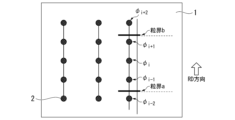
- FIG. 2 is a schematic diagram showing crystal orientation measurement points spaced 1 mm apart along the rolling direction on a steel sheet.
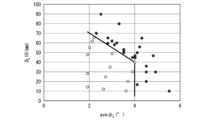
- FIG. 1 is a diagram showing the influence of the average value of the angle deviation in the rolling direction and the crystal grain size on the magnetic properties of the grain-oriented electrical steel sheet.
- Patent Document 1 forms linear grooves on the surface of a steel sheet by etching, and increases the heating rate of the linear grooves during primary annealing to arrange a portion with a high ratio of Goss orientation grains (linear groove portion) and a portion with a high ratio of corresponding orientation grains (portion other than the linear grooves).
- this method it is difficult to increase the difference in heating rate during primary annealing between the linear groove portion and other portions, and the effect obtained is limited. Specifically, the difference in heating rate between the linear groove portion and the portion other than the linear grooves is not so large.
- the degree to which the sheet thickness of this portion is thinned by the formation of the grooves does not exceed about 10% of the original sheet thickness (because the normal groove depth is about 20 ⁇ m or less, which is about 10% or less of the sheet thickness), and considering the thermal conductivity of the steel sheet, the heating rate ratio is less than the sheet thickness ratio for the same heat input, so the ratio of Goss orientation grains in the linear groove portion is difficult to increase compared to the portion other than the linear grooves.
- this method increases the heating rate of the linear groove portion during the primary annealing, so the grain size of the Goss-oriented grains formed in the linear groove portion after the primary annealing does not increase in size compared to the overall average primary recrystallized grain size, but remains the same or finer.
- Patent Document 2 irradiates a laser beam toward the steel sheet surface before finish annealing.
- the laser beam irradiation area is only controlled to the grain boundaries of secondary recrystallization, and the orientation of the Goss orientation grains generated by primary recrystallization is not controlled.
- the area heated by laser irradiation is only the area near the surface where the laser is irradiated, and there is significant thermal diffusion to the surrounding areas, so it is usually not possible to ensure a thermal history that will recrystallize the steel sheet.
- Patent Document 3 irradiates a laser beam toward the surface of the steel sheet after cold rolling.
- the laser beam irradiation portion is only controlled to the grain boundary of secondary recrystallization, and the heating rate is not controlled, so the orientation of the Goss orientation grains generated by primary recrystallization is not controlled.
- the laser beam irradiation portion acts as a barrier to the growth of secondary recrystallized grains, thereby only reducing the grain size in the rolling direction of the secondary recrystallized grains, and a grain growth temperature range in the local heating region that is effective for increasing the diameter of Goss orientation grains in the local heating region is not secured.
- This method may be able to reduce the difference in the degree of orientation accumulation in the Goss orientation at the inner and outer periphery of the coil with different curvatures, but it does not obtain Goss orientation grains whose crystal orientation is close to the ideal Goss orientation. In other words, this method suppresses the decrease in magnetic flux density due to the increase in the grain size in the rolling direction of secondary recrystallized grains, but does not aim to fundamentally improve the orientation of the Goss orientation grains.
- a grain-oriented electrical steel sheet with excellent quality can be obtained by locally and rapidly heating the steel sheet prior to the primary annealing (decarburization annealing) to form a locally heated region.
- the locally heated region formed prior to the primary annealing is arranged locally on the surface of the steel sheet.
- the crystalline structure of this locally heated region consists of one or both of a recrystallized structure and a recovered structure at the end of the localized rapid heating.
- the crystalline structure of the non-locally heated region of the steel sheet surface other than the locally heated region remains as it is cold-rolled and therefore consists of a cold-worked structure.
- the above-mentioned localized heating region preferably has a heating rate of 500°C/sec or more, preferably 2000°C/sec or more, more preferably 5000°C/sec or more, and even more preferably 10000°C/sec or more.
- a heating rate 500°C/sec or more, preferably 2000°C/sec or more, more preferably 5000°C/sec or more, and even more preferably 10000°C/sec or more.
- the frequency of Goss-oriented grains in locally heated regions is greater than the frequency of Goss-oriented grains in non-locally heated regions. This characteristic is due to the fact that the non-locally heated regions retain the processed structure. Specifically, when local rapid heating is performed, recovery and recrystallization occur in the locally heated regions, resulting in the formation of practical Goss-oriented grains and facilitating grain growth, but recovery and recrystallization do not occur in non-locally heated regions.
- Goss-oriented grains formed in the locally heated areas grow preferentially during the secondary annealing after the primary annealing.
- Goss-oriented grains are formed in the locally heated areas, and among these grains are Goss-oriented grains with large crystal grain size that are close to the ideal Goss orientation with particularly small angle deviations ⁇ and ⁇ , and these Goss-oriented grains grow preferentially during the secondary recrystallization.
- the Goss orientation grains that serve as the nuclei for secondary recrystallization are supplied to the locally heated region, there is no need to form Goss orientation grains in the primary annealing in the matrix parts other than the locally heated region, i.e., the non-locally heated region other than the locally heated region. Therefore, as the heat treatment conditions for the primary annealing, a slow heating condition with a low heating rate may be adopted, and primary annealing conditions may be adopted that form many corresponding orientation grains with the easily eroded ⁇ 111 ⁇ 112> and ⁇ 411 ⁇ 148> orientations in the non-locally heated region.
- the heating rate for the primary annealing to 300°C/sec or less, many Goss orientation grains with large crystal grain size and close to the ideal Goss orientation are formed in the locally heated region, while almost no Goss orientation grains are formed in the non-locally heated region, and conversely, many corresponding orientation grains can be formed.
- the size, shape, and arrangement of the crystal grains after the secondary annealing can be controlled by appropriately arranging the localized rapid heating on the steel sheet surface. For example, if a Goss-oriented grain that starts growing from one localized heated region collides with another Goss-oriented grain that starts growing from an adjacent localized heated region and grain growth stops, the grain size of the Goss-oriented grains at the end of the secondary annealing will be small, resulting in a steel sheet with excellent iron loss.
- the Goss-oriented grains that grow preferentially from the localized heat-affected region have a crystal orientation close to the ideal Goss orientation, so that good magnetic flux density can be obtained despite the small secondary recrystallized grain size.
- the grain-oriented electrical steel sheet according to this embodiment was obtained based on the above technical concept. The characteristics of the grain-oriented electrical steel sheet according to this embodiment will be specifically explained.
- the grain-oriented electrical steel sheet (base steel sheet) has The deviation angles of the crystal orientations measured at two adjacent measurement points on the plate surface, spaced 1 mm apart, are represented as ( ⁇ 1 ⁇ 1 ⁇ 1 ) and ( ⁇ 2 ⁇ 2 ⁇ 2 ), The midpoint between two measurement points that satisfy [( ⁇ 2 - ⁇ 1 ) 2 + ( ⁇ 2 - ⁇ 1 ) 2 + ( ⁇ 2 - ⁇ 1 ) 2 ] 1/2 ⁇ 1.0° is defined as the grain boundary GB, The grain size in the rolling direction L determined based on the grain boundary GB is defined as DL in mm.
- the grain size that is 10% by number from the largest grains is defined as D L 10 in units of mm,
- D L 10 satisfies D L 10 ⁇ 100 ⁇ 15 ⁇ ave ⁇ L.
- the angle deviation ⁇ is defined by the deviation angles ⁇ and ⁇ .
- the angle deviation ⁇ is often evaluated by three components, the deviation angles ⁇ , ⁇ , and ⁇ .
- the angle deviation ⁇ is defined by two components, the deviation angles ⁇ and ⁇ , excluding the deviation angle ⁇ , which has little effect on the magnetic flux density and iron loss characteristics. If the above conditions are satisfied using this angle deviation ⁇ , the above effects can be obtained. Meanwhile, the grain boundaries and grain sizes can be determined based on the three components, the deviation angles ⁇ , ⁇ , and ⁇ .
- the ave ⁇ L being 4.0° or less means that the angle deviation ⁇ is small on average at each measurement point along the rolling direction L. That is, it means that the angle deviation between the rolling direction L and the magnetization easy axis direction is small.
- the ave ⁇ L is preferably 3.5°, preferably 3.2° or less, more preferably 3.0° or less, and more preferably 2.7° or less.
- the smaller the value of the ave ⁇ L the more preferable it is, so the lower limit is not particularly limited.
- the ave ⁇ L may be 0.5° or more, or 1.0° or more.
- the fact that the above D L 10 is (100-15 ⁇ ave ⁇ L ) mm or less means that the crystal grains do not grow coarsely in the rolling direction L. If the crystal grains do not grow coarsely in the rolling direction L, the increase in the above-mentioned shift angle, particularly the shift angle ⁇ , can be suppressed. If the increase in the shift angle ⁇ is suppressed, the decrease in magnetic flux density is suppressed. In addition, if the crystal grains do not grow coarsely in the rolling direction L, the magnetic domains are subdivided without applying the conventional magnetic domain control technology. If the magnetic domains are subdivided, the increase in iron loss is suppressed. When D L 10 satisfies the above conditions, the magnetic flux density and iron loss characteristics are preferably improved.
- D L 10 is (90-15 ⁇ ave ⁇ L ) mm or less, and more preferably (80-15 ⁇ ave ⁇ L ) mm or less.
- the lower limit is not particularly limited.
- D L 10 may be 5 mm or more, or 10 mm or more.
- the above-mentioned deviation angles ⁇ , ⁇ , ⁇ , etc. can be measured by setting a measurement line including at least 1,000 measurement points at 1 mm intervals on the rolled surface to measure the crystal orientation.
- the crystal orientation can be measured by X-ray diffraction (Laue method).
- the Laue method is a method in which an X-ray beam is irradiated onto a steel sheet and the transmitted or reflected diffraction spots are analyzed. By analyzing the diffraction spots, the crystal orientation at the location where the X-ray beam was irradiated can be identified. By changing the irradiation position and analyzing the diffraction spots at multiple locations, the crystal orientation distribution at each irradiation position can be measured.
- the Laue method is a method suitable for measuring the crystal orientation of a metal structure with coarse crystal grains.
- the number of measurement points appropriately depending on the size of the secondary recrystallized grains. For example, if there are less than 20 secondary recrystallized grains within a measurement line when there are 1000 measurement points for measuring the crystal orientation, it is preferable to extend the measurement line by increasing the measurement points spaced 1 mm apart so that there are 20 or more secondary recrystallized grains within the measurement line. Furthermore, if it is difficult to set 1000 measurement points on a single measurement line, multiple measurement lines can be set to measure the crystal orientation at a total of 1000 or more measurement points.
- the crystal orientation is measured at 1 mm intervals on the rolled surface, and the above-mentioned deviation angle ⁇ , deviation angle ⁇ , deviation angle ⁇ , etc. are specified for each measurement point. Based on the deviation angle at each specified measurement point, the angle deviation ⁇ , ave ⁇ L , grain boundary GB, grain size D L , and D L 10 can be obtained. Note that D L 10 can be obtained by arranging the crystal grains with a grain size D L of 2 mm or more in descending order and determining the grain size that is 10% by number from the largest.
- the grain-oriented electrical steel sheet according to this embodiment has the above technical characteristics, which may be expressed as follows. The characteristics of the grain-oriented electrical steel sheet according to this embodiment will be explained again.
- the grain-oriented electrical steel sheet according to this embodiment is The following definition of ⁇ m ⁇ 4.0° is satisfied, D10 defined below may be equal to or less than f( ⁇ m ) defined by the following formula (3).
- n points at least 1000 points
- ⁇ i is determined by the following formula (1)
- the average angle deviation ⁇ m is calculated by the following formula (2).
- n points at least 1000 points are set at 1 mm pitch in the rolling direction (RD) to determine the measurement points.
- the crystal orientation can be measured by an X-ray diffraction device using the Laue method.
- the deviation angles ⁇ i , ⁇ i , and ⁇ i from the ideal ⁇ 110 ⁇ 001> orientation in the normal direction (ND), the direction perpendicular to the rolling (TD), and the rolling direction (RD) at the measurement point i are measured, and ⁇ i is determined by the above formula (1).
- the average angle deviation ⁇ m is calculated by the above formula (2).
- one measurement point row may be set at any position, or multiple measurement point rows may be set in the direction perpendicular to the rolling (TD) to determine the measurement positions.
- TD direction perpendicular to the rolling
- the value of n is the number of all measurement points.
- the grain size (D10) of the crystal grain that is 10% from the largest among all the crystal grains is defined.
- RD rolling direction
- the crystal grain size D obtained by such a procedure is 1 mm or more, but when determining D10, a crystal grain size D of 2 mm or more is adopted.
- the grain boundaries and grain size D are determined within the range measured in the rolling direction (RD), and then the grains with a D value of 2 mm or more are arranged in order of increasing D value.
- the grain size of the grains that are 10% from the largest among all the grains is defined as D10.
- there are cases where the X-ray irradiation area at the measurement point straddles two crystal grains, making it impossible to determine which crystal grain it is. In such cases, 0.5 mm is assigned to the crystal grain size of the two straddling crystal grains.
- spot current heating spot electrodes are pressed against both sides of a steel sheet facing each other, and current is passed between the spot electrodes to spot current heat the electrode holding portion of the steel sheet.
- a steel having the composition shown in Table 1 was used, and a cold-rolled steel sheet with a thickness of 0.22 mm was obtained by hot rolling and cold rolling. This steel sheet was subjected to spot current heating.
- the spot current heating was performed using a copper electrode with a diameter of 3 mm under the following conditions: current of 5.0 kA or less, which is within the range in which the steel sheet surface does not melt, current time of 20 to 80 milliseconds, electrode pressure of 50 kgf to 150 kgf, and electrode holding time after current application of 0.1 to 0.5 seconds.
- This cold-rolled steel sheet was subjected to decarburization annealing (primary annealing).
- decarburization annealing the cold-rolled steel sheet was heated at a heating rate of 20°C/sec and held at 830°C for 90 seconds.
- an annealing separator mainly composed of MgO was applied, and then secondary annealing was performed.
- the secondary annealing conditions were: hydrogen-nitrogen atmosphere, heating rate: 15°C/hr (°C/hr), holding: 1200°C-20 hr (hr).
- ⁇ m ( ave ⁇ L ) and D10 (D L10 ) were measured, and the magnetic properties were evaluated.
- Figure 2 shows the influence of the average value of the angular deviation in the rolling direction and the grain size on the magnetic properties of the grain-oriented electrical steel sheet.
- the horizontal axis is ⁇ m ( ave ⁇ L ) and the vertical axis is D10 (D L10 ).
- the cases where B8 ⁇ 1.93T and W17 /50 ⁇ 0.79W/kg are satisfied are indicated by ⁇ , and the cases where at least one of B8 or W17 /50 is not satisfied are indicated by ⁇ .
- the current-carrying electrode used for spot current heating is circular, and its diameter is preferably 0.5 mm ⁇ to 10 mm ⁇ , and more preferably 1 mm ⁇ to 5 mm ⁇ , in terms of circle equivalent diameter. Note that, although a circular current-carrying electrode was used in the above, it is sufficient to locally increase the heating rate of the cold-rolled steel sheet, form Goss-oriented grains in this region, and allow the grains to grow; the electrode shape may be other shapes, for example, elliptical or linear.
- the grain-oriented electrical steel sheet according to this embodiment may have a chemical composition that contains, in mass fraction, 2.0% to 7.0% Si, with the remainder being Fe and impurities.
- the above chemical composition is a preferred chemical composition for controlling the crystal orientation to be concentrated in the ⁇ 110 ⁇ 001> direction.
- this grain-oriented electrical steel sheet may contain publicly known optional elements in place of a portion of Fe in order to improve the magnetic properties.
- the lower limit may be 0%.
- the upper limit for the optional elements may be set to a range in which no significant decrease in magnetic flux density or iron loss occurs. The approximate upper limit for each optional element is listed below.
- the grain-oriented electrical steel sheet (base steel sheet) has a chemical composition, in mass%, of: Si: 2.0 to 7.0%, C: 0 to 0.0050%, Mn: 0 to 1.0%, S and Se: 0 to 0.0150% in total, Al: 0-0.0650%, N: 0 to 0.0050% Nb, V, Mo, Ta, and W: 0 to 0.050% in total; Cu: 0 to 0.40%, Bi: 0 to 0.010%, B: 0 to 0.080%, P: 0-0.50%, Ti: 0 to 0.0150%, Sn: 0 to 0.10%, Sb: 0 to 0.10%, Cr: 0 to 0.30%, Ni: 0 to 1.0% and the remainder being Fe and impurities.
- Si 2.0-7.0%
- Silicon (Si) is a basic element for the base steel sheet. If the Si content is less than 2.0%, the eddy current loss cannot be sufficiently reduced, and good magnetic properties cannot be obtained.
- the Si content of the steel plate is 2.0% or more.
- the Si content is preferably 2.50% or more, and more preferably 3.0% or more.
- the Si content is 7.0%, If the Si content exceeds 7.0%, the steel sheet becomes brittle and the sheet passing property during production is significantly deteriorated, so the Si content of the base steel sheet is set to 7.0% or less.
- the Si content is preferably 4.50% or less. More preferably, it is 4.0% or less.
- C is an optional element for base steel plate.
- C is contained in the steel slab, but if excessive C remains in the base steel plate after final annealing, good core loss characteristics cannot be obtained. Therefore, the C content of the base steel sheet may be 0.0050% or less, preferably 0.0040% or less, and more preferably 0.0030% or less.
- the lower limit of the C content of the base steel sheet is not particularly limited and may be 0%. However, since it is not industrially easy to make the C content 0%, may be more than 0%, or may be 0.00010% or more.
- Mn 0 to 1.0%
- Mn manganese
- Mn is a selective element for the base steel sheet. Mn is contained in the steel slab, but if it is contained in excess, the steel undergoes phase transformation during secondary recrystallization annealing, secondary recrystallization does not proceed sufficiently, and good magnetic properties may not be obtained. Therefore, the Mn content of the base steel sheet may be 1.0% or less. The Mn content is preferably 0.50% or less, more preferably 0.20% or less.
- the lower limit of the Mn content of the base steel sheet is not particularly limited and may be 0%. However, since Mn forms MnS and MnSe and has the effect of acting as an inhibitor during secondary recrystallization, the Mn content may be more than 0% or may be 0.00010% or more.
- S and Se are selective elements for the base steel sheet.
- S and Se are contained in the steel slab, but if S and Se remain in excess in the base steel sheet after finish annealing, it may adversely affect the magnetic properties. Therefore, the total content of S and Se in the base steel sheet may be 0.0150% or less.
- the total content of S and Se is preferably 0.010% or less, more preferably 0.0050% or less.
- the lower limit of the total content of S and Se in the base steel sheet is not particularly limited and may be 0%. However, since S and Se form MnS and MnSe and have the effect of an inhibitor during secondary recrystallization, the total content of S and Se may be more than 0% or may be 0.00010% or more.
- Al is an optional element for base steel sheets. Al is contained in steel slabs, but if excessive Al remains in the base steel sheet after final annealing, it can adversely affect the magnetic properties. Therefore, the Al content of the base steel sheet may be 0.0650% or less. The Al content is preferably 0.040% or less, and more preferably 0.035% or less. The lower limit of the Al content of the base steel sheet is not particularly limited and may be 0%. However, since Al forms AlN and has an effect as an inhibitor during secondary recrystallization, the Al content is The amount of Al may be more than 0% or may be 0.00010% or more. Note that the above content of Al is acid-soluble Al (sol. Al).
- N is an optional element for the base steel sheet.
- N is contained in the steel slab, but if excessive N remains in the base steel sheet after final annealing, it can adversely affect the magnetic properties. Therefore, the N content of the base steel sheet may be 0.0050% or less.
- the N content is preferably 0.0040% or less, and more preferably 0.0030% or less.
- the lower limit of the N content of the base steel sheet is not particularly limited and may be 0%. However, since N forms AlN and has an inhibitor effect during secondary recrystallization, the N content is The amount may be greater than 0% or may be 0.00010% or greater.
- Nb, V, Mo, Ta, and W are optional elements for the base steel plate. If an excessive amount of Nb group elements (one or more of Nb, V, Mo, Ta, and W) remains in the base steel plate, it may adversely affect the magnetic properties. Therefore, the total content of Nb, V, Mo, Ta, and W in the base steel plate may be 0.050% or less.
- the Nb group elements are preferably 0.030% or less, preferably 0.020% or less, and more preferably 0.010% or less.
- the total content of Nb, V, Mo, Ta, and W in the base steel plate is not particularly limited and may be 0%. However, since Nb, V, Mo, Ta, or W forms carbides, nitrides, or carbonitrides and has the effect of acting as an inhibitor during secondary recrystallization, the total content of Nb, V, Mo, Ta, and W may be more than 0% or may be 0.003% or more.
- Cu is an optional element for the base steel sheet. If the Cu content exceeds 0.40%, the steel sheet may become embrittled during hot rolling. Therefore, the Cu content of the base steel sheet is The Cu content is preferably 0.30% or less, and more preferably 0.10% or less. On the other hand, the lower limit of the Cu content is not particularly limited. However, since Cu has the effect of increasing the concentration of the Goss orientation and improving the magnetic properties, the Cu content may be more than 0%, and is set to 0.010% or more. Good too.
- Bi 0 ⁇ 0.010%
- Bi bismuth
- the Bi content of the base steel sheet may be 0.010% or less.
- the Bi content is preferably 0.0050% or less, and more preferably 0.0050% or less.
- the Bi content is 0.0020% or less, and more preferably 0.0010% or less.
- the lower limit of the Bi content is not particularly limited and may be 0%. However, Bi improves the magnetic flux density. Therefore, the Bi content may be set to more than 0% or to 0.00050% or more.
- B 0-0.080%
- B (boron) is an optional element for the base steel sheet. If the B content exceeds 0.080%, the variation (standard deviation) of the magnetic flux density may become large. Therefore, the B content is set to 0.
- the Bi content is preferably 0.070% or less, and more preferably 0.060% or less.
- the lower limit of the B content is not particularly limited, and is 0%. However, since B forms nitrides and has an effect as an inhibitor during secondary recrystallization, the B content may be more than 0% or may be 0.00050% or more. .
- P 0 to 0.50%
- P (phosphorus) is a selective element for the base steel sheet. If the P content exceeds 0.50%, the workability of the steel sheet may be significantly reduced. Therefore, the P content of the base steel sheet may be 0.50% or less.
- the P content is preferably 0.30% or less, more preferably 0.10% or less.
- the lower limit of the P content is not particularly limited and may be 0%. However, since P has the effect of improving the texture and improving the magnetic properties of the steel sheet, the P content may be more than 0% or may be 0.0020% or more.
- Ti 0 ⁇ 0.0150%
- Ti titanium is an optional element for the base steel plate. If the Ti content exceeds 0.0150%, the magnetic properties may be significantly reduced. Therefore, the Ti content of the base steel plate is set to 0.0150% or less.
- the Ti content is preferably 0.0130% or less, and more preferably 0.010% or less.
- the lower limit of the Ti content is not particularly limited, and is not limited to 0%. However, since Ti forms carbides, nitrides, and carbonitrides and has the effect of acting as an inhibitor during secondary recrystallization, the Ti content may be more than 0%, and may be less than 0.0020%. % or more.
- Sn 0-0.10%
- Sn (tin) is an optional element for the base steel sheet. If the Sn content exceeds 0.10%, the secondary recrystallization becomes unstable and may adversely affect the magnetic properties.
- the Sn content of the steel sheet may be 0.10% or less.
- the Sn content is preferably 0.090% or less, and more preferably 0.080% or less.
- the lower limit of the Sn content is However, since Sn has the effect of increasing the concentration of the Goss orientation and improving the magnetic properties, the Sn content may be more than 0%, and may be 0% or less. It may be 0.0050% or more.
- Sb 0-0.10%
- Sb antimony
- the Sb content of the base steel sheet is set to 0.10% or less.
- the Sb content is preferably 0.090% or less, and more preferably 0.080% or less.
- the lower limit of the Sb content is not particularly limited, and is not limited to 0%. However, since Sb functions as an inhibitor and has the effect of stabilizing secondary recrystallization, the Sb content may be more than 0% or may be 0.010% or more.
- Cr 0-0.30% Cr (chromium) is an optional element for the base steel plate. If the Cr content exceeds 0.30%, Cr oxides are formed, which may adversely affect the magnetic properties.
- the Cr content may be 0.30% or less.
- the Cr content is preferably 0.20% or less, and more preferably 0.10% or less.
- the lower limit of the Cr content is particularly However, since Cr has the effect of increasing the concentration of Goss orientation and improving magnetic properties, the Cr content may be more than 0%, and may be 0.010 % or more.
- Ni 0 to 1.0%
- Ni (nickel) is an optional element for the base steel plate. If the Ni content exceeds 1.0%, secondary recrystallization may become unstable. Therefore, the Ni content of the base steel plate may be 1.0% or less.
- the Ni content is preferably 0.20% or less, more preferably 0.10% or less.
- the lower limit of the Ni content is not particularly limited and may be 0%. However, since Ni has the effect of increasing electrical resistance and reducing iron loss, the Ni content may be more than 0% or may be 0.010% or more.
- the base steel sheet of the grain-oriented electrical steel sheet according to this embodiment may contain impurities.
- impurities refer to substances that are mixed in from raw materials such as ore or scrap during industrial production of steel, or from the production environment, etc.
- the chemical composition of the above-mentioned base steel plate may be measured by a general analytical method. For example, it may be measured using ICP-AES (Inductively Coupled Plasma-Atomic Emission Spectrometry). Acid-soluble Al may be measured by ICP-AES using the filtrate after thermally decomposing the sample with acid. C and S may be measured using the combustion-infrared absorption method, N using the inert gas fusion-thermal conductivity method, and O using the inert gas fusion-non-dispersive infrared absorption method.
- ICP-AES Inductively Coupled Plasma-Atomic Emission Spectrometry
- Acid-soluble Al may be measured by ICP-AES using the filtrate after thermally decomposing the sample with acid.
- C and S may be measured using the combustion-infrared absorption method, N using the inert gas fusion-thermal conductivity method, and O using the inert gas fusion-non-dispersive infrared absorption
- the above chemical composition is that of the base steel sheet. If the grain-oriented electrical steel sheet to be used as the measurement sample has an insulating coating on its surface, the coating is removed using the method described below before measuring the chemical composition.
- the insulating coating can be removed by immersing the grain-oriented electrical steel sheet having the coating in a high-temperature alkaline solution.
- the insulating coating can be removed from the grain-oriented electrical steel sheet by immersing the sheet in an aqueous sodium hydroxide solution containing 30 to 50 mass % NaOH and 50 to 70 mass % H 2 O at 80 to 90° C. for 5 to 10 minutes, followed by rinsing with water and drying.
- the time for immersion in the aqueous sodium hydroxide solution can be changed depending on the thickness of the insulating coating.
- the electrical steel sheet from which the insulating coating has been removed using the above method may be immersed in hot hydrochloric acid.
- the preferred concentration of hydrochloric acid for removing the forsterite coating to be dissolved is determined in advance, and the forsterite coating can be removed by immersing the sheet in hydrochloric acid of this concentration (e.g. 30-40% by mass hydrochloric acid) at 80-90°C for 1-5 minutes, followed by rinsing with water and drying.
- different treatment solutions are used to remove each coating, such as using an alkaline solution to remove the insulating coating and hydrochloric acid to remove the forsterite coating.
- the method for manufacturing the grain-oriented electrical steel sheet according to this embodiment is not limited to the method described below.
- the manufacturing method described below is one example for manufacturing the grain-oriented electrical steel sheet according to this embodiment.
- the steps and quantitative conditions for each step shown below are examples adopted to demonstrate the feasibility of this embodiment, and this embodiment is not limited to these steps and quantitative values.
- the manufacturing method for grain-oriented electrical steel sheet according to this embodiment may adopt various conditions as long as they do not deviate from the gist of this embodiment and achieve the purpose of this embodiment.
- the manufacturing method of the grain-oriented electrical steel sheet according to this embodiment can apply the conventional known manufacturing method of grain-oriented electrical steel sheet as a basic process.
- examples of conventional manufacturing methods of grain-oriented electrical steel sheet include a manufacturing method in which inhibitors such as MnS and AlN are formed by high-temperature slab heating, and a manufacturing method in which AlN inhibitors are formed by low-temperature slab heating and nitriding treatment.
- the manufacturing method of the grain-oriented electrical steel sheet according to this embodiment is not limited to a specific manufacturing method. Below, a method of applying nitriding treatment as a low-temperature slab heating process will be described.
- a slab is prepared.
- An example of a method for producing a slab is as follows. Molten steel is produced (smelted). A slab is produced using the molten steel. The slab may be produced by a continuous casting method. An ingot may be produced using the molten steel, and the ingot may be bloomed to produce a slab.
- the thickness of the slab is not particularly limited. The thickness of the slab is, for example, 150 to 350 mm. The thickness of the slab is preferably 220 to 280 mm. As the slab, a so-called thin slab having a thickness of 10 to 70 mm may be used. When a thin slab is used, rough rolling before finish rolling can be omitted in the hot rolling process.
- the above slab may contain the following elements in its chemical composition:
- Carbon (C) is an effective element for controlling the primary recrystallized structure in the manufacturing process, but if its content in the final product is excessive, it will have a detrimental effect on the magnetic properties.
- the preferred upper limit of the C content is 0.075%.
- C is purified in the decarburization annealing process and the finish annealing process to be 0.005% or less.
- the lower limit of the C content may be more than 0%, or may be 0.001%.
- Si 2.0-7.0%
- Silicon (Si) increases the electrical resistance of grain-oriented electrical steel sheets and reduces iron loss. If the Si content is less than 2.0%, ⁇ transformation occurs during final annealing, and the crystallization of the grain-oriented electrical steel sheets is reduced. On the other hand, if the Si content exceeds 7.0%, the cold workability decreases and cracks tend to occur during cold rolling.
- the upper limit of the Si content is preferably 4.5%, and more preferably 4.0%.
- Mn 0.05-1.00%
- Manganese (Mn) combines with S or Se to produce MnS or MnSe, and functions as an inhibitor.
- Mn is contained, the Mn content is within the range of 0.05 to 1.00%.
- the secondary recrystallization is stable. It is possible for part of the inhibitor function to be performed by a nitride of an Nb group element. In this case, the strength of MnS or MnSe as a general inhibitor is Therefore, the upper limit of the Mn content is preferably 0.50%, and more preferably 0.20%.
- At least one of S and Se 0.003 to 0.035% in total Sulfur (S) and selenium (Se) combine with Mn to produce MnS or MnSe, which functions as an inhibitor.
- S and Se When at least one of S and Se is contained, if the total content of S and Se is 0.003 to 0.035%, secondary recrystallization is stable. It is possible for a part of the inhibitor function to be borne by a nitride of an Nb group element. In this case, the strength of MnS or MnSe as a general inhibitor is controlled to be weak. For this reason, the preferred upper limit of the total content of S and Se is 0.025%, and more preferably 0.010%. If S and Se remain after the final annealing, they form compounds and deteriorate the iron loss. Therefore, it is preferable to reduce S and Se as much as possible by purification during the final annealing.
- the total content of S and Se means that at least one of S and Se is included, and is the total content.
- Al 0.010-0.065%
- Aluminum (Al) combines with N to precipitate as (Al,Si)N, and functions as an inhibitor.
- the Al content is within the range of 0.010 to 0.065%.
- AlN formed as an inhibitor by nitriding, which will be described later expands the secondary recrystallization temperature range, and secondary recrystallization is particularly stable in the high temperature range. Therefore, the Al content is 0.010 to 0.065
- the lower limit of the Al content is preferably 0.020%, and more preferably 0.025%.
- the upper limit of the Al content is preferably 0.040%. and more preferably 0.035%.
- N 0.012% or less Nitrogen (N) combines with Al to function as an inhibitor. Since N can be contained by nitriding during the manufacturing process, no lower limit is specified. For example, the lower limit of the N content may be more than 0%, or may be 0.001%. On the other hand, when N is contained, if the N content exceeds 0.012%, blisters, which are a type of defect, tend to occur in the steel sheet. The preferred upper limit of the N content is 0.010%, and more preferably 0.009%. N is purified in the final annealing process, and becomes 0.005% or less after the final annealing process.
- the balance of the above chemical composition consists of Fe and impurities.
- impurities refers to elements that are mixed in from raw materials such as ore and scrap during industrial production of steel, or from the production environment, etc.
- the upper limit of the total impurity content may be, for example, 5%.
- the above-mentioned chemical composition may contain known optional elements in place of part of Fe, taking into consideration not only solving manufacturing problems, but also strengthening the inhibitor function through compound formation and the effect on magnetic properties.
- optional elements that may be contained in place of part of Fe include the following elements:
- Nb group elements 0.050% or less
- the total content of Nb group elements (one or more of Nb, V, Mo, Ta, and W) may be 0.050% or less.
- the total content of Nb group elements is 0.030% or less, since secondary recrystallization is started at an appropriate timing.
- the orientation of the secondary recrystallized grains generated becomes very favorable, and the structure can be finally controlled to be favorable for magnetic properties.
- Nb and Ta have a strong effect and are preferable.
- the total content of Nb group elements is more preferably 0.004 to 0.020%. Even more preferably, it is 0.005 to 0.010%.
- the total content of Nb group elements means the total content including at least one of Nb, V, Mo, Ta, and W.
- the slab also contains, as optional elements, in mass %: Cu: 0.40% or less, Bi: 0.010% or less, B: 0.080% or less, P: 0.50% or less, Ti: 0.015% or less, Sn: 0.10% or less, Sb: 0.10% or less, Cr: 0.30% or less, Ni: 1.00% or less. Since these optional elements may be contained according to known purposes, there is no need to set a lower limit for the content of the optional elements, and the lower limit may be 0%.
- the chemical composition of the above slabs can be measured by the above analytical method, just like the chemical composition of the final product, grain-oriented electrical steel sheet.
- the hot rolling process is a process in which a slab heated to a predetermined temperature (e.g., 1100 to 1400°C) is hot-rolled to obtain a hot-rolled steel sheet.
- a predetermined temperature e.g. 1100 to 1400°C
- the silicon steel material (slab) heated in the heating process is roughly rolled, and then finish-rolled to obtain a hot-rolled steel sheet with a predetermined thickness, for example, 1.8 to 3.5 mm. After the finish rolling is completed, the hot-rolled steel sheet is coiled at a predetermined temperature.
- the slab heating temperature should be set to 1100°C to 1280°C.
- the hot-rolled sheet annealing process is a process in which the hot-rolled steel sheet obtained in the hot rolling process is annealed under a predetermined temperature condition (for example, at 750 to 1200 ° C for 30 seconds to 10 minutes) to obtain an annealed steel sheet.
- Hot-rolled sheet annealing is generally performed to control the steel sheet structure such as the recrystallization rate, residual strain, and crystal grain size by annealing the hot-rolled steel sheet after the hot rolling process, and to preferably adjust the precipitate form in the steel.
- a high-temperature slab heating process it is a process for finally controlling the form of precipitates such as AlN, and conditions are adjusted so that they precipitate uniformly and finely.
- the hot-rolled sheet annealing for example, after heating the steel sheet to 1050 ° C to 1150 ° C, in order to properly precipitate AlN, etc., it may be cooled slowly to an intermediate temperature (850 ° C to 950 ° C) for 50 to 150 seconds, and then cooled with water.
- an intermediate temperature 850 ° C to 950 ° C
- the cold rolling process is a process in which the annealed steel sheet obtained in the hot-rolled sheet annealing process is subjected to one cold rolling or multiple cold rolling (two or more times) via annealing (intermediate annealing) to obtain a cold-rolled steel sheet having a thickness of, for example, 0.10 to 0.50 mm.
- the interpass temperature of the cold rolling may be set to about 100° C. to 300° C.
- Total cold rolling rate (%) (1 - thickness of steel plate after cold rolling / thickness of steel plate before cold rolling) x 100
- local rapid heating is performed on the cold-rolled steel sheet after the cold rolling process to form a local heating region.
- the rapid heating method is not particularly limited as long as it can locally heat the steel sheet.
- a method of heating by contacting a spot electrode with the front and back surfaces of the steel sheet and passing an electric current through the steel sheet a method of heating by irradiating the surface of the steel sheet with laser light or an electron beam, a method of locally heating by induction heating, a method of heating by contacting a hot piece, etc. can be adopted.
- each local heating region can be a dot-like region with a diameter of about 10 ⁇ m to 10 mm, or a linear region with a width of about 10 ⁇ m to 10 mm.
- the electrode used for electric heating may be a circular electrode as described above, or a linear electrode.
- the minimum diameter and width of the size of the locally heated region depend on the shape of the spot electrode and the technology for reducing the focused diameter of the laser light or electron beam. In principle, it is possible to further reduce the size of the locally heated region, but considering that the current size of the nuclei of recrystallized grains is about 1 ⁇ m, it is believed that an effect can be obtained if the size of the locally heated region is 1 ⁇ m or more. From an industrial perspective, the above minimum diameter and width should be 10 ⁇ m or more. Regarding the size of the locally heated region, if the maximum diameter or width exceeds 10 mm, the area proportion of Goss orientation grains with relatively large angle deviations ⁇ and ⁇ that cannot grow outside the locally heated region increases. In this case, it becomes difficult to obtain the effect of local rapid heating.
- the heating rate should be 500°C/sec or more in the center of the locally heated region as viewed in the thickness direction and at 1/5 of the thickness of the steel plate. If the heating rate in the above region is 500°C/sec or more, the structure of the locally heated region can be preferably controlled to a recovered structure or a recrystallized structure.
- the above heating rate is preferably 2000°C/sec or more, and more preferably 10000°C/sec or more.
- the upper limit of the above heating rate is not particularly limited, and may be, for example, 1,000,000°C/sec.
- the above heating rate in conjunction with the heating rate during decarburization annealing, which will be described later.
- the heating rate during decarburization annealing is faster than the heating rate during localized rapid heating, it is difficult to obtain the desired effect. Therefore, although it depends on the magnitude of the heating rate, it is preferable to set the heating rate during localized rapid heating to be equal to or greater than the heating rate during decarburization annealing.
- the 1/5 part of the thickness of the steel plate mentioned above refers to a depth equivalent to 1/5 of the thickness of the steel plate from the surface of the steel plate in the thickness direction.
- the maximum temperature reached should be 700°C or higher in the center of the locally heated region when viewed from the plate thickness direction and at 1/5 of the plate thickness of the steel plate. If the maximum temperature reached in the above region is 700°C or higher, the structure of the locally heated region can be preferably controlled to a recovered structure or a recrystallized structure.
- the above maximum temperature reached is preferably 800°C or higher, and more preferably 900°C or higher.
- the above maximum temperature reached should be below the melting point of the steel plate, for example, 1400°C or lower.
- the holding time from reaching the maximum temperature to cooling to 700°C at the center of the locally heated region as viewed from the thickness direction and at 1/5 of the thickness of the steel plate should be 0.1 seconds or more. If the holding time in the above region is 0.1 seconds or more, the structure of the locally heated region can be preferably controlled to a recovered structure or a recrystallized structure.
- the holding time is preferably 0.2 seconds or more, more preferably 0.3 seconds or more, and even more preferably 0.4 seconds or more.
- there is no particular limit to the upper limit of the holding time and it may be, for example, 10 seconds or less.
- the holding time from reaching the maximum temperature to cooling to 700°C has a fundamental effect on the formation of coarse Goss orientation grains close to the ideal Goss orientation.
- the method of local rapid heating is not particularly limited.
- local rapid heating may be performed by spot electrical current heating, laser irradiation, or electron beam irradiation.
- it is sufficient to control the heating rate, maximum temperature, and holding time described above so as to satisfy the above.
- a person skilled in the art can combine the various conditions of the local rapid heating method to control the desired heating rate, maximum temperature, and holding time.
- a person skilled in the art can perform a heat conduction analysis using the finite element method to control the heating rate and maximum temperature reached in the center of the localized heating area when viewed from the plate thickness direction and at 1/5 of the plate thickness of the steel plate.
- a person skilled in the art can control the above-mentioned holding time by adjusting the heat removal conditions after the maximum temperature is reached. For example, in the case of spot current heating, the electrode holding time after current is controlled, or the shape of the spot electrode can be changed to a shape suitable for heat removal.
- the irradiation speed can be adjusted, or the shape of the irradiation area can be changed to an ellipse or the like to gradient the irradiation energy from the center to the outer edge of the irradiation area.
- the heating by laser irradiation preferentially heats only the vicinity of the irradiated steel sheet surface, and the inside of the steel sheet is not easily heated.
- the heating by laser irradiation is non-contact heating, the heat is removed quickly after heating, and the temperature is not easily maintained. Therefore, when performing laser irradiation heating as local rapid heating, in order to recover or recrystallize the cold-worked structure in the laser irradiated region, it is necessary to control the conditions so that not only the surface of the steel sheet but also the inside of the steel sheet is heated, and the cooling rate is slowed down to relatively coarsen the subgrain structure in the laser irradiated region.
- the laser irradiation conditions for performing local rapid heating are completely different from the laser irradiation conditions for performing magnetic domain refinement. For example, even if the laser irradiation conditions for performing magnetic domain refinement (usually 0.5 to 50 mJ/mm 2 ) are applied to this embodiment, the structure of the locally heated region is not favorably controlled, and coarse Goss orientation grains close to the ideal Goss orientation are not formed in the steel sheet after the decarburization annealing process. The same applies to electron beam irradiation as to laser irradiation.
- the structure of the locally heated region is not favorably controlled, and coarse Goss-oriented grains close to the ideal Goss orientation are not formed in the steel sheet after the decarburization annealing process.
- the size, shape, and arrangement of crystal grains after secondary annealing can be controlled by appropriately arranging the locally heated regions on the steel sheet surface. For example, if the locally heated regions are arranged on the steel sheet surface so that a Goss-oriented grain that starts growing from one locally heated region collides with another Goss-oriented grain that starts growing from an adjacent locally heated region, the grain size of the Goss-oriented grains in any direction at the end of secondary annealing can be controlled to be small.
- Decarburization annealing process In the decarburization annealing process, the cold-rolled steel sheet after the local rapid heating process is subjected to decarburization annealing (primary annealing). This decarburization annealing increases the frequency of Goss-oriented grains formed in the local heating region, increases the grain size of the Goss-oriented grains, and favorably grows coarse Goss-oriented grains having an orientation close to the ideal Goss orientation.
- the decarburization annealing conditions may be, for example, an annealing temperature of 700 to 900°C and an annealing time of 1 to 3 minutes.
- C contained in the cold-rolled steel sheet is removed.
- Decarburization annealing is preferably performed in a moist atmosphere in order to remove "C" contained in the cold-rolled steel sheet.
- the primary recrystallized grain size is not particularly limited, but is preferably 8 to 30 ⁇ m.
- the heating rate of decarburization annealing may be 10,000°C/sec or less, but it is preferable to slow down the heating rate of decarburization annealing to form ⁇ 111 ⁇ 112> orientation grains and ⁇ 411 ⁇ 148> orientation grains that are easily eroded into the matrix portion (non-locally heated region).
- the heating rate of decarburization annealing is preferably 300°C/sec or less, more preferably 200°C/sec or less, and even more preferably 100°C/sec or less.
- the amount of decarbonation and the state of the surface oxide layer affect the formation of the glass film, so in decarburization annealing, the degree of oxidation (PH 2 O/PH 2 ) in the annealing atmosphere (furnace atmosphere) may be appropriately adjusted.
- Nitriding is an effective treatment in a low-temperature slab heating process in which the slab heating temperature is 1280°C or less, and is an important step for adjusting the strength of the inhibitor in secondary recrystallization. Nitriding increases the nitrogen content of the steel sheet by about 40 to 200 ppm between the start of the decarburization treatment and the start of secondary recrystallization in the finish annealing.
- Examples of nitriding include a treatment of annealing in an atmosphere containing a gas with nitriding ability such as ammonia, and a treatment of finish annealing a decarburized annealed steel sheet coated with an annealing separator containing a powder with nitriding ability such as MnN.
- the amount of nitriding after the nitriding treatment is preferably 130 to 350 ppm, and more preferably 150 to 250 ppm.
- the annealing separator application process is a process of applying an annealing separator to the decarburized annealed steel sheet.
- an annealing separator mainly composed of MgO or an annealing separator mainly composed of Al 2 O 3 can be used.
- the decarburized annealed steel sheet after application of the annealing separator is wound into a coil and is finish annealed in the next finish annealing process.
- the final annealing process is a process in which the decarburized annealed steel sheet coated with the annealing separator is subjected to final annealing (secondary annealing) to cause secondary recrystallization.
- second annealing final annealing
- the growth of the primary recrystallized grains is suppressed by an inhibitor, and the secondary recrystallization is allowed to proceed, thereby preferentially growing ⁇ 100 ⁇ 001> oriented grains and dramatically improving the magnetic flux density.
- the heating rate in the heating process of the final annealing step is not particularly limited.
- the temperature may be increased at a heating rate of 3 to 20°C/hour.
- slow heating may be performed in the temperature range of 1000°C to 1200°C during heating.
- the heating rate in the temperature range of 1000°C to 1200°C during heating is preferably 3 to 12°C/hour, more preferably 3 to 9°C/hour, and even more preferably 3 to 7°C/hour.
- the heating may be stopped once during the heating process of the final annealing step and held so that the precipitates pinning the primary recrystallized grains do not suddenly decompose.
- the heating may be stopped once in the temperature range of 1050°C to 1100°C during heating, and held for 5 hours to 15 hours.
- adjusting the heating rate in the secondary recrystallization temperature range affects the decomposition rate of the inhibitor and can improve the magnetic flux density.
- the holding process may involve holding the material in a temperature range of 1000°C to 1300°C for 10 hours to 60 hours.
- the atmosphere during the final annealing may be, for example, a nitrogen atmosphere or a mixed atmosphere of nitrogen and hydrogen.
- the steel sheet After the final annealing, the steel sheet is coated with a coating solution containing phosphoric acid or a phosphate, chromic anhydride or a chromate, and colloidal silica, as required, and baked (for example, at 350°C to 1150°C for 5 hours).
- a coating solution containing phosphoric acid or a phosphate, chromic anhydride or a chromate, and colloidal silica, as required, and baked (for example, at 350°C to 1150°C for 5 hours).
- an insulating coating may be formed by subjecting the heating process to a temperature of 100° C. to 300 seconds.
- the grain-oriented electrical steel sheet may be subjected to a magnetic domain refinement treatment for forming localized micro-distortion regions or grooves by a known method such as laser, plasma, mechanical method, etching, etc.
- a magnetic domain refinement treatment for forming localized micro-distortion regions or grooves by a known method such as laser, plasma, mechanical method, etching, etc.
- the grain-oriented electrical steel sheet according to the present embodiment has excellent magnetic flux density, but since coarsening of the secondary recrystallized grain size is suppressed, the magnetic domains are refined even without the magnetic domain refinement treatment.
- the micro-distortion regions and grooves caused by the magnetic domain refinement processing may become abnormal points in the measurement of crystal orientation and grain size. Therefore, when measuring crystal orientation, it is preferable to ensure that the measurement point does not overlap with the micro-distortion regions and grooves.
- the conditions in the examples are one example of conditions adopted to confirm the feasibility and effects of the present invention, and the present invention is not limited to this one example of conditions.
- Various conditions can be adopted in the present invention as long as they do not deviate from the gist of the present invention and the object of the present invention is achieved.
- the slabs were heated to 1150°C and subjected to hot rolling to obtain hot-rolled steel sheets with a thickness of 2.6 mm.
- the hot-rolled steel sheets were then heated to 1100°C and subsequently annealed at 900°C for hot-rolled sheet annealing, after which pickling was performed to remove the scale formed on the surface.
- These steel sheets were subjected to one cold rolling or multiple cold rolling with intermediate annealing in between to obtain cold-rolled steel sheets with a final thickness of 0.22 mm.
- the above cold-rolled steel sheets were subjected to localized rapid heating under the conditions shown in Tables 3 to 6.
- spot current heating a copper electrode with a diameter of 3 mm was used in the contact area with the steel sheet, and the electrode shape, electrode pressure, current, current duration, and electrode holding time after current were varied in a composite manner to control the heating rate, maximum temperature, and holding time from reaching the maximum temperature until cooling to 700°C (holding time above 700°C).
- the laser heating a fiber laser was used, and the diameter of the focused spot of the laser beam in the rolling direction (i.e., the diameter including 86% of the laser output) was set to 30 ⁇ m (except for Tests No. 62 and No. 63).
- the laser irradiation energy density, laser scanning speed, and shape of the laser irradiation area were varied in a composite manner to control the heating rate, maximum temperature, and holding time above 700°C.
- Those skilled in the art can combine the conditions of the localized rapid heating method to control the desired heating rate, maximum temperature, and holding time above 700°C.
- test No. 60 the laser beam was elongated in the scanning direction, and the holding time from reaching the maximum temperature to cooling to 700 ° C. during local rapid heating was controlled to 0.2 seconds, so that coarse Goss orientation grains having an orientation close to the ideal Goss orientation were formed in the locally heated area.
- test No. 61 general laser irradiation conditions for magnetic domain refinement were applied.
- the focusing spot diameter was set to 0.5 mm
- the laser irradiation energy density was set to 2.0 J/mm 2
- the laser beam irradiation portion was controlled so that it would eventually become the grain boundary of the secondary recrystallized grain.
- the focusing spot diameter was set to 0.5 mm
- the laser irradiation energy density was set to 30.0 J/mm 2
- the laser beam irradiation portion was controlled so that it would eventually become the grain boundary of the secondary recrystallized grain.
- the local heating condition “Linear or spotted” indicates the shape of the localized heated area on the surface of the cold-rolled steel sheet
- the local heating conditions “Rolling direction spacing” and “Width direction spacing” indicate the spacing in the rolling direction and transverse direction at which the localized heated areas are arranged on the surface of the cold-rolled steel sheet.
- the localized heated areas are arranged at equal intervals in the rolling direction and transverse direction. Note that when providing localized heated areas on the surface of the cold-rolled steel sheet, they are arranged so that the distribution of the localized heated areas is not uneven.
- the produced cold-rolled steel sheets were subjected to decarburization annealing under the conditions shown in Tables 3 to 6.
- the degree of oxidation (PH 2 O/PH 2 ) in the annealing atmosphere (furnace atmosphere) was set to 0.13.
- the decarburized annealed steel sheet produced was subjected to nitriding treatment at 750°C in a nitrogen-hydrogen-ammonia atmosphere to set the steel sheet nitrogen content to 220 ppm. Furthermore, an annealing separator mainly composed of MgO was applied, and finish annealing was performed. In the finish annealing, the steel sheet was heated to 1000°C (the “Step" below is 1070°C) at a heating rate of 15°C/hour in a mixed atmosphere of hydrogen and nitrogen, and then heated to 1200°C under any of the following conditions, and held at 1200°C for 20 hours in a hydrogen atmosphere.
- the steel sheet After final annealing, the steel sheet is coated with an insulating coating solution made mainly of colloidal silica and phosphate, with chromic anhydride added as needed, and baked to form an insulating coating.
- an insulating coating solution made mainly of colloidal silica and phosphate, with chromic anhydride added as needed, and baked to form an insulating coating.
- the crystal orientation was measured by setting a measurement line including 1,000 measurement points at 1 mm intervals in the rolling direction (RD), setting 10 of these measurement lines at 50 mm intervals in the direction perpendicular to the rolling direction (TD), and measuring the crystal orientation on these 10 lines.
- the magnetic properties of the grain-oriented electrical steel sheets were measured based on the single sheet magnetic properties test method (SST: Single Sheet Tester) specified in JIS C 2556:2015.
- the magnetic flux density B 8 (T) in the rolling direction of the steel sheet when excited at 800 A / m was measured.
- the magnetic flux density B 8 was judged to pass or fail based on the Si content of the steel sheet. For example, it is known that the lower the Si content of the steel sheet, the higher the saturation magnetic flux density, and the higher the saturation magnetic flux density, the higher B 8.
- iron loss W17 /50 (W/kg), defined as the power loss per unit weight (1 kg) of the steel sheet, was measured under conditions of an AC frequency of 50 Hz and an excitation magnetic flux density of 1.7 T. W17/50 of 0.79 W/kg or less was judged to be acceptable.
- the grain-oriented electrical steel sheets according to the present invention satisfied ave ⁇ L ⁇ 4.0° and D L 10 ⁇ 100-15 ⁇ ave ⁇ L.
- all of these examples of the present invention had excellent magnetic flux density because the angular deviation in the rolling direction was controlled to be small, and excellent iron loss without domain control (domain refinement treatment) because the grain size in the rolling direction was controlled to be small. Therefore, these examples of the present invention can reduce the adverse effects of conventional magnetic domain control (e.g., deterioration of transformer noise due to laser magnetic domain control, reduction in magnetic flux density due to the introduction of grooves, etc.).
- the grain-oriented electrical steel sheets as comparative examples did not satisfy at least one of ave ⁇ L ⁇ 4.0° or D L 10 ⁇ 100 ⁇ 15 ⁇ ave ⁇ L. These comparative examples did not provide preferable magnetic flux density or core loss as grain-oriented electrical steel sheets.
- the above-mentioned aspects of the present invention can reduce the drawbacks of conventional magnetic domain control (e.g., deterioration of transformer noise due to laser magnetic domain control, reduction in magnetic flux density due to the introduction of grooves, etc.), and can provide a grain-oriented electrical steel sheet that is excellent in both magnetic flux density and core loss. Therefore, it has a high industrial applicability.
- conventional magnetic domain control e.g., deterioration of transformer noise due to laser magnetic domain control, reduction in magnetic flux density due to the introduction of grooves, etc.
Landscapes
- Chemical & Material Sciences (AREA)
- Engineering & Computer Science (AREA)
- Organic Chemistry (AREA)
- Materials Engineering (AREA)
- Mechanical Engineering (AREA)
- Metallurgy (AREA)
- Physics & Mathematics (AREA)
- Electromagnetism (AREA)
- Thermal Sciences (AREA)
- Crystallography & Structural Chemistry (AREA)
- Manufacturing & Machinery (AREA)
- Dispersion Chemistry (AREA)
- Power Engineering (AREA)
- Manufacturing Of Steel Electrode Plates (AREA)
- Soft Magnetic Materials (AREA)
Abstract
Priority Applications (4)
| Application Number | Priority Date | Filing Date | Title |
|---|---|---|---|
| CN202480042006.7A CN121464233A (zh) | 2023-06-29 | 2024-06-27 | 方向性电磁钢板 |
| JP2024556100A JP7606154B1 (ja) | 2023-06-29 | 2024-06-27 | 方向性電磁鋼板 |
| EP24832025.1A EP4737605A1 (fr) | 2023-06-29 | 2024-06-27 | Tôle d'acier électrique à grains orientés |
| KR1020257043464A KR20260014009A (ko) | 2023-06-29 | 2024-06-27 | 방향성 전자 강판 |
Applications Claiming Priority (2)
| Application Number | Priority Date | Filing Date | Title |
|---|---|---|---|
| JP2023-106556 | 2023-06-29 | ||
| JP2023106556 | 2023-06-29 |
Publications (1)
| Publication Number | Publication Date |
|---|---|
| WO2025005166A1 true WO2025005166A1 (fr) | 2025-01-02 |
Family
ID=93939074
Family Applications (1)
| Application Number | Title | Priority Date | Filing Date |
|---|---|---|---|
| PCT/JP2024/023281 Ceased WO2025005166A1 (fr) | 2023-06-29 | 2024-06-27 | Tôle d'acier électrique à grains orientés |
Country Status (5)
| Country | Link |
|---|---|
| EP (1) | EP4737605A1 (fr) |
| JP (1) | JP7606154B1 (fr) |
| KR (1) | KR20260014009A (fr) |
| CN (1) | CN121464233A (fr) |
| WO (1) | WO2025005166A1 (fr) |
Cited By (2)
| Publication number | Priority date | Publication date | Assignee | Title |
|---|---|---|---|---|
| WO2026005045A1 (fr) * | 2024-06-27 | 2026-01-02 | 日本製鉄株式会社 | Dispositif de chauffage et procédé de chauffage pour plaque métallique pour tôle d'acier électrique, et procédé de fabrication de tôle d'acier électrique |
| WO2026005032A1 (fr) * | 2024-06-27 | 2026-01-02 | 日本製鉄株式会社 | Appareil de chauffage par résistance électrique et procédé de chauffage par résistance électrique pour plaque métallique pour tôle d'acier électromagnétique, et procédé de fabrication de tôle d'acier électromagnétique |
Citations (6)
| Publication number | Priority date | Publication date | Assignee | Title |
|---|---|---|---|---|
| JP2007169762A (ja) | 2005-12-26 | 2007-07-05 | Jfe Steel Kk | 低鉄損方向性電磁鋼板の製造方法 |
| WO2012014290A1 (fr) | 2010-07-28 | 2012-02-02 | 新日本製鐵株式会社 | Tôle d'acier électromagnétique orienté et son procédé de fabrication |
| JP2021181604A (ja) * | 2020-05-20 | 2021-11-25 | Jfeスチール株式会社 | 方向性電磁鋼板およびその製造方法 |
| JP2021183722A (ja) * | 2020-05-20 | 2021-12-02 | Jfeスチール株式会社 | 方向性電磁鋼板とその製造方法ならびに歪導入装置 |
| JP2022161269A (ja) | 2021-04-08 | 2022-10-21 | 日本製鉄株式会社 | 方向性電磁鋼板の製造方法 |
| JP2023106556A (ja) | 2018-08-17 | 2023-08-01 | キオクシア株式会社 | 半導体基板および半導体装置 |
-
2024
- 2024-06-27 JP JP2024556100A patent/JP7606154B1/ja active Active
- 2024-06-27 EP EP24832025.1A patent/EP4737605A1/fr active Pending
- 2024-06-27 KR KR1020257043464A patent/KR20260014009A/ko active Pending
- 2024-06-27 CN CN202480042006.7A patent/CN121464233A/zh active Pending
- 2024-06-27 WO PCT/JP2024/023281 patent/WO2025005166A1/fr not_active Ceased
Patent Citations (6)
| Publication number | Priority date | Publication date | Assignee | Title |
|---|---|---|---|---|
| JP2007169762A (ja) | 2005-12-26 | 2007-07-05 | Jfe Steel Kk | 低鉄損方向性電磁鋼板の製造方法 |
| WO2012014290A1 (fr) | 2010-07-28 | 2012-02-02 | 新日本製鐵株式会社 | Tôle d'acier électromagnétique orienté et son procédé de fabrication |
| JP2023106556A (ja) | 2018-08-17 | 2023-08-01 | キオクシア株式会社 | 半導体基板および半導体装置 |
| JP2021181604A (ja) * | 2020-05-20 | 2021-11-25 | Jfeスチール株式会社 | 方向性電磁鋼板およびその製造方法 |
| JP2021183722A (ja) * | 2020-05-20 | 2021-12-02 | Jfeスチール株式会社 | 方向性電磁鋼板とその製造方法ならびに歪導入装置 |
| JP2022161269A (ja) | 2021-04-08 | 2022-10-21 | 日本製鉄株式会社 | 方向性電磁鋼板の製造方法 |
Cited By (2)
| Publication number | Priority date | Publication date | Assignee | Title |
|---|---|---|---|---|
| WO2026005045A1 (fr) * | 2024-06-27 | 2026-01-02 | 日本製鉄株式会社 | Dispositif de chauffage et procédé de chauffage pour plaque métallique pour tôle d'acier électrique, et procédé de fabrication de tôle d'acier électrique |
| WO2026005032A1 (fr) * | 2024-06-27 | 2026-01-02 | 日本製鉄株式会社 | Appareil de chauffage par résistance électrique et procédé de chauffage par résistance électrique pour plaque métallique pour tôle d'acier électromagnétique, et procédé de fabrication de tôle d'acier électromagnétique |
Also Published As
| Publication number | Publication date |
|---|---|
| KR20260014009A (ko) | 2026-01-29 |
| EP4737605A1 (fr) | 2026-05-06 |
| JPWO2025005166A1 (fr) | 2025-01-02 |
| JP7606154B1 (ja) | 2024-12-25 |
| CN121464233A (zh) | 2026-02-03 |
Similar Documents
| Publication | Publication Date | Title |
|---|---|---|
| JP7606154B1 (ja) | 方向性電磁鋼板 | |
| JP5691265B2 (ja) | 方向性電磁鋼板の製造方法 | |
| JP7644338B2 (ja) | 方向性電磁鋼板の製造方法 | |
| JP7606155B1 (ja) | 方向性電磁鋼板 | |
| US12410490B2 (en) | Grain-oriented electrical steel sheet, and method for manufacturing grain-oriented electrical steel sheet | |
| CN119836484A (zh) | 取向性电磁钢板 | |
| EP4640853A1 (fr) | Feuille d'acier électrique à grains orientés et procédé de raffinage de domaines magnétiques à l'intérieur de celle-ci | |
| JP7644339B2 (ja) | 方向性電磁鋼板の製造方法 | |
| JP7795148B2 (ja) | 方向性電磁鋼板および方向性電磁鋼板の製造方法 | |
| JP7799219B2 (ja) | 方向性電磁鋼板及びその製造方法 | |
| JP7787485B2 (ja) | 方向性電磁鋼板用の脱炭焼鈍鋼板 | |
| RU2771130C1 (ru) | Способ производства листа электротехнической стали с ориентированной зеренной структурой | |
| WO2025005169A1 (fr) | Tôle d'acier laminée à froid | |
| EP4737608A1 (fr) | Tôle d'acier électromagnétique à grains orientés | |
| US20250051867A1 (en) | Grain oriented electrical steel sheet and method for manufacturing same | |
| RU2850885C2 (ru) | Лист электротехнической стали с ориентированной зеренной структурой | |
| WO2025211393A1 (fr) | Tôle d'acier électromagnétique à grains orientés et son procédé de production | |
| WO2025187790A1 (fr) | Tôle d'acier électromagnétique à grains orientés, et procédé de fabrication de celle-ci | |
| JP2001040416A (ja) | ゴス方位集積度が高い一方向性電磁鋼板の製造方法 | |
| JP2025136013A (ja) | 方向性電磁鋼板の製造方法 | |
| WO2026014484A1 (fr) | Procédé de production d'une feuille d'acier électrique à grains orientés | |
| JPH09137223A (ja) | 磁気特性の優れた一方向性電磁鋼板の製造方法 |
Legal Events
| Date | Code | Title | Description |
|---|---|---|---|
| WWE | Wipo information: entry into national phase |
Ref document number: 2024556100 Country of ref document: JP |
|
| 121 | Ep: the epo has been informed by wipo that ep was designated in this application |
Ref document number: 24832025 Country of ref document: EP Kind code of ref document: A1 |
|
| WWE | Wipo information: entry into national phase |
Ref document number: 202517128115 Country of ref document: IN |
|
| ENP | Entry into the national phase |
Ref document number: 1020257043464 Country of ref document: KR Free format text: ST27 STATUS EVENT CODE: A-0-1-A10-A15-NAP-PA0105 (AS PROVIDED BY THE NATIONAL OFFICE) |
|
| WWE | Wipo information: entry into national phase |
Ref document number: 1020257043464 Country of ref document: KR |
|
| REG | Reference to national code |
Ref country code: BR Ref legal event code: B01A Ref document number: 112025028705 Country of ref document: BR |
|
| WWP | Wipo information: published in national office |
Ref document number: 202517128115 Country of ref document: IN |
|
| WWE | Wipo information: entry into national phase |
Ref document number: 2025138565 Country of ref document: RU Ref document number: 2024832025 Country of ref document: EP |
|
| WWP | Wipo information: published in national office |
Ref document number: 1020257043464 Country of ref document: KR |
|
| NENP | Non-entry into the national phase |
Ref country code: DE |
|
| ENP | Entry into the national phase |
Ref document number: 2024832025 Country of ref document: EP Effective date: 20260129 |
|
| ENP | Entry into the national phase |
Ref document number: 2024832025 Country of ref document: EP Effective date: 20260129 |
|
| WWP | Wipo information: published in national office |
Ref document number: 2025138565 Country of ref document: RU |
|
| WWP | Wipo information: published in national office |
Ref document number: 2024832025 Country of ref document: EP |