WO2025018248A1 - Composé, élément électroluminescent organique et dispositif électronique - Google Patents
Composé, élément électroluminescent organique et dispositif électronique Download PDFInfo
- Publication number
- WO2025018248A1 WO2025018248A1 PCT/JP2024/024942 JP2024024942W WO2025018248A1 WO 2025018248 A1 WO2025018248 A1 WO 2025018248A1 JP 2024024942 W JP2024024942 W JP 2024024942W WO 2025018248 A1 WO2025018248 A1 WO 2025018248A1
- Authority
- WO
- WIPO (PCT)
- Prior art keywords
- group
- substituted
- unsubstituted
- ring
- atoms
- Prior art date
- Legal status (The legal status is an assumption and is not a legal conclusion. Google has not performed a legal analysis and makes no representation as to the accuracy of the status listed.)
- Pending
Links
Images
Classifications
-
- C—CHEMISTRY; METALLURGY
- C07—ORGANIC CHEMISTRY
- C07D—HETEROCYCLIC COMPOUNDS
- C07D235/00—Heterocyclic compounds containing 1,3-diazole or hydrogenated 1,3-diazole rings, condensed with other rings
- C07D235/02—Heterocyclic compounds containing 1,3-diazole or hydrogenated 1,3-diazole rings, condensed with other rings condensed with carbocyclic rings or ring systems
- C07D235/04—Benzimidazoles; Hydrogenated benzimidazoles
- C07D235/06—Benzimidazoles; Hydrogenated benzimidazoles with only hydrogen atoms, hydrocarbon or substituted hydrocarbon radicals, directly attached in position 2
- C07D235/08—Radicals containing only hydrogen and carbon atoms
-
- C—CHEMISTRY; METALLURGY
- C07—ORGANIC CHEMISTRY
- C07D—HETEROCYCLIC COMPOUNDS
- C07D401/00—Heterocyclic compounds containing two or more hetero rings, having nitrogen atoms as the only ring hetero atoms, at least one ring being a six-membered ring with only one nitrogen atom
- C07D401/02—Heterocyclic compounds containing two or more hetero rings, having nitrogen atoms as the only ring hetero atoms, at least one ring being a six-membered ring with only one nitrogen atom containing two hetero rings
- C07D401/10—Heterocyclic compounds containing two or more hetero rings, having nitrogen atoms as the only ring hetero atoms, at least one ring being a six-membered ring with only one nitrogen atom containing two hetero rings linked by a carbon chain containing aromatic rings
-
- C—CHEMISTRY; METALLURGY
- C09—DYES; PAINTS; POLISHES; NATURAL RESINS; ADHESIVES; COMPOSITIONS NOT OTHERWISE PROVIDED FOR; APPLICATIONS OF MATERIALS NOT OTHERWISE PROVIDED FOR
- C09K—MATERIALS FOR MISCELLANEOUS APPLICATIONS, NOT PROVIDED FOR ELSEWHERE
- C09K11/00—Luminescent materials, e.g. electroluminescent or chemiluminescent
- C09K11/06—Luminescent materials, e.g. electroluminescent or chemiluminescent containing organic luminescent materials
-
- H—ELECTRICITY
- H10—SEMICONDUCTOR DEVICES; ELECTRIC SOLID-STATE DEVICES NOT OTHERWISE PROVIDED FOR
- H10K—ORGANIC ELECTRIC SOLID-STATE DEVICES
- H10K50/00—Organic light-emitting devices
- H10K50/10—OLEDs or polymer light-emitting diodes [PLED]
- H10K50/14—Carrier transporting layers
- H10K50/15—Hole transporting layers
-
- H—ELECTRICITY
- H10—SEMICONDUCTOR DEVICES; ELECTRIC SOLID-STATE DEVICES NOT OTHERWISE PROVIDED FOR
- H10K—ORGANIC ELECTRIC SOLID-STATE DEVICES
- H10K50/00—Organic light-emitting devices
- H10K50/10—OLEDs or polymer light-emitting diodes [PLED]
- H10K50/14—Carrier transporting layers
- H10K50/16—Electron transporting layers
-
- H—ELECTRICITY
- H10—SEMICONDUCTOR DEVICES; ELECTRIC SOLID-STATE DEVICES NOT OTHERWISE PROVIDED FOR
- H10K—ORGANIC ELECTRIC SOLID-STATE DEVICES
- H10K85/00—Organic materials used in the body or electrodes of devices covered by this subclass
- H10K85/60—Organic compounds having low molecular weight
Definitions
- the present invention relates to a novel compound, an organic electroluminescence element, and an electronic device.
- an organic electroluminescence element hereinafter also referred to as an organic EL element
- holes are injected from the anode and electrons are injected from the cathode into the light-emitting layer.
- the injected holes and electrons recombine to form excitons.
- Patent Document 1 discloses a compound having a specific structure for use in an organic EL device.
- the object of the present invention is to provide an organic EL element with higher performance.
- R 7 and R 12 represents a single bond to (L 1 ) n1
- the other of R 7 and R 12 represents a single bond to (L 2 ) n2
- R 1 to R 6 , R 8 to R 11 , and R 22 to R 25 each independently represent a hydrogen atom or the substituent R.
- R21 is It is a substituted or unsubstituted alkyl group having 1 to 6 carbon atoms, or a substituted or unsubstituted cycloalkyl group having 3 to 10 ring carbon atoms.
- Ar1 is Hydrogen atoms, a substituted or unsubstituted aryl group having 6 to 18 ring carbon atoms, It is a substituted or unsubstituted monovalent oxygen-containing heterocyclic group having 5 to 18 ring atoms, or a substituted or unsubstituted monovalent sulfur-containing heterocyclic group having 5 to 18 ring atoms.
- L1 and L2 each independently represent It is a substituted or unsubstituted arylene group having 6 to 14 ring carbon atoms, or a substituted or unsubstituted divalent heterocyclic group having 5 to 14 ring atoms.
- n1 is an integer from 0 to 3.
- n2 is an integer from 0 to 3.
- n1 When n1 is 0, (L 1 ) n1 is a single bond. When n1 is 2 or more, the two or more L 1 are connected in series. When n1 is 2 or more, the two or more L 1 may be the same or different. When n2 is 0, (L 2 ) n2 is a single bond. When n2 is 2 or more, the two or more L2 are connected in series. When n2 is 2 or more, the two or more L2 may be the same or different.
- the substituent R is a substituted or unsubstituted alkyl group having 1 to 50 carbon atoms, a substituted or unsubstituted alkenyl group having 2 to 50 carbon atoms, a substituted or unsubstituted alkynyl group having 2 to 50 carbon atoms, a substituted or unsubstituted cycloalkyl group having 3 to 50 ring carbon atoms, -Si(R 901 )(R 902 )(R 903 ), -O-(R 904 ), -S- (R 905 ), -N(R 906 )(R 907 ), Halogen atoms, cyano groups, nitro groups, It is a substituted or unsubstituted aryl group having 6 to 50 ring carbon atoms, or a substituted or unsubstituted monovalent heterocyclic group having 5 to 50 ring atoms.
- R 901 to R 907 each independently represent Hydrogen atoms, a substituted or unsubstituted alkyl group having 1 to 50 carbon atoms, a substituted or unsubstituted cycloalkyl group having 3 to 50 ring carbon atoms, It is a substituted or unsubstituted aryl group having 6 to 50 ring carbon atoms, or a substituted or unsubstituted monovalent heterocyclic group having 5 to 50 ring atoms.
- each of the two or more R 901 to R 907 may be the same or different.
- the two or more substituents R may be the same or different. 2.
- a cathode; An anode; one or more organic layers disposed between the cathode and the anode; having At least one of the organic layers contains the compound described in 1 above.
- An electronic device comprising the organic electroluminescence element according to 2.
- the present invention provides organic EL elements with higher performance.
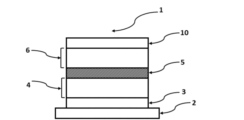
- FIG. 1 is a diagram showing a schematic configuration of an organic EL element according to one embodiment of the present invention.
- hydrogen atoms include isotopes having different numbers of neutrons, namely protium, deuterium, and tritium.
- any possible bonding position that is not explicitly indicated with a symbol such as "R” or "D” representing a deuterium atom is assumed to have a hydrogen atom, i.e., a protium atom, deuterium atom, or tritium atom, bonded to it.
- the number of ring carbon atoms refers to the number of carbon atoms among the atoms constituting the ring itself of a compound having a structure in which atoms are bonded in a ring (for example, a monocyclic compound, a fused ring compound, a bridged compound, a carbocyclic compound, and a heterocyclic compound).
- a compound having a structure in which atoms are bonded in a ring for example, a monocyclic compound, a fused ring compound, a bridged compound, a carbocyclic compound, and a heterocyclic compound.
- the carbon contained in the substituent is not included in the number of ring carbon atoms.
- the "number of ring carbon atoms" described below is the same unless otherwise specified.
- a benzene ring has 6 ring carbon atoms
- a naphthalene ring has 10 ring carbon atoms
- a pyridine ring has 5 ring carbon atoms
- a furan ring has 4 ring carbon atoms.
- a 9,9-diphenylfluorenyl group has 13 ring carbon atoms
- a 9,9'-spirobifluorenyl group has 25 ring carbon atoms.
- the number of carbon atoms of the alkyl group is not included in the number of ring carbon atoms of the benzene ring.
- the number of ring carbon atoms of the benzene ring substituted with an alkyl group is 6.
- the number of carbon atoms of the alkyl group is not included in the number of ring carbon atoms of the naphthalene ring. Therefore, the number of ring carbon atoms of the naphthalene ring substituted with an alkyl group is 10.
- the number of ring atoms refers to the number of atoms constituting the ring itself of a compound (e.g., a monocyclic compound, a fused ring compound, a bridged compound, a carbocyclic compound, and a heterocyclic compound) with a structure in which atoms are bonded in a ring (e.g., a monocyclic ring, a fused ring, and a ring assembly).
- the number of ring atoms does not include atoms that do not constitute a ring (e.g., a hydrogen atom that terminates the bond of an atom constituting a ring) or atoms contained in a substituent when the ring is substituted with a substituent.
- the "number of ring atoms" described below is the same unless otherwise specified.
- the number of ring atoms of a pyridine ring is 6, the number of ring atoms of a quinazoline ring is 10, and the number of ring atoms of a furan ring is 5.
- the number of hydrogen atoms or atoms constituting a substituent bonded to a pyridine ring is not included in the number of pyridine ring atoms. Therefore, the number of ring atoms of a pyridine ring to which a hydrogen atom or a substituent is bonded is 6.
- the number of ring atoms of a quinazoline ring to which a hydrogen atom or a substituent is bonded is 10.
- the "carbon number XX to YY” in the expression “substituted or unsubstituted ZZ group having carbon numbers XX to YY” refers to the number of carbon atoms when the ZZ group is unsubstituted, and does not include the number of carbon atoms of the substituent when the ZZ group is substituted.
- "YY" is larger than “XX”
- "XX” means an integer of 1 or more
- "YY” means an integer of 2 or more.
- the "atomic number XX to YY” in the expression “substituted or unsubstituted ZZ group having atomic number XX to YY” refers to the number of atoms when the ZZ group is unsubstituted, and does not include the number of atoms of the substituents when the ZZ group is substituted.
- "YY" is larger than “XX”
- "XX” means an integer of 1 or more
- “YY” means an integer of 2 or more.
- unsubstituted ZZ group refers to the case where "a substituted or unsubstituted ZZ group” is an "unsubstituted ZZ group”
- substituted ZZ group refers to the case where "a substituted or unsubstituted ZZ group” is a "substituted ZZ group”.
- unsubstituted in the case of "a substituted or unsubstituted ZZ group” means that a hydrogen atom in the ZZ group is not replaced with a substituent.
- the hydrogen atom in the "unsubstituted ZZ group” is a protium atom, a deuterium atom, or a tritium atom.
- substitution in the case of "a substituted or unsubstituted ZZ group” means that one or more hydrogen atoms in the ZZ group are replaced with a substituent.
- substitution in the case of "a BB group substituted with an AA group” means that one or more hydrogen atoms in the BB group are replaced with an AA group.
- the "unsubstituted aryl group” described in this specification has 6 to 50 ring carbon atoms, preferably 6 to 30, and more preferably 6 to 18 ring carbon atoms, unless otherwise specified in this specification.
- the "unsubstituted heterocyclic group” described in this specification has 5 to 50 ring atoms, preferably 5 to 30, and more preferably 5 to 18 ring atoms, unless otherwise specified in this specification.
- the "unsubstituted alkyl group” described in this specification has 1 to 50 carbon atoms, preferably 1 to 20 carbon atoms, and more preferably 1 to 6 carbon atoms, unless otherwise specified in this specification.
- the number of carbon atoms in the "unsubstituted alkenyl group” described in this specification, unless otherwise specified in this specification, is 2 to 50, preferably 2 to 20, and more preferably 2 to 6.
- the number of carbon atoms in the "unsubstituted alkynyl group” described in this specification, unless otherwise specified in this specification, is 2 to 50, preferably 2 to 20, and more preferably 2 to 6.
- the "unsubstituted cycloalkyl group” described in this specification has 3 to 50 ring carbon atoms, preferably 3 to 20, and more preferably 3 to 6 ring carbon atoms, unless otherwise specified in this specification.
- the "unsubstituted arylene group” described in this specification has 6 to 50 ring carbon atoms, preferably 6 to 30, and more preferably 6 to 18 ring carbon atoms, unless otherwise specified in this specification.
- the number of ring atoms in the “unsubstituted divalent heterocyclic group” described in this specification is 5 to 50, preferably 5 to 30, and more preferably 5 to 18, unless otherwise specified in this specification.
- the "unsubstituted alkylene group” described in this specification has 1 to 50 carbon atoms, preferably 1 to 20 carbon atoms, and more preferably 1 to 6 carbon atoms, unless otherwise specified in this specification.
- Specific examples (specific example group G1) of the "substituted or unsubstituted aryl group” described in this specification include the following unsubstituted aryl group (specific example group G1A) and substituted aryl group (specific example group G1B).
- unsubstituted aryl group refers to the case where the "substituted or unsubstituted aryl group” is an "unsubstituted aryl group”
- substituted aryl group refers to the case where the "substituted or unsubstituted aryl group” is a "substituted aryl group”.
- aryl group simply refers to both an "unsubstituted aryl group” and a "substituted aryl group”.
- substituted aryl group refers to a group in which one or more hydrogen atoms of an "unsubstituted aryl group” are replaced with a substituent.
- substituted aryl group include the "unsubstituted aryl group” in the specific example group G1A below in which one or more hydrogen atoms are replaced with a substituent, and the substituted aryl group in the specific example group G1B below.
- the examples of the "unsubstituted aryl group” and the examples of the “substituted aryl group” listed here are merely examples, and the "substituted aryl group” described in this specification also includes a group in which a hydrogen atom bonded to a carbon atom of the aryl group itself in the "substituted aryl group” in the specific example group G1B below is further replaced with a substituent, and a group in which a hydrogen atom of a substituent in the "substituted aryl group” in the specific example group G1B below is further replaced with a substituent.
- Unsubstituted aryl groups (specific example group G1A): Phenyl group, p-biphenyl group, m-biphenyl group, o-biphenyl group, p-terphenyl-4-yl group, p-terphenyl-3-yl group, p-terphenyl-2-yl group, m-terphenyl-4-yl group, m-terphenyl-3-yl group, m-terphenyl-2-yl group, o-terphenyl-4-yl group, o-terphenyl-3-yl group, o-terphenyl-2-yl group, 1-naphthyl group, 2-naphthyl group, anthryl group, Benzanthryl group, A phenanthryl group, Benzophenanthryl group, A phenalenyl group, Pyrenyl group, Chrysenyl group, benzochrysenyl group,
- Substituted aryl groups (specific example group G1B): o-tolyl group, m-tolyl group, p-tolyl group, para-xylyl group, meta-xylyl group, ortho-xylyl group, para-isopropylphenyl group, meta-isopropylphenyl group, ortho-isopropylphenyl group, para-t-butylphenyl group, A meta-t-butylphenyl group, ortho-t-butylphenyl group, 3,4,5-trimethylphenyl group, 9,9-dimethylfluorenyl group, 9,9-diphenylfluorenyl group, 9,9-bis(4-methylphenyl)fluorenyl group, 9,9-bis(4-isopropylphenyl)fluorenyl group, 9,9-bis(4-t-butylphenyl)fluorenyl group, Cyanophenyl group, triphenyls
- heterocyclic group is a cyclic group containing at least one heteroatom as a ring-forming atom.
- the heteroatom include a nitrogen atom, an oxygen atom, a sulfur atom, a silicon atom, a phosphorus atom, and a boron atom.
- the “heterocyclic groups” described herein are either monocyclic or fused ring groups.
- the “heterocyclic group” described herein may be an aromatic heterocyclic group or a non-aromatic heterocyclic group.
- Specific examples (specific example group G2) of the "substituted or unsubstituted heterocyclic group" described in this specification include the following unsubstituted heterocyclic group (specific example group G2A) and substituted heterocyclic group (specific example group G2B).
- heterocyclic group refers to the case where the "substituted or unsubstituted heterocyclic group” is an "unsubstituted heterocyclic group"
- substituted heterocyclic group refers to the case where the "substituted or unsubstituted heterocyclic group” is a "substituted heterocyclic group”.
- heterocyclic group simply includes both an "unsubstituted heterocyclic group” and a "substituted heterocyclic group”.
- substituted heterocyclic group refers to a group in which one or more hydrogen atoms of an "unsubstituted heterocyclic group” are replaced with a substituent.
- Specific examples of the "substituted heterocyclic group” include the groups in which the hydrogen atoms of the "unsubstituted heterocyclic group” in the specific example group G2A below are replaced, and the examples of the substituted heterocyclic group in the specific example group G2B below are exemplified.
- the examples of the "unsubstituted heterocyclic group” and the examples of the “substituted heterocyclic group” listed here are merely examples, and the “substituted heterocyclic group” described in this specification also includes the groups in the "substituted heterocyclic group” in the specific example group G2B in which a hydrogen atom bonded to a ring-forming atom of the heterocyclic group itself is further replaced with a substituent, and the "substituted heterocyclic group” in the specific example group G2B in which a hydrogen atom of a substituent is further replaced with a substituent.
- Specific example group G2A includes, for example, the following unsubstituted heterocyclic groups containing a nitrogen atom (specific example group G2A1), unsubstituted heterocyclic groups containing an oxygen atom (specific example group G2A2), unsubstituted heterocyclic groups containing a sulfur atom (specific example group G2A3), and monovalent heterocyclic groups derived by removing one hydrogen atom from ring structures represented by the following general formulae (TEMP-16) to (TEMP-33) (specific example group G2A4).
- Specific example group G2B includes, for example, the following substituted heterocyclic groups containing a nitrogen atom (specific example group G2B1), substituted heterocyclic groups containing an oxygen atom (specific example group G2B2), substituted heterocyclic groups containing a sulfur atom (specific example group G2B3), and groups in which one or more hydrogen atoms of a monovalent heterocyclic group derived from a ring structure represented by the following general formulae (TEMP-16) to (TEMP-33) are replaced with a substituent (specific example group G2B4).
- Unsubstituted heterocyclic groups containing a nitrogen atom (specific example group G2A1): Pyrrolyl group, imidazolyl group, A pyrazolyl group, A triazolyl group, Tetrazolyl group, oxazolyl group, an isoxazolyl group, oxadiazolyl group, A thiazolyl group, isothiazolyl group, A thiadiazolyl group, Pyridyl group, pyridazinyl group, pyrimidinyl group, A pyrazinyl group, Triazinyl group, Indolyl groups, isoindolyl group, Indolizinyl group, A quinolizinyl group, quinolyl group, isoquinolyl group, Cinnolyl group, phthalazinyl group, A quinazolinyl group, quinoxalinyl group, Benzimidazolyl group, Indazolyl group, A phenanthrolinyl
- Unsubstituted heterocyclic groups containing an oxygen atom (specific example group G2A2): Furyl group, oxazolyl group, an isoxazolyl group, oxadiazolyl group, xanthenyl group, benzofuranyl group, isobenzofuranyl group, Dibenzofuranyl group, naphthobenzofuranyl group, benzoxazolyl group, benzoisoxazolyl group, phenoxazinyl group, morpholino group, Dinaphthofuranyl group, azadibenzofuranyl group, diazadibenzofuranyl group, Azanaphthobenzofuranyl group, and diazanaphthobenzofuranyl group.
- Unsubstituted heterocyclic groups containing a sulfur atom (specific example group G2A3): A thienyl group, A thiazolyl group, isothiazolyl group, A thiadiazolyl group, Benzothiophenyl group (benzothienyl group), isobenzothiophenyl group (isobenzothienyl group), Dibenzothiophenyl group (dibenzothienyl group), Naphthobenzothiophenyl group (naphthobenzothienyl group), benzothiazolyl group, Benzisothiazolyl group, A phenothiazinyl group, Dinaphthothiophenyl group (dinaphthothienyl group), Azadibenzothiophenyl group (azadibenzothienyl group), Diazadibenzothiophenyl group (diazadibenzothienyl group), Azanap
- X A and Y A are each independently an oxygen atom, a sulfur atom, NH, or CH2 , provided that at least one of X A and Y A is an oxygen atom, a sulfur atom, or NH.
- the monovalent heterocyclic group derived from the ring structure represented by the general formulae (TEMP-16) to (TEMP-33) includes a monovalent group obtained by removing one hydrogen atom from the NH or CH2 .
- Substituted heterocyclic groups containing a nitrogen atom (specific example group G2B1): A (9-phenyl)carbazolyl group, A (9-biphenylyl)carbazolyl group, (9-phenyl)phenylcarbazolyl group, (9-naphthyl)carbazolyl group, diphenylcarbazol-9-yl group, A phenylcarbazol-9-yl group, methylbenzimidazolyl group, Ethyl benzimidazolyl group, phenyltriazinyl group, Biphenylyltriazinyl group, diphenyltriazinyl group, a phenylquinazolinyl group, and a biphenylylquinazolinyl group.
- Substituted heterocyclic groups containing an oxygen atom (specific example group G2B2): phenyldibenzofuranyl group, methyldibenzofuranyl group, The t-butyldibenzofuranyl group, and the monovalent radical of spiro[9H-xanthene-9,9'-[9H]fluorene].
- Substituted heterocyclic groups containing a sulfur atom (specific example group G2B3): Phenyldibenzothiophenyl group, methyldibenzothiophenyl group, The t-butyldibenzothiophenyl group, and the monovalent radical of spiro[9H-thioxanthene-9,9'-[9H]fluorene].
- one or more hydrogen atoms of a monovalent heterocyclic group means one or more hydrogen atoms selected from a hydrogen atom bonded to a ring-forming carbon atom of the monovalent heterocyclic group, a hydrogen atom bonded to a nitrogen atom when at least one of XA and YA is NH, and a hydrogen atom of a methylene group when one of XA and YA is CH2 .
- Specific examples (specific example group G3) of the "substituted or unsubstituted alkyl group" described in this specification include the following unsubstituted alkyl groups (specific example group G3A) and substituted alkyl groups (specific example group G3B).
- the unsubstituted alkyl group refers to the case where the "substituted or unsubstituted alkyl group" is an "unsubstituted alkyl group"
- the substituted alkyl group refers to the case where the "substituted or unsubstituted alkyl group” is a "substituted alkyl group”.
- substituted alkyl group refers to a group in which one or more hydrogen atoms in the "unsubstituted alkyl group” are replaced with a substituent.
- specific examples of the "substituted alkyl group” include the following "unsubstituted alkyl group” (specific example group G3A) in which one or more hydrogen atoms are replaced with a substituent, and the examples of the substituted alkyl group (specific example group G3B).
- the alkyl group in the "unsubstituted alkyl group” refers to a chain-like alkyl group.
- the "unsubstituted alkyl group” includes a straight-chain “unsubstituted alkyl group” and a branched “unsubstituted alkyl group”.
- the examples of the "unsubstituted alkyl group” and the examples of the “substituted alkyl group” listed here are merely examples, and the "substituted alkyl group” described in this specification also includes a group in which a hydrogen atom of the alkyl group itself in the "substituted alkyl group” in the specific example group G3B is further replaced with a substituent, and a group in which a hydrogen atom of a substituent in the "substituted alkyl group” in the specific example group G3B is further replaced with a substituent.
- Unsubstituted alkyl groups (specific example group G3A): Methyl group, Ethyl group, n-propyl group, isopropyl group, n-butyl group, isobutyl group, s-Butyl group, and t-butyl group.
- Substituted alkyl groups (specific example group G3B): Heptafluoropropyl group (including isomers), pentafluoroethyl group, A 2,2,2-trifluoroethyl group, and a trifluoromethyl group.
- Specific examples (specific example group G4) of the "substituted or unsubstituted alkenyl group" described in this specification include the following unsubstituted alkenyl group (specific example group G4A) and substituted alkenyl group (specific example group G4B).
- the unsubstituted alkenyl group refers to the case where the "substituted or unsubstituted alkenyl group” is an "unsubstituted alkenyl group", and the "substituted alkenyl group” refers to the case where the "substituted or unsubstituted alkenyl group” is a "substituted alkenyl group”.
- alkenyl group when the term “alkenyl group” is simply used, it includes both an "unsubstituted alkenyl group” and a "substituted alkenyl group”.
- substituted alkenyl group refers to a group in which one or more hydrogen atoms in an "unsubstituted alkenyl group” are replaced with a substituent.
- Specific examples of the "substituted alkenyl group” include the following "unsubstituted alkenyl group” (specific example group G4A) having a substituent, and the examples of substituted alkenyl groups (specific example group G4B).
- the examples of the "unsubstituted alkenyl group” and the examples of the “substituted alkenyl group” listed here are merely examples, and the "substituted alkenyl group” described in this specification also includes a group in which a hydrogen atom of the alkenyl group itself in the "substituted alkenyl group” in specific example group G4B is further replaced with a substituent, and a group in which a hydrogen atom of a substituent in the "substituted alkenyl group” in specific example group G4B is further replaced with a substituent.
- Unsubstituted alkenyl groups (specific example group G4A): Vinyl group, Allyl groups, 1-butenyl group, A 2-butenyl group, and a 3-butenyl group.
- Substituted alkenyl groups (specific example group G4B): 1,3-butadienyl group, 1-methylvinyl group, 1-methylallyl group, 1,1-dimethylallyl group, 2-methylallyl group, and 1,2-dimethylallyl group.
- the unsubstituted alkynyl group refers to the case where the "substituted or unsubstituted alkynyl group” is an "unsubstituted alkynyl group."
- alkynyl group refers to an "unsubstituted alkynyl group” in which one or more hydrogen atoms have been replaced with a substituent.
- Specific examples of the "substituted alkynyl group” include the following "unsubstituted alkynyl group” (specific example group G5A) in which one or more hydrogen atoms have been replaced with a substituent.
- Specific examples (specific example group G6) of the "substituted or unsubstituted cycloalkyl group” described in this specification include the following unsubstituted cycloalkyl group (specific example group G6A) and substituted cycloalkyl group (specific example group G6B).
- unsubstituted cycloalkyl group refers to the case where the "substituted or unsubstituted cycloalkyl group” is an "unsubstituted cycloalkyl group”
- substituted cycloalkyl group refers to the case where the "substituted or unsubstituted cycloalkyl group” is a "substituted cycloalkyl group”.
- substituted cycloalkyl group refers to a group in which one or more hydrogen atoms in the "unsubstituted cycloalkyl group” are replaced with a substituent.
- Specific examples of the "substituted cycloalkyl group” include the following "unsubstituted cycloalkyl group” (specific example group G6A) in which one or more hydrogen atoms are replaced with a substituent, and the examples of the substituted cycloalkyl group (specific example group G6B).
- the examples of the "unsubstituted cycloalkyl group” and the examples of the “substituted cycloalkyl group” listed here are merely examples, and the "substituted cycloalkyl group" described in this specification also includes a group in which one or more hydrogen atoms bonded to a carbon atom of the cycloalkyl group itself in the "substituted cycloalkyl group” in the specific example group G6B are replaced with a substituent, and a group in which a hydrogen atom of a substituent in the "substituted cycloalkyl group” in the specific example group G6B is further replaced with a substituent.
- Unsubstituted cycloalkyl groups (specific example group G6A): A cyclopropyl group, A cyclobutyl group, Cyclopentyl group, cyclohexyl group, 1-adamantyl group, 2-adamantyl group, 1-norbornyl group, and 2-norbornyl group.
- Substituted cycloalkyl groups (specific example group G6B): 4-Methylcyclohexyl group.
- G7 of the group represented by --Si(R 901 )(R 902 )(R 903 ) described in this specification include: -Si(G1)(G1)(G1), -Si (G1) (G2) (G2), -Si (G1) (G1) (G2), -Si(G2)(G2)(G2), -Si(G3)(G3)(G3), and -Si(G6)(G6)(G6)(G6)
- G1 is a "substituted or unsubstituted aryl group” described in specific example group G1.
- G2 is a "substituted or unsubstituted heterocyclic group” described in specific example group G2.
- G3 is a "substituted or unsubstituted alkyl group” described in specific example group G3.
- G6 is a "substituted or unsubstituted cycloalkyl group” described in specific example group G6.
- the multiple G1s in -Si(G1)(G1)(G1) are the same as or different from each other.
- the multiple G2s in -Si(G1)(G2)(G2) are the same as or different from each other.
- the multiple G1s in -Si(G1)(G1)(G2) are the same as or different from each other.
- the multiple G2s in —Si(G2)(G2)(G2) are the same as or different from each other.
- the multiple G3s in —Si(G3)(G3)(G3) are the same as or different from each other.
- the multiple G6s in —Si(G6)(G6)(G6) are the same as or different from each other.
- G8 of the group represented by -O-(R 904 ) described in this specification include: -O(G1), -O (G2), -O(G3) and -O(G6) Examples include: Where: G1 is a "substituted or unsubstituted aryl group” described in specific example group G1. G2 is a “substituted or unsubstituted heterocyclic group” described in specific example group G2. G3 is a "substituted or unsubstituted alkyl group” described in specific example group G3. G6 is a "substituted or unsubstituted cycloalkyl group” described in specific example group G6.
- G9 A group represented by -S-(R 905 )
- Specific examples (specific example group G9) of the group represented by -S-(R 905 ) described in this specification include: -S (G1), -S (G2), -S(G3) and -S(G6) Examples include: Where: G1 is a "substituted or unsubstituted aryl group” described in specific example group G1. G2 is a "substituted or unsubstituted heterocyclic group” described in specific example group G2. G3 is a "substituted or unsubstituted alkyl group” described in specific example group G3. G6 is a "substituted or unsubstituted cycloalkyl group” described in specific example group G6.
- Specific examples (specific example group G10) of the group represented by -N(R 906 )(R 907 ) described in this specification include: -N(G1)(G1), -N(G2)(G2), -N (G1) (G2), -N(G3)(G3), and -N(G6)(G6) Examples include: Where: G1 is a "substituted or unsubstituted aryl group” described in specific example group G1. G2 is a "substituted or unsubstituted heterocyclic group” described in specific example group G2.
- G3 is a "substituted or unsubstituted alkyl group” described in specific example group G3.
- G6 is a "substituted or unsubstituted cycloalkyl group” described in specific example group G6.
- the multiple G1s in -N(G1)(G1) are the same or different from each other.
- the multiple G2s in -N(G2)(G2) are the same or different from each other.
- the multiple G3s in -N(G3)(G3) are the same or different.
- the multiple G6s in -N(G6)(G6) are the same or different.
- halogen atoms include a fluorine atom, a chlorine atom, a bromine atom, and an iodine atom.
- substituted or unsubstituted fluoroalkyl groups means a group in which at least one hydrogen atom bonded to a carbon atom constituting the alkyl group in the "substituted or unsubstituted alkyl group” is replaced with a fluorine atom, and also includes a group (perfluoro group) in which all hydrogen atoms bonded to carbon atoms constituting the alkyl group in the "substituted or unsubstituted alkyl group” are replaced with fluorine atoms.
- the number of carbon atoms in the "unsubstituted fluoroalkyl group” is 1 to 50, preferably 1 to 30, and more preferably 1 to 18, unless otherwise specified in the present specification.
- substituted fluoroalkyl group means a group in which one or more hydrogen atoms in the "fluoroalkyl group” are replaced with a substituent.
- substituted fluoroalkyl group as used herein also includes a group in which one or more hydrogen atoms bonded to a carbon atom of the alkyl chain in the "substituted fluoroalkyl group” are further replaced with a substituent, and a group in which one or more hydrogen atoms of the substituent in the "substituted fluoroalkyl group” are further replaced with a substituent.
- substituents include the examples of groups in which one or more hydrogen atoms in the "alkyl group” (specific example group G3) are replaced with fluorine atoms.
- substituted or unsubstituted haloalkyl group means a group in which at least one hydrogen atom bonded to a carbon atom constituting the alkyl group in the "substituted or unsubstituted alkyl group” is replaced with a halogen atom, and also includes a group in which all hydrogen atoms bonded to carbon atoms constituting the alkyl group in the "substituted or unsubstituted alkyl group” are replaced with halogen atoms.
- the number of carbon atoms in the "unsubstituted haloalkyl group” is 1 to 50, preferably 1 to 30, and more preferably 1 to 18, unless otherwise specified in the present specification.
- substituted haloalkyl group means a group in which one or more hydrogen atoms in the "haloalkyl group” are replaced with a substituent.
- substituted haloalkyl group as used herein also includes a group in which one or more hydrogen atoms bonded to a carbon atom in the alkyl chain in the "substituted haloalkyl group” are further replaced with a substituent, and a group in which one or more hydrogen atoms of the substituent in the "substituted haloalkyl group” are further replaced with a substituent.
- substituents in the "substituted haloalkyl group” are further replaced with a substituent.
- Specific examples of the "unsubstituted haloalkyl group” include the examples of the group in which one or more hydrogen atoms in the "alkyl group” (specific example group G3) are replaced with a halogen atom.
- Haloalkyl groups are sometimes referred to as halogenated alkyl groups.
- a specific example of the "substituted or unsubstituted alkoxy group” described in this specification is a group represented by -O(G3), where G3 is a "substituted or unsubstituted alkyl group” described in specific example group G3.
- the number of carbon atoms in the "unsubstituted alkoxy group” is 1 to 50, preferably 1 to 30, and more preferably 1 to 18, unless otherwise specified in this specification.
- Substituted or unsubstituted alkylthio group A specific example of the "substituted or unsubstituted alkylthio group” described in this specification is a group represented by -S(G3), where G3 is a "substituted or unsubstituted alkyl group” described in specific example group G3.
- the number of carbon atoms in the "unsubstituted alkylthio group" is 1 to 50, preferably 1 to 30, and more preferably 1 to 18, unless otherwise specified in this specification.
- a specific example of the "substituted or unsubstituted aryloxy group” described in this specification is a group represented by -O(G1), where G1 is a "substituted or unsubstituted aryl group” described in specific example group G1.
- the number of ring carbon atoms of the "unsubstituted aryloxy group” is 6 to 50, preferably 6 to 30, and more preferably 6 to 18, unless otherwise specified in this specification.
- a specific example of the "substituted or unsubstituted arylthio group” described in this specification is a group represented by -S(G1), where G1 is a "substituted or unsubstituted aryl group” described in specific example group G1.
- the number of ring carbon atoms of the "unsubstituted arylthio group” is 6 to 50, preferably 6 to 30, and more preferably 6 to 18, unless otherwise specified in this specification.
- a specific example of the "trialkylsilyl group” described in this specification is a group represented by -Si(G3)(G3)(G3), where G3 is a "substituted or unsubstituted alkyl group” described in specific example group G3.
- the multiple G3s in -Si(G3)(G3)(G3) are the same as or different from each other.
- the number of carbon atoms in each alkyl group of the "trialkylsilyl group” is 1 to 50, preferably 1 to 20, and more preferably 1 to 6, unless otherwise specified in this specification.
- a specific example of the "substituted or unsubstituted aralkyl group” described in this specification is a group represented by -(G3)-(G1), where G3 is a "substituted or unsubstituted alkyl group” described in the specific example group G3, and G1 is a "substituted or unsubstituted aryl group” described in the specific example group G1.
- an “aralkyl group” is a group in which a hydrogen atom of an "alkyl group” is replaced with an "aryl group” as a substituent, and is one aspect of a “substituted alkyl group”.
- An “unsubstituted aralkyl group” is an "unsubstituted alkyl group” substituted with an "unsubstituted aryl group”, and the number of carbon atoms in the "unsubstituted aralkyl group” is 7 to 50, preferably 7 to 30, and more preferably 7 to 18, unless otherwise specified in this specification.
- substituted or unsubstituted aralkyl group include benzyl group, 1-phenylethyl group, 2-phenylethyl group, 1-phenylisopropyl group, 2-phenylisopropyl group, phenyl-t-butyl group, ⁇ -naphthylmethyl group, 1- ⁇ -naphthylethyl group, 2- ⁇ -naphthylethyl group, 1- ⁇ -naphthylisopropyl group, 2- ⁇ -naphthylisopropyl group, ⁇ -naphthylmethyl group, 1- ⁇ -naphthylethyl group, 2- ⁇ -naphthylethyl group, 1- ⁇ -naphthylisopropyl group, and 2- ⁇ -naphthylisopropyl group.
- the substituted or unsubstituted aryl group described herein is preferably a phenyl group, a p-biphenyl group, a m-biphenyl group, an o-biphenyl group, a p-terphenyl-4-yl group, a p-terphenyl-3-yl group, a p-terphenyl-2-yl group, a m-terphenyl-4-yl group, a m-terphenyl-3-yl group, a m-terphenyl-2-yl group, a o-terphenyl-4-yl group, a o-terphenyl-3-yl group, a o-terphenyl-2-yl group, a 1-naphthyl group, a 2-naphthyl group, an anthryl group, a phenanthryl group, a pyrenyl group, a
- the substituted or unsubstituted heterocyclic group described in the present specification is preferably a pyridyl group, a pyrimidinyl group, a triazinyl group, a quinolyl group, an isoquinolyl group, a quinazolinyl group, a benzimidazolyl group, a phenanthrolinyl group, a carbazolyl group (a 1-carbazolyl group, a 2-carbazolyl group, a 3-carbazolyl group, a 4-carbazolyl group, or a 9-carbazolyl group), a benzocarbazolyl group, an azacarbazolyl group, a diazacarbazolyl group, a dibenzofuranyl group, a naphthobenzofuranyl group, an azadibenzofuranyl group, a diazadibenzofuranyl group, a dibenzothi
- zadibenzothiophenyl group diazadibenzothiophenyl group
- (9-phenyl)carbazolyl group ((9-phenyl)carbazol-1-yl group, (9-phenyl)carbazol-2-yl group, (9-phenyl)carbazol-3-yl group, or (9-phenyl)carbazol-4-yl group)
- (9-biphenylyl)carbazolyl group (9-phenyl)phenylcarbazolyl group, diphenylcarbazol-9-yl group, phenylcarbazol-9-yl group, phenyltriazinyl group, biphenylyltriazinyl group, diphenyltriazinyl group, phenyldibenzofuranyl group, and phenyldibenzothiophenyl group.
- carbazolyl group is specifically any of the following groups:
- the (9-phenyl)carbazolyl group is specifically any of the following groups, unless otherwise specified in this specification.
- dibenzofuranyl group and the dibenzothiophenyl group are specifically any of the following groups, unless otherwise specified in this specification.
- substituted or unsubstituted alkyl groups described herein are preferably methyl, ethyl, propyl, isopropyl, n-butyl, isobutyl, t-butyl, and the like.
- the "substituted or unsubstituted arylene group" described in this specification is a divalent group derived by removing one hydrogen atom on the aryl ring from the above-mentioned "substituted or unsubstituted aryl group".
- Specific examples of the "substituted or unsubstituted arylene group” include divalent groups derived by removing one hydrogen atom on the aryl ring from the "substituted or unsubstituted aryl group” described in specific example group G1.
- Substituted or unsubstituted divalent heterocyclic group is, unless otherwise specified, a divalent group derived by removing one hydrogen atom on the heterocycle from the above-mentioned "substituted or unsubstituted heterocyclic group".
- Specific examples of the "substituted or unsubstituted divalent heterocyclic group” include divalent groups derived by removing one hydrogen atom on the heterocycle from the "substituted or unsubstituted heterocyclic group” described in specific example group G2.
- the "substituted or unsubstituted alkylene group" described in this specification is a divalent group derived by removing one hydrogen atom on the alkyl chain from the above-mentioned "substituted or unsubstituted alkyl group".
- Specific examples of the "substituted or unsubstituted alkylene group” include divalent groups derived by removing one hydrogen atom on the alkyl chain from the "substituted or unsubstituted alkyl group” described in specific example group G3.
- the substituted or unsubstituted arylene group described herein is preferably any of the groups represented by the following general formulae (TEMP-42) to (TEMP-68).
- Q 1 to Q 10 each independently represent a hydrogen atom or a substituent.
- * represents a binding site.
- Q 1 to Q 10 each independently represent a hydrogen atom or a substituent.
- Q 9 and Q 10 may be bonded to each other via a single bond to form a ring.
- * represents a binding site.
- Q 1 to Q 8 each independently represent a hydrogen atom or a substituent.
- * represents a binding site.
- the substituted or unsubstituted divalent heterocyclic group described in this specification is preferably any of the groups represented by the following general formulae (TEMP-69) to (TEMP-102), unless otherwise specified in this specification.
- Q 1 to Q 9 each independently represent a hydrogen atom or a substituent.
- Q 1 to Q 8 each independently represent a hydrogen atom or a substituent.
- the phrase "one or more of a set consisting of two or more adjacent groups bond to each other to form a substituted or unsubstituted monocycle, bond to each other to form a substituted or unsubstituted fused ring, or are not bonded to each other" means the case where "one or more of a set consisting of two or more adjacent groups bond to each other to form a substituted or unsubstituted monocycle", the case where "one or more of a set consisting of two or more adjacent groups bond to each other to form a substituted or unsubstituted fused ring", or the case where "one or more of a set consisting of two or more adjacent groups are not bonded to each other".
- the pair of adjacent two that constitutes one group includes the pair of R 921 and R 922 , the pair of R 922 and R 923 , the pair of R 923 and R 924 , the pair of R 924 and R 930 , the pair of R 930 and R 925 , the pair of R 925 and R 926, the pair of R 926 and R 927 , the pair of R 927 and R 928 , the pair of R 928 and R 929 , and the pair of R 929 and R 921 .
- one or more pairs means that two or more pairs of the adjacent two or more pairs may simultaneously form a ring.
- the anthracene compound represented by the general formula (TEMP-103) is represented by the following general formula (TEMP-104).
- a set of two or more adjacent rings forms a ring includes not only the case where a set of "two" adjacent rings is bonded as in the above example, but also the case where a set of "three or more adjacent rings is bonded.
- it means the case where R 921 and R 922 are bonded to each other to form a ring Q A , and R 922 and R 923 are bonded to each other to form a ring Q C , and a set of three adjacent rings (R 921 , R 922 and R 923 ) are bonded to each other to form a ring and are condensed to the anthracene skeleton.
- the anthracene compound represented by the general formula (TEMP-103) is represented by the following general formula (TEMP-105).
- ring Q A and ring Q C share R 922 .
- the "monocyclic ring” or “fused ring” formed may be a saturated ring or an unsaturated ring as the structure of only the ring formed. Even if “one of the pairs of two adjacent rings” forms a “monocyclic ring” or a “fused ring”, the “monocyclic ring” or the “fused ring” can form a saturated ring or an unsaturated ring.
- the ring Q A and the ring Q B formed in the general formula (TEMP-104) are “monocyclic rings” or “fused rings", respectively.
- the ring Q A and the ring Q C formed in the general formula (TEMP-105) are “fused rings”.
- the ring Q A and the ring Q C in the general formula (TEMP-105) are fused rings by the fusion of the ring Q A and the ring Q C. If the ring Q A in the general formula (TMEP-104) is a benzene ring, the ring Q A is a monocyclic ring. When ring Q 1 A in the above general formula (TMEP-104) is a naphthalene ring, ring Q 1 A is a fused ring.
- the "unsaturated ring” includes aromatic hydrocarbon rings and aromatic heterocycles, as well as aliphatic hydrocarbon rings having an unsaturated bond in the ring structure, i.e., a double bond and/or a triple bond (e.g., cyclohexene, cyclohexadiene, etc.), and non-aromatic heterocycles having an unsaturated bond (e.g., dihydropyran, imidazoline, pyrazoline, quinolizine, indoline, isoindoline, etc.).
- the "saturated ring” includes an aliphatic hydrocarbon ring having no unsaturated bond, or a non-aromatic heterocycle having no unsaturated bond.
- aromatic hydrocarbon ring examples include structures in which the groups given as specific examples in specific example group G1 are terminated with a hydrogen atom.
- aromatic heterocycle examples include structures in which the aromatic heterocyclic groups exemplified as specific examples in the specific example group G2 are terminated with a hydrogen atom.
- Specific examples of the aliphatic hydrocarbon ring include structures in which the groups given as specific examples in the specific example group G6 are terminated with a hydrogen atom.
- the ring QA formed by bonding R 921 and R 922 to each other in the general formula (TEMP-104) means a ring formed by the carbon atom of the anthracene skeleton to which R 921 is bonded, the carbon atom of the anthracene skeleton to which R 922 is bonded, and one or more arbitrary atoms.
- R 921 and R 922 form a ring QA
- the carbon atom of the anthracene skeleton to which R 921 is bonded the carbon atom of the anthracene skeleton to which R 922 is bonded, and four carbon atoms form a monocyclic unsaturated ring
- the ring formed by R 921 and R 922 is a benzene ring.
- the "arbitrary atom” is preferably at least one atom selected from the group consisting of carbon atoms, nitrogen atoms, oxygen atoms, and sulfur atoms.
- the arbitrary atom for example, in the case of a carbon atom or a nitrogen atom
- a bond that does not form a ring may be terminated with a hydrogen atom or the like, or may be substituted with an "arbitrary substituent" described below.
- the ring formed is a heterocycle.
- the "any one or more atoms" constituting the single ring or the condensed ring is preferably 2 or more and 15 or less, more preferably 3 or more and 12 or less, and even more preferably 3 or more and 5 or less.
- the "monocyclic ring” and the “condensed ring” are preferred.
- the "saturated ring” and the “unsaturated ring” are preferred.
- a "monocyclic ring” is preferably a benzene ring.
- the "unsaturated ring” is preferably a benzene ring.
- the "unsaturated ring” is preferably a benzene ring.
- one or more of a set of two or more adjacent rings combine with each other to form a substituted or unsubstituted monocyclic ring” or “combine with each other to form a substituted or unsubstituted fused ring
- one or more of a set of two or more adjacent rings combine with each other to form a substituted or unsubstituted "unsaturated ring” consisting of a plurality of atoms of the parent skeleton and at least one atom selected from the group consisting of 1 to 15 carbon atoms, nitrogen atoms, oxygen atoms, and sulfur atoms.
- the substituent is, for example, the “optional substituent” described later.
- specific examples of the substituent are the substituents described in the above-mentioned section “Substituents described in this specification”.
- the substituent is, for example, the “optional substituent” described below.
- substituents in the case of "substituted or unsubstituted” include, for example, an unsubstituted alkyl group having 1 to 50 carbon atoms; an unsubstituted alkenyl group having 2 to 50 carbon atoms, an unsubstituted alkynyl group having 2 to 50 carbon atoms, an unsubstituted cycloalkyl group having 3 to 50 ring carbon atoms, -Si(R 901 )(R 902 )(R 903 ), -O-(R 904 ), -S- (R 905 ), -N(R 906 )(R 907 ), Halogen atoms, cyano groups, nitro groups, a group selected from the group consisting of an unsubstituted
- the two or more R 901 are the same or different from each other
- the two or more R 902 are present, the two or more R 902 are the same or different from each other
- the two or more R 903 are present, the two or more R 903 are the same or different from each other
- the two or more R 904 are present, the two or more R 904 are the same or different from each other
- the two or more R 905 are present, the two or more R 905 are the same or different from each other
- two or more R 906 are present, the two or more R 906 are the same or different from each other
- the two or more R 907 are present, the two or more R 907 are the same or different.
- the substituent in the above "substituted or unsubstituted” is: an alkyl group having 1 to 50 carbon atoms, The group is selected from the group consisting of an aryl group having 6 to 50 ring carbon atoms and a heterocyclic group having 5 to 50 ring atoms.
- the substituent in the above "substituted or unsubstituted” is: an alkyl group having 1 to 18 carbon atoms, The group is selected from the group consisting of an aryl group having 6 to 18 ring carbon atoms and a heterocyclic group having 5 to 18 ring atoms.
- any adjacent substituents may be combined with each other to form a "saturated ring" or an "unsaturated ring", preferably a substituted or unsubstituted saturated 5-membered ring, a substituted or unsubstituted saturated 6-membered ring, a substituted or unsubstituted unsaturated 5-membered ring, or a substituted or unsubstituted unsaturated 6-membered ring, more preferably a benzene ring.
- the optional substituent may further have a substituent.
- the substituent that the optional substituent further has is the same as the optional substituent described above.
- a numerical range expressed using "AA-BB” means a range including the number AA written before “AA-BB” as the lower limit and the number BB written after "AA-BB” as the upper limit.
- a compound according to one embodiment of the present invention is a compound represented by the following formula (1).
- One of R 7 and R 12 represents a single bond to (L 1 ) n1
- the other of R 7 and R 12 represents a single bond to (L 2 ) n2 .
- R 1 to R 6 , R 8 to R 11 , and R 22 to R 25 each independently represent a hydrogen atom or the substituent R.
- R21 is It is a substituted or unsubstituted alkyl group having 1 to 6 carbon atoms, or a substituted or unsubstituted cycloalkyl group having 3 to 10 ring carbon atoms.
- Ar1 is Hydrogen atoms, a substituted or unsubstituted aryl group having 6 to 18 ring carbon atoms, It is a substituted or unsubstituted monovalent oxygen-containing heterocyclic group having 5 to 18 ring atoms, or a substituted or unsubstituted monovalent sulfur-containing heterocyclic group having 5 to 18 ring atoms.
- L1 and L2 each independently represent It is a substituted or unsubstituted arylene group having 6 to 14 ring carbon atoms, or a substituted or unsubstituted divalent heterocyclic group having 5 to 14 ring atoms.
- n1 is an integer from 0 to 3.
- n2 is an integer from 0 to 3.
- n1 When n1 is 0, (L 1 ) n1 is a single bond. When n1 is 2 or more, the two or more L 1 are connected in series. When n1 is 2 or more, the two or more L 1 may be the same or different. When n2 is 0, (L 2 ) n2 is a single bond. When n2 is 2 or more, the two or more L2 are connected in series. When n2 is 2 or more, the two or more L2 may be the same or different.
- the substituent R is a substituted or unsubstituted alkyl group having 1 to 50 carbon atoms, a substituted or unsubstituted alkenyl group having 2 to 50 carbon atoms, a substituted or unsubstituted alkynyl group having 2 to 50 carbon atoms, a substituted or unsubstituted cycloalkyl group having 3 to 50 ring carbon atoms, -Si(R 901 )(R 902 )(R 903 ), -O-(R 904 ), -S- (R 905 ), -N(R 906 )(R 907 ), Halogen atoms, cyano groups, nitro groups, It is a substituted or unsubstituted aryl group having 6 to 50 ring carbon atoms, or a substituted or unsubstituted monovalent heterocyclic group having 5 to 50 ring atoms.
- R 901 to R 907 each independently represent Hydrogen atoms, a substituted or unsubstituted alkyl group having 1 to 50 carbon atoms, a substituted or unsubstituted cycloalkyl group having 3 to 50 ring carbon atoms, It is a substituted or unsubstituted aryl group having 6 to 50 ring carbon atoms, or a substituted or unsubstituted monovalent heterocyclic group having 5 to 50 ring atoms.
- each of the two or more R 901 to R 907 may be the same or different.
- the two or more substituents R may be the same or different.
- n1 when n1 is 0, (L 1 ) n1 is a single bond, and the carbon atom of the benzoanthracene ring and Ar 1 are directly bonded to each other.
- n2 when n2 is 0, (L 2 ) n2 is a single bond, and the benzanthracene ring and the nitrogen atom of the benzimidazole ring are directly bonded to each other.
- one of R 7 and R 12 represents a single bond to (L 1 ) n1
- the other of R 7 and R 12 represents a single bond to (L 2 ) n2
- R 7 represents a single bond to (L 1 ) n1
- R 12 represents a single bond to (L 2 ) n2
- R 12 represents a single bond to (L 1 ) n1 and R 7 represents a single bond to (L 2 ) n2 .
- one or more pairs of adjacent two or more of R 1 to R 6 , R 8 to R 11 , and R 22 to R 25 are not bonded to each other and do not form a substituted or unsubstituted monocyclic or condensed ring.
- R 1 to R 6 and R 8 to R 11 are hydrogen atoms.
- R 21 is a substituted or unsubstituted alkyl group having 1 to 6 carbon atoms. In one embodiment, R 21 is an unsubstituted alkyl group having 1 to 6 carbon atoms. In one embodiment, R 21 is a methyl group, an ethyl group, a propyl group, or an isopropyl group.
- R 22 to R 25 are hydrogen atoms.
- Ar 1 is Hydrogen atoms, a substituted or unsubstituted phenyl group; a substituted or unsubstituted biphenyl group, a substituted or unsubstituted terphenyl group; a substituted or unsubstituted naphthyl group, a substituted or unsubstituted pyridyl group, It is a substituted or unsubstituted dibenzofuranyl group, or a substituted or unsubstituted dibenzothiophenyl group.
- Ar 1 is Hydrogen atoms, a substituted or unsubstituted phenyl group; a substituted or unsubstituted biphenyl group, It is a substituted or unsubstituted naphthyl group, or a substituted or unsubstituted dibenzofuranyl group.
- Ar 1 is Hydrogen atoms, An unsubstituted phenyl group, An unsubstituted biphenyl group, It is an unsubstituted naphthyl group or an unsubstituted dibenzofuranyl group.
- L1 is a substituted or unsubstituted phenylene group, It is a substituted or unsubstituted naphthalenediyl group, or a substituted or unsubstituted pyridinediyl group.
- L2 is a substituted or unsubstituted phenylene group, It is a substituted or unsubstituted naphthalenediyl group, or a substituted or unsubstituted pyridinediyl group.
- n1 is 0. In one embodiment, n2 is 1 or 2. In one embodiment, n1 is 0 and n2 is 1 or 2.
- the compound represented by formula (1) is a compound represented by any one of the following formulas (11) to (14).
- R 1 to R 6 , R 8 to R 11 , R 21 to R 25 , n1, n2, L 1 and L 2 are as defined in formula (1) above.
- H is a hydrogen atom.
- Ar 11 is a substituted or unsubstituted aryl group having 6 to 18 ring carbon atoms, a substituted or unsubstituted monovalent oxygen-containing heterocyclic group having 5 to 18 ring atoms, or a substituted or unsubstituted monovalent sulfur-containing heterocyclic group having 5 to 18 ring atoms.
- the compound represented by formula (1) is a compound represented by any one of formulas (111) to (114) below.
- R 21 , n1, n2, L 1 and L 2 are as defined in formula (1) above.
- Ar 11 is a substituted or unsubstituted aryl group having 6 to 18 ring carbon atoms, a substituted or unsubstituted monovalent oxygen-containing heterocyclic group having 5 to 18 ring atoms, or a substituted or unsubstituted monovalent sulfur-containing heterocyclic group having 5 to 18 ring atoms.
- Ar 11 is a substituted or unsubstituted phenyl group; a substituted or unsubstituted biphenyl group, a substituted or unsubstituted terphenyl group; a substituted or unsubstituted naphthyl group, a substituted or unsubstituted pyridyl group, It is a substituted or unsubstituted dibenzofuranyl group, or a substituted or unsubstituted dibenzothiophenyl group.
- Ar 11 is a substituted or unsubstituted phenyl group; a substituted or unsubstituted biphenyl group, It is a substituted or unsubstituted naphthyl group, or a substituted or unsubstituted dibenzofuranyl group.
- Ar 11 is An unsubstituted phenyl group, An unsubstituted biphenyl group, It is an unsubstituted naphthyl group or an unsubstituted dibenzofuranyl group.
- R 901 to R 909 and R 941 to R 946 each independently represent Hydrogen atom, a substituted or unsubstituted alkyl group having 1 to 50 carbon atoms, a substituted or unsubstituted cycloalkyl group having 3 to 50 ring carbon atoms, It is a substituted or unsubstituted aryl group having 6 to 50 ring carbon atoms, or a substituted or unsubstituted monovalent heterocyclic group having 5 to 50 ring atoms.
- the substituent in the case of "substituted or unsubstituted" in formula (1) is an alkyl group having 1 to 50 carbon atoms, an alkenyl group having 2 to 50 carbon atoms, an alkynyl group having 2 to 50 carbon atoms, a cycloalkyl group having 3 to 50 ring carbon atoms, -Si(R 901 )(R 902 )(R 903 ), -O-(R 904 ), -S- (R 905 ), -N(R 906 )(R 907 ), Halogen atoms, cyano groups, nitro groups, It is an aryl group having 6 to 50 ring carbon atoms, or a heterocyclic group having 5 to 50 ring atoms.
- R 901 to R 907 each independently represent Hydrogen atoms, a substituted or unsubstituted alkyl group having 1 to 50 carbon atoms, a substituted or unsubstituted cycloalkyl group having 3 to 50 ring carbon atoms, It is a substituted or unsubstituted aryl group having 6 to 50 ring carbon atoms, or a substituted or unsubstituted monovalent heterocyclic group having 5 to 50 ring atoms.
- the substituent in the case of "substituted or unsubstituted" in formula (1) is an alkyl group having 1 to 50 carbon atoms,
- the group is selected from the group consisting of an aryl group having 6 to 50 ring carbon atoms and a heterocyclic group having 5 to 50 ring atoms.
- the substituent in the case of "substituted or unsubstituted" in formula (1) is an alkyl group having 1 to 18 carbon atoms,
- the group is selected from the group consisting of an aryl group having 6 to 18 ring carbon atoms and a heterocyclic group having 5 to 18 ring atoms.
- the compound according to one aspect of the present invention does not have a deuterium atom in the molecule as a hydrogen atom.
- the phrase "having no deuterium atoms as hydrogen atoms” means that, for all hydrogen atoms in the molecule, the ratio of deuterium atoms to the total of light hydrogen atoms and deuterium atoms is equal to or lower than the natural abundance ratio.
- a compound according to one embodiment of the present invention that has no deuterium atoms as hydrogen atoms in the molecule may contain deuterium atoms at a ratio equal to or lower than the natural abundance ratio. It can be confirmed by a nuclear magnetic resonance spectrometer that the ratio of deuterium atoms to the total of protium atoms and deuterium atoms is equal to or lower than the natural abundance ratio.
- a compound according to one aspect of the present invention has at least one deuterium atom in the molecule as a hydrogen atom.
- R 1 to R 6 in formula (1) are hydrogen atoms; a hydrogen atom held by R 1 to R 6 which are the substituents R; R 8 to R 11 are hydrogen atoms; a hydrogen atom held by R 8 to R 11 which are the substituents R; a hydrogen atom held by R 21 , R 22 to R 25 are hydrogen atoms; a hydrogen atom held by R 22 to R 25 which are the substituents R; Ar 1 is a hydrogen atom; A hydrogen atom possessed by Ar 1 , a hydrogen atom possessed by L 1 and a hydrogen atom possessed by L 2 ; At least one of these is a deuterium atom.
- R 1 to R 6 in formula (1) are hydrogen atoms. a hydrogen atom held by R 1 to R 6 which are the substituents R; R 8 to R 11 are hydrogen atoms; a hydrogen atom possessed by R 8 to R 11 which are the substituents R, and Ar 1 which is a hydrogen atom; At least one of these is a deuterium atom.
- n1 in formula (1) is 0, R 1 to R 6 are hydrogen atoms; a hydrogen atom held by R 1 to R 6 which are the substituents R; R 8 to R 11 are hydrogen atoms; The hydrogen atoms contained in R 8 to R 11 which are the substituents R, and Ar 1 which is a hydrogen atom, are deuterium atoms.
- At least one of the hydrogen atoms contained in R 21 in formula (1) is a deuterium atom.
- the hydrogen atom possessed by R 21 in formula (1) is a deuterium atom.
- deuterium atoms as hydrogen atoms or “hydrogen atoms are deuterium atoms” means that, in the hydrogen atoms, the ratio of deuterium atoms to the total of light hydrogen atoms and deuterium atoms is higher than the natural abundance ratio.
- the fact that the ratio of deuterium atoms to the total of light hydrogen atoms and deuterium atoms is higher than the natural abundance ratio can be confirmed using a nuclear magnetic resonance spectrometer.
- the compound represented by formula (1) can be synthesized by following the examples and using known alternative reactions and raw materials that are suited to the target product.
- the compound according to one embodiment of the present invention is useful as a material for an organic EL device, for example, as a material used in the electron transport region of an organic EL device.
- organic EL element An organic EL element according to one embodiment of the present invention (hereinafter, also referred to as "organic EL element of the present invention”) has a cathode, an anode, and one or more organic layers disposed between the cathode and the anode, and at least one of the organic layers contains a compound according to one embodiment of the present invention (a compound represented by formula (1)).
- the organic EL element according to one aspect of the present invention has the above-mentioned configuration, which allows for improved performance.
- the organic EL element according to one embodiment of the present invention has one or more organic layers disposed between a cathode and the anode, and other than the fact that at least one of the organic layers contains a compound according to one embodiment of the present invention (a compound represented by formula (1)), conventionally known materials and element configurations can be used as long as they do not impair the effects of the present invention.
- the organic EL element of the present invention includes an anode, an emitting layer, an electron transport zone, and a cathode, in this order, and at least one of the organic layers in the electron transport zone includes a compound according to one aspect of the present invention (a compound represented by formula (1)).
- the electron transport zone has at least a first layer and a second layer in this order from the light-emitting layer side, and the first layer contains a compound according to one aspect of the present invention (a compound represented by formula (1)).
- the electron transport zone has at least a first layer and a second layer in this order from the light-emitting layer side, and the second layer contains a compound according to one aspect of the present invention (a compound represented by formula (1)).
- the electron-transporting zone may or may not further include a third layer.
- the electron transporting zone has a first layer, a second layer, and a third layer in this order from the light emitting layer side.
- the organic EL element according to one aspect of the present invention has a hole transport zone between the anode and the light-emitting layer.
- An organic EL device 1 has a substrate 2, an anode 3, an emitting layer 5, a cathode 10, a hole transporting zone 4 between the anode 3 and the emitting layer 5, and an electron transporting zone 6 between the emitting layer 5 and the cathode 10.
- a typical element configuration of the organic EL element of the present invention is, for example, a structure in which the following structures are laminated on a substrate. (1) anode/light-emitting layer/electron-transporting region/cathode (2) anode/hole-transporting region/light-emitting layer/electron-transporting region/cathode ("/" indicates that each layer is stacked adjacent to each other).
- the hole transport zone is a general term for one or more layers arranged between the anode and the light emitting layer.
- the hole transport zone is, for example, composed of layers called an electron blocking layer, a hole transport layer, and a hole injection layer, which will be described later, from the light emitting layer side, and may be a laminated structure including all of these layers, or may be a layered structure including only some of these layers.
- two or more types of layers may be used, and for example, two types of hole transport layers with different compositions may be laminated.
- Each layer may be formed using only one type of material, or may be formed using two or more types of materials in combination.
- the electron transport zone is a general term for one or more layers arranged between the cathode and the light-emitting layer.
- the electron transport zone is composed of, for example, layers called a hole blocking layer, an exciton blocking layer, an electron transport layer, and an electron injection layer, which will be described later, from the light-emitting layer side, and may be a laminated structure including all of these layers, or may be a layered structure including only some of these layers.
- two or more types of layers may be used for each of the above layers, and for example, two types of electron transport layers having different compositions may be laminated.
- Each layer may be formed using only one type of material, or may be formed using two or more types of materials in combination.
- the substrate is used as a support for the light-emitting element.
- glass, quartz, plastic, etc. can be used as the substrate.
- a flexible substrate may also be used.
- a flexible substrate is a substrate that can be bent (flexible), and examples of the flexible substrate include plastic substrates made of polycarbonate and polyvinyl chloride.
- anode For the anode formed on the substrate, it is preferable to use a metal, alloy, electrically conductive compound, or a mixture thereof having a large work function (specifically, 4.0 eV or more).
- a metal, alloy, electrically conductive compound, or a mixture thereof having a large work function specifically, 4.0 eV or more.
- Specific examples include indium oxide-tin oxide (ITO), indium oxide-tin oxide containing silicon or silicon oxide, indium oxide-zinc oxide, tungsten oxide, indium oxide containing zinc oxide, and graphene.
- ITO indium oxide-tin oxide
- ITO indium oxide-tin oxide containing silicon or silicon oxide
- indium oxide-zinc oxide silicon oxide
- tungsten oxide indium oxide containing zinc oxide
- graphene graphene
- Other examples include gold (Au), platinum (Pt), or nitrides of metal materials (for example, titanium nitride).
- the hole injection layer is a layer containing a substance having a high hole injection property.
- the substance having a high hole injection property include molybdenum oxide, titanium oxide, vanadium oxide, rhenium oxide, ruthenium oxide, chromium oxide, zirconium oxide, hafnium oxide, tantalum oxide, silver oxide, tungsten oxide, manganese oxide, aromatic amine compounds, and polymer compounds (oligomers, dendrimers, polymers, etc.).
- the hole transport layer is a layer containing a substance with high hole transport properties.
- an aromatic amine compound such as poly(N-vinylcarbazole) (abbreviation: PVK) and poly(4-vinyltriphenylamine) (abbreviation: PVTPA) can also be used.
- PVK poly(N-vinylcarbazole)
- PVTPA poly(4-vinyltriphenylamine)
- other substances may be used as long as they have a higher hole transport property than electron transport properties.
- the layer containing the substance with high hole transport properties may be not only a single layer, but also a laminate of two or more layers made of the above substances.
- the light-emitting layer is a layer containing a highly light-emitting substance, and various materials can be used.
- a fluorescent compound that emits fluorescence or a phosphorescent compound that emits phosphorescence can be used as a highly light-emitting substance.
- a fluorescent compound is a compound that can emit light from a singlet excited state
- a phosphorescent compound is a compound that can emit light from a triplet excited state.
- blue-based fluorescent materials examples include pyrene derivatives, styrylamine derivatives, chrysene derivatives, fluoranthene derivatives, fluorene derivatives, diamine derivatives, and triarylamine derivatives.
- green-based fluorescent materials examples include aromatic amine derivatives.
- red-based fluorescent materials examples include tetracene derivatives and diamine derivatives.
- blue phosphorescent materials usable in the light-emitting layer metal complexes such as iridium complexes, osmium complexes, platinum complexes, etc. are used.
- iridium complexes As green phosphorescent materials usable in the light-emitting layer, iridium complexes, etc. are used. As red phosphorescent materials usable in the light-emitting layer, metal complexes such as iridium complexes, platinum complexes, terbium complexes, europium complexes, etc. are used.
- the light-emitting layer may have a structure in which the highly light-emitting substance (guest material) described above is dispersed in another substance (host material).
- a substance for dispersing the highly light-emitting substance various substances can be used, and it is preferable to use a substance having a higher lowest unoccupied molecular orbital level (LUMO level) and a lower highest occupied molecular orbital level (HOMO level) than the highly light-emitting substance.
- a substance (host material) for dispersing a highly luminescent substance 1) a metal complex such as an aluminum complex, a beryllium complex, or a zinc complex; 2) a heterocyclic compound such as an oxadiazole derivative, a benzimidazole derivative, or a phenanthroline derivative; 3) a condensed aromatic compound such as a carbazole derivative, an anthracene derivative, a phenanthrene derivative, a pyrene derivative, or a chrysene derivative; or 4) an aromatic amine compound such as a triarylamine derivative or a condensed polycyclic aromatic amine derivative.
- a delayed fluorescent (thermally activated delayed fluorescent) compound can be used as the host material. It is also preferable that the light-emitting layer contains the material used in the present invention described above and a delayed fluorescent host compound.
- an electron blocking layer Adjacent to the light-emitting layer, an electron blocking layer, a hole blocking layer, an exciton (triplet) blocking layer, etc. may be provided.
- the electron blocking layer is a layer having a function of preventing electrons from leaking from the light-emitting layer to the hole transport layer.
- the hole blocking layer is a layer having a function of preventing holes from leaking from the light-emitting layer to the electron transport layer.
- the exciton blocking layer is a layer having a function of preventing excitons generated in the light-emitting layer from diffusing to adjacent layers and confining the excitons within the light-emitting layer.
- the electron transport layer is a layer containing a substance having high electron transport properties, and may be formed using 1) a metal complex such as an aluminum complex, a beryllium complex, or a zinc complex, 2) a heteroaromatic compound such as an imidazole derivative, a benzimidazole derivative, an azine derivative, a carbazole derivative, or a phenanthroline derivative, or 3) a polymer compound.
- a metal complex such as an aluminum complex, a beryllium complex, or a zinc complex
- a heteroaromatic compound such as an imidazole derivative, a benzimidazole derivative, an azine derivative, a carbazole derivative, or a phenanthroline derivative, or 3) a polymer compound.
- the electron injection layer is a layer containing a substance with high electron injection properties, and may be made of a metal complex compound such as lithium (Li), ytterbium (Yb), lithium fluoride (LiF), cesium fluoride (CsF), calcium fluoride (CaF 2 ), or 8-hydroxyquinolinolato-lithium (Liq), an alkali metal such as lithium oxide (LiO x ), an alkaline earth metal, or a compound thereof.
- a metal complex compound such as lithium (Li), ytterbium (Yb), lithium fluoride (LiF), cesium fluoride (CsF), calcium fluoride (CaF 2 ), or 8-hydroxyquinolinolato-lithium (Liq)
- an alkali metal such as lithium oxide (LiO x ), an alkaline earth metal, or a compound thereof.
- cathode For the cathode, it is preferable to use a metal, alloy, electrically conductive compound, or a mixture thereof having a small work function (specifically, 3.8 eV or less).
- a cathode material include elements belonging to Group 1 or Group 2 of the periodic table, i.e., alkali metals such as lithium (Li) and cesium (Cs), alkaline earth metals such as magnesium (Mg), calcium (Ca), and strontium (Sr), and alloys containing these (e.g., MgAg, AlLi), rare earth metals such as europium (Eu), ytterbium (Yb), and alloys containing these.
- alkali metals such as lithium (Li) and cesium (Cs)
- alkaline earth metals such as magnesium (Mg), calcium (Ca), and strontium (Sr)
- alloys containing these e.g., MgAg, AlLi
- rare earth metals such
- the thickness of each layer is not particularly limited, but in general, a thickness in the range of several nm to 1 ⁇ m is preferable in order to suppress defects such as pinholes, keep the applied voltage low, and improve the light emission efficiency.
- each layer is not particularly limited. Conventionally known methods such as vacuum deposition and spin coating can be used.
- Each layer, such as the light-emitting layer can be formed by known methods such as vacuum deposition, molecular beam deposition (MBE), or coating methods such as dipping a solution dissolved in a solvent, spin coating, casting, bar coating, and roll coating.
- MBE molecular beam deposition
- An electronic device includes the organic EL element according to an aspect of the present invention.
- Specific examples of electronic devices include display components such as organic EL panel modules, display devices for televisions, mobile phones, and personal computers, and light-emitting devices such as lighting and vehicle lamps.
- the comparative compounds used in the production of the comparative organic EL devices are shown below.
- Example 1 Preparation of Organic EL Element> An organic EL device was fabricated as follows. A glass substrate (manufactured by Geomatic Co., Ltd.) with an ITO transparent electrode (anode) measuring 25 mm x 75 mm x 1.1 mm was ultrasonically cleaned in isopropyl alcohol for 5 minutes, and then UV ozone cleaned for 30 minutes. The ITO film thickness was 130 nm. The cleaned glass substrate with the transparent electrode was attached to a substrate holder of a vacuum deposition apparatus.
- ITO transparent electrode anode
- compounds HTL-1 and HI-1 were co-deposited on the surface on which the transparent electrode was formed so as to cover the transparent electrode, so that the ratio of compound HI-1 was 15 mass %, thereby forming a first hole transport layer with a thickness of 10 nm.
- the compound HTL-1 was evaporated to form a second hole transport layer having a thickness of 80 nm.
- the compound EBL-1 was evaporated to form a third hole transport layer having a thickness of 10 nm.
- compound BH-1 host material
- compound BD-1 dopant material
- compound ET-1 was evaporated to form an electron transport layer having a thickness of 20 nm.
- LiF was evaporated onto the electron transport layer to form an electron injection layer having a thickness of 1 nm.
- Metallic Al was evaporated onto the electron injection layer to form a cathode having a thickness of 50 nm.
- the device configuration of the organic EL device of Example 1 is roughly shown as follows. ITO(130)/HTL-1:HI-1(10:15%)/HTL-1(80)/EBL-1(10)/BH-1:BD-1(25:2%)/ET-1(20)/LiF(1)/Al(50)
- the numbers in parentheses indicate the film thickness (unit: nm), and the percentage numbers in parentheses indicate the proportion (mass %) of the latter compound in the layer.
- intermediate A was purified by silica gel chromatography to obtain intermediate A as a white solid (6.09 g, yield 85%).
- Intermediate A (5.59 g), tetraphen-7-ylboronic acid (4.37 g), Pd 2 (dba) 3 (0.27 g), SPhos (0.48 g), and potassium carbonate (4.03 g) were placed in a flask, and the atmosphere was replaced with argon gas. Then, 1,4-dioxane (90 mL) and H 2 O (15 mL) were added, and the mixture was heated and stirred under reflux conditions for 12 hours.
- intermediate B was purified by silica gel chromatography and washed with methanol to obtain intermediate B as a white solid (5.49 g, yield 74%).
- Intermediate B (5.09 g), 2-ethyl-1-(6-(4,4,5,5-tetramethyl-1,3,2-dioxaborolan-2-yl)naphthalen-2-yl)-1H-benzo[d]imidazole (6.27 g), Pd 2 (dba) 3 (0.34 g), and XPhos (0.72 g) were placed in a flask, and the atmosphere was replaced with argon gas.
Landscapes
- Chemical & Material Sciences (AREA)
- Organic Chemistry (AREA)
- Physics & Mathematics (AREA)
- Engineering & Computer Science (AREA)
- Materials Engineering (AREA)
- Spectroscopy & Molecular Physics (AREA)
- Optics & Photonics (AREA)
- Plural Heterocyclic Compounds (AREA)
- Health & Medical Sciences (AREA)
- Life Sciences & Earth Sciences (AREA)
- Biochemistry (AREA)
- General Health & Medical Sciences (AREA)
- Molecular Biology (AREA)
- Electroluminescent Light Sources (AREA)
Abstract
L'invention concerne des composés représentés par la formule (1).
Priority Applications (2)
| Application Number | Priority Date | Filing Date | Title |
|---|---|---|---|
| CN202480046645.0A CN121511236A (zh) | 2023-07-14 | 2024-07-10 | 化合物、有机电致发光元件和电子设备 |
| KR1020267001055A KR20260040593A (ko) | 2023-07-14 | 2024-07-10 | 화합물, 유기 일렉트로루미네센스 소자 및 전자 기기 |
Applications Claiming Priority (2)
| Application Number | Priority Date | Filing Date | Title |
|---|---|---|---|
| JP2023-115700 | 2023-07-14 | ||
| JP2023115700 | 2023-07-14 |
Publications (1)
| Publication Number | Publication Date |
|---|---|
| WO2025018248A1 true WO2025018248A1 (fr) | 2025-01-23 |
Family
ID=94281641
Family Applications (1)
| Application Number | Title | Priority Date | Filing Date |
|---|---|---|---|
| PCT/JP2024/024942 Pending WO2025018248A1 (fr) | 2023-07-14 | 2024-07-10 | Composé, élément électroluminescent organique et dispositif électronique |
Country Status (3)
| Country | Link |
|---|---|
| KR (1) | KR20260040593A (fr) |
| CN (1) | CN121511236A (fr) |
| WO (1) | WO2025018248A1 (fr) |
Cited By (1)
| Publication number | Priority date | Publication date | Assignee | Title |
|---|---|---|---|---|
| WO2025206340A1 (fr) * | 2024-03-28 | 2025-10-02 | 出光興産株式会社 | Composé, élément électroluminescent organique et dispositif électronique |
Citations (5)
| Publication number | Priority date | Publication date | Assignee | Title |
|---|---|---|---|---|
| CN101875637A (zh) * | 2009-11-13 | 2010-11-03 | 昆山维信诺显示技术有限公司 | 一种有机材料及其在有机电致发光器件中的应用 |
| JP2011003793A (ja) * | 2009-06-19 | 2011-01-06 | Idemitsu Kosan Co Ltd | 有機el素子 |
| KR20110103819A (ko) * | 2010-03-15 | 2011-09-21 | (주)씨에스엘쏠라 | 유기 광소자 및 이를 위한 유기 광합물 |
| WO2021033728A1 (fr) * | 2019-08-19 | 2021-02-25 | 出光興産株式会社 | Composé, matériau pour éléments électroluminescents organiques, élément électroluminescent organique et dispositif électronique |
| CN113620885A (zh) * | 2020-05-08 | 2021-11-09 | 北京夏禾科技有限公司 | 含氘原子的电子传输材料及其应用 |
-
2024
- 2024-07-10 WO PCT/JP2024/024942 patent/WO2025018248A1/fr active Pending
- 2024-07-10 CN CN202480046645.0A patent/CN121511236A/zh active Pending
- 2024-07-10 KR KR1020267001055A patent/KR20260040593A/ko active Pending
Patent Citations (5)
| Publication number | Priority date | Publication date | Assignee | Title |
|---|---|---|---|---|
| JP2011003793A (ja) * | 2009-06-19 | 2011-01-06 | Idemitsu Kosan Co Ltd | 有機el素子 |
| CN101875637A (zh) * | 2009-11-13 | 2010-11-03 | 昆山维信诺显示技术有限公司 | 一种有机材料及其在有机电致发光器件中的应用 |
| KR20110103819A (ko) * | 2010-03-15 | 2011-09-21 | (주)씨에스엘쏠라 | 유기 광소자 및 이를 위한 유기 광합물 |
| WO2021033728A1 (fr) * | 2019-08-19 | 2021-02-25 | 出光興産株式会社 | Composé, matériau pour éléments électroluminescents organiques, élément électroluminescent organique et dispositif électronique |
| CN113620885A (zh) * | 2020-05-08 | 2021-11-09 | 北京夏禾科技有限公司 | 含氘原子的电子传输材料及其应用 |
Cited By (1)
| Publication number | Priority date | Publication date | Assignee | Title |
|---|---|---|---|---|
| WO2025206340A1 (fr) * | 2024-03-28 | 2025-10-02 | 出光興産株式会社 | Composé, élément électroluminescent organique et dispositif électronique |
Also Published As
| Publication number | Publication date |
|---|---|
| KR20260040593A (ko) | 2026-03-25 |
| CN121511236A (zh) | 2026-02-10 |
Similar Documents
| Publication | Publication Date | Title |
|---|---|---|
| WO2021025162A1 (fr) | Nouveau composé, élément électroluminescent organique le comprenant, et appareil électronique | |
| JP7667129B2 (ja) | 化合物及び有機エレクトロルミネッセンス素子 | |
| JP2020188121A (ja) | 有機エレクトロルミネッセンス素子及び電子機器 | |
| WO2025018248A1 (fr) | Composé, élément électroluminescent organique et dispositif électronique | |
| WO2024248101A1 (fr) | Composé, élément électroluminescent organique et dispositif électronique | |
| JP2022162897A (ja) | 組成物、粉体、有機エレクトロルミネッセンス素子、有機エレクトロルミネッセンス素子の製造方法及び電子機器 | |
| JP7643957B2 (ja) | 化合物、有機エレクトロルミネッセンス素子用材料、有機エレクトロルミネッセンス素子、及び電子機器 | |
| WO2022264826A1 (fr) | Composé, matériau d'élément électroluminescent organique, élément électroluminescent organique et dispositif électronique | |
| WO2022264827A1 (fr) | Composé, matériau d'élément électroluminescent organique, élément électroluminescent organique et dispositif électronique | |
| WO2023017861A1 (fr) | Composition, matériau pour éléments électroluminescents organiques, élément électroluminescent organique et dispositif électronique | |
| JP7562914B2 (ja) | 化合物、有機エレクトロルミネッセンス素子用材料、有機エレクトロルミネッセンス素子、及び電子機器 | |
| JP7697149B2 (ja) | 化合物、有機エレクトロルミネッセンス素子用材料、有機エレクトロルミネッセンス素子、及び電子機器 | |
| JP7688013B2 (ja) | 化合物及び有機エレクトロルミネッセンス素子 | |
| WO2024214540A1 (fr) | Composé, élément électroluminescent organique et dispositif électronique | |
| WO2025004835A1 (fr) | Composé, élément électroluminescent organique et dispositif électronique | |
| WO2024029581A1 (fr) | Composé, matériau d'élément électroluminescent organique, élément électroluminescent organique et dispositif électronique | |
| WO2024024726A1 (fr) | Composé, matériau d'élément électroluminescent organique, élément électroluminescent organique et dispositif électronique | |
| JP2023155624A (ja) | 化合物、有機エレクトロルミネッセンス素子用材料、有機エレクトロルミネッセンス素子、及び電子機器 | |
| WO2024190824A1 (fr) | Élément électroluminescent organique et dispositif électronique | |
| WO2024210019A1 (fr) | Composé, composition, élément électroluminescent organique et dispositif électronique | |
| WO2023112915A1 (fr) | Composé, matériau d'élément électroluminescent organique, élément électroluminescent organique et dispositif électronique | |
| WO2024166616A1 (fr) | Élément électroluminescent organique et dispositif électronique | |
| WO2025127062A1 (fr) | Composé, élément électroluminescent organique et dispositif électronique | |
| JP2022160225A (ja) | 化合物及び有機エレクトロルミネッセンス素子 |
Legal Events
| Date | Code | Title | Description |
|---|---|---|---|
| 121 | Ep: the epo has been informed by wipo that ep was designated in this application |
Ref document number: 24843040 Country of ref document: EP Kind code of ref document: A1 |
|
| NENP | Non-entry into the national phase |
Ref country code: DE |