WO2025057976A1 - Résine aqueuse et procédé pour sa production - Google Patents
Résine aqueuse et procédé pour sa production Download PDFInfo
- Publication number
- WO2025057976A1 WO2025057976A1 PCT/JP2024/032535 JP2024032535W WO2025057976A1 WO 2025057976 A1 WO2025057976 A1 WO 2025057976A1 JP 2024032535 W JP2024032535 W JP 2024032535W WO 2025057976 A1 WO2025057976 A1 WO 2025057976A1
- Authority
- WO
- WIPO (PCT)
- Prior art keywords
- unsaturated fatty
- fatty acid
- polymer
- acid
- water
- Prior art date
- Legal status (The legal status is an assumption and is not a legal conclusion. Google has not performed a legal analysis and makes no representation as to the accuracy of the status listed.)
- Pending
Links
Images


Classifications
-
- C—CHEMISTRY; METALLURGY
- C08—ORGANIC MACROMOLECULAR COMPOUNDS; THEIR PREPARATION OR CHEMICAL WORKING-UP; COMPOSITIONS BASED THEREON
- C08F—MACROMOLECULAR COMPOUNDS OBTAINED BY REACTIONS ONLY INVOLVING CARBON-TO-CARBON UNSATURATED BONDS
- C08F36/00—Homopolymers and copolymers of compounds having one or more unsaturated aliphatic radicals, at least one having two or more carbon-to-carbon double bonds
-
- C—CHEMISTRY; METALLURGY
- C09—DYES; PAINTS; POLISHES; NATURAL RESINS; ADHESIVES; COMPOSITIONS NOT OTHERWISE PROVIDED FOR; APPLICATIONS OF MATERIALS NOT OTHERWISE PROVIDED FOR
- C09D—COATING COMPOSITIONS, e.g. PAINTS, VARNISHES OR LACQUERS; FILLING PASTES; CHEMICAL PAINT OR INK REMOVERS; INKS; CORRECTING FLUIDS; WOODSTAINS; PASTES OR SOLIDS FOR COLOURING OR PRINTING; USE OF MATERIALS THEREFOR
- C09D167/00—Coating compositions based on polyesters obtained by reactions forming a carboxylic ester link in the main chain; Coating compositions based on derivatives of such polymers
-
- C—CHEMISTRY; METALLURGY
- C09—DYES; PAINTS; POLISHES; NATURAL RESINS; ADHESIVES; COMPOSITIONS NOT OTHERWISE PROVIDED FOR; APPLICATIONS OF MATERIALS NOT OTHERWISE PROVIDED FOR
- C09D—COATING COMPOSITIONS, e.g. PAINTS, VARNISHES OR LACQUERS; FILLING PASTES; CHEMICAL PAINT OR INK REMOVERS; INKS; CORRECTING FLUIDS; WOODSTAINS; PASTES OR SOLIDS FOR COLOURING OR PRINTING; USE OF MATERIALS THEREFOR
- C09D191/00—Coating compositions based on oils, fats or waxes; Coating compositions based on derivatives thereof
-
- C—CHEMISTRY; METALLURGY
- C09—DYES; PAINTS; POLISHES; NATURAL RESINS; ADHESIVES; COMPOSITIONS NOT OTHERWISE PROVIDED FOR; APPLICATIONS OF MATERIALS NOT OTHERWISE PROVIDED FOR
- C09D—COATING COMPOSITIONS, e.g. PAINTS, VARNISHES OR LACQUERS; FILLING PASTES; CHEMICAL PAINT OR INK REMOVERS; INKS; CORRECTING FLUIDS; WOODSTAINS; PASTES OR SOLIDS FOR COLOURING OR PRINTING; USE OF MATERIALS THEREFOR
- C09D5/00—Coating compositions, e.g. paints, varnishes or lacquers, characterised by their physical nature or the effects produced; Filling pastes
-
- C—CHEMISTRY; METALLURGY
- C09—DYES; PAINTS; POLISHES; NATURAL RESINS; ADHESIVES; COMPOSITIONS NOT OTHERWISE PROVIDED FOR; APPLICATIONS OF MATERIALS NOT OTHERWISE PROVIDED FOR
- C09F—NATURAL RESINS; FRENCH POLISH; DRYING-OILS; OIL DRYING AGENTS, i.e. SICCATIVES; TURPENTINE
- C09F7/00—Chemical modification of drying oils
- C09F7/02—Chemical modification of drying oils by oxidising
Definitions
- the present invention relates to water-based resins that are useful as water-based binders and water-based paints, and in particular to water-based resins made from vegetable oils.
- Lipids such as fats and oils or fatty acids are derived from natural products and are materials with low environmental impact. It is known that lipids containing unsaturated fatty acids, i.e. drying oils, oxidize and harden. However, the reaction rate of these substances is slow, and it takes a long time for them to change from an amorphous state to a fixed shape, making them insufficiently convenient to use as resin materials for binders, paints, etc.
- cured products have almost no solubility or thermoplasticity. Therefore, for example, cured products of such lipids cannot be used as raw materials for coating films and molded products, and are insufficiently versatile as resin materials for binders, paints, etc.
- the object of the present invention is to provide a water-based resin made from vegetable oil, which can be dispersed or dissolved in a hydrophilic solvent to form a liquid resin composition, which can be cured in a short time from the liquid resin composition state, and which can form coating films and molded products with sufficient strength, and a method for producing the same.
- An aqueous resin that can be dispersed or dissolved in a hydrophilic solvent to form a liquid resin composition, the aqueous resin comprising a solid resin made of a polymer of an unsaturated fatty acid or a derivative thereof, which is prepared by reacting a base reactant with an acid to liberate a carboxyl group from the carboxylate of the base reactant.
- Aspect 5 The aqueous resin of any one of Aspects 1 to 4, wherein the unsaturated fatty acid has 16 to 22, preferably 16 to 20, and more preferably 18 carbon atoms.
- Aspect 6 The aqueous resin of any one of Aspects 1 to 5, wherein the unsaturated fatty acid comprises linoleic acid or linolenic acid, and the unsaturated fatty acid derivative comprises linseed oil.
- a liquid resin composition comprising the aqueous resin according to any one of Aspects 1 to 6 and a hydrophilic solvent.
- a coating film or a molded article comprising a cured product of the liquid resin composition of embodiment 7.
- a coating film or a molded article comprising a cured product of the alkyd resin of embodiment 9.
- the present invention relates to a method for producing an aqueous resin, which can be dispersed or dissolved in a hydrophilic solvent to form a liquid resin composition, comprising the steps of:
- a method for producing an aqueous resin which can be dispersed or dissolved in a hydrophilic solvent to form a liquid resin composition, comprises reacting a base reactant of a solid resin composed of a polymer of an unsaturated fatty acid or a derivative thereof with an acid to liberate a carboxyl group from a carboxylate of the base reactant.
- the present invention provides a water-based resin made from vegetable oil, which can be dispersed or dissolved in a hydrophilic solvent to form a liquid resin composition, which can be cured in a short time from the liquid resin composition state, and which can form coating films and molded products with sufficient strength, and a method for producing the same.
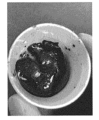
- 1 is a photograph showing the appearance of a gum-like polymer obtained by reacting a base reactant of a linseed oil polymer prepared in Example 1 with an acid to liberate a carboxyl group from the carboxylate.
- 1 is a 600-times enlarged photograph of the aqueous suspension of the linseed oil-derived fatty acid polymer prepared in Example 1.
- 1 is a graph showing the results of measuring the amount of formaldehyde generated when the aqueous resin prepared in the examples is cured.
- the aqueous resin of the present invention includes a polymer of an unsaturated fatty acid.
- the polymer of an unsaturated fatty acid has an internal structure in which unsaturated groups are bonded to each other and crosslinked three-dimensionally, and is known to be insoluble.
- a particulate insoluble polymer i.e., an insoluble resin mass
- the unsaturated fatty acid polymer When this is brought into contact with a base and water, the unsaturated fatty acid polymer is dissolved in water due to the addition of the base, which results in an appropriate molecular weight, carboxyl groups derived from the unsaturated fatty acid, and a portion of the carboxyl groups being converted into salts. That is, the unsaturated fatty acid polymer is saponified with a strong base and made water-soluble.
- this aqueous solution is a liquid soap
- the dried product does not exhibit water resistance and cannot be used as a resin to form coatings and molded products.
- an acid was added to this solution to convert the salt derived from the carboxyl group into a carboxylic acid and return it to a resin
- a viscous gum-like substance was produced without returning to the insoluble resin mass before saponification, and that a liquid resin composition could be obtained by dispersing or dissolving this in a hydrophilic solvent.
- the resulting liquid resin composition is dried and the water inside evaporates, it hardens and becomes a solid with the same strength as the insoluble resin before saponification.
- aqueous resin refers to a resin that can be dispersed or dissolved in a hydrophilic solvent to form a liquid resin composition.
- Hydrophilic solvents include water; water-soluble organic solvents such as ethanol, isopropanol, and acetone; aqueous solutions of water-soluble organic solvents; aqueous solutions of water-soluble bases such as ammonia, etc.
- cured resins made of polymeric compounds have poor solubility, they are difficult to separate into individual molecules, and it is difficult to determine their internal structure using existing analytical methods.
- the aqueous resin of the present invention has an internal structure in which the polymers are three-dimensionally crosslinked, and it is impossible to separate them into independent polymers without destroying the molecules.
- the aqueous resin of the present invention is produced using a composition containing unsaturated fatty acids or derivatives of unsaturated fatty acids as a raw material.
- Unsaturated fatty acid derivatives include, for example, esters of unsaturated fatty acids and polyhydric alcohols, oils and fats of unsaturated fatty acids, and drying oils.
- Unsaturated fatty acids and unsaturated fatty acid derivatives have double bonds and can be hardened, for example, by polymerization in the presence of oxygen in the air.
- the unsaturated fatty acid for example, a fatty acid having 16 or more carbon atoms, two or more double bonds, and a carboxyl group is used. By having two or more double bonds, the unsaturated fatty acid can form a crosslinked structure during the polymerization reaction, improving the chemical resistance, heat resistance, and strength of the resulting molded body.
- the number of double bonds in the unsaturated fatty acid is preferably 2 to 6, more preferably 2 to 4, and even more preferably 2 or 3.
- the number of carbon atoms in the unsaturated fatty acid is preferably 16 to 22, more preferably 16 to 20, and even more preferably 18.
- unsaturated fatty acids include oleic acid, linoleic acid, linolenic acid, arachidonic acid, eicosapentaenoic acid, and docosahexaenoic acid.
- preferred unsaturated fatty acids are linoleic acid, linolenic acid, and arachidonic acid.
- the unsaturated fatty acids are preferably derived from plants, and more preferably linoleic acid, ⁇ -linolenic acid, and ⁇ -linolenic acid.
- a single type of unsaturated fatty acid may be used, or multiple types may be mixed and used.
- unsaturated fatty acids also applies to the unsaturated fatty acids that make up the unsaturated fatty acid derivatives.
- Specific examples of unsaturated fatty acid derivatives include linseed oil, tung oil, perilla oil, sesame oil, poppy oil, walnut oil, safflower oil, fish oil, dehydrated castor oil, rice oil, corn oil, grape seed oil, soybean oil, sunflower oil, peanut oil, rapeseed oil, cottonseed oil, tall oil, almond oil, jojoba oil, kukui nut oil, macadamia nut oil, and persic oil.
- the polymerization of unsaturated fatty acids or their derivatives is carried out by subjecting unsaturated groups to an oxidative polymerization reaction in the presence of oxygen.
- the oxidative polymerization reaction can be carried out, for example, by stirring the unsaturated fatty acid in air or by blowing air into the unsaturated fatty acid to bring it into contact with the oxygen in the air.
- the polymerization reaction can be carried out at room temperature.
- heating or a catalyst may be used to accelerate the oxidative polymerization reaction.
- the oxidative polymerization reaction is preferably carried out until the polymer irreversibly gels and turns into powder, and loses its thermoplasticity. This improves the strength or water resistance of the coating film and molded products formed from the water-based resin.
- the reaction temperature is, for example, 100 to 500°C, preferably 200 to 450°C, and more preferably 300 to 400°C. If the heating temperature is less than 100°C, the oxidative polymerization reaction may not be sufficiently promoted, and if it exceeds 500°C, the amount of volatilization of the composition may increase, resulting in a decrease in the yield of the water-based resin.
- Any conventionally known oxidation catalyst may be used as a catalyst for the oxidation polymerization reaction.
- catalysts that can be used include metal powders of Co, Mn, Pb, Ca, Zn, Cu, Zr, Ce, Fe, Pd, Pt, Sn, Mo, W, Ti, V, Rh, Ni, Zr, Al, Ag, B, and Cr, which are used as drying oil driers, or oxides, hydroxides, sulfates, nitrates, chlorides, acetates, and naphthenates of these metals, or organic oxidizing agents such as anthracene, methyl ethyl ketone peroxide, and benzoyl peroxide.
- reaction time for the oxidation polymerization reaction varies depending on reaction conditions such as reaction temperature and type of catalyst, but is preferably adjusted appropriately between 3 and 48 hours, and more preferably between 6 and 10 hours.
- the obtained polymer is then reacted with a base.
- bases that can be used in the reaction include NaOH, KOH, Li(OH), Ba(OH) 2 , Ca(OH) 2 , NaHCO 3 , and Na 2 CO 3.
- a strong base is used.
- preferred bases include NaOH and KOH.
- the polymer electrolyte is a polymer electrolyte having a partial polymer of a fatty acid having 16 or more carbon atoms, two or more double bonds, and a carboxyl group, some of which have been neutralized with a basic substance and converted to a carboxylate anion group.
- fatty acid examples include oleic acid, linoleic acid, linolenic acid, arachidonic acid, eicosapentaenoic acid, docosahexaenoic acid, etc.
- Preferred specific examples of the basic substance include NaOH, KOH, Ca(OH) 2 , K(OH), Li(OH), Mg(OH) 2 , Ba(OH) 2 , Zn(OH) 2 , ammonia, monoethanolamine, diethanolamine, triethanolamine, etc.
- the polymer can be reacted with a base, for example, by mixing with an aqueous base solution.
- concentration of the base in the aqueous solution is adjusted to 0.1 to 18 N, preferably 1 to 10 N, and more preferably 3 to 6 N, from the viewpoint of improving the hydrophilicity of the aqueous resin.
- the reaction solution may be heated under pressure as necessary. The heating temperature of the reaction solution is adjusted to, for example, 50 to 200°C, preferably 80 to 180°C, and more preferably 100 to 150°C under pressure.
- the reaction time for the reaction varies depending on reaction conditions such as the concentration of the base and the reaction temperature, but is preferably adjusted appropriately between 1 minute and 3 hours, preferably between 5 and 90 minutes, and more preferably between 10 and 60 minutes.
- the base reactant of the polymer becomes a viscous liquid.
- the base reactant of the polymer is then reacted with an acid. This liberates a carboxyl group from the carboxylate of the base reactant.
- acids that can be used in the reaction include sulfuric acid, hydrochloric acid, nitric acid, acetic acid, and formic acid. In a preferred embodiment, a strong acid is used. Specific examples of preferred acids include sulfuric acid and hydrochloric acid.
- the base reactant of the polymer can be reacted with an acid, for example, by mixing with an acid aqueous solution.
- concentration of the acid in the aqueous solution is adjusted to 0.1 to 18 N, preferably 1 to 10 N, and more preferably 3 to 6 N, in order to efficiently generate carboxylic acid in the water-based resin while preventing bumping due to excessive heat generation.
- the reaction solution may be heated under pressure to promote the reaction.
- the heating temperature of the reaction solution is adjusted to, for example, 50 to 200°C, preferably 80 to 180°C, and more preferably 100 to 150°C under pressure.
- the reaction time for the reaction varies depending on the reaction conditions such as the acid concentration and the reaction temperature, but is preferably adjusted appropriately between 20 minutes and 10 hours, preferably 30 minutes and 5 hours, and more preferably 40 minutes and 2 hours.
- the reaction is completed, the resulting acid reaction product becomes gum-like.
- by-products such as salts and glycerol can be washed away to obtain a water-based resin.
- the water-based resin of the present invention includes a water-based resin that is dispersed or dissolved in a solvent containing water.
- the aqueous resin of the present invention can be mixed and suspended in a suitable solvent to form a liquid resin composition including a solution, emulsion or suspension thereof.
- suitable solvents include water-soluble organic solvents such as alcohols having 1 to 4 carbon atoms and acetone, aqueous solutions of water-soluble organic solvents, aqueous solutions of water-soluble bases such as ammonia, water such as distilled water, and mixtures thereof.
- Specific examples of the mixtures include an aqueous ethanol solution, an aqueous ammonia solution, and an aqueous ethanol-ammonia solution.
- the water-based resin of the present invention may be in demand as a paint or adhesive for wood boards.
- the liquid resin composition of the present invention By applying the liquid resin composition of the present invention to a substrate and drying it, or by bonding components together via the liquid resin composition, it is possible to significantly speed up the drying of coatings and bonded products whose main components are drying oils or unsaturated fatty acids.
- an oil-modified alkyd resin by using the aqueous resin of the present invention instead of a modified oil such as a drying oil, it is possible to provide an ultra-fast-drying, low-formaldehyde modified alkyd resin. Furthermore, thick products made from the above-mentioned polymer electrolytes and unsaturated fatty acids such as linoleum have previously required a long time to harden, but it is now possible to complete hardening at the same time as molding, making them significantly easier to handle.
- the positive list of the Food Sanitation Act includes cases where vegetable oils and unsaturated fatty acids are used as monomer raw materials, and by applying the water-based resin of the present invention to coating and bonding tableware, products that comply with the Food Sanitation Act can be manufactured with just a few basic tests.
- Example 1 Preparation of fatty acid polymer derived from linseed oil 500mL of linseed oil was poured into a 2L beaker on a heater, and polymerized at 350°C for about 6 hours while stirring and mixing well with air. The liquid linseed oil became gel-like. When this was further kneaded well at 350°C, it collapsed into powder, so polymerization was continued for about 2 hours at the same temperature while mixing air. Heating was stopped when the yellow powder turned black, and it was cooled to room temperature.
- the resulting gum-like polymer was washed with plenty of running water while mixing to remove salt, glycerol, and other by-products, yielding a linseed oil-derived fatty acid polymer.
- the resulting linseed oil-derived fatty acid polymer was stored in a sealed container to prevent water from evaporating.
- Figure 2 is a 600x magnified photograph of the water suspension of the linseed oil-derived fatty acid polymer. Since countless particles can be seen in the photograph in Figure 2, it is believed that the aqueous resin has become an emulsion or suspension.
- Example 2 Preparation of glyceride polymer derived from linseed oil
- polymerization of linseed oil, addition of NaOH aqueous solution and H2SO4 aqueous solution were carried out to produce a gummy polymer containing about 50% (w/w) of moisture inside. Heating was then continued until the lower aqueous layer disappeared. A rubber-like polymer with gloss and elasticity was obtained.
- the glycerol that had been hydrolyzed and transferred to the aqueous layer was consumed in the esterification reaction. At that time, a certain amount of carboxyl groups can be left by carrying out the reaction in the presence of moisture.
- the resulting rubber-like polymer was washed with plenty of running water while mixing to remove salt, glycerol, and other by-products, yielding a linseed oil-derived glyceride polymer.
- the resulting linseed oil-derived glyceride polymer was stored in a sealed container to prevent water from evaporating.
- Example 3 Preparation of linoleic acid-derived polymer 500mL of linoleic acid was poured into a 2L beaker on a heater, and polymerized at 350°C for about 8 hours while stirring and mixing well with air. The liquid linoleic acid became gel-like. If this was further kneaded well at 350°C, it would disintegrate into powder, so polymerization was continued for about 2 hours at the same temperature while mixing in air. When the powder became hard and black, heating was stopped and it was cooled to room temperature.
- the resulting gum-like polymer was washed with plenty of running water while mixing to remove salt and other by-products.
- the resulting linoleic acid-derived polymer was stored in a sealed container to prevent water from evaporating.
- Example 4 Preparation of linseed oil-modified alkyd resin 9 g of glycerol, 4 g of phthalic anhydride, and 20 g (dry weight 10 g) of linseed oil-derived fatty acid polymer were added to a mortar and kneaded. At this time, a control sample was also prepared by adding 10 g of linseed oil as a monomer instead of the linseed oil-derived fatty acid polymer.
- Example 5 Solubility test The linseed oil polymer and the linseed oil-derived glyceride polymer of Example 2, and the linoleic acid polymer and the linoleic acid-derived polymer of Example 3 were added to distilled water, 28 w/w% aqueous ammonia, ethanol, isopropanol, acetone, and an aqueous solution of 80 w/w% ethanol and 0.5 w/w% ammonia in an amount 10 times the dry weight, and shaken at 25° C. for 24 hours.
- Linseed oil polymers and linoleic acid polymers were almost insoluble in the solvent.
- linseed oil-derived glyceride polymers and linoleic acid-derived polymers showed high solubility in 28% aqueous ammonia, and also showed solubility in organic solvents and ethanol-ammonia aqueous solutions.
- the carboxyl groups derived from the fatty acids in the polymer are converted to ammonium salts to produce a polymer electrolyte, improving the hydrophilicity of the polymer. This allows the polymer to blend well with the surface of the slide glass, resulting in a coating with less unevenness compared to when ammonia is not added.
- Example 6 Surface Drying Property Test The aqueous resins prepared in Examples 1 to 4 and the following control samples were prepared as test subjects.
- the degree of drying of the coating was evaluated by touch at regular intervals at a room temperature of 25°C, with reference to JIS K 5600-1-1. The evaluation criteria are shown below. In the early stages of drying, the coating was dry to the touch (A), which then changed to a semi-dry state (B), and the test was terminated when the coating reached a hardened dry state (C). The evaluation results are shown in Table 2.
- Linoleic acid-derived polymers dry relatively quickly, probably because of their relatively high degree of polymerization. Linoleic acid does not form ester bonds like linseed oil, so a high degree of oxidation polymerization is required before it can be granulated. Therefore, it is thought that at the time of granulation, it has a uniform and high degree of oxidation polymerization compared to linseed oil.
- Example 7 Hardness Test As test subjects, the aqueous resins prepared in Examples 1 to 4 and the following control samples were prepared.
- Example 5 500uL of each saturated solution of the 25°C supernatant of the solubility test sample obtained in Example 5 was dropped onto a glass slide (75 x 25mm) and spread over the entire surface with the tip of a tip to form a coating film approximately 50 ⁇ m thick.
- the coating film formed on the glass slide was hardened by heating at a specified temperature for a specified time. All control reagents formed coating films approximately 100 ⁇ m thick.
- the hardness of the cured coating (on a glass slide) was evaluated with reference to the old JIS K5400.
- the modified alkyd resin made from linseed oil-derived fatty acid polymers, only dissolved slightly in solvents, so 500 mg of a gummy block of polymer softened in 95% ethanol was applied evenly to the glass slide with a roller.
- the linseed oil-derived glyceride polymer dissolved less in 0.5% ammonia water alone than the other samples, so testing under these conditions was omitted.
- a coating was prepared by polymerizing linseed oil and linoleic acid on a heater at 250°C; however, it deformed significantly on the slide glass during heating, and it was not possible to prepare a uniform coating. For this reason, a location with relatively little unevenness was selected for testing.
- the gum-like polymers when each of the gum-like polymers was dissolved in a solvent, they all dried to a certain strength at room temperature (25°C) 30 minutes after application, and by heating at 250°C from this point, a glossy coating was obtained with almost no deformation.
- the tip of the pencil to be tested (3B to 6H) was placed at a right angle against #400 abrasive paper and polished so that the tip was flat and had sharp corners.
- the sharpened core was placed at a 45° angle to the test surface and, while pressed against the painted surface, pushed forward for approximately 1 cm at a speed of 1 cm/s to scratch the painted surface.
- Example 8 Water Resistance Test The cured coating film prepared in Example 7 was prepared as a test subject.
- the reglyceride polymers and alkyd resins showed no visible effects, including on their appearance, and were shown to be water resistant.
- the linseed oil-derived fatty acid polymers and linoleic acid-derived fatty acid polymers showed temporary detachment from the slide glass immediately after immersion in either solvent.
- the coating film formed on the slide glass retains roughly its original strength, and this property may be utilized in practical applications such as transferring peeled coatings.
- the peeling and loss of hardness may be caused by some of the carboxyl groups that came into contact with the alkali remaining in an electrolyte state.
- Reglyceridized resins in particular form a coating with high strength and water resistance similar to existing oil-modified alkyd resins in a short time when heated, making them suitable for baked-on paints and reactive hot melt adhesives.
- Example 9 Formaldehyde emission test 15 g (dry weight 8 g) of the linseed oil-modified alkyd resin prepared in Example 4 was placed in the center of a paper towel (380 x 330 mm, manufactured by Nippon Paper Crecia Co., Ltd., "Kimtowel” (product name)) and spread over the entire paper towel with a roller. As a control, 8 g of oil-modified alkyd resin made from monomeric linseed oil was applied over the entire paper towel with a brush.
- a 15 mL ethanol solution containing 0.5 g of each of the linseed oil-derived glyceride polymer prepared in Example 2 and the linoleic acid-derived polymer prepared in Example 3 was also applied to the entire paper towel.
- 0.5 g of linseed oil and linoleic acid were each suspended in 15 mL of ethanol and applied to the entire paper towel. Note that because formaldehyde reacts with ammonia, tests using ammonia water as a solvent were omitted.
- the coated paper towel was placed in a polypropylene bag ("AUTO CLEAVE BAGS" (product name) manufactured by Interim Japan) measuring 0.05 x 360 x 660 mm and sealed.
- AUTO CLEAVE BAGS product name
- a vinyl tape was applied to one spot on the outside of the bag, a 3 mm cut was made in that spot with scissors, and a 3 mm diameter silicone tube was pushed in about 3 cm, with the other end being connected to a pump (Millipore's "Masterflex Easy Load Peristaltic Pump” (product name)).
Landscapes
- Chemical & Material Sciences (AREA)
- Organic Chemistry (AREA)
- Materials Engineering (AREA)
- Chemical Kinetics & Catalysis (AREA)
- Wood Science & Technology (AREA)
- Life Sciences & Earth Sciences (AREA)
- Engineering & Computer Science (AREA)
- Oil, Petroleum & Natural Gas (AREA)
- General Chemical & Material Sciences (AREA)
- Health & Medical Sciences (AREA)
- Medicinal Chemistry (AREA)
- Polymers & Plastics (AREA)
- Paints Or Removers (AREA)
Abstract
Le problème abordé par la présente invention consiste à fournir une résine aqueuse comprenant une huile végétale en tant que matière première, la résine aqueuse pouvant être dispersée ou dissoute dans un solvant hydrophile pour former une composition de résine liquide, pouvant être durcie en un court laps de temps à partir de l'état de la composition de résine liquide et pouvant former un film de revêtement et un produit moulé présentant une résistance suffisante, et un procédé de production de la résine aqueuse. Ce problème est résolu au moyen d'une résine aqueuse qui contient un polymère d'un acide gras insaturé présentant un groupe carboxyle et un sel basique d'un groupe carboxyle et qui peut être dispersée ou dissoute dans un solvant hydrophile pour former une composition de résine liquide.
Applications Claiming Priority (2)
| Application Number | Priority Date | Filing Date | Title |
|---|---|---|---|
| JP2023148449 | 2023-09-13 | ||
| JP2023-148449 | 2023-09-13 |
Publications (1)
| Publication Number | Publication Date |
|---|---|
| WO2025057976A1 true WO2025057976A1 (fr) | 2025-03-20 |
Family
ID=95021348
Family Applications (1)
| Application Number | Title | Priority Date | Filing Date |
|---|---|---|---|
| PCT/JP2024/032535 Pending WO2025057976A1 (fr) | 2023-09-13 | 2024-09-11 | Résine aqueuse et procédé pour sa production |
Country Status (1)
| Country | Link |
|---|---|
| WO (1) | WO2025057976A1 (fr) |
Cited By (2)
| Publication number | Priority date | Publication date | Assignee | Title |
|---|---|---|---|---|
| JP2024047310A (ja) * | 2022-09-26 | 2024-04-05 | 兵庫県 | 炭素繊維強化剤、強化炭素繊維及び炭素繊維強化複合材料 |
| WO2026048349A1 (fr) * | 2024-08-27 | 2026-03-05 | 兵庫県 | Résine, procédé de production de résine et composition de résine durcissable |
Citations (5)
| Publication number | Priority date | Publication date | Assignee | Title |
|---|---|---|---|---|
| JPH0253724A (ja) * | 1988-08-19 | 1990-02-22 | Nippon Oil & Fats Co Ltd | 成人病治療用輸液 |
| JP2006052291A (ja) * | 2004-08-11 | 2006-02-23 | Kansai Paint Co Ltd | 水性樹脂分散体の製造方法 |
| US20110065856A1 (en) * | 2008-05-13 | 2011-03-17 | Anchor Michael J | Reactive surfactants for waterborne resins |
| JP2019528335A (ja) * | 2016-07-27 | 2019-10-10 | ダウ グローバル テクノロジーズ エルエルシー | 架橋性界面活性剤 |
| WO2023027057A1 (fr) * | 2021-08-24 | 2023-03-02 | 兵庫県 | Polyélectrolyte, bioplastique et corps moulé |
-
2024
- 2024-09-11 WO PCT/JP2024/032535 patent/WO2025057976A1/fr active Pending
Patent Citations (5)
| Publication number | Priority date | Publication date | Assignee | Title |
|---|---|---|---|---|
| JPH0253724A (ja) * | 1988-08-19 | 1990-02-22 | Nippon Oil & Fats Co Ltd | 成人病治療用輸液 |
| JP2006052291A (ja) * | 2004-08-11 | 2006-02-23 | Kansai Paint Co Ltd | 水性樹脂分散体の製造方法 |
| US20110065856A1 (en) * | 2008-05-13 | 2011-03-17 | Anchor Michael J | Reactive surfactants for waterborne resins |
| JP2019528335A (ja) * | 2016-07-27 | 2019-10-10 | ダウ グローバル テクノロジーズ エルエルシー | 架橋性界面活性剤 |
| WO2023027057A1 (fr) * | 2021-08-24 | 2023-03-02 | 兵庫県 | Polyélectrolyte, bioplastique et corps moulé |
Cited By (2)
| Publication number | Priority date | Publication date | Assignee | Title |
|---|---|---|---|---|
| JP2024047310A (ja) * | 2022-09-26 | 2024-04-05 | 兵庫県 | 炭素繊維強化剤、強化炭素繊維及び炭素繊維強化複合材料 |
| WO2026048349A1 (fr) * | 2024-08-27 | 2026-03-05 | 兵庫県 | Résine, procédé de production de résine et composition de résine durcissable |
Similar Documents
| Publication | Publication Date | Title |
|---|---|---|
| WO2025057976A1 (fr) | Résine aqueuse et procédé pour sa production | |
| CN1771319A (zh) | 用于包装液体产品和具有改进存放期的聚乙烯醇共聚物膜 | |
| US20080169059A1 (en) | Biomimetic modular adhesive complex: materials, methods and applications therefore | |
| JP5578891B2 (ja) | ポリエステル樹脂水性分散体、およびその製造方法、ならびにそれから得られる樹脂被膜 | |
| JPH09512566A (ja) | 水で希釈できる自然乾燥塗料結合剤の製造方法およびその使用 | |
| WO2001044380A3 (fr) | Nouvelles compositions de latex a faible teneur en composes organiques volatils (voc) et a plastification interne et applications de ces compositions | |
| GB1599045A (en) | Coating compositions | |
| JP6120589B2 (ja) | 水性分散体およびこれを用いてなる水性コーティング剤組成物、ならびに被膜 | |
| US4408028A (en) | Oxidation-curable emulsion composition containing a cellulose derivative | |
| CN116239950A (zh) | 一种运用微球降低光固化涂料收缩应力的方法及应用 | |
| EP1934269A1 (fr) | Procede pour preparer un copolymere greffe par des acides gras polyinsatures, copolymere greffe par des acides gras polyinsatures susceptible d'etre obtenu par ce procede et ses utilisations | |
| JP6652407B2 (ja) | 防汚性膜形成用液組成物及びこの液組成物を用いて防汚性膜を形成する方法 | |
| CN115210278A (zh) | 基于混合醇酸-丙烯酸的压敏粘合剂及其制造和使用方法 | |
| US2447367A (en) | Reaction product of rosin-polyhydric alcohol esters and process of making same | |
| JP2017165949A (ja) | 水溶性両性高分子、ならびに該高分子を含有する溶剤吸収剤、吸油材料および被印刷材料 | |
| CN111171244A (zh) | 一种聚丙烯酸酯改性醇酸树脂复合乳液的制备方法 | |
| Sharma et al. | Synthesis and characterization of styrene-co-divinylbenzene-graft-linseed oil by free radical polymerization | |
| CN104530316B (zh) | 一种聚二甲基丙烯酸乙二醇酯微球的制备方法 | |
| JP2012530501A (ja) | ポリビニルアルコールをベースとする低付着性チューインガム配合組成用のポリマー組成物 | |
| JP2777732B2 (ja) | アセトアセチル基含有水溶性高分子化合物と水性媒体とからなる水性組成物の製造方法 | |
| FR2892123A1 (fr) | Procede pour preparer un copolymere greffe, copolymere greffe susceptible d'etre obtenu par ce procede et ses utilisations | |
| JPS6258374B2 (fr) | ||
| JPS6239623B2 (fr) | ||
| US2357839A (en) | Plastic composition | |
| JPH0853512A (ja) | ミクロゲルの製造方法 |
Legal Events
| Date | Code | Title | Description |
|---|---|---|---|
| 121 | Ep: the epo has been informed by wipo that ep was designated in this application |
Ref document number: 24865476 Country of ref document: EP Kind code of ref document: A1 |
|
| ENP | Entry into the national phase |
Ref document number: 2025545709 Country of ref document: JP Kind code of ref document: A |
|
| WWE | Wipo information: entry into national phase |
Ref document number: 2025545709 Country of ref document: JP |