BRPI0621873B1 - condensed pyridine compounds or pharmaceutically acceptable salts thereof, drugs, jak3 inhibitor and product comprising said compounds - Google Patents
condensed pyridine compounds or pharmaceutically acceptable salts thereof, drugs, jak3 inhibitor and product comprising said compounds Download PDFInfo
- Publication number
- BRPI0621873B1 BRPI0621873B1 BRPI0621873-3A BRPI0621873A BRPI0621873B1 BR PI0621873 B1 BRPI0621873 B1 BR PI0621873B1 BR PI0621873 A BRPI0621873 A BR PI0621873A BR PI0621873 B1 BRPI0621873 B1 BR PI0621873B1
- Authority
- BR
- Brazil
- Prior art keywords
- acid
- pyridine
- compound
- added
- fact
- Prior art date
Links
- 150000001875 compounds Chemical class 0.000 title claims abstract description 142
- 150000003839 salts Chemical class 0.000 title claims abstract description 42
- 239000003814 drug Substances 0.000 title claims description 6
- 229940123241 Janus kinase 3 inhibitor Drugs 0.000 title description 5
- 229940079593 drug Drugs 0.000 title description 4
- 150000003222 pyridines Chemical class 0.000 title 1
- 201000010099 disease Diseases 0.000 claims abstract description 18
- 208000037265 diseases, disorders, signs and symptoms Diseases 0.000 claims abstract description 18
- 208000006673 asthma Diseases 0.000 claims abstract description 13
- 208000023275 Autoimmune disease Diseases 0.000 claims abstract description 12
- 239000004480 active ingredient Substances 0.000 claims abstract description 9
- 210000000056 organ Anatomy 0.000 claims abstract description 8
- 238000002054 transplantation Methods 0.000 claims abstract description 7
- 208000024827 Alzheimer disease Diseases 0.000 claims abstract description 5
- 206010028980 Neoplasm Diseases 0.000 claims abstract description 5
- 208000032839 leukemia Diseases 0.000 claims abstract description 5
- 201000004681 Psoriasis Diseases 0.000 claims abstract description 4
- 206010039073 rheumatoid arthritis Diseases 0.000 claims abstract description 4
- 201000006417 multiple sclerosis Diseases 0.000 claims abstract description 3
- VEXZGXHMUGYJMC-UHFFFAOYSA-N Hydrochloric acid Chemical compound Cl VEXZGXHMUGYJMC-UHFFFAOYSA-N 0.000 claims description 35
- 239000002253 acid Substances 0.000 claims description 21
- QTBSBXVTEAMEQO-UHFFFAOYSA-N Acetic acid Chemical compound CC(O)=O QTBSBXVTEAMEQO-UHFFFAOYSA-N 0.000 claims description 18
- QAOWNCQODCNURD-UHFFFAOYSA-N Sulfuric acid Chemical compound OS(O)(=O)=O QAOWNCQODCNURD-UHFFFAOYSA-N 0.000 claims description 8
- 239000008194 pharmaceutical composition Substances 0.000 claims description 8
- OFOBLEOULBTSOW-UHFFFAOYSA-N Malonic acid Chemical compound OC(=O)CC(O)=O OFOBLEOULBTSOW-UHFFFAOYSA-N 0.000 claims description 6
- MUBZPKHOEPUJKR-UHFFFAOYSA-N Oxalic acid Chemical compound OC(=O)C(O)=O MUBZPKHOEPUJKR-UHFFFAOYSA-N 0.000 claims description 6
- 235000011054 acetic acid Nutrition 0.000 claims description 6
- KRKNYBCHXYNGOX-UHFFFAOYSA-N citric acid Chemical compound OC(=O)CC(O)(C(O)=O)CC(O)=O KRKNYBCHXYNGOX-UHFFFAOYSA-N 0.000 claims description 6
- BDAGIHXWWSANSR-UHFFFAOYSA-N methanoic acid Natural products OC=O BDAGIHXWWSANSR-UHFFFAOYSA-N 0.000 claims description 6
- BMYNFMYTOJXKLE-UHFFFAOYSA-N 3-azaniumyl-2-hydroxypropanoate Chemical compound NCC(O)C(O)=O BMYNFMYTOJXKLE-UHFFFAOYSA-N 0.000 claims description 4
- OSWFIVFLDKOXQC-UHFFFAOYSA-N 4-(3-methoxyphenyl)aniline Chemical compound COC1=CC=CC(C=2C=CC(N)=CC=2)=C1 OSWFIVFLDKOXQC-UHFFFAOYSA-N 0.000 claims description 4
- VZCYOOQTPOCHFL-OWOJBTEDSA-N Fumaric acid Chemical compound OC(=O)\C=C\C(O)=O VZCYOOQTPOCHFL-OWOJBTEDSA-N 0.000 claims description 4
- AFVFQIVMOAPDHO-UHFFFAOYSA-N Methanesulfonic acid Chemical compound CS(O)(=O)=O AFVFQIVMOAPDHO-UHFFFAOYSA-N 0.000 claims description 4
- NBIIXXVUZAFLBC-UHFFFAOYSA-N Phosphoric acid Chemical compound OP(O)(O)=O NBIIXXVUZAFLBC-UHFFFAOYSA-N 0.000 claims description 4
- KDYFGRWQOYBRFD-UHFFFAOYSA-N Succinic acid Natural products OC(=O)CCC(O)=O KDYFGRWQOYBRFD-UHFFFAOYSA-N 0.000 claims description 4
- XBDQKXXYIPTUBI-UHFFFAOYSA-N dimethylselenoniopropionate Natural products CCC(O)=O XBDQKXXYIPTUBI-UHFFFAOYSA-N 0.000 claims description 4
- JVTAAEKCZFNVCJ-UHFFFAOYSA-N lactic acid Chemical compound CC(O)C(O)=O JVTAAEKCZFNVCJ-UHFFFAOYSA-N 0.000 claims description 4
- 239000000546 pharmaceutical excipient Substances 0.000 claims description 4
- VZCYOOQTPOCHFL-UHFFFAOYSA-N trans-butenedioic acid Natural products OC(=O)C=CC(O)=O VZCYOOQTPOCHFL-UHFFFAOYSA-N 0.000 claims description 4
- FEWJPZIEWOKRBE-JCYAYHJZSA-N Dextrotartaric acid Chemical compound OC(=O)[C@H](O)[C@@H](O)C(O)=O FEWJPZIEWOKRBE-JCYAYHJZSA-N 0.000 claims description 3
- 108010019421 Janus Kinase 3 Proteins 0.000 claims description 3
- 102000006500 Janus Kinase 3 Human genes 0.000 claims description 3
- GRYLNZFGIOXLOG-UHFFFAOYSA-N Nitric acid Chemical compound O[N+]([O-])=O GRYLNZFGIOXLOG-UHFFFAOYSA-N 0.000 claims description 3
- FEWJPZIEWOKRBE-UHFFFAOYSA-N Tartaric acid Natural products [H+].[H+].[O-]C(=O)C(O)C(O)C([O-])=O FEWJPZIEWOKRBE-UHFFFAOYSA-N 0.000 claims description 3
- 235000019253 formic acid Nutrition 0.000 claims description 3
- 229910017604 nitric acid Inorganic materials 0.000 claims description 3
- 239000011975 tartaric acid Substances 0.000 claims description 3
- 235000002906 tartaric acid Nutrition 0.000 claims description 3
- BJEPYKJPYRNKOW-REOHCLBHSA-N (S)-malic acid Chemical compound OC(=O)[C@@H](O)CC(O)=O BJEPYKJPYRNKOW-REOHCLBHSA-N 0.000 claims description 2
- CKLJMWTZIZZHCS-REOHCLBHSA-N L-aspartic acid Chemical compound OC(=O)[C@@H](N)CC(O)=O CKLJMWTZIZZHCS-REOHCLBHSA-N 0.000 claims description 2
- 241001465754 Metazoa Species 0.000 claims description 2
- 206010035226 Plasma cell myeloma Diseases 0.000 claims description 2
- BJEPYKJPYRNKOW-UHFFFAOYSA-N alpha-hydroxysuccinic acid Natural products OC(=O)C(O)CC(O)=O BJEPYKJPYRNKOW-UHFFFAOYSA-N 0.000 claims description 2
- 229910000147 aluminium phosphate Inorganic materials 0.000 claims description 2
- 235000003704 aspartic acid Nutrition 0.000 claims description 2
- OQFSQFPPLPISGP-UHFFFAOYSA-N beta-carboxyaspartic acid Natural products OC(=O)C(N)C(C(O)=O)C(O)=O OQFSQFPPLPISGP-UHFFFAOYSA-N 0.000 claims description 2
- KDYFGRWQOYBRFD-NUQCWPJISA-N butanedioic acid Chemical compound O[14C](=O)CC[14C](O)=O KDYFGRWQOYBRFD-NUQCWPJISA-N 0.000 claims description 2
- 235000015165 citric acid Nutrition 0.000 claims description 2
- CCIVGXIOQKPBKL-UHFFFAOYSA-M ethanesulfonate Chemical compound CCS([O-])(=O)=O CCIVGXIOQKPBKL-UHFFFAOYSA-M 0.000 claims description 2
- 239000001530 fumaric acid Substances 0.000 claims description 2
- XMBWDFGMSWQBCA-UHFFFAOYSA-N hydrogen iodide Chemical compound I XMBWDFGMSWQBCA-UHFFFAOYSA-N 0.000 claims description 2
- 229940071870 hydroiodic acid Drugs 0.000 claims description 2
- 239000004310 lactic acid Substances 0.000 claims description 2
- 235000014655 lactic acid Nutrition 0.000 claims description 2
- VZCYOOQTPOCHFL-UPHRSURJSA-N maleic acid Chemical compound OC(=O)\C=C/C(O)=O VZCYOOQTPOCHFL-UPHRSURJSA-N 0.000 claims description 2
- 239000011976 maleic acid Substances 0.000 claims description 2
- 239000001630 malic acid Substances 0.000 claims description 2
- 235000011090 malic acid Nutrition 0.000 claims description 2
- 229940098779 methanesulfonic acid Drugs 0.000 claims description 2
- 201000000050 myeloid neoplasm Diseases 0.000 claims description 2
- 235000006408 oxalic acid Nutrition 0.000 claims description 2
- 235000011007 phosphoric acid Nutrition 0.000 claims description 2
- 235000019260 propionic acid Nutrition 0.000 claims description 2
- IUVKMZGDUIUOCP-BTNSXGMBSA-N quinbolone Chemical compound O([C@H]1CC[C@H]2[C@H]3[C@@H]([C@]4(C=CC(=O)C=C4CC3)C)CC[C@@]21C)C1=CCCC1 IUVKMZGDUIUOCP-BTNSXGMBSA-N 0.000 claims description 2
- 238000011282 treatment Methods 0.000 claims description 2
- 229940126601 medicinal product Drugs 0.000 claims 2
- 206010003645 Atopy Diseases 0.000 claims 1
- WHUUTDBJXJRKMK-UHFFFAOYSA-N Glutamic acid Natural products OC(=O)C(N)CCC(O)=O WHUUTDBJXJRKMK-UHFFFAOYSA-N 0.000 claims 1
- WHUUTDBJXJRKMK-VKHMYHEASA-N L-glutamic acid Chemical compound OC(=O)[C@@H](N)CCC(O)=O WHUUTDBJXJRKMK-VKHMYHEASA-N 0.000 claims 1
- 230000006806 disease prevention Effects 0.000 claims 1
- 239000003937 drug carrier Substances 0.000 claims 1
- 235000013922 glutamic acid Nutrition 0.000 claims 1
- 239000004220 glutamic acid Substances 0.000 claims 1
- 239000003112 inhibitor Substances 0.000 claims 1
- 239000001384 succinic acid Substances 0.000 claims 1
- -1 PYRIDINE COMPOUND Chemical class 0.000 abstract description 93
- JUJWROOIHBZHMG-UHFFFAOYSA-N pyridine Substances C1=CC=NC=C1 JUJWROOIHBZHMG-UHFFFAOYSA-N 0.000 abstract description 34
- 101000934996 Homo sapiens Tyrosine-protein kinase JAK3 Proteins 0.000 abstract description 25
- 102100025387 Tyrosine-protein kinase JAK3 Human genes 0.000 abstract description 23
- 239000003795 chemical substances by application Substances 0.000 abstract description 19
- UMJSCPRVCHMLSP-UHFFFAOYSA-N pyridine Natural products COC1=CC=CN=C1 UMJSCPRVCHMLSP-UHFFFAOYSA-N 0.000 abstract description 19
- 230000002401 inhibitory effect Effects 0.000 abstract description 12
- 108090000695 Cytokines Proteins 0.000 abstract description 7
- 102000004127 Cytokines Human genes 0.000 abstract description 7
- 206010012438 Dermatitis atopic Diseases 0.000 abstract description 5
- 201000008937 atopic dermatitis Diseases 0.000 abstract description 5
- 230000005540 biological transmission Effects 0.000 abstract description 4
- 230000002159 abnormal effect Effects 0.000 abstract description 3
- 208000026935 allergic disease Diseases 0.000 abstract description 3
- 230000003143 atherosclerotic effect Effects 0.000 abstract description 3
- 201000011510 cancer Diseases 0.000 abstract description 3
- 208000037979 autoimmune inflammatory disease Diseases 0.000 abstract description 2
- 208000026278 immune system disease Diseases 0.000 abstract description 2
- OKKJLVBELUTLKV-UHFFFAOYSA-N Methanol Chemical compound OC OKKJLVBELUTLKV-UHFFFAOYSA-N 0.000 description 240
- 239000000243 solution Substances 0.000 description 224
- 238000006243 chemical reaction Methods 0.000 description 199
- XEKOWRVHYACXOJ-UHFFFAOYSA-N Ethyl acetate Chemical compound CCOC(C)=O XEKOWRVHYACXOJ-UHFFFAOYSA-N 0.000 description 185
- 239000000203 mixture Substances 0.000 description 154
- HEDRZPFGACZZDS-UHFFFAOYSA-N Chloroform Chemical compound ClC(Cl)Cl HEDRZPFGACZZDS-UHFFFAOYSA-N 0.000 description 134
- 238000002360 preparation method Methods 0.000 description 114
- 125000002924 primary amino group Chemical group [H]N([H])* 0.000 description 100
- 239000007787 solid Substances 0.000 description 89
- 238000000034 method Methods 0.000 description 82
- 230000002829 reductive effect Effects 0.000 description 75
- ZMXDDKWLCZADIW-UHFFFAOYSA-N N,N-Dimethylformamide Chemical compound CN(C)C=O ZMXDDKWLCZADIW-UHFFFAOYSA-N 0.000 description 74
- CSNNHWWHGAXBCP-UHFFFAOYSA-L Magnesium sulfate Chemical compound [Mg+2].[O-][S+2]([O-])([O-])[O-] CSNNHWWHGAXBCP-UHFFFAOYSA-L 0.000 description 72
- XLYOFNOQVPJJNP-UHFFFAOYSA-N water Substances O XLYOFNOQVPJJNP-UHFFFAOYSA-N 0.000 description 72
- WYURNTSHIVDZCO-UHFFFAOYSA-N Tetrahydrofuran Chemical compound C1CCOC1 WYURNTSHIVDZCO-UHFFFAOYSA-N 0.000 description 69
- LFQSCWFLJHTTHZ-UHFFFAOYSA-N Ethanol Chemical compound CCO LFQSCWFLJHTTHZ-UHFFFAOYSA-N 0.000 description 64
- 238000010898 silica gel chromatography Methods 0.000 description 54
- YMWUJEATGCHHMB-UHFFFAOYSA-N Dichloromethane Chemical compound ClCCl YMWUJEATGCHHMB-UHFFFAOYSA-N 0.000 description 51
- 239000007858 starting material Substances 0.000 description 50
- ZMANZCXQSJIPKH-UHFFFAOYSA-N Triethylamine Chemical compound CCN(CC)CC ZMANZCXQSJIPKH-UHFFFAOYSA-N 0.000 description 48
- UIIMBOGNXHQVGW-UHFFFAOYSA-M Sodium bicarbonate Chemical compound [Na+].OC([O-])=O UIIMBOGNXHQVGW-UHFFFAOYSA-M 0.000 description 46
- 239000000706 filtrate Substances 0.000 description 43
- HEMHJVSKTPXQMS-UHFFFAOYSA-M Sodium hydroxide Chemical compound [OH-].[Na+] HEMHJVSKTPXQMS-UHFFFAOYSA-M 0.000 description 42
- 239000012044 organic layer Substances 0.000 description 39
- YLQBMQCUIZJEEH-UHFFFAOYSA-N tetrahydrofuran Natural products C=1C=COC=1 YLQBMQCUIZJEEH-UHFFFAOYSA-N 0.000 description 34
- 229910052943 magnesium sulfate Inorganic materials 0.000 description 31
- 235000019341 magnesium sulphate Nutrition 0.000 description 31
- SECXISVLQFMRJM-UHFFFAOYSA-N N-Methylpyrrolidone Chemical compound CN1CCCC1=O SECXISVLQFMRJM-UHFFFAOYSA-N 0.000 description 29
- 238000001914 filtration Methods 0.000 description 28
- YXFVVABEGXRONW-UHFFFAOYSA-N Toluene Chemical compound CC1=CC=CC=C1 YXFVVABEGXRONW-UHFFFAOYSA-N 0.000 description 27
- 229920006395 saturated elastomer Polymers 0.000 description 27
- VLKZOEOYAKHREP-UHFFFAOYSA-N n-Hexane Chemical compound CCCCCC VLKZOEOYAKHREP-UHFFFAOYSA-N 0.000 description 26
- HPALAKNZSZLMCH-UHFFFAOYSA-M sodium;chloride;hydrate Chemical class O.[Na+].[Cl-] HPALAKNZSZLMCH-UHFFFAOYSA-M 0.000 description 26
- WEVYAHXRMPXWCK-UHFFFAOYSA-N Acetonitrile Chemical compound CC#N WEVYAHXRMPXWCK-UHFFFAOYSA-N 0.000 description 25
- JGFZNNIVVJXRND-UHFFFAOYSA-N N,N-Diisopropylethylamine (DIPEA) Chemical compound CCN(C(C)C)C(C)C JGFZNNIVVJXRND-UHFFFAOYSA-N 0.000 description 24
- 229910000030 sodium bicarbonate Inorganic materials 0.000 description 23
- 235000017557 sodium bicarbonate Nutrition 0.000 description 23
- KDLHZDBZIXYQEI-UHFFFAOYSA-N Palladium Chemical compound [Pd] KDLHZDBZIXYQEI-UHFFFAOYSA-N 0.000 description 22
- 239000011541 reaction mixture Substances 0.000 description 21
- 238000001816 cooling Methods 0.000 description 19
- VYPSYNLAJGMNEJ-UHFFFAOYSA-N Silicium dioxide Chemical compound O=[Si]=O VYPSYNLAJGMNEJ-UHFFFAOYSA-N 0.000 description 18
- 125000000217 alkyl group Chemical group 0.000 description 18
- KFZMGEQAYNKOFK-UHFFFAOYSA-N Isopropanol Chemical compound CC(C)O KFZMGEQAYNKOFK-UHFFFAOYSA-N 0.000 description 17
- 230000008569 process Effects 0.000 description 17
- RYHBNJHYFVUHQT-UHFFFAOYSA-N 1,4-Dioxane Chemical compound C1COCCO1 RYHBNJHYFVUHQT-UHFFFAOYSA-N 0.000 description 16
- QGZKDVFQNNGYKY-UHFFFAOYSA-N Ammonia Chemical compound N QGZKDVFQNNGYKY-UHFFFAOYSA-N 0.000 description 16
- 239000002585 base Substances 0.000 description 16
- 239000002904 solvent Substances 0.000 description 16
- WFDIJRYMOXRFFG-UHFFFAOYSA-N Acetic anhydride Chemical compound CC(=O)OC(C)=O WFDIJRYMOXRFFG-UHFFFAOYSA-N 0.000 description 15
- RTZKZFJDLAIYFH-UHFFFAOYSA-N Diethyl ether Chemical compound CCOCC RTZKZFJDLAIYFH-UHFFFAOYSA-N 0.000 description 15
- 238000010438 heat treatment Methods 0.000 description 15
- 239000010410 layer Substances 0.000 description 15
- KAESVJOAVNADME-UHFFFAOYSA-N 1H-pyrrole Natural products C=1C=CNC=1 KAESVJOAVNADME-UHFFFAOYSA-N 0.000 description 14
- 125000000753 cycloalkyl group Chemical group 0.000 description 14
- 239000000725 suspension Substances 0.000 description 14
- NLXLAEXVIDQMFP-UHFFFAOYSA-N Ammonia chloride Chemical compound [NH4+].[Cl-] NLXLAEXVIDQMFP-UHFFFAOYSA-N 0.000 description 13
- IAZDPXIOMUYVGZ-UHFFFAOYSA-N Dimethylsulphoxide Chemical compound CS(C)=O IAZDPXIOMUYVGZ-UHFFFAOYSA-N 0.000 description 10
- 239000012267 brine Substances 0.000 description 10
- BWHMMNNQKKPAPP-UHFFFAOYSA-L potassium carbonate Chemical compound [K+].[K+].[O-]C([O-])=O BWHMMNNQKKPAPP-UHFFFAOYSA-L 0.000 description 10
- 239000002244 precipitate Substances 0.000 description 10
- 238000010992 reflux Methods 0.000 description 10
- DFPAKSUCGFBDDF-UHFFFAOYSA-N Nicotinamide Chemical compound NC(=O)C1=CC=CN=C1 DFPAKSUCGFBDDF-UHFFFAOYSA-N 0.000 description 9
- WGQKYBSKWIADBV-UHFFFAOYSA-N benzylamine Chemical compound NCC1=CC=CC=C1 WGQKYBSKWIADBV-UHFFFAOYSA-N 0.000 description 9
- PFKFTWBEEFSNDU-UHFFFAOYSA-N carbonyldiimidazole Chemical compound C1=CN=CN1C(=O)N1C=CN=C1 PFKFTWBEEFSNDU-UHFFFAOYSA-N 0.000 description 9
- 239000003054 catalyst Substances 0.000 description 9
- 125000001495 ethyl group Chemical group [H]C([H])([H])C([H])([H])* 0.000 description 9
- 239000000126 substance Substances 0.000 description 9
- 238000012360 testing method Methods 0.000 description 9
- LMDZBCPBFSXMTL-UHFFFAOYSA-N 1-Ethyl-3-(3-dimethylaminopropyl)carbodiimide Substances CCN=C=NCCCN(C)C LMDZBCPBFSXMTL-UHFFFAOYSA-N 0.000 description 8
- 239000006196 drop Substances 0.000 description 8
- 125000000524 functional group Chemical group 0.000 description 8
- 125000002496 methyl group Chemical group [H]C([H])([H])* 0.000 description 8
- GKASDNZWUGIAMG-UHFFFAOYSA-N triethyl orthoformate Chemical compound CCOC(OCC)OCC GKASDNZWUGIAMG-UHFFFAOYSA-N 0.000 description 8
- GQHTUMJGOHRCHB-UHFFFAOYSA-N 2,3,4,6,7,8,9,10-octahydropyrimido[1,2-a]azepine Chemical compound C1CCCCN2CCCN=C21 GQHTUMJGOHRCHB-UHFFFAOYSA-N 0.000 description 7
- 239000000872 buffer Substances 0.000 description 7
- 125000003178 carboxy group Chemical group [H]OC(*)=O 0.000 description 7
- 150000002148 esters Chemical class 0.000 description 7
- 125000000592 heterocycloalkyl group Chemical group 0.000 description 7
- 238000004519 manufacturing process Methods 0.000 description 7
- 229910000069 nitrogen hydride Inorganic materials 0.000 description 7
- 238000002953 preparative HPLC Methods 0.000 description 7
- 125000006239 protecting group Chemical group 0.000 description 7
- 239000000741 silica gel Substances 0.000 description 7
- 229910002027 silica gel Inorganic materials 0.000 description 7
- DHKHKXVYLBGOIT-UHFFFAOYSA-N 1,1-Diethoxyethane Chemical compound CCOC(C)OCC DHKHKXVYLBGOIT-UHFFFAOYSA-N 0.000 description 6
- OISVCGZHLKNMSJ-UHFFFAOYSA-N 2,6-dimethylpyridine Chemical compound CC1=CC=CC(C)=N1 OISVCGZHLKNMSJ-UHFFFAOYSA-N 0.000 description 6
- HZAXFHJVJLSVMW-UHFFFAOYSA-N 2-Aminoethan-1-ol Chemical compound NCCO HZAXFHJVJLSVMW-UHFFFAOYSA-N 0.000 description 6
- UFHFLCQGNIYNRP-UHFFFAOYSA-N Hydrogen Chemical compound [H][H] UFHFLCQGNIYNRP-UHFFFAOYSA-N 0.000 description 6
- SJRJJKPEHAURKC-UHFFFAOYSA-N N-Methylmorpholine Chemical compound CN1CCOCC1 SJRJJKPEHAURKC-UHFFFAOYSA-N 0.000 description 6
- CTQNGGLPUBDAKN-UHFFFAOYSA-N O-Xylene Chemical compound CC1=CC=CC=C1C CTQNGGLPUBDAKN-UHFFFAOYSA-N 0.000 description 6
- RWRDLPDLKQPQOW-UHFFFAOYSA-N Pyrrolidine Chemical group C1CCNC1 RWRDLPDLKQPQOW-UHFFFAOYSA-N 0.000 description 6
- CDBYLPFSWZWCQE-UHFFFAOYSA-L Sodium Carbonate Chemical compound [Na+].[Na+].[O-]C([O-])=O CDBYLPFSWZWCQE-UHFFFAOYSA-L 0.000 description 6
- PMZURENOXWZQFD-UHFFFAOYSA-L Sodium Sulfate Chemical compound [Na+].[Na+].[O-]S([O-])(=O)=O PMZURENOXWZQFD-UHFFFAOYSA-L 0.000 description 6
- PXIPVTKHYLBLMZ-UHFFFAOYSA-N Sodium azide Chemical compound [Na+].[N-]=[N+]=[N-] PXIPVTKHYLBLMZ-UHFFFAOYSA-N 0.000 description 6
- 150000001412 amines Chemical class 0.000 description 6
- 235000012538 ammonium bicarbonate Nutrition 0.000 description 6
- 235000019270 ammonium chloride Nutrition 0.000 description 6
- 239000012298 atmosphere Substances 0.000 description 6
- MKRTXPORKIRPDG-UHFFFAOYSA-N diphenylphosphoryl azide Chemical compound C=1C=CC=CC=1P(=O)(N=[N+]=[N-])C1=CC=CC=C1 MKRTXPORKIRPDG-UHFFFAOYSA-N 0.000 description 6
- 229910052736 halogen Inorganic materials 0.000 description 6
- 150000002367 halogens Chemical class 0.000 description 6
- 229910052739 hydrogen Inorganic materials 0.000 description 6
- 239000001257 hydrogen Substances 0.000 description 6
- 239000012299 nitrogen atmosphere Substances 0.000 description 6
- 125000001997 phenyl group Chemical group [H]C1=C([H])C([H])=C(*)C([H])=C1[H] 0.000 description 6
- 239000000843 powder Substances 0.000 description 6
- 239000011734 sodium Substances 0.000 description 6
- FVAUCKIRQBBSSJ-UHFFFAOYSA-M sodium iodide Chemical compound [Na+].[I-] FVAUCKIRQBBSSJ-UHFFFAOYSA-M 0.000 description 6
- 210000001519 tissue Anatomy 0.000 description 6
- 239000008096 xylene Substances 0.000 description 6
- CYSGHNMQYZDMIA-UHFFFAOYSA-N 1,3-Dimethyl-2-imidazolidinon Chemical compound CN1CCN(C)C1=O CYSGHNMQYZDMIA-UHFFFAOYSA-N 0.000 description 5
- ASOKPJOREAFHNY-UHFFFAOYSA-N 1-Hydroxybenzotriazole Chemical compound C1=CC=C2N(O)N=NC2=C1 ASOKPJOREAFHNY-UHFFFAOYSA-N 0.000 description 5
- FXHOOIRPVKKKFG-UHFFFAOYSA-N N,N-Dimethylacetamide Chemical compound CN(C)C(C)=O FXHOOIRPVKKKFG-UHFFFAOYSA-N 0.000 description 5
- 125000002252 acyl group Chemical group 0.000 description 5
- 230000000903 blocking effect Effects 0.000 description 5
- 150000001732 carboxylic acid derivatives Chemical class 0.000 description 5
- WORJEOGGNQDSOE-UHFFFAOYSA-N chloroform;methanol Chemical compound OC.ClC(Cl)Cl WORJEOGGNQDSOE-UHFFFAOYSA-N 0.000 description 5
- 238000004587 chromatography analysis Methods 0.000 description 5
- 238000004440 column chromatography Methods 0.000 description 5
- 230000008034 disappearance Effects 0.000 description 5
- 239000000543 intermediate Substances 0.000 description 5
- 229960004592 isopropanol Drugs 0.000 description 5
- 125000004433 nitrogen atom Chemical group N* 0.000 description 5
- 150000007530 organic bases Chemical class 0.000 description 5
- 229910000027 potassium carbonate Inorganic materials 0.000 description 5
- 235000011181 potassium carbonates Nutrition 0.000 description 5
- 239000000047 product Substances 0.000 description 5
- 238000003756 stirring Methods 0.000 description 5
- 125000001424 substituent group Chemical group 0.000 description 5
- VZGDMQKNWNREIO-UHFFFAOYSA-N tetrachloromethane Chemical compound ClC(Cl)(Cl)Cl VZGDMQKNWNREIO-UHFFFAOYSA-N 0.000 description 5
- 238000004809 thin layer chromatography Methods 0.000 description 5
- WSLDOOZREJYCGB-UHFFFAOYSA-N 1,2-Dichloroethane Chemical compound ClCCCl WSLDOOZREJYCGB-UHFFFAOYSA-N 0.000 description 4
- KXDHJXZQYSOELW-UHFFFAOYSA-M Carbamate Chemical compound NC([O-])=O KXDHJXZQYSOELW-UHFFFAOYSA-M 0.000 description 4
- QUSNBJAOOMFDIB-UHFFFAOYSA-N Ethylamine Chemical compound CCN QUSNBJAOOMFDIB-UHFFFAOYSA-N 0.000 description 4
- WTDHULULXKLSOZ-UHFFFAOYSA-N Hydroxylamine hydrochloride Chemical compound Cl.ON WTDHULULXKLSOZ-UHFFFAOYSA-N 0.000 description 4
- LRHPLDYGYMQRHN-UHFFFAOYSA-N N-Butanol Chemical compound CCCCO LRHPLDYGYMQRHN-UHFFFAOYSA-N 0.000 description 4
- PVNIIMVLHYAWGP-UHFFFAOYSA-N Niacin Chemical compound OC(=O)C1=CC=CN=C1 PVNIIMVLHYAWGP-UHFFFAOYSA-N 0.000 description 4
- DTQVDTLACAAQTR-UHFFFAOYSA-N Trifluoroacetic acid Chemical compound OC(=O)C(F)(F)F DTQVDTLACAAQTR-UHFFFAOYSA-N 0.000 description 4
- 150000008065 acid anhydrides Chemical class 0.000 description 4
- 230000010933 acylation Effects 0.000 description 4
- 238000005917 acylation reaction Methods 0.000 description 4
- VLLNJDMHDJRNFK-UHFFFAOYSA-N adamantan-1-ol Chemical compound C1C(C2)CC3CC2CC1(O)C3 VLLNJDMHDJRNFK-UHFFFAOYSA-N 0.000 description 4
- 239000002671 adjuvant Substances 0.000 description 4
- 125000003277 amino group Chemical group 0.000 description 4
- 125000003118 aryl group Chemical group 0.000 description 4
- 125000002619 bicyclic group Chemical group 0.000 description 4
- 125000002915 carbonyl group Chemical group [*:2]C([*:1])=O 0.000 description 4
- KQIADDMXRMTWHZ-UHFFFAOYSA-N chloro-tri(propan-2-yl)silane Chemical compound CC(C)[Si](Cl)(C(C)C)C(C)C KQIADDMXRMTWHZ-UHFFFAOYSA-N 0.000 description 4
- DIOQZVSQGTUSAI-UHFFFAOYSA-N decane Chemical compound CCCCCCCCCC DIOQZVSQGTUSAI-UHFFFAOYSA-N 0.000 description 4
- CSJLBAMHHLJAAS-UHFFFAOYSA-N diethylaminosulfur trifluoride Chemical compound CCN(CC)S(F)(F)F CSJLBAMHHLJAAS-UHFFFAOYSA-N 0.000 description 4
- 150000002170 ethers Chemical class 0.000 description 4
- 239000000284 extract Substances 0.000 description 4
- 150000008282 halocarbons Chemical class 0.000 description 4
- 125000001072 heteroaryl group Chemical group 0.000 description 4
- 150000002391 heterocyclic compounds Chemical class 0.000 description 4
- 150000002430 hydrocarbons Chemical group 0.000 description 4
- RAXXELZNTBOGNW-UHFFFAOYSA-N imidazole Substances C1=CNC=N1 RAXXELZNTBOGNW-UHFFFAOYSA-N 0.000 description 4
- 238000011534 incubation Methods 0.000 description 4
- 206010023332 keratitis Diseases 0.000 description 4
- 239000007788 liquid Substances 0.000 description 4
- 229910052757 nitrogen Inorganic materials 0.000 description 4
- 239000003960 organic solvent Substances 0.000 description 4
- KJIFKLIQANRMOU-UHFFFAOYSA-N oxidanium;4-methylbenzenesulfonate Chemical compound O.CC1=CC=C(S(O)(=O)=O)C=C1 KJIFKLIQANRMOU-UHFFFAOYSA-N 0.000 description 4
- UBQKCCHYAOITMY-UHFFFAOYSA-N pyridin-2-ol Chemical compound OC1=CC=CC=N1 UBQKCCHYAOITMY-UHFFFAOYSA-N 0.000 description 4
- 229910052708 sodium Inorganic materials 0.000 description 4
- FPGGTKZVZWFYPV-UHFFFAOYSA-M tetrabutylammonium fluoride Chemical compound [F-].CCCC[N+](CCCC)(CCCC)CCCC FPGGTKZVZWFYPV-UHFFFAOYSA-M 0.000 description 4
- JOXIMZWYDAKGHI-UHFFFAOYSA-N toluene-4-sulfonic acid Chemical compound CC1=CC=C(S(O)(=O)=O)C=C1 JOXIMZWYDAKGHI-UHFFFAOYSA-N 0.000 description 4
- IMFACGCPASFAPR-UHFFFAOYSA-N tributylamine Chemical compound CCCCN(CCCC)CCCC IMFACGCPASFAPR-UHFFFAOYSA-N 0.000 description 4
- 125000000025 triisopropylsilyl group Chemical group C(C)(C)[Si](C(C)C)(C(C)C)* 0.000 description 4
- 125000006582 (C5-C6) heterocycloalkyl group Chemical group 0.000 description 3
- ZWEHNKRNPOVVGH-UHFFFAOYSA-N 2-Butanone Chemical compound CCC(C)=O ZWEHNKRNPOVVGH-UHFFFAOYSA-N 0.000 description 3
- RTGLJCSUKOLTEM-UHFFFAOYSA-N 2-ethylhexyl carbonochloridate Chemical compound CCCCC(CC)COC(Cl)=O RTGLJCSUKOLTEM-UHFFFAOYSA-N 0.000 description 3
- FPQQSJJWHUJYPU-UHFFFAOYSA-N 3-(dimethylamino)propyliminomethylidene-ethylazanium;chloride Chemical compound Cl.CCN=C=NCCCN(C)C FPQQSJJWHUJYPU-UHFFFAOYSA-N 0.000 description 3
- HMPCLMSUNVOZLH-UHFFFAOYSA-N 4-aminoadamantan-1-ol Chemical compound C1C(C2)CC3C(N)C1CC2(O)C3 HMPCLMSUNVOZLH-UHFFFAOYSA-N 0.000 description 3
- WSFSSNUMVMOOMR-UHFFFAOYSA-N Formaldehyde Chemical compound O=C WSFSSNUMVMOOMR-UHFFFAOYSA-N 0.000 description 3
- AVXURJPOCDRRFD-UHFFFAOYSA-N Hydroxylamine Chemical compound ON AVXURJPOCDRRFD-UHFFFAOYSA-N 0.000 description 3
- DGAQECJNVWCQMB-PUAWFVPOSA-M Ilexoside XXIX Chemical compound C[C@@H]1CC[C@@]2(CC[C@@]3(C(=CC[C@H]4[C@]3(CC[C@@H]5[C@@]4(CC[C@@H](C5(C)C)OS(=O)(=O)[O-])C)C)[C@@H]2[C@]1(C)O)C)C(=O)O[C@H]6[C@@H]([C@H]([C@@H]([C@H](O6)CO)O)O)O.[Na+] DGAQECJNVWCQMB-PUAWFVPOSA-M 0.000 description 3
- XBDQKXXYIPTUBI-UHFFFAOYSA-M Propionate Chemical compound CCC([O-])=O XBDQKXXYIPTUBI-UHFFFAOYSA-M 0.000 description 3
- DNIAPMSPPWPWGF-UHFFFAOYSA-N Propylene glycol Chemical compound CC(O)CO DNIAPMSPPWPWGF-UHFFFAOYSA-N 0.000 description 3
- 229920002472 Starch Polymers 0.000 description 3
- 101100020289 Xenopus laevis koza gene Proteins 0.000 description 3
- KXKVLQRXCPHEJC-UHFFFAOYSA-N acetic acid trimethyl ester Natural products COC(C)=O KXKVLQRXCPHEJC-UHFFFAOYSA-N 0.000 description 3
- 239000000654 additive Substances 0.000 description 3
- 150000001298 alcohols Chemical class 0.000 description 3
- VZTDIZULWFCMLS-UHFFFAOYSA-N ammonium formate Chemical compound [NH4+].[O-]C=O VZTDIZULWFCMLS-UHFFFAOYSA-N 0.000 description 3
- 230000002421 anti-septic effect Effects 0.000 description 3
- 239000000010 aprotic solvent Substances 0.000 description 3
- 239000007864 aqueous solution Substances 0.000 description 3
- 150000004945 aromatic hydrocarbons Chemical class 0.000 description 3
- PUJDIJCNWFYVJX-UHFFFAOYSA-N benzyl carbamate Chemical compound NC(=O)OCC1=CC=CC=C1 PUJDIJCNWFYVJX-UHFFFAOYSA-N 0.000 description 3
- 125000003917 carbamoyl group Chemical group [H]N([H])C(*)=O 0.000 description 3
- 210000004027 cell Anatomy 0.000 description 3
- 230000001684 chronic effect Effects 0.000 description 3
- 238000007796 conventional method Methods 0.000 description 3
- 125000000113 cyclohexyl group Chemical group [H]C1([H])C([H])([H])C([H])([H])C([H])(*)C([H])([H])C1([H])[H] 0.000 description 3
- UAOMVDZJSHZZME-UHFFFAOYSA-N diisopropylamine Chemical compound CC(C)NC(C)C UAOMVDZJSHZZME-UHFFFAOYSA-N 0.000 description 3
- HPYNZHMRTTWQTB-UHFFFAOYSA-N dimethylpyridine Natural products CC1=CC=CN=C1C HPYNZHMRTTWQTB-UHFFFAOYSA-N 0.000 description 3
- 230000000694 effects Effects 0.000 description 3
- 239000000839 emulsion Substances 0.000 description 3
- 208000006454 hepatitis Diseases 0.000 description 3
- 231100000283 hepatitis Toxicity 0.000 description 3
- 125000005842 heteroatom Chemical group 0.000 description 3
- 238000004128 high performance liquid chromatography Methods 0.000 description 3
- BRWIZMBXBAOCCF-UHFFFAOYSA-N hydrazinecarbothioamide Chemical compound NNC(N)=S BRWIZMBXBAOCCF-UHFFFAOYSA-N 0.000 description 3
- 239000005457 ice water Substances 0.000 description 3
- 238000002347 injection Methods 0.000 description 3
- 239000007924 injection Substances 0.000 description 3
- 239000002198 insoluble material Substances 0.000 description 3
- 125000001449 isopropyl group Chemical group [H]C([H])([H])C([H])(*)C([H])([H])[H] 0.000 description 3
- 239000006210 lotion Substances 0.000 description 3
- 230000014759 maintenance of location Effects 0.000 description 3
- 239000011664 nicotinic acid Substances 0.000 description 3
- 239000012457 nonaqueous media Substances 0.000 description 3
- WCPAKWJPBJAGKN-UHFFFAOYSA-N oxadiazole Chemical group C1=CON=N1 WCPAKWJPBJAGKN-UHFFFAOYSA-N 0.000 description 3
- 239000000825 pharmaceutical preparation Substances 0.000 description 3
- 125000003367 polycyclic group Chemical group 0.000 description 3
- LPNYRYFBWFDTMA-UHFFFAOYSA-N potassium tert-butoxide Chemical compound [K+].CC(C)(C)[O-] LPNYRYFBWFDTMA-UHFFFAOYSA-N 0.000 description 3
- 230000008054 signal transmission Effects 0.000 description 3
- 229910000029 sodium carbonate Inorganic materials 0.000 description 3
- 239000012321 sodium triacetoxyborohydride Substances 0.000 description 3
- 239000008247 solid mixture Substances 0.000 description 3
- 239000008107 starch Substances 0.000 description 3
- 235000019698 starch Nutrition 0.000 description 3
- 125000004434 sulfur atom Chemical group 0.000 description 3
- 125000000999 tert-butyl group Chemical group [H]C([H])([H])C(*)(C([H])([H])[H])C([H])([H])[H] 0.000 description 3
- YBJHBAHKTGYVGT-ZKWXMUAHSA-N (+)-Biotin Chemical compound N1C(=O)N[C@@H]2[C@H](CCCCC(=O)O)SC[C@@H]21 YBJHBAHKTGYVGT-ZKWXMUAHSA-N 0.000 description 2
- YLCKVTINSLLACX-UHFFFAOYSA-N (4-chloro-1h-pyrrolo[2,3-b]pyridin-5-yl)-imidazol-1-ylmethanone Chemical compound C1=NC=2NC=CC=2C(Cl)=C1C(=O)N1C=CN=C1 YLCKVTINSLLACX-UHFFFAOYSA-N 0.000 description 2
- 125000006570 (C5-C6) heteroaryl group Chemical group 0.000 description 2
- ZXSQEZNORDWBGZ-UHFFFAOYSA-N 1,3-dihydropyrrolo[2,3-b]pyridin-2-one Chemical compound C1=CN=C2NC(=O)CC2=C1 ZXSQEZNORDWBGZ-UHFFFAOYSA-N 0.000 description 2
- VBICKXHEKHSIBG-UHFFFAOYSA-N 1-monostearoylglycerol Chemical compound CCCCCCCCCCCCCCCCCC(=O)OCC(O)CO VBICKXHEKHSIBG-UHFFFAOYSA-N 0.000 description 2
- NTGHOUCYJCXRFM-OPQQBVKSSA-N 2-[(1s,3r,4r)-3-bicyclo[2.2.1]heptanyl]isoindole-1,3-dione Chemical compound O=C1C2=CC=CC=C2C(=O)N1[C@H]1[C@@H](C2)CC[C@@H]2C1 NTGHOUCYJCXRFM-OPQQBVKSSA-N 0.000 description 2
- DMUXSGAKEXSNGN-UHFFFAOYSA-N 2-ethyloctanoic acid Chemical compound CCCCCCC(CC)C(O)=O DMUXSGAKEXSNGN-UHFFFAOYSA-N 0.000 description 2
- 125000002774 3,4-dimethoxybenzyl group Chemical group [H]C1=C([H])C(=C([H])C(OC([H])([H])[H])=C1OC([H])([H])[H])C([H])([H])* 0.000 description 2
- UUUOHRSINXUJKX-UHFFFAOYSA-N 3-chloro-1h-pyrrole Chemical compound ClC=1C=CNC=1 UUUOHRSINXUJKX-UHFFFAOYSA-N 0.000 description 2
- WSGYTJNNHPZFKR-UHFFFAOYSA-N 3-hydroxypropanenitrile Chemical compound OCCC#N WSGYTJNNHPZFKR-UHFFFAOYSA-N 0.000 description 2
- YYEWOUHMCMYSTM-UHFFFAOYSA-N 4-(2-oxo-3,6-dihydroimidazo[4,5-d]pyrrolo[2,3-b]pyridine-1(2h)-yl)adamantan-1-carboxylic acid Chemical compound C1C(C(=O)O)(CC2C3)CC3CC1C2N(C(N1)=O)C2=C1C=NC1=C2C=CN1 YYEWOUHMCMYSTM-UHFFFAOYSA-N 0.000 description 2
- YOTJJNWRWOEYEV-UHFFFAOYSA-N 4-[(5-hydroxy-2-adamantyl)amino]-1h-pyrrolo[2,3-b]pyridine-5-carbonitrile Chemical compound C1C(O)(CC2C3)CC3CC1C2NC1=C(C#N)C=NC2=C1C=CN2 YOTJJNWRWOEYEV-UHFFFAOYSA-N 0.000 description 2
- OFCAZVVESRXGRC-UHFFFAOYSA-N 4-chloro-2-methyl-1h-pyrrolo[2,3-b]pyridine Chemical compound C1=CN=C2NC(C)=CC2=C1Cl OFCAZVVESRXGRC-UHFFFAOYSA-N 0.000 description 2
- 125000006163 5-membered heteroaryl group Chemical group 0.000 description 2
- RZVAJINKPMORJF-UHFFFAOYSA-N Acetaminophen Chemical compound CC(=O)NC1=CC=C(O)C=C1 RZVAJINKPMORJF-UHFFFAOYSA-N 0.000 description 2
- WKBOTKDWSSQWDR-UHFFFAOYSA-N Bromine atom Chemical compound [Br] WKBOTKDWSSQWDR-UHFFFAOYSA-N 0.000 description 2
- CURLTUGMZLYLDI-UHFFFAOYSA-N Carbon dioxide Chemical compound O=C=O CURLTUGMZLYLDI-UHFFFAOYSA-N 0.000 description 2
- ZAMOUSCENKQFHK-UHFFFAOYSA-N Chlorine atom Chemical compound [Cl] ZAMOUSCENKQFHK-UHFFFAOYSA-N 0.000 description 2
- 206010010744 Conjunctivitis allergic Diseases 0.000 description 2
- 201000004624 Dermatitis Diseases 0.000 description 2
- QOSSAOTZNIDXMA-UHFFFAOYSA-N Dicylcohexylcarbodiimide Chemical compound C1CCCCC1N=C=NC1CCCCC1 QOSSAOTZNIDXMA-UHFFFAOYSA-N 0.000 description 2
- 102000004190 Enzymes Human genes 0.000 description 2
- 108090000790 Enzymes Proteins 0.000 description 2
- PXGOKWXKJXAPGV-UHFFFAOYSA-N Fluorine Chemical compound FF PXGOKWXKJXAPGV-UHFFFAOYSA-N 0.000 description 2
- 208000027761 Hepatic autoimmune disease Diseases 0.000 description 2
- 206010019663 Hepatic failure Diseases 0.000 description 2
- GUBGYTABKSRVRQ-QKKXKWKRSA-N Lactose Natural products OC[C@H]1O[C@@H](O[C@H]2[C@H](O)[C@@H](O)C(O)O[C@@H]2CO)[C@H](O)[C@@H](O)[C@H]1O GUBGYTABKSRVRQ-QKKXKWKRSA-N 0.000 description 2
- 238000006683 Mannich reaction Methods 0.000 description 2
- BAPJBEWLBFYGME-UHFFFAOYSA-N Methyl acrylate Chemical compound COC(=O)C=C BAPJBEWLBFYGME-UHFFFAOYSA-N 0.000 description 2
- BAVYZALUXZFZLV-UHFFFAOYSA-N Methylamine Chemical compound NC BAVYZALUXZFZLV-UHFFFAOYSA-N 0.000 description 2
- JLTDJTHDQAWBAV-UHFFFAOYSA-N N,N-dimethylaniline Chemical compound CN(C)C1=CC=CC=C1 JLTDJTHDQAWBAV-UHFFFAOYSA-N 0.000 description 2
- 238000005481 NMR spectroscopy Methods 0.000 description 2
- 206010034277 Pemphigoid Diseases 0.000 description 2
- GLUUGHFHXGJENI-UHFFFAOYSA-N Piperazine Chemical group C1CNCCN1 GLUUGHFHXGJENI-UHFFFAOYSA-N 0.000 description 2
- NQRYJNQNLNOLGT-UHFFFAOYSA-N Piperidine Chemical group C1CCNCC1 NQRYJNQNLNOLGT-UHFFFAOYSA-N 0.000 description 2
- 239000002202 Polyethylene glycol Substances 0.000 description 2
- 229920001213 Polysorbate 20 Polymers 0.000 description 2
- FAPWRFPIFSIZLT-UHFFFAOYSA-M Sodium chloride Chemical compound [Na+].[Cl-] FAPWRFPIFSIZLT-UHFFFAOYSA-M 0.000 description 2
- WQDUMFSSJAZKTM-UHFFFAOYSA-N Sodium methoxide Chemical compound [Na+].[O-]C WQDUMFSSJAZKTM-UHFFFAOYSA-N 0.000 description 2
- 210000001744 T-lymphocyte Anatomy 0.000 description 2
- 206010067584 Type 1 diabetes mellitus Diseases 0.000 description 2
- VAHXQYYBOYZVLM-UHFFFAOYSA-N [I].C[Mg] Chemical compound [I].C[Mg] VAHXQYYBOYZVLM-UHFFFAOYSA-N 0.000 description 2
- ORILYTVJVMAKLC-UHFFFAOYSA-N adamantane Chemical compound C1C(C2)CC3CC1CC2C3 ORILYTVJVMAKLC-UHFFFAOYSA-N 0.000 description 2
- JIMXXGFJRDUSRO-UHFFFAOYSA-N adamantane-1-carboxylic acid Chemical compound C1C(C2)CC3CC2CC1(C(=O)O)C3 JIMXXGFJRDUSRO-UHFFFAOYSA-N 0.000 description 2
- 125000003342 alkenyl group Chemical group 0.000 description 2
- 150000004703 alkoxides Chemical class 0.000 description 2
- 208000002205 allergic conjunctivitis Diseases 0.000 description 2
- 229910052782 aluminium Inorganic materials 0.000 description 2
- 230000009435 amidation Effects 0.000 description 2
- 238000007112 amidation reaction Methods 0.000 description 2
- 229940064004 antiseptic throat preparations Drugs 0.000 description 2
- 206010003246 arthritis Diseases 0.000 description 2
- 125000004429 atom Chemical group 0.000 description 2
- 230000001363 autoimmune Effects 0.000 description 2
- MVXVYAKCVDQRLW-UHFFFAOYSA-N azain Natural products C1=CN=C2NC=CC2=C1 MVXVYAKCVDQRLW-UHFFFAOYSA-N 0.000 description 2
- 125000004069 aziridinyl group Chemical group 0.000 description 2
- FVVQJXYNITYSGZ-UHFFFAOYSA-N benzyl 4-chloro-1h-pyrrolo[2,3-b]pyridine-5-carboxylate Chemical compound C1=NC=2NC=CC=2C(Cl)=C1C(=O)OCC1=CC=CC=C1 FVVQJXYNITYSGZ-UHFFFAOYSA-N 0.000 description 2
- HSDAJNMJOMSNEV-UHFFFAOYSA-N benzyl chloroformate Chemical compound ClC(=O)OCC1=CC=CC=C1 HSDAJNMJOMSNEV-UHFFFAOYSA-N 0.000 description 2
- BFAKENXZKHGIGE-UHFFFAOYSA-N bis(2,3,5,6-tetrafluoro-4-iodophenyl)diazene Chemical compound FC1=C(C(=C(C(=C1F)I)F)F)N=NC1=C(C(=C(C(=C1F)F)I)F)F BFAKENXZKHGIGE-UHFFFAOYSA-N 0.000 description 2
- SIPUZPBQZHNSDW-UHFFFAOYSA-N bis(2-methylpropyl)aluminum Chemical compound CC(C)C[Al]CC(C)C SIPUZPBQZHNSDW-UHFFFAOYSA-N 0.000 description 2
- GDTBXPJZTBHREO-UHFFFAOYSA-N bromine Substances BrBr GDTBXPJZTBHREO-UHFFFAOYSA-N 0.000 description 2
- 229910052794 bromium Inorganic materials 0.000 description 2
- 239000002775 capsule Substances 0.000 description 2
- BVKZGUZCCUSVTD-UHFFFAOYSA-N carbonic acid Chemical class OC(O)=O BVKZGUZCCUSVTD-UHFFFAOYSA-N 0.000 description 2
- 150000004649 carbonic acid derivatives Chemical class 0.000 description 2
- 238000010531 catalytic reduction reaction Methods 0.000 description 2
- 239000000460 chlorine Substances 0.000 description 2
- 229910052801 chlorine Inorganic materials 0.000 description 2
- 238000004140 cleaning Methods 0.000 description 2
- 239000013065 commercial product Substances 0.000 description 2
- 239000013078 crystal Substances 0.000 description 2
- 125000004093 cyano group Chemical group *C#N 0.000 description 2
- 239000003085 diluting agent Substances 0.000 description 2
- JMQGGPRJQOQKRT-UHFFFAOYSA-N diphenyl hydrogen phosphate;azide Chemical compound [N-]=[N+]=[N-].C=1C=CC=CC=1OP(=O)(O)OC1=CC=CC=C1 JMQGGPRJQOQKRT-UHFFFAOYSA-N 0.000 description 2
- FQYYIPZPELSLDK-UHFFFAOYSA-N ethyl pyridine-2-carboxylate Chemical compound CCOC(=O)C1=CC=CC=N1 FQYYIPZPELSLDK-UHFFFAOYSA-N 0.000 description 2
- 229910052731 fluorine Inorganic materials 0.000 description 2
- 239000011737 fluorine Substances 0.000 description 2
- WBJINCZRORDGAQ-UHFFFAOYSA-N formic acid ethyl ester Natural products CCOC=O WBJINCZRORDGAQ-UHFFFAOYSA-N 0.000 description 2
- 239000008187 granular material Substances 0.000 description 2
- 230000026030 halogenation Effects 0.000 description 2
- 238000005658 halogenation reaction Methods 0.000 description 2
- 125000004366 heterocycloalkenyl group Chemical group 0.000 description 2
- BXWNKGSJHAJOGX-UHFFFAOYSA-N hexadecan-1-ol Chemical compound CCCCCCCCCCCCCCCCO BXWNKGSJHAJOGX-UHFFFAOYSA-N 0.000 description 2
- 102000049912 human JAK3 Human genes 0.000 description 2
- 230000007062 hydrolysis Effects 0.000 description 2
- 238000006460 hydrolysis reaction Methods 0.000 description 2
- 125000002887 hydroxy group Chemical group [H]O* 0.000 description 2
- NPZTUJOABDZTLV-UHFFFAOYSA-N hydroxybenzotriazole Substances O=C1C=CC=C2NNN=C12 NPZTUJOABDZTLV-UHFFFAOYSA-N 0.000 description 2
- 125000004029 hydroxymethyl group Chemical group [H]OC([H])([H])* 0.000 description 2
- 125000002883 imidazolyl group Chemical group 0.000 description 2
- 239000003701 inert diluent Substances 0.000 description 2
- 230000005764 inhibitory process Effects 0.000 description 2
- 150000007529 inorganic bases Chemical class 0.000 description 2
- 230000000968 intestinal effect Effects 0.000 description 2
- 125000000959 isobutyl group Chemical group [H]C([H])([H])C([H])(C([H])([H])[H])C([H])([H])* 0.000 description 2
- 238000002955 isolation Methods 0.000 description 2
- 201000010666 keratoconjunctivitis Diseases 0.000 description 2
- 239000008101 lactose Substances 0.000 description 2
- WGOPGODQLGJZGL-UHFFFAOYSA-N lithium;butane Chemical compound [Li+].CC[CH-]C WGOPGODQLGJZGL-UHFFFAOYSA-N 0.000 description 2
- 210000004185 liver Anatomy 0.000 description 2
- 208000019423 liver disease Diseases 0.000 description 2
- 208000007903 liver failure Diseases 0.000 description 2
- 231100000835 liver failure Toxicity 0.000 description 2
- 239000000314 lubricant Substances 0.000 description 2
- GPSDUZXPYCFOSQ-UHFFFAOYSA-N m-toluic acid Chemical compound CC1=CC=CC(C(O)=O)=C1 GPSDUZXPYCFOSQ-UHFFFAOYSA-N 0.000 description 2
- HQKMJHAJHXVSDF-UHFFFAOYSA-L magnesium stearate Chemical compound [Mg+2].CCCCCCCCCCCCCCCCCC([O-])=O.CCCCCCCCCCCCCCCCCC([O-])=O HQKMJHAJHXVSDF-UHFFFAOYSA-L 0.000 description 2
- 230000001404 mediated effect Effects 0.000 description 2
- GYQSNQLXBDYSQW-UHFFFAOYSA-N methyl 2-[(4-chloro-1h-pyrrolo[2,3-b]pyridine-5-carbonyl)amino]acetate Chemical compound COC(=O)CNC(=O)C1=CN=C2NC=CC2=C1Cl GYQSNQLXBDYSQW-UHFFFAOYSA-N 0.000 description 2
- 125000000325 methylidene group Chemical group [H]C([H])=* 0.000 description 2
- HPNSFSBZBAHARI-UHFFFAOYSA-N micophenolic acid Natural products OC1=C(CC=C(C)CCC(O)=O)C(OC)=C(C)C2=C1C(=O)OC2 HPNSFSBZBAHARI-UHFFFAOYSA-N 0.000 description 2
- HPNSFSBZBAHARI-RUDMXATFSA-N mycophenolic acid Chemical compound OC1=C(C\C=C(/C)CCC(O)=O)C(OC)=C(C)C2=C1C(=O)OC2 HPNSFSBZBAHARI-RUDMXATFSA-N 0.000 description 2
- 125000004123 n-propyl group Chemical group [H]C([H])([H])C([H])([H])C([H])([H])* 0.000 description 2
- 229960003512 nicotinic acid Drugs 0.000 description 2
- 125000000449 nitro group Chemical group [O-][N+](*)=O 0.000 description 2
- GLDOVTGHNKAZLK-UHFFFAOYSA-N octadecan-1-ol Chemical compound CCCCCCCCCCCCCCCCCCO GLDOVTGHNKAZLK-UHFFFAOYSA-N 0.000 description 2
- 239000003921 oil Substances 0.000 description 2
- 235000019198 oils Nutrition 0.000 description 2
- 239000002674 ointment Substances 0.000 description 2
- 239000003883 ointment base Substances 0.000 description 2
- 125000001715 oxadiazolyl group Chemical group 0.000 description 2
- 125000004430 oxygen atom Chemical group O* 0.000 description 2
- 238000007911 parenteral administration Methods 0.000 description 2
- 239000006187 pill Substances 0.000 description 2
- 229920001223 polyethylene glycol Polymers 0.000 description 2
- 239000000256 polyoxyethylene sorbitan monolaurate Substances 0.000 description 2
- 235000010486 polyoxyethylene sorbitan monolaurate Nutrition 0.000 description 2
- 235000015497 potassium bicarbonate Nutrition 0.000 description 2
- 229910000028 potassium bicarbonate Inorganic materials 0.000 description 2
- 239000011736 potassium bicarbonate Substances 0.000 description 2
- TYJJADVDDVDEDZ-UHFFFAOYSA-M potassium hydrogencarbonate Chemical compound [K+].OC([O-])=O TYJJADVDDVDEDZ-UHFFFAOYSA-M 0.000 description 2
- 229940086066 potassium hydrogencarbonate Drugs 0.000 description 2
- RZWZRACFZGVKFM-UHFFFAOYSA-N propanoyl chloride Chemical compound CCC(Cl)=O RZWZRACFZGVKFM-UHFFFAOYSA-N 0.000 description 2
- 238000011321 prophylaxis Methods 0.000 description 2
- 125000003373 pyrazinyl group Chemical group 0.000 description 2
- 125000003226 pyrazolyl group Chemical group 0.000 description 2
- 125000002098 pyridazinyl group Chemical group 0.000 description 2
- AOJFQRQNPXYVLM-UHFFFAOYSA-N pyridin-1-ium;chloride Chemical compound [Cl-].C1=CC=[NH+]C=C1 AOJFQRQNPXYVLM-UHFFFAOYSA-N 0.000 description 2
- 125000004076 pyridyl group Chemical group 0.000 description 2
- 150000005255 pyrrolopyridines Chemical class 0.000 description 2
- 230000002285 radioactive effect Effects 0.000 description 2
- 102000005962 receptors Human genes 0.000 description 2
- 108020003175 receptors Proteins 0.000 description 2
- 238000001953 recrystallisation Methods 0.000 description 2
- 238000007363 ring formation reaction Methods 0.000 description 2
- DUIOPKIIICUYRZ-UHFFFAOYSA-N semicarbazide Chemical compound NNC(N)=O DUIOPKIIICUYRZ-UHFFFAOYSA-N 0.000 description 2
- 230000019491 signal transduction Effects 0.000 description 2
- 239000000377 silicon dioxide Substances 0.000 description 2
- QDRKDTQENPPHOJ-UHFFFAOYSA-N sodium ethoxide Chemical compound [Na+].CC[O-] QDRKDTQENPPHOJ-UHFFFAOYSA-N 0.000 description 2
- 235000009518 sodium iodide Nutrition 0.000 description 2
- 239000011877 solvent mixture Substances 0.000 description 2
- 239000007921 spray Substances 0.000 description 2
- 239000003381 stabilizer Substances 0.000 description 2
- 238000006467 substitution reaction Methods 0.000 description 2
- 239000000758 substrate Substances 0.000 description 2
- 239000004094 surface-active agent Substances 0.000 description 2
- 208000024891 symptom Diseases 0.000 description 2
- 239000003826 tablet Substances 0.000 description 2
- DYHSDKLCOJIUFX-UHFFFAOYSA-N tert-butoxycarbonyl anhydride Chemical compound CC(C)(C)OC(=O)OC(=O)OC(C)(C)C DYHSDKLCOJIUFX-UHFFFAOYSA-N 0.000 description 2
- 125000005931 tert-butyloxycarbonyl group Chemical group [H]C([H])([H])C(OC(*)=O)(C([H])([H])[H])C([H])([H])[H] 0.000 description 2
- 150000003512 tertiary amines Chemical class 0.000 description 2
- 230000001225 therapeutic effect Effects 0.000 description 2
- 238000002560 therapeutic procedure Methods 0.000 description 2
- 125000000335 thiazolyl group Chemical group 0.000 description 2
- ILWRPSCZWQJDMK-UHFFFAOYSA-N triethylazanium;chloride Chemical compound Cl.CCN(CC)CC ILWRPSCZWQJDMK-UHFFFAOYSA-N 0.000 description 2
- QAEDZJGFFMLHHQ-UHFFFAOYSA-N trifluoroacetic anhydride Chemical compound FC(F)(F)C(=O)OC(=O)C(F)(F)F QAEDZJGFFMLHHQ-UHFFFAOYSA-N 0.000 description 2
- GETQZCLCWQTVFV-UHFFFAOYSA-N trimethylamine Chemical compound CN(C)C GETQZCLCWQTVFV-UHFFFAOYSA-N 0.000 description 2
- RIOQSEWOXXDEQQ-UHFFFAOYSA-N triphenylphosphine Chemical compound C1=CC=CC=C1P(C=1C=CC=CC=1)C1=CC=CC=C1 RIOQSEWOXXDEQQ-UHFFFAOYSA-N 0.000 description 2
- 239000003981 vehicle Substances 0.000 description 2
- DTGKSKDOIYIVQL-WEDXCCLWSA-N (+)-borneol Chemical group C1C[C@@]2(C)[C@@H](O)C[C@@H]1C2(C)C DTGKSKDOIYIVQL-WEDXCCLWSA-N 0.000 description 1
- ZQTYQMYDIHMKQB-XVMARJQXSA-N (1s,3s,4r)-bicyclo[2.2.1]heptan-3-ol Chemical compound C1C[C@H]2[C@@H](O)C[C@@H]1C2 ZQTYQMYDIHMKQB-XVMARJQXSA-N 0.000 description 1
- CUNWUEBNSZSNRX-RKGWDQTMSA-N (2r,3r,4r,5s)-hexane-1,2,3,4,5,6-hexol;(z)-octadec-9-enoic acid Chemical compound OC[C@H](O)[C@@H](O)[C@H](O)[C@H](O)CO.OC[C@H](O)[C@@H](O)[C@H](O)[C@H](O)CO.CCCCCCCC\C=C/CCCCCCCC(O)=O.CCCCCCCC\C=C/CCCCCCCC(O)=O.CCCCCCCC\C=C/CCCCCCCC(O)=O CUNWUEBNSZSNRX-RKGWDQTMSA-N 0.000 description 1
- FEIGEEAUVHMLMA-UHFFFAOYSA-N (4-chloro-2-methylpyrrolo[2,3-b]pyridin-1-yl)-tri(propan-2-yl)silane Chemical compound C1=CN=C2N([Si](C(C)C)(C(C)C)C(C)C)C(C)=CC2=C1Cl FEIGEEAUVHMLMA-UHFFFAOYSA-N 0.000 description 1
- HMMAPHVKNSTIPT-UHFFFAOYSA-N (adamantan-1-yl)-3,6-dihydroimidazo[4,5-d]pyrrolo[2,3-b]pyridine-2(1h)-one Chemical compound C1C(C2)CC(C3)CC2CC13N1C2=C3C=CNC3=NC=C2NC1=O HMMAPHVKNSTIPT-UHFFFAOYSA-N 0.000 description 1
- SCYULBFZEHDVBN-UHFFFAOYSA-N 1,1-Dichloroethane Chemical compound CC(Cl)Cl SCYULBFZEHDVBN-UHFFFAOYSA-N 0.000 description 1
- DERHNSJVDWFDKZ-UHFFFAOYSA-N 1,3,4-thiadiazole-2-carboxylic acid Chemical compound OC(=O)C1=NN=CS1 DERHNSJVDWFDKZ-UHFFFAOYSA-N 0.000 description 1
- UJAMAALRPFEDPW-UHFFFAOYSA-N 1-(benzenesulfonyl)-4-chloro-2-methylpyrrolo[2,3-b]pyridine Chemical compound CC1=CC2=C(Cl)C=CN=C2N1S(=O)(=O)C1=CC=CC=C1 UJAMAALRPFEDPW-UHFFFAOYSA-N 0.000 description 1
- MGJQXHXTIXBOSF-UHFFFAOYSA-N 1-[3-(hydroxymethyl)bicyclo[2.2.1]hept-2-yl]-3,6-dihydroimidazo[4,5-d]pyrrolo[2,3-b]pyridine-2(1h)-one Chemical compound OCC1C(C2)CCC2C1N(C(N1)=O)C2=C1C=NC1=C2C=CN1 MGJQXHXTIXBOSF-UHFFFAOYSA-N 0.000 description 1
- 125000004066 1-hydroxyethyl group Chemical group [H]OC([H])([*])C([H])([H])[H] 0.000 description 1
- 125000006017 1-propenyl group Chemical group 0.000 description 1
- 101710175516 14 kDa zinc-binding protein Proteins 0.000 description 1
- 238000005160 1H NMR spectroscopy Methods 0.000 description 1
- YBYIRNPNPLQARY-UHFFFAOYSA-N 1H-indene Natural products C1=CC=C2CC=CC2=C1 YBYIRNPNPLQARY-UHFFFAOYSA-N 0.000 description 1
- AYYNMQGCYHDBQV-UHFFFAOYSA-N 1h-pyridin-2-one;dihydrochloride Chemical compound Cl.Cl.O=C1C=CC=CN1 AYYNMQGCYHDBQV-UHFFFAOYSA-N 0.000 description 1
- MYIPEPGIRJMNHF-UHFFFAOYSA-N 2,3,4-trimethyl-3-(2,3,4-trimethylpentan-3-yloxy)pentane Chemical compound CC(C)C(C)(C(C)C)OC(C)(C(C)C)C(C)C MYIPEPGIRJMNHF-UHFFFAOYSA-N 0.000 description 1
- HVHZEKKZMFRULH-UHFFFAOYSA-N 2,6-ditert-butyl-4-methylpyridine Chemical compound CC1=CC(C(C)(C)C)=NC(C(C)(C)C)=C1 HVHZEKKZMFRULH-UHFFFAOYSA-N 0.000 description 1
- NGNBDVOYPDDBFK-UHFFFAOYSA-N 2-[2,4-di(pentan-2-yl)phenoxy]acetyl chloride Chemical compound CCCC(C)C1=CC=C(OCC(Cl)=O)C(C(C)CCC)=C1 NGNBDVOYPDDBFK-UHFFFAOYSA-N 0.000 description 1
- MYIFLDFUXIHOCJ-UHFFFAOYSA-N 2-amino-2-[2-[2-chloro-4-(3-phenylmethoxyphenyl)sulfanylphenyl]ethyl]propane-1,3-diol;hydrochloride Chemical compound Cl.C1=C(Cl)C(CCC(CO)(CO)N)=CC=C1SC1=CC=CC(OCC=2C=CC=CC=2)=C1 MYIFLDFUXIHOCJ-UHFFFAOYSA-N 0.000 description 1
- WKNMKGVLOWGGOU-UHFFFAOYSA-N 2-aminoacetamide;hydron;chloride Chemical compound Cl.NCC(N)=O WKNMKGVLOWGGOU-UHFFFAOYSA-N 0.000 description 1
- XFKYKTBPRBZDFG-UHFFFAOYSA-N 2-aminoacetonitrile;hydrochloride Chemical compound Cl.NCC#N XFKYKTBPRBZDFG-UHFFFAOYSA-N 0.000 description 1
- JAUPUQRPBNDMDT-UHFFFAOYSA-N 2-chloropyridine-3-carbonitrile Chemical compound ClC1=NC=CC=C1C#N JAUPUQRPBNDMDT-UHFFFAOYSA-N 0.000 description 1
- BSKHPKMHTQYZBB-UHFFFAOYSA-N 2-methylpyridine Chemical compound CC1=CC=CC=N1 BSKHPKMHTQYZBB-UHFFFAOYSA-N 0.000 description 1
- WFCSWCVEJLETKA-UHFFFAOYSA-N 2-piperazin-1-ylethanol Chemical compound OCCN1CCNCC1 WFCSWCVEJLETKA-UHFFFAOYSA-N 0.000 description 1
- 125000003903 2-propenyl group Chemical group [H]C([*])([H])C([H])=C([H])[H] 0.000 description 1
- GKECDORWWXXNRY-UHFFFAOYSA-N 2h-pyridin-3-one Chemical compound O=C1CN=CC=C1 GKECDORWWXXNRY-UHFFFAOYSA-N 0.000 description 1
- UAIUNKRWKOVEES-UHFFFAOYSA-N 3,3',5,5'-tetramethylbenzidine Chemical compound CC1=C(N)C(C)=CC(C=2C=C(C)C(N)=C(C)C=2)=C1 UAIUNKRWKOVEES-UHFFFAOYSA-N 0.000 description 1
- KYTBIHWTXCREQU-UHFFFAOYSA-N 3-(4-chloro-1h-pyrrolo[2,3-b]pyridin-5-yl)-2h-1,2,4-oxadiazol-5-one Chemical compound C1=NC=2NC=CC=2C(Cl)=C1C1=NOC(=O)N1 KYTBIHWTXCREQU-UHFFFAOYSA-N 0.000 description 1
- VXSFERMGCMRQLJ-UHFFFAOYSA-N 3-(4-chloro-1h-pyrrolo[2,3-b]pyridin-5-yl)-n-methyl-1,2,4-oxadiazole-5-carboxamide Chemical compound O1C(C(=O)NC)=NC(C=2C(=C3C=CNC3=NC=2)Cl)=N1 VXSFERMGCMRQLJ-UHFFFAOYSA-N 0.000 description 1
- RFZAHZRRXQFZFL-UHFFFAOYSA-N 3-[(3,4-dimethoxyphenyl)methyl]-n-[(4-fluorophenyl)methyl]-7-[(5-hydroxy-2-adamantyl)amino]imidazo[4,5-b]pyridine-6-carboxamide Chemical compound C1=C(OC)C(OC)=CC=C1CN1C2=NC=C(C(=O)NCC=3C=CC(F)=CC=3)C(NC3C4CC5CC3CC(O)(C5)C4)=C2N=C1 RFZAHZRRXQFZFL-UHFFFAOYSA-N 0.000 description 1
- GZPHSAQLYPIAIN-UHFFFAOYSA-N 3-pyridinecarbonitrile Chemical compound N#CC1=CC=CN=C1 GZPHSAQLYPIAIN-UHFFFAOYSA-N 0.000 description 1
- PRLWEZVGVGWMNS-UHFFFAOYSA-N 4-(1-adamantylamino)-1h-pyrrolo[2,3-b]pyridine-5-carboxylic acid Chemical compound C1C(C2)CC(C3)CC2CC13NC1=C2C=CNC2=NC=C1C(=O)O PRLWEZVGVGWMNS-UHFFFAOYSA-N 0.000 description 1
- RGAINMUDSDJRGG-UHFFFAOYSA-N 4-(2-oxo-3,6-dihydroimidazo[4,5-d]pyrrolo[2,3-b]pyridine-1(2h)-yl)adamantan-1-carboxamide Chemical compound C1C(C(=O)N)(CC2C3)CC3CC1C2N(C(N1)=O)C2=C1C=NC1=C2C=CN1 RGAINMUDSDJRGG-UHFFFAOYSA-N 0.000 description 1
- VHYFNPMBLIVWCW-UHFFFAOYSA-N 4-Dimethylaminopyridine Chemical compound CN(C)C1=CC=NC=C1 VHYFNPMBLIVWCW-UHFFFAOYSA-N 0.000 description 1
- YNKYRKKAGJLMFL-UHFFFAOYSA-N 4-[(5-bromo-2-adamantyl)amino]-1h-pyrrolo[2,3-b]pyridine-5-carboxamide Chemical compound C1C(Br)(C2)CC3CC2CC1C3NC1=C2C=CNC2=NC=C1C(=O)N YNKYRKKAGJLMFL-UHFFFAOYSA-N 0.000 description 1
- SDZPYSDSCPGRSA-UHFFFAOYSA-N 4-[(5-hydroxy-2-adamantyl)amino]-1h-pyrrolo[2,3-b]pyridine-5-carbaldehyde Chemical compound C1C(O)(CC2C3)CC3CC1C2NC1=C(C=O)C=NC2=C1C=CN2 SDZPYSDSCPGRSA-UHFFFAOYSA-N 0.000 description 1
- DREIJXJRTLTGJC-UHFFFAOYSA-N 4-[(5-hydroxy-2-adamantyl)amino]-1h-pyrrolo[2,3-b]pyridine-5-carboxamide Chemical compound C1C(O)(C2)CC3CC2CC1C3NC1=C2C=CNC2=NC=C1C(=O)N DREIJXJRTLTGJC-UHFFFAOYSA-N 0.000 description 1
- SKYNSOPFRNGSCZ-MJVIPROJSA-N 4-[[(1s,4r,5s)-6,6-dimethyl-4-bicyclo[3.1.1]heptanyl]methylamino]-1h-pyrrolo[2,3-b]pyridine-5-carboxamide Chemical compound C([C@H]1[C@@]2(C[C@](CC1)(C2(C)C)[H])[H])NC1=C(C(N)=O)C=NC2=C1C=CN2 SKYNSOPFRNGSCZ-MJVIPROJSA-N 0.000 description 1
- KEIGKNYHKDWRQH-OEAYGJFRSA-N 4-[[(2r,7s)-1-hydroxy-2-adamantyl]amino]-1h-pyrrolo[2,3-b]pyridine-5-carbonitrile Chemical compound N([C@@H]1C2CC3C[C@@](C2)(CC1(C3)O)[H])C1=C(C#N)C=NC2=C1C=CN2 KEIGKNYHKDWRQH-OEAYGJFRSA-N 0.000 description 1
- UMCMBGHPHGSUPO-UHFFFAOYSA-N 4-[[5-(2-cyanoethoxy)-2-adamantyl]amino]-1h-pyrrolo[2,3-b]pyridine-5-carboxamide Chemical compound C1C(C2)(OCCC#N)CC3CC2CC1C3NC1=C2C=CNC2=NC=C1C(=O)N UMCMBGHPHGSUPO-UHFFFAOYSA-N 0.000 description 1
- RRRVKNFKFGYMAC-UHFFFAOYSA-N 4-[[5-[(2-ethoxy-2-oxoethyl)carbamoyl]-2-adamantyl]amino]-1h-pyrrolo[2,3-b]pyridine-5-carboxylic acid Chemical compound C1C(C(=O)NCC(=O)OCC)(CC2C3)CC3CC1C2NC1=C(C(O)=O)C=NC2=C1C=CN2 RRRVKNFKFGYMAC-UHFFFAOYSA-N 0.000 description 1
- BPYXMACHYGSHMZ-UHFFFAOYSA-N 4-[[5-[5-(ethylamino)-1,2,4-oxadiazol-3-yl]-1h-pyrrolo[2,3-b]pyridin-4-yl]amino]adamantan-1-ol Chemical compound O1C(NCC)=NC(C=2C(=C3C=CNC3=NC=2)NC2C3CC4CC2CC(O)(C4)C3)=N1 BPYXMACHYGSHMZ-UHFFFAOYSA-N 0.000 description 1
- XSFKCGABINPZRK-UHFFFAOYSA-N 4-aminopyrazol-3-one Chemical group NC1=CN=NC1=O XSFKCGABINPZRK-UHFFFAOYSA-N 0.000 description 1
- GAMYYCRTACQSBR-UHFFFAOYSA-N 4-azabenzimidazole Chemical compound C1=CC=C2NC=NC2=N1 GAMYYCRTACQSBR-UHFFFAOYSA-N 0.000 description 1
- HNTZVGMWXCFCTA-UHFFFAOYSA-N 4-chloro-1h-pyrrolo[2,3-b]pyridine Chemical compound ClC1=CC=NC2=C1C=CN2 HNTZVGMWXCFCTA-UHFFFAOYSA-N 0.000 description 1
- JTSFIVQMXUDGAB-UHFFFAOYSA-N 4-thiomorpholin-4-ylmorpholine Chemical group C1COCCN1N1CCSCC1 JTSFIVQMXUDGAB-UHFFFAOYSA-N 0.000 description 1
- YYROPELSRYBVMQ-UHFFFAOYSA-N 4-toluenesulfonyl chloride Chemical compound CC1=CC=C(S(Cl)(=O)=O)C=C1 YYROPELSRYBVMQ-UHFFFAOYSA-N 0.000 description 1
- WFFKSYQNXZNPBX-UHFFFAOYSA-N 5-(4-chloro-1h-pyrrolo[2,3-b]pyridin-5-yl)-n-methyl-1,3,4-oxadiazole-2-carboxamide Chemical compound O1C(C(=O)NC)=NN=C1C1=CN=C(NC=C2)C2=C1Cl WFFKSYQNXZNPBX-UHFFFAOYSA-N 0.000 description 1
- 125000004938 5-pyridyl group Chemical group N1=CC=CC(=C1)* 0.000 description 1
- XZYMHSMLGQAJED-UHFFFAOYSA-N 6-(benzylamino)-1-(5-hydroxy-2-adamantyl)-7-nitro-3h-imidazo[4,5-c]pyridin-2-one Chemical compound C1C(O)(CC2C3)CC3CC1C2N(C(NC1=CN=2)=O)C1=C([N+]([O-])=O)C=2NCC1=CC=CC=C1 XZYMHSMLGQAJED-UHFFFAOYSA-N 0.000 description 1
- ORIQLMBUPMABDV-UHFFFAOYSA-N 6-chloropyridine-3-carbonitrile Chemical compound ClC1=CC=C(C#N)C=N1 ORIQLMBUPMABDV-UHFFFAOYSA-N 0.000 description 1
- KYTVXQKRKUKPJO-UHFFFAOYSA-N 7-(2-adamantylamino)-1h-imidazo[4,5-b]pyridine-6-carboxamide Chemical compound C1C(CC2C3)CC3CC1C2NC1=C2NC=NC2=NC=C1C(=O)N KYTVXQKRKUKPJO-UHFFFAOYSA-N 0.000 description 1
- IKHGUXGNUITLKF-UHFFFAOYSA-N Acetaldehyde Chemical compound CC=O IKHGUXGNUITLKF-UHFFFAOYSA-N 0.000 description 1
- QTBSBXVTEAMEQO-UHFFFAOYSA-M Acetate Chemical compound CC([O-])=O QTBSBXVTEAMEQO-UHFFFAOYSA-M 0.000 description 1
- 208000002874 Acne Vulgaris Diseases 0.000 description 1
- 208000007788 Acute Liver Failure Diseases 0.000 description 1
- 206010000804 Acute hepatic failure Diseases 0.000 description 1
- 201000004384 Alopecia Diseases 0.000 description 1
- GUBGYTABKSRVRQ-XLOQQCSPSA-N Alpha-Lactose Chemical compound O[C@@H]1[C@@H](O)[C@@H](O)[C@@H](CO)O[C@H]1O[C@@H]1[C@@H](CO)O[C@H](O)[C@H](O)[C@H]1O GUBGYTABKSRVRQ-XLOQQCSPSA-N 0.000 description 1
- VHUUQVKOLVNVRT-UHFFFAOYSA-N Ammonium hydroxide Chemical compound [NH4+].[OH-] VHUUQVKOLVNVRT-UHFFFAOYSA-N 0.000 description 1
- 208000028185 Angioedema Diseases 0.000 description 1
- 206010002660 Anoxia Diseases 0.000 description 1
- 241000976983 Anoxia Species 0.000 description 1
- BSYNRYMUTXBXSQ-UHFFFAOYSA-N Aspirin Chemical compound CC(=O)OC1=CC=CC=C1C(O)=O BSYNRYMUTXBXSQ-UHFFFAOYSA-N 0.000 description 1
- 201000001320 Atherosclerosis Diseases 0.000 description 1
- 208000004300 Atrophic Gastritis Diseases 0.000 description 1
- 241000894006 Bacteria Species 0.000 description 1
- 208000009137 Behcet syndrome Diseases 0.000 description 1
- 208000008439 Biliary Liver Cirrhosis Diseases 0.000 description 1
- 208000033222 Biliary cirrhosis primary Diseases 0.000 description 1
- LSNNMFCWUKXFEE-UHFFFAOYSA-M Bisulfite Chemical compound OS([O-])=O LSNNMFCWUKXFEE-UHFFFAOYSA-M 0.000 description 1
- 108091003079 Bovine Serum Albumin Proteins 0.000 description 1
- CPELXLSAUQHCOX-UHFFFAOYSA-M Bromide Chemical compound [Br-] CPELXLSAUQHCOX-UHFFFAOYSA-M 0.000 description 1
- QUOXOJMQZDCGNE-UHFFFAOYSA-N C1C(NC(=O)CC)(CC2C3)CC3CC1C2N(C(N1)=O)C2=C1C=NC1=C2C=CN1 Chemical compound C1C(NC(=O)CC)(CC2C3)CC3CC1C2N(C(N1)=O)C2=C1C=NC1=C2C=CN1 QUOXOJMQZDCGNE-UHFFFAOYSA-N 0.000 description 1
- 125000000882 C2-C6 alkenyl group Chemical group 0.000 description 1
- CXUVWEBPNWRCIB-UHFFFAOYSA-N CN1OC(C(O)=O)=NC1C1=CN=C(NC=C2)C2=C1Cl Chemical compound CN1OC(C(O)=O)=NC1C1=CN=C(NC=C2)C2=C1Cl CXUVWEBPNWRCIB-UHFFFAOYSA-N 0.000 description 1
- OYPRJOBELJOOCE-UHFFFAOYSA-N Calcium Chemical compound [Ca] OYPRJOBELJOOCE-UHFFFAOYSA-N 0.000 description 1
- 241000070928 Calligonum comosum Species 0.000 description 1
- VEXZGXHMUGYJMC-UHFFFAOYSA-M Chloride anion Chemical compound [Cl-] VEXZGXHMUGYJMC-UHFFFAOYSA-M 0.000 description 1
- 206010008609 Cholangitis sclerosing Diseases 0.000 description 1
- 208000015943 Coeliac disease Diseases 0.000 description 1
- 206010009900 Colitis ulcerative Diseases 0.000 description 1
- 238000006969 Curtius rearrangement reaction Methods 0.000 description 1
- XDTMQSROBMDMFD-UHFFFAOYSA-N Cyclohexane Chemical compound C1CCCCC1 XDTMQSROBMDMFD-UHFFFAOYSA-N 0.000 description 1
- PMATZTZNYRCHOR-CGLBZJNRSA-N Cyclosporin A Chemical compound CC[C@@H]1NC(=O)[C@H]([C@H](O)[C@H](C)C\C=C\C)N(C)C(=O)[C@H](C(C)C)N(C)C(=O)[C@H](CC(C)C)N(C)C(=O)[C@H](CC(C)C)N(C)C(=O)[C@@H](C)NC(=O)[C@H](C)NC(=O)[C@H](CC(C)C)N(C)C(=O)[C@H](C(C)C)NC(=O)[C@H](CC(C)C)N(C)C(=O)CN(C)C1=O PMATZTZNYRCHOR-CGLBZJNRSA-N 0.000 description 1
- 229930105110 Cyclosporin A Natural products 0.000 description 1
- 108010036949 Cyclosporine Proteins 0.000 description 1
- FBPFZTCFMRRESA-KVTDHHQDSA-N D-Mannitol Chemical compound OC[C@@H](O)[C@@H](O)[C@H](O)[C@H](O)CO FBPFZTCFMRRESA-KVTDHHQDSA-N 0.000 description 1
- 206010012442 Dermatitis contact Diseases 0.000 description 1
- ZAFNJMIOTHYJRJ-UHFFFAOYSA-N Diisopropyl ether Chemical compound CC(C)OC(C)C ZAFNJMIOTHYJRJ-UHFFFAOYSA-N 0.000 description 1
- 208000006926 Discoid Lupus Erythematosus Diseases 0.000 description 1
- 208000003556 Dry Eye Syndromes Diseases 0.000 description 1
- 206010013774 Dry eye Diseases 0.000 description 1
- 206010060742 Endocrine ophthalmopathy Diseases 0.000 description 1
- 208000004232 Enteritis Diseases 0.000 description 1
- 206010014950 Eosinophilia Diseases 0.000 description 1
- 206010053177 Epidermolysis Diseases 0.000 description 1
- 206010015150 Erythema Diseases 0.000 description 1
- VGGSQFUCUMXWEO-UHFFFAOYSA-N Ethene Chemical group C=C VGGSQFUCUMXWEO-UHFFFAOYSA-N 0.000 description 1
- 239000005977 Ethylene Substances 0.000 description 1
- PIICEJLVQHRZGT-UHFFFAOYSA-N Ethylenediamine Chemical compound NCCN PIICEJLVQHRZGT-UHFFFAOYSA-N 0.000 description 1
- HKVAMNSJSFKALM-GKUWKFKPSA-N Everolimus Chemical compound C1C[C@@H](OCCO)[C@H](OC)C[C@@H]1C[C@@H](C)[C@H]1OC(=O)[C@@H]2CCCCN2C(=O)C(=O)[C@](O)(O2)[C@H](C)CC[C@H]2C[C@H](OC)/C(C)=C/C=C/C=C/[C@@H](C)C[C@@H](C)C(=O)[C@H](OC)[C@H](O)/C(C)=C/[C@@H](C)C(=O)C1 HKVAMNSJSFKALM-GKUWKFKPSA-N 0.000 description 1
- 206010016654 Fibrosis Diseases 0.000 description 1
- 208000036495 Gastritis atrophic Diseases 0.000 description 1
- WQZGKKKJIJFFOK-GASJEMHNSA-N Glucose Natural products OC[C@H]1OC(O)[C@H](O)[C@@H](O)[C@@H]1O WQZGKKKJIJFFOK-GASJEMHNSA-N 0.000 description 1
- 239000007821 HATU Substances 0.000 description 1
- 208000030836 Hashimoto thyroiditis Diseases 0.000 description 1
- 206010019799 Hepatitis viral Diseases 0.000 description 1
- 208000005100 Herpetic Keratitis Diseases 0.000 description 1
- CPELXLSAUQHCOX-UHFFFAOYSA-N Hydrogen bromide Chemical compound Br CPELXLSAUQHCOX-UHFFFAOYSA-N 0.000 description 1
- 229920002153 Hydroxypropyl cellulose Polymers 0.000 description 1
- 206010020751 Hypersensitivity Diseases 0.000 description 1
- 206010021143 Hypoxia Diseases 0.000 description 1
- WZELXJBMMZFDDU-UHFFFAOYSA-N Imidazol-2-one Chemical group O=C1N=CC=N1 WZELXJBMMZFDDU-UHFFFAOYSA-N 0.000 description 1
- 108060003951 Immunoglobulin Proteins 0.000 description 1
- 206010062016 Immunosuppression Diseases 0.000 description 1
- 206010061218 Inflammation Diseases 0.000 description 1
- 108090000978 Interleukin-4 Proteins 0.000 description 1
- 108010002586 Interleukin-7 Proteins 0.000 description 1
- 108010002335 Interleukin-9 Proteins 0.000 description 1
- 108010063738 Interleukins Proteins 0.000 description 1
- 102000015696 Interleukins Human genes 0.000 description 1
- 206010022941 Iridocyclitis Diseases 0.000 description 1
- AHLPHDHHMVZTML-BYPYZUCNSA-N L-Ornithine Chemical compound NCCC[C@H](N)C(O)=O AHLPHDHHMVZTML-BYPYZUCNSA-N 0.000 description 1
- KDXKERNSBIXSRK-YFKPBYRVSA-N L-lysine Chemical compound NCCCC[C@H](N)C(O)=O KDXKERNSBIXSRK-YFKPBYRVSA-N 0.000 description 1
- 229920002884 Laureth 4 Polymers 0.000 description 1
- KDXKERNSBIXSRK-UHFFFAOYSA-N Lysine Natural products NCCCCC(N)C(O)=O KDXKERNSBIXSRK-UHFFFAOYSA-N 0.000 description 1
- 239000004472 Lysine Substances 0.000 description 1
- FYYHWMGAXLPEAU-UHFFFAOYSA-N Magnesium Chemical compound [Mg] FYYHWMGAXLPEAU-UHFFFAOYSA-N 0.000 description 1
- 229930195725 Mannitol Natural products 0.000 description 1
- 208000001940 Massive Hepatic Necrosis Diseases 0.000 description 1
- 239000012359 Methanesulfonyl chloride Substances 0.000 description 1
- 229920000168 Microcrystalline cellulose Polymers 0.000 description 1
- 208000019695 Migraine disease Diseases 0.000 description 1
- 208000024599 Mooren ulcer Diseases 0.000 description 1
- 206010028116 Mucosal inflammation Diseases 0.000 description 1
- ZSXGLVDWWRXATF-UHFFFAOYSA-N N,N-dimethylformamide dimethyl acetal Chemical compound COC(OC)N(C)C ZSXGLVDWWRXATF-UHFFFAOYSA-N 0.000 description 1
- NQTADLQHYWFPDB-UHFFFAOYSA-N N-Hydroxysuccinimide Chemical compound ON1C(=O)CCC1=O NQTADLQHYWFPDB-UHFFFAOYSA-N 0.000 description 1
- JRNVZBWKYDBUCA-UHFFFAOYSA-N N-chlorosuccinimide Chemical compound ClN1C(=O)CCC1=O JRNVZBWKYDBUCA-UHFFFAOYSA-N 0.000 description 1
- CMWTZPSULFXXJA-UHFFFAOYSA-N Naproxen Natural products C1=C(C(C)C(O)=O)C=CC2=CC(OC)=CC=C21 CMWTZPSULFXXJA-UHFFFAOYSA-N 0.000 description 1
- 206010051606 Necrotising colitis Diseases 0.000 description 1
- 206010067776 Ocular pemphigoid Diseases 0.000 description 1
- 206010030111 Oedema mucosal Diseases 0.000 description 1
- 206010073938 Ophthalmic herpes simplex Diseases 0.000 description 1
- AHLPHDHHMVZTML-UHFFFAOYSA-N Orn-delta-NH2 Natural products NCCCC(N)C(O)=O AHLPHDHHMVZTML-UHFFFAOYSA-N 0.000 description 1
- UTJLXEIPEHZYQJ-UHFFFAOYSA-N Ornithine Natural products OC(=O)C(C)CCCN UTJLXEIPEHZYQJ-UHFFFAOYSA-N 0.000 description 1
- 229930040373 Paraformaldehyde Natural products 0.000 description 1
- 201000011152 Pemphigus Diseases 0.000 description 1
- 241000721454 Pemphigus Species 0.000 description 1
- OAICVXFJPJFONN-UHFFFAOYSA-N Phosphorus Chemical compound [P] OAICVXFJPJFONN-UHFFFAOYSA-N 0.000 description 1
- 108091000080 Phosphotransferase Proteins 0.000 description 1
- 229920003171 Poly (ethylene oxide) Polymers 0.000 description 1
- 206010065159 Polychondritis Diseases 0.000 description 1
- ZLMJMSJWJFRBEC-UHFFFAOYSA-N Potassium Chemical compound [K] ZLMJMSJWJFRBEC-UHFFFAOYSA-N 0.000 description 1
- 208000002500 Primary Ovarian Insufficiency Diseases 0.000 description 1
- 208000012654 Primary biliary cholangitis Diseases 0.000 description 1
- 206010036774 Proctitis Diseases 0.000 description 1
- 102000001253 Protein Kinase Human genes 0.000 description 1
- 229940123924 Protein kinase C inhibitor Drugs 0.000 description 1
- YZCKVEUIGOORGS-IGMARMGPSA-N Protium Chemical compound [1H] YZCKVEUIGOORGS-IGMARMGPSA-N 0.000 description 1
- 239000007868 Raney catalyst Substances 0.000 description 1
- NPXOKRUENSOPAO-UHFFFAOYSA-N Raney nickel Chemical compound [Al].[Ni] NPXOKRUENSOPAO-UHFFFAOYSA-N 0.000 description 1
- 229910000564 Raney nickel Inorganic materials 0.000 description 1
- 208000002200 Respiratory Hypersensitivity Diseases 0.000 description 1
- 229910006069 SO3H Inorganic materials 0.000 description 1
- 206010039705 Scleritis Diseases 0.000 description 1
- 206010039793 Seborrhoeic dermatitis Diseases 0.000 description 1
- XHQYBDSXTDXSHY-UHFFFAOYSA-N Semicarbazide hydrochloride Chemical compound Cl.NNC(N)=O XHQYBDSXTDXSHY-UHFFFAOYSA-N 0.000 description 1
- 208000031709 Skin Manifestations Diseases 0.000 description 1
- VMHLLURERBWHNL-UHFFFAOYSA-M Sodium acetate Chemical compound [Na+].CC([O-])=O VMHLLURERBWHNL-UHFFFAOYSA-M 0.000 description 1
- 229940122286 Sphingosine 1-phosphate receptor antagonist Drugs 0.000 description 1
- 208000007107 Stomach Ulcer Diseases 0.000 description 1
- 206010042742 Sympathetic ophthalmia Diseases 0.000 description 1
- 208000012827 T-B+ severe combined immunodeficiency due to gamma chain deficiency Diseases 0.000 description 1
- QJJXYPPXXYFBGM-LFZNUXCKSA-N Tacrolimus Chemical compound C1C[C@@H](O)[C@H](OC)C[C@@H]1\C=C(/C)[C@@H]1[C@H](C)[C@@H](O)CC(=O)[C@H](CC=C)/C=C(C)/C[C@H](C)C[C@H](OC)[C@H]([C@H](C[C@H]2C)OC)O[C@@]2(O)C(=O)C(=O)N2CCCC[C@H]2C(=O)O1 QJJXYPPXXYFBGM-LFZNUXCKSA-N 0.000 description 1
- 206010053615 Thermal burn Diseases 0.000 description 1
- 206010052779 Transplant rejections Diseases 0.000 description 1
- OKJPEAGHQZHRQV-UHFFFAOYSA-N Triiodomethane Natural products IC(I)I OKJPEAGHQZHRQV-UHFFFAOYSA-N 0.000 description 1
- 201000006704 Ulcerative Colitis Diseases 0.000 description 1
- 206010064996 Ulcerative keratitis Diseases 0.000 description 1
- 208000024780 Urticaria Diseases 0.000 description 1
- 206010046851 Uveitis Diseases 0.000 description 1
- 208000001445 Uveomeningoencephalitic Syndrome Diseases 0.000 description 1
- 208000024248 Vascular System injury Diseases 0.000 description 1
- 208000035868 Vascular inflammations Diseases 0.000 description 1
- 208000012339 Vascular injury Diseases 0.000 description 1
- 206010047112 Vasculitides Diseases 0.000 description 1
- 206010047115 Vasculitis Diseases 0.000 description 1
- 208000034705 Vogt-Koyanagi-Harada syndrome Diseases 0.000 description 1
- 208000023940 X-Linked Combined Immunodeficiency disease Diseases 0.000 description 1
- 201000007146 X-linked severe combined immunodeficiency Diseases 0.000 description 1
- SYJBFPCQIJQYNV-CIUDSAMLSA-N [(1s,4r,5s)-6,6-dimethyl-4-bicyclo[3.1.1]heptanyl]methanamine Chemical compound C1[C@@H]2C(C)(C)[C@H]1CC[C@H]2CN SYJBFPCQIJQYNV-CIUDSAMLSA-N 0.000 description 1
- 229960003697 abatacept Drugs 0.000 description 1
- 230000005856 abnormality Effects 0.000 description 1
- 238000002835 absorbance Methods 0.000 description 1
- WETWJCDKMRHUPV-UHFFFAOYSA-N acetyl chloride Chemical compound CC(Cl)=O WETWJCDKMRHUPV-UHFFFAOYSA-N 0.000 description 1
- 239000012346 acetyl chloride Substances 0.000 description 1
- 229960001138 acetylsalicylic acid Drugs 0.000 description 1
- 239000003377 acid catalyst Substances 0.000 description 1
- 206010000496 acne Diseases 0.000 description 1
- 230000009471 action Effects 0.000 description 1
- 239000011149 active material Substances 0.000 description 1
- 230000001154 acute effect Effects 0.000 description 1
- 231100000836 acute liver failure Toxicity 0.000 description 1
- 125000004442 acylamino group Chemical group 0.000 description 1
- 125000003670 adamantan-2-yl group Chemical group [H]C1([H])C(C2([H])[H])([H])C([H])([H])C3([H])C([*])([H])C1([H])C([H])([H])C2([H])C3([H])[H] 0.000 description 1
- FQFZASRJFRAEIH-UHFFFAOYSA-N adamantane-1-carbonitrile Chemical compound C1C(C2)CC3CC2CC1(C#N)C3 FQFZASRJFRAEIH-UHFFFAOYSA-N 0.000 description 1
- CKBZJTAMRPPVSR-UHFFFAOYSA-N adamantane-1-carboxamide Chemical compound C1C(C2)CC3CC2CC1(C(=O)N)C3 CKBZJTAMRPPVSR-UHFFFAOYSA-N 0.000 description 1
- 125000005073 adamantyl group Chemical group C12(CC3CC(CC(C1)C3)C2)* 0.000 description 1
- 230000000996 additive effect Effects 0.000 description 1
- 239000000443 aerosol Substances 0.000 description 1
- 238000001042 affinity chromatography Methods 0.000 description 1
- 230000010085 airway hyperresponsiveness Effects 0.000 description 1
- 125000004453 alkoxycarbonyl group Chemical group 0.000 description 1
- 125000005115 alkyl carbamoyl group Chemical group 0.000 description 1
- 125000005907 alkyl ester group Chemical group 0.000 description 1
- 230000029936 alkylation Effects 0.000 description 1
- 238000005804 alkylation reaction Methods 0.000 description 1
- 201000009961 allergic asthma Diseases 0.000 description 1
- 230000007815 allergy Effects 0.000 description 1
- 231100000360 alopecia Toxicity 0.000 description 1
- AZDRQVAHHNSJOQ-UHFFFAOYSA-N alumane Chemical compound [AlH3] AZDRQVAHHNSJOQ-UHFFFAOYSA-N 0.000 description 1
- XAGFODPZIPBFFR-UHFFFAOYSA-N aluminium Chemical compound [Al] XAGFODPZIPBFFR-UHFFFAOYSA-N 0.000 description 1
- SNAAJJQQZSMGQD-UHFFFAOYSA-N aluminum magnesium Chemical compound [Mg].[Al] SNAAJJQQZSMGQD-UHFFFAOYSA-N 0.000 description 1
- 125000004202 aminomethyl group Chemical group [H]N([H])C([H])([H])* 0.000 description 1
- 125000004397 aminosulfonyl group Chemical group NS(=O)(=O)* 0.000 description 1
- 150000003863 ammonium salts Chemical class 0.000 description 1
- 230000007953 anoxia Effects 0.000 description 1
- 201000004612 anterior uveitis Diseases 0.000 description 1
- 229940124599 anti-inflammatory drug Drugs 0.000 description 1
- 125000006615 aromatic heterocyclic group Chemical group 0.000 description 1
- 125000002029 aromatic hydrocarbon group Chemical group 0.000 description 1
- 125000005116 aryl carbamoyl group Chemical group 0.000 description 1
- 239000012131 assay buffer Substances 0.000 description 1
- 229940092117 atgam Drugs 0.000 description 1
- QVGXLLKOCUKJST-UHFFFAOYSA-N atomic oxygen Chemical group [O] QVGXLLKOCUKJST-UHFFFAOYSA-N 0.000 description 1
- 208000024998 atopic conjunctivitis Diseases 0.000 description 1
- 208000010668 atopic eczema Diseases 0.000 description 1
- 229960002170 azathioprine Drugs 0.000 description 1
- LMEKQMALGUDUQG-UHFFFAOYSA-N azathioprine Chemical compound CN1C=NC([N+]([O-])=O)=C1SC1=NC=NC2=C1NC=N2 LMEKQMALGUDUQG-UHFFFAOYSA-N 0.000 description 1
- ZSIQJIWKELUFRJ-UHFFFAOYSA-N azepane Chemical group C1CCCNCC1 ZSIQJIWKELUFRJ-UHFFFAOYSA-N 0.000 description 1
- HONIICLYMWZJFZ-UHFFFAOYSA-N azetidine Chemical group C1CNC1 HONIICLYMWZJFZ-UHFFFAOYSA-N 0.000 description 1
- 125000002393 azetidinyl group Chemical group 0.000 description 1
- 150000001540 azides Chemical class 0.000 description 1
- 210000003719 b-lymphocyte Anatomy 0.000 description 1
- 235000013871 bee wax Nutrition 0.000 description 1
- 239000012166 beeswax Substances 0.000 description 1
- 229960005347 belatacept Drugs 0.000 description 1
- IOJUPLGTWVMSFF-UHFFFAOYSA-N benzothiazole Chemical compound C1=CC=C2SC=NC2=C1 IOJUPLGTWVMSFF-UHFFFAOYSA-N 0.000 description 1
- 125000001164 benzothiazolyl group Chemical group S1C(=NC2=C1C=CC=C2)* 0.000 description 1
- 125000004622 benzoxazinyl group Chemical group O1NC(=CC2=C1C=CC=C2)* 0.000 description 1
- KVYGGMBOZFWZBQ-UHFFFAOYSA-N benzyl nicotinate Chemical compound C=1C=CN=CC=1C(=O)OCC1=CC=CC=C1 KVYGGMBOZFWZBQ-UHFFFAOYSA-N 0.000 description 1
- 125000000440 benzylamino group Chemical group [H]N(*)C([H])([H])C1=C([H])C([H])=C([H])C([H])=C1[H] 0.000 description 1
- WQZGKKKJIJFFOK-VFUOTHLCSA-N beta-D-glucose Chemical compound OC[C@H]1O[C@@H](O)[C@H](O)[C@@H](O)[C@@H]1O WQZGKKKJIJFFOK-VFUOTHLCSA-N 0.000 description 1
- 229960002685 biotin Drugs 0.000 description 1
- 235000020958 biotin Nutrition 0.000 description 1
- 239000011616 biotin Substances 0.000 description 1
- 210000000988 bone and bone Anatomy 0.000 description 1
- 238000010322 bone marrow transplantation Methods 0.000 description 1
- 229940098773 bovine serum albumin Drugs 0.000 description 1
- 229950010231 brequinar Drugs 0.000 description 1
- PHEZJEYUWHETKO-UHFFFAOYSA-N brequinar Chemical compound N1=C2C=CC(F)=CC2=C(C(O)=O)C(C)=C1C(C=C1)=CC=C1C1=CC=CC=C1F PHEZJEYUWHETKO-UHFFFAOYSA-N 0.000 description 1
- 206010006451 bronchitis Diseases 0.000 description 1
- 239000007853 buffer solution Substances 0.000 description 1
- 208000000594 bullous pemphigoid Diseases 0.000 description 1
- 239000006227 byproduct Substances 0.000 description 1
- FJDQFPXHSGXQBY-UHFFFAOYSA-L caesium carbonate Chemical compound [Cs+].[Cs+].[O-]C([O-])=O FJDQFPXHSGXQBY-UHFFFAOYSA-L 0.000 description 1
- 229910000024 caesium carbonate Inorganic materials 0.000 description 1
- 239000011575 calcium Substances 0.000 description 1
- 229910052791 calcium Inorganic materials 0.000 description 1
- 125000002837 carbocyclic group Chemical group 0.000 description 1
- 125000004432 carbon atom Chemical group C* 0.000 description 1
- 239000001569 carbon dioxide Substances 0.000 description 1
- 229910002092 carbon dioxide Inorganic materials 0.000 description 1
- ZYMPIVZAUGZPKC-UHFFFAOYSA-N carbonic acid guanidine Chemical compound C(O)(O)=O.NC(=N)N.C(O)(O)=O.NC(=N)N ZYMPIVZAUGZPKC-UHFFFAOYSA-N 0.000 description 1
- 150000001244 carboxylic acid anhydrides Chemical class 0.000 description 1
- 210000000845 cartilage Anatomy 0.000 description 1
- 239000004359 castor oil Substances 0.000 description 1
- 235000019438 castor oil Nutrition 0.000 description 1
- 229960001777 castor oil Drugs 0.000 description 1
- 229940107810 cellcept Drugs 0.000 description 1
- 229960000541 cetyl alcohol Drugs 0.000 description 1
- 239000003153 chemical reaction reagent Substances 0.000 description 1
- 239000007810 chemical reaction solvent Substances 0.000 description 1
- BULLHNJGPPOUOX-UHFFFAOYSA-N chloroacetone Chemical compound CC(=O)CCl BULLHNJGPPOUOX-UHFFFAOYSA-N 0.000 description 1
- 208000016644 chronic atrophic gastritis Diseases 0.000 description 1
- 201000010002 cicatricial pemphigoid Diseases 0.000 description 1
- 230000007882 cirrhosis Effects 0.000 description 1
- 208000019425 cirrhosis of liver Diseases 0.000 description 1
- 238000013329 compounding Methods 0.000 description 1
- 239000000470 constituent Substances 0.000 description 1
- 208000010247 contact dermatitis Diseases 0.000 description 1
- 210000004087 cornea Anatomy 0.000 description 1
- 238000005859 coupling reaction Methods 0.000 description 1
- 239000006071 cream Substances 0.000 description 1
- 238000002425 crystallisation Methods 0.000 description 1
- 230000008025 crystallization Effects 0.000 description 1
- 208000004921 cutaneous lupus erythematosus Diseases 0.000 description 1
- MGNCLNQXLYJVJD-UHFFFAOYSA-N cyanuric chloride Chemical compound ClC1=NC(Cl)=NC(Cl)=N1 MGNCLNQXLYJVJD-UHFFFAOYSA-N 0.000 description 1
- 125000004122 cyclic group Chemical group 0.000 description 1
- 125000001047 cyclobutenyl group Chemical group C1(=CCC1)* 0.000 description 1
- 125000001995 cyclobutyl group Chemical group [H]C1([H])C([H])([H])C([H])(*)C1([H])[H] 0.000 description 1
- 125000001559 cyclopropyl group Chemical group [H]C1([H])C([H])([H])C1([H])* 0.000 description 1
- 229960002806 daclizumab Drugs 0.000 description 1
- 230000006378 damage Effects 0.000 description 1
- 229950003988 decil Drugs 0.000 description 1
- 230000007423 decrease Effects 0.000 description 1
- 230000018044 dehydration Effects 0.000 description 1
- 238000006297 dehydration reaction Methods 0.000 description 1
- 230000001419 dependent effect Effects 0.000 description 1
- 238000010511 deprotection reaction Methods 0.000 description 1
- 238000013461 design Methods 0.000 description 1
- 238000011161 development Methods 0.000 description 1
- 230000018109 developmental process Effects 0.000 description 1
- 229960003957 dexamethasone Drugs 0.000 description 1
- UREBDLICKHMUKA-CXSFZGCWSA-N dexamethasone Chemical compound C1CC2=CC(=O)C=C[C@]2(C)[C@]2(F)[C@@H]1[C@@H]1C[C@@H](C)[C@@](C(=O)CO)(O)[C@@]1(C)C[C@@H]2O UREBDLICKHMUKA-CXSFZGCWSA-N 0.000 description 1
- 206010012601 diabetes mellitus Diseases 0.000 description 1
- WGLUMOCWFMKWIL-UHFFFAOYSA-N dichloromethane;methanol Chemical compound OC.ClCCl WGLUMOCWFMKWIL-UHFFFAOYSA-N 0.000 description 1
- FAMRKDQNMBBFBR-BQYQJAHWSA-N diethyl azodicarboxylate Substances CCOC(=O)\N=N\C(=O)OCC FAMRKDQNMBBFBR-BQYQJAHWSA-N 0.000 description 1
- 229940043279 diisopropylamine Drugs 0.000 description 1
- 238000007865 diluting Methods 0.000 description 1
- 125000002147 dimethylamino group Chemical group [H]C([H])([H])N(*)C([H])([H])[H] 0.000 description 1
- 239000002270 dispersing agent Substances 0.000 description 1
- 239000012153 distilled water Substances 0.000 description 1
- CNXMDTWQWLGCPE-UHFFFAOYSA-N ditert-butyl-(2-phenylphenyl)phosphane Chemical group CC(C)(C)P(C(C)(C)C)C1=CC=CC=C1C1=CC=CC=C1 CNXMDTWQWLGCPE-UHFFFAOYSA-N 0.000 description 1
- 239000002552 dosage form Substances 0.000 description 1
- 239000000428 dust Substances 0.000 description 1
- 230000002500 effect on skin Effects 0.000 description 1
- 239000003995 emulsifying agent Substances 0.000 description 1
- 238000005516 engineering process Methods 0.000 description 1
- 201000001564 eosinophilic gastroenteritis Diseases 0.000 description 1
- 231100000321 erythema Toxicity 0.000 description 1
- 230000032050 esterification Effects 0.000 description 1
- 238000005886 esterification reaction Methods 0.000 description 1
- FCZCIXQGZOUIDN-UHFFFAOYSA-N ethyl 2-diethoxyphosphinothioyloxyacetate Chemical compound CCOC(=O)COP(=S)(OCC)OCC FCZCIXQGZOUIDN-UHFFFAOYSA-N 0.000 description 1
- VMNMZVKEDHEOEJ-UHFFFAOYSA-N ethyl 4,6-dichloro-5-nitropyridine-3-carboxylate Chemical compound CCOC(=O)C1=CN=C(Cl)C([N+]([O-])=O)=C1Cl VMNMZVKEDHEOEJ-UHFFFAOYSA-N 0.000 description 1
- PRAUAVXJSZFJRW-UHFFFAOYSA-N ethyl 6-(benzylamino)-4-[(5-hydroxy-2-adamantyl)amino]pyridine-3-carboxylate Chemical compound C1=C(NC2C3CC4CC2CC(O)(C4)C3)C(C(=O)OCC)=CN=C1NCC1=CC=CC=C1 PRAUAVXJSZFJRW-UHFFFAOYSA-N 0.000 description 1
- WDCDAAMJNUHOIY-UHFFFAOYSA-N ethyl acetate;2-propan-2-yloxypropane Chemical compound CCOC(C)=O.CC(C)OC(C)C WDCDAAMJNUHOIY-UHFFFAOYSA-N 0.000 description 1
- UREBWPXBXRYXRJ-UHFFFAOYSA-N ethyl acetate;methanol Chemical compound OC.CCOC(C)=O UREBWPXBXRYXRJ-UHFFFAOYSA-N 0.000 description 1
- RIFGWPKJUGCATF-UHFFFAOYSA-N ethyl chloroformate Chemical compound CCOC(Cl)=O RIFGWPKJUGCATF-UHFFFAOYSA-N 0.000 description 1
- 125000004494 ethyl ester group Chemical group 0.000 description 1
- FAMRKDQNMBBFBR-UHFFFAOYSA-N ethyl n-ethoxycarbonyliminocarbamate Chemical compound CCOC(=O)N=NC(=O)OCC FAMRKDQNMBBFBR-UHFFFAOYSA-N 0.000 description 1
- OCLKDVHJYXDJQT-UHFFFAOYSA-N ethyl oxadiazole-5-carboxylate Chemical compound CCOC(=O)C1=CN=NO1 OCLKDVHJYXDJQT-UHFFFAOYSA-N 0.000 description 1
- 238000001704 evaporation Methods 0.000 description 1
- 230000008020 evaporation Effects 0.000 description 1
- 229960005167 everolimus Drugs 0.000 description 1
- 238000002474 experimental method Methods 0.000 description 1
- 238000000605 extraction Methods 0.000 description 1
- 210000003414 extremity Anatomy 0.000 description 1
- 208000024711 extrinsic asthma Diseases 0.000 description 1
- 239000003889 eye drop Substances 0.000 description 1
- 229940012356 eye drops Drugs 0.000 description 1
- JFSPBVWPKOEZCB-UHFFFAOYSA-N fenfuram Chemical compound O1C=CC(C(=O)NC=2C=CC=CC=2)=C1C JFSPBVWPKOEZCB-UHFFFAOYSA-N 0.000 description 1
- 229960000556 fingolimod Drugs 0.000 description 1
- KKGQTZUTZRNORY-UHFFFAOYSA-N fingolimod Chemical compound CCCCCCCCC1=CC=C(CCC(N)(CO)CO)C=C1 KKGQTZUTZRNORY-UHFFFAOYSA-N 0.000 description 1
- 239000000796 flavoring agent Substances 0.000 description 1
- 235000019634 flavors Nutrition 0.000 description 1
- 235000013305 food Nutrition 0.000 description 1
- 235000003599 food sweetener Nutrition 0.000 description 1
- 238000001640 fractional crystallisation Methods 0.000 description 1
- 125000002541 furyl group Chemical group 0.000 description 1
- 239000007789 gas Substances 0.000 description 1
- 230000002496 gastric effect Effects 0.000 description 1
- 201000005917 gastric ulcer Diseases 0.000 description 1
- 210000001035 gastrointestinal tract Anatomy 0.000 description 1
- 230000009395 genetic defect Effects 0.000 description 1
- 230000002070 germicidal effect Effects 0.000 description 1
- 239000008103 glucose Substances 0.000 description 1
- 235000001727 glucose Nutrition 0.000 description 1
- ZEMPKEQAKRGZGQ-XOQCFJPHSA-N glycerol triricinoleate Natural products CCCCCC[C@@H](O)CC=CCCCCCCCC(=O)OC[C@@H](COC(=O)CCCCCCCC=CC[C@@H](O)CCCCCC)OC(=O)CCCCCCCC=CC[C@H](O)CCCCCC ZEMPKEQAKRGZGQ-XOQCFJPHSA-N 0.000 description 1
- 229940075507 glyceryl monostearate Drugs 0.000 description 1
- 125000000350 glycoloyl group Chemical group O=C([*])C([H])([H])O[H] 0.000 description 1
- 208000024908 graft versus host disease Diseases 0.000 description 1
- 150000004820 halides Chemical class 0.000 description 1
- 150000003977 halocarboxylic acids Chemical class 0.000 description 1
- 210000002216 heart Anatomy 0.000 description 1
- 210000003958 hematopoietic stem cell Anatomy 0.000 description 1
- 206010019692 hepatic necrosis Diseases 0.000 description 1
- 208000002672 hepatitis B Diseases 0.000 description 1
- 201000010884 herpes simplex virus keratitis Diseases 0.000 description 1
- 125000000623 heterocyclic group Chemical group 0.000 description 1
- 150000004677 hydrates Chemical class 0.000 description 1
- IKDUDTNKRLTJSI-UHFFFAOYSA-N hydrazine hydrate Chemical compound O.NN IKDUDTNKRLTJSI-UHFFFAOYSA-N 0.000 description 1
- 150000002429 hydrazines Chemical class 0.000 description 1
- 150000004678 hydrides Chemical class 0.000 description 1
- XNXVOSBNFZWHBV-UHFFFAOYSA-N hydron;o-methylhydroxylamine;chloride Chemical compound Cl.CON XNXVOSBNFZWHBV-UHFFFAOYSA-N 0.000 description 1
- 239000001863 hydroxypropyl cellulose Substances 0.000 description 1
- 235000010977 hydroxypropyl cellulose Nutrition 0.000 description 1
- 230000003463 hyperproliferative effect Effects 0.000 description 1
- 150000005232 imidazopyridines Chemical class 0.000 description 1
- 230000028993 immune response Effects 0.000 description 1
- 102000018358 immunoglobulin Human genes 0.000 description 1
- 230000001506 immunosuppresive effect Effects 0.000 description 1
- 125000003392 indanyl group Chemical group C1(CCC2=CC=CC=C12)* 0.000 description 1
- 125000003454 indenyl group Chemical group C1(C=CC2=CC=CC=C12)* 0.000 description 1
- 125000003387 indolinyl group Chemical group N1(CCC2=CC=CC=C12)* 0.000 description 1
- 230000036512 infertility Effects 0.000 description 1
- 208000000509 infertility Diseases 0.000 description 1
- 208000021267 infertility disease Diseases 0.000 description 1
- 230000004968 inflammatory condition Effects 0.000 description 1
- 230000002757 inflammatory effect Effects 0.000 description 1
- 230000004054 inflammatory process Effects 0.000 description 1
- 208000030603 inherited susceptibility to asthma Diseases 0.000 description 1
- 238000010255 intramuscular injection Methods 0.000 description 1
- 239000007927 intramuscular injection Substances 0.000 description 1
- 238000001990 intravenous administration Methods 0.000 description 1
- 238000010253 intravenous injection Methods 0.000 description 1
- 201000010659 intrinsic asthma Diseases 0.000 description 1
- PNDPGZBMCMUPRI-UHFFFAOYSA-N iodine Chemical compound II PNDPGZBMCMUPRI-UHFFFAOYSA-N 0.000 description 1
- INQOMBQAUSQDDS-UHFFFAOYSA-N iodomethane Chemical compound IC INQOMBQAUSQDDS-UHFFFAOYSA-N 0.000 description 1
- 208000023569 ischemic bowel disease Diseases 0.000 description 1
- 230000000302 ischemic effect Effects 0.000 description 1
- 125000005956 isoquinolyl group Chemical group 0.000 description 1
- 235000015110 jellies Nutrition 0.000 description 1
- 150000002576 ketones Chemical class 0.000 description 1
- 210000003734 kidney Anatomy 0.000 description 1
- 229960000681 leflunomide Drugs 0.000 description 1
- VHOGYURTWQBHIL-UHFFFAOYSA-N leflunomide Chemical compound O1N=CC(C(=O)NC=2C=CC(=CC=2)C(F)(F)F)=C1C VHOGYURTWQBHIL-UHFFFAOYSA-N 0.000 description 1
- 201000002364 leukopenia Diseases 0.000 description 1
- 231100001022 leukopenia Toxicity 0.000 description 1
- 150000002617 leukotrienes Chemical class 0.000 description 1
- 201000011486 lichen planus Diseases 0.000 description 1
- 239000012280 lithium aluminium hydride Substances 0.000 description 1
- SIAPCJWMELPYOE-UHFFFAOYSA-N lithium hydride Chemical compound [LiH] SIAPCJWMELPYOE-UHFFFAOYSA-N 0.000 description 1
- 229910000103 lithium hydride Inorganic materials 0.000 description 1
- 231100000149 liver necrosis Toxicity 0.000 description 1
- 210000004072 lung Anatomy 0.000 description 1
- 239000011777 magnesium Substances 0.000 description 1
- 235000001055 magnesium Nutrition 0.000 description 1
- 229910052749 magnesium Inorganic materials 0.000 description 1
- 235000019359 magnesium stearate Nutrition 0.000 description 1
- 239000000594 mannitol Substances 0.000 description 1
- 235000010355 mannitol Nutrition 0.000 description 1
- 238000004949 mass spectrometry Methods 0.000 description 1
- 208000008585 mastocytosis Diseases 0.000 description 1
- 239000000463 material Substances 0.000 description 1
- 230000035800 maturation Effects 0.000 description 1
- 238000005259 measurement Methods 0.000 description 1
- 230000007246 mechanism Effects 0.000 description 1
- 229910052751 metal Inorganic materials 0.000 description 1
- 239000002184 metal Substances 0.000 description 1
- HNQIVZYLYMDVSB-UHFFFAOYSA-N methanesulfonimidic acid Chemical compound CS(N)(=O)=O HNQIVZYLYMDVSB-UHFFFAOYSA-N 0.000 description 1
- QARBMVPHQWIHKH-UHFFFAOYSA-N methanesulfonyl chloride Chemical compound CS(Cl)(=O)=O QARBMVPHQWIHKH-UHFFFAOYSA-N 0.000 description 1
- RDBBFJAPMNVENH-UHFFFAOYSA-N methyl 1h-pyrazolo[4,3-b]pyridine-5-carboxylate Chemical compound COC(=O)C1=CC=C2NN=CC2=N1 RDBBFJAPMNVENH-UHFFFAOYSA-N 0.000 description 1
- GRWUIJKNCYZVDX-UHFFFAOYSA-N methyl 2-[2-[4-chloro-5-ethenyl-6-(methylamino)pyridine-3-carbonyl]hydrazinyl]-2-oxoacetate Chemical compound CNC1=NC=C(C(=O)NNC(=O)C(=O)OC)C(Cl)=C1C=C GRWUIJKNCYZVDX-UHFFFAOYSA-N 0.000 description 1
- 150000004702 methyl esters Chemical class 0.000 description 1
- NQMRYBIKMRVZLB-UHFFFAOYSA-N methylamine hydrochloride Chemical compound [Cl-].[NH3+]C NQMRYBIKMRVZLB-UHFFFAOYSA-N 0.000 description 1
- 125000004170 methylsulfonyl group Chemical group [H]C([H])([H])S(*)(=O)=O 0.000 description 1
- 239000008108 microcrystalline cellulose Substances 0.000 description 1
- 229940016286 microcrystalline cellulose Drugs 0.000 description 1
- 235000019813 microcrystalline cellulose Nutrition 0.000 description 1
- 206010027599 migraine Diseases 0.000 description 1
- 150000007522 mineralic acids Chemical class 0.000 description 1
- 238000002156 mixing Methods 0.000 description 1
- 239000001788 mono and diglycerides of fatty acids Substances 0.000 description 1
- 150000004682 monohydrates Chemical class 0.000 description 1
- 125000002757 morpholinyl group Chemical group 0.000 description 1
- 239000012452 mother liquor Substances 0.000 description 1
- 210000003205 muscle Anatomy 0.000 description 1
- 206010028417 myasthenia gravis Diseases 0.000 description 1
- 229940014456 mycophenolate Drugs 0.000 description 1
- 229940083410 myfortic Drugs 0.000 description 1
- 210000003098 myoblast Anatomy 0.000 description 1
- FLCHWWBMURMMNO-UHFFFAOYSA-N n'-(5-bromo-2-adamantyl)-4-chloro-1h-pyrrolo[2,3-b]pyridine-5-carbohydrazide Chemical compound C1C(Br)(C2)CC3CC2CC1C3NNC(=O)C1=C(Cl)C(C=CN2)=C2N=C1 FLCHWWBMURMMNO-UHFFFAOYSA-N 0.000 description 1
- PTNVNOICWCPGHT-UHFFFAOYSA-N n-[(4-fluorophenyl)methyl]-7-[(5-hydroxy-2-adamantyl)amino]-1h-imidazo[4,5-b]pyridine-6-carboxamide Chemical compound C1C(O)(CC2C3)CC3CC1C2NC(C=1N=CNC=1N=C1)=C1C(=O)NCC1=CC=C(F)C=C1 PTNVNOICWCPGHT-UHFFFAOYSA-N 0.000 description 1
- IFYDWYVPVAMGRO-UHFFFAOYSA-N n-[3-(dimethylamino)propyl]tetradecanamide Chemical compound CCCCCCCCCCCCCC(=O)NCCCN(C)C IFYDWYVPVAMGRO-UHFFFAOYSA-N 0.000 description 1
- SYSQUGFVNFXIIT-UHFFFAOYSA-N n-[4-(1,3-benzoxazol-2-yl)phenyl]-4-nitrobenzenesulfonamide Chemical class C1=CC([N+](=O)[O-])=CC=C1S(=O)(=O)NC1=CC=C(C=2OC3=CC=CC=C3N=2)C=C1 SYSQUGFVNFXIIT-UHFFFAOYSA-N 0.000 description 1
- 125000004108 n-butyl group Chemical group [H]C([H])([H])C([H])([H])C([H])([H])C([H])([H])* 0.000 description 1
- GOQYKNQRPGWPLP-UHFFFAOYSA-N n-heptadecyl alcohol Natural products CCCCCCCCCCCCCCCCCO GOQYKNQRPGWPLP-UHFFFAOYSA-N 0.000 description 1
- 125000001280 n-hexyl group Chemical group C(CCCCC)* 0.000 description 1
- 125000001624 naphthyl group Chemical group 0.000 description 1
- CMWTZPSULFXXJA-VIFPVBQESA-N naproxen Chemical compound C1=C([C@H](C)C(O)=O)C=CC2=CC(OC)=CC=C21 CMWTZPSULFXXJA-VIFPVBQESA-N 0.000 description 1
- 229960002009 naproxen Drugs 0.000 description 1
- 230000017074 necrotic cell death Effects 0.000 description 1
- 208000004995 necrotizing enterocolitis Diseases 0.000 description 1
- 125000001971 neopentyl group Chemical group [H]C([*])([H])C(C([H])([H])[H])(C([H])([H])[H])C([H])([H])[H] 0.000 description 1
- 210000005036 nerve Anatomy 0.000 description 1
- 239000011570 nicotinamide Substances 0.000 description 1
- 229960003966 nicotinamide Drugs 0.000 description 1
- 235000001968 nicotinic acid Nutrition 0.000 description 1
- IJGRMHOSHXDMSA-UHFFFAOYSA-N nitrogen Substances N#N IJGRMHOSHXDMSA-UHFFFAOYSA-N 0.000 description 1
- QJGQUHMNIGDVPM-UHFFFAOYSA-N nitrogen group Chemical group [N] QJGQUHMNIGDVPM-UHFFFAOYSA-N 0.000 description 1
- 125000001400 nonyl group Chemical group [H]C([*])([H])C([H])([H])C([H])([H])C([H])([H])C([H])([H])C([H])([H])C([H])([H])C([H])([H])C([H])([H])[H] 0.000 description 1
- 230000000414 obstructive effect Effects 0.000 description 1
- 239000004006 olive oil Substances 0.000 description 1
- 235000008390 olive oil Nutrition 0.000 description 1
- 230000003287 optical effect Effects 0.000 description 1
- 201000005737 orchitis Diseases 0.000 description 1
- 150000007524 organic acids Chemical class 0.000 description 1
- 229960003104 ornithine Drugs 0.000 description 1
- 125000002971 oxazolyl group Chemical group 0.000 description 1
- 230000003647 oxidation Effects 0.000 description 1
- 238000007254 oxidation reaction Methods 0.000 description 1
- 229910052760 oxygen Inorganic materials 0.000 description 1
- 239000001301 oxygen Chemical group 0.000 description 1
- 125000000636 p-nitrophenyl group Chemical group [H]C1=C([H])C(=C([H])C([H])=C1*)[N+]([O-])=O 0.000 description 1
- 229910052763 palladium Inorganic materials 0.000 description 1
- YJVFFLUZDVXJQI-UHFFFAOYSA-L palladium(ii) acetate Chemical compound [Pd+2].CC([O-])=O.CC([O-])=O YJVFFLUZDVXJQI-UHFFFAOYSA-L 0.000 description 1
- NFHFRUOZVGFOOS-UHFFFAOYSA-N palladium;triphenylphosphane Chemical compound [Pd].C1=CC=CC=C1P(C=1C=CC=CC=1)C1=CC=CC=C1.C1=CC=CC=C1P(C=1C=CC=CC=1)C1=CC=CC=C1.C1=CC=CC=C1P(C=1C=CC=CC=1)C1=CC=CC=C1.C1=CC=CC=C1P(C=1C=CC=CC=1)C1=CC=CC=C1 NFHFRUOZVGFOOS-UHFFFAOYSA-N 0.000 description 1
- 210000000496 pancreas Anatomy 0.000 description 1
- 229960005489 paracetamol Drugs 0.000 description 1
- 230000036961 partial effect Effects 0.000 description 1
- 201000001976 pemphigus vulgaris Diseases 0.000 description 1
- 201000006195 perinatal necrotizing enterocolitis Diseases 0.000 description 1
- 208000015385 phacoanaphylactic uveitis Diseases 0.000 description 1
- 230000000144 pharmacologic effect Effects 0.000 description 1
- 229910052698 phosphorus Inorganic materials 0.000 description 1
- 239000011574 phosphorus Substances 0.000 description 1
- 102000020233 phosphotransferase Human genes 0.000 description 1
- XKJCHHZQLQNZHY-UHFFFAOYSA-N phthalimide Chemical compound C1=CC=C2C(=O)NC(=O)C2=C1 XKJCHHZQLQNZHY-UHFFFAOYSA-N 0.000 description 1
- 230000004962 physiological condition Effects 0.000 description 1
- 239000002504 physiological saline solution Substances 0.000 description 1
- SIOXPEMLGUPBBT-UHFFFAOYSA-N picolinic acid Chemical compound OC(=O)C1=CC=CC=N1 SIOXPEMLGUPBBT-UHFFFAOYSA-N 0.000 description 1
- 125000004193 piperazinyl group Chemical group 0.000 description 1
- 125000003386 piperidinyl group Chemical group 0.000 description 1
- QYSPLQLAKJAUJT-UHFFFAOYSA-N piroxicam Chemical compound OC=1C2=CC=CC=C2S(=O)(=O)N(C)C=1C(=O)NC1=CC=CC=N1 QYSPLQLAKJAUJT-UHFFFAOYSA-N 0.000 description 1
- 229960002702 piroxicam Drugs 0.000 description 1
- 229920000642 polymer Polymers 0.000 description 1
- 239000000244 polyoxyethylene sorbitan monooleate Substances 0.000 description 1
- 235000010482 polyoxyethylene sorbitan monooleate Nutrition 0.000 description 1
- 229940068968 polysorbate 80 Drugs 0.000 description 1
- 229920000053 polysorbate 80 Polymers 0.000 description 1
- 239000001267 polyvinylpyrrolidone Substances 0.000 description 1
- 229920000036 polyvinylpyrrolidone Polymers 0.000 description 1
- 235000013855 polyvinylpyrrolidone Nutrition 0.000 description 1
- 239000011591 potassium Substances 0.000 description 1
- 229960003975 potassium Drugs 0.000 description 1
- 229910052700 potassium Inorganic materials 0.000 description 1
- CHKVPAROMQMJNQ-UHFFFAOYSA-M potassium bisulfate Chemical compound [K+].OS([O-])(=O)=O CHKVPAROMQMJNQ-UHFFFAOYSA-M 0.000 description 1
- 229910000343 potassium bisulfate Inorganic materials 0.000 description 1
- 239000012256 powdered iron Substances 0.000 description 1
- 229960005205 prednisolone Drugs 0.000 description 1
- OIGNJSKKLXVSLS-VWUMJDOOSA-N prednisolone Chemical compound O=C1C=C[C@]2(C)[C@H]3[C@@H](O)C[C@](C)([C@@](CC4)(O)C(=O)CO)[C@@H]4[C@@H]3CCC2=C1 OIGNJSKKLXVSLS-VWUMJDOOSA-N 0.000 description 1
- 206010036601 premature menopause Diseases 0.000 description 1
- 238000012746 preparative thin layer chromatography Methods 0.000 description 1
- 150000003141 primary amines Chemical class 0.000 description 1
- 108090000765 processed proteins & peptides Proteins 0.000 description 1
- 238000012545 processing Methods 0.000 description 1
- 230000002062 proliferating effect Effects 0.000 description 1
- 230000000069 prophylactic effect Effects 0.000 description 1
- 108060006633 protein kinase Proteins 0.000 description 1
- 239000003881 protein kinase C inhibitor Substances 0.000 description 1
- 238000000746 purification Methods 0.000 description 1
- 239000008213 purified water Substances 0.000 description 1
- LDIJKUBTLZTFRG-UHFFFAOYSA-N pyrazolo[1,5-a]pyrimidine Chemical compound N1=CC=CN2N=CC=C21 LDIJKUBTLZTFRG-UHFFFAOYSA-N 0.000 description 1
- FVGUUJNEJJPLCS-UHFFFAOYSA-N pyridine-3-carboximidamide Chemical compound NC(=N)C1=CC=CN=C1 FVGUUJNEJJPLCS-UHFFFAOYSA-N 0.000 description 1
- 125000000714 pyrimidinyl group Chemical group 0.000 description 1
- ZQRJDDFREPICSE-UHFFFAOYSA-N pyrrolo[3,2-c]pyrazol-3-amine Chemical compound N1=CC=C2N=NC(N)=C21 ZQRJDDFREPICSE-UHFFFAOYSA-N 0.000 description 1
- 150000004944 pyrrolopyrimidines Chemical class 0.000 description 1
- 125000000168 pyrrolyl group Chemical group 0.000 description 1
- 125000005493 quinolyl group Chemical group 0.000 description 1
- 125000004621 quinuclidinyl group Chemical group N12C(CC(CC1)CC2)* 0.000 description 1
- ZAHRKKWIAAJSAO-UHFFFAOYSA-N rapamycin Natural products COCC(O)C(=C/C(C)C(=O)CC(OC(=O)C1CCCCN1C(=O)C(=O)C2(O)OC(CC(OC)C(=CC=CC=CC(C)CC(C)C(=O)C)C)CCC2C)C(C)CC3CCC(O)C(C3)OC)C ZAHRKKWIAAJSAO-UHFFFAOYSA-N 0.000 description 1
- 230000009467 reduction Effects 0.000 description 1
- 238000006722 reduction reaction Methods 0.000 description 1
- 238000002271 resection Methods 0.000 description 1
- 208000023504 respiratory system disease Diseases 0.000 description 1
- 230000002441 reversible effect Effects 0.000 description 1
- 206010039083 rhinitis Diseases 0.000 description 1
- 201000000306 sarcoidosis Diseases 0.000 description 1
- 208000010157 sclerosing cholangitis Diseases 0.000 description 1
- 208000008742 seborrheic dermatitis Diseases 0.000 description 1
- 208000002491 severe combined immunodeficiency Diseases 0.000 description 1
- 230000035939 shock Effects 0.000 description 1
- QFJCIRLUMZQUOT-HPLJOQBZSA-N sirolimus Chemical compound C1C[C@@H](O)[C@H](OC)C[C@@H]1C[C@@H](C)[C@H]1OC(=O)[C@@H]2CCCCN2C(=O)C(=O)[C@](O)(O2)[C@H](C)CC[C@H]2C[C@H](OC)/C(C)=C/C=C/C=C/[C@@H](C)C[C@@H](C)C(=O)[C@H](OC)[C@H](O)/C(C)=C/[C@@H](C)C(=O)C1 QFJCIRLUMZQUOT-HPLJOQBZSA-N 0.000 description 1
- 229960002930 sirolimus Drugs 0.000 description 1
- 210000003491 skin Anatomy 0.000 description 1
- 208000017520 skin disease Diseases 0.000 description 1
- 210000000813 small intestine Anatomy 0.000 description 1
- 239000001632 sodium acetate Substances 0.000 description 1
- 235000017281 sodium acetate Nutrition 0.000 description 1
- 239000011780 sodium chloride Substances 0.000 description 1
- KKCBUQHMOMHUOY-UHFFFAOYSA-N sodium oxide Chemical compound [O-2].[Na+].[Na+] KKCBUQHMOMHUOY-UHFFFAOYSA-N 0.000 description 1
- 229910001948 sodium oxide Inorganic materials 0.000 description 1
- 229910052938 sodium sulfate Inorganic materials 0.000 description 1
- 235000011152 sodium sulphate Nutrition 0.000 description 1
- 230000003381 solubilizing effect Effects 0.000 description 1
- 239000012453 solvate Substances 0.000 description 1
- 238000003797 solvolysis reaction Methods 0.000 description 1
- 229960005078 sorbitan sesquioleate Drugs 0.000 description 1
- OAVGBZOFDPFGPJ-UHFFFAOYSA-N sotrastaurin Chemical compound C1CN(C)CCN1C1=NC(C=2C(NC(=O)C=2C=2C3=CC=CC=C3NC=2)=O)=C(C=CC=C2)C2=N1 OAVGBZOFDPFGPJ-UHFFFAOYSA-N 0.000 description 1
- 229940012831 stearyl alcohol Drugs 0.000 description 1
- 239000008223 sterile water Substances 0.000 description 1
- 230000003637 steroidlike Effects 0.000 description 1
- 239000000829 suppository Substances 0.000 description 1
- 239000000375 suspending agent Substances 0.000 description 1
- 239000003765 sweetening agent Substances 0.000 description 1
- 238000003786 synthesis reaction Methods 0.000 description 1
- 238000010189 synthetic method Methods 0.000 description 1
- 239000006188 syrup Substances 0.000 description 1
- 235000020357 syrup Nutrition 0.000 description 1
- 201000000596 systemic lupus erythematosus Diseases 0.000 description 1
- 229960001967 tacrolimus Drugs 0.000 description 1
- QJJXYPPXXYFBGM-SHYZHZOCSA-N tacrolimus Natural products CO[C@H]1C[C@H](CC[C@@H]1O)C=C(C)[C@H]2OC(=O)[C@H]3CCCCN3C(=O)C(=O)[C@@]4(O)O[C@@H]([C@H](C[C@H]4C)OC)[C@@H](C[C@H](C)CC(=C[C@@H](CC=C)C(=O)C[C@H](O)[C@H]2C)C)OC QJJXYPPXXYFBGM-SHYZHZOCSA-N 0.000 description 1
- MENILFUADYEXNU-DTORHVGOSA-N tert-butyl (1r,5s)-3-oxo-8-azabicyclo[3.2.1]octane-8-carboxylate Chemical compound C1C(=O)C[C@H]2CC[C@@H]1N2C(=O)OC(C)(C)C MENILFUADYEXNU-DTORHVGOSA-N 0.000 description 1
- DLYUQMMRRRQYAE-UHFFFAOYSA-N tetraphosphorus decaoxide Chemical compound O1P(O2)(=O)OP3(=O)OP1(=O)OP2(=O)O3 DLYUQMMRRRQYAE-UHFFFAOYSA-N 0.000 description 1
- 230000036575 thermal burns Effects 0.000 description 1
- 125000001113 thiadiazolyl group Chemical group 0.000 description 1
- 125000001544 thienyl group Chemical group 0.000 description 1
- 125000004568 thiomorpholinyl group Chemical group 0.000 description 1
- 230000001732 thrombotic effect Effects 0.000 description 1
- 239000012929 tonicity agent Substances 0.000 description 1
- 239000003053 toxin Substances 0.000 description 1
- 231100000765 toxin Toxicity 0.000 description 1
- 210000003437 trachea Anatomy 0.000 description 1
- 125000003866 trichloromethyl group Chemical group ClC(Cl)(Cl)* 0.000 description 1
- 125000005951 trifluoromethanesulfonyloxy group Chemical group 0.000 description 1
- QDNCLIPKBNMUPP-UHFFFAOYSA-N trimethyloxidanium Chemical compound C[O+](C)C QDNCLIPKBNMUPP-UHFFFAOYSA-N 0.000 description 1
- VSRBKQFNFZQRBM-UHFFFAOYSA-N tuaminoheptane Chemical compound CCCCCC(C)N VSRBKQFNFZQRBM-UHFFFAOYSA-N 0.000 description 1
- 241000701447 unidentified baculovirus Species 0.000 description 1
- 230000002792 vascular Effects 0.000 description 1
- 235000015112 vegetable and seed oil Nutrition 0.000 description 1
- 239000008158 vegetable oil Substances 0.000 description 1
- 201000005539 vernal conjunctivitis Diseases 0.000 description 1
- 125000000391 vinyl group Chemical group [H]C([*])=C([H])[H] 0.000 description 1
- 229920002554 vinyl polymer Polymers 0.000 description 1
- 201000001862 viral hepatitis Diseases 0.000 description 1
- 239000000080 wetting agent Substances 0.000 description 1
- 239000003871 white petrolatum Substances 0.000 description 1
Classifications
-
- C—CHEMISTRY; METALLURGY
- C07—ORGANIC CHEMISTRY
- C07D—HETEROCYCLIC COMPOUNDS
- C07D451/00—Heterocyclic compounds containing 8-azabicyclo [3.2.1] octane, 9-azabicyclo [3.3.1] nonane, or 3-oxa-9-azatricyclo [3.3.1.0<2,4>] nonane ring systems, e.g. tropane or granatane alkaloids, scopolamine; Cyclic acetals thereof
- C07D451/02—Heterocyclic compounds containing 8-azabicyclo [3.2.1] octane, 9-azabicyclo [3.3.1] nonane, or 3-oxa-9-azatricyclo [3.3.1.0<2,4>] nonane ring systems, e.g. tropane or granatane alkaloids, scopolamine; Cyclic acetals thereof containing not further condensed 8-azabicyclo [3.2.1] octane or 3-oxa-9-azatricyclo [3.3.1.0<2,4>] nonane ring systems, e.g. tropane; Cyclic acetals thereof
- C07D451/04—Heterocyclic compounds containing 8-azabicyclo [3.2.1] octane, 9-azabicyclo [3.3.1] nonane, or 3-oxa-9-azatricyclo [3.3.1.0<2,4>] nonane ring systems, e.g. tropane or granatane alkaloids, scopolamine; Cyclic acetals thereof containing not further condensed 8-azabicyclo [3.2.1] octane or 3-oxa-9-azatricyclo [3.3.1.0<2,4>] nonane ring systems, e.g. tropane; Cyclic acetals thereof with hetero atoms directly attached in position 3 of the 8-azabicyclo [3.2.1] octane or in position 7 of the 3-oxa-9-azatricyclo [3.3.1.0<2,4>] nonane ring system
-
- A—HUMAN NECESSITIES
- A61—MEDICAL OR VETERINARY SCIENCE; HYGIENE
- A61K—PREPARATIONS FOR MEDICAL, DENTAL OR TOILETRY PURPOSES
- A61K31/00—Medicinal preparations containing organic active ingredients
- A61K31/33—Heterocyclic compounds
- A61K31/395—Heterocyclic compounds having nitrogen as a ring hetero atom, e.g. guanethidine or rifamycins
- A61K31/435—Heterocyclic compounds having nitrogen as a ring hetero atom, e.g. guanethidine or rifamycins having six-membered rings with one nitrogen as the only ring hetero atom
- A61K31/4353—Heterocyclic compounds having nitrogen as a ring hetero atom, e.g. guanethidine or rifamycins having six-membered rings with one nitrogen as the only ring hetero atom ortho- or peri-condensed with heterocyclic ring systems
- A61K31/437—Heterocyclic compounds having nitrogen as a ring hetero atom, e.g. guanethidine or rifamycins having six-membered rings with one nitrogen as the only ring hetero atom ortho- or peri-condensed with heterocyclic ring systems the heterocyclic ring system containing a five-membered ring having nitrogen as a ring hetero atom, e.g. indolizine, beta-carboline
-
- A—HUMAN NECESSITIES
- A61—MEDICAL OR VETERINARY SCIENCE; HYGIENE
- A61P—SPECIFIC THERAPEUTIC ACTIVITY OF CHEMICAL COMPOUNDS OR MEDICINAL PREPARATIONS
- A61P11/00—Drugs for disorders of the respiratory system
-
- A—HUMAN NECESSITIES
- A61—MEDICAL OR VETERINARY SCIENCE; HYGIENE
- A61P—SPECIFIC THERAPEUTIC ACTIVITY OF CHEMICAL COMPOUNDS OR MEDICINAL PREPARATIONS
- A61P11/00—Drugs for disorders of the respiratory system
- A61P11/06—Antiasthmatics
-
- A—HUMAN NECESSITIES
- A61—MEDICAL OR VETERINARY SCIENCE; HYGIENE
- A61P—SPECIFIC THERAPEUTIC ACTIVITY OF CHEMICAL COMPOUNDS OR MEDICINAL PREPARATIONS
- A61P17/00—Drugs for dermatological disorders
-
- A—HUMAN NECESSITIES
- A61—MEDICAL OR VETERINARY SCIENCE; HYGIENE
- A61P—SPECIFIC THERAPEUTIC ACTIVITY OF CHEMICAL COMPOUNDS OR MEDICINAL PREPARATIONS
- A61P17/00—Drugs for dermatological disorders
- A61P17/06—Antipsoriatics
-
- A—HUMAN NECESSITIES
- A61—MEDICAL OR VETERINARY SCIENCE; HYGIENE
- A61P—SPECIFIC THERAPEUTIC ACTIVITY OF CHEMICAL COMPOUNDS OR MEDICINAL PREPARATIONS
- A61P19/00—Drugs for skeletal disorders
- A61P19/02—Drugs for skeletal disorders for joint disorders, e.g. arthritis, arthrosis
-
- A—HUMAN NECESSITIES
- A61—MEDICAL OR VETERINARY SCIENCE; HYGIENE
- A61P—SPECIFIC THERAPEUTIC ACTIVITY OF CHEMICAL COMPOUNDS OR MEDICINAL PREPARATIONS
- A61P25/00—Drugs for disorders of the nervous system
-
- A—HUMAN NECESSITIES
- A61—MEDICAL OR VETERINARY SCIENCE; HYGIENE
- A61P—SPECIFIC THERAPEUTIC ACTIVITY OF CHEMICAL COMPOUNDS OR MEDICINAL PREPARATIONS
- A61P25/00—Drugs for disorders of the nervous system
- A61P25/28—Drugs for disorders of the nervous system for treating neurodegenerative disorders of the central nervous system, e.g. nootropic agents, cognition enhancers, drugs for treating Alzheimer's disease or other forms of dementia
-
- A—HUMAN NECESSITIES
- A61—MEDICAL OR VETERINARY SCIENCE; HYGIENE
- A61P—SPECIFIC THERAPEUTIC ACTIVITY OF CHEMICAL COMPOUNDS OR MEDICINAL PREPARATIONS
- A61P29/00—Non-central analgesic, antipyretic or antiinflammatory agents, e.g. antirheumatic agents; Non-steroidal antiinflammatory drugs [NSAID]
-
- A—HUMAN NECESSITIES
- A61—MEDICAL OR VETERINARY SCIENCE; HYGIENE
- A61P—SPECIFIC THERAPEUTIC ACTIVITY OF CHEMICAL COMPOUNDS OR MEDICINAL PREPARATIONS
- A61P35/00—Antineoplastic agents
-
- A—HUMAN NECESSITIES
- A61—MEDICAL OR VETERINARY SCIENCE; HYGIENE
- A61P—SPECIFIC THERAPEUTIC ACTIVITY OF CHEMICAL COMPOUNDS OR MEDICINAL PREPARATIONS
- A61P35/00—Antineoplastic agents
- A61P35/02—Antineoplastic agents specific for leukemia
-
- A—HUMAN NECESSITIES
- A61—MEDICAL OR VETERINARY SCIENCE; HYGIENE
- A61P—SPECIFIC THERAPEUTIC ACTIVITY OF CHEMICAL COMPOUNDS OR MEDICINAL PREPARATIONS
- A61P37/00—Drugs for immunological or allergic disorders
-
- A—HUMAN NECESSITIES
- A61—MEDICAL OR VETERINARY SCIENCE; HYGIENE
- A61P—SPECIFIC THERAPEUTIC ACTIVITY OF CHEMICAL COMPOUNDS OR MEDICINAL PREPARATIONS
- A61P37/00—Drugs for immunological or allergic disorders
- A61P37/02—Immunomodulators
- A61P37/06—Immunosuppressants, e.g. drugs for graft rejection
-
- A—HUMAN NECESSITIES
- A61—MEDICAL OR VETERINARY SCIENCE; HYGIENE
- A61P—SPECIFIC THERAPEUTIC ACTIVITY OF CHEMICAL COMPOUNDS OR MEDICINAL PREPARATIONS
- A61P37/00—Drugs for immunological or allergic disorders
- A61P37/08—Antiallergic agents
-
- A—HUMAN NECESSITIES
- A61—MEDICAL OR VETERINARY SCIENCE; HYGIENE
- A61P—SPECIFIC THERAPEUTIC ACTIVITY OF CHEMICAL COMPOUNDS OR MEDICINAL PREPARATIONS
- A61P43/00—Drugs for specific purposes, not provided for in groups A61P1/00-A61P41/00
-
- C—CHEMISTRY; METALLURGY
- C07—ORGANIC CHEMISTRY
- C07D—HETEROCYCLIC COMPOUNDS
- C07D471/00—Heterocyclic compounds containing nitrogen atoms as the only ring hetero atoms in the condensed system, at least one ring being a six-membered ring with one nitrogen atom, not provided for by groups C07D451/00 - C07D463/00
- C07D471/02—Heterocyclic compounds containing nitrogen atoms as the only ring hetero atoms in the condensed system, at least one ring being a six-membered ring with one nitrogen atom, not provided for by groups C07D451/00 - C07D463/00 in which the condensed system contains two hetero rings
- C07D471/04—Ortho-condensed systems
-
- C—CHEMISTRY; METALLURGY
- C07—ORGANIC CHEMISTRY
- C07D—HETEROCYCLIC COMPOUNDS
- C07D471/00—Heterocyclic compounds containing nitrogen atoms as the only ring hetero atoms in the condensed system, at least one ring being a six-membered ring with one nitrogen atom, not provided for by groups C07D451/00 - C07D463/00
- C07D471/12—Heterocyclic compounds containing nitrogen atoms as the only ring hetero atoms in the condensed system, at least one ring being a six-membered ring with one nitrogen atom, not provided for by groups C07D451/00 - C07D463/00 in which the condensed system contains three hetero rings
- C07D471/14—Ortho-condensed systems
-
- C—CHEMISTRY; METALLURGY
- C07—ORGANIC CHEMISTRY
- C07D—HETEROCYCLIC COMPOUNDS
- C07D519/00—Heterocyclic compounds containing more than one system of two or more relevant hetero rings condensed among themselves or condensed with a common carbocyclic ring system not provided for in groups C07D453/00 or C07D455/00
Landscapes
- Chemical & Material Sciences (AREA)
- Organic Chemistry (AREA)
- Health & Medical Sciences (AREA)
- Animal Behavior & Ethology (AREA)
- Medicinal Chemistry (AREA)
- Pharmacology & Pharmacy (AREA)
- Life Sciences & Earth Sciences (AREA)
- General Health & Medical Sciences (AREA)
- Public Health (AREA)
- Veterinary Medicine (AREA)
- Nuclear Medicine, Radiotherapy & Molecular Imaging (AREA)
- General Chemical & Material Sciences (AREA)
- Chemical Kinetics & Catalysis (AREA)
- Bioinformatics & Cheminformatics (AREA)
- Engineering & Computer Science (AREA)
- Immunology (AREA)
- Pulmonology (AREA)
- Neurosurgery (AREA)
- Biomedical Technology (AREA)
- Neurology (AREA)
- Epidemiology (AREA)
- Dermatology (AREA)
- Rheumatology (AREA)
- Psychiatry (AREA)
- Hospice & Palliative Care (AREA)
- Pain & Pain Management (AREA)
- Transplantation (AREA)
- Oncology (AREA)
- Orthopedic Medicine & Surgery (AREA)
- Physical Education & Sports Medicine (AREA)
- Hematology (AREA)
- Pharmaceuticals Containing Other Organic And Inorganic Compounds (AREA)
- Nitrogen Condensed Heterocyclic Rings (AREA)
- Nitrogen And Oxygen Or Sulfur-Condensed Heterocyclic Ring Systems (AREA)
Abstract
COMPOSTO DE PIRIDINA CONDENSADO, SAL FARMACEUTICAMENTE ACEITÁVEL DO MESMO, BEM COMO SEUS USOS. A presente invenção proporciona um composto de fórmula (I) com uma excelente atividade de inibição da JAK3 e sendo útil como um ingrediente ativo de um agente para tratar e/ou prevenir várias doenças imunes, incluindo doenças auto-imunes, doenças inflamatórias e doenças alérgicas. O composto de acordo com a presente invenção tem uma atividade inibitória contra a JAK3 e é, dessa forma, útil como um ingrediente ativo de um agente para tratar ou prevenir doenças causadas pela transmissão indesejável de sinal de citocina (por exemplo, rejeição durante o transplante de órgão/tecido, doenças auto- imunes, esclerose múltipla, artrite reumatóide, psoríase, asma, dermatite atópica, doença de Alzheimer e doença aterosclerótica) ou doenças causadas pela transmissão anormal de sinal de citocina (por exemplo, câncer e leucemia).CONDENSED PYRIDINE COMPOUND, PHARMACEUTICALLY ACCEPTABLE SALT OF THE SAME, AS WELL AS ITS USES. The present invention provides a compound of formula (I) with excellent JAK3 inhibiting activity and being useful as an active ingredient in an agent to treat and / or prevent various immune diseases, including autoimmune diseases, inflammatory diseases and allergic diseases . The compound according to the present invention has an inhibitory activity against JAK3 and is therefore useful as an active ingredient in an agent to treat or prevent diseases caused by the undesirable transmission of cytokine signal (for example, rejection during transplantation organ / tissue, autoimmune diseases, multiple sclerosis, rheumatoid arthritis, psoriasis, asthma, atopic dermatitis, Alzheimer's disease and atherosclerotic disease) or diseases caused by the abnormal transmission of cytokine signal (eg cancer and leukemia).
Description
[OO1JA presente invenção se refere a um novo composto heterocíclico condensado e a um medicamento contendo o composto como um ingrediente ativo e, mais particularmente, a um agente de tratamento de doença imune.[The present invention relates to a new condensed heterocyclic compound and a medicament containing the compound as an active ingredient and, more particularly, to an immune disease treatment agent.
[002]A janus quinase 3 (de agora em diante referida como JAK3) é uma família de proteína quinases. Embora quinases nessa família, diferentes da JAK3 sejam expressas numa vasta gama de tecidos, JAK3 é expressa localmente em células hematopoiéticas. Isso não contradiz o fato de que a JAK3 desempenha um importante papel na transmissão de sinal através de vários receptores, tais como interleucina (de agora em diante referidas como IL) -2, IL-4, IL-7, IL-9, IL-15 e IL-21 através da associação não-covalente com a cadeia y comum (referência para a literatura não- patente 1 e a literatura não-patente 2).[002] Janus kinase 3 (hereinafter referred to as JAK3) is a family of protein kinases. Although kinases in this family, different from JAK3 are expressed in a wide range of tissues, JAK3 is expressed locally in hematopoietic cells. This does not contradict the fact that JAK3 plays an important role in signal transmission through various receptors, such as interleukin (hereinafter referred to as IL) -2, IL-4, IL-7, IL-9, IL -15 and IL-21 through non-covalent association with the common y-chain (reference to non-patent literature 1 and non-patent literature 2).
[003]Em populações de pacientes com XSCID (imunodeficiência combinada severa X-ligada), o nível da proteína JAK3 diminui ou um defeito genético é encontrado na cadeia y comum. É indicado que esse problema ocorra devido à imunossupressão das vias de sinalização dependente dos blocos de JAK3 (referência à literatura não-patente 3 e à literatura não-patente 4). Experimentos em animais demonstraram que a JAK3 não somente desempenha um papel importante na maturação dos linfócitos B e dos linfócitos T, como também na manutenção da função das células T. Dessa forma, espera-se que doenças envolvendo anormalidade proliferativa de células, tais como rejeição durante transplante de órgão/tecido e doenças auto-imunes possam ser tratadas pelo controle da resposta imune através desse mecanismo.[003] In populations of patients with XSCID (severe combined immunodeficiency X-linked), the level of the JAK3 protein decreases or a genetic defect is found in the common y-chain. This problem is indicated to occur due to the immunosuppression of the signaling pathways dependent on the JAK3 blocks (reference to non-patent literature 3 and non-patent literature 4). Animal experiments have shown that JAK3 not only plays an important role in the maturation of B lymphocytes and T lymphocytes, but also in maintaining the function of T cells. Thus, it is expected that diseases involving proliferative abnormalities of cells, such as rejection during organ / tissue transplantation and autoimmune diseases can be treated by controlling the immune response through this mechanism.
[004]Por outro lado, um derivado da pirrolopiridina (literatura patente 1) representado pela fórmula (A) ou (B) ou um derivado da imidazopiridina (referido na literatura de patente 2) é conhecido como um composto com atividade de inibição JAK3.
[005](Para os símbolos nas fórmulas, se referir às correspondentes publicações de patente).[005] (For symbols in formulas, refer to the corresponding patent publications).
[006]Além disso, um derivado de pirrolopirimidina (referência na literatura de patente 3, literatura de patente 4, literatura de patente 5 e literatura de patente 6) representado pela fórmula (C) também é conhecido como um composto com atividade de inibição da JAK3.
[007]Ainda adicionalmente, um derivado de pirrolopiridina (referência na literatura de patente 7) representado pela fórmula (D) também é conhecido como um composto com atividade inibitória da JAK3.
[008]Entretanto, em qualquer literatura, o composto de acordo com a presente invenção não é especificamente revelado.[008] However, in any literature, the compound according to the present invention is not specifically disclosed.
[009][Literatura não-patente 1] J. J. O’ shea et al, Cell, Vol. 109 (suppl.), S121, 2002.[009] [Non-patent literature 1] J. J. O'Sea et al, Cell, Vol. 109 (suppl.), S121, 2002.
[010][Literatura não-patente 2] K. Ozaki et al, Science, Vol. 298, p. 1630,2002.[010] [Non-patent literature 2] K. Ozaki et al, Science, Vol. 298, p. 1630,2002.
[011][Literatura não-patente 3] P. Macchi et al, Nature, Vol. 377, p. 65,1995.[011] [Non-patent literature 3] P. Macchi et al, Nature, Vol. 377, p. 65.1995.
[012][Literatura não-patente 4] S. M. Russell et al, Science, Vol. 270, p. 797, 1995.[012] [Non-patent literature 4] S. M. Russell et al, Science, Vol. 270, p. 797, 1995.
[013][Literatura patente 1] WO 2004/099205.[013] [Patent literature 1] WO 2004/099205.
[014][Literatura patente 2] WO 2004/099204.[014] [Patent literature 2] WO 2004/099204.
[015][Literatura patente 3] WO 99/065908.[015] [Patent literature 3] WO 99/065908.
[016][Literatura patente 4] WO 99/065909.[016] [Patent literature 4] WO 99/065909.
[017][Literatura patente 5] WO 01/042246.[017] [Patent literature 5] WO 01/042246.
[018][Literatura patente 6] WO 02/000661.[018] [Patent literature 6] WO 02/000661.
[019][Literatura patente 7] WO 2006/069080.[019] [Patent literature 7] WO 2006/069080.
[020]Como resultado de estudos intensivos com um objeto de provisão de uma composição farmacêutica útil com atividade inibitória da JAK3, os inventores descobriram que um novo composto heterocíclico condensado tem uma excelente atividade inibitória da JAK3, e completaram a presente invenção.[020] As a result of intensive studies with an object of providing a useful pharmaceutical composition with JAK3 inhibitory activity, the inventors found that a new condensed heterocyclic compound has excellent JAK3 inhibitory activity, and completed the present invention.
[021]Mais especificamente, a presente invenção proporciona um novo composto heterocíclico condensado representado pela seguinte fórmula (I) ou por seus sais farmaceuticamente aceitáveis, e uma composição farmacêutica contendo o composto, mais particularmente, uma composição farmacêutica servindo como um agente para tratar e/ou prevenir doenças auto-imunes, doenças inflamatórias e doenças alérgicas.[021] More specifically, the present invention provides a new condensed heterocyclic compound represented by the following formula (I) or its pharmaceutically acceptable salts, and a pharmaceutical composition containing the compound, more particularly, a pharmaceutical composition serving as an agent to treat and / or prevent autoimmune diseases, inflammatory diseases and allergic diseases.
[022]O composto heterocíclico condensado é um composto piridina condensado representado pela seguinte fórmula (I):

[023]O composto de acordo com a presente invenção tem atividade inibitória da JAK3 e é, deste modo, útil como um ingrediente ativo de um agente para tratar e/ou prevenir doenças causadas pela transmissão de sinal de citocina indesejável (por exemplo, rejeição durante transplante de órgão/tecido, doenças auto-imunes, asma, dermatite atópica, doença de Alzheimer e doença aterosclerótica), ou doenças causadas pela transmissão de sinal de citocina anormal (por exemplo, câncer e leucemia).[023] The compound according to the present invention has JAK3 inhibitory activity and is thus useful as an active ingredient in an agent to treat and / or prevent diseases caused by the transmission of undesirable cytokine signal (for example, rejection during organ / tissue transplantation, autoimmune diseases, asthma, atopic dermatitis, Alzheimer's disease and atherosclerotic disease), or diseases caused by the abnormal cytokine signal transmission (for example, cancer and leukemia).
[024]O composto de acordo com a presente invenção representado pela fórmula (I) é caracterizado na sua estrutura química pelo fato de que o composto tem uma amina ligada de forma cruzada e também tem um esqueleto no qual heterociclos de 5 e 6 membros são condensados, exatamente como no caso de 1 H-pirrolo [2,3- bjpiridina, 1 H-imidazo[4,5-b]piridina ou pirazolo[1,5-a]pirimidina, e é ainda caracterizado na farmacologia pelo fato de que o composto tem atividade inibitória da JAK3.[024] The compound according to the present invention represented by formula (I) is characterized in its chemical structure by the fact that the compound has a cross-linked amine and also has a skeleton in which 5 and 6 membered heterocycles are condensed, just as in the case of 1 H-pyrrolo [2,3-bjpiridine, 1 H-imidazo [4,5-b] pyridine or pyrazolo [1,5-a] pyrimidine, and is further characterized in pharmacology by the fact that that the compound has JAK3 inhibitory activity.
[025]A presente invenção está descrita abaixo em detalhes.[025] The present invention is described below in detail.
[026]O termo “alquil”, nessa especificação, é um grupo monovalente linear ou ramificado.[026] The term "alkyl" in this specification is a linear or branched monovalent group.
[027]O termo “alquil inferior”, nessa especificação, é um alquil Ci-Cβ linear ou ramificado e pode incluir grupos tais como metil, etil, n-propil, isopropil, n-butil, isobutil, t-butil, n-pentil, neopentil, e n-hexil, preferivelmente metil, etil, n-propil, isopropil e isobutil, e particularmente preferivelmente metil e etil.[027] The term "lower alkyl" in this specification is a straight or branched C 1 -C 6 alkyl and can include groups such as methyl, ethyl, n-propyl, isopropyl, n-butyl, isobutyl, t-butyl, n- pentyl, neopentyl, and n-hexyl, preferably methyl, ethyl, n-propyl, isopropyl and isobutyl, and particularly preferably methyl and ethyl.
[028]O termo “alquenil inferior” na especificação é alquenil C2-C6 linear ou ramificado com uma dupla ligação em cada sítio possível, e pode incluir grupos tais como etenil (vinil), 1-propenil, 2-propenil (alil), 1 -metileten-1 -il, 1-buten-1-il, 2-buten-1- il, 3-buten-1-il, 1-metil-1-propen-1-il, 2-metil-1-propen-1-il, 1-metil-2-propen-1-il e 2- metil-2-propen-1-il, preferivelmente 1-metil-2-propen-1-il.[028] The term "lower alkenyl" in the specification is straight or branched C2-C6 alkenyl with a double bond at each possible site, and may include groups such as ethylene (vinyl), 1-propenyl, 2-propenyl (ally), 1-methyleth-1-yl, 1-buten-1-yl, 2-buten-1-yl, 3-buten-1-yl, 1-methyl-1-propen-1-yl, 2-methyl-1- propen-1-yl, 1-methyl-2-propen-1-yl and 2-methyl-2-propen-1-yl, preferably 1-methyl-2-propen-1-yl.
[029]O termo “halogênio” significa flúor, cloro, bromo e iodo, preferivelmente flúor.[029] The term "halogen" means fluorine, chlorine, bromine and iodine, preferably fluorine.
[030]O termo “cicloalquil” é um grupo carbocíclico não-aromático Cs-Ce monovalente e pode parcialmente ter ligações insaturadas ou pode estar condensado com um anel benzênico. Entretanto, hidrocarbonetos cíclicos com ponte são excluídos. Cicloalquil pode incluir grupos tais como ciclopropil, ciclobutil, cicloexil, cicloeptil, cicloctil, ciclobutenil, cicloexenil, cicloctadienil, indanil e tetraidronaftil, preferivelmente cicloexil.[030] The term "cycloalkyl" is a monovalent Cs-Ce non-aromatic carbocyclic group and may partially have unsaturated bonds or may be condensed with a benzene ring. However, bridged cyclic hydrocarbons are excluded. Cycloalkyl can include groups such as cyclopropyl, cyclobutyl, cyclohexyl, cycloeptyl, cycloctyl, cyclobutenyl, cyclohexyl, cycloctadienyl, indanyl and tetrahydronaphile, preferably cyclohexyl.
[031]O termo “heterocicloalquil” é um heterociclo saturado não-aromático de 5 a 6 membros, o qual pode ter um ou mais heteroátomos idênticos ou diferentes selecionados do grupo consistindo em átomos de nitrogênio, átomos de oxigênio e átomos de enxofre, os quais podem ser oxidados. Heterocicloalquil podem ser parcialmente insaturados ou podem ser condensados com um anel benzênico. Entretanto, hidrocarbonetos cíclicos com pontes aza são excluídos.[031] The term "heterocycloalkyl" is a 5- to 6-membered non-aromatic saturated heterocycle, which may have one or more identical or different heteroatoms selected from the group consisting of nitrogen atoms, oxygen atoms and sulfur atoms, which can be oxidized. Heterocycloalkyl may be partially unsaturated or may be condensed with a benzene ring. However, cyclic hydrocarbons with aza bridges are excluded.
[032]Heterocicloalquil pode incluir grupos tais como aziridinil, azetidinil, pirrolizinil, piperidinil, homopiperidinil, morfolinil, tiomorfolinil, piperazinil, tetraidrofuranil, tetraidrotiofenil, diidroxazolil, tetraidropiranil, tetraidrotiopiranil, indolinil, tetraidroquinolil, tetraidroisoquinolil e benzoxazinil, preferivelmente diidroxazolil, oxadiazolil, oxadiazolanil e furanil.[032] Heterocycloalkyl may include groups such as aziridinyl, azetidinyl, pyrrolizinyl, piperidinyl, homopiperidinil, morpholinyl, thiomorpholinyl, piperazinyl, tetraidrofuranil, tetraidrotiofenil, diidroxazolil, tetraidropiranil, tetraidrotiopiranil, indolinyl, tetraidroquinolil, tetraidroisoquinolil and benzoxazinyl preferably diidroxazolil, oxadiazolyl, oxadiazolanil and furanil.
[033]O termo “heterocicloalquenil” é “heterocicloalquil” parcialmente substituído.[033] The term "heterocycloalkenyl" is "partially substituted heterocycloalkyl".
[034]O termo “amina cíclica” é, dentre os grupos definidos em “heterocicloalquil”, uma amina cíclica não-aromática de 3 a 8 membros monovalentes a qual tenha, pelo menos, um átomo de nitrogênio, e pode ser um ou mais heteroátomos idênticos ou diferentes selecionados do grupo consistindo de átomos de nitrogênio, átomos de oxigênio e átomos de enxofre, os quais podem ser oxidados, em que pelo menos um átomo de nitrogênio tenha uma ligação. Entretanto, hidrocarbonetos cíclicos com ponte aza são excluídos. A “amina cíclica” pode incluir grupos tais como aziridino, azetidino, pirrolidino, piperidino, homopiperidino, morfolino, tiomorfolino e piperazino.[034] The term "cyclic amine" is, among the groups defined in "heterocycloalkyl", a non-aromatic cyclic amine of 3 to 8 monovalent members which has at least one nitrogen atom, and can be one or more identical or different heteroatoms selected from the group consisting of nitrogen atoms, oxygen atoms and sulfur atoms, which can be oxidized, in which at least one nitrogen atom has a bond. However, cyclic hydrocarbons with aza bridge are excluded. The "cyclic amine" can include groups such as aziridine, azetidine, pyrrolidine, piperidine, homopiperidine, morpholino, thiomorpholine and piperazine.
[035]O termo “aril” é um grupo hidrocarboneto aromático e pode incluir fenil, naftil e indenil, preferivelmente aril Cβ-C-io, e mais preferivelmente fenil.[035] The term "aryl" is an aromatic hydrocarbon group and can include phenyl, naphthyl and indenyl, preferably Cβ-C-10 aryl, and more preferably phenyl.
[036]O termo “heteroaril” é um grupo heterocíclico aromático de 5 ou 6 membros monovalente com um ou mais heteroátomos idênticos ou diferentes selecionados do grupo consistindo em átomos de nitrogênio, oxigênio e enxofre, e pode ser condensado com um anel benzênico. “Heteroaril” pode incluir grupos tais como piridil, pirazinil, pirimidinil, piridazinil, pirrolil, pirazolil, imidazolil, oxazolil, tiazolil, tienil, furil, oxadiazolil, tiadiazolil, quinolil, isoquinolil, benzotiazolil, benzoxazolil, indolil, indazolil, quinoxalil e quinazolil, preferivelmente piridazinil, piridil, pirazinil, tiazolil, pirazolil e tioxazolil.[036] The term "heteroaryl" is a 5- or 6-membered aromatic heterocyclic group with one or more identical or different heteroatoms selected from the group consisting of nitrogen, oxygen and sulfur atoms, and can be condensed with a benzene ring. "Heteroaryl" can include groups such as pyridyl, pyrazinyl, pyrimidinyl, pyridazinyl, pyrrolyl, pyrazolyl, imidazolyl, oxazolyl, thiazolyl, thienyl, furyl, oxadiazolyl, thiadiazolyl, quinolyl, isoquinolyl, benzothiazolyl, quinoxazolyl, benzothiazol, preferably pyridazinyl, pyridyl, pyrazinyl, thiazolyl, pyrazolyl and thioxazolyl.
[037]O termo “grupo de anel com ponte” significa “hidrocarboneto cíclico com ponte” e “hidrocarboneto cíclico com ponte aza”.[037] The term “ring group with bridge” means “cyclic hydrocarbon with bridge” and “cyclic hydrocarbon with bridge aza”.
[038]O termo “hidrocarboneto cíclico com ponte” é um grupo hidrocarboneto com ponte saturado ou insaturado, bicíclico ou policíclico com dois ou três anéis cicloalquil C3-C10. Grupos cicloalquil sem ponte são excluídos. Grupos de hidrocarboneto com ponte C4-C16 bicíclicos ou policíclicos são particularmente preferíveis. Hidrocarboneto cíclico com ponte pode incluir grupos tais como biciclo[2,1,1]hexil, biciclo[2,2,1]heptil, biciclo[2,2,2]octil, biciclo[4,3,1] decil, biciclo[3,3,1]nonil, bornil, bornenil, norbornil, norbornenil, 6,6- dimetilbiciclo[3,1,1 ]heptil, triciclobutil e adamantil, preferivelmente adamantil ou biciclo[2,2,1] heptil.[038] The term “bridged cyclic hydrocarbon” is a saturated or unsaturated, bicyclic or polycyclic hydrocarbon group with two or three C3-C10 cycloalkyl rings. Cycloalkyl groups without a bridge are excluded. C4-C16 bicyclic or polycyclic bridged hydrocarbon groups are particularly preferable. Bridged cyclic hydrocarbon can include groups such as bicyclo [2,1,1] hexyl, bicyclo [2,2,1] heptyl, bicyclo [2,2,2] octyl, bicyclo [4,3,1] decil, bicycles [3,3,1] nonyl, bornyl, bornenyl, norbornil, norbornenil, 6,6-dimethylbicyclo [3,1,1] heptyl, tricyclobutyl and adamanty, preferably adamanty or bicyclo [2,2,1] heptyl.
[039]O termo “hidrocarboneto cíclico com ponte aza” é um grupo hidrocarboneto com ponte saturado ou insaturado, bicíclico ou policíclico no qual pelo menos um dos átomos constituindo o anel é um átomo de nitrogênio. Grupos heterocicloalquil sem ponte são excluídos. Grupos de hidrocarboneto com ponte aza C4-C16 bicíclicos ou policíclicos são particularmente preferíveis. O termo “hidrocarboneto cíclico com ponte aza” pode incluir grupos tais como azanorbornil, quinuclidinil, isoquinuclidinil, tropanil, azabiciclo[3,2,1]octanil, azabiciclo[2,2,1] heptanil, 2-azabiciclo[3,2,1]octanil, azabiciclo[3,2,1] octanil, azabiciclo[3,2,2]nonanil, azabiciclo[3,3,0]nonanil e azabiciclo[3,3,1]nonanil, preferivelmente tropanil, 2-oxa-5- azabiciclo[2,2,1]hept-5-il.[039] The term "cyclic hydrocarbon with aza bridge" is a saturated or unsaturated, bicyclic or polycyclic hydrocarbon group in which at least one of the atoms making up the ring is a nitrogen atom. Heterocycloalkyl groups without a bridge are excluded. Aza C4-C16 bicyclic or polycyclic bridge hydrocarbon groups are particularly preferable. The term "cyclic hydrocarbon with aza bridge" can include groups such as azanorbornyl, quinuclidinyl, isoquinuclidinyl, tropanil, azabicyclo [3,2,1] octanyl, azabicyclo [2,2,1] heptanil, 2-azabicyclo [3,2, 1] octanyl, azabicycles [3,2,1] octanyl, azabicycles [3,2,2] nonanil, azabicycles [3,3,0] nonanil and azabicycles [3,3,1] nonanil, preferably tropanil, 2-oxa -5- azabicyclo [2,2,1] hept-5-yl.
[040]O termo “acil” significa -C(=O)-alquil inferior, -C(=O)-cicloalquil, -C(=O)- heterocicloalquil, -C(=O)-aril, -C(=O)-heteroaril, carbamoil, alquilcarbamoil inferior, - C(=O)-C(=O)-NH-alquil inferior, cicloalquilcarbamoil, heterocicloalquilcarbamoil, arilcarbamoil e heteroarilcarbamoil. Os termos “alquil inferior”, “cicloalquil”, “heterocicloalquil”, “aril” e “heteroaril” têm os significados acima mencionados.[040] The term "acyl" means -C (= O) -Lower alkyl, -C (= O) -cycloalkyl, -C (= O) - heterocycloalkyl, -C (= O) -aryl, -C (= O) -heteroaryl, carbamoyl, lower alkylcarbamoyl, - C (= O) -C (= O) -NH-lower alkyl, cycloalkylcarbamoyl, heterocycloalkylcarbamoyl, arylcarbamoyl and heteroarylcarbamoyl. The terms "lower alkyl", "cycloalkyl", "heterocycloalkyl", "aryl" and "heteroaryl" have the meanings mentioned above.
[041]X na fórmula (I) é preferivelmente CH.[041] X in formula (I) is preferably CH.
[042]R1 na Fórmula (I) é preferivelmente H. R2 na fórmula (I) é preferivelmente -H ou CH3, e mais preferivelmente -H.[042] R1 in Formula (I) is preferably H. R2 in formula (I) is preferably -H or CH3, and more preferably -H.
[043]R41 na fórmula (I) é preferivelmente -H.[043] R41 in formula (I) is preferably -H.
[044]Além disso, R42 na fórmula (I) é preferivelmente adamantil ou tropanil, cada um dos quais podendo ser substituído com OH.[044] In addition, R42 in formula (I) is preferably adamantyl or tropanil, each of which can be substituted with OH.
[045]Ainda adicionalmente, R5 na Fórmula (I) é preferivelmente carbamoil, o qual pode ser substituído ou -C(=O)-alquil inferior, o qual pode ter OH, mais preferivelmente -CONH2 ou hidroxiacetil.[045] Still further, R5 in Formula (I) is preferably carbamoyl, which can be substituted or -C (= O) -Lower alkyl, which can have OH, more preferably -CONH2 or hydroxyacetyl.
[046]Como outra modalidade, R41 e R5 são ligados através de um grupo funcional específico para formar a estrutura cíclica descrita acima, preferivelmente a de Fórmula (l-C).[046] As another embodiment, R41 and R5 are linked through a specific functional group to form the cyclic structure described above, preferably that of Formula (1-C).
[047]Como substituintes, os quais são permitidos para serem usados com “o qual pode ser substituído” de R1, R2, R3, R4i, R42 e/ou R5> os segUintes grupos descritos nos itens de (a) até (g) estão incluídos: (a) Halogênio; (b) -OH, -O-Rz, -O-fenil, -OCO-RZ, -OCONH-RZ, oxo (=0); (c)-SH, -S-Rz, -S-fenil, -S-heteroaril, -SO-RZ, -SO-fenil, -SO-heteroaril, -SO3H, -S02-RZ,-Sθ2-fenil, -Sθ2-heteroaril, sulfamoil, os quais podem ser substituídos m ou dois grupos Rz. (d) Amino, o qual pode ser substituído com um ou dois grupos Rz, -NHCO-RZ, -NHCO-fenil, -NHCO2-RZ, -NHCONH2, -NHCONH-RZ, -NHSO2-R0, -NHSO2-fenil, - NHSO2NH2, -NO2, =N-O-RZ; (e) -CHO, -CO-RZ, -CO2H, -C02-RZ, carbamoil, os quais podem ser substituídos com um ou dois grupos Rz, -CO-amino cíclico, -COCO-RZ, ciano. (f)Rz (g) Fenil, o qual pode ser substituído com um ou mais grupos selecionados a partir dos substituintes descritos nos itens acima de (a) até (f), heterocicloalquil de 5 ou 6 membros, heteroaril de 5 ou 6 membros, heterocicloaril de 5 ou 6 membros. Rz, nos itens acima de (a) até (g), pode incluir “ciano; -OH; e alquil inferior, o qual pode ser substituído com de um a três grupos selecionados do grupo consistindo de-O-alquil inferior, -NH-alquil inferior, -CONH-alquil inferior, heterocicloalquil de 5 ou 6 membros e heteroaril de 5 ou 6 membros”.[047] As substituents, which are allowed to be used with “which can be substituted” from R1, R2, R3, R4i, R42 and / or R5> the following groups described in items from (a) to (g) included: (a) Halogen; (b) -OH, -O-Rz, -O-phenyl, -OCO-RZ, -OCONH-RZ, oxo (= 0); (c) -SH, -S-Rz, -S-phenyl, -S-heteroaryl, -SO-RZ, -SO-phenyl, -SO-heteroaryl, -SO3H, -S02-RZ, -Sθ2-phenyl, - Sθ2-heteroaryl, sulfamoyl, which can be substituted by m or two Rz groups. (d) Amino, which can be substituted with one or two groups Rz, -NHCO-RZ, -NHCO-phenyl, -NHCO2-RZ, -NHCONH2, -NHCONH-RZ, -NHSO2-R0, -NHSO2-phenyl, - NHSO2NH2, -NO2, = NO-RZ; (e) -CHO, -CO-RZ, -CO2H, -C02-RZ, carbamoyl, which can be substituted with one or two groups Rz, -CO-cyclic amino, -COCO-RZ, cyano. (f) Rz (g) Phenyl, which can be substituted with one or more groups selected from the substituents described in the items above from (a) to (f), 5 or 6 membered heterocycloalkyl, 5 or 6 membered heteroaryl , 5- or 6-membered heterocycloaryl. Rz, in the items above (a) through (g), can include “cyan; -OH; and lower alkyl, which can be substituted with one to three groups selected from the group consisting of -O-lower alkyl, -NH-lower alkyl, -CONH-lower alkyl, 5- or 6-membered heterocycloalkyl and 5- or 6-membered heteroaryl members ”.
[048]O composto de acordo com a presente invenção pode incluir isómeros geométricos e isómeros tautoméricos dependendo do tipo de constituinte. Além disso, o composto de acordo com a presente invenção pode ter átomos de carbono assimétricos. Todos os isómeros, incluindo isómeros separados e misturas suas, estão incluídos dentro do escopo da presente invenção. Além disso, compostos marcados, isto é, compostos obtidos pela substituição de um ou de mais átomos do composto de acordo com a presente invenção com isótopos radioativos ou não- radioativos, também estão incluídos no escopo da presente invenção.[048] The compound according to the present invention can include geometric isomers and tautomeric isomers depending on the type of constituent. In addition, the compound according to the present invention can have asymmetric carbon atoms. All isomers, including separate isomers and mixtures thereof, are included within the scope of the present invention. In addition, labeled compounds, that is, compounds obtained by replacing one or more atoms of the compound according to the present invention with radioactive or non-radioactive isotopes, are also included in the scope of the present invention.
[049]Além disso, o promedicamento farmaceuticamente aceitável do composto da presente invenção também está incluído no escopo da presente invenção. O promedicamento farmaceuticamente aceitável é um composto com um grupo que pode ser convertido no grupo amino, no grupo hidroxil, no grupo carboxil, etc. através da solvólise ou sob condições fisiológicas. Os grupos descritos em Prog. Med., Vol. 5, p. 2157 a 2161, 1985 e "lyakuhin No Kaihatsu (Development of Medicines)" (Hirokawa Pub. Co., 1990), Vol. 7, Molecular Design, p. 163 a 198, são tomados como exemplos de grupos formando tais promedicamentos.[049] In addition, the pharmaceutically acceptable commitment of the compound of the present invention is also included in the scope of the present invention. The pharmaceutically acceptable compromise is a compound with a group that can be converted to the amino group, the hydroxyl group, the carboxyl group, etc. through solvolysis or under physiological conditions. The groups described in Prog. Med., Vol. 5, p. 2157 to 2161, 1985 and "lyakuhin No Kaihatsu (Development of Medicines)" (Hirokawa Pub. Co., 1990), Vol. 7, Molecular Design, p. 163 to 198, are taken as examples of groups forming such prominences.
[050]O composto representado pela fórmula (I) pode formar sais de adição de ácido ou de base. Esses sais não devem ser somente sais farmaceuticamente aceitáveis. Mais especificamente, os sais podem incluir um sal de adição de ácido com um ácido inorgânico (por exemplo, ácido clorídrico, ácido bromídrico, ácido iodídrico, ácido sulfúrico, ácido nítrico e ácido fosfórico) e um sal de adição de ácido com um ácido orgânico (por exemplo, ácido fórmico, ácido acético, ácido propiônico, ácido oxálico, ácido malônico, ácido succínico, ácido fumárico, ácido maléico, ácido lático, ácido málico, ácido tartárico, ácido cítrico, ácido metanossulfônico, ácido etanossulfônico, ácido aspártico e ácido glutâmico); um sal com uma base inorgânica (por exemplo, sódio, potássio, magnésio, cálcio e alumínio) e um sal com uma base orgânica (por exemplo, metilamina, etilamina, etanolamina, lisina e ornitina); um sal de amónio; e semelhantes.[050] The compound represented by formula (I) can form addition salts of acid or base. These salts should not only be pharmaceutically acceptable salts. More specifically, salts can include an acid addition salt with an inorganic acid (for example, hydrochloric acid, hydrobromic acid, hydroiodic acid, sulfuric acid, nitric acid and phosphoric acid) and an acid addition salt with an organic acid (for example, formic acid, acetic acid, propionic acid, oxalic acid, malonic acid, succinic acid, fumaric acid, maleic acid, lactic acid, malic acid, tartaric acid, citric acid, methanesulfonic acid, ethanesulfonic acid, aspartic acid and acid glutamic); a salt with an inorganic base (for example, sodium, potassium, magnesium, calcium and aluminum) and a salt with an organic base (for example, methylamine, ethylamine, ethanolamine, lysine and ornithine); an ammonium salt; and the like.
[051]Ainda adicionalmente, vários hidratos, solvatos e formas polimórficas cristalinas do composto representado pela fórmula (I) e seus sais também são incluídos no escopo da presente invenção.[051] Still in addition, various hydrates, solvates and polymorphic crystalline forms of the compound represented by formula (I) and their salts are also included in the scope of the present invention.
[052]O composto de acordo com a presente invenção pode ser produzido usando as características baseadas na estrutura básica ou no tipo de substituinte seu e pela aplicação de vários métodos de síntese conhecidos. Durante a produção, a proteção do grupo funcional relevante com um grupo protetor adequado ou a substituição do grupo funcional relevante com um grupo que possa ser facilmente convertido no grupo funcional no estágio de uma substância de partida ou de um intermediário pode ser ocasionalmente eficaz dependendo do tipo do grupo funcional na tecnologia de produção. Esse tipo e grupo funcional pode incluir, por exemplo, um grupo amino, um grupo hidroxil e um grupo carboxil. O grupo protetor para tal grupo funcional pode incluir, por exemplo, os grupos protetores descritos em “Protective Groups in Organic Synthesis (3aEd, 1999)”, escrito por T. W. Greene e P. G. Wuts, e urn desses somente deve ser selecionado e usado conforme necessário, dependendo das condições reacionais. Nesse tipo de método, o componente desejado pode ser obtido pela introdução do grupo protetor pela execução da reação e pela eliminação do grupo protetor conforme necessário, ou pela conversão do grupo num grupo desejado.[052] The compound according to the present invention can be produced using characteristics based on the basic structure or the type of its substituent and by the application of several known synthetic methods. During production, protecting the relevant functional group with a suitable protecting group or replacing the relevant functional group with a group that can easily be converted to the functional group at the stage of a starting substance or an intermediate can occasionally be effective depending on the type of functional group in production technology. Such a type and functional group can include, for example, an amino group, a hydroxyl group and a carboxyl group. The protective group for such a functional group may include, for example, the protective groups described in “Protective Groups in Organic Synthesis (3aEd, 1999)”, written by TW Greene and PG Wuts, and one of these should only be selected and used as needed , depending on reaction conditions. In this type of method, the desired component can be obtained by introducing the protecting group by carrying out the reaction and eliminating the protecting group as needed, or by converting the group into a desired group.
[053]Além disso, o promedicamento do composto de acordo com presente invenção pode ser produzido pela introdução de um grupo específico ou pela execução da reação usando o composto obtido representado pela fórmula (I) no estágio de uma substância de partida ou de um intermediário, exatamente como no caso do grupo protetor acima mencionado. A reação pode ser executada usando métodos conhecidos pelas pessoas versadas na técnica, tais como esterificação, amidação e desidratação comuns.[053] In addition, the compounding according to the present invention can be produced by introducing a specific group or by carrying out the reaction using the compound obtained represented by formula (I) at the stage of a starting substance or an intermediate , exactly as in the case of the aforementioned protective group. The reaction can be carried out using methods known to those skilled in the art, such as common esterification, amidation and dehydration.
[054]As abreviações usadas na especificação são as que se seguem: Pr: número de preparação; Ex: número do exemplo; Estrutura: estrutura química; Rf-Syn: o número de um exemplo ao qual foi feita referência (o número indica que o composto relevante foi produzido de acordo com um método de produção semelhante àquele para a produção do composto descrito no Exemplo designado pelo número); HPLC: cromatografia líquida de alta eficiência; CGF; cromatografia em camada fina; Rf: taxa de valor de fluxo; Dados: dados de RMN e/ou dados de MS; RMN 1H: ressonância magnética nuclear 1H; MS: espectrometria de massa; (M+H)+:(M+H)+; (M+Na)+:(M+Na)+; (M-H)-:(M-H)-.[054] The abbreviations used in the specification are as follows: Pr: preparation number; Ex: example number; Structure: chemical structure; Rf-Syn: the number of an example to which reference was made (the number indicates that the relevant compound was produced according to a production method similar to that for the production of the compound described in the Example designated by the number); HPLC: high performance liquid chromatography; CGF; thin layer chromatography; Rf: rate of flow value; Data: NMR data and / or MS data; 1H NMR: 1H nuclear magnetic resonance; MS: mass spectrometry; (M + H) + :( M + H) +; (M + Na) + :( M + Na) +; (M-H) - :( M-H) -.
[055]<Primeiro Processo>
[056]Nesse processo, o composto representado pela fórmula (l-a) e com um grupo de saída reage com amina representada pela fórmula (l-b) para produzir o composto de acordo com a presente invenção representado pela fórmula (I). O grupo de saída Lv pode incluir halogênio (por exemplo, cloro e bromo); sulfonilóxi (por exemplo, metanossulfonilóxi, etanossulfonilóxi, benzenossulfonilóxi, p- toluenossulfonilóxi, p-nitrobenzenossulfonilóxi e trifluormetanossulfonilóxi); etc.[056] In this process, the compound represented by the formula (l-a) and with a leaving group reacts with the amine represented by the formula (l-b) to produce the compound according to the present invention represented by the formula (I). The leaving group Lv may include halogen (for example, chlorine and bromine); sulfonyloxy (for example, methanesulfonyloxy, ethanesulfonyloxy, benzenesulfonyloxy, p-toluenesulfonyloxy, p-nitrobenzenesulfonyloxy and trifluoromethanesulfonyloxy); etc.
[057]No Passo 1, o grupo de saída Lv do composto representado pela fórmula (l-a) é substituído com amina. Essa reação é executada sob pressão atmosférica ou sob pressão na ausência de um solvente ou na presença de um solvente adequado.[057] In Step 1, the leaving group Lv of the compound represented by the formula (l-a) is replaced with amine. This reaction is carried out under atmospheric pressure or under pressure in the absence of a solvent or in the presence of a suitable solvent.
[058]O solvente pode incluir, por exemplo, hidrocarbonetos aromáticos (por exemplo, tolueno e xileno); cetonas (por exemplo, tona e metiletilcetona); éteres (por exemplo, éter dietílico, tetraidrofurano (THF), dioxano e dietoxietano); alcoóis (por exemplo), metanol (MeOH), etanol (EtOH), 2-propanol (i-PrOH) e 1-butanol (n-BuOH); hidrocarbonetos halogenados (por exemplo, diclorometano, 1,2-dicloroetano, clorofórmio e cloreto de carbono); acetonitrila; solventes apróticos (por exemplo, dimetilformamida (DMF), 1,3-dimetil-2-imidazolidinona, N-metilpirrolidona (NMP) e dimetilsulfóxido (DMSO)); água; ou uma mistura desses. É preferível que a reação seja executada na presença de uma base, e a base pode incluir, por exemplo, carbonatos alcalinos (por exemplo, carbonato de sódio e carbonato de potássio); hidrogenocarbonatos alcalinos (por exemplo, hidrogenocarbonato de sódio e hidrogenocarbonato de potássio); alcóxidos (por exemplo, oxido de sódio, etóxido de sódio e t-butóxido de potássio); aminas terciárias (por exemplo, trietilamina, tributilamina e diisopropiletilamina); bases orgânicas (por exemplo, 1,8- diazabiciclo[5,4,0]undeca-7-eno, piridina e lutidina). Entretanto, uma quantidade em excesso do composto (l-b) pode também ser usada. Embora a temperatura reacional seja diferente dependendo do tipo de composto de partida e das condições reacionais, a reação pode ser comumente executada numa temperatura aproximadamente variando da temperatura ambiente até a temperatura de refluxo de um solvente. A reação também pode ser comumente executada na presença de uma base, tal como hidróxido de sódio e carbonato de sódio, num solvente orgânico inerte à reação, tal como N,N-dimetilformamida e N,N-dimetilacetamida, sob temperatura ambiente até o aquecimento. Além disso, a amina representada pela fórmula (l-b) pode também ser usada como um sal seu para a reação.[058] The solvent may include, for example, aromatic hydrocarbons (for example, toluene and xylene); ketones (for example, surfactant and methyl ethyl ketone); ethers (for example, diethyl ether, tetrahydrofuran (THF), dioxane and diethoxyethane); alcohols (for example), methanol (MeOH), ethanol (EtOH), 2-propanol (i-PrOH) and 1-butanol (n-BuOH); halogenated hydrocarbons (for example, dichloromethane, 1,2-dichloroethane, chloroform and carbon chloride); acetonitrile; aprotic solvents (for example, dimethylformamide (DMF), 1,3-dimethyl-2-imidazolidinone, N-methylpyrrolidone (NMP) and dimethyl sulfoxide (DMSO)); Water; or a mixture of these. It is preferred that the reaction be carried out in the presence of a base, and the base can include, for example, alkaline carbonates (for example, sodium carbonate and potassium carbonate); alkaline hydrogen carbonates (for example, sodium hydrogen carbonate and potassium hydrogen carbonate); alkoxides (for example, sodium oxide, sodium ethoxide and potassium t-butoxide); tertiary amines (for example, triethylamine, tributylamine and diisopropylethylamine); organic bases (for example, 1,8-diazabicyclo [5.4.0] undeca-7-ene, pyridine and lutidine). However, an excess amount of the compound (l-b) can also be used. Although the reaction temperature is different depending on the type of starting compound and the reaction conditions, the reaction can commonly be carried out at a temperature approximately ranging from room temperature to the reflux temperature of a solvent. The reaction can also be commonly carried out in the presence of a base, such as sodium hydroxide and sodium carbonate, in an organic solvent inert to the reaction, such as N, N-dimethylformamide and N, N-dimethylacetamide, at room temperature until heating . In addition, the amine represented by the formula (l-b) can also be used as your salt for the reaction.
[059]Além disso, a irradiação com microondas também pode ser executada sob aquecimento. Ainda adicionalmente, a reação também pode ser executada por uma reação de acoplamento usando um reagente de fósforo, tal como 2-(di-t- butilfosfino)bifenil, e um catalisador de paládio, tal como acetato de paládio, na presença de uma base, tal como carbonato de césio.[059] In addition, microwave irradiation can also be performed under heating. In addition, the reaction can also be carried out by a coupling reaction using a phosphorus reagent, such as 2- (di-t-butylphosphino) biphenyl, and a palladium catalyst, such as palladium acetate, in the presence of a base , such as cesium carbonate.
[060]Para a reação, é possível usar os métodos escritos na(s) Preparação/preparações ou no(s) Exemplo(s) da presente especificação ou nos métodos similares a estes. O composto representado pela fórmula (l-a) pode, dessa forma, ser produzido usando métodos conhecidos, métodos óbvios para as pessoas versadas na técnica ou os métodos descritos nos exemplos de referência ou nos Exemplos da presente especificação ou nos métodos similares àqueles.[060] For the reaction, it is possible to use the methods written in the Preparation (s) or in the Example (s) of the present specification or in methods similar to these. The compound represented by the formula (l-a) can therefore be produced using known methods, methods obvious to persons skilled in the art or the methods described in the reference examples or in the Examples of the present specification or in methods similar to those.
[061]<Segundo Processo>
[062]Nesse processo, o composto nitropiridina representado pela fórmula (2- a) reage com a amina representada pela fórmula (2-b), e o grupo de saída na segunda posição é substituído com a amina para derivar o composto aminonitropiridina representado pela fórmula (2-c). O composto derivado é usado para produzir o composto de acordo com a presente invenção representado pela fórmula (I-2).[062] In this process, the nitropyridine compound represented by formula (2- a) reacts with the amine represented by formula (2-b), and the leaving group in the second position is replaced with the amine to derive the aminonitropyridine compound represented by formula (2-c). The derived compound is used to produce the compound according to the present invention represented by the formula (I-2).
[063JO método usado no Passo 1 do primeiro processo pode ser incorporado no Passo 2-1. A amina representada pela Fórmula 2-b) também pode ser usada como um sal seu para a reação.[063J The method used in Step 1 of the first process can be incorporated in Step 2-1. The amine represented by Formula 2-b) can also be used as your salt for the reaction.
[064]No Passo 2-2, no caso em que -R2 é -H, um anel imidazol pode ser construído pela reação de um ortoformato, tal como ortoformato de etila, na presença de um catalisador ácido. É desejável que o grupo nitro seja reduzido antes do ortoformato ser usado para a reação. Além disso, o método a ser usado no caso de que o composto representado pela fórmula (I-2), em que -R2 não é -H, é sintetizado pode incluir, por exemplo, o método no qual o grupo amino do composto representado pela fórmula (2-c) é acilado antecipadamente, o método no qual tetralquiortocarbonato ou alquilisotiocianato é usado ao invés do ortoformato, e o método no qual ácido carboxilico ou anidrido carboxilico reage com um ácido forte, tal como ácido sulfônico. Essas ações podem ser executadas num solvente inerte às reações ou na ausência de um solvente, sob temperatura ambiente ao aquecimento ou sob aquecimento e refluxo.[064] In Step 2-2, in the case where -R2 is -H, an imidazole ring can be constructed by reacting an orthoformate, such as ethyl orthoformate, in the presence of an acid catalyst. It is desirable that the nitro group is reduced before the orthoformate is used for the reaction. In addition, the method to be used in the event that the compound represented by the formula (I-2), in which -R2 is not -H, is synthesized may include, for example, the method in which the amino group of the represented compound by formula (2-c) it is acylated in advance, the method in which tetralquiortocarbonate or alkylisothiocyanate is used instead of the orthoformate, and the method in which carboxylic acid or carboxylic anhydride reacts with a strong acid, such as sulfonic acid. These actions can be carried out in a solvent inert to the reactions or in the absence of a solvent, at room temperature when heating or under heating and reflux.
[065]<Terceiro Processo>
[066]Nesse processo, o composto de acordo com a , representado pela fórmula (3-a) e com um grupo carboxil é usado como um composto de partida para produzir o composto de acordo com a presente invenção representado pela fórmula (I-3).[066] In this process, the compound according to a, represented by the formula (3-a) and with a carboxyl group is used as a starting compound to produce the compound according to the present invention represented by the formula (I-3 ).
[067]No Passo 3, o grupo carboxil do composto representado pela fórmula (3- a) reage com um agente de azidação, tal como difenilfosforilazida (DPPA) e azida de sódio, para construir um anel imidazolona de acordo com a chamada reação de rearranjo de Curtius. É vantajoso que a reação seja executada na presença de uma base.[067] In Step 3, the carboxyl group of the compound represented by the formula (3-a) reacts with an azidation agent, such as diphenylphosphoryl azide (DPPA) and sodium azide, to build an imidazolone ring according to the so-called reaction of Curtius rearrangement. It is advantageous that the reaction is carried out in the presence of a base.
[068]Geralmente trietilamina, piridina, etc., podem ser usados como base, e a reação pode ser executada sob temperatura ambiente até o aquecimento ou sob aquecimento e refluxo.[068] Generally triethylamine, pyridine, etc., can be used as a base, and the reaction can be carried out at room temperature until heating or under heating and reflux.
[069]<Quarto Processo>
[070]Nesse processo, o composto carboxílico representado pela fórmula (4-a) reage com o derivado de hidrazina representado pela fórmula (4-b) para obter hidrazida representada pela fórmula (4-c). A partir da hidrazida, o composto de acordo com a presente invenção representado pela fórmula (I-4) é produzido.[070] In this process, the carboxylic compound represented by formula (4-a) reacts with the hydrazine derivative represented by formula (4-b) to obtain hydrazide represented by formula (4-c). From the hydrazide, the compound according to the present invention represented by the formula (I-4) is produced.
[071JO passo 4-1 pode ser executado de modo similar para a reação na qual o composto representado pela fórmula (4-a) e o composto representado pela fórmula (4-b) são condensados por amidação. O composto (4-a) pode ser usado ramo o ácido livre para a reação, e o seu derivado reacional também pode ser usado para a reação. O derivado reacional do composto (4-a) pode incluir um haleto de ácido (por exemplo, cloreto de ácido ou brometo de ácido); um éster comum (por exemplo, éster metílico, éster etílico e éster benzílico); azida ácida; um éster ativado com N-hidroxibenzotriazol (HOBt), p-nitrofenil ou N-hidroxissuccinimida); um anidrido ácido simétrico; um anidrido ácido misturado com um éster alquílico do ácido halocarboxílico (por exemplo, carbonato de haleto de alquila), haleto de pivaloíla, cloreto do ácido p- toluenossulfônico, etc.; e um anidrido de ácido misturado, tal como um anidrido do ácido misturado tipo ácido fosfórico obtido pela reação com cloreto de dienilfosforila ou N-metilmorfolina; etc.[071JO step 4-1 can be performed in a similar way for the reaction in which the compound represented by formula (4-a) and the compound represented by formula (4-b) are condensed by amidation. The compound (4-a) can be used as the free acid for the reaction, and its reaction derivative can also be used for the reaction. The reaction derivative of compound (4-a) can include an acid halide (for example, acid chloride or acid bromide); a common ester (for example, methyl ester, ethyl ester and benzyl ester); acid azide; an ester activated with N-hydroxybenzotriazole (HOBt), p-nitrophenyl or N-hydroxysuccinimide); a symmetric acid anhydride; an acid anhydride mixed with an alkyl ester of halocarboxylic acid (e.g., alkyl halide carbonate), pivaloyl halide, p-toluenesulfonic acid chloride, etc .; and a mixed acid anhydride, such as a phosphoric acid-type mixed acid anhydride obtained by reaction with dienylphosphoryl chloride or N-methylmorpholine; etc.
[072]Quando o composto (4-a) reage na forma de um ácido livre ou reage sem isolamento do éster ativado, é preferível usar um agente condensador, tal ramo dicicloexilcarbodiimida (DCC), 1,T-carbonilbis-1H-imidazol (CDI), difenilfosforilazida (DPPA), dietifosforilcianeto (DEPC) e cloridrato de 1-etil-3-(3- dimetilaminopropil)carbodiimida (EDCI HCI).[072] When compound (4-a) reacts as a free acid or reacts without activated ester isolation, it is preferable to use a condensing agent, such a dicyclohexylcarbodiimide (DCC), 1, T-carbonylbis-1H-imidazole ( CDI), diphenylphosphorylazide (DPPA), diethylphosphorylcene (DEPC) and 1-ethyl-3- (3-dimethylaminopropyl) carbodiimide hydrochloride (EDCI HCI).
[073]A reação é executada num solvente orgânico inerte à reação, tal ramo hidrocarbonetos halogenados, hidrocarbonetos aromáticos, éteres, ésteres (por exemplo, acetato de etila), acetonitrila, DMF e DMSO, sob esfriamento, sob esfriamento até a temperatura ambiente ou sob temperatura ambiente até o aquecimento, embora as condições sejam diferentes dependendo do derivado reacional ou do agente condensador a ser usado.[073] The reaction is carried out in an organic solvent inert to the reaction, such a branch is halogenated hydrocarbons, aromatic hydrocarbons, ethers, esters (eg ethyl acetate), acetonitrile, DMF and DMSO, under cooling, under cooling to room temperature or at room temperature until heating, although conditions are different depending on the reaction derivative or condensing agent to be used.
[074]Para prosseguir suavemente a reação, é ocasionalmente vantajoso que uma quantidade em excesso do composto (4-b) seja usada para a reação ou que a reação seja executada na presença de uma base, tal ramo N-metilmorfolina, trimetilamina, trietilamina, diisopropiletilamina, N,N-dimetilanilina, piridina, 4-(N,N- dimetilamino)piridina, picolina e lutidina. Piridina também pode ser usada como solvente.[074] To proceed smoothly with the reaction, it is occasionally advantageous that an excess amount of the compound (4-b) is used for the reaction or that the reaction is carried out in the presence of a base, such a branch N-methylmorpholine, trimethylamine, triethylamine , diisopropylethylamine, N, N-dimethylaniline, pyridine, 4- (N, N-dimethylamino) pyridine, picoline and lutidine. Pyridine can also be used as a solvent.
[075]O método usado no Passo 1 do primeiro processo pode ser incorporado no Passo 4-2.[075] The method used in Step 1 of the first process can be incorporated in Step 4-2.
[076]<Quinto Processo>
[077]Nos Passos 5-2, 5-4 e 5-6, é efetuada uma reação para construir um anel oxadiazol em R5.[077] In Steps 5-2, 5-4 and 5-6, a reaction is performed to build an oxadiazole ring at R5.
[078]No Passo 5-1, uma reação para sintetizar uma hidrazida ácida a partir do ácido carboxílico representado pela fórmula (5-a) é executada. Além disso, o intermediário representado pela fórmula (5-c) também pode ser sintetizado a partir do ácido carboxílico representado pela fórmula (5-a). A reação no passo 4-1 pode ser incorporada em cada uma dessas reações.[078] In Step 5-1, a reaction to synthesize an acid hydrazide from the carboxylic acid represented by the formula (5-a) is performed. In addition, the intermediate represented by formula (5-c) can also be synthesized from the carboxylic acid represented by formula (5-a). The reaction in step 4-1 can be incorporated into each of these reactions.
[079]Nos Passos 5-2, 5-4 e 5-6, uma reação para construir um anel oxadiazol é executada sob temperatura ambiente até o aquecimento. Uma base orgânica pode ser adicionada para fazer a reação avançar.[079] In Steps 5-2, 5-4 and 5-6, a reaction to build an oxadiazole ring is performed at room temperature until heating. An organic base can be added to move the reaction forward.
[080]No Passo 5-5, o composto nitrila aromático representado pela Fórmula (5-d) reage com hidroxilamina para obter a hidroxiamidina representada pela fórmula (5-e). A hidroxiamidina obtida reage com o ácido carboxílico representado pela fórmula (5-f) para produzir o composto de acordo com a presente invenção representado pela fórmula (I-53).[080] In Step 5-5, the aromatic nitrile compound represented by Formula (5-d) reacts with hydroxylamine to obtain the hydroxyamidine represented by formula (5-e). The obtained hydroxyamidine reacts with the carboxylic acid represented by the formula (5-f) to produce the compound according to the present invention represented by the formula (I-53).
[081 ]No Passo 5-5, a reação com hidroxilamina livre ou cloridrato de hidroxilamina é executada na presença de uma base, por meio da qual a hidroxiamidina representada pela fórmula (5-e) pode ser produzida.[081] In Step 5-5, the reaction with free hydroxylamine or hydroxylamine hydrochloride is carried out in the presence of a base, by means of which the hydroxyamidine represented by the formula (5-e) can be produced.
[082]A reação pode ser executada num solvente inerte à reação. O solvente pode incluir, por exemplo, alcoóis (por exemplo, metanol (MeOH), etanol (EtOH) e 2- propanol (iPrOH)); hidrocarbonetos aromáticos (por exemplo, tolueno e xileno); éteres (por exemplo, éter dietílico, tetraidrofurano (THF), dioxano e dietoxietano); hidrocarbonetos halogenados (por exemplo, diclorometano, 1,2-dicloroetano, clorofórmio e tetracloreto de carbono); solventes apróticos (por exemplo, DMF, 1,3- dimetil-2-imidazolidinona e DMSO); água; ou uma mistura desses. Geralmente alcoóis são usados para a reação. No caso do cloridrato de hidroxilamina ser usado para a reação conforme descrito acima, é preferível que a reação seja executada na presença de uma base, a base podendo incluir, por exemplo, carbonatos alcalinos (por exemplo, carbonato de sódio e carbonato de potássio); hidrogenocarbonatos alcalinos (por exemplo, hidrogenocarbonato de sódio e hidrogenocarbonato de potássio); alcóxidos (por exemplo, metóxido de sódio, etóxido de sódio e t-butóxido de potássio); aminas terciárias (por exemplo, trietilamina e diisopropiletilamina); e bases orgânicas (por exemplo, 8-diazabiciclo[5,4,0]undeca-7-eno, piridina e lutidina). Embora a temperatura reacional difira dependendo do tipo de composto de partida e das condições reacionais, reação pode geralmente ser executada numa temperatura aproximadamente variando da temperatura ambiente a temperatura de refluxo de um solvente. A reação pode ser geralmente executada na presença de uma base, to de sódio, num solvente orgânico inerte à reação, tal como metanol, sob temperatura ambiente até o aquecimento.[082] The reaction can be carried out in a solvent inert to the reaction. The solvent can include, for example, alcohols (for example, methanol (MeOH), ethanol (EtOH) and 2-propanol (iPrOH)); aromatic hydrocarbons (for example, toluene and xylene); ethers (for example, diethyl ether, tetrahydrofuran (THF), dioxane and diethoxyethane); halogenated hydrocarbons (for example, dichloromethane, 1,2-dichloroethane, chloroform and carbon tetrachloride); aprotic solvents (for example, DMF, 1,3-dimethyl-2-imidazolidinone and DMSO); Water; or a mixture of these. Usually alcohols are used for the reaction. If hydroxylamine hydrochloride is used for the reaction as described above, it is preferable that the reaction be carried out in the presence of a base, the base may include, for example, alkaline carbonates (eg sodium carbonate and potassium carbonate) ; alkaline hydrogen carbonates (for example, sodium hydrogen carbonate and potassium hydrogen carbonate); alkoxides (for example, sodium methoxide, sodium ethoxide and potassium t-butoxide); tertiary amines (for example, triethylamine and diisopropylethylamine); and organic bases (for example, 8-diazabicyclo [5.4.0] undeca-7-ene, pyridine and lutidine). Although the reaction temperature differs depending on the type of starting compound and the reaction conditions, the reaction can generally be carried out at a temperature approximately ranging from room temperature to the reflux temperature of a solvent. The reaction can generally be carried out in the presence of a base, sodium, in an organic solvent inert to the reaction, such as methanol, at room temperature until heating.
[083]O Passo 5-6 consiste em dois estágios: acilação da hidroxiamidina e subsequente ciclização. O método de produção do intermediário no Passo 4-1 pode ser incorporado na acilação no primeiro estágio. Entretanto, a reação é geralmente executada sob temperatura ambiente até o aquecimento, ou sob aquecimento e refluxo. A ciclização no segundo estágio pode ser executada pelo isolamento e purificação de um acil e pelo aquecimento do acil num solvente orgânico inerte à reação, tal como etanol e dioxano, na presença ou ausência de uma base. A base pode incluir uma base inorgânica, tal como acetato de sódio, ou uma base orgânica, tal como diisopropiletilamina. A reação consistindo dos dois estágios pode ser executada por uma operação efetuando uma acilação comum e, a seguir, pelo aquecimento direto da mistura reacional ou pela execução da reação sob irradiação de microondas.[083] Step 5-6 consists of two stages: acylation of hydroxyamidine and subsequent cyclization. The production method of the intermediate in Step 4-1 can be incorporated into the acylation in the first stage. However, the reaction is usually carried out at room temperature until heating, or under heating and reflux. Cyclization in the second stage can be performed by isolating and purifying an acyl and by heating the acyl in an organic solvent inert to the reaction, such as ethanol and dioxane, in the presence or absence of a base. The base may include an inorganic base, such as sodium acetate, or an organic base, such as diisopropylethylamine. The reaction consisting of the two stages can be carried out by an operation by performing a common acylation and then by directly heating the reaction mixture or by carrying out the reaction under microwave irradiation.
[084]O solvente pode incluir, por exemplo, aromáticos (por exemplo, tolueno, xileno e piridina); éteres (por exemplo, éter dietílico, tetraidrofurano, dioxano e dietoxietano); hidrocarbonetos halogenados (por exemplo, diclorometano, 1,2- dicloroetano, clorofórmio e tetracloreto de carbono); acetonitrila; solventes apróticos (por exemplo, DMF, N,N-dimetilacetamida (DMA), 1,3-dimetil-2-imidazolidinona, N- metilpirrolidona (NMP) e DMSO)); água; ou uma mistura desses. Embora a temperatura reacional difira dependendo do tipo de um composto de partida e das condições reacionais, a reação pode ser executada sob temperatura ambiente até o aquecimento.[084] The solvent may include, for example, aromatics (for example, toluene, xylene and pyridine); ethers (for example, diethyl ether, tetrahydrofuran, dioxane and diethoxyethane); halogenated hydrocarbons (for example, dichloromethane, 1,2-dichloroethane, chloroform and carbon tetrachloride); acetonitrile; aprotic solvents (for example, DMF, N, N-dimethylacetamide (DMA), 1,3-dimethyl-2-imidazolidinone, N-methylpyrrolidone (NMP) and DMSO)); Water; or a mixture of these. Although the reaction temperature differs depending on the type of a starting compound and the reaction conditions, the reaction can be carried out at room temperature until heating.
[085]<Sexto Processo>
[086]No Passo 6, no caso de o composto representado pela fórmula (6-a_ reagir com a amina primária representada a fórmula (6-b), depois da substituição ipso, o anel oxadiazol é aberto para construir um anel aminopirazolona. As condições reacionais descritas no Passo 1 podem ser aqui incorporadas como as condições reacionais. A reação pode ser executada sob temperatura ambiente até a temperatura de refluxo.[086] In Step 6, if the compound represented by the formula (6-a_ reacts with the primary amine represented by the formula (6-b), after the ipso substitution, the oxadiazole ring is opened to construct an aminopyrazolone ring. reaction conditions described in Step 1 can be incorporated here as the reaction conditions The reaction can be carried out at room temperature to reflux temperature.
[087]Além disso, alguns dos compostos representados pela fórmula (I) também podem ser produzidos a partir do composto de acordo com a presente invenção produzidos conforme descrito acima através da combinação apropriada dos processos geralmente usados pelas pessoas versadas na técnica, tais como a conhecida alquilação, acilação, substituição, oxidação, redução, hidrólise, desproteção, halogenação e reação de Mannich. Por exemplo, o composto de acordo com a presente invenção, em que -R5 é -CO2H é produzido a partir do composto de acordo com a presente invenção, em que R5 é alquiloxicarbonil inferior, a hidrólise pode ser usada se referindo ao método descrito em “Jikken Kagaku Koza (Courses in Experimental Chemistry) (5a ed., 2003)”. Além disso, quando o composto de acordo com a presente invenção, em que R5 é halogênio é produzido a partir do composto de acordo com a presente invenção, em que tanto R3 quanto R5 são -H, halogenação pode ser usada se referindo ao método descrito em “Jikken Kagaku Koza (Courses in Experimental Chemistry) (5a ed., 2003)”. Ainda adicionalmente, quando o composto de acordo com a presente invenção, em que R3 é um alquil inferior substituído com um grupo selecionado do grupo consistindo de mono(alquil inferior) amino, di(alquil inferior) amino e amino cíclico é produzido a partir do composto de acordo com a presente invenção, em que R3 é -H, a reação de Mannich pode ser usada se referindo aos métodos descritos em “Jikken Kagaku Koza (Courses in Experimental Chemistry) (5a ed., 2003)”. C. Mannich et al., Arch. Pharm., 1912, Vol. 250, p. 647; J. H. Brewster et al., Org. React., 1953, Vol. 7, p. 99; F. F. Blicke, Org. React, 1942, Vol. 1, p. 303; K. W. Merz et al., Pharmazie, 1956, Vol. 11, p. 505; etc.[087] In addition, some of the compounds represented by formula (I) can also be produced from the compound according to the present invention produced as described above through the appropriate combination of the processes generally used by persons skilled in the art, such as known alkylation, acylation, substitution, oxidation, reduction, hydrolysis, deprotection, halogenation and Mannich reaction. For example, the compound according to the present invention, where -R5 is -CO2H is produced from the compound according to the present invention, where R5 is lower alkyloxycarbonyl, hydrolysis can be used referring to the method described in "Jikken Kagaku Koza (Courses in Experimental Chemistry) (5th ed., 2003)". In addition, when the compound according to the present invention, where R5 is halogen is produced from the compound according to the present invention, where both R3 and R5 are -H, halogenation can be used referring to the method described in “Jikken Kagaku Koza (Courses in Experimental Chemistry) (5th ed., 2003)”. Still further, when the compound according to the present invention, wherein R3 is lower alkyl substituted with a group selected from the group consisting of mono (lower alkyl) amino, di (lower alkyl) amino and cyclic amino is produced from the compound according to the present invention, where R3 is -H, the Mannich reaction can be used referring to the methods described in “Jikken Kagaku Koza (Courses in Experimental Chemistry) (5th ed., 2003)”. C. Mannich et al., Arch. Pharm., 1912, Vol. 250, p. 647; J. H. Brewster et al., Org. React., 1953, Vol. 7, p. 99; F. F. Blicke, Org. React, 1942, Vol. 1, p. 303; K. W. Merz et al., Pharmazie, 1956, Vol. 11, p. 505; etc.
[088]Os processos capazes de ser normalmente usados pelas pessoas versadas na técnica não são somente usados para o composto de acordo com a presente invenção, mas também podem ser usados para intermediários formados durante a produção. Os processos também podem avançar até processos subseqüentes.[088] The processes capable of being normally used by persons skilled in the art are not only used for the compound according to the present invention, but can also be used for intermediates formed during production. Processes can also advance to subsequent processes.
[089]O composto produzido conforme descrito acima está numa forma livre ou é submetido a um processamento formador de sal usando um método convencional e é isolado e purificado como um sal seu. O isolamento e purificação são executados pela execução de operações químicas comuns, tais como extração, concentração, evaporação, cristalização, filtração, recristalização e vários tipos de cromatografia.[089] The compound produced as described above is in a free form or is subjected to salt-forming processing using a conventional method and is isolated and purified as its salt. Isolation and purification are performed by performing common chemical operations, such as extraction, concentration, evaporation, crystallization, filtration, recrystallization and various types of chromatography.
[090]Vários tipos de isómeros podem ser isolados pelo uso da diferença de propriedades físico-químicas entre os isómeros usando um método convencional. Por exemplo, uma mistura racêmica pode ser convertida num isômero oticamente puro usando um método de resolução racêmica geral, tal como o método no qual a mistura racêmica é convertida num sal diastereoisomérico com um ácido geral oticamente ativo, tal como ácido tartárico, e submetido à resolução ótica. Além disso, a mistura diastereoisomérica pode ser separada por cristalização fracionada ou por vários tipos de cromatografia, por exemplo, da adicionalmente, o composto oticamente ativo pode também ser produzido usando um material oticamente ativo adequado.[090] Various types of isomers can be isolated by using the difference in physicochemical properties between isomers using a conventional method. For example, a racemic mixture can be converted to an optically pure isomer using a general racemic resolution method, such as the method in which the racemic mixture is converted to a diastereoisomeric salt with an optically active general acid, such as tartaric acid, and subjected to optical resolution. In addition, the diastereoisomeric mixture can be separated by fractional crystallization or by various types of chromatography, for example, from additionally, the optically active compound can also be produced using a suitable optically active material.
[091 ]A atividade farmacológica do composto de acordo com a presente invenção foi verificada pela execução do seguinte teste: Exemplo de Teste 1: teste de inibição da JAK3.[091] The pharmacological activity of the compound according to the present invention was verified by performing the following test: Test Example 1: JAK3 inhibition test.
[092]O teste de inibição da JAK3 foi efetuado conforme descrito abaixo de acordo com o método de Okimoto et al.[092] The JAK3 inhibition test was performed as described below according to the method of Okimoto et al.
[093](1) Preparação da JAK3 Humana.[093] (1) Preparation of Human JAK3.
[094]O domínio quinase da JAK3 humana purificado foi comprado da Carna Biosciences, Inc. (Kobe, Japão). Ele é obtido conforme descrito abaixo. His-tag (41 KDa) foi ligada à proteína JAK3 (número de acesso #NM_000215), expressa usando um sistema de expressão de baculovírus e, a seguir, purificada usando cromatografia em coluna de afinidade Ni-NTA.[094] The purified human JAK3 kinase domain was purchased from Carna Biosciences, Inc. (Kobe, Japan). It is obtained as described below. His-tag (41 KDa) was linked to the JAK3 protein (accession number # NM_000215), expressed using a baculovirus expression system and then purified using Ni-NTA affinity column chromatography.
[095](2) Medição da Atividade da JAK3[095] (2) Measurement of JAK3 Activity
[096]Como substratos, Biotina-Lyn-Substrato-2 (Biotin XEQED EPEGF YFEWL EPE, X = ε -Acp (PEPTIDE INSTITUTE, INC., Osaka, Japão) e ATP foram usados. Como tampão de ensaio, Tris-HCI 15 mM pH 7,5 contendo Tween 20 0,01% e DTT 2 mM foi usado. Normalmente, 20 gl_ de uma solução de substrato (um tampão de ensaio contendo Biotina-Lyn-Substrato-2 627 nM, ATP 20 jiM e MgCh 25 mM), urn tampão de ensaio contendo 10 pL de uma substância a ser testada, e 20 piL de uma solução de enzima foram adicionados a uma microplaca, e suficientemente agitados.[096] As substrates, Biotin-Lyn-Substrate-2 (Biotin XEQED EPEGF YFEWL EPE, X = ε -Acp (PEPTIDE INSTITUTE, INC., Osaka, Japan) and ATP were used. As a test buffer, Tris-HCI 15 mM pH 7.5 containing 0.01% Tween 20 and 2 mM DTT was used, typically 20 µl of a substrate solution (a test buffer containing 627 nM Biotin-Lyn-Substrate-2, 20 µM ATP and MgCh 25 mM), an assay buffer containing 10 µL of a substance to be tested, and 20 µL of an enzyme solution were added to a microplate, and sufficiently stirred.
[097]Depois da incubação a temperatura ambiente por uma hora, a placa foi lavada com um tampão de limpeza (Tris-HCI 50 mM pH 7,5, NaC1150 mM, Tween 20 0,02%) e um tampão de bloqueio (um tampão de limpeza contendo 0,1% de albumina de soro bovino) foi adicionado à placa. Depois da incubação em temperatura ambiente por 30 minutos, o tampão de bloqueio foi removido e uma solução de HRP-PY-20 (obtida pela diluição de solução HRP-PY-20 com o tampão de bloqueio 500 vezes) foi adicionada. Depois da incubação em temperatura ambiente por 30 minutos, a placa foi lavada quatro vezes e uma solução de substrato TMB (Sigma) foi adicionada à placa. Depois da incubação em temperatura ambiente por quatro minutos, ácido sulfúrico 1 M foi adicionado para interromper a reação. A atividade enzimática foi medida como absorvância a 450 nm. A eficácia do composto de teste como inibidor da JAK3 foi expressa como valor de ICso.[097] After incubation at room temperature for one hour, the plate was washed with a cleaning buffer (Tris-HCI 50 mM pH 7.5, NaC1150 mM, Tween 20 0.02%) and a blocking buffer (one cleaning buffer containing 0.1% bovine serum albumin) was added to the plate. After incubation at room temperature for 30 minutes, the blocking buffer was removed and a solution of HRP-PY-20 (obtained by diluting the HRP-PY-20 solution with the blocking buffer 500 times) was added. After incubation at room temperature for 30 minutes, the plate was washed four times and a TMB substrate solution (Sigma) was added to the plate. After incubation at room temperature for four minutes, 1 M sulfuric acid was added to stop the reaction. Enzyme activity was measured as absorbance at 450 nm. The effectiveness of the test compound as a JAK3 inhibitor was expressed as an ICso value.
[098]Os valores de IC50 descritos abaixo são os resultados obtidos no teste.[098] The IC50 values described below are the results obtained in the test.
[099]Os resultados daqueles testes estão mostrados na Tabela 1. Tabela 1: atividade inibitória da JAK3 do composto da presente invenção. Tabela 1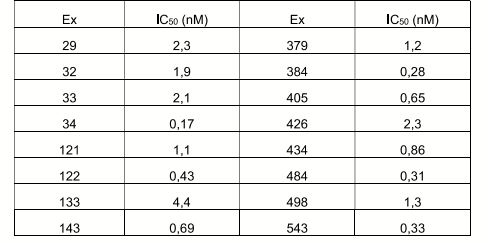
[0100]É verificado que o composto de acordo com a presente invenção em atividade inibitória contra a JAK3 e é útil como um ingrediente ativo de um agente para tratar ou prevenir doenças causadas pela transmissão de sinal de citocina indesejável (por exemplo, rejeição durante transplante de órgão/tecido, doenças auto-imunes, asma, dermatite atópica, doença de Alzheimer e doença aterosclerótica) ou doenças causadas pela transmissão de sinal de citocina anormal (por exemplo, câncer e leucemia).[0100] It is found that the compound according to the present invention in inhibitory activity against JAK3 and is useful as an active ingredient of an agent to treat or prevent diseases caused by the transmission of undesirable cytokine signal (for example, rejection during transplantation organ / tissue, autoimmune diseases, asthma, atopic dermatitis, Alzheimer's disease and atherosclerotic disease) or diseases caused by the abnormal cytokine signal transmission (for example, cancer and leukemia).
[0101]Além disso, com base na atividade inibitória da JAK3, o composto de acordo com a presente invenção é útil para tratar e/ou prevenir as doenças a seguir.[0101] In addition, based on the inhibitory activity of JAK3, the compound according to the present invention is useful for treating and / or preventing the following diseases.
[0102]A composição farmacêutica da presente invenção compreendendo um inibidor JAK3, tal como o composto (I), é útil como um agente terapêutico ou profilático para doenças ou condições causadas pela transdução de sinal de citocina indesejável, tal como a reação de rejeição em transplante de tecido/órgão, doenças auto-imunes, asma, dermatite atópica, doença de Alzheimer, aterosclerose, tumores, mielomas e leucemia, conforme exemplificado abaixo: reações de rejeição por transplante de órgãos ou tecidos tais como coração, rim, fígado, medula óssea, pele, córnea, pulmão, pâncreas, ilhota, intestino delgado, membro, músculo, nervo, disco intervertebral, traquéia, mioblasto, cartilagem, etc.; e reações de enxerto-versus-hospedeiro após transplante de medula óssea; doenças auto-imunes tais como artrite reumatóide, lúpus eritematoso sistêmico, tireoidite de Hashimoto, esclerose múltipla, miastenia grave, diabetes tipo I e complicações da diabetes, etc.[0102] The pharmaceutical composition of the present invention comprising a JAK3 inhibitor, such as compound (I), is useful as a therapeutic or prophylactic agent for diseases or conditions caused by the undesirable cytokine signal transduction, such as the rejection reaction in tissue / organ transplantation, autoimmune diseases, asthma, atopic dermatitis, Alzheimer's disease, atherosclerosis, tumors, myelomas and leukemia, as exemplified below: organ or tissue transplant rejection reactions such as heart, kidney, liver, marrow bone, skin, cornea, lung, pancreas, islet, small intestine, limb, muscle, nerve, intervertebral disc, trachea, myoblast, cartilage, etc .; and graft-versus-host reactions after bone marrow transplantation; autoimmune diseases such as rheumatoid arthritis, systemic lupus erythematosus, Hashimoto's thyroiditis, multiple sclerosis, myasthenia gravis, type I diabetes and complications of diabetes, etc.
[0103]Além disso, preparações farmacêuticas do inibidor da JAK3, tais como o composto (I), são úteis para a terapia ou profilaxia das seguintes doenças: doenças de pele ou manifestações cutâneas inflamatórias ou hiperproliferativas de doenças imunologicamente mediadas (por exemplo, psoríase, dermatite atópica, dermatite de contato, dermatite eczematóide, dermatite seborreica, líquen plano, pênfigo, penfigóide bolhoso, epidermólise bolhosa, urticaria, angioedema, vasculitide, eritema, eosinofilia dérmica, lúpus eritematoso, acne, alopécia areata, etc.); doenças auto-imunes do olho (por exemplo, queratoconjuntivite, conjuntivite vernal, uveíte associada com doença de Behcet, queratite, queratite herpética, queratite cônica, distrofia epitelial da córnea, queratoleucoma, penfigóide ocular, úlcera de Mooren, esclerite, oftalmopatia de Grave, síndrome de Vogt-Koyanagi- Harada, queratoconjuntivite “sicca” (olho seco), flictênula, iridociclite, sarcoidose, oftalmopatia endócrina, etc.); doenças das vias aéreas obstrutivas reversíveis [asma (por exemplo, asma bronquial, asma alérgica, asma intrínseca, asma extrínseca, asma da poeira, etc.), particularmente asma crônica ou inveterada (por exemplo, asma tardia, hiper- responsividade das vias aéreas, etc.), bronquite, etc.]; inflamações vasculares ou da mucosa (por exemplo, úlcera gástrica, injúria vascular trombótica ou isquêmica, doenças do intestino isquêmicas, enterite, enterocolite necrosante, danos intestinais associados com queimaduras térmicas, doenças mediadas pelo leucotrieno B4, etc.); inflamações/alergias intestinais (por exemplo, doenças celíacas, proctite, gastroenterite eosinofílica, mastocitose, doença de Chron, colite ulcerativa, etc.); doenças alérgicas relacionadas com alimentos com manifestação sintomática remota do trato gastrintestinal (por exemplo, enxaqueca, rinite, eczema, etc.); doenças auto-imunes e condições inflamatórias (por exemplo, edema da mucosa primário, gastrite atrófica auto-imune, menopausa prematura, esterilidade em homens, diabetes mellitus juvenil, pênfigo vulgar, penfigóide, oftalmite simpática, uveíte induzida por lentes, leucopenia idiopática, hepatite crônica ativa, cirrose idiopática, lúpus eritematoso discóide, orquite auto-imune, artrite (por exemplo, artrite deformante, etc.), policondrite, etc.); conjuntivite alérgica.[0103] In addition, pharmaceutical preparations of the JAK3 inhibitor, such as compound (I), are useful for the therapy or prophylaxis of the following diseases: inflammatory or hyperproliferative skin diseases or skin manifestations of immunologically mediated diseases (for example, psoriasis , atopic dermatitis, contact dermatitis, eczematoid dermatitis, seborrheic dermatitis, lichen planus, pemphigus, bullous pemphigoid, bullous epidermolysis, urticaria, angioedema, vasculitide, erythema, dermal eosinophilia, acne, alopecia arta, etc.); autoimmune diseases of the eye (e.g. keratoconjunctivitis, vernal conjunctivitis, uveitis associated with Behcet's disease, keratitis, herpetic keratitis, conical keratitis, corneal epithelial dystrophy, keratoleucoma, ocular pemphigoid, Mooren's ulcer, scleritis, ophthalmopathy Vogt-Koyanagi- Harada syndrome, “sicca” keratoconjunctivitis (dry eye), phyclic, iridocyclitis, sarcoidosis, endocrine ophthalmopathy, etc.); reversible obstructive airway diseases [asthma (eg, bronchial asthma, allergic asthma, intrinsic asthma, extrinsic asthma, dust asthma, etc.), particularly chronic or confirmed asthma (eg, late asthma, airway hyperresponsiveness , etc.), bronchitis, etc.]; vascular or mucosal inflammations (for example, gastric ulcer, thrombotic or ischemic vascular injury, ischemic bowel disease, enteritis, necrotizing enterocolitis, intestinal damage associated with thermal burns, leukotriene-mediated diseases B4, etc.); intestinal inflammations / allergies (eg celiac disease, proctitis, eosinophilic gastroenteritis, mastocytosis, Chron's disease, ulcerative colitis, etc.); allergic diseases related to food with remote symptomatic manifestation of the gastrointestinal tract (for example, migraine, rhinitis, eczema, etc.); autoimmune diseases and inflammatory conditions (eg primary mucosal edema, autoimmune atrophic gastritis, premature menopause, sterility in men, juvenile diabetes mellitus, pemphigus vulgaris, pemphigoid, sympathetic ophthalmitis, lens-induced uveitis, idiopathic leukopenia, hepatitis active chronic, idiopathic cirrhosis, discoid lupus erythematosus, autoimmune orchitis, arthritis (eg deforming arthritis, etc.), polychondritis, etc.); allergic conjunctivitis.
[0104]Dessa forma, a composição farmacêutica da presente invenção é útil para a terapia e profilaxia de doenças do fígado [por exemplo, doenças auto-imunes (por exemplo, doenças hepáticas auto-imunes crônicas, tais como doenças hepáticas auto-imunes, cirrose biliar primária, colangite esclerosante, etc.), resseção do fígado parcial, necrose hepática aguda (por exemplo, necrose causada por toxinas, hepatite virai, choque, anoxia, etc.), hepatite B, hepatite não-A/não-B, hepatocirrose, falência hepática (por exemplo, hepatite fulminante, hepatite de início tardio, falência hepática “aguda-sobre-crônica” (falência hepática aguda nas doenças hepáticas crônicas, etc.), etc.), etc.].[0104] Accordingly, the pharmaceutical composition of the present invention is useful for the therapy and prophylaxis of liver diseases [e.g., autoimmune diseases (e.g., chronic autoimmune liver diseases, such as autoimmune liver diseases, primary biliary cirrhosis, sclerosing cholangitis, etc.), partial liver resection, acute liver necrosis (eg toxin necrosis, viral hepatitis, shock, anoxia, etc.), hepatitis B, non-A / non-B hepatitis , hepatocirrose, liver failure (eg fulminant hepatitis, late-onset hepatitis, “acute-on-chronic” liver failure (acute liver failure in chronic liver diseases, etc.), etc.), etc.].
[0105]Preparações farmacêuticas do inibidor da JAK3, tais como o composto (I), quer sozinhos ou juntamente com um ou mais agentes adicionais, os quais podem incluir, porém não estão limitados à ciclosporina A, tacrolimo, sirolimo, everolimo, micofenolato (por exemplo, Cellcept (R), Myfortic (R), etc.), azatioprina, brequinar, leflunomida, antagonista do receptor da esfingosina-1-fosfato (por exemplo, fingolimod, KRP-203, etc.), LEA-29Y, anticorpo do receptor anti-IL-2 (por exemplo, daclizumabe, etc.), anticorpo anti-CD3 (por exemplo, OKT3, etc.), imunoglobulina anti células T, (por exemplo, AtGam, etc.) aspirina, as de bloqueio CD28-B7 (por exemplo, Belatacept, Abatacept, etc.), moléculas bloqueadoras da CD40-CD154 (por exemplo, anticorpo anti-CD40, etc.), inibidor da proteína quinase C (por exemplo, AEB-071, etc.), acetaminofeno, naproxeno, piroxicam e anti-inflamatórios esteróides (por exemplo, prednisolona ou dexametasona) podem ser administrados como parte da mesma ou de separadas formas de dosagem, através da mesma ou de diferentes vias de administração, e na mesma ou num diferente cronograma de administração de acordo com a prática farmacêutica padrão.[0105] Pharmaceutical preparations of the JAK3 inhibitor, such as compound (I), either alone or together with one or more additional agents, which may include, but are not limited to, cyclosporine A, tacrolimus, sirolimus, everolimus, mycophenolate ( for example, Cellcept (R), Myfortic (R), etc.), azathioprine, brequinar, leflunomide, sphingosine-1-phosphate receptor antagonist (eg, fingolimod, KRP-203, etc.), LEA-29Y, anti-IL-2 receptor antibody (for example, daclizumab, etc.), anti-CD3 antibody (for example, OKT3, etc.), anti-T cell immunoglobulin, (for example, AtGam, etc.) aspirin, those of CD28-B7 blocking (for example, Belatacept, Abatacept, etc.), CD40-CD154 blocking molecules (for example, anti-CD40 antibody, etc.), protein kinase C inhibitor (for example, AEB-071, etc. ), acetaminophen, naproxen, piroxicam and steroidal anti-inflammatory drugs (for example, prednisolone or dexamethasone) can be administered as part of the same or separately dosage forms, through the same or different routes of administration, and on the same or a different schedule of administration according to standard pharmaceutical practice.
[0106]A composição farmacêutica contendo um ou dois ou mais tipos do composto representado pela fórmula (I) ou seus sais farmaceuticamente aceitáveis seus como um ingrediente ativo pode ser preparada usando veículos, excipientes e outros aditivos geralmente usados para preparação farmacêutica.[0106] The pharmaceutical composition containing one or two or more types of the compound represented by formula (I) or its pharmaceutically acceptable salts thereof as an active ingredient can be prepared using vehicles, excipients and other additives generally used for pharmaceutical preparation.
[0107]A administração terapêutica pode ser efetuada ou por administração oral através de comprimidos, pílulas, cápsulas, grânulos, pós, soluções, etc., ou administração parenteral via injeções intravenosas ou intramusculares, supositórios, agentes transdérmicos, agentes transnasais, inaladores, etc. A dose do composto é determinada apropriadamente considerando os sintomas, idade, sexo e semelhantes de cada paciente a ser tratado. Geralmente, no caso de administração oral, uma dose diária de apropriadamente 0,001 até 00 mg/Kg do composto pode ser administrada uma ou duas até quatro vezes por dia para um paciente adulto, quando a administração intravenosa é requerida, dependendo dos sintomas, uma dose de 0,0001 até 10 mg/Kg do composto pode ser geralmente administrada de uma a várias vezes por dia para um paciente adulto. No caso de inalação, uma dose de 0,001 a 1 mg/Kg do composto pode ser normalmente administrada de uma a várias vezes por dia para um paciente adulto.[0107] Therapeutic administration can be carried out or by oral administration through tablets, pills, capsules, granules, powders, solutions, etc., or parenteral administration via intravenous or intramuscular injections, suppositories, transdermal agents, transnasal agents, inhalers, etc. . The dose of the compound is determined appropriately considering the symptoms, age, sex and the like of each patient to be treated. Generally, in the case of oral administration, a daily dose of appropriately 0.001 to 00 mg / kg of the compound can be administered once or twice to four times a day to an adult patient, when intravenous administration is required, depending on the symptoms, a dose from 0.0001 to 10 mg / kg of the compound can generally be administered one to several times a day to an adult patient. In the case of inhalation, a dose of 0.001 to 1 mg / kg of the compound can normally be administered from one to several times a day to an adult patient.
[0108]A composição sólida para uso na administração oral de acordo com a presente invenção é usada na forma de comprimidos, pós, grânulos, etc. Em tal composição sólida, um ou mais ingredientes ativos são misturados com pelo menos um excipiente inativo, tal como lactose, manitol, glicose, hidroxipropilcelulose, celulose microcristalina, amido, polivinilpirrolidona e aluminometassilicato de magnésio. De acordo com um método usual, a composição pode conter aditivos inativos, tais como lubrificante (por exemplo, estearato de magnésio), um agente desintegrante (por exemplo, carboximetilamido sódico), e um agente adjuvante de solubilização. Caso necessário, comprimidos ou pílulas podem ser revestidos com açúcar ou com um filme substância de revestimento gástrico ou entérico.[0108] The solid composition for use in oral administration according to the present invention is used in the form of tablets, powders, granules, etc. In such a solid composition, one or more active ingredients are mixed with at least one inactive excipient, such as lactose, mannitol, glucose, hydroxypropylcellulose, microcrystalline cellulose, starch, polyvinylpyrrolidone and magnesium aluminum metasilicate. According to a usual method, the composition can contain inactive additives, such as lubricant (for example, magnesium stearate), a disintegrating agent (for example, sodium carboxymethyl starch), and an adjuvant solubilizing agent. If necessary, tablets or pills can be coated with sugar or a gastric or enteric coated substance film.
[0109]A composição líquida para administração oral contém emulsões, soluções, suspensões, xaropes ou elixires farmaceuticamente aceitáveis, e também contém um diluente inerte geralmente usado, tal como água purificada ou etanol. o diluente inerte, a composição também pode conter gentes adjuvantes, tais como um agente adjuvante de solubilização, um agente umidificante e um agente suspensor, assim como adoçantes, flavorizantes, aromáticos e anti-sépticos.[0109] The liquid composition for oral administration contains pharmaceutically acceptable emulsions, solutions, suspensions, syrups or elixirs, and also contains an inert diluent commonly used, such as purified water or ethanol. the inert diluent, the composition can also contain adjuvant people, such as an adjuvant solubilizing agent, a humidifying agent and a suspending agent, as well as sweeteners, flavors, aromatics and antiseptics.
[0110]As injeções para administração parenteral contêm soluções, suspensões ou emulsões aquosas ou não-aquosas assépticas. O diluente para uso nas soluções aquosas pode incluir, por exemplo, água destilada para uso em injeção e salina fisiológica. O diluente para uso nas soluções não-aquosas pode incluir, por exemplo, propilenoglicol, polietilenoglicol, óleo vegetal (por exemplo, óleo de oliva), álcool (por exemplo, etanol) e polissorbato 80 (nome oficial). Tal composição pode ainda conter agentes aditivos, tal como um agente de tonicidade, um anti-séptico, um agente umidificante, um agente emulsificante, um agente dispersante, um agente estabilizante e um agente adjuvante de solubilização. Essas composições ao esterilizadas por filtração através de um filtro de retenção de bactérias, da mistura de um germicida ou de irradiação. Além disso, eles também podem ser produzidos na forma de composições sólidas estéreis e dissolvidos ou suspensos em água estéril ou num solvente estéril para uso em injeção antes de seu uso.[0110] Injections for parenteral administration contain aseptic aqueous or non-aqueous solutions, suspensions or emulsions. The diluent for use in aqueous solutions may include, for example, distilled water for use in injection and physiological saline. The diluent for use in non-aqueous solutions can include, for example, propylene glycol, polyethylene glycol, vegetable oil (for example, olive oil), alcohol (for example, ethanol) and polysorbate 80 (official name). Such a composition may also contain additive agents, such as a tonicity agent, an antiseptic, a wetting agent, an emulsifying agent, a dispersing agent, a stabilizing agent and a solubilizing adjuvant. These compositions are sterilized by filtration through a bacteria retention filter, a germicide mixture or irradiation. In addition, they can also be produced in the form of sterile solid compositions and dissolved or suspended in sterile water or in a sterile solvent for use in injection before use.
[0111]Os agentes transmucosais, tais como inalantes e agentes transnasais, são usados na forma sólida, semi-sólida ou líquida e podem ser produzidos de acordo com métodos convencionais conhecidos. Por exemplo, excipientes (por exemplo, lactose e amido), ajustadores de pH, anti-sépticos, agentes ativos de superfície, lubrificantes, estabilizantes, etc. também podem ser adicionados conforme necessário. Para administração, dispositivos adequados para inalação ou insuflação podem ser usados. Por exemplo, usando dispositivos conhecidos e pulverizadores, tais como dispositivos de inalação mensurada, o composto pode ser administrado independentemente ou na forma de pós de mistura prescritos. Além disso, o composto combinado com veículos farmaceuticamente aceitáveis também pode ser administrado na forma de soluções ou suspensões. Inaladores de pó seco e semelhantes podem ser dispositivos para administrações individuais ou múltiplas, e pós secos ou cápsulas s também podem ser usados. Ainda adicionalmente, os dispositivos podem estar na forma de um pulverizador de aerossol de pressão ou semelhantes que usem um agente de ejeção adequado, clorofluoralcano ou hidrofluoralcano, ou um gás adequado, tal como dióxido de carbono.[0111] Transmucosal agents, such as inhalants and transnasal agents, are used in solid, semi-solid or liquid form and can be produced according to known conventional methods. For example, excipients (eg lactose and starch), pH adjusters, antiseptics, surface active agents, lubricants, stabilizers, etc. can also be added as needed. For administration, devices suitable for inhalation or insufflation can be used. For example, using known devices and sprayers, such as measured inhalation devices, the compound can be administered independently or in the form of prescribed mixing powders. In addition, the compound combined with pharmaceutically acceptable vehicles can also be administered in the form of solutions or suspensions. Dry powder inhalers and the like can be devices for individual or multiple administrations, and dry powders or capsules can also be used. In addition, the devices may be in the form of a pressure aerosol spray or the like using a suitable ejection agent, chlorofluoralkane or hydrofluoralkane, or a suitable gas, such as carbon dioxide.
[0112]O fármaco para uso externo pode incluir unguentos, emplastros, cremes, geléias, remendos, borrifos, loções, gotas oftálmicas, unguentos oftálmicos, etc. O fármaco contém bases de unguento normalmente usadas, bases de loção, soluções aquosas ou não-aquosas, suspensões, emulsões, etc. As bases de unguento ou as bases de loção podem incluir, por exemplo, polietilenoglicol, polímero carboxivinal, vaselina branca, cera de abelha alvejada, óleo de castóreo hidrogenado polioxietileno, monoestearato de glicerila, álcool estearílico, álcool cetílico, lauromacrogol e sesquioleato de sorbitan.[0112] The drug for external use may include ointments, plasters, creams, jellies, patches, sprays, lotions, eye drops, ointments, etc. The drug contains commonly used ointment bases, lotion bases, aqueous or non-aqueous solutions, suspensions, emulsions, etc. Ointment bases or lotion bases may include, for example, polyethylene glycol, carboxy polymer, white vaseline, targeted beeswax, polyoxyethylene hydrogenated castor oil, glyceryl monostearate, stearyl alcohol, cetyl alcohol, lauromacrogol and sorbitan sesquioleate.
[0113]Embora a presente invenção esteja descrita abaixo especificamente a título dos Exemplos, a presente invenção não está limitada por esses exemplos em qualquer caso. Os compostos de partida sendo usados nos Exemplos incluem novas substâncias, e os métodos para produzir tais compostos de partida a partir de compostos conhecidos são descritos através das Preparações.[0113] Although the present invention is described below specifically by way of Examples, the present invention is not limited by those examples in any case. The starting compounds being used in the Examples include new substances, and methods for producing such starting compounds from known compounds are described through the Preparations.
[0114]Os compostos nas Preparações 1-1 até 1-25 mostrados na tabela a seguir foram produzidos pelo uso dos correspondentes compostos de partida de acordo com o método similar àquele descrito no Exemplo 1. Tabela 2


[0115]Foi adicionada ao cloridrato de glicinamida (34 mg) uma solução de 3- (4-cloro-1H-pirrolo[2,3-b]piridin-5-il)-1,2,4-oxadiazol-5-carboxilato de etila (60 mg) em 1-metil-2-pirrolidona (0,6 mL) e 1,8-diazabiciclo[5,4,0]undec-7-eno (0,092 mL), e a mistura foi agitada a 70 °C por 1 hora. Depois de ser deixada esfriar, a solução reacional foi diretamente purificada por HPLC preparativo (NH4HCO3 10 mM + NH3 (pH = 9,2):CH3CN = 90:10 até 20:80). A fração ativa foi concentrada e seca até ficar dura para obter 3-(4-cloro-1 H-pirrolo[2,3-b] piridin - 5 - il) -N-metil-1,2,4-oxadiazol-5- carboxilato (23 mg) como um sólido.[0115] Glycinamide hydrochloride (34 mg) was added with a solution of 3- (4-chloro-1H-pyrrolo [2,3-b] pyridin-5-yl) -1,2,4-oxadiazole-5- ethyl carboxylate (60 mg) in 1-methyl-2-pyrrolidone (0.6 ml) and 1,8-diazabicyclo [5.4.0] undec-7-ene (0.092 ml), and the mixture was stirred at 70 ° C for 1 hour. After being allowed to cool, the reaction solution was directly purified by preparative HPLC (NH4HCO3 10 mM + NH3 (pH = 9.2): CH3CN = 90:10 until 20:80). The active fraction was concentrated and dried until hard to obtain 3- (4-chloro-1 H-pyrrolo [2,3-b] pyridin - 5 - yl) -N-methyl-1,2,4-oxadiazole-5 - carboxylate (23 mg) as a solid.
[0116]Os compostos nas Preparações 2-1 até 2-26 mostrados na tabela a seguir foram produzidos usando os seguintes compostos de partida de acordo com 0 método similar àquele descrito na Preparação 2. Tabela 4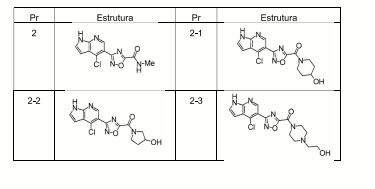


[0117]4-cloro-1H-pirrolo[2,3-b]piridina-5-carboxilato de benzila (55 mg), {[(4- amino-1-adamantil)carbonil]amino} acetato de etila (54 mg) e trietilamina (80 pl) foram dissolvidos em N-metil-2-pirrolidona (0,55 mL) e agitados a 180 °C por 1 hora usando um sistema reacional de microondas. À solução reacional foram adicionados acetato de etila e água, e a mistura foi extraída com acetato de etila. A camada orgânica foi lavada com salmoura saturada, seca em sulfato de magnésio e evaporada sob pressão reduzida. O resíduo foi purificado por cromatografia em coluna de sílica gel (n-hexano:acetato de etila), o composto obtido foi dissolvido em dioxano (1,1 mL) e metanol (1,1 mL), 10% de paládio em carbono (50% de umidade) foi adicionado e a redução catalítica foi efetuada por 4 horas em temperatura ambiente a 1 atm. Metanol, dioxano e ácido clorídrico 1 M foram adicionados, e o sólido precipitado foi dissolvido e filtrado para remover o catalisador. O filtrado foi concentrado sob pressão reduzida para obter o ácido 4-({5-[(2 - etóxi - 2 -oxoetil)carbamoil]adamantan-2-il}amino)-1H- pirrolo[2,3-b]piridino-5-carboxílico (18 mg). Tabela 6
[0118]Ao etanol (3 mL) foi adicionado cloreto de acetila cuidadosamente a 4 °C. A solução reacional foi agitada a 4 °C por 30 minutos. Foi adicionada à solução reacional uma solução de 4-{[(2r,5s)-5-hidroxiadamantan-2-il]amino}-1H-pirrolo[2,3- b]piridino-5-carbonitrila (50 mg) em clorofórmio (0,5 mL) e solução de ácido clorídrico 2 M/etanol (0,5 ml) gota a gota. A solução reacional foi agitada sob temperatura ambiente por 18 horas. A solução reacional foi concentrada sob pressão reduzida para obter tricloridrato de 4-{[(2r,5s)-5-hidroxiadamantan-2-il]amino}-1H-pirrolo[2,3- b]piridino-5-carboximidato de etila (75 mg). Tabela 7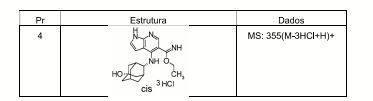
[0119]Os compostos nas Preparações 5-1 até 5-32 mostrados na Tabela a seguir foram produzidos usando os compostos de partida correspondentes de acordo com o método similar àquele descrito no Exemplo 3. Tabela 8

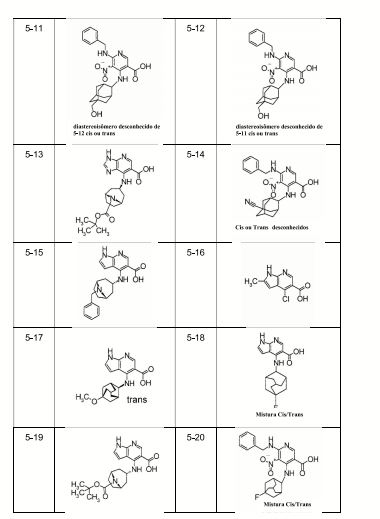

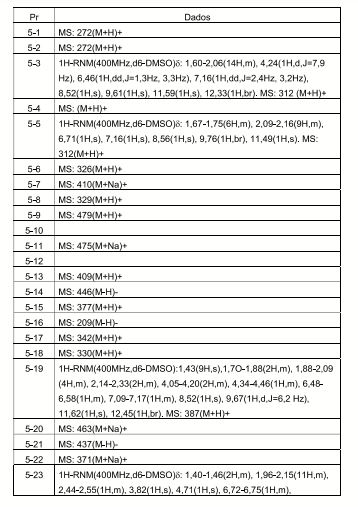

[0120]Em 7-[(trans-5-hidroxiadamantan-2-il)amino]-3H-imidazo[4,5-b]piridino- 6-carboxilato de etila (50 mg) foi adicionado ácido bromídrico 47% aquoso (0,75 mL), e a mistura foi agitada a 120 °C por 1 hora usando um sistema de reação de microondas. Depois de a solução reacional ser esfriada, o pH foi ajustado para 5 com carbonato de potássio aquoso, e o sólido obtido foi coletado por filtração e lavado com água para obter o ácido 7-[(trans-5-bromoadamantan - 2 - il) amino]-3H-imidazo[4,5- b]piridino-6-carboxílico (44 mg).[0120] In 7 - [(trans-5-hydroxyadamantan-2-yl) amino] -3H-imidazo [4,5-b] pyridine-6-carboxylate (50 mg) 47% aqueous hydrobromic acid ( 0.75 mL), and the mixture was stirred at 120 ° C for 1 hour using a microwave reaction system. After the reaction solution was cooled, the pH was adjusted to 5 with aqueous potassium carbonate, and the obtained solid was collected by filtration and washed with water to obtain 7 - [(trans-5-bromoadamantan - 2 - yl) acid. amino] -3H-imidazo [4,5-b] pyridine-6-carboxylic (44 mg).
[0121]Os compostos nas Preparações 6-1 mostrados na Tabela a seguir foram produzidos usando os compostos de partida correspondentes de acordo com o método similar àquele descrito na Preparação 6. Tabela 10

[0122]Uma mistura de 7-[(3-exo)-8-azabiciclo[3,2,1]oct-3-ilamino]-3H- imidazo[4,5-b]piridino-6-carboxilato de etila (400 mg), dicarbonato de di-t-butila (203 mg), trietilamina (130 pL), dioxano (4 ml) e água (4 mL) foi agitada em temperatura ambiente por 1 hora. A mistura foi diluída com acetato de etila (5 mL) e água (20 mL). O precipitado resultante foi coletado por filtração (7-{[(3-exo)-8-(terc-butoxicarbonil) - 8 - azabiciclo [3,2,1] oct-3-il]amino}-3H-imidazo[4,5-b]piridino-6-carboxilato de etila, (200 mg)). O filtrado foi diluído com acetato de etila (50 mL) e extraído com acetato de etila. Os extratos orgânicos foram lavados com salmoura, secos em sulfato de sódio e concentrados. A recristalização a partir de acetato de etila/n-hexano produziu 7-{[(3-exo)-8-(terc-butoxicarbonil)-8-azabiciclo[3, 2,1] oct-3-il]amino}-3H-imidazo[4,5- b]piridino-6-carboxilato de etila (I00 mg) como um sólido branco.[0122] A mixture of ethyl 7 - [(3-exo) -8-azabicyclo [3,2,1] oct-3-ylamino] -3H- imidazo [4,5-b] pyridine-6-carboxylate ( 400 mg), di-t-butyl dicarbonate (203 mg), triethylamine (130 pL), dioxane (4 ml) and water (4 ml) was stirred at room temperature for 1 hour. The mixture was diluted with ethyl acetate (5 ml) and water (20 ml). The resulting precipitate was collected by filtration (7 - {[(3-exo) -8- (tert-butoxycarbonyl) - 8 - azabicyclo [3,2,1] oct-3-yl] amino} -3H-imidazo [4 , 5-b] ethyl pyridine-6-carboxylate, (200 mg)). The filtrate was diluted with ethyl acetate (50 ml) and extracted with ethyl acetate. The organic extracts were washed with brine, dried over sodium sulfate and concentrated. Recrystallization from ethyl acetate / n-hexane produced 7 - {[(3-exo) -8- (tert-butoxycarbonyl) -8-azabicyclo [3, 2,1] oct-3-yl] amino} - Ethyl 3H-imidazo [4,5-b] pyridine-6-carboxylate (100 mg) as a white solid.
[0123]Os compostos nas Preparações 7-1 mostrados na tabela a seguir foram produzidos usando os compostos de partida correspondentes de acordo com o método similar àquele descrito no Exemplo 64. Tabela 11
[0124]Os compostos nas Preparações 8-1 a 8-3 mostrados na tabela a seguir foram produzidos usando os compostos de partida correspondentes de acordo com o método similar àquele descrito no Exemplo 44. Tabela 12
[0125]Os compostos nas Preparações 91- a 9-2 mostrados na Tabela a seguir foram produzidos usando os compostos de partida correspondentes de acordo com o método similar àquele descrito no Exemplo 10. Tabela 13
[0126]Os compostos nas Preparações 10-1 a 10-18 mostrados na Tabela a seguir foram produzidos usando os compostos de partida correspondentes de acordo com o método similar àquele descrito no Exemplo 4. Tabela 14
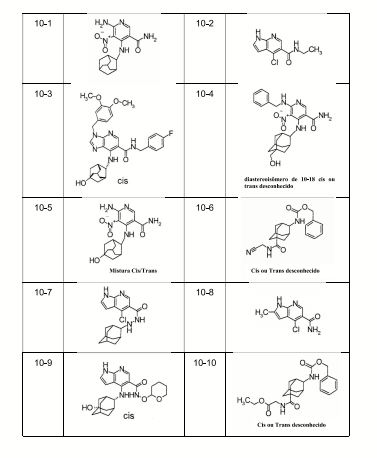


[0127]Numa solução de ácido 4-cloro-1H-pirrolo[2,3-b]piridino-5-carboxílico (350 mg) em N,N-dimetilformamida (4 mL) foram adicionados N,N-carbonildiimidazol (289 mg) e cloridrato de glicinometiléster (447 mg) sucessivamente sob temperatura ambiente. A mistura foi agitada em temperatura ambiente por 2 horas. À solução reacional foi adicionada água. O sólido precipitado foi filtrado, lavado com água e seco para obter 4-cloro-5-(1 H-imidazol-1 -ilcarboniI)-1H-pirrolo[2,3-b]piridina (325 mg) como um sólido branco. Tabela 16
[0128]Numa solução de 4-cloro-5-(1H-imidazol-1-ilcarbonil)-1H-pirrolo[2,3- b]piridina (300 mg) em N,N-dimetilformamida (3 mL) foram adicionados N-etil-N- isopropilpropano-2-amina (0,64 mL) e cloridrato de éster glicinometilico (305 mg) em temperatura ambiente. A mistura foi aquecida imediatamente até 60 °C e agitada a 60 °C por 2 horas. Depois, à solução reacional foi adicionada água, a mistura foi agitada por 1 hora. O sólido precipitado foi filtrado, lavado com água e seco para obter metil- N-[(4-cloro-1H-pirrolo[2,3-b]piridin-5-il)carbonil]glicinato (267 mg) como um sólido branco. Tabela 17
[0129]Numa solução de rel-[(1R,2S,3S,5s)-5-hidroxiadamantan-2- il]carbamato de benzila (1,3 g) em dicloroetano (13 mL) foram adicionados tetrafluorborato de trimetiloxônio (1,28 g), 2,6-di-t-butil-4-metilpiridina (2,21 g). A solução reacional foi submetida a refluxo por 3 horas. A solução reacional foi concentrada sob pressão reduzida, acetato de etila foi adicionada e o material insolúvel foi filtrado. Ao filtrado foi adicionado água e a mistura foi extraída com acetato de etila. A camada orgânica foi lavada com salmoura saturada, seca em sulfato de magnésio anidro e filtrada. O filtrado foi concentrado sob pressão reduzida. O resíduo foi purificado por cromatografia em coluna de sílica gel (n-hexano:acetato de etila = 19:1 até 7:3) para obter rel-[(1R,2S,3S,5s)-5-metoxiadamantan-2-il]carbamato de benzila (540 mg) como um material oleoso incolor.[0129] In a solution of benzyla carbamate (1.3 g) in dichloroethane (13 mL), trimethyloxonium tetrafluorborate (1, 2, 3S, 5s) -5-hydroxyadiene-2-yl] 28 g), 2,6-di-t-butyl-4-methylpyridine (2.21 g). The reaction solution was refluxed for 3 hours. The reaction solution was concentrated under reduced pressure, ethyl acetate was added and the insoluble material was filtered. To the filtrate, water was added and the mixture was extracted with ethyl acetate. The organic layer was washed with saturated brine, dried over anhydrous magnesium sulfate and filtered. The filtrate was concentrated under reduced pressure. The residue was purified by silica gel column chromatography (n-hexane: ethyl acetate = 19: 1 to 7: 3) to obtain rel - [(1R, 2S, 3S, 5s) -5-methoxymantan-2-yl ] benzyl carbamate (540 mg) as a colorless oily material.
[0130]Os compostos nas Preparações 13-1 até 13-2 mostrados na tabela a seguir foram produzidos usando os compostos de partida correspondentes de acordo com o método similar àquele descrito na Preparação 13. Tabela 18
[0131]Os compostos nas Preparações 14-1 a 14-6 mostrados na tabela a seguir foram produzidos usando os compostos de partida correspondentes de acordo com o método similar àquele descrito nos Exemplos 12 até os Exemplos 14. Tabela 19


[0132]Numa solução de ácido (3-exo,7-endo)-7-hidroxibiciclo[3,3,1]nonan-3- carboxílico (700 mg) em metanol (14 mL) foi adicionado ácido sulfúrico concentrado (2 mL) gota a gota, e a solução reacional foi submetida a refluxo por 1 hora. À solução reacional foi adicionado água, a mistura foi extraída com acetato de etila. A camada orgânica foi lavada com água, hidrogenocarbonato de sódio aquoso saturado e salmoura, seca em sulfato de magnésio e filtrada. O filtrado foi concentrado sob pressão reduzida para obter metil - (3 - exo, 7 - endo) -7-hidroxibiciclo[3,3,1]nonan-3- carboxilato (730 mg). Tabela 21
[0133]Os compostos nas Preparações 16-1 a 16-3 mostrados na tabela a seguir foram produzidos usando os compostos de partida correspondentes de acordo com o método similar àquele descrito no Exemplo 28. Tabela 22

[0134]O composto na Preparação 17 mostrado na tabela a seguir foi produzido usando o composto de partida correspondente de acordo com o método similar àquele descrito no Exemplo 29. Tabela 24
[0135]Os compostos nas Preparações 18-1 a 18-5 mostrados na tabela a seguir foram produzidos usando o composto de partida correspondente de acordo com o método similar àquele descrito no Exemplo 30. Tabela 25


[0136]Numa solução de 4-cloro-N’-hidróxi-1H-pirrolo[2,3-b]piridino-5- carboxiimidamida (100 mg) em N,N-dimetilformamida (1 mL) foram adicionados piridina (58 pL) e clorocarbonato de 2-etilexila (92 pL) a 4 °C. A solução reacional foi agitada em temperatura ambiente por 2 horas. À solução reacional foi adicionada água. O precipitado foi coletado por filtração e dissolvido em xileno (2 mL). A solução reacional foi agitada a 160 °C por 3 horas. À solução reacional foi adicionada água e o precipitado foi coletado por filtração para obter 3-(4-cloro-1H-pirrolo[2,3-b]piridin-5- il)-1,2,4-oxadiazol-5(4H)-ona (63 mg) como um sólido branco. Tabela 27
[0137]Numa solução de N-[(4-cloro-1H-pirrolo[2,3-b] piridin-5- il)carbonil]glicinato de metila (167 mg) em clorofórmio (5 mL) foi adicionado pentóxido difósforo (886 mg) sob temperatura ambiente, e a mistura foi submetida a refluxo por 18 horas. A solução reacional foi esfriada e adicionada em hidrogenocarbonato de sódio aquoso saturado. A solução reacional foi extraída com acetato de etila. A camada orgânica foi lavada com água. A camada orgânica foi seca em sulfato de magnésio e filtrada. O filtrado foi concentrado sob pressão reduzida. O resíduo foi purificado por cromatografia em coluna de sílica gel de camada fina (clorofórmio:metanol = 15:1) para obter 4-cloro-5-(5-metóxi-1,3-oxazol-2-il)-1 H- pirrolo[2,3-b]piridina (45 mg) como um sólido branco amarelado. Tabela 28
[0138]Numa solução de 4-[(5-hidroxiadamantan-2-il)amino] -1 H-pirrolo[2,3- b]piridino-5-carbonitrila (150 mg) em tetraidrofurano (3 mL) foi adicionado hidreto de diisobutilalumínio 1,01 M/solução de tolueno (1,93 mL) a -78 °C. À solução reacional foi adicionado ácido clorídrico 1 M sob esfriamento com gelo e a mistura foi agitada por 30 minutos. A mistura foi extraída com clorofórmio e lavada com água. A camada orgânica foi seca em sulfato de magnésio e filtrada. O filtrado foi concentrado sob pressão reduzida para obter 4-[(5-hidroxiadamantan-2-il)amino]-1H-pirrolo [2,3- b]piridino-5-carbaldeído (100 mg) como uma substância amorfa amarelo pálida.[0138] In a solution of 4 - [(5-hydroxyadamantan-2-yl) amino] -1 H-pyrrolo [2,3-b] pyridine-5-carbonitrile (150 mg) in tetrahydrofuran (3 ml) was added hydride 1.01 M diisobutylaluminum / toluene solution (1.93 mL) at -78 ° C. To the reaction solution, 1 M hydrochloric acid was added under ice cooling and the mixture was stirred for 30 minutes. The mixture was extracted with chloroform and washed with water. The organic layer was dried over magnesium sulfate and filtered. The filtrate was concentrated under reduced pressure to obtain 4 - [(5-hydroxyadamantan-2-yl) amino] -1H-pyrrolo [2,3-b] pyridine-5-carbaldehyde (100 mg) as a pale yellow amorphous substance.
[0139]O composto na Preparação 21-1 mostrado na tabela a seguir foi produzido usando o composto de partida correspondente de acordo com o método similar àquele descrito na Preparação 21. Tabela 29
[0140]Numa mistura de 6-(benzilamino)-1-(5-hidroxiadamantan-2-il)- 7-nitro- 1,3-diidro-2H-imidazo[4,5-c] piridino-2-ona (68 mg) e metanol (1 mL) foram adicionados formato de amónio (197 mg) e 10% de paládio em carbono com 50% de umidade (33 mg) em temperatura ambiente. A mistura foi submetida a refluxo por 5 horas. Depois de a mistura ser esfriada, o catalisador foi removido por filtração. O líquido mãe foi concentrado para obter 6,7-diamino-1-(5-hidroxiadamantan-2-il)-1,3- diidro-2H-imidazo[4,5-c]piridino-2-ona (54 mg).[0140] In a mixture of 6- (benzylamino) -1- (5-hydroxyadamantan-2-yl) - 7-nitro-1,3-dihydro-2H-imidazo [4,5-c] pyridine-2-one ( 68 mg) and methanol (1 mL) were added ammonium formate (197 mg) and 10% palladium on carbon with 50% humidity (33 mg) at room temperature. The mixture was refluxed for 5 hours. After the mixture was cooled, the catalyst was removed by filtration. The mother liquor was concentrated to obtain 6,7-diamino-1- (5-hydroxiadamantan-2-yl) -1,3-dihydro-2H-imidazo [4,5-c] pyridine-2-one (54 mg) .
[0141]Os compostos nas Preparações 22-1 a 22-3 mostrados na tabela a seguir foram produzidos usando os compostos de partida correspondentes de acordo com o método similar àquele descrito na Preparação 22. Tabela 30
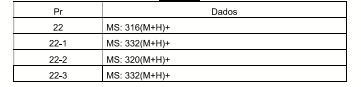
[0142]Numa suspensão de 6-[(3,4-dimetoxibenzil)amino]-4-[(cis-5-hidroxiadamantan-2-il)amino]-5-nitronicotinato de etila (2,73 g) em etanol (40 ml) foi adicionado 10% de paládio em carbono (50% de umidade) (550 mg). Numa atmosfera de hidrogênio, a redução catalítica foi executada a 80 °C por 5 horas. Depois da solução reacional ser esfriada até a temperatura ambiente, o catalisador foi filtrado e lavado com dioxano, e o solvente foi evaporado sob pressão reduzida. Ao resíduo foram adicionados ortoformato de etila (17 mL) e ácido clorídrico concentrado (864 pL), e a mistura foi agitada em temperatura ambiente de um dia para o outro. A solução reacional foi neutralizada com hidrogenocarbonato de sódio aquoso saturado e extraída com acetato de etila e tetraidrofurano. A camada orgânica foi lavada com salmoura saturada, seca em sulfato de magnésio e filtrada. O resíduo foi purificado por cromatografia em coluna de sílica gel (clorofórmio:metanol) para obter 3-(3,4- dimetoxibenzil)-7-[(cis- 5 -hidroxiadamantan-2-il)amino] - 3H - imidazo[4,5-b] piridino- 6-carboxilato de etila (2,17 g).[0142] In a suspension of 6 - [(3,4-dimethoxybenzyl) amino] -4 - [(cis-5-hydroxyadamantan-2-yl) amino] -5-ethyl-nitronicotinate (2.73 g) in ethanol ( 40 ml) 10% palladium on carbon (50% moisture) (550 mg) was added. In a hydrogen atmosphere, the catalytic reduction was carried out at 80 ° C for 5 hours. After the reaction solution was cooled to room temperature, the catalyst was filtered and washed with dioxane, and the solvent was evaporated under reduced pressure. To the residue, ethyl orthoformate (17 mL) and concentrated hydrochloric acid (864 pL) were added, and the mixture was stirred at room temperature overnight. The reaction solution was neutralized with saturated aqueous sodium hydrogen carbonate and extracted with ethyl acetate and tetrahydrofuran. The organic layer was washed with saturated brine, dried over magnesium sulfate and filtered. The residue was purified by silica gel column chromatography (chloroform: methanol) to obtain 3- (3,4-dimethoxybenzyl) -7 - [(cis-5-hydroxyadamantan-2-yl) amino] - 3H - imidazo [4 , 5-b] ethyl pyridine-6-carboxylate (2.17 g).
[0143]O composto na Preparação 23-1 mostrado na tabela a seguir foi produzido usando o composto de partida correspondente de acordo com o método similar àquele descrito na Preparação 23. Tabela 32
[0144]Os compostos nas Preparações 24-1 a 24-3 mostrados na tabela a seguir foram produzidos usando os compostos de partida correspondentes de acordo com o método similar àqueles descritos no Exemplo 35. Tabela 33
[0145JÀ solução reacional de N-Boc-nortropinona (1,38 g), benzilamina (0,803 mL) e ácido acético (0,35 mL) em diclorometano (10 mL) e 1,2-dicloroetano (32 mL) foi adicionado triacetoxiboroidreto de sódio (1,95 g). E a mistura foi agitada em temperatura ambiente por 2 horas. À mistura reacional foi adicionada benzilamina (0,201 mL) e triacetoxiboroidreto de sódio (649 mg), e a mistura foi agitada a 50 °C por 3,5 horas. Além disso, à mistura reacional foi adicionado triacetoxiboroidreto de sódio (649 mg) e a mistura foi agitada a 50 °C por 3 horas. O solvente reacional foi evaporado sob pressão reduzida. Ao resíduo foram adicionados hidrogenocarbonato de sódio aquoso saturado e hidróxido de sódio aquoso 1 M para alcalinizar o resíduo. O resíduo foi extraído com acetato de etila. A camada orgânica foi lavada com hidrogenocarbonato de sódio aquoso saturado, água e salmoura saturada, seca em sulfato de sódio anidro e filtrada. O filtrado foi evaporado sob pressão reduzida. O resíduo foi purificado por cromatografia em coluna de sílica gel (clorofórmio:metanol) para obter éster t-butílico do ácido 3-(benzilamino)-8-azabiciclo [3,2,1]octano-8- carbâmico (1,78 g) como um sólido branco.[0145J To the reaction solution of N-Boc-nortropinone (1.38 g), benzylamine (0.803 ml) and acetic acid (0.35 ml) in dichloromethane (10 ml) and 1,2-dichloroethane (32 ml) was added triacetoxyborohydride sodium (1.95 g). And the mixture was stirred at room temperature for 2 hours. To the reaction mixture, benzylamine (0.201 ml) and sodium triacetoxyborohydride (649 mg) were added, and the mixture was stirred at 50 ° C for 3.5 hours. In addition, to the reaction mixture, sodium triacetoxyborohydride (649 mg) was added and the mixture was stirred at 50 ° C for 3 hours. The reaction solvent was evaporated under reduced pressure. To the residue, saturated aqueous sodium hydrogen carbonate and 1 M aqueous sodium hydroxide were added to alkalinize the residue. The residue was extracted with ethyl acetate. The organic layer was washed with saturated aqueous sodium hydrogen carbonate, water and saturated brine, dried over anhydrous sodium sulfate and filtered. The filtrate was evaporated under reduced pressure. The residue was purified by silica gel column chromatography (chloroform: methanol) to obtain 3- (benzylamino) -8-azabicyclo [3.2.1] octane-8-carbamic acid t-butyl ester (1.78 g ) as a white solid.
[0146]Os compostos nas Preparações 25-1 até 25-8 mostrados na tabela a seguir foram produzidos usando os compostos de partida correspondentes de acordo com o método similar àquele descrito na Preparação 25. Tabela 34


[0147]Os compostos nas Preparações 26-1 a 26-2 mostrados na tabela a seguir foram produzidos usando os compostos de partida correspondentes de acordo com o método similar àquele descrito no Exemplo 50. Tabela 36
[0148]Numa solução de ácido rel-(TR,3’S,5’S,7’s)-5’H-espiro[1,3-dioxolano- 2,2’-triciclo[3,3,1,1~3,7~]decano]-5’ -carboxilico (100 mg) em tolueno (1 mL) foi adicionado difenilfosfato azida (99 pL) e trietilamina (64 pL). A mistura foi agitada a 110 °C por 2 horas. Depois de a solução reacional ser esfriada até a temperatura ambiente foi adicionada água, e a mistura foi extraída com acetato de etila. A camada orgânica foi lavada com salmoura, seca em sulfato de magnésio e filtrada. O filtrado foi evaporado sob pressão reduzida. O resíduo foi dissolvido em N,N-dimetilacetamida (1 mL) e t-butóxido de potássio (49 mg) foi adicionado. A mistura foi agitada em temperatura ambiente de um dia para o outro. À solução reacional foi adicionado água e a mistura foi extraída com acetato de etila. A camada orgânica foi lavada com salmoura saturada, seca em sulfato de magnésio e filtrada. O filtrado foi evaporado sob pressão reduzida. O resíduo foi purificado por cromatografia em coluna de sílica gel (n-hexano:acetato de etila) para obter rel-(TR,3’S,5’S,7’s)-5’H-espiro[1,3- dioxolano-2,2’-triciclo [3,3,1,1~3,7~]decano]-5’-ilcarbamate de t-butila (40 mg).[0148] In a solution of rel- (TR, 3'S, 5'S, 7's) -5'H-spiro [1,3-dioxolane- 2,2'-tricycle [3,3,1,1 ~ 3.7 ~ ] decane] -5'-carboxylic acid (100 mg) in toluene (1 ml) was added diphenylphosphate azide (99 pL) and triethylamine (64 pL). The mixture was stirred at 110 ° C for 2 hours. After the reaction solution was cooled to room temperature, water was added, and the mixture was extracted with ethyl acetate. The organic layer was washed with brine, dried over magnesium sulfate and filtered. The filtrate was evaporated under reduced pressure. The residue was dissolved in N, N-dimethylacetamide (1 ml) and potassium t-butoxide (49 mg) was added. The mixture was stirred at room temperature overnight. To the reaction solution, water was added and the mixture was extracted with ethyl acetate. The organic layer was washed with saturated brine, dried over magnesium sulfate and filtered. The filtrate was evaporated under reduced pressure. The residue was purified by silica gel column chromatography (n-hexane: ethyl acetate) to obtain rel- (TR, 3'S, 5'S, 7's) -5'H-spiro [1,3-dioxolane-2,2 ' -tricycle [3,3,1,1 ~ 3,7 ~] decane] -5-t-butyl 5'-ylcarbamate (40 mg).
[0149]Os compostos nas Preparações 27-1 a 27-3 mostrados na tabela a seguir foram produzidos usando os compostos de partida correspondentes de acordo com o método similar àquele descrito na Preparação 27. Tabela 37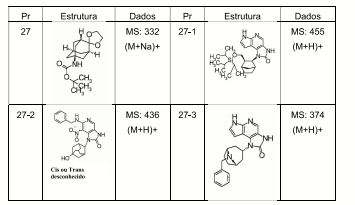
[0150]Em ácido sulfúrico concentrado (175 mL) foi adicionado ácido nítrico 70% (20 mL) gota a gota sob esfriamento com gelo, e cloridrato de 2-adamantamina (25 g) foi adicionado lentamente a 10 °C ou menos. A mistura foi aquecida até a temperatura ambiente e agitada por 2 horas. A solução reacional foi vertida em água gelada e a mistura foi neutralizada com hidróxido de sódio aquoso 6 M e extraída com diclorometano quatro vezes. As camadas orgânicas foram combinadas, secas em sulfato de magnésio anidro e concentrada sob pressão reduzida para obter 4- aminoadamantan-1-ol (17,7 g). Tabela 38
[0151]Uma mistura de 4-{[3-exo(hidroximetil)biciclo [2,2,1]heptil-2-exo]amino} -1H - pirrolo[2,3-b]piridino-5-carboxilato de etila (54 mg), cloreto de triisopropilsilila (52 pL), imidazol (17 mg), e N,N-dimetilformamida (0,3 mL) foi agitada em temperatura ambiente por 2 horas. A solução reacional foi diluída com acetato de etila (20 mL) e vertida em hidrogenocarbonato de sódio aquoso saturado (15 mL). A mistura foi extraída co acetato de etila (15 mL) duas vezes, e o extrato foi lavado com salmoura (20 mL), seco em sulfato de magnésio anidro e filtrado. O filtrado foi concentrado. O resíduo foi purificado por cromatografia em coluna de sílica gel (n-hexano:acetato de etila) para obter 4-{[3-exo(triisopropilsilil)óxi]metil}biciclo[2,2,1]heptil-2- exo] amino}- 1H-pirrolo[2,3-b]piridino-5-carboxilato de etila (76 mg) como um sólido marrom pálido. Tabela 39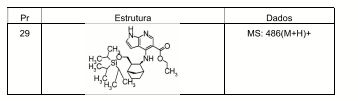
[0152]Numa solução de 4-cloro-2-metil-IH-pirrolo[2,3-b]piridina (0,85 g) em N,N-dimetilformamida (8,5 mL) foi adicionado NaH suspenso em óleo 60% (245 mg) sob atmosfera de nitrogênio durante o esfriamento num banho de água gelada. A solução reacional foi agitada em temperatura ambiente por 1 hora e novamente esfriada no banho de água gelada. À solução reacional foi adicionado cloreto de triisopropilsilila (1,3 mL) lentamente gota a gota por 10 ou mais minutos. A solução reacional foi agitada por 3 horas em temperatura ambiente e diluída com acetato de etila (30 mL). A solução foi lavada com hidrogenocarbonato de sódio aquoso saturado (30 mL) e salmoura (20 mL). A solução foi desidratada com sulfato de magnésio anidro e evaporada sob pressão reduzida. O resíduo foi purificado por cromatografia em coluna de sílica gel (n-hexano) para obter 4-cloro-2-metil-1-(triisopropilsilil)-pirrolo[2,3- b]piridina (1,45 g) como um líquido transparente incolor. Tabela 40
[0153]Os compostos nas Preparações 31-1 até 31-2 mostrados na tabela a seguir foram produzidos usando os compostos de partida correspondentes de acordo com o método similar àquele descrito no Exemplo 19. Tabela 41

[0154]Uma mistura de 4-cloro-2-metil-1-(fenilsulfonil)-1H-pirrolo[2,3-b]piridina (4,73 g), carbonato de potássio (6,4 g), metanol (45 mL), e água (15 mL) foi agitada a 90 °C por 2 horas. Depois de a mistura ser esfriada, os cristais de agulha obtidos foram filtrados e lavados com água para obter 4-cloro-2-metil-1 H-pirrolo [2,3-b] piridina (1,85 g)- Tabela 42
[0155]Numa solução de rel-[(1R,2S,3S,5s)-5-hidroxiadamantan-2- il]carbamato de benzila (5,5 g) em metanol (55 mL) foi adicionado 10% de paládio em carbono (50% de umidade) (1,1 g), e a mistura foi agitada sob atmosfera de hidrogênio em temperatura ambiente por 3 horas. Depois 10% de paládio em carbono foi removido com Celite, o filtrado foi concentrado sob pressão reduzida para obter rel- (1s,3R,4S,5S)-4-adamantamina-1-ol (3,8 g).[0155] In a solution of benzyla carbamate (5.5 g) in methanol (55 ml) - 10% palladium on carbon was added in a solution of rel - [(1R, 2S, 3S, 5s) -5-hydroxyadiene-2-yl] (50% humidity) (1.1 g), and the mixture was stirred under a hydrogen atmosphere at room temperature for 3 hours. After 10% palladium on carbon was removed with Celite, the filtrate was concentrated under reduced pressure to obtain rel- (1s, 3R, 4S, 5S) -4-adamantamine-1-ol (3.8 g).
[0156]Os compostos nas Preparações 33-1 até 33-11 mostrados na tabela a seguir foram produzidos usando os compostos de partida correspondentes de acordo com o método similar àquele descrito na Preparação 33. Tabela 43


[0157]Os compostos nas Preparações 34-1 até 34-3 mostrados na tabela a seguir foram produzidos usando os compostos de partida correspondentes de acordo com o método similar àquele descrito no Exemplo 21. Tabela 45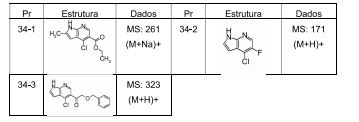
[0158]Numa solução de 5-(4-cloro-1 H-pirrolo[2,3-b] piridino-5-il)-1,2,4- oxadiazol-3-carboxilato de etila (350 mg) em etanol (3,5 mL) foi adicionado hidróxido de sódio 1 M aquoso (1,79 mL) e a solução reacional foi agitada a 50 °C por 3 horas. A solução reacional foi esfriada até 4 °C, e ácido clorídrico 1 M foi adicionado para acidificar a solução. A mistura foi extraída com uma mistura de clorofórmio e metanol (4:1) e lavada com água. A camada orgânica foi seca em sulfato de magnésio e, a seguir, filtrada, o filtrado foi concentrado sob pressão reduzida para obter 4-cloro-5- (1,2,4-oxadiazol-5-il)-1H-pirrolo[2,3-b]piridina (215 mg) como um sólido branco. Tabela 46

[0159]Rel-(1’R,3’S,5’S,7’s) - 5’H -espiro[1,3-dioxolano-2,2’- triciclo[3,3,1,1~3,7~]decano]-5’-ilcarbamato de t-butila (420 mg) foi dissolvido em tetraidrofurano (4,2 mL) e água (4,2 mL), monoidrato do ácido para-tosílico (516 mg) foi adicionado e a mistura foi agitada a 60 °C por 4 horas. A solução reacional foi evaporada sob pressão reduzida e hidrogenocarbonato de sódio aquoso saturado foi adicionado. A mistura foi extraída com acetato de etila. A camada orgânica foi lavada com salmoura saturada, seca em sulfato de magnésio e evaporada sob pressão reduzida. O resíduo foi purificado por cromatografia em coluna de sílica gel (n- hexano:acetato de etila) para obter (cis-4-oxoadamantan-1-il)carbamato de t-butila (120 mg).[0159] Rel- (1'R, 3'S, 5'S, 7's) - 5'H -spiro [1,3-dioxolane-2,2'- tricycle [3,3,1,1 ~ 3.7 ~] dean ] T-butyl-5'-ylcarbamate (420 mg) was dissolved in tetrahydrofuran (4.2 ml) and water (4.2 ml), para-tosyl acid monohydrate (516 mg) was added and the mixture was stirred at 60 ° C for 4 hours. The reaction solution was evaporated under reduced pressure and saturated aqueous sodium hydrogen carbonate was added. The mixture was extracted with ethyl acetate. The organic layer was washed with saturated brine, dried over magnesium sulfate and evaporated under reduced pressure. The residue was purified by silica gel column chromatography (n-hexane: ethyl acetate) to obtain t-butyl (cis-4-oxoadamantan-1-yl) carbamate (120 mg).
[0160]O composto na Preparação 36-1 mostrado na seguinte tabela foi produzido usando o composto de partida correspondente de acordo com o método similar àquele descrito na Preparação 36. Tabela 47
[0161]Numa solução reacional de 2-[(1R,2R,4S)-biciclo[2,2,1]hept-2-il]-1H- isoindol-l,3(2H)-diona (1,4 g) em tetraidrofurano (28 mL) e etanol (28 mL) foi adicionada hidrazina aquosa monoidratada 80% (1,1 mL), e a mistura foi submetida a refluxo por 3 horas. Depois da solução reacional ser esfriada até a temperatura ambiente, o material insolúvel foi removido por filtração. O filtrado foi concentrado sob pressão reduzida para reduzir a quantidade do solvente. Ao resíduo foi adicionado diclorometano, e a mistura foi lavada com hidróxido de sódio aquoso 1 M, seca em sulfato de magnésio anidro e evaporada sob pressão reduzida. Ao resíduo foi adicionado metanol, a mistura foi convertida em cloridrato pela adição de solução de ácido clorídrico 4 M/dioxano, concentrada sob pressão reduzida e seca até endurecer para obter cloridrato de (1R,2R,4S)-biciclo[2,2,1]heptano-2-amina (0,6 g).[0161] In a reaction solution of 2 - [(1R, 2R, 4S) -bicyclo [2,2,1] hept-2-yl] -1H- isoindol-1,3 (2H) -dione (1.4 g ) in tetrahydrofuran (28 ml) and ethanol (28 ml) 80% aqueous monohydrate hydrazine (1.1 ml) was added, and the mixture was refluxed for 3 hours. After the reaction solution was cooled to room temperature, the insoluble material was removed by filtration. The filtrate was concentrated under reduced pressure to reduce the amount of the solvent. To the residue, dichloromethane was added, and the mixture was washed with 1 M aqueous sodium hydroxide, dried over anhydrous magnesium sulfate and evaporated under reduced pressure. To the residue, methanol was added, the mixture was converted to hydrochloride by adding a 4 M hydrochloric acid / dioxane solution, concentrated under reduced pressure and dried until hardened to obtain (1R, 2R, 4S) -bicyclohydrate [2,2, 1] heptane-2-amine (0.6 g).
[0162]O composto na Preparação 37-1 mostrado na tabela a seguir foi produzido usando o composto de partida correspondente de acordo com o método similar àquele descrito na Preparação 37. Tabela 48
[0163]Numa suspensão de (2-{[4-cloro-6-(metilamino)-5-vinilpiridino-3- il]carbonil}hidrazino)(oxo)acetato de metila (450 mg) em tetraidrofurano (7 mL) e dioxano (7 mL) foi adicionado pentassulfeto difósforo (383 mg) sob esfriamento num banho de gelo. Depois a mistura foi agitada em temperatura ambiente por 5 horas. À mistura reacional foi adicionado tetraidrofurano (10 mL) e pentassulfeto difósforo (190 mg). Depois da mistura ser agitada em temperatura ambiente por 2 horas, água foi adicionada à solução reacional e o pH foi ajustado até aproximadamente 10 com hidróxido de sódio aquoso, e a solução foi extraída co acetato de etila. A camada orgânica foi seca em sulfato de magnésio e filtrada. O filtrado foi concentrado sob pressão reduzida. O resíduo foi purificado por cromatografia em sílica ge| (clorofórmio:metanol) para obter metil-5-(4-cloro - 1H - pirrolo[2,3,b]piridino - 5 - j|i 1,3,4-tiadiazol-2-carboxilato (90 mg). Tabela 49
[0164]Os compostos nas Preparações 39-1 até 39-4 mostrados na tabela a seguir foram produzidos usando os compostos de partida correspondentes de acordo com o método similar àquele descrito no Exemplo 45. Tabela 50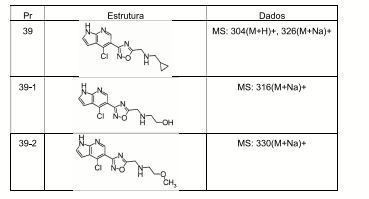

[0165]Numa solução reacional de 4-cloro-1-(triisopropilsilil)-1H-pirrolo[2,3- bjpiridina (2,26 g) em tetraidrofurano (16 mL) foi adicionado sec-butil-lítio (14,6 mL) gota a gota em atmosfera de nitrogênio a -78 °C. Depois de a mistura ser agitada na mesma temperatura por 30 minutos, uma solução de cloroformato de benzila (2,1 mL) em tetraidrofurano (16 mL) foi adicionada gota a gota à mistura reacional a -78 °C. Além disso, a solução reacional foi agitada a -78 °C por 15 minutos, neutralizada com cloreto de amónio aquoso saturado (12 mL) e extraída com acetato de etila. A camada orgânica foi lavada com salmoura saturada, seca em sulfato de magnésio e evaporada sob pressão reduzida. O resíduo foi dissolvido em tetraidrofurano (17 mL), solução de fluoreto de tetrabutilamônio/tetraidrofurano (16,9 mL) foi adicionada e a mistura foi agitada em temperatura ambiente por 3 horas. À solução reacional foi adicionado acetato de etila e água, a mistura foi extraída com acetato de etila. A camada orgânica foi lavada com salmoura saturada, seca em sulfato de magnésio e evaporada sob pressão reduzida. O resíduo foi purificado por cromatografia em coluna de sílica gel (n-hexano:acetato de etila) para obter 4-cloro-1 H-pirrolo[2,3-b]piridino-5-carboxilato de benzila (690 mg).[0165] To a reaction solution of 4-chloro-1- (triisopropylsilyl) -1H-pyrrolo [2,3-bjpyridine (2.26 g) in tetrahydrofuran (16 ml) was added sec-butyl lithium (14.6 ml ) drop by drop in a nitrogen atmosphere at -78 ° C. After the mixture was stirred at the same temperature for 30 minutes, a solution of benzyl chloroformate (2.1 ml) in tetrahydrofuran (16 ml) was added dropwise to the reaction mixture at -78 ° C. In addition, the reaction solution was stirred at -78 ° C for 15 minutes, neutralized with saturated aqueous ammonium chloride (12 mL) and extracted with ethyl acetate. The organic layer was washed with saturated brine, dried over magnesium sulfate and evaporated under reduced pressure. The residue was dissolved in tetrahydrofuran (17 ml), tetrabutylammonium fluoride / tetrahydrofuran solution (16.9 ml) was added and the mixture was stirred at room temperature for 3 hours. To the reaction solution, ethyl acetate and water were added, the mixture was extracted with ethyl acetate. The organic layer was washed with saturated brine, dried over magnesium sulfate and evaporated under reduced pressure. The residue was purified by silica gel column chromatography (n-hexane: ethyl acetate) to obtain benzyl 4-chloro-1H-pyrrolo [2,3-b] pyridine-5-carboxylate (690 mg).
[0166]Os compostos nas Preparações 40-1 até 40-3 mostrados na tabela a seguir foram produzidos usando os correspondentes compostos de partida de acordo com o método similar àquele descrito na Preparação 40. Tabela 51

[0167]Num tubo fechado de metal de 100 mL foi colocado um bastão de agitação, éster do ácido 4-{[(3-exo)8-benzil-8-azabiciclo[3,2,1]oct-3-il]amino}-6-cloro- 5-nicotínico (1,5 g), amónia aquosa 28% (4,6 mL) e etanol (7,5 mL). O tubo foi fechado e agitado a 90 °C por 2 horas. Depois de ser esfriada, a solução reacional foi diluída com metanol (20 mL) e evaporada sob pressão reduzida. O resíduo foi recristalizado a partir de acetato de etila-metanol para obter o éster do ácido 6-amino-4-{[(3-exo)8- benzil-8-azabiciclo[3,2,1]oct-3-il]amino}-5-nicotínico (1,3 g) como um sólido amarelo.[0167] In a closed 100 ml metal tube, a stirring stick, 4 - {[(3-exo) 8-benzyl-8-azabicyclo [3,2,1] oct-3-yl] ester was placed amino} -6-chloro-5-nicotinic (1.5 g), 28% aqueous ammonia (4.6 ml) and ethanol (7.5 ml). The tube was closed and stirred at 90 ° C for 2 hours. After being cooled, the reaction solution was diluted with methanol (20 ml) and evaporated under reduced pressure. The residue was recrystallized from ethyl acetate-methanol to obtain the 6-amino-4 - {[(3-exo) 8-benzyl-8-azabicyclo [3,2,1] oct-3-yl ester ] amino} -5-nicotinic (1.3 g) as a yellow solid.
[0168]O composto na Preparação 41-1 mostrado na tabela a seguir foi produzido usando o composto de partida correspondente de acordo com o método semelhante àquele descrito na Preparação 41. Tabela 53
[0169]Os compostos nas Preparações 42-1 até 42-26 mostrados na tabela a seguir foram produzidos usando os correspondentes compostos de partida de acordo com o método semelhante àquele descrito no Exemplo 7. Tabela 54


[0170]O composto na Preparação 43 mostrado na tabela a seguir foi produzido usando o composto de partida correspondente de acordo com o método semelhante àquele descrito no Exemplo 41. Tabela 56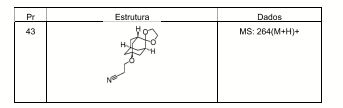
[0171]Numa solução de 4-aminoadamantan-1-ol (8,9 g) em tetraidrofurano (89 mL) foram adicionados cloreto de benziloxicarbonila (7,6 mL) e hidróxido de sódio 1 M aquoso (53,4 mL) gota a gota sucessivamente sob esfriamento com gelo, e a mistura foi agitada por 3 horas sob esfriamento com gelo. A solução reacional foi vertida em hidrogenossulfato de potássio aquoso, e a mistura foi extraída com acetato de etila. A camada orgânica foi lavada com salmoura saturada, seca em sulfato de magnésio anidro e evaporada sob pressão reduzida. O resíduo foi purificado por cromatografia em coluna de sílica gel (n-hexano:acetato de etila = 1:1 até 1:3) para obter rel-[(1R,2S,3S,5s)-5-hidroxiadamantan-2-il]carbamato de benzila (6,2 g) e rel- [(1 R,2R,3S,5s)-5-hidroxiadamantan-2-il]carbamato de benzila (5,3 g). Tabela 57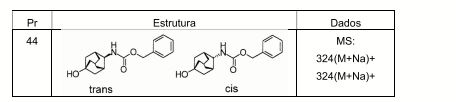
[0172]Numa solução de (1R,2S,4S)-biciclo[2,2,1]heptano-2-ol (1,0 g) em tetraidrofurano (10 mL) foram adicionados ftalimida (1,4 g) e trifenilfosfino (2,6 g), e dietilazodicarboxilato (1,5 mL) gota a gota sob esfriamento com gelo. A mistura foi aquecida até a temperatura ambiente e agitada por 24 horas. A solução reacional foi concentrada sob pressão reduzida e o resíduo foi purificado por cromatografia em coluna de sílica gel (n-hexano:acetato de etila) = 100:0 até 95:5) para obter 2- [(1R,2R,4S)-biciclo[2,2,1]hept-2-il]-1H-isoindol-l,3(2H)-diona (1,4 g) como um sólido incolor.[0172] In a solution of (1R, 2S, 4S) -bicyclo [2,2,1] heptane-2-ol (1.0 g) in tetrahydrofuran (10 ml) were added phthalimide (1.4 g) and triphenylphosphine (2.6 g), and diethylazodicarboxylate (1.5 ml) drop by drop under ice cooling. The mixture was warmed to room temperature and stirred for 24 hours. The reaction solution was concentrated under reduced pressure and the residue was purified by silica gel column chromatography (n-hexane: ethyl acetate) = 100: 0 to 95: 5) to obtain 2- [(1R, 2R, 4S) -bicyclo [2,2,1] hept-2-yl] -1H-isoindol-1,3 (2H) -dione (1.4 g) as a colorless solid.
[0173]O composto na Preparação 45-1 mostrado na tabela a seguir foi produzido usando o composto de partida correspondente de acordo com o método similar àquele descrito na Preparação 45. Tabela 58
[0174]Uma mistura de éster do ácido 6-cloro-4-{[5-metoxiadamantan-2- il]amino}-5-nicotínico (635 mg), benzilamina (253 pL), diisopropiletilamina (270 pL) e 2-propanol (3 mL) foi submetida à irradiação de microondas sob atmosfera de nitrogênio e aquecida a 90 °C por 30 minutos. Depois de ser esfriada, a solução reacional foi diluída com acetato de etila (20 mL) e vertida em cloreto de amónia aquoso saturado 1/2 (20 mL). A mistura foi extraída com acetato de etila (20 mL) duas vezes, lavada com salmoura (30 mL), desidratada com sulfato de magnésio anidro e concentrada sob pressão reduzida. O resíduo foi purificado por cromatografia em coluna de sílica gel (n-hexano:acetato de etila) para obter o éster do ácido etil-6- benzilamino-4-{[5-metoxiadamantan-2-il]amino}-5-nicotínico (550 mg) como um sólido laranja.[0174] A mixture of 6-chloro-4 - {[5-methoxyiadamantan-2-yl] amino} -5-nicotinic acid ester (635 mg), benzylamine (253 pL), diisopropylethylamine (270 pL) and 2- propanol (3 mL) was subjected to microwave irradiation under a nitrogen atmosphere and heated to 90 ° C for 30 minutes. After being cooled, the reaction solution was diluted with ethyl acetate (20 ml) and poured into 1/2 saturated aqueous ammonium chloride (20 ml). The mixture was extracted with ethyl acetate (20 ml) twice, washed with brine (30 ml), dehydrated with anhydrous magnesium sulfate and concentrated under reduced pressure. The residue was purified by silica gel column chromatography (n-hexane: ethyl acetate) to obtain the ester of ethyl-6-benzylamino-4 - {[5-methoxymangan-2-yl] amino} -5-nicotinic acid (550 mg) as an orange solid.
[0175]Os compostos nas Preparações 46-1 a 46-2 mostrados na tabela a seguir foram produzidos usando os correspondentes compostos de partida de acordo com o método similar Àquele descrito na Preparação 46. Tabela 59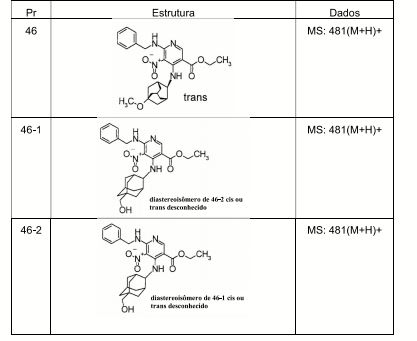
[0176]Uma solução de 4-cloro-2-metil-1-(triisopropilsilil)-l H-pirrolo[2,3- b]piridina (525 mg) em tetraidrofurano (10 mL) foi esfriada até -78 °C sob atmosfera de nitrogênio, e à mistura reacional foi adicionada solução de sec-butil-lítio 0,99 M/cicloexano (4,1 mL) gota a gota. Depois de a mistura ser agitada a -78 °C, clorocarbonato de etila (389 gL) foi adicionado gota a gota. A solução reacional foi agitada a -78 °C por 30 minutos, cloreto de amónio saturado (20 mL) foi adicionado e a temperatura retomou até a temperatura ambiente. A solução reacional foi transferida para um funil de separação e extraída com acetato de etila. A camada orgânica foi lavada com salmoura, seca em sulfato de magnésio anidro, filtrada e evaporada sob pressão reduzida, o resíduo foi purificado por cromatografia em coluna de sílica gel (n-hexano) para obter 4-cloro-2-metil-1 -(triisopropilsilil) - 1H - pirrolo [2,3-b] piridino-5- carboxilato de etila (645 mg) como um líquido viscoso incolor.[0176] A solution of 4-chloro-2-methyl-1- (triisopropylsilyl) -1 H-pyrrolo [2,3-b] pyridine (525 mg) in tetrahydrofuran (10 ml) was cooled to -78 ° C under nitrogen atmosphere, and 0.99 M sec-butyl lithium / cyclohexane solution (4.1 mL) was added dropwise to the reaction mixture. After the mixture was stirred at -78 ° C, ethyl chlorocarbonate (389 gL) was added dropwise. The reaction solution was stirred at -78 ° C for 30 minutes, saturated ammonium chloride (20 mL) was added and the temperature returned to room temperature. The reaction solution was transferred to a separatory funnel and extracted with ethyl acetate. The organic layer was washed with brine, dried over anhydrous magnesium sulfate, filtered and evaporated under reduced pressure, the residue was purified by silica gel column chromatography (n-hexane) to obtain 4-chloro-2-methyl-1 - (triisopropylsilyl) - 1H - ethyl pyrrolo [2,3-b] pyridine-5-carboxylate (645 mg) as a colorless viscous liquid.
[0177]O composto na Preparação 47-1 mostrado na tabela a seguir foi produzido usando o composto de partida correspondente de acordo com o método similar àquele descrito na Preparação 47. Tabela 60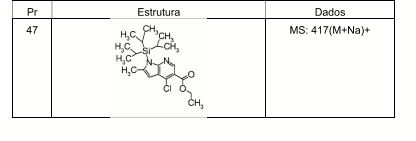

[0178]Uma mistura de éster do ácido 4,6-dicloro-5-nitronicotinico (1 g), cloridrato de 2-adamantamina (708 mg), diisopropiletilamina (1.3 mL) e 2-propanol (4 mL) foi submetida à irradiação com microondas sob atmosfera de nitrogênio, e aquecida a 90 °C por 10 minutos. Depois de ser esfriada, a solução reacional foi diluída com acetato de etila (20 mL) e vertida em cloreto de amónio aquoso saturado 1/2 (20 mL). A mistura foi extraída com acetato de etila (20 mL) duas vezes, lavada com salmoura (30 mL), desidratada com sulfato de magnésio anidro e evaporada sob pressão reduzida. O resíduo foi purificado por cromatografia em coluna de sílica gel (n-hexano:acetato de etila) para obter éster do ácido 4-(2-adamantilamino)-6-cloro-5- nicotínico (1,23 g) como um sólido laranja.[0178] A mixture of 4,6-dichloro-5-nitronicotinic acid ester (1 g), 2-adamantamine hydrochloride (708 mg), diisopropylethylamine (1.3 ml) and 2-propanol (4 ml) was irradiated with microwave under nitrogen atmosphere, and heated to 90 ° C for 10 minutes. After being cooled, the reaction solution was diluted with ethyl acetate (20 ml) and poured into 1/2 saturated aqueous ammonium chloride (20 ml). The mixture was extracted with ethyl acetate (20 ml) twice, washed with brine (30 ml), dehydrated with anhydrous magnesium sulfate and evaporated under reduced pressure. The residue was purified by silica gel column chromatography (n-hexane: ethyl acetate) to obtain 4- (2-adamantylamino) -6-chloro-5-nicotinic ester (1.23 g) as an orange solid .
[0179]Os compostos nas Preparações 48-1 até 48-5 mostrados na tabela a seguir foram produzidos usando os compostos de partida correspondentes de acordo com o método similar àquele descrito na Preparação 48. Tabela 61


[0180]Uma mistura de éster etílico do ácido 4,6-dicloro-5-nitronicotínico (333 mg), 4-amino-1 -adamantanol (200 mg), diisopropiletilamina (219 pL) e álcool isopropílico (1 mL) foi submetida à irradiação com microondas sob atmosfera de nitrogênio e aquecida a 90 °C por 10 minutos. Depois de a mistura ser esfriada, benzilamina (157 pL) foi adicionada à solução reacional, a mistura foi submetida à irradiação com microondas novamente e aquecida a 90 °C por 10 minutos. Depois de ser esfriada, a solução reacional foi diluída com acetato de etila (20 mL), vertida em cloreto de amónio aquoso saturado 1/2 (20 mL), extraída com acetato de etila (20 mL) duas vezes, lavada com salmoura (30 mL), seca em sulfato de magnésio anidro e filtrada. O filtrado foi evaporado sob pressão reduzida. O resíduo foi purificado por cromatografia em coluna de sílica gel (clorofórmio:metanol) para obter o éster etílico do ácido 6-(benzilamino)-4-[(5-hidróxi-2-adamantil)amino]-nicotínico (515 mg) como um sólido laranja.[0180] A mixture of 4,6-dichloro-5-nitronicotinic acid ethyl ester (333 mg), 4-amino-1 -adamantanol (200 mg), diisopropylethylamine (219 pL) and isopropyl alcohol (1 mL) microwave irradiation under a nitrogen atmosphere and heated to 90 ° C for 10 minutes. After the mixture was cooled, benzylamine (157 pL) was added to the reaction solution, the mixture was subjected to microwave irradiation again and heated to 90 ° C for 10 minutes. After being cooled, the reaction solution was diluted with ethyl acetate (20 ml), poured into 1/2 saturated aqueous ammonium chloride (20 ml), extracted with ethyl acetate (20 ml) twice, washed with brine ( 30 mL), dried over anhydrous magnesium sulfate and filtered. The filtrate was evaporated under reduced pressure. The residue was purified by silica gel column chromatography (chloroform: methanol) to obtain 6- (benzylamino) -4 - [(5-hydroxy-2-adamantyl) amino] -nicotinic acid ethyl ester (515 mg) as an orange solid.
[0181]Os compostos nas Preparações 49-1 a 49-5 mostrados na tabela a seguir foram produzidos usando os correspondentes compostos de partida de acordo com o método similar àquele descrito na Preparação 49. Tabela 63


[0182]O composto na Preparação 50 mostrado na tabela a seguir foi produzido usando o composto de partida correspondente de acordo com o método similar àquele descrito no Exemplo 10. Tabela 65
[0183]O composto na Preparação 51 mostrado na tabela a seguir foi produzido usando o composto de partida correspondente de acordo com o método similar àquele descrito no Exemplo 28. Tabela 66
[0184]10% de paládio em carbono (50% de umidade) (40 mg) foi adicionado numa solução de 4-[(5-carbamoiladamantan-2-il)amino]-1H-pirrolo-[2,3-b]piridino-5- carboxilato de benzila (183 mg) em metanol (5 ml) e 1,4-dioxano (5 mL), e hidrogenada sob atmosfera de hidrogênio por 5 horas. Os precipitados resultantes foram dissolvidos por tetraidrofurano e os catalisadores foram removidos por filtração. Os filtrados foram evaporados in vacuopara produzir o ácido 4-[(5-carbamoiladamantan- 2-il)amino]-1H-pirrolo[2,3-b]piridino-5-carboxílico (117 mg).[0184] 10% palladium on carbon (50% moisture) (40 mg) was added in a solution of 4 - [(5-carbamoyl mangan-2-yl) amino] -1H-pyrrole- [2,3-b] benzyl pyridine-5-carboxylate (183 mg) in methanol (5 ml) and 1,4-dioxane (5 ml), and hydrogenated under a hydrogen atmosphere for 5 hours. The resulting precipitates were dissolved by tetrahydrofuran and the catalysts were removed by filtration. The filtrates were evaporated in vacuo to yield 4 - [(5-carbamoyl-mannan-2-yl) amino] -1H-pyrrolo [2,3-b] pyridine-5-carboxylic acid (117 mg).
[0185]Os compostos nas Preparações 52-1 até 52-17 mostrados na tabela a seguir foram produzidos usando os compostos de partida correspondentes de acordo com o método similar àquele descrito na Preparação 52. Tabela 67


[0186]O composto na Preparação 53-1 até a 53-4 mostrado na tabela a seguir foi produzido usando o composto de partida correspondente de acordo com o método similar àquele descrito no Exemplo 16. Tabela 69


[0187]Numa solução de 5-(4-cloro-1H-pirrolo[2,3-b]piridina-5-il)-N-metil-1,3,4- oxadiazol-2-carboxamida (18 mg) em 1-metil-2-pirrolidona (0,18 mL) foram adicionados N,N-dibutil-1-butanamina (0,046 mL) e cis-(1S,3R,4R,5S)-4- aminoadamantan-1-ol (32,5 mg) sob temperatura ambiente. A mistura foi aquecida imediatamente até 150 °C e agitada por 2 horas. Depois do desaparecimento do composto de partida ter sido averiguado, o resíduo foi purificado por cromatografia em coluna de sílica gel (clorofórmio:metanol = 97:3 até 85:15) para obter cis-5-(4- {[(1 R,2R,3S,5s)-5-hidroxiadamantan-2-il]amino}-1 H-pirrolo[2,3-b]pi ridina-5-il) -N- metil-1,3,4-oxadiazol-2-carboxamida (19,8 mg) como um sólido branco.[0187] In a solution of 5- (4-chloro-1H-pyrrolo [2,3-b] pyridine-5-yl) -N-methyl-1,3,4-oxadiazole-2-carboxamide (18 mg) in 1-methyl-2-pyrrolidone (0.18 ml) were added N, N-dibutyl-1-butanamine (0.046 ml) and cis- (1S, 3R, 4R, 5S) -4-aminoadamantan-1-ol (32 , 5 mg) at room temperature. The mixture was heated immediately to 150 ° C and stirred for 2 hours. After the disappearance of the starting compound was ascertained, the residue was purified by silica gel column chromatography (chloroform: methanol = 97: 3 to 85:15) to obtain cis-5- (4- {[(1 R, 2R, 3S, 5s) -5-hydroxyadamantan-2-yl] amino} -1 H-pyrrolo [2,3-b] pyridine-5-yl) -N-methyl-1,3,4-oxadiazole-2 -carboxamide (19.8 mg) as a white solid.
[0188]Em 1-[(1S,2R,5S)-6,6-dimetilbiciclo[3,1,1]hept-2-il]metanamina (61 mg) foi adicionada uma solução de 4-cloro-1H-pirrolo[2,3-b]piridino-5-carboxamida (39 mg) em í-metil-2-pirrolidona (0,6 mL), trietilamina (0,056 mL) e iodeto de sódio (3 mg), e a mistura foi agitada a 130 °C por 17 horas. Depois da mistura reacional ser deixada esfriar, à mistura reacional foram adicionados N,N-dimetilformamida (0,3 mL) e água (0,1 mL), e a mistura reacional foi dissolvida. A mistura reacional foi diretamente purificada por HPLC preparativo (10 mM - NH4HCO3 + NH3(pH = 9,2):CH3CN = 98,2 até 30:70). A fração ativa foi concentrada e seca até ficar dura para obter 4- ({[(1 S,2R,5S)-6,6-dimetilbiciclo[3,1,1] hept - 2 - il]metil}amino) - 1H - pirrolo[2,3- b]piridino-5 -carboxamida (33,5 mg) como um sólido.[0188] In 1 - [(1S, 2R, 5S) -6,6-dimethylbicyclo [3,1,1] hept-2-yl] methanamine (61 mg) a solution of 4-chloro-1H-pyrrole was added [2,3-b] pyridine-5-carboxamide (39 mg) in i-methyl-2-pyrrolidone (0.6 ml), triethylamine (0.056 ml) and sodium iodide (3 mg), and the mixture was stirred at 130 ° C for 17 hours. After the reaction mixture was allowed to cool, to the reaction mixture were added N, N-dimethylformamide (0.3 ml) and water (0.1 ml), and the reaction mixture was dissolved. The reaction mixture was directly purified by preparative HPLC (10 mM - NH4HCO3 + NH3 (pH = 9.2): CH3CN = 98.2 until 30:70). The active fraction was concentrated and dried until hard to obtain 4- ({[(1 S, 2R, 5S) -6,6-dimethylbicyclo [3,1,1] hept - 2 - yl] methyl} amino) - 1H - pyrrolo [2,3-b] pyridine-5-carboxamide (33.5 mg) as a solid.
[0189]Numa suspensão 4-(2-oxo-3,6-diidropirazolo[4,5-d]pirrolo[2,3- b]piridino-1(2H)-il)adamantan-1-carboxilato de metila (40 mg) em metanol (0,4 mL) e dioxano (0,4 mL) foi adicionado hidróxido de sódio aquoso 1 M (0,22 mL) e a suspensão foi submetida à refluxo por 2 horas. A solução reacional foi esfriada até a temperatura ambiente, o pH foi ajustado para 5 com ácido clorídrico aquoso 1 M e solução tampão pH 4, e a solução reacional foi evaporada sob pressão reduzida, o sólido obtido foi coletado por filtração e lavado com água para obter o ácido 4-(2-oxo- 3,6-diidroimidazo[4,5-d] pirrolo [2,3-b] piridino - 1(2H) - il) adamantan-1 -carboxilico (32 mg).[0189] In a suspension methyl 4- (2-oxo-3,6-dihydropyrazolo [4,5-d] pyrrolo [2,3-b] pyridine-1 (2H) -yl) adamantan-1-carboxylate (40 mg) in methanol (0.4 ml) and dioxane (0.4 ml) 1 M aqueous sodium hydroxide (0.22 ml) was added and the suspension was refluxed for 2 hours. The reaction solution was cooled to room temperature, the pH was adjusted to 5 with 1 M aqueous hydrochloric acid and pH 4 buffer solution, and the reaction solution was evaporated under reduced pressure, the obtained solid was collected by filtration and washed with water to obtain 4- (2-oxo-3,6-dihydroimidazo [4,5-d] pyrrolo [2,3-b] pyridine - 1 (2H) -yl) adamantan-1-carboxylic acid (32 mg).
[0190]Ácido 4-(2-oxo-3,6-diidroimidazo[4,5-d]pirrolo [2,3-b]piridino-1 (2H)- il)adamantan-1-carboxilico (50 mg) foi suspenso em N,N-dimetilformamida (1 mL). À suspensão foram adicionados cloridrato de aminoacetonitrila (17 mg), 1- hidroxibenzotriazol (28 mg), diisopropiletilamina (62 pL), e cloridrato de 1-etil-3-(3- dimetilaminopropil)-carbodiimida (41 mg) sucessivamente, e a mistura foi agitada de um dia para o outro em temperatura ambiente. À solução reacional foram adicionados acetato de etila e água, e a camada orgânica foi extraída. A camada orgânica foi lavada com salmoura saturada, seca em sulfato de magnésio e evaporada sob pressão reduzida. O resíduo foi purificado por cromatografia em coluna de sílica gel (clorofórmio:metanol) para obter N-(cianometil)-4-(2-oxo-3,6-diidroimidazo[4,5- d]pirrolo [2,3-b] piridino-1(2H)-il)adamantan-1-carboxamida (23 mg).[0190] 4- (2-oxo-3,6-dihydroimidazo [4,5-d] pyrrolo [2,3-b] pyridine-1 (2H) -yl) adamantan-1-carboxylic acid (50 mg) was suspended in N, N-dimethylformamide (1 ml). To the suspension were added aminoacetonitrile hydrochloride (17 mg), 1-hydroxybenzotriazole (28 mg), diisopropylethylamine (62 pL), and 1-ethyl-3- (3-dimethylaminopropyl) -carbodiimide hydrochloride (41 mg) in succession, and The mixture was stirred overnight at room temperature. To the reaction solution, ethyl acetate and water were added, and the organic layer was extracted. The organic layer was washed with saturated brine, dried over magnesium sulfate and evaporated under reduced pressure. The residue was purified by silica gel column chromatography (chloroform: methanol) to obtain N- (cyanomethyl) -4- (2-oxo-3,6-dihydroimidazo [4,5-d] pyrrole [2,3-b ] pyridine-1 (2H) -yl) adamantan-1-carboxamide (23 mg).
[0191]Numa solução de ácido 3-metilbenzóico (22,4 mg) em 1-metil-2- pirrolidona (0,6 mL) foram adicionados 4-[(3-exo-8 - azabiciclo [3,2,1] oct - 3 - il) amino] -1 H-pirrolo[2,3-b] piridina-5-carboxamida (42,8 mg) e 1-hidroxibenzotriazol (22,3 mg). Além disso, uma solução de 1-etil-3-(3-dimetilaminopropil)-carbodiimida/1- metil-2-pirrolidona 1 M (0,225 mL) foi adicionada, e a mistura foi agitada por 4 horas a 50 °C. Depois de ser esfriada, a solução reacional foi diretamente purificada por um sistema de HPLC preparativo (10 mM - NH4HCO3 + NH3 (pH = 9,2):CH3CN = 98:2 até 30:70). A fração ativa foi concentrada e seca até ficar dura para obter 4-{[(3-exo)-8-(3- metilbenzoil)-8-azabiciclo[3,2,1 ]oct-3-il)amino]}-1 H-pi rrolo[2,3-b] pi ridi no-5- carboxamida (34,8 mg) como um sólido.[0191] In a solution of 3-methylbenzoic acid (22.4 mg) in 1-methyl-2-pyrrolidone (0.6 ml) were added 4 - [(3-exo-8 - azabicyclo [3,2,1] oct - 3 - yl) amino] -1 H-pyrrolo [2,3-b] pyridine-5-carboxamide (42.8 mg) and 1-hydroxybenzotriazole (22.3 mg). In addition, a 1 M solution of 1-ethyl-3- (3-dimethylaminopropyl) -carbodiimide / 1-methyl-2-pyrrolidone (0.225 ml) was added, and the mixture was stirred for 4 hours at 50 ° C. After being cooled, the reaction solution was directly purified by a preparative HPLC system (10 mM - NH4HCO3 + NH3 (pH = 9.2): CH3CN = 98: 2 until 30:70). The active fraction was concentrated and dried until hard to obtain 4 - {[(3-exo) -8- (3-methylbenzoyl) -8-azabicyclo [3,2,1] oct-3-yl) amino]} - 1 H-pyrrolo [2,3-b] pyridine-5-carboxamide (34.8 mg) as a solid.
[0192]Numa solução de 2-aminoetanol (18,6 mg) em 1-metil-2-pirrolidona (0,6 mL) foram adicionados ácido cis-4-{[(1R,2R,3S,5s)-5-hidroxiadamantan-2-il]amino} - 1H -pirrolo [2,3-b]piridino-5-carboxílico (41 mg) e 1-hidroxibenzotriazol (18,6 mg). Além disso, uma solução de 1 -etil - 3 - (3 - dimetilaminopropil)-carbodiimida/1-metil- 2-pirrolidona (0,188 mL) foi adicionada, e a mistura foi agitada por 6 horas a 60 °C. Depois de ser esfriada, a solução reacional foi diretamente purificada por HPLC preparativo (10 mM - NH4HCO3 + NH3 (pH = 9,2):CH3CN = 98:2 até 30:70). A fração ativa foi concentrada e seca até ficar dura para obter 4-{[(2r,5s)-5-hidroxiadamantan- 2-il]amino}-N-(2-hidroxietil) - 1 H-pirrolo[2,3-b]piridino-5-carboxamida (22,9 mg) como um sólido.[0192] In a solution of 2-aminoethanol (18.6 mg) in 1-methyl-2-pyrrolidone (0.6 ml), cis-4 acid was added - {[(1R, 2R, 3S, 5s) -5- hydroxiadamantan-2-yl] amino} - 1H -pyrrole [2,3-b] pyridine-5-carboxylic (41 mg) and 1-hydroxybenzotriazole (18.6 mg). In addition, a solution of 1-ethyl - 3 - (3 - dimethylaminopropyl) -carbodiimide / 1-methyl-2-pyrrolidone (0.188 ml) was added, and the mixture was stirred for 6 hours at 60 ° C. After being cooled, the reaction solution was directly purified by preparative HPLC (10 mM - NH4HCO3 + NH3 (pH = 9.2): CH3CN = 98: 2 until 30:70). The active fraction was concentrated and dried until hard to obtain 4 - {[(2r, 5s) -5-hydroxiadamantan-2-yl] amino} -N- (2-hydroxyethyl) - 1 H-pyrrole [2,3- b] pyridine-5-carboxamide (22.9 mg) as a solid.
[0193]Numa solução de 3-(4-{[(2r,5s)-5-hidroxiadamantan-2-il]amino}-1H- pirrolo[2,3-b]piridino-5-il)-1,2,4-oxadiazol-5-carboxilato de etila (25 mg) em 1-metil-2- pirrolidona (0,25 mL) foi adicionado 2-piperazin-1-iletanol (8,5 mg) sob temperatura ambiente. A mistura foi imediatamente aquecida até 50 °C e agitada por 0,5 hora. Depois do desaparecimento do composto de partida ser averiguado, o resíduo foi purificado por cromatografia em coluna de sílica gel (clorofórmio:metanol = 96:4 até 87:13) para obter cis-(1s,3R,4R,5S)- 4 -{[5-(5-{[4-(2-hidroxietil)piperazin-1 -il] carbonil}- l,2,4-oxadiazol-3-il)-1 H-pirrolo[2,3-b]piridino-4-il]amino}adamantan-1-ol (22,6 mg) como um sólido branco amarelado.[0193] In a solution of 3- (4 - {[(2r, 5s) -5-hydroxyadamantan-2-yl] amino} -1H-pyrrolo [2,3-b] pyridine-5-yl) -1,2 , 4-oxadiazole-5-carboxylate (25 mg) in 1-methyl-2-pyrrolidone (0.25 ml) was added 2-piperazin-1-ylethanol (8.5 mg) at room temperature. The mixture was immediately heated to 50 ° C and stirred for 0.5 hour. After the disappearance of the starting compound was ascertained, the residue was purified by silica gel column chromatography (chloroform: methanol = 96: 4 to 87:13) to obtain cis- (1s, 3R, 4R, 5S) - 4 - {[5- (5 - {[4- (2-hydroxyethyl) piperazin-1-yl] carbonyl} - 1,2,4-oxadiazol-3-yl) -1 H-pyrrolo [2,3-b] pyridine -4-yl] amino} adamantan-1-ol (22.6 mg) as a yellowish white solid.
[0194]Numa solução de cloridrato de metilamina (4,7 mg) em 1-metil-2- pirrolidona (0,3 mL) foram adicionados cis-5-(4-{[(1R,2R,3S,5s)-5-hidroxiadamantan- 2-il]amino}-1 H-pirrolo [2,3-b]piridino-5-il)-1,2,4-oxadiazol-5-carboxilato de etila (14,8 mg) e diisopropilamina (0,0183 mL), e a mistura foi agitada por 6 horas a 90 °C. Depois de ser esfriada, a solução reacional foi diretamente purificada por um sistema de HPLC preparativo (10 mM - NH4HCO3 + NH3(pH = 9,2):CH3CN = 90:10 até 20:80). A fração ativa foi concentrada e seca até ficar dura para obter 5-(4-{[(2r,5s)-5- hidroxiadamantan-2-il]amino} - 1H - pirrolo[2,3-b]piridino-5-il)-N-metil-1,2,4-oxadiazol- 3-carboxamida (6,74 mg) como um sólido.[0194] In a solution of methylamine hydrochloride (4.7 mg) in 1-methyl-2-pyrrolidone (0.3 ml), cis-5- (4 - {[(1R, 2R, 3S, 5s) - Ethyl 5-hydroxyamide-2-yl] amino} -1 H-pyrrolo [2,3-b] pyridino-5-yl) -1,2,4-oxadiazole-5-carboxylate (14.8 mg) and diisopropylamine (0.0183 mL), and the mixture was stirred for 6 hours at 90 ° C. After being cooled, the reaction solution was directly purified by a preparative HPLC system (10 mM - NH4HCO3 + NH3 (pH = 9.2): CH3CN = 90:10 until 20:80). The active fraction was concentrated and dried until hard to obtain 5- (4 - {[(2r, 5s) -5-hydroxyadamantan-2-yl] amino} - 1H - pyrrole [2,3-b] pyridine-5- il) -N-methyl-1,2,4-oxadiazole-3-carboxamide (6.74 mg) as a solid.
[0195]Numa solução de dicloridrato de cis-5-(4-{[(1R,2R, 3S,5s) - 5 - hidroxiadamantan-2-il]amino}-1 H-pirrolo[2,3-b] piridino-5-il) - N - piperidino - 4 - II - 1,2,4-oxadiazol-3-carboxamida (20 mg) em 1-metil-2-pirrolidona (0,25 mL) foram adicionados N-etil-N-isopropilpropan-2-amina (0,025 mL)e anidrido acético (0,043 mL) sob temperatura ambiente, e a mistura foi agitada por 1 hora. O resíduo foi purificado por cromatografia em coluna em sílica gel (clorofórmio:metanol = 99:1 até 89:11) para obter cis-N-(1-acetilpiperidinO-4-il)-5-(4-{[(1R,2R,3S,5s) - 5 - hidroxiadamantan-2- il]amino}-1 H-pirrolo[2,3-b]piridinO - 5-NJ-1,2,4-oxadiazol-3-carboxamida (7,8 mg) como um sólido branco amarelado.[0195] In a cis-5- (4 - {[(1R, 2R, 3S, 5s) - 5 - hydroxyadamantan-2-yl] amino} -1 H-pyrrolo [2,3-b] pyridine dihydrochloride solution -5-yl) - N - piperidine - 4 - II - 1,2,4-oxadiazole-3-carboxamide (20 mg) in 1-methyl-2-pyrrolidone (0.25 ml) N-ethyl-N was added -isopropylpropan-2-amine (0.025 ml) and acetic anhydride (0.043 ml) at room temperature, and the mixture was stirred for 1 hour. The residue was purified by column chromatography on silica gel (chloroform: methanol = 99: 1 to 89:11) to obtain cis-N- (1-acetylpiperidinO-4-yl) -5- (4 - {[(1R, 2R, 3S, 5s) - 5 - hydroxyadamantan-2-yl] amino} -1 H-pyrrolo [2,3-b] pyridinO - 5-NJ-1,2,4-oxadiazole-3-carboxamide (7,8 mg) as a yellowish white solid.
[0196]Em dicloridrato de 1-(5-aminoadamantan-2-il)-3,6-diidroimidazo[4,5- d]pirrolo[2,3-b]piridino-2(1H)-ona (15 mg) foram adicionados diclorometano-metanol e hidrogenocarbonato de sódio aquoso saturado, e a camada orgânica foi extraída. A camada orgânica foi seca em sulfato de magnésio e filtrada. O filtrado foi evaporado sob pressão reduzida. O resíduo foi suspenso em diclorometano (7,5 mL) e trietilamina (13 pL) e cloreto de propanoíla (4 pL) foram adicionados. A mistura foi agitada de um dia para o outro em temperatura ambiente. A solução reacional foi purificada por cromatografia em coluna de sílica gel (clorofórmio:metanol) para obter N-[4-(2-oxo- 3,6-diidroimidazo[4,5-d]pirrolo[2,3-b]piridino-1 (2H)-il)adamantan-1 -il]propanamida (2 mg).[0196] In 1- (5-aminoadamantan-2-yl) -3,6-dihydroimidazo [4,5-d] pyrrole [2,3-b] pyridine-2 (1H) -one dihydrochloride (15 mg) dichloromethane-methanol and saturated aqueous sodium hydrogen carbonate were added, and the organic layer was extracted. The organic layer was dried over magnesium sulfate and filtered. The filtrate was evaporated under reduced pressure. The residue was suspended in dichloromethane (7.5 ml) and triethylamine (13 pL) and propanoyl chloride (4 pL) were added. The mixture was stirred overnight at room temperature. The reaction solution was purified by silica gel column chromatography (chloroform: methanol) to obtain N- [4- (2-oxo- 3,6-dihydroimidazo [4,5-d] pyrrolo [2,3-b] pyridine -1 (2H) -yl) adamantan-1-yl] propanamide (2 mg).
[0197]Numa solução de ácido cis-4-{[(1R,2R,3S,5s)-5-hidroxiadamantan - 2 - il]amino}-1H-pirrolo[2,3-b]piridino-5-carboxílico (30 mg) em N,N-dimetilformamida (0,21 mL) foram adicionados N,N’-carbonildiimidazol (22,3 mg) e solução de dimetilamina 2 M/metanol (0,183 mL) sucessivamente sob temperatura ambiente. A mistura foi agitada em temperatura ambiente por 18 horas. Água foi adicionada à solução racional, e a solução reacional foi filtrada. O resíduo sólido foi filtrado com água e seco. O resíduo foi purificado por cromatografia em coluna de sílica gel de camada fina (clorofómnio:metanol = 10:1) para obter cis-4-{[(1 R,2R,3S,5s) - 5 - hidroxiadamantan-2-il]amino}-1H-pirrolo [2,3-b] piridino-5-carboxilato de metila (18 mg) como um sólido branco amarelado.[0197] In a solution of cis-4 - {[(1R, 2R, 3S, 5s) -5-hydroxyadamantan - 2 - yl] amino} -1H-pyrrolo [2,3-b] pyridine-5-carboxylic acid ( 30 mg) in N, N-dimethylformamide (0.21 ml) were added N, N'-carbonyldiimidazole (22.3 mg) and 2 M dimethylamine / methanol solution (0.183 ml) successively at room temperature. The mixture was stirred at room temperature for 18 hours. Water was added to the rational solution, and the reaction solution was filtered. The solid residue was filtered with water and dried. The residue was purified by thin layer silica gel column chromatography (chloroform: methanol = 10: 1) to obtain cis-4 - {[(1 R, 2R, 3S, 5s) - 5 - hydroxyadiene-2-yl] amino} methyl -1H-pyrrolo [2,3-b] pyridine-5-carboxylate (18 mg) as a yellowish white solid.
[0198]Numa suspensão de ácido rel-4-{[( 1 R,2R,3S,5s)-5-hidroxiadamantan- 2 -il]amino}-1H-pirrolo[2,3-b]piridino-5-carboxílico (25 mg) em N,N-dimetilformamida (0,4 mL) foram adicionados carbonato de potássio (15,8 mg) e 1-cloroacetona (0,0073 mL) e a mistura foi agitada em temperatura ambiente por 5 horas. A solução reacional foi diluída com acetato de etila, lavada com água e salmoura saturada, seca em sulfato de sódio anidro e filtrada. O filtrado foi evaporado sob pressão reduzida. O resíduo foi purificado por cromatografia em coluna de sílica gel (clorofórmio:metanol) para obter o éster 2-oxopropílico do ácido rel-4-{[(1R,2R,3S,5s)-5-hidroxiadamantan- 2 - il]amino}-1 H-pirrolo[2,3-b]piridino-5-carboxílico (20,8 mg) como um sólido branco.[0198] In a suspension of rel-4 - {[(1 R, 2R, 3S, 5s) -5-hydroxyadamantan-2-yl] amino} -1H-pyrrolo [2,3-b] pyridine-5-carboxylic acid (25 mg) in N, N-dimethylformamide (0.4 ml) potassium carbonate (15.8 mg) and 1-chloroacetone (0.0073 ml) were added and the mixture was stirred at room temperature for 5 hours. The reaction solution was diluted with ethyl acetate, washed with water and saturated brine, dried over anhydrous sodium sulfate and filtered. The filtrate was evaporated under reduced pressure. The residue was purified by silica gel column chromatography (chloroform: methanol) to obtain the 2-oxopropyl ester of rel-4 acid - {[(1R, 2R, 3S, 5s) -5-hydroxyadiene-2-yl] amino } -1 H-pyrrolo [2,3-b] pyridine-5-carboxylic (20.8 mg) as a white solid.
[0199]Numa suspensão de ácido rel-4-{[( 1 R,2R,3S,5s)-5-hidroxiadamantan- 2 -il]amino}-1H-pirrolo[2,3-b]piridino-5-carboxílico (45 mg), acetamido-oxima (25,5 mg) e 1-hidroxibenzotriazol (27,9 mg) em N,N-dimetilformamida (1,08 mL) foram adicionados trietilamina (0,077 mL) e cloridrato de N-[3-(dimetilamino)propil]-N’- etilcarbodiimida (39,5 mg). A mistura foi agitada por 2 horas a 60 °C. A solução reacional foi diluída com clorofórmio e etanol, lavada com salmoura saturada, seca em sulfato de sódio anidro e filtrada. O filtrado foi evaporado sob pressão reduzida. O resíduo foi purificado por cromatografia em coluna de sílica gel (clorofórmio:metanol) para obter rel-(1Z)-N’-{[(4-{[(1 R,2R,3S,5s)- 5 -hidroxiadamantan-2-il]amino}-1 H-pirrolo [2,3-b]piridino-5-il)carbonil]óxi}etanimidamida (38,9 mg) como um pó branco.[0199] In a suspension of rel-4 - {[(1 R, 2R, 3S, 5s) -5-hydroxyadamantan-2-yl] amino} -1H-pyrrole [2,3-b] pyridine-5-carboxylic acid (45 mg), acetamido-oxime (25.5 mg) and 1-hydroxybenzotriazole (27.9 mg) in N, N-dimethylformamide (1.08 ml) were added triethylamine (0.077 ml) and N- [3 - (dimethylamino) propyl] -N'- ethylcarbodiimide (39.5 mg). The mixture was stirred for 2 hours at 60 ° C. The reaction solution was diluted with chloroform and ethanol, washed with saturated brine, dried over anhydrous sodium sulfate and filtered. The filtrate was evaporated under reduced pressure. The residue was purified by column chromatography on silica gel (chloroform: methanol) to obtain rel- (1Z) -N '- {[(4 - {[(1 R, 2R, 3S, 5s) - 5-hydroxymangan-2 -yl] amino} -1 H-pyrrolo [2,3-b] pyridine-5-yl) carbonyl] oxy} etanimidamide (38.9 mg) as a white powder.
[0200]Numa solução de ácido cis-4-{[(1R,2R,3S,5s)-5-hidroxiadamantan- 2 - il]amino}-1H-pirrolo[2,3-b]piridino-5-carboxílico (30 mg) em N,N-dimetilformamida (0,9 mL) foram adicionados N,N’-carbonildiimidazol (83 mg), N-etil-N-isopropilpropano-2- amina (0,018 mL) e ácido carbônico-guanidina (1:2) (82,5 mg) sucessivamente sob temperatura ambiente. Além disso, depois de ser 1-metil-2-pirrolidona (0,3 mL) ser adicionado, a mistura foi imediatamente aquecida até 60 °C e agitada por 5 horas. A mistura foi evaporada sob pressão reduzida e seca. O resíduo foi purificado por cromatografia em colina de sílica gel de camada fina (clorofórmio:metanol = 6:1) para obter cis-N-(diaminometileno)- 4 -{[(1 R,2R,3S,5s)-5-hidroxiadamantan-2-il]amino}-1 H- pirrolo[2,3-b]piridino-5-carboxamida (18,1 mg) como um sólido branco amarelado.[0200] In a solution of cis-4 - {[(1R, 2R, 3S, 5s) -5-hydroxyadiene-2-yl] amino} -1H-pyrrolo [2,3-b] pyridine-5-carboxylic acid ( 30 mg) in N, N-dimethylformamide (0.9 ml) were added N, N'-carbonyldiimidazole (83 mg), N-ethyl-N-isopropylpropane-2-amine (0.018 ml) and carbonic acid-guanidine (1 : 2) (82.5 mg) successively at room temperature. In addition, after 1-methyl-2-pyrrolidone (0.3 ml) was added, the mixture was immediately heated to 60 ° C and stirred for 5 hours. The mixture was evaporated under reduced pressure and dried. The residue was purified by thin layer silica gel chromatography (chloroform: methanol = 6: 1) to obtain cis-N- (diaminomethylene) - 4 - {[(1 R, 2R, 3S, 5s) -5- hydroxiadamantan-2-yl] amino} -1 H-pyrrolo [2,3-b] pyridine-5-carboxamide (18.1 mg) as a yellowish white solid.
[0201]Numa solução de ácido cis-4-{[(1R,2R,3S,5s)-5-hidroxiadamantan- 2 - il]amino}-1H-pirrolo[2,3-b]piridino-5-carboxílico (80 mg) em 1-metil-2-pirrolidona (0,8 mL) foram adicionados (hexafluorfosfato de O-(7-azabenzotriazol-1-il)-1,1,3,3- tetrametilurônio) (HATU) (139 mg), N-etil-N-isopropilpropano-2-amina (0,17 mL), e cloridrato de hidrazinocarboxamida (32,7 mg) sucessivamente sob temperatura ambiente. A mistura foi agitada por 3 horas em temperatura ambiente. À solução reacional foram adicionados acetato de etila e éter diisopropílico, e a mistura foi filtrada. O resíduo sólido foi lavado com acetato de etila-éter diisopropílico e seco para obter cis-2-[(4-{[(1R,2R,3S,5s)-5-hidroxiadamantan-2-il]amino}- 1H - pirrolo [2,3- b]piridino-5-il)carbonil]hidrazinocarboxamida (90 mg) como um sólido branco amarelado.[0201] In a solution of cis-4 - {[(1R, 2R, 3S, 5s) -5-hydroxyadiene-2-yl] amino} -1H-pyrrolo [2,3-b] pyridine-5-carboxylic acid ( 80 mg) in 1-methyl-2-pyrrolidone (0.8 mL) were added (O- (7-azabenzotriazol-1-yl) -1,1,3,3-tetramethyluronium hexafluorphosphate (HATU) (139 mg ), N-ethyl-N-isopropylpropane-2-amine (0.17 ml), and hydrazinecarboxamide hydrochloride (32.7 mg) successively at room temperature. The mixture was stirred for 3 hours at room temperature. To the reaction solution, ethyl acetate and diisopropyl ether were added, and the mixture was filtered. The solid residue was washed with ethyl acetate-diisopropyl ether and dried to obtain cis-2 - [(4 - {[(1R, 2R, 3S, 5s) -5-hydroxyadamantan-2-yl] amino} - 1H - pyrrole [2,3-b] pyridine-5-yl) carbonyl] hydrazinecarboxamide (90 mg) as a yellowish white solid.
[0202]4-(2-oxo-3,6-diidroimidazo [4,5-d] pirrolo [2,3-b] piridino-1 (2H)- il)adamantan-1-carboxamida (70 mg) foi suspensa em N,N-dimetilformamida (1 mL), e 2,4,6-tricloro-1,3,5-triazina (37 mg) foi adicionado sob esfriamento com gelo. A mistura foi agitada em temperatura ambiente por 4 horas. À solução reacional foi adicionado hidrogenocarbonato de sódio aquoso saturado e o sólido obtido foi coletado por filtração, lavado com água e acetato de etila para obter 4-(2-oxo-3,6- d i id rol m idazo[4,5-d] pi rrolo[2,3-b] pi rid i no-1 (2H)-il)adamantan-1 -carbonitrila (30 mg).[0202] 4- (2-oxo-3,6-dihydroimidazo [4,5-d] pyrrolo [2,3-b] pyridine-1 (2H) -yl) adamantan-1-carboxamide (70 mg) was suspended in N, N-dimethylformamide (1 ml), and 2,4,6-trichloro-1,3,5-triazine (37 mg) was added under ice-cooling. The mixture was stirred at room temperature for 4 hours. To the reaction solution, saturated aqueous sodium hydrogen carbonate was added and the solid obtained was collected by filtration, washed with water and ethyl acetate to obtain 4- (2-oxo-3,6-diidol m idazo [4,5-d ] pyrrolo [2,3-b] pyridine-1 (2H) -yl) adamantan-1-carbonitrile (30 mg).
[0203]Numa solução de 5-(4-{[(2r,5s)-5-hidroxiadamantan-2-il]amino}-1H- pirrolo[2,3-b]piridino-5-il)-1,2,4-oxadiazol-3-carboxamida (30 mg) em tetraidrofurano (1 ml) foram adicionados piridina (37 pL) e anidrido trifluoracético (64 pL) sob esfriamento com gelo, e a solução reacional foi agitada sob temperatura ambiente por 30 minutos. Água foi adicionada à solução reacional e o precipitado foi coletado por filtração e dissolvido em tetraidrofurano (1 mL). À solução reacional foi adicionado hidróxido de sódio 1 M aquoso (0,114 mL) sob esfriamento com gelo, e a solução reacional foi agitada por 1 hora sob temperatura ambiente. A solução reacional foi extraída com clorofórmio e lavada com água. A camada orgânica foi seca em sulfato de magnésio e filtrada. O filtrado foi concentrado sob pressão reduzida. O resíduo foi purificado por cromatografia em coluna de sílica gel (clorofórmio:metanol = 100:0 até 90:10) para obter 5-(4-{[(2r,5s)- 5 -hidroxiadamantan-2-il]amino}-1H-pirrolo[2,3- b]piridino-5-il)-1,2,4-oxadiazol-3-carbonitrila (5 mg) como um sólido branco.[0203] In a solution of 5- (4 - {[(2r, 5s) -5-hydroxyadamantan-2-yl] amino} -1H-pyrrolo [2,3-b] pyridine-5-yl) -1,2 , 4-oxadiazole-3-carboxamide (30 mg) in tetrahydrofuran (1 ml) were added pyridine (37 pL) and trifluoroacetic anhydride (64 pL) under cooling with ice, and the reaction solution was stirred at room temperature for 30 minutes. Water was added to the reaction solution and the precipitate was collected by filtration and dissolved in tetrahydrofuran (1 ml). To the reaction solution, 1M aqueous sodium hydroxide (0.114 mL) was added under ice cooling, and the reaction solution was stirred for 1 hour at room temperature. The reaction solution was extracted with chloroform and washed with water. The organic layer was dried over magnesium sulfate and filtered. The filtrate was concentrated under reduced pressure. The residue was purified by silica gel column chromatography (chloroform: methanol = 100: 0 to 90:10) to obtain 5- (4 - {[(2r, 5s) - 5-hydroxyadamtan-2-yl] amino} - 1H-pyrrolo [2,3-b] pyridine-5-yl) -1,2,4-oxadiazole-3-carbonitrile (5 mg) as a white solid.
[0204][4-(2- oxo -3,6-diidroimidazo[4,5-d]pirrolo[2,3-b] piridino-1 (2H)- il)adamantan-1-il]carbamato de t-butila (118 mg) foi suspenso em dioxano (1,2 mL). Ácido clorídrico 4 M/dioxano (0,7 mL) foi adicionado e a mistura foi agitada de um dia para o outro em temperatura ambiente. À solução reacional foi adicionado acetato de etila, e o sólido obtido foi coletado por filtração e lavado com acetato de etila para obter dicloridrato de 1-(5-adamantan-2-il)-3,6-diidroimidazo[4,5-d]pirrolo[2,3- b]piridino-2(1H)-ona (108 mg).[0204] [4- (2-oxo -3,6-dihydroimidazo [4,5-d] pyrrolo [2,3-b] pyridine-1 (2H) -yl) adamantan-1-yl] t-carbamate butyl (118 mg) was suspended in dioxane (1.2 ml). 4 M hydrochloric acid / dioxane (0.7 ml) was added and the mixture was stirred overnight at room temperature. To the reaction solution, ethyl acetate was added, and the obtained solid was collected by filtration and washed with ethyl acetate to obtain 1- (5-adamantan-2-yl) -3,6-dihydroimidazo [4,5-d dihydrochloride ] pyrrolo [2,3-b] pyridine-2 (1H) -one (108 mg).
[0205]Em 3-(3,4-dimetoxibenzil)-N-(4-fluorbenzil)-7-{(5-hidroxiadamantan- 2 - il)amino}-3H-imidazo[4,5-b]piridino-6-carboxamida (170 mg) foi adicionado ácido trifluoracético (1,7 mL) e a mistura foi agitada em temperatura ambiente de um dia para o outro. A solução reacional foi neutralizada com hidrogenocarbonato de sódio aquoso saturado e extraída com acetato de etila e tetraidrofurano. A camada orgânica foi lavada com salmoura saturada, seca em sulfato de magnésio e filtrada. O filtrado foi evaporado sob pressão reduzida. O resíduo foi purificado por cromatografia em coluna de sílica gel (clorofórmio: metanol) para obter N- (4-fluorbenzil)- 7 -{(5- hidroxiadamantan-2-il)amino}-3H-imidazo [4,5-b]piridino-6-carboxamida (31 mg).[0205] In 3- (3,4-dimethoxybenzyl) -N- (4-fluorbenzyl) -7 - {(5-hydroxyadamantan-2 - yl) amino} -3H-imidazo [4,5-b] pyridine-6 -carboxamide (170 mg), trifluoroacetic acid (1.7 ml) was added and the mixture was stirred at room temperature overnight. The reaction solution was neutralized with saturated aqueous sodium hydrogen carbonate and extracted with ethyl acetate and tetrahydrofuran. The organic layer was washed with saturated brine, dried over magnesium sulfate and filtered. The filtrate was evaporated under reduced pressure. The residue was purified by silica gel column chromatography (chloroform: methanol) to obtain N- (4-fluorbenzyl) - 7 - {(5-hydroxyadamantan-2-yl) amino} -3H-imidazo [4,5-b ] pyridine-6-carboxamide (31 mg).
[0206]Numa solução de 4-{[(2r,5s)-5-hidroxiadamantan-2-il]amino}- N - (tetraidro-2H-piran-2-ilóxi)-1H-pirrolo[2,3-b] piridino-5-carboxamida (35 mg) em etanol (0,525 mL) foi adicionada solução de ácido clorídrico 2M/etanol (0,205 mL) sob temperatura ambiente. A solução reacional foi agitada sob temperatura ambiente por 2 horas. À solução reacional foi adicionado acetato de etila e o precipitado foi coletado por filtração para obter cloridrato de N-hidróxi-4-{[(2r,5s)- 5 -hidroxiadamantan-2- il]amino}-1 H-pirrolo[2,3-b] piridino-5-carboxamida (18 mg) como um sólido branco.[0206] In a solution of 4 - {[(2r, 5s) -5-hydroxyadamantan-2-yl] amino} - N - (tetrahydro-2H-pyran-2-yloxy) -1H-pyrrole [2,3-b ] pyridine-5-carboxamide (35 mg) in ethanol (0.525 ml) was added 2M hydrochloric acid / ethanol solution (0.205 ml) at room temperature. The reaction solution was stirred at room temperature for 2 hours. To the reaction solution, ethyl acetate was added and the precipitate was collected by filtration to obtain N-hydroxy-4 - {[((2r, 5s) - 5-hydroxyadamantan-2-yl] amino} -1 H-pyrrole hydrochloride [2 , 3-b] pyridine-5-carboxamide (18 mg) as a white solid.
[0207]Numa solução de 3-{[(triisopropilsilil)óxi] metil} biciclo[2,2,1]hept-2-il]- 3,6- diidroimidazo [4,5-d] pirrolo [2,3-b]piridino-2(1 H)-ona (45 mg) em tetraidrofurano (0,15 mL) foi adicionada solução de fluoreto de tetrabutilamônio 1M/tetraidrofurano (297 pL), e a mistura foi agitada de um dia para o outro em temperatura ambiente. A solução reacional foi evaporada sob pressão reduzida. O resíduo foi purificado por cromatografia em coluna em sílica gel (acetato de etila:metanol) para obter 1-[3- (hidroximetil) biciclo[2,2,1]hept-2-il] - 3,6 - diidroimidazo[4,5-d]pirrolo [2,3-b]piridino- 2(1H)-ona (14,8 mg) como um sólido branco. Numa solução de rel-4-{[(1R,2R,3S,5s)- 5-hidroxiadamantan-2-il]amino}-1 H-pirrolo[2,3-b]piridino-5-carboidrazida em 1-metil- 2-pirrolidona (1 mL) foram adicionados ortoformato de trietila (340 pL) e ácido p- toluenossulfônico monoidratado (5,6 mg). Depois de agitar a 120 °C por 30 minutos, ortoformato de trietila (340 pL) e ácido p-toluenossulfônico monoidratado (5,6 mg) foram adicionados. Depois de a mistura ser agitada a 120 °C por 40 minutos, a solução reacional foi extraída com solução de clorofórmio 20%/metanol, e lavada com bicarbonato de sódio aquoso saturado. A camada orgânica foi seca em sulfato de magnésio e filtrada. O filtrado foi evaporado sob pressão reduzida. O resíduo foi purificado por cromatografia em sílica gel (clorofórmio:metanol) para obter rel- (1s,3R,4R,5S)- 4 -{[1-(dietoximetil)-5-(1,3,4-oxazol-2-il)-1 H-pirrolo[2,3-b]piridino-4- il]amino}adamantan-1-ol (28 mg) e rel-(1s,3R,4R,5S)-4-{[5-(1,3,4-oxazol-2-il)-1H- pirrolo[2,3-b]piridino-4-il]amino}adamantan-1-ol (70 mg).[0207] In a solution of 3 - {[(triisopropylsilyl) oxy] methyl} bicyclo [2,2,1] hept-2-yl] - 3,6-dihydroimidazo [4,5-d] pyrrole [2,3- b] pyridine-2 (1 H) -one (45 mg) in tetrahydrofuran (0.15 ml) 1M tetrabutylammonium fluoride / tetrahydrofuran solution (297 pL) was added, and the mixture was stirred overnight at room temperature. The reaction solution was evaporated under reduced pressure. The residue was purified by column chromatography on silica gel (ethyl acetate: methanol) to obtain 1- [3- (hydroxymethyl) bicyclo [2,2,1] hept-2-yl] - 3,6 - dihydroimidazo [4 , 5-d] pyrrolo [2,3-b] pyridine-2 (1H) -one (14.8 mg) as a white solid. In a solution of rel-4 - {[(1R, 2R, 3S, 5s) - 5-hydroxyadamantan-2-yl] amino} -1 H-pyrrolo [2,3-b] pyridine-5-carbohydrazide in 1-methyl - 2-pyrrolidone (1 mL) were added triethyl orthoformate (340 pL) and p-toluenesulfonic acid monohydrate (5.6 mg). After stirring at 120 ° C for 30 minutes, triethyl orthoformate (340 pL) and monohydrated p-toluenesulfonic acid (5.6 mg) were added. After the mixture was stirred at 120 ° C for 40 minutes, the reaction solution was extracted with 20% chloroform / methanol solution, and washed with saturated aqueous sodium bicarbonate. The organic layer was dried over magnesium sulfate and filtered. The filtrate was evaporated under reduced pressure. The residue was purified by chromatography on silica gel (chloroform: methanol) to obtain rel- (1s, 3R, 4R, 5S) - 4 - {[1- (dietoxymethyl) -5- (1,3,4-oxazol-2 -il) -1 H-pyrrolo [2,3-b] pyridine-4-yl] amino} adamantan-1-ol (28 mg) and rel- (1s, 3R, 4R, 5S) -4 - {[5 - (1,3,4-oxazol-2-yl) -1H-pyrrolo [2,3-b] pyridine-4-yl] amino} adamantan-1-ol (70 mg).
[0208]A mistura cis-trans de N-(cianometil)-4-(2-oxo-3,6-diidropirazolo[4,5- d]pirrolo[2,3-b]piridino-1(2H) - il) adamantan-1-carboxilato foi separada por HPLC ((NH4)HCO3 aquoso-amônia aquosa (pH = 9,2):acetonitrila) para obter uma fração (8 mg) com urn pico com urn tempo de retenção curto e outra fração (15 mg) com urn pico com urn tempo de retenção longo.[0208] The cis-trans mixture of N- (cyanomethyl) -4- (2-oxo-3,6-dihydropyrazolo [4,5-d] pyrrolo [2,3-b] pyridine-1 (2H) - yl ) adamantan-1-carboxylate was separated by HPLC ((NH4) aqueous HCO3-aqueous ammonia (pH = 9.2): acetonitrile) to obtain a fraction (8 mg) with a peak with a short retention time and another fraction ( 15 mg) with a peak with a long retention time.
[0209]Ácido 4-(adamantan-1-ilamino)-1 H-pirrolo[2,3-b] piridino-5-carboxílico (17 mg) e trietilamina (15 pL) foram dissolvidos em dioxano (0,51 mL). À mistura foi adicionada difenilfosforilazida (DPPA) (18 pL) a 120 °C sob agitação. A mistura foi agitada na mesma temperatura por 2 horas e esfriada até a temperatura ambiente. O sólido obtido foi coletado por filtração e lavado com acetonitrila para obter (adamantan-1-il) - 3,6 - diidroimidazo [4,5-d]pirrolo[2,3-b] piridino-2(1 H)-ona (11 mg).[0209] 4- (Adamantan-1-ylamino) -1 H-pyrrolo [2,3-b] pyridine-5-carboxylic acid (17 mg) and triethylamine (15 pL) were dissolved in dioxane (0.51 ml) . To the mixture, diphenylphosphoryl azide (DPPA) (18 µl) was added at 120 ° C with stirring. The mixture was stirred at the same temperature for 2 hours and cooled to room temperature. The obtained solid was collected by filtration and washed with acetonitrile to obtain (adamantan-1-yl) - 3,6 - dihydroimidazo [4,5-d] pyrrolo [2,3-b] pyridine-2 (1 H) -one (11 mg).
[0210]Numa mistura de 5,6-diamino-4-{cis-5-hidroxil-2-adamantil]amino}-N- metilnicotinamida (9 mg) e ortoformato de trietila (0,15 mL) foi adicionado ácido clorídrico concentrado (5 pL) e a mistura foi aquecida a 90 °C por 3 horas. Depois de ser esfriada, a solução reacional foi diluída com acetato de etila (10 mL) e hidrogenocarbonato de sódio aquoso saturado (10 mL) foi adicionado. A camada orgânica foi extraída, seca em sulfato de magnésio e concentrada. O resíduo foi purificado por cromatografia em coluna de sílica gel (clorofórmio:metanol) para obter 7-{[cis-5-hidroxiadamantan-2-il]amino}-N-metil-3H-imidazo[4,5-b]piridino-6- carboxamida (0,5 mg) como um sólido amarelo pálido.[0210] In a mixture of 5,6-diamino-4- {cis-5-hydroxyl-2-adamantyl]}} -N-methylnicotinamide (9 mg) and triethyl orthoformate (0.15 ml), concentrated hydrochloric acid was added (5 pL) and the mixture was heated to 90 ° C for 3 hours. After being cooled, the reaction solution was diluted with ethyl acetate (10 ml) and saturated aqueous sodium hydrogen carbonate (10 ml) was added. The organic layer was extracted, dried over magnesium sulfate and concentrated. The residue was purified by silica gel column chromatography (chloroform: methanol) to obtain 7 - {[cis-5-hydroxiadamantan-2-yl] amino} -N-methyl-3H-imidazo [4,5-b] pyridine -6- carboxamide (0.5 mg) as a pale yellow solid.
[0211]Uma mistura de anidrido acético (897 pL) e ácido fórmico (342 pL) foi agitada a 60 °C por 2 horas. Depois da mistura ser esfriada, uma solução de 4-(2- adamantilamino)-6-amino-5-nicotinamida (200 mg) em diclorometano (1 mL) foi adicionada gota a gota. A mistura reacional foi agitada em temperatura ambiente por 1 hora e a 50 °C por 2 horas. Depois de ser esfriada, a mistura reacional foi evaporada sob pressão reduzida. Ao resíduo foram adicionados etanol (2 mL), tetraidrofurano (1 mL) e água (1 mL). A seguir, ferro em pó (169 mg) e cloreto de amónio (16 mg) foram adicionados à mistura. A mistura foi agitada a 120 °C por 6 horas. Depois de ser esfriada, a mistura foi evaporada sob pressão reduzida. Ao resíduo foram adicionados hidróxido de sódio aquoso saturado (10 mL) e a mistura foi extraída com acetato de etila. A camada orgânica foi seca em sulfato de magnésio e filtrada. O filtrado foi concentrado sob pressão reduzida. O resíduo foi purificado por cromatografia em coluna de sílica gel (clorofórmio:metanol) para obter 7-(2-adamantilamino)-3H- imidazo[4,5-b]piridino-6-carboxamida (110 mg) como um sólido branco.[0211] A mixture of acetic anhydride (897 pL) and formic acid (342 pL) was stirred at 60 ° C for 2 hours. After the mixture was cooled, a solution of 4- (2-adamantylamino) -6-amino-5-nicotinamide (200 mg) in dichloromethane (1 ml) was added dropwise. The reaction mixture was stirred at room temperature for 1 hour and at 50 ° C for 2 hours. After being cooled, the reaction mixture was evaporated under reduced pressure. To the residue, ethanol (2 ml), tetrahydrofuran (1 ml) and water (1 ml) were added. Then, powdered iron (169 mg) and ammonium chloride (16 mg) were added to the mixture. The mixture was stirred at 120 ° C for 6 hours. After being cooled, the mixture was evaporated under reduced pressure. To the residue, saturated aqueous sodium hydroxide (10 ml) was added and the mixture was extracted with ethyl acetate. The organic layer was dried over magnesium sulfate and filtered. The filtrate was concentrated under reduced pressure. The residue was purified by silica gel column chromatography (chloroform: methanol) to obtain 7- (2-adamantylamino) -3H-imidazo [4,5-b] pyridine-6-carboxamide (110 mg) as a white solid.
[0212]Numa mistura de 6-(benzilamino)-4-{[cis-5-hidroxiadamantan-2- il]amino}-5-nicotinato de isopropila (90 mg), formato de amónio (236 mg) e metanol foi adicionado 10% de paládio em carbono (50% de umidade) (40 mg), e a mistura foi agitada por 5 horas sob refluxo. Depois de ser esfriada, a mistura reacional foi filtrada para remover o catalisador. O filtrado foi concentrado sob pressão reduzida. Ao resíduo foram adicionados ortoformato de trietila (0,6 mL) e ácido clorídrico concentrado (31 gL) e a mistura foi agitada em temperatura ambiente por 3 horas. Depois a mistura reacional foi diluída com acetato de etila (20 mL), hidrogenocarbonato de sódio aquoso saturado (20 mL) foi adicionado. A camada orgânica foi extraída, seca em sulfato de magnésio e filtrada. O filtrado foi concentrado sob pressão reduzida. O resíduo foi purificado por cromatografia em coluna de sílica gel (clorofórmio:metanol) para obter isopropil-rel-7-{[(1R,2R,3S,5S) - 5 - hidroxiadamantan-2-il]amino}-3H-imidazo [4,5-b]piridino-6-carboxilato (45 mg) como um sólido branco.[0212] In a mixture of 6- (benzylamino) -4 - {[cis-5-hydroxyadamantan-2-yl] amino} -5-isopropyl nicotinate (90 mg), ammonium formate (236 mg) and methanol was added 10% palladium on carbon (50% moisture) (40 mg), and the mixture was stirred for 5 hours under reflux. After being cooled, the reaction mixture was filtered to remove the catalyst. The filtrate was concentrated under reduced pressure. To the residue, triethyl orthoformate (0.6 ml) and concentrated hydrochloric acid (31 gL) were added and the mixture was stirred at room temperature for 3 hours. Then the reaction mixture was diluted with ethyl acetate (20 ml), saturated aqueous sodium hydrogen carbonate (20 ml) was added. The organic layer was extracted, dried over magnesium sulfate and filtered. The filtrate was concentrated under reduced pressure. The residue was purified by silica gel column chromatography (chloroform: methanol) to obtain isopropyl-rel-7 - {[(1R, 2R, 3S, 5S) - 5 - hydroxyadanthantan-2-yl] amino} -3H-imidazo [4,5-b] pyridine-6-carboxylate (45 mg) as a white solid.
[0213]Numa solução de 4-[(5-hidroxiadamantan-2-il)amino] -1 H-pirrolo[2,3- b]piridino-5-carbonitrila (100 mg) em metanol (3 mL) foram adicionados cloridrato de hidroxilamina (34 mg) e hidrogenocarbonato de sódio (82 mg), e a solução reacional foi agitada a 90 °C por 18 horas. A solução reacional foi concentrada sob pressão reduzida e o resíduo foi purificado por cromatografia em coluna de sílica gel (clorofórmio:metanol = 100:0 até 90:10) para obter N’-hidróxi- 4-{[(2r,5s)- hidroxiadamantan-2-il]amino}-1 H-pirrolo [2,3-b]piridino-5-carboximidamida (32 mg) como um sólido branco e para obter N’-hidróxi-4-{[(2s,5r)-hidroxiadamantan-2- il]amino}-1 H-pirrolo[2,3-b]piridino-5-carboxiimidamida (35 mg) como um sólido branco.[0213] In a solution of 4 - [(5-hydroxyadamantan-2-yl) amino] -1 H-pyrrolo [2,3-b] pyridine-5-carbonitrile (100 mg) in methanol (3 ml) hydrochloride was added hydroxylamine (34 mg) and sodium hydrogen carbonate (82 mg), and the reaction solution was stirred at 90 ° C for 18 hours. The reaction solution was concentrated under reduced pressure and the residue was purified by silica gel column chromatography (chloroform: methanol = 100: 0 to 90:10) to obtain N'-hydroxy- 4 - {[(2r, 5s) - hydroxiadamantan-2-yl] amino} -1 H-pyrrolo [2,3-b] pyridine-5-carboximidamide (32 mg) as a white solid and to obtain N'-hydroxy-4 - {[(2s, 5r) -hydroxiadamantan-2-yl] amino} -1 H-pyrrolo [2,3-b] pyridine-5-carboxyimidamide (35 mg) as a white solid.
[0214]Uma solução de rel-(1Z)-N’-{[(4-{[(1R,2R,3S,5s)-5-hidroxiadamantan- 2-il]amino}-1 H-pirrolo[2,3-b]piridin-5-il) carbonil]óxi}etanimidamida (16,2 mg) em N,N- dimetilformamida (0,4 mL) foi agitada a 160 °C por 3 horas, a seguir agitada a 165 °C por 1 hora. A mistura reacional foi diluída com acetato de etila, lavada com solução aquosa de cloreto de sódio 10%, água (três vezes) e salmoura, seca em sulfato de magnésio, filtrada e evaporada in vacuo.O resíduo foi purificado por cromatografia em coluna de sílica gel (clorofórmio:metanol, 15:1) para produzir rel-(1s,3R,4R,5S)-4- {[5-(3-metil-l,2,4-oxadiazol - 5 - il) -1 H-pirrolo[2,3-b] piridin-4-il]amino}adamantan-1-ol (6,0 mg) como cristais laranja.[0214] A solution of rel- (1Z) -N '- {[(4 - {[(1R, 2R, 3S, 5s) -5-hydroxiadamantan-2-yl] amino} -1 H-pyrrole [2, 3-b] pyridin-5-yl) carbonyl] oxy} etanimidamide (16.2 mg) in N, N-dimethylformamide (0.4 ml) was stirred at 160 ° C for 3 hours, then stirred at 165 ° C for 1 hour. The reaction mixture was diluted with ethyl acetate, washed with 10% aqueous sodium chloride solution, water (three times) and brine, dried over magnesium sulfate, filtered and evaporated in vacuo. The residue was purified by column chromatography. silica gel (chloroform: methanol, 15: 1) to produce rel- (1s, 3R, 4R, 5S) -4- {[5- (3-methyl-1,2,4-oxadiazole - 5 - yl) -1 H-pyrrolo [2,3-b] pyridin-4-yl] amino} adamantan-1-ol (6.0 mg) as orange crystals.
[0215]Numa solução de rel-4-{[(1R,2R,3S,5s)-5-hidroxiadamantan- 2 - il]amino}-1H-pirrolo[2,3-b]piridino-5-carboidrazida em 1-metil-2-pirrolidona (1 mL) foram adicionados ortoformato de trietila (340 pL) e ácido p-toluenossulfônico monoidratado (5,6 mg). Depois de a mistura ser agitada a 120 °C por 30 minutos, ortoformato de trietila (340 pL) e ácido p-toluenossulfônico monoidratado (5,6 mg) foram adicionados. Depois de a mistura ser agitada a 120 °C por 40 minutos, a solução reacional foi extraída com solução de 20% de clorofórmio/metanol e lavada com bicarbonato de sódio aquoso saturado. A camada orgânica foi seca em sulfato de magnésio e filtrada. O filtrado foi concentrado sob pressão reduzida. O resíduo foi purificado por cromatografia em sílica gel (clorofórmio:metanol) para obter rel- (1 s,3R,4R,5S)-4-{[1 -(dietoximetil)-5-(1,3,4-oxazol-2-il)-1 H-pirrolo[2,3-b]piridino-4- il]amino}adamantan-1-ol (28 mg) e para obter rel-(1s,3R,4R,5S)-4-{[5-(1,3,4-oxazol-2- il)-1 H-pirrolo[2,3-b]piridino-4-il]amino}adamantan-1-ol (70 mg).[0215] In a solution of rel-4 - {[(1R, 2R, 3S, 5s) -5-hydroxiadamantan-2 - yl] amino} -1H-pyrrolo [2,3-b] pyridine-5-carbohydrazide in 1 -methyl-2-pyrrolidone (1 ml) were added triethyl orthoformate (340 pL) and p-toluenesulfonic acid monohydrate (5.6 mg). After the mixture was stirred at 120 ° C for 30 minutes, triethyl orthoformate (340 pL) and monohydrated p-toluenesulfonic acid (5.6 mg) were added. After the mixture was stirred at 120 ° C for 40 minutes, the reaction solution was extracted with 20% chloroform / methanol solution and washed with saturated aqueous sodium bicarbonate. The organic layer was dried over magnesium sulfate and filtered. The filtrate was concentrated under reduced pressure. The residue was purified by chromatography on silica gel (chloroform: methanol) to obtain rel- (1 s, 3R, 4R, 5S) -4 - {[1 - (dietoxymethyl) -5- (1,3,4-oxazole- 2-yl) -1 H-pyrrolo [2,3-b] pyridine-4-yl] amino} adamantan-1-ol (28 mg) and to obtain rel- (1s, 3R, 4R, 5S) -4- {[5- (1,3,4-oxazol-2-yl) -1 H-pyrrolo [2,3-b] pyridine-4-yl] amino} adamantan-1-ol (70 mg).
[0216]Numa solução de N’-hidróxi-4-{[(2r,5s)-5-hidroxiadamantan- 2 - il]amino}-1 H-pirrolo[2,3-b]piridino-5-carboximidamida (45 mg) em diclorometano (0,45 mL) foram adicionados piridina (32 pL) e anidrido acético (19 pL). A solução reacional foi agitada sob temperatura ambiente por 2 horas. À solução reacional foram ainda adicionados piridina (32 pL) e anidrido acético (19 pL), e a solução reacional foi agitada a 60 °C por 2 horas. À solução reacional foi ainda adicionada piridina (0,5 mL) e a mistura foi agitada a 90 °C por 16 horas. A solução reacional foi extraída com clorofórmio e lavada com água. A camada orgânica foi seca em sulfato de magnésio e filtrada. O filtrado foi concentrado sob pressão reduzida. O resíduo foi purificado por cromatografia em coluna de sílica gel (clorofórmio:metanol = 100:0 até 90:10) para obter (1s,4r)-4-{[5-(5-metil-1,2,4-oxadiazol - 3 - il) - 1H -pirrolo[2,3-b]piridino-4- il]amino} adamantan-1-ol (10 mg) como um sólido branco.[0216] In a solution of N'-hydroxy-4 - {[(2r, 5s) -5-hydroxyadamantan-2 - yl] amino} -1 H-pyrrolo [2,3-b] pyridine-5-carboxyidamide (45 mg) in dichloromethane (0.45 ml) pyridine (32 pL) and acetic anhydride (19 pL) were added. The reaction solution was stirred at room temperature for 2 hours. To the reaction solution, pyridine (32 pL) and acetic anhydride (19 pL) were also added, and the reaction solution was stirred at 60 ° C for 2 hours. To the reaction solution, pyridine (0.5 ml) was added and the mixture was stirred at 90 ° C for 16 hours. The reaction solution was extracted with chloroform and washed with water. The organic layer was dried over magnesium sulfate and filtered. The filtrate was concentrated under reduced pressure. The residue was purified by silica gel column chromatography (chloroform: methanol = 100: 0 to 90:10) to obtain (1s, 4r) -4 - {[5- (5-methyl-1,2,4-oxadiazole - 3 - yl) - 1H -pyrrole [2,3-b] pyridine-4-yl] amino} adamantan-1-ol (10 mg) as a white solid.
[0217]Numa solução de N’-hidróxi-4-{[(2r,5s)-5-hidroxiadamantan- 2 - il]amino}-1H-pirrolo[2,3-b]piridino-5-carboximidamida (25 mg) em N,N- dimetilformamida (0,5 mL) foram adicionados piridina (9 pL) e clorocarbonato de 2- etilexila (14 pL) sob esfriamento com gelo. A solução reacional foi agitada em temperatura ambiente por 2 horas. À solução reacional foi adicionada água. A mistura foi extraída com clorofórmio e lavada com água. A camada orgânica foi seca em sulfato de magnésio e filtrada. O filtrado foi concentrado sob pressão reduzida. O resíduo foi dissolvido em N,N-dimetilformamida (0,5 mL) e xileno (0,5 mL) e a solução reacional foi agitada a 150 °C por 2 horas. Depois da solução reacional ser esfriada até a temperatura ambiente, o precipitado foi coletado por filtração e lavado com uma pequena quantidade de acetato de etila para obter (1 s,4r) - 4 - (3-aminopirazolo[3,4- d]pirrolo[2,3-b]piridino-1(6H)-il)adamantan-1-ol (8 mg) como um sólido branco.[0217] In a solution of N'-hydroxy-4 - {[(2r, 5s) -5-hydroxyadamantan-2 - yl] amino} -1H-pyrrolo [2,3-b] pyridine-5-carboxyidamide (25 mg ) in N, N-dimethylformamide (0.5 ml) were added pyridine (9 pL) and 2-ethylhexyl chlorocarbonate (14 pL) under cooling with ice. The reaction solution was stirred at room temperature for 2 hours. To the reaction solution, water was added. The mixture was extracted with chloroform and washed with water. The organic layer was dried over magnesium sulfate and filtered. The filtrate was concentrated under reduced pressure. The residue was dissolved in N, N-dimethylformamide (0.5 ml) and xylene (0.5 ml) and the reaction solution was stirred at 150 ° C for 2 hours. After the reaction solution was cooled to room temperature, the precipitate was collected by filtration and washed with a small amount of ethyl acetate to obtain (1 s, 4r) - 4 - (3-aminopyrazolo [3,4- d] pyrrole [2,3-b] pyridine-1 (6H) -yl) adamantan-1-ol (8 mg) as a white solid.
[0218]Numa solução de 3-(4-cloro-1H-pirrolo[2,3-b] piridino - 5 - II) - N - (2- metoxietil) -1,2,4-oxadiazol-5-carboxamida (35 mg) em 1-metil-2-pirrolidona (0,35 mL) foram adicionados N,N-dibutil-1-butanamina (0,078 mL) e cis-(1S,3R,4R,5S)-4- aminoadamantan-1-ol (36 mg) sob temperatura ambiente. A mistura foi imediatamente aquecida até 190 °C e agitada por 1 hora. Depois do desaparecimento do composto de partida ser averiguado, água foi adicionada à solução reacional e a solução foi filtrada. O resíduo sólido foi lavado com água e seco. O resíduo sólido foi purificado por cromatografia em coluna de sílica gel de camada fina (clorofórmio:metanol = 12:1) para obter cis-N-{1 -[(1 R,2R,3S,5s)-5-hidroxiadamantan-2-il] -1,6-diidropirazolo [3,4-d] pirrolo [2,3-b] piridino-3-il} -N’- (2-metoxietil) etanodiamida (18,1 mg) como um sólido branco amarelado.[0218] In a solution of 3- (4-chloro-1H-pyrrolo [2,3-b] pyridine - 5 - II) - N - (2-methoxyethyl) -1,2,4-oxadiazole-5-carboxamide ( 35 mg) in 1-methyl-2-pyrrolidone (0.35 ml) were added N, N-dibutyl-1-butanamine (0.078 ml) and cis- (1S, 3R, 4R, 5S) -4-aminoadamantan-1 -ol (36 mg) at room temperature. The mixture was immediately heated to 190 ° C and stirred for 1 hour. After the disappearance of the starting compound was ascertained, water was added to the reaction solution and the solution was filtered. The solid residue was washed with water and dried. The solid residue was purified by thin layer silica gel column chromatography (chloroform: methanol = 12: 1) to obtain cis-N- {1 - [(1 R, 2R, 3S, 5s) -5-hydroxyadamantan-2 -il] -1,6-dihydropyrazolo [3,4-d] pyrrolo [2,3-b] pyridine-3-yl} -N'- (2-methoxyethyl) ethanediamide (18.1 mg) as a white solid yellowish.
[0219]Numa solução de 3-(4-cloro-1 H-pirrolo[2,3-b] piridino-5-il)-N-metil- 1,2,4-oxadiazol-5-carboxamida (14,2 mg) em 1-metil-2-pirrolidona (0,142 mL) foram adicionados N,N-dibutil-1-butanamina (0,0487 mL) e cis-(1S,3R,4R,5S)-4- aminoadamantan-1-ol (25,7 mg). A mistura foi agitada por 100 minutos usando um sistema reacional de microondas a 200 °C. Depois de ser esfriada, a solução reacional foi diretamente purificada por um sistema de HPLC preparativo (NH4HCO3 10 mM + NH3 (pH = 9,2):CH3CN = 95:5 até 20:80). A fração ativa foi concentrada para obter cis- N-{1-[(1R,2R,3S,5s)-5-hidroxiadamantan-2-il]-1,6-diidropirazolo[3,4-d]pirrolo[2,3- b]piridino-3-il}-N’-metiletanodiamida (11,1 mg) como um sólido.[0219] In a solution of 3- (4-chloro-1 H-pyrrolo [2,3-b] pyridine-5-yl) -N-methyl-1,2,4-oxadiazole-5-carboxamide (14.2 mg) in 1-methyl-2-pyrrolidone (0.142 ml) were added N, N-dibutyl-1-butanamine (0.0487 ml) and cis- (1S, 3R, 4R, 5S) -4-aminoadamantan-1- ol (25.7 mg). The mixture was stirred for 100 minutes using a microwave reaction system at 200 ° C. After being cooled, the reaction solution was directly purified by a preparative HPLC system (10 mM NH4HCO3 + NH3 (pH = 9.2): CH3CN = 95: 5 until 20:80). The active fraction was concentrated to obtain cis- N- {1 - [(1R, 2R, 3S, 5s) -5-hydroxyadamantan-2-yl] -1,6-dihydropyrazolo [3,4-d] pyrrole [2, 3- b] pyridine-3-yl} -N'-methylethhanediamide (11.1 mg) as a solid.
[0220]Numa suspensão de 4-{[(2r,5s)-5-hidroxiadamantan-2-il]amino}-1H- pirrolo[2,3-b]piridino-5-carbonitrila (60 mg) em tolueno (0,6 mL) foram adicionados tiossemicarbazida (35,5 mg) e ácido trifluoracético (0,15 mL), e a mistura foi agitada a 70 °C por 6 horas, à mistura foram ainda adicionados tiossemicarbazida (35,5 mg) e ácido trifluoracético (0,15 mL), e a mistura foi agitada a 90 °C por 51 horas. Além disso, tiossemicarbazida (17,8 mg) foi adicionada, e a mistura foi agitada a 90 °C por 48 horas. A solução reacional foi alcalinizada com hidrogenocarbonato de sódio aquoso saturado e extraída co acetato de etila. A camada orgânica foi lavada com água e salmoura saturada, seca em sulfato de sódio anidro e evaporada sob pressão reduzida. O resíduo foi purificado por cromatografia em coluna de sílica gel (clorofórmio:metanol) para obter (1s,4r)-4-{[5-(5-amino-1,3,4-tiadiazol-2-il)-1H- pirrolo[2,3-b]piridino-4-il]amino}adamantan-1-ol (8,3 mg) como um sólido branco.[0220] In a suspension of 4 - {[(2r, 5s) -5-hydroxyadamantan-2-yl] amino} -1H-pyrrolo [2,3-b] pyridine-5-carbonitrile (60 mg) in toluene (0 , 6 mL) were added thiosemicarbazide (35.5 mg) and trifluoroacetic acid (0.15 mL), and the mixture was stirred at 70 ° C for 6 hours, to the mixture were also added thiosemicarbazide (35.5 mg) and acid trifluoroacetic (0.15 mL), and the mixture was stirred at 90 ° C for 51 hours. In addition, thiosemicarbazide (17.8 mg) was added, and the mixture was stirred at 90 ° C for 48 hours. The reaction solution was made basic with saturated aqueous sodium hydrogen carbonate and extracted with ethyl acetate. The organic layer was washed with water and saturated brine, dried over anhydrous sodium sulfate and evaporated under reduced pressure. The residue was purified by silica gel column chromatography (chloroform: methanol) to obtain (1s, 4r) -4 - {[5- (5-amino-1,3,4-thiadiazol-2-yl) -1H- pyrrolo [2,3-b] pyridine-4-yl] amino} adamantan-1-ol (8.3 mg) as a white solid.
[0221]Numa solução de 5-[4-(2-oxo-3,6-diidroimidazo[2,3-b]piridino-1(2H)- il)adamantan -1 - il] -1,2,4-oxadiazol-3-carboxilato de etila (30 mg) em tetraidrofurano (1 mL) foi adicionado hidreto de alumínio e lítio (10 mg) sob esfriamento com gelo, e a mistura foi agitada por 1 hora em temperatura ambiente. À solução reacional foi adicionado hidróxido de sódio aquoso 1 M. A mistura foi agitada por 30 minutos em temperatura ambiente e extraída com clorofórmio. A camada orgânica foi seca em sulfato de magnésio e filtrada, e o filtrado foi concentrado sob pressão reduzida. O resíduo foi purificado por cromatografia em coluna de sílica gel (clorofórmio:metanol) para obter 1-{5-[3-(hidroximetil)-1,2,4-oxadiazol-5-il]adamantan - 2 - il}-3,6- diidroimiazo[4,5-d]pirrolo[2,3-b]piridino-2(1 H)-ona (3 mg).[0221] In a solution of 5- [4- (2-oxo-3,6-dihydroimidazo [2,3-b] pyridine-1 (2H) -yl) adamantan -1-yl] -1,2,4- ethyl oxadiazole-3-carboxylate (30 mg) in tetrahydrofuran (1 ml) was added aluminum and lithium hydride (10 mg) under cooling with ice, and the mixture was stirred for 1 hour at room temperature. To the reaction solution, 1 M aqueous sodium hydroxide was added. The mixture was stirred for 30 minutes at room temperature and extracted with chloroform. The organic layer was dried over magnesium sulfate and filtered, and the filtrate was concentrated under reduced pressure. The residue was purified by silica gel column chromatography (chloroform: methanol) to obtain 1- {5- [3- (hydroxymethyl) -1,2,4-oxadiazol-5-yl] adamantan - 2 - yl} -3 , 6-dihydroimiazo [4,5-d] pyrrolo [2,3-b] pyridine-2 (1 H) -one (3 mg).
[0222]Numa solução de 4-{[(2r,5s)-hidroxiadamantan-2-il]amino}-1H- pirrolo[2,3-b]piridino-5-carbonitrila (27 mg) em etanol (0,5 mL) foram adicionados 10% de paládio em carbono (30 mg) e solução de ácido clorídrico 2 M/etanol (0,5 mL). A solução reacional foi agitada por 3 horas sob atmosfera de hidrogênio a 60 °C. O catalisador foi filtrado com Celite e o filtrado foi concentrado sob pressão reduzida para obter tricloridrato de (1s,4r)-4-{[5-(aminometil)-1H-pirrolo[2,3-b]piridino-4- il]amino}adamantan-1-ol (37 mg) como um sólido branco.[0222] In a solution of 4 - {[(2r, 5s) -hydroxyadamantan-2-yl] amino} -1H-pyrrolo [2,3-b] pyridine-5-carbonitrile (27 mg) in ethanol (0.5 mL) 10% palladium on carbon (30 mg) and 2 M hydrochloric acid / ethanol solution (0.5 mL) were added. The reaction solution was stirred for 3 hours under a hydrogen atmosphere at 60 ° C. The catalyst was filtered through Celite and the filtrate was concentrated under reduced pressure to obtain (1s, 4r) -4 - {[5- (aminomethyl) -1H-pyrrolo [2,3-b] pyridine-4-yl] hydrochloride amino} adamantan-1-ol (37 mg) as a white solid.
[0223]Numa solução de 1-(4-{[(2r,5s)-5-hidroxiadamantan-2-il]amino}-1H- pirrolo[2,3-b]piridino-5-il)etanona (20 mg) em tetraidrofurano (2,5 mL) foi adicionado hidreto de alumínio e lítio (19,4 mg) sob temperatura ambiente. Além disso, a mistura foi agitada em temperatura ambiente por 2 horas. Depois do desaparecimento do composto de partida ser averiguado, à mistura reacional foram adicionados água (19 pL), hidróxido de sódio 2 M aquoso (19 pL) e água (57 pL), sucessivamente. O precipitado sólido foi removido por filtração com Celite e lavado com tetraidrofurano. O filtrado foi concentrado sob pressão reduzida e purificado por cromatografia em coluna de sílica gel (clorofórmio:metanol = 4:1) para obter (1 s,4r)-4-{[5-(1-hidroxietil)- 1H-pirrolo[2,3-b]piridino-4-il]amino}adamantan-1-ol (9,1 mg).[0223] In a solution of 1- (4 - {[(2r, 5s) -5-hydroxyadamantan-2-yl] amino} -1H-pyrrolo [2,3-b] pyridine-5-yl) ethanone (20 mg ) in tetrahydrofuran (2.5 mL), lithium aluminum hydride (19.4 mg) was added at room temperature. In addition, the mixture was stirred at room temperature for 2 hours. After the disappearance of the starting compound was ascertained, water (19 pL), 2 M aqueous sodium hydroxide (19 pL) and water (57 pL) were successively added to the reaction mixture. The solid precipitate was removed by filtration with Celite and washed with tetrahydrofuran. The filtrate was concentrated under reduced pressure and purified by silica gel column chromatography (chloroform: methanol = 4: 1) to obtain (1 s, 4r) -4 - {[5- (1-hydroxyethyl) - 1H-pyrrole [ 2,3-b] pyridine-4-yl] amino} adamantan-1-ol (9.1 mg).
[0224]Numa solução de 4-{[(3-exo)-8-(5-nitropiridino-2-il)-8- azabiciclo[3,2,1]oct-3-il]amino}- 1H - pirrolo [2,3-b] piridino-5-carboxamida (25 mg) em metanol (0,5 mL) foram adicionados formato de amónio (38,6 mg) e paládio em carbono (50% de umidade) (1,3 mg), e a mistura foi aquecida por 5 horas sob refluxo. Depois de a mistura ser esfriada até a temperatura ambiente, o material insolúvel foi removido por filtração em Celite e lavado com metanol. O filtrado foi evaporado sob pressão reduzida e purificado por cromatografia em coluna de sílica gel (clorofórmio:metanol = 4:1) para obter 4-{[(3-exo)-8-(5-aminopiridino-2-il)-8- azabiciclo[3,2,1]oct-3-il]amino}-1 H-pirrolo[2,3-b]piridino-5 -carboxamida (12 mg).[0224] In a solution of 4 - {[(3-exo) -8- (5-nitropyridine-2-yl) -8- azabicyclo [3,2,1] oct-3-yl] amino} - 1H - pyrrole [2,3-b] pyridine-5-carboxamide (25 mg) in methanol (0.5 ml) ammonium formate (38.6 mg) and palladium on carbon (50% moisture) (1.3 mg) were added ), and the mixture was heated for 5 hours under reflux. After the mixture was cooled to room temperature, the insoluble material was removed by filtration through Celite and washed with methanol. The filtrate was evaporated under reduced pressure and purified by silica gel column chromatography (chloroform: methanol = 4: 1) to obtain 4 - {[(3-exo) -8- (5-aminopyridine-2-yl) -8 - azabicyclo [3,2,1] oct-3-yl] amino} -1 H-pyrrolo [2,3-b] pyridine-5-carboxamide (12 mg).
[0225]Numa solução de N’-(5-bromoadamantan-2-il)-4-cloro-1H-pirrolo[2,3- b]piridino-5-carboidrazida (200 mg) em 1-metil-2-pirrolidona (1,5 mL) foi adicionada trietilamina (0,2 mL) e a mistura foi agitada a 200 °C usando um sistema de reação de microondas por 2 horas. Depois da solução reacional ser esfriada, água foi adicionada à solução reacional e a mistura foi extraída com clorofórmio. A camada orgânica foi seca em sulfato de magnésio e filtrada. O filtrado foi concentrado sob pressão reduzida. O resíduo foi purificado por cromatografia em coluna de sílica gel (clorofórmio:metanol) para obter 1-(5-bromoadamantan-2-il)-1,6-diidropirazolo[3,4- d]pirrolo[2,3-b]piridino-3(2H)-ona (91 mg).[0225] In a solution of N '- (5-bromoadamantan-2-yl) -4-chloro-1H-pyrrolo [2,3-b] pyridine-5-carbohydrazide (200 mg) in 1-methyl-2-pyrrolidone (1.5 ml) triethylamine (0.2 ml) was added and the mixture was stirred at 200 ° C using a microwave reaction system for 2 hours. After the reaction solution was cooled, water was added to the reaction solution and the mixture was extracted with chloroform. The organic layer was dried over magnesium sulfate and filtered. The filtrate was concentrated under reduced pressure. The residue was purified by silica gel column chromatography (chloroform: methanol) to obtain 1- (5-bromoadamantan-2-yl) -1,6-dihydropyrazolo [3,4-d] pyrrole [2,3-b] pyridine-3 (2H) -one (91 mg).
[0226]Numa suspensão de 4-{[(2R,5S)-5-hidroxiadamantan-2-il]amino}-1H- pirrolo[2,3-b]piridino-5-carbonitrila (50 mg) numa mistura de tolueno (1,5 mL) e N,N’- dimetilformamida (1,5 mL) foram adicionados azida de sódio (105 mg) e cloridrato de trietilamina (223 mg) e a mistura foi agitada a 100 °C por 3 horas. À mistura reacional foi adicionado azida de sódio (210 mg) e cloridrato de trietilamina (446 mg) e a mistura foi agitada a 100 °C por 3,5 horas. A solução reacional foi diluída com uma mistura de solventes de diclorometano:metanol (= 10:1) e a camada orgânica foi separada. Além disso, a camada de água foi extraída com uma mistura de solventes de diclorometano.metanol (= 1-:1) três vezes. As camadas orgânicas obtidas foram combinadas, secas em sulfato de sódio anidro e filtradas. O filtrado foi concentrado sob pressão reduzida. O resíduo foi purificado por CCF preparativo (diclorometano:metanol = 10:1) para obter rel-(1s,3R,4R,5S)-4-{[5-(2H-tetrazol-5-il)- 1H-pirrolo [2,3-b]piridino-4-il]amino}adamantan-1-ol (35 mg) como um sólido.[0226] In a suspension of 4 - {[(2R, 5S) -5-hydroxyadamantan-2-yl] amino} -1H-pyrrolo [2,3-b] pyridine-5-carbonitrile (50 mg) in a mixture of toluene (1.5 ml) and N, N'-dimethylformamide (1.5 ml) were added sodium azide (105 mg) and triethylamine hydrochloride (223 mg) and the mixture was stirred at 100 ° C for 3 hours. To the reaction mixture, sodium azide (210 mg) and triethylamine hydrochloride (446 mg) were added and the mixture was stirred at 100 ° C for 3.5 hours. The reaction solution was diluted with a solvent mixture of dichloromethane: methanol (= 10: 1) and the organic layer was separated. In addition, the water layer was extracted with a solvent mixture of dichloromethane.methanol (= 1-: 1) three times. The obtained organic layers were combined, dried over anhydrous sodium sulfate and filtered. The filtrate was concentrated under reduced pressure. The residue was purified by preparative TLC (dichloromethane: methanol = 10: 1) to obtain rel- (1s, 3R, 4R, 5S) -4 - {[5- (2H-tetrazol-5-yl) - 1H-pyrrole [ 2,3-b] pyridine-4-yl] amino} adamantan-1-ol (35 mg) as a solid.
[0227]Em 4-[(5-bromoadamantan-2-il)amino]-1 H-pirrolo [2,3-b]piridino-5- carboxamida (52 mg) foram adicionados etilenocianidrina (250 pL) e trietilamina (56 |iL) e a mistura foi agitada por 20 minutos usando um sistema reacional de microondas a 150 °C. A solução reacional foi esfriada e purificada por cromatografia em coluna de sílica gel )clorofórmio:metanol). A fração obtida foi concentrada sob pressão reduzida e foi usado água. O sólido obtido foi coletado por filtração para obter 4-{[5-(2- cianoetóxi)adamantan-2-il]amino}-1 H-pirrolo[2,3-b]piridino-5-carboxamida (16 mg).[0227] In 4 - [(5-bromoadamantan-2-yl) amino] -1 H-pyrrolo [2,3-b] pyridine-5-carboxamide (52 mg) ethylene cyanhydrin (250 pL) and triethylamine (56 | iL) and the mixture was stirred for 20 minutes using a microwave reaction system at 150 ° C. The reaction solution was cooled and purified by silica gel column chromatography (chloroform: methanol). The fraction obtained was concentrated under reduced pressure and water was used. The obtained solid was collected by filtration to obtain 4 - {[5- (2-cyanoethoxy) adamantan-2-yl] amino} -1 H-pyrrolo [2,3-b] pyridine-5-carboxamide (16 mg).
[0228]Numa solução de 4-({5-[5-(triclorometil)-1,2,4-oxadiazol - 3 - il] - 1H - pirrolo[2,3-b]piridino-4-il}amino) adamantan-1-ol (80 mg) em 1-metil-2-pirrolidinona (1,6 mL) foi adicionada solução de etilamina/metanol (2,0 M) (1,7 mL) sob esfriamento com gelo. A solução reacional foi agitada por 5 horas sob temperatura ambiente. À solução reacional foram adicionados acetato de etila, tetraidrofurano e água. A mistura foi extraída com uma mistura de solvente de tetraidrofurano e acetato de etila e lavada com salmoura saturada. A camada orgânica foi seca em sulfato de magnésio e filtrada. O filtrado foi concentrado sob pressão reduzida. O resíduo foi purificado por cromatografia em coluna de sílica gel (sílica gel NH) (clorofórmio:metanol = 100:0 até 91:9) para obter 4-({5-[5-(etilamino)-1,2,4-oxadiazol-3-il]-1H-pirrolo[2,3-b]piridino-4- il}amino)adamantan-1-ol (50 mg) como um sólido amarelo.[0228] In a solution of 4 - ({5- [5- (trichloromethyl) -1,2,4-oxadiazol - 3 - yl] - 1H - pyrrole [2,3-b] pyridine-4-yl} amino) adamantan-1-ol (80 mg) in 1-methyl-2-pyrrolidinone (1.6 ml) was added ethylamine / methanol solution (2.0 M) (1.7 ml) under cooling with ice. The reaction solution was stirred for 5 hours at room temperature. To the reaction solution, ethyl acetate, tetrahydrofuran and water were added. The mixture was extracted with a mixture of tetrahydrofuran solvent and ethyl acetate and washed with saturated brine. The organic layer was dried over magnesium sulfate and filtered. The filtrate was concentrated under reduced pressure. The residue was purified by silica gel column chromatography (NH silica gel) (chloroform: methanol = 100: 0 to 91: 9) to obtain 4 - ({5- [5- (ethylamino) -1,2,4- oxadiazol-3-yl] -1H-pyrrolo [2,3-b] pyridine-4-yl} amino) adamantan-1-ol (50 mg) as a yellow solid.
[0229]4-[(5-hidroxiadamantan-2-il)amino]-1H-pirrolo[2,3-b]piridino-5- carboxamida (100 mg) foi dissolvida em HBr aquoso 45% (0,5 mL) e a mistura foi submetida a refluxo por 1,5 hora. A solução reacional foi esfriada e o sólido obtido foi coletado por filtração e lavado com água. O sólido obtido foi dissolvido em diclorometano e metanol, e purificado por cromatografia em coluna de sílica gel (clorofórmio:metanol) para obter 4-[5-bromoadamantan-2-il]amino}-1H-pirrolo[2,3- b]piridino-5-carboxamida (85 mg).[0229] 4 - [(5-hydroxyadamantan-2-yl) amino] -1H-pyrrolo [2,3-b] pyridine-5-carboxamide (100 mg) was dissolved in 45% aqueous HBr (0.5 ml) and the mixture was refluxed for 1.5 hours. The reaction solution was cooled and the solid obtained was collected by filtration and washed with water. The obtained solid was dissolved in dichloromethane and methanol, and purified by silica gel column chromatography (chloroform: methanol) to obtain 4- [5-bromoadamantan-2-yl] amino} -1H-pyrrole [2,3-b] pyridine-5-carboxamide (85 mg).
[0230](5-hidroxiadamantan-2-il)-3,6-diidroimidazo[4,5-d] pirrolo[2,3-b]piridino- 2(1 H)-ona (92 mg) foi suspenso em diclorometano, e trifluoreto de dietilaminoenxofre (DAST) foi adicionado. A mistura foi agitada em temperatura ambiente por 1 hora. O hidrogenocarbonato de sódio aquoso saturado e acetato de etila foram adicionados. O sólido obtido foi coletado por filtração e lavado com éter diisopropiletílico para obter (5-fluoradamantan-2-il)-3,6-diidroimidazo[4,5-d]pirrolo[2,3-b]piridino-2(1H)-ona (34 mg).[0230] (5-hydroxyadamantan-2-yl) -3,6-dihydroimidazo [4,5-d] pyrrole [2,3-b] pyridine-2 (1 H) -one (92 mg) was suspended in dichloromethane , and diethylamino sulfur trifluoride (DAST) was added. The mixture was stirred at room temperature for 1 hour. Saturated aqueous sodium hydrogen carbonate and ethyl acetate were added. The obtained solid was collected by filtration and washed with diisopropylethyl ether to obtain (5-fluoradamantan-2-yl) -3,6-dihydroimidazo [4,5-d] pyrrole [2,3-b] pyridine-2 (1H) -one (34 mg).
[0231]Numa solução de cis-(1s,3R,4R,5S)-4-{[5-(2H-tetrazol - 5 - il) - 1H - pirrolo[2,3-b]piridino-4-il]amino} adamantan-1-ol (55 mg) em 1-metil-2-pirrolidona (0,65 mL) foram adicionados N-etil-N-isopropilpropano-2-amina (0,11 mL) e iodometano (0,015 mL) sob temperatura ambiente, e a mistura foi agitada em temperatura ambiente por 4 horas. O resíduo foi purificado por cromatografia em coluna de sílica gel (clorofórmio:metanol = 99:1 até 90:10) para obter cis- (1s,3R,4R,5S)- 4 -{[5-(2-metil-2H-tetrazol-5-il)-1H-pirrolo [2,3-b]piridino-4- il]amino}adamantan-1-ol (19,5 mg) como um produto principal (com um valor de Rf maior obtido por CCF (clorofórmio-metanol = 10:1) e para obter cis-(1s,3R,4R,5S)-4- {[5-( 1 -metil-1 H-tetrazol-5-il)-1 H-pirrolo[2,3-b]piridino-4 -il]amino}adamantan-1 -ol (4,5 mg) como um produto secundário (com um valor de Rf menor obtido por CCF (clorofórmio-metanol = 10:1), os produtos principal e secundário cada um sendo obtido como um sólido branco amarelado.[0231] In a solution of cis- (1s, 3R, 4R, 5S) -4 - {[5- (2H-tetrazol - 5 - yl) - 1H - pyrrole [2,3-b] pyridine-4-yl] amino} adamantan-1-ol (55 mg) in 1-methyl-2-pyrrolidone (0.65 ml) N-ethyl-N-isopropylpropane-2-amine (0.11 ml) and iodomethane (0.015 ml) were added at room temperature, and the mixture was stirred at room temperature for 4 hours. The residue was purified by silica gel column chromatography (chloroform: methanol = 99: 1 to 90:10) to obtain cis- (1s, 3R, 4R, 5S) - 4 - {[5- (2-methyl-2H -tetrazol-5-yl) -1H-pyrrolo [2,3-b] pyridine-4-yl] amino} adamantan-1-ol (19.5 mg) as a main product (with a higher Rf value obtained by TLC (chloroform-methanol = 10: 1) and to obtain cis- (1s, 3R, 4R, 5S) -4- {[5- (1-methyl-1 H-tetrazol-5-yl) -1 H-pyrrole [2,3-b] pyridine-4-yl] amino} adamantan-1 -ol (4.5 mg) as a by-product (with a lower Rf value obtained by TLC (chloroform-methanol = 10: 1), the main and secondary products each being obtained as a yellowish white solid.
[0232]Numa solução de 2-cloronicotinonitrila (56,7 mg) e 4-[(3-exo)-8- azabiciclo[3,2,1]oct-3-ilamino]-1H-pirrolo[2,3-b]piridino-5-carboxamida (58,4 mg) em 1-metil-2-pirrolidona (0,6 mL) foram adicionados trietilamina (0,057 mL) e iodeto de sódio (3 mg), e a mistura foi agitada por 10 horas a 130 °C. Depois da mistura reacional ser deixada esfriar, 1-metil-2-pirrolidona (0,3 mL) foi adicionado à mistura reacional, e a mistura reacional foi dissolvida. A mistura foi diretamente purificada por um sistema de HPLC preparativo (NH4HCO310 mM + NH3(pH = 9,2):CH3CN = 98:2 até 60:40). A fração ativa foi concentrada e seca até ficar dura para obter 4-{[(3-exo)-8-(3- cianopiridino-2-il)-8-azabiciclo [3,2,1]oct- 3 - il] amino} - 1H - pirrolo[2,3-b]piridino-5- carboxamida (10,1 mg) como um sólido.[0232] In a solution of 2-chloronicotinonitrile (56.7 mg) and 4 - [(3-exo) -8-azabicyclo [3,2,1] oct-3-ylamino] -1H-pyrrole [2,3- b] pyridine-5-carboxamide (58.4 mg) in 1-methyl-2-pyrrolidone (0.6 ml) were added triethylamine (0.057 ml) and sodium iodide (3 mg), and the mixture was stirred for 10 minutes. hours at 130 ° C. After the reaction mixture was allowed to cool, 1-methyl-2-pyrrolidone (0.3 ml) was added to the reaction mixture, and the reaction mixture was dissolved. The mixture was directly purified by a preparative HPLC system (NH4HCO310 mM + NH3 (pH = 9.2): CH3CN = 98: 2 to 60:40). The active fraction was concentrated and dried until hard to obtain 4 - {[(3-exo) -8- (3-cyanopyridine-2-yl) -8-azabicyclo [3,2,1] oct-3 - yl] amino} - 1H - pyrrolo [2,3-b] pyridine-5-carboxamide (10.1 mg) as a solid.
[0233]Numa solução de 4-{[(3-exo)-8-(5-aminopiridino-2-il) - 8 - azabiciclo[3,2,1]oct-3-il]amino}-1H-pirrolo[2,3-b] piridino-5-carboxamida (11 mg) em metanol/diclorometano foi adicionada formalina aquosa (0,022 mL), e a mistura foi agitada em temperatura ambiente por 0,5 horas. Triacetoxiboroidreto de sódio (30,9 mg) foi ainda adicionado, e a mistura foi agitada por 16 horas em temperatura ambiente. À solução reacional foi adicionado hidrogenocarbonato de sódio aquoso saturado e a mistura foi agitada por 30 minutos em temperatura ambiente e extraída com clorofórmio-metanol. O extrato foi concentrado e a matéria oleosa amarela obtida foi purificada por cromatografia em coluna de sílica gel de camada fina (clorofórmio:metanol = 7:1) para obter 4-{[(3-exo)-8-(5-(dimetilamino)piridino- 2 - il)-8- azabiciclo[3,2,1]oct-3-il] amino}-1H-pirrolo[2,3-b]piridino-5-carboxamida (5,2 mg) como um sólido branco amarelado.[0233] In a solution of 4 - {[(3-exo) -8- (5-aminopyridine-2-yl) - 8 - azabicyclo [3,2,1] oct-3-yl] amino} -1H-pyrrole [2,3-b] pyridine-5-carboxamide (11 mg) in methanol / dichloromethane aqueous formalin (0.022 mL) was added, and the mixture was stirred at room temperature for 0.5 hours. Sodium triacetoxyborohydride (30.9 mg) was added, and the mixture was stirred for 16 hours at room temperature. To the reaction solution, saturated aqueous sodium hydrogen carbonate was added and the mixture was stirred for 30 minutes at room temperature and extracted with chloroform-methanol. The extract was concentrated and the yellow oil obtained was purified by thin layer silica gel column chromatography (chloroform: methanol = 7: 1) to obtain 4 - {[(3-exo) -8- (5- (dimethylamino ) pyridine-2 - yl) -8-azabicyclo [3,2,1] oct-3-yl] amino} -1H-pyrrolo [2,3-b] pyridine-5-carboxamide (5.2 mg) as a yellowish white solid.
[0234]Numa suspensão de dicloridrato de 4-[(3-endo)-8-azabiciclo[3,2,1]oct- 3-ilamino]-1H-pirrolo[2,3-b]piridino-5-carboxamida (25 mg) em 1,3-dimetil-2- imidazolidinona (0,5 mL) foi adicionada trietilamina (0,029 mL). Além disso, cloreto de mesila (0,0059 mL) foi adicionado sob esfriamento com gelo. Depois da mistura ser agitada por 1 hora em temperatura ambiente, hidrogenocarbonato de sódio aquoso diluído foi adicionado, e a mistura foi agitada. O precipitado sólido branco foi coletado por filtração, lavado com água e seco para obter 4-{[(3-endo)-8-(metilsulfonil)-8- azabiciclo[3,2,1]oct-3-il]amino}-1 H-pirrolo[2,3-b]piridino-5-carboxamida (14,1 mg) como um sólido branco.[0234] In a 4 - [(3-endo) -8-azabicyclo [3,2,1] oct-3-ylamino] -1H-pyrrolo [2,3-b] pyridine-5-carboxamide dihydrochloride suspension ( 25 mg) in 1,3-dimethyl-2-imidazolidinone (0.5 ml) triethylamine (0.029 ml) was added. In addition, mesyl chloride (0.0059 mL) was added under cooling with ice. After the mixture was stirred for 1 hour at room temperature, dilute aqueous sodium hydrogen carbonate was added, and the mixture was stirred. The white solid precipitate was collected by filtration, washed with water and dried to obtain 4 - {[(3-endo) -8- (methylsulfonyl) -8-azabicyclo [3,2,1] oct-3-yl] amino} -1 H-pyrrolo [2,3-b] pyridine-5-carboxamide (14.1 mg) as a white solid.
[0235]Numa solução de 1-[(3-exo)-8-azabiciclo[3,2,1]oct-3-il]-3,6 diidroimidazo[4,5-d]pirrolo[2,3-b]piridino-2(1H)-ona (12 mg) em N,N-dimetilacetamida (0,48 mL) e N,N-dimetilformamida (0,24 mL) foram adicionados N-etil-N- isopropilpropano-2-amina (0,015 mL) e 6-cloronicotinonitrila (11,7 mg). A mistura foi imediatamente aquecida até 90 °C e agitada por 12 horas. Depois do desaparecimento do composto de partida ser averiguado, a solução reacional foi evaporada sob pressão reduzida e seca. O resíduo sólido foi purificado por cromatografia em coluna de sílica gel em camada fina (clorofórmio:metanol = 8:1) para obter 6-[(3-exo)-3-(2-oxo-3,6- diidroimidazo [4,5-d]pirrolo[2,3-b]piridino-1(2H)-il)-8-azabiciclo[3,2,1]oct-8- il]nicotinonitrila (5,2 mg) como um sólido branco amarelado.[0235] In a solution of 1 - [(3-exo) -8-azabicyclo [3,2,1] oct-3-yl] -3,6 dihydroimidazo [4,5-d] pyrrole [2,3-b ] pyridine-2 (1H) -one (12 mg) in N, N-dimethylacetamide (0.48 ml) and N, N-dimethylformamide (0.24 ml) were added N-ethyl-N-isopropylpropane-2-amine (0.015 ml) and 6-chloronicotinonitrile (11.7 mg). The mixture was immediately heated to 90 ° C and stirred for 12 hours. After the disappearance of the starting compound was ascertained, the reaction solution was evaporated under reduced pressure and dried. The solid residue was purified by thin layer silica gel column chromatography (chloroform: methanol = 8: 1) to obtain 6 - [(3-exo) -3- (2-oxo-3,6-dihydroimidazo [4, 5-d] pyrrole [2,3-b] pyridine-1 (2H) -yl) -8-azabicyclo [3,2,1] oct-8-yl] nicotinonitrile (5.2 mg) as a yellowish white solid .
[0236]Numa solução de 3-(4-{[(2r,5s)-hidroxiadamantan-2-il]amino}-1H- pirrolo[2,3-b]piridino-5-il)-1,2,4-oxadiazol-5-carboxilato de etila (80 mg) em tetraidrofurano (3,2 mL) foi adicionada solução de iodo(metil)magnésio 3 M/éter dietílico (0,315 mL) sob esfriamento com gelo, e a solução reacional foi agitada por 16 horas sob temperatura ambiente. À solução reacional foi ainda adicionada solução de iodo(metil)magnésio 3 M/éter dietílico (0,189 mL) sob esfriamento com gelo. A solução reacional foi agitada sob temperatura ambiente por 16 horas. À solução reacional foi adicionada água sob esfriamento com gelo, e a mistura foi agitada na mesma temperatura por 15 minutos. À solução reacional foram adicionados clorofórmio e cloreto de amónio aquoso saturado. A mistura foi extraída com clorofórmio e lavada com salmoura saturada. A camada orgânica foi seca em sulfato de magnésio e filtrada. O filtrado foi concentrado sob pressão reduzida. O resíduo foi purificado por cromatografia em coluna de sílica gel (clorofórmio:metanol = 100:0 até 90:10) para obter rel-( 1 s,3R,4R,5S)-4-({5-[5-(1 -hidróxi-1 -meti leti I)-1,2,4-oxadiazol-3-il]-1 H- pirrolo[2,3-b] piridino-4-il}amino)adamantan-1-ol (15 mg) como um sólido branco.[0236] In a solution of 3- (4 - {[(2r, 5s) -hydroxyadamantan-2-yl] amino} -1H-pyrrolo [2,3-b] pyridine-5-yl) -1,2,4 Ethyl-oxadiazole-5-carboxylate (80 mg) in tetrahydrofuran (3.2 ml) 3 M iodine (methyl) magnesium / diethyl ether (0.315 ml) was added under ice-cooling, and the reaction solution was stirred for 16 hours at room temperature. To the reaction solution, 3M iodine (methyl) magnesium / diethyl ether solution (0.189 ml) was added under ice-cooling. The reaction solution was stirred at room temperature for 16 hours. To the reaction solution, water was added under cooling with ice, and the mixture was stirred at the same temperature for 15 minutes. To the reaction solution, chloroform and saturated aqueous ammonium chloride were added. The mixture was extracted with chloroform and washed with saturated brine. The organic layer was dried over magnesium sulfate and filtered. The filtrate was concentrated under reduced pressure. The residue was purified by silica gel column chromatography (chloroform: methanol = 100: 0 to 90:10) to obtain rel- (1 s, 3R, 4R, 5S) -4 - ({5- [5- (1 -hydroxy-1-methyl leti I) -1,2,4-oxadiazol-3-yl] -1 H-pyrrolo [2,3-b] pyridine-4-yl} amino) adamantan-1-ol (15 mg ) as a white solid.
[0237]Numa solução de 4-{[(3-exo)-8-(5-bromopirimidino-2-il) - 8- azabiciclo[3,2,1]oct-3-il]amino}-1H-pirrolo[2,3-b] piridino-5-carboxamida (22,2 mg) em N,N-dimetilformamida (0,67 mL) e 1,3-dimetil-2-imidazolidinona (0,67 mL) foram adicionados tetraquis(trifenilfosfino)paládio (O) (5,8 mg) e dicianozinco (17,7 mg). A reação foi executada a 160 °C usando um sistema reacional de microondas por 1 hora. À solução reacional foi adicionado diclorometano e a mistura foi filtrada. O resíduo sólido foi lavado com diclorometano e seco. O resíduo sólido foi purificado por cromatografia em coluna de sílica gel de camada fina (clorofórmio:metanol = 8:1) para obter 4-{[(3-exo)-8-(5-cianopirimidino-2-il)-8-azabiciclo[3,2,1 ]oct-3-il]amino}-1 H- pirrolo[2,3-b]piridino-5-carboxamida (15 mg) como um sólido branco amarelado.[0237] In a solution of 4 - {[(3-exo) -8- (5-bromopyrimidino-2-yl) - 8-azabicyclo [3,2,1] oct-3-yl] amino} -1H-pyrrole [2,3-b] pyridine-5-carboxamide (22.2 mg) in N, N-dimethylformamide (0.67 ml) and 1,3-dimethyl-2-imidazolidinone (0.67 ml) were added tetrakis ( triphenylphosphine) palladium (O) (5.8 mg) and dicianozinc (17.7 mg). The reaction was carried out at 160 ° C using a microwave reaction system for 1 hour. To the reaction solution, dichloromethane was added and the mixture was filtered. The solid residue was washed with dichloromethane and dried. The solid residue was purified by thin layer silica gel column chromatography (chloroform: methanol = 8: 1) to obtain 4 - {[(3-exo) -8- (5-cyanopyrimidine-2-yl) -8- azabicyclo [3,2,1] oct-3-yl] amino} -1 H-pyrrolo [2,3-b] pyridine-5-carboxamide (15 mg) as a yellowish white solid.
[0238]Numa solução de 4-{[(2r,5s)-5-hidroxiadamantan-2-il]amino}-1H- pirrolo[2,3-b]piridino-5-carbonitrila (30 mg) em tetraidrofurano (0,6 mL) foi adicionado hidreto de diisobutilalumínio (solução em tolueno de 0,99 M) (0,49 mL) a 5 °C. A mistura foi agitada por 2 horas a 5 °C e foi ainda agitada por 3 horas em temperatura ambiente. À solução reacional foi adicionado ácido clorídrico 6 M aquoso (0,09 mL) a 5 °C. A mistura foi agitada por 0,5 hora em temperatura ambiente. Hidróxido de sódio sólido (23,3 mg) e sulfato de magnésio foram adicionados, e a mistura foi agitada por 0,5 hora em temperatura ambiente. A matéria insolúvel foi removida por filtração em Celite e lavada com tetraidrofurano. O filtrado foi evaporado sob pressão reduzida e purificado por cromatografia em coluna de sílica gel de camada fina (clorofórmio:metanol = 9:1) para obter 4-{[(2r,5s)-5-hidroxiadamantan-2-il]amino}-1 H- pirrolo[2,3-b] piridino-5-carbaldeído (18 mg) como um sólido branco amarelado.[0238] In a solution of 4 - {[(2r, 5s) -5-hydroxyadamantan-2-yl] amino} -1H-pyrrolo [2,3-b] pyridine-5-carbonitrile (30 mg) in tetrahydrofuran (0 , 6 ml) diisobutylaluminum hydride (0.99 M toluene solution) (0.49 ml) was added at 5 ° C. The mixture was stirred for 2 hours at 5 ° C and was further stirred for 3 hours at room temperature. To the reaction solution, 6M aqueous hydrochloric acid (0.09 ml) was added at 5 ° C. The mixture was stirred for 0.5 hour at room temperature. Solid sodium hydroxide (23.3 mg) and magnesium sulfate were added, and the mixture was stirred for 0.5 hour at room temperature. The insoluble matter was removed by filtration over Celite and washed with tetrahydrofuran. The filtrate was evaporated under reduced pressure and purified by thin layer silica gel column chromatography (chloroform: methanol = 9: 1) to obtain 4 - {[(2r, 5s) -5-hydroxyadamantan-2-yl] amino} -1 H-pyrrolo [2,3-b] pyridine-5-carbaldehyde (18 mg) as a yellowish white solid.
[0239]Numa solução de 4-{[(2r,5s)-5-hidroxiadamantan-2-il]amino}-1H- pirrolo[2,3-b]piridino-5-carbaldeído (20 mg) em etanol (0,6 mL) foram adicionados piridina (0,052 mL) e cloridrato de O-metilidroxiamina (32,1 mg) e a mistura foi aquecida por 6 horas sob refluxo. Depois de ser esfriada até a temperatura ambiente, a solução reacional foi evaporada sob pressão reduzida, seca e purificada por cromatografia em coluna de sílica gel em camada fina (clorofórmio:metanol = 10:1) para obter 4-{[(2r,5s)-5-hidroxiadamantan-2-il]amino}-1 H-pi rrolo[2,3-b] pi rid i no-5- carbaldeído O-metiloxima (11 mg) como um sólido branco amarelado.[0239] In a solution of 4 - {[(2r, 5s) -5-hydroxyadamantan-2-yl] amino} -1H-pyrrolo [2,3-b] pyridine-5-carbaldehyde (20 mg) in ethanol (0 , 6 ml) pyridine (0.052 ml) and O-methylhydroxyamine hydrochloride (32.1 mg) were added and the mixture was heated for 6 hours under reflux. After being cooled to room temperature, the reaction solution was evaporated under reduced pressure, dried and purified by thin layer silica gel column chromatography (chloroform: methanol = 10: 1) to obtain 4 - {[(2r, 5s ) -5-hydroxyadamantan-2-yl] amino} -1 H-pyrrolo [2,3-b] pyridine-5-carbaldehyde O-methyloxime (11 mg) as a yellowish white solid.
[0240]Em ácido acético (0,8 mL) foram adicionados pirrolidina (0,013 mL) e para-formaldeído (5,72 mg) e a mistura foi agitada por 5 minutos a 60 °C. À solução reacional foi adicionado cis-4-{[(1 R,2R,3S,5s)-5-hidroxiadamantan - 2 -il]amino}-1 H- pirrolo[2,3-b]piridino-5-carboxamida (40,0 mg) a 60 °C, e a mistura foi agitada a 60 °C por 2 horas. A solução reacional foi evaporada sob pressão reduzida, e tolueno e N- etil-N-isopropilpropano-2-amina foram adicionados, e a mistura foi submetida à azeotropia. O resíduo sólido foi purificado por cromatografia em coluna de sílica gel em camada fina (clorofórmio:metanol = 10:1) para obter cis-4-{[(1 R,2R,3S, 5s)-5- hidroxiadamantan-2-il]amino}-3-(pirrolidino-1-ilmetil) -1 H-pirrolo[2,3-b]piridino-5- carboxamida (10,8 mg) como um sólido branco amarelado.[0240] In acetic acid (0.8 ml) pyrrolidine (0.013 ml) and para-formaldehyde (5.72 mg) were added and the mixture was stirred for 5 minutes at 60 ° C. To the reaction solution, cis-4 - {[(1 R, 2R, 3S, 5s) -5-hydroxyadiamtan - 2-yl] amino} -1 H-pyrrolo [2,3-b] pyridine-5-carboxamide ( 40.0 mg) at 60 ° C, and the mixture was stirred at 60 ° C for 2 hours. The reaction solution was evaporated under reduced pressure, and toluene and N-ethyl-N-isopropylpropane-2-amine were added, and the mixture was subjected to azeotropy. The solid residue was purified by thin layer silica gel column chromatography (chloroform: methanol = 10: 1) to obtain cis-4 - {[(1 R, 2R, 3S, 5s) -5-hydroxyadamantan-2-yl ] amino} -3- (pyrrolidino-1-ylmethyl) -1 H-pyrrolo [2,3-b] pyridine-5-carboxamide (10.8 mg) as a yellowish white solid.
[0241]Numa solução de 4-{[(2r,5s)-5-hidroxiadamantan-2-il]amino}-1H- pirrolo[2,3-b]piridino-5-carbaldeído (40 mg) em tetraidrofurano (1 mL) foi adicionado (trifenilfosforanilideno)acetato de metila (56 mg), e a solução reacional foi agitada a 80 °C por 16 horas. À solução reacional ainda foi adicionado (trifenilfosforanilideno)acetato de metila (43 mg), e a solução reacional foi agitada a 90 °C por 3 horas. À solução reacional ainda foi adicionado (trifenilfosforanilideno)acetato de metila (129 mg), e a solução reacional foi agitada a 90 °C por 16 horas. A solução reacional foi concentrada sob pressão reduzida e o resíduo foi purificado por cromatografia em coluna de sílica gel (clorofórmio:metanol= 100:0 até 90:10) para obter (2E)-3-(4-{[(2r,5s) - 5 - hidroxiadamantan-2-il]amino}-1H- pirrolo [2,3-b]piridino-5-il)acrilato de metila (7 mg) como um sólido amarelo.[0241] In a solution of 4 - {[(2r, 5s) -5-hydroxyadamantan-2-yl] amino} -1H-pyrrolo [2,3-b] pyridine-5-carbaldehyde (40 mg) in tetrahydrofuran (1 mL) methyl acetate (triphenylphosphoranilidene) (56 mg) was added, and the reaction solution was stirred at 80 ° C for 16 hours. To the reaction solution, methyl acetate (triphenylphosphoranilidene) (43 mg) was also added, and the reaction solution was stirred at 90 ° C for 3 hours. To the reaction solution, methyl acetate (triphenylphosphoranilidene) (129 mg) was added, and the reaction solution was stirred at 90 ° C for 16 hours. The reaction solution was concentrated under reduced pressure and the residue was purified by silica gel column chromatography (chloroform: methanol = 100: 0 to 90:10) to obtain (2E) -3- (4 - {[(2r, 5s ) - 5 - hydroxiadamantan-2-yl] amino} -1H-pyrrolo [2,3-b] pyridine-5-yl) methyl acrylate (7 mg) as a yellow solid.
[0242]Numa solução de cis-4-{[(1R,2R,3S,5s)-5-hidroxiadamantan-2- il]amino}-1 H-pirrolo[2,3-b]piridino - 5 -carboxamida (50 mg) em N,N-dimetilformamida (0,6 ml) foi adicionado 1-cloro-2,5-pirrolidinodiona (18,4 mg) em temperatura ambiente. Depois da mistura ser agitada em temperatura ambiente por 2 horas, água foi adicionada à solução reacional, e a solução foi filtrada. O resíduo sólido foi purificado por cromatografia em coluna de sílica gel de camada fina (clorofórmio:metanol = 4:1) para obter cis-3-cloro-4-{[(1R,2R,3S,5s)- hidroxiadamantan-2-il]amino} -1H-pirrolo[2,3-b]piridino-5-carboxamida (5 mg) como um sólido branco amarelado.[0242] In a solution of cis-4 - {[(1R, 2R, 3S, 5s) -5-hydroxyadamantan-2-yl] amino} -1 H-pyrrolo [2,3-b] pyridine - 5-carboxamide ( 50 mg) in N, N-dimethylformamide (0.6 ml) 1-chloro-2,5-pyrrolidinedione (18.4 mg) was added at room temperature. After the mixture was stirred at room temperature for 2 hours, water was added to the reaction solution, and the solution was filtered. The solid residue was purified by thin layer silica gel column chromatography (chloroform: methanol = 4: 1) to obtain cis-3-chloro-4 - {[(1R, 2R, 3S, 5s) - hydroxiadamantan-2- yl] amino} -1H-pyrrolo [2,3-b] pyridine-5-carboxamide (5 mg) as a yellowish white solid.
[0243]Numa solução de N’-hidróxi-4-{[(2r,5s)-5-hidroxiadamantan-2-il]amino}- 1 H-pirrolo[2,3-b]piridino - 5 -carboximidamida (30 mg) em ácido acético (0,5 mL) foi adicionado anidrido acético (11 pL) e a solução reacional foi agitada por 30 minutos sob temperatura ambiente. À solução reacional foi adicionado 10% de paládio em carbono (10 mg), e a mistura foi agitada sob atmosfera de hidrogênio a 50 °C por 3 horas. Depois da solução reacional ser esfriada até a temperatura ambiente, o catalisador foi removido por filtração com Celite. O filtrado foi concentrado sob pressão reduzida e o resíduo foi lavado com acetonitrila sob agitação. O precipitado foi coletado por filtração para obter acetato de 4-{[(2r,5s)-5-hidroxiadamantan-2-il]amino}- 1 H-pirrolo[2,3-b]piridino - 5 -carboxiimidamida (20 mg) como um sólido amarelo.[0243] In a solution of N'-hydroxy-4 - {[(2r, 5s) -5-hydroxyadamantan-2-yl] amino} - 1 H-pyrrolo [2,3-b] pyridine - 5-carboximidamide (30 mg) in acetic acid (0.5 ml) acetic anhydride (11 pL) was added and the reaction solution was stirred for 30 minutes at room temperature. To the reaction solution, 10% palladium on carbon (10 mg) was added, and the mixture was stirred under a hydrogen atmosphere at 50 ° C for 3 hours. After the reaction solution was cooled to room temperature, the catalyst was removed by filtration with Celite. The filtrate was concentrated under reduced pressure and the residue was washed with acetonitrile with stirring. The precipitate was collected by filtration to obtain 4 - {[(2r, 5s) -5-hydroxyadamantan-2-yl] amino} - 1 H-pyrrolo [2,3-b] pyridine - 5-carboxyimidamide acetate (20 mg ) as a yellow solid.
[0244]Numa solução de ácido cis-4-{[(1R,2R,3S,5s)-5-hidroxiadamantan-2- il]amino}-1 H-pirrolo[2,3-b]piridino - 5 -carboílico (30 mg) em 1-metil-2-pirrolidona (0,18 mL) foi adicionado cloridrato de piridina (10,6 mg) em temperatura ambiente. A reação foi executada a 200 °C por 1 hora usando um sistema reacional de microondas. À solução reacional foi adicionado hidrogenocarbonato de sódio aquoso saturado e a mistura foi extraída com acetato de etila e lavada com água. O extrato foi seco em sulfato de magnésio e filtrado. O filtrado foi concentrado sob pressão reduzida. O resíduo foi purificado por cromatografia em coluna de sílica gel em camada fina (clorofórmio:metanol = 10:1) para obter cis-(1s,3R,4R,5S) - 4 - (1 H-pirrolo[2,3- b]piridino-4-ilamino) adamantan-1-ol (14,1 mg) como um sólido branco amarelado.[0244] In a solution of cis-4 - {[(1R, 2R, 3S, 5s) -5-hydroxyadamantan-2-yl] amino} -1 H-pyrrolo [2,3-b] pyridine - 5-carbonyl (30 mg) in 1-methyl-2-pyrrolidone (0.18 ml) pyridine hydrochloride (10.6 mg) was added at room temperature. The reaction was carried out at 200 ° C for 1 hour using a microwave reaction system. To the reaction solution, saturated aqueous sodium hydrogen carbonate was added and the mixture was extracted with ethyl acetate and washed with water. The extract was dried over magnesium sulfate and filtered. The filtrate was concentrated under reduced pressure. The residue was purified by thin layer silica gel column chromatography (chloroform: methanol = 10: 1) to obtain cis- (1s, 3R, 4R, 5S) - 4 - (1 H-pyrrole [2,3-b ] pyridine-4-ylamino) adamantan-1-ol (14.1 mg) as a yellowish white solid.
[0245]Numa solução de ácido cis-4-{[(1R,2R,3S,5s)-5-hidroxiadamantan-2- il]amino}-1 H-pirrolo[2,3-b]piridino - 5 -carboxilico (30 mg) em N.N-dimetilformamida (0,1 mL) foi adicionado N,N’-carbonildiimidazol (29,7 mg) e a mistura foi agitada por 0,5 horas a 60 °C. À mistura reacional foi adicionado metanossulfonamida (17,4 mg) e 1,8-diazabiciclo [5,4,0]undec-7-eno (DBU) (0,027 mL). Depois de ser adicionalmente agitada a 60 °C por 3 horas, a solução reacional foi concentrada sob pressão reduzida. O resíduo foi purificado por cromatografia em coluna de sílica gel de camada fina (clorofórmio:metanol = 4:1) para obter cis-4-{[(1 R,2R,3S,5s) - 5 - hidroxiadamantan - 2 - il] amino} -N-(metilsulfonil)-1 H-pirrolo[2,3-b]piridino-5-carboxamida (7,8 mg) como um sólido branco amarelado.[0245] In a solution of cis-4 - {[(1R, 2R, 3S, 5s) -5-hydroxyadamantan-2-yl] amino} -1 H-pyrrolo [2,3-b] pyridine - 5-carboxylic acid (30 mg) in NN-dimethylformamide (0.1 ml) N, N'-carbonyldiimidazole (29.7 mg) was added and the mixture was stirred for 0.5 hours at 60 ° C. To the reaction mixture, methanesulfonamide (17.4 mg) and 1,8-diazabicyclo [5.4.0] undec-7-ene (DBU) (0.027 ml) were added. After being further stirred at 60 ° C for 3 hours, the reaction solution was concentrated under reduced pressure. The residue was purified by thin layer silica gel column chromatography (chloroform: methanol = 4: 1) to obtain cis-4 - {[(1 R, 2R, 3S, 5s) - 5 - hydroxyadiene - 2 - yl] amino} -N- (methylsulfonyl) -1 H-pyrrolo [2,3-b] pyridine-5-carboxamide (7.8 mg) as a yellowish white solid.
[0246]Numa solução de cis-4-{[(1R,2R,3S,5s)-5-hidroxiadamantan - 2 - il]amino}-1 H-pirrolo[2,3-b]piridino-5-carboxamida (75 mg) em tetraidrofurano (0,5 mL) e metanol (0,375 mL) foi adicionado 1,1-dimetóxi-N,N-dimetilmetanamina (1,54 mL) em temperatura ambiente. Depois de ser agitada por 1 hora sob aquecimento e refluxo, a mistura foi esfriada até a temperatura ambiente e agitada por 1 hora. O sólido precipitado foi coletado por filtração, lavado e seco para obter cis-N- [(dimetilamino)metileno]-4-{[(1 R,2R,3S,5s)-5-hidroxiadamantan- 2 -il]amino}-1 H- pirrolo[2,3-b]piridino-5-carboxamida (70 mg) como um sólido branco.[0246] In a solution of cis-4 - {[(1R, 2R, 3S, 5s) -5-hydroxyadamantan - 2 - yl] amino} -1 H-pyrrolo [2,3-b] pyridine-5-carboxamide ( 75 mg) in tetrahydrofuran (0.5 ml) and methanol (0.375 ml) was added 1,1-dimethoxy-N, N-dimethylmethanamine (1.54 ml) at room temperature. After being stirred for 1 hour under heating and reflux, the mixture was cooled to room temperature and stirred for 1 hour. The precipitated solid was collected by filtration, washed and dried to obtain cis-N- [(dimethylamino) methylene] -4 - {[(1 R, 2R, 3S, 5s) -5-hydroxyadiene-2-yl] amino} - 1 H-pyrrolo [2,3-b] pyridine-5-carboxamide (70 mg) as a white solid.
[0247]Uma solução de cis-2-[(4-{[(1R,2R,3S,5s)-5-hidroxiadamantan-2- il]amino}-1H-pirrolo[2,3-b]piridino-5-il) carbonil]hidrazinocarboxamida (30 mg) numa mistura de xileno (0,45 mL) e ácido acético (0,45 mL) foi agitada a 120 °C por 3 horas. Além disso, 1-metil-2-pirrolidona (0,45 mL) foi adicionado, e a mistura foi agitada a 150 °C por 4 horas. A solução reacional foi concentrada sob pressão reduzida e seca. O resíduo foi purificado por cromatografia em coluna de sílica gel de camada fina (clorofórmio:metanol = 10:1) para obter cis-5-(4-{[(1R,2R,3S,5s)-5-hidroxiadamantan- 2-il]amino}-1 H-pirrolo[2,3-b]piridino-5-il)-2,4-diidro-3H-1,2, 4-triazol-3-ona (5,6 mg) como um produto (com um valor de Rf mais alto obtido por CCF (clorofórmio-metanol = 10:1)) e para obter cis-5-(4-{[(1R,2R,3S,5s)-5-hidroxiadamantan-2-il]amino}-1H- pirrolo[2,3-b]piridino-5-il)-1,3,4-oxadiazol- 2 (3H)-ona (8,9 mg) como outro produto (com um valor de Rf mais baixo obtido por CCF (clorofórmio-metanol = 10:1)), cada um desses produtos sendo obtido como um sólido branco amarelado.[0247] A solution of cis-2 - [(4 - {[(1R, 2R, 3S, 5s) -5-hydroxyadamantan-2-yl] amino} -1H-pyrrolo [2,3-b] pyridine-5 -yl) carbonyl] hydrazinocarboxamide (30 mg) in a mixture of xylene (0.45 ml) and acetic acid (0.45 ml) was stirred at 120 ° C for 3 hours. In addition, 1-methyl-2-pyrrolidone (0.45 mL) was added, and the mixture was stirred at 150 ° C for 4 hours. The reaction solution was concentrated under reduced pressure and dried. The residue was purified by thin layer silica gel column chromatography (chloroform: methanol = 10: 1) to obtain cis-5- (4 - {[(1R, 2R, 3S, 5s) -5-hydroxyadiamtan- 2- yl] amino} -1 H-pyrrolo [2,3-b] pyridine-5-yl) -2,4-dihydro-3H-1,2,4-triazole-3-one (5.6 mg) as a product (with a higher Rf value obtained by TLC (chloroform-methanol = 10: 1)) and to obtain cis-5- (4 - {[(1R, 2R, 3S, 5s) -5-hydroxiate mantan-2- yl] amino} -1H- pyrrolo [2,3-b] pyridine-5-yl) -1,3,4-oxadiazole-2 (3H) -one (8.9 mg) as another product (with a value of Lower Rf obtained by TLC (chloroform-methanol = 10: 1)), each of these products being obtained as a yellowish white solid.
[0248]Numa solução tricloridrato de 4-{[(2r,5s)-5-hidroxiadamantan- 2 - il]amino}-1 H-pirrolo[2,3-b]piridino-5-carboximidato de etila (75 mg) em etanol (1 ml) foi adicionado 1,2-etanodiamina (0,11 mL), a solução reacional foi agitada a 120 °C por 2 horas. A solução reacional foi concentrada sob pressão reduzida e o resíduo foi purificado por cromatografia em coluna de sílica gel-NH (clorofórmio:metanol = 100:0 até 95:5) para obter (1s,4r)-4-{[5-(4,5-diidro-1H-imidazol-2-il)-1H-pirrolo[2,3-b]piridino- 4-il]amino}adamantan-1-ol (17 mg) como um sólido branco.[0248] In an ethyl 4 - {[(2r, 5s) -5-hydroxyadian-2-yl] amino} -1 H-pyrrolo [2,3-b] pyridine-5-carboxyimidate trihydrochloride solution (75 mg) in ethanol (1 ml), 1,2-ethanediamine (0.11 ml) was added, the reaction solution was stirred at 120 ° C for 2 hours. The reaction solution was concentrated under reduced pressure and the residue was purified by silica gel-NH column chromatography (chloroform: methanol = 100: 0 to 95: 5) to obtain (1s, 4r) -4 - {[5- ( 4,5-dihydro-1H-imidazol-2-yl) -1H-pyrrolo [2,3-b] pyridino-4-yl] amino} adamantan-1-ol (17 mg) as a white solid.
[0249]Numa solução de tricloridrato de 4-{[(2r,5s)-5-hidroxiadamantan- 2 - il]amino}-1H-pirrolo[2,3-b]piridino-5-carboximidato de etila (150 mg) em etanol (1,5 mL) foram adicionados 2-aminoetanol (78 pL) e trietilamina (0,225 mL), e a solução reacional foi agitada a 110 °C por 2 horas. A solução reacional foi esfriada até a temperatura ambiente e filtrada, e o filtrado foi concentrado sob pressão reduzida. O resíduo foi purificado por cromatografia em coluna de sílica gel (clorofórmio:metanol = 100:0 até 90:10). O sólido obtido foi lavado com acetato de etila sob agitação e coletado por filtração para obter (1s,4r)-4-{[5-(4,5-diidro-1,3-oxazol-2-il) - 1H - pirrolo[2,3-b]piridino-4-il]amino} adamantan-1-ol (5 mg) como um sólido branco.[0249] In an ethyl 4 - {[(2r, 5s) -5-hydroxyadamantan-2-yl] amino} -1H-pyrrolo [2,3-b] pyridine-5-carboxyimidate trihydrochloride solution (150 mg) in ethanol (1.5 ml), 2-aminoethanol (78 pL) and triethylamine (0.225 ml) were added, and the reaction solution was stirred at 110 ° C for 2 hours. The reaction solution was cooled to room temperature and filtered, and the filtrate was concentrated under reduced pressure. The residue was purified by silica gel column chromatography (chloroform: methanol = 100: 0 to 90:10). The obtained solid was washed with ethyl acetate under stirring and collected by filtration to obtain (1s, 4r) -4 - {[5- (4,5-dihydro-1,3-oxazol-2-yl) - 1H - pyrrole [2,3-b] pyridine-4-yl] amino} adamantan-1-ol (5 mg) as a white solid.
[0250]4-[(5-hidroxiadamantan-2-il)amino]-1H-pirrolo[2,3-b]piridino-5- carbonitrila (200 mg) e Raney níquel foram adicionados em etanol (5 mL) e a solução reacional foi agitada sob uma atmosfera de hidrogênio a 60 °C por 8 horas. O catalisador foi removido por filtração com Celite. O filtrado foi concentrado sob pressão reduzida. O resíduo foi dissolvido em dioxano (3 mL), e hidróxido de sódio 1 M aquoso (0,65 mL) foi adicionado. À solução reacional foi adicionado dicarbonato de di-t-butila (0,22 mL) sob temperatura ambiente, e a mistura foi agitada por 16 horas. A solução reacional foi extraída com clorofórmio e lavada com água. A camada orgânica foi seca em sulfato de magnésio e filtrada. O filtrado foi concentrado sob pressão reduzida. O resíduo foi purificado por cromatografia em coluna de sílica gel (clorofórmio:metanol = 100:0 até 90:10) para obter ({4-[(5-hidroxiadamantan-2-il)amino]-1H-pirrolo[2,3- b]piridino-5-il}metil)carbamato de t-butila (40 mg) como um sólido amarelo pálido.[0250] 4 - [(5-hydroxiadamantan-2-yl) amino] -1H-pyrrolo [2,3-b] pyridine-5-carbonitrile (200 mg) and Raney nickel were added in ethanol (5 mL) and the reaction solution was stirred under an atmosphere of hydrogen at 60 ° C for 8 hours. The catalyst was removed by filtration with Celite. The filtrate was concentrated under reduced pressure. The residue was dissolved in dioxane (3 ml), and aqueous 1 M sodium hydroxide (0.65 ml) was added. To the reaction solution, di-t-butyl dicarbonate (0.22 ml) was added at room temperature, and the mixture was stirred for 16 hours. The reaction solution was extracted with chloroform and washed with water. The organic layer was dried over magnesium sulfate and filtered. The filtrate was concentrated under reduced pressure. The residue was purified by silica gel column chromatography (chloroform: methanol = 100: 0 to 90:10) to obtain ({4 - [(5-hydroxyadamantan-2-yl) amino] -1H-pyrrole [2,3 - b] t-butyl pyridine-5-yl} methyl) carbamate (40 mg) as a pale yellow solid.
[0251]Os compostos mostrados na Tabela 71 a seguir foram produzidos de acordo com os métodos de produção acima mencionados, os métodos óbvios para as pessoas versadas na técnica, ou os métodos modificados desses. As tabelas 71 e 72 mostram as estruturas e os dados físico-químicos dos compostos descritos nesses Exemplos e também mostram os métodos para produzir os compostos. Tabela 71[0251] The compounds shown in Table 71 below were produced according to the production methods mentioned above, the methods obvious to those skilled in the art, or their modified methods. Tables 71 and 72 show the structures and physicochemical data of the compounds described in these Examples and also show the methods for producing the compounds. Table 71

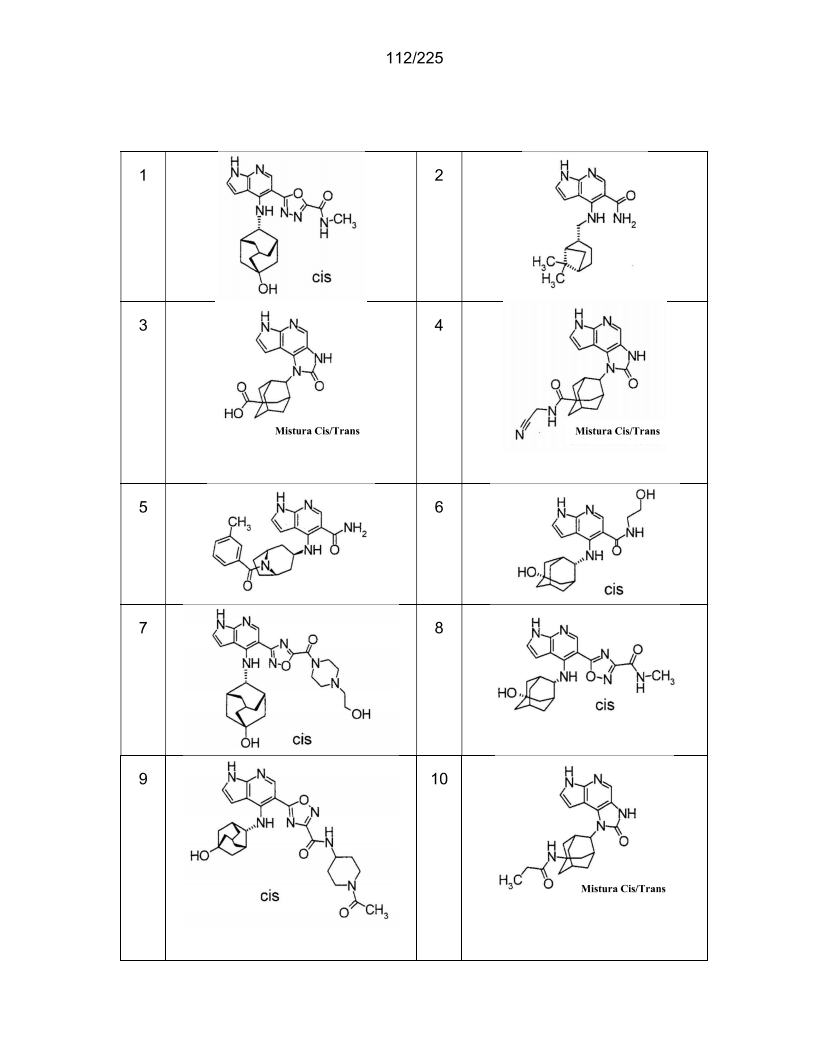


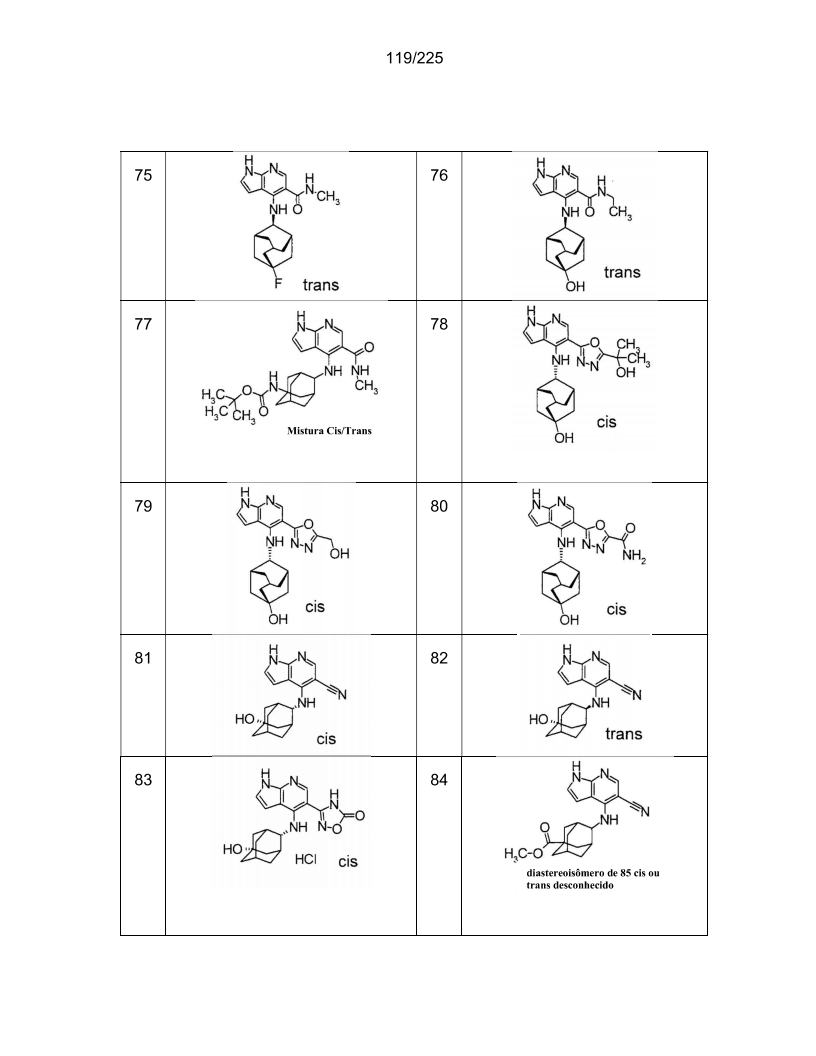

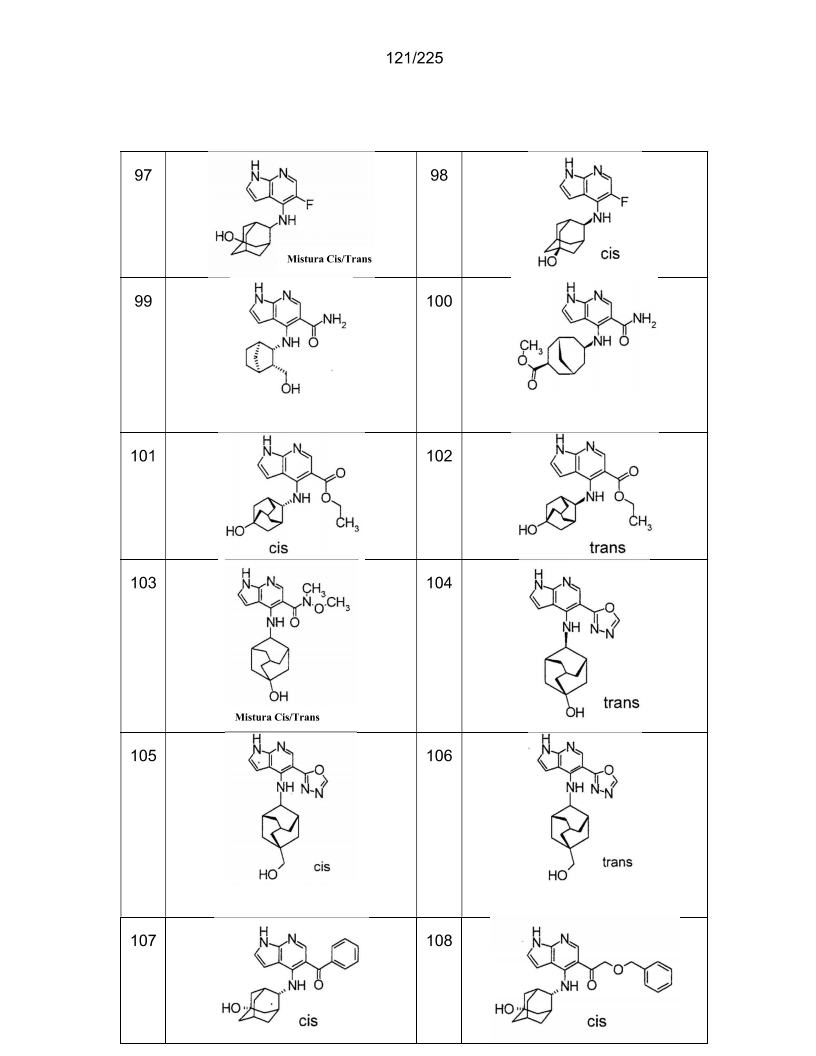
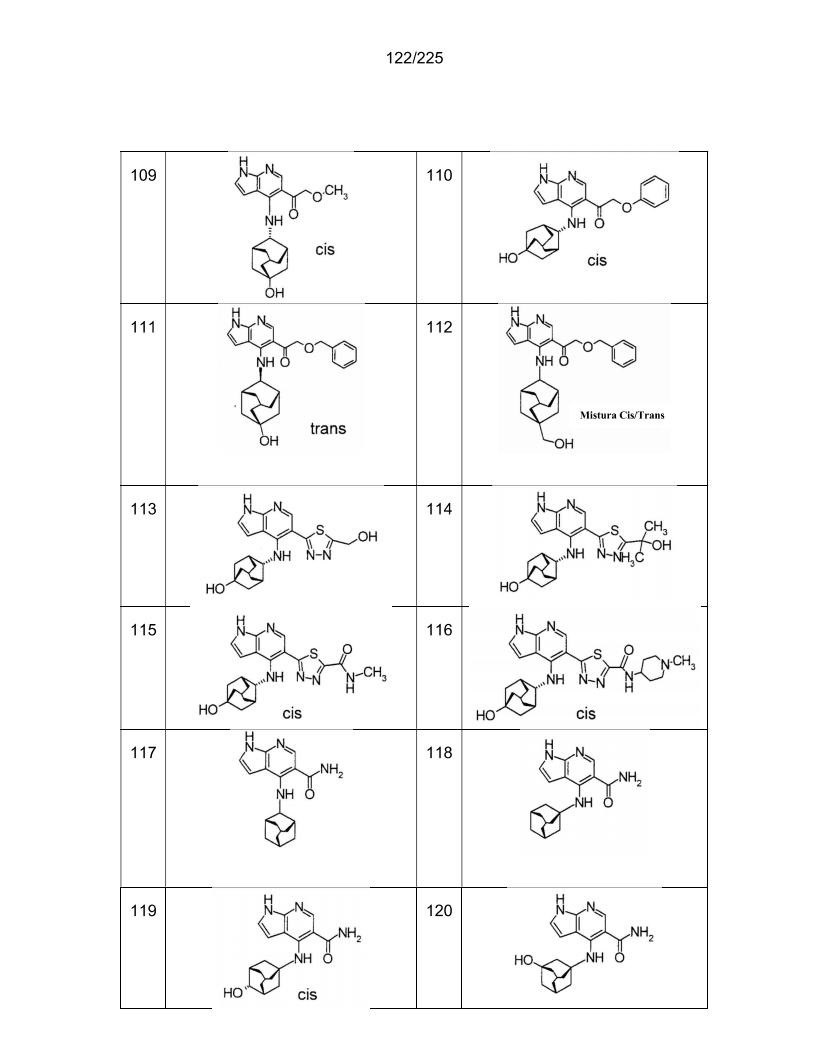


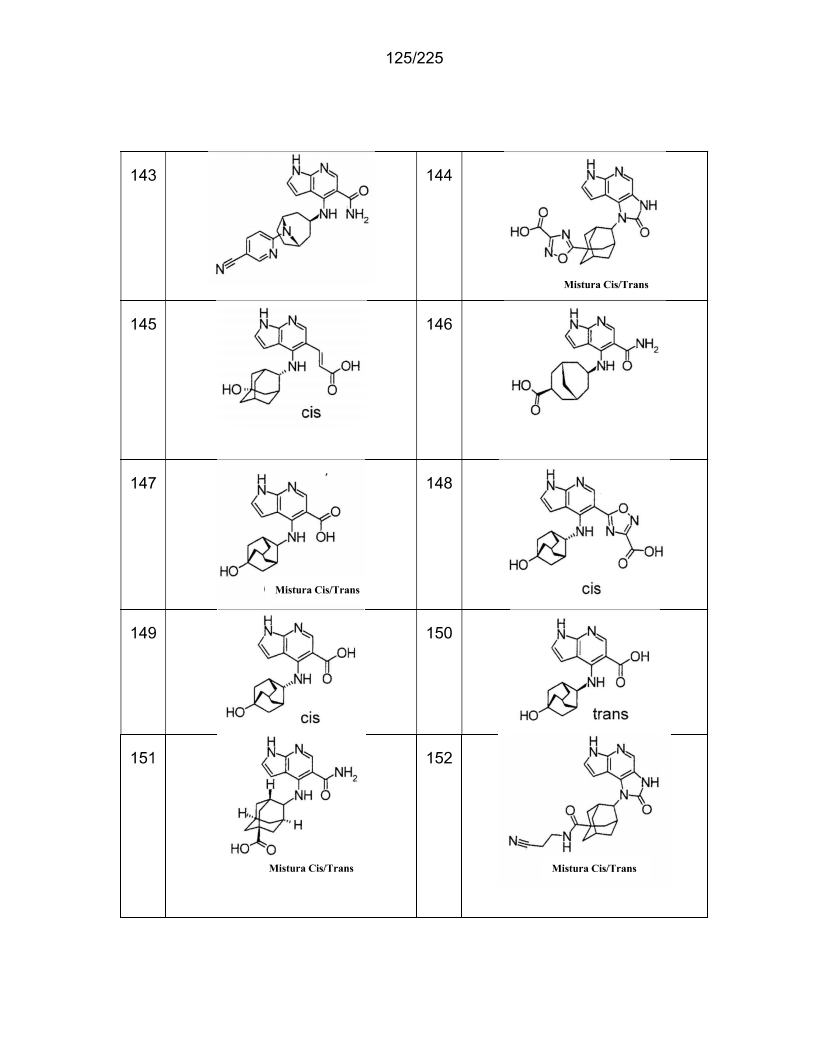


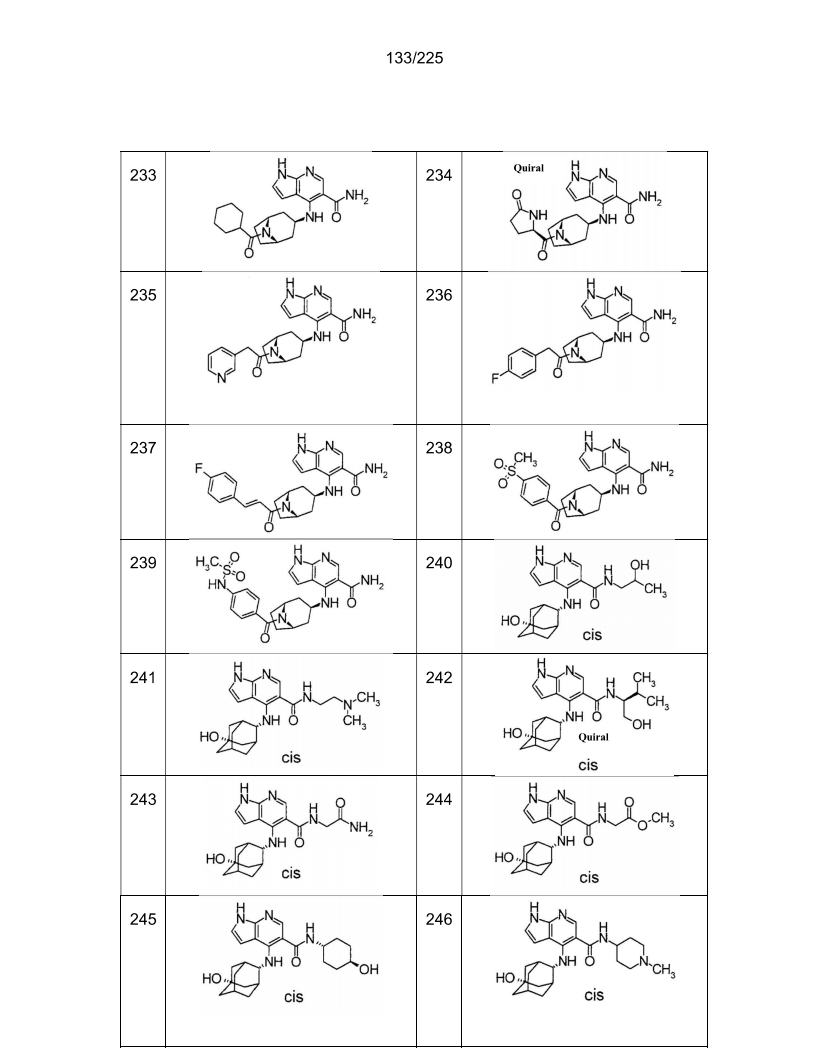


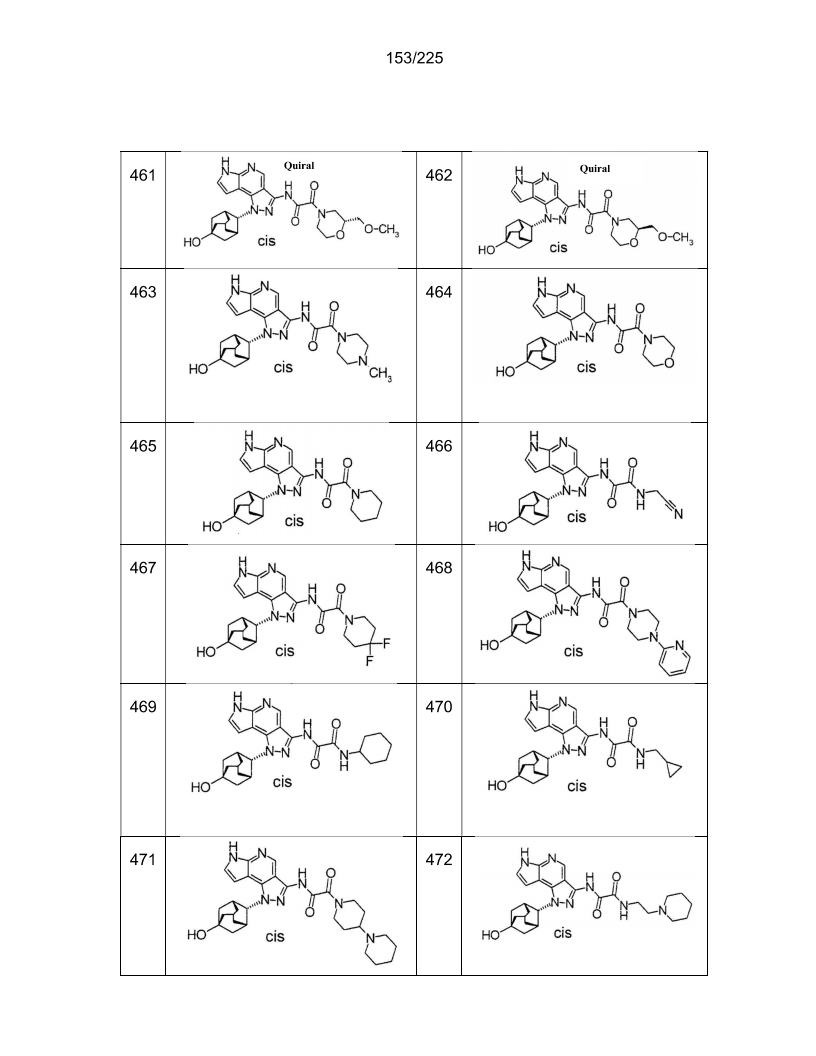


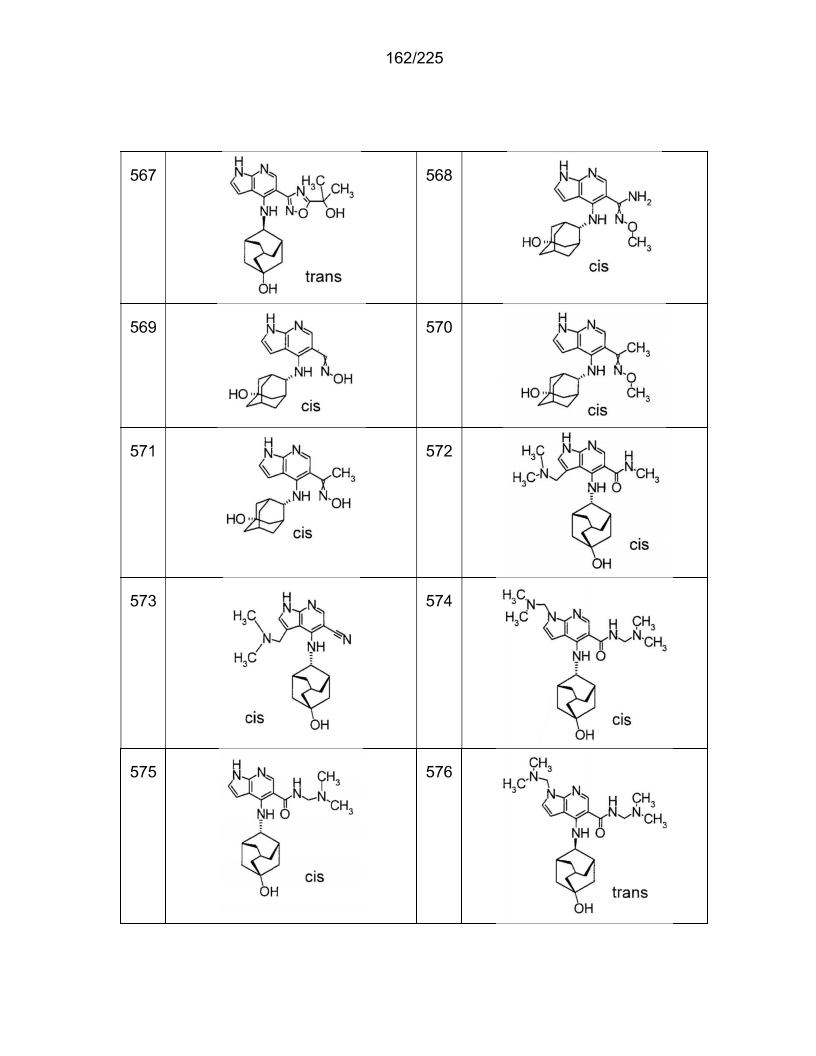

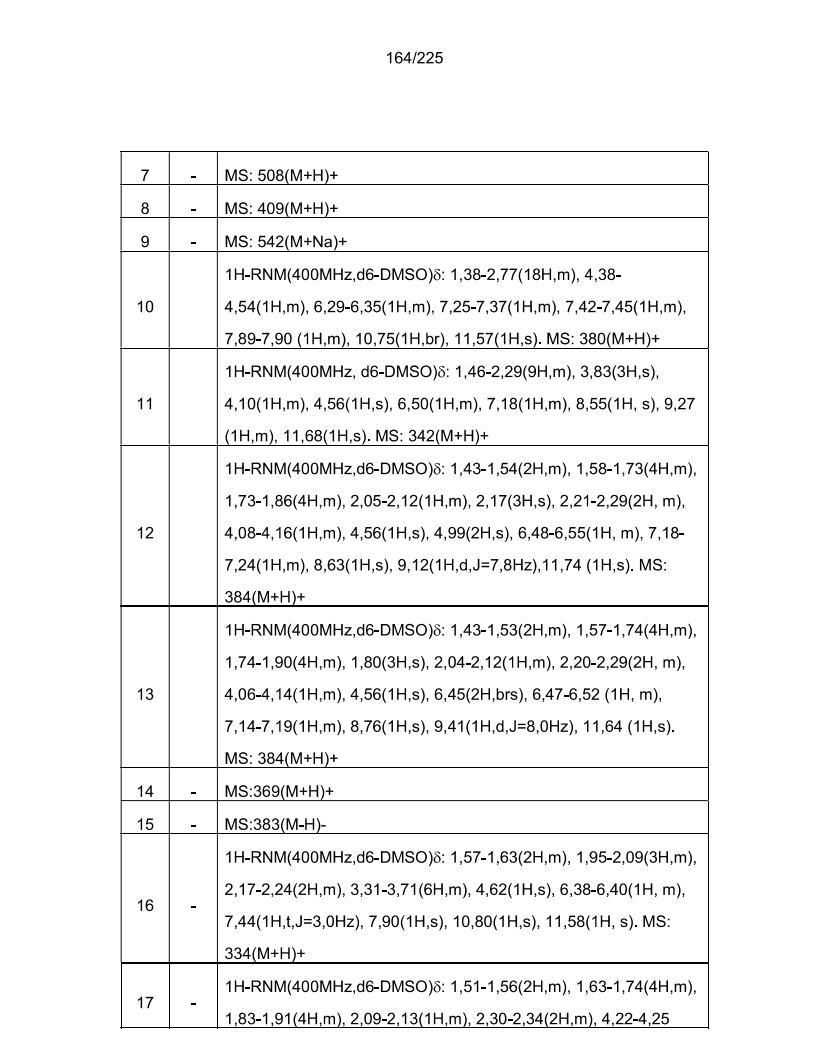


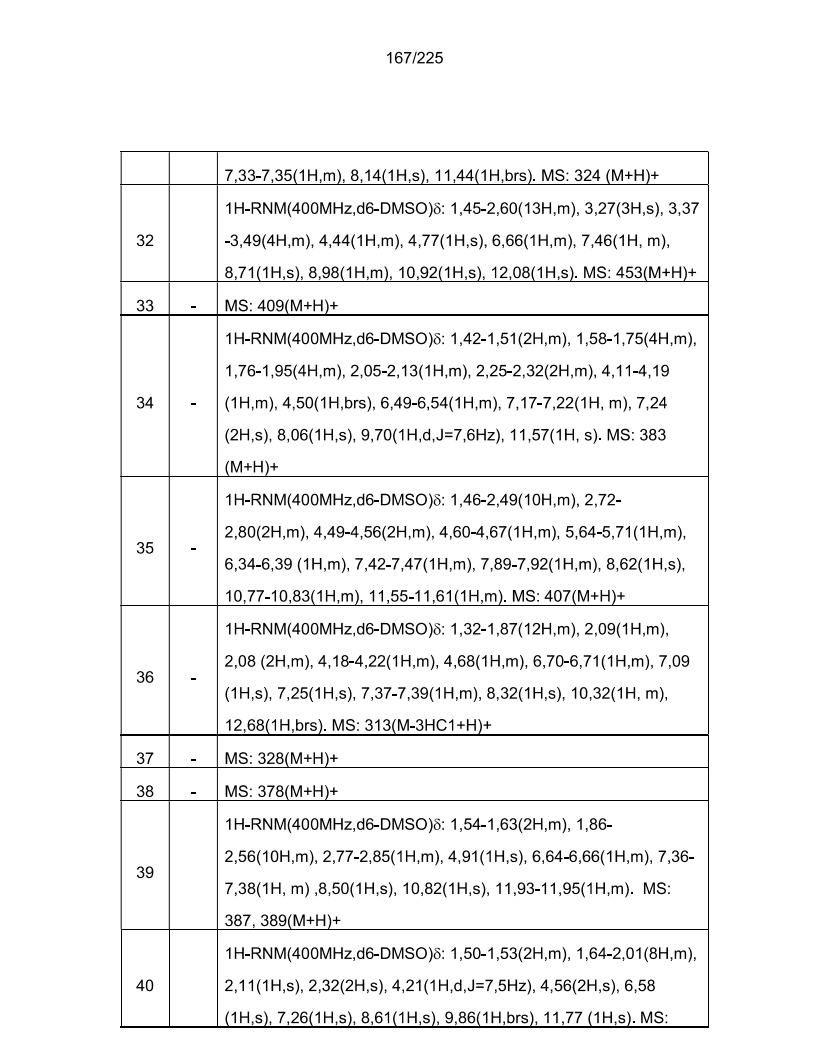


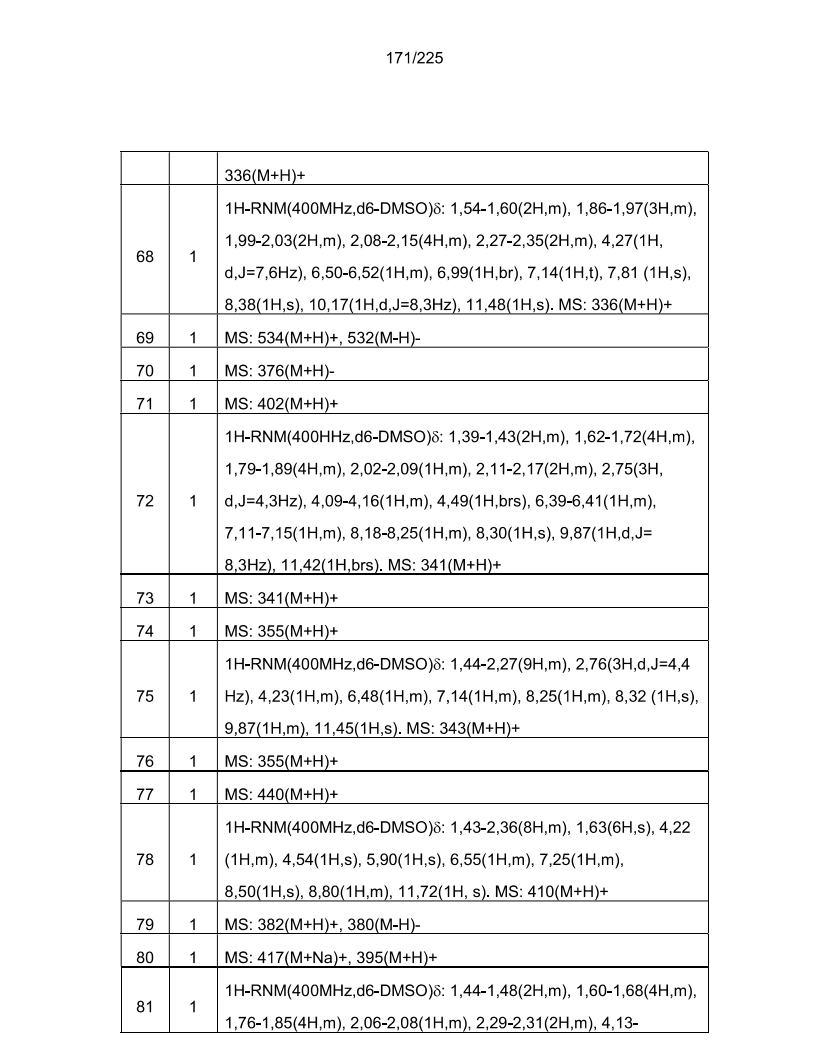


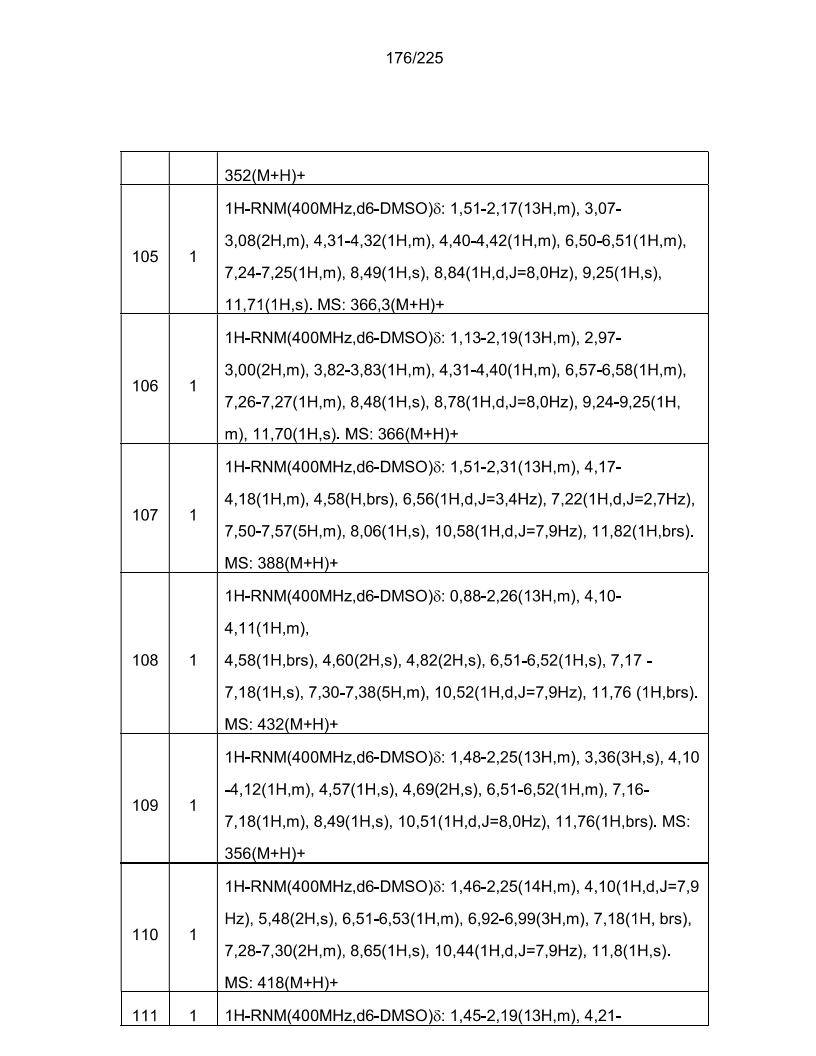

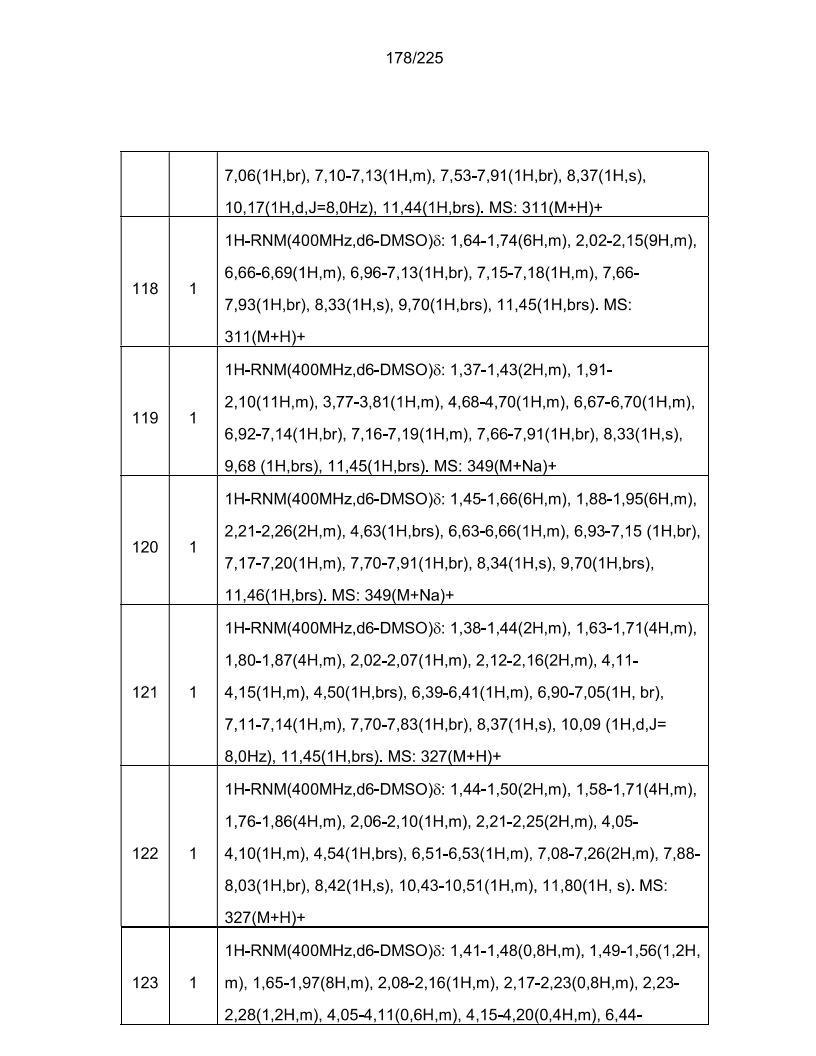
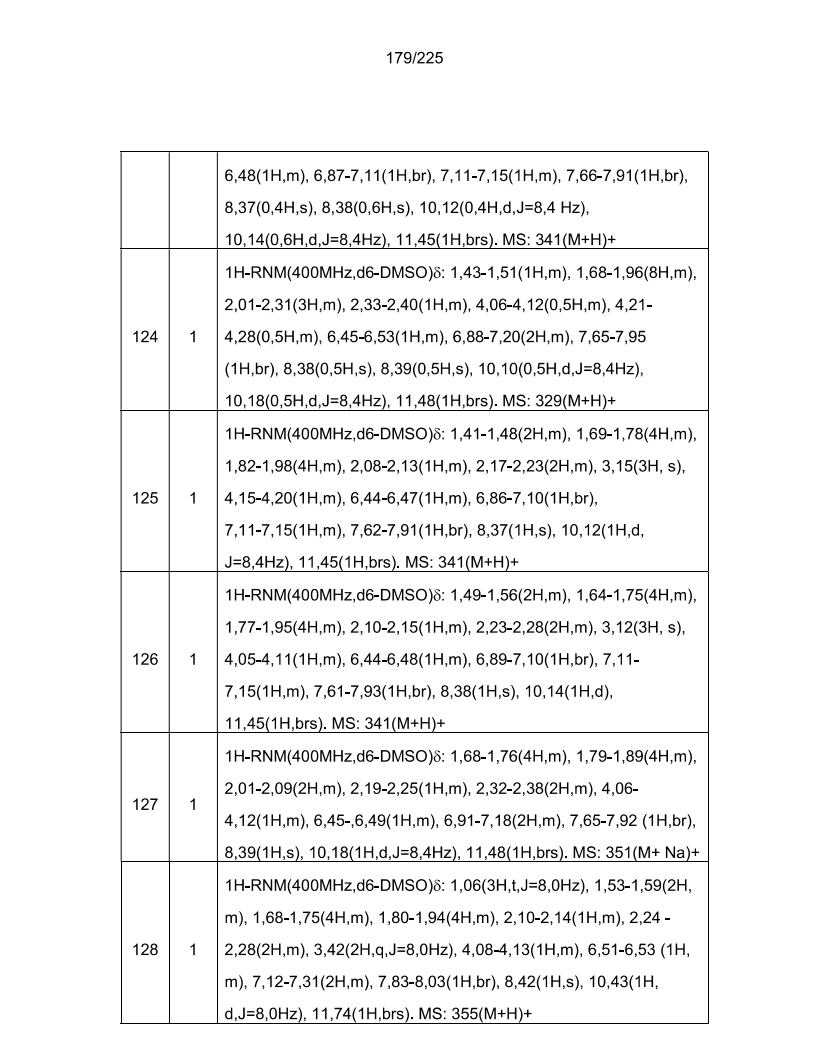

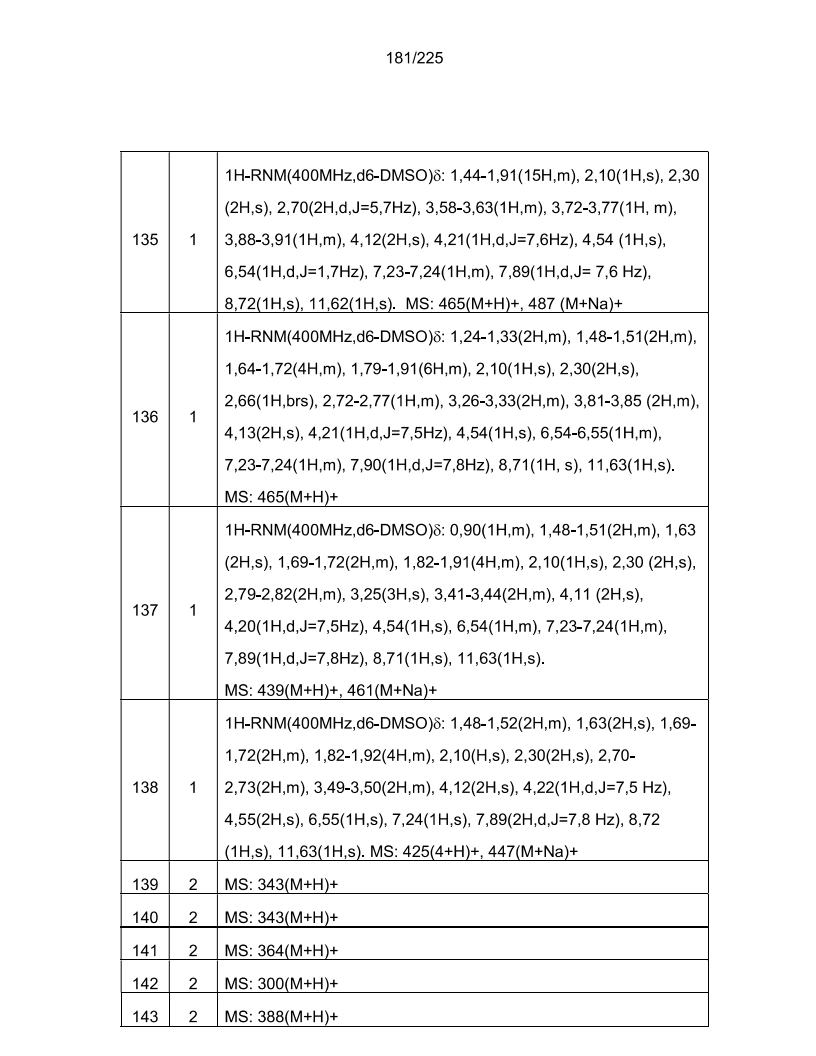

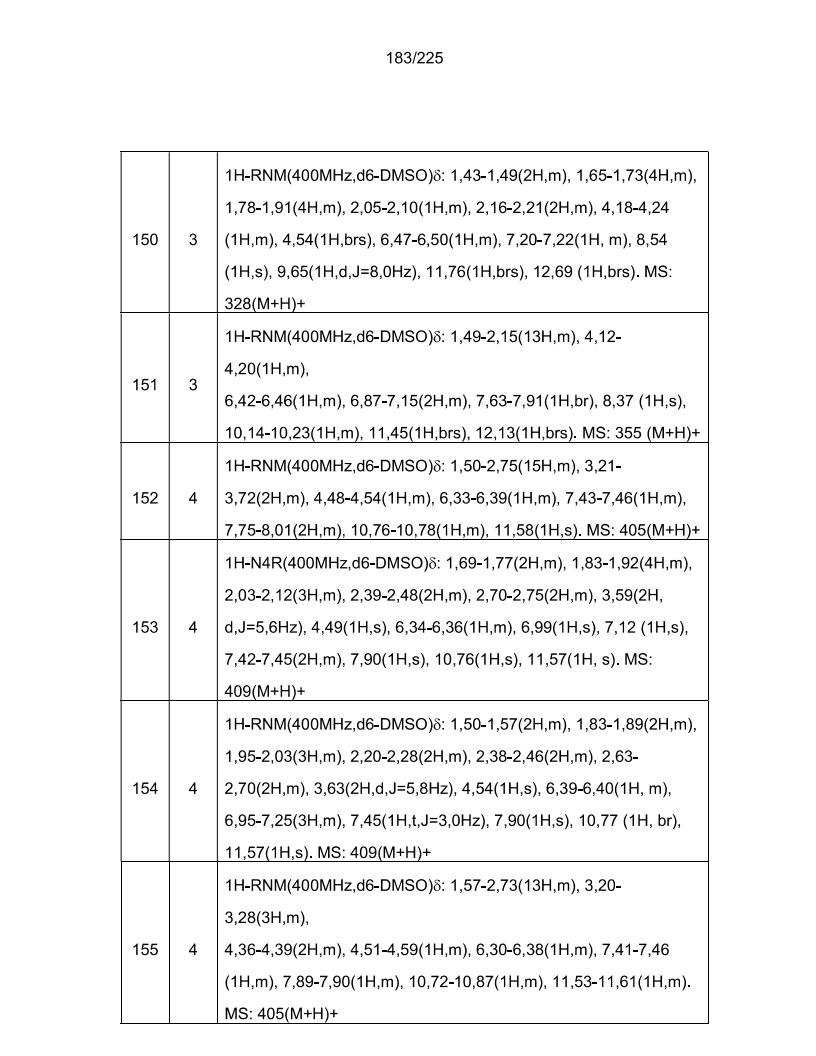


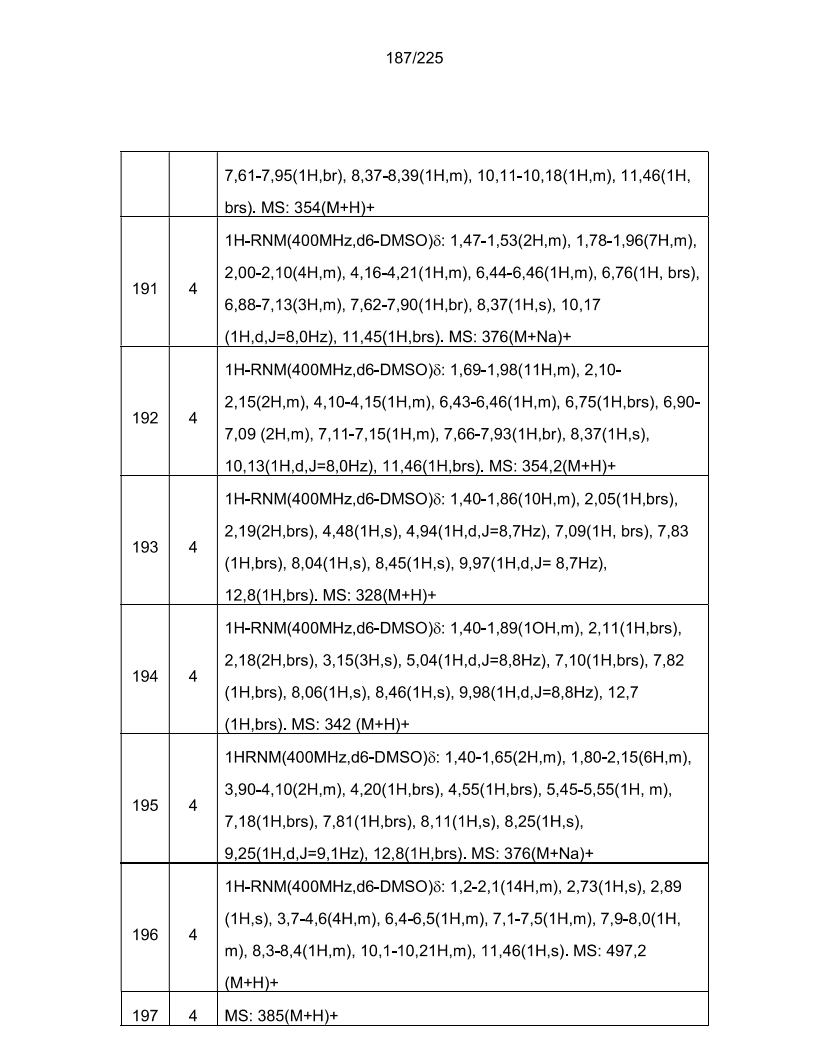

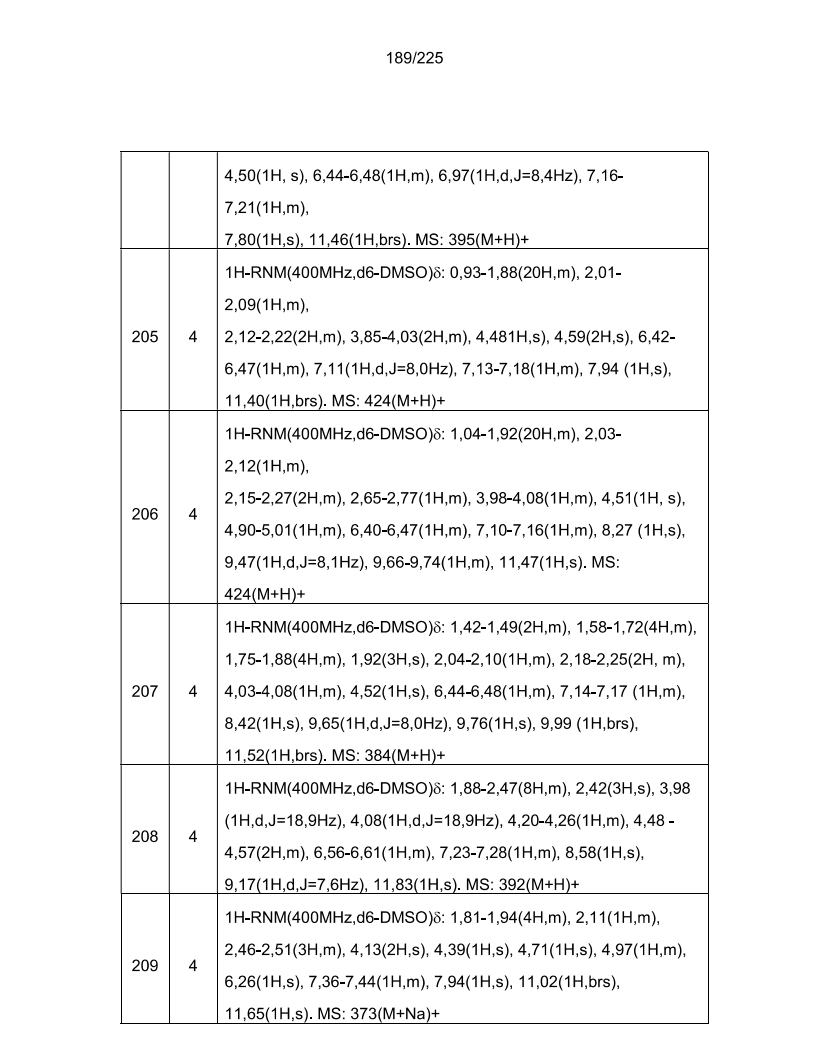


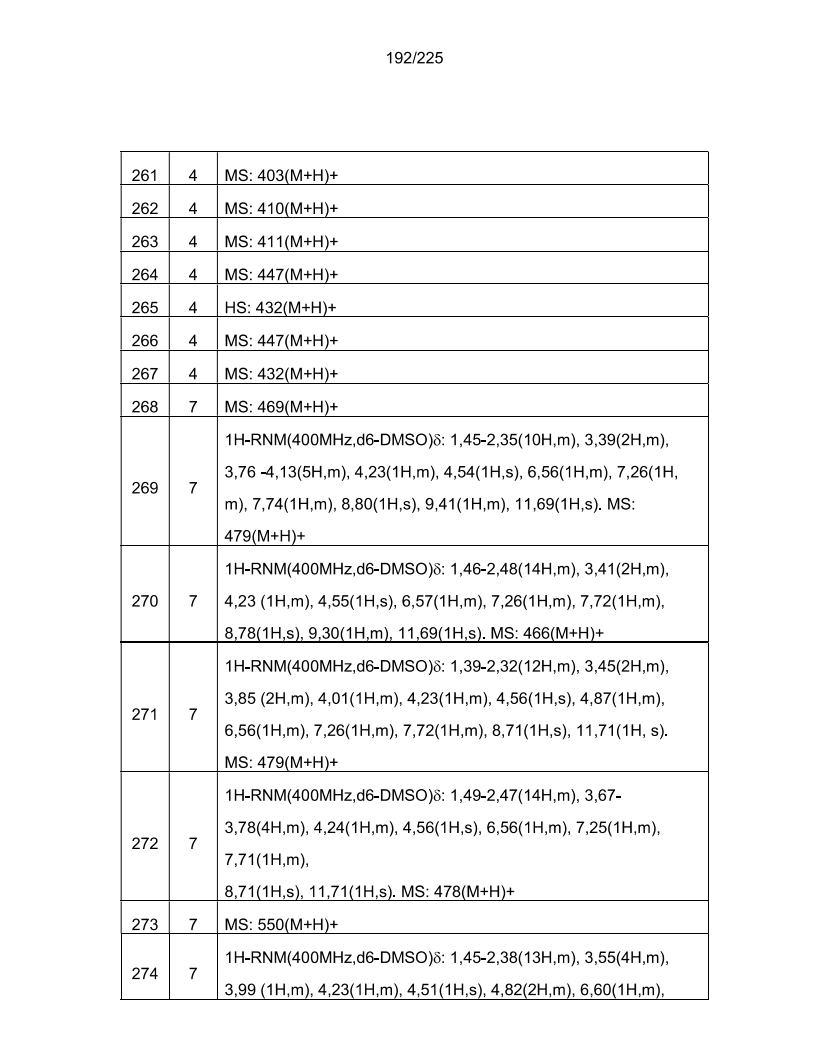


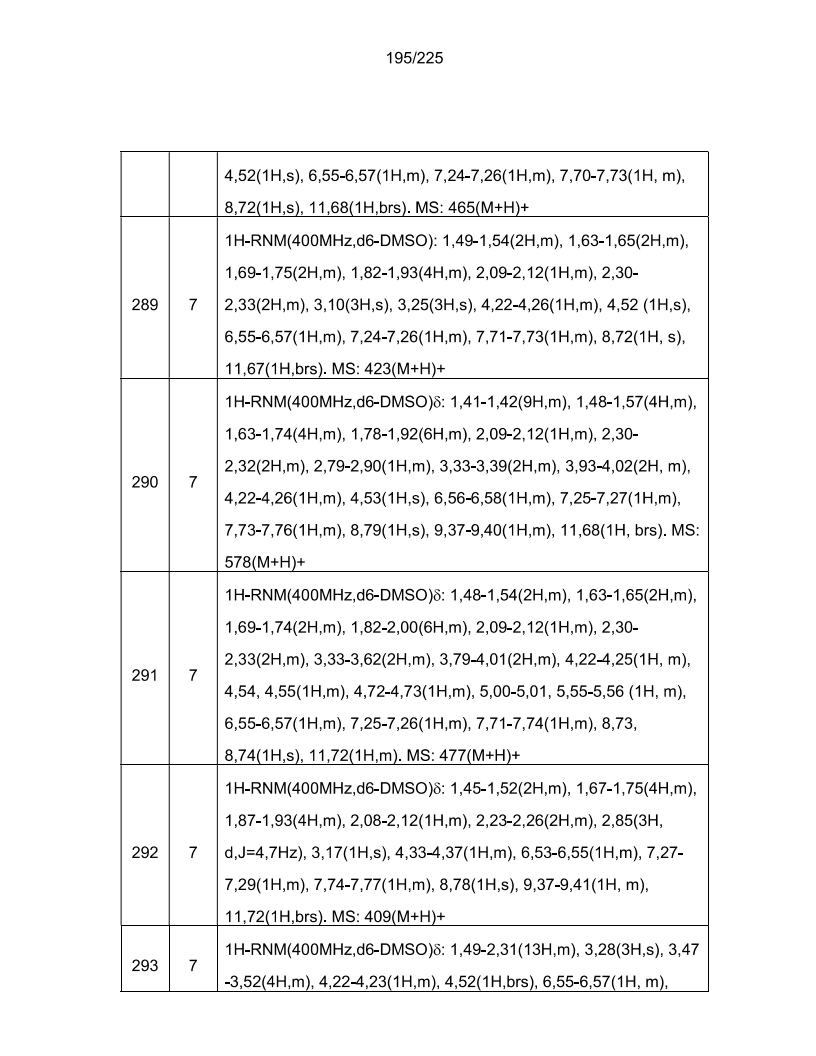

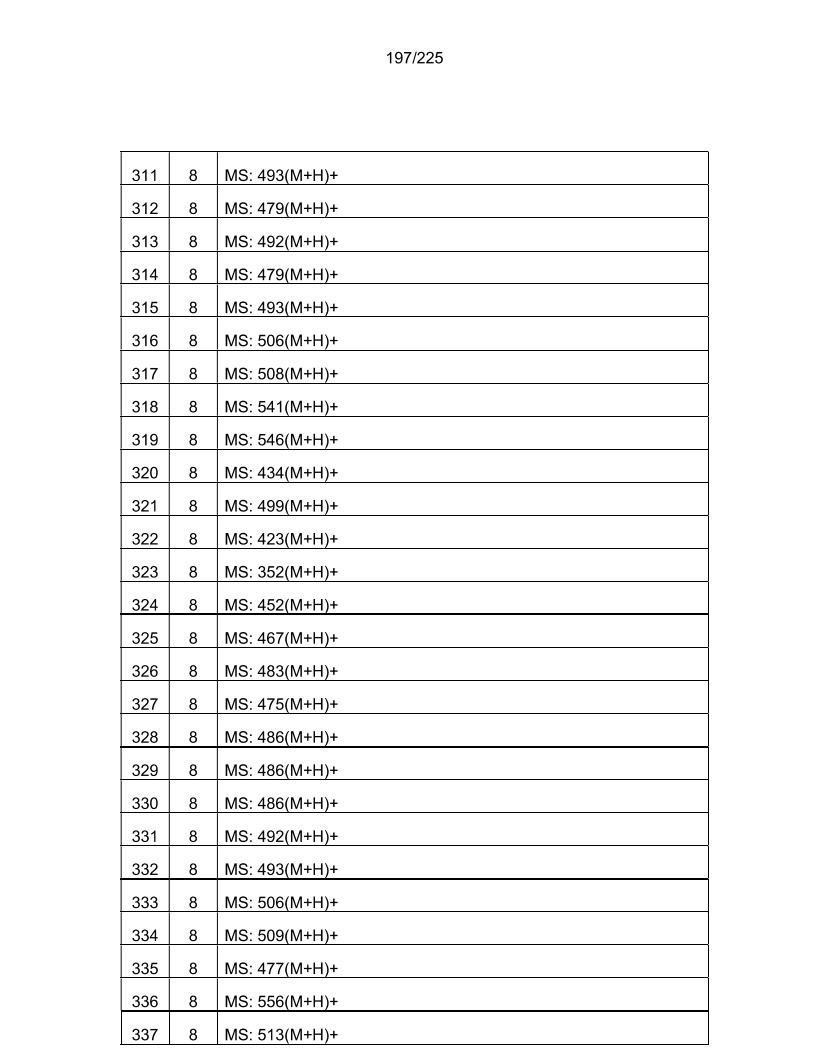

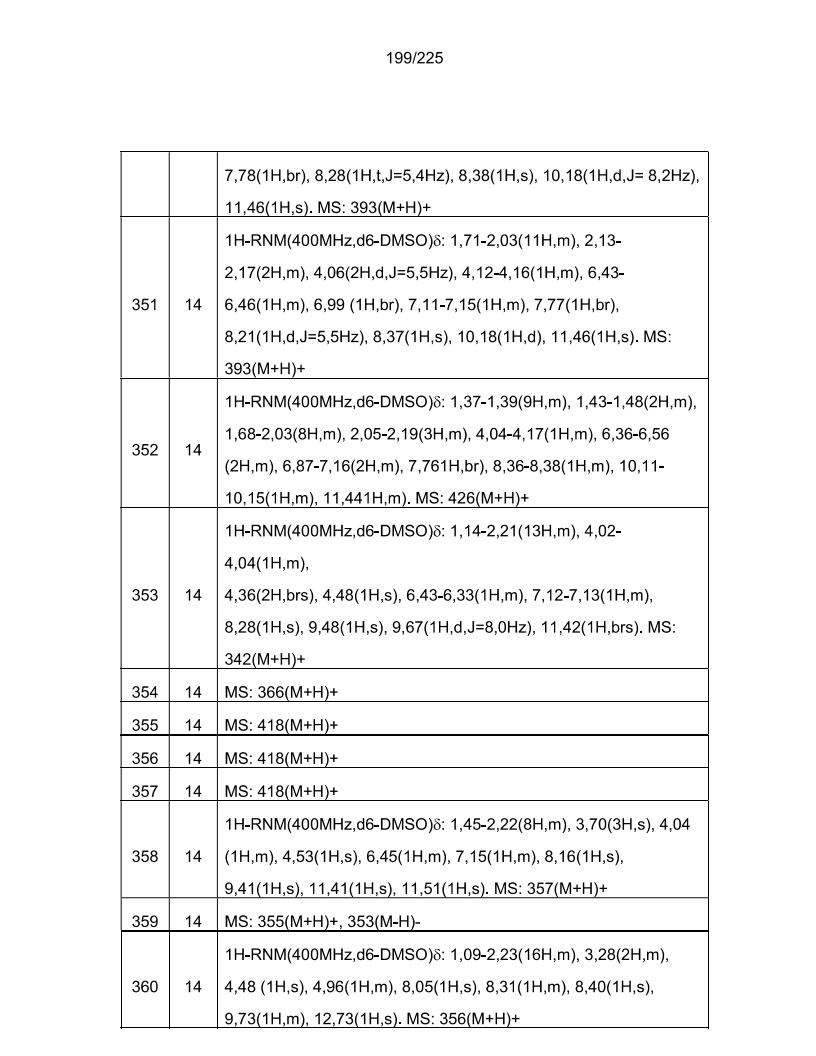

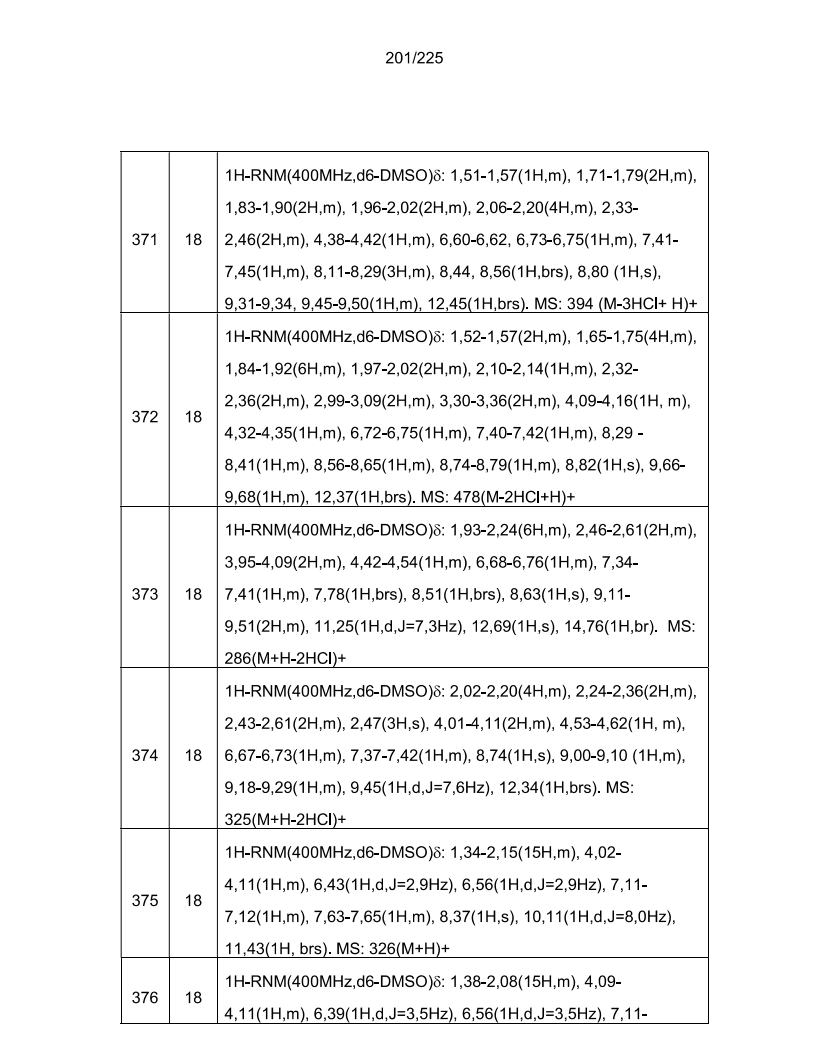


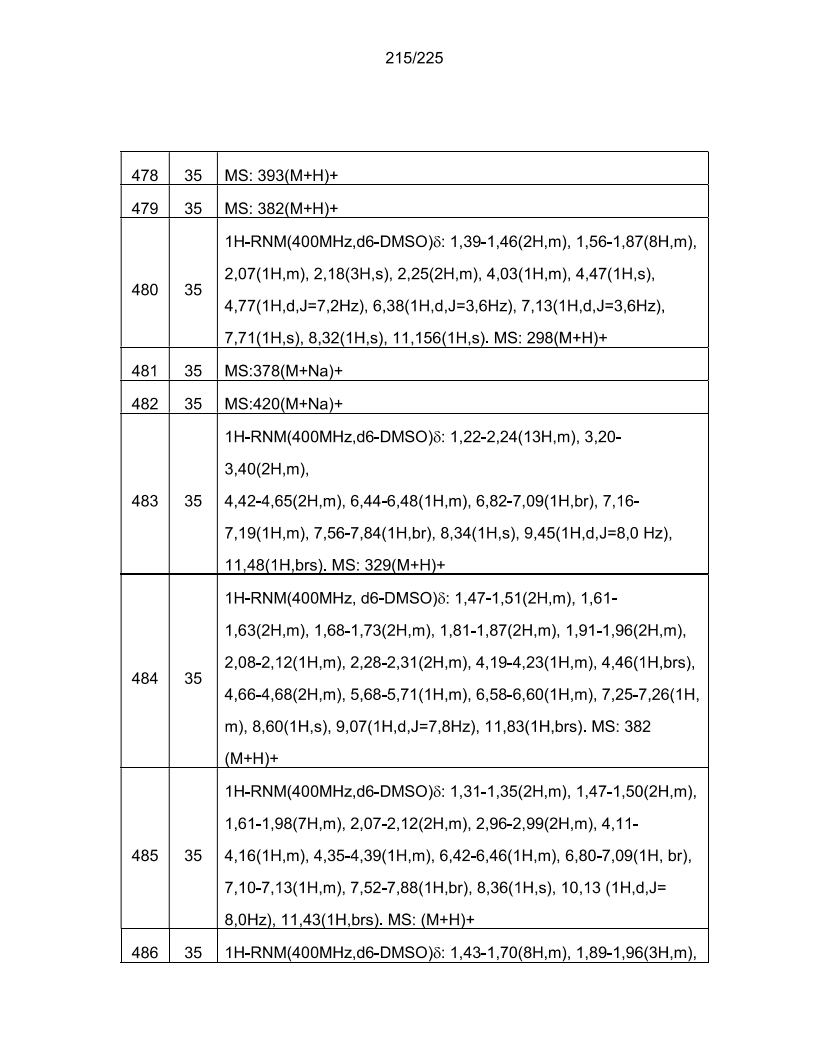
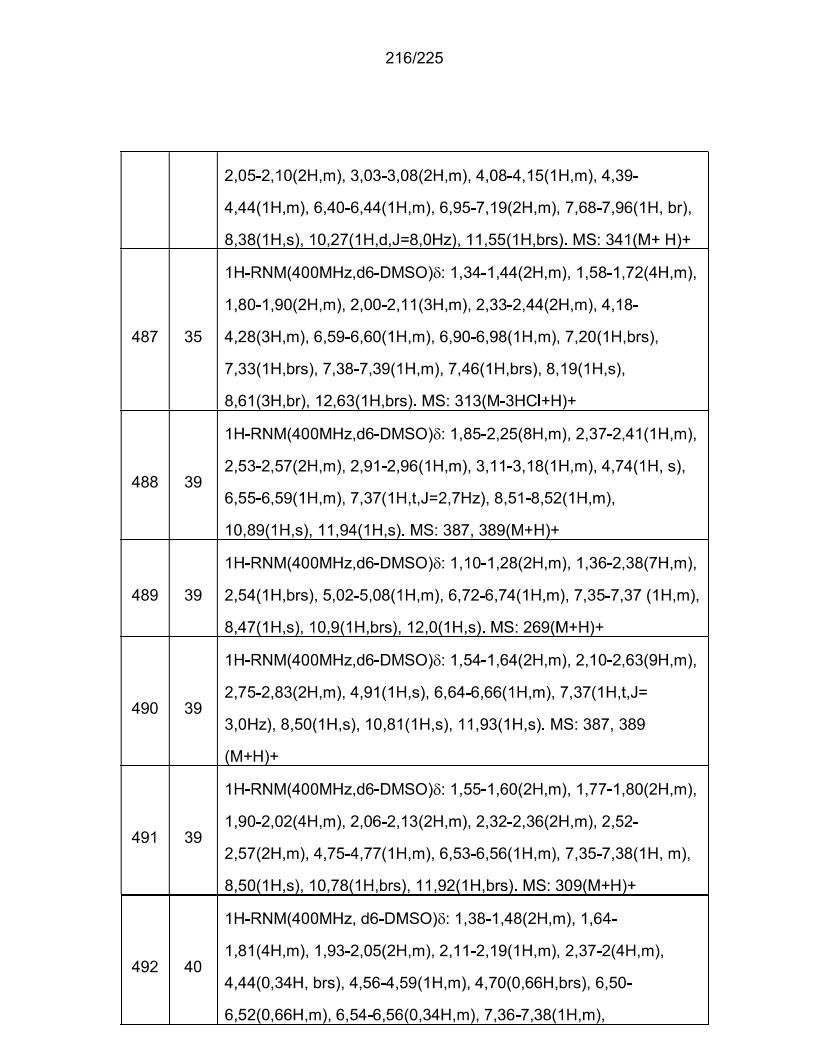


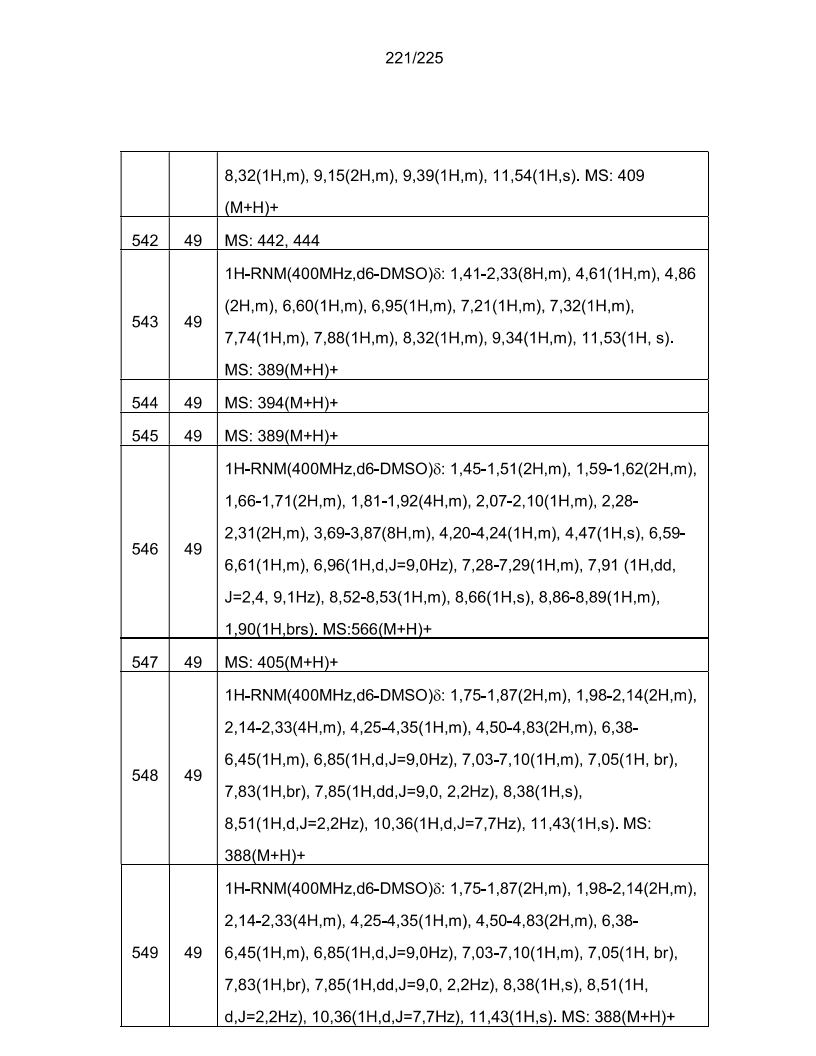


Claims (20)


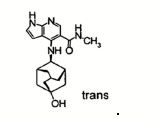


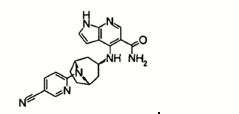
Applications Claiming Priority (3)
| Application Number | Priority Date | Filing Date | Title |
|---|---|---|---|
| JP2005-378858 | 2005-12-28 | ||
| JP2005378858 | 2005-12-28 | ||
| PCT/JP2006/326327 WO2007077949A1 (en) | 2005-12-28 | 2006-12-25 | Heterocyclic janus kinase 3 inhibitors |
Publications (3)
| Publication Number | Publication Date |
|---|---|
| BRPI0621873A2 BRPI0621873A2 (en) | 2011-12-20 |
| BRPI0621873B1 true BRPI0621873B1 (en) | 2020-11-17 |
| BRPI0621873B8 BRPI0621873B8 (en) | 2021-05-25 |
Family
ID=37944023
Family Applications (1)
| Application Number | Title | Priority Date | Filing Date |
|---|---|---|---|
| BRPI0621873A BRPI0621873B8 (en) | 2005-12-28 | 2006-12-25 | condensed pyridine compounds or pharmaceutically acceptable salts thereof, medicaments, jak3 inhibitor and product comprising said compounds |
Country Status (25)
| Country | Link |
|---|---|
| US (2) | US7879844B2 (en) |
| EP (2) | EP2251341A1 (en) |
| JP (1) | JP5169829B2 (en) |
| KR (1) | KR101381092B1 (en) |
| CN (2) | CN102127078A (en) |
| AR (1) | AR058776A1 (en) |
| AU (1) | AU2006334044B2 (en) |
| BR (1) | BRPI0621873B8 (en) |
| CA (1) | CA2635850C (en) |
| CY (1) | CY1116393T1 (en) |
| DK (1) | DK1966200T3 (en) |
| ES (1) | ES2526202T3 (en) |
| IL (1) | IL192298A (en) |
| JO (1) | JO2996B1 (en) |
| MY (1) | MY148986A (en) |
| NO (1) | NO341555B1 (en) |
| NZ (1) | NZ569162A (en) |
| PL (1) | PL1966200T3 (en) |
| PT (1) | PT1966200E (en) |
| RU (1) | RU2434013C2 (en) |
| SI (1) | SI1966200T1 (en) |
| TW (1) | TWI389687B (en) |
| UA (1) | UA94437C2 (en) |
| WO (1) | WO2007077949A1 (en) |
| ZA (1) | ZA200805605B (en) |
Families Citing this family (109)
| Publication number | Priority date | Publication date | Assignee | Title |
|---|---|---|---|---|
| CN102127078A (en) | 2005-07-14 | 2011-07-20 | 安斯泰来制药株式会社 | Heterocyclic janus kinase 3 inhibitors |
| WO2007007919A2 (en) | 2005-07-14 | 2007-01-18 | Astellas Pharma Inc. | Heterocyclic janus kinase 3 inhibitors |
| SG10202003901UA (en) | 2005-12-13 | 2020-05-28 | Incyte Holdings Corp | Heteroaryl substituted pyrrolo[2,3-b]pyridines and pyrrolo[2,3-b]pyrimidines as janus kinase inhibitors |
| US8084646B2 (en) | 2006-11-02 | 2011-12-27 | Shionogi & Co., Ltd. | Process for production of hydroxyadamantaneamine |
| AR064879A1 (en) * | 2007-01-12 | 2009-04-29 | Astellas Pharma Inc | CONDENSED PYRIDINE COMPOUND |
| KR20150036210A (en) | 2007-06-13 | 2015-04-07 | 인사이트 코포레이션 | Salts of the Janus kinase inhibitor (R)-3-(4-(7H-pyrrolo[2,3-d]pyrimidin-4-yl)-1H-pyrazol-1-yl)-3-cyclopentylpropanenitrile |
| NZ582188A (en) * | 2007-07-11 | 2012-03-30 | Pfizer | Pharmaceutical compositions and methods of treating dry eye disorders |
| SG2012079653A (en) * | 2007-10-25 | 2014-05-29 | Exelixis Inc | Tropane compounds |
| CN104592231A (en) * | 2008-06-10 | 2015-05-06 | Abbvie公司 | Novel Tricyclic Compounds |
| CL2009001884A1 (en) * | 2008-10-02 | 2010-05-14 | Incyte Holdings Corp | Use of 3-cyclopentyl-3- [4- (7h-pyrrolo [2,3-d] pyrimidin-4-yl) -1h-pyrazol-1-yl) propanonitrile, janus kinase inhibitor, and use of a composition that understands it for the treatment of dry eye. |
| DE102008052943A1 (en) | 2008-10-23 | 2010-04-29 | Merck Patent Gmbh | azaindole derivatives |
| EP2361902A4 (en) * | 2008-11-21 | 2012-04-25 | Astellas Pharma Inc | 4,6-diaminonicotinamide compound |
| WO2010061971A1 (en) * | 2008-11-28 | 2010-06-03 | 興和株式会社 | Pyridine-3-carboxyamide derivative |
| SI2432472T1 (en) | 2009-05-22 | 2019-11-29 | Incyte Holdings Corp | 3-(4-(7h-pyrrolo(2,3-d)pyrimidin-4-yl)-1h-pyrazol-1-yl)octane- or heptane-nitrile as jak inhibitors |
| AR076794A1 (en) | 2009-05-22 | 2011-07-06 | Incyte Corp | DERIVATIVES OF N- (HETERO) ARIL-PIRROLIDINA DE PIRAZOL-4-IL-PIRROLO [2,3-D] PIRIMIDINES AND PIRROL-3-IL-PIRROLO [2,3-D] PYRIMIDINS AS INHIBITORS OF THE JANUS KINASE AND COMPOSITIONS PHARMACEUTICS THAT CONTAIN THEM |
| ES2540964T3 (en) | 2009-06-08 | 2015-07-15 | Takeda Pharmaceutical Company Limited | Dihydropyrrolonaphthyridinone compounds as JAK inhibitors |
| WO2011003418A1 (en) | 2009-07-08 | 2011-01-13 | Leo Pharma A/S | Heterocyclic compounds as jak receptor and protein tyrosine kinase inhibitors |
| FR2948370B1 (en) | 2009-07-27 | 2013-04-05 | Sanofi Aventis | TETRAHYDROQUINOXALINE UREA DERIVATIVES, THEIR PREPARATION AND THERAPEUTIC USE THEREOF |
| FR2948369B1 (en) | 2009-07-27 | 2013-04-12 | Sanofi Aventis | TETRAHYDROQUINOXALINE UREA DERIVATIVES, THEIR PREPARATION AND THERAPEUTIC USE THEREOF |
| TW201113285A (en) | 2009-09-01 | 2011-04-16 | Incyte Corp | Heterocyclic derivatives of pyrazol-4-yl-pyrrolo[2,3-d]pyrimidines as janus kinase inhibitors |
| ES2426407T3 (en) | 2009-10-15 | 2013-10-23 | Pfizer Inc. | Pyrrolo [2,3-d] pyrimidine compounds |
| RU2711869C3 (en) * | 2009-12-01 | 2022-02-02 | Эббви Инк. | Imidazopyrrolopyrazine derivatives useful in the treatment of diseases caused by abnormal activity of Jak1, Jak3 or Syk protein kinases |
| PH12012501000A1 (en) | 2009-12-01 | 2013-02-11 | Abbvie Inc | Novel tricyclic compounds |
| WO2011075334A1 (en) | 2009-12-18 | 2011-06-23 | Pfizer Inc. | Pyrrolo[2,3-d]pyrimidine compounds |
| RU2012132278A (en) | 2010-01-12 | 2014-02-20 | Ф. Хоффманн-Ля Рош Аг | TRICYCLIC HETEROCYCLIC COMPOUNDS CONTAINING THEIR COMPOSITIONS AND WAYS OF THEIR APPLICATION |
| EP3354652B1 (en) | 2010-03-10 | 2020-05-06 | Incyte Holdings Corporation | Piperidin-4-yl azetidine derivatives as jak1 inhibitors |
| US8481541B2 (en) | 2010-03-22 | 2013-07-09 | Hoffmann-La Roche Inc. | Pyrrolopyrazine kinase inhibitors |
| US8518945B2 (en) | 2010-03-22 | 2013-08-27 | Hoffmann-La Roche Inc. | Pyrrolopyrazine kinase inhibitors |
| EP2571881A1 (en) | 2010-05-20 | 2013-03-27 | F.Hoffmann-La Roche Ag | Pyrrolopyrazine derivatives as syk and jak inhibitors |
| PE20130216A1 (en) | 2010-05-21 | 2013-02-27 | Incyte Corp | TOPICAL FORMULATION FOR A JAK INHIBITOR |
| US8779140B2 (en) | 2010-06-23 | 2014-07-15 | Astellas Pharma Inc. | Crystal of fused pyridine compound salt |
| US9198911B2 (en) | 2010-11-02 | 2015-12-01 | The Trustees Of Columbia University In The City Of New York | Methods for treating hair loss disorders |
| PE20140146A1 (en) | 2010-11-19 | 2014-02-06 | Incyte Corp | PYRROLOPYRIDINE DERIVATIVES AND PYRROLOPYRIMIDINE SUBSTITUTED WITH CYCLOBUTYL AS JAK INHIBITORS |
| US9034884B2 (en) | 2010-11-19 | 2015-05-19 | Incyte Corporation | Heterocyclic-substituted pyrrolopyridines and pyrrolopyrimidines as JAK inhibitors |
| US9233964B2 (en) | 2011-01-07 | 2016-01-12 | Leo Pharma A/S | Sulfamide piperazine derivatives as protein tyrosine kinase inhibitors and pharmaceutical use therof |
| ES2547916T3 (en) | 2011-02-18 | 2015-10-09 | Novartis Pharma Ag | MTOR / JAK inhibitor combination therapy |
| CN103547580B (en) | 2011-03-22 | 2016-12-07 | 阿迪维纳斯疗法有限公司 | Substituted fused tricyclic compounds, their composition and medical use |
| CN103797010B (en) | 2011-06-20 | 2016-02-24 | 因塞特控股公司 | As the azetidinyl phenyl of JAK inhibitor, pyridyl or pyrazinyl carboxamides derivatives |
| EP2741747A1 (en) | 2011-08-10 | 2014-06-18 | Novartis Pharma AG | JAK P13K/mTOR COMBINATION THERAPY |
| AU2012295802B2 (en) | 2011-08-12 | 2017-03-30 | Nissan Chemical Industries, Ltd. | Tricyclic heterocyclic compounds and JAK inhibitors |
| TW201313721A (en) | 2011-08-18 | 2013-04-01 | Incyte Corp | Cyclohexyl azetidine derivatives as JAK inhibitors |
| UA111854C2 (en) | 2011-09-07 | 2016-06-24 | Інсайт Холдінгс Корпорейшн | METHODS AND INTERMEDIATE COMPOUNDS FOR JAK INHIBITORS |
| PT2796460T (en) * | 2011-12-21 | 2018-11-05 | Shanghai hengrui pharmaceutical co ltd | Pyrrole six-membered heteroaryl ring derivative, preparation method therefor, and medicinal uses thereof |
| ES2567552T3 (en) * | 2012-01-30 | 2016-04-25 | Cephalon, Inc. | Imidazo [4,5-b] pyridine derivatives such as ALK and JAK modulators for the treatment of proliferative disorders |
| WO2013117649A1 (en) * | 2012-02-10 | 2013-08-15 | Galapagos Nv | Imidazo [4, 5 -c] pyridine derivatives useful for the treatment of degenerative and inflammatory diseases |
| UY34615A (en) * | 2012-02-10 | 2013-09-30 | Galapagos Nv | NEW USEFUL COMPOUNDS FOR THE TREATMENT OF DEGENERATIVE AND INFLAMMATORY DISEASES. |
| JP6123795B2 (en) * | 2012-03-30 | 2017-05-10 | アステラス製薬株式会社 | Controlled release pharmaceutical composition |
| TW201406761A (en) | 2012-05-18 | 2014-02-16 | Incyte Corp | Piperidinylcyclobutyl substituted pyrrolopyridine and pyrrolopyrimidine derivatives as JAK inhibitors |
| GB201211021D0 (en) * | 2012-06-21 | 2012-08-01 | Cancer Rec Tech Ltd | Pharmaceutically active compounds |
| JP2015528501A (en) * | 2012-09-12 | 2015-09-28 | ライジェル ファーマシューティカルズ, インコーポレイテッド | Treatment of vitiligo |
| US9593115B2 (en) | 2012-09-21 | 2017-03-14 | Advinus Therapeutics Ltd. | Substituted fused tricyclic compounds, compositions, and medicinal applications thereof |
| PH12020551186B1 (en) | 2012-11-15 | 2024-03-20 | Incyte Holdings Corp | Sustained-release dosage forms of ruxolitinib |
| TW201513861A (en) * | 2013-01-17 | 2015-04-16 | Galapagos Nv | Novel compound useful for the treatment of degenerative and inflammatory diseases |
| JP6248948B2 (en) | 2013-02-08 | 2017-12-20 | 日産化学工業株式会社 | Tricyclic pyrrolopyridine compound and JAK inhibitor |
| RS62867B1 (en) | 2013-03-06 | 2022-02-28 | Incyte Holdings Corp | Processes and intermediates for making a jak inhibitor |
| WO2014146246A1 (en) * | 2013-03-19 | 2014-09-25 | Merck Sharp & Dohme Corp. | Cycloalkyl nitrile pyrazolo pyridones as janus kinase inhibitors |
| WO2014157603A1 (en) * | 2013-03-29 | 2014-10-02 | アステラス製薬株式会社 | Pharmaceutical composition for oral administration |
| SMT202000315T1 (en) | 2013-08-07 | 2020-07-08 | Incyte Corp | Sustained release dosage forms for a jak1 inhibitor |
| KR101548492B1 (en) | 2013-09-23 | 2015-09-01 | 건국대학교 산학협력단 | 4-Amino-7-azaindole-5-carboxamide derivatives selectively inhibiting the activity of Janus kinase 1 |
| SI3077395T1 (en) | 2013-12-05 | 2018-03-30 | Pfizer Inc. | Pyrrolo (2,3-d) pyrimidinyl, pyrrolo (2,3-b) pyrazinyl and pyrrolo (2,3-d) pyridinyl acrylamides |
| PL3134407T3 (en) * | 2014-04-22 | 2019-11-29 | Arqule Inc | Salts and polymorphs of a substituted imidazopyridinyl-aminopyridine compound |
| BR112016023299A8 (en) | 2014-05-14 | 2021-06-29 | Nissan Chemical Ind Ltd | tricyclic compound and jak inhibitor, preventive, therapeutic or ameliorative agent for diseases against which jak inhibition is effective and for rheumatoid arthritis, medicine and use of these compounds |
| US9498467B2 (en) | 2014-05-30 | 2016-11-22 | Incyte Corporation | Treatment of chronic neutrophilic leukemia (CNL) and atypical chronic myeloid leukemia (aCML) by inhibitors of JAK1 |
| WO2016047678A1 (en) * | 2014-09-25 | 2016-03-31 | 武田薬品工業株式会社 | Heterocyclic compound |
| CA3217238A1 (en) * | 2015-07-20 | 2017-01-26 | Genzyme Corporation | Colony stimulating factor-1 receptor (csf-1r) inhibitors |
| US11365198B2 (en) | 2015-10-16 | 2022-06-21 | Abbvie Inc. | Processes for the preparation of (3S,4R)-3-ethyl-4-(3H-imidazo[1,2-a]pyrrolo[2,3-e]-pyrazin-8-yl)-N-(2,2,2-trifluoroethyl)pyrrolidine-1-carboxamide and solid state forms thereof |
| US12365689B2 (en) | 2015-10-16 | 2025-07-22 | Abbvie Inc. | Processes for the preparation of (3S,4R)-3-ethyl-4-(3H-imidazo[1,2-a]pyrrolo[2,3-e]-pyrazin-8-yl)-n-(2,2,2-trifluoroethyl)pyrrolidine-1-carboxamide and solid state forms thereof |
| SG10201913990RA (en) | 2015-10-16 | 2020-03-30 | Abbvie Inc | PROCESSES FOR THE PREPARATION OF (3S,4R)-3-ETHYL-4-(3H-IMIDAZO[1,2-a]PYRROLO[2,3-e]-PYRAZIN-8-YL)-N-(2,2,2-TRIFLUOROETHYL)PYRROLIDINE-1-CARBOXAMIDE AND SOLID STATE FORMS THEREOF |
| US11512092B2 (en) | 2015-10-16 | 2022-11-29 | Abbvie Inc. | Processes for the preparation of (3S,4R)-3-ethyl-4-(3H-imidazo[1,2-a]pyrrolo[2,3-e]-pyrazin-8-yl)-n-(2,2,2-trifluoroethyl)pyrrolidine-1-carboxamide and solid state forms thereof |
| US11773106B2 (en) | 2015-10-16 | 2023-10-03 | Abbvie Inc. | Processes for the preparation of (3S,4R)-3-ethyl-4-(3H-imidazo[1,2-a]pyrrolo[2,3-e]-pyrazin-8-yl)-N-(2,2,2-trifluoroethyl)pyrrolidine-1-carboxamide and solid state forms thereof |
| US11524964B2 (en) | 2015-10-16 | 2022-12-13 | Abbvie Inc. | Processes for the preparation of (3S,4R)-3-ethyl-4-(3H-imidazo[1,2-a]pyrrolo[2,3-e]-pyrazin-8-yl)-n-(2,2,2-trifluoroethyl)pyrrolidine-1-carboxamide and solid state forms thereof |
| US10550126B2 (en) | 2015-10-16 | 2020-02-04 | Abbvie Inc. | Processes for the preparation of (3S,4R)-3-ethyl-4-(3H-imidazo[1,2-A]pyrrolo[2,3-e]-pyrazin-8-yl)-N-(2,2,2-trifluoroethyl)pyrrolidine-1-carboxamide and solid state forms thereof |
| US10730871B2 (en) * | 2016-01-28 | 2020-08-04 | Regents Of The University Of Minnesota | Immunomodulators and immunomodulator conjugates |
| EP3481826B1 (en) | 2016-07-08 | 2021-11-03 | Rigel Pharmaceuticals, Inc. | Tyrosine kinase inhibitors |
| JOP20190144A1 (en) | 2016-12-16 | 2019-06-16 | Janssen Pharmaceutica Nv | Imidazopyrrolopyridine as inhibitors of the jak family of kinases |
| JP7291077B2 (en) | 2016-12-16 | 2023-06-14 | ヤンセン ファーマシューティカ エヌ.ベー. | Small molecule inhibitors of the JAK family of kinases |
| JP2018104412A (en) * | 2016-12-22 | 2018-07-05 | 参天製薬株式会社 | Therapeutic and/or preventive agent of eye disease |
| CR20190310A (en) | 2016-12-29 | 2019-08-21 | Hoffmann La Roche | PYRAZOLOPYRIMIDINE COMPOUNDS AND METHODS OF USE OF THEM |
| CN110662745B (en) * | 2017-03-23 | 2021-08-03 | 大邱庆北尖端医疗产业振兴财团 | Pyrrolopyridine derivatives, methods for their preparation, and pharmaceutical compositions for preventing or treating protein kinase-related diseases |
| CN109535164B (en) * | 2017-09-21 | 2022-01-18 | 上海华汇拓医药科技有限公司 | JAK kinase inhibitor, preparation method thereof and application thereof in medical field |
| GB201717260D0 (en) * | 2017-10-20 | 2017-12-06 | Galapagos Nv | Novel compounds and pharma ceutical compositions thereof for the treatment of inflammatory disorders |
| KR102821964B1 (en) * | 2017-11-03 | 2025-06-19 | 어클라리스 쎄라퓨틱스, 인코포레이티드 | Substituted pyrrolopyrimidine JAK inhibitors and methods for their manufacture and use |
| WO2019090143A1 (en) * | 2017-11-03 | 2019-05-09 | Aclaris Therapeutics, Inc. | Pyrazolyl pyrrolo[2,3-b]pyrimidine-5-carboxylate analogs and methods of making the same |
| WO2019113487A1 (en) | 2017-12-08 | 2019-06-13 | Incyte Corporation | Low dose combination therapy for treatment of myeloproliferative neoplasms |
| SG11202007164UA (en) | 2018-01-30 | 2020-08-28 | Incyte Corp | Processes for preparing (1 -(3-fluoro-2-(trifluoromethyl)isonicotinyl)piperidine-4-one) |
| SMT202400306T1 (en) | 2018-03-30 | 2024-09-16 | Incyte Corp | Treatment of hidradenitis suppurativa using jak inhibitors |
| TW202016110A (en) | 2018-06-15 | 2020-05-01 | 比利時商健生藥品公司 | Small molecule inhibitors of the JAK kinase family |
| WO2020009946A1 (en) | 2018-07-02 | 2020-01-09 | Regents Of The University Of Minnesota | Therapeutic compounds and methods of use thereof |
| CN119080779A (en) | 2018-08-10 | 2024-12-06 | 阿克拉瑞斯治疗股份有限公司 | Pyrrolopyrimidine ITK inhibitors |
| WO2020081689A1 (en) * | 2018-10-16 | 2020-04-23 | Dana-Farber Cancer Institute, Inc. | Azaindole inhibitors of wild-type and mutant forms of lrrk2 |
| EP3915985A4 (en) | 2019-01-18 | 2022-09-28 | Voronoi Co., Ltd. | PYRROLOPYRIDINE DERIVATIVE AND ITS USE IN THE PREVENTION AND TREATMENT OF PROTEIN KINASE RELATED DISEASE |
| EP3939979A4 (en) * | 2019-03-14 | 2022-04-06 | Shanghai Synergy Pharmaceutical Sciences Co., Ltd | JAK-KINASE INHIBITOR, PROCESS FOR ITS PRODUCTION AND MEDICAL APPLICATIONS |
| CA3138544A1 (en) | 2019-05-02 | 2020-11-05 | Aclaris Therapeutics, Inc. | Substituted pyrrolopyridines as jak inhibitors |
| KR102286372B1 (en) * | 2019-05-27 | 2021-08-05 | 주식회사한국파마 | Jak inhibitor compounds, and pharmaceutical composition comprising the same |
| CN112174951A (en) * | 2019-07-02 | 2021-01-05 | 深圳美莹基因科技有限公司 | Pyrrolo [2, 3-b ] pyridine derivatives as selective inhibitors of janus kinase 1 |
| US11833155B2 (en) | 2020-06-03 | 2023-12-05 | Incyte Corporation | Combination therapy for treatment of myeloproliferative neoplasms |
| US11691971B2 (en) | 2020-06-19 | 2023-07-04 | Incyte Corporation | Naphthyridinone compounds as JAK2 V617F inhibitors |
| WO2021257863A1 (en) | 2020-06-19 | 2021-12-23 | Incyte Corporation | Pyrrolotriazine compounds as jak2 v617f inhibitors |
| US11767323B2 (en) | 2020-07-02 | 2023-09-26 | Incyte Corporation | Tricyclic pyridone compounds as JAK2 V617F inhibitors |
| CR20230057A (en) * | 2020-07-02 | 2023-08-15 | Incyte Corp | Tricyclic urea compounds as jak2 v617f inhibitors |
| US11661422B2 (en) | 2020-08-27 | 2023-05-30 | Incyte Corporation | Tricyclic urea compounds as JAK2 V617F inhibitors |
| KR102551758B1 (en) * | 2020-11-30 | 2023-07-05 | 주식회사한국파마 | Novel jak specific inhibitor compounds, and method for the preparation thereof |
| KR20220081631A (en) | 2020-12-09 | 2022-06-16 | 보로노이 주식회사 | Novel use of pyrolo-pyridine derivatives for preventing or treating inflammatory diseases |
| US11919908B2 (en) | 2020-12-21 | 2024-03-05 | Incyte Corporation | Substituted pyrrolo[2,3-d]pyrimidine compounds as JAK2 V617F inhibitors |
| AR125273A1 (en) | 2021-02-25 | 2023-07-05 | Incyte Corp | SPIROCYCLIC LACTAMS AS JAK2 INHIBITORS V617F |
| MX2023010642A (en) | 2021-03-11 | 2023-11-28 | Janssen Pharmaceutica Nv | Lorpucitinib for use in the treatment of jak mediated disorders. |
| AU2023235313A1 (en) | 2022-03-17 | 2024-10-03 | Incyte Corporation | Tricyclic urea compounds as jak2 v617f inhibitors |
| JP2025516222A (en) * | 2022-04-28 | 2025-05-27 | 杭州普済遠成生物医薬科技有限公司 | Deubiquitinase inhibitors and their applications |
| CN116283963A (en) * | 2022-12-05 | 2023-06-23 | 西安美莹基因科技有限公司 | A highly potent Janus kinase 1 selective inhibitor |
Family Cites Families (31)
| Publication number | Priority date | Publication date | Assignee | Title |
|---|---|---|---|---|
| KR0133372B1 (en) * | 1991-09-06 | 1998-04-23 | 고야 다다시 | 4-amino (alkyl) cyclohexane-1-carboxamide compound and uses thereof |
| AU4231299A (en) | 1998-06-04 | 1999-12-20 | Abbott Laboratories | Cell adhesion-inhibiting antinflammatory compounds |
| US6232320B1 (en) | 1998-06-04 | 2001-05-15 | Abbott Laboratories | Cell adhesion-inhibiting antiinflammatory compounds |
| PA8474101A1 (en) | 1998-06-19 | 2000-09-29 | Pfizer Prod Inc | PYROLEUM [2,3-D] PIRIMIDINE COMPOUNDS |
| SK286640B6 (en) | 1998-06-19 | 2009-03-05 | Pfizer Products Inc. | Pyrrolo[2,3-d]pyrimidine compounds, the use thereof for producing a medicament, pharmaceutical composition containing the same, the use of its combination with additional agents and kits containing the same for producing a medicament |
| US6946473B2 (en) * | 1999-01-27 | 2005-09-20 | Wyeth Holdings Corporation | Preparation and use of acetylenic ortho-sulfonamido and phosphinic acid amido bicyclic heteroaryl hydroxamic acids as TACE inhibitors |
| DE60037345T2 (en) | 1999-12-10 | 2008-11-13 | Pfizer Products Inc., Groton | -Pyrrolo (2,3-d) pyrimidin-compounds |
| WO2001047922A2 (en) | 1999-12-24 | 2001-07-05 | Aventis Pharma Limited | Azaindoles |
| US6335342B1 (en) | 2000-06-19 | 2002-01-01 | Pharmacia & Upjohn S.P.A. | Azaindole derivatives, process for their preparation, and their use as antitumor agents |
| CN100548375C (en) | 2000-06-23 | 2009-10-14 | 田边三菱制药株式会社 | Antitumor effect potentiators |
| ATE423120T1 (en) | 2000-06-26 | 2009-03-15 | Pfizer Prod Inc | PYRROLOÄ2,3-DÜPYRIMIDINE COMPOUNDS AS IMMUNOSUPPRESSIVE ACTIVES |
| US7301023B2 (en) | 2001-05-31 | 2007-11-27 | Pfizer Inc. | Chiral salt resolution |
| GB0115109D0 (en) * | 2001-06-21 | 2001-08-15 | Aventis Pharma Ltd | Chemical compounds |
| PY0228255A (en) | 2001-12-06 | 2004-06-01 | Pfizer Prod Inc | NOVEL CRYSTALLINE COMPOUNDS |
| NZ539901A (en) | 2002-11-26 | 2007-09-28 | Pfizer Prod Inc | Method of treatment of transplant rejection |
| US7458214B2 (en) * | 2003-04-15 | 2008-12-02 | Honeywell International, Inc. | Electric motor cartridge for an electrically assisted turbocharger |
| SE0301373D0 (en) * | 2003-05-09 | 2003-05-09 | Astrazeneca Ab | Novel compounds |
| SE0301372D0 (en) | 2003-05-09 | 2003-05-09 | Astrazeneca Ab | Novel compounds |
| TWI339206B (en) * | 2003-09-04 | 2011-03-21 | Vertex Pharma | Compositions useful as inhibitors of protein kinases |
| EP1689407A1 (en) | 2003-11-25 | 2006-08-16 | Pfizer Products Inc. | Method of treatment of atherosclerosis |
| SG133602A1 (en) | 2003-12-17 | 2007-07-30 | Pfizer Prod Inc | Pyrrolo [2,3-d] pyrimidine compounds for treating transplant rejection |
| AU2005237254B2 (en) | 2004-05-03 | 2010-02-04 | Novartis Ag | Combinations comprising a S1P receptor agonist and a JAK3 kinase inhibitor |
| UY29177A1 (en) * | 2004-10-25 | 2006-05-31 | Astex Therapeutics Ltd | SUBSTITUTED DERIVATIVES OF PURINA, PURINONA AND DEAZAPURINA, COMPOSITIONS THAT CONTAIN METHODS FOR THEIR PREPARATION AND ITS USES |
| MY179032A (en) * | 2004-10-25 | 2020-10-26 | Cancer Research Tech Ltd | Ortho-condensed pyridine and pyrimidine derivatives (e.g.purines) as protein kinase inhibitors |
| AU2005309019A1 (en) | 2004-11-24 | 2006-06-01 | Novartis Ag | Combinations of JAK inhibitors and at least one of Bcr-Abl, Flt-3, FAK or RAF kinase inhibitors |
| AR054416A1 (en) | 2004-12-22 | 2007-06-27 | Incyte Corp | PIRROLO [2,3-B] PIRIDIN-4-IL-AMINAS AND PIRROLO [2,3-B] PIRIMIDIN-4-IL-AMINAS AS INHIBITORS OF THE JANUS KINASES. PHARMACEUTICAL COMPOSITIONS. |
| EP2354140A1 (en) | 2005-05-20 | 2011-08-10 | Vertex Pharmaceuticals Incorporated | Pyrrolopyridines useful as inhibitors of protein kinase |
| UA95244C2 (en) | 2005-06-22 | 2011-07-25 | Плексикон, Инк. | Compounds and methods for kinase modulation, and indications therefor |
| CN102127078A (en) * | 2005-07-14 | 2011-07-20 | 安斯泰来制药株式会社 | Heterocyclic janus kinase 3 inhibitors |
| WO2007007919A2 (en) | 2005-07-14 | 2007-01-18 | Astellas Pharma Inc. | Heterocyclic janus kinase 3 inhibitors |
| AR064879A1 (en) | 2007-01-12 | 2009-04-29 | Astellas Pharma Inc | CONDENSED PYRIDINE COMPOUND |
-
2006
- 2006-07-13 CN CN2010106153197A patent/CN102127078A/en active Pending
- 2006-07-13 EP EP10174035A patent/EP2251341A1/en not_active Withdrawn
- 2006-12-25 CN CN2006800499278A patent/CN101351466B/en active Active
- 2006-12-25 US US12/065,234 patent/US7879844B2/en active Active
- 2006-12-25 JP JP2008531051A patent/JP5169829B2/en active Active
- 2006-12-25 PL PL06835198T patent/PL1966200T3/en unknown
- 2006-12-25 EP EP06835198.0A patent/EP1966200B1/en active Active
- 2006-12-25 UA UAA200809739A patent/UA94437C2/en unknown
- 2006-12-25 BR BRPI0621873A patent/BRPI0621873B8/en active IP Right Grant
- 2006-12-25 KR KR1020087018306A patent/KR101381092B1/en active Active
- 2006-12-25 SI SI200631879T patent/SI1966200T1/en unknown
- 2006-12-25 CA CA2635850A patent/CA2635850C/en active Active
- 2006-12-25 DK DK06835198.0T patent/DK1966200T3/en active
- 2006-12-25 ZA ZA200805605A patent/ZA200805605B/en unknown
- 2006-12-25 WO PCT/JP2006/326327 patent/WO2007077949A1/en not_active Ceased
- 2006-12-25 MY MYPI20082297A patent/MY148986A/en unknown
- 2006-12-25 NZ NZ569162A patent/NZ569162A/en unknown
- 2006-12-25 AU AU2006334044A patent/AU2006334044B2/en active Active
- 2006-12-25 PT PT68351980T patent/PT1966200E/en unknown
- 2006-12-25 ES ES06835198.0T patent/ES2526202T3/en active Active
- 2006-12-25 RU RU2008130884/04A patent/RU2434013C2/en active
- 2006-12-27 AR ARP060105828A patent/AR058776A1/en active IP Right Grant
- 2006-12-27 JO JOP/2006/0503A patent/JO2996B1/en active
- 2006-12-28 TW TW095149615A patent/TWI389687B/en active
-
2008
- 2008-06-19 IL IL192298A patent/IL192298A/en active IP Right Grant
- 2008-07-25 NO NO20083308A patent/NO341555B1/en unknown
-
2010
- 2010-10-28 US US12/914,475 patent/US20110039822A1/en not_active Abandoned
-
2015
- 2015-01-23 CY CY20151100074T patent/CY1116393T1/en unknown
Also Published As
Similar Documents
| Publication | Publication Date | Title |
|---|---|---|
| KR101381092B1 (en) | Heterocyclic janus kinase 3 inhibitors | |
| JP5287253B2 (en) | Condensed pyridine compound | |
| US20250034168A1 (en) | Nitrogen-containing heterocyclic derivative parp inhibitor and use thereof | |
| JP5099005B2 (en) | Hetero compounds | |
| EP2629777B1 (en) | Bicyclic diamines as janus kinase inhibitors | |
| ES2380120T3 (en) | Pyrrolo- [2,3-c] -pyridine derivatives as p38 kinase inhibitors | |
| CN120077051A (en) | KRAS inhibitors | |
| JP2010523522A (en) | Pyrrolopyrimidine derivatives as JAK3 inhibitors | |
| EP3720851A1 (en) | 1,2,4-oxadiazole derivatives as histone deacetylase 6 inhibitors | |
| US20250163047A1 (en) | Heterocyclic compounds, compositions thereof, and methods of treatment therewith | |
| MX2008008533A (en) | Heterocyclic janus kinase 3 inhibitors. |
Legal Events
| Date | Code | Title | Description |
|---|---|---|---|
| B07D | Technical examination (opinion) related to article 229 of industrial property law [chapter 7.4 patent gazette] | ||
| B06F | Objections, documents and/or translations needed after an examination request according [chapter 6.6 patent gazette] | ||
| B07E | Notification of approval relating to section 229 industrial property law [chapter 7.5 patent gazette] | ||
| B06U | Preliminary requirement: requests with searches performed by other patent offices: procedure suspended [chapter 6.21 patent gazette] | ||
| B06A | Patent application procedure suspended [chapter 6.1 patent gazette] | ||
| B09A | Decision: intention to grant [chapter 9.1 patent gazette] | ||
| B16A | Patent or certificate of addition of invention granted [chapter 16.1 patent gazette] |
Free format text: PRAZO DE VALIDADE: 10 (DEZ) ANOS CONTADOS A PARTIR DE 17/11/2020, OBSERVADAS AS CONDICOES LEGAIS. |
|
| B16C | Correction of notification of the grant [chapter 16.3 patent gazette] |
Free format text: PRAZO DE VALIDADE: 20 (VINTE) ANOS CONTADOS A PARTIR DE 25/12/2006 OBSERVADAS AS CONDICOES LEGAIS. PATENTE CONCEDIDA CONFORME ADI 5.529/DF |