BRPI0707040B1 - IN VITRO METHOD OF SELECTING A COMPOUND, IN VITRO METHOD OF PREDICTING THE PRESENCE OF CANCER, IN VITRO METHOD OF DETERMINING THE EFFICIENCY OF AN ANTI-CANCERIAL TREATMENT AND USE OF A COMPOUND - Google Patents
IN VITRO METHOD OF SELECTING A COMPOUND, IN VITRO METHOD OF PREDICTING THE PRESENCE OF CANCER, IN VITRO METHOD OF DETERMINING THE EFFICIENCY OF AN ANTI-CANCERIAL TREATMENT AND USE OF A COMPOUND Download PDFInfo
- Publication number
- BRPI0707040B1 BRPI0707040B1 BRPI0707040-3A BRPI0707040A BRPI0707040B1 BR PI0707040 B1 BRPI0707040 B1 BR PI0707040B1 BR PI0707040 A BRPI0707040 A BR PI0707040A BR PI0707040 B1 BRPI0707040 B1 BR PI0707040B1
- Authority
- BR
- Brazil
- Prior art keywords
- netrin
- cancer
- receptor
- dcc
- adenocarcinoma
- Prior art date
Links
Images









Classifications
-
- C—CHEMISTRY; METALLURGY
- C07—ORGANIC CHEMISTRY
- C07K—PEPTIDES
- C07K16/00—Immunoglobulins [IG], e.g. monoclonal or polyclonal antibodies
- C07K16/18—Immunoglobulins [IG], e.g. monoclonal or polyclonal antibodies against material from animals or humans
- C07K16/28—Immunoglobulins [IG], e.g. monoclonal or polyclonal antibodies against material from animals or humans against receptors, cell surface antigens or cell surface determinants
- C07K16/2863—Immunoglobulins [IG], e.g. monoclonal or polyclonal antibodies against material from animals or humans against receptors, cell surface antigens or cell surface determinants against receptors for growth factors, growth regulators
-
- A—HUMAN NECESSITIES
- A61—MEDICAL OR VETERINARY SCIENCE; HYGIENE
- A61P—SPECIFIC THERAPEUTIC ACTIVITY OF CHEMICAL COMPOUNDS OR MEDICINAL PREPARATIONS
- A61P35/00—Antineoplastic agents
-
- A—HUMAN NECESSITIES
- A61—MEDICAL OR VETERINARY SCIENCE; HYGIENE
- A61P—SPECIFIC THERAPEUTIC ACTIVITY OF CHEMICAL COMPOUNDS OR MEDICINAL PREPARATIONS
- A61P43/00—Drugs for specific purposes, not provided for in groups A61P1/00-A61P41/00
-
- C—CHEMISTRY; METALLURGY
- C07—ORGANIC CHEMISTRY
- C07K—PEPTIDES
- C07K16/00—Immunoglobulins [IG], e.g. monoclonal or polyclonal antibodies
- C07K16/18—Immunoglobulins [IG], e.g. monoclonal or polyclonal antibodies against material from animals or humans
- C07K16/22—Immunoglobulins [IG], e.g. monoclonal or polyclonal antibodies against material from animals or humans against growth factors ; against growth regulators
-
- C—CHEMISTRY; METALLURGY
- C12—BIOCHEMISTRY; BEER; SPIRITS; WINE; VINEGAR; MICROBIOLOGY; ENZYMOLOGY; MUTATION OR GENETIC ENGINEERING
- C12Q—MEASURING OR TESTING PROCESSES INVOLVING ENZYMES, NUCLEIC ACIDS OR MICROORGANISMS; COMPOSITIONS OR TEST PAPERS THEREFOR; PROCESSES OF PREPARING SUCH COMPOSITIONS; CONDITION-RESPONSIVE CONTROL IN MICROBIOLOGICAL OR ENZYMOLOGICAL PROCESSES
- C12Q1/00—Measuring or testing processes involving enzymes, nucleic acids or microorganisms; Compositions therefor; Processes of preparing such compositions
- C12Q1/02—Measuring or testing processes involving enzymes, nucleic acids or microorganisms; Compositions therefor; Processes of preparing such compositions involving viable microorganisms
- C12Q1/18—Testing for antimicrobial activity of a material
-
- G—PHYSICS
- G01—MEASURING; TESTING
- G01N—INVESTIGATING OR ANALYSING MATERIALS BY DETERMINING THEIR CHEMICAL OR PHYSICAL PROPERTIES
- G01N33/00—Investigating or analysing materials by specific methods not covered by groups G01N1/00 - G01N31/00
- G01N33/48—Biological material, e.g. blood, urine; Haemocytometers
-
- G—PHYSICS
- G01—MEASURING; TESTING
- G01N—INVESTIGATING OR ANALYSING MATERIALS BY DETERMINING THEIR CHEMICAL OR PHYSICAL PROPERTIES
- G01N33/00—Investigating or analysing materials by specific methods not covered by groups G01N1/00 - G01N31/00
- G01N33/48—Biological material, e.g. blood, urine; Haemocytometers
- G01N33/50—Chemical analysis of biological material, e.g. blood, urine; Testing involving biospecific ligand binding methods; Immunological testing
- G01N33/53—Immunoassay; Biospecific binding assay; Materials therefor
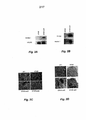
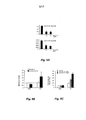
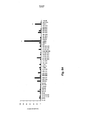
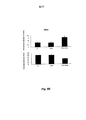
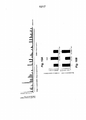
-
- G—PHYSICS
- G01—MEASURING; TESTING
- G01N—INVESTIGATING OR ANALYSING MATERIALS BY DETERMINING THEIR CHEMICAL OR PHYSICAL PROPERTIES
- G01N33/00—Investigating or analysing materials by specific methods not covered by groups G01N1/00 - G01N31/00
- G01N33/48—Biological material, e.g. blood, urine; Haemocytometers
- G01N33/50—Chemical analysis of biological material, e.g. blood, urine; Testing involving biospecific ligand binding methods; Immunological testing
- G01N33/53—Immunoassay; Biospecific binding assay; Materials therefor
- G01N33/566—Immunoassay; Biospecific binding assay; Materials therefor using specific carrier or receptor proteins as ligand binding reagents where possible specific carrier or receptor proteins are classified with their target compounds
-
- G—PHYSICS
- G01—MEASURING; TESTING
- G01N—INVESTIGATING OR ANALYSING MATERIALS BY DETERMINING THEIR CHEMICAL OR PHYSICAL PROPERTIES
- G01N33/00—Investigating or analysing materials by specific methods not covered by groups G01N1/00 - G01N31/00
- G01N33/48—Biological material, e.g. blood, urine; Haemocytometers
- G01N33/50—Chemical analysis of biological material, e.g. blood, urine; Testing involving biospecific ligand binding methods; Immunological testing
- G01N33/53—Immunoassay; Biospecific binding assay; Materials therefor
- G01N33/575—Immunoassay; Biospecific binding assay; Materials therefor for cancer
-
- C—CHEMISTRY; METALLURGY
- C07—ORGANIC CHEMISTRY
- C07K—PEPTIDES
- C07K2317/00—Immunoglobulins specific features
- C07K2317/70—Immunoglobulins specific features characterized by effect upon binding to a cell or to an antigen
- C07K2317/73—Inducing cell death, e.g. apoptosis, necrosis or inhibition of cell proliferation
- C07K2317/732—Antibody-dependent cellular cytotoxicity [ADCC]
-
- C—CHEMISTRY; METALLURGY
- C07—ORGANIC CHEMISTRY
- C07K—PEPTIDES
- C07K2317/00—Immunoglobulins specific features
- C07K2317/70—Immunoglobulins specific features characterized by effect upon binding to a cell or to an antigen
- C07K2317/76—Antagonist effect on antigen, e.g. neutralization or inhibition of binding
-
- G—PHYSICS
- G01—MEASURING; TESTING
- G01N—INVESTIGATING OR ANALYSING MATERIALS BY DETERMINING THEIR CHEMICAL OR PHYSICAL PROPERTIES
- G01N2333/00—Assays involving biological materials from specific organisms or of a specific nature
- G01N2333/435—Assays involving biological materials from specific organisms or of a specific nature from animals; from humans
- G01N2333/475—Assays involving growth factors
-
- G—PHYSICS
- G01—MEASURING; TESTING
- G01N—INVESTIGATING OR ANALYSING MATERIALS BY DETERMINING THEIR CHEMICAL OR PHYSICAL PROPERTIES
- G01N2500/00—Screening for compounds of potential therapeutic value
- G01N2500/02—Screening involving studying the effect of compounds C on the interaction between interacting molecules A and B (e.g. A = enzyme and B = substrate for A, or A = receptor and B = ligand for the receptor)
-
- G—PHYSICS
- G01—MEASURING; TESTING
- G01N—INVESTIGATING OR ANALYSING MATERIALS BY DETERMINING THEIR CHEMICAL OR PHYSICAL PROPERTIES
- G01N2800/00—Detection or diagnosis of diseases
- G01N2800/52—Predicting or monitoring the response to treatment, e.g. for selection of therapy based on assay results in personalised medicine; Prognosis
Landscapes
- Health & Medical Sciences (AREA)
- Life Sciences & Earth Sciences (AREA)
- Chemical & Material Sciences (AREA)
- Engineering & Computer Science (AREA)
- Immunology (AREA)
- Molecular Biology (AREA)
- Organic Chemistry (AREA)
- General Health & Medical Sciences (AREA)
- Urology & Nephrology (AREA)
- Hematology (AREA)
- Biomedical Technology (AREA)
- Biochemistry (AREA)
- Medicinal Chemistry (AREA)
- Analytical Chemistry (AREA)
- Physics & Mathematics (AREA)
- Biotechnology (AREA)
- Microbiology (AREA)
- Proteomics, Peptides & Aminoacids (AREA)
- Food Science & Technology (AREA)
- Pathology (AREA)
- General Physics & Mathematics (AREA)
- Cell Biology (AREA)
- Genetics & Genomics (AREA)
- Biophysics (AREA)
- Zoology (AREA)
- Wood Science & Technology (AREA)
- Bioinformatics & Cheminformatics (AREA)
- Toxicology (AREA)
- General Engineering & Computer Science (AREA)
- Pharmacology & Pharmacy (AREA)
- Veterinary Medicine (AREA)
- Public Health (AREA)
- Animal Behavior & Ethology (AREA)
- Nuclear Medicine, Radiotherapy & Molecular Imaging (AREA)
- General Chemical & Material Sciences (AREA)
- Chemical Kinetics & Catalysis (AREA)
- Medicines That Contain Protein Lipid Enzymes And Other Medicines (AREA)
- Measuring Or Testing Involving Enzymes Or Micro-Organisms (AREA)
- Investigating Or Analysing Biological Materials (AREA)
- Pharmaceuticals Containing Other Organic And Inorganic Compounds (AREA)
Abstract
MÉTODO DE SELEÇÃO DE UM COMPOSTO, MÉTODO IN VITRO DE PREVISÃO DA PRESENÇA DE CÂNCER METASTÁTICO OU CÂNCER AGRESSIVO, MÉTODO DE DETERMINAÇÃO IN VITRO DA EFICIÊNCIA DE UM TRATAMENTO ANTICANCERÍGENO, KIT DE SELEÇÃO, COMPOSTO, MÉTODO DE TRATAMENTO, MÉTODO DE PREVENÇÃO OU DE TRATAMENTO, USO DE UM COMPOSTO, MÉTODO OU USO E USO DO NÍVEL DE EXPRESSÃO DE NETRINA-1. O objeto da presente invenção refere-se a um método in vitro de seleção de compostos anticancerígenos com base na capacidade de interação desses compostos com receptor de netrina-1 e/ou de inibir a dimerização do domínio intracelular do receptor de netrina- 1 expresso em células de tumores. A presente invenção também se refere a um método de previsão da presença de câncer agressivo ou metastático ou de determinação da eficiência de um tratamento anticancerígeno com base na medição do nível de expressão de netrina-1. A presente invenção compreende ainda kits e compostos como medicamento para o tratamento de câncer tal como câncer de mama metastático, com relação à sobreexpressão de netrina-1 pelas células de tumores.METHOD FOR SELECTING A COMPOUND, IN VITRO METHOD FOR PREDICTING THE PRESENCE OF METASTATIC CANCER OR AGGRESSIVE CANCER, IN VITRO METHOD FOR DETERMINING THE EFFICIENCY OF AN ANTI-CANCERAGE TREATMENT, SELECTION KIT, COMPOUND, TREATMENT METHOD, PREVENTION METHOD, OR USE OF A COMPOUND, METHOD OR USE AND USE OF NETRIN-1 EXPRESSION LEVEL. The object of the present invention relates to an in vitro method of selection of anticancer compounds based on the ability of these compounds to interact with the netrin-1 receptor and/or to inhibit the dimerization of the intracellular domain of the netrin-1 receptor expressed in tumor cells. The present invention also relates to a method of predicting the presence of aggressive or metastatic cancer or determining the effectiveness of an anticancer treatment based on measuring the expression level of netrin-1. The present invention further comprises kits and compounds as a medicine for the treatment of cancer such as metastatic breast cancer, with respect to netrin-1 overexpression by tumor cells.
Description
[001] O objeto da presente invenção refere-se a um método in vitro de seleção de compostos anticancerígenos com base na capacidade de interação desses compostos com o receptor de netrina-1 e/ou de inibir a dimerização do domínio intracelular do receptor de netrina-1 expresso em células tumorais. A presente invenção também se refere a um método de previsão da presença de câncer metastático ou de determinação da eficiência de um tratamento anticancerígeno com base na medição do nível de expressão de netrina-1. A presente invenção compreende ainda kits e compostos como medicamento para o tratamento de câncer metastático tal como câncer de mama, com relação à superexpressão de netrina-1 pelas células tumorais.[001] The object of the present invention refers to an in vitro method of selection of anticancer compounds based on the ability of these compounds to interact with the netrin-1 receptor and/or to inhibit the dimerization of the intracellular domain of the netrin receptor -1 expressed in tumor cells. The present invention also relates to a method of predicting the presence of metastatic cancer or determining the efficiency of an anticancer treatment based on measuring the expression level of netrin-1. The present invention further comprises kits and compounds as a medicine for the treatment of metastatic cancer such as breast cancer, with respect to the overexpression of netrin-1 by tumor cells.
[002] Demonstrou-se que a netrina-1, uma proteína relativa a laminina difundível, desempenha um papel importante no controle da navegação neuronal durante o desenvolvimento do sistema nervoso 31, por meio de interação com os seus receptores principais, DCC (Excluído em Câncer Colo-Retal) 1, 2, 3e UNC5H 4, 5. Mais recentemente, entretanto, a netrina-1 surgiu como uma molécula completamente diferente que regula a sobrevivência celular. De fato, os receptores de netrina-1 DCC e UNC5H, ou seja, UNC5H1, UNC5H2 e UNC5H3, pertencem à chamada família de dependência de receptores 6, 7. Receptores de dependência formam um grupo de receptores que compartilham a capacidade de indução da morte celular quando expressos em configurações nas quais o seu ligante não está disponível 44. Esses receptores, que também incluem RET 8, β-integrinas 9, Patched 10, neogenina 11, p75NTR 12e o receptor andrógeno 40, compartilham a propriedade funcional de indução da morte celular quando desengatados dos seus ligantes, enquanto a presença do seu ligante bloqueia esta atividade pró- apoptótica. Estes receptores criam, desta forma, estados celulares de dependência sobre os seus ligantes correspondentes 13, 14.[002] It has been shown that netrin-1, a diffusible laminin-related protein, plays an important role in the control of neuronal navigation during the development of the nervous system 31, through interaction with its main receptors, DCC (Excluded in Colorectal Cancer) 1, 2,
[003] Sugeriu-se que este efeito de dependência age como mecanismo para eliminar células tumorais que se desenvolveriam em ambientes de indisponibilidade de ligantes: proliferação de células tumorais em ambiente celular com presença de ligantes constante e limitada ou migração de células tumorais metastáticas em direção a tecidos em que o ligante não é expresso. Uma vantagem seletiva de uma célula tumoral seria, portanto, a perda da atividade pró-apoptótica dos seus receptores de dependência. Previu- se a partir de telas genéticas que a netrina-1 de C. elegans -UNC6- interagiu com UNC40 e com UNC5 42. Quatro ortólogos de UNC5 foram identificados em mamíferos: concluiu-se que UNC5H1, H2, H3, H4 e UNC40 são o ortólogo do DCC (Excluído em Câncer Colo-Retal) de vertebrados 39. Ao longo desta linha, propôs-se no início dos anos 1990 que DCC é um gene supressor de tumores, cuja expressão é perdida na ampla maioria de cânceres humanos 15, 16. Esta hipótese também se enquadra na recente observação de que genes UNC5H são regulados para baixo na ampla maioria de tumores colo-retais, de forma a sugerir que a perda de genes UNC5H representa uma vantagem seletiva para o desenvolvimento de tumores 17. De forma interessante, em camundongos, tanto a desativação de UNC5H3 quando a superexpressão de netrina-1 no trato gastrointestinal são associadas ao progresso de tumores intestinais 18, 19, de forma a demonstrar intrinsecamente que a perda de receptores de dependência de netrina-1 na patologia humana é um fator causal do progresso de tumores. Embora uma série inicial de relatórios sustentasse o fato de que DCC agiu como supressor de tumores (para análise, vide 29), surgiram dúvidas, principalmente devido à raridade de mutações pontuais na seqüência de codificação de DCC e devido à falta de pré-disposição de tumores em camundongos hemizigóticos DCC 41.[003] It has been suggested that this dependency effect acts as a mechanism to eliminate tumor cells that would develop in environments of unavailability of ligands: proliferation of tumor cells in a cell environment with constant and limited presence of ligands or migration of metastatic tumor cells towards to tissues in which the ligand is not expressed. A selective advantage of a tumor cell would be, therefore, the loss of the pro-apoptotic activity of its dependence receptors. It was predicted from genetic screens that C. elegans netrin-1 -UNC6- interacted with UNC40 and with UNC5 42. Four orthologs of UNC5 were identified in mammals: UNC5H1, H2, H3, H4 and UNC40 were found to are the ortholog of DCC (Excluded in Colorectal Cancer) of vertebrates 39. Along this line, it was proposed in the early 1990s that DCC is a tumor suppressor gene whose expression is lost in the vast majority of
[004] O modelo descrito acima prevê, entretanto, que tanto a perda dos receptores de netrina-1 quanto o ganho de expressão de ligantes (ou seja, expressão autócrina) deverão ser observados em cânceres humanos, pois eles deverão representar vantagens seletivas similares. Esta questão é importante não apenas para conhecimento básico, mas é crucial para a terapia; de fato, inibir a interação extracelular entre receptores de dependência de netrina-1 e netrina-1 poderá representar uma estratégia importante para acionar a regressão de tumores.[004] The model described above predicts, however, that both the loss of netrin-1 receptors and the gain in expression of ligands (ie, autocrine expression) should be observed in human cancers, as they should represent similar selective advantages. This question is important not just for basic knowledge, but it is crucial for therapy; in fact, inhibiting the extracellular interaction between netrin-1 and netrin-1 dependence receptors could represent an important strategy to trigger tumor regression.
[005] É particularmente desejável fornecer meios simples e consistentes de identificação e caracterização de compostos novos que possam ser utilizados para o tratamento de câncer.[005] It is particularly desirable to provide simple and consistent means of identifying and characterizing new compounds that can be used for the treatment of cancer.
[006] Surpreendentemente, os inventores demonstraram em primeiro lugar que, em vez de perder receptores de dependência de netrina-1, a maior parte de tumores de mama metastáticos exibe maior expressão de netrina-1, uma característica que pode ser utilizada em terapia para acionar a morte de tumor metastático.[006] Surprisingly, the inventors first demonstrated that, rather than losing netrin-1 dependence receptors, most metastatic breast tumors exhibit increased netrin-1 expression, a characteristic that can be used in therapy for trigger metastatic tumor death.
[007] Caso a sinalização pró-apoptótica de DCC e/ou UNC5H esteja começando a ser documentada, uma questão importante nesta assinatura de morte/vida ditada por DCC, UNC5H e, mais geralmente, pelos outros receptores de dependência conhecidos, é como a presença do ligante inibe a sua atividade pró-apoptótica 50.[007] If the pro-apoptotic signaling of DCC and/or UNC5H is beginning to be documented, an important question in this death/life signature dictated by DCC, UNC5H and, more generally, by the other known dependence receptors, is how to presence of the ligand inhibits its
[008] Em um segundo momento, os inventores analisaram se a multimerização de DCC e/ou UNC5H induzida por netrina-1 poderia ser a etapa fundamental que inibe a atividade apoptótica de DCC e/ou UNC5H. Surpreendentemente, eles demonstraram que um receptor de netrina-1, tal como DCC e/ou UNC5H, multimeriza-se em resposta a netrina-1, um processo suficiente para inibir a apoptose.[008] In a second moment, the inventors analyzed whether the multimerization of DCC and/or UNC5H induced by netrin-1 could be the fundamental step that inhibits the apoptotic activity of DCC and/or UNC5H. Surprisingly, they demonstrated that a netrin-1 receptor, such as DCC and/or UNC5H, multimerizes in response to netrin-1, a process sufficient to inhibit apoptosis.
[009] Em um primeiro aspecto, a presente invenção refere-se a um método in vitro de seleção de um composto para a prevenção ou o tratamento de câncer, em que o mencionado método compreende as etapas a seguir de: (a) ter um meio que contenha netrina-1, ou um de seus fragmentos, e um receptor de netrina-1, ou um de seus fragmentos, em que: - a mencionada netrina-1, ou um de seus fragmentos, e o mencionado receptor de netrina-1, ou um de seus fragmentos, são capazes de interagir especificamente juntos para formar um par de ligação; e/ou - a mencionada netrina-1, ou um de seus fragmentos, é capaz de induzir a dimerização ou a multimerização do mencionado receptor de netrina-1, ou um de seus fragmentos, particularmente o domínio intracelular do mencionado receptor de netrina-1; (b) contato do mencionado meio com o composto a ser testado; (c) medição da inibição da interação entre a netrina-1, ou um de seus fragmentos, e o mencionado receptor de netrina-1, ou um de seus fragmentos; e/ou - determinação de se o mencionado composto inibe a dimerização ou multimerização do mencionado receptor de netrina-1, ou um de seus fragmentos, particularmente a dimerização do domínio intracelular do mencionado receptor de netrina-1; e (d) seleção do mencionado composto se: - a medição da etapa (c) demonstrar uma inibição significativa da interação entre a netrina-1, ou um de seus fragmentos, e o receptor de netrina-1, ou um de seus fragmentos, na presença do mencionado composto; e/ou - a determinação na etapa (c) demonstrar uma inibição significativa da dimerização ou multimerização do mencionado receptor de netrina-1, ou um de seus fragmentos, na presença do mencionado composto, particularmente a dimerização do domínio intracelular do mencionado receptor de netrina-1.[009] In a first aspect, the present invention relates to an in vitro method of selecting a compound for the prevention or treatment of cancer, wherein said method comprises the following steps of: (a) having a medium containing netrin-1, or one of its fragments, and a netrin-1 receptor, or one of its fragments, wherein: - said netrin-1, or one of its fragments, and said netrin-1 receptor- 1, or one of its fragments, are able to specifically interact together to form a binding pair; and/or - said netrin-1, or one of its fragments, is capable of inducing dimerization or multimerization of said netrin-1 receptor, or one of its fragments, particularly the intracellular domain of said netrin-1 receptor ; (b) contacting said medium with the compound to be tested; (c) measuring the inhibition of the interaction between netrin-1, or one of its fragments, and said netrin-1 receptor, or one of its fragments; and/or - determining whether said compound inhibits the dimerization or multimerization of said netrin-1 receptor, or one of its fragments, particularly the dimerization of the intracellular domain of said netrin-1 receptor; and (d) selection of said compound if: - the measurement of step (c) demonstrates a significant inhibition of the interaction between netrin-1, or one of its fragments, and the netrin-1 receptor, or one of its fragments, in the presence of said compound; and/or - the determination in step (c) demonstrates a significant inhibition of the dimerization or multimerization of said netrin-1 receptor, or one of its fragments, in the presence of said compound, particularly the dimerization of the intracellular domain of said netrin receptor -1.
[010] Pelas expressões interação entre netrina-1 e o seu receptor de netrina-1, pretende-se designar no presente pedido a interação que resulta na vantagem seletiva para células tumorais de escapar de receptores de dependência de netrina-1 que induziram apoptose, preferencialmente devido ao nível elevado de netrina-1.[010] By the expressions interaction between netrin-1 and its netrin-1 receptor, it is intended in the present application to designate the interaction that results in the selective advantage for tumor cells to escape netrin-1 dependence receptors that induced apoptosis, preferably due to the high level of netrin-1.
[011] Desta forma, a inibição desta interação pode ser obtida, por exemplo, por meio da inibição completa ou parcial da ligação de netrina-1 ao seu receptor, notadamente na presença de um ligante competitivo (tal como um anticorpo que é dirigido a esse domínio de membrana extracelular do mencionado receptor de netrina-1) ou na presença de um composto capaz de formar um complexo específico com a netrina-1 (tal como um domínio de membrana extracelular solúvel do seu receptor de netrina-1, ou uma de suas partes).[011] In this way, the inhibition of this interaction can be obtained, for example, through the complete or partial inhibition of the binding of netrin-1 to its receptor, notably in the presence of a competitive ligand (such as an antibody that is directed to that extracellular membrane domain of said netrin-1 receptor) or in the presence of a compound capable of forming a specific complex with netrin-1 (such as a soluble extracellular membrane domain of its netrin-1 receptor, or one of its parts).
[012] Em uma realização preferida, o método de acordo com a presente invenção é caracterizado pelo fato de que o mencionado câncer a ser evitado ou tratado é um câncer em que as células tumorais expressam ou superexpressam netrina-1.[012] In a preferred embodiment, the method according to the present invention is characterized by the fact that the mentioned cancer to be avoided or treated is a cancer in which tumor cells express or overexpress netrin-1.
[013] Em outra realização preferida, o método de acordo com a presente invenção é caracterizado pelo fato de que o mencionado câncer a ser evitado ou tratado é selecionado a partir do grupo que consiste de câncer de mama, câncer colo-retal, câncer de pulmão, neuroblastoma, glioma, leucemia mielóide aguda, sarcoma, melanoma, adenocarcinoma do ovário, adenocarcinoma renal, adenocarcinoma pancreático, adenocarcinoma do útero, adenocarcinoma do estômago, adenocarcinoma do rim e adenocarcinoma retal.[013] In another preferred embodiment, the method according to the present invention is characterized by the fact that said cancer to be avoided or treated is selected from the group consisting of breast cancer, colorectal cancer, breast cancer. lung, neuroblastoma, glioma, acute myeloid leukemia, sarcoma, melanoma, ovarian adenocarcinoma, renal adenocarcinoma, pancreatic adenocarcinoma, uterine adenocarcinoma, stomach adenocarcinoma, kidney adenocarcinoma, and rectal adenocarcinoma.
[014] Em outra realização preferida, o método de acordo com a presente invenção é caracterizado pelo fato de que o mencionado câncer a ser evitado ou tratado é um câncer metastático ou agressivo.[014] In another preferred embodiment, the method according to the present invention is characterized by the fact that said cancer to be avoided or treated is metastatic or aggressive cancer.
[015] No método de acordo com a presente invenção, o mencionado receptor de netrina-1 é preferencialmente selecionado a partir do grupo de DCC, UNC5H (particularmente UNC5H1, UNC5H2 e UNC5H3), neogenina e a adenosina A2b, de maior preferência selecionado a partir do grupo de DCC, UNC5H1, UNC5H2 e UNC5H3.[015] In the method according to the present invention, said netrin-1 receptor is preferably selected from the group of DCC, UNC5H (particularly UNC5H1, UNC5H2 and UNC5H3), neogenin and adenosine A2b, most preferably selected a from the DCC group, UNC5H1, UNC5H2 and UNC5H3.
[016] Em outra realização preferida, o método de acordo com a presente invenção é caracterizado pelo fato de que, na etapa (a): - o mencionado fragmento receptor de netrina-1 compreende ou é o domínio extracelular do receptor de netrina-1, ou uma de suas partes capaz de interagir com netrina-1; e/ou - o mencionado fragmento receptor de netrina-1 compreende ou é o domínio intracelular do receptor de netrina-1, ou uma de suas partes capaz de dimerizar-se ou multimerizar-se na presença de netrina-1.[016] In another preferred embodiment, the method according to the present invention is characterized by the fact that, in step (a): - said netrin-1 receptor fragment comprises or is the extracellular domain of the netrin-1 receptor , or one of its parts capable of interacting with netrin-1; and/or - said netrin-1 receptor fragment comprises or is the intracellular domain of netrin-1 receptor, or one of its parts capable of dimerizing or multimerizing in the presence of netrin-1.
[017] Em outra realização preferida, o método de acordo com a presente invenção é caracterizado pelo fato de que a mencionada netrina-1 e/ou o mencionado receptor de netrina-1 são de mamífero, particularmente de camundongo, rato ou ser humano.[017] In another preferred embodiment, the method according to the present invention is characterized by the fact that said netrin-1 and/or said netrin-1 receptor are mammalian, particularly mouse, rat or human.
[018] Em um aspecto adicional do método de acordo com a presente invenção, na etapa (a), a mencionada netrina-1 é de galinha.[018] In a further aspect of the method according to the present invention, in step (a), the mentioned netrin-1 is from chicken.
[019] Em outra realização preferida, o método de acordo com a presente invenção é caracterizado pelo fato de que a mencionada netrina-1 e/ou o mencionado receptor de netrina-1 e/ou o composto a ser testado é marcado por um marcador capaz de ser medido direta ou indiretamente.[019] In another preferred embodiment, the method according to the present invention is characterized in that said netrin-1 and/or said netrin-1 receptor and/or the compound to be tested is labeled by a marker able to be measured directly or indirectly.
[020] Em outra realização preferida, o método de acordo com a presente invenção é caracterizado pelo fato de que, na etapa (c): - a medição da inibição da interação entre netrina-1, ou um de seus fragmentos, e o mencionado receptor de netrina-1, ou um de seus fragmentos, é conduzida por meio de imunoteste (particularmente por meio de ELISA ou de Teste Imunorradiométrico (IRMA)), por meio de Teste de Proximidade de Cintilação (SPA) ou Transferência de Energia de Ressonância por Fluorescência (FRET); e/ou - a dimerização ou multimerização, ou sua inibição, do mencionado receptor de netrina-1, ou um de seus fragmentos, particularmente do domínio intracelular, é conduzida por meio de imunoprecipitação ou FRET.[020] In another preferred embodiment, the method according to the present invention is characterized by the fact that, in step (c): - the measurement of the inhibition of the interaction between netrin-1, or one of its fragments, and the aforementioned netrin-1 receptor, or one of its fragments, is conducted by means of immunotest (particularly by means of ELISA or Immunoradiometric Test (IRMA)), by means of Scintillation Proximity Test (SPA) or Resonance Energy Transfer by Fluorescence (FRET); and/or - the dimerization or multimerization, or its inhibition, of said netrin-1 receptor, or one of its fragments, particularly of the intracellular domain, is carried out by means of immunoprecipitation or FRET.
[021] Em outra realização preferida específica, o método, de acordo com a presente invenção, é caracterizado pelo fato de que, na etapa (a), o mencionado meio contém células que expressam na sua membrana de superfície um receptor de netrina-1 endógeno ou recombinante, particularmente um domínio extracelular recombinante do mencionado receptor de netrina-1.[021] In another specific preferred embodiment, the method, according to the present invention, is characterized by the fact that, in step (a), said medium contains cells that express on their surface membrane a netrin-1 receptor endogenous or recombinant, particularly a recombinant extracellular domain of said netrin-1 receptor.
[022] Em uma realização preferida, o mencionado receptor de netrina-1 recombinante também compreende o domínio intracelular do mencionado receptor de netrina-1.[022] In a preferred embodiment, said recombinant netrin-1 receptor also comprises the intracellular domain of said netrin-1 receptor.
[023] Em outra realização preferida específica, o método de acordo com a presente invenção é caracterizado pelo fato de que, na etapa (a), o mencionado meio contém células tumorais, preferencialmente células tumorais metastáticas, que expressam de forma endógena o mencionado receptor de netrina-1 na sua superfície de membrana e que expressam ou superexpressam a netrina-1, e em que, na etapa (c), a inibição da interação entre a netrina-1 e o seu receptor de netrina-1 na presença do composto a ser testado é medida por meio da apoptose ou morte celular induzida pela presença do composto a ser testado, preferencialmente analisada utilizando o método de manchas de azul de tripano conforme indicado nos exemplos abaixo.[023] In another specific preferred embodiment, the method according to the present invention is characterized by the fact that, in step (a), said medium contains tumor cells, preferably metastatic tumor cells, which endogenously express said receptor of netrin-1 on its membrane surface and which express or overexpress netrin-1, and in which, in step (c), the inhibition of the interaction between netrin-1 and its netrin-1 receptor in the presence of the compound to be tested is measured by apoptosis or cell death induced by the presence of the compound to be tested, preferably analyzed using the trypan blue staining method as indicated in the examples below.
[024] Em uma realização preferida, as mencionadas células tumorais são selecionadas a partir do grupo que consiste de células 4T1, células CAL51, células T47D, células SKBR7, células IMR32, células GL26 e células H358, notadamente linhagens de células CAL51, tais como linhagem de células CAL51-36, que são muito mais suscetíveis à morte celular em resposta à presença de DCC-EC-Fc.[024] In a preferred embodiment, said tumor cells are selected from the group consisting of 4T1 cells, CAL51 cells, T47D cells, SKBR7 cells, IMR32 cells, GL26 cells and H358 cells, notably CAL51 cell lines such as cell line CAL51-36, which are much more susceptible to cell death in response to the presence of DCC-EC-Fc.
[025] A presente invenção também se refere a um método in vitro de seleção de um composto para a prevenção ou o tratamento de câncer, em que o mencionado método compreende as etapas a seguir de: (a) ter um meio que contém uma célula de mamífero que expressa um receptor de netrina-1 endógeno ou recombinante, ou um de seus fragmentos que compreende pelo menos o seu domínio intracelular, preferencialmente uma célula tumoral, de maior preferência uma célula que apresente dimerização ou multimerização do seu domínio intracelular de receptor de netrina-1 ou uma célula em que o seu domínio intracelular de receptor de netrina-1 é capaz de dimerizar-se ou multimerizar-se na presença de netrina-1; (b) contato do mencionado meio com o composto a ser testado, em que o meio opcionalmente contém ainda netrina-1, ou um de seus fragmentos capaz de interagir com o domínio extracelular do receptor de netrina-1; (c) determinar se a dimerização ou multimerização do mencionado domínio intracelular de receptor de netrina-1 é inibida na presença do mencionado composto a ser testado; (d) opcionalmente, determinar (por meio do método de azul de tripano, por exemplo) se a presença do composto a ser testado induz a morte celular da mencionada célula de mamífero; e (e) seleção do mencionado composto caso a determinação na etapa (c) demonstre uma inibição significativa da dimerização ou multimerização do domínio intracelular do mencionado receptor de netrina-1 e/ou se a determinação na etapa (d) demonstrar a morte celular da mencionada célula de mamífero.[025] The present invention also relates to an in vitro method of selecting a compound for the prevention or treatment of cancer, wherein said method comprises the following steps of: (a) having a medium that contains a cell of a mammal that expresses an endogenous or recombinant netrin-1 receptor, or one of its fragments that comprises at least its intracellular domain, preferably a tumor cell, more preferably a cell that exhibits dimerization or multimerization of its intracellular domain of receptor. netrin-1 or a cell in which its intracellular netrin-1 receptor domain is capable of dimerizing or multimerizing in the presence of netrin-1; (b) contacting said medium with the compound to be tested, the medium optionally further containing netrin-1, or one of its fragments capable of interacting with the extracellular domain of the netrin-1 receptor; (c) determining whether dimerization or multimerization of said intracellular domain of netrin-1 receptor is inhibited in the presence of said compound to be tested; (d) optionally determining (by means of the trypan blue method, for example) whether the presence of the compound to be tested induces cell death of said mammalian cell; and (e) selection of said compound if the determination in step (c) demonstrates significant inhibition of dimerization or multimerization of the intracellular domain of said netrin-1 receptor and/or if the determination in step (d) demonstrates cell death of mentioned mammalian cell.
[026] Em segundo aspecto, a presente invenção refere-se a um método in vitro de previsão da presença de câncer metastático ou câncer agressivo (tal como neuroblastoma) em um paciente que possui um tumor primário a partir de uma biópsia do mencionado paciente que contém células de tumores primários, em que o mencionado método compreende a etapa a seguir de: (a) medição do nível de expressão de netrina-1 na mencionada biópsia.[026] Second, the present invention relates to an in vitro method of predicting the presence of metastatic cancer or aggressive cancer (such as neuroblastoma) in a patient who has a primary tumor from a biopsy of said patient who contains cells from primary tumors, said method comprising the next step of: (a) measuring the expression level of netrin-1 in said biopsy.
[027] Em uma realização preferida, o método de previsão de acordo com a presente invenção é caracterizado pelo fato de que, na etapa (a), um aumento do nível de expressão de netrina-1 na mencionada biópsia, em comparação com a expressão de netrina-1 em biópsias de tumores primários não metastáticos ou em biópsias de câncer não agressivas, é indicativa da presença de um câncer metastático ou um câncer agressivo.[027] In a preferred embodiment, the prediction method according to the present invention is characterized by the fact that, in step (a), an increase in the expression level of netrin-1 in said biopsy, compared to the expression of netrin-1 in biopsies of non-metastatic primary tumors or in non-aggressive cancer biopsies is indicative of the presence of a metastatic cancer or an aggressive cancer.
[028] Em uma realização preferida, o método de previsão de acordo com a presente invenção é caracterizado pelo fato de que uma razão superior a 2, preferencialmente a 2,5, a 3, a 3,5, a 4, a 4,5 e a 5, entre a expressão de netrina-1 na biópsia a ser testada e na biópsia de referência não metastática ou não agressiva é indicativa da presença de um câncer metastático ou agressivo.[028] In a preferred embodiment, the prediction method according to the present invention is characterized by the fact that a ratio greater than 2, preferably 2.5, to 3, to 3.5, to 4, to 4, 5 and 5, between the expression of netrin-1 in the biopsy to be tested and in the non-metastatic or non-aggressive reference biopsy is indicative of the presence of a metastatic or aggressive cancer.
[029] Em um terceiro aspecto, a presente invenção refere-se a um método de determinação in vitro da eficiência de um tratamento anticancerígeno para um paciente ou para selecionar pacientes que reajam a um tratamento anticancerígeno específico, em que o mencionado método compreende as etapas a seguir de: (a) obtenção de uma biópsia de tumor primária do mencionado paciente tratado; e (b) medição do nível de expressão de netrina-1 na mencionada biópsia; em que a eficiência do mencionado tratamento anticancerígeno é correlacionada com a redução da quantidade do nível de expressão de netrina- 1 medido na mencionada biópsia; ou em que os pacientes selecionados que reagem a um tratamento anticancerígeno específico são pacientes em que a quantidade do nível de expressão de netrina-1 medida na sua biópsia caiu após o mencionado tratamento específico.[029] In a third aspect, the present invention relates to a method of determining in vitro the efficiency of an anticancer treatment for a patient or to select patients who respond to a specific anticancer treatment, wherein said method comprises the steps thereafter: (a) obtaining a primary tumor biopsy from said treated patient; and (b) measuring the expression level of netrin-1 in said biopsy; wherein the efficiency of said anticancer treatment is correlated with the reduction in the amount of expression level of netrin-1 measured in said biopsy; or where selected patients who respond to a specific anticancer treatment are patients in which the amount of netrin-1 expression level measured in their biopsy has dropped after said specific treatment.
[030] Em uma realização preferida, o método de determinação in vitro da eficiência de um tratamento anticancerígeno para um paciente ou para selecionar pacientes que reajam a um tratamento anticancerígeno específico é caracterizado pelo fato de que o mencionado câncer induziu a superexpressão de netrina-1 e/ou é um câncer metastático ou agressivo.[030] In a preferred embodiment, the method of determining in vitro the efficiency of an anticancer treatment for a patient or to select patients who respond to a specific anticancer treatment is characterized by the fact that said cancer induced overexpression of netrin-1 and/or it is metastatic or aggressive cancer.
[031] Em uma realização preferida, o método de previsão ou de determinação in vitro da eficiência de um tratamento anticancerígeno para um paciente é caracterizado pelo fato de que o produto de expressão de netrina-1 medido é a netrina-1 que codifica RNA, particularmente medida por meio de um método de PCR reversa em tempo real quantitativa, ou pelo fato de que o nível de expressão de netrina-1 que é medido é a medida do nível de proteína de netrina-1, particularmente por meio de método que utiliza anticorpos específicos capazes de reconhecer especificamente a mencionada proteína de netrina-1.[031] In a preferred embodiment, the method of predicting or determining in vitro the efficiency of an anticancer treatment for a patient is characterized by the fact that the measured product of netrin-1 expression is netrin-1 that encodes RNA, particularly measured by means of a quantitative real-time reverse PCR method, or by the fact that the expression level of netrin-1 that is measured is the measure of the protein level of netrin-1, particularly by means of a method that uses specific antibodies capable of specifically recognizing said netrin-1 protein.
[032] Em uma realização preferida, o método de previsão ou de determinação in vitro da eficiência de um tratamento anticancerígeno para um paciente é caracterizado pelo fato de que o tumor primário é um tumor primário de um câncer selecionado a partir do grupo que consiste de câncer de mama, câncer colo-retal, câncer do pulmão, neuroblastoma, glioma, leucemia mielóide aguda, sarcoma, melanoma, adenocarcinoma do ovário, adenocarcinoma renal, adenocarcinoma pancreático, adenocarcinoma do útero, adenocarcinoma do estômago, adenocarcinoma do rim e adenocarcinoma retal.[032] In a preferred embodiment, the method of predicting or determining in vitro the efficiency of an anticancer treatment for a patient is characterized by the fact that the primary tumor is a primary tumor of a cancer selected from the group consisting of breast cancer, colorectal cancer, lung cancer, neuroblastoma, glioma, acute myeloid leukemia, sarcoma, melanoma, ovarian adenocarcinoma, renal adenocarcinoma, pancreatic adenocarcinoma, uterine adenocarcinoma, stomach adenocarcinoma, kidney adenocarcinoma, and rectal adenocarcinoma.
[033] Em um outro aspecto, a presente invenção refere-se a um kit de seleção de um composto de prevenção ou tratamento de câncer, em que o mencionado kit compreende: - uma proteína receptora de netrina-1, ou um de seus fragmentos capaz de interagir especificamente com a proteína de netrina-1 para formar um par de ligação, preferencialmente uma proteína recombinante; e - uma proteína de netrina-1, ou um de seus fragmentos capaz de interagir especificamente com a mencionada proteína receptora de netrina-1 para formar um par de ligação, preferencialmente uma proteína recombinante.[033] In another aspect, the present invention relates to a kit for selecting a compound for preventing or treating cancer, wherein said kit comprises: - a netrin-1 receptor protein, or one of its fragments capable of specifically interacting with netrin-1 protein to form a binding pair, preferably a recombinant protein; and - a netrin-1 protein, or one of its fragments capable of specifically interacting with said netrin-1 receptor protein to form a binding pair, preferably a recombinant protein.
[034] O mencionado receptor de netrina-1 também é preferencialmente selecionado a partir do grupo que consiste de DCC, UNC5H (particularmente UNC5H1, UNC5H2 e UNC5H3), neogenina e a adenosina A2b, de maior preferência selecionado a partir do grupo que consiste de DCC, UNC5H1, UNC5H2 e UNC5H3, de maior preferência de mamífero tal como camundongo, rato ou ser humano.[034] Said netrin-1 receptor is also preferably selected from the group consisting of DCC, UNC5H (particularly UNC5H1, UNC5H2 and UNC5H3), neogenin and adenosine A2b, most preferably selected from the group consisting of DCC, UNC5H1, UNC5H2 and UNC5H3, most preferably from mammals such as mouse, rat or human.
[035] Em uma realização preferida, o mencionado kit compreende células tumorais que expressam o receptor de netrina-1 e que expressam ou superexpressam a netrina-1, particularmente células de linhagem de células tumorais metastáticas, preferencialmente selecionadas a partir do grupo que consiste de células 4T1, células CAL51, células T47D, células SKBR7, células IMR32, células GL26 e células H358, notadamente linhagens de células CAL51, tais como linhagem de células CAL51-36, que são muito mais suscetíveis a morte celular em resposta à presença de DCC-EC-Fc.[035] In a preferred embodiment, said kit comprises tumor cells that express the netrin-1 receptor and that express or overexpress netrin-1, particularly metastatic tumor cell lineage cells, preferably selected from the group consisting of 4T1 cells, CAL51 cells, T47D cells, SKBR7 cells, IMR32 cells, GL26 cells and H358 cells, notably CAL51 cell lines, such as CAL51-36 cell line, which are much more susceptible to cell death in response to the presence of CHD -EC-Fc.
[036] Em um outro aspecto, a presente invenção compreende um composto selecionado a partir do grupo que consiste de: - um composto que compreende um domínio extracelular de receptor de netrina-1 ou seu fragmento capaz de inibir especificamente a interação entre a netrina-1 e o mencionado receptor de netrina-1 e/ou capaz de inibir a dimerização ou multimerização do mencionado receptor de netrina-1, ou um de seus fragmentos, particularmente para inibir o domínio intracelular do mencionado receptor de netrina-1; e - um anticorpo monoclonal ou policlonal dirigido especificamente contra netrina-1 ou receptor de netrina-1, particularmente dirigido ao domínio extracelular do mencionado receptor de netrina-1 ou ao fragmento de netrina-1 capaz de interagir com o domínio extracelular do mencionado receptor de netrina-1, como medicamento.[036] In another aspect, the present invention comprises a compound selected from the group consisting of: - a compound comprising an extracellular domain of netrin-1 receptor or its fragment capable of specifically inhibiting the interaction between netrin- 1 and said netrin-1 receptor and/or capable of inhibiting the dimerization or multimerization of said netrin-1 receptor, or one of its fragments, particularly to inhibit the intracellular domain of said netrin-1 receptor; and - a monoclonal or polyclonal antibody specifically directed against netrin-1 or netrin-1 receptor, particularly directed to the extracellular domain of said netrin-1 receptor or to the fragment of netrin-1 capable of interacting with the extracellular domain of said netrin-1 receptor. netrin-1, as a medicine.
[037] A seqüência de aminoácidos de netrina-1 humana ou receptor de netrina humano tal como UNC5H1, UNC5H2 e UNC5H3 (homólogo de UNC-5 1, 2 e 3 equivalente ao homólogo de UNC-5 A, B e C) é bem conhecida dos técnicos no assunto. Um exemplo destas seqüências de aminoácidos com a localização do seu domínio específico pode ser encontrado no Genbank com o número de acesso AAD09221 ou NP_004813 para netrina-1 humana, NP_588610 para homólogo 1 de receptor de netrina humana UNC-5, Q8IZJ1 para homólogo 2 de receptor de netrina UNC-5 e O95185 para homólogo 3 de UNC-5.[037] The amino acid sequence of human netrin-1 or human netrin receptor such as UNC5H1, UNC5H2 and UNC5H3 (UNC-5
[038] Preferencialmente, nos compostos de acordo com a presente invenção, o mencionado domínio extracelular de receptor de netrina-1 ou seu fragmento é selecionado a partir do grupo de DCC, UNC5H (particularmente UNC5H1, UNC5H2 e UNC5H3), neogenina e a adenosina A2b, selecionada de maior preferência a partir do grupo que consiste de DCC, UNC5H1, UNC5H2 e UNC5H3, de maior preferência a partir de mamífero tal como camundongo, rato ou ser humano.[038] Preferably, in the compounds according to the present invention, said extracellular domain of netrin-1 receptor or its fragment is selected from the group of DCC, UNC5H (particularly UNC5H1, UNC5H2 and UNC5H3), neogenin and adenosine A2b, most preferably selected from the group consisting of DCC, UNC5H1, UNC5H2 and UNC5H3, most preferably from mammal such as mouse, rat or human.
[039] Em realização de maior preferência, o mencionado composto de acordo com a presente invenção compreende um domínio extracelular de receptor de netrina-1 de DCC e, preferencialmente, o mencionado composto é DCC-EC-Fc ou DCC-5Fbn.[039] In more preferred embodiment, said compound according to the present invention comprises an extracellular domain of DCC netrin-1 receptor, and preferably said compound is DCC-EC-Fc or DCC-5Fbn.
[040] Em outro aspecto, a presente invenção refere-se ao uso do nível de expressão de netrina-1 como marcador para a identificação de câncer metastático em um paciente, preferencialmente de câncer colo-retal ou de mama metastático, em que o de maior preferência é o câncer de mama metastático.[040] In another aspect, the present invention relates to the use of the expression level of netrin-1 as a marker for the identification of metastatic cancer in a patient, preferably colorectal or metastatic breast cancer, in which the most preferred is metastatic breast cancer.
[041] Em outro aspecto, a presente invenção refere-se a um método de tratamento para indução da apoptose ou da morte celular de células tumorais que tenham adquirido a vantagem seletiva de escapar de apoptose induzida por receptores de dependência de netrina-1, preferencialmente por nível elevado de netrina-1, em um paciente que compreende a administração de um composto capaz de inibir a interação entre netrina-1 e o seu receptor de netrina-1, um composto capaz de inibir a dimerização ou a multimerização do receptor de netrina-1, um composto de acordo com a presente invenção ou selecionado por meio do método de acordo com a presente invenção, no mencionado paciente dele necessitado.[041] In another aspect, the present invention relates to a method of treatment for inducing apoptosis or cell death of tumor cells that have acquired the selective advantage of escaping apoptosis induced by netrin-1 dependence receptors, preferably by high level of netrin-1, in a patient comprising the administration of a compound capable of inhibiting the interaction between netrin-1 and its netrin-1 receptor, a compound capable of inhibiting the dimerization or multimerization of the netrin receptor -1, a compound according to the present invention or selected by means of the method according to the present invention, in said patient in need thereof.
[042] Em outro aspecto, a presente invenção refere-se a um método de prevenção ou de tratamento de câncer em pacientes que compreende a administração de um composto de acordo com a presente invenção, ou selecionado por meio do método de acordo com a presente invenção, no mencionado paciente dele necessitado.[042] In another aspect, the present invention relates to a method of preventing or treating cancer in patients comprising administering a compound according to the present invention, or selected by means of the method according to the present invention. invention, in the mentioned patient in need thereof.
[043] A presente invenção também compreende o uso de um composto de acordo com a presente invenção, ou selecionado por meio do método de acordo com a presente invenção, para a fabricação de um medicamento para a prevenção ou o tratamento de câncer em mamíferos, incluindo seres humanos. Preferencialmente, o mencionado câncer é um câncer metastático ou agressivo.[043] The present invention also comprises the use of a compound according to the present invention, or selected by means of the method according to the present invention, for the manufacture of a medicine for the prevention or treatment of cancer in mammals, including humans. Preferably, the mentioned cancer is a metastatic or aggressive cancer.
[044] De maior preferência, no método de tratamento ou no uso de um composto de acordo com a presente invenção, o mencionado câncer é selecionado a partir do grupo que consiste de câncer de mama, câncer colo- retal, câncer do pulmão, neuroblastoma, glioma, leucemia mielóide aguda, sarcoma, melanoma, adenocarcinoma do ovário, adenocarcinoma renal, adenocarcinoma pancreático, adenocarcinoma do útero, adenocarcinoma do estômago, adenocarcinoma do rim e adenocarcinoma retal.[044] More preferably, in the method of treatment or in the use of a compound according to the present invention, said cancer is selected from the group consisting of breast cancer, colorectal cancer, lung cancer, neuroblastoma , glioma, acute myeloid leukemia, sarcoma, melanoma, ovarian adenocarcinoma, renal adenocarcinoma, pancreatic adenocarcinoma, uterine adenocarcinoma, stomach adenocarcinoma, kidney adenocarcinoma, and rectal adenocarcinoma.
[045] De maior preferência, no método de tratamento ou no uso de um composto de acordo com a presente invenção, as células tumorais primárias do mencionado câncer expressam ou superexpressam a netrina-1.[045] More preferably, in the method of treatment or in the use of a compound according to the present invention, the primary tumor cells of said cancer express or overexpress netrin-1.
[046] O termo “anticorpo”, da forma utilizada no presente, indica moléculas de imunoglobulina e porções imunologicamente ativas de moléculas de imunoglobulina, ou seja, moléculas que contêm um local de ligação de antígenos que une especificamente (imunorreage com) a proteína de netrina-1 ou o seu receptor.[046] The term "antibody", as used herein, indicates immunoglobulin molecules and immunologically active portions of immunoglobulin molecules, that is, molecules that contain an antigen-binding site that specifically binds (immunoreacts with) the protein of netrin-1 or its receptor.
[047] O termo “anticorpo” compreende anticorpos monoclonais ou policlonais, mas também anticorpos quiméricos ou humanizados.[047] The term "antibody" comprises monoclonal or polyclonal antibodies, but also chimeric or humanized antibodies.
[048] Uma proteína de netrina-1 isolada ou proteína receptora de netrina-1, ou um de seus fragmentos específicos, pode ser utilizada como imunogene para gerar anticorpos que unem essa proteína utilizando métodos padrão para a preparação de anticorpos monoclonais e policlonais. Pode também ser possível utilizar qualquer fragmento dessas proteínas que contenha pelo menos um determinante antigênico para gerar estes anticorpos específicos.[048] An isolated netrin-1 protein or netrin-1 receptor protein, or one of its specific fragments, can be used as an immunogen to generate antibodies that bind this protein using standard methods for the preparation of monoclonal and polyclonal antibodies. It may also be possible to use any fragment of these proteins that contains at least one antigenic determinant to generate these specific antibodies.
[049] Um imunogene de proteína é tipicamente utilizado para preparar anticorpos por meio da imunização de um paciente apropriado (tal como coelho, cabra, camundongo ou outro mamífero) com o imunogene. Uma preparação imunogênica apropriada pode conter a mencionada proteína, ou seu fragmento, e pode incluir adicionalmente um adjuvante, tal como adjuvante completo ou incompleto de Freund, ou agente imunoestimulante similar.[049] A protein immunogen is typically used to prepare antibodies by immunizing an appropriate patient (such as a rabbit, goat, mouse or other mammal) with the immunogen. A suitable immunogenic preparation may contain said protein, or fragment thereof, and may additionally include an adjuvant, such as Freund's complete or incomplete adjuvant, or similar immunostimulating agent.
[050] Desta forma, anticorpo para uso de acordo com a presente invenção inclui anticorpos policlonais, monoclonais, quiméricos ou humanizados, anticorpos capazes de unir seletivamente ou que se unem seletivamente a um epítopo que contém um polipeptídeo que compreende um espaço contíguo de pelo menos oito a dez aminoácidos de uma seqüência de aminoácidos da proteína de netrina-1 ou seu receptor.[050] Thus, antibody for use in accordance with the present invention includes polyclonal, monoclonal, chimeric or humanized antibodies, antibodies capable of selectively binding or selectively binding to an epitope that contains a polypeptide comprising a contiguous space of at least eight to ten amino acids of an amino acid sequence of netrin-1 protein or its receptor.
[051] Um agente preferido para detectar e quantificar mRNA ou cDNA que codifica a proteína de netrina-1 é uma sonda de ácido nucleico marcada ou primers capazes de hibridizar este mRNA ou cDNA. A sonda de ácido nucleico pode ser um oligonucleotídeo com pelo menos 10, 15, 30, 50 ou 100 nucleotídeos de comprimento e suficiente para hibridização específica sob condições estringentes no mRNA ou cDNA. O primer de ácido nucleico pode ser um oligonucleotídeo com pelo menos 10, 15 ou 20 nucleotídeos de comprimento e suficiente para hibridizar-se especificamente sob condições estringentes no mRNA ou cDNA, ou sua seqüência complementar.[051] A preferred agent for detecting and quantifying mRNA or cDNA encoding the netrin-1 protein is a labeled nucleic acid probe or primers capable of hybridizing this mRNA or cDNA. The nucleic acid probe can be an oligonucleotide of at least 10, 15, 30, 50 or 100 nucleotides in length and sufficient for specific hybridization under stringent conditions to mRNA or cDNA. The nucleic acid primer can be an oligonucleotide of at least 10, 15 or 20 nucleotides in length and sufficient to specifically hybridize under stringent conditions to mRNA or cDNA, or its complementary sequence.
[052] Um agente preferido para detectar e quantificar a proteína de netrina-1 é um anticorpo capaz de unir-se especificamente a essa proteína, preferencialmente um anticorpo com uma marca detectável. Anticorpos podem ser policlonais ou, de maior preferência, monoclonais. Pode ser utilizado um anticorpo intacto, ou um de seus fragmentos (tal como Fab ou F(ab’)2). O termo “marcado”, com relação à sonda ou anticorpo, destina-se a englobar marcação direta da sonda ou anticorpo por meio de acoplamento (ou seja, ligação física) de substância detectável à sonda ou anticorpo, bem como marcação indireta da sonda ou anticorpo por meio de reatividade com outro reagente que é marcado diretamente. Exemplos de marcação indireta incluem a detecção de um anticorpo primário utilizando um anticorpo secundário marcado de forma fluorescente e marcação final de uma sonda de DNA com biotina, de forma que possa ser detectado com estreptavidina marcada de forma fluorescente.[052] A preferred agent for detecting and quantifying netrin-1 protein is an antibody capable of specifically binding to that protein, preferably an antibody with a detectable label. Antibodies can be polyclonal or, more preferably, monoclonal. An intact antibody, or one of its fragments (such as Fab or F(ab')2) can be used. The term "labeled" in relation to the probe or antibody is intended to encompass direct labeling of the probe or antibody through coupling (i.e., physical binding) of detectable substance to the probe or antibody, as well as indirect labeling of the probe or antibody through reactivity with another reagent that is directly labeled. Examples of indirect labeling include detection of a primary antibody using a fluorescently labeled secondary antibody and final labeling of a DNA probe with biotin so that it can be detected with fluorescently labeled streptavidin.
[053] Métodos in vitro de detecção de possível mRNA incluem, por exemplo, hibridizações Northern e hibridizações in situ. Métodos in vitro de detecção da possível proteína incluem testes imunossorventes ligados por enzimas (ELISAs), Western Blots, imunoprecipitações e imunofluorescência. Os métodos in vitro para detecção de possível cDNA incluem hibridizações Southern.[053] In vitro methods of detecting possible mRNA include, for example, Northern hybridizations and in situ hybridizations. In vitro methods of detecting the possible protein include enzyme-linked immunosorbent assays (ELISAs), Western Blots, immunoprecipitations and immunofluorescence. In vitro methods for detecting possible cDNA include Southern hybridizations.
[054] Quando a presente invenção englobar kits para quantificar o nível de proteína de netrina-1, o kit pode compreender um agente ou composto marcado capaz de quantificar estas proteínas. Os mencionados agentes podem ser embalados em um recipiente apropriado. O kit pode compreender ainda instruções de uso do kit para quantificar o nível da proteína de netrina-1 ou do transcrito de netrina-1.[054] When the present invention encompasses kits to quantify the level of netrin-1 protein, the kit may comprise a labeled agent or compound capable of quantifying these proteins. Said agents can be packaged in a suitable container. The kit may further comprise instructions for using the kit to quantify the level of the netrin-1 protein or the netrin-1 transcript.
[055] Em certas realizações do método de acordo com a presente invenção, a determinação dos transcritos de netrina-1 envolve o uso de uma sonda/primer em uma reação em cadeia de polimerase (PCR), tal como PCR âncora ou PCR RACE ou, alternativamente, em uma reação de cadeia de ligação (LCR) (vide, por exemplo, Landegran et al, 1988, Science 241: 23-1080; e Nakazawa et al, 1994, Proc. Natl. Acad. Sci. U. S. A. 91: 360364) ou, alternativamente, PCR RT em tempo real quantitativa. Este método pode incluir as etapas de coleta de uma amostra de células de um paciente, isolamento de ácido nucleico (tal como mRNA) das células da amostra, transformação opcional de mRNA em cDNA correspondente, contato da amostra de ácido nucleico com um ou mais primers que se hibridizam especificamente na netrina-1, mRNA ou seu cDNA correspondente sob condições tais que ocorra a hibridização e a amplificação de cDNA ou mRNA de netrina-1 e a quantificação da presença dos produtos de amplificação. Antecipa-se que PCR e/ou LCR pode ser desejável para uso como uma etapa de amplificação em conjunto com qualquer dos métodos utilizados para quantificar a detecção de ácido nucleico.[055] In certain embodiments of the method according to the present invention, the determination of netrin-1 transcripts involves the use of a probe/primer in a polymerase chain reaction (PCR), such as anchor PCR or RACE PCR or , alternatively, in a chain link reaction (LCR) (see, for example, Landegran et al, 1988, Science 241: 23-1080; and Nakazawa et al, 1994, Proc. Natl. Acad. Sci. USA 91: 360364) or, alternatively, quantitative real-time RT PCR. This method may include the steps of collecting a sample of cells from a patient, isolating nucleic acid (such as mRNA) from the cells in the sample, optionally transforming the mRNA into corresponding cDNA, contacting the nucleic acid sample with one or more primers that specifically hybridize to netrin-1, mRNA or its corresponding cDNA under conditions such that hybridization and amplification of netrin-1 cDNA or mRNA and quantification of the presence of the amplification products occurs. It is anticipated that PCR and/or LCR may be desirable for use as an amplification step in conjunction with any of the methods used to quantify nucleic acid detection.
[056] Os métodos descritos no presente podem ser realizados, por exemplo, utilizando kits de diagnóstico previamente embalados que compreendem pelo menos uma sonda de ácido nucleico ou conjunto de primer ou reagente de anticorpo descrito no presente, que podem ser convenientemente utilizados, por exemplo, em ambientes clínicos para acompanhamento ou diagnóstico de pacientes.[056] The methods described herein can be carried out, for example, using pre-packaged diagnostic kits comprising at least one nucleic acid probe or primer set or antibody reagent described herein, which can be conveniently used, for example , in clinical settings for monitoring or diagnosing patients.
[057] Por fim, a presente invenção refere-se ao uso de oligonucleotídeos sem sentido ou de iRNA (RNA interferente) específicos do ácido nucleico que codifica a proteína de netrina-1 para a fabricação de um medicamento destinado a evitar ou tratar câncer metastático ou agressivo, em que o mencionado câncer é preferencialmente selecionado a partir do grupo que consiste de câncer de mama, câncer colo-retal, câncer do pulmão, neuroblastoma, glioma, leucemia mielóide aguda, sarcoma, melanoma, adenocarcinoma do ovário, adenocarcinoma renal, adenocarcinoma pancreático, adenocarcinoma do útero, adenocarcinoma do estômago, adenocarcinoma do rim e adenocarcinoma retal.[057] Finally, the present invention relates to the use of nonsense oligonucleotides or iRNA (interfering RNA) specific for the nucleic acid encoding the netrin-1 protein for the manufacture of a drug to prevent or treat metastatic cancer or aggressive, wherein said cancer is preferably selected from the group consisting of breast cancer, colorectal cancer, lung cancer, neuroblastoma, glioma, acute myeloid leukemia, sarcoma, melanoma, ovarian adenocarcinoma, renal adenocarcinoma, pancreatic adenocarcinoma, uterine adenocarcinoma, stomach adenocarcinoma, kidney adenocarcinoma and rectal adenocarcinoma.
[058] RNA interferente (iRNA) é um fenômeno no qual um RNA de fita dupla (dsRNA) suprime especificamente a expressão de um gene que contém a sua seqüência de complementaridade. iRNA tornou-se desde então uma ferramenta de pesquisa útil para muitos organismos. Embora o mecanismo por meio do qual dsRNA suprime a expressão genética não seja completamente compreendido, dados experimentais fornecem indicações importantes. Esta tecnologia possui grande potencial como ferramenta de estudo da função genética em células de mamíferos e pode gerar o desenvolvimento de agentes farmacológicos com base em siRNA (RNA interferente pequeno).[058] Interfering RNA (iRNA) is a phenomenon in which a double-stranded RNA (dsRNA) specifically suppresses the expression of a gene that contains its complementarity sequence. iRNA has since become a useful research tool for many organisms. Although the mechanism by which dsRNA suppresses gene expression is not fully understood, experimental data provide important clues. This technology has great potential as a tool for the study of genetic function in mammalian cells and may lead to the development of pharmacological agents based on siRNA (small interfering RNA).
[059] Quando administrado a um paciente, um composto de acordo com a presente invenção é preferencialmente administrado como componente de uma composição que compreende opcionalmente um veículo farmaceuticamente aceitável. A composição pode ser administrada oralmente ou por qualquer outra via conveniente e pode ser administrada junto com outro agente biologicamente ativo. A administração pode ser sistêmica ou local. Vários sistemas de fornecimento são conhecidos, tais como encapsulação em lipossomos, micropartículas, microcápsulas, cápsulas etc., e podem ser utilizados para administrar o composto selecionado de acordo com a presente invenção ou seus sais farmaceuticamente aceitáveis.[059] When administered to a patient, a compound according to the present invention is preferably administered as a component of a composition that optionally comprises a pharmaceutically acceptable carrier. The composition may be administered orally or by any other convenient route and may be administered together with another biologically active agent. Administration can be systemic or local. Various delivery systems are known, such as encapsulation in liposomes, microparticles, microcapsules, capsules etc., and can be used to administer the selected compound according to the present invention or its pharmaceutically acceptable salts.
[060] Os métodos de administração incluem, mas sem limitar-se a intradérmico, intramuscular, intraperitoneal, intravenoso, subcutâneo, intranasal, epidural, oral, sublingual, intranasal, intracerebral, intravaginal, transdérmico, retal, por inalação ou tópico. O modo de administração é deixado a critério do praticante. Na maior parte dos casos, a administração resultará na liberação do composto para o fluxo sangüíneo ou diretamente para o tumor primário.[060] Methods of administration include, but are not limited to, intradermal, intramuscular, intraperitoneal, intravenous, subcutaneous, intranasal, epidural, oral, sublingual, intranasal, intracerebral, intravaginal, transdermal, rectal, inhalation, or topical. The mode of administration is left to the practitioner's discretion. In most cases, administration will result in the release of the compound into the bloodstream or directly into the primary tumor.
[061] As composições que compreendem o composto de acordo com a presente invenção ou selecionadas por meio dos métodos de acordo com a presente invenção também fazem parte da presente invenção. Estas composições podem compreender adicionalmente uma quantidade apropriada de um veículo farmaceuticamente aceitável, para fornecer a forma para administração apropriada ao paciente. A expressão “farmaceuticamente aceitável” indica aprovado por uma agência reguladora ou relacionado por uma farmacopéia nacional ou reconhecida para uso em animais, mamíferos e, mais particularmente, em seres humanos. O termo “veículo” designa diluente, adjuvante, excipiente ou veículo com o qual é administrado um composto de acordo com a presente invenção. Esses veículos farmacêuticos podem ser líquidos, tais como água e óleos, incluindo os de petróleo, origem animal, vegetal ou sintética, tais como óleo de amendoim, óleo de soja, óleo mineral, óleo de gergelim e similares. Os veículos farmacêuticos podem ser solução salina, gelatina, amido e similares. Além disso, podem ser utilizados agentes auxiliares, estabilizantes, espessantes, lubrificantes e corantes. As soluções salinas e soluções aquosas de dextrose e glicerol podem também ser empregadas como veículos líquidos, particularmente para soluções injetáveis. Veículos farmacêuticos apropriados também incluem excipientes tais como amido, glicose, lactose, sacarose, gelatina, estearato de sódio, monoestearato de glicerol, cloreto de sódio, leite desnatado seco, glicerol, propileno, glicol, água e similares. Composições de compostos de teste, se desejado, podem também conter pequenas quantidades de agentes umectantes ou emulsificantes, ou agentes tamponadores do pH. As composições de acordo com a presente invenção podem assumir a forma de soluções, suspensões, emulsões, pastilhas, pílulas, comprimidos, cápsulas, cápsulas que contêm líquidos, pós, formulações para liberação sustentada, supositórios, emulsões, aerossóis, pulverizações, suspensões ou qualquer outra forma apropriada para uso. A mencionada composição geralmente é formulada de acordo com procedimentos de rotina na forma de composição farmacêutica adaptada a seres humanos para administração oral ou para administração intravenosa. A quantidade do composto ativo ou aquela que será eficaz no tratamento pode ser determinada por meio de métodos clínicos padrão. Além disso, testes in vitro ou in vivo podem ser opcionalmente empregados para ajudar a identificar faixas de dosagem ideais. A dose precisa a ser empregada também dependerá da via de administração e da seriedade da doença e deve ser decidida de acordo com o julgamento do praticante e com as circunstâncias de cada paciente. Faixas de dosagem apropriadas para administração oral, intranasal, intradérmica ou intravenosa, entretanto, são geralmente de cerca de 0,01 miligramas a cerca de 75 miligramas por quilograma de peso do corpo por dia, de maior preferência cerca de 0,5 miligramas a 5 miligramas por quilograma de peso do corpo por dia.[061] The compositions comprising the compound according to the present invention or selected by means of the methods according to the present invention also form part of the present invention. These compositions can further comprise an appropriate amount of a pharmaceutically acceptable carrier to provide the form for proper administration to the patient. The term “pharmaceutically acceptable” indicates approved by a regulatory agency or listed by a national or recognized pharmacopoeia for use in animals, mammals and, more particularly, in humans. The term "vehicle" means a diluent, adjuvant, excipient, or vehicle with which a compound of the present invention is administered. Such pharmaceutical carriers can be liquids, such as water and oils, including those of petroleum, animal, vegetable or synthetic origin, such as peanut oil, soybean oil, mineral oil, sesame oil and the like. Pharmaceutical carriers can be saline, gelatin, starch and the like. Furthermore, auxiliary agents, stabilizers, thickeners, lubricants and coloring agents can be used. Saline solutions and aqueous dextrose and glycerol solutions can also be employed as liquid vehicles, particularly for injectable solutions. Suitable pharmaceutical carriers also include excipients such as starch, glucose, lactose, sucrose, gelatin, sodium stearate, glycerol monostearate, sodium chloride, dry skim milk, glycerol, propylene, glycol, water and the like. Compositions of test compounds, if desired, may also contain small amounts of wetting or emulsifying agents, or pH buffering agents. Compositions according to the present invention may take the form of solutions, suspensions, emulsions, lozenges, pills, tablets, capsules, capsules containing liquids, powders, sustained release formulations, suppositories, emulsions, aerosols, sprays, suspensions or any otherwise suitable for use. Said composition is generally formulated in accordance with routine procedures in the form of a pharmaceutical composition adapted to human beings for oral administration or for intravenous administration. The amount of active compound or that which will be effective in the treatment can be determined by standard clinical methods. Additionally, in vitro or in vivo testing can optionally be employed to help identify optimal dosage ranges. The precise dose to be employed will also depend on the route of administration and the seriousness of the disease and should be decided in accordance with the practitioner's judgment and the circumstances of each patient. Suitable dosage ranges for oral, intranasal, intradermal or intravenous administration, however, are generally from about 0.01 milligrams to about 75 milligrams per kilogram of body weight per day, more preferably about 0.5 milligrams to 5 milligrams per kilogram of body weight per day.
[062] Deve-se compreender que, embora a presente invenção tenha sido descrita em conjunto com as realizações acima, a descrição abaixo e os exemplos a seguir destinam-se a ilustrar e não a limitar o escopo da presente invenção. Outros aspectos, vantagens e modificações dentro do escopo da presente invenção serão evidentes para os técnicos no assunto ao qual pertence a presente invenção.[062] It should be understood that while the present invention has been described in conjunction with the above embodiments, the description below and the examples below are intended to illustrate and not to limit the scope of the present invention. Other aspects, advantages and modifications within the scope of the present invention will be apparent to those skilled in the art to which the present invention belongs.
[063] Figura 1A: perfil de expressão de netrina-1 examinado com PCR de transcrição reversa em tempo real quantitativa. PCR Q-RT foi realizada utilizando RNA total extraído de quinze biópsias de tumores primários metastáticos (barra sólida) e quinze não metastáticos (barra aberta) com primers de netrina-1 humana específicos 26e primers correspondentes ao gene TBP humano (Proteína de Ligação TATA). TBP foi utilizado como controle no presente, pois ele exibe fraca variabilidade no nível de mRNA entre tecidos tumorais normais e de mama, conforme descrito em 25. A expressão de netrina- 1 é fornecida como a razão entre a expressão de netrina-1 em cada amostra e a média da expressão de netrina-1 nas amostras não metastáticas.[063] Figure 1A: netrin-1 expression profile examined with quantitative real-time reverse transcription PCR. Q-RT PCR was performed using total RNA extracted from fifteen metastatic (solid bar) and fifteen non-metastatic (open bar) primary tumor biopsies with 26 specific human netrin-1 primers and primers corresponding to the human TBP gene (TATA Binding Protein) . TBP was used as a control at present as it exhibits weak variability in the level of mRNA between normal and breast tumor tissues, as described in 25. The expression of netrin-1 is given as the ratio of the expression of netrin-1 in each sample and the mean expression of netrin-1 in non-metastatic samples.
[064] Figura 1B: realizou-se PCR Q-RT utilizando RNA total extraído de linhagens de células de camundongo 67NR e 4T1 com primers de netrina-1 de camundongo específicos e o gene RPLP0 de camundongo como padrão.[064] Figure 1B: Q-RT PCR was performed using total RNA extracted from mouse cell lines 67NR and 4T1 with mouse specific netrin-1 primers and mouse RPLP0 gene as template.
[065] Figuras 2A e 2B: imitações de células 67NR transfectadas ou células 67NR transfectadas de forma estável com netrina-1 (67NR-net) foram submetidas a análise de expressão de netrina-1. A Figura 2A, PCR RT que utiliza primers de netrina-1 de galinha específicos, foi realizada utilizando RNA total extraído de 67NR-net1 e 67NR-imitação. Na Figura 2B, realizou-se Western Blot utilizando anticorpos anti-myc (netrina-1 de galinha) e anti-netrina-1.[065] Figures 2A and 2B: imitations of transfected 67NR cells or 67NR cells stably transfected with netrin-1 (67NR-net) were subjected to netrin-1 expression analysis. Figure 2A, RT PCR using specific chicken netrin-1 primers, was performed using total RNA extracted from 67NR-net1 and 67NR-imitation. In Figure 2B, Western blot was performed using anti-myc (chicken netrin-1) and anti-netrin-1 antibodies.
[066] Figura 2C: microfotografias dos dois clones 67NR-net1 e 67NR-net2 em comparação com 67NR parental e linhagem celular 4T1.[066] Figure 2C: Microphotographs of the two clones 67NR-net1 and 67NR-net2 compared to parental 67NR and 4T1 cell line.
[067] Figura 2D: células 4T1 metastáticas, dois clones de células controle que possuem resistência a puromicina (67NR1 e 67NR2) e dois clones de células que expressam netrina-1 (67NRnet1 e 67NRnet2) foram injetados em almofada de gordura de dezesseis camundongos (quatro camundongos por tipo de célula) e a metástase foi analisada no ambiente de pulmão. Microfotografias representativas de nódulos subplêuricos e intraparenquimatosos após a injeção dos clones de células correspondentes (4T1, 67NR1, 67NRnet1, 67NRnet2). IPL: lesão intraparenquimatosa, UPL: lesões subplêuricas.[067] Figure 2D: metastatic 4T1 cells, two control cell clones that have resistance to puromycin (67NR1 and 67NR2) and two cell clones that express netrin-1 (67NRnet1 and 67NRnet2) were injected into the fat pad of sixteen mice ( four mice per cell type) and metastasis was analyzed in the lung environment. Representative micrographs of subpleuric and intraparenchymal nodules after injection of the corresponding cell clones (4T1, 67NR1, 67NRnet1, 67NRnet2). IPL: intraparenchymal lesion, UPL: subpleuric lesions.
[068] Figura 3A: esquema que representa netrina-1 e seus receptores, DCC e UNC5H.[068] Figure 3A: scheme representing netrin-1 and its receptors, DCC and UNC5H.
[069] Figuras 3B, 3C e 3D: análise quantitativa da morte celular em células 67NR e 4T1 utilizando DCC-EC-Fc e IL3-EC-Fc não específico como controle (Figura 3B) em concentrações diferentes (Figura 3C) ou o domínio DCC-5Fbn mais restrito (Figura 3D) como competidor para interação entre netrina-1 e receptor. A morte celular foi quantificada por meio do teste de exclusão de azul tripano (Figuras 3B e 3D) ou por meio de teste de atividade de caspase (Figura 3C). Os desvios padrão são indicados (n = 3).[069] Figures 3B, 3C and 3D: quantitative analysis of cell death in 67NR and 4T1 cells using DCC-EC-Fc and non-specific IL3-EC-Fc as control (Figure 3B) at different concentrations (Figure 3C) or the domain DCC-5Fbn more restricted (Figure 3D) as a competitor for interaction between netrin-1 and receptor. Cell death was quantified by the trypan blue exclusion test (Figures 3B and 3D) or by caspase activity test (Figure 3C). Standard deviations are indicated (n = 3).
[070] Figura 4A: medição quantitativa da morte de células CAL51 tratadas com concentração diferente de DCC-EC-Fc por meio do teste de exclusão de azul de tripano.[070] Figure 4A: Quantitative measurement of the death of CAL51 cells treated with different concentration of DCC-EC-Fc by trypan blue exclusion test.
[071] Figura 4B: análise quantitativa da morte celular monitorada por meio de exclusão de azul de tripano na linhagem de células parentais CAL51 ou na linhagem de células clonais CAL51-36, tratadas ou não com o competidor DCC-EC-Fc em meios de cultivo.[071] Figure 4B: quantitative analysis of cell death monitored by exclusion of trypan blue in the parental cell line CAL51 or in the clonal cell line CAL51-36, treated or not with the competitor DCC-EC-Fc in media. cultivation.
[072] Perfil de expressão de netrina-1 examinada com PCR de transcrição reversa em tempo real quantitativa. PCR Q-RT foi realizada utilizando RNA total extraído de 51 biópsias de tumor. Elas foram obtidas de um paciente com tumores localizados na mama (N0, barra vazia); com envolvimento apenas de nó axilar (N+, barra cinza) e com metástases distantes em diagnóstico (M+, barra sólida). Foram utilizados primers de netrina-1 humanos específicos 39e primers correspondentes ao gene PBGD humano (Proteína de Ligação TATA). PBGD foi utilizado como referência no presente, pois exibe variabilidade fraca em nível de mRNA entre tecidos de tumores de mama e normais, conforme descrito em 38. O outro TBP de referência também foi utilizado com resultados similares (não exibidos). A expressão de netrina-1 é fornecida como a razão entre a expressão de netrina-1 em cada amostra e a média da expressão de netrina-1 nas amostras N0. Foi utilizado teste de significação estatística não paramétrico (Mann-Whitney) e o valor p é indicado.[072] Expression profile of netrin-1 examined with quantitative real-time reverse transcription PCR. Q-RT PCR was performed using total RNA extracted from 51 tumor biopsies. They were obtained from a patient with tumors located in the breast (N0, empty bar); with involvement of only the axillary node (N+, gray bar) and with distant metastases under diagnosis (M+, solid bar). Specific human netrin-1 primers and primers corresponding to the human PBGD gene (TATA Binding Protein) were used. PBGD was used as a reference at present as it exhibits weak variability in mRNA level between breast and normal tumor tissues as described in 38. The other reference TBP was also used with similar results (not shown). The expression of netrin-1 is given as the ratio between the expression of netrin-1 in each sample and the mean expression of netrin-1 in the N0 samples. A non-parametric statistical significance test (Mann-Whitney) was used and the p value is indicated.
[073] Figura 6A: DCC-EC-Fc desloca a interação DCC/netrina-1 e UNC5H2/netrina-1. Teste ELISA com DCC-EC-Fc (painel superior) ou UNC5H2-EC-Fc (painel inferior) revestidos e a quantificação de netrina-1 unida utilizando anticorpo anti-netrina-1 na presença de concentração crescente de DCC-EC-Fc.[073] Figure 6A: DCC-EC-Fc displaces the DCC/netrin-1 and UNC5H2/netrin-1 interaction. ELISA test with coated DCC-EC-Fc (upper panel) or coated UNC5H2-EC-Fc (lower panel) and quantification of netrin-1 bound using anti-netrin-1 antibody in the presence of increasing concentration of DCC-EC-Fc.
[074] Figuras 6B e 6C: análise quantitativa da morte celular em células 67NR e 4T1 utilizando DCC-EC-Fc e IL3-EC-Fc não específica como controle. A morte celular foi quantificada pelo teste de exclusão de azul de tripano (Figura 6B) ou por meio de teste de atividade de caspase (Figura 6C). São indicados os desvios padrão (n = 3).[074] Figures 6B and 6C: quantitative analysis of cell death in 67NR and 4T1 cells using DCC-EC-Fc and non-specific IL3-EC-Fc as controls. Cell death was quantified by trypan blue exclusion test (Figure 6B) or by caspase activity test (Figure 6C). Standard deviations (n = 3) are indicated.
[075] Figura 7A: análise quantitativa da morte celular em células 67NR e 4T1 tratadas com DCC-5Fbn. Teste MTT foi realizado sobre células 67NR ou 4T1 após o tratamento com doses crescentes de DCC-5Fbn (μg/ml). É apresentado o percentual de sobrevivência celular. São indicados desvios padrão (n = 3).[075] Figure 7A: Quantitative analysis of cell death in 67NR and 4T1 cells treated with DCC-5Fbn. MTT testing was performed on 67NR or 4T1 cells after treatment with increasing doses of DCC-5Fbn (μg/ml). The percentage of cell survival is shown. Standard deviations (n = 3) are indicated.
[076] Figuras 7B e 7C: células 4T1-luc foram injetadas por via intravenosa em camundongos BALB/c no dia 0 e PBS ou DCC-5Fbn foram injetados a cada dois dias, uma vez por via intravenosa, uma vez por via intraperitoneal a partir do dia 0. Após treze dias, o desenvolvimento de metástase foi estudado por meio de registro de luminescência (Figuras 7B e 7C) ou de exame de pulmões em um instrumento.[076] Figures 7B and 7C: 4T1-luc cells were injected intravenously into BALB/c mice on
[077] Figura 7B: imagem representativa de registro de luminescência de camundongos tratados com PBS (direita) ou tratados com DCC-5Fbn (esquerda).[077] Figure 7B: Representative image of luminescence recording of mice treated with PBS (right) or treated with DCC-5Fbn (left).
[078] Figura 7C: quantificação do sinal luminescente medido por meio do sistema NightOwLB. O número de fótons/pixel/seg foi quantificado em cada animal e um índice de sinal luminescente é fornecido na razão entre o fóton/camundongo médio em camundongos tratados com PBS e o sinal médio detectado em camundongos tratados com DCC-5Fbn. São apresentados dois experimentos independentes (vinte camundongos foram analisados no experimento 1 e oito camundongos no experimento 2).[078] Figure 7C: quantification of the luminescent signal measured using the NightOwLB system. The number of photons/pixel/sec was quantified in each animal and a luminescent signal index is provided in the ratio between the mean photon/mouse in PBS-treated mice and the mean signal detected in mice treated with DCC-5Fbn. Two independent experiments are presented (twenty mice were analyzed in
[079] Foi tirada uma fotografia macroscópica representativa de um pulmão de camundongo tratado com PBS ou de camundongo tratado com DCC-5Fbn (não exibida) e pode ser demonstrada no pulmão de camundongos tratados com PBS.[079] A representative macroscopic photograph of a mouse lung treated with PBS or a mouse treated with DCC-5Fbn (not shown) was taken and can be demonstrated in the lung of mice treated with PBS.
[080] Figura 8A: expressão de netrina-1 examinada por meio de PCR Q-RT utilizando RNA total extraído de 48 linhagens de células tumorais de mama diferentes. A expressão de netrina-1 é fornecida como a razão entre a expressão de netrina-1 e a expressão de HMBS do gene doméstico (hidroximetilbilano sintase) em cada amostra. TBP também foi utilizado como controle no presente e gerou resultados similares. As duas linhagens celulares que foram selecionadas pelo seu alto nível de netrina-1 são indicadas por estrelas.[080] Figure 8A: Netrin-1 expression examined by Q-RT PCR using total RNA extracted from 48 different breast tumor cell lines. Netrin-1 expression is given as the ratio of netrin-1 expression to the HMBS expression of the domestic gene (hydroxymethylbylan synthase) in each sample. TBP was also used as a control at present and yielded similar results. The two cell lines that were selected for their high level of netrin-1 are indicated by stars.
[081] Figura 8B: indução da morte celular por DCC-5Fbn em linhagens de células SKBR7 e T47D. A morte celular foi quantificada por meio de teste MTT conforme descrito na Figura 4A (painel direito) ou por medição da atividade de caspase, conforme descrito na Figura 3D (painel esquerdo). São indicados os desvios padrão (n = 3).[081] Figure 8B: Induction of cell death by DCC-5Fbn in SKBR7 and T47D cell lines. Cell death was quantified by MTT assay as depicted in Figure 4A (right panel) or by measuring caspase activity as depicted in Figure 3D (left panel). Standard deviations (n = 3) are indicated.
[082] Figura 9A: netrina-1 é um marcador da agressividade em neuroblastoma humano. O perfil de expressão de netrina-1 foi examinado com PCR de transcrição reversa em tempo real quantitativa. PCR Q-RT foi realizada utilizando RNA total extraído de 101 na etapa 4 ou biópsias de neuroblastoma 4s. Os tumores foram de estágio 4 diagnosticado em pacientes que tinham menos de um ano de idade (4 <1 ano) ou estágio 4 diagnosticado em pacientes que tinham mais de um ano de idade (4 >1 ano). Pode-se observar que cânceres com mau prognóstico (estágio 4 >1 ano) exibem superexpressão significativa de netrina-1. Testes de estudantes t foram utilizados e os valores p são indicados.[082] Figure 9A: netrin-1 is a marker of aggressiveness in human neuroblastoma. The expression profile of netrin-1 was examined with quantitative real-time reverse transcription PCR. Q-RT PCR was performed using total RNA extracted from 101 in
[083] Figura 9B: células IMR32 que produzem de forma endógena netrina-1 foram tratadas ou não com DCC-5Fbn ou como ILR3 controle (o ectodomínio receptor de interleucina-3) e foram analisadas para determinar a morte celular por meio de medição da atividade de caspase (acima) ou da medição da sobrevivência celular por meio de teste MTT (abaixo). Observe-se que, embora IL3R não possua efeito sobre a morte de células IMR32, DCC-5Fbn induz morte de células IMR32 significativa. Os desvios padrão são indicados (n = 3).[083] Figure 9B: IMR32 cells endogenously producing netrin-1 were either treated with DCC-5Fbn or as a control ILR3 (the interleukin-3 receptor ectodomain) and were analyzed to determine cell death by measuring the caspase activity (above) or the measurement of cell survival using the MTT test (below). Note that although IL3R has no effect on IMR32 cell death, DCC-5Fbn induces significant IMR32 cell death. Standard deviations are indicated (n = 3).
[084] Figura 10A: netrina-1 é superexpressa em uma grande fração de glioma. O perfil de expressão de netrina-1 foi examinado com PCR de transcrição reversa em tempo real quantitativa. Q-RT PCR foi realizada utilizando RNA total extraído de biópsias de oligodendroglioma do estágio II e estágio III e glioblastoma do estágio IV e foi comparado com cérebro humano normal.[084] Figure 10A: netrin-1 is overexpressed in a large fraction of glioma. The expression profile of netrin-1 was examined with quantitative real-time reverse transcription PCR. Q-RT PCR was performed using total RNA extracted from stage II and stage III oligodendroglioma biopsies and stage IV glioblastoma biopsies and compared with normal human brain.
[085] Figura 10B: células GL26 que produzem netrina-1 de forma endógena (não exibido) foram tratadas ou não com DCC-5Fbn na presença ou não de quantidade excessiva de netrina-1 recombinante e foram analisadas para determinar a morte celular seja por meio da medição da atividade de caspase (acima) ou por meio de medição da sobrevivência celular por meio de teste MTT (abaixo). Observe-se que DCC-5Fbn induz morte de células GL26 significativa e que este efeito é totalmente inibido pela adição de netrina-1, de forma a demonstrar que o efeito de DCC-5Fbn é diretamente relacionado com a inibição de netrina-1 endógena. Os desvios padrão são indicados (n = 3).[085] Figure 10B: GL26 cells that produce netrin-1 endogenously (not shown) were treated or not with DCC-5Fbn in the presence or not of excessive amount of recombinant netrin-1 and were analyzed to determine cell death either by by measuring caspase activity (above) or by measuring cell survival by MTT test (below). Note that DCC-5Fbn induces significant GL26 cell death and that this effect is completely inhibited by the addition of netrin-1, in order to demonstrate that the effect of DCC-5Fbn is directly related to the inhibition of endogenous netrin-1. Standard deviations are indicated (n = 3).
[086] Figura 11A: netrina-1 é superexpressa em uma fração dimensionável de câncer do pulmão humano. O perfil de expressão de netrina- 1 foi examinado com PCR de transcrição reversa em tempo real quantitativa. Q-RT PCR foi realizado utilizando RNA total extraído de biópsias de câncer do pulmão e foi comparado com tecido normal.[086] Figure 11A: netrin-1 is overexpressed in a sizable fraction of human lung cancer. The expression profile of netrin-1 was examined with real-time quantitative reverse transcription PCR. Q-RT PCR was performed using total RNA extracted from lung cancer biopsies and compared with normal tissue.
[087] Figura 11B: H358 e H460, duas linhagens de células NSCLC, foram adicionalmente utilizadas para testes de morte celular. Células H358 que expressam netrina-1 de forma endógena e células H460 que deixam de exibir expressão de netrina-1 detectável foram tratadas ou não com DCC- 5Fbn na presença ou não de quantidade excessiva de netrina-1 recombinante e foram analisadas para determinar a morte celular por meio de medição da atividade de caspase (acima) ou de medição da sobrevivência celular por meio de teste MTT (abaixo). Observe-se que DCC-5Fbn induz morte de células H358 significativa, mas deixa de exibir efeito sobre células H460. Além disso, o efeito de morte observado em células H358 é totalmente inibido pela adição de netrina-1. Junto com o fato de que as células H460 não são sensíveis a DCC- 5Fbn, estes dados sustentam que células tumorais de pulmão que expressam netrina-1 sofrem apoptose em resposta a DCC-5Fbn. Os desvios padrão são indicados (n = 3).[087] Figure 11B: H358 and H460, two NSCLC cell lines, were further used for cell death assays. H358 cells that express netrin-1 endogenously and H460 cells that no longer exhibit detectable netrin-1 expression were treated or not with DCC-5Fbn in the presence or not of excessive amounts of recombinant netrin-1 and were analyzed to determine death cell by measuring caspase activity (above) or measuring cell survival by means of the MTT test (below). Note that DCC-5Fbn induces significant H358 cell death but no effect on H460 cells. Furthermore, the killing effect observed in H358 cells is completely inhibited by the addition of netrin-1. Along with the fact that H460 cells are not sensitive to DCC-5Fbn, these data support that lung tumor cells expressing netrin-1 undergo apoptosis in response to DCC-5Fbn. Standard deviations are indicated (n = 3).
[088] Figura 11C: DCC-5Fbn inibe o crescimento de tumor H358 xenoenxertado em camundongos brutos. Fêmeas de camundongos nu/nu atímicos com cinco semanas de idade (20 a 22 g de peso do corpo) foram obtidas de Charles River. Os camundongos foram abrigados em gaiolas cobertas com filtro esterilizadas e mantidos em uma instalação de animais livre de patógenos. Células H358 foram implantadas por meio de injeção subcutânea de 5 x 10⁶ células em 200 μl de PBS no flanco esquerdo dos camundongos. Quando os tumores foram estabelecidos, PBS ou 20 μg de DCC-5Fbn foram administrados ao tumor (it) todos os dias (a duração do tratamento é indicada por setas). Os tamanhos de tumores foram medidos por um calibrador durante 41 dias. O volume do tumor foi calculado com a fórmula v = (0,5 * (comprimento*largura2)) ± desvio padrão, *) em seis camundongos tratados com DCC-5Fbn e quatro camundongos tratados com PBS. Observe-se que, embora se tenha demonstrado que tumores tratados com PBS crescem, tumores tratados com DCC-5Fbn exibiram regressão massiva.[088] Figure 11C: DCC-5Fbn inhibits xenografted H358 tumor growth in crude mice. Five-week-old female nu/nu athymic mice (20 to 22 g body weight) were obtained from Charles River. The mice were housed in sterile filter-covered cages and kept in a pathogen-free animal facility. H358 cells were implanted by subcutaneous injection of 5 x 10⁶ cells in 200 μl of PBS in the left flank of mice. When tumors were established, PBS or 20 µg of DCC-5Fbn was administered to the tumor (it) every day (duration of treatment is indicated by arrows). Tumor sizes were measured by a caliper for 41 days. Tumor volume was calculated with the formula v = (0.5 * (length*width2)) ± standard deviation, *) in six mice treated with DCC-5Fbn and four mice treated with PBS. Note that although PBS-treated tumors have been shown to grow, DCC-5Fbn-treated tumors exhibited massive regression.
[089] Figura 12A: multimerização de DCC na presença de netrina-1 em células HEK293T. Lisatos de células HEK293T transfectadas transitoriamente com construções que expressam HA-DCC e/ou c-myc-DCC junto com construção que expressa netrina-1 ou não foram submetidos a retirada de myc (IP a-myc). A presença de DCC-HA foi revelada com um anticorpo anti-HA.[089] Figure 12A: DCC multimerization in the presence of netrin-1 in HEK293T cells. Lysates from HEK293T cells transiently transfected with constructs expressing HA-DCC and/or c-myc-DCC together with construct expressing netrin-1 or did not undergo myc depletion (IP a-myc). The presence of DCC-HA was revealed with an anti-HA antibody.
[090] Figura 12B: dimerização de UNC5H2 na presença de netrina-1 em células HEK293T. A transfecção das células e a preparação de lisato celular foram realizadas como em (A), mas com construções que expressam HA-Unc5H2 e/ou Marca M2-UNC5H2. Lisatos celulares foram submetidos a retirada de Marca M2 (IP a-Marca). A presença de HA-UNC5H2 foi revelada com um anticorpo anti-HA. Total: Western Blot sobre o lisato antes da retirada.[090] Figure 12B: UNC5H2 dimerization in the presence of netrin-1 in HEK293T cells. Cell transfection and cell lysate preparation were performed as in (A), but with constructs expressing HA-Unc5H2 and/or Mark M2-UNC5H2. Cell lysates were subjected to Mark M2 (IP a-Mark) removal. The presence of HA-UNC5H2 was revealed with an anti-HA antibody. Total: Western Blot on lysate prior to withdrawal.
[091] Figura 13A: representação esquemática de construções de fusão de Fv2e-UNC5H2 que exibem as duas construções (um HA marcado, o outro c-myc marcado) utilizadas para validar o sistema de dimerização artificial.[091] Figure 13A: Schematic representation of Fv2e-UNC5H2 fusion constructs displaying the two constructs (one labeled HA, the other labeled c-myc) used to validate the artificial dimerization system.
[092] Figura 13B: lisatos de células HEK293T transfectadas transitoriamente com HA marcado por Fv2E-UNC5H2 ou c-myc com ou sem a droga de dimerização (AP20187) foram submetidos a retirada de c-myc (IP a- myc). Total: Western Blot sobre lisato antes da retirada. A presença de HA- Fv2E-UNC5H2 foi revelada com anticorpo anti-HA.[092] Figure 13B: lysates from HEK293T cells transiently transfected with HA tagged by Fv2E-UNC5H2 or c-myc with or without the dimerizing drug (AP20187) were subjected to c-myc withdrawal (IP a-myc). Total: Western Blot on lysate prior to withdrawal. The presence of HA-Fv2E-UNC5H2 was revealed with anti-HA antibody.
[093] Figura 14A: a morte celular induzida por DCC é inibida por meio de dimerização induzida por AP20187, conforme medido por meio de exclusão de azul de tripano. Células HEK293T foram transfectadas com imitação de plasmídeo (Cont.), Fv2E (Fv), Fv2E-DCC-IC (Fv-DCC) com ou sem AP20187 (AP). Em todas as condições, as células também foram transfectadas com o marcador de superfície pKk. Células transfectadas que expressam o marcador foram marcadas magneticamente com Microesferas MACSelect e separadas utilizando um Separador MACS e Colunas de Separação. A exclusão de azul de tripano foi testada sobre estas células purificadas.[093] Figure 14A: DCC-induced cell death is inhibited via AP20187-induced dimerization as measured by trypan blue exclusion. HEK293T cells were transfected with plasmid mimic (Cont.), Fv2E (Fv), Fv2E-DCC-IC (Fv-DCC) with or without AP20187 (AP). Under all conditions, cells were also transfected with the pKk surface marker. Transfected cells expressing the marker were magnetically labeled with MACSelect Microspheres and separated using a MACS Separator and Separation Columns. Trypan blue exclusion was tested on these purified cells.
[094] Figura 14B: a morte celular induzida por UNC5H2 é inibida por meio de dimerização induzida por AP20187, conforme medido por meio de exclusão de azul de tripano como em (A). As células foram transfectadas com pMACSKk e Fv2E (Fv), Fv2E-UNC5H2-IC (Fv-UNC5H2) com ou sem AP20187 (AP).[094] Figure 14B: UNC5H2-induced cell death is inhibited by means of AP20187-induced dimerization as measured by trypan blue exclusion as in (A). Cells were transfected with pMACSKk and Fv2E (Fv), Fv2E-UNC5H2-IC (Fv-UNC5H2) with or without AP20187 (AP).
[095] Figura 14C: a ativação de caspase induzida por UNC5H2 é inibida por meio de dimerização induzida por AP20187, conforme medido pela atividade relativa de caspase-3. Células HEK293T foram transfectadas com imitação de vetor pCMV (Cont.), Fv2E (Fv), Fv2E-UNC5H2-IC (Fv-UNC5H2) com ou sem AP20187 (AP). O índice de atividade relativa de caspase é apresentado como a razão entre a atividade de caspase da amostra e aquela medida em células HEK293T transfectadas com pCMV. Os desvios padrão são indicados (n = 3).[095] Figure 14C: UNC5H2-induced caspase activation is inhibited via AP20187-induced dimerization, as measured by relative caspase-3 activity. HEK293T cells were transfected with pCMV vector mimic (Cont.), Fv2E (Fv), Fv2E-UNC5H2-IC (Fv-UNC5H2) with or without AP20187 (AP). The index of relative caspase activity is presented as the ratio between the caspase activity of the sample and that measured in HEK293T cells transfected with pCMV. Standard deviations are indicated (n = 3).
[096] Figura 15A: curva de afinidade de netrina-1 sobre DCC- 5Fbn medida por meio de teste ELISA demonstra que DCC-5Fbn é capaz de unir netrina-1. DCC-5Fbn (100 ng) ou IL3-R (600 ng) foi revestido e foram adicionadas doses crescentes de netrina-1 (0 a 800 ng). Os valores IL3 foram subtraídos dos valores DCC-5Fbn. Kd aproximado de DCC-5Fbn/netrina-1 foi estimado em 5 nM.[096] Figure 15A: Netrin-1 affinity curve over DCC-5Fbn measured by ELISA test demonstrates that DCC-5Fbn is able to bind netrin-1. DCC-5Fbn (100 ng) or IL3-R (600 ng) was coated and increasing doses of netrin-1 (0 to 800 ng) were added. IL3 values were subtracted from DCC-5Fbn values. Approximate Kd of DCC-5Fbn/netrin-1 was estimated to be 5 nM.
[097] Figura 15B: teste de competição. Como em (A), mas o domínio extracelular completo de DCC (DCC-EC, 125 ng) foi revestido no lugar de DCC-5Fbn e adicionou-se netrina-1 (50 ng) na presença de DCC-5Fbn (625 ng) ou o DCC-EC completo (125 ng). Observe-se que DCC-5Fbn deixa de competir com a interação de DCC/netrina-1.[097] Figure 15B: competition test. As in (A), but the complete extracellular domain of DCC (DCC-EC, 125 ng) was coated in place of DCC-5Fbn and netrin-1 (50 ng) was added in the presence of DCC-5Fbn (625 ng) or the complete DCC-EC (125 ng). Note that DCC-5Fbn no longer competes with the DCC/netrin-1 interaction.
[098] Figura 15C: multimerização de DCC induzida por netrina-1 é inibida por DCC-5Fbn. Lisatos de células HEK293T transfectadas transitoriamente com construções que expressam HA-DCC e/ou c-myc-DCC com ou sem netrina-1 (300 ng/ml) e/ou DCC-5Fbn (900 ng/ml) foram submetidos a retirada de HA (IP α-HA). A presença de c-myc-DCC foi revelada com anticorpo anti-c-myc. Total: Western Blot sobre lisato antes da retirada.[098] Figure 15C: netrin-1-induced DCC multimerization is inhibited by DCC-5Fbn. Lysates from HEK293T cells transiently transfected with constructs expressing HA-DCC and/or c-myc-DCC with or without netrin-1 (300 ng/ml) and/or DCC-5Fbn (900 ng/ml) were subjected to withdrawal of HA (IP α-HA). The presence of c-myc-DCC was revealed with anti-c-myc antibody. Total: Western Blot on lysate prior to withdrawal.
[099] Figura 16A: células HEK293T foram transfectadas transitoriamente com imitação (Cont.) ou uma construção DCC de comprimento total e incubadas ou não com netrina-1 (300 ng/ml) e/ou DCC-5Fbn (800 ng/ml). A morte celular foi determinada por meio de manchas de azul tripano.[099] Figure 16A: HEK293T cells were transiently transfected with mock (Cont.) or a full-length DCC construct and incubated or not with netrin-1 (300 ng/ml) and/or DCC-5Fbn (800 ng/ml) . Cell death was determined using trypan blue stains.
[0100] Figura 16B: células de câncer de mama metastático 4T1 foram cultivadas na presença (+ DCC-5Fbn) ou ausência (- DCC-5Fbn) de DCC-5Fbn (300 ng/ml) por 24 horas e a morte celular também foi medida por meio de teste de exclusão de azul tripano. Os desvios padrão são indicados (n = 3).[0100] Figure 16B: 4T1 metastatic breast cancer cells were cultured in the presence (+ DCC-5Fbn) or absence (- DCC-5Fbn) of DCC-5Fbn (300 ng/ml) for 24 hours and cell death was also measured by trypan blue exclusion test. Standard deviations are indicated (n = 3).
[0101] Células 4T1 e 67NR foram recebidas por gentileza de F. Miller (Detroit MI, Estados Unidos). Cal51, MCF7, MDA-MB231, 453, 361, 157, SK-BR3, CAMA-1, T47D foram cultivados utilizando procedimento padrão. Linhagens de células de mama humanas relacionadas na Figura 8B e, mais especificamente, linhagens de células T47D e SKB7 foram obtidas por meio de D. Birnbaun. Células 67NR foram transfectadas de forma estável utilizando o reagente lipofectamina (Invitrogen) e seleção de puromicina (Sigma). Transfecções transitórias de células de Rim Embriônico Humano 293T (HEK293T) foram realizadas conforme descrito anteriormente 10de acordo com um procedimento de fosfato de cálcio modificado ou utilizando Lipofectamina de acordo com as instruções do fabricante (Invitrogen). A linhagem de células de câncer de mama 4T1 foi descrita anteriormente 20. Células 4T1-luc foram obtidas por meio de transfecção estável de vetor CMV-luciferase que possui resistência a higromicina. Clones foram selecionados por meio de intensidade de luminescência utilizando a Estação Luminoskan Ascent (Labsystems). Imunomanchas foram realizadas conforme descrito anteriormente 6utilizando anti-c-myc (Sigma; 1/200) anti-Marca M2 (Sigma, 1/200) ou anti-HA (Sigma, 1/500). O agente de dimerização artificial AP20187 foi da Ariad Pharmaceuticals. O domínio extracelular completo de DCC (DCC-EC), DCC- EC-Fc, foi obtido por meio da R&D Systems e Netrina-1 da Apotech Corp. Para análise da morte celular, medição da atividade de caspase e imunoprecipitação, AP20187 foi utilizado em concentração final de 10 nM e netrina-1 foi utilizada em concentração final de 300 ng/ml.[0101] 4T1 and 67NR cells were received by kindness from F. Miller (Detroit MI, USA). Cal51, MCF7, MDA-MB231, 453, 361, 157, SK-BR3, CAMA-1, T47D were grown using standard procedure. Human breast cell lines listed in Figure 8B and more specifically T47D and SKB7 cell lines were obtained by D. Birnbaun. 67NR cells were stably transfected using lipofectamine reagent (Invitrogen) and puromycin selection (Sigma). Transient cell transfections of Human Embryonic Kidney 293T (HEK293T) were performed as described above 10 according to a modified calcium phosphate procedure or using Lipofectamine according to the manufacturer's instructions (Invitrogen). The 4T1 breast cancer cell line was previously described 20. 4T1-luc cells were obtained by stable transfection of a CMV-luciferase vector that has resistance to hygromycin. Clones were selected by luminescence intensity using the Luminoskan Ascent Station (Labsystems). Immunoblotting was performed as described above using anti-c-myc (Sigma; 1/200) anti-Mark M2 (Sigma, 1/200) or anti-HA (Sigma, 1/500). Artificial dimerizing agent AP20187 was from Ariad Pharmaceuticals. The complete extracellular domain of DCC (DCC-EC), DCC-EC-Fc, was obtained from R&D Systems and Netrina-1 from Apotech Corp. For analysis of cell death, measurement of caspase activity and immunoprecipitation, AP20187 was used at a final concentration of 10 nM and netrin-1 was used at a final concentration of 300 ng/ml.
[0102] Foram fornecidas 51 amostras de câncer de mama humano pelo banco de tumores do Centre Léon Bérard. Tecido novo do tumor foi obtido durante cirurgia da mama antes de qualquer terapia sistêmica e congelado rapidamente em nitrogênio líquido.[0102] 51 human breast cancer specimens were provided by the Center Léon Bérard tumor bank. New tumor tissue was obtained during breast surgery prior to any systemic therapy and snap frozen in liquid nitrogen.
[0103] pGNET-1 pCMV e pGNET-1 que codifica netrina-1 de galinha foi conforme descrito anteriormente 6. pKk foi descrito 22. Os mutantes negativos dominantes para DCC (pCR-DCC-IC-D1290N) e para UNC5H (pCR- UNC5H2-IC-D412N) foram descritos anteriormente 6, 27, 7. HA-DCC foi obtido por meio da introdução de uma marca HA no modelo pCMV-DCC 6pelo sistema de mutagênese dirigida a local QuikChange (Stratagene) utilizando os primers a seguir: DCC-HA F: 5’- CACAGGCTCAGCCTTTTATCCATATGATGTACCGGATTATGCATAACATGT ATTTCTGAATG-3’ (SEQ ID N° 1); DCC-HA R: 5’- CATTCAGAAATACATGTTATGCATAATCCGGTACATCATATGGATAAAAGGC TGAGCCTGTG-3’ (SEQ ID N° 2).[0103] pGNET-1 pCMV and pGNET-1 encoding chicken netrin-1 was as described above 6. pKk was described 22. The dominant negative mutants for DCC (pCR-DCC-IC-D1290N) and for UNC5H (pCR- UNC5H2-IC-D412N) were previously described 6, 27, 7. HA-DCC was obtained by introducing an HA tag into the pCMV-
[0104] c-myc-DCC também foi obtido por meio da introdução de uma marca c-myc no modelo pCMV-DCC por meio de QuikChange utilizando os primers a seguir: DCC-myc F: 5’- CACAGGCTCAGCCTTTGAGCAGAAGTTGATAAGTGAGGAAGATCTGTAAC ATGTATTTCTGAATG-3’ (SEQ ID N° 3). DCC-myc R: 5’- CATTCAGAAATACATGTTACAGATCTTCCTCACTTCTCAACTTCTGCTCAAA GGCTGAGCCTGTG-3’ (SEQ ID N° 4).[0104] c-myc-DCC was also obtained by introducing a c-myc tag in the pCMV-DCC model by QuikChange using the following primers: DCC-myc F: 5'- CACAGGCTCAGCCTTTGAGCAGAAGTTGATAAGTGAGGAAGATCTGTAAC ATGTATTTCTGAATG-3' ( SEQ ID No. 3). DCC-myc R: 5'-CATTCAGAAATACATGTTACAGATCTTCCTCACTTCTCAACTTCTGCTCAAA GGCTGAGCCTGTG-3' (SEQ ID NO: 4).
[0105] Vetor de expressão que codifica HA-Fv2E (em pC4M) do kit de Homodimerização Regulada Argent é da Ariad Pharmaceuticals. A partir deste plasmídeo, foi construído o plasmídeo HA-Fv2E-DCC-IC. Um fragmento de PCR do domínio intracelular de DCC (1122-1447) foi obtido com os primers: F 5’-TATGTCGACCGACGCTCTTCAGCCCAGCAGAGA-3‘ (SEQ ID N° 5) e R 5’- TATGAATTCTTAGTCGAGTGCGTAGTCTGGTACGTCGTACGGATAAAAGGC TGAGCCTGTGATGGCATTAAG-3’ (SEQ ID N° 6).[0105] Expression vector encoding HA-Fv2E (in pC4M) from the Argent Regulated Homodimerization kit is from Ariad Pharmaceuticals. From this plasmid, plasmid HA-Fv2E-DCC-IC was constructed. A PCR fragment from the intracellular domain of DCC (1122-1447) was obtained with the primers: F 5'-TATGTCGACCGACGCTCTTCAGCCCAGCAGAGA-3' (SEQ ID NO: 5) and R 5'-TATGAATTCTTAGTCGAGTGCGTAGTCTGGTACGTCGTACGGATAAAAGGC TGAGCCTGATGGCAT-3' (SEQ ID NO:5) 6).
[0106] O primer reverso fundiu-se à marca HA para a extremidade C-terminal de DCC. O fragmento de PCR foi subclonado em HA-Fv2E por meio de digestão de restrição de SalI e EcoRI. O c-myc-Fv2E-DCC-IC foi obtido utilizando o sistema de mutagênese dirigido por local QuikChange (Stratagen) com pC4M-Fv2E-DCC-IC-HA como modelo e os primers a seguir: primer F: 5’- CTTAATGCCATCACAGGCTCAGCCTTTGAACAGAAACTCATCTCTGAAGAG GATCTGTAAGAATTCATAAAGGGCAAT-3’ (SEQ ID N° 7) e o primer R: 5’- ATTGCCCTTTATGAATTCTTACAGATCCTCTTCAGAGATGAGTTTCTGTTCA AAGGCTGAGCCTGTGATGGCATTAAG-3’ (SEQ ID N° 8).[0106] The reverse primer fused to the HA tag to the C-terminal end of DCC. The PCR fragment was subcloned into HA-Fv2E by restriction digest of SalI and EcoRI. c-myc-Fv2E-DCC-IC was obtained using the QuikChange site driven mutagenesis system (Stratagen) with pC4M-Fv2E-DCC-IC-HA as a template and the following primers: primer F: 5'-CTTAATGCCATCACAGGCTCAGCCTTTGAACAGAAACTCATCTCTGAAGAT GATCAGTAGAGA -3' (SEQ ID No. 7) and the primer R: 5'-ATTGCCCTTTATGAATTCTTACAGATCCTTTCAGAGATGAGTTTCTGTTCA AAGGCTGAGCCTGTGATGGCATTAAG-3' (SEQ ID No. 8).
[0107] HA-UNC5H2 (em pcDNA3.1) já foi descrito 7. As construções que codificam Marca M2-UNC5H2 foram geradas por meio de clonagem em p3xMarca-CMVTM-7.1 (Sigma) do fragmento de NotI-EcoRI PCR derivado de HA-UNC5H2 como modelo e os primers a seguir: primer F 5’- GCGCGGCCGCAGGGCCCGGAGCGGG-3’ (SEQ ID N° 9) e primer R 5’- CGGAATTCTCAGCAATCGCCATCAGTGGTC-3’ (SEQ ID N° 10).[0107] HA-UNC5H2 (in pcDNA3.1) has already been described 7. The constructs encoding Mark M2-UNC5H2 were generated by cloning the HA-derived NotI-EcoRI PCR fragment into p3xMark-CMVTM-7.1 (Sigma) -UNC5H2 as template and the following primers: primer F 5'- GCGCGGCCGCAGGGCCCGGAGCGGG-3' (SEQ ID NO: 9) and primer R 5'-CGGAATTCTCAGCAATCGCCATCAGTGGTC-3' (SEQ ID NO: 10).
[0108] HA-Fv2E-UNC5H2-IC e c-myc-Fv2E-UNC5H2-IC em pC4M foram gerados por meio de amplificação por PCR do domínio intracelular de UNC5H2 utilizando os primers a seguir: UNC5H2-HA F 5’- CGGTCGACGTGTACCGGAGAAACTGC-3’ (SEQ ID N° 11) e UNC5H2-HA R 5’- GCGAATTCTCATGCATAATCCGGCACATCATACGGATAGCAATCGCCATCAGT GGTC-3’ (SEQ ID N° 12) e UNC5H2-myc F 5’- CGGTCGACGTGTACCGGAGAAACTGC-3’ (SEQ ID N° 13) e UNC5H2-myc R 5’- GCGAATTCTCACAGATCCTCTTCTGAGATGAGTTTTTGTTCGCAATCGCCATC AGTGGTC-3’ (SEQ ID N° 14), respectivamente. Os fragmentos de PCR foram clonados em HA-Fv2E por meio de digestão de restrição de SalI e EcoRI.[0108] HA-Fv2E-UNC5H2-IC and c-myc-Fv2E-UNC5H2-IC in pC4M were generated by PCR amplification of the intracellular domain of UNC5H2 using the following primers: UNC5H2-HA F 5'- CGGTCGACGTGTACCGGAGAAACTGC- 3' (SEQ ID NO. 11) and UNC5H2-HA R 5'-GCGAATTCTCATGCATAATCCGGCACATCATACGGATAGCAATCGCCATCAGT GGTC-3' (SEQ ID NO. 12) and UNC5H2-myc F 5'-CGGTCGACGTGTACCGGAGAAACTGC-3' (SEQ ID NO. 13) and UNC5H -myc R 5'-GCGAATTCTCACAGATCCTCTCTGAGATGAGTTTTTGTTCGCAATCGCCATC AGTGGTC-3' (SEQ ID NO: 14), respectively. PCR fragments were cloned into HA-Fv2E by restriction digestion of SalI and EcoRI.
[0109] O cDNA que codifica as proteínas de fusão HA-Fv2E- UNC5H2-IC e c-myc-Fv2E-UNC5H2-IC foi subclonado em seguida em pcDNA3.1-TOPO por meio de PCR utilizando os primers a seguir: Fv2E F 5’- CCACCATGGGGAGTAGCA-3’ (SEQ ID N° 15) e UNC5H2-HA R 5’- TCATGCATAATCCGGCACATCATACGGATAGCAATCGCCATCAGTGGTC-3’ (SEQ ID N° 16) e Fv2E F 5’-CCACCATGGGGAGTAGCA-3’ (SEQ ID N° 15) e UNC5H2-myc R 5’- TCACAGATCCTCTTCTGAGATGAGTTTTTGTTCGCAATCGCCATCAGTGGT C-3’ (SEQ ID N° 17), respectivamente, e HA-Fv2E-UNC5H2-IC e c-myc-Fv2E- UNC5H2-IC em pC4M como modelos correspondentes.[0109] The cDNA encoding the HA-Fv2E-UNC5H2-IC and c-myc-Fv2E-UNC5H2-IC fusion proteins was then subcloned into pcDNA3.1-TOPO by PCR using the following primers: Fv2E F 5'-CCACCATGGGGAGTAGCA-3' (SEQ ID NO 15) and UNC5H2-HA R 5'- TCATGCATAATCCGGCACATCATACGGATAGCAATCGCCATCAGTGGTC-3' (SEQ ID NO 16) and Fv2E F 5'-CCACCATGGGGAGTAGCA-3' (SEQ ID NO 15) and UNC5H2-myc R 5'-TCACAGATCCTCTTCTGAGATGAGTTTTTGTTCGCAATCGCCATCAGTGGT C-3' (SEQ ID NO: 17), respectively, and HA-Fv2E-UNC5H2-IC and c-myc-Fv2E-UNC5H2-IC in pC4M as corresponding templates.
[0110] Ps974-DCC-5Fbn que permite a expressão bacteriana do quinto domínio de fibronectina tipo III de DCC foi obtido por meio da inserção de um fragmento de DNA de Pst1/BamHI gerado por meio de PCR utilizando pDCC-CMV-S como modelo.[0110] Ps974-DCC-5Fbn which allows bacterial expression of the fifth domain of fibronectin type III of DCC was obtained by inserting a Pst1/BamHI DNA fragment generated by PCR using pDCC-CMV-S as template .
[0111] A produção de DCC-5Fbn foi realizada utilizando um procedimento padrão. Resumidamente, células BL21 foram forçadas a expressar DCC-5Fbn em resposta a imidazol e o lisato de BL21 foi submetido a cromatografia de afinidade utilizando Marca-agarose (Sigma).[0111] The production of DCC-5Fbn was carried out using a standard procedure. Briefly, BL21 cells were forced to express DCC-5Fbn in response to imidazole and the BL21 lysate was subjected to affinity chromatography using Tag-agarose (Sigma).
[0112] Foram conduzidas coimunoprecipitações sobre células HEK293T transfectadas com várias construções marcadas conforme descrito anteriormente 27. Resumidamente, células HEK293T foram lisadas em 50 mM de HEPES, pH 7,6, 125 mM de NaCl, 5 mM de EDTA e 0,1% NP-40 na presença de inibidor de protease e incubadas adicionalmente com anti-HA (Sigma), anticorpo anti-c-myc (Sigma), anti-Marca M2 (Sigma) e proteína A Sepharose (Sigma). Lavagens foram realizadas em 50 mM de HEPES, pH 7,6, 125 mM de NaCl, 5 mM de EDTA.[0112] Coimmunoprecipitations were conducted on HEK293T cells transfected with various labeled constructs as described above 27. Briefly, HEK293T cells were lysed in 50 mM HEPES, pH 7.6, 125 mM NaCl, 5 mM EDTA and 0.1% NP-40 in the presence of protease inhibitor and further incubated with anti-HA (Sigma), anti-c-myc antibody (Sigma), anti-Mark M2 (Sigma) and protein A Sepharose (Sigma). Washes were performed in 50 mM HEPES, pH 7.6, 125 mM NaCl, 5 mM EDTA.
[0113] DCC-5Fbn (100 ng) ou IL3-R (R&D Systems, 600 ng) foram revestidos sobre placa Maxisorp (Nunc) e foram adicionadas doses crescentes de netrina-1 (Apotech) (0 a 800 ng) para teste de ligação.[0113] DCC-5Fbn (100 ng) or IL3-R (R&D Systems, 600 ng) were coated onto Maxisorp plate (Nunc) and increasing doses of netrin-1 (Apotech) (0 to 800 ng) were added for testing Link.
[0114] DCC-EC (R&D Systems, 125 ng) foi revestido sobre placa Maxisorp para teste de competição ELISA. Netrina-1-Marca M2 (50 ng) e competidor DCC-EC (125 ng) ou DCC-5Fbn (625 ng) foram adicionados em seguida simultaneamente. Após as lavagens, para o teste de ligação ou teste de competição ELISA, netrina-1-Marca M2 residual ainda fixo foi revelado com um anticorpo anti-Marca M2.[0114] DCC-EC (R&D Systems, 125 ng) was coated onto Maxisorp plate for ELISA competition test. Netrin-1-Mark M2 (50 ng) and competitor DCC-EC (125 ng) or DCC-5Fbn (625 ng) were then added simultaneously. After the washes, for the binding test or ELISA competition test, residual netrin-1-Mark M2 still fixed was revealed with an anti-Mark M2 antibody.
[0115] DCC-EC-Fc (1,25 ng/ml) ou UNC5H2-EC-Fc (0,5 ng/ml) foi adsorvido sobre placas maxisorp de 96 cavidades (Nunc) de acordo com instruções do fabricante. Netrina-1 marcada com Marca (0,5 ng/ml) foi adicionada em seguida junto com concentrações crescentes de DCC-EC-Fc. Após incubação por uma hora, as placas foram extensamente lavadas e netrina-1 unida foi detectada por meio de imunomarcação utilizando um anticorpo anti-marca M2 (Sigma) e anti-camundongo de cabra HRP (Jackson). Medição colorimétrica foi realizada sobre a estação Victor multimarcas (Wallac).[0115] DCC-EC-Fc (1.25 ng/ml) or UNC5H2-EC-Fc (0.5 ng/ml) was adsorbed onto 96-well maxisorp plates (Nunc) according to the manufacturer's instructions. Brand-labeled Netrin-1 (0.5 ng/ml) was then added along with increasing concentrations of DCC-EC-Fc. After incubation for one hour, the plates were extensively washed and bound netrin-1 was detected by means of immunostaining using an anti-M2 tag antibody (Sigma) and goat anti-mouse HRP (Jackson). Colorimetric measurement was performed on the multibrand Victor station (Wallac).
[0116] 67NR, 4T1, CAL51, T47D e SKBR7 foram cultivados em meio pobre em soro e foram tratados (ou não) com DCC-EC-Fc ou DCC-5Fbn por 24 horas. A morte celular foi analisada utilizando procedimentos de mancha de azul tripano conforme descrito anteriormente 6. A extensão da morte celular é apresentada como o percentual de células positivas para azul de tripano nas diferentes populações celulares. Para selecionar células transfectadas, as células foram cotransfectadas com o marcador de superfície pKk e o plasmídeo que codifica genes de interesse. As células transfectadas que expressam o marcador foram marcadas magneticamente com Microesferas MACSelect e separadas utilizando Separador de MACS e Colunas de Separação (Miltenyi Biotec). A exclusão de azul de tripano foi testada sobre essas células purificadas. A sobrevivência celular também foi medida por meio de teste MTT utilizando kit de teste MTT Vybrant (Molecular Probes) de acordo com os procedimentos do fabricante.[0116] 67NR, 4T1, CAL51, T47D and SKBR7 were cultured in low serum medium and were treated (or not) with DCC-EC-Fc or DCC-5Fbn for 24 hours. Cell death was analyzed using trypan blue staining procedures as described above 6. The extent of cell death is presented as the percentage of trypan blue positive cells in the different cell populations. To select for transfected cells, cells were co-transfected with the pKk surface marker and the plasmid encoding genes of interest. Transfected cells expressing the marker were magnetically labeled with MACSelect Microspheres and sorted using MACS Separator and Separation Columns (Miltenyi Biotec). Trypan blue exclusion was tested on these purified cells. Cell survival was also measured by MTT test using MTT Vybrant Test Kit (Molecular Probes) according to the manufacturer's procedures.
[0117] A atividade de caspase relativa foi determinada por meio de análise citométrica de fluxo conforme segue: 2 x 10⁵células tratadas foram colhidas, lavadas uma vez em 1 ml de PBS e novamente suspensas em 200 μl de solução de manchas contendo FITC-VAD-fmk (CaspACE, Promega). Após incubação por sessenta minutos a 37 °C, as células foram lavadas em 1 ml de PBS e novamente suspensas em 200 μl de PBS para análise por citometria de fluxo. Células manchadas foram contadas utilizando software de análise CellQuest e FACS Calibur (Becton Dickinson) com excitação e configurações de emissão de 488 nm e 525-550 nm (filtro FL1), respectivamente. A atividade de caspase-3 foi medida utilizando o teste Caspase-3 da BioVision. A atividade de caspase é apresentada como a razão entre a atividade de caspase da amostra e aquela medida em células HEK293T transfectadas com pCMV. Para análise da morte celular e medição da atividade de caspase, AP20187 e/ou netrina-1 e/ou DCC-5Fbn foram adicionados em meio de cultivo celular vinte horas e uma hora antes de recolher as células.[0117] Relative caspase activity was determined by flow cytometric analysis as follows: 2 x 10⁵ treated cells were harvested, washed once in 1 ml PBS and resuspended in 200 μl of spot solution containing FITC-VAD- fmk (CaspACE, Promega). After incubation for sixty minutes at 37 °C, cells were washed in 1 ml of PBS and resuspended in 200 µl of PBS for analysis by flow cytometry. Stained cells were counted using CellQuest and FACS Calibur analysis software (Becton Dickinson) with excitation and emission settings of 488 nm and 525-550 nm (filter FL1), respectively. Caspase-3 activity was measured using BioVision's Caspase-3 test. Caspase activity is presented as the ratio between the caspase activity of the sample and that measured in HEK293T cells transfected with pCMV. For analysis of cell death and measurement of caspase activity, AP20187 and/or netrin-1 and/or DCC-5Fbn were added in cell culture medium twenty hours and one hour before harvesting the cells.
[0118] Para testar a expressão de netrina-1 em tumores de mama humanos, RNA total foi extraído de biópsias de pacientes que passam por cirurgia de câncer de mama utilizando kit Nucleospin RNAII (Macherey-Nagel) e 1 μg sofreu transcrição reversa utilizando o kit de Síntese de cDNA iScript (BioRad). RT-PCR quantitativo em tempo real foi realizado sobre um aparelho LightCycler 2.0 (Roche) utilizando o kit Light Cycler FastStart DNA Master SYBERGreen I (Roche). As condições de reação para toda a amplificação ideal, bem como seleção de primers de netrina-1, foram determinadas conforme já descrito 18. Os genes PBGD, TBP humanos e RPLP0 de camundongo onipresentemente expressos que exibem a menor variabilidade de expressão entre tecidos de tumores de mama e normais 25, 28foram utilizados como controles internos. Foram utilizados os primers a seguir: PBGD: - FOR: 5’-CTGGAGTTCAGGAGTATTCGGGG-3’ (SEQ ID N° 18); - REV: 5’-CAGATCCAAGATGTCCTGGTCCTT-3‘ (SEQ ID N° 19); TBP: - FOR: 5’-CACGAACCACGGCACTGATT-3’ (SEQ ID N° 20); - REV: 5’-TTTTCTTGCTGCCAGTCTGGAC-3’ (SEQ ID N° 21); Netrina-1 humana - NTN1: - FOR: 5’-TGCAAGAAGGACTATGCCGTC-3’ (SEQ ID N° 22); - REV: 5’-GCTCGTGCCCTGCTTATACAC-3’ (SEQ ID N° 23); UNC5B: - FOR: 5’-TGCAGGAGAACCTCATGGTC-3’ (SEQ ID N° 24); - REV: 5’-GGGCTGGAGGATTACTGGTG-3’ (SEQ ID N° 25); DCC: - FOR: 5’-AGCCAATGGGAAAATTACTGCTTAC-3’ (SEQ ID N° 26); - REV: 5’-AGGTTGAGATCCATGATTTGATGAG-3’ (SEQ ID N° 27); UNC5C: - FOR: 5’-GCAAATTGCTGGCTAAATATCAGGAA-3’ (SEQ ID N° 28); - REV: 5’-GCTCCACTGTGTTCAGGCTAAATCTT-3’ (SEQ ID N° 29).[0118] To test the expression of netrin-1 in human breast tumors, total RNA was extracted from biopsies of patients undergoing breast cancer surgery using Nucleospin RNAII kit (Macherey-Nagel) and 1 μg was reverse transcribed using the iScript cDNA Synthesis kit (BioRad). Real-time quantitative RT-PCR was performed on a LightCycler 2.0 instrument (Roche) using the Light Cycler FastStart DNA Master SYBERGreen I kit (Roche). The reaction conditions for all optimal amplification, as well as selection of netrin-1 primers, were determined as already described 18. The omnipresently expressed PBGD, human TBP and mouse RPLP0 genes that exhibit the least variability of expression among tumor tissues breast and normal 25, 28 were used as internal controls. The following primers were used: PBGD: - FOR: 5'-CTGGAGTTCAGGAGTATTCGGGG-3' (SEQ ID N° 18); - REV: 5'-CAGATCCAAGATGTCCTGGTCCTT-3' (SEQ ID NO:19); TBP: - FOR: 5'-CACGAACCACGGCACTGATT-3' (SEQ ID NO: 20); - REV: 5'-TTTTCTTGCTGCCAGTCTGGAC-3' (SEQ ID NO:21); Human Netrin-1 - NTN1: - FOR: 5'-TGCAAGAAGGACTATGCCGTC-3' (SEQ ID NO 22); - REV: 5'-GCTCGTGCCCTGCTTATACAC-3' (SEQ ID NO:23); UNC5B: - FOR: 5'-TGCAGGAGAACCTCATGGTC-3' (SEQ ID NO: 24); - REV: 5'-GGGCTGGAGGATTACTGGTG-3' (SEQ ID NO: 25); DCC: - FOR: 5'-AGCCAATGGGAAAATTACTGCTTAC-3' (SEQ ID NO:26); - REV: 5'-AGGTTGAGATCCATGATTTGATGAG-3' (SEQ ID NO:27); UNC5C: - FOR: 5'-GCAAATTGCTGGCTAAATATCAGGAA-3' (SEQ ID NO:28); - REV: 5'-GCTCCACTGTGTTCAGGCTAAATCTT-3' (SEQ ID NO:29).
[0119]Modelo de camundongos singênicos: fêmeas de camundongos BALB/cByJ com oito a onze semanas de idade do Jackson Laboratory foram utilizadas para cirurgia. Para injeção em glândulas mamárias de células 67NR, camundongos foram anestesiados com 2,2,2- tribromoetanol, 106 células em 50 μl de PBS foram injetadas na glândula mamária e camundongos foram sacrificados quando o tumor excedeu 1,5 cm e causou impedimento do movimento do animal. Para injeção intravenosa, 105células 4T1-luc de tumores em 150 μl de PBS foram injetadas em uma veia da cauda e os camundongos foram sacrificados no dia 13-15 (após a injeção de células 4T1) ou no dia 20-23 (após a injeção de células 67NR), ou analisados utilizando registro de luminescência. Quando os animais foram sacrificados, os pulmões foram removidos, pesados, comparados com o peso total do animal e os nódulos metastáticos foram contados.[0119] Syngeneic mouse model: Eight to eleven week old female BALB/cByJ mice from the Jackson Laboratory were used for surgery. For injection into mammary glands of 67NR cells, mice were anesthetized with 2,2,2-tribromoethanol, 106 cells in 50 μl of PBS were injected into the mammary gland and mice were sacrificed when the tumor exceeded 1.5 cm and caused movement impairment. of the animal. For intravenous injection, 105 4T1-luc tumor cells in 150 µl of PBS were injected into a tail vein and mice were sacrificed on day 13-15 (after 4T1 cell injection) or on day 20-23 (after injection of 67NR cells), or analyzed using luminescence recording. When the animals were sacrificed, the lungs were removed, weighed, compared to the animal's total weight and the metastatic nodules counted.
[0120] Fêmeas de camundongos nu/nu atímicos com cinco semanas de idade (peso do corpo de 20 a 22 g) foram obtidas por meio da Charles River. Os camundongos foram abrigados em gaiolas com filtro no topo esterilizadas e mantidas em instalação de animais livre de patógenos. Linhagens de células de câncer de mama humano (SKBR7, T47D e H358) foram implantadas por meio de injeção subcutânea de 5 x 10⁶células em 200 μl de PBS no flanco esquerdo dos camundongos. Quando tumores foram estabelecidos (cinco semanas para T47D, duas semanas para SKBR7 e cinco dias para H358), PBS ou 20 μg de DCC-5Fbn foram administrados ao tumor (it) todos os dias durante quatorze dias. Os tamanhos de tumores foram medidos por um calibrador. O volume do tumor foi calculado com a fórmula v = 0,5 * (comprimento * largura2).[0120] Five-week-old female athymic nu/nu mice (
[0121] Seções de pulmão com 4 μm de espessura foram preparadas e manchadas com hematoxilina-eosina-safron. A classificação histológica e graduação de lesões neoplásticas foi realizada de forma cega e de acordo com procedimentos padrão. Para formação de imagens in vivo de metástase utilizando células 4T1-luc, a luz resultante da oxidação bioluminescente da luciferina livre de endotoxina injetada por via intraperitoneal (Promega) (120 mg/kg de peso do corpo) foi detectada e quantificada (dez minutos após a injeção) com sistema NightOWL LB 981 NC 100 da Berthold Technologies, utilizando sistema de anestesia com isoflurano gasoso da TEM SEGA.[0121] 4 μm-thick lung sections were prepared and stained with hematoxylin-eosin-safron. Histological classification and grading of neoplastic lesions was performed blindly and according to standard procedures. For in vivo imaging of metastasis using 4T1-luc cells, the light resulting from the bioluminescent oxidation of endotoxin-free luciferin injected intraperitoneally (Promega) (120 mg/kg body weight) was detected and quantified (ten minutes later injection) with Berthold Technologies' NightOWL LB 981
[0122] Analisamos em primeiro lugar netrina-1 e os seus receptores de dependência, ou seja, expressão de DCC e UNC5H por Q-RT- PCR em um quadro de trinta tumores primários de mama, quinze dos quais não apresentaram evolução metastática conhecida e quinze deles foram metastáticos no diagnóstico. Embora DCC fosse pouco detectável e UNC5H tenha deixado de exibir alterações significativas entre os dois tipos de tumores, netrina-1 aparentemente é significativamente mais expressa em tumores de mama metastáticos que em tumores de mama não metastáticos (Figura 1A).[0122] We first analyzed netrin-1 and its dependence receptors, that is, expression of DCC and UNC5H by Q-RT-PCR in a framework of thirty primary breast tumors, fifteen of which had no known metastatic evolution and fifteen of them were metastatic at diagnosis. Although DCC was barely detectable and UNC5H no longer showed significant changes between the two types of tumors, netrin-1 apparently is significantly more expressed in metastatic breast tumors than in non-metastatic breast tumors (Figure 1A).
[0123] 60% dos tumores de mama metastáticos testados exibiram superexpressa de netrina-1 (faixa de 1,4 a 9,6 vezes, p < 0,015) (Tabela 1). TABELA 1 PERCENTUAL DE AMOSTRAS QUE EXIBEM EXPRESSÃO DE NETRINA-1 SUPERIOR À EXPRESSÃO MÉDIA EM BIÓPSIAS NÃO METASTÁTICAS E FAIXA DE SUPEREXPRESSÃO
[0124] Em camundongos, Miller e seus colegas desenvolveram um modelo poderoso para estudar a biologia de tumores metastáticos contra não metastáticos: de um único tumor mamário primário que ocorreu naturalmente em um camundongo BALB/c, foi obtida uma série de linhagens celulares que exibiram diferentes potenciais metastáticos quando injetadas em camundongos singênicos. Particularmente, embora células 67NR formem tumores mamários primários mas sem metástase, células 4T1 de tumores primários e metástase, especialmente no pulmão, na medula óssea e no fígado 20. De forma interessante, embora netrina-1 não tenha sido detectada em células 67NR, netrina-1 foi altamente expressa em células 4T1 (Figura 1B).[0124] In mice, Miller and his colleagues developed a powerful model to study the biology of metastatic versus non-metastatic tumors: from a single primary breast tumor that naturally occurred in a BALB/c mouse, a series of cell lines that exhibited were obtained. different metastatic potentials when injected into syngeneic mice. Particularly, although 67NR cells form primary breast tumors but no metastasis, 4T1 cells from primary tumors and metastasis, especially in lung, bone marrow and
[0125] Para determinar se o potencial metastático de células 4T1, em comparação com o de células 67NR, era relacionado à expressão de netrina-1, células 67NR foram forçadas a expressar de forma estável netrina-1. Imitações de células 67NR transfectadas ou células 67NR-net que expressam netrina-1 (Figuras 2A e 2B) foram injetadas em glândulas de mamíferos ou por via intravenosa e a metástase foi monitorada quando injetada em almofadas de gordura, o que sugere que a presença de netrina-1 em 67NR não é suficiente para permitir a formação de metástase de pulmão a partir do local primário. Quando as células recebem injeção intravenosa, entretanto, foi detectado aumento significativo de metástase nos pulmões no 67NR que expressa netrina-1 (Figura 2C).[0125] To determine whether the metastatic potential of 4T1 cells, compared to that of 67NR cells, was related to netrin-1 expression, 67NR cells were forced to stably express netrin-1. Imitations of transfected 67NR cells or 67NR-net cells expressing netrin-1 (Figures 2A and 2B) were injected into mammalian glands or intravenously and metastasis was monitored when injected into fat pads, suggesting the presence of netrin-1 at 67NR is not sufficient to allow lung metastasis formation from the primary site. When cells were injected intravenously, however, a significant increase in lung metastasis was detected in the 67NR expressing netrin-1 (Figure 2C).
[0126] Vide a Tabela 2 que exibe a quantidade de nódulos subplêuricos (metástase fora do pulmão) e nódulos intraparenquimatosos (metástase no pulmão). TABELA 2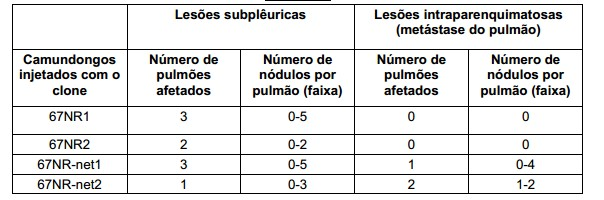
[0127] Desta forma, a expressão de netrina-1 aparentemente é um evento fundamental que sustenta a formação de metástase, provavelmente favorecendo células tumorais após a encravação.[0127] Thus, the expression of netrin-1 apparently is a key event that supports the formation of metastasis, probably favoring tumor cells after engraftment.
[0128]Como netrina-1 aparentemente é suficiente para o potencial metastático de células 67NR após a encravação e como se demonstrou que netrina-1 inibe a morte celular induzida por receptores com dependência de netrina-1 6, 7, 18, investigamos em seguida se a produção autócrina de netrina-1 fornece vantagem seletiva para células 4T1 por meio da inibição da morte celular induzida por DCC/UNC5H nessas células. Um domínio localizado no terminal N de netrina-1 (o chamado domínio laminina-VI) interage com receptores de DCC e UNC5H (Figura 3A; 21), de forma que um domínio extracelular solúvel de DCC (DCC-EC-Fc) pode inibir a interação de DCC/netrina-1 e UNC5H/netrina-1 (não exibido). DCC-EC-Fc foi adicionado em seguida a um cultivo de células 4T1 e a morte celular foi monitorada por meio de teste de exclusão de azul de tripano (Figura 3B) ou da medição da atividade de caspase (Figura 3C). Conforme exibido na Figura 3C, a adição da proteína concorrente no meio de cultivo aciona a morte de células 4T1 de forma dependente de dosagem. Além disso, este efeito é específico, pois DCC- EC-Fc não apresentou efeito sobre a morte de células 67NR e IL3R-EC-Fc (o domínio extracelular de receptor IL3) deixou de acionar a morte de células 4T1 (Figuras 3B e 3C). Este efeito se deve à inibição de netrina-1, pois a adição de quantidade excessiva de netrina-1, junto com DCC-EC-Fc, inibiu a atividade pró-apoptótica de DCC-EC-Fc sobre células 4T1 (não exibido). Para restringir a concorrência a um domínio menor, produzimos o quinto domínio de fibronectina tipo III de DCC, que é conhecido por interagir com netrina-1 21. A adição deste domínio -DCC-5Fbn- apresentou atividade pró-apoptótica similar sobre células 4T1 (Figura 3D). Desta forma, embora netrina-1 aparentemente confira potencial metastático a células tumorais em camundongos, estas células tumorais metastáticos que expressam netrina-1 podem ser encaixadas para apoptose por meio de inibição da interação entre receptores e netrina-1.[0128]As netrin-1 apparently suffices for the metastatic potential of 67NR cells after nailing and as netrin-1 has been shown to inhibit cell death induced by netrin-1
[0129] Para analisar adicionalmente se isso permanece verdade em células tumorais de mama humano, a expressão de netrina-1 foi analisada em um quadro de linhagens de células de câncer de mama metastático humano (vide a Tabela 3). TABELA 3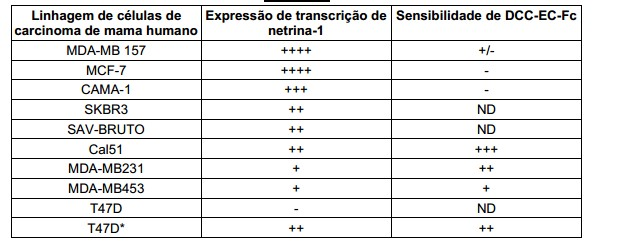
[0130] A Tabela 3 exibe as diferentes linhagens de células de mama metastáticas humanas analisadas para a expressão de netrina-1 por Q- RT PCR como nas Figuras 1A e 1B e a sua sensibilidade a DCC-EC-Fc por meio de medição da morte celular por meio de exclusão de azul tripano. A quantidade relativa de expressão de netrina-1 e sensibilidade a DCC-EC-Fc são indicadas por (+), enquanto a ausência destes critérios é indicada por (-). Em algumas linhagens celulares, o DCC-EC-Fc não foi determinado (ND).[0130] Table 3 shows the different human metastatic breast cell lines analyzed for the expression of netrin-1 by Q-RT PCR as in Figures 1A and 1B and their sensitivity to DCC-EC-Fc by measuring the cell death by trypan blue exclusion. The relative amount of netrin-1 expression and sensitivity to DCC-EC-Fc are indicated by (+), while the absence of these criteria is indicated by (-). In some cell lines, the DCC-EC-Fc was not determined (ND).
[0131] Conforme o esperado, netrina-1 é expressa em grande quantidade de linhagens de células metastáticas e algumas delas sofrem apoptose quando cultivadas na presença de DCC-EC-Fc. Células CAL51 sofreram apoptose de forma dependente de dosagem, por exemplo, em resposta a DCC-Ec-Fc. Conforme o acima, a adição de netrina-1 em excesso reverte o efeito de DCC-EC-Fc, sustentando a opinião de que as proteínas concorrentes matam estas linhagens de células humanas inibindo a interação entre netrina-1 e receptores de netrina-1. Além disso, seleção clonal de células CAL51 permitiu o estabelecimento de uma linhagem de células CAL51-36, que é muito mais suscetível a morte celular em resposta a DCC-EC-Fc (Figura 4B). DCC-EC-Fc ou DCC-5Fbn podem conseqüentemente representar boas ferramentas para acionar apoptose seletiva de células tumorais metastáticos humanos.[0131] As expected, netrin-1 is expressed in large amounts of metastatic cell lines and some of them undergo apoptosis when cultured in the presence of DCC-EC-Fc. CAL51 cells underwent apoptosis in a dose-dependent manner, for example, in response to DCC-Ec-Fc. As above, the addition of excess netrin-1 reverses the effect of DCC-EC-Fc, supporting the view that competing proteins kill these human cell lines by inhibiting the interaction between netrin-1 and netrin-1 receptors. Furthermore, clonal selection of CAL51 cells allowed the establishment of a CAL51-36 cell line, which is much more susceptible to cell death in response to DCC-EC-Fc (Figure 4B). DCC-EC-Fc or DCC-5Fbn may therefore represent good tools to trigger selective apoptosis of human metastatic tumor cells.
[0132] Demonstramos aqui que a expressão de netrina-1 pode ser considerada marcador da disseminação de tumores de mama. Mais da metade dos tumores de mama com propensão à metástase obteve elevada expressão de netrina-1. Tanto o modelo de camundongo descrito acima quanto os dados obtidos sobre linhagens de célula de câncer de mama humano sustentam a visão de que este nível elevado de netrina-1 é uma vantagem seletiva obtida pela célula cancerosa para escapar de apoptose induzida por receptores com dependência de netrina-1 e, conseqüentemente, sobreviver independentemente da disponibilidade de netrina-1. Do ponto de vista mecânico, esta expressão autócrina de netrina-1 inibe a morte celular induzida por UNC5H. De fato, DCC era pouco detectável nos dois grupos (metastático e não metastático) de cânceres de mama estudados, de forma a sugerir que DCC é regulado para baixo cedo durante tumorigênese de mama ou é apenas fracamente expresso em tecido de mama. Além disso, a inibição de apoptose induzida por UNC5H por meio de coexpressão de forma mutante negativa dominante da atividade pró-apoptótica de UNC5H inibe a morte de células CAL51 em resposta a DCC-EC-Fc (não exibido). Isso pode corresponder à observação recente de que parte da atividade pró-apoptótica de UNC5H2 passa através da ativação da serina/treonina DAPK 22, proteína envolvida na regulagem de metástase 23.[0132] We demonstrate here that the expression of netrin-1 can be considered a marker of the spread of breast tumors. More than half of the breast tumors prone to metastasis had high netrin-1 expression. Both the mouse model described above and the data obtained on human breast cancer cell lines support the view that this high level of netrin-1 is a selective advantage gained by the cancer cell to escape apoptosis induced by receptors with dependence on netrin-1 and, consequently, survive regardless of the availability of netrin-1. Mechanically, this autocrine expression of netrin-1 inhibits UNC5H-induced cell death. In fact, CHD was poorly detectable in both groups (metastatic and non-metastatic) of breast cancers studied, suggesting that CHD is down-regulated early during breast tumorigenesis or is only weakly expressed in breast tissue. Furthermore, inhibition of UNC5H-induced apoptosis through dominant negative mutant co-expression of UNC5H pro-apoptotic activity inhibits CAL51 cell death in response to DCC-EC-Fc (not shown). This may correspond to the recent observation that part of the pro-apoptotic activity of UNC5H2 passes through the activation of serine/
[0133] Estas observações não apenas fornecem evidência da importância do par de receptores ligantes/de dependência na regulagem do desenvolvimento de tumores, mas também esclarecem uma nova estratégia terapêutica. De fato, atualmente, não há tratamento eficiente de pacientes com câncer de mama metastático, falta de tratamento que leva à morte 400.000 mulheres por ano em todo o mundo 24. Propomos no presente que um tratamento com base na inibição da interação entre netrina-1 e seus receptores de dependência poderá afetar positivamente a metade dos pacientes que sofrem de câncer de mama metastático. Estes tratamentos poderão incluir drogas químicas, anticorpos monoclonais ou a proteína DCC-5Fbn apresentada no presente. Permanece a ser demonstrado se isso deve ser considerado estratégia para evitar a formação de metástase, o que geraria tratamento preventivo a longo prazo de mulheres diagnosticadas com câncer de mama primário, ou como estratégia que poderá ser utilizada para induzir a regressão de metástase. Testes clínicos futuros deverão também responder esta questão.[0133] These observations not only provide evidence of the importance of the binding/dependant receptor pair in regulating tumor development, but also clarify a new therapeutic strategy. In fact, currently, there is no efficient treatment of patients with metastatic breast cancer, lack of treatment that leads to the death of 400,000 women per year worldwide 24. We propose at present that a treatment based on the inhibition of the interaction between netrin-1 and its addiction receptors could positively affect half of patients suffering from metastatic breast cancer. These treatments may include chemical drugs, monoclonal antibodies, or the DCC-5Fbn protein disclosed herein. It remains to be demonstrated whether this should be considered a strategy to avoid metastasis formation, which would generate long-term preventive treatment for women diagnosed with primary breast cancer, or as a strategy that could be used to induce metastasis regression. Future clinical trials should also answer this question.
[0134] Descrevemos no presente que, ao contrário de tumores de mama não metastáticos humanos, a maior parte dos cânceres de mama metastáticos exibe superexpressão de netrina-1. Em um modelo de camundongos, demonstramos que, em células de tumores mamários não metastáticos, a expressão forçada de netrina-1 é associada à metástase nos pulmões. Além disso, camundongos ou linhagens de células tumorais metastáticas humanas que se demonstrou expressarem altamente netrina-1 sofrem apoptose quando a interação entre netrina-1 e receptores é inibida por uma proteína concorrente. Desta forma, netrina-1 é um marcador para câncer metastático humano tal como mama metastática e inibição da interação entre netrina-1 e receptores representa uma abordagem terapêutico para induzir a morte de células metastáticas.[0134] We describe here that, unlike human non-metastatic breast tumors, most metastatic breast cancers exhibit netrin-1 overexpression. In a mouse model, we demonstrate that, in cells from non-metastatic breast tumors, the forced expression of netrin-1 is associated with metastasis in the lungs. Furthermore, mice or human metastatic tumor cell lines that have been shown to highly express netrin-1 undergo apoptosis when the interaction between netrin-1 and receptors is inhibited by a competing protein. Thus, netrin-1 is a marker for human metastatic cancer such as metastatic breast cancer and inhibition of the interaction between netrin-1 and receptors represents a therapeutic approach to induce metastatic cell death.
[0135] Netrina-1 e seus receptores de dependência, ou seja, expressão de DCC, UNC5H2 e UNC5H3, foram analisados por meio de Q-RT- PCR em um quadro de 51 tumores de mama. Ele inclui pacientes cujos tumores foram localizados para a mama (N0, 16 pacientes), apresentaram envolvimento de nódulos (N+, 19 pacientes) ou possuíam doença metastática distante no momento do diagnóstico (M+, 16 pacientes). Embora DCC fosse pouco detectável e a expressão de UNC5H deixasse de exibir alterações significativas entre os diferentes tipos de tumores (não exibidos), netrina-1 é significativamente mais expressa em tumores N+ que em tumores N0 (média: 1,8 contra 0,5, p = 0,007) com faixa de expressão de netrina-1 mais alta em tumores N+ (Figura 5 e Tabela 4). TABELA 4 PERCENTUAL DE AMOSTRAS QUE EXIBEM EXPRESSÃO DE NETRINA-1 SUPERIOR À EXPRESSÃO MÉDIA EM BIÓPSIASN0, CINCO VEZES MAIOR OU QUINZE VEZES MAIOR E A FAIXA DA SUPEREXPRESSÃO
[0136] 31,5% dos tumores N+ exibem aumento de pelo menos cinco vezes na expressão de netrina-1 enquanto nenhum aumento foi detectado em qualquer tumor N0 testado (Figura 5 e Tabela 4). Diferença ainda mais notável é observada ao comparar a expressão de netrina-1 em M+ com tumores N0 (média: 7,8 contra 0,5, p < 0,0001). Ao longo desta linha, 62,5% de tumores M+ exibem aumento de pelo menos cinco vezes da expressão de netrina-1. Diferença significativa da expressão de netrina-1 também existe entre tumores N+ e M+ (média: 1,8 contra 7,8, p = 0,009). Além disso, a superexpressão de netrina-1 é mais alta em tumores M+ que em tumores N+, pois 37,5% de tumores M+ exibem aumento de mais de quinze vezes no nível de netrina-1, enquanto esse aumento não é detectado em tumores N+ (Figura 5 e Tabela 4). Desta forma, a regulagem para cima de netrina-1 é um marcador do envolvimento nodal e da doença metastática distante em câncer de mama humano.[0136] 31.5% of N+ tumors exhibit at least a five-fold increase in netrin-1 expression whereas no increase was detected in any N0 tumor tested (Figure 5 and Table 4). Even more notable difference is observed when comparing netrin-1 expression in M+ with N0 tumors (mean: 7.8 versus 0.5, p < 0.0001). Along this line, 62.5% of M+ tumors exhibit at least a five-fold increase in netrin-1 expression. Significant difference in netrin-1 expression also exists between N+ and M+ tumors (mean: 1.8 versus 7.8, p = 0.009). In addition, netrin-1 overexpression is higher in M+ tumors than in N+ tumors, as 37.5% of M+ tumors exhibit a more than fifteen-fold increase in the netrin-1 level, whereas this increase is not detected in tumors N+ (Figure 5 and Table 4). Thus, up-regulation of netrin-1 is a marker of nodal involvement and distant metastatic disease in human breast cancer.
[0137] Em camundongos, Miller e seus colegas desenvolveram modelo poderoso para estudar a biologia de tumores metastáticos contra não metastáticos: a partir de um único tumor mamário primário que ocorreu naturalmente em um camundongo BALB/c, foi obtida uma série de linhagens celulares que exibiram diferentes potenciais metastáticos quando injetadas em camundongos singênicos. Particularmente, enquanto células 67NR formam tumores mamários primários, mas sem metástase, células 4T1 formam tumores primários e metástase, especialmente no pulmão, no fígado e na medula óssea 20. De forma interessante, enquanto netrina-1 deixava de ser detectada em células 67NR, netrina-1 era altamente expressa em células 4T1 (Figura 1B).[0137] In mice, Miller and his colleagues developed a powerful model to study the biology of metastatic versus non-metastatic tumors: from a single primary breast tumor that naturally occurred in a BALB/c mouse, a series of cell lines were obtained that were obtained. exhibited different metastatic potentials when injected into syngeneic mice. Particularly, whereas 67NR cells form primary breast tumors but without metastasis, 4T1 cells form primary tumors and metastasis, especially in the lung, liver and
[0138] Para determinar em primeiro lugar se o potencial metastático de células 4T1, em comparação com o de células 67NR, era relacionado à expressão de netrina-1, células 67NR foram forçadas a expressar netrina-1 de forma estável. Imitações de células 67NR transfectadas ou células 67NR que expressam netrina-1 (Figuras 2A e 2B) foram injetadas em glândulas mamárias e a metástase foi monitorada por meio de exame anatômico-patológico. As duas linhagens celulares deixaram de formar eficientemente metástase no fígado ou em pulmões quando injetadas em almofadas de gordura de camundongos (19 camundongos receberam injeção de células 67NR que expressam netrina-1 e apenas duas suspeitas de micrometástases, uma no pulmão e outra no fígado, foram detectadas) (Tabela 5). TABELA 5 METÁSTASE DO PULMÃO E DO FÍGADO DE67NR INJETADO EM ALMOFADA DE GORDURA CONTRA CÉLULAS QUE EXPRESSAM NETRINA-1[0138] To first determine whether the metastatic potential of 4T1 cells, compared to that of 67NR cells, was related to netrin-1 expression, 67NR cells were forced to stably express netrin-1. Imitations of transfected 67NR cells or 67NR cells expressing netrin-1 (Figures 2A and 2B) were injected into mammary glands and metastasis was monitored by means of anatomic-pathological examination. The two cell lines failed to efficiently metastasize in the liver or lungs when injected into mouse fat pads (19 mice received injection of 67NR cells expressing netrin-1 and only two suspected micrometastases, one in the lung and the other in the liver, were detected) (Table 5). TABLE 5 DE67NR LUNG AND LIVER METASTASIS INJECTED INTO A FAT PAD AGAINST NETRIN-1 EXPRESSING CELLS
[0139] Um clone de célula controle que possui resistência a puromicina (imitação de 67NR), um clone de célula que expressa netrina-1 (67NRnet1) e uma população policlonal de 67NR transfectada de forma estável de netrina-1 (67NR-net1-policlonal) foram injetados em almofada de gordura de camundongos e a metástase foi analisada no ambiente do pulmão ou do fígado.
[0140] Desta forma, a expressão de netrina-1 em células tumorais não é suficiente para permitir a formação de metástase a partir do local primário.[0140] Thus, the expression of netrin-1 in tumor cells is not sufficient to allow the formation of metastasis from the primary site.
[0141] Como se demonstrou que netrina-1 inibe a morte celular induzida por receptores com dependência de netrina-1 6, 7, 18, investigamos a seguir se a produção autócrina de netrina-1 detectada em células 4T1 metastáticas confere vantagem seletiva para estas células, por meio da inibição da morte celular induzida por DCC/UNC5H. Para testar isso, observamos um composto que pode titular netrina-1. Relatou-se que um domínio localizado no terminal N de netrina-1 (o chamado domínio de laminina-VI) interage com os receptores de DCC e UNC5H (Figura 3A; 21). Demonstramos que um domínio extracelular solúvel de DCC (DCC-EC-Fc) pode inibir a interação de DCC/netrina-1 e UNC5H2/netrina-1, conforme medido por meio de teste ELISA (Figura 6A). DCC-EC-Fc foi adicionado em seguida a um cultivo de células 4T1 e a morte celular foi monitorada, seja por meio de teste de exclusão de azul de tripano (Figuras 3B e 6B) ou medindo-se a atividade de caspase por meio de citometria de fluxo (Figuras 3C e 6C). Conforme exibido nas Figuras 3B, 3C, 6B e 6C, a adição da proteína concorrente no meio de cultivo aciona a morte de células 4T1 de forma dependente da dose. Este efeito é específico, pois DCC- EC-Fc não apresentou efeito sobre a morte de células 67NR (Figuras 3B, 3C, 6B e 6C) e IL3R-EC-Fc (o domínio extracelular do receptor IL3) deixou de acionar a morte de células 4T1 (Figura 3D). Desta forma, as células 4T1 sobrevivem por meio da produção autócrina de netrina-1, que bloqueia a morte celular induzida por receptores de netrina-1.[0141] As netrin-1 has been shown to inhibit cell death induced by netrin-1
[0142] Como o domínio extracelular completo de DCC aparece com interesse apenas modesto para uso in vivo e em terapia (DCC-EC-Fc possui tamanho de cerca de 1100 aminoácidos), procuramos um polipeptídeo alternativo a partir do domínio extracelular de DCC, que pudesse acionar a apoptose em células 4T1. Conseqüentemente, produzimos o quinto domínio tipo III de fibronectina de DCC, DCC-5Fbn, que é conhecido por interagir com netrina-1 21(Figura 3A). De forma interessante, essa proteína com cem aminoácidos não interfere com a ligação de DCC/netrina-1 ou UNC5H/netrina- 1, mas afeta a capacidade de netrina-1 de acionar a multimerização desses receptores (vide Exemplo 4). Como a multimerização de DCC e UNC5H é requisito prévio para a atividade inibidora de netrina-1 sobre a morte celular induzida por DCC/UNC5H, a adição de DCC-5Fbn aciona a apoptose em células que expressam DCC cultivadas na presença de netrina-1 22e aciona a morte dos dois 4T1 (Figura 7A).[0142] As the complete extracellular domain of DCC appears of only modest interest for use in vivo and in therapy (DCC-EC-Fc is about 1100 amino acids in size), we sought an alternative polypeptide from the extracellular domain of DCC, which could trigger apoptosis in 4T1 cells. Consequently, we produced the fifth fibronectin type III domain of DCC, DCC-5Fbn, which is known to interact with netrin-1 21 (Figure 3A). Interestingly, this one hundred amino acid protein does not interfere with DCC/netrin-1 or UNC5H/netrin-1 binding, but does affect the ability of netrin-1 to trigger multimerization of these receptors (see Example 4). As the multimerization of DCC and UNC5H is a prerequisite for the inhibitory activity of netrin-1 on DCC/UNC5H induced cell death, the addition of DCC-5Fbn triggers apoptosis in DCC expressing cells cultured in the presence of netrin-1 22e triggers the death of the two 4T1s (Figure 7A).
[0143] Investigamos a seguir se o efeito de morte celular observado in vitro pode ser estendido in vivo. Para fazê-lo, células 4T1 foram transfectadas de forma estável com vetor com base em luciferase e células 4T1-luc foram injetadas por via intravenosa (iv) em camundongos BALB/c singênicos. Os camundongos receberam em seguida injeção intraperitoneal (ip) e intravenosa (uma injeção a cada dois dias, uma intravenosa e uma intraperitoneal) do dia 0 ao dia 13 com tampão PBS ou DCC-5Fbn marcado com Flag (1,25 μg/g de camundongo/injeção). A formação de metástase foi analisada em seguida utilizando registro de luminescência. Conforme exibido nas Figuras 7B e 7C, quando injetado por via intravenosa, células 4T1-luc colonizam pulmões eficientemente. Por outro lado, camundongos tratados com DCC-5Fbn exibem redução dramática da metástase de pulmão (Figuras 7B e 7C). Esta inibição da formação de metástase foi confirmada em seguida por meio de exame anatômico-patológico de pulmões (não exibido, vide Tabela 6). TABELA 6 NÚMERO TOTAL DE NÓDULOS METASTÁTICOS DO PULMÃO EM CAMUNDONGOS INDIVIDUAIS CONTADOS SOB INSTRUMENTO DE DISSECAÇÃO NAS DUAS POPULAÇÕES TRATADAS (+PBS, +DCC-5-FBN)
[0144] Foram obtidos resultados similares ao realizarmos diariamente injeção intraperitoneal de DCC-5Fbn marcado com GST no lugar de DCC-5Fbn marcado com Flag e GST-FADD em vez de PBS (não exibido). Desta forma, em camundongos, a inibição por DCC-5Fbn da atividade pró- sobrevivência conferida pela expressão autócrina de netrina-1 é associada à prevenção de metástase.[0144] Similar results were obtained when we performed daily intraperitoneal injection of GST-labeled DCC-5Fbn in place of Flag-labeled DCC-5Fbn and GST-FADD instead of PBS (not shown). Thus, in mice, the inhibition by DCC-5Fbn of the pro-survival activity conferred by the autocrine expression of netrin-1 is associated with the prevention of metastasis.
[0145] A vantagem de sobrevivência obtida por meio da expressão autócrina de netrina-1 não é restrita a células tumorais murinas, como é detectado em linhagens de células de câncer de mama humano. Na verdade, demonstrou-se que netrina-1 é expressa em fração dimensionável de linhagens de câncer de mama humano (Figura 8A) e a adição de DCC-EC-Fc ou DCC- 5Fbn a cultivos de células T47D ou SKBR7 de adenocarcinoma de mama humana que expressam netrina-1 naturalmente aciona a indução da morte celular medida por meio de teste de atividade de caspase-3 ou teste MTT (Figura 8B e não exibido). Este efeito deve-se à inibição de netrina-1, como adição de quantidade em excesso de netrina-1, que inibiu a atividade pró- apoptótica de DCC-EC-Fc/DCC-5Fbn (não exibida). Para monitorar o efeito antitumoral de DCC-5Fbn, xenoenxertos de células T47D foram implantados em camundongos brutos. Quando os tumores atingiram tamanho palpável, os camundongos foram tratados diariamente com PBS ou DCC-5Fbn e o volume de tumor foi determinado por dezoito dias. De forma similar aos dados obtidos no modelo singênico acima, DCC-5Fbn inibe completamente o crescimento de tumores (Tabela 7). TABELA 7 NÚMERO E COMPORTAMENTO DE TUMORES T47D XENOENXERTADOS QUE FORAM TRATADOS COM PBS OU DCC-5FBN[0145] The survival advantage gained through autocrine expression of netrin-1 is not restricted to murine tumor cells, as detected in human breast cancer cell lines. Indeed, it has been shown that netrin-1 is expressed in sizable fraction of human breast cancer lines (Figure 8A) and the addition of DCC-EC-Fc or DCC-5Fbn to breast adenocarcinoma T47D or SKBR7 cell cultures Human netrin-1 expressing naturally triggers the induction of cell death as measured by caspase-3 activity test or MTT test (Figure 8B and not shown). This effect is due to the inhibition of netrin-1, as the addition of an excess amount of netrin-1, which inhibited the pro-apoptotic activity of DCC-EC-Fc/DCC-5Fbn (not shown). To monitor the antitumor effect of DCC-5Fbn, T47D cell xenografts were implanted into crude mice. When tumors reached palpable size, mice were treated daily with PBS or DCC-5Fbn and tumor volume was determined for eighteen days. Similar to the data obtained in the syngeneic model above, DCC-5Fbn completely inhibits tumor growth (Table 7). TABLE 7 NUMBER AND BEHAVIOR OF XENOGRAFT T47D TUMORS THAT WERE TREATED WITH PBS OR DCC-5FBN
[0146] São indicados o número de tumores que cresceu de tamanho em mais de 40% e o número de tumores que apresentaram tamanho reduzido (mais de 30%).
[0147] Demonstramos no presente que a expressão de netrina-1 pode ser considerada um marcador da capacidade de disseminação de tumores de mama. A maior parte dos tumores de mama com propensão à metástase demonstrou elevada expressão de netrina-1. Os dados obtidos em linhagens de células de câncer de mama de camundongos/humano e os modelos de camundongos de xenoenxerto humano/singênico descritos acima sustentam a observação de que este nível elevado de netrina-1 é uma vantagem seletiva obtida pela célula de câncer para escapar da apoptose induzida por receptores com dependência de netrina-1 e, conseqüentemente, sobreviver independentemente da disponibilidade de netrina-1. Do ponto de vista mecânico, na patologia humana, esta expressão autócrina de netrina-1 provavelmente inibe a morte celular induzida por UNC5H. De fato, DCC era pouco detectável nos diferentes grupos (N0, N+, M+) de cânceres de mama estudados, de forma a sugerir que DCC é regulado para baixo cedo durante tumorigênese de mama ou somente é expresso fracamente em tecido de mama. Além disso, a inibição de apoptose induzida por UNC5H por meio de coexpressão de uma forma mutante negativa dominante da atividade pró- apoptótica de UNC5H inibe a morte de células de câncer de mama humano em resposta a DCC-EC-Fc (não exibido).[0147] We have shown here that the expression of netrin-1 can be considered a marker of the ability to spread breast tumors. Most breast tumors prone to metastasis showed high expression of netrin-1. The data obtained on mouse/human breast cancer cell lines and the human/syngeneic xenograft mouse models described above support the observation that this elevated level of netrin-1 is a selective advantage gained by the cancer cell to escape of apoptosis induced by netrin-1 dependent receptors and, consequently, survive independently of netrin-1 availability. From a mechanical point of view, in human pathology, this autocrine expression of netrin-1 probably inhibits UNC5H-induced cell death. In fact, CHD was barely detectable in the different groups (N0, N+, M+) of breast cancers studied, suggesting that CHD is down-regulated early during breast tumorigenesis or is only weakly expressed in breast tissue. Furthermore, inhibition of UNC5H-induced apoptosis through co-expression of a dominant negative mutant form of UNC5H pro-apoptotic activity inhibits human breast cancer cell death in response to DCC-EC-Fc (not shown).
[0148] Desta forma, conforme previsto pelo modelo de receptor de dependência, demonstramos agora que uma célula tumoral pode escapar da dependência de receptor de dependência em pelo menos três maneiras. Primeiro, a expressão do receptor de dependência pode ser regulada para baixo, conforme descrito extensamente para DCC e, mais recentemente, para UNC5H 15, 17, 19, 29. Segundo, a sinalização de morte abaixo no fluxo pode ser desligada. Ao longo desta linha, demonstramos recentemente que a atividade pró-apoptótica de UNC5H2 depende da ligação de UNC5H2 à serina/treonina DAPK 22, uma proteína que se demonstrou estar envolvida na regulagem de metástase e regulada para baixo em malignidade humana 23. De forma similar, um relatório recente de Stupack e colegas demonstra que, no caso de algumas integrinas que agem como receptores de dependência, caspase-8, que aciona a morte celular mediada por estas integrinas, é fundamental para a metástase de neuroblastoma 30. Demonstramos no presente que terceira vantagem seletiva para a célula tumoral é a autoprodução do ligante de dependência. Permanece uma questão intrigante sobre como tumores de mama com propensão metastática parecem ter autoprodução de netrina-1 preferencialmente selecionada em vez de perda do receptor, enquanto tumores colo-retais possuem principalmente perda selecionada dos receptores em vez de ganho da expressão de netrina-1; de fato, apenas 7% de cânceres colo- retais exibem aumento da expressão de netrina-1 18. Uma possível explicação é que a expressão de netrina-1 não apenas confere um ganho de sobrevivência para as células migratórias, mas também possivelmente um ganho na sinalização positiva/não apoptótica de receptores de netrina-1. Ao longo desta linha, é importante observar que netrina-1 foi originalmente descrita como guia de orientação 31que, muito embora absolutamente não comprovada, poderia desempenhar papel no tropismo de células metastáticas. Outros papéis propostos de netrina-1 incluem regulagem da morfogênese e adesão 32-34, dois mecanismos que podem ser importantes para o desenvolvimento de metástase. De forma similar, propôs-se recentemente que netrina-1 desempenha papel durante a angiogênese embriônica e, muito embora tenham sido publicados resultados conflitantes 36-38, não podemos atualmente descartar o papel de netrina-1 como fator angiogênico que, de alguma forma, poderá favorecer o desenvolvimento de metástase no local secundário. Entretanto, o ganho de sinalização “positiva” por meio de expressão autócrina de netrina-1 provavelmente não é intrinsecamente suficiente para promover a metástase, como expressão forçada de netrina-1 em células não metastáticas que deixaram de ser associadas à formação de metástase.[0148] Thus, as predicted by the dependent receptor model, we now demonstrate that a tumor cell can escape dependence receptor dependence in at least three ways. First, dependence receptor expression can be down-regulated, as described extensively for DCC and more recently for
[0149] Estas observações não apenas fornecem evidência para a importância de pares de ligante e receptores de dependência na regulagem do desenvolvimento de tumores, mas também ilustram uma nova estratégia terapêutica. De fato, atualmente, não há tratamento eficiente para pacientes com câncer de mama metastático, falta de tratamento que leva à morte 400.000 mulheres por ano em todo o mundo 24. Propomos no presente que tratamento com base na inibição da interação entre netrina-1 e os seus receptores de dependência poderá afetar positivamente uma parcela grande dos pacientes que sofrem de câncer metastático, tal como câncer de mama (ou seja, pacientes que exibiriam alta expressão de netrina-1 em tumores primários). Estes tratamentos poderão incluir drogas químicas, anticorpos monoclonais ou a proteína DCC-5Fbn apresentada no presente.[0149] These observations not only provide evidence for the importance of ligand pairs and dependence receptors in regulating tumor development, but also illustrate a new therapeutic strategy. In fact, currently, there is no efficient treatment for patients with metastatic breast cancer, lack of treatment that leads to the death of 400,000 women per year worldwide 24. We propose at present that treatment based on the inhibition of the interaction between netrin-1 and its dependence receptors could positively affect a large portion of patients suffering from metastatic cancer, such as breast cancer (ie, patients who would exhibit high netrin-1 expression in primary tumors). These treatments may include chemical drugs, monoclonal antibodies, or the DCC-5Fbn protein disclosed herein.
[0150] A. Netrina-1 é um marcador da agressividade em neuroblastoma humano (vide a Figura 9A, sua legenda e a Tabela 8) e a inibição da atividade de netrina-1 promove a morte de células de neuroblastoma (vide a Figura 10B e a sua legenda).[0150] A. Netrin-1 is a marker of aggressiveness in human neuroblastoma (see Figure 9A, its legend and Table 8) and inhibition of netrin-1 activity promotes neuroblastoma cell death (see Figure 10B and its caption).
[0151] 26 linhagens de células de neuroblastoma (seja obtidas diretamente a partir de tumores de pacientes no Centre Léon Bérard (CLB-X) ou linhagens de células de neuroblastoma clássicas (IMR32, SHEP, SHSY ou SKNAS)) foram testadas como em (a) para determinar a expressão de netrina- 1 por meio de Q-RT-PCR. O nível de netrina-1 é indicado como (-) sem netrina- 1, (+, ++, +++) nível de netrina-1 baixo a alto. Pode-se observar que uma fração significativa de linhagens celulares possui alta expressão de netrina-1.

[0152] B. Netrina-1 é superexpressa em uma fração grande de glioma (vide Figura 10A e sua legenda) e a inibição da atividade de netrina-1 promove a morte de células de glioma (vide a Figura 10B e sua legenda).[0152] B. Netrin-1 is overexpressed in a large fraction of glioma (see Figure 10A and its legend) and inhibition of netrin-1 activity promotes glioma cell death (see Figure 10B and its legend).
[0153] C. Netrina-1 é superexpressa em câncer pulmonar humano (vide a Figura 11A, sua legenda e a Tabela 9) e a inibição da atividade de netrina-1 promove a morte de células de câncer do pulmão e evita o desenvolvimento de câncer do pulmão (vide as Figuras 12C e 12D e suas legendas).[0153] C. Netrin-1 is overexpressed in human lung cancer (see Figure 11A, its legend and Table 9) and inhibition of netrin-1 activity promotes lung cancer cell death and prevents the development of lung cancer (see Figures 12C and 12D and their captions).
[0154] Linhagens de células de câncer do pulmão derivadas de câncer do pulmão de células pequenas (SCLC) ou câncer do pulmão não de células pequenas (NSCLC) foram testadas como em (a) para determinar a expressão de netrina-1 por meio de Q-RT-PCR. O nível de netrina-1 é indicado como (-) sem netrina, (+, ++) baixo a alto nível de netrina-1. Pode-se observar que uma fração significativa de linhagens celulares possui alta expressão de netrina-1.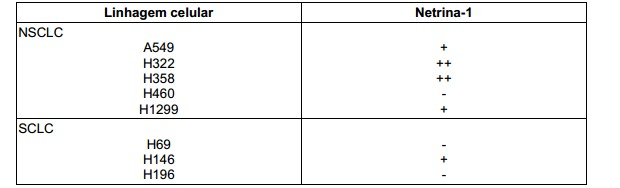
[0155] A expressão de netrina-1 examinada por meio de Q-RT PCR utilizando RNA total extraído de diferentes tumores humanos como nas Figuras 10A a 10B, 11A a 11C, 12A e 12B. A Tabela 10 indica (n) o número de tumores testados e o percentual de tumores que exibem superexpressão de netrina-1 em cada patologia. TABELA 10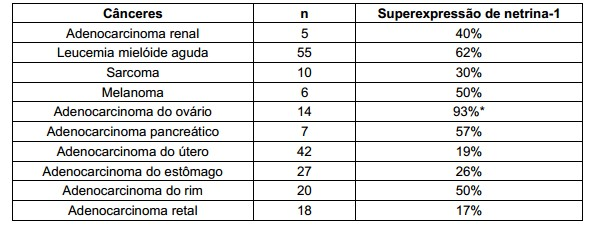
[0156] Para analisar se DCC estava sob sua forma monomérica a menos que netrina-1 estivesse presente, coexpressamos transitoriamente um DCC de comprimento total marcado com HA junto com DCC de comprimento total marcado com c-myc em células HEK293T. Imunoprecipitação foi realizada em seguida utilizando um anticorpo anti-c-myc e, conforme exibido na Figura 12A, apesar de boa expressão de HA e DCC marcado com c-myc, HA-DCC foi apenas modestamente incluído na retirada de c-myc-DCC na ausência de ligante, o que sugere que DCC estava principalmente presente na forma de monômero quando expresso em HEK293T na ausência de netrina-1. Nas mesmas condições experimentais, quando netrina-1 foi adicionada ao meio de cultivo (não exibido e Figura 15C) ou quando uma construção de expressão de netrina-1 foi coexpressa com as construções que expressam DCC (Figura 11A), HA-DCC foi claramente incluído na retirada de c-myc DCC, de forma a demonstrar que netrina-1 aciona a dimerização ou multimerização de DCC. Este resultado encontra-se de acordo com dados de Tessier-Lavigne e colegas que relataram pela primeira vez multimerização induzida por netrina-1 46, muito embora na nossa cultura e condições de imunoprecipitação, DCC exibe um nível modesto mas detectável de multimerização na ausência de netrina-1. Este baixo nível de multimerização constitutivo poderá ser atribuído à baixa afinidade de receptores DCC por si próprios na ausência de ligante ou para o sistema utilizado, que é baseado na expressão forçada de altos níveis de receptores transmembrana.[0156] To analyze whether DCC was in its monomeric form unless netrin-1 was present, we transiently co-expressed an HA-labeled full-length DCC along with c-myc-labeled full-length DCC in HEK293T cells. Immunoprecipitation was then performed using an anti-c-myc antibody and, as shown in Figure 12A, despite good expression of HA and c-myc tagged DCC, HA-DCC was only modestly included in the c-myc-DCC withdrawal in the absence of ligand, which suggests that DCC was mainly present as a monomer when expressed in HEK293T in the absence of netrin-1. Under the same experimental conditions, when netrin-1 was added to the culture medium (not shown and Figure 15C) or when a netrin-1 expression construct was co-expressed with the DCC expressing constructs (Figure 11A), HA-DCC was clearly included in the withdrawal of c-myc DCC, in order to demonstrate that netrin-1 triggers the dimerization or multimerization of DCC. This result is in agreement with data from Tessier-Lavigne and colleagues who reported for the first time 46 netrin-1-induced multimerization, even though in our culture and immunoprecipitation conditions, DCC exhibits a modest but detectable level of multimerization in the absence of netrin-1. This low level of constitutive multimerization could be attributed to the low affinity of DCC receptors for themselves in the absence of a ligand or for the system used, which is based on the forced expression of high levels of transmembrane receptors.
[0157] Investigamos em seguida se os outros receptores de netrina-1 UNC5H compartilham comportamento similar. Células HEK293T foram transfectadas transitoriamente com um UNC5H2 de comprimento total marcado com HA junto com UNC5H2 de comprimento total marcado com Flag na presença ou ausência de netrina-1. Imunoprecipitação foi realizada em seguida utilizando um anticorpo anti-Flag M2. Conforme exibido na Figura 11B, a presença de netrina-1 aciona imunoprecipitação eficiente de HA-UNC5H2 com Flag-UNC5H2. Desta forma, embora na ausência de netrina-1, DCC e UNC5H2 encontrem-se principalmente em formas monoméricas, DCC e UNC5H2 exibem maior propensão à multimerização na presença de netrina-1.[0157] We next investigated whether the other UNC5H netrin-1 receptors share similar behavior. HEK293T cells were transiently transfected with an HA-labeled full-length UNC5H2 along with Flag-labeled full-length UNC5H2 in the presence or absence of netrin-1. Immunoprecipitation was then performed using an anti-Flag M2 antibody. As shown in Figure 11B, the presence of netrin-1 triggers efficient immunoprecipitation of HA-UNC5H2 with Flag-UNC5H2. Thus, although in the absence of netrin-1, DCC and UNC5H2 are mainly found in monomeric forms, DCC and UNC5H2 are more prone to multimerization in the presence of netrin-1.
[0158] Para determinar se a multimerização induzida por netrina-1 é a etapa crucial de inibição da morte de células pró-apoptóticas DCC/UNC5H2, desenvolvemos um sistema quimérico no qual a dimerização de proteína pode ser induzida por um agente químico. Este sistema foi utilizado com sucesso para exibir o papel de dimerização de caspase-8 em ativação de caspase-8 49e a importância de multimerização de p75ntr em atividade pró- apoptótica de p75ntr 48. Este sistema é derivado da capacidade do composto Fk1012 de dimerização cruzada do motivo de FkBP. Domínios intracelulares de DCC e UNC5H2 foram fundidos no seu terminal N para motivos Fv2e FkBP derivados e a dimerização foi induzida utilizando o composto químico AP20187 (Figura 13A). Analisamos em primeiro lugar se o sistema desenvolvido recapitula multimerização induzida por netrina-1 do domínio intracelular UNC5H2. Células HEK293T foram cotransfectadas com Fv2e-UNC5H2-IC marcada com HA junto com Fv2e-UNC5H2-IC marcada com c-myc e coimunoprecipitações foram realizadas utilizando um anticorpo anti-c-myc. Conforme exibido na Figura 13B, sem adição de AP20187, HA-Fv2e-UNC5H2- IC foi pouco detectável na retirada de c-myc-Fv2e-UNC5H2-IC, de forma a sustentar que Fv2e-UNC5H2-IC é expresso em células HEK293T principalmente como monômero. Conforme esperado, a adição de AP20187 gerou a retirada eficiente de HA-Fv2e-UNC5H2-IC com c-myc-Fv2e-UNC5H2- IC. Resultados similares foram obtidos com Fv2e-DCC-IC (não exibido). Desta forma, este sistema de dimerização recapitula a dimerização do domínio intracelular dos receptores de netrina-1 DCC e UNC5H2.[0158] To determine whether netrin-1-induced multimerization is the crucial step in inhibiting the death of pro-apoptotic DCC/UNC5H2 cells, we developed a chimeric system in which protein dimerization can be induced by a chemical agent. This system has been used successfully to demonstrate the role of caspase-8 dimerization in caspase-8 activation 49 and the importance of p75ntr multimerization in p75ntr 48 pro-apoptotic activity. This system is derived from the ability of the compound Fk1012 to cross-dimerize of the FkBP motif. Intracellular domains of DCC and UNC5H2 were fused at their N-terminus to Fv2e FkBP-derived motifs and dimerization was induced using the chemical compound AP20187 (Figure 13A). We first analyzed whether the developed system recapitulates netrin-1-induced multimerization of the UNC5H2 intracellular domain. HEK293T cells were co-transfected with HA-tagged Fv2e-UNC5H2-IC along with c-myc-tagged Fv2e-UNC5H2-IC and co-immunoprecipitations were performed using an anti-c-myc antibody. As shown in Figure 13B, without addition of AP20187, HA-Fv2e-UNC5H2-IC was barely detectable in the removal of c-myc-Fv2e-UNC5H2-IC, in order to support that Fv2e-UNC5H2-IC is mainly expressed in HEK293T cells as a monomer. As expected, the addition of AP20187 generated efficient removal of HA-Fv2e-UNC5H2-IC with c-myc-Fv2e-UNC5H2-IC. Similar results were obtained with Fv2e-DCC-IC (not shown). In this way, this dimerization system recapitulates the dimerization of the intracellular domain of DCC and UNC5H2 netrin-1 receptors.
[0159] Como este sistema de dimerização de DCC/UNC5H2 quimicamente indutível aparentemente trabalha adequadamente para imitar a multimerização de DCC/UNC5H2 induzida por netrina-1, determinamos em seguida se a dimerização de DCC/UNC5H2 era suficiente para inibir a atividade pró-apoptótica de DCC/UNC5H2. Células HEK293T foram forçadas a expressar Fv2e-DCC-IC na presença ou ausência de AP20187 e a morte celular foi determinada por manchas de azul de tripano, conforme descrito anteriormente, para medir a morte celular induzida por DCC 6, 27. Conforme exibido na Figura 14A, a expressão de Fv2e-DCC-IC foi associada a maior morte celular em comparação com a expressão dos motivos Fv2e sem a fusão de DCC-IC. De forma interessante, ao adicionar-se AP20187, a morte celular induzida por Fv2e-DCC-IC foi dramaticamente reduzida (Figura 14A). De forma similar, embora Fv2e-UNC5H2-IC acione a morte celular (Figura 14B) ou ativação de caspase (Figura 14C) quando expresso em HEK293T na ausência de AP20187, a adição da droga de dimerização é suficiente para reduzir significativamente a morte celular induzida por Fv2e-UNC5H2-IC (Figura 14B) ou ativação de caspase (Figura 14C). Desta forma, embora DCC-IC e UNC5H2-IC monoméricos sejam pró-apoptóticos, as formas multiméricas de DCC-IC ou UNC5H2-IC não exibem mais atividade pró-apoptótica. A capacidade de netrina-1 de inibir a atividade pró-apoptótica de DCC/UNC5H2, portanto, está intrinsecamente ligada à capacidade de netrina-1 de multimerizar DCC ou UNC5H2, pois este processo de multimerização é suficiente para desligar a atividade pró-apoptótica de DCC e UNC5H2.[0159] As this chemically inducible DCC/UNC5H2 dimerization system apparently works adequately to mimic netrin-1-induced DCC/UNC5H2 multimerization, we next determined whether DCC/UNC5H2 dimerization was sufficient to inhibit pro-apoptotic activity of DCC/UNC5H2. HEK293T cells were forced to express Fv2e-DCC-IC in the presence or absence of AP20187 and cell death was determined by trypan blue staining as described above to measure DCC-induced
[0160] Um modelo tentador seria aquele em que a forma monomérica de DCC ou UNC5H2 possui conformação espacial que é facilmente submetida à divisão de caspase inicial do domínio intracelular do receptor. Por outro lado, a presença do ligante geraria multimerização do domínio intracelular, que às vezes torna-se menos acessível à divisão de caspase. Ao longo desta linha, Arakawa e colegas demonstraram que a divisão de caspase de UNC5H2 é inibida pela presença de netrina-1 47. Ainda assim, devido a limitações técnicas, deixamos de detectar a divisão de DCC ou UNC5H2 em células forçadas a expressar as proteínas de fusão Fv2e. Um modelo alternativo de inibição da divisão seria aquele em que a multimerização de receptor induzida por netrina-1 aciona um sinal de sobrevivência, que de alguma forma inibe atividade pró-apoptótica constitutiva de DCC ou UNC5H2 relativa à divisão de caspase constitutiva. Deixamos de exibir, entretanto, que os processos de sinalização positiva conhecidos ativados por meio de DCC mediante ligação de netrina-1 estão envolvidos na atividade inibidora de netrina-1 sobre a atividade pró-apoptótica de DCC. Netrina-1 induz, por exemplo, a ativação mediada por DCC de ERK-1/2 3, quinases conhecidas por exibirem efeito anti-apoptótico. Inibidores clássicos do processo de ERK-1/2, entretanto, embora afetem a fosforilação de ERK-1/2 induzida por netrina-1, deixaram de bloquear o efeito inibidor de netrina-1 sobre a atividade pró- apoptótica de DCC (Forcet e Mehlen, não publicado). Desta forma, é provável que a multimerização de DCC induzida por netrina-1 afete a acessibilidade intracelular de DCC. Segue por ser demonstrado, entretanto, se esta é uma questão de estequiometria simples, ou se trazer mais perto os domínios extracelulares induz alteração de conformação dentro dos compartimentos intracelulares.[0160] A tempting model would be one in which the monomeric form of DCC or UNC5H2 has a spatial conformation that is easily subjected to early caspase division of the intracellular domain of the receptor. On the other hand, the presence of the ligand would generate multimerization of the intracellular domain, which sometimes becomes less accessible to caspase division. Along this line, Arakawa and colleagues demonstrated that caspase division of UNC5H2 is inhibited by the presence of netrin-147. Yet, due to technical limitations, we failed to detect the division of DCC or UNC5H2 in cells forced to express the proteins of Fv2e fusion. An alternative model of division inhibition would be one in which netrin-1-induced receptor multimerization triggers a survival signal, which somehow inhibits constitutive pro-apoptotic activity of DCC or UNC5H2 relative to constitutive caspase division. We failed to show, however, that known positive signaling processes activated through DCC upon binding of netrin-1 are involved in the inhibitory activity of netrin-1 on the pro-apoptotic activity of DCC. Netrin-1 induces, for example, DCC-mediated activation of ERK-1/2 3, kinases known to exhibit anti-apoptotic effect. Classic inhibitors of the ERK-1/2 process, however, although they affect netrin-1-induced phosphorylation of ERK-1/2, they no longer block the inhibitory effect of netrin-1 on the pro-apoptotic activity of DCC (Forcet and Mehlen, unpublished). Thus, netrin-1-induced multimerization of DCC is likely to affect the intracellular accessibility of DCC. It remains to be shown, however, whether this is a matter of simple stoichiometry, or whether bringing the extracellular domains closer induces conformational changes within the intracellular compartments.
[0161] Caso os mecanismos subjacentes à multimerização do receptor induzida por netrina-1 ainda estejam por ser descritos, a observação de que a multimerização de DCC/UNC5H2 induzida por netrina-1 é suficiente para inibir a morte celular induzida por DCC/UNC5H2 pode representar uma ferramenta interessante para ligar a atividade pró-apoptótica de DCC ou UNC5H in vivo, em tumores nos quais netrina-1 é expressa de forma autócrina. Na verdade, demonstramos que a superexpressão de netrina-1 em intestino de camundongos está associada ao desenvolvimento de tumor intestinal devido à inibição da apoptose 18e observamos recentemente que netrina-1 é superexpressa na maior parte dos cânceres de mama metastáticos humanos. Além disso, o mecanismo de superexpressão de netrina-1 aparentemente é uma vantagem seletiva de células de tumores metastáticos para sobrevivência em configurações de ausência de netrina-1 no ambiente (vide Exemplos 2 e 3). Desta forma, a inibição da dimerização de DCC/UNC5H supostamente representaria uma forma interessante de acionar a apoptose de células tumorais.[0161] If the mechanisms underlying the receptor multimerization induced by netrin-1 are yet to be described, the observation that the multimerization of DCC/UNC5H2 induced by netrin-1 is sufficient to inhibit cell death induced by DCC/UNC5H2 may represent an interesting tool to link the pro-apoptotic activity of DCC or UNC5H in vivo, in tumors in which netrin-1 is expressed autocrine. In fact, we have shown that overexpression of netrin-1 in mouse intestine is associated with intestinal tumor development due to inhibition of
[0162] Ao longo desta linha, demonstrou-se que o quinto domínio de fibronectina de DCC é um domínio de interação com netrina-1 (Figura 15A e 21), muito embora tenham também sido relatados dados conflitantes 43. Determinamos em primeiro lugar, portanto, se quinto domínio de fibronectina solúvel recombinante de DCC (DCC-5Fbn) poderia unir-se a netrina-1 recombinante. Teste ELISA demonstra que DCC-5Fbn une-se especificamente a netrina-1, e não ao domínio extracelular de um receptor não relacionado, IL3- R (Figura 15A). O Kd aproximado para DCC-5Fbn/netrina-1 foi estimado em aproximadamente 5 nM, mantendo a ordem de magnitude do Kd de DCC/netrina-1 descrito. Investigamos em seguida se este domínio foi suficiente para deslocar a interação de DCC/netrina-1. Conforme exibido na Figura 15B, utilizando um teste ELISA no qual o domínio extracelular de DCC foi revestido e a interação entre netrina-1 e DCC foi detectada por meio de imunorreatividade de netrina-1, observamos que, embora como controle positivo o domínio extracelular completo de DCC (DCC-EC) fosse suficiente para deslocar a interação entre DCC e netrina-1, DCC-5Fbn deixou de interferir. Desta forma, DCC-5Fbn interage com netrina-1, mas não é suficiente para inibir a interação entre DCC e netrina-1. Investigamos em seguida se DCC-5Fbn poderia influenciar a multimerização de DCC. Realizamos coimunoprecipitação em HEK293T transfectado de forma transitória com DCC de comprimento total marcado com HA junto com DCC de comprimento total marcado com c-myc na presença ou ausência de netrina-1. Também conforme descrito na Figura 1A, a presença de netrina-1 aciona a imunoprecipitação de HA-DCC com c-myc-DCC, o que demonstra multimerização de DCC induzida por netrina-1 (Figura 15C). Quando as células incubadas com netrina-1 também foram tratadas simultaneamente com DCC-5Fbn, entretanto, a interação entre DCC e c-myc retorna aos níveis não tratados de netrina-1. Desta forma, DCC-5Fbn interage com netrina-1 em uma região responsável pela aproximação mediada por netrina-1 de duas ou mais moléculas de DCC e é capaz de inibir a multimerização de DCC induzida por netrina-1.[0162] Along this line, the fifth fibronectin domain of DCC has been shown to be an interacting domain with netrin-1 (Figure 15A and 21), even though conflicting data have also been reported 43. We determined first, therefore, whether recombinant soluble fibronectin fifth domain of DCC (DCC-5Fbn) could join recombinant netrin-1. ELISA test demonstrates that DCC-5Fbn specifically binds to netrin-1, and not to the extracellular domain of an unrelated receptor, IL3-R (Figure 15A). The approximate Kd for DCC-5Fbn/netrin-1 was estimated to be approximately 5 nM, maintaining the order of magnitude of the Kd for DCC/netrin-1 described. We then investigated whether this domain was sufficient to displace the DCC/netrin-1 interaction. As shown in Figure 15B, using an ELISA test in which the extracellular domain of DCC was coated and the interaction between netrin-1 and DCC was detected by means of netrin-1 immunoreactivity, we observed that, although as a positive control, the entire extracellular domain of DCC (DCC-EC) was sufficient to displace the interaction between DCC and netrin-1, DCC-5Fbn ceased to interfere. Thus, DCC-5Fbn interacts with netrin-1, but it is not enough to inhibit the interaction between DCC and netrin-1. We then investigated whether DCC-5Fbn could influence DCC multimerization. We performed co-immunoprecipitation on HEK293T transiently transfected with HA-labeled full-length DCC along with c-myc-labeled full-length DCC in the presence or absence of netrin-1. Also as depicted in Figure 1A, the presence of netrin-1 triggers immunoprecipitation of HA-DCC with c-myc-DCC, which demonstrates netrin-1-induced DCC multimerization (Figure 15C). When cells incubated with netrin-1 were also treated simultaneously with DCC-5Fbn, however, the interaction between DCC and c-myc returns to untreated levels of netrin-1. Thus, DCC-5Fbn interacts with netrin-1 in a region responsible for the netrin-1-mediated approximation of two or more DCC molecules and is able to inhibit netrin-1-induced DCC multimerization.
[0163] Testamos em seguida se DCC-5Fbn poderia, conseqüentemente, acionar a morte celular induzida por receptores de netrina- 1. Com este propósito, células HEK293T foram forçadas a expressar DCC na presença ou ausência de netrina-1, com ou sem DCC-5Fbn, e a morte celular foi determinada por meio de teste de exclusão de azul de tripano (Figura 16A). Conforme exibido na Figura 16A, embora DCC acione a apoptose na ausência de netrina-1, atividade pró-apoptótica bloqueada pela presença de netrina-1, a presença de DCC-5Fbn é suficiente para bloquear a atividade inibidora de netrina-1, de forma a gerar a morte celular induzida por DCC. Como o sistema de células HEK293T utiliza expressão ectópica de netrina-1, testamos em seguida DCC-5Fbn em um modelo biologicamente mais relevante. Demonstramos recentemente que, em comparação com cânceres de mama não metastáticos, a maior parte dos cânceres de mama metastáticos humanos superexpressa netrina-1. Também demonstramos que a titulação de netrina-1 superexpressa aciona a apoptose de células tumorais in vitro e a inibição de metástase em camundongos (vide Exemplos 2 e 3). Muitas linhagens de células tumorais de mama aparentemente expressam netrina-1 e demonstramos que a titulação de netrina-1 em células 4T1 de carcinoma de mama de camundongos aciona a apoptose (vide Exemplos 2 e 3). Conforme exibido na Figura 16B, a adição de DCC-5Fbn a um cultivo de células 4T1 é associada a maior morte celular.[0163] We next tested whether DCC-5Fbn could therefore trigger cell death induced by netrin-1 receptors. For this purpose, HEK293T cells were forced to express DCC in the presence or absence of netrin-1, with or without DCC -5Fbn, and cell death was determined by trypan blue exclusion test (Figure 16A). As shown in Figure 16A, although DCC triggers apoptosis in the absence of netrin-1, pro-apoptotic activity blocked by the presence of netrin-1, the presence of DCC-5Fbn is sufficient to block the inhibitory activity of netrin-1, so to generate DCC-induced cell death. As the HEK293T cell system uses ectopic netrin-1 expression, we next tested DCC-5Fbn in a more biologically relevant model. We have recently demonstrated that, compared to non-metastatic breast cancers, most human metastatic breast cancers overexpress netrin-1. We also demonstrate that overexpressed netrin-1 titration triggers apoptosis of tumor cells in vitro and inhibition of metastasis in mice (see Examples 2 and 3). Many breast tumor cell lines apparently express netrin-1 and we have shown that titration of netrin-1 in mouse breast carcinoma 4T1 cells triggers apoptosis (see Examples 2 and 3). As shown in Figure 16B, the addition of DCC-5Fbn to a 4T1 cell culture is associated with increased cell death.
[0164] Em resumo, demonstramos no presente que a multimerização dos receptores de dependência DCC e UNC5H é um mecanismo suficiente para bloquear a sua atividade pró-apoptótica. De forma interessante, este mecanismo inibidor aparentemente espelha o que é observado com receptores de morte. De fato, sabe-se que TNFr ou Fas necessita de trimerização para induzir a apoptose 45. Esta diferença intrínseca pode representar, portanto, valor agregado para estratégias terapêuticas utilizando receptores de dependência. De fato, a busca de moléculas terapêuticas no passado gerou principalmente acertos que agem sobre a inibição de processos celulares (tais como inibidores de quinases, inibidores de IAP) e não ativadores. Conseqüentemente, a inibição da multimerização de receptores de netrina-1 utilizando DCC-5Fbn recombinante ou por meio de qualquer composto selecionado para interferir com a multimerização de receptores aparece como estratégia tentadora para o tratamento de cânceres nos quais foi adquirida a expressão de autócrina de netrina-1.[0164] In summary, we demonstrate at present that the multimerization of DCC and UNC5H dependence receptors is a sufficient mechanism to block their pro-apoptotic activity. Interestingly, this inhibitory mechanism apparently mirrors what is seen with death receptors. In fact, it is known that TNFr or Fas needs trimerization to induce apoptosis 45. This intrinsic difference may represent, therefore, added value for therapeutic strategies using dependence receptors. In fact, the search for therapeutic molecules in the past has mainly generated hits that act on the inhibition of cellular processes (such as kinase inhibitors, IAP inhibitors) and not activators. Consequently, inhibition of netrin-1 receptor multimerization using recombinant DCC-5Fbn or by any compound selected to interfere with receptor multimerization appears as a tempting strategy for the treatment of cancers in which netrin autocrine expression has been acquired. -1.
[0165] Demonstramos no presente que netrina-1 aciona a multimerização de receptores de DCC e UNC5H. Utilizando um sistema no qual a dimerização é induzida quimicamente, demonstramos que a multimerização do domínio intracelular de receptores de netrina-1, tais como DCC e UNC5H2, é a etapa fundamental para inibir a sua atividade pró-apoptótica. Propomos, portanto, um modelo no qual receptores com dependência de netrina-1 monoméricos são pró-apoptóticos, enquanto a sua multimerização, induzida por netrina-1, abole a sua atividade pró-apoptótica. Utilizando esta propriedade, propomos o uso de um domínio específico recombinante da região extracelular de DCC que (i) interage com netrina-1 e (ii) inibe a multimerização induzida por netrina-1, a fim de acionar a apoptose de células tumorais. REFERÊNCIAS 1. Serafini, T. et al. Netrin-1 is required for commissural axon guidance in the developing vertebrate nervous system. Cell 87, 1001-14 (1996). 2. Keino-Masu, K. et al. Deleted in Colorectal Cancer (DCC) encodes a netrin receptor. Cell 87, 175-85 (1996). 3. Forcet, C. et al. Netrin-1-mediated axon outgrowth requires deleted in colorectal cancer-dependent MAPK activation. Nature 417, 443-7 (2002). 4. Ackerman, S. L. et al. The mouse rostral cerebellar malformation gene encodes an UNC-5-like protein. Nature 386, 838-42 (1997). 5. Hong, K. et al. A ligand-gated association between cytoplasmic domains of UNC5 and DCC family receptors converts netrin- induced growth cone attraction to repulsion. Cell 97, 927-41 (1999). 6. Mehlen, P. et al. The DCC gene product induces apoptosis by a mechanism requiring receptor proteolysis. Nature 395, 801-4 (1998). 7. Llambi, F., Causeret, F., Bloch-Gallego, E. e Mehlen, P. Netrin-1 acts as a survival factor via its receptors UNC5H and DCC. Embo J. 20, 2715-22 (2001). 8. Bordeaux, M. C. et al. The RET proto-oncogene induces apoptosis: a novel mechanism for Hirschsprung disease. Embo J. 19, 4056-63 (2000). 9. Stupack, D. G., Puente, X. S., Boutsaboualoy, S., Storgard, C. M. e Cheresh, D. A. Apoptosis of adherent cells by recruitment of caspase-8 to unligated integrins. J. Cell Biol. 155, 459-70 (2001). 10. Thibert, C. et al. Inhibition of neuroepithelial patched- induced apoptosis by sonic hedgehog. Science 301, 843-6 (2003). 11. Matsunaga, E. et al. RGM and its receptor neogenin regulate neuronal survival. Nat. Cell Biol. 6, 749-55 (2004). 12. Rabizadeh, S. et al. Induction of apoptosis by the low- affinity NGF receptor. Science 261, 345-8 (1993). 13. Mehlen, P. e Thibert, C. Dependence receptors: between life and death. Cell Mol. Life Sci. 61, 1854-66 (2004). 14. Bredesen, D. E., Mehlen, P. e Rabizadeh, S. Receptors that mediate cellular dependence. Cell Death Differ 12, 1031-43 (2005). 15. Fearon, E. R. et al. Identification of a chromosome 18q gene that is altered in colorectal cancers. Science 247, 49-56 (1990). 16. Kinzler, K. W. e Vogelstein, B. Lessons from hereditary colorectal cancer. Cell 87, 159-70 (1996). 17. Thiebault, K. et al. The netrin-1 receptors UNC5H are putative tumor suppressors controlling cell death commitment. Proc. Natl. Acad. Sci. U. S. A. 100, 4173-4178 (2003). 18. Mazelin, L. et al. Netrin-1 controls colorectal tumorigenesis by regulating apoptosis. Nature 431, 80-4 (2004). 19. Bernet, A. et al. The netrin-1 receptor UNC5H3 is a tumor suppressor in colorectal malignancies submitted (2007). 20. Aslakson, C. J. e Miller, F. R. Selective events in the metastatic process defined by analysis of the sequential dissemination of subpopulations of a mouse mammary tumor. Cancer Res. 52, 1399-405 (1992). 21. Geisbrecht, B. V., Dowd, K. A., Barfield, R. W., Longo, P. A. e Leahy, D. J. Netrin binds discrete subdomains of DCC and UNC5 and mediates interactions between DCC and heparin. J. Biol. Chem. 278, 32561-8 (2003). 22. Llambi, F. et al. The dependence receptor UNC5H2 mediates apoptosis through DAP-kinase. Embo J. 24, 1192-201 (2005). 23. Inbal, B. et al. DAP kinase links the control of apoptosis to metastasis. Nature 390, 180-4 (1997). 24. Andre, F. et al. Breast cancer with synchronous metastases: trends in survival during a 14-year period. J. Clin. Oncol. 22, 33028 (2004). 25. de Cremoux, P. et al. Inter-laboratory quality control for hormone-dependent gene expression in human breast tumors using real-time reverse transcription-polymerase chain reaction. Endocr. Relat. Cancer 11, 48995 (2004). 26. Latil, A. et al. Quantification of expression of netrins, slits and their receptors in human prostate tumors. Int. J. Cancer 103, 306-15 (2003). 27. Forcet, C., Ye, X., Granger, L., Corset, V., Shin, H., Bredesen, D. E. e Mehlen, P. (2001). The dependence receptor DCC (deleted in colorectal cancer) defines an alternative mechanism for caspase activation. Proc. Natl. Acad. Sci. U. S. A., 98, 3416-3421. 28. de Kok, J. B. et al. Normalization of gene expression measurements in tumor tissues: comparison of 13 endogenous control genes. Lab. Invest. 85, 154-9 (2005). 29. Mehlen, P. e Fearon, E. R. Role of the dependence receptor DCC in colorectal cancer pathogenesis. J. Clin. Oncol. 22, 3420-8 (2004). 30. Stupack, D. G. et al. Potentiation of neuroblastoma metastasis by loss of caspase-8. Nature 439, 95-9 (2006). 31. Serafini, T. et al. The netrins define a family of axon outgrowth-promoting proteins homologous to C. elegans UNC-6. Cell 78, 40924 (1994). 32. Yebra, M. et al. Recognition of the neural chemoattractant Netrin-1 by integrins alpha6beta4 and alpha3beta1 regulates epithelial cell adhesion and migration. Dev. Cell 5, 695-707 (2003). 33. Srinivasan, K., Strickland, P., Valdes, A., Shin, G. C. e Hinck, L. Netrin-1/neogenin interaction stabilizes multipotent progenitor cap cells during mammary gland morphogenesis. Dev. Cell 4, 371-82 (2003). 34. Liu, Y. et al. Novel role for Netrins in regulating epithelial behavior during lung branching morphogenesis. Curr. Biol. 14, 897-905 (2004). 35. Park, K. W. et al. The axonal attractant Netrin-1 is an angiogenic factor. Proc. Natl. Acad. Sci. U. S. A. 101, 16210-5 (2004). 36. Lu, X. et al. The netrin receptor UNC5B mediates guidance events controlling morphogenesis of the vascular system. Nature 432, 179-86 (2004). 37. Nguyen, A. e Cai, H. Netrin-1 induces angiogenesis via a DCC-dependent ERK1/2-eNOS feed-forward mechanism. Proc. Natl. Acad. Sci. U. S. A. 103, 6530-5 (2006). 38. Wilson, B. D. et al, Netrins Promote Development and Therapeutic Angiogenesis. Science (2006). 39. Chan, S. S., Zheng, H., Su, M. W., Wilk, R., Killeen, M. T., Hedgecock, E. M. e Culotti, J. G. (1996). UNC-40, a C. elegans homolog of DCC (Deleted in Colorectal Cancer), is required in motile cells responding to UNC-6 netrin cues. Cell, 87, 187-195. 40. Ellerby, L. M., Hackam, A. S., Propp, S. S., Ellerby, H. M., Rabizadeh, S., Cashman, N. R., Trifiro, M. A., Pinsky, L., Wellington, C. L., Salvesen, G. S., Hayden, M. R. e Bredesen, D. E. (1999). Kennedy’s disease: caspage cleavage of the androgen receptor is a crucial event in cytotoxicity. J. Neurochem., 72, 185-195. 41. Fazeli, A., Dickinson, S. L., Hermiston, M. L., Tighe, R. V., Steen, R. G., Small, C. G., Stoeckli, E. T., Keino-Masu, K., Masu, M., Rayburn, H., Simons, J., Bronson, R. T., Gordon, J. I., Tessier-Lavigne, M. e Weinberg, R. A. (1997). Phenotype of mice lacking functional Deleted in Colorectal Cancer (DCC) gene. Nature, 386, 796-804. 42. Hedgecock, E. M., Culotti, J. G. e Hall, D. H. (1990). The unc-5, unc-6 and unc-40 genes guide circumferential migrations of pioneer axons and mesodermal cells on the epidermis in C. elegans. Neuron, 4, 61-85. 43. Kruger, R. P., Lee, J., Li, W. e Guan, K. L. (2004). Mapping netrin receptor binding reveals domains of Unc5 regulating its tyrosine phosphorylation. J. Neurosci., 24, 10826-10834. 44. Mehlen, P. e Bredesen, D. E. (2004). The dependence receptor hypothesis. Apoptosis, 9, 37-49. 45. Muppidi, J. R., Tschopp, J. e Siegel, R. M. (2004). Life and death decisions: secondary complexes and lipid rafts in TNF receptor family signal transduction. Immunity, 21, 461-465. 46. Stein, E., Zou, Y., Poo, M. e Tessier-Lavigne, M. (2001), Binding of DCC by netrin-1 to mediate axon guidance independent of adenosine A2B receptor activation. Science, 291, 1976-1982. 47. Tanikawa, C., Matsuda, K., Fukuda, S., Nakamura, Y. e Arakawa, H. (2003), p53RDL1 regulates p53-dependent apoptosis. Nat. Cell Biol., 5, 216-223. 48. Wang, J. J., Rabizadeh, S., Tasinato, A., Sperandio, S., Ye, X., Green, M., Assa-Munt, N., Spencer, D. e Bredesen, D. E. (2000), Dimerization-dependent block of the proapoptotic effect of p75 (NTR). J. Neurosci. Res., 60, 587-593. 49. Yang, X., Chang, H. Y. e Baltimore, D. (1998). Autoproteolytic activation of pro-caspases by oligomerization. Mol. Cell, 1, 319325. 50. Mehlen, P. e C. Furne (2005). Netrin-1: when a neuronal guidance cue turns out to be a regulator of tumorigenesis. Cell Mol. Life Sci. 62: 2599-616.[0165] We have shown here that netrin-1 triggers the multimerization of DCC and UNC5H receptors. Using a system in which dimerization is chemically induced, we demonstrate that multimerization of the intracellular domain of netrin-1 receptors, such as DCC and UNC5H2, is the fundamental step to inhibit their pro-apoptotic activity. We therefore propose a model in which monomeric netrin-1 dependent receptors are pro-apoptotic, while their multimerization, induced by netrin-1, abolishes their pro-apoptotic activity. Using this property, we propose the use of a specific recombinant domain from the extracellular region of DCC that (i) interacts with netrin-1 and (ii) inhibits netrin-1-induced multimerization in order to trigger apoptosis of tumor cells. REFERENCES 1. Serafini, T. et al. Netrin-1 is required for commissural axon guidance in the developing vertebrate nervous system. Cell 87, 1001-14 (1996). 2. Keino-Masu, K. et al. Deleted in Colorectal Cancer (DCC) encodes the netrin receptor. Cell 87, 175-85 (1996). 3. Forcet, C. et al. Netrin-1-mediated axon outgrowth requires deleted in colorectal cancer-dependent MAPK activation. Nature 417, 443-7 (2002). 4. Ackerman, S.L. et al. The mouse rostral cerebellar malformation gene encodes an UNC-5-like protein. Nature 386, 838-42 (1997). 5. Hong, K. et al. The ligand-gated association between cytoplasmic domains of UNC5 and DCC family receptors converts netrin- induced growth cone attraction to repulsion. Cell 97, 927-41 (1999). 6. Mehlen, P. et al. The DCC gene product induces apoptosis by a mechanism requiring receptor proteolysis. Nature 395, 801-4 (1998). 7. Llambi, F., Causeret, F., Bloch-Gallego, E. and Mehlen, P. Nettrin-1 acts as a survival factor via its UNC5H and DCC receptors. Embo J. 20, 2715-22 (2001). 8. Bordeaux, M.C. et al. The RET proto-oncogene induces apoptosis: a novel mechanism for Hirschsprung disease. Embo J. 19, 4056-63 (2000). 9. Stupack, D.G., Puente, X.S., Boutsaboualoy, S., Storgard, C.M. and Cheresh, D.A. Apoptosis of adherent cells by recruitment of caspase-8 to unligated integrins. J. Cell Biol. 155, 459-70 (2001). 10. Thibert, C. et al. Inhibition of patched neuroepithelial-induced apoptosis by sonic hedgehog. Science 301, 843-6 (2003). 11. Matsunaga, E. et al. RGM and its neogenin receptor regulate neuronal survival. Nat. Cell Biol. 6, 749-55 (2004). 12. Rabizadeh, S. et al. Induction of apoptosis by the low-affinity NGF receptor. Science 261, 345-8 (1993). 13. Mehlen, P. and Thibert, C. Dependence receptors: between life and death. Cell Mol. Life Sci. 61, 1854-66 (2004). 14. Bredesen, D.E., Mehlen, P. and Rabizadeh, S. Receptors that mediate cellular dependence. Cell Death Differ 12, 1031-43 (2005). 15. Fearon, E.R. et al. Identification of a chromosome 18q gene that is altered in colorectal cancers. Science 247, 49-56 (1990). 16. Kinzler, K.W. and Vogelstein, B. Lessons from hereditary colorectal cancer. Cell 87, 159-70 (1996). 17. Thiebault, K. et al. The netrin-1 UNC5H receivers are putative tumor suppressors controlling cell death commitment. Proc. Natl. Academic Sci. U.S.A. 100, 4173-4178 (2003). 18. Mazelin, L. et al. Netrin-1 controls colorectal tumorigenesis by regulating apoptosis. Nature 431, 80-4 (2004). 19. Bernet, A. et al. The netrin-1 UNC5H3 receptor is a tumor suppressor in colorectal malignancies submitted (2007). 20. Aslakson, C.J. and Miller, F.R. Selective events in the metastatic process defined by analysis of the sequential dissemination of subpopulations of a mouse mammary tumor. Cancer Res. 52, 1399-405 (1992). 21. Geisbrecht, B.V., Dowd, K.A., Barfield, R.W., Longo, P.A. and Leahy, D.J. Netrin binds discrete subdomains of DCC and UNC5 and mediates interactions between DCC and heparin. J. Biol. Chem. 278, 32561-8 (2003). 22. Llambi, F. et al. The UNC5H2 receptor dependence mediates apoptosis through DAP-kinase. Embo J. 24, 1192-201 (2005). 23. Inbal, B. et al. DAP kinase links the control of apoptosis to metastasis. Nature 390, 180-4 (1997). 24. Andre, F. et al. Breast cancer with synchronous metastases: trends in survival during a 14-year period. J. Clin. Oncol. 22, 33028 (2004). 25. de Cremoux, P. et al. Inter-laboratory quality control for hormone-dependent gene expression in human breast tumors using real-time reverse transcription-polymerase chain reaction. Endoc.
Claims (34)
Applications Claiming Priority (3)
| Application Number | Priority Date | Filing Date | Title |
|---|---|---|---|
| US77692606P | 2006-02-28 | 2006-02-28 | |
| US60/776,926 | 2006-02-28 | ||
| PCT/EP2007/051920 WO2007099133A1 (en) | 2006-02-28 | 2007-02-28 | Screening for anti-cancer compounds using netrin-1 activity |
Publications (3)
| Publication Number | Publication Date |
|---|---|
| BRPI0707040A2 BRPI0707040A2 (en) | 2011-04-12 |
| BRPI0707040B1 true BRPI0707040B1 (en) | 2021-11-23 |
| BRPI0707040B8 BRPI0707040B8 (en) | 2022-03-08 |
Family
ID=38051332
Family Applications (1)
| Application Number | Title | Priority Date | Filing Date |
|---|---|---|---|
| BRPI0707040A BRPI0707040B8 (en) | 2006-02-28 | 2007-02-28 | In vitro method of selecting a compound, in vitro method of predicting the presence of cancer, method of in vitro determination of the efficiency of an anticancer treatment and use of a compound |
Country Status (21)
| Country | Link |
|---|---|
| US (3) | US20090226458A1 (en) |
| EP (1) | EP1989546B1 (en) |
| JP (1) | JP5602368B2 (en) |
| KR (2) | KR20080113368A (en) |
| CN (1) | CN101389958B (en) |
| AU (1) | AU2007220515B2 (en) |
| BR (1) | BRPI0707040B8 (en) |
| CA (1) | CA2638974C (en) |
| CY (1) | CY1118325T1 (en) |
| DK (1) | DK1989546T3 (en) |
| ES (1) | ES2601352T3 (en) |
| HU (1) | HUE030738T2 (en) |
| IL (1) | IL193580A (en) |
| LT (1) | LT1989546T (en) |
| MX (1) | MX336675B (en) |
| PL (1) | PL1989546T3 (en) |
| PT (1) | PT1989546T (en) |
| SG (1) | SG172645A1 (en) |
| SI (1) | SI1989546T1 (en) |
| WO (1) | WO2007099133A1 (en) |
| ZA (1) | ZA200806913B (en) |
Families Citing this family (19)
| Publication number | Priority date | Publication date | Assignee | Title |
|---|---|---|---|---|
| WO2009141440A1 (en) * | 2008-05-21 | 2009-11-26 | Centre National De La Recherche Scientifique (Cnrs) | Netrin-1 overexpression as a biological marker and a survival factor for aggressive neuroblastoma |
| JP5758289B2 (en) * | 2008-05-21 | 2015-08-05 | サントル、ナショナール、ド、ラ、ルシェルシュ、シアンティフィク、(セーエヌエルエス) | NT-3: Inhibition of TrkC binding and its application in the treatment of cancers such as neuroblastoma |
| EP2208738A1 (en) * | 2009-01-09 | 2010-07-21 | Centre National pour la Recherche Scientifique (CNRS) | Method for the selection of endothelial cells death inducers via netrin-1 and its applications |
| US8052960B2 (en) | 2009-01-20 | 2011-11-08 | The Penn State Research Foundation | Netrin-1 as a biomarker of injury and disease |
| EP2267153A1 (en) * | 2009-05-26 | 2010-12-29 | Université Claude Bernard Lyon 1 | Identification of netrin-1 receptor unc5c gene mutation in solid cancers |
| US9050298B2 (en) | 2010-05-28 | 2015-06-09 | The Regents Of The University Of California | Method of treating ischemia/reperfusion injuries to a heart with netrin-1 |
| JP2013538051A (en) * | 2010-08-26 | 2013-10-10 | エフ・ホフマン−ラ・ロシュ・アクチェンゲゼルシャフト | Recombinant FC fusion protein of the fifth fibronectin type III domain of DCC |
| JP2015504510A (en) * | 2011-11-04 | 2015-02-12 | インヴィヴィス,エスエーエス | Anti-estrogenic effect prediction biomarker assay |
| EP2708231A1 (en) | 2012-09-12 | 2014-03-19 | Netris Pharma | Combined treatment with netrin-1 interfering drug and chemotherapeutic drug |
| EP2708241A1 (en) | 2012-09-12 | 2014-03-19 | Netris Pharma | Recombinant Fc-fusion protein of the two Immunoglobulin domains of UNC5 |
| EP2893939A1 (en) * | 2014-01-10 | 2015-07-15 | Netris Pharma | Anti-netrin-1 antibody |
| CN105031611B (en) * | 2015-06-18 | 2018-02-09 | 中国医学科学院基础医学研究所 | Purposes of the albumen of netrin 1 in the medicine for oncotherapy is prepared |
| AR106543A1 (en) | 2015-11-02 | 2018-01-24 | Netris Pharma | NTN1 NEUTRALIZING AGENT COMBINATION THERAPY WITH DRUGS THAT INHIBIT EPIGENTICAL CONTROL |
| US10379534B2 (en) * | 2016-01-28 | 2019-08-13 | Qualcomm Incorporated | Drone flight control |
| CN107011444B (en) * | 2016-01-28 | 2021-11-16 | 中国科学院脑科学与智能技术卓越创新中心 | Method for screening hERG potassium ion channel agonist and detecting toxicity |
| CN105925578A (en) * | 2016-05-30 | 2016-09-07 | 东北师范大学 | Targeted silence Neogenin shRNA |
| WO2018127570A1 (en) | 2017-01-05 | 2018-07-12 | Netris Pharma | Combined treatment with netrin-1 interfering drug and immune checkpoint inhibitors drugs |
| US20230204565A1 (en) * | 2020-01-02 | 2023-06-29 | The Regents Of The University Of California | Methods for Culturing Cancer Cells and for Inhibiting Invasion of Cancer |
| CN112812167B (en) * | 2021-01-06 | 2023-04-11 | 东北师范大学 | Nerin-1 mimic peptide for promoting cell survival, netrin-1 truncated polypeptide and application thereof |
Family Cites Families (15)
| Publication number | Priority date | Publication date | Assignee | Title |
|---|---|---|---|---|
| DE3611194A1 (en) * | 1986-04-04 | 1987-10-08 | Bayer Ag | CANCEROSTATIC AGENT |
| US5565331A (en) | 1993-11-12 | 1996-10-15 | The Regents Of The University Of California | Nucleic acids encoding neural axon outgrowth modulators |
| US6030806A (en) | 1995-06-30 | 2000-02-29 | Landes; Gregory M. | Human chromosome 16 genes, compositions, methods of making and using same |
| AU704341B2 (en) | 1995-06-30 | 1999-04-22 | Genzyme Corporation | Novel human chromosome 16 genes, compositions, methods of making and using same |
| US5824775A (en) | 1996-04-19 | 1998-10-20 | The Regents Of The University Of California | Human netrin-1 |
| JPH11335398A (en) | 1998-05-22 | 1999-12-07 | Hoechst Marion Roussel Kk | Monomeric proteins having novel osteoinductive activity and preventive and therapeutic agents for cartilage and bone diseases comprising them |
| US5939271A (en) | 1997-02-19 | 1999-08-17 | The Regents Of The University Of California | Netrin receptor |
| US20060025335A1 (en) | 2004-01-30 | 2006-02-02 | Kinane Thomas B | Netrin compositions and methods of using the same |
| EP1751188A1 (en) * | 2004-06-04 | 2007-02-14 | Applied Research Systems ARS Holding N.V. | Splice variant of unc5h2 |
| JP2008506703A (en) | 2004-07-14 | 2008-03-06 | ユニバーシティ オブ ユタ リサーチ ファウンデーション | Netrin-related compounds and uses |
| US7999072B2 (en) | 2004-11-22 | 2011-08-16 | Centre National De La Recherche Scientifique (Cnrs) | Mutated netrin-4, fragments thereof and their use as medicines |
| US20060153840A1 (en) * | 2005-01-12 | 2006-07-13 | Anne Eichmann | Methods for preventing or treating a condition or a disease associated with angiogenesis |
| CA2489780A1 (en) | 2005-01-12 | 2006-07-12 | Inserm | Methods for preventing or treating a condition or a disease associated with angiogenesis |
| JP4677376B2 (en) | 2006-07-07 | 2011-04-27 | キヤノン株式会社 | Image processing apparatus, image processing method, image processing program, and storage medium |
| WO2009141440A1 (en) * | 2008-05-21 | 2009-11-26 | Centre National De La Recherche Scientifique (Cnrs) | Netrin-1 overexpression as a biological marker and a survival factor for aggressive neuroblastoma |
-
2007
- 2007-02-28 WO PCT/EP2007/051920 patent/WO2007099133A1/en not_active Ceased
- 2007-02-28 KR KR1020087022051A patent/KR20080113368A/en not_active Ceased
- 2007-02-28 CA CA2638974A patent/CA2638974C/en active Active
- 2007-02-28 SI SI200731865A patent/SI1989546T1/en unknown
- 2007-02-28 EP EP07726556.9A patent/EP1989546B1/en active Active
- 2007-02-28 LT LTEP07726556.9T patent/LT1989546T/en unknown
- 2007-02-28 AU AU2007220515A patent/AU2007220515B2/en active Active
- 2007-02-28 HU HUE07726556A patent/HUE030738T2/en unknown
- 2007-02-28 BR BRPI0707040A patent/BRPI0707040B8/en active IP Right Grant
- 2007-02-28 JP JP2008556779A patent/JP5602368B2/en active Active
- 2007-02-28 PL PL07726556T patent/PL1989546T3/en unknown
- 2007-02-28 SG SG2011038783A patent/SG172645A1/en unknown
- 2007-02-28 US US12/224,384 patent/US20090226458A1/en not_active Abandoned
- 2007-02-28 KR KR1020147029279A patent/KR101587932B1/en active Active
- 2007-02-28 ES ES07726556.9T patent/ES2601352T3/en active Active
- 2007-02-28 DK DK07726556.9T patent/DK1989546T3/en active
- 2007-02-28 MX MX2008011067A patent/MX336675B/en unknown
- 2007-02-28 PT PT77265569T patent/PT1989546T/en unknown
- 2007-02-28 CN CN200780006936.3A patent/CN101389958B/en active Active
-
2008
- 2008-08-12 ZA ZA200806913A patent/ZA200806913B/en unknown
- 2008-08-20 IL IL193580A patent/IL193580A/en active IP Right Grant
-
2014
- 2014-09-15 US US14/486,124 patent/US20150004159A1/en not_active Abandoned
-
2016
- 2016-10-26 CY CY20161101087T patent/CY1118325T1/en unknown
-
2018
- 2018-06-21 US US16/014,529 patent/US11203641B2/en active Active
Also Published As
Similar Documents
| Publication | Publication Date | Title |
|---|---|---|
| US11203641B2 (en) | Screening for anti-cancer compounds using netrin-1 activity | |
| EP2452948B1 (en) | New tumor marker | |
| WO2007123274A1 (en) | Novel marker for sensitivity against sulfonamide compound | |
| WO2009141440A1 (en) | Netrin-1 overexpression as a biological marker and a survival factor for aggressive neuroblastoma | |
| KR102074559B1 (en) | Biomarker for diagnosis of anticancer drug resistance of gastric cancer and use thereof | |
| AU2020278977B2 (en) | GPCR heteromer inhibitors and uses thereof | |
| US8975030B2 (en) | Method for cancer detection | |
| JP5885243B2 (en) | Method for detecting cholangiocellular carcinoma and screening method for prophylactic / therapeutic agents | |
| WO2009120039A2 (en) | Use of cd9 for a target protein to develop anticancer drug of solid cancers that overexpress cd9 | |
| WO2012129395A2 (en) | Diagnosis and treatment of prostate cancer | |
| Annala | FR900359, an inhibitor of guanine nucleotide dissociation, effectively blunts signaling of GTPase-deficient Gq | |
| AU2014203702B2 (en) | New tumor marker | |
| HK1166329B (en) | New tumor marker | |
| HK1166329A (en) | New tumor marker | |
| WO2007037532A9 (en) | Therapeutic or diagnostic application of srms gene |
Legal Events
| Date | Code | Title | Description |
|---|---|---|---|
| B06F | Objections, documents and/or translations needed after an examination request according [chapter 6.6 patent gazette] | ||
| B06G | Technical and formal requirements: other requirements [chapter 6.7 patent gazette] |
Free format text: O CODIGO ALFANUMERICO APRESENTADO NAO CORRESPONDE AO CODIGO ALFANUMERICO DOS ARQUIVOS DA LISTAGEM DE SEQUENCIA APRESENTADOS NO CDS/DVDS. |
|
| B07D | Technical examination (opinion) related to article 229 of industrial property law [chapter 7.4 patent gazette] |
Free format text: DE ACORDO COM O ARTIGO 229-C DA LEI NO 10196/2001 |
|
| B07E | Notification of approval relating to section 229 industrial property law [chapter 7.5 patent gazette] | ||
| B06U | Preliminary requirement: requests with searches performed by other patent offices: procedure suspended [chapter 6.21 patent gazette] | ||
| B07A | Application suspended after technical examination (opinion) [chapter 7.1 patent gazette] | ||
| B09A | Decision: intention to grant [chapter 9.1 patent gazette] | ||
| B16A | Patent or certificate of addition of invention granted [chapter 16.1 patent gazette] |
Free format text: PRAZO DE VALIDADE: 20 (VINTE) ANOS CONTADOS A PARTIR DE 28/02/2007, OBSERVADAS AS CONDICOES LEGAIS. PATENTE CONCEDIDA CONFORME ADI 5.529/DF, QUE DETERMINA A ALTERACAO DO PRAZO DE CONCESSAO. |
|
| B16C | Correction of notification of the grant [chapter 16.3 patent gazette] |
Free format text: REF. RPI 2655 DE 23/11/2021 QUANTO AO TITULAR E AO ENDERECO. |