BRPI0708773B1 - METHOD FOR SOLUBILIZATION, DISPERSION AND STABILIZATION OF SUBSTANCES, MANUFACTURED PRODUCTS ACCORDING TO THE METHOD, AS WELL AS THE USE OF THE SAME - Google Patents
METHOD FOR SOLUBILIZATION, DISPERSION AND STABILIZATION OF SUBSTANCES, MANUFACTURED PRODUCTS ACCORDING TO THE METHOD, AS WELL AS THE USE OF THE SAME Download PDFInfo
- Publication number
- BRPI0708773B1 BRPI0708773B1 BRPI0708773-0A BRPI0708773A BRPI0708773B1 BR PI0708773 B1 BRPI0708773 B1 BR PI0708773B1 BR PI0708773 A BRPI0708773 A BR PI0708773A BR PI0708773 B1 BRPI0708773 B1 BR PI0708773B1
- Authority
- BR
- Brazil
- Prior art keywords
- water
- poloxamer
- active agent
- resin
- tocopherol
- Prior art date
Links
- 238000000034 method Methods 0.000 title claims abstract description 76
- 239000000126 substance Substances 0.000 title claims abstract description 69
- 230000007928 solubilization Effects 0.000 title claims abstract description 34
- 238000005063 solubilization Methods 0.000 title claims abstract description 34
- 239000006185 dispersion Substances 0.000 title claims abstract description 13
- 230000006641 stabilisation Effects 0.000 title claims abstract description 13
- 238000011105 stabilization Methods 0.000 title claims abstract description 13
- 239000013543 active substance Substances 0.000 claims abstract description 112
- XLYOFNOQVPJJNP-UHFFFAOYSA-N water Substances O XLYOFNOQVPJJNP-UHFFFAOYSA-N 0.000 claims abstract description 101
- RVGRUAULSDPKGF-UHFFFAOYSA-N Poloxamer Chemical compound C1CO1.CC1CO1 RVGRUAULSDPKGF-UHFFFAOYSA-N 0.000 claims abstract description 67
- 229920001983 poloxamer Polymers 0.000 claims abstract description 65
- GVJHHUAWPYXKBD-UHFFFAOYSA-N d-alpha-tocopherol Natural products OC1=C(C)C(C)=C2OC(CCCC(C)CCCC(C)CCCC(C)C)(C)CCC2=C1C GVJHHUAWPYXKBD-UHFFFAOYSA-N 0.000 claims abstract description 56
- 229920005989 resin Polymers 0.000 claims abstract description 54
- 239000011347 resin Substances 0.000 claims abstract description 53
- 229960000502 poloxamer Drugs 0.000 claims abstract description 51
- 239000000693 micelle Substances 0.000 claims abstract description 49
- 239000000499 gel Substances 0.000 claims abstract description 47
- 239000011732 tocopherol Substances 0.000 claims abstract description 47
- 229960001295 tocopherol Drugs 0.000 claims abstract description 46
- GVJHHUAWPYXKBD-IEOSBIPESA-N α-tocopherol Chemical compound OC1=C(C)C(C)=C2O[C@@](CCC[C@H](C)CCC[C@H](C)CCCC(C)C)(C)CCC2=C1C GVJHHUAWPYXKBD-IEOSBIPESA-N 0.000 claims abstract description 46
- 229930003799 tocopherol Natural products 0.000 claims abstract description 43
- 235000010384 tocopherol Nutrition 0.000 claims abstract description 42
- 239000007787 solid Substances 0.000 claims abstract description 36
- 239000000155 melt Substances 0.000 claims abstract description 29
- 239000013078 crystal Substances 0.000 claims abstract description 23
- 239000000839 emulsion Substances 0.000 claims abstract description 7
- 239000003925 fat Substances 0.000 claims abstract description 6
- 239000002689 soil Substances 0.000 claims abstract description 5
- 241000196324 Embryophyta Species 0.000 claims description 56
- 239000000047 product Substances 0.000 claims description 36
- NOESYZHRGYRDHS-UHFFFAOYSA-N insulin Chemical compound N1C(=O)C(NC(=O)C(CCC(N)=O)NC(=O)C(CCC(O)=O)NC(=O)C(C(C)C)NC(=O)C(NC(=O)CN)C(C)CC)CSSCC(C(NC(CO)C(=O)NC(CC(C)C)C(=O)NC(CC=2C=CC(O)=CC=2)C(=O)NC(CCC(N)=O)C(=O)NC(CC(C)C)C(=O)NC(CCC(O)=O)C(=O)NC(CC(N)=O)C(=O)NC(CC=2C=CC(O)=CC=2)C(=O)NC(CSSCC(NC(=O)C(C(C)C)NC(=O)C(CC(C)C)NC(=O)C(CC=2C=CC(O)=CC=2)NC(=O)C(CC(C)C)NC(=O)C(C)NC(=O)C(CCC(O)=O)NC(=O)C(C(C)C)NC(=O)C(CC(C)C)NC(=O)C(CC=2NC=NC=2)NC(=O)C(CO)NC(=O)CNC2=O)C(=O)NCC(=O)NC(CCC(O)=O)C(=O)NC(CCCNC(N)=N)C(=O)NCC(=O)NC(CC=3C=CC=CC=3)C(=O)NC(CC=3C=CC=CC=3)C(=O)NC(CC=3C=CC(O)=CC=3)C(=O)NC(C(C)O)C(=O)N3C(CCC3)C(=O)NC(CCCCN)C(=O)NC(C)C(O)=O)C(=O)NC(CC(N)=O)C(O)=O)=O)NC(=O)C(C(C)CC)NC(=O)C(CO)NC(=O)C(C(C)O)NC(=O)C1CSSCC2NC(=O)C(CC(C)C)NC(=O)C(NC(=O)C(CCC(N)=O)NC(=O)C(CC(N)=O)NC(=O)C(NC(=O)C(N)CC=1C=CC=CC=1)C(C)C)CC1=CN=CN1 NOESYZHRGYRDHS-UHFFFAOYSA-N 0.000 claims description 34
- CIWBSHSKHKDKBQ-JLAZNSOCSA-N Ascorbic acid Chemical compound OC[C@H](O)[C@H]1OC(=O)C(O)=C1O CIWBSHSKHKDKBQ-JLAZNSOCSA-N 0.000 claims description 28
- 239000002904 solvent Substances 0.000 claims description 25
- DNIAPMSPPWPWGF-UHFFFAOYSA-N Propylene glycol Chemical compound CC(O)CO DNIAPMSPPWPWGF-UHFFFAOYSA-N 0.000 claims description 18
- 239000000203 mixture Substances 0.000 claims description 18
- 102000004877 Insulin Human genes 0.000 claims description 17
- 108090001061 Insulin Proteins 0.000 claims description 17
- 229940125396 insulin Drugs 0.000 claims description 17
- LFQSCWFLJHTTHZ-UHFFFAOYSA-N Ethanol Chemical compound CCO LFQSCWFLJHTTHZ-UHFFFAOYSA-N 0.000 claims description 15
- 239000012141 concentrate Substances 0.000 claims description 15
- ACTIUHUUMQJHFO-UHFFFAOYSA-N Coenzym Q10 Natural products COC1=C(OC)C(=O)C(CC=C(C)CCC=C(C)CCC=C(C)CCC=C(C)CCC=C(C)CCC=C(C)CCC=C(C)CCC=C(C)CCC=C(C)CCC=C(C)C)=C(C)C1=O ACTIUHUUMQJHFO-UHFFFAOYSA-N 0.000 claims description 14
- PEDCQBHIVMGVHV-UHFFFAOYSA-N Glycerine Chemical compound OCC(O)CO PEDCQBHIVMGVHV-UHFFFAOYSA-N 0.000 claims description 14
- 235000017471 coenzyme Q10 Nutrition 0.000 claims description 14
- ACTIUHUUMQJHFO-UPTCCGCDSA-N coenzyme Q10 Chemical compound COC1=C(OC)C(=O)C(C\C=C(/C)CC\C=C(/C)CC\C=C(/C)CC\C=C(/C)CC\C=C(/C)CC\C=C(/C)CC\C=C(/C)CC\C=C(/C)CC\C=C(/C)CCC=C(C)C)=C(C)C1=O ACTIUHUUMQJHFO-UPTCCGCDSA-N 0.000 claims description 14
- 229940110767 coenzyme Q10 Drugs 0.000 claims description 14
- -1 methyl hydroxyl ethyl Chemical group 0.000 claims description 13
- 229920002678 cellulose Polymers 0.000 claims description 12
- 239000001913 cellulose Substances 0.000 claims description 12
- 229920001992 poloxamer 407 Polymers 0.000 claims description 12
- 235000019154 vitamin C Nutrition 0.000 claims description 12
- 239000011718 vitamin C Substances 0.000 claims description 12
- ZZZCUOFIHGPKAK-UHFFFAOYSA-N D-erythro-ascorbic acid Natural products OCC1OC(=O)C(O)=C1O ZZZCUOFIHGPKAK-UHFFFAOYSA-N 0.000 claims description 11
- 229930003268 Vitamin C Natural products 0.000 claims description 11
- 235000013312 flour Nutrition 0.000 claims description 11
- 239000002245 particle Substances 0.000 claims description 11
- 229920001993 poloxamer 188 Polymers 0.000 claims description 11
- KFZMGEQAYNKOFK-UHFFFAOYSA-N Isopropanol Chemical compound CC(C)O KFZMGEQAYNKOFK-UHFFFAOYSA-N 0.000 claims description 10
- 238000010521 absorption reaction Methods 0.000 claims description 10
- 239000000843 powder Substances 0.000 claims description 9
- 102000004169 proteins and genes Human genes 0.000 claims description 9
- 108090000623 proteins and genes Proteins 0.000 claims description 9
- 239000000725 suspension Substances 0.000 claims description 9
- 239000000416 hydrocolloid Substances 0.000 claims description 8
- 230000008018 melting Effects 0.000 claims description 8
- 238000002844 melting Methods 0.000 claims description 8
- 239000001814 pectin Substances 0.000 claims description 8
- 229940044519 poloxamer 188 Drugs 0.000 claims description 8
- 238000005507 spraying Methods 0.000 claims description 8
- 235000019165 vitamin E Nutrition 0.000 claims description 8
- 239000011709 vitamin E Substances 0.000 claims description 8
- LYCAIKOWRPUZTN-UHFFFAOYSA-N Ethylene glycol Chemical compound OCCO LYCAIKOWRPUZTN-UHFFFAOYSA-N 0.000 claims description 7
- 241000241413 Propolis Species 0.000 claims description 7
- 229930003427 Vitamin E Natural products 0.000 claims description 7
- WIGCFUFOHFEKBI-UHFFFAOYSA-N gamma-tocopherol Natural products CC(C)CCCC(C)CCCC(C)CCCC1CCC2C(C)C(O)C(C)C(C)C2O1 WIGCFUFOHFEKBI-UHFFFAOYSA-N 0.000 claims description 7
- 229920000159 gelatin Polymers 0.000 claims description 7
- 235000019322 gelatine Nutrition 0.000 claims description 7
- 235000011187 glycerol Nutrition 0.000 claims description 7
- 229920000591 gum Polymers 0.000 claims description 7
- 229940044476 poloxamer 407 Drugs 0.000 claims description 7
- 229940068918 polyethylene glycol 400 Drugs 0.000 claims description 7
- 229940069949 propolis Drugs 0.000 claims description 7
- 229940046009 vitamin E Drugs 0.000 claims description 7
- 239000002537 cosmetic Substances 0.000 claims description 6
- 238000004108 freeze drying Methods 0.000 claims description 6
- 229960004063 propylene glycol Drugs 0.000 claims description 6
- 108010010803 Gelatin Proteins 0.000 claims description 5
- 239000011248 coating agent Substances 0.000 claims description 5
- 238000000576 coating method Methods 0.000 claims description 5
- 235000015872 dietary supplement Nutrition 0.000 claims description 5
- 229960004756 ethanol Drugs 0.000 claims description 5
- 239000008273 gelatin Substances 0.000 claims description 5
- 235000011852 gelatine desserts Nutrition 0.000 claims description 5
- 229960005150 glycerol Drugs 0.000 claims description 5
- 229920000609 methyl cellulose Polymers 0.000 claims description 5
- 235000010981 methylcellulose Nutrition 0.000 claims description 5
- 239000001923 methylcellulose Substances 0.000 claims description 5
- PYMYPHUHKUWMLA-UHFFFAOYSA-N 2,3,4,5-tetrahydroxypentanal Chemical compound OCC(O)C(O)C(O)C=O PYMYPHUHKUWMLA-UHFFFAOYSA-N 0.000 claims description 4
- FHVDTGUDJYJELY-UHFFFAOYSA-N 6-{[2-carboxy-4,5-dihydroxy-6-(phosphanyloxy)oxan-3-yl]oxy}-4,5-dihydroxy-3-phosphanyloxane-2-carboxylic acid Chemical compound O1C(C(O)=O)C(P)C(O)C(O)C1OC1C(C(O)=O)OC(OP)C(O)C1O FHVDTGUDJYJELY-UHFFFAOYSA-N 0.000 claims description 4
- GJCOSYZMQJWQCA-UHFFFAOYSA-N 9H-xanthene Chemical compound C1=CC=C2CC3=CC=CC=C3OC2=C1 GJCOSYZMQJWQCA-UHFFFAOYSA-N 0.000 claims description 4
- 244000215068 Acacia senegal Species 0.000 claims description 4
- 229910002012 Aerosil® Inorganic materials 0.000 claims description 4
- 229920001817 Agar Polymers 0.000 claims description 4
- GUBGYTABKSRVRQ-XLOQQCSPSA-N Alpha-Lactose Chemical compound O[C@@H]1[C@@H](O)[C@@H](O)[C@@H](CO)O[C@H]1O[C@@H]1[C@@H](CO)O[C@H](O)[C@H](O)[C@H]1O GUBGYTABKSRVRQ-XLOQQCSPSA-N 0.000 claims description 4
- 241000416162 Astragalus gummifer Species 0.000 claims description 4
- 238000004438 BET method Methods 0.000 claims description 4
- FBPFZTCFMRRESA-FSIIMWSLSA-N D-Glucitol Natural products OC[C@H](O)[C@H](O)[C@@H](O)[C@H](O)CO FBPFZTCFMRRESA-FSIIMWSLSA-N 0.000 claims description 4
- FBPFZTCFMRRESA-KVTDHHQDSA-N D-Mannitol Chemical compound OC[C@@H](O)[C@@H](O)[C@H](O)[C@H](O)CO FBPFZTCFMRRESA-KVTDHHQDSA-N 0.000 claims description 4
- FBPFZTCFMRRESA-JGWLITMVSA-N D-glucitol Chemical compound OC[C@H](O)[C@@H](O)[C@H](O)[C@H](O)CO FBPFZTCFMRRESA-JGWLITMVSA-N 0.000 claims description 4
- 229920002307 Dextran Polymers 0.000 claims description 4
- 229920002907 Guar gum Polymers 0.000 claims description 4
- 229920000084 Gum arabic Polymers 0.000 claims description 4
- 229920000569 Gum karaya Polymers 0.000 claims description 4
- 229920000663 Hydroxyethyl cellulose Polymers 0.000 claims description 4
- GUBGYTABKSRVRQ-QKKXKWKRSA-N Lactose Natural products OC[C@H]1O[C@@H](O[C@H]2[C@H](O)[C@@H](O)C(O)O[C@@H]2CO)[C@H](O)[C@@H](O)[C@H]1O GUBGYTABKSRVRQ-QKKXKWKRSA-N 0.000 claims description 4
- 241000218652 Larix Species 0.000 claims description 4
- 235000005590 Larix decidua Nutrition 0.000 claims description 4
- 229930195725 Mannitol Natural products 0.000 claims description 4
- HDSBZMRLPLPFLQ-UHFFFAOYSA-N Propylene glycol alginate Chemical compound OC1C(O)C(OC)OC(C(O)=O)C1OC1C(O)C(O)C(C)C(C(=O)OCC(C)O)O1 HDSBZMRLPLPFLQ-UHFFFAOYSA-N 0.000 claims description 4
- VYPSYNLAJGMNEJ-UHFFFAOYSA-N Silicium dioxide Chemical compound O=[Si]=O VYPSYNLAJGMNEJ-UHFFFAOYSA-N 0.000 claims description 4
- 240000004584 Tamarindus indica Species 0.000 claims description 4
- 235000004298 Tamarindus indica Nutrition 0.000 claims description 4
- 229920001615 Tragacanth Polymers 0.000 claims description 4
- TVXBFESIOXBWNM-UHFFFAOYSA-N Xylitol Natural products OCCC(O)C(O)C(O)CCO TVXBFESIOXBWNM-UHFFFAOYSA-N 0.000 claims description 4
- 235000010489 acacia gum Nutrition 0.000 claims description 4
- 239000000205 acacia gum Substances 0.000 claims description 4
- DPXJVFZANSGRMM-UHFFFAOYSA-N acetic acid;2,3,4,5,6-pentahydroxyhexanal;sodium Chemical compound [Na].CC(O)=O.OCC(O)C(O)C(O)C(O)C=O DPXJVFZANSGRMM-UHFFFAOYSA-N 0.000 claims description 4
- 239000008272 agar Substances 0.000 claims description 4
- 229940023476 agar Drugs 0.000 claims description 4
- 235000010419 agar Nutrition 0.000 claims description 4
- 229940072056 alginate Drugs 0.000 claims description 4
- 235000010443 alginic acid Nutrition 0.000 claims description 4
- 229920000615 alginic acid Polymers 0.000 claims description 4
- 235000019824 amidated pectin Nutrition 0.000 claims description 4
- 230000001851 biosynthetic effect Effects 0.000 claims description 4
- 239000001768 carboxy methyl cellulose Substances 0.000 claims description 4
- 235000010418 carrageenan Nutrition 0.000 claims description 4
- 239000000679 carrageenan Substances 0.000 claims description 4
- 229920001525 carrageenan Polymers 0.000 claims description 4
- 229940113118 carrageenan Drugs 0.000 claims description 4
- RTIXKCRFFJGDFG-UHFFFAOYSA-N chrysin Chemical compound C=1C(O)=CC(O)=C(C(C=2)=O)C=1OC=2C1=CC=CC=C1 RTIXKCRFFJGDFG-UHFFFAOYSA-N 0.000 claims description 4
- 150000001875 compounds Chemical class 0.000 claims description 4
- 239000003599 detergent Substances 0.000 claims description 4
- 238000004090 dissolution Methods 0.000 claims description 4
- 210000000416 exudates and transudate Anatomy 0.000 claims description 4
- 239000012530 fluid Substances 0.000 claims description 4
- OVBPIULPVIDEAO-LBPRGKRZSA-N folic acid Chemical compound C=1N=C2NC(N)=NC(=O)C2=NC=1CNC1=CC=C(C(=O)N[C@@H](CCC(O)=O)C(O)=O)C=C1 OVBPIULPVIDEAO-LBPRGKRZSA-N 0.000 claims description 4
- 235000010417 guar gum Nutrition 0.000 claims description 4
- 239000000665 guar gum Substances 0.000 claims description 4
- 229960002154 guar gum Drugs 0.000 claims description 4
- 235000019314 gum ghatti Nutrition 0.000 claims description 4
- FZWBNHMXJMCXLU-BLAUPYHCSA-N isomaltotriose Chemical compound O[C@@H]1[C@@H](O)[C@H](O)[C@@H](CO)O[C@@H]1OC[C@@H]1[C@@H](O)[C@H](O)[C@@H](O)[C@@H](OC[C@@H](O)[C@@H](O)[C@H](O)[C@@H](O)C=O)O1 FZWBNHMXJMCXLU-BLAUPYHCSA-N 0.000 claims description 4
- 235000010494 karaya gum Nutrition 0.000 claims description 4
- 239000008101 lactose Substances 0.000 claims description 4
- 239000000594 mannitol Substances 0.000 claims description 4
- 235000010355 mannitol Nutrition 0.000 claims description 4
- HEBKCHPVOIAQTA-UHFFFAOYSA-N meso ribitol Natural products OCC(O)C(O)C(O)CO HEBKCHPVOIAQTA-UHFFFAOYSA-N 0.000 claims description 4
- 235000010987 pectin Nutrition 0.000 claims description 4
- 229920001277 pectin Polymers 0.000 claims description 4
- 229960000292 pectin Drugs 0.000 claims description 4
- 230000008635 plant growth Effects 0.000 claims description 4
- 235000010409 propane-1,2-diol alginate Nutrition 0.000 claims description 4
- 239000000770 propane-1,2-diol alginate Substances 0.000 claims description 4
- JPJALAQPGMAKDF-UHFFFAOYSA-N selenium dioxide Chemical compound O=[Se]=O JPJALAQPGMAKDF-UHFFFAOYSA-N 0.000 claims description 4
- 235000020183 skimmed milk Nutrition 0.000 claims description 4
- 235000019812 sodium carboxymethyl cellulose Nutrition 0.000 claims description 4
- 229920001027 sodium carboxymethylcellulose Polymers 0.000 claims description 4
- 239000000600 sorbitol Substances 0.000 claims description 4
- 235000010356 sorbitol Nutrition 0.000 claims description 4
- 235000000346 sugar Nutrition 0.000 claims description 4
- 235000010487 tragacanth Nutrition 0.000 claims description 4
- 239000000196 tragacanth Substances 0.000 claims description 4
- 229940116362 tragacanth Drugs 0.000 claims description 4
- 229920001285 xanthan gum Polymers 0.000 claims description 4
- 239000000811 xylitol Substances 0.000 claims description 4
- 235000010447 xylitol Nutrition 0.000 claims description 4
- HEBKCHPVOIAQTA-SCDXWVJYSA-N xylitol Chemical compound OC[C@H](O)[C@@H](O)[C@H](O)CO HEBKCHPVOIAQTA-SCDXWVJYSA-N 0.000 claims description 4
- 229960002675 xylitol Drugs 0.000 claims description 4
- UHVMMEOXYDMDKI-JKYCWFKZSA-L zinc;1-(5-cyanopyridin-2-yl)-3-[(1s,2s)-2-(6-fluoro-2-hydroxy-3-propanoylphenyl)cyclopropyl]urea;diacetate Chemical compound [Zn+2].CC([O-])=O.CC([O-])=O.CCC(=O)C1=CC=C(F)C([C@H]2[C@H](C2)NC(=O)NC=2N=CC(=CC=2)C#N)=C1O UHVMMEOXYDMDKI-JKYCWFKZSA-L 0.000 claims description 4
- 235000017399 Caesalpinia tinctoria Nutrition 0.000 claims description 3
- 240000008886 Ceratonia siliqua Species 0.000 claims description 3
- 235000013912 Ceratonia siliqua Nutrition 0.000 claims description 3
- 241000934878 Sterculia Species 0.000 claims description 3
- 241000388430 Tara Species 0.000 claims description 3
- 239000000420 anogeissus latifolia wall. gum Substances 0.000 claims description 3
- 235000010323 ascorbic acid Nutrition 0.000 claims description 3
- 229960005070 ascorbic acid Drugs 0.000 claims description 3
- 239000011668 ascorbic acid Substances 0.000 claims description 3
- 238000004140 cleaning Methods 0.000 claims description 3
- 239000007938 effervescent tablet Substances 0.000 claims description 3
- 235000010944 ethyl methyl cellulose Nutrition 0.000 claims description 3
- 239000007903 gelatin capsule Substances 0.000 claims description 3
- 239000000231 karaya gum Substances 0.000 claims description 3
- 229940039371 karaya gum Drugs 0.000 claims description 3
- 239000000314 lubricant Substances 0.000 claims description 3
- 229920003087 methylethyl cellulose Polymers 0.000 claims description 3
- 229920006389 polyphenyl polymer Polymers 0.000 claims description 3
- 239000002453 shampoo Substances 0.000 claims description 3
- 229910052814 silicon oxide Inorganic materials 0.000 claims description 3
- 239000004575 stone Substances 0.000 claims description 3
- 239000003826 tablet Substances 0.000 claims description 3
- 235000004835 α-tocopherol Nutrition 0.000 claims description 3
- FPIPGXGPPPQFEQ-UHFFFAOYSA-N 13-cis retinol Natural products OCC=C(C)C=CC=C(C)C=CC1=C(C)CCCC1(C)C FPIPGXGPPPQFEQ-UHFFFAOYSA-N 0.000 claims description 2
- PMATZTZNYRCHOR-CGLBZJNRSA-N Cyclosporin A Chemical compound CC[C@@H]1NC(=O)[C@H]([C@H](O)[C@H](C)C\C=C\C)N(C)C(=O)[C@H](C(C)C)N(C)C(=O)[C@H](CC(C)C)N(C)C(=O)[C@H](CC(C)C)N(C)C(=O)[C@@H](C)NC(=O)[C@H](C)NC(=O)[C@H](CC(C)C)N(C)C(=O)[C@H](C(C)C)NC(=O)[C@H](CC(C)C)N(C)C(=O)CN(C)C1=O PMATZTZNYRCHOR-CGLBZJNRSA-N 0.000 claims description 2
- 108010036949 Cyclosporine Proteins 0.000 claims description 2
- UPYKUZBSLRQECL-UKMVMLAPSA-N Lycopene Natural products CC(=C/C=C/C=C(C)/C=C/C=C(C)/C=C/C1C(=C)CCCC1(C)C)C=CC=C(/C)C=CC2C(=C)CCCC2(C)C UPYKUZBSLRQECL-UKMVMLAPSA-N 0.000 claims description 2
- JEVVKJMRZMXFBT-XWDZUXABSA-N Lycophyll Natural products OC/C(=C/CC/C(=C\C=C\C(=C/C=C/C(=C\C=C\C=C(/C=C/C=C(\C=C\C=C(/CC/C=C(/CO)\C)\C)/C)\C)/C)\C)/C)/C JEVVKJMRZMXFBT-XWDZUXABSA-N 0.000 claims description 2
- OVBPIULPVIDEAO-UHFFFAOYSA-N N-Pteroyl-L-glutaminsaeure Natural products C=1N=C2NC(N)=NC(=O)C2=NC=1CNC1=CC=C(C(=O)NC(CCC(O)=O)C(O)=O)C=C1 OVBPIULPVIDEAO-UHFFFAOYSA-N 0.000 claims description 2
- SEBFKMXJBCUCAI-UHFFFAOYSA-N NSC 227190 Natural products C1=C(O)C(OC)=CC(C2C(OC3=CC=C(C=C3O2)C2C(C(=O)C3=C(O)C=C(O)C=C3O2)O)CO)=C1 SEBFKMXJBCUCAI-UHFFFAOYSA-N 0.000 claims description 2
- 244000288157 Passiflora edulis Species 0.000 claims description 2
- 235000000370 Passiflora edulis Nutrition 0.000 claims description 2
- FPIPGXGPPPQFEQ-BOOMUCAASA-N Vitamin A Natural products OC/C=C(/C)\C=C\C=C(\C)/C=C/C1=C(C)CCCC1(C)C FPIPGXGPPPQFEQ-BOOMUCAASA-N 0.000 claims description 2
- 229930003779 Vitamin B12 Natural products 0.000 claims description 2
- QYSXJUFSXHHAJI-XFEUOLMDSA-N Vitamin D3 Natural products C1(/[C@@H]2CC[C@@H]([C@]2(CCC1)C)[C@H](C)CCCC(C)C)=C/C=C1\C[C@@H](O)CCC1=C QYSXJUFSXHHAJI-XFEUOLMDSA-N 0.000 claims description 2
- OENHQHLEOONYIE-UKMVMLAPSA-N all-trans beta-carotene Natural products CC=1CCCC(C)(C)C=1/C=C/C(/C)=C/C=C/C(/C)=C/C=C/C=C(C)C=CC=C(C)C=CC1=C(C)CCCC1(C)C OENHQHLEOONYIE-UKMVMLAPSA-N 0.000 claims description 2
- FPIPGXGPPPQFEQ-OVSJKPMPSA-N all-trans-retinol Chemical compound OC\C=C(/C)\C=C\C=C(/C)\C=C\C1=C(C)CCCC1(C)C FPIPGXGPPPQFEQ-OVSJKPMPSA-N 0.000 claims description 2
- 229940087168 alpha tocopherol Drugs 0.000 claims description 2
- 230000003178 anti-diabetic effect Effects 0.000 claims description 2
- 239000003472 antidiabetic agent Substances 0.000 claims description 2
- 235000013734 beta-carotene Nutrition 0.000 claims description 2
- 239000011648 beta-carotene Substances 0.000 claims description 2
- TUPZEYHYWIEDIH-WAIFQNFQSA-N beta-carotene Natural products CC(=C/C=C/C=C(C)/C=C/C=C(C)/C=C/C1=C(C)CCCC1(C)C)C=CC=C(/C)C=CC2=CCCCC2(C)C TUPZEYHYWIEDIH-WAIFQNFQSA-N 0.000 claims description 2
- 229960002747 betacarotene Drugs 0.000 claims description 2
- 229960001265 ciclosporin Drugs 0.000 claims description 2
- FDJOLVPMNUYSCM-WZHZPDAFSA-L cobalt(3+);[(2r,3s,4r,5s)-5-(5,6-dimethylbenzimidazol-1-yl)-4-hydroxy-2-(hydroxymethyl)oxolan-3-yl] [(2r)-1-[3-[(1r,2r,3r,4z,7s,9z,12s,13s,14z,17s,18s,19r)-2,13,18-tris(2-amino-2-oxoethyl)-7,12,17-tris(3-amino-3-oxopropyl)-3,5,8,8,13,15,18,19-octamethyl-2 Chemical compound [Co+3].N#[C-].N([C@@H]([C@]1(C)[N-]\C([C@H]([C@@]1(CC(N)=O)C)CCC(N)=O)=C(\C)/C1=N/C([C@H]([C@@]1(CC(N)=O)C)CCC(N)=O)=C\C1=N\C([C@H](C1(C)C)CCC(N)=O)=C/1C)[C@@H]2CC(N)=O)=C\1[C@]2(C)CCC(=O)NC[C@@H](C)OP([O-])(=O)O[C@H]1[C@@H](O)[C@@H](N2C3=CC(C)=C(C)C=C3N=C2)O[C@@H]1CO FDJOLVPMNUYSCM-WZHZPDAFSA-L 0.000 claims description 2
- 229930182912 cyclosporin Natural products 0.000 claims description 2
- 235000014113 dietary fatty acids Nutrition 0.000 claims description 2
- 239000003995 emulsifying agent Substances 0.000 claims description 2
- 239000000194 fatty acid Substances 0.000 claims description 2
- 229930195729 fatty acid Natural products 0.000 claims description 2
- 150000004665 fatty acids Chemical class 0.000 claims description 2
- 229960000304 folic acid Drugs 0.000 claims description 2
- 235000019152 folic acid Nutrition 0.000 claims description 2
- 239000011724 folic acid Substances 0.000 claims description 2
- 208000015181 infectious disease Diseases 0.000 claims description 2
- 235000012680 lutein Nutrition 0.000 claims description 2
- 239000001656 lutein Substances 0.000 claims description 2
- 229960005375 lutein Drugs 0.000 claims description 2
- KBPHJBAIARWVSC-RGZFRNHPSA-N lutein Chemical compound C([C@H](O)CC=1C)C(C)(C)C=1\C=C\C(\C)=C\C=C\C(\C)=C\C=C\C=C(/C)\C=C\C=C(/C)\C=C\[C@H]1C(C)=C[C@H](O)CC1(C)C KBPHJBAIARWVSC-RGZFRNHPSA-N 0.000 claims description 2
- ORAKUVXRZWMARG-WZLJTJAWSA-N lutein Natural products CC(=C/C=C/C=C(C)/C=C/C=C(C)/C=C/C1=C(C)CCCC1(C)C)C=CC=C(/C)C=CC2C(=CC(O)CC2(C)C)C ORAKUVXRZWMARG-WZLJTJAWSA-N 0.000 claims description 2
- 229960004999 lycopene Drugs 0.000 claims description 2
- 235000012661 lycopene Nutrition 0.000 claims description 2
- 239000001751 lycopene Substances 0.000 claims description 2
- OAIJSZIZWZSQBC-GYZMGTAESA-N lycopene Chemical compound CC(C)=CCC\C(C)=C\C=C\C(\C)=C\C=C\C(\C)=C\C=C\C=C(/C)\C=C\C=C(/C)\C=C\C=C(/C)CCC=C(C)C OAIJSZIZWZSQBC-GYZMGTAESA-N 0.000 claims description 2
- 239000002480 mineral oil Substances 0.000 claims description 2
- 239000000419 plant extract Substances 0.000 claims description 2
- 238000004321 preservation Methods 0.000 claims description 2
- SEBFKMXJBCUCAI-HKTJVKLFSA-N silibinin Chemical compound C1=C(O)C(OC)=CC([C@@H]2[C@H](OC3=CC=C(C=C3O2)[C@@H]2[C@H](C(=O)C3=C(O)C=C(O)C=C3O2)O)CO)=C1 SEBFKMXJBCUCAI-HKTJVKLFSA-N 0.000 claims description 2
- 229960004245 silymarin Drugs 0.000 claims description 2
- 235000017700 silymarin Nutrition 0.000 claims description 2
- 239000002641 tar oil Substances 0.000 claims description 2
- 235000019640 taste Nutrition 0.000 claims description 2
- 229960000984 tocofersolan Drugs 0.000 claims description 2
- ZCIHMQAPACOQHT-ZGMPDRQDSA-N trans-isorenieratene Natural products CC(=C/C=C/C=C(C)/C=C/C=C(C)/C=C/c1c(C)ccc(C)c1C)C=CC=C(/C)C=Cc2c(C)ccc(C)c2C ZCIHMQAPACOQHT-ZGMPDRQDSA-N 0.000 claims description 2
- KBPHJBAIARWVSC-XQIHNALSSA-N trans-lutein Natural products CC(=C/C=C/C=C(C)/C=C/C=C(C)/C=C/C1=C(C)CC(O)CC1(C)C)C=CC=C(/C)C=CC2C(=CC(O)CC2(C)C)C KBPHJBAIARWVSC-XQIHNALSSA-N 0.000 claims description 2
- 235000019155 vitamin A Nutrition 0.000 claims description 2
- 239000011719 vitamin A Substances 0.000 claims description 2
- 235000019163 vitamin B12 Nutrition 0.000 claims description 2
- 239000011715 vitamin B12 Substances 0.000 claims description 2
- QYSXJUFSXHHAJI-YRZJJWOYSA-N vitamin D3 Chemical compound C1(/[C@@H]2CC[C@@H]([C@]2(CCC1)C)[C@H](C)CCCC(C)C)=C\C=C1\C[C@@H](O)CCC1=C QYSXJUFSXHHAJI-YRZJJWOYSA-N 0.000 claims description 2
- 235000005282 vitamin D3 Nutrition 0.000 claims description 2
- 239000011647 vitamin D3 Substances 0.000 claims description 2
- 229940045997 vitamin a Drugs 0.000 claims description 2
- 229940021056 vitamin d3 Drugs 0.000 claims description 2
- FJHBOVDFOQMZRV-XQIHNALSSA-N xanthophyll Natural products CC(=C/C=C/C=C(C)/C=C/C=C(C)/C=C/C1=C(C)CC(O)CC1(C)C)C=CC=C(/C)C=CC2C=C(C)C(O)CC2(C)C FJHBOVDFOQMZRV-XQIHNALSSA-N 0.000 claims description 2
- 239000002076 α-tocopherol Substances 0.000 claims description 2
- OENHQHLEOONYIE-JLTXGRSLSA-N β-Carotene Chemical compound CC=1CCCC(C)(C)C=1\C=C\C(\C)=C\C=C\C(\C)=C\C=C\C=C(/C)\C=C\C=C(/C)\C=C\C1=C(C)CCCC1(C)C OENHQHLEOONYIE-JLTXGRSLSA-N 0.000 claims description 2
- 235000018102 proteins Nutrition 0.000 claims 4
- 230000003247 decreasing effect Effects 0.000 claims 3
- QCDWFXQBSFUVSP-UHFFFAOYSA-N 2-phenoxyethanol Chemical compound OCCOC1=CC=CC=C1 QCDWFXQBSFUVSP-UHFFFAOYSA-N 0.000 claims 1
- 244000106483 Anogeissus latifolia Species 0.000 claims 1
- 235000011514 Anogeissus latifolia Nutrition 0.000 claims 1
- 239000001922 Gum ghatti Substances 0.000 claims 1
- PWKSKIMOESPYIA-BYPYZUCNSA-N L-N-acetyl-Cysteine Chemical compound CC(=O)N[C@@H](CS)C(O)=O PWKSKIMOESPYIA-BYPYZUCNSA-N 0.000 claims 1
- RCEAADKTGXTDOA-UHFFFAOYSA-N OS(O)(=O)=O.CCCCCCCCCCCC[Na] Chemical compound OS(O)(=O)=O.CCCCCCCCCCCC[Na] RCEAADKTGXTDOA-UHFFFAOYSA-N 0.000 claims 1
- 240000006915 Petasites Species 0.000 claims 1
- 229960004308 acetylcysteine Drugs 0.000 claims 1
- MRUAUOIMASANKQ-UHFFFAOYSA-N cocamidopropyl betaine Chemical compound CCCCCCCCCCCC(=O)NCCC[N+](C)(C)CC([O-])=O MRUAUOIMASANKQ-UHFFFAOYSA-N 0.000 claims 1
- 229940073507 cocamidopropyl betaine Drugs 0.000 claims 1
- KCFYHBSOLOXZIF-UHFFFAOYSA-N dihydrochrysin Natural products COC1=C(O)C(OC)=CC(C2OC3=CC(O)=CC(O)=C3C(=O)C2)=C1 KCFYHBSOLOXZIF-UHFFFAOYSA-N 0.000 claims 1
- 229940079868 disodium laureth sulfosuccinate Drugs 0.000 claims 1
- YGAXLGGEEQLLKV-UHFFFAOYSA-L disodium;4-dodecoxy-4-oxo-2-sulfonatobutanoate Chemical compound [Na+].[Na+].CCCCCCCCCCCCOC(=O)CC(C([O-])=O)S([O-])(=O)=O YGAXLGGEEQLLKV-UHFFFAOYSA-L 0.000 claims 1
- ZCTXEAQXZGPWFG-UHFFFAOYSA-N imidurea Chemical compound O=C1NC(=O)N(CO)C1NC(=O)NCNC(=O)NC1C(=O)NC(=O)N1CO ZCTXEAQXZGPWFG-UHFFFAOYSA-N 0.000 claims 1
- 238000012423 maintenance Methods 0.000 claims 1
- 229940044591 methyl glucose dioleate Drugs 0.000 claims 1
- 239000002304 perfume Substances 0.000 claims 1
- 229960005323 phenoxyethanol Drugs 0.000 claims 1
- 229940057950 sodium laureth sulfate Drugs 0.000 claims 1
- SXHLENDCVBIJFO-UHFFFAOYSA-M sodium;2-[2-(2-dodecoxyethoxy)ethoxy]ethyl sulfate Chemical compound [Na+].CCCCCCCCCCCCOCCOCCOCCOS([O-])(=O)=O SXHLENDCVBIJFO-UHFFFAOYSA-M 0.000 claims 1
- UEUXEKPTXMALOB-UHFFFAOYSA-J tetrasodium;2-[2-[bis(carboxylatomethyl)amino]ethyl-(carboxylatomethyl)amino]acetate Chemical compound [Na+].[Na+].[Na+].[Na+].[O-]C(=O)CN(CC([O-])=O)CCN(CC([O-])=O)CC([O-])=O UEUXEKPTXMALOB-UHFFFAOYSA-J 0.000 claims 1
- 150000003772 α-tocopherols Chemical class 0.000 claims 1
- 239000007788 liquid Substances 0.000 abstract description 7
- 108090000765 processed proteins & peptides Proteins 0.000 abstract description 5
- 239000000463 material Substances 0.000 abstract description 4
- 102000004196 processed proteins & peptides Human genes 0.000 abstract description 3
- 239000000428 dust Substances 0.000 abstract description 2
- 239000012260 resinous material Substances 0.000 abstract 2
- 235000015110 jellies Nutrition 0.000 abstract 1
- 239000008274 jelly Substances 0.000 abstract 1
- 239000004094 surface-active agent Substances 0.000 description 30
- 239000005660 Abamectin Substances 0.000 description 17
- 229950008167 abamectin Drugs 0.000 description 17
- IBSREHMXUMOFBB-JFUDTMANSA-N 5u8924t11h Chemical compound O1[C@@H](C)[C@H](O)[C@@H](OC)C[C@@H]1O[C@@H]1[C@@H](OC)C[C@H](O[C@@H]2C(=C/C[C@@H]3C[C@@H](C[C@@]4(O3)C=C[C@H](C)[C@@H](C(C)C)O4)OC(=O)[C@@H]3C=C(C)[C@@H](O)[C@H]4OC\C([C@@]34O)=C/C=C/[C@@H]2C)/C)O[C@H]1C.C1=C[C@H](C)[C@@H]([C@@H](C)CC)O[C@]11O[C@H](C\C=C(C)\[C@@H](O[C@@H]2O[C@@H](C)[C@H](O[C@@H]3O[C@@H](C)[C@H](O)[C@@H](OC)C3)[C@@H](OC)C2)[C@@H](C)\C=C\C=C/2[C@]3([C@H](C(=O)O4)C=C(C)[C@@H](O)[C@H]3OC\2)O)C[C@H]4C1 IBSREHMXUMOFBB-JFUDTMANSA-N 0.000 description 16
- 239000000243 solution Substances 0.000 description 16
- 235000008504 concentrate Nutrition 0.000 description 10
- 241001465754 Metazoa Species 0.000 description 9
- 230000000694 effects Effects 0.000 description 9
- 239000004480 active ingredient Substances 0.000 description 8
- 230000015572 biosynthetic process Effects 0.000 description 7
- 229910052760 oxygen Inorganic materials 0.000 description 7
- 230000008569 process Effects 0.000 description 7
- 241000282412 Homo Species 0.000 description 6
- 230000009102 absorption Effects 0.000 description 6
- 239000003814 drug Substances 0.000 description 6
- 238000009472 formulation Methods 0.000 description 6
- 238000004519 manufacturing process Methods 0.000 description 6
- 239000001301 oxygen Substances 0.000 description 6
- QVGXLLKOCUKJST-UHFFFAOYSA-N atomic oxygen Chemical compound [O] QVGXLLKOCUKJST-UHFFFAOYSA-N 0.000 description 5
- 238000003756 stirring Methods 0.000 description 5
- 239000000654 additive Substances 0.000 description 4
- 235000013361 beverage Nutrition 0.000 description 4
- 238000010790 dilution Methods 0.000 description 4
- 239000012895 dilution Substances 0.000 description 4
- 229940079593 drug Drugs 0.000 description 4
- 150000002148 esters Chemical class 0.000 description 4
- 239000004615 ingredient Substances 0.000 description 4
- 230000003381 solubilizing effect Effects 0.000 description 4
- 238000001179 sorption measurement Methods 0.000 description 4
- 230000000087 stabilizing effect Effects 0.000 description 4
- 241000282414 Homo sapiens Species 0.000 description 3
- 238000013019 agitation Methods 0.000 description 3
- 230000008901 benefit Effects 0.000 description 3
- 239000003795 chemical substances by application Substances 0.000 description 3
- HQPMKSGTIOYHJT-UHFFFAOYSA-N ethane-1,2-diol;propane-1,2-diol Chemical compound OCCO.CC(O)CO HQPMKSGTIOYHJT-UHFFFAOYSA-N 0.000 description 3
- 235000011389 fruit/vegetable juice Nutrition 0.000 description 3
- 239000007922 nasal spray Substances 0.000 description 3
- OOCCDEMITAIZTP-QPJJXVBHSA-N (E)-cinnamyl alcohol Chemical compound OC\C=C\C1=CC=CC=C1 OOCCDEMITAIZTP-QPJJXVBHSA-N 0.000 description 2
- 208000030507 AIDS Diseases 0.000 description 2
- 208000001840 Dandruff Diseases 0.000 description 2
- 239000001828 Gelatine Substances 0.000 description 2
- VEXZGXHMUGYJMC-UHFFFAOYSA-N Hydrochloric acid Chemical compound Cl VEXZGXHMUGYJMC-UHFFFAOYSA-N 0.000 description 2
- 206010020751 Hypersensitivity Diseases 0.000 description 2
- 206010028980 Neoplasm Diseases 0.000 description 2
- 208000027418 Wounds and injury Diseases 0.000 description 2
- 230000000895 acaricidal effect Effects 0.000 description 2
- 239000000642 acaricide Substances 0.000 description 2
- 230000002776 aggregation Effects 0.000 description 2
- 238000004220 aggregation Methods 0.000 description 2
- 239000013566 allergen Substances 0.000 description 2
- 230000007815 allergy Effects 0.000 description 2
- 239000008346 aqueous phase Substances 0.000 description 2
- 239000010692 aromatic oil Substances 0.000 description 2
- 239000012752 auxiliary agent Substances 0.000 description 2
- WPYMKLBDIGXBTP-UHFFFAOYSA-N benzoic acid Chemical compound OC(=O)C1=CC=CC=C1 WPYMKLBDIGXBTP-UHFFFAOYSA-N 0.000 description 2
- SESFRYSPDFLNCH-UHFFFAOYSA-N benzyl benzoate Chemical compound C=1C=CC=CC=1C(=O)OCC1=CC=CC=C1 SESFRYSPDFLNCH-UHFFFAOYSA-N 0.000 description 2
- 235000019658 bitter taste Nutrition 0.000 description 2
- 201000011510 cancer Diseases 0.000 description 2
- 239000002775 capsule Substances 0.000 description 2
- 230000008859 change Effects 0.000 description 2
- HVYWMOMLDIMFJA-DPAQBDIFSA-N cholesterol Chemical compound C1C=C2C[C@@H](O)CC[C@]2(C)[C@@H]2[C@@H]1[C@@H]1CC[C@H]([C@H](C)CCCC(C)C)[C@@]1(C)CC2 HVYWMOMLDIMFJA-DPAQBDIFSA-N 0.000 description 2
- 238000000354 decomposition reaction Methods 0.000 description 2
- 230000008021 deposition Effects 0.000 description 2
- 238000003795 desorption Methods 0.000 description 2
- 230000001079 digestive effect Effects 0.000 description 2
- 235000013305 food Nutrition 0.000 description 2
- 239000004519 grease Substances 0.000 description 2
- 230000007062 hydrolysis Effects 0.000 description 2
- 238000006460 hydrolysis reaction Methods 0.000 description 2
- 239000003752 hydrotrope Substances 0.000 description 2
- 238000002347 injection Methods 0.000 description 2
- 239000007924 injection Substances 0.000 description 2
- 239000004571 lime Substances 0.000 description 2
- 239000007791 liquid phase Substances 0.000 description 2
- 229940097496 nasal spray Drugs 0.000 description 2
- 210000001331 nose Anatomy 0.000 description 2
- 239000012071 phase Substances 0.000 description 2
- 239000011877 solvent mixture Substances 0.000 description 2
- 239000007921 spray Substances 0.000 description 2
- 229940088594 vitamin Drugs 0.000 description 2
- 229930003231 vitamin Natural products 0.000 description 2
- 235000013343 vitamin Nutrition 0.000 description 2
- 239000011782 vitamin Substances 0.000 description 2
- 239000000341 volatile oil Substances 0.000 description 2
- HSINOMROUCMIEA-FGVHQWLLSA-N (2s,4r)-4-[(3r,5s,6r,7r,8s,9s,10s,13r,14s,17r)-6-ethyl-3,7-dihydroxy-10,13-dimethyl-2,3,4,5,6,7,8,9,11,12,14,15,16,17-tetradecahydro-1h-cyclopenta[a]phenanthren-17-yl]-2-methylpentanoic acid Chemical compound C([C@@]12C)C[C@@H](O)C[C@H]1[C@@H](CC)[C@@H](O)[C@@H]1[C@@H]2CC[C@]2(C)[C@@H]([C@H](C)C[C@H](C)C(O)=O)CC[C@H]21 HSINOMROUCMIEA-FGVHQWLLSA-N 0.000 description 1
- PAJPWUMXBYXFCZ-UHFFFAOYSA-N 1-aminocyclopropanecarboxylic acid Chemical compound OC(=O)C1(N)CC1 PAJPWUMXBYXFCZ-UHFFFAOYSA-N 0.000 description 1
- QCVGEOXPDFCNHA-UHFFFAOYSA-N 5,5-dimethyl-2,4-dioxo-1,3-oxazolidine-3-carboxamide Chemical compound CC1(C)OC(=O)N(C(N)=O)C1=O QCVGEOXPDFCNHA-UHFFFAOYSA-N 0.000 description 1
- NYCXYKOXLNBYID-UHFFFAOYSA-N 5,7-Dihydroxychromone Natural products O1C=CC(=O)C=2C1=CC(O)=CC=2O NYCXYKOXLNBYID-UHFFFAOYSA-N 0.000 description 1
- 241000238876 Acari Species 0.000 description 1
- 241000251468 Actinopterygii Species 0.000 description 1
- 208000035285 Allergic Seasonal Rhinitis Diseases 0.000 description 1
- 208000024827 Alzheimer disease Diseases 0.000 description 1
- 229910000497 Amalgam Inorganic materials 0.000 description 1
- 239000005711 Benzoic acid Substances 0.000 description 1
- 206010006784 Burning sensation Diseases 0.000 description 1
- 239000004215 Carbon black (E152) Substances 0.000 description 1
- CURLTUGMZLYLDI-UHFFFAOYSA-N Carbon dioxide Chemical compound O=C=O CURLTUGMZLYLDI-UHFFFAOYSA-N 0.000 description 1
- 208000035473 Communicable disease Diseases 0.000 description 1
- 102000002322 Egg Proteins Human genes 0.000 description 1
- 108010000912 Egg Proteins Proteins 0.000 description 1
- 102000004190 Enzymes Human genes 0.000 description 1
- 108090000790 Enzymes Proteins 0.000 description 1
- 208000003241 Fat Embolism Diseases 0.000 description 1
- 240000001140 Mimosa pudica Species 0.000 description 1
- 235000016462 Mimosa pudica Nutrition 0.000 description 1
- 208000018737 Parkinson disease Diseases 0.000 description 1
- 102000057297 Pepsin A Human genes 0.000 description 1
- 108090000284 Pepsin A Proteins 0.000 description 1
- 240000003296 Petasites japonicus Species 0.000 description 1
- 235000003823 Petasites japonicus Nutrition 0.000 description 1
- 229920002565 Polyethylene Glycol 400 Polymers 0.000 description 1
- 206010037660 Pyrexia Diseases 0.000 description 1
- 230000001476 alcoholic effect Effects 0.000 description 1
- 230000000172 allergic effect Effects 0.000 description 1
- OOCCDEMITAIZTP-UHFFFAOYSA-N allylic benzylic alcohol Natural products OCC=CC1=CC=CC=C1 OOCCDEMITAIZTP-UHFFFAOYSA-N 0.000 description 1
- 150000001413 amino acids Chemical class 0.000 description 1
- 235000019728 animal nutrition Nutrition 0.000 description 1
- 239000003963 antioxidant agent Substances 0.000 description 1
- 235000006708 antioxidants Nutrition 0.000 description 1
- 239000007864 aqueous solution Substances 0.000 description 1
- 125000003118 aryl group Chemical group 0.000 description 1
- 239000012298 atmosphere Substances 0.000 description 1
- 208000010668 atopic eczema Diseases 0.000 description 1
- 235000010233 benzoic acid Nutrition 0.000 description 1
- 229960002903 benzyl benzoate Drugs 0.000 description 1
- 125000001797 benzyl group Chemical group [H]C1=C([H])C([H])=C(C([H])=C1[H])C([H])([H])* 0.000 description 1
- 239000003613 bile acid Substances 0.000 description 1
- 239000008280 blood Substances 0.000 description 1
- 210000004369 blood Anatomy 0.000 description 1
- 235000001436 butterbur Nutrition 0.000 description 1
- 229910052799 carbon Inorganic materials 0.000 description 1
- 235000011089 carbon dioxide Nutrition 0.000 description 1
- 235000012000 cholesterol Nutrition 0.000 description 1
- 229940043370 chrysin Drugs 0.000 description 1
- 235000015838 chrysin Nutrition 0.000 description 1
- NGHOLYJTSCBCGC-UHFFFAOYSA-N cis-cinnamic acid benzyl ester Natural products C=1C=CC=CC=1C=CC(=O)OCC1=CC=CC=C1 NGHOLYJTSCBCGC-UHFFFAOYSA-N 0.000 description 1
- 239000003086 colorant Substances 0.000 description 1
- 238000011109 contamination Methods 0.000 description 1
- 238000001816 cooling Methods 0.000 description 1
- 238000002425 crystallisation Methods 0.000 description 1
- 230000008025 crystallization Effects 0.000 description 1
- 238000005520 cutting process Methods 0.000 description 1
- 230000006378 damage Effects 0.000 description 1
- 230000009849 deactivation Effects 0.000 description 1
- 230000007423 decrease Effects 0.000 description 1
- 230000018044 dehydration Effects 0.000 description 1
- 238000006297 dehydration reaction Methods 0.000 description 1
- 230000001627 detrimental effect Effects 0.000 description 1
- 206010012601 diabetes mellitus Diseases 0.000 description 1
- MTHSVFCYNBDYFN-UHFFFAOYSA-N diethylene glycol Chemical compound OCCOCCO MTHSVFCYNBDYFN-UHFFFAOYSA-N 0.000 description 1
- SZXQTJUDPRGNJN-UHFFFAOYSA-N dipropylene glycol Chemical compound OCCCOCCCO SZXQTJUDPRGNJN-UHFFFAOYSA-N 0.000 description 1
- 230000035622 drinking Effects 0.000 description 1
- 235000014103 egg white Nutrition 0.000 description 1
- 210000000969 egg white Anatomy 0.000 description 1
- 235000013601 eggs Nutrition 0.000 description 1
- 239000003792 electrolyte Substances 0.000 description 1
- 238000005516 engineering process Methods 0.000 description 1
- 229940088598 enzyme Drugs 0.000 description 1
- 230000008020 evaporation Effects 0.000 description 1
- 238000001704 evaporation Methods 0.000 description 1
- 238000002474 experimental method Methods 0.000 description 1
- 239000006260 foam Substances 0.000 description 1
- 230000006870 function Effects 0.000 description 1
- 239000000417 fungicide Substances 0.000 description 1
- 239000007792 gaseous phase Substances 0.000 description 1
- 230000002496 gastric effect Effects 0.000 description 1
- 210000004051 gastric juice Anatomy 0.000 description 1
- 210000001035 gastrointestinal tract Anatomy 0.000 description 1
- 239000011521 glass Substances 0.000 description 1
- 238000000227 grinding Methods 0.000 description 1
- 238000003306 harvesting Methods 0.000 description 1
- 210000003128 head Anatomy 0.000 description 1
- 230000036541 health Effects 0.000 description 1
- 239000004009 herbicide Substances 0.000 description 1
- 231100000086 high toxicity Toxicity 0.000 description 1
- 229940088597 hormone Drugs 0.000 description 1
- 239000005556 hormone Substances 0.000 description 1
- 230000036571 hydration Effects 0.000 description 1
- 238000006703 hydration reaction Methods 0.000 description 1
- 229930195733 hydrocarbon Natural products 0.000 description 1
- 150000002430 hydrocarbons Chemical class 0.000 description 1
- WGCNASOHLSPBMP-UHFFFAOYSA-N hydroxyacetaldehyde Natural products OCC=O WGCNASOHLSPBMP-UHFFFAOYSA-N 0.000 description 1
- 230000006872 improvement Effects 0.000 description 1
- 238000001727 in vivo Methods 0.000 description 1
- 238000001802 infusion Methods 0.000 description 1
- 208000014674 injury Diseases 0.000 description 1
- 230000000968 intestinal effect Effects 0.000 description 1
- 150000002576 ketones Chemical class 0.000 description 1
- 150000002634 lipophilic molecules Chemical group 0.000 description 1
- 238000011068 loading method Methods 0.000 description 1
- 210000004072 lung Anatomy 0.000 description 1
- 229920002521 macromolecule Polymers 0.000 description 1
- 239000011159 matrix material Substances 0.000 description 1
- 230000007246 mechanism Effects 0.000 description 1
- 230000000813 microbial effect Effects 0.000 description 1
- 210000003470 mitochondria Anatomy 0.000 description 1
- 238000002156 mixing Methods 0.000 description 1
- 210000004400 mucous membrane Anatomy 0.000 description 1
- 210000002850 nasal mucosa Anatomy 0.000 description 1
- 230000007935 neutral effect Effects 0.000 description 1
- 239000002736 nonionic surfactant Substances 0.000 description 1
- 239000003921 oil Substances 0.000 description 1
- 230000010494 opalescence Effects 0.000 description 1
- 150000002926 oxygen Chemical class 0.000 description 1
- 238000007911 parenteral administration Methods 0.000 description 1
- 229940111202 pepsin Drugs 0.000 description 1
- 239000000575 pesticide Substances 0.000 description 1
- WVDDGKGOMKODPV-ZQBYOMGUSA-N phenyl(114C)methanol Chemical compound O[14CH2]C1=CC=CC=C1 WVDDGKGOMKODPV-ZQBYOMGUSA-N 0.000 description 1
- 230000000704 physical effect Effects 0.000 description 1
- 239000004033 plastic Substances 0.000 description 1
- 229920003023 plastic Polymers 0.000 description 1
- 229920001451 polypropylene glycol Polymers 0.000 description 1
- 230000008092 positive effect Effects 0.000 description 1
- 230000003389 potentiating effect Effects 0.000 description 1
- 239000002244 precipitate Substances 0.000 description 1
- 238000001556 precipitation Methods 0.000 description 1
- 238000002360 preparation method Methods 0.000 description 1
- QQONPFPTGQHPMA-UHFFFAOYSA-N propylene Natural products CC=C QQONPFPTGQHPMA-UHFFFAOYSA-N 0.000 description 1
- 125000004805 propylene group Chemical group [H]C([H])([H])C([H])([*:1])C([H])([H])[*:2] 0.000 description 1
- 230000009103 reabsorption Effects 0.000 description 1
- 230000008929 regeneration Effects 0.000 description 1
- 238000011069 regeneration method Methods 0.000 description 1
- 210000002345 respiratory system Anatomy 0.000 description 1
- 230000000630 rising effect Effects 0.000 description 1
- 210000003296 saliva Anatomy 0.000 description 1
- 239000011265 semifinished product Substances 0.000 description 1
- 235000012239 silicon dioxide Nutrition 0.000 description 1
- 239000002884 skin cream Substances 0.000 description 1
- 239000007790 solid phase Substances 0.000 description 1
- 210000002784 stomach Anatomy 0.000 description 1
- 230000002459 sustained effect Effects 0.000 description 1
- 229920003002 synthetic resin Polymers 0.000 description 1
- 239000000057 synthetic resin Substances 0.000 description 1
- 235000020357 syrup Nutrition 0.000 description 1
- 239000006188 syrup Substances 0.000 description 1
- 150000003505 terpenes Chemical class 0.000 description 1
- 235000007586 terpenes Nutrition 0.000 description 1
- 230000001225 therapeutic effect Effects 0.000 description 1
- 235000019149 tocopherols Nutrition 0.000 description 1
- 208000001072 type 2 diabetes mellitus Diseases 0.000 description 1
- 238000005303 weighing Methods 0.000 description 1
- QUEDXNHFTDJVIY-UHFFFAOYSA-N γ-tocopherol Chemical class OC1=C(C)C(C)=C2OC(CCCC(C)CCCC(C)CCCC(C)C)(C)CCC2=C1 QUEDXNHFTDJVIY-UHFFFAOYSA-N 0.000 description 1
Classifications
-
- A—HUMAN NECESSITIES
- A61—MEDICAL OR VETERINARY SCIENCE; HYGIENE
- A61K—PREPARATIONS FOR MEDICAL, DENTAL OR TOILETRY PURPOSES
- A61K47/00—Medicinal preparations characterised by the non-active ingredients used, e.g. carriers or inert additives; Targeting or modifying agents chemically bound to the active ingredient
- A61K47/30—Macromolecular organic or inorganic compounds, e.g. inorganic polyphosphates
- A61K47/32—Macromolecular compounds obtained by reactions only involving carbon-to-carbon unsaturated bonds, e.g. carbomers, poly(meth)acrylates, or polyvinyl pyrrolidone
-
- A—HUMAN NECESSITIES
- A61—MEDICAL OR VETERINARY SCIENCE; HYGIENE
- A61K—PREPARATIONS FOR MEDICAL, DENTAL OR TOILETRY PURPOSES
- A61K9/00—Medicinal preparations characterised by special physical form
- A61K9/14—Particulate form, e.g. powders, Processes for size reducing of pure drugs or the resulting products, Pure drug nanoparticles
- A61K9/16—Agglomerates; Granulates; Microbeadlets ; Microspheres; Pellets; Solid products obtained by spray drying, spray freeze drying, spray congealing,(multiple) emulsion solvent evaporation or extraction
-
- A—HUMAN NECESSITIES
- A01—AGRICULTURE; FORESTRY; ANIMAL HUSBANDRY; HUNTING; TRAPPING; FISHING
- A01N—PRESERVATION OF BODIES OF HUMANS OR ANIMALS OR PLANTS OR PARTS THEREOF; BIOCIDES, e.g. AS DISINFECTANTS, AS PESTICIDES OR AS HERBICIDES; PEST REPELLANTS OR ATTRACTANTS; PLANT GROWTH REGULATORS
- A01N25/00—Biocides, pest repellants or attractants, or plant growth regulators, characterised by their forms, or by their non-active ingredients or by their methods of application, e.g. seed treatment or sequential application; Substances for reducing the noxious effect of the active ingredients to organisms other than pests
- A01N25/02—Biocides, pest repellants or attractants, or plant growth regulators, characterised by their forms, or by their non-active ingredients or by their methods of application, e.g. seed treatment or sequential application; Substances for reducing the noxious effect of the active ingredients to organisms other than pests containing liquids as carriers, diluents or solvents
-
- A—HUMAN NECESSITIES
- A01—AGRICULTURE; FORESTRY; ANIMAL HUSBANDRY; HUNTING; TRAPPING; FISHING
- A01N—PRESERVATION OF BODIES OF HUMANS OR ANIMALS OR PLANTS OR PARTS THEREOF; BIOCIDES, e.g. AS DISINFECTANTS, AS PESTICIDES OR AS HERBICIDES; PEST REPELLANTS OR ATTRACTANTS; PLANT GROWTH REGULATORS
- A01N25/00—Biocides, pest repellants or attractants, or plant growth regulators, characterised by their forms, or by their non-active ingredients or by their methods of application, e.g. seed treatment or sequential application; Substances for reducing the noxious effect of the active ingredients to organisms other than pests
- A01N25/02—Biocides, pest repellants or attractants, or plant growth regulators, characterised by their forms, or by their non-active ingredients or by their methods of application, e.g. seed treatment or sequential application; Substances for reducing the noxious effect of the active ingredients to organisms other than pests containing liquids as carriers, diluents or solvents
- A01N25/04—Dispersions, emulsions, suspoemulsions, suspension concentrates or gels
-
- A—HUMAN NECESSITIES
- A01—AGRICULTURE; FORESTRY; ANIMAL HUSBANDRY; HUNTING; TRAPPING; FISHING
- A01N—PRESERVATION OF BODIES OF HUMANS OR ANIMALS OR PLANTS OR PARTS THEREOF; BIOCIDES, e.g. AS DISINFECTANTS, AS PESTICIDES OR AS HERBICIDES; PEST REPELLANTS OR ATTRACTANTS; PLANT GROWTH REGULATORS
- A01N43/00—Biocides, pest repellants or attractants, or plant growth regulators containing heterocyclic compounds
- A01N43/90—Biocides, pest repellants or attractants, or plant growth regulators containing heterocyclic compounds having two or more relevant hetero rings, condensed among themselves or with a common carbocyclic ring system
-
- A—HUMAN NECESSITIES
- A61—MEDICAL OR VETERINARY SCIENCE; HYGIENE
- A61K—PREPARATIONS FOR MEDICAL, DENTAL OR TOILETRY PURPOSES
- A61K31/00—Medicinal preparations containing organic active ingredients
- A61K31/12—Ketones
- A61K31/122—Ketones having the oxygen directly attached to a ring, e.g. quinones, vitamin K1, anthralin
-
- A—HUMAN NECESSITIES
- A61—MEDICAL OR VETERINARY SCIENCE; HYGIENE
- A61K—PREPARATIONS FOR MEDICAL, DENTAL OR TOILETRY PURPOSES
- A61K31/00—Medicinal preparations containing organic active ingredients
- A61K31/70—Carbohydrates; Sugars; Derivatives thereof
- A61K31/7042—Compounds having saccharide radicals and heterocyclic rings
- A61K31/7048—Compounds having saccharide radicals and heterocyclic rings having oxygen as a ring hetero atom, e.g. leucoglucosan, hesperidin, erythromycin, nystatin, digitoxin or digoxin
-
- A—HUMAN NECESSITIES
- A61—MEDICAL OR VETERINARY SCIENCE; HYGIENE
- A61K—PREPARATIONS FOR MEDICAL, DENTAL OR TOILETRY PURPOSES
- A61K35/00—Medicinal preparations containing materials or reaction products thereof with undetermined constitution
- A61K35/02—Medicinal preparations containing materials or reaction products thereof with undetermined constitution from inanimate materials
- A61K35/04—Tars; Bitumens; Mineral oils; Ammonium bituminosulfonate
-
- A—HUMAN NECESSITIES
- A61—MEDICAL OR VETERINARY SCIENCE; HYGIENE
- A61K—PREPARATIONS FOR MEDICAL, DENTAL OR TOILETRY PURPOSES
- A61K35/00—Medicinal preparations containing materials or reaction products thereof with undetermined constitution
- A61K35/56—Materials from animals other than mammals
- A61K35/63—Arthropods
- A61K35/64—Insects, e.g. bees, wasps or fleas
- A61K35/644—Beeswax; Propolis; Royal jelly; Honey
-
- A—HUMAN NECESSITIES
- A61—MEDICAL OR VETERINARY SCIENCE; HYGIENE
- A61K—PREPARATIONS FOR MEDICAL, DENTAL OR TOILETRY PURPOSES
- A61K38/00—Medicinal preparations containing peptides
- A61K38/04—Peptides having up to 20 amino acids in a fully defined sequence; Derivatives thereof
- A61K38/12—Cyclic peptides, e.g. bacitracins; Polymyxins; Gramicidins S, C; Tyrocidins A, B or C
- A61K38/13—Cyclosporins
-
- A—HUMAN NECESSITIES
- A61—MEDICAL OR VETERINARY SCIENCE; HYGIENE
- A61K—PREPARATIONS FOR MEDICAL, DENTAL OR TOILETRY PURPOSES
- A61K38/00—Medicinal preparations containing peptides
- A61K38/16—Peptides having more than 20 amino acids; Gastrins; Somatostatins; Melanotropins; Derivatives thereof
- A61K38/17—Peptides having more than 20 amino acids; Gastrins; Somatostatins; Melanotropins; Derivatives thereof from animals; from humans
- A61K38/22—Hormones
- A61K38/28—Insulins
-
- A—HUMAN NECESSITIES
- A61—MEDICAL OR VETERINARY SCIENCE; HYGIENE
- A61K—PREPARATIONS FOR MEDICAL, DENTAL OR TOILETRY PURPOSES
- A61K47/00—Medicinal preparations characterised by the non-active ingredients used, e.g. carriers or inert additives; Targeting or modifying agents chemically bound to the active ingredient
- A61K47/06—Organic compounds, e.g. natural or synthetic hydrocarbons, polyolefins, mineral oil, petrolatum or ozokerite
- A61K47/08—Organic compounds, e.g. natural or synthetic hydrocarbons, polyolefins, mineral oil, petrolatum or ozokerite containing oxygen, e.g. ethers, acetals, ketones, quinones, aldehydes, peroxides
- A61K47/10—Alcohols; Phenols; Salts thereof, e.g. glycerol; Polyethylene glycols [PEG]; Poloxamers; PEG/POE alkyl ethers
-
- A—HUMAN NECESSITIES
- A61—MEDICAL OR VETERINARY SCIENCE; HYGIENE
- A61K—PREPARATIONS FOR MEDICAL, DENTAL OR TOILETRY PURPOSES
- A61K47/00—Medicinal preparations characterised by the non-active ingredients used, e.g. carriers or inert additives; Targeting or modifying agents chemically bound to the active ingredient
- A61K47/06—Organic compounds, e.g. natural or synthetic hydrocarbons, polyolefins, mineral oil, petrolatum or ozokerite
- A61K47/22—Heterocyclic compounds, e.g. ascorbic acid, tocopherol or pyrrolidones
-
- A—HUMAN NECESSITIES
- A61—MEDICAL OR VETERINARY SCIENCE; HYGIENE
- A61K—PREPARATIONS FOR MEDICAL, DENTAL OR TOILETRY PURPOSES
- A61K47/00—Medicinal preparations characterised by the non-active ingredients used, e.g. carriers or inert additives; Targeting or modifying agents chemically bound to the active ingredient
- A61K47/30—Macromolecular organic or inorganic compounds, e.g. inorganic polyphosphates
- A61K47/34—Macromolecular compounds obtained otherwise than by reactions only involving carbon-to-carbon unsaturated bonds, e.g. polyesters, polyamino acids, polysiloxanes, polyphosphazines, copolymers of polyalkylene glycol or poloxamers
-
- A—HUMAN NECESSITIES
- A61—MEDICAL OR VETERINARY SCIENCE; HYGIENE
- A61K—PREPARATIONS FOR MEDICAL, DENTAL OR TOILETRY PURPOSES
- A61K8/00—Cosmetics or similar toiletry preparations
- A61K8/02—Cosmetics or similar toiletry preparations characterised by special physical form
- A61K8/0291—Micelles
-
- A—HUMAN NECESSITIES
- A61—MEDICAL OR VETERINARY SCIENCE; HYGIENE
- A61K—PREPARATIONS FOR MEDICAL, DENTAL OR TOILETRY PURPOSES
- A61K8/00—Cosmetics or similar toiletry preparations
- A61K8/18—Cosmetics or similar toiletry preparations characterised by the composition
- A61K8/30—Cosmetics or similar toiletry preparations characterised by the composition containing organic compounds
- A61K8/67—Vitamins
-
- A—HUMAN NECESSITIES
- A61—MEDICAL OR VETERINARY SCIENCE; HYGIENE
- A61K—PREPARATIONS FOR MEDICAL, DENTAL OR TOILETRY PURPOSES
- A61K8/00—Cosmetics or similar toiletry preparations
- A61K8/18—Cosmetics or similar toiletry preparations characterised by the composition
- A61K8/30—Cosmetics or similar toiletry preparations characterised by the composition containing organic compounds
- A61K8/67—Vitamins
- A61K8/678—Tocopherol, i.e. vitamin E
-
- A—HUMAN NECESSITIES
- A61—MEDICAL OR VETERINARY SCIENCE; HYGIENE
- A61K—PREPARATIONS FOR MEDICAL, DENTAL OR TOILETRY PURPOSES
- A61K8/00—Cosmetics or similar toiletry preparations
- A61K8/18—Cosmetics or similar toiletry preparations characterised by the composition
- A61K8/72—Cosmetics or similar toiletry preparations characterised by the composition containing organic macromolecular compounds
- A61K8/90—Block copolymers
-
- A—HUMAN NECESSITIES
- A61—MEDICAL OR VETERINARY SCIENCE; HYGIENE
- A61K—PREPARATIONS FOR MEDICAL, DENTAL OR TOILETRY PURPOSES
- A61K8/00—Cosmetics or similar toiletry preparations
- A61K8/18—Cosmetics or similar toiletry preparations characterised by the composition
- A61K8/96—Cosmetics or similar toiletry preparations characterised by the composition containing materials, or derivatives thereof of undetermined constitution
- A61K8/98—Cosmetics or similar toiletry preparations characterised by the composition containing materials, or derivatives thereof of undetermined constitution of animal origin
- A61K8/987—Cosmetics or similar toiletry preparations characterised by the composition containing materials, or derivatives thereof of undetermined constitution of animal origin of species other than mammals or birds
- A61K8/988—Honey; Royal jelly, Propolis
-
- A—HUMAN NECESSITIES
- A61—MEDICAL OR VETERINARY SCIENCE; HYGIENE
- A61K—PREPARATIONS FOR MEDICAL, DENTAL OR TOILETRY PURPOSES
- A61K9/00—Medicinal preparations characterised by special physical form
- A61K9/14—Particulate form, e.g. powders, Processes for size reducing of pure drugs or the resulting products, Pure drug nanoparticles
- A61K9/141—Intimate drug-carrier mixtures characterised by the carrier, e.g. ordered mixtures, adsorbates, solid solutions, eutectica, co-dried, co-solubilised, co-kneaded, co-milled, co-ground products, co-precipitates, co-evaporates, co-extrudates, co-melts; Drug nanoparticles with adsorbed surface modifiers
- A61K9/146—Intimate drug-carrier mixtures characterised by the carrier, e.g. ordered mixtures, adsorbates, solid solutions, eutectica, co-dried, co-solubilised, co-kneaded, co-milled, co-ground products, co-precipitates, co-evaporates, co-extrudates, co-melts; Drug nanoparticles with adsorbed surface modifiers with organic macromolecular compounds
-
- A—HUMAN NECESSITIES
- A61—MEDICAL OR VETERINARY SCIENCE; HYGIENE
- A61P—SPECIFIC THERAPEUTIC ACTIVITY OF CHEMICAL COMPOUNDS OR MEDICINAL PREPARATIONS
- A61P17/00—Drugs for dermatological disorders
-
- A—HUMAN NECESSITIES
- A61—MEDICAL OR VETERINARY SCIENCE; HYGIENE
- A61P—SPECIFIC THERAPEUTIC ACTIVITY OF CHEMICAL COMPOUNDS OR MEDICINAL PREPARATIONS
- A61P17/00—Drugs for dermatological disorders
- A61P17/02—Drugs for dermatological disorders for treating wounds, ulcers, burns, scars, keloids, or the like
-
- A—HUMAN NECESSITIES
- A61—MEDICAL OR VETERINARY SCIENCE; HYGIENE
- A61P—SPECIFIC THERAPEUTIC ACTIVITY OF CHEMICAL COMPOUNDS OR MEDICINAL PREPARATIONS
- A61P3/00—Drugs for disorders of the metabolism
- A61P3/08—Drugs for disorders of the metabolism for glucose homeostasis
- A61P3/10—Drugs for disorders of the metabolism for glucose homeostasis for hyperglycaemia, e.g. antidiabetics
-
- A—HUMAN NECESSITIES
- A61—MEDICAL OR VETERINARY SCIENCE; HYGIENE
- A61P—SPECIFIC THERAPEUTIC ACTIVITY OF CHEMICAL COMPOUNDS OR MEDICINAL PREPARATIONS
- A61P31/00—Antiinfectives, i.e. antibiotics, antiseptics, chemotherapeutics
-
- A—HUMAN NECESSITIES
- A61—MEDICAL OR VETERINARY SCIENCE; HYGIENE
- A61Q—SPECIFIC USE OF COSMETICS OR SIMILAR TOILETRY PREPARATIONS
- A61Q5/00—Preparations for care of the hair
- A61Q5/02—Preparations for cleaning the hair
Landscapes
- Health & Medical Sciences (AREA)
- Life Sciences & Earth Sciences (AREA)
- General Health & Medical Sciences (AREA)
- Veterinary Medicine (AREA)
- Public Health (AREA)
- Animal Behavior & Ethology (AREA)
- Chemical & Material Sciences (AREA)
- Epidemiology (AREA)
- Medicinal Chemistry (AREA)
- Pharmacology & Pharmacy (AREA)
- Engineering & Computer Science (AREA)
- Zoology (AREA)
- Bioinformatics & Cheminformatics (AREA)
- Birds (AREA)
- Agronomy & Crop Science (AREA)
- Dentistry (AREA)
- Wood Science & Technology (AREA)
- Environmental Sciences (AREA)
- Plant Pathology (AREA)
- Pest Control & Pesticides (AREA)
- General Chemical & Material Sciences (AREA)
- Chemical Kinetics & Catalysis (AREA)
- Diabetes (AREA)
- Proteomics, Peptides & Aminoacids (AREA)
- Toxicology (AREA)
- Oil, Petroleum & Natural Gas (AREA)
- Gastroenterology & Hepatology (AREA)
- Immunology (AREA)
- Endocrinology (AREA)
- Organic Chemistry (AREA)
- Nuclear Medicine, Radiotherapy & Molecular Imaging (AREA)
- Dispersion Chemistry (AREA)
- Insects & Arthropods (AREA)
- Inorganic Chemistry (AREA)
- Molecular Biology (AREA)
- Dermatology (AREA)
- Animal Husbandry (AREA)
- Emergency Medicine (AREA)
- Communicable Diseases (AREA)
- Obesity (AREA)
Abstract
método para solubilização, dispersão e estabilização de substâncias, produtos manufaturados de acordo com o método, bem como uso dos mesmos. é revelado um método em que um poloxâmero, uma resina, e/ou um tocoferol é/são fundidos, e o material que deve ser tratado é intimamente disperso com o dito fundido. após ser introduzido no fundido, o material que deve ser tratado é revestido com água para impedir o endurecimento, e o gel formado espontaneamente é homogeneizado. o produto obtido é composto de um gel transparente que é baseado em pelo menos um poloxâmero, uma resina ou um tocoferol, e uma substância ativa a qual é solubilizada, dispersa e estabilizada no mesmo e cuja consistência varia de sólido, semi-sólido, isto é, tipo geléia, para líquido. as micelas da dita matéria solubilizada permanecem estáveis mesmo quando a mesma é diluída bem abaixo do cmc do poloxâmero. os produtos da invenção podem ser usados para dissolver gorduras, peptideos, resinas, e todos os tipos de materiais resinosos, remover gorduras, peptideos, resinas, e todos os tipos de materiais resinosos de superfícies, limpar e lubrificar, de acordo com as substâncias ativas solubilizadas usadas. se uma substância vegetal está intimamente dispersa em tal fundido, o fundido é resfriado em vez de ser revestido com água. o fundido se torna frágil e podem então ser grosseiramente cortado e moído em um cortador-moedor sem produzir pó e podem então ser finamente moído em um estado úmido com água em um moinho de martelo ou em um moinho de emulsão até que os cristais do fundido estejam reduzidos a um diâmetro de menos de 5 micrômetros. os cristais do fundido são então dissolvidos ou dispersos em água adicional e são adicionados ao solo para que os cristais sejam absorvidos pela planta através das suas raízes, ou os cristais são pulverizados diretamente à parte da planta que se encontra acima da terra.method for solubilization, dispersion and stabilization of substances, products manufactured in accordance with the method, as well as their use. A method is disclosed in which a poloxamer, a resin, and/or a tocopherol is/are melted, and the material to be treated is intimately dispersed with said melt. After being introduced into the melt, the material to be treated is coated with water to prevent hardening, and the spontaneously formed gel is homogenized. the product obtained is composed of a transparent gel which is based on at least one poloxamer, a resin or a tocopherol, and an active substance which is solubilized, dispersed and stabilized in it and whose consistency varies from solid, semi-solid, i.e. is, like jelly, for liquid. the micelles of said solubilized matter remain stable even when it is diluted well below the cmc of the poloxamer. The products of the invention can be used to dissolve fats, peptides, resins, and all types of resinous materials, remove fats, peptides, resins, and all types of resinous materials from surfaces, clean and lubricate, according to the active substances solubilized substances used. if a plant substance is intimately dispersed in such a melt, the melt is cooled rather than being coated with water. The melt becomes brittle and can then be coarsely cut and ground in a cutter-grinder without producing dust and can then be finely ground in a wet state with water in a hammer mill or in an emulsion mill until the melt crystals are reduced to a diameter of less than 5 micrometers. The melt crystals are then dissolved or dispersed in additional water and added to the soil so that the crystals are absorbed by the plant through its roots, or the crystals are sprayed directly onto the above-ground part of the plant.
Description
A presente invenção se refere a um método básico para solubilização, dispersão, estabilização e, se necessário, remoção de várias substâncias. Essas substâncias se referem, por exemplo, não apenas a lipófilos e agentes ativos semelhantes à resina no ambiente hidrofilico e a substâncias hidrofilicas no ambiente lipofilico, mas também a substâncias hidrofilicas a serem removidas em sistemas aquosos, tais como aquelas com um sabor amargo ou cheiro de peixe. A remoção envolve a supressão do cheiro e do sabor de substâncias. E, finalmente, também existem partículas sólidas, tais como pólen e caspa, no ambiente aquoso. Junto com a solubilização e dispersão de tais substâncias, mesmo quando essas são agentes ativos, a estabilização das mesmas no ambiente hidrofilico também é obtida. A invenção também se refere a todos os tipos de produtos semi-acabados, 20 concentrados e produtos prontos para uso como mercadorias, produzidos de acordo com esse método. A invenção permite, especialmente, fornecer os agentes ativos os quais provaram ser vantajosos para o crescimento de plantas, em uma forma que é fácil de aplicar. Para isso, esses podem ser triturados isentos de pó, dispersos e, se necessário, estabilizados e, então, aplicados de modo que eles estejam disponíveis para as plantas para absorção e são também realmente absorvidos pelas mesmas. Esse método de solubilização aumenta grandemente a eficácia da aplicação dos ingredientes ativos da planta e, além disso, a execução isenta de pó resulta em uma economia de custo substancial, porque o ambiente de produção agora não precisa mais ser protegido contra a alta toxicidade dos vapores dos agentes ativos (herbicidas, fungicidas, acaricidas, pesticidas) . A solubilização e dispersão de tais agentes ativos para plantas obtém a estabilização desses agentes ativos no ambiente hidrofilico. A estabilização não apenas significa a estabilidade do solubilizado, mas também sua estabilidade no trajeto das raizes através da terra. A invenção, portanto, também abrange as formulações dos agentes ativos desenvolvidas como produtos de acordo com o método para as plantas. Finalmente, a invenção também inclui o uso de tais produtos solubilizados para várias finalidades comerciais, na medida em que essas não se refiram ao tratamento terapêutico do corpo humano ou de um animal.The present invention relates to a basic method for solubilizing, dispersing, stabilizing and, if necessary, removing various substances. These substances refer, for example, not only to lipophilic and resin-like active agents in the hydrophilic environment and to hydrophilic substances in the lipophilic environment, but also to hydrophilic substances to be removed in aqueous systems, such as those with a bitter taste or smell of fish. Removal involves suppressing the smell and taste of substances. And finally, there are also solid particles, such as pollen and dandruff, in the aqueous environment. Along with the solubilization and dispersion of such substances, even when these are active agents, their stabilization in the hydrophilic environment is also achieved. The invention also relates to all types of semi-finished products, concentrates and products ready for use as goods, produced according to this method. The invention especially allows to provide the active agents which have proven to be advantageous for plant growth, in a form which is easy to apply. For this they can be crushed dust-free, dispersed and, if necessary, stabilized and then applied in such a way that they are available to the plants for absorption and are also actually absorbed by them. This solubilization method greatly increases the effectiveness of the application of the plant's active ingredients and, furthermore, the dust-free running results in substantial cost savings, as the production environment now no longer needs to be protected from the high toxicity of the vapors. of active agents (herbicides, fungicides, acaricides, pesticides) . The solubilization and dispersion of such active agents into plants achieves the stabilization of these active agents in the hydrophilic environment. Stabilization not only means the stability of the solubilized, but also its stability in the path of the roots through the earth. The invention therefore also encompasses formulations of active agents developed as products according to the method for plants. Finally, the invention also includes the use of such solubilized products for various commercial purposes, insofar as these do not concern the therapeutic treatment of the human or animal body.
Geralmente, se procura substâncias auxiliares as quais provocam, permitem, sustentam ou simplificam a solubilização ou a dispersão. É ideal quando tais substâncias auxiliares já estão contidas nas listas de fármacos ou alimentos de animais domésticos, porque elas, então, de nenhuma maneira são duvidosas e não haverá objeções ou reservas por parte das autoridades de saúde, 5 organizações de consumidores ou outras comunidades de interesse que se preocupam com isso. Porém, não apenas a simples solubilização e dispersão de uma substância, isto é, um agente ativo, é uma questão, porque frequentemente é requerido estabilizar um agente ativo solubilizado, de modo 10 que ele possa revelar completamente seus efeitos e durante um longo tempo, e sua reabsorção é aperfeiçoada.Generally, auxiliary substances are sought which provoke, allow, support or simplify the solubilization or dispersion. It is ideal when such auxiliary substances are already contained in drug or pet food lists, as they are then in no way doubtful and there will be no objections or reservations from health authorities, consumer organizations or other communities of interest who care about it. However, not just the simple solubilization and dispersion of a substance, ie an active agent, is an issue, because it is often required to stabilize a solubilized active agent so that it can fully reveal its effects and over a long time, and its resorption is improved.
Existem alguns agentes ativos cuja eficácia é conhecida dentre os especialistas, contudo, cuja aplicação causa problemas em virtude de sua solubilização e, como 15 tal, também sua estabilização causa problemas. A coenzima Q10 pode ser mencionada como um exemplo. Estudos nos EUA mostraram que esses agentes ativos poderiam exercer um papel importante no combate às doenças de Parkinson e Alzheimer; eles mostram também efeitos positivos em câncer, 20 AIDS e outras doenças infecciosas. Já foi descoberto, na medicina esportiva, que a coenzima Q10 acelera a regeneração após lesões. Contudo, a coenzima Q10 é um pó solúvel em gordura e, consequentemente, não solúvel em freqüentemente possuem uma pobre biodisponibilidade, isto é, eles podem produzir seu efeito no organismo, apenas de forma menos eficiente e menos orientada para o alvo. No caso dos agentes ativos muito caros, é muito irritante que 5 uma parte principal da quantidade administrada não possa ser usada pelo organismo, mas ao invés disso, seja lavada ou separada. E, conseqüentemente, um agente ativo caro, tal como coenzima Q10, tem uma biodisponibilidade meramente de 10% na prática.There are some active agents whose efficacy is known among specialists, however, their application causes problems because of their solubilization and, as such, their stabilization also causes problems. Coenzyme Q10 can be mentioned as an example. Studies in the US have shown that these active agents could play an important role in fighting Parkinson's and Alzheimer's diseases; they also show positive effects on cancer, AIDS and other infectious diseases. It has been found in sports medicine that coenzyme Q10 accelerates regeneration after injury. However, coenzyme Q10 is a fat-soluble powder and therefore not soluble and they often have poor bioavailability, that is, they can only produce their effect in the body in a less efficient and less target-oriented way. In the case of very expensive active agents, it is very irritating that a major part of the amount administered cannot be used by the body, but instead is washed or separated. And, consequently, an expensive active agent, such as coenzyme Q10, has a bioavailability of merely 10% in practice.
Após a publicação dos resultados do estudo, de acordo com o qual a coenzima Q10, conforme mencionado, é importante para combater doenças de Parkinson, Alzheimer, câncer e AIDS, seu preço no comércio duplicou rapidamente e atualmente ela custa em torno de CHF 2.000 (cerca de R$ 15 3.105, 00) por kg. Está claro que a intensificação da biodisponibilidade significaria não apenas um grande aperfeiçoamento tecnológico, mas também econômico. Se a biodisponibilidade pudesse ser duplicada, então, com a mesma quantidade dos agentes ativos disponíveis, um número 20 duplicado de seres humanos poderia ser tratado.After the publication of the results of the study, according to which coenzyme Q10, as mentioned, is important for fighting Parkinson's, Alzheimer's, cancer and AIDS, its commercial price has quickly doubled and currently costs around CHF 2,000 ( about BRL 15 3,105.00) per kg. It is clear that the enhancement of bioavailability would mean not only a great technological improvement, but also an economic one. If bioavailability could be doubled, then with the same amount of active agents available, a double number of human beings could be treated.
A possibilidade de solubilização de um agente ativo solúvel em gordura dessa qualidade ou de qualidade similar e a estabilização do mesmo ao mesmo tempo abriria novas perspectivas inimagináveis. Assim, agentes ativos tratados dessa forma poderiam não apenas ser administrados oralmente na forma de cápsulas, mas também poderiam ser misturados com uma bebida, por exemplo, com uma bebida para pessoas que praticam esportes. Em vista do fato de que os agentes 5 ativos solúveis em gordura seriam solúveis na bebida e também permaneceriam estáveis, se abririam áreas de negócios completamente novas para todo o segmento de estilo de vida. Além disso, o agente ativo suspenso no ambiente aquoso não permaneceria aderido à parede interna da garrafa 10 PET em mais de 80%, mas ao invés disso, deixaria completamente a garrafa com o veiculo fluido e, assim, entraria no corpo da pessoa que toma a bebida.The possibility of solubilizing a fat-soluble active agent of this or similar quality and stabilizing it at the same time would open up unimaginable new prospects. Thus, active agents treated in this way could not only be administered orally in the form of capsules, but could also be mixed with a drink, for example, with a drink for people who play sports. In view of the fact that the fat-soluble active agents would be soluble in the beverage and would also remain stable, completely new areas of business would open up for the entire lifestyle segment. In addition, the active agent suspended in the aqueous environment would not remain adhered to the inner wall of the 10 PET bottle by more than 80%, but instead would completely leave the bottle with the fluid carrier and thus enter the body of the person taking it. the drink.
Outro agente ativo importante, cuja aplicação cria complicações, é a insulina. A insulina é um peptideo 15 helicoidal com uma série de aminoácidos e mostra uma estrutura parcial especialmente sensivel. De forma a obter uma biodisponibilidade adequada, ela deve ser injetada. Isso não é muito agradável para as pessoas afetadas e é sempre um procedimento muito incômodo. Seria altamente 20 desejável e também seria uma grande vantagem se fosse possivel tornar a insulina disponível oralmente. No Ocidente, um quinto da população total sofre de uma forma de diabetes mais ou menos grave e o percentual de pessoas obesas está aumentando constantemente, assim, o número de pessoas tendo diabetes do tipo II também está se elevando. A importância da insulina, assim, aumentaria porque essa única e melhor forma de administração estaria em muita demanda. A insulina é um hormônio e, conforme a definição, 5 é uma substância que controla as funções importantes de nosso corpo em pequenas quantidades. Substâncias de controle forte e eficaz devem ser dosadas em baixa dose quando de seu uso. Frequentemente, as substâncias auxiliares da solução que podem ser usadas são também 10 dosadas em baixa dose. Na via oral, o solubilizado aplicado sofre uma diluição adicional (através da saliva, sucos gástrico e digestivo), de modo que a concentração micelar critica (cmc) do tensoativo usado no solubilizado cai consideravelmente, conforme esperado. Dessa forma, o 15 solubilizado se decompõe, após o que a insulina não está mais protegida contra enzimas e variações de pH e, assim, fica inativa. Uma administração oral de insulina, portanto, falha em virtude dessa razão.Another important active agent, whose application creates complications, is insulin. Insulin is a helical peptide with a series of amino acids and shows an especially sensitive partial structure. In order to obtain adequate bioavailability, it must be injected. This is not very pleasant for those affected and it is always a very uncomfortable procedure. It would be highly desirable and would also be a great advantage if it were possible to make insulin orally available. In the West, one-fifth of the total population suffers from a more or less severe form of diabetes and the percentage of obese people is constantly increasing, so the number of people having type II diabetes is also rising. The importance of insulin would thus increase because this single best form of administration would be in great demand. Insulin is a hormone and, by definition, 5 is a substance that controls the important functions of our bodies in small amounts. Strong and effective control substances should be dosed in a low dose when used. Frequently, the auxiliary substances in the solution that can be used are also dosed in a low dose. In the oral route, the solubilized applied is further diluted (via saliva, gastric and digestive juices), so that the critical micellar concentration (cmc) of the surfactant used in the solubilized drops considerably, as expected. In this way, the solubilized 15 decomposes, after which the insulin is no longer protected against enzymes and pH variations, and thus becomes inactive. An oral administration of insulin, therefore, fails for this reason.
A partir do documento WO 01/19329 A (The Procter & 20 Gamble Company) , de 22 de março de 2001, um processo de solubilização foi introduzido como o mais próximo da técnica anterior, no qual se produz uma massa fundida com poloxâmero e propileno glicol, no qual uma pré-mistura alcoólica de agente ativo pobremente solúvel em água é adicionada e, então, o todo é finalmente homogeneizado com água. No caso de tal massa fundida, as micelas se comportam de acordo com o livro texto: elas se separam abaixo da concentração micelar critica, cmc, e os agentes ativos lipofilicos se precipitam. Adicionalmente, agentes ativos solubilizados dessa forma não são misturados uns com os outros em qualquer proporção, sem as combinações dos solubilizados individuais se tornarem turvas ou alteradas fisica ou quimicamente de alguma outra forma. Nunca antes 10 um sistema de solubilização foi mencionado na literatura técnica o qual faz micelas de vários agentes ativos e essas micelas também permanecem estáveis muito abaixo da cmc, de modo que nenhuma precipitação, formação de creme ou opalescência ocorre no caso de diluição aumentada.From WO 01/19329 A (The Procter & 20 Gamble Company) of March 22, 2001, a solubilization process has been introduced as closest to the prior art, in which a melt with poloxamer and propylene is produced. glycol, to which an alcoholic premix of poorly water-soluble active agent is added, and then the whole is finally homogenized with water. In the case of such a molten mass, the micelles behave according to the textbook: they separate below the critical micelle concentration, cmc, and the lipophilic active agents are precipitated. Additionally, active agents solubilized in this way are not mixed with each other in any proportion, without the combinations of the individual solubilisers becoming turbid or altered physically or chemically in some other way. Never before has a solubilization system been mentioned in the technical literature which makes micelles of various active agents and these micelles also remain stable well below the cmc, so that no precipitation, creaming or opalescence occurs in case of increased dilution.
Junto com agentes medicinalmente ativos, há também uma série de substâncias não medicinais as quais não poderiam ser solubilizadas ou dispersas até agora. Esses agentes ativos são, por exemplo, lipófilos ou agentes ativos semelhantes à resina no ambiente hidrofilico, como também 20 substâncias hidrofilicas no ambiente lipofilico ou hidrofilico e, finalmente, também partículas sólidas no ambiente aquoso, tal como uma suspensão. Em experimentos, por exemplo, partículas de ingredientes ativos de plantas foram misturadas em um solubilizado de maior percentual e esse foi, então, triturado úmido. A suspensão intumescida final foi ainda triturada em um moinho de martelos ou de emulsão, até que o tamanho de particula do pó na suspensão fosse reduzido para cerca de 2 a 5 micrometres. Se, então, tal solução foi aplicada, isto é, colocada no solo próximo da rede de raizes para absorção pela planta e água foi entornada após isso, a rede de raizes da planta surpreendentemente absorveu apenas a água e os emulsificantes com suas raizes, mas não o ingrediente ativo 10 da planta em si, conforme esperado.Along with medicinally active agents, there are also a number of non-medicinal substances which could not be solubilized or dispersed until now. Such active agents are, for example, lipophilic or resin-like active agents in the hydrophilic environment, as well as hydrophilic substances in the lipophilic or hydrophilic environment, and finally also solid particles in the aqueous environment, such as a suspension. In experiments, for example, particles of active ingredients from plants were mixed into a higher percentage solubilized and this was then wet crushed. The final swollen suspension was further ground in a hammer or emulsion mill, until the particle size of the powder in the suspension was reduced to about 2 to 5 micrometres. If, then, such a solution was applied, i.e. placed in the soil close to the root network for absorption by the plant and water was spilled after that, the plant root network surprisingly only absorbed water and emulsifiers with its roots, but not the active ingredient 10 of the plant itself, as expected.
É ideal quando os ingredientes ativos da planta a serem fornecidos já são aprovados e nenhuma objeção ou reserva é esperada pelas autoridades, organizações de consumidores ou outras comunidades de interesse. Contudo, 15 não somente a solubilização e dispersão de um ingrediente ativo de planta são de importância, mas também é importante que ele esteja disponível para a planta real e eficazmente, de modo que ele possa ser realmente absorvido por sua rede de raizes e possa manter seu efeito na planta, até que ele 20 decaia.It is ideal when the active plant ingredients to be supplied are already approved and no objections or reservations are expected by authorities, consumer organizations or other communities of interest. However, not only is the solubilization and dispersion of an active plant ingredient of importance, but it is also important that it is available to the plant actually and effectively so that it can actually be absorbed by its root network and can maintain its effect on the plant, until it decays.
Existem alguns ingredientes ativos de planta cuja eficácia é conhecida dentre especialistas, contudo, cuja aplicação causa problemas em virtude de sua solubilização, bem como sua absorção pela planta é um problema. No caso de ingredientes ativos de planta especialmente caros ou concentrados, é muito irritante que uma parte principal da quantidade administrada não possa ser usada pela planta, mas ao invés disso, permanece no solo e o contamina. A 5 possibilidade de solubilização de um ingrediente ativo solúvel em gordura para plantas e também a estabilização do mesmo ao mesmo tempo, abriria perspectivas inimagináveis. Os ingredientes ativos para plantas tratados dessa forma poderiam ser absorvidos intactos pelas plantas.There are some active plant ingredients whose effectiveness is known among experts, however, their application causes problems because of their solubilization, as well as their absorption by the plant is a problem. In the case of especially expensive plant active ingredients or concentrates, it is very irritating that a major part of the amount administered cannot be used by the plant, but instead remains in the soil and contaminates it. The possibility of solubilizing a fat-soluble active ingredient for plants and also stabilizing it at the same time would open up unimaginable prospects. The active plant ingredients treated in this way could be absorbed by the plants intact.
O objetivo da presente invenção, portanto, é especificar um método básico, com o auxilio do qual tais substâncias podem ser solubilizadas, dispersas e estabilizadas. 0 método deverá ser confiável, simples e economicamente praticável e deverá ser aplicável a várias 15 substâncias.The aim of the present invention, therefore, is to specify a basic method, with the aid of which such substances can be solubilized, dispersed and stabilized. The method should be reliable, simple and economically feasible and should be applicable to several 15 substances.
Um segundo objetivo da invenção é desenvolver e especificar uma série de substâncias para tornar utilizáveis os produtos que usam esse método.A second aim of the invention is to develop and specify a series of substances to make usable products using this method.
Um terceiro objetivo da invenção é especificar o uso de algumas das mercadorias solubilizadas produzidas de acordo com esse processo para fins específicos.A third aim of the invention is to specify the use of some of the solubilized goods produced according to this process for specific purposes.
O primeiro objetivo é satisfeito por um método para solubilização, dispersão e estabilização das substâncias o qual é caracterizado pelo fato de que, por um lado, um poloxâmero e, por outro lado, uma resina e/ou um tocoferol, são fundidos juntos para fazer uma massa fundida combinada e a substância a ser tratada é dispersa ou dissolvida dentro dessa massa fundida.The first objective is satisfied by a method for solubilizing, dispersing and stabilizing substances which is characterized by the fact that, on the one hand, a poloxamer and, on the other hand, a resin and/or a tocopherol, are fused together to make a combined molten mass and the substance to be treated is dispersed or dissolved within that molten mass.
O segundo objetivo é satisfeito por um produto consistindo de uma massa fundida de um gel transparente com base em pelo menos um poloxâmero em combinação com uma resina sintética e/ou um tocoferol, bem como um agente ativo solubilizado e estabilizado na mesma, -com uma 10 consistência entre sólido e semi-sólido, isto é, do tipo gelatina até um liquido.The second objective is satisfied by a product consisting of a molten mass of a transparent gel based on at least one poloxamer in combination with a synthetic resin and/or a tocopherol, as well as an active agent solubilized and stabilized therein, with a 10 consistency between solid and semi-solid, that is, from the gelatine type to a liquid.
O terceiro objetivo é satisfeito pelos vários usos de produtos de acordo com a composição mencionada acima, a qual contém substâncias especificas na forma solubilizada, 15 para fins comerciais específicos, conforme os requisitos de uso.The third objective is satisfied by the various uses of products according to the composition mentioned above, which contains specific substances in solubilized form, 15 for specific commercial purposes, as per the usage requirements.
Foi provado ser especialmente importante que as substâncias auxiliares, isto é, aqui o poloxâmero, a resina ou o tocoferol e o agente ativo a ser tratado, se combinem 20 em uma base molecular e, então e somente então, formem micelas após a adição de água para impedir um endurecimento, as quais permanecem estáveis mesmo em uma diluição de 1000 vezes menos do que a concentração micelar critica, cmc, como micelas carregadas. Tocoferol é uma substância definida a qual ocorre em quatro estereoisômeros diferentes e, dependendo disso, tem um efeito de Vitamina E in vivo ou não. De forma a assegurar essa estabilidade altamente importante das micelas mesmo em baixas 5 concentrações, é essencial que a massa fundida seja produzida a partir de um poloxâmero em combinação com uma resina natural ou sinteticamente preparada e/ou um tocoferol e o agente ativo a ser solubilizado esteja disperso dentro da mesma. Essa massa fundida é, depois 10 disso, coberta com uma camada de água na mesma temperatura, a qual forma um gel e, então, é homogeneizada. A vantagem altamente significativa desse método de solubilização é a estabilidade das micelas obtidas com esse método, mesmo para o poder de dez abaixo da cmc. Esse resultado pode ser 15 obtido apenas quando um poloxâmero é fundido e o agente ativo é usado e uma resina natural ou sinteticamente preparada e/ou tocoferol são dispersos dentro dessa massa fundida. Se o poloxâmero não está contaminado com os solventes, 20 ele permanece liquido em torno de 57°C a 58°C. Então, se descobre que, em uma massa fundida de poloxâmero, uma série de lipófilos, bem como mesmo substâncias hidrofilicas, dissolvem muito bem. A adição de uma resina natural ou artificialmente preparada ou um tocoferol além da ou em lugar da resina e esse tipo de solubilização, no qual se mistura essas substâncias auxiliares em uma massa fundida em uma base molecular ou quase-molecular com as substâncias a serem solubilizadas, provou ser a chave para o aperfeiçoamento do fator de carregamento das micelas do agente ativo assim produzidas e a chave para obter uma estabilidade das micelas assim produzidas mesmo bem abaixo de sua cmc. Dessa forma, se pode encapsular não apenas mais agente ativo com as substâncias auxiliares para formar micelas, mas também as micelas formadas permanecem absolutamente estáveis mesmo muito abaixo da concentração micelar critica. Além disso, apenas os agentes ativos solubilizados, os quais foram produzidos com a resina e/ou tocoferol de acordo com esse método de fusão, podem ser misturados uns com os outros em qualquer proporção, sem que as combinações dos solubilizados individuais se tornem turvas ou se alterem fisico-quimicamente de alguma outra forma.It has proven to be especially important that the auxiliary substances, ie here poloxamer, resin or tocopherol and the active agent to be treated, combine 20 on a molecular basis and then and only then form micelles after the addition of water to prevent hardening, which remain stable even at a dilution of 1000 times less than the critical micelle concentration, cmc, as charged micelles. Tocopherol is a defined substance which occurs in four different stereoisomers and, depending on that, has a Vitamin E effect in vivo or not. In order to ensure this highly important stability of the micelles even at low concentrations, it is essential that the melt is produced from a poloxamer in combination with a natural or synthetically prepared resin and/or a tocopherol and the active agent to be solubilized is dispersed within it. This molten mass is thereafter covered with a layer of water at the same temperature, which forms a gel and is then homogenized. The highly significant advantage of this solubilization method is the stability of the micelles obtained with this method, even for a power of ten below the cmc. This result can be obtained only when a poloxamer is melted and the active agent is used and a natural or synthetically prepared resin and/or tocopherol are dispersed within this melt. If poloxamer is not contaminated with solvents, it remains liquid at around 57°C to 58°C. Then, it turns out that, in a poloxamer melt, a number of lipophiles, as well as even hydrophilic substances, dissolve very well. The addition of a natural or artificially prepared resin or a tocopherol in addition to or in place of the resin and this type of solubilization, in which these auxiliary substances are mixed in a molten mass on a molecular or quasi-molecular basis with the substances to be solubilized , proved to be the key to improving the loading factor of the micelles of the active agent thus produced, and the key to obtaining a stability of the micelles thus produced even well below their cmc. In this way, not only can more active agent be encapsulated with the auxiliary substances to form micelles, but also the micelles formed remain absolutely stable even well below the critical micelle concentration. Furthermore, only the solubilized active agents, which were produced with the resin and/or tocopherol according to this melting method, can be mixed together in any proportion, without the combinations of the individual solubilizers becoming turbid or alter physically and chemically in some other way.
Um ponto critico no processo é a temperatura da massa fundida de poloxâmero. Sabe-se que os peptideos reagem vigorosamente em altas temperaturas. Na faixa de temperatura de 40°C a 60°C, uma série de proteinas fica desnaturada. A coloração da clara de ovo enquanto se frita um ovo a 56°C é a prova de tal alteração estrutural deA critical point in the process is the temperature of the poloxamer melt. Peptides are known to react vigorously at high temperatures. In the temperature range of 40°C to 60°C, a number of proteins become denatured. The coloration of egg white while frying an egg at 56°C is evidence of such a structural change in
proteínas, o que qualquer um poderia observar. Uma febre acima de 40°C é perigosa para o paciente em virtude da alteração de proteínas que ocorre. A temperatura da massa fundida de poloxâmero pode ser reduzida através da adição 5 de solventes adequados. Solventes não contaminantes, tais como glicerina, polipropileno glicol, polietileno glicol 400, etc. são adequados para essa finalidade. Através da adição desses solventes em quantidades adequadas, a temperatura de fusão do poloxâmero pode ser reduzida para 10 um ponto tal que mesmo os agentes ativos conhecidos como termolábeis, tais como insulina ou um ingrediente ativo de planta sensível, podem também ser solubilizados e estabilizados.proteins, which anyone could observe. A fever above 40°C is dangerous for the patient because of the protein change that occurs. The temperature of the poloxamer melt can be reduced by adding suitable solvents. Non-contaminating solvents such as glycerin, polypropylene glycol, polyethylene glycol 400, etc. are suitable for this purpose. By adding these solvents in suitable amounts, the melting temperature of the poloxamer can be reduced to a point such that even active agents known to be thermolabile, such as insulin or a sensitive plant active ingredient, can also be solubilized and stabilized.
Outra etapa de processo, opcional para determinadas 15 aplicações e uma etapa importante nesse caso é que a massa fundida de poloxâmero com o agente ativo dissolvido na mesma é, então, imediatamente coberta com uma camada adequadamente espessa de água em torno da mesma temperatura. Isso ajuda na formação de um gel transparente 20 abaixo da camada de água. Sem tal cobertura de água na mesma temperatura morna, a massa fundida endureceria semelhante a um plástico e não poderia ser aplicada diretamente nessa forma. De forma a impedir o endurecimento, a massa fundida deverá, portanto, ser entornada sobre ou coberta com água na mesma temperatura, enquanto ainda no estado liquido. A gelificação também ocorre com água fria, mas então ocorre principalmente uma dispersão do agente ativo. Após água na mesma temperatura 5 ter sido adicionada e essa água ter formado uma cobertura da massa fundida - a água naturalmente flutua acima da massa fundida - a gelificação ocorre espontaneamente e o gel cresce rapidamente por cima da massa contra a superficie da água quando a massa fundida absorve água.Another process step, optional for certain 15 applications, and an important step here, is that the poloxamer melt with the active agent dissolved in it is then immediately covered with a suitably thick layer of water around the same temperature. This helps in the formation of a clear gel 20 below the water layer. Without such a coating of water at the same warm temperature, the molten mass would harden like a plastic and could not be applied directly to that shape. In order to prevent hardening, the molten mass should therefore be poured over or covered with water at the same temperature while still in a liquid state. Gelling also takes place with cold water, but then mainly a dispersion of the active agent takes place. After water at the same temperature 5 has been added and this water has formed a coating of the molten mass - the water naturally floats above the molten mass - gelling occurs spontaneously and the gel rapidly grows over the mass against the surface of the water when the mass molten water absorbs.
Essa gelificação, observável de fora, é sustentada mantendo a massa fundida e a água em contato, por meio de ligeira agitação. O gel tem uma estrutura micelar com um diâmetro de goticula de menos de 80 nm, de modo que ele não reflete luz e o gel é absolutamente transparente, podendo mesmo ser lido um jornal através desse gel, embora cerca de 5-10% desse agente ativo solúvel em gordura, aproximadamente 10-20% seja um poloxâmero e 1-15% seja uma resina natural ou artificialmente preparada e/ou, ao invés disso, um tocoferol. Essas micelas permanecem termoestáveis, de modo que não há turvação mesmo quando o gel é levado à ebulição e a estrutura da micela não se decompõe após uma grande adição de água. A consistência é semelhante a um xarope ou mais fina. 0 gel é homogeneizado através de agitação e é diluido para uma viscosidade adequada através da adição de água ou misturas água-solvente. Contudo, caso se homogenize com altas forças de cisalhamento, então, a formação de gel se torna prejudicial. 0 gel que emerge, então, não é transparente o que significa que, junto com a 5 solubilização, também ocorreu uma dispersão. Se a agitação é feita com lâminas normais, tal como a máquina de agitação Stefan, a qual tem um eixo giratório que se projeta verticalmente a partir da base do recipiente com lâminas afiadas dispostas perpendicularmente ao mesmo, as quais 10 mantêm o corte da massa a ser agitada, ou com uma máquina de agitação Diosna, então, o resultado é um gel visualmente claro, bom e transparente com muito poucas bolhas de ar. Em tal matriz, uma contaminação microbiana se processa muito mais lentamente quando comparado com um liquido.This gelling, observable from the outside, is sustained by keeping the molten mass and water in contact, by means of slight agitation. The gel has a micellar structure with a droplet diameter of less than 80 nm, so it does not reflect light and the gel is absolutely transparent and a newspaper can even be read through this gel, although about 5-10% of this agent fat-soluble active, approximately 10-20% is a poloxamer and 1-15% is a natural or artificially prepared resin and/or a tocopherol instead. These micelles remain thermostable, so there is no turbidity even when the gel is boiled, and the micelle structure does not decompose after a large addition of water. The consistency is syrup-like or thinner. The gel is homogenized by stirring and diluted to a suitable viscosity by the addition of water or water-solvent mixtures. However, if it homogenises with high shear forces, then gel formation becomes detrimental. The gel that emerges is then not transparent which means that, along with the solubilization, a dispersion has also occurred. If stirring is done with normal blades, such as the Stefan stirring machine, which has a rotating shaft that protrudes vertically from the base of the container with sharp blades arranged perpendicularly to it, which maintain the cutting of the dough at be shaken, or with a Diosna shaking machine, then the result is a visually clear, smooth and transparent gel with very few air bubbles. In such a matrix, a microbial contamination proceeds much more slowly when compared to a liquid.
O principio básico do método, amplamente formulado, é que se misturam os agentes ativos com duas substâncias auxiliares requeridas, isto é, um poloxâmero por um lado e uma resina e/ou um tocoferol por outro e, quando um ponto de fusão extra baixo é desejado ou necessário, solventes 20 opcionais, tais como glicerina, propileno glicol, polietileno glicol 400, etc. são adicionados, de forma a gerar uma massa fundida em torno de 40°C a 100°C. Nessa massa fundida, todos os componentes a serem solubilizados são mantidos em contato intimo com a superficie e, após isso, são revestidos com água ou combinações de água e solventes opcionais, como resultado do qual esse revestimento tem uma temperatura de 1°C a 100°C.The basic principle of the widely formulated method is that the active agents are mixed with two required auxiliary substances, i.e. a poloxamer on the one hand and a resin and/or a tocopherol on the other, and when an extra low melting point is desired or necessary, optional solvents such as glycerin, propylene glycol, polyethylene glycol 400, etc. are added, in order to generate a molten mass around 40°C to 100°C. In this molten mass, all components to be solubilized are kept in intimate contact with the surface and, after that, are coated with water or combinations of water and optional solvents, as a result of which this coating has a temperature of 1°C to 100 °C.
Através da solubilização e estabilização do agente 5 ativo coenzima Q10 desejado que estimula as mitocôndrias celulares, um gel transparente vermelho escuro surge quando coberto com água morna. Quando o agente ativo própolis é usado, o gel transparente se torna amarelo escuro. Em cada caso, contudo, um gel homogêneo e transparente surge 10 através da cobertura com água. Tão logo esse gel surja, a água em excesso pode ser entornada e o gel pode ser retirado do recipiente. Foi provado que ele é muito robusto e pode ser amassado, comprimido, puxado ou girado sem alterar sua consistência. Dependendo do tipo de agente 15 ativo solubilizado com poloxâmero e resina ou tocoferol através desse método, diferentes cores surgem no gel. A viscosidade do gel pode ser variada usando outros aditivos e através da dosagem da quantidade de água usada. Quanto mais água é adicionada, mais fluido se torna o gel. Vice 20 versa, quanto menos água é adicionada, mais viscoso o gel se torna, até que sua consistência se torne similar àquela da gelatina. Essa variabilidade da consistência abre novas opções de aplicação, tal como o uso de um concentrado semelhante à água em bebidas ou o uso de um gel viscoso em cremes para a pele para uma consistência fácil de espalhar para produtos para cuidados pessoais ou para lubrificantes em graxas.Through solubilization and stabilization of the desired active agent coenzyme Q10 that stimulates cell mitochondria, a dark red clear gel appears when covered with warm water. When the active agent propolis is used, the clear gel turns dark yellow. In each case, however, a homogeneous, transparent gel emerges 10 through the covering with water. As soon as this gel appears, excess water can be spilled and the gel can be removed from the container. It has been proven to be very robust and can be kneaded, compressed, pulled or turned without changing its consistency. Depending on the type of active agent solubilized with poloxamer and resin or tocopherol through this method, different colors appear in the gel. The viscosity of the gel can be varied using other additives and by dosing the amount of water used. The more water is added, the more fluid the gel becomes. Vice versa, the less water is added, the more viscous the gel becomes, until its consistency becomes similar to that of gelatin. This variability in consistency opens up new application options such as using a water-like concentrate in beverages or using a viscous gel in skin creams for an easy-to-spread consistency for personal care products or for lubricants in grease .
Com esse método, a biodisponibilidade de um agente ativo, tal como a coenzima Q10, pode ser aumentada para cerca de 85% no caso de administração oral, porque agora os agentes ativos estão encapsulados em uma base molecular e permanecem estáveis mesmo sob a cmc do poloxâmero através de cobertura por meio de poloxâmero e resina ou tocoferol.With this method, the bioavailability of an active agent, such as coenzyme Q10, can be increased to about 85% in the case of oral administration, because now the active agents are encapsulated on a molecular basis and remain stable even under the cmc of the poloxamer by covering with poloxamer and resin or tocopherol.
Se é levado em conta que no ano de 2004 cerca de 100 toneladas da coenzima Q10 foram usadas no mundo todo e o preço/kg é de CHF 2.000 (cerca de R$ 3.105,00), então, o impacto econômico de um aumento substancial da biodisponibilidade pode ser medido.If one takes into account that in the year 2004 about 100 tons of coenzyme Q10 were used worldwide and the price/kg is CHF 2,000 (about R$ 3,105.00), then the economic impact of a substantial increase of bioavailability can be measured.
Um ponto importante em relação ao método revelado é que poloxâmero, resina e tocoferol são mencionados em trabalhos de referência padrão para os farmacêuticos e as indústrias farmacêuticas, isto é, nas Farmacopéias Internacionais. Não apenas os agentes ativos e substâncias auxiliares conhecidos são descritos nessas Farmacopéias em detalhes, mas em vez disso, pode também ser observado a partir desses trabalhos de referência quais propriedades as substâncias teriam se fosse permitido usá-las. Sua pureza, seus teores, residues, etc. são especificados. Além disso, também é descrito como manipular esses agentes auxiliares e ativos, etc. Para os EUA, há a Farmacopéia Norte-Americana do FDA, na União Européia a Farmacopéia da União Européia é aplicável, a Grã-Bretanha tem sua própria Farmacopéia 5 Britânica e, então, há também a Farmacopéia Japonesa. Essa está na vanguarda porque ela é especialmente rigida. Mesmo a Rússia e a China têm suas próprias Farmacopéias. Quando uma substância auxiliar é adicionada à Farmacopéia, então, ela pode ser usada em qualquer lugar dentro do escopo das 10 condições aqui descritas.An important point regarding the disclosed method is that poloxamer, resin and tocopherol are mentioned in standard reference works for pharmacists and pharmaceutical industries, that is, in the International Pharmacopoeias. Not only are the known active agents and auxiliary substances described in these Pharmacopoeias in detail, but instead it can also be seen from these reference works what properties the substances would have if one were allowed to use them. Its purity, contents, residues, etc. are specified. In addition, how to handle these auxiliary and active agents, etc., is also described. For the US there is the FDA's North American Pharmacopoeia, in the European Union the European Union Pharmacopoeia is applicable, Great Britain has its own British Pharmacopoeia 5 and then there is also the Japanese Pharmacopoeia. This one is at the forefront because it is especially rigid. Even Russia and China have their own Pharmacopoeias. When an auxiliary substance is added to the Pharmacopoeia, then it can be used anywhere within the scope of the 10 conditions described here.
Em diferentes Farmacopéias, poloxâmero, várias resinas e tocoferol têm um monógrafo distinto, isto é, uma descrição completa da substância. Os poloxâmeros são completamente inertes. Resinas dificilmente são usadas 15 regularmente e não são altamente eficazes, enquanto que tocoferóis (Vitamina E) são usados frequentemente e são moderadamente eficazes. Em nenhum pais se encontra qualquer resistência a essas substâncias e elas já estão sendo usadas em muitos produtos cosméticos, farmacêuticos e em 20 suplementos nutricionais para animais.In different Pharmacopoeias, poloxamer, various resins and tocopherol have a distinct monograph, ie a complete description of the substance. Poloxamers are completely inert. Resins are rarely used regularly and are not highly effective, whereas tocopherols (Vitamin E) are used frequently and are moderately effective. No country has any resistance to these substances and they are already being used in many cosmetics, pharmaceuticals and 20 nutritional supplements for animals.
Poucos agentes ativos são mencionados abaixo para os quais o método de solubilização e estabilização é adequado. Vitamina C é um agente ativo muito útil e é solúvel em água como tal. A Vitamina C, contudo, não é muito estável contra a luz, ar e em uma faixa de pH neutro. Quando a Vitamina C é dissolvida em água, então, em 2 ou 3 dias ela se torna amarela clara, então, amarela e, finalmente, vermelha amarronzada, o que é um sinal claro de que ela sofreu 5 alterações estruturais e, assim, também perdeu seu efeito.Few active agents are mentioned below for which the solubilization and stabilization method is suitable. Vitamin C is a very useful active agent and is water soluble as such. Vitamin C, however, is not very stable against light, air and a neutral pH range. When Vitamin C is dissolved in water, then in 2 or 3 days it turns light yellow, then yellow, and finally brownish red, which is a clear sign that it has undergone 5 structural changes and so, too lost its effect.
Por essa razão, se usa Vitamina C apenas raramente ou nem isso, embora seu efeito seja reconhecido e seria desejado em muitos produtos, tais como cosméticos e em suplementos alimentícios. A Vitamina C pode ser estabilizada por meio 10 do método aqui revelado.For this reason, Vitamin C is used only rarely or not at all, although its effect is recognized and would be desired in many products, such as cosmetics and food supplements. Vitamin C can be stabilized by the method disclosed herein.
Outro agente ativo importante é a insulina. A insulina é solúvel em água por si própria, mas muito problemática em relação à sua estabilidade. A maioria das aplicações requerendo injeção leva rapidamente a uma desativação da 15 insulina. Se ela é administrada oralmente e enviada através do trato gastrintestinal, ela encontra com ácido clorídrico e pepsina no estômago e, então, uma pequena quantidade de suco intestinal com colesterol e ácido biliar. O efeito da insulina fica reduzido por esses sucos digestivos. Com o 20 auxílio do método de dispersão e estabilização conforme descrito acima, a biodisponibilidade da insulina pode ser intensificada consideravelmente, de modo que uma administração oral seja viável.Another important active agent is insulin. Insulin is water soluble on its own, but very problematic regarding its stability. Most applications requiring injection quickly lead to insulin deactivation. If it is given orally and sent through the gastrointestinal tract, it finds it with hydrochloric acid and pepsin in the stomach and then a small amount of intestinal juice with cholesterol and bile acid. The effect of insulin is reduced by these digestive juices. With the aid of the dispersion and stabilization method as described above, the bioavailability of insulin can be considerably enhanced so that an oral administration is feasible.
Há outra série de agentes ativos os quais são normalmente pulverizados no nariz por meio de sprays nasais. Muitos de tais sprays contêm substâncias auxiliares as quais - especialmente quando o spray é usado durante 5 longos periodos de tempo - podem causar alergias na mucosa nasal, no trato respiratório ou mesmo nos pulmões. Se esses agentes ativos são solubilizados e estabilizados com poloxâmero e tocoferol conforme descrito acima, então, os pacientes alérgicos não reagem mais ao alérgeno 10 solubilizado. Poloxâmero e tocoferol em si não causam quaisquer alergias, nem em uso como um spray nasal nem em uma solução para bebida e eles isolam os alérgenos de modo extremamente eficaz.There are another series of active agents which are usually sprayed into the nose via nasal sprays. Many of these sprays contain auxiliary substances which - especially when the spray is used for 5 long periods of time - can cause allergies to the nasal mucosa, respiratory tract or even the lungs. If these active agents are solubilized and stabilized with poloxamer and tocopherol as described above, then allergic patients no longer react to the solubilized allergen. Poloxamer and tocopherol themselves do not cause any allergies, neither in use as a nasal spray nor in a drinking solution, and they isolate allergens extremely effectively.
Sempre se considerou como sendo verdade que, a partir 15 do poloxâmero e da resina ou tocoferol, uma massa fundida é gerada a qual é, então, coberta com água na mesma temperatura para aplicações especificas. Um poloxâmero especial, isto é, Lutrol F68, gera no processo uma menor viscosidade e, assim, pode ser usado para solubilização e 20 estabilização dos agentes ativos a serem aplicados de modo parenteral subsequentemente, quer via infusões ou injeções. Assim, no caso de uma produção comercial, o risco de um embolismo por gordura através do agente ativo lipofilico é menor, porque ele não se precipita no sangue.It has always been considered to be true that, from poloxamer and resin or tocopherol, a molten mass is generated which is then covered with water at the same temperature for specific applications. A special poloxamer, ie Lutrol F68, generates a lower viscosity in the process and thus can be used for solubilization and stabilization of active agents to be subsequently applied parenterally, either via infusions or injections. Thus, in the case of a commercial production, the risk of a fat embolism through the lipophilic active agent is lower because it does not precipitate in the blood.
Lentes de contato, cuja limpeza regular é muito importante, podem ser limpas graças ao uso de uma solução de limpeza com base nesse método de solubilização, sem causar subsequentemente uma sensação de queimação nos 5 olhos. Tais lentes de contato são muito delicadas de limpar. Agora, elas podem ser limpas apropriada e completamente com as soluções feitas de acordo com a tecnologia aqui apresentada, mesmo sem ter de ser tiradas dos olhos.Contact lenses, which regular cleaning is very important, can be cleaned thanks to the use of a cleaning solution based on this solubilization method, without subsequently causing a burning sensation in the eyes. Such contact lenses are very delicate to clean. Now they can be cleaned properly and completely with solutions made according to the technology presented here, even without having to remove them from the eyes.
Se poloxâmero, resina ou tocoferol são usados de acordo com o método, então, agentes ativos semelhantes à resina e lipofilicos podem ser dissolvidos no ambiente hidrofilico, bem como também substâncias hidrofilicas no ambiente lipofilico. Partículas sólidas podem também ser solubilizadas e dispersas no ambiente aquoso. Uma aplicação disso, por exemplo, é isolar pólen no ambiente aquoso e transportá-lo para fora. Um spray nasal pode ser produzido, o qual dispersa o pólen penetrado no nariz, o qual irrita a membrana mucosa, de modo que uma febre do feno possa ser impedida. Usadas em um xampu, elas também podem combater caspa através da dispersão das mesmas de um modo similar no ambiente aquoso e, então, remover as mesmas facilmente e sem qualquer esforço mecânico da pele e, especialmente, do cabeludo. Isso torna aplicações cosméticas j/£ dermatológicas possíveis, quer para seres humanos ou para animais.If poloxamer, resin or tocopherol are used according to the method, then resin-like and lipophilic active agents can be dissolved in the hydrophilic environment as well as hydrophilic substances in the lipophilic environment. Solid particles can also be solubilized and dispersed in the aqueous environment. One application of this, for example, is to isolate pollen in the aqueous environment and transport it outside. A nasal spray may be produced which disperses pollen which has entered the nose which irritates the mucous membrane so that a hay fever can be prevented. Used in a shampoo, they can also fight dandruff by dispersing it in a similar way in the aqueous environment and then removing it easily and without any mechanical effort from the skin and especially the hair. This makes cosmetic dermatological applications possible, whether for humans or animals.
Além disso, bebidas e xaropes podem também ser produzidos para o suplemento dietético de seres humanos e 5 animais, bem como bebidas puras para seres humanos e animais, as quais também podem ser enriquecidas com oxigênio e a partir das quais os "agentes ativos" são também reabsorvidos. Conforme já descrito, o método é extremamente adequado para fornecer fármacos para seres 10 humanos e animais a serem aplicados localmente, bem como fármacos a serem aplicados por via parenteral e soluções para seres humanos e animais as quais são enriquecidas com oxigênio. Nascentes profundas de água fria de 5°C a 10°C contêm de 12 a 18 mg de oxigênio por litro e, quando a água 15 é aquecida, esse teor de oxigênio diminui rapidamente.Furthermore, beverages and syrups can also be produced for the dietary supplement of humans and animals, as well as pure beverages for humans and animals, which can also be enriched with oxygen and from which the "active agents" are also reabsorbed. As already described, the method is extremely suitable for providing drugs for humans and animals to be applied locally, as well as drugs to be applied parenterally and solutions for humans and animals which are enriched with oxygen. Deep cold water springs from 5°C to 10°C contain 12 to 18 mg of oxygen per liter, and when water is heated, this oxygen content rapidly decreases.
Micelas produzidas de acordo com o método aumentam a superfície interna, na qual se pode depositar o oxigênio. Uma solução micelar não carregada aquosa a 1%, então, mantém mais de 100 mg de oxigênio medicinal por litro de 20 água a 18°C estável em um balde de 10 litros sem tampa, cheio até 2/3, durante mais de 5 dias. Um grande número de novas aplicações dos produtos preparados de acordo com o método também resulta em aplicações técnicas. Artigos podem ser isentos de resíduos de gordura. Por outro lado, lubrificantes e produtos para cuidados pessoais gordurosos também podem ser produzidos através de solubilização das gorduras. presente método é especialmente adequado para as seguintes substâncias e aplicações: basicamente para a solubilização de substâncias lipofilicas e hidrofilicas para suplementos alimentícios, para produtos cosméticos e dermatológicos, tais como coenzima Q10, vitamina C, vitamina E, beta-caroteno, vitamina A, vitamina D3, luteina, licopeno, ácido fólico, vitamina B12, ácidos graxos Q-3 e Q-6, para substâncias semelhantes à resina contra infecções, para a preservação de substâncias, para a produção de substâncias para curativos para ferimentos, por exemplo, baseados em própolis, dióxido de selênio, alcatrão e óleos minerais. Além disso, o método permite tornar o peptideo biodisponivel oralmente, tal como para solubilizar insulina (antidiabético), ciclosporina, etc., bem como extratos de planta de espinheira-santa, flor de maracujá e butterbur, etc. e seus derivados (tais como silimarina, crisina, etc.). Em geral, os compostos polifenilicos podem ser solubilizados sem quaisquer problemas de acordo com o método, o qual sempre obtém uma concentração de agente ativo de 2-5% no solubilizado.Micelles produced according to the method increase the inner surface, on which oxygen can be deposited. An uncharged 1% aqueous micellar solution then maintains more than 100 mg of medicinal oxygen per liter of 20 water at 18°C stable in a 10 liter uncapped bucket, filled to 2/3, for more than 5 days . A large number of new applications of products prepared according to the method also result in technical applications. Articles can be free from grease residue. On the other hand, lubricants and greasy personal care products can also be produced through the solubilization of fats. This method is especially suitable for the following substances and applications: basically for the solubilization of lipophilic and hydrophilic substances for food supplements, for cosmetic and dermatological products, such as coenzyme Q10, vitamin C, vitamin E, beta-carotene, vitamin A, vitamin D3, lutein, lycopene, folic acid, vitamin B12, fatty acids Q-3 and Q-6, for resin-like substances against infections, for substance preservation, for the production of substances for wound dressings, eg based in propolis, selenium dioxide, tar and mineral oils. Furthermore, the method makes it possible to make the peptide bioavailable orally, such as to solubilize insulin (antidiabetic), cyclosporine, etc., as well as plant extracts of espinheira-santa, passion fruit and butterbur, etc. and its derivatives (such as silymarin, chrysin, etc.). In general, polyphenyl compounds can be solubilized without any problems according to the method, which always obtains an active agent concentration of 2-5% in the solubilized.
As composições quantitativas a seguir dos géis feitos de massas fundidas de resina ou poloxâmero (ou tocoferol) são tipicas: 1% a 10% de agente(s) ativo(s), teor total de poloxâmero de 10% a 20%, 1% a 20% de resina ou tocoferol e 5 a água restante até 100% em peso do gel. Géis os quais são produzidos de acordo com o método descrito através de uma massa fundida são caracterizados por sua transparência, a qual permanece mesmo quando diluidos até grande ponto com água ou misturas água-solvente. Apenas através da produção 10 via massas fundidas com poloxâmero(s) e resina ou tocoferol e agente(s) ativo(s) e solventes opcionais, essas altas concentrações do agente ativo podem ser solubilizadas em géis completamente transparentes. Através da adição adequada de solventes, a viscosidade do gel pode ser 15 reduzida e/ou a massa fundida pode ser produzida em menores temperaturas. Nesse método de produção, as massas fundidas cobertas de substâncias auxiliares permitem um grande número de solubilizações. Assim, o teor de ingrediente ativo do ácido ascórbico hidrofilico solubilizado pode 20 estar em torno de 10% em óleo, similarmente, coenzima Q10 lipofilica pode ser solubilizada em água com 2%-6% da mesma maneira conforme própolis semelhante à resina.The following quantitative compositions of gels made from resin or poloxamer (or tocopherol) melts are typical: 1% to 10% active agent(s), total poloxamer content 10% to 20%, 1% 20% resin or tocopherol and 5 the remaining water up to 100% gel weight. Gels which are produced according to the method described through a melt are characterized by their transparency, which remains even when diluted to a great extent with water or water-solvent mixtures. Only by producing 10 via melts with poloxamer(s) and resin or tocopherol and active agent(s) and optional solvents, can these high concentrations of active agent be solubilized in completely clear gels. Through the proper addition of solvents, the viscosity of the gel can be reduced and/or the melt can be produced at lower temperatures. In this method of production, the melts covered with auxiliary substances allow for a large number of solubilizations. Thus, the active ingredient content of the solubilized hydrophilic ascorbic acid can be around 10% in oil, similarly lipophilic coenzyme Q10 can be solubilized in water with 2%-6% in the same way as resin-like propolis.
No caso da insulina como o agente ativo, não apenas uma dispersão homogênea, estável e concentrada é obtida, mas também a biodisponibilidade oral desse agente ativo é aumentada substancialmente. Uma vez que os poloxâmeros são mencionados em todos os livros médicos e na Suiça são ainda mencionados como aditivos na lista de alimento de animais 5 domésticos, eles podem ser usados para a administração oral e mesmo parenteral para o grau 188 de poloxâmero. São fornecidos abaixo alguns exemplos detalhados de como o método pode ser implementado.In the case of insulin as the active agent, not only a homogeneous, stable and concentrated dispersion is obtained, but also the oral bioavailability of that active agent is substantially increased. Since poloxamers are mentioned in all medical textbooks and in Switzerland they are even mentioned as additives in the pet food list, they can be used for oral and even parenteral administration for 188 grade poloxamer. Below are some detailed examples of how the method can be implemented.
Estabilização de vitamina C e ACC em um xampu contendo ACC, vitamina C e vitamina E:

O processo de produção é como segue: - Aquecer G, H e K para 60 °C até que eles derretam; - Misturar I e J e dispersar na massa fundida sob agitação; - Cobrir com um quarto de A (aquecida a 60°C) e esperar que o gel se forme -> Gel; - Tomar três quartos de A e adicionar sucessivamente B, C, 10 D, E, F, L, M, N, O, P sob agitação após pesagem -> solução transparente; e - Adicionar o gel e, então, adicionar a solução sob agitação.The production process is as follows: - Heat G, H and K to 60 °C until they melt; - Mix I and J and disperse in the molten mass under agitation; - Cover with a quarter of A (heated to 60°C) and wait for the gel to form -> Gel; - Take three quarters of A and successively add B, C, 10 D, E, F, L, M, N, O, P under agitation after weighing -> clear solution; and - Add the gel and then add the solution under stirring.
Exemplo de solubilização para coenzima Q10 em um gel contendo vitamina C e vitamina E:
Exemplo de solubilização para um gel contendo propólis: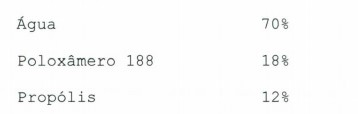
Os agregados são conhecidos como micelas e esses grupos moleculares podem dissolver novamente, quando se dilui o sistema com água durante um longo tempo, de modo que a concentração do tensoativo cai para abaixo do valor característico, o que se pode denominar de "concentração critica de formação de micela" ou "cmc" para abreviar.Aggregates are known as micelles and these molecular groups can dissolve again when the system is diluted with water for a long time, so that the concentration of the surfactant drops below the characteristic value, which can be called "critical concentration of micelle formation" or "cmc" for short.
Quanto maior é a "cmc" de um tensoativo, menos lipofilica é a parte não polar da molécula de tensoativo. - A parte interna da micela está presente no estado liquido. - Na maioria dos casos, apenas mono-tensoativos estão presentes em soluções abaixo da "cmc". Acima da "cmc", o número de agregados permanece quase sempre constante.The greater the "cmc" of a surfactant, the less lipophilic is the non-polar part of the surfactant molecule. - The inner part of the micelle is present in a liquid state. - In most cases, only mono-surfactants are present in solutions below the "cmc". Above "cmc", the number of aggregates remains almost constant.
Todo o material de tensoativo adicional está acima da "cmc" apenas na forma de micelas, de modo que a formação de micelas pode ser observada como a formação de uma nova fase na qual, contudo, o número de agregação não cresce infinitamente. - A concentração dos mono-tensoativos dissolvidos, portanto, não pode ser aumentada acima da "cmc". - A temperatura na qual a dissolução dos tensoativos ocorre em virtude da formação de micela incipiente é 5 conhecida como o ponto de Krafft do tensoativo. Uma vez que esse ponto de Krafft representa uma temperatura muito acentuadamente definida, ele aparece como se o tensoativo não dissolvido se fundiria quando atingindo o ponto de Krafft. 0 ponto de Krafft, frequentemente é, 10 portanto, comparado com o ponto de fusão. - Tensoativos não-iônicos os quais formam uma solução clara em água mostram um comportamento especial em contraste com outros tensoativos. No caso de aumento de temperatura, a solução se torna turva quando excede uma 15 temperatura especifica, relativa e claramente definida, a qual é característica do respectivo tensoativo e a solução fica dissociada em duas fases liquidas. Essa temperatura é conhecida como ponto de turbidez. - A razão para a ocorrência desse fenômeno depende da 20 hidratação dos grupos não-iônicos hidrofilicos. No caso de aumento da temperatura, uma desidratação parcial ocorre, o que leva à formação de uma nova fase. Por essa razão, o ponto de turbidez é quase sempre independente da concentração total do tensoativo. Contudo, turbidez pode ser revertida quando do resfriamento. O ponto de turbidez pode ser influenciado através de aditivos. Aditivos podem ser armazenados nas micelas intersticialmente e modificar suas propriedades ou eles 5 podem modificar as propriedades da água, isto é, o ambiente ao redor das micelas. O último mecanismo se aplica especialmente à adição dos eletrólitos, os quais geralmente deslocam o ponto de turbidez para temperaturas menores com aumento da concentração. 10-0 formato esférico das micelas surge porque os grupos principais hidrofilicos precisam estar tão longe uns dos outros quanto possivel em virtude da repulsão eletrostática e, ao mesmo tempo, também precisam ter contato com as moléculas de água circundantes. As partes 15 de molécula lipofilica dentro das micelas não estão em contato com água; o tamanho das micelas é baseado no espaço requerido pelo grupo lipofilico.All additional surfactant material is above "cmc" only in the form of micelles, so micelle formation can be observed as the formation of a new phase in which, however, the aggregation number does not increase infinitely. - The concentration of dissolved mono-surfactants, therefore, cannot be increased above the "cmc". - The temperature at which dissolution of surfactants occurs due to incipient micelle formation is known as the Krafft point of the surfactant. Since this Krafft point represents a very sharply defined temperature, it appears as if the undissolved surfactant would melt when reaching the Krafft point. The Krafft point is therefore often compared to the melting point. - Non-ionic surfactants which form a clear solution in water show a special behavior in contrast to other surfactants. In case of temperature increase, the solution becomes cloudy when it exceeds a specific, relative and clearly defined temperature, which is characteristic of the respective surfactant, and the solution is dissociated into two liquid phases. This temperature is known as the turbidity point. - The reason for the occurrence of this phenomenon depends on the hydration of the non-ionic hydrophilic groups. In case of temperature increase, a partial dehydration occurs, which leads to the formation of a new phase. For this reason, the turbidity point is almost always independent of the total concentration of the surfactant. However, turbidity can be reversed upon cooling. The turbidity point can be influenced by additives. Additives can be stored in micelles interstitially and modify their properties or they can modify the properties of water, ie the environment around the micelles. The last mechanism applies especially to the addition of electrolytes, which generally shift the turbidity point to lower temperatures with increasing concentration. 10-The spherical shape of micelles arises because the hydrophilic main groups need to be as far apart from each other as possible due to electrostatic repulsion and, at the same time, they also need to have contact with the surrounding water molecules. The lipophilic molecule parts 15 within the micelles are not in contact with water; the size of micelles is based on the space required by the lipophilic group.
Os seguintes dados são aplicáveis ao Pluronic:

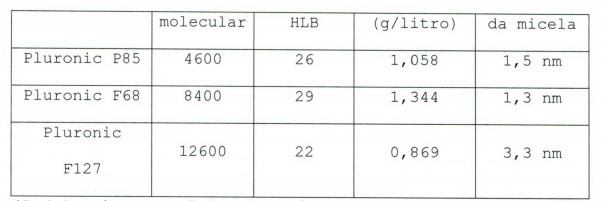
Algumas explicações adicionais são fornecidas abaixo: - No caso de micelas esféricas, o raio pode crescer 5 somente até o comprimento da parte molecular lipofilica.Some additional explanations are given below: - In the case of spherical micelles, the ray can only grow to the length of the lipophilic molecular part.
O número de mono-tensoativos por micela esférica (=número de agregação) é, assim, restrito para cima e é fornecido pelo volume requerido de uma parte molecular lipofilica em proporção ao volume total da micela. - No caso da concentração do tensoativo ser aumentada, o tamanho das micelas, assim, permanece constante e apenas seu número aumenta.The number of mono-surfactants per spherical micelle (=aggregation number) is thus restricted upwards and is provided by the required volume of a lipophilic molecular part in proportion to the total volume of the micelle. - In case the concentration of the surfactant is increased, the size of the micelles thus remains constant and only their number increases.
Uma propriedade importante das micelas é sua capacidade de solubilizar outras moléculas. Uma vez que as micelas 15 praticamente representam pequenas goticulas de hidrocarboneto, elas estão em uma posição para dissolver as substâncias lipofilicas. Essas substâncias insolúveis em água são integradas dentro das micelas e não estão mais em contato com a água. Contudo, uma vez que a superfície das micelas é hidrofílica, o agente ativo flutua se dissolvido em água. Esse processo é conhecido como solubilização. Micelas são sistemas estáveis no sentido termodinâmico. A concentração das partículas 5 solubilizadas através dos tensoativos repousa principalmente abaixo de 5%. A interface causa uma dispersão de luz (efeito Tyndall), o sistema frequentemente parece ser turvo.An important property of micelles is their ability to solubilize other molecules. Since micelles 15 practically represent small hydrocarbon droplets, they are in a position to dissolve lipophilic substances. These water-insoluble substances are integrated within the micelles and are no longer in contact with water. However, since the surface of micelles is hydrophilic, the active agent floats if dissolved in water. This process is known as solubilization. Micelles are stable systems in the thermodynamic sense. The concentration of particles 5 solubilized through the surfactants lies mainly below 5%. The interface causes a scattering of light (Tyndall effect), the system often appears to be cloudy.
Solubilização (=depósito de substâncias lipofílicas no 10 interior das micelas) deixa as micelas crescerem, de modo que os tensoativos adicionais são depositados sobre a superfície da micela. O diâmetro das micelas, desse modo, aumenta no caso de Pluronic F68 para cima a partir de 1,3 nm (não carregadas) e, no caso de Pluronic F127, 15 para cima a partir de 3,3 nm (não carregadas). 0 diâmetro da micela normalmente repousa abaixo de 140 nm. Contudo, essas fontes de micelas podem levar a um tamanho de partícula do solubilizado de até 500 nm, onde o solubilizado parece quase transparente, com um brilho 20 azulado. No caso de tamanhos de partícula abaixo de 140 nm, o solubilizado aparece apenas transparente.Solubilization (=deposition of lipophilic substances inside the micelles) lets the micelles grow so that additional surfactants are deposited on the micelle surface. The diameter of the micelles thus increases in the case of Pluronic F68 upwards from 1.3 nm (uncharged) and in the case of Pluronic F127, 15 upwards from 3.3 nm (uncharged). The micelle diameter normally rests below 140 nm. However, these micelle sources can lead to a particle size of the solubilized up to 500 nm, where the solubilised appears almost transparent, with a bluish sheen. In the case of particle sizes below 140 nm, the solubilized appears only transparent.
O valor de HLB (Equilíbrio Hidrofílico/Lipofílico) quantifica a porção hidrofílica e lipofílica na molécula de tensoativo. Esse valor é uma expressão das propriedades da molécula de tensoativo. 0 valor de HPB do Pluronic F68 é de 29, do Pluronic F127 é de 22. Ambos os tensoativos são fortes hidrótropos. - Para uma solubilização clara de óleos aromáticos, óleos 5 essenciais e vitaminas solúveis em óleo, tensoativos tendo um valor de HLB de 14-17 são usados. Essas substâncias são também conhecidas como hidrótropos ou solubilizantes. Em virtude de seu alto valor de HLB, os solubilizantes geralmente têm uma tendência à espumação, 10 o que causa problemas técnicos. Ambos os Pluronics (F68 e F127), contudo, são supressores de espuma. - Principalmente os óleos aromáticos, os quais contêm resinas, resinóides, terpenos, ésteres ou cetonas, são pobremente solúveis em água e devem ser solubilizados em 15 sistemas aquosos. - Resinas, resinóides e seus ésteres, por sua vez, são solventes muito bons para óleos essenciais, vitaminas solúveis em óleo, compostos de polifenila e outros agentes ativos lipofilicos. Ao mesmo tempo, resinas, 20 resinóides e seus ésteres também podem ser solubilizados muito bem nos tensoativos Pluronic F127, Pluronic F68 e Pluronic P85.The HLB (Hydrophilic/Lipophilic Balance) value quantifies the hydrophilic and lipophilic portion of the surfactant molecule. This value is an expression of the properties of the surfactant molecule. The HPB value of Pluronic F68 is 29, Pluronic F127 is 22. Both surfactants are strong hydrotropes. - For a clear solubilization of aromatic oils, essential oils and oil-soluble vitamins, surfactants having an HLB value of 14-17 are used. These substances are also known as hydrotropes or solubilizers. Due to their high HLB value, solubilizers generally have a tendency to foam, 10 which causes technical problems. Both Pluronics (F68 and F127), however, are suds suppressors. - Mainly aromatic oils, which contain resins, resinoids, terpenes, esters or ketones, are poorly soluble in water and must be solubilized in 15 aqueous systems. - Resins, resinoids and their esters, in turn, are very good solvents for essential oils, oil-soluble vitamins, polyphenyl compounds and other lipophilic active agents. At the same time, resins, 20 resinoids and their esters can also be solubilized very well in Pluronic F127, Pluronic F68 and Pluronic P85 surfactants.
A Abamectina é uma mistura de >=80% de Abamectina Bia (M: 873,1; C48H72O14) e <=20% de Abamectina Bib (M: 859, 1; C47H70O14) . Essas são cristais incolores a ligeiramente amarelos com um ponto de fusão de 161,8-169,4 °C (sob decomposição) e uma densidade de 1,18 a 25°C. A Abamectina é estável contra hidrólise em soluções aquosas em um pH de 5 5, 7 e 9 (a 25°C). Com cerca de 2 g de Abamectina finamente distribuída em 1000 litros de água, uma área de um hectare (dois campos de futebol) pode ser pulverizada em torno de uma hora. Com o auxilio de uma formulação de amostra para o agente ativo Abamectina, o qual é um acaricida muito 10 potente (contra ácaros), pode ser mostrado que a despeito de uma boa solubilidade da Abamectina em uma mistura de resina e a despeito de uma boa solubilização da solução resina-Abamectina por meio de Pluronic, há também uma estabilidade única nunca antes observada do solubilizado 15 feito de acordo com esse método, mesmo abaixo da "cmc"característica para o Pluronic de 1,344 g/litro (F68) ou 0,869 g/litro (F127) e acima do limite de solubilidade de 7-10 mcg/litro de Abamectina em água (25°C).Abamectin is a mixture of >=80% Abamectin Bia (M: 873.1; C48H72O14) and <=20% Abamectin Bib (M: 859, 1; C47H70O14). These are colorless to slightly yellow crystals with a melting point of 161.8-169.4 °C (under decomposition) and a density of 1.18 at 25 °C. Abamectin is stable against hydrolysis in aqueous solutions at a pH of 5, 7, and 9 (at 25°C). With about 2 g of Abamectin finely distributed in 1000 liters of water, an area of one hectare (two football fields) can be sprayed in about an hour. With the aid of a sample formulation for the active agent Abamectin, which is a very potent acaricide (against mites), it can be shown that despite a good solubility of Abamectin in a resin mixture and despite a good solubilization of the resin-Abamectin solution by means of Pluronic, there is also a never-before-observed stability of solubilized 15 made according to this method, even below the characteristic "cmc" for Pluronic of 1.344 g/liter (F68) or 0.869 g /liter (F127) and above the solubility limit of 7-10 mcg/liter of Abamectin in water (25°C).
A formulação isenta de água com uma concentraçãoThe water-free formulation with a concentration
Abamectina possivelmente alta, a qual pode ser misturada com água em qualquer proporção sem qualquer problema e sempre produz resultados transparentes é como segue:
A formulação no caso de "cmc" do Pluronic F127 (=0,869 g/litro):
As micelas assim produzidas também permanecem estáveis sob a cmc, conforme quando a resina usada não é apenas o solvente para a Abamectina e pode ser dissolvida apropriadamente com Pluronic, mas também entra em uma 10 ligação especial com o Pluronic e, dessa forma, mantém as micelas estáveis mesmo em diluição extrema com água. Uma concentração de uso tipica para Abamectina é 2.000 mcg/litro, isto é, uma concentração a qual repousa acima do limite de solubilidade para Abamectina em água e, assim, 15 deveria ser dissolvida em micelas.The micelles thus produced also remain stable under cmc, as when the resin used is not only the solvent for Abamectin and can be properly dissolved with Pluronic, but also enters into a special bond with Pluronic and thus maintains the stable micelles even in extreme dilution with water. A typical use concentration for Abamectin is 2000 mcg/liter, ie a concentration which lies above the solubility limit for Abamectin in water and thus 15 should be dissolved in micelles.
Uma formulação da mistura de resina (resinas):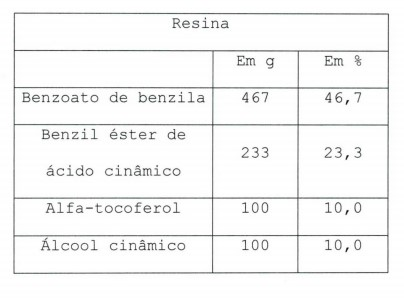

Benzoato de benzila (M: 212,2; C14H12O2) é um liquido incolor ou cristais incolores; praticamente insolúvel em 5 água (impede a cristalização); - Benzil éster de ácido cinâmico (M: 238,29; CI6H14O2; densidade 1,106) são cristais brancos, aromáticos; praticamente insolúvel em água; - ou, opcionalmente, benzil coniferil éster. Antioxidantes: alfa tocoferol.Benzyl benzoate (M: 212.2; C14H12O2) is a colorless liquid or colorless crystals; practically insoluble in water (prevents crystallization); - Cinnamic acid benzyl ester (M: 238.29; CI6H14O2; density 1.106) are white, aromatic crystals; practically insoluble in water; - or, optionally, benzyl coniferyl ester. Antioxidants: alpha tocopherol.
Solventes: álcool cinamilico, álcool benzilico, etil diglicol, dipropileno glicol, PEG 400, ácido benzóico.Solvents: cinnamyl alcohol, benzyl alcohol, ethyl diglycol, dipropylene glycol, PEG 400, benzoic acid.
Se ajusta-se o solubilizado de Abamectina com água para uma concentração de agente ativo entre 2% e 0,5%, então são obtidos preparados transparentes em formato de gel os quais fazem um som quando se esfrega um vidro cheio desse gel sobre uma superficie rigida. Esse "som" é também perceptível como uma vibração. Tais géis que "sonoros" são extremamente estáveis no calor e no frio. O efeito dessa 20 estrutura estável é também que os agentes ativos sensíveis à hidrólise permanecem estáveis como um resultado da deposição no sistema em altas temperaturas.If the solubilized Abamectin is adjusted with water to an active agent concentration between 2% and 0.5%, then transparent gel-shaped preparations are obtained which make a sound when rubbing a glass filled with this gel on a surface rigid. This "sound" is also noticeable as a vibration. Such "sounding" gels are extremely stable in heat and cold. The effect of this stable structure is also that the active agents sensitive to hydrolysis remain stable as a result of deposition in the system at high temperatures.
Exemplos

Quando sólidos secos são armazenados desprotegidos em ar carregado com vapor de água, uma sorção ocorre 5 dependendo do teor de umidade do ar e das propriedades higroscópicas dos sólidos, isto é, ocorre uma absorção de vapor. Em tal processo, apenas umas poucas camadas moleculares são ligadas à superfície do sólido através de adsorção ou penetram na massa do sólido, o que é conhecido 5 como absorção. A adsorção, por outro lado, ocorre quando sólidos úmidos distribuem vapor de água em atmosfera seca.When dry solids are stored unprotected in air laden with water vapour, a sorption occurs depending on the moisture content of the air and the hygroscopic properties of the solids, ie, a sorption of vapour occurs. In such a process, only a few molecular layers are attached to the solid surface through adsorption or penetrate into the solid mass, which is known as absorption. Adsorption, on the other hand, occurs when wet solids distribute water vapor in a dry atmosphere.
Concentrados sólidos ou semi-sólidos de agente ativo, os quais são extraídos de acordo com o método descrito através da produção de uma massa fundida ou gel do agente 10 ativo, onde essas massas fundidas e géis apresentam então vapor de água carregado e, assim, sólidos hidrofilicos e/ou solúveis em água com uma grande superficie ou uma superfície aumentada em virtude da pulverização e/ou liofilização, oferecem excelentes propriedades para a re- 15 absorção de agentes ativos no corpo humano ou de um animal.Active agent solid or semi-solid concentrates, which are extracted according to the method described by producing a melt or gel of the active agent, where these melts and gels then present charged water vapor and thus hydrophilic and/or water-soluble solids with a large surface or an increased surface due to spraying and/or lyophilization, offer excellent properties for the reabsorption of active agents in the human or animal body.
Essas propriedades são independentes do fato dos concentrados dos agentes ativos serem finalmente submetidos a uma dessorção ou não. Com o método descrito acima, portanto, concentrados sólidos de agentes ativos podem ser 20 produzidos para uso oral, os quais podem ser preenchidos em cápsulas de gelatina, embalados em sachês como um pó dosado ou comprimidos na forma de tabletes e tabletes efervescentes. Após sua decomposição e dissolução em água ou no suco gástrico em seres humanos ou animais, os agentes ativos estão presentes na forma solubilizada e/ou dispersa, a qual pode ser absorvida rápida e completamente. De maneira similar, concentrados semi-sólidos de agentes ativos também podem ser produzidos com boas propriedades de 5 ressorção, os quais podem ser subsequentemente preenchidos em cápsulas de gelatina mole. Os seguintes são especialmente adequados como sólidos hidrofilicos ou solúveis em água com grandes superficies ou superficies aumentadas em virtude da pulverização ou 10 liofilização (superficie especifica > 0,01 m2/g, método BET) : - Exudatos, tais como goma arábica, tragacanta, goma karaya, goma ghatti; - Farinhas de semente, tais como goma guar, farinha de 15 semente de alfarroba, farinha de tara stone, goma de tamarindo; - Agentes anti-calcário detergentes, tais como goma de lariço, pectina, agar, alginato, carragena, furcelarana; - Hidrocolóides bio-sintéticos, tal como xantana; - Hidrocolóides modificados, tais como alginato de propileno glicol, pectina amidada; - Derivados de celulose, tais como metil celulose, metil etil celulose, metil hidroxil etil celulose, metil hidroxil propil celulose, hidroxil propil celulose, carbóxi metil celulose de sódio; - Óxidos de silicic, tai como Aerosil; - Proteínas, tais como gelatina, leite em pó desnatado; 5 - Açúcares, tais como lactose, manitol, xilitol, sorbitol, dextrana.These properties are independent of whether the active agent concentrates are finally subjected to desorption or not. With the method described above, therefore, solid concentrates of active agents can be produced for oral use, which can be filled into gelatin capsules, packed in sachets as a metered powder or compressed into effervescent tablets and tablets. After its decomposition and dissolution in water or gastric juice in humans or animals, the active agents are present in a solubilized and/or dispersed form, which can be quickly and completely absorbed. Similarly, semi-solid concentrates of active agents can also be produced with good resorption properties, which can subsequently be filled into soft gelatine capsules. The following are especially suitable as hydrophilic or water-soluble solids with large or enlarged surfaces due to spraying or lyophilization (specific surface > 0.01 m2/g, BET method): - Exudates such as gum arabic, tragacanth, karaya gum, ghatti gum; - Seed flours, such as guar gum, locust bean flour, tara stone flour, tamarind gum; - Detergent anti-lime agents, such as larch gum, pectin, agar, alginate, carrageenan, furcelaran; - Biosynthetic hydrocolloids such as xanthan; - Modified hydrocolloids, such as propylene glycol alginate, amidated pectin; - Cellulose derivatives, such as methyl cellulose, methyl ethyl cellulose, methyl hydroxyl ethyl cellulose, methyl hydroxyl propyl cellulose, hydroxyl propyl cellulose, sodium carboxy methyl cellulose; - Silicic oxides, such as Aerosil; - Proteins such as gelatin, skimmed milk powder; 5 - Sugars, such as lactose, mannitol, xylitol, sorbitol, dextran.
Como outro aspecto da invenção, agora seu uso para a aplicação como agente ativo para plantas será discutido. A principio, o método para solubilização e estabilização de 10 um agente ativo para plantas será apresentado em maiores detalhes. Foi provado ser especialmente importante que o ativo e as substâncias auxiliares, isto é, nesse caso a abamectina e o amalgamate de poloxâmero com resina e tocoferol em uma base molecular e, assim, formam um 15 complexo auxiliar quase ativo. Uma simples mistura de todos os componentes com subsequente agitação leva a um teor máximo de alguns décimos percentuais do agente ativo adicionado para plantas. O ponto de fusão de poloxâmeros puros repousa em torno de 57°C a 58°C. Esse tipo de 20 dissolução, na qual se funde o poloxâmero, a resina ou um tocoferol em uma massa fundida em uma base molecular ou quase molecular com o agente ativo para a planta a ser solubilizada provou por si próprio como sendo a chave para aperfeiçoar o processamento do agente ativo.As another aspect of the invention, its use for application as an active agent for plants will now be discussed. In principle, the method for solubilization and stabilization of an active agent for plants will be presented in greater detail. It has proven to be especially important that the active and auxiliary substances, ie in this case abamectin and poloxamer amalgam with resin and tocopherol on a molecular basis, thus form an almost active auxiliary complex. A simple mixing of all components with subsequent stirring leads to a maximum content of a few tenths of the added active agent for plants. The melting point of pure poloxamers is around 57°C to 58°C. This type of dissolution, in which poloxamer, resin or a tocopherol is melted into a molten mass on a molecular or quasi-molecular basis with the active agent for the plant to be solubilized has proved itself to be the key to perfecting the active agent processing.
Formulado amplamente, o princípio diz que quando se misturam duas substâncias auxiliares requeridas, isto é, poloxâmero e resina ou tocoferol, com um solvente opcional, bem como com o agente ativo para as plantas e se gera uma massa fundida a partir dos mesmos em torno de 40°C a 100°C, como um resultado disso os protagonistas são mantidos em um contato interno quase molecular uns com os outros. Um poloxâmero, isto é, Poloxâmero 188 e/ou Poloxâmero 407 e/ou um de seus substitutos e/ou derivados são fundidos e o 10 agente ativo para as plantas a serem tratadas é disperso dentro dessa massa fundida. A temperatura de fusão pode ser diminuída através da adição de solventes. Esses solventes poderiam ser, por exemplo, água, glicerina, propileno glicol, polietileno glicol 400, etanol, Macrogol 400 ou 15 isopropanol. Após a adição do agente ativo para plantas a serem tratadas nessa massa fundida, ela é resfriada, até que se torne frágil. Isso pode ser acelerado através da adição de gelo seco. Após isso, essa massa fundida endurecida é triturada em um moinho, picada no moinho por 20 meio de lâminas e então laminada com água em um moinho de emulsão, até que os cristais fundidos tenham sido reduzidos para um ponto tal que seu diâmetro seja de 5 micrometros ou menos. O moinho de emulsão tem, vantajosamente, uma cabeça de cisalhamento resfriada, de modo que os cristais fundidos não se tornem excessivamente quentes durante a trituração e retêm sua consistência frágil. A despeito da fragilidade do material, esses processos ocorrem sem pó. Nesse moinho de emulsão, a suspensão fundida reduzida do sistema de 5 engrenagem pode operar várias vezes em uma circulação, pelo que ela se torna menor e menor, até que ela tenha obtido uma finura adequada. Esses cristais menores permanecem termo-estáveis e a superficie do tensoativo não é "lavada" quando da adição de água extra. Os cristais fundidos são, 10 então, dissolvidos em água ou dispersos e colocados na área do solo próxima das plantas para absorção através de suas raizes ou a solução é pulverizada diretamente sobre a parte da planta acima do solo. Outra vantagem resulta da estabilidade das micelas. Agentes ativos, os quais são 15 pulverizados sobre as plantas de acordo com o método como um solubilizado e são secos sobre sua superficie em virtude "da evaporação, podem ser lavados facilmente da superficie da planta após colheita. Dessa forma, uma maçã pulverizada não descascada não tem um sabor amargo após ser lavada 20 rapidamente com água.Broadly formulated, the principle says that when two required auxiliary substances, ie poloxamer and resin or tocopherol, are mixed with an optional solvent as well as the active agent for the plants and a molten mass is generated around them. from 40°C to 100°C, as a result of this the protagonists are kept in almost molecular internal contact with each other. A poloxamer, i.e. Poloxamer 188 and/or Poloxamer 407 and/or one of its substitutes and/or derivatives are melted and the active agent for the plants to be treated is dispersed within this melt. The melting temperature can be lowered by adding solvents. Such solvents could be, for example, water, glycerine, propylene glycol, polyethylene glycol 400, ethanol, Macrogol 400 or isopropanol. After the addition of the active agent for plants to be treated in this molten mass, it is cooled until it becomes brittle. This can be accelerated by adding dry ice. Thereafter, this hardened molten mass is crushed in a mill, minced in the mill by means of blades and then laminated with water in an emulsion mill, until the molten crystals have been reduced to a point such that their diameter is 5 micrometers or less. The emulsion mill advantageously has a cooled shear head so that molten crystals do not become excessively hot during grinding and retain their brittle consistency. Despite the material's fragility, these processes occur without dust. In this emulsion mill, the reduced cast suspension of the 5-gear system can operate several times in one circulation, whereby it becomes smaller and smaller, until it has obtained an adequate fineness. These smaller crystals remain thermostable and the surface of the surfactant is not “washed out” when adding extra water. The molten crystals are then dissolved in water or dispersed and placed in the area of soil close to the plants for absorption through their roots or the solution is sprayed directly onto the above-ground part of the plant. Another advantage results from the stability of the micelles. Active agents, which are sprayed on the plants according to the method as a solubilizer and are dried on their surface by virtue of "evaporation", can easily be washed off the plant surface after harvesting. Thus, an unpeeled sprayed apple does not have a bitter taste after being washed off quickly with water.
Com esse método, a biodisponibilidade de um agente ativo para plantas pode ser intensificada consideravelmente porque agora o agente ativo é incorporado em uma base molecular e o revestimento de poloxâmero-resina-tocoferol permanece estável (quase complexo) , mesmo quando altamente diluído em água. Se diferentes massas fundidas de agente ativo-poloxâmero-resina-tocoferol são combinadas em água, então cada módulo retém suas propriedades físicas. Não há 5 influência de um com o outro, bem como outros tensoativos superfície-ativos também não afetam esses complexos em água. Basicamente, poloxâmero-resina-tocoferol usados nesse método são usados para solubilização e dispersão de cada um dos agentes ativos lipofílicos para plantas.With this method, the bioavailability of an active agent to plants can be enhanced considerably because now the active agent is incorporated into a molecular basis and the poloxamer-resin-tocopherol coating remains stable (almost complex), even when highly diluted in water. If different active agent-poloxamer-resin-tocopherol melts are combined in water, then each module retains its physical properties. There is no 5 influence with each other, as well as other surface-active surfactants also do not affect these complexes in water. Basically, poloxamer-resin-tocopherol used in this method are used for solubilization and dispersion of each of the lipophilic active agents for plants.
Conforme já descrito acima, poloxâmeros têm uma monografia nas diferentes Farmacopéias, isto é, uma descrição completa do agente ativo. Os poloxâmeros são completamente inertes. Eles podem ser usados nos setores de agricultura, cosméticos e nutrição animal. Poloxâmeros 15 individuais são usados em fármacos parenterais. Poloxâmeros são, portanto, inócuos.As already described above, poloxamers have a monograph in the different Pharmacopoeias, that is, a complete description of the active agent. Poloxamers are completely inert. They can be used in agriculture, cosmetics and animal nutrition sectors. Individual poloxamers are used in parenteral drugs. Poloxamers are therefore innocuous.
Se poloxâmero, resina ou tocoferol são usados de acordo com o método, então agentes ativos lipofílicos e semelhantes à resina para plantas podem ser dissolvidos em 20 ambiente hidrofílico, como também substâncias hidrofílicas em ambiente lipofílico. Partículas sólidas também podem ser solubilizadas e dispersas em ambiente aquoso. Uma aplicação disso é, por exemplo, solubilização do pólen em ambiente aquoso.If poloxamer, resin or tocopherol are used according to the method, then lipophilic and plant resin-like active agents can be dissolved in hydrophilic environment as well as hydrophilic substances in lipophilic environment. Solid particles can also be solubilized and dispersed in an aqueous environment. One application of this is, for example, solubilization of pollen in an aqueous environment.
As seguintes composições quantitativas são típicas para massas fundidas de poloxâmero: 0,1% a 8% de agente ativo para plantas, aproximadamente 10-20% de poloxâmero e 1-15% de uma resina natural ou artificialmente preparada 5 (ou um tocoferol em seu lugar). Tais composições são então solubilizadas ou suspensas em água.The following quantitative compositions are typical for poloxamer melts: 0.1% to 8% plant active agent, approximately 10-20% poloxamer, and 1-15% of a natural or artificially prepared resin 5 (or a tocopherol in your place). Such compositions are then solubilized or suspended in water.
Concentrados sólidos ou semi-sólidos de agentes ativos para plantas os quais são extraídos de acordo com o método descrito acima através do preparo de uma massa fundida do 10 agente ativo, de modo que essa massa fundida tenha uma grande superfície para agitação do agente auxiliar ou do agente ativo, conforme é normalmente obtido através de pulverização e/ou liofilização, oferecem excelentes propriedades para a absorção dos agentes ativos nas 15 plantas. Essas propriedades são independentes do fato dos concentrados dos agentes ativos serem finalmente submetidos a uma dessorção ou não. Com o método descrito acima, portanto, concentrados sólidos de agentes ativos para plantas podem ser preparados. Os cristais fundidos são 20 então absorvidos pela planta junto com a água na qual eles estão solubilizados através de sua rede de raízes.Solid or semi-solid concentrates of active agents for plants which are extracted according to the method described above by preparing a molten mass of the active agent so that this molten mass has a large surface for agitating the auxiliary agent or of the active agent, as normally obtained through spraying and/or lyophilization, offer excellent properties for the absorption of the active agents in the 15 plants. These properties are independent of whether the active agent concentrates are finally subjected to desorption or not. With the method described above, therefore, solid concentrates of plant active agents can be prepared. The molten crystals are then absorbed by the plant along with the water in which they are solubilized through their root network.
Explicitamente, a invenção também inclui a aplicação da massa fundida, conforme descrito acima, sobre macromoléculas solúveis em água, o que ainda se supõe aumentar a superficie de contato do complexo poloxâmero- resina-tocoferol do ingrediente ativo. Os seguintes são adequados como sólidos hidrofilicos ou solúveis em água com grandes superficies ou superficies aumentadas através de pulverização e/ou liofilização (superficie especifica > 0,01 m2/g, método BET): Exudatos, tais como goma arábica, tragacanta, goma karaya, goma ghatti; Farinhas de semente, tais como goma guar, farinha de tamarindo; - Agentes anti-calcário detergentes, tais como goma de lariço, pectina, agar, alginato, carragena, furcelarana; - Hidrocolóides bio-sintéticos, tal como xantana; - Hidrocolóides modificados, tais como alginato de propileno glicol, pectina amidada; - Derivados de celulose, tais como metil celulose, metil etil celulose, metil hidroxil etil celulose, metil hidroxil propil celulose, hidroxil propil celulose, 20 carbóxi metil celulose de sódio; - Óxidos de silicio, tal como Aerosil; - Proteinas, tais como gelatina, leite em pó desnatado; - Açúcares, tais como lactose, manitol, xilitol, sorbitol, dextrana.Explicitly, the invention also includes the application of the melt, as described above, to water-soluble macromolecules, which is further supposed to increase the contact surface of the poloxamer-resin-tocopherol complex of the active ingredient. The following are suitable as hydrophilic or water-soluble solids with large surfaces or surfaces enlarged by spraying and/or lyophilization (specific surface > 0.01 m2/g, BET method): Exudates such as gum arabic, tragacanth, karaya gum , ghatti gum; Seed flours such as guar gum, tamarind flour; - Detergent anti-lime agents, such as larch gum, pectin, agar, alginate, carrageenan, furcelaran; - Biosynthetic hydrocolloids such as xanthan; - Modified hydrocolloids, such as propylene glycol alginate, amidated pectin; - Cellulose derivatives, such as methyl cellulose, methyl ethyl cellulose, methyl hydroxyl ethyl cellulose, methyl hydroxyl propyl cellulose, hydroxyl propyl cellulose, sodium carboxy methyl cellulose; - Silicon oxides, such as Aerosil; - Proteins such as gelatin, skimmed milk powder; - Sugars such as lactose, mannitol, xylitol, sorbitol, dextran.
Claims (31)
Applications Claiming Priority (3)
| Application Number | Priority Date | Filing Date | Title |
|---|---|---|---|
| CH377/06 | 2006-03-10 | ||
| CH3772006 | 2006-03-10 | ||
| PCT/CH2007/000131 WO2007104173A2 (en) | 2006-03-10 | 2007-03-09 | Method for solubilizing, dispersing, and stabilizing materials, products manufactured according to said method, and use thereof |
Publications (2)
| Publication Number | Publication Date |
|---|---|
| BRPI0708773A2 BRPI0708773A2 (en) | 2011-06-14 |
| BRPI0708773B1 true BRPI0708773B1 (en) | 2021-10-19 |
Family
ID=38137765
Family Applications (1)
| Application Number | Title | Priority Date | Filing Date |
|---|---|---|---|
| BRPI0708773-0A BRPI0708773B1 (en) | 2006-03-10 | 2007-03-09 | METHOD FOR SOLUBILIZATION, DISPERSION AND STABILIZATION OF SUBSTANCES, MANUFACTURED PRODUCTS ACCORDING TO THE METHOD, AS WELL AS THE USE OF THE SAME |
Country Status (17)
| Country | Link |
|---|---|
| US (2) | US8703195B2 (en) |
| EP (1) | EP1993515B1 (en) |
| JP (2) | JP5678359B2 (en) |
| KR (1) | KR101433962B1 (en) |
| CN (1) | CN101400337A (en) |
| AT (1) | ATE437627T1 (en) |
| AU (1) | AU2007224940B2 (en) |
| BR (1) | BRPI0708773B1 (en) |
| CA (1) | CA2643389C (en) |
| DE (1) | DE502007001190D1 (en) |
| DK (1) | DK1993515T3 (en) |
| EA (1) | EA026670B1 (en) |
| ES (1) | ES2330898T3 (en) |
| HR (1) | HRP20090573T1 (en) |
| PL (1) | PL1993515T3 (en) |
| PT (1) | PT1993515E (en) |
| WO (1) | WO2007104173A2 (en) |
Families Citing this family (40)
| Publication number | Priority date | Publication date | Assignee | Title |
|---|---|---|---|---|
| WO2009033739A2 (en) | 2007-09-11 | 2009-03-19 | Mondobiotech Laboratories Ag | Use of a peptide as a therapeutic agent |
| WO2009033730A2 (en) | 2007-09-11 | 2009-03-19 | Mondobiotech Laboratoires Ag | Peptide gxgrgdspca as a therapeutic agent |
| WO2009040051A2 (en) | 2007-09-11 | 2009-04-02 | Mondobiotech Laboratories Ag | Use of the peptide rfmwmk alone or in combination with the peptide ymdgtmsqv as a therapeutic agent |
| JP2010539002A (en) | 2007-09-11 | 2010-12-16 | モンドバイオテック ラボラトリーズ アクチエンゲゼルシャフト | Use of urodilatin as a therapeutic agent |
| WO2009033690A1 (en) | 2007-09-11 | 2009-03-19 | Mondobiotech Laboratories Ag | Bfgf (119-126) for therapeutic applications |
| KR20100071985A (en) | 2007-09-11 | 2010-06-29 | 몬도바이오테크 래보래토리즈 아게 | Use of a defensin peptide as a therapeutic agent |
| AU2008303922A1 (en) | 2007-09-11 | 2009-04-02 | Mondobiotech Laboratories Ag | Use of the peptide His-Ser-Leu-Gly-Lys-Trp-Leu-Gly-His-Pro-Asp-Lys-Phe alone or in combination with the peptide Gly-Ard-Gly-Asp-Asn-Pro-OH as a therapeutic agent |
| KR20100056508A (en) | 2007-09-11 | 2010-05-27 | 몬도바이오테크 래보래토리즈 아게 | Use of bfgf 1-24 and optionally (arg 8) vasopressin to treat eg s. pneumoniae infection |
| EP2185181A2 (en) | 2007-09-11 | 2010-05-19 | Mondobiotech Laboratories AG | Therapeutic uses of gastrin-1 and g-pen-grgdspca |
| KR20100061481A (en) | 2007-09-11 | 2010-06-07 | 몬도바이오테크 래보래토리즈 아게 | Minigastrin as a therapeutic agent |
| AU2008297541A1 (en) | 2007-09-11 | 2009-03-19 | Mondobiotech Laboratories Ag | Use of a peptide as a therapeutic agent |
| KR20100056523A (en) | 2007-09-11 | 2010-05-27 | 몬도바이오테크 래보래토리즈 아게 | Use of grf-1 (1-29) and corticotropin-releasing factor as therapeutic agents |
| JP2010538979A (en) | 2007-09-11 | 2010-12-16 | モンドバイオテック ラボラトリーズ アクチエンゲゼルシャフト | S. Use of RGDSPASSKP and optional angiotensin II as therapeutic agents to treat Pneumoniae infections, etc. |
| KR20100061480A (en) | 2007-09-11 | 2010-06-07 | 몬도바이오테크 래보래토리즈 아게 | Use of glucagon (1-29) alone or in combination with neuropeptide w30 as a therapeutic agent |
| CN102481271A (en) | 2009-05-11 | 2012-05-30 | 博格生物系统有限责任公司 | Methods for treatment of metabolic disorders using epimetabolic shifters, multidimensional intracellular molecules, or environmental influencers |
| EP2359702B1 (en) | 2010-01-22 | 2014-06-04 | Symrise AG | Solubilization agent for solubilizing polyphenols, flavonoids and/or diterpenoid glucosides |
| SG10202010355PA (en) * | 2010-03-12 | 2020-11-27 | Berg Llc | Intravenous formulations of coenzyme q10 (coq10) and methods of use thereof |
| ES2383589T5 (en) | 2010-05-28 | 2017-08-28 | Omya International Ag | Procedure for manufacturing suspensions of mineral materials with high solids content |
| CA2832324C (en) | 2011-04-04 | 2022-03-15 | Berg Llc | Methods of treating central nervous system tumors |
| EP2720680B1 (en) | 2011-06-17 | 2020-02-12 | Berg LLC | Inhalable pharmaceutical compositions |
| JP5869856B2 (en) * | 2011-11-30 | 2016-02-24 | キユーピー株式会社 | Liquid seasoning containing daikon radish in a container |
| BRPI1106762A2 (en) * | 2011-12-22 | 2013-11-05 | Bioactive Biomateriais Ltda | POLYMERIC COMPOSITION CONTAINING NATURAL BIOACTIVES APPLICABLE IN PHARMACEUTICAL AND COSMETIC FORMULATIONS |
| KR101451401B1 (en) * | 2012-12-14 | 2014-10-22 | 주식회사 휴메딕스 | Conjugate of vitamin C with vitamin E and antioxidant comprising the same |
| JP6122646B2 (en) * | 2013-01-23 | 2017-04-26 | 昭和電工株式会社 | Topical skin preparation |
| NZ713868A (en) | 2013-04-08 | 2021-12-24 | Berg Llc | Treatment of cancer using coenzyme q10 combination therapies |
| WO2014180677A1 (en) * | 2013-05-06 | 2014-11-13 | Basf Se | Aqueous formulations of sparingly water-soluble active ingredients comprising as solubilizer a mixture of poloxamers differing in hydrophobicity |
| JP6232807B2 (en) * | 2013-07-30 | 2017-11-22 | ユーハ味覚糖株式会社 | Gummy candy |
| KR102370843B1 (en) | 2013-09-04 | 2022-03-04 | 버그 엘엘씨 | Methods of treatment of cancer by continuous infusion of coenzyme q10 |
| WO2017087576A1 (en) | 2015-11-16 | 2017-05-26 | Berg Llc | Methods of treatment of temozolomide-resistant glioma using coenzyme q10 |
| EP3216443A1 (en) | 2016-03-10 | 2017-09-13 | Athenion AG | Beverage preparation capsule for delivery of a solubilisate |
| EP3388054A1 (en) | 2017-04-12 | 2018-10-17 | Athenion AG | Dispensing cap containing a solubilisate of a pharmaceutically active agent or dietary supplement |
| EP3424494A1 (en) * | 2017-07-07 | 2019-01-09 | SolMic Research GmbH | Stable cannabinoid compositions |
| CN108271814A (en) * | 2018-01-21 | 2018-07-13 | 王小凤 | A kind of cultivation agent and preparation method thereof of the edible apple of diabetic |
| CN108210360B (en) * | 2018-02-06 | 2021-02-12 | 德之馨(上海)有限公司 | Water-soluble whitening formula and preparation method and application thereof |
| MA53966A (en) | 2018-10-24 | 2022-02-09 | Syngenta Participations Ag | NEW COMPOSITION OF SOLUBLE CONCENTRATE (SL) OF ABAMECTIN |
| WO2020250242A1 (en) * | 2019-06-10 | 2020-12-17 | Godrej Agrovet Limited | Bud break formulation |
| JP7504589B2 (en) * | 2019-12-27 | 2024-06-24 | ポーラ化成工業株式会社 | Transparent solubilized composition |
| EP3909564A1 (en) | 2020-05-12 | 2021-11-17 | Metabolic Tuning AG | Solid solution comprising gum arabic and at least one fat-soluble agent |
| KR102365402B1 (en) * | 2021-05-31 | 2022-02-18 | 김상태 | Perilla leaf containing saponin and production method thereof |
| CN115096678A (en) * | 2022-06-21 | 2022-09-23 | 杭州师范大学 | Method for extracting anthraquinone compounds in plants based on polyethylene glycol-assisted mechanical amorphous dispersion |
Family Cites Families (23)
| Publication number | Priority date | Publication date | Assignee | Title |
|---|---|---|---|---|
| US2953496A (en) * | 1958-12-02 | 1960-09-20 | Upjohn Co | Vitamin emulsion |
| CA1088427A (en) * | 1975-12-22 | 1980-10-28 | Andrew W. Finkstein | Imidazoline-containing hair shampoo compositions |
| JPS5660565A (en) * | 1979-10-22 | 1981-05-25 | Dainichiseika Color Chem | Composition for deodorizing aromatic |
| US4383987A (en) * | 1981-06-26 | 1983-05-17 | Colgate/Palmolive Company | Foaming dentifrice containing nonionic surface active agent |
| GB2181737A (en) * | 1985-08-29 | 1987-04-29 | Avent Medical Ltd | Liquid shampoo composition |
| US4810503A (en) * | 1987-03-31 | 1989-03-07 | Basf Corporation | Polymers which form gels at low concentrations in water |
| ZA95519B (en) * | 1994-02-07 | 1995-09-28 | Isk Biotech Corp | Pesticidal micronutrient com psitions containing zinc oxide |
| US5861174A (en) * | 1996-07-12 | 1999-01-19 | University Technology Corporation | Temperature sensitive gel for sustained delivery of protein drugs |
| US6458373B1 (en) * | 1997-01-07 | 2002-10-01 | Sonus Pharmaceuticals, Inc. | Emulsion vehicle for poorly soluble drugs |
| US6193954B1 (en) * | 1997-03-21 | 2001-02-27 | Abbott Laboratories | Formulations for pulmonary delivery of dopamine agonists |
| US6027716A (en) * | 1997-04-02 | 2000-02-22 | Farmo-Nat Ltd. | Synergistic herbal extracts |
| US6228347B1 (en) * | 1997-12-01 | 2001-05-08 | Thione International, Inc. | Antioxidant gel for gingival conditions |
| US6197305B1 (en) * | 1998-01-05 | 2001-03-06 | Farmo-Nat Ltd. | Anti-fungal compositions with prolonged activity |
| US6200550B1 (en) * | 1998-12-11 | 2001-03-13 | Q-Pharma, Inc. | Oral care compositions comprising coenzyme Q10 |
| AUPP915099A0 (en) * | 1999-03-12 | 1999-04-15 | Monk, Michael Mendel | Improved composition for oral administration |
| KR20070058028A (en) * | 1999-05-24 | 2007-06-07 | 소너스파머슈티칼즈인코포레이티드 | Emulsion excipients for poorly soluble drugs |
| ES2282134T3 (en) * | 1999-09-11 | 2007-10-16 | THE PROCTER & GAMBLE COMPANY | POLYOXIALQUYLENE COPOLYMERS CONTAINING FLUID LIQUID VEHICLES. |
| FR2806909B3 (en) * | 2000-03-29 | 2002-03-22 | Giorgio Panin | DETERGENT COMPOSITION FOR PERSONAL HYGIENE, WITH A HIGH VITAMIN E CONTENT OR DERIVATIVES THEREOF |
| DE10343872A1 (en) * | 2003-09-23 | 2005-04-21 | Bayer Cropscience Ag | Agrochemical suspension concentrates containing azole and/or strobilurin, e.g. the fungicide tebuconazole, containing alkanol ethoxylate penetration promoter and specific polymeric dispersant to increase activity |
| US7713440B2 (en) * | 2003-10-08 | 2010-05-11 | Lyotropic Therapeutics, Inc. | Stabilized uncoated particles of reversed liquid crystalline phase materials |
| US20050118206A1 (en) * | 2003-11-14 | 2005-06-02 | Luk Andrew S. | Surfactant-based gel as an injectable, sustained drug delivery vehicle |
| WO2005053652A1 (en) * | 2003-12-04 | 2005-06-16 | Pfizer Products Inc. | Multiparticulate crystalline drug compositions containing a poloxamer and a glyceride |
| US20060078616A1 (en) * | 2004-08-30 | 2006-04-13 | Georgewill Dawaye A | Thermoreversible pharmaceutical formulation for anti-microbial agents comprising poloxamer polymers and hydroxy fatty acid ester of polyethylene glycol |
-
2007
- 2007-03-09 US US12/281,834 patent/US8703195B2/en not_active Expired - Fee Related
- 2007-03-09 BR BRPI0708773-0A patent/BRPI0708773B1/en not_active IP Right Cessation
- 2007-03-09 PT PT07710794T patent/PT1993515E/en unknown
- 2007-03-09 DE DE200750001190 patent/DE502007001190D1/en active Active
- 2007-03-09 CA CA2643389A patent/CA2643389C/en active Active
- 2007-03-09 KR KR1020087023964A patent/KR101433962B1/en not_active Expired - Fee Related
- 2007-03-09 WO PCT/CH2007/000131 patent/WO2007104173A2/en not_active Ceased
- 2007-03-09 PL PL07710794T patent/PL1993515T3/en unknown
- 2007-03-09 AT AT07710794T patent/ATE437627T1/en active
- 2007-03-09 CN CNA2007800086123A patent/CN101400337A/en active Pending
- 2007-03-09 EP EP07710794A patent/EP1993515B1/en active Active
- 2007-03-09 EA EA200801850A patent/EA026670B1/en not_active IP Right Cessation
- 2007-03-09 DK DK07710794T patent/DK1993515T3/en active
- 2007-03-09 JP JP2008557575A patent/JP5678359B2/en not_active Expired - Fee Related
- 2007-03-09 HR HR20090573T patent/HRP20090573T1/en unknown
- 2007-03-09 AU AU2007224940A patent/AU2007224940B2/en not_active Ceased
- 2007-03-09 ES ES07710794T patent/ES2330898T3/en active Active
-
2014
- 2014-02-19 US US14/184,145 patent/US9114167B2/en not_active Expired - Fee Related
- 2014-08-15 JP JP2014165434A patent/JP2015028028A/en active Pending
Also Published As
| Publication number | Publication date |
|---|---|
| KR20080108262A (en) | 2008-12-12 |
| HRP20090573T1 (en) | 2009-11-30 |
| EP1993515A2 (en) | 2008-11-26 |
| ES2330898T3 (en) | 2009-12-16 |
| EA200801850A1 (en) | 2009-06-30 |
| CN101400337A (en) | 2009-04-01 |
| US20090280987A1 (en) | 2009-11-12 |
| EA026670B1 (en) | 2017-05-31 |
| KR101433962B1 (en) | 2014-08-25 |
| AU2007224940A1 (en) | 2007-09-20 |
| US9114167B2 (en) | 2015-08-25 |
| WO2007104173B1 (en) | 2008-01-10 |
| US20140193513A1 (en) | 2014-07-10 |
| CA2643389C (en) | 2014-12-02 |
| JP2015028028A (en) | 2015-02-12 |
| EP1993515B1 (en) | 2009-07-29 |
| PT1993515E (en) | 2009-11-05 |
| AU2007224940B2 (en) | 2013-08-29 |
| WO2007104173A3 (en) | 2007-11-22 |
| BRPI0708773A2 (en) | 2011-06-14 |
| WO2007104173A2 (en) | 2007-09-20 |
| DK1993515T3 (en) | 2009-12-07 |
| JP5678359B2 (en) | 2015-03-04 |
| ATE437627T1 (en) | 2009-08-15 |
| JP2009531305A (en) | 2009-09-03 |
| PL1993515T3 (en) | 2010-01-29 |
| US8703195B2 (en) | 2014-04-22 |
| CA2643389A1 (en) | 2007-09-20 |
| DE502007001190D1 (en) | 2009-09-10 |
Similar Documents
| Publication | Publication Date | Title |
|---|---|---|
| BRPI0708773B1 (en) | METHOD FOR SOLUBILIZATION, DISPERSION AND STABILIZATION OF SUBSTANCES, MANUFACTURED PRODUCTS ACCORDING TO THE METHOD, AS WELL AS THE USE OF THE SAME | |
| EP3582750B1 (en) | Oral cannabinoid formulations | |
| ES2302913T3 (en) | FORMULATIONS BASED ON COENZYME Q-10. | |
| ES2226976T3 (en) | GALENIC FORMULATIONS OF PHENOFIBRATE AND ITS PROCEDURE OF OBTAINING. | |
| ES3021218T3 (en) | Dilutable formulations of cannabinoids and processes for their preparation | |
| ES2306980T3 (en) | STABLE EMULSIONS OF CONCENTRATED AND DILUTED WATER OIL. | |
| Ali | Recent trend in traditional medicine dosage form and present status of Unani and Ayurvedic medicine | |
| WO2019025880A1 (en) | Cannabis oil nanoparticles micro-encapsulated in powder | |
| CN114948778A (en) | Poorly soluble functional substance transporter containing transporter | |
| US20230257653A1 (en) | Fractal formulations | |
| CN115887379A (en) | Vitamin D 3 Spray and preparation method thereof | |
| Awad et al. | Liquid dosage forms | |
| CN109640935A (en) | Mixture comprising (E) -3- benzo [1,3] dioxole -5- base-N, N- diphenyl -2- acrylamide | |
| JP2010504290A (en) | Gum arabic emulsion | |
| US20220370531A1 (en) | Self-emulsifying cannabinoid formulation and method | |
| JP2003137797A (en) | Mastic-containing emulsion | |
| Hasan et al. | Flavored self microemulsifying lipid formulations for masking the organoleptic taste of pharmaceutical actives | |
| US20240350519A1 (en) | Microemulsion delivery systems incorporated into gummy confections | |
| KR20140033343A (en) | Aqueous ionic solution containing seawater and at least one compound that is originally immiscible with seawater | |
| JP6287123B2 (en) | Ubiquinol-containing liquid composition | |
| JPH09315987A (en) | Utilization of awamori as antiallergic active ingredient | |
| JP2010526109A (en) | Emulsion pre-concentrate and micelle composition containing wood resin | |
| EP4241760A1 (en) | Solid material and dispersion composition containing same | |
| HK1131040A (en) | Method for solubilizing, dispersing, and stabilizing materials, products manufactured according to said method, and use thereof | |
| rights are reserved by Himanshu | A Comprehensive Review on Pharmaceutical Liquid Dosage Form |
Legal Events
| Date | Code | Title | Description |
|---|---|---|---|
| B06F | Objections, documents and/or translations needed after an examination request according [chapter 6.6 patent gazette] | ||
| B06T | Formal requirements before examination [chapter 6.20 patent gazette] | ||
| B07D | Technical examination (opinion) related to article 229 of industrial property law [chapter 7.4 patent gazette] |
Free format text: DE ACORDO COM O ARTIGO 229-C DA LEI NO 10196/2001, QUE MODIFICOU A LEI NO 9279/96, A CONCESSAO DA PATENTE ESTA CONDICIONADA A ANUENCIA PREVIA DA ANVISA. CONSIDERANDO A APROVACAO DOS TERMOS DO PARECER NO 337/PGF/EA/2010, BEM COMO A PORTARIA INTERMINISTERIAL NO 1065 DE 24/05/2012, ENCAMINHA-SE O PRESENTE PEDIDO PARA AS PROVIDENCIAS CABIVEIS. |
|
| B07G | Grant request does not fulfill article 229-c lpi (prior consent of anvisa) [chapter 7.7 patent gazette] | ||
| B09A | Decision: intention to grant [chapter 9.1 patent gazette] | ||
| B11D | Dismissal acc. art. 38, par 2 of ipl - failure to pay fee after grant in time | ||
| B11N | Dismissal: publication cancelled [chapter 11.14 patent gazette] |
Free format text: ANULADA A PUBLICACAO CODIGO 11.4 NA RPI NO 2649 DE 13/10/2021 POR TER SIDO INDEVIDA. |
|
| B16A | Patent or certificate of addition of invention granted [chapter 16.1 patent gazette] |
Free format text: PRAZO DE VALIDADE: 20 (VINTE) ANOS CONTADOS A PARTIR DE 09/03/2007, OBSERVADAS AS CONDICOES LEGAIS. PATENTE CONCEDIDA CONFORME ADI 5.529/DF, QUE DETERMINA A ALTERACAO DO PRAZO DE CONCESSAO. |
|
| B21F | Lapse acc. art. 78, item iv - on non-payment of the annual fees in time |
Free format text: REFERENTE A 15A ANUIDADE. |
|
| B24D | Patent annual fee: restoration after fee payment | ||
| B21F | Lapse acc. art. 78, item iv - on non-payment of the annual fees in time |
Free format text: REFERENTE A 16A ANUIDADE. |
|
| B24J | Lapse because of non-payment of annual fees (definitively: art 78 iv lpi, resolution 113/2013 art. 12) |
Free format text: EM VIRTUDE DA EXTINCAO PUBLICADA NA RPI 2737 DE 20-06-2023 E CONSIDERANDO AUSENCIA DE MANIFESTACAO DENTRO DOS PRAZOS LEGAIS, INFORMO QUE CABE SER MANTIDA A EXTINCAO DA PATENTE E SEUS CERTIFICADOS, CONFORME O DISPOSTO NO ARTIGO 12, DA RESOLUCAO 113/2013. |