BRPI0907228B1 - THIENOPYRIDAZINE COMPOUNDS, THEIR PREPARATIONS, PHARMACEUTICAL COMPOSITIONS AND USES - Google Patents
THIENOPYRIDAZINE COMPOUNDS, THEIR PREPARATIONS, PHARMACEUTICAL COMPOSITIONS AND USES Download PDFInfo
- Publication number
- BRPI0907228B1 BRPI0907228B1 BRPI0907228-4A BRPI0907228A BRPI0907228B1 BR PI0907228 B1 BRPI0907228 B1 BR PI0907228B1 BR PI0907228 A BRPI0907228 A BR PI0907228A BR PI0907228 B1 BRPI0907228 B1 BR PI0907228B1
- Authority
- BR
- Brazil
- Prior art keywords
- thieno
- pyridazinyl
- formamide
- chlorophenyl
- compound
- Prior art date
Links
Classifications
-
- C—CHEMISTRY; METALLURGY
- C07—ORGANIC CHEMISTRY
- C07D—HETEROCYCLIC COMPOUNDS
- C07D495/00—Heterocyclic compounds containing in the condensed system at least one hetero ring having sulfur atoms as the only ring hetero atoms
- C07D495/02—Heterocyclic compounds containing in the condensed system at least one hetero ring having sulfur atoms as the only ring hetero atoms in which the condensed system contains two hetero rings
- C07D495/04—Ortho-condensed systems
-
- A—HUMAN NECESSITIES
- A61—MEDICAL OR VETERINARY SCIENCE; HYGIENE
- A61K—PREPARATIONS FOR MEDICAL, DENTAL OR TOILETRY PURPOSES
- A61K31/00—Medicinal preparations containing organic active ingredients
- A61K31/33—Heterocyclic compounds
- A61K31/395—Heterocyclic compounds having nitrogen as a ring hetero atom, e.g. guanethidine or rifamycins
- A61K31/495—Heterocyclic compounds having nitrogen as a ring hetero atom, e.g. guanethidine or rifamycins having six-membered rings with two or more nitrogen atoms as the only ring heteroatoms, e.g. piperazine or tetrazines
- A61K31/50—Pyridazines; Hydrogenated pyridazines
- A61K31/5025—Pyridazines; Hydrogenated pyridazines ortho- or peri-condensed with heterocyclic ring systems
-
- A—HUMAN NECESSITIES
- A61—MEDICAL OR VETERINARY SCIENCE; HYGIENE
- A61P—SPECIFIC THERAPEUTIC ACTIVITY OF CHEMICAL COMPOUNDS OR MEDICINAL PREPARATIONS
- A61P25/00—Drugs for disorders of the nervous system
-
- A—HUMAN NECESSITIES
- A61—MEDICAL OR VETERINARY SCIENCE; HYGIENE
- A61P—SPECIFIC THERAPEUTIC ACTIVITY OF CHEMICAL COMPOUNDS OR MEDICINAL PREPARATIONS
- A61P29/00—Non-central analgesic, antipyretic or antiinflammatory agents, e.g. antirheumatic agents; Non-steroidal antiinflammatory drugs [NSAID]
-
- A—HUMAN NECESSITIES
- A61—MEDICAL OR VETERINARY SCIENCE; HYGIENE
- A61P—SPECIFIC THERAPEUTIC ACTIVITY OF CHEMICAL COMPOUNDS OR MEDICINAL PREPARATIONS
- A61P35/00—Antineoplastic agents
-
- A—HUMAN NECESSITIES
- A61—MEDICAL OR VETERINARY SCIENCE; HYGIENE
- A61P—SPECIFIC THERAPEUTIC ACTIVITY OF CHEMICAL COMPOUNDS OR MEDICINAL PREPARATIONS
- A61P35/00—Antineoplastic agents
- A61P35/02—Antineoplastic agents specific for leukemia
-
- A—HUMAN NECESSITIES
- A61—MEDICAL OR VETERINARY SCIENCE; HYGIENE
- A61P—SPECIFIC THERAPEUTIC ACTIVITY OF CHEMICAL COMPOUNDS OR MEDICINAL PREPARATIONS
- A61P37/00—Drugs for immunological or allergic disorders
- A61P37/02—Immunomodulators
-
- A—HUMAN NECESSITIES
- A61—MEDICAL OR VETERINARY SCIENCE; HYGIENE
- A61P—SPECIFIC THERAPEUTIC ACTIVITY OF CHEMICAL COMPOUNDS OR MEDICINAL PREPARATIONS
- A61P43/00—Drugs for specific purposes, not provided for in groups A61P1/00-A61P41/00
-
- A—HUMAN NECESSITIES
- A61—MEDICAL OR VETERINARY SCIENCE; HYGIENE
- A61P—SPECIFIC THERAPEUTIC ACTIVITY OF CHEMICAL COMPOUNDS OR MEDICINAL PREPARATIONS
- A61P9/00—Drugs for disorders of the cardiovascular system
Landscapes
- Health & Medical Sciences (AREA)
- Chemical & Material Sciences (AREA)
- Organic Chemistry (AREA)
- Veterinary Medicine (AREA)
- Public Health (AREA)
- General Health & Medical Sciences (AREA)
- Animal Behavior & Ethology (AREA)
- Life Sciences & Earth Sciences (AREA)
- Medicinal Chemistry (AREA)
- Pharmacology & Pharmacy (AREA)
- General Chemical & Material Sciences (AREA)
- Chemical Kinetics & Catalysis (AREA)
- Nuclear Medicine, Radiotherapy & Molecular Imaging (AREA)
- Bioinformatics & Cheminformatics (AREA)
- Engineering & Computer Science (AREA)
- Epidemiology (AREA)
- Immunology (AREA)
- Oncology (AREA)
- Hematology (AREA)
- Cardiology (AREA)
- Pain & Pain Management (AREA)
- Rheumatology (AREA)
- Biomedical Technology (AREA)
- Neurology (AREA)
- Neurosurgery (AREA)
- Heart & Thoracic Surgery (AREA)
- Heterocyclic Carbon Compounds Containing A Hetero Ring Having Oxygen Or Sulfur (AREA)
- Pharmaceuticals Containing Other Organic And Inorganic Compounds (AREA)
Abstract
compostos de tienopiridazina, suas preparações, composições farmacêuticas e usos a presente invenção se relaciona com compostos de tienopiridazina de fórmula (i), seus sais farmaceuficamente aceitáveis ou hidratos, onde r1 e r2 são independentemente h ou alquia c1-4, r3 é um anel de 5 ou 6 membros saturado ou insaturado contendo n, s ou o, ou seus isômeros óticos, r4 é uma halofenila monossubstituída ou dissubstituída em qualquer posição. a presente invenção fornece os processos de preparação destes compostos, composições farmacêuticas contendo estes compostos e os usos destes compostos, particularmente no tratamento do câncer. (i)thienopyridazine compounds, preparations thereof, pharmaceutical compositions and uses the present invention relates to thienopyridazine compounds of formula (I), their pharmaceutically acceptable salts or hydrates, where r1 and r2 are independently h or c1-4 alkyl, r3 is a ring 5- or 6-membered saturated or unsaturated containing n, s or o, or optical isomers thereof, R4 is a halophenyl monosubstituted or disubstituted at any position. the present invention provides the processes for preparing these compounds, pharmaceutical compositions containing these compounds and the uses of these compounds, particularly in the treatment of cancer. (i)
Description
[001] A presente invenção refere-se à química farmacêutica, em particular refere-se aos compostos de tienopiridazina, suas preparações e composições farmacêuticas contendo-as e os usos destes.[001] The present invention relates to pharmaceutical chemistry, in particular relates to thienopyridazine compounds, their preparations and pharmaceutical compositions containing them and their uses.
[002] Câncer é uma ameaça para a saúde humana, e a maioria dos cânceres em humanos é causada por fatores ambientais externos. A cada ano, pelo menos 5 milhões de pessoas morrem de câncer ao redor do mundo. A taxa de cura é ainda baixa, embora alguns métodos de tratamento estejam atualmente disponíveis para curar os pacientes, tais como cirurgia, radioterapia, quimioterapia e assim por diante. Usar produtos químicos farmacêuticos para prevenir e tratar cânceres é atualmente um dos métodos mais eficazes.[002] Cancer is a threat to human health, and most cancers in humans are caused by external environmental factors. Every year, at least 5 million people die from cancer around the world. The cure rate is still low, although some treatment methods are currently available to cure patients, such as surgery, radiation therapy, chemotherapy and so on. Using pharmaceutical chemicals to prevent and treat cancers is currently one of the most effective methods.
[003] Constatou-se que compostos de tienopiridazina ou compostos de seus análogos de tieno têm atividades antitumorais.[003] It has been found that thienopyridazine compounds or compounds of their thieno analogues have antitumor activities.
[004] A F. Hoffman-La Roche AG revela uma tienopiridazina como inibidor de IKK no documento WO2005105808.
[005] A Amgen Inc. dos EUA revela um composto de tienopiridazina como inibidor da protease p38 da tirosina quinase no documento WO2007124181.
[006] A Smithkline Beecham Corporation revelou um composto de 2- ureidotiofeno no documento WO03029241 e um composto de 3-ureidotiofeno no documento WO03028731, os quais são similares aos compostos de tienopiridazina como inibidores de CHK1. A AstraZeneca AB revela um composto modificado de 3- ureidotiofeno como inibidor de CHK1 no documento WO 2005066163.Smithkline Beecham Corporation has disclosed a 2-ureidothiophene compound in WO03029241 and a 3-ureidothiophene compound in WO03028731, which are similar to thienopyridazine compounds as CHK1 inhibitors. AstraZeneca AB discloses a modified 3-ureidothiophene compound as a CHK1 inhibitor in WO 2005066163.
[007] Os produtos químicos farmacêuticos para prevenir e tratar cânceres incluem atualmente, inibidores de receptores de tirosina quinases e não-receptores de tirosina quinases, e seus alvos incluem VEGFR, EGFR, HER2, SRC, JAK e TEK; e também incluem inibidores de treonina-serina quinases e seus alvos incluem MEK, JNK, c-MET, AKT, PIM, TIE, PLK e assim por diante. Os compostos da presente invenção são inibidores de cânceres e proteína quinases incluindo o Ponto de Verificação Quinase CHK1/CHK2 dos ciclos de células.[007] Pharmaceutical chemicals to prevent and treat cancers currently include inhibitors of receptor tyrosine kinases and non-receptor tyrosine kinases, and their targets include VEGFR, EGFR, HER2, SRC, JAK and TEK; and also include inhibitors of threonine serine kinases and their targets include MEK, JNK, c-MET, AKT, PIM, TIE, PLK and so on. The compounds of the present invention are inhibitors of cancers and protein kinases including the cell cycle Kinase CHK1/CHK2 Checkpoint.
[008] Constatou-se, das pesquisas para regulação dos pontos de verificação do ciclo celular, que fechar a expressão de CHK1 pode reverter a resistência ao medicamento das células cancerosas e, deste modo, aumentar as sensibilidades das células tumorais à terapia de dano ao DNA, e dramaticamente aumentar as atividades dos produtos farmacêuticos anticâncer. Além disso, podem-se obter produtos farmacêuticos seletivos para tumores através da maioria dos tumores que tenham características de mutações no p53 de eliminar o ponto de verificação de G1/S. A presente invenção fornece um composto de tienopiridazina novo, como inibidores de proteína quinases de tumores novos associados com fatores de crescimento (incluindo CHK1, CHK2), os quais não somente têm ações antitumorais, mas também podem realçar a eficácia antitumoral de outros produtos farmacêuticos antitumorais.[008] It has been found, from research to regulate cell cycle checkpoints, that shutting down CHK1 expression can reverse the drug resistance of cancer cells and thus increase the sensitivities of tumor cells to damage therapy. DNA, and dramatically increase the activities of anticancer pharmaceuticals. In addition, tumor-selective pharmaceuticals can be obtained through most tumors that have p53 mutation characteristics to eliminate the G1/S checkpoint. The present invention provides a novel thienopyridazine compound, as inhibitors of novel tumor protein kinases associated with growth factors (including CHK1, CHK2), which not only have antitumor actions, but can also enhance the antitumor efficacy of other antitumor pharmaceuticals .
[009] De acordo com a presente invenção, o requerente descobriu compostos novos que têm atividades antiproliferativas (por exemplo, atividades anticâncer) e, assim usados para o tratamento de humanos e animais. A presente invenção também se relaciona com processos para obtenção dos ditos compostos, composições farmacêuticas que os contêm, e seus usos na preparação de produtos farmacêuticos para o uso na produção de efeitos antiproliferativos em animais, como no homem.[009] According to the present invention, the applicant has discovered new compounds that have anti-proliferative activities (for example, anti-cancer activities) and thus used for the treatment of humans and animals. The present invention also relates to processes for obtaining said compounds, pharmaceutical compositions containing them, and their uses in the preparation of pharmaceuticals for use in the production of antiproliferative effects in animals, as in man.
[010]A presente invenção inclui sais farmaceuticamente aceitáveis ou promedicamentos de tais compostos, e o requerente também fornece composições farmacêuticas e métodos de usar tais compostos para o tratamento de câncer, de acordo com a presente invenção.[010] The present invention includes pharmaceutically acceptable salts or prodrugs of such compounds, and applicant also provides pharmaceutical compositions and methods of using such compounds for the treatment of cancer, in accordance with the present invention.
[011] Tais propriedades dos compostos da presente invenção são esperadas serem de valores úteis para os tratamentos das doenças associadas com estagnação do ciclo celular e proliferação celular conforme segue: câncer (tumor sólido e leucemia), doenças fibroproliferativas e diferenciativas, psoríase, artrite reumatóide, sarcoma de Kaposi, nefropatias crônicas e agudas, ateroma, ateroesclerose, restenose arterial, doenças autoimunes, inflamação aguda e crônica, doenças ósseas e doenças oculares com proliferação do vaso retinal.[011] Such properties of the compounds of the present invention are expected to be of useful value for the treatments of diseases associated with cell cycle stagnation and cell proliferation as follows: cancer (solid tumor and leukemia), fibroproliferative and differential diseases, psoriasis, rheumatoid arthritis , Kaposi's sarcoma, chronic and acute nephropathies, atheroma, atherosclerosis, arterial restenosis, autoimmune diseases, acute and chronic inflammation, bone diseases and eye diseases with retinal vessel proliferation.
[012] De acordo com um aspecto da presente invenção, os compostos da fórmula (I) ou seus sais farmaceuticamente aceitáveis ou seus hidratos são fornecidos, onde, R1 e R2 são independentemente H ou alquilas C1-4;
[013] Preferivelmente, R1=R2=H.[013] Preferably, R1=R2=H.
[014] Preferivelmente, R3 é um anel saturado de 6 membros contendo N, S ou O, e seus isômero óticos.[014] Preferably, R3 is a 6-membered saturated ring containing N, S or O, and their optical isomers.
[015] Preferivelmente, R3 é hexa-hidropiridila, tetra-hidropiranila, tetra- hidrotiopiranila, tetra-hidropirrolidinila, tetra-hidrofuranila, ou tetra-hidrotienila, e seus isômeros óticos.[015] Preferably, R3 is hexahydropyridyl, tetrahydropyranyl, tetrahydrothiopyranyl, tetrahydropyrrolidinyl, tetrahydrofuranyl, or tetrahydrothienyl, and its optical isomers.
[016] Preferivelmente, R3 é hexa-hidropiridinila, e seus isômeros óticos.[016] Preferably, R3 is hexahydropyridinyl, and its optical isomers.
[017] Preferivelmente, R4 é uma halofenila monossubstituída.[017] Preferably, R4 is a monosubstituted halophenyl.
[018] Preferivelmente, R4 é
[019] Mais preferivelmente, os compostos de fórmula (I) são selecionados, conforme segue, a partir de: 2-(4-fluorofenil)-4-(3-piperidinometil)-tieno [2,3-d] piridazinil-7-formamida;


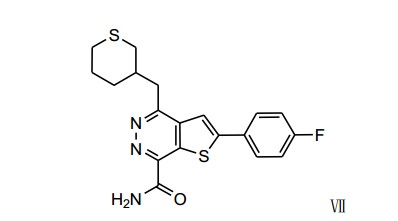


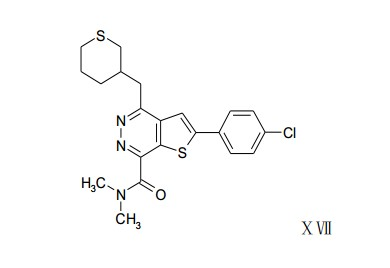


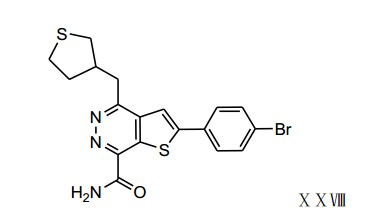


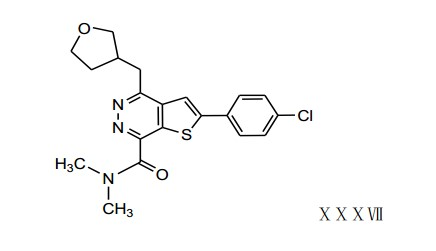
[020] Preferivelmente, R3 é piridinila, α-piranila, Y—piranila, a-tiopiranila, y- tiopiranila, pirrolidinila, furanila ou tienila, e seus isômeros óticos.[020] Preferably, R3 is pyridinyl, α-pyranyl, Y-pyranyl, α-thiopyranyl, y-thiopyranyl, pyrrolidinyl, furanyl or thienyl, and their optical isomers.
[021]Mais preferivelmente, os compostos de formula (I) são selecionados, conforme segue, a partir de: 2-(4-fluorofenil)-4-(3-piridinometil)-tieno[2,3-d]piridazinil-7- formamida;

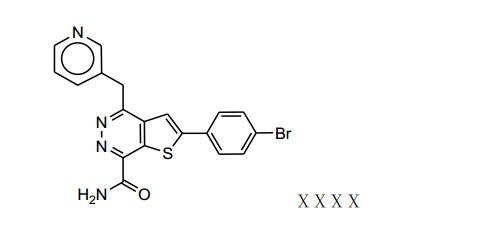


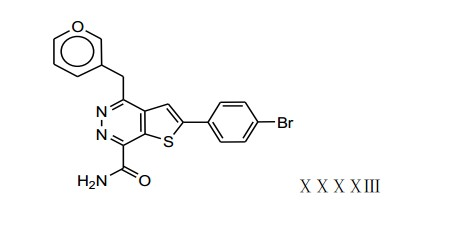


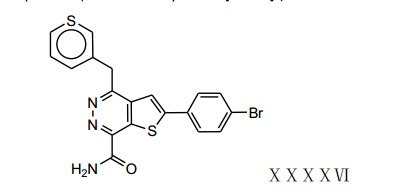


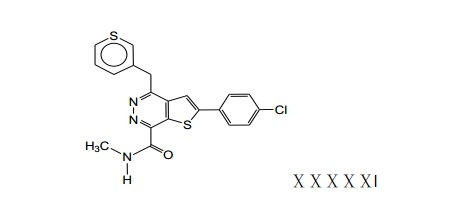


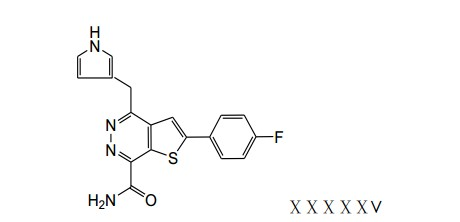


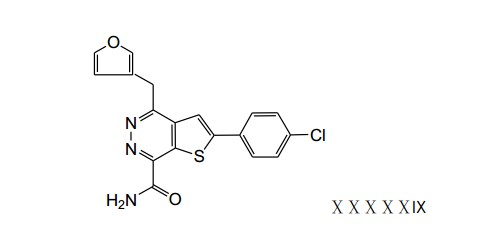

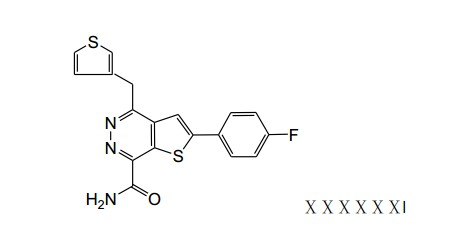


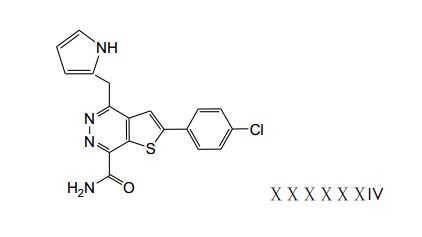


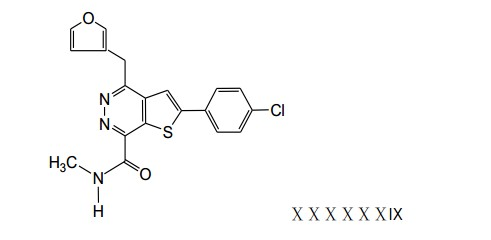


[022] De acordo com outro aspecto da presente invenção, uma composição farmacêutica é fornecida, incluindo compostos de fórmula (I) tendo uma quantidade terapeuticamente eficaz e seus sais ou seus hidratos farmaceuticamente aceitáveis, e portadores farmaceuticamente aceitáveis.[022] According to another aspect of the present invention, a pharmaceutical composition is provided, including compounds of formula (I) having a therapeutically effective amount and their pharmaceutically acceptable salts or hydrates, and pharmaceutically acceptable carriers.
[023] As composições farmacêuticas da presente invenção podem ser administradas localmente, tal como no pulmão, cabeça, cólon e assim por diante, na forma de solução, suspensão, aerossol ou pó seco e assim por diante; ou sistematicamente pela administração oral na forma de comprimidos, pó, ou administradas por via parenteral, na forma de solução ou suspensão, ou administração subcutânea, ou administração retal na forma de supositório, ou administração percutânea.[023] The pharmaceutical compositions of the present invention can be administered locally, such as in the lung, head, colon and so on, in the form of solution, suspension, aerosol or dry powder and so on; or systematically by oral administration in the form of tablets, powder, or administered parenterally, in the form of a solution or suspension, or subcutaneous administration, or rectal administration in the form of a suppository, or percutaneous administration.
[024] De acordo com outro aspecto da presente invenção, os usos dos compostos da fórmula (I) ou sais farmaceuticamente aceitáveis ou seus hidratos a partir deles na preparação para medicamentos de tratamento ou profilaxia de doenças tumorais são fornecidos. Onde as ditas doenças tumorais incluem tumor cervical, tumor da cabeça e pescoço, carcinoma de mama, ovário, pulmão (células não-pequenas), pâncreas, cólon, próstata ou outros tecidos, bem como leucemias e linfomas, tumores do sistema nervoso central e periférico e outros tumores, tais como melanoma, fibrossarcoma e osteossarcoma.[024] According to another aspect of the present invention, uses of the compounds of formula (I) or pharmaceutically acceptable salts or hydrates thereof in the preparation for medicaments for the treatment or prophylaxis of tumor diseases are provided. Where said tumor diseases include cervical tumor, head and neck tumor, breast, ovarian, lung (non-small cell) carcinoma, pancreas, colon, prostate or other tissues, as well as leukemias and lymphomas, central nervous system tumors and peripheral and other tumors such as melanoma, fibrosarcoma and osteosarcoma.
[025] De acordo com um aspecto adicional da presente invenção, os usos dos compostos de fórmula (I) ou sais farmaceuticamente aceitáveis ou seus hidratos a partir deles na preparação para medicamentos de tratamento ou profilaxia de doenças proliferativas são fornecidos. Onde as ditas doenças proliferativas incluem doenças autoimunes, inflamatórias, neurológicas e cardiovasculares.[025] According to a further aspect of the present invention, uses of the compounds of formula (I) or pharmaceutically acceptable salts or hydrates thereof in the preparation for medicaments for the treatment or prophylaxis of proliferative diseases are provided. Where said proliferative diseases include autoimmune, inflammatory, neurological and cardiovascular diseases.
[026] De acordo com um aspecto da presente invenção, os usos dos compostos de formula (I) ou sais farmaceuticamente aceitáveis ou seus hidratos a partir deles na preparação para medicamentos limitantes da proliferação celular de humanos ou animais são fornecidos.[026] According to one aspect of the present invention, uses of the compounds of formula (I) or pharmaceutically acceptable salts or hydrates thereof in the preparation for drugs limiting cell proliferation in humans or animals are provided.
[027] Ainda, de acordo com outro aspecto da presente invenção, os usos dos compostos de fórmula (I) ou sais farmaceuticamente aceitáveis ou seus hidratos a partir deles na preparação para medicamentos inibidores de tumores ou quinases associadas com fatores de crescimento são fornecidos.[027] Yet, according to another aspect of the present invention, uses of the compounds of formula (I) or pharmaceutically acceptable salts or hydrates thereof in the preparation for tumor inhibitory drugs or kinases associated with growth factors are provided.
[028] Para os usos acima mencionados, a dosagem depende dos compostos usados, abordagens de administração, e dos tratamentos requeridos pelas doenças.[028] For the above mentioned uses, the dosage depends on the compounds used, administration approaches, and the treatments required by the diseases.
[029] De acordo com o último aspecto da presente invenção, os métodos dos compostos de formula (I) ou sais farmaceuticamente aceitáveis ou seus hidratos a partir deles são fornecidos, e o método inclui as seguintes etapas:[029] According to the last aspect of the present invention, the methods of the compounds of formula (I) or pharmaceutically acceptable salts or hydrates thereof are provided, and the method includes the following steps:
[030] Na presença de álcali, o composto de fórmula A é tratado com dialquil oxalatos: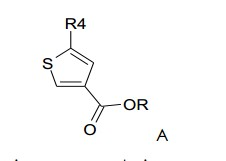


[031]O processo de síntese da presente invenção é descrito abaixo:
[032] Onde o composto de fórmula A pode ser preparado por processos químico convencionais no campo, ou ser comercialmente vendido. Após ser obtido, o composto de fórmula A é condensado com dialcalinos oxalatos, por exemplo, dietil oxalato, na presença de alcalino, tal como o alcalino comum LDA (diisopropilamida de lítio) e solventes orgânicos comuns, tais como tetra-hidrofurano, para produzir o composto Y. A reação de condensação deve ser procedida em uma temperatura baixa devido à presença de LDA. É fácil para pessoas habilitadas na arte, obter LDA que seja geralmente recém-preparada em uma temperatura baixa.[032] Where the compound of formula A can be prepared by conventional chemical processes in the field, or be commercially sold. After being obtained, the compound of formula A is condensed with dialkali oxalates, for example, diethyl oxalate, in the presence of alkali such as common alkali LDA (lithium diisopropylamide) and common organic solvents such as tetrahydrofuran to produce compound Y. The condensation reaction must be carried out at a low temperature due to the presence of LDA. It is easy for people skilled in the art to obtain LDA that is usually freshly brewed at a low temperature.
[033] Depois, o composto Y reage com hidrazina, tal como H2NNH2 em solvente alcoólico para produzir o composto de fórmula B.[033] Then, compound Y reacts with hydrazine such as H2NNH2 in alcoholic solvent to produce the compound of formula B.
[034] O composto de fórmula B é tratado com oxicloreto de fósforo para uma reação de acilação para produzir o composto de fórmula C.[034] The compound of formula B is treated with phosphorus oxychloride for an acylation reaction to produce the compound of formula C.
[035] As três etapas acima se referem a um método de síntese do produto intermediário do composto tienopiridazina produzido por F. Hoffman-La Roche AG no documento WO2005105808.[035] The three steps above refer to a method of synthesis of the intermediate product of the thienopyridazine compound produced by F. Hoffman-La Roche AG in WO2005105808.
[036]Os compostos de R3CH2 com um grupo protetor Boc são preparados por métodos convencionais no campo e aquecidos à temperatura de reação de 80~90°C na presença de catalisadores, tais como PdCl2 (dppf) e solventes, tais como fosfatos / 1,4-dioxano, o composto de fórmula C reage com R3CH2 contendo um grupo protetor Boc para durante toda a noite produzir o composto de fórmula D. Nas reações acima, os compostos de R3CH2 devem ser pré-tratados com 9-BBN, favor consultar a reação de acoplamento de “Suzuki-Miyaura”, p6125-6128, Tetrahedron Letters 45(2004).[036]R3CH2 compounds with a Boc protecting group are prepared by conventional methods in the field and heated to a reaction temperature of 80~90°C in the presence of catalysts such as PdCl2 (dppf) and solvents such as phosphates / 1 ,4-dioxane, the compound of formula C reacts with R3CH2 containing a Boc protecting group to overnight to produce the compound of formula D. In the above reactions, the compounds of R3CH2 must be pretreated with 9-BBN, please consult the “Suzuki-Miyaura” coupling reaction, p6125-6128, Tetrahedron Letters 45 (2004).
[037] Os compostos de fórmula D e HNR1R2 são amonolisados em um contêiner selado usando métodos convencionais com os solventes de reação de 1,4-dioxano, sob aquecimento à temperatura de 80°C durante toda a noite, depois, o grupo protetor Boc em R3 é removido sob condições ácidas para obter os sais ácidos da fórmula (I), e ajustar o pH comalcalino para produzir os compostos de fórmula (I).[037] The compounds of formula D and HNR1R2 are amonolyzed in a sealed container using conventional methods with the reaction solvents of 1,4-dioxane, under heating at a temperature of 80°C overnight, then the protective group Boc in R3 is removed under acidic conditions to obtain the acid salts of formula (I), and adjust the pH with alkaline to produce the compounds of formula (I).
[038] As matérias-primas das preparações acima mencionadas são obtidas por fornecedores comerciais ou são preparadas através de métodos convencionais no campo.[038] The raw materials of the aforementioned preparations are obtained by commercial suppliers or are prepared by conventional methods in the field.
[039] A seguir, a presente invenção será descrita especificamente com referência aos exemplos. Os exemplos são dados somente para ilustração da solução técnica da presente invenção e não devem ser interpretados para limitar a presente invenção.[039] In the following, the present invention will be specifically described with reference to the examples. The examples are given for illustration only of the technical solution of the present invention and are not to be interpreted to limit the present invention.
[040] Onde a estrutura dos componentes de fórmula (I) é determinada por ressonância magnética nuclear (NMR) e técnicas espectrométricas de massa; as mudanças químicas pela NMR de prótons são medidas usando escala δ, e a multiplicidade de picos é representada conforme segue: s, pico isolado; m, pico múltiplo. O produto intermediário é geralmente representado por espectrometria de massa e NMR.[040] Where the structure of the components of formula (I) is determined by nuclear magnetic resonance (NMR) and mass spectrometric techniques; chemical changes by proton NMR are measured using δ scale, and peak multiplicity is represented as follows: s, single peak; m, multiple peak. The intermediate product is usually represented by mass and NMR spectrometry.
[041]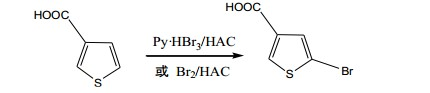
[042] Ácido tiofeno-3-fórmico (12,6g) e AcOH (96ml) são adicionados a um frasco de reação (250ml), para dissolver após agitados, à temperatura ambiente, solução de HBr (8ml) é adicionada a um frasco de reação e a reação muda rapidamente para um amarelo-claro. Brometo-perprometo de piridínio (27g) é, então, adicionado ao frasco aos poucos, à temperatura ambiente. Após a adição, a reação é agitada ainda à temperatura ambiente, e monitorada por HPLC. A mistura acima é despejada em água gelada após a reação, agitada por aproximadamente 30 minutos, filtrada para formar um sólido de pó branco, o sólido de pó branco é cristalizado com água quente, filtrado e seco para obter um cristal de ácido 5-bromo- tiofeno-3-fórmico (10,8g), teor de 92% medido por HPLC.[042] Thiophene-3-formic acid (12.6g) and AcOH (96ml) are added to a reaction flask (250ml), to dissolve after stirring at room temperature, HBr solution (8ml) is added to a flask of reaction and the reaction quickly changes to a pale yellow. Pyridinium bromide perpromide (27g) is then added to the vial gradually at room temperature. After addition, the reaction is further stirred at room temperature, and monitored by HPLC. The above mixture is poured into ice water after the reaction, stirred for approximately 30 minutes, filtered to form a white powder solid, the white powder solid is crystallized with hot water, filtered and dried to obtain a 5-bromo acid crystal. - thiophene-3-formic (10.8g), 92% content measured by HPLC.
[043] Ácido tiofeno-3-fórmico (12,5g), AcOH (83ml) são adicionados a um frasco de reação (500ml), agitados à temperatura ambiente e dissolvidos para obter um líquido incolor. Uma solução de Br2 (5,4ml) em AcOH (100ml) é colocada em um funil de pressão constante e gotejada no frasco de reação à temperatura ambiente e mantida em uma temperatura abaixo de 25°C. Após a adição, a reação é realizada à temperatura ambiente durante toda a noite. A mistura de reação é derramada em água gelada no dia seguinte, agitada por cerca de 30 minutos, filtrada para formar um sólido de pó branco. O sólido de pó branco é cristalizado com água quente, filtrado e seco para obter um cristal branco de ácido 5-bromo-tiofeno-3-fórmico(10g), teor de 92% medido por HPLC.[043] Thiophene-3-formic acid (12.5g), AcOH (83ml) are added to a reaction flask (500ml), stirred at room temperature and dissolved to obtain a colorless liquid. A solution of Br2 (5.4ml) in AcOH (100ml) is placed in a constant pressure funnel and dropped into the reaction flask at room temperature and kept at a temperature below 25°C. After addition, the reaction is carried out at room temperature overnight. The reaction mixture is poured into ice water the next day, stirred for about 30 minutes, filtered to form a white powdery solid. The white powder solid is crystallized with hot water, filtered and dried to obtain a white crystal of 5-bromo-thiophene-3-formic acid (10g), content of 92% measured by HPLC.
[044]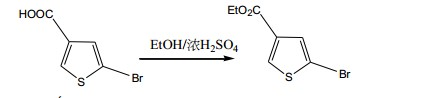
[045] Ácido 5-bromo-tiofeno-3-fórmico(18,5g) obtido pela etapa acima, etanol absoluto (150 ml) e ácido sulfúrico concentrado (5 ml) são adicionados em um frasco de três bocas (500ml) e aquecidos sob refluxo, e vaporizados sob pressão reduzida para remover o solvente após a reação. Depois, acetato de etila (100ml) e água saturada (200ml) são adicionados e agitados, para separação de camadas. A camada aquosa é reextraída com acetato de etila (25ml*2) duas vezes. A fase orgânica é combinada e transferida para um funil separatório. Solução de carbonato de sódio (10%) é adicionada a um funil separatório para ajustar o pH=8 e depois separada, e uma fase orgânica é lavada com água salgada saturada para pH=7, e seca com sulfato de magnésio anidro durante toda a noite, e filtrada no dia seguinte, e vaporizada sob pressão reduzida para remover o solvente para obter um líquido oleoso amarelo-claro de formato de 5-bromo-tiofeno-3-etila (15g).[045] 5-Bromo-thiophene-3-formic acid (18.5g) obtained by the above step, absolute ethanol (150 ml) and concentrated sulfuric acid (5 ml) are added in a three-neck flask (500 ml) and heated under reflux, and vaporized under reduced pressure to remove the solvent after the reaction. Then, ethyl acetate (100ml) and saturated water (200ml) are added and stirred for layer separation. The aqueous layer is re-extracted with ethyl acetate (25ml*2) twice. The organic phase is combined and transferred to a separatory funnel. Sodium carbonate solution (10%) is added to a separatory funnel to adjust pH=8 and then separated, and an organic phase is washed with saturated brine to pH=7, and dried with anhydrous magnesium sulfate throughout. overnight, and filtered the next day, and sprayed under reduced pressure to remove the solvent to obtain a pale yellow oily liquid of 5-bromo-thiophene-3-ethyl formate (15g).
[046]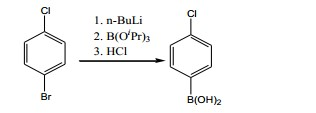
[047]4-Bromoclorobenzeno (70,6g) é adicionado a um frasco de quatro bocas conectando com um aparelho de agitação mecânica, dois funis de pressão constante e uma sonda de temperatura. Tolueno (588,3ml) e tetra-hidrofurano (THF) (147ml) são adicionados sob agitação à temperatura ambiente sob argônio, e dissolvidos até obter um líquido incolor. Depois, borato de triisopropila (109,2ml) e n- butil- lítio (176,4ml, 2,5M em hexano) são respectivamente adicionados em dois funis de pressão constante, e a temperatura interna resfriada para abaixo de -78°C, depois a solução de n-butil-lítio é gotejada para um frasco sob controle da velocidade de gotejamento para manter a temperatura interna abaixo de -78°C. Após a adição, a mistura é mantida em temperatura por 1 hora, depois, borato de triisopropila é gotejado na mistura sob temperatura abaixo de -78°C, e mantida na temperatura por 1 hora após a adição e, então, o sistema de resfriamento é removido para naturalmente aquecer até -20°C. Solução de HCl (360,4ml, 2,2M) é adicionada para aquecer até cerca de 10°C e, então, colocada para separação de camadas. A fase aquosa é reextraída com tolueno (58,8ml, 2 vezes). A fase orgânica é combinada junto e lavada com água salgada saturada até pH=7 para obter um líquido transparente, seca com sulfato de sódio anidro, filtrada e evaporada sob pressão reduzida para remover a maioria dos solventes e o sólido branco é finalmente precipitado, filtrado para obter um cristal de ácido 4-clorofenilbórico (48g).[047]4-Bromochlorobenzene (70.6g) is added to a four-neck flask connecting with a mechanical stirring apparatus, two constant pressure funnels and a temperature probe. Toluene (588.3ml) and tetrahydrofuran (THF) (147ml) are added under stirring at room temperature under argon, and dissolved to obtain a colorless liquid. Then triisopropyl borate (109.2ml) and n-butyl lithium (176.4ml, 2.5M in hexane) are respectively added in two constant pressure funnels, and the internal temperature cooled to below -78°C, then the n-butyl lithium solution is dripped into a flask under drip rate control to keep the internal temperature below -78°C. After addition, the mixture is kept at temperature for 1 hour, then triisopropyl borate is dropped into the mixture at a temperature below -78°C, and kept at temperature for 1 hour after addition and then the cooling system is removed to naturally warm to -20°C. HCl solution (360.4ml, 2.2M) is added to warm to about 10°C and then placed for layer separation. The aqueous phase is re-extracted with toluene (58.8ml, 2 times). The organic phase is combined together and washed with saturated brine until pH=7 to obtain a clear liquid, dried with anhydrous sodium sulfate, filtered and evaporated under reduced pressure to remove most of the solvents and the white solid is finally precipitated, filtered. to obtain a crystal of 4-chlorophenylboric acid (48g).
[048]
[049] Formato de 5-(4-clorofenil)- tiofeno 3-etila (10,5g), ácido 4-cloro-fenilborônico (6g), Pd[P(Ph)3]4 (1,5g), carbonato de sódio (7,5g) e uma mistura solvente de tolueno:água:EtOH (4:2:1, v/v) são, um após o outro, adicionados a um frasco de três bocas (500ml) e aquecidos sob refluxo por 3 horas, a reação é rastreada por TLC. A mistura de reação é resfriada até a temperatura ambiente após a reação e colocada para separação de camadas. A fase aquosa é reextraída com tolueno (35ml, 2 vezes). A fase orgânica é combinada junto e lavada com água salgada saturada até o pH=7, seca com sulfato de sódio anidro durante toda a noite e filtrada no dia seguinte, e depois evaporada sob pressão reduzida para remover solventes para obter um fluido viscoso amarelo-claro, e colocada para obter um sólido coagulado, e recristalizada com EtOH absoluto para obter um cristal de formato de 5 -(4-clorofenil)- tiofeno-3- etila (8,6g). 1HNMR(500MHz, DMSO ), δ 8,30 (sc, 1H), 7,81(s, 1H), 7,72(m, 2H), 7,46(m, 2H), 4,27(m, 2H), 1,30(m, 3H).[049] 5-(4-Chlorophenyl)-thiophene 3-ethyl formate (10.5g), 4-chloro-phenylboronic acid (6g), Pd[P(Ph)3]4 (1.5g), carbonate sodium (7.5g) and a solvent mixture of toluene:water:EtOH (4:2:1, v/v) are, one after the other, added to a three-neck flask (500ml) and heated under reflux for 3 hours, the reaction is tracked by TLC. The reaction mixture is cooled to room temperature after the reaction and placed for layer separation. The aqueous phase is re-extracted with toluene (35ml, 2 times). The organic phase is combined together and washed with saturated brine to pH=7, dried with anhydrous sodium sulfate overnight and filtered the next day, and then evaporated under reduced pressure to remove solvents to obtain a viscous yellow fluid. clear, and placed to obtain a coagulated solid, and recrystallized from absolute EtOH to obtain a crystal of 5-(4-chlorophenyl)-thiophene-3-ethyl formate (8.6g). 1HNMR(500MHz, DMSO ), δ 8.30(sc, 1H), 7.81(s, 1H), 7.72(m, 2H), 7.46(m, 2H), 4.27(m, 2H), 1.30(m, 3H).
[050]
[051] Preparação do LDA: THF (252,6ml) e N,N-diisopropilamina (79ml) são adicionados em um frasco de 3 bocas (1000ml) sob argônio, e n-butil-lítio (302,8ml, 1,6M em hexano) é colocado em um funil de pressão constante (500ml) e gotejado no frasco quando a temperatura interna estiver abaixo de -20˚C com uma reação intensamente exotérmica, e mantida -20˚C~-30˚C da temperatura interna controlando uma velocidade de adição; após adição, a mistura acima é naturalmente aquecida até a temperatura ambiente e diretamente usada para a reação de condensação a seguir.[051] Preparation of LDA: THF (252.6ml) and N,N-diisopropylamine (79ml) are added in a 3-neck flask (1000ml) under argon, and n-butyl lithium (302.8ml, 1.6M) in hexane) is placed in a constant pressure funnel (500ml) and dropped into the flask when the internal temperature is below -20˚C with an intensely exothermic reaction, and maintained at -20˚C~-30˚C of the internal temperature by controlling a speed of addition; after addition, the above mixture is naturally warmed to room temperature and directly used for the following condensation reaction.
[052] Reação de condensação: formato de 5-(4-clorofenil)-3-tiofeno-etila (28,7g), THF (1084ml) e dietil oxalato (29,7ml) são adicionados em um frasco de quatro bocas (2000ml) conectando com o aparelho de agitação mecânica, dois funis de pressão constante e uma sonda de temperatura. A mistura é agitada à temperatura ambiente e dissolvida até obter um líquido transparente amarelo-claro. A solução de LDA preparada pela etapa acima é transferida para um funil de pressão constante e resfriada até uma temperatura abaixo de -78°C e o LDA é gotejado até a evaporação sob argônio em uma temperatura abaixo de -78°C controlando a velocidade de gotejamento, após adição, a reação é rastreada por TLC. Solução de HCl (2,2M) é adicionada até a evaporação após a reação, e ajustada até o pH~3, e a cor do líquido da reação é alterada de marrom-avermelhado para laranja. A temperatura é aquecida até aproximadamente 0°C, um NaCl sólido é, então, adicionado e agitado até dissolver, e colocado para separação de camadas. A fase aquosa é reextraída com THF (143,5ml, 2 vezes). A fase orgânica é combinada e lavada com água salgada saturada duas vezes e, depois, ajustada até o pH=8 com solução de carbonato de sódio diluída; finalmente, lavada com água salgada saturada até o pH=7, seca com sulfato de sódio anidro, filtrada e evaporada sob pressão reduzida para remover o solvente para obter um fluido viscoso amarelo-claro e colocada à temperatura ambiente até gradualmente tornar-se um sólido, e recristalizada com EtOH para obter um produto puro de formato de 5-(4-clorofenil)-2- etoxioxalil- tiofeno - 3- etila (cristal laranja, 25,5g). 1HNMR (500MHz, CD3C1), δ 7,61 (s, 1H), 7,59(m, 2H), 7,42(m, 2H), 4,37(m, 4H), 1,39(m, 6H).[052] Condensation reaction: 5-(4-chlorophenyl)-3-thiophene-ethyl formate (28.7g), THF (1084ml) and diethyl oxalate (29.7ml) are added in a four-necked flask (2000ml ) connecting with the mechanical stirring apparatus, two constant pressure funnels and a temperature probe. The mixture is stirred at room temperature and dissolved to obtain a clear, pale yellow liquid. The LDA solution prepared by the above step is transferred to a constant pressure funnel and cooled to a temperature below -78°C and the LDA is dripped to evaporation under argon at a temperature below -78°C controlling the speed of drip, after addition, the reaction is tracked by TLC. HCl solution (2.2M) is added until evaporation after the reaction, and adjusted to pH~3, and the color of the reaction liquid is changed from reddish-brown to orange. The temperature is warmed to approximately 0°C, a solid NaCl is then added and stirred until dissolved, and placed for layer separation. The aqueous phase is re-extracted with THF (143.5ml, 2 times). The organic phase is combined and washed with saturated brine twice and then adjusted to pH=8 with dilute sodium carbonate solution; finally washed with saturated brine to pH=7, dried with anhydrous sodium sulphate, filtered and evaporated under reduced pressure to remove solvent to obtain a pale yellow viscous fluid and placed at room temperature until it gradually becomes a solid , and recrystallized from EtOH to obtain a pure product of 5-(4-chlorophenyl)-2-ethoxyoxalyl-thiophene-3-ethyl formate (orange crystal, 25.5g). 1HNMR (500MHz, CD3Cl), δ 7.61(s, 1H), 7.59(m, 2H), 7.42(m, 2H), 4.37(m, 4H), 1.39(m, 6H).
[053]
[054] Um cristal de formato de 5-(4-clorofenil)-2-etoxioxalil-tiofeno-3-etila (3,0g), etanol absoluto (45ml) são adicionados a um frasco de reação (100ml), agitados à temperatura ambiente para obter uma suspensão amarela. Hidrato de hidrazina (0,75ml) é adicionado em um funil de pressão constante, agitado por 10 minutos e depois gotejado no frasco de reação. A suspensão amarela é dissolvida até se atingir um líquido transparente e a mistura acima é aquecida a 70°C e um sólido amarelo no frasco é gradualmente precipitado com aumento da temperatura e o líquido da reação torna-se crescentemente viscoso. A mistura de reação é mantida por 1h e depois resfriada até a temperatura ambiente, e filtrada para obter um sólido verde- pistache, e esse sólido é lavado com uma mistura de hexano/diclorometano (1:1) (15ml, 2 vezes) e metanol/diclorometano (1:1) (15ml, 2 vezes) e seco sob pressões reduzidas até obter formato de 2-(4-clorofenil)-4-oxo-4,5-di-hidro-tieno [2,3-d]piridazinil - 7-etila (2,75g).[054] A 5-(4-chlorophenyl)-2-ethoxyoxalyl-thiophene-3-ethyl formate crystal (3.0g), absolute ethanol (45ml) are added to a reaction flask (100ml), stirred at the temperature environment to obtain a yellow suspension. Hydrazine hydrate (0.75ml) is added to a constant pressure funnel, shaken for 10 minutes and then dropped into the reaction vessel. The yellow suspension is dissolved until a clear liquid is reached and the above mixture is heated to 70°C and a yellow solid in the flask is gradually precipitated with increasing temperature and the reaction liquid becomes increasingly viscous. The reaction mixture is kept for 1h and then cooled to room temperature, filtered to obtain a pistachio green solid, and this solid is washed with a mixture of hexane/dichloromethane (1:1) (15ml, 2 times) and methanol/dichloromethane (1:1) (15ml, 2 times) and dried under reduced pressure to obtain 2-(4-chlorophenyl)-4-oxo-4,5-dihydro-thieno formate [2,3-d ]pyridazinyl-7-ethyl (2.75g).
[055]
[056]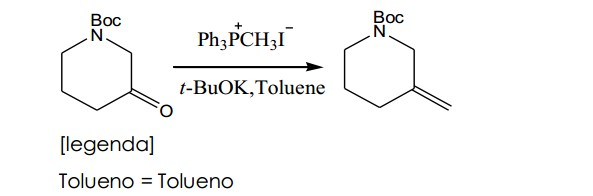
[057] Iodeto de trifenilmetil fosfônio (22,14g) e tolueno (135ml) são adicionados a um frasco de três bocas (500ml), agitados à temperatura ambiente até obter uma suspensão branca leitosa e rapidamente alterada para laranja após terc-butanolato de potássio (5,31g) ser adicionado. Depois, N-Boc-3-piperidona (6,0g) em tolueno (66ml) é adicionada em um funil de pressão constante e gotejada em um frasco sob argônio tratando-se de um fenômeno exotérmico, e mantida em uma temperatura de 30°C e a reação é rastreada por TLC após adição. Após a reação, a mistura é filtrada e lavada com água salgada saturada (200ml, 2 vezes) e então ajustada até pH~3 com HCl diluído (1M), e depois lavada com água salgada saturada até pH=7, seca com sulfato de sódio anidro e filtrada para obter um líquido amarelo transparente. O líquido amarelo transparente é purificado junto com sílica gel por cromatografia (líquido de eluição: éter de petróleo: acetato de etila =15:1) para obter um líquido oleoso amarelo de N-Boc-3-metileno piperidina (4,2g). 1HNMR(400MHz, CD3C1 ), δ 4,83 (s, 1H), 4,76(s, 1H), 3,89(s, 2H), 3,45(m, 2H), 2,26(m, 2H) 1,64(s, 2H), 1,51(s, 9H).[057] Triphenylmethyl phosphonium iodide (22.14g) and toluene (135ml) are added to a three-neck flask (500ml), stirred at room temperature until a milky white suspension is obtained and quickly changed to orange after potassium tert-butanolate (5.31g) be added. Then, N-Boc-3-piperidone (6.0g) in toluene (66ml) is added to a constant pressure funnel and dropped into a flask under argon in the case of an exothermic phenomenon, and kept at a temperature of 30° C and the reaction is tracked by TLC after addition. After the reaction, the mixture is filtered and washed with saturated brine (200ml, 2 times) and then adjusted to pH~3 with dilute HCl (1M), and then washed with saturated brine to pH=7, dried with sulfate anhydrous sodium and filtered to obtain a clear yellow liquid. The clear yellow liquid is purified along with silica gel by chromatography (elution liquid: petroleum ether:ethyl acetate =15:1) to obtain a yellow oily liquid of N-Boc-3-methylene piperidine (4.2g). 1HNMR(400MHz, CD3Cl), δ 4.83(s, 1H), 4.76(s, 1H), 3.89(s, 2H), 3.45(m, 2H), 2.26(m, 2H) 1.64(s, 2H), 1.51(s, 9H).
[058]
[059] N-Boc-3-metileno pirazidina (0,4g) é adicionada a um frasco de três bocas sob argônio e resfriada até 0°C. Solução de 9-BBN (12ml, 0,5M em THF) é injetada no frasco de reação com uma seringa e mantida por 30 minutos, e depois aquecida até a temperatura ambiente por 2 horas, e evaporada até remover o solvente sob uma pressão reduzida (25°C). 1,4-dioxano (20ml), PdCl2 (dppf) (0,05g), fosfato de potássio(0.32g) e formato de 4-cloro-2-(4-clorofenil)-tieno[2,3-d]piridazinil-7- etila são adicionados ao frasco de reação e aquecidos a 90°C durante toda a noite. A mistura de reação é resfriada até a temperatura ambiente no dia seguinte, depois há adição de água gelada (50ml) e acetato de etila (50ml), e agitação por aproximadamente 15 minutos e colocada para separação de camadas. A camada de água é reextraída com acetato de etila por 3 vezes, a fase orgânica é combinada e lavada com água salgada saturada até pH=7, seca com sulfato de magnésio anidro e filtrada. O líquido filtrado é purificado com sílica gel por cromatografia (acetato de etila: éter de petróleo = 1:5) até obter um fluido viscoso laranja (0,6g), e etanol (2ml) é adicionado ao fluido e cristalizado no refrigerador para obter um sólido de formato de 4-(1-Boc-3-piperidinometil)-2-(4- clorofenil) -tieno[2,3-d]piridazinil-7-etila (0,3g). 1HNMR(400MHz, DMSO ), δ 8, 90 (s, 1H), 8,03(m, 2H), 7,63(m, 2H), 4,54(m, 2H), 3,73(s, 2H), 3,32(m, 2H), 3,28(m, 1H), 2,82(m, 2H) , 2,09(s, 1H), 1,78(s, 1H), 1,64(s, 1H), 1,44(m, 3H), 1,39(s, 1H), 1,32(s, 9H). MS (EI): 515 (M+) , 486, 458, 442, 414, 334, 332, 306, 304, 149, 57.[059] N-Boc-3-methylene pyrazidine (0.4g) is added to a three-neck flask under argon and cooled to 0°C. 9-BBN solution (12ml, 0.5M in THF) is injected into the reaction vial with a syringe and held for 30 minutes, then warmed to room temperature for 2 hours, and evaporated to remove solvent under reduced pressure (25°C). 1,4-dioxane (20ml), PdCl2 (dppf) (0.05g), potassium phosphate (0.32g) and 4-chloro-2-(4-chlorophenyl)-thieno[2,3-d]pyridazinyl formate -7- ethyl are added to the reaction flask and heated at 90°C overnight. The reaction mixture is cooled to room temperature the next day, then ice water (50ml) and ethyl acetate (50ml) are added, stirred for approximately 15 minutes and placed for layer separation. The water layer is re-extracted with ethyl acetate 3 times, the organic phase is combined and washed with saturated brine until pH=7, dried with anhydrous magnesium sulfate and filtered. The filtered liquid is purified with silica gel by chromatography (ethyl acetate: petroleum ether = 1:5) to obtain an orange viscous fluid (0.6g), and ethanol (2ml) is added to the fluid and crystallized in the refrigerator to obtain a solid of 4-(1-Boc-3-piperidinomethyl)-2-(4-chlorophenyl)-thieno[2,3-d]pyridazinyl-7-ethyl formate (0.3g). 1HNMR(400MHz, DMSO ), δ 8.90(s, 1H), 8.03(m, 2H), 7.63(m, 2H), 4.54(m, 2H), 3.73(s, 2H), 3.32(m, 2H), 3.28(m, 1H), 2.82(m, 2H), 2.09(s, 1H), 1.78(s, 1H), 1, 64(s, 1H), 1.44(m, 3H), 1.39(s, 1H), 1.32(s, 9H). MS (EI): 515 (M+), 486, 458, 442, 414, 334, 332, 306, 304, 149, 57.
[060]
[061] Formato de 4-(1-Boc-3-piperidinometil)-2-(4-clorofenil)- tieno[2,3- d]piradazinil-7-etila (0,3g), 1,4-dioxano (5ml) e NH3.H2O (5ml) são adicionados a um tubo selado (25ml) e aquecidos a 80°C durante toda a noite. A mistura de reação é resfriada até a temperatura ambiente e transferida para um funil de separação no dia seguinte, há também adição de acetato de etileno, agitação, e para depois ser colocada para separação de camadas. A camada de água é reextraída com acetato de etila por 2 vezes, a fase orgânica é combinada junto e ajustada até pH~3 com solução de HCl 1M, e depois lavada com s água salgada saturada até pH=7, seca com sulfato de magnésio anidro e filtrada. O líquido filtrado é purificado com sílica gel através de cromatografia (acetato de etila: éter de petróleo = 1:5) para obter um sólido de 4-(1-Boc-3-piperidinometil)-2(4-clorofenil)-7- aminocarbonil-tieno [2,3-d] piridazina (0,22g) 1HNMR(500MHz, CDCl3 ), δ 8,10 (s, 1H), 7,77(m, 2H), 7,66(s, 1H), 7,48(m, 2H),5,90(s, 1H), 4,05(s, 1H), 3,88(m, 1H), 3,31(m, 1H), 3,21(m, 1H) , 2,81(m, 2H), 2,28(s, 1H), 1,81(s, 1H), 1,67(s, 3H), 1,39(s, 9H). MS(ESI): 487(M+1),[061] 4-(1-Boc-3-piperidinomethyl)-2-(4-chlorophenyl)-thieno[2,3-d]pyradazinyl-7-ethyl formate (0.3g), 1,4-dioxane ( 5ml) and NH3.H2O (5ml) are added to a sealed tube (25ml) and heated at 80°C overnight. The reaction mixture is cooled to room temperature and transferred to a separatory funnel the next day, ethylene acetate is also added, stirred, and then placed for layer separation. The water layer is re-extracted with ethyl acetate twice, the organic phase is combined together and adjusted to pH~3 with 1M HCl solution, and then washed with saturated brine until pH=7, dried with magnesium sulfate. anhydrous and filtered. The filtered liquid is purified with silica gel by chromatography (ethyl acetate:petroleum ether = 1:5) to obtain a solid of 4-(1-Boc-3-piperidinomethyl)-2(4-chlorophenyl)-7- aminocarbonyl-thieno[2,3-d]pyridazine (0.22g) 1HNMR(500MHz, CDCl3), δ 8.10(s, 1H), 7.77(m, 2H), 7.66(s, 1H) , 7.48(m, 2H), 5.90(s, 1H), 4.05(s, 1H), 3.88(m, 1H), 3.31(m, 1H), 3.21( m, 1H), 2.81(m, 2H), 2.28(s, 1H), 1.81(s, 1H), 1.67(s, 3H), 1.39(s, 9H). MS(ESI): 487(M+1),
[062]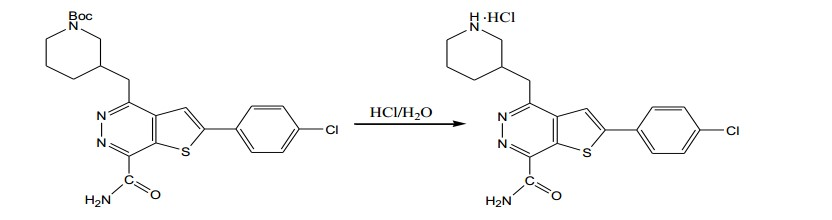
[063] 4-(1-Boc-3-piperidinometil)-2(4-clorofenil)-7-aminocarbonil-tieno[2,3-d] piridazina (200g) e acetato de etila (4ml) são adicionados a um frasco de uma boca (25ml) e dissolvidos em uma solução transparente amarelo-claro,há adição de HCl (4ml, 3M) e a solução rapidamente muda para uma suspensão branca, aquecida a 30°C por 1h, e a suspensão muda para transparente e a reação é rastreada por placa; após reação, a mistura acima é evaporada sob pressão reduzida para remover o solvente e obter um sólido de cloridrato de 2-(4- clorofenil) -4-(3-piperidinometil)- tieno[2,3-d] piridazinil-7- formamida (100 mg). 1HNMR(500MHz, DMSO ), δ9,51 (m, 1H), 9,09(m, 1H), 8,79 (s, 1H), 8,66(s, 1H), 8,29(s, 1H), 8,08(m, 2H), 7,62(m, 2H), 3,45(m, 2H), 3,4(m, 1H), 3,17(m, 1H), 2,79(m, 2H), 2,52(m, 1H), 1,81(m, 2H), 1,77(m, 1H), 1,42(m, 1H). MS(ESI):387(M+1).[063] 4-(1-Boc-3-piperidinomethyl)-2(4-chlorophenyl)-7-aminocarbonyl-thieno[2,3-d]pyridazine (200g) and ethyl acetate (4ml) are added to a flask of a mouth (25ml) and dissolved in a clear light yellow solution, HCl (4ml, 3M) is added and the solution quickly changes to a white suspension, heated at 30°C for 1h, and the suspension changes to clear and the reaction is tracked by plate; after reaction, the above mixture is evaporated under reduced pressure to remove the solvent and obtain a solid of 2-(4-chlorophenyl)-4-(3-piperidinomethyl)-thieno[2,3-d]pyridazinyl-7-hydrochloride formamide (100 mg). 1HNMR(500MHz, DMSO), δ9.51(m, 1H), 9.09(m, 1H), 8.79(s, 1H), 8.66(s, 1H), 8.29(s, 1H) ), 8.08(m, 2H), 7.62(m, 2H), 3.45(m, 2H), 3.4(m, 1H), 3.17(m, 1H), 2.79 (m, 2H), 2.52(m, 1H), 1.81(m, 2H), 1.77(m, 1H), 1.42(m, 1H). MS(ESI):387(M+1).
[064]
[065] Cloridrato de 2-(4-clorofenil)-4-(3-piperidinometil)-tieno[2,3-d]piridazinil-7- formamida (100 mg) é adicionado a um frasco de uma boca, depois há adição de água (5ml) e o carbonato de sódio é gotejado até pH=9~10, e agitação por 30min. A mistura acima é extraída por acetato de etila, lavada com água, e evaporada sob pressão reduzida para remover o solvente e obter 2-(4-clorofenil)-4-(3 - piperidinometil)- tieno[2,3-d] piridazinil-7-formamida (70 mg).[065] 2-(4-Chlorophenyl)-4-(3-piperidinomethyl)-thieno[2,3-d]pyridazinyl-7-formamide hydrochloride (100 mg) is added to a one-mouth flask, then there is addition of water (5ml) and the sodium carbonate is dropped until pH=9~10, and stirred for 30min. The above mixture is extracted by ethyl acetate, washed with water, and evaporated under reduced pressure to remove the solvent and obtain 2-(4-chlorophenyl)-4-(3-piperidinomethyl)-thieno[2,3-d]pyridazinyl -7-formamide (70 mg).
[066]
[067] DMPU (225ml), FeCl3(0,75g) e CuCl (0,3g) são adicionados a 3- bromometiltetra-hidropirano (24,75g, 0,138mol) e, então, Et2Zn (106,8ml) é levemente gotejado a 40~45°C por 45 minutos para obter um reagente de zinco.[067] DMPU (225ml), FeCl3 (0.75g) and CuCl (0.3g) are added to 3-bromomethyltetrahydropyran (24.75g, 0.138mol) and then Et2Zn (106.8ml) is lightly dripped at 40~45°C for 45 minutes to obtain a zinc reagent.
[068] THF (810 m) e PdCl2(dppf) (5,09 g) são adicionados ao 4-cloro-2-(4- clorofenil) - tieno[2,3-d]piridazinil-7-etila (30g) e, depois, há adição do reagente de zinco na solução THF para reagirem a 45°C por 4 horas. A mistura acima é derramada em água saturada, filtrada após agitação por 15 minutos e colocada para separação de camadas. A fase aquosa é extraída com THF (500 ml 2 vezes). A fase orgânica é combinada junto, lavada com água salgada saturada (500ml, 3 vezes) , seca com Na2SO4 anidro e evaporada sob pressão reduzida para remover o solvente e obter 4- (3-tetra-hidropiranometil)-2-(4-clorofenil)-tieno [2,3-d]piridazinil-7-etila (25 g). MS (ESI): 417(M+1)[068] THF (810 m) and PdCl2(dppf) (5.09 g) are added to 4-chloro-2-(4-chlorophenyl)-thieno[2,3-d]pyridazinyl-7-ethyl (30g) and then there is addition of zinc reagent in the THF solution to react at 45°C for 4 hours. The above mixture is poured into saturated water, filtered after stirring for 15 minutes and placed for layer separation. The aqueous phase is extracted with THF (500 ml twice). The organic phase is combined together, washed with saturated brine (500ml, 3 times), dried with anhydrous Na 2 SO 4 and evaporated under reduced pressure to remove the solvent and obtain 4-(3-tetrahydropyranomethyl)-2-(4-chlorophenyl) )-thieno[2,3-d]pyridazinyl-7-ethyl (25 g). MS (ESI): 417(M+1)
[069] Formato de 4-(3-tetra-hidropiranometil)-2-(4-clorofenil)-tieno[2,3- d]piridazinil-7- etila (3g), 1,4-dioxano (5 ml) e NH3.H2O (5 ml) são adicionados a um tubo selado (25ml) e aquecidos a 80°C durante toda a noite, resfriados até a temperatura ambiente durante toda a noite e transferidos para um funil de separação no dia seguinte, há também adição de acetato de etila, vibrados asolução é então agitada, e colocada para separação de camadas. A camada aquosa é reextraída com acetato de etila por 2 vezes. A fase orgânica é combinada e ajustada com solução de HCl 1M até o pH~3, depois lavada com água salgada saturada até pH=7, seca com Na2SO4 anidro e filtrada. Olíquido filtrado é purificado com sílica gel através de cromatografia para obter um sólido de 2-(4-clorofenil)-4-(3-tetra-hidropiranometil)- tieno [2,3-d] piridazinil- 7- formamida (2 g). MS (ESI): 388(M+1)[069] 4-(3-Tetrahydropyranomethyl)-2-(4-chlorophenyl)-thieno[2,3-d]pyridazinyl-7-ethyl formate (3g), 1,4-dioxane (5ml) and NH3.H2O (5ml) is added to a sealed tube (25ml) and heated to 80°C overnight, cooled to room temperature overnight and transferred to a separatory funnel the next day, there is also addition of ethyl acetate, vibrated, the solution is then shaken, and placed for layer separation. The aqueous layer is re-extracted with ethyl acetate 2 times. The organic phase is combined and adjusted with 1M HCl solution to pH~3, then washed with saturated brine until pH=7, dried with anhydrous Na2SO4 and filtered. The filtered liquid is purified with silica gel by chromatography to obtain a solid of 2-(4-chlorophenyl)-4-(3-tetrahydropyranomethyl)-thieno[2,3-d]pyridazinyl-7-formamide (2 g) . MS (ESI): 388(M+1)
[070]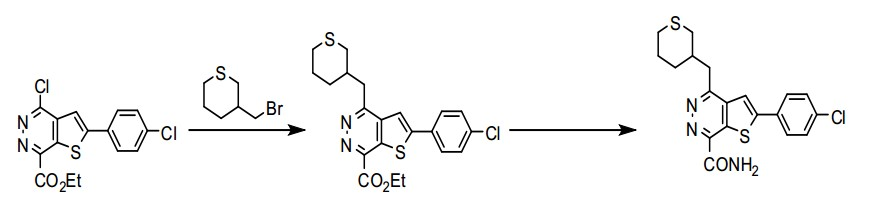
[071]DMPU (225ml), FeCl3(0,75 g) e CuCl (0,3 g) são adicionados a 3-bromometil tetra-hidrotiopirano (24,75g, 0,138mol) e, depois, Et2Zn (106,8ml) é lentamente adicionado a 40~45°C por 45 minutos para obter um reagente de zinco.[071]DMPU (225ml), FeCl3 (0.75 g) and CuCl (0.3 g) are added to 3-bromomethyl tetrahydrothiopyran (24.75g, 0.138mol) and then Et2Zn (106.8ml) it is slowly added at 40~45°C for 45 minutes to obtain a zinc reagent.
[072] THF (810 ml) e PdCl2(dppf) (5,09 g) são adicionados ao 4-cloro-2-(4- clorofenil) -tieno[2,3-d] piridazinil-7-etila (30g) e, então, o reagente de zinco é gotejado na solução de THF a 45°C por 4 horas. A mistura de reação é derramada em água salgada saturada, filtrada, após agitar por 15 minutos,e colocada para separação de camadas. A fase aquosa é extraída com THF (500 ml, 2 vezes). A fase orgânica é combinada , lavada com água salgada saturada (500ml, 3 vezes), seca com Na2SO4 anidro e evaporada sob pressão reduzida para remover o solvente e obter o 4-(3-tetra- hidropiranometil)-2-(4-clorofenil) -tieno[2,3-d] piridazinil -7-etila (25 g). MS (ESI): 433(M+1)[072] THF (810 ml) and PdCl2(dppf) (5.09 g) are added to 4-chloro-2-(4-chlorophenyl)-thieno[2,3-d]pyridazinyl-7-ethyl (30g) and then the zinc reagent is dropped into the THF solution at 45°C for 4 hours. The reaction mixture is poured into saturated brine, filtered, after stirring for 15 minutes, and placed for layer separation. The aqueous phase is extracted with THF (500 ml, 2 times). The organic phase is combined, washed with saturated brine (500ml, 3 times), dried over anhydrous Na2SO4 and evaporated under reduced pressure to remove the solvent and obtain 4-(3-tetrahydropyranomethyl)-2-(4-chlorophenyl) )-thieno[2,3-d]pyridazinyl-7-ethyl (25 g). MS (ESI): 433(M+1)
[073] Formato de 4-(3-tetra-hidropiranometil)-2-(4-clorofenil)-tieno[2,3- d]piridazinil-7- etila (3g), 1,4-dioxano (5 ml) e NH3.H2O (5 ml) são adicionados a um tubo selado (25ml) e aquecidos a 80°C durante toda a noite, depois resfriados até a temperatura ambiente e transferidos para um funil de separação no dia seguinte, e há também adição de acetato de etila, agitação , para por fim serem colocados para separação de camadas. A camada aquosa é reextraida com acetato de etila por 2 vezes. A fase orgânica é combinada junto e ajustada com solução de HCl 1M até o pH~3, depois lavada com água salgada saturada até o pH=7, seca com Na2SO4 anidro e filtrada. O líquido filtrado é purificado com silica gel através de cromatografia para obter um sólido de 2-(4- clorofenil)-4-(3-tetra-hidropiranometil) -tieno d]piridazinil-7- formamida (2 g). MS (ESI): 404(M+1)[073] 4-(3-Tetrahydropyranomethyl)-2-(4-chlorophenyl)-thieno[2,3-d]pyridazinyl-7-ethyl formate (3g), 1,4-dioxane (5 ml) and NH3.H2O (5 ml) is added to a sealed tube (25 ml) and heated to 80°C overnight, then cooled to room temperature and transferred to a separatory funnel the next day, and acetate is also added. of ethyl, shaking, to finally be placed for layer separation. The aqueous layer is re-extracted with ethyl acetate 2 times. The organic phase is combined together and adjusted with 1M HCl solution to pH~3, then washed with saturated brine to pH=7, dried with anhydrous Na2SO4 and filtered. The filtered liquid is purified with silica gel by chromatography to obtain a solid of 2-(4-chlorophenyl)-4-(3-tetrahydropyranomethyl)-thienod]pyridazinyl-7-formamide (2 g). MS (ESI): 404(M+1)
[074]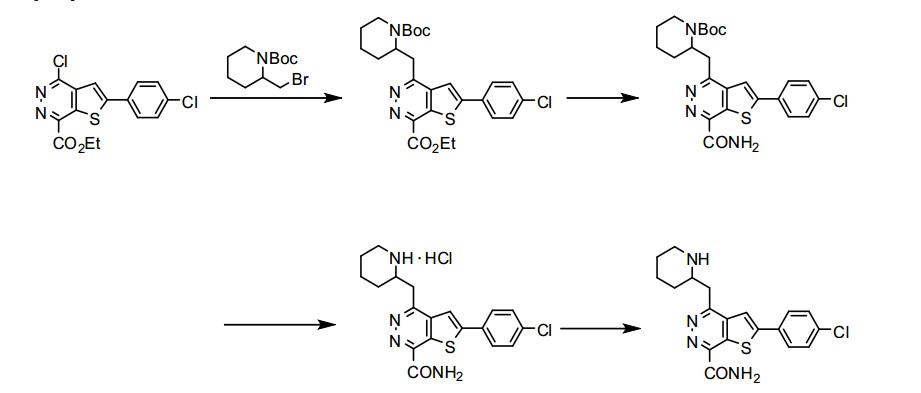
[075] DMPU (225ml), FeCl3(0,75 g) e CuCl (0,3 g) são adicionados a N-Boc-2- bromometil piperidina (24,75g, 0,138mol) e, depois, Et2Zn (106,8ml) é lentamente adicionado a 40~45˚C por 45 minutos para obter um reagente de zinco.[075] DMPU (225ml), FeCl3 (0.75 g) and CuCl (0.3 g) are added to N-Boc-2-bromomethyl piperidine (24.75g, 0.138mol) and then Et2Zn (106, 8ml) is slowly added at 40~45˚C for 45 minutes to obtain a zinc reagent.
[076] THF (810 ml) e PdCl2(dppf) (5,09 g) são adicionados ao 4-cloro-2-(4- clorofenil) -tieno[2,3-d]piridazinil-7-etila (30g) e, então, o reagente de zinco é adicionado à solução de THF a 45°C por 4 horas. A mistura de reação é derramada em água salgada saturada, filtrada após agitar por 15 minutos e colocada para separação de camadas. A fase aquosa é extraída com THF (500 ml, 2 vezes). A fase orgânica é combinada, lavada com água saturada (500ml, 3 vezes) e seca com Na2SO4 anidro e evaporada sob pressão reduzida para remover o solvente e obter formato de 2-(4-clorofenil)-4-(N-Boc-2- piperidinometil) - tieno[2,3-d] piridazinil -7-etila (25 g). MS (ESI): 516(M+1)[076] THF (810 ml) and PdCl2(dppf) (5.09 g) are added to 4-chloro-2-(4-chlorophenyl)-thieno[2,3-d]pyridazinyl-7-ethyl (30g) and then the zinc reagent is added to the THF solution at 45°C for 4 hours. The reaction mixture is poured into saturated brine, filtered after stirring for 15 minutes and placed for layer separation. The aqueous phase is extracted with THF (500 ml, 2 times). The organic phase is combined, washed with saturated water (500ml, 3 times) and dried over anhydrous Na2SO4 and evaporated under reduced pressure to remove the solvent and obtain 2-(4-chlorophenyl)-4-(N-Boc-2 formate - piperidinomethyl) - thieno[2,3-d] pyridazinyl-7-ethyl (25 g). MS (ESI): 516(M+1)
[077] O 2-(4-clorofenil)-4-(N-Boc-2-piperidinometil)-tieno[2,3-d] piridazinil-7-etila (3g), 1,4-dioxano (5ml) e NH3.H2O (5ml) são adicionados a um tubo selado (25ml) e aquecidos a 80°C durante toda a noite. A mistura de reação é resfriada até a temperatura ambiente e transferida para um funil de separação no dia seguinte, há também adição de acetato de etila, agitação, para por fim ser colocada para separação de camadas. A camada de água é reextraída com acetato de etila por 2 vezes, a fase orgânica é combinada e ajustada até pH~3 com solução HCl 1M e, depois, lavada comágua salgada saturada até pH=7, seca com Na2SO4 anidro e filtrada. O líquido filtrado é purificado com sílica gel por cromatografia para obter um sólido de 2(4-clorofenil)-4-(N-Boc-2- piperidinometil) - tieno [2,3-d]piridazinil-7- formamida (2g). MS (ESI): 487(M+1)[077] 2-(4-Chlorophenyl)-4-(N-Boc-2-piperidinomethyl)-thieno[2,3-d]pyridazinyl-7-ethyl (3g), 1,4-dioxane (5ml) and NH3.H2O (5ml) is added to a sealed tube (25ml) and heated to 80°C overnight. The reaction mixture is cooled to room temperature and transferred to a separatory funnel the next day, ethyl acetate is also added, stirring, to finally be placed for layer separation. The water layer is re-extracted with ethyl acetate 2 times, the organic phase is combined and adjusted to pH~3 with 1M HCl solution and then washed with brine until pH=7, dried with anhydrous Na2SO4 and filtered. The filtered liquid is purified with silica gel by chromatography to obtain a solid of 2-(4-chlorophenyl)-4-(N-Boc-2-piperidinomethyl)-thieno[2,3-d]pyridazinyl-7-formamide (2g) . MS (ESI): 487(M+1)
[078] 4-(N-Boc-2-piperidinometil)-2(4-clorofenil)-7-aminocarbonil-tieno[2,3-d] piridazina (200mg) e acetato de etila (4ml) são adicionados a um frasco de uma boca (25ml) e dissolvidos até uma se ataingir uma solução transparente amarelo-claro. Solução de HCl (4ml, 3M) é adicionada e obtém-se uma suspensão branca, esta é aquecida a 30°C por 1h e a suspensão branca é alterada para transparente. A reação é rastreada por placa. Após a reação, o solvente é evaporado sob pressão reduzida até remover o solvente e obter um sólido de cloridrato de 2-(4-clorofenil)-4- (N-Boc-2- piperidinometil) -tieno[2,3-d]piridazinil -7- formamida (100 mg). MS (ESI): 423(M+1)[078] 4-(N-Boc-2-piperidinomethyl)-2(4-chlorophenyl)-7-aminocarbonyl-thieno[2,3-d]pyridazine (200mg) and ethyl acetate (4ml) are added to a flask of one mouth (25ml) and dissolved until one reaches a clear pale yellow solution. HCl solution (4ml, 3M) is added and a white suspension is obtained, this is heated to 30°C for 1h and the white suspension is changed to clear. The reaction is tracked by plate. After the reaction, the solvent is evaporated under reduced pressure until removing the solvent and obtaining a solid of 2-(4-chlorophenyl)-4-(N-Boc-2-piperidinomethyl)-thieno[2,3-d] hydrochloride pyridazinyl-7-formamide (100 mg). MS (ESI): 423(M+1)
[079] Cloridrato de 2-(4-clorofenil)-4-(N-Boc-2-piperidinometil)-tieno[2,3- d]piridazinil -7- formamida (100 mg) é adicionado a um frasco de uma boca, após há adição de água (5ml) e o carbonato de sódio é gotejado até pH=9~10, a solução é agitada por 30min. A mistura acima é extraída por acetato de etila, lavada e evaporada sob pressão reduzida até remover o solvente e obter 2-(4-clorofenil)-4-(2- piperidinometil)- tieno [2,3-d] piridazinil -7- formamida (70 mg). MS (ESI): 387(M+1)[079] 2-(4-Chlorophenyl)-4-(N-Boc-2-piperidinomethyl)-thieno[2,3-d]pyridazinyl-7-formamide hydrochloride (100 mg) is added to a one-neck flask , after adding water (5ml) and the sodium carbonate is dropped until pH=9~10, the solution is stirred for 30min. The above mixture is extracted by ethyl acetate, washed and evaporated under reduced pressure until removing the solvent and obtaining 2-(4-chlorophenyl)-4-(2-piperidinomethyl)-thieno[2,3-d]pyridazinyl-7- formamide (70 mg). MS (ESI): 387(M+1)
[080]
[081] DMPU (225ml), FeCl3(0,75g) e CuCl (0,3g) são adicionados a N-Boc-4- bromometilpiperidina (24,75g, 0,138mol) e, então, Et2Zn (106,8ml) é lentamente gotejado a 40~45°C por 45 minutos para obter um reagente de zinco.[081] DMPU (225ml), FeCl3 (0.75g) and CuCl (0.3g) are added to N-Boc-4-bromomethylpiperidine (24.75g, 0.138mol) and then Et2Zn (106.8ml) is slowly dripped at 40~45°C for 45 minutes to obtain a zinc reagent.
[082] THF (810 ml) e PdCl2(dppf) (5,09 g) são adicionados a formato de 4-cloro- 2-(4-clorofenil) -tieno [2,3-d] piridazinil-7-etila (30g) e, então, o reagente de zinco é gotejado na solução de THF a 45°C por 4 horas. A mistura de reação é derramada em água salgada saturada, filtrada após agitação por 15 minutos e colocada para separação de camadas. A fase aquosa é extraída com THF (500 ml, 2 vezes). A fase orgânica é combinada, lavada com água salgada saturada (500 ml, 3 vezes) e seca com Na2SO4,eevaporada sob pressão reduzida para remover solvente e obter o 2-(4- clorofenil)- 4-(N-Boc-4-piperidinometil)-tieno [2,3-d] piridazinil -7-etila (25 g). MS (ESI): 515(M+1)[082] THF (810 ml) and PdCl2(dppf) (5.09 g) are added to 4-chloro-2-(4-chlorophenyl)-thieno[2,3-d]pyridazinyl-7-ethyl formate ( 30g) and then the zinc reagent is dropped into the THF solution at 45°C for 4 hours. The reaction mixture is poured into saturated brine, filtered after stirring for 15 minutes and placed for layer separation. The aqueous phase is extracted with THF (500 ml, 2 times). The organic phase is combined, washed with saturated brine (500 ml, 3 times) and dried with Na2SO4, evaporated under reduced pressure to remove solvent and obtain 2-(4-chlorophenyl)-4-(N-Boc-4- piperidinomethyl)-thieno[2,3-d]pyridazinyl-7-ethyl (25 g). MS (ESI): 515(M+1)
[083] 2-(4-clorofenil)-4-(N-Boc-4-piperidinometil)-tieno[2,3-d] piridazinil-7-etila (3g), 1,4-dioxano (5ml) e NH3.H2O (5ml) são adicionados a um tubo selado (25ml) e aquecidos a 80°C durante toda a noite. A mistura de reação é resfriada até a temperatura ambiente em um funil de separação no dia seguinte, e há adição de acetato de etila, agitação, para por fim ser colocada para separação de camadas. A camada de água é reextraída com acetato de etila por 2 vezes, a fase orgânica é combinada e ajustada até pH~3 com solução HCl 1M, e depois lavada com água salgada saturada até pH=7, seca com Na2SO4 anidro e filtrada. O líquido filtrado é purificado com sílica gel por cromatografia para obter um sólido de 2(4-clorofenil)-4- (N-Boc-4- piperidinometil) - tieno[2,3-d]piridazinil -7- formamida (2g). MS (ESI): 487(M+1)[083] 2-(4-chlorophenyl)-4-(N-Boc-4-piperidinomethyl)-thieno[2,3-d] pyridazinyl-7-ethyl (3g), 1,4-dioxane (5ml) and NH3 .H2O (5ml) are added to a sealed tube (25ml) and heated to 80°C overnight. The reaction mixture is cooled to room temperature in a separatory funnel the next day, and ethyl acetate is added, stirring, and finally placed for layer separation. The water layer is re-extracted with ethyl acetate 2 times, the organic phase is combined and adjusted to pH~3 with 1M HCl solution, then washed with brine until pH=7, dried with anhydrous Na2SO4 and filtered. The filtered liquid is purified with silica gel by chromatography to obtain a solid of 2-(4-chlorophenyl)-4-(N-Boc-4-piperidinomethyl)-thieno[2,3-d]pyridazinyl-7-formamide (2g) . MS (ESI): 487(M+1)
[084] 4-(N-Boc-4-piperidinometil)-2-(4-clorofenil)-7-aminocarbonil-tieno[2,3-d] piridazina (200mg) e acetato de etila (4ml) são adicionados a um frasco de uma boca (25ml) e dissolvidos até uma solução transparente amarelo-claro. Solução de HCl (4ml, 3M) é adicionada e há alteração para uma suspensão branca, aquecida a 30°C por 1 h e a suspensão branca altera para transparente. A reação é rastreada por placa. Após a reação, a mistura é evaporada sob pressão reduzida para remover o solvente e obter um sólido de cloridrato de 2-(4-clorofenil)- 4-(4-piperidinometil)-tieno[2,3-d] piridazinil-7-formamida (100 mg). MS (ESI): 423(M+1)[084] 4-(N-Boc-4-piperidinomethyl)-2-(4-chlorophenyl)-7-aminocarbonyl-thieno[2,3-d]pyridazine (200mg) and ethyl acetate (4ml) are added to one one-mouth vial (25ml) and dissolved to a clear pale yellow solution. HCl solution (4ml, 3M) is added and changed to a white suspension, heated to 30°C for 1 h and the white suspension changed to clear. The reaction is tracked by plate. After the reaction, the mixture is evaporated under reduced pressure to remove the solvent and obtain a solid of 2-(4-chlorophenyl)-4-(4-piperidinomethyl)-thieno[2,3-d]pyridazinyl-7-hydrochloride formamide (100 mg). MS (ESI): 423(M+1)
[085] Cloridrato de 2-(4-clorofenil)-4-(4-piperidinometil)-tieno[2,3-d]piridazinil-7- formamida é adicionado a um frasco de uma boca (25ml), depois água (5ml) é adicionada e o carbonato de sódio é gotejado até pH=9~10 agitado por 30min. A mistura acima é extraída por acetato de etila, lavada e evaporada sob pressão reduzida para remover solvente e obter 2-(4-clorofenil)-4-(4-piperidinometil)-tieno[2,3-d] piridazinil -7- formamida (70 mg). MS (ESI): 387(M+1)[085] 2-(4-Chlorophenyl)-4-(4-piperidinomethyl)-thieno[2,3-d]pyridazinyl-7-formamide hydrochloride is added to a one-mouth flask (25ml), then water (5ml) ) is added and the sodium carbonate is dropped until pH=9~10 stirred for 30min. The above mixture is extracted by ethyl acetate, washed and evaporated under reduced pressure to remove solvent and obtain 2-(4-chlorophenyl)-4-(4-piperidinomethyl)-thieno[2,3-d]pyridazinyl-7-formamide (70mg). MS (ESI): 387(M+1)
[086]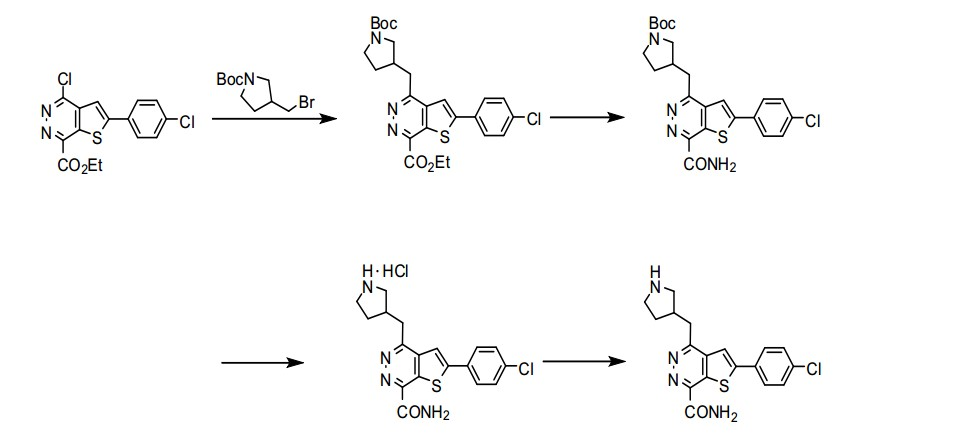
[087] DMPU (225ml), FeCl3 (0,75 g) e CuCl (0,3 g) são adicionados a N-Boc-3- bromometilpirrol (24,75g, 0,138mol) e, depois, Et2Zn (106,8ml) é lentamente gotejado a 40~45°C por 45 minutos para obter um reagente de zinco.[087] DMPU (225ml), FeCl3 (0.75 g) and CuCl (0.3 g) are added to N-Boc-3-bromomethylpyrrole (24.75g, 0.138mol) and then Et2Zn (106.8ml) ) is slowly dropped at 40~45°C for 45 minutes to obtain a zinc reagent.
[088] THF (810ml) e PdCl2 (dppf) (5,09g) são adicionados ao 4-cloro-2-(4- clorofenil)-tieno [2,3-d] piridazinil-7-etila (30g) e, depois, o reagente de zinco é adicionado à solução de THF a 45°C por 4h. A mistura de reação é derramada em água salgada saturada, filtrada após agitar por 15 minutos e colocada para separação de camadas. A fase aquosa é extraída com THF (500 ml, 2 vezes). A fase orgânica é combinada, lavada com água salgada saturada (500ml, 3 vezes) ,seca com Na2SO4 anidro, e por fim ser evaporada sob pressão reduzida para remover o solvente e obter o 2-(4-clorofenil)-4-(N-Boc-3-tetra-hidropirrolemetil)-tieno[2,3-d] piridazinil-7- etil (25g). MS (ESI): 502(M+1)[088] THF (810ml) and PdCl2 (dppf) (5.09g) are added to 4-chloro-2-(4-chlorophenyl)-thieno[2,3-d]pyridazinyl-7-ethyl (30g) and, then the zinc reagent is added to the THF solution at 45°C for 4h. The reaction mixture is poured into saturated brine, filtered after stirring for 15 minutes and placed for layer separation. The aqueous phase is extracted with THF (500 ml, 2 times). The organic phase is combined, washed with saturated brine (500ml, 3 times), dried with anhydrous Na2SO4, and finally evaporated under reduced pressure to remove the solvent and obtain 2-(4-chlorophenyl)-4-(N -Boc-3-tetrahydropyrrolemethyl)-thieno[2,3-d]pyridazinyl-7-ethyl (25g). MS (ESI): 502(M+1)
[089] Formato de 2-(4-clorofenil)-4-(N-Boc-3-tetra-hidropirrolemetil)-tieno[2,3-d] piridazinil-7-etil (3g), 1,4-dioxano (5ml) e NH3.H2O (5ml) são adicionados a um tubo selado (25ml) e aquecidos a 80°C durante toda a noite. O líquido de reação é resfriado até a temperatura ambiente e transferido para um funil separador no dia seguinte, e adição de acetato de etila, vibrado, colocado para separação de camadas. A camada de água é reextraída com acetato de etila por 2 vezes, a fase orgânica é combinada junto e ajustada para o pH~3 com solução de HCl 1M e, depois, lavada com salmoura saturada até pH=7, secada com Na2SO4 anidro e filtrada. O líquido filtrado é purificado com sílica gel através de cromatografia para obter um sólido de 2(4-clorofenil)-4-(N-Boc -3-tetra-hidropirrole metil)- tieno[2,3- d]piridazinil-7- formamida (2g). MS (ESI): 473(M+1)[089] 2-(4-Chlorophenyl)-4-(N-Boc-3-tetrahydropyrrolemethyl)-thieno[2,3-d]pyridazinyl-7-ethyl formate (3g), 1,4-dioxane ( 5ml) and NH3.H2O (5ml) are added to a sealed tube (25ml) and heated at 80°C overnight. The reaction liquid is cooled to room temperature and transferred to a separating funnel the next day, and ethyl acetate is added, shaken, placed for layer separation. The water layer is re-extracted with ethyl acetate 2 times, the organic phase is combined together and adjusted to pH~3 with 1M HCl solution and then washed with saturated brine until pH=7, dried with anhydrous Na2SO4 and filtered. The filtered liquid is purified with silica gel by chromatography to obtain a solid of 2-(4-chlorophenyl)-4-(N-Boc -3-tetrahydropyrrole methyl)-thieno[2,3-d]pyridazinyl-7- formamide (2g). MS (ESI): 473(M+1)
[090] 4-(N-Boc-3-tetra-hidropirrolemetil)-2(4-clorofenil)-7-aminocarbonil-tieno [2,3-d]piridazina (200mg) e acetato de etila (4ml) são adicionados a um frasco de uma boca (25ml) e dissolvidos até obter uma solução transparente amarelo-clara. Solução de HCl (4ml, 3M) é adicionada e há alteração para uma suspensão branca, aquecida a 30°C por 1 h até ficar transparente. A reação é rastreada por placa. Após a reação, a solução é evaporada sob pressão reduzida para remover solvente para obter um sólido de cloridrato de 2-(4-clorofenil)- 4-(3-tetra-hidropirrolemetil)-tieno[2,3-d]piridazinil- 7 -formamida (100 mg). MS (ESI): 409(M+1)[090] 4-(N-Boc-3-tetrahydropyrrolemethyl)-2(4-chlorophenyl)-7-aminocarbonyl-thieno[2,3-d]pyridazine (200mg) and ethyl acetate (4ml) are added to a one-mouth vial (25ml) and dissolved into a clear, pale yellow solution. HCl solution (4ml, 3M) is added and changed to a white suspension, heated at 30°C for 1 h until clear. The reaction is tracked by plate. After the reaction, the solution is evaporated under reduced pressure to remove solvent to obtain a solid of 2-(4-chlorophenyl)-4-(3-tetrahydropyrrolemethyl)-thieno[2,3-d]pyridazinyl-7-hydrochloride. -formamide (100 mg). MS (ESI): 409(M+1)
[091] Cloridrato de 2-(4-clorofenil)-4-(3-tetra-hidropirrolemetil)-tieno[2,3-d] piridazinil-7- formamida é adicionado a um frasco de uma boca (25ml), depois, água (5ml) é adicionada e carbonato de sódio é gotejado até pH=9~10 e agitados por 30min. A mistura é extraída por acetato de etila, lavada e evaporada sob pressão reduzida para remover solvente e obter 2-(4-clorofenil)-4-(3-tetra-hidropirrolemetil) - tieno[2,3-d]piridazinil-7-formamida (70mg). MS (ESI): 373(M+1)[091] 2-(4-Chlorophenyl)-4-(3-tetrahydropyrrolemethyl)-thieno[2,3-d] pyridazinyl-7-formamide hydrochloride is added to a one-neck vial (25ml), then water (5ml) is added and sodium carbonate is dropped to pH=9~10 and stirred for 30min. The mixture is extracted by ethyl acetate, washed and evaporated under reduced pressure to remove solvent and obtain 2-(4-chlorophenyl)-4-(3-tetrahydropyrrolemethyl)-thieno[2,3-d]pyridazinyl-7- formamide (70mg). MS (ESI): 373(M+1)
[092]
[093] DMPU (225ml), FeCl3(0,75g) e CuCl (0,3g) são adicionados a 3- bromometiltetra-hidrofurano (24,75g, 0,138mol) e, depois Et2Zn (106,8ml) é lentamente gotejado a 40~45°C por 45 minutos para obter um reagente de zinco.[093] DMPU (225ml), FeCl3 (0.75g) and CuCl (0.3g) are added to 3-bromomethyltetrahydrofuran (24.75g, 0.138mol) and then Et2Zn (106.8ml) is slowly dripped into 40~45°C for 45 minutes to obtain a zinc reagent.
[094] THF (810 ml) e PdCl2(dppf) (5,09g) são adicionados ao 4-cloro-2-(4- clorofenil)-tieno[2,3-d] piridazinil-7-etila (30g) e, depois, o reagente de zinco é gotejado na solução de THF a 45°C por 4 h. A mistura de reação é derramada em água salgada saturada, filtrada após agitação por 15 minutos e colocado para separação de camadas. A fase aquosa é extraída com THF (500 ml, 2 vezes). A fase orgânica é combinada , lavada com água salgada saturada (500ml, 3 vezes) , seca com Na2SO4 anidro, e evaporada sob pressão reduzida para remover solvente e obter o 4-(3-tetra- hidropiranometil)-2-(4-clorofenil)-tieno [2,3-d] piridazinil -7- etila (25 g). MS (ESI): 403(M+1)[094] THF (810 ml) and PdCl2(dppf) (5.09g) are added to 4-chloro-2-(4-chlorophenyl)-thieno[2,3-d]pyridazinyl-7-ethyl (30g) and then the zinc reagent is dropped into the THF solution at 45°C for 4 h. The reaction mixture is poured into saturated brine, filtered after stirring for 15 minutes and placed for layer separation. The aqueous phase is extracted with THF (500 ml, 2 times). The organic phase is combined, washed with saturated brine (500ml, 3 times), dried with anhydrous Na 2 SO 4 , and evaporated under reduced pressure to remove solvent and obtain 4-(3-tetrahydropyranomethyl)-2-(4-chlorophenyl) )-thieno[2,3-d]pyridazinyl-7-ethyl (25 g). MS (ESI): 403(M+1)
[095] Formato de 4-(3-tetra-hidrofuranometil)-2-(4-clorofenil)-tieno[2,3- d]piridazinil-7 -etila (3g), 1,4-dioxano (5 ml) e NH3.H2O (5 ml) são adicionados a um tubo selado (25ml) e aquecidos a 80°C durante toda a noite. A reação é resfriada até a temperatura ambiente e transferida para um funil separador no dia seguinte e adição de acetato de etila, vibrada, colocada para separação de camadas. A camada aquosa é reextraída com acetato de etila por 2 vezes. A fase orgânica é combinada junto e ajustada com solução de HCl 1M até pH~3, depois lavada com salmoura saturada até pH=7, secada com Na2SO4 anidro e filtrada. O líquido filtrado é purificado com sílica gel através de cromatografia para obter um sólido de 2-(4-clorofenil)-4-(3- tetra-hidrofuranometil) -tieno[2,3-d] piridazinil -7-formamida (2 g). MS (ESI): 374(M+1)[095] 4-(3-Tetrahydrofuranmethyl)-2-(4-chlorophenyl)-thieno[2,3-d]pyridazinyl-7-ethyl formate (3g), 1,4-dioxane (5ml) and NH3.H2O (5 ml) are added to a sealed tube (25 ml) and heated to 80°C overnight. The reaction is cooled to room temperature and transferred to a separating funnel the following day and ethyl acetate added, vibrated, placed for layer separation. The aqueous layer is re-extracted with ethyl acetate 2 times. The organic phase is combined together and adjusted with 1M HCl solution to pH~3, then washed with saturated brine to pH=7, dried with anhydrous Na2SO4 and filtered. The filtered liquid is purified with silica gel by chromatography to obtain a solid of 2-(4-chlorophenyl)-4-(3-tetrahydrofuranmethyl)-thieno[2,3-d]pyridazinyl-7-formamide (2 g). ). MS (ESI): 374(M+1)
[096]
[097] DMPU (225ml), FeCl3(0,75 g) e CuCl (0,3 g) são adicionados a 3- bromometil tetra-hidrotiofeno (24,75g, 0,138mol) e, depois, Et2Zn (106,8ml) é lentamente gotejado a 40~45°C por 45 minutos para obter um reagente de zinco.[097] DMPU (225ml), FeCl3 (0.75 g) and CuCl (0.3 g) are added to 3-bromomethyl tetrahydrothiophene (24.75g, 0.138mol) and then Et2Zn (106.8ml) it is slowly dripped at 40~45°C for 45 minutes to obtain a zinc reagent.
[098]Formato de 4-cloro-2-(4-clorofenil)-tieno[2,3-d] piridazinil-7-etila (30g), THF (810 ml) e PdCl2(dppf) (5,09 g) são adicionados e, depois, o reagente de zinco é gotejado na solução THF a 45°C por 4 h. A mistura de reação é derramada em água salgada saturada, filtrada após agitação por 15 minutos e colocada para separação de camadas. A fase aquosa é extraída com THF (500 ml, 2 vezes). A fase orgânica é combinada, lavada com água salgada saturada (500ml, 3 vezes), seca com Na2SO4 anidro, e evaporada sob pressão reduzida para remover solvente e obter o 4-(3-tetra- hidrotiofenometil)-2-(4-clorofenil) -tieno[2,3-d] piridazinil -7- etila (25 g). MS (ESI): 419(M+1)[098] 4-Chloro-2-(4-chlorophenyl)-thieno[2,3-d] pyridazinyl-7-ethyl format (30g), THF (810 ml) and PdCl2(dppf) (5.09 g) are added and then the zinc reagent is dropped into the THF solution at 45°C for 4 h. The reaction mixture is poured into saturated brine, filtered after stirring for 15 minutes and placed for layer separation. The aqueous phase is extracted with THF (500 ml, 2 times). The organic phase is combined, washed with saturated brine (500ml, 3 times), dried with anhydrous Na2SO4, and evaporated under reduced pressure to remove solvent and obtain 4-(3-tetrahydrothiophenomethyl)-2-(4-chlorophenyl) )-thieno[2,3-d]pyridazinyl-7-ethyl (25 g). MS (ESI): 419(M+1)
[099]4-(3-tetra-hidrotiofenometil)-2-(4-clorofenil)-tieno[2,3-d]piridazinil- 7-etila (3g), 1,4-dioxano (5 ml) e NH3.H2O (5 ml) são adicionados a um tubo selado (25ml) e aquecidos a 80°C durante toda a noite. A mistura de reação é resfriada até a temperatura ambiente e transferida para um funil separador no dia seguinte, há também adição de acetato de etila, agitação, para por fim ser colocada para separação de camadas. A camada aquosa é reextraída com acetato de etila por 2 vezes. A fase orgânica é combinada e ajustada com solução de HCl 1M até pH~3, depois lavada com água salgada saturada até pH=7, seca com Na2SO4 anidro e filtrada. O líquido filtrado é purificado com sílica gel através de cromatografia para obter um sólido de 2-(4-clorofenil)-4 -(3-tetra-hidrotiofeno metil) tieno [2,3-d]piridazinil- 7-formamida (2 g). MS (ESI): 389(M+1)[099]4-(3-tetrahydrothiophenomethyl)-2-(4-chlorophenyl)-thieno[2,3-d]pyridazinyl-7-ethyl (3g), 1,4-dioxane (5ml) and NH 3 . H2O (5ml) is added to a sealed tube (25ml) and heated to 80°C overnight. The reaction mixture is cooled to room temperature and transferred to a separating funnel the next day, there is also addition of ethyl acetate, stirring, to finally be placed for layer separation. The aqueous layer is re-extracted with ethyl acetate 2 times. The organic phase is combined and adjusted with 1M HCl solution to pH~3, then washed with saturated brine until pH=7, dried with anhydrous Na2SO4 and filtered. The filtered liquid is purified with silica gel by chromatography to obtain a solid of 2-(4-chlorophenyl)-4-(3-tetrahydrothiophene methyl)thieno[2,3-d]pyridazinyl-7-formamide (2 g). ). MS (ESI): 389(M+1)
[100]
[101] DMPU (225ml), FeCl3(0,75 g) e CuCl (0,3 g) são adicionados a 3- bromometilpiridina (24,75g, 0,138mol) e, depois, Et2Zn (106,8ml) é lentamente gotejado a 40~45°C por 45 minutos para obter um reagente de zinco.[101] DMPU (225ml), FeCl3 (0.75 g) and CuCl (0.3 g) are added to 3-bromomethylpyridine (24.75g, 0.138mol) and then Et2Zn (106.8ml) is slowly dripped off at 40~45°C for 45 minutes to obtain a zinc reagent.
[102] THF (810ml) e PdCl2(dppf) (5,09g) são adicionados ao 4-cloro-2-(4- clorofenil) -tieno [2,3-d] piridazinil-7-etila (30g) e, depois, o reagente de zinco é gotejado na solução de THF a 45°C por 4h. A mistura de reação é derramada em água salgada saturada, filtrada após agitação por 15 minutos e colocada para separação de líquido. A fase aquosa é extraída com THF (500 ml, 2 vezes). A fase orgânica é combinada, lavada com água salgada saturada (500ml, 3 vezes), seca com Na2SO4 anidro, e evaporada sob pressão reduzida para remover solvente e obter o 4-(3-piridinometil)-2-(4-clorofenil)-tieno[2,3-d]piridazinil-7-etila (25 g). MS (ESI): 410(M+1)[102] THF (810ml) and PdCl2(dppf) (5.09g) are added to 4-chloro-2-(4-chlorophenyl)-thieno[2,3-d]pyridazinyl-7-ethyl (30g) and, then the zinc reagent is dropped into the THF solution at 45°C for 4h. The reaction mixture is poured into saturated brine, filtered after stirring for 15 minutes and placed for liquid separation. The aqueous phase is extracted with THF (500 ml, 2 times). The organic phase is combined, washed with saturated brine (500ml, 3 times), dried with anhydrous Na2SO4, and evaporated under reduced pressure to remove solvent and obtain 4-(3-pyridinemethyl)-2-(4-chlorophenyl)- thieno[2,3-d]pyridazinyl-7-ethyl (25 g). MS (ESI): 410(M+1)
[103] 4-(3-piridinometil)-2-(4-clorofenil)-tieno[2,3-d]piridazinil-7-etila (3g), 1,4- dioxano (5 ml) e NH3.H2O (5 ml) são adicionados a um tubo selado (25ml) e aquecidos a 80°C durante toda a noite. A mistura de reação é resfriada até a temperatura ambiente e transferida para um funil separador no dia seguinte, há também adição de acetato de etila, agitação, para por fim ser colocada para separação de camadas. A camada aquosa é reextraída com acetato de etila por 2 vezes. A fase orgânica é combinada e ajustada com solução de HCl 1M até pH~3, depois lavada com água salgada saturada até pH=7, seca com Na2SO4 anidro e filtrada. O líquido filtrado é purificado com sílica gel através de cromatografia para obter um sólido de 2- (4-clorofenil)-4-(3-piridinometil)-tieno [2,3-d] piridazinil-7-formamida (2 g). MS (ESI): 381(M+1)[103] 4-(3-pyridinemethyl)-2-(4-chlorophenyl)-thieno[2,3-d]pyridazinyl-7-ethyl (3g), 1,4-dioxane (5ml) and NH3.H2O ( 5ml) are added to a sealed tube (25ml) and heated to 80°C overnight. The reaction mixture is cooled to room temperature and transferred to a separating funnel the next day, there is also addition of ethyl acetate, stirring, to finally be placed for layer separation. The aqueous layer is re-extracted with ethyl acetate 2 times. The organic phase is combined and adjusted with 1M HCl solution to pH~3, then washed with saturated brine until pH=7, dried with anhydrous Na2SO4 and filtered. The filtered liquid is purified with silica gel by chromatography to obtain a solid of 2-(4-chlorophenyl)-4-(3-pyridinomethyl)-thieno[2,3-d]pyridazinyl-7-formamide (2 g). MS (ESI): 381 (M+1)
[104]
[105]DMPU (225ml), FeCl3(0,75 g) e CuCl (0,3 g) são adicionados a 3- bromometilpirano (24,75g, 0,138mol) e, depois, Et2Zn (106,8ml) é lentamente gotejado a 40~45°C por 45 minutos para obter um reagente de zinco.[105]DMPU (225ml), FeCl3 (0.75 g) and CuCl (0.3 g) are added to 3-bromomethylpyran (24.75g, 0.138mol) and then Et2Zn (106.8ml) is slowly dropped in at 40~45°C for 45 minutes to obtain a zinc reagent.
[106] THF (810 ml) e PdCl2(dppf) (5,09 g) são adicionados ao 4-cloro-2-(4- clorofenil) -tieno [2,3-d] piridazinil-7-etila (30g) e, depois, o reagente de zinco é gotejado na solução de THF a 45°C por 4 h. A mistura de reação é derramada em água salgada saturada, filtrada após agitação por 15 minutos e colocada para separação de camadas. A fase aquosa é extraída com THF (500 ml, 2 vezes). A fase orgânica é combinada, lavada com água salgada saturada (500ml, 3 vezes), seca com Na2SO4 anidro, e evaporada sob pressão reduzida para remover solvente e obter o 4-(3-α-piranometil)-2-(4-clorofenil)-tieno[2,3-d] piridazinil-7-etila (25 g). MS (ESI): 412(M+1)[106] THF (810 ml) and PdCl2(dppf) (5.09 g) are added to 4-chloro-2-(4-chlorophenyl)-thieno[2,3-d]pyridazinyl-7-ethyl (30g) and then the zinc reagent is dropped into the THF solution at 45°C for 4 h. The reaction mixture is poured into saturated brine, filtered after stirring for 15 minutes and placed for layer separation. The aqueous phase is extracted with THF (500 ml, 2 times). The organic phase is combined, washed with saturated brine (500ml, 3 times), dried with anhydrous Na2SO4, and evaporated under reduced pressure to remove solvent and obtain 4-(3-α-pyranomethyl)-2-(4-chlorophenyl) )-thieno[2,3-d]pyridazinyl-7-ethyl (25 g). MS (ESI): 412(M+1)
[107] 4-(3-α-piranometil)-2-(4-clorofenil)-tieno[2,3-d]piridazinil-7-etila (3g), 1,4- dioxano (5 ml) e NH3.H2O (5 ml) são adicionados a um tubo selado (25ml) e aquecidos a 80°C durante toda a noite. A mistura de reação é resfriada até a temperatura ambiente e transferida para um funil separador no dia seguinte, há também adição de acetato de etila, agitação, para por fim ser colocada para separação de camadas. A camada aquosa é reextraída com acetato de etila por 2 vezes. A fase orgânica é combinada e ajustada com solução de HCl 1M até pH~3, depois lavada com água salgada saturada até pH=7, seca com Na2SO4 anidro e filtrada. O líquido filtrado é purificado com sílica gel através de cromatografia para obter um sólido de 2- (4-clorofenil)-4-(3-α-piranometil) -tieno[2,3-d]piridazinil- 7-formamida (2 g). MS (ESI): 383(M+1)[107] 4-(3-α-pyranomethyl)-2-(4-chlorophenyl)-thieno[2,3-d]pyridazinyl-7-ethyl (3g), 1,4-dioxane (5ml) and NH3. H2O (5ml) is added to a sealed tube (25ml) and heated to 80°C overnight. The reaction mixture is cooled to room temperature and transferred to a separating funnel the next day, there is also addition of ethyl acetate, stirring, to finally be placed for layer separation. The aqueous layer is re-extracted with ethyl acetate 2 times. The organic phase is combined and adjusted with 1M HCl solution to pH~3, then washed with saturated brine until pH=7, dried with anhydrous Na2SO4 and filtered. The filtered liquid is purified with silica gel by chromatography to obtain a solid of 2-(4-chlorophenyl)-4-(3-α-pyranomethyl)-thieno[2,3-d]pyridazinyl-7-formamide (2 g). ). MS (ESI): 383(M+1)
[108]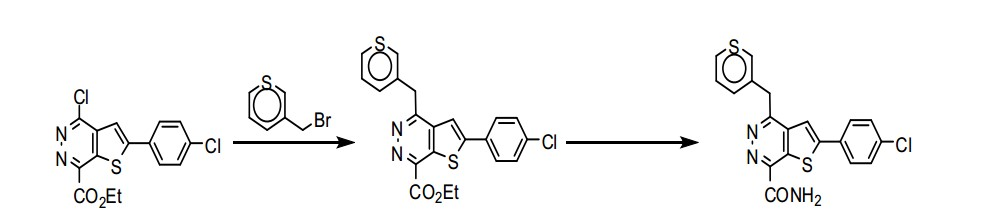
[109] DMPU (225ml), FeCl3 (0,75 g) e CuCl (0,3 g) são adicionados a 3- bromometiltiopirano (24,75g, 0,138mol) e, depois, Et2Zn (106,8ml) é lentamente gotejado a 40~45˚ gotejado a 40~45°C por 45 minutos para obter um reagente de zinco.[109] DMPU (225ml), FeCl3 (0.75g) and CuCl (0.3g) are added to 3-bromomethylthiopyran (24.75g, 0.138mol) and then Et2Zn (106.8ml) is slowly dripped off at 40~45˚ dropped at 40~45°C for 45 minutes to obtain a zinc reagent.
[110] THF (810 ml) e PdCl2(dppf) (5,09 g) são adicionados a formato de 4-cloro- 2-(4- clorofenil)-tieno[2,3-d] piridazinil-7-etila (30g) e, depois, o reagente de zinco é gotejado na solução de THF a 45°C por 4 h. A mistura de reação é derramada em água salgada saturada, filtrada após agitação por 15 minutos e colocada para separação de camadas. A fase aquosa é extraída com THF (500 ml, 2 vezes). A fase orgânica é combinada, lavada com água salgada saturada (500ml, 3 vezes) , seca com Na2SO4 anidro, e evaporada sob pressão reduzida para remover solvente e obter formato de 4-(3-α-tiopiranometil)-2-(4-clorofenil)-tieno[2,3-d] piridazinil-7-etila (25 g). MS (ESI): 428(M+1)[110] THF (810 ml) and PdCl2(dppf) (5.09 g) are added to 4-chloro-2-(4-chlorophenyl)-thieno[2,3-d]pyridazinyl-7-ethyl formate ( 30g) and then the zinc reagent is dropped into the THF solution at 45°C for 4 h. The reaction mixture is poured into saturated brine, filtered after stirring for 15 minutes and placed for layer separation. The aqueous phase is extracted with THF (500 ml, 2 times). The organic phase is combined, washed with saturated brine (500ml, 3 times), dried with anhydrous Na 2 SO 4 , and evaporated under reduced pressure to remove solvent and obtain 4-(3-α-thiopyranomethyl)-2-(4-formate chlorophenyl)-thieno[2,3-d]pyridazinyl-7-ethyl (25 g). MS (ESI): 428(M+1)
[111] Formato de 4-(3-α-tiopiranometil)-2-(4-clorofenil)-tieno[2,3-d] piridazinil-7- etila (3g), 1,4-dioxano (5 ml) e NH3.H2O (5 ml) são adicionados a um tubo selado (25ml) e aquecidos a 80°C durante toda a noite. A mistura de reação é resfriada até a temperatura ambiente e transferida para um funil separador no dia seguinte, e há também adição de acetato de etila, agitação, para por fim ser colocada para separação de camadas. A camada aquosa é reextraída com acetato de etila por 2 vezes. A fase orgânica é combinada e ajustada com solução de HCl 1M até pH~3, depois lavada com água salgada saturada até pH=7, seca com Na2SO4 anidro e filtrada. O líquido filtrado é purificado com sílica gel através de cromatografia para obter um sólido de 2-(4-clorofenil)-4-(3-α-tiopiranometil) -tieno [2,3-d] piridazinil- 7- formamida (2 g). MS (ESI): 399(M+1)[111] 4-(3-α-thiopyranomethyl)-2-(4-chlorophenyl)-thieno[2,3-d]pyridazinyl-7-ethyl formate (3g), 1,4-dioxane (5ml) and NH3.H2O (5 ml) are added to a sealed tube (25 ml) and heated to 80°C overnight. The reaction mixture is cooled to room temperature and transferred to a separating funnel the next day, and ethyl acetate is also added, stirring, to finally be placed for layer separation. The aqueous layer is re-extracted with ethyl acetate 2 times. The organic phase is combined and adjusted with 1M HCl solution to pH~3, then washed with saturated brine until pH=7, dried with anhydrous Na2SO4 and filtered. The filtered liquid is purified with silica gel by chromatography to obtain a solid of 2-(4-chlorophenyl)-4-(3-α-thiopyranomethyl)-thieno[2,3-d]pyridazinyl-7-formamide (2 g). ). MS (ESI): 399(M+1)
[112]
[113] DMPU (225ml), FeCl3(0,75 g) e CuCl (0,3 g) são adicionados a 2- bromometilpiridina (24,75g, 0,138mol) e, depois, Et2Zn (106,8ml) é lentamente gotejado a 40~45°C por 45 minutos para obter um reagente de zinco.[113] DMPU (225ml), FeCl3 (0.75 g) and CuCl (0.3 g) are added to 2-bromomethylpyridine (24.75g, 0.138mol) and then Et2Zn (106.8ml) is slowly dripped off at 40~45°C for 45 minutes to obtain a zinc reagent.
[114] THF (810 ml) e PdCl2(dppf) (5,09 g) são adicionados ao 4-cloro-2-(4- clorofenil) -tieno [2,3-d] piridazinil-7-etila (30g) e, depois, o reagente de zinco é gotejado na solução de THF a 45°C por 4 horas. A mistura de reação é derramada em água salgada saturada, filtrada após agitação por 15 minutos, e colocada para separação de camadas. A fase aquosa é extraída com THF (500 ml, 2 vezes). A fase orgânica é combinada, lavada com água salgada saturada (500ml, 3 vezes), seca com Na2SO4 anidro, e evaporada sob pressão reduzida para remover solvente e obter o 4-(2-piridinometil)-2-(4-clorofenil)-tieno [2,3-d] piridazinil-7-etila (25 g). MS (ESI): 410(M+1)[114] THF (810 ml) and PdCl2(dppf) (5.09 g) are added to 4-chloro-2-(4-chlorophenyl)-thieno[2,3-d]pyridazinyl-7-ethyl (30g) and then the zinc reagent is dropped into the THF solution at 45°C for 4 hours. The reaction mixture is poured into saturated brine, filtered after stirring for 15 minutes, and placed for layer separation. The aqueous phase is extracted with THF (500 ml, 2 times). The organic phase is combined, washed with saturated brine (500ml, 3 times), dried with anhydrous Na2SO4, and evaporated under reduced pressure to remove solvent and obtain 4-(2-pyridinemethyl)-2-(4-chlorophenyl)- thieno[2,3-d]pyridazinyl-7-ethyl (25 g). MS (ESI): 410(M+1)
[115] 4-(2-piridinometil)-2-(4-clorofenil)-tieno[2,3-d] piridazinil-7-etila (3g), 1,4- dioxano (5 ml) e NH3.H2O (5 ml) são adicionados a um tubo selado (25ml) e aquecidos a 80°C durante toda a noite. A mistura de reação é resfriada até a temperatura ambiente e transferida para um funil separador no dia seguinte, há também adição de acetato de etila, agitação, para por fim ser colocada para separação de camadas. A camada aquosa é reextraída com acetato de etila por 2 vezes. A fase orgânica é combinada e ajustada com solução de HCl 1M até pH~3, depois lavada com água salgada saturada até pH=7, seca com Na2SO4 anidro e filtrada. O líquido filtrado é purificado com sílica gel através de cromatografia para obter um sólido de 2- (4-clorofenil)-4-(2-piridinometil) tieno [2,3-d] piridazinil- 7-formamida (2 g). MS (ESI): 381(M+1)[115] 4-(2-pyridinemethyl)-2-(4-chlorophenyl)-thieno[2,3-d]pyridazinyl-7-ethyl (3g), 1,4-dioxane (5ml) and NH3.H2O ( 5ml) are added to a sealed tube (25ml) and heated to 80°C overnight. The reaction mixture is cooled to room temperature and transferred to a separating funnel the next day, there is also addition of ethyl acetate, stirring, to finally be placed for layer separation. The aqueous layer is re-extracted with ethyl acetate 2 times. The organic phase is combined and adjusted with 1M HCl solution to pH~3, then washed with saturated brine until pH=7, dried with anhydrous Na2SO4 and filtered. The filtered liquid is purified with silica gel by chromatography to obtain a solid of 2-(4-chlorophenyl)-4-(2-pyridinemethyl)thieno[2,3-d]pyridazinyl-7-formamide (2 g). MS (ESI): 381 (M+1)
[116]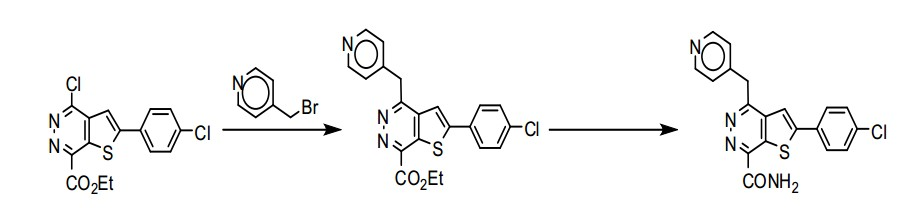
[117] DMPU (225ml), FeCl3(0,75g) e CuCl (0,3g) são adicionados a 4- bromometilpiridina (24,75g, 0,138mol) e, depois, Et2Zn (106,8ml) é lentamente gotejado a 40~45°C por 45 minutos para obter um reagente de zinco.[117] DMPU (225ml), FeCl3 (0.75g) and CuCl (0.3g) are added to 4-bromomethylpyridine (24.75g, 0.138mol) and then Et2Zn (106.8ml) is slowly dropped at 40°C ~45°C for 45 minutes to obtain a zinc reagent.
[118] THF (810ml) e PdCl2(dppf) (5,09g) são adicionados ao 4-cloro-2-(4- clorofenil) -tieno [2,3-d] piridazinil-7-etila (30g) e, depois, o reagente de zinco é gotejado na solução de THF a 45°C por 4 h. A mistura de reação é derramada em água salgada saturada, filtrada após agitação por 15 minutos e colocada para separação de camadas. A fase aquosa é extraída com THF (500 ml, 2 vezes). A fase orgânica é combinada, lavada com água salgada saturada (500ml, 3 vezes), seca com Na2SO4 anidro, e evaporada sob pressão reduzida para remover solvente e obter o 4-(4-piridinometil)-2-(4-clorofenil)-tieno[2,3-d]piridazinil-7-etila (25 g). MS (ESI): 410(M+1)[118] THF (810ml) and PdCl2(dppf) (5.09g) are added to 4-chloro-2-(4-chlorophenyl)-thieno[2,3-d]pyridazinyl-7-ethyl (30g) and, then the zinc reagent is dropped into the THF solution at 45°C for 4 h. The reaction mixture is poured into saturated brine, filtered after stirring for 15 minutes and placed for layer separation. The aqueous phase is extracted with THF (500 ml, 2 times). The organic phase is combined, washed with saturated brine (500ml, 3 times), dried with anhydrous Na2SO4, and evaporated under reduced pressure to remove solvent and obtain 4-(4-pyridinemethyl)-2-(4-chlorophenyl)- thieno[2,3-d]pyridazinyl-7-ethyl (25 g). MS (ESI): 410(M+1)
[119] 4-(4-piridinometil)-2-(4-clorofenil)-tieno[2,3-d] piridazinil -7-etila (3g), 1,4- dioxano (5 ml) e NH3.H2O (5 ml) são adicionados a um tubo selado (25ml) e aquecidos a 80°C durante toda a noite. A mistura de reação é resfriada até a temperatura ambiente e transferida para um funil separador no dia seguinte, há também adição de acetato de etila, agitação, para por fim ser colocada para separação de camadas. A camada aquosa é reextraída com acetato de etila por 2 vezes. A fase orgânica é combinada e ajustada com solução de HCl 1M até pH~3, depois lavada com água salgada saturada até pH=7, seca com Na2SO4 anidro e filtrada. O líquido filtrado é purificado com sílica gel através de cromatografia para obter um sólido de 2- (4-clorofenil)-4-(4-piridinometil)-tieno [2,3-d] piridazinil- 7-formamida (2 g). MS (ESI): 381(M+1)[119] 4-(4-pyridinemethyl)-2-(4-chlorophenyl)-thieno[2,3-d]pyridazinyl-7-ethyl (3g), 1,4-dioxane (5ml) and NH3.H2O ( 5ml) are added to a sealed tube (25ml) and heated to 80°C overnight. The reaction mixture is cooled to room temperature and transferred to a separating funnel the next day, there is also addition of ethyl acetate, stirring, to finally be placed for layer separation. The aqueous layer is re-extracted with ethyl acetate 2 times. The organic phase is combined and adjusted with 1M HCl solution to pH~3, then washed with saturated brine until pH=7, dried with anhydrous Na2SO4 and filtered. The filtered liquid is purified with silica gel by chromatography to obtain a solid of 2-(4-chlorophenyl)-4-(4-pyridinemethyl)-thieno[2,3-d]pyridazinyl-7-formamide (2 g). MS (ESI): 381 (M+1)
[120]
[121] DMPU (225ml), FeCl3(0,75 g) e CuCl (0,3 g) são adicionados a 3- bromometilpirrol (24,75g, 0,138mol) e, depois, Et2Zn (106,8ml) é lentamente gotejado a 40~45˚C por 45 minutos para obter um reagente de zinco.[121] DMPU (225ml), FeCl3 (0.75 g) and CuCl (0.3 g) are added to 3-bromomethylpyrrole (24.75g, 0.138mol) and then Et2Zn (106.8ml) is slowly dripped off at 40~45˚C for 45 minutes to obtain a zinc reagent.
[122] THF (810ml) e PdCl2(dppf) (5,09g) são adicionados ao 4-cloro-2-(4- clorofenil) -tieno [2,3-d] piridazinil-7-etila (30g) e, depois, o reagente de zinco é gotejado na solução de THF a 45˚C por 4 h. A mistura de reação é derramada em água salgada saturada, filtrada após agitação por 15 minutos e colocada para separação de camadas. A fase aquosa é extraída com THF (500 ml, 2 vezes). A fase orgânica é combinada, lavada com água salgada saturada (500ml, 3 vezes), seca com Na2SO4 anidro, e evaporada sob pressão reduzida para remover solvente e obter o 4-(3-pirrolemetil)-2-(4-clorofenil)-tieno[2,3-d] piridazinil-7-etila (25 g). MS (ESI): 398(M+1)[122] THF (810ml) and PdCl2(dppf) (5.09g) are added to 4-chloro-2-(4-chlorophenyl)-thieno[2,3-d]pyridazinyl-7-ethyl (30g) and, then the zinc reagent is dropped into the THF solution at 45°C for 4 h. The reaction mixture is poured into saturated brine, filtered after stirring for 15 minutes and placed for layer separation. The aqueous phase is extracted with THF (500 ml, 2 times). The organic phase is combined, washed with saturated brine (500ml, 3 times), dried with anhydrous Na2SO4, and evaporated under reduced pressure to remove solvent and obtain 4-(3-pyrrolemethyl)-2-(4-chlorophenyl)- thieno[2,3-d]pyridazinyl-7-ethyl (25 g). MS (ESI): 398(M+1)
[123] 4-(3-pirrolemetil)-2-(4-clorofenil)-tieno[2,3-d]piridazinil-7-etila (3g), 1,4- dioxano (5 ml) e NH3.H2O (5 ml) são adicionados a um tubo selado (25ml) e aquecidos a 80˚C durante toda a noite. A mistura de reação é resfriada até a temperatura ambiente e transferida para um funil separador no dia seguinte, há também adição de acetato de etila, agitação, para por fim ser colocada para separação de camadas. A camada aquosa é reextraída com acetato de etila por 2 vezes. A fase orgânica é combinada e ajustada com solução de HCl 1M até pH≈3, depois lavada com água salgada saturada até pH=7, seca com Na2SO4 anidro e filtrada. O líquido filtrado é purificado com sílica gel através de cromatografia para obter um sólido de 2- (4-clorofenil)-4-(3-pirrolemetil)-tieno[2,3-d]piridazinil- 7-formamida (2 g). MS (ESI): 369(M+1)[123] 4-(3-pyrrolemethyl)-2-(4-chlorophenyl)-thieno[2,3-d]pyridazinyl-7-ethyl (3g), 1,4-dioxane (5ml) and NH3.H2O ( 5ml) is added to a sealed tube (25ml) and heated to 80˚C overnight. The reaction mixture is cooled to room temperature and transferred to a separating funnel the next day, there is also addition of ethyl acetate, stirring, to finally be placed for layer separation. The aqueous layer is re-extracted with ethyl acetate 2 times. The organic phase is combined and adjusted with 1M HCl solution to pH≈3, then washed with saturated brine until pH=7, dried with anhydrous Na2SO4 and filtered. The filtered liquid is purified with silica gel by chromatography to obtain a solid of 2-(4-chlorophenyl)-4-(3-pyrrolemethyl)-thieno[2,3-d]pyridazinyl-7-formamide (2 g). MS (ESI): 369(M+1)
[124]
[125] DMPU (225ml), FeCl3(0,75 g) e CuCl (0,3 g) são adicionados a 3- bromometilfurano (24,75g, 0,138mol) e, depois, Et2Zn (106,8ml) é lentamente gotejado a 40~45°C por 45 minutos para obter um reagente de zinco.[125] DMPU (225ml), FeCl3 (0.75 g) and CuCl (0.3 g) are added to 3-bromomethylfuran (24.75g, 0.138mol) and then Et2Zn (106.8ml) is slowly dripped off at 40~45°C for 45 minutes to obtain a zinc reagent.
[126] THF (810ml) e PdCl2(dppf) (5,09g) são adicionados ao 4-cloro-2-(4- clorofenil)-tieno [2,3-d] piridazinil-7-etila (30g) e, depois, o reagente de zinco é adiconado gota a gota à solução de THF a 45°C por 4 h. A mistura de reação é derramada em água salgada saturada, filtrada após agitação por 15 minutos e colocada para separação de camadas. A fase aquosa é extraída com THF (500 ml, 2 vezes). A fase orgânica é combinada , lavada com água salgada saturada (500ml, 3 vezes), e-seca com Na2SO4 anidro, e evaporada sob pressão reduzida para remover solvente e obter o 4-(3-furanometil)-2-(4-clorofenil)-tieno[2,3-d] piridazinil-7-etila (25 g). MS (ESI): 399(M+1)[126] THF (810ml) and PdCl2(dppf) (5.09g) are added to 4-chloro-2-(4-chlorophenyl)-thieno[2,3-d]pyridazinyl-7-ethyl (30g) and, then the zinc reagent is added dropwise to the THF solution at 45°C for 4 h. The reaction mixture is poured into saturated brine, filtered after stirring for 15 minutes and placed for layer separation. The aqueous phase is extracted with THF (500 ml, 2 times). The organic phase is combined, washed with saturated brine (500ml, 3 times), and dried with anhydrous Na2SO4, and evaporated under reduced pressure to remove solvent and obtain 4-(3-furanomethyl)-2-(4-chlorophenyl) )-thieno[2,3-d]pyridazinyl-7-ethyl (25 g). MS (ESI): 399(M+1)
[127] Formato de 4-(3-furanometil)-2-(4-clorofenil)-tieno[2,3-d]piridazinil-7-etila (3g), 1,4-dioxano (5 ml) e NH3.H2O (5 ml) são adicionados a um tubo selado (25ml) e aquecidos a 80°C durante toda a noite. A mistura de reação é resfriada até a temperatura ambiente e transferida para um funil separador no dia seguinte, há também adição de acetato de etila, agitação, para por fim ser colocada para separação de camadas. A camada aquosa é reextraída com acetato de etila por 2 vezes. A fase orgânica é combinada e ajustada com solução de HCl 1M até pH~3, depois lavada com água salgada saturada até pH=7, seca com Na2SO4 anidro e filtrada. O líquido filtrado é purificado com sílica gel através de cromatografia para obter um sólido de 2-(4-clorofenil)-4-(3-furanometil)-tieno[2,3-d]piridazinil-7- formamida (2 g). MS (ESI): 370(M+1)[127] 4-(3-furanomethyl)-2-(4-chlorophenyl)-thieno[2,3-d]pyridazinyl-7-ethyl formate (3g), 1,4-dioxane (5 ml) and NH 3 . H2O (5ml) is added to a sealed tube (25ml) and heated to 80°C overnight. The reaction mixture is cooled to room temperature and transferred to a separating funnel the next day, there is also addition of ethyl acetate, stirring, to finally be placed for layer separation. The aqueous layer is re-extracted with ethyl acetate 2 times. The organic phase is combined and adjusted with 1M HCl solution to pH~3, then washed with saturated brine until pH=7, dried with anhydrous Na2SO4 and filtered. The filtered liquid is purified with silica gel by chromatography to obtain a solid of 2-(4-chlorophenyl)-4-(3-furanomethyl)-thieno[2,3-d]pyridazinyl-7-formamide (2 g). MS (ESI): 370(M+1)
[128]
[129] DMPU (225ml), FeCl3(0,75 g) e CuCl (0,3 g) são adicionados a 3- bromometiltiofeno (24,75g, 0,138mol) e, depois, Et2Zn (106,8ml) é lentamente gotejado a 40~45°C por 45 minutos para obter um reagente de zinco.[129] DMPU (225ml), FeCl3 (0.75 g) and CuCl (0.3 g) are added to 3-bromomethylthiophene (24.75g, 0.138mol) and then Et2Zn (106.8ml) is slowly dripped off at 40~45°C for 45 minutes to obtain a zinc reagent.
[130] THF (810ml) e PdCl2(dppf) (5,09g) são adicionados ao 4-cloro-2-(4- clorofenil) -tieno [2,3-d] piridazinil-7-etila (30g) e, depois, o reagente de zinco é gotejado na solução de THF a 45°C por 4 h. A mistura de reação é derramada em água salgada saturada, filtrada após agitação por 15 minutos e colocada para separação de camadas. A fase aquosa é extraída com THF (500 ml, 2 vezes). A fase orgânica é combinada, lavada com água salgada saturada (500ml, 3 vezes), seca com Na2SO4 anidro, e evaporada sob pressão reduzida para remover solvente e obter o 4-(3-tiofenometil)-2-(4-clorofenil)-tieno[2,3-d] piridazinil-7-etila (25 g). MS (ESI): 415(M+1)[130] THF (810ml) and PdCl2(dppf) (5.09g) are added to 4-chloro-2-(4-chlorophenyl)-thieno[2,3-d]pyridazinyl-7-ethyl (30g) and, then the zinc reagent is dropped into the THF solution at 45°C for 4 h. The reaction mixture is poured into saturated brine, filtered after stirring for 15 minutes and placed for layer separation. The aqueous phase is extracted with THF (500 ml, 2 times). The organic phase is combined, washed with saturated brine (500ml, 3 times), dried with anhydrous Na2SO4, and evaporated under reduced pressure to remove solvent and obtain 4-(3-thiophenomethyl)-2-(4-chlorophenyl)- thieno[2,3-d]pyridazinyl-7-ethyl (25 g). MS (ESI): 415(M+1)
[131] 4-(3-tiofenometil)-2-(4-clorofenil)-tieno[2,3-d]piridazinil-7-etila (3g), 1,4- dioxano (5 ml) e NH3.H2O (5 ml) são adicionados a um tubo selado (25ml) e aquecidos a 80°C durante toda a noite. A mistura de reação é resfriada até a temperatura ambiente e transferida para um funil separador no dia seguinte, há também adição de acetato de etila, agitação, para por fim ser colocada para separação de camadas. A camada aquosa é reextraída com acetato de etila por 2 vezes. A fase orgânica é combinada e ajustada com solução de HCl 1M até pH~3, depois lavada com água salgada saturada até pH=7, seca com Na2SO4 anidro e filtrada. O líquido filtrado é purificado com sílica gel através de cromatografia para obter um sólido de 2- (4-clorofenil)-4-(3-tiofenometil)-tieno [2,3-d] piridazinil- 7-formamida (2 g). MS (ESI): 386(M+1)[131] 4-(3-thiophenomethyl)-2-(4-chlorophenyl)-thieno[2,3-d]pyridazinyl-7-ethyl (3g), 1,4-dioxane (5ml) and NH3.H2O ( 5ml) are added to a sealed tube (25ml) and heated to 80°C overnight. The reaction mixture is cooled to room temperature and transferred to a separating funnel the next day, there is also addition of ethyl acetate, stirring, to finally be placed for layer separation. The aqueous layer is re-extracted with ethyl acetate 2 times. The organic phase is combined and adjusted with 1M HCl solution to pH~3, then washed with saturated brine until pH=7, dried with anhydrous Na2SO4 and filtered. The filtered liquid is purified with silica gel by chromatography to obtain a solid of 2-(4-chlorophenyl)-4-(3-thiophenomethyl)-thieno[2,3-d]pyridazinyl-7-formamide (2 g). MS (ESI): 386(M+1)
[132]
[133] DMPU (225ml), FeCl3 (0,75 g) e CuCl (0,3 g) são adicionados a 2- bromometilpirrol (24,75g, 0,138mol) e, depois, Et2Zn (106,8ml) é lentamente gotejado a 40~45°C por 45 minutos para obter um reagente de zinco.[133] DMPU (225ml), FeCl3 (0.75g) and CuCl (0.3g) are added to 2-bromomethylpyrrole (24.75g, 0.138mol) and then Et2Zn (106.8ml) is slowly dripped off at 40~45°C for 45 minutes to obtain a zinc reagent.
[134] THF (810ml) e PdCl2(dppf) (5,09g) são adicionados a 4-cloro-2-(4- clorofenil)- tieno [2,3-d] piridazinil-7-etil (30g) e, depois, o reagente de zinco é gotejado na solução de THF a 45°C por 4 h. A mistura de reação é derramada em água salgada saturada, filtrada após agitação por 15 minutos e colocada para separação de camadas. A fase aquosa é extraída com THF (500 ml, 2 vezes). A fase orgânica é combinada, lavada com água salgada saturada (500ml, 3 vezes), seca com Na2SO4 anidro, e evaporada sob pressão reduzida para remover solvente e obter o 4-(2- pirrolemetil)-2-(4-clorofenil)-tieno[2,3-d] piridazinil-7-etila (25 g). MS (ESI): 398(M+1)[134] THF (810ml) and PdCl2(dppf) (5.09g) are added to 4-chloro-2-(4-chlorophenyl)-thieno[2,3-d]pyridazinyl-7-ethyl (30g) and, then the zinc reagent is dropped into the THF solution at 45°C for 4 h. The reaction mixture is poured into saturated brine, filtered after stirring for 15 minutes and placed for layer separation. The aqueous phase is extracted with THF (500 ml, 2 times). The organic phase is combined, washed with saturated brine (500ml, 3 times), dried with anhydrous Na2SO4, and evaporated under reduced pressure to remove solvent and obtain 4-(2-pyrrolemethyl)-2-(4-chlorophenyl)- thieno[2,3-d]pyridazinyl-7-ethyl (25 g). MS (ESI): 398(M+1)
[135] 4-(2-pirrolemetil)-2-(4-clorofenil)-tieno[2,3-d]piridazinil-7-etila (3g), 1,4- dioxano (5 ml) e NH3.H2O (5 ml) são adicionados a um tubo selado (25ml) e aquecidos a 80°C durante toda a noite. A mistura de reação é resfriada até a temperatura ambiente e transferida para um funil separador no dia seguinte, há também adição de acetato de etila, agitação, para por fim ser colocada para separação de camadas. A camada aquosa é reextraída com acetato de etila por 2 vezes. A fase orgânica é combinada e ajustada com solução de HCl 1M até pH~3, depois lavada com água salgada saturada até pH=7, seca com Na2SO4 anidro e filtrada. O líquido filtrado é purificado com sílica gel através de cromatografia para obter um sólido de 2- (4-clorofenil)-4-(2-pirrolemetil)-tieno[2,3-d] piridazinil- 7-formamida (2 g). MS (ESI): 369(M+1)[135] 4-(2-pyrrolemethyl)-2-(4-chlorophenyl)-thieno[2,3-d]pyridazinyl-7-ethyl (3g), 1,4-dioxane (5 ml) and NH3.H2O ( 5ml) are added to a sealed tube (25ml) and heated to 80°C overnight. The reaction mixture is cooled to room temperature and transferred to a separating funnel the next day, there is also addition of ethyl acetate, stirring, to finally be placed for layer separation. The aqueous layer is re-extracted with ethyl acetate 2 times. The organic phase is combined and adjusted with 1M HCl solution to pH~3, then washed with saturated brine until pH=7, dried with anhydrous Na2SO4 and filtered. The filtered liquid is purified with silica gel by chromatography to obtain a solid of 2-(4-chlorophenyl)-4-(2-pyrrolemethyl)-thieno[2,3-d]pyridazinyl-7-formamide (2 g). MS (ESI): 369(M+1)
[136]
[137] 5-bromo-tiofeno-3-etila (10,5g), ácido 3,5-diclorobenzeno borônico (6g), Pd[P(Ph)3]4 (1,5g), carbonato de sódio (7,5g) e uma mistura (347ml) de tolueno:água:EtOH (4:2:1, v/v) são sucessivamente adicionados a um frasco de três bocas (500ml) e aquecidos até o refluxo por 3 h. A reação é rastreada através de TLC. A mistura de reação é resfriada até a temperatura ambiente após a reação e colocada para separação de camadas. A fase aquosa é extraída com tolueno (35ml, 2 vezes). A fase orgânica é combinada e lavada com água salgada saturada até pH=7, seca com sulfato de sódio anidro durante toda a noite e filtrada no dia seguinte, e evaporada sob pressão reduzida para remover solvente e obter um líquido viscoso amarelo-claro, colocada ara condensação de sólido, e recristalizada com EtOH absoluto para obter um cristal de 5-(3,5-diclorofenil)-3-tiofeno-etila (8,6g).[137] 5-bromo-thiophene-3-ethyl (10.5g), 3,5-dichlorobenzene boronic acid (6g), Pd[P(Ph)3]4 (1.5g), sodium carbonate (7, 5g) and a mixture (347ml) of toluene:water:EtOH (4:2:1, v/v) are successively added to a three-neck flask (500ml) and heated to reflux for 3 h. The reaction is tracked by TLC. The reaction mixture is cooled to room temperature after the reaction and placed for layer separation. The aqueous phase is extracted with toluene (35ml, 2 times). The organic phase is combined and washed with saturated brine until pH=7, dried with anhydrous sodium sulphate overnight and filtered the next day, and evaporated under reduced pressure to remove solvent and obtain a pale yellow viscous liquid, placed for solid condensation, and recrystallized from absolute EtOH to obtain a crystal of 5-(3,5-dichlorophenyl)-3-thiophene-ethyl (8.6g).
[138] Preparação do LDA: THF (252,6ml) e N,N-diisopropilamina (79ml) são adicionados em um frasco de três bocas (1000ml) sob argônio, e n-Buli (302,8ml, 1,6M em hexano) é adicionado em um funil de pressão constante (500ml) e é gotejado quando a temperatura interna está abaixo de -20°C ,como reação é intensamente exotérmica, é mantida a temperatura interna entre -20°C—30°C controlando a velocidade de adição. Após a adição, a mistura de reação é naturalmente aquecida até a temperatura ambiente e, depois, diretamente usada para a reação de condensação a seguir.[138] Preparation of LDA: THF (252.6ml) and N,N-diisopropylamine (79ml) are added in a three-neck flask (1000ml) under argon, and n-Buli (302.8ml, 1.6M in hexane) ) is added into a constant pressure funnel (500ml) and dropped when the internal temperature is below -20°C, as the reaction is intensely exothermic, the internal temperature is maintained between -20°C-30°C by controlling the speed addition. After addition, the reaction mixture is naturally warmed to room temperature and then directly used for the condensation reaction to follow.
[139] Reação de Condensação: 5-(3,5-diclorofenil)tiofeno-3- etila (28,7g), THF (1084ml) e dietiloxalato (29,7ml) são adicionados em um frasco de quatro bocas (2000ml) conectando com um aparelho de agitação mecânica, um funil de pressão constante de 500ml e uma sonda de temperatura. A mistura acima é agitada à temperature ambiente e dissolvida para obter um líquido transparente amarelo-claro. A solução de LDA preparada é transferida para um funil de pressão constante sob argônio, resfriada e, depois, o LDA é gotejado no frasco quando a temperatura interna está abaixo de -78°C, mantendo-se essa temperatura e controlando a velocidade de adição. Após a adição, a reação é rastreada através de TLC. Solução de HCl (2,2M) é adicionada para ajustar o pH~3 após a reação, e a cor da mistura de reação é alterada de marrom-avermelhado para laranja. A temperatura é elevada até cerca de 0°C, NaCl sólido é, então, adicionado e dissolvido sob agitação e, depois, colocada para separação de camadas. A fase aquosa é reextraída com THF (143,5ml, 2 vezes). A fase orgânica é combinada e lavada com água salgada saturada por duas vezes e, depois, ajustado o pH=8 com solução de carbonato de sódio; finalmente, lavada com água salgada saturada até pH=7, seca com sulfato de sódio anidro, filtrada e evaporada sob pressão reduzida para remover solvente e obter um fluido viscoso amarelo-claro, colocada à temperatura ambiente e gradualmente condensada para sólido, recristalizada por EtOH e obter um produto puro de formato de 5-(3,5-diclorofenil)-2-etoxioxalil-tiofeno-3-etila (cristal laranja, 25,5g).[139] Condensation Reaction: 5-(3,5-dichlorophenyl)thiophene-3-ethyl (28.7g), THF (1084ml) and diethyl oxalate (29.7ml) are added in a four-neck flask (2000ml) connecting with a mechanical stirring device, a 500ml constant pressure funnel and a temperature probe. The above mixture is stirred at room temperature and dissolved to obtain a clear, pale yellow liquid. The prepared LDA solution is transferred to a constant pressure funnel under argon, cooled, and then the LDA is dropped into the flask when the internal temperature is below -78°C, maintaining this temperature and controlling the addition rate . After addition, the reaction is tracked by TLC. HCl solution (2.2M) is added to adjust pH~3 after the reaction, and the color of the reaction mixture is changed from reddish-brown to orange. The temperature is raised to about 0°C, solid NaCl is then added and dissolved under stirring and then placed for layer separation. The aqueous phase is re-extracted with THF (143.5ml, 2 times). The organic phase is combined and washed with saturated brine twice and then adjusted to pH=8 with sodium carbonate solution; finally, washed with saturated brine until pH=7, dried with anhydrous sodium sulfate, filtered and evaporated under reduced pressure to remove solvent and obtain a pale yellow viscous fluid, brought to room temperature and gradually condensed to solid, recrystallized by EtOH and obtain a pure product of 5-(3,5-dichlorophenyl)-2-ethoxyoxalyl-thiophene-3-ethyl formate (orange crystal, 25.5g).
[140] Um cristal de formato de 5-(3,5-diclorofenil)-2-etoxioxalil-tiofeno-3-etila (3,0g), e etanol absoluto (45ml) são adicionados em um frasco de reação (100ml), agitados à temperatura ambiente para obter uma suspensão amarela. O hidrato de hidrazina (0,75ml) é adicionado em um funil de pressão constante sob agitação por 10 minutos e, depois, gotejado no frasco. A suspensão amarela é dissolvida até um líquido transparente e aquecida a 70°C para gradualmente precipitar sólidos amarelos no frasco com aumento da temperatura, e o líquido de reação se torna crescentemente viscoso, é mantida por 1h e, depois resfriada até a temperatura ambiente, filtra-se para obter um sólido de cor verde-pistache, o sólido é respectivamente lavado com uma mistura de hexano/ diclorometano (1:1)(15ml, 2 vezes) e metanol/diclorometano (1:1)(15ml, 2 vezes) e seco sob pressão reduzida para obter formato de 2-(3,5-diclorofenil)-4-oxo-4,5-di-hidro-tieno [2,3-d]piridazina- 7- etila (2,75g).[140] A formate crystal of 5-(3,5-dichlorophenyl)-2-ethoxyoxalyl-thiophene-3-ethyl (3.0g), and absolute ethanol (45ml) are added to a reaction flask (100ml), stirred at room temperature to obtain a yellow suspension. Hydrazine hydrate (0.75ml) is added to a constant pressure funnel under stirring for 10 minutes and then dropped into the vial. The yellow suspension is dissolved to a clear liquid and heated to 70°C to gradually precipitate yellow solids in the flask with increasing temperature, and the reaction liquid becomes increasingly viscous, is held for 1h and then cooled to room temperature, filtered to obtain a pistachio green solid, the solid is respectively washed with a mixture of hexane/dichloromethane (1:1)(15ml, 2 times) and methanol/dichloromethane (1:1)(15ml, 2 times) ) and dried under reduced pressure to obtain 2-(3,5-dichlorophenyl)-4-oxo-4,5-dihydro-thieno[2,3-d]pyridazine-7-ethyl formate (2.75g) .
[141] 2-(3,5-diclorofenil)-4-oxo-4,5-dihidro-tieno[2,3-d]piridazina-7-etila (1,5g) e oxicloreto de fósforo (22,5ml) são adicionados a um frasco de três bocas (100ml), aquecidos a 90°C por 3 h, e gradualmente dissolvidos para obter uma solução marrom-vermelho escuro. Após a reação, a solução é resfriada até a temperatura ambiente e evaporada sob pressão reduzida para remover solvente e obter um fluido viscoso marrom-chocolate. THF e água salgada saturada são adicionados sob agitação, depois sólidos amarelos são precipitados, filtrados, colocados para separação de camadas, e reextraídos e ajustados até pH=9 com solução de carbonato de sódio diluída após a fase orgânica ser combinada e, depois, lavados com água salgada saturada até pH=7, e secados com sulfato de sódio anidro, filtrados, descoloridos com carvão ativado em refluxo para obter um líquido verde- amarelo-claro, o líquido é evaporado sob pressão reduzida para remover solvente e obter o 4-cloro-2-(3,5-diclorofenil)-tieno[2,3-d]piridazinil-7-etila (sólido floculento verde- claro, 1,0g).[141] 2-(3,5-dichlorophenyl)-4-oxo-4,5-dihydro-thieno[2,3-d]pyridazine-7-ethyl (1.5g) and phosphorus oxychloride (22.5ml) are added to a three-neck flask (100ml), heated to 90°C for 3 h, and gradually dissolved to obtain a dark red-brown solution. After the reaction, the solution is cooled to room temperature and evaporated under reduced pressure to remove solvent and obtain a viscous chocolate-brown fluid. THF and saturated brine are added under stirring, then yellow solids are precipitated, filtered, placed for layer separation, and re-extracted and adjusted to pH=9 with dilute sodium carbonate solution after the organic phase is combined and then washed with saturated brine until pH=7, and dried with anhydrous sodium sulfate, filtered, decolorized with activated carbon at reflux to obtain a pale yellow-green liquid, the liquid is evaporated under reduced pressure to remove solvent and obtain the 4- chloro-2-(3,5-dichlorophenyl)-thieno[2,3-d]pyridazinyl-7-ethyl (light green flocculent solid, 1.0g).
[142] DMPU (5ml), FeCl3(0,017 g) e CuCl (0,007g) são adicionados a N-Boc-3- bromometilpiperidina (0,55g) e, depois, Et2Zn (2,5ml) é lentamente gotejado a 40~45°C por 45 minutos para obter um reagente de zinco.[142] DMPU (5ml), FeCl3 (0.017g) and CuCl (0.007g) are added to N-Boc-3-bromomethylpiperidine (0.55g) and then Et2Zn (2.5ml) is slowly dropped to 40~ 45°C for 45 minutes to obtain a zinc reagent.
[143] THF (18ml) e PdCl2(dppf) (0,12g) são adicionados ao 4-cloro-2-(3,5- diclorofenil)-tieno[2,3-d] piridazinil-7-etila (30g) e, depois, o reagente de zinco é gotejado na solução de THF a 45°C por 4 h. A mistura de reação é derramada em água salgada saturada, filtrada após agitação por 15 minutos e colocada para separação de camadas. A fase aquosa é extraída com THF (80 ml, 2 vezes). A fase orgânica é combinada, lavada com água salgada saturada (80ml, 3 vezes) , seca com Na2SO4 anidro, e evaporada sob pressão reduzida para remover solvente e obter o 2-(3,5-diclorofenil)- 4-(N-Boc-3-piperidinometil)-tieno[2,3-d]piridazinil - 7- etila (0,5 g).[143] THF (18ml) and PdCl2(dppf) (0.12g) are added to 4-chloro-2-(3,5-dichlorophenyl)-thieno[2,3-d]pyridazinyl-7-ethyl (30g) and then the zinc reagent is dropped into the THF solution at 45°C for 4 h. The reaction mixture is poured into saturated brine, filtered after stirring for 15 minutes and placed for layer separation. The aqueous phase is extracted with THF (80 ml, 2 times). The organic phase is combined, washed with saturated brine (80ml, 3 times), dried over anhydrous Na 2 SO 4 , and evaporated under reduced pressure to remove solvent and obtain 2-(3,5-dichlorophenyl)-4-(N-Boc -3-piperidinomethyl)-thieno[2,3-d]pyridazinyl-7-ethyl (0.5 g).
[144] 2-(3,5-diclorofenil)-4-(N-Boc-3-piperidinometil)-tieno[2,3-d] piridazinil-7-etila (0,5g), 1,4-dioxano (1,0ml) e NH3.H2O (5ml) são adicionados a um tubo selado (5ml) e aquecidos a 80°C durante toda a noite. A mistura de reação é resfriada até a temperatura ambiente e transferida para um funil separador no dia seguinte, e adição de acetato de etila, vibrada, colocada para separação de camadas. A camada de água é reextraída com acetato de etila por 2 vezes. A fase orgânica é combinada e ajustada até pH~3 com solução de HCl 1M e, depois, lavada com água salgada saturada até pH=7, seca com sulfato de sódio anidro e filtrada. O líquido filtrado é purificado junto com sílica gel através de cromatografia flash para obter um sólido de 2(3,5-diclorofenil)-4- (N-Boc-3- piperidinometil)-tieno[2,3-d] piridazinil-7-formamida (0,3g).[144] 2-(3,5-dichlorophenyl)-4-(N-Boc-3-piperidinomethyl)-thieno[2,3-d]pyridazinyl-7-ethyl (0.5g), 1,4-dioxane ( 1.0ml) and NH3.H2O (5ml) are added to a sealed tube (5ml) and heated at 80°C overnight. The reaction mixture is cooled to room temperature and transferred to a separating funnel the following day, and ethyl acetate added, vibrated, placed for layer separation. The water layer is re-extracted with ethyl acetate 2 times. The organic phase is combined and adjusted to pH~3 with 1M HCl solution and then washed with saturated brine until pH=7, dried with anhydrous sodium sulfate and filtered. The filtered liquid is purified along with silica gel by flash chromatography to obtain a solid of 2(3,5-dichlorophenyl)-4-(N-Boc-3-piperidinomethyl)-thieno[2,3-d]pyridazinyl-7 -formamide (0.3g).
[145] 2(3,5-diclorofenil)-4-(N-Boc-3-piperidinometil)-tieno[2,3-d]piridazinil-7- formamida (200g) e acetato de etila (4ml) são adicionados a um frasco de uma boca (25ml) e dissolvidos até uma solução transparente amarelo-claro. Solução de HCl (4ml, 3M) é adicionada e alterada para uma suspensão branca, e aquecida a 30°C por 1 h e a suspensão branca é alterada para transparente. A reação é rastreada através de placa; e evaporada sob pressão reduzida após a reação para remover solvente para obter um sólido de cloridrato de 2-(3,5-diclorofenil)-4-(3-piperidinometil)-tieno[2,3-d] piridazinil -7 - formamida (100 mg).[145] 2(3,5-dichlorophenyl)-4-(N-Boc-3-piperidinomethyl)-thieno[2,3-d]pyridazinyl-7-formamide (200g) and ethyl acetate (4ml) are added to a one-mouth vial (25ml) and dissolved into a clear pale yellow solution. HCl solution (4ml, 3M) is added and changed to a white suspension, and heated to 30°C for 1 h and the white suspension is changed to clear. The reaction is tracked across the plate; and evaporated under reduced pressure after the reaction to remove solvent to obtain a solid of 2-(3,5-dichlorophenyl)-4-(3-piperidinomethyl)-thieno[2,3-d]pyridazinyl-7-formamide hydrochloride ( 100mg).
[146] Cloridrato de 2-(3,5-diclorofenil)-4-(3-piperidinometil)-tieno[2,3-d]piridazinil- 7- formamida (100 mg) é adicionado a um frasco de uma boca (25ml), depois adição de água (5ml) e o carbonato de sódio é gotejado até pH=9~10 sob agitação por 30min. A mistura é extraída por acetato de etila, lavada com água e evaporada sob pressão reduzida para remover solvente para obter 2-(3,5-diclorofenil)-4- (3- piperidinometil) -tieno[2,3-d] piridazinil-7- formamida (70 mg). MS (ESI): 421(M+1)[146] 2-(3,5-Dichlorophenyl)-4-(3-piperidinomethyl)-thieno[2,3-d]pyridazinyl-7-formamide hydrochloride (100 mg) is added to a one-neck flask (25ml) ), then addition of water (5ml) and the sodium carbonate is dropped to pH=9~10 under stirring for 30min. The mixture is extracted by ethyl acetate, washed with water and evaporated under reduced pressure to remove solvent to obtain 2-(3,5-dichlorophenyl)-4-(3-piperidinomethyl)-thieno[2,3-d]pyridazinyl- 7- formamide (70 mg). MS (ESI): 421 (M+1)
[147]
[148]O composto II é adicionado em um tanque de acordo com a formulação, e água para injeção (cerca de 200.000ml) é adicionado, e dissolvido completamente. Cloreto de sódio é, então, adicionado de acordo com a formulação e, depois, continua-se a adicionar cloreto de sódio em quantidade suficiente após completamente dissolvido. O pH é ajustado para 4,0~5,0. Carvão ativado (250g) é adicionado por 30 minutos antes de ser removido com a descarbonização do filtro. A mistura é, então, envasada em frascos de 250ml após filtração de precisão com Barra de Titânio. A injeção é preparada após esterilização da água a 115°C por 30 minutos. 2. Comprimidos[148] Compound II is added to a tank according to the formulation, and water for injection (about 200,000ml) is added, and dissolved completely. Sodium chloride is then added according to the formulation and then continued to add enough sodium chloride after it has completely dissolved. The pH is adjusted to 4.0~5.0. Activated carbon (250g) is added for 30 minutes before being removed by decarbonising the filter. The mixture is then filled into 250ml bottles after precision filtration with a Titanium Bar. The injection is prepared after sterilizing water at 115°C for 30 minutes. 2. Pills
[149]
[150]CompostoXXXIII, amido e hidroxipropil celulose são adicionados a uma calha de leito fluidizado, e aquecidos até 38°C~45°C abrindo o ar principal para pré- misturar o material por 5 minutos. Solução adequada de polividona K30 (5%) é nebulizada para granular, o material é controlado para 55°C~60°C e seco por 10 minutos, misturado com carboximetilamido sódico e estearato de magnésio para formar comprimidos após a granulação. 3. Cápsulas[150]CompoundXXXIII, starch and hydroxypropyl cellulose are added to a fluidized bed trough, and heated to 38°C~45°C by opening the main air to premix the material for 5 minutes. Suitable polyvidone K30 solution (5%) is nebulized to granulate, the material is controlled to 55°C~60°C and dried for 10 minutes, mixed with sodium carboxymethyl starch and magnesium stearate to form tablets after granulation. 3. Capsules
[151]
[152] Composto XXXXIV, lactose, carboximetilamido sódico e dióxido de silício coloidal são adicionados a um misturador de acordo com a formulação e misturados por 60 minutos para torná-la homogênea. Estearato de magnésio é, então, adicionado de acordo com a formulação e misturado por 10 minutos, dispensado em uma casca plástica de gelatina geral.[152] Compound XXXXIV, lactose, sodium carboxymethyl starch and colloidal silicon dioxide are added to a blender according to the formulation and mixed for 60 minutes to make it homogeneous. Magnesium stearate is then added according to the formulation and mixed for 10 minutes, then dispensed into a general gelatin plastic shell.
[153] Alguns dos compostos acima são testados in vitro e in vivo quanto a suas atividades antitumorais. Entre estes testes, a citotoxicidade é testada in vitro usando os métodos SRB e MTT por 72h. Os dados de atividade específicos estão resumidos na Tabela 1. O efeito de inibição do crescimento do composto no sarcoma de camundongo S180 está resumido na Tabela 2. A eficácia dos compostos em tratar tumores transplantados de câncer de cólon humano HT-99 em camundongos nus está resumida na Tabela 3. Tabela 1 Atividade Anticâncer do Composto IC50(μM) in Vitro

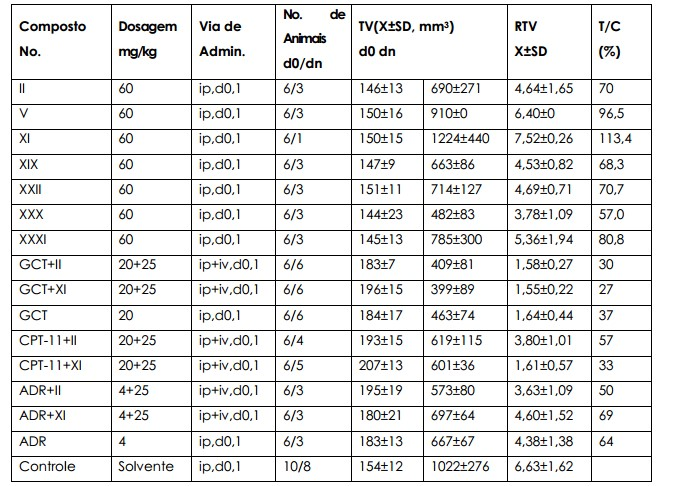
[154] Pode-se mostrar a partir das tabelas acima que os compostos da presente invenção não apenas têm certos efeitos antitumorais, e também podem aumentar a eficácia antitumoral dos agentes antitumorais citotóxicos, tais como Gemcitabina, CPT-11, ADR e assim por diante.[154] It can be shown from the above tables that the compounds of the present invention not only have certain antitumor effects, and can also enhance the antitumor efficacy of cytotoxic antitumor agents such as Gemcitabine, CPT-11, ADR and so on. .
[155] Embora a presente invenção tenha sido descrita em conexão com as materializações acima, deve-se compreender que a presente invenção não está limitada a tais materializações e procedimentos preferidos estabelecidos acima. As materializações e procedimentos foram escolhidos e descritos de modo a explicarem melhor os princípios da invenção e sua aplicação prática, para a partir daí permitir a outros habilitados na arte como melhor utilizarem a invenção.[155] While the present invention has been described in connection with the above embodiments, it should be understood that the present invention is not limited to such preferred embodiments and procedures set forth above. The materializations and procedures were chosen and described in order to better explain the principles of the invention and its practical application, so as to allow others skilled in the art how to better use the invention.
Claims (12)


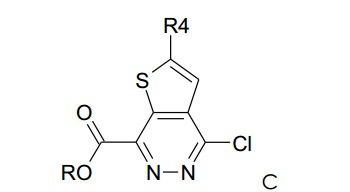


Applications Claiming Priority (5)
| Application Number | Priority Date | Filing Date | Title |
|---|---|---|---|
| CN200810000936.9 | 2008-01-08 | ||
| CN200810000936 | 2008-01-08 | ||
| CN2009100003371A CN101481380B (en) | 2008-01-08 | 2009-01-06 | Thiofuran pyridazine compound, preparation thereof, pharmaceutical composition and uses thereof |
| CN200910000337.1 | 2009-01-06 | ||
| PCT/CN2009/000021 WO2009092278A1 (en) | 2008-01-08 | 2009-01-07 | Thienopyridazine compounds, their preparations, pharmaceutical compositions and uses |
Publications (2)
| Publication Number | Publication Date |
|---|---|
| BRPI0907228A2 BRPI0907228A2 (en) | 2015-07-14 |
| BRPI0907228B1 true BRPI0907228B1 (en) | 2021-08-03 |
Family
ID=40878690
Family Applications (1)
| Application Number | Title | Priority Date | Filing Date |
|---|---|---|---|
| BRPI0907228-4A BRPI0907228B1 (en) | 2008-01-08 | 2009-01-07 | THIENOPYRIDAZINE COMPOUNDS, THEIR PREPARATIONS, PHARMACEUTICAL COMPOSITIONS AND USES |
Country Status (11)
| Country | Link |
|---|---|
| US (3) | US8962626B2 (en) |
| EP (1) | EP2241569B1 (en) |
| JP (1) | JP5456694B2 (en) |
| KR (1) | KR101512530B1 (en) |
| CN (1) | CN101481380B (en) |
| AU (1) | AU2009207968B2 (en) |
| BR (1) | BRPI0907228B1 (en) |
| CA (1) | CA2711629C (en) |
| MX (1) | MX2010007502A (en) |
| RU (1) | RU2494103C2 (en) |
| WO (1) | WO2009092278A1 (en) |
Families Citing this family (11)
| Publication number | Priority date | Publication date | Assignee | Title |
|---|---|---|---|---|
| ES2481791T3 (en) * | 2009-09-18 | 2014-07-31 | Zhanggui Wu | Novel compounds and therapeutic use for protein kinase inhibition |
| CN105358155A (en) | 2013-05-10 | 2016-02-24 | 尼普斯阿波罗有限公司 | Acc inhibitors and uses thereof |
| CA2911932A1 (en) | 2013-05-10 | 2014-11-13 | Nimbus Apollo, Inc. | Acc inhibitors and uses thereof |
| CA2911818A1 (en) * | 2013-05-10 | 2014-11-13 | Nimbus Apollo, Inc. | Acc inhibitors and uses thereof |
| MX2015015417A (en) | 2013-05-10 | 2016-06-21 | Nimbus Apollo Inc | Acc inhibitors and uses thereof. |
| EP3483167A1 (en) * | 2013-06-26 | 2019-05-15 | AbbVie Inc. | Primary carboxamides as btk inhibitors |
| CN103288614B (en) * | 2013-06-27 | 2014-09-17 | 中国科学院昆明植物研究所 | Monocyclic phloroglucinol compounds with antineoplastic activity and pharmaceutical composition thereof |
| CA2928568A1 (en) | 2013-07-26 | 2015-01-29 | Update Pharma Inc. | Combinatorial methods to improve the therapeutic benefit of bisantrene |
| CN103694217A (en) * | 2013-12-20 | 2014-04-02 | 华东师范大学 | 2,4-disubstituted thiophene derivative as well as preparation method and application thereof |
| WO2021141974A2 (en) * | 2020-01-07 | 2021-07-15 | Fan Wu | Combination cancer therapy using chk inhibitor |
| US20230183259A1 (en) * | 2020-04-17 | 2023-06-15 | Zhejiang Medicine Co., Ltd. Xinchang Pharmaceutical Factory | Crystal Form Of Thiofuran Pyridazine Compound, Preparation Method Therefor And Application Thereof |
Family Cites Families (8)
| Publication number | Priority date | Publication date | Assignee | Title |
|---|---|---|---|---|
| CO5200835A1 (en) * | 1999-09-28 | 2002-09-27 | Bayer Corp | PIRIDINES AND REPLACED PIRIDACINES WITH ANGIOGENESIS INHIBITION ACTIVITY |
| AU2004265140A1 (en) * | 2003-08-15 | 2005-02-24 | Astrazeneca Ab | Substituted thiophenes and uses thereof |
| WO2005066163A2 (en) * | 2004-01-05 | 2005-07-21 | Astrazeneca Ab | Thiophene derivatives as chk 1 inihibitors |
| EP1745051A1 (en) * | 2004-05-04 | 2007-01-24 | F.Hoffmann-La Roche Ag | Thienopyridazines as ikk inhibitors |
| WO2006106326A1 (en) * | 2005-04-06 | 2006-10-12 | Astrazeneca Ab | Substituted heterocycles and their use as chk1, pdk1 and pak inhibitors |
| EP2038289A2 (en) * | 2006-04-21 | 2009-03-25 | Amgen Inc. | Thieno-[2,3-d]pyrimidine and thieno-pyridazine compounds and methods of use |
| JP2010525077A (en) * | 2007-04-25 | 2010-07-22 | ブリストル−マイヤーズ スクイブ カンパニー | Non-basic melanin-concentrating hormone receptor-1 antagonist |
| WO2009003911A1 (en) * | 2007-06-29 | 2009-01-08 | 4Sc Ag | Thiophene-imidazopyridines |
-
2009
- 2009-01-06 CN CN2009100003371A patent/CN101481380B/en active Active
- 2009-01-07 JP JP2010541010A patent/JP5456694B2/en active Active
- 2009-01-07 US US12/811,898 patent/US8962626B2/en active Active
- 2009-01-07 BR BRPI0907228-4A patent/BRPI0907228B1/en active IP Right Grant
- 2009-01-07 AU AU2009207968A patent/AU2009207968B2/en active Active
- 2009-01-07 RU RU2010128221/04A patent/RU2494103C2/en active
- 2009-01-07 WO PCT/CN2009/000021 patent/WO2009092278A1/en not_active Ceased
- 2009-01-07 EP EP09703313A patent/EP2241569B1/en active Active
- 2009-01-07 KR KR1020107017631A patent/KR101512530B1/en not_active Expired - Fee Related
- 2009-01-07 US US12/349,888 patent/US8318740B2/en active Active
- 2009-01-07 CA CA2711629A patent/CA2711629C/en active Active
- 2009-01-07 MX MX2010007502A patent/MX2010007502A/en active IP Right Grant
-
2012
- 2012-11-02 US US13/668,197 patent/US9249154B2/en active Active
Also Published As
| Publication number | Publication date |
|---|---|
| CA2711629C (en) | 2017-10-24 |
| AU2009207968A1 (en) | 2009-07-30 |
| JP2011508750A (en) | 2011-03-17 |
| KR20100117069A (en) | 2010-11-02 |
| EP2241569B1 (en) | 2012-05-23 |
| US8318740B2 (en) | 2012-11-27 |
| WO2009092278A8 (en) | 2010-07-22 |
| CA2711629A1 (en) | 2009-07-30 |
| WO2009092278A1 (en) | 2009-07-30 |
| US20090275585A1 (en) | 2009-11-05 |
| RU2494103C2 (en) | 2013-09-27 |
| EP2241569A1 (en) | 2010-10-20 |
| US9249154B2 (en) | 2016-02-02 |
| JP5456694B2 (en) | 2014-04-02 |
| RU2010128221A (en) | 2012-02-20 |
| MX2010007502A (en) | 2010-10-15 |
| BRPI0907228A2 (en) | 2015-07-14 |
| KR101512530B1 (en) | 2015-04-15 |
| US20130143887A1 (en) | 2013-06-06 |
| CN101481380A (en) | 2009-07-15 |
| US20110009415A1 (en) | 2011-01-13 |
| US8962626B2 (en) | 2015-02-24 |
| EP2241569A4 (en) | 2011-01-12 |
| CN101481380B (en) | 2012-10-17 |
| AU2009207968B2 (en) | 2014-04-24 |
Similar Documents
| Publication | Publication Date | Title |
|---|---|---|
| EP2241569A1 (en) | Thienopyridazine compounds, their preparations, pharmaceutical compositions and uses | |
| TWI833829B (en) | Biphenyl compound, intermediate thereof, and manufacturing method, pharmaceutical composition and use thereof | |
| EP3083639B1 (en) | Cyclic sulfone and sulfoximine analogs and uses thereof | |
| EP1513516A1 (en) | SUBSTITUTED 3-AMINO-THIENO(2,3-b) PYRIDINE-2-CARBOXYLIC ACID AMIDE COMPOUNDS ANDPROCESSES FOR PREPARING AND THEIR USES | |
| WO2011081205A1 (en) | 1,3,4-oxadiazole-2-carboxamide compound | |
| AU2021105895A4 (en) | Lycoline B-aryl acrylate derivatives, preparation method and application thereof | |
| CN107148419A (en) | The inhibitor of ZESTE enhancers homologue 2 | |
| CN110372598A (en) | A kind of new method synthesizing deuterated amide and deuterated sulfonamide | |
| TW202214631A (en) | Compound as Akt kinase inhibitor | |
| CN103601670A (en) | Piplartine analogue, and preparation method and application thereof | |
| CN106660970A (en) | Quinazoline derivative | |
| CN108358894A (en) | A kind of compound and the preparation method and application thereof of inhibition of histone acetyl transaminase | |
| CN116003260B (en) | A method for preparing 1-naphthylamine compounds from urea derivatives and its prediction model | |
| TWI676625B (en) | Sulfonamide derivatives, preparation method thereof and use thereof in medicine | |
| CN103172606A (en) | Coumarin compound with anti-tumor activity | |
| WO2024230646A1 (en) | Deuterated camptothecin compound, and preparation therefor and use thereof | |
| CN102875462B (en) | Anti-tumor 2-amino nicotinonitrile, application and preparation method thereof | |
| CN101381371A (en) | Dithiolopyrrolones compounds, preparation method and application thereof | |
| TW202428285A (en) | Phosphorus-containing compound and preparation method thereof and pharmaceutical application thereof | |
| CN102119159A (en) | Methods of preparing substituted heterocycles | |
| CN104650012A (en) | Taxane compound | |
| BR112019025158A2 (en) | CARBOXYLIC ACID DERIVATIVES AS INHIBITORS OF PROTEINS KINASE | |
| HK40104987A (en) | Azaheteroaryl compound, preparation method therefor, and application thereof | |
| CN115403483A (en) | CA-4 derivative containing stilbene or benzophenone skeleton, pharmaceutical composition, preparation method and application thereof | |
| CN118684657A (en) | A class of 1,2-benzopyrone derivatives and their preparation method and medical use |
Legal Events
| Date | Code | Title | Description |
|---|---|---|---|
| B06F | Objections, documents and/or translations needed after an examination request according [chapter 6.6 patent gazette] | ||
| B06T | Formal requirements before examination [chapter 6.20 patent gazette] | ||
| B07D | Technical examination (opinion) related to article 229 of industrial property law [chapter 7.4 patent gazette] |
Free format text: DE ACORDO COM O ARTIGO 229-C DA LEI NO 10196/2001, QUE MODIFICOU A LEI NO 9279/96, A CONCESSAO DA PATENTE ESTA CONDICIONADA A ANUENCIA PREVIA DA ANVISA. CONSIDERANDO A APROVACAO DOS TERMOS DO PARECER NO 337/PGF/EA/2010, BEM COMO A PORTARIA INTERMINISTERIAL NO 1065 DE 24/05/2012, ENCAMINHA-SE O PRESENTE PEDIDO PARA AS PROVIDENCIAS CABIVEIS. |
|
| B07E | Notice of approval relating to section 229 industrial property law [chapter 7.5 patent gazette] | ||
| B06A | Notification to applicant to reply to the report for non-patentability or inadequacy of the application [chapter 6.1 patent gazette] | ||
| B09A | Decision: intention to grant [chapter 9.1 patent gazette] | ||
| B16A | Patent or certificate of addition of invention granted |
Free format text: PRAZO DE VALIDADE: 20 (VINTE) ANOS CONTADOS A PARTIR DE 07/01/2009, OBSERVADAS AS CONDICOES LEGAIS. PATENTE CONCEDIDA CONFORME ADI 5.529/DF, QUE DETERMINA A ALTERACAO DO PRAZO DE CONCESSAO. |