BRPI0910345B1 - OXITOCINE ANALOGUE COMPOUNDS, PHARMACEUTICAL COMPOSITION INCLUDING THEM AND USE OF SUCH ANALOGUES - Google Patents
OXITOCINE ANALOGUE COMPOUNDS, PHARMACEUTICAL COMPOSITION INCLUDING THEM AND USE OF SUCH ANALOGUES Download PDFInfo
- Publication number
- BRPI0910345B1 BRPI0910345B1 BRPI0910345-7A BRPI0910345A BRPI0910345B1 BR PI0910345 B1 BRPI0910345 B1 BR PI0910345B1 BR PI0910345 A BRPI0910345 A BR PI0910345A BR PI0910345 B1 BRPI0910345 B1 BR PI0910345B1
- Authority
- BR
- Brazil
- Prior art keywords
- fmoc
- compound
- conditions
- compounds
- compound according
- Prior art date
Links
Classifications
-
- C—CHEMISTRY; METALLURGY
- C07—ORGANIC CHEMISTRY
- C07K—PEPTIDES
- C07K7/00—Peptides having 5 to 20 amino acids in a fully defined sequence; Derivatives thereof
- C07K7/04—Linear peptides containing only normal peptide links
- C07K7/16—Oxytocins; Vasopressins; Related peptides
-
- A—HUMAN NECESSITIES
- A61—MEDICAL OR VETERINARY SCIENCE; HYGIENE
- A61P—SPECIFIC THERAPEUTIC ACTIVITY OF CHEMICAL COMPOUNDS OR MEDICINAL PREPARATIONS
- A61P1/00—Drugs for disorders of the alimentary tract or the digestive system
- A61P1/04—Drugs for disorders of the alimentary tract or the digestive system for ulcers, gastritis or reflux esophagitis, e.g. antacids, inhibitors of acid secretion, mucosal protectants
-
- A—HUMAN NECESSITIES
- A61—MEDICAL OR VETERINARY SCIENCE; HYGIENE
- A61P—SPECIFIC THERAPEUTIC ACTIVITY OF CHEMICAL COMPOUNDS OR MEDICINAL PREPARATIONS
- A61P1/00—Drugs for disorders of the alimentary tract or the digestive system
- A61P1/10—Laxatives
-
- A—HUMAN NECESSITIES
- A61—MEDICAL OR VETERINARY SCIENCE; HYGIENE
- A61P—SPECIFIC THERAPEUTIC ACTIVITY OF CHEMICAL COMPOUNDS OR MEDICINAL PREPARATIONS
- A61P15/00—Drugs for genital or sexual disorders; Contraceptives
-
- A—HUMAN NECESSITIES
- A61—MEDICAL OR VETERINARY SCIENCE; HYGIENE
- A61P—SPECIFIC THERAPEUTIC ACTIVITY OF CHEMICAL COMPOUNDS OR MEDICINAL PREPARATIONS
- A61P15/00—Drugs for genital or sexual disorders; Contraceptives
- A61P15/10—Drugs for genital or sexual disorders; Contraceptives for impotence
-
- A—HUMAN NECESSITIES
- A61—MEDICAL OR VETERINARY SCIENCE; HYGIENE
- A61P—SPECIFIC THERAPEUTIC ACTIVITY OF CHEMICAL COMPOUNDS OR MEDICINAL PREPARATIONS
- A61P15/00—Drugs for genital or sexual disorders; Contraceptives
- A61P15/14—Drugs for genital or sexual disorders; Contraceptives for lactation disorders, e.g. galactorrhoea
-
- A—HUMAN NECESSITIES
- A61—MEDICAL OR VETERINARY SCIENCE; HYGIENE
- A61P—SPECIFIC THERAPEUTIC ACTIVITY OF CHEMICAL COMPOUNDS OR MEDICINAL PREPARATIONS
- A61P17/00—Drugs for dermatological disorders
-
- A—HUMAN NECESSITIES
- A61—MEDICAL OR VETERINARY SCIENCE; HYGIENE
- A61P—SPECIFIC THERAPEUTIC ACTIVITY OF CHEMICAL COMPOUNDS OR MEDICINAL PREPARATIONS
- A61P17/00—Drugs for dermatological disorders
- A61P17/02—Drugs for dermatological disorders for treating wounds, ulcers, burns, scars, keloids, or the like
-
- A—HUMAN NECESSITIES
- A61—MEDICAL OR VETERINARY SCIENCE; HYGIENE
- A61P—SPECIFIC THERAPEUTIC ACTIVITY OF CHEMICAL COMPOUNDS OR MEDICINAL PREPARATIONS
- A61P19/00—Drugs for skeletal disorders
- A61P19/02—Drugs for skeletal disorders for joint disorders, e.g. arthritis, arthrosis
-
- A—HUMAN NECESSITIES
- A61—MEDICAL OR VETERINARY SCIENCE; HYGIENE
- A61P—SPECIFIC THERAPEUTIC ACTIVITY OF CHEMICAL COMPOUNDS OR MEDICINAL PREPARATIONS
- A61P19/00—Drugs for skeletal disorders
- A61P19/08—Drugs for skeletal disorders for bone diseases, e.g. rachitism, Paget's disease
- A61P19/10—Drugs for skeletal disorders for bone diseases, e.g. rachitism, Paget's disease for osteoporosis
-
- A—HUMAN NECESSITIES
- A61—MEDICAL OR VETERINARY SCIENCE; HYGIENE
- A61P—SPECIFIC THERAPEUTIC ACTIVITY OF CHEMICAL COMPOUNDS OR MEDICINAL PREPARATIONS
- A61P25/00—Drugs for disorders of the nervous system
-
- A—HUMAN NECESSITIES
- A61—MEDICAL OR VETERINARY SCIENCE; HYGIENE
- A61P—SPECIFIC THERAPEUTIC ACTIVITY OF CHEMICAL COMPOUNDS OR MEDICINAL PREPARATIONS
- A61P25/00—Drugs for disorders of the nervous system
- A61P25/04—Centrally acting analgesics, e.g. opioids
-
- A—HUMAN NECESSITIES
- A61—MEDICAL OR VETERINARY SCIENCE; HYGIENE
- A61P—SPECIFIC THERAPEUTIC ACTIVITY OF CHEMICAL COMPOUNDS OR MEDICINAL PREPARATIONS
- A61P25/00—Drugs for disorders of the nervous system
- A61P25/22—Anxiolytics
-
- A—HUMAN NECESSITIES
- A61—MEDICAL OR VETERINARY SCIENCE; HYGIENE
- A61P—SPECIFIC THERAPEUTIC ACTIVITY OF CHEMICAL COMPOUNDS OR MEDICINAL PREPARATIONS
- A61P25/00—Drugs for disorders of the nervous system
- A61P25/26—Psychostimulants, e.g. nicotine, cocaine
-
- A—HUMAN NECESSITIES
- A61—MEDICAL OR VETERINARY SCIENCE; HYGIENE
- A61P—SPECIFIC THERAPEUTIC ACTIVITY OF CHEMICAL COMPOUNDS OR MEDICINAL PREPARATIONS
- A61P29/00—Non-central analgesic, antipyretic or antiinflammatory agents, e.g. antirheumatic agents; Non-steroidal antiinflammatory drugs [NSAID]
-
- A—HUMAN NECESSITIES
- A61—MEDICAL OR VETERINARY SCIENCE; HYGIENE
- A61P—SPECIFIC THERAPEUTIC ACTIVITY OF CHEMICAL COMPOUNDS OR MEDICINAL PREPARATIONS
- A61P31/00—Antiinfectives, i.e. antibiotics, antiseptics, chemotherapeutics
-
- A—HUMAN NECESSITIES
- A61—MEDICAL OR VETERINARY SCIENCE; HYGIENE
- A61P—SPECIFIC THERAPEUTIC ACTIVITY OF CHEMICAL COMPOUNDS OR MEDICINAL PREPARATIONS
- A61P35/00—Antineoplastic agents
-
- A—HUMAN NECESSITIES
- A61—MEDICAL OR VETERINARY SCIENCE; HYGIENE
- A61P—SPECIFIC THERAPEUTIC ACTIVITY OF CHEMICAL COMPOUNDS OR MEDICINAL PREPARATIONS
- A61P5/00—Drugs for disorders of the endocrine system
- A61P5/10—Drugs for disorders of the endocrine system of the posterior pituitary hormones, e.g. oxytocin, ADH
-
- A—HUMAN NECESSITIES
- A61—MEDICAL OR VETERINARY SCIENCE; HYGIENE
- A61P—SPECIFIC THERAPEUTIC ACTIVITY OF CHEMICAL COMPOUNDS OR MEDICINAL PREPARATIONS
- A61P7/00—Drugs for disorders of the blood or the extracellular fluid
-
- A—HUMAN NECESSITIES
- A61—MEDICAL OR VETERINARY SCIENCE; HYGIENE
- A61P—SPECIFIC THERAPEUTIC ACTIVITY OF CHEMICAL COMPOUNDS OR MEDICINAL PREPARATIONS
- A61P7/00—Drugs for disorders of the blood or the extracellular fluid
- A61P7/04—Antihaemorrhagics; Procoagulants; Haemostatic agents; Antifibrinolytic agents
-
- G—PHYSICS
- G01—MEASURING; TESTING
- G01N—INVESTIGATING OR ANALYSING MATERIALS BY DETERMINING THEIR CHEMICAL OR PHYSICAL PROPERTIES
- G01N33/00—Investigating or analysing materials by specific methods not covered by groups G01N1/00 - G01N31/00
- G01N33/48—Biological material, e.g. blood, urine; Haemocytometers
- G01N33/50—Chemical analysis of biological material, e.g. blood, urine; Testing involving biospecific ligand binding methods; Immunological testing
- G01N33/53—Immunoassay; Biospecific binding assay; Materials therefor
- G01N33/575—Immunoassay; Biospecific binding assay; Materials therefor for cancer
-
- G—PHYSICS
- G01—MEASURING; TESTING
- G01N—INVESTIGATING OR ANALYSING MATERIALS BY DETERMINING THEIR CHEMICAL OR PHYSICAL PROPERTIES
- G01N33/00—Investigating or analysing materials by specific methods not covered by groups G01N1/00 - G01N31/00
- G01N33/48—Biological material, e.g. blood, urine; Haemocytometers
- G01N33/50—Chemical analysis of biological material, e.g. blood, urine; Testing involving biospecific ligand binding methods; Immunological testing
- G01N33/68—Chemical analysis of biological material, e.g. blood, urine; Testing involving biospecific ligand binding methods; Immunological testing involving proteins, peptides or amino acids
Landscapes
- Health & Medical Sciences (AREA)
- Chemical & Material Sciences (AREA)
- Life Sciences & Earth Sciences (AREA)
- Organic Chemistry (AREA)
- Medicinal Chemistry (AREA)
- General Health & Medical Sciences (AREA)
- Engineering & Computer Science (AREA)
- Veterinary Medicine (AREA)
- Chemical Kinetics & Catalysis (AREA)
- Nuclear Medicine, Radiotherapy & Molecular Imaging (AREA)
- Pharmacology & Pharmacy (AREA)
- Animal Behavior & Ethology (AREA)
- Public Health (AREA)
- General Chemical & Material Sciences (AREA)
- Bioinformatics & Cheminformatics (AREA)
- Biomedical Technology (AREA)
- Molecular Biology (AREA)
- Immunology (AREA)
- Hematology (AREA)
- Biochemistry (AREA)
- Proteomics, Peptides & Aminoacids (AREA)
- Physical Education & Sports Medicine (AREA)
- Urology & Nephrology (AREA)
- Rheumatology (AREA)
- Endocrinology (AREA)
- Neurosurgery (AREA)
- Neurology (AREA)
- Genetics & Genomics (AREA)
- Biophysics (AREA)
- Orthopedic Medicine & Surgery (AREA)
- Reproductive Health (AREA)
- Diabetes (AREA)
- Physics & Mathematics (AREA)
- Pain & Pain Management (AREA)
- Gynecology & Obstetrics (AREA)
- Pathology (AREA)
- General Physics & Mathematics (AREA)
- Dermatology (AREA)
- Biotechnology (AREA)
- Cell Biology (AREA)
Abstract
análogos de oxitocina, composição farmacêutica compreendendo os mesmo e uso dos ditos análogos. a presente invenção refere-se a novos composto, composições farmacêuticas que compreendem os mesmos, uso dos ditos compostos para a fabricação de um medicamento para tratamento inter alia de condições comprometidas de lactação, bem como um método para tratamento das ditas condições, em que os ditos compostos são administrados. os compostos são representados pela fórmula genérica (i), como definida ainda no relatório descritivo.oxytocin analogues, pharmaceutical composition comprising the same and use of said analogues. the present invention relates to new compounds, pharmaceutical compositions comprising the same, use of said compounds for the manufacture of a medicament for the treatment inter alia of compromised lactation conditions, as well as a method for treating said conditions, in which the said compounds are administered. the compounds are represented by the generic formula (i), as defined in the descriptive report.
Description
A presente invenção refere-se a novos compostos, composições farmacêuticas que compreendem os mesmos, uso dos ditos compostos para a fabricação de um medicamento para tratamento inter alia de condições comprometidas de lactação, bem como um método para tratamento das ditas condições, em que os ditos compostos são administrados.The present invention relates to new compounds, pharmaceutical compositions comprising the same, use of said compounds for the manufacture of a medicament for the treatment inter alia of compromised lactation conditions, as well as a method for treating said conditions, in which the said compounds are administered.
Os agonistas de receptores peptídicos de oxitocina incluem o hormônio natural oxitocina, e carbetocina.
A oxitocina é um agente uterotônico potente, usado clinicamente para induzir o parto, e demonstrou intensificar o início e manutenção da lactação (Gimpl, G. et al., Physiol Rev. 81:629-683 (2001); Ruis, H. et al., British Medical Jornal 283:340-342 (1981)). A carbetocina (1-desamino-1-carba-2- tirosina-(O-metil)-oxitocina) também é um agente uterotônico potente usado clinicamente para o controle de atonia uterina e sangramento excessivo. Outra pesquisa indica que os agonistas de oxitocina são úteis para o tratamento de inflamação e dor, incluindo dor abdominal e dorsal; disfunção sexual, ma- culina e feminina; síndrome do intestino irritável (IBS), constipação e obstrução gastrointestinal; autismo, tensão, ansiedade (incluindo distúrbio de ansiedade) e depressão (Pitman, R. et al., Psychiatry Research, 48:107-117; Kirsch, P. et al., The Journal of Neuroscience 25(49):11489-11493); perda cirúrgica de sangue, controle de hemorragia pós-parto, cicatrização de feridas e infecção; mastite e expulsão placentária; e osteoporose. Adicionalmente, os agonistas de oxitocina podem ser úteis para o diagnóstico de câncer e insuficiência placentária.Oxytocin is a potent uterotonic agent used clinically to induce labor and has been shown to enhance initiation and maintenance of lactation (Gimpl, G. et al., Physiol Rev. 81:629-683 (2001); Ruis, H. et al., Physiol Rev. 81:629-683 (2001); al., British Medical Journal 283:340-342 (1981)). Carbetocin (1-desamino-1-carba-2-tyrosine-(O-methyl)-oxytocin) is also a potent uterotonic agent used clinically for the control of uterine atony and excessive bleeding. Other research indicates that oxytocin agonists are useful for treating inflammation and pain, including abdominal and back pain; sexual dysfunction, male and female; irritable bowel syndrome (IBS), constipation and gastrointestinal obstruction; autism, tension, anxiety (including anxiety disorder) and depression (Pitman, R. et al., Psychiatry Research, 48:107-117; Kirsch, P. et al., The Journal of Neuroscience 25(49):11489- 11493); surgical blood loss, control of postpartum hemorrhage, wound healing and infection; mastitis and placental expulsion; and osteoporosis. Additionally, oxytocin agonists may be useful for diagnosing cancer and placental insufficiency.
Uma desvantagem de oxitocina e também carbetocina é sua falta de seletividade sobre receptores de vasopressinas, especialmente o receptor V2. Durante a administração de oxitocina, esta desvantagem é observada por efeitos colaterais tais como antidiurese e hiponatremia.A disadvantage of oxytocin as well as carbetocin is their lack of selectivity over vasopressin receptors, especially the V2 receptor. During oxytocin administration, this disadvantage is observed by side effects such as antidiuresis and hyponatremia.
Para melhorar as propriedades farmacológicas de oxitocina, análogos de oxitocina foram sintetizados. Tais análogos são descritos por Grozonka, Z. et al., em J. Med. Chem. 26:555-559 (1983) e J. Med. Chem. 26:1786-1787 (1983), e por Engstrom, T. et al. em E. J. Pharmacol.355:203- 210 (1998). Adicionalmente, os análogos de oxitocina com atividade antagonista no receptor de oxitocina foram descritos por Fragiadaki, M. et al., em E. J. Med. Chem. 799-806 (2007).To improve the pharmacological properties of oxytocin, oxytocin analogues have been synthesized. Such analogs are described by Grozonka, Z. et al., in J. Med. Chem. 26:555-559 (1983) and J. Med. Chem. 26:1786-1787 (1983), and by Engstrom, T. et al. in E.J. Pharmacol.355:203-210 (1998). Additionally, oxytocin analogues with antagonist activity at the oxytocin receptor have been described by Fragiadaki, M. et al., in E.J. Med. Chem. 799-806 (2007).
A presente invenção pode prover compostos eficazes e seletivos, fornecendo alternativas e/ou melhoras possíveis, por exemplo, no tratamento de condições de lactação comprometidas.The present invention can provide effective and selective compounds, providing alternatives and/or possible improvements, for example, in the treatment of compromised lactation conditions.
A presente invenção refere-se a compostos representados pela formula generica (I):
A presente invenção pode se referir ainda a compostos representados pela fórmula (I) acima com outra ressalva que, quando R2 é H, p é 0, R3 é H, n é 1, e W e X são ambos S, Ri não seja 4-hidróxi-fenila. Assim sendo, a presente invenção pode se referir a compostos da fórmula (I) acima com a ressalva que o composto não seja [1-β-Mpa,7-Sar]OT e/ou não {dea- m i no-[7-g liei na]-oxitocina}.The present invention may further relate to compounds represented by formula (I) above with the further proviso that when R2 is H, p is 0, R3 is H, n is 1, and W and X are both S, R1 is not 4 -hydroxy-phenyl. Therefore, the present invention may refer to compounds of formula (I) above with the proviso that the compound is not [1-β-Mpa,7-Sar]OT and/or not {deamino-[7- glyin]-oxytocin}.
Para os propósitos da presente invenção, a terminologia que se segue é utilizada.For the purposes of the present invention, the following terminology is used.
Alquila com cadeia linear de denota que tem entre um e seis átomos de carbono, incluindo qualquer número entre eles.Straight-chain alkyl denotes having between one and six carbon atoms, including any number in between.
Alquila com cadeia ramificada de C4.8 denota todos grupos alquila ramificados contendo quatro a oito átomos de carbono, incluindo as configurações iso-, see- e terc-, pois a dita expressão não está relacionada ao local de ligação da cadeia alquila em questão.C4.8 branched chain alkyl denotes all branched alkyl groups containing four to eight carbon atoms, including iso-, see-, and tert-configurations, as said expression is unrelated to the binding site of the alkyl chain in question.
Cicloalquila de C3-6 denota um sistema anelar carbocíclico que contém entre três e seis átomos de carbono, incluindo qualquer número entre eles. O sistema anelar pode conter ligações insaturadas entre átomos de carbono.C3-6 cycloalkyl denotes a carbocyclic ring system that contains between three and six carbon atoms, including any number in between. The ring system can contain unsaturated bonds between carbon atoms.
Um sistema anelar heteroaromático com cinco membros é um sistema anelar aromático monocíclico que tem cinco átomos no anel, em que 1, 2, 3 ou 4 átomos do anel são selecionados independentemente entre N, O e S. Os sistemas anelares preferidos são selecionados no grupo que consis- te em tienila, furila, imidazolila, tiazolila, tiadiazolila e tetrazolila.A five-membered heteroaromatic ring system is a monocyclic aromatic ring system having five ring atoms, wherein 1, 2, 3 or 4 ring atoms are independently selected from N, O and S. Preferred ring systems are selected from the group which consists of thienyl, furyl, imidazolyl, thiazolyl, thiadiazolyl and tetrazolyl.
Um sistema anelar heteroaromático com seis membros é um sistema anelar aromático monocíclico que tem seis átomos no anel, em que 1, 2, 3 ou 4 átomos do anel são selecionados independentemente entre N, O e S. Os sistemas anelares preferidos são selecionados no grupo que consiste em piridila.A six-membered heteroaromatic ring system is a monocyclic aromatic ring system having six ring atoms, wherein 1, 2, 3 or 4 ring atoms are independently selected from N, O and S. Preferred ring systems are selected from the group which consists of pyridyl.
Arila denota um grupo aromático selecionado entre fenila e fenila monossubstituída ou polissubstituída.Aryl denotes an aromatic group selected from phenyl and monosubstituted or polysubstituted phenyl.
As porções substituintes podem ser selecionadas entre átomos de flúor (F), cloro (F) e bromo (BR), e alquila, hidróxi (-OH), alcóxi (-O-alquila) e alquil-tio (-S-alquila).Substituent moieties can be selected from fluorine (F), chlorine (F) and bromine (BR), and alkyl, hydroxy (-OH), alkoxy (-O-alkyl) and alkyl-thio (-S-alkyl) atoms. .
Os exemplos de sais farmaceuticamente aceitáveis compreendem sais de adição de ácidos, por exemplo, um sal formado pela reação com ácidos halogenídricos tais como ácido clorídrico e ácidos minerais, tais como ácido sulfúrico, ácido fosfórico e ácido nítrico, bem como ácidos car- boxílicos alifáticos, aromáticos ou heterocíclicos, sulfônicos, tais como ácido fórmico, ácido acético, ácido propiônico, ácido succínico, ácido glicólico, ácido lático, ácido málico, ácido tartárico, ácido cítrico, ácido benzoico, ácido ascórbico, ácido maleico, ácido hidróxi-maleico, ácido pirúvico, ácido p-hi- dróxi-benzoico, ácido embônico, ácido metanossulfônico, ácido halo-benze- nossulfônico, ácido triflúor-acético, ácido triflúor-metanossulfônico, ácido to- luenossulfônico, e ácido naftalenossulfônico.Examples of pharmaceutically acceptable salts comprise acid addition salts, for example a salt formed by reaction with hydrohalic acids such as hydrochloric acid and mineral acids such as sulfuric acid, phosphoric acid and nitric acid, as well as aliphatic carboxylic acids , aromatic or heterocyclic, sulfonic, such as formic acid, acetic acid, propionic acid, succinic acid, glycolic acid, lactic acid, malic acid, tartaric acid, citric acid, benzoic acid, ascorbic acid, maleic acid, hydroxy-maleic acid, pyruvic acid, p-hydroxy-benzoic acid, embonic acid, methanesulfonic acid, halo-benzenesulfonic acid, trifluoroacetic acid, trifluoro-methanesulfonic acid, toluenesulfonic acid, and naphthalenesulfonic acid.
Em uma modalidade preferida, n é 1.In a preferred embodiment, n is 1.
Em modalidades preferidas, p é selecionado entre 1, 2, 3, 4 e 5.In preferred embodiments, p is selected from 1, 2, 3, 4 and 5.
Em modalidades preferidas, R1 é selecionado entre fenila, 4-hi- dróxi-fenila, 4-metóxi-fenila e 4 etil-fenila.In preferred embodiments, R1 is selected from phenyl, 4-hydroxy-phenyl, 4-methoxy-phenyl and 4-ethyl-phenyl.
Em modalidades preferidas, R2 é selecionado entre etila, n-propila, n-butila, ciclopropila, 2-hidróxi-etila, 2-metóxi-etila, 2-fenil-etila, fenila, benzila, 2-metil-fenila, 3-metil-fenila, 4-metil-fenila, 4-metóxi-fenila, 4-flúor-fenila, 3,4-di- flúor-fenila, 2-tienila, 2-tetra-hidrofurila, 2-furila, 2-piridila e 4-piridila.In preferred embodiments, R2 is selected from ethyl, n-propyl, n-butyl, cyclopropyl, 2-hydroxy-ethyl, 2-methoxy-ethyl, 2-phenyl-ethyl, phenyl, benzyl, 2-methyl-phenyl, 3- methyl-phenyl, 4-methyl-phenyl, 4-methoxy-phenyl, 4-fluoro-phenyl, 3,4-di-fluoro-phenyl, 2-thienyl, 2-tetrahydrofuryl, 2-furyl, 2-pyridyl and 4-pyridyl.
Em modalidades preferidas, R3 é H.In preferred embodiments, R3 is H.
Em modalidades preferidas, a dita estrutura anelar é selecionadaentre (R)-4-met6xi-pirrolidinila, (R)-4-metil-tiopirrolidinila, e (S)-4-hidroxi-pirrolidinila.In preferred embodiments, said ring structure is selected from (R)-4-methoxy-pyrrolidinyl, (R)-4-methyl-thiopyrrolidinyl, and (S)-4-hydroxy-pyrrolidinyl.
Em modalidades preferidas, W e CH2, eXeS.In preferred embodiments, W and CH2, eXeS.
Em modalidades preferidas, WeSeXe CH2.In preferred embodiments, WeSeXe CH2.
Em modalidades preferidas, W e X sao ambos S.In preferred embodiments, W and X are both S.
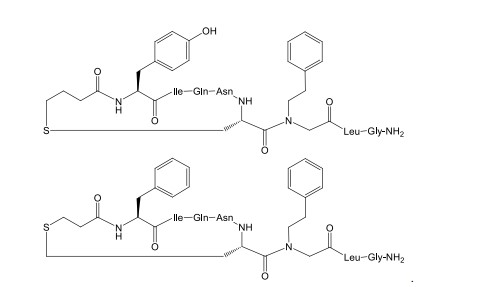
Na modalidade mais preferida, a inverupao e um composto selecionado entre um grupo que consiste em:

Além disso, a presente invenção refere-se a um composto como enunciado acima para uso como um produto farmacêutico.Furthermore, the present invention relates to a compound as set out above for use as a pharmaceutical.
Consequentemente, a presente invenção refere-se também a 5 uma composição farmacêutica que compreende um composto como enunciado acima como ingrediente ativo em associação com um adjuvante, diluen- te ou veículo farmaceuticamente aceitável.Accordingly, the present invention also relates to a pharmaceutical composition comprising a compound as stated above as active ingredient in association with a pharmaceutically acceptable adjuvant, diluent or carrier.
A composição farmacêutica pode ser adaptada para administração oral, intravenosa, tópica, intraperitoneal, nasal, bucal, intraocular, intra- aural, sublingual ou subcutânea ou para administração por intermédio do trato respiratório, por exemplo, na forma de um aerossol ou pó fino em suspensão no ar. A composição pode assim, por exemplo, estar na forma de comprimidos, cápsulas, pós, micropartículas, grânulos, xaropes, suspensões, soluções emplastros transdérmicos ou supositórios.The pharmaceutical composition may be adapted for oral, intravenous, topical, intraperitoneal, nasal, buccal, intraocular, intra-aural, sublingual or subcutaneous administration or for administration via the respiratory tract, for example, in the form of an aerosol or fine powder in suspension in the air. The composition may thus, for example, be in the form of tablets, capsules, powders, microparticles, granules, syrups, suspensions, solutions, transdermal patches or suppositories.
Deve-se assinalar que a composição de acordo com a presente invenção pode incluir opcionalmente dois ou mais dos compostos delineados acima.It should be noted that the composition according to the present invention may optionally include two or more of the compounds outlined above.
A presente composição farmacêutica pode compreender opcionalmente, por exemplo, pelo menos um outro aditivo selecionado entre um agente desintegrador, ligante, lubrificante, agente saporífero, conservante, colorante e qualquer mistura deles. Os exemplos desses outros aditivos são encontrados em "Handbook of Pharmaceutical Excipients", editor A. H. Kib- be, 3- edição, American Pharmaceutical Association, USA and Pharmaceutical Press UK, 2000.The present pharmaceutical composition may optionally comprise, for example, at least one other additive selected from a disintegrating agent, binder, lubricant, saporiferous agent, preservative, colorant and any mixture thereof. Examples of these other additives are found in "Handbook of Pharmaceutical Excipients", editor A.H. Kibbe, 3rd edition, American Pharmaceutical Association, USA and Pharmaceutical Press UK, 2000.
A presente composição farmacêutica pode ser adaptada para administração nasal. Ela pode compreender uma preparação aquosa estéril, de preferência, isotônica com o sangue do recebedor. Esta preparação a- quosa pode ser formulada de acordo com métodos conhecidos, usando a- gentes dispersantes ou umectantes e agentes de suspensão apropriados. A formulação de spray nasal SYNTOCINON® (oxitocina) é exemplificativa de uma formulação farmacêutica apropriada aplicável também para os compostos da invenção aqui descritos. Água, solução de Ringer, e solução isotônica de cloreto de sódio são diluentes exemplificativos aceitáveis. A preparação pode incluir também excipientes tais como fosfato de sódio, ácido cítrico, cloreto de sódio, glicerina, solução de sorbitol, para-hidróxi-benzoato de me- tila (metilparaben), para-hidróxi-benzoato de propila (propilparaben) e cloro- butanol.The present pharmaceutical composition can be adapted for nasal administration. It may comprise a sterile aqueous preparation, preferably isotonic with the recipient's blood. This aqueous preparation can be formulated according to known methods using suitable dispersing or wetting agents and suspending agents. The SYNTOCINON® (oxytocin) nasal spray formulation is exemplary of a suitable pharmaceutical formulation applicable also for the compounds of the invention described herein. Water, Ringer's solution, and isotonic sodium chloride solution are exemplary acceptable diluents. The preparation may also include excipients such as sodium phosphate, citric acid, sodium chloride, glycerin, sorbitol solution, methyl parahydroxybenzoate (methylparaben), propyl parahydroxybenzoate (propylparaben) and chlorine - butanol.
Além disso, a presente invenção refere-se ao uso de um composto como delineado acima para tratamento, ou para a fabricação de um medicamento para o tratamento de uma ou mais condições médicas, tais como condições comprometidas de lactação; enfraquecimento de indução do parto; condições de atonia uterina; sangramento excessivo; inflamação e dor, incluindo dor abdominal e dorsal; disfunção sexual, masculina e também feminina; síndrome do intestino irritável (IBS), constipação e obstrução gastrointestinal; autismo, tensão, ansiedade (incluindo distúrbio de ansiedade) e depressão; perda cirúrgica de sangue, hemorragia pós-parto, cicatrização e infecção de feridas; mastite e enfraquecimento de expulsão placentária; e osteoporose; e para o diagnóstico de câncer e insuficiência placentária. Neste relatório descritivo, o termo "ansiedade" inclui distúrbio de ansiedade. O distúrbio de ansiedade inclui as indicações dependentes distúrbio de ansiedade generalizada, distúrbio do pânico, agorafobia, fobias, distúrbio de ansiedade social, distúrbio obsessivo-compulsivo, distúrbio de tensão pós- traumática, e ansiedade da separação.Furthermore, the present invention relates to the use of a compound as outlined above for treating, or for the manufacture of, a medicament for the treatment of one or more medical conditions, such as compromised lactation conditions; weakening of labor induction; uterine atony conditions; excessive bleeding; inflammation and pain, including abdominal and back pain; sexual dysfunction, both male and female; irritable bowel syndrome (IBS), constipation and gastrointestinal obstruction; autism, tension, anxiety (including anxiety disorder) and depression; surgical blood loss, postpartum hemorrhage, scarring and wound infection; mastitis and weakening of placental expulsion; and osteoporosis; and for the diagnosis of cancer and placental insufficiency. In this descriptive report, the term "anxiety" includes anxiety disorder. Anxiety disorder includes the dependent indications generalized anxiety disorder, panic disorder, agoraphobia, phobias, social anxiety disorder, obsessive-compulsive disorder, post-traumatic stress disorder, and separation anxiety.
Em outra modalidade a invenção refere-se a um método para o tratamento de condições comprometidas de lactação; enfraquecimento de indução do parto; condições de atonia uterina; sangramento excessivo; inflamação e dor, incluindo dor abdominal e dorsal; disfunção sexual, masculina e também feminina; síndrome do intestino irritável (IBS), constipação e obstrução gastrointestinal; autismo, tensão, ansiedade (incluindo distúrbio de ansiedade) e depressão; perda cirúrgica de sangue, hemorragia pós-parto, cicatrização e infecção de feridas; mastite e enfraquecimento de expulsão placentária; e osteoporose; e para o diagnóstico de câncer e insuficiência placentária.In another embodiment the invention relates to a method for treating compromised lactation conditions; weakening of labor induction; uterine atony conditions; excessive bleeding; inflammation and pain, including abdominal and back pain; sexual dysfunction, both male and female; irritable bowel syndrome (IBS), constipation and gastrointestinal obstruction; autism, tension, anxiety (including anxiety disorder) and depression; surgical blood loss, postpartum hemorrhage, scarring and wound infection; mastitis and weakening of placental expulsion; and osteoporosis; and for the diagnosis of cancer and placental insufficiency.
A dosagem típica dos compostos de acordo com a presente invenção varia dentro de uma ampla faixa e dependerá de vários fatores, tais como as necessidades individuais de cada paciente, e da via de administração. Um médico versado na técnica será capaz de otimizar a dosagem para a situação em questão.The typical dosage of the compounds according to the present invention varies over a wide range and will depend on various factors, such as the individual needs of each patient, and the route of administration. A physician versed in the art will be able to optimize the dosage for the situation at hand.
Por exemplo, caso a composição da invenção seja para intensificar o início e manutenção de lactação (por exemplo, para administração nasal), uma dose típica pode ficar na faixa de 0,05 a 1,0 μg/kg de peso corporal para cada sessão de bombeamento das mamas. Uma dose intranasal pode ser dividida, por exemplo, em 1, 2 ou 3 doses menores (por exemplo, fungadas), por exemplo, distribuídas para uma ou ambas narinas, conforme necessário. Os versados nessas técnicas ou um médico podem considerar relevantes variantes desta faixa de dosagem e implementações práticas para adaptar à situação em questão.For example, if the composition of the invention is to intensify the initiation and maintenance of lactation (for example, for nasal administration), a typical dose might be in the range of 0.05 to 1.0 µg/kg of body weight for each session breast pumping. An intranasal dose can be divided, for example, into 1, 2 or 3 smaller doses (eg sniffles), for example, delivered to one or both nostrils as needed. Those skilled in these techniques or a physician may consider relevant variants of this dosage range and practical implementations to adapt to the situation at hand.
Em outro exemplo, a composição da invenção pode ser adminis- trada como uma infusão intravenosa, por exemplo, para o tratamento de hemorragia pós-parto ou perda cirúrgica de sangue. Neste exemplo, ela pode ser administrada durante um período mais longo. Uma dosagem exempli- ficativa para administração por infusão intravenosa é 0,5-200 pg/kg em peso corporal por hora.In another example, the composition of the invention may be administered as an intravenous infusion, for example, for the treatment of postpartum hemorrhage or surgical blood loss. In this example, it can be administered for a longer period. An exemplary dosage for administration by intravenous infusion is 0.5-200 pg/kg body weight per hour.
Em outro exemplo, a composição da invenção pode ser para administração subcutânea, intranasal ou bucal, por exemplo, para tratar distúrbio de ansiedade ou depressão. Uma dosagem exemplificativa para administração subcutânea , intranasal ou bucal é 0,5-1.000 pg/kg em peso corporal. A dosagem pode ser, por exemplo, para administração tantas vezes ao dia quanto necessário, por exemplo, uma ou duas vezes ao dia.In another example, the composition of the invention may be for subcutaneous, intranasal or buccal administration, for example to treat anxiety disorder or depression. An exemplary dosage for subcutaneous, intranasal or buccal administration is 0.5-1000 pg/kg body weight. The dosage may be, for example, for administration as many times a day as needed, for example once or twice a day.
As abreviaturas usadas são: AcOH ácido acético Boc t-butóxi-carbonila BOP benzotriazol-1-iloxi hexaflúrofosfato de trisdimetilaminofosfônio Bua ácido butírico Bu resíduos de butil-alquila podem ser denotados ainda um resíduo n (normal, isto é, não ramificado), i (isso), s (see) e terc (terciário) CH3CN acetonitrila DCC N,N'-diciclo-hexil-carbodi-imida DCM dicloro-metano DIC N,N'-di-isopropil-carbodi-imida DIPEA N,N-di-isopropil-etil-amina DMF N,N-dimetil-formamida 4-FBzlGly N-(4-flúor-benzil)-glicina Fmoc 9-fluorenil-metóxi-carbonila Fmoc-CI cloreto de 9-fluorenil-metóxi-carbonila Fmoc-OSu N-(9-fluorenil-metóxi-carbonil)-succinimida h hora(s) HBTU O-(benzotriazol-1-il)-N,N,N',N'-hexaflúor-fosfato de terametil -urônio Hcy homocisteína HF ácido fluorídrico HObt 1-hidróxi-benzotriazol HPLC cromatografia líquida de alto desempenho I PA álcool isopropilico MeOH metanol MBHA 4-metil-benzidril-amina NMM 4-metil-morfolina 4-Pic 4-picolil-(4-piridil-metila) PyBOP benzotriazol-1 -iloxi-hexafluorofosfato trispirrolidinofosfônico tBu terc-butila tBuOH álcool t-butilico TEA trietilamina TFA ácido trifluoroacético TIS tri-isopropil-silano Trt tritil-[trifenil-metil, (C6H5)3C-] A menos que diferentemente especificado, foram usados L-ami- noácidos, e a terminologia convencional de aminoácidos é seguida. Seção Experimental (síntese)The abbreviations used are: AcOH acetic acid Boc t-butoxy-carbonyl BOP benzotriazol-1-yloxy trisdimethylaminophosphonium hexafluorophosphate Bua butyric acid Bu butyl-alkyl residues can be further denoted an n residue (normal, ie unbranched), i (that), s (see) and tert (tertiary) CH3CN acetonitrile DCC N,N'-dicyclohexyl-carbodiimide DCM dichloromethane DIC N,N'-diisopropyl-carbodiimide DIPEA N,N- diisopropyl-ethyl-amine DMF N,N-dimethyl-formamide 4-FBzlGly N-(4-fluoro-benzyl)-glycine Fmoc 9-fluorenyl-methoxy-carbonyl Fmoc-CI 9-fluorenyl-methoxy-carbonyl chloride Fmoc -OSu N-(9-fluorenyl-methoxy-carbonyl)-succinimide h hour(s) HBTU O-(benzotriazol-1-yl)-N,N,N',N'-teramethyl-uronium hexafluorophosphate Hcy homocysteine HF hydrofluoric acid HObt 1-hydroxy-benzotriazole HPLC high performance liquid chromatography I PA isopropyl alcohol MeOH methanol MBHA 4-methyl-benzhydryl-amine NMM 4-methyl-morpholine 4-Pic 4-picolyl-(4-pyridyl-methyl) PyBOP benzotriazol-1-yloxy-hexafluor trispyrrolidinephosphonic phosphate tBu tert-butyl tBuOH t-butyl alcohol TEA triethylamine TFA trifluoroacetic acid TIS triisopropylsilane Trt trityl-[triphenyl-methyl, (C6H5)3C-] Unless otherwise specified, L-amino acids were used, and conventional amino acid terminology is followed. Experimental Section (synthesis)
Os derivados de aminoácidos e as resinas foram adquiridas em fornecedores comerciais (Bachem, Novabiochem e Peptides International). N-Fmoc-N-(R2(CH2)p)-glicina, Fmoc-Hcy(t-butóxi-carbonil-etil)-OH foram sintetizados de acordo com a literatura [Weber e tal., J. Med.Chem. 46:1918 (2003); Prochaska et al., Collect. Crech. Chem. Commun. 57:1335 (1992); e Wisnieski et al. no documento ns WO 03/072597]. Outros produtos químicos e solventes foram fornecidos pela Sigma-Aldrich, fluka e Across Organics.Amino acid derivatives and resins were purchased from commercial suppliers (Bachem, Novabiochem and Peptides International). N-Fmoc-N-(R2(CH2)p)-glycine, Fmoc-Hcy(t-butoxy-carbonyl-ethyl)-OH were synthesized according to the literature [Weber et al., J. Med.Chem. 46:1918 (2003); Prochaska et al., Collect. Daycare Chem. Commun. 57:1335 (1992); and Wisnieski et al. in WO 03/072597]. Other chemicals and solvents were supplied by Sigma-Aldrich, fluka and Across Organics.
Os compostos desta invenção foram sintetizados por métodos usuais com química de peptídeos em fase sólida, utilizando metodologia Fmoc e Boc. Todo acoplamento de aminoácidos protegidos com Fmoc foi mediado com DIC/HOBt/DMF e todo acoplamento de aminoácidos protegidos com Boc foi mediado com DIC ou DCC em DCM. A remoção do grupo Fmoc foi realizada com piperidina a 20% em DMF e a remoção do grupo Boc foi realizada em uma mistura de 50% de TFA/DCM com 1% de m-cresol por 5 e 25 minutos. As lavagens requeridas da resina foram realizadas com DCM, IPA e MeOH. A neutralização, conforme necessária, foi realizada com 2 lavagens da resina de 10% de TEA/DCM por 5 minutos.The compounds of this invention were synthesized by usual methods with solid phase peptide chemistry, using Fmoc and Boc methodology. All coupling of Fmoc-protected amino acids was mediated with DIC/HOBt/DMF and all coupling of Boc-protected amino acids was mediated with DIC or DCC in DCM. Removal of the Fmoc group was carried out with 20% piperidine in DMF and removal of the Boc group was carried out in a mixture of 50% TFA/DCM with 1% m-cresol for 5 and 25 minutes. The required resin washes were performed with DCM, IPA and MeOH. Neutralization, as needed, was performed with 2 washes of 10% TEA/DCM resin for 5 minutes.
A menos que diferentemente mencionado, todas reações foram realizadas à temperatura ambiente. Além das referências citadas acima, a seguinte literatura referencial padrão fornece orientação adicional sobre a organização experimental geral, bem como sobre a disponibilidade das matérias-primas e reagentes necessários: Kates, S.A., Albericio, F., Editores, "Solid Phase Synthesis: A Practical Guide", Marcel Dekker, Nova Iorque, Basel, 2000; Stewart, J.M., Young, J.D., "Solid Phase Synthesis", Pierce Chemical Company, 1984; Bisello etal., J. Biol. Chem. 273:22498-22505 (1998); e Merrifield, J. Am. Chem. Soc. 85:2149-2154 (1963).Unless otherwise noted, all reactions were carried out at room temperature. In addition to the references cited above, the following standard reference literature provides additional guidance on the general experimental organization as well as the availability of the necessary raw materials and reagents: Kates, SA, Albericio, F., Editors, "Solid Phase Synthesis: A Practical Guide", Marcel Dekker, New York, Basel, 2000; Stewart, J.M., Young, J.D., "Solid Phase Synthesis", Pierce Chemical Company, 1984; Bisello et al., J. Biol. Chem. 273:22498-22505 (1998); and Merrifield, J. Am. Chem. Soc. 85:2149-2154 (1963).
A pureza do peptídeo sintetizado pode ser determinada por H- PLC em fase reversa. A integridade estrutural dos peptídeos pode ser conformada usando análise de aminoácidos e espectrometria de massas por eletrospray. Metodologias de Fmoc e Boc foram usadas para sintetizar o di- peptídeo (Leu) na posição 8 e (Gly) na posição 9 ligado à resina.The purity of the synthesized peptide can be determined by reversed-phase H-PLC. The structural integrity of the peptides can be conformed using amino acid analysis and electrospray mass spectrometry. Fmoc and Boc methodologies were used to synthesize the dipeptide (Leu) at position 8 and (Gly) at position 9 bound to the resin.
O derivado de aminoácido na posição 7 do resíduo de aminoácidos foi introduzido por intermédio de uma das seguinte rotas: ácido bromoa- cético foi acoplado ao dipeptídeo ligado à resina sob condições de DIC/ HOBt/DMF e o átomode bromo foi deslocado com (R2(CH2)P)NH2, produzindo uma N-(R2(CH2)p)-glicina ou um derivado de Fmoc-pro-OH foi acoplado ao dipeptídeo ligado à resina, de acordo com a metodologia de Fmoc. Todos os acoplamentos de aminoácidos subsequentes seguiram a metodologia de Fmoc, a menos que diferentemente especificado.The amino acid derivative at position 7 of the amino acid residue was introduced via one of the following routes: bromoacetic acid was coupled to the resin-bound dipeptide under DIC/HOBt/DMF conditions and the bromine atom was displaced with (R2( CH2)P)NH2, producing an N-(R2(CH2)p)-glycine or a derivative of Fmoc-pro-OH was coupled to the resin-bound dipeptide, according to the Fmoc methodology. All subsequent amino acid couplings followed Fmoc methodology unless otherwise specified.
O derivado de aminoácido introduzido na posição 6 foi um dos seguintes: Fmoc-Cys(Trt)-OH; FmocHcy(t-butóxi-acarbonil-etil)-OH ou Fmoc- Cys(t-butóxi-carbonil-propil)-OH. Os análogos de peptídeos nos quais a posição 6 era Fmoc-Cys(Trt)-OH requereu acoplamento de Mpa(Trt)-OH ao terminal N do resíduo de nonapeptídeo ligado à resina.The amino acid derivative introduced at position 6 was one of the following: Fmoc-Cys(Trt)-OH; FmocHcy(t-butoxy-acarbonyl-ethyl)-OH or Fmoc-Cys(t-butoxy-carbonyl-propyl)-OH. Peptide analogues in which position 6 was Fmoc-Cys(Trt)-OH required coupling of Mpa(Trt)-OH to the N-terminus of the resin-bound nonapeptide residue.
Os peptídeos sintetizados usando um suporte de resina amida Rink foram clivados da resina, junto com quaisquer grupos protetores lábeis a ácidos tais como Boc, tritila e terc-butila, com solução de TFA/TIS/H2O 95/2,5/2,5 (v/v/v). Os ditos peptídeos foram ciclizados depois da clivagem do peptídeo da resina. Os peptídeos sintetizados usando um suporte de resina de MBHA foram clivados da resina com solução de HF/anisol 14/1 (v/v). Os ditos peptídeos foram ciclizados antes da clivagem do peptídeo da resina.Peptides synthesized using a Rink amide resin support were cleaved from the resin, along with any acid-labile protecting groups such as Boc, trityl and tert-butyl, with 95/2.5/2.5 TFA/TIS/H2O solution. (v/v/v). Said peptides were cyclized after cleavage of the peptide from the resin. Peptides synthesized using an MBHA resin support were cleaved from the resin with HF/anisole 14/1 (v/v) solution. Said peptides were cyclized prior to cleavage of the peptide from the resin.
A ciclização do nonapeptídeo linear através da formação de dis- sulfeto (anel) foi realizada por oxidação de peptídeos lineares dissolvidos em solução aquosa de TFA a 10% com iodo. A ciclização do nonapeptídeo através da formação de ligação amida foi realizada por mediação com HB- TU/DIPEA/DMF ou PyBOP/DIPEA/DMF em uma alta diluição.Cyclization of linear nonapeptide through disulfide (ring) formation was performed by oxidation of linear peptides dissolved in 10% aqueous TFA solution with iodine. Cyclization of the nonapeptide through amide bond formation was performed mediated with HB-TU/DIPEA/DMF or PyBOP/DIPEA/DMF at a high dilution.
Os peptídeos foram purificados por HPLC preparatória em tampões de fosfato de trietilamônio (aquosos) e dessalinizados com um sistema de tampão de ácido acético (aquoso)/acetonitrila. As frações com uma pureza maior do que 97% foram selecionadas e liofilizadas.Peptides were purified by preparatory HPLC in triethylammonium phosphate buffers (aqueous) and desalted with an acetic acid (aqueous)/acetonitrile buffer system. Fractions with a purity greater than 97% were selected and lyophilized.
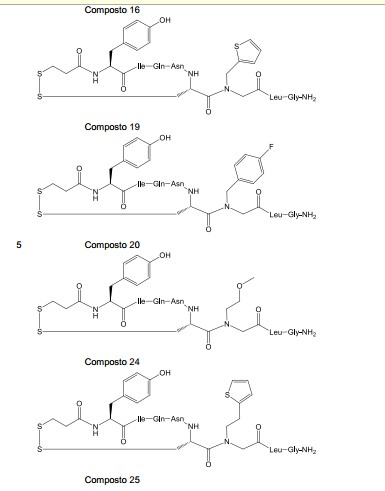
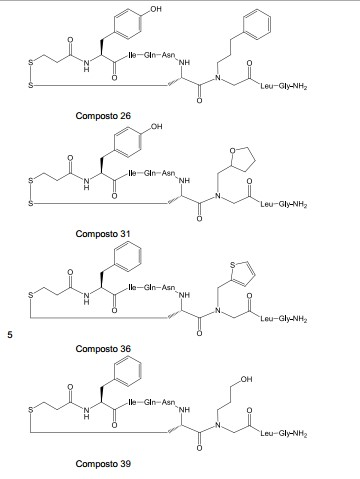
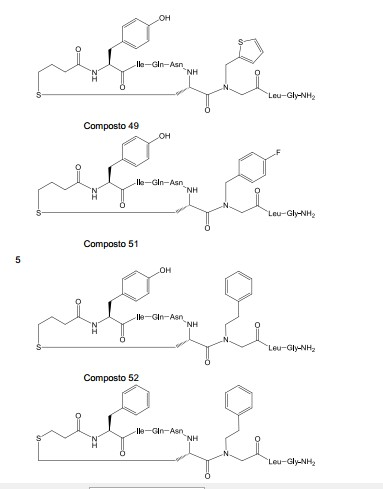
A tabela 1 lista os compostos preparados pelo procedimento a- cima. Um asterisco "*" marca as modalidades mais preferidas. Tabela 1Table 1 lists the compounds prepared by the above procedure. An asterisk "*" marks the most preferred modalities. Table 1
Compostos Preparados com a Fórmula (I)

Os exemplos detalhados que se seguem são foram fornecidos para ilustrar ainda mais a síntese.The following detailed examples are provided to further illustrate the synthesis.
Em todas as sínteses, foi realizada HPLC analítica em um cro- matógrafo de Líquido Waters 600, usando uma coluna Vydac C18, 5 μm, 4,6 x 250 mm, em uma vazão de 2 mL/min. A HPLC preparatória foi realizada em um cromatógrafo de líquido Waters 2000, usando um cartucho PrePak de 47 x 300 mm em uma vazão de 100 mL/min. A análise do composto final foi realizada em um cromatógrafo de líquido Agilent 1100, usando uma coluna Vydac C18, 5 μm, 2,1 x 250 mm, em uma vazão de 0,3 ml_/min. Os espectros de massas foram registrados em um espectrômetro Finnigan MAT.In all syntheses, analytical HPLC was performed in a Waters 600 Liquid chromatograph, using a Vydac C18 column, 5 μm, 4.6 x 250 mm, at a flow rate of 2 mL/min. Preparatory HPLC was performed on a Waters 2000 liquid chromatograph, using a 47 x 300 mm PrePak cartridge at a flow rate of 100 mL/min. Analysis of the final compound was performed on an Agilent 1100 liquid chromatograph, using a Vydac C18 column, 5 μm, 2.1 x 250 mm, at a flow rate of 0.3 ml_/min. Mass spectra were recorded on a Finnigan MAT spectrometer.
Composto 49: carba-1-[4-FBzlGly7]dOTCompound 49: carba-1-[4-FBzlGly7]dOT
Os derivados de aminoácidos usados foram Fmoc-Gly-OH, Fmoc -Leu-OH, Fmoc-Cys(t-butóxi-carbonil-propil)-OH, Fmoc-Asn(Trt)-OH, Fmoc-GIn (Trt)-OH, Fmoc-lle-OH, e Boc-Tyr(tBtu)-OH (Peptides International). Fmoc-Cys (t-butóxi-carbonil-propil)-OH foi sintetizado como descrito acima.The amino acid derivatives used were Fmoc-Gly-OH, Fmoc-Leu-OH, Fmoc-Cys(t-butoxy-carbonyl-propyl)-OH, Fmoc-Asn(Trt)-OH, Fmoc-GIn(Trt)-OH , Fmoc-11e-OH, and Boc-Tyr(tBtu)-OH (Peptides International). Fmoc-Cys (t-butoxy-carbonyl-propyl)-OH was synthesized as described above.
A resina com peptídeo completamente protegida foi sintetizada manualmente, partindo de 1,45 g (0,87 mol) de resina Amida AM Rink de 0,074-0,037 mm (200-400 mesh, Novabiochem). Foram realizados acopla-mentos individuais mediados com DIC/HOBt/DMF com um excesso de 3 vezes de derivados dos aminoácidos Gly e Leu. O resíduo N-(4-flúorbenzil)- glicina foi introduzido com um excesso de 4 vezes de BrC^CC^H/DIC/HOBt em DMF e subsequente substituição de bromo por um excesso de 10 vezes de 4-flúorbenzil-amina em DMF. O acoplamento mediado por DIC/DCM com um excesso de 4 vezes de Fmoc-Cys(t-butóxi-carbonil-propil)-OH foi realizado. Foram realizados subsequentes acoplamentos individuais mediados por DIC/HOBt/DMF com um excesso de 3 vezes de derivados de aminoácidos Asn, Gin, He e Tyr. Os grupos Fmoc foram removidos com solução de piperi- dina a 20% em DMF. Depois de completada a síntese em fase sólida, a resina foi tratada com uma solução de TFA/TIS/H2O 96/2,5/1,5 (y/vlv) (50 mL) por 1,5 h, e removida por filtração. O filtrado foi concentrado sob vácuo e o peptídeo linear bruto foi precipitado com etóxi-etano. O precipitado em DMF (300 mL) foi adicionado em 3 parcelas (3 x 100 mL) a uma solução sob agi- tação intensa de DIPEA (1 mL) em DMF (100 mL). HBTU (150 mg) em DMF (5 mL) foi adicionado à mistura reativa depois da adição de cada parcela de 100 mL da solução de peptídeo; o pH da solução reativa foi mantido em pH 9 pela adição de DIPEA pura, conforme necessário. A reação foi monitorada por HPLC analítica. A solução reativa foi concentrada sob vácuo e o resíduo foi dissolvido em ACOH/CH3CN/H2O. A mistura foi carregada em uma coluna de HPLC e purificada usando um tampão de fosfato de trietil-amônio com pH 5,2. O composto foi eluído com um gradiente de acetonitrila. As frações com uma pureza maior do que 97% foram selecionadas, diluídas com água (2 volumes), e carregadas em uma coluna pré-equilibrada com solução aquosa de AcOH a 2%. O composto desejado foi eluído com um gradiente rápido (3%/min) de CH3CN. As frações que continham o produto desejado foram selecionadas e liofilizadas. 434 mg (rendimento de ~40%, baseado no carregamento da resina inicial e presumindo 85% de teor do peptídeo) do composto amorfo em pó foram obtidos. HPLC: Rt = 19,4 min; gradiente: 5% de B por 5 min, t = 40 °C; solvente A: solução de TFA a 0,01%, solvente B: CH3CN a 70%, 0,01% de TFA (aquoso); pureza: 99,3%; MS (M+H+): esperado 1.042,4, observado 1.042,5.The fully protected peptide resin was synthesized manually starting from 1.45 g (0.87 mol) of 0.074-0.037 mm Amide AM Rink resin (200-400 mesh, Novabiochem). DIC/HOBt/DMF-mediated single couplings were performed with a 3-fold excess of derivatives of the amino acids Gly and Leu. The N-(4-fluorobenzyl)-glycine residue was introduced with a 4-fold excess of BrC^CC^H/DIC/HOBt in DMF and subsequent replacement of bromine by a 10-fold excess of 4-fluorobenzyl-amine in DMF . DIC/DCM mediated coupling with a 4-fold excess of Fmoc-Cys(t-butoxy-carbonyl-propyl)-OH was performed. Subsequent individual DIC/HOBt/DMF-mediated couplings were performed with a 3-fold excess of amino acid derivatives Asn, Gin, He and Tyr. Fmoc groups were removed with 20% piperidine solution in DMF. After completion of solid phase synthesis, the resin was treated with a solution of TFA/TIS/H2O 96/2.5/1.5 (y/vlv) (50 ml) for 1.5 h, and removed by filtration. . The filtrate was concentrated in vacuo and the crude linear peptide was precipitated with ethoxy-ethane. The precipitate in DMF (300 ml) was added in 3 portions (3 x 100 ml) to a solution under intense stirring of DIPEA (1 ml) in DMF (100 ml). HBTU (150 mg) in DMF (5 ml) was added to the reaction mixture after the addition of each 100 ml portion of the peptide solution; the pH of the reactive solution was maintained at pH 9 by adding pure DIPEA as needed. The reaction was monitored by analytical HPLC. The reactive solution was concentrated under vacuum and the residue was dissolved in ACOH/CH3CN/H2O. The mixture was loaded onto an HPLC column and purified using a pH 5.2 triethylammonium phosphate buffer. The compound was eluted with an acetonitrile gradient. Fractions with a purity greater than 97% were selected, diluted with water (2 volumes), and loaded onto a column pre-equilibrated with a 2% aqueous solution of AcOH. The desired compound was eluted with a fast gradient (3%/min) of CH3CN. Fractions containing the desired product were selected and lyophilized. 434 mg (~40% yield, based on starting resin loading and assuming 85% peptide content) of the powdered amorphous compound were obtained. HPLC: Rt = 19.4 min; gradient: 5% B for 5 min, t = 40 °C; solvent A: 0.01% TFA solution, solvent B: 70% CH3CN, 0.01% TFA (aqueous); purity: 99.3%; MS (M+H+): expected 1,042.4, observed 1,042.5.
O texto que se segue é uma síntese em larga escala (isto é, au-mento de escala) do Composto 49: carba-1-[4-FBzlGly7]dOTThe following text is a large-scale (ie, scale-up) synthesis of Compound 49: carba-1-[4-FBzlGly7]dOT
Os derivados de aminoácidos usados foram Fmoc-Gly-OH, Fmoc - Leu-OH, Fmoc-4-FBzlGly-OH, Fmoc-Cys(t-butóxi-carbonil-propil)-OH, Fmoc- Asn(Trt)-OH, Fmoc-Gln(Trt)-OH, Fmoc-lle-OH, e Boc-Tyr(tBtu)-OH (Peptides International). Fmoc-4-FBzlGly-OH e Fmoc-Cys(t-butóxi-carbonil-propil)-OH foram sintetizados como descrito acima. O peptídeo foi sintetizado por acoplamentos individuais mediados por DIC/HOBt/DMF com um excesso de 3 vezes de derivado de aminoácido. A síntese remanescente e a caracterização do composto 49 foram seguidas como fornecido acima. 434 mg (rendimento de ~40%, baseado no carregamento da resina inicial e presumindo 85% de teor do peptídeo) de um pó amorfo branco foram obtidos.The amino acid derivatives used were Fmoc-Gly-OH, Fmoc-Leu-OH, Fmoc-4-FBzlGly-OH, Fmoc-Cys(t-butoxy-carbonyl-propyl)-OH, Fmoc-Asn(Trt)-OH, Fmoc-Gln(Trt)-OH, Fmoc-11e-OH, and Boc-Tyr(tBtu)-OH (Peptides International). Fmoc-4-FBzlGly-OH and Fmoc-Cys(t-butoxy-carbonyl-propyl)-OH were synthesized as described above. The peptide was synthesized by individual DIC/HOBt/DMF-mediated couplings with a 3-fold excess of amino acid derivative. The remaining synthesis and characterization of compound 49 was followed as given above. 434 mg (~40% yield, based on starting resin loading and assuming 85% peptide content) of a white amorphous powder were obtained.
Composto 10: [4-PicGly7]dOTCompound 10: [4-PicGly7]dOT
Os derivados de aminoácidos usados foram Fmoc-Gly-OH, Fmoc- Leu-OH, Fmoc-Cys(Trt)-OH, Fmoc-Asn(Trt)-OH, Fmoc-Gln(Trt)-OH, Fmoc-lle- OH, Fmoc-Tyr(tBu)-OH, e Mpa(Trt)-OH (Peptides International). A resina com peptídeo completamente protegida foi sintetizada manualmente, partindo de 1,33 g (0,65 mol) de resina Rink AM de 0,074-0,037 mm (200-400 mesh, Novabiochem). Foram realizados acoplamentos individuais mediados por DIC/HOBt/DMF com um excesso de 3 vezes dos derivados de aminoácidos Gly e Leu. O resíduo N-(4-picolil)-glicina foi introduzido com um excesso de 4 vezes de BrCH2CO2H/DIC/HOBt em DMF e a subsequente substituição de bromo por um excesso de 10 vezes de 4-picolil-amina em DMF. O acoplamento mediado por DIC/DCM com um excesso de 4 vezes de Fmoc-Cys (Trt)-OHe os acoplamentos individuais mediados por DIC/HOBt/DMF com um excessso de 3 vezes dos derivados de aminoácidos Asn, He, tyr e Mpa foram realizados. Os grupos Fmoc foram removidos com piperidina a 20% em DMF. Depois de completada a síntese em fase sólida, a resina foi tratada com uma solução de TFA/TIS/H2O 96/2/2 (vMv) (50 mL) por 1,5 h, e removida por filtração. O filtrado foi concentrado sob vácuo e o peptídeo linear bruto foi precipitado com etóxi-etano. O precipitado foi dissolvido em TFA ouro (50 mL), vertido sobre uma solução aquosa de acetonitrila a 5% (600 mL) sob agitação com um agitador magnético, e o peptídeo foi oxidado adicionando l2 a 0,1 M em metanol até que persistisse uma cor amarela. O excesso de iodo foi reduzido com ácido ascórbico sólido (Sigma-Aldrich) e o pH da solução foi ajustado até cerca de 4 adicionando amônea concentrada (aquosa). A mistura foi carregada em uma coluna de HPLC e purificada u- sando um tampão de fosfato de trietil-amônio com pH 5,2. O composto foi eluído com um gradiente de acetonitrila. As frações com uma pureza maior do que 97% foram selecionadas, diluídas com água (2 volumes), e carregadas em uma coluna pré-equilibrada com solução aquosa de AcOH a 2%. O composto desejado foi eluído com um gradiente rápido (3%/min) de acetonitrila. As frações que continham o produto desejado foram selecionadas e liofilizadas. 348,7 mg (rendimento de ~44%, baseado no carregamento da resina inicial e presumindo 85% de teor do peptídeo) de um pó amorfo branco foram obtidos. HPLC: Rt = 21,7 min; gradiente: 5% de B por 0,5 min, >10% de B em 0,5 min, 10—>30% de B durante 20 min e 100% de B por 5 min, t = 40 °C; solvente A: solução aquosa de TFA a 0,01%, solvente B: CH3CN a 70%, 0,01% de TFA (aquoso); pureza: 99,9%; MS (M+H+): esperado 1.043,4, observado 1.043,4. Composto 29: carba-6-[Phe2,MeOEtGly7]doTThe amino acid derivatives used were Fmoc-Gly-OH, Fmoc-Leu-OH, Fmoc-Cys(Trt)-OH, Fmoc-Asn(Trt)-OH, Fmoc-Gln(Trt)-OH, Fmoc-lle-OH , Fmoc-Tyr(tBu)-OH, and Mpa(Trt)-OH (Peptides International). The fully protected peptide resin was synthesized manually starting from 1.33 g (0.65 mol) of 0.074-0.037 mm Rink AM resin (200-400 mesh, Novabiochem). Individual DIC/HOBt/DMF-mediated couplings were performed with a 3-fold excess of the amino acid derivatives Gly and Leu. The N-(4-picolyl)-glycine residue was introduced with a 4-fold excess of BrCH2CO2H/DIC/HOBt in DMF and subsequent replacement of bromine with a 10-fold excess of 4-picolylamine in DMF. The DIC/DCM mediated coupling with a 4-fold excess of Fmoc-Cys (Trt)-OH and the individual DIC/HOBt/DMF mediated couplings with a 3-fold excess of the amino acid derivatives Asn, He, tyr and Mpa were performed. Fmoc groups were removed with 20% piperidine in DMF. After completion of solid phase synthesis, the resin was treated with a solution of TFA/TIS/H 2 O 96/2/2 (vMv) (50 ml) for 1.5 h, and removed by filtration. The filtrate was concentrated in vacuo and the crude linear peptide was precipitated with ethoxy-ethane. The precipitate was dissolved in TFA gold (50 ml), poured into an aqueous solution of 5% acetonitrile (600 ml) under stirring with a magnetic stirrer, and the peptide was oxidized by adding 12 to 0.1 M methanol until it persisted. a yellow color. Excess iodine was reduced with solid ascorbic acid (Sigma-Aldrich) and the pH of the solution was adjusted to about 4 by adding concentrated (aqueous) ammonia. The mixture was loaded onto an HPLC column and purified using a pH 5.2 triethylammonium phosphate buffer. The compound was eluted with an acetonitrile gradient. Fractions with a purity greater than 97% were selected, diluted with water (2 volumes), and loaded onto a column pre-equilibrated with a 2% aqueous solution of AcOH. The desired compound was eluted with a fast gradient (3%/min) of acetonitrile. Fractions containing the desired product were selected and lyophilized. 348.7 mg (~44% yield, based on starting resin loading and assuming 85% peptide content) of a white amorphous powder was obtained. HPLC: Rt = 21.7 min; gradient: 5% B for 0.5 min, >10% B for 0.5 min, 10—>30% B for 20 min and 100% B for 5 min, t = 40 °C; solvent A: 0.01% TFA aqueous solution, solvent B: 70% CH3CN, 0.01% TFA (aqueous); purity: 99.9%; MS (M+H+): expected 1,043.4, found 1,043.4. Compound 29: carb-6-[Phe2, MeOEtGly7]doT
Os derivados de aminoácidos usados foram Boc-Gly-OH e Boc- Leu-OH (Bachem), Fmoc-Hcy(t-butóxi-carbonil-etil)-OH, Fmoc-Asn(Trt)-OH, Fmoc-Gln(Trt)-OH, Fmoc-lle-OH, e Boc-Phe-OH (Peptides International). Fmoc-Hcy(t-butóxi-carbonil-etil)-OH foi sintetizado como descrito acima.The amino acid derivatives used were Boc-Gly-OH and Boc-Leu-OH (Bachem), Fmoc-Hcy(t-butoxy-carbonyl-ethyl)-OH, Fmoc-Asn(Trt)-OH, Fmoc-Gln(Trt )-OH, Fmoc-11e-OH, and Boc-Phe-OH (Peptides International). Fmoc-Hcy(t-butoxy-carbonyl-ethyl)-OH was synthesized as described above.
A resina com peptídeo completamente protegido foi sintetizada manualmente, partindo de 1,33 g (0,94 mol) de resina MBHA (Novabio- chem). A resina foi neutralizada com TEA a 10% em DCM. Foram realizados acoplamentos individuais mediados por DIC/DCM com um excesso de 1,7 vez dos aminoácidos Boc-Gly-OH e Boc-Leu-OH. O resíduo N-(2-metóxi-etil) -glicina foi introduzido com um excesso de 3,6 vezes de BrCH2CO2H/ DIC/HOBt em DMF e subsequente substituição do bromo por um excesso de 7 vezes de 2-metóxi-etila e um excesso de 4 vezes de DIPEA em DMF (10 ml_); a reação foi agitada por 5 h. Foram realizados o acoplamento mediado por DIC/DCM com um excesso de 4 vezes dos derivados de Fmoc-Hcy(t- butóxi-carbonil-etil)-OH e os acoplamentos individuais mediados por DIC/HOBt/DMF com um excesso de 3 vezes dos derivados de aminoácidos Asn e Gin. Os dois acoplamentos individuais finais com Fmoc-lle-OH e Boc- Phe-OH foram realizados com DIC/DCM para produzir o peptídeo linear ligado à resina protegida. Os grupos Fmoc foram removidos com piperidina a 20% em DMF. A resina foi tratada com TFA/H2O/TIS 95/3/2 (v/v/v) por 2 h, para remover os grupos tritila, Boc e t-butila. BOP (4 eq) e DIPEA (10 eq) foram adicionados a uma suspensão da resina em DMF (10 ml_) sob agitação; deoiis de 2 h, PyBOP (2 eq) e DIPEA (5 eq) foram adicionados. O peptídeo foi clivado da resina usando 70 mL de HF anidro contendo 5 ml_ de anisol a 0 °C por 90 min. O HF foi removido sob vácuo e o peptídeo linear bruto foi lavado com etóxi-etila (300 mL). O peptídeo foi dissolvido em A- cOH/CH3CN/H2O 1/2/7 (v/v/v) (400 mL). A mistura resultante foi carregada diretamente em uma coluna de HPLC e purificada usando tampão de fosfato de trietil-amônio em pH 2,3. O composto foi eluído com um gradiente de ace- tonitrila. As frações com uma pureza maior do que 97% foram selecionadas, diluídas com água (2 volumes), e carregadas em uma coluna pré-equilibrada com solução aquosa de AcOH a 2%. O composto desejado foi eluído com um gradiente de 1% de AcOH/CH3CN. As frações que continham o produto desejado foram selecionadas e liofilizadas. 292,7 mg (rendimento de ~27%, baseado no carregamento da resina inicial e presumindo 85% de teor do peptídeo) de um pó amorfo branco foram obtidos. HPLC: Rt = 16,7 min; gradiente: 5% de B por 0,5 min, 5^-30% de B em 0,5 min, 30->50% de B durante 20 min e 100% de B por 5 min, t = 40 °C; solvente A: solução aquosa de TFA a 0,01%, solvente B: CH3CN a 70%, 0,01% de TFA (aquoso); pureza: 100,0%; MS (M+H+): esperado 976,5, observado 976,3.The fully protected peptide resin was synthesized manually starting from 1.33 g (0.94 mol) of MBHA resin (Novabiochem). The resin was neutralized with 10% TEA in DCM. Individual DIC/DCM-mediated couplings were performed with a 1.7-fold excess of the amino acids Boc-Gly-OH and Boc-Leu-OH. The N-(2-methoxy-ethyl)-glycine residue was introduced with a 3.6-fold excess of BrCH2CO2H/DIC/HOBt in DMF and subsequent replacement of the bromine with a 7-fold excess of 2-methoxy-ethyl and a 4-fold excess of DIPEA in DMF (10 ml_); the reaction was stirred for 5 h. DIC/DCM-mediated coupling with a 4-fold excess of the Fmoc-Hcy(t-butoxy-carbonyl-ethyl)-OH derivatives and individual DIC/HOBt/DMF-mediated couplings with a 3-fold excess of the amino acid derivatives Asn and Gin. The final two individual couplings with Fmoc-11e-OH and Boc-Phe-OH were performed with DIC/DCM to produce the linear peptide bound to the protected resin. Fmoc groups were removed with 20% piperidine in DMF. The resin was treated with TFA/H2O/TIS 95/3/2 (v/v/v) for 2 h to remove trityl, Boc and t-butyl groups. BOP (4 eq) and DIPEA (10 eq) were added to a suspension of the resin in DMF (10 ml) under stirring; 2 h of oils, PyBOP (2 eq) and DIPEA (5 eq) were added. The peptide was cleaved from the resin using 70 mL of anhydrous HF containing 5 mL of anisole at 0°C for 90 min. The HF was removed under vacuum and the crude linear peptide was washed with ethoxy-ethyl (300 ml). The peptide was dissolved in A-cOH/CH3CN/H2O 1/2/7 (v/v/v) (400 mL). The resulting mixture was loaded directly onto an HPLC column and purified using triethylammonium phosphate buffer at pH 2.3. The compound was eluted with an acetonitrile gradient. Fractions with a purity greater than 97% were selected, diluted with water (2 volumes), and loaded onto a column pre-equilibrated with a 2% aqueous solution of AcOH. The desired compound was eluted with a 1% gradient of AcOH/CH3CN. Fractions containing the desired product were selected and lyophilized. 292.7 mg (~27% yield, based on starting resin loading and assuming 85% peptide content) of a white amorphous powder was obtained. HPLC: Rt = 16.7 min; gradient: 5% B for 0.5 min, 5%-30% B for 0.5 min, 30->50% B for 20 min and 100% B for 5 min, t = 40°C; solvent A: 0.01% TFA aqueous solution, solvent B: 70% CH3CN, 0.01% TFA (aqueous); purity: 100.0%; MS (M+H+): 976.5 expected, 976.3 observed.
Os outros compostos foram preparados por variação análoga destes procedimentos sintéticos.The other compounds were prepared by analogous variation of these synthetic procedures.
A atividade agonista de compostos sobre o receptor hOT foi determinada em um ensaio de gene repórter de transcrição transfectando de forma transiente um DNA com expressão do receptor hOT dentro da linhagem de células do ovário do hamster chinês (CHO) conjuntamente com um DNA repórter que contém elementos promotores responsivos a cálcio intracelular que regulam a expressão de luciferase de pirilampo. Vide Boss, V., Talpade, D.J., Murphy, T.J., J. Biol. Chem. 271 (18):10429-10432 (3 de maio de 1996) para obter informações adicionais sobre este ensaio. As células foram expostas a diluições seriais de compostos diluídos 10 vezes por dose durante 5 h, e em seguida, lise das células, determinação de eficácias dos compostos e valor de CE50 através de regressão não-linear. Oxitocina (OT) foi usada como controle interno em cada experimento, e os compostos foram testados em pelo menos três experimentos independentes. Para determinar a seletividade, os compostos foram testados ainda em ensaios de gene re pórter de transcrição baseados em luciferase, expressando o receptor de vasopressina (hV2) humano.Agonist activity of compounds on the hOT receptor was determined in a transcriptional reporter gene assay by transiently transfecting a DNA expressing the hOT receptor into the Chinese hamster ovary (CHO) cell line together with a reporter DNA containing intracellular calcium-responsive promoter elements that regulate firefly luciferase expression. See Boss, V., Talpade, D.J., Murphy, T.J., J. Biol. Chem. 271 (18):10429-10432 (May 3, 1996) for additional information about this trial. Cells were exposed to serial dilutions of 10-fold diluted compounds per dose for 5 h, and then cell lysis, determination of compound efficacies and EC50 value by non-linear regression. Oxytocin (OT) was used as an internal control in each experiment, and compounds were tested in at least three independent experiments. To determine selectivity, the compounds were further tested in luciferase-based transcriptional reporter gene assays, expressing the human vasopressin (hV2) receptor.
Com propósitos comparativos adicionais, carbetocina foi usada como composto referencial.For additional comparative purposes, carbetocin was used as a reference compound.
Os resultados nos ensaios in vivo estão representados na tabe la 2 abaixo. O valor de CE50 fornecido é a média geométrica expressa em nanomol/L (nM). Os valores de seletividade são fornecidos em relações de CEÕO- Tabela 2The results of the in vivo assays are shown in table 2 below. The EC50 value provided is the geometric mean expressed in nanomol/L (nM). Selectivity values are given in CEÕO- Table 2
Resultados dos Testes Biológicos

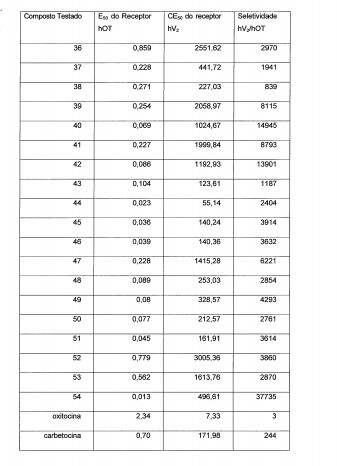
Os resultados precedentes indicam que os compostos exemplifi- cativos estão dentro do âmbito de invenção e podem ser úteis, por exemplo, no tratamento seguro e eficaz de seres humanos, para induzir parto, controlar atonia uterina, promover e manter lactação, etc.The foregoing results indicate that the exemplary compounds are within the scope of the invention and may be useful, for example, in the safe and effective treatment of humans, to induce parturition, control uterine atony, promote and maintain lactation, etc.
O âmbito de presente invenção está definido ainda nas reivindi cações que se seguem.The scope of the present invention is further defined in the claims which follow.
Claims (9)






Applications Claiming Priority (5)
| Application Number | Priority Date | Filing Date | Title |
|---|---|---|---|
| US4097308P | 2008-03-31 | 2008-03-31 | |
| US61/040,973 | 2008-03-31 | ||
| EP08251739.2 | 2008-05-19 | ||
| EP08251739 | 2008-05-19 | ||
| PCT/IB2009/005351 WO2009122285A1 (en) | 2008-03-31 | 2009-03-30 | Oxitocin analogues |
Publications (2)
| Publication Number | Publication Date |
|---|---|
| BRPI0910345A2 BRPI0910345A2 (en) | 2015-10-06 |
| BRPI0910345B1 true BRPI0910345B1 (en) | 2021-08-17 |
Family
ID=39722695
Family Applications (1)
| Application Number | Title | Priority Date | Filing Date |
|---|---|---|---|
| BRPI0910345-7A BRPI0910345B1 (en) | 2008-03-31 | 2009-03-30 | OXITOCINE ANALOGUE COMPOUNDS, PHARMACEUTICAL COMPOSITION INCLUDING THEM AND USE OF SUCH ANALOGUES |
Country Status (20)
| Country | Link |
|---|---|
| US (1) | US8673841B2 (en) |
| EP (2) | EP2260053B1 (en) |
| JP (1) | JP5539310B2 (en) |
| KR (1) | KR101558404B1 (en) |
| CN (1) | CN101983205B (en) |
| AU (1) | AU2009233429B2 (en) |
| BR (1) | BRPI0910345B1 (en) |
| CA (1) | CA2718148C (en) |
| DK (1) | DK2260053T3 (en) |
| ES (1) | ES2488992T3 (en) |
| HR (1) | HRP20140716T1 (en) |
| IL (1) | IL208039A (en) |
| MX (1) | MX2010010743A (en) |
| NZ (1) | NZ587817A (en) |
| PL (1) | PL2260053T3 (en) |
| PT (1) | PT2260053E (en) |
| RU (1) | RU2496788C2 (en) |
| SI (1) | SI2260053T1 (en) |
| WO (1) | WO2009122285A1 (en) |
| ZA (1) | ZA201006733B (en) |
Families Citing this family (18)
| Publication number | Priority date | Publication date | Assignee | Title |
|---|---|---|---|---|
| US8853158B2 (en) | 2010-05-25 | 2014-10-07 | Institut National De La Santé Et De La Recherche Médicale (Inserm) | Methods for the treatment of a feeding disorder with onset during neonate development using an agonist of the oxytocin receptor |
| JO3400B1 (en) * | 2010-09-30 | 2019-10-20 | Ferring Bv | Pharmaceutical compound of carbetocin |
| NZ708175A (en) | 2012-12-21 | 2020-06-26 | Hoffmann La Roche | Peptides as oxytocin agonists |
| CA2949173A1 (en) | 2014-06-03 | 2015-12-10 | Caterina Bissantz | Peptides as oxytocin agonists |
| CR20160562A (en) * | 2014-06-06 | 2017-01-06 | Hoffmann La Roche | PEPTIDES AS OXYCHOCINE AGONISTS |
| US10588980B2 (en) | 2014-06-23 | 2020-03-17 | Novartis Ag | Fatty acids and their use in conjugation to biomolecules |
| RS65144B1 (en) | 2014-09-19 | 2024-02-29 | Ferring Bv | Method of treating prader-willi syndrome |
| CN106084015B (en) * | 2016-08-25 | 2020-01-31 | 成都圣诺生物制药有限公司 | method for synthesizing carbetocin |
| US20190135859A1 (en) | 2017-08-11 | 2019-05-09 | Ferring B.V. | Method of manufacturing a pharmaceutical composition |
| AU2018312956B2 (en) * | 2017-08-11 | 2022-03-10 | Ferring B.V. | Method of manufacturing a pharmaceutical composition |
| CN107628975B (en) * | 2017-09-17 | 2019-10-29 | 贵州医科大学 | Lysine derivative histone deacetylases inhibitor and its synthesis and application |
| EP3852724A4 (en) | 2018-09-20 | 2022-07-06 | Levo Therapeutics, Inc. | Carbetocin drug product and process for preparing same |
| US20200093884A1 (en) | 2018-09-20 | 2020-03-26 | Mark C. Manning | Stable intranasal formulations of carbetocin |
| WO2020137880A1 (en) * | 2018-12-27 | 2020-07-02 | 国立大学法人北海道大学 | Oxytocin derivative and use thereof |
| WO2021089554A1 (en) | 2019-11-04 | 2021-05-14 | Ferring B.V. | Intranasal administration of merotocin for improving lactation |
| WO2022026463A1 (en) * | 2020-07-27 | 2022-02-03 | Arizona Board Of Regents On Behalf Of The University Of Arizona | Oxytocin analogues and methods for using the same |
| WO2022200568A1 (en) | 2021-03-26 | 2022-09-29 | Ot4B | Treatment of dysphagia |
| WO2024044633A2 (en) * | 2022-08-23 | 2024-02-29 | Seattle Children's Hospital (D/B/A Seattle Children's Research Institute) | Oxytocin derivatives and methods of use |
Family Cites Families (2)
| Publication number | Priority date | Publication date | Assignee | Title |
|---|---|---|---|---|
| SE9604341D0 (en) * | 1996-11-26 | 1996-11-26 | Ferring Bv | Hepta-peptide oxytocin analogue |
| DK1480998T3 (en) * | 2002-02-27 | 2007-03-26 | Ferring Bv | Intermediates and Methods for Preparing Heptapeptide Oxytocin Analogs |
-
2009
- 2009-03-30 RU RU2010139634/04A patent/RU2496788C2/en active
- 2009-03-30 AU AU2009233429A patent/AU2009233429B2/en active Active
- 2009-03-30 HR HRP20140716AT patent/HRP20140716T1/en unknown
- 2009-03-30 EP EP09727031.8A patent/EP2260053B1/en active Active
- 2009-03-30 PL PL09727031T patent/PL2260053T3/en unknown
- 2009-03-30 KR KR1020107024207A patent/KR101558404B1/en active Active
- 2009-03-30 ES ES09727031.8T patent/ES2488992T3/en active Active
- 2009-03-30 SI SI200930966T patent/SI2260053T1/en unknown
- 2009-03-30 JP JP2011502454A patent/JP5539310B2/en active Active
- 2009-03-30 US US12/933,858 patent/US8673841B2/en active Active
- 2009-03-30 WO PCT/IB2009/005351 patent/WO2009122285A1/en not_active Ceased
- 2009-03-30 PT PT97270318T patent/PT2260053E/en unknown
- 2009-03-30 CA CA2718148A patent/CA2718148C/en active Active
- 2009-03-30 DK DK09727031.8T patent/DK2260053T3/en active
- 2009-03-30 BR BRPI0910345-7A patent/BRPI0910345B1/en active IP Right Grant
- 2009-03-30 MX MX2010010743A patent/MX2010010743A/en active IP Right Grant
- 2009-03-30 NZ NZ587817A patent/NZ587817A/en unknown
- 2009-03-30 EP EP13156710.9A patent/EP2626364A1/en not_active Withdrawn
- 2009-03-30 CN CN200980111919.5A patent/CN101983205B/en active Active
-
2010
- 2010-09-07 IL IL208039A patent/IL208039A/en active IP Right Grant
- 2010-09-20 ZA ZA2010/06733A patent/ZA201006733B/en unknown
Also Published As
| Publication number | Publication date |
|---|---|
| DK2260053T3 (en) | 2014-06-23 |
| JP5539310B2 (en) | 2014-07-02 |
| WO2009122285A8 (en) | 2009-12-10 |
| CN101983205B (en) | 2015-08-19 |
| CA2718148A1 (en) | 2009-10-08 |
| IL208039A (en) | 2016-03-31 |
| US8673841B2 (en) | 2014-03-18 |
| HRP20140716T1 (en) | 2014-08-29 |
| EP2260053A1 (en) | 2010-12-15 |
| PL2260053T3 (en) | 2014-11-28 |
| BRPI0910345A2 (en) | 2015-10-06 |
| EP2626364A1 (en) | 2013-08-14 |
| WO2009122285A1 (en) | 2009-10-08 |
| RU2010139634A (en) | 2012-05-10 |
| SI2260053T1 (en) | 2014-08-29 |
| KR101558404B1 (en) | 2015-10-08 |
| KR20110005705A (en) | 2011-01-18 |
| EP2260053B1 (en) | 2014-05-14 |
| RU2496788C2 (en) | 2013-10-27 |
| AU2009233429B2 (en) | 2014-02-13 |
| CA2718148C (en) | 2017-11-07 |
| HK1146064A1 (en) | 2011-05-13 |
| US20110044905A1 (en) | 2011-02-24 |
| CN101983205A (en) | 2011-03-02 |
| AU2009233429A1 (en) | 2009-10-08 |
| ZA201006733B (en) | 2011-06-29 |
| ES2488992T3 (en) | 2014-09-01 |
| IL208039A0 (en) | 2010-12-30 |
| NZ587817A (en) | 2012-05-25 |
| PT2260053E (en) | 2014-08-29 |
| JP2011516460A (en) | 2011-05-26 |
| MX2010010743A (en) | 2010-11-04 |
Similar Documents
| Publication | Publication Date | Title |
|---|---|---|
| CN101983205B (en) | Oxitocin analogues | |
| RU2539692C2 (en) | Oxytocin receptor agonists | |
| ES2366702T3 (en) | PEPTIDE AGONISTS OF VASOPRESINE RECEPTORS. | |
| CN101379076B (en) | Novel compounds | |
| CN106414479A (en) | Peptides as oxytocin agonists | |
| HK1146064B (en) | Oxytocin analogues | |
| WO2002000688A1 (en) | Peptide compound and pharmaceutical compositions and medicines containing the same as the active ingredient |
Legal Events
| Date | Code | Title | Description |
|---|---|---|---|
| B06F | Objections, documents and/or translations needed after an examination request according [chapter 6.6 patent gazette] | ||
| B07D | Technical examination (opinion) related to article 229 of industrial property law [chapter 7.4 patent gazette] |
Free format text: DE ACORDO COM O ARTIGO 229-C DA LEI NO 10196/2001, QUE MODIFICOU A LEI NO 9279/96, A CONCESSAO DA PATENTE ESTA CONDICIONADA A ANUENCIA PREVIA DA ANVISA. CONSIDERANDO A APROVACAO DOS TERMOS DO PARECER NO 337/PGF/EA/2010, BEM COMO A PORTARIA INTERMINISTERIAL NO 1065 DE 24/05/2012, ENCAMINHA-SE O PRESENTE PEDIDO PARA AS PROVIDENCIAS CABIVEIS. |
|
| B07E | Notification of approval relating to section 229 industrial property law [chapter 7.5 patent gazette] | ||
| B06U | Preliminary requirement: requests with searches performed by other patent offices: procedure suspended [chapter 6.21 patent gazette] | ||
| B07A | Application suspended after technical examination (opinion) [chapter 7.1 patent gazette] | ||
| B06A | Patent application procedure suspended [chapter 6.1 patent gazette] | ||
| B09A | Decision: intention to grant [chapter 9.1 patent gazette] | ||
| B16A | Patent or certificate of addition of invention granted [chapter 16.1 patent gazette] |
Free format text: PRAZO DE VALIDADE: 20 (VINTE) ANOS CONTADOS A PARTIR DE 30/03/2009, OBSERVADAS AS CONDICOES LEGAIS. PATENTE CONCEDIDA CONFORME ADI 5.529/DF, QUE DETERMINA A ALTERACAO DO PRAZO DE CONCESSAO. |